US10450303B2 - Biaryl piperidine amide compounds and methods of use thereof - Google Patents
Biaryl piperidine amide compounds and methods of use thereof Download PDFInfo
- Publication number
- US10450303B2 US10450303B2 US15/921,890 US201815921890A US10450303B2 US 10450303 B2 US10450303 B2 US 10450303B2 US 201815921890 A US201815921890 A US 201815921890A US 10450303 B2 US10450303 B2 US 10450303B2
- Authority
- US
- United States
- Prior art keywords
- alkyl
- membered saturated
- hydrogen
- partially saturated
- saturated
- Prior art date
- Legal status (The legal status is an assumption and is not a legal conclusion. Google has not performed a legal analysis and makes no representation as to the accuracy of the status listed.)
- Active
Links
- KRUFUZWRBNVQIC-UHFFFAOYSA-N CC(C)NC(=O)C1=CC=C(CCC2CCN(C(=O)COC3=C(C4=CC=CC=C4)C=CC=C3)CC2)C=C1 Chemical compound CC(C)NC(=O)C1=CC=C(CCC2CCN(C(=O)COC3=C(C4=CC=CC=C4)C=CC=C3)CC2)C=C1 KRUFUZWRBNVQIC-UHFFFAOYSA-N 0.000 description 4
- QXCQHRHLGYBLFC-UHFFFAOYSA-N N#CC1=NC=C(C2=C(OCC(=O)N3CCC(CCC4=CC=C5OCOC5=C4)CC3)C=CC=C2)C=C1 Chemical compound N#CC1=NC=C(C2=C(OCC(=O)N3CCC(CCC4=CC=C5OCOC5=C4)CC3)C=CC=C2)C=C1 QXCQHRHLGYBLFC-UHFFFAOYSA-N 0.000 description 4
- AWGBSGYKTNDYSW-UHFFFAOYSA-N O=C(COC1=C(C2=C(Cl)C=C(Cl)C=C2)C=CC=C1)N1CCC(CCC2=CC=C3OCOC3=C2)CC1 Chemical compound O=C(COC1=C(C2=C(Cl)C=C(Cl)C=C2)C=CC=C1)N1CCC(CCC2=CC=C3OCOC3=C2)CC1 AWGBSGYKTNDYSW-UHFFFAOYSA-N 0.000 description 4
- BJOJRCYHFRREKG-UHFFFAOYSA-N O=C(COC1=C(C2=C(O)C=CC=C2)C=CC=C1)N1CCC(CCC2=CC=C3OCCCOC3=C2)CC1 Chemical compound O=C(COC1=C(C2=C(O)C=CC=C2)C=CC=C1)N1CCC(CCC2=CC=C3OCCCOC3=C2)CC1 BJOJRCYHFRREKG-UHFFFAOYSA-N 0.000 description 4
- NWFMUTHNJZBYIU-UHFFFAOYSA-N C#CCOC1=CC=C(CCC2CCN(C(=O)COC3=C(C4=CC=C(C(=O)C5=CC=CC=C5)C=C4)C=CC=C3)CC2)C=C1 Chemical compound C#CCOC1=CC=C(CCC2CCN(C(=O)COC3=C(C4=CC=C(C(=O)C5=CC=CC=C5)C=C4)C=CC=C3)CC2)C=C1 NWFMUTHNJZBYIU-UHFFFAOYSA-N 0.000 description 3
- RVAHEGQCIYDMQG-UHFFFAOYSA-N CC(C)OC1=CC=CC(CCC2CCN(C(=O)COC3=C(C4=C(O)C=C(F)C=C4)N=CC=C3)CC2)=C1 Chemical compound CC(C)OC1=CC=CC(CCC2CCN(C(=O)COC3=C(C4=C(O)C=C(F)C=C4)N=CC=C3)CC2)=C1 RVAHEGQCIYDMQG-UHFFFAOYSA-N 0.000 description 3
- UXZWZAKDCOCHLP-UHFFFAOYSA-N CC(C)OC1=CC=CC(CCC2CCN(C(=O)COC3=C(C4=CC=C(C#N)C=C4)C=CC=C3)CC2)=C1 Chemical compound CC(C)OC1=CC=CC(CCC2CCN(C(=O)COC3=C(C4=CC=C(C#N)C=C4)C=CC=C3)CC2)=C1 UXZWZAKDCOCHLP-UHFFFAOYSA-N 0.000 description 3
- MJOUFKLRSKDYAE-UHFFFAOYSA-N CC(C)OC1=CC=CC=C1CCC1CCN(C(=O)COC2=C(C3=C(O)C=C(F)C=C3)C=CC=C2)CC1 Chemical compound CC(C)OC1=CC=CC=C1CCC1CCN(C(=O)COC2=C(C3=C(O)C=C(F)C=C3)C=CC=C2)CC1 MJOUFKLRSKDYAE-UHFFFAOYSA-N 0.000 description 3
- HDYQWCPPXXRAFH-UHFFFAOYSA-N CC1=CN=C(C2=C(OCC(=O)N3CCC(CCC4=CC=CC=C4)CC3)C=CC=C2)C=N1 Chemical compound CC1=CN=C(C2=C(OCC(=O)N3CCC(CCC4=CC=CC=C4)CC3)C=CC=C2)C=N1 HDYQWCPPXXRAFH-UHFFFAOYSA-N 0.000 description 3
- KNHUFFWNKPOSED-UHFFFAOYSA-N CC1OC2=CC=C(CCC3CCN(C(=O)COC4=C(C5=C(O)C=CC=C5)C=CC=C4)CC3)C=C2OC1C Chemical compound CC1OC2=CC=C(CCC3CCN(C(=O)COC4=C(C5=C(O)C=CC=C5)C=CC=C4)CC3)C=C2OC1C KNHUFFWNKPOSED-UHFFFAOYSA-N 0.000 description 3
- SNEDSMGFCSLSQQ-UHFFFAOYSA-N CC1OC2=CC=C(CCC3CCN(C(=O)COC4=C(C5=CC=C(F)C=C5)C=CC=C4)CC3)C=C2OC1C Chemical compound CC1OC2=CC=C(CCC3CCN(C(=O)COC4=C(C5=CC=C(F)C=C5)C=CC=C4)CC3)C=C2OC1C SNEDSMGFCSLSQQ-UHFFFAOYSA-N 0.000 description 3
- FADCGTKZZGPIEM-UHFFFAOYSA-N CCCC(OC1=C(C2=CC=CC=C2)C=CC=C1)C(=O)N1CCC(CCC2=CC=C(OC)C(OC)=C2)CC1 Chemical compound CCCC(OC1=C(C2=CC=CC=C2)C=CC=C1)C(=O)N1CCC(CCC2=CC=C(OC)C(OC)=C2)CC1 FADCGTKZZGPIEM-UHFFFAOYSA-N 0.000 description 3
- AKECGEUPKIYVSN-UHFFFAOYSA-N CCCC(OC1=C(C2=CC=CC=C2)C=CC=C1)C(=O)N1CCC(CCC2=CC=C3OCOC3=C2)CC1 Chemical compound CCCC(OC1=C(C2=CC=CC=C2)C=CC=C1)C(=O)N1CCC(CCC2=CC=C3OCOC3=C2)CC1 AKECGEUPKIYVSN-UHFFFAOYSA-N 0.000 description 3
- HLOZJRKEFHMBHW-UHFFFAOYSA-N CCCOC1=CC=CC(C2=C(OCC(=O)N3CCC(CCC4=CC=C5OCOC5=C4)CC3)C=CC=C2)=C1 Chemical compound CCCOC1=CC=CC(C2=C(OCC(=O)N3CCC(CCC4=CC=C5OCOC5=C4)CC3)C=CC=C2)=C1 HLOZJRKEFHMBHW-UHFFFAOYSA-N 0.000 description 3
- NJKVBZFPFUUKNQ-UHFFFAOYSA-N CCN(CC)C(=O)C1=CC=CC(C2=C(OCC(=O)N3CCC(CCC4=CC=C5OCOC5=C4)CC3)C=CC=C2)=C1 Chemical compound CCN(CC)C(=O)C1=CC=CC(C2=C(OCC(=O)N3CCC(CCC4=CC=C5OCOC5=C4)CC3)C=CC=C2)=C1 NJKVBZFPFUUKNQ-UHFFFAOYSA-N 0.000 description 3
- SWESVUZRTWIOCW-UHFFFAOYSA-N CCOC1=C(C2=C(OCC(=O)N3CCC(CCC4=CC=C5OCOC5=C4)CC3)C=CC=C2)C=CC=C1 Chemical compound CCOC1=C(C2=C(OCC(=O)N3CCC(CCC4=CC=C5OCOC5=C4)CC3)C=CC=C2)C=CC=C1 SWESVUZRTWIOCW-UHFFFAOYSA-N 0.000 description 3
- QHSRFTBZFVEQHD-UHFFFAOYSA-N CCOC1=CC=C(CCC2CCN(C(=O)COC3=C(C4=CC=C(C(=O)C5=CC=CC=C5)C=C4)C=CC=C3)CC2)C=C1 Chemical compound CCOC1=CC=C(CCC2CCN(C(=O)COC3=C(C4=CC=C(C(=O)C5=CC=CC=C5)C=C4)C=CC=C3)CC2)C=C1 QHSRFTBZFVEQHD-UHFFFAOYSA-N 0.000 description 3
- ASAFGBLVNNBKFT-UHFFFAOYSA-N CCOC1=CC=C(CCC2CCN(C(=O)COC3=C(C4=CC=CC=C4)C=CC=C3)CC2)C=C1 Chemical compound CCOC1=CC=C(CCC2CCN(C(=O)COC3=C(C4=CC=CC=C4)C=CC=C3)CC2)C=C1 ASAFGBLVNNBKFT-UHFFFAOYSA-N 0.000 description 3
- FPSRAGOHLPZGQF-UHFFFAOYSA-N CN(C)CCCOC1=NC=C(C2=C(OCC(=O)N3CCC(CCC4=CC=C5OCOC5=C4)CC3)C=CC=C2)C=C1 Chemical compound CN(C)CCCOC1=NC=C(C2=C(OCC(=O)N3CCC(CCC4=CC=C5OCOC5=C4)CC3)C=CC=C2)C=C1 FPSRAGOHLPZGQF-UHFFFAOYSA-N 0.000 description 3
- HMTBMOGOQTYXFV-UHFFFAOYSA-N CN1C=CC2=C1C=CC(C1=C(OCC(=O)N3CCC(CCC4=CC5=C(C=C4)OCO5)CC3)C=CC=C1)=C2 Chemical compound CN1C=CC2=C1C=CC(C1=C(OCC(=O)N3CCC(CCC4=CC5=C(C=C4)OCO5)CC3)C=CC=C1)=C2 HMTBMOGOQTYXFV-UHFFFAOYSA-N 0.000 description 3
- DSSWLBJSDGKQJM-UHFFFAOYSA-N CN1C=CC2=C1C=CC(C1=C(OCC(=O)N3CCC(CCC4=CC5=C(C=C4)OCO5)CC3)C=CC=N1)=C2 Chemical compound CN1C=CC2=C1C=CC(C1=C(OCC(=O)N3CCC(CCC4=CC5=C(C=C4)OCO5)CC3)C=CC=N1)=C2 DSSWLBJSDGKQJM-UHFFFAOYSA-N 0.000 description 3
- GMHUIPMCOKPHJZ-UHFFFAOYSA-N COC1=CC(CCC2CCN(C(=O)CCC3=C(C4=CC=C(C#N)C=C4)C=CC=C3)CC2)=CC=C1 Chemical compound COC1=CC(CCC2CCN(C(=O)CCC3=C(C4=CC=C(C#N)C=C4)C=CC=C3)CC2)=CC=C1 GMHUIPMCOKPHJZ-UHFFFAOYSA-N 0.000 description 3
- KQEOLJDQNKEKGU-UHFFFAOYSA-N COC1=CC=C(CCC2CCN(C(=O)COC3=C(C4=CC=CC=C4)C=CC=C3)CC2)C(OC)=C1 Chemical compound COC1=CC=C(CCC2CCN(C(=O)COC3=C(C4=CC=CC=C4)C=CC=C3)CC2)C(OC)=C1 KQEOLJDQNKEKGU-UHFFFAOYSA-N 0.000 description 3
- QJEHBHHIGONHRV-UHFFFAOYSA-N COC1=CC=C(CO)C=C1CCC1CCN(C(=O)COC2=C(C3=CC=CC=C3)C=CC=C2)CC1 Chemical compound COC1=CC=C(CO)C=C1CCC1CCN(C(=O)COC2=C(C3=CC=CC=C3)C=CC=C2)CC1 QJEHBHHIGONHRV-UHFFFAOYSA-N 0.000 description 3
- WYCRHUGDZJEGTA-UHFFFAOYSA-N COC1=CC=CC(C2=C(OCC(=O)N3CCC(CCC4=CC=C5OCOC5=C4)CC3)C=CC=C2)=C1 Chemical compound COC1=CC=CC(C2=C(OCC(=O)N3CCC(CCC4=CC=C5OCOC5=C4)CC3)C=CC=C2)=C1 WYCRHUGDZJEGTA-UHFFFAOYSA-N 0.000 description 3
- RSFWIFZBWVQEAP-UHFFFAOYSA-N COC1=CC=CC(CCC2CCN(C(=O)COC3=C(C4=C(O)C=C(C(F)(F)F)C=C4)C=CC=C3)CC2)=C1 Chemical compound COC1=CC=CC(CCC2CCN(C(=O)COC3=C(C4=C(O)C=C(C(F)(F)F)C=C4)C=CC=C3)CC2)=C1 RSFWIFZBWVQEAP-UHFFFAOYSA-N 0.000 description 3
- ZQRRWCYMSVCXLM-UHFFFAOYSA-N N#CC1=C(F)C=CC(C2=C(OCC(=O)N3CCC(CCC4=CC=C5OCOC5=C4)CC3)C=CC=C2)=C1 Chemical compound N#CC1=C(F)C=CC(C2=C(OCC(=O)N3CCC(CCC4=CC=C5OCOC5=C4)CC3)C=CC=C2)=C1 ZQRRWCYMSVCXLM-UHFFFAOYSA-N 0.000 description 3
- DOQMSBOYJGXYQU-UHFFFAOYSA-N N#CC1=CC=C(C2=C(CCC(=O)N3CCC(CCC4=CC=C5OCOC5=C4)CC3)C=CC=C2)C=C1 Chemical compound N#CC1=CC=C(C2=C(CCC(=O)N3CCC(CCC4=CC=C5OCOC5=C4)CC3)C=CC=C2)C=C1 DOQMSBOYJGXYQU-UHFFFAOYSA-N 0.000 description 3
- MJPGHNGNVYTFLU-UHFFFAOYSA-N N#CC1=CC=C(C2=C(OCC(=O)N3CCC(CCC4=CC=C(O)C=C4)CC3)C=CC=C2)C=C1 Chemical compound N#CC1=CC=C(C2=C(OCC(=O)N3CCC(CCC4=CC=C(O)C=C4)CC3)C=CC=C2)C=C1 MJPGHNGNVYTFLU-UHFFFAOYSA-N 0.000 description 3
- NVGSVKWJOOYFQX-UHFFFAOYSA-N N#CC1=CC=C(C2=C(OCC(=O)N3CCC(CCC4=CC=C5OCOC5=C4)CC3)C=CN=C2)C=C1 Chemical compound N#CC1=CC=C(C2=C(OCC(=O)N3CCC(CCC4=CC=C5OCOC5=C4)CC3)C=CN=C2)C=C1 NVGSVKWJOOYFQX-UHFFFAOYSA-N 0.000 description 3
- VHBXHLJLLPZTDA-UHFFFAOYSA-N N#CCC1=CC=C(C2=C(OCC(=O)N3CCC(CCC4=CC=C5OCOC5=C4)CC3)C=CC=C2)C=C1 Chemical compound N#CCC1=CC=C(C2=C(OCC(=O)N3CCC(CCC4=CC=C5OCOC5=C4)CC3)C=CC=C2)C=C1 VHBXHLJLLPZTDA-UHFFFAOYSA-N 0.000 description 3
- BUFQNJIXUBESCX-ZHACJKMWSA-N NC1=CC=C(/C=C/C2CCN(C(=O)COC3=C(C4=CC=CC=C4)C=CC=C3)CC2)C=N1 Chemical compound NC1=CC=C(/C=C/C2CCN(C(=O)COC3=C(C4=CC=CC=C4)C=CC=C3)CC2)C=N1 BUFQNJIXUBESCX-ZHACJKMWSA-N 0.000 description 3
- ONRPIQRSKMWDII-UHFFFAOYSA-N O=C(C1=CC=CC=C1)C1=CC=C(C2=C(OCC(=O)N3CCC(CCC4=CC=C(O)C=C4)CC3)C=CC=C2)C=C1 Chemical compound O=C(C1=CC=CC=C1)C1=CC=C(C2=C(OCC(=O)N3CCC(CCC4=CC=C(O)C=C4)CC3)C=CC=C2)C=C1 ONRPIQRSKMWDII-UHFFFAOYSA-N 0.000 description 3
- PAWOPPQWTAYJDB-UHFFFAOYSA-N O=C(CCC1=C(C2=CC=C(F)C=C2)C=CC=C1)N1CCC(CCC2=CC(F)=CC(F)=C2)CC1 Chemical compound O=C(CCC1=C(C2=CC=C(F)C=C2)C=CC=C1)N1CCC(CCC2=CC(F)=CC(F)=C2)CC1 PAWOPPQWTAYJDB-UHFFFAOYSA-N 0.000 description 3
- GVUCZVBGCVONTE-UHFFFAOYSA-N O=C(CCC1=C(C2=CC=C(F)C=C2)C=CC=C1)N1CCC(CCC2=CC=C3OCOC3=C2)CC1 Chemical compound O=C(CCC1=C(C2=CC=C(F)C=C2)C=CC=C1)N1CCC(CCC2=CC=C3OCOC3=C2)CC1 GVUCZVBGCVONTE-UHFFFAOYSA-N 0.000 description 3
- SJFBKZKOSHNTBO-UHFFFAOYSA-N O=C(COC1=C(C2=C(F)C=C(C(F)(F)F)C=C2)C=CC=C1)N1CCC(CCC2=CC=C3OCOC3=C2)CC1 Chemical compound O=C(COC1=C(C2=C(F)C=C(C(F)(F)F)C=C2)C=CC=C1)N1CCC(CCC2=CC=C3OCOC3=C2)CC1 SJFBKZKOSHNTBO-UHFFFAOYSA-N 0.000 description 3
- PKWACJZTYMBPAD-UHFFFAOYSA-N O=C(COC1=C(C2=C(O)C=C(F)C=C2)C=CC=C1)N1CCC(CCC2=CC(OCCN3CCOCC3)=CC=C2)CC1 Chemical compound O=C(COC1=C(C2=C(O)C=C(F)C=C2)C=CC=C1)N1CCC(CCC2=CC(OCCN3CCOCC3)=CC=C2)CC1 PKWACJZTYMBPAD-UHFFFAOYSA-N 0.000 description 3
- IQJJSEIBRIYLTI-UHFFFAOYSA-N O=C(COC1=C(C2=C(O)C=C(F)C=C2)C=CC=C1)N1CCC(CCC2=CC=C(F)C(C(F)(F)F)=C2)CC1 Chemical compound O=C(COC1=C(C2=C(O)C=C(F)C=C2)C=CC=C1)N1CCC(CCC2=CC=C(F)C(C(F)(F)F)=C2)CC1 IQJJSEIBRIYLTI-UHFFFAOYSA-N 0.000 description 3
- BPOAEAHLXIAKAP-UHFFFAOYSA-N O=C(COC1=C(C2=C(O)C=C(F)C=C2)C=CC=N1)N1CCC(CCC2=CC=C3OCOC3=C2)CC1 Chemical compound O=C(COC1=C(C2=C(O)C=C(F)C=C2)C=CC=N1)N1CCC(CCC2=CC=C3OCOC3=C2)CC1 BPOAEAHLXIAKAP-UHFFFAOYSA-N 0.000 description 3
- JUBJGOFCYKHSMH-UHFFFAOYSA-N O=C(COC1=C(C2=CC(C(F)(F)F)=CC=C2)C=CC=C1)N1CCC(CCC2=CC=C3OCOC3=C2)CC1 Chemical compound O=C(COC1=C(C2=CC(C(F)(F)F)=CC=C2)C=CC=C1)N1CCC(CCC2=CC=C3OCOC3=C2)CC1 JUBJGOFCYKHSMH-UHFFFAOYSA-N 0.000 description 3
- NHPYHKBNGBIBJJ-UHFFFAOYSA-N O=C(COC1=C(C2=CC(Cl)=CC=C2)C=CC=C1)N1CCC(CCC2=CC=C3OCOC3=C2)CC1 Chemical compound O=C(COC1=C(C2=CC(Cl)=CC=C2)C=CC=C1)N1CCC(CCC2=CC=C3OCOC3=C2)CC1 NHPYHKBNGBIBJJ-UHFFFAOYSA-N 0.000 description 3
- QTGJILRBDWPFOE-UHFFFAOYSA-N O=C(COC1=C(C2=CC(OC(F)(F)F)=CC=C2)C=CC=C1)N1CCC(CCC2=CC=C3OCOC3=C2)CC1 Chemical compound O=C(COC1=C(C2=CC(OC(F)(F)F)=CC=C2)C=CC=C1)N1CCC(CCC2=CC=C3OCOC3=C2)CC1 QTGJILRBDWPFOE-UHFFFAOYSA-N 0.000 description 3
- GXXZGWWNRGWTLC-UHFFFAOYSA-N O=C(COC1=C(C2=CC3=C(C=C2)NC=N3)C=CC=C1)N1CCC(CCC2=CC3=C(C=C2)OCO3)CC1 Chemical compound O=C(COC1=C(C2=CC3=C(C=C2)NC=N3)C=CC=C1)N1CCC(CCC2=CC3=C(C=C2)OCO3)CC1 GXXZGWWNRGWTLC-UHFFFAOYSA-N 0.000 description 3
- NUCCPQKJQQGGGU-UHFFFAOYSA-N O=C(COC1=C(C2=CC3=C(C=C2)NN=C3)C=CC=C1)N1CCC(CCC2=CC=C3OCCCOC3=C2)CC1 Chemical compound O=C(COC1=C(C2=CC3=C(C=C2)NN=C3)C=CC=C1)N1CCC(CCC2=CC=C3OCCCOC3=C2)CC1 NUCCPQKJQQGGGU-UHFFFAOYSA-N 0.000 description 3
- ZALIDUNIPQFQMP-UHFFFAOYSA-N O=C(COC1=C(C2=CC=C3C=CNC3=C2)C=CC=C1)N1CCC(CCC2=CC=C3OCCCOC3=C2)CC1 Chemical compound O=C(COC1=C(C2=CC=C3C=CNC3=C2)C=CC=C1)N1CCC(CCC2=CC=C3OCCCOC3=C2)CC1 ZALIDUNIPQFQMP-UHFFFAOYSA-N 0.000 description 3
- JTMFIFHPFUAILI-UHFFFAOYSA-N O=C(COC1=C(C2=CC=CC(OCC3=CC=CC=C3)=C2)C=CC=C1)N1CCC(CCC2=CC=C3OCOC3=C2)CC1 Chemical compound O=C(COC1=C(C2=CC=CC(OCC3=CC=CC=C3)=C2)C=CC=C1)N1CCC(CCC2=CC=C3OCOC3=C2)CC1 JTMFIFHPFUAILI-UHFFFAOYSA-N 0.000 description 3
- PKJGXQHAXOOKJN-UHFFFAOYSA-N O=C(COC1=C(C2=CC=CC=C2)C=CC=C1)N1CCC(CCC2=CC(C(F)(F)F)=CC(C(F)(F)F)=C2)CC1 Chemical compound O=C(COC1=C(C2=CC=CC=C2)C=CC=C1)N1CCC(CCC2=CC(C(F)(F)F)=CC(C(F)(F)F)=C2)CC1 PKJGXQHAXOOKJN-UHFFFAOYSA-N 0.000 description 3
- MQXYZVUQAAMBHS-UHFFFAOYSA-N O=C(COC1=C(C2=CC=CC=C2)C=CC=C1)N1CCC(CCC2=CC=C(F)C(F)=C2)CC1 Chemical compound O=C(COC1=C(C2=CC=CC=C2)C=CC=C1)N1CCC(CCC2=CC=C(F)C(F)=C2)CC1 MQXYZVUQAAMBHS-UHFFFAOYSA-N 0.000 description 3
- MABVMKFXTXSUMH-UHFFFAOYSA-N O=C(COC1=C(C2=CC=CC=C2)C=CC=C1)N1CCC(CCC2=CC=CC=C2OC(F)(F)F)CC1 Chemical compound O=C(COC1=C(C2=CC=CC=C2)C=CC=C1)N1CCC(CCC2=CC=CC=C2OC(F)(F)F)CC1 MABVMKFXTXSUMH-UHFFFAOYSA-N 0.000 description 3
- YUJKJVSPBJUUMT-UHFFFAOYSA-N O=C(COC1=C(C2=CC=CC=C2)C=CC=C1F)N1CCC(CCC2=CC=C(F)C=C2)CC1 Chemical compound O=C(COC1=C(C2=CC=CC=C2)C=CC=C1F)N1CCC(CCC2=CC=C(F)C=C2)CC1 YUJKJVSPBJUUMT-UHFFFAOYSA-N 0.000 description 3
- QKCCLSVYMUYPDD-UHFFFAOYSA-N O=C(COC1=C(C2=CN=C(Cl)C=C2)C=CC=C1)N1CCC(CCC2=CC=C(O)C=C2)CC1 Chemical compound O=C(COC1=C(C2=CN=C(Cl)C=C2)C=CC=C1)N1CCC(CCC2=CC=C(O)C=C2)CC1 QKCCLSVYMUYPDD-UHFFFAOYSA-N 0.000 description 3
- MKBOLPCRMQRMHV-UHFFFAOYSA-N O=C(COC1=C(C2=CN=C(F)C=C2)N=CC=C1)N1CCC(CCC2=CC=C3OCCCOC3=C2)CC1 Chemical compound O=C(COC1=C(C2=CN=C(F)C=C2)N=CC=C1)N1CCC(CCC2=CC=C3OCCCOC3=C2)CC1 MKBOLPCRMQRMHV-UHFFFAOYSA-N 0.000 description 3
- ZALHCVOVXOLIIB-UHFFFAOYSA-N O=C(CS(=O)C1=C(C2=CC=CC=C2)C=CC=C1)N1CCC(CCC2=CC=CC=C2)CC1 Chemical compound O=C(CS(=O)C1=C(C2=CC=CC=C2)C=CC=C1)N1CCC(CCC2=CC=CC=C2)CC1 ZALHCVOVXOLIIB-UHFFFAOYSA-N 0.000 description 3
- WNXJQXXGBOVSDW-UHFFFAOYSA-N C#CC1=CC=C(C2=C(OCC(=O)N3CCC(CCC4=CC=C5OCOC5=C4)CC3)C=CC=C2)C=C1 Chemical compound C#CC1=CC=C(C2=C(OCC(=O)N3CCC(CCC4=CC=C5OCOC5=C4)CC3)C=CC=C2)C=C1 WNXJQXXGBOVSDW-UHFFFAOYSA-N 0.000 description 2
- 0 C#CC1CCN(C)CC1.C(#CC1CCNCC1)C1=CC=CC=C1.C1=CC=C(/C=C/C2=CC=NC=C2)C=C1.C1=CC=C(CCC2CCNCC2)C=C1.C1=CC=C(CCC2CCNCC2)C=C1.C=CC1=CC=NC=C1.CC1=CC=CC=C1.CC1=CC=CC=C1.CN1CCC(C#CC2=CC=CC=C2)CC1.[1*]C.[1*]C.[1*]C.[1*]C.[1*]C.[1*]C.[1*]C.[2*]C.[2*]C.[2*]C.[2*]C.[2*]C.[2*]C.[2*]C Chemical compound C#CC1CCN(C)CC1.C(#CC1CCNCC1)C1=CC=CC=C1.C1=CC=C(/C=C/C2=CC=NC=C2)C=C1.C1=CC=C(CCC2CCNCC2)C=C1.C1=CC=C(CCC2CCNCC2)C=C1.C=CC1=CC=NC=C1.CC1=CC=CC=C1.CC1=CC=CC=C1.CN1CCC(C#CC2=CC=CC=C2)CC1.[1*]C.[1*]C.[1*]C.[1*]C.[1*]C.[1*]C.[1*]C.[2*]C.[2*]C.[2*]C.[2*]C.[2*]C.[2*]C.[2*]C 0.000 description 2
- DMRIUKYGUHNAHW-UHFFFAOYSA-N C#CCOC1=CC(CCC2CCN(C(=O)COC3=C(C4=CC=C(C(=O)C5=CC=CC=C5)C=C4)C=CC=C3)CC2)=CC=C1 Chemical compound C#CCOC1=CC(CCC2CCN(C(=O)COC3=C(C4=CC=C(C(=O)C5=CC=CC=C5)C=C4)C=CC=C3)CC2)=CC=C1 DMRIUKYGUHNAHW-UHFFFAOYSA-N 0.000 description 2
- DWFKCFLIUUAEKJ-UHFFFAOYSA-N C#CCOC1=CC=C(C(=O)C2=CC=C(C3=C(OCC(=O)N4CCC(CCC5=CC=CC(OC(C)C)=C5)CC4)C=CC=C3)C=C2)C=C1 Chemical compound C#CCOC1=CC=C(C(=O)C2=CC=C(C3=C(OCC(=O)N4CCC(CCC5=CC=CC(OC(C)C)=C5)CC4)C=CC=C3)C=C2)C=C1 DWFKCFLIUUAEKJ-UHFFFAOYSA-N 0.000 description 2
- NSQIDOKAMDVNJH-UHFFFAOYSA-N C=C(C)C1=CC=CC(C2=C(OCC(=O)N3CCC(CCC4=CC=C5OCOC5=C4)CC3)C=CC=C2)=C1 Chemical compound C=C(C)C1=CC=CC(C2=C(OCC(=O)N3CCC(CCC4=CC=C5OCOC5=C4)CC3)C=CC=C2)=C1 NSQIDOKAMDVNJH-UHFFFAOYSA-N 0.000 description 2
- LILQCXIAUAOORW-UHFFFAOYSA-N CC(C)(C)NC(=O)C1=CC=C(CCC2CCN(C(=O)COC3=C(C4=CC=CC=C4)C=CC=C3)CC2)C=C1 Chemical compound CC(C)(C)NC(=O)C1=CC=C(CCC2CCN(C(=O)COC3=C(C4=CC=CC=C4)C=CC=C3)CC2)C=C1 LILQCXIAUAOORW-UHFFFAOYSA-N 0.000 description 2
- JJCSLIXAZAEOLX-UHFFFAOYSA-N CC(C)COC1=CC=CC(C2=C(OCC(=O)N3CCC(CCC4=CC=C5OCOC5=C4)CC3)C=CC=C2)=C1 Chemical compound CC(C)COC1=CC=CC(C2=C(OCC(=O)N3CCC(CCC4=CC=C5OCOC5=C4)CC3)C=CC=C2)=C1 JJCSLIXAZAEOLX-UHFFFAOYSA-N 0.000 description 2
- VODLGGRJOGZVEI-UHFFFAOYSA-N CC(C)NC(=O)C1=CC(C2=C(O)C=C(F)C=C2)=C(OCC(=O)N2CCC(CCC3=CC=CC=C3)CC2)C=C1 Chemical compound CC(C)NC(=O)C1=CC(C2=C(O)C=C(F)C=C2)=C(OCC(=O)N2CCC(CCC3=CC=CC=C3)CC2)C=C1 VODLGGRJOGZVEI-UHFFFAOYSA-N 0.000 description 2
- MFSIAJFEIOYWHR-UHFFFAOYSA-N CC(C)NC(=O)C1=CC(C2=CC=C(C#N)C=C2)=C(OCC(=O)N2CCC(CCC3=CC=CC=C3)CC2)C=C1 Chemical compound CC(C)NC(=O)C1=CC(C2=CC=C(C#N)C=C2)=C(OCC(=O)N2CCC(CCC3=CC=CC=C3)CC2)C=C1 MFSIAJFEIOYWHR-UHFFFAOYSA-N 0.000 description 2
- ZKEPWBDXWQDWON-UHFFFAOYSA-N CC(C)NS(=O)(=O)C1=CC(C2=C(O)C=C(F)C=C2)=C(OCC(=O)N2CCC(CCC3=CC4=C(C=C3)OCO4)CC2)C=C1 Chemical compound CC(C)NS(=O)(=O)C1=CC(C2=C(O)C=C(F)C=C2)=C(OCC(=O)N2CCC(CCC3=CC4=C(C=C3)OCO4)CC2)C=C1 ZKEPWBDXWQDWON-UHFFFAOYSA-N 0.000 description 2
- CDECSWYVIXYKEQ-UHFFFAOYSA-N CC(C)OC1=CC(CCC2CCN(C(=O)COC3=C(C4=C(O)C=C(C#N)C=C4)C=CC=C3)CC2)=CC=C1 Chemical compound CC(C)OC1=CC(CCC2CCN(C(=O)COC3=C(C4=C(O)C=C(C#N)C=C4)C=CC=C3)CC2)=CC=C1 CDECSWYVIXYKEQ-UHFFFAOYSA-N 0.000 description 2
- QIXXVUDXDRZRGR-UHFFFAOYSA-N CC(C)OC1=CC(CCC2CCN(C(=O)COC3=C(C4=C(OCC5=CC=CC=C5)C=C(C#N)C=C4)C=CC=C3)CC2)=CC=C1 Chemical compound CC(C)OC1=CC(CCC2CCN(C(=O)COC3=C(C4=C(OCC5=CC=CC=C5)C=C(C#N)C=C4)C=CC=C3)CC2)=CC=C1 QIXXVUDXDRZRGR-UHFFFAOYSA-N 0.000 description 2
- QBCAXJQGLSJVDS-UHFFFAOYSA-N CC(C)OC1=CC(CCC2CCN(C(=O)COC3=C(C4=CC=C(C(=O)C5=CC=C(O)C=C5)C=C4)C=CC=C3)CC2)=CC=C1 Chemical compound CC(C)OC1=CC(CCC2CCN(C(=O)COC3=C(C4=CC=C(C(=O)C5=CC=C(O)C=C5)C=C4)C=CC=C3)CC2)=CC=C1 QBCAXJQGLSJVDS-UHFFFAOYSA-N 0.000 description 2
- BLWMEQOCLAAIRM-UHFFFAOYSA-N CC(C)OC1=CC=C(CCC2CCN(C(=O)COC3=C(C4=C(O)C=C(F)C=C4)C=CC=C3)CC2)C=C1 Chemical compound CC(C)OC1=CC=C(CCC2CCN(C(=O)COC3=C(C4=C(O)C=C(F)C=C4)C=CC=C3)CC2)C=C1 BLWMEQOCLAAIRM-UHFFFAOYSA-N 0.000 description 2
- INJWSSQNLCFVLZ-UHFFFAOYSA-N CC(C)OC1=CC=C(CCC2CCN(C(=O)COC3=C(C4=CC=C(C#N)C=C4)C=CC=C3)CC2)C=C1 Chemical compound CC(C)OC1=CC=C(CCC2CCN(C(=O)COC3=C(C4=CC=C(C#N)C=C4)C=CC=C3)CC2)C=C1 INJWSSQNLCFVLZ-UHFFFAOYSA-N 0.000 description 2
- JHARMDHKCCOXKQ-UHFFFAOYSA-N CC(C)OC1=CC=C(CCC2CCN(C(=O)COC3=C(C4=CC=C(C#N)C=C4)C=CC=C3)CC2)C=C1OC(C)C Chemical compound CC(C)OC1=CC=C(CCC2CCN(C(=O)COC3=C(C4=CC=C(C#N)C=C4)C=CC=C3)CC2)C=C1OC(C)C JHARMDHKCCOXKQ-UHFFFAOYSA-N 0.000 description 2
- YOSSKZRBGQJIJI-UHFFFAOYSA-N CC(C)OC1=CC=CC(C2=C(OCC(=O)N3CCC(CCC4=CC=C5OCOC5=C4)CC3)C=CC=C2)=C1 Chemical compound CC(C)OC1=CC=CC(C2=C(OCC(=O)N3CCC(CCC4=CC=C5OCOC5=C4)CC3)C=CC=C2)=C1 YOSSKZRBGQJIJI-UHFFFAOYSA-N 0.000 description 2
- APRBSHBVGWBCGE-UHFFFAOYSA-N CC(C)OC1=CC=CC(CCC2CCN(C(=O)COC3=C(C4=C(O)C=C(F)C=C4)C=CC=C3)CC2)=C1 Chemical compound CC(C)OC1=CC=CC(CCC2CCN(C(=O)COC3=C(C4=C(O)C=C(F)C=C4)C=CC=C3)CC2)=C1 APRBSHBVGWBCGE-UHFFFAOYSA-N 0.000 description 2
- FFFKSKRYNJTBIP-UHFFFAOYSA-N CC(C)OC1=CC=CC(CCC2CCN(C(=O)COC3=C(C4=CC5=C(C=C4)NC=N5)C=CC=C3)CC2)=C1 Chemical compound CC(C)OC1=CC=CC(CCC2CCN(C(=O)COC3=C(C4=CC5=C(C=C4)NC=N5)C=CC=C3)CC2)=C1 FFFKSKRYNJTBIP-UHFFFAOYSA-N 0.000 description 2
- XZFRLDXMDXIFSC-UHFFFAOYSA-N CC(C)OC1=CC=CC(CCC2CCN(C(=O)COC3=C(C4=CC=C(C#N)C=C4)N=CC=C3)CC2)=C1 Chemical compound CC(C)OC1=CC=CC(CCC2CCN(C(=O)COC3=C(C4=CC=C(C#N)C=C4)N=CC=C3)CC2)=C1 XZFRLDXMDXIFSC-UHFFFAOYSA-N 0.000 description 2
- RGFGFMLJXPNBSE-UHFFFAOYSA-N CC(C)OC1=CC=CC=C1CCC1CCN(C(=O)COC2=C(C3=CC=C(C#N)C=C3)C=CC=C2)CC1 Chemical compound CC(C)OC1=CC=CC=C1CCC1CCN(C(=O)COC2=C(C3=CC=C(C#N)C=C3)C=CC=C2)CC1 RGFGFMLJXPNBSE-UHFFFAOYSA-N 0.000 description 2
- BDAUIDDKJWHQHT-UHFFFAOYSA-N CC(OC1=C(C2=CC=CC=C2)C=CC=C1)C(=O)N1CCC(CCC2=CC=C3OCCCOC3=C2)CC1 Chemical compound CC(OC1=C(C2=CC=CC=C2)C=CC=C1)C(=O)N1CCC(CCC2=CC=C3OCCCOC3=C2)CC1 BDAUIDDKJWHQHT-UHFFFAOYSA-N 0.000 description 2
- BYYBHDWIKILLCR-UHFFFAOYSA-N CC(OC1=C(C2=CC=CC=C2)C=CC=C1)C(=O)N1CCC(CCC2=CC=C3OCOC3=C2)CC1 Chemical compound CC(OC1=C(C2=CC=CC=C2)C=CC=C1)C(=O)N1CCC(CCC2=CC=C3OCOC3=C2)CC1 BYYBHDWIKILLCR-UHFFFAOYSA-N 0.000 description 2
- WCPZODRRUWKQQX-UHFFFAOYSA-N CC1=C(C2=C(OCC(=O)N3CCC(CCC4=CC=C5OCOC5=C4)CC3)C=CC=C2)C=CC(F)=C1 Chemical compound CC1=C(C2=C(OCC(=O)N3CCC(CCC4=CC=C5OCOC5=C4)CC3)C=CC=C2)C=CC(F)=C1 WCPZODRRUWKQQX-UHFFFAOYSA-N 0.000 description 2
- GFTVBDRQMFUOPO-UHFFFAOYSA-N CC1=C(C2=C(OCC(=O)N3CCC(CCC4=CC=C5OCOC5=C4)CC3)C=CC=C2)C=CC=C1 Chemical compound CC1=C(C2=C(OCC(=O)N3CCC(CCC4=CC=C5OCOC5=C4)CC3)C=CC=C2)C=CC=C1 GFTVBDRQMFUOPO-UHFFFAOYSA-N 0.000 description 2
- PMTVIKSKOSYYCC-UHFFFAOYSA-N CC1=C(CCC2CCN(C(=O)COC3=C(C4=C(O)C=C(F)C=C4)C=CC=C3)CC2)C=C(F)C=C1 Chemical compound CC1=C(CCC2CCN(C(=O)COC3=C(C4=C(O)C=C(F)C=C4)C=CC=C3)CC2)C=C(F)C=C1 PMTVIKSKOSYYCC-UHFFFAOYSA-N 0.000 description 2
- RXTHRXUIFUQYPW-UHFFFAOYSA-N CC1=C(CCC2CCN(C(=O)COC3=C(C4=CC=C(C#N)C=C4)C=CC=C3)CC2)C=C2OCOC2=C1 Chemical compound CC1=C(CCC2CCN(C(=O)COC3=C(C4=CC=C(C#N)C=C4)C=CC=C3)CC2)C=C2OCOC2=C1 RXTHRXUIFUQYPW-UHFFFAOYSA-N 0.000 description 2
- KXZLWTJDJPFXOV-UHFFFAOYSA-N CC1=CC(C2=C(O)C=C(F)C=C2)=C(OCC(=O)N2CCC(CCC3=CC(OCCN4CCOCC4)=CC=C3)CC2)C=C1 Chemical compound CC1=CC(C2=C(O)C=C(F)C=C2)=C(OCC(=O)N2CCC(CCC3=CC(OCCN4CCOCC4)=CC=C3)CC2)C=C1 KXZLWTJDJPFXOV-UHFFFAOYSA-N 0.000 description 2
- LJSQKJHQYLSYNR-UHFFFAOYSA-N CC1=CC(C2=C(O)C=C(F)C=C2)=C(OCC(=O)N2CCC(CCC3=CC=CC=C3)CC2)C=C1 Chemical compound CC1=CC(C2=C(O)C=C(F)C=C2)=C(OCC(=O)N2CCC(CCC3=CC=CC=C3)CC2)C=C1 LJSQKJHQYLSYNR-UHFFFAOYSA-N 0.000 description 2
- QMCIFXIXYWMANI-UHFFFAOYSA-N CC1=CC(F)=NC=C1C1=C(OCC(=O)N2CCC(CCC3=CC=C4OCOC4=C3)CC2)C=CC=C1 Chemical compound CC1=CC(F)=NC=C1C1=C(OCC(=O)N2CCC(CCC3=CC=C4OCOC4=C3)CC2)C=CC=C1 QMCIFXIXYWMANI-UHFFFAOYSA-N 0.000 description 2
- YYTOYXOMQPWRIB-UHFFFAOYSA-N CC1=CC(F)=NC=C1C1=C(OCC(=O)N2CCC(CCC3=CC=CC=C3)CC2)C=CC=N1 Chemical compound CC1=CC(F)=NC=C1C1=C(OCC(=O)N2CCC(CCC3=CC=CC=C3)CC2)C=CC=N1 YYTOYXOMQPWRIB-UHFFFAOYSA-N 0.000 description 2
- FTAPSQUXELACLD-UHFFFAOYSA-N CC1=CC(OC(F)(F)F)=CC=C1CCC1CCN(C(=O)COC2=C(C3=CC=CC=C3)C=CC=C2)CC1 Chemical compound CC1=CC(OC(F)(F)F)=CC=C1CCC1CCN(C(=O)COC2=C(C3=CC=CC=C3)C=CC=C2)CC1 FTAPSQUXELACLD-UHFFFAOYSA-N 0.000 description 2
- UYJAGJSASSDVJL-UHFFFAOYSA-N CC1=CC=C(C2=C(OCC(=O)N3CCC(CCC4=CC=C5OCOC5=C4)CC3)C=CC=C2)C=C1 Chemical compound CC1=CC=C(C2=C(OCC(=O)N3CCC(CCC4=CC=C5OCOC5=C4)CC3)C=CC=C2)C=C1 UYJAGJSASSDVJL-UHFFFAOYSA-N 0.000 description 2
- CSYSXTDSAHGSMK-UHFFFAOYSA-N CC1=CC=C(F)C(C2=C(OCC(=O)N3CCC(CCC4=CC=C5OCOC5=C4)CC3)C=CC=C2)=C1 Chemical compound CC1=CC=C(F)C(C2=C(OCC(=O)N3CCC(CCC4=CC=C5OCOC5=C4)CC3)C=CC=C2)=C1 CSYSXTDSAHGSMK-UHFFFAOYSA-N 0.000 description 2
- IPNQYTRDNVUJRL-UHFFFAOYSA-N CC1=CC=C(F)C=C1CCC1CCN(C(=O)COC2=C(C3=CC=CC=C3)C=CC=C2)CC1 Chemical compound CC1=CC=C(F)C=C1CCC1CCN(C(=O)COC2=C(C3=CC=CC=C3)C=CC=C2)CC1 IPNQYTRDNVUJRL-UHFFFAOYSA-N 0.000 description 2
- VPIZBSSNLHSNST-UHFFFAOYSA-N CC1=CC=CC(C2=C(OCC(=O)N3CCC(CCC4=CC=C5OCOC5=C4)CC3)C=CC=C2)=C1 Chemical compound CC1=CC=CC(C2=C(OCC(=O)N3CCC(CCC4=CC=C5OCOC5=C4)CC3)C=CC=C2)=C1 VPIZBSSNLHSNST-UHFFFAOYSA-N 0.000 description 2
- GPXQOTNNQFJCNQ-UHFFFAOYSA-N CC1=CC=CC(C2=CC=CC=C2)=C1OC(C)C(=O)N1CCC(CCC2=CC(F)=CC(F)=C2)CC1 Chemical compound CC1=CC=CC(C2=CC=CC=C2)=C1OC(C)C(=O)N1CCC(CCC2=CC(F)=CC(F)=C2)CC1 GPXQOTNNQFJCNQ-UHFFFAOYSA-N 0.000 description 2
- LGUXAFLMWTUYJM-UHFFFAOYSA-N CC1=CC=CC(C2=CC=CC=C2)=C1OC(C)C(=O)N1CCC(CCC2=CC=C3OCOC3=C2)CC1 Chemical compound CC1=CC=CC(C2=CC=CC=C2)=C1OC(C)C(=O)N1CCC(CCC2=CC=C3OCOC3=C2)CC1 LGUXAFLMWTUYJM-UHFFFAOYSA-N 0.000 description 2
- IQKAKWPQTFDWTR-UHFFFAOYSA-N CC1=CC=CC(C2=CC=CC=C2)=C1OCC(=O)N1CCC(CCC2=CC=C(F)C=C2)CC1 Chemical compound CC1=CC=CC(C2=CC=CC=C2)=C1OCC(=O)N1CCC(CCC2=CC=C(F)C=C2)CC1 IQKAKWPQTFDWTR-UHFFFAOYSA-N 0.000 description 2
- ZSYORJLUTKLEOL-UHFFFAOYSA-N CC1=NC2=C(C=CC(C3=C(OCC(=O)N4CCC(CCC5=CC6=C(C=C5)OCO6)CC4)C=CC=C3)=C2)N1 Chemical compound CC1=NC2=C(C=CC(C3=C(OCC(=O)N4CCC(CCC5=CC6=C(C=C5)OCO6)CC4)C=CC=C3)=C2)N1 ZSYORJLUTKLEOL-UHFFFAOYSA-N 0.000 description 2
- LIXRRUCUMHQQFS-UHFFFAOYSA-N CC1=NC2=C(C=CC(C3=C(OCC(=O)N4CCC(CCC5=CC=C(OC(C)C)C=C5)CC4)C=CC=C3)=C2)N1 Chemical compound CC1=NC2=C(C=CC(C3=C(OCC(=O)N4CCC(CCC5=CC=C(OC(C)C)C=C5)CC4)C=CC=C3)=C2)N1 LIXRRUCUMHQQFS-UHFFFAOYSA-N 0.000 description 2
- FIHOBMYTKBZPKJ-UHFFFAOYSA-N CC1=NN=C(C2=C(OCC(=O)N3CCC(CCC4=CC=CC=C4)CC3)C=CC=C2)C=C1 Chemical compound CC1=NN=C(C2=C(OCC(=O)N3CCC(CCC4=CC=CC=C4)CC3)C=CC=C2)C=C1 FIHOBMYTKBZPKJ-UHFFFAOYSA-N 0.000 description 2
- LJKDEYSKKSIEEX-UHFFFAOYSA-N CC1CC(CCC2=CC=CC=C2)CCN1C(=O)COC1=C(C2=C(O)C=C(F)C=C2)C=CC=C1 Chemical compound CC1CC(CCC2=CC=CC=C2)CCN1C(=O)COC1=C(C2=C(O)C=C(F)C=C2)C=CC=C1 LJKDEYSKKSIEEX-UHFFFAOYSA-N 0.000 description 2
- XNKDZCRSPVLHSY-UHFFFAOYSA-N CC1CC(CCC2=CC=CC=C2)CCN1C(=O)COC1=C(C2=CC=C(C#N)C=C2)C=CC=C1 Chemical compound CC1CC(CCC2=CC=CC=C2)CCN1C(=O)COC1=C(C2=CC=C(C#N)C=C2)C=CC=C1 XNKDZCRSPVLHSY-UHFFFAOYSA-N 0.000 description 2
- XTIYSSYFDOCAJC-UHFFFAOYSA-N CC1OC2=CC=C(CCC3CCN(C(=O)COC4=C(C5=CC6=C(C=C5)NN=C6)C=CC=C4)CC3)C=C2OC1C Chemical compound CC1OC2=CC=C(CCC3CCN(C(=O)COC4=C(C5=CC6=C(C=C5)NN=C6)C=CC=C4)CC3)C=C2OC1C XTIYSSYFDOCAJC-UHFFFAOYSA-N 0.000 description 2
- JZOYYZPLFQNHOB-UHFFFAOYSA-N CC1OC2=CC=C(CCC3CCN(C(=O)COC4=C(C5=CC=C(C#N)C=C5)C=CC=C4)CC3)C=C2OC1C Chemical compound CC1OC2=CC=C(CCC3CCN(C(=O)COC4=C(C5=CC=C(C#N)C=C5)C=CC=C4)CC3)C=C2OC1C JZOYYZPLFQNHOB-UHFFFAOYSA-N 0.000 description 2
- MPQJZMGLSLVXAQ-UHFFFAOYSA-N CC1OC2=CC=C(CCC3CCN(C(=O)COC4=C(C5=CC=CC=C5)C=CC=C4)CC3)C=C2OC1C Chemical compound CC1OC2=CC=C(CCC3CCN(C(=O)COC4=C(C5=CC=CC=C5)C=CC=C4)CC3)C=C2OC1C MPQJZMGLSLVXAQ-UHFFFAOYSA-N 0.000 description 2
- SMIDPIROTNBSBR-UHFFFAOYSA-N CC1OC2=CC=C(CCC3CCN(C(=O)COC4=C(C5=CN=C(Cl)C=C5)C=CC=C4)CC3)C=C2OC1C Chemical compound CC1OC2=CC=C(CCC3CCN(C(=O)COC4=C(C5=CN=C(Cl)C=C5)C=CC=C4)CC3)C=C2OC1C SMIDPIROTNBSBR-UHFFFAOYSA-N 0.000 description 2
- DMACBSCAVDFGIW-UHFFFAOYSA-N CCC1=CC(C2=CC3=C(C=C2)NN=C3)=C(OCC(=O)N2CCC(CCC3=CC=C4OCOC4=C3)CC2)C=C1 Chemical compound CCC1=CC(C2=CC3=C(C=C2)NN=C3)=C(OCC(=O)N2CCC(CCC3=CC=C4OCOC4=C3)CC2)C=C1 DMACBSCAVDFGIW-UHFFFAOYSA-N 0.000 description 2
- BRONTNTWXDTHLV-UHFFFAOYSA-N CCC1=CC(C2=CC=C(C#N)C=C2)=C(OCC(=O)N2CCC(CCC3=CC=C4OCOC4=C3)CC2)C=C1 Chemical compound CCC1=CC(C2=CC=C(C#N)C=C2)=C(OCC(=O)N2CCC(CCC3=CC=C4OCOC4=C3)CC2)C=C1 BRONTNTWXDTHLV-UHFFFAOYSA-N 0.000 description 2
- PHYNBTMYHVQWRF-UHFFFAOYSA-N CCC1=CC(C2=CC=C(F)C=C2)=C(OCC(=O)N2CCC(CCC3=CC=C4OCOC4=C3)CC2)C=C1 Chemical compound CCC1=CC(C2=CC=C(F)C=C2)=C(OCC(=O)N2CCC(CCC3=CC=C4OCOC4=C3)CC2)C=C1 PHYNBTMYHVQWRF-UHFFFAOYSA-N 0.000 description 2
- QIYQSLDAQUVDLH-UHFFFAOYSA-N CCC1=CC(C2=CC=CC=C2)=C(OCC(=O)N2CCC(CCC3=CC=C4OCOC4=C3)CC2)C=C1 Chemical compound CCC1=CC(C2=CC=CC=C2)=C(OCC(=O)N2CCC(CCC3=CC=C4OCOC4=C3)CC2)C=C1 QIYQSLDAQUVDLH-UHFFFAOYSA-N 0.000 description 2
- VKPKMQJFEMKGJZ-UHFFFAOYSA-N CCC1=CC(C2=CN=C(Cl)C=C2)=C(OCC(=O)N2CCC(CCC3=CC=C4OCOC4=C3)CC2)C=C1 Chemical compound CCC1=CC(C2=CN=C(Cl)C=C2)=C(OCC(=O)N2CCC(CCC3=CC=C4OCOC4=C3)CC2)C=C1 VKPKMQJFEMKGJZ-UHFFFAOYSA-N 0.000 description 2
- FNMJCCPLZPEMGB-UHFFFAOYSA-N CCC1=CC=C(C2=C(OCC(=O)N3CCC(CCC4=CC=C5OCOC5=C4)CC3)C=CC=C2)C=C1 Chemical compound CCC1=CC=C(C2=C(OCC(=O)N3CCC(CCC4=CC=C5OCOC5=C4)CC3)C=CC=C2)C=C1 FNMJCCPLZPEMGB-UHFFFAOYSA-N 0.000 description 2
- WRHXWGITESQIDK-UHFFFAOYSA-N CCCC(OC1=C(C2=CC=CC=C2)C=CC=C1)C(=O)N1CCC(CCC2=CC=C3OCCCOC3=C2)CC1 Chemical compound CCCC(OC1=C(C2=CC=CC=C2)C=CC=C1)C(=O)N1CCC(CCC2=CC=C3OCCCOC3=C2)CC1 WRHXWGITESQIDK-UHFFFAOYSA-N 0.000 description 2
- AEWJEYWIKYVLFS-UHFFFAOYSA-N CCCCOC1=CC=CC(C2=C(OCC(=O)N3CCC(CCC4=CC=C5OCOC5=C4)CC3)C=CC=C2)=C1 Chemical compound CCCCOC1=CC=CC(C2=C(OCC(=O)N3CCC(CCC4=CC=C5OCOC5=C4)CC3)C=CC=C2)=C1 AEWJEYWIKYVLFS-UHFFFAOYSA-N 0.000 description 2
- DFQDAGQTVWWBKU-UHFFFAOYSA-N CCCOC1=CC=C(CCC2CCN(C(=O)COC3=C(C4=CC=C(C#N)C=C4)C=CC=C3)CC2)C=C1OCCC Chemical compound CCCOC1=CC=C(CCC2CCN(C(=O)COC3=C(C4=CC=C(C#N)C=C4)C=CC=C3)CC2)C=C1OCCC DFQDAGQTVWWBKU-UHFFFAOYSA-N 0.000 description 2
- JHMDIELSLOEVEI-UHFFFAOYSA-N CCN(CC)C(=O)C1=CC=C(C2=C(OCC(=O)N3CCC(CCC4=CC=C5OCOC5=C4)CC3)C=CC=C2)C=C1 Chemical compound CCN(CC)C(=O)C1=CC=C(C2=C(OCC(=O)N3CCC(CCC4=CC=C5OCOC5=C4)CC3)C=CC=C2)C=C1 JHMDIELSLOEVEI-UHFFFAOYSA-N 0.000 description 2
- YHLUAGCWHIPRIM-UHFFFAOYSA-N CCOC(=O)C1=CC=CC(C2=C(OCC(=O)N3CCC(CCC4=CC=C5OCOC5=C4)CC3)C=CC=C2)=C1 Chemical compound CCOC(=O)C1=CC=CC(C2=C(OCC(=O)N3CCC(CCC4=CC=C5OCOC5=C4)CC3)C=CC=C2)=C1 YHLUAGCWHIPRIM-UHFFFAOYSA-N 0.000 description 2
- LTXXKCBUJRTLOE-UHFFFAOYSA-N CCOC1=CC=C(C2=C(OCC(=O)N3CCC(CCC4=CC=C5OCOC5=C4)CC3)C=CC=C2)C=C1 Chemical compound CCOC1=CC=C(C2=C(OCC(=O)N3CCC(CCC4=CC=C5OCOC5=C4)CC3)C=CC=C2)C=C1 LTXXKCBUJRTLOE-UHFFFAOYSA-N 0.000 description 2
- KHGFXFWVFKLCJL-UHFFFAOYSA-N CCOC1=CC=C(CCC2CCN(C(=O)COC3=C(C4=C(O)C=C(F)C=C4)C=CC=C3)CC2)C=C1 Chemical compound CCOC1=CC=C(CCC2CCN(C(=O)COC3=C(C4=C(O)C=C(F)C=C4)C=CC=C3)CC2)C=C1 KHGFXFWVFKLCJL-UHFFFAOYSA-N 0.000 description 2
- DLWFXKQUBHJNTM-UHFFFAOYSA-N CCOC1=CC=CC(C2=C(OCC(=O)N3CCC(CCC4=CC=C5OCOC5=C4)CC3)C=CC=C2)=C1 Chemical compound CCOC1=CC=CC(C2=C(OCC(=O)N3CCC(CCC4=CC=C5OCOC5=C4)CC3)C=CC=C2)=C1 DLWFXKQUBHJNTM-UHFFFAOYSA-N 0.000 description 2
- CZOMKQBGEXNPKT-UHFFFAOYSA-N CN(C)C(=O)C1=CC(C2=CC=C(C#N)C=C2)=C(OCC(=O)N2CCC(CCC3=CC=CC=C3)CC2)C=C1 Chemical compound CN(C)C(=O)C1=CC(C2=CC=C(C#N)C=C2)=C(OCC(=O)N2CCC(CCC3=CC=CC=C3)CC2)C=C1 CZOMKQBGEXNPKT-UHFFFAOYSA-N 0.000 description 2
- XCWRLJXZLMXODZ-UHFFFAOYSA-N CN(C)C(=O)C1=CC=C(CCC2CCN(C(=O)COC3=C(C4=CC=CC=C4)C=CC=C3)CC2)C=C1 Chemical compound CN(C)C(=O)C1=CC=C(CCC2CCN(C(=O)COC3=C(C4=CC=CC=C4)C=CC=C3)CC2)C=C1 XCWRLJXZLMXODZ-UHFFFAOYSA-N 0.000 description 2
- DOBQRENXDOHECE-UHFFFAOYSA-N CN(C)C1=CC=C(C2=C(OCC(=O)N3CCC(CCC4=CC=C5OCOC5=C4)CC3)C=CC=C2)C=C1 Chemical compound CN(C)C1=CC=C(C2=C(OCC(=O)N3CCC(CCC4=CC=C5OCOC5=C4)CC3)C=CC=C2)C=C1 DOBQRENXDOHECE-UHFFFAOYSA-N 0.000 description 2
- ZTIYZAYTLGIBAI-UHFFFAOYSA-N CN(C)CCNC(=O)C1=CC(C2=CC=C(C#N)C=C2)=C(OCC(=O)N2CCC(CCC3=CC=CC=C3)CC2)C=C1 Chemical compound CN(C)CCNC(=O)C1=CC(C2=CC=C(C#N)C=C2)=C(OCC(=O)N2CCC(CCC3=CC=CC=C3)CC2)C=C1 ZTIYZAYTLGIBAI-UHFFFAOYSA-N 0.000 description 2
- KNVMYWGPOZZUOR-UHFFFAOYSA-N CN1C=CC2=C1C=CC(C1=C(OCC(=O)N3CCC(CCC4=CC(OCCN5CCOCC5)=CC=C4)CC3)C=CC=N1)=C2 Chemical compound CN1C=CC2=C1C=CC(C1=C(OCC(=O)N3CCC(CCC4=CC(OCCN5CCOCC5)=CC=C4)CC3)C=CC=N1)=C2 KNVMYWGPOZZUOR-UHFFFAOYSA-N 0.000 description 2
- LFFPVQFLKRJCRJ-UHFFFAOYSA-N CN1CC(NC(=O)C2=CC(C3=CC=C(C#N)C=C3)=C(OCC(=O)N3CCC(CCC4=CC=CC=C4)CC3)C=C2)C1 Chemical compound CN1CC(NC(=O)C2=CC(C3=CC=C(C#N)C=C3)=C(OCC(=O)N3CCC(CCC4=CC=CC=C4)CC3)C=C2)C1 LFFPVQFLKRJCRJ-UHFFFAOYSA-N 0.000 description 2
- FVTCDDNRQSQJML-UHFFFAOYSA-N CN1N=CC2=C1C=CC(C1=C(OCC(=O)N3CCC(CCC4=CC(OCCN5CCOCC5)=CC=C4)CC3)C=CC=N1)=C2 Chemical compound CN1N=CC2=C1C=CC(C1=C(OCC(=O)N3CCC(CCC4=CC(OCCN5CCOCC5)=CC=C4)CC3)C=CC=N1)=C2 FVTCDDNRQSQJML-UHFFFAOYSA-N 0.000 description 2
- ALALHQNPBPVTFU-UHFFFAOYSA-N CN1N=CC2=C1C=CC(C1=C(OCC(=O)N3CCC(CCC4=CC5=C(C=C4)OCO5)CC3)C=CC=N1)=C2 Chemical compound CN1N=CC2=C1C=CC(C1=C(OCC(=O)N3CCC(CCC4=CC5=C(C=C4)OCO5)CC3)C=CC=N1)=C2 ALALHQNPBPVTFU-UHFFFAOYSA-N 0.000 description 2
- GAHFVNBRJJMNDJ-UHFFFAOYSA-N COC(=O)C1=CC=C(CCC2CCN(C(=O)COC3=C(C4=CC=C(C#N)C=C4)C=CC=C3)CC2)C=C1 Chemical compound COC(=O)C1=CC=C(CCC2CCN(C(=O)COC3=C(C4=CC=C(C#N)C=C4)C=CC=C3)CC2)C=C1 GAHFVNBRJJMNDJ-UHFFFAOYSA-N 0.000 description 2
- ZSGLCLYXQNYMOR-UHFFFAOYSA-N COC(=O)C1=CC=C(CCC2CCN(C(=O)COC3=C(C4=CC=CC=C4)C=CC=C3)CC2)C=C1 Chemical compound COC(=O)C1=CC=C(CCC2CCN(C(=O)COC3=C(C4=CC=CC=C4)C=CC=C3)CC2)C=C1 ZSGLCLYXQNYMOR-UHFFFAOYSA-N 0.000 description 2
- ZQLBHXZWRRZJMI-UHFFFAOYSA-N COC1=C(C2=C(OCC(=O)N3CCC(CCC4=CC=C5OCOC5=C4)CC3)C=CC=C2)C=C(F)C=C1F Chemical compound COC1=C(C2=C(OCC(=O)N3CCC(CCC4=CC=C5OCOC5=C4)CC3)C=CC=C2)C=C(F)C=C1F ZQLBHXZWRRZJMI-UHFFFAOYSA-N 0.000 description 2
- ATQBUMINDFNDSJ-UHFFFAOYSA-N COC1=C(C2=C(OCC(=O)N3CCC(CCC4=CC=C5OCOC5=C4)CC3)C=CC=C2)C=CC=C1 Chemical compound COC1=C(C2=C(OCC(=O)N3CCC(CCC4=CC=C5OCOC5=C4)CC3)C=CC=C2)C=CC=C1 ATQBUMINDFNDSJ-UHFFFAOYSA-N 0.000 description 2
- NLPZOGAKVYQSEE-UHFFFAOYSA-N COC1=C(OCCN2CCOCC2)C=C(CCC2CCN(C(=O)COC3=C(C4=C(O)C=C(F)C=C4)C=CC=C3)CC2)C=C1 Chemical compound COC1=C(OCCN2CCOCC2)C=C(CCC2CCN(C(=O)COC3=C(C4=C(O)C=C(F)C=C4)C=CC=C3)CC2)C=C1 NLPZOGAKVYQSEE-UHFFFAOYSA-N 0.000 description 2
- UGCPTELAJVAYNL-UHFFFAOYSA-N COC1=C(OCCN2CCOCC2)C=CC(CCC2CCN(C(=O)COC3=C(C4=CC=C(F)C=C4O)N=CC=C3)CC2)=C1 Chemical compound COC1=C(OCCN2CCOCC2)C=CC(CCC2CCN(C(=O)COC3=C(C4=CC=C(F)C=C4O)N=CC=C3)CC2)=C1 UGCPTELAJVAYNL-UHFFFAOYSA-N 0.000 description 2
- OAFXWZQLBGUZQH-UHFFFAOYSA-N COC1=CC(CCC2CCN(C(=O)C(C)OC3=C(C4=CC=CC=C4)C=CC=C3C)CC2)=CC=C1 Chemical compound COC1=CC(CCC2CCN(C(=O)C(C)OC3=C(C4=CC=CC=C4)C=CC=C3C)CC2)=CC=C1 OAFXWZQLBGUZQH-UHFFFAOYSA-N 0.000 description 2
- ZTZBZZZRLWYBQK-UHFFFAOYSA-N COC1=CC(CCC2CCN(C(=O)CCC3=C(C4=CC=C(F)C=C4)C=CC=C3)CC2)=CC=C1 Chemical compound COC1=CC(CCC2CCN(C(=O)CCC3=C(C4=CC=C(F)C=C4)C=CC=C3)CC2)=CC=C1 ZTZBZZZRLWYBQK-UHFFFAOYSA-N 0.000 description 2
- MSXGZICYUWRHKJ-UHFFFAOYSA-N COC1=CC(CCC2CCN(C(=O)CCC3=C(C4=CC=CC=C4)C=CC=C3)CC2)=CC=C1 Chemical compound COC1=CC(CCC2CCN(C(=O)CCC3=C(C4=CC=CC=C4)C=CC=C3)CC2)=CC=C1 MSXGZICYUWRHKJ-UHFFFAOYSA-N 0.000 description 2
- HZNCEBRKKMCBOF-UHFFFAOYSA-N COC1=CC(CCC2CCN(C(=O)COC3=C(C4=C(O)C=C(F)C=C4)C=CC=C3)CC2)=CC=C1 Chemical compound COC1=CC(CCC2CCN(C(=O)COC3=C(C4=C(O)C=C(F)C=C4)C=CC=C3)CC2)=CC=C1 HZNCEBRKKMCBOF-UHFFFAOYSA-N 0.000 description 2
- KXTYEUBEHPFLJL-UHFFFAOYSA-N COC1=CC(CCC2CCN(C(=O)COC3=C(C4=CC=CC=C4)C=CC=C3)CC2)=CC=C1 Chemical compound COC1=CC(CCC2CCN(C(=O)COC3=C(C4=CC=CC=C4)C=CC=C3)CC2)=CC=C1 KXTYEUBEHPFLJL-UHFFFAOYSA-N 0.000 description 2
- CJLZQSVADWRFTP-UHFFFAOYSA-N COC1=CC(CCC2CCN(C(=O)CS(=O)C3=C(C4=CC=CC=C4)C=CC=C3)CC2)=CC=C1 Chemical compound COC1=CC(CCC2CCN(C(=O)CS(=O)C3=C(C4=CC=CC=C4)C=CC=C3)CC2)=CC=C1 CJLZQSVADWRFTP-UHFFFAOYSA-N 0.000 description 2
- UBSZCQZSQFETNC-UHFFFAOYSA-N COC1=CC(CCC2CCN(C(=O)CSC3=C(C4=CC=CC=C4)C=CC=C3)CC2)=CC=C1 Chemical compound COC1=CC(CCC2CCN(C(=O)CSC3=C(C4=CC=CC=C4)C=CC=C3)CC2)=CC=C1 UBSZCQZSQFETNC-UHFFFAOYSA-N 0.000 description 2
- NLOLTZJGAFTZLY-UHFFFAOYSA-N COC1=CC=C(C2=C(OCC(=O)N3CCC(CCC4=CC=C5OCOC5=C4)CC3)C=CC=C2)C=C1 Chemical compound COC1=CC=C(C2=C(OCC(=O)N3CCC(CCC4=CC=C5OCOC5=C4)CC3)C=CC=C2)C=C1 NLOLTZJGAFTZLY-UHFFFAOYSA-N 0.000 description 2
- SDMXUQIBIDPAMA-UHFFFAOYSA-N COC1=CC=C(C2=C(OCC(=O)N3CCC(CCC4=CC=C5OCOC5=C4)CC3)C=CC=C2)C=N1 Chemical compound COC1=CC=C(C2=C(OCC(=O)N3CCC(CCC4=CC=C5OCOC5=C4)CC3)C=CC=C2)C=N1 SDMXUQIBIDPAMA-UHFFFAOYSA-N 0.000 description 2
- JWGPPPNAVNLVSD-UHFFFAOYSA-N COC1=CC=C(CCC2(O)CCN(C(=O)COC3=C(C4=CC=CC=C4)C=C(F)C=C3)CC2)C=C1 Chemical compound COC1=CC=C(CCC2(O)CCN(C(=O)COC3=C(C4=CC=CC=C4)C=C(F)C=C3)CC2)C=C1 JWGPPPNAVNLVSD-UHFFFAOYSA-N 0.000 description 2
- OLFPUWYVTYDVTR-UHFFFAOYSA-N COC1=CC=C(CCC2(O)CCN(C(=O)COC3=C(C4=CC=CC=C4)C=CC=C3)CC2)C=C1 Chemical compound COC1=CC=C(CCC2(O)CCN(C(=O)COC3=C(C4=CC=CC=C4)C=CC=C3)CC2)C=C1 OLFPUWYVTYDVTR-UHFFFAOYSA-N 0.000 description 2
- UXNNOVNZQWDMTB-UHFFFAOYSA-N COC1=CC=C(CCC2CCN(C(=O)C(C)OC3=C(C4=CC=CC=C4)C=CC=C3)CC2)C=C1OC Chemical compound COC1=CC=C(CCC2CCN(C(=O)C(C)OC3=C(C4=CC=CC=C4)C=CC=C3)CC2)C=C1OC UXNNOVNZQWDMTB-UHFFFAOYSA-N 0.000 description 2
- HNPCZBDLXQTSEY-UHFFFAOYSA-N COC1=CC=C(CCC2CCN(C(=O)C(C)OC3=C(C4=CC=CC=C4)C=CC=C3C)CC2)C=C1 Chemical compound COC1=CC=C(CCC2CCN(C(=O)C(C)OC3=C(C4=CC=CC=C4)C=CC=C3C)CC2)C=C1 HNPCZBDLXQTSEY-UHFFFAOYSA-N 0.000 description 2
- QQPMHGCEIKQFHM-UHFFFAOYSA-N COC1=CC=C(CCC2CCN(C(=O)COC3=C(C4=CC=CC=C4)C=C(F)C(F)=C3)CC2)C=C1OC Chemical compound COC1=CC=C(CCC2CCN(C(=O)COC3=C(C4=CC=CC=C4)C=C(F)C(F)=C3)CC2)C=C1OC QQPMHGCEIKQFHM-UHFFFAOYSA-N 0.000 description 2
- ALLDOWIWAUKJAE-UHFFFAOYSA-N COC1=CC=C(CCC2CCN(C(=O)COC3=C(C4=CC=CC=C4)C=CC=C3)CC2)C=C1 Chemical compound COC1=CC=C(CCC2CCN(C(=O)COC3=C(C4=CC=CC=C4)C=CC=C3)CC2)C=C1 ALLDOWIWAUKJAE-UHFFFAOYSA-N 0.000 description 2
- MUKBHZVAAHFPMD-UHFFFAOYSA-N COC1=CC=C(CCC2CCN(C(=O)COC3=C(C4=CC=CC=C4)C=CC=C3)CC2)C=C1OC Chemical compound COC1=CC=C(CCC2CCN(C(=O)COC3=C(C4=CC=CC=C4)C=CC=C3)CC2)C=C1OC MUKBHZVAAHFPMD-UHFFFAOYSA-N 0.000 description 2
- VAYUAOAIOMSKGB-UHFFFAOYSA-N COC1=CC=C(CCC2CCN(C(=O)COC3=C(C4=CC=CC=C4)C=CC=C3C)CC2)C=C1 Chemical compound COC1=CC=C(CCC2CCN(C(=O)COC3=C(C4=CC=CC=C4)C=CC=C3C)CC2)C=C1 VAYUAOAIOMSKGB-UHFFFAOYSA-N 0.000 description 2
- BVVDRZYLFJSATA-UHFFFAOYSA-N COC1=CC=C(CCC2CCN(C(=O)COC3=C(C4=CC=CC=C4)C=CC=C3C)CC2)C=C1OC Chemical compound COC1=CC=C(CCC2CCN(C(=O)COC3=C(C4=CC=CC=C4)C=CC=C3C)CC2)C=C1OC BVVDRZYLFJSATA-UHFFFAOYSA-N 0.000 description 2
- BZCOCRMULCDTDL-UHFFFAOYSA-N COC1=CC=C(CCC2CCN(C(=O)COC3=C(C4=CC=CC=C4)C=CC=C3F)CC2)C=C1 Chemical compound COC1=CC=C(CCC2CCN(C(=O)COC3=C(C4=CC=CC=C4)C=CC=C3F)CC2)C=C1 BZCOCRMULCDTDL-UHFFFAOYSA-N 0.000 description 2
- PWTOBLYZDQUDKR-UHFFFAOYSA-N COC1=CC=C(CCC2CCN(C(=O)COC3=C(C4=CC=CC=C4)C=CC=C3F)CC2)C=C1OC Chemical compound COC1=CC=C(CCC2CCN(C(=O)COC3=C(C4=CC=CC=C4)C=CC=C3F)CC2)C=C1OC PWTOBLYZDQUDKR-UHFFFAOYSA-N 0.000 description 2
- XSPYWYCTARONCA-UHFFFAOYSA-N COC1=CC=C(CCC2CCN(C(=O)COC3=C(C4=CC=CC=C4)N=CC=C3)CC2)C=C1OC Chemical compound COC1=CC=C(CCC2CCN(C(=O)COC3=C(C4=CC=CC=C4)N=CC=C3)CC2)C=C1OC XSPYWYCTARONCA-UHFFFAOYSA-N 0.000 description 2
- DTKCZENIVZBQPT-UHFFFAOYSA-N COC1=CC=C(F)C(C2=C(OCC(=O)N3CCC(CCC4=CC=C5OCOC5=C4)CC3)C=CC=C2)=C1 Chemical compound COC1=CC=C(F)C(C2=C(OCC(=O)N3CCC(CCC4=CC=C5OCOC5=C4)CC3)C=CC=C2)=C1 DTKCZENIVZBQPT-UHFFFAOYSA-N 0.000 description 2
- ZHKDYMKLJBLEDY-UHFFFAOYSA-N COC1=CC=CC(C2=C(OCC(=O)N3CCC(CCC4=CC=C5OCOC5=C4)CC3)C=CC=C2)=C1OC Chemical compound COC1=CC=CC(C2=C(OCC(=O)N3CCC(CCC4=CC=C5OCOC5=C4)CC3)C=CC=C2)=C1OC ZHKDYMKLJBLEDY-UHFFFAOYSA-N 0.000 description 2
- NNKCHLGEIWHJQD-UHFFFAOYSA-N COC1=CC=CC(CCC2CCN(C(=O)COC3=C(C4=C(O)C=C(C(F)(F)F)C=C4)N=CC=C3)CC2)=C1 Chemical compound COC1=CC=CC(CCC2CCN(C(=O)COC3=C(C4=C(O)C=C(C(F)(F)F)C=C4)N=CC=C3)CC2)=C1 NNKCHLGEIWHJQD-UHFFFAOYSA-N 0.000 description 2
- AWMKZQCQMZZUBM-UHFFFAOYSA-N COC1=CC=CC(CCC2CCN(C(=O)COC3=C(C4=C(O)C=C(F)C=C4)C=C(C)C=C3)CC2)=C1 Chemical compound COC1=CC=CC(CCC2CCN(C(=O)COC3=C(C4=C(O)C=C(F)C=C4)C=C(C)C=C3)CC2)=C1 AWMKZQCQMZZUBM-UHFFFAOYSA-N 0.000 description 2
- HBDXQNLDNRUEDL-UHFFFAOYSA-N COC1=CC=CC(CCC2CCN(C(=O)COC3=C(C4=C(O)C=C(F)C=C4)C=C(S(=O)(=O)NC(C)C)C=C3)CC2)=C1 Chemical compound COC1=CC=CC(CCC2CCN(C(=O)COC3=C(C4=C(O)C=C(F)C=C4)C=C(S(=O)(=O)NC(C)C)C=C3)CC2)=C1 HBDXQNLDNRUEDL-UHFFFAOYSA-N 0.000 description 2
- SNUOSOYZACRDFR-UHFFFAOYSA-N COC1=CC=CC(CCC2CCN(C(=O)COC3=C(C4=C(O)C=C(F)C=C4)C=C(S(N)(=O)=O)C=C3)CC2)=C1 Chemical compound COC1=CC=CC(CCC2CCN(C(=O)COC3=C(C4=C(O)C=C(F)C=C4)C=C(S(N)(=O)=O)C=C3)CC2)=C1 SNUOSOYZACRDFR-UHFFFAOYSA-N 0.000 description 2
- HIWJBANYNCWICR-UHFFFAOYSA-N COC1=CC=CC(CCC2CCN(C(=O)COC3=C(C4=C(O)C=C(F)C=C4)N=CC=C3)CC2)=C1 Chemical compound COC1=CC=CC(CCC2CCN(C(=O)COC3=C(C4=C(O)C=C(F)C=C4)N=CC=C3)CC2)=C1 HIWJBANYNCWICR-UHFFFAOYSA-N 0.000 description 2
- HAWGRZQGGRMTDG-UHFFFAOYSA-N COC1=CC=CC(CCC2CCN(C(=O)COC3=C(C4=CC5=C(C=C4)N(C)C=C5)N=CC=C3)CC2)=C1 Chemical compound COC1=CC=CC(CCC2CCN(C(=O)COC3=C(C4=CC5=C(C=C4)N(C)C=C5)N=CC=C3)CC2)=C1 HAWGRZQGGRMTDG-UHFFFAOYSA-N 0.000 description 2
- JXNCMPZBXNZFRP-UHFFFAOYSA-N COC1=CC=CC(CCC2CCN(C(=O)COC3=C(C4=CC5=C(C=C4)N(C)N=C5)N=CC=C3)CC2)=C1 Chemical compound COC1=CC=CC(CCC2CCN(C(=O)COC3=C(C4=CC5=C(C=C4)N(C)N=C5)N=CC=C3)CC2)=C1 JXNCMPZBXNZFRP-UHFFFAOYSA-N 0.000 description 2
- BBDVMXVBXRNNCY-UHFFFAOYSA-N COC1=CC=CC(CCC2CCN(C(=O)COC3=C(C4=CC5=C(C=C4)NC(C)=N5)C=CC=C3)CC2)=C1 Chemical compound COC1=CC=CC(CCC2CCN(C(=O)COC3=C(C4=CC5=C(C=C4)NC(C)=N5)C=CC=C3)CC2)=C1 BBDVMXVBXRNNCY-UHFFFAOYSA-N 0.000 description 2
- BZVDGCGETPKFCD-UHFFFAOYSA-N COC1=CC=CC(CCC2CCN(C(=O)COC3=C(C4=CC5=C(C=C4)NC=C5)N=CC=C3)CC2)=C1 Chemical compound COC1=CC=CC(CCC2CCN(C(=O)COC3=C(C4=CC5=C(C=C4)NC=C5)N=CC=C3)CC2)=C1 BZVDGCGETPKFCD-UHFFFAOYSA-N 0.000 description 2
- FANPLTUZRMGQSP-UHFFFAOYSA-N COC1=CC=CC(CCC2CCN(C(=O)COC3=C(C4=CC5=C(C=C4)NC=N5)C=CC=C3)CC2)=C1 Chemical compound COC1=CC=CC(CCC2CCN(C(=O)COC3=C(C4=CC5=C(C=C4)NC=N5)C=CC=C3)CC2)=C1 FANPLTUZRMGQSP-UHFFFAOYSA-N 0.000 description 2
- OUOUUDMJCCWCEF-UHFFFAOYSA-N COC1=CC=CC(CCC2CCN(C(=O)COC3=C(C4=CC5=C(C=C4)NN=C5)N=CC=C3)CC2)=C1 Chemical compound COC1=CC=CC(CCC2CCN(C(=O)COC3=C(C4=CC5=C(C=C4)NN=C5)N=CC=C3)CC2)=C1 OUOUUDMJCCWCEF-UHFFFAOYSA-N 0.000 description 2
- LLYWITHTLQELIL-UHFFFAOYSA-N COC1=CC=CC(CCC2CCN(C(=O)COC3=C(C4=CC=C(C#N)C=C4)C=C(S(N)(=O)=O)C=C3)CC2)=C1 Chemical compound COC1=CC=CC(CCC2CCN(C(=O)COC3=C(C4=CC=C(C#N)C=C4)C=C(S(N)(=O)=O)C=C3)CC2)=C1 LLYWITHTLQELIL-UHFFFAOYSA-N 0.000 description 2
- KPJSJADYIDKYCM-UHFFFAOYSA-N COC1=CC=CC(CCC2CCN(C(=O)COC3=C(C4=CC=C(C#N)C=C4)N=CC=C3)CC2)=C1 Chemical compound COC1=CC=CC(CCC2CCN(C(=O)COC3=C(C4=CC=C(C#N)C=C4)N=CC=C3)CC2)=C1 KPJSJADYIDKYCM-UHFFFAOYSA-N 0.000 description 2
- RCTBLRSSXGLDBR-UHFFFAOYSA-N COC1=CC=CC=C1CCC1CCN(C(=O)COC2=C(C3=CC=CC=C3)C=CC=C2)CC1 Chemical compound COC1=CC=CC=C1CCC1CCN(C(=O)COC2=C(C3=CC=CC=C3)C=CC=C2)CC1 RCTBLRSSXGLDBR-UHFFFAOYSA-N 0.000 description 2
- WFKDNLFODSCZFC-UHFFFAOYSA-N COC1=NC=CC=C1C1=C(OCC(=O)N2CCC(CCC3=CC=C4OCOC4=C3)CC2)C=CC=C1 Chemical compound COC1=NC=CC=C1C1=C(OCC(=O)N2CCC(CCC3=CC=C4OCOC4=C3)CC2)C=CC=C1 WFKDNLFODSCZFC-UHFFFAOYSA-N 0.000 description 2
- LHNFBPAPGFZEBI-UHFFFAOYSA-N COCC1=CC=C(CCC2CCN(C(=O)COC3=C(C4=C(O)C=C(F)C=C4)C=CC=C3)CC2)C=C1 Chemical compound COCC1=CC=C(CCC2CCN(C(=O)COC3=C(C4=C(O)C=C(F)C=C4)C=CC=C3)CC2)C=C1 LHNFBPAPGFZEBI-UHFFFAOYSA-N 0.000 description 2
- XEAWFVVKKGKZLF-UHFFFAOYSA-N COCC1=CC=C(CCC2CCN(C(=O)COC3=C(C4=CC=CC=C4)C=CC=C3)CC2)C=C1 Chemical compound COCC1=CC=C(CCC2CCN(C(=O)COC3=C(C4=CC=CC=C4)C=CC=C3)CC2)C=C1 XEAWFVVKKGKZLF-UHFFFAOYSA-N 0.000 description 2
- QXSNVRXOKOYRRI-UHFFFAOYSA-N N#CC1=CC(F)=C(C2=C(OCC(=O)N3CCC(CCC4=CC=C5OCOC5=C4)CC3)C=CC=C2)C=C1 Chemical compound N#CC1=CC(F)=C(C2=C(OCC(=O)N3CCC(CCC4=CC=C5OCOC5=C4)CC3)C=CC=C2)C=C1 QXSNVRXOKOYRRI-UHFFFAOYSA-N 0.000 description 2
- OEVFTSOMQHZOFN-UHFFFAOYSA-N N#CC1=CC=C(C2=C(C3CC3C(=O)N3CCC(CCC4=CC=CC=C4)CC3)C=CC=C2)C=C1 Chemical compound N#CC1=CC=C(C2=C(C3CC3C(=O)N3CCC(CCC4=CC=CC=C4)CC3)C=CC=C2)C=C1 OEVFTSOMQHZOFN-UHFFFAOYSA-N 0.000 description 2
- BVKBXTQDYJMNLE-UHFFFAOYSA-N N#CC1=CC=C(C2=C(CCC(=O)N3CCC(CCC4=CC(F)=CC(F)=C4)CC3)C=CC=C2)C=C1 Chemical compound N#CC1=CC=C(C2=C(CCC(=O)N3CCC(CCC4=CC(F)=CC(F)=C4)CC3)C=CC=C2)C=C1 BVKBXTQDYJMNLE-UHFFFAOYSA-N 0.000 description 2
- FZTATKWVODIMIH-UHFFFAOYSA-N N#CC1=CC=C(C2=C(OCC(=O)N3CCC(CCC4=CC(OC5CC5)=CC=C4)CC3)C=CC=C2)C=C1 Chemical compound N#CC1=CC=C(C2=C(OCC(=O)N3CCC(CCC4=CC(OC5CC5)=CC=C4)CC3)C=CC=C2)C=C1 FZTATKWVODIMIH-UHFFFAOYSA-N 0.000 description 2
- VXJLBULXWSVIBR-UHFFFAOYSA-N N#CC1=CC=C(C2=C(OCC(=O)N3CCC(CCC4=CC=C5OCC(=O)NC5=C4)CC3)C=CC=C2)C=C1 Chemical compound N#CC1=CC=C(C2=C(OCC(=O)N3CCC(CCC4=CC=C5OCC(=O)NC5=C4)CC3)C=CC=C2)C=C1 VXJLBULXWSVIBR-UHFFFAOYSA-N 0.000 description 2
- CZOLBJAHKRIELC-UHFFFAOYSA-N N#CC1=CC=C(C2=C(OCC(=O)N3CCC(CCC4=CC=C5OCCCOC5=C4)CC3)C=CC=C2)C=C1 Chemical compound N#CC1=CC=C(C2=C(OCC(=O)N3CCC(CCC4=CC=C5OCCCOC5=C4)CC3)C=CC=C2)C=C1 CZOLBJAHKRIELC-UHFFFAOYSA-N 0.000 description 2
- HVMWROLDYWOCEY-UHFFFAOYSA-N N#CC1=CC=C(C2=C(OCC(=O)N3CCC(CCC4=CC=C5OCCOC5=C4)CC3)C=CC=C2)C=C1 Chemical compound N#CC1=CC=C(C2=C(OCC(=O)N3CCC(CCC4=CC=C5OCCOC5=C4)CC3)C=CC=C2)C=C1 HVMWROLDYWOCEY-UHFFFAOYSA-N 0.000 description 2
- OMDAMSUNOLEIAN-UHFFFAOYSA-N N#CC1=CC=C(C2=C(OCC(=O)N3CCC(CCC4=CC=C5OCOC5=C4)CC3)C=CC=C2)C=C1 Chemical compound N#CC1=CC=C(C2=C(OCC(=O)N3CCC(CCC4=CC=C5OCOC5=C4)CC3)C=CC=C2)C=C1 OMDAMSUNOLEIAN-UHFFFAOYSA-N 0.000 description 2
- YZLKDOXFAUBUKU-UHFFFAOYSA-N N#CC1=CC=C(C2=C(OCC(=O)N3CCC(CCC4=CC=C5OCOC5=C4)CC3)C=CC=N2)C=C1 Chemical compound N#CC1=CC=C(C2=C(OCC(=O)N3CCC(CCC4=CC=C5OCOC5=C4)CC3)C=CC=N2)C=C1 YZLKDOXFAUBUKU-UHFFFAOYSA-N 0.000 description 2
- SDFHUDYECXMPQR-UHFFFAOYSA-N N#CC1=CC=C(C2=C(OCC(=O)N3CCC(CCC4=CC=C5OCOC5=C4)CC3)N=CC=C2)C=C1 Chemical compound N#CC1=CC=C(C2=C(OCC(=O)N3CCC(CCC4=CC=C5OCOC5=C4)CC3)N=CC=C2)C=C1 SDFHUDYECXMPQR-UHFFFAOYSA-N 0.000 description 2
- OCELQHIGXOQLHX-UHFFFAOYSA-N N#CC1=CC=C(C2=C(OCC(=O)N3CCC(CCC4=CC=CC(OC(F)F)=C4)CC3)C=CC=C2)C=C1 Chemical compound N#CC1=CC=C(C2=C(OCC(=O)N3CCC(CCC4=CC=CC(OC(F)F)=C4)CC3)C=CC=C2)C=C1 OCELQHIGXOQLHX-UHFFFAOYSA-N 0.000 description 2
- KLEIFTPNASTHNQ-UHFFFAOYSA-N N#CC1=CC=C(C2=C(OCC(=O)N3CCC(CCC4=CC=CC5=C4OCO5)CC3)C=CC=C2)C=C1 Chemical compound N#CC1=CC=C(C2=C(OCC(=O)N3CCC(CCC4=CC=CC5=C4OCO5)CC3)C=CC=C2)C=C1 KLEIFTPNASTHNQ-UHFFFAOYSA-N 0.000 description 2
- MBTRDEKGPLZBNI-UHFFFAOYSA-N N#CC1=CC=C(C2=C(OCC(=O)N3CCC(CCC4=CC=CC=C4)CC3)C=CC(C(=O)N3CCOCC3)=C2)C=C1 Chemical compound N#CC1=CC=C(C2=C(OCC(=O)N3CCC(CCC4=CC=CC=C4)CC3)C=CC(C(=O)N3CCOCC3)=C2)C=C1 MBTRDEKGPLZBNI-UHFFFAOYSA-N 0.000 description 2
- YANDERIJSCOTBX-UHFFFAOYSA-N N#CC1=CC=C(C2=C(OCC(=O)N3CCC(CCC4=CC=CC=C4)CC3)C=CC(C(=O)NC3=CC=CC=C3)=C2)C=C1 Chemical compound N#CC1=CC=C(C2=C(OCC(=O)N3CCC(CCC4=CC=CC=C4)CC3)C=CC(C(=O)NC3=CC=CC=C3)=C2)C=C1 YANDERIJSCOTBX-UHFFFAOYSA-N 0.000 description 2
- JPYANIOWVLILFF-UHFFFAOYSA-N N#CC1=CC=C(C2=C(OCC(=O)N3CCC(CCC4=CC=CC=C4)CC3)C=CC(C(=O)NC3CCOCC3)=C2)C=C1 Chemical compound N#CC1=CC=C(C2=C(OCC(=O)N3CCC(CCC4=CC=CC=C4)CC3)C=CC(C(=O)NC3CCOCC3)=C2)C=C1 JPYANIOWVLILFF-UHFFFAOYSA-N 0.000 description 2
- XFZZXJWSVSFHPV-UHFFFAOYSA-N N#CC1=CC=C(C2=C(OCC(=O)N3CCC(CCC4=CC=CC=C4)CC3)C=CC(C(=O)NCC3=CC=CC=C3)=C2)C=C1 Chemical compound N#CC1=CC=C(C2=C(OCC(=O)N3CCC(CCC4=CC=CC=C4)CC3)C=CC(C(=O)NCC3=CC=CC=C3)=C2)C=C1 XFZZXJWSVSFHPV-UHFFFAOYSA-N 0.000 description 2
- UZWSUTXLGBHRMG-UHFFFAOYSA-N N#CC1=CC=C(C2=C(OCC(=O)N3CCC(CCC4=CC=CC=C4)CC3)C=CC(C(=O)NCCO)=C2)C=C1 Chemical compound N#CC1=CC=C(C2=C(OCC(=O)N3CCC(CCC4=CC=CC=C4)CC3)C=CC(C(=O)NCCO)=C2)C=C1 UZWSUTXLGBHRMG-UHFFFAOYSA-N 0.000 description 2
- ADVZVWYNXHNVRQ-UHFFFAOYSA-N N#CC1=CC=C(C2=C(OCC(=O)N3CCC(CCC4=CC=CC=C4)CC3)C=CC(C(N)=O)=C2)C=C1 Chemical compound N#CC1=CC=C(C2=C(OCC(=O)N3CCC(CCC4=CC=CC=C4)CC3)C=CC(C(N)=O)=C2)C=C1 ADVZVWYNXHNVRQ-UHFFFAOYSA-N 0.000 description 2
- TUSPZRLDSJCJKV-UHFFFAOYSA-N N#CC1=CC=C(C2=C(OCC(=O)N3CCC(CCC4=CC=CC=C4)CC3)C=CC(OC=O)=C2)C=C1 Chemical compound N#CC1=CC=C(C2=C(OCC(=O)N3CCC(CCC4=CC=CC=C4)CC3)C=CC(OC=O)=C2)C=C1 TUSPZRLDSJCJKV-UHFFFAOYSA-N 0.000 description 2
- DEUSWMYAGUXHPQ-UHFFFAOYSA-N N#CC1=CC=C(C2=C(OCC(=O)N3CCC(CCC4=CC=CC=C4)CC3)C=CC=C2)C=C1 Chemical compound N#CC1=CC=C(C2=C(OCC(=O)N3CCC(CCC4=CC=CC=C4)CC3)C=CC=C2)C=C1 DEUSWMYAGUXHPQ-UHFFFAOYSA-N 0.000 description 2
- OXLJLEZVSAYBLV-UHFFFAOYSA-N N#CC1=CC=CC(C2=C(OCC(=O)N3CCC(CCC4=CC=C5OCOC5=C4)CC3)C=CC=C2)=C1 Chemical compound N#CC1=CC=CC(C2=C(OCC(=O)N3CCC(CCC4=CC=C5OCOC5=C4)CC3)C=CC=C2)=C1 OXLJLEZVSAYBLV-UHFFFAOYSA-N 0.000 description 2
- CJYZLXNJZBWGIR-UHFFFAOYSA-N N#CC1=NC=C(C2=C(OCC(=O)N3CCC(CCC4=CC=C5OCCCOC5=C4)CC3)C=CC=N2)C=C1 Chemical compound N#CC1=NC=C(C2=C(OCC(=O)N3CCC(CCC4=CC=C5OCCCOC5=C4)CC3)C=CC=N2)C=C1 CJYZLXNJZBWGIR-UHFFFAOYSA-N 0.000 description 2
- FAQQFCDAGFWHGZ-UHFFFAOYSA-N N#CC1=NC=C(C2=C(OCC(=O)N3CCC(CCC4=CC=C5OCCOC5=C4)CC3)C=CC=C2)C=C1 Chemical compound N#CC1=NC=C(C2=C(OCC(=O)N3CCC(CCC4=CC=C5OCCOC5=C4)CC3)C=CC=C2)C=C1 FAQQFCDAGFWHGZ-UHFFFAOYSA-N 0.000 description 2
- AKQDTFTUFXZWDY-UHFFFAOYSA-N N#CC1=NC=C(C2=C(OCC(=O)N3CCC(CCC4=CC=C5OCCOC5=C4)CC3)C=CC=N2)C=C1 Chemical compound N#CC1=NC=C(C2=C(OCC(=O)N3CCC(CCC4=CC=C5OCCOC5=C4)CC3)C=CC=N2)C=C1 AKQDTFTUFXZWDY-UHFFFAOYSA-N 0.000 description 2
- WNPJHRKURHYIGW-UHFFFAOYSA-N N#CC1=NC=C(C2=C(OCC(=O)N3CCC(CCC4=CC=CC=C4)CC3)C=CC=N2)C=C1 Chemical compound N#CC1=NC=C(C2=C(OCC(=O)N3CCC(CCC4=CC=CC=C4)CC3)C=CC=N2)C=C1 WNPJHRKURHYIGW-UHFFFAOYSA-N 0.000 description 2
- CZLXPEKOAJAUCI-UHFFFAOYSA-N NC(=O)C1=CC(C2=C(O)C=C(F)C=C2)=C(OCC(=O)N2CCC(CCC3=CC=CC=C3)CC2)C=C1 Chemical compound NC(=O)C1=CC(C2=C(O)C=C(F)C=C2)=C(OCC(=O)N2CCC(CCC3=CC=CC=C3)CC2)C=C1 CZLXPEKOAJAUCI-UHFFFAOYSA-N 0.000 description 2
- CHBIYDKXLNIHMH-UHFFFAOYSA-N NC(=O)C1=CC=C(C2=C(OCC(=O)N3CCC(CCC4=CC=C5OCOC5=C4)CC3)C=CC=C2)C=C1 Chemical compound NC(=O)C1=CC=C(C2=C(OCC(=O)N3CCC(CCC4=CC=C5OCOC5=C4)CC3)C=CC=C2)C=C1 CHBIYDKXLNIHMH-UHFFFAOYSA-N 0.000 description 2
- LDHFMVZWPQCJQX-UHFFFAOYSA-N NC(=O)C1=CC=CC(C2=C(OCC(=O)N3CCC(CCC4=CC=C5OCOC5=C4)CC3)C=CC=C2)=C1 Chemical compound NC(=O)C1=CC=CC(C2=C(OCC(=O)N3CCC(CCC4=CC=C5OCOC5=C4)CC3)C=CC=C2)=C1 LDHFMVZWPQCJQX-UHFFFAOYSA-N 0.000 description 2
- ZNKYAGCJPFMUCD-UHFFFAOYSA-N NC1=CC=C(C2=C(OCC(=O)N3CCC(CCC4=CC=C5OCOC5=C4)CC3)C=CC=C2)C=C1 Chemical compound NC1=CC=C(C2=C(OCC(=O)N3CCC(CCC4=CC=C5OCOC5=C4)CC3)C=CC=C2)C=C1 ZNKYAGCJPFMUCD-UHFFFAOYSA-N 0.000 description 2
- LMTXZHUGEUZKTC-UHFFFAOYSA-N NC1=CC=C(CCC2CCN(C(=O)COC3=C(C4=CC=CC=C4)C=CC=C3)CC2)C=N1 Chemical compound NC1=CC=C(CCC2CCN(C(=O)COC3=C(C4=CC=CC=C4)C=CC=C3)CC2)C=N1 LMTXZHUGEUZKTC-UHFFFAOYSA-N 0.000 description 2
- YVUZGSYLFQOXSH-UHFFFAOYSA-N NS(=O)(=O)C1=CC=C(C2=C(OCC(=O)N3CCC(CCC4=CC=C5OCOC5=C4)CC3)C=CC=C2)C=C1 Chemical compound NS(=O)(=O)C1=CC=C(C2=C(OCC(=O)N3CCC(CCC4=CC=C5OCOC5=C4)CC3)C=CC=C2)C=C1 YVUZGSYLFQOXSH-UHFFFAOYSA-N 0.000 description 2
- XRRBMIRBIBDJHG-XYOKQWHBSA-N O=C(/C=C/C1=C(C2=C(O)C=C(F)C=C2)C=CC=C1)N1CCC(CCC2=CC3=C(C=C2)OCO3)CC1 Chemical compound O=C(/C=C/C1=C(C2=C(O)C=C(F)C=C2)C=CC=C1)N1CCC(CCC2=CC3=C(C=C2)OCO3)CC1 XRRBMIRBIBDJHG-XYOKQWHBSA-N 0.000 description 2
- BSYMBZTURWMETO-JLHYYAGUSA-N O=C(/C=C/C1=C(C2=CC=CC=C2)C=C2OCOC2=C1)N1CCC(CCC2=CC=C(O)C=C2)CC1 Chemical compound O=C(/C=C/C1=C(C2=CC=CC=C2)C=C2OCOC2=C1)N1CCC(CCC2=CC=C(O)C=C2)CC1 BSYMBZTURWMETO-JLHYYAGUSA-N 0.000 description 2
- IFZHIRMSDRJWQK-UHFFFAOYSA-N O=C(C1=CC=CC=C1)C1=CC=C(C2=C(OCC(=O)N3CCC(CCC4=CC(Br)=C(O)C(Br)=C4)CC3)C=CC=C2)C=C1 Chemical compound O=C(C1=CC=CC=C1)C1=CC=C(C2=C(OCC(=O)N3CCC(CCC4=CC(Br)=C(O)C(Br)=C4)CC3)C=CC=C2)C=C1 IFZHIRMSDRJWQK-UHFFFAOYSA-N 0.000 description 2
- YFERSADUZGEAKB-UHFFFAOYSA-N O=C(C1=CC=CC=C1)C1=CC=C(C2=C(OCC(=O)N3CCC(CCC4=CC=C5OCOC5=C4)CC3)C=CC=C2)C=C1 Chemical compound O=C(C1=CC=CC=C1)C1=CC=C(C2=C(OCC(=O)N3CCC(CCC4=CC=C5OCOC5=C4)CC3)C=CC=C2)C=C1 YFERSADUZGEAKB-UHFFFAOYSA-N 0.000 description 2
- JGBDGLFDVIMPOV-UHFFFAOYSA-N O=C(C1=CC=CC=C1)C1=CC=C(C2=C(OCC(=O)N3CCC(CCC4=CC=CC(O)=C4)CC3)C=CC=C2)C=C1 Chemical compound O=C(C1=CC=CC=C1)C1=CC=C(C2=C(OCC(=O)N3CCC(CCC4=CC=CC(O)=C4)CC3)C=CC=C2)C=C1 JGBDGLFDVIMPOV-UHFFFAOYSA-N 0.000 description 2
- OEIBNVFGWKSPFG-UHFFFAOYSA-N O=C(C1CC1C1=C(C2=C(O)C=C(F)C=C2)C=CC=C1)N1CCC(CCC2=CC=CC=C2)CC1 Chemical compound O=C(C1CC1C1=C(C2=C(O)C=C(F)C=C2)C=CC=C1)N1CCC(CCC2=CC=CC=C2)CC1 OEIBNVFGWKSPFG-UHFFFAOYSA-N 0.000 description 2
- MVNBVXTTWLJEMD-UHFFFAOYSA-N O=C(C1CC1C1=C(C2=CC=CC=C2)C=C2OCOC2=C1)N1CCC(CCC2=CC=C3OCOC3=C2)CC1 Chemical compound O=C(C1CC1C1=C(C2=CC=CC=C2)C=C2OCOC2=C1)N1CCC(CCC2=CC=C3OCOC3=C2)CC1 MVNBVXTTWLJEMD-UHFFFAOYSA-N 0.000 description 2
- FKJABMKPGPDLEF-UHFFFAOYSA-N O=C(CCC1=C(C2=CC=CC=C2)C=C2OCOC2=C1)N1CCC(CCC2=CC=C(O)C=C2)CC1 Chemical compound O=C(CCC1=C(C2=CC=CC=C2)C=C2OCOC2=C1)N1CCC(CCC2=CC=C(O)C=C2)CC1 FKJABMKPGPDLEF-UHFFFAOYSA-N 0.000 description 2
- REVJTMGECKJQHT-UHFFFAOYSA-N O=C(CCC1=C(C2=CC=CC=C2)C=CC=C1)N1CCC(CCC2=CC(F)=CC(F)=C2)CC1 Chemical compound O=C(CCC1=C(C2=CC=CC=C2)C=CC=C1)N1CCC(CCC2=CC(F)=CC(F)=C2)CC1 REVJTMGECKJQHT-UHFFFAOYSA-N 0.000 description 2
- QJJWOUHDDLGKCG-UHFFFAOYSA-N O=C(CCC1=C(C2=CC=CC=C2)C=CC=C1)N1CCC(CCC2=CC=C3OCOC3=C2)CC1 Chemical compound O=C(CCC1=C(C2=CC=CC=C2)C=CC=C1)N1CCC(CCC2=CC=C3OCOC3=C2)CC1 QJJWOUHDDLGKCG-UHFFFAOYSA-N 0.000 description 2
- AGGAGRSECYLPDP-UHFFFAOYSA-N O=C(CCCO)C1=CC=CC(C2=C(OCC(=O)N3CCC(CCC4=CC=C5OCOC5=C4)CC3)C=CC=C2)=C1 Chemical compound O=C(CCCO)C1=CC=CC(C2=C(OCC(=O)N3CCC(CCC4=CC=C5OCOC5=C4)CC3)C=CC=C2)=C1 AGGAGRSECYLPDP-UHFFFAOYSA-N 0.000 description 2
- BHFJHDGCRLRPRK-UHFFFAOYSA-N O=C(COC1=C(C2=C(Cl)C=CC=C2)C=CC=C1)N1CCC(CCC2=CC=C3OCOC3=C2)CC1 Chemical compound O=C(COC1=C(C2=C(Cl)C=CC=C2)C=CC=C1)N1CCC(CCC2=CC=C3OCOC3=C2)CC1 BHFJHDGCRLRPRK-UHFFFAOYSA-N 0.000 description 2
- MGLLVARCMVZHGS-UHFFFAOYSA-N O=C(COC1=C(C2=C(F)C=C(F)C=C2)C=CC=C1)N1CCC(CCC2=CC=C3OCOC3=C2)CC1 Chemical compound O=C(COC1=C(C2=C(F)C=C(F)C=C2)C=CC=C1)N1CCC(CCC2=CC=C3OCOC3=C2)CC1 MGLLVARCMVZHGS-UHFFFAOYSA-N 0.000 description 2
- IGLALOGDSMLDGA-UHFFFAOYSA-N O=C(COC1=C(C2=C(F)C=CC=C2)C=CC=C1)N1CCC(CCC2=CC=C3OCOC3=C2)CC1 Chemical compound O=C(COC1=C(C2=C(F)C=CC=C2)C=CC=C1)N1CCC(CCC2=CC=C3OCOC3=C2)CC1 IGLALOGDSMLDGA-UHFFFAOYSA-N 0.000 description 2
- XMICQBBNJVCGCK-UHFFFAOYSA-N O=C(COC1=C(C2=C(O)C=C(C(F)(F)F)C=C2)C=CC=C1)N1CCC(CCC2=CC3=C(C=C2)OCO3)CC1 Chemical compound O=C(COC1=C(C2=C(O)C=C(C(F)(F)F)C=C2)C=CC=C1)N1CCC(CCC2=CC3=C(C=C2)OCO3)CC1 XMICQBBNJVCGCK-UHFFFAOYSA-N 0.000 description 2
- ORGACKLBRRLNPG-UHFFFAOYSA-N O=C(COC1=C(C2=C(O)C=C(F)C=C2)C=CC=C1)N1CCC(CCC2=CC(OCCN3CCCC3)=CC=C2)CC1 Chemical compound O=C(COC1=C(C2=C(O)C=C(F)C=C2)C=CC=C1)N1CCC(CCC2=CC(OCCN3CCCC3)=CC=C2)CC1 ORGACKLBRRLNPG-UHFFFAOYSA-N 0.000 description 2
- FOILLRGBDDDLFX-UHFFFAOYSA-N O=C(COC1=C(C2=C(O)C=C(F)C=C2)C=CC=C1)N1CCC(CCC2=CC=C(N3CCOCC3)C=C2)CC1 Chemical compound O=C(COC1=C(C2=C(O)C=C(F)C=C2)C=CC=C1)N1CCC(CCC2=CC=C(N3CCOCC3)C=C2)CC1 FOILLRGBDDDLFX-UHFFFAOYSA-N 0.000 description 2
- SJLGYOYGDOILDN-UHFFFAOYSA-N O=C(COC1=C(C2=C(O)C=C(F)C=C2)C=CC=C1)N1CCC(CCC2=CC=C(OCCN3CCOCC3)C=C2)CC1 Chemical compound O=C(COC1=C(C2=C(O)C=C(F)C=C2)C=CC=C1)N1CCC(CCC2=CC=C(OCCN3CCOCC3)C=C2)CC1 SJLGYOYGDOILDN-UHFFFAOYSA-N 0.000 description 2
- MFUKPQVZHYTUAL-UHFFFAOYSA-N O=C(COC1=C(C2=C(O)C=C(F)C=C2)C=CC=C1)N1CCC(CCC2=CC=C3OCCOC3=C2)CC1 Chemical compound O=C(COC1=C(C2=C(O)C=C(F)C=C2)C=CC=C1)N1CCC(CCC2=CC=C3OCCOC3=C2)CC1 MFUKPQVZHYTUAL-UHFFFAOYSA-N 0.000 description 2
- LCOXTTFUQKQCJJ-UHFFFAOYSA-N O=C(COC1=C(C2=C(O)C=C(F)C=C2)C=CC=C1)N1CCC(CCC2=CC=C3OCOC3=C2)CC1 Chemical compound O=C(COC1=C(C2=C(O)C=C(F)C=C2)C=CC=C1)N1CCC(CCC2=CC=C3OCOC3=C2)CC1 LCOXTTFUQKQCJJ-UHFFFAOYSA-N 0.000 description 2
- LZGXKWLVMOFSBV-UHFFFAOYSA-N O=C(COC1=C(C2=C(O)C=C(F)C=C2)C=CC=C1)N1CCC(CCC2=CC=CC(C(F)(F)F)=C2)CC1 Chemical compound O=C(COC1=C(C2=C(O)C=C(F)C=C2)C=CC=C1)N1CCC(CCC2=CC=CC(C(F)(F)F)=C2)CC1 LZGXKWLVMOFSBV-UHFFFAOYSA-N 0.000 description 2
- AJLGJKDIRZLSOP-UHFFFAOYSA-N O=C(COC1=C(C2=C(O)C=C(F)C=C2)C=CC=C1)N1CCC(CCC2=CC=CC(OC(F)F)=C2)CC1 Chemical compound O=C(COC1=C(C2=C(O)C=C(F)C=C2)C=CC=C1)N1CCC(CCC2=CC=CC(OC(F)F)=C2)CC1 AJLGJKDIRZLSOP-UHFFFAOYSA-N 0.000 description 2
- MPVIEYJHSZIZTR-UHFFFAOYSA-N O=C(COC1=C(C2=C(O)C=C(F)C=C2)C=CC=C1)N1CCC(CCC2=CC=CC=C2)CC1 Chemical compound O=C(COC1=C(C2=C(O)C=C(F)C=C2)C=CC=C1)N1CCC(CCC2=CC=CC=C2)CC1 MPVIEYJHSZIZTR-UHFFFAOYSA-N 0.000 description 2
- ORYYPSMGWFDUKJ-UHFFFAOYSA-N O=C(COC1=C(C2=C(O)C=C(F)C=C2)C=CC=C1)N1CCC(CCC2=CC=NC=C2)CC1 Chemical compound O=C(COC1=C(C2=C(O)C=C(F)C=C2)C=CC=C1)N1CCC(CCC2=CC=NC=C2)CC1 ORYYPSMGWFDUKJ-UHFFFAOYSA-N 0.000 description 2
- OTFUDBJSMHTRKW-UHFFFAOYSA-N O=C(COC1=C(C2=C(O)C=C(F)C=C2)C=CC=C1)N1CCC(CCC2=CN=CC=C2)CC1 Chemical compound O=C(COC1=C(C2=C(O)C=C(F)C=C2)C=CC=C1)N1CCC(CCC2=CN=CC=C2)CC1 OTFUDBJSMHTRKW-UHFFFAOYSA-N 0.000 description 2
- XAFDVWSKQJKORK-UHFFFAOYSA-N O=C(COC1=C(C2=C(O)C=C(F)C=C2)C=NC=C1)N1CCC(CCC2=CC=C3OCOC3=C2)CC1 Chemical compound O=C(COC1=C(C2=C(O)C=C(F)C=C2)C=NC=C1)N1CCC(CCC2=CC=C3OCOC3=C2)CC1 XAFDVWSKQJKORK-UHFFFAOYSA-N 0.000 description 2
- NHQREQZGWLWXDR-UHFFFAOYSA-N O=C(COC1=C(C2=C(O)C=C(F)C=C2)N=CC=C1)N1CCC(CCC2=CC(OC3CCCC3)=CC=C2)CC1 Chemical compound O=C(COC1=C(C2=C(O)C=C(F)C=C2)N=CC=C1)N1CCC(CCC2=CC(OC3CCCC3)=CC=C2)CC1 NHQREQZGWLWXDR-UHFFFAOYSA-N 0.000 description 2
- JRGROSMRSYVTDP-UHFFFAOYSA-N O=C(COC1=C(C2=C(O)C=C(F)C=C2)N=CC=C1)N1CCC(CCC2=CC(OCCN3CCCCC3)=CC=C2)CC1 Chemical compound O=C(COC1=C(C2=C(O)C=C(F)C=C2)N=CC=C1)N1CCC(CCC2=CC(OCCN3CCCCC3)=CC=C2)CC1 JRGROSMRSYVTDP-UHFFFAOYSA-N 0.000 description 2
- ALVGGHQDWLSHBZ-UHFFFAOYSA-N O=C(COC1=C(C2=C(O)C=C(F)C=C2)N=CC=C1)N1CCC(CCC2=CC=C(OCCN3CCOCC3)C=C2)CC1 Chemical compound O=C(COC1=C(C2=C(O)C=C(F)C=C2)N=CC=C1)N1CCC(CCC2=CC=C(OCCN3CCOCC3)C=C2)CC1 ALVGGHQDWLSHBZ-UHFFFAOYSA-N 0.000 description 2
- VQTFKJRGMDXREB-UHFFFAOYSA-N O=C(COC1=C(C2=C(O)C=C(F)C=C2)N=CC=C1)N1CCC(CCC2=CC=C3OCOC3=C2)CC1 Chemical compound O=C(COC1=C(C2=C(O)C=C(F)C=C2)N=CC=C1)N1CCC(CCC2=CC=C3OCOC3=C2)CC1 VQTFKJRGMDXREB-UHFFFAOYSA-N 0.000 description 2
- PKNUKLQIAYSYQE-UHFFFAOYSA-N O=C(COC1=C(C2=C(O)C=C(F)C=C2)N=CC=C1)N1CCC(CCC2=CC=CC=C2)CC1 Chemical compound O=C(COC1=C(C2=C(O)C=C(F)C=C2)N=CC=C1)N1CCC(CCC2=CC=CC=C2)CC1 PKNUKLQIAYSYQE-UHFFFAOYSA-N 0.000 description 2
- HFYZRDJLOVEWIP-UHFFFAOYSA-N O=C(COC1=C(C2=C(O)C=C(F)C=C2)N=CC=C1)N1CCC(CCC2=CC=NC=C2)CC1 Chemical compound O=C(COC1=C(C2=C(O)C=C(F)C=C2)N=CC=C1)N1CCC(CCC2=CC=NC=C2)CC1 HFYZRDJLOVEWIP-UHFFFAOYSA-N 0.000 description 2
- GKNGRUDVINOBDH-UHFFFAOYSA-N O=C(COC1=C(C2=C(O)C=CC=C2)C=CC=C1)N1CCC(CCC2=CC=C(O)C=C2)CC1 Chemical compound O=C(COC1=C(C2=C(O)C=CC=C2)C=CC=C1)N1CCC(CCC2=CC=C(O)C=C2)CC1 GKNGRUDVINOBDH-UHFFFAOYSA-N 0.000 description 2
- BPGIJIPLVUVLIC-UHFFFAOYSA-N O=C(COC1=C(C2=C(O)C=CC=C2)C=CC=C1)N1CCC(CCC2=CC=C3OCCOC3=C2)CC1 Chemical compound O=C(COC1=C(C2=C(O)C=CC=C2)C=CC=C1)N1CCC(CCC2=CC=C3OCCOC3=C2)CC1 BPGIJIPLVUVLIC-UHFFFAOYSA-N 0.000 description 2
- DQAQXPICVZYGAB-UHFFFAOYSA-N O=C(COC1=C(C2=C(O)C=CC=C2)C=CC=C1)N1CCC(CCC2=CC=C3OCOC3=C2)CC1 Chemical compound O=C(COC1=C(C2=C(O)C=CC=C2)C=CC=C1)N1CCC(CCC2=CC=C3OCOC3=C2)CC1 DQAQXPICVZYGAB-UHFFFAOYSA-N 0.000 description 2
- DXTAQURMEMJWAY-UHFFFAOYSA-N O=C(COC1=C(C2=C(OC(F)(F)F)C=CC=C2)C=CC=C1)N1CCC(CCC2=CC=C3OCOC3=C2)CC1 Chemical compound O=C(COC1=C(C2=C(OC(F)(F)F)C=CC=C2)C=CC=C1)N1CCC(CCC2=CC=C3OCOC3=C2)CC1 DXTAQURMEMJWAY-UHFFFAOYSA-N 0.000 description 2
- YEBISXFFIRPQSR-UHFFFAOYSA-N O=C(COC1=C(C2=CC(F)=C(F)C(F)=C2)C=CC=C1)N1CCC(CCC2=CC=C3OCOC3=C2)CC1 Chemical compound O=C(COC1=C(C2=CC(F)=C(F)C(F)=C2)C=CC=C1)N1CCC(CCC2=CC=C3OCOC3=C2)CC1 YEBISXFFIRPQSR-UHFFFAOYSA-N 0.000 description 2
- FKJQKUXXOMWONK-UHFFFAOYSA-N O=C(COC1=C(C2=CC(F)=CC=C2)C=CC=C1)N1CCC(CCC2=CC=C3OCOC3=C2)CC1 Chemical compound O=C(COC1=C(C2=CC(F)=CC=C2)C=CC=C1)N1CCC(CCC2=CC=C3OCOC3=C2)CC1 FKJQKUXXOMWONK-UHFFFAOYSA-N 0.000 description 2
- MTQNXPJHWDXJRZ-UHFFFAOYSA-N O=C(COC1=C(C2=CC(N3CCOCC3)=NC=C2)C=CC=C1)N1CCC(CCC2=CC=C3OCOC3=C2)CC1 Chemical compound O=C(COC1=C(C2=CC(N3CCOCC3)=NC=C2)C=CC=C1)N1CCC(CCC2=CC=C3OCOC3=C2)CC1 MTQNXPJHWDXJRZ-UHFFFAOYSA-N 0.000 description 2
- ZZWGDCMYSZJEOV-UHFFFAOYSA-N O=C(COC1=C(C2=CC(O)=CC=C2)C=CC=C1)N1CCC(CCC2=CC=C3OCOC3=C2)CC1 Chemical compound O=C(COC1=C(C2=CC(O)=CC=C2)C=CC=C1)N1CCC(CCC2=CC=C3OCOC3=C2)CC1 ZZWGDCMYSZJEOV-UHFFFAOYSA-N 0.000 description 2
- ANNSBVJTYASIHW-UHFFFAOYSA-N O=C(COC1=C(C2=CC3=C(C=C2)NC=C3)N=CC=C1)N1CCC(CCC2=CC=CC=C2)CC1 Chemical compound O=C(COC1=C(C2=CC3=C(C=C2)NC=C3)N=CC=C1)N1CCC(CCC2=CC=CC=C2)CC1 ANNSBVJTYASIHW-UHFFFAOYSA-N 0.000 description 2
- OYTAIGXCIJYJSO-UHFFFAOYSA-N O=C(COC1=C(C2=CC3=C(C=C2)NC=N3)C=CC=C1)N1CCC(CCC2=C3C=CC=CC3=CC=C2)CC1 Chemical compound O=C(COC1=C(C2=CC3=C(C=C2)NC=N3)C=CC=C1)N1CCC(CCC2=C3C=CC=CC3=CC=C2)CC1 OYTAIGXCIJYJSO-UHFFFAOYSA-N 0.000 description 2
- GOCIVUWKJJVKLX-UHFFFAOYSA-N O=C(COC1=C(C2=CC3=C(C=C2)NC=N3)C=CC=C1)N1CCC(CCC2=CC=C(O)C=C2)CC1 Chemical compound O=C(COC1=C(C2=CC3=C(C=C2)NC=N3)C=CC=C1)N1CCC(CCC2=CC=C(O)C=C2)CC1 GOCIVUWKJJVKLX-UHFFFAOYSA-N 0.000 description 2
- NUILAQXKCSWVTF-UHFFFAOYSA-N O=C(COC1=C(C2=CC3=C(C=C2)NC=N3)C=CC=C1)N1CCC(CCC2=CC=CC=C2)CC1 Chemical compound O=C(COC1=C(C2=CC3=C(C=C2)NC=N3)C=CC=C1)N1CCC(CCC2=CC=CC=C2)CC1 NUILAQXKCSWVTF-UHFFFAOYSA-N 0.000 description 2
- NYDSXEUWGNREOB-UHFFFAOYSA-N O=C(COC1=C(C2=CC3=C(C=C2)NN=C3)C=CC=C1)N1CCC(CCC2=CC=C(O)C=C2)CC1 Chemical compound O=C(COC1=C(C2=CC3=C(C=C2)NN=C3)C=CC=C1)N1CCC(CCC2=CC=C(O)C=C2)CC1 NYDSXEUWGNREOB-UHFFFAOYSA-N 0.000 description 2
- GHWHMQWDESEIFI-UHFFFAOYSA-N O=C(COC1=C(C2=CC3=C(C=C2)NN=C3)C=CC=C1)N1CCC(CCC2=CC=C3OCCOC3=C2)CC1 Chemical compound O=C(COC1=C(C2=CC3=C(C=C2)NN=C3)C=CC=C1)N1CCC(CCC2=CC=C3OCCOC3=C2)CC1 GHWHMQWDESEIFI-UHFFFAOYSA-N 0.000 description 2
- GIVLEUSLWSNSDI-UHFFFAOYSA-N O=C(COC1=C(C2=CC3=C(C=C2)NN=C3)C=CC=C1)N1CCC(CCC2=CC=C3OCOC3=C2)CC1 Chemical compound O=C(COC1=C(C2=CC3=C(C=C2)NN=C3)C=CC=C1)N1CCC(CCC2=CC=C3OCOC3=C2)CC1 GIVLEUSLWSNSDI-UHFFFAOYSA-N 0.000 description 2
- IUEBHGGNNIEGCR-UHFFFAOYSA-N O=C(COC1=C(C2=CC3=C(C=C2)NN=C3)C=CC=C1)N1CCC(CCC2=CC=CC=C2)CC1 Chemical compound O=C(COC1=C(C2=CC3=C(C=C2)NN=C3)C=CC=C1)N1CCC(CCC2=CC=CC=C2)CC1 IUEBHGGNNIEGCR-UHFFFAOYSA-N 0.000 description 2
- DWXLKJATGOLTQU-UHFFFAOYSA-N O=C(COC1=C(C2=CC3=C(C=C2)NN=C3)N=CC=C1)N1CCC(CCC2=CC=NC=C2)CC1 Chemical compound O=C(COC1=C(C2=CC3=C(C=C2)NN=C3)N=CC=C1)N1CCC(CCC2=CC=NC=C2)CC1 DWXLKJATGOLTQU-UHFFFAOYSA-N 0.000 description 2
- YJZOBBDKQQVRAE-UHFFFAOYSA-N O=C(COC1=C(C2=CC3=NON=C3C=C2)C=CC=C1)N1CCC(CCC2=CC=C3OCOC3=C2)CC1 Chemical compound O=C(COC1=C(C2=CC3=NON=C3C=C2)C=CC=C1)N1CCC(CCC2=CC=C3OCOC3=C2)CC1 YJZOBBDKQQVRAE-UHFFFAOYSA-N 0.000 description 2
- DNRQLVJGQQSOGC-UHFFFAOYSA-N O=C(COC1=C(C2=CC=C(C(F)(F)F)C=C2)C=CC=C1)N1CCC(CCC2=CC=C3OCOC3=C2)CC1 Chemical compound O=C(COC1=C(C2=CC=C(C(F)(F)F)C=C2)C=CC=C1)N1CCC(CCC2=CC=C3OCOC3=C2)CC1 DNRQLVJGQQSOGC-UHFFFAOYSA-N 0.000 description 2
- DNWRZKGDKKUQME-UHFFFAOYSA-N O=C(COC1=C(C2=CC=C(C3=CC=CC=C3)C=C2)C=CC=C1)N1CCC(CCC2=CC=C3OCOC3=C2)CC1 Chemical compound O=C(COC1=C(C2=CC=C(C3=CC=CC=C3)C=C2)C=CC=C1)N1CCC(CCC2=CC=C3OCOC3=C2)CC1 DNWRZKGDKKUQME-UHFFFAOYSA-N 0.000 description 2
- IFQULQBYNLZFHY-UHFFFAOYSA-N O=C(COC1=C(C2=CC=C(Cl)C=C2)C=CC=C1)N1CCC(CCC2=CC=C3OCOC3=C2)CC1 Chemical compound O=C(COC1=C(C2=CC=C(Cl)C=C2)C=CC=C1)N1CCC(CCC2=CC=C3OCOC3=C2)CC1 IFQULQBYNLZFHY-UHFFFAOYSA-N 0.000 description 2
- PCZFHUHOKSIKAI-UHFFFAOYSA-N O=C(COC1=C(C2=CC=C(F)C=C2)C=CC=C1)N1CCC(CCC2=CC=C(O)C=C2)CC1 Chemical compound O=C(COC1=C(C2=CC=C(F)C=C2)C=CC=C1)N1CCC(CCC2=CC=C(O)C=C2)CC1 PCZFHUHOKSIKAI-UHFFFAOYSA-N 0.000 description 2
- BYJIWJUOVZTKOZ-UHFFFAOYSA-N O=C(COC1=C(C2=CC=C(F)C=C2)C=CC=C1)N1CCC(CCC2=CC=C3OCCCOC3=C2)CC1 Chemical compound O=C(COC1=C(C2=CC=C(F)C=C2)C=CC=C1)N1CCC(CCC2=CC=C3OCCCOC3=C2)CC1 BYJIWJUOVZTKOZ-UHFFFAOYSA-N 0.000 description 2
- SMVDSMRWDYMPIK-UHFFFAOYSA-N O=C(COC1=C(C2=CC=C(F)C=C2)C=CC=C1)N1CCC(CCC2=CC=C3OCCOC3=C2)CC1 Chemical compound O=C(COC1=C(C2=CC=C(F)C=C2)C=CC=C1)N1CCC(CCC2=CC=C3OCCOC3=C2)CC1 SMVDSMRWDYMPIK-UHFFFAOYSA-N 0.000 description 2
- IXSIPIUDLZMHKF-UHFFFAOYSA-N O=C(COC1=C(C2=CC=C(F)C=C2)C=CC=C1)N1CCC(CCC2=CC=C3OCOC3=C2)CC1 Chemical compound O=C(COC1=C(C2=CC=C(F)C=C2)C=CC=C1)N1CCC(CCC2=CC=C3OCOC3=C2)CC1 IXSIPIUDLZMHKF-UHFFFAOYSA-N 0.000 description 2
- LFTQVZIAGAXPTR-UHFFFAOYSA-N O=C(COC1=C(C2=CC=C(F)C=C2)C=CC=C1)N1CCC(CCC2=CC=CC=C2)CC1 Chemical compound O=C(COC1=C(C2=CC=C(F)C=C2)C=CC=C1)N1CCC(CCC2=CC=CC=C2)CC1 LFTQVZIAGAXPTR-UHFFFAOYSA-N 0.000 description 2
- KPBQRLGNIQFDLV-UHFFFAOYSA-N O=C(COC1=C(C2=CC=C(F)C=C2O)N=CC=C1)N1CCC(CCC2=CC=C3OCCCOC3=C2)CC1 Chemical compound O=C(COC1=C(C2=CC=C(F)C=C2O)N=CC=C1)N1CCC(CCC2=CC=C3OCCCOC3=C2)CC1 KPBQRLGNIQFDLV-UHFFFAOYSA-N 0.000 description 2
- YVTXUPRJGBCZGG-UHFFFAOYSA-N O=C(COC1=C(C2=CC=C(F)C=C2O)N=CC=C1)N1CCC(CCC2=CC=C3OCCOC3=C2)CC1 Chemical compound O=C(COC1=C(C2=CC=C(F)C=C2O)N=CC=C1)N1CCC(CCC2=CC=C3OCCOC3=C2)CC1 YVTXUPRJGBCZGG-UHFFFAOYSA-N 0.000 description 2
- DGXUOKABCZFWKP-UHFFFAOYSA-N O=C(COC1=C(C2=CC=C(O)C=C2)C=CC=C1)N1CCC(CCC2=CC=C3OCOC3=C2)CC1 Chemical compound O=C(COC1=C(C2=CC=C(O)C=C2)C=CC=C1)N1CCC(CCC2=CC=C3OCOC3=C2)CC1 DGXUOKABCZFWKP-UHFFFAOYSA-N 0.000 description 2
- LVNFRWGMDHBCLW-UHFFFAOYSA-N O=C(COC1=C(C2=CC=C(OC(F)(F)F)C=C2)C=CC=C1)N1CCC(CCC2=CC=C3OCOC3=C2)CC1 Chemical compound O=C(COC1=C(C2=CC=C(OC(F)(F)F)C=C2)C=CC=C1)N1CCC(CCC2=CC=C3OCOC3=C2)CC1 LVNFRWGMDHBCLW-UHFFFAOYSA-N 0.000 description 2
- GVWQHGGRLISNLD-UHFFFAOYSA-N O=C(COC1=C(C2=CC=C3OCCOC3=C2)C=CC=C1)N1CCC(CCC2=CC=C3OCOC3=C2)CC1 Chemical compound O=C(COC1=C(C2=CC=C3OCCOC3=C2)C=CC=C1)N1CCC(CCC2=CC=C3OCOC3=C2)CC1 GVWQHGGRLISNLD-UHFFFAOYSA-N 0.000 description 2
- CFAZANVMVWIKSY-UHFFFAOYSA-N O=C(COC1=C(C2=CC=CC=C2)C=C(F)C(F)=C1)N1CCC(CCC2=CC(F)=CC(F)=C2)CC1 Chemical compound O=C(COC1=C(C2=CC=CC=C2)C=C(F)C(F)=C1)N1CCC(CCC2=CC(F)=CC(F)=C2)CC1 CFAZANVMVWIKSY-UHFFFAOYSA-N 0.000 description 2
- YFERNZJLXAJMAI-UHFFFAOYSA-N O=C(COC1=C(C2=CC=CC=C2)C=C(F)C(F)=C1)N1CCC(CCC2=CC=C(F)C=C2)CC1 Chemical compound O=C(COC1=C(C2=CC=CC=C2)C=C(F)C(F)=C1)N1CCC(CCC2=CC=C(F)C=C2)CC1 YFERNZJLXAJMAI-UHFFFAOYSA-N 0.000 description 2
- FWTMXDMKFKBHIF-UHFFFAOYSA-N O=C(COC1=C(C2=CC=CC=C2)C=C(F)C=C1)N1CCC(CCC2=CC=C3OCOC3=C2)CC1 Chemical compound O=C(COC1=C(C2=CC=CC=C2)C=C(F)C=C1)N1CCC(CCC2=CC=C3OCOC3=C2)CC1 FWTMXDMKFKBHIF-UHFFFAOYSA-N 0.000 description 2
- VXMPMVYZYPPOKL-UHFFFAOYSA-N O=C(COC1=C(C2=CC=CC=C2)C=CC(F)=C1)N1CCC(CCC2=CC=C3OCOC3=C2)CC1 Chemical compound O=C(COC1=C(C2=CC=CC=C2)C=CC(F)=C1)N1CCC(CCC2=CC=C3OCOC3=C2)CC1 VXMPMVYZYPPOKL-UHFFFAOYSA-N 0.000 description 2
- QIHCXGGUPYQQRP-UHFFFAOYSA-N O=C(COC1=C(C2=CC=CC=C2)C=CC(OC(F)(F)F)=C1)N1CCC(CCC2=CC=C3OCOC3=C2)CC1 Chemical compound O=C(COC1=C(C2=CC=CC=C2)C=CC(OC(F)(F)F)=C1)N1CCC(CCC2=CC=C3OCOC3=C2)CC1 QIHCXGGUPYQQRP-UHFFFAOYSA-N 0.000 description 2
- BMBKNJGOXPWRPP-ZHACJKMWSA-N O=C(COC1=C(C2=CC=CC=C2)C=CC=C1)N1CCC(/C=C/C2=CC=C3OCOC3=C2)CC1 Chemical compound O=C(COC1=C(C2=CC=CC=C2)C=CC=C1)N1CCC(/C=C/C2=CC=C3OCOC3=C2)CC1 BMBKNJGOXPWRPP-ZHACJKMWSA-N 0.000 description 2
- HOPHGNDUPAZZEF-UHFFFAOYSA-N O=C(COC1=C(C2=CC=CC=C2)C=CC=C1)N1CCC(CCC2=C(CO)C=C3OCOC3=C2)CC1 Chemical compound O=C(COC1=C(C2=CC=CC=C2)C=CC=C1)N1CCC(CCC2=C(CO)C=C3OCOC3=C2)CC1 HOPHGNDUPAZZEF-UHFFFAOYSA-N 0.000 description 2
- DIADLMSVSXSDHH-UHFFFAOYSA-N O=C(COC1=C(C2=CC=CC=C2)C=CC=C1)N1CCC(CCC2=CC(F)=C(O)C(F)=C2)CC1 Chemical compound O=C(COC1=C(C2=CC=CC=C2)C=CC=C1)N1CCC(CCC2=CC(F)=C(O)C(F)=C2)CC1 DIADLMSVSXSDHH-UHFFFAOYSA-N 0.000 description 2
- KWRRCVVVOWXORT-UHFFFAOYSA-N O=C(COC1=C(C2=CC=CC=C2)C=CC=C1)N1CCC(CCC2=CC(F)=CC(F)=C2)CC1 Chemical compound O=C(COC1=C(C2=CC=CC=C2)C=CC=C1)N1CCC(CCC2=CC(F)=CC(F)=C2)CC1 KWRRCVVVOWXORT-UHFFFAOYSA-N 0.000 description 2
- KQJQCLVRJGDXJC-UHFFFAOYSA-N O=C(COC1=C(C2=CC=CC=C2)C=CC=C1)N1CCC(CCC2=CC(F)=CC=C2F)CC1 Chemical compound O=C(COC1=C(C2=CC=CC=C2)C=CC=C1)N1CCC(CCC2=CC(F)=CC=C2F)CC1 KQJQCLVRJGDXJC-UHFFFAOYSA-N 0.000 description 2
- POGMZIYZELYNOX-UHFFFAOYSA-N O=C(COC1=C(C2=CC=CC=C2)C=CC=C1)N1CCC(CCC2=CC=C(F)C(C(F)(F)F)=C2)CC1 Chemical compound O=C(COC1=C(C2=CC=CC=C2)C=CC=C1)N1CCC(CCC2=CC=C(F)C(C(F)(F)F)=C2)CC1 POGMZIYZELYNOX-UHFFFAOYSA-N 0.000 description 2
- QABKMENQBNTADT-UHFFFAOYSA-N O=C(COC1=C(C2=CC=CC=C2)C=CC=C1)N1CCC(CCC2=CC=C(F)C=C2)CC1 Chemical compound O=C(COC1=C(C2=CC=CC=C2)C=CC=C1)N1CCC(CCC2=CC=C(F)C=C2)CC1 QABKMENQBNTADT-UHFFFAOYSA-N 0.000 description 2
- NANVIRBEOHDKFP-UHFFFAOYSA-N O=C(COC1=C(C2=CC=CC=C2)C=CC=C1)N1CCC(CCC2=CC=C(N3CCOCC3)C=C2)CC1 Chemical compound O=C(COC1=C(C2=CC=CC=C2)C=CC=C1)N1CCC(CCC2=CC=C(N3CCOCC3)C=C2)CC1 NANVIRBEOHDKFP-UHFFFAOYSA-N 0.000 description 2
- WGTHERIZVBWQLD-UHFFFAOYSA-N O=C(COC1=C(C2=CC=CC=C2)C=CC=C1)N1CCC(CCC2=CC=C(O)C=C2)CC1 Chemical compound O=C(COC1=C(C2=CC=CC=C2)C=CC=C1)N1CCC(CCC2=CC=C(O)C=C2)CC1 WGTHERIZVBWQLD-UHFFFAOYSA-N 0.000 description 2
- PDAMSGWNUFUTMI-UHFFFAOYSA-N O=C(COC1=C(C2=CC=CC=C2)C=CC=C1)N1CCC(CCC2=CC=C(OC(F)(F)F)C=C2)CC1 Chemical compound O=C(COC1=C(C2=CC=CC=C2)C=CC=C1)N1CCC(CCC2=CC=C(OC(F)(F)F)C=C2)CC1 PDAMSGWNUFUTMI-UHFFFAOYSA-N 0.000 description 2
- PEJHOIKYIFJXKB-UHFFFAOYSA-N O=C(COC1=C(C2=CC=CC=C2)C=CC=C1)N1CCC(CCC2=CC=C3OC(F)(F)OC3=C2)CC1 Chemical compound O=C(COC1=C(C2=CC=CC=C2)C=CC=C1)N1CCC(CCC2=CC=C3OC(F)(F)OC3=C2)CC1 PEJHOIKYIFJXKB-UHFFFAOYSA-N 0.000 description 2
- LQZBXLSHLIOPSU-UHFFFAOYSA-N O=C(COC1=C(C2=CC=CC=C2)C=CC=C1)N1CCC(CCC2=CC=C3OCCCOC3=C2)CC1 Chemical compound O=C(COC1=C(C2=CC=CC=C2)C=CC=C1)N1CCC(CCC2=CC=C3OCCCOC3=C2)CC1 LQZBXLSHLIOPSU-UHFFFAOYSA-N 0.000 description 2
- SDLUAJAQLFODQD-UHFFFAOYSA-N O=C(COC1=C(C2=CC=CC=C2)C=CC=C1)N1CCC(CCC2=CC=C3OCCOC3=C2)CC1 Chemical compound O=C(COC1=C(C2=CC=CC=C2)C=CC=C1)N1CCC(CCC2=CC=C3OCCOC3=C2)CC1 SDLUAJAQLFODQD-UHFFFAOYSA-N 0.000 description 2
- BZBFLNWGBIMLHO-UHFFFAOYSA-N O=C(COC1=C(C2=CC=CC=C2)C=CC=C1)N1CCC(CCC2=CC=C3OCOC3=C2)CC1 Chemical compound O=C(COC1=C(C2=CC=CC=C2)C=CC=C1)N1CCC(CCC2=CC=C3OCOC3=C2)CC1 BZBFLNWGBIMLHO-UHFFFAOYSA-N 0.000 description 2
- GDFVVXZKNVJXQB-UHFFFAOYSA-N O=C(COC1=C(C2=CC=CC=C2)C=CC=C1)N1CCC(CCC2=CC=CC(C(F)(F)F)=C2)CC1 Chemical compound O=C(COC1=C(C2=CC=CC=C2)C=CC=C1)N1CCC(CCC2=CC=CC(C(F)(F)F)=C2)CC1 GDFVVXZKNVJXQB-UHFFFAOYSA-N 0.000 description 2
- YJHAIVHSEYHZFI-UHFFFAOYSA-N O=C(COC1=C(C2=CC=CC=C2)C=CC=C1)N1CCC(CCC2=CC=CC(CO)=C2)CC1 Chemical compound O=C(COC1=C(C2=CC=CC=C2)C=CC=C1)N1CCC(CCC2=CC=CC(CO)=C2)CC1 YJHAIVHSEYHZFI-UHFFFAOYSA-N 0.000 description 2
- WSFRXBUBINQORR-UHFFFAOYSA-N O=C(COC1=C(C2=CC=CC=C2)C=CC=C1)N1CCC(CCC2=CC=CC(F)=C2)CC1 Chemical compound O=C(COC1=C(C2=CC=CC=C2)C=CC=C1)N1CCC(CCC2=CC=CC(F)=C2)CC1 WSFRXBUBINQORR-UHFFFAOYSA-N 0.000 description 2
- NKDFZCJEAURKJJ-UHFFFAOYSA-N O=C(COC1=C(C2=CC=CC=C2)C=CC=C1)N1CCC(CCC2=CC=CC=C2)CC1 Chemical compound O=C(COC1=C(C2=CC=CC=C2)C=CC=C1)N1CCC(CCC2=CC=CC=C2)CC1 NKDFZCJEAURKJJ-UHFFFAOYSA-N 0.000 description 2
- WBHXHGFPKYJZFB-UHFFFAOYSA-N O=C(COC1=C(C2=CC=CC=C2)C=CC=C1)N1CCC(CCCC2=CC=CC=C2)CC1 Chemical compound O=C(COC1=C(C2=CC=CC=C2)C=CC=C1)N1CCC(CCCC2=CC=CC=C2)CC1 WBHXHGFPKYJZFB-UHFFFAOYSA-N 0.000 description 2
- UWLZBTRRADMQLZ-UHFFFAOYSA-N O=C(COC1=C(C2=CC=CC=C2)C=CC=C1F)N1CCC(CCC2=CC(F)=CC(F)=C2)CC1 Chemical compound O=C(COC1=C(C2=CC=CC=C2)C=CC=C1F)N1CCC(CCC2=CC(F)=CC(F)=C2)CC1 UWLZBTRRADMQLZ-UHFFFAOYSA-N 0.000 description 2
- VXHPJBCASQEOEJ-UHFFFAOYSA-N O=C(COC1=C(C2=CC=CC=C2CN2CCOCC2)C=CC=C1)N1CCC(CCC2=CC=C3OCOC3=C2)CC1 Chemical compound O=C(COC1=C(C2=CC=CC=C2CN2CCOCC2)C=CC=C1)N1CCC(CCC2=CC=C3OCOC3=C2)CC1 VXHPJBCASQEOEJ-UHFFFAOYSA-N 0.000 description 2
- PUHPCSVTNKCODZ-UHFFFAOYSA-N O=C(COC1=C(C2=CC=CC=C2OC2=CC=CC=C2)C=CC=C1)N1CCC(CCC2=CC=C3OCOC3=C2)CC1 Chemical compound O=C(COC1=C(C2=CC=CC=C2OC2=CC=CC=C2)C=CC=C1)N1CCC(CCC2=CC=C3OCOC3=C2)CC1 PUHPCSVTNKCODZ-UHFFFAOYSA-N 0.000 description 2
- PCPFOLROYURJGM-UHFFFAOYSA-N O=C(COC1=C(C2=CC=NC=C2)C=CC=C1)N1CCC(CCC2=CC=C3OCOC3=C2)CC1 Chemical compound O=C(COC1=C(C2=CC=NC=C2)C=CC=C1)N1CCC(CCC2=CC=C3OCOC3=C2)CC1 PCPFOLROYURJGM-UHFFFAOYSA-N 0.000 description 2
- ZNSUFFZOEJPJIG-UHFFFAOYSA-N O=C(COC1=C(C2=CN=C(Cl)C=C2)C=CC=C1)N1CCC(CCC2=CC=C3OCCOC3=C2)CC1 Chemical compound O=C(COC1=C(C2=CN=C(Cl)C=C2)C=CC=C1)N1CCC(CCC2=CC=C3OCCOC3=C2)CC1 ZNSUFFZOEJPJIG-UHFFFAOYSA-N 0.000 description 2
- YZQINGJXHNSXSA-UHFFFAOYSA-N O=C(COC1=C(C2=CN=C(Cl)C=C2)C=CC=C1)N1CCC(CCC2=CC=CC=C2)CC1 Chemical compound O=C(COC1=C(C2=CN=C(Cl)C=C2)C=CC=C1)N1CCC(CCC2=CC=CC=C2)CC1 YZQINGJXHNSXSA-UHFFFAOYSA-N 0.000 description 2
- ROGTYANOTFYNLN-UHFFFAOYSA-N O=C(COC1=C(C2=CN=C(F)C=C2)C=CC=C1)N1CCC(CCC2=CC=C3OCCCOC3=C2)CC1 Chemical compound O=C(COC1=C(C2=CN=C(F)C=C2)C=CC=C1)N1CCC(CCC2=CC=C3OCCCOC3=C2)CC1 ROGTYANOTFYNLN-UHFFFAOYSA-N 0.000 description 2
- WOATZPPCGJGONB-UHFFFAOYSA-N O=C(COC1=C(C2=CN=C(F)C=C2)C=CC=C1)N1CCC(CCC2=CC=C3OCOC3=C2)CC1 Chemical compound O=C(COC1=C(C2=CN=C(F)C=C2)C=CC=C1)N1CCC(CCC2=CC=C3OCOC3=C2)CC1 WOATZPPCGJGONB-UHFFFAOYSA-N 0.000 description 2
- NIWSCVFOHBNMAE-UHFFFAOYSA-N O=C(COC1=C(C2=CN=C(F)C=C2)N=CC=C1)N1CCC(CCC2=CC=C3OCCOC3=C2)CC1 Chemical compound O=C(COC1=C(C2=CN=C(F)C=C2)N=CC=C1)N1CCC(CCC2=CC=C3OCCOC3=C2)CC1 NIWSCVFOHBNMAE-UHFFFAOYSA-N 0.000 description 2
- QUNLGXZTHZUJGH-UHFFFAOYSA-N O=C(COC1=C(C2=CN=C(F)C=C2)N=CC=C1)N1CCC(CCC2=CC=C3OCOC3=C2)CC1 Chemical compound O=C(COC1=C(C2=CN=C(F)C=C2)N=CC=C1)N1CCC(CCC2=CC=C3OCOC3=C2)CC1 QUNLGXZTHZUJGH-UHFFFAOYSA-N 0.000 description 2
- VDRBAJBNUIWWSB-UHFFFAOYSA-N O=C(COC1=C(C2=CN=CC=C2)C=CC=C1)N1CCC(CCC2=CC=C3OCOC3=C2)CC1 Chemical compound O=C(COC1=C(C2=CN=CC=C2)C=CC=C1)N1CCC(CCC2=CC=C3OCOC3=C2)CC1 VDRBAJBNUIWWSB-UHFFFAOYSA-N 0.000 description 2
- LOYFUYWNYQOGBO-UHFFFAOYSA-N O=C(COC1=C(C2=NC=CN=C2)C=CC=C1)N1CCC(CCC2=CC=CC=C2)CC1 Chemical compound O=C(COC1=C(C2=NC=CN=C2)C=CC=C1)N1CCC(CCC2=CC=CC=C2)CC1 LOYFUYWNYQOGBO-UHFFFAOYSA-N 0.000 description 2
- RMTLUPPXESMGPF-UHFFFAOYSA-N O=C(CSC1=C(C2=CC=CC=C2)C=CC=C1)N1CCC(CCC2=CC=C3OCOC3=C2)CC1 Chemical compound O=C(CSC1=C(C2=CC=CC=C2)C=CC=C1)N1CCC(CCC2=CC=C3OCOC3=C2)CC1 RMTLUPPXESMGPF-UHFFFAOYSA-N 0.000 description 2
- UPYPGRXTQJZRMX-UHFFFAOYSA-N O=C(NCC1=CC=CC=N1)C1=CC=C(CCC2CCN(C(=O)COC3=C(C4=CC=CC=C4)C=CC=C3)CC2)C=C1 Chemical compound O=C(NCC1=CC=CC=N1)C1=CC=C(CCC2CCN(C(=O)COC3=C(C4=CC=CC=C4)C=CC=C3)CC2)C=C1 UPYPGRXTQJZRMX-UHFFFAOYSA-N 0.000 description 2
- MZNCXPAZTDHFOH-UHFFFAOYSA-N O=C(NCC1=CC=CN=C1)C1=CC=C(CCC2CCN(C(=O)COC3=C(C4=CC=CC=C4)C=CC=C3)CC2)C=C1 Chemical compound O=C(NCC1=CC=CN=C1)C1=CC=C(CCC2CCN(C(=O)COC3=C(C4=CC=CC=C4)C=CC=C3)CC2)C=C1 MZNCXPAZTDHFOH-UHFFFAOYSA-N 0.000 description 2
- OMHYDQWNQLRWIF-UHFFFAOYSA-N O=C(NCC1=CC=NC=C1)C1=CC=C(CCC2CCN(C(=O)COC3=C(C4=CC=CC=C4)C=CC=C3)CC2)C=C1 Chemical compound O=C(NCC1=CC=NC=C1)C1=CC=C(CCC2CCN(C(=O)COC3=C(C4=CC=CC=C4)C=CC=C3)CC2)C=C1 OMHYDQWNQLRWIF-UHFFFAOYSA-N 0.000 description 2
- QLBRWTOZPMKQBH-UHFFFAOYSA-N O=C(NCCO)C1=CC=C(C2=C(OCC(=O)N3CCC(CCC4=CC=C5OCOC5=C4)CC3)C=CC=C2)C=C1 Chemical compound O=C(NCCO)C1=CC=C(C2=C(OCC(=O)N3CCC(CCC4=CC=C5OCOC5=C4)CC3)C=CC=C2)C=C1 QLBRWTOZPMKQBH-UHFFFAOYSA-N 0.000 description 2
- WOGBAUFZNPASQL-UHFFFAOYSA-N O=C(O)C1=CC(C2=C(OCC(=O)N3CCC(CCC4=CC=C5OCOC5=C4)CC3)C=CC=C2)=CN=C1 Chemical compound O=C(O)C1=CC(C2=C(OCC(=O)N3CCC(CCC4=CC=C5OCOC5=C4)CC3)C=CC=C2)=CN=C1 WOGBAUFZNPASQL-UHFFFAOYSA-N 0.000 description 2
- VXZOXQLAMQUADX-UHFFFAOYSA-N O=C(O)C1=CC=C(C2=C(OCC(=O)N3CCC(CCC4=CC=C5OCOC5=C4)CC3)C=CC=C2)C=C1 Chemical compound O=C(O)C1=CC=C(C2=C(OCC(=O)N3CCC(CCC4=CC=C5OCOC5=C4)CC3)C=CC=C2)C=C1 VXZOXQLAMQUADX-UHFFFAOYSA-N 0.000 description 2
- XMMLKBIXWSYNDB-UHFFFAOYSA-N O=C(O)C1=CC=C(CCC2CCN(C(=O)COC3=C(C4=CC=CC=C4)C=CC=C3)CC2)C=C1 Chemical compound O=C(O)C1=CC=C(CCC2CCN(C(=O)COC3=C(C4=CC=CC=C4)C=CC=C3)CC2)C=C1 XMMLKBIXWSYNDB-UHFFFAOYSA-N 0.000 description 2
- GUZKYLHBOGGITP-UHFFFAOYSA-N O=C(O)C1=CC=CC(C2=C(OCC(=O)N3CCC(CCC4=CC=C5OCOC5=C4)CC3)C=CC=C2)=C1 Chemical compound O=C(O)C1=CC=CC(C2=C(OCC(=O)N3CCC(CCC4=CC=C5OCOC5=C4)CC3)C=CC=C2)=C1 GUZKYLHBOGGITP-UHFFFAOYSA-N 0.000 description 2
- GOEVPRJJNUTRGK-UHFFFAOYSA-N O=C1COC2=CC=C(CCC3CCN(C(=O)COC4=C(C5=CC=C(F)C=C5)C=CC=C4)CC3)C=C2N1 Chemical compound O=C1COC2=CC=C(CCC3CCN(C(=O)COC4=C(C5=CC=C(F)C=C5)C=CC=C4)CC3)C=C2N1 GOEVPRJJNUTRGK-UHFFFAOYSA-N 0.000 description 2
- KVSURRAOGRILIA-UHFFFAOYSA-N O=C1COC2=CC=C(CCC3CCN(C(=O)COC4=C(C5=CC=CC=C5)C=CC=C4)CC3)C=C2N1 Chemical compound O=C1COC2=CC=C(CCC3CCN(C(=O)COC4=C(C5=CC=CC=C5)C=CC=C4)CC3)C=C2N1 KVSURRAOGRILIA-UHFFFAOYSA-N 0.000 description 2
- HDBQFKFBFZOEJN-UHFFFAOYSA-N O=C1COC2=CC=C(CCC3CCN(C(=O)COC4=C(C5=CN=C(Cl)C=C5)C=CC=C4)CC3)C=C2N1 Chemical compound O=C1COC2=CC=C(CCC3CCN(C(=O)COC4=C(C5=CN=C(Cl)C=C5)C=CC=C4)CC3)C=C2N1 HDBQFKFBFZOEJN-UHFFFAOYSA-N 0.000 description 2
- OWCZNHZWJIQOTO-UHFFFAOYSA-N O=C1NCCOC2=CC=C(CCC3CCN(C(=O)COC4=C(C5=CC=CC=C5)C=CC=C4)CC3)C=C12 Chemical compound O=C1NCCOC2=CC=C(CCC3CCN(C(=O)COC4=C(C5=CC=CC=C5)C=CC=C4)CC3)C=C12 OWCZNHZWJIQOTO-UHFFFAOYSA-N 0.000 description 2
- LVHIVHOVQOJHTF-UHFFFAOYSA-N [C-]#[N+]C1=CC(C2=C(C#N)C=CC=C2)=C(OCC(=O)N2CCC(CCC3=CC=CC(OC(C)C)=C3)CC2)C=C1 Chemical compound [C-]#[N+]C1=CC(C2=C(C#N)C=CC=C2)=C(OCC(=O)N2CCC(CCC3=CC=CC(OC(C)C)=C3)CC2)C=C1 LVHIVHOVQOJHTF-UHFFFAOYSA-N 0.000 description 2
- OWZAPBFMTPJKIE-UHFFFAOYSA-N [C-]#[N+]C1=CC(C2=C(C)C=C(C#N)C=C2)=C(OCC(=O)N2CCC(CCC3=CC=CC(OC(C)C)=C3)CC2)C=C1 Chemical compound [C-]#[N+]C1=CC(C2=C(C)C=C(C#N)C=C2)=C(OCC(=O)N2CCC(CCC3=CC=CC(OC(C)C)=C3)CC2)C=C1 OWZAPBFMTPJKIE-UHFFFAOYSA-N 0.000 description 2
- RDAMXRSFIUTOQI-UHFFFAOYSA-N [C-]#[N+]C1=CC(C2=C(O)C=C(F)C=C2)=C(OCC(=O)N2CCC(CCC3=C4C=CC=CC4=CC=C3)CC2)C=C1 Chemical compound [C-]#[N+]C1=CC(C2=C(O)C=C(F)C=C2)=C(OCC(=O)N2CCC(CCC3=C4C=CC=CC4=CC=C3)CC2)C=C1 RDAMXRSFIUTOQI-UHFFFAOYSA-N 0.000 description 2
- UOWLZHXZFPURKB-UHFFFAOYSA-N [C-]#[N+]C1=CC(C2=C(O)C=C(F)C=C2)=C(OCC(=O)N2CCC(CCC3=CC(OC(C)C)=CC=C3)CC2)C=C1 Chemical compound [C-]#[N+]C1=CC(C2=C(O)C=C(F)C=C2)=C(OCC(=O)N2CCC(CCC3=CC(OC(C)C)=CC=C3)CC2)C=C1 UOWLZHXZFPURKB-UHFFFAOYSA-N 0.000 description 2
- HMEYGZVIZPTPLY-UHFFFAOYSA-N [C-]#[N+]C1=CC(C2=C(O)C=C(F)C=C2)=C(OCC(=O)N2CCC(CCC3=CC(OC)=CC=C3)CC2)C=C1 Chemical compound [C-]#[N+]C1=CC(C2=C(O)C=C(F)C=C2)=C(OCC(=O)N2CCC(CCC3=CC(OC)=CC=C3)CC2)C=C1 HMEYGZVIZPTPLY-UHFFFAOYSA-N 0.000 description 2
- NLTJMOKHZCOORC-UHFFFAOYSA-N [C-]#[N+]C1=CC(C2=C(O)C=C(F)C=C2)=C(OCC(=O)N2CCC(CCC3=CC(OC4CC4)=CC=C3)CC2)C=C1 Chemical compound [C-]#[N+]C1=CC(C2=C(O)C=C(F)C=C2)=C(OCC(=O)N2CCC(CCC3=CC(OC4CC4)=CC=C3)CC2)C=C1 NLTJMOKHZCOORC-UHFFFAOYSA-N 0.000 description 2
- FYPHBFBDUMBVBJ-UHFFFAOYSA-N [C-]#[N+]C1=CC(C2=C(O)C=C(F)C=C2)=C(OCC(=O)N2CCC(CCC3=CC(OC4CCCC4)=CC=C3)CC2)C=C1 Chemical compound [C-]#[N+]C1=CC(C2=C(O)C=C(F)C=C2)=C(OCC(=O)N2CCC(CCC3=CC(OC4CCCC4)=CC=C3)CC2)C=C1 FYPHBFBDUMBVBJ-UHFFFAOYSA-N 0.000 description 2
- RUNMUHSBPXFRTC-UHFFFAOYSA-N [C-]#[N+]C1=CC(C2=C(O)C=C(F)C=C2)=C(OCC(=O)N2CCC(CCC3=CC(OCCN4CCOCC4)=CC=C3)CC2)C=C1 Chemical compound [C-]#[N+]C1=CC(C2=C(O)C=C(F)C=C2)=C(OCC(=O)N2CCC(CCC3=CC(OCCN4CCOCC4)=CC=C3)CC2)C=C1 RUNMUHSBPXFRTC-UHFFFAOYSA-N 0.000 description 2
- POUIQYJDJLWXDX-UHFFFAOYSA-N [C-]#[N+]C1=CC(C2=C(O)C=C(F)C=C2)=C(OCC(=O)N2CCC(CCC3=CC4=C(C=C3)OCCO4)CC2)C=C1 Chemical compound [C-]#[N+]C1=CC(C2=C(O)C=C(F)C=C2)=C(OCC(=O)N2CCC(CCC3=CC4=C(C=C3)OCCO4)CC2)C=C1 POUIQYJDJLWXDX-UHFFFAOYSA-N 0.000 description 2
- QJQDFRPMKDEHOO-UHFFFAOYSA-N [C-]#[N+]C1=CC(C2=C(O)C=C(F)C=C2)=C(OCC(=O)N2CCC(CCC3=CC4=C(C=C3)OCO4)CC2)C=C1 Chemical compound [C-]#[N+]C1=CC(C2=C(O)C=C(F)C=C2)=C(OCC(=O)N2CCC(CCC3=CC4=C(C=C3)OCO4)CC2)C=C1 QJQDFRPMKDEHOO-UHFFFAOYSA-N 0.000 description 2
- OXVTYIAWMUYKHY-UHFFFAOYSA-N [C-]#[N+]C1=CC(C2=C(O)C=C(F)C=C2)=C(OCC(=O)N2CCC(CCC3=CC=C(OCCN4CCOCC4)C=C3)CC2)C=C1 Chemical compound [C-]#[N+]C1=CC(C2=C(O)C=C(F)C=C2)=C(OCC(=O)N2CCC(CCC3=CC=C(OCCN4CCOCC4)C=C3)CC2)C=C1 OXVTYIAWMUYKHY-UHFFFAOYSA-N 0.000 description 2
- MAQCDGIZORKWQV-UHFFFAOYSA-N [C-]#[N+]C1=CC(C2=C(O)C=C(F)C=C2)=C(OCC(=O)N2CCC(CCC3=CC=CC(OC(F)F)=C3)CC2)C=C1 Chemical compound [C-]#[N+]C1=CC(C2=C(O)C=C(F)C=C2)=C(OCC(=O)N2CCC(CCC3=CC=CC(OC(F)F)=C3)CC2)C=C1 MAQCDGIZORKWQV-UHFFFAOYSA-N 0.000 description 2
- VLRWUEZUQQDROZ-UHFFFAOYSA-N [C-]#[N+]C1=CC(C2=C(O)C=C(F)C=C2)=C(OCC(=O)N2CCC(CCC3=CC=CC=C3)CC2)C=C1 Chemical compound [C-]#[N+]C1=CC(C2=C(O)C=C(F)C=C2)=C(OCC(=O)N2CCC(CCC3=CC=CC=C3)CC2)C=C1 VLRWUEZUQQDROZ-UHFFFAOYSA-N 0.000 description 2
- RFFYSCRFCSEGBN-UHFFFAOYSA-N [C-]#[N+]C1=CC(C2=C(O)C=CC=C2)=C(OCC(=O)N2CCC(CCC3=CC(OC(C)C)=CC=C3)CC2)C=C1 Chemical compound [C-]#[N+]C1=CC(C2=C(O)C=CC=C2)=C(OCC(=O)N2CCC(CCC3=CC(OC(C)C)=CC=C3)CC2)C=C1 RFFYSCRFCSEGBN-UHFFFAOYSA-N 0.000 description 2
- MWWGHXVVYBWCCX-UHFFFAOYSA-N [C-]#[N+]C1=CC(C2=C(OCC(=O)N3CCC(CCC4=CC=CC(OC(C)C)=C4)CC3)C=CC=C2)=C(O)C=C1 Chemical compound [C-]#[N+]C1=CC(C2=C(OCC(=O)N3CCC(CCC4=CC=CC(OC(C)C)=C4)CC3)C=CC=C2)=C(O)C=C1 MWWGHXVVYBWCCX-UHFFFAOYSA-N 0.000 description 2
- XCFONYFEKSAHEG-UHFFFAOYSA-N [C-]#[N+]C1=CC(C2=C(OCC(=O)N3CCC(CCC4=CC=CC(OC(C)C)=C4)CC3)C=CC=C2)=C(OCC2=CC=CC=C2)C=C1 Chemical compound [C-]#[N+]C1=CC(C2=C(OCC(=O)N3CCC(CCC4=CC=CC(OC(C)C)=C4)CC3)C=CC=C2)=C(OCC2=CC=CC=C2)C=C1 XCFONYFEKSAHEG-UHFFFAOYSA-N 0.000 description 2
- UQEGSMGYDOMGMP-UHFFFAOYSA-N [C-]#[N+]C1=CC(C2=CC3=C(C=C2)NC=N3)=C(OCC(=O)N2CCC(CCC3=CC=CC=C3)CC2)C=C1 Chemical compound [C-]#[N+]C1=CC(C2=CC3=C(C=C2)NC=N3)=C(OCC(=O)N2CCC(CCC3=CC=CC=C3)CC2)C=C1 UQEGSMGYDOMGMP-UHFFFAOYSA-N 0.000 description 2
- QLCLSNWKBIELPH-UHFFFAOYSA-N [C-]#[N+]C1=CC(C2=CC=C(C#N)C=C2)=C(OCC(=O)N2CCC(C#CC3=CN=C(C)C=N3)CC2)C=C1 Chemical compound [C-]#[N+]C1=CC(C2=CC=C(C#N)C=C2)=C(OCC(=O)N2CCC(C#CC3=CN=C(C)C=N3)CC2)C=C1 QLCLSNWKBIELPH-UHFFFAOYSA-N 0.000 description 2
- CNKMUYNTHBIBSP-UHFFFAOYSA-N [C-]#[N+]C1=CC(C2=CC=C(C#N)C=C2)=C(OCC(=O)N2CCC(C#CC3=NC=CN=C3)CC2)C=C1 Chemical compound [C-]#[N+]C1=CC(C2=CC=C(C#N)C=C2)=C(OCC(=O)N2CCC(C#CC3=NC=CN=C3)CC2)C=C1 CNKMUYNTHBIBSP-UHFFFAOYSA-N 0.000 description 2
- GISOPHIMFNBPGW-UHFFFAOYSA-N [C-]#[N+]C1=CC(C2=CC=C(C#N)C=C2)=C(OCC(=O)N2CCC(C#CC3=NN=C(C)C=C3)CC2)C=C1 Chemical compound [C-]#[N+]C1=CC(C2=CC=C(C#N)C=C2)=C(OCC(=O)N2CCC(C#CC3=NN=C(C)C=C3)CC2)C=C1 GISOPHIMFNBPGW-UHFFFAOYSA-N 0.000 description 2
- QBLLPEWSUIZBTL-UHFFFAOYSA-N [C-]#[N+]C1=CC(C2=CC=C(C#N)C=C2)=C(OCC(=O)N2CCC(CCC3=CC(OC(C)C)=CC=C3)CC2)C=C1 Chemical compound [C-]#[N+]C1=CC(C2=CC=C(C#N)C=C2)=C(OCC(=O)N2CCC(CCC3=CC(OC(C)C)=CC=C3)CC2)C=C1 QBLLPEWSUIZBTL-UHFFFAOYSA-N 0.000 description 2
- ANUFPXODMMYMFD-UHFFFAOYSA-N [C-]#[N+]C1=CC(C2=CC=C(C#N)C=C2)=C(OCC(=O)N2CCC(CCC3=CC=C4OCOC4=C3)CC2)C=C1 Chemical compound [C-]#[N+]C1=CC(C2=CC=C(C#N)C=C2)=C(OCC(=O)N2CCC(CCC3=CC=C4OCOC4=C3)CC2)C=C1 ANUFPXODMMYMFD-UHFFFAOYSA-N 0.000 description 2
- YWXXGZKKTWGANV-UHFFFAOYSA-N [C-]#[N+]C1=CC(C2=CC=C(C#N)C=C2)=C(OCC(=O)N2CCC(CCC3=CC=CC(OC(F)F)=C3)CC2)C=C1 Chemical compound [C-]#[N+]C1=CC(C2=CC=C(C#N)C=C2)=C(OCC(=O)N2CCC(CCC3=CC=CC(OC(F)F)=C3)CC2)C=C1 YWXXGZKKTWGANV-UHFFFAOYSA-N 0.000 description 2
- SMJMROFVHSIROU-UHFFFAOYSA-N [C-]#[N+]C1=CC(C2=CC=C(C#N)C=C2)=C(OCC(=O)N2CCC(CCC3=CC=CC=C3)CC2)C=C1 Chemical compound [C-]#[N+]C1=CC(C2=CC=C(C#N)C=C2)=C(OCC(=O)N2CCC(CCC3=CC=CC=C3)CC2)C=C1 SMJMROFVHSIROU-UHFFFAOYSA-N 0.000 description 2
- LDZPLBKINCLODS-UHFFFAOYSA-N [C-]#[N+]C1=CC(C2=CC=C(C#N)C=C2)=C(OCC(=O)N2CCC(CCC3=CN=C(C)C=N3)CC2)C=C1 Chemical compound [C-]#[N+]C1=CC(C2=CC=C(C#N)C=C2)=C(OCC(=O)N2CCC(CCC3=CN=C(C)C=N3)CC2)C=C1 LDZPLBKINCLODS-UHFFFAOYSA-N 0.000 description 2
- RGRRRYBIOGZDRK-UHFFFAOYSA-N [C-]#[N+]C1=CC(C2=CC=C(C(=O)C3=CC=CC=C3)C=C2)=C(OCC(=O)N2CCC(CCC3=CC=CC(O)=C3)CC2)C=C1 Chemical compound [C-]#[N+]C1=CC(C2=CC=C(C(=O)C3=CC=CC=C3)C=C2)=C(OCC(=O)N2CCC(CCC3=CC=CC(O)=C3)CC2)C=C1 RGRRRYBIOGZDRK-UHFFFAOYSA-N 0.000 description 2
- BZEMSPHAYVDTPC-UHFFFAOYSA-N [C-]#[N+]C1=CC(C2=CC=C(C(=O)C3=CC=CC=C3)C=C2)=C(OCC(=O)N2CCC(CCC3=CC=CC(OCC#C)=C3)CC2)C=C1 Chemical compound [C-]#[N+]C1=CC(C2=CC=C(C(=O)C3=CC=CC=C3)C=C2)=C(OCC(=O)N2CCC(CCC3=CC=CC(OCC#C)=C3)CC2)C=C1 BZEMSPHAYVDTPC-UHFFFAOYSA-N 0.000 description 2
- JKRVOVPKHBMACU-IEHJNSKQSA-M BO(O)C1=CC=C(C#N)C=C1.CC(C)OC1=CC(CCC2CCN(C(=O)COC3=CC=CC=C3C3=CC=C(C#N)C=C3)CC2)=CC=C1.CC(C)OC1=CC(CCC2CCNCC2)=CC=C1.COC(=O)CBr.COC(=O)COC1=CC=CC=C1Br.N#CC1=CC=C(C2=CC=CC=C2OCC(=O)O)C=C1.O=COO[K].OC1=CC=CC=C1Br.[2H]CF.[KH] Chemical compound BO(O)C1=CC=C(C#N)C=C1.CC(C)OC1=CC(CCC2CCN(C(=O)COC3=CC=CC=C3C3=CC=C(C#N)C=C3)CC2)=CC=C1.CC(C)OC1=CC(CCC2CCNCC2)=CC=C1.COC(=O)CBr.COC(=O)COC1=CC=CC=C1Br.N#CC1=CC=C(C2=CC=CC=C2OCC(=O)O)C=C1.O=COO[K].OC1=CC=CC=C1Br.[2H]CF.[KH] JKRVOVPKHBMACU-IEHJNSKQSA-M 0.000 description 1
- LMNRCCRHGRBWKY-UHFFFAOYSA-N BO(O)C1=CC=C(F)C=C1O.C1=C(CCC2CCNCC2)C=C2OCOC2=C1.O=C(COC1=CC=CC=C1C1=C(O)C=C(F)C=C1)N1CCC(CCC2=CC=C3OCOC3=C2)CC1.O=C(O)COC1=CC=CC=C1Br.O=C(O)COC1=CC=CC=C1C1=C(O)C=C(F)C=C1 Chemical compound BO(O)C1=CC=C(F)C=C1O.C1=C(CCC2CCNCC2)C=C2OCOC2=C1.O=C(COC1=CC=CC=C1C1=C(O)C=C(F)C=C1)N1CCC(CCC2=CC=C3OCOC3=C2)CC1.O=C(O)COC1=CC=CC=C1Br.O=C(O)COC1=CC=CC=C1C1=C(O)C=C(F)C=C1 LMNRCCRHGRBWKY-UHFFFAOYSA-N 0.000 description 1
- MMBMPEHLVAZHNT-WFNHHOHWSA-N BrC1=CC2=C(C=C1)OCO2.C1=CC(/C=C/C2=CC3=C(C=C2)OCO3)=CC=N1.C1=CC2=C(C=C1CCC1CCNCC1)OCO2.C=CC1=CC=NC=C1 Chemical compound BrC1=CC2=C(C=C1)OCO2.C1=CC(/C=C/C2=CC3=C(C=C2)OCO3)=CC=N1.C1=CC2=C(C=C1CCC1CCNCC1)OCO2.C=CC1=CC=NC=C1 MMBMPEHLVAZHNT-WFNHHOHWSA-N 0.000 description 1
- FBOYMIDCHINJKC-UHFFFAOYSA-N Brc(cc1)cc2c1OCO2 Chemical compound Brc(cc1)cc2c1OCO2 FBOYMIDCHINJKC-UHFFFAOYSA-N 0.000 description 1
- XQXAVYUWCUBACR-KRZIKWRASA-K C#CCBr.CO.COC(=O)CBr.O=C(C1=CC=CC=C1)C1=CC=C(OBO)C=C1.O=COO[K].O=COO[K].OC1=CC(CCC2CCN(Cl)CC2)=CC=C1.O[Na].[2H]CF.[2H]CF.[C-]#[N+]C1=CC=C(O)C(Br)=C1.[C-]#[N+]C1=CC=C(OCC(=O)N2CCC(CCC3=CC=CC(O)=C3)CC2)C(Br)=C1.[C-]#[N+]C1=CC=C(OCC(=O)N2CCC(CCC3=CC=CC(O)=C3)CC2)C(C2=CC=C(C(=O)C3=CC=CC=C3)C=C2)=C1.[C-]#[N+]C1=CC=C(OCC(=O)N2CCC(CCC3=CC=CC(OCC#C)=C3)CC2)C(C2=CC=C(C(=O)C3=CC=CC=C3)C=C2)=C1.[C-]#[N+]C1=CC=C(OCC(=O)O)C(Br)=C1.[C-]#[N+]C1=CC=C(OCC(=O)OC)C(Br)=C1.[KH].[KH] Chemical compound C#CCBr.CO.COC(=O)CBr.O=C(C1=CC=CC=C1)C1=CC=C(OBO)C=C1.O=COO[K].O=COO[K].OC1=CC(CCC2CCN(Cl)CC2)=CC=C1.O[Na].[2H]CF.[2H]CF.[C-]#[N+]C1=CC=C(O)C(Br)=C1.[C-]#[N+]C1=CC=C(OCC(=O)N2CCC(CCC3=CC=CC(O)=C3)CC2)C(Br)=C1.[C-]#[N+]C1=CC=C(OCC(=O)N2CCC(CCC3=CC=CC(O)=C3)CC2)C(C2=CC=C(C(=O)C3=CC=CC=C3)C=C2)=C1.[C-]#[N+]C1=CC=C(OCC(=O)N2CCC(CCC3=CC=CC(OCC#C)=C3)CC2)C(C2=CC=C(C(=O)C3=CC=CC=C3)C=C2)=C1.[C-]#[N+]C1=CC=C(OCC(=O)O)C(Br)=C1.[C-]#[N+]C1=CC=C(OCC(=O)OC)C(Br)=C1.[KH].[KH] XQXAVYUWCUBACR-KRZIKWRASA-K 0.000 description 1
- TXHGBUCFYARJCB-UHFFFAOYSA-N C(Cc(cc1)cc2c1OCO2)C1CCNCC1 Chemical compound C(Cc(cc1)cc2c1OCO2)C1CCNCC1 TXHGBUCFYARJCB-UHFFFAOYSA-N 0.000 description 1
- AMQVDAZECZQALI-UHFFFAOYSA-N C.CC(=O)C(C)(C)C.CC(C)(C)C1=C(O)C=CC=C1.CC(C)(C)C1CCNCC1.CC(C)(CC(=O)C(C)(C)N1CCC(CCC2=CC=CC=C2)CC1)OC1=CC=CC=C1C(C)(C)C1=CC=CC=C1.CC1=C(OC(C)(C)C)C=CC=C1.CC1=CC=CC=C1.CCC(=O)C(C)(C)C Chemical compound C.CC(=O)C(C)(C)C.CC(C)(C)C1=C(O)C=CC=C1.CC(C)(C)C1CCNCC1.CC(C)(CC(=O)C(C)(C)N1CCC(CCC2=CC=CC=C2)CC1)OC1=CC=CC=C1C(C)(C)C1=CC=CC=C1.CC1=C(OC(C)(C)C)C=CC=C1.CC1=CC=CC=C1.CCC(=O)C(C)(C)C AMQVDAZECZQALI-UHFFFAOYSA-N 0.000 description 1
- YOBLRHFAUWAOPW-OWOJBTEDSA-N C1Oc(cc(/C=C/c2ccncc2)cc2)c2O1 Chemical compound C1Oc(cc(/C=C/c2ccncc2)cc2)c2O1 YOBLRHFAUWAOPW-OWOJBTEDSA-N 0.000 description 1
- RQFBBCKRJGTNGG-YZNHWISSSA-N C=CC1CCN(C(=O)OC(C)(C)C)CC1.CC(C)(C)OC(=O)N1=CC=C(/C=C/C2=CC(O)=CC=C2)C=C1.Cl.OC1=CC=CC(Br)=C1.OC1=CC=CC(CCC2CCNCC2)=C1 Chemical compound C=CC1CCN(C(=O)OC(C)(C)C)CC1.CC(C)(C)OC(=O)N1=CC=C(/C=C/C2=CC(O)=CC=C2)C=C1.Cl.OC1=CC=CC(Br)=C1.OC1=CC=CC(CCC2CCNCC2)=C1 RQFBBCKRJGTNGG-YZNHWISSSA-N 0.000 description 1
- VAHAHBAZFTTZKD-WCVSPGPUSA-N C=CC1CCN(C(=O)OC(C)(C)C)CC1.CC(C)OC1=CC=CC(/C=C/C2CCN(C(=O)OC(C)(C)C)CC2)=C1.CC(C)OC1=CC=CC(Br)=C1.CC(C)OC1=CC=CC(CCC2CCNCC2)=C1 Chemical compound C=CC1CCN(C(=O)OC(C)(C)C)CC1.CC(C)OC1=CC=CC(/C=C/C2CCN(C(=O)OC(C)(C)C)CC2)=C1.CC(C)OC1=CC=CC(Br)=C1.CC(C)OC1=CC=CC(CCC2CCNCC2)=C1 VAHAHBAZFTTZKD-WCVSPGPUSA-N 0.000 description 1
- KFDVPJUYSDEJTH-UHFFFAOYSA-N C=Cc1ccncc1 Chemical compound C=Cc1ccncc1 KFDVPJUYSDEJTH-UHFFFAOYSA-N 0.000 description 1
- IKCGHMSPURYKSA-UHFFFAOYSA-N CC(C)Oc1cc(CCC(CC2)CCN2C(COc2ccccc2-c2cc(C#N)ccc2O)=O)ccc1 Chemical compound CC(C)Oc1cc(CCC(CC2)CCN2C(COc2ccccc2-c2cc(C#N)ccc2O)=O)ccc1 IKCGHMSPURYKSA-UHFFFAOYSA-N 0.000 description 1
- NKMLKGHAFPDDNL-UHFFFAOYSA-N CC1=CC(F)=NC=C1C1=C(OCC(=O)N2CCC(CCC3=CC=C4OCCOC4=C3)CC2)C=CC=N1 Chemical compound CC1=CC(F)=NC=C1C1=C(OCC(=O)N2CCC(CCC3=CC=C4OCCOC4=C3)CC2)C=CC=N1 NKMLKGHAFPDDNL-UHFFFAOYSA-N 0.000 description 1
- VWMNKQNPGLKEMB-UHFFFAOYSA-N O=C(COC1=C(C2=CC3=C(C=C2)NN=C3)N=CC=C1)N1CCC(CCC2=CC=C3OCOC3=C2)CC1 Chemical compound O=C(COC1=C(C2=CC3=C(C=C2)NN=C3)N=CC=C1)N1CCC(CCC2=CC=C3OCOC3=C2)CC1 VWMNKQNPGLKEMB-UHFFFAOYSA-N 0.000 description 1
- DPVVCCQBSKZEMY-UHFFFAOYSA-N O=C(COC1=C(C2=CC3=C(C=C2)NNC3)N=CC=C1)N1CCC(CCC2=CC=C3OCOC3=C2)CC1 Chemical compound O=C(COC1=C(C2=CC3=C(C=C2)NNC3)N=CC=C1)N1CCC(CCC2=CC=C3OCOC3=C2)CC1 DPVVCCQBSKZEMY-UHFFFAOYSA-N 0.000 description 1
Images

Classifications
-
- C—CHEMISTRY; METALLURGY
- C07—ORGANIC CHEMISTRY
- C07D—HETEROCYCLIC COMPOUNDS
- C07D403/00—Heterocyclic compounds containing two or more hetero rings, having nitrogen atoms as the only ring hetero atoms, not provided for by group C07D401/00
- C07D403/14—Heterocyclic compounds containing two or more hetero rings, having nitrogen atoms as the only ring hetero atoms, not provided for by group C07D401/00 containing three or more hetero rings
-
- A—HUMAN NECESSITIES
- A61—MEDICAL OR VETERINARY SCIENCE; HYGIENE
- A61P—SPECIFIC THERAPEUTIC ACTIVITY OF CHEMICAL COMPOUNDS OR MEDICINAL PREPARATIONS
- A61P37/00—Drugs for immunological or allergic disorders
- A61P37/02—Immunomodulators
-
- A—HUMAN NECESSITIES
- A61—MEDICAL OR VETERINARY SCIENCE; HYGIENE
- A61P—SPECIFIC THERAPEUTIC ACTIVITY OF CHEMICAL COMPOUNDS OR MEDICINAL PREPARATIONS
- A61P37/00—Drugs for immunological or allergic disorders
- A61P37/08—Antiallergic agents
-
- C—CHEMISTRY; METALLURGY
- C07—ORGANIC CHEMISTRY
- C07D—HETEROCYCLIC COMPOUNDS
- C07D403/00—Heterocyclic compounds containing two or more hetero rings, having nitrogen atoms as the only ring hetero atoms, not provided for by group C07D401/00
- C07D403/02—Heterocyclic compounds containing two or more hetero rings, having nitrogen atoms as the only ring hetero atoms, not provided for by group C07D401/00 containing two hetero rings
- C07D403/12—Heterocyclic compounds containing two or more hetero rings, having nitrogen atoms as the only ring hetero atoms, not provided for by group C07D401/00 containing two hetero rings linked by a chain containing hetero atoms as chain links
-
- C—CHEMISTRY; METALLURGY
- C07—ORGANIC CHEMISTRY
- C07D—HETEROCYCLIC COMPOUNDS
- C07D211/00—Heterocyclic compounds containing hydrogenated pyridine rings, not condensed with other rings
- C07D211/04—Heterocyclic compounds containing hydrogenated pyridine rings, not condensed with other rings with only hydrogen or carbon atoms directly attached to the ring nitrogen atom
- C07D211/06—Heterocyclic compounds containing hydrogenated pyridine rings, not condensed with other rings with only hydrogen or carbon atoms directly attached to the ring nitrogen atom having no double bonds between ring members or between ring members and non-ring members
- C07D211/36—Heterocyclic compounds containing hydrogenated pyridine rings, not condensed with other rings with only hydrogen or carbon atoms directly attached to the ring nitrogen atom having no double bonds between ring members or between ring members and non-ring members with hetero atoms or with carbon atoms having three bonds to hetero atoms with at the most one bond to halogen, e.g. ester or nitrile radicals, directly attached to ring carbon atoms
- C07D211/40—Oxygen atoms
Definitions
- PLC phospholipase C
- IP 3 inositol 1,4,5-triphosphate
- SOC plasma membrane store-operated calcium
- Store-operated calcium (SOC) influx is a process that controls many diverse functions including e.g., refilling of intracellular calcium stores, activation of enzymatic activity, gene transcription, cell proliferation, and release of cytokines.
- SOC influx occurs through calcium release-activated calcium (CRAC) channels, a type of SOC channel.
- the present application relates to a compound of formula (I):
- X 1 is selected from CR 1 , N, and N—O;
- X 2 is selected from CR 2 , N, and N—O;
- X 3 is selected from CR 3 , N, and N—O;
- X 4 is selected from CR 4 , N, and N—O;
- R 1 , R 2 , R 3 , R 4 , and R 5 are independently selected from hydrogen; halogen; C 1 -C 6 alkyl; C 2 -C 6 alkenyl; C 2 -C 6 alkynyl; C 1 -C 6 haloalkyl; (C 1 -C 6 alkyl)-OR 20 ; OH; O(C 1 -C 6 alkyl); OCF 3 ; OCF 2 H; OCFH 2 ; CN; N 3 ; NO 2 ; NH 2 ; NH(C 1 -C 6 alkyl); N(C 1 -C 6 alkyl) 2 ; NR 20 C(O)R 20 ; C(O)NR 20 R 20 ; COR 20 ; CO(C 1 -C 6 alkyl); S(O) p R 20 ; NR 20 S(O) p R 20 ; S(O) p NR 20 R 20 ; SR 20 ; SCF 3 ; COOR 20
- two substituents selected from R 1 , R 2 , R 3 , R 4 , and R 5 on two adjacent carbon atoms taken together form a 3-7 membered saturated, partially saturated, or unsaturated carbocycle; or a 3-7 membered saturated, partially saturated, or unsaturated heterocycle containing one or more heteroatoms selected from the group consisting of nitrogen, oxygen, and sulfur; where the carbocycle or heterocycle is optionally substituted with one or more R 20 ;
- R 20 is independently selected from hydrogen; C 1 -C 6 alkyl; CN; (C 1 -C 6 alkyl)-NR 21 R 21 ; (C 1 -C 6 alkyl)-OR 21 ; 3-7 membered saturated, partially saturated, or unsaturated carbocycle; 3-7 membered saturated, partially saturated, or unsaturated heterocycle containing one or more heteroatoms selected from the group consisting of nitrogen, oxygen, and sulfur; (C 1 -C 6 alkyl)-3-7 membered saturated, partially saturated, or unsaturated carbocycle; (C 1 -C 6 alkyl)-3-7 membered saturated, partially saturated, or unsaturated heterocycle containing one or more heteroatoms selected from the group consisting of nitrogen, oxygen, and sulfur; where the carbocycle or heterocycle is optionally substituted with one or more R 21 ;
- R 21 is independently selected from hydrogen, C 1 -C 6 alkyl, C 2 -C 6 alkenyl, C 2 -C 6 alkynyl; OH, O—(C 1 -C 6 alkyl), O—(C 2 -C 6 alkenyl), and O—(C 2 -C 6 alkynyl);
- Y 6 is independently selected from CR 6 , N, and N—O;
- Y 7 is independently selected from CR 7 , N, and N—O;
- Y 8 is independently selected from CR 8 , N, and N—O;
- Y 9 is independently selected from CR 9 , N, and N—O;
- R 6 , R 7 , R 8 , and R 9 are independently selected from hydrogen; halogen; C 1 -C 6 alkyl; C 2 -C 6 alkenyl; C 2 -C 6 alkynyl; C 1 -C 6 haloalkyl; (C 1 -C 6 alkyl)-R 30 ; (C 1 -C 6 alkyl)-OR 30 ; OH; O(C 1 -C 6 alkyl); OCF 3 ; OCF 2 H; OCFH 2 ; CN; N 3 ; NO 2 ; NH 2 ; NH(C 1 -C 6 alkyl); N(C 1 -C 6 alkyl) 2 ; NR 30 C(O)R 30 ; C(O)NR 30 R 30 ; COR 30 ; CO(C 1 -C 6 alkyl); S(O) q R 30 ; NR 30 S(O) q R 30 ; S(O) q NR 30 R 30 ; SR
- R 30 is independently selected from hydrogen; C 1 -C 6 alkyl; (C 1 -C 6 alkyl)-R 31 ; (C 1 -C 6 alkyl)-OR 31 ; (C 1 -C 6 alkyl)-NR 31 R 31 ; 3-7 membered saturated, partially saturated, or unsaturated carbocycle; and 3-7 membered saturated, partially saturated, or unsaturated heterocycle containing one or more heteroatoms selected from the group consisting of nitrogen, oxygen, and sulfur; where the carbocycle or heterocycle is optionally substituted with one or more R 31 ;
- R 31 is independently selected from hydrogen; C 1 -C 6 alkyl; 3-7 membered saturated, partially saturated, or unsaturated carbocycle; and 3-7 membered saturated, partially saturated, or unsaturated heterocycle containing one or more heteroatoms selected from the group consisting of nitrogen, oxygen, and sulfur;
- G is selected from a bond, O, S, S(O), S(O) 2 , CH 2 , CH 2 CH 2 , and CHCH;
- A is selected from a bond, CH 2 , CH 2 CH 2 , CH 2 CH 2 CH 2 , CHCH, and C ⁇ C;
- R a1 and R a2 are independently selected from hydrogen; halogen; C 1 -C 6 alkyl; C 2 -C 6 alkenyl; C 2 -C 6 alkynyl; C 1 -C 6 haloalkyl; OH; O(C 1 -C 6 alkyl); (C 1 -C 6 alkyl)-OH; (C 1 -C 6 alkyl)-O(C 1 -C 6 alkyl); (C 1 -C 6 alkyl)-3-7 membered saturated, partially saturated, or unsaturated carbocycle; and (C 1 -C 6 alkyl)-3-7 membered saturated, partially saturated, or unsaturated heterocycle containing one or more heteroatoms selected from the group consisting of nitrogen, oxygen, and sulfur;
- R a3 is selected from hydrogen, halogen, OH, O(C 1 -C 6 alkyl), and C 1 -C 6 alkyl;
- R a4 is selected from hydrogen, halogen, and C 1 -C 6 alkyl
- Z 11 is selected from CR 11 , N, and N—O;
- Z 12 is selected from CR 12 , N, and N—O;
- Z 13 is selected from CR 13 , N, and N—O;
- Z 15 is selected from CR 15 , N, and N—O;
- R 11 , R 12 , R 13 , R 14 , an R 15 are independently selected from hydrogen, halogen, C 1 -C 6 alkyl, C 2 -C 6 alkenyl, C 2 -C 6 alkynyl, C 1 -C 6 haloalkyl, (C 1 -C 6 alkyl)-OR 40 , OH, O(C 1 -C 6 alkyl), OCF 3 , OCF 2 H, OCFH 2 , CN, N 3 , NO 2 , NH 2 , NH(C 1 -C 6 alkyl), N(C 1 -C 6 alkyl) 2 , NR 40 C(O)R 40 , C(O)NR 40 R 40 , COH, CO(C 1 -C 6 alkyl), S(O) t R 40 , NR 40 S(O) t R 40 , S(O) t NR 40 R 40 , SR 40 , SCF 3 , COOR 40 , C
- two substituents selected from R 11 , R 12 , R 13 , R 14 , and R 15 on two adjacent carbon atoms taken together form a 3-7 membered saturated, partially saturated, or unsaturated carbocycle; or a 3-7 membered saturated, partially saturated, or unsaturated heterocycle containing one or more heteroatoms selected from the group consisting of nitrogen, oxygen, and sulfur; where the carbocycle or heterocycle is optionally substituted with one or more R 40 ;
- R 40 is independently selected from hydrogen; halogen; C 1 -C 6 alkyl; C 2 -C 6 alkenyl, C 2 -C 6 alkynyl; 3-7 membered saturated, partially saturated, or unsaturated carbocycle; 3-7 membered saturated, partially saturated, or unsaturated heterocycle containing one or more heteroatoms selected from the group consisting of nitrogen, oxygen, and sulfur; (C 1 -C 6 alkyl)-3-7 membered saturated, partially saturated, or unsaturated carbocycle; and (C 1 -C 6 alkyl)-3-7 membered saturated, partially saturated, or unsaturated heterocycle containing one or more heteroatoms selected from the group consisting of nitrogen, oxygen, and sulfur;
- j 0, 1, or 2;
- p 0, 1, or 2;
- q 0, 1, or 2;
- t 0, 1, or 2.
- the present application relates to a compound of formula (II):
- the present application relates to a compound of a formula selected from:
- R 1 , R 3 , R 4 , R 5 , R 6 , R 7 , R 8 , R 9 , R 11 , R 12 , R 13 , R14 and R 15 are as described herein.
- the present application relates to a compound of formula (V):
- R 3 , R 5 , R 7 , R 11 , R 12 , R 13 , R14 and R 15 are as described herein.
- the present application relates to a compound of any one of formulae I, II, III, IVa, IVb, IVc, IVd, or V, wherein R 3 is selected from hydrogen, halogen, C 1 -C 6 alkyl, C 1 -C 6 haloalkyl, OH, O(C 1 -C 6 alkyl), OCF 3 , OCF 2 H, OCFH 2 , CN, N 3 , NO 2 , NH 2 , NH(C 1 -C 6 alkyl), and N(C 1 -C 6 alkyl) 2 .
- R 3 is selected from hydrogen, halogen, and CN.
- R 3 is hydrogen.
- R 3 is halogen.
- R 3 is fluoro or chloro.
- R 3 is CN.
- the present application relates to a compound of any one of formulae I, II, III, IVa, IVb, IVc, IVd, or V, wherein R 5 is selected from hydrogen, halogen, C 1 -C 6 alkyl, C 1 -C 6 haloalkyl, OH, O(C 1 -C 6 alkyl), OCF 3 , OCF 2 H, OCFH 2 , CN, NH 2 , NH(C 1 -C 6 alkyl), and N(C 1 -C 6 alkyl) 2 .
- R 5 is selected from hydrogen, halogen, C 1 -C 6 alkyl, OH, and O(C 1 -C 6 alkyl).
- R 5 is hydrogen.
- R 5 is halogen.
- R 5 is fluoro.
- R 5 is OH.
- R 5 is OCH 3 .
- the present application relates to a compound of any one of formulae I, II, III, IVa, IVb, IVc, IVd, or V, wherein R 7 is selected from hydrogen, halogen, C 1 -C 6 alkyl, C 1 -C 6 haloalkyl, OH, O(C 1 -C 6 alkyl), OCF 3 , OCF 2 H, OCFH 2 , CN, NH 2 , NH(C 1 -C 6 alkyl), N(C 1 -C 6 alkyl) 2 , S(O) q NR 30 R 30 , C(O)NR 30 R 30 , COR 30 , and COOR 30 .
- R 7 is selected from hydrogen, halogen, C 1 -C 6 alkyl, C 1 -C 6 haloalkyl, OH, O(C 1 -C 6 alkyl), OCF 3 , OCF 2 H, OCFH 2 , CN, NH 2 , NH(C 1
- R 7 is selected from hydrogen, halogen, C 1 -C 6 alkyl, C 1 -C 6 haloalkyl, OH, O(C 1 -C 6 alkyl), CN, S(O) q NR 30 R 30 , C(O)NR 30 R 30 , COR 30 , and COOR 30 .
- R 7 is selected from hydrogen, CF 3 , OH, CN, S(O) 2 NR 30 R 30 , and C(O)NR 30 R 30 .
- R 7 is hydrogen.
- the present application relates to a pharmaceutical composition
- a pharmaceutical composition comprising a compound of the application, or a pharmaceutically acceptable salt, solvate, or prodrug thereof, and a pharmaceutically acceptable excipient.
- the immune disorder is selected from multiple sclerosis, myasthenia gravis, Guillain-Barre, autoimmune uveitis, autoimmune hemolytic anemia, pernicious anemia, autoimmune thrombocytopenia, temporal arteritis, anti-phospholipid syndrome, vasculitides, Wegener's granulomatosis, Behcet's disease, psoriasis, dermatitis herpetiformis, pemphigus vulgaris, vitiligo, Crohn's disease, ulcerative colitis, primary biliary cirrhosis, autoimmune hepatitis, Type 1 diabetes mellitus, immune-mediated diabetes mellitus, Grave's disease, Hashimoto's thyroiditis, autoimmune oophoritis disorder of the adrenal gland, orchitis, autoimmune disorder of the adrenal gland, rheumatoid arthritis, systemic lupus erythematosus, scleroderma, polymyosit
- the inflammatory disorder is selected from transplant rejection, skin graft rejection, arthritis, rheumatoid arthritis, osteoarthritis, bone diseases associated with increased bone resorption, inflammatory bowel disease, ileitis, ulcerative colitis, Barrett's syndrome, Crohn's disease, asthma, adult respiratory distress syndrome, chronic obstructive airway disease, corneal dystrophy, trachoma, onchocerciasis, uveitis, sympathetic ophthalmitis, endophthalmitis, gingivitis, periodontitis, tuberculosis, leprosy, uremic complications, glomerulonephritis, nephrosis, sclerodermatitis, psoriasis, eczema, chronic demyelinating diseases of the nervous system, multiple sclerosis, AIDS-related neurodegeneration, Alzheimer's disease, infectious meningitis, encephalomyelitis, Parkinson's disease, Huntington's disease, amyotrophic
- the allergic disorder is selected from allergic rhinitis, sinusitis, rhinosinusitis, chronic otitis media, recurrent otitis media, drug reactions, insect sting reactions, latex reactions, conjunctivitis, urticaria, anaphylaxis reactions, anaphylactoid reactions, atopic dermatitis, asthma, or food allergies.
- the present application relates to a method of modulating antigen receptor signaling comprising administering a compound or composition of the application.
- the method of modulating antigen receptor further comprises modulating subsequent biochemical pathways culminating in cellular activation.
- the method of modulating antigen receptor further comprises modulating subsequent biochemical pathways culminating in cellular activation and production of a responsive cytokine.
- the antigen receptor is a T cell receptor.
- the cytokine is selected from IL-2, IL-4, IL-5, IL-7, IL-10, IL-17, IL-21, IFN ⁇ , and TNF ⁇ .
- the modulating occurs in vitro. In another aspect, the modulating occurs in vivo.
- the present application relates to a method of modulating the store-operated calcium (SOC) channel comprising contacting the SOC channel complex, or part thereof, with a compound or composition of the application.
- the SOC channel complex is calcium-release activated calcium (CRAC) channel complex.
- the contacting occurs in vitro. In another aspect, the contacting occurs in vivo.
- FIG. 1 is graph showing changes in intracellular calcium levels at various time intervals in Jurkat T cells following calcium store depletion (see example 4 for details).
- the present application relates to a compound of formula (I):
- X 1 is selected from CR 1 , N, and N—O;
- X 2 is selected from CR 2 , N, and N—O;
- X 3 is selected from CR 3 , N, and N—O;
- X 4 is selected from CR 4 , N, and N—O;
- R 1 , R 2 , R 3 , R 4 , and R 5 are independently selected from hydrogen; halogen; C 1 -C 6 alkyl; C 2 -C 6 alkenyl; C 2 -C 6 alkynyl; C 1 -C 6 haloalkyl; (C 1 -C 6 alkyl)-OR 20 ; OH; O(C 1 -C 6 alkyl); OCF 3 ; OCF 2 H; OCFH 2 ; CN; N 3 ; NO 2 ; NH 2 ; NH(C 1 -C 6 alkyl); N(C 1 -C 6 alkyl) 2 ; NR 20 C(O)R 20 ; C(O)NR 20 R 20 ; COR 20 ; CO(C 1 -C 6 alkyl); S(O) p R 20 ; NR 20 S(O) p R 20 ; S(O) p NR 20 R 20 ; SCF 3 ; COOR 20 ; OR 20 ;
- two substituents selected from R 1 , R 2 , R 3 , R 4 , and R 5 on two adjacent carbon atoms taken together form a 3-7 membered saturated, partially saturated, or unsaturated carbocycle; or a 3-7 membered saturated, partially saturated, or unsaturated heterocycle containing one or more heteroatoms selected from the group consisting of nitrogen, oxygen, and sulfur; where the carbocycle or heterocycle is optionally substituted with one or more R 20 ;
- R 20 is independently selected from hydrogen; C 1 -C 6 alkyl; CN; (C 1 -C 6 alkyl)-NR 21 R 21 ; (C 1 -C 6 alkyl)-OR 21 ; 3-7 membered saturated, partially saturated, or unsaturated carbocycle; 3-7 membered saturated, partially saturated, or unsaturated heterocycle containing one or more heteroatoms selected from the group consisting of nitrogen, oxygen, and sulfur; (C 1 -C 6 alkyl)-3-7 membered saturated, partially saturated, or unsaturated carbocycle; (C 1 -C 6 alkyl)-3-7 membered saturated, partially saturated, or unsaturated heterocycle containing one or more heteroatoms selected from the group consisting of nitrogen, oxygen, and sulfur; where the carbocycle or heterocycle is optionally substituted with one or more R 21 ;
- R 21 is independently selected from hydrogen, C 1 -C 6 alkyl, C 2 -C 6 alkenyl, C 2 -C 6 alkynyl; OH, O—(C 1 -C 6 alkyl), O—(C 2 -C 6 alkenyl), and O—(C 2 -C 6 alkynyl);
- Y 6 is independently selected from CR 6 , N, and N—O;
- Y 7 is independently selected from CR 7 , N, and N—O;
- Y 8 is independently selected from CR 8 , N, and N—O;
- Y 9 is independently selected from CR 9 , N, and N—O;
- R 30 is independently selected from hydrogen; C 1 -C 6 alkyl; (C 1 -C 6 alkyl)-R 31 ; (C 1 -C 6 alkyl)-OR 31 ; (C 1 -C 6 alkyl)-NR 31 R 31 ; 3-7 membered saturated, partially saturated, or unsaturated carbocycle; and 3-7 membered saturated, partially saturated, or unsaturated heterocycle containing one or more heteroatoms selected from the group consisting of nitrogen, oxygen, and sulfur; where the carbocycle or heterocycle is optionally substituted with one or more R 31 ;
- R 31 is independently selected from hydrogen; C 1 -C 6 alkyl; 3-7 membered saturated, partially saturated, or unsaturated carbocycle; and 3-7 membered saturated, partially saturated, or unsaturated heterocycle containing one or more heteroatoms selected from the group consisting of nitrogen, oxygen, and sulfur;
- G is selected from a bond, O, S, S(O), S(O) 2 , CH 2 , CH 2 CH 2 , and CHCH; alternatively, G and R a1 together form a 3-7 membered saturated, partially saturated, or unsaturated carbocycle; or a 3-7 membered saturated, partially saturated, or unsaturated heterocycle containing one or more heteroatoms selected from the group consisting of nitrogen, oxygen, and sulfur;
- A is selected from a bond, CH 2 , CH 2 CH 2 , CH 2 CH 2 CH 2 , CHCH, and C ⁇ C;
- R a1 and R a2 are independently selected from hydrogen; halogen; C 1 -C 6 alkyl; C 2 -C 6 alkenyl; C 2 -C 6 alkynyl; C 1 -C 6 haloalkyl; OH; O(C 1 -C 6 alkyl); (C 1 -C 6 alkyl)-OH; (C 1 -C 6 alkyl)-O(C 1 -C 6 alkyl); (C 1 -C 6 alkyl)-3-7 membered saturated, partially saturated, or unsaturated carbocycle; and (C 1 -C 6 alkyl)-3-7 membered saturated, partially saturated, or unsaturated heterocycle containing one or more heteroatoms selected from the group consisting of nitrogen, oxygen, and sulfur;
- R a3 is selected from hydrogen, halogen, OH, O(C 1 -C 6 alkyl), and C 1 -C 6 alkyl;
- R a4 is selected from hydrogen, halogen, and C 1 -C 6 alkyl
- Z 11 is selected from CR 11 , N, and N—O;
- Z 12 is selected from CR 12 , N, and N—O;
- Z 13 is selected from CR 13 , N, and N—O;
- Z 15 is selected from CR 15 , N, and N—O;
- R 11 , R 12 , R 13 , R 14 , and R 15 are independently selected from hydrogen, halogen, C 1 -C 6 alkyl, C 2 -C 6 alkenyl, C 2 -C 6 alkynyl, C 1 -C 6 haloalkyl, (C 1 -C 6 alkyl)-OR 40 , OH, O(C 1 -C 6 alkyl), OCF 3 , OCF 2 H, OCFH 2 , CN, N 3 , NO 2 , NH 2 , NH(C 1 -C 6 alkyl), N(C 1 -C 6 alkyl) 2 , NR 40 C(O)R 40 , C(O)NR 40 R 40 , COH, CO(C 1 -C 6 alkyl), S(O) t R 40 , NR 40 S(O) t R 40 , S(O) t NR 40 R 40 , SR 40 , SCF 3 , COOR 40 , C
- two substituents selected from R 11 , R 12 , R 13 , R 14 , and R 15 on two adjacent carbon atoms taken together form a 3-7 membered saturated, partially saturated, or unsaturated carbocycle; or a 3-7 membered saturated, partially saturated, or unsaturated heterocycle containing one or more heteroatoms selected from the group consisting of nitrogen, oxygen, and sulfur; where the carbocycle or heterocycle is optionally substituted with one or more R 40 ;
- R 40 is independently selected from hydrogen; halogen; C 1 -C 6 alkyl; C 2 -C 6 alkenyl, C 2 -C 6 alkynyl; 3-7 membered saturated, partially saturated, or unsaturated carbocycle; 3-7 membered saturated, partially saturated, or unsaturated heterocycle containing one or more heteroatoms selected from the group consisting of nitrogen, oxygen, and sulfur; (C 1 -C 6 alkyl)-3-7 membered saturated, partially saturated, or unsaturated carbocycle; and (C 1 -C 6 alkyl)-3-7 membered saturated, partially saturated, or unsaturated heterocycle containing one or more heteroatoms selected from the group consisting of nitrogen, oxygen, and sulfur;
- j 0, 1, or 2;
- p 0, 1, or 2;
- q 0, 1, or 2;
- t 0, 1, or 2.
- the present application relates to a compound of formula (II):
- the present application relates to a compound of a formula selected from:
- R 1 , R 3 , R 4 , R 5 , R 6 , R 7 , R 8 , R 9 , R 11 , R 12 , R 13 , R14 and R 15 are as described herein.
- the present application relates to a compound of formula (V):
- R 3 , R 5 , R 7 , R 11 , R 12 , R 13 , R14 and R 15 are as described herein.
- the present application relates to a compound of any one of formulae I, II, III, IVa, IVb, IVc, IVd, or V, wherein R 3 is selected from hydrogen, halogen, C 1 -C 6 alkyl, C 1 -C 6 haloalkyl, OH, O(C 1 -C 6 alkyl), OCF 3 , OCF 2 H, OCFH 2 , CN, N 3 , NO 2 , NH 2 , NH(C 1 -C 6 alkyl), and N(C 1 -C 6 alkyl) 2 .
- R 3 is selected from hydrogen, halogen, and CN.
- R 3 is hydrogen.
- R 3 is halogen.
- R 3 is fluoro or chloro.
- R 3 is CN.
- the present application relates to a compound of any one of formulae I, II, III, IVa, IVb, IVc, IVd, or V, wherein R 5 is selected from hydrogen, halogen, C 1 -C 6 alkyl, C 1 -C 6 haloalkyl, OH, O(C 1 -C 6 alkyl), OCF 3 , OCF 2 H, OCFH 2 , CN, NH 2 , NH(C 1 -C 6 alkyl), and N(C 1 -C 6 alkyl) 2 .
- R 5 is selected from hydrogen, halogen, C 1 -C 6 alkyl, OH, and O(C 1 -C 6 alkyl).
- R 5 is hydrogen.
- R 5 is halogen.
- R 5 is fluoro.
- R 5 is OH.
- R 5 is OCH 3 .
- the present application relates to a compound of any one of formulae I, II, III, IVa, IVb, IVc, IVd, or V, wherein R 7 is selected from hydrogen, halogen, C 1 -C 6 alkyl, C 1 -C 6 haloalkyl, OH, O(C 1 -C 6 alkyl), OCF 3 , OCF 2 H, OCFH 2 , CN, NH 2 , NH(C 1 -C 6 alkyl), N(C 1 -C 6 alkyl) 2 , S(O) q NR 30 R 30 , C(O)NR 30 R 30 , COR 30 , and COOR 30 .
- R 7 is selected from hydrogen, halogen, C 1 -C 6 alkyl, C 1 -C 6 haloalkyl, OH, O(C 1 -C 6 alkyl), OCF 3 , OCF 2 H, OCFH 2 , CN, NH 2 , NH(C 1
- R 7 is selected from hydrogen, halogen, C 1 -C 6 alkyl, C 1 -C 6 haloalkyl, OH, O(C 1 -C 6 alkyl), CN, S(O) q NR 30 R 30 , C(O)NR 30 R 30 , COR 30 , and COOR 30 .
- R 7 is selected from hydrogen, CF 3 , OH, CN, S(O) 2 NR 30 R 30 , and C(O)NR 30 R 30 .
- R 7 is hydrogen.
- the present application relates to a compound selected from Table 1.
- the present application relates to a pharmaceutical composition
- a pharmaceutical composition comprising a compound of the application, or a pharmaceutically acceptable salt, solvate, or prodrug thereof, and a pharmaceutically acceptable excipient.
- the compound or composition of the application are administered orally, nasally, transdermally, pulmonary, inhalationally, buccally, sublingually, intraperitoneally, subcutaneously, intramuscularly, intravenously, rectally, intrapleurally, intrathecally and parenterally.
- the compound is administered orally.
- One skilled in the art will recognize the advantages of certain routes of administration.
- the dosage regimen utilizing the compounds or compositions is selected in accordance with a variety of factors including type, species, age, weight, sex and medical condition of the patient; the severity of the condition to be treated; the route of administration; the renal and hepatic function of the patient; and the particular compound or salt thereof employed.
- An ordinarily skilled physician or veterinarian can readily determine and prescribe the effective amount of the drug required to prevent, counter or arrest the progress of the condition.
- the compounds described herein, and the pharmaceutically acceptable salts, solvates, and prodrugs thereof are used in pharmaceutical preparations in combination with a pharmaceutically acceptable excipient, carrier or diluent.
- suitable pharmaceutically acceptable carriers include inert solid fillers or diluents and sterile aqueous or organic solutions. The compounds will be present in such pharmaceutical compositions in amounts sufficient to provide the desired dosage amount in the range described herein.
- the compound or composition is prepared for oral administration, wherein the compounds of the application, or pharmaceutically acceptable salts, solvates, or prodrugs thereof are combined with a suitable solid or liquid carrier or diluent to form capsules, tablets, pills, powders, syrups, solutions, suspensions and the like.
- the tablets, pills, capsules, and the like contain from about 1 to about 99 weight percent of the active ingredient and a binder such as gum tragacanth, acacias, corn starch or gelatin; excipients such as dicalcium phosphate; a disintegrating agent such as corn starch, potato starch or alginic acid; a lubricant such as magnesium stearate; and/or a sweetening agent such as sucrose, lactose, saccharin, xylitol, and the like.
- a dosage unit form is a capsule, it often contains, in addition to materials of the above type, a liquid carrier such as a fatty oil.
- various other materials are present as coatings or to modify the physical form of the dosage unit.
- tablets are coated with shellac, sugar or both.
- a syrup or elixir contains, in addition to the active ingredient, sucrose as a sweetening agent, methyl and propylparabens as preservatives, a dye and a flavoring such as cherry or orange flavor, and the like.
- injectable compositions are aqueous isotonic solutions or suspensions.
- the compositions may be sterilized and/or contain adjuvants, such as preserving, stabilizing, wetting or emulsifying agents, solution promoters, salts for regulating the osmotic pressure and/or buffers. In addition, they may also contain other therapeutically valuable substances.
- the compositions are prepared according to conventional mixing, granulating or coating methods, respectively, and contain about 0.1 to 75%; in another aspect, the compositions contain about 1 to 50%, of the active ingredient.
- injectable solutions are produced using solvents such as sesame or peanut oil or aqueous propylene glycol, as well as aqueous solutions of water-soluble pharmaceutically-acceptable salts of the compounds.
- solvents such as sesame or peanut oil or aqueous propylene glycol
- aqueous solutions of water-soluble pharmaceutically-acceptable salts of the compounds are prepared in glycerol, liquid polyethylene glycols and mixtures thereof in oils. Under ordinary conditions of storage and use, these preparations contain a preservative to prevent the growth of microorganisms.
- parenteral administration and “administered parenterally” as used herein means modes of administration other than enteral and topical administration, usually by injection, and includes, without limitation, intravenous, intramuscular, intraarterial, intrathecal, intracapsular, intraorbital, intracardiac, intradermal, intraperitoneal, transtracheal, subcutaneous, subcuticular, intraarticular, subcapsular, subarachnoid, intraspinal and intrasternal injection and infusion.
- compositions are, for example, topical preparations, suppositories or enemas.
- Suppositories are advantageously prepared from fatty emulsions or suspensions.
- the compositions may be sterilized and/or contain adjuvants, such as preserving, stabilizing, wetting or emulsifying agents, solution promoters, salts for regulating the osmotic pressure and/or buffers. In addition, they may also contain other therapeutically valuable substances.
- the compositions are prepared according to conventional mixing, granulating or coating methods, respectively, and contain about 0.1 to 75%, in another embodiment, compositions contain about 1 to 50%, of the active ingredient.
- the compounds of the application are formulated to deliver the active agent by pulmonary administration, e.g., administration of an aerosol formulation containing the active agent from, for example, a manual pump spray, nebulizer or pressurized metered-dose inhaler.
- suitable formulations of this type also include other agents, such as antistatic agents, to maintain the compounds of the application as effective aerosols.
- a drug delivery device for delivering aerosols comprises a suitable aerosol canister with a metering valve containing a pharmaceutical aerosol formulation as described and an actuator housing adapted to hold the canister and allow for drug delivery.
- the canister in the drug delivery device has a headspace representing greater than about 15% of the total volume of the canister.
- the polymer intended for pulmonary administration is dissolved, suspended or emulsified in a mixture of a solvent, surfactant and propellant. The mixture is maintained under pressure in a canister that has been sealed with a metering valve.
- a solid or a liquid carrier can be used for nasal administration.
- the solid carrier includes a coarse powder having particle size in the range of, for example, from about 20 to about 500 microns and such formulation is administered by rapid inhalation through the nasal passages.
- the formulation is administered as a nasal spray or drops and includes oil or aqueous solutions of the active ingredients.
- formulations that are rapidly dispersing dosage forms also known as “flash dose” forms.
- the compounds of the application are formulated as compositions that release their active ingredients within a short period of time, e.g., typically less than about five minutes, in another embodiment, less than about ninety seconds, in another embodiment, less than about thirty seconds and in another embodiment, in less than about ten or fifteen seconds.
- Such formulations are suitable for administration to a subject via a variety of routes, for example by insertion into a body cavity or application to a moist body surface or open wound.
- a “flash dosage” is a solid dosage form that is administered orally, which rapidly disperses in the mouth, and hence does not require great effort in swallowing and allows the compound to be rapidly ingested or absorbed through the oral mucosal membranes.
- suitable rapidly dispersing dosage forms are also used in other applications, including the treatment of wounds and other bodily insults and diseased states in which release of the medicament by externally supplied moisture is not possible.
- Flash dose forms are known in the art; see for example, effervescent dosage forms and quick release coatings of insoluble microparticles in U.S. Pat. Nos. 5,578,322 and 5,607,697; freeze dried foams and liquids in U.S. Pat. Nos. 4,642,903 and 5,631,023; melt spinning of dosage forms in U.S. Pat. Nos. 4,855,326, 5,380,473 and 5,518,730; solid, free-form fabrication in U.S. Pat. No. 6,471,992; saccharide-based carrier matrix and a liquid binder in U.S. Pat. Nos. 5,587,172, 5,616,344, 6,277,406, and 5,622,719; and other forms known to the art.
- the compounds of the application are also formulated as “pulsed release” formulations, in which the compound is released from the pharmaceutical compositions in a series of releases (i.e., pulses).
- the compounds are also formulated as “sustained release” formulations in which the compound is continuously released from the pharmaceutical composition over a prolonged period.
- formulations e.g., liquid formulations, including cyclic or acyclic encapsulating or solvating agents, e.g., cyclodextrins, polyethers, or polysaccharides (e.g., methylcellulose), or in another embodiment, polyanionic ⁇ -cyclodextrin derivatives with a sodium sulfonate salt group separate from the lipophilic cavity by an alkyl ether spacer group or polysaccharides.
- the agent is methylcellulose.
- the agent is a polyanionic ⁇ -cyclodextrin derivative with a sodium sulfonate salt separated from the lipophilic cavity by a butyl ether spacer group, e.g., CAPTISOL® (CyDex, Overland, Kans.).
- a butyl ether spacer group e.g., CAPTISOL® (CyDex, Overland, Kans.).
- the present application relates to a method of preventing or treating an immune disorder, an inflammatory disorder, or an allergic disorder in a subject comprising administering to the subject an effective amount of a compound or composition of the application.
- the immune disorder is selected from multiple sclerosis, myasthenia gravis, Guillain-Barre, autoimmune uveitis, autoimmune hemolytic anemia, pernicious anemia, autoimmune thrombocytopenia, temporal arteritis, anti-phospholipid syndrome, vasculitides, Wegener's granulomatosis, Behcet's disease, psoriasis, dermatitis herpetiformis, pemphigus vulgaris, vitiligo, Crohn's disease, ulcerative colitis, primary biliary cirrhosis, autoimmune hepatitis, Type 1 diabetes mellitus, immune-mediated diabetes mellitus, Grave's disease, Hashimoto's thyroiditis, autoimmune oophoritis disorder of the adrenal gland, orchitis, autoimmune disorder of the adrenal gland, rheumatoid arthritis, systemic lupus erythematosus, scleroderma, polymyosit
- the inflammatory disorder is selected from transplant rejection, skin graft rejection, arthritis, rheumatoid arthritis, osteoarthritis, bone diseases associated with increased bone resorption, inflammatory bowel disease, ileitis, ulcerative colitis, Barrett's syndrome, Crohn's disease, asthma, adult respiratory distress syndrome, chronic obstructive airway disease, corneal dystrophy, trachoma, onchocerciasis, uveitis, sympathetic ophthalmitis, endophthalmitis, gingivitis, periodontitis, tuberculosis, leprosy, uremic complications, glomerulonephritis, nephrosis, sclerodermatitis, psoriasis, eczema, chronic demyelinating diseases of the nervous system, multiple sclerosis, AIDS-related neurodegeneration, Alzheimer's disease, infectious meningitis, encephalomyelitis, Parkinson's disease, Huntington's disease, amyotrophic
- the allergic disorder is selected from allergic rhinitis, sinusitis, rhinosinusitis, chronic otitis media, recurrent otitis media, drug reactions, insect sting reactions, latex reactions, conjunctivitis, urticaria, anaphylaxis reactions, anaphylactoid reactions, atopic dermatitis, asthma, or food allergies.
- the present application relates to a method of modulating antigen receptor signaling comprising administering a compound or composition of the application.
- the method of modulating antigen receptor further comprises modulating subsequent biochemical pathways culminating in cellular activation.
- the method of modulating antigen receptor further comprises modulating subsequent biochemical pathways culminating in cellular activation and production of a responsive cytokine.
- the antigen receptor is a T cell receptor.
- the cytokine is selected from IL-2, IL-4, IL-5, IL-7, IL-10, IL-17, IL-21, IFN ⁇ , and TNF ⁇ .
- the modulating occurs in vitro. In another aspect, the modulating occurs in vivo.
- the present application relates to a method of modulating antigen receptor (e.g., T cell receptor) signaling and subsequent biochemical pathways culminating in cellular activation and production of responsive cytokines, including but not limited to IL-2, IL-4, IL-5, IL-7, IL-10, IL-17, IL-21, IFN ⁇ , and TNF ⁇ , with a compound or composition of the application.
- antigen receptor e.g., T cell receptor
- the present application relates to a method of modulating the store-operated calcium (SOC) channel comprising contacting the SOC channel complex, or part thereof, with a compound or composition of the application.
- the SOC channel complex is calcium-release activated calcium (CRAC) channel complex.
- the contacting occurs in vitro. In another aspect, the contacting occurs in vivo.
- the present application relates to a method of modulating store-operated calcium (SOC) channel activity comprising contacting the store-operated calcium (SOC) channel complex, or part thereof, with a compound of the application, or pharmaceutically acceptable salt, solvate, prodrug thereof.
- the contacting occurs in vitro.
- the contacting occurs in vivo.
- the contacting occurs ex vivo.
- a compound of the application modulates an interaction of, or modulates the level of, or binds to, or interacts with at least one part of the store-operated calcium channel complex, including but not limited to a stromal interaction molecule (STIM) or Orai family of protein.
- STIM stromal interaction molecule
- a compound of the application modulates an activity of, modulates an interaction of, or modulates the level of, or binds to, or interacts with at least one part of STIM1 or STIM2.
- the compound of the application modulates an activity of, modulates an interaction of, or modulates the level of, or binds to, or interacts with at least one part of Orai1.
- modulating store-operated calcium (SOC) channel activity with a compound of the application modulates store-operated calcium entry (SOCE).
- the store-operated calcium channel complex is calcium-release activated calcium (CRAC) channel complex.
- modulating CRAC activity with a compound of the application modulates the electrophysiological current (I CRAC ) directly associated with activated CRAC channels.
- a compound of the application may bind to the CRAC channel.
- a compound of the application may bind to Orai1.
- a compound of the application may bind to or influence the activity of one or more additional proteins (other than STIM or Orai) directly involved in regulating SOCE.
- the present application relates to a method of modulating store-operated calcium entry (SOCE) activation of nuclear factor of activated T cells (NFAT) in a subject comprising administering a compound of the application, or a pharmaceutically acceptable salt, solvate, or prodrug thereof.
- SOCE store-operated calcium entry
- NFAT nuclear factor of activated T cells
- the present application relates to a method of modulating cytokine expression by modulating the store-operated calcium entry activation of NFAT in a subject comprising administering a compound of the application, or a pharmaceutically acceptable salt, solvate, or prodrug thereof.
- the cytokine is selected from IL-2, IL-3, IL-4, IL-5, IL-6, IL-7, IL-8, IL-9, IL-10, IL-11, IL-12, IL-13, IL-15, IL-16, IL-17, IL-18, IL-1 ⁇ , IL-1 ⁇ , IL-I RA, granulocyte colony stimulating factor (G-CSF), granulocyte-macrophage colony stimulating factor (GM-CSF), oncostatin M, erythropoietin, leukemia inhibitory factor (LIF), interferons, gamma-interferon ( ⁇ -IFN), B7-1 (CD80), B7-2 (B70, CD86), TNF- ⁇ , TNF- ⁇ , LT- ⁇ , CD40 ligand, Fas ligand, CD27 ligand, CD30 ligand, 4-1 BBL, Trail, beta-hexosaminidase, and migration inhibitory factor (MIF
- SOC plays an important role in the regulation of calcium levels in cells.
- immune disorders include e.g., multiple sclerosis, myasthenia gravis, Guillain-Barre, autoimmune uveitis, autoimmune hemolytic anemia, pernicious anemia, autoimmune thrombocytopenia, temporal arteritis, anti-phospholipid syndrome, vasculitides, Wegener's granulomatosis, Behcet's disease, psoriasis, dermatitis herpetiformis, pemphigus vulgaris, vitiligo, Crohn's disease, ulcerative colitis, primary biliary cirrhosis, autoimmune hepatitis, Type 1 diabetes mellitus, immune-mediated diabetes mellitus, Grave's disease, Hashimoto's thyroiditis, autoimmune oophoritis disorder of the adrenal gland, orchitis, autoimmune disorder of the
- Inflammatory disorders may include e.g., from transplant rejection, skin graft rejection, arthritis, rheumatoid arthritis, osteoarthritis, bone diseases associated with increased bone resorption, inflammatory bowel disease, ileitis, ulcerative colitis, Barrett's syndrome, Crohn's disease, asthma, adult respiratory distress syndrome, chronic obstructive airway disease, corneal dystrophy, trachoma, onchocerciasis, uveitis, sympathetic ophthalmitis, endophthalmitis, gingivitis, periodontitis, tuberculosis, leprosy, uremic complications, glomerulonephritis, nephrosis, sclerodermatitis, psoriasis, eczema, chronic demyelinating diseases of the nervous system, multiple sclerosis, AIDS-related neurodegeneration, Alzheimer's disease, infectious meningitis, encephalomyelitis, Parkinson's disease, Huntington's disease, amy
- Allergic disorders may include e.g., allergic rhinitis, sinusitis, rhinosinusitis, chronic otitis media, recurrent otitis media, drug reactions, insect sting reactions, latex reactions, conjunctivitis, urticaria, anaphylaxis reactions, anaphylactoid reactions, atopic dermatitis, asthma, or food allergies.
- CRAC channel a type of SOC channel
- SOC channel store-operated calcium entry
- CRAC channels may contribute directly to the elevation of cytosolic calcium levels in T lymphocytes, where CRAC channels generate the sustained calcium signals needed to drive gene expression underlying T cell activation by antigen.
- Sustained calcium entry is needed for lymphocyte activation and adaptive immune response. Calcium entry into lymphocytes occurs primarily through the CRAC channels. Increased calcium levels lead to NFAT activation and to expression of cytokines required for immune response.
- the CRAC channel has a distinctive biophysical fingerprint, quantifiable store-dependence, and essential function in multiple cell types of the immune system.
- active CRAC channels are formed from two component proteins.
- the two functional components are comprised of a STIM family member (STIM1 or STIM2) and an Orai family member (Orai1, Orai2, or Orai3).
- STIM1 stromal interaction molecule 1
- Orai1 was identified as a component of the mammalian CRAC channel.
- STIM1 is the sensor of calcium levels within ER calcium stores, and redistributes in response to store depletion into ER puncta close to the plasma membrane.
- Orai1 is a pore forming CRAC channel subunit in the plasma membrane. The two membrane proteins STIM1 and Orai1 have each been shown to be essential for the activation of CRAC channels.
- Treating includes any effect, e.g., lessening, reducing, modulating, or eliminating, that results in the improvement of the condition, disease, disorder, etc.
- Treating” or “treatment” of a disease state includes: (1) inhibiting the disease state, i.e., arresting the development of the disease state or its clinical symptoms; (2) relieving the disease state, i.e., causing temporary or permanent regression of the disease state or its clinical symptoms; or (3) reducing or lessening the symptoms of the disease state.
- Preventing refers to causing the clinical symptoms of the disease state not to develop in a subject that may be exposed to or predisposed to the disease state, but does not yet experience or display symptoms of the disease state.
- an “effective amount” of a compound of the disclosed is the quantity which, when administered to a subject having a disease or disorder, results in regression of the disease or disorder in the subject.
- the amount of the disclosed compound to be administered to a subject will depend on the particular disorder, the mode of administration, co-administered compounds, if any, and the characteristics of the subject, such as general health, other diseases, age, sex, genotype, body weight and tolerance to drugs. The skilled artisan will be able to determine appropriate dosages depending on these and other factors.
- an effective amount refers to an amount of a compound, or a combination of compounds, of the present application effective when administered alone or in combination with one or more agents.
- an effective amount refers to an amount of the compound present in a formulation or on a medical device given to a recipient patient or subject sufficient to elicit biological activity.
- the combination of compounds optionally is a synergistic combination. Synergy, as described, for example, by Chou and Talalay, Adv. Enzyme Regul . vol. 22, pp. 27-55 (1984), occurs when the effect of the compounds when administered in combination is greater than the additive effect of the compounds when administered alone as a single agent. In general, a synergistic effect is most clearly demonstrated at sub-optimal concentrations of the compounds. Synergy can be in terms of lower cytotoxicity, or increased biological activity, or some other beneficial effect of the combination compared with the individual components.
- substituted means that any one or more hydrogens on the designated atom is replaced with a selection from the indicated group, provided that the designated atom's normal valency is not exceeded, and that the substitution results in a stable compound.
- a substituent is keto (i.e., ⁇ O)
- 2 hydrogens on the atom are replaced.
- Keto substituents are not present on aromatic moieties.
- Ring double bonds as used herein, are double bonds that are formed between two adjacent ring atoms (e.g., C ⁇ C, C ⁇ N, or N ⁇ N).
- isotopes include those atoms having the same atomic number but different mass numbers.
- isotopes of hydrogen include tritium and deuterium
- isotopes of carbon include C-13 and C-14.
- any variable e.g., R 1
- its definition at each occurrence is independent of its definition at every other occurrence.
- R 1 at each occurrence is selected independently from the definition of R 1 .
- substituents and/or variables are permissible, but only if such combinations result in stable compounds.
- N-oxides can be converted to N-oxides by treatment with an oxidizing agent (e.g., 3-chloroperoxybenzoic acid (m-CPBA) and/or hydrogen peroxides) to afford other compounds of the present application.
- an oxidizing agent e.g., 3-chloroperoxybenzoic acid (m-CPBA) and/or hydrogen peroxides
- m-CPBA 3-chloroperoxybenzoic acid
- hydrogen peroxides hydrogen peroxides
- all shown and claimed nitrogen-containing compounds are considered, when allowed by valency and structure, to include both the compound as shown and its N-oxide derivative (which can be designated as N ⁇ O or N + —O ⁇ ).
- the nitrogens in the compounds of the present application can be converted to N-hydroxy or N-alkoxy compounds.
- N-hydroxy compounds can be prepared by oxidation of the parent amine by an oxidizing agent such as m-CPBA.
- nitrogen-containing compounds are also considered, when allowed by valency and structure, to cover both the compound as shown and its N-hydroxy (i.e., N—OH) and N-alkoxy (i.e., N—OR, wherein R is substituted or unsubstituted C 1-6 alkyl, C 1-6 alkenyl, C 1-6 alkynyl, C 3-14 carbocycle, or 3-14-membered heterocycle) derivatives.
- C 1-6 alkyl is meant to include alkyl groups with 1, 2, 3, 4, 5, 6, 1-6, 1-5, 1-4, 1-3, 1-2, 2-6, 2-5, 2-4, 2-3, 3-6, 3-5, 3-4, 4-6, 4-5, and 5-6 carbons.
- alkyl is intended to include both branched and straight-chain saturated aliphatic hydrocarbon groups having the specified number of carbon atoms.
- C 1-6 alkyl is intended to include C 1 , C 2 , C 3 , C 4 , C 5 , and C 6 alkyl groups.
- alkyl include, but are not limited to, methyl, ethyl, n-propyl, i-propyl, n-butyl, s-butyl, t-butyl, n-pentyl, s-pentyl, and n-hexyl.
- alkyl further includes alkyl groups that have oxygen, nitrogen, sulfur or phosphorous atoms replacing one or more hydrocarbon backbone carbon atoms, these are also known as heteroalkyl.
- a straight chain or branched chain alkyl has six or fewer carbon atoms in its backbone (e.g., C 1 -C 6 for straight chain, C 3 -C 6 for branched chain), and in another embodiment, a straight chain or branched chain alkyl has four or fewer carbon atoms.
- cycloalkyls have from three to eight carbon atoms in their ring structure, and in another embodiment, cycloalkyls have five or six carbons in the ring structure.
- Substituted alkyls refers to alkyl moieties having substituents replacing one or more hydrogen on one or more carbons of the hydrocarbon backbone.
- substituents can include, for example, alkyl, alkenyl, alkynyl, halogen, hydroxyl, alkylcarbonyloxy, arylcarbonyloxy, alkoxycarbonyloxy, aryloxycarbonyloxy, carboxylate, alkylcarbonyl, arylcarbonyl, alkoxycarbonyl, aminocarbonyl, alkylaminocarbonyl, dialkylaminocarbonyl, alkylthiocarbonyl, alkoxyl, phosphate, phosphonato, phosphinato, cyano, amino (including alkylamino, dialkylamino, acylamino, diarylamino, and alkylarylamino), acylamino (including alkylcarbonylamino, arylcarbonylamino, carbamoy
- Cycloalkyls can also be substituted, e.g., with the substituents described above.
- An “alkylaryl” or an “aralkyl” moiety is an alkyl substituted with an aryl (e.g., phenylmethyl (benzyl)).
- Alkenyl includes unsaturated aliphatic groups analogous in length and possible substitution to the alkyls described above, but that contain at least one double bond.
- alkenyl includes straight-chain alkenyl groups (e.g., ethenyl, propenyl, butenyl, pentenyl, hexenyl, heptenyl, octenyl, nonenyl, decenyl), branched-chain alkenyl groups, cycloalkenyl (e.g., alicyclic) groups (e.g., cyclopropenyl, cyclopentenyl, cyclohexenyl, cycloheptenyl, cyclooctenyl), alkyl or alkenyl substituted cycloalkenyl groups, and cycloalkyl or cycloalkenyl substituted alkenyl groups.
- Alkenyl can include alkenyl groups, which include oxygen, nitrogen, sulfur or phosphorous atoms replacing one or more hydrocarbon backbone carbons. These are also known as heteroalkenyl.
- a straight chain or branched chain alkenyl group has six or fewer carbon atoms in its backbone (e.g., C 2 -C 6 for straight chain, C 3 -C 6 for branched chain).
- Cycloalkenyl groups may have from three to eight carbon atoms in their ring structure, and in one embodiment, cycloalkenyl groups have five or six carbons in the ring structure.
- C 2 -C 6 includes alkenyl groups containing two to six carbon atoms.
- C 3 -C 6 includes alkenyl groups containing three to six carbon atoms.
- Substituted alkenyls refers to alkenyl moieties having substituents replacing one or more hydrogen on one or more hydrocarbon backbone carbon atoms.
- substituents can include, for example, alkyl groups, alkynyl groups, halogens, hydroxyl, alkylcarbonyloxy, arylcarbonyloxy, alkoxycarbonyloxy, aryloxycarbonyloxy, carboxylate, alkylcarbonyl, arylcarbonyl, alkoxycarbonyl, aminocarbonyl, alkylaminocarbonyl, dialkylaminocarbonyl, alkylthiocarbonyl, alkoxyl, phosphate, phosphonato, phosphinato, cyano, amino (including alkylamino, dialkylamino, arylamino, diarylamino, and alkylarylamino), acylamino (including alkylcarbonylamino, arylcarbonylamino, carbamoy
- Alkynyl includes unsaturated aliphatic groups analogous in length and possible substitution to the alkyls described above, but which contain at least one triple bond.
- alkynyl includes straight-chain alkynyl groups (e.g., ethynyl, propynyl, butynyl, pentynyl, hexynyl, heptynyl, octynyl, nonynyl, decynyl), branched-chain alkynyl groups, and cycloalkyl or cycloalkenyl substituted alkynyl groups.
- alkynyl includes alkynyl groups having oxygen, nitrogen, sulfur or phosphorous atoms replacing one or more hydrocarbon backbone carbons, these are also known as heteroalkynyl.
- a straight chain or branched chain alkynyl group has six or fewer carbon atoms in its backbone (e.g., C 2 -C 6 for straight chain, C 3 -C 6 for branched chain).
- C 2 -C 6 includes alkynyl groups containing two to six carbon atoms.
- C 3 -C 6 includes alkynyl groups containing three to six carbon atoms.
- Substituted alkynyls refers to alkynyl moieties having substituents replacing a hydrogen on one or more hydrocarbon backbone carbon atoms.
- substituents can include, for example, alkyl groups, alkynyl groups, halogens, hydroxyl, alkylcarbonyloxy, arylcarbonyloxy, alkoxycarbonyloxy, aryloxycarbonyloxy, carboxylate, alkylcarbonyl, arylcarbonyl, alkoxycarbonyl, aminocarbonyl, alkylaminocarbonyl, dialkylaminocarbonyl, alkylthiocarbonyl, alkoxyl, phosphate, phosphonato, phosphinato, cyano, amino (including alkylamino, dialkylamino, arylamino, diarylamino, and alkylarylamino), acylamino (including alkylcarbonylamino, arylcarbonylamino, carbamo
- Aryl includes groups with aromaticity, including 5- and 6-membered “unconjugated”, or single-ring, aromatic groups that may include from zero to four heteroatoms, as well as “conjugated”, or multicyclic, systems with at least one aromatic ring.
- aryl groups include benzene, phenyl, pyrrole, furan, thiophene, thiazole, isothiazole, imidazole, triazole, tetrazole, pyrazole, oxazole, isooxazole, pyridine, pyrazine, pyridazine, and pyrimidine, and the like.
- aryl includes multicyclic aryl groups, e.g., tricyclic, bicyclic, e.g., naphthalene, benzoxazole, benzodioxazole, benzothiazole, benzoimidazole, benzothiophene, methylenedioxyphenyl, quinoline, isoquinoline, napthridine, indole, benzofuran, purine, benzofuran, deazapurine, or indolizine.
- aryl groups having heteroatoms in the ring structure may also be referred to as “aryl heterocycles”, “heterocycles,” “heteroaryls” or “heteroaromatics”.
- the aromatic ring can be substituted (e.g., “substituted aryl”) at one or more ring positions with such substituents as described above, as for example, halogen, hydroxyl, alkoxy, alkylcarbonyloxy, arylcarbonyloxy, alkoxycarbonyloxy, aryloxycarbonyloxy, carboxylate, alkylcarbonyl, alkylaminocarbonyl, aralkylaminocarbonyl, alkenylaminocarbonyl, alkylcarbonyl, arylcarbonyl, aralkylcarbonyl, alkenylcarbonyl, alkoxycarbonyl, aminocarbonyl, alkylthiocarbonyl, phosphate, phosphonato, phosphinato, cyano, amino (including alkylamino, dialkylamino, arylamino, diarylamino, and alkylarylamino), acylamino (including alkylcarbonylamino,
- halo or halogen refers to fluoro, chloro, bromo, and iodo.
- perhalogenated generally refers to a moiety wherein all hydrogens are replaced by halogen atoms.
- haloalkyl include, but are not limited to, trifluoromethyl, trichloromethyl, pentafluoroethyl, and pentachloroethyl.
- non-hydrogen substituent refers to substituents other than hydrogen.
- Non-limiting examples include alkyl groups, alkoxy groups, halogen groups, hydroxyl groups, aryl groups, etc.
- “carbocycle” or “carbocyclic ring” is intended to mean any stable monocyclic, bicyclic, or tricyclic ring having the specified number of carbons, any of which may be saturated, unsaturated, or aromatic.
- a C 3-14 carbocycle is intended to mean a mono-, bi-, or tricyclic ring having 3, 4, 5, 6, 7, 8, 9, 10, 11, 12, 13, or 14 carbon atoms.
- carbocycles include, but are not limited to, cyclopropyl, cyclobutyl, cyclobutenyl, cyclopentyl, cyclopentenyl, cyclohexyl, cycloheptenyl, cycloheptyl, cycloheptenyl, adamantyl, cyclooctyl, cyclooctenyl, cyclooctadienyl, fluorenyl, phenyl, naphthyl, indanyl, adamantyl, and tetrahydronaphthyl.
- Bridged rings are also included in the definition of carbocycle, including, for example, [3.3.0]bicyclooctane, [4.3.0]bicyclononane, [4.4.0]bicyclodecane, and [2.2.2]bicyclooctane.
- a bridged ring occurs when one or more carbon atoms link two non-adjacent carbon atoms.
- bridge rings are one or two carbon atoms. It is noted that a bridge always converts a monocyclic ring into a tricyclic ring. When a ring is bridged, the substituents recited for the ring may also be present on the bridge. Fused (e.g., naphthyl and tetrahydronaphthyl) and spiro rings are also included.
- a carbocycle can be substituted (e.g., “substituted carbocycle”) at one or more ring positions with one or more substituents, for example, halogen, hydroxyl, alkoxy, alkylcarbonyloxy, arylcarbonyloxy, alkoxycarbonyloxy, aryloxycarbonyloxy, carboxylate, alkylcarbonyl, alkylaminocarbonyl, aralkylaminocarbonyl, alkenylaminocarbonyl, alkylcarbonyl, arylcarbonyl, aralkylcarbonyl, alkenylcarbonyl, alkoxycarbonyl, aminocarbonyl, alkylthiocarbonyl, phosphate, phosphonato, phosphinato, cyano, amino (including alkylamino, dialkylamino, arylamino, diarylamino, and alkylarylamino), acylamino (including alkylcarbonylamino, ary
- heterocycle or “heterocyclic” is intended to mean any stable monocyclic, bicyclic, or tricyclic ring which is saturated, unsaturated, or aromatic and comprises carbon atoms and one or more ring heteroatoms, e.g., 1 or 1-2 or 1-3 or 1-4 or 1-5 or 1-6 heteroatoms, independently selected from the group consisting of nitrogen, oxygen, and sulfur.
- a bicyclic or tricyclic heterocycle may have one or more heteroatoms located in one ring, or the heteroatoms may be located in more than one ring.
- a nitrogen atom When a nitrogen atom is included in the ring it is either N or NH, depending on whether or not it is attached to a double bond in the ring (i.e., a hydrogen is present if needed to maintain the tri-valency of the nitrogen atom).
- the nitrogen atom may be substituted or unsubstituted (i.e., N or NR wherein R is H or another substituent, as defined).
- the heterocyclic ring may be attached to its pendant group at any heteroatom or carbon atom that results in a stable structure.
- the heterocyclic rings described herein may be substituted on carbon or on a nitrogen atom if the resulting compound is stable.
- a nitrogen in the heterocycle may optionally be quaternized.
- Bridged rings are also included in the definition of heterocycle.
- a bridged ring occurs when one or more atoms (i.e., C, O, N, or S) link two non-adjacent carbon or nitrogen atoms.
- Bridges include, but are not limited to, one carbon atom, two carbon atoms, one nitrogen atom, two nitrogen atoms, and a carbon-nitrogen group. It is noted that a bridge always converts a monocyclic ring into a tricyclic ring. When a ring is bridged, the substituents recited for the ring may also be present on the bridge. Spiro and fused rings are also included.
- a heterocycle can be substituted (e.g., “substituted heterocycle”) at one or more ring positions with one or more substituents, for example, halogen, hydroxyl, alkoxy, alkylcarbonyloxy, arylcarbonyloxy, alkoxycarbonyloxy, aryloxycarbonyloxy, carboxylate, alkylcarbonyl, alkylaminocarbonyl, aralkylaminocarbonyl, alkenylaminocarbonyl, alkylcarbonyl, arylcarbonyl, aralkylcarbonyl, alkenylcarbonyl, alkoxycarbonyl, aminocarbonyl, alkylthiocarbonyl, phosphate, phosphonato, phosphinato, cyano, amino (including alkylamino, dialkylamino, arylamino, diarylamino, and alkylarylamino), acylamino (including alkylcarbonylamino, arylcarbon
- aromatic heterocycle or “heteroaryl” is intended to mean a stable 5, 6, or 7-membered monocyclic or bicyclic aromatic heterocyclic ring or 7, 8, 9, 10, 11, or 12-membered bicyclic aromatic heterocyclic ring which consists of carbon atoms and one or more heteroatoms, e.g., 1 or 1-2 or 1-3 or 1-4 or 1-5 or 1-6 heteroatoms, independently selected from the group consisting of nitrogen, oxygen, and sulfur.
- bicyclic heterocyclic aromatic rings only one of the two rings needs to be aromatic (e.g., 2,3-dihydroindole), though both may be (e.g., quinoline).
- the second ring can also be fused or bridged as defined above for heterocycles.
- the nitrogen atom may be substituted or unsubstituted (i.e., N or NR wherein R is H or another substituent, as defined).
- heterocycles include, but are not limited to, acridinyl, azocinyl, benzimidazolyl, benzofuranyl, benzothiofuranyl, benzothiophenyl, benzoxazolyl, benzoxazolinyl, benzthiazolyl, benztriazolyl, benztetrazolyl, benzisoxazolyl, benzisothiazolyl, benzimidazolinyl, carbazolyl, 4aH-carbazolyl, carbolinyl, chromanyl, chromenyl, cinnolinyl, decahydroquinolinyl, 2H,6H-1,5,2-dithiazinyl, dihydrofuro[2,3-b]tetrahydrofuran, furanyl, furazanyl, imidazolidinyl, imidazolinyl, imidazolyl, 1H-indazolyl, indolen
- a heteroaryl can be substituted (e.g., “substituted heteroaryl”) at one or more ring positions with one or more substituents, for example, halogen, hydroxyl, alkoxy, alkylcarbonyloxy, arylcarbonyloxy, alkoxycarbonyloxy, aryloxycarbonyloxy, carboxylate, alkylcarbonyl, alkylaminocarbonyl, aralkylaminocarbonyl, alkenylaminocarbonyl, alkylcarbonyl, arylcarbonyl, aralkylcarbonyl, alkenylcarbonyl, alkoxycarbonyl, aminocarbonyl, alkylthiocarbonyl, phosphate, phosphonato, phosphinato, cyano, amino (including alkylamino, dialkylamino, arylamino, diarylamino, and alkylarylamino), acylamino (including alkylcarbonylamino, ary
- hydroxy or “hydroxyl” includes groups with an —OH or —O ⁇ .
- the compounds of the present application can exist in either hydrated or unhydrated (the anhydrous) form or as solvates with other solvent molecules.
- hydrates include monohydrates, dihydrates, etc.
- solvates include ethanol solvates, acetone solvates, etc.
- Solidvates means solvent addition forms that contain either stoichiometric or non-stoichiometric amounts of solvent. Some compounds have a tendency to trap a fixed molar ratio of solvent molecules in the crystalline solid state, thus forming a solvate. If the solvent is water the solvate formed is a hydrate, when the solvent is alcohol, the solvate formed is an alcoholate. Hydrates are formed by the combination of one or more molecules of water with one of the substances in which the water retains its molecular state as H 2 O, such combination being able to form one or more hydrate.
- Tautomers refers to compounds whose structures differ markedly in arrangement of atoms, but which exist in easy and rapid equilibrium. It is to be understood that the compounds of the application may be depicted as different tautomers. It should also be understood that when compounds have tautomeric forms, all tautomeric forms are intended to be within the scope of the application, and the naming of the compounds does not exclude any tautomer form.
- the compounds, salts and prodrugs of the present application can exist in several tautomeric forms, including the enol and imine form, and the keto and enamine form and geometric isomers and mixtures thereof. All such tautomeric forms are included within the scope of the present application. Tautomers exist as mixtures of a tautomeric set in solution. In solid form, usually one tautomer predominates. Even though one tautomer may be described, the present application includes all tautomers of the present compounds
- a tautomer is one of two or more structural isomers that exist in equilibrium and are readily converted from one isomeric form to another. This reaction results in the formal migration of a hydrogen atom accompanied by a switch of adjacent conjugated double bonds. In solutions where tautomerization is possible, a chemical equilibrium of the tautomers will be reached. The exact ratio of the tautomers depends on several factors, including temperature, solvent, and pH. The concept of tautomers that are interconvertible by tautomerizations is called tautomerism.
- a “pharmaceutical composition” is a formulation containing the disclosed compounds in a form suitable for administration to a subject.
- the pharmaceutical composition is in bulk or in unit dosage form.
- the unit dosage form is any of a variety of forms, including, for example, a capsule, an IV bag, a tablet, a single pump on an aerosol inhaler, or a vial.
- the quantity of active ingredient (e.g., a formulation of the disclosed compound or salt, hydrate, solvate, or isomer thereof) in a unit dose of composition is an effective amount and is varied according to the particular treatment involved.
- active ingredient e.g., a formulation of the disclosed compound or salt, hydrate, solvate, or isomer thereof
- the dosage will also depend on the route of administration.
- routes including oral, pulmonary, rectal, parenteral, transdermal, subcutaneous, intravenous, intramuscular, intraperitoneal, inhalational, buccal, sublingual, intrapleural, intrathecal, intranasal, and the like.
- Dosage forms for the topical or transdermal administration of a compound of this application include powders, sprays, ointments, pastes, creams, lotions, gels, solutions, patches and inhalants.
- the active compound is mixed under sterile conditions with a pharmaceutically acceptable carrier, and with any preservatives, buffers, or propellants that are required.
- a “subject” includes mammals, e.g., humans, companion animals (e.g., dogs, cats, birds, and the like), farm animals (e.g., cows, sheep, pigs, horses, fowl, and the like) and laboratory animals (e.g., rats, mice, guinea pigs, birds, and the like). In one embodiment, the subject is human.
- companion animals e.g., dogs, cats, birds, and the like
- farm animals e.g., cows, sheep, pigs, horses, fowl, and the like
- laboratory animals e.g., rats, mice, guinea pigs, birds, and the like.
- the subject is human.
- the phrase “pharmaceutically acceptable” refers to those compounds, materials, compositions, carriers, and/or dosage forms which are, within the scope of sound medical judgment, suitable for use in contact with the tissues of human beings and animals without excessive toxicity, irritation, allergic response, or other problem or complication, commensurate with a reasonable benefit/risk ratio.
- “Pharmaceutically acceptable excipient” means an excipient that is useful in preparing a pharmaceutical composition that is generally safe, non-toxic and neither biologically nor otherwise undesirable, and includes excipient that is acceptable for veterinary use as well as human pharmaceutical use.
- a “pharmaceutically acceptable excipient” as used in the specification and claims includes both one and more than one such excipient.
- “Pharmaceutically acceptable salt” of a compound means a salt that is pharmaceutically acceptable and that possesses the desired pharmacological activity of the parent compound.
- pharmaceutically acceptable salts refer to derivatives of the disclosed compounds wherein the parent compound is modified by making acid or base salts thereof.
- examples of pharmaceutically acceptable salts include, but are not limited to, mineral or organic acid salts of basic residues such as amines, alkali or organic salts of acidic residues such as carboxylic acids, and the like.
- the pharmaceutically acceptable salts include the conventional non-toxic salts or the quaternary ammonium salts of the parent compound formed, for example, from non-toxic inorganic or organic acids.
- such conventional non-toxic salts include, but are not limited to, those derived from inorganic and organic acids selected from 2-acetoxybenzoic, 2-hydroxyethane sulfonic, acetic, ascorbic, benzene sulfonic, benzoic, bicarbonic, carbonic, citric, edetic, ethane disulfonic, 1,2-ethane sulfonic, fumaric, glucoheptonic, gluconic, glutamic, glycolic, glycollyarsanilic, hexylresorcinic, hydrabamic, hydrobromic, hydrochloric, hydroiodic, hydroxymaleic, hydroxynaphthoic, isethionic, lactic, lactobionic, lauryl sulfonic, maleic, malic, mandelic, methane sulfonic, napsylic, nitric, oxalic, pamoic, pantothenic, phenylacetic, phosphoric,
- hexanoic acid cyclopentane propionic acid
- pyruvic acid malonic acid
- 3-(4-hydroxybenzoyl)benzoic acid cinnamic acid
- 4-chlorobenzenesulfonic acid 2-naphthalenesulfonic acid
- 4-toluenesulfonic acid camphorsulfonic acid
- 4-methylbicyclo-[2.2.2]-oct-2-ene-1-carboxylic acid 3-phenylpropionic acid, trimethylacetic acid, tertiary butylacetic acid, muconic acid, and the like.
- the application also encompasses salts formed when an acidic proton present in the parent compound either is replaced by a metal ion, e.g., an alkali metal ion, an alkaline earth ion, or an aluminum ion; or coordinates with an organic base such as ethanolamine, diethanolamine, triethanolamine, tromethamine, N-methylglucamine, and the like.
- a metal ion e.g., an alkali metal ion, an alkaline earth ion, or an aluminum ion
- coordinates with an organic base such as ethanolamine, diethanolamine, triethanolamine, tromethamine, N-methylglucamine, and the like.
- the pharmaceutically acceptable salts of the present application can be synthesized from a parent compound that contains a basic or acidic moiety by conventional chemical methods.
- such salts can be prepared by reacting the free acid or base forms of these compounds with a stoichiometric amount of the appropriate base or acid in water or in an organic solvent, or in a mixture of the two; non-aqueous media like ether, ethyl acetate, ethanol, isopropanol, or acetonitrile can be used.
- non-aqueous media like ether, ethyl acetate, ethanol, isopropanol, or acetonitrile can be used.
- Lists of suitable salts are found in Remington's Pharmaceutical Sciences, 18th ed. (Mack Publishing Company, 1990).
- salts can include, but are not limited to, the hydrochloride and acetate salts of the aliphatic amine-containing, hydroxyl amine-containing, and imine-containing compounds of the
- the compounds of the present application can also be prepared as esters, for example pharmaceutically acceptable esters.
- a carboxylic acid function group in a compound can be converted to its corresponding ester, e.g., a methyl, ethyl, or other ester.
- an alcohol group in a compound can be converted to its corresponding ester, e.g., an acetate, propionate, or other ester.
- the compounds of the present application can also be prepared as prodrugs, for example pharmaceutically acceptable prodrugs.
- pro-drug and “prodrug” are used interchangeably herein and refer to any compound which releases an active parent drug in vivo. Since prodrugs are known to enhance numerous desirable qualities of pharmaceuticals (e.g., solubility, bioavailability, manufacturing, etc.) the compounds of the present application can be delivered in prodrug form. Thus, the present application is intended to cover prodrugs of the presently claimed compounds, methods of delivering the same and compositions containing the same. “Prodrugs” are also intended to include any covalently bonded carriers that release an active parent drug of the present application in vivo when such prodrug is administered to a subject.
- Prodrugs the present application are prepared by modifying functional groups present in the compound in such a way that the modifications are cleaved, either in routine manipulation or in vivo, to the parent compound.
- Prodrugs include compounds of the present application wherein a hydroxy, amino, sulfhydryl, carboxy, or carbonyl group is bonded to any group that, may be cleaved in vivo to form a free hydroxyl, free amino, free sulfhydryl, free carboxy or free carbonyl group, respectively.
- prodrugs include, but are not limited to, esters (e.g., acetate, dialkylaminoacetates, formates, phosphates, sulfates, and benzoate derivatives) and carbamates (e.g., N,N-dimethylaminocarbonyl) of hydroxy functional groups, esters groups (e.g. ethyl esters, morpholinoethanol esters) of carboxyl functional groups, N-acyl derivatives (e.g.
- N-acetyl) N-Mannich bases Schiff bases and enaminones of amino functional groups, oximes, acetals, ketals and enol esters of ketone and aldehyde functional groups in compounds of Formula I, and the like, See Bundegaard, H. “Design of Prodrugs” p. 1-92, Elesevier, New York-Oxford (1985).
- cytokine refers to small soluble proteins secreted by cells that can alter the behavior or properties of the secreting cell or another cell. Cytokines bind to cytokine receptors and trigger a behavior or property within the cell, for example, cell proliferation, death or differentiation.
- cytokines include, but are not limited to, interleukins (e.g., IL-2, IL-3, IL-4, IL-5, IL-6, IL-7, IL-8, IL-9, IL-10, IL-11, IL-12, IL-13, IL-15, IL-16, IL-17, IL-18, IL-1 ⁇ , IL-1 ⁇ , and IL-1 RA), granulocyte colony stimulating factor (G-CSF), granulocyte-macrophage colony stimulating factor (GM-CSF), oncostatin M, erythropoietin, leukemia inhibitory factor (LIF), interferons, B7-1 (also known as CD80), B7-2 (also known as B70, CD86), TNF family members (TNF- ⁇ , TNF- ⁇ , LT- ⁇ , CD40 ligand, Fas ligand, CD27 ligand, CD30 ligand, 4-1BBL, Trail), and MIF.
- interleukins e
- Scheme 1 illustrates the primary bond-forming reactions employed in the synthesis of the compounds of the application.
- the order in which these bonds are created varies from compound to compound but the general experimental execution of each of these steps may be similar regardless of the order.
- the Suzuki reaction may be used to form the biaryl portion of the compounds of the application from an aryl bromide or aryl iodide and an arylboronic acid or ester. This is a well-established synthetic transformation.
- the Suzuki reactions employed in the synthesis of the compounds of the application may employ a palladium catalyst, for example, tetrakis(triphenylphosphine)palladium, palladium acetate with added tri-ortho-tolylphosphine, or a resin-bound palladium catalyst like FibreCat®.
- the reaction must also include a base, for example, sodium carbonate, sodium bicarbonate, potassium carbonate, or cesium carbonate, which may be used either neat or as a 2M aqueous solution.
- the reaction solvent may be, for example, 1,2-dimethoxyethane, 1,4-dioxane, toluene, N,N-dimethylformamide, ethanol, and water or combinations thereof.
- the reaction may be heated between 80° C. to 120° C. induced by either conventional or microwave heating. High purity desired products may be obtained in good yield (>50%) by extraction and silica gel chromatography or reverse phase HPLC.
- the alkylation reaction may involve the reaction between a phenol and a halo-alkane heated under basic conditions to form an ether. This is a well-established synthetic transformation.
- Reaction conditions used for the synthesis of the claimed compounds may involve using a base, for example, potassium carbonate, cesium carbonate, or sodium carbonate in 3-5 fold molar excess relative to the phenol.
- the reaction solvent may be acetone, acetonitrile, or 1,4-dioxane heated between 40° C. to reflux temperature of the solvent. Reaction times may be 1 hour to 24 hours.
- the desired products may be isolated by extraction followed by silica gel chromatography of reverse phase HPLC.
- the amide coupling reaction may involve reacting a carboxylic acid derivative with a piperidine derivative to form an amide bond.
- a carboxylic acid chloride e.g., dichloromethane or 1,2-dichloroethane
- the reaction may be performed by making a cooled (e.g., 0° C.) solution of the piperidine derivative in a reaction solvent (e.g., dichloromethane or 1,2-dichloroethane) in the presence of an organic base (e.g., diisopropylethylamine) to which a solution of the acid chloride in the same solvent may be added slowly to prevent the reaction from heating excessively.
- a reaction solvent e.g., dichloromethane or 1,2-dichloroethane
- an organic base e.g., diisopropylethylamine
- This reaction may proceed quickly (e.g., less than 6 hours) and the desired products may be isolated by extraction followed by silica gel
- Amide coupling reactions involve reacting a carboxylic acid with the piperidine derivative to form the amide.
- Standard amide coupling agent such as diisopropylcarbodiimide/hydroxybenzotriazole or 1-[Bis(dimethylamino)methylene]-1H-1,2,3-triazolo[4,5-b]pyridinium-3-oxide hexafluorophosphate (HATU) may be employed.
- the reaction solvent may be N,N-dimethylformamide or dichloromethane.
- the base used in the reaction may be diisopropylethylamine or triethylamine. Reactions may be carried out at room temperature for 10 minutes to 24 hours.
- the desired products may be isolated by extraction followed by silica gel chromatography or reverse phase HPLC.
- compounds of the application may be synthesized according to the Scheme below.
- Variables R 1 and R 2 in the scheme are not the same as those in the claims, and they are used in this scheme for purposes of this particular description.
- the phenethylpiperidine portion of the compounds may be synthesized in one of three ways.
- Method 1 illustrates how 4-vinylpyridine can be reacted with an aryl bromide or iodide (Step 1) to provide a trans-aryl-vinylpyridine.
- This transformation known as a Heck reaction, involves using a palladium catalyst such as palladium acetate, a phosphine ligand such as triphenylphosphine or tri-ortho-tolylphosphine, and a base such as sodium carbonate, sodium bicarbonate, potassium carbonate, potassium acetate, triethylamine, or cesium carbonate all of which are combined and heated in a reaction solvent composition chosen from 1,4-dioxane, toluene, 1,2-dimethoxyethane, acetonitrile, and/or water.
- a reaction solvent composition chosen from 1,4-dioxane, toluene, 1,2-dimethoxyethane, acetonitrile, and/or water.
- Step 2 involves the reduction of the alkene and the pyridine ring to alkane and piperidine, respectively. This transformation may be performed by catalytic hydrogenation over a platinum(IV)oxide hydrate catalyst commonly known as Adam's catalyst. This reduction is conducted in the presence of acetic acid from 10% to 100% (v/v) in combination with another solvent such as methanol or ethanol.
- the hydrogen atmosphere is typically in the range of 35 to 60 psi on a Parr Hydrogen apparatus. Vigorous shaking or stirring may be needed and gentle heating (40° C. to 50° C.) accelerates the reaction without generating any other detectable side products. Reaction time may varies from 12 to 72 hours. The desired products may be obtained in good yield (>75%) by alkaline extraction and silica gel chromatography or reverse phase HPLC.
- Method 2 illustrates an alternative version of the phenethylpiperidine synthesis and a route to provide aryl-alkynylpiperidine derivatives.
- This approach also may be used when the substituents (R 1 ) on the aryl ring are not compatible with the reduction conditions in Step 2.
- This specific transformation involves using a palladium catalyst such as palladium bis-triphenylphosphine dichloride or palladium [1,1′-bis(diphenylphosphino)ferrocene] dichloride as well as a copper co-catalyst, typically copper(I)iodide.
- the reaction may also include a base, for example triethylamine.
- triethylamine may be used as the reaction solvent but on occasion other co-solvents such as dimethylformamide, N-methyl pyrolidone, or toluene may be used along with the triethylamine.
- the reactions may be heated to 80° C. to 120° C. by either conventional or microwave heating for times extending from 10 minutes to 48 hours.
- Step 4 represents a catalytic hydrogenation reduction of the alkyne and Step 5 represents deprotection of the piperidine.
- Step 4 is omitted.
- Steps 4 and 5 are both conducted.
- Step 4 the catalytic reduction, may be conducted under a hydrogen atmosphere (from atmospheric pressure to 50 psi) over a palladium on carbon catalyst.
- the solvent used may be methanol, ethanol, or ethyl acetate.
- the reactions may be completed within 8 hours.
- the desired products may be obtained by filtering off the heterogeneous catalyst and in some cases silica gel chromatography may be needed.
- the Z-protecting group is a benzyloxy-carbamate
- these reaction conditions may serve to deprotect the piperidine in addition to reducing the alkyne to the alkane. In these instances the products may be obtained by reverse-phase HPLC.
- Step 5 represents the deprotection of the piperidine when the Z-protecting group is a t-butylcarbamate.
- This conversion is very common and may be performed in acidic organic media. Specific conditions may be trifluoroacetic acid:dichloromethane (e.g., 1:1, v/v), hydrochloric acid in methanol (2-3M), or hydrochloric acid in 1,4-dioxane (2-3M).
- the reaction temperature may be 0° C. which is allowed to warm to room temperature over the course of the reaction (1-8 hours).
- the desired products may be obtained by neutralization and extraction. In some cases reverse phase HPLC may be employed to further purify the desired compounds.
- Method 3 illustrates an alternative version of the phenethylpiperidine synthesis. This method may also be used when the aryl-alkenylpiperidine is desired.
- Step 6 is a Heck reaction identical to Step 1 described above.
- Step 7 represents a catalytic hydrogenation reduction of the alkene, and
- Step 8 represents deprotection of the piperidine. In cases where the aryl-alkenylpiperidine is desired Step 7 is omitted.
- Step 7 the catalytic reduction, is typically conducted under a hydrogen atmosphere (from atmospheric pressure to 50 psi) over a palladium on carbon or platinum (Adam's) catalyst.
- the solvent used may be methanol, ethanol, or ethyl acetate.
- the reactions may be completed within 8 hours.
- the desired products may be obtained by filtering off the heterogeneous catalyst and in some cases additional purification by silica gel chromatography may be needed.
- the Z-protecting group is a benzyloxy-carbamate
- these reaction conditions served to deprotect the piperidine in addition to reducing the alkene to the alkane.
- the products may be obtained by reverse-phase HPLC.
- Step 8 represents the deprotection of the piperidine when the Z-protecting group is a t-butylcarbamate.
- This conversion is common and may be performed in acidic organic media. Specific conditions may be trifluoroacetic acid:dichloromethane (typically 1:1 v/v), hydrochloric acid in methanol (2-3M), or hydrochloric acid in 1,4-dioxane (2-3M).
- the reaction temperature may be 0° C., which is allowed to warm to room temperature over the course of the reaction (e.g., 1-8 hours).
- the desired products may be obtained by neutralization and extraction and in some cases reverse phase HPLC may be employed.
- a Thermo MSQPlus LCMS may be used to characterize the purity and molecular weight of the claimed compounds.
- a Thermo Hypersil gold C18 column (100 ⁇ 2.1 mm, 3 um) may be used.
- the binary solvent gradient program may be used as shown below.
- the MS detector may include electrospray ionization with a probe temperature of 500° C., and a cone voltage of 75V.
- the MS may be set to detect positive and negative ions.
- An in line photodiode array detector may be used and all compounds may be verified to have certain spectral purity by UV at 254 nm.
- the efficacy of the compounds of the application may be evaluated using methods known in the art.
- Evaluation of calcium-entry mediated events may be used to monitor intracellular calcium and may be used in screening assays described herein to monitor the effects of compounds of the application.
- assays include but are not limited to assays which detect, or determine the presence, levels, alteration of levels, production, modification (such as phosphorylation and dephosphorylation), translocation, degradation and activity of compounds of the application involved in calcium-entry mediated events (Trevillyan et al. (2001) J. Biol. Chem. 276:48118-26).
- the assays described herein may be used with cells that have been treated with or contacted with a compound of the application, or that express an altered amount of a compound of the application, or with control cells.
- the assays may also be conducted in cells that have been stimulated with a physiological activator (e.g., IP 3 ) or nonphysiological activator (e.g., thapsigargin, cyclopiazonic acid (CPA), ionomycin or 1,2-bis(2-amino-phenoxy)ethane-N,N,N,N′-tetraacetic acid (BAPTA)), or in unstimulated cells.
- a physiological activator e.g., IP 3
- nonphysiological activator e.g., thapsigargin, cyclopiazonic acid (CPA), ionomycin or 1,2-bis(2-amino-phenoxy)ethane-N,N,N,N′-tetraacetic acid (BAPTA)
- BAPTA 1,2-bis(2-amino-phenoxy)ethane-N,N,N,N′-tetraacetic acid
- ⁇ -hexosaminidase In mast cells, calcium influx results in degranulation and release of inflammatory mediators such as heparin, histamine and enzymes such as ⁇ -hexosaminidase. Detecting and/or measuring release of such molecules may be used to monitor intracellular calcium. For example, media from mast cells may be collected. A suitable substrate for ⁇ -hexosaminidase (e.g. p-nitrophenyl-acetyl-glucosamide) may then be added and the absorbance of the resulting mixture assessed to measure the relative amount of ⁇ -hexosaminidase activity in the samples (see e.g., Funaba et al. (2003) Cell Biol. International 27:879-85).
- ⁇ -hexosaminidase e.g. p-nitrophenyl-acetyl-glucosamide
- CaN activity may be assessed by incubating purified CaN and a CaN substrate, for example a radiolabeled peptide corresponding to a sequence in the RII subunit of cAMP-dependent kinase, either with or without a compound of the application (see, Trevillyan et al. (2001) J. Biol. Chem 276:48118-26).
- the level of radiolabeled peptide and/or the amount of free inorganic phosphate released may be measured to assess CaN dephosphorylation activity.
- the NFAT (nuclear factor of activated T cells) transcription factor regulates a number of genes in response to intracellular calcium levels.
- NFAT proteins regulate the transcription of cytokine genes involved in the immune response. Promoters from NFAT-regulated genes, and/or regulatory regions and elements from these genes, may be used to monitor NFAT regulated expression and thereby monitor intracellular calcium.
- Reporter gene fusions can be constructed with NFAT regulated promoters or NFAT-regulated elements operably linked to a reporter gene such as luciferase, ⁇ -galactosidase, green fluorescent protein (GFP) or any other known reporter in the art (see for example, Published U.S. Application no. 2002-0034728).
- the amount of reporter protein or activity is a measure of NFAT activity.
- NFAT activation is regulated primarily through its phosphorylation, which in turn regulates its subcellular localization.
- NFAT is a hyperphosphorylated cytosolic protein.
- An elevation in intracellular calcium increases the activity of the Ca 2+ -calmodulin-dependent phosphatase, calcineurin.
- calcineurin Activated calcineurin dephosphorylates multiple serine residues within the regulatory region of the NFAT molecule.
- NFAT is rephosphorylated in response to decreases in Ca 2+ levels or CaN inhibition.
- the phosphorylation state of NFAT may be monitored for example, by expressing a detectably tagged NFAT protein in cells, such as a His 6 tagged-NFAT.
- Tagged NFAT may be purified from cells using Ni 2+ chromatography and subjected to gel electrophoresis and staining or western blotting. More highly phosphorylated forms of NFAT may be distinguished by their slower migration.
- the state of phosphorylated NFAT may be used as a measure of NFAT activation (see, Trevillyan et al. (2001) J. Biol. Chem. 276:48118-26).
- NFAT localization between the cytoplasm and nucleus is regulated by the phosphorylation state of NFAT. Phosphorylation of NFAT prevents nuclear localization by masking the nuclear localization sequence.
- NFAT nuclear localization may be monitored, for example, by expressing fluorescently tagged NFAT, for example, GFP-NFAT, in cells. Confocal microscopy may be used to monitor nuclear localization of the tagged NFAT (see, Trevillyan et al (2001) J. Biol. Chem 276:48118-26).
- Cytokine secretion such as IL-2 secretion
- IL-2 secretion may be monitored using protein detection assays. For example, supernatant may be collected from immune cells. An ELISA assay or other suitable format with IL-2 antibodies may be used to detect and/or measure the amount of IL-2 secreted as compared to control cells. Secretion of other cytokines, for example, TNF ⁇ , can also be detected in similar assays.
- cytokines such as IL-2
- an IL-2 promoter may be operably linked to a reporter gene such as luciferase or ⁇ -galactosidase, and the reporter construct introduced into cells. Reporter gene expression may be monitored and compared to gene expression in control cells (see, Trevillyan et al. (2001) J. Biol. Chem. 276:48118-26).
- expression of endogenous or recombinant IL-2 mRNA or protein may be assessed.
- the number of cells positive for intracellular expression of a given cytokine may be determined by flow cytometry.
- T-cell proliferation is altered by changes in cytokine expression or secretion.
- T cells may be induced, such as with concanavalin A or alloreactive lymphocytes and T cell proliferation measured, for example, by subjecting cells to a pulse of 3H-thymidine and measuring 3H-thymidine incorporation (see, Trevillyan et al. (2001) J. Biol. Chem 276:48118-26).
- Cells to be tested may include, but are not limited to, a) Jurkat (a transformed human T cell leukemia), b) whole blood isolated from human or rodent sources, c) peripheral blood mononuclear cells (PBMC) freshly isolated from human or rodent whole blood, or d) purified fractions of PBMC (e.g., CD4 T cells).
- PBMC peripheral blood mononuclear cells
- Cells are plated in 96-well plates at a final density of 1.0-2.0 ⁇ 10 6 cells/ml in 150 ul of assay medium (RPMI+0.5% fetal calf serum). Test compounds are included at a final concentration of ⁇ 20 uM and generally pre-incubated with cells for 30 minutes prior to stimulation.
- An appropriate stimulus is added, including but not limited to, a) phytohaemagglutinin (PHA), b) phorbol myristate acetate (PMA) and ionomycin, or c) stimulatory antibodies to the T cell receptor (TCR) complex (e.g., anti-CD3 ⁇ ) and CD28.
- PHA phytohaemagglutinin
- PMA phorbol myristate acetate
- TCR T cell receptor
- Cell cultures are stimulated for 24-48 hours in a humidified incubator (37 degrees C./5% CO 2 ). A fraction of the culture supernatant is than harvested from each well and assayed for the presence of appropriate cytokine using standard ELISA.
- Cytokines to be analyzed may include IL-2, IL-4, IL-10, IL-17, IL-22, IFN ⁇ , and/or TNF ⁇ . If required, the number of cytokine producing cells can be determined using intracellular staining and flow cytometry.
- Jurkat T cells are transiently transfected with a DNA plasmid encoding Firefly luciferase under the transcriptional control of an appropriate regulatory element that may include multimerized NFAT, AP-1, NF ⁇ B, or CREB binding sites.
- Cells are co-transfected with a DNA plasmid encoding Renilla luciferase under the transcriptional control of a constitutive regulatory element (e.g., HSV-TK promoter). 24 hours following transfection, cells are collected and re-seeded in 96-well plates at a final density of 1.0 ⁇ 10 6 cells/ml in 150 ul assay medium.
- a constitutive regulatory element e.g., HSV-TK promoter
- Test compounds may be included at a final concentration of ⁇ 20 uM and generally pre-incubated with cells for 30 minutes prior to stimulation.
- An appropriate stimulus is added, including but not limited to, a) phorbol myristate acetate (PMA) and ionomycin, or b) stimulatory antibodies to the TCR complex (e.g., anti-CD3 ⁇ ) and CD28.
- PMA phorbol myristate acetate
- ionomycin e.g., anti-CD3 ⁇
- CD28 e.g., anti-CD3 ⁇
- Cell cultures are stimulated for 4-6 hours in a humidified incubator (37 degrees C./5% CO 2 ).
- Cells are than lysed and the level of Firefly luciferase and Renilla Luciferase activity is determined using a standard assay (e.g., Promega's Dual Luciferase Reporter Assay System) and plate-reading luminometer. The ratio obtained by dividing activation
- Cells e.g., Jurkat, RBL-1, HEK-293 are incubated with an appropriate calcium sensitive dye (e.g., Fluo-4) for 30 minutes in an appropriate buffer (e.g., HBSS) minus calcium and magnesium ions at 37 degrees C. (5% CO2).
- an appropriate buffer e.g., HBSS
- Test compounds are added ( ⁇ 20 uM) and the cells are incubated for an additional 30 minutes at room temperature.
- Baseline fluorescence is established using a fluorescence plate reader (e.g., BioTek's Synergy 4 multi-mode plate reader) by monitoring fluorescence for a period of 3 minutes.
- An appropriate stimulus is added (e.g., the SERCA pump inhibitor thapsigargin) to deplete intracellular calcium stores and fluorescence is read for a period of 8-10 minutes. Finally, extracellular calcium levels are restored to 0.5-2.0 uM and fluorescence is read for an additional 10-12 minutes (calcium entry phase). In all cases, individual fluorescence levels in each well are measured at 30-45 second intervals.
- an appropriate stimulus e.g., the SERCA pump inhibitor thapsigargin
- Jurkat a transformed human T cell leukemia
- assay medium RPMI+0.5% fetal calf serum
- Compounds 403 and 413 were included at a final concentration of ⁇ 20 uM and pre-incubated with cells for 30 minutes prior to stimulation.
- Mitogens PMA and ionomycin were added to the T cell receptor (TCR) complex (e.g., anti-CD3 ⁇ ) and CD28.
- TCR T cell receptor
- CD28 CD28
- cytokine producing cells were then harvested from each well and assayed for the presence of appropriate cytokine using standard ELISA. Cytokines analyzed was IL-2. If required, the number of cytokine producing cells can be determined using intracellular staining and flow cytometry.
- Jurkat T cells were stimulated with the mitogens PMA and ionomycin in the presence of varying concentrations of compound 403 or compound 413.
- Supernatants were harvested at 20 hours and analyzed for IL-2 content by ELISA.
- IL-2 values obtained from vehicle (DMSO) treated control wells ( ⁇ 2800 pg/ml) were assigned a value of 100% and used to calculate the % inhibition achieved for each compound.
- the concentrations required to achieve 50% inhibition (IC 50 ) are 68 nM for compound 403 and 18 nM for compound 413.
- Jurkat T cells were transiently transfected with a DNA plasmid encoding Firefly luciferase under the transcriptional control of an appropriate regulatory element that may include multimerized NFAT, AP-1, NF ⁇ B, or CREB binding sites.
- Cells were co-transfected with a DNA plasmid encoding Renilla luciferase under the transcriptional control of a constitutive regulatory element (e.g., HSV-TK promoter). 24 hours following transfection, cells were collected and re-seeded in 96-well plates at a final density of 1.0 ⁇ 10 6 cells/ml in 150 ul assay medium.
- a constitutive regulatory element e.g., HSV-TK promoter
- Compound 413 was included at a final concentration of ⁇ 20 uM and pre-incubated with cells for 30 minutes prior to stimulation. Mitogens PMA and ionomycin were added. Cell cultures were stimulated for 4-6 hours in a humidified incubator (37° C./5% CO 2 ). Cells were then lysed and the level of Firefly luciferase and Renilla Luciferase activity was determined using a standard assay (e.g., Promega's Dual Luciferase Reporter Assay System) and plate-reading luminometer. The ratio obtained by dividing activation induced Firefly luciferase activity by the constitutive Renilla luciferase activity was calculated and used as a quantitative measurement of cell activation.
- a standard assay e.g., Promega's Dual Luciferase Reporter Assay System
- Jurkat T cells were co-transfected with a NFAT-dependent Firefly Luciferase reporter plasmid and a control Renilla Luciferase reporter plasmid. 24 hours later, cells were seeded into 96 well plates in the presence of compounds of the application. Cells were stimulated with the mitogens PMA and ionomycin for 6 hours. Lysates were prepared and analyzed for luciferase activity using the Dual Luciferase Reporter Assay System (Promega). Luciferase values obtained from vehicle (DMSO) treated control wells were assigned a value of 100% and used to calculate the % inhibition achieved for each compound. The concentration required to achieve 50% inhibition (IC 50 ) is 9 nM for compound 413.
- DMSO Dual Luciferase Reporter Assay System
- Cells e.g., Jurkat, RBL-1, HEK-293 were incubated with an appropriate calcium sensitive dye (e.g., Fluo-4) for 30 minutes in an appropriate buffer (e.g., HBSS) minus calcium and magnesium ions at 37° C. (5% CO2).
- an appropriate buffer e.g., HBSS
- Compound 403 was added ( ⁇ 20 uM) and the cells were incubated for an additional 30 minutes at room temperature.
- Baseline fluorescence was established using a fluorescence plate reader (e.g., BioTek's Synergy 4 multi-mode plate reader) by monitoring fluorescence for a period of 3 minutes.
- FIG. 1 is graph showing the fluorescence reading at various time intervals.
- Jurkat T cells were loaded with the calcium sensitive dye Fluo-4 prior in calcium free HBSS prior to analysis. Cells were maintained in calcium free HBSS and baseline fluorescence established over a period of 3 minutes.
- the biological assay data are provided in the table below.
Landscapes
- Organic Chemistry (AREA)
- Health & Medical Sciences (AREA)
- Chemical & Material Sciences (AREA)
- Immunology (AREA)
- Medicinal Chemistry (AREA)
- Pharmacology & Pharmacy (AREA)
- Chemical Kinetics & Catalysis (AREA)
- General Chemical & Material Sciences (AREA)
- Engineering & Computer Science (AREA)
- Nuclear Medicine, Radiotherapy & Molecular Imaging (AREA)
- Veterinary Medicine (AREA)
- Bioinformatics & Cheminformatics (AREA)
- Life Sciences & Earth Sciences (AREA)
- Animal Behavior & Ethology (AREA)
- General Health & Medical Sciences (AREA)
- Public Health (AREA)
- Pulmonology (AREA)
- Pharmaceuticals Containing Other Organic And Inorganic Compounds (AREA)
Abstract
Description


| TABLE 1 | ||||
| Compound | Positive | Negative | ||
| No. | Structure | MW | MS peak | MS peak |
| 100 |  | 415.5 | 416 | |
| 101 |  | 457.6 | 458 | |
| 102 |  | 533.7 | 534 | |
| 103 |  | 533.7 | 534 | |
| 104 |  | 533.7 | 534 | |
| 105 |  | 443.5 | 444 | |
| 106 |  | 435.5 | 436 | |
| 107 |  | 417.5 | 418 | |
| 108 |  | 429.6 | 430 | |
| 109 |  | 459.6 | 460 | |
| 110 |  | 443.5 | 444 | |
| 111 |  | 455.5 | 456 | |
| 112 |  | 484.6 | 485 | |
| 113 |  | 431.5 | 432 | |
| 114 |  | 457.6 | 458 | |
| 115 |  | 483.5 | 484 | |
| 116 |  | 497.6 | 498 | |
| 117 |  | 535.5 | 536 | |
| 118 |  | 399.5 | 400 | |
| 119 |  | 459.6 | 460 | |
| 120 |  | 435.5 | 436 | |
| 121 |  | 485.5 | 486 | |
| 122 |  | 483.5 | 484 | |
| 123 |  | 435.5 | 436 | |
| 124 |  | 451.5 | 452 | |
| 125 |  | 459.6 | 460 | |
| 126 |  | 429.6 | 430 | |
| 127 |  | 467.5 | 468 | |
| 128 |  | 429.6 | 430 | |
| 129 |  | 443.6 | 444 | |
| 130 |  | 417.5 | 418 | |
| 131 |  | 429.6 | 430 | |
| 132 |  | 457.6 | 458 | |
| 133 |  | 477.5 | 478 | |
| 134 |  | 447.5 | 448 | |
| 135 |  | 453.5 | 454 | |
| 136 |  | 435.5 | 436 | |
| 137 |  | 453.5 | 454 | |
| 138 |  | 473.6 | 474 | |
| 139 |  | 443.6 | 444 | |
| 140 |  | 431.5 | 432 | |
| 141 |  | 460.6 | 461 | |
| 142 |  | 495.6 | 496 | |
| 143 |  | 471.5 | 472 | |
| 144 |  | 473.6 | 474 | |
| 145 |  | 501.6 | 502 | |
| 146 |  | 443.6 | 444 | |
| 147 |  | 470.6 | 471 | |
| 148 |  | 484.6 | 485 | |
| 149 |  | 498.6 | 499 | |
| 150 |  | 527.5 | 528 | |
| 151 |  | 461.5 | 462 | |
| 152 |  | 461.5 | 462 | |
| 153 |  | 457.6 | 458 | |
| 154 |  | 485.6 | 486 | |
| 155 |  | 457.6 | 458 | |
| 156 |  | 471.6 | 472 | |
| 157 |  | 487.5 | 488 | |
| 158 |  | 487.5 | 488 | |
| 159 |  | 515.6 | 516 | |
| 160 |  | 458.5 | 460 | |
| 161 |  | 529.6 | 530 | |
| 162 |  | 486.6 | 487 | |
| 163 |  | 473.6 | 474 | |
| 164 |  | 461.5 | 462 | |
| 165 |  | 478.0 | 478 | |
| 166 |  | 468.5 | 469 | |
| 167 |  | 457.6 | 458 | |
| 168 |  | 542.7 | 543 | |
| 169 |  | 459.5 | 460 | 458 |
| 170 |  | 459.5 | 460 | 458 |
| 171 |  | 545.7 | 546 | |
| 172 |  | 530.6 | 531 | 529 |
| 173 |  | 501.6 | 502 | |
| 174 |  | 485.5 | 486 | |
| 175 |  | 445.6 | 446 | |
| 176 |  | 463.5 | 464 | |
| 177 |  | 461.5 | 462 | |
| 178 |  | 527.5 | 528 | |
| 179 |  | 537.5 | 528 | |
| 180 |  | 473.6 | 474 | |
| 181 |  | 522.6 | 523 | 521 |
| 182 |  | 530.6 | 531 | 529 |
| 183 |  | 486.6 | 487 | |
| 184 |  | 527.5 | 528 | |
| 185 |  | 542.7 | 543 | |
| 186 |  | 487.6 | 488 | |
| 187 |  | 461.5 | 462 | |
| 188 |  | 486.5 | 487 | |
| 189 |  | 473.6 | 474 | |
| 190 |  | 478.0 | 478 | |
| 191 |  | 474.6 | 475 | |
| 192 |  | 468.5 | 469 | |
| 193 |  | 462.5 | 463 | |
| 194 |  | 444.5 | 445 | |
| 195 |  | 458.6 | 459 | |
| 196 |  | 488.5 | 489 | 487 |
| 197 |  | 482.6 | 483 | |
| 198 |  | 547.6 | 548 | |
| 199 |  | 474.6 | 475 | |
| 200 |  | 497.5 | 498 | |
| 201 |  | 478.0 | 478 | |
| 202 |  | 457.6 | 458 | |
| 203 |  | 511.5 | 512 | |
| 204 |  | 511.5 | 512 | |
| 205 |  | 483.6 | 484 | |
| 206 |  | 487.6 | 488 | |
| 207 |  | 487.6 | 488 | |
| 208 |  | 471.6 | 472 | |
| 209 |  | 485.6 | 486 | |
| 210 |  | 513.7 | 514 | |
| 211 |  | 479.5 | 480 | |
| 213 |  | 486.6 | 487 | |
| 216 |  | 535.6 | 536 | |
| 217 |  | 548.7 | 550 | |
| 218 |  | 519.6 | 520 | |
| 219 |  | 441.6 | 442 | |
| 220 |  | 433.6 | 434 | |
| 221 |  | 427.6 | 428 | |
| 222 |  | 459.6 | 460 | |
| 223 |  | 451.5 | 452 | |
| 224 |  | 445.6 | 446 | |
| 225 |  | 466.6 | 467 | |
| 226 |  | 458.5 | 459 | |
| 227 |  | 452.6 | 453 | |
| 228 |  | 542.6 | 543 | |
| 229 |  | 463.6 | 464 | |
| 230 |  | 489.6 | 490 | |
| 231 |  | 496.6 | 497 | |
| 232 |  | 515.6 | 516 | |
| 233 |  | 487.6 | 488 | 486 |
| 234 |  | 457.6 | 458 | |
| 235 |  | 457.6 | 458 | |
| 236 |  | 479.5 | 480 | |
| 237 |  | 529.5 | 530 | |
| 238 |  | 491.6 | 492 | |
| 239 |  | 475.6 | 476 | |
| 240 |  | 512.4 | 512/514 | |
| 241 |  | 503.6 | 504 | |
| 242 |  | 509.5 | 510 | |
| 243 |  | 501.6 | 502 | |
| 244 |  | 501.6 | 502 | |
| 245 |  | 515.6 | 516 | |
| 246 |  | 515.6 | 516 | |
| 247 |  | 444.5 | 445 | |
| 248 |  | 476.5 | 477 | |
| 249 |  | 483.6 | 484 | 482 |
| 250 |  | 467.6 | 468 | |
| 251 |  | 486.5 | 487 | |
| 252 |  | 413.5 | 414 | |
| 253 |  | 441.5 | 442 | |
| 254 |  | 470.6 | 471 | 469 |
| 255 |  | 415.5 | 416 | |
| 256 |  | 485.6 | 486 | |
| 257 |  | 495.6 | 496 | 494 |
| 258 |  | 488.6 | 489 | 487 |
| 259 |  | 506.0 | 506 | 504 |
| 260 |  | 497.6 | 498 | |
| 261 |  | 413.6 | 414 | |
| 262 |  | 475.6 | 476 | |
| 263 |  | 510.6 | 511 | |
| 264 |  | 503.6 | 504 | |
| 265 |  | 521.1 | 521 | |
| 266 |  | 490.6 | 491 | |
| 267 |  | 511.6 | 512 | |
| 268 |  | 525.6 | 526 | 524 |
| 269 |  | 424.5 | 425 | |
| 270 |  | 417.5 | 418 | |
| 271 |  | 435.0 | 435 | |
| 272 |  | 439.6 | 440 | 438 |
| 273 |  | 489.6 | 490 | |
| 274 |  | 496.6 | 497 | |
| 275 |  | 507.0 | 507 | |
| 276 |  | 471.6 | 472 | |
| 277 |  | 511.6 | 510 | |
| 278 |  | 501.6 | 500 | |
| 279 |  | 440.5 | 439 | |
| 280 |  | 433.5 | 434 | 432 |
| 281 |  | 455.6 | 456 | 454 |
| 282 |  | 431.5 | 432 | 430 |
| 283 |  | 451.0 | 450 | 449 |
| 284 |  | 484.6 | 485 | |
| 285 |  | 473.6 | 474 | |
| 286 |  | 459.6 | 460 | |
| 287 |  | 445.6 | 446 | |
| 288 |  | 477.5 | 476 | |
| 289 |  | 469.5 | 470 | |
| 290 |  | 482.6 | 483 | |
| 291 |  | 482.6 | 483 | |
| 292 |  | 493.0 | 493 | |
| 293 |  | 497.6 | 498 | 496 |
| 294 |  | 475.6 | 476 | |
| 295 |  | 473.6 | 474 | |
| 296 |  | 491.6 | 492 | 490 |
| 297 |  | 483.6 | 484 | |
| 298 |  | 482.6 | 483 | |
| 299 |  | 468.5 | 469 | |
| 300 |  | 540.7 | 541 | |
| 301 |  | 540.7 | 541 | |
| 302 |  | 438.6 | 439 | |
| 303 |  | 447.5 | 448 | 446 |
| 304 |  | 463.5 | 464 | 462 |
| 305 |  | 518.6 | 519 | 517 |
| 306 |  | 465.5 | 466 | 464 |
| 307 |  | 519.5 | 519 | 517 |
| 308 |  | 477.6 | 478 | 476 |
| 309 |  | 477.6 | 478 | 476 |
| 310 |  | 501.5 | 502 | 500 |
| 311 |  | 547.7 | 548 | |
| 312 |  | 431.6 | 432 | |
| 313 |  | 461.6 | 462 | |
| 314 |  | 519.6 | 520 | |
| 315 |  | 468.5 | 467 | |
| 316 |  | 495.6 | 496 | |
| 317 |  | 509.6 | 510 | |
| 318 |  | 537.7 | 538 | |
| 319 |  | 518.6 | 519 | 517 |
| 320 |  | 476.5 | 477 | 475 |
| 321 |  | 467.6 | 468 | |
| 322 |  | 511.6 | 512 | |
| 323 |  | 469.5 | 470 | |
| 324 |  | 469.5 | 470 | |
| 325 |  | 538.7 | 539 | |
| 326 |  | 478.5 | 479 | 477 |
| 327 |  | 469.5 | 470 | 468 |
| 328 |  | 484.6 | 485 | 483 |
| 329 |  | 478.5 | 477 | |
| 330 |  | 434.5 | 435 | 433 |
| 331 |  | 478.5 | 479 | 477 |
| 332 |  | 675.1 | 674/676/ 678 | |
| 333 |  | 433.5 | 434 | |
| 334 |  | 426.5 | 427 | |
| 335 |  | 484.6 | 485 | |
| 336 |  | 491.6 | 492 | |
| 337 |  | 492.5 | 493 | 491 |
| 338 |  | 506.6 | 507 | 505 |
| 339 |  | 491.6 | 492 | |
| 340 |  | 463.5 | 464 | |
| 341 |  | 477.5 | 478 | |
| 342 |  | 498.6 | 499 | |
| 343 |  | 511.5 | 511 | |
| 344 |  | 473.5 | 474 | |
| 345 |  | 458.5 | 459 | |
| 346 |  | 502.5 | 503 | |
| 347 |  | 516.6 | 517 | |
| 348 |  | 433.5 | 434 | |
| 349 |  | 562.7 | 563 | |
| 350 |  | 464.5 | 465 | |
| 351 |  | 501.5 | 502 | |
| 352 |  | 488.6 | 489 | |
| 353 |  | 531.5 | 532 | |
| 354 |  | 587.7 | 588 | |
| 355 |  | 562.7 | 563 | |
| 356 |  | 630.7 | 631 | |
| 357 |  | 587.7 | 588 | |
| 358 |  | 563.7 | 564 | |
| 359 |  | 546.7 | 547 | |
| 360 |  | 561.7 | 562 | |
| 361 |  | 455.6 | 456 | |
| 362 |  | 470.6 | 471 | 469 |
| 363 |  | 514.5 | 515 | 513 |
| 364 |  | 513.6 | 514 | 512 |
| 365 |  | 527.5 | 528 | 526 |
| 366 |  | 557.7 | 469 | 467 |
| 367 |  | 536.7 | 537 | |
| 368 |  | 551.7 | 552 | 550 |
| 369 |  | 543.7 | 544 | 542 |
| 370 |  | 439.6 | 440 | 438 |
| 371 |  | 469.6 | 470 | 468 |
| 372 |  | 464.6 | 465 | 463 |
| 373 |  | 484.6 | 485 | |
| 374 |  | 583.7 | 584 | |
| 375 |  | 498.6 | 499 | |
| 376 |  | 439.6 | 440 | 438 |
| 377 |  | 469.6 | 470 | 468 |
| 378 |  | 483.6 | 484 | |
| 379 |  | 497.6 | 498 | |
| 380 |  | 582.7 | 583 | |
| 381 |  | 593.7 | 594 | |
| 382 |  | 483.6 | 484 | 482 |
| 383 |  | 455.6 | 456 | 454 |
| 384 |  | 496.6 | 497 | |
| 385 |  | 533.6 | 534 | 532 |
| 386 |  | 542.6 | 543 | 541 |
| 387 |  | 483.6 | 484 | 482 |
| 388 |  | 497.6 | 498 | 496 |
| 389 |  | 584.7 | 585 | 583 |
| 390 |  | 598.7 | 599 | 597 |
| 391 |  | 592.7 | 593 | 591 |
| 392 |  | 434.5 | 435 | 433 |
| 393 |  | 434.5 | 435 | 433 |
| 396 |  | 441.5 | 442 | |
| 397 |  | 435.5 | 436 | 434 |
| 398 |  | 497.6 | 498 | 496 |
| 399 |  | 516.6 | 517 | 515 |
| 400 |  | 491.6 | 492 | 490 |
| 401 |  | 508.6 | 509 | 507 |
| 402 |  | 489.6 | 490 | 488 |
| 403 |  | 482.6 | 483 | |
| 404 |  | 434.6 | 435 | |
| 405 |  | 443.6 | 444 | 442 |
| 406 |  | 480.6 | 481 | |
| 407 |  | 514.6 | 515 | 513 |
| 408 |  | 492.6 | 493 | 491 |
| 409 |  | 542.6 | 543 | 541 |
| 410 |  | 518.6 | 519 | 517 |
| 411 |  | 483.6 | 484 | |
| 412 |  | 557.68 | 558 | |
| 413 |  | 507.6 | 508 | |
| 414 |  | 498.6 | 499 | 497 |
| 415 |  | 551.72 | ||
| 416 |  | 573.72 | ||
| 417 |  | 560.68 | ||
| 418 |  | 598.73 | ||
| 419 |  | 615.8 | 616 | |
| 420 |  | 493.6 | 494 | |
| 421 |  | 593.75 | ||
| 422 |  | 415.5 | 416 | |
| 423 |  | 401.5 | 402 | |
| 424 |  | 415.5 | 416 | |
| 425 |  | 461.5 | 462 | |
| 426 |  | 465.6 | 466 | |
| 427 |  | 482.6 | 483 | |
| 428 |  | 461.5 | 462 | |
| 429 |  | 447.5 | 448 | |
| 430 |  | 482.6 | 483 | |
| 431 |  | 491.6 | 492 | 490 |
| 432 |  | 491.6 | 492 | 490 |
| 433 |  | 511.7 | 512 | 510 |
| 434 |  | 490.5 | 491 | |
| 435 |  | 499.5 | 500 | 498 |
| 436 |  | 515.6 | 516 | |
| 437 |  | 524.5 | 525 | 523 |
| 438 |  | 482.6 | 483 | |
| 439 |  | 496.6 | 497 | |
| 440 |  | 588.7 | 589 | |
| 441 |  | 498.6 | 499 | 497 |
| 442 |  | 588.7 | 589 | |
| 443 |  | 498.6 | 499 | 497 |
| 444 |  | 444.5 | 445 | |
2. Pharmaceutical Compositions and Administrations


| Relative % of | Relative % of | ||
| Time | 0.1% acetic acid | 0.1% acetic acid | Flow rate |
| (minutes) | in water | in acetonitrile | (uL/min) |
| 0.00 | 95 | 5 | 500 |
| 0.25 | 95 | 5 | 500 |
| 2.50 | 5 | 95 | 500 |
| 4.25 | 5 | 95 | 500 |
| 4.30 | 95 | 5 | 500 |
| 6.00 | 95 | 5 | 500 |
7. General Assays

Synthesis of Intermediate A

Synthesis of Intermediate C

Synthesis of Intermediate F

Synthesis of Intermediate K

Synthesis of Intermediate L

Synthesis of Intermediate M
- 50% inhibition at concentrations between 50 uM and 10 uM=“+”
- 50% inhibition at concentrations less than 10 uM and greater than 1 uM=“++”
- 50% inhibition at concentrations of less than 1 uM=“+++”
| TABLE 2 | ||
| Compound no | PHA-IL2 | TCR-NFAT |
| 100 | +++ | ++ |
| 101 | +++ | +++ |
| 102 | ++ | |
| 103 | ++ | |
| 104 | ++ | |
| 105 | +++ | ++ |
| 106 | ++ | |
| 107 | + | |
| 108 | ++ | |
| 109 | ++ | |
| 110 | + | |
| 111 | ++ | ++ |
| 112 | ++ | |
| 113 | ++ | |
| 114 | +++ | ++ |
| 115 | ++ | |
| 116 | + | |
| 117 | +++ | |
| 118 | ++ | + |
| 119 | ++ | |
| 120 | +++ | |
| 121 | + | |
| 122 | + | |
| 123 | + | |
| 124 | +++ | + |
| 125 | + | |
| 126 | ++ | |
| 127 | + | |
| 128 | + | |
| 129 | + | |
| 130 | + | |
| 131 | + | |
| 132 | + | |
| 133 | + | |
| 134 | + | |
| 135 | + | |
| 136 | + | |
| 137 | + | |
| 138 | ++ | |
| 139 | + | |
| 140 | + | |
| 141 | ++ | + |
| 142 | ++ | |
| 143 | + | |
| 144 | ++ | |
| 145 | ++ | |
| 146 | ++ | |
| 147 | ++ | |
| 148 | ++ | ++ |
| 149 | ++ | |
| 150 | + | |
| 151 | + | |
| 152 | + | |
| 153 | + | |
| 154 | + | |
| 155 | ++ | |
| 156 | ++ | |
| 157 | + | |
| 158 | + | |
| 159 | ++ | |
| 160 | ++ | |
| 161 | ++ | |
| 162 | ++ | |
| 163 | ++ | |
| 164 | ++ | |
| 165 | +++ | |
| 166 | +++ | |
| 167 | ++ | |
| 168 | ++ | |
| 169 | +++ | +++ |
| 170 | ++ | |
| 171 | + | |
| 172 | + | |
| 173 | ++ | |
| 174 | ++ | |
| 175 | + | |
| 176 | + | |
| 177 | ++ | |
| 178 | ++ | |
| 179 | ++ | |
| 180 | ++ | |
| 181 | + | |
| 182 | + | |
| 183 | + | |
| 184 | + | |
| 185 | + | |
| 186 | ++ | |
| 187 | ++ | |
| 188 | +++ | |
| 189 | ++ | |
| 190 | +++ | |
| 191 | ++ | |
| 192 | ++ | |
| 193 | +++ | |
| 194 | ++ | |
| 195 | + | |
| 196 | + | |
| 197 | +++ | |
| 198 | +++ | |
| 199 | +++ | |
| 200 | +++ | |
| 201 | +++ | |
| 202 | ++ | |
| 203 | +++ | |
| 204 | +++ | |
| 205 | ++ | |
| 206 | +++ | |
| 207 | +++ | |
| 208 | +++ | |
| 209 | +++ | |
| 210 | +++ | |
| 211 | ++ | |
| 213 | + | |
| 216 | +++ | |
| 217 | ++ | |
| 218 | ++ | |
| 219 | + | |
| 220 | + | |
| 221 | + | |
| 222 | ++ | |
| 223 | ++ | |
| 224 | ++ | |
| 225 | ++ | |
| 226 | ++ | |
| 227 | ++ | |
| 228 | ++ | |
| 229 | ++ | |
| 230 | +++ | |
| 231 | +++ | |
| 232 | +++ | |
| 233 | +++ | |
| 234 | ++ | |
| 235 | +++ | |
| 236 | + | |
| 237 | +++ | |
| 238 | +++ | |
| 239 | +++ | |
| 240 | ++ | |
| 241 | +++ | |
| 242 | ++ | |
| 243 | ++ | |
| 244 | ++ | |
| 245 | ++ | |
| 246 | ++ | |
| 247 | ++ | |
| 248 | + | |
| 249 | +++ | |
| 250 | +++ | |
| 251 | +++ | |
| 252 | + | |
| 253 | +++ | |
| 254 | ++ | |
| 255 | ++ | |
| 256 | +++ | |
| 257 | ++ | |
| 258 | ++ | |
| 259 | +++ | |
| 260 | +++ | |
| 261 | ++ | |
| 262 | ++ | |
| 263 | +++ | |
| 264 | +++ | |
| 265 | +++ | |
| 266 | +++ | |
| 267 | +++ | |
| 268 | +++ | |
| 269 | +++ | |
| 270 | ++ | |
| 271 | +++ | |
| 272 | +++ | |
| 273 | ++ | |
| 274 | ++ | |
| 275 | ++ | |
| 276 | +++ | |
| 277 | +++ | |
| 278 | +++ | |
| 279 | +++ | |
| 280 | +++ | |
| 281 | +++ | |
| 282 | +++ | |
| 283 | +++ | |
| 284 | +++ | |
| 285 | ++ | |
| 286 | ++ | |
| 287 | ++ | |
| 288 | +++ | |
| 289 | +++ | |
| 290 | +++ | |
| 291 | +++ | |
| 292 | ++ | |
| 293 | +++ | |
| 294 | ++ | |
| 295 | ++ | |
| 296 | +++ | |
| 297 | +++ | |
| 298 | +++ | |
| 299 | +++ | |
| 300 | +++ | |
| 301 | +++ | |
| 302 | +++ | |
| 303 | ++ | |
| 304 | +++ | |
| 305 | +++ | |
| 306 | +++ | |
| 307 | ++ | |
| 308 | +++ | |
| 309 | +++ | |
| 310 | +++ | |
| 311 | +++ | |
| 312 | + | |
| 313 | + | |
| 314 | +++ | |
| 315 | ++ | |
| 316 | ++ | |
| 317 | +++ | |
| 318 | ++ | |
| 319 | + | |
| 320 | +++ | |
| 321 | ++ | |
| 322 | ++ | |
| 323 | ++ | |
| 324 | ++ | |
| 325 | ++ | |
| 326 | ++ | |
| 327 | + | |
| 328 | ++ | |
| 329 | + | |
| 330 | ++ | |
| 331 | + | |
| 332 | ++ | |
| 333 | + | |
| 334 | ++ | |
| 335 | ++ | |
| 336 | + | |
| 337 | +++ | |
| 338 | ++ | |
| 339 | ++ | |
| 340 | ++ | |
| 341 | ++ | |
| 342 | + | |
| 343 | + | |
| 344 | ++ | |
| 345 | +++ | |
| 346 | +++ | |
| 347 | +++ | |
| 348 | +++ | |
| 349 | ++ | |
| 350 | +++ | |
| 351 | +++ | |
| 352 | +++ | |
| 353 | +++ | |
| 354 | ++ | |
| 355 | ++ | |
| 356 | ++ | |
| 357 | +++ | |
| 358 | ++ | |
| 359 | ++ | |
| 360 | ++ | |
| 361 | ++ | |
| 362 | ++ | |
| 363 | ++ | |
| 364 | ++ | |
| 365 | ++ | |
| 366 | +++ | |
| 367 | ++ | |
| 368 | ++ | |
| 369 | ++ | |
| 370 | ++ | |
| 371 | +++ | |
| 372 | ++ | |
| 373 | ++ | |
| 374 | + | |
| 375 | ++ | |
| 376 | ++ | |
| 377 | ++ | |
| 378 | ++ | |
| 379 | ++ | |
| 380 | ++ | |
| 381 | + | |
| 382 | ++ | |
| 383 | ++ | |
| 384 | ++ | |
| 385 | ++ | |
| 386 | ++ | |
| 387 | ++ | |
| 388 | +++ | |
| 389 | ++ | |
| 390 | ++ | |
| 391 | ++ | |
| 392 | ++ | |
| 393 | ++ | |
| 396 | ++ | |
| 397 | ++ | |
| 398 | +++ | |
| 399 | +++ | |
| 400 | +++ | |
| 401 | +++ | |
| 402 | +++ | |
| 403 | +++ | |
| 404 | +++ | |
| 405 | +++ | |
| 406 | +++ | |
| 407 | +++ | |
| 408 | +++ | |
| 409 | +++ | |
| 410 | +++ | |
| 411 | +++ | |
| 412 | ++ | |
| 413 | +++ | |
| 414 | +++ | |
| 415 | +++ | |
| 416 | ++ | |
| 417 | +++ | |
| 418 | +++ | |
| 419 | ++ | |
| 420 | +++ | |
| 421 | ++ | |
| 422 | +++ | |
| 423 | ++ | |
| 424 | ++ | |
| 425 | ++ | |
| 426 | ++ | |
| 427 | +++ | |
| 428 | ++ | |
| 429 | ++ | |
| 430 | +++ | |
| 431 | +++ | |
| 432 | +++ | |
| 433 | +++ | |
| 434 | +++ | |
| 435 | +++ | |
| 436 | +++ | |
| 437 | +++ | |
| 438 | +++ | |
| 439 | +++ | |
| 440 | +++ | |
| 441 | +++ | |
| 442 | +++ | |
| 443 | +++ | |
| 444 | +++ | |
Claims (17)


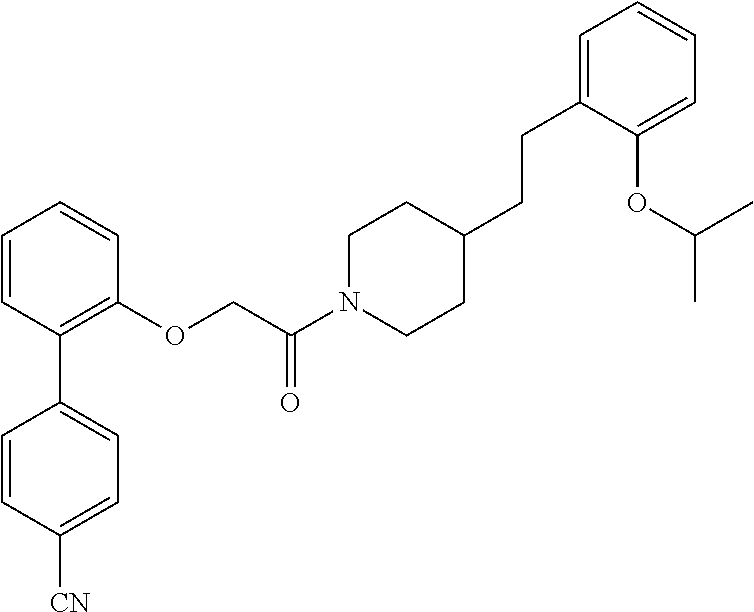


Priority Applications (3)
| Application Number | Priority Date | Filing Date | Title |
|---|---|---|---|
| US15/921,890 US10450303B2 (en) | 2017-03-15 | 2018-03-15 | Biaryl piperidine amide compounds and methods of use thereof |
| US16/567,300 US10899747B2 (en) | 2017-03-15 | 2019-09-11 | Biaryl piperidine amide compounds and methods of use thereof |
| US17/114,699 US20210347763A1 (en) | 2017-03-15 | 2020-12-08 | Biaryl piperidine amide compounds and methods of use thereof |
Applications Claiming Priority (2)
| Application Number | Priority Date | Filing Date | Title |
|---|---|---|---|
| US201762471496P | 2017-03-15 | 2017-03-15 | |
| US15/921,890 US10450303B2 (en) | 2017-03-15 | 2018-03-15 | Biaryl piperidine amide compounds and methods of use thereof |
Related Child Applications (1)
| Application Number | Title | Priority Date | Filing Date |
|---|---|---|---|
| US16/567,300 Division US10899747B2 (en) | 2017-03-15 | 2019-09-11 | Biaryl piperidine amide compounds and methods of use thereof |
Publications (2)
| Publication Number | Publication Date |
|---|---|
| US20180265499A1 US20180265499A1 (en) | 2018-09-20 |
| US10450303B2 true US10450303B2 (en) | 2019-10-22 |
Family
ID=63521131
Family Applications (3)
| Application Number | Title | Priority Date | Filing Date |
|---|---|---|---|
| US15/921,890 Active US10450303B2 (en) | 2017-03-15 | 2018-03-15 | Biaryl piperidine amide compounds and methods of use thereof |
| US16/567,300 Expired - Fee Related US10899747B2 (en) | 2017-03-15 | 2019-09-11 | Biaryl piperidine amide compounds and methods of use thereof |
| US17/114,699 Abandoned US20210347763A1 (en) | 2017-03-15 | 2020-12-08 | Biaryl piperidine amide compounds and methods of use thereof |
Family Applications After (2)
| Application Number | Title | Priority Date | Filing Date |
|---|---|---|---|
| US16/567,300 Expired - Fee Related US10899747B2 (en) | 2017-03-15 | 2019-09-11 | Biaryl piperidine amide compounds and methods of use thereof |
| US17/114,699 Abandoned US20210347763A1 (en) | 2017-03-15 | 2020-12-08 | Biaryl piperidine amide compounds and methods of use thereof |
Country Status (3)
| Country | Link |
|---|---|
| US (3) | US10450303B2 (en) |
| TW (1) | TW201902875A (en) |
| WO (1) | WO2018170225A1 (en) |
Cited By (2)
| Publication number | Priority date | Publication date | Assignee | Title |
|---|---|---|---|---|
| US10899747B2 (en) | 2017-03-15 | 2021-01-26 | Athenex, Inc. | Biaryl piperidine amide compounds and methods of use thereof |
| US11345681B1 (en) | 2020-06-05 | 2022-05-31 | Kinnate Biopharma Inc. | Inhibitors of fibroblast growth factor receptor kinases |
Families Citing this family (4)
| Publication number | Priority date | Publication date | Assignee | Title |
|---|---|---|---|---|
| FI3700902T3 (en) | 2017-10-27 | 2023-05-25 | Boehringer Ingelheim Int | Inhibitors of trpc6 |
| EP4196118A1 (en) | 2020-08-13 | 2023-06-21 | Boehringer Ingelheim International GmbH | Treatment of cognitive impairement associated with schizophrenia |
| CN117567449A (en) | 2020-10-13 | 2024-02-20 | 勃林格殷格翰国际有限公司 | Reprocessing method |
| WO2025240960A1 (en) * | 2024-05-17 | 2025-11-20 | Cz Biohub Sf, Llc | NOVEL SMALL MOLECULE NEGATIVE ALLOSTERIC MODULATORS OF THE μ-OPIOID RECEPTOR |
Citations (5)
| Publication number | Priority date | Publication date | Assignee | Title |
|---|---|---|---|---|
| US5112859A (en) | 1990-09-14 | 1992-05-12 | American Home Products Corporation | Biphenyl amide cholesterol ester hydrolase inhibitors |
| WO2001064676A2 (en) | 2000-02-28 | 2001-09-07 | Scios, Inc. | INHIBITORS OF p38-α KINASE |
| US20020034728A1 (en) | 2000-04-03 | 2002-03-21 | Emmanuel Normant | Methods and compositions for screening icrac modulators |
| WO2008134547A1 (en) | 2007-04-25 | 2008-11-06 | Xenon Pharmaceuticals Inc. | Methods of using hydroxycyclohexane and hydroxypiperidine compounds in treating sodium channel-mediated diseases or conditions |
| WO2009078932A1 (en) | 2007-12-14 | 2009-06-25 | Merck & Co., Inc. | 3,4-substituted pyrrolidine beta-secretase inhibitors for the treatment of alzheimer's disease |
Family Cites Families (1)
| Publication number | Priority date | Publication date | Assignee | Title |
|---|---|---|---|---|
| TW201902875A (en) * | 2017-03-15 | 2019-01-16 | 美商亞瑟尼克斯公司 | Biarylpiperidinamide compound and method of use thereof |
-
2018
- 2018-03-15 TW TW107108838A patent/TW201902875A/en unknown
- 2018-03-15 WO PCT/US2018/022576 patent/WO2018170225A1/en not_active Ceased
- 2018-03-15 US US15/921,890 patent/US10450303B2/en active Active
-
2019
- 2019-09-11 US US16/567,300 patent/US10899747B2/en not_active Expired - Fee Related
-
2020
- 2020-12-08 US US17/114,699 patent/US20210347763A1/en not_active Abandoned
Patent Citations (5)
| Publication number | Priority date | Publication date | Assignee | Title |
|---|---|---|---|---|
| US5112859A (en) | 1990-09-14 | 1992-05-12 | American Home Products Corporation | Biphenyl amide cholesterol ester hydrolase inhibitors |
| WO2001064676A2 (en) | 2000-02-28 | 2001-09-07 | Scios, Inc. | INHIBITORS OF p38-α KINASE |
| US20020034728A1 (en) | 2000-04-03 | 2002-03-21 | Emmanuel Normant | Methods and compositions for screening icrac modulators |
| WO2008134547A1 (en) | 2007-04-25 | 2008-11-06 | Xenon Pharmaceuticals Inc. | Methods of using hydroxycyclohexane and hydroxypiperidine compounds in treating sodium channel-mediated diseases or conditions |
| WO2009078932A1 (en) | 2007-12-14 | 2009-06-25 | Merck & Co., Inc. | 3,4-substituted pyrrolidine beta-secretase inhibitors for the treatment of alzheimer's disease |
Non-Patent Citations (7)
| Title |
|---|
| Banker et al. 1997. * |
| Funaba et al. "Degranulation in RBL-2H3 cells: regulation by calmodulin pathway", Cell Biology International, vol. 27, p. 879-885, 2003. |
| Liou J. et al. "STIM Is a Ca2+ Sensor Essential for Ca2+-Store-Depletion Triggered Ca2+ Influx", Current Biology, vol. 15, p. 1235-1241, 2005. |
| Partiseti et al. "The Calcium Current Activated by T Cell Receptor and Store Depletion in Human Lymphocytes Is Absent in a Primary Immunodeficiency", The Journal of Biological Chemistry, vol. 269, No. 51, p. 32327-32335, 1994. |
| Trevillyan et al. "Potent Inhibition of NFAT Activation and T Cell Cytokine Production by Novel Low Molecular Weight Pyrazole Compounds", The Journal of Biological Chemistry, vol. 276, No. 51, p. 48118-48126, 2001. |
| Vippagunta et al. 2001. * |
| Westaway, S. M. et al., "The discovery of biaryl carboxamides as novel small molecule agonists of the motilin receptor", Bioorganic & Medicinal Chemistry Letters, 2008, vol. 18, No. 24, p. 6429-6436. |
Cited By (3)
| Publication number | Priority date | Publication date | Assignee | Title |
|---|---|---|---|---|
| US10899747B2 (en) | 2017-03-15 | 2021-01-26 | Athenex, Inc. | Biaryl piperidine amide compounds and methods of use thereof |
| US11345681B1 (en) | 2020-06-05 | 2022-05-31 | Kinnate Biopharma Inc. | Inhibitors of fibroblast growth factor receptor kinases |
| US12331039B2 (en) | 2020-06-05 | 2025-06-17 | Khora Spv 1, Llc | Inhibitors of fibroblast growth factor receptor kinases |
Also Published As
| Publication number | Publication date |
|---|---|
| US10899747B2 (en) | 2021-01-26 |
| TW201902875A (en) | 2019-01-16 |
| US20180265499A1 (en) | 2018-09-20 |
| US20210347763A1 (en) | 2021-11-11 |
| WO2018170225A1 (en) | 2018-09-20 |
| US20200071305A1 (en) | 2020-03-05 |
Similar Documents
| Publication | Publication Date | Title |
|---|---|---|
| US10899747B2 (en) | Biaryl piperidine amide compounds and methods of use thereof | |
| CA2874938C (en) | Heterocycles capable of modulating t-cell responses, and methods of using same | |
| US9765063B2 (en) | Amido compounds as RORγt modulators and uses thereof | |
| KR102064807B1 (en) | Piperidino-pyrimidine derivatives for the treatment of viral infections | |
| KR101328273B1 (en) | Compositions and methods of treating cell proliferation disorders | |
| JP2021514385A (en) | Non-condensed thiophene derivatives and their use | |
| TW200406387A (en) | Compounds, methods and compositions | |
| US11008301B2 (en) | Piperidinone formyl peptide 2 receptor agonists | |
| CA2888480A1 (en) | Heteroaryl linked quinolinyl modulators of ror.gamma.t | |
| US20180237399A1 (en) | Compounds having agonistic effect against gpr84, preparation method for compounds and use of compounds | |
| JP4564713B2 (en) | Nitrogen heterocyclic compounds, and methods for making nitrogen heterocyclic compounds and intermediates thereof | |
| WO2023016249A1 (en) | Method for preparing 3-aryloxy-3-five-membered heteroaryl-propylamine compound | |
| EP3542796B1 (en) | Compound having anti-cancer effect, and preparation method therefor and use thereof | |
| US7772230B2 (en) | Chroman compound, processes for its preparation, and its pharmaceutical use | |
| US20250179023A1 (en) | Holosymmetric biphenyl derivative, and preparation method therefor and use thereof | |
| CA2926313A1 (en) | Secondary alcohol quinolinyl modulators of roryt | |
| US20120028990A1 (en) | 3 aryl or heteroaryl-substituted indole derivative | |
| CN100537563C (en) | The preparation method of N-phenyl-2-pyrimidinamine derivative | |
| CN112679409A (en) | 4-indole-substituted thiosemicarbazide derivative and preparation method and application thereof | |
| KR20120088398A (en) | Novel five-membered heteroaromatic ring compounds having activity for T-type calcium channel | |
| EP2867213A1 (en) | Dihydropyrimidin-2(1h)-ones and dihydropyrimidin-2(1h)-thiones as inhibitors of sodium iodide symporter | |
| CN114890963B (en) | Benzylidene thiazolidinedione derivative, and preparation method and application thereof | |
| CN107304180B (en) | Benzamide derivatives, their preparation method and their use in medicine | |
| CN116891447A (en) | TRPV1 antagonist, preparation method and application thereof in preparation of pain treatment drugs | |
| HK40079172A (en) | Immunosuppressant, and preparation method therefor and use thereof |
Legal Events
| Date | Code | Title | Description |
|---|---|---|---|
| FEPP | Fee payment procedure |
Free format text: ENTITY STATUS SET TO UNDISCOUNTED (ORIGINAL EVENT CODE: BIG.); ENTITY STATUS OF PATENT OWNER: SMALL ENTITY Free format text: ENTITY STATUS SET TO UNDISCOUNTED (ORIGINAL EVENT CODE: BIG.); ENTITY STATUS OF PATENT OWNER: LARGE ENTITY |
|
| FEPP | Fee payment procedure |
Free format text: ENTITY STATUS SET TO SMALL (ORIGINAL EVENT CODE: SMAL); ENTITY STATUS OF PATENT OWNER: SMALL ENTITY Free format text: ENTITY STATUS SET TO SMALL (ORIGINAL EVENT CODE: SMAL); ENTITY STATUS OF PATENT OWNER: LARGE ENTITY |
|
| AS | Assignment |
Owner name: ATHENEX, INC., NEW YORK Free format text: ASSIGNMENT OF ASSIGNORS INTEREST;ASSIGNORS:SMOLINSKI, MICHAEL P.;URGAONKAR, SAMEER;CLEMENTS, JAMES LINDSAY;AND OTHERS;SIGNING DATES FROM 20180404 TO 20180412;REEL/FRAME:045559/0808 |
|
| AS | Assignment |
Owner name: PERCEPTIVE CREDIT HOLDINGS II, LP, NEW YORK Free format text: PATENT SECURITY AGREEMENT;ASSIGNOR:ATHENEX, INC.;REEL/FRAME:047247/0812 Effective date: 20180703 |
|
| STPP | Information on status: patent application and granting procedure in general |
Free format text: NON FINAL ACTION MAILED |
|
| STPP | Information on status: patent application and granting procedure in general |
Free format text: NOTICE OF ALLOWANCE MAILED -- APPLICATION RECEIVED IN OFFICE OF PUBLICATIONS |
|
| FEPP | Fee payment procedure |
Free format text: ENTITY STATUS SET TO UNDISCOUNTED (ORIGINAL EVENT CODE: BIG.); ENTITY STATUS OF PATENT OWNER: SMALL ENTITY Free format text: ENTITY STATUS SET TO UNDISCOUNTED (ORIGINAL EVENT CODE: BIG.); ENTITY STATUS OF PATENT OWNER: LARGE ENTITY |
|
| STPP | Information on status: patent application and granting procedure in general |
Free format text: PUBLICATIONS -- ISSUE FEE PAYMENT RECEIVED |
|
| STCF | Information on status: patent grant |
Free format text: PATENTED CASE |
|
| CC | Certificate of correction | ||
| AS | Assignment |
Owner name: ATHENEX, INC., NEW YORK Free format text: RELEASE BY SECURED PARTY;ASSIGNOR:PERCEPTIVE CREDIT HOLDINGS II, LP;REEL/FRAME:052990/0677 Effective date: 20200619 |
|
| AS | Assignment |
Owner name: OAKTREE FUND ADMINISTRATION, LLC, CALIFORNIA Free format text: SECURITY INTEREST;ASSIGNOR:ATHENEX, INC.;REEL/FRAME:053005/0657 Effective date: 20200619 |
|
| FEPP | Fee payment procedure |
Free format text: ENTITY STATUS SET TO SMALL (ORIGINAL EVENT CODE: SMAL); ENTITY STATUS OF PATENT OWNER: SMALL ENTITY |
|
| MAFP | Maintenance fee payment |
Free format text: PAYMENT OF MAINTENANCE FEE, 4TH YR, SMALL ENTITY (ORIGINAL EVENT CODE: M2551); ENTITY STATUS OF PATENT OWNER: SMALL ENTITY Year of fee payment: 4 |