US10447137B2 - Energy storage, hydrogen and oxygen production using ion separators - Google Patents

Energy storage, hydrogen and oxygen production using ion separators Download PDF

Info

Publication number
US10447137B2
US10447137B2 US16/041,812 US201816041812A US10447137B2 US 10447137 B2 US10447137 B2 US 10447137B2 US 201816041812 A US201816041812 A US 201816041812A US 10447137 B2 US10447137 B2 US 10447137B2
Authority
US
United States
Prior art keywords
rotor core
pair
disposed
tank
core laminations
Prior art date
Legal status (The legal status is an assumption and is not a legal conclusion. Google has not performed a legal analysis and makes no representation as to the accuracy of the status listed.)
Active
Application number
US16/041,812
Other versions
US20190028012A1 (en
Inventor
Kodzo Obed Abledu
Current Assignee (The listed assignees may be inaccurate. Google has not performed a legal analysis and makes no representation or warranty as to the accuracy of the list.)
Individual
Original Assignee
Individual
Priority date (The priority date is an assumption and is not a legal conclusion. Google has not performed a legal analysis and makes no representation as to the accuracy of the date listed.)
Filing date
Publication date
Application filed by Individual filed Critical Individual
Priority to US16/041,812 priority Critical patent/US10447137B2/en
Priority to PCT/US2018/043209 priority patent/WO2019023085A2/en
Publication of US20190028012A1 publication Critical patent/US20190028012A1/en
Application granted granted Critical
Publication of US10447137B2 publication Critical patent/US10447137B2/en
Active legal-status Critical Current
Anticipated expiration legal-status Critical

Links

Images

Classifications

    • HELECTRICITY
    • H02GENERATION; CONVERSION OR DISTRIBUTION OF ELECTRIC POWER
    • H02KDYNAMO-ELECTRIC MACHINES
    • H02K44/00Machines in which the dynamo-electric interaction between a plasma or flow of conductive liquid or of fluid-borne conductive or magnetic particles and a coil system or magnetic field converts energy of mass flow into electrical energy or vice versa
    • H02K44/08Magnetohydrodynamic [MHD] generators
    • H02K44/16Constructional details of the magnetic circuits
    • BPERFORMING OPERATIONS; TRANSPORTING
    • B01PHYSICAL OR CHEMICAL PROCESSES OR APPARATUS IN GENERAL
    • B01DSEPARATION
    • B01D61/00Processes of separation using semi-permeable membranes, e.g. dialysis, osmosis or ultrafiltration; Apparatus, accessories or auxiliary operations specially adapted therefor
    • B01D61/02Reverse osmosis; Hyperfiltration ; Nanofiltration
    • B01D61/08Apparatus therefor
    • BPERFORMING OPERATIONS; TRANSPORTING
    • B01PHYSICAL OR CHEMICAL PROCESSES OR APPARATUS IN GENERAL
    • B01DSEPARATION
    • B01D61/00Processes of separation using semi-permeable membranes, e.g. dialysis, osmosis or ultrafiltration; Apparatus, accessories or auxiliary operations specially adapted therefor
    • B01D61/02Reverse osmosis; Hyperfiltration ; Nanofiltration
    • B01D61/10Accessories; Auxiliary operations
    • BPERFORMING OPERATIONS; TRANSPORTING
    • B01PHYSICAL OR CHEMICAL PROCESSES OR APPARATUS IN GENERAL
    • B01DSEPARATION
    • B01D61/00Processes of separation using semi-permeable membranes, e.g. dialysis, osmosis or ultrafiltration; Apparatus, accessories or auxiliary operations specially adapted therefor
    • B01D61/02Reverse osmosis; Hyperfiltration ; Nanofiltration
    • B01D61/12Controlling or regulating
    • BPERFORMING OPERATIONS; TRANSPORTING
    • B03SEPARATION OF SOLID MATERIALS USING LIQUIDS OR USING PNEUMATIC TABLES OR JIGS; MAGNETIC OR ELECTROSTATIC SEPARATION OF SOLID MATERIALS FROM SOLID MATERIALS OR FLUIDS; SEPARATION BY HIGH-VOLTAGE ELECTRIC FIELDS
    • B03CMAGNETIC OR ELECTROSTATIC SEPARATION OF SOLID MATERIALS FROM SOLID MATERIALS OR FLUIDS; SEPARATION BY HIGH-VOLTAGE ELECTRIC FIELDS
    • B03C1/00Magnetic separation
    • B03C1/02Magnetic separation acting directly on the substance being separated
    • B03C1/025High gradient magnetic separators
    • B03C1/031Component parts; Auxiliary operations
    • B03C1/033Component parts; Auxiliary operations characterised by the magnetic circuit
    • B03C1/0332Component parts; Auxiliary operations characterised by the magnetic circuit using permanent magnets
    • BPERFORMING OPERATIONS; TRANSPORTING
    • B03SEPARATION OF SOLID MATERIALS USING LIQUIDS OR USING PNEUMATIC TABLES OR JIGS; MAGNETIC OR ELECTROSTATIC SEPARATION OF SOLID MATERIALS FROM SOLID MATERIALS OR FLUIDS; SEPARATION BY HIGH-VOLTAGE ELECTRIC FIELDS
    • B03CMAGNETIC OR ELECTROSTATIC SEPARATION OF SOLID MATERIALS FROM SOLID MATERIALS OR FLUIDS; SEPARATION BY HIGH-VOLTAGE ELECTRIC FIELDS
    • B03C1/00Magnetic separation
    • B03C1/02Magnetic separation acting directly on the substance being separated
    • B03C1/025High gradient magnetic separators
    • B03C1/031Component parts; Auxiliary operations
    • B03C1/033Component parts; Auxiliary operations characterised by the magnetic circuit
    • B03C1/034Component parts; Auxiliary operations characterised by the magnetic circuit characterised by the matrix elements
    • CCHEMISTRY; METALLURGY
    • C02TREATMENT OF WATER, WASTE WATER, SEWAGE, OR SLUDGE
    • C02FTREATMENT OF WATER, WASTE WATER, SEWAGE, OR SLUDGE
    • C02F1/00Treatment of water, waste water, or sewage
    • C02F1/44Treatment of water, waste water, or sewage by dialysis, osmosis or reverse osmosis
    • CCHEMISTRY; METALLURGY
    • C25ELECTROLYTIC OR ELECTROPHORETIC PROCESSES; APPARATUS THEREFOR
    • C25BELECTROLYTIC OR ELECTROPHORETIC PROCESSES FOR THE PRODUCTION OF COMPOUNDS OR NON-METALS; APPARATUS THEREFOR
    • C25B1/00Electrolytic production of inorganic compounds or non-metals
    • C25B1/01Products
    • C25B1/02Hydrogen or oxygen
    • HELECTRICITY
    • H02GENERATION; CONVERSION OR DISTRIBUTION OF ELECTRIC POWER
    • H02KDYNAMO-ELECTRIC MACHINES
    • H02K1/00Details of the magnetic circuit
    • H02K1/06Details of the magnetic circuit characterised by the shape, form or construction
    • H02K1/12Stationary parts of the magnetic circuit
    • H02K1/16Stator cores with slots for windings
    • H02K1/165Shape, form or location of the slots
    • HELECTRICITY
    • H02GENERATION; CONVERSION OR DISTRIBUTION OF ELECTRIC POWER
    • H02KDYNAMO-ELECTRIC MACHINES
    • H02K1/00Details of the magnetic circuit
    • H02K1/06Details of the magnetic circuit characterised by the shape, form or construction
    • H02K1/12Stationary parts of the magnetic circuit
    • H02K1/17Stator cores with permanent magnets
    • HELECTRICITY
    • H02GENERATION; CONVERSION OR DISTRIBUTION OF ELECTRIC POWER
    • H02KDYNAMO-ELECTRIC MACHINES
    • H02K1/00Details of the magnetic circuit
    • H02K1/06Details of the magnetic circuit characterised by the shape, form or construction
    • H02K1/12Stationary parts of the magnetic circuit
    • H02K1/18Means for mounting or fastening magnetic stationary parts on to, or to, the stator structures
    • H02K1/185Means for mounting or fastening magnetic stationary parts on to, or to, the stator structures to outer stators
    • HELECTRICITY
    • H02GENERATION; CONVERSION OR DISTRIBUTION OF ELECTRIC POWER
    • H02KDYNAMO-ELECTRIC MACHINES
    • H02K1/00Details of the magnetic circuit
    • H02K1/06Details of the magnetic circuit characterised by the shape, form or construction
    • H02K1/22Rotating parts of the magnetic circuit
    • HELECTRICITY
    • H02GENERATION; CONVERSION OR DISTRIBUTION OF ELECTRIC POWER
    • H02KDYNAMO-ELECTRIC MACHINES
    • H02K1/00Details of the magnetic circuit
    • H02K1/06Details of the magnetic circuit characterised by the shape, form or construction
    • H02K1/22Rotating parts of the magnetic circuit
    • H02K1/223Rotor cores with windings and permanent magnets
    • HELECTRICITY
    • H02GENERATION; CONVERSION OR DISTRIBUTION OF ELECTRIC POWER
    • H02KDYNAMO-ELECTRIC MACHINES
    • H02K1/00Details of the magnetic circuit
    • H02K1/06Details of the magnetic circuit characterised by the shape, form or construction
    • H02K1/22Rotating parts of the magnetic circuit
    • H02K1/26Rotor cores with slots for windings
    • H02K1/265Shape, form or location of the slots
    • HELECTRICITY
    • H02GENERATION; CONVERSION OR DISTRIBUTION OF ELECTRIC POWER
    • H02KDYNAMO-ELECTRIC MACHINES
    • H02K1/00Details of the magnetic circuit
    • H02K1/06Details of the magnetic circuit characterised by the shape, form or construction
    • H02K1/22Rotating parts of the magnetic circuit
    • H02K1/27Rotor cores with permanent magnets
    • H02K1/2706Inner rotors
    • H02K1/272Inner rotors the magnetisation axis of the magnets being perpendicular to the rotor axis
    • H02K1/274Inner rotors the magnetisation axis of the magnets being perpendicular to the rotor axis the rotor consisting of two or more circumferentially positioned magnets
    • H02K1/2753Inner rotors the magnetisation axis of the magnets being perpendicular to the rotor axis the rotor consisting of two or more circumferentially positioned magnets the rotor consisting of magnets or groups of magnets arranged with alternating polarity
    • H02K1/278Surface mounted magnets; Inset magnets
    • HELECTRICITY
    • H02GENERATION; CONVERSION OR DISTRIBUTION OF ELECTRIC POWER
    • H02KDYNAMO-ELECTRIC MACHINES
    • H02K44/00Machines in which the dynamo-electric interaction between a plasma or flow of conductive liquid or of fluid-borne conductive or magnetic particles and a coil system or magnetic field converts energy of mass flow into electrical energy or vice versa
    • H02K44/08Magnetohydrodynamic [MHD] generators
    • H02K44/12Constructional details of fluid channels
    • HELECTRICITY
    • H02GENERATION; CONVERSION OR DISTRIBUTION OF ELECTRIC POWER
    • H02KDYNAMO-ELECTRIC MACHINES
    • H02K5/00Casings; Enclosures; Supports
    • H02K5/04Casings or enclosures characterised by the shape, form or construction thereof
    • H02K5/12Casings or enclosures characterised by the shape, form or construction thereof specially adapted for operating in liquid or gas
    • H02K5/124Sealing of shafts
    • HELECTRICITY
    • H02GENERATION; CONVERSION OR DISTRIBUTION OF ELECTRIC POWER
    • H02KDYNAMO-ELECTRIC MACHINES
    • H02K7/00Arrangements for handling mechanical energy structurally associated with dynamo-electric machines, e.g. structural association with mechanical driving motors or auxiliary dynamo-electric machines
    • H02K7/18Structural association of electric generators with mechanical driving motors, e.g. with turbines
    • BPERFORMING OPERATIONS; TRANSPORTING
    • B03SEPARATION OF SOLID MATERIALS USING LIQUIDS OR USING PNEUMATIC TABLES OR JIGS; MAGNETIC OR ELECTROSTATIC SEPARATION OF SOLID MATERIALS FROM SOLID MATERIALS OR FLUIDS; SEPARATION BY HIGH-VOLTAGE ELECTRIC FIELDS
    • B03CMAGNETIC OR ELECTROSTATIC SEPARATION OF SOLID MATERIALS FROM SOLID MATERIALS OR FLUIDS; SEPARATION BY HIGH-VOLTAGE ELECTRIC FIELDS
    • B03C2201/00Details of magnetic or electrostatic separation
    • B03C2201/22Details of magnetic or electrostatic separation characterised by the magnetic field, e.g. its shape or generation
    • HELECTRICITY
    • H01ELECTRIC ELEMENTS
    • H01MPROCESSES OR MEANS, e.g. BATTERIES, FOR THE DIRECT CONVERSION OF CHEMICAL ENERGY INTO ELECTRICAL ENERGY
    • H01M2300/00Electrolytes
    • H01M2300/0002Aqueous electrolytes
    • HELECTRICITY
    • H01ELECTRIC ELEMENTS
    • H01MPROCESSES OR MEANS, e.g. BATTERIES, FOR THE DIRECT CONVERSION OF CHEMICAL ENERGY INTO ELECTRICAL ENERGY
    • H01M8/00Fuel cells; Manufacture thereof
    • H01M8/06Combination of fuel cells with means for production of reactants or for treatment of residues
    • H01M8/0606Combination of fuel cells with means for production of reactants or for treatment of residues with means for production of gaseous reactants
    • H01M8/0656Combination of fuel cells with means for production of reactants or for treatment of residues with means for production of gaseous reactants by electrochemical means
    • HELECTRICITY
    • H02GENERATION; CONVERSION OR DISTRIBUTION OF ELECTRIC POWER
    • H02KDYNAMO-ELECTRIC MACHINES
    • H02K2201/00Specific aspects not provided for in the other groups of this subclass relating to the magnetic circuits
    • H02K2201/03Machines characterised by aspects of the air-gap between rotor and stator
    • YGENERAL TAGGING OF NEW TECHNOLOGICAL DEVELOPMENTS; GENERAL TAGGING OF CROSS-SECTIONAL TECHNOLOGIES SPANNING OVER SEVERAL SECTIONS OF THE IPC; TECHNICAL SUBJECTS COVERED BY FORMER USPC CROSS-REFERENCE ART COLLECTIONS [XRACs] AND DIGESTS
    • Y02TECHNOLOGIES OR APPLICATIONS FOR MITIGATION OR ADAPTATION AGAINST CLIMATE CHANGE
    • Y02EREDUCTION OF GREENHOUSE GAS [GHG] EMISSIONS, RELATED TO ENERGY GENERATION, TRANSMISSION OR DISTRIBUTION
    • Y02E60/00Enabling technologies; Technologies with a potential or indirect contribution to GHG emissions mitigation
    • Y02E60/30Hydrogen technology
    • Y02E60/50Fuel cells
    • YGENERAL TAGGING OF NEW TECHNOLOGICAL DEVELOPMENTS; GENERAL TAGGING OF CROSS-SECTIONAL TECHNOLOGIES SPANNING OVER SEVERAL SECTIONS OF THE IPC; TECHNICAL SUBJECTS COVERED BY FORMER USPC CROSS-REFERENCE ART COLLECTIONS [XRACs] AND DIGESTS
    • Y02TECHNOLOGIES OR APPLICATIONS FOR MITIGATION OR ADAPTATION AGAINST CLIMATE CHANGE
    • Y02PCLIMATE CHANGE MITIGATION TECHNOLOGIES IN THE PRODUCTION OR PROCESSING OF GOODS
    • Y02P20/00Technologies relating to chemical industry
    • Y02P20/10Process efficiency
    • Y02P20/133Renewable energy sources, e.g. sunlight

Definitions

  • the present invention relates to an energy storage, hydrogen and oxygen production using ion separators.
  • the present invention contrives to solve the disadvantages of the prior art.
  • An aspect of the invention provides an ion separating device comprising a stator cylinder, a pair of end caps, a rotor core, a pair of homopolar north poles, and a pair of homopolar south poles.
  • the pair of end caps are provided on both end portions of the stator cylinder for enclosing the stator.
  • the drive shaft is disposed in the stator cylinder, extending from a right end portion of the stator cylinder to a left end portion of the stator cylinder, and configured to rotate with respect to the stator cylinder.
  • the rotor core is disposed around the drive shaft and comprising right rotor laminations disposed on a right side portion of the rotor core, left rotor laminations disposed on a left side portion of the rotor core, middle rotor laminations disposed between the right and left rotor core laminations, inner right comparting rotor laminations disposed between the right rotor core laminations and the middle rotor core laminations, inner left comparting rotor laminations disposed between the left rotor core laminations and the middle rotor core laminations, outer right comparting rotor laminations disposed at a right end portion of the right rotor core laminations, and outer left comparting rotor laminations disposed at a left end portion of the left rotor core laminations, so that the cavity between the rotor core and stator cylinder and enclosed by the pair of end caps is divided into a right outer compartment, a right inner compartment, a left outer compartment, a left inner
  • the pair of homopolar north poles are disposed close to a right end portion of the rotor core with a pair of air gaps over right rotor core laminations installed around the rotor core, and the pair of homopolar north poles are disposed so as to face each other on an upper side and a lower side of the rotor core through the stator cylinder.
  • the pair of homopolar south poles are disposed close to a left end portion of the rotor core with a pair of air gaps over left rotor core laminations installed around the rotor core, and the pair of homopolar south poles are disposed so as to face each other on an upper side and a lower side of the rotor core through the stator cylinder.
  • the ion separating device may further comprise a pair of rotor shaft seals installed between the drive shaft and the pair of end caps for preventing leakage along the drive shaft and an outermost surface of each of the pair of rotor shaft seals forms a seal with an inner surface of a bore provided in a corresponding one of the pair of end caps.
  • Each of the inner right and left rotor core laminations may comprise a circular sheet metal with cut-out portions provided along outer edges of the circular sheet metal, and wherein the circular sheet metal has a diameter that is slightly smaller than an inner diameter of the stator cylinder, and the middle rotor laminations have a diameter smaller than the diameter of the right and left rotor laminations, so as to form a recessed channel between the inner left and inner right comparting rotor cores.
  • Each of the inner and outer right and left comparting rotor laminations may comprise one or more first circular sheet metals having a diameter same as the diameter of the right and left rotor laminations and one or more second circular sheet metals having a diameter slightly smaller than the diameter of the right and left rotor laminations, and wherein each of the circular sheet metals of the inner and outer right and left comparting rotor laminations comprises a plurality of through-slots and the circular sheet metals are assembled so that the through-slots are aligned with one another.
  • the pair of homopolar north poles and the pair of homopolar south poles may comprise a pair of magnetic circuits, each of which comprising core members and field winding.
  • the pair of homopolar north poles and the pair of homopolar south poles may comprise a plurality of permanent magnets.
  • the ion separating device may further comprise two input ports that are disposed, and one of the two input ports is connected to the inner right compartment and another of the two input ports is connected to the inner left compartment.
  • the ion separating device may further comprise three output ports, which being disposed and connected to the outer right and outer left compartments and the middle compartment.
  • the ion separating device may further comprise a feeder pump, a first storage tank, and a second storage tank.
  • the feeder pump is installed between the two input ports and a pipe work for delivering electrolyte from a tank to the two input ports.
  • the first storage tank is connected to two of the three output ports and configured to receive and store an ionized fluid of a first polarity from the two output ports.
  • the second storage tank is connected to a remaining output port and configured to receive and store an ionized fluid of a second polarity from the remaining output port.
  • the ionized fluids of the first and second polarities in the first and second storage tanks are configured to be used as reagents in order to enhance a predetermined external chemical reaction.
  • the ion separating device may further comprise a first discharge pump and a second discharge pump.
  • the first discharge pump is configured to pump the ionized fluid of the first polarity to an energy recovery device.
  • the second discharge pump is configured to pump the ionized fluid of the second polarity to the energy recovery device.
  • the energy recovery device may comprise a first tank, a second tank, a first stainless-steel rod, and a second stainless-steel rod.
  • the first tank has electrodes and is configured to receive the ionized fluid of the first polarity pumped by the first discharge pump from the first storage tank.
  • the second tank has electrodes and is configured to receive the ionized fluid of the second polarity pumped by the second discharge pump from the second storage tank.
  • the first stainless-steel rod is disposed so as to stick out from the first tank.
  • the second stainless-steel rod is disposed so as to stick out from the second tank.
  • An energy is configured to be obtained by connecting the first stainless-steel rod with the second stainless-steel rod and releasing electrons.
  • the ion separating device may further comprise a first pump and a second pump.
  • the first pump is connected to the first tank, and the second pump is connected to the second tank.
  • the first and second pumps are configured to pump the electrolytes to the tank through pipes connecting from each of the first and second pumps to the tank.
  • the ion separating device according to the invention separates electrolyte into ionized fluids of opposite polarities easily; and (2) the ion separating device according to the invention provide a way for storing and retrieving energy conveniently.
  • FIG. 1 is a perspective view of a rotor and magnetic circuit of an ion separator according to an embodiment of the invention
  • FIG. 2 is an exploded perspective view of a rotor, magnetic circuit, stator parts of an ion separator view from an output side according to an embodiment of the invention
  • FIG. 3 is an exploded perspective view of a rotor, magnetic circuit, stator parts of an ion separator view from an input side according to an embodiment of the invention
  • FIG. 4 is a perspective view of a rotor, magnetic circuits, closed stator parts of an ion separator view from an output side according to an embodiment of the invention
  • FIG. 5 is a perspective view of a rotor, magnetic circuits, closed stator parts of an ion separator view from an output side as an alternate construction of an ion separator using permanent magnets according to another embodiment of the invention
  • FIG. 6 is a perspective view of a fully-assembled ion separator viewed from an output side according to an embodiment of the invention
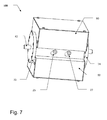
  • FIG. 7 is a perspective view of a fully-assembled ion separator viewed from an input side according to an embodiment of the invention.
  • FIG. 8 is a perspective view of an ion-separation energy storage system according to an embodiment of the invention.
  • FIG. 9 is another perspective view of the ion-separation energy storage system of FIG. 8 ;
  • FIG. 10 is a perspective view of an energy storage and recovery system for hydrogen and oxygen production according to an embodiment of the invention.
  • FIG. 11 is another perspective view of an energy storage and recovery system for hydrogen and oxygen production according to an embodiment of the invention.
  • FIG. 12 is an expanded front and cut-out view of a recovery tank having electrodes according to an embodiment of the invention.
  • the internal structure and magnetic circuits of the electromagnetic ion separator are shown in FIG. 1 .
  • the ion separator has two magnetic circuits.
  • the first consists of core members labeled 33 , 31 , 36 , the rotor armature, and two air gaps.
  • This magnetic circuit is excited by field winding 32 and it makes core member 36 the north pole at the first air gap and core member 33 the south pole at the second air gap.
  • the second magnetic circuit consists of core members 35 , 37 , 38 , the rotor armature, and two air gaps. When energized by field winding 34 , this magnetic circuit makes core member 38 the north pole at its air gap and core member 35 the south pole at the other air gap.
  • the rotor is on a shaft 42 which has two seals 48 and 49 at either end to prevent leakage of the working fluid (electrolyte) that would be used in the device.
  • Two bearings 46 and 47 located towards the shaft ends facilitate the rotation of the rotor.
  • the core is built with four types of laminations.
  • One type (type 1) is notched in the usual manner of dc-machine rotor laminations in which the cuts in the laminations are along the outer edge of the circular sheet metal. In the second and third types, the cuts do not cross the outer edge of the circular sheet metal but are wholly contained in the sheet metal.
  • Type 3 has a slightly smaller diameter than type 2.
  • Type 2 has the same diameter as type 1.
  • Type 4 laminations do not have any outside slots.
  • the channel causes the magnetic fluxes to penetrate deeper into the rotor and pass under the channel to complete their circuits. This results in almost all the fluxes passing through the rotating electrolyte in the slots 62 and 64 and effecting more ion separation.
  • Type-1 laminations are used for the portions of the rotor core under the magnetic poles as shown in FIG. 1 .
  • Type-2 and type 3 laminations are used where seals are needed on the rotor.
  • the cuts in the laminations are aligned to form paths in which liquid can flow along the axial length of the rotor. The path is from slot 68 on the left through slot 64 into the channel 69 , continuing into slots 60 and 62 and unto the other end of the rotor core.
  • the side openings created by slots 64 and 62 and channel 69 are locations at which fluid could enter or leave the rotor. These three side openings in addition to the two rotor ends constitute a total of five points of entry or egress for the electrolyte.
  • seals 52 , 54 , 56 , and 58 on the rotor divide the cavity between the rotor core and stator cylinder into five separate compartments. Each seal sits in a groove.
  • the groove is created by using one or more type 3 laminations (with diameters that are slightly smaller than the core diameter) flanged by one type 2 laminations on either side. The outer diameter of the type 3 lamination marches the internal diameters of the seals.
  • FIG. 2 shows the stator in place over the rotor.
  • the stator consists of a nonmagnetic pipe 20 with five smaller tubes, 22 , 24 , 26 , ( 25 and 27 shown in FIG. 3 ) welded into it.
  • the stator pipe 20 is cylindrical, smooth on the inside, and inert to the working fluid.
  • the seals 52 , 54 , 56 , and 58 are in contact with both the rotor and the inner surface of the stator.
  • the shaft seals 48 and 49 in addition to the bearings 46 and 47 are housed in two end caps 72 and 74 which fit snugly into the stator thus centering the rotor.
  • a rubber gasket 70 is used on each end cap to prevent leakage.
  • the five smaller tubes 22 , 24 , 26 , 25 and 27 are located directly above the five compartments created by the four seals 52 , 54 , 56 , and 58 . These smaller tubes form the ports into these compartments.
  • the tubes 22 , 24 , and 26 are the output ports while tubes 25 and 27 in FIG. 3 are the input ports.
  • the input ports are located near the middle of the poles.
  • FIG. 4 shows the device with the end caps closed.
  • FIG. 5 shows the placement of two permanent magnets 80 and 82 to accomplish this task.
  • the magnets are oriented to make core members 36 , 38 the north poles and 33 , 35 to be south poles at their respective air gaps.
  • FIG. 6 shows the output side and the housings 90 , and 92 used for the ion separator 100 .
  • the housings cover all the internal parts but leave the shaft ends and the ports accessible.
  • FIG. 7 shows the input side of the fully-assembled ion separator 100 .
  • all surfaces in contact with the working fluid are either made of chemically-inert material or covered with a chemically-inert and electrically-insulating material.
  • the configuration described in FIG. 1 is not the only way to build ion separators.
  • Other configurations that use permanent magnets inserted into the stator cylinder are possible ways of realizing the desired magnetic field distribution.
  • Regular dc machine field windings located within their stators could also be reconfigured (in two dc machines) to get the two homopolar magnetic fields needed for the ion separator.
  • the ion-separation energy storage system shown in FIG. 8 and FIG. 9 has a tank 10 with inlet 11 .
  • the tank 10 is filled with electrolyte.
  • Feeder pump 13 delivers the electrolyte through tube 12 and T connector into the two inlet ports of the ion separator 100 .
  • the ion separator would be run by mechanical drive coupled to its shaft).
  • the output from the ion separator goes through three tubes 16 , 17 and 18 into the storage tanks 50 and 51 .
  • the two tubes 16 and 17 carry the same type of ionized fluid (containing negative ions) into tank 50 while the third tube 18 carries fluid with ions of opposite polarity (positive ions) into tank 51 .
  • Two discharge pumps 52 and 53 would be used to pump the negatively-charged and positively-charged electrolytes to energy recovery units.
  • a simplified energy recovery scheme illustrated in FIG. 10 , FIG. 11 , and FIG. 12 involves the pumping of the positively-charged electrolyte into a tank 61 in which electrodes are installed with a stainless-steel rod 63 (that is attached to the electrodes) sticking out of the tank.
  • the negatively-charged electrolyte is pumped into tank 60 which also has a protruding stainless-steel rod 62 connected to the electrodes in tank 60 . Connecting an external circuit between the protruding rods 63 and 62 would result in energy recovery as electrons are released from the negatively-charged electrolyte through the external circuit to the positively-charged electrolyte.
  • FIG. 11 is a frontal view of the energy storage and recovery arrangement in FIG. 10 showing the major components in more details.
  • FIG. 12 is a more detailed partial illustration of the later stages of FIG. 11 .
  • a cut-away section is shown of tank 60 to reveal the electrodes 64 contained in it and the rod 62 connected to the electrodes 64 .
  • the released gasses would self-compress and the compressors 57 and 68 could be eliminated. That would eliminate the energy needed for the compression.
  • An aspect of the invention provides a device capable of separating ions in electrolytes pumped into it comprising a stator cylinder, a pair of end caps, a rotor core, a pair of homopolar north poles, and a pair of homopolar south poles.
  • the pair of end caps are provided on both end portions of the stator cylinder for forming a cavity between the rotor core and the stator cylinder.
  • the drive shaft is disposed in the stator cylinder, extending from a right end portion of the stator cylinder to a left end portion of the stator cylinder, and configured to rotate with respect to the stator cylinder.
  • the rotor core is disposed around the drive shaft and comprising right rotor laminations disposed on a right side portion of the rotor core, left rotor laminations disposed on a left side portion of the rotor core, middle rotor laminations disposed between the right and left rotor core laminations, inner right comparting rotor laminations disposed between the right rotor core laminations and the middle rotor core laminations, inner left comparting rotor laminations disposed between the left rotor core laminations and the middle rotor core laminations, outer right comparting rotor laminations disposed at a right end portion of the right rotor core laminations, and outer left comparting rotor laminations disposed at a left end portion of the left rotor core laminations, so that the cavity between the rotor core and stator cylinder and enclosed by the pair of end caps is divided into a right outer compartment, a right inner compartment, a left outer compartment, a left inner
  • the pair of homopolar north poles are disposed close to a right end portion of the rotor core with a pair of air gaps over right rotor core laminations installed around the rotor core, and the pair of homopolar north poles are disposed so as to face each other on an upper side and a lower side of the rotor core through the stator cylinder.
  • the pair of homopolar south poles are disposed close to a left end portion of the rotor core with a pair of air gaps over left rotor core laminations installed around the rotor core, and the pair of homopolar south poles are disposed so as to face each other on an upper and a lower side of the rotor core through the stator cylinder.
  • the ion separating device may further comprise a pair of rotor shaft seals ( 48 , 49 ) installed between the drive shaft and the pair of end caps for preventing leakage along the drive shaft and an outermost surface of each of the pair of rotor shaft seals ( 48 , 49 ) forms a seal with an inner surface of a bore provided in a corresponding one of the pair of end caps.
  • Each of the inner right and left rotor laminations may comprise a circular sheet metal with cut-out portions provided along outer edges of the circular sheet metal, and wherein the circular sheet metal has a diameter that is slightly smaller than an inner diameter of the stator cylinder, and the middle rotor laminations have a diameter smaller than the diameter of the right and left rotor laminations, so as to form a recessed channel between the inner left and inner right rotor cores.
  • Each of the inner and outer right and left comparting rotor laminations may comprise one or more first circular sheet metals having a diameter same as the diameter of the right and left rotor laminations and one or more second circular sheet metals having a diameter slightly smaller than the diameter of the right and left rotor laminations, and wherein each the circular sheet metals of the inner and outer right and left comparting rotor laminations comprises a plurality of through-slots and the circular sheet metals are assembled so that the through-slots are aligned with one another.
  • the pair of homopolar north poles and the pair of homopolar south poles may comprise a pair of magnetic circuits, each of which comprising core members and field winding.
  • the pair of homopolar north poles and the pair of homopolar south poles may comprise a plurality of permanent magnets.
  • the ion separating device may further comprise two input ports ( 25 , 27 ) are disposed, and one of the two input ports is connected to the inner right compartment and another of the two input ports is connected to the inner left compartment.
  • the ion separating device may further comprise three output ports ( 22 , 24 , 26 ), which being disposed and connected to the outer right and outer left compartments and the middle compartment.
  • the ion separating device may further comprise a feeder pump ( 13 ), a first storage tank ( 50 ), and a second storage tank ( 51 ).
  • the feeder pump ( 13 ) is installed between the two input ports and a pipe work for delivering electrolyte from a tank ( 10 ) to the two input ports.
  • the first storage tank ( 50 ) is connected to two of the three output ports and configured to receive and store an ionized fluid of a first polarity from the two output ports.
  • the second storage tank ( 51 ) is connected to a remaining output port and configured to receive and store an ionized fluid of a second polarity from the remaining output port.
  • the ionized fluids of the first and second polarities in the first and second storage tanks ( 50 , 51 ) are configured to be used as reagents in order to enhance a predetermined external chemical reaction.
  • the ion separating device may further comprise a first discharge pump ( 52 ) and a second discharge pump ( 53 ).
  • the first discharge pump ( 52 ) is configured to pump the ionized fluid of the first polarity to an energy recovery device.
  • the second discharge pump ( 53 ) is configured to pump the ionized fluid of the second polarity to the energy recovery device.
  • the energy recovery device may comprise a first tank ( 60 ), a second tank ( 61 ), a first stainless-steel rod ( 62 ), and a second stainless-steel rod ( 63 ).
  • the first tank ( 60 ) has electrodes and is configured to receive the ionized fluid of the first polarity pumped by the first discharge pump ( 52 ) from the first storage tank ( 50 ).
  • the second tank ( 61 ) has electrodes and is configured to receive the ionized fluid of the second polarity pumped by the second discharge pump ( 53 ) from the second storage tank ( 51 ).
  • the first stainless-steel rod ( 62 ) is disposed so as to stick out from the first tank ( 60 ).
  • the second stainless-steel rod ( 63 ) is disposed so as to stick out from the second tank ( 61 ).
  • An energy is configured to be obtained by connecting the first stainless-steel rod ( 62 ) with the second stainless-steel rod ( 63 ) and releasing electrons.
  • the ion separating device may further comprise a first pump ( 66 ) and a second pump ( 69 ).
  • the first pump ( 66 ) is connected to the first tank ( 60 ), and the second pump ( 69 ) is connected to the second tank ( 61 ).
  • the first and second pumps ( 66 , 69 ) are configured to pump the electrolytes to the tank ( 10 ) through pipes ( 73 , 75 ) connecting from each of the first and second pumps ( 66 , 69 ) to the tank ( 10 ).

Landscapes

  • Engineering & Computer Science (AREA)
  • Power Engineering (AREA)
  • Chemical & Material Sciences (AREA)
  • Water Supply & Treatment (AREA)
  • Chemical Kinetics & Catalysis (AREA)
  • Organic Chemistry (AREA)
  • Nanotechnology (AREA)
  • Physics & Mathematics (AREA)
  • Fluid Mechanics (AREA)
  • Electrochemistry (AREA)
  • Inorganic Chemistry (AREA)
  • Metallurgy (AREA)
  • Materials Engineering (AREA)
  • Life Sciences & Earth Sciences (AREA)
  • Hydrology & Water Resources (AREA)
  • Environmental & Geological Engineering (AREA)
  • Water Treatment By Electricity Or Magnetism (AREA)
  • Connection Of Motors, Electrical Generators, Mechanical Devices, And The Like (AREA)
  • Iron Core Of Rotating Electric Machines (AREA)
  • Oxygen, Ozone, And Oxides In General (AREA)
  • Electrolytic Production Of Non-Metals, Compounds, Apparatuses Therefor (AREA)
  • Manufacturing & Machinery (AREA)
  • Sustainable Development (AREA)
  • Sustainable Energy (AREA)
  • General Chemical & Material Sciences (AREA)
  • Separation Using Semi-Permeable Membranes (AREA)

Abstract

An ion separating device comprising a stator cylinder with input and output ports, end caps, a rotor core, homopolar north poles, and homopolar south poles, is used to separate positive and negative ions in electrolyte introduced into the device. The resulting charged ionic solutions are stored in separate tanks. Energy recovery from the charged ionic solutions is accompanied by the release of gases thereby providing another process of producing hydrogen and oxygen.

Description

RELATED APPLICATION
This application is a Non-provisional Application of Provisional Application Ser. Nos. 62/535,843 for “Energy Storage, Hydrogen and Oxygen Production using Ion Separators” filed on 22 Jul. 2017, 62/535,842 for “Ion Separator Water Pump” filed on 22 Jul. 2017, 62/535,840 for “Use of Ion Separator in Chemistry” filed on 22 Jul. 2017, 62/535,844 for “Electromagnetic Ion Separator” filed on 22 Jul. 2017.
BACKGROUND OF THE INVENTION
The present invention relates to an energy storage, hydrogen and oxygen production using ion separators.
The need for an energy storage, hydrogen and oxygen production using ion separators has been present for a long time considering the expansive demands in the everyday life. This invention is directed to solve these problems and satisfy the long-felt need.
SUMMARY OF THE INVENTION
The present invention contrives to solve the disadvantages of the prior art.
An aspect of the invention provides an ion separating device comprising a stator cylinder, a pair of end caps, a rotor core, a pair of homopolar north poles, and a pair of homopolar south poles.
The pair of end caps are provided on both end portions of the stator cylinder for enclosing the stator.
The drive shaft is disposed in the stator cylinder, extending from a right end portion of the stator cylinder to a left end portion of the stator cylinder, and configured to rotate with respect to the stator cylinder.
The rotor core is disposed around the drive shaft and comprising right rotor laminations disposed on a right side portion of the rotor core, left rotor laminations disposed on a left side portion of the rotor core, middle rotor laminations disposed between the right and left rotor core laminations, inner right comparting rotor laminations disposed between the right rotor core laminations and the middle rotor core laminations, inner left comparting rotor laminations disposed between the left rotor core laminations and the middle rotor core laminations, outer right comparting rotor laminations disposed at a right end portion of the right rotor core laminations, and outer left comparting rotor laminations disposed at a left end portion of the left rotor core laminations, so that the cavity between the rotor core and stator cylinder and enclosed by the pair of end caps is divided into a right outer compartment, a right inner compartment, a left outer compartment, a left inner compartment, and a middle compartment between the pair of end caps through four comparting seals installed between the stator cylinder and the right and left and inner and outer comparting rotor core laminations.
The pair of homopolar north poles are disposed close to a right end portion of the rotor core with a pair of air gaps over right rotor core laminations installed around the rotor core, and the pair of homopolar north poles are disposed so as to face each other on an upper side and a lower side of the rotor core through the stator cylinder.
The pair of homopolar south poles are disposed close to a left end portion of the rotor core with a pair of air gaps over left rotor core laminations installed around the rotor core, and the pair of homopolar south poles are disposed so as to face each other on an upper side and a lower side of the rotor core through the stator cylinder.
The ion separating device may further comprise a pair of rotor shaft seals installed between the drive shaft and the pair of end caps for preventing leakage along the drive shaft and an outermost surface of each of the pair of rotor shaft seals forms a seal with an inner surface of a bore provided in a corresponding one of the pair of end caps.
Each of the inner right and left rotor core laminations may comprise a circular sheet metal with cut-out portions provided along outer edges of the circular sheet metal, and wherein the circular sheet metal has a diameter that is slightly smaller than an inner diameter of the stator cylinder, and the middle rotor laminations have a diameter smaller than the diameter of the right and left rotor laminations, so as to form a recessed channel between the inner left and inner right comparting rotor cores.
Each of the inner and outer right and left comparting rotor laminations may comprise one or more first circular sheet metals having a diameter same as the diameter of the right and left rotor laminations and one or more second circular sheet metals having a diameter slightly smaller than the diameter of the right and left rotor laminations, and wherein each of the circular sheet metals of the inner and outer right and left comparting rotor laminations comprises a plurality of through-slots and the circular sheet metals are assembled so that the through-slots are aligned with one another.
The pair of homopolar north poles and the pair of homopolar south poles may comprise a pair of magnetic circuits, each of which comprising core members and field winding.
The pair of homopolar north poles and the pair of homopolar south poles may comprise a plurality of permanent magnets.
The ion separating device may further comprise two input ports that are disposed, and one of the two input ports is connected to the inner right compartment and another of the two input ports is connected to the inner left compartment.
The ion separating device may further comprise three output ports, which being disposed and connected to the outer right and outer left compartments and the middle compartment.
The ion separating device may further comprise a feeder pump, a first storage tank, and a second storage tank.
The feeder pump is installed between the two input ports and a pipe work for delivering electrolyte from a tank to the two input ports.
The first storage tank is connected to two of the three output ports and configured to receive and store an ionized fluid of a first polarity from the two output ports.
The second storage tank is connected to a remaining output port and configured to receive and store an ionized fluid of a second polarity from the remaining output port.
The ionized fluids of the first and second polarities in the first and second storage tanks are configured to be used as reagents in order to enhance a predetermined external chemical reaction.
The ion separating device may further comprise a first discharge pump and a second discharge pump.
The first discharge pump is configured to pump the ionized fluid of the first polarity to an energy recovery device.
The second discharge pump is configured to pump the ionized fluid of the second polarity to the energy recovery device.
The energy recovery device may comprise a first tank, a second tank, a first stainless-steel rod, and a second stainless-steel rod.
The first tank has electrodes and is configured to receive the ionized fluid of the first polarity pumped by the first discharge pump from the first storage tank.
The second tank has electrodes and is configured to receive the ionized fluid of the second polarity pumped by the second discharge pump from the second storage tank.
The first stainless-steel rod is disposed so as to stick out from the first tank.
The second stainless-steel rod is disposed so as to stick out from the second tank.
An energy is configured to be obtained by connecting the first stainless-steel rod with the second stainless-steel rod and releasing electrons.
The ion separating device may further comprise a first pump and a second pump.
The first pump is connected to the first tank, and the second pump is connected to the second tank.
When the ionized fluids of the first and second polarities are discharged fully turning into electrolytes the first and second pumps are configured to pump the electrolytes to the tank through pipes connecting from each of the first and second pumps to the tank.
The advantages of the present invention are: (1) the ion separating device according to the invention separates electrolyte into ionized fluids of opposite polarities easily; and (2) the ion separating device according to the invention provide a way for storing and retrieving energy conveniently.
Although the present invention is briefly summarized, the fuller understanding of the invention can be obtained by the following drawings, detailed description and appended claims.
BRIEF DESCRIPTION OF THE DRAWINGS
These and other features, aspects and advantages of the present invention will become better understood with reference to the accompanying drawings, wherein:
FIG. 1 is a perspective view of a rotor and magnetic circuit of an ion separator according to an embodiment of the invention;
FIG. 2 is an exploded perspective view of a rotor, magnetic circuit, stator parts of an ion separator view from an output side according to an embodiment of the invention;
FIG. 3 is an exploded perspective view of a rotor, magnetic circuit, stator parts of an ion separator view from an input side according to an embodiment of the invention;
FIG. 4 is a perspective view of a rotor, magnetic circuits, closed stator parts of an ion separator view from an output side according to an embodiment of the invention;
FIG. 5 is a perspective view of a rotor, magnetic circuits, closed stator parts of an ion separator view from an output side as an alternate construction of an ion separator using permanent magnets according to another embodiment of the invention;
FIG. 6 is a perspective view of a fully-assembled ion separator viewed from an output side according to an embodiment of the invention;
FIG. 7 is a perspective view of a fully-assembled ion separator viewed from an input side according to an embodiment of the invention;
FIG. 8 is a perspective view of an ion-separation energy storage system according to an embodiment of the invention;
FIG. 9 is another perspective view of the ion-separation energy storage system of FIG. 8;
FIG. 10 is a perspective view of an energy storage and recovery system for hydrogen and oxygen production according to an embodiment of the invention;
FIG. 11 is another perspective view of an energy storage and recovery system for hydrogen and oxygen production according to an embodiment of the invention; and
FIG. 12 is an expanded front and cut-out view of a recovery tank having electrodes according to an embodiment of the invention.
DETAILED DESCRIPTION EMBODIMENTS OF THE INVENTION
The U.S. Provisional Patent Application No. 62/535,843 for “Energy Storage, Hydrogen and Oxygen Production using Ion Separators” filed on 22 Jul. 2017, 62/535,842 for “Ion Separator Water Pump” filed on 22 Jul. 2017, 62/535,840 for “Use of Ion Separator in Chemistry” filed on 22 Jul. 2017, 62/535,844 for “Electromagnetic Ion Separator” filed on 22 Jul. 2017 are incorporated by reference herein for any and all purposes.
Referring to the figures, the embodiments of the invention are described in detail.
The internal structure and magnetic circuits of the electromagnetic ion separator are shown in FIG. 1. The ion separator has two magnetic circuits. The first consists of core members labeled 33, 31, 36, the rotor armature, and two air gaps. This magnetic circuit is excited by field winding 32 and it makes core member 36 the north pole at the first air gap and core member 33 the south pole at the second air gap. The second magnetic circuit consists of core members 35, 37, 38, the rotor armature, and two air gaps. When energized by field winding 34, this magnetic circuit makes core member 38 the north pole at its air gap and core member 35 the south pole at the other air gap. These two magnetic field distributions form one homopolar north pole on the right portion of the ion separator rotor core and a homopolar south pole on the left portion of the rotor core.
The rotor is on a shaft 42 which has two seals 48 and 49 at either end to prevent leakage of the working fluid (electrolyte) that would be used in the device. Two bearings 46 and 47 located towards the shaft ends facilitate the rotation of the rotor. The core is built with four types of laminations. One type (type 1) is notched in the usual manner of dc-machine rotor laminations in which the cuts in the laminations are along the outer edge of the circular sheet metal. In the second and third types, the cuts do not cross the outer edge of the circular sheet metal but are wholly contained in the sheet metal. Type 3 has a slightly smaller diameter than type 2. Type 2 has the same diameter as type 1. Type 4 laminations do not have any outside slots. They have much smaller diameters and are used in the middle portion of the rotor core to form a recessed channel 69. The channel causes the magnetic fluxes to penetrate deeper into the rotor and pass under the channel to complete their circuits. This results in almost all the fluxes passing through the rotating electrolyte in the slots 62 and 64 and effecting more ion separation.
Type-1 laminations are used for the portions of the rotor core under the magnetic poles as shown in FIG. 1. Type-2 and type 3 laminations are used where seals are needed on the rotor. The cuts in the laminations are aligned to form paths in which liquid can flow along the axial length of the rotor. The path is from slot 68 on the left through slot 64 into the channel 69, continuing into slots 60 and 62 and unto the other end of the rotor core. The side openings created by slots 64 and 62 and channel 69 are locations at which fluid could enter or leave the rotor. These three side openings in addition to the two rotor ends constitute a total of five points of entry or egress for the electrolyte.
Four seals 52, 54, 56, and 58 on the rotor divide the cavity between the rotor core and stator cylinder into five separate compartments. Each seal sits in a groove. The groove is created by using one or more type 3 laminations (with diameters that are slightly smaller than the core diameter) flanged by one type 2 laminations on either side. The outer diameter of the type 3 lamination marches the internal diameters of the seals.
FIG. 2 shows the stator in place over the rotor. The stator consists of a nonmagnetic pipe 20 with five smaller tubes, 22, 24, 26, (25 and 27 shown in FIG. 3) welded into it. The stator pipe 20 is cylindrical, smooth on the inside, and inert to the working fluid. The seals 52, 54, 56, and 58 are in contact with both the rotor and the inner surface of the stator. The shaft seals 48 and 49, in addition to the bearings 46 and 47 are housed in two end caps 72 and 74 which fit snugly into the stator thus centering the rotor. A rubber gasket 70 is used on each end cap to prevent leakage. The five smaller tubes 22, 24, 26, 25 and 27 are located directly above the five compartments created by the four seals 52, 54, 56, and 58. These smaller tubes form the ports into these compartments. The tubes 22, 24, and 26 are the output ports while tubes 25 and 27 in FIG. 3 are the input ports. The input ports are located near the middle of the poles.
FIG. 4 shows the device with the end caps closed.
External permanent magnets could be employed to create the magnetic fields instead of using field windings. FIG. 5 shows the placement of two permanent magnets 80 and 82 to accomplish this task. The magnets are oriented to make core members 36, 38 the north poles and 33, 35 to be south poles at their respective air gaps.
FIG. 6 shows the output side and the housings 90, and 92 used for the ion separator 100. The housings cover all the internal parts but leave the shaft ends and the ports accessible.
FIG. 7 shows the input side of the fully-assembled ion separator 100.
Operation of the Ion Separator
Referring to FIG. 7 and FIG. 1, assuming electrolyte is being pumped into the input ports 25 and 27 of the ion separator, the electrolyte would enter the rotor slots 62 and 64 and some would flow into channel 69 and come out of the output port 24 (of FIG. 6). The rest of the electrolyte would proceed towards the outer ends of slots 62 and 64 into the space between the rotor core and the end caps and eventually come out through ports 22 and 26 (of FIG. 6). If the two magnetic fields are excited, then rotating the shaft 42 clockwise (from the right end shown in FIG. 1) would create forces on the positive ions that rotate in the magnetic fields to move towards channel 69 located in the middle of the rotor and exit port 24 as electrolyte is being pumped continuously into the input ports. In like manner negative ions would experience forces towards the outer ends of the rotor and exit through ports 22 and 26. Storage of these opposite-charged electrolytes in separate tanks constitutes energy storage.
Some Comments about the Device Construction:
To prevent rusting and other undesired chemical reactions, all surfaces in contact with the working fluid are either made of chemically-inert material or covered with a chemically-inert and electrically-insulating material. The configuration described in FIG. 1 is not the only way to build ion separators. Other configurations that use permanent magnets inserted into the stator cylinder are possible ways of realizing the desired magnetic field distribution. Regular dc machine field windings located within their stators could also be reconfigured (in two dc machines) to get the two homopolar magnetic fields needed for the ion separator.
The Ion-Separation Energy Storage System
The ion-separation energy storage system shown in FIG. 8 and FIG. 9 has a tank 10 with inlet 11. The tank 10 is filled with electrolyte. Feeder pump 13 delivers the electrolyte through tube 12 and T connector into the two inlet ports of the ion separator 100. (The ion separator would be run by mechanical drive coupled to its shaft). The output from the ion separator goes through three tubes 16, 17 and 18 into the storage tanks 50 and 51. The two tubes 16 and 17 carry the same type of ionized fluid (containing negative ions) into tank 50 while the third tube 18 carries fluid with ions of opposite polarity (positive ions) into tank 51. Two discharge pumps 52 and 53 would be used to pump the negatively-charged and positively-charged electrolytes to energy recovery units.
Energy Recovery with Resulting Hydrogen and Oxygen Production
Energy recovery would involve the use of appropriately-designed recovery units. A simplified energy recovery scheme illustrated in FIG. 10, FIG. 11, and FIG. 12 involves the pumping of the positively-charged electrolyte into a tank 61 in which electrodes are installed with a stainless-steel rod 63 (that is attached to the electrodes) sticking out of the tank. The negatively-charged electrolyte is pumped into tank 60 which also has a protruding stainless-steel rod 62 connected to the electrodes in tank 60. Connecting an external circuit between the protruding rods 63 and 62 would result in energy recovery as electrons are released from the negatively-charged electrolyte through the external circuit to the positively-charged electrolyte. Simple chemical reactions in equations like those shown below would take place releasing hydrogen (from the positively-charged electrolyte in tank 61) and oxygen (from the negatively-charged electrolyte in tank 60) if potassium hydroxide (KOH) is the solute and water (H2O) the solvent of the electrolyte.
4OH→2H2O+O2+4e
4K+4H2O+4e →4KOH+2H2
Similar equations can be written if other compounds are used for the electrolyte. The energy extracted by the external circuit could be used for any purpose or be pumped into the electric power system. When the electrolytes are fully discharged, pump 66 and pump 69 send them back into the electrolyte tank 10 through pipes 75 and 73 to repeat the cycle. Extra water would be added to the tank 10 as gas production progresses to maintain the electrolyte concentration levels within a desirable range. The oxygen released in tank 60 goes through connecting tubes 70 at the top of tank 60 into another tank 71 from where compressor 57 evacuates it into storage cylinder 58. The hydrogen gas produced is also evacuated by compressor 68 into a storage cylinder 65 via tube 67.
FIG. 11 is a frontal view of the energy storage and recovery arrangement in FIG. 10 showing the major components in more details.
FIG. 12 is a more detailed partial illustration of the later stages of FIG. 11. A cut-away section is shown of tank 60 to reveal the electrodes 64 contained in it and the rod 62 connected to the electrodes 64.
If the tanks (60, 61, 71 and 79) are built as pressure vessels, the released gasses would self-compress and the compressors 57 and 68 could be eliminated. That would eliminate the energy needed for the compression.
    • Creation of multiple homo-polar magnetic fields on a common shaft and core for use in separating ions in electrolytes.
    • An electromagnetic machine that is used to separate ions in electrolytes.
    • Creation of an air-gap channel on the rotor to limit leakage fluxes and to enhance the passage of fluxes through electrolyte in the rotating rotor slots for enhanced electromagnetic ion separation.
    • Using homopolar magnetic fields and electrolyte rotation in these fields to separate positive and negative ions in the electrolyte.
    • Creation of end openings in the rotor core to allow the outflow of charged electrolyte into the end regions of the rotor and out of the rotor.
    • Creation of five compartments in the cavity between the rotor core and the stator cylinder that hold fluids of different composition resulting from ion separation.
    • Injecting the electrolytes into an area near the middle of the magnetic poles to shorten the distance each ion travels to reach an exit port.
    • Creation of ports on the stator to facilitate introduction of electrolytes into the rotor and the removal of electrolytes of different compositions “generated” inside the rotating rotor slots.
    • Converting mechanical energy into electrochemical energy by separating ions in electrolytes rotated in confined homo-polar magnetic fields.
    • Electrochemical energy storage in electrolytes by using ion separators to separate the positive and negative ions and then storing them in different tanks.
    • Hydrogen and oxygen production resulting from ion separation in electrolyte followed by energy recovery.
    • Hydrogen and oxygen production from electrolyte using mechanical energy input instead of electrical energy input.
    • A methodology that could use a wide variety of salts or chemicals for energy storage.
    • A machine that provides a means to store renewable electrical energy by using an electric motor to drive the ion separator in the energy storage system.
An aspect of the invention provides a device capable of separating ions in electrolytes pumped into it comprising a stator cylinder, a pair of end caps, a rotor core, a pair of homopolar north poles, and a pair of homopolar south poles.
The pair of end caps are provided on both end portions of the stator cylinder for forming a cavity between the rotor core and the stator cylinder.
The drive shaft is disposed in the stator cylinder, extending from a right end portion of the stator cylinder to a left end portion of the stator cylinder, and configured to rotate with respect to the stator cylinder.
The rotor core is disposed around the drive shaft and comprising right rotor laminations disposed on a right side portion of the rotor core, left rotor laminations disposed on a left side portion of the rotor core, middle rotor laminations disposed between the right and left rotor core laminations, inner right comparting rotor laminations disposed between the right rotor core laminations and the middle rotor core laminations, inner left comparting rotor laminations disposed between the left rotor core laminations and the middle rotor core laminations, outer right comparting rotor laminations disposed at a right end portion of the right rotor core laminations, and outer left comparting rotor laminations disposed at a left end portion of the left rotor core laminations, so that the cavity between the rotor core and stator cylinder and enclosed by the pair of end caps is divided into a right outer compartment, a right inner compartment, a left outer compartment, a left inner compartment, and a middle compartment between the pair of end caps through four comparting seals (52, 54, 56, 58) installed between the stator cylinder and the right and left and inner and outer comparting rotor core laminations.
The pair of homopolar north poles are disposed close to a right end portion of the rotor core with a pair of air gaps over right rotor core laminations installed around the rotor core, and the pair of homopolar north poles are disposed so as to face each other on an upper side and a lower side of the rotor core through the stator cylinder.
The pair of homopolar south poles are disposed close to a left end portion of the rotor core with a pair of air gaps over left rotor core laminations installed around the rotor core, and the pair of homopolar south poles are disposed so as to face each other on an upper and a lower side of the rotor core through the stator cylinder.
The ion separating device may further comprise a pair of rotor shaft seals (48, 49) installed between the drive shaft and the pair of end caps for preventing leakage along the drive shaft and an outermost surface of each of the pair of rotor shaft seals (48, 49) forms a seal with an inner surface of a bore provided in a corresponding one of the pair of end caps.
Each of the inner right and left rotor laminations may comprise a circular sheet metal with cut-out portions provided along outer edges of the circular sheet metal, and wherein the circular sheet metal has a diameter that is slightly smaller than an inner diameter of the stator cylinder, and the middle rotor laminations have a diameter smaller than the diameter of the right and left rotor laminations, so as to form a recessed channel between the inner left and inner right rotor cores.
Each of the inner and outer right and left comparting rotor laminations may comprise one or more first circular sheet metals having a diameter same as the diameter of the right and left rotor laminations and one or more second circular sheet metals having a diameter slightly smaller than the diameter of the right and left rotor laminations, and wherein each the circular sheet metals of the inner and outer right and left comparting rotor laminations comprises a plurality of through-slots and the circular sheet metals are assembled so that the through-slots are aligned with one another.
The pair of homopolar north poles and the pair of homopolar south poles may comprise a pair of magnetic circuits, each of which comprising core members and field winding.
The pair of homopolar north poles and the pair of homopolar south poles may comprise a plurality of permanent magnets.
The ion separating device may further comprise two input ports (25, 27) are disposed, and one of the two input ports is connected to the inner right compartment and another of the two input ports is connected to the inner left compartment.
The ion separating device may further comprise three output ports (22, 24, 26), which being disposed and connected to the outer right and outer left compartments and the middle compartment.
The ion separating device may further comprise a feeder pump (13), a first storage tank (50), and a second storage tank (51).
The feeder pump (13) is installed between the two input ports and a pipe work for delivering electrolyte from a tank (10) to the two input ports.
The first storage tank (50) is connected to two of the three output ports and configured to receive and store an ionized fluid of a first polarity from the two output ports.
The second storage tank (51) is connected to a remaining output port and configured to receive and store an ionized fluid of a second polarity from the remaining output port.
The ionized fluids of the first and second polarities in the first and second storage tanks (50, 51) are configured to be used as reagents in order to enhance a predetermined external chemical reaction.
The ion separating device may further comprise a first discharge pump (52) and a second discharge pump (53).
The first discharge pump (52) is configured to pump the ionized fluid of the first polarity to an energy recovery device.
The second discharge pump (53) is configured to pump the ionized fluid of the second polarity to the energy recovery device.
The energy recovery device may comprise a first tank (60), a second tank (61), a first stainless-steel rod (62), and a second stainless-steel rod (63).
The first tank (60) has electrodes and is configured to receive the ionized fluid of the first polarity pumped by the first discharge pump (52) from the first storage tank (50).
The second tank (61) has electrodes and is configured to receive the ionized fluid of the second polarity pumped by the second discharge pump (53) from the second storage tank (51).
The first stainless-steel rod (62) is disposed so as to stick out from the first tank (60).
The second stainless-steel rod (63) is disposed so as to stick out from the second tank (61).
An energy is configured to be obtained by connecting the first stainless-steel rod (62) with the second stainless-steel rod (63) and releasing electrons.
The ion separating device may further comprise a first pump (66) and a second pump (69).
The first pump (66) is connected to the first tank (60), and the second pump (69) is connected to the second tank (61).
When the ionized fluids of the first and second polarities are discharged fully turning into electrolytes the first and second pumps (66, 69) are configured to pump the electrolytes to the tank (10) through pipes (73, 75) connecting from each of the first and second pumps (66, 69) to the tank (10).
While the invention has been shown and described with reference to different embodiments thereof, it will be appreciated by those skilled in the art that variations in form, detail, compositions and operation may be made without departing from the spirit and scope of the invention as defined by the accompanying claims.

Claims (13)

What is claimed is:
1. An ion separating device comprising:
a stator cylinder;
a pair of end caps provided on a right end portion and a left end portion of the stator cylinder for forming a cavity for containing fluids;
a drive shaft disposed in the stator cylinder, extending from the right end portion of the stator cylinder to the left end portion of the stator cylinder, and configured to rotate with respect to the stator cylinder;
a rotor core disposed around the drive shaft and comprising right rotor core laminations disposed on a right side portion of the rotor core, left rotor core laminations disposed on a left side portion of the rotor core, middle rotor core laminations disposed between the right and left rotor core laminations, right inner comparting rotor core laminations disposed between the right rotor core laminations and the middle rotor core laminations, left inner comparting rotor core laminations disposed between the left rotor core laminations and the middle rotor core laminations, outer right comparting rotor core laminations disposed at a right end portion of the right rotor core laminations, and outer left comparting rotor core laminations disposed at a left end portion of the left rotor core laminations, so that the cavity between the rotor core and stator cylinder, and enclosed by the pair of end caps, is divided into a right outer compartment, a right inner compartment, a left outer compartment, a left inner compartment, and a middle compartment;
a pair of homopolar north poles disposed close to a right end portion of the rotor core with a pair of air gaps over the right rotor core laminations installed around the rotor core, wherein the pair of homopolar north poles are disposed so as to face each other on an upper side and a lower side of the rotor core through the stator cylinder; and
a pair of homopolar south poles disposed close to a left end portion of the rotor core with a pair of air gaps over the left rotor core laminations installed around the rotor core, wherein the pair of homopolar south poles are disposed so as to face each other on an upper side and a lower side of the rotor core through the stator cylinder; wherein the stator cylinder further comprises one or more input ports into which an electrolyte carrying fluid enters and a plurality of output ports from which the electrolyte carrying fluid exits so that the rotation of the drive shaft forces ions to be separated.
2. The ion separating device of claim 1, further comprising a pair of rotor shaft seals installed between the drive shaft and the pair of end caps for preventing leakage along the drive shaft and an outermost surface of each of the pair of rotor shaft seals forms a seal with an inner surface of a bore provided in a corresponding one of the pair of end caps.
3. The ion separating device of claim 2, wherein each of the right and the left rotor core laminations comprises a circular sheet metal with cut-out portions provided along outer edges of the circular sheet metal, and wherein the circular sheet metal has a diameter that is slightly smaller than an inner diameter of the stator cylinder, and wherein the middle rotor core laminations have a diameter smaller than the diameter of the right and left comparting rotor core laminations, so as to form a recessed channel between an inner left and an inner right rotor cores.
4. The ion separating device of claim 3, wherein each of the right and left inner and outer comparting rotor core laminations comprise one or more first circular sheet metals having a diameter same as the diameter of the right and left rotor core laminations and one or more second circular sheet metals having a diameter slightly smaller than the diameter of the right and left rotor core laminations, and wherein each of the circular sheet metals of the right and left inner and outer comparting rotor core laminations comprises a plurality of through-slots and the circular sheet metals are assembled so that the through-slots are aligned with one another.
5. The ion separating device of claim 1, wherein the pair of homopolar north poles and the pair of homopolar south poles comprise a pair of magnetic circuits.
6. The ion separating device of claim 1, wherein the pair of homopolar north poles and the pair of homopolar south poles comprise a plurality of permanent magnets.
7. The ion separating device of claim 1, wherein the one or more of input ports is a first input port connected to the right inner compartment and a second input port connected to the left inner compartment.
8. The ion separating device of claim 7, wherein the plurality of output ports comprise of three output ports wherein each of the three output ports is individually connected to the right outer compartment and the left outer compartment and the middle compartment, respectively.
9. The ion separating device of claim 8, further comprising:
a feeder pump installed between the first input port and the second input port and a pipe work for delivering electrolyte from a tank to the first input port and the second input port;
a first storage tank connected to two of the three output ports and configured to receive and store an ionized fluid of a first polarity from the two output ports; and
a second storage tank connected to a remaining output port and configured to receive and store an ionized fluid of a second polarity from the remaining output port.
10. The ion separating device of claim 9, wherein the ionized fluids of the first and second polarities in the first and second storage tanks are configured to be used as reagents in order to enhance a predetermined external chemical reaction.
11. The ion separating device of claim 10, further comprising:
a first discharge pump configured to pump the ionized fluid of the first polarity to an energy recovery device; and
a second discharge pump configured to pump the ionized fluid of the second polarity to the energy recovery device.
12. The ion separating device of claim 11, wherein the energy recovery device comprises:
a first tank having electrodes and configured to receive the ionized fluid of the first polarity pumped by the first discharge pump from the first storage tank;
a second tank having electrodes and configured to receive the ionized fluid of the second polarity pumped by the second discharge pump from the second storage tank;
a first stainless-steel rod disposed so as to stick out from the first tank; and
a second stainless-steel rod disposed so as to stick out from the second tank,
wherein an energy is configured to be obtained by connecting the first stainless-steel rod with the second stainless-steel rod and releasing electrons.
13. The ion separating device of claim 12, further comprising:
a first pump connected to the first tank; and
a second pump connected to the second tank,
wherein when the ionized fluids of the first and second polarities are discharged fully turning into electrolytes the first and second pumps are configured to pump the electrolytes to the tank through pipes connecting from each of the first and second pumps to the tank.
US16/041,812 2017-07-22 2018-07-22 Energy storage, hydrogen and oxygen production using ion separators Active US10447137B2 (en)

Priority Applications (2)

Application Number Priority Date Filing Date Title
US16/041,812 US10447137B2 (en) 2017-07-22 2018-07-22 Energy storage, hydrogen and oxygen production using ion separators
PCT/US2018/043209 WO2019023085A2 (en) 2017-07-22 2018-07-22 Energy storage, hydrogen and oxygen production using ion separators

Applications Claiming Priority (5)

Application Number Priority Date Filing Date Title
US201762535842P 2017-07-22 2017-07-22
US201762535843P 2017-07-22 2017-07-22
US201762535840P 2017-07-22 2017-07-22
US201762535844P 2017-07-22 2017-07-22
US16/041,812 US10447137B2 (en) 2017-07-22 2018-07-22 Energy storage, hydrogen and oxygen production using ion separators

Publications (2)

Publication Number Publication Date
US20190028012A1 US20190028012A1 (en) 2019-01-24
US10447137B2 true US10447137B2 (en) 2019-10-15

Family

ID=65014157

Family Applications (2)

Application Number Title Priority Date Filing Date
US16/041,808 Active US10439481B2 (en) 2017-07-22 2018-07-22 Ion separator
US16/041,812 Active US10447137B2 (en) 2017-07-22 2018-07-22 Energy storage, hydrogen and oxygen production using ion separators

Family Applications Before (1)

Application Number Title Priority Date Filing Date
US16/041,808 Active US10439481B2 (en) 2017-07-22 2018-07-22 Ion separator

Country Status (2)

Country Link
US (2) US10439481B2 (en)
WO (2) WO2019023085A2 (en)

Families Citing this family (2)

* Cited by examiner, † Cited by third party
Publication number Priority date Publication date Assignee Title
US12206310B2 (en) * 2022-01-05 2025-01-21 Kuo-Tso Chen Power generation device using conductive plasma or ionic solutions
KR102699532B1 (en) * 2022-10-11 2024-08-26 이상천 A graphene filter capable of selectively separating hydrogen gas and a hydrogen gas separation system equipped with the graphene filter

Citations (13)

* Cited by examiner, † Cited by third party
Publication number Priority date Publication date Assignee Title
US1414170A (en) * 1919-06-11 1922-04-25 John P Bethke Magnetic separating process and apparatus
US3324026A (en) * 1964-01-10 1967-06-06 Petrolite Corp Electric filter
US3451918A (en) * 1965-10-22 1969-06-24 Univ California Electrophoretic fractionation apparatus
US3608718A (en) * 1968-12-20 1971-09-28 Bethlehem Steel Corp Magnetic separator method and apparatus
US3887457A (en) * 1973-05-21 1975-06-03 Magnetic Eng Ass Inc Magnetic separation method
US4217213A (en) * 1977-08-26 1980-08-12 Siemens Aktiengesellschaft Device for the separation of minute magnetizable particles, method and apparatus
US4395746A (en) * 1979-05-02 1983-07-26 Ishikawajima-Harima Jukogyo Kabushiki Kaisha Method and device for magnetically transporting
US5932096A (en) * 1996-09-18 1999-08-03 Hitachi, Ltd. Magnetic purifying apparatus for purifying a fluid
US6346196B1 (en) * 1998-07-01 2002-02-12 The Board Of Governors For Higher Education State Of Rhode Island Providence Plantations Flow-through, hybrid magnetic field gradient, rotating wall device for enhanced colloidal magnetic affinity separations
US20040114458A1 (en) * 2002-10-08 2004-06-17 Commissariat A L'energie Atomique Device for mixing fluids
US20040126273A1 (en) * 2002-10-24 2004-07-01 Larry Forney Systems and methods for disinfection
US20100044934A1 (en) * 2006-11-10 2010-02-25 Shoji Taniguchi Electromagnetic stirrer
US20150299004A1 (en) * 2012-11-14 2015-10-22 University Of South Africa Method and Apparatus for Treating a Fluid

Family Cites Families (9)

* Cited by examiner, † Cited by third party
Publication number Priority date Publication date Assignee Title
CH669064A5 (en) * 1986-06-02 1989-02-15 Portescap ELECTROMAGNETIC ACTUATION DEVICE.
KR20130126745A (en) * 2006-06-15 2013-11-20 에스지엠 갠트리 에스.피.에이. Electromagnetic separator and separation method of ferromagnetic materials
ITPD20070277A1 (en) * 2007-08-10 2009-02-11 Openlux S R L ELECTROMAGNETIC ENERGY ACCUMULATOR DEVICE AND IONIZING ENERGY GENERATOR
US8148163B2 (en) * 2008-09-16 2012-04-03 Ibis Biosciences, Inc. Sample processing units, systems, and related methods
CN102742124B (en) * 2010-01-19 2014-09-03 丰田自动车株式会社 Stator and rotating electric machine
US8514037B2 (en) * 2011-01-14 2013-08-20 GM Global Technology Operations LLC Dual bipolar magnetic field for rotary high-voltage contactor in automotive lithium-ion battery systems
KR101242680B1 (en) * 2011-05-18 2013-03-12 주식회사 아모텍 Stator Having Waterproof Structure, Water Pump Motor and Water Pump Using the Same
EP2861918B1 (en) * 2012-06-14 2019-11-06 Yan Beliavsky Method and device for transfer of energy
KR20170034953A (en) * 2015-09-17 2017-03-30 두산중공업 주식회사 CDI Module and method for preparing the same

Patent Citations (13)

* Cited by examiner, † Cited by third party
Publication number Priority date Publication date Assignee Title
US1414170A (en) * 1919-06-11 1922-04-25 John P Bethke Magnetic separating process and apparatus
US3324026A (en) * 1964-01-10 1967-06-06 Petrolite Corp Electric filter
US3451918A (en) * 1965-10-22 1969-06-24 Univ California Electrophoretic fractionation apparatus
US3608718A (en) * 1968-12-20 1971-09-28 Bethlehem Steel Corp Magnetic separator method and apparatus
US3887457A (en) * 1973-05-21 1975-06-03 Magnetic Eng Ass Inc Magnetic separation method
US4217213A (en) * 1977-08-26 1980-08-12 Siemens Aktiengesellschaft Device for the separation of minute magnetizable particles, method and apparatus
US4395746A (en) * 1979-05-02 1983-07-26 Ishikawajima-Harima Jukogyo Kabushiki Kaisha Method and device for magnetically transporting
US5932096A (en) * 1996-09-18 1999-08-03 Hitachi, Ltd. Magnetic purifying apparatus for purifying a fluid
US6346196B1 (en) * 1998-07-01 2002-02-12 The Board Of Governors For Higher Education State Of Rhode Island Providence Plantations Flow-through, hybrid magnetic field gradient, rotating wall device for enhanced colloidal magnetic affinity separations
US20040114458A1 (en) * 2002-10-08 2004-06-17 Commissariat A L'energie Atomique Device for mixing fluids
US20040126273A1 (en) * 2002-10-24 2004-07-01 Larry Forney Systems and methods for disinfection
US20100044934A1 (en) * 2006-11-10 2010-02-25 Shoji Taniguchi Electromagnetic stirrer
US20150299004A1 (en) * 2012-11-14 2015-10-22 University Of South Africa Method and Apparatus for Treating a Fluid

Also Published As

Publication number Publication date
WO2019023084A3 (en) 2019-03-28
WO2019023084A2 (en) 2019-01-31
US20190028012A1 (en) 2019-01-24
WO2019023085A3 (en) 2019-03-21
US10439481B2 (en) 2019-10-08
WO2019023085A2 (en) 2019-01-31
US20190022588A1 (en) 2019-01-24

Similar Documents

Publication Publication Date Title
JP7203451B2 (en) Electrode assembly and flow battery with improved electrolyte dispersion
JP4796639B2 (en) Electrochemical equipment
US10447137B2 (en) Energy storage, hydrogen and oxygen production using ion separators
EP2920835B1 (en) A magnetic device for producing electrolyte flow in battery systems
US11655551B2 (en) Electrolyzer assembly comprising an insulating layer
JP4856770B2 (en) Water electrolysis equipment
JPH02169004A (en) Gas-liquid separation method and device for conductive gas-liquid two-phase flow
KR102242418B1 (en) Electrolyzer using electromotive force of electrolytic fluid
TW202329519A (en) System and process for rebalancing flow battery state of charge
US20190249653A1 (en) Compressor
CN104106177B (en) Air battery and battery pack using the air battery
JP6818183B2 (en) Electrochemical power system using aqueous dissolved oxygen
JP5131469B2 (en) A pump having a drive rotor and a driven rotor
JP2007023343A (en) High pressure hydrogen production equipment
JP2010216007A (en) Water electrolyzer
JP5314273B2 (en) Electrolyzer and fuel cell power generation system using the same
JP2009138713A (en) Hydrogen pump and fuel cell system equipped with the same
CN109361004B (en) A housing structure for a liquid flow single battery system
JP5095715B2 (en) Water electrolysis equipment
JP2023551910A (en) pump
JP2018104771A (en) Electrochemical equipment
KR20220073264A (en) Asymmetric water electrolysis system with low overpotential using vanadium redox flow system
WO2005100639A1 (en) Gas generator using electrolysis
JPH05242850A (en) Electrochemical gas compressor
CN119663309A (en) Generator for improving electrolytic efficiency of sodium hypochlorite and electrolytic method

Legal Events

Date Code Title Description
FEPP Fee payment procedure

Free format text: ENTITY STATUS SET TO UNDISCOUNTED (ORIGINAL EVENT CODE: BIG.); ENTITY STATUS OF PATENT OWNER: SMALL ENTITY

FEPP Fee payment procedure

Free format text: ENTITY STATUS SET TO SMALL (ORIGINAL EVENT CODE: SMAL); ENTITY STATUS OF PATENT OWNER: SMALL ENTITY

STPP Information on status: patent application and granting procedure in general

Free format text: FINAL REJECTION MAILED

STPP Information on status: patent application and granting procedure in general

Free format text: NON FINAL ACTION MAILED

STPP Information on status: patent application and granting procedure in general

Free format text: RESPONSE TO NON-FINAL OFFICE ACTION ENTERED AND FORWARDED TO EXAMINER

STPP Information on status: patent application and granting procedure in general

Free format text: PUBLICATIONS -- ISSUE FEE PAYMENT RECEIVED

STPP Information on status: patent application and granting procedure in general

Free format text: PUBLICATIONS -- ISSUE FEE PAYMENT VERIFIED

STCF Information on status: patent grant

Free format text: PATENTED CASE

MAFP Maintenance fee payment

Free format text: PAYMENT OF MAINTENANCE FEE, 4TH YR, SMALL ENTITY (ORIGINAL EVENT CODE: M2551); ENTITY STATUS OF PATENT OWNER: SMALL ENTITY

Year of fee payment: 4