US10446404B2 - Electron-beam irradiated area adjustment method and adjustment system, electron-beam irradiated region correction method, and electron beam irradiation apparatus - Google Patents
Electron-beam irradiated area adjustment method and adjustment system, electron-beam irradiated region correction method, and electron beam irradiation apparatus Download PDFInfo
- Publication number
- US10446404B2 US10446404B2 US15/873,108 US201815873108A US10446404B2 US 10446404 B2 US10446404 B2 US 10446404B2 US 201815873108 A US201815873108 A US 201815873108A US 10446404 B2 US10446404 B2 US 10446404B2
- Authority
- US
- United States
- Prior art keywords
- electron beam
- voltage
- electron
- region
- period
- Prior art date
- Legal status (The legal status is an assumption and is not a legal conclusion. Google has not performed a legal analysis and makes no representation as to the accuracy of the status listed.)
- Active, expires
Links
Images




Classifications
-
- H01L21/3065—
-
- H—ELECTRICITY
- H10—SEMICONDUCTOR DEVICES; ELECTRIC SOLID-STATE DEVICES NOT OTHERWISE PROVIDED FOR
- H10P—GENERIC PROCESSES OR APPARATUS FOR THE MANUFACTURE OR TREATMENT OF DEVICES COVERED BY CLASS H10
- H10P50/00—Etching of wafers, substrates or parts of devices
- H10P50/20—Dry etching; Plasma etching; Reactive-ion etching
- H10P50/24—Dry etching; Plasma etching; Reactive-ion etching of semiconductor materials
- H10P50/242—Dry etching; Plasma etching; Reactive-ion etching of semiconductor materials of Group IV materials
-
- H—ELECTRICITY
- H01—ELECTRIC ELEMENTS
- H01J—ELECTRIC DISCHARGE TUBES OR DISCHARGE LAMPS
- H01J37/00—Discharge tubes with provision for introducing objects or material to be exposed to the discharge, e.g. for the purpose of examination or processing thereof
- H01J37/02—Details
- H01J37/04—Arrangements of electrodes and associated parts for generating or controlling the discharge, e.g. electron-optical arrangement or ion-optical arrangement
- H01J37/06—Electron sources; Electron guns
- H01J37/073—Electron guns using field emission, photo emission, or secondary emission electron sources
-
- H—ELECTRICITY
- H01—ELECTRIC ELEMENTS
- H01J—ELECTRIC DISCHARGE TUBES OR DISCHARGE LAMPS
- H01J37/00—Discharge tubes with provision for introducing objects or material to be exposed to the discharge, e.g. for the purpose of examination or processing thereof
- H01J37/02—Details
- H01J37/04—Arrangements of electrodes and associated parts for generating or controlling the discharge, e.g. electron-optical arrangement or ion-optical arrangement
- H01J37/147—Arrangements for directing or deflecting the discharge along a desired path
- H01J37/1472—Deflecting along given lines
- H01J37/1474—Scanning means
-
- H—ELECTRICITY
- H01—ELECTRIC ELEMENTS
- H01J—ELECTRIC DISCHARGE TUBES OR DISCHARGE LAMPS
- H01J37/00—Discharge tubes with provision for introducing objects or material to be exposed to the discharge, e.g. for the purpose of examination or processing thereof
- H01J37/02—Details
- H01J37/20—Means for supporting or positioning the object or the material; Means for adjusting diaphragms or lenses associated with the support
-
- H—ELECTRICITY
- H01—ELECTRIC ELEMENTS
- H01J—ELECTRIC DISCHARGE TUBES OR DISCHARGE LAMPS
- H01J37/00—Discharge tubes with provision for introducing objects or material to be exposed to the discharge, e.g. for the purpose of examination or processing thereof
- H01J37/02—Details
- H01J37/244—Detectors; Associated components or circuits therefor
-
- H—ELECTRICITY
- H01—ELECTRIC ELEMENTS
- H01J—ELECTRIC DISCHARGE TUBES OR DISCHARGE LAMPS
- H01J37/00—Discharge tubes with provision for introducing objects or material to be exposed to the discharge, e.g. for the purpose of examination or processing thereof
- H01J37/30—Electron-beam or ion-beam tubes for localised treatment of objects
- H01J37/302—Controlling tubes by external information, e.g. program control
- H01J37/3023—Program control
-
- H—ELECTRICITY
- H01—ELECTRIC ELEMENTS
- H01J—ELECTRIC DISCHARGE TUBES OR DISCHARGE LAMPS
- H01J37/00—Discharge tubes with provision for introducing objects or material to be exposed to the discharge, e.g. for the purpose of examination or processing thereof
- H01J37/30—Electron-beam or ion-beam tubes for localised treatment of objects
- H01J37/304—Controlling tubes by information coming from the objects or from the beam, e.g. correction signals
-
- H—ELECTRICITY
- H01—ELECTRIC ELEMENTS
- H01J—ELECTRIC DISCHARGE TUBES OR DISCHARGE LAMPS
- H01J37/00—Discharge tubes with provision for introducing objects or material to be exposed to the discharge, e.g. for the purpose of examination or processing thereof
- H01J37/30—Electron-beam or ion-beam tubes for localised treatment of objects
- H01J37/305—Electron-beam or ion-beam tubes for localised treatment of objects for casting, melting, evaporating, or etching
- H01J37/3053—Electron-beam or ion-beam tubes for localised treatment of objects for casting, melting, evaporating, or etching for evaporating or etching
-
- H—ELECTRICITY
- H01—ELECTRIC ELEMENTS
- H01J—ELECTRIC DISCHARGE TUBES OR DISCHARGE LAMPS
- H01J37/00—Discharge tubes with provision for introducing objects or material to be exposed to the discharge, e.g. for the purpose of examination or processing thereof
- H01J37/30—Electron-beam or ion-beam tubes for localised treatment of objects
- H01J37/317—Electron-beam or ion-beam tubes for localised treatment of objects for changing properties of the objects or for applying thin layers thereon, e.g. for ion implantation
-
- H—ELECTRICITY
- H01—ELECTRIC ELEMENTS
- H01J—ELECTRIC DISCHARGE TUBES OR DISCHARGE LAMPS
- H01J2237/00—Discharge tubes exposing object to beam, e.g. for analysis treatment, etching, imaging
- H01J2237/04—Means for controlling the discharge
- H01J2237/043—Beam blanking
-
- H—ELECTRICITY
- H01—ELECTRIC ELEMENTS
- H01J—ELECTRIC DISCHARGE TUBES OR DISCHARGE LAMPS
- H01J2237/00—Discharge tubes exposing object to beam, e.g. for analysis treatment, etching, imaging
- H01J2237/06—Sources
- H01J2237/061—Construction
-
- H—ELECTRICITY
- H01—ELECTRIC ELEMENTS
- H01J—ELECTRIC DISCHARGE TUBES OR DISCHARGE LAMPS
- H01J2237/00—Discharge tubes exposing object to beam, e.g. for analysis treatment, etching, imaging
- H01J2237/06—Sources
- H01J2237/063—Electron sources
- H01J2237/06325—Cold-cathode sources
- H01J2237/06333—Photo emission
-
- H—ELECTRICITY
- H01—ELECTRIC ELEMENTS
- H01J—ELECTRIC DISCHARGE TUBES OR DISCHARGE LAMPS
- H01J2237/00—Discharge tubes exposing object to beam, e.g. for analysis treatment, etching, imaging
- H01J2237/06—Sources
- H01J2237/063—Electron sources
- H01J2237/06375—Arrangement of electrodes
-
- H—ELECTRICITY
- H01—ELECTRIC ELEMENTS
- H01J—ELECTRIC DISCHARGE TUBES OR DISCHARGE LAMPS
- H01J2237/00—Discharge tubes exposing object to beam, e.g. for analysis treatment, etching, imaging
- H01J2237/06—Sources
- H01J2237/083—Beam forming
-
- H—ELECTRICITY
- H01—ELECTRIC ELEMENTS
- H01J—ELECTRIC DISCHARGE TUBES OR DISCHARGE LAMPS
- H01J2237/00—Discharge tubes exposing object to beam, e.g. for analysis treatment, etching, imaging
- H01J2237/10—Lenses
- H01J2237/12—Lenses electrostatic
- H01J2237/1205—Microlenses
-
- H—ELECTRICITY
- H01—ELECTRIC ELEMENTS
- H01J—ELECTRIC DISCHARGE TUBES OR DISCHARGE LAMPS
- H01J2237/00—Discharge tubes exposing object to beam, e.g. for analysis treatment, etching, imaging
- H01J2237/15—Means for deflecting or directing discharge
- H01J2237/151—Electrostatic means
- H01J2237/1516—Multipoles
-
- H—ELECTRICITY
- H01—ELECTRIC ELEMENTS
- H01J—ELECTRIC DISCHARGE TUBES OR DISCHARGE LAMPS
- H01J2237/00—Discharge tubes exposing object to beam, e.g. for analysis treatment, etching, imaging
- H01J2237/16—Vessels
- H01J2237/166—Sealing means
-
- H—ELECTRICITY
- H01—ELECTRIC ELEMENTS
- H01J—ELECTRIC DISCHARGE TUBES OR DISCHARGE LAMPS
- H01J2237/00—Discharge tubes exposing object to beam, e.g. for analysis treatment, etching, imaging
- H01J2237/20—Positioning, supporting, modifying or maintaining the physical state of objects being observed or treated
- H01J2237/204—Means for introducing and/or outputting objects
-
- H—ELECTRICITY
- H01—ELECTRIC ELEMENTS
- H01J—ELECTRIC DISCHARGE TUBES OR DISCHARGE LAMPS
- H01J2237/00—Discharge tubes exposing object to beam, e.g. for analysis treatment, etching, imaging
- H01J2237/245—Detection characterised by the variable being measured
- H01J2237/24507—Intensity, dose or other characteristics of particle beams or electromagnetic radiation
- H01J2237/24514—Beam diagnostics including control of the parameter or property diagnosed
-
- H—ELECTRICITY
- H01—ELECTRIC ELEMENTS
- H01J—ELECTRIC DISCHARGE TUBES OR DISCHARGE LAMPS
- H01J2237/00—Discharge tubes exposing object to beam, e.g. for analysis treatment, etching, imaging
- H01J2237/30—Electron or ion beam tubes for processing objects
- H01J2237/304—Controlling tubes
- H01J2237/30455—Correction during exposure
-
- H—ELECTRICITY
- H01—ELECTRIC ELEMENTS
- H01J—ELECTRIC DISCHARGE TUBES OR DISCHARGE LAMPS
- H01J2237/00—Discharge tubes exposing object to beam, e.g. for analysis treatment, etching, imaging
- H01J2237/30—Electron or ion beam tubes for processing objects
- H01J2237/304—Controlling tubes
- H01J2237/30472—Controlling the beam
- H01J2237/30483—Scanning
-
- H01L21/0273—
-
- H—ELECTRICITY
- H10—SEMICONDUCTOR DEVICES; ELECTRIC SOLID-STATE DEVICES NOT OTHERWISE PROVIDED FOR
- H10P—GENERIC PROCESSES OR APPARATUS FOR THE MANUFACTURE OR TREATMENT OF DEVICES COVERED BY CLASS H10
- H10P76/00—Manufacture or treatment of masks on semiconductor bodies, e.g. by lithography or photolithography
- H10P76/20—Manufacture or treatment of masks on semiconductor bodies, e.g. by lithography or photolithography of masks comprising organic materials
- H10P76/204—Manufacture or treatment of masks on semiconductor bodies, e.g. by lithography or photolithography of masks comprising organic materials of organic photoresist masks
Definitions
- the present technology relates to an electron-beam irradiated area adjustment method and an adjustment system, an electron-beam irradiated region correction method, and an electron beam irradiation apparatus.
- An electron beam irradiation apparatus is designed to increase the etching resistance of a mask by irradiating the mask with an electron beam in a semiconductor device manufacturing process, for example.
- a method of adjusting an electron-beam irradiated area in an electron beam irradiation apparatus that deflects an electron beam with a deflector to irradiate an object with the electron beam, the method comprising: emitting an electron beam while changing an irradiation position on an adjustment plate by controlling the deflector in accordance with an electron beam irradiation recipe, the adjustment plate detecting a current corresponding to the emitted electron beam; acquiring a current value detected from the adjustment plate; forming image data corresponding to the acquired current value; determining whether the electron-beam irradiated area is appropriate based on the formed image data; and updating the electron beam irradiation recipe when the electron-beam irradiated area is determined not to be appropriate.
- an electron-beam irradiated area adjustment system that adjusts an electron-beam irradiated area in an electron beam irradiation apparatus that deflects an electron beam with a deflector to irradiate an object with the electron beam
- the electron-beam irradiated area adjustment system comprising: an adjustment plate that detects a current corresponding to an emitted electron beam; an ammeter that acquires a current value detected from the adjustment plate; an image forming module that forms image data corresponding to the acquired current value; a determiner that determines whether the electron-beam irradiated area is appropriate based on the formed image data; and a recipe updater that updates the electron beam irradiation recipe for controlling the deflector when the electron-beam irradiated area is determined not to be appropriate.
- an electron-beam irradiated region correction method implemented in an electron beam irradiation apparatus that is designed to irradiate a rectangular region as a target with an electron beam by applying a voltage V1(t) to a first electrode to perform scanning in a first direction with an electron beam from an electron beam generator, and applying a voltage V2(t) to a second electrode to perform scanning in a second direction with the electron beam, the voltage V1(t) varying with time t, the voltage V2(t) varying with time t, the second direction being perpendicular to the first direction, the electron-beam irradiated region correction method comprising correcting an electron-beam irradiated region to have a rectangular shape by applying a voltage V1(t)+kV2(t) (k being a constant) to the first electrode and applying the voltage V2(t) to the second electrode, when the electron-beam irradiated region is not a rectangular region but a parallelogram region
- an electron beam irradiation apparatus that is designed to irradiate a rectangular region as a target with an electron beam by applying a voltage V1(t) to a first electrode to perform scanning in a first direction with an electron beam from an electron beam generator, and applying a voltage V2(t) to a second electrode to perform scanning in a second direction with the electron beam, the voltage V1(t) varying with time t, the voltage V2(t) varying with time t, the second direction being perpendicular to the first direction, the electron beam irradiation apparatus comprising an electron beam control device that applies a voltage V1(t)+kV2(t) (k being a constant) to the first electrode and applies the voltage V2(t) to the second electrode, when an electron-beam irradiated region is not a rectangular region but a parallelogram region distorted in the first direction, whereby the electron beam control device corrects the electron-beam irradiated region to have a rectangular shape.
- an electron beam irradiation apparatus comprising: an electron beam generator that generates an electron beam; a first electrode that deflects the electron beam from the electron beam generator in a first direction; a second electrode that deflects the electron beam from the electron beam generator in a second direction perpendicular to the first direction; and an electron beam control device that controls voltages to be applied to the first electrode and the second electrode, wherein the electron beam irradiation apparatus is designed to irradiate a rectangular region as a target with an electron beam by applying a voltage V1(t) to the first electrode to perform scanning in the first direction with the electron beam from the electron beam generator, and applying a voltage V2(t) to the second electrode to perform scanning in the second direction with the electron beam, the voltage V1(t) varying with time t, the voltage V2(t) varying with time t, and, when an electron-beam irradiated region is not a rectangular region but a parallelogram region distorted in the first direction, the electron
- FIG. 1A is a diagram schematically showing the basic configuration of an electron beam irradiation apparatus
- FIG. 1B is a schematic cross-sectional view of a sensor unit 116 ;
- FIG. 1C is a diagram showing an example structure of a particle catcher 11 B
- FIG. 1D is a diagram for explaining the role of an aperture 126 :
- FIG. 1E is a diagram for explaining control for deflecting an electron beam in the X-Y direction
- FIG. 1F is a diagram for explaining control for deflecting an electron beam in the X-Y direction
- FIG. 2A is a diagram showing the basic configuration of an irradiated area adjustment system 200 in an electron beam irradiation apparatus;
- FIG. 2B is a schematic top view of an adjustment plate 21 ;
- FIG. 2CA is a diagram schematically showing an electron-beam irradiated area with respect to the adjustment plate 21 ;
- FIG. 2CB is a diagram schematically showing an electron-beam irradiated area with respect to the adjustment plate 21 ;
- FIG. 2D is a flowchart showing the steps in an irradiated area adjustment process
- FIG. 2E is a graph showing temporal changes in the voltage to be applied to electrodes 2115 ;
- FIG. 2FA is a graph showing the relationship between the irradiated area shown in FIG. 2CA and time;
- FIG. 2FB is a graph showing the relationship between the irradiated area shown in FIG. 2CB and time;
- FIG. 2GA is a graph showing temporal changes in the current value to be obtained
- FIG. 2GB is a graph showing temporal changes in the current value to be obtained
- FIG. 2HA is a diagram showing the image data formed in accordance with the current values shown in FIG. 2GA ;
- FIG. 2HB is a diagram showing the image data formed in accordance with the current values shown in FIG. 2GA ;
- FIG. 2I is a graph showing temporal changes in the adjusted voltage to be applied to the electrodes 2115 ;
- FIG. 3A is a diagram schematically showing electron-beam irradiated regions 200 and 200 ′;
- FIG. 3B is a graph schematically showing the voltages Vv(t) and Vh(t) to be applied to electrodes V and H, respectively, in a deflector 115 to obtain the irradiated region 200 shown in FIG. 3A ;
- FIG. 3C is a graph schematically showing the voltages Vv(t) and Vh(t)+kVv(t) to be applied to the electrodes V and H, respectively, to correct distortion of the irradiated region 200 ′ in the horizontal direction;
- FIG. 3D is a diagram schematically showing electron-beam irradiated regions 200 and 200 ′′;
- FIG. 3E is a graph schematically showing the voltages Vv(t)+kVh(t) and Vh(t) to be applied to the electrodes V and H, respectively, to correct distortion of the irradiated region 200 ′′ in the vertical direction;
- FIG. 4A is a diagram schematically showing an electron-beam irradiated region 41 ;
- FIG. 4B is a graph schematically showing the voltages Vh(t) and Vv(t) to be applied to the electrodes H and V, respectively, in the deflector 115 to obtain the irradiated region 41 shown in FIG. 4A ;
- FIG. 4C is a diagram schematically showing an electron-beam irradiated region 42 ;
- FIG. 4D is a graph schematically showing the voltages Vh(t) and Vv(t) to be applied to the electrodes H and V, respectively, in the deflector 115 in the portion from a point 4P1 to a point 4P2 in the irradiated region 42 shown in FIG. 4C ;
- FIG. 4E is a graph schematically showing the voltages Vh(t) and Vv(t) to be applied to the electrodes H and V, respectively, in the deflector 115 in the portion from the point 4P2 to a point 4P3 in the irradiated region 42 shown in FIG. 4C ;
- FIG. 5A is a diagram schematically showing the configuration of an electron beam position detecting system 500 according to this embodiment.
- FIG. 5B is a top view of a measurement unit 127 according to this embodiment.
- FIG. 5C is a top view of the measurement unit 127 according to this embodiment, with a plate 52 having been removed;
- FIG. 5D is a schematic cross-sectional view taken along the A-A section line defined in FIG. 5B ;
- FIG. 5E is a diagram showing an example layout of through holes in the plate 52 ;
- FIG. 5F is a flowchart showing an example of a process of adjusting the position of an electron beam to the center of an upper right region of the plate 52 ;
- FIG. 6A is a schematic enlarged view of the structure of an applicator pin of an electron beam irradiation apparatus
- FIG. 6B is a diagram schematically showing the wiring in a potential controller
- FIG. 6C is a flowchart showing an example operation of the electron beam irradiation apparatus
- FIG. 6D of a plan view of a structure for robot hand teaching
- FIG. 6E is a cross-sectional view of the structure taken along the A-A line defined in FIG. 6D ;
- FIG. 6F is a plan view of a teaching plate
- FIG. 7A is a schematic view of an example of a conventional connecting pipe
- FIG. 7B is a schematic view of an example of a connector according to this embodiment.
- FIG. 7C is a plan view of a first flange member of the connector shown in FIG. 7B ;
- FIG. 7D is a cross-sectional view of the first flange member taken along the A-A line defined in FIG. 7C ;
- FIG. 7E is a plan view of a second flange member of the connector shown in FIG. 7B ;
- FIG. 7F is a cross-sectional view of the second flange member taken along the B-B line defined in FIG. 7E ;
- FIG. 7G is a flowchart showing an example of a method of connecting pipes having different flange sizes, using the connector shown in FIG. 7B ;
- FIG. 8A is a cross-sectional view of an electron beam generator 112 according to this embodiment.
- FIG. 8B is a diagram showing a photoelectric surface 82 viewed from below;
- FIG. 8C is a diagram showing an insulating layer 83 viewed from below;
- FIG. 8D is a diagram of an electrode array 84 viewed from below;
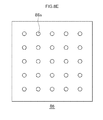
- FIG. 8E is a diagram showing a diaphragm 86 viewed from below;
- FIG. 8F is a simulation result showing the shape of electron beams emitted in a case where the voltage applied to each electrode 840 is ⁇ 1.00 V;
- FIG. 8G is a simulation result showing the shape of electron beams emitted in a case where the voltage applied to each electrode 840 is ⁇ 0.50 V;
- FIG. 8H is a simulation result showing the shape of electron beams emitted in a case where the voltage applied to each electrode 840 is ⁇ 0.13 V;
- FIG. 8I is a simulation result showing the shape of electron beams emitted in a case where the voltage applied to each electrode 840 is 0.00 V;
- FIG. 8J is a simulation result showing the shape of electron beams emitted in a case where the voltage applied to each electrode 840 is +2.00 V;
- FIG. 8K is a simulation result showing the shapes of electron beams emitted in a case where the voltages applied to adjacent electrodes 840 a through 840 c are ⁇ 0.50 V, ⁇ 0.13 V, and ⁇ 0.50 V, respectively;
- FIG. 8L is a cross-sectional view of an electron beam generator 112 ′ according to a modification of FIG. 8A ;
- FIG. 8M is a diagram showing a photoelectric surface 82 viewed from below;
- FIG. 8N is a diagram showing a variation of an electrode 840 ;
- FIG. 8O is a diagram showing a variation of an electrode 840 ;
- FIG. 8P is a diagram showing a variation of an electrode 840 .
- FIG. 8Q is a diagram showing a variation of an electrode 840 .
- FIG. 1A is a diagram schematically showing the basic configuration of the electron beam irradiation apparatus.
- a sample W to be processed by this electron beam irradiation apparatus is a nanoimprint lithography (NIL) mask, an extreme ultraviolet lithography (EUV) mask, or the like.
- the electron beam irradiation apparatus is suitable for processing a mask to be used in manufacturing a fine pattern of 100 nm or smaller, or more particularly, 20 nm or smaller.
- the sample W may be a semiconductor wafer made of Si, GaAs, or the like.
- the electron beam irradiation apparatus includes a column portion 11 , a main chamber portion 12 provided under the column portion 11 , and a controller 13 .
- the column portion 11 has a cylindrical vacuum tube 111 extending in the vertical direction, an electron beam generator 112 , an aperture 113 , a lens 114 , a deflector 115 , a sensor unit 116 , a gate valve 117 , a turbo-molecular pump 118 , a gate valve 11 A, and a particle catcher 11 B.
- the electron beam generator 112 is provided in an upper part of the vacuum tube 111 , and emits an electron beam downward.
- An example structure of the electron beam generator 112 will be described later in a seventh embodiment.
- the aperture 113 is provided below the electron beam generator 112 , and the electron beam passes through an opening that is formed at the center of the aperture 113 and has a diameter of 2 mm or smaller.
- the deflector 115 is provided below the lens 114 , and can deflect the electron beam.
- the lens 114 may be an electrostatic lens provided inside the vacuum tube 111 , or may be a magnetic lens provided outside the vacuum tube 111 .
- the deflector 115 may be an electrostatic deflector provided inside the vacuum tube 111 , or may be a magnetic deflector provided outside the vacuum tube 111 .
- the vacuum tube 111 has an intermediate evacuation line 111 a that horizontally branches between the electron beam generator 112 and the aperture 113 , and the sensor unit 116 , the gate valve 117 , and the turbo-molecular pump 118 are arranged in this order in the intermediate evacuation line 111 a.
- the vacuum tube 111 can be differentially evacuated, and the pressure in the vicinity of the electron beam generator 112 can be made lower than the pressure in the main chamber portion 12 .
- a small-diameter tube (not shown) may be provided below the aperture 113 , to adjust conductance. In this manner, the effect of the differential evacuation may be increased.
- FIG. 1B is a schematic cross-sectional view of the sensor unit 116 .
- ports 111 b radially extend from the intermediate evacuation line 111 a , and a pressure monitor 116 a , a N 2 injector 116 b , an atmospheric pressure sensor 116 c , and the like are disposed on each port 111 b .
- the pressure monitor 116 monitors the pressure in the vacuum tube 111 , monitors the degree of deterioration of the electron beam generator 112 , and determines the time for replacement.
- each port 111 b is preferably equal to or greater than a third of the diameter D of the central part of the intermediate evacuation line 111 a (d/D ⁇ 1 ⁇ 3). This is because, if the diameter d of each port 111 b is too small, the pressure monitors 116 a cannot accurately monitor the pressure in the vacuum tube 111 .
- the gate valve 11 A that can be opened and closed is provided in the vacuum tube 11 and between the aperture 113 and the main chamber portion 12 .
- the gate valve 11 A As the gate valve 11 A is provided, the vacuum in the main chamber portion 12 and the vacuum in the vacuum tube 111 can be separated from each other.
- the particle catcher 11 B is detachably inserted in the vacuum tube 111 and between the gate valve 11 A and the main chamber portion 12 , and prevents particles generated at a time of operation of the gate valve 11 A or the like from dropping into the main chamber portion 12 .
- FIG. 1C is a diagram showing an example structure of the particle catcher 11 B.
- the particle catcher 11 B includes a base member 11 Ba and an adsorbing material 11 Bb provided on the base member 11 Ba.
- the adsorbing material 11 Bb is a SiO 2 gel or the like, and adsorbs particles falling inside the vacuum tube 111 .
- the particles falling inside the vacuum tube 11 can be prevented from dropping onto the surface of the sample W disposed in the main chamber portion 12 .
- the particle catcher 11 B can be inserted into and pulled out from the optical axis of the electron beam inside the vacuum tube 111 .
- the main chamber portion 12 has a main chamber 121 that is a vacuum chamber, a gate valve 122 , a turbo-molecular pump 123 , a stage 124 , an applicator pin 125 , an aperture 126 , and a measurement unit 127 .
- the gate valve 122 for bringing in and out the sample W is provided on a side surface of the main chamber 121 , and can be opened and closed. Further, the turbo-molecular pump 123 for evacuating the air from the main chamber 121 is provided on the bottom surface of the main chamber 121 .
- the stage 124 is provided in the main chamber 121 , and the sample W is placed on the stage 124 .
- the applicator pin 125 is designed for establishing conduction between pin members 671 and 672 shown in FIG. 6B .
- the irradiation energy is determined in accordance with the difference between the potential of the electron beam generator 112 ( ⁇ 0.2 to ⁇ 5 kV, for example) and the potential of the sample W. However, if the potential of the sample W is floating, the irradiation energy becomes unstable. Therefore, the applicator pin 125 is provided to apply a constant potential to the sample W.
- the aperture 126 is provided in the main chamber 121 , and is located above the stage 124 .
- An opening 126 a is formed in the aperture 126 , and defines the shape of the electron beam and which region of the sample W is to be irradiated with the electron beam.
- FIG. 1D is a diagram for explaining the role of the aperture 126 .
- the upper part of the drawing is a schematic view of the electron beam irradiation apparatus viewed from a side
- the lower part of the drawing is a schematic view of the sample W and the scanning electron beam viewed from above.
- the deflector 115 deflects the electron beam so that the electron beam from the electron beam generator 112 scans the upper surface of the sample W. In the scanning, the electron beam might not be uniform at the turn-around points. Therefore, the portions of the electron beam corresponding to the turn-around points are blocked by the aperture 126 so that the sample W can be irradiated with a uniform electron beam.
- Lp/Lc is preferably equal to or higher than 1.5. That is, the aspect ratio of the space between the lower surface of the aperture 126 and the upper surface of the sample W is preferably 1.5 or higher.
- the measurement unit 127 measures the electron beam, and is provided below the stage 124 in the main chamber 121 .
- the measurement unit 127 will be described later in a fourth embodiment.
- the controller 13 has a total controller 131 , an electron beam controller 132 , a peripheral controller 133 , and a block manifold 134 .
- the total controller 131 controls operation of the entire electron beam irradiation apparatus including the electron beam controller 132 , the peripheral controller 133 , and the block manifold 134 .
- the total controller 131 may be formed with a processor and a memory.
- Various programs to be executed by the processor may be stored into the memory in advance, or may be additionally stored into the memory in a later stage (or can be updated).
- the electron beam controller 132 controls electron beam irradiation and deflection by controlling the electron beam generator 112 and the deflector 115 . Examples of such control will be described later in first through third embodiments.
- the peripheral controller 133 controls the turbo-molecular pumps 118 and 123 , a dry pump 119 , and the like.
- the block manifold 134 controls opening and closing of the gate valves 117 , 11 A, and 122 (air pressure control).
- the electron beam irradiation apparatus operates as follows.
- the gate valve 11 A is opened, and the particle catcher 11 B is moved away from the optical axis of the electron beam. Further, the air is evacuated from the vacuum tube 11 and the main chamber 121 .
- the electron beam generator 112 emits the electron beam.
- the electron beam passes through the opening of the aperture 113 , is deflected by the deflector 115 , and further passes through the opening of the aperture 126 , to reach the surface of the sample W.
- the electron-beam irradiated region is wide, and is 10 ⁇ 10 mm to 500 ⁇ 500 mm, for example.
- the deflector 115 deflects an electron beam in the X-Y direction (a two-dimensional direction on the surface of the sample W), so that the surface of the sample W is uniformly irradiated with the electron beam.
- FIGS. 1E and 1F are diagrams for explaining control for deflecting an electron beam in the X-Y direction. More specifically, FIG. 1E is a diagram showing temporal changes in the coordinates (the X-coordinate and the Y-coordinate) of the deflected electron beam. FIG. 1F is a plan view showing a situation where the electron beam is deflected in the X-Y direction (a plan view of the sample W viewed from the electron beam source side).
- the X-direction is also referred to as the horizontal direction
- the Y-direction is also referred to as the vertical direction, for convenience sake.
- the electron beam is deflected in such a direction (X1, X2, X3, and X4) that the X-coordinate indicating the electron-beam reaching position on the sample W becomes larger (this direction is also called the positive direction of the X-coordinate, the rightward direction in FIG. 1F , and the outward path), and is then deflected in such a direction (X4, X5, X6, and X7) that the X-coordinate becomes smaller (this direction is also called the negative direction, the leftward direction in FIG. 1F , and the return path).
- the Y-coordinate of the electron beam remains Y1.
- the X-coordinate magnitude relationship is expressed as X1 ⁇ X7 ⁇ X2 ⁇ X6 ⁇ X3 ⁇ X5 ⁇ X4, as shown in FIG. 1F . That is, the electron beam is discretely emitted onto the sample W, and irradiation positions alternate in the outward path and the return path. In this manner, the surface of the sample W can be uniformly irradiated with the electron beam.
- the electron beam is deflected in such a direction that the Y-coordinate becomes greater (this direction is the positive direction of the Y-coordinate, and the downward direction in FIG. 1F ), and the Y-coordinate of the electron beam changes to Y2.
- the electron beam is deflected in such a direction that the X-coordinate becomes greater, and is then deflected in such a direction that the X-coordinate becomes smaller.
- the Y-coordinate of the electron beam remains Y2.
- the electron beam is deflected in such a direction that the Y-coordinate becomes greater, and the Y-coordinate of the electron beam becomes Y3.
- the electron beam is first deflected in such a direction that the X-coordinate becomes greater, and is then deflected in such a direction that the X-coordinate becomes smaller.
- the Y-coordinate of the electron beam remains Y3.
- the electron beam is deflected in such a direction that the Y-coordinate becomes greater, and the Y-coordinate of the electron beam becomes Y4.
- the electron beam is first deflected in such a direction that the X-coordinate becomes greater, and is then deflected in such a direction that the X-coordinate becomes smaller.
- the Y-coordinate of the electron beam remains Y4.
- the electron beam is deflected in such a direction that the Y-coordinate becomes smaller (the negative direction of the Y-coordinate, and the upward direction in FIG. 1F ), and the Y-coordinate of the electron beam becomes Y5.
- the electron beam is first deflected in such a direction that the X-coordinate becomes greater, and is then deflected in such a direction that the X-coordinate becomes smaller.
- the Y-coordinate of the electron beam remains Y5.
- the electron beam is deflected in such a direction that the Y-coordinate becomes smaller, and the Y-coordinate of the electron beam becomes Y6.
- the electron beam is first deflected in such a direction that the X-coordinate becomes greater, and is then deflected in such a direction that the X-coordinate becomes smaller.
- the Y-coordinate of the electron beam remains Y6.
- the electron beam is deflected in such a direction that the Y-coordinate becomes smaller, and the Y-coordinate of the electron beam becomes Y7.
- the electron beam is first deflected in such a direction that the X-coordinate becomes greater, and is then deflected in such a direction that the X-coordinate becomes smaller.
- the Y-coordinate of the electron beam remains Y7.
- the electron beam is deflected in such a direction that the Y-coordinate becomes smaller (the negative direction of the Y-coordinate, and the upward direction in FIG. 1F ), and the Y-coordinate of the electron beam becomes Y1.
- the Y-coordinate magnitude relationship is expressed as Y1 ⁇ Y7 ⁇ Y2 ⁇ Y6 ⁇ Y3 ⁇ Y5 ⁇ Y4, as shown in FIG. 1F . That is, the electron beam is also discretely emitted onto the sample W in the Y-direction, and irradiation positions alternate in the outward path and the return path. In this manner, the surface of the sample W can be uniformly irradiated with the electron beam.
- the particle catcher 11 B When the air is evacuated from the main chamber 121 , the particle catcher 11 B is moved away from the optical axis of the electron beam before the turbo-molecular pump 123 is activated. With this arrangement, the particles adsorbed by the particle catcher 11 B can be prevented from separating from the particle catcher 11 B and dropping onto the sample W due to the air current caused by the evacuation.
- This embodiment relates to an electron-beam irradiated area adjustment method and an adjustment system.
- an electron beam from an electron beam generator 112 is deflected by a deflector 115 , and a specific area of a sample W is irradiated with the electron beam (see FIG. 1A ).
- a deflector 115 a different area from the intended area might be irradiated with an electron beam.
- This embodiment is to provide a method and a system for adjusting an electron-beam irradiated area in an electron beam irradiation apparatus.
- a method of adjusting an electron-beam irradiated area in an electron beam irradiation apparatus that deflects an electron beam with a deflector to irradiate an object with the electron beam
- the electron-beam irradiated area adjustment method wherein emitting the electron beam, acquiring the current value, formation the image data, determining, and updating the electron beam irradiation recipe are repeated until the electron-beam irradiated area is determined to be appropriate.
- the electron-beam irradiated area adjustment method wherein the adjustment plate comprises a portion that detects a current corresponding to the emitted electron beam, and a portion that does not detect the current even when being irradiated with an electron beam.
- the electron-beam irradiated area adjustment method wherein upon formation the image data, the image data is formed by converting the acquired current value at each time into a tone of each pixel in the image data.
- the electron-beam irradiated area adjustment method wherein upon determining, determination is performed by comparing the formed image data with image data prepared in advance.
- the adjustment plate comprises a first pattern
- the image data prepared in advance comprises a second pattern corresponding to the first pattern
- the determination is performed in accordance with a positional relationship between the first pattern in the formed image data and the second pattern in the image data prepared in advance.
- the deflector is an electrostatic deflector comprising an electrode, and deflects the electron beam in accordance with a voltage applied on the electrode, and
- the electron beam irradiation recipe comprises information about a voltage to be applied to the electrode.
- the deflector is an electrostatic deflector comprising an electrode, and deflects the electron beam in accordance with a voltage applied on the electrode,
- the electron beam irradiation recipe comprises information about a voltage to be applied to the electrode
- the adjustment plate comprises a first pattern
- image data prepared in advance comprises a second pattern corresponding to the first pattern
- determination is performed in accordance with a positional relationship between the first pattern in the formed image data and the second pattern in the image data prepared in advance, and
- the deflector is a magnetic deflector comprising a magnetic pole, and deflects the electron beam in accordance with a current flowing in the magnetic pole,
- the electron beam irradiation recipe comprises information about a current to be applied to the electrode
- the adjustment plate comprises a first pattern
- image data prepared in advance comprises a second pattern corresponding to the first pattern
- determination is performed in accordance with a positional relationship between the first pattern in the formed image data and the second pattern in the image data prepared in advance, and
- An electron-beam irradiated area adjustment system that adjusts an electron-beam irradiated area in an electron beam irradiation apparatus that deflects an electron beam with a deflector to irradiate an object with the electron beam
- the electron-beam irradiated area adjustment system comprising:
- an adjustment plate that detects a current corresponding to an emitted electron beam
- an image forming module that forms image data corresponding to the acquired current value
- a determiner that determines whether the electron-beam irradiated area is appropriate based on the formed image data
- a recipe updater that updates the electron beam irradiation recipe for controlling the deflector when the electron-beam irradiated area is determined not to be appropriate.
- An electron beam can be adjusted.
- FIG. 2A is a diagram showing the basic configuration of an irradiated area adjustment system 200 in an electron beam irradiation apparatus;
- FIG. 2B is a schematic top view of an adjustment plate 21 ;
- FIG. 2CA is a diagram schematically showing an electron-beam irradiated area with respect to the adjustment plate 21 ;
- FIG. 2CB is a diagram schematically showing an electron-beam irradiated area with respect to the adjustment plate 21 ;
- FIG. 2D is a flowchart showing the steps in an irradiated area adjustment process
- FIG. 2E is a graph showing temporal changes in the voltage to be applied to electrodes 2115 ;
- FIG. 2FA is a graph showing the relationship between the irradiated area shown in FIG. 2CA and time;
- FIG. 2FB is a graph showing the relationship between the irradiated area shown in FIG. 2CB and time;
- FIG. 2GA is a graph showing temporal changes in the current value to be obtained
- FIG. 2GB is a graph showing temporal changes in the current value to be obtained
- FIG. 2HA is a diagram showing the image data formed in accordance with the current values shown in FIG. 2GA ;
- FIG. 2HB is a diagram showing the image data formed in accordance with the current values shown in FIG. 2GA ;
- FIG. 2I is a graph showing temporal changes in the adjusted voltage to be applied to the electrodes 2115 .
- FIG. 2A is a diagram showing the basic configuration of an irradiated area adjustment system 200 in an electron beam irradiation apparatus. It should be noted that the irradiated area adjustment system 200 performs adjustment when a sample is not placed on a stage 124 ( FIG. 1A ), such as when the electron beam irradiation apparatus is activated.
- the electron beam irradiation apparatus includes an electron beam generator 112 , a deflector 115 , an electron beam controller 132 , and the like.
- the deflector 115 in this embodiment is an electrostatic deflector having electrodes 2115 . More specifically, the electrodes 2115 in the deflector 115 include two electrodes for deflecting an electron beam in a horizontal direction on a sample (these two electrodes will be hereinafter referred to as the electrodes H, though not shown in the drawing), and two electrodes for deflecting the electron beam in a vertical direction (these two electrodes will be hereinafter referred to as the electrodes V, though not shown in the drawing). An electron beam is deflected in accordance with voltages applied to these electrodes H and V.
- the electron beam controller 132 has a beam scanner 26 and a deflector power source 27 .
- the beam scanner 26 generates a waveform for deflecting an electron beam, in accordance with an electron beam irradiation recipe including information about voltages to be applied to the electrodes 2115 .
- the deflector power source 27 generates the voltage corresponding to the waveform, and applies the waveform to the electrodes 2115 .
- the irradiated area adjustment system 200 includes an adjustment plate 21 , an ammeter 22 , an image forming module 23 , a determiner 24 , and a recipe updater 25 .
- the image forming module 23 , the determiner 24 , and the recipe updater 25 may be included in the total controller 131 shown in FIG. 1A , and may be formed by at least part of the total controller 131 executing a predetermined program.
- the adjustment plate 21 detects the current corresponding to an emitted electron beam, and is placed in a predetermined position on a stage 124 ( FIG. 1A ). That is, the adjustment plate 21 is placed below the sample to be irradiated with the electron beam.
- FIG. 2B is a schematic top view of the adjustment plate 21 .
- the adjustment plate 21 is a 45-mm square, for example.
- the adjustment plate 21 includes a predetermined pattern. In the specific example shown in the drawing, a hole 21 a is formed as the pattern at an upper left part. In a case where a different position from the hole 21 a is irradiated with an electron beam, the adjustment plate 21 detects a current. In a case where the hole 21 a is irradiated with an electron beam, on the other hand, the adjustment plate 21 does not detect any current.
- FIGS. 2CA and 2CB are diagrams each schematically showing an electron-beam irradiated area with respect to the adjustment plate 21 .
- An electron beam is supposed to be emitted onto the area indicated by a dashed line in FIG. 2CA .
- an electron beam might be emitted onto a different area (an area displaced to an upper left position in the drawing) from the intended area. Therefore, the state shown in FIG. 2CB is to be adjusted to the state shown in FIG. 2CA in this embodiment.
- the ammeter 22 in the irradiated area adjustment system 200 is connected between the adjustment plate 21 and a ground terminal (not shown), and obtains the current detected by the adjustment plate 21 .
- the obtained current value is detected by the image forming module 23 .
- the ammeter 22 sequentially obtains currents detected at respective times.
- the image forming module 23 forms the image data corresponding to the current obtained by the ammeter 22 . Specifically, the image forming module 23 operates as follows. First, the image forming module 23 converts the current value at each time into a voltage value. The image forming module 23 then converts the voltage values into tones of 256 tone levels, for example. The image forming module 23 then sets the obtained tones as the tones of the respective pixels in the image data.
- the adjustment plate 21 detects a current. Accordingly, the voltage value becomes greater, and the tone level is 255, for example. Thus, the pixel corresponding to this time is bright.
- the adjustment plate 21 does not detect any current. Accordingly, the voltage value becomes smaller, and the tone level is 0, for example. Thus, the pixel corresponding to this time is dark.
- the determiner 24 determines whether the electron-beam irradiated area is appropriate, in accordance with the image data formed by the image forming module 23 . Specifically, the determiner 24 stores beforehand the image data to be formed in a case where the electron-beam irradiated area is appropriate (the image data will be hereinafter referred to as the template image data), and makes a determination by comparing image data formed by the image forming module 23 with the template image data. More specifically, the determiner 24 makes a determination in accordance with a difference in position between the predetermined pattern (equivalent to the hole 21 a in FIG. 2B , for example) in the formed image data and the predetermined pattern in the template image data.
- the predetermined pattern equivalent to the hole 21 a in FIG. 2B , for example
- the recipe updater 25 updates the electron beam irradiation recipe, taking the difference in position into account.
- the beam scanner 26 is notified of the updated electron beam irradiation recipe, and thereafter, the updated electron beam irradiation recipe is used. The specific updating method will be described later.
- FIG. 2D is a flowchart showing the steps in an irradiated area adjustment process.
- the electron beam controller 132 controls the voltage to be applied to the electrodes 2115 in the deflector 115 , so that an electron beam is emitted (step S 21 ) while the irradiation position with respect to the adjustment plate 21 is changed.
- the electron-beam irradiated area is scanned as described below, though the scanning described below differs from that described above with reference to FIGS. 1E and 1F .
- FIG. 2E is a graph showing temporal changes in the voltage to be applied to the electrodes 2115 . More specifically, the upper half of FIG. 2E shows temporal changes in the voltage to be applied to the electrodes H for deflecting the electron beam in the horizontal direction, and the lower half shows temporal changes in the voltage to be applied to the electrodes V for deflecting the electron beam in the vertical direction. These waveforms are included in the electron beam irradiation recipe.
- FIGS. 2FA and 2FB are graphs showing the relationships between time and the irradiated areas shown in FIGS. 2CA and 2CB , respectively.
- the voltage to be applied to the electrodes V is constant ( ⁇ 3 V, for example), and the voltage to be applied to the electrodes H linearly increases from ⁇ 2 V to 2 V, for example. Therefore, as shown in FIGS. 2FA and 2FB , during the period from time t10 to t20, the electron beam irradiation position is constant in the vertical direction, but moves in the horizontal direction (this is called the first line).
- the voltage to be applied to the electrodes V increases (to ⁇ 2.25 V, for example).
- the voltage to be applied to the electrodes H also linearly increases. Therefore, as shown in FIGS. 2FA and 2FB , during the period from time 120 to time t30, the electron beam irradiation position is constant in the vertical direction at a different position from that between time t10 and time t20, and moves in the horizontal direction (this is called the second line). Thereafter, the same process is repeated until the fifth line, and the scanning of the irradiated area is then completed.
- the ammeter 22 obtains the current detected at each time from the adjustment plate 21 (step S 22 ).
- FIG. 2GA is a graph showing temporal changes in the obtained current value, and corresponds to FIG. 2FA .
- FIG. 2GB is a graph showing temporal changes in the obtained current value, and corresponds to FIG. 2FB .
- the adjustment plate 21 is not located in a position to be irradiated with the electron beam ( FIG. 2FB ), and therefore, current hardly flows ( FIG. 2GB ).
- the adjustment plate 21 On the second line, during the period from time t20 to time t21, the adjustment plate 21 is not located in a position to be irradiated with the electron beam ( FIG. 2FB ), and therefore, current hardly flows ( FIG. 2GB ). Thereafter, during the period from time t21 to time t30, a position that is not the hole 21 a of the adjustment plate 21 is irradiated with the electron beam, and therefore, a constant current value is obtained ( FIG. 2GB ). The same goes for the third line.
- the adjustment plate 21 is not located in a position to be irradiated with the electron beam ( FIG. 2FB ), and therefore, current hardly flows ( FIG. 2GB ). Thereafter, during the period from time t41 to time t46, a position that is not the hole 21 a of the adjustment plate 21 is irradiated with the electron beam, and therefore, the same current value as that during the period from time t21 to time 130 is obtained ( FIG. 2GB ). During the next period from time t46 to time t47, the hole 21 a of the adjustment plate 21 is irradiated with the electron beam ( FIG. 2FB ), and therefore, current hardly flows ( FIG. 2GB ).
- the image forming module 23 forms the image data corresponding to the obtained current values (step S 23 ).
- FIG. 2HA is a diagram showing the image data formed in accordance with the current values shown in FIG. 2GA .
- the current value during the period from time t10 to time t20 corresponds to each pixel value on the first line in the image data. Since the current value is large during the period from time t10 to time t20, each pixel value on the first line is large, and each pixel on the first line is bright. As the same applies to the later lines, only the pixels corresponding to time t35 to time t36 of the third line are dark in the image data shown in FIG. 2HA . This dark position corresponds to the hole 21 a shown in FIG. 2B .
- This image data is the image data formed in a case where the intended area shown in FIG. 2C is irradiated with the electron beam.
- this image data is the template image data.
- the template image data can be theoretically created in accordance with the pattern of the intended irradiated area on the adjustment plate 21 , and the determiner 24 that will be next explained stores the template image data therein in advance.
- the template image data includes a pattern 21 b corresponding to the pattern (the hole 21 a ) of the adjustment plate 21 .
- FIG. 2HB is a diagram showing the image data formed in accordance with the current values shown in FIG. 2GB .
- current hardly flows during the period from time t10 to time t20. Therefore, the first line of the image data shown in FIG. 2HB is dark.
- current hardly flows during the periods from time t20 to time t21, from time t30 to time 131 , from time t40 to time t41, and from time t50 to time t51. Therefore, the left edge of the image data is also dark.
- current hardly flows during the period from time T46 to time t47 of the fourth line. Therefore, a dark pattern 21 b ′ appears at part of the fourth line. This pattern 21 b ′ corresponds to the pattern (the hole 21 a ) of the adjustment plate 21 .
- the determiner 24 determines whether the electron-beam irradiated area is appropriate (step S 24 ). Specifically, the determiner 24 performs pattern matching between the template image data stored in advance and the image data formed in step S 23 .
- the template image data is shown in FIG. 2HA , and the image data formed in step S 23 is shown in FIG. 2HB .
- the determiner 24 calculates the positional relationship, which is a distance D, between the pattern 21 b in the template image data shown in FIG. 2HA and the pattern 21 b ′ in the image data shown in FIG. 2HB . If the distance D is equal to or shorter than a predetermined allowable value, the determiner 24 determines the irradiated area to be appropriate (YES in step S 24 in FIG. 2D ), and ends the adjustment process.
- the recipe updater 25 updates the electron beam irradiation recipe (step S 25 ). More specifically, the recipe updater 25 changes the waveform to be generated by the beam scanner 26 (for example, to the voltage waveform shown in FIG. 2E ). Where the distance D is longer, the amount of change is larger.
- the number of pixels in each set of image data is 256 ⁇ 256
- the position ( 128 , 128 ) of the pattern 21 b in the template image data ( FIG. 2HA ) is the position ( 192 , 192 ) of the pattern 21 b ′ in the image data ( FIG. 2HB ) formed in step S 23 .
- the irradiated area is shifted 25% of the image size in the horizontal direction and in the vertical direction. Therefore, the waveform shown in FIG. 2E is adjusted 25%. That is, a voltage in the range of ⁇ 2 V to 2 V is applied to the electrodes H in the horizontal direction in FIG. 2E , but the voltage range is changed to ⁇ 1 V to 3 V (the upper half of FIG. 2I ).
- a voltage in the range of ⁇ 3 V to 1 V is applied to the electrodes V in the vertical direction, but the voltage range is changed to ⁇ 2 V to 2 V (the lower half of FIG. 2I ).
- the electron-beam irradiated area moves in the horizontal direction and the vertical direction, so that an appropriate area is irradiated with the electron beam.
- step S 21 The adjustment process may end at this point, but steps S 21 and the following steps are preferably repeated until the irradiated area is determined to be appropriate in step S 24 . While these steps are repeated, the electron beam irradiation recipe updated in step S 25 is used in step S 21 .
- the adjustment plate 21 having a predetermined pattern formed thereon is used in this embodiment so that the electron-beam irradiated area can be adjusted.
- this adjustment method there is no need to use any actual mask, and no masks are wasted.
- the deflector 115 is an electrostatic deflector in this embodiment as described above, the deflector 115 may be a magnetic deflector having two or more magnetic poles. In such a case, the deflector power source 27 supplies a current for deflecting an electron beam to each of the magnetic poles.
- This embodiment relates to an electron beam irradiation apparatus and an electron-beam irradiated region correction method.
- the electron beam controller 132 controls the deflector 115 so that the irradiated region (the electron-beam reaching position) has a rectangular shape (or a square shape). However, depending on the characteristics of the deflector 115 , the irradiated region might not have a rectangular shape as intended.
- This embodiment aims to provide an electron beam irradiation apparatus that can reshape an electron-beam irradiated region to a rectangular shape, and a method of correcting the electron-beam irradiated region in a case where the irradiated region does not have an intended rectangular shape.
- An electron-beam irradiated region correction method implemented in an electron beam irradiation apparatus that is designed to irradiate a rectangular region as a target with an electron beam by applying a voltage V1(t) to a first electrode to perform scanning in a first direction with an electron beam from an electron beam generator, and applying a voltage V2(t) to a second electrode to perform scanning in a second direction with the electron beam, the voltage V1(t) varying with time t, the voltage V2(t) varying with time t, the second direction being perpendicular to the first direction,
- the electron-beam irradiated region correction method comprising
- the electron-beam irradiated region correction method according to aspect 1, wherein the constant k is set to make the electron-beam irradiated region closer to a rectangular shape.
- the irradiated region becomes closer to a rectangular shape.
- the irradiated region becomes closer to a rectangular shape.
- the voltage V2(t) repeats N0 times a process of changing to another value after a period T0 has passed since the voltage V2(t) became a certain value
- the period T0 corresponds to a length of the rectangular shape in the first direction
- the irradiated region distorted in the horizontal direction can be corrected to have a rectangular shape.
- the voltage V1(t) repeats N0 times a process of changing to another value after a period T0 has passed since the voltage V1(t) became a certain value
- the period T0 corresponds to a length of the rectangular shape in the second direction
- the number N0 of times corresponds to a length of the rectangular shape in the first direction
- the irradiated region distorted in the vertical direction can be corrected to have a rectangular shape.
- An electron beam irradiation apparatus that is designed to irradiate a rectangular region as a target with an electron beam by applying a voltage V1(t) to a first electrode to perform scanning in a first direction with an electron beam from an electron beam generator, and applying a voltage V2(t) to a second electrode to perform scanning in a second direction with the electron beam, the voltage V1(t) varying with time t, the voltage V2(t) varying with time t, the second direction being perpendicular to the first direction,
- the electron beam irradiation apparatus comprising
- an electron beam control device that applies a voltage V1(t)+kV2(t) (k being a constant) to the first electrode and applies the voltage V2(t) to the second electrode, when an electron-beam irradiated region is not a rectangular region but a parallelogram region distorted in the first direction,
- the electron beam control device corrects the electron-beam irradiated region to have a rectangular shape.
- a voltage V1(t)+kV2(t) is applied to the first electrode for scanning the electron beam in the first direction, to correct the irradiated region.
- An electron beam irradiation apparatus comprising:
- an electron beam generator that generates an electron beam
- a first electrode that deflects the electron beam from the electron beam generator in a first direction
- an electron beam control device that controls voltages to be applied to the first electrode and the second electrode, wherein
- the electron beam irradiation apparatus is designed to irradiate a rectangular region as a target with an electron beam by applying a voltage V1(t) to the first electrode to perform scanning in the first direction with the electron beam from the electron beam generator, and applying a voltage V2(t) to the second electrode to perform scanning in the second direction with the electron beam, the voltage V1(t) varying with time t, the voltage V2(t) varying with time t, and,
- the electron beam control device applies a voltage V1(t)+kV2(t) (k being a constant) to the first electrode and applies the voltage V2(t) to the second electrode, to correct the electron-beam irradiated region to have a rectangular shape.
- a voltage V1(t)+kV2(t) is applied to the first electrode for scanning the electron beam in the first direction, to correct the irradiated region.
- An electron-beam irradiated region can be made closer to a rectangular shape.
- FIG. 3A is a diagram schematically showing electron-beam irradiated regions 200 and 200 ′;
- FIG. 3B is a graph schematically showing the voltages Vv(t) and Vh(t) to be applied to the electrodes V and H, respectively, in the deflector 115 to obtain the irradiated region 200 shown in FIG. 3A ;
- FIG. 3C is a graph schematically showing the voltages Vv(t) and Vh(t)+kVv(t) to be applied to the electrodes V and H, respectively, to correct distortion of the irradiated region 200 ′ in the horizontal direction;
- FIG. 3D is a diagram schematically showing electron-beam irradiated regions 200 and 200 ′′.
- FIG. 3E is a graph schematically showing the voltages Vv(t)+kVh(t) and Vh(t) to be applied to the electrodes V and H, respectively, to correct distortion of the irradiated region 200 ′′ in the vertical direction.
- FIG. 3A is a diagram schematically showing an electron-beam irradiated region 200 as a target.
- the irradiated region 200 as a target has a rectangular shape.
- the irradiated region 200 is discretely irradiated with an electron beam (see FIG. 1F ). Therefore, the irradiation units in the horizontal direction are called dots, and the irradiation units in the vertical direction are called lines, for convenience sake.
- the number of dots (corresponding to the length in the horizontal direction) in the irradiated region 200 is represented by Lh ( 5 in the example shown in FIG. 3A ), and the number of lines (corresponding to the length in the vertical direction) is represented by Lv ( 5 in the example shown in FIG. 3A ).
- FIG. 3B is a graph schematically showing the voltages Vv(t) and Vh(t) to be applied to the electrodes V and H in the deflector 115 to obtain the irradiated region 200 shown in FIG. 3A . More specifically, FIG. 3B schematically shows the relationship between time t and the voltages Vv(t) and Vh(t) to be applied to the electrodes V and H, respectively. It should be noted that the electrodes V and H in the deflector 115 are electrodes for deflecting the electron beam in the vertical direction and the horizontal direction, respectively. These voltages Vv(t) and Vh(t) are controlled by the electron beam controller 132 ( FIG. 1A ).
- the voltage Vv(t) remains the same value during a predetermined period T0. After the period T0 has passed, the voltage Vv(t) is set at a different value. This is repeated NO times (five times in the example shown in FIG. 3B ).
- the voltage Vv(t) corresponds to a position (or a line) in the irradiated region 200 in the vertical direction. More specifically, where the value of the voltage Vv(t) is greater, the position is closer to the lower edge of the irradiated region 200 in the vertical direction. Accordingly, as such a voltage Vv(t) is applied to the electrodes V, scanning is performed with the electron beam in the vertical direction.
- the period T0 corresponds to the number Lh of dots (the length in the horizontal direction) of the irradiated region 200 .
- the number N0 of repetitions corresponds to the number Lv of lines (the length in the vertical direction).
- the voltage Vh(t) changes linearly in cycles of the period T0. More specifically, the voltage Vh(t) increases linearly in the first half of the period T0, and decreases linearly at the same rate in the second half of the period T0. This is also repeated NO times.
- the voltage Vh(t) corresponds to a position (or a dot) in the irradiated region 200 in the horizontal direction. More specifically, where the value of the voltage Vh(t) is greater, the position is closer to the right edge of the irradiated region 200 in the horizontal direction. Accordingly, as such a voltage Vh(t) is applied to the electrodes H, scanning is performed with the electron beam in the horizontal direction.
- the irradiated region 200 should have a rectangular shape as shown in FIG. 3A .
- the irradiated region 200 might be distorted in the horizontal direction. Therefore, in a case where the irradiated region 200 is distorted in the horizontal direction, correction is performed so that the irradiated region 200 has a rectangular shape in this embodiment.
- the right half of FIG. 3A is a diagram schematically showing an electron-beam irradiated region 200 ′ that is distorted in the horizontal direction.
- the irradiated region 200 ′ is a parallelogram. In this parallelogram, there are no shifts in the vertical direction, as indicated by dot-and-dash lines. Therefore, as for the vertical direction, the electron beam controller 132 should apply the voltage Vv(t) shown in FIG. 3B to the electrodes V (see the upper half of FIG. 3C ) without any change.
- the second line is shifted rightward by A in the horizontal direction with respect to the first line.
- k represents a constant, and is set so that the electron-beam irradiated region 200 ′ becomes closer to a rectangular shape (or preferably becomes a rectangular shape).
- k is set at a negative value so that the positions of the second and later lines are shifted leftward in the horizontal direction.
- k is set at a positive value so that the positions of the second and later lines are shifted rightward in the horizontal direction.
- the absolute value of k is set at a greater value.
- the voltage Vv(t) is applied to the electrodes V for deflecting the electron beam in the vertical direction
- the voltage Vh(t)+kVv(t) is applied to the electrodes H for deflecting the electron beam in the horizontal direction.
- the distorted irradiated region 200 ′ can be made closer to a rectangular shape.
- the above described embodiment is designed on the assumption that the irradiated region 200 is distorted in the horizontal direction.
- the embodiment described next is designed on the assumption that the irradiated region 200 is distorted in the vertical direction. Different aspects will be mainly explained in the description below.
- FIG. 3D The upper half of FIG. 3D is the same as the left half of FIG. 3A
- the lower half of FIG. 3D is a diagram schematically showing an electron-beam irradiated region 200 ′′ distorted in the vertical direction.
- the irradiated region 200 ′′ is a parallelogram. In this parallelogram, there are no shifts in the horizontal direction, as indicated by dot-and-dash lines. Therefore, as for the horizontal direction, the electron beam controller 132 should apply the voltage Vh(t) shown in FIG. 3B to the electrodes H (see the lower half of FIG. 3E ),
- the second dot is shifted upward by B in the vertical direction with respect to the first dot.
- k represents a constant, and is set so that the electron-beam irradiated region 200 ′′ becomes closer to a rectangular shape (or preferably becomes a rectangular shape).
- k is set at a positive value so that the positions of the second and later dots are shifted downward in the vertical direction.
- k is set at a negative value so that the positions of the second and later dots are shifted upward in the vertical direction.
- the absolute value of k is set at a greater value.
- the voltage Vh(t) is applied to the electrodes H for deflecting the electron beam in the horizontal direction
- the voltage Vv(t)+kVh(t) is applied to the electrodes V for deflecting the electron beam in the vertical direction.
- the distorted irradiated region 200 ′′ can be made closer to a rectangular shape.
- This embodiment relates to an electron beam irradiation apparatus, and an electron beam control method and a program.
- An electron beam is emitted from an electron beam irradiation apparatus, to increase the etching resistance of a resist mask.
- An etching rate in plasma etching is not spatially uniform, but has a predetermined distribution (being high in the vicinity of the central part, for example). Therefore, in a case where a sample surface is uniformly irradiated with an electron beam from an electron beam irradiation apparatus so that the etching resistance of the resist is uniformly increased on the entire surface, differences are caused in the etching amount in accordance with the etching rate distribution.
- this embodiment aims to provide an electron beam irradiation apparatus, and an electron beam control method and a program that can reduce the etching amount variation to be caused by an etching rate distribution.
- An electron beam irradiation apparatus comprising:
- the controller controls the deflector so that a moving speed of the electron beam in a first scanning direction in a first region is slower than a moving speed of the first scanning direction in a second region, an etching rate of the second region being lower than an etching rate of the first region.
- the electron beam irradiation apparatus wherein a first electrode is provided on a deflector for scan the electron bean in the first scanning direction, and
- the controller controls the deflector so that a variation of a voltage per unit time applied on the first electrode during a first term in which the first region is scanned is smaller than a variation of the voltage per unit time applied on the first electrode during a second term in which the second region is scanned.
- the etching resistance of the resist in the region to be irradiated with the electron beam during the first period becomes higher than the etching resistance of the resist in the region to be irradiated with the electron beam during the second period. Even if the etching rate in the region to be irradiated with the electron beam during the first period is high, the portions to be etched by plasma etching can be reduced, and the etching amount variation to be caused by the etching rate distribution can be reduced, because the etching resistance of the resist is high.
- the first term is between the former term of the second term and the latter term of the second term.
- the electrode irradiation apparatus according to aspect one of 1 to 3, wherein the etching rate is larger than a threshold in the first region.
- the electrode irradiation apparatus according to aspect one of 1 to 3, wherein the first region is substantially set on a center of a substrate.
- the electrode irradiation apparatus according to aspect one of 1 to 5, wherein a shape of the first region is substantially circle.
- the electrode irradiation apparatus according to aspect one of 1 to 5, wherein a shape of the first region is substantially rectangle.
- the electrode irradiation apparatus according to aspect one of 1 to 7, wherein the first scanning direction is a horizontal direction.
- An electron beam controlling method implemented by an electron beam irradiation apparatus that comprises a deflector that deflects an electron beam, and a controller that scans the electron beam by controlling the deflector, the method comprising
- a moving speed of the electron beam in a first scan direction in a first region is slower than a moving speed of the first scanning direction in a second region, an etching rate of the second region being lower than an etching rate of the first region.
- the controller controls the deflector so that a moving speed of the electron beam in a first scan direction in a first region is slower than a moving speed of the first scanning direction in a second region, an etching rate of the second region being lower than an etching rate of the first region.
- movement of the electron beam in the first scanning direction in the first region is slower than that in the second region. Accordingly, the amount of electron beam irradiation in the first region becomes larger than that in the second region.
- the etching resistance of the resist mask in the first region becomes higher than that in the second region. Even if the etching rate in the first region is higher than that in the second region in this structure, the portions to be etched by plasma etching can be reduced, and the etching amount differences to be caused by the etching rate distribution can be reduced, because the etching resistance of the resist mask in the first region is higher than that in the second region.
- FIG. 4A is a diagram schematically showing an electron-beam irradiated region 41 ;
- FIG. 4B is a graph schematically showing the voltages Vh(t) and Vv(t) to be applied to the electrodes H and V, respectively, in the deflector 115 to obtain the irradiated region 41 shown in FIG. 4A ;
- FIG. 4C is a diagram schematically showing an electron-beam irradiated region 42 ;
- FIG. 4D is a graph schematically showing the voltages Vh(t) and Vv(t) to be applied to the electrodes H and V, respectively, in the deflector 115 in the portion from a point 4P1 to a point 4P2 in the irradiated region 42 shown in FIG. 4C ;
- FIG. 4E is a graph schematically showing the voltages Vh(t) and Vv(t) to be applied to the electrodes H and V, respectively, in the deflector 115 in the portion from the point 4P2 to a point 4P3 in the irradiated region 42 shown in FIG. 4C .
- FIG. 4A is a diagram schematically showing an electron-beam irradiated region 41 as a target.
- the irradiated region 41 is part of a substrate on which a layer to be etched is formed. As shown in the drawing, the irradiated region 41 as a target has a rectangular shape. In practice, however, an electron beam is discretely emitted onto the positions of dots shown in FIG. 4A , for example. As indicated by the polygonal line in FIG. 4A , scanning is performed with an electron beam from the upper left corner toward the lower right corner in FIG. 4A .
- the irradiated region 41 is divided into a first region 411 and a second region 412 having a lower etching rate than the first region 411 , for example.
- the first region 411 is a region in which the etching rate is higher than a threshold value, and is set at a central part of the substrate.
- the first region 411 is a rectangle, for example.
- five lines are scanned in the horizontal direction, the five lines being located in different positions in the vertical direction.
- eleven lines are scanned in the horizontal direction, for example, the eleven lines being located in different positions in the vertical direction.
- five lines are then scanned in the horizontal direction, the five lines being located in different positions in the vertical direction. This aspect will be described below.
- the intervals between the dots in the horizontal direction are shorter than those in the outer region. That is, the moving speed of the electron beam in the horizontal direction in the first region 411 shown in FIG. 4A is lower than the moving speed of the electron beam in the horizontal direction outside the first region 411 shown in FIG. 4A .
- the controller 13 controls the deflector 115 so that the moving speed of the electron beam in the horizontal direction in the first region 411 shown in FIG. 4A becomes lower than the moving speed of the electron beam in the horizontal direction in the second region 412 shown in FIG. 4A .
- movement of the electron beam in the horizontal direction in the first region 411 in FIG. 4A is slower than that in the second region 412 in FIG. 4A .
- the amount of electron beam irradiation in the first region 411 becomes larger than that in the second region 412 .
- the etching resistance of the resist in the first region 411 in FIG. 4A becomes higher than that in the second region 412 in FIG. 4A .
- the portions to be etched by plasma etching can be reduced, and the etching amount differences to be caused by the etching rate distribution can be reduced, because the etching resistance of the resist in the first region 411 is higher than that in the second region 412 .
- the deflector 115 is an electrostatic deflector, for example.
- FIG. 4B is a graph schematically showing the voltages Vh(t) and Vv(t) to be applied to the electrodes H and V, respectively, in the deflector 115 to obtain the irradiated region 41 shown in FIG. 4A . More specifically, FIG. 4B schematically shows the relationship between time t and the voltages Vh(t) and Vv(t) to be applied to the electrodes H and V, respectively.
- the electrodes H and V in the deflector 115 are electrodes for deflecting the electron beam in the horizontal direction and the vertical direction, respectively.
- the voltage Vv(t) remains the same value during a predetermined period T1.
- the voltage Vv(t) is set at a value that is greater by a difference voltage ⁇ V1. This is repeated N1 times (five times in the example shown in FIG. 4B , which is equivalent to five lines).
- the voltage Vv(t) corresponds to a position (or a line) in the irradiated region 41 in the vertical direction. More specifically, where the value of the voltage Vv(t) is greater, the position is closer to the lower edge of the irradiated region 41 in the vertical direction. Accordingly, as such a voltage Vv(t) is applied to the electrodes V, the position of the electron beam in the vertical direction is moved.
- the voltage Vh(t) changes linearly in cycles of the period T1. More specifically, the voltage Vh(t) increases linearly along a first slope during the period T1. This is also repeated N1 times.
- the voltage Vh(t) corresponds to a position (or a dot) in the irradiated region 41 in the horizontal direction. More specifically, where the value of the voltage Vh(t) is greater, the position is closer to the right edge of the irradiated region 41 in the horizontal direction. Accordingly, as such a voltage Vh(t) is applied to the electrodes H, the irradiation position of the electron beam is moved in the horizontal direction.
- the voltage Vv(t) when being set at a value that is even greater by the difference voltage ⁇ V1, the voltage Vv(t) remains the same value during a predetermined period T2 (>T1). After the period T2 has passed, the voltage Vv(t) is set at a value that is greater by the difference voltage ⁇ V1. This is repeated N2 times (eleven times in the example shown in FIG. 4B , which is equivalent to eleven lines).
- the voltage Vh(t) changes polygonally in cycles of the period T2. More specifically, the voltage Vh(t) increases linearly along a first slope during an early period T21, increases linearly along a second slope that is gentler than the first slope during an intermediate period T22, and, during a later period T23, increases linearly along the same first slope as that during the early period T21. That is, the change in the voltage Vh(t) per unit time during the period T22 (which is equivalent to a slope of the voltage Vh(t) shown in FIG. 4B ) is smaller than the change in the voltage Vh(t) per unit time during the period T21 and the period T23 (which is equivalent to a slope of the voltage Vh(t) shown in FIG. 4B ). This is also repeated N2 times (eleven times in the example shown in FIG. 4B , which is equivalent to eleven lines).
- the voltage Vv(t) when being set at a value that is even greater by the difference voltage ⁇ V1, the voltage Vv(t) remains the same value during the predetermined period T1. After the period T1 has passed, the voltage Vv(t) is set at a value that is greater by the difference voltage ⁇ V1. This is repeated N1 times (five times in the example shown in FIG. 4B , which is equivalent to five lines).
- the voltage Vh(t) changes linearly in cycles of the period T1. More specifically, the voltage Vh(t) increases linearly along a first slope during the period T1. After the period T1 has passed, the voltage Vh(t) returns to the initial value Vh0. This is also repeated N times.
- the controller 13 in this embodiment controls the deflector 115 so that the change in the voltage Vh(t) per unit time during the period T22 in FIG. 4B becomes smaller than the change in the voltage Vh(t) per unit time during the periods T21 and T23 in FIG. 4B .
- movement of the electron beam in the horizontal direction during the period T22 in FIG. 4B is slower than that during the periods T21 and T23 in FIG. 4B .
- the etching resistance of the resist in the region to be irradiated with the electron beam during the period T22 in FIG. 4B becomes higher than the etching resistance of the resist in the region to be irradiated with the electron beam during the periods T21 and T23 in FIG. 4B .
- the etching rate in the region to be irradiated with the electron beam during the period T22 in FIG. 4B is high, the portions to be etched by plasma etching can be reduced, and the etching amount differences to be caused by the etching rate distribution can be reduced, because the etching resistance of the resist is high.
- the moving speed of the electron beam is low in the horizontal direction in this embodiment, the moving speed of the electron beam may be low in any appropriate direction such as the vertical direction.
- the controller 13 may control the deflector 115 so that the moving speed of the electron beam in the first scanning direction in the first region 411 becomes lower than the moving speed of the electron beam in the first scanning direction in the second region 412 .
- the first scanning direction is an appropriate direction including a horizontal direction or a vertical direction.
- the controller 13 may also control the deflector 115 so that the change in the voltage to be applied to a first electrode per unit time during the first period (the period T22 in FIG. 4B , for example) during which the first region 411 is scanned becomes smaller than the change in the voltage to be applied to the first electrode per unit time during the second period (the period T21 and/or the period T23 in FIG. 4B , for example) during which the second region 412 is scanned.
- the first electrode is an appropriate electrode including the electrodes H and V, and is an electrode to be provided for performing scanning with the electron beam in the first scanning direction.
- the second period is divided into an early period (the period T21 in FIG. 4B , for example) and a later period (the period T23 in FIG. 4B , for example), and the first period (the period 122 in FIG. 4B , for example) is the period interposed between the early period (the period T21 in FIG. 4B , for example) of the second period and the later period (the period T23 in FIG. 4B , for example) of the second period.
- the region in which the scanning speed is lowered is a rectangle in this embodiment, the region may be a triangle or a polygon such as a pentagon.
- the region in which the scanning speed is lowered is a rectangle in this embodiment, the region has a round shape in this modification.
- FIG. 4C is a diagram schematically showing an electron-beam irradiated region 42 as a target.
- the irradiated region 42 is part of a substrate on which a layer to be etched is formed. As shown in the drawing, the irradiated region 42 as a target has a round shape. In practice, however, an electron beam is discretely emitted onto the positions of dots shown in FIG. 4C , for example. As indicated by the polygonal line in FIG. 4C , scanning with an electron beam is performed from top to bottom in the entire irradiated region, and from left to right in the same positions in the vertical direction.
- the irradiated region 42 is divided into a first region 421 and a second region 422 having a lower etching rate than the first region 421 , for example.
- the first region 421 is a region in which the etching rate is higher than a threshold value, and is set at a central part of the substrate.
- the first region 421 has an almost round shape, for example.
- the round shape may include a true circle or an ellipse, and the lines forming the round shape may include not only a curved line but also polygonal lines. In the region located above the first region 421 of the second region 422 , five lines are scanned in the horizontal direction, the five lines being located in different positions in the vertical direction.
- eleven lines are scanned in the horizontal direction, for example, the eleven lines being located in different positions in the vertical direction.
- five lines are then scanned in the horizontal direction, the five lines being located in different positions in the vertical direction.
- the intervals between the dots in the horizontal direction are shorter than those in the outer region. That is, the moving speed of the electron beam in the horizontal direction in the first region 421 shown in FIG. 4C is lower than the moving speed of the electron beam in the horizontal direction outside the first region 421 shown in FIG. 4C .
- the controller 13 controls the deflector 115 so that the moving speed of the electron beam in the horizontal direction in the first region 421 shown in FIG. 4C becomes lower than the moving speed of the electron beam in the horizontal direction outside the first region 421 shown in FIG. 4C .
- movement of the electron beam in the horizontal direction in the first region 421 in FIG. 4C is slower than that in the second region 422 in FIG. 4 C.
- the amount of electron beam irradiation in the first region 421 becomes larger than that in the second region 422 .
- the etching resistance of the resist in the first region 421 in FIG. 4C becomes higher than that in the second region 422 in FIG. 4C .
- the portions to be etched by plasma etching can be reduced, and the etching amount differences to be caused by the etching rate distribution can be reduced, because the etching resistance of the resist in the first region 421 is higher than that in the second region 422 .
- FIG. 4D is a graph schematically showing the voltages Vh(t) and Vv(t) to be applied to the electrodes H and V, respectively, in the deflector 115 in the portion from a point 4P1 to a point 4P2 in the irradiated region 42 in FIG. 4C .
- FIG. 4E is a graph schematically showing the voltages Vh(t) and Vv(t) to be applied to the electrodes H and V, respectively, in the deflector 115 in the portion from the point 4P2 to a point 4P3 in the irradiated region 42 in FIG. 4C .
- FIGS. 4D and 4E schematically show the relationship between time t and the voltages Vh(t) and Vv(t) to be applied to the electrodes H and V, respectively.
- the voltage Vv(t) is set at a value at a certain time. After a unit time ⁇ t has passed, the voltage Vv(t) is set at a value that is even greater by a difference voltage ⁇ V2. The voltage Vv(t) remains the same value during a predetermined period T11. After the period T11 has passed, the voltage Vv(t) is set at a value that is greater by the difference voltage ⁇ V2. The voltage Vv(t) then remains the same value during a predetermined period T12 (>T11). After the period T12 has passed, the voltage Vv(t) is set at a value that is greater by the difference voltage ⁇ V2. The voltage Vv(t) then remains the same value during a predetermined period T13 (>T12).
- the voltage Vv(t) is set at a value that is greater by the difference voltage ⁇ V2.
- the voltage Vv(t) then remains the same value during a predetermined period T14 (>T13).
- the voltage Vv(t) is set at a value that is greater by the difference voltage ⁇ V2.
- the voltage Vv(t) corresponds to a position (or a line) in the irradiated region 42 in the vertical direction. More specifically, where the value of the voltage Vv(t) is greater, the position is closer to the lower edge of the irradiated region 42 in the vertical direction. Accordingly, as such a voltage Vv(t) is applied to the electrodes V, the position of the electron beam in the vertical direction is moved.
- the voltage Vh(t) linearly changes during the corresponding periods T11, T12, T13, and T14. More specifically, the voltage Vh(t) increases linearly along a first slope during the periods T11, T12, T13, and T14.
- the voltage Vh(t) corresponds to a position (or a dot) in the irradiated region 42 in the horizontal direction. More specifically, where the value of the voltage Vh(t) is greater, the position is closer to the right edge of the irradiated region 42 in the horizontal direction. Accordingly, as such a voltage Vh(t) is applied to the electrodes H, the irradiation position of the electron beam is moved in the vertical direction.
- the voltage Vv(t) when being set at a value that is even greater by the difference voltage ⁇ V2, the voltage Vv(t) remains the same value during a predetermined period T15 (>T14). After the period T15 has passed, the voltage Vv(t) is set at a value that is greater by the difference voltage ⁇ V2.
- the voltage Vh(t) changes polygonally during the period T15. More specifically, the voltage Vh(t) increases linearly along a first slope during an early period T151, increases linearly along a second slope that is gentler than the first slope during an intermediate period T152, and, during a later period T153, increases linearly along the same first slope as that during the early period T 51 . That is, the change in the voltage Vh(t) per unit time during the period T152 (which is equivalent to a slope of the voltage Vh(t) shown in FIG. 4D ) is smaller than the change in the voltage Vh(t) per unit time during the period T151 and the period T153 (which is equivalent to a slope of the voltage Vh(t) shown in FIG. 4D ).
- the voltage Vv(t) when being set at a value that is even greater by the difference voltage ⁇ V2, the voltage Vv(t) remains the same value during a predetermined period T16 (>T15). After the period T16 has passed, the voltage Vv(t) is set at a value that is greater by the difference voltage ⁇ V2.
- the voltage Vh(t) changes polygonally during the period T16. More specifically, the voltage Vh(t) increases linearly along a first slope during an early period T161, increases linearly along a second slope that is gentler than the first slope during an intermediate period T162, and, during a later period T163, increases linearly along the same first slope as that during the early period T161. That is, the change in the voltage Vh(t) per unit time during the period T162 (which is equivalent to a slope of the voltage Vh(t) shown in FIG. 4D ) is smaller than the change in the voltage Vh(t) per unit time during the period T161 and the period T163 (which is equivalent to a slope of the voltage Vh(t) shown in FIG. 4D ).
- the voltage Vv(t) when being set at a value that is even greater by the difference voltage ⁇ V2, the voltage Vv(t) remains the same value during a predetermined period T17 (>T 6 ). After the period T17 has passed, the voltage Vv(t) is set at a value that is greater by the difference voltage ⁇ V2.
- the voltage Vh(t) changes polygonally during the period T17. More specifically, the voltage Vh(t) increases linearly along a first slope during an early period T171, increases linearly along a second slope that is gentler than the first slope during an intermediate period T172, and, during a later period T173, increases linearly along the same first slope as that during the early period T171. That is, the change in the voltage Vh(t) per unit time during the period T172 (which is equivalent to a slope of the voltage Vh(t) shown in FIG. 4D ) is smaller than the change in the voltage Vh(t) per unit time during the period T171 and the period T173 (which is equivalent to a slope of the voltage Vh(t) shown in FIG. 4D ).
- the voltage Vv(t) when being set at a value that is even greater by the difference voltage ⁇ V2, the voltage Vv(t) remains the same value during a predetermined period T18 (>T17). After the period T18 has passed, the voltage Vv(t) is set at a value that is greater by the difference voltage ⁇ V2.
- the voltage Vh(t) changes polygonally during the period T18. More specifically, the voltage Vh(t) increases linearly along a first slope during an early period T181, increases linearly along a second slope that is gentler than the first slope during an intermediate period T182, and, during a later period T183, increases linearly along the same first slope as that during the early period T181. That is, the change in the voltage Vh(t) per unit time during the period T182 (which is equivalent to a slope of the voltage Vh(t) shown in FIG. 4D ) is smaller than the change in the voltage Vh(t) per unit time during the period T181 and the period T183 (which is equivalent to a slope of the voltage Vh(t) shown in FIG. 4D ).
- the voltage Vv(t) when being set at a value that is even greater by the difference voltage ⁇ V2, the voltage Vv(t) remains the same value during a predetermined period T19 (>T18). After the period T19 has passed, the voltage Vv(t) is set at a value that is greater by the difference voltage ⁇ V2. This is repeated three times, for example.
- the voltage Vh(t) changes polygonally during each period T19. More specifically, the voltage Vh(t) increases linearly along a first slope during an early period T191, increases linearly along a second slope that is gentler than the first slope during an intermediate period T192, and, during a later period T193, increases linearly along the same first slope as that during the early period T191. That is, the change in the voltage Vh(t) per unit time during the period T192 (which is equivalent to a slope of the voltage Vh(t) shown in FIG. 4D ) is smaller than the change in the voltage Vh(t) per unit time during the period T191 and the period T193 (which is equivalent to a slope of the voltage Vh(t) shown in FIG. 4D ).
- the voltage Vv(t) when being set at a value that is even greater by the difference voltage ⁇ V2, the voltage Vv(t) remains the same value during a predetermined period T 8 . After the period T18 has passed, the voltage Vv(t) is set at a value that is greater by the difference voltage ⁇ V2.
- the voltage Vh(t) changes polygonally during the period T18. More specifically, the voltage Vh(t) increases linearly along a first slope during an early period T181, increases linearly along a second slope that is gentler than the first slope during an intermediate period T182, and, during a later period T183, increases linearly along the same first slope as that during the early period T181. That is, the change in the voltage Vh(t) per unit time during the period T182 (which is equivalent to a slope of the voltage Vh(t) shown in FIG. 4E ) is smaller than the change in the voltage Vh(t) per unit time during the period T181 and the period T183 (which is equivalent to a slope of the voltage Vh(t) shown in FIG. 4E ).
- the voltage Vv(t) when being set at a value that is even greater by the difference voltage ⁇ V2, the voltage Vv(t) remains the same value during a predetermined period T17. After the period T17 has passed, the voltage Vv(t) is set at a value that is greater by the difference voltage ⁇ V2.
- the voltage Vh(t) changes polygonally during the period T17. More specifically, the voltage Vh(t) increases linearly along a first slope during an early period T171, increases linearly along a second slope that is gentler than the first slope during an intermediate period T172, and, during a later period T173, increases linearly along the same first slope as that during the early period T171. That is, the change in the voltage Vh(t) per unit time during the period T172 (which is equivalent to a slope of the voltage Vh(t) shown in FIG. 4E ) is smaller than the change in the voltage Vh(t) per unit time during the period T171 and the period T173 (which is equivalent to a slope of the voltage Vh(t) shown in FIG. 4E ).
- the voltage Vv(t) when being set at a value that is even greater by the difference voltage ⁇ V2, the voltage Vv(t) remains the same value during a predetermined period T16. After the period T16 has passed, the voltage Vv(t) is set at a value that is greater by the difference voltage ⁇ V2.
- the voltage Vh(t) changes polygonally during the period T16. More specifically, the voltage Vh(t) increases linearly along a first slope during an early period T161, increases linearly along a second slope that is gentler than the first slope during an intermediate period T162, and, during a later period T163, increases linearly along the same first slope as that during the early period T161. That is, the change in the voltage Vh(t) per unit time during the period T162 (which is equivalent to a slope of the voltage Vh(t) shown in FIG. 4E ) is smaller than the change in the voltage Vh(t) per unit time during the period T161 and the period T163 (which is equivalent to a slope of the voltage Vh(t) shown in FIG. 4E ).
- the voltage Vv(t) when being set at a value that is even greater by the difference voltage ⁇ V2, the voltage Vv(t) remains the same value during a predetermined period T15. After the period T15 has passed, the voltage Vv(t) is set at a value that is greater by the difference voltage ⁇ V2.
- the voltage Vh(t) changes polygonally during the period T15. More specifically, the voltage Vh(t) increases linearly along a first slope during an early period T151, increases linearly along a second slope that is gentler than the first slope during an intermediate period T152, and, during a later period T153, increases linearly along the same first slope as that during the early period T151. That is, the change in the voltage Vh(t) per unit time during the period T152 (which is equivalent to a slope of the voltage Vh(t) shown in FIG. 4E ) is smaller than the change in the voltage Vh(t) per unit time during the period T151 and the period T153 (which is equivalent to a slope of the voltage Vh(t) shown in FIG. 4E ).
- the voltage Vv(t) remains the same value during a predetermined period T14. After the period T14 has passed, the voltage Vv(t) is set at a value that is greater by the difference voltage ⁇ V2. The voltage Vv(t) then remains the same value during a predetermined period T13. After the period T13 has passed, the voltage Vv(t) is set at a value that is greater by the difference voltage ⁇ V2. The voltage Vv(t) then remains the same value during a predetermined period T12. After the period T12 has passed, the voltage Vv(t) is set at a value that is greater by the difference voltage ⁇ V2. The voltage Vv(t) then remains the same value during a predetermined period T11. After the period T11 has passed, the voltage Vv(t) is set at a value that is greater by the difference voltage ⁇ V2.
- the voltage Vh(t) linearly changes during the corresponding periods T11, T12, T13, and T14. More specifically, the voltage Vh(t) increases linearly along a first slope during the periods T11, T12, T13, and T14.
- the controller 13 in this modification controls the deflector 115 so that the change in the voltage Vh(t) per unit time during each period T152 in FIGS. 4D and 4E becomes smaller than the change in the voltage Vh(t) per unit time during each of the periods T151 and T153 in FIGS. 4D and 4E .
- movement of the electron beam in the horizontal direction during each period T152 in FIGS. 4D and 4E is slower than that during each of the periods T151 and T153 in FIGS. 4D and 4E . Accordingly, the etching resistance of the resist in the region to be irradiated with the electron beam during each period T152 in FIGS.
- the controller 13 controls the deflector 115 so that the change in the voltage Vh(t) per unit time during each period T162 in FIGS. 4D and 4E becomes smaller than the change in the voltage Vh(t) per unit time during each of the periods T161 and T163 in FIGS. 4D and 4E .
- movement of the electron beam in the horizontal direction during each period T162 in FIGS. 4D and 4E is slower than that during each of the periods T161 and T163 in FIGS. 4D and 4E . Accordingly, the etching resistance of the resist in the region to be irradiated with the electron beam during each period T162 in FIGS.
- a program for performing each process of the controller according to this embodiment and its modification may be recorded in a computer-readable recording medium.
- the program recorded in the recording medium may be installed into a computer, and be executed by a processor. In this manner, the above described processes to be performed by the controller according to this embodiment and its modification may be performed.
- the deflector 115 has been described as an electrostatic deflector in this embodiment and its modification, the deflector 115 is not necessarily an electrostatic deflector. Instead, the deflector 115 may be a magnetic deflector, and currents are applied to the electrodes H and V of the deflector 115 in that case.
- the region in which the amount of electron beam irradiation is varied is not necessarily a rectangular- or round-shaped central region.
- the region may have any appropriate shape, be located in any appropriate position, and be located not only in one position but in two or more positions.
- the regions may vary in size, the amount of electron beam irradiation may vary between regions, and the amounts of electron beam irradiation are not limited to the two types of being high and being low.
- This electron beam generator can be used not only in an electron beam irradiation apparatus but also in an exposure device or an inspection device.
- This embodiment relates to an electron beam irradiation apparatus, an electron beam position detecting system, and an electron beam position detecting method and a program.
- the position of an electron beam in a plane almost perpendicular to the traveling direction of the electron beam (this position will be hereinafter referred to as the beam position) is detected so as to correct an electron-beam irradiated region.
- MCP microchannel plate
- a silicon photodiode may be placed in each predetermined area, but this method is also expensive.
- a fluorescent plate with which a beam position can be detected is inexpensive, but there is a possibility of in-column particle contamination.
- this embodiment aims to provide an electron beam irradiation apparatus, an electron beam position detecting system, and an electron beam position detecting method and a program that can lower the costs for beam position detection and reduce contamination.
- An electron beam irradiation apparatus comprising:
- a controller that controls the electron beam by controlling the deflector
- a plate in which a plurality of holes whose spatial arrangements are unique in each of predetermined regions are provided;
- the controller detects a position of the electron beam in a plane substantially perpendicular to a traveling direction of the electron beam using a distribution of positions of the current measured by the ammeter when the electron beam is scanned for each of the regions of the plate.
- each region has a unique spatial distribution of positions (spots) where the current has been measured.
- spots positions where the current has been measured.
- the costs for beam position detection can be lowered.
- no dust is generated in the electron beam irradiation apparatus, and thus, contamination can be reduced. Since the plate is not easily broken, beam position detection can be stably performed over a lone period of time.
- each of the holes is smaller than a diameter of the electron beam.
- the positions (spots) where the current has been measured have smaller diameters than the electron beam diameter, and each of the regions has a unique spatial distribution of these spots. Thus, it is possible to determine which region the electron beam is passing through.
- the electron beam irradiation apparatus wherein a second hole, different from the holes, are provided in each of the regions, a diameter of the second hole being substantially identical to a diameter of the electron beam, and
- the controller controls the deflector so that a position of the electron beam in the plane substantially perpendicular to the traveling direction of the electron beam is positioned at the second hole based on the measured current.
- the position of the electron beam in the horizontal direction can be adjusted to the position of a second through hole.
- the position of the electron beam in the horizontal direction can be adjusted to the position of the center of the corresponding region.
- the electron beam irradiation apparatus according to aspect one of 1 to 4, wherein a third hole is provided in the plate, a diameter of the third hole being larger than a diameter of the electron beam.
- the ammeter can measure the current amount provided at once by the electron beam.
- the current amount provided at once by the electron beam can be measured without fail.
- the electron beam irradiation apparatus according to aspect one of 1 to 6, wherein a fourth hole is provided in the plate, a diameter of the fourth hole being smaller than a diameter of the electron beam.
- the spatial distribution of the electron density of the electron beam can be measured from the number of electrons captured by the collector, which is equivalent to the current value measured by the ammeter.
- the electron beam irradiation apparatus according to aspect one of 1 to 6 further comprising a metallic member between the plate and the collector, an opening being provided in the metallic member, wherein
- the metallic member is negatively charged, and secondary electrons emitted onto and returned by the collector are further reflected by the metallic member. Therefore, these secondary electrons are also captured by the collector. Thus, secondary electrons can be prevented from scattering to the outside.
- An electron beam position detecting system comprising:
- a plate in which a plurality of holes whose spatial arrangements are unique in each of predetermined regions are provided;
- a collector that collects an electron which has passed through the holes among the electron beam
- a controller that detects a position of the electron beam in a plane substantially perpendicular to a traveling direction of the electron beam using a distribution of positions of the current measured by the ammeter when the electron beam is scanned for each of the regions of the plate.
- An electron beam position detecting method comprising:
- a collector collecting, when an electron beam is scanned for each of predetermined regions of a plate in which a plurality of holes whose spatial arrangements are unique in each of the predetermined regions are provided, an electron which has passed through the holes among the electron beam;
- a controller detecting a position of the electron beam in a plane substantially perpendicular to a traveling direction of the electron beam using a distribution of positions of the current measured by the ammeter when the electron beam is scanned for each of the regions of the plate.
- a program executed by a computer of an electron beam position detecting system comprising: a plate in which a plurality of holes whose spatial arrangements are unique in each of predetermined regions are provided; a collector that collects an electron which has passed through the holes among the electron beam; and an ammeter that measures a current due to the electron collected by the collector, the program causes the computer to execute:
- each region has a unique spatial distribution of positions (spots) where the current has been measured.
- spots positions where the current has been measured.
- the costs for beam position detection can be lowered.
- no dust is generated in the electron beam irradiation apparatus, and thus, contamination can be reduced. Since the plate is not easily broken, beam position detection can be stably performed over a lone period of time.
- FIG. 5A is a diagram schematically showing the configuration of an electron beam position detecting system 500 according to this embodiment.
- FIG. 5B is a top view of a measurement unit 127 according to this embodiment.
- FIG. 5C is a top view of the measurement unit 127 according to this embodiment, with a plate 52 having been removed;
- FIG. 5D is a schematic cross-sectional view taken along the A-A section line defined in FIG. 5B ;
- FIG. 5E is a diagram showing an example layout of through holes in the plate 52 ; and FIG. 5F is a flowchart showing an example of a process of adjusting the position of an electron beam to the center of an upper right region of the plate 52 .
- a special plate 52 is used for detecting the position of an electron beam. With this plate 52 , the electron beam irradiation position is automatically adjusted prior to introduction of a sample.
- FIG. 5A is a diagram schematically showing the configuration of an electron beam position detecting system 500 according to this embodiment.
- the electron beam position detecting system 500 detects the position of an electron beam.
- the electron beam position detecting system 500 includes the plate 52 , a collector 54 placed below the plate 52 , an ammeter 55 connected to the collector 54 , and a controller 13 .
- the plate 52 through holes are formed to pass an electron beam EB emitted from an electron beam generator 112 .
- the ammeter 55 is connected to a total controller 131 in the controller 13 .
- an electron beam controller 132 controls the voltage to be applied to electrodes 5115 provided in a deflector 151 .
- FIG. 5B is a top view of a measurement unit 127 according to this embodiment.
- the measurement unit 127 includes a housing 51 and the plate 52 provided on the housing 51 .
- through holes are formed in the plate 52 .
- FIG. 5C is a top view of the measurement unit 127 according to this embodiment, with the plate 52 having been removed. As shown in FIG. 5C , the measurement unit 127 further includes a grid-like metallic member (also called a mesh) 53 and the collector 54 that collects electrons.
- a grid-like metallic member also called a mesh
- FIG. 5D is a schematic cross-sectional view taken along the A-A section line defined in FIG. 5B .
- the metallic member 53 is provided between the plate 52 and the collector 54 , and is secured in the housing 51 .
- the metallic member 53 is also connected to the negative pole of a power source 56 , and a negative voltage is applied to the metallic member 53 .
- the metallic member 53 is negatively charged, and secondary electrons emitted onto and returned by the collector 54 as indicated by an arrow 5A1 are further reflected by the metallic member 53 as indicated by an arrow 5A2. Therefore, these secondary electrons are also captured by the collector 54 . In this manner, secondary electrons can be prevented from scattering to the outside of the housing 51 .
- the collector 54 captures the electrons having passed through the through holes among the electrons in the electron beam generated by the electron beam generator 112 .
- the collector 54 according to this embodiment is a Faraday cup.
- the ammeter 55 detects the current caused by the electrons captured by the collector 54 .
- a current value signal indicating the current value measured by the ammeter 55 is transmitted to the controller 13 .
- FIG. 5E is a diagram showing an example layout of through holes in the plate 52 . As shown in FIG. 5E , four through holes having different diameters are formed as an example of through holes in this embodiment. The through holes are arranged so as not to interfere with one another in this embodiment.
- regions are set in the plate 52 .
- 25 regions 5R1 through 5R25 (surrounded by dashed lines) are set beforehand in the plate 52 , and each of the regions 5R1 through 5R25 set in advance has a unique spatial distribution of through holes (such as a unique spatial layout of through holes, unique shapes of through holes, or a unique combination of through hole shapes).
- the diameter of a first through hole is approximately 2 ⁇ 3 of the beam diameter of the electron beam, for example. Since each of the regions set beforehand in the plate 52 has a unique spatial distribution of through holes, each of the regions also has a unique spatial distribution of current.
- the controller 13 detects the position of the electron beam in the horizontal direction from the distribution of positions of the current measured by the ammeter 55 when each of the regions of the plate 52 is scanned with the electron beam. As a result, each of the regions has a unique spatial distribution of positions (spots) where the current has been measured. Thus, it is possible to determine which region the electron beam is passing through.
- first through holes (three first through holes 5M51, 5M52, and 5M53, for example) that are smaller than the electron beam diameter are formed.
- each of the regions has a unique spatial layout of the first through holes.
- the diameter of a first through hole is approximately 2 ⁇ 3 of the beam diameter of the electron beam, for example. Since each of the regions set beforehand in the plate 52 has a unique spatial layout of the first through holes, each of the regions also has a unique spatial distribution of current. The position of the entire irradiation range of the electron beam does not shift.
- the controller 13 detects the position of the electron beam in a plane almost perpendicular to the traveling direction of the electron beam, from the distribution of positions of the current measured by the ammeter 55 when each of the regions of the plate 52 is scanned with the electron beam.
- the positions (spots) where the current has been measured have smaller diameters than the electron beam diameter, and each of the regions has a unique spatial distribution of these spots.
- second through holes 5L1 through 5L25 each having substantially the same diameter as the electron beam diameter are formed in the respective regions. If the position of the electron beam in a plane almost perpendicular to the traveling direction of the electron beam is adjusted to the position of a second through hole, the current to be measured is maximized. Taking advantage of this fact, the controller 13 controls the deflector 151 in accordance with the measured current so that position of the electron beam in a plane almost perpendicular to the traveling direction of the electron beam is adjusted to a second through hole. In this manner, the position of the electron beam in the horizontal direction can be adjusted to the position of a second through hole.
- the second through holes 5L1 through 5L25 are located almost at the centers of the corresponding regions.
- the position of the electron beam in the horizontal direction can be adjusted to the position of the center of the corresponding region.
- the diameters of the second through boles 5L1 through 5L25 are preferably at least 1.5 times larger than the diameter of the first through holes (such as the first through holes 5M51, 5M52, and 5M53) surrounding the respective second through holes. The specific processing will be described later in conjunction with the flowchart in FIG. 5F .
- a third through hole 5LL having a larger diameter than the electron beam diameter is further formed.
- the entire electron beam passes through the third through hole 5LL and reaches the collector 54 .
- the ammeter 55 can measure the current amount provided at once by the electron beam.
- the third through hole 5LL is located almost at the center (in the region 5R13) of the plate 52 . With this arrangement, the current amount provided at once by the electron beam can be measured without fail.
- fourth through holes (such as a fourth through hole 5S5) each having a smaller diameter than the electron beam diameter are further formed. These fourth through holes are designed for measuring the beam profile of the electron beam.
- the spatial distribution of the electron density of the electron beam can be measured from the number of electrons captured by the collector 54 , which is equivalent to the current value measured by the ammeter 55 .
- the diameters of the fourth through holes (such as the fourth through hole 5S5) are smaller than the diameters of the first through holes (such as the first through holes 5M51, 5M52, and 5M53), for example.
- FIG. 5F is a flowchart showing an example of a process of adjusting the position of an electron beam to the center of the upper right region of the plate 52 .
- the position of the electron beam is adjusted to the position of the second through hole 5L5, as the diameter of the second through hole 5L5 formed in the upper right region 5R5 of the plate 52 is substantially the same as the diameter of the electron beam.
- the voltages to be applied to the electrodes H and V, respectively, in the deflector 115 are represented by Vh and Vv (these voltages will be hereinafter referred to as deflecting voltages).
- the deflecting voltage Vh is the voltage for scanning in the horizontal direction
- the deflecting voltage Vv is the voltage for scanning in the vertical direction.
- Step S 501 The deflecting voltages Vh and Vv for the electron beam that can scan the upper right region 5R5 of the plate 52 are calculated and set beforehand from the position and the electron energy.
- the deflecting voltages Vh and Vv are 1 to 3V, and the variable amount is 2V.
- the controller 13 controls the deflector 115 so that the upper right deflection area corresponding to the upper right region 5R5 of the plate 52 is scanned in the horizontal direction at predetermined first horizontal intervals during each predetermined first vertical interval.
- Step S 502 The controller 13 next detects the deflecting voltages when the current detected by the ammeter 55 is the largest. Here, these deflecting voltages are detected as deflecting voltages Vhmax and Vvmax. At the time of the deflecting voltages Vhmax and Vvmax, the electron beam passes through almost the center of the upper right region 5R5 of the plate 52 . The controller 13 then stores the deflecting voltages Vhmax and Vvmax at the time of the largest detected current into a memory (not shown). Here, the deflecting voltages Vh and Vv at the time of the largest detected current are 2.1 V and 2.2 V, respectively. With this, the center of the upper right region 5R5 of the plate 52 can be detected with low position accuracy.
- Step S 503 The controller 13 next halves the variable amount of the deflecting voltage Vh and the variable amount of the deflecting voltage Vv, for example.
- the variable amount is set at 1 V, which is a half of 2 V, for example, the deflecting voltage Vh has a value between 1.6 V and 2.6 V, with the variable amount being 1 V with respect to 2.1 V.
- the deflecting voltage Vv has a value between 1.7 V and 2.7 V, with the variable amount being 1 V with respect to 2.2 V.
- Step S 504 The controller 13 next controls the deflector 115 so that scanning is started under the condition that the variable amount of the deflecting voltage Vh and the variable amount of the deflecting voltage Vv with respect to the deflecting voltages Vhmax and Vvmax are half the respective variable amounts in step S 501 .
- scanning may be performed at second horizontal intervals that are shorter than the first horizontal intervals, during each second vertical interval that is shorter than the first vertical intervals. With this, the center of the upper right region 5R5 of the plate 52 can be detected with higher position accuracy that that in step S 502 .
- Step S 505 Every time the deflecting voltages Vh and Vv are changed, the controller 13 determines whether the current detected by the ammeter 55 is substantially the same as a predetermined set current value.
- a detected current that is substantially the same as the set current value falls within a predetermined range based on the set current value.
- the set current value is the amount of charge per unit time in the electron beam generated by the electron beam generator 112 .
- Step S 506 If the detected current is not substantially the same as the predetermined set current value in step S 505 , the controller 13 changes the deflecting voltages Vh and Vv to the next deflecting voltages Vh and Vv, and the process returns to step S 505 .
- Step S 507 If the detected current is substantially the same as the predetermined set current value in step S 505 , on the other hand, the electron beam is supposedly passing through the second through hole 5L5 in the upper right region 5R5 of the plate 52 . Therefore, the controller 13 stops changing the deflecting voltages Vh and Vv. Since the second through hole 5L5 is located at the center of the upper right region 5R5 of the plate 52 , the electron beam is passing through the center of the upper right region 5R5 of the plate 52 at this point.
- the electron beam irradiation apparatus includes: the deflector 115 that deflects an electron beam; the controller 13 that controls the deflector 115 so that scanning with the electron beam is performed; the plate 52 in which each predetermined region has a unique spatial layout of through holes; the collector 54 that captures electrons having passed through the through holes among the electrons in the electron beam generated by the electron beam generator 112 ; and the ammeter 55 that measures the current caused by the electrons captured by the collector 54 .
- the controller 13 uses the distribution of positions of the current measured by the ammeter 55 when each of the regions of the plate 52 is scanned with an electron beam, the controller 13 detects the position of the electron beam in a plane almost perpendicular to the traveling direction of the electron beam.
- each of the regions has a unique spatial distribution of positions (spots) where the current has been measured.
- the plate 52 , the collector 54 , and the ammeter 55 are used to detect the position of an electron beam, the costs for beam position detection can be lowered. Further, no dust is generated in the electron beam irradiation apparatus, and thus, contamination can be reduced. Since the plate 52 is not easily broken, beam position detection can be stably performed over a lone period of time.
- the first through holes each have an almost round shape, the first through holes do not necessarily have a round shape.
- the shapes of the first through holes may vary among regions.
- the first through holes may have the shapes of different numbers among the regions.
- the through holes may have a round shape, a rectangular shape, a triangular shape, or some other polygonal shape.
- a program for performing each process of the controller according to this embodiment and its modification may be recorded in a computer-readable recording medium.
- the program recorded in the recording medium may be installed into a computer, and be executed by a processor. In this manner, the above described processes to be performed by the controller according to this embodiment and its modification may be performed.
- the metallic member 53 is a grid-like member in this embodiment, the metallic member 53 does not necessarily have a grid-like structure. Instead, regular hexagonal openings may be formed in a honeycomb fashion in the metallic member 53 .
- the metallic member 53 should at least have openings formed therein.
- This electron beam generator can be used not only in an electron beam irradiation apparatus but also in an exposure device or an inspection device.
- This embodiment relates to an electron beam irradiation apparatus.
- the applicant has already suggested an electron beam irradiation apparatus that emits an electron beam onto a sample and performs a surface treatment.
- a lift mechanism that lifts up and down a stage is provided, and an applicator pin is provided above a sample on the stage. As the stage is lifted up by the lift mechanism, and the applicator pin is brought into contact with the surface of the sample on the stage, the potential of the surface of the sample is connected to a ground potential, and thus, is stabilized.
- This embodiment is to provide an electron beam irradiation apparatus that can prevent contamination of the atmosphere in the vacuum chamber due to dust generation and outgassing caused by the lift mechanism when an applicator pin is pressed against the surface of a sample on a sample stage to achieve conduction between the sample and the applicator pin.
- An electron beam irradiation apparatus comprising:
- the potential controller comprising:
- an applicator pin lift mechanism that presses the applicator pin against a surface of the sample on the sample stage by moving the applicator pin up and down, the applicator bin lift mechanism disposed outside a vacuum chamber.
- the applicator pin comprises a spring pin.
- the applicator pin is attached to an upper end of a support member extending vertically,
- a lower end of the supporting member penetrates through a bottom of the vacuum chamber and protrudes outside the vacuum chamber
- the applicator pin lift mechanism is connected to the lower end of the supporting member.
- the support member has a tubular structure
- a conductor line electrically connected to the applicator pin extends inside the supporting member, and is pulled out via a feedthrough provided at the lower end of the supporting member
- the applicator pin comprises a pair of pin members
- the potential controller further comprises a detector that detects conduction between one of the pin members and another one of the pin members by applying a voltage to one of the pin members.
- the electron beam irradiation apparatus wherein when the conduction is not detected by the detector, the potential controller retries to apply a voltage to one of the pin members.
- the electron beam irradiation apparatus wherein when the conduction is not detected by the detector, the potential controller retries to press the applicator pin against the surface of the sample performed by the applicator pin lift mechanism.
- an electron beam irradiation apparatus it is possible to prevent contamination of the atmosphere in the vacuum chamber due to dust generation and outgassing caused by a movement mechanism when an applicator pin is pressed against the surface of a sample on a sample stage to achieve conduction between the sample and the applicator pin.
- FIG. 6A is a schematic enlarged view of the structure of an applicator pin of an electron beam irradiation apparatus
- FIG. 6B is a diagram schematically showing the wiring in a potential controller
- FIG. 6C is a flowchart showing an example operation of the electron beam irradiation apparatus
- FIG. 6D of a plan view of a structure for robot hand teaching
- FIG. 6E is a cross-sectional view of the structure taken along the A-A line defined in FIG. 6D ;
- FIG. 6F is a plan view of a teaching plate.
- FIG. 6A is a schematic enlarged view of an applicator pin 125 of an electron beam irradiation apparatus 10 according to this embodiment.
- the electron beam irradiation apparatus 10 includes: a sample stage 124 that holds a sample W in a vacuum chamber 121 ; a power source 112 (see FIG. 1A ) that generates an electron beam to be emitted onto the sample W on the sample stage 124 ; and a potential controller 620 that controls the potential of the sample W on the sample stage 124 .
- the irradiation energy is determined in accordance with the difference between the potential of the power source (electron beam generator) 112 ( ⁇ 0.2 to ⁇ 5 kV, for example) and the potential of the sample W. Therefore, if the potential of the sample W is floating, the irradiation energy becomes unstable. To counter this, the potential controller 620 is used to control the potential of the sample W (by connecting the sample W to a ground potential, for example).
- the potential controller 620 has: the applicator pin 125 placed above the sample W on the sample stage 124 ; and an applicator pin lift mechanism 630 that is disposed outside the vacuum chamber 121 , and can move the applicator pin 125 up and down and press the applicator pin 125 against the surface of the sample W on the sample stage 124 .
- the applicator pin 125 preferably has a spring pin.
- the spring pin lift mechanism 630 presses the spring pin against the surface of the sample W, the spring pin is rubbed against the surface of the sample W, so that part of the insulating film is scraped off with the spring pin.
- the spring pin penetrates through the insulating film on the surface of the sample W, and can reach the conductive part of the sample W without fail.
- the applicator pin 125 is attached to the upper end of a supporting member 622 that extends vertically.
- the lower end of the supporting member 622 penetrates through the bottom of the vacuum chamber 121 and protrudes outside the vacuum chamber 121 .
- a bellows 623 that can be expanded and contracted is provided coaxially with the supporting member 622 , and the portion between the lower end of the supporting member 622 and the bottom of the vacuum chamber 121 is tightly covered with the bellows 623 that can be expanded and contracted.
- the applicator pin lift mechanism 630 is connected to the lower end of the supporting member 622 .
- the applicator pin lift mechanism 630 has: a ball screw 633 ; a motor 635 connected to the ball screw 633 via a coupling 634 ; an attachment member 631 that can move up and down along the ball screw 633 ; and a linear guide 632 that guides the attachment member 631 .
- the attachment member 631 is attached to the lower end of the supporting member 622 .
- the attachment member 631 As the ball screw 633 is rotated by power generated by the motor 635 , the attachment member 631 , together with the supporting member 622 and the applicator pin 125 , is moved up and down along the ball screw 633 .
- the applicator pin 125 is connected to the ground potential. More specifically, the supporting member 622 has a tubular structure. A conductor line 625 electrically connected to the applicator pin 125 extends inside the tube of the supporting member 622 , is pulled out via a feedthrough 624 provided at the lower end of the supporting member 622 , and is connected to the ground potential.
- FIG. 6B is a diagram schematically showing the wiring in the potential controller 620 .
- the applicator pin 125 has a pair of pin members 671 and 672 .
- the potential controller 620 further has a detector 673 that detects conduction between the pin member 671 and the other pin member 672 by applying a voltage (a positive voltage, for example) to the pin member 671 and a different voltage to the other pin member 672 .
- a voltage a positive voltage, for example
- a relay 674 is provided between the pin member 671 and the detector 673 . As the relay 674 is switched, the pin member 671 is connected to the ground potential (0 V) or an output voltage (a positive voltage) of the detector 673 .
- the detector 673 detects conduction between the pin member 671 and the other pin member 672 , a check can be easily made to determine whether conduction is established between the sample W and the applicator pin 125 when the applicator pin 125 is pressed against the surface of the sample W on the sample stage 124 .
- the potential controller 620 operates the relay 674 so that the detector 673 again applies a voltage to the pin member 671 . According to the results of tests conducted by the inventors, even in a case where conduction between the sample W and the applicator pin 125 has not been detected by the detector 673 , there is a possibility that conduction between the sample W and the applicator pin 125 can be detected when the detector 673 again applies a voltage to the pin member 671 .
- the potential controller 620 may perform control so that the applicator pin lift mechanism 630 again presses the applicator pin 125 against the surface of the sample W. In such an aspect, there is also a possibility that conduction between the sample W and the applicator pin 125 can be detected.
- FIG. 6C is a flowchart showing the steps in the process of conveying the next sample W after irradiation of a sample W with an electron beam is completed, and irradiating the next sample W with an electron beam.
- preparation is first made to convey a sample W. Specifically, irradiation of a surface-treated sample W with an electron beam is stopped (step S 601 ), and the particle catcher 11 B (see FIG. 1A ) is inserted into the vacuum tube 111 (step S 602 ). With this, particles are prevented from falling onto the sample W from the gate valve to be operated later.
- the gate valve 11 A is then closed (step S 603 ). As a result, the inside of the vacuum tube 111 (particularly the portion in the vicinity of the electron beam generator 112 ) and the inside of the main chamber 121 are separated from each other.
- the applicator pin lift mechanism 630 then lifts up the applicator pin 125 , so that the applicator pin 125 is separated from the surface of the sample W (step S 604 ).
- Conveyance of the sample W is then performed. Specifically, the conveyance gate valve 122 is opened (step S 605 ). The surface-treated sample W is then pulled out from the main chamber 121 , and the next sample W is taken into the main chamber 121 (step S 606 ). The conveyance gate valve 122 is then closed (step S 607 ).
- the next sample W is then irradiated with an electron beam.
- the applicator pi lift mechanism 630 lifts the applicator pin 125 down, so that the applicator pin 125 is brought into contact with the surface of the sample W (step S 608 ).
- the applicator pin lift mechanism 630 is located outside the vacuum chamber 121 .
- the atmosphere in the vacuum chamber 121 is prevented from being contaminated by the dust and the gas generated from the applicator pin lift mechanism 630 .
- the detector 673 then applies a voltage (a positive voltage, for example) to the pin member 671 , so that conduction between the pin member 671 and the other pin member 672 is detected (step S 609 ).
- the potential controller 620 then determines whether conduction has been detected by the detector 673 (step S 610 ).
- Step S 610 If the potential controller 620 determines that conduction has not been detected by the detector 673 (NO in step S 610 ), the relay 674 is switched, and a voltage is again applied to the pin member 671 from the detector 673 . Steps S 609 and S 610 are then carried out again.
- step S 610 If the potential controller 620 determines that conduction has been detected by the detector 673 (YES in step S 610 ), connection of the surface potential of the sample W to the ground potential is guaranteed.
- the gate valve 11 A is opened (step S 611 ), the particle catcher 11 B is pulled out from the vacuum tube 111 (step S 612 ).
- the sample W is then irradiated with an electron beam (step S 613 ).
- the applicator pin lift mechanism 630 for achieving conduction by pressing the applicator pin 125 against the surface of the sample W on the sample stage 124 is located outside the vacuum chamber 121 , as described above.
- the atmosphere in the vacuum chamber 121 is prevented from being contaminated by the dust and the gas generated from the applicator pin lift mechanism 630 .
- the applicator pin 125 when the applicator pin 125 is pressed against the surface of the sample W on the sample stage 124 , the applicator pin 125 is moved up and down by the applicator pin lift mechanism 630 , but the sample stage 124 holding the sample W is not moved up and down.
- the sample stage 124 can stably hold the sample W, which is to be irradiated with an electron beam, in a predetermined position.
- the applicator pin 125 has a spring pin. Therefore, in a case where an insulating film is formed on the surface of the sample W, part of the insulating film on the surface of the sample W is scraped off with the spring pin when the spring pin is pressed against the surface of the sample W by the applicator pin lift mechanism 630 . As a result, the spring pin penetrates through the insulating film on the surface of the sample W, and can reach the conductive part of the sample W without fail.
- the detector 673 applies a voltage to the pin member 671 of the applicator pin 125 , to detect conduction between the pin member 671 and the other pin member 672 .
- a check can be easily made to determine whether conduction is achieved between the sample W and the applicator pin 125 when the applicator pin 125 is pressed against the surface of the sample W on the sample stage 124 .
- the measurement unit 127 that measures an electron beam is immovably installed in the vacuum chamber 121 in this embodiment.
- the cable electrically connected to the measurement unit 127 is moved and bent when the measurement unit 127 is moved. Therefore, the bent cable might be brought into contact with a component existing nearby and be rubbed against the component. As a result, dust might be generated.
- the measurement unit 127 that measures an electron beam is immovably installed in the vacuum chamber 121 .
- dust generation to be caused by movement of the measurement unit 127 can be prevented.
- FIG. 6D is a plan view of a structure for teaching the robot hand 641 .
- FIG. 6E is a cross-sectional view taken along the A-A line defined in FIG. 6D .
- FIG. 6F is a plan view of a teaching plate 660 .
- the electron beam irradiation apparatus 10 further includes the teaching plate 660 .
- a transparent resin is used as the material of the teaching plate 660 , for example.
- a scratch line 661 in the same shape as the robot hand 641 is formed in the surface of the teaching plate 660 .
- positioning holes 652 are also formed to surround the scratch line 661 .
- positioning holes 651 (four positioning holes 651 in the example shown in the drawing) corresponding to the positioning holes 652 of the teaching plate 660 are formed.
- the positioning holes 651 are located in the region surrounded by sample supporting pins 650 that support a sample W.
- the teaching plate 660 When teaching is performed on the robot hand 641 in the electron beam irradiation apparatus 10 having the above structure, the teaching plate 660 , instead of a sample W, is first placed on the sample stage 124 . The teaching plate 660 is held by the top edges of the sample supporting pins 650 protruding from the sample stage 124 .
- positioning pins 653 are then inserted into both the positioning holes 652 of the teaching plate 660 and the positioning holes 651 of the sample stage 124 . With this, the teaching plate 660 is accurately secured in a predetermined position with respect to the sample stage 124 .
- the robot hand 641 is then extended from a conveyance chamber 640 into the main chamber 121 through the conveyance gate valve 122 .
- the robot hand 641 is inserted into the space between the sample stage 124 and the teaching plate 660 .
- the position of the robot hand 641 is then checked from above the teaching plate 660 by the human eye or a detector such as a CCD sensor. Teaching is then performed on the robot hand 641 , to adjust the position of the robot hand 641 to the scratch line 661 on the teaching plate 660 .
- the above described teaching may be performed in an atmosphere at atmospheric pressure or in a vacuum atmosphere.
- a vacuum atmosphere the teaching is performed in the same manner as in the case with electron beam irradiation.
- Teaching in a vacuum atmosphere is preferable, because the influence of distortion of the main chamber 121 can be taken into account.
- This embodiment relates to a connector that connects pipes having different flange sizes.
- FIG. 7A is a schematic view of an example of a conventional connecting pipe 790 that connects pipes having different flange sizes.
- the connecting pipe 790 (also called a nipple for different types) is used.
- the connecting pipe 790 has an ICF70-compliant first flange portion 791 and an ICF114-compliant second flange portion 792 .
- the first flange portion 791 of the connecting pipe 790 is screwed to the flange 721 on the column side, with a first gasket 794 being interposed in between.
- the second flange portion 792 is screwed to the flange 722 on the turbo-molecular pump side, with a second gasket 795 being interposed in between.
- the pipe distance can be shortened, space can be saved, and evacuation efficiency can be increased. Also, the withstand load of the connecting part can be increased in a case where the pipe extends horizontally.
- a tubular main body 793 exists between the first flange portion 791 and the second flange portion 792 , and the length of the entire connecting pipe 790 is 100 mm, for example.
- the length of the main body 793 needs to be shortened.
- the heads of the screws physically interfere with the second flange portion 792 when the first flange portion 791 is to be screwed to the flange 721 .
- the first flange portion 791 cannot be screwed to the flange 721 . Therefore, there is a limit to reductions in the pipe distance in the conventional connecting pipe 790 .
- This embodiment is to provide a connector that can shorten the pipe distance when pipes having different flange sizes are connected.
- the second flange member comprises a protruding part that enters the first flange member
- first securing hole is formed in the first flange member coaxially with a securing hole of the small-diameter flange
- second securing hole is formed in each of the first flange member and the second flange member coaxially with a securing hole of the large-diameter flange.
- each of the first sealing member and the second sealing member is a gasket or an O-ring.
- An electron beam irradiation apparatus comprising.
- the connector according to aspect one of 1 to 3, the connector connecting a flange at a side of the column and a flange at a side of the turbo-molecular pump.
- the pipe distance can be shortened when pipes having different flange sizes are connected.
- FIG. 7A is a schematic view of an example of a conventional connecting pipe
- FIG. 7B is a schematic view of an example of a connector according to this embodiment.
- FIG. 7C is a plan view of a first flange member of the connector shown in FIG. 7B ;
- FIG. 7D is a cross-sectional view of the first flange member taken along the A-A line defined in FIG. 7C ;
- FIG. 7E is a plan view of a second flange member of the connector shown in FIG. 7B ;
- FIG. 7F is a cross-sectional view of the second flange member taken along the B-B line defined in FIG. 7E ;
- FIG. 7G is a flowchart showing an example of a method of connecting pipes having different flange sizes, using the connector shown in FIG. 7B .
- FIG. 7B is a schematic view of an example of a connector 710 according to this embodiment.
- the connector 710 is used for connecting pipes that differ in flange size.
- the connector 710 is used for connecting a small-diameter flange 721 (an ICF70-compliant flange, for example) provided on the side of the column portion 11 (see FIG. 1A ) of an electron beam irradiation apparatus 10 , and a large-diameter flange 722 (an ICF114-compliant flange, for example) provided on the side of the turbo-molecular pump 118 , for example.
- a small-diameter flange 721 an ICF70-compliant flange, for example
- a large-diameter flange 722 an ICF114-compliant flange, for example
- the connector 710 includes a first flange member 711 disposed on the small-diameter flange 721 in an overlapping manner, and a second flange member 712 disposed between the first flange member 711 and the large-diameter flange 722 in an overlapping manner.
- FIG. 7C is a plan view of the first flange member 711 .
- FIG. 7D is a cross-sectional view of the first flange member 711 , taken along the A-A line defined in FIG. 7C .
- the first flange member 711 is in the form of a ring-like disk.
- the inner diameter of the first flange member 711 is larger than the inner diameter of the small-diameter flange 721 .
- part (an inner-diameter part) of the small-diameter flange 721 is exposed.
- the outer diameter of the first flange member 711 is equal to the outer diameter of the large-diameter flange 722 .
- first securing holes 711 a (six first securing holes 711 a in the example shown in the drawing) corresponding to the securing holes of the small-diameter flange 721 are formed coaxially with the securing holes of the small-diameter flange 721 .
- a countersink 711 c for housing the head of a screw is formed at one end of each of the first securing holes 711 a.
- second securing holes 711 b (six second securing holes 711 b in the example shown in the drawing) corresponding to the securing holes of the large-diameter flange 722 are also formed coaxially with the securing holes of the large-diameter flange 722 .
- FIG. 7E is a plan view of the second flange member 712 .
- FIG. 7F is a cross-sectional view of the second flange member 712 , taken along the B-B line defined in FIG. 7E .
- the second flange member 712 has a main body 712 d in the form of a ring-like disk, and a protruding part 712 a that enters the first flange member 711 .
- the protruding part 712 a has a cylindrical shape, and is designed to extend coaxially from the main body 712 d . Meanwhile, the outer diameter of the main body 712 d is equal to the outer diameter of the large-diameter flange 722 .
- second securing holes 712 b (six second securing holes 712 b in the example shown in the drawing) corresponding to the securing holes of the large-diameter flange 722 are formed coaxially with the securing holes of the large-diameter flange 722 .
- a tapered part 712 c is formed at the top edge of the protruding part 712 a of the second flange member 712 , so that the later described first sealing member 714 is easily squashed.
- FIG. 7G is a flowchart showing an example of a method of connecting pipes having different flange sizes, using the connector 710 .
- the first flange member 711 is first placed coaxially on the small-diameter flange 721 in an overlapping manner (step S 701 ). Circumferential positioning is then performed so that the first securing holes 711 a of the first flange member 711 face the securing holes of the small-diameter flange 721 .
- Screws are then inserted into both the first securing holes 711 a of the first flange member 711 and the securing holes of the small-diameter flange 721 , so that the first flange member 711 is screwed to the small-diameter flange 721 (step S 702 ). Since a countersink 711 c is formed at one end of each first securing hole 711 a , the head of each screw is housed in the corresponding countersink 711 c , and does not protrude outside the first flange member 711 .
- a first sealing member 714 is then inserted coaxially into the first flange member 711 (step S 703 ).
- the first sealing member 714 may be a metallic gasket, or may be an O-ring made of resin.
- the second flange member 712 is then placed on the first flange member 711 in an overlapping manner (step S 704 ).
- the protruding part 712 a of the second flange member 712 enters the first flange member 711 , and the first sealing member 714 is interposed between the protruding part 7124 and the small-diameter flange 721 .
- the second flange member 712 is maintained in this state. Circumferential positioning is then performed so that the second securing holes 712 b of the second flange member 712 face the second securing holes 711 b of the first flange member 711 .
- the large-diameter flange 722 is then placed on the second flange member 712 in an overlapping manner, while a second sealing member 715 is interposed between the main body 712 d of the second flange member 712 and the large-diameter flange 722 (step S 705 ).
- the second sealing member 715 may be a metallic gasket, or may be an O-ring made of resin. Circumferential positioning is then performed so that the securing holes of the large-diameter flange 722 face the second securing holes 712 b of the second flange member 712 and the second securing holes 711 b of the first flange member 711 .
- Screws are then inserted collectively into the second securing holes 711 b of the first flange member 711 , the second securing holes 712 b of the second flange member 712 , and the securing holes of the large-diameter flange 722 , so that the first flange member 711 and the second flange member 712 are collectively screwed to the large-diameter flange 722 (step S 706 ).
- the first sealing member 714 is squashed between the protruding part 712 a of the second flange member 712 and the small-diameter flange 721 , so that the second flange member 712 and the small-diameter flange 721 are tightly connected.
- the second sealing member 715 is squashed between the main body 712 d of the second flange member 712 and the large-diameter flange 722 , so that the second flange member 712 and the large-diameter flange 722 are tightly connected.
- the first flange member 711 is screwed to the small-diameter flange 721 , and the first flange member 711 and the second flange member 712 are collectively screwed to the large-diameter flange 722 , so that the small-diameter flange 721 and the large-diameter flange 722 are tightly connected via the connector 710 .
- the connector 710 does not require the tubular main body 793 (see FIG. 7A ), and accordingly, the pipe distance can be greatly shortened.
- the pipe distance of the conventional connecting pipe 790 is 100 mm, but the pipe distance in this embodiment can be shortened to 17.5 mm. Thus, space can be saved, and evacuation efficiency can be increased. Also, the withstand load of the connecting part can be increased in a case where the pipe extends horizontally.
- the tapered part 712 c is formed at the top edge of the protruding part 712 a of the second flange member 712 . Accordingly, when the first sealing member 714 is squashed between the protruding part 712 a of the second flange member 712 and the small-diameter flange 721 , the load to be applied from the protruding part 712 a onto the first sealing member 714 becomes greater, and it becomes easier to squash the first sealing member 714 .
- the outer diameter of the first flange member 711 and the outer diameter of the second flange member 712 are both equal to the outer diameter of the large-diameter flange 722 .
- the first flange member 711 nor the second flange member 712 protrudes in a radial direction, and space can be saved.
- This embodiment relates to an electron beam generator, and more particularly, to an electron beam generator that generates electron beams.
- Some electron beam irradiation apparatuses each emit one electron beam onto a sample, and some electron beam irradiation apparatuses each emit electron beams onto a sample.
- an electron beam generator needs to generate more than one electron beam.
- a diaphragm having openings formed therein is provided. As an electron beam passes through the openings, the electron beam is divided into electron beams.
- this embodiment aims to provide an electron beam generator that efficiently generates electron beams, and an electron beam irradiation apparatus that includes such an electron beam generator.
- An electron beam generator comprising:
- An electron beam generator comprising:
- a first insulator on which a plurality of openings are provided
- a photoelectric surface comprising a plurality of photoelectric elements which are located at least part of the plurality of openings, the photoelectric surface emitting an electron beam by receiving light;
- An electron beam generator comprising:
- the plurality of electrodes being between the first and the second insulators so as not block the opening of the plurality of electrodes, a distant between the first insulator and the photoelectric surface being closer than a distance between the second insulator and the photoelectric surface;
- a diaphragm facing the second insulator, an opening being provided on the diaphragm, the diaphragm not blocking the opening of the second insulator.
- each of the plurality of electrodes are formed of a plurality of poles.
- This electron beam generator can be used not only in an electron beam irradiation apparatus but also in an exposure device or an inspection device.
- FIG. 8A is a cross-sectional view of an electron beam generator 112 according to this embodiment.
- FIG. 8B is a diagram showing a photoelectric surface 82 viewed from below;
- FIG. 8C is a diagram showing an insulating layer 83 viewed from below;
- FIG. 8D is a diagram of an electrode array 84 viewed from below;
- FIG. 8E is a diagram showing a diaphragm 86 viewed from below;
- FIG. 8F is a simulation result showing the shape of electron beams emitted in a case where the voltage applied to each electrode 840 is ⁇ 1.00 V;
- FIG. 8G is a simulation result showing the shape of electron beams emitted in a case where the voltage applied to each electrode 840 is ⁇ 0.50 V;
- FIG. 8H is a simulation result showing the shape of electron beams emitted in a case where the voltage applied to each electrode 840 is ⁇ 0.13 V;
- FIG. 8I is a simulation result showing the shape of electron beams emitted in a case where the voltage applied to each electrode 840 is 0.00 V;
- FIG. 8J is a simulation result showing the shape of electron beams emitted in a case where the voltage applied to each electrode 840 is +2.00 V;
- FIG. 8K is a simulation result showing the shapes of electron beams emitted in a case where the voltages applied to adjacent electrodes 840 a through 840 c are ⁇ 0.50 V, ⁇ 0.13 V, and ⁇ 0.50 V, respectively;
- FIG. 8L is a cross-sectional view of an electron beam generator 112 ′ according to a modification of FIG. 8A :
- FIG. 8M is a diagram showing a photoelectric surface 82 viewed from below;
- FIG. 8N is a diagram showing a variation of an electrode 840 ;
- FIG. 8O is a diagram showing a variation of an electrode 840 ;
- FIG. 8P is a diagram showing a variation of an electrode 840 .
- FIG. 8Q is a diagram showing a variation of an electrode 840 .
- FIG. 8A is a cross-sectional view of an electron beam generator 112 according to this embodiment.
- the electron beam generator 112 includes a substrate 81 made of an insulator such as glass, a photoelectric surface 82 , an insulating layer 83 , an electrode array 84 formed with electrodes 840 , an insulating layer 85 , and a diaphragm 86 .
- the electron beam generator 112 is controlled by the electron beam controller 132 shown in FIG. 1A . However, the electron beam controller 132 may be part of the electron beam generator 112 .
- FIG. 8B is a diagram showing the photoelectric surface 82 viewed from below.
- the photoelectric surface 82 is made of a photoelectron generating material with a low work function.
- the photoelectric surface 82 is a rectangle, and is formed on the substrate 81 (see FIG. 8A ).
- a reference voltage (such as GND) is applied to the photoelectric surface 82 .
- Receiving light such as ultraviolet or laser light, the photoelectric surface 82 emits an electron beam.
- FIG. 8C is a diagram showing the insulating layer 83 viewed from below.
- the insulating layer 83 is formed with a ceramic or kapton sheet, for example.
- the insulating layer 83 has a rectangular external shape, and openings 83 a having almost round shapes are formed and arranged in a matrix fashion in the insulating layer 83 .
- the insulating layer 83 is disposed immediately below the photoelectric surface 82 (see FIG. 8A ). With this arrangement, part of the photoelectric surface 82 is covered with the insulating layer 83 , but the remaining part (which is the portions facing the openings 83 a ) of the photoelectric surface 82 is exposed.
- FIG. 8D is a diagram of the electrode array 84 viewed from below.
- Each electrode 840 has an almost square external shape, and an opening 84 a having an almost round shape is formed in each electrode 840 .
- These openings 84 a are smaller than the openings 83 a of the insulating layer 83 .
- Such electrodes 840 are arranged in a matrix fashion immediately below the insulating layer 83 (see FIG. 8A ). More specifically, the electrode array 84 is positioned so that the opening 84 a of each electrode 840 is located at the center of each corresponding opening 83 a of the insulating layer 83 .
- the distance from the photoelectric surface 82 to the electrode array 84 is several ⁇ m to several mm, for example.
- wiring lines 84 b are connected to the respective electrodes 840 and extend outward. Under the control of the electron beam controller 132 ( FIG. 1A ), a predetermined voltage (described later in detail) is applied to each electrode 840 via each corresponding wiring line 84 b .
- the wiring lines 84 b may be printed on the insulating layer 83 or the insulating layer 85 .
- the insulating layer 85 has the same shape as the insulating layer 83 , and openings 85 a are also formed in the insulating layer 85 .
- the electrodes 840 are interposed between the two insulating layers 83 and 85 , the openings 84 a of the electrodes 840 are not blocked.
- FIG. 8E is a diagram showing the diaphragm 86 viewed from below.
- the diaphragm 86 is made of a metal such as tantalum or molybdenum.
- the diaphragm 86 has a rectangular external shape, and openings 86 a having almost round shapes are formed and arranged in a matrix fashion in the diaphragm 86 . These openings 86 a are smaller than the openings 84 a of the electrodes 840 .
- Such a diaphragm 86 is disposed immediately below the insulating layer 85 (see FIG. 8A ).
- the diaphragm 86 is positioned so that each opening 86 a of the diaphragm 86 is located at the center of each corresponding opening 85 a of the insulating layer 85 . In other words, the diaphragm 86 covers the insulating layer 85 so that the insulating layer 85 is not exposed.
- An anode (not shown) is further provided below the diaphragm 86 , and a voltage that is higher than the reference voltage by several volts to several tens of kV is applied thereto.
- the diaphragm 86 faces the photoelectric surface 82 in the electron beam generator 112 .
- the insulating layer 83 is provided between the diaphragm 86 and the photoelectric surface 82 .
- the electrodes 840 are also provided between the diaphragm 86 and the insulating layer 83 .
- the insulating layer 85 is further provided between the diaphragm 86 and the electrodes 840 .
- the openings 86 a , 85 a , 84 a , and 83 a are formed in the diaphragm 86 , the insulating layer 85 , the electrodes 840 , and the insulating layer 83 , respectively.
- each of the electrodes 840 has an opening 84 a at a portion facing at least part of the photoelectric surface 82 , and is located at a distance from the photoelectric surface 82 .
- the electrodes 840 are interposed between the insulating layers 83 and 85 having the openings 83 a and 85 a formed therein so as not to block the openings 84 a of the electrodes 840 .
- the diaphragm 86 having the openings 86 a formed therein is positioned to face the insulating layer 85 so as not to block at least part of each of the openings 85 a of the insulating layer 85 .
- electron beams emitted from the exposed portions of the photoelectric surface 82 pass through the openings 86 a , 85 a , 84 a , and 83 a.
- the electron beam generator 112 operates as follows.
- an on-voltage for emitting electron beams and an off-voltage for emitting no electron beams are switchably applied to each electrode 840 .
- the on-voltage is a voltage equal to or higher than the reference voltage to be applied to the photoelectric surface 82
- the off-voltage is a lower voltage than the reference voltage.
- the reference voltage is GND
- the on-voltage is 0 to several volts
- the off-voltage is a negative voltage of several volts.
- the electron beam controller 132 may apply the on-voltage or the off-voltage to all the electrodes 840 at once.
- the electron beam controller 132 is preferably capable of applying the on-voltage or the off-voltage to the electrodes 840 separately from one another. In this manner, each electron-beam irradiated area can be finely controlled, and a drawing pattern for an exposure device can be formed, for example.
- the insulating layers 83 and 85 are further provided to face the photoelectric surface 82 . Even if an electron beam collides with a gas and generates positive ions, the positive ions hardly reach the photoelectric surface 82 , and the photoelectric surface 82 is prevented from deteriorating.
- the optical path length can be shortened accordingly. Since any large current does not flow from the photoelectric surface 82 to the diaphragm 86 , resolution degradation due to the Boersch effect can be prevented.
- the deflector 115 ( FIG. 1A ) does not need to greatly deflect an electron beam, and the off-voltage should be applied to an electrode 840 , for example. Since any electron beam is not generated, contamination can be reduced.
- the electron beam controller 132 is preferably capable of applying a voltage to the diaphragm 86 .
- An applied voltage can deflect an emitted electron beam, and the electron beam generator 112 can also serve as a deflector.
- the substrate 81 is a glass substrate.
- the insulating layers 83 and 85 each have a thickness of 10 ⁇ m, and the openings 83 a and 85 a each have a diameter of 10 ⁇ m.
- Each electrode 840 has a thickness of 2 ⁇ m, and each opening 84 a has a diameter of 6 ⁇ m.
- the diaphragm 86 has a thickness of 2 ⁇ m, and each opening 86 a has a diameter of 4 ⁇ m.
- the distance between the center of the opening 84 a of one electrode 840 and the center of the opening 84 a of an adjacent electrode 840 is 30 ⁇ m.
- the electron emission energy Eem is 0.2 eV.
- h Planck's constant
- ⁇ represents the frequency of light (such as ultraviolet light) emitted onto the photoelectric surface 82
- W represents the work function of the photoelectric surface 82 .
- FIGS. 8F through 83 are simulation results showing the shapes of electron beams emitted in cases where the voltages applied to each electrode 840 are ⁇ 1.00 V, ⁇ 0.50 V, ⁇ 0.13 V, 0.00 V, and +2.00) V, respectively.
- the applied voltages ( ⁇ 1.00 V and ⁇ 0.50 V) are lower than the electron emission energy Eem, and therefore, an equipotential line of ⁇ 0.2 V is formed between the photoelectric surface 82 and the electrode array 84 . Because of this negative barrier, electron beams do not reach the electrode array 84 .
- the applied voltage is higher than the electron emission energy Eem, and therefore, any barrier is not formed between the photoelectric surface 82 and the electrode array 84 . Since the applied voltage is a negative voltage ( ⁇ 0.13 V), electron beams are bent (or are narrowed) in directions away from the inner circumferential edges of the electrodes 840 (or in directions toward the centers of the openings 84 a ), and then pass through the openings 86 a of the diaphragm 86 .
- the applied voltage is higher than the electron emission energy Eem, and therefore, any barrier is not formed between the photoelectric surface 82 and the electrode array 84 . Since the applied voltage is 0.00 V, electron beams pass through the openings 84 a of the electrodes 840 , and then pass through the openings 86 a of the diaphragm 86 .
- the applied voltage is higher than the electron emission energy Eem, and therefore, any barrier is not formed between the photoelectric surface 82 and the electrode array 84 . Since the applied voltage is a positive voltage (+2.00 V), electron beams are bent (or are spread) in directions toward the inner circumferential edges of the electrodes 840 (or in directions away from the centers of the openings 84 a ), and then pass through the openings 86 a of the diaphragm 86 .
- the electrodes 840 when a higher voltage than the threshold voltage ( ⁇ 0.2 V in this example) corresponding to the electron emission energy Eem ( ⁇ 0.2 eV in this example) is applied to the electrodes 840 , electron beams are emitted. That is, a voltage that is equal to or higher than the threshold voltage, and a voltage that is lower than the threshold voltage are switchably applied to the electrodes 840 .
- FIG. 8K is a simulation result showing the shapes of electron beams emitted in a case where the voltages applied to adjacent electrodes 840 a through 840 c are ⁇ 0.50 V, ⁇ 0.13 V, and ⁇ 0.50 V, respectively.
- ⁇ 0.50 V ⁇ Eem
- ⁇ 0.13 V >Eem
- an electron beam passes through the opening 86 a of the diaphragm 86 corresponding to the electrode 840 b . In this manner, control can be performed to determine whether to emit an electron beam for each electrode 840 .
- FIG. 8L is a cross-sectional view of an electron beam generator 112 ′ according to a modification of FIG. 8A . Different aspects from FIG. 8A will be mainly explained in the description below.
- FIG. 8M is a diagram showing the photoelectric surface 82 viewed from below.
- the shape of the photoelectric surface 82 differs from that in the electron beam generator 112 shown in FIG. 8A .
- the photoelectric surface 82 is formed with photoelectric elements 82 b that have an almost round shape and are arranged in a matrix fashion. Such a photoelectric surface 82 is formed on the substrate 81 (see FIG. 8L ).
- the shapes of the insulating layer 83 , the electrode array 84 , the insulating layer 85 , and the diaphragm 86 are the same as those shown in FIGS. 8C through 8E .
- the insulating layer 83 is formed on the substrate 81 so that the photoelectric elements 82 b are housed in the openings 83 a.
- the insulating layer 83 having the openings 83 a formed therein is formed on the substrate 81 .
- Each photoelectric element 82 b of the photoelectric surface 82 is disposed at least part of each corresponding opening 83 a .
- the diaphragm 86 faces the insulating layer 83 .
- the electrodes 840 are provided between the diaphragm 86 and the insulating layer 83 .
- the insulating layer 85 is also provided between the diaphragm 86 and the electrodes 840 .
- the openings 86 a , 85 a , and 84 a are formed in the diaphragm 86 , the insulating layer 85 , and the electrodes 840 , respectively.
- each of the electrodes 840 has an opening 84 a at a portion facing at least part of the photoelectric surface 82 , and is located at a distance from the photoelectric surface 82 .
- the electrodes 840 are interposed between the insulating layers 83 and 85 having the openings 83 a and 85 a formed therein so as not to block the openings 84 a of the electrodes 840 .
- the diaphragm 86 having the openings 86 a formed therein is positioned to face the insulating layer 85 so as not to block at least part of each of the openings 85 a of the insulating layer 85 .
- the electron beam generator 112 ′ shown in FIG. 8L operates in the same manner as the electron beam generator 112 shown in FIG. 8A .
- FIGS. 8N through 8Q are diagrams showing variations of electrodes 840 .
- the external shape of an electrode 840 may be almost round.
- An electrode 840 may have a round hole ( FIG. 8N ), four poles ( FIG. 8O ), eight poles ( FIG. 8P ), 12 poles ( FIG. 8Q ), or the like.
- a lens voltage V1 an x-direction deflecting voltage Vx, and a y-direction deflecting voltage Vy are applied as shown in each of the drawings, so that the electrode 840 functions as a lens and a deflector.
- the electrodes 840 having the openings 84 a formed therein are provided to face the photoelectric surface 82 , and the diaphragm 86 having the openings 86 a formed at portions facing the openings 84 a is also provided. Accordingly, electron beams to be cut off by the diaphragm 86 can be reduced, and electron beams can be efficiently generated.
Landscapes
- Chemical & Material Sciences (AREA)
- Analytical Chemistry (AREA)
- Physics & Mathematics (AREA)
- Engineering & Computer Science (AREA)
- Plasma & Fusion (AREA)
- Electron Beam Exposure (AREA)
- Analysing Materials By The Use Of Radiation (AREA)
Abstract
Description
-
- 11 Column portion
- 11 Vacuum tube
- 111 a Intermediate evacuation line
- 112 Electron beam generator
- 113 Aperture
- 114 Lens
- 115 Deflector
- 116 Sensor unit
- 116 a Pressure monitor
- 116 b N2 introducer
- 116 c Atmospheric pressure sensor
- 117 Gate valve
- 118 Turbo-molecular pump
- 119 Dry pump
- 11A Gate valve
- 11Aa Base member
- 11Ab Adsorbing material
- 11B Particle catcher
- 12 Main chamber portion
- 121 Main chamber
- 122 Gate valve
- 123 Turbo-molecular pump
- 124 Stage
- 125 Applicator pin
- 126 Aperture
- 126 a Opening
- 127 Measurement unit
- 13 Controller
- 131 Total controller
- 132 Electron beam controller
- 133 Peripheral controller
- 134 Block manifold
-
- 200 Irradiated area adjustment system
- 21 Adjustment plate
- 21 a Hole
- 21 b, 21 b′ Pattern
- 22 Ammeter
- 23 Image forming module
- 24 Determiner
- 25 Recipe updater
- 26 Beam scanner
- 27 Deflector power source
- 112 Electron beam generator
- 115 Deflector
- 2115 Electrode
- 131 Total controller
- 132 Electron beam controller
-
- 300, 300′, 300″ Irradiated region
-
- 41 Irradiated region
- 411 First region
- 412 Second region
-
- 3 Controller
- 51 Housing
- 52 Plate
- 53 Metallic member
- 54 Collector
- 55 Ammeter
- 56 Power source
- 127 Measurement unit
- 131 Total controller
- 132 Electron beam controller
- 151 Deflector
- 500 Electron beam position detecting system
- 5115 Electrode
-
- 10 Electron beam irradiation apparatus
- 121 Vacuum chamber (main chamber)
- 122 Conveyance gate valve
- 124 Sample stage (stage)
- 125 Applicator pin
- 620 Potential controller
- 621 Through hole
- 622 Supporting member
- 623 Bellows
- 624 Feedthrough
- 625 Conductor line
- 630 Applicator pin lift mechanism
- 631 Attachment member
- 632 Linear guide
- 633 Ball screw
- 634 Coupling
- 635 Motor
- 640 Conveyance chamber
- 641 Robot hand
- 650 Sample supporting pin
- 651 Positioning hole
- 652 Positioning hole
- 653 Positioning pin
- 660 Teaching plate
- 661 Scratch line
- 671 Pin member
- 672 Pin member
- 673 Detector
- 674 Relay
-
- 710 Connector
- 711 First flange member
- 711 a First securing hole
- 711 b Second securing hole
- 711 c Countersink
- 712 Second flange member
- 712 a Protruding part
- 712 b Second securing hole
- 712 c Tapered part
- 712 d Main body
- 714 First sealing member
- 715 Second sealing member
- 721 Small-diameter flange
- 722 Large-diameter flange
Eem=hν−W
-
- 81 Substrate
- 82 Photoelectric surface
- 82 b Photoelectric element
- 83 Insulating layer
- 83 a Opening
- 84 Electrode array
- 840 Electrode
- 84 a Opening
- 84 b Wiring line
- 85 Insulating layer
- 85 a Opening
- 86 Diaphragm
- 86 a Opening
- 112, 112′ Electron beam generator
Claims (7)
Applications Claiming Priority (2)
| Application Number | Priority Date | Filing Date | Title |
|---|---|---|---|
| JP2017-026951 | 2017-02-16 | ||
| JP2017026951A JP6938165B2 (en) | 2017-02-16 | 2017-02-16 | Electron beam irradiation area adjustment method and adjustment system |
Publications (2)
| Publication Number | Publication Date |
|---|---|
| US20180233374A1 US20180233374A1 (en) | 2018-08-16 |
| US10446404B2 true US10446404B2 (en) | 2019-10-15 |
Family
ID=63105402
Family Applications (1)
| Application Number | Title | Priority Date | Filing Date |
|---|---|---|---|
| US15/873,108 Active 2038-03-17 US10446404B2 (en) | 2017-02-16 | 2018-01-17 | Electron-beam irradiated area adjustment method and adjustment system, electron-beam irradiated region correction method, and electron beam irradiation apparatus |
Country Status (3)
| Country | Link |
|---|---|
| US (1) | US10446404B2 (en) |
| JP (1) | JP6938165B2 (en) |
| TW (1) | TWI764961B (en) |
Families Citing this family (6)
| Publication number | Priority date | Publication date | Assignee | Title |
|---|---|---|---|---|
| JP7137533B2 (en) | 2019-06-28 | 2022-09-14 | 株式会社荏原製作所 | Electron beam irradiation device |
| CN113495081B (en) * | 2020-03-19 | 2022-10-18 | 清华大学 | Method for measuring secondary electron emission coefficient |
| JP2022035663A (en) * | 2020-08-21 | 2022-03-04 | 浜松ホトニクス株式会社 | Photoelectric surface electron source |
| JP7729132B2 (en) * | 2021-09-14 | 2025-08-26 | 株式会社ニューフレアテクノロジー | Multi-charged particle beam writing method, multi-charged particle beam writing device and program |
| JP7716999B2 (en) * | 2022-01-27 | 2025-08-01 | 東京エレクトロン株式会社 | Substrate processing apparatus, substrate processing system, and operation method |
| CN121394272B (en) * | 2025-12-23 | 2026-04-17 | 中国科学院大连化学物理研究所 | Automatic centering method for electron beam spots |
Citations (2)
| Publication number | Priority date | Publication date | Assignee | Title |
|---|---|---|---|---|
| US20110297826A1 (en) * | 2009-02-27 | 2011-12-08 | Yuichi Madokoro | Charged particle beam device and method for correcting position with respect to charged particle beam |
| US20150371813A1 (en) * | 2014-06-24 | 2015-12-24 | Ebara Corporation | Surface processing apparatus |
Family Cites Families (4)
| Publication number | Priority date | Publication date | Assignee | Title |
|---|---|---|---|---|
| JPS5985570U (en) * | 1982-11-30 | 1984-06-09 | 株式会社島津製作所 | Electron beam scanning analyzer |
| JP3686367B2 (en) * | 2001-11-15 | 2005-08-24 | 株式会社ルネサステクノロジ | Pattern forming method and semiconductor device manufacturing method |
| US7982186B2 (en) * | 2008-04-01 | 2011-07-19 | Hermes Microvision, Inc. | Method and apparatus for obtaining images by raster scanning charged particle beam over patterned substrate on a continuous mode stage |
| JP5461878B2 (en) * | 2009-04-28 | 2014-04-02 | 株式会社ニューフレアテクノロジー | Drift measurement method, charged particle beam drawing method, and charged particle beam drawing apparatus |
-
2017
- 2017-02-16 JP JP2017026951A patent/JP6938165B2/en active Active
- 2017-12-07 TW TW106142951A patent/TWI764961B/en active
-
2018
- 2018-01-17 US US15/873,108 patent/US10446404B2/en active Active
Patent Citations (3)
| Publication number | Priority date | Publication date | Assignee | Title |
|---|---|---|---|---|
| US20110297826A1 (en) * | 2009-02-27 | 2011-12-08 | Yuichi Madokoro | Charged particle beam device and method for correcting position with respect to charged particle beam |
| US20150371813A1 (en) * | 2014-06-24 | 2015-12-24 | Ebara Corporation | Surface processing apparatus |
| JP2016027604A (en) | 2014-06-24 | 2016-02-18 | 株式会社荏原製作所 | Surface treatment equipment |
Also Published As
| Publication number | Publication date |
|---|---|
| JP6938165B2 (en) | 2021-09-22 |
| TW201841187A (en) | 2018-11-16 |
| US20180233374A1 (en) | 2018-08-16 |
| TWI764961B (en) | 2022-05-21 |
| JP2018133243A (en) | 2018-08-23 |
Similar Documents
| Publication | Publication Date | Title |
|---|---|---|
| US20180233374A1 (en) | Electron-beam irradiated area adjustment method and adjustment system, electron-beam irradiated region correction method, and electron beam irradiation apparatus | |
| US20230238215A1 (en) | Charged-particle multi-beam column, charged-particle multi-beam column array, inspection method | |
| EP3852127A1 (en) | Charged particle assessment tool, inspection method | |
| TW202226302A (en) | Objective lens array assembly, electron-optical system, electron-optical system array, method of focusing | |
| JP2005056923A (en) | Multi-charged particle beam exposure apparatus and method, and device manufacturing method using the apparatus or method | |
| US20230304949A1 (en) | Charged particle assessment tool, inspection method and image | |
| EP3937204A1 (en) | Inspection apparatus | |
| CN116210069A (en) | Charged particle evaluation tool and inspection method | |
| TWI878681B (en) | Method of compensating for an effect of electrode distortion | |
| JP7299206B2 (en) | Electron Beam Irradiation Area Adjustment Method and Adjustment System, Electron Beam Irradiation Area Correction Method, and Electron Beam Irradiation Device | |
| US20240280517A1 (en) | Charged particle detector | |
| KR20250103569A (en) | Tilt column multibeam electron microscope system and method | |
| JP7352446B2 (en) | stage mechanism | |
| JP2014209460A (en) | Electron beam inspection device | |
| JP2025503376A (en) | Method and computer program for generating sample maps | |
| EP4095881A1 (en) | Charged particle device | |
| CN116547777A (en) | Objective lens array assembly, electron optical system array, and focusing method | |
| US20250285828A1 (en) | Charged particle optical device, assessment apparatus, method of assessing a sample | |
| US20250029811A1 (en) | Sensor substrate, apparatus, and method | |
| EP3975222A1 (en) | Charged particle assessment tool, inspection method | |
| WO2024126032A1 (en) | Modular assembly | |
| WO2002041354A1 (en) | Multi-beam lithography apparatus provided with a differential vacuum system |
Legal Events
| Date | Code | Title | Description |
|---|---|---|---|
| AS | Assignment |
Owner name: EBARA CORPORATION, JAPAN Free format text: ASSIGNMENT OF ASSIGNORS INTEREST;ASSIGNORS:TAJIMA, RYO;HATAKEYAMA, MASAHIRO;SUEMATSU, KENICHI;AND OTHERS;REEL/FRAME:045081/0261 Effective date: 20171004 |
|
| FEPP | Fee payment procedure |
Free format text: ENTITY STATUS SET TO UNDISCOUNTED (ORIGINAL EVENT CODE: BIG.); ENTITY STATUS OF PATENT OWNER: LARGE ENTITY |
|
| STPP | Information on status: patent application and granting procedure in general |
Free format text: DOCKETED NEW CASE - READY FOR EXAMINATION |
|
| STPP | Information on status: patent application and granting procedure in general |
Free format text: NON FINAL ACTION MAILED |
|
| STPP | Information on status: patent application and granting procedure in general |
Free format text: RESPONSE TO NON-FINAL OFFICE ACTION ENTERED AND FORWARDED TO EXAMINER |
|
| STPP | Information on status: patent application and granting procedure in general |
Free format text: NOTICE OF ALLOWANCE MAILED -- APPLICATION RECEIVED IN OFFICE OF PUBLICATIONS |
|
| STPP | Information on status: patent application and granting procedure in general |
Free format text: PUBLICATIONS -- ISSUE FEE PAYMENT VERIFIED |
|
| STCF | Information on status: patent grant |
Free format text: PATENTED CASE |
|
| MAFP | Maintenance fee payment |
Free format text: PAYMENT OF MAINTENANCE FEE, 4TH YEAR, LARGE ENTITY (ORIGINAL EVENT CODE: M1551); ENTITY STATUS OF PATENT OWNER: LARGE ENTITY Year of fee payment: 4 |