US10441936B2 - Liquid crystal capsule and method for producing the same - Google Patents
Liquid crystal capsule and method for producing the same Download PDFInfo
- Publication number
- US10441936B2 US10441936B2 US15/506,251 US201515506251A US10441936B2 US 10441936 B2 US10441936 B2 US 10441936B2 US 201515506251 A US201515506251 A US 201515506251A US 10441936 B2 US10441936 B2 US 10441936B2
- Authority
- US
- United States
- Prior art keywords
- liquid crystal
- capsule
- formula
- carbons
- phenylene
- Prior art date
- Legal status (The legal status is an assumption and is not a legal conclusion. Google has not performed a legal analysis and makes no representation as to the accuracy of the status listed.)
- Expired - Fee Related
Links
- 239000004973 liquid crystal related substance Substances 0.000 title claims abstract description 249
- 239000002775 capsule Substances 0.000 title claims abstract description 112
- 238000004519 manufacturing process Methods 0.000 title abstract description 25
- 239000000203 mixture Substances 0.000 claims abstract description 86
- 239000000178 monomer Substances 0.000 claims abstract description 56
- 239000000463 material Substances 0.000 claims abstract description 48
- 239000004094 surface-active agent Substances 0.000 claims abstract description 36
- 238000000034 method Methods 0.000 claims abstract description 18
- 239000003505 polymerization initiator Substances 0.000 claims abstract description 16
- 150000001875 compounds Chemical class 0.000 claims description 131
- -1 1,4-phenylene, 2-fluoro-1,4-phenylene, 2,5-difluoro-1,4-phenylene, 2,6-difluoro-1,4-phenylene, pyridine-2,5-diyl Chemical group 0.000 claims description 66
- 229910052731 fluorine Inorganic materials 0.000 claims description 58
- 239000001257 hydrogen Substances 0.000 claims description 33
- 229910052739 hydrogen Inorganic materials 0.000 claims description 33
- UFHFLCQGNIYNRP-UHFFFAOYSA-N Hydrogen Chemical compound [H][H] UFHFLCQGNIYNRP-UHFFFAOYSA-N 0.000 claims description 30
- 239000011737 fluorine Substances 0.000 claims description 29
- XLYOFNOQVPJJNP-UHFFFAOYSA-N water Substances O XLYOFNOQVPJJNP-UHFFFAOYSA-N 0.000 claims description 27
- 125000003342 alkenyl group Chemical group 0.000 claims description 26
- PXGOKWXKJXAPGV-UHFFFAOYSA-N Fluorine Chemical compound FF PXGOKWXKJXAPGV-UHFFFAOYSA-N 0.000 claims description 25
- 125000000217 alkyl group Chemical group 0.000 claims description 25
- 239000000758 substrate Substances 0.000 claims description 23
- 229910052736 halogen Inorganic materials 0.000 claims description 21
- 150000002367 halogens Chemical class 0.000 claims description 21
- 125000003545 alkoxy group Chemical group 0.000 claims description 20
- JRXXLCKWQFKACW-UHFFFAOYSA-N biphenylacetylene Chemical compound C1=CC=CC=C1C#CC1=CC=CC=C1 JRXXLCKWQFKACW-UHFFFAOYSA-N 0.000 claims description 14
- 238000006116 polymerization reaction Methods 0.000 claims description 14
- 125000005701 difluoromethyleneoxy group Chemical group FC(F)([*:1])O[*:2] 0.000 claims description 12
- 125000004955 1,4-cyclohexylene group Chemical group [H]C1([H])C([H])([H])C([H])([*:1])C([H])([H])C([H])([H])C1([H])[*:2] 0.000 claims description 10
- BFKJFAAPBSQJPD-UHFFFAOYSA-N tetrafluoroethene Chemical group FC(F)=C(F)F BFKJFAAPBSQJPD-UHFFFAOYSA-N 0.000 claims description 10
- 125000005714 2,5- (1,3-dioxanylene) group Chemical group [H]C1([H])OC([H])([*:1])OC([H])([H])C1([H])[*:2] 0.000 claims description 8
- ZAMOUSCENKQFHK-UHFFFAOYSA-N Chlorine atom Chemical group [Cl] ZAMOUSCENKQFHK-UHFFFAOYSA-N 0.000 claims description 7
- 239000000460 chlorine Chemical group 0.000 claims description 7
- 229910052801 chlorine Inorganic materials 0.000 claims description 7
- 230000005684 electric field Effects 0.000 claims description 7
- 229920000642 polymer Polymers 0.000 claims description 7
- 229920001400 block copolymer Polymers 0.000 claims description 6
- 125000004093 cyano group Chemical group *C#N 0.000 claims description 6
- 239000006185 dispersion Substances 0.000 claims description 5
- 230000014509 gene expression Effects 0.000 claims description 5
- 125000001153 fluoro group Chemical group F* 0.000 claims description 4
- 125000001165 hydrophobic group Chemical group 0.000 claims description 3
- 239000007764 o/w emulsion Substances 0.000 claims description 3
- 230000000379 polymerizing effect Effects 0.000 claims description 3
- 239000007762 w/o emulsion Substances 0.000 claims description 2
- 239000002245 particle Substances 0.000 abstract description 28
- 239000000839 emulsion Substances 0.000 abstract description 19
- 230000002209 hydrophobic effect Effects 0.000 abstract description 10
- 238000005354 coacervation Methods 0.000 abstract description 8
- 238000004945 emulsification Methods 0.000 abstract description 8
- 0 C.C.C.C.C.[1*]C1CCC(CC2CCC(CC3=C(C)C=C([2*])C(C)=C3C)CC2)CC1.[3*]C1CCC(CC2CCC(CC3CCC(CC4=CC(C)=C(C)C(C)=C4C)CC3)CC2)CC1 Chemical compound C.C.C.C.C.[1*]C1CCC(CC2CCC(CC3=C(C)C=C([2*])C(C)=C3C)CC2)CC1.[3*]C1CCC(CC2CCC(CC3CCC(CC4=CC(C)=C(C)C(C)=C4C)CC3)CC2)CC1 0.000 description 20
- MYRTYDVEIRVNKP-UHFFFAOYSA-N 1,2-Divinylbenzene Chemical compound C=CC1=CC=CC=C1C=C MYRTYDVEIRVNKP-UHFFFAOYSA-N 0.000 description 17
- 230000007704 transition Effects 0.000 description 14
- VVQNEPGJFQJSBK-UHFFFAOYSA-N Methyl methacrylate Chemical compound COC(=O)C(C)=C VVQNEPGJFQJSBK-UHFFFAOYSA-N 0.000 description 13
- OZAIFHULBGXAKX-UHFFFAOYSA-N 2-(2-cyanopropan-2-yldiazenyl)-2-methylpropanenitrile Chemical compound N#CC(C)(C)N=NC(C)(C)C#N OZAIFHULBGXAKX-UHFFFAOYSA-N 0.000 description 12
- 125000002496 methyl group Chemical group [H]C([H])([H])* 0.000 description 11
- PPBRXRYQALVLMV-UHFFFAOYSA-N Styrene Chemical compound C=CC1=CC=CC=C1 PPBRXRYQALVLMV-UHFFFAOYSA-N 0.000 description 10
- 125000001495 ethyl group Chemical group [H]C([H])([H])C([H])([H])* 0.000 description 10
- NIXOWILDQLNWCW-UHFFFAOYSA-M Acrylate Chemical compound [O-]C(=O)C=C NIXOWILDQLNWCW-UHFFFAOYSA-M 0.000 description 9
- 230000003287 optical effect Effects 0.000 description 9
- 125000005732 2,6-difluoro-1,4-phenylene group Chemical group [H]C1=C(F)C([*:1])=C(F)C([H])=C1[*:2] 0.000 description 8
- IJGRMHOSHXDMSA-UHFFFAOYSA-N Atomic nitrogen Chemical compound N#N IJGRMHOSHXDMSA-UHFFFAOYSA-N 0.000 description 8
- WYURNTSHIVDZCO-UHFFFAOYSA-N Tetrahydrofuran Chemical compound C1CCOC1 WYURNTSHIVDZCO-UHFFFAOYSA-N 0.000 description 7
- 239000003963 antioxidant agent Substances 0.000 description 7
- 230000003078 antioxidant effect Effects 0.000 description 7
- 238000006243 chemical reaction Methods 0.000 description 7
- 239000013078 crystal Substances 0.000 description 7
- 239000008367 deionised water Substances 0.000 description 7
- 229910021641 deionized water Inorganic materials 0.000 description 7
- 229920002451 polyvinyl alcohol Polymers 0.000 description 7
- 238000002360 preparation method Methods 0.000 description 7
- 238000010526 radical polymerization reaction Methods 0.000 description 7
- 239000011230 binding agent Substances 0.000 description 6
- STVZJERGLQHEKB-UHFFFAOYSA-N ethylene glycol dimethacrylate Substances CC(=C)C(=O)OCCOC(=O)C(C)=C STVZJERGLQHEKB-UHFFFAOYSA-N 0.000 description 6
- 238000005259 measurement Methods 0.000 description 6
- 229940124543 ultraviolet light absorber Drugs 0.000 description 6
- 239000006097 ultraviolet radiation absorber Substances 0.000 description 6
- GOOHAUXETOMSMM-UHFFFAOYSA-N Propylene oxide Chemical compound CC1CO1 GOOHAUXETOMSMM-UHFFFAOYSA-N 0.000 description 5
- 230000000052 comparative effect Effects 0.000 description 5
- 239000000975 dye Substances 0.000 description 5
- 230000000694 effects Effects 0.000 description 5
- 239000004926 polymethyl methacrylate Substances 0.000 description 5
- 229920002554 vinyl polymer Polymers 0.000 description 5
- QUJIDNSQCMTYNG-UHFFFAOYSA-N 5-[4-(4-butylphenyl)-2-fluorophenyl]-2-[difluoro-(3,4,5-trifluorophenoxy)methyl]-1,3-difluorobenzene Chemical compound C1=CC(CCCC)=CC=C1C1=CC=C(C=2C=C(F)C(=C(F)C=2)C(F)(F)OC=2C=C(F)C(F)=C(F)C=2)C(F)=C1 QUJIDNSQCMTYNG-UHFFFAOYSA-N 0.000 description 4
- YEJCHVFCLNKZPU-UHFFFAOYSA-N CC1CCC(C)OC1 Chemical compound CC1CCC(C)OC1 YEJCHVFCLNKZPU-UHFFFAOYSA-N 0.000 description 4
- 239000005977 Ethylene Substances 0.000 description 4
- CERQOIWHTDAKMF-UHFFFAOYSA-M Methacrylate Chemical compound CC(=C)C([O-])=O CERQOIWHTDAKMF-UHFFFAOYSA-M 0.000 description 4
- 229920003171 Poly (ethylene oxide) Polymers 0.000 description 4
- 125000003118 aryl group Chemical group 0.000 description 4
- 230000003247 decreasing effect Effects 0.000 description 4
- 230000001965 increasing effect Effects 0.000 description 4
- 239000003999 initiator Substances 0.000 description 4
- 229910052757 nitrogen Inorganic materials 0.000 description 4
- 238000011084 recovery Methods 0.000 description 4
- 125000000391 vinyl group Chemical group [H]C([*])=C([H])[H] 0.000 description 4
- 125000001140 1,4-phenylene group Chemical group [H]C1=C([H])C([*:2])=C([H])C([H])=C1[*:1] 0.000 description 3
- 125000006017 1-propenyl group Chemical group 0.000 description 3
- 125000005449 2-fluoro-1,4-phenylene group Chemical group [H]C1=C([*:2])C([H])=C(F)C([*:1])=C1[H] 0.000 description 3
- DBCAQXHNJOFNGC-UHFFFAOYSA-N 4-bromo-1,1,1-trifluorobutane Chemical compound FC(F)(F)CCCBr DBCAQXHNJOFNGC-UHFFFAOYSA-N 0.000 description 3
- WJAVYWPXOXAOBS-UHFFFAOYSA-N CC1=CC=C(C)C(F)=C1 Chemical compound CC1=CC=C(C)C(F)=C1 WJAVYWPXOXAOBS-UHFFFAOYSA-N 0.000 description 3
- LFQSCWFLJHTTHZ-UHFFFAOYSA-N Ethanol Chemical compound CCO LFQSCWFLJHTTHZ-UHFFFAOYSA-N 0.000 description 3
- VGGSQFUCUMXWEO-UHFFFAOYSA-N Ethene Chemical compound C=C VGGSQFUCUMXWEO-UHFFFAOYSA-N 0.000 description 3
- IAYPIBMASNFSPL-UHFFFAOYSA-N Ethylene oxide Chemical compound C1CO1 IAYPIBMASNFSPL-UHFFFAOYSA-N 0.000 description 3
- 238000012644 addition polymerization Methods 0.000 description 3
- 125000000129 anionic group Chemical group 0.000 description 3
- 230000015572 biosynthetic process Effects 0.000 description 3
- 125000004432 carbon atom Chemical group C* 0.000 description 3
- 125000000753 cycloalkyl group Chemical group 0.000 description 3
- 239000002736 nonionic surfactant Substances 0.000 description 3
- 125000001436 propyl group Chemical group [H]C([*])([H])C([H])([H])C([H])([H])[H] 0.000 description 3
- YLQBMQCUIZJEEH-UHFFFAOYSA-N tetrahydrofuran Natural products C=1C=COC=1 YLQBMQCUIZJEEH-UHFFFAOYSA-N 0.000 description 3
- 125000004973 1-butenyl group Chemical group C(=CCC)* 0.000 description 2
- 125000006039 1-hexenyl group Chemical group 0.000 description 2
- 125000006023 1-pentenyl group Chemical group 0.000 description 2
- 238000005160 1H NMR spectroscopy Methods 0.000 description 2
- JKNCOURZONDCGV-UHFFFAOYSA-N 2-(dimethylamino)ethyl 2-methylprop-2-enoate Chemical compound CN(C)CCOC(=O)C(C)=C JKNCOURZONDCGV-UHFFFAOYSA-N 0.000 description 2
- KOFASFPAZGQDKP-UHFFFAOYSA-N 2-[difluoro-(3,4,5-trifluorophenoxy)methyl]-1,3-difluoro-5-[2-fluoro-4-(4-pentylphenyl)phenyl]benzene Chemical compound C1=CC(CCCCC)=CC=C1C1=CC=C(C=2C=C(F)C(=C(F)C=2)C(F)(F)OC=2C=C(F)C(F)=C(F)C=2)C(F)=C1 KOFASFPAZGQDKP-UHFFFAOYSA-N 0.000 description 2
- 125000004974 2-butenyl group Chemical group C(C=CC)* 0.000 description 2
- 125000006040 2-hexenyl group Chemical group 0.000 description 2
- 125000006024 2-pentenyl group Chemical group 0.000 description 2
- 125000004975 3-butenyl group Chemical group C(CC=C)* 0.000 description 2
- 125000006041 3-hexenyl group Chemical group 0.000 description 2
- YNKQCPNHMVAWHN-UHFFFAOYSA-N 4-(benzenecarbonothioylsulfanyl)-4-cyanopentanoic acid Chemical compound OC(=O)CCC(C)(C#N)SC(=S)C1=CC=CC=C1 YNKQCPNHMVAWHN-UHFFFAOYSA-N 0.000 description 2
- QGHDLJAZIIFENW-UHFFFAOYSA-N 4-[1,1,1,3,3,3-hexafluoro-2-(4-hydroxy-3-prop-2-enylphenyl)propan-2-yl]-2-prop-2-enylphenol Chemical group C1=C(CC=C)C(O)=CC=C1C(C(F)(F)F)(C(F)(F)F)C1=CC=C(O)C(CC=C)=C1 QGHDLJAZIIFENW-UHFFFAOYSA-N 0.000 description 2
- KAKZBPTYRLMSJV-UHFFFAOYSA-N Butadiene Chemical compound C=CC=C KAKZBPTYRLMSJV-UHFFFAOYSA-N 0.000 description 2
- ICGXMJPNNKREHN-UHFFFAOYSA-N CC1CCC(C)OC1.CC1CCC(C)OC1 Chemical compound CC1CCC(C)OC1.CC1CCC(C)OC1 ICGXMJPNNKREHN-UHFFFAOYSA-N 0.000 description 2
- 239000004986 Cholesteric liquid crystals (ChLC) Substances 0.000 description 2
- MHAJPDPJQMAIIY-UHFFFAOYSA-N Hydrogen peroxide Chemical compound OO MHAJPDPJQMAIIY-UHFFFAOYSA-N 0.000 description 2
- GYCMBHHDWRMZGG-UHFFFAOYSA-N Methylacrylonitrile Chemical compound CC(=C)C#N GYCMBHHDWRMZGG-UHFFFAOYSA-N 0.000 description 2
- 239000004988 Nematic liquid crystal Substances 0.000 description 2
- KYIKRXIYLAGAKQ-UHFFFAOYSA-N abcn Chemical compound C1CCCCC1(C#N)N=NC1(C#N)CCCCC1 KYIKRXIYLAGAKQ-UHFFFAOYSA-N 0.000 description 2
- 239000000654 additive Substances 0.000 description 2
- 230000000996 additive effect Effects 0.000 description 2
- 125000003277 amino group Chemical group 0.000 description 2
- MWPLVEDNUUSJAV-UHFFFAOYSA-N anthracene Chemical compound C1=CC=CC2=CC3=CC=CC=C3C=C21 MWPLVEDNUUSJAV-UHFFFAOYSA-N 0.000 description 2
- 239000002518 antifoaming agent Substances 0.000 description 2
- 238000000149 argon plasma sintering Methods 0.000 description 2
- 238000010560 atom transfer radical polymerization reaction Methods 0.000 description 2
- 125000000484 butyl group Chemical group [H]C([*])([H])C([H])([H])C([H])([H])C([H])([H])[H] 0.000 description 2
- 125000003178 carboxy group Chemical group [H]OC(*)=O 0.000 description 2
- 125000002091 cationic group Chemical group 0.000 description 2
- 229940125904 compound 1 Drugs 0.000 description 2
- 150000003950 cyclic amides Chemical class 0.000 description 2
- 125000004122 cyclic group Chemical group 0.000 description 2
- 238000007872 degassing Methods 0.000 description 2
- LSXWFXONGKSEMY-UHFFFAOYSA-N di-tert-butyl peroxide Chemical compound CC(C)(C)OOC(C)(C)C LSXWFXONGKSEMY-UHFFFAOYSA-N 0.000 description 2
- 125000003438 dodecyl group Chemical group [H]C([H])([H])C([H])([H])C([H])([H])C([H])([H])C([H])([H])C([H])([H])C([H])([H])C([H])([H])C([H])([H])C([H])([H])C([H])([H])C([H])([H])* 0.000 description 2
- 150000002148 esters Chemical class 0.000 description 2
- FJKIXWOMBXYWOQ-UHFFFAOYSA-N ethenoxyethane Chemical compound CCOC=C FJKIXWOMBXYWOQ-UHFFFAOYSA-N 0.000 description 2
- 125000003187 heptyl group Chemical group [H]C([*])([H])C([H])([H])C([H])([H])C([H])([H])C([H])([H])C([H])([H])C([H])([H])[H] 0.000 description 2
- 239000007788 liquid Substances 0.000 description 2
- FQPSGWSUVKBHSU-UHFFFAOYSA-N methacrylamide Chemical compound CC(=C)C(N)=O FQPSGWSUVKBHSU-UHFFFAOYSA-N 0.000 description 2
- 238000012705 nitroxide-mediated radical polymerization Methods 0.000 description 2
- GLDOVTGHNKAZLK-UHFFFAOYSA-N octadecan-1-ol Chemical compound CCCCCCCCCCCCCCCCCCO GLDOVTGHNKAZLK-UHFFFAOYSA-N 0.000 description 2
- 125000001147 pentyl group Chemical group C(CCCC)* 0.000 description 2
- UEZVMMHDMIWARA-UHFFFAOYSA-M phosphonate Chemical compound [O-]P(=O)=O UEZVMMHDMIWARA-UHFFFAOYSA-M 0.000 description 2
- 229920001451 polypropylene glycol Polymers 0.000 description 2
- 239000000047 product Substances 0.000 description 2
- 239000002994 raw material Substances 0.000 description 2
- 229920006395 saturated elastomer Polymers 0.000 description 2
- 239000002904 solvent Substances 0.000 description 2
- 125000004079 stearyl group Chemical group [H]C([*])([H])C([H])([H])C([H])([H])C([H])([H])C([H])([H])C([H])([H])C([H])([H])C([H])([H])C([H])([H])C([H])([H])C([H])([H])C([H])([H])C([H])([H])C([H])([H])C([H])([H])C([H])([H])C([H])([H])C([H])([H])[H] 0.000 description 2
- 238000006467 substitution reaction Methods 0.000 description 2
- 125000000876 trifluoromethoxy group Chemical group FC(F)(F)O* 0.000 description 2
- WLOQLWBIJZDHET-UHFFFAOYSA-N triphenylsulfonium Chemical compound C1=CC=CC=C1[S+](C=1C=CC=CC=1)C1=CC=CC=C1 WLOQLWBIJZDHET-UHFFFAOYSA-N 0.000 description 2
- 239000012953 triphenylsulfonium Substances 0.000 description 2
- JNELGWHKGNBSMD-UHFFFAOYSA-N xanthone Chemical compound C1=CC=C2C(=O)C3=CC=CC=C3OC2=C1 JNELGWHKGNBSMD-UHFFFAOYSA-N 0.000 description 2
- FVQMJJQUGGVLEP-UHFFFAOYSA-N (2-methylpropan-2-yl)oxy 2-ethylhexaneperoxoate Chemical compound CCCCC(CC)C(=O)OOOC(C)(C)C FVQMJJQUGGVLEP-UHFFFAOYSA-N 0.000 description 1
- CVBASHMCALKFME-UHFFFAOYSA-N (4-methoxyphenyl)-diphenylsulfanium Chemical compound C1=CC(OC)=CC=C1[S+](C=1C=CC=CC=1)C1=CC=CC=C1 CVBASHMCALKFME-UHFFFAOYSA-N 0.000 description 1
- DJFZWUYNTIZEKY-UHFFFAOYSA-M (4-methoxyphenyl)-diphenylsulfanium;2,2,2-trifluoroacetate Chemical compound [O-]C(=O)C(F)(F)F.C1=CC(OC)=CC=C1[S+](C=1C=CC=CC=1)C1=CC=CC=C1 DJFZWUYNTIZEKY-UHFFFAOYSA-M 0.000 description 1
- GDYCLAOHWKCIHQ-UHFFFAOYSA-M (4-methoxyphenyl)-diphenylsulfanium;4-methylbenzenesulfonate Chemical compound CC1=CC=C(S([O-])(=O)=O)C=C1.C1=CC(OC)=CC=C1[S+](C=1C=CC=CC=1)C1=CC=CC=C1 GDYCLAOHWKCIHQ-UHFFFAOYSA-M 0.000 description 1
- WBUSZOLVSDXDOC-UHFFFAOYSA-M (4-methoxyphenyl)-diphenylsulfanium;trifluoromethanesulfonate Chemical compound [O-]S(=O)(=O)C(F)(F)F.C1=CC(OC)=CC=C1[S+](C=1C=CC=CC=1)C1=CC=CC=C1 WBUSZOLVSDXDOC-UHFFFAOYSA-M 0.000 description 1
- JZDQKBZKFIWSNW-UHFFFAOYSA-N (4-methoxyphenyl)-phenyliodanium Chemical compound C1=CC(OC)=CC=C1[I+]C1=CC=CC=C1 JZDQKBZKFIWSNW-UHFFFAOYSA-N 0.000 description 1
- XXCQVFAKDMZVLF-UHFFFAOYSA-M (4-methoxyphenyl)-phenyliodanium;2,2,2-trifluoroacetate Chemical compound [O-]C(=O)C(F)(F)F.C1=CC(OC)=CC=C1[I+]C1=CC=CC=C1 XXCQVFAKDMZVLF-UHFFFAOYSA-M 0.000 description 1
- WMHLKXSYGGEXNQ-UHFFFAOYSA-M (4-methoxyphenyl)-phenyliodanium;4-methylbenzenesulfonate Chemical compound CC1=CC=C(S([O-])(=O)=O)C=C1.C1=CC(OC)=CC=C1[I+]C1=CC=CC=C1 WMHLKXSYGGEXNQ-UHFFFAOYSA-M 0.000 description 1
- YXSLFXLNXREQFW-UHFFFAOYSA-M (4-methoxyphenyl)-phenyliodanium;trifluoromethanesulfonate Chemical compound [O-]S(=O)(=O)C(F)(F)F.C1=CC(OC)=CC=C1[I+]C1=CC=CC=C1 YXSLFXLNXREQFW-UHFFFAOYSA-M 0.000 description 1
- 229920002818 (Hydroxyethyl)methacrylate Polymers 0.000 description 1
- KYLXYSWUYYPCHF-UHFFFAOYSA-N (diphenyl-lambda3-iodanyl) 2,2,2-trifluoroacetate Chemical compound C=1C=CC=CC=1I(OC(=O)C(F)(F)F)C1=CC=CC=C1 KYLXYSWUYYPCHF-UHFFFAOYSA-N 0.000 description 1
- BSSNZUFKXJJCBG-OWOJBTEDSA-N (e)-but-2-enediamide Chemical compound NC(=O)\C=C\C(N)=O BSSNZUFKXJJCBG-OWOJBTEDSA-N 0.000 description 1
- OURODNXVJUWPMZ-UHFFFAOYSA-N 1,2-diphenylanthracene Chemical compound C1=CC=CC=C1C1=CC=C(C=C2C(C=CC=C2)=C2)C2=C1C1=CC=CC=C1 OURODNXVJUWPMZ-UHFFFAOYSA-N 0.000 description 1
- AYMDJPGTQFHDSA-UHFFFAOYSA-N 1-(2-ethenoxyethoxy)-2-ethoxyethane Chemical compound CCOCCOCCOC=C AYMDJPGTQFHDSA-UHFFFAOYSA-N 0.000 description 1
- YNSNJGRCQCDRDM-UHFFFAOYSA-N 1-chlorothioxanthen-9-one Chemical compound S1C2=CC=CC=C2C(=O)C2=C1C=CC=C2Cl YNSNJGRCQCDRDM-UHFFFAOYSA-N 0.000 description 1
- WJFKNYWRSNBZNX-UHFFFAOYSA-N 10H-phenothiazine Chemical compound C1=CC=C2NC3=CC=CC=C3SC2=C1 WJFKNYWRSNBZNX-UHFFFAOYSA-N 0.000 description 1
- WYMUYYZQUXYMJI-UHFFFAOYSA-M 2,2,2-trifluoroacetate;triphenylsulfanium Chemical compound [O-]C(=O)C(F)(F)F.C1=CC=CC=C1[S+](C=1C=CC=CC=1)C1=CC=CC=C1 WYMUYYZQUXYMJI-UHFFFAOYSA-M 0.000 description 1
- VUBUXALTYMBEQO-UHFFFAOYSA-N 2,2,3,3,3-pentafluoro-1-phenylpropan-1-one Chemical compound FC(F)(F)C(F)(F)C(=O)C1=CC=CC=C1 VUBUXALTYMBEQO-UHFFFAOYSA-N 0.000 description 1
- CWWYEELVMRNKHZ-UHFFFAOYSA-N 2,3-dimethylbut-2-enamide Chemical compound CC(C)=C(C)C(N)=O CWWYEELVMRNKHZ-UHFFFAOYSA-N 0.000 description 1
- OVSKIKFHRZPJSS-UHFFFAOYSA-N 2,4-D Chemical compound OC(=O)COC1=CC=C(Cl)C=C1Cl OVSKIKFHRZPJSS-UHFFFAOYSA-N 0.000 description 1
- OEPOKWHJYJXUGD-UHFFFAOYSA-N 2-(3-phenylmethoxyphenyl)-1,3-thiazole-4-carbaldehyde Chemical compound O=CC1=CSC(C=2C=C(OCC=3C=CC=CC=3)C=CC=2)=N1 OEPOKWHJYJXUGD-UHFFFAOYSA-N 0.000 description 1
- GOXQRTZXKQZDDN-UHFFFAOYSA-N 2-Ethylhexyl acrylate Chemical compound CCCCC(CC)COC(=O)C=C GOXQRTZXKQZDDN-UHFFFAOYSA-N 0.000 description 1
- OMIGHNLMNHATMP-UHFFFAOYSA-N 2-hydroxyethyl prop-2-enoate Chemical compound OCCOC(=O)C=C OMIGHNLMNHATMP-UHFFFAOYSA-N 0.000 description 1
- AGBXYHCHUYARJY-UHFFFAOYSA-N 2-phenylethenesulfonic acid Chemical compound OS(=O)(=O)C=CC1=CC=CC=C1 AGBXYHCHUYARJY-UHFFFAOYSA-N 0.000 description 1
- 125000003903 2-propenyl group Chemical group [H]C([*])([H])C([H])=C([H])[H] 0.000 description 1
- MXRGSJAOLKBZLU-UHFFFAOYSA-N 3-ethenylazepan-2-one Chemical compound C=CC1CCCCNC1=O MXRGSJAOLKBZLU-UHFFFAOYSA-N 0.000 description 1
- QZPSOSOOLFHYRR-UHFFFAOYSA-N 3-hydroxypropyl prop-2-enoate Chemical compound OCCCOC(=O)C=C QZPSOSOOLFHYRR-UHFFFAOYSA-N 0.000 description 1
- WHNPOQXWAMXPTA-UHFFFAOYSA-N 3-methylbut-2-enamide Chemical compound CC(C)=CC(N)=O WHNPOQXWAMXPTA-UHFFFAOYSA-N 0.000 description 1
- MZWDAEVXPZRJTQ-WUXMJOGZSA-N 4-[(e)-(4-fluorophenyl)methylideneamino]-3-methyl-1h-1,2,4-triazole-5-thione Chemical compound CC1=NNC(=S)N1\N=C\C1=CC=C(F)C=C1 MZWDAEVXPZRJTQ-WUXMJOGZSA-N 0.000 description 1
- 125000006042 4-hexenyl group Chemical group 0.000 description 1
- YXZXRYDYTRYFAF-UHFFFAOYSA-M 4-methylbenzenesulfonate;triphenylsulfanium Chemical compound CC1=CC=C(S([O-])(=O)=O)C=C1.C1=CC=CC=C1[S+](C=1C=CC=CC=1)C1=CC=CC=C1 YXZXRYDYTRYFAF-UHFFFAOYSA-M 0.000 description 1
- DXFHMMVZUZLQFU-UHFFFAOYSA-N 5-[4-(4-ethylcyclohexyl)cyclohexyl]-1,2,3-trifluorobenzene Chemical compound C1CC(CC)CCC1C1CCC(C=2C=C(F)C(F)=C(F)C=2)CC1 DXFHMMVZUZLQFU-UHFFFAOYSA-N 0.000 description 1
- 125000006043 5-hexenyl group Chemical group 0.000 description 1
- HSFWRNGVRCDJHI-UHFFFAOYSA-N Acetylene Chemical compound C#C HSFWRNGVRCDJHI-UHFFFAOYSA-N 0.000 description 1
- HRPVXLWXLXDGHG-UHFFFAOYSA-N Acrylamide Chemical compound NC(=O)C=C HRPVXLWXLXDGHG-UHFFFAOYSA-N 0.000 description 1
- NLHHRLWOUZZQLW-UHFFFAOYSA-N Acrylonitrile Chemical compound C=CC#N NLHHRLWOUZZQLW-UHFFFAOYSA-N 0.000 description 1
- 101710141544 Allatotropin-related peptide Proteins 0.000 description 1
- 239000004342 Benzoyl peroxide Substances 0.000 description 1
- OMPJBNCRMGITSC-UHFFFAOYSA-N Benzoylperoxide Chemical compound C=1C=CC=CC=1C(=O)OOC(=O)C1=CC=CC=C1 OMPJBNCRMGITSC-UHFFFAOYSA-N 0.000 description 1
- BTBUEUYNUDRHOZ-UHFFFAOYSA-N Borate Chemical compound [O-]B([O-])[O-] BTBUEUYNUDRHOZ-UHFFFAOYSA-N 0.000 description 1
- NLZUEZXRPGMBCV-UHFFFAOYSA-N CC1=CC(C(C)(C)C)=C(O)C(C(C)(C)C)=C1 Chemical compound CC1=CC(C(C)(C)C)=C(O)C(C(C)(C)C)=C1 NLZUEZXRPGMBCV-UHFFFAOYSA-N 0.000 description 1
- HBXFIXSFKULBOG-UHFFFAOYSA-N CC1=CC(F)=C(C)C(F)=C1 Chemical compound CC1=CC(F)=C(C)C(F)=C1 HBXFIXSFKULBOG-UHFFFAOYSA-N 0.000 description 1
- YESRKYFQGMCQIY-UHFFFAOYSA-N CC1=CC(F)=C(C)C=C1F Chemical compound CC1=CC(F)=C(C)C=C1F YESRKYFQGMCQIY-UHFFFAOYSA-N 0.000 description 1
- URLKBWYHVLBVBO-UHFFFAOYSA-N CC1=CC=C(C)C=C1 Chemical compound CC1=CC=C(C)C=C1 URLKBWYHVLBVBO-UHFFFAOYSA-N 0.000 description 1
- RHOOLJLEYYXKTK-UHFFFAOYSA-N CC1=CN=C(C)N=C1 Chemical compound CC1=CN=C(C)N=C1 RHOOLJLEYYXKTK-UHFFFAOYSA-N 0.000 description 1
- QRMPKOFEUHIBNM-UHFFFAOYSA-N CC1CCC(C)CC1 Chemical compound CC1CCC(C)CC1 QRMPKOFEUHIBNM-UHFFFAOYSA-N 0.000 description 1
- RPMUDXVQHUECRE-UHFFFAOYSA-N CC1COC(C)OC1 Chemical compound CC1COC(C)OC1 RPMUDXVQHUECRE-UHFFFAOYSA-N 0.000 description 1
- ZHFZNRDUSMUBNM-UHFFFAOYSA-N CCCC1=CC=C(C2=CC=C(C#CC3=CC=C(CC)C=C3)C(F)=C2)C=C1 Chemical compound CCCC1=CC=C(C2=CC=C(C#CC3=CC=C(CC)C=C3)C(F)=C2)C=C1 ZHFZNRDUSMUBNM-UHFFFAOYSA-N 0.000 description 1
- YBPXWWAJMUUUAV-UHFFFAOYSA-N CCCC1=CC=C(C2=CC=C(C3=CC(F)=C(F)C(F)=C3)C(F)=C2)C=C1 Chemical compound CCCC1=CC=C(C2=CC=C(C3=CC(F)=C(F)C(F)=C3)C(F)=C2)C=C1 YBPXWWAJMUUUAV-UHFFFAOYSA-N 0.000 description 1
- YWPIWAHTNYXQOS-WELDFPOTSA-N CCCC1CCC(C2CCC(C3=CC=C(CC(C)CC)C=C3)CC2)CC1.CCCCCCC(C)OC1=C(F)C=C(C2CCC(C3CCC(CCC)CC3)CC2)C=C1F.CCCCCCC(C)OC1=CC=C(C2=CC=C(C3CCC(CCC)CC3)C=C2)C=C1F.CCCCCCOC1=CC=C(C(=O)OC2=CC=C(C(=O)OC(C)CCCCCC)C=C2)C=C1.[H]C12CC[C@]3(C)[C@@H](C(C)CCCC(C)C)CCC3([H])[C@]1([H])CC=C1C[C@@H](OC(=O)CCCCCCCC)CC[C@@]12C Chemical compound CCCC1CCC(C2CCC(C3=CC=C(CC(C)CC)C=C3)CC2)CC1.CCCCCCC(C)OC1=C(F)C=C(C2CCC(C3CCC(CCC)CC3)CC2)C=C1F.CCCCCCC(C)OC1=CC=C(C2=CC=C(C3CCC(CCC)CC3)C=C2)C=C1F.CCCCCCOC1=CC=C(C(=O)OC2=CC=C(C(=O)OC(C)CCCCCC)C=C2)C=C1.[H]C12CC[C@]3(C)[C@@H](C(C)CCCC(C)C)CCC3([H])[C@]1([H])CC=C1C[C@@H](OC(=O)CCCCCCCC)CC[C@@]12C YWPIWAHTNYXQOS-WELDFPOTSA-N 0.000 description 1
- KAYKRSSMEYTBSW-UHFFFAOYSA-N COC(=O)C(C)(CC(C)(CC(C)(C#N)CCC(=O)O)C(=O)OCCN(C)C)SC(=S)C1=CC=CC=C1 Chemical compound COC(=O)C(C)(CC(C)(CC(C)(C#N)CCC(=O)O)C(=O)OCCN(C)C)SC(=S)C1=CC=CC=C1 KAYKRSSMEYTBSW-UHFFFAOYSA-N 0.000 description 1
- 239000005046 Chlorosilane Substances 0.000 description 1
- CWYNVVGOOAEACU-UHFFFAOYSA-N Fe2+ Chemical class [Fe+2] CWYNVVGOOAEACU-UHFFFAOYSA-N 0.000 description 1
- SXRSQZLOMIGNAQ-UHFFFAOYSA-N Glutaraldehyde Chemical compound O=CCCCC=O SXRSQZLOMIGNAQ-UHFFFAOYSA-N 0.000 description 1
- WOBHKFSMXKNTIM-UHFFFAOYSA-N Hydroxyethyl methacrylate Chemical compound CC(=C)C(=O)OCCO WOBHKFSMXKNTIM-UHFFFAOYSA-N 0.000 description 1
- AVXURJPOCDRRFD-UHFFFAOYSA-N Hydroxylamine Chemical class ON AVXURJPOCDRRFD-UHFFFAOYSA-N 0.000 description 1
- 230000005374 Kerr effect Effects 0.000 description 1
- YIVJZNGAASQVEM-UHFFFAOYSA-N Lauroyl peroxide Chemical compound CCCCCCCCCCCC(=O)OOC(=O)CCCCCCCCCCC YIVJZNGAASQVEM-UHFFFAOYSA-N 0.000 description 1
- CERQOIWHTDAKMF-UHFFFAOYSA-N Methacrylic acid Chemical compound CC(=C)C(O)=O CERQOIWHTDAKMF-UHFFFAOYSA-N 0.000 description 1
- WHNWPMSKXPGLAX-UHFFFAOYSA-N N-Vinyl-2-pyrrolidone Chemical compound C=CN1CCCC1=O WHNWPMSKXPGLAX-UHFFFAOYSA-N 0.000 description 1
- 238000005481 NMR spectroscopy Methods 0.000 description 1
- 239000004793 Polystyrene Substances 0.000 description 1
- 239000004990 Smectic liquid crystal Substances 0.000 description 1
- DWAQJAXMDSEUJJ-UHFFFAOYSA-M Sodium bisulfite Chemical compound [Na+].OS([O-])=O DWAQJAXMDSEUJJ-UHFFFAOYSA-M 0.000 description 1
- XTXRWKRVRITETP-UHFFFAOYSA-N Vinyl acetate Chemical compound CC(=O)OC=C XTXRWKRVRITETP-UHFFFAOYSA-N 0.000 description 1
- BZHJMEDXRYGGRV-UHFFFAOYSA-N Vinyl chloride Chemical compound ClC=C BZHJMEDXRYGGRV-UHFFFAOYSA-N 0.000 description 1
- QYKIQEUNHZKYBP-UHFFFAOYSA-N Vinyl ether Chemical compound C=COC=C QYKIQEUNHZKYBP-UHFFFAOYSA-N 0.000 description 1
- 239000002250 absorbent Substances 0.000 description 1
- 230000002745 absorbent Effects 0.000 description 1
- 239000002253 acid Substances 0.000 description 1
- 125000001931 aliphatic group Chemical group 0.000 description 1
- 125000005672 alkyl ethenyl alkyl group Chemical group 0.000 description 1
- 125000005742 alkyl ethenyl group Chemical group 0.000 description 1
- 125000002947 alkylene group Chemical group 0.000 description 1
- XYLMUPLGERFSHI-UHFFFAOYSA-N alpha-Methylstyrene Chemical compound CC(=C)C1=CC=CC=C1 XYLMUPLGERFSHI-UHFFFAOYSA-N 0.000 description 1
- 150000001408 amides Chemical class 0.000 description 1
- 150000001412 amines Chemical class 0.000 description 1
- 239000001000 anthraquinone dye Substances 0.000 description 1
- 150000004945 aromatic hydrocarbons Chemical class 0.000 description 1
- 239000000987 azo dye Substances 0.000 description 1
- 150000001558 benzoic acid derivatives Chemical class 0.000 description 1
- 150000008366 benzophenones Chemical class 0.000 description 1
- 235000019400 benzoyl peroxide Nutrition 0.000 description 1
- LWMFAFLIWMPZSX-UHFFFAOYSA-N bis[2-(4,5-dihydro-1h-imidazol-2-yl)propan-2-yl]diazene Chemical compound N=1CCNC=1C(C)(C)N=NC(C)(C)C1=NCCN1 LWMFAFLIWMPZSX-UHFFFAOYSA-N 0.000 description 1
- 150000001732 carboxylic acid derivatives Chemical class 0.000 description 1
- 150000001733 carboxylic acid esters Chemical class 0.000 description 1
- 239000003054 catalyst Substances 0.000 description 1
- 238000005119 centrifugation Methods 0.000 description 1
- 239000003638 chemical reducing agent Substances 0.000 description 1
- 239000003795 chemical substances by application Substances 0.000 description 1
- YACLQRRMGMJLJV-UHFFFAOYSA-N chloroprene Chemical compound ClC(=C)C=C YACLQRRMGMJLJV-UHFFFAOYSA-N 0.000 description 1
- KOPOQZFJUQMUML-UHFFFAOYSA-N chlorosilane Chemical compound Cl[SiH3] KOPOQZFJUQMUML-UHFFFAOYSA-N 0.000 description 1
- 229920001577 copolymer Polymers 0.000 description 1
- 238000004132 cross linking Methods 0.000 description 1
- 230000001186 cumulative effect Effects 0.000 description 1
- 238000001514 detection method Methods 0.000 description 1
- 125000005520 diaryliodonium group Chemical group 0.000 description 1
- 229920000359 diblock copolymer Polymers 0.000 description 1
- 125000005675 difluoroethenyl group Chemical group [H]C(*)=C(F)F 0.000 description 1
- 125000001028 difluoromethyl group Chemical group [H]C(F)(F)* 0.000 description 1
- 125000000118 dimethyl group Chemical group [H]C([H])([H])* 0.000 description 1
- OZLBDYMWFAHSOQ-UHFFFAOYSA-N diphenyliodanium Chemical compound C=1C=CC=CC=1[I+]C1=CC=CC=C1 OZLBDYMWFAHSOQ-UHFFFAOYSA-N 0.000 description 1
- UMIKAXKFQJWKCV-UHFFFAOYSA-M diphenyliodanium;4-methylbenzenesulfonate Chemical compound CC1=CC=C(S([O-])(=O)=O)C=C1.C=1C=CC=CC=1[I+]C1=CC=CC=C1 UMIKAXKFQJWKCV-UHFFFAOYSA-M 0.000 description 1
- SBQIJPBUMNWUKN-UHFFFAOYSA-M diphenyliodanium;trifluoromethanesulfonate Chemical compound [O-]S(=O)(=O)C(F)(F)F.C=1C=CC=CC=1[I+]C1=CC=CC=C1 SBQIJPBUMNWUKN-UHFFFAOYSA-M 0.000 description 1
- 238000009826 distribution Methods 0.000 description 1
- UIWXSTHGICQLQT-UHFFFAOYSA-N ethenyl propanoate Chemical compound CCC(=O)OC=C UIWXSTHGICQLQT-UHFFFAOYSA-N 0.000 description 1
- 125000005670 ethenylalkyl group Chemical group 0.000 description 1
- 125000001301 ethoxy group Chemical group [H]C([H])([H])C([H])([H])O* 0.000 description 1
- 230000001747 exhibiting effect Effects 0.000 description 1
- 239000006260 foam Substances 0.000 description 1
- 239000011521 glass Substances 0.000 description 1
- 238000010438 heat treatment Methods 0.000 description 1
- 125000005446 heptyloxy group Chemical group [H]C([H])([H])C([H])([H])C([H])([H])C([H])([H])C([H])([H])C([H])([H])C([H])([H])O* 0.000 description 1
- 125000004051 hexyl group Chemical group [H]C([H])([H])C([H])([H])C([H])([H])C([H])([H])C([H])([H])C([H])([H])* 0.000 description 1
- 125000002887 hydroxy group Chemical group [H]O* 0.000 description 1
- 230000001939 inductive effect Effects 0.000 description 1
- 125000000959 isobutyl group Chemical group [H]C([H])([H])C([H])(C([H])([H])[H])C([H])([H])* 0.000 description 1
- 239000004611 light stabiliser Substances 0.000 description 1
- 125000005647 linker group Chemical group 0.000 description 1
- 238000010551 living anionic polymerization reaction Methods 0.000 description 1
- 238000010552 living cationic polymerization reaction Methods 0.000 description 1
- 238000010550 living polymerization reaction Methods 0.000 description 1
- 229910052751 metal Inorganic materials 0.000 description 1
- 239000002184 metal Substances 0.000 description 1
- 125000000956 methoxy group Chemical group [H]C([H])([H])O* 0.000 description 1
- 125000001160 methoxycarbonyl group Chemical group [H]C([H])([H])OC(*)=O 0.000 description 1
- ZQMHJBXHRFJKOT-UHFFFAOYSA-N methyl 2-[(1-methoxy-2-methyl-1-oxopropan-2-yl)diazenyl]-2-methylpropanoate Chemical compound COC(=O)C(C)(C)N=NC(C)(C)C(=O)OC ZQMHJBXHRFJKOT-UHFFFAOYSA-N 0.000 description 1
- XJRBAMWJDBPFIM-UHFFFAOYSA-N methyl vinyl ether Chemical compound COC=C XJRBAMWJDBPFIM-UHFFFAOYSA-N 0.000 description 1
- OMNKZBIFPJNNIO-UHFFFAOYSA-N n-(2-methyl-4-oxopentan-2-yl)prop-2-enamide Chemical compound CC(=O)CC(C)(C)NC(=O)C=C OMNKZBIFPJNNIO-UHFFFAOYSA-N 0.000 description 1
- 125000004108 n-butyl group Chemical group [H]C([H])([H])C([H])([H])C([H])([H])C([H])([H])* 0.000 description 1
- GOQYKNQRPGWPLP-UHFFFAOYSA-N n-heptadecyl alcohol Natural products CCCCCCCCCCCCCCCCCO GOQYKNQRPGWPLP-UHFFFAOYSA-N 0.000 description 1
- 150000002825 nitriles Chemical class 0.000 description 1
- HVRUGFJYCAFAAN-UHFFFAOYSA-N o-C2H5C6H4Br Natural products CCC1=CC=CC=C1Br HVRUGFJYCAFAAN-UHFFFAOYSA-N 0.000 description 1
- 125000002347 octyl group Chemical group [H]C([*])([H])C([H])([H])C([H])([H])C([H])([H])C([H])([H])C([H])([H])C([H])([H])C([H])([H])[H] 0.000 description 1
- 239000007800 oxidant agent Substances 0.000 description 1
- 125000000538 pentafluorophenyl group Chemical group FC1=C(F)C(F)=C(*)C(F)=C1F 0.000 description 1
- JRKICGRDRMAZLK-UHFFFAOYSA-L peroxydisulfate Chemical compound [O-]S(=O)(=O)OOS([O-])(=O)=O JRKICGRDRMAZLK-UHFFFAOYSA-L 0.000 description 1
- 229950000688 phenothiazine Drugs 0.000 description 1
- 239000003504 photosensitizing agent Substances 0.000 description 1
- 229920003023 plastic Polymers 0.000 description 1
- 239000004033 plastic Substances 0.000 description 1
- 229920001983 poloxamer Polymers 0.000 description 1
- 229920003216 poly(methylphenylsiloxane) Polymers 0.000 description 1
- 229920001296 polysiloxane Polymers 0.000 description 1
- 229920002223 polystyrene Polymers 0.000 description 1
- HJWLCRVIBGQPNF-UHFFFAOYSA-N prop-2-enylbenzene Chemical compound C=CCC1=CC=CC=C1 HJWLCRVIBGQPNF-UHFFFAOYSA-N 0.000 description 1
- BWJUFXUULUEGMA-UHFFFAOYSA-N propan-2-yl propan-2-yloxycarbonyloxy carbonate Chemical compound CC(C)OC(=O)OOC(=O)OC(C)C BWJUFXUULUEGMA-UHFFFAOYSA-N 0.000 description 1
- 239000012966 redox initiator Substances 0.000 description 1
- 238000001448 refractive index detection Methods 0.000 description 1
- 239000011347 resin Substances 0.000 description 1
- 229920005989 resin Polymers 0.000 description 1
- 238000012712 reversible addition−fragmentation chain-transfer polymerization Methods 0.000 description 1
- YYMBJDOZVAITBP-UHFFFAOYSA-N rubrene Chemical compound C1=CC=CC=C1C(C1=C(C=2C=CC=CC=2)C2=CC=CC=C2C(C=2C=CC=CC=2)=C11)=C(C=CC=C2)C2=C1C1=CC=CC=C1 YYMBJDOZVAITBP-UHFFFAOYSA-N 0.000 description 1
- 230000035945 sensitivity Effects 0.000 description 1
- 229920002545 silicone oil Polymers 0.000 description 1
- 229940079827 sodium hydrogen sulfite Drugs 0.000 description 1
- 235000010267 sodium hydrogen sulphite Nutrition 0.000 description 1
- MNCGMVDMOKPCSQ-UHFFFAOYSA-M sodium;2-phenylethenesulfonate Chemical compound [Na+].[O-]S(=O)(=O)C=CC1=CC=CC=C1 MNCGMVDMOKPCSQ-UHFFFAOYSA-M 0.000 description 1
- 239000003381 stabilizer Substances 0.000 description 1
- 239000006228 supernatant Substances 0.000 description 1
- 238000003786 synthesis reaction Methods 0.000 description 1
- OPQYOFWUFGEMRZ-UHFFFAOYSA-N tert-butyl 2,2-dimethylpropaneperoxoate Chemical compound CC(C)(C)OOC(=O)C(C)(C)C OPQYOFWUFGEMRZ-UHFFFAOYSA-N 0.000 description 1
- 125000000999 tert-butyl group Chemical group [H]C([H])([H])C(*)(C([H])([H])[H])C([H])([H])[H] 0.000 description 1
- 150000003564 thiocarbonyl compounds Chemical class 0.000 description 1
- YRHRIQCWCFGUEQ-UHFFFAOYSA-N thioxanthen-9-one Chemical compound C1=CC=C2C(=O)C3=CC=CC=C3SC2=C1 YRHRIQCWCFGUEQ-UHFFFAOYSA-N 0.000 description 1
- 125000005409 triarylsulfonium group Chemical group 0.000 description 1
- FAYMLNNRGCYLSR-UHFFFAOYSA-M triphenylsulfonium triflate Chemical compound [O-]S(=O)(=O)C(F)(F)F.C1=CC=CC=C1[S+](C=1C=CC=CC=1)C1=CC=CC=C1 FAYMLNNRGCYLSR-UHFFFAOYSA-M 0.000 description 1
- 229920001567 vinyl ester resin Polymers 0.000 description 1
Images

Classifications
-
- B—PERFORMING OPERATIONS; TRANSPORTING
- B01—PHYSICAL OR CHEMICAL PROCESSES OR APPARATUS IN GENERAL
- B01J—CHEMICAL OR PHYSICAL PROCESSES, e.g. CATALYSIS OR COLLOID CHEMISTRY; THEIR RELEVANT APPARATUS
- B01J13/00—Colloid chemistry, e.g. the production of colloidal materials or their solutions, not otherwise provided for; Making microcapsules or microballoons
- B01J13/02—Making microcapsules or microballoons
- B01J13/06—Making microcapsules or microballoons by phase separation
-
- B—PERFORMING OPERATIONS; TRANSPORTING
- B01—PHYSICAL OR CHEMICAL PROCESSES OR APPARATUS IN GENERAL
- B01J—CHEMICAL OR PHYSICAL PROCESSES, e.g. CATALYSIS OR COLLOID CHEMISTRY; THEIR RELEVANT APPARATUS
- B01J13/00—Colloid chemistry, e.g. the production of colloidal materials or their solutions, not otherwise provided for; Making microcapsules or microballoons
- B01J13/02—Making microcapsules or microballoons
- B01J13/06—Making microcapsules or microballoons by phase separation
- B01J13/14—Polymerisation; cross-linking
- B01J13/18—In situ polymerisation with all reactants being present in the same phase
-
- B—PERFORMING OPERATIONS; TRANSPORTING
- B01—PHYSICAL OR CHEMICAL PROCESSES OR APPARATUS IN GENERAL
- B01J—CHEMICAL OR PHYSICAL PROCESSES, e.g. CATALYSIS OR COLLOID CHEMISTRY; THEIR RELEVANT APPARATUS
- B01J13/00—Colloid chemistry, e.g. the production of colloidal materials or their solutions, not otherwise provided for; Making microcapsules or microballoons
- B01J13/02—Making microcapsules or microballoons
- B01J13/06—Making microcapsules or microballoons by phase separation
- B01J13/08—Simple coacervation, i.e. addition of highly hydrophilic material
-
- B—PERFORMING OPERATIONS; TRANSPORTING
- B01—PHYSICAL OR CHEMICAL PROCESSES OR APPARATUS IN GENERAL
- B01J—CHEMICAL OR PHYSICAL PROCESSES, e.g. CATALYSIS OR COLLOID CHEMISTRY; THEIR RELEVANT APPARATUS
- B01J13/00—Colloid chemistry, e.g. the production of colloidal materials or their solutions, not otherwise provided for; Making microcapsules or microballoons
- B01J13/02—Making microcapsules or microballoons
- B01J13/06—Making microcapsules or microballoons by phase separation
- B01J13/14—Polymerisation; cross-linking
-
- C—CHEMISTRY; METALLURGY
- C09—DYES; PAINTS; POLISHES; NATURAL RESINS; ADHESIVES; COMPOSITIONS NOT OTHERWISE PROVIDED FOR; APPLICATIONS OF MATERIALS NOT OTHERWISE PROVIDED FOR
- C09B—ORGANIC DYES OR CLOSELY-RELATED COMPOUNDS FOR PRODUCING DYES, e.g. PIGMENTS; MORDANTS; LAKES
- C09B67/00—Influencing the physical, e.g. the dyeing or printing properties of dyestuffs without chemical reactions, e.g. by treating with solvents grinding or grinding assistants, coating of pigments or dyes; Process features in the making of dyestuff preparations; Dyestuff preparations of a special physical nature, e.g. tablets, films
- C09B67/0097—Dye preparations of special physical nature; Tablets, films, extrusion, microcapsules, sheets, pads, bags with dyes
-
- C—CHEMISTRY; METALLURGY
- C09—DYES; PAINTS; POLISHES; NATURAL RESINS; ADHESIVES; COMPOSITIONS NOT OTHERWISE PROVIDED FOR; APPLICATIONS OF MATERIALS NOT OTHERWISE PROVIDED FOR
- C09K—MATERIALS FOR MISCELLANEOUS APPLICATIONS, NOT PROVIDED FOR ELSEWHERE
- C09K19/00—Liquid crystal materials
- C09K19/04—Liquid crystal materials characterised by the chemical structure of the liquid crystal components, e.g. by a specific unit
- C09K19/06—Non-steroidal liquid crystal compounds
- C09K19/08—Non-steroidal liquid crystal compounds containing at least two non-condensed rings
- C09K19/30—Non-steroidal liquid crystal compounds containing at least two non-condensed rings containing saturated or unsaturated non-aromatic rings, e.g. cyclohexane rings
- C09K19/3001—Cyclohexane rings
-
- C—CHEMISTRY; METALLURGY
- C09—DYES; PAINTS; POLISHES; NATURAL RESINS; ADHESIVES; COMPOSITIONS NOT OTHERWISE PROVIDED FOR; APPLICATIONS OF MATERIALS NOT OTHERWISE PROVIDED FOR
- C09K—MATERIALS FOR MISCELLANEOUS APPLICATIONS, NOT PROVIDED FOR ELSEWHERE
- C09K19/00—Liquid crystal materials
- C09K19/04—Liquid crystal materials characterised by the chemical structure of the liquid crystal components, e.g. by a specific unit
- C09K19/06—Non-steroidal liquid crystal compounds
- C09K19/08—Non-steroidal liquid crystal compounds containing at least two non-condensed rings
- C09K19/30—Non-steroidal liquid crystal compounds containing at least two non-condensed rings containing saturated or unsaturated non-aromatic rings, e.g. cyclohexane rings
- C09K19/3001—Cyclohexane rings
- C09K19/3028—Cyclohexane rings in which at least two rings are linked by a carbon chain containing carbon to carbon single bonds
-
- C—CHEMISTRY; METALLURGY
- C09—DYES; PAINTS; POLISHES; NATURAL RESINS; ADHESIVES; COMPOSITIONS NOT OTHERWISE PROVIDED FOR; APPLICATIONS OF MATERIALS NOT OTHERWISE PROVIDED FOR
- C09K—MATERIALS FOR MISCELLANEOUS APPLICATIONS, NOT PROVIDED FOR ELSEWHERE
- C09K19/00—Liquid crystal materials
- C09K19/04—Liquid crystal materials characterised by the chemical structure of the liquid crystal components, e.g. by a specific unit
- C09K19/06—Non-steroidal liquid crystal compounds
- C09K19/08—Non-steroidal liquid crystal compounds containing at least two non-condensed rings
- C09K19/30—Non-steroidal liquid crystal compounds containing at least two non-condensed rings containing saturated or unsaturated non-aromatic rings, e.g. cyclohexane rings
- C09K19/3001—Cyclohexane rings
- C09K19/3059—Cyclohexane rings in which at least two rings are linked by a carbon chain containing carbon to carbon triple bonds
-
- C—CHEMISTRY; METALLURGY
- C09—DYES; PAINTS; POLISHES; NATURAL RESINS; ADHESIVES; COMPOSITIONS NOT OTHERWISE PROVIDED FOR; APPLICATIONS OF MATERIALS NOT OTHERWISE PROVIDED FOR
- C09K—MATERIALS FOR MISCELLANEOUS APPLICATIONS, NOT PROVIDED FOR ELSEWHERE
- C09K19/00—Liquid crystal materials
- C09K19/04—Liquid crystal materials characterised by the chemical structure of the liquid crystal components, e.g. by a specific unit
- C09K19/06—Non-steroidal liquid crystal compounds
- C09K19/08—Non-steroidal liquid crystal compounds containing at least two non-condensed rings
- C09K19/30—Non-steroidal liquid crystal compounds containing at least two non-condensed rings containing saturated or unsaturated non-aromatic rings, e.g. cyclohexane rings
- C09K19/3001—Cyclohexane rings
- C09K19/3066—Cyclohexane rings in which the rings are linked by a chain containing carbon and oxygen atoms, e.g. esters or ethers
-
- C—CHEMISTRY; METALLURGY
- C09—DYES; PAINTS; POLISHES; NATURAL RESINS; ADHESIVES; COMPOSITIONS NOT OTHERWISE PROVIDED FOR; APPLICATIONS OF MATERIALS NOT OTHERWISE PROVIDED FOR
- C09K—MATERIALS FOR MISCELLANEOUS APPLICATIONS, NOT PROVIDED FOR ELSEWHERE
- C09K19/00—Liquid crystal materials
- C09K19/52—Liquid crystal materials characterised by components which are not liquid crystals, e.g. additives with special physical aspect: solvents, solid particles
- C09K19/54—Additives having no specific mesophase characterised by their chemical composition
- C09K19/542—Macromolecular compounds
- C09K19/544—Macromolecular compounds as dispersing or encapsulating medium around the liquid crystal
-
- G—PHYSICS
- G02—OPTICS
- G02F—OPTICAL DEVICES OR ARRANGEMENTS FOR THE CONTROL OF LIGHT BY MODIFICATION OF THE OPTICAL PROPERTIES OF THE MEDIA OF THE ELEMENTS INVOLVED THEREIN; NON-LINEAR OPTICS; FREQUENCY-CHANGING OF LIGHT; OPTICAL LOGIC ELEMENTS; OPTICAL ANALOGUE/DIGITAL CONVERTERS
- G02F1/00—Devices or arrangements for the control of the intensity, colour, phase, polarisation or direction of light arriving from an independent light source, e.g. switching, gating or modulating; Non-linear optics
- G02F1/01—Devices or arrangements for the control of the intensity, colour, phase, polarisation or direction of light arriving from an independent light source, e.g. switching, gating or modulating; Non-linear optics for the control of the intensity, phase, polarisation or colour
- G02F1/13—Devices or arrangements for the control of the intensity, colour, phase, polarisation or direction of light arriving from an independent light source, e.g. switching, gating or modulating; Non-linear optics for the control of the intensity, phase, polarisation or colour based on liquid crystals, e.g. single liquid crystal display cells
- G02F1/133—Constructional arrangements; Operation of liquid crystal cells; Circuit arrangements
- G02F1/1333—Constructional arrangements; Manufacturing methods
- G02F1/1334—Constructional arrangements; Manufacturing methods based on polymer dispersed liquid crystals, e.g. microencapsulated liquid crystals
-
- G—PHYSICS
- G02—OPTICS
- G02F—OPTICAL DEVICES OR ARRANGEMENTS FOR THE CONTROL OF LIGHT BY MODIFICATION OF THE OPTICAL PROPERTIES OF THE MEDIA OF THE ELEMENTS INVOLVED THEREIN; NON-LINEAR OPTICS; FREQUENCY-CHANGING OF LIGHT; OPTICAL LOGIC ELEMENTS; OPTICAL ANALOGUE/DIGITAL CONVERTERS
- G02F1/00—Devices or arrangements for the control of the intensity, colour, phase, polarisation or direction of light arriving from an independent light source, e.g. switching, gating or modulating; Non-linear optics
- G02F1/01—Devices or arrangements for the control of the intensity, colour, phase, polarisation or direction of light arriving from an independent light source, e.g. switching, gating or modulating; Non-linear optics for the control of the intensity, phase, polarisation or colour
- G02F1/13—Devices or arrangements for the control of the intensity, colour, phase, polarisation or direction of light arriving from an independent light source, e.g. switching, gating or modulating; Non-linear optics for the control of the intensity, phase, polarisation or colour based on liquid crystals, e.g. single liquid crystal display cells
- G02F1/133—Constructional arrangements; Operation of liquid crystal cells; Circuit arrangements
- G02F1/1333—Constructional arrangements; Manufacturing methods
- G02F1/1335—Structural association of cells with optical devices, e.g. polarisers or reflectors
- G02F1/133528—Polarisers
-
- C—CHEMISTRY; METALLURGY
- C09—DYES; PAINTS; POLISHES; NATURAL RESINS; ADHESIVES; COMPOSITIONS NOT OTHERWISE PROVIDED FOR; APPLICATIONS OF MATERIALS NOT OTHERWISE PROVIDED FOR
- C09K—MATERIALS FOR MISCELLANEOUS APPLICATIONS, NOT PROVIDED FOR ELSEWHERE
- C09K19/00—Liquid crystal materials
- C09K19/04—Liquid crystal materials characterised by the chemical structure of the liquid crystal components, e.g. by a specific unit
- C09K2019/0444—Liquid crystal materials characterised by the chemical structure of the liquid crystal components, e.g. by a specific unit characterized by a linking chain between rings or ring systems, a bridging chain between extensive mesogenic moieties or an end chain group
- C09K2019/0466—Liquid crystal materials characterised by the chemical structure of the liquid crystal components, e.g. by a specific unit characterized by a linking chain between rings or ring systems, a bridging chain between extensive mesogenic moieties or an end chain group the linking chain being a -CF2O- chain
-
- C—CHEMISTRY; METALLURGY
- C09—DYES; PAINTS; POLISHES; NATURAL RESINS; ADHESIVES; COMPOSITIONS NOT OTHERWISE PROVIDED FOR; APPLICATIONS OF MATERIALS NOT OTHERWISE PROVIDED FOR
- C09K—MATERIALS FOR MISCELLANEOUS APPLICATIONS, NOT PROVIDED FOR ELSEWHERE
- C09K19/00—Liquid crystal materials
- C09K19/04—Liquid crystal materials characterised by the chemical structure of the liquid crystal components, e.g. by a specific unit
- C09K19/06—Non-steroidal liquid crystal compounds
- C09K19/08—Non-steroidal liquid crystal compounds containing at least two non-condensed rings
- C09K19/10—Non-steroidal liquid crystal compounds containing at least two non-condensed rings containing at least two benzene rings
- C09K19/14—Non-steroidal liquid crystal compounds containing at least two non-condensed rings containing at least two benzene rings linked by a carbon chain
- C09K19/18—Non-steroidal liquid crystal compounds containing at least two non-condensed rings containing at least two benzene rings linked by a carbon chain the chain containing carbon-to-carbon triple bonds, e.g. tolans
- C09K2019/181—Ph-C≡C-Ph
-
- C—CHEMISTRY; METALLURGY
- C09—DYES; PAINTS; POLISHES; NATURAL RESINS; ADHESIVES; COMPOSITIONS NOT OTHERWISE PROVIDED FOR; APPLICATIONS OF MATERIALS NOT OTHERWISE PROVIDED FOR
- C09K—MATERIALS FOR MISCELLANEOUS APPLICATIONS, NOT PROVIDED FOR ELSEWHERE
- C09K19/00—Liquid crystal materials
- C09K19/04—Liquid crystal materials characterised by the chemical structure of the liquid crystal components, e.g. by a specific unit
- C09K19/06—Non-steroidal liquid crystal compounds
- C09K19/08—Non-steroidal liquid crystal compounds containing at least two non-condensed rings
- C09K19/10—Non-steroidal liquid crystal compounds containing at least two non-condensed rings containing at least two benzene rings
- C09K19/20—Non-steroidal liquid crystal compounds containing at least two non-condensed rings containing at least two benzene rings linked by a chain containing carbon and oxygen atoms as chain links, e.g. esters or ethers
- C09K19/2007—Non-steroidal liquid crystal compounds containing at least two non-condensed rings containing at least two benzene rings linked by a chain containing carbon and oxygen atoms as chain links, e.g. esters or ethers the chain containing -COO- or -OCO- groups
- C09K2019/2035—Ph-COO-Ph
-
- C—CHEMISTRY; METALLURGY
- C09—DYES; PAINTS; POLISHES; NATURAL RESINS; ADHESIVES; COMPOSITIONS NOT OTHERWISE PROVIDED FOR; APPLICATIONS OF MATERIALS NOT OTHERWISE PROVIDED FOR
- C09K—MATERIALS FOR MISCELLANEOUS APPLICATIONS, NOT PROVIDED FOR ELSEWHERE
- C09K19/00—Liquid crystal materials
- C09K19/04—Liquid crystal materials characterised by the chemical structure of the liquid crystal components, e.g. by a specific unit
- C09K19/06—Non-steroidal liquid crystal compounds
- C09K19/08—Non-steroidal liquid crystal compounds containing at least two non-condensed rings
- C09K19/30—Non-steroidal liquid crystal compounds containing at least two non-condensed rings containing saturated or unsaturated non-aromatic rings, e.g. cyclohexane rings
- C09K19/3001—Cyclohexane rings
- C09K19/3003—Compounds containing at least two rings in which the different rings are directly linked (covalent bond)
- C09K2019/3004—Cy-Cy
-
- C—CHEMISTRY; METALLURGY
- C09—DYES; PAINTS; POLISHES; NATURAL RESINS; ADHESIVES; COMPOSITIONS NOT OTHERWISE PROVIDED FOR; APPLICATIONS OF MATERIALS NOT OTHERWISE PROVIDED FOR
- C09K—MATERIALS FOR MISCELLANEOUS APPLICATIONS, NOT PROVIDED FOR ELSEWHERE
- C09K19/00—Liquid crystal materials
- C09K19/04—Liquid crystal materials characterised by the chemical structure of the liquid crystal components, e.g. by a specific unit
- C09K19/06—Non-steroidal liquid crystal compounds
- C09K19/08—Non-steroidal liquid crystal compounds containing at least two non-condensed rings
- C09K19/30—Non-steroidal liquid crystal compounds containing at least two non-condensed rings containing saturated or unsaturated non-aromatic rings, e.g. cyclohexane rings
- C09K19/3001—Cyclohexane rings
- C09K19/3003—Compounds containing at least two rings in which the different rings are directly linked (covalent bond)
- C09K2019/3016—Cy-Ph-Ph
-
- C—CHEMISTRY; METALLURGY
- C09—DYES; PAINTS; POLISHES; NATURAL RESINS; ADHESIVES; COMPOSITIONS NOT OTHERWISE PROVIDED FOR; APPLICATIONS OF MATERIALS NOT OTHERWISE PROVIDED FOR
- C09K—MATERIALS FOR MISCELLANEOUS APPLICATIONS, NOT PROVIDED FOR ELSEWHERE
- C09K19/00—Liquid crystal materials
- C09K19/04—Liquid crystal materials characterised by the chemical structure of the liquid crystal components, e.g. by a specific unit
- C09K19/06—Non-steroidal liquid crystal compounds
- C09K19/08—Non-steroidal liquid crystal compounds containing at least two non-condensed rings
- C09K19/30—Non-steroidal liquid crystal compounds containing at least two non-condensed rings containing saturated or unsaturated non-aromatic rings, e.g. cyclohexane rings
- C09K19/3001—Cyclohexane rings
- C09K19/3003—Compounds containing at least two rings in which the different rings are directly linked (covalent bond)
- C09K2019/3019—Cy-Cy-Ph-Ph
-
- C—CHEMISTRY; METALLURGY
- C09—DYES; PAINTS; POLISHES; NATURAL RESINS; ADHESIVES; COMPOSITIONS NOT OTHERWISE PROVIDED FOR; APPLICATIONS OF MATERIALS NOT OTHERWISE PROVIDED FOR
- C09K—MATERIALS FOR MISCELLANEOUS APPLICATIONS, NOT PROVIDED FOR ELSEWHERE
- C09K19/00—Liquid crystal materials
- C09K19/04—Liquid crystal materials characterised by the chemical structure of the liquid crystal components, e.g. by a specific unit
- C09K19/06—Non-steroidal liquid crystal compounds
- C09K19/08—Non-steroidal liquid crystal compounds containing at least two non-condensed rings
- C09K19/30—Non-steroidal liquid crystal compounds containing at least two non-condensed rings containing saturated or unsaturated non-aromatic rings, e.g. cyclohexane rings
- C09K19/3001—Cyclohexane rings
- C09K19/3059—Cyclohexane rings in which at least two rings are linked by a carbon chain containing carbon to carbon triple bonds
- C09K2019/3063—Cy-Ph-C≡C-Ph
-
- C—CHEMISTRY; METALLURGY
- C09—DYES; PAINTS; POLISHES; NATURAL RESINS; ADHESIVES; COMPOSITIONS NOT OTHERWISE PROVIDED FOR; APPLICATIONS OF MATERIALS NOT OTHERWISE PROVIDED FOR
- C09K—MATERIALS FOR MISCELLANEOUS APPLICATIONS, NOT PROVIDED FOR ELSEWHERE
- C09K2219/00—Aspects relating to the form of the liquid crystal [LC] material, or by the technical area in which LC material are used
Definitions
- the invention relates to a liquid crystal capsule and a method for producing the same.
- a liquid crystal capsule having a structure in which a liquid crystal composition is contained in a hollow part of a capsule has been used as a liquid crystal display device, and use in a flexible display is particularly expected (for example, Patent literature Nos. 1 and 2, and Non-patent literature No. 1).
- a liquid crystal display device in which a mixture containing the liquid crystal capsule and a binder (resin) is applied onto a comb-type (transverse electric field) substrate by using a bar coater or the like, and the device is driven only by a single-sided substrate.
- a liquid crystal display device is driven by using Kerr effect.
- liquid crystal capsule When the liquid crystal capsule is used in such a liquid crystal display device driven only by the single-sided substrate, if a particle diameter of the liquid crystal capsule exceeds about 150 nanometers, scattering of visible light is increased, resulting in difficulty in displaying black.
- a method for producing a liquid crystal capsule having a particle diameter of 30 to 150 nanometers is required. Moreover, a method for producing the liquid crystal capsule without using a homogenizer is required.
- the present inventors have completed the invention of a method for producing a liquid crystal capsule, the method having a step of preparing an emulsion by mixing a liquid crystal composition (composition containing a liquid crystal material composed of one or two or more liquid crystal components), a monomer, a surfactant, and a polymerization initiator, and performing phase inversion emulsification thereon, and a step of producing the liquid crystal capsule by applying a coacervation method to the emulsion.
- the invention includes the following aspects, for example.
- a production method for a liquid crystal capsule including:
- a step of producing the liquid crystal capsule by applying a coacervation method to the emulsion a step of producing the liquid crystal capsule by applying a coacervation method to the emulsion.
- Item 2 The production method according to item 1, wherein the surfactant is a block copolymer.
- Item 4 The production method according to any one of items 1 to 3, wherein the liquid crystal composition contains liquid crystal component 1 composed of a compound represented by formula (1), and liquid crystal component 2 composed of a compound represented by formula (2), in which a proportion of a compound having cyano is less than 3% by weight based on the total of the liquid crystal compositions:
- liquid crystal capsule according to item 4 wherein liquid crystal component 1 is preferably composed of a compound represented by formula (1-1), and liquid crystal component 2 is preferably composed of a compound represented by formula (2-1).
- Item 4-2. The liquid crystal capsule according to item 4, wherein a proportion of liquid crystal component 1 is preferably in the range of 20 to 70% by weight, and a proportion of liquid crystal component 2 is preferably in the range of 25 to 75% by weight, based on the weight of the liquid crystal composition.
- Item 5 A liquid crystal capsule, produced by the production method according to any one of items 1 to 4.
- Item 6 The liquid crystal capsule according to item 5, wherein a diameter of the liquid crystal capsule is 30 to 150 nanometers.
- Item 7 A liquid crystal capsule having a liquid crystal composition, a surfactant and a capsule wall, wherein
- the capsule wall has a closed curved shape
- liquid crystal composition and a hydrophobic moiety of the surfactant are arranged inside the capsule wall, and
- a hydrophilic moiety of the surfactant is arranged outside the capsule wall.
- Item 8 The liquid crystal composition according to item 7, wherein the liquid crystal composition contains liquid crystal component 1 composed of a compound represented by formula (1), and liquid crystal component 2 composed of a compound represented by formula (2), in which a proportion of a compound having cyano is less than 3% by weight based on the total of the liquid crystal composition:
- liquid crystal capsule according to item 8 wherein liquid crystal component 1 is a compound represented by formula (1-1), and liquid crystal component 2 is a compound represented by formula (2-1):
- R 11 , R 21 and R 31 are independently alkyl having 1 to 12 carbons, alkoxy having 1 to 12 carbons or alkenyl having 2 to 12 carbons;
- ring A 11 is 1,4-cyclohexylene, 1,4-phenylene, 2-fluoro-1,4-phenylene, 2,5-difluoro-1,4-phenylene or 2,6-difluoro-1,4-phenylene;
- ring A 31 is 1,4-phenylene, 2-fluoro-1,4-phenylene, 2,6-difluoro-1,4-phenylene, pyridine-2,5-diyl, pyrimidine-2,5-diyl, 1,3-dioxane-2,5-diyl or tetrahydropyran-2,5-diyl;
- ring A 41 and ring A 51 are independently 1,4-phenylene, 2-fluoro-1,4-phenylene or 2,6-d
- Item 10 The liquid crystal capsule according to item 8 or 9, wherein a proportion of liquid crystal component 1 is in the range of 20 to 70% by weight, and a proportion of liquid crystal component 2 is in the range of 25 to 75% by weight, based on the weight of the liquid crystal composition.
- Item 11 The liquid crystal capsule according to any one of items 7 to 10, wherein a diameter of the liquid crystal capsule is 30 to 150 nanometers.
- Item 12 The liquid crystal capsule according to any one of items 7 to 11, wherein the liquid crystal composition contains an optically active compound.
- Item 13 The liquid crystal capsule according to any one of items 7 to 11, wherein the liquid crystal composition further contains one or more materials selected from the group of an optically active compound, an antioxidant, and an ultraviolet light absorber.
- Item 14 A liquid crystal device, having a substrate, an electrode formed on the substrate, the liquid crystal capsule according to any one of items 5 to 13, and an electric field application means for applying an electric field to the liquid crystal capsule through the electrode.
- Item 15 The liquid crystal device according to item 14, wherein at least one substrate is transparent, and the liquid crystal device has a polarizing plate arranged outside the substrate.
- Liquid crystal material herein means a material composed of one or two or more liquid crystal components (liquid crystal compounds), and “liquid crystal composition” means a composition containing the liquid crystal material, and an additive (an optically active compound, an antioxidant, an ultraviolet light absorber, a dichroic dye or the like) as an arbitrary component.
- liquid crystal composition means a composition containing the liquid crystal material, and an additive (an optically active compound, an antioxidant, an ultraviolet light absorber, a dichroic dye or the like) as an arbitrary component.
- a liquid crystal capsule having a particle diameter of 30 to 150 nanometers can be produced.
- the liquid crystal capsule can be produced without using a homogenizer.
- FIG. 1 is a schematic view of a production method according to the invention.
- a liquid crystal capsule according to the invention contains liquid crystal composition 1 containing a liquid crystal material, surfactant 2 and capsule wall 3 .
- capsule wall 3 has a closed curved shape, and liquid crystal composition 1 is arranged inside capsule wall 3 .
- a hydrophobic moiety of surfactant 2 is further arranged inside capsule wall 3
- a hydrophilic moiety of surfactant 2 is arranged outside capsule wall 3 .
- Specific examples of the closed curved shape include a spherical surface and an elliptic spherical surface.
- a composition of capsule wall 3 is not particularly limited, and is preferably a polymer.
- the liquid crystal material is a material composed of one or two or more liquid crystal components (liquid crystal compounds).
- surfactant 2 may be one compound or may be composed of a plurality of compounds.
- a content of the surfactant is preferably 1 to 50% by weight, and further preferably 1 to 35% by weight, based on the weight of the liquid crystal capsule.
- a content of the capsule wall is preferably 10 to 80% by weight, and further preferably 20 to 60% by weight, based on the weight of the liquid crystal capsule.
- an average particle diameter of the liquid crystal capsule is preferably 30 to 150 nanometers, and further preferably 30 to 100 nanometers.
- “average particle diameter” herein means an average of diameters of the capsule walls obtained by measuring the diameters by cumulative operation of 50 times at 25° C. according to a light scattering method.
- a particle diameter herein means a diameter calculated from a volume distribution.
- a liquid crystal composition can be used as a composition having a nematic phase, and as an optically active composition by adding an optically active compound thereto.
- the liquid crystal capsule obtained is in a state in which the capsule is dispersed in water, but is used in a solution state in which a binder material and the like are added thereto.
- the binder material may be one or two or more.
- a water-soluble compound such as PVA poly(vinyl alcohol) and poly(vinyl pyrrolidone) can be used. If a state in which contents in the liquid crystal capsule are not leaked is kept, solvent substitution can be made for water being a dispersion liquid, and a compound soluble in the solvent subjected to the substitution can also be used as the binder material. Further, the binder material can be subjected to reaction in a subsequent step.
- a method for producing a liquid crystal capsule according to the invention includes: step A of preparing an emulsion by performing phase inversion emulsification of a mixed material containing a liquid crystal composition ( 1 ), a monomer ( 2 ), a surfactant ( 3 ) and a polymerization initiator ( 4 ); and step B of producing a liquid crystal capsule by applying a coacervation method to the emulsion.
- a mixed material containing a liquid crystal composition ( 1 ), a monomer ( 2 ), a surfactant ( 3 ) and a polymerization initiator ( 4 ) is arranged.
- the liquid crystal composition ( 1 ), the monomer ( 2 ), the surfactant ( 3 ) and the polymerization initiator ( 4 ) are dispersed thereinto, and with regard to the surfactant being a block copolymer, a hydrophobic group is oriented outward, and a hydrophilic moiety is oriented inward, more specifically, a water-in-oil emulsion (W/O type emulsion) is formed (see FIG. 1 ).
- W/O type emulsion water-in-oil emulsion
- phase inversion emulsification from an oil phase to a water phase is caused, and an oil-in-water emulsion (O/W type emulsion) is formed (see FIG. 1 ).
- liquid crystal composition ( 1 ), the monomer ( 2 ), the surfactant ( 3 ) and the polymerization initiator ( 4 ) contained in the mixed material will be described.
- the liquid crystal composition contains the liquid crystal material, and further may arbitrarily contain an additive such as an optically active compound, an antioxidant, an ultraviolet light absorber and a dichroic dye.
- the liquid crystal composition mainly has a minimum temperature of about ⁇ 10° C. or lower and a maximum temperature of about 70° C. or higher with regard to a transition temperature from a nematic phase to a crystal, and optical anisotropy in the range of about 0.20 to about 0.35.
- a device including the liquid crystal composition has a large voltage holding ratio.
- the composition is suitable for an AM device, and particularly suitable for a transmissive AM device.
- the liquid crystal material is not particularly limited, if a material containing a liquid crystal component exhibiting liquid crystallinity is applied.
- specific examples of the liquid crystal composition containing the liquid crystal material include a nematic liquid crystal, a smectic liquid crystal, a cholesteric liquid crystal and a chiral nematic liquid crystal.
- a nematic liquid crystal is preferred.
- the liquid crystal material preferably contains compounds having different characteristics. Specifically, the following liquid crystal components 1 to 3 each having predetermined characteristics for the maximum temperature of the transition temperature from the nematic phase to an isotropic phase, viscosity, the optical anisotropy, dielectric anisotropy, specific resistance and the like are preferably used.
- L stands for large or high
- M stands for medium
- S stands for small or low.
- L, M, and S are classified based on qualitative comparison among component compounds, and 0 (zero) means that a value is zero or substantially zero.zero or substantially zero.
- liquid crystal component 1 the liquid crystal composition shows a trend of a rise in the optical anisotropy thereof
- liquid crystal component 2 the liquid crystal composition shows a trend of rise in the dielectric anisotropy thereof
- liquid crystal component 3 the liquid crystal composition shows a trend of rise in the optical anisotropy thereof, a trend of rise in the maximum temperature of the transition temperature from the nematic phase to the isotropic phase, or a trend of fall in the minimum temperature of the transition temperature from the nematic phase to the crystal. Therefore, liquid crystal component 3 is preferably added in order to provide the liquid crystal composition with such characteristics.
- the liquid crystal material preferably contains liquid crystal component 1 , further preferably contains liquid crystal component 1 and liquid crystal component 2 , and particularly preferably contains liquid crystal component 1 , liquid crystal component 2 and liquid crystal component 3 .
- liquid crystal components 1 to 3 each may be composed of a plurality of compounds.
- a content is preferably 20 to 70% by weight for liquid crystal component 1 , 25 to 75% by weight for liquid crystal component 2 , and 5 to 55% by weight for liquid crystal component 3 , and a content is further preferably 30 to 65% by weight for liquid crystal component 1 , 25 to 60% by weight for liquid crystal component 2 , and 10 to 45% by weight for liquid crystal component 3 .
- a content of the liquid crystal material in the liquid crystal capsule according to the invention is preferably 10 to 95% by weight, and further preferably 30 to 95% by weight, based on the total amount of the liquid crystal capsule. If the liquid crystal material is within the range of an intensive quantity described above, sufficient liquid crystal performance is obtained, and simultaneously a relative thickness of the capsule wall becomes sufficient, and the wall becomes hard to break.
- the liquid crystal composition contained in the liquid crystal capsule according to the invention preferably does not contain a compound having cyano as much as possible in view of high stability to ultraviolet light.
- a proportion of the compound having cyano is preferably less than 3% by weight, and further preferably less than 2% by weight, and still further preferably less than 1% by weight, based on the total of the liquid crystal composition.
- Liquid crystal component 1 is a compound represented by formula (1).
- Liquid crystal component 1 may be one compound or a combination of a plurality of compounds, if the compound represented by formula (1) is applied.
- R 1 and R 2 are independently alkyl having 1 to 12 carbons, alkoxy having 1 to 12 carbons or alkenyl having 2 to 12 carbons;
- ring A 1 and A 2 are independently 1,4-cyclohexylene, 1,4-phenylene, 2-fluoro-1,4-phenylene, 2,5-difluoro-1,4-phenylene, 2,6-difluoro-1,4-phenylene, pyridine-2,5-diyl, pyrimidine-2,5-diyl, 1,3-dioxane-2,5-diyl or tetrahydropyran-2,5-diyl;
- Z 1 and Z 2 are independently a single bond, ethylene, vinylene, methyleneoxy, carbonyloxy, difluoromethyleneoxy, tolan or tetrafluoroethylene, in which at least one of Z 1 and Z 2 is tolan;
- X 1 , X 2 and X 3 are independently hydrogen or flu
- Liquid crystal compound 1 is preferably a compound represented by formula (1-1) among the compounds represented by formula (1).
- Liquid crystal compound 1 is preferably each of compounds represented by formulas (1-1-1) to (1-1-13) among the compounds represented by formula (1-1).
- R 11 and R 21 are independently alkyl having 1 to 12 carbons, alkoxy having 1 to 12 carbons or alkenyl having 2 to 12 carbons;
- ring A 11 is 1,4-cyclohexylene, 1,4-phenylene, 2-fluoro-1,4-phenylene, 2,5-difluoro-1,4-phenylene or 2,6-difluoro-1,4-phenylene;
- Z 11 is a single bond, ethylene, vinylene, methyleneoxy, carbonyloxy, difluoromethyleneoxy, tolan or tetrafluoroethylene;
- X 11 is hydrogen or fluorine.
- preferred Z 11 in formula (1-1) is a single bond or tolan, and preferred ring A 11 is 1,4-phenylene or 2-fluoro-1,4-phenylene.
- At least one of liquid crystal components 1 is preferably a compound represented by formula (1-1-3), a compound represented by formula (1-1-4), or a compound represented by formula (1-1-5). Moreover, at least two of liquid crystal components 1 are preferably a combination of a compound represented by formula (1-1-3) and a compound represented by formula (1-1-5), or a combination of a compound represented by formula (1-1-4) and a compound represented by formula (1-1-5).
- Liquid crystal component 2 is a compound represented by formula (2).
- Liquid crystal component 2 may be one compound, or a combination of a plurality of compounds, if the compound represented by formula (2) is applied.
- R 3 is alkyl having 1 to 12 carbons, alkoxy having 1 to 12 carbons or alkenyl having 2 to 12 carbons;
- rings A 3 , A 4 and A 5 are independently 1,4-cyclohexylene, 1,4-phenylene, 2-fluoro-1,4-phenylene, 2,5-difluoro-1,4-phenylene, 2,6-difluoro-1,4-phenylene, pyridine-2,5-diyl, pyrimidine-2,5-diyl, 1,3-dioxane-2,5-diyl or tetrahydropyran-2,5-diyl;
- Z 3 , Z 4 and Z 5 are independently a single bond, ethylene, vinylene, methyleneoxy, carbonyloxy, difluoromethyleneoxy, tolan or tetrafluoroethylene, and
- X 4 , X 5 and X 6 are independently hydrogen or fluorine, in which a case where X
- liquid crystal component 2 preferably include compounds represented by formulas (2-1) and (2-2) among the compounds represented by formula (2).
- Liquid crystal component 2 is preferably each of compounds represented by formulas (2-1-1) to (2-1-13) among the compounds represented by formula (2-1).
- R 31 is alkyl having 1 to 12 carbons, alkoxy having 1 to 12 carbons or alkenyl having 2 to 12 carbons;
- ring A 31 is 1,4-phenylene, 2-fluoro-1,4-phenylene, 2,6-difluoro-1,4-phenylene, pyridine-2,5-diyl, pyrimidine-2,5-diyl, 1,3-dioxane-2,5-diyl or tetrahydropyran-2,5-diyl;
- ring A 41 and ring A 51 are independently 1,4-phenylene, 2-fluoro-1,4-phenylene or 2,6-difluoro-1,4-phenylene;
- Z 31 , Z 41 and Z 51 are independently a single bond, ethylene, vinylene, methyleneoxy, carbonyloxy, difluoromethyleneoxy, tolan or tetrafluoroethylene, in which at least one of
- m 1 is 1.
- preferred Z 31 , Z 41 or Z 51 is difluoromethyleneoxy, and in order to increase the specific resistance of the compound, preferred Z 31 , Z 41 or Z 51 is a single bond.
- preferred ring A 31 is 1,4-phenylene, 2-fluoro-1,4-phenylene or 2,6-difluoro-1,4-phenylene.
- preferred ring A 41 or ring A 51 is 1,4-phenylene or 2-fluoro-1,4-phenylene.
- trans is preferred to cis for increasing the maximum temperature.
- Tetrahydropyran-2,5-diyl includes:
- preferred X 51 or X 61 is fluorine.
- preferred Y 11 is fluorine.
- the compound contained in liquid crystal component 2 is a compound represented by formula (2-1)
- at least one of the compounds is preferably a compound represented by formula (2-1-2), a compound represented by formula (2-1-5), a compound represented by formula (2-1-6), or a compound represented by formula (2-1-10).
- at least two of the compounds are preferably a combination of a compound represented by formula (2-1-2) and a compound represented by formula (2-1-6), a combination of a compound represented by formula (2-1-5) and a compound represented by formula (2-1-6), or a combination of a compound represented by formula (2-1-6) and a compound represented by formula (2-1-10).
- R 32 is alkyl having 1 to 12 carbons, alkoxy having 1 to 12 carbons or alkenyl having 2 to 12 carbons;
- ring A 32 is 1,4-phenylene, 2-fluoro-1,4-phenylene, 2,6-difluoro-1,4-phenylene, pyridine-2,5-diyl, pyrimidine-2,5-diyl, 1,3-dioxane-2,5-diyl or tetrahydropyran-2,5-diyl;
- ring A 42 and ring A 52 are independently 1,4-phenylene, 2-fluoro-1,4-phenylene or 2,6-difluoro-1,4-phenylene;
- Z 32 , Z 42 and Z 52 are independently a single bond, ethylene, vinylene, methyleneoxy, carbonyloxy, tolan or tetrafluoroethylene;
- X 42 , X 52 and X 62 is 1,4-phenylene,
- m 2 is 0.
- preferred Z 32 , Z 42 or Z 52 is a single bond.
- preferred ring A 32 is 1,4-phenylene, 2-fluoro-1,4-phenylene or 2,6-difluoro-1,4-phenylene.
- preferred ring A 42 or ring A 52 is 1,4-phenylene or 2-fluoro-1,4-phenylene.
- trans is preferred to cis for increasing the maximum temperature of the transition temperature from the nematic phase to the isotropic phase.
- Tetrahydropyran-2,5-diyl includes:
- preferred X 42 , X 52 or X 62 is fluorine.
- preferred Y 12 is fluorine.
- the compound contained in liquid crystal component 2 is a compound represented by formula (2-2)
- at least one of the compounds is preferably a compound represented by formula (2-2-4) or a compound represented by formula (2-2-5).
- the compound contained in liquid crystal component 2 is a compound represented by formula (2-2)
- at least two of the compounds are preferably a combination of a compound represented by formula (2-2-4) and a compound represented by formula (2-2-5).
- Liquid crystal component 3 is a compound represented by formula (3).
- Liquid crystal component 3 may be one compound or may be a combination of a plurality of compounds, if the compound represented by the following formula (3) is applied.
- R 4 and R 5 are independently alkyl having 1 to 12 carbons, alkoxy having 1 to 12 carbons or alkenyl having 2 to 12 carbons;
- ring A 6 or ring A 7 is independently 1,4-cyclohexylene, 1,4-phenylene, 2-fluoro-1,4-phenylene, 2,5-difluoro-1,4-phenylene or 2,6-difluoro-1,4-phenylene;
- Z 6 or Z 7 is independently a single bond, ethylene, vinylene, methyleneoxy, carbonyloxy, difluoromethyleneoxy, tolan or tetrafluoroethylene;
- n is 0, 1 or 2 and when n represents 2, a plurality of ring A 7 and Z 7 existing therein may be identical to or different from each other; in which a compound represented by formula (1-1) is excluded.
- R 4 and R 5 are independently alkyl having 1 to 12 carbons, alkoxy having 1 to 12 carbons or alkenyl having 2 to 12 carbons.
- At least one of the compounds contained in liquid crystal component 3 is preferably compound (3-2), compound (3-3), compound (3-8), compound (3-9) or compound (3-12). At least two of the compounds contained in liquid crystal component 3 are preferably a combination of compound (3-3) and compound (3-8), or a combination of compound (3-3) and compound (3-12).
- Preferred alkyl herein is methyl, ethyl, propyl, butyl, pentyl, hexyl, heptyl or octyl. Further preferred alkyl is ethyl, propyl, butyl, pentyl or heptyl for decreasing the viscosity.
- Preferred alkoxy herein is methoxy, ethoxy, propoxy, butoxy, pentyloxy, hexyloxy or heptyloxy. Further preferred alkoxy is methoxy or ethoxy for decreasing the viscosity.
- Preferred alkenyl herein is vinyl, 1-propenyl, 2-propenyl, 1-butenyl, 2-butenyl, 3-butenyl, 1-pentenyl, 2-pentenyl, 3-pentenyl, 4-pentenyl, 1-hexenyl, 2-hexenyl, 3-hexenyl, 4-hexenyl or 5-hexenyl.
- Further preferred alkenyl is vinyl, 1-propenyl, 3-butenyl or 3-pentenyl for decreasing the viscosity.
- a preferred configuration of —CH ⁇ CH— in the alkenyl depends on a position of a double bond.
- Trans is preferred in alkenyl such as 1-propenyl, 1-butenyl, 1-pentenyl, 1-hexenyl, 3-pentenyl and 3-hexenyl for decreasing the viscosity, or the like.
- Cis is preferred in alkenyl such as 2-butenyl, 2-pentenyl and 2-hexenyl.
- straight-chain alkenyl is preferred to branched-chain alkenyl.
- the liquid crystal composition may contain an optically active compound.
- an optically active compound include compounds represented by formulas (5-1) to (5-5).
- the optically active compounds may be one compound or a combination of two or more compounds.
- the liquid crystal composition preferably contains the optically active compound in an amount of about 5% by weight or less, and further preferably in an amount of about 0.01 to about 2% by weight, based on the total weight of the liquid crystal composition.
- the liquid crystal composition may contain an antioxidant.
- an antioxidant include a compound represented by formula (6) (where, t is an integer from 1 to 9)
- Preferred t in formula (6) is 1, 3, 5, 7 or 9. Further preferred t is 7. Because a compound represented by formula (6) in which t is 7 has a small volatility, the compound is effective in maintaining the large voltage holding ratio at room temperature and also at a temperature close to the maximum temperature of the transition temperature from the nematic phase to the isotropic phase even after the device has been used for a long period of time.
- a preferred proportion of the antioxidant in the liquid crystal composition is about 50 ppm or more for obtaining an effect thereof, and about 600 ppm or less for preventing a decrease in the maximum temperature of the transition temperature from the nematic phase to the isotropic phase, or for preventing a decrease in the minimum temperature of the transition temperature from the nematic phase to the crystal.
- a further preferred proportion is in the range of about 100 ppm to about 300 ppm.
- the liquid crystal composition may contain an ultraviolet light absorber.
- a preferred ultraviolet light absorber include a benzophenone derivative, a benzoate derivative, and a triazole derivative.
- a light stabilizer such as an amine having steric hindrance is also preferred.
- a preferred proportion of the absorbents and the stabilizers each is about 50 ppm or more for obtaining an effect thereof, and about 10,000 ppm or less for preventing a decrease in the maximum temperature of the transition temperature from the nematic phase to the isotropic phase, or for preventing a decrease in the minimum temperature of the transition temperature from the nematic phase to the crystal.
- a further preferred proportion is in the range of about 100 ppm to about 10,000 ppm.
- the liquid crystal composition may contain a dichroic dye such as an azo dye and an anthraquinone dye to be adapted for a device having a guest host (GH) mode, for example.
- a dichroic dye such as an azo dye and an anthraquinone dye to be adapted for a device having a guest host (GH) mode, for example.
- a preferred proportion of the dichroic dye contained in the liquid crystal composition is in the range of about 0.01 to about 10% by weight.
- an antifoaming agent such as dimethyl silicone oil and methylphenyl silicone oil may be further added to the liquid crystal composition.
- a preferred proportion of the antifoaming agent is about 1 ppm or more for achieving an effect thereof, and about 1,000 ppm or less for preventing a poor display.
- a further preferred proportion is in the range of about 1 ppm to about 500 ppm.
- a monomer used in the method for producing the liquid crystal capsule according to the invention serves as a material of the capsule wall of the liquid crystal capsule. More specifically, the monomer is polymerized so as to wrap the liquid crystal composition to form the capsule wall having the closed curved shape according to a coacervation method to be described later.
- the monomer according to the invention is not particularly limited, if a monomer having a polymerization group is applied.
- the monomer used in the method for producing the liquid crystal capsule according to the invention include styrene and alkyl (meth)acrylate.
- the monomers styrene, methyl methacrylate, divinylbenzene or ethylene glycol dimethacrylate is preferably used as the monomer.
- the surfactant used in the method for producing the liquid crystal capsule according to the invention is not particularly limited, if the surfactant has surface activity, and the surfactant is preferably a block copolymer having the hydrophilic moiety and the hydrophobic moiety, and further preferably diblock copolymer.
- a particularly preferred compound as the nonionic surfactant is a compound prepared by allowing addition polymerization of ethylene oxide and propylene oxide in a sequential block manner into long chain alcohol in which the total content of saturated or unsaturated straight chain aliphatic long chain alcohol having 16 to 18 carbons is about 50% by weight or more, and a proportion of stearyl alcohol therein is about 60% by weight or less, and having, at a terminal, a structure represented by -EPE (where, E represents an addition polymerization unit of ethylene oxide, and P represents an addition polymerization unit of propylene oxide), in which the total average number of moles of added ethylene oxide is about 3 to about 20, and the total average number of moles of added propylene oxide is about 1 to about 4.9, and the average number of moles of added propylene oxide at E of the terminal is about 2 or more.
- a nonionic surfactant is sold under
- the surfactant can be produced by polymerizing a hydrophobic monomer with a hydrophilic monomer.
- hydrophobic monomer examples include liner, branched, cyclic or aromatic monocarboxylic acid ester or polycarboxylic acid ester each containing at least one ethylene unsaturated group; saturated carboxylic acid ester optionally having a hydroxy group and containing 8 to 30 carbon atoms; ⁇ , ⁇ -ethylene unsaturated nitrile, vinyl ether, vinyl ester, a vinyl aromatic monomer, vinyl halide or vinylidene halide; a liner or branched, aromatic or non-aromatic hydrocarbon-based monomer containing at least one ethylene unsaturated group; a cyclic or acyclic siloxane type monomer, and chlorosilane; and propylene oxide or butylene oxide.
- the hydrophobic monomer may be one monomer, a mixture of two or more monomers, or a macromonomer derived from the monomer.
- hydrophobic monomer examples include ester of alcohol containing 1 to 18 carbon atoms and (meth)acrylic acid, such as methyl (meth)acrylate, ethyl (meth)acrylate, propyl (meth)acrylate, n-butyl (meth)acrylate, t-butyl (meth)acrylate, isobutyl (meth)acrylate or 2-ethylhexyl acrylate; vinyl acetate, vinyl versatate (Versatate (registered trademark)), vinyl propionate, vinyl chloride, vinylidene chloride, methyl vinyl ether or ethyl vinyl ether; vinylnitrile, more specially vinylnitrile containing 3 to 12 carbon atoms, above all, acrylonitrile, methacrylonitrile and methacrylonitrile; styrene, ⁇ -methylstyrene, vinyltoluene, butadiene or chloroprene; divinylbenzene,
- hydrophilic monomer all of an anionic monomer, a cationic monomer and a nonionic monomer can be used.
- anionic monomer examples include a compound represented by the following structural formula (AM1), (AM2) or (AM3):
- R 1 is —H, —CH 3 or —CH 2 CH 3
- R 2 is —(CH 2 —) n (where, n is an integer from 1 to 40)); straight-chain or branched alkyl; cycloalkyl; aryl; and ethylenic unsaturated carboxylic acid selected from the group of a polyethylene oxide chain represented by formula —(CH 2 —CH 2 —O) p1 — (where, p1 is an integer from 1 to 50), and a polypropylene oxide chain represented by formula —(CH(CH 3 )—CH 2 —O) p2 — (where, p2 is an integer from 1 to 100).
- anionic monomer also include styrene sulfonic acid and sodium styrenesulfonate.
- CM1 a compound represented by the following structural formula (CM1) or (CM2):
- R 1 is —H and —CH 3 or —CH 2 CH 3
- R 2 is —(CH 2 —) n (where, n is an integer from 1 to 40); straight-chain or branched alkyl; cycloalkyl; aryl; a polyethylene oxide chain represented by formula —(CH 2 —CH 2 —O—) p3 (where, p3 is an integer from 1 to 100) or a polypropylene oxide chain represented by formula —(CH(CH 3 )—CH 2 —O—) p4 (where, p4 is an integer from 1 to 100), and R 3 , R 4 , Y 1 , Y 2 and Y 3 may be —H, —CH 3 , —CH 2 CH 3 , branched or straight-chain alkyl, aryl, cycloalkyl or a combination thereof.
- nonionic monomer examples include a compound selected from the group of:
- acrylate and methacrylate selected from the group of hydroxyethyl methacrylate, hydroxyethyl acrylate, hydroxypropyl acrylate, methoxy-polyethylene oxide methacrylate, and methoxy-polyethylene oxide methacrylate represented by the following structural formula (NM1):
- n is an integer from 1 to 100
- R 1 is —H, —CH 3 or —CH 2 CH 3
- R is selected from the group of H, OH, a methyl group, an ethyl group, a lauryl group, a stearyl group, a carboxyl group, an amino group and a combination thereof;
- R 1 is —H, —CH 3 or —CH 2 CH 3
- R 2 is selected from the group of H, OH, a methyl group, a methylol group, an ethyl group, a lauryl group, a stearyl group, a carboxyl group, an amino group and a combination thereof
- R 3 is preferably selected from the group of acrylamide, methacrylamide, methylacrylamide, dimethylacrylamide, fumaramide, diacetone acrylamide, and dimethylmethacrylamide;
- living radical polymerization, living cationic polymerization, living anionic polymerization or the like, each being living polymerization can be applied, and in particular the surfactant is preferably produced by applying the living radical polymerization.
- living radical polymerization polymerization by nitroxide (NMP: Nitroxide-Mediated radical Polymerization), polymerization by a metal catalyst (ATRP: Atom Transfer Radical Polymerization), polymerization by a thiocarbonyl compound (RAFT: Reversible Addition Fragmentation chain Transfer polymerization) or the like can be applied.
- NMP Nitroxide-Mediated radical Polymerization
- ATRP Atom Transfer Radical Polymerization
- RAFT Reversible Addition Fragmentation chain Transfer polymerization
- the number average molecular weight of the surfactant according to the invention is preferably 1,000 to 50,000, and particularly preferably 5,000 to 30,000.
- a polymerization reaction in the method for producing the liquid crystal capsule according to the invention is not particularly restricted, and for example, photoradical polymerization, thermal radical polymerization, photocationic polymerization or the like is performed.
- photoradical polymerization initiator which can be used in the photoradical polymerization
- DAROCUR registered trademark 1173 and 4265 (tradenames for both, BASF SE)
- IRGACURE registered trademark 184, 369, 500, 651, 784, 819, 907, 1300, 1700, 1800, 1850, and 2959 (tradenames for all, BASF SE).
- a preferred polymerization initiator for radical polymerization by heat which can be used in the thermal radical polymerization, include benzoyl peroxide, diisopropyl peroxydicarbonate, t-butyl peroxy-2-ethylhexanoate, t-butyl peroxypivalate, t-butyl peroxyisobutyrate, lauroyl peroxide, dimethyl 2,2′-azobis(isobutyrate) (MAIB), di-t-butyl peroxide (DTBPO), azobisisobutyronitrile (AIBN) and azobiscyclohexanecarbonitrile (ACN).
- benzoyl peroxide diisopropyl peroxydicarbonate
- t-butyl peroxy-2-ethylhexanoate t-butyl peroxypivalate
- t-butyl peroxyisobutyrate lauroyl peroxide
- MAIB dimethyl 2,2′
- photocationic polymerization initiator which can be used in the photocationic polymerization include diaryliodonium salt (hereinafter, referred to as “DAS”) and triaryl sulfonium salt (hereinafter, referred to as “TAS”).
- DAS diaryliodonium salt
- TAS triaryl sulfonium salt
- DAS include diphenyl iodonium tetrafluoroborate, diphenyl iodonium hexafluoro phosphonate, diphenyl iodonium hexafluoroarsenate, diphenyl iodonium trifluoromethane sulphonate, diphenyl iodonium trifluoroacetate, diphenyl iodonium-p-toluene sulphonate, diphenyl iodonium tetra(pentafluorophenyl)borate, 4-methoxyphenyl phenyl iodonium tetrafluoroborate, 4-methoxyphenyl phenyl iodonium hexafluorophosphonate, 4-methoxyphenyl phenyl iodonium hexafluoroarsenate, 4-methoxyphenyl phenyl iodonium trifluoromethane s, di
- High sensitivity can also be achieved by adding, to DAS, a photosensitizer such as thioxanthone, phenothiazine, chlorothioxanthone, xanthone, anthracene, diphenylanthracene and rubrene.
- a photosensitizer such as thioxanthone, phenothiazine, chlorothioxanthone, xanthone, anthracene, diphenylanthracene and rubrene.
- TAS include triphenyl sulfonium tetrafluoroborate, triphenyl sulfonium hexafluoro phosphonate, triphenyl sulfonium hexafluoroarsenate, triphenyl sulfonium trifluoromethanesulfonate, triphenyl sulfonium trifluoroacetate, triphenyl sulfonium-p-toluene sulphonate, triphenyl sulfonium tetra(pentafluorophenyl) borate, 4-methoxyphenyl diphenyl sulfonium tetrafluoroborate, 4-methoxyphenyl diphenyl sulfonium hexafluorophosphonate, 4-methoxyphenyl diphenyl sulfonium hexafluoroarsenate, 4-methoxyphenyl diphenyl sululf
- photocationic polymerization initiator examples include Cyracure (registered trademark) UVI-6990, Cyracure UVI-6974, Cyracure UVI-6992 (tradenames, respectively, UCC), Adekaoptomer SP-150, SP-152, SP-170, SP-172 (tradenames, respectively, ADEKA Corporation), Rhodorsil Photoinitiator 2074 (product name, Rhodia Japan, Ltd.), IRGACURE (registered trademark) 250 (tradename, BASF SE), and UV-9380C (tradename, GE Toshiba Silicones Co., Ltd.).
- Cyracure registered trademark
- UVI-6990 Cyracure UVI-6990
- Cyracure UVI-6974 Cyracure UVI-6992
- Cyracure UVI-6992 tradenames, respectively, UCC
- Adekaoptomer SP-150, SP-152, SP-170, SP-172 tradenames, respectively, ADEKA Corporation
- Rhodorsil Photoinitiator 2074 product name, Rhodia Japan
- an initiator formed of a combination of an oxidizing agent and a reducing agent such as a combination of hydrogen peroxide and iron(II) salt, and a combination of persulfate and sodium hydrogensulfite may be used.
- An amount of use of the polymerization initiator is preferably 0.01 to 0.3 parts by weight, and further preferably 0.01 to 0.2 parts by weight based on 1 part by weight of the monomer.
- the monomer being a raw material of the capsule wall is pulled by a material having a low polarity. More specifically, the monomer is pulled by liquid crystal composition 1 and the hydrophobic moiety of surfactant 2 .
- the monomers are arranged so as to surround liquid crystal composition 1 and the hydrophobic moiety of surfactant 2 , and the monomers are polymerized to construct capsule wall 3 (FIG. 1 ).
- a liquid crystal device has a set of substrates arranged facing each other, an electrode formed on one or both sides facing each other of the set of substrate, the liquid crystal capsule described in any one of the above items 4 to 7, the liquid crystal capsule being arranged between the substrates, and an electric field application means for applying an electric field to the liquid crystal capsule through the electrode.
- a polarizing plate may be arranged outside the substrate.
- the polarizing plate may be one or two.
- a reflector may be arranged outside the substrate.
- a raw material of the substrate used in the invention include glass and a plastic, and a set of substrates may have materials identical to or different from each other.
- the substrate is preferably transparent, but may be opaque. At least one of the set of substrates is preferably transparent.
- the electrode used in the invention is preferably transparent, but may be opaque.
- the electrodes are formed on both sides of the set of substrates, at least one is preferably transparent.
- the transparent electrode for example, an ITO electrode is used. Both are acceptable whether the electrode is formed wholly on a surface of the substrate, or into a pattern shape.
- the electrode is preferably a comb-type electrode.
- CPCTP 4-cyano-4-(phenylcarbonothioylthio)pentanoic acid
- DMAEMA 2-(N,N-dimethylamino)ethyl methacrylate
- THF tetrahydrofuran
- PDMAEMA 39 macroRAFT agent 1.9 mmol of methyl methacrylate (MMA), 0.0096 mmol of AIBN, and 0.73 mL of THF were added, and then the resulting mixture was subjected to freeze-pump-thaw three times, and filled with nitrogen, and a reaction was performed at 70° C. for 18 hours.
- PDMAEMA 39 -b-PMMA 22 represented by the following formula as a block polymer was prepared.
- a degree of polymerization, a molecular weight, and polydispersity were determined by measurement using 1H-NMR and GPC.
- Measuring apparatus pump L-700 (Hitachi), a column constant-temperature chamber CO-8010 (TOSOH), differential refractometer RI8010 (TOSOH), ultraviolet-visible detector UV-8010 (TOSOH), Degasser ERC-3115 ⁇ (Showa Denko), and data processing software Chromato-PRO Ver.3.0.0 (Run-time instruments)
- compositions of liquid crystal materials (JD-5037XX, JD-5039XX, JD-5040XX, JD-5041XX) used in Examples herein were as described below.
- a liquid crystal material JD-5037XX: 0.70 mL was incorporated with a monomer (MMA: 2.8 mmol) in a recovery flask, and PDMAEMA 39 -b-PMMA 22 (10 mg) and AIBN (0.028 mmol) were dissolved in the resulting mixture.
- Deionized water (10 mL) was added dropwise onto the resulting mixture while the mixture was stirred at 60° C., and the reaction system was subjected to phase inversion emulsification from an oil phase to a water phase, and then subjected to nitrogen degassing for 10 minutes to prepare an O/W type emulsion. The resulting emulsion was stirred for 24 hours, and then immersed into an ice bath and cooled to stop polymerization.
- the resulting mixture was filtrated with a mesh filter ( ⁇ 150 ⁇ m), and then operation of centrifugation (13,500 rpm, 60 min, centrifuge: MiniSpinplus (Eppendorf)), removal of a supernatant, and re-dispersion to deionized water was repeated three times to prepare a liquid crystal capsule.
- An average particle diameter of the prepared liquid crystal capsule was 80 ⁇ 14 nm.
- Liquid crystal capsules were prepared under conditions identical with the conditions in Example 1 except that a kind of monomer, an amount of addition of the monomer, an amount of addition of a liquid crystal material, and an amount of a polymerization initiator were changed.
- Measuring apparatus ELSZ-1000 ZSCK light scattering apparatus (Otsuka Electronics Co., Ltd.)
- a monomer (ST: 108 mg), a liquid crystal material (JD-5037XX: 12 mg), and PDMAEMA 39 -b-PMMA 22 (60 mg) were charged into a recovery flask, and deionized water (1.5 g) was further added thereto to prepare a W/O type emulsion, and then the W/O type emulsion was rapidly cooled in an ice bath to prepare an O/W type emulsion.
- Liquid crystal capsules were prepared under conditions identical with the conditions in Example 8 except that a kind of monomer, an amount of addition of the monomer, an amount of addition of a liquid crystal material, and an amount of a polymerization initiator were changed.
- Deionized water (1.5 g) was incorporated with a monomer (St: 150 mg) and a liquid crystal material (JD-5037XX: 150 mg) in a recovery flask, and Emulgen 109p (0.12 g) made by Kao Corporation was dissolved thereinto. Then, the reaction system was subjected to phase inversion emulsification from an oil phase to a water phase while the resulting mixture was stirred at 50° C., and then VA-044 (0.023 g) and deionized water (4.5 g) were added thereto, and the resulting mixture was degassed to start coacervation. The resulting mixture was stirred for 12 hours, and then immersed into an ice bath, and cooled to stop polymerization. Measurement of a particle diameter and calculation of an average particle diameter were performed in a manner similar to Example 1. The average particle diameter of the liquid crystal capsule obtained was 56 ⁇ 22 nm.
- a liquid crystal capsule was produced under conditions similar to Comparative Example 1 except that JD-5039XX was used as a liquid crystal material, and an average particle diameter of the capsule obtained was calculated. As a result, the average particle diameter of the capsule obtained was 500 nm to 2 ⁇ m.
- a liquid crystal capsule was produced under conditions similar to Comparative Example 1 except that JD-5040XX was used as a liquid crystal material, and an average particle diameter of the capsule obtained was calculated. As a result, the average particle diameter of the capsule obtained was 500 nm to 2 ⁇ m.
- Specific examples of a method for utilizing the invention include a flexible display.
Landscapes
- Chemical & Material Sciences (AREA)
- Organic Chemistry (AREA)
- Crystallography & Structural Chemistry (AREA)
- Physics & Mathematics (AREA)
- Materials Engineering (AREA)
- Engineering & Computer Science (AREA)
- Chemical Kinetics & Catalysis (AREA)
- Dispersion Chemistry (AREA)
- Nonlinear Science (AREA)
- General Physics & Mathematics (AREA)
- Optics & Photonics (AREA)
- Mathematical Physics (AREA)
- Liquid Crystal Substances (AREA)
- Liquid Crystal (AREA)
- Manufacturing Of Micro-Capsules (AREA)
Abstract
Description
- Patent literature No. 1: JP H8-67878 A
- Patent literature No. 2: JP 2010-211182 A
- Non-patent literature No. 1: Optics EXPRESS Vol. 21, No. 13, pp. 15719 to 15727 (1 Jul. 2013)
γ23−(γ12+γ13)<0 (a);
γ13−(γ12+γ23)>0 (b); and
γ12−(γ13+γ23)<0 (c),
where, in expressions (a) to (c),
γ12=γ1+γ2−2(γ1 dγ2 d)1/2−2(γ1 hγ2 h)1/2;
γ13=γ1+γ3−2(γ1 dγ3 d)1/2−2(γ1 hγ3 h)1/2; and
γ23=γ2+γ3−2(γ2 dγ3 d)1/2−2(γ2 hγ3 h)1/2,
where, γ satisfies the equation: γ=γd+γh, subscript d represents a non-polar dispersion force component, and subscript h represents a polar hydrogen bonding component.

wherein, in formula (l) and formula (2), R1, R2 and R3 are independently alkyl having 1 to 12 carbons, alkoxy having 1 to 12 carbons or alkenyl having 2 to 12 carbons; rings A1, A2, A3, A4 and A5 are independently 1,4-cyclohexylene, 1,4-phenylene, 2-fluoro-1,4-phenylene, 2,5-difluoro-1,4-phenylene, 2,6-difluoro-1,4-phenylene, pyridine-2,5-diyl, pyrimidine-2,5-diyl, 1,3-dioxane-2,5-diyl or tetrahydropyran-2,5-diyl; Z1, Z2, Z3, Z4 and Z5 are independently a single bond, ethylene, vinylene, methyleneoxy, carbonyloxy, difluoromethyleneoxy, tolan or tetrafluoroethylene, in which at least one of Z1 and Z2 is tolan; X1, X2, X3, X4, X5 and X6 are independently hydrogen or fluorine, in which a case where X1 and X2 are simultaneously fluorine is excluded, and a case where X4 and X5 are simultaneously fluorine is excluded; Y1 is fluorine, chlorine, alkyl having 1 to 12 carbons in which at least one piece of hydrogen may be replaced by halogen, alkoxy having 1 to 12 carbons in which at least one piece of hydrogen may be replaced by halogen, or alkenyl having 2 to 12 carbons in which at least one piece of hydrogen may be replaced by halogen; 1 and m are 0, 1 or 2, and when 1 and m represent 2, a plurality of ring A2, ring A4, Z2 and Z4 existing therein may be identical to or different from each other.

wherein, in formula (1) and formula (2), R1, R2 and R3 are independently alkyl having 1 to 12 carbons, alkoxy having 1 to 12 carbons or alkenyl having 2 to 12 carbons; rings A1, A2, A3, A4 and A5 are independently 1,4-cyclohexylene, 1,4-phenylene, 2-fluoro-1,4-phenylene, 2,5-difluoro-1,4-phenylene, 2,6-difluoro-1,4-phenylene, pyridine-2,5-diyl, pyrimidine-2,5-diyl, 1,3-dioxane-2,5-diyl or tetrahydropyran-2,5-diyl; Z1, Z2, Z3, Z4 and Z5 are independently a single bond, ethylene, vinylene, methyleneoxy, carbonyloxy, difluoromethyleneoxy, tolan or tetrafluoroethylene, in which at least one of Z1 and Z2 is tolan; X3, X4, X5 and X6 are independently hydrogen or fluorine, in which a case where X1 and X2 are simultaneously fluorine is excluded, and a case where X4 and X5 are simultaneously fluorine is excluded; Y1 is fluorine, chlorine, alkyl having 1 to 12 carbons in which at least one piece of hydrogen may be replaced by halogen, alkoxy having 1 to 12 carbons in which at least one piece of hydrogen may be replaced by halogen, or alkenyl having 2 to 12 carbons in which at least one piece of hydrogen may be replaced by halogen; and 1 and m are 0, 1 or 2, and when 1 and m represent 2, a plurality of ring A2, ring A4, Z2 and Z4 existing therein may be identical to or different from each other.

wherein, in formula (1-1) and formula (2-1), R11, R21 and R31 are independently alkyl having 1 to 12 carbons, alkoxy having 1 to 12 carbons or alkenyl having 2 to 12 carbons; ring A11 is 1,4-cyclohexylene, 1,4-phenylene, 2-fluoro-1,4-phenylene, 2,5-difluoro-1,4-phenylene or 2,6-difluoro-1,4-phenylene; ring A31 is 1,4-phenylene, 2-fluoro-1,4-phenylene, 2,6-difluoro-1,4-phenylene, pyridine-2,5-diyl, pyrimidine-2,5-diyl, 1,3-dioxane-2,5-diyl or tetrahydropyran-2,5-diyl; ring A41 and ring A51 are independently 1,4-phenylene, 2-fluoro-1,4-phenylene or 2,6-difluoro-1,4-phenylene; Z11, Z31, Z41 and Z51 are independently a single bond, ethylene, vinyl ene, methyleneoxy, carbonyloxy, difluoromethyleneoxy, tolan or tetrafluoroethylene, in which at least one of Z31, Z41 and Z51 is difluoromethyleneoxy; X11, X51 and X61 are independently hydrogen or fluorine; Y11 is fluorine, chlorine, alkyl having 1 to 12 carbons in which at least one piece of hydrogen may be replaced by halogen, alkoxy having 1 to 12 carbons in which at least one piece of hydrogen may be replaced by halogen, or alkenyl having 2 to 12 carbons in which at least one piece of hydrogen may be replaced by halogen; and m1 is 0, 1 or 2, and when m1 represents 2, a plurality of ring A41 and Z41 existing therein may be identical to or different from each other.
| TABLE 1 |
| Table 1 Characteristics of Liquid Crystal Component |
| Liquid Crystal Component |
| Liquid Crystal | Liquid Crystal | | ||
| Component | ||||
| 1 | Component 2 | |
||
| Maximum temperature | M to L | M to L | S to L |
| Viscosity | M | M to L | S to M |
| Optical anisotropy | L | M to L | L |
| Dielectric anisotropy | 0 | M to L | 0 |
| Specific resistance | L | L | L |


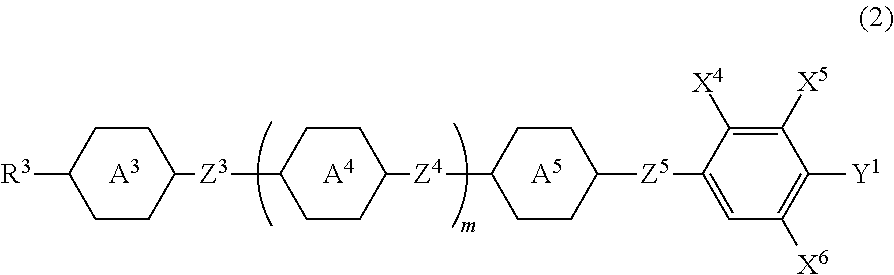


and preferably


and preferably


γ23−(γ12+γ13)<0 (a);
γ13−(γ12+γ23)>0 (b); and
γ12−(γ13+γ23)<0 (c),
where, in formulas (a) to (c), a
γ12=γ1+γ2−2(γ1 dγ2 d)1/2−2(γ1 hγ2 h)1/2;
γ13=γ1+γ3−2(γ1 dγ3 d)1/2−2(γ1 hγ3 h)1/2; and
γ23=γ2+γ3−2(γ2 dγ3 d)1/2−2(γ2 hγ3 h)1/2,
where, γ satisfies an equation: γ=γd+γh, a subscript d represents a non-polarity dispersion force component, and a subscript h represents a polar hydrogen bonding component.

where, R1 is —H, —CH3 or —CH2CH3, and R2 is —(CH2—)n (where, n is an integer from 1 to 40)); straight-chain or branched alkyl; cycloalkyl; aryl; and ethylenic unsaturated carboxylic acid selected from the group of a polyethylene oxide chain represented by formula —(CH2—CH2—O)p1— (where, p1 is an integer from 1 to 50), and a polypropylene oxide chain represented by formula —(CH(CH3)—CH2—O)p2— (where, p2 is an integer from 1 to 100).

where, R1 is —H and —CH3 or —CH2CH3, and R2 is —(CH2—)n (where, n is an integer from 1 to 40); straight-chain or branched alkyl; cycloalkyl; aryl; a polyethylene oxide chain represented by formula —(CH2—CH2—O—)p3 (where, p3 is an integer from 1 to 100) or a polypropylene oxide chain represented by formula —(CH(CH3)—CH2—O—)p4 (where, p4 is an integer from 1 to 100), and R3, R4, Y1, Y2 and Y3 may be —H, —CH3, —CH2CH3, branched or straight-chain alkyl, aryl, cycloalkyl or a combination thereof.

where, n is an integer from 1 to 100, R1 is —H, —CH3 or —CH2CH3, and R is selected from the group of H, OH, a methyl group, an ethyl group, a lauryl group, a stearyl group, a carboxyl group, an amino group and a combination thereof;

where, R1 is —H, —CH3 or —CH2CH3, and R2 is selected from the group of H, OH, a methyl group, a methylol group, an ethyl group, a lauryl group, a stearyl group, a carboxyl group, an amino group and a combination thereof, in addition, R3 is preferably selected from the group of acrylamide, methacrylamide, methylacrylamide, dimethylacrylamide, fumaramide, diacetone acrylamide, and dimethylmethacrylamide;

where R is an alkylene group such as —[CH2—]n (where, n is an integer from 1 to 4), where the cyclic amide is, for example, vinyl pyrrolidone (n=1) or vinylcaprolactam (n=2);

| TABLE 2 |
| JD-5039XX |
| 3-BB(F,F)XB(F,F)-F | 20% | ||
| 3-HH-4 | 5% | ||
| 3-HBB(F,F)-F | 4% | ||
| 2-HHB(F,F)-F | 10% | ||
| 3-HHB(F,F)-F | 10% | ||
| 3-H2HB(F,F)-F | 10% | ||
| 4-H2HB(F,F)-F | 5% | ||
| 5-H2HB(F,F)-F | 10% | ||
| 3-HH2B(F,F)-F | 5% | ||
| 2-HHBB(F,F)-F | 4% | ||
| 3-HHBB(F,F)-F | 5% | ||
| 4-HHBB(F,F)-F | 4% | ||
| 5-HHBB(F,F)-F | 5% | ||
| 3-HH2BB(F,F)-F | 3% |
| JD-5040XX |
| 1V2-BEB(F,F)-C | 22% | ||
| V2-BEB(F,F)-C | 4% | ||
| 2-BEB(F)-C | 4% | ||
| 3-BEB(F)-C | 4% | ||
| 3-H2BTB-2 | 6% | ||
| 3-H2BTB-3 | 6% | ||
| 3-H2BTB-4 | 6% | ||
| 3-HB(F)TB-2 | 8% | ||
| 3-HB(F)TB-3 | 8% | ||
| 3-HB(F)TB-4 | 8% | ||
| 2-BTB-O1 | 2% | ||
| 3-BTB-O1 | 2% | ||
| 4-BTB-O1 | 2% | ||
| 4-BTB-O2 | 2% | ||
| 5-BTB-O1 | 2% | ||
| 5-HBB(F)-2 | 7% | ||
| 5-HBB(F)-3 | 7% |
| JD-5037XX |
| 3-HHXB(F,F)-F | 12% | ||
| 3-BB(F)B(F,F)XB(F,F)-F | 2% | ||
| 4-BB(F)B(F,F)XB(F,F)-F | 9% | ||
| 5-BB(F)B(F,F)XB(F,F)-F | 9% | ||
| V2-HHB-1 | 13% | ||
| 3-HH-V | 34% | ||
| 3-HH-V1 | 12% | ||
| 3-BB(F,F)XB(F,F)-F | 9% |
| JD-5041XX |
| 3-BB(F)B(F,F)XB(F,F)-F | 2% | |||
| 4-BB(F)B(F,F)XB(F,F)-F | 8% | |||
| 5-BB(F)B(F,F)XB(F,F)-F | 8% | |||
| 3-BB(F)B(F,F)XB(F)-F | 3% | |||
| 3-BB(F,F)XB(F)B(F,F)-F | 6% | |||
| 3-BB(F,F)XB(F,F)-F | 9% | |||
| 3-HB(F)TB-2 | 5% | |||
| 3-HB(F)TB-3 | 5% | |||
| 3-HB(F)TB-4 | 5% | |||
| 3-H2BTB-2 | 4% | |||
| 3-H2BTB-3 | 4% | |||
| 2-BTB-01 | 8.2% | |||
| 3-BTB-01 | 8.2% | |||
| 4-BTB-01 | 8.2% | |||
| 4-BTB-02 | 8.2% | |||
| 5-BTB-01 | 8.2% | |||
| TABLE 2 |
| Method for Description of Compounds using Symbols |
| R—(A1)—Z1— . . . —Zn—(An)—R′ |
| 1) Left-terminal Group R— | Symbol |
| CnH2n+1— | n- |
| CnH2n+1O— | nO— |
| CmH2m+1OCnH2n— | mOn— |
| CH2═CH— | V— |
| CnH2n+1—CH═CH— | nV— |
| CH2═CH—CnH2n— | Vn— |
| CmH2m+1—CH═CH—CnH2n— | mVn— |
| CF2═CH— | VFF— |
| CF2═CH—CnH2n— | VFFn— |
| 2) Right-terminal Group —R′ | Symbol |
| —CnH2n+1 | -n |
| —OCnH2n+1 | —On |
| —CH═CH2 | —V |
| —CH═CH—CnH2n+1 | —Vn |
| —CnH2n—CH═CH2 | —nV |
| —CnH2n—CH═CH—CmH2m+1 | —nVm |
| —CH═CF2 | —VFF |
| —COOCH3 | —EMe |
| —F | —F |
| —Cl | —CL |
| —OCF3 | —OCF3 |
| —CF3 | —CF3 |
| —CN | —C |
| —OCH═CH—CF2H | —OVCF2H |
| —OCH═CH—CF3 | —OVCF3 |
| 3) Bonding Group —Zn— | Symbol |
| —C2H4— | 2 |
| —COO— | E |
| —CH═CH— | V |
| —C≡C— | T |
| —CF2O— | X |
| —CH2O— | 1O |
| 4) Ring Structure —An— | Symbol |
 |
H |
 |
Dh |
 |
dh |
 |
B |
 |
B(F) |
 |
B(2F) |
 |
B(F,F) |
 |
B(2F,5F) |
 |
G |
 |
Py |
| 5) Example of Description |
| Example 1. 3-BB(F)TB-2 |
 |
| Example 2. 3-BB(F)B(F,F)-F |
 |
| Example 3. 4-BB(F)B(F,F)XB(F,F)-F |
 |
| TABLE 3 | ||||||
| Surfactant | Monomer | Liquid Crystal Material | Initiator | |||
| Amount | Amount | Amount | AIBN | Average Particle | |||||
| Kind | (mg) | Kind | (mmol) | Kind | (mL) | (mmol) | Diameter nm | ||
| Example 1 | PDMAEMA39-b-PMMA22 | 10 | MMA | 2.8 | JD-5037XX | 0.70 | 0.028 | 80 ± 14 |
| Example 2 | PDMAEMA39-b-PMMA22 | 10 | MMA | 4.7 | JD-5037XX | 0.50 | 0.047 | 72 ± 16 |
| Example 3 | PDMAEMA39-b-PMMA22 | 10 | MMA | 2.6 | JD-5037XX | 0.50 | 0.048 | 62 ± 18 |
| DVB | 0.13 | |||||||
| Example 4 | PDMAEMA39-b-PMMA22 | 10 | ST | 2.7 | JD-5037XX | 0.70 | 0.027 | 121 ± 34 |
| Example 5 | PDMAEMA39-b-PMMA22 | 10 | ST | 2.6 | JD-5037XX | 0.70 | 0.028 | 90 ± 19 |
| DVB | 0.08 | |||||||
| Exampe 6 | PDMAEMA39-b-PMMA22 | 10 | ST | 4.5 | JD-5037XX | 0.50 | 0.045 | 140 ± 39 |
| Example 7 | PDMAEMA39-b-PMMA22 | 10 | ST | 4.3 | JD-5037XX | 0.50 | 0.046 | 116 ± 25 |
| DVB | 0.13 | |||||||
| MMA: Methyl methacrylate | ||||||||
| DVB: Divinylbenzene | ||||||||
| ST: Styrene | ||||||||
| TABLE 4 | ||||||
| Surfactant | Monomer | Liquid Crystal Material | Initiator | |||
| Amount | Amount | Amount | VA-044 | Average Particle | |||||
| Kind | (mg) | Kind | (mg) | Kind | (mg) | (mmol) | Diameter nm | ||
| Example 8 | PDMAEMA39-b-PMMA22 | 60 | ST | 108 | JD-5037XX | 12 | 0.046 | 49 ± 14 |
| Example 9 | PDMAEMA39-b-PMMA22 | 60 | ST | 95 | JD-5037XX | 24 | 0.046 | 55 ± 11 |
| DVB | 0.96 | |||||||
| Example 10 | PDMAEMA39-b-PMMA22 | 60 | ST | 95 | JD-5040XX | 24 | 0.046 | 35 ± 10 |
| DVB | 0.96 | |||||||
| Example 11 | PDMAEMA39-b-PMMA22 | 60 | ST | 150 | JD-5037XX | 150 | 0.071 | 41 ± 7 |
| Example 12 | PDMAEMA39-b-PMMA22 | 60 | ST | 150 | JD-5040XX | 150 | 0.071 | 66 ± 12 |
| Example 13 | PDMAEMA39-b-PMMA22 | 60 | ST | 148.5 | JD-5037XX | 150 | 0.071 | 38 ± 11 |
| DVB | 1.5 | |||||||
| Example 14 | PDMAEMA39-b-PMMA22 | 60 | ST | 148.5 | JD-5040XX | 150 | 0.071 | 63 ± 11 |
| DVB | 1.5 | |||||||
| Example 15 | PDMAEMA39-b-PMMA22 | 60 | MMA | 150 | JD-5040XX | 150 | 0.074 | 70 ± 14 |
| Example 16 | PDMAEMA39-b-PMMA22 | 60 | MMA | 142.5 | JD-5040XX | 150 | 0.074 | 70 ± 13 |
| EGDMA | 7.5 | |||||||
| Example 17 | PDMAEMA39-b-PMMA22 | 60 | MMA | 135 | JD-5040XX | 150 | 0.074 | 66 ± 18 |
| EGDMA | 15 | |||||||
| TABLE 5 | ||||||
| Surfactant | Monomer | Liquid Crystal Material | Initiator | |||
| Amount | Amount | Amount | VA-044 | Average Particle | |||||
| Kind | (mg) | Kind | (mg) | Kind | (mg) | (mmol) | Diameter nm | ||
| Example 18 | PDMAEMA39-b-PMMA22 | 60 | ST | 150 | JD-5039XX | 150 | 0.072 | 32 ± 9 |
| Example 19 | PDMAEMA39-b-PMMA22 | 60 | ST | 150 | JD-5041XX | 150 | 0.072 | 42 ± 11 |
| Example 20 | PDMAEMA43-b-PSt15 | 60 | ST | 150 | JD-5037XX | 150 | 0.072 | 36 ± 9 |
| Example 21 | PDMAEMA43-b-PSt15 | 60 | ST | 150 | JD-5041XX | 150 | 0.072 | 33 ± 9 |
| MMA: Methyl methacrylate | ||||||||
| DVB: Divinylbenzene | ||||||||
| ST: Styrene | ||||||||
| EGDMA: Ethyleneglycol dimethacrylate | ||||||||
Claims (7)
γ23−(γ12+γ13)<0 (a);
γ13−(γ12+γ23)>0 (b); and
γ12−(γ13+γ23)<0 (c),
γ12=γ1+γ2−2(γ1 dγ2 d)1/2−2(γ1 hγ2 h)1/2;
γ13=γ1+γ3−2(γ1 dγ3 d)1/2−2(γ1 hγ3 h)1/2; and
γ23=γ2+γ3−2(γ2 dγ3 d)1/2−2(γ2 hγ3 h)1/2,

Applications Claiming Priority (3)
| Application Number | Priority Date | Filing Date | Title |
|---|---|---|---|
| JP2014-177596 | 2014-09-02 | ||
| JP2014177596 | 2014-09-02 | ||
| PCT/JP2015/069882 WO2016035453A1 (en) | 2014-09-02 | 2015-07-10 | Liquid crystal capsule and method for producing same |
Publications (2)
| Publication Number | Publication Date |
|---|---|
| US20170246608A1 US20170246608A1 (en) | 2017-08-31 |
| US10441936B2 true US10441936B2 (en) | 2019-10-15 |
Family
ID=55439523
Family Applications (1)
| Application Number | Title | Priority Date | Filing Date |
|---|---|---|---|
| US15/506,251 Expired - Fee Related US10441936B2 (en) | 2014-09-02 | 2015-07-10 | Liquid crystal capsule and method for producing the same |
Country Status (5)
| Country | Link |
|---|---|
| US (1) | US10441936B2 (en) |
| JP (1) | JP6547972B2 (en) |
| KR (1) | KR20170046637A (en) |
| CN (1) | CN106575056B (en) |
| WO (1) | WO2016035453A1 (en) |
Families Citing this family (15)
| Publication number | Priority date | Publication date | Assignee | Title |
|---|---|---|---|---|
| WO2015162950A1 (en) * | 2014-04-25 | 2015-10-29 | Jnc株式会社 | Liquid crystal composition and liquid crystal display element |
| US20190127642A1 (en) * | 2016-04-13 | 2019-05-02 | Merck Patent Gmbh | Composition for nanoencapsulation and nanocapsules comprising a liquid-crystalline medium |
| JP2017214451A (en) * | 2016-05-30 | 2017-12-07 | Dic株式会社 | Composite resin particle |
| KR102598480B1 (en) * | 2016-10-27 | 2023-11-03 | 엘지디스플레이 주식회사 | Liquid Crystal Display Device Including Liquid Crystal Capsule And Method Of Fabricating The Same |
| KR102297989B1 (en) | 2017-04-13 | 2021-09-02 | 엘지디스플레이 주식회사 | Liquid Crystal Display Device And Method Of Fabricating The Same |
| JP2019028458A (en) * | 2017-07-28 | 2019-02-21 | Jnc株式会社 | Liquid crystal capsule and production method of the same |
| CN109304135A (en) * | 2017-07-28 | 2019-02-05 | 捷恩智株式会社 | Liquid crystal capsule and method for producing the same |
| CN109423300B (en) * | 2017-08-23 | 2020-10-30 | 江苏集萃智能液晶科技有限公司 | Process for producing monodisperse polymer microparticles |
| KR20190039639A (en) * | 2017-10-05 | 2019-04-15 | 메르크 파텐트 게엠베하 | Compositions comprising functionalized polyvinyl alcohol and nanocapsules containing a liquid-crystalline medium |
| CN108153062B (en) * | 2018-01-10 | 2020-08-04 | 京东方科技集团股份有限公司 | Alignment film, preparation method thereof, display substrate and display device |
| TW201936907A (en) * | 2018-02-06 | 2019-09-16 | 德商馬克專利公司 | Liquid-crystal medium |
| CN110358339A (en) * | 2018-04-09 | 2019-10-22 | 捷恩智株式会社 | Coating fluid and its functional membrane containing liquid crystal capsule |
| JP2020052176A (en) * | 2018-09-26 | 2020-04-02 | Jnc株式会社 | Liquid crystal capsule and manufacturing method therefor |
| JP2020063364A (en) * | 2018-10-17 | 2020-04-23 | Jnc株式会社 | Coating liquid containing liquid crystal capsule and its functional membrane |
| WO2021166746A1 (en) * | 2020-02-18 | 2021-08-26 | 日産化学株式会社 | Liquid crystal nanocapsules and method for producing same, and liquid crystal nanocapsule dispersion liquid and liquid crystal display element each containing said liquid crystal nanocapsules |
Citations (6)
| Publication number | Priority date | Publication date | Assignee | Title |
|---|---|---|---|---|
| JPH0867878A (en) | 1994-06-24 | 1996-03-12 | Dainippon Printing Co Ltd | Liquid crystal-containing / polymer microcapsules and liquid crystal electro-optical devices |
| JPH09236791A (en) | 1995-12-27 | 1997-09-09 | Toshiba Corp | Liquid crystal display device and manufacturing method thereof |
| JPH11183937A (en) | 1997-10-16 | 1999-07-09 | Toshiba Corp | Liquid crystal optical switch element, color shutter and color image display device |
| US6067135A (en) | 1995-12-27 | 2000-05-23 | Kabushiki Kaisha Toshiba | Liquid crystal display device and method of manufacturing the same |
| JP2009181040A (en) | 2008-01-31 | 2009-08-13 | Fuji Xerox Co Ltd | Water-based light-shielding coating composition for display device, insulating light-shielding film for display device, and display device |
| JP2010211182A (en) | 2009-02-16 | 2010-09-24 | Kobe Univ | Liquid crystal capsule and method for manufacturing the same |
Family Cites Families (4)
| Publication number | Priority date | Publication date | Assignee | Title |
|---|---|---|---|---|
| DE4232822C2 (en) * | 1991-09-30 | 1995-01-05 | Mazda Motor | Process for molding a liquid crystal resin composite |
| TWI417582B (en) * | 2009-02-03 | 2013-12-01 | Jiro Corporate Plan Inc | A polarizing element outer protective film, a polarizing film, and a liquid crystal display element |
| CN102417812A (en) * | 2011-09-28 | 2012-04-18 | 兰州理工大学 | Tetradecyl alcohol phase change microcapsules and preparation method thereof |
| WO2015130104A1 (en) * | 2014-02-26 | 2015-09-03 | 주식회사 엘지화학 | Method for preparing liquid crystal capsule |
-
2015
- 2015-07-10 KR KR1020177000899A patent/KR20170046637A/en not_active Ceased
- 2015-07-10 JP JP2016546372A patent/JP6547972B2/en not_active Expired - Fee Related
- 2015-07-10 CN CN201580044695.6A patent/CN106575056B/en not_active Expired - Fee Related
- 2015-07-10 WO PCT/JP2015/069882 patent/WO2016035453A1/en not_active Ceased
- 2015-07-10 US US15/506,251 patent/US10441936B2/en not_active Expired - Fee Related
Patent Citations (7)
| Publication number | Priority date | Publication date | Assignee | Title |
|---|---|---|---|---|
| JPH0867878A (en) | 1994-06-24 | 1996-03-12 | Dainippon Printing Co Ltd | Liquid crystal-containing / polymer microcapsules and liquid crystal electro-optical devices |
| JPH09236791A (en) | 1995-12-27 | 1997-09-09 | Toshiba Corp | Liquid crystal display device and manufacturing method thereof |
| US6067135A (en) | 1995-12-27 | 2000-05-23 | Kabushiki Kaisha Toshiba | Liquid crystal display device and method of manufacturing the same |
| JPH11183937A (en) | 1997-10-16 | 1999-07-09 | Toshiba Corp | Liquid crystal optical switch element, color shutter and color image display device |
| US6266109B1 (en) | 1997-10-16 | 2001-07-24 | Kabushiki Kaisha Toshiba | Liquid crystal optical switching element in which the liquid crystal material occupies more than 50% of the medium |
| JP2009181040A (en) | 2008-01-31 | 2009-08-13 | Fuji Xerox Co Ltd | Water-based light-shielding coating composition for display device, insulating light-shielding film for display device, and display device |
| JP2010211182A (en) | 2009-02-16 | 2010-09-24 | Kobe Univ | Liquid crystal capsule and method for manufacturing the same |
Non-Patent Citations (2)
| Title |
|---|
| "International Search Report (Form PCT/ISA/210) of PCT/JP2015/069882", with English translation thereof, dated Oct. 6, 2015, pp. 1-2. |
| Kang et al., "Optically-isotropic nanoencapsulated liquid crystal displays based on Kerr effect", Optics Express, Jun. 24, 2013, pp. 15719-15727. |
Also Published As
| Publication number | Publication date |
|---|---|
| US20170246608A1 (en) | 2017-08-31 |
| CN106575056B (en) | 2020-07-17 |
| JPWO2016035453A1 (en) | 2017-06-22 |
| KR20170046637A (en) | 2017-05-02 |
| WO2016035453A1 (en) | 2016-03-10 |
| CN106575056A (en) | 2017-04-19 |
| JP6547972B2 (en) | 2019-07-24 |
Similar Documents
| Publication | Publication Date | Title |
|---|---|---|
| US10441936B2 (en) | Liquid crystal capsule and method for producing the same | |
| JP6146412B2 (en) | Polymerizable compound, liquid crystal composition, and liquid crystal display device | |
| US20180022999A1 (en) | Compound having alkoxy group or alkoxyalkyl group, and saturated six-membered ring, liquid crystal composition and liquid crystal display device | |
| US9617477B2 (en) | Compound having four polymerizable groups, liquid crystal composition and liquid crystal display device | |
| JP6693425B2 (en) | Compound having polymerizable group, liquid crystal composition and liquid crystal display device | |
| JP7160050B2 (en) | Polymerizable compound having methoxymethyl acrylic group, liquid crystal composition, and liquid crystal display element | |
| US11531223B2 (en) | Liquid crystal device including insulating film, light control window and production method | |
| JP2012513482A5 (en) | ||
| TW201100526A (en) | Liquid crystal composition and liquid crystal display device | |
| WO2005116165A1 (en) | Polymerizable liquid crystal composition and optically anisotropic body | |
| US20140145113A1 (en) | Liquid crystal compound having cf2ocf3 at terminal, liquid crystal composition and liquid crystal display device | |
| US9546181B2 (en) | Compound having perfluoroalkyl terminal group and CF2O bonding group, liquid crystal composition and liquid crystal display device | |
| US20140203209A1 (en) | Compound having 3,3,3-trifluoro-1-propenyloxy, liquid crystal composition and liquid crystal display device | |
| US20150060732A1 (en) | Compound having 3,3-difluoro-1-propenyloxy, liquid crystal composition and liquid crystal display device | |
| JP6493677B2 (en) | Polar compound, liquid crystal composition, and liquid crystal display device | |
| JP6578690B2 (en) | Liquid crystal compound having halogenated alkyl, liquid crystal composition, and liquid crystal display device | |
| JP6451549B2 (en) | Polymerizable compound and liquid crystal display device | |
| TW201807174A (en) | Low molecular polar compound for homogeneously aligning liquid crystal medium, and liquid crystal medium containing same | |
| CN111225899A (en) | Polymerizable polar compound, liquid crystal composition, and liquid crystal display element | |
| US8956551B2 (en) | Liquid crystal compound having fluorovinyl group, liquid crystal composition and liquid crystal display device | |
| JP2009133921A5 (en) | ||
| TW201805408A (en) | Tetracyclic liquid crystalline compound having two atom-bonded group and 2, 3-difluorophenylene, liquid crystal composition and liquid crystal display element | |
| JP2017137240A (en) | Liquid crystal compound, liquid crystal composition, and liquid crystal display device | |
| US9133397B2 (en) | Tricyclic compound having a plurality of CF2O bonding groups, liquid crystal composition, and liquid crystal display device | |
| US20160168466A1 (en) | Compound having poly (difluoromethylene) chain, liquid crystal composition and liquid crystal display device |
Legal Events
| Date | Code | Title | Description |
|---|---|---|---|
| AS | Assignment |
Owner name: JNC PETROCHEMICAL CORPORATION, JAPAN Free format text: ASSIGNMENT OF ASSIGNORS INTEREST;ASSIGNORS:TANIGUCHI, TATSUO;HIDAKA, SHO;OKABE, EIJI;AND OTHERS;SIGNING DATES FROM 20161121 TO 20161202;REEL/FRAME:041479/0218 Owner name: NATIONAL UNIVERSITY CORPORATION CHIBA UNIVERSITY, Free format text: ASSIGNMENT OF ASSIGNORS INTEREST;ASSIGNORS:TANIGUCHI, TATSUO;HIDAKA, SHO;OKABE, EIJI;AND OTHERS;SIGNING DATES FROM 20161121 TO 20161202;REEL/FRAME:041479/0218 Owner name: JNC CORPORATION, JAPAN Free format text: ASSIGNMENT OF ASSIGNORS INTEREST;ASSIGNORS:TANIGUCHI, TATSUO;HIDAKA, SHO;OKABE, EIJI;AND OTHERS;SIGNING DATES FROM 20161121 TO 20161202;REEL/FRAME:041479/0218 |
|
| STPP | Information on status: patent application and granting procedure in general |
Free format text: FINAL REJECTION MAILED |
|
| STPP | Information on status: patent application and granting procedure in general |
Free format text: DOCKETED NEW CASE - READY FOR EXAMINATION |
|
| STPP | Information on status: patent application and granting procedure in general |
Free format text: NOTICE OF ALLOWANCE MAILED -- APPLICATION RECEIVED IN OFFICE OF PUBLICATIONS |
|
| STPP | Information on status: patent application and granting procedure in general |
Free format text: PUBLICATIONS -- ISSUE FEE PAYMENT VERIFIED |
|
| STCF | Information on status: patent grant |
Free format text: PATENTED CASE |
|
| FEPP | Fee payment procedure |
Free format text: MAINTENANCE FEE REMINDER MAILED (ORIGINAL EVENT CODE: REM.); ENTITY STATUS OF PATENT OWNER: LARGE ENTITY |
|
| LAPS | Lapse for failure to pay maintenance fees |
Free format text: PATENT EXPIRED FOR FAILURE TO PAY MAINTENANCE FEES (ORIGINAL EVENT CODE: EXP.); ENTITY STATUS OF PATENT OWNER: LARGE ENTITY |
|
| STCH | Information on status: patent discontinuation |
Free format text: PATENT EXPIRED DUE TO NONPAYMENT OF MAINTENANCE FEES UNDER 37 CFR 1.362 |
|
| FP | Lapsed due to failure to pay maintenance fee |
Effective date: 20231015 |