US10422809B2 - Electronic apparatus and program - Google Patents
Electronic apparatus and program Download PDFInfo
- Publication number
- US10422809B2 US10422809B2 US14/424,958 US201314424958A US10422809B2 US 10422809 B2 US10422809 B2 US 10422809B2 US 201314424958 A US201314424958 A US 201314424958A US 10422809 B2 US10422809 B2 US 10422809B2
- Authority
- US
- United States
- Prior art keywords
- traveling
- user
- speed
- pitch
- traveling speed
- Prior art date
- Legal status (The legal status is an assumption and is not a legal conclusion. Google has not performed a legal analysis and makes no representation as to the accuracy of the status listed.)
- Active, expires
Links
Images




Classifications
-
- G—PHYSICS
- G01—MEASURING; TESTING
- G01P—MEASURING LINEAR OR ANGULAR SPEED, ACCELERATION, DECELERATION, OR SHOCK; INDICATING PRESENCE, ABSENCE, OR DIRECTION, OF MOVEMENT
- G01P3/00—Measuring linear or angular speed; Measuring differences of linear or angular speeds
-
- G—PHYSICS
- G01—MEASURING; TESTING
- G01B—MEASURING LENGTH, THICKNESS OR SIMILAR LINEAR DIMENSIONS; MEASURING ANGLES; MEASURING AREAS; MEASURING IRREGULARITIES OF SURFACES OR CONTOURS
- G01B21/00—Measuring arrangements or details thereof, where the measuring technique is not covered by the other groups of this subclass, unspecified or not relevant
- G01B21/22—Measuring arrangements or details thereof, where the measuring technique is not covered by the other groups of this subclass, unspecified or not relevant for measuring angles or tapers; for testing the alignment of axes
-
- G—PHYSICS
- G01—MEASURING; TESTING
- G01C—MEASURING DISTANCES, LEVELS OR BEARINGS; SURVEYING; NAVIGATION; GYROSCOPIC INSTRUMENTS; PHOTOGRAMMETRY OR VIDEOGRAMMETRY
- G01C22/00—Measuring distance traversed on the ground by vehicles, persons, animals or other moving solid bodies, e.g. using odometers, using pedometers
- G01C22/006—Pedometers
-
- G—PHYSICS
- G01—MEASURING; TESTING
- G01P—MEASURING LINEAR OR ANGULAR SPEED, ACCELERATION, DECELERATION, OR SHOCK; INDICATING PRESENCE, ABSENCE, OR DIRECTION, OF MOVEMENT
- G01P21/00—Testing or calibrating of apparatus or devices covered by the preceding groups
- G01P21/02—Testing or calibrating of apparatus or devices covered by the preceding groups of speedometers
-
- G—PHYSICS
- G01—MEASURING; TESTING
- G01P—MEASURING LINEAR OR ANGULAR SPEED, ACCELERATION, DECELERATION, OR SHOCK; INDICATING PRESENCE, ABSENCE, OR DIRECTION, OF MOVEMENT
- G01P3/00—Measuring linear or angular speed; Measuring differences of linear or angular speeds
- G01P3/42—Devices characterised by the use of electric or magnetic means
- G01P3/50—Devices characterised by the use of electric or magnetic means for measuring linear speed
-
- G—PHYSICS
- G01—MEASURING; TESTING
- G01P—MEASURING LINEAR OR ANGULAR SPEED, ACCELERATION, DECELERATION, OR SHOCK; INDICATING PRESENCE, ABSENCE, OR DIRECTION, OF MOVEMENT
- G01P3/00—Measuring linear or angular speed; Measuring differences of linear or angular speeds
- G01P3/64—Devices characterised by the determination of the time taken to traverse a fixed distance
Definitions
- the present invention relates to an electronic apparatus and a program.
- a mobile electronic apparatus to which an acceleration sensor and the like are mounted to calculate a running speed or a walking speed of a user is known (for example, refer to Patent Document 1).
- Such an apparatus includes timekeeping means and step number measuring means, in which an average speed of the use is calculated based on a set step length, a kept time, and the number of steps, and the calculated average speed is notified to the user.
- Patent Document 1 Japanese Unexamined Utility Model Application, First Publication No. H2-59419
- the technique described in Patent Document 1 it is necessary to input a unique step length value of the user in advance.
- the user does not know his/her own step length value, the user cannot input the step length value. Therefore, an operation of detecting the step length value of the user using a method is required.
- the step length value may vary depending on the traveling status (whether the user walks or runs, and the speed thereof), and thus an error is likely to occur in the speed calculated based on only step length data.
- the present invention has been made in consideration of the above-described circumstances, and more accurately, has been made to provide an electronic apparatus capable of calculating a traveling speed of the user with high accuracy, and a program therefor.
- an electronic apparatus including: a storing unit that stores relational data indicating a relationship between a traveling pitch, which is the number of steps taken per predetermined amount of time, and a traveling speed which is a running speed or a walking speed; and a speed calculating unit that calculates a traveling speed of a user from a measured traveling pitch of the user based on the relational data stored in the storing unit.
- the electronic apparatus further includes: an acquiring unit that acquires a set of a measured traveling pitch and a traveling speed measured during measurement of the traveling pitch; and a correcting unit that corrects the relational data, which is stored in the storing unit, based on the set of the traveling pitch and the traveling speed acquired by the acquiring unit.
- the electronic apparatus further includes an input unit that receives an input of a body height or information relating to the body height, in which the storing unit stores the relational data indicating a relationship between a body height or information relating to the body height, a traveling pitch which is the number of steps taken per predetermined amount of time, and a traveling speed which is a running speed or a walking speed, and the speed calculating unit calculates the traveling speed of the user from the body height or the information relating to the body height, whose input is received by the input unit, and the measured traveling pitch of the user based on the relational data stored in the storing unit.
- the electronic apparatus further includes: an acquiring unit that acquires a plurality of sets of a measured traveling pitch and a traveling speed measured during measurement of the traveling pitch; and a generating unit that generates the relational data indicating the relationship between the traveling pitch and the traveling speed based on the plurality of sets of the traveling pitch and the traveling speed acquired by the acquiring unit.
- the acquiring unit receives an input of a set of a traveling pitch and a running quickness or a walking quickness.
- the electronic apparatus further includes a traveling distance calculating unit that calculates a traveling distance, which is a running distance or a walking distance of the user, based on the traveling speed calculated by the speed calculating unit.
- the electronic apparatus further includes a pace calculating unit that calculates a traveling pace, which is a walking pace or a running pace of the user, based on the traveling speed calculated by the speed calculating unit.
- the storing unit stores table data indicating a relationship between the traveling pitch and the traveling speed.
- the speed calculating unit calculates a traveling pace, which is a running pace or a walking pace of the user, instead of the traveling speed of the user.
- the electronic apparatus further includes: an acceleration sensor that detects an acceleration; and a traveling detection unit that measures the traveling pitch of the user based on an acceleration which is generated by a body movement relating to running or walking.
- an electronic apparatus including: a storing unit that stores relational data indicating a relationship between a traveling pitch, which is the number of steps taken per predetermined amount of time, and a traveling speed which is a running speed or a walking speed; an acquiring unit that acquires a set of a measured traveling pitch and a traveling speed measured during measurement of the traveling pitch; and a correcting unit that corrects the relational data, which is stored in the storing unit, based on the set of the traveling pitch and the traveling speed acquired by the acquiring unit.
- an electronic apparatus including: an acquiring unit that acquires a plurality of sets of a measured traveling pitch and a traveling speed measured during measurement of the traveling pitch; and a generating unit that generates relational data indicating a relationship between a traveling pitch, which is the number of steps taken per predeteimined amount of time, and a traveling speed, which is a running speed or a walking speed, based on the plurality of sets of the traveling pitch and the traveling speed acquired by the acquiring unit.
- a program causing a computer to execute: a step of calculating a traveling speed of a user from a measured traveling pitch of the user based on relational data indicating a relationship between the traveling pitch, which is the number of steps taken per predetermined amount of time, and the traveling speed which is a running speed or a walking speed.
- a program causing a computer to execute the following steps including: a step of acquiring a set of a measured traveling pitch and a traveling speed measured during measurement of the traveling pitch; and a step of correcting relational data indicating a relationship between a traveling pitch, which is the number of steps taken per predetermined amount of time, and a traveling speed, which is a running speed or a walking speed, based on the acquired set of the traveling pitch and the traveling speed.
- a program causing a computer to execute the following steps including: a step of calculating a traveling speed of a user from an input body height or input information relating to the body height and a measured traveling pitch of the user, based on relational data indicating a relationship between the body height or the information relating to the body height, the traveling pitch which is the number of steps taken per predetermined amount of time, and the traveling speed which is a running speed or a walking speed.
- a program causing a computer to execute the following steps including: a step of acquiring a plurality of sets of a measured traveling pitch and a traveling speed measured during measurement of the traveling pitch; and a step of generating relational data indicating a relationship between a traveling pitch, which is the number of steps taken per predetermined amount of time, and a traveling speed, which is a running speed or a walking speed, based on the acquired plurality of sets of the traveling pitch and the traveling speed.
- the relational data indicating a relationship between the traveling pitch and the traveling speed is stored in advance, and the traveling speed of the user is calculated from the measured traveling pitch of the user based on the relational data.
- a change in step length caused by a variation in traveling pitch is absorbed, and the traveling speed can be calculated with higher accuracy.
- FIG. 1 is a block diagram illustrating a configuration of a wristwatch according to a first embodiment of the present invention.
- FIG. 2 is a diagram illustrating plot data indicating a relationship between a traveling pitch and a traveling speed according to the first embodiment of the present invention.
- FIG. 3 is a diagram illustrating an example of relational data indicating the relationship between the traveling pitch and the traveling speed which is stored in a storing unit according to the first embodiment of the present invention.
- FIG. 4 is a diagram illustrating a method of correcting a relational expression according to the first embodiment of the present invention.
- FIG. 5 is a flowchart illustrating the procedure of a relational expression correcting process which is executed by a wristwatch according to the first embodiment of the present invention.
- FIG. 6 is a flowchart illustrating the procedure of a speed calculating process which is executed by the wristwatch according to the first embodiment of the present invention.
- FIG. 7 is a diagram illustrating an example of relational data indicating the relationship between the traveling pitch and the traveling speed which is stored in a storing unit according to a second embodiment of the present invention.
- FIG. 8 is a diagram illustrating a method of generating a relational expression according to the second embodiment of the present invention.
- FIG. 9 is a flowchart illustrating the procedure of a relational expression generating process which is executed by a wristwatch according to the second embodiment of the present invention.
- FIG. 10 is a diagram illustrating an example of relational data indicating a relationship between the traveling pitch, a body height, and the traveling speed which is stored in a storing unit according to a third embodiment of the present invention.
- FIG. 11 is a flowchart illustrating the procedure of a relational expression correcting process which is executed by a wristwatch according to the third embodiment of the present invention.
- FIG. 12 is a flowchart illustrating the procedure of a speed calculating process which is executed by the wristwatch according to the third embodiment of the present invention.
- FIG. 1 is a block diagram illustrating a configuration of a wristwatch 100 according to the embodiment.
- the wristwatch 100 is an electronic watch that measures a traveling pitch of the user, calculates a traveling speed of the user from the measured traveling pitch, and displays the calculated traveling speed.
- the traveling pitch is the number of steps taken per predetermined amount of time (for example, 1 minute).
- the traveling speed is a running speed or a walking speed.
- the wristwatch 100 includes two operation modes including: a measurement (chronograph) mode for measuring the traveling pitch; and a setup mode for changing the setting of the wristwatch 100 .
- the wristwatch 100 includes a processing unit 101 (speed calculating unit, acquiring unit, correcting unit, traveling distance calculating unit, pace calculating unit), a display unit 102 , a storing unit 103 , a power supply 104 , a traveling detection unit 105 , an acceleration sensor 106 , an input switch 107 (acquiring unit, input unit), a divider unit 108 , and a quartz oscillator unit 109 .
- a processing unit 101 speed calculating unit, acquiring unit, correcting unit, traveling distance calculating unit, pace calculating unit
- a display unit 102 includes a display unit 102 , a storing unit 103 , a power supply 104 , a traveling detection unit 105 , an acceleration sensor 106 , an input switch 107 (acquiring unit, input unit), a divider unit 108 , and a quartz oscillator unit 109 .
- a processing unit 101 speed calculating unit, acquiring unit, correcting unit, traveling distance calculating unit, pace calculating unit
- the processing unit 101 is a central processing unit that controls each unit included in the wristwatch 100 .
- the processing unit 101 calculates a traveling speed of the user from a traveling pitch of the user, which is measured by the traveling detection unit 105 , based on relational data indicating a relationship between the traveling pitch and the traveling speed which is stored in the storing unit 103 .
- the processing unit 101 corrects the relational data stored in the storing unit 103 based on a set of an actual traveling pitch and an actual traveling speed measured during measurement of the traveling pitch.
- the processing unit 101 calculates a traveling distance of the user based on the calculated traveling speed.
- the traveling distance is a walking distance or a running distance.
- the processing unit 101 calculates a traveling pace based on the calculated traveling speed.
- the traveling pace is a walking pace or a running pace and is the inverse number of the traveling speed.
- the processing unit 101 displays information relating to traveling on the display unit 102 . Examples of the information relating to traveling include a traveling time, the number of steps, the traveling pitch, the traveling speed, the traveling distance, and the traveling pace.
- the traveling time is a walking time or a running time.
- the processing unit 101 may realize a speed calculating function, which is a function of the wristwatch 100 , by executing a program for calculating the traveling speed.
- the program for calculating the traveling speed may be stored in the storing unit 103 or a memory (not illustrated), and the processing unit 101 may realize the speed calculating function by reading and executing the program.
- the wristwatch 100 includes the speed calculating unit that calculates the speed.
- the processing unit 101 may realize an acquiring function, which is a function of the wristwatch 100 , by executing a program for acquiring the set of the traveling pitch and the traveling speed.
- the program for acquiring the set of the traveling pitch and the traveling speed may be stored in the storing unit 103 or a memory (not illustrated), and the processing unit 101 may realize the acquiring function by reading and executing the program.
- the wristwatch 100 includes the acquiring unit that acquires the set of the traveling pitch and the traveling speed.
- the processing unit 101 may realize an correcting function, which is a function of the wristwatch 100 , by executing a program for correcting the relational data stored in the storing unit 103 .
- the program for correcting the relational data stored in the storing unit 103 may be stored in the storing unit 103 or a memory (not illustrated), and the processing unit 101 may realize the correcting function by reading and executing the program.
- the wristwatch 100 includes the correcting unit that corrects the relational data stored in the storing unit 103 .
- the processing unit 101 may realize a traveling distance calculating function, which is a function of the wristwatch 100 , by executing a program for calculating the traveling distance based on the traveling speed.
- the program for calculating the traveling distance based on the traveling speed may be stored in the storing unit 103 or a memory (not illustrated), and the processing unit 101 may realize the traveling distance calculating function by reading and executing the program.
- the wristwatch 100 includes the traveling distance calculating unit that calculates the traveling distance based on the traveling speed.
- the processing unit 101 may realize a pace calculating function, which is a function of the wristwatch 100 , by executing a program for calculating the running pace or the walking pace based on the traveling speed.
- the program for calculating the running pace or the walking pace based on the traveling speed may be stored in the storing unit 103 or a memory (not illustrated), and the processing unit 101 may realize the pace calculating function by reading and executing the program.
- the wristwatch 100 includes the pace calculating unit that calculates the running pace or the walking pace based on the traveling speed.
- the display unit 102 is, for example, a liquid crystal display and displays the clock time, information relating to the traveling, and the like.
- the storing unit 103 is configured of a ROM (Read Only Memory) 105 or a RAM (Random Access Memory) 106 and stores relational data indicating a relationship between the traveling pitch and the traveling speed.
- the power supply 104 supplies electrical power to each unit included in the wristwatch 100 .
- the acceleration sensor 106 detects an acceleration.
- the traveling detection unit 105 measures the traveling pitch of the user based on the acceleration detected by the acceleration sensor 106 .
- the traveling detection unit 105 measures the traveling pitch of the user based on the acceleration (for example, information relating to landing) which is generated by a body movement of running or walking.
- the traveling detection unit 105 detects a vibration of the body during walking or running to measure the number of steps.
- the traveling detection unit 105 measures the traveling pitch based on the measured traveling time and the measured number of steps.
- the input switch 107 is configured of a switch capable of being manipulated from the outside and is the input unit that receives an input.
- the input switch 107 receives an input of a set of an actual traveling pitch and an actual traveling quickness of the user.
- the traveling quickness refers to a walking quickness or a running quickness, for example, a traveling speed or a traveling pace.
- the input switch 107 receives an input of a gender of the user.
- the quartz oscillator unit 109 outputs a signal having a predetermined frequency.
- the divider unit 108 divides the frequency of the output signal of the quartz oscillator unit 109 at a predetermined division ratio and outputs a reference clock signal for the processing unit 101 or a clock signal for timekeeping.
- the processing unit 101 , the divider unit 108 , and the quartz oscillator unit 109 are the timekeeping units for measuring the time.
- the timekeeping unit realizes a stopwatch function for measuring the traveling time of the user or a clock function for displaying the present clock time.
- FIG. 2 is a diagram illustrating plot data indicating a relationship between the traveling pitch and the traveling speed. From the plot data 201 between the traveling pitch and the traveling speed illustrated in this drawing, it can be seen that there is a correlation between the traveling pitch and the traveling speed. For example, in general, when a person walks or runs, there are the following tendencies: the traveling pitch increases during a fast running (or walking) movement; and the traveling pitch decreases during a slow running (or walking) movement. Therefore, by preparing a predetermined relational expression, the traveling speed can be obtained from the traveling pitch. Accordingly, the storing unit 103 according to the embodiment stores relational data indicating a relationship between the traveling pitch and the traveling speed in advance.
- FIG. 3 is a diagram illustrating an example of relational data indicating the relationship between the traveling pitch and the traveling speed which is stored in the storing unit 103 according to the embodiment.
- the storing unit 103 stores expressions (hereinafter, referred to as “relational expression”) corresponding to male and female to calculate the traveling speed from the traveling pitch.
- relational expressions corresponding to the status “FACTORY SETTING (INITIAL STATUS)” are initial relational expressions which are stored in the storing unit 103 at the time of factory shipment.
- a gradient is a 1
- an offset is b 1
- an initial relational expression corresponding to female a gradient is a 2
- an offset is b 2 .
- a relational expression corresponding to the status “AFTER DATA SETTING OF USER” is a relational expression after correction.
- the processing unit 101 corrects the initial relational expression based on the set of the actual traveling pitch and the actual traveling speed of the user.
- FIG. 4 is a diagram illustrating a method of correcting a relational expression according to the embodiment.
- the horizontal axis represents the traveling pitch
- the vertical axis represents the traveling speed.
- a dotted line 301 represents the initial relational expression.
- a solid line 302 represents the relational expression after correction.
- the processing unit 101 changes the offset of the initial relational expression 301 so as to pass through the set (actual traveling pitch, actual traveling speed) 303 of the actual traveling pitch and the actual traveling speed. At this time, the processing unit 101 does not change the gradient of the initial relational expression 301 .
- the processing unit 101 corrects the relational expression by changing the offset of the initial relational expression corresponding to male from b 1 to a user coefficient b s1 .
- the processing unit 101 corrects the relational expression by changing the offset of the initial relational expression corresponding to female from b 2 to a user coefficient b s2 .
- the relational expression after correction stored in the storing unit 103 can be changed by a manual input from the input switch 107 .
- the set of the actual traveling pitch and the actual traveling speed of the user can be measured by the user actually traveling a predetermined distance d.
- the predetermined distance d is set in the wristwatch 100 in advance.
- the value of the predetermined distance d set in the wristwatch 100 can be changed by the user through the input switch 107 or the like. For example, the user may input a running distance or a walking distance after running or walking.
- the processing unit 101 measures the traveling time where the user travels the predetermined distance d.
- the processing unit 101 calculates the actual traveling speed by dividing the predetermined distance d by the traveling time.
- the traveling detection unit 105 calculates the actual traveling pitch by measuring the number of steps when the user travels the predetermined distance d, and dividing the measured number of steps by the traveling time.
- the user may measure the actual traveling pitch and the actual traveling quickness using a method and then may input the actual traveling pitch and the actual traveling quickness through the input switch 107 and data transmission.
- the relational expression is corrected or generated, it is not necessary that the user actually travel.
- the set of the actual traveling pitch and the actual traveling speed of the user may be acquired from another electronic apparatus using communication means (not illustrated).
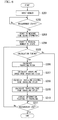
- FIG. 5 is a flowchart illustrating the procedure of the relational expression correcting process which is executed by the wristwatch 100 according to the embodiment.
- the wristwatch 100 executes the relational expression correcting process during the setup mode. During the setup mode, the user inputs an instruction to start the measurement and starts traveling. Next, once the user travels the predetermined distance d, the user inputs an instruction to end the measurement.
- Step S 101 The processing unit 101 displays the gender (male or female) on the display unit 102 to be selectable and receives an input of the selection of the gender. The user selects the gender through the input switch 107 . Next, the process proceeds to Step S 102 .
- Step S 102 The processing unit 101 determines whether or not an instruction to start the measurement is input from the input switch 107 . When the instruction to start the measurement is input, the process proceeds to Step S 103 . When the instruction to start the measurement is not input, the process returns to Step S 102 .
- Step S 103 The processing unit 101 starts to measure the traveling time using the stopwatch function. Next, the process proceeds to Step S 104 .
- Step S 104 The processing unit 101 starts to measure the number of steps using the traveling detection unit 105 . Next, the process proceeds to Step S 105 .
- Step S 105 The processing unit 101 determines whether or not an instruction to end the measurement is input from the input switch 107 .
- the processing unit 101 ends the timekeeping of the stopwatch and the measurement of the number of steps.
- the process proceeds to Step S 106 .
- the user walks or runs the predetermined distance d during a period from the input of the instruction to start the measurement to the input of the instruction to end the measurement.
- the processing unit 101 returns to Step S 105 .
- Step S 106 The traveling detection unit 105 calculates the traveling pitch by dividing the measured number of steps by the measured traveling time. Next, the process proceeds to Step S 107 .
- Step S 107 The processing unit 101 calculates the traveling speed by dividing the predetermined distance d by the measured traveling time. Next, the process proceeds to Step S 108 .
- Step S 108 The processing unit 101 corrects the relational expression using the set of the traveling pitch calculated in Step S 106 and the traveling speed calculated in Step S 107 . Specifically, first, the processing unit 101 reads the initial relational expression corresponding to the gender input in Step S 101 from the storing unit 103 . The processing unit 101 changes the offset of the read relational expression and corrects the relational expression so as to pass through the set of the calculated traveling pitch and the calculated traveling speed. The processing unit 101 writes the corrected relational expression into the storing unit 103 as the relational expression after correction. Next, the relational expression correcting process ends.
- FIG. 6 is a flowchart illustrating the procedure of a speed calculating process which is executed by the wristwatch 100 according to the embodiment.
- the wristwatch 100 executes the speed calculating process during the measurement mode.
- Step S 201 The processing unit 101 displays the gender (male or female) on the display unit 102 to be selectable and receives an input of the selection of the gender. The user selects the gender through the input switch 107 . Next, the process proceeds to Step S 202 .
- Step S 202 The processing unit 101 determines whether or not an instruction to start the measurement is input from the input switch 107 . When the instruction to start the measurement is input, the process proceeds to Step S 203 . When the instruction to start the measurement is not input, the process returns to Step S 202 .
- Step S 203 The processing unit 101 starts to measure the traveling time using the stopwatch function. Next, the process proceeds to Step S 204 .
- Step S 204 The processing unit 101 starts to measure the number of steps using the traveling detection unit 105 . Next, the process proceeds to Step S 205 .
- Step S 205 The processing unit 101 determines whether or not a calculation timing is reached.
- the calculation timing is the preset timing at which information relating to running is calculated, and is, for example, per second.
- the processing unit 101 proceeds to Step S 206 .
- the processing unit 101 proceeds to Step S 211 .
- Step S 206 The traveling detection unit 105 calculates the traveling pitch by dividing the measured number of steps by the measured traveling time. Next, the process proceeds to Step S 207 .
- Step S 207 The processing unit 101 calculates the traveling speed from the traveling pitch calculated in Step S 206 . Specifically, the processing unit 101 reads the relational expression after correction from the storing unit 103 , and substitutes the calculated traveling pitch into the read relational expression to calculate the traveling speed. When the relational expression after correction is not stored in the storing unit 103 , the processing unit 101 calculates the traveling speed from the traveling pitch using the initial relational expression corresponding to the gender input in Step S 101 . Next, the process proceeds to Step S 208 .
- Step S 208 The processing unit 101 calculates the traveling distance by multiplying the traveling speed calculated in Step S 207 by the measured time. Next, the process proceeds to Step S 209 .
- Step S 209 The processing unit 101 calculates the traveling pace by calculating the inverse number of the traveling speed calculated in Step S 207 . Next, the process proceeds to Step S 210 .
- Step S 210 The processing unit 101 displays information relating to traveling on the display unit 102 .
- the information relating to traveling includes the measured number of steps, the measured traveling time, the traveling pitch, the traveling speed, the traveling distance, and the traveling pace.
- the process proceeds to Step S 211 .
- Step S 211 The processing unit 101 determines whether or not an instruction to end the measurement is input from the input switch 107 .
- the processing unit 101 ends the timekeeping of the stopwatch and the measurement of the number of steps.
- the speed calculating process ends.
- the processing unit 101 returns to Step S 205 .
- the storing unit 103 stores the relational data indicating the relationship between the traveling pitch and the traveling speed in advance.
- the processing unit 101 calculates the traveling speed from the traveling pitch, which is measured by the traveling detection unit 105 , based on the relational data stored in the storing unit 103 .
- the traveling speed can be directly calculated from the measured traveling pitch without using a step length which is a fixed value. Therefore, the process highly corresponding to the running status (or walking status) can be performed, and the traveling speed can be calculated with few errors.
- the processing unit 101 corrects the relational expression, which is stored in the storing unit 103 , based on the set of the actual traveling pitch and the actual traveling speed.
- a relationship between the traveling pitch and the traveling speed which is suited to the user is set, and the traveling speed is calculated from the traveling pitch based on the set relationship. Therefore, a change in step length caused by a variation in traveling pitch is absorbed, and the traveling speed can be calculated with higher accuracy. As a result, the traveling distance and the traveling pace can also be calculated with higher accuracy.
- a wristwatch 100 according to this embodiment has the same configuration as that of the wristwatch 100 according to the first embodiment.
- This embodiment has a difference from the first embodiment, in that the processing unit 101 (generating unit) generates the relational expression from the plural sets of the actual traveling pitch and the actual traveling speed.
- the processing unit 101 calculates the traveling speed from the traveling pitch, which is measured by the traveling detection unit 105 , using the generated relational expression.
- the processing unit 101 may realize a generating function, which is a function of the wristwatch 100 , by executing a program for generating the relational data indicating the relationship between the traveling pitch and the traveling speed based on plural sets of the traveling pitch and the traveling speed.
- the program for generating the relational data indicating the relationship between the traveling pitch and the traveling speed based on plural sets of the traveling pitch and the traveling speed may be stored in the storing unit 103 or a memory (not illustrated), and the processing unit 101 may realize the generating function by reading and executing the program.
- the wristwatch 100 includes a generating unit that generates the relational data indicating the relationship between the traveling pitch and the traveling speed based on the plural sets of the traveling pitch and the traveling speed.
- FIG. 7 is a diagram illustrating an example of the relational data indicating the relationship between the traveling pitch and the traveling speed which is stored in the storing unit 103 according to the embodiment.
- the storing unit 103 stores primary expressions for calculating the traveling speed from the traveling pitch.
- the initial relational expressions corresponding to the status “FACTORY SETTING (INITIAL STATUS)” are the same as those of the first embodiment.
- the relational expressions corresponding to the status “AFTER DATA SETTING OF USER” are the relational expressions which are generated by the processing unit 101 from the plural sets of the actual traveling pitch and the actual traveling speed.
- FIG. 8 is a diagram illustrating a method of generating a relational expression according to the embodiment.
- the horizontal axis represents the traveling pitch
- the vertical axis represents the traveling speed.
- a solid line 702 represents the relational expression after generation.
- the processing unit 101 obtains an approximate straight line (primary expression) from plural sets (actual traveling pitch, actual traveling speed) 701 a to 701 c of the actual traveling pitch and the actual traveling speed using a least-square method, and the obtained primary expression is set as the relational expression after generation.
- a gradient may be obtained from the sets 701 a to 701 c using a least-square method, and the offset which passes through the set 701 b corresponding to normal traveling may be obtained.
- the processing unit 101 generates the relational expressions based on three sets including: the set 701 a of the traveling pitch and the traveling speed corresponding to fast traveling; the set 701 b of the traveling pitch and the traveling speed corresponding to normal traveling; and the set 701 c of the traveling pitch and the traveling speed corresponding to slow traveling.
- a method of acquiring the sets of the actual traveling pitch and the actual traveling speed is the same as in that of the first embodiment.
- the user may measure the actual traveling pitch and the actual traveling quickness using a method multiple times and then may input the plural actual traveling pitches and the plural actual traveling quicknesses through the input switch 107 and data transmission.
- the relational expression after generation stored in the storing unit 103 can be changed by a manual input from the input switch 107 .
- FIG. 9 is a flowchart illustrating the procedure of a relational expression generating process which is executed by the wristwatch 100 according to the embodiment.
- the wristwatch 100 executes the relational expression generating process during the setup mode.
- the user inputs an instruction to start the measurement and starts traveling.
- the user inputs an instruction to end the measurement.
- Step S 301 to Step S 306 are the same as the above-described processes of Step S 102 to Step S 107 , the description thereof will be omitted.
- Step S 307 the processing unit 101 determines whether or not the traveling pitch and the traveling speed are measured through the processes of Step S 301 to Step S 306 a predetermined number of times ⁇ (wherein a represents an integer of 2 or more).
- a represents an integer of 2 or more.
- the process proceeds to Step S 308 .
- the process returns to Step S 301 .
- Step S 308 The processing unit 101 generates the relational expression from the a number of sets of the traveling pitch and the traveling speed which are measured by repeating the processes of Step S 301 to Step S 306 the predetermined number of times ⁇ . Specifically, the processing unit 101 generates the primary expression from the a number of sets of the measured traveling pitch and the measured traveling speed to calculate the traveling speed from the traveling pitch using a least-square method. The processing unit 101 writes the generated primary expression into the storing unit 103 as the relational expression after generation. Next, the relational expression generating process ends.
- the speed calculating process of calculating the traveling speed from the traveling pitch is the same as that of the first embodiment.
- the processing unit 101 generates the relational expression indicating the relationship between the traveling pitch and the traveling speed based on the plural sets of the actual traveling pitch and the actual traveling speed.
- a relationship between the traveling pitch and the traveling speed which is suited to the user is set, and the traveling speed is calculated from the traveling pitch based on the set relationship. Therefore, a change in step length caused by a variation in traveling pitch is absorbed, and the traveling speed can be calculated with higher accuracy. As a result, the traveling distance and the traveling pace can also be calculated with higher accuracy.
- a wristwatch 100 according to this embodiment has the same configuration as that of the wristwatch 100 according to the first embodiment.
- This embodiment has a difference from the first embodiment, in that the traveling speed is calculated using a relationship between the traveling pitch, a body height or information relating to the body height, and the traveling speed.
- FIG. 10 is a diagram illustrating an example of relational data indicating a relationship between the traveling pitch, a body height, and the traveling speed which is stored in the storing unit 103 according to the embodiment.
- Information relating to the body height may be used instead of the body height. Examples of the information relating to the body height include an inseam length and a physical constitution (S, M, L).
- the storing unit 103 stores expressions (hereinafter, referred to as “relational expression”) corresponding to male and female to calculate the traveling speed from the traveling pitch and the body height.
- the relational expressions corresponding to the status “FACTORY SETTING (INITIAL STATUS)” are initial relational expressions which are stored in the storing unit 103 at the time of factory shipment.
- a gradient is a 1
- an offset is b 1 .
- an initial relational expression corresponding to female a gradient is a 2
- an offset is b 2 .
- a relational expression corresponding to the status “AFTER DATA SETTING OF USER” is a relational expression after correction.
- the processing unit 101 corrects the initial relational expression based on the set of the input body height, the actual traveling pitch, and the actual traveling speed of the user.
- a method of correcting a relational expression according to the embodiment will be described with reference to FIG. 4 .
- a dotted line 301 represents the initial relational expression.
- a solid line 302 represents the relational expression after correction.
- the processing unit 101 changes the offset of the initial relational expression 301 so as to pass through the set (actual traveling pitch, actual traveling speed) 303 of the actual traveling pitch and the actual traveling speed.
- the processing unit 101 does not change the gradient of the initial relational expression 301 .
- the processing unit 101 corrects the relational expression by changing the offset of the initial relational expression corresponding to male from d 1 to a user coefficient d s1 .
- the processing unit 101 corrects the relational expression by changing the offset of the initial relational expression corresponding to female from d 2 to a user coefficient d s2 .
- the relational expression after correction stored in the storing unit 103 can be changed by a manual input from the input switch 107 .
- the set of the actual traveling pitch and the actual traveling speed of the user can be measured by the user actually traveling a predetermined distance d.
- the predetermined distance d is set in the wristwatch 100 in advance.
- the value of the predetermined distance d set in the wristwatch 100 can be changed by the user through the input switch 107 or the like. For example, the user may input a running distance or a walking distance after running or walking.
- the processing unit 101 measures the traveling time where the user travels the predetermined distance d.
- the processing unit 101 calculates the actual traveling speed by dividing the predetermined distance d by the traveling time.
- the traveling detection unit 105 calculates the actual traveling pitch by measuring the number of steps when the user travels the predetermined distance d, and dividing the measured number of steps by the traveling time.
- the user may measure the actual traveling pitch and the actual traveling quickness using a method and then may input the actual traveling pitch and the actual traveling quickness through the input switch 107 and data transmission.
- the relational expression is corrected or generated, it is not necessary that the user actually travel.
- FIG. 11 is a flowchart illustrating the procedure of the relational expression correcting process which is executed by the wristwatch 100 according to the embodiment.
- the wristwatch 100 executes the relational expression correcting process during the setup mode.
- the setup mode the user inputs an instruction to start the measurement and starts traveling.
- the user inputs an instruction to end the measurement.
- Step S 401 The processing unit 101 displays a body height input screen on the display unit 102 and receives an input of the body height. The user inputs the body height through the input switch 107 . Next, the process proceeds to Step S 402 .
- Step S 402 to Step S 408 are the same as those of Step S 101 to Step S 107 in the first embodiment.
- Step S 409 The processing unit 101 corrects the relational expression from the body height, whose input is received in the process of Step S 401 , and the set of the traveling pitch calculated in Step S 407 and the traveling speed calculated in Step S 408 . Specifically, first, the processing unit 101 reads the initial relational expression corresponding to the gender input in Step S 402 from the storing unit 103 . The processing unit 101 changes the offset of the read relational expression and corrects the relational expression so as to pass through the set of the calculated traveling pitch and the calculated traveling speed. The processing unit 101 writes the corrected relational expression into the storing unit 103 as the relational expression after correction Next, the relational expression correcting process ends.
- FIG. 12 is a flowchart illustrating the procedure of a speed calculating process which is executed by the wristwatch 100 according to the embodiment.
- the wristwatch 100 executes the speed calculating process during the measurement mode.
- Step S 501 The processing unit 101 displays a body height input screen on the display unit 102 and receives an input of the body height. The user inputs the body height through the input switch 107 . Next, the process proceeds to Step S 502 .
- Step S 502 to Step S 507 are the same as those of Step S 201 to Step S 206 in the first embodiment.
- Step S 508 The processing unit 101 calculates the traveling speed from the traveling pitch calculated in Step S 507 . Specifically, the processing unit 101 reads the relational expression after correction from the storing unit 103 . Next, the processing unit 101 substitutes the body height, which is input in the process of Step S 501 , and the traveling pitch, which is calculated in the process of Step S 507 , into the read relational expression to calculate the traveling speed. When the relational expression after correction is not stored in the storing unit 103 , the processing unit 101 calculates the traveling speed from the input body height and the calculated traveling pitch using the initial relational expression corresponding to the gender input in Step S 101 . Next, the process proceeds to Step S 509 .
- Step S 509 to Step S 512 are the same as those of Step S 208 to Step S 211 in the first embodiment.
- the storing unit 103 stores the relational data indicating the relationship between the body height or the information relating to the body height, the traveling pitch, and the traveling speed in advance.
- the processing unit 101 calculates the traveling speed from the traveling pitch, which is measured by the traveling detection unit 105 , based on the relational data stored in the storing unit 103 .
- the traveling speed can be directly calculated from the measured traveling pitch without using a step length which is a fixed value. Therefore, the process highly corresponding to the running status (or walking status) can be performed, and the traveling speed can be calculated with few errors.
- the processing unit 101 corrects the relational expression, which is stored in the storing unit 103 , based on the set of the input body height or the input information relating to the body height, the set of the actual traveling pitch and the actual traveling speed.
- a relationship between the traveling pitch and the traveling speed which is suited to the body height or the physical constitution of the user is set, and the traveling speed is calculated from the traveling pitch based on the set relationship. Therefore, a change in step length caused by a variation in traveling pitch is absorbed, and the traveling speed can be calculated with higher accuracy. As a result, the traveling distance and the traveling pace can also be calculated with higher accuracy.
- a part or all of the functions of the respective units included in the wristwatches 100 according to the first embodiment to the third embodiment described above may be realized by recording a program for realizing these functions on a computer-readable recording medium and causing a computer system to read and execute this program recorded on the recording medium.
- the “computer system” described herein includes OS and hardware such as peripheral devices.
- the “computer-readable recording medium” includes portable mediums such as a flexible disc, a magneto-optic disc, a ROM, and a CD-ROM; and storages such as a hard disc built into a computer system, but is not necessarily limited thereto.
- the following mediums may be used: mediums on which a program is dynamically stored for a short period of time, for example, a network such as the Internet or a communication line such as a telephone line through which a program is transmitted; and mediums on which a program is stored for a predetermined amount of time, for example, a volatile memory which is built into a computer system functioning as a server or a client.
- the program may realize a part of the above-described functions or may realize the above-described functions in combination with a program stored in a computer system in advance.
- the relational expression indicating the relationship between the traveling pitch and the traveling speed is the primary expression, but the present invention is not limited thereto.
- the relational expression indicating the relationship between the traveling pitch and the traveling speed may be a quadratic equation or a cubic expression.
- the storing unit 103 stores the relational expression indicating the relationship between the traveling pitch and the traveling speed, but the present invention is not limited thereto.
- the relational data the storing unit 103 may store table data indicating the relationship between the traveling pitch and the traveling speed.
- the traveling detection unit 105 calculates the traveling pitch based on the traveling time and the measured number of steps, but the present invention is not limited thereto.
- the traveling pitch may be obtained using information relating to landing (information relating to a running (or walking) signal) based on the acceleration detected by the acceleration sensor 106 .
- the traveling detection unit 105 may calculate the traveling pitch by measuring an interval (time interval) between steps.
- the processing unit 101 calculates the traveling speed from the measured traveling pitch, but the present invention is not limited thereto.
- the processing unit 101 may calculate the traveling pace from the traveling pitch instead of the traveling speed.
- the wristwatch 100 has been described as an example of the electronic apparatus.
- other electronic apparatuses such as a pedometer, a mobile phone, and a smart phone may be used as long as the user can carry them.
- the electronic apparatus according to the present invention is applicable to a mobile electronic apparatus to which an acceleration sensor and the like are mounted to calculate a running speed or a walking speed of a user.
Landscapes
- Physics & Mathematics (AREA)
- General Physics & Mathematics (AREA)
- Engineering & Computer Science (AREA)
- Radar, Positioning & Navigation (AREA)
- Remote Sensing (AREA)
- Measurement Of Distances Traversed On The Ground (AREA)
- Electric Clocks (AREA)
Abstract
Description
- 100 WRISTWATCH
- 101 PROCESSING UNIT
- 102 DISPLAY UNIT
- 103 STORING UNIT
- 104 POWER SUPPLY
- 105 TRAVELING DETECTION UNIT
- 106 ACCELERATION SENSOR
- 107 INPUT SWITCH
- 108 IVIDER UNIT
- 109 QUARTZ OSCILLATOR UNIT
Claims (11)
Applications Claiming Priority (5)
| Application Number | Priority Date | Filing Date | Title |
|---|---|---|---|
| JP2012193255 | 2012-09-03 | ||
| JP2012-193256 | 2012-09-03 | ||
| JP2012-193255 | 2012-09-03 | ||
| JP2012193256 | 2012-09-03 | ||
| PCT/JP2013/071510 WO2014034403A1 (en) | 2012-09-03 | 2013-08-08 | Electronic apparatus and program |
Publications (2)
| Publication Number | Publication Date |
|---|---|
| US20150241459A1 US20150241459A1 (en) | 2015-08-27 |
| US10422809B2 true US10422809B2 (en) | 2019-09-24 |
Family
ID=50183220
Family Applications (2)
| Application Number | Title | Priority Date | Filing Date |
|---|---|---|---|
| US14/424,951 Abandoned US20150226763A1 (en) | 2012-09-03 | 2013-08-08 | Electronic apparatus and program |
| US14/424,958 Active 2035-03-09 US10422809B2 (en) | 2012-09-03 | 2013-08-08 | Electronic apparatus and program |
Family Applications Before (1)
| Application Number | Title | Priority Date | Filing Date |
|---|---|---|---|
| US14/424,951 Abandoned US20150226763A1 (en) | 2012-09-03 | 2013-08-08 | Electronic apparatus and program |
Country Status (4)
| Country | Link |
|---|---|
| US (2) | US20150226763A1 (en) |
| EP (2) | EP2894481A4 (en) |
| JP (2) | JP6361880B2 (en) |
| WO (2) | WO2014034403A1 (en) |
Families Citing this family (4)
| Publication number | Priority date | Publication date | Assignee | Title |
|---|---|---|---|---|
| JP2015184159A (en) * | 2014-03-25 | 2015-10-22 | セイコーエプソン株式会社 | Correlation coefficient correction method, motion analysis method, correlation coefficient correction apparatus, and program |
| JP2016014605A (en) * | 2014-07-02 | 2016-01-28 | セイコーインスツル株式会社 | Electronic equipment and programs |
| JP6089056B2 (en) * | 2015-03-25 | 2017-03-01 | 日本電信電話株式会社 | Exercise state analysis system and method, apparatus and program thereof |
| KR102266673B1 (en) * | 2017-01-19 | 2021-06-17 | 후아웨이 테크놀러지 컴퍼니 리미티드 | Step counting method and device of treadmill |
Citations (18)
| Publication number | Priority date | Publication date | Assignee | Title |
|---|---|---|---|---|
| JPH0259419A (en) | 1988-08-26 | 1990-02-28 | Natl Res Inst For Metals | Manufacturing method of metal boride fiber |
| JPH06273546A (en) | 1993-03-22 | 1994-09-30 | Seiko Instr Inc | Pace generator |
| JPH1033000A (en) | 1996-07-15 | 1998-02-03 | Toshiba Corp | Induction motor control device |
| JP2001173571A (en) | 1999-12-16 | 2001-06-26 | Seiko Seiki Co Ltd | Temperature control apparatus using variable displacement gas compressor and temperature control method |
| JP2005049202A (en) | 2003-07-28 | 2005-02-24 | Asahi Kasei Electronics Co Ltd | Walking time operation device and walking distance operation device using it |
| JP2006118909A (en) | 2004-10-20 | 2006-05-11 | Matsushita Electric Works Ltd | Walking meter |
| JP2007093939A (en) | 2005-09-28 | 2007-04-12 | Toshiba Matsushita Display Technology Co Ltd | Liquid crystal display, electronic device, its manufacturing method,program, and recording medium |
| EP1903311A2 (en) | 2006-09-21 | 2008-03-26 | Seiko Instruments Inc. | Pedometer |
| JP2008292294A (en) | 2007-05-24 | 2008-12-04 | Seiko Instruments Inc | Speedometer |
| JP2008292295A (en) | 2007-05-24 | 2008-12-04 | Seiko Instruments Inc | Speedometer |
| US20090043531A1 (en) | 2007-08-08 | 2009-02-12 | Philippe Kahn | Human activity monitoring device with distance calculation |
| JP2009276282A (en) | 2008-05-16 | 2009-11-26 | Sumitomo Electric Ind Ltd | Attitude determination apparatus and method, movement direction determination apparatus, position determination apparatus, and computer program |
| US20100010774A1 (en) | 2008-07-10 | 2010-01-14 | Perception Digital Ltd. | Apparatus and a method for monitoring physical exercise |
| JP2010017525A (en) | 2008-06-09 | 2010-01-28 | Tanita Corp | Action determining apparatus and action determining method |
| JP2010085285A (en) | 2008-09-30 | 2010-04-15 | Toshiba Corp | Portable communication terminal |
| US8082122B2 (en) | 2006-12-12 | 2011-12-20 | Samsung Electronics Co., Ltd. | Mobile device having a motion detector |
| US20120084053A1 (en) | 2010-09-30 | 2012-04-05 | Shelten Gee Jao Yuen | Portable monitoring devices and methods of operating same |
| US20130261962A1 (en) * | 2012-03-30 | 2013-10-03 | Sony Corporation | Information processing apparatus, information processing method, and program |
Family Cites Families (2)
| Publication number | Priority date | Publication date | Assignee | Title |
|---|---|---|---|---|
| JPH0259419U (en) | 1988-10-26 | 1990-05-01 | ||
| JP3598352B2 (en) * | 1994-06-08 | 2004-12-08 | カシオ計算機株式会社 | Portable electronic equipment |
-
2013
- 2013-08-08 US US14/424,951 patent/US20150226763A1/en not_active Abandoned
- 2013-08-08 JP JP2014532908A patent/JP6361880B2/en not_active Expired - Fee Related
- 2013-08-08 US US14/424,958 patent/US10422809B2/en active Active
- 2013-08-08 EP EP13832060.1A patent/EP2894481A4/en not_active Ceased
- 2013-08-08 JP JP2014532907A patent/JPWO2014034403A1/en active Pending
- 2013-08-08 EP EP13832269.8A patent/EP2894482A4/en not_active Ceased
- 2013-08-08 WO PCT/JP2013/071510 patent/WO2014034403A1/en not_active Ceased
- 2013-08-08 WO PCT/JP2013/071515 patent/WO2014034404A1/en not_active Ceased
Patent Citations (18)
| Publication number | Priority date | Publication date | Assignee | Title |
|---|---|---|---|---|
| JPH0259419A (en) | 1988-08-26 | 1990-02-28 | Natl Res Inst For Metals | Manufacturing method of metal boride fiber |
| JPH06273546A (en) | 1993-03-22 | 1994-09-30 | Seiko Instr Inc | Pace generator |
| JPH1033000A (en) | 1996-07-15 | 1998-02-03 | Toshiba Corp | Induction motor control device |
| JP2001173571A (en) | 1999-12-16 | 2001-06-26 | Seiko Seiki Co Ltd | Temperature control apparatus using variable displacement gas compressor and temperature control method |
| JP2005049202A (en) | 2003-07-28 | 2005-02-24 | Asahi Kasei Electronics Co Ltd | Walking time operation device and walking distance operation device using it |
| JP2006118909A (en) | 2004-10-20 | 2006-05-11 | Matsushita Electric Works Ltd | Walking meter |
| JP2007093939A (en) | 2005-09-28 | 2007-04-12 | Toshiba Matsushita Display Technology Co Ltd | Liquid crystal display, electronic device, its manufacturing method,program, and recording medium |
| EP1903311A2 (en) | 2006-09-21 | 2008-03-26 | Seiko Instruments Inc. | Pedometer |
| US8082122B2 (en) | 2006-12-12 | 2011-12-20 | Samsung Electronics Co., Ltd. | Mobile device having a motion detector |
| JP2008292294A (en) | 2007-05-24 | 2008-12-04 | Seiko Instruments Inc | Speedometer |
| JP2008292295A (en) | 2007-05-24 | 2008-12-04 | Seiko Instruments Inc | Speedometer |
| US20090043531A1 (en) | 2007-08-08 | 2009-02-12 | Philippe Kahn | Human activity monitoring device with distance calculation |
| JP2009276282A (en) | 2008-05-16 | 2009-11-26 | Sumitomo Electric Ind Ltd | Attitude determination apparatus and method, movement direction determination apparatus, position determination apparatus, and computer program |
| JP2010017525A (en) | 2008-06-09 | 2010-01-28 | Tanita Corp | Action determining apparatus and action determining method |
| US20100010774A1 (en) | 2008-07-10 | 2010-01-14 | Perception Digital Ltd. | Apparatus and a method for monitoring physical exercise |
| JP2010085285A (en) | 2008-09-30 | 2010-04-15 | Toshiba Corp | Portable communication terminal |
| US20120084053A1 (en) | 2010-09-30 | 2012-04-05 | Shelten Gee Jao Yuen | Portable monitoring devices and methods of operating same |
| US20130261962A1 (en) * | 2012-03-30 | 2013-10-03 | Sony Corporation | Information processing apparatus, information processing method, and program |
Non-Patent Citations (10)
| Title |
|---|
| Decision of Rejection dated Dec. 5, 2017 in Japanese Patent Application No. 2014-532907 together with English-language translation thereof. |
| Decision of Rejection dated Dec. 5, 2017 in Japanese Patent Application No. 2014-532908 together with English-language translation thereof. |
| European Search Report dated Mar. 7, 2016 in Application No. EP 13 83 2060. |
| European Search Report dated Mar. 7, 2016 in Application No. EP 13 83 2269. |
| Hirokawa et al: "Normal gait characteristics under temporal and distance constraints", Journal of Biomedical Engineering, Butterworth, Guildford, GB, vol. 11, No. 6, Nov. 1, 1989 (Nov. 1, 1989), pp. 449-456. |
| International Search Report dated Nov. 12, 2013 issued in International Appln. No. PCT/JP2013/071510 together with English translation thereof. |
| International Search Report dated Nov. 12, 2013 issued in International Appln. No. PCT/JP2013/071515 together with English translation thereof. |
| Jeremy D Wendt et al: "GUD WIP: Gait-Understanding-Driven Walking-In-Place", Virtual Reality Conference (VR), 2010 IEEE, IEEE, Piscataway, NJ, USA, Mar. 20, 2010 (Mar. 20, 2010), pp. 51-58. |
| Notice of Reasons for Rejection together with English language translation thereof, dated May 23, 2017 by the Japanese Patent Office in Japanese Application No. 2014-532908. |
| U.S. Office Action dated May 4, 2018 in U.S. Appl. No. 14/424,951. |
Also Published As
| Publication number | Publication date |
|---|---|
| JP6361880B2 (en) | 2018-07-25 |
| US20150226763A1 (en) | 2015-08-13 |
| EP2894481A1 (en) | 2015-07-15 |
| US20150241459A1 (en) | 2015-08-27 |
| EP2894481A4 (en) | 2016-04-06 |
| JPWO2014034404A1 (en) | 2016-08-08 |
| WO2014034403A1 (en) | 2014-03-06 |
| JPWO2014034403A1 (en) | 2016-08-08 |
| EP2894482A1 (en) | 2015-07-15 |
| EP2894482A4 (en) | 2016-04-06 |
| WO2014034404A1 (en) | 2014-03-06 |
Similar Documents
| Publication | Publication Date | Title |
|---|---|---|
| KR100687230B1 (en) | RCT device and current time correction method of RTC device | |
| US20150241459A1 (en) | Electronic apparatus and program | |
| JP6282723B2 (en) | High-precision timekeeping method for quartz electronic watches | |
| KR101942719B1 (en) | Real Time Clock Apparatus | |
| CN103901271B (en) | Frequency testing method and system | |
| JP2017221550A (en) | Biological information processing device, program, and biological information processing method | |
| JP2007078405A (en) | Timing program of software timepiece | |
| JP6176303B2 (en) | Altitude acquisition device, altitude acquisition method, and program | |
| JP2014109576A (en) | Highly accurate electronic timepiece movement for adjusting time base and method for adjusting time base | |
| JP5914718B2 (en) | Time base with oscillator, frequency division circuit and clock pulse suppression circuit | |
| JP6308804B2 (en) | Electronic equipment and programs | |
| JP6114918B2 (en) | Activity meter | |
| JP2012058115A (en) | Management apparatus, management method, and management program | |
| JP5830888B2 (en) | Altimeter | |
| JP2014174736A (en) | Electronic apparatus and program | |
| JP2016014605A (en) | Electronic equipment and programs | |
| JP2005140595A (en) | Radio clock and time correction method | |
| US20160308667A1 (en) | Method and device for transmitting data on asynchronous paths between domains with different clock frequencies | |
| NL2038056B1 (en) | System and method for providing health data of a subject | |
| JP3642219B2 (en) | Electronic device and method for adjusting electronic device | |
| CN101030777B (en) | Real-time clock source and its calibration device and method | |
| JP2015116401A (en) | Electronic equipment, and control method and control program for the same | |
| CN105591632B (en) | Real-time clock generation method and device | |
| CN201083981Y (en) | Calibration device and clock device | |
| JP6640554B2 (en) | Altimeter, electronic clock and program |
Legal Events
| Date | Code | Title | Description |
|---|---|---|---|
| AS | Assignment |
Owner name: SEIKO INSTRUMENTS INC., JAPAN Free format text: ASSIGNMENT OF ASSIGNORS INTEREST;ASSIGNORS:TAKAKURA, AKIRA;SHIMIZU, HIROSHI;IHASHI, TOMOHIRO;AND OTHERS;REEL/FRAME:035682/0406 Effective date: 20150515 Owner name: ASICS CORPORATION, JAPAN Free format text: ASSIGNMENT OF ASSIGNORS INTEREST;ASSIGNORS:TAKAKURA, AKIRA;SHIMIZU, HIROSHI;IHASHI, TOMOHIRO;AND OTHERS;REEL/FRAME:035682/0406 Effective date: 20150515 |
|
| STPP | Information on status: patent application and granting procedure in general |
Free format text: RESPONSE TO EX PARTE QUAYLE ACTION ENTERED AND FORWARDED TO EXAMINER |
|
| STPP | Information on status: patent application and granting procedure in general |
Free format text: NOTICE OF ALLOWANCE MAILED -- APPLICATION RECEIVED IN OFFICE OF PUBLICATIONS |
|
| STPP | Information on status: patent application and granting procedure in general |
Free format text: PUBLICATIONS -- ISSUE FEE PAYMENT VERIFIED |
|
| STCF | Information on status: patent grant |
Free format text: PATENTED CASE |
|
| MAFP | Maintenance fee payment |
Free format text: PAYMENT OF MAINTENANCE FEE, 4TH YEAR, LARGE ENTITY (ORIGINAL EVENT CODE: M1551); ENTITY STATUS OF PATENT OWNER: LARGE ENTITY Year of fee payment: 4 |
|
| AS | Assignment |
Owner name: SEIKO WATCH CORPORATION, JAPAN Free format text: NUNC PRO TUNC ASSIGNMENT;ASSIGNOR:SEIKO INSTRUMENTS INC.;REEL/FRAME:069183/0051 Effective date: 20240930 |