US10416348B2 - Shape-based geophysical parameter inversion - Google Patents
Shape-based geophysical parameter inversion Download PDFInfo
- Publication number
- US10416348B2 US10416348B2 US15/492,316 US201715492316A US10416348B2 US 10416348 B2 US10416348 B2 US 10416348B2 US 201715492316 A US201715492316 A US 201715492316A US 10416348 B2 US10416348 B2 US 10416348B2
- Authority
- US
- United States
- Prior art keywords
- data
- geophysical
- objective function
- subsurface region
- mumford
- Prior art date
- Legal status (The legal status is an assumption and is not a legal conclusion. Google has not performed a legal analysis and makes no representation as to the accuracy of the status listed.)
- Expired - Fee Related, expires
Links
Images




Classifications
-
- G—PHYSICS
- G01—MEASURING; TESTING
- G01V—GEOPHYSICS; GRAVITATIONAL MEASUREMENTS; DETECTING MASSES OR OBJECTS; TAGS
- G01V20/00—Geomodelling in general
-
- G—PHYSICS
- G01—MEASURING; TESTING
- G01V—GEOPHYSICS; GRAVITATIONAL MEASUREMENTS; DETECTING MASSES OR OBJECTS; TAGS
- G01V11/00—Prospecting or detecting by methods combining techniques covered by two or more of main groups G01V1/00 - G01V9/00
-
- G01V99/005—
-
- G—PHYSICS
- G01—MEASURING; TESTING
- G01V—GEOPHYSICS; GRAVITATIONAL MEASUREMENTS; DETECTING MASSES OR OBJECTS; TAGS
- G01V2210/00—Details of seismic processing or analysis
- G01V2210/60—Analysis
- G01V2210/66—Subsurface modeling
Definitions
- the present disclosure relates to imaging of geophysical subsurface features such as sedimentary layers, salt anomalies, and barriers. Specifically, the present disclosure relates to an inversion technique that provides high-fidelity images of subsurface regions from geophysical data sets.
- Geophysical inversion generally involves determining values of at least one geophysical parameter of a subsurface region (e.g., wave speed/velocity, permeability, porosity, electrical conductivity, and density) in a manner which is consistent with at least one geophysical data set acquired at locations remote from the region (e.g., seismic, time-lapse seismic, electromagnetic, gravity, gradiometry, well log, and well pressure measurements).
- a subsurface region e.g., wave speed/velocity, permeability, porosity, electrical conductivity, and density
- Geophysical inversion is often carried out through the minimization of an objective function which includes a least-squares data misfit and a regularization term (Parker, 1994).
- ⁇ represents the unknowns to be determined through optimization
- ⁇ is the measured geophysical data
- u( ⁇ ) is data computed during the optimization according to a mathematical model
- M denotes the locations at which the data is measured
- ⁇ is an
- ⁇ is typically discretized, for computational purposes, when optimizing the objective function J( ⁇ ).
- One example of such a partitioning into cells is a regular Cartesian grid.
- the parameter values ⁇ i ⁇ are determined by optimizing equation (1) using a gradient-based optimization technique such as Gauss-Newton, quasi-Newton, or steepest descent. Henceforth, this approach will be referred to as the cell-based (or cell-by-cell) inversion technique (Aster, 2013).
- cross-gradient approach inverts for two distinct physical parameters by introducing an additional term into the objective function which penalizes gradients that are not collinear.
- the cross-gradient approach encourages structural consistency, but it does not strictly enforce it.
- this approach generalizes to an arbitrary number of different physical parameters.
- a third inversion methodology which does ensure structural consistency, uses level-set functions to represent interfaces between subsurface regions. This approach has been applied to inverse problems such as full-wavefield inversion, gravity inversion, magnetic inversion, and reservoir history matching. However, due to the nature of the level-set representation, it is unclear how effective this approach will be for problems with a large number of distinct subsurface regions that contain possibly heterogeneous parameter values.
- FIGS. 1A-1D illustrate the performance of an inversion technique, according to an embodiment of the present disclosure.
- FIG. 1E compares results of an inversion technique to a true model, according to an embodiment of the present disclosure.
- FIGS. 2A and 2B illustrate a first model used to compare inversion techniques, according to an embodiment of the present disclosure.
- FIGS. 2C and 2D illustrate results from cell-based inversion techniques using the first model, according to an embodiment of the present disclosure.
- FIGS. 2E and 2F illustrate results from a Mumford-Shah-based inversion technique using the first model, according to an embodiment of the present disclosure.
- FIG. 2G compares data misfit versus number of iterations for the inversion techniques using the first model, according to an embodiment of the present disclosure.
- FIGS. 2H-2J illustrate a second model used to compare inversion techniques, according to an embodiment of the present disclosure.
- FIGS. 2K and 2L illustrate results from a cell-based inversion technique using the second model, according to an embodiment of the present disclosure.
- FIGS. 2M-2O illustrate results from a Mumford-Shah-based inversion technique using the second model, according to an embodiment of the present disclosure.
- FIG. 2P compares data misfit versus number of iterations for the inversion techniques using the second model, according to an embodiment of the present disclosure.
- FIGS. 3A-3C illustrate a third model used to compare inversion techniques, according to an embodiment of the present disclosure.
- FIGS. 3D and 3E illustrate an initial guess for and a result from a cell-based inversion technique using the third model, according to an embodiment of the present disclosure.
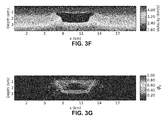
- FIGS. 3F and 3G illustrate results from a Mumford-Shah-based inversion technique using the third model, according to an embodiment of the present disclosure.
- FIGS. 4A and 4B illustrate results from a phase-field inversion technique using the third model, according to an embodiment of the present disclosure.
- FIGS. 5A and 5B illustrate a fourth model used to compare inversion techniques, according to an embodiment of the present disclosure.
- FIG. 5C illustrates a result from a cell-based inversion technique using the fourth model, according to an embodiment of the present disclosure.
- FIGS. 5D and 5E illustrate results from a phase-field inversion technique using the fourth model, according to an embodiment of the present disclosure.
- FIGS. 6A-6C illustrate results from a phase-field inversion technique using data from the third and fourth models, according to an embodiment of the present disclosure.
- FIGS. 6D and 6E compare travel-time data misfit and wave speed model misfit for the cell-based and phase-field inversion techniques versus number of iterations, according to an embodiment of the present disclosure.
- FIGS. 6F and 6G compare gravity data misfit and density anomaly model misfit for the cell-based and phase-field inversion techniques versus number of iterations, according to an embodiment of the present disclosure.
- FIG. 7A illustrates a fifth model used to compare inversion techniques, according to an embodiment of the present disclosure.
- FIGS. 7B and 7C illustrate an initial guess for a Mumford-Shah-based inversion technique using the fifth model, according to an embodiment of the present disclosure.
- FIGS. 7D and 7E illustrate results from a Mumford-Shah-based inversion technique using the fifth model, according to an embodiment of the present disclosure.
- FIGS. 7F and 7G compare data misfit and model misfit versus number of iterations, along with their dependence on the parameter ( 3 , for a Mumford-Shah-based inversion technique using the fifth model, according to an embodiment of the present disclosure.
- FIG. 8A illustrates an initial guess for a phase-field-based inversion technique using the fifth model, according to an embodiment of the present disclosure.
- FIG. 8B illustrates the result from a phase-field inversion technique using the fifth model, according to an embodiment of the present disclosure.
- FIG. 8C illustrates the result from a phase-field inversion technique, under the additional constraint that the total volume of the two anomalies is known, using the fifth model, according to an embodiment of the present disclosure.
- FIG. 8D compares model misfit versus number of iterations for a phase-field inversion technique and a phase-field inversion technique constrained by the volume of the two anomalies, according to an embodiment of the present disclosure.
- Embodiments of the present disclosure provide inversion methods for imaging subsurface regions from geophysical data sets.
- a first method may comprise the steps of providing at least one geophysical data set containing data measured from a subsurface region to an objective function; optimizing the objective function to invert for a geologic structure of the subsurface region and at least one geophysical parameter of the subsurface region; and using a computer system to present results produced by the objective function optimization.
- a second method may comprise the steps of providing at least one geophysical data set containing data measured from a subsurface region to a Mumford-Shah-based objective function; optimizing the Mumford-Shah-based objective function to invert for at least one of the following: a geologic structure of the subsurface region and at least one geophysical parameter of the subsurface region; and using a computer system to present results produced by the Mumford-Shah-based objective function optimization.
- a third method may comprise the steps of providing at least one geophysical data set containing data measured from a subsurface region to an objective function; applying a phase-field functional to optimize the objective function and invert for at least one of the following: a geologic structure of the subsurface region and at least one geophysical parameter of the subsurface region; and using a computer system to present results produced by the objective function optimization.
- the present invention overcomes this limitation by using shapes or geobodies rather than cells as a fundamental geometric element in the inversion.
- This fundamental geometric element more naturally matches the way in which the geology of the crust of the earth is organized. It is well recognized that the crustal structure of the earth has well defined facies between rock layers. Horizons can be readily identified and depositional sequences can be described using sequence stratigraphy.
- shape, geologic structure, and geobody will be interchangeably used to refer to a three dimensional portion of the subsurface which is part of a single facies or part of a single stratigraphic layer.
- examples of such features include, but are not limited to, salt bodies, shale layers, sandstone formations, and carbonate platforms and hydrocarbon reservoirs.
- physical rock matrix parameters such as the compressibility, permeability, density, and electric conductivity, have an average value that can have some degree of variance.
- the fluid saturation in the layers can have significantly more variance (for example if an oil reservoir has a gas cap). If the fluid variance is sharp and large enough to significantly affect the average electric properties, seismic properties, or in some cases the fluid transport properties of the rock, the region with the altered fluid composition can be treated as a separate geobody.
- interface refers to those subsurface locations at the boundary between two shapes. For example, there exists an interface separating different sedimentary layers. At an interface between shapes, it is to be expected for at least one geophysical parameter value ⁇ (such as wave speed, density, compressibility, electrical conductivity, permeability, fluid saturation) to change in an abrupt or discontinuous manner. It is assumed herein that the subsurface region of interest is equal to the union of subsurface shapes and interfaces.
- geologic feature is used to refer to either a shape or an interface.
- Inverting for geologic features in addition to geophysical parameters, provides at least three distinct benefits over cell-based inversion methods.
- inversion of interfaces enables inversion results to be structurally consistent.
- structurally consistent inversion refers to an inversion of multiple geophysical parameters (e.g. wave speed and density) in which the different parameter types possess a common set of shapes along with a common set of interfaces at which parameter values may change sharply or discontinuously.
- a structurally consistent inversion is desirable because many geophysical parameters, such as wave speed and density, can satisfy a well-defined relationship compatible with structural consistency. Hence, it is expected that the inversion of geologic features along with geophysical parameters will provide a result of greater fidelity than an inversion of geophysical parameters alone.
- the second benefit of inverting for features, in addition to geophysical parameters, is that it can reduce the number of degrees of freedom to be inverted for which, in turn, can reduce the non-uniqueness and ill-posedness common to inverse problems.
- the traditional cell-based inversion approach would invert for each cell separately, not taking into account the knowledge that many of the cells should share the same wave speed value.
- a shape-based inversion approach which inverts for the shape of the anomaly, the constant wave speed inside the anomaly, and the background wave speed, reduces the number of degrees of freedom by taking advantage of our knowledge of the homogeneity of the anomaly.
- a third benefit of inverting for features, in addition to geophysical parameters, is that the features themselves (e.g. the locations of different sedimentary layers, the location of a salt body) are often of intrinsic value. Automatic identification of these layers eliminates manual identification or application of additional algorithms.
- any method which inverts for geologic features must have a means of representing such features.
- One common technique is to discretize the boundary points of the shape under consideration and to consider these boundary points as variables to be inverted for.
- the discretized boundary points represent inversion variables in the same way as cell-based parameter values represent inversion variables in the cell-based inversion approach.
- This technique for the movement of shapes is known by several names, including the marker particle method and the string method.
- the marker/string method suffers from two shortcomings in the presence of large changes of shapes (Osher, 1988, volume 79). First, marker particles merge in regions with high curvature, which can lead to unstable numerical behavior (Abubakar, 2009 (25)). Second, topological changes, such as the merging of two shapes, require the inclusion of additional steps into the algorithm which can complicate the overall procedure and impact the quality of the result.
- phase-field method Two commonly used implicit methods are the phase-field method and the level set method. Both techniques have been demonstrated on a broad range of physically realistic problems involving the motion of interfaces or shapes. However, the two methods differ in terms of how exactly they represent shapes and the mechanism by which these interfaces or shapes are updated.
- the phase-field method (Deckelnic, 2005) represents and moves shapes using a function which is equal, approximately, to one inside of the shape and equal, approximately, to negative one outside of the shape. In addition, there is a narrow transition layer where the function transitions between the values of one and negative one. Because the phase field technique does not explicitly identify the boundary of the shape, it is known as a diffuse interface method.
- the level set method (Osher, 1988, volume 79) is a sharp interface method, in that it represents the boundary of a shape as the zero level-set of a function.
- a level set function is the signed distance to the boundary of a shape.
- two inversion techniques have been developed which determine both geologic features and subsurface parameter values.
- the Mumford-Shah-based inversion technique simultaneously inverts for interfaces and geophysical parameters ⁇ .
- interfaces are implicitly represented in Mumford-Shah; methods for achieving this include the Ambrosio-Tortorelli approximation, which is essentially an extension of phase field, and the Chan-Vese level set approach.
- the phase-field inversion technique inverts for geologic shapes and a parameter field ⁇ obeying a pre-determined trend (e.g., piecewise constant or piecewise linear).
- the Mumford-Shah-based inversion technique is more general in that it can capture an arbitrary number of interfaces along with heterogeneous ⁇ fields.
- the phase-field inversion requires the user to specify the maximum number of shapes in advance, along with expected trend behavior (e.g. linear or quadratic) of each parameter. Which method is appropriate for a given problem depends on what is known in advance regarding the geophysical parameters of interest and the information content of the measured data.
- the feature-based geophysical inversion techniques are applicable to geophysical inverse problems have been introduced previously in nonrelated scientific disciplines.
- the Mumford-Shah functional was originally introduced in image processing for the segmentation of images (Mumford, 1989).
- the phase-field technique has traditionally been used in materials science and physics to describe phase transitions and other interfacial phenomena (Chen, 2002).
- the inversion algorithms presented here offer several novelties in comparison with the prior art in shape-based geophysical inversion (Starr, 2015) (Abubakar, 2009 (25)) (Hobro, Patent application WO2013105074 A1).
- the inversion algorithms presented here based on implicit interface or shape representations, determine shapes and parameter values within those shapes through an optimization procedure.
- Prior implicit shape-based geophysical inversion techniques assumed the parameter values to be known and did not invert for them.
- our implicit representation of shapes and interfaces is different from the prior art.
- the Mumford-Shah inversion algorithm enables the user to determine an arbitrary number of interfaces through the inversion process.
- Prior shape-based geophysical inversion techniques, such as the level-set method required the number of interfaces to be prescribed in advance.
- gradient-based optimization techniques developed for the cell-based inversion, described by equation (1) are easily adapted to the shape-based algorithms.
- the prior art requires additional steps in order to utilize cell-based optimization methods based on gradient information.
- a Mumford-Shah-based inversion technique determines subsurface structures that are consistent with at least one geophysical data set and at least one parameter.
- the geophysical data sets may include, but are not limited to, seismic, time-lapse seismic, electromagnetic, gravity, gradiometry, well log, and well pressure data, measured by one or more receivers.
- the geophysical parameters ⁇ may include, but are not limited to, wave speed/velocity, permeability, porosity, electrical conductivity, and density of the subsurface region of interest.
- the Mumford-Shah-based inversion technique decomposes the subsurface region of interest into distinct shapes separated by interfaces. These interfaces, along with the values of the at least one parameter ⁇ within each of the shapes, may be determined by optimizing an objective function E.
- ⁇ is the measured geophysical data from the at least one data set and u( ⁇ ) is data computed by a forward model (e.g. elastic wave propagation, gravitational attraction, electrical wave propagation, flow in porous media) during the optimization of the objective function E.
- the operator ⁇ is an arbitrary norm used to quantify the error or misfit between the computed data u( ⁇ ) and the measured geophysical data ⁇ .
- M is a domain describing spatial locations of the measured geophysical data ⁇ .
- the data misfit term ⁇ M ⁇ u( ⁇ ) ⁇ 2 dx ensures that the inferred values ⁇ for the at least one parameter are consistent with the measured geophysical data ⁇ .
- the function MS is known as the Mumford-Shah functional.
- the Mumford-Shah functional MS is used to partition the subsurface region of interest into shapes, enforce some degree of homogeneity (i.e., smoothness) of ⁇ within each shape, and control the complexity of the interface set ⁇ .
- the Mumford-Shah functional MS is represented by equation (3).
- MS ( ⁇ , ⁇ ) ⁇ ⁇ / ⁇ F ( ⁇ ) dx+ ⁇ ⁇ ⁇ t ( s ) ⁇ ⁇ ds (3)
- the spatial domain ⁇ represents the subsurface region of interest
- F is a regularization function within each of the shapes of the subsurface
- t(s) is a tangent vector at the interface set ⁇
- the operator ⁇ ⁇ is an arbitrary norm, potentially anisotropic, used to measure arclength on ⁇ .
- the regularization function F may be formulated to be the square of the absolute of the gradient of values ⁇ of the at least one parameter, as in equation (4). With the regularization function F set as in equation (4), the first term on the right hand side of equation (3) ensures that the values ⁇ of the at least one parameter vary smoothly within each shape, except at the interface set ⁇ .
- Equation (3) The second term on the right hand side of equation (3) measures arclength and as such penalizes oscillations of the interface set ⁇ .
- the constant ⁇ controls the homogeneity of parameter values within each shape and the constant ⁇ controls the complexity of the interface set ⁇ .
- F ( ⁇ )
- the Ambrosio-Tortorelli approximation MS ⁇ replaces the minimizing pair ( ⁇ , ⁇ ) by a minimizing pair ( ⁇ ⁇ , ⁇ ⁇ ). It can be shown that, for ⁇ 1, MS ⁇ ( ⁇ ⁇ , ⁇ ⁇ ) ⁇ MS( ⁇ , ⁇ ), ⁇ ⁇ ⁇ represents values approximating the values ⁇ of the at least one parameter, and ⁇ ⁇ is a function such that ⁇ ⁇ ⁇ 1 except in a boundary layer of thickness O( ⁇ ) near the boundary set ⁇ , where ⁇ ⁇ ⁇ 0. Hence, the location of the interface set ⁇ may be determined from knowledge of the values of ⁇ ⁇ .
- the Ambrosio-Tortorelli approximation of the Mumford-Shah functional is valid in any spatial dimension.
- optimization may be performed for cell-based values of ⁇ and ⁇ using a gradient-based optimization method such as Gauss-Newton, quasi-Newton, or steepest descent.
- the interface set ⁇ is determined from cell values of ⁇ ⁇ .
- Chan-Vese level-set approach Another approach to approximating the Mumford-Shah functional MS is the Chan-Vese level-set approach. While the Ambrosio-Tortorelli approximation minimizes a functional MS ⁇ approximating the original Mumford-Shah functional MS, the Chan-Vese level-set approach instead directly optimizes for the interface set ⁇ along with a constant parameter value associated with each shape determined by ⁇ . The Chan-Vese approach carries out this optimization by representing interfaces and shapes with a vector level-set function, which is then optimized along with piecewise constant parameter values for each shape.
- FIGS. 1A-1E illustrate, according to an embodiment of the present disclosure, the ability of the Mumford-Shah inversion technique to segment an image into a large number of shapes and interfaces. Strictly speaking, no inversion is performed here. This example also highlights how the variability of parameter values within each shape is dependent on the parameter value ⁇ .
- FIG. 1A illustrates a subsurface model known as the Marmousi velocity model, in kilometers per second (km/s), over an area that is 3.1-km deep and 17-km wide.
- the objective function (2) is employed.
- the Mumford-Shah functional MS is approximated by the Ambrosio-Tortorelli approximation described in equation (5) and optimize equation (2) using inexact Gauss-Newton.
- FIGS. 1B and 1C illustrate the parameter values ⁇ resulting from the optimization process using the objective function E of equation (2), the Ambrosio-Tortorelli approximation MS ⁇ of equation (5), and the regularization function F of equation (4).
- the results in FIGS. 1B and 1C correspond to the constant ⁇ set at 10 and 100, respectively.
- the velocity data in FIG. 1C is smoother and contains fewer boundaries.
- FIG. 1E superimposes vertical cross-sections of the velocity plot of FIGS. 1A-1C at the 6-km mark on the x-axis.
- setting the constant ⁇ at a high value results in smoother inverted parameter values and fewer boundaries. Therefore, if a more detailed image of a subsurface region is desired, the constant ⁇ should be kept small.
- each of the Mumford-Shah-based inversions consists of the minimization of equation (2) using the Ambrosio-Tortorelli approximation as described in equation (5) and the regularization function F of equation (4).
- Each of the cell-based inversions consists of the minimization of equation (1). All minimizations are carried out on a regular Cartesian mesh discretization using inexact Gauss-Newton. In the first two examples, ten iterations are used; for the third example, fifty iterations are used. For convenience, all of the examples presented here are two dimensional. However, Mumford-Shah-based inversion may be carried out in any number of spatial dimensions using the procedure described above.
- FIGS. 2A and 2B illustrate the first model used to compare the Mumford-Shah-based inversion technique to the conventional cell-based inversion technique, according to an embodiment of the present disclosure.
- FIG. 2A illustrates a permeability field model used to generate the pressure profile illustrated in FIG. 2B according to equation (6) and a Dirichlet boundary condition for pressure.
- ⁇ ( ⁇ ( x ) ⁇ p ( x )) s ( x ) (6)
- the source term s(x) in equation (6) models fluid injection, while the Dirichlet boundary condition on pressure assumes that pressure values at the boundary of the reservoir are known.
- the pressure values p(x) in FIG. 2B are used as measurement data (e.g., measured geophysical data ⁇ ) to test the conventional cell-based inversion technique and the Mumford-Shah-based inversion technique. It may be assumed that pressure values are available for measurement throughout the subsurface. For simplicity, p
- FIGS. 2C and 2D illustrate permeability fields resulting from two conventional cell-based inversion techniques, one without and the other with a regularization term, respectively.
- the regularization used is first-order Tikhonov, which is known in the art.
- the cell-based inversion technique infers for the permeability tensor ⁇ (x) only
- the Mumford-Shah-based inversion technique infers for both the permeability tensor ⁇ (x) and the interface set ⁇ defined by the zero contour of the interface set ⁇ ⁇ .
- the cell-based inversion technique without the regularization term recovers some of the large-scale features (i.e., FIG. 2C ) of the original model given by FIG. 2A , it also contains high-frequency artifacts and does not properly capture the smooth background permeability field.
- Tikhonov regularization stabilizes the cell-based inversion technique; however, the resulting permeability field (i.e., FIG. 2D ) smears out the background and the boundaries of the annular region.
- the Mumford-Shah-based inversion technique stably recovers the original permeability field of FIG. 2A .
- the Mumford-Shah-based inversion technique correctly identifies the interfaces, which separate shapes in which the permeability is smooth.
- FIG. 2G compares the data misfit (using a logarithmic scale) versus the number of iterations for the cell-based inversion technique, with and without the Tikhonov regularization, and the Mumford-Shah-based inversion technique. As demonstrated by the magnitude of the data misfit, the Mumford-Shah-based inversion technique quickly converges to the correct model whereas the cell-based inversion techniques, both with and without Tikhonov regularization, decrease at a significantly slower rate.
- FIGS. 2H-2J illustrate a second model used to compare the Mumford-Shah-based inversion technique to the conventional cell-based inversion technique, according to an embodiment of the present disclosure.
- the permeability field is modeled to be anisotropic in a [0,1] ⁇ [0,1] domain.
- the permeability tensor has components ⁇ xx in the x-direction and ⁇ zz in the z-direction, which are distinct and exhibit different trends, as shown in FIGS. 2H and 2I , respectively.
- these components do share a set of interfaces, where they exhibit sharp contrast.
- FIGS. 2K and 2L respectively, illustrate the permeability tensor components ⁇ xx and ⁇ zz resulting from the conventional cell-based inversion technique without regularization. It is important to note that, in this formulation, there is nothing enforcing structural consistency between the inverted tensor components and, hence, preventing severe non-uniqueness.
- FIGS. 2M and 2N respectively, illustrate the permeability tensor components ⁇ xx and ⁇ zz resulting from the Mumford-Shah-based inversion technique
- FIG. 2O illustrates the interface set ⁇ ⁇ .
- FIG. 2P compares the data misfit (using a logarithmic scale) versus the number of iterations for the cell-based inversion technique and the Mumford-Shah-based inversion technique. As can be seen, both inversion results match the data well. However, as indicated in FIGS. 2K and 2L , the cell-based inversion technique contains severe artifacts. On the other hand, as can be seen in FIGS. 2M and 2N , the Mumford-Shah-based inversion technique successfully recovers the target image of FIGS. 2H and 2I , and the interfaces at which the permeability tensor components ⁇ xx and ⁇ zz jump, shown in FIG. 2O .
- the location of an anomalous homogeneous body in a 4-km deep by 20-km wide subsurface is determined by first-arrival travel times measured at seismic receivers located on the top surface of the subsurface.
- the anomalous body is a rectangular region with constant wave speed of 4.5 km/s.
- each seismic receiver is limited to only listen to sources within 10 km. In other words, the maximum source-receiver offset is 10 km. Source-receiver offsets longer than 10 km are indicated in FIG. 3B by the dark blue upper and lower triangular regions.
- Equation (7) is solved by the fast sweeping method.
- the first-arrival times in FIG. 3B representing measurements by seismic receivers at the top surface of the subsurface, are used as measurement data (i.e., measured geophysical data ⁇ ) to test and compare the conventional cell-based inversion technique and the Mumford-Shah-based inversion technique.
- FIG. 3D The initial guess for the conventional cell-based inversion technique is the background wave speed profile illustrated in FIG. 3D . No regularization is included in this cell-based inversion.
- FIG. 3E illustrates the wave speed resulting from the cell-based inversion after fifty iterations of inexact Gauss-Newton.
- FIG. 3F illustrates the inverted wave speed
- FIG. 3G illustrates the inverted interface set ⁇ ⁇ resulting from the optimization after fifty iterations.
- a comparison of FIGS. 3E and 3F indicates that the wave speed recovered by Mumford-Shah-based inversion technique represents an improvement over the cell-based inversion method.
- the geometry of the subsurface region consisted of a small number of shapes.
- This fourth example considers the determination of a subsurface region possessing a large number of layers and two anomalous bodies.
- the available data consists of pressure measurements recorded at seismic receivers located along the surface.
- the subsurface model is 3.1 km deep by 17 km wide and consists of the Marmousi wave speed model with anomalies overlaid.
- Pressure measurements p are computed by solving the acoustic wave equation with the free boundary conditions on the top surface and the absorbing boundary conditions along the other boundaries.
- the density ⁇ is set equal to 1 g/cm 3 .
- the source f corresponds to a 2 Hz low-cut Ricker wavelet with a 5 Hz peak frequency.
- the initial guess for the Mumford-Shah inversion technique is the wave speed profile illustrated in FIG. 7B and the boundary set illustrated in FIG. 7C .
- the initial guess for the wave speed captures some of the large-scale trends of the Marmousi model but does not incorporate any information regarding the anomalies.
- FIGS. 7D and 7E illustrate the inverted wave speed ⁇ (x) and the inverted interface set ⁇ ⁇ .
- the inverted wave speed demonstrates the ability of Mumford-Shah to determine a large number of interfaces and shapes from acoustic pressure measurements.
- FIGS. 7F and 7G compare the data misfit and model misfit versus the number of iterations for the Mumford-Shah inversion technique.
- the branch points displayed in FIGS. 7F and 7G indicate iterations where the value of ⁇ was decreased. As these figures indicate, keeping ⁇ fixed leads to a plateau in data and model misfit while a decrease in ⁇ results in a decrease in both data and model misfit.
- the Mumford-Shah-based inversion technique has two strengths. First, Mumford-Shah inversion is capable of partitioning a subsurface region into an arbitrary number of shapes and interfaces. Second, Mumford-Shah inversion permits a wide range of spatial variation of the geophysical parameters ⁇ within each shape (e.g. not obeying an analytic trend). Hence, for problems containing an unknown number of shapes or shapes within which parameter values vary significantly, Mumford-Shah-based inversion may prove to be beneficial. However, for problems in which the number of shapes and the expected trend of the parameters ⁇ (e.g piecewise constant or linear) are known in advance, an alternative inversion method known as the phase-field inversion technique may be advantageous.
- the phase-field inversion technique may be advantageous.
- the phase-field inversion technique prescribes at the outset the maximum number of shapes to be inverted as well as information regarding the trend of the parameters ⁇ within each shapes (e.g., restricting the parameters ⁇ to be constant in each).
- the phase-field inversion technique decomposes a spatial domain ⁇ representing the subsurface region of interest into disjoint shapes ⁇ i .
- the shapes ⁇ i along with corresponding parameter values ⁇ i , are unknowns that may be determined by optimizing an objective function H.
- the objective function H is
- a forward model e.g. elastic wave propagation, gravitational attraction, electrical wave propagation, flow in porous media
- the operator ⁇ is an arbitrary norm used to quantify the error or misfit between the computed data u( ⁇ ) and the measured geophysical data ⁇ M is a domain describing spatial locations of the measured geophysical data ⁇
- t(s) represents a tangent vector at the interface all
- ⁇ ⁇ is an arbitrary norm measuring an arclength s, which may be either isotropic or anisotropic.
- the minimization of the phase field objective function H described by equation (8), can be performed in any number of spatial dimensions. It should be noted that providing geophysical data ⁇ to equation (8) is an example of providing at least one geophysical data set containing data measured from the subsurface region to an objective function.
- the data misfit term ⁇ M ⁇ u( ⁇ ) ⁇ 2 dx ensures that the inferred parameter values ⁇ i are consistent with the measured geophysical data ⁇
- the constant ⁇ controls the complexity of the shapes ⁇ i .
- phase-field approximation is applied to the optimization of the objective function H.
- the Euclidean norm is used to measure arclength
- the subsurface model is piecewise constant
- the phase-field method amounts to the determination of a phase-field function ⁇ ⁇ : ⁇ and parameter values ⁇ ⁇ ,1 , ⁇ ⁇ ,2 ⁇ minimizing the objective function
- H ⁇ ⁇ ( ⁇ 1 , ⁇ 2 , ⁇ ) ⁇ M ⁇ ⁇ u ⁇ ( ⁇ ) - u _ ⁇ 2 ⁇ dx + ⁇ 2 ⁇ ( ⁇ ⁇ ⁇ ⁇ ⁇ ⁇ ⁇ ⁇ ⁇ 2 ⁇ dx + ⁇ ⁇ ⁇ 1 ⁇ ⁇ ( ⁇ 2 - 1 ) 2 ⁇ dx ) ( 9 ) for ⁇ 1.
- the parameter field ⁇ (x) is determined by a relationship with the phase-field function ⁇ given by
- ⁇ ⁇ ( ⁇ , x ) 1 + ⁇ ⁇ ( x ) 2 ⁇ ⁇ 1 + 1 + ⁇ ⁇ ( x ) 2 ⁇ ⁇ 2 . ( 10 )
- the function ⁇ and the integration and differentiation operators in equation (9) on a grid must first be discretized.
- the mesh size h of this grid must be much smaller than ⁇ (i.e. h ⁇ ), in order to numerically resolve the boundary layer of ⁇ ⁇ near interfaces.
- optimization may be performed for the cell values of ⁇ and the parameter values ⁇ (x) corresponding to each shape using a gradient-based optimization method such as Gauss-Newton, quasi-Newton, or steepest descent.
- the location of the shapes from the cell values of ⁇ ⁇ may be recovered.
- the phase-field inversion technique is compared to the conventional cell-based inversion technique using three examples.
- the location of an anomalous homogeneous body in a 4-km deep by 20-km wide subsurface is determined by first-arrival travel times, then separately using gravity data, and finally using both data sets (i.e., first-arrival times and gravity data).
- the anomalous body is a rectangular region with wave speed and density, respectively, different from the background.
- phase-field inversion is performed by optimizing equation (9) using the representation of ⁇ given by equation (10).
- Each cell-by-cell inversion is carried out by optimizing equation (1).
- Each optimization is performed on a regular Cartesian mesh discretization using fifty iterations of inexact Gauss-Newton. For convenience, all of the examples presented here are two dimensional. However, phase-field inversion may be carried out in any number of spatial dimensions using the procedure discussed above.
- FIG. 3A illustrates the wave speed model used to generate, using seismic simulations, the first-arrival travel-times illustrated in FIGS. 3B and 3C .
- the first-arrival times in FIG. 3B are used as measurement data (i.e., measured geophysical data ⁇ ) to test and compare the conventional cell-based inversion technique and the phase-field inversion technique.
- FIG. 3D illustrates the initial guess for the conventional cell-based inversion technique.
- No regularization is included in this cell-based inversion.
- FIG. 3E illustrates the wave speed resulting from the cell-based inversion after fifty iterations of inexact Gauss-Newton.
- the phase-field inversion technique is applied to invert the first-arrival times in FIG. 3B using the background wave speed profile as the initial guess.
- the phase-field inversion technique can infer for both parameter values ⁇ i (i.e., wave speed values in this example) and shapes ⁇ i
- the results presented here keep the parameters values ⁇ i fixed during the optimization process and only infer for the phase-field function ⁇ which partitions the subsurface into two shapes ⁇ 1 , ⁇ 2 ⁇ .
- the shape ⁇ 1 represents the anomalous body and the shape ⁇ 2 represents the surrounding background.
- the parameter value ⁇ 1 the wave speed within the anomalous body, is fixed at 4.5 km/s and is assumed to be known.
- the parameter value ⁇ 2 is fixed to be the background wave speed profile, shown in FIG. 3D , and is also assumed to be known.
- phase-field function ⁇ ⁇ ⁇ resulting from the optimization after fifty iterations is shown in FIG. 4A .
- the phase-field function ⁇ ⁇ demarks two shapes with a narrow transition in-between where ⁇ ⁇ goes from a value of 1 in the inner region to a value of ⁇ 1 in the outer region.
- the corresponding wave speed profile shown in FIG. 4B , can then be obtained by plugging the phase-field function ⁇ ⁇ of FIG. 4A into equation (10).
- FIG. 5A illustrates the true density anomaly model.
- FIG. 5B illustrates the gravity anomaly data available to the inversion. This data is based on 501 measurement locations along the surface at 300 m above the top surface.
- ⁇ 2 U 4 ⁇ G ⁇ , (11) where ⁇ 2 is the Laplacian operator, G is the gravitational constant of 6.67408 ⁇ 10 ⁇ 11 m 3 kg ⁇ 1 s ⁇ 2 , and ⁇ indicates the spatially varying difference between the subsurface density and the background density defined by equation (12).
- ⁇ ⁇ ( x ) ⁇ ⁇ a ⁇ ⁇ if ⁇ ⁇ x ⁇ anomaly 0 ⁇ ⁇ if ⁇ ⁇ x ⁇ anomaly ( 12 )
- the phase-field inversion assumes as known the density anomaly value ⁇ a corresponding to the density increment due to the anomaly in ⁇ 1 ; the remaining unknown is the phase-field function ⁇ determining the shapes ⁇ 1 and ⁇ 2 . Then, the density anomaly can be solved using equation (13).
- ⁇ ⁇ ( x ) 1 - ⁇ ⁇ ( x ) 2 ⁇ ⁇ a ( 13 )
- the zero density anomaly model is used as an initial guess for both the conventional cell-based and phase-field inversion techniques. No regularization term is included in the cell-based inversion technique.
- FIG. 5C illustrates the density anomaly resulting from the cell-based inversion after fifty iterations
- FIGS. 5D and 5 illustrate the phase-field function ⁇ ⁇ and density anomaly, respectively, resulting from phase-field inversion. In this circumstance, neither the conventional cell-based inversion technique nor the phase-field inversion technique accurately locates the anomalous body.
- the location of the anomalous body is inverted for using both the first-arrival travel time data found in FIG. 3B and the gravity data anomaly data illustrated in FIG. 5B .
- the initial guesses for wave speed and density remain unchanged from the earlier examples.
- FIG. 3E represents the inverted wave speed profile
- FIG. 5C represents the inverted density profile.
- the inverted wave speed and density profiles determined by the phase-field inversion, along with the phase-field function ⁇ ⁇ are displayed in FIGS. 6A, 6B, and 6C respectively. This result indicates that the joint inversion of first-arrival travel time data and gravity data greatly improves the estimation of density and provides some uplift to wave speed.
- FIGS. 6D and 6E respectively compare first-arrival travel time data misfit and wave speed model misfit versus the number of iterations for the three inversion approaches considered above: cell-based, phase-field using only travel time data, and phase-field using both travel time and gravity data.
- the data misfit decreases monotonically for the cell-based inversion but does not for the phase-field ones. This is due to the fact that the phase-field objective function contains geometric regularization terms in addition to the data misfit. As a result, the overall objective in the phase-field inversions decreases monotonically but the data misfit is not guaranteed to do so.
- FIG. 6D the data misfit decreases monotonically for the cell-based inversion but does not for the phase-field ones.
- the model misfit computed as the norm of the difference between the inverted model and the true model, divided by the number of cells—shows that the inverted model based on the phase-field inversion technique is closer to the true model than the result determined by cell-based inversion. This superior convergence can be visually observed by comparing the wave speed profiles in FIGS. 3E, 4B, and 6A to the true wave speed profile in FIG. 3A .
- FIGS. 6F and 6G respectively compare gravity data misfit and density model misfit versus the number of iterations for the three inversion approaches considered above: cell-based, phase-field using only gravity data, and phase-field using both travel time and gravity data.
- the model misfit shows that the inverted model based on the phase-field inversion technique using gravity and travel-time data is closer to the true model than either the cell-based or phase-field results determined using only gravity data. This superior convergence can be visually observed by comparing the density in FIGS. 5C, 5E, and 6B to the true density anomaly in FIG. 5A .
- the fourth example investigates the impact of a shape-based constraint on the identification of two anomalous homogeneous bodies from acoustic pressure measurements.
- the setup is identical to the fourth example of the Mumford-Shah inversion technique.
- the phase-field inversion technique under the additional constraint that the total volume of the two anomalies is known, is compared to the unconstrained phase-field inversion technique.
- an estimate of the anomalies' volume may be obtained using gravity data.
- the unconstrained and constrained phase-field inversions are performed by optimizing equation (9).
- the parameter values ⁇ i in equation (10) are held fixed and assumed to be known.
- the parameter value ⁇ 1 the wave speed within the anomalous body, is fixed at 4.5 km/s and the spatially varying parameter value ⁇ 2 is given by the background wave speed profile shown in FIG. 8A .
- Each optimization is performed on a regular Cartesian mesh discretization using two hundred iterations of inexact Gauss-Newton.
- the volume constraint is expressed as a linear equation in the unknown phase-field function ⁇ ⁇ .
- FIG. 8B illustrates the wave speed profile resulting from the unconstrained phase-field inversion technique. As can be seen, the phase-field inversion technique does not fully capture both anomalies. In contrast, FIG. 8C illustrates that the phase-field inversion technique constrained by the volume of the anomalies converges to a model close to the true one.
- FIG. 8D compares the model misfit versus the number of iterations for the anomaly-constrained and unconstrained phase-field inversion techniques and the cell-based inversion technique.
- FIG. 8D confirms that the volume-constrained phase-field inversion is closer to the true model than the unconstrained phase-field result.
- the inversion techniques described herein may be performed by a computer system.
- the computer system may include secondary or tertiary storage to allow for non-volatile or volatile storage of geophysical data sets, configuration settings of the inversion techniques, and data generated by the inversion techniques, such as values for geophysical parameters and geologic structures.
- the computer system may also include at least one display unit to display to users the data generated by the inversion techniques.
- the computer system may be entirely contained at one location or may also be implemented across a closed or local network, a cluster of directly connected computers, an internet-centric network, or a cloud platform. It is to be further appreciated that the inversion techniques described herein are not limited to any particular programming language or execution environment, and may be applied to any computer programming languages or logic.
- a method for imaging a subsurface region comprising: providing at least one geophysical data set containing data measured from the subsurface region to an objective function; optimizing the objective function to invert for an implicitly represented geologic structure of the subsurface region and at least one geophysical parameter of the subsurface region; and using a computer system to present results produced by the objective function optimization.
- geologic structure is a boundary set including at least one interface within the subsurface region.
- geologic structure is a set of domains within the subsurface region.
- the at least one geophysical data set includes one of seismic data, time-lapse seismic data, electromagnetic data, gravity data, gradiometry data, well log data, and well pressure data.
- the at least one geophysical parameter is one of a wave speed, a permeability, a porosity, an electrical conductivity, and a density.
- a method for imaging a subsurface region comprising: providing at least one geophysical data set containing data measured from the subsurface region to a Mumford-Shah-based objective function; optimizing the Mumford-Shah-based objective function to invert for at least one of the following: a geologic structure of the subsurface region and at least one geophysical parameter of the subsurface region; and using a computer system to present results produced by the Mumford-Shah-based objective function optimization.
- geologic structure is a boundary set including at least one interface within the subsurface region.
- the Mumford-Shah-based objective function includes a least-squares data misfit and a Mumford-Shah functional, which is a geometric regularization.
- a method for imaging a subsurface region comprising: providing at least one geophysical data set containing data measured from the subsurface region to an objective function; applying a phase-field functional to optimize the objective function and invert for at least one of the following: a geologic structure of the subsurface region and at least one geophysical parameter of the subsurface region; and using a computer system to present results produced by the objective function optimization.
- geologic structure is a set of domains within the subsurface region.
Landscapes
- Physics & Mathematics (AREA)
- Life Sciences & Earth Sciences (AREA)
- General Life Sciences & Earth Sciences (AREA)
- General Physics & Mathematics (AREA)
- Geophysics (AREA)
- Geophysics And Detection Of Objects (AREA)
Abstract
Description
J(κ)=∫M ∥u(κ)−ū∥ 2 dx+R(κ), (1)
where κ represents the unknowns to be determined through optimization, ū is the measured geophysical data, u(κ) is data computed during the optimization according to a mathematical model, M denotes the locations at which the data is measured, ∥·∥ is an arbitrary norm used to quantify the error or misfit between the computed data u(κ) and the measured data ū, and R(κ) is a regularization term (e.g. Tikhonov regularization) used to stabilize the inversion.
-
- (1) simultaneously invert geophysical data for interfaces or shapes along with subsurface parameter values
- (2) invert geophysical data for geologic features based on knowledge of parameter values,
- (3) or invert geophysical data for parameter values based on knowledge of geologic features.
E(κ,Γ)=∫M ∥u(κ)−ū∥ 2 dx+MS(κ,Γ), (2)
where κ and Γ are the unknowns to be determined through the optimization, with κ being values of the at least one parameter and Γ consisting of the set of interfaces separating the shapes. ū is the measured geophysical data from the at least one data set and u(κ) is data computed by a forward model (e.g. elastic wave propagation, gravitational attraction, electrical wave propagation, flow in porous media) during the optimization of the objective function E. The operator ∥·∥ is an arbitrary norm used to quantify the error or misfit between the computed data u(κ) and the measured geophysical data ū. M is a domain describing spatial locations of the measured geophysical data ū. The data misfit term ∫M∥u(κ)−ū∥2 dx ensures that the inferred values κ for the at least one parameter are consistent with the measured geophysical data ū. The minimization of equation (2) can be performed in any spatial dimension (e.g. n=2,3). It should be noted that providing geophysical data ū to equation (2) is an example of providing at least one geophysical data set containing data measured from the subsurface region to an objective function.
MS(κ,Γ)=α∫Ω/Γ F(κ)dx+β∫ Γ ∥t(s)∥Γ ds (3)
F(κ)=|∇κ|2 (4)
−∇·(κ(x)∇p(x))=s(x) (6)
The source term s(x) in equation (6) models fluid injection, while the Dirichlet boundary condition on pressure assumes that pressure values at the boundary of the reservoir are known.
with the boundary condition T|Γ
where ū is the measured geophysical data from at least one data set and u(κ) is data computed from a forward model (e.g. elastic wave propagation, gravitational attraction, electrical wave propagation, flow in porous media) during the optimization of the objective function H. The operator ∥·∥ is an arbitrary norm used to quantify the error or misfit between the computed data u(κ) and the measured geophysical data ū M is a domain describing spatial locations of the measured geophysical data ū In addition, t(s) represents a tangent vector at the interface all and ∥·∥∂Ω is an arbitrary norm measuring an arclength s, which may be either isotropic or anisotropic. A spatially-varying parameter field may be defined by κ(x)=κi(x) for xϵ Ωi. The minimization of the phase field objective function H, described by equation (8), can be performed in any number of spatial dimensions. It should be noted that providing geophysical data ū to equation (8) is an example of providing at least one geophysical data set containing data measured from the subsurface region to an objective function.

for ϵ<<1. In this example, the parameter field κ(x) is determined by a relationship with the phase-field function ϕ given by
where d(x,∂Ω1∩Ω) is the signed distance to the interface all ∂Ωi∩Ω in equation (8). This relationship enables the determination of the shapes {Ω1,Ω2} from the phase-field function ϕϵ and motivates the definition of κ(x) in terms of the phase-field function ϕ found in equation (10). This framework may be generalized to the case where the subsurface model is not piecewise constant by choosing another relationship between parameter field κ(x) and the phase-field function ϕ.
∇2 U=4πGΔρ, (11)
where ∇2 is the Laplacian operator, G is the gravitational constant of 6.67408×10⁻¹¹ m3kg−1s−2, and Δρ indicates the spatially varying difference between the subsurface density and the background density defined by equation (12).
Claims (19)
Priority Applications (1)
| Application Number | Priority Date | Filing Date | Title |
|---|---|---|---|
| US15/492,316 US10416348B2 (en) | 2016-05-20 | 2017-04-20 | Shape-based geophysical parameter inversion |
Applications Claiming Priority (2)
| Application Number | Priority Date | Filing Date | Title |
|---|---|---|---|
| US201662339331P | 2016-05-20 | 2016-05-20 | |
| US15/492,316 US10416348B2 (en) | 2016-05-20 | 2017-04-20 | Shape-based geophysical parameter inversion |
Publications (2)
| Publication Number | Publication Date |
|---|---|
| US20170336529A1 US20170336529A1 (en) | 2017-11-23 |
| US10416348B2 true US10416348B2 (en) | 2019-09-17 |
Family
ID=58664812
Family Applications (1)
| Application Number | Title | Priority Date | Filing Date |
|---|---|---|---|
| US15/492,316 Expired - Fee Related US10416348B2 (en) | 2016-05-20 | 2017-04-20 | Shape-based geophysical parameter inversion |
Country Status (5)
| Country | Link |
|---|---|
| US (1) | US10416348B2 (en) |
| EP (1) | EP3458883A1 (en) |
| AU (1) | AU2017267389A1 (en) |
| CA (1) | CA3024865A1 (en) |
| WO (1) | WO2017200692A1 (en) |
Families Citing this family (6)
| Publication number | Priority date | Publication date | Assignee | Title |
|---|---|---|---|---|
| CN110297271B (en) * | 2019-06-26 | 2020-09-11 | 中国矿业大学 | Single-component probe P wave first arrival time correction method for mine earthquake alarm |
| CN111640188A (en) * | 2020-05-29 | 2020-09-08 | 中国地质大学(武汉) | Anti-noise three-dimensional grid optimization method based on Mumford-Shah algorithm framework |
| US11467302B1 (en) * | 2021-05-26 | 2022-10-11 | Saudi Arabian Oil Company | Seismic first breaks onset times determination by interface tracking using level-sets method |
| US12585037B2 (en) * | 2021-07-13 | 2026-03-24 | Exxonmobil Upstream Research Company | Method and system for augmented inversion and uncertainty quantification for characterizing geophysical bodies |
| CN116819647B (en) * | 2023-08-28 | 2023-11-17 | 北京建工环境修复股份有限公司 | Hydrologic geophysical data fusion method based on cross gradient structure constraint |
| CN117805923B (en) * | 2024-02-07 | 2024-07-09 | 长安大学 | Fracture plane position identification method and system based on Tanh function |
Citations (10)
| Publication number | Priority date | Publication date | Assignee | Title |
|---|---|---|---|---|
| US6480790B1 (en) | 1999-10-29 | 2002-11-12 | Exxonmobil Upstream Research Company | Process for constructing three-dimensional geologic models having adjustable geologic interfaces |
| US20110115787A1 (en) | 2008-04-11 | 2011-05-19 | Terraspark Geosciences, Llc | Visulation of geologic features using data representations thereof |
| US20110255371A1 (en) * | 2009-01-09 | 2011-10-20 | Charlie Jing | Hydrocarbon Detection With Passive Seismic Data |
| US20120143506A1 (en) * | 2010-12-01 | 2012-06-07 | Routh Partha S | Simultaneous Source Inversion for Marine Streamer Data With Cross-Correlation Objective Function |
| WO2013005074A1 (en) | 2011-07-01 | 2013-01-10 | Nokia Corporation | Optical element control |
| US8363509B2 (en) | 2006-09-04 | 2013-01-29 | Daniele Colombo | Method for building velocity models for pre-stack depth migration via the simultaneous joint inversion of seismic, gravity and magnetotelluric data |
| US20130185040A1 (en) | 2012-01-13 | 2013-07-18 | Westerngeco L.L.C. | Parameterizing a geological subsurface feature |
| US20140001751A1 (en) | 2011-12-09 | 2014-01-02 | Earl Christian, Jr. | Quick-connect tube coupling |
| US20140180593A1 (en) | 2011-06-02 | 2014-06-26 | Jan Schmedes | Joint Inversion with Unknown Lithology |
| US9158017B2 (en) | 2011-03-22 | 2015-10-13 | Seoul National University R&Db Foundation | Seismic imaging apparatus utilizing macro-velocity model and method for the same |
Family Cites Families (2)
| Publication number | Priority date | Publication date | Assignee | Title |
|---|---|---|---|---|
| WO2013105074A1 (en) | 2012-01-13 | 2013-07-18 | Geco Technology B.V. | 3-d surface-based waveform inversion |
| GB2503506B (en) * | 2012-06-29 | 2014-12-03 | Foster Findlay Ass Ltd | Adaptive horizon tracking |
-
2017
- 2017-04-20 US US15/492,316 patent/US10416348B2/en not_active Expired - Fee Related
- 2017-04-20 CA CA3024865A patent/CA3024865A1/en not_active Abandoned
- 2017-04-20 AU AU2017267389A patent/AU2017267389A1/en not_active Abandoned
- 2017-04-20 EP EP17720950.9A patent/EP3458883A1/en not_active Withdrawn
- 2017-04-20 WO PCT/US2017/028545 patent/WO2017200692A1/en not_active Ceased
Patent Citations (12)
| Publication number | Priority date | Publication date | Assignee | Title |
|---|---|---|---|---|
| US6480790B1 (en) | 1999-10-29 | 2002-11-12 | Exxonmobil Upstream Research Company | Process for constructing three-dimensional geologic models having adjustable geologic interfaces |
| US8363509B2 (en) | 2006-09-04 | 2013-01-29 | Daniele Colombo | Method for building velocity models for pre-stack depth migration via the simultaneous joint inversion of seismic, gravity and magnetotelluric data |
| US20110115787A1 (en) | 2008-04-11 | 2011-05-19 | Terraspark Geosciences, Llc | Visulation of geologic features using data representations thereof |
| US20110255371A1 (en) * | 2009-01-09 | 2011-10-20 | Charlie Jing | Hydrocarbon Detection With Passive Seismic Data |
| US20120143506A1 (en) * | 2010-12-01 | 2012-06-07 | Routh Partha S | Simultaneous Source Inversion for Marine Streamer Data With Cross-Correlation Objective Function |
| US9158017B2 (en) | 2011-03-22 | 2015-10-13 | Seoul National University R&Db Foundation | Seismic imaging apparatus utilizing macro-velocity model and method for the same |
| US20140180593A1 (en) | 2011-06-02 | 2014-06-26 | Jan Schmedes | Joint Inversion with Unknown Lithology |
| US9453929B2 (en) * | 2011-06-02 | 2016-09-27 | Exxonmobil Upstream Research Company | Joint inversion with unknown lithology |
| WO2013005074A1 (en) | 2011-07-01 | 2013-01-10 | Nokia Corporation | Optical element control |
| US20140001751A1 (en) | 2011-12-09 | 2014-01-02 | Earl Christian, Jr. | Quick-connect tube coupling |
| US20130185040A1 (en) | 2012-01-13 | 2013-07-18 | Westerngeco L.L.C. | Parameterizing a geological subsurface feature |
| US9121964B2 (en) | 2012-01-13 | 2015-09-01 | Westerngeco L.L.C. | Parameterizing a geological subsurface feature |
Non-Patent Citations (27)
| Title |
|---|
| Abubakar et al., "Joint inversion approaches for geophysical electromagnetic and elastic full-waveform data", Inverse Problems, 2012, pp. 05516-, vol. 28, IOP Publishing. |
| Abubaker et al., "Inversion algorithms for large-scale geophysical electromagnetic measurements", Inverse Problems, 2009, pp. 1-30, vol. 25, IOP Publishing. |
| Ambrosio et al., "On the approximation of free discontinuity problems", Bollettino della Unione Matemàtica Italiana, Boll. Un. Mat. Ital. 6-B, 1992, pp. 105-123, vol. VI-B, No. 1, IDAM Research Fellowship, Francesco Severi at Scoula Normale Superiore, Pisa. |
| Bellettini et al., "Discrete approximation of a free discontinuity problem", Numerical Functional Analysis Optimization, 1994, pp. 201-224, vol. 15, iss. 304, Marcel Dekker, Inc. |
| Bourdin, "The variational formulation of brittle fracture: numerical implementation and extensions", IUTAM Symposium on discretization methods for evolving discontinuities, 2007, pp. 381-393, Springer. |
| Brett et al., "Phase field methods for binary recovery", Hoppe, R., ed., Optimization with PDE constraints,Aug. 8, 2014, pp. 25-63, Springer. |
| Bunks et al., "Multiscale seismic waveform inversion", Geophysics, 1995, pp. 1457-1473, vol. 60, iss. 5, Society of Exploration Geophysicists. |
| Chen, "Phase-field models for microstructure evolution", Annual Review of Material Research, Aug. 2002, pp. 113-140, Annual Reviews. |
| Deckelnick et al., "Double obstacle phase field approach to an inverse problem for a discontinuous diffusion coefficient", Inverse Problems, pp. 1-26, vol. 32, No. 4, IOP Publishing. |
| Derfoul, et al., "Image Processing Tools for Better Incorporation of 4D Seismic Data Into Reservoir Models", Journal of Computational and Applied Mathematics, 2013, vol. 240, pp. 111-122. |
| Fleck, et al., "On Phase-Field Modeling With a Highly Anisotropic Interfacial Energy", The European Physical Journal Plus, 2011, vol. 126, pp. 1-11. |
| Gazit et al., "Joint Inversion through a level set formulation", 22nd International Geophyscial Conference and Exhibition, Brisbane, Australia, 2012. |
| Guo et al., "Shape optimization and level set method in full waveform inversion with 3D body reconstruction", SEG Technical Progream Extended Abstract, 2013, Society of Exploration Geophysicists. |
| Haber et al., "Model fusion and joint inversion", Surveys in Geophysics, 2013, pp. 675-695, vol. 34, Springer. |
| Hackl, "Geometry Variations, Level Set and Phase-field Methods for Perimeter Regularized Geometric Inverse Problems", Ph.D. thesis, Johannes Kepler Universitat, Linz, 2006. |
| Lu et al., "A local level-set method for 3-D inversion of gravity-gradient data", Geophysics, 2015, pp. G35-G51, vol. 80, No. 1, Society of Exploration Geophysicists. |
| Muharramov et al., "Multi-model full-waveform inversion", Cornell University Library, Oct. 26, 2014, pp. 1-6, arXiv:1410.6997. |
| Mumford et al., "Optimal approximations by piecewise smooth functions and associated variational problems", Communications on Pure and Applid Mathematics, Jul. 1989, pp. 577-685, vol. 42, Wiley Online Library. |
| Osher et al., "Fronts Propagating with Curvature Dependent Speed: Algorithms based on Hamilton-Jacobi Formulations", Journal of Computational Physics, 1988, pp. 12-49, vol. 79, iss. 1, Elsevier, ScienceDirect. |
| Parker, "The rapid calculation of potential anomalies", Geophysical Journal International astr. Soc., Aug. 4, 1972, pp. 447-455, vol. 31, Wiley Online Library. |
| Rondi et al., "Enhanced electrical impedance tomography via the Mumford-Shah functional", ESAIM: Control, Optimixation and Calculus of Variations, Jul. 2001, pp. 517-538, vol. 6, EDP Sciences, SMAI. |
| The International Search Report and Written Opinion of PCT/US2017/028545 dated Nov. 23, 2017. |
| Versteeg, "The Marmousi experience: Velocity model determination on a synthetic complex data set", The Leading Edge,1994, pp. 927-936, vol. 1, iss. 3, Society of Exploration Geophysicists. |
| Vese et al., "A Multiphase Level set framework for image segmentation using the Mumford and Shah model", International Journal of Computer Vision, 2002, pp. 271-293, vol. 50, iss.3, Kluwer Academic Publishers. |
| Vitti, "The Mumford-Shah Variational Model for Image Segmentation: An Overview of the Theory, Implementation and Use", ISPRS Journal of Photogrammetry and Remote Sensing, 2012, vol. 69, pp. 50-64. |
| Zhao, "A fast sweeping method for Eikonal equations", Mathematics of Computation, May 21, 2004, pp. 603-627, vol. 74, No. 250, American Mathematical Society. |
| Zhu, et al., "Improved Estimation of P-Wave Velocity, S-Wave Velocity, and Attenuation Factor by Iterative Structural Joint Inversion of Crosswell Seismic Data", Journal of Applied Geophysics, 2015, vol. 123, pp. 71-80. |
Also Published As
| Publication number | Publication date |
|---|---|
| EP3458883A1 (en) | 2019-03-27 |
| US20170336529A1 (en) | 2017-11-23 |
| AU2017267389A1 (en) | 2018-11-15 |
| CA3024865A1 (en) | 2017-11-23 |
| WO2017200692A1 (en) | 2017-11-23 |
Similar Documents
| Publication | Publication Date | Title |
|---|---|---|
| US10416348B2 (en) | Shape-based geophysical parameter inversion | |
| Eidsvik et al. | Stochastic reservoir characterization using prestack seismic data | |
| Doyen et al. | Seismic porosity mapping in the Ekofisk field using a new form of collocated cokriging | |
| US9372945B2 (en) | Method and system for modeling anomalous density zones in geophysical exploration | |
| US10571601B2 (en) | Geologic fault representation for flow simulation | |
| Wilson et al. | Real-time 3D inversion of ultra-deep resistivity logging-while-drilling data | |
| EP0911652A2 (en) | A method for reconciling data at seismic and well-log scales in 3-D earth modelling | |
| Røe et al. | An uncertainty model for fault shape and location | |
| Kaur et al. | Time-lapse seismic data inversion for estimating reservoir parameters using deep learning | |
| Caers et al. | Geostatistical quantification of geological information for a fluvial-type North Sea reservoir | |
| US10969507B2 (en) | Seismic channel geobody extraction for basin fairway simulation | |
| US20190186257A1 (en) | Systems and methods for imaging a proppant in a hydraulically-fractured oil reservoir | |
| WO2021002761A1 (en) | Improved inversions of geophysical data | |
| Fahimuddin et al. | 4D seismic history matching of a real field case with EnKF: use of local analysis for model updating | |
| Xie et al. | Uncertainty quantification in history matching of channelized reservoirs using Markov chain level set approaches | |
| Sun et al. | Inversion of surface and borehole gravity with thresholding and density constraints | |
| Vatankhah et al. | Joint Gramian inversion of gravity, magnetic and gravity gradient tensor data for the modelling of Mesoproterozoic iron oxide deposits, southeast Missouri, USA | |
| Thiel et al. | Full 3D reservoir mapping using deep directional resistivity measurements | |
| US20240354361A1 (en) | Methods and systems for determining the location of a hydrocarbon reservoir using an unsupervised clustering technique for inversion regularization | |
| CN116699678B (en) | A speed modeling method and apparatus for multi-information fusion | |
| B. Ashena et al. | Unsupervised Learning Analysis of a multi-parameter geophysical database for Abu Dhabi Hydrocarbon Reservoirs | |
| US20240052734A1 (en) | Machine learning framework for sweep efficiency quantification | |
| Sebacher et al. | Bridging element-free Galerkin and pluri-Gaussian simulation for geological uncertainty estimation in an ensemble smoother data assimilation framework | |
| Sebacher et al. | Petroleum Science | |
| Taher et al. | Resolving true formation resistivity and reconstructing structural reservoir complexity using resistivity inversion in high angle & horizontal wells to gain insights into future reservoir production behaviour and devise proactive completion strategy-A case study from lower burgan formation, minagish field, west Kuwait |
Legal Events
| Date | Code | Title | Description |
|---|---|---|---|
| AS | Assignment |
Owner name: EXXONMOBIL RESEARCH AND ENGINEERING COMPANY, NEW J Free format text: ASSIGNMENT OF ASSIGNORS INTEREST;ASSIGNORS:DENLI, HUSEYIN;BRANDMAN, JEREMY S.;REEL/FRAME:042080/0963 Effective date: 20170420 |
|
| STPP | Information on status: patent application and granting procedure in general |
Free format text: FINAL REJECTION MAILED |
|
| STPP | Information on status: patent application and granting procedure in general |
Free format text: DOCKETED NEW CASE - READY FOR EXAMINATION |
|
| STPP | Information on status: patent application and granting procedure in general |
Free format text: NOTICE OF ALLOWANCE MAILED -- APPLICATION RECEIVED IN OFFICE OF PUBLICATIONS |
|
| STPP | Information on status: patent application and granting procedure in general |
Free format text: PUBLICATIONS -- ISSUE FEE PAYMENT VERIFIED |
|
| STCF | Information on status: patent grant |
Free format text: PATENTED CASE |
|
| FEPP | Fee payment procedure |
Free format text: MAINTENANCE FEE REMINDER MAILED (ORIGINAL EVENT CODE: REM.); ENTITY STATUS OF PATENT OWNER: LARGE ENTITY |
|
| LAPS | Lapse for failure to pay maintenance fees |
Free format text: PATENT EXPIRED FOR FAILURE TO PAY MAINTENANCE FEES (ORIGINAL EVENT CODE: EXP.); ENTITY STATUS OF PATENT OWNER: LARGE ENTITY |
|
| STCH | Information on status: patent discontinuation |
Free format text: PATENT EXPIRED DUE TO NONPAYMENT OF MAINTENANCE FEES UNDER 37 CFR 1.362 |
|
| FP | Lapsed due to failure to pay maintenance fee |
Effective date: 20230917 |