US10414768B2 - Compounds for treating cystic fibrosis - Google Patents
Compounds for treating cystic fibrosis Download PDFInfo
- Publication number
- US10414768B2 US10414768B2 US15/532,309 US201515532309A US10414768B2 US 10414768 B2 US10414768 B2 US 10414768B2 US 201515532309 A US201515532309 A US 201515532309A US 10414768 B2 US10414768 B2 US 10414768B2
- Authority
- US
- United States
- Prior art keywords
- amino
- compound
- purin
- chloro
- benzamide
- Prior art date
- Legal status (The legal status is an assumption and is not a legal conclusion. Google has not performed a legal analysis and makes no representation as to the accuracy of the status listed.)
- Expired - Fee Related
Links
- 0 [1*]C1=C(N([2*])[3*])C([4*])=NC([5*])=N1 Chemical compound [1*]C1=C(N([2*])[3*])C([4*])=NC([5*])=N1 0.000 description 47
- WTMGRTFPZSBBDN-UHFFFAOYSA-N COC1=CC=C(N2C=NC3=C2N=C(N)N=C3O)C=C1OC Chemical compound COC1=CC=C(N2C=NC3=C2N=C(N)N=C3O)C=C1OC WTMGRTFPZSBBDN-UHFFFAOYSA-N 0.000 description 2
- NSIGQAXQCUFILR-UHFFFAOYSA-N NC(=O)C1=CC=C(N2C=NC3=C2N=C(Cl)N=C3N)C=C1 Chemical compound NC(=O)C1=CC=C(N2C=NC3=C2N=C(Cl)N=C3N)C=C1 NSIGQAXQCUFILR-UHFFFAOYSA-N 0.000 description 2
- RJBYBYMMDXHBKF-UHFFFAOYSA-N NC(=O)C1=CC=C(N2C=NC3=C2N=C(N)N=C3N)C=C1 Chemical compound NC(=O)C1=CC=C(N2C=NC3=C2N=C(N)N=C3N)C=C1 RJBYBYMMDXHBKF-UHFFFAOYSA-N 0.000 description 2
- VNJICVXFXHTPIE-UHFFFAOYSA-N NC(=O)C1=CC=C(NC2=C([N+](=O)[O-])C(NCC(=O)O)=NC=N2)C=C1 Chemical compound NC(=O)C1=CC=C(NC2=C([N+](=O)[O-])C(NCC(=O)O)=NC=N2)C=C1 VNJICVXFXHTPIE-UHFFFAOYSA-N 0.000 description 2
- OAVKQCLRZKUOSQ-UHFFFAOYSA-N NC(=O)C1=CC=C(NC2=CC(N)=NC(NC3=CC=C(C(N)=O)C=C3)=N2)C=C1 Chemical compound NC(=O)C1=CC=C(NC2=CC(N)=NC(NC3=CC=C(C(N)=O)C=C3)=N2)C=C1 OAVKQCLRZKUOSQ-UHFFFAOYSA-N 0.000 description 2
- ZXWGHENZKVQKPX-UHFFFAOYSA-N NC1=NC(Cl)=C(N)C(Cl)=N1 Chemical compound NC1=NC(Cl)=C(N)C(Cl)=N1 ZXWGHENZKVQKPX-UHFFFAOYSA-N 0.000 description 2
- UFKJHUSZSWSRQB-UHFFFAOYSA-N NC1=NC(OCCCC2=CC=CC=C2)=NC2=C1N=CN2 Chemical compound NC1=NC(OCCCC2=CC=CC=C2)=NC2=C1N=CN2 UFKJHUSZSWSRQB-UHFFFAOYSA-N 0.000 description 2
- POLQWYFDXAGDDV-UHFFFAOYSA-N NC1=NC2=C(N=CN2C2=CC=C(CO)C=C2)C(N)=N1 Chemical compound NC1=NC2=C(N=CN2C2=CC=C(CO)C=C2)C(N)=N1 POLQWYFDXAGDDV-UHFFFAOYSA-N 0.000 description 2
- HCTISZQLTGAYOX-UHFFFAOYSA-N [H]C1=NC(Cl)=C([N+](=O)[O-])C(Cl)=N1 Chemical compound [H]C1=NC(Cl)=C([N+](=O)[O-])C(Cl)=N1 HCTISZQLTGAYOX-UHFFFAOYSA-N 0.000 description 2
- VCENBVYHFVAJQS-UHFFFAOYSA-N [H]C1=NC(NC2=CC=C(C(N)=O)C=C2)=C(N)C(SC)=N1 Chemical compound [H]C1=NC(NC2=CC=C(C(N)=O)C=C2)=C(N)C(SC)=N1 VCENBVYHFVAJQS-UHFFFAOYSA-N 0.000 description 2
- LWPUIOYTGVASQW-UHFFFAOYSA-N [H]C1=NC(NC2=CC=CC(C(N)=O)=C2)=C(N)C(Cl)=N1 Chemical compound [H]C1=NC(NC2=CC=CC(C(N)=O)=C2)=C(N)C(Cl)=N1 LWPUIOYTGVASQW-UHFFFAOYSA-N 0.000 description 2
- UQNVPIHTNYZTMY-UHFFFAOYSA-N [H]C1=NC2=C(N=CN2C2=CC=C(C(N)=O)C=C2)C(N)=N1 Chemical compound [H]C1=NC2=C(N=CN2C2=CC=C(C(N)=O)C=C2)C(N)=N1 UQNVPIHTNYZTMY-UHFFFAOYSA-N 0.000 description 2
- OOBBLSZWDQQWFX-UHFFFAOYSA-N [H]N1C=NC2=C1N=C(OCCC1=CC=CC=C1)N=C2NCC1=CC=C(OC)C=C1 Chemical compound [H]N1C=NC2=C1N=C(OCCC1=CC=CC=C1)N=C2NCC1=CC=C(OC)C=C1 OOBBLSZWDQQWFX-UHFFFAOYSA-N 0.000 description 2
- CTNHVWVNDLGTDT-UHFFFAOYSA-N CC(=O)C1=CC=C(N2C=NC3=C2N=C(Cl)N=C3Cl)C=C1 Chemical compound CC(=O)C1=CC=C(N2C=NC3=C2N=C(Cl)N=C3Cl)C=C1 CTNHVWVNDLGTDT-UHFFFAOYSA-N 0.000 description 1
- YZXONUJMZMYQSW-UHFFFAOYSA-N CC(=O)CC1=CC=C(NC2=NC=NC(NC3=CC=C(NC(C)=O)C=C3)=C2[N+](=O)[O-])C=C1 Chemical compound CC(=O)CC1=CC=C(NC2=NC=NC(NC3=CC=C(NC(C)=O)C=C3)=C2[N+](=O)[O-])C=C1 YZXONUJMZMYQSW-UHFFFAOYSA-N 0.000 description 1
- RZYFXVYHZTYPTC-UHFFFAOYSA-N CC(=O)NC1=CC=C(NC2=C([N+](=O)[O-])C(Cl)=NC=N2)C=C1 Chemical compound CC(=O)NC1=CC=C(NC2=C([N+](=O)[O-])C(Cl)=NC=N2)C=C1 RZYFXVYHZTYPTC-UHFFFAOYSA-N 0.000 description 1
- OKLGMTFBMLXDIC-UHFFFAOYSA-N CC(C)(C)OC(=O)CNC1=NC(Cl)=NC2=C1N=CN2C1=CC=C(C(N)=O)C=C1 Chemical compound CC(C)(C)OC(=O)CNC1=NC(Cl)=NC2=C1N=CN2C1=CC=C(C(N)=O)C=C1 OKLGMTFBMLXDIC-UHFFFAOYSA-N 0.000 description 1
- FZGSWGADSPASEX-UHFFFAOYSA-N CC(C)(C)OC(=O)CNC1=NC(N)=NC2=C1N=NN2C1=CC=C(C(N)=O)C=C1 Chemical compound CC(C)(C)OC(=O)CNC1=NC(N)=NC2=C1N=NN2C1=CC=C(C(N)=O)C=C1 FZGSWGADSPASEX-UHFFFAOYSA-N 0.000 description 1
- QPUYECUOLPXSFR-UHFFFAOYSA-N CC1=CC=CC2=C1C=CC=C2 Chemical compound CC1=CC=CC2=C1C=CC=C2 QPUYECUOLPXSFR-UHFFFAOYSA-N 0.000 description 1
- FKRXXAMAHOGYNT-UHFFFAOYSA-N CC1=NC(Cl)=C(N)C(Cl)=N1 Chemical compound CC1=NC(Cl)=C(N)C(Cl)=N1 FKRXXAMAHOGYNT-UHFFFAOYSA-N 0.000 description 1
- GHCFWKFREBNSPC-UHFFFAOYSA-N CC1=NC(N)=NC=C1 Chemical compound CC1=NC(N)=NC=C1 GHCFWKFREBNSPC-UHFFFAOYSA-N 0.000 description 1
- BIGFCWSRIDQTCI-UHFFFAOYSA-N CC1=NC(NC2=CC=C(C(N)=O)C=C2)=C(N)C(Cl)=N1 Chemical compound CC1=NC(NC2=CC=C(C(N)=O)C=C2)=C(N)C(Cl)=N1 BIGFCWSRIDQTCI-UHFFFAOYSA-N 0.000 description 1
- ARIHKOKJSUBOMX-UHFFFAOYSA-O CC1=NC(NC2=CC=C(C(N)=O)C=C2)=C([NH3+])C(NC2=CC=C(C(N)=O)C=C2)=N1.[Cl-] Chemical compound CC1=NC(NC2=CC=C(C(N)=O)C=C2)=C([NH3+])C(NC2=CC=C(C(N)=O)C=C2)=N1.[Cl-] ARIHKOKJSUBOMX-UHFFFAOYSA-O 0.000 description 1
- ILEJEAXWYDQTMX-UHFFFAOYSA-N CCN(CC)C1=NC(Cl)=NC2=C1N=CN2C1=CC=C(C(N)=O)C=C1 Chemical compound CCN(CC)C1=NC(Cl)=NC2=C1N=CN2C1=CC=C(C(N)=O)C=C1 ILEJEAXWYDQTMX-UHFFFAOYSA-N 0.000 description 1
- CJTYTCXYXDGDRF-UHFFFAOYSA-N COC(=O)C1=CC=C(N2C=NC3=C2N=C(Cl)N=C3Cl)C=C1 Chemical compound COC(=O)C1=CC=C(N2C=NC3=C2N=C(Cl)N=C3Cl)C=C1 CJTYTCXYXDGDRF-UHFFFAOYSA-N 0.000 description 1
- VLYDBAYDHIXQKP-UHFFFAOYSA-N COC(=O)C1=CC=C(N2C=NC3=C2N=C(N)N=C3O)C=C1 Chemical compound COC(=O)C1=CC=C(N2C=NC3=C2N=C(N)N=C3O)C=C1 VLYDBAYDHIXQKP-UHFFFAOYSA-N 0.000 description 1
- PWXOIRJSJDHKAN-UHFFFAOYSA-N COC(=O)C1=CC=C(N2C=NC3=C2N=C(NC(C)=O)N=C3O)C=C1 Chemical compound COC(=O)C1=CC=C(N2C=NC3=C2N=C(NC(C)=O)N=C3O)C=C1 PWXOIRJSJDHKAN-UHFFFAOYSA-N 0.000 description 1
- QKBCSGMCWJLIOI-UHFFFAOYSA-N COC(=O)C1=CC=C(N2C=NC3=C2N=C(NC(C)=O)N=C3OC(=O)NC(C2=CC=CC=C2)C2=CC=CC=C2)C=C1 Chemical compound COC(=O)C1=CC=C(N2C=NC3=C2N=C(NC(C)=O)N=C3OC(=O)NC(C2=CC=CC=C2)C2=CC=CC=C2)C=C1 QKBCSGMCWJLIOI-UHFFFAOYSA-N 0.000 description 1
- DOESTFBCAZCXLN-UHFFFAOYSA-N COC1=CC=C(CCNC2=NC3=C(N=CN3C3=CC=CC=C3)C(NCC3=CC=C(OC)C=C3)=N2)C=C1 Chemical compound COC1=CC=C(CCNC2=NC3=C(N=CN3C3=CC=CC=C3)C(NCC3=CC=C(OC)C=C3)=N2)C=C1 DOESTFBCAZCXLN-UHFFFAOYSA-N 0.000 description 1
- VWAZDAXKZGMAEE-UHFFFAOYSA-N COC1=CC=C(CNC2=NC(Cl)=NC3=C2N=CN3C2=CC=C(C(N)=O)C=C2)C=C1 Chemical compound COC1=CC=C(CNC2=NC(Cl)=NC3=C2N=CN3C2=CC=C(C(N)=O)C=C2)C=C1 VWAZDAXKZGMAEE-UHFFFAOYSA-N 0.000 description 1
- JSBKZLKLGYDSMV-UHFFFAOYSA-N COC1=CC=C(CNC2=NC(Cl)=NC3=C2N=CN3C2CCCCO2)C=C1 Chemical compound COC1=CC=C(CNC2=NC(Cl)=NC3=C2N=CN3C2CCCCO2)C=C1 JSBKZLKLGYDSMV-UHFFFAOYSA-N 0.000 description 1
- BOWSITVANNTRCW-UHFFFAOYSA-N COC1=CC=C(CNC2=NC(Cl)=NC3=C2N=CN3CC2=CC=C(C(N)=O)C=C2)C=C1 Chemical compound COC1=CC=C(CNC2=NC(Cl)=NC3=C2N=CN3CC2=CC=C(C(N)=O)C=C2)C=C1 BOWSITVANNTRCW-UHFFFAOYSA-N 0.000 description 1
- KYTNHGLSVBDNQG-UHFFFAOYSA-N COC1=CC=C(CNC2=NC(Cl)=NC3=C2N=CN3CC2=CC=CC=C2)C=C1 Chemical compound COC1=CC=C(CNC2=NC(Cl)=NC3=C2N=CN3CC2=CC=CC=C2)C=C1 KYTNHGLSVBDNQG-UHFFFAOYSA-N 0.000 description 1
- XNVSHOYFANGTEQ-UHFFFAOYSA-N COC1=CC=C(CNC2=NC(NCCCC3=CC=CC=C3)=NC3=C2N=CN3C2=CC=C(C(N)=O)C=C2)C=C1 Chemical compound COC1=CC=C(CNC2=NC(NCCCC3=CC=CC=C3)=NC3=C2N=CN3C2=CC=C(C(N)=O)C=C2)C=C1 XNVSHOYFANGTEQ-UHFFFAOYSA-N 0.000 description 1
- RXDNCMKZAZSCRK-UHFFFAOYSA-N COC1=CC=C(CNC2=NC(NCCCC3=CC=CC=C3)=NC3=C2N=CN3CC2=CC=CC=C2)C=C1 Chemical compound COC1=CC=C(CNC2=NC(NCCCC3=CC=CC=C3)=NC3=C2N=CN3CC2=CC=CC=C2)C=C1 RXDNCMKZAZSCRK-UHFFFAOYSA-N 0.000 description 1
- OVVOJQVQIGCLMN-UHFFFAOYSA-N COC1=CC=C(CNC2=NC(OCCC3=CC=CC=C3)=NC3=C2N=CN3C2CCCCO2)C=C1 Chemical compound COC1=CC=C(CNC2=NC(OCCC3=CC=CC=C3)=NC3=C2N=CN3C2CCCCO2)C=C1 OVVOJQVQIGCLMN-UHFFFAOYSA-N 0.000 description 1
- WPHZSVUBWKPYMZ-UHFFFAOYSA-N COC1=CC=C(CNC2=NC(OCCCC3=CC=CC=C3)=NC3=C2N=CN3C2CCCCO2)C=C1 Chemical compound COC1=CC=C(CNC2=NC(OCCCC3=CC=CC=C3)=NC3=C2N=CN3C2CCCCO2)C=C1 WPHZSVUBWKPYMZ-UHFFFAOYSA-N 0.000 description 1
- NWJCUEGBPQSPSX-UHFFFAOYSA-N COC1=NC(N)=NC2=C1N=CN2C1=CC=C(C(N)=O)C=C1 Chemical compound COC1=NC(N)=NC2=C1N=CN2C1=CC=C(C(N)=O)C=C1 NWJCUEGBPQSPSX-UHFFFAOYSA-N 0.000 description 1
- LQRDKICHKYQBIR-ZETCQYMHSA-N C[C@H](NC1=NC(Cl)=NC2=C1N=CN2C1=CC=C(C(N)=O)C=C1)C(=O)O Chemical compound C[C@H](NC1=NC(Cl)=NC2=C1N=CN2C1=CC=C(C(N)=O)C=C1)C(=O)O LQRDKICHKYQBIR-ZETCQYMHSA-N 0.000 description 1
- YBYZXFPOPBHDFU-JTQLQIEISA-N C[C@H](NC1=NC(Cl)=NC2=C1N=CN2C1=CC=C(C(N)=O)C=C1)C(=O)OC(C)(C)C Chemical compound C[C@H](NC1=NC(Cl)=NC2=C1N=CN2C1=CC=C(C(N)=O)C=C1)C(=O)OC(C)(C)C YBYZXFPOPBHDFU-JTQLQIEISA-N 0.000 description 1
- XCWURHZYTGZTJR-QMMMGPOBSA-N C[C@H](NC1=NC(Cl)=NC2=C1N=CN2C1=CC=C(CO)C=C1)C(=O)O Chemical compound C[C@H](NC1=NC(Cl)=NC2=C1N=CN2C1=CC=C(CO)C=C1)C(=O)O XCWURHZYTGZTJR-QMMMGPOBSA-N 0.000 description 1
- KHHGGTONYNNKAI-NSHDSACASA-N C[C@H](NC1=NC(Cl)=NC2=C1N=CN2C1=CC=C(CO)C=C1)C(=O)OC(C)(C)C Chemical compound C[C@H](NC1=NC(Cl)=NC2=C1N=CN2C1=CC=C(CO)C=C1)C(=O)OC(C)(C)C KHHGGTONYNNKAI-NSHDSACASA-N 0.000 description 1
- YDCNHFAPHTVJSB-QMMMGPOBSA-N C[C@H](NC1=NC(Cl)=NC2=C1N=CN2C1=CC=CC=C1)C(=O)O Chemical compound C[C@H](NC1=NC(Cl)=NC2=C1N=CN2C1=CC=CC=C1)C(=O)O YDCNHFAPHTVJSB-QMMMGPOBSA-N 0.000 description 1
- QYCUJVCIBFNCLV-NSHDSACASA-N C[C@H](NC1=NC(Cl)=NC2=C1N=CN2C1=CC=CC=C1)C(=O)OC(C)(C)C Chemical compound C[C@H](NC1=NC(Cl)=NC2=C1N=CN2C1=CC=CC=C1)C(=O)OC(C)(C)C QYCUJVCIBFNCLV-NSHDSACASA-N 0.000 description 1
- SOUNFFLKKPCPAT-QMMMGPOBSA-N C[C@H](NC1=NC(Cl)=NC2=C1N=CN2CC1=CC=C(C(N)=O)C=C1)C(=O)O Chemical compound C[C@H](NC1=NC(Cl)=NC2=C1N=CN2CC1=CC=C(C(N)=O)C=C1)C(=O)O SOUNFFLKKPCPAT-QMMMGPOBSA-N 0.000 description 1
- DHIXZECXTVNRJR-NSHDSACASA-N C[C@H](NC1=NC(Cl)=NC2=C1N=CN2CC1=CC=C(C(N)=O)C=C1)C(=O)OC(C)(C)C Chemical compound C[C@H](NC1=NC(Cl)=NC2=C1N=CN2CC1=CC=C(C(N)=O)C=C1)C(=O)OC(C)(C)C DHIXZECXTVNRJR-NSHDSACASA-N 0.000 description 1
- ZHGOXBPWSKPAAN-INIZCTEOSA-N C[C@H](NC1=NC(NCCCC2=CC=CC=C2)=NC2=C1N=CN2C1=CC=C(CO)C=C1)C(=O)O Chemical compound C[C@H](NC1=NC(NCCCC2=CC=CC=C2)=NC2=C1N=CN2C1=CC=C(CO)C=C1)C(=O)O ZHGOXBPWSKPAAN-INIZCTEOSA-N 0.000 description 1
- UQUWQURMDAKTNN-INIZCTEOSA-N C[C@H](NC1=NC(NCCCC2=CC=CC=C2)=NC2=C1N=CN2C1=CC=CC=C1)C(=O)O Chemical compound C[C@H](NC1=NC(NCCCC2=CC=CC=C2)=NC2=C1N=CN2C1=CC=CC=C1)C(=O)O UQUWQURMDAKTNN-INIZCTEOSA-N 0.000 description 1
- JKIMZHARZBEQRH-IBGZPJMESA-N C[C@H](NC1=NC(NCCCC2=CC=CC=C2)=NC2=C1N=CN2C1=CC=CC=C1)C(=O)OC(C)(C)C Chemical compound C[C@H](NC1=NC(NCCCC2=CC=CC=C2)=NC2=C1N=CN2C1=CC=CC=C1)C(=O)OC(C)(C)C JKIMZHARZBEQRH-IBGZPJMESA-N 0.000 description 1
- UTTYJIYRVPFXAW-KRWDZBQOSA-N C[C@H](NC1=NC(NCCCC2=CC=CC=C2)=NC2=C1N=CN2CC1=CC=CC=C1)C(=O)O Chemical compound C[C@H](NC1=NC(NCCCC2=CC=CC=C2)=NC2=C1N=CN2CC1=CC=CC=C1)C(=O)O UTTYJIYRVPFXAW-KRWDZBQOSA-N 0.000 description 1
- PUARFAPITOZVIH-UHFFFAOYSA-N ClC1=NC2=C(N=CN2C2=CC=CC=C2)C(Cl)=N1 Chemical compound ClC1=NC2=C(N=CN2C2=CC=CC=C2)C(Cl)=N1 PUARFAPITOZVIH-UHFFFAOYSA-N 0.000 description 1
- GRSRUMXXAFWISH-UHFFFAOYSA-N ClC1=NC2=C(N=CN2C2=CC=CN=C2)C(Cl)=N1 Chemical compound ClC1=NC2=C(N=CN2C2=CC=CN=C2)C(Cl)=N1 GRSRUMXXAFWISH-UHFFFAOYSA-N 0.000 description 1
- SCBYBNMRLPIYME-UHFFFAOYSA-N NC(=O)C1=CC(N2C=NC3=C2N=C(Cl)N=C3Cl)=CC=C1 Chemical compound NC(=O)C1=CC(N2C=NC3=C2N=C(Cl)N=C3Cl)=CC=C1 SCBYBNMRLPIYME-UHFFFAOYSA-N 0.000 description 1
- HLHDXYATRFEBSP-UHFFFAOYSA-N NC(=O)C1=CC=C(C2=CC=CC3=C2C=CC=N3)C=C1 Chemical compound NC(=O)C1=CC=C(C2=CC=CC3=C2C=CC=N3)C=C1 HLHDXYATRFEBSP-UHFFFAOYSA-N 0.000 description 1
- FMHCZJOOMANLPC-UHFFFAOYSA-N NC(=O)C1=CC=C(C2=CC=NC3=C2C=CC=C3)C=C1 Chemical compound NC(=O)C1=CC=C(C2=CC=NC3=C2C=CC=C3)C=C1 FMHCZJOOMANLPC-UHFFFAOYSA-N 0.000 description 1
- LZBPCKZYQNTTJX-UHFFFAOYSA-N NC(=O)C1=CC=C(CN2C=NC3=C2N=C(Cl)N=C3Cl)C=C1 Chemical compound NC(=O)C1=CC=C(CN2C=NC3=C2N=C(Cl)N=C3Cl)C=C1 LZBPCKZYQNTTJX-UHFFFAOYSA-N 0.000 description 1
- BPCCNSXOWKWRBY-JTQLQIEISA-N NC(=O)C1=CC=C(CN2C=NC3=C2N=C(Cl)N=C3N[C@@H](CO)C(=O)O)C=C1 Chemical compound NC(=O)C1=CC=C(CN2C=NC3=C2N=C(Cl)N=C3N[C@@H](CO)C(=O)O)C=C1 BPCCNSXOWKWRBY-JTQLQIEISA-N 0.000 description 1
- XDOIYCYDKWNVEH-UHFFFAOYSA-N NC(=O)C1=CC=C(CNC2=C(N)C(Cl)=NC=N2)C=C1 Chemical compound NC(=O)C1=CC=C(CNC2=C(N)C(Cl)=NC=N2)C=C1 XDOIYCYDKWNVEH-UHFFFAOYSA-N 0.000 description 1
- MUBGAKXBXXYYRR-UHFFFAOYSA-N NC(=O)C1=CC=C(N2C=CC3=C2N=CN=C3Cl)C=C1 Chemical compound NC(=O)C1=CC=C(N2C=CC3=C2N=CN=C3Cl)C=C1 MUBGAKXBXXYYRR-UHFFFAOYSA-N 0.000 description 1
- GFFYUXXCACBXMX-UHFFFAOYSA-N NC(=O)C1=CC=C(N2C=CC3=C2N=CN=C3N)C=C1 Chemical compound NC(=O)C1=CC=C(N2C=CC3=C2N=CN=C3N)C=C1 GFFYUXXCACBXMX-UHFFFAOYSA-N 0.000 description 1
- VUPOBMBPNBMMLD-UHFFFAOYSA-N NC(=O)C1=CC=C(N2C=NC3=C2C=CN=C3Cl)C=C1 Chemical compound NC(=O)C1=CC=C(N2C=NC3=C2C=CN=C3Cl)C=C1 VUPOBMBPNBMMLD-UHFFFAOYSA-N 0.000 description 1
- UFEKMILKFUVPPV-UHFFFAOYSA-N NC(=O)C1=CC=C(N2C=NC3=C2N=C(Cl)N=C3Cl)C=C1 Chemical compound NC(=O)C1=CC=C(N2C=NC3=C2N=C(Cl)N=C3Cl)C=C1 UFEKMILKFUVPPV-UHFFFAOYSA-N 0.000 description 1
- TXQFUKQJNUHVNY-UHFFFAOYSA-N NC(=O)C1=CC=C(N2C=NC3=C2N=C(Cl)N=C3NC(CO)CO)C=C1 Chemical compound NC(=O)C1=CC=C(N2C=NC3=C2N=C(Cl)N=C3NC(CO)CO)C=C1 TXQFUKQJNUHVNY-UHFFFAOYSA-N 0.000 description 1
- HMIJESZXULYRIN-UHFFFAOYSA-N NC(=O)C1=CC=C(N2C=NC3=C2N=C(Cl)N=C3NCC(=O)O)C=C1 Chemical compound NC(=O)C1=CC=C(N2C=NC3=C2N=C(Cl)N=C3NCC(=O)O)C=C1 HMIJESZXULYRIN-UHFFFAOYSA-N 0.000 description 1
- SKUDEGZVIMGJJY-VIFPVBQESA-N NC(=O)C1=CC=C(N2C=NC3=C2N=C(Cl)N=C3N[C@@H](CO)C(=O)O)C=C1 Chemical compound NC(=O)C1=CC=C(N2C=NC3=C2N=C(Cl)N=C3N[C@@H](CO)C(=O)O)C=C1 SKUDEGZVIMGJJY-VIFPVBQESA-N 0.000 description 1
- GRIRYBMTYFIXIB-UHFFFAOYSA-N NC(=O)C1=CC=C(NC2=C(N)C(O)=NC=N2)C=C1 Chemical compound NC(=O)C1=CC=C(NC2=C(N)C(O)=NC=N2)C=C1 GRIRYBMTYFIXIB-UHFFFAOYSA-N 0.000 description 1
- LJQJTIJNZRLWMP-UHFFFAOYSA-N NC(=O)C1=CC=C(NC2=C(N)C=NC=C2)C=C1 Chemical compound NC(=O)C1=CC=C(NC2=C(N)C=NC=C2)C=C1 LJQJTIJNZRLWMP-UHFFFAOYSA-N 0.000 description 1
- HVSFCWNKEZCFHD-UHFFFAOYSA-N NC(=O)C1=CC=C(NC2=C([N+](=O)[O-])C(Cl)=NC=C2)C=C1 Chemical compound NC(=O)C1=CC=C(NC2=C([N+](=O)[O-])C(Cl)=NC=C2)C=C1 HVSFCWNKEZCFHD-UHFFFAOYSA-N 0.000 description 1
- QJDZVPCLYUGKML-UHFFFAOYSA-N NC(=O)C1=CC=C(NC2=C([N+](=O)[O-])C(Cl)=NC=N2)C=C1 Chemical compound NC(=O)C1=CC=C(NC2=C([N+](=O)[O-])C(Cl)=NC=N2)C=C1 QJDZVPCLYUGKML-UHFFFAOYSA-N 0.000 description 1
- NIPIKUIJDAASJE-UHFFFAOYSA-N NC(=O)C1=CC=C(NC2=C([N+](=O)[O-])C=CN(=O)=C2)C=C1 Chemical compound NC(=O)C1=CC=C(NC2=C([N+](=O)[O-])C=CN(=O)=C2)C=C1 NIPIKUIJDAASJE-UHFFFAOYSA-N 0.000 description 1
- FZELLBJICIMGPQ-UHFFFAOYSA-N NC(=O)C1=CC=C(NC2=C([N+](=O)[O-])C=NC=C2)C=C1 Chemical compound NC(=O)C1=CC=C(NC2=C([N+](=O)[O-])C=NC=C2)C=C1 FZELLBJICIMGPQ-UHFFFAOYSA-N 0.000 description 1
- LUEACLGEHKTQJF-UHFFFAOYSA-O NC(=O)C1=CC=C(NC2=C([NH3+])C=CC=N2)C=C1.[Cl-] Chemical compound NC(=O)C1=CC=C(NC2=C([NH3+])C=CC=N2)C=C1.[Cl-] LUEACLGEHKTQJF-UHFFFAOYSA-O 0.000 description 1
- RXTUSOMTMZLDFQ-UHFFFAOYSA-N NC(=O)C1=CC=C(NC2=CC(O)=NC(O)=N2)C=C1 Chemical compound NC(=O)C1=CC=C(NC2=CC(O)=NC(O)=N2)C=C1 RXTUSOMTMZLDFQ-UHFFFAOYSA-N 0.000 description 1
- COQDQBCVHOLOGF-UHFFFAOYSA-N NC(=O)C1=CC=C(NC2=NC(N)=NC3=C2N=CN3C2=CC=C(C(N)=O)C=C2)C=C1 Chemical compound NC(=O)C1=CC=C(NC2=NC(N)=NC3=C2N=CN3C2=CC=C(C(N)=O)C=C2)C=C1 COQDQBCVHOLOGF-UHFFFAOYSA-N 0.000 description 1
- YZNXZOTWXBYFRP-UHFFFAOYSA-N NC1=NC(Cl)=C(CC=O)C(Cl)=N1 Chemical compound NC1=NC(Cl)=C(CC=O)C(Cl)=N1 YZNXZOTWXBYFRP-UHFFFAOYSA-N 0.000 description 1
- JPZOAVGMSDSWSW-UHFFFAOYSA-N NC1=NC(Cl)=CC(Cl)=N1 Chemical compound NC1=NC(Cl)=CC(Cl)=N1 JPZOAVGMSDSWSW-UHFFFAOYSA-N 0.000 description 1
- UPVBKNZVOJNQKE-UHFFFAOYSA-N NC1=NC(Cl)=NC(Cl)=C1 Chemical compound NC1=NC(Cl)=NC(Cl)=C1 UPVBKNZVOJNQKE-UHFFFAOYSA-N 0.000 description 1
- HBJGQJWNMZDFKL-UHFFFAOYSA-N NC1=NC(Cl)=NC2=C1N=CN2 Chemical compound NC1=NC(Cl)=NC2=C1N=CN2 HBJGQJWNMZDFKL-UHFFFAOYSA-N 0.000 description 1
- GBRBKFFHXDEXQP-UHFFFAOYSA-N NC1=NC(Cl)=NC2=C1N=CN2C1=CC=C(CO)C=C1 Chemical compound NC1=NC(Cl)=NC2=C1N=CN2C1=CC=C(CO)C=C1 GBRBKFFHXDEXQP-UHFFFAOYSA-N 0.000 description 1
- PJONNLKKCKYLTD-UHFFFAOYSA-N NC1=NC(Cl)=NC2=C1N=CN2C1=CC=CC=C1 Chemical compound NC1=NC(Cl)=NC2=C1N=CN2C1=CC=CC=C1 PJONNLKKCKYLTD-UHFFFAOYSA-N 0.000 description 1
- HMCPIAFQZBMKOP-UHFFFAOYSA-N NC1=NC(Cl)=NC2=C1N=CN2CC1=CC=CC=C1 Chemical compound NC1=NC(Cl)=NC2=C1N=CN2CC1=CC=CC=C1 HMCPIAFQZBMKOP-UHFFFAOYSA-N 0.000 description 1
- BMCHNFZLERXZBI-UHFFFAOYSA-N NC1=NC(N)=C(N)C(Cl)=N1 Chemical compound NC1=NC(N)=C(N)C(Cl)=N1 BMCHNFZLERXZBI-UHFFFAOYSA-N 0.000 description 1
- LVWCTXUXIIJSFX-UHFFFAOYSA-N NC1=NC(NCCCC2=CC=CC=C2)=NC2=C1N=CN2CC1=CC=CC=C1 Chemical compound NC1=NC(NCCCC2=CC=CC=C2)=NC2=C1N=CN2CC1=CC=CC=C1 LVWCTXUXIIJSFX-UHFFFAOYSA-N 0.000 description 1
- LSXLUJPNJHTFHJ-UHFFFAOYSA-N NC1=NC2=C(N=CN2C2=CC=C(C(=O)O)C=C2)C(O)=N1 Chemical compound NC1=NC2=C(N=CN2C2=CC=C(C(=O)O)C=C2)C(O)=N1 LSXLUJPNJHTFHJ-UHFFFAOYSA-N 0.000 description 1
- XOLFBRGDGJAHGQ-UHFFFAOYSA-N NC1=NC2=C(N=CN2C2=CC=C(CO)C=C2)C(NC2=CC=C(CO)C=C2)=N1 Chemical compound NC1=NC2=C(N=CN2C2=CC=C(CO)C=C2)C(NC2=CC=C(CO)C=C2)=N1 XOLFBRGDGJAHGQ-UHFFFAOYSA-N 0.000 description 1
- XOVSLVYAFGLDMS-UHFFFAOYSA-N NC1=NC2=C(N=CN2C2=CC=CC=C2)C(O)=N1 Chemical compound NC1=NC2=C(N=CN2C2=CC=CC=C2)C(O)=N1 XOVSLVYAFGLDMS-UHFFFAOYSA-N 0.000 description 1
- LJXQPZWIHJMPQQ-UHFFFAOYSA-N NC1=NC=CC=N1 Chemical compound NC1=NC=CC=N1 LJXQPZWIHJMPQQ-UHFFFAOYSA-N 0.000 description 1
- GPFMSTOIHBOPQA-UHFFFAOYSA-N O=[N+]([O-])C1=C(Cl)N=C(O)N=C1O Chemical compound O=[N+]([O-])C1=C(Cl)N=C(O)N=C1O GPFMSTOIHBOPQA-UHFFFAOYSA-N 0.000 description 1
- LREMIBUAJPIHIJ-UHFFFAOYSA-N [Cl-].[H]C1=NC(NCCCN)=C(N)C(Cl)=N1 Chemical compound [Cl-].[H]C1=NC(NCCCN)=C(N)C(Cl)=N1 LREMIBUAJPIHIJ-UHFFFAOYSA-N 0.000 description 1
- XJPZKYIHCLDXST-UHFFFAOYSA-N [H]C1=C(Cl)N=CN=C1Cl Chemical compound [H]C1=C(Cl)N=CN=C1Cl XJPZKYIHCLDXST-UHFFFAOYSA-N 0.000 description 1
- KOXQCXSPAHWRSM-UHFFFAOYSA-N [H]C1=C(NC2=CC=C(C(N)=O)C=C2)N=C(N)N=C1Cl Chemical compound [H]C1=C(NC2=CC=C(C(N)=O)C=C2)N=C(N)N=C1Cl KOXQCXSPAHWRSM-UHFFFAOYSA-N 0.000 description 1
- UZICUGVNHDAKQJ-UHFFFAOYSA-N [H]C1=CC(NC2=CC=C(C(N)=O)C=C2)=C(N)C(Cl)=N1 Chemical compound [H]C1=CC(NC2=CC=C(C(N)=O)C=C2)=C(N)C(Cl)=N1 UZICUGVNHDAKQJ-UHFFFAOYSA-N 0.000 description 1
- JGDZJZWQRWXTAN-UHFFFAOYSA-N [H]C1=CC([H])=NC(NC2=CC=C(C(N)=O)C=C2)=C1[N+](=O)[O-] Chemical compound [H]C1=CC([H])=NC(NC2=CC=C(C(N)=O)C=C2)=C1[N+](=O)[O-] JGDZJZWQRWXTAN-UHFFFAOYSA-N 0.000 description 1
- HXYRTJCWZVNOQG-UHFFFAOYSA-N [H]C1=NC(CCCNC2=C(N)C(Cl)=NC([H])=N2)=C(N)C(Cl)=N1 Chemical compound [H]C1=NC(CCCNC2=C(N)C(Cl)=NC([H])=N2)=C(N)C(Cl)=N1 HXYRTJCWZVNOQG-UHFFFAOYSA-N 0.000 description 1
- NIGDWBHWHVHOAD-UHFFFAOYSA-N [H]C1=NC(Cl)=C(N)C(Cl)=N1 Chemical compound [H]C1=NC(Cl)=C(N)C(Cl)=N1 NIGDWBHWHVHOAD-UHFFFAOYSA-N 0.000 description 1
- DUKKRSPKJMHASP-UHFFFAOYSA-N [H]C1=NC(Cl)=CC(N)=N1 Chemical compound [H]C1=NC(Cl)=CC(N)=N1 DUKKRSPKJMHASP-UHFFFAOYSA-N 0.000 description 1
- FCWPTHNYUQJXMO-UHFFFAOYSA-N [H]C1=NC(N(C)C2=CC=C(C(=O)O)C=C2)=C([N+](=O)[O-])C(Cl)=N1 Chemical compound [H]C1=NC(N(C)C2=CC=C(C(=O)O)C=C2)=C([N+](=O)[O-])C(Cl)=N1 FCWPTHNYUQJXMO-UHFFFAOYSA-N 0.000 description 1
- JURUWROEOUUOPJ-UHFFFAOYSA-N [H]C1=NC(N(C)C2=CC=C(C(N)=O)C=C2)=C(N)C(Cl)=N1 Chemical compound [H]C1=NC(N(C)C2=CC=C(C(N)=O)C=C2)=C(N)C(Cl)=N1 JURUWROEOUUOPJ-UHFFFAOYSA-N 0.000 description 1
- DVGQENWCWIBBDW-UHFFFAOYSA-N [H]C1=NC(N(C)C2=CC=C(C(N)=O)C=C2)=C([N+](=O)[O-])C(Cl)=N1 Chemical compound [H]C1=NC(N(C)C2=CC=C(C(N)=O)C=C2)=C([N+](=O)[O-])C(Cl)=N1 DVGQENWCWIBBDW-UHFFFAOYSA-N 0.000 description 1
- MPNBXFXEMHPGTK-UHFFFAOYSA-N [H]C1=NC(N)=C(N)C(N)=N1 Chemical compound [H]C1=NC(N)=C(N)C(N)=N1 MPNBXFXEMHPGTK-UHFFFAOYSA-N 0.000 description 1
- ABFDUZUCECPOLF-UHFFFAOYSA-N [H]C1=NC(N)=NC2=C1N=CN2C1=CC=C(C(N)=O)C=C1 Chemical compound [H]C1=NC(N)=NC2=C1N=CN2C1=CC=C(C(N)=O)C=C1 ABFDUZUCECPOLF-UHFFFAOYSA-N 0.000 description 1
- XNOBLVMSSWYHDQ-UHFFFAOYSA-N [H]C1=NC(NC2=CC=C(C(N)=O)C=C2)=C(N)C(Cl)=N1 Chemical compound [H]C1=NC(NC2=CC=C(C(N)=O)C=C2)=C(N)C(Cl)=N1 XNOBLVMSSWYHDQ-UHFFFAOYSA-N 0.000 description 1
- OBEGMRPZFDQHNG-UHFFFAOYSA-N [H]C1=NC(NC2=CC=C(C(N)=O)C=C2)=C(N)C(N)=N1 Chemical compound [H]C1=NC(NC2=CC=C(C(N)=O)C=C2)=C(N)C(N)=N1 OBEGMRPZFDQHNG-UHFFFAOYSA-N 0.000 description 1
- ZFLLDWCBTLYVPL-UHFFFAOYSA-N [H]C1=NC(NC2=CC=C(C(N)=O)C=C2)=C(N)C(OC)=N1 Chemical compound [H]C1=NC(NC2=CC=C(C(N)=O)C=C2)=C(N)C(OC)=N1 ZFLLDWCBTLYVPL-UHFFFAOYSA-N 0.000 description 1
- VINKBSHJJDYHHX-UHFFFAOYSA-N [H]C1=NC(NC2=CC=C(C(N)=O)C=C2)=C(N)C([H])=N1 Chemical compound [H]C1=NC(NC2=CC=C(C(N)=O)C=C2)=C(N)C([H])=N1 VINKBSHJJDYHHX-UHFFFAOYSA-N 0.000 description 1
- GTSHFLAIAKMWBG-UHFFFAOYSA-N [H]C1=NC(NC2=CC=C(C(N)=O)C=C2)=C([H])C(Cl)=N1 Chemical compound [H]C1=NC(NC2=CC=C(C(N)=O)C=C2)=C([H])C(Cl)=N1 GTSHFLAIAKMWBG-UHFFFAOYSA-N 0.000 description 1
- GKQGKWVVKLRUMR-UHFFFAOYSA-N [H]C1=NC(NC2=CC=C(C(N)=O)C=C2)=C([N+](=O)[O-])C(OC)=N1 Chemical compound [H]C1=NC(NC2=CC=C(C(N)=O)C=C2)=C([N+](=O)[O-])C(OC)=N1 GKQGKWVVKLRUMR-UHFFFAOYSA-N 0.000 description 1
- ZVSJRRKAZYGSBR-UHFFFAOYSA-N [H]C1=NC(NC2=CC=C(C(N)=O)C=C2)=C([N+](=O)[O-])C(OCC2=CC=CC=C2)=N1 Chemical compound [H]C1=NC(NC2=CC=C(C(N)=O)C=C2)=C([N+](=O)[O-])C(OCC2=CC=CC=C2)=N1 ZVSJRRKAZYGSBR-UHFFFAOYSA-N 0.000 description 1
- FBDDGVBGBAHKJJ-UHFFFAOYSA-N [H]C1=NC(NC2=CC=C(C)C=C2)=C(N)C(Cl)=N1 Chemical compound [H]C1=NC(NC2=CC=C(C)C=C2)=C(N)C(Cl)=N1 FBDDGVBGBAHKJJ-UHFFFAOYSA-N 0.000 description 1
- VCFAPMCDCBYODL-UHFFFAOYSA-N [H]C1=NC(NC2=CC=C(CO)C=C2)=C(N)C([H])=N1 Chemical compound [H]C1=NC(NC2=CC=C(CO)C=C2)=C(N)C([H])=N1 VCFAPMCDCBYODL-UHFFFAOYSA-N 0.000 description 1
- CLVMDIQDQVNJGA-UHFFFAOYSA-N [H]C1=NC(NC2=CC=C(COCC3=CC=CC=C3)C=C2)=C(N)C(Cl)=N1 Chemical compound [H]C1=NC(NC2=CC=C(COCC3=CC=CC=C3)C=C2)=C(N)C(Cl)=N1 CLVMDIQDQVNJGA-UHFFFAOYSA-N 0.000 description 1
- SBVWMYQOOUEPCH-UHFFFAOYSA-N [H]C1=NC(NC2=CC=C(Cl)C=C2)=C(N)C(Cl)=N1 Chemical compound [H]C1=NC(NC2=CC=C(Cl)C=C2)=C(N)C(Cl)=N1 SBVWMYQOOUEPCH-UHFFFAOYSA-N 0.000 description 1
- HMWYOJAWLUCMLD-UHFFFAOYSA-N [H]C1=NC(NC2=CC=C(F)C=C2)=C(N)C(Cl)=N1 Chemical compound [H]C1=NC(NC2=CC=C(F)C=C2)=C(N)C(Cl)=N1 HMWYOJAWLUCMLD-UHFFFAOYSA-N 0.000 description 1
- GWMVMUDQFOUVEV-UHFFFAOYSA-N [H]C1=NC(NC2=CC=C(NC(C)=O)C=C2)=C(N)C(Cl)=N1 Chemical compound [H]C1=NC(NC2=CC=C(NC(C)=O)C=C2)=C(N)C(Cl)=N1 GWMVMUDQFOUVEV-UHFFFAOYSA-N 0.000 description 1
- VCKQQMFTHBSMSI-UHFFFAOYSA-N [H]C1=NC(NC2=CC=C(S(=O)(=O)O)C=C2)=C(N)C(Cl)=N1 Chemical compound [H]C1=NC(NC2=CC=C(S(=O)(=O)O)C=C2)=C(N)C(Cl)=N1 VCKQQMFTHBSMSI-UHFFFAOYSA-N 0.000 description 1
- FWIWPMPOKWFPMG-UHFFFAOYSA-N [H]C1=NC(NC2=CC=C(S(N)(=O)=O)C=C2)=C(N)C(Cl)=N1 Chemical compound [H]C1=NC(NC2=CC=C(S(N)(=O)=O)C=C2)=C(N)C(Cl)=N1 FWIWPMPOKWFPMG-UHFFFAOYSA-N 0.000 description 1
- BGIJOHFJMJTUHK-UHFFFAOYSA-N [H]C1=NC(NC2=CC=CC=C2)=C(N)C(Cl)=N1 Chemical compound [H]C1=NC(NC2=CC=CC=C2)=C(N)C(Cl)=N1 BGIJOHFJMJTUHK-UHFFFAOYSA-N 0.000 description 1
- DSIFCWGWJRZVIX-UHFFFAOYSA-N [H]C1=NC(NCC2=CC=C(C(=O)O)C=C2)=C(N)C(Cl)=N1 Chemical compound [H]C1=NC(NCC2=CC=C(C(=O)O)C=C2)=C(N)C(Cl)=N1 DSIFCWGWJRZVIX-UHFFFAOYSA-N 0.000 description 1
- PXAHAMMJAMIFCL-UHFFFAOYSA-N [H]C1=NC(NCC2=CC=CC=C2)=C(N)C(Cl)=N1 Chemical compound [H]C1=NC(NCC2=CC=CC=C2)=C(N)C(Cl)=N1 PXAHAMMJAMIFCL-UHFFFAOYSA-N 0.000 description 1
- NQLNBTUSEIELOF-UHFFFAOYSA-N [H]C1=NC(NCC2=CC=NC=C2)=C(N)C(Cl)=N1 Chemical compound [H]C1=NC(NCC2=CC=NC=C2)=C(N)C(Cl)=N1 NQLNBTUSEIELOF-UHFFFAOYSA-N 0.000 description 1
- GWKFNDAKLAWEKP-UHFFFAOYSA-N [H]C1=NC(NCC2=CN=CC=C2)=C(N)C(Cl)=N1 Chemical compound [H]C1=NC(NCC2=CN=CC=C2)=C(N)C(Cl)=N1 GWKFNDAKLAWEKP-UHFFFAOYSA-N 0.000 description 1
- NWSLFFLCWBXPNN-UHFFFAOYSA-N [H]C1=NC(NCCC2=CC=C(F)C=C2)=C(N)C(Cl)=N1 Chemical compound [H]C1=NC(NCCC2=CC=C(F)C=C2)=C(N)C(Cl)=N1 NWSLFFLCWBXPNN-UHFFFAOYSA-N 0.000 description 1
- WPZRECFJUHBCHG-UHFFFAOYSA-N [H]C1=NC(NCCC2=CC=CC=C2)=C(N)C(Cl)=N1 Chemical compound [H]C1=NC(NCCC2=CC=CC=C2)=C(N)C(Cl)=N1 WPZRECFJUHBCHG-UHFFFAOYSA-N 0.000 description 1
- DRZHSEUYNYHHSZ-UHFFFAOYSA-N [H]C1=NC(NCCC2=CC=NC=C2)=C(N)C(Cl)=N1 Chemical compound [H]C1=NC(NCCC2=CC=NC=C2)=C(N)C(Cl)=N1 DRZHSEUYNYHHSZ-UHFFFAOYSA-N 0.000 description 1
- UEFIOEAAOTULCZ-UHFFFAOYSA-N [H]C1=NC(NCCCC2=CC=CC=C2)=C(N)C(Cl)=N1 Chemical compound [H]C1=NC(NCCCC2=CC=CC=C2)=C(N)C(Cl)=N1 UEFIOEAAOTULCZ-UHFFFAOYSA-N 0.000 description 1
- ONLRHSFMFMIPKE-UHFFFAOYSA-N [H]C1=NC(NCCCCC2=CC=CC=C2)=C(N)C(Cl)=N1 Chemical compound [H]C1=NC(NCCCCC2=CC=CC=C2)=C(N)C(Cl)=N1 ONLRHSFMFMIPKE-UHFFFAOYSA-N 0.000 description 1
- YMZUTKAVZIOQJH-UHFFFAOYSA-N [H]C1=NC(NCCCNC2=C(N)C(Cl)=NC([H])=N2)=C(N)C(Cl)=N1 Chemical compound [H]C1=NC(NCCCNC2=C(N)C(Cl)=NC([H])=N2)=C(N)C(Cl)=N1 YMZUTKAVZIOQJH-UHFFFAOYSA-N 0.000 description 1
- VELRBZDRGTVGGT-UHFFFAOYSA-N [H]C1=NC(OC)=CC(N)=N1 Chemical compound [H]C1=NC(OC)=CC(N)=N1 VELRBZDRGTVGGT-UHFFFAOYSA-N 0.000 description 1
- SVLRCHGXNAYPIL-UHFFFAOYSA-N [H]C1=NC(OC2=CC=C(C(N)=O)C=C2)=C(N)C(Cl)=N1 Chemical compound [H]C1=NC(OC2=CC=C(C(N)=O)C=C2)=C(N)C(Cl)=N1 SVLRCHGXNAYPIL-UHFFFAOYSA-N 0.000 description 1
- MZOKOHACRXOMPW-UHFFFAOYSA-N [H]C1=NC(OCCCC2=CC=CC=C2)=C(N)C(Cl)=N1 Chemical compound [H]C1=NC(OCCCC2=CC=CC=C2)=C(N)C(Cl)=N1 MZOKOHACRXOMPW-UHFFFAOYSA-N 0.000 description 1
- IUHWUSZKVDEMTE-UHFFFAOYSA-N [H]C1=NC(SC2=CC=C(C(N)=O)C=C2)=C(N)C(Cl)=N1 Chemical compound [H]C1=NC(SC2=CC=C(C(N)=O)C=C2)=C(N)C(Cl)=N1 IUHWUSZKVDEMTE-UHFFFAOYSA-N 0.000 description 1
- KRLPVOJPUZDICX-UHFFFAOYSA-N [H]C1=NC2=C(CC(=O)N2C2=CC=C(C(N)=O)C=C2)C(Cl)=N1 Chemical compound [H]C1=NC2=C(CC(=O)N2C2=CC=C(C(N)=O)C=C2)C(Cl)=N1 KRLPVOJPUZDICX-UHFFFAOYSA-N 0.000 description 1
- MOBFPWQYTJLAQD-UHFFFAOYSA-N [H]C1=NC2=C(N=C(C)N2C2=CC=C(C(N)=O)C=C2)C(Cl)=N1 Chemical compound [H]C1=NC2=C(N=C(C)N2C2=CC=C(C(N)=O)C=C2)C(Cl)=N1 MOBFPWQYTJLAQD-UHFFFAOYSA-N 0.000 description 1
- YBNMSIXVOLQRJT-UHFFFAOYSA-N [H]C1=NC2=C(N=CN2C2=CC=C(C(N)=O)C=C2)C(Cl)=N1 Chemical compound [H]C1=NC2=C(N=CN2C2=CC=C(C(N)=O)C=C2)C(Cl)=N1 YBNMSIXVOLQRJT-UHFFFAOYSA-N 0.000 description 1
- UDEHJOFSDRDPBZ-UHFFFAOYSA-N [H]C1=NC2=C(N=CN2C2=CC=C(C(N)=O)C=C2)C([H])=N1 Chemical compound [H]C1=NC2=C(N=CN2C2=CC=C(C(N)=O)C=C2)C([H])=N1 UDEHJOFSDRDPBZ-UHFFFAOYSA-N 0.000 description 1
- RCHFXCVJGRHSQY-UHFFFAOYSA-N [H]C1=NC2=C(N=CN2C2=CC=C(S(N)(=O)=O)C=C2)C(Cl)=N1 Chemical compound [H]C1=NC2=C(N=CN2C2=CC=C(S(N)(=O)=O)C=C2)C(Cl)=N1 RCHFXCVJGRHSQY-UHFFFAOYSA-N 0.000 description 1
- NACIDRWTSRNGSN-UHFFFAOYSA-N [H]C1=NC2=C(N=CN2CCCC2=CC=CC=C2)C(N)=N1 Chemical compound [H]C1=NC2=C(N=CN2CCCC2=CC=CC=C2)C(N)=N1 NACIDRWTSRNGSN-UHFFFAOYSA-N 0.000 description 1
- DPBNMEYXXNYZDT-UHFFFAOYSA-N [H]C1=NC2=C(N=NN2C2=CC=C(C(N)=O)C=C2)C(Cl)=N1 Chemical compound [H]C1=NC2=C(N=NN2C2=CC=C(C(N)=O)C=C2)C(Cl)=N1 DPBNMEYXXNYZDT-UHFFFAOYSA-N 0.000 description 1
- GNFIOJBYPXDEMV-UHFFFAOYSA-N [H]C1=NC2=C(N=NN2C2=CC=C(S(N)(=O)=O)C=C2)C(Cl)=N1 Chemical compound [H]C1=NC2=C(N=NN2C2=CC=C(S(N)(=O)=O)C=C2)C(Cl)=N1 GNFIOJBYPXDEMV-UHFFFAOYSA-N 0.000 description 1
- LHGMCUVJFRBVBH-UHFFFAOYSA-N [H]C1=NC=C(N)C(Cl)=N1 Chemical compound [H]C1=NC=C(N)C(Cl)=N1 LHGMCUVJFRBVBH-UHFFFAOYSA-N 0.000 description 1
- QXLHVZIILYZVGN-UHFFFAOYSA-N [H]N1C=NC2=C1N=C(C1=CC=C(C(N)=O)C=C1)N=C2N Chemical compound [H]N1C=NC2=C1N=C(C1=CC=C(C(N)=O)C=C1)N=C2N QXLHVZIILYZVGN-UHFFFAOYSA-N 0.000 description 1
- UHQWIUXGLBJTRI-UHFFFAOYSA-N [H]N1C=NC2=C1N=C(Cl)N=C2NCC1=CC=C(OC)C=C1 Chemical compound [H]N1C=NC2=C1N=C(Cl)N=C2NCC1=CC=C(OC)C=C1 UHQWIUXGLBJTRI-UHFFFAOYSA-N 0.000 description 1
- NMGQRGLJAJFDFL-UHFFFAOYSA-N [H]N1C=NC2=C1N=C(Cl)N=C2NCCCC1=CC=CC=C1 Chemical compound [H]N1C=NC2=C1N=C(Cl)N=C2NCCCC1=CC=CC=C1 NMGQRGLJAJFDFL-UHFFFAOYSA-N 0.000 description 1
- QSUQINSIXNQTBG-LURJTMIESA-N [H]N1C=NC2=C1N=C(Cl)N=C2N[C@@H](C)C(=O)OC(C)(C)C Chemical compound [H]N1C=NC2=C1N=C(Cl)N=C2N[C@@H](C)C(=O)OC(C)(C)C QSUQINSIXNQTBG-LURJTMIESA-N 0.000 description 1
- PVJVJVYFKLIPOJ-UHFFFAOYSA-N [H]N1C=NC2=C1N=C(N)N=C2C1=CC=C(C(N)=O)C=C1 Chemical compound [H]N1C=NC2=C1N=C(N)N=C2C1=CC=C(C(N)=O)C=C1 PVJVJVYFKLIPOJ-UHFFFAOYSA-N 0.000 description 1
- MSSXOMSJDRHRMC-UHFFFAOYSA-N [H]N1C=NC2=C1N=C(N)N=C2N Chemical compound [H]N1C=NC2=C1N=C(N)N=C2N MSSXOMSJDRHRMC-UHFFFAOYSA-N 0.000 description 1
- DGJKRAYBKQDBQY-UHFFFAOYSA-N [H]N1C=NC2=C1N=C(NC(=O)CCC1=CC=CC=C1)N=C2Cl Chemical compound [H]N1C=NC2=C1N=C(NC(=O)CCC1=CC=CC=C1)N=C2Cl DGJKRAYBKQDBQY-UHFFFAOYSA-N 0.000 description 1
- IVWFQIMPJXSMJT-UHFFFAOYSA-N [H]N1C=NC2=C1N=C(NCCC1=CC=C(F)C=C1)N=C2N Chemical compound [H]N1C=NC2=C1N=C(NCCC1=CC=C(F)C=C1)N=C2N IVWFQIMPJXSMJT-UHFFFAOYSA-N 0.000 description 1
- VIOONBYSGLQSNA-UHFFFAOYSA-N [H]N1C=NC2=C1N=C(NCCC1=CC=C(F)C=C1)N=C2NCC1=CC=C(OC)C=C1 Chemical compound [H]N1C=NC2=C1N=C(NCCC1=CC=C(F)C=C1)N=C2NCC1=CC=C(OC)C=C1 VIOONBYSGLQSNA-UHFFFAOYSA-N 0.000 description 1
- KJAJVLOOXJELQJ-UHFFFAOYSA-N [H]N1C=NC2=C1N=C(NCCCC1=CC=CC(F)=C1)N=C2N Chemical compound [H]N1C=NC2=C1N=C(NCCCC1=CC=CC(F)=C1)N=C2N KJAJVLOOXJELQJ-UHFFFAOYSA-N 0.000 description 1
- LUXJNBVNGOXIRA-UHFFFAOYSA-N [H]N1C=NC2=C1N=C(NCCCC1=CC=CC(F)=C1)N=C2NCC1=CC=C(OC)C=C1 Chemical compound [H]N1C=NC2=C1N=C(NCCCC1=CC=CC(F)=C1)N=C2NCC1=CC=C(OC)C=C1 LUXJNBVNGOXIRA-UHFFFAOYSA-N 0.000 description 1
- MJAQHYNSQMKARA-UHFFFAOYSA-N [H]N1C=NC2=C1N=C(NCCCC1=CC=CC=C1)N=C2N Chemical compound [H]N1C=NC2=C1N=C(NCCCC1=CC=CC=C1)N=C2N MJAQHYNSQMKARA-UHFFFAOYSA-N 0.000 description 1
- RVJCGDLXZUGAKC-UHFFFAOYSA-N [H]N1C=NC2=C1N=C(NCCCC1=CC=CC=C1)N=C2NCC1=CC=C(OC)C=C1 Chemical compound [H]N1C=NC2=C1N=C(NCCCC1=CC=CC=C1)N=C2NCC1=CC=C(OC)C=C1 RVJCGDLXZUGAKC-UHFFFAOYSA-N 0.000 description 1
- OVTNKBCHDAAVOD-UHFFFAOYSA-N [H]N1C=NC2=C1N=C(NCCCCC1=CC=CC=C1)N=C2N Chemical compound [H]N1C=NC2=C1N=C(NCCCCC1=CC=CC=C1)N=C2N OVTNKBCHDAAVOD-UHFFFAOYSA-N 0.000 description 1
- VFCLDCGZBNWTHJ-UHFFFAOYSA-N [H]N1C=NC2=C1N=C(NCCCCC1=CC=CC=C1)N=C2NCC1=CC=C(OC)C=C1 Chemical compound [H]N1C=NC2=C1N=C(NCCCCC1=CC=CC=C1)N=C2NCC1=CC=C(OC)C=C1 VFCLDCGZBNWTHJ-UHFFFAOYSA-N 0.000 description 1
- NBEDRWPIMIJWEJ-UHFFFAOYSA-N [H]N1C=NC2=C1N=C(OCCCC1=CC=CC=C1)N=C2NCC1=CC=C(OC)C=C1 Chemical compound [H]N1C=NC2=C1N=C(OCCCC1=CC=CC=C1)N=C2NCC1=CC=C(OC)C=C1 NBEDRWPIMIJWEJ-UHFFFAOYSA-N 0.000 description 1
Images


Classifications
-
- C—CHEMISTRY; METALLURGY
- C07—ORGANIC CHEMISTRY
- C07D—HETEROCYCLIC COMPOUNDS
- C07D487/00—Heterocyclic compounds containing nitrogen atoms as the only ring hetero atoms in the condensed system, not provided for by groups C07D451/00 - C07D477/00
- C07D487/02—Heterocyclic compounds containing nitrogen atoms as the only ring hetero atoms in the condensed system, not provided for by groups C07D451/00 - C07D477/00 in which the condensed system contains two hetero rings
- C07D487/04—Ortho-condensed systems
-
- A—HUMAN NECESSITIES
- A61—MEDICAL OR VETERINARY SCIENCE; HYGIENE
- A61K—PREPARATIONS FOR MEDICAL, DENTAL OR TOILETRY PURPOSES
- A61K31/00—Medicinal preparations containing organic active ingredients
- A61K31/33—Heterocyclic compounds
- A61K31/395—Heterocyclic compounds having nitrogen as a ring hetero atom, e.g. guanethidine or rifamycins
- A61K31/435—Heterocyclic compounds having nitrogen as a ring hetero atom, e.g. guanethidine or rifamycins having six-membered rings with one nitrogen as the only ring hetero atom
- A61K31/4353—Heterocyclic compounds having nitrogen as a ring hetero atom, e.g. guanethidine or rifamycins having six-membered rings with one nitrogen as the only ring hetero atom ortho- or peri-condensed with heterocyclic ring systems
- A61K31/4375—Heterocyclic compounds having nitrogen as a ring hetero atom, e.g. guanethidine or rifamycins having six-membered rings with one nitrogen as the only ring hetero atom ortho- or peri-condensed with heterocyclic ring systems the heterocyclic ring system containing a six-membered ring having nitrogen as a ring heteroatom, e.g. quinolizines, naphthyridines, berberine, vincamine
-
- A—HUMAN NECESSITIES
- A61—MEDICAL OR VETERINARY SCIENCE; HYGIENE
- A61K—PREPARATIONS FOR MEDICAL, DENTAL OR TOILETRY PURPOSES
- A61K31/00—Medicinal preparations containing organic active ingredients
- A61K31/33—Heterocyclic compounds
- A61K31/395—Heterocyclic compounds having nitrogen as a ring hetero atom, e.g. guanethidine or rifamycins
- A61K31/435—Heterocyclic compounds having nitrogen as a ring hetero atom, e.g. guanethidine or rifamycins having six-membered rings with one nitrogen as the only ring hetero atom
- A61K31/47—Quinolines; Isoquinolines
-
- A—HUMAN NECESSITIES
- A61—MEDICAL OR VETERINARY SCIENCE; HYGIENE
- A61K—PREPARATIONS FOR MEDICAL, DENTAL OR TOILETRY PURPOSES
- A61K31/00—Medicinal preparations containing organic active ingredients
- A61K31/33—Heterocyclic compounds
- A61K31/395—Heterocyclic compounds having nitrogen as a ring hetero atom, e.g. guanethidine or rifamycins
- A61K31/495—Heterocyclic compounds having nitrogen as a ring hetero atom, e.g. guanethidine or rifamycins having six-membered rings with two or more nitrogen atoms as the only ring heteroatoms, e.g. piperazine or tetrazines
- A61K31/505—Pyrimidines; Hydrogenated pyrimidines, e.g. trimethoprim
-
- A—HUMAN NECESSITIES
- A61—MEDICAL OR VETERINARY SCIENCE; HYGIENE
- A61K—PREPARATIONS FOR MEDICAL, DENTAL OR TOILETRY PURPOSES
- A61K31/00—Medicinal preparations containing organic active ingredients
- A61K31/33—Heterocyclic compounds
- A61K31/395—Heterocyclic compounds having nitrogen as a ring hetero atom, e.g. guanethidine or rifamycins
- A61K31/495—Heterocyclic compounds having nitrogen as a ring hetero atom, e.g. guanethidine or rifamycins having six-membered rings with two or more nitrogen atoms as the only ring heteroatoms, e.g. piperazine or tetrazines
- A61K31/505—Pyrimidines; Hydrogenated pyrimidines, e.g. trimethoprim
- A61K31/506—Pyrimidines; Hydrogenated pyrimidines, e.g. trimethoprim not condensed and containing further heterocyclic rings
-
- A—HUMAN NECESSITIES
- A61—MEDICAL OR VETERINARY SCIENCE; HYGIENE
- A61K—PREPARATIONS FOR MEDICAL, DENTAL OR TOILETRY PURPOSES
- A61K31/00—Medicinal preparations containing organic active ingredients
- A61K31/33—Heterocyclic compounds
- A61K31/395—Heterocyclic compounds having nitrogen as a ring hetero atom, e.g. guanethidine or rifamycins
- A61K31/495—Heterocyclic compounds having nitrogen as a ring hetero atom, e.g. guanethidine or rifamycins having six-membered rings with two or more nitrogen atoms as the only ring heteroatoms, e.g. piperazine or tetrazines
- A61K31/505—Pyrimidines; Hydrogenated pyrimidines, e.g. trimethoprim
- A61K31/519—Pyrimidines; Hydrogenated pyrimidines, e.g. trimethoprim ortho- or peri-condensed with heterocyclic rings
- A61K31/52—Purines, e.g. adenine
-
- A—HUMAN NECESSITIES
- A61—MEDICAL OR VETERINARY SCIENCE; HYGIENE
- A61P—SPECIFIC THERAPEUTIC ACTIVITY OF CHEMICAL COMPOUNDS OR MEDICINAL PREPARATIONS
- A61P1/00—Drugs for disorders of the alimentary tract or the digestive system
- A61P1/18—Drugs for disorders of the alimentary tract or the digestive system for pancreatic disorders, e.g. pancreatic enzymes
-
- A—HUMAN NECESSITIES
- A61—MEDICAL OR VETERINARY SCIENCE; HYGIENE
- A61P—SPECIFIC THERAPEUTIC ACTIVITY OF CHEMICAL COMPOUNDS OR MEDICINAL PREPARATIONS
- A61P11/00—Drugs for disorders of the respiratory system
-
- C—CHEMISTRY; METALLURGY
- C07—ORGANIC CHEMISTRY
- C07D—HETEROCYCLIC COMPOUNDS
- C07D213/00—Heterocyclic compounds containing six-membered rings, not condensed with other rings, with one nitrogen atom as the only ring hetero atom and three or more double bonds between ring members or between ring members and non-ring members
- C07D213/02—Heterocyclic compounds containing six-membered rings, not condensed with other rings, with one nitrogen atom as the only ring hetero atom and three or more double bonds between ring members or between ring members and non-ring members having three double bonds between ring members or between ring members and non-ring members
- C07D213/04—Heterocyclic compounds containing six-membered rings, not condensed with other rings, with one nitrogen atom as the only ring hetero atom and three or more double bonds between ring members or between ring members and non-ring members having three double bonds between ring members or between ring members and non-ring members having no bond between the ring nitrogen atom and a non-ring member or having only hydrogen or carbon atoms directly attached to the ring nitrogen atom
- C07D213/60—Heterocyclic compounds containing six-membered rings, not condensed with other rings, with one nitrogen atom as the only ring hetero atom and three or more double bonds between ring members or between ring members and non-ring members having three double bonds between ring members or between ring members and non-ring members having no bond between the ring nitrogen atom and a non-ring member or having only hydrogen or carbon atoms directly attached to the ring nitrogen atom with hetero atoms or with carbon atoms having three bonds to hetero atoms with at the most one bond to halogen, e.g. ester or nitrile radicals, directly attached to ring carbon atoms
- C07D213/72—Nitrogen atoms
- C07D213/74—Amino or imino radicals substituted by hydrocarbon or substituted hydrocarbon radicals
-
- C—CHEMISTRY; METALLURGY
- C07—ORGANIC CHEMISTRY
- C07D—HETEROCYCLIC COMPOUNDS
- C07D239/00—Heterocyclic compounds containing 1,3-diazine or hydrogenated 1,3-diazine rings
- C07D239/02—Heterocyclic compounds containing 1,3-diazine or hydrogenated 1,3-diazine rings not condensed with other rings
- C07D239/24—Heterocyclic compounds containing 1,3-diazine or hydrogenated 1,3-diazine rings not condensed with other rings having three or more double bonds between ring members or between ring members and non-ring members
- C07D239/28—Heterocyclic compounds containing 1,3-diazine or hydrogenated 1,3-diazine rings not condensed with other rings having three or more double bonds between ring members or between ring members and non-ring members with hetero atoms or with carbon atoms having three bonds to hetero atoms with at the most one bond to halogen, directly attached to ring carbon atoms
- C07D239/46—Two or more oxygen, sulphur or nitrogen atoms
- C07D239/48—Two nitrogen atoms
-
- C—CHEMISTRY; METALLURGY
- C07—ORGANIC CHEMISTRY
- C07D—HETEROCYCLIC COMPOUNDS
- C07D471/00—Heterocyclic compounds containing nitrogen atoms as the only ring hetero atoms in the condensed system, at least one ring being a six-membered ring with one nitrogen atom, not provided for by groups C07D451/00 - C07D463/00
- C07D471/02—Heterocyclic compounds containing nitrogen atoms as the only ring hetero atoms in the condensed system, at least one ring being a six-membered ring with one nitrogen atom, not provided for by groups C07D451/00 - C07D463/00 in which the condensed system contains two hetero rings
- C07D471/04—Ortho-condensed systems
-
- C—CHEMISTRY; METALLURGY
- C07—ORGANIC CHEMISTRY
- C07D—HETEROCYCLIC COMPOUNDS
- C07D473/00—Heterocyclic compounds containing purine ring systems
- C07D473/02—Heterocyclic compounds containing purine ring systems with oxygen, sulphur, or nitrogen atoms directly attached in positions 2 and 6
- C07D473/16—Heterocyclic compounds containing purine ring systems with oxygen, sulphur, or nitrogen atoms directly attached in positions 2 and 6 two nitrogen atoms
-
- C—CHEMISTRY; METALLURGY
- C07—ORGANIC CHEMISTRY
- C07D—HETEROCYCLIC COMPOUNDS
- C07D473/00—Heterocyclic compounds containing purine ring systems
- C07D473/02—Heterocyclic compounds containing purine ring systems with oxygen, sulphur, or nitrogen atoms directly attached in positions 2 and 6
- C07D473/18—Heterocyclic compounds containing purine ring systems with oxygen, sulphur, or nitrogen atoms directly attached in positions 2 and 6 one oxygen and one nitrogen atom, e.g. guanine
-
- C—CHEMISTRY; METALLURGY
- C07—ORGANIC CHEMISTRY
- C07D—HETEROCYCLIC COMPOUNDS
- C07D473/00—Heterocyclic compounds containing purine ring systems
- C07D473/26—Heterocyclic compounds containing purine ring systems with an oxygen, sulphur, or nitrogen atom directly attached in position 2 or 6, but not in both
- C07D473/32—Nitrogen atom
- C07D473/34—Nitrogen atom attached in position 6, e.g. adenine
-
- C—CHEMISTRY; METALLURGY
- C07—ORGANIC CHEMISTRY
- C07D—HETEROCYCLIC COMPOUNDS
- C07D473/00—Heterocyclic compounds containing purine ring systems
- C07D473/40—Heterocyclic compounds containing purine ring systems with halogen atoms or perhalogeno-alkyl radicals directly attached in position 2 or 6
Definitions
- the present invention relates to compounds useful as therapeutic compounds, especially in the treatment of cystic fibrosis.
- the present invention thus further relates to methods for treating cystic fibrosis.
- CF Cystic Fibrosis
- Mutations of the CFTR gene have been classified in 5 classes of molecular defects of the protein: Class I, premature termination stop codon leading to complete absence of CFTR protein synthesis; Class II, arrested maturation and intracellular localization defect (processing block); Class III, defective activation and regulation of the chloride transport function (gating defect); Class IV, reduced conductance of the chloride channel; and Class V, reduced CFTR protein synthesis.
- Class I premature termination stop codon leading to complete absence of CFTR protein synthesis
- Class II arrested maturation and intracellular localization defect (processing block)
- Class III defective activation and regulation of the chloride transport function (gating defect)
- Class IV reduced conductance of the chloride channel
- Class V reduced CFTR protein synthesis.
- the most common CFTR mutation is the deletion of the phenylalanine residue in position 508 of the polypeptide chain (mutation F508del, mutant protein F508del-CFTR), which belongs to Class II defect.
- This mutation is present on at least one allele in about 90% of CF patients, with almost 50% of the genotyped patients being F508del homozygous (Egan et al., Science, 2004, 304:600-602).
- the F508del mutation causes the failure of CFTR to traffic correctly to the plasma membrane because of protein misfolding that retains the protein in the endoplasmic reticulum.
- the F508del-CFTR protein when the F508del-CFTR protein is correctly localized at the plasma membrane, it also has altered intrinsic chloride channel transport function relative to the wild type (WT) CFTR protein (Dalemans et al, Nature, 1991, 354:526-528).
- potentiator is a VX-770/Ivacaftor, which ameliorates significantly the clinical status of CF patients bearing the G551D mutation and shows no major side effects (Ramsey et al, N Engl J Med. 2011, 365:1663-1672; Yu et al, J Cyst Fibros. 2012, 11:237-245).
- Some small molecule F508del correctors have also been identified by high throughput screening, the most promising one, VX-809 (Van Goor et al. Proc Natl Acad Sci USA.
- WO 2006/101740 and WO 2006/042949 describe compounds for correcting cellular processing and cell localization of mutant-CFTR.
- WO 2012/171954 discloses TMA and structural analogs to correct intracellular localization of the defective F508del-CFTR
- WO 2014/081820 describes compounds of the class of CFTR correctors to correct the misfolding or defective trafficking of F508del-CFTR.
- the mutant protein also show a reduced conductance of the chloride ion. Thus there is also a need to enhance this reduced function.
- WO 2004/110352 and WO 2005/120497 describe compounds having activity in increasing ion transport by mutant-CFTR.
- U.S. Pat. No. 8,362,024 discloses purinyl derivatives for the treatment of diseases associated with the activity of potassium channels.
- This invention thus relates to a compound of general Formula I:
- the compound for use according to the invention is of general Formula Ib:
- the compound for use according to the invention is of Formula Ib-1:
- the compound for use according to the invention is of Formula Ib-2a:
- the compound for use according to the invention is of Formula Ia:
- the compound of Formula I according to the invention is for use for treating a disease or disorder associated with the CFTR protein, preferably the disease is cystic fibrosis.
- cystic fibrosis is due to a mutation of the gene encoding the CFTR protein, preferably cystic fibrosis is due to the deletion of the phenylalanine residue at the position 508.
- the invention further relates to a pharmaceutical composition
- a pharmaceutical composition comprising a compound of general Formula I′:
- the invention further relates to a medicament comprising a compound of general Formula I′, as defined above.
- the medicament according to the invention is for use for treating cystic fibrosis.
- the present invention also relates to a compound of general Formula I′′,
- the compound according to the invention is selected from the group consisting of:
- the present invention further relates to a compound of general Formula II:
- the compound of Formula II according to the invention is for use for treating a disease or disorder associated with the CFTR protein, preferably the disease is cystic fibrosis.
- the expression “compound of the invention” encompasses compounds of Formula I and of Formula II and related subformulae, in particular those of Tables 1 and 2, or a pharmaceutically acceptable enantiomer, salt, solvate and prodrug thereof.
- such groups may be substituted with one or more substituents, and preferably with one, two or three substituents.
- substituents may be selected from but not limited to, for example, the group comprising halogen, hydroxyl, alkoxy, oxo, nitro, amido (i.e. —C( ⁇ O)—NR 2 moiety, wherein R represent preferably H, alkyl, aryl; preferably “amido” refers to —C( ⁇ O)—NH 2 ), carboxy, amino, cyano, and haloalkyl.
- arylalkyl is linked to the rest of the molecule through the alkyl moiety and it may by represented as follows: “aryl-alkyl-”.
- halo means fluoro, chloro, bromo, or iodo. Preferred halo groups are fluoro and chloro.
- alkyl by itself or as part of another substituent refers to a hydrocarbyl radical of Formula C n H 2n+1 wherein n is a number greater than or equal to 1.
- alkyl groups of this invention comprise from 1 to 6 carbon atoms, preferably from 1 to 4 carbon atoms, more preferably from 1 to 3 carbon atoms.
- Alkyl groups may be linear or branched and may be substituted as indicated herein. Suitable alkyl groups include methyl, ethyl, n-propyl, i-propyl, n-butyl, i-butyl, s-butyl and t-butyl, pentyl and its isomers (e.g. n-pentyl, iso-pentyl), and hexyl and its isomers (e.g. n-hexyl, iso-hexyl).
- aryl refers to a polyunsaturated, aromatic hydrocarbyl group having a single ring (i.e. phenyl) or multiple aromatic rings fused together (e.g. naphtyl), typically containing 5 to 12 atoms; preferably 6 to 10, wherein at least one ring is aromatic.
- the aromatic ring may optionally include one to two additional rings (either cycloalkyl, heterocyclyl or heteroaryl) fused thereto.
- the aryl moiety is optionally substituted.
- Substituents may be selected from but not limited to, for example, the group comprising halogen, hydroxyl, alkoxy, oxo, nitro, amido, carboxy, amino, cyano, and haloalkyl.
- the aryl moiety is optionally substituted by an amido group, preferably of formula —C( ⁇ O)—NH 2 ).
- heteroaryl ring where at least one carbon atom in an aryl group is replaced with a heteroatom, the resultant ring is referred to herein as a heteroaryl ring.
- heteroaryl refers to 5 to 12 carbon-atom aromatic rings or ring systems containing 1 to 2 rings which are fused together or linked covalently, typically containing 5 to 6 atoms; at least one of which is aromatic, in which one or more carbon atoms in one or more of these rings is replaced by oxygen, nitrogen and/or sulfur atoms where the nitrogen and sulfur heteroatoms may optionally be oxidized and the nitrogen heteroatoms may optionally be quaternized.
- Such rings may be fused to an aryl, cycloalkyl, heteroaryl or heterocyclyl ring.
- Non-limiting examples of such heteroaryl include: furanyl, thiophenyl, pyrazolyl, imidazolyl, oxazolyl, isoxazolyl, thiazolyl, isothiazolyl, triazolyl, oxadiazolyl, thiadiazolyl, tetrazolyl, oxatriazolyl, thiatriazolyl, pyridinyl, pyrimidyl, pyrazinyl, pyridazinyl, oxazinyl, dioxinyl, thiazinyl, triazinyl, indolyl, isoindolyl, benzofuranyl, isobenzofuranyl, benzothiophenyl, isobenzothiophenyl, indazolyl, benzimidazolyl, benzoxazolyl, purinyl, benzodioxolyl, quinolinyl, isoquino
- COOalkyl refers to a moiety —C( ⁇ O)—O— alkyl, wherein alkyl is as defined above.
- alkyloxyaryl refers to a moiety alkyl-O-aryl-, wherein alkyl and aryl are as defined above.
- arylalkyl refers to a moiety aryl-alkyl-, wherein alkyl and aryl are as defined above.
- arylalkyloxy refers to a moiety aryl-alkyl-O—, wherein alkyl and aryl are as defined above.
- alkylcarbonyl refers to a moiety alkyl-C( ⁇ O)—, wherein alkyl is as defined above.
- arylcarbonyl refers to a moiety aryl-C( ⁇ O)—, wherein aryl is as defined above.
- arylalkylcarbonyl refers to a moiety arylalkyl-C( ⁇ O)—, wherein arylalkyl is as defined above.
- alkylocyarylcarbonyl refers to a moiety alkyloxyaryl-C( ⁇ O)—, wherein alkyloxyaryl is as defined above.
- heteroarylalkyl refers to a moiety heteroaryl-alkyl-, wherein alkyl and heteroaryl are as defined above.
- aminoalkyl refers to a moiety H 2 N-alkyl-, wherein alkyl is as defined above.
- solvate is used herein to describe a compound in this invention that contains stoichiometric or sub-stoichiometric amounts of one or more pharmaceutically acceptable solvent molecule such as ethanol.
- solvent molecule such as ethanol.
- hydrate refers to when the said solvent is water.
- prodrug as used herein means the pharmacologically acceptable derivatives of compounds of the invention, such as for example amides, whose in vivo biotransformation product generates the biologically active drug. Prodrugs are generally characterized by increased bio-availability and are readily metabolized into biologically active compounds in vivo.
- predrug means any compound that will be modified to form a drug species, wherein the modification may take place either inside or outside of the body, and either before or after the predrug reaches the area of the body where administration of the drug is indicated.
- treatment refers to both therapeutic treatment and prophylactic or preventative measures; wherein the object is to prevent or slow down (lessen) cystic fibrosis.
- Those in need of treatment include those already with cystic fibrosis as well as those prone to have cystic fibrosis or those in whom cystic fibrosis is to be prevented.
- a subject or mammal is successfully “treated” for cystic fibrosis if, after receiving a therapeutic amount of a compound according to the present invention, the patient shows observable and/or measurable reduction in or absence of one or more of the following: relief to some extent, one or more of the symptoms associated cystic fibrosis; reduced morbidity and mortality, and improvement in quality of life issues.
- the above parameters for assessing successful treatment and improvement in the disease are readily measurable by routine procedures familiar to a physician.
- the term “subject” refers to a mammal, preferably a human. In one embodiment, the subject is a man. In another embodiment, the subject is a woman. In one embodiment, a subject may be a “patient”, i.e. a warm-blooded animal, more preferably a human, who/which is awaiting the receipt of, or is receiving medical care or was/is/will be the object of a medical procedure, or is monitored for the development of cystic fibrosis. In one embodiment, the subject is an adult (for example a subject above the age of 18). In another embodiment, the subject is a child (for example a subject below the age of 18). In one embodiment the compound of the invention is administered to a human patient in need thereof.
- terapéuticaally effective amount means level or amount of compound necessary and sufficient for slowing down or stopping the progression, aggravation, or deterioration of one or more symptoms of cystic fibrosis; alleviating the symptoms of cystic fibrosis; curing cystic fibrosis.
- pharmaceutically acceptable excipient refers to an excipient that does not produce an adverse, allergic or other untoward reaction when administered to an animal, preferably a human. It includes any and all solvents, dispersion media, coatings, antibacterial and antifungal agents, isotonic and absorption delaying agents and the like.
- a pharmaceutically acceptable carrier or excipient refers to a non-toxic solid, semi-solid or liquid filler, diluent, encapsulating material or formulation auxiliary of any type.
- preparations should meet sterility, pyrogenicity, general safety and purity standards as required by FDA Office of Biologics standards.
- the present invention relates to compounds of formula A
- R A represents NR 2 R 3 . In a specific embodiment, R A represents NO 2 .
- X 1 and X 2 represent both N and X 3 represents C—R 5 and the invention relates to a compound of formula A-I
- R A , R 1 , R 4 and R 5 are as defined in formula A.
- compounds of Formula A-I are those of Formula I
- the present invention relates to compounds of general Formula I
- compound of Formula A especially compound of Formula I is not
- compound of Formula A especially compound of Formula I is not
- compound of Formula A is not
- compound of Formula A especially compound of Formula I is not
- preferred compounds of Formula I are those of Formula Ia
- R 4 and R 5 are as defined in Formula I and R 1′ represents halo, SO n R 8 or OR 6 wherein R 6 and R 8 are as defined in Formula I, preferably R 1′ represents halo, more preferably R 1′ represents Cl.
- preferred compounds of Formula Ia are those wherein:
- preferred compounds of Formula I are those of Formula Ib
- preferred compounds of Formula Ib are those of Formula Ib-1
- preferred compounds of Formula Ib-1 are those of Formula Ib-1a
- preferred compounds of Formula Ib-1a are those of Formula Ib-1a1
- preferred compounds of Formula Ib-1a1 are those wherein:
- preferred compounds of Formula Ib-1 are those of Formula Ib-1b
- preferred compounds of Formula Ib-1b are those wherein:
- preferred compounds of Formula I are those of Formula Ib-2
- R 2′ and R 3′ represent each independently H, alkyl, aryl, heteroaryl, arylalkyl, heteroarylalkyl, alkyloxyaryl, formyl, alkylcarbonyl, arylcarbonyl, heteroarylcarbonyl, arylalkylcarbonyl, heteroarylalkylcarbonyl, alkyloxyarylcarbonyl, and R 7 represent H; more preferably R 2′ and R 3′ represent both H and R 7 represents H.
- preferred compounds of Formula Ib-2 are those of Formula Ib-2a
- preferred compounds of Formula Ib-2a are those wherein:
- X 1 represents N
- X 2 represents CH
- X 3 represents C—R 5
- the invention relates to a compound of formula A-II
- R A , R 1 , R 4 and R 5 are as defined in formula A.
- compounds of Formula A-II are those of Formula A-IIb
- R 1 , R 2 , R 3 , R 4 and R 5 are as defined in formula A.
- compounds of Formula A-IIb are those of Formula A-IIb-1
- R 4 , R 5 and R 6 are as defined in formula A.
- compounds of Formula A-IIb are those of Formula A-IIb-2
- R 4 , R 5 , R 6 and R 7 are as defined in formula A and
- R 2′ and R 3′ represent each independently H, O, alkyl, aryl, heteroaryl, arylalkyl, heteroarylalkyl, alkyloxyaryl, formyl, alkylcarbonyl, arylcarbonyl, heteroarylcarbonyl, arylalkylcarbonyl, heteroarylalkylcarbonyl, alkyloxyarylcarbonyl.
- X 1 represents CH
- X 2 represents N
- X 3 represents C—R 5
- the invention relates to a compound of formula A-III
- R A , R 1 , R 4 and R 5 are as defined in formula A.
- compounds of Formula A-III are those of Formula A-IIIb
- R 1 , R 2 , R 3 , R 4 and R 5 are as defined in formula A.
- compounds of Formula A-IIIb are those of Formula A-IIb-1
- R 4 , R 5 and R 6 are as defined in formula A.
- compounds of Formula A-IIIb are those of Formula A-IIb-2
- R 4 , R 5 , R 6 and R 7 are as defined in formula A and
- R 2′ and R 3′ represent each independently H, O, alkyl, aryl, heteroaryl, arylalkyl, heteroarylalkyl, alkyloxyaryl, formyl, alkylcarbonyl, arylcarbonyl, heteroarylcarbonyl, arylalkylcarbonyl, heteroarylalkylcarbonyl, alkyloxyarylcarbonyl.
- X 1 and X 2 represent both CH and X 3 represents N—R B , and the invention relates to a compound of formula A-IV
- R A , R B , R 1 and R 4 are as defined in formula A.
- compounds of Formula A-IV are those of Formula A-IVb
- R 1 , R 2 , R 3 , R 4 and R B are as defined in formula A.
- compounds of Formula A-IVb are those of Formula A-IVb-1
- R 1 , R 2 , R 3 and R 4 are as defined in formula A.
- compounds of Formula A-IVb are those of Formula A-IVIb-2
- R 1 , R 2 , R 3 and R 4 are as defined in formula A.
- R A represents H, corresponding to a compound of formula B
- R A represents X 4 R 2 R 3 , corresponding to a compound of formula C
- compounds of Formula C are those of Formula C1
- compounds of Formula C1 are those of Formula C1a
- compounds of Formula C1 are those of Formula C1b
- compounds of Formula C1 are those of Formula C1c
- compounds of Formula C are those of Formula C2
- R 2′ and R 3′ represent each independently H, O, alkyl, aryl, heteroaryl, arylalkyl, heteroarylalkyl, alkyloxyaryl, formyl, alkylcarbonyl, arylcarbonyl, heteroarylcarbonyl, arylalkylcarbonyl, heteroarylalkylcarbonyl, alkyloxyarylcarbonyl.
- Particularly preferred compounds of Formula A of the invention are those listed in Table 1 hereafter.
- the present invention also relates to compounds of general Formula II
- Particularly preferred compounds of Formula II of the invention are those listed in Table 2 hereafter.
- the compounds of the invention may contain one or more asymmetric center and may thus exist as different stereoisomeric forms. Accordingly, the present invention includes all possible stereoisomers and includes not only racemic compounds but the individual enantiomers and their non-racemic mixtures as well.
- a compound is desired as a single enantiomer, such may be obtained by stereospecific synthesis, by resolution of the final product or any convenient intermediate, or by chiral chromatographic methods as each are known in the art. Resolution of the final product, an intermediate, or a starting material may be performed by any suitable method known in the art.
- the compounds of the invention may be in the form of pharmaceutically acceptable salts.
- Pharmaceutically acceptable salts of the compounds of the invention include the acid addition and base salts thereof. Suitable acid addition salts are formed from acids which form non-toxic salts. Examples include the acetate, adipate, aspartate, benzoate, besylate, bicarbonate/carbonate, bisulphate/sulphate, borate, camsylate, citrate, cyclamate, edisylate, esylate, formate, fumarate, gluceptate, gluconate, glucuronate, hexafluorophosphate, hibenzate, hydrochloride/chloride, hydrobromide/bromide, hydroiodide/iodide, isethionate, lactate, malate, maleate, malonate, mesylate, methylsulphate, naphthylate, 2-napsylate, nicotinate, nitrate, orotate, oxalate
- Suitable base salts are formed from bases which form non-toxic salts. Examples include the aluminium, arginine, benzathine, calcium, choline, diethylamine, diolamine, glycine, lysine, magnesium, meglumine, olamine, potassium, sodium, tromethamine, 2-(diethylamino)ethanol, ethanolamine, morpholine, 4-(2-hydroxyethyl)morpholine and zinc salts. Hemisalts of acids and bases may also be formed, for example, hemisulphate and hemicalcium salts.
- pharmaceutically acceptable salts include hydrochloride/chloride, hydrobromide/bromide, bisulphate/sulphate, nitrate, citrate, and acetate.
- the compounds of the invention may also form internal salts, and such compounds are within the scope of the invention.
- the compounds of the invention contain a hydrogen-donating heteroatom (e.g. NH)
- the invention also covers salts and/or isomers formed by transfer of said hydrogen atom to a basic group or atom within the molecule.
- compositions of the invention may be prepared by one or more of these methods:
- the salt may precipitate from solution and be collected by filtration or may be recovered by evaporation of the solvent.
- the degree of ionization in the salt may vary from completely ionized to almost non-ionized.
- the compounds of the present invention may be administered in the form of pharmaceutically acceptable salts.
- pharmaceutically acceptable salt is intended to include all acceptable salts such as acetate, lactobionate, benzenesulfonate, laurate, benzoate, malate, bicarbonate, maleate, bisulfate, mandelate, bitartrate, mesylate, borate, methylbromide, bromide, methylnitrate, calcium edetate, methylsulfate, camsylate, mucate, carbonate, napsylate, chloride, nitrate, clavulanate, N-methylglucamine, citrate, ammonium salt, dihydrochloride, oleate, edetate, oxalate, edisylate, pamoate (embonate), estolate, palmitate, esylate, pantothenate, fumarate, phosphate/diphosphate, gluceptate, polygalacturonate,
- pharmaceutically acceptable salts of the compounds of this invention include those formed from cations such as sodium, potassium, aluminum, calcium, lithium, magnesium, zinc, and from bases such as ammonia, ethylenediamine, N-methyl-glutamine, lysine, arginine, ornithine, choline, N,N′-dibenzylethylene-diamine, chloroprocaine, diethanolamine, procaine, N-benzylphenethyl-amine, diethylamine, piperazine, tris(hydroxymethyl)aminomethane, and tetramethylammonium hydroxide.
- bases such as ammonia, ethylenediamine, N-methyl-glutamine, lysine, arginine, ornithine, choline, N,N′-dibenzylethylene-diamine, chloroprocaine, diethanolamine, procaine, N-benzylphenethyl-amine, diethylamine, piperazine, tris(
- salts may be prepared by standard procedures, e.g. by reacting a free acid with a suitable organic or inorganic base. Where a basic group is present, such as amino, an acidic salt, i.e. hydrochloride, hydrobromide, acetate, palmoate, and the like, can be used as the dosage form.
- a basic group such as amino
- an acidic salt i.e. hydrochloride, hydrobromide, acetate, palmoate, and the like, can be used as the dosage form.
- salts of the compounds of the invention are preferred, it should be noted that the invention in its broadest sense also included non-pharmaceutically acceptable salts, which may for example be used in the isolation and/or purification of the compounds of the invention.
- non-pharmaceutically acceptable salts which may for example be used in the isolation and/or purification of the compounds of the invention.
- salts formed with optically active acids or bases may be used to form diastereoisomeric salts that can facilitate the separation of optically active isomers of the compounds of the invention.
- esters can be employed, e.g. acetate, maleate, pivaloyloxymethyl, and the like, and those esters known in the art for modifying solubility or hydrolysis characteristics for use as sustained release or prodrug formulations.
- references to compounds of the invention include references to enantiomers, salts, solvates, polymorphs, multi-component complexes and liquid crystals thereof.
- the compounds of the invention include compounds of the invention as hereinbefore defined, including all polymorphs and crystal habits thereof, prodrugs and isomers thereof (including optical, geometric and tautomeric isomers) and isotopically-labeled compounds of the invention.
- the invention also generally covers all pharmaceutically acceptable predrugs and prodrugs of the compounds of the invention.
- the compounds of Formula I and Formula II can be prepared by different ways with reactions known to a person skilled in the art.
- the invention further relates to a process for manufacturing of compounds of Formula Ib-2a,
- R 4 , R 5 and R 6 are as defined above;
- R 4 and R 5 are as defined above
- the coupling of the process for manufacturing compounds of Formula Ib-2a is performed in presence of a base, preferably Na 2 CO 3 .
- a base preferably Na 2 CO 3 .
- the coupling is performed in a solvent selected from water, dioxane, or a mixture thereof, preferably a mixture of water and dioxane.
- the coupling is performed at solvent reflux.
- the invention further relates to a process for manufacturing of compounds of Formula II,
- X 1 and X 2 are as defined above; and X 3 represents an halogen, preferably Cl;
- R 6 is as defined above;
- compounds of Formula I or II can be converted to alternative compounds of Formula I or II respectively, employing suitable interconversion techniques well known by a person skilled in the art.
- Compounds of Formula I or II and related formulae can furthermore be obtained by liberating compounds of Formula I or II from one of their functional derivatives by treatment with a solvolysing or hydrogenolysing agent.
- Preferred starting materials for the solvolysis or hydrogenolysis are those which conform to Formula I or II and related formulae, but contain corresponding protected amino and/or hydroxyl groups instead of one or more free amino and/or hydroxyl groups and/or carboxyl groups.
- the present invention also relates to compounds according to the invention for treating, or for use in treating, diseases or disorders associated with chloride channels, preferably selected from the list comprising, but not limited to, members of the CLC family of Cl-channels such as ClC-1, ClC-2, ClC-3, ClC-5, ClC-7 or ClC-K (a and b), CFTR, TMEM16A (ANO-1) and bestrophin.
- members of the CLC family of Cl-channels such as ClC-1, ClC-2, ClC-3, ClC-5, ClC-7 or ClC-K (a and b), CFTR, TMEM16A (ANO-1) and bestrophin.
- diseases or disorders associated with chloride channels include, without limitation, diseases in muscle, kidney, bone and brain including myotonia congenita, dystrophia myotonica, cystic fibrosis, osteopetrosis, Best's disease, Bartter syndrome, Dent's disease, chronic pancreatitis, bronchiectasis, and epilepsy.
- said chloride channel is CFTR.
- diseases or disorders associated with CFTR are, without limitation, cystic fibrosis, chronic pancreatitis, bronchiectasis and congenital bilateral aplasia of vas deferens (CBAVD).
- said disease or disorder is due to a defect in the chloride channel.
- said chloride channel is altered in its maturation and/or structure.
- said chloride channel is altered in its function.
- said chloride channel is altered both in its maturation and/or structure and in its function.
- causes of maturation and function alterations are, without limitation, mutations of the gene encoding the channel (such as missense or nonsense mutations, insertion or deletion of one or more nucleotides), incorrect transcription of the gene, incorrect translation to the protein or incorrect post-translational modifications, incorrect folding, incorrect membrane traffic and the like.
- said disease or disorder is due to a mutation of one or more nucleotides of the gene encoding the chloride channel.
- said disease or disorder is due to a defect in a protein involved in the chloride channel function.
- a defect in a protein involved in the chloride channel function includes, without limitation, misfunction of proteins involved in the maturation of the channel, misfunction of one of the proteins involved in the upstream signaling pathway (such as proteins of the PKA pathway or of the PKC-epsilon pathway, tubulin), or misfunction of one of the proteins involved in the downstream signaling pathway (such as ClCA2, glutathione transporter, sodium channel).
- the present invention provides compounds for treating, or for use in treating, cystic fibrosis.
- said cystic fibrosis is caused by a mutation in the gene encoding the CFTR (cystic fibrosis transmembrane conductance regulator) protein.
- the mutation is selected from the group comprising, but not limited to, an insertion, a deletion, a substitution of a residue, a frameshift mutation and a splice-site mutation. The mutation may lead to a shorter protein, a misfolded protein, a misregulation of the channel and/or a reduction of the chloride conductance.
- mutations involved in cystic fibrosis include, without limitation, the insertion W1282, the deletion F508 (F508del), the substitutions G551D, R117H, S549R or A357T, the frameshift mutation L578delTA or the splice-site mutation 3120+1G>A.
- the mutation is a deletion. In a more preferred embodiment, the mutation is F508del.
- the compound of the invention is for treating, or for use in treating, cystic fibrosis in a subject with a F508del in the CFTR gene.
- correctors Small molecules which facilitate trafficking and delivery of the abnormal protein to the plasma membrane are named correctors, while molecules which improve its channel gating are named potentiators.
- compounds of the invention act as specific correctors of the mutation F508del of CFTR.
- the person skilled in the art would know how to validate that a compound is a corrector, for example by performing a western blot to determine the maturation state of the mutant protein.
- the mutation is homozygous. In another embodiment, the mutation is heterozygous.
- the present invention also relates to a composition comprising a compound of the present invention.
- composition is used for treating (or for use in treating) cystic fibrosis.
- the present invention also relates to a pharmaceutical composition
- a pharmaceutical composition comprising a compound of the invention and at least one pharmaceutically acceptable excipient.
- the pharmaceutical composition as described hereinabove is used for treating (or for use in treating) cystic fibrosis.
- the present invention also relates to a medicament comprising a compound of the invention, a composition or a pharmaceutical composition of the present invention.
- the medicament of the invention is used for treating (or for use in treating) cystic fibrosis.
- the composition, the pharmaceutical composition or the medicament of the invention comprises a therapeutically effective amount of the compound of the invention.
- the compound of the invention is used in combination with another therapeutic agent for treating CF. In one embodiment, the compound of the invention is in combination with at least one other compound of the invention. In one embodiment, the compound of the invention is in combination with at least one other corrector of F508del. In one embodiment, the compound of the invention is in combination with at least one potentiator of del508 such as VX-770 (Ivacaftor).
- correctors of F508del are, without limitation, VX-809 (Lumacaftor, [3-(6-(1-(2,2-difluorobenzo[d][1,3]dioxol-5-yl)cyclopropanecarboxamido)-3-methylpyridin-2-yl)benzoic acid]), IsoLAB (1,4-dideoxy-2-hydroxymethyl-1,4-imino-1-threitol), miglustat, Corr4a (N-[2-(5-chloro-2-methoxy-phenylamino)-4′-methyl-[4,5′]bithiazolyl-2′-yl]-benzamide), suberoylamilide hydroxamic acid (SAHA) and mixtures thereof.
- VX-809 Liacaftor, [3-(6-(1-(2,2-difluorobenzo[d][1,3]dioxol-5-yl)cyclopropanecarbox
- the compound of the invention is in combination with VX-809. In another embodiment, the compound of the invention is in combination with Isolab. In another embodiment, the compound of the invention is in combination with VX-809 and Isolab.
- the therapeutically effective amount ranges from about 10 to about 10000 mg/ml of the composition, pharmaceutical composition or medicament of the invention, preferably 100 to about 5000 mg/ml, more preferably from about 200 to about 2000 mg/ml of the composition, pharmaceutical composition or medicament of the invention.
- the therapeutically effective amount ranges from about 10 to about 10000 mg/g of the composition, pharmaceutical composition or medicament of the invention, preferably 100 to about 5000 mg/g, more preferably from about 200 to about 2000 mg/g of the composition, pharmaceutical composition or medicament of the invention.
- the total daily usage of the compound of the invention, composition, pharmaceutical composition and medicament of the present invention will be decided by the attending physician within the scope of sound medical judgment.
- the specific therapeutically effective dose level for any particular patient will depend upon a variety of factors including the disorder being treated and the severity of the disorder; activity of the specific compound employed; the specific composition employed, the age, body weight, general health, sex and diet of the patient; the time of administration, route of administration, and rate of excretion of the specific compound employed; the duration of the treatment; drugs used in combination or coincidental with the specific compound employed; and like factors well known in the medical arts.
- the daily dosage of the products may be varied over a wide range from about 10 to about 10000 mg per adult per day, preferably 100 to about 5000, more preferably from about 200 to about 2000 mg per adult per day.
- the compositions contain 10, 50, 100, 250, 500, 1000 and 2,000 mg of the active ingredient for the symptomatic adjustment of the dosage to the patient to be treated.
- a medicament typically contains from about 10 to about 10000 mg of the active ingredient, preferably 100 to about 5000, more preferably from about 200 to about 2000 mg of the active ingredient.
- An effective amount of the drug is ordinarily supplied at a dosage level from 0.1 mg/kg to about 100 mg/kg of body weight per day, preferably from about 1 mg/kg to 40 mg/kg of body weight per day, more preferably from about 2 mg/kg to 20 mg/kg of body weight per day.
- the active principle in the pharmaceutical compositions of the present invention, can be administered in a unit administration form, as a mixture with conventional pharmaceutical supports, to animals and human beings.
- Suitable unit administration forms comprise oral-route forms such as tablets, gel capsules, powders, granules and oral suspensions or solutions, sublingual and buccal administration forms, aerosols, implants, subcutaneous, transdermal, topical, intraperitoneal, intramuscular, intravenous, subdermal, transdermal, intrathecal and intranasal administration forms and rectal administration forms.
- the composition, pharmaceutical composition or medicament contains vehicles which are pharmaceutically acceptable for a formulation adapted for oral administration.
- Examples of forms adapted for oral administration include, but are not limited to, tablets, orodispersing/orodispersing tablets, effervescent tablets, powders, granules, pills (including sugarcoated pills), dragees, capsules (including soft gelatin capsules), syrups, liquids, gels or other drinkable solutions, suspensions, slurries, liposomal forms and the like.
- the composition, pharmaceutical composition or medicament contains vehicles which are pharmaceutically acceptable for a formulation capable of being injected.
- forms adapted for injection include, but are not limited to, solutions, such as, for example, sterile aqueous solutions, dispersions, emulsions, suspensions, solid forms suitable for using to prepare solutions or suspensions upon the addition of a liquid prior to use, such as, for example, powder, liposomal forms and the like.
- the present invention also relates to a method for treating cystic fibrosis in a subject in need thereof comprising administering to the subject a therapeutically effective amount of a compound of the invention as described above.
- compositions, pharmaceutical composition or medicament of the invention is administered to the subject.
- FIG. 1 is a photograph of an immunoblot of F508del-CFTR in presence of compounds of the invention.
- B represents the B-band and C represents the C-band.
- FIG. 2 is a histogram showing the iodide efflux of HeLa cells expressing F508del-CFTR incubated with the compound 49 of the invention, Isolab, VX-809, or combinations thereof.
- FIG. 3 is a histogram showing the iodide efflux of HeLa cells expressing F508del-CFTR incubated with the compound 49 during 4, 8, 12, 24 or 48 hours.
- FIG. 4A is a histogram showing the activation of F508del-CFTR of cells incubated with the compound 49 of the invention during the time necessary for an optimal correction and then rinsed. The iodide efflux was measured after the time indicated on the x-axis.
- FIG. 4B is a histogram showing the activation of F508del-CFTR of cells incubated with the compound VX-508 during the time necessary for an optimal correction and then rinsed. The iodide efflux was measured after the time indicated on the x-axis.
- This compound was synthesized through general synthesis protocol VII from compound Int-3 and L-alanine tert-butyl ester, was purified by extraction dichloromethane/water and then by chromatography on silica gel (eluent dichloromethane/methanol) to afford pure compound Int-4 (47%).
- This compound was synthesized through general synthesis protocol II from compound Int-4 and 3-phenylpropyl-1-amine, and was purified by chromatography on silica gel (eluent dichloromethane/ethyl acetate) to afford pure compound Int-5 (75%).
- This compound was synthesized through general synthesis protocol II from compound 15 and 3-phenylpropyl-1-amine, and was purified by chromatography on silica gel (eluent dichloromethane/ethyl acetate) to afford pure compound Int-8 (87%).
- Compound 30 This compound was synthesized through general synthesis protocol I from 2-N-acetyl-6-O-diphenylcarbamoylguanine and 4-(methoxycarbonyl)-phenylboronic acid, and was purified by chromatography on silica gel (elution with dichloromethane/methanol) to afford pure compound 30 (13%).
- Compound 47 was purchased from Tokyo Chemical Industry Co., Ltd.
- Compound 48 was purchased from Tokyo Chemical Industry Co., Ltd.
- Compound 67 was purchased from Tokyo Chemical Industry Co., Ltd.
- Compound 68 was purchased from Sigma-Aldrich Co., Ltd.
- Compound 74 was purchased from Tokyo Chemical Industry Co., Ltd.
- Compound 101 was purchased from Tokyo Chemical Industry Co., Ltd.
- Compound 102 was purchased from Sigma-Aldrich Co., Ltd.
- Compound 103 was purchased from ABCR GmbH & Co. KG.
- Compound 111 was purchased from Sigma-Aldrich Co., Ltd.
- Compound 132 was purchased from Fisher Scientific SAS.
- Compound 133 was purchased from Tokyo Chemical Industry Co., Ltd.
- Compound 134 was purchased from Sigma-Aldrich Co., Ltd.
- Compound 135 was purchased from Sigma-Aldrich Co., Ltd.
- Compound 136 was purchased from Fluorochem, Ltd.
- Compound 137 was purchased from Sigma-Aldrich Co., Ltd.
- Compound 138 was purchased from Tokyo Chemical Industry Co., Ltd.
- Compound 139 was purchased from Tokyo Chemical Industry Co., Ltd.
- CFTR activator forskolin and potentiator genistein were purchased from LC Laboratories (PKC Pharmaceuticals, Woburn, Mass.). We purchased DIDS (5-Isothiocyanato-2-[2-(4-isothiocyanato-2-sulfophenyl)ethenyl]benzene-1-sulfonic acid) and VX809 (3-(6-(1-(2,2-difluorobenzo[d][1,3]dioxol-5-yl)cyclopropanecarboxamido)-3-methylpyridin-2-yl)benzoic acid) from Selleckchem (Houston, USA).
- HeLa cells expressing wild-type CFTR (spTCF-wt) or F508del-CFTR (spTCF- ⁇ F) were cultured in Dulbecco's modified Eagle's medium+GlutaMAXTM-I (Invitrogen) supplemented with 8% (v/v) fetal bovine serum (FBS), 1% (v/v) penicillin/streptomycin and were selected using Zeocin (50 ⁇ g/mL). Both cell lines were grown in standard culture conditions (37° C., 5% C02). Cells were plated in 35 mm plastic dishes for whole-cell patch-clamp recordings and western blot analysis and in 96-well plates for cytotoxicity assay.
- CFTR was visualized by chemiluminescence with ECL Western blotting detection reagent (GE Healthcare, Buckinghamshire, UK). Iodide efflux. CFTR chloride channel activity was assayed by measuring the rate of iodide ( 125 I) efflux from living cells. All experiments were performed with a MultiPROBE® IIex robotic liquid handling system (Perkin Elmer Life Sciences, Courtaboeuf, France).
- the first three aliquots were used to establish a stable baseline in efflux buffer alone.
- a medium containing the activators of CFTR (Fsk 10 ⁇ M+Gst 30 ⁇ M) and the appropriate drug was used for the remaining aliquots. Residual radioactivity was extracted with 0.1 N NaOH/0.1% SDS, and determined using a Packard CobraTM II gamma counter (Perkin Elmer life Sciences, Courtaboeuf, France).
- Time dependence of the compounds was assayed by measuring the time necessary for an optimal correction of the protein F508del-CFTR.
- HeLa cells expressing F508del-CFTR were incubated with the compound in acute treatment or during 4, 8, 12, 24 or 48 hours and the iodide efflux was measured as described previously.
- the incubation with the compound and the measure of iodide efflux are separated by a rinse and a waiting period of 4, 6, 8, 12 or 24 hours before activation with the medium containing the activators of CFTR (Fsk 10 ⁇ M+Gst 30 ⁇ M).
- Statistical analysis Results are expressed as means ⁇ SE of n observations.
- B-band CTFR WT core-glycosylated immature CFTR
- C-band CFTR fully glycosylated
- F508del-CFTR remains trapped in the endoplasmic reticulum (ER) as B-band CFTR.
- FIG. 1 Immunoblots are presented in FIG. 1 .
- FIG. 1 we observed mature, fully glycosylated C-band F508del-CFTR in the presence of the compounds 1, 7, 10, 14, 20 and 49, compared with untreated cells. Therefore, the compounds of the invention correct the trafficking of F508del-CFTR to the plasma membrane, where the protein can play its role of chloride channel.
Landscapes
- Chemical & Material Sciences (AREA)
- Organic Chemistry (AREA)
- Health & Medical Sciences (AREA)
- General Health & Medical Sciences (AREA)
- Public Health (AREA)
- Veterinary Medicine (AREA)
- Medicinal Chemistry (AREA)
- Animal Behavior & Ethology (AREA)
- Life Sciences & Earth Sciences (AREA)
- Pharmacology & Pharmacy (AREA)
- Epidemiology (AREA)
- Bioinformatics & Cheminformatics (AREA)
- Nuclear Medicine, Radiotherapy & Molecular Imaging (AREA)
- Engineering & Computer Science (AREA)
- Chemical Kinetics & Catalysis (AREA)
- General Chemical & Material Sciences (AREA)
- Pulmonology (AREA)
- Pharmaceuticals Containing Other Organic And Inorganic Compounds (AREA)
- Organic Low-Molecular-Weight Compounds And Preparation Thereof (AREA)
Abstract

Description

-
- and pharmaceutically acceptable enantiomers, salts, solvates and prodrugs thereof, wherein:
- R1 represents NR6R7; halo; OR6; or SOnR8 wherein n is 0, 1, 2 or 3 and wherein R8 represents H, NH2, alkyl, aryl, heteroaryl, arylalkyl, heteroarylalkyl or alkyloxyaryl; preferably R1 represents halo or NR6R7;
- when R1 is halo, SOnR8 or OR6, then
- R2 and R3 both represent H;
- when R1 is NR6R7, then
- R2 and R3 represent each independently H, alkyl, aryl, heteroaryl, arylalkyl, heteroarylalkyl, alkyloxyaryl, formyl, alkylcarbonyl, arylcarbonyl, heteroarylcarbonyl, arylalkylcarbonyl, heteroarylalkylcarbonyl or alkyloxyarylcarbonyl; preferably R2 and R3 represent each independently H, alkyl, aryl, heteroaryl, arylalkyl, heteroarylalkyl, alkyloxyaryl, formyl, alkylcarbonyl, arylcarbonyl, heteroarylcarbonyl, arylalkylcarbonyl, heteroarylalkylcarbonyl, alkyloxyarylcarbonyl, and R7 represent H; more preferably R2 and R3 represent both H and R7 represents H;
- or
- R2, R3 and R7 are linked together and form the link ═X— between the two nitrogen atoms, wherein X represent CR9 or N, wherein R9 represents H; OH; halo; C1-C4-alkyl; SOmR10 wherein m is 0, 1, 2 or 3 and wherein R10 represents H, NH2 or C1-C4-alkyl; or NR11R12 wherein R11 and R12 represent each independently H or C1-C4-alkyl; preferably R9 represents H;
- when R1 is halo, SOnR8 or OR6, then
- R4 represents H; halo; NH2; OH; alkyloxy; aryloxy; heteroaryloxy; —O—CO—NH—CHPh2; NR13R14 wherein R13 and R14 represent each independently an alkyl group, preferably R13 and R14 represent both ethyl; —NH-Ph-CONH2; —NH—CH2—R15 wherein R15 represents COOH, —COOalkyl, alkyloxyaryl, arylalkyl or heteroarylalkyl, preferably R15 represents COOH, —COOtBu, methoxyphenyl, phenylpropyl; —NH—CHR16R17 wherein R16 represents hydroxymethyl or methyl and R17 represents hydroxymethyl, COOH or COOalkyl, preferably R17 represents hydroxymethyl, COOH, COOtBu; or —NHCO—R18 wherein R18 represents H, alkyl, aryl, heteroaryl, arylalkyl, heteroarylalkyl or alkyloxyaryl; preferably R4 represents Cl, NH2, OH, —O—CO—NH—CHPh2, NEt2, —NH-p-Ph-CONH2; —NH—CH2—R15 wherein R15 represents COOH, —COOtBu, p-methoxyphenyl, phenylpropyl; —NH—CHR16R17 wherein R16 represents hydroxymethyl or methyl and R17 represents hydroxymethyl, COOH, COOtBu; more preferably R4 represents Cl, NH2, —NH—CHR16R17 wherein R16 represents methyl and R17 represents COOH;
- R5 represents H; halo; alkyl; OH; alkyloxy; aryloxy; arylalkyloxy, heteroarylalkyloxy; SOpR19 wherein p is 0, 1, 2 or 3 and wherein R19 represents H, NH2, alkyl aryl, heteroaryl, arylalkyl, heteroarylalkyl or alkyloxyaryl; or NR20R21 wherein R20 and R21 represents each independently a group selected from H, alkyl, arylalkyl, heteroarylalkyl, aryl, heteroaryl, alkyloxyaryl, formyl, alkylcarbonyl, arylcarbonyl, heteroarylcarbonyl, arylalkylcarbonyl, heteroarylalkylcarbonyl and alkyloxyarylcarbonyl; preferably R5 represents H, Cl, methyl, phenylpropyloxy, phenylethyloxy, NH2, phenylpropylamino, phenylethylamino, methylcarbonylamino; more preferably R5 represents H, Cl, NH2, phenyl-n-propylamino;
- R6 and R7 represent each independently H; arylalkyl wherein the aryl group is optionally substituted by one or more group selected from halo and carboxyl; heteroarylalkyl; heteroarylaminoalkyl wherein the heteroaryl group is optionally substituted by one or more group selected from halo and NH2; aminoalkyl; aryl substituted by one or more group selected from alkyloxy, hydroxymethyl, CONH2, COOH, COOalkyl, SO3H and SO2NH2; preferably R6 represents H, phenylalkyl wherein the phenyl group is optionally substituted by one or more group selected from fluoro and carboxyl and wherein the alkyl is preferably selected from methyl, ethyl, n-propyl, n-butyl; heteroarylalkyl wherein the heteroaryl is preferably pyridine and wherein the alkyl group is preferably selected from methyl and ethyl; heteroarylaminoalkyl wherein the heteroaryl group is optionally substituted by one or more group selected from Cl and NH2 and wherein the heteroaryl is preferably pyrimidine and wherein the alkyl group is preferably selected from ethyl and n-propyl; amino-n-propyl; phenyl substituted in para or meta, preferably in para, by one or more group selected from hydroxymethyl, CONH2, COOH, COOMe and SO3H; more preferably R6 represents H, phenyl-n-propyl, phenyl substituted in para by hydroxymethyl or CONH2 and R7 represents H;
- provided that:
- R4 and R5 are not both H;
- R5 and R6 are not both H;
- R5 and R4 are not both Cl;
- for use in the treatment of a disease or disorder associated with chloride channels.

-
- and pharmaceutically acceptable enantiomers, salts, solvates and prodrugs thereof, wherein
- R4, R5, R6 and R7 are as defined in Formula I;
- R2 and R3 represent each independently H, alkyl, aryl, heteroaryl, arylalkyl, heteroarylalkyl, alkyloxyaryl, formyl, alkylcarbonyl, arylcarbonyl, heteroarylcarbonyl, arylalkylcarbonyl, heteroarylalkylcarbonyl or alkyloxyarylcarbonyl; preferably R2 and R3 represent each independently H, alkyl, aryl, heteroaryl, arylalkyl, heteroarylalkyl, alkyloxyaryl, formyl, alkylcarbonyl, arylcarbonyl, heteroarylcarbonyl, arylalkylcarbonyl, heteroarylalkylcarbonyl, alkyloxyarylcarbonyl, and R7 represent H; more preferably R2 and R3 represent both H and R7 represents H;
- or
- R2, R3 and R7 are linked together and form the link ═X— between the two nitrogen atoms, wherein X represent CR9 or N, wherein R9 represents H; OH; halo; C1-C4-alkyl; SOmR10 wherein m is 0, 1, 2 or 3 and wherein R10 represents H, NH2 or C1-C4-alkyl; or NR11R12 wherein R11 and R12 represent each independently H or C1-C4-alkyl; preferably R9 represents H.

-
- and pharmaceutically acceptable enantiomers, salts, solvates and prodrugs thereof, wherein X, R4, R5 and R6 are as defined in Formula I.

-
- and pharmaceutically acceptable enantiomers, salts, solvates and prodrugs thereof, wherein R4, R5 and R6 are as defined in Formula I.

-
- and pharmaceutically acceptable enantiomers, salts, solvates and prodrugs thereof, wherein R4 and R5 are as defined in Formula I; and R1′ represents halo, SOnR8 or OR6 wherein R6 and R8 are as defined in Formula I, preferably R1′ represents halo, more preferably R1′ represents Cl.

-
- and pharmaceutically acceptable enantiomers, salts, solvates and prodrugs thereof, wherein:
- R1 represents NR6R7; halo; OR6; or SOnR8 wherein n is 0, 1, 2 or 3 and wherein R8 represents H, NH2, alkyl, aryl, heteroaryl, arylalkyl, heteroarylalkyl, alkyloxyaryl;
- when R1 is halo, SOnR8 or OR6, then
- R2 and R3 both represent H;
- when R1 is NR6R7, then
- R2 and R3 represent each independently H, alkyl, aryl, heteroaryl, arylalkyl, heteroarylalkyl, alkyloxyaryl, formyl, alkylcarbonyl, arylcarbonyl, heteroarylcarbonyl, arylalkylcarbonyl, heteroarylalkylcarbonyl or alkyloxyarylcarbonyl;
- or
- R2, R3 and R7 are linked together and form the link ═X— between the two nitrogen atoms, wherein X represent CR9 or N, wherein R9 represents H; OH; halo; C1-C4-alkyl; SOmR10 wherein m is 0, 1, 2 or 3 and wherein R10 represents H, NH2 or C1-C4-alkyl; or NR11R12 wherein R11 and R12 represent each independently H or C1-C4-alkyl;
- when R1 is halo, SOnR8 or OR6, then
- R4 represents H; halo; NH2; OH; alkyloxy; aryloxy; heteroaryloxy; —O—CO—NH—CHPh2; NR13R14 wherein R13 and R14 represent each independently an alkyl group; —NH-Ph-CONH2; —NH—CH2—R15 wherein R15 represents COOH, —COOalkyl, alkyloxyaryl, arylalkyl or heteroarylalkyl; —NH—CHR16R17 wherein R16 represents hydroxymethyl or methyl and R17 represents hydroxymethyl, COOH or COOalkyl; or —NHCO—R18 wherein R18 represents H, alkyl, aryl, heteroaryl, arylalkyl, heteroarylalkyl or alkyloxyaryl;
- R5 represents H; halo; alkyl; OH; alkyloxy; aryloxy; arylalkyloxy; heteroarylalkyloxy; SOpR19 wherein p is 0, 1, 2 or 3 and wherein R19 represents H, NH2, alkyl aryl, heteroaryl, arylalkyl, heteroarylalkyl or alkyloxyaryl; or NR20R21 wherein R20 and R21 represents each independently a group selected from H, alkyl, arylalkyl, heteroarylalkyl, aryl, heteroaryl, formyl, alkylcarbonyl, arylcarbonyl, heteroarylcarbonyl, arylalkylcarbonyl, heteroarylalkylcarbonyl and alkyloxyarylcarbonyl;
- R6 and R7 represent each independently H; arylalkyl wherein the aryl group is optionally substituted by one or more group selected from halo and carboxyl; heteroarylalkyl; heteroarylaminoalkyl wherein the heteroaryl group is optionally substituted by one or more group selected from halo and NH2; aminoalkyl; aryl substituted by one or more group selected from alkyloxy, hydroxymethyl, CONH2, COOH, COOalkyl, SO3H and SO2NH2;
- provided that:
- R4 and R5 are not both H;
- R5 and R6 are not both H;
- R5 and R4 are not both Cl;
- and provided that compound of Formula I′ is not
- 4-(2-amino-6-hydroxy-9H-purin-9-yl)benzamide;
- N2-2-phenethyl-9H-purine-2,6-diamine;
- 9-benzyl-2-chloro-N-(4-methoxybenzyl)-9H-purin-6-amine;
- 4,6-dichloropyrimidin-5-amine;
- 4,6-dichloropyrimidine-2,5-diamine;
- and at least one pharmaceutically acceptable carrier.

-
- and pharmaceutically acceptable enantiomers, salts, solvates and prodrugs thereof, wherein:
- R1 represents NR6R7; halo; OR6; or SOnR8 wherein n is 0, 1, 2 or 3 and wherein R8 represents H, NH2, alkyl, aryl, heteroaryl, arylalkyl, heteroarylalkyl, alkyloxyaryl;
- when R1 is halo, SOnR8 or OR6, then
- R2 and R3 both represent H;
- when R1 is NR6R7, then
- R2 and R3 represent each independently H, alkyl, aryl, heteroaryl, arylalkyl, heteroarylalkyl, alkyloxyaryl, formyl, alkylcarbonyl, arylcarbonyl, heteroarylcarbonyl, arylalkylcarbonyl, heteroarylalkylcarbonyl or alkyloxyarylcarbonyl;
- or
- R2, R3 and R7 are linked together and form the link ═X— between the two nitrogen atoms, wherein X represent CR9 or N, wherein R9 represents H; OH; halo; C1-C4-alkyl; SOmR10 wherein m is 0, 1, 2 or 3 and wherein R10 represents H, NH2 or C1-C4-alkyl; or NR11R12 wherein R11 and R12 represent each independently H or C1-C4-alkyl;
- when R1 is halo, SOnR8 or OR6, then
- R4 represents H; halo; NH2; OH; alkyloxy; aryloxy; heteroaryloxy; —O—CO—NH—CHPh2; NR13R14 wherein R13 and R14 represent each independently an alkyl group; —NH-Ph-CONH2; —NH—CH2—R15 wherein R15 represents COOH, —COOalkyl, alkyloxyaryl, arylalkyl or heteroarylalkyl; —NH—CHR16R17 wherein R16 represents hydroxymethyl or methyl and R17 represents hydroxymethyl, COOH or COOalkyl; or —NHCO—R18 wherein R18 represents H, alkyl, aryl, heteroaryl, arylalkyl, heteroarylalkyl or alkyloxyaryl;
- R5 represents H; halo; alkyl; OH; alkyloxy; aryloxy; arylalkyloxy; heteroarylalkyloxy; SOpR19 wherein p is 0, 1, 2 or 3 and wherein R19 represents H, NH2, alkyl aryl, heteroaryl, arylalkyl, heteroarylalkyl or alkyloxyaryl; or NR20R21 wherein R20 and R21 represents each independently a group selected from H, alkyl, arylalkyl, heteroarylalkyl, aryl, heteroaryl, formyl, alkylcarbonyl, arylcarbonyl, heteroarylcarbonyl, arylalkylcarbonyl, heteroarylalkylcarbonyl and alkyloxyarylcarbonyl;
- R6 and R7 represent each independently H; arylalkyl wherein the aryl group is optionally substituted by one or more group selected from halo and carboxyl; heteroarylalkyl; heteroarylaminoalkyl wherein the heteroaryl group is optionally substituted by one or more group selected from halo and NH2; aminoalkyl; aryl substituted by one or more group selected from alkyloxy, hydroxymethyl, CONH2, COOH, COOalkyl, SO3H and SO2NH2;
- provided that:
- R4 and R5 are not both H;
- R5 and R6 are not both H;
- R5 and R4 are not both Cl;
- and provided that compound of Formula I″ is not
- 4-(2-amino-6-hydroxy-9H-purin-9-yl)benzamide;
- N2-2-phenethyl-9H-purine-2,6-diamine;
- 9-benzyl-9H-purin-6-amine;
- 9-(3-phenylpropyl)-9H-purin-6-amine;
- 4-(2-amino-6-hydroxy-9H-purin-9-yl)benzoic acid;
- 9-benzyl-2-chloro-N-(4-methoxybenzyl)-9H-purin-6-amine;
- 4,6-dichloropyrimidin-5-amine;
- 4,6-dichloropyrimidine-2,5-diamine;
- 2-chloro-9H-purin-6-amine;
- 2-amino-9H-purin-6-ol;
- 3-(2-amino-6-hydroxy-9H-purin-9-yl)benzoic acid.
-
- 9-benzyl-2-chloro-9H-purin-6-amine;
- 9-benzyl-N2-(3-phenylpropyl)-9H-purine-2,6-diamine;
- 9-benzyl-N6-(4-methoxybenzyl)-N2-(3-phenylpropyl)-9H-purine-2,6-diamine;
- (S)-2-((9-benzyl-2-((3-phenylpropyl)amino)-9H-purin-6-yl)amino)propanoic acid;
- N2-(3-phenylpropyl)-9H-purine-2,6-diamine;
- 2-chloro-N-(3-phenylpropyl)-9H-purin-6-amine;
- 2-chloro-N-(4-methoxybenzyl)-9H-purin-6-amine;
- N6-(4-methoxybenzyl)-N2-(3-phenylpropyl)-9H-purine-2,6-diamine;
- N-(4-methoxybenzyl)-2-(3-phenylpropoxy)-9H-purin-6-amine;
- N-(4-methoxybenzyl)-2-phenethoxy-9H-purin-6-amine;
- (S)-tert-butyl 2-((2-chloro-9H-purin-6-yl)amino)propanoate;
- (S)-2-((2-chloro-9-(4-(hydroxymethyl)phenyl)-9H-purin-6-yl)amino)propanoic acid;
- (S)-tert-butyl 2-((2-chloro-9-(4-(hydroxymethyl)phenyl)-9H-purin-6-yl)amino)propanoate;
- 4-(6-chloro-9H-purin-9-yl)benzamide;
- 4-(2-chloro-6-(diethylamino)-9H-purin-9-yl)benzamide;
- 4-(6-amino-2-chloro-9H-purin-9-yl)benzamide;
- 4-(6-amino-9H-purin-9-yl)benzamide;
- 4-(2,6-diamino-9H-purin-9-yl)benzamide;
- 4-(2-chloro-6-((1,3-dihydroxypropan-2-yl)amino)-9H-purin-9-yl)benzamide;
- (S)-2-((9-(4-carbamoylphenyl)-2-chloro-9H-purin-6-yl)amino)-3-hydroxypropanoic acid;
- 2-((9-(4-carbamoylphenyl)-2-chloro-9H-purin-6-yl)amino)acetic acid;
- tert-butyl 2-((9-(4-carbamoylphenyl)-2-chloro-9H-purin-6-yl)amino)acetate;
- 4-(2-chloro-6-((4-methoxybenzyl)amino)-9H-purin-9-yl)benzamide;
- (S)-2-((9-(4-carbamoylphenyl)-2-chloro-9H-purin-6-yl)amino)propanoic acid;
- (S)-tert-butyl 2-((9-(4-carbamoylphenyl)-2-chloro-9H-purin-6-yl)amino)propanoate;
- 4-(2-amino-6-((4-carbamoylphenyl)amino)-9H-purin-9-yl)benzamide;
- methyl 4-(2-acetamido-6-((benzhydrylcarbamoyl)oxy)-9H-purin-9-yl)benzoate;
- methyl 4-(2-amino-6-hydroxy-9H-purin-9-yl)benzoate;
- methyl 4-(2-acetamido-6-hydroxy-9H-purin-9-yl)benzoate;
- 4-(7-chloro-3H-[1,2,3]triazolo[4,5-d]pyrimidin-3-yl)benzamide;
- tert-butyl 2-((5-amino-3-(4-carbamoylphenyl)-3H-[1,2,3]triazolo[4,5-d]pyrimidin-7-yl)amino)acetate;
- 6-chloro-N4-(4-phenylbutyl)pyrimidine-4,5-diamine;
- 3-((5-amino-6-chloropyrimidin-4-yl)amino)propan-1-aminium chloride;
- 6-chloro-N4-(3-phenylpropyl)pyrimidine-4,5-diamine;
- N4,N4′-(propane-1,3-diyl)bis(6-chloropyrimidine-4,5-diamine);
- 6-chloro-N4-phenethylpyrimidine-4,5-diamine;
- 6-chloro-N4-(4-fluorophenethyl)pyrimidine-4,5-diamine;
- 6-chloro-N4-(2-(pyridin-4-yl)ethyl)pyrimidine-4,5-diamine;
- N4,N4′-(ethane-1,2-diyl)bis(6-chloropyrimidine-4,5-diamine);
- N4-benzyl-6-chloropyrimidine-4,5-diamine;
- 4-(((5-amino-6-chloropyrimidin-4-yl)amino)methyl)benzoic acid;
- 6-chloro-N4-(pyridin-3-ylmethyl)pyrimidine-4,5-diamine;
- 6-chloro-N4-(pyridin-4-ylmethyl)pyrimidine-4,5-diamine;
- 4-((5-amino-6-chloropyrimidin-4-yl)amino)benzamide;
- 4,6-bis((4-carbamoylphenyl)amino)-2-methylpyrimidin-5-aminium chloride;
- 3-((5-amino-6-chloropyrimidin-4-yl)amino)benzamide;
- 4-((5-amino-6-chloropyrimidin-4-yl)amino)benzenesulfonic acid;
- 2-(3-phenylpropoxy)-9H-purin-6-amine;
- (4-(6-amino-2-chloro-9H-purin-9-yl)phenyl)methanol;
- 4-((5-amino-6-chloropyrimidin-4-yl)oxy)benzamide;
- 4-((5-amino-6-chloropyrimidin-4-yl)amino)benzenesulfonamide;
- (S)-2-((9-(4-(hydroxymethyl)phenyl)-2-((3-phenylpropyl)amino)-9H-purin-6-yl)amino)propanoic acid;
- N6-(4-methoxybenzyl)-N2-(4-phenylbutyl)-9H-purine-2,6-diamine;
- 4-((5,6-diaminopyrimidin-4-yl)amino)benzamide;
- 4-(6-((4-methoxybenzyl)amino)-2-((3-phenylpropyl)amino)-9H-purin-9-yl)benzamide;
- (4-(2,6-diamino-9H-purin-9-yl)phenyl)methanol;
- 4-(2-amino-6-methoxy-9H-purin-9-yl)benzamide;
- 4-(2-amino-9H-purin-9-yl)benzamide;
- 4-(7-chloro-3H-[1,2,3]triazolo[4,5-d]pyrimidin-3-yl)benzenesulfonamide;
- 4-((5-amino-6-chloro-2-methylpyrimidin-4-yl)amino)benzamide;
- 4-chloro-6-(3-phenylpropoxy)pyrimidin-5-amine;
- 4,6-dichloro-2-methylpyrimidin-5-amine;
- 6-chloropyrimidine-2,4,5-triamine;
- N-(6-chloro-9H-purin-2-yl)-3-phenylpropanamide;
- 4-((5-amino-6-hydroxypyrimidin-4-yl)amino)benzamide;
- N2-(4-phenylbutyl)-9H-purine-2,6-diamine;
- ethyl 4-((5-amino-6-ethoxypyrimidin-4-yl)amino)benzoate;
- 2-chloro-9H-purin-6-amine;
- 4-((5-amino-6-methoxypyrimidin-4-yl)amino)benzamide;
- 4-(6-chloro-9H-purin-9-yl)benzenesulfonamide;
- 4-(6-chloro-8-methyl-9H-purin-9-yl)benzamide;
- (4-((5-aminopyrimidin-4-yl)amino)phenyl)methanol.

-
- and pharmaceutically acceptable enantiomers, salts, solvates and prodrugs thereof, wherein
- X1 and X2 represent respectively CH and N or N and CH;
- R6 represents H, arylalkyl wherein the aryl group is optionally substituted by one or more group selected from halo and carboxyl; heteroarylalkyl; heteroarylaminoalkyl wherein the heteroaryl group is optionally substituted by one or more group selected from halo and NH2; aminoalkyl; or aryl substituted by one or more group selected from alkyloxy, hydroxymethyl, CONH2, COOH, COOalkyl, SO3H and SO2NH2; preferably R6 represents H, phenylalkyl wherein the phenyl group is optionally substituted by one or more group selected from fluoro and carboxyl and wherein the alkyl is preferably selected from methyl, ethyl, n-propyl, n-butyl; heteroarylalkyl wherein the heteroaryl is preferably pyridine and wherein the alkyl group is preferably selected from methyl and ethyl; heteroarylaminoalkyl wherein the heteroaryl group is optionally substituted by one or more group selected from Cl and NH2 and wherein the heteroaryl is preferably pyrimidine and wherein the alkyl group is preferably selected from ethyl and n-propyl; amino-n-propyl; phenyl substituted in para or meta, preferably in para, by one or more group selected from hydroxymethyl, CONH2, COOH, COOMe and SO3H; more preferably R6 represents phenyl substituted in para by hydroxymethyl or CONH2;
- for use in the treatment of a disease or disorder associated with chloride channels.
- and pharmaceutically acceptable enantiomers, salts, solvates and prodrugs thereof, wherein

and pharmaceutically acceptable enantiomers, salts, solvates and prodrugs thereof, wherein:
-
- X1 represents N or CH;
- X2 represents N or CH;
- X3 represents C—R5 or N—RB, wherein RB is either absent of represents an oxygen atom;
- provided that at least one of X1, X2 or X3 represents N;
- RA represents H or X4R2R3 wherein X4 represents N or CH;
- R1 represents H; NR6R7; halo; OR6; or SOnR8 wherein n is 0, 1, 2 or 3 and wherein
- R8 represents H, NH2, alkyl, optionally substituted aryl, heteroaryl, arylalkyl, heteroarylalkyl or alkyloxyaryl;
- R2 and R3 represent each independently H, O, alkyl, aryl, heteroaryl, arylalkyl, heteroarylalkyl, alkyloxyaryl, formyl, alkylcarbonyl, arylcarbonyl, heteroarylcarbonyl, arylalkylcarbonyl, heteroarylalkylcarbonyl or alkyloxyarylcarbonyl;
- or
- when RA is X4R2R3 and R1 is NR6R7, then R2, R3 and R7 are linked together and form the link ═X— between the two nitrogen atoms, wherein X represent CR9 or N, wherein R9 represents H; OH; halo; C1-C4-alkyl; SOmR10 wherein m is 0, 1, 2 or 3 and wherein R10 represents H, NH2 or C1-C4-alkyl; or NR11R12 wherein R11 and R12 represent each independently H or C1-C4-alkyl;
- R4 represents H; halo; alkyl; optionally substituted aryl; NH2; alkylthio ether; OH; alkyloxy; aryloxy; arylalkyloxy; alkyloxyarylalkyl; heteroaryloxy; —O—CO—NH—CHPh2; NR13R14 wherein R13 and R14 represent each independently an alkyl group; —NH-Ph wherein the phenyl group is optionally substituted by hydroxyalkyl, alkyl carbonyl or CONH2; —NH—CH2—R15 wherein R15 represents COOH, —COOalkyl, alkyloxyaryl, arylalkyl or heteroarylalkyl; —NH—CHR16R17 wherein R16 represents hydroxymethyl or methyl and R17 represents hydroxymethyl, COOH, COOalkyl, COOarylalkyl or COOalkylaryl; or —NHCO—R18 wherein R18 represents H, alkyl, aryl, heteroaryl, arylalkyl, heteroarylalkyl or alkyloxyaryl;
- R5 represents H; halo; alkyl; optionally substituted aryl; OH; alkyloxy; aryloxy; arylalkyloxy; heteroarylalkyloxy; SOpR19 wherein p is 0, 1, 2 or 3 and wherein R19 represents H, NH2, alkyl aryl, heteroaryl, arylalkyl, heteroarylalkyl or alkyloxyaryl; or NR20R21 wherein R20 and R21 represents each independently a group selected from H, alkyl, arylalkyl, heteroarylalkyl, alkoxyarylalkyl, haloarylalkyl, alkoxyarylalkyl, aryl, heteroaryl, alkyloxyaryl, aminocarbonylaryl, formyl, alkylcarbonyl, arylcarbonyl, heteroarylcarbonyl, arylalkylcarbonyl, heteroarylalkylcarbonyl and alkyloxyarylcarbonyl;
- R6 and R7 represent each independently H; alkyl; arylalkyl wherein the aryl group is optionally substituted by one or more group selected from halo, aminocarbonyl and carboxyl; heteroarylalkyl; heteroarylaminoalkyl wherein the heteroaryl group is optionally substituted by one or more group selected from halo and NH2; aminoalkyl; heterocycloalkyl; heteroaryl; aryl optionally substituted by one or more group selected from halo, alkyl, arylalkyloxyalkyl, alkylcarbonylamino, alkyloxy, hydroxymethyl, CONH2, COOH, COOalkyl, SO3H and SO2NH2.

and pharmaceutically acceptable enantiomers, salts, solvates and prodrugs thereof, wherein RA, R1, R4 and R5 are as defined in formula A.

and pharmaceutically acceptable enantiomers, salts, solvates and prodrugs thereof, wherein:
-
- R1 represents H; NR6R7; halo; OR6; or SOnR8 wherein n is 0, 1, 2 or 3 and wherein R8 represents H, NH2, alkyl, optionally substituted aryl, heteroaryl, arylalkyl, heteroarylalkyl or alkyloxyaryl;
- R2 and R3 represent each independently H, O, alkyl, aryl, heteroaryl, arylalkyl, heteroarylalkyl, alkyloxyaryl, formyl, alkylcarbonyl, arylcarbonyl, heteroarylcarbonyl, arylalkylcarbonyl, heteroarylalkylcarbonyl or alkyloxyarylcarbonyl;
- or
- when R1 is NR6R7, then R2, R3 and R7 are linked together and form the link ═X— between the two nitrogen atoms, wherein X represent CR9 or N, wherein R9 represents H; OH; halo; C1-C4-alkyl; SOmR10 wherein m is 0, 1, 2 or 3 and wherein R10 represents H, NH2 or C1-C4-alkyl; or NR11R12 wherein R11 and R12 represent each independently H or C1-C4-alkyl;
- R4 represents H; halo; alkyl; optionally substituted aryl; NH2; alkylthio ether; OH; alkyloxy; aryloxy; arylalkyloxy; alkyloxyarylalkyl; heteroaryloxy; —O—CO—NH—CHPh2; NR13R14 wherein R13 and R14 represent each independently an alkyl group; —NH-Ph wherein the phenyl group is optionally substituted by hydroxyalkyl, alkyl carbonyl or CONH2; —NH—CH2—R15 wherein R15 represents COOH, —COOalkyl, alkyloxyaryl, arylalkyl or heteroarylalkyl; —NH—CHR16R17 wherein R16 represents hydroxymethyl or methyl and R17 represents hydroxymethyl, COOH, COOalkyl, COOarylalkyl or COOalkylaryl; or —NHCO—R18 wherein R18 represents H, alkyl, aryl, heteroaryl, arylalkyl, heteroarylalkyl or alkyloxyaryl;
- R5 represents H; halo; alkyl; optionally substituted aryl; OH; alkyloxy; aryloxy; arylalkyloxy; heteroarylalkyloxy; SOpR19 wherein p is 0, 1, 2 or 3 and wherein R19 represents H, NH2, alkyl aryl, heteroaryl, arylalkyl, heteroarylalkyl or alkyloxyaryl; or NR20R21 wherein R20 and R21 represents each independently a group selected from H, alkyl, arylalkyl, heteroarylalkyl, alkoxyarylalkyl, haloarylalkyl, alkoxyarylalkyl, aryl, heteroaryl, alkyloxyaryl, aminocarbonylaryl, formyl, alkylcarbonyl, arylcarbonyl, heteroarylcarbonyl, arylalkylcarbonyl, heteroarylalkylcarbonyl and alkyloxyarylcarbonyl;
- R6 and R7 represent each independently H; alkyl; arylalkyl wherein the aryl group is optionally substituted by one or more group selected from halo, aminocarbonyl and carboxyl; heteroarylalkyl; heteroarylaminoalkyl wherein the heteroaryl group is optionally substituted by one or more group selected from halo and NH2; aminoalkyl; heterocycloalkyl; heteroaryl; aryl optionally substituted by one or more group selected from halo, alkyl, arylalkyloxyalkyl, alkylcarbonylamino, alkyloxy, hydroxymethyl, CONH2, COOH, COOalkyl, SO3H and SO2NH2.

and pharmaceutically acceptable enantiomers, salts, solvates and prodrugs thereof, wherein:
-
- R1 represents NR6R7;halo; OR6; or SOnR8 wherein n is 0, 1, 2 or 3 and wherein R8 represents H, NH2, alkyl, aryl, heteroaryl, arylalkyl, heteroarylalkyl or alkyloxyaryl; preferably R1 represents halo or NR6R7;
- when R1 is halo, SOnR8 or OR6, then
- R2 and R3 both represent H;
- when R1 is NR6R7, then
- R2 and R3 represent each independently H, alkyl, aryl, heteroaryl, arylalkyl, heteroarylalkyl, alkyloxyaryl, formyl, alkylcarbonyl, arylcarbonyl, heteroarylcarbonyl, arylalkylcarbonyl, heteroarylalkylcarbonyl, alkyloxyarylcarbonyl; preferably R2 and R3 represent each independently H, alkyl, aryl, heteroaryl, arylalkyl, heteroarylalkyl, alkyloxyaryl, formyl, alkylcarbonyl, arylcarbonyl, heteroarylcarbonyl, arylalkylcarbonyl, heteroarylalkylcarbonyl, alkyloxyarylcarbonyl, and R7 represent H; more preferably R2 and R3 represent both H and R7 represents H;
- or
- R2, R3 and R7 are linked together and form the link ═X— between the two nitrogen atoms, wherein X represent CR9 or N, wherein R9 represents H; OH; halo; C1-C4-alkyl; SOmR10 wherein m is 0, 1, 2 or 3 and wherein R10 represents H, NH2, C1-C4-alkyl; NR11R12 wherein R11 and R12 represent each independently H, C1-C4-alkyl; preferably R9 represents H;
- when R1 is halo, SOnR8 or OR6, then
- R4 represents H; halo; NH2; OH; alkyloxy; aryloxy; heteroaryloxy; —O—CO—NH—CHPh2; NR13R14 wherein R13 and R14 represent each independently an alkyl group, preferably R13 and R14 represent both ethyl; —NH-Ph-CONH2; —NH—CH2—R15 wherein R15 represents COOH, —COOalkyl, alkyloxyaryl, arylalkyl, heteroarylalkyl, preferably R15 represents COOH, —COOtBu, methoxyphenyl, phenylpropyl; —NH—CHR16R17 wherein R16 represents hydroxymethyl or methyl and R17 represents hydroxymethyl, COOH, COOalkyl, preferably R17 represents hydroxymethyl, COOH, COOtBu; —NHCO—R18 wherein R18 represents H, alkyl, aryl, heteroaryl, arylalkyl, heteroarylalkyl, alkyloxyaryl; preferably R4 represents Cl, NH2, OH, —O—CO—NH—CHPh2, NEt2, —NH-p-Ph-CONH2; —NH—CH2—R15 wherein R15 represents COOH, —COOtBu, p-methoxyphenyl, phenylpropyl; —NH—CHR16R17 wherein R16 represents hydroxymethyl or methyl and R17 represents hydroxymethyl, COOH, COOtBu; more preferably R4 represents Cl, NH2, —NH—CHR16R17 wherein R16 represents methyl and R17 represents COOH;
- R5 represents H; halo; alkyl; OH; alkyloxy; aryloxy; arylalkyloxy, heteroarylalkyloxy; SOpR19 wherein p is 0, 1, 2 or 3 and wherein R19 represents H, NH2, alkyl aryl, heteroaryl, arylalkyl, heteroarylalkyl, alkyloxyaryl; NR20R21 wherein R20 and R21 represents each independently a group selected from H, alkyl, arylalkyl, heteroarylalkyl, aryl, heteroaryl, alkyloxyaryl, formyl, alkylcarbonyl, arylcarbonyl, heteroarylcarbonyl, arylalkylcarbonyl, heteroarylalkylcarbonyl, alkyloxyarylcarbonyl; preferably R5 represents H, Cl, methyl, phenylpropyloxy, phenylethyloxy, NH2, phenylpropylamino, phenylethylamino, methylcarbonylamino; more preferably R5 represents H, Cl, NH2, phenyl-n-propylamino;
- R6 and R7 represent each independently H; arylalkyl wherein the aryl group is optionally substituted by one or more group selected from halo and carboxyl; heteroarylalkyl; heteroarylaminoalkyl wherein the heteroaryl group is optionally substituted by one or more group selected from halo and NH2; aminoalkyl; aryl substituted by one or more group selected from alkyloxy, hydroxymethyl, CONH2, COOH, COOalkyl, SO3H, SO2NH2; preferably R6 represents H, phenylalkyl wherein the phenyl group is optionally substituted by one or more group selected from fluoro and carboxyl and wherein the alkyl is preferably selected from methyl, ethyl, n-propyl, n-butyl; heteroarylalkyl wherein the heteroaryl is preferably pyridine and wherein the alkyl group is preferably selected from methyl and ethyl; heteroarylaminoalkyl wherein the heteroaryl group is optionally substituted by one or more group selected from Cl and NH2 and wherein the heteroaryl is preferably pyrimidine and wherein the alkyl group is preferably selected from ethyl and n-propyl; amino-n-propyl; phenyl substituted in para or meta, preferably in para, by one or more group selected from hydroxymethyl, CONH2, COOH, COOMe and SO3H; more preferably R6 represents H, phenyl-n-propyl, phenyl substituted in para by hydroxymethyl or CONH2 and R7 represents H;
- provided that:
- R4 and R5 are not both H;
- R5 and R6 are not both H;
- R4 and R5 are not both Cl.
- R1 represents NR6R7;halo; OR6; or SOnR8 wherein n is 0, 1, 2 or 3 and wherein R8 represents H, NH2, alkyl, aryl, heteroaryl, arylalkyl, heteroarylalkyl or alkyloxyaryl; preferably R1 represents halo or NR6R7;
-
- 4-(2-amino-6-hydroxy-9H-purin-9-yl)benzamide;
- N2-2-phenethyl-9H-purine-2,6-diamine;
- 9-benzyl-9H-purin-6-amine;
- 9-(3-phenylpropyl)-9H-purin-6-amine;
- 4-(2-amino-6-hydroxy-9H-purin-9-yl)benzoic acid;
- 9-benzyl-2-chloro-N-(4-methoxybenzyl)-9H-purin-6-amine;
- 4,6-dichloropyrimidin-5-amine;
- 4,6-dichloropyrimidine-2,5-diamine;
- 2-chloro-9H-purin-6-amine;
- 2-amino-9H-purin-6-ol;
- 3-(2-amino-6-hydroxy-9H-purin-9-yl)benzoic acid.
-
- 9-benzyl-2-chloro-N-(4-methoxybenzyl)-9H-purin-6-amine;
- 4,6-dichloropyrimidin-5-amine;
- 4,6-dichloropyrimidine-2,5-diamine.
-
- 4-chloro-N-(4,5-dihydro-1H-imidazol-2-yl)-6-methoxy-2-methylpyrimidin-5-amine;
- 2-((6-(benzylamino)-9-isopropyl-9H-purin-2-yl)amino)butan-1-ol;
- 2-((6-(benzylamino)-9-methyl-9H-purin-2-yl)amino)ethanol.
-
- 3-((5-amino-2-((4-methoxyphenyl)(methyl)amino)pyrimidin-4-yl)amino)benzenesulfonamide;
- 4-((5-amino-2-((4-methoxyphenyl)(methyl)amino)pyrimidin-4-yl)amino)benzenesulfonamide;
- 3-((5-amino-2-((3-methoxyphenyl)(methyl)amino)pyrimidin-4-yl)amino)benzenesulfonamide;
- 4-((5-amino-2-((3-methoxyphenyl)(methyl)amino)pyrimidin-4-yl)amino)benzenesulfonamide.

and pharmaceutically acceptable enantiomers, salts, solvates and prodrugs thereof, wherein R4 and R5 are as defined in Formula I and R1′ represents halo, SOnR8 or OR6 wherein R6 and R8 are as defined in Formula I, preferably R1′ represents halo, more preferably R1′ represents Cl.
-
- R1′ represents halo, preferably Cl;
- R4 represents halo, preferably Cl;
- R5 represents H or NH2.

and pharmaceutically acceptable enantiomers, salts, solvates and prodrugs thereof, wherein
-
- R4, R5, R6 and R7 are as defined above in Formula I.
- R2 and R3 represent each independently H, alkyl, aryl, heteroaryl, arylalkyl, heteroarylalkyl, alkyloxyaryl, formyl, alkylcarbonyl, arylcarbonyl, heteroarylcarbonyl, arylalkylcarbonyl, heteroarylalkylcarbonyl, alkyloxyarylcarbonyl; preferably R2 and R3 represent each independently H, alkyl, aryl, heteroaryl, arylalkyl, heteroarylalkyl, alkyloxyaryl, formyl, alkylcarbonyl, arylcarbonyl, heteroarylcarbonyl, arylalkylcarbonyl, heteroarylalkylcarbonyl, alkyloxyarylcarbonyl, and R7 represent H; more preferably R2 and R3 represent both H and R7 represents H;
- or
- R2, R3 and R7 are linked together and form the link ═X— between the two nitrogen atoms, wherein X represent CR9 or N, wherein R9 represents H; OH; halo; C1-C4-alkyl; SOmR10 wherein m is 0, 1, 2 or 3 and wherein R10 represents H, NH2, C1-C4-alkyl; NR11R12 wherein R11 and R12 represent each independently H, C1-C4-alkyl; preferably R9 represents H.

and pharmaceutically acceptable enantiomers, salts, solvates and prodrugs thereof, wherein X, R4, R5 and R6 are as defined above in Formula I.

and pharmaceutically acceptable enantiomers, salts, solvates and prodrugs thereof, wherein R4, R5, R6 and R9 are as defined above in Formula I.

and pharmaceutically acceptable enantiomers, salts, solvates and prodrugs thereof, wherein R4, R5 and R6 are as defined above in Formula I.
-
- R4 represents halo, NH2, OH, —O—CO—NH—CHPh2, NR8R9 wherein R8 and R9 represent each independently an alkyl group, preferably R8 and R9 represent both ethyl; —NH-Ph-CONH2; —NH—CH2—R10 wherein R10 represents COOH, —COOalkyl, alkyloxyaryl, arylalkyl, preferably R10 represents COOH, —COOtBu, methoxyphenyl, phenylpropyl; —NH—CHR11R12 wherein R11 represents hydroxymethyl or methyl and R12 represents hydroxymethyl, COOH, COOalkyl, preferably R12 represents hydroxymethyl, COOH, COOtBu; preferably R4 represents Cl, NH2, OH, —O—CO—NH—CHPh2, NEt2, —NH-p-Ph-CONH2; —NH—CH2—R10 wherein R10 represents COOH, —COOtBu, p-methoxyphenyl, phenylpropyl; —NH—CHR11R12 wherein R11 represents hydroxymethyl or methyl and R12 represents hydroxymethyl, COOH, COOtBu;
- R5 represents H, halo, arylalkyloxy, NH2, NHR13 wherein R13 represents a group selected from arylalkyl and alkylcarbonyl; preferably R5 represents H, Cl, phenylpropyloxy, phenylethyloxy, NH2, phenylpropylamino, methylcarbonylamino;
- R6 represents H, arylalkyl, aryl substituted by one or more group selected from hydroxymethyl, CONH2, COOH and COOalkyl; preferably R6 represents H, phenylalkyl wherein the alkyl is preferably selected from methyl and n-propyl; phenyl substituted in para or meta, preferably in para, by one group selected from hydroxymethyl, CONH2, COOH and COOMe and SO3H.

and pharmaceutically acceptable enantiomers, salts, solvates and prodrugs thereof, wherein R4, R5 and R6 are as defined above in Formula I.
-
- R4 represents halo or —NH—CH2—R10 wherein R10 represents COOH, —COOalkyl, alkyloxyaryl, arylalkyl, preferably R10 represents COOH, —COOtBu, methoxyphenyl, phenylpropyl; preferably R4 represents Cl or —NH—CH2—COOtBu;
- R5 represents H or NH2;
- R6 represents an aryl group substituted by one or more group selected from hydroxymethyl, CONH2, COOH, COOalkyl and SO3H; preferably R6 represents a phenyl substituted in para or meta, preferably in para, by one group selected from hydroxymethyl, CONH2, COOH, COOMe and SO3H; more preferably R6 represents phenyl substituted in para by CONH2.

and pharmaceutically acceptable enantiomers, salts, solvates and prodrugs thereof, wherein
-
- R2′ and R3′ represent each independently H, alkyl, aryl, heteroaryl, arylalkyl, heteroarylalkyl, alkyloxyaryl, formyl, alkylcarbonyl, arylcarbonyl, heteroarylcarbonyl, arylalkylcarbonyl, heteroarylalkylcarbonyl, alkyloxyarylcarbonyl;
- R4, R5, R6 and R7 are as defined above in Formula I.

and pharmaceutically acceptable enantiomers, salts, solvates and prodrugs thereof, wherein R4, R5 and R6 are as defined above in Formula I.
-
- R4 represents halo or —NH-Ph-CONH2; preferably R4 represents Cl or —NH-Ph-CONH2; more preferably R4 represents Cl:
- R5 represents H, alkyl, NH2, preferably R5 represents H, methyl or NH2; more preferably R5 represents H;
- R6 represents arylalkyl wherein the aryl group is optionally substituted by one or more group selected from halo and carboxyl heteroarylalkyl; heteroarylaminoalkyl wherein the heteroaryl group is optionally substituted by one or more group selected from halo and NH2; aminoalkyl; aryl substituted by one or more group selected from hydroxymethyl, CONH2, COOH, COOalkyl and SO3H; preferably R6 represents phenylalkyl wherein the phenyl group is optionally substituted by one group selected from fluoro and carboxyl and wherein the alkyl is preferably selected from methyl, ethyl, n-propyl, n-butyl; heteroarylalkyl wherein the heteroaryl is preferably pyridine and wherein the alkyl group is preferably selected from methyl and ethyl; heteroarylaminoalkyl wherein the heteroaryl group is optionally substituted by one or more group selected from Cl and NH2 and wherein the heteroaryl is preferably pyrimidine and wherein the alkyl group is preferably selected from ethyl and n-propyl; amino-n-propyl; phenyl substituted in para or meta, preferably in para, by one group selected from CONH2 and SO3H.

and pharmaceutically acceptable enantiomers, salts, solvates and prodrugs thereof, wherein RA, R1, R4 and R5 are as defined in formula A.

and pharmaceutically acceptable enantiomers, salts, solvates and prodrugs thereof, wherein R1, R2, R3, R4 and R5 are as defined in formula A.

and pharmaceutically acceptable enantiomers, salts, solvates and prodrugs thereof, wherein R4, R5 and R6 are as defined in formula A.

and pharmaceutically acceptable enantiomers, salts, solvates and prodrugs thereof, wherein R4, R5, R6 and R7 are as defined in formula A and

and pharmaceutically acceptable enantiomers, salts, solvates and prodrugs thereof, wherein RA, R1, R4 and R5 are as defined in formula A.
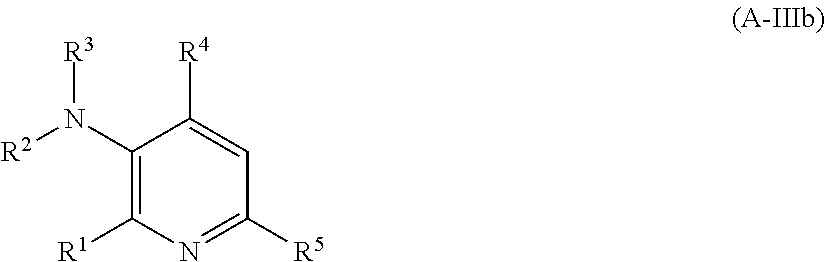
and pharmaceutically acceptable enantiomers, salts, solvates and prodrugs thereof, wherein R1, R2, R3, R4 and R5 are as defined in formula A.

and pharmaceutically acceptable enantiomers, salts, solvates and prodrugs thereof, wherein R4, R5 and R6 are as defined in formula A.

and pharmaceutically acceptable enantiomers, salts, solvates and prodrugs thereof, wherein R4, R5, R6 and R7 are as defined in formula A and

and pharmaceutically acceptable enantiomers, salts, solvates and prodrugs thereof, wherein RA, RB, R1 and R4 are as defined in formula A.

and pharmaceutically acceptable enantiomers, salts, solvates and prodrugs thereof, wherein R1, R2, R3, R4 and RB are as defined in formula A.

and pharmaceutically acceptable enantiomers, salts, solvates and prodrugs thereof, wherein R1, R2, R3 and R4 are as defined in formula A.

and pharmaceutically acceptable enantiomers, salts, solvates and prodrugs thereof, wherein R1, R2, R3 and R4 are as defined in formula A.

and pharmaceutically acceptable enantiomers, salts, solvates and prodrugs thereof, wherein X1, X2, X3, R1 and R4 are as defined in formula A.

and pharmaceutically acceptable enantiomers, salts, solvates and prodrugs thereof, wherein X1, X2, X3, X4, R1, R2, R3 and R4 are as defined in formula A.

and pharmaceutically acceptable enantiomers, salts, solvates and prodrugs thereof, wherein X1, X2, X4, X, R4, R5 and R6 are as defined in formula A.

and pharmaceutically acceptable enantiomers, salts, solvates and prodrugs thereof, wherein X1, X2, R4, R5, R6 and R9 are as defined in formula A.

and pharmaceutically acceptable enantiomers, salts, solvates and prodrugs thereof, wherein X1, X2, R4, R5 and R6 are as defined in formula A.

and pharmaceutically acceptable enantiomers, salts, solvates and prodrugs thereof, wherein X1, X2, R4, R5, R6 and R9 are as defined in formula A.

and pharmaceutically acceptable enantiomers, salts, solvates and prodrugs thereof, wherein X1, X2, R4, R5, R6 and R7 are as defined in formula A and
| TABLE 1 | ||
| Cpd no | Structure | Chemical name |
| 1 |  | 9-(3-phenylpropyl)-9H- purin-6-amine |
| 2 |  | 9-benzyl-2-chloro-9H- purin-6-amine |
| 3 |  | 9-benzyl-N2-(3- phenylpropyl)-9H-purine- 2,6- |
| 4 |  | 9-benzyl-2-chloro-N-(4- methoxybenzyl)-9H-purin- 6-amine |
| 5 |  | 9-benzyl-N6-(4- methoxybenzyl)-N2-(3- phenylpropyl)-9H-purine- 2,6- |
| 6 |  | (S)-2-((9-benzyl-2-((3- phenylpropyl)amino)-9H- purin-6-yl)amino) |
| 7 |  | N2-(3-phenylpropyl)-9H- purine-2,6- |
| 8 |  | 2-chloro-N-(3- phenylpropyl)-9H-purin-6- amine |
| 9 |  | 2-chloro-N-(4- methoxybenzyl)-9H-purin- 6- |
| 10 |  | N6-(4-methoxybenzyl)-N2- (3-phenylpropyl)-9H- purine-2,6-diamine |
| 11 |  | N-(4-methoxybenzyl)-2-(3- phenylpropoxy)-9H-purin- 6- |
| 12 |  | N-(4-methoxybenzyl)-2- phenethoxy-9H-purin-6- amine |
| 13 |  | (S)-tert-butyl 2-((2-chloro- 9H-purin-6- yl)amino) |
| 14 |  | (S)-2-((2-chloro-9-(4- (hydroxymethyl)phenyl)- 9H-purin-6- yl)amino)propanoic acid |
| 15 |  | (S)-tert-butyl 2-((2-chloro- 9-(4- (hydroxymethyl)phenyl)- 9H-purin-6- yl)amino)propanoate |
| 16 |  | 4-(6-chloro-9H-purin-9- yl)benzamide |
| 17 |  | 4-(2-chloro-6- (diethylamino)-9H-purin-9- yl)benzamide |
| 18 |  | 4-(6-amino-2-chloro-9H- purin-9-yl)benzamide |
| 19 |  | 4-(6-amino-9H-purin-9- yl) |
| 20 |  | 4-(2,6-diamino-9H-purin-9- yl)benzamide |
| 21 |  | 4-(2-chloro-6-((1,3- dihydroxypropan-2- yl)amino)-9H-purin-9- yl)benzamide |
| 22 |  | (S)-2-((9-(4- carbamoylphenyl)-2- chloro-9H-purin-6- yl)amino)-3- hydroxypropanoic acid |
| 23 |  | 2-((9-(4-carbamoylphenyl)- 2-chloro-9H-purin-6- yl)amino) |
| 24 |  | tert-butyl 2-((9-(4- carbamoylphenyl)-2- chloro-9H-purin-6- yl)amino)acetate |
| 25 |  | 4-(2-chloro-6-((4- methoxybenzyl)amino)-9H- purin-9-yl)benzamide |
| 26 |  | (S)-2-((9-(4- carbamoylphenyl)-2- chloro-9H-purin-6- yl)amino)propanoic acid |
| 27 |  | (S)-tert-butyl 2-((9-(4- carbamoylphenyl)-2- chloro-9H-purin-6- yl)amino)propanoate |
| 28 |  | 4-(2-amino-6-((4- carbamoylphenyl)amino)- 9H-purin-9-yl)benzamide |
| 29 |  | 4-(2-amino-6-hydroxy-9H- purin-9-yl)benzoic acid |
| 30 |  | methyl 4-(2-acetamido-6- ((benzhydrylcarbamoyl)oxy)- 9H-purin-9-yl)benzoate |
| 31 |  | methyl 4-(2-amino-6- hydroxy-9H-purin-9- yl)benzoate |
| 32 |  | methyl 4-(2-acetamido-6- hydroxy-9H-purin-9- yl)benzoate |
| 33 |  | 4-(7-chloro-3H- [1,2,3]triazolo[4,5- d]pyrimidin-3- yl)benzamide |
| 34 |  | tert-butyl 2-((5-amino-3-(4- carbamoylphenyl)-3H- [1,2,3]triazolo[4,5- d]pyrimidin-7- yl)amino)acetate |
| 35 |  | 6-chloro-N4-(4- phenylbutyl)pyrimidine- 4,5-diamine |
| 36 |  | 3-((5-amino-6- chloropyrimidin-4- yl)amino)propan-1- aminium chloride |
| 37 |  | 6-chloro-N4-(3- phenylpropyl)pyrimidine- 4,5-diamine |
| 38 |  | N4,N4′-(propane-1,3- diyl)bis(6- chloropyrimidine-4,5- diamine) |
| 39 |  | 6-chloro-N4- phenethylpyrimidine-4,5- |
| 40 |  | 6-chloro-N4-(4- fluorophenethyl)pyrimidine- 4,5-diamine |
| 41 |  | 6-chloro-N4-(2-(pyridin-4- yl)ethyl)pyrimidine-4,5- diamine |
| 42 |  | N4,N4′-(ethane-1,2- diyl)bis(6- chloropyrimidine-4,5- diamine) |
| 43 |  | N4-benzyl-6- chloropyrimidine-4,5- diamine |
| 44 |  | 4-(((5-amino-6- chloropyrimidin-4- yl)amino)methyl)benzoic acid |
| 45 |  | 6-chloro-N4-(pyridin-3- ylmethyl)pyrimidine-4,5- diamine |
| 46 |  | 6-chloro-N4-(pyridin-4- ylmethyl)pyrimidine-4,5- diamine |
| 47 |  | 4,6-dichloropyrimidin-5- amine |
| 48 |  | 4,6-dichloropyrimidine-2,5- |
| 49 |  | 4-((5-amino-6- chloropyrimidin-4- yl)amino) |
| 50 |  | 4,6-bis((4- carbamoylphenyl)amino)- 2-methylpyrimidin-5- aminium chloride |
| 51 |  | 3-((5-amino-6- chloropyrimidin-4- yl)amino)benzamide |
| 52 |  | 4-((5-amino-6- chloropyrimidin-4- yl)amino)benzenesulfonic acid |
| 53 |  | 2-(3-phenylpropoxy)-9H- purin-6-amine |
| 54 |  | (4-(6-amino-2-chloro-9H- purin-9-yl)phenyl)methanol |
| 55 |  | 4-((5-amino-6- chloropyrimidin-4- yl)oxy)benzamide |
| 56 |  | 4-((5-amino-6- chloropyrimidin-4- yl)amino)benzenesulfonamide |
| 57 |  | (S)-2-((9-(4- (hydroxymethyl)phenyl)-2- ((3-phenylpropyl)amino)- 9H-purin-6- yl)amino)propanoic acid |
| 58 |  | N6-(4-methoxybenzyl)-N2- (4-phenylbutyl)-9H-purine- 2,6-diamine |
| 59 |  | 4-((5,6-diaminopyrimidin- 4-yl)amino) |
| 60 |  | 4-(6-((4- methoxybenzyl)amino)-2- ((3-phenylpropyl)amino)- 9H-purin-9-yl)benzamide |
| 61 |  | (4-(2,6-diamino-9H-purin- 9-yl)phenyl)methanol |
| 62 |  | 4-(2-amino-6-methoxy-9H- purin-9-yl)benzamide |
| 63 |  | 4-(2-amino-9H-purin-9- yl)benzamide |
| 64 |  | 4-(7-chloro-3H- [1,2,3]triazolo[4,5- d]pyrimidin-3- yl)benzenesulfonamide |
| 65 |  | 4-((5-amino-6-chloro-2- methylpyrimidin-4- yl)amino)benzamide |
| 66 |  | 4-chloro-6-(3- phenylpropoxy)pyrimidin- 5-amine |
| 67 |  | 4,6-dichloro-2- methylpyrimidin-5-amine |
| 68 |  | 9H-purine-2,6-diamine |
| 69 |  | 6-chloropyrimidine-2,4,5- triamine |
| 70 |  | N-(6-chloro-9H-purin-2- yl)-3-phenylpropanamide |
| 71 |  | 4-((5-amino-6- hydroxypyrimidin-4- yl)amino)benzamide |
| 72 |  | N2-(4-phenylbutyl)-9H- purine-2,6-diamine |
| 74 |  | 2-chloro-9H-purin-6-amine |
| 75 |  | 4-((5-amino-6- methoxypyrimidin-4- yl)amino)benzamide |
| 76 |  | 4-(6-chloro-9H-purin-9- yl)benzenesulfonamide |
| 77 |  | 4-(6-chloro-8-methyl-9H- purin-9-yl)benzamide |
| 78 |  | (4-((5-aminopyrimidin-4- yl)amino)phenyl)methanol |
| 79 |  | 4-(2,6-dichloro-9H-purin-9- yl) |
| 80 |  | 2,6-dichloro-9-phenyl-9H- purine |
| 81 |  | (S)-tert-butyl 2-((2-chloro- 9-phenyl-9H-purin-6- yl)amino)propanoate |
| 82 |  | (S)-tert-butyl 2-((9-phenyl- 2-((3-phenylpropyl)amino)- 9H-purin-6- yl)amino)propanoate |
| 83 |  | (S)-2-((9-phenyl-2-((3- phenylpropyl)amino)-9H- purin-6-yl)amino)propanoic acid |
| 85 |  | N6-(4-methoxybenzyl)-N2- (4-methoxyphenethyl)-9- phenyl-9H-purine-2,6- diamine |
| 86 |  | 1-(4-(2,6-dichloro-9H- purin-9-yl)phenyl)ethanone |
| 88 |  | N2,N6-bis(4- methoxybenzyl)-9H- purine-2,6-diamine |
| 89 |  | 4-((2-chloro-6-((4- methoxybenzyl)amino)-9H- purin-9- yl)methyl)benzamide |
| 90 |  | methyl 4-(2,6-dichloro-9H- purin-9-yl)benzoate |
| 91 |  | 2-amino-9-(3,4- dimethoxyphenyl)-9H- purin-6-ol |
| 92 |  | 2-amino-9-phenyl-9H- purin-6-ol |
| 93 |  | 4-((2,6-dichloro-9H-purin- 9-yl)methyl)benzamide |
| 94 |  | 2,6-dichloro-9-(pyridin-3- yl)-9H-purine |
| 95 |  | 3-(2,6-dichloro-9H-purin-9- yl)benzamide |
| 96 |  | 4-((2,6- dihydroxypyrimidin-4- yl)amino)benzamide |
| 97 |  | 2-chloro-N-(4- methoxybenzyl)-9- (tetrahydro-2H-pyran-2-yl)- 9H-purin-6-amine |
| 98 |  | N-(4-methoxybenzyl)-2- phenethoxy-9-(tetrahydro- 2H-pyran-2-yl)-9H-purin- 6-amine |
| 99 |  | N-(4-methoxybenzyl)-2-(3- phenylpropoxy)-9- (tetrahydro-2H-pyran-2-yl)- 9H-purin-6- |
| 100 |  | 4-((2-amino-6- chloropyrimidin-4- yl)amino)benzamide |
| 101 |  | N-(2-amino-4,6- dichloropyrimidin-5- yl)formamide |
| 102 |  | pyrimidine-4,5,6-triamine |
| 103 |  | 6-chloro-5-nitropyrimidine- 2,4-diol |
| 104 |  | N2-(4-fluorophenethyl)- 9H-purine-2,6- |
| 105 |  | 4-((3-nitropyridin-4- yl)amino)benzamide |
| 106 |  | 4-((6-chloro-5- nitropyrimidin-4- yl)amino)benzamide |
| 107 |  | 4-((5-aminopyrimidin-4- yl)amino)benzamide |
| 108 |  | 4-((5-amino-6- chloropyrimidin-4- yl)thio)benzamide |
| 109 |  | 6-chloro-N4-(p- tolyl)pyrimidine-4,5- diamine |
| 110 |  | 6-chloro-N4-(4- fluorophenyl)pyrimidine- 4,5-diamine |
| 111 |  | 4-chloropyrimidin-5-amine |
| 112 |  | 4-(4-chloro-7H- pyrrolo[2,3-d]pyrimidin-7- yl)benzamide |
| 113 |  | 4-(2-amino-9H-purin-6- yl)benzamide |
| 114 |  | 3-((4- carbamoylphenyl)amino)- 4-nitropyridine 1-oxide |
| 115 |  | 2-((4- carbamoylphenyl)amino)- pyridin-3-aminium chloride |
| 116 |  | 4-(9H-purin-9- yl)benzamide |
| 117 |  | (4-(2-amino-6-((4- (hydroxymethyl)phenyl)- amino)-9H-purin-9- yl)phenyl)methanol |
| 118 |  | (S)-2-((2-chloro-9-phenyl- 9H-purin-6- yl)amino)propanoic acid |
| 119 |  | (S)-2-((9-(4- carbamoylbenzyl)-2- chloro-9H-purin-6- yl)amino)-3- |
| 120 |  | N-(4-((6-chloro-5- nitropyrimidin-4- yl)amino)phenyl)acetamide |
| 121 |  | (S)-tert-butyl 2-((9-(4- carbamoylbenzyl)-2- chloro-9H-purin-6- yl)amino)propanoate |
| 122 |  | 4-(6-chloro-8-oxo-7H- purin-9(8H)-yl)benzamide |
| 123 |  | 4-((6-chloro-5- nitropyrimidin-4- yl)(methyl)amino)benzoic acid |
| 124 |  | 4-((5-amino-6- (methylthio)pyrimidin-4- yl)amino)benzamide |
| 125 |  | 4-((6-chloro-5- nitropyrimidin-4- yl)(methyl)amino)benzamide |
| 126 |  | 4-((5-amino-6- chloropyrimidin-4- yl)(methyl)amino)benzamide |
| 127 |  | N2-(3-(3- fluorophenyl)propyl)-N6- (4-methoxybenzyl)-9H- purine-2,6-diamine |
| 128 |  | N2-(3-(3- fluorophenyl)propyl)-9H- purine-2,6-diamine |
| 129 |  | 4-((5-amino-6- (methylthio)pyrimidin-4- yl)amino)benzamide |
| 130 |  | 4-(6-amino-9H-purin-2- yl)benzamide |
| 131 |  | N2-(4-fluorophenethyl)- N6-(4-methoxybenzyl)-9H- purine-2,6-diamine |
| 132 |  | 4,6-dichloropyrimidine |
| 133 |  | 4,6-dichloropyrimidin-2- amine |
| 134 |  | 4-methylpyrimidin-2-amine |
| 135 |  | pyrimidin-2-amine |
| 136 |  | 4,6-dichloro-5- nitropyrimidine |
| 137 |  | 6-methoxypyrimidin-4- amine |
| 138 |  | 6-chloropyrimidin-4-amine |
| 139 |  | 2,6-dichloropyrimidin-4- |
| 140 |  | 4,4′-((6-aminopyrimidine- 2,4- diyl)bis(azanediyl))dibenz- amide |
| 141 |  | 4-((3-aminopyridin-4- yl)amino)benzamide |
| 142 |  | 4-(((5-amino-6- chloropyrimidin-4- yl)amino)methyl)benzamide |
| 143 |  | 4-((2-chloro-3-nitropyridin- 4-yl)amino)benzamide |
| 144 |  | 6-chloro-N4-(4- chlorophenyl)pyrimidine- 4,5-diamine |
| 145 |  | 2-((6-((4- carbamoylphenyl)amino)- 5-nitropyrimidin-4- yl)amino)acetic acid |
| 146 |  | 2-chloro-9-phenyl-9H- purin-6-amine |
| 147 |  | 4-((3-amino-2- chloropyridin-4- yl)amino)benzamide |
| 148 |  | 4-((3-nitropyridin-2- yl)amino)benzamide |
| 149 |  | 4-((6-chloropyrimidin-4- yl)amino) |
| 150 |  | 6-chloro-N4- phenylpyrimidine-4,5- diamine |
| 151 |  | N,N′-(((5-nitropyrimidine- 4,6- diyl)bis(azanediyl))bis(4,1- phenylene))diacetamide |
| 152 |  | 4-(4-chloro-1H- imidazo[4,5-c]pyridin-1- yl)benzamide |
| 153 |  | (S)-2-((9-(4- carbamoylbenzyl)-2- chloro-9H-purin-6- yl)amino)propanoic acid |
| 154 |  | 4-(4-amino-7H-pyrrolo[2,3- d]pyrimidin-7- yl)benzamide |
| 155 |  | 4-((6-methoxy-5- nitropyrimidin-4- yl)amino)benzamide |
| 156 |  | N-(4-((5-amino-6- chloropyrimidin-4- yl)amino)phenyl)acetamide |
| 157 |  | 4-((6-(benzyloxy)-5- nitropyrimidin-4- yl)amino)benzamide |
| 158 |  | N4-(4- ((benzyloxy)methyl)phenyl)- 6-chloropyrimidine-4,5- diamine |
or pharmaceutically acceptable enantiomers, salts, solvates and prodrugs thereof.

and pharmaceutically acceptable enantiomers, salts, solvates and prodrugs thereof, wherein
-
- X1 and X2 represent respectively CH and N or N and CH;
- R6 represents H, arylalkyl wherein the aryl group is optionally substituted by one or more group selected from halo and carboxyl; heteroarylalkyl; heteroarylaminoalkyl wherein the heteroaryl group is optionally substituted by one or more group selected from halo and NH2; aminoalkyl; aryl substituted by one or more group selected from alkyloxy, hydroxymethyl, CONH2, COOH, COOalkyl SO3H, SO2NH2; preferably R6 represents H, phenylalkyl wherein the phenyl group is optionally substituted by one or more group selected from fluoro and carboxyl and wherein the alkyl is preferably selected from methyl, ethyl, n-propyl, n-butyl; heteroarylalkyl wherein the heteroaryl is preferably pyridine and wherein the alkyl group is preferably selected from methyl and ethyl; heteroarylaminoalkyl wherein the heteroaryl group is optionally substituted by one or more group selected from Cl and NH2 and wherein the heteroaryl is preferably pyrimidine and wherein the alkyl group is preferably selected from ethyl and n-propyl; amino-n-propyl; phenyl substituted in para or meta, preferably in para, by one or more group selected from hydroxymethyl, CONH2, COOH, COOMe and SO3H; more preferably R6 represents phenyl substituted in para by hydroxymethyl or CONH2.
| TABLE 2 | ||||
| Cpd no | Structure | Chemical name | ||
| II-1 |  | 4-(quinolin-4-yl)benzamide | ||
| II-2 |  | 4-(quinolin-5-yl)benzamide | ||
or pharmaceutically acceptable enantiomers, salts, solvates and prodrugs thereof.
-
- (i) by reacting the compound of the invention with the desired acid;
- (ii) by reacting the compound of the invention with the desired base;
- (iii) by removing an acid- or base-labile protecting group from a suitable precursor of the compound of the invention or by ring-opening a suitable cyclic precursor, for example, a lactone or lactam, using the desired acid; or
- (iv) by converting one salt of the compound of the invention to another by reaction with an appropriate acid or by means of a suitable ion exchange column.

and pharmaceutically acceptable enantiomers, salts, solvates and prodrugs thereof, wherein R4, R5 and R6 are as defined above;
-
- comprising coupling compound of Formula (i)

wherein R4 and R5 are as defined above
-
- with amine of Formula (ii)
R6—NH2
wherein R6 is as defined above; - to afford compound of Formula Ib-2a.
- with amine of Formula (ii)

and pharmaceutically acceptable enantiomers, salts, solvates and prodrugs thereof, wherein X1, X2 and R6 are as defined above;
-
- comprising performing a Suzuki coupling between compound of Formula (i)

wherein X1 and X2 are as defined above; and X3 represents an halogen, preferably Cl;
-
- and boronic acid of Formula (ii)

wherein R6 is as defined above;
-
- or corresponding boronic ester;
- to afford compound of Formula II.
General synthesis protocol III. A solution of the purine derivative in TFA (10 mL/mmol) was refluxed for 24 h and then concentrated under reduced pressure. The crude product was purified by precipitation or by chromatography on silica gel.
General synthesis protocol IV. To a suspension of purine derivative in THF (2 mL/mmol) were added TBAF (1 M in THF, 2 equivalents) and the aryl bromide derivative (2 equivalents). The resulting solution was stirred for 10 to 60 min, and then concentrated under reduced pressure. The crude product was purified by precipitation or by chromatography on silica gel.
General synthesis protocol V. To a solution of the purine derivative in DMF (2 mL/mmol) were added aryl bromide derivative (1.1 equivalent) and K2CO3 (1.1 equivalent). The resulting suspension was stirred for 16 h, then the solid was filtrated and washed with methanol. The filtrate was concentrated under reduced pressure. The crude product was purified by chromatography on silica gel.
General synthesis protocol VI. To a solution of the purine derivative in dichloromethane (40 mL/mmol) was added TFA (10 mL/mmol). The solution was stirred for 16 h, and then concentrated under reduced pressure. The crude product was purified by precipitation and by washing with water or by chromatography on silica gel.
General synthesis protocol VII. To a solution of the purine derivative (1 equivalent) in DMF (20 mL/mmol) were added amino acid ester (1.5 equivalent) and triethylamine (3 equivalents). The solution was stirred for 8 h at 80° C., and then was concentrated under reduced pressure. The crude residue was dissolved in dichloromethane and purified by extraction with water, by precipitation or by chromatography on silica gel to afford pure compound.
General synthesis protocol VIII. To a solution of purine derivative (1 equivalent) in water (10 mL/mmol) were added the amino acid (6 equivalents) and K2CO3 (6 equivalents). The solution was stirred for 8 h at 70° C. After cooling to room temperature, the solution was neutralized by addition of aqueous hydrochloric acid (5%). The resulting solution was purified by extraction with dichloromethane and then the aqueous layer was concentrated under reduced pressure. The crude residue was purified by reverse phase chromatography eluting with water/methanol.
General synthesis protocol IX. To a solution of the purine derivative in acetonitrile (0.3 mL/mmol) or in a mixture methanol/dichloromethane (1/1 v/v, 0.3 mL/mmol) were added NaBH3CN (6 equivalents) and the corresponding aldehyde (8 equivalents). The solution was stirred for 3 days at room temperature and then concentrated under reduced pressure. The crude product was purified by chromatography on silica gel.
General synthesis protocol X. To a solution of the chloropyrimidine derivative in a mixture water/dioxane (1/1 v/v, 4 mL/mmol) were added the amine (1 equivalent) and Na2CO3 (2 equivalents). The solution was refluxed overnight. After concentration under reduced pressure, the crude product was purified by precipitation.
General synthesis protocol XI. To a suspension of the pyrimidine derivative in a mixture of dichloromethane/aqueous acetic acid (37%) (1/1 v/v, 10 mL/mmol) was added NaNO2 (1.1 equivalent). The suspension was stirred for 30 min at room temperature and then methanol (10 mL/mmol) was added. The suspension was stirred for 24 h at room temperature and the resulting precipitate was filtrated and washed with methanol to afford the pure product.
General synthesis protocol XII. To a suspension of the pyrimidine derivative in trimethyl orthoformate (5 mL/mmol) was added ethanesulfonic acid (25 μL/mmol). The suspension was stirred for 1 h under microwave irradiation at 120° C. The resulting precipitate was filtrated and washed with methanol to afford the pure product.
General synthesis protocol XIII. To a suspension of the purine derivative in the alcohol derivative (2.5 mL/mmol) was added NaOH (250 mg/mmol). The suspension was stirred for 3 h at 85° C. The crude product in solution in the alcohol derivative was purified by chromatography on silica gel to afford the pure product.
General synthesis protocol XIV. To a suspension of the purine derivative in absolute ethanol (30 mL/mmol) was added aqueous hydrochloric acid (10%, v/v, 3 mL/mmol). The suspension was stirred for 24 h at room temperature and then the solvents were removed under reduced pressure to afford the pure product.
General synthesis protocol XV. To a solution of the chloropyrimidine derivative in a mixture water/dioxane (1/1 v/v, 4 mL/mmol) was added the amine (3 equivalent). The solution was refluxed overnight. After cooling at room temperature, the crude product was purified by precipitation.
General synthesis protocol XVI. To a solution of the nitrochloropyrimidine derivative in tetrahydrofuran (4 mL/mmol) were added the amine (1 equivalent) and NaHCO3 (1.1 equivalents). The solution was stirred at room temperature overnight. After concentration under reduced pressure, the crude product was purified by chromatography on silica gel to afford the pure product.
General synthesis protocol XVII. To a solution of the chloropyrimidine derivative in a mixture water/dioxane (1/1 v/v, 2 mL/mmol) was added the amine (1 or 2 equivalents) and paratoluenesulfonic acid (0.5). The solution was refluxed overnight. After cooling at room temperature, the crude product was purified by precipitation.
I.3. Synthesis of Intermediates
Intermediate Int-1. This compound was synthesized through general synthesis protocol I from compound 9 and phenylboronic acid, and was purified by chromatography on silica gel (eluent dichloromethane/methanol) to afford pure compound Int-1 (42%). 1H NMR (400 MHz, CDCl3) δ 7.99 (s, 1H, CHAr), 7.68-7.62 (m, 2H, 2 CHAr), 7.60-7.54 (m, 2H, 2 CHAr), 7.49-7.43 (m, 1H, CHAr), 7.38-7.32 (m, 2H, 2 CHAr), 6.93-6.88 (m, 2H, 2 CHAr), 6.35 (bs, 1H, NH), 4.79 (bs, 2H, CH2), 3.82 (s, 3H, CH3); HRMS (ESI) calc. for C19H17ClN5O: [M+H]+ 366.11194, found 366.1116.
Intermediate Int-2. This compound was synthesized through general synthesis protocol I from 2,6-dichloropurine and 4-(hydroxymethyl)phenylboronic acid, and was purified by chromatography on silica gel (eluent dichloromethane/methanol) to afford pure compound Int-2 (7%). 1H NMR (400 MHz, CDCl3) δ 8.37 (s, 1H, CHAr), 7.74-7.64 (m, 2H, 2 CHAr), 7.64-7.58 (m, 2H, 2 CHAr), 4.83 (s, 2H, CH2), 1.85 (bs, 1H, OH); HRMS (ESI) calc. for C12H9Cl2N4O: [M+H]+ 295.01479, found 295.0150.
Intermediate Int-3. This compound was synthesized through general synthesis protocol V from 2,6-dichloropurine and benzyle bromide, to afford pure compound Int-3 (19%). 1H NMR (400 MHz, CDCl3) δ 8.04 (s, 1H, CHAr), 7.45-7.36 (m, 3H, 3 CHAr), 7.34-7.29 (m, 2H, 2 CHAr), 5.41 (s, 2H, CH2); HRMS (ESI) calc. for C12H9Cl2N4: [M+H]+, 279.01988, found 279.0201.
Intermediate Int-4. This compound was synthesized through general synthesis protocol VII from compound Int-3 and L-alanine tert-butyl ester, was purified by extraction dichloromethane/water and then by chromatography on silica gel (eluent dichloromethane/methanol) to afford pure compound Int-4 (47%). 1H NMR (400 MHz, CDCl3) δ 7.65 (s, 1H, CHAr), 7.42-7.32 (m, 3H, 3 CHAr), 7.29-7.24 (m, 2H, 2 CHAr), 6.41 (bs, 1H, NH), 5.31 (s, 2H, CH2), 4.81 (bs, 1H, CH), 1.53 (d, J=7.1 Hz, 3H, CH3), 1.48 (s, 9H, CH3); HRMS (ESI) calc. for C19H23ClN5O2: [M+H]+ 388.15348, found 388.1538.
Intermediate Int-5. This compound was synthesized through general synthesis protocol II from compound Int-4 and 3-phenylpropyl-1-amine, and was purified by chromatography on silica gel (eluent dichloromethane/ethyl acetate) to afford pure compound Int-5 (75%). 1H NMR (400 MHz, CDCl3) δ 7.46 (s, 1H, CHAr), 7.40-7.30 (m, 8H, 8 CHAr), 7.27-7.21 (m, 2H, 2 CHAr), 6.05 (bs, 1H, NH), 5.23 (s, 2H, CH2), 4.98-4.90 (m, 1H), 4.81 (bs, 1H, CH), 3.63-3.43 (m, 2H, CH2), 2.80-2.74 (m, 2H, CH2), 2.06-1.95 (m, 2H, CH2), 1.55 (d, J=7.1 Hz, 3H, CH3), 1.52 (s, 9H, 3 CH3); HRMS (ESI) calc. for C28H35N6O4: [M+H]+ 487.28160, found 487.2811.
Intermediate Int-6. This compound was synthesized through general synthesis protocol I from 6-diBoc-adenine and 4-carbamoylphenylboronic acid, and was purified by chromatography on silica gel (elution with dichloromethane/methanol) to afford pure compound Int-6 (39%). 1H NMR (400 MHz, CDCl3) δ 8.95 (s, 1H, CHAr), 8.42 (s, 1H, CHAr), 8.06 (d, J=8.7 Hz, 2H, 2 CHAr), 7.92 (d, J=8.7 Hz, 2H, 2 CHAr), 6.12 (bs, 1H, NH), 5.76 (bs, 1H, NH), 1.50 (s, 18H, 6 CH3); HRMS (ESI) calc. for C22H27N6O5: [M+H]+ 455.20374, found 455.2033.
Intermediate Int-7. To a solution of 2,6-dichloropurine in ethyl acetate (3 mL/mmol) was added para-toluenesulfonic acid (2 mg/mmol). The solution was stirred at 50° C., and a solution of 3,4-dihydropyrane (1.3 equivalent) in ethyl acetate (0.5 mL/mmol) was added for 30 min. The solution was stirred at 50° C. for 15 min, cooled to room temperature, washed with water and brine. The organic layer was evaporated under reduced pressure to afford pure compound Int-7 (99%). 1H NMR (400 MHz, d6-DMSO) δ 8.95 (s, 1H, CHAr), 5.74 (dd, J=10.8 Hz, J=2.2 Hz, 1H, CH), 4.02 (m, 1H, CH), 3.74 (m, 1H, CH), 2.26 (m, 1H, CH), 1.98 (m, 2H, CH2), 1.43-1.75 (m, 3H, CH+CH2); HRMS (ESI) calc. for C10H11Cl2N4O: [M+H]+ 273.03044, found 273.0303.
Intermediate Int-8. This compound was synthesized through general synthesis protocol II from compound 15 and 3-phenylpropyl-1-amine, and was purified by chromatography on silica gel (eluent dichloromethane/ethyl acetate) to afford pure compound Int-8 (87%). 1H NMR (400 MHz, CDCl3) δ 7.68 (s, 1H, CHAr), 7.65 (d, J=8.4 Hz, 2H, 2 CHAr), 7.48 (d, J=8.4 Hz, 2H, 2 CHAr), 7.36-7.27 (m, 2H, 2 CHAr), 7.25-7.20 (m, 3H, 3 CHAr), 6.27 (bs, 1H, NH), 5.12-5.00 (m, 1H, CH), 4.75 (s, 2H, CH2), 3.59-3.38 (m, 2H, CH2), 2.78-2.71 (m, 2H, CH2), 2.02-1.92 (m, 2H, CH2), 1.57 (d, J=7.1 Hz, 3H, CH3), 1.53 (s, 9H, 3 CH3); HRMS (ESI) calc. for C28H35N6O3: [M+H]+ 503.27652, found 503.2767.
Intermediate Int-9. This compound was synthesized through general synthesis protocol X from 4-aminobenzamide and 2,5-diamino-4,6-dichloropyrimidine to afford pure compound Int-9 (97%). 1H NMR (400 MHz, d6-DMSO) δ 9.28 (bs, 1H, NH), 7.89 (d, J=8.9 Hz, 2H, 2 CHAr), 7.84 (d, J=8.9 Hz, 2H, 2 CHAr), 7.24 (bs, 1H, NH2), 4.81 (bs, 5H, NH2); HRMS (ESI) calc. for C11H12ClN6O: [M+H]+ 279.07556, found 279.0755.
Intermediate Int-10. This compound was synthesized through general synthesis protocol XII from compound Int-9 (11%). 1H NMR (400 MHz, d6-DMSO) δ 8.62 (s, 1H, CHAr), 8.09 (bs, 1H, NH2), 8.06 (d, J=8.7 Hz, 2H, 2 CHAr), 7.98 (d, J=8.7 Hz, 2H, 2 CHAr), 7.50 (bs, 1H, NH2), 7.10 (s, 2H, NH2); HRMS (ESI) calc. for C12H10ClN6O: [M+H]+289.05991, found 289.0599.
Intermediate Int-11. Compound 106 (1 equivalent) was suspended in NH4OH 30% (20 mL/mmol), heated to 40° C. for 40 min, concentrated and the resulting solid was suspended in boiling methanol (50 mL) then filtrated. This operation was done twice to afford pure compound Int-11 as an orange solid (59%). 1H NMR (400 MHz, d6-DMSO) δ 10.89 (bs, 1H, NH), 8.69 (bs, 2H, NH2), 8.08 (s, 1H, CHAr), 7.94 (bs, 1H, NH2), 7.88 (d, J=8.1 Hz, 2H, 2 CHAr), 7.74 (d, J=8.1 Hz, 2H, 2 CHAr), 7.33 (bs, 1H, NH2); HRMS (ESI) calc. for C11H11N6O3: [M+H]+ 275.08871, found 275.0889.
I.4. Synthesis of Compounds
Methods
Cell culture. HeLa cells expressing wild-type CFTR (spTCF-wt) or F508del-CFTR (spTCF-ΔF) were cultured in Dulbecco's modified Eagle's medium+GlutaMAX™-I (Invitrogen) supplemented with 8% (v/v) fetal bovine serum (FBS), 1% (v/v) penicillin/streptomycin and were selected using Zeocin (50 μg/mL). Both cell lines were grown in standard culture conditions (37° C., 5% C02). Cells were plated in 35 mm plastic dishes for whole-cell patch-clamp recordings and western blot analysis and in 96-well plates for cytotoxicity assay. For all cell culture, culture media were renewed every 2 days.
Western Blot analysis. Cell lysates (10 mM Tris, 1% Nonidet P-40, 0.5% sodium deoxycholate, pH 7.5) were separated 72 h after seeding for HeLa cells by 5% SDS-PAGE (50 μg of protein/well). After saturation, nitrocellulose membrane was incubated overnight at 4° C. in phosphate-buffered saline, 0.1
Iodide efflux. CFTR chloride channel activity was assayed by measuring the rate of iodide (125I) efflux from living cells. All experiments were performed with a MultiPROBE® IIex robotic liquid handling system (Perkin Elmer Life Sciences, Courtaboeuf, France). At the beginning of each experiment, cells were washed twice with efflux buffer containing (in mM) 136.9 NaCl, 5.4 KCl, 0.3 KH2PO4, 0.3 NaH2PO4, 1.3 CaCl2, 0.5 MgCl2, 0.4 MgSO4, 5.6 glucose and 10 HEPES, pH 7.4. Cells were incubated in efflux buffer containing Na125I (1 μCi Na125I/ml, NEN, Boston, Mass.) during 1 h at 37° C., then washed with efflux medium to remove extracellular 125I. The loss of intracellular 125I was determined by removing the medium with efflux buffer every 1 min for up to 10 min. The first three aliquots were used to establish a stable baseline in efflux buffer alone. A medium containing the activators of CFTR (
Time dependence. Time dependence of the compounds was assayed by measuring the time necessary for an optimal correction of the protein F508del-CFTR. HeLa cells expressing F508del-CFTR were incubated with the compound in acute treatment or during 4, 8, 12, 24 or 48 hours and the iodide efflux was measured as described previously. In some experiments, the incubation with the compound and the measure of iodide efflux are separated by a rinse and a waiting period of 4, 6, 8, 12 or 24 hours before activation with the medium containing the activators of CFTR (
Statistical analysis. Results are expressed as means±SE of n observations. Statistical analysis was carried out using GraphPad (Prism, La Jolla, Calif.) version 5.0 for Windows (GraphPad Software). To compare sets of data, we used one-way Anova followed by Dunnett multiple-comparison test or Student's t test. Differences were considered statistically significant when P<0.05.
Results
Maturation Profile
| TABLE 3 |
| Iodide efflux of cells expressing F508del and incubated |
| with different compounds of the invention |
| Compound | Iodide | ||
| number | efflux | ||
| II-1 | +++ | ||
| 1 | ++ | ||
| 2 | + | ||
| 4 | +++ | ||
| 5 | ++ | ||
| 6 | + | ||
| 7 | +++ | ||
| 9 | + | ||
| 10 | ++ | ||
| 11 | +++ | ||
| 12 | + | ||
| 14 | +++ | ||
| 15 | + | ||
| 16 | + | ||
| 17 | + | ||
| 18 | ++ | ||
| 20 | ++ | ||
| 21 | +++ | ||
| 22 | ++ | ||
| 23 | +++ | ||
| 25 | + | ||
| 26 | + | ||
| 27 | +++ | ||
| 28 | ++ | ||
| 29 | +++ | ||
| 30 | ++ | ||
| 31 | + | ||
| 33 | +++ | ||
| 47 | +++ | ||
| 48 | +++ | ||
| 49 | +++ | ||
| 53 | + | ||
| 54 | +++ | ||
| 55 | +++ | ||
| 56 | +++ | ||
| 57 | +++ | ||
| 58 | ++ | ||
| 59 | ++ | ||
| 60 | ++ | ||
| 61 | ++ | ||
| 62 | + | ||
| 63 | + | ||
| 64 | + | ||
| 65 | ++ | ||
| 79 | + | ||
| 80 | + | ||
| 81 | + | ||
| 82 | + | ||
| 83 | + | ||
| 85 | + | ||
| 86 | + | ||
| 88 | + | ||
| 89 | + | ||
| 90 | + | ||
| 91 | + | ||
| 92 | + | ||
| 93 | + | ||
| 94 | + | ||
| 95 | + | ||
| 96 | + | ||
| 97 | + | ||
| 98 | + | ||
| 101 | ++ | ||
| 102 | +++ | ||
| 103 | + | ||
| 104 | ++ | ||
| 105 | +++ | ||
| 106 | + | ||
| 107 | +++ | ||
| 108 | + | ||
| 109 | ++ | ||
| 110 | + | ||
| 111 | ++ | ||
| 112 | + | ||
| 113 | +++ | ||
| 114 | +++ | ||
| 115 | +++ | ||
| 116 | ++ | ||
| 117 | ++ | ||
| 118 | +++ | ||
| 119 | ++ | ||
| 120 | ++ | ||
| 121 | + | ||
| 122 | + | ||
| 123 | + | ||
| 124 | + | ||
| 125 | +++ | ||
| 126 | +++ | ||
| 127 | ++ | ||
| 128 | ++ | ||
| 129 | +++ | ||
| 130 | +++ | ||
Claims (6)
Applications Claiming Priority (4)
| Application Number | Priority Date | Filing Date | Title |
|---|---|---|---|
| EP14196618.4 | 2014-12-05 | ||
| EP14196618 | 2014-12-05 | ||
| EP14196618 | 2014-12-05 | ||
| PCT/EP2015/078729 WO2016087665A2 (en) | 2014-12-05 | 2015-12-04 | Compounds for treating cystic fibrosis |
Publications (2)
| Publication Number | Publication Date |
|---|---|
| US20170362239A1 US20170362239A1 (en) | 2017-12-21 |
| US10414768B2 true US10414768B2 (en) | 2019-09-17 |
Family
ID=52006908
Family Applications (1)
| Application Number | Title | Priority Date | Filing Date |
|---|---|---|---|
| US15/532,309 Expired - Fee Related US10414768B2 (en) | 2014-12-05 | 2015-12-04 | Compounds for treating cystic fibrosis |
Country Status (4)
| Country | Link |
|---|---|
| US (1) | US10414768B2 (en) |
| EP (1) | EP3226861A2 (en) |
| CA (1) | CA2969587A1 (en) |
| WO (1) | WO2016087665A2 (en) |
Families Citing this family (22)
| Publication number | Priority date | Publication date | Assignee | Title |
|---|---|---|---|---|
| CA2881078C (en) | 2004-06-24 | 2018-10-02 | Vertex Pharmaceuticals Incorporated | Modulators of atp-binding cassette transporters |
| PT2404919E (en) | 2005-11-08 | 2013-10-22 | Vertex Pharma | A HETEROCYCLIC USEFUL COMPOSITE AS AN ATP CONNECTOR CASSETTE CONVERTER MODULATOR |
| LT1993360T (en) | 2005-12-28 | 2017-06-12 | Vertex Pharmaceuticals Incorporated | Solid forms of n-[2,4-bis(1,1-dimethylethyl)-5-hydroxyphenyl]-1,4-dihydro-4-oxoquinoline-3-carboxamide |
| EP2164840A2 (en) | 2007-05-09 | 2010-03-24 | Vertex Pharmaceuticals Incorporated | Modulators of cftr |
| HUE049642T2 (en) | 2007-12-07 | 2020-09-28 | Vertex Pharma | Solid forms of 3- (6- (1- (2,2-Difluorobenzo [d] [1,3] dioxol-5-yl) cyclopropanecarboxamido) -3-methylpyridin-2-yl) benzoic acid |
| CA2989620C (en) | 2007-12-07 | 2022-05-03 | Vertex Pharmaceuticals Incorporated | Processes for producing cycloalkylcarboxamido-pyridine benzoic acids |
| CA2716109C (en) | 2008-02-28 | 2016-07-19 | Vertex Pharmaceuticals Incorporated | Heteroaryl derivatives as cftr modulators |
| US12458635B2 (en) | 2008-08-13 | 2025-11-04 | Vertex Pharmaceuticals Incorporated | Pharmaceutical composition and administrations thereof |
| US20100074949A1 (en) | 2008-08-13 | 2010-03-25 | William Rowe | Pharmaceutical composition and administration thereof |
| SI3330255T1 (en) | 2009-03-20 | 2021-03-31 | Vertex Pharmaceuticals Incorporated | Process for making modulators of cystic fibrosis transmembrane conductance regulator |
| ES2900353T3 (en) | 2010-04-07 | 2022-03-16 | Vertex Pharma | 3-(6-(1-(2,2-difluorobenzo[d][1,3]dioxol-5-yl)cyclopropanecarboxamido)-3-methylpyridin-2-yl)benzoic acid pharmaceutical compositions and administration thereof |
| NZ727015A (en) | 2012-01-25 | 2017-12-22 | Vertex Pharma | Formulations of 3-(6-(1-(2,2-difluorobenzo[d][1,3]dioxol-5-yl) cyclopropanecarboxamido)-3-methylpyridin-2-yl)benzoic acid |
| EP2819670B1 (en) | 2012-02-27 | 2026-05-20 | Vertex Pharmaceuticals Incorporated | Pharmaceutical preparations and their administration |
| CA2930199C (en) | 2013-11-12 | 2022-10-25 | Vertex Pharmaceuticals Incorporated | Process of preparing pharmaceutical compositions for the treatment of cftr mediated diseases |
| HUE055423T2 (en) | 2014-11-18 | 2021-11-29 | Vertex Pharma | High performance liquid chromatograph for high performance liquid chromatography |
| KR101829545B1 (en) * | 2016-08-31 | 2018-02-19 | 고려대학교 세종산학협력단 | N2,N6-substituted-9H-purine-2,6-diamine derivatives having prophylatic and therapeutic effects against hepatoxicity, method for preparing the same, and pharmaceutical composition comprising the same |
| FR3057774B1 (en) * | 2016-10-21 | 2025-11-07 | Museum Nat Dhistoire Naturelle | Purine derivatives for their use in the treatment or prevention of diseases due to a nonsense mutation |
| CN110582496A (en) * | 2017-05-03 | 2019-12-17 | 格勒诺布尔-阿尔卑斯大学 | Methods for the synthesis of variously substituted purines |
| EP3421570B1 (en) * | 2017-06-30 | 2020-11-11 | Merck Patent GmbH | Liquid-crystalline medium and liquid-crystal display comprising the same |
| CN109810110B (en) * | 2017-11-22 | 2023-01-24 | 中国科学院上海药物研究所 | Compound with 2-aminopyrimidine structure, preparation method and application thereof |
| JP7196202B2 (en) * | 2018-06-27 | 2022-12-26 | オリバー,イヴァン シリオ | Novel substituted N9-adenine derivatives, pharmaceutical compositions containing same, and uses thereof |
| WO2024105159A1 (en) * | 2022-11-16 | 2024-05-23 | University Of Zurich | Ligands of the m6a-rna readers |
Citations (20)
| Publication number | Priority date | Publication date | Assignee | Title |
|---|---|---|---|---|
| US3930006A (en) * | 1963-04-30 | 1975-12-30 | Aspro Nicholas Ltd | Antiparkinsonism compositions and method |
| US6329381B1 (en) * | 1997-11-28 | 2001-12-11 | Sumitomo Pharmaceuticals Company, Limited | Heterocyclic compounds |
| WO2004110352A2 (en) | 2003-05-16 | 2004-12-23 | The Regents Of The University Of California | Compounds having activity in increasing ion transport by mutant-cftr and uses thereof |
| WO2005120497A2 (en) | 2004-06-04 | 2005-12-22 | The Regents Of The University Of California | Compounds having activity in increasing ion transport by mutant-cftr and uses thereof |
| FR2876583A1 (en) | 2004-10-15 | 2006-04-21 | Centre Nat Rech Scient | USE OF PURINE DERIVATIVES FOR THE MANUFACTURE OF MEDICAMENTS FOR THE TREATMENT OF MUCOVISCIDOSIS AND DISEASES ASSOCIATED WITH A DEFECT OF ADDRESSING PROTEINS IN CELLS |
| US7109330B2 (en) * | 1996-08-02 | 2006-09-19 | Cv Therapeutics, Inc. | Purine inhibitors of cyclin dependent kinase 2 and IκB-α |
| WO2006101740A2 (en) | 2005-03-18 | 2006-09-28 | The Regents Of The University Of California | Compounds having activity in correcting mutant-cftr processing and uses thereof |
| US7238700B2 (en) * | 2001-06-29 | 2007-07-03 | Cv Therapeutics, Inc. | A2B adenosine receptor antagonists |
| US20080008682A1 (en) * | 2006-07-07 | 2008-01-10 | Chong Lee S | Modulators of toll-like receptor 7 |
| JP4160645B2 (en) * | 1997-12-24 | 2008-10-01 | 大日本住友製薬株式会社 | Novel adenine derivatives and their pharmaceutical use |
| US20090036471A1 (en) * | 2003-07-16 | 2009-02-05 | Eddy Jean Edgard | Triazolopyrimidine Derivatives As Glycogen Synthase Kinase 3 Inhibitors |
| WO2009034386A1 (en) * | 2007-09-13 | 2009-03-19 | Astrazeneca Ab | Derivatives of adenine and 8-aza-adenine and uses thereof-796 |
| US20100093677A1 (en) | 2008-10-10 | 2010-04-15 | Erica Brook Goodhew | Method of inducing negative chemotaxis |
| US20110082146A1 (en) | 2007-03-23 | 2011-04-07 | Rigel Pharmaceuticals, Inc. | Compositions and methods for inhibition of the jak pathway |
| WO2012171954A1 (en) | 2011-06-14 | 2012-12-20 | Azienda Ospedaliera Universitaria Integrata Di Verona | Trimethylangelicin as cftr corrector in bronchial epithelial cells |
| US8362024B2 (en) | 2007-03-28 | 2013-01-29 | Neurosearch A/S | Purinyl derivatives and their use as potassium channel modulators |
| US8372836B2 (en) * | 2006-10-17 | 2013-02-12 | Bend Research, Inc. | Spray dried formulation |
| WO2014081820A1 (en) | 2012-11-20 | 2014-05-30 | Discoverybiomed, Inc. | Small molecule cftr correctors |
| WO2014124230A2 (en) | 2013-02-08 | 2014-08-14 | Celgene Avilomics Research, Inc. | Erk inhibitors and uses thereof |
| US20140323441A1 (en) * | 2011-11-09 | 2014-10-30 | Janssen R&D Ireland | Purine derivatives for the treatment of viral infections |
-
2015
- 2015-12-04 CA CA2969587A patent/CA2969587A1/en not_active Abandoned
- 2015-12-04 EP EP15804816.5A patent/EP3226861A2/en not_active Withdrawn
- 2015-12-04 WO PCT/EP2015/078729 patent/WO2016087665A2/en not_active Ceased
- 2015-12-04 US US15/532,309 patent/US10414768B2/en not_active Expired - Fee Related
Patent Citations (25)
| Publication number | Priority date | Publication date | Assignee | Title |
|---|---|---|---|---|
| US3930006A (en) * | 1963-04-30 | 1975-12-30 | Aspro Nicholas Ltd | Antiparkinsonism compositions and method |
| US7109330B2 (en) * | 1996-08-02 | 2006-09-19 | Cv Therapeutics, Inc. | Purine inhibitors of cyclin dependent kinase 2 and IκB-α |
| US6329381B1 (en) * | 1997-11-28 | 2001-12-11 | Sumitomo Pharmaceuticals Company, Limited | Heterocyclic compounds |
| JP4160645B2 (en) * | 1997-12-24 | 2008-10-01 | 大日本住友製薬株式会社 | Novel adenine derivatives and their pharmaceutical use |
| US7238700B2 (en) * | 2001-06-29 | 2007-07-03 | Cv Therapeutics, Inc. | A2B adenosine receptor antagonists |
| WO2004110352A2 (en) | 2003-05-16 | 2004-12-23 | The Regents Of The University Of California | Compounds having activity in increasing ion transport by mutant-cftr and uses thereof |
| US20090036471A1 (en) * | 2003-07-16 | 2009-02-05 | Eddy Jean Edgard | Triazolopyrimidine Derivatives As Glycogen Synthase Kinase 3 Inhibitors |
| WO2005120497A2 (en) | 2004-06-04 | 2005-12-22 | The Regents Of The University Of California | Compounds having activity in increasing ion transport by mutant-cftr and uses thereof |
| FR2876583A1 (en) | 2004-10-15 | 2006-04-21 | Centre Nat Rech Scient | USE OF PURINE DERIVATIVES FOR THE MANUFACTURE OF MEDICAMENTS FOR THE TREATMENT OF MUCOVISCIDOSIS AND DISEASES ASSOCIATED WITH A DEFECT OF ADDRESSING PROTEINS IN CELLS |
| WO2006042949A1 (en) | 2004-10-15 | 2006-04-27 | Centre National De La Recherche Scientifique (Cnrs) | Use of purine derivatives for the production of medicaments for the treatment of mucoviscidosis and diseases related to protein addressing errors in cells |
| WO2006101740A2 (en) | 2005-03-18 | 2006-09-28 | The Regents Of The University Of California | Compounds having activity in correcting mutant-cftr processing and uses thereof |
| US20080008682A1 (en) * | 2006-07-07 | 2008-01-10 | Chong Lee S | Modulators of toll-like receptor 7 |
| US20090202484A1 (en) * | 2006-07-07 | 2009-08-13 | Gilead Sciences, Inc. | Modulators of toll-like receptor 7 |
| US8338593B2 (en) * | 2006-07-07 | 2012-12-25 | Gilead Sciences, Inc. | Modulators of toll-like receptor 7 |
| US8372836B2 (en) * | 2006-10-17 | 2013-02-12 | Bend Research, Inc. | Spray dried formulation |
| US20110082146A1 (en) | 2007-03-23 | 2011-04-07 | Rigel Pharmaceuticals, Inc. | Compositions and methods for inhibition of the jak pathway |
| US8362024B2 (en) | 2007-03-28 | 2013-01-29 | Neurosearch A/S | Purinyl derivatives and their use as potassium channel modulators |
| WO2009034386A1 (en) * | 2007-09-13 | 2009-03-19 | Astrazeneca Ab | Derivatives of adenine and 8-aza-adenine and uses thereof-796 |
| US20100093677A1 (en) | 2008-10-10 | 2010-04-15 | Erica Brook Goodhew | Method of inducing negative chemotaxis |
| WO2012171954A1 (en) | 2011-06-14 | 2012-12-20 | Azienda Ospedaliera Universitaria Integrata Di Verona | Trimethylangelicin as cftr corrector in bronchial epithelial cells |
| US20140323441A1 (en) * | 2011-11-09 | 2014-10-30 | Janssen R&D Ireland | Purine derivatives for the treatment of viral infections |
| US9556176B2 (en) * | 2011-11-09 | 2017-01-31 | Janssen Sciences Ireland Uc | Purine derivatives for the treatment of viral infections |
| US20170283419A1 (en) * | 2011-11-09 | 2017-10-05 | Janssen Sciences Ireland Uc | Purine derivatives for the treatment of viral infections |
| WO2014081820A1 (en) | 2012-11-20 | 2014-05-30 | Discoverybiomed, Inc. | Small molecule cftr correctors |
| WO2014124230A2 (en) | 2013-02-08 | 2014-08-14 | Celgene Avilomics Research, Inc. | Erk inhibitors and uses thereof |
Non-Patent Citations (31)
| Title |
|---|
| A. Bendich et al., Journal of Biological Chemistry, 1471-1472 (1948). * |
| Ashlock and Olson, Annu. Rev. Med. 2011, 62: 107-125. |
| Becq et al., J Cyst Fibros 10 (Suppl 2), 2011, S129-S145. |
| Boucherle et al., Eur J Med Chem. 2014, 83:455-465. |
| CAS Indexed Structures for U.S. Pat. No. 7,109,330 (2006). * |
| CAS/CAPLUS Search Report dated Oct. 9, 2018. * |
| Cholon DM et al., Sci Transl Med 2014. |
| Clancy et al., Thorax 2012. |
| Cuthbert, Br. J. Pharmacol. 2011, 163:173-183. |
| Dalemans et al., Nature, 1991, 354:526-528. |
| De Boeck K et al., Eur Resp J 2013. |
| Egan et al., Science, 2004, 304:600-602. |
| G. Bolin et al., 18 Bioorganic & Medicinal Chemistry Letters, 4368-4372 (2008). * |
| G. Elion et al., 192 Journal of Biological Chemistry, 505-518 (1951). * |
| Galietta, 2013 Paediatric Drugs 2013. |
| H. Koppel et al., 80 Journal of the American Chemical Society, 2751-2755 (1958). * |
| K. El-Bayouki et al., 23 Journal of Heterocyclic Chemistry, 853-856 (1985) (Year: 1985). * |
| K. Tanji et al., 39 Chemical & Pharmaceutical Bulletin, 2793-2796 (1991). * |
| L. Aguado et al., 11 Journal of Combinatorial Chemistry, 210-212 (2009). * |
| L. Aguado et al., 53 Journal of Medicinal Chemistry, 316-324 (2010). * |
| Mornon et al., Cell Mol Life Sci. 2008. 65(16):2594-612. |
| Mornon et al., Cell Mol Life Sci. 2009, 66(21):3469-86. |
| Mornon et al., Cell Mol Life Sci. 2014. |
| Ramsey et al., N Engl J Med. 2011, 365:1663-1672. |
| Riordan, Annu Rev Biochem. 2008, 77:701-726. |
| Rowe and Verkman, Cold Spring Harb Perspect Met 2013, 3:a009761. |
| S Kozai et al., 47 Chemical & Pharmaceutical Bulletin, 574-575 (1999) (Year: 1999). * |
| Van Goor et al., Proc Natl Acad Sci U S A. 2011;108(46):18843-8. |
| Veit G et al., Sci Transl Med 2014. |
| Y. Isobe et al., 49 Journal of Medicinal Chemistry, 2088-2095 (2006) (Year: 2006). * |
| Yu et al., J Cyst Fibros. 2012, 11:237-245. |
Also Published As
| Publication number | Publication date |
|---|---|
| WO2016087665A3 (en) | 2016-09-09 |
| CA2969587A1 (en) | 2016-06-09 |
| EP3226861A2 (en) | 2017-10-11 |
| US20170362239A1 (en) | 2017-12-21 |
| WO2016087665A2 (en) | 2016-06-09 |
Similar Documents
| Publication | Publication Date | Title |
|---|---|---|
| US20170362239A1 (en) | Compounds for treating cystic fibrosis | |
| TWI881008B (en) | Pyridazinyl-thiazolecarboxamide compound | |
| CN113307811B (en) | Tetrahydropyranylamino-pyrrolopyrimidinone and methods of using the same | |
| NL1031741C2 (en) | Purine derivatives. | |
| US11555042B2 (en) | Macrocyclic compounds as TRK kinases inhibitors | |
| US9290459B1 (en) | Substituted bicyclic dihydropyrimidinones and their use as inhibitors of neutrophil elastase activity | |
| JP2021504432A (en) | Sulfonamide compounds and their use | |
| NO341075B1 (en) | Pyrimidine derivatives, processes for their preparation, pharmaceutical compositions containing such derivatives and the use of such derivatives | |
| US20190359631A1 (en) | Therapeutic agent for motor disorders | |
| JP2002527524A (en) | Adenine derivatives | |
| CN113302196B (en) | EGFR inhibitor, composition and application thereof | |
| US9212178B2 (en) | Substituted pyrimidine compounds and their use as SYK inhibitors | |
| MX2015002270A (en) | Novel 4,6-disubstituted aminopyrimidine derivatives. | |
| JP2009534358A (en) | Adenosine A3 receptor agonist | |
| US20210363154A1 (en) | Pyrimidine compounds and methods using the same | |
| JP6619796B2 (en) | MIF inhibitor | |
| US20200172529A1 (en) | Chemical Compound, Pharmaceutical Composition Thereof, and Use and Application Thereof | |
| TW201805290A (en) | a class of protein kinase inhibitors | |
| TWI791444B (en) | Substituted pyrrolo[2,3-d]pyridazin-4-ones and pyrazolo[3,4-d]pyridazin-4-ones as protein kinase inhibitors | |
| US20090156598A1 (en) | Imidazolopyrimidine modulators of TRPV1 | |
| KR102959748B1 (en) | Phthalagine derivatives as pyruvate kinase modulators | |
| CN119948032A (en) | Furanopyrimidine derivatives | |
| HK40023760B (en) | Sulfonamide compounds and use thereof |
Legal Events
| Date | Code | Title | Description |
|---|---|---|---|
| AS | Assignment |
Owner name: UNIVERSITE PIERRE ET MARIE CURIE - PARIS 6 (UPMC), Free format text: ASSIGNMENT OF ASSIGNORS INTEREST;ASSIGNORS:CALLEBAUT, ISABELLE;MORNON, JEAN-PAUL;DECOUT, JEAN-LUC;AND OTHERS;SIGNING DATES FROM 20170627 TO 20170707;REEL/FRAME:043032/0287 Owner name: CENTRE NATIONAL DE LA RECHERCHE SCIENTIFIQUE (CNRS Free format text: ASSIGNMENT OF ASSIGNORS INTEREST;ASSIGNORS:CALLEBAUT, ISABELLE;MORNON, JEAN-PAUL;DECOUT, JEAN-LUC;AND OTHERS;SIGNING DATES FROM 20170627 TO 20170707;REEL/FRAME:043032/0287 |
|
| STPP | Information on status: patent application and granting procedure in general |
Free format text: FINAL REJECTION MAILED |
|
| STPP | Information on status: patent application and granting procedure in general |
Free format text: RESPONSE AFTER FINAL ACTION FORWARDED TO EXAMINER |
|
| STPP | Information on status: patent application and granting procedure in general |
Free format text: NOTICE OF ALLOWANCE MAILED -- APPLICATION RECEIVED IN OFFICE OF PUBLICATIONS |
|
| STPP | Information on status: patent application and granting procedure in general |
Free format text: PUBLICATIONS -- ISSUE FEE PAYMENT RECEIVED |
|
| STPP | Information on status: patent application and granting procedure in general |
Free format text: PUBLICATIONS -- ISSUE FEE PAYMENT VERIFIED |
|
| STCF | Information on status: patent grant |
Free format text: PATENTED CASE |
|
| FEPP | Fee payment procedure |
Free format text: MAINTENANCE FEE REMINDER MAILED (ORIGINAL EVENT CODE: REM.); ENTITY STATUS OF PATENT OWNER: LARGE ENTITY |
|
| LAPS | Lapse for failure to pay maintenance fees |
Free format text: PATENT EXPIRED FOR FAILURE TO PAY MAINTENANCE FEES (ORIGINAL EVENT CODE: EXP.); ENTITY STATUS OF PATENT OWNER: LARGE ENTITY |
|
| STCH | Information on status: patent discontinuation |
Free format text: PATENT EXPIRED DUE TO NONPAYMENT OF MAINTENANCE FEES UNDER 37 CFR 1.362 |
|
| FP | Lapsed due to failure to pay maintenance fee |
Effective date: 20230917 |