US10414713B2 - Fatty acid compound, preparation method therefor and use therefor - Google Patents
Fatty acid compound, preparation method therefor and use therefor Download PDFInfo
- Publication number
- US10414713B2 US10414713B2 US16/075,528 US201716075528A US10414713B2 US 10414713 B2 US10414713 B2 US 10414713B2 US 201716075528 A US201716075528 A US 201716075528A US 10414713 B2 US10414713 B2 US 10414713B2
- Authority
- US
- United States
- Prior art keywords
- compound
- fatty acid
- mmol
- reaction
- reacting
- Prior art date
- Legal status (The legal status is an assumption and is not a legal conclusion. Google has not performed a legal analysis and makes no representation as to the accuracy of the status listed.)
- Active
Links
- 0 [1*]c(CCCC([3*])([4*])C)c([2*])CCCC([5*])([6*])[Y][Y] Chemical compound [1*]c(CCCC([3*])([4*])C)c([2*])CCCC([5*])([6*])[Y][Y] 0.000 description 16
- MVXIHSYNLVJCQL-UHFFFAOYSA-N CC(=O)C(C)(C)CCCC=CCCCCC(C)(C)C(=O)O.CC(=O)C(C)(C)CCCCCCCC=CCCCCCCC(C)(C)C(=O)O.CC(=O)C1(CCCC=CCCCCC2(C(=O)O)CCCC2)CCCC1.CC(=O)C1(CCCCCCC=CCCCCCCCC2(C(=O)O)CCCC2)CCCC1.CC(C)(CCCCC=CCCCCCC(C)(C)C(=O)O)C(=O)O.CC(C)(CCCCCC=CCCCCCCC(C)(C)C(=O)O)C(=O)O.CC(CCCCC=CCCCCCC(C)(C(=O)O)C1=CC=CC=C1)(C(=O)O)C1=CC=CC=C1.O=C(O)C1(CCCCC=CCCCCCC2(C(=O)O)CCCC2)CCCC1.O=C(O)C1(CCCCC=CCCCCCC2(C(=O)O)CCCCC2)CCCCC1.O=C(O)C1(CCCCCC=CCCCCCCC2(C(=O)O)CCCC2)CCCC1 Chemical compound CC(=O)C(C)(C)CCCC=CCCCCC(C)(C)C(=O)O.CC(=O)C(C)(C)CCCCCCCC=CCCCCCCC(C)(C)C(=O)O.CC(=O)C1(CCCC=CCCCCC2(C(=O)O)CCCC2)CCCC1.CC(=O)C1(CCCCCCC=CCCCCCCCC2(C(=O)O)CCCC2)CCCC1.CC(C)(CCCCC=CCCCCCC(C)(C)C(=O)O)C(=O)O.CC(C)(CCCCCC=CCCCCCCC(C)(C)C(=O)O)C(=O)O.CC(CCCCC=CCCCCCC(C)(C(=O)O)C1=CC=CC=C1)(C(=O)O)C1=CC=CC=C1.O=C(O)C1(CCCCC=CCCCCCC2(C(=O)O)CCCC2)CCCC1.O=C(O)C1(CCCCC=CCCCCCC2(C(=O)O)CCCCC2)CCCCC1.O=C(O)C1(CCCCCC=CCCCCCCC2(C(=O)O)CCCC2)CCCC1 MVXIHSYNLVJCQL-UHFFFAOYSA-N 0.000 description 2
- FFBIRLXEDMONBT-UHFFFAOYSA-N B.BB.BB(B)B.BB(B)B(B)B.BBB.BBB(B)B.BrCCCCCBr.COC(=O)C1(CCCCCBr)CCCC1.COC(=O)C1(CCCCCC(=O)CCCCCC2(C(=O)OC)CCCC2)CCCC1.COC(=O)C1CCCC1.O=C(CCCCCC1(C(=O)O)CCCC1)CCCCCC1(C(=O)O)CCCC1.O=C(O)C1(CCCCC=CCCCCCC2(C(=O)O)CCCC2)CCCC1.O=C(O)C1(CCCCCC(O)CCCCCC2(C(=O)O)CCCC2)CCCC1.[C-]#[N+]CS(=O)(=O)C1=CC=C(C)C=C1 Chemical compound B.BB.BB(B)B.BB(B)B(B)B.BBB.BBB(B)B.BrCCCCCBr.COC(=O)C1(CCCCCBr)CCCC1.COC(=O)C1(CCCCCC(=O)CCCCCC2(C(=O)OC)CCCC2)CCCC1.COC(=O)C1CCCC1.O=C(CCCCCC1(C(=O)O)CCCC1)CCCCCC1(C(=O)O)CCCC1.O=C(O)C1(CCCCC=CCCCCCC2(C(=O)O)CCCC2)CCCC1.O=C(O)C1(CCCCCC(O)CCCCCC2(C(=O)O)CCCC2)CCCC1.[C-]#[N+]CS(=O)(=O)C1=CC=C(C)C=C1 FFBIRLXEDMONBT-UHFFFAOYSA-N 0.000 description 1
- WIDFLTVTYWRNMJ-UHFFFAOYSA-N B.BB.BBB.BrCCCCCBr.COC(=O)C1(CCCCCBr)CCCC1.COC(=O)C1CCCC1 Chemical compound B.BB.BBB.BrCCCCCBr.COC(=O)C1(CCCCCBr)CCCC1.COC(=O)C1CCCC1 WIDFLTVTYWRNMJ-UHFFFAOYSA-N 0.000 description 1
- NCAGQJCAEQGNOY-SZHOPAADSA-N BB(B)B(B(B)B)B(B(B(B)B)B(B)B)B(B(B(B)B)B(B)B)B(B(B)B)B(B)B.BB(B)B(B(B)B)B(B(B)B)B(B(B(B)B)B(B)B)B(B(B)B)B(B)B.BB(B)B(B)B(B(B(B)B)B(B)B)B(B(B(B)B)B(B)B)B(B(B)B)B(B)B.BBB(B(B)B)B(B(B(B)B)B(B)B)B(B(B(B)B)B(B)B)B(B(B)B)B(B)B.BBB(B(B)B)B(B(B)B)B(B(B(B)B)B(B)B)B(B(B)B)B(B)B.BBB(B)B(B(B(B)B)B(B)B)B(B(B(B)B)B(B)B)B(B(B)B)B(B)B.BrCCCCCCC#CCCCCCCBr.C.C.C#CCCCCCCCl.C#C[Na].CC(C)(CCCCCC/C=C\CCCCCCC(C)(C)C(=O)O)C(=O)O.CCC(=O)CC.CCOC(=O)C(C)(C)CCCCCC/C=C\CCCCCCC(C)(C)C(C)=O.CCOC(=O)C(C)(C)CCCCCCC#CCCCCCCC(C)(C)C(C)=O.CCOC(=O)C(C)C.ClCCCCCCBr.ClCCCCCCBr.ClCCCCCCC#CCCCCCCCl.[2H]CF Chemical compound BB(B)B(B(B)B)B(B(B(B)B)B(B)B)B(B(B(B)B)B(B)B)B(B(B)B)B(B)B.BB(B)B(B(B)B)B(B(B)B)B(B(B(B)B)B(B)B)B(B(B)B)B(B)B.BB(B)B(B)B(B(B(B)B)B(B)B)B(B(B(B)B)B(B)B)B(B(B)B)B(B)B.BBB(B(B)B)B(B(B(B)B)B(B)B)B(B(B(B)B)B(B)B)B(B(B)B)B(B)B.BBB(B(B)B)B(B(B)B)B(B(B(B)B)B(B)B)B(B(B)B)B(B)B.BBB(B)B(B(B(B)B)B(B)B)B(B(B(B)B)B(B)B)B(B(B)B)B(B)B.BrCCCCCCC#CCCCCCCBr.C.C.C#CCCCCCCCl.C#C[Na].CC(C)(CCCCCC/C=C\CCCCCCC(C)(C)C(=O)O)C(=O)O.CCC(=O)CC.CCOC(=O)C(C)(C)CCCCCC/C=C\CCCCCCC(C)(C)C(C)=O.CCOC(=O)C(C)(C)CCCCCCC#CCCCCCCC(C)(C)C(C)=O.CCOC(=O)C(C)C.ClCCCCCCBr.ClCCCCCCBr.ClCCCCCCC#CCCCCCCCl.[2H]CF NCAGQJCAEQGNOY-SZHOPAADSA-N 0.000 description 1
- NTBDJCWATSUNRP-DQNNFYOXSA-N BB(B)B(B(B)B)B(B(B(B)B)B(B)B)B(B(B(B)B)B(B)B)B(B(B)B)B(B)B.BBB(B(B)B)B(B(B(B)B)B(B)B)B(B(B(B)B)B(B)B)B(B(B)B)B(B)B.CCOC(=O)C(C)(C)CCCCCC/C=C\CCCCCCC(C)(C)C(C)=O.CCOC(=O)C(C)(C)CCCCCCC#CCCCCCCC(C)(C)C(C)=O Chemical compound BB(B)B(B(B)B)B(B(B(B)B)B(B)B)B(B(B(B)B)B(B)B)B(B(B)B)B(B)B.BBB(B(B)B)B(B(B(B)B)B(B)B)B(B(B(B)B)B(B)B)B(B(B)B)B(B)B.CCOC(=O)C(C)(C)CCCCCC/C=C\CCCCCCC(C)(C)C(C)=O.CCOC(=O)C(C)(C)CCCCCCC#CCCCCCCC(C)(C)C(C)=O NTBDJCWATSUNRP-DQNNFYOXSA-N 0.000 description 1
- OSBLTUHPWAQCQA-UCOMPKPFSA-N BB(B)B(B(B)B)B(B(B(B)B)B(B)B)B(B(B(B)B)B(B)B)B(B(B)B)B(B)B.CC(C)(CCCCCC/C=C\CCCCCCC(C)(C)C(=O)O)C(=O)O.CCOC(=O)C(C)(C)CCCCCC/C=C\CCCCCCC(C)(C)C(C)=O Chemical compound BB(B)B(B(B)B)B(B(B(B)B)B(B)B)B(B(B(B)B)B(B)B)B(B(B)B)B(B)B.CC(C)(CCCCCC/C=C\CCCCCCC(C)(C)C(=O)O)C(=O)O.CCOC(=O)C(C)(C)CCCCCC/C=C\CCCCCCC(C)(C)C(C)=O OSBLTUHPWAQCQA-UCOMPKPFSA-N 0.000 description 1
- OCGIYSUAKSUBIP-JOLQGIICSA-N BB(B)B(B(B)B)B(B(B(B)B)B(B)B)B(B(B)B)B(B)B.BBB(B(B)B)B(B(B)B)B(B)B.CCOC(=O)C(C)(C)CCCC/C(B1OC(C)(C)C(C)(C)O1)=C(\CCCCCC(C)(C)C(C)=O)B1OC(C)(C)C(C)(C)O1.CCOC(=O)C(C)(C)CCCCC#CCCCCCC(C)(C)C(C)=O Chemical compound BB(B)B(B(B)B)B(B(B(B)B)B(B)B)B(B(B)B)B(B)B.BBB(B(B)B)B(B(B)B)B(B)B.CCOC(=O)C(C)(C)CCCC/C(B1OC(C)(C)C(C)(C)O1)=C(\CCCCCC(C)(C)C(C)=O)B1OC(C)(C)C(C)(C)O1.CCOC(=O)C(C)(C)CCCCC#CCCCCCC(C)(C)C(C)=O OCGIYSUAKSUBIP-JOLQGIICSA-N 0.000 description 1
- OYMBKJDRPSVHDV-CYEIFSIASA-N BB(B)B(B(B)B)B(B(B(B)B)B(B)B)B(B(B)B)B(B)B.BBB(B)B(B(B)B)B(B(B(B)B)B(B)B)B(B(B)B)B(B)B.CCOC(=O)C(C)(C)CCCC/C(B1OC(C)(C)C(C)(C)O1)=C(\CCCCCC(C)(C)C(C)=O)B1OC(C)(C)C(C)(C)O1.CCOC(=O)C(C)(C)CCCC/C(C)=C(/C)CCCCCC(C)(C)C(C)=O.CI Chemical compound BB(B)B(B(B)B)B(B(B(B)B)B(B)B)B(B(B)B)B(B)B.BBB(B)B(B(B)B)B(B(B(B)B)B(B)B)B(B(B)B)B(B)B.CCOC(=O)C(C)(C)CCCC/C(B1OC(C)(C)C(C)(C)O1)=C(\CCCCCC(C)(C)C(C)=O)B1OC(C)(C)C(C)(C)O1.CCOC(=O)C(C)(C)CCCC/C(C)=C(/C)CCCCCC(C)(C)C(C)=O.CI OYMBKJDRPSVHDV-CYEIFSIASA-N 0.000 description 1
- AOYDDNFJXXFZFJ-UHFFFAOYSA-N BB(B)B(B(B)B)B(B(B)B)B(B(B(B)B)B(B)B)B(B(B(B)B)B(B)B)B(B(B)B)B(B)B.BB(B)B(B)B(B(B(B)B)B(B)B)B(B(B(B)B)B(B)B)B(B(B(B)B)B(B)B)B(B(B)B)B(B)B.BB(B)B(B)B(B(B)B)B(B(B(B)B)B(B)B)B(B(B(B)B)B(B)B)B(B(B)B)B(B)B.BBB(B(B)B)B(B(B(B)B)B(B)B)B(B(B(B)B)B(B)B)B(B(B(B)B)B(B)B)B(B(B)B)B(B)B.BBB(B(B)B)B(B(B)B)B(B(B(B)B)B(B)B)B(B(B(B)B)B(B)B)B(B(B)B)B(B)B.BBB(B)B(B(B(B)B)B(B)B)B(B(B(B)B)B(B)B)B(B(B(B)B)B(B)B)B(B(B)B)B(B)B.BBB(B)B(B(B)B)B(B(B(B)B)B(B)B)B(B(B(B)B)B(B)B)B(B(B)B)B(B)B.BrC1=C(Br)CCCC1.C.C=CCCC(C)(C)C(=O)OCC.CC(C)(CCCCC1=C(CCCCC(C)(C)C(=O)O)CCCC1)C(=O)O.CCOC(=O)C(C)(C)CCCCB1C2CCCC1CCC2.CCOC(=O)C(C)(C)CCCCC1=C(CCCCC(C)(C)C(=O)OCC)CCCC1.ClC1(Br)CCCCC1Br.IC1=C(I)CCCC1.O=C1CCCCC1 Chemical compound BB(B)B(B(B)B)B(B(B)B)B(B(B(B)B)B(B)B)B(B(B(B)B)B(B)B)B(B(B)B)B(B)B.BB(B)B(B)B(B(B(B)B)B(B)B)B(B(B(B)B)B(B)B)B(B(B(B)B)B(B)B)B(B(B)B)B(B)B.BB(B)B(B)B(B(B)B)B(B(B(B)B)B(B)B)B(B(B(B)B)B(B)B)B(B(B)B)B(B)B.BBB(B(B)B)B(B(B(B)B)B(B)B)B(B(B(B)B)B(B)B)B(B(B(B)B)B(B)B)B(B(B)B)B(B)B.BBB(B(B)B)B(B(B)B)B(B(B(B)B)B(B)B)B(B(B(B)B)B(B)B)B(B(B)B)B(B)B.BBB(B)B(B(B(B)B)B(B)B)B(B(B(B)B)B(B)B)B(B(B(B)B)B(B)B)B(B(B)B)B(B)B.BBB(B)B(B(B)B)B(B(B(B)B)B(B)B)B(B(B(B)B)B(B)B)B(B(B)B)B(B)B.BrC1=C(Br)CCCC1.C.C=CCCC(C)(C)C(=O)OCC.CC(C)(CCCCC1=C(CCCCC(C)(C)C(=O)O)CCCC1)C(=O)O.CCOC(=O)C(C)(C)CCCCB1C2CCCC1CCC2.CCOC(=O)C(C)(C)CCCCC1=C(CCCCC(C)(C)C(=O)OCC)CCCC1.ClC1(Br)CCCCC1Br.IC1=C(I)CCCC1.O=C1CCCCC1 AOYDDNFJXXFZFJ-UHFFFAOYSA-N 0.000 description 1
- FOVQHTZJJPENCD-UHFFFAOYSA-N BB(B)B(B(B)B)B(B(B)B)B(B(B(B)B)B(B)B)B(B(B(B)B)B(B)B)B(B(B)B)B(B)B.BB(B)B(B)B(B(B(B)B)B(B)B)B(B(B(B)B)B(B)B)B(B(B(B)B)B(B)B)B(B(B)B)B(B)B.BBB(B(B)B)B(B(B(B)B)B(B)B)B(B(B(B)B)B(B)B)B(B(B(B)B)B(B)B)B(B(B)B)B(B)B.BBB(B)B(B(B(B)B)B(B)B)B(B(B(B)B)B(B)B)B(B(B(B)B)B(B)B)B(B(B)B)B(B)B.C=CCCC(C)(C)C(=O)OCC.CCOC(=O)C(C)(C)CCCCB1C2CCCC1CCC2.CCOC(=O)C(C)(C)CCCCC1=C(CCCCC(C)(C)C(=O)OCC)CCCC1.IC1=C(I)CCCC1 Chemical compound BB(B)B(B(B)B)B(B(B)B)B(B(B(B)B)B(B)B)B(B(B(B)B)B(B)B)B(B(B)B)B(B)B.BB(B)B(B)B(B(B(B)B)B(B)B)B(B(B(B)B)B(B)B)B(B(B(B)B)B(B)B)B(B(B)B)B(B)B.BBB(B(B)B)B(B(B(B)B)B(B)B)B(B(B(B)B)B(B)B)B(B(B(B)B)B(B)B)B(B(B)B)B(B)B.BBB(B)B(B(B(B)B)B(B)B)B(B(B(B)B)B(B)B)B(B(B(B)B)B(B)B)B(B(B)B)B(B)B.C=CCCC(C)(C)C(=O)OCC.CCOC(=O)C(C)(C)CCCCB1C2CCCC1CCC2.CCOC(=O)C(C)(C)CCCCC1=C(CCCCC(C)(C)C(=O)OCC)CCCC1.IC1=C(I)CCCC1 FOVQHTZJJPENCD-UHFFFAOYSA-N 0.000 description 1
- BFFZOVSDRJOHOO-UHFFFAOYSA-N BB(B)B(B(B)B)B(B(B)B)B(B(B(B)B)B(B)B)B(B(B(B)B)B(B)B)B(B(B)B)B(B)B.BBB(B(B)B)B(B(B)B)B(B(B(B)B)B(B)B)B(B(B(B)B)B(B)B)B(B(B)B)B(B)B.BrC1=C(Br)CCCC1.IC1=C(I)CCCC1 Chemical compound BB(B)B(B(B)B)B(B(B)B)B(B(B(B)B)B(B)B)B(B(B(B)B)B(B)B)B(B(B)B)B(B)B.BBB(B(B)B)B(B(B)B)B(B(B(B)B)B(B)B)B(B(B(B)B)B(B)B)B(B(B)B)B(B)B.BrC1=C(Br)CCCC1.IC1=C(I)CCCC1 BFFZOVSDRJOHOO-UHFFFAOYSA-N 0.000 description 1
- PQTNVBGSNHDSSD-UHFFFAOYSA-N BB(B)B(B(B)B)B(B(B)B)B(B(B(B)B)B(B)B)B(B(B)B)B(B)B.BBB(B(B)B)B(B(B)B)B(B(B(B)B)B(B)B)B(B(B)B)B(B)B.BBB(B)B(B(B(B)B)B(B)B)B(B(B(B)B)B(B)B)B(B(B)B)B(B)B.C#CCCCCCCCl.ClCCCCCCBr.ClCCCCCCC#CCCCCCCCl Chemical compound BB(B)B(B(B)B)B(B(B)B)B(B(B(B)B)B(B)B)B(B(B)B)B(B)B.BBB(B(B)B)B(B(B)B)B(B(B(B)B)B(B)B)B(B(B)B)B(B)B.BBB(B)B(B(B(B)B)B(B)B)B(B(B(B)B)B(B)B)B(B(B)B)B(B)B.C#CCCCCCCCl.ClCCCCCCBr.ClCCCCCCC#CCCCCCCCl PQTNVBGSNHDSSD-UHFFFAOYSA-N 0.000 description 1
- LVCVTUDXTBAHKE-ZISLHFOPSA-N BB(B)B(B(B)B)B(B(B)B)B(B(B(B)B)B(B)B)B(B(B)B)B(B)B.BBB(B(B)B)B(B(B)B)B(B(B(B)B)B(B)B)B(B(B)B)B(B)B.C#CCCCCCCCl.C#C[Na].ClCCCCCCBr.[2H]CF Chemical compound BB(B)B(B(B)B)B(B(B)B)B(B(B(B)B)B(B)B)B(B(B)B)B(B)B.BBB(B(B)B)B(B(B)B)B(B(B(B)B)B(B)B)B(B(B)B)B(B)B.C#CCCCCCCCl.C#C[Na].ClCCCCCCBr.[2H]CF LVCVTUDXTBAHKE-ZISLHFOPSA-N 0.000 description 1
- DTHPSGXMZBKETK-WVZLZVSCSA-N BB(B)B(B(B)B)B(B(B)B)B(B(B)B)B(B)B.BB(B)B(B)B(B(B(B)B)B(B)B)B(B(B)B)B(B)B.BB(B)B(B)B(B(B)B)B(B(B)B)B(B)B.BB(B)B(B)B(B)B.BBB(B(B)B)B(B(B(B)B)B(B)B)B(B(B)B)B(B)B.BBB(B(B)B)B(B(B)B)B(B(B)B)B(B)B.BBB(B)B(B(B(B)B)B(B)B)B(B(B)B)B(B)B.BBB(B)B(B(B)B)B(B(B)B)B(B)B.BrC(Br)(Br)Br.C#CCCCCOC1CCCCO1.C1=CC=C(P(C2=CC=CC=C2)C2=CC=CC=C2)C=C1.C=CCCCC(C)(C)C(=O)OCC.CC(C)(CCCC/C=C/CCCCCC(C)(C)C(=O)O)C(=O)O.CC1=CC=C(S(=O)(=O)O)C=C1.CCOC(=O)C(C)(C)CCCC/C=C/CCCCCC(C)(C)C(C)=O.CCOC(=O)C(C)(C)CCCCC/C=C/CCCCBr.CCOC(=O)C(C)(C)CCCCC/C=C/CCCCO.CCOC(=O)C(C)(C)CCCCC/C=C/CCCCOC1CCCCO1.CCOC(=O)C(C)(C)CCCCCB1C2CCCC1CCC2.CCOC(=O)C(C)C.CO.I/C=C/CCCCOC1CCCCO1.II Chemical compound BB(B)B(B(B)B)B(B(B)B)B(B(B)B)B(B)B.BB(B)B(B)B(B(B(B)B)B(B)B)B(B(B)B)B(B)B.BB(B)B(B)B(B(B)B)B(B(B)B)B(B)B.BB(B)B(B)B(B)B.BBB(B(B)B)B(B(B(B)B)B(B)B)B(B(B)B)B(B)B.BBB(B(B)B)B(B(B)B)B(B(B)B)B(B)B.BBB(B)B(B(B(B)B)B(B)B)B(B(B)B)B(B)B.BBB(B)B(B(B)B)B(B(B)B)B(B)B.BrC(Br)(Br)Br.C#CCCCCOC1CCCCO1.C1=CC=C(P(C2=CC=CC=C2)C2=CC=CC=C2)C=C1.C=CCCCC(C)(C)C(=O)OCC.CC(C)(CCCC/C=C/CCCCCC(C)(C)C(=O)O)C(=O)O.CC1=CC=C(S(=O)(=O)O)C=C1.CCOC(=O)C(C)(C)CCCC/C=C/CCCCCC(C)(C)C(C)=O.CCOC(=O)C(C)(C)CCCCC/C=C/CCCCBr.CCOC(=O)C(C)(C)CCCCC/C=C/CCCCO.CCOC(=O)C(C)(C)CCCCC/C=C/CCCCOC1CCCCO1.CCOC(=O)C(C)(C)CCCCCB1C2CCCC1CCC2.CCOC(=O)C(C)C.CO.I/C=C/CCCCOC1CCCCO1.II DTHPSGXMZBKETK-WVZLZVSCSA-N 0.000 description 1
- QLDZYZUJHNNCNA-ARIWHQLCSA-N BB(B)B(B(B)B)B(B(B)B)B(B(B)B)B(B)B.BB(B)B(B)B(B(B)B)B(B(B)B)B(B)B.BBB(B(B)B)B(B(B)B)B(B(B)B)B(B)B.BBB(B)B(B(B)B)B(B(B)B)B(B)B.C=CCCCC(C)(C)C(=O)OCC.CCOC(=O)C(C)(C)CCCCC/C=C/CCCCOC1CCCCO1.CCOC(=O)C(C)(C)CCCCCB1C2CCCC1CCC2.I/C=C/CCCCOC1CCCCO1 Chemical compound BB(B)B(B(B)B)B(B(B)B)B(B(B)B)B(B)B.BB(B)B(B)B(B(B)B)B(B(B)B)B(B)B.BBB(B(B)B)B(B(B)B)B(B(B)B)B(B)B.BBB(B)B(B(B)B)B(B(B)B)B(B)B.C=CCCCC(C)(C)C(=O)OCC.CCOC(=O)C(C)(C)CCCCC/C=C/CCCCOC1CCCCO1.CCOC(=O)C(C)(C)CCCCCB1C2CCCC1CCC2.I/C=C/CCCCOC1CCCCO1 QLDZYZUJHNNCNA-ARIWHQLCSA-N 0.000 description 1
- KKNFFOGLTCCPAY-MEKNWYFASA-N BB(B)B(B(B)B)B(B(B)B)B(B(B)B)B(B)B.BBB(B)B(B(B(B)B)B(B)B)B(B(B)B)B(B)B.CC1=CC=C(S(=O)(=O)O)C=C1.CCOC(=O)C(C)(C)CCCCC/C=C/CCCCO.CCOC(=O)C(C)(C)CCCCC/C=C/CCCCOC1CCCCO1.CO Chemical compound BB(B)B(B(B)B)B(B(B)B)B(B(B)B)B(B)B.BBB(B)B(B(B(B)B)B(B)B)B(B(B)B)B(B)B.CC1=CC=C(S(=O)(=O)O)C=C1.CCOC(=O)C(C)(C)CCCCC/C=C/CCCCO.CCOC(=O)C(C)(C)CCCCC/C=C/CCCCOC1CCCCO1.CO KKNFFOGLTCCPAY-MEKNWYFASA-N 0.000 description 1
- JZJBEGBEDLYKBL-OVUKZBSNSA-N BB(B)B(B(B)B)B(B(B)B)B(B)B.BB(B)B(B(B)B)B(B)B.BB(B)B(B)B(B(B)B)B(B)B.BB(B)B(B)B(B)B.BBB(B(B)B)B(B(B)B)B(B)B.BBB(B(B)B)B(B)B.BBB(B)B(B(B)B)B(B)B.BrC(Br)(Br)Br.BrCCCCC#CCCCCCBr.BrCCCCCOC1CCCCO1.C.C#CCCCCO.C#CCCCCOC1CCCCO1.C(#CCCCCOC1CCCCO1)CCCCCOC1CCCCO1.C1=CC=C(P(C2=CC=CC=C2)C2=CC=CC=C2)C=C1.C1=COCCC1.C1CCOC1.CC(=O)C(C)(C)CCCC/C=C\CCCCCC(C)(C)C(C)=O.CC(C)(CCCC/C=C\CCCCCC(C)(C)C(=O)O)C(=O)O.CC1=CC=C(S(=O)(=O)O)C=C1.CCOC(=O)C(C)(C)CCCCC#CCCCCCC(C)(C)C(C)=O.CCOC(=O)C(C)C.CO.OCCCCC#CCCCCCO.OCCCCCBr.[3H][PH](P)=S Chemical compound BB(B)B(B(B)B)B(B(B)B)B(B)B.BB(B)B(B(B)B)B(B)B.BB(B)B(B)B(B(B)B)B(B)B.BB(B)B(B)B(B)B.BBB(B(B)B)B(B(B)B)B(B)B.BBB(B(B)B)B(B)B.BBB(B)B(B(B)B)B(B)B.BrC(Br)(Br)Br.BrCCCCC#CCCCCCBr.BrCCCCCOC1CCCCO1.C.C#CCCCCO.C#CCCCCOC1CCCCO1.C(#CCCCCOC1CCCCO1)CCCCCOC1CCCCO1.C1=CC=C(P(C2=CC=CC=C2)C2=CC=CC=C2)C=C1.C1=COCCC1.C1CCOC1.CC(=O)C(C)(C)CCCC/C=C\CCCCCC(C)(C)C(C)=O.CC(C)(CCCC/C=C\CCCCCC(C)(C)C(=O)O)C(=O)O.CC1=CC=C(S(=O)(=O)O)C=C1.CCOC(=O)C(C)(C)CCCCC#CCCCCCC(C)(C)C(C)=O.CCOC(=O)C(C)C.CO.OCCCCC#CCCCCCO.OCCCCCBr.[3H][PH](P)=S JZJBEGBEDLYKBL-OVUKZBSNSA-N 0.000 description 1
- YHQYULUDDRGELW-URSCOZCLSA-M BB(B)B(B(B)B)B(B(B)B)B(B)B.BB(B)B(B)B(B(B)B)B(B(B(B)B)B(B)B)B(B(B)B)B(B)B.C.CC(C)(CCCCCC1CC1CCCCC(C)(C)C(=O)O)C(=O)O.CCOC(=O)C(C)(C)CCCCC/C=C\CCCCC(C)(C)C(C)=O.CCOC(=O)C(C)(C)CCCCCC1CC1CCCCC(C)(C)C(C)=O.O[K] Chemical compound BB(B)B(B(B)B)B(B(B)B)B(B)B.BB(B)B(B)B(B(B)B)B(B(B(B)B)B(B)B)B(B(B)B)B(B)B.C.CC(C)(CCCCCC1CC1CCCCC(C)(C)C(=O)O)C(=O)O.CCOC(=O)C(C)(C)CCCCC/C=C\CCCCC(C)(C)C(C)=O.CCOC(=O)C(C)(C)CCCCCC1CC1CCCCC(C)(C)C(C)=O.O[K] YHQYULUDDRGELW-URSCOZCLSA-M 0.000 description 1
- RICLTUSHWLMEHT-IWEBNSODSA-N BB(B)B(B(B)B)B(B(B)B)B(B)B.BBB(B(B)B)B(B(B)B)B(B)B.CC(=O)C(C)(C)CCCC/C=C\CCCCCC(C)(C)C(C)=O.CCOC(=O)C(C)(C)CCCCC#CCCCCCC(C)(C)C(C)=O Chemical compound BB(B)B(B(B)B)B(B(B)B)B(B)B.BBB(B(B)B)B(B(B)B)B(B)B.CC(=O)C(C)(C)CCCC/C=C\CCCCCC(C)(C)C(C)=O.CCOC(=O)C(C)(C)CCCCC#CCCCCCC(C)(C)C(C)=O RICLTUSHWLMEHT-IWEBNSODSA-N 0.000 description 1
- QMFSTTHXKMBHHQ-XBKPLWCOSA-N BB(B)B(B(B)B)B(B(B)B)B(B)B.C.CC(=O)C(C)(C)CCCC/C=C\CCCCCC(C)(C)C(C)=O.CC(C)(CCCC/C=C\CCCCCC(C)(C)C(=O)O)C(=O)O Chemical compound BB(B)B(B(B)B)B(B(B)B)B(B)B.C.CC(=O)C(C)(C)CCCC/C=C\CCCCCC(C)(C)C(C)=O.CC(C)(CCCC/C=C\CCCCCC(C)(C)C(=O)O)C(=O)O QMFSTTHXKMBHHQ-XBKPLWCOSA-N 0.000 description 1
- YHGSGXAKQBYNIG-UHFFFAOYSA-N BB(B)B(B(B)B)B(B)B.BB(B)B(B)B(B)B.BBB(B(B)B)B(B)B.BrCCCCCOC1CCCCO1.C#CCCCCOC1CCCCO1.CCCCCCC#CCCCCOC1CCCCO1 Chemical compound BB(B)B(B(B)B)B(B)B.BB(B)B(B)B(B)B.BBB(B(B)B)B(B)B.BrCCCCCOC1CCCCO1.C#CCCCCOC1CCCCO1.CCCCCCC#CCCCCOC1CCCCO1 YHGSGXAKQBYNIG-UHFFFAOYSA-N 0.000 description 1
- DSCXLLYBLRVHLZ-UHFFFAOYSA-N BB(B)B(B(B)B)B(B)B.BBB(B)B(B(B)B)B(B)B.CC1=CC=C(S(=O)(=O)O)C=C1.CCCCCCC#CCCCCOC1CCCCO1.CO.OCCCCC#CCCCCCO Chemical compound BB(B)B(B(B)B)B(B)B.BBB(B)B(B(B)B)B(B)B.CC1=CC=C(S(=O)(=O)O)C=C1.CCCCCCC#CCCCCOC1CCCCO1.CO.OCCCCC#CCCCCCO DSCXLLYBLRVHLZ-UHFFFAOYSA-N 0.000 description 1
- UCWVOPUSABBTBV-UHFFFAOYSA-N BB(B)B(B)B(B(B(B)B)B(B)B)B(B(B(B)B)B(B)B)B(B(B)B)B(B)B.BBB(B(B)B)B(B(B(B)B)B(B)B)B(B(B(B)B)B(B)B)B(B(B)B)B(B)B.BrCCCCCCC#CCCCCCCBr.CCOC(=O)C(C)(C)CCCCCCC#CCCCCCCC(C)(C)C(C)=O.CCOC(=O)C(C)C Chemical compound BB(B)B(B)B(B(B(B)B)B(B)B)B(B(B(B)B)B(B)B)B(B(B)B)B(B)B.BBB(B(B)B)B(B(B(B)B)B(B)B)B(B(B(B)B)B(B)B)B(B(B)B)B(B)B.BrCCCCCCC#CCCCCCCBr.CCOC(=O)C(C)(C)CCCCCCC#CCCCCCCC(C)(C)C(C)=O.CCOC(=O)C(C)C UCWVOPUSABBTBV-UHFFFAOYSA-N 0.000 description 1
- HMLTUQHNERJIMN-UHFFFAOYSA-N BB(B)B(B)B(B(B(B)B)B(B)B)B(B(B(B)B)B(B)B)B(B(B)B)B(B)B.BBB(B)B(B(B(B)B)B(B)B)B(B(B(B)B)B(B)B)B(B(B)B)B(B)B.BrCCCCCCC#CCCCCCCBr.CCC(=O)CC.ClCCCCCCC#CCCCCCCCl Chemical compound BB(B)B(B)B(B(B(B)B)B(B)B)B(B(B(B)B)B(B)B)B(B(B)B)B(B)B.BBB(B)B(B(B(B)B)B(B)B)B(B(B(B)B)B(B)B)B(B(B)B)B(B)B.BrCCCCCCC#CCCCCCCBr.CCC(=O)CC.ClCCCCCCC#CCCCCCCCl HMLTUQHNERJIMN-UHFFFAOYSA-N 0.000 description 1
- DIINEDFMMPSBAX-PMUPKFQYSA-N BB(B)B(B)B(B(B(B)B)B(B)B)B(B(B)B)B(B)B.BBB(B(B)B)B(B(B(B)B)B(B)B)B(B(B)B)B(B)B.C.CCOC(=O)C(C)(C)CCCC/C=C/CCCCCC(C)(C)C(C)=O.CCOC(=O)C(C)(C)CCCCC/C=C/CCCCBr.CCOC(=O)C(C)C Chemical compound BB(B)B(B)B(B(B(B)B)B(B)B)B(B(B)B)B(B)B.BBB(B(B)B)B(B(B(B)B)B(B)B)B(B(B)B)B(B)B.C.CCOC(=O)C(C)(C)CCCC/C=C/CCCCCC(C)(C)C(C)=O.CCOC(=O)C(C)(C)CCCCC/C=C/CCCCBr.CCOC(=O)C(C)C DIINEDFMMPSBAX-PMUPKFQYSA-N 0.000 description 1
- PEOMYKUAPCBCMR-OIDIFXCHSA-N BB(B)B(B)B(B(B(B)B)B(B)B)B(B(B)B)B(B)B.BBB(B)B(B(B(B)B)B(B)B)B(B(B)B)B(B)B.BrC(Br)(Br)Br.C1=CC=C(P(C2=CC=CC=C2)C2=CC=CC=C2)C=C1.CCOC(=O)C(C)(C)CCCCC/C=C/CCCCBr.CCOC(=O)C(C)(C)CCCCC/C=C/CCCCO Chemical compound BB(B)B(B)B(B(B(B)B)B(B)B)B(B(B)B)B(B)B.BBB(B)B(B(B(B)B)B(B)B)B(B(B)B)B(B)B.BrC(Br)(Br)Br.C1=CC=C(P(C2=CC=CC=C2)C2=CC=CC=C2)C=C1.CCOC(=O)C(C)(C)CCCCC/C=C/CCCCBr.CCOC(=O)C(C)(C)CCCCC/C=C/CCCCO PEOMYKUAPCBCMR-OIDIFXCHSA-N 0.000 description 1
- JLHUVSACSYQEIK-UHFFFAOYSA-N BB(B)B(B)B(B(B)B)B(B(B(B)B)B(B)B)B(B(B(B)B)B(B)B)B(B(B)B)B(B)B.BBB(B(B)B)B(B(B)B)B(B(B(B)B)B(B)B)B(B(B(B)B)B(B)B)B(B(B)B)B(B)B.BrC1=C(Br)CCCC1.ClC1(Br)CCCCC1Br Chemical compound BB(B)B(B)B(B(B)B)B(B(B(B)B)B(B)B)B(B(B(B)B)B(B)B)B(B(B)B)B(B)B.BBB(B(B)B)B(B(B)B)B(B(B(B)B)B(B)B)B(B(B(B)B)B(B)B)B(B(B)B)B(B)B.BrC1=C(Br)CCCC1.ClC1(Br)CCCCC1Br JLHUVSACSYQEIK-UHFFFAOYSA-N 0.000 description 1
- DVUYNKMKEHGLTA-UHFFFAOYSA-N BB(B)B(B)B(B(B)B)B(B(B(B)B)B(B)B)B(B(B(B)B)B(B)B)B(B(B)B)B(B)B.BBB(B)B(B(B)B)B(B(B(B)B)B(B)B)B(B(B(B)B)B(B)B)B(B(B)B)B(B)B.ClC1(Br)CCCCC1Br.O=C1CCCCC1 Chemical compound BB(B)B(B)B(B(B)B)B(B(B(B)B)B(B)B)B(B(B(B)B)B(B)B)B(B(B)B)B(B)B.BBB(B)B(B(B)B)B(B(B(B)B)B(B)B)B(B(B(B)B)B(B)B)B(B(B)B)B(B)B.ClC1(Br)CCCCC1Br.O=C1CCCCC1 DVUYNKMKEHGLTA-UHFFFAOYSA-N 0.000 description 1
- MDAGIQBAMQWFKQ-IPAOSVGWSA-N BB(B)B(B)B(B(B)B)B(B(B)B)B(B)B.BB(B)B(B)B(B)B.C#CCCCCOC1CCCCO1.I/C=C/CCCCOC1CCCCO1.II Chemical compound BB(B)B(B)B(B(B)B)B(B(B)B)B(B)B.BB(B)B(B)B(B)B.C#CCCCCOC1CCCCO1.I/C=C/CCCCOC1CCCCO1.II MDAGIQBAMQWFKQ-IPAOSVGWSA-N 0.000 description 1
- HANSOJPENMUDED-UHFFFAOYSA-N BB(B)B(B)B(B(B)B)B(B)B.BBB(B(B)B)B(B(B)B)B(B)B.BrCCCCC#CCCCCCBr.CCOC(=O)C(C)(C)CCCCC#CCCCCCC(C)(C)C(C)=O.CCOC(=O)C(C)C Chemical compound BB(B)B(B)B(B(B)B)B(B)B.BBB(B(B)B)B(B(B)B)B(B)B.BrCCCCC#CCCCCCBr.CCOC(=O)C(C)(C)CCCCC#CCCCCCC(C)(C)C(C)=O.CCOC(=O)C(C)C HANSOJPENMUDED-UHFFFAOYSA-N 0.000 description 1
- ADJOSFMDLXXMFA-UHFFFAOYSA-N BB(B)B(B)B(B(B)B)B(B)B.BBB(B)B(B(B)B)B(B)B.BrC(Br)(Br)Br.BrCCCCC#CCCCCCBr.C1=CC=C(P(C2=CC=CC=C2)C2=CC=CC=C2)C=C1.OCCCCC#CCCCCCO Chemical compound BB(B)B(B)B(B(B)B)B(B)B.BBB(B)B(B(B)B)B(B)B.BrC(Br)(Br)Br.BrCCCCC#CCCCCCBr.C1=CC=C(P(C2=CC=CC=C2)C2=CC=CC=C2)C=C1.OCCCCC#CCCCCCO ADJOSFMDLXXMFA-UHFFFAOYSA-N 0.000 description 1
- RTSQDWSQRJDMCA-WJUXQDGYSA-N BB(B)B(B)B(B)B.C#CCCCCO.C#CCCCCOC1CCCCO1.C1=COCCC1.[3H][PH](P)=S Chemical compound BB(B)B(B)B(B)B.C#CCCCCO.C#CCCCCOC1CCCCO1.C1=COCCC1.[3H][PH](P)=S RTSQDWSQRJDMCA-WJUXQDGYSA-N 0.000 description 1
- STDCFYPPMCBZQK-UHFFFAOYSA-N BB(B)B(B)B.BBB(B)B.O=C(CCCCCC1(C(=O)O)CCCC1)CCCCCC1(C(=O)O)CCCC1.O=C(O)C1(CCCCCC(O)CCCCCC2(C(=O)O)CCCC2)CCCC1 Chemical compound BB(B)B(B)B.BBB(B)B.O=C(CCCCCC1(C(=O)O)CCCC1)CCCCCC1(C(=O)O)CCCC1.O=C(O)C1(CCCCCC(O)CCCCCC2(C(=O)O)CCCC2)CCCC1 STDCFYPPMCBZQK-UHFFFAOYSA-N 0.000 description 1
- XZFHYSJTVZBTOI-UHFFFAOYSA-N BB(B)B(B)B.C.O=C(O)C1(CCCCC=CCCCCCC2(C(=O)O)CCCC2)CCCC1.O=C(O)C1(CCCCCC(O)CCCCCC2(C(=O)O)CCCC2)CCCC1 Chemical compound BB(B)B(B)B.C.O=C(O)C1(CCCCC=CCCCCCC2(C(=O)O)CCCC2)CCCC1.O=C(O)C1(CCCCCC(O)CCCCCC2(C(=O)O)CCCC2)CCCC1 XZFHYSJTVZBTOI-UHFFFAOYSA-N 0.000 description 1
- UGCYOCNGFNROPK-UHFFFAOYSA-N BB(B)B.BBB(B)B.COC(=O)C1(CCCCCC(=O)CCCCCC2(C(=O)OC)CCCC2)CCCC1.O=C(CCCCCC1(C(=O)O)CCCC1)CCCCCC1(C(=O)O)CCCC1 Chemical compound BB(B)B.BBB(B)B.COC(=O)C1(CCCCCC(=O)CCCCCC2(C(=O)OC)CCCC2)CCCC1.O=C(CCCCCC1(C(=O)O)CCCC1)CCCCCC1(C(=O)O)CCCC1 UGCYOCNGFNROPK-UHFFFAOYSA-N 0.000 description 1
- IMSDGJUACNBIRJ-UHFFFAOYSA-N BB(B)B.BBB.COC(=O)C1(CCCCCBr)CCCC1.COC(=O)C1(CCCCCC(=O)CCCCCC2(C(=O)OC)CCCC2)CCCC1.[C-]#[N+]CS(=O)(=O)C1=CC=C(C)C=C1 Chemical compound BB(B)B.BBB.COC(=O)C1(CCCCCBr)CCCC1.COC(=O)C1(CCCCCC(=O)CCCCCC2(C(=O)OC)CCCC2)CCCC1.[C-]#[N+]CS(=O)(=O)C1=CC=C(C)C=C1 IMSDGJUACNBIRJ-UHFFFAOYSA-N 0.000 description 1
- UUFKMUBCQMVRLE-UHFFFAOYSA-N BBB(B(B)B)B(B(B(B)B)B(B)B)B(B(B(B)B)B(B)B)B(B(B(B)B)B(B)B)B(B(B)B)B(B)B.C.CC(C)(CCCCC1=C(CCCCC(C)(C)C(=O)O)CCCC1)C(=O)O.CCOC(=O)C(C)(C)CCCCC1=C(CCCCC(C)(C)C(=O)OCC)CCCC1 Chemical compound BBB(B(B)B)B(B(B(B)B)B(B)B)B(B(B(B)B)B(B)B)B(B(B(B)B)B(B)B)B(B(B)B)B(B)B.C.CC(C)(CCCCC1=C(CCCCC(C)(C)C(=O)O)CCCC1)C(=O)O.CCOC(=O)C(C)(C)CCCCC1=C(CCCCC(C)(C)C(=O)OCC)CCCC1 UUFKMUBCQMVRLE-UHFFFAOYSA-N 0.000 description 1
- LCKIETKWWBKFOF-LLXWQBDWSA-N BBB(B(B)B)B(B(B(B)B)B(B)B)B(B(B)B)B(B)B.C.CC(C)(CCCC/C=C/CCCCCC(C)(C)C(=O)O)C(=O)O.CCOC(=O)C(C)(C)CCCC/C=C/CCCCCC(C)(C)C(C)=O Chemical compound BBB(B(B)B)B(B(B(B)B)B(B)B)B(B(B)B)B(B)B.C.CC(C)(CCCC/C=C/CCCCCC(C)(C)C(=O)O)C(=O)O.CCOC(=O)C(C)(C)CCCC/C=C/CCCCCC(C)(C)C(C)=O LCKIETKWWBKFOF-LLXWQBDWSA-N 0.000 description 1
- XIQILROVWGIDSM-UHFFFAOYSA-N BBB(B(B)B)B(B)B.BrCCCCCOC1CCCCO1.OCCCCCBr Chemical compound BBB(B(B)B)B(B)B.BrCCCCCOC1CCCCO1.OCCCCCBr XIQILROVWGIDSM-UHFFFAOYSA-N 0.000 description 1
- KEVQYYNJHNYFAQ-BGAXSGOFSA-N BrC(Br)(Br)Br.BrCCCC#CCCCBr.BrCCCOC1CCCCO1.C.C.C.C.C.C.C#CCCCO.C#CCCCOC1CCCCO1.C(#CCCCOC1CCCCO1)CCCOC1CCCCO1.C1=CC=C(P(C2=CC=CC=C2)C2=CC=CC=C2)C=C1.C1=COCCC1.C1=COCCC1.C1CCOC1.CC1=CC=C(S(=O)(=O)O)C=C1.OCCCBr.OCCCC#CCCCO.[3H][PH](P)=S.[3H][PH](P)=S Chemical compound BrC(Br)(Br)Br.BrCCCC#CCCCBr.BrCCCOC1CCCCO1.C.C.C.C.C.C.C#CCCCO.C#CCCCOC1CCCCO1.C(#CCCCOC1CCCCO1)CCCOC1CCCCO1.C1=CC=C(P(C2=CC=CC=C2)C2=CC=CC=C2)C=C1.C1=COCCC1.C1=COCCC1.C1CCOC1.CC1=CC=C(S(=O)(=O)O)C=C1.OCCCBr.OCCCC#CCCCO.[3H][PH](P)=S.[3H][PH](P)=S KEVQYYNJHNYFAQ-BGAXSGOFSA-N 0.000 description 1
- LJWOPGALBYIQMZ-CTRRAGJPSA-N BrC(Br)(Br)Br.BrCCCC#CCCCBr.BrCCCOC1CCCCO1.C.C.C.C.C.C.C.C#CCCCO.C#CCCCOC1CCCCO1.C(#CCCCOC1CCCCO1)CCCOC1CCCCO1.C1=CC=C(P(C2=CC=CC=C2)C2=CC=CC=C2)C=C1.C1=COCCC1.C1=COCCC1.C1CCOC1.CC1=CC=C(S(=O)(=O)O)C=C1.OCCCBr.OCCCC#CCCCO.[3H][PH](P)=S.[3H][PH](P)=S Chemical compound BrC(Br)(Br)Br.BrCCCC#CCCCBr.BrCCCOC1CCCCO1.C.C.C.C.C.C.C.C#CCCCO.C#CCCCOC1CCCCO1.C(#CCCCOC1CCCCO1)CCCOC1CCCCO1.C1=CC=C(P(C2=CC=CC=C2)C2=CC=CC=C2)C=C1.C1=COCCC1.C1=COCCC1.C1CCOC1.CC1=CC=C(S(=O)(=O)O)C=C1.OCCCBr.OCCCC#CCCCO.[3H][PH](P)=S.[3H][PH](P)=S LJWOPGALBYIQMZ-CTRRAGJPSA-N 0.000 description 1
- UAXJYZLOXJOJRS-UHFFFAOYSA-N BrC(CCCC1)=C1Br Chemical compound BrC(CCCC1)=C1Br UAXJYZLOXJOJRS-UHFFFAOYSA-N 0.000 description 1
- KRGXGASKYRSWAO-ZZUUIPJKSA-N BrCCCC#CCCCBr.C.C.C.C.C.C.C#CCCCCl.C#C[Na].ClCCCBr.ClCCCBr.ClCCCC#CCCCCl.[2H]CF Chemical compound BrCCCC#CCCCBr.C.C.C.C.C.C.C#CCCCCl.C#C[Na].ClCCCBr.ClCCCBr.ClCCCC#CCCCCl.[2H]CF KRGXGASKYRSWAO-ZZUUIPJKSA-N 0.000 description 1
- IBODDUNKEPPBKW-UHFFFAOYSA-N BrCCCCCBr Chemical compound BrCCCCCBr IBODDUNKEPPBKW-UHFFFAOYSA-N 0.000 description 1
- IIYALNBCDFGNNL-UHFFFAOYSA-N BrCCCCCOC1OCCCC1 Chemical compound BrCCCCCOC1OCCCC1 IIYALNBCDFGNNL-UHFFFAOYSA-N 0.000 description 1
- HPUGBUDBYKGIHV-KQABUOTQSA-N C/C(CCCCCC(C)(C)C(=O)O)=C(\C)CCCCC(C)(C)C(=O)O.CC(=O)C1(CCCCCC=CCCCCCCC2(C(=O)O)CCCCC2)CCCCC1.CC(=O)C1(CCCCCCC=CCCCCCCCC2(C(=O)O)CCCCC2)CCCCC1.CC(C)(CCCC/C=C/CCCCCC(C)(C)C(=O)O)C(=O)O.CC(C)(CCCC/C=C\CCCCC(C)(C)C(=O)O)C(=O)O.CC(C)(CCCC/C=C\CCCCCC(C)(C)C(=O)O)C(=O)O.CC(C)(CCCCC/C=C\CCCCCC(C)(C)C(=O)O)C(=O)O.CC(C)(CCCCC1=C(CCCCC(C)(C)C(=O)O)CCCC1)C(=O)O.CC(C)(CCCCCC/C=C\CCCCCCC(C)(C)C(=O)O)C(=O)O.CC(C)(CCCCCC1CC1CCCCC(C)(C)C(=O)O)C(=O)O Chemical compound C/C(CCCCCC(C)(C)C(=O)O)=C(\C)CCCCC(C)(C)C(=O)O.CC(=O)C1(CCCCCC=CCCCCCCC2(C(=O)O)CCCCC2)CCCCC1.CC(=O)C1(CCCCCCC=CCCCCCCCC2(C(=O)O)CCCCC2)CCCCC1.CC(C)(CCCC/C=C/CCCCCC(C)(C)C(=O)O)C(=O)O.CC(C)(CCCC/C=C\CCCCC(C)(C)C(=O)O)C(=O)O.CC(C)(CCCC/C=C\CCCCCC(C)(C)C(=O)O)C(=O)O.CC(C)(CCCCC/C=C\CCCCCC(C)(C)C(=O)O)C(=O)O.CC(C)(CCCCC1=C(CCCCC(C)(C)C(=O)O)CCCC1)C(=O)O.CC(C)(CCCCCC/C=C\CCCCCCC(C)(C)C(=O)O)C(=O)O.CC(C)(CCCCCC1CC1CCCCC(C)(C)C(=O)O)C(=O)O HPUGBUDBYKGIHV-KQABUOTQSA-N 0.000 description 1
- NPTSCZFRUPJRHT-BFXUZJMGSA-N C/C(CCCCCC(C)(C)C(=O)O)=C(\C)CCCCC(C)(C)C(=O)O.CC(=O)C1(CCCCCC=CCCCCCCC2(C(=O)O)CCCCC2)CCCCC1.CC(=O)C1(CCCCCCC=CCCCCCCCC2(C(=O)O)CCCCC2)CCCCC1.CC(C)(CCCC/C=C/CCCCCC(C)(C)C(=O)O)C(=O)O.CC(C)(CCCC/C=C\CCCCC(C)(C)C(=O)O)C(=O)O.CC(C)(CCCC/C=C\CCCCCC(C)(C)C(=O)O)C(=O)O.CC(C)(CCCCC/C=C\CCCCCC(C)(C)C(=O)O)C(=O)O.CC(C)(CCCCCC/C=C\CCCCCCC(C)(C)C(=O)O)C(=O)O Chemical compound C/C(CCCCCC(C)(C)C(=O)O)=C(\C)CCCCC(C)(C)C(=O)O.CC(=O)C1(CCCCCC=CCCCCCCC2(C(=O)O)CCCCC2)CCCCC1.CC(=O)C1(CCCCCCC=CCCCCCCCC2(C(=O)O)CCCCC2)CCCCC1.CC(C)(CCCC/C=C/CCCCCC(C)(C)C(=O)O)C(=O)O.CC(C)(CCCC/C=C\CCCCC(C)(C)C(=O)O)C(=O)O.CC(C)(CCCC/C=C\CCCCCC(C)(C)C(=O)O)C(=O)O.CC(C)(CCCCC/C=C\CCCCCC(C)(C)C(=O)O)C(=O)O.CC(C)(CCCCCC/C=C\CCCCCCC(C)(C)C(=O)O)C(=O)O NPTSCZFRUPJRHT-BFXUZJMGSA-N 0.000 description 1
- OYTNXWUVWLONJB-UHFFFAOYSA-N CC(=O)C(C)(CCCCCC=CCCCCCCC(C)(C(=O)O)C1=CC=CC=C1)C1=CC=CC=C1.CC(=O)C(C)(CCCCCCC=CCCCCCCCC(C)(C(=O)O)C1=CC=CC=C1)C1=CC=CC=C1.CCC(C)(CCCCC=CCCCCCC(C)(CC)C(=O)O)C(=O)O.CCC(C)(CCCCCC=CCCCCCCC(C)(CC)C(=O)O)C(C)=O.CCC(C)(CCCCCCC=CCCCCCCCC(C)(CC)C(=O)O)C(C)=O.O=C(O)C1(CCCCC=CCCCCCC2(C(=O)O)CC=CC2)CC=CC1.O=C(O)C1(CCCCC=CCCCCCC2(C(=O)O)CCC2)CCC1.O=C(O)C1(CCCCCC=CCCCCCCC2(C(=O)O)CC=CC2)CC=CC1.O=C(O)C1(CCCCCC=CCCCCCCC2(C(=O)O)CCC2)CCC1 Chemical compound CC(=O)C(C)(CCCCCC=CCCCCCCC(C)(C(=O)O)C1=CC=CC=C1)C1=CC=CC=C1.CC(=O)C(C)(CCCCCCC=CCCCCCCCC(C)(C(=O)O)C1=CC=CC=C1)C1=CC=CC=C1.CCC(C)(CCCCC=CCCCCCC(C)(CC)C(=O)O)C(=O)O.CCC(C)(CCCCCC=CCCCCCCC(C)(CC)C(=O)O)C(C)=O.CCC(C)(CCCCCCC=CCCCCCCCC(C)(CC)C(=O)O)C(C)=O.O=C(O)C1(CCCCC=CCCCCCC2(C(=O)O)CC=CC2)CC=CC1.O=C(O)C1(CCCCC=CCCCCCC2(C(=O)O)CCC2)CCC1.O=C(O)C1(CCCCCC=CCCCCCCC2(C(=O)O)CC=CC2)CC=CC1.O=C(O)C1(CCCCCC=CCCCCCCC2(C(=O)O)CCC2)CCC1 OYTNXWUVWLONJB-UHFFFAOYSA-N 0.000 description 1
- KKOQOWCUPSOGJP-UHFFFAOYSA-N CC(=O)C(C)(CCCCCC=CCCCCCCC(C)(C(=O)O)C1=CC=CC=C1)C1=CC=CC=C1.CC(=O)C(C)(CCCCCCC=CCCCCCCCC(C)(C(=O)O)C1=CC=CC=C1)C1=CC=CC=C1.CCC(C)(CCCCC=CCCCCCC(C)(CC)C(=O)O)C(=O)O.CCC(C)(CCCCCC=CCCCCCCC(C)(CC)C(=O)O)C(C)=O.CCC(C)(CCCCCCC=CCCCCCCCC(C)(CC)C(=O)O)C(C)=O.O=C(O)C1(CCCCC=CCCCCCC2(C(=O)O)CC=CC2)CC=CC1.O=C(O)C1(CCCCC=CCCCCCC2(C(=O)O)CCC2)CCC1.O=C(O)C1(CCCCCC=CCCCCCCC2(C(=O)O)CC=CC2)CC=CC1.O=C(O)C1(CCCCCC=CCCCCCCC2(C(=O)O)CCC2)CCC1.O=C(O)CCCCCC=CCCCCCCC(=O)O Chemical compound CC(=O)C(C)(CCCCCC=CCCCCCCC(C)(C(=O)O)C1=CC=CC=C1)C1=CC=CC=C1.CC(=O)C(C)(CCCCCCC=CCCCCCCCC(C)(C(=O)O)C1=CC=CC=C1)C1=CC=CC=C1.CCC(C)(CCCCC=CCCCCCC(C)(CC)C(=O)O)C(=O)O.CCC(C)(CCCCCC=CCCCCCCC(C)(CC)C(=O)O)C(C)=O.CCC(C)(CCCCCCC=CCCCCCCCC(C)(CC)C(=O)O)C(C)=O.O=C(O)C1(CCCCC=CCCCCCC2(C(=O)O)CC=CC2)CC=CC1.O=C(O)C1(CCCCC=CCCCCCC2(C(=O)O)CCC2)CCC1.O=C(O)C1(CCCCCC=CCCCCCCC2(C(=O)O)CC=CC2)CC=CC1.O=C(O)C1(CCCCCC=CCCCCCCC2(C(=O)O)CCC2)CCC1.O=C(O)CCCCCC=CCCCCCCC(=O)O KKOQOWCUPSOGJP-UHFFFAOYSA-N 0.000 description 1
- KTMOIQIWBFBFEU-UHFFFAOYSA-N CC1=NN=NN1.CC1CC(=O)O1.CC1CCC(=O)O1.CC1CCC(=O)OC1.CC1CCCC(=O)O1.CC1CCCOC1=O.CC1CCOC(=O)C1.CC1CCOC1=O.CC1COC(=O)C1.CC1COC1=O.CCN(CC)C(C)=O.CN1C=NN=N1 Chemical compound CC1=NN=NN1.CC1CC(=O)O1.CC1CCC(=O)O1.CC1CCC(=O)OC1.CC1CCCC(=O)O1.CC1CCCOC1=O.CC1CCOC(=O)C1.CC1CCOC1=O.CC1COC(=O)C1.CC1COC1=O.CCN(CC)C(C)=O.CN1C=NN=N1 KTMOIQIWBFBFEU-UHFFFAOYSA-N 0.000 description 1
- QZRQTZKIZJGJAF-UHFFFAOYSA-N COC(C1(CCCCCBr)CCCC1)=O Chemical compound COC(C1(CCCCCBr)CCCC1)=O QZRQTZKIZJGJAF-UHFFFAOYSA-N 0.000 description 1
- IIHIJFJSXPDTNO-UHFFFAOYSA-N COC(C1CCCC1)=O Chemical compound COC(C1CCCC1)=O IIHIJFJSXPDTNO-UHFFFAOYSA-N 0.000 description 1
- UNCUOWKGUSQNNT-UHFFFAOYSA-N IC(CCCC1)=C1I Chemical compound IC(CCCC1)=C1I UNCUOWKGUSQNNT-UHFFFAOYSA-N 0.000 description 1
Images


Classifications
-
- C—CHEMISTRY; METALLURGY
- C07—ORGANIC CHEMISTRY
- C07C—ACYCLIC OR CARBOCYCLIC COMPOUNDS
- C07C61/00—Compounds having carboxyl groups bound to carbon atoms of rings other than six-membered aromatic rings
- C07C61/16—Unsaturated compounds
- C07C61/35—Unsaturated compounds having unsaturation outside the rings
-
- A—HUMAN NECESSITIES
- A61—MEDICAL OR VETERINARY SCIENCE; HYGIENE
- A61P—SPECIFIC THERAPEUTIC ACTIVITY OF CHEMICAL COMPOUNDS OR MEDICINAL PREPARATIONS
- A61P3/00—Drugs for disorders of the metabolism
- A61P3/04—Anorexiants; Antiobesity agents
-
- C—CHEMISTRY; METALLURGY
- C07—ORGANIC CHEMISTRY
- C07C—ACYCLIC OR CARBOCYCLIC COMPOUNDS
- C07C51/00—Preparation of carboxylic acids or their salts, halides or anhydrides
- C07C51/09—Preparation of carboxylic acids or their salts, halides or anhydrides from carboxylic acid esters or lactones
-
- A—HUMAN NECESSITIES
- A61—MEDICAL OR VETERINARY SCIENCE; HYGIENE
- A61K—PREPARATIONS FOR MEDICAL, DENTAL OR TOILETRY PURPOSES
- A61K31/00—Medicinal preparations containing organic active ingredients
- A61K31/185—Acids; Anhydrides, halides or salts thereof, e.g. sulfur acids, imidic, hydrazonic or hydroximic acids
- A61K31/19—Carboxylic acids, e.g. valproic acid
- A61K31/194—Carboxylic acids, e.g. valproic acid having two or more carboxyl groups, e.g. succinic, maleic or phthalic acid
-
- A—HUMAN NECESSITIES
- A61—MEDICAL OR VETERINARY SCIENCE; HYGIENE
- A61P—SPECIFIC THERAPEUTIC ACTIVITY OF CHEMICAL COMPOUNDS OR MEDICINAL PREPARATIONS
- A61P3/00—Drugs for disorders of the metabolism
- A61P3/08—Drugs for disorders of the metabolism for glucose homeostasis
- A61P3/10—Drugs for disorders of the metabolism for glucose homeostasis for hyperglycaemia, e.g. antidiabetics
-
- C—CHEMISTRY; METALLURGY
- C07—ORGANIC CHEMISTRY
- C07C—ACYCLIC OR CARBOCYCLIC COMPOUNDS
- C07C55/00—Saturated compounds having more than one carboxyl group bound to acyclic carbon atoms
- C07C55/26—Saturated compounds having more than one carboxyl group bound to acyclic carbon atoms containing rings other than aromatic rings
- C07C55/28—Saturated compounds having more than one carboxyl group bound to acyclic carbon atoms containing rings other than aromatic rings monocyclic
-
- C—CHEMISTRY; METALLURGY
- C07—ORGANIC CHEMISTRY
- C07C—ACYCLIC OR CARBOCYCLIC COMPOUNDS
- C07C57/00—Unsaturated compounds having carboxyl groups bound to acyclic carbon atoms
- C07C57/02—Unsaturated compounds having carboxyl groups bound to acyclic carbon atoms with only carbon-to-carbon double bonds as unsaturation
- C07C57/13—Dicarboxylic acids
-
- C—CHEMISTRY; METALLURGY
- C07—ORGANIC CHEMISTRY
- C07C—ACYCLIC OR CARBOCYCLIC COMPOUNDS
- C07C57/00—Unsaturated compounds having carboxyl groups bound to acyclic carbon atoms
- C07C57/26—Unsaturated compounds having carboxyl groups bound to acyclic carbon atoms containing rings other than six-membered aromatic rings
-
- C—CHEMISTRY; METALLURGY
- C07—ORGANIC CHEMISTRY
- C07C—ACYCLIC OR CARBOCYCLIC COMPOUNDS
- C07C57/00—Unsaturated compounds having carboxyl groups bound to acyclic carbon atoms
- C07C57/30—Unsaturated compounds having carboxyl groups bound to acyclic carbon atoms containing six-membered aromatic rings
- C07C57/42—Unsaturated compounds having carboxyl groups bound to acyclic carbon atoms containing six-membered aromatic rings having unsaturation outside the rings
-
- C—CHEMISTRY; METALLURGY
- C07—ORGANIC CHEMISTRY
- C07C—ACYCLIC OR CARBOCYCLIC COMPOUNDS
- C07C61/00—Compounds having carboxyl groups bound to carbon atoms of rings other than six-membered aromatic rings
- C07C61/16—Unsaturated compounds
-
- C—CHEMISTRY; METALLURGY
- C07—ORGANIC CHEMISTRY
- C07C—ACYCLIC OR CARBOCYCLIC COMPOUNDS
- C07C61/00—Compounds having carboxyl groups bound to carbon atoms of rings other than six-membered aromatic rings
- C07C61/16—Unsaturated compounds
- C07C61/20—Unsaturated compounds having a carboxyl group bound to a five-membered ring
-
- C—CHEMISTRY; METALLURGY
- C07—ORGANIC CHEMISTRY
- C07C—ACYCLIC OR CARBOCYCLIC COMPOUNDS
- C07C61/00—Compounds having carboxyl groups bound to carbon atoms of rings other than six-membered aromatic rings
- C07C61/16—Unsaturated compounds
- C07C61/22—Unsaturated compounds having a carboxyl group bound to a six-membered ring
-
- C—CHEMISTRY; METALLURGY
- C07—ORGANIC CHEMISTRY
- C07C—ACYCLIC OR CARBOCYCLIC COMPOUNDS
- C07C2601/00—Systems containing only non-condensed rings
- C07C2601/06—Systems containing only non-condensed rings with a five-membered ring
- C07C2601/08—Systems containing only non-condensed rings with a five-membered ring the ring being saturated
-
- C—CHEMISTRY; METALLURGY
- C07—ORGANIC CHEMISTRY
- C07C—ACYCLIC OR CARBOCYCLIC COMPOUNDS
- C07C2601/00—Systems containing only non-condensed rings
- C07C2601/12—Systems containing only non-condensed rings with a six-membered ring
- C07C2601/16—Systems containing only non-condensed rings with a six-membered ring the ring being unsaturated
-
- Y—GENERAL TAGGING OF NEW TECHNOLOGICAL DEVELOPMENTS; GENERAL TAGGING OF CROSS-SECTIONAL TECHNOLOGIES SPANNING OVER SEVERAL SECTIONS OF THE IPC; TECHNICAL SUBJECTS COVERED BY FORMER USPC CROSS-REFERENCE ART COLLECTIONS [XRACs] AND DIGESTS
- Y02—TECHNOLOGIES OR APPLICATIONS FOR MITIGATION OR ADAPTATION AGAINST CLIMATE CHANGE
- Y02P—CLIMATE CHANGE MITIGATION TECHNOLOGIES IN THE PRODUCTION OR PROCESSING OF GOODS
- Y02P20/00—Technologies relating to chemical industry
- Y02P20/50—Improvements relating to the production of bulk chemicals
- Y02P20/55—Design of synthesis routes, e.g. reducing the use of auxiliary or protecting groups
Definitions
- the present invention belongs to the field of medicinal chemistry, and relates to a class of fatty acid compounds or pharmaceutically acceptable salts thereof, preparation methods for the same and pharmaceutical compositions comprising these compounds.
- Such compounds have the ability of activating AMPK in human HepG2 hepatoma cells and inhibiting the glucose output capacity of primary hepatocytes in C57bl/6j mice, which can be used to prepare drugs for treating obesity and diabetes.
- Diabetes mellitus is a group of metabolic disorders caused by islet dysfunction, insulin resistance etc.
- a variety of pathogenic factors such as genetic factors, immune dysfunction, mental factors, can cause diabetes.
- 366 million people had diabetes worldwide. Diabetes has become the third largest disease, following cardio-cerebrovascular diseases and malignant tumors. China has been the world's biggest diabetes country with a prevalence rate of 9.7%, which is higher than the world's average. With 92.4 million diabetics in total, China is ranking the top in the world.
- drugs for the treatment of type II diabetes including metformin, sulfonylureas, DPP-4 inhibitors, PPAR ⁇ agonists, ⁇ -glucosidase inhibitors, insulin and GLP-1 analogues, etc.
- the present drugs have some defects, such as insignificant curative effect, and short acting time. Some drugs even have side effects like hypoglycemia, weight gain, edema, fracture, lactic acidosis and gastrointestinal discomfort etc.
- Adenosine monophosphate activated protein kinase plays a leading role in the glucolipid metabolism in vivo. It is an energy meter and main metabolic switch that senses and decodes intracellular changes in energy status. AMPK activation can significantly treat the metabolic disorders of type II diabetes, and improve insulin sensitivity in vivo. It has been confirmed as a new target for the treatment of type II diabetes. Clinical drugs with hypoglycemic and lipid-lowering effects, like metformin, TZDs and berberine, have been proved to be able to activate AMPK at the cellular level, which paved a rout for AMPK as a new anti-diabetic drug target.
- a class of fatty acid compounds have been designed and synthesized. These compounds have the ability to activate AMPK at the cellular level and inhibit mouse primary hepatocyte glucose output. Some of these compounds exhibit excellent AMPK activation effects, and could significantly stimulate the phosphorylation of AMPK and ACC in a concentration-dependent manner at the cellular level. Most of the compounds had the significantly effect of reducing glucose output. Such compounds have tremendous development potentials as therapeutic drugs for diabetes.
- a class of fatty acid compounds was designed and synthesized. These compounds were found to be able to activate AMPK and reduce primary mouse hepatocyte glucose output.
- the compounds represented by Formula I-IV have the ability to activate AMPK. These compounds can significantly promote the phosphorylation of AMPK and ACC in HepG2 cells in a dose-dependent manner and have the significantly effect of inhibiting the glucose output.
- one object of the present invention is to provide a novel class of fatty acid compounds having the ability to activate AMPK or pharmaceutically acceptable salts thereof.
- Another object of the present invention is to provide a method for preparing such fatty acid compounds having the ability to activate AMPK or a pharmaceutically acceptable salt thereof.
- Another object of the present invention is to provide a pharmaceutical composition including a fatty acid compound having the ability to activate AMPK, which comprises a therapeutically effective amount of the said fatty acid compound in the present invention or a pharmaceutically acceptable salt thereof as an active ingredient and a pharmaceutically acceptable adjuvant.
- a further object of the present invention is to provide a use of the fatty acid compounds or pharmaceutically acceptable salts thereof and pharmaceutical compositions thereof in the preparation of a medicament as an AMPK activator, particularly, in the preparation of a medicament for the treatment of obesity or diabetes.
- the present invention provides a fatty acid compound represented by following formula I:
- R 1 , R 2 , R 3 , R 4 , R 5 , and R 6 are each independently H, C1 ⁇ C4 alkyl, C1 ⁇ C4 alkenyl, C1 ⁇ C4 alkynyl, C3 ⁇ C7 cycloalkyl, C3 ⁇ C7 cycloalkenyl, phenyl or benzyl, preferably, R 1 , R 2 , R 3 , R 4 , R 5 , and R 6 are each independently H, C1 ⁇ C3 alkyl, C3 ⁇ C6 cycloalkyl, C3 ⁇ C6 cycloalkenyl, or phenyl,
- R 1 and R 2 together with their adjacent carbon atoms form a C3-C7 cycloalkyl group, or together with their adjacent carbon atoms form a C3-C7 cycloalkenyl group;
- R 3 and R 4 together with their adjacent carbon atoms form a C3 ⁇ C7 cycloalkyl group, or together with their adjacent carbon atoms form a C3 ⁇ C7 cycloalkenyl group;
- R 5 and R 6 together with their adjacent carbon atoms form a C3 ⁇ C7 cycloalkyl group, or together with their adjacent carbon atoms form a C3 ⁇ C7 cycloalkenyl group,
- n are each independently 1, 2, 3, 4, 5 or 6, preferably 2, 3, 4 or 5,
- Y 1 and Y 2 are each independently —OH, —COOH, —COOR 7 , —SO 3 H, —SO 2 NHR, —PO(OH)OEt, —CONHCN,
- R 7 is methyl or ethyl, R is methyl or ethyl; preferably, Y 1 and Y 2 are each independently —COOH,
- the double bond is either cis or trans.
- the said alkyl group includes a linear or branched alkyl group
- the said alkenyl group includes a linear or branched alkenyl group
- the fatty acid compound of the present invention is represented by the following formula II:
- R 1 , R 2 , R 3 , R 4 , R 5 and R 6 are each independently H, C1 ⁇ C4 alkyl, C1 ⁇ C4 alkenyl, C1 ⁇ C4 alkynyl, C3 ⁇ C7 cycloalkyl, C3 ⁇ C7 cycloalkenyl, phenyl or benzyl; preferably, R 1 , R 2 , R 3 , R 4 , R 5 , R 6 are each independently H, C1 ⁇ C3 alkyl, C3 ⁇ C6 cycloalkyl, C3 ⁇ C6 cycloalkenyl or phenyl; more preferably, R 1 and R 2 are H, R 3 , R 4 , R 5 , R 6 are each independently H, C1 ⁇ C3 alkyl or phenyl.
- R 5 and R 6 together with their adjacent carbon atoms form a C3 ⁇ C7 cycloalkyl group, or together with their adjacent carbon atom form a C3 ⁇ C7 cycloalkenyl group,
- R 3 and R 4 together with their adjacent carbon atoms form a C3 ⁇ C7 cycloalkyl group, or together with their adjacent carbon atoms form a C3 ⁇ C7 cycloalkenyl group;
- n are each independently 1, 2, 3, 4, 5 or 6, preferably 2, 3, 4 or 5,
- the double bond is either cis or trans.
- the fatty acid compound of the present invention is represented by the following formula III:
- R 3 , R 4 , R 5 , R 6 are each independently H, C1 ⁇ C4 alkyl, C1 ⁇ C4 alkenyl, C1 ⁇ C4 alkynyl, C3 ⁇ C7 cycloalkyl, C3 ⁇ C7 cycloalkenyl, phenyl or benzyl, preferably, R 3 , R 4 , R 5 , R 6 are each independently H, C1 ⁇ C3 alkyl, C3 ⁇ C6 cycloalkyl, C3 ⁇ C6 cycloalkenyl or phenyl,
- R 5 and R 6 together with their adjacent carbon atoms form a C3 ⁇ C7 cycloalkyl group, or together with their adjacent carbon atoms form a C3 ⁇ C7 cycloalkenyl group,
- R 3 and R 4 together with their adjacent carbon atoms form a C3 ⁇ C7 cycloalkyl group, or together with their adjacent carbon atoms form a C3 ⁇ C7 cycloalkenyl group,
- n are each independently 1, 2, 3, 4, 5 or 6, preferably 2, 3, 4 or 5.
- the fatty acid compound of the present invention is represented by the following formula IV:
- R 3 , R 4 , R 5 , R 6 are each independently H, C1 ⁇ C4 alkyl, C1 ⁇ C4 alkenyl, C1 ⁇ C4 alkynyl, C3 ⁇ C7 cycloalkyl, C3 ⁇ C7 cycloalkenyl, phenyl or benzyl, preferably, R 3 , R 4 , R 5 , R 6 are each independently H, C1 ⁇ C3 alkyl, C3 ⁇ C6 cycloalkyl, C3 ⁇ C6 cycloalkenyl or phenyl;
- R 5 and R 6 together with their adjacent carbon atoms form a C3 ⁇ C7 cycloalkyl group, or together with their adjacent carbon atoms form a C3 ⁇ C7 cycloalkenyl group,
- R 3 and R 4 together with their adjacent carbon atoms form a C3 ⁇ C7 cycloalkyl group, or together with their adjacent carbon atoms form a C3 ⁇ C7 cycloalkenyl group.
- n are each independently 1, 2, 3, 4, 5 or 6, preferably 2, 3, 4 or 5,
- p is 1, 2 or 3, preferably 2.
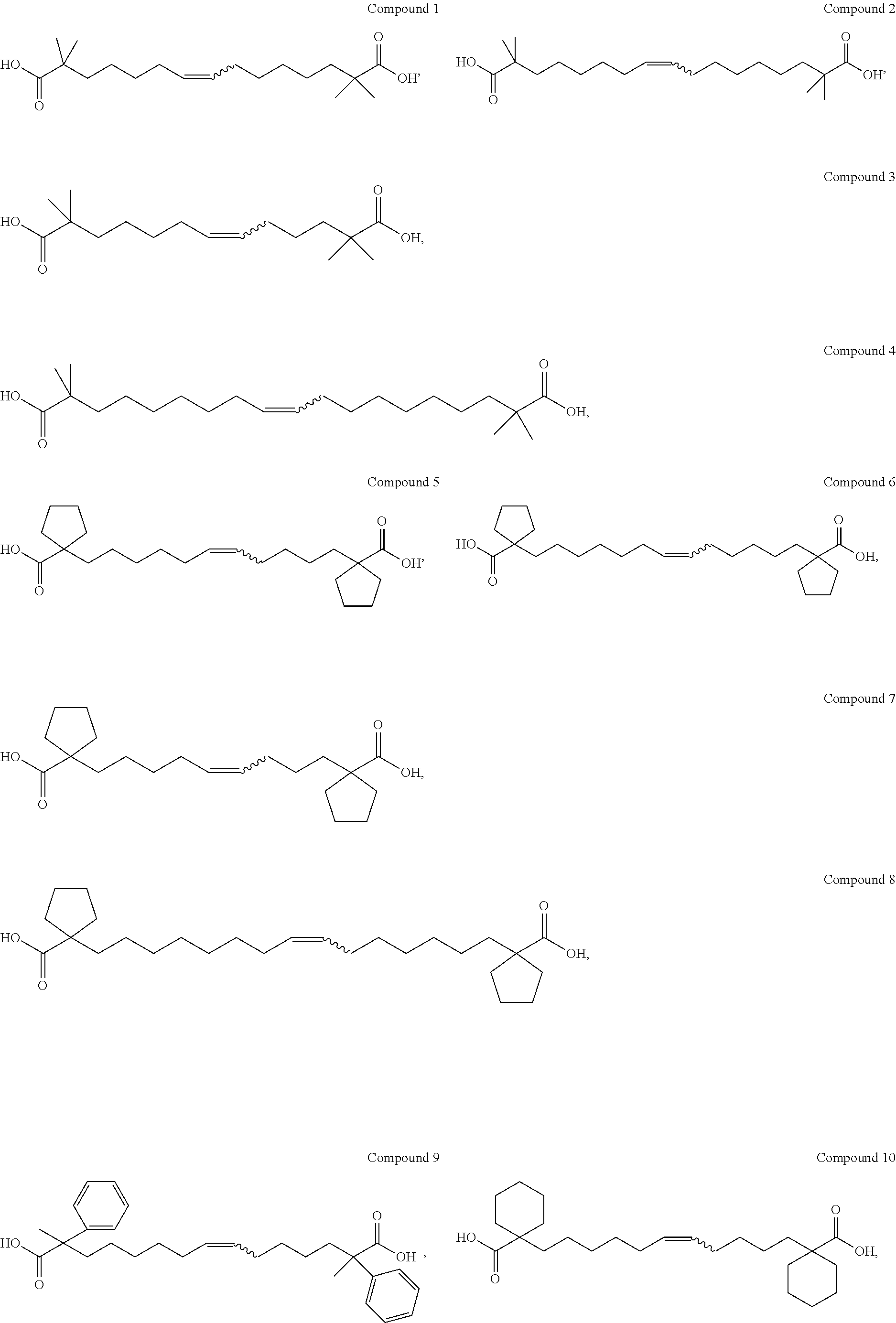
- the said fatty acid compound having the ability to activate AMPK is most preferably selected from the following compound:
- the said compound represented by the formula I-IV or a pharmaceutically acceptable salt thereof can be prepared through conventional reactions in organic synthesis.
- the compound of the formula I-III can be synthesized by the following route.
- the organic solvent is preferably tetrahydrofuran (THF);
- reaction can be carried out in an organic solvent, the organic solvent is preferably dichloromethane (DCM);
- intermediate A15 (3) refluxing intermediate A14 with lithium bromide in an organic solvent to give intermediate A15; wherein, the said organic solvent is preferably acetone;
- the compound represented by the formula II is synthesized by the following route 4,
- R 3 , R 4 , R 5 , R 6 , m and n are the same as described above.
- the compound represented by formula III is prepared through the following route 5.
- intermediate A28 iodine methane to intermediate A20 with ethyl zinc reagent to give intermediate A28; under alkaline conditions, conducting intermediate A28 a hydrolysis reaction and acidulating by dilute hydrochloric acid to obtain the compound represented by the formula III.
- R 3 , R 4 , R 5 , R 6 , m and n are the same as described above.
- the compound represented by the formula IV is prepared by the following route 6.
- R 3 , R 4 , R 5 , R 6 , m, n and p are the same as described above.
- the compounds of the present invention having the ability to activate AMPK improve glycolipid metabolism at the cellular and whole animal level.
- the compounds can be used for the preparation of a medicament for treating obesity or diabetes.
- the present invention provides a pharmaceutical composition for treating obesity or diabetes.
- the pharmaceutical composition comprises a therapeutically effective amount of one or more compounds represented by the formula I, or pharmaceutically acceptable salts thereof as an active ingredient, and pharmaceutically acceptable adjuvants such as dispersing agents, excipients, disintegrating agents, antioxidants, sweeteners, coating agents.
- the pharmaceutical composition can be prepared according to a conventional preparation method in the pharmaceutical field, and can be made into various conventional dosage forms, including tablets, coated tablets, capsules, powders and so on.
- FIG. 1 is a bar graph of the compound promoting phosphorylation of AMPK in human HepG2 liver cancer cells
- FIG. 2 is a bar graph of the compound promoting phosphorylation of ACC in human HepG2 liver cancer cells
- FIG. 3 is a bar graph of the compound inhibiting sugar output of mouse primary hepatocytes.
- NMR NMR was conducted on a Mercury-Vx 300M instrument manufactured by Varian; Mass spectra were obtained using Agilent 1200 Quadrupole LC/MS mass spectrometer. Reagents are mainly provided by Shanghai Chemical Reagent Company.
- the silica gel plate (model GF 254) for thin layer chromatography (TLC) was manufactured by Huiyou Silica gel Development Co. Ltd., Yantai, Shandong.
- the compounds were purified by column chromatography with a silica gel of 200-300 mesh, modelzcx-11, manufactured by Qingdao Haiyang Chemical Co. Ltd.
- methyl cyclopentanecarboxylate 1.28 g (10 mmol) and 1,5-dibromopentane 2.49 g (11 mmol) were added to the reaction flask, dissolved in 50 mL of tetrahydrofuran, and cooled to 0° C.
- LDA 0.67 mmol was slowly added in a drop wise manner for about 1 hour. After then, the reaction was stirred overnight at room temperature, and monitored by TLC on the next day. The reaction was quenched by the addition of a saturated aqueous solution of ammonium chloride. After the addition, the mixture was extracted three times with EtOAc.
- compound B3 (1.7 g, 6.2 mmol), tosylmethyl isocyanide (0.64 g, 3.1 mmol) and tetrabutylammonium iodide (0.23 g, 0.62 mmol) were dissolved in 10 mL of DMSO. The solution was cooled to 0° C., added sodium hydride (60%) (0.3 g, 7.4 mmol) in portions. After then, the reaction was stirred overnight at room temperature, and monitored by TLC on the next day. The reaction mixture was quenched with water. After then, the mixture was extracted three times with DCM.
- Compound 2 was prepared by replacing reactant B1 with ethyl isobutyrate, and replacing reactant B2 with 1,6-dibromohexane: 1 H NMR (300 MHz, CDCl 3 ) ⁇ 5.34-5.35 (m, 2H), 1.96-1.98 (m, 4H), 1.50-1.52 (m, 4H), 1.21-1.42 (m, 14H), 1.17 ppm (s, 12H).
- Compound 3 was prepared by replacing the reactant B1 with ethyl isobutyrate, and replacing the reactant B2 with 1,4-dibromobutane: 1 H NMR (300 MHz, CDCl 3 ) ⁇ 5.29-5.38 (m, 2H), 1.92-1.95 (m, 4H), 1.43-1.52 (m, 4H), 1.21-1.42 (m, 6H), 1.13 ppm (s, 12H).
- Compound 4 was prepared by replacing the reactant B1 with ethyl isobutyrate, and replacing the reactant B2 with 1,7-dibromoheptane: 1 H NMR (300 MHz, CDCl 3 ) ⁇ 5.34-5.35 (m, 2H), 1.94-1.95 (m, 4H), 1.48-1.52 (m, 6H), 1.21-1.42 (m, 16H), 1.17 ppm (s, 12H).
- Compound 8 was prepared by replacing the reactant B2 with 1,7-dibromoheptane: 1 H NMR (300 MHz, CDCl 3 ) ⁇ 5.33-5.36 (m, 2H), 2.12-2.16 (m, 4H), 1.96-1.99 (m, 4H), 1.62-1.64 (m, 12H), 1.40-1.49 (m, 6H), 1.26-1.29 ppm (m, 16H).
- Compound 13 was prepared by replacing the reactant B1 with ethyl cyclobutylate, and replacing reactant B2 with 1,6-dibromohexane: 1 H NMR (300 MHz, CDCl 3 ) ⁇ 5.33-5.35 (m, 2H), 2.43-2.45 (m, 4H), 1.96-1.99 (m, 4H), 1.81-1.92 (m, 10H), 1.75-1.1.82 (m, 4H), 1.11-1.28 ppm (m, 12H).
- Compound 17 was prepared by replacing the reactant B1 with ethyl 2-phenyl-propionate, and replacing the reactant B2 with 1,6-dibromohexane: 1 H NMR (300 MHz, CDCl 3 ) ⁇ 7.26-7.40 (m, 10H), 5.34-5.36 (m, 2H), 2.02-2.22 (m, 4H), 1.86-2.03 (m, 4H), 1.55 (s, 6H), 1.18-1.42 (m, 14H).
- Compound 18 was prepared by replacing the reactant B1 with ethyl 2-phenyl-propionate, and replacing the reactant B2 with 1,7-dibromoheptane: 1 H NMR (300 MHz, CDCl 3 ) ⁇ 7.23-7.38 (m, 10H), 5.34-5.36 (m, 2H), 2.02-2.22 (m, 4H), 1.86-2.03 (m, 4H), 1.55 (s, 6H), 1.18-1.42 (m, 18H).
- Compound 19 was prepared by replacing the reactant B1 with ethyl 2-methylbutyrate, and replacing the reactant B2 with 1,6-dibromohexane: 1 H NMR (300 MHz, CDCl 3 ) ⁇ 5.33-5.35 (m, 2H), 1.96-2.02 (m, 4H), 1.58-1.78 (m, 4H), 1.38-1.58 (m, 4H), 1.22-1.40 (m, 14H), 1.11 (s, 6H), 0.86 ppm (t, 6H).
- Compound 20 was prepared by replacing the reactant B1 with ethyl 2-methylbutyrate, and replacing the reactant B2 with 1,7-dibromoheptane: 1 H NMR (300 MHz, CDCl 3 ) ⁇ 5.33-5.35 (m, 2H), 1.96-2.02 (m, 4H), 1.58-1.70 (m, 4H), 1.38-1.50 (m, 4H), 1.22-1.40 (m, 18H), 1.11 (s, 6H), 0.86 ppm (t, 6H).
- Compound 21 was prepared by replacing the reactant B1 with ethyl cyclohexylcarboxylate, and replacing the reactant B2 with 1,6-dibromohexane: 1 H NMR (300 MHz, CDCl 3 ) ⁇ 5.32-5.34 (m, 2H), 2.04-2.05 (m, 4H), 1.94-1.98 (m, 4H), 1.45-1.65 (m, 12H), 1.15-1.45 (m, 22H).
- Compound 22 was prepared by replacing the reactant B1 with ethyl cyclohexylcarboxylate, and replacing the reactant B2 with 1,7-dibromoheptane: 1 H NMR (300 MHz, CDCl 3 ) ⁇ 5.32-5.34 (m, 2H), 2.04-2.08 (m, 4H), 1.96-2.01 (m, 4H), 1.45-1.65 (m, 12H), 1.23-1.45 (m, 26H).
- reaction mixture was stirred at room temperature overnight.
- the reaction was quenched by the addition of a saturated aqueous solution of ammonium chloride and extracted three times with ethyl acetate.
- the compound B30 (40 mg, 0.01 mmol) was dissolved in 5 mL of ethanol, added 1 mL of an aqueous solution of KOH (100 mg, 1.7 mmol).
- the reaction mixture was refluxed for 6 hours, and monitored by TLC. After the reaction was completed, the mixture was cooled to room temperature, and most of the ethanol was removed by rotary evaporation. The residue was diluted with water (4 mL) and extracted with ethyl ether twice to remove impurities.
- the aqueous phase was adjusted to acidity by adding 2N HCl, and extracted with DCM for four times.
- Phosphorus pentachloride (4.37 g, 21 mmol) was suspended in 10 mL of chloroform, cooled to 0° C., and added to a solution of compound B31 (1.96 g, 20 mmol) in 10 mL of chloroform. After the addition, the mixture was stirred at room temperature for 2 h, then refluxed for 2 h. After then, the reaction mixture was poured on 50 g of ice, added NaHCO 3 . The organic phase was separated, and the aqueous phase was extracted with DCM. The combined organic phase was washed with saturated sodium bicarbonate solution and brine. The mixture was dried over anhydrous Na 2 SO 4 , concentrated, then added 5 mL of DCM.
- the compound B37 (40 mg, 0.01 mmol) was dissolved in 5 mL of ethanol, added 1 mL of an aqueous solution of KOH (100 mg, 1.7 mmol).
- the reaction mixture was refluxed for 6 hours, and monitored by TLC. After the reaction was completed, the mixture was cooled to room temperature, and most of the ethanol was removed by rotary evaporation. The residue was diluted with water (4 mL) and extracted with ethyl ether twice to remove impurities.
- the aqueous phase was adjusted to acidity by adding 2N HCl, and extracted with DCM for four times.
- Detection purpose To detect whether the fatty acid compound is a small molecule compound that can promote phosphorylation of ⁇ subunit T172 site of AMPK and phosphorylation of classical site ACC1 S79 of AMPK in human hepatoma cell HepG2.
- Detection reagents Total AMPK, phospho-AMPK ⁇ (T172), phospho-ACC (S79), and Total ACC antibody were purchased from Cell Signaling Technology.
- HepG2 cells were inoculated into a 24-well plate at a density of 300,000 per mL. After grew adhering to the wall 12 hours, they were replaced on serumfree highsugar medium for 12 hours.
- Compounds 1 to 30 prepared by the present invention (in 1 ⁇ DMSO, 50 ⁇ M) were separately added to treat for 6 hours (1 ⁇ DMSO as a negative control). The cells to be harvested were washed with pre-cooled PBS. 1 ⁇ SDS gel loading buffer (50 mM Tris-HCl (pH 6.8), 100 mM DTT, 2% SDS, 10% glycerol, 0.1% bromophenol blue) was added. Lyse cells on ice for 10 minutes (24 well plates, 100 ⁇ L per well).
- the protein was transferred to a nitrocellulose membrane (constant pressure 100 V, 100 min) using Biorad wet electrical transduction system. After the desired band was cut, the strip was blocked in a blocking solution (TBST, containing 5% BSA) for 1 hour at room temperature. The strips were placed in a solution of primary antibody and incubated overnight at 4° C.
- TST blocking solution
- the target strip was placed in TBST and washed at room temperature for 10 minutes (3 times). The strips were then incubated in a solution of secondary antibody (goat anti-rabbit and goat anti-mouse 1:5000 in TBST) for 1 hour at room temperature. Then, membrane was washed with TBST for 10 minutes (3 times) and exposed with ECL reagent.
- secondary antibody goat anti-rabbit and goat anti-mouse 1:5000 in TBST
- Test purpose To test whether the fatty acid compounds can inhibit hepatocyte glucose output on primary hepatocytes of C57bl/6j mice.
- the glucose detection kit was purchased from Shanghai Mind Bioengineering Co., Ltd.
- the medium was discarded.
- the cells was washed with PBS, spin dried, added 200 ⁇ L of 250 mM sodium hydroxide solution. Lyse the cells for 30 minutes, then take the lysate. The protein concentration was determined using coomassie blue staining.
- the amount of glucose output in the cells is corrected by the protein concentration, and the effect of the compound on the glucose output of the hepatocytes is compared.
Landscapes
- Chemical & Material Sciences (AREA)
- Organic Chemistry (AREA)
- Health & Medical Sciences (AREA)
- Veterinary Medicine (AREA)
- Pharmacology & Pharmacy (AREA)
- Public Health (AREA)
- General Health & Medical Sciences (AREA)
- Animal Behavior & Ethology (AREA)
- Medicinal Chemistry (AREA)
- Life Sciences & Earth Sciences (AREA)
- Diabetes (AREA)
- Engineering & Computer Science (AREA)
- Epidemiology (AREA)
- General Chemical & Material Sciences (AREA)
- Nuclear Medicine, Radiotherapy & Molecular Imaging (AREA)
- Chemical Kinetics & Catalysis (AREA)
- Bioinformatics & Cheminformatics (AREA)
- Obesity (AREA)
- Hematology (AREA)
- Child & Adolescent Psychology (AREA)
- Oil, Petroleum & Natural Gas (AREA)
- Emergency Medicine (AREA)
- Endocrinology (AREA)
- Organic Low-Molecular-Weight Compounds And Preparation Thereof (AREA)
- Acyclic And Carbocyclic Compounds In Medicinal Compositions (AREA)
- Low-Molecular Organic Synthesis Reactions Using Catalysts (AREA)
Abstract

Description




and reacting with A2 to give A4; wherein, the organic solvent is preferably tetrahydrofuran (THF);


Claims (9)


Applications Claiming Priority (4)
| Application Number | Priority Date | Filing Date | Title |
|---|---|---|---|
| CN201610105067 | 2016-02-25 | ||
| CN201610105067.0A CN107118098B (en) | 2016-02-25 | 2016-02-25 | A class of fatty acid compounds, its preparation method and use |
| CN201610105067.0 | 2016-02-25 | ||
| PCT/CN2017/074039 WO2017143946A1 (en) | 2016-02-25 | 2017-02-20 | Fatty acid compound, preparation method therefor and use thereof |
Publications (2)
| Publication Number | Publication Date |
|---|---|
| US20190039989A1 US20190039989A1 (en) | 2019-02-07 |
| US10414713B2 true US10414713B2 (en) | 2019-09-17 |
Family
ID=59684700
Family Applications (1)
| Application Number | Title | Priority Date | Filing Date |
|---|---|---|---|
| US16/075,528 Active US10414713B2 (en) | 2016-02-25 | 2017-02-20 | Fatty acid compound, preparation method therefor and use therefor |
Country Status (5)
| Country | Link |
|---|---|
| US (1) | US10414713B2 (en) |
| EP (1) | EP3421447B1 (en) |
| JP (1) | JP6651028B2 (en) |
| CN (1) | CN107118098B (en) |
| WO (1) | WO2017143946A1 (en) |
Families Citing this family (4)
| Publication number | Priority date | Publication date | Assignee | Title |
|---|---|---|---|---|
| CN115572224A (en) * | 2021-06-21 | 2023-01-06 | 上海茂晟康慧科技有限公司 | Synthesis method of (S) - (-) -3-cyclohexenecarboxylic acid |
| CN115894220A (en) * | 2021-09-23 | 2023-04-04 | 中国科学院上海药物研究所 | Long-chain compounds acting on ACLY process for their preparation and their use |
| CN115887435A (en) | 2021-09-23 | 2023-04-04 | 博骥源(上海)生物医药有限公司 | Long-chain compounds and their uses |
| WO2025223509A1 (en) * | 2024-04-25 | 2025-10-30 | 博骥源(上海)生物医药有限公司 | Class of dienyl long-chain compounds acting on acly, and preparation method therefor and use thereof |
Citations (8)
| Publication number | Priority date | Publication date | Assignee | Title |
|---|---|---|---|---|
| US3773946A (en) * | 1969-09-02 | 1973-11-20 | Parke Davis & Co | Triglyceride-lowering compositions and methods |
| US3930024A (en) * | 1969-09-02 | 1975-12-30 | Parke Davis & Co | Pharmaceutical compositions and methods |
| US4689344A (en) | 1981-12-15 | 1987-08-25 | Epis S.A. | Long-chain α,ω-dicarboxylic acids and derivatives thereof and pharmaceutical compositions containing them |
| US4711896A (en) | 1984-06-22 | 1987-12-08 | Epis S.A. | α, ω-dicarboxylic acids and medicaments which contain these compounds |
| WO1996011901A1 (en) | 1994-10-13 | 1996-04-25 | Boehringer Mannheim Gmbh | NOVEL α,α,α',α'-TETRACHLOROBICARBOXYLIC ACIDS, PROCESS FOR PRODUCING THEM AND MEDICAMENTS CONTAINING THEM |
| WO1998030530A1 (en) * | 1997-01-07 | 1998-07-16 | Yissum Research Development Co. Of The Hebrew University Of Jerusalem | Carboxylic acids and derivatives thereof and pharmaceutical compositions containing them |
| US20040198814A1 (en) * | 2000-10-11 | 2004-10-07 | Dasseux Jean-Louis Henri | Ketone compounds and compositions for cholesterol management and related uses |
| US20120071528A1 (en) * | 2010-09-20 | 2012-03-22 | Kareus Therapeutics, Sa | Methods and compositions for treatment of diabetes and dyslipidemia |
Family Cites Families (9)
| Publication number | Priority date | Publication date | Assignee | Title |
|---|---|---|---|---|
| JPS59164716A (en) * | 1983-03-09 | 1984-09-17 | Mitsubishi Chem Ind Ltd | Biosynthetic inhibitor for fatty acid |
| JPS59219920A (en) * | 1983-05-28 | 1984-12-11 | 日本ケミコン株式会社 | Electrolyte for driving electrolytic condenser |
| US5026461A (en) * | 1990-01-19 | 1991-06-25 | E. I. Du Pont De Nemours And Company | Process for the preparation of dodecanedioic acid |
| CA2425311C (en) * | 2000-10-11 | 2011-06-14 | Esperion Therapeutics, Inc. | Ketone compounds and compositions for cholesterol management and related uses |
| US7993654B2 (en) * | 2002-12-23 | 2011-08-09 | Beiersdorf Ag | Self-adhesive polymer matrix containing sea algae extract |
| ES2625429T3 (en) * | 2003-01-23 | 2017-07-19 | Esperion Therapeutics Inc. | Hydroxyl compounds and compositions for cholesterol control and corresponding uses |
| IL181577A0 (en) * | 2007-02-26 | 2007-07-04 | Jacob Bar Tana | Combination therapy composition and methods for the treatment of cardiovascular disorders and immune-related disorders |
| US8158391B2 (en) * | 2009-05-06 | 2012-04-17 | Dna Twopointo, Inc. | Production of an α-carboxyl-ω-hydroxy fatty acid using a genetically modified Candida strain |
| FR3024037B1 (en) * | 2014-07-25 | 2018-03-02 | Sederma | COSMETIC OR DERMATOLOGICAL ACTIVE INGREDIENT COMPRISING A MIXTURE OF UNSATURATED FATTY DICARBOXYLIC ACIDS, COMPOSITIONS COMPRISING THE SAME, AND COSMETIC OR DERMATOLOGICAL USES |
-
2016
- 2016-02-25 CN CN201610105067.0A patent/CN107118098B/en active Active
-
2017
- 2017-02-20 WO PCT/CN2017/074039 patent/WO2017143946A1/en not_active Ceased
- 2017-02-20 US US16/075,528 patent/US10414713B2/en active Active
- 2017-02-20 EP EP17755775.8A patent/EP3421447B1/en active Active
- 2017-02-20 JP JP2018544043A patent/JP6651028B2/en active Active
Patent Citations (8)
| Publication number | Priority date | Publication date | Assignee | Title |
|---|---|---|---|---|
| US3773946A (en) * | 1969-09-02 | 1973-11-20 | Parke Davis & Co | Triglyceride-lowering compositions and methods |
| US3930024A (en) * | 1969-09-02 | 1975-12-30 | Parke Davis & Co | Pharmaceutical compositions and methods |
| US4689344A (en) | 1981-12-15 | 1987-08-25 | Epis S.A. | Long-chain α,ω-dicarboxylic acids and derivatives thereof and pharmaceutical compositions containing them |
| US4711896A (en) | 1984-06-22 | 1987-12-08 | Epis S.A. | α, ω-dicarboxylic acids and medicaments which contain these compounds |
| WO1996011901A1 (en) | 1994-10-13 | 1996-04-25 | Boehringer Mannheim Gmbh | NOVEL α,α,α',α'-TETRACHLOROBICARBOXYLIC ACIDS, PROCESS FOR PRODUCING THEM AND MEDICAMENTS CONTAINING THEM |
| WO1998030530A1 (en) * | 1997-01-07 | 1998-07-16 | Yissum Research Development Co. Of The Hebrew University Of Jerusalem | Carboxylic acids and derivatives thereof and pharmaceutical compositions containing them |
| US20040198814A1 (en) * | 2000-10-11 | 2004-10-07 | Dasseux Jean-Louis Henri | Ketone compounds and compositions for cholesterol management and related uses |
| US20120071528A1 (en) * | 2010-09-20 | 2012-03-22 | Kareus Therapeutics, Sa | Methods and compositions for treatment of diabetes and dyslipidemia |
Non-Patent Citations (7)
| Title |
|---|
| Bar-Tana; Journal of Medicinal Chemistry 1989, 32, 2072-2084. (Year: 1989). * |
| CAS. "RN 71042-01-8 et al." STN Registry, Jun. 5, 2009. |
| International Search Report of International Application No. PCT/CN2017/074039 dated May 24, 2017. |
| Oniciu; J. Med. Chem. 2006, 49, 1, 334-348. (Year: 2006). * |
| Ramesh; Appl Biochem Biotechnol 2016, 178, 810-830. (Year: 2016). * |
| Voss; WO1996011901; Unverified Machine Translation from EPO, 23 pages. First published in German on Apr. 25, 1996. (Year: 1996). * |
| Yi; Appl Microbiol Biotechnol 1989, 30, 327-331. (Year: 1989). * |
Also Published As
| Publication number | Publication date |
|---|---|
| EP3421447A4 (en) | 2019-02-20 |
| JP6651028B2 (en) | 2020-02-19 |
| CN107118098B (en) | 2020-07-14 |
| US20190039989A1 (en) | 2019-02-07 |
| WO2017143946A1 (en) | 2017-08-31 |
| JP2019507150A (en) | 2019-03-14 |
| CN107118098A (en) | 2017-09-01 |
| EP3421447A1 (en) | 2019-01-02 |
| EP3421447B1 (en) | 2021-03-24 |
Similar Documents
| Publication | Publication Date | Title |
|---|---|---|
| US10414713B2 (en) | Fatty acid compound, preparation method therefor and use therefor | |
| US8063067B2 (en) | Hexenoic acid derivatives, processes for the preparation thereof, pharmaceutical compositions comprising them, and therapeutic applications thereof | |
| SG187176A1 (en) | Agonists of gpr40 | |
| CN111410661B (en) | Cap-dependent endonuclease inhibitors and uses thereof | |
| EA026300B1 (en) | Activators of ampk and therapeutic uses thereof | |
| CN111757770B (en) | 3-Phenyl-4-hexynoic acid derivatives as GPR40 agonists | |
| WO2014169817A1 (en) | Phenylalanine compound having nitrogen heterocyclic link, pharmaceutical composition thereof, preparation method therefor, and use thereof | |
| US9556129B2 (en) | Phosphatidylcholine transfer protein inhibitors | |
| US9630935B2 (en) | Compositions for the treatment of hypertension and/or fibrosis | |
| US8093302B2 (en) | Substituted tetralins as selective estrogen receptor-β agonists | |
| US9045454B2 (en) | Bicyclic pyrrole derivatives useful as agonists of GPR120 | |
| US20230124268A1 (en) | Nicotinamide phosphoribosyltransferase inhibitors and methods for use of the same | |
| US7465752B2 (en) | Pentenoic acid derivatives, processes for the preparation thereof, pharmaceutical compositions comprising them, and therapeutic applications thereof | |
| JP7716980B2 (en) | Estrogen receptor antagonists | |
| US9663429B2 (en) | Vitamin D analogues of pharmaceutical interest | |
| JP2011231045A (en) | Interferon-involved autoimmune disease inhibitor | |
| US20170362209A1 (en) | Pyridine derivatives | |
| US20200163913A1 (en) | CA-4 Antitumour Drug, Synthesis Method and Use Thereof | |
| US8912227B1 (en) | Bicyclic pyrrole derivatives useful as agonists of GPR120 | |
| CZ279793A3 (en) | Orally active antiviral compounds | |
| US9221786B2 (en) | 2-fluorophenyl propionic acid derivatives | |
| US20210024483A1 (en) | Heterocylcoalkenyl derivatives useful as agonists of the gpr120 and / or gpr40 | |
| HK1203965B (en) | Boron-based 4-hydroxytamoxifen and endoxifen prodrugs as treatment for breast cancer |
Legal Events
| Date | Code | Title | Description |
|---|---|---|---|
| FEPP | Fee payment procedure |
Free format text: ENTITY STATUS SET TO UNDISCOUNTED (ORIGINAL EVENT CODE: BIG.); ENTITY STATUS OF PATENT OWNER: SMALL ENTITY |
|
| FEPP | Fee payment procedure |
Free format text: ENTITY STATUS SET TO SMALL (ORIGINAL EVENT CODE: SMAL); ENTITY STATUS OF PATENT OWNER: SMALL ENTITY |
|
| AS | Assignment |
Owner name: SHANGHAI INSTITUTE OF MATERIA MEDICA, CHINESE ACAD Free format text: ASSIGNMENT OF ASSIGNORS INTEREST;ASSIGNORS:NAN, FAJUN;LI, JIA;LI, JINGYA;AND OTHERS;REEL/FRAME:046636/0097 Effective date: 20180809 |
|
| STPP | Information on status: patent application and granting procedure in general |
Free format text: RESPONSE TO NON-FINAL OFFICE ACTION ENTERED AND FORWARDED TO EXAMINER |
|
| STPP | Information on status: patent application and granting procedure in general |
Free format text: NON FINAL ACTION MAILED |
|
| STPP | Information on status: patent application and granting procedure in general |
Free format text: NOTICE OF ALLOWANCE MAILED -- APPLICATION RECEIVED IN OFFICE OF PUBLICATIONS |
|
| STPP | Information on status: patent application and granting procedure in general |
Free format text: PUBLICATIONS -- ISSUE FEE PAYMENT RECEIVED |
|
| STPP | Information on status: patent application and granting procedure in general |
Free format text: PUBLICATIONS -- ISSUE FEE PAYMENT VERIFIED |
|
| STCF | Information on status: patent grant |
Free format text: PATENTED CASE |
|
| MAFP | Maintenance fee payment |
Free format text: PAYMENT OF MAINTENANCE FEE, 4TH YR, SMALL ENTITY (ORIGINAL EVENT CODE: M2551); ENTITY STATUS OF PATENT OWNER: SMALL ENTITY Year of fee payment: 4 |