US10414563B2 - Sealing cap and container having the sealing cap - Google Patents

Sealing cap and container having the sealing cap Download PDF

Info

Publication number
US10414563B2
US10414563B2 US15/708,544 US201715708544A US10414563B2 US 10414563 B2 US10414563 B2 US 10414563B2 US 201715708544 A US201715708544 A US 201715708544A US 10414563 B2 US10414563 B2 US 10414563B2
Authority
US
United States
Prior art keywords
extension tube
threaded portion
cap body
lower extension
inner cover
Prior art date
Legal status (The legal status is an assumption and is not a legal conclusion. Google has not performed a legal analysis and makes no representation as to the accuracy of the status listed.)
Active, expires
Application number
US15/708,544
Other versions
US20190084738A1 (en
Inventor
Fang Lin Yang
Current Assignee (The listed assignees may be inaccurate. Google has not performed a legal analysis and makes no representation or warranty as to the accuracy of the list.)
Individual
Original Assignee
Individual
Priority date (The priority date is an assumption and is not a legal conclusion. Google has not performed a legal analysis and makes no representation as to the accuracy of the date listed.)
Filing date
Publication date
Application filed by Individual filed Critical Individual
Priority to US15/708,544 priority Critical patent/US10414563B2/en
Publication of US20190084738A1 publication Critical patent/US20190084738A1/en
Application granted granted Critical
Publication of US10414563B2 publication Critical patent/US10414563B2/en
Active legal-status Critical Current
Adjusted expiration legal-status Critical

Links

Images

Classifications

    • BPERFORMING OPERATIONS; TRANSPORTING
    • B65CONVEYING; PACKING; STORING; HANDLING THIN OR FILAMENTARY MATERIAL
    • B65DCONTAINERS FOR STORAGE OR TRANSPORT OF ARTICLES OR MATERIALS, e.g. BAGS, BARRELS, BOTTLES, BOXES, CANS, CARTONS, CRATES, DRUMS, JARS, TANKS, HOPPERS, FORWARDING CONTAINERS; ACCESSORIES, CLOSURES, OR FITTINGS THEREFOR; PACKAGING ELEMENTS; PACKAGES
    • B65D51/00Closures not otherwise provided for
    • B65D51/24Closures not otherwise provided for combined or co-operating with auxiliary devices for non-closing purposes
    • B65D51/28Closures not otherwise provided for combined or co-operating with auxiliary devices for non-closing purposes with auxiliary containers for additional articles or materials
    • B65D51/2807Closures not otherwise provided for combined or co-operating with auxiliary devices for non-closing purposes with auxiliary containers for additional articles or materials the closure presenting means for placing the additional articles or materials in contact with the main contents by acting on a part of the closure without removing the closure, e.g. by pushing down, pulling up, rotating or turning a part of the closure, or upon initial opening of the container
    • B65D51/2857Closures not otherwise provided for combined or co-operating with auxiliary devices for non-closing purposes with auxiliary containers for additional articles or materials the closure presenting means for placing the additional articles or materials in contact with the main contents by acting on a part of the closure without removing the closure, e.g. by pushing down, pulling up, rotating or turning a part of the closure, or upon initial opening of the container the additional article or materials being released by displacing or removing an element enclosing it
    • B65D51/2878Closures not otherwise provided for combined or co-operating with auxiliary devices for non-closing purposes with auxiliary containers for additional articles or materials the closure presenting means for placing the additional articles or materials in contact with the main contents by acting on a part of the closure without removing the closure, e.g. by pushing down, pulling up, rotating or turning a part of the closure, or upon initial opening of the container the additional article or materials being released by displacing or removing an element enclosing it the element being a lid or cover seated on a passage between the auxiliary container and the main container
    • BPERFORMING OPERATIONS; TRANSPORTING
    • B05SPRAYING OR ATOMISING IN GENERAL; APPLYING FLUENT MATERIALS TO SURFACES, IN GENERAL
    • B05BSPRAYING APPARATUS; ATOMISING APPARATUS; NOZZLES
    • B05B11/00Single-unit hand-held apparatus in which flow of contents is produced by the muscular force of the operator at the moment of use
    • BPERFORMING OPERATIONS; TRANSPORTING
    • B65CONVEYING; PACKING; STORING; HANDLING THIN OR FILAMENTARY MATERIAL
    • B65DCONTAINERS FOR STORAGE OR TRANSPORT OF ARTICLES OR MATERIALS, e.g. BAGS, BARRELS, BOTTLES, BOXES, CANS, CARTONS, CRATES, DRUMS, JARS, TANKS, HOPPERS, FORWARDING CONTAINERS; ACCESSORIES, CLOSURES, OR FITTINGS THEREFOR; PACKAGING ELEMENTS; PACKAGES
    • B65D41/00Caps, e.g. crown caps or crown seals, i.e. members having parts arranged for engagement with the external periphery of a neck or wall defining a pouring opening or discharge aperture; Protective cap-like covers for closure members, e.g. decorative covers of metal foil or paper
    • B65D41/02Caps or cap-like covers without lines of weakness, tearing strips, tags, or like opening or removal devices
    • B65D41/04Threaded or like caps or cap-like covers secured by rotation
    • B65D41/0407Threaded or like caps or cap-like covers secured by rotation with integral sealing means
    • B65D41/0414Threaded or like caps or cap-like covers secured by rotation with integral sealing means formed by a plug, collar, flange, rib or the like contacting the internal surface of a container neck
    • BPERFORMING OPERATIONS; TRANSPORTING
    • B65CONVEYING; PACKING; STORING; HANDLING THIN OR FILAMENTARY MATERIAL
    • B65DCONTAINERS FOR STORAGE OR TRANSPORT OF ARTICLES OR MATERIALS, e.g. BAGS, BARRELS, BOTTLES, BOXES, CANS, CARTONS, CRATES, DRUMS, JARS, TANKS, HOPPERS, FORWARDING CONTAINERS; ACCESSORIES, CLOSURES, OR FITTINGS THEREFOR; PACKAGING ELEMENTS; PACKAGES
    • B65D41/00Caps, e.g. crown caps or crown seals, i.e. members having parts arranged for engagement with the external periphery of a neck or wall defining a pouring opening or discharge aperture; Protective cap-like covers for closure members, e.g. decorative covers of metal foil or paper
    • B65D41/02Caps or cap-like covers without lines of weakness, tearing strips, tags, or like opening or removal devices
    • B65D41/04Threaded or like caps or cap-like covers secured by rotation
    • B65D41/0407Threaded or like caps or cap-like covers secured by rotation with integral sealing means
    • B65D41/0428Threaded or like caps or cap-like covers secured by rotation with integral sealing means formed by a collar, flange, rib or the like contacting the top rim or the top edges or the external surface of a container neck
    • BPERFORMING OPERATIONS; TRANSPORTING
    • B65CONVEYING; PACKING; STORING; HANDLING THIN OR FILAMENTARY MATERIAL
    • B65DCONTAINERS FOR STORAGE OR TRANSPORT OF ARTICLES OR MATERIALS, e.g. BAGS, BARRELS, BOTTLES, BOXES, CANS, CARTONS, CRATES, DRUMS, JARS, TANKS, HOPPERS, FORWARDING CONTAINERS; ACCESSORIES, CLOSURES, OR FITTINGS THEREFOR; PACKAGING ELEMENTS; PACKAGES
    • B65D51/00Closures not otherwise provided for
    • B65D51/24Closures not otherwise provided for combined or co-operating with auxiliary devices for non-closing purposes
    • B65D51/28Closures not otherwise provided for combined or co-operating with auxiliary devices for non-closing purposes with auxiliary containers for additional articles or materials
    • B65D51/2807Closures not otherwise provided for combined or co-operating with auxiliary devices for non-closing purposes with auxiliary containers for additional articles or materials the closure presenting means for placing the additional articles or materials in contact with the main contents by acting on a part of the closure without removing the closure, e.g. by pushing down, pulling up, rotating or turning a part of the closure, or upon initial opening of the container
    • B65D51/2857Closures not otherwise provided for combined or co-operating with auxiliary devices for non-closing purposes with auxiliary containers for additional articles or materials the closure presenting means for placing the additional articles or materials in contact with the main contents by acting on a part of the closure without removing the closure, e.g. by pushing down, pulling up, rotating or turning a part of the closure, or upon initial opening of the container the additional article or materials being released by displacing or removing an element enclosing it
    • B65D51/2864Closures not otherwise provided for combined or co-operating with auxiliary devices for non-closing purposes with auxiliary containers for additional articles or materials the closure presenting means for placing the additional articles or materials in contact with the main contents by acting on a part of the closure without removing the closure, e.g. by pushing down, pulling up, rotating or turning a part of the closure, or upon initial opening of the container the additional article or materials being released by displacing or removing an element enclosing it the element being a plug or like element closing a passage between the auxiliary container and the main container
    • BPERFORMING OPERATIONS; TRANSPORTING
    • B65CONVEYING; PACKING; STORING; HANDLING THIN OR FILAMENTARY MATERIAL
    • B65DCONTAINERS FOR STORAGE OR TRANSPORT OF ARTICLES OR MATERIALS, e.g. BAGS, BARRELS, BOTTLES, BOXES, CANS, CARTONS, CRATES, DRUMS, JARS, TANKS, HOPPERS, FORWARDING CONTAINERS; ACCESSORIES, CLOSURES, OR FITTINGS THEREFOR; PACKAGING ELEMENTS; PACKAGES
    • B65D85/00Containers, packaging elements or packages, specially adapted for particular articles or materials
    • B65D85/70Containers, packaging elements or packages, specially adapted for particular articles or materials for materials not otherwise provided for
    • B65D85/72Containers, packaging elements or packages, specially adapted for particular articles or materials for materials not otherwise provided for for edible or potable liquids, semiliquids, or plastic or pasty materials
    • BPERFORMING OPERATIONS; TRANSPORTING
    • B05SPRAYING OR ATOMISING IN GENERAL; APPLYING FLUENT MATERIALS TO SURFACES, IN GENERAL
    • B05BSPRAYING APPARATUS; ATOMISING APPARATUS; NOZZLES
    • B05B11/00Single-unit hand-held apparatus in which flow of contents is produced by the muscular force of the operator at the moment of use
    • B05B11/01Single-unit hand-held apparatus in which flow of contents is produced by the muscular force of the operator at the moment of use characterised by the means producing the flow
    • B05B11/10Pump arrangements for transferring the contents from the container to a pump chamber by a sucking effect and forcing the contents out through the dispensing nozzle
    • B05B11/1001Piston pumps
    • B05B11/1009Piston pumps actuated by a lever
    • B05B11/1011Piston pumps actuated by a lever without substantial movement of the nozzle in the direction of the pressure stroke

Definitions

  • the present invention relates to a sealing cap and a container having the sealing cap, and more particularly to an apparatus for containing articles.
  • Taiwan Patent Publication No. TWI508903, TWI508899 are previous creations of the applicant. Both the two patents disclose a cap and a container.
  • the cap is composed of a cap body and a retaining member.
  • the retaining member is assembled to the cap body to form a sealing space for filling an additive.
  • the additive can be released from an exposed opening of the retaining member so that the additive can be mixed with the liquid in the container.
  • the rotation of the cap body is to unscrew the cap body, and then the retaining member is moved upward along with the cap body to expose the opening of the retaining member.
  • the container is shaken to mix the additive with the liquid in the container.
  • the cap body is unscrewed to disengage from the cap body.
  • the additive may drip from the cap body when the cap is removed from the container.
  • the primary object of the present invention is to solve the aforesaid problems and to provide a sealing cap and a container having the sealing cap.
  • the screw direction of an inner cover and a cap body is opposite to the screw direction of the cap body and a mouth of the container.
  • the inner cover is moved toward a chamber of the container relative to a lower extension tube until an aperture of the lower extension tube is communicated with at least one release hole of the inner cover, such that an additive drops from the release hole.
  • the container is shaken to mix the additive with the liquid in the container.
  • the action of the cap body is less. When the cap body is detached from the mouth, there is no problem of leakage.
  • the container comprises a container body, an inner cover, and a cap body.
  • the container body has a chamber therein and a mouth.
  • the mouth has an opening communicating with the chamber.
  • the inner cover has a hollow shape, and has an open end and a closed end at two ends thereof.
  • the inner cover has a resistance portion on an outer wall thereof. The resistance portion enables the inner cover to be temporarily held against an inner wall of the opening of the mouth.
  • the inner cover has at least one release hole between the resistance portion and the closed end.
  • the inner cover has a first inner threaded portion on an inner wall thereof.
  • the cap body has a second inner threaded portion to mate with a first outer threaded portion of the mouth.
  • the cap body has a lower extension tube to extend into the opening.
  • the lower extension tube has an accommodation room to accommodate an additive therein.
  • the lower extension tube has a hollow distal end with an aperture.
  • An outer wall of the lower extension tube has a second outer threaded portion.
  • the first inner threaded portion is screwed to the second outer threaded portion until the distal end of the lower extension tube leans against the closed end.
  • the aperture and the release hole are temporarily closed and not communicated with each other.
  • a screw direction of the first inner threaded portion of the inner cover and the second outer threaded portion of the lower extension tube is opposite to a screw direction of the second inner threaded portion and the first outer threaded portion.
  • the inner cover has the resistance portion to be temporarily held against the inner wall of the opening of the mouth.
  • the inner cover is moved toward the chamber of the container body along with rotation of the cap body and is further moved toward the chamber of the container body relative to the lower extension tube in the screw direction of the second inner threaded portion and the first outer threaded portion until the distal end of the lower extension tube is disengaged from the closed end, and the aperture of the lower extension tube is communicated with the at least one release hole so that the additive drops from the at least one release hole.
  • FIG. 1 is an exploded view of the cap body, the inner cover and the container body in accordance with a first embodiment of the present invention
  • FIG. 2 is a sectional view of the sealing cap disengaged from the container body of FIG. 1 ;
  • FIG. 3 is an exploded view of the cap body, the inner cover and the container body in accordance with a second embodiment of the present invention
  • FIG. 4 is a sectional view of FIG. 2 , showing that the cap body is screwed downward clockwise and the additive drops from the release hole;
  • FIG. 5 is a sectional view of FIG. 4 , showing that the cap body is unscrewed upward counterclockwise and the inner cover is disengaged from the mouth along with the rotation of the cap body;
  • FIG. 6 is a sectional view in accordance with a third embodiment of the present invention provided with the pull ring;
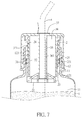
  • FIG. 7 is a sectional view in accordance with a fourth embodiment of the present invention, showing that the leakproof member of the cap body is removed and the straw is inserted in the chamber of the container body through the through hole of the inner tube;
  • FIG. 8 is an exploded view of the cap body, the inner cover and the container body in accordance with a fifth embodiment of the present invention, showing the upper extension tube provided on the cap body for mounting a nozzle;
  • FIG. 9 is a sectional view of the fifth embodiment of the present invention in a use state
  • FIG. 10 is a sectional view of the fifth embodiment of the present invention, showing a plurality of sealing cap mounted to the container body;
  • FIG. 11 is a sectional view of the cap body, the inner cover and the container body in accordance with a sixth embodiment of the present invention.
  • FIG. 1 to FIG. 11 embodiments of the present invention will now be described, by way of example only, with reference to the accompanying drawings.
  • the inventive concept may, however, be embodied in many different forms and should not be construed as being limited to the embodiments set forth herein.
  • the present invention provides a sealing cap and a container having the sealing cap.
  • the sealing cap may be mounted on a container body 1 , and includes an inner cover 2 and a cap body 3 .
  • the container body 1 has a chamber 11 therein and a mouth 12 .
  • the mouth 12 has an opening 13 communicating with the chamber 11 .
  • the container body 1 is a bottle containing a liquid, such as a beverage.
  • the container body 1 may be any one of the existing bottles on the market to mate with the sealing cap. For example, a commercially available bottle with the cap removed can be used in conjunction with the sealing cap.
  • the inner cover 2 has a hollow shape, and has an open end 21 and a closed end 22 at two ends thereof.
  • the inner cover 2 has a resistance portion on an outer wall thereof. The resistance portion enables the inner cover 2 to be temporarily held against an inner wall 121 of the opening 13 of the mouth 12 .
  • the inner cover 2 has at least one release hole 23 between the resistance portion and the closed end 22 .
  • the inner cover 2 has a first inner threaded portion 24 on an inner wall thereof. In this embodiment, the first inner threaded portion 24 is located between the resistance portion and the open end 21 .
  • the resistance portion includes a plurality of annular protrusions 25 .
  • Each of the annular protrusions 25 protrudes radially from the inner cover 2 .
  • An O-shaped ring 251 is provided between the annular protrusions 25 .
  • the O-shaped ring 251 provides an anti-leakage effect and facilitates the annular protrusions 25 to be positioned on the inner wall 121 .
  • the resistance portion may include a plurality of protrusions 25 A.
  • the protrusions 25 A protrude radially from the inner cover 2 and are arranged in a circle.
  • the mouth 12 has a plurality of grooves 122 in the opening 13 , so that the plurality of protrusions 25 A are engaged in the grooves 122 so as to prevent the plurality of protrusions 25 A from rotating in the opening 13 of the inner cover 2 relative to the mouth 12 .
  • the inner cover 2 has a plurality of release holes 23 arranged in a circle.
  • the resistance portion is temporarily held against the inner wall 121 in the opening 13 of the mouth 12 , not limiting the resistance portion from being displaced or rotated relative to the inner wall 121 .
  • the inner cover 2 can be displaced or rotated in the opening 13 by overcoming the resistance.
  • the cap body 3 may be screwed to or unscrewed from the mouth 12 .
  • the cap body 3 has a second inner threaded portion 31
  • the mouth 12 has a first outer threaded portion 123 to mate with the second inner threaded portion 31 .
  • the cap body 3 has a lower extension tube 32 .
  • the lower extension tube 32 has an accommodation room 33 to accommodate an additive therein.
  • the lower extension tube 32 has a hollow distal end with an aperture 34 .
  • An outer wall of the lower extension tube 32 has a second outer threaded portion 321 .
  • the first inner threaded portion 24 is screwed to the second outer threaded portion 321 until the distal end of the lower extension tube 32 leans against the closed end 22 .
  • the aperture 34 and the release hole 23 are temporarily closed and not communicated with each other.
  • the additive may be a liquid, such as vinegar, wine and coffee, or may be a powder, such as vitamin powder, green tea powder and enzyme powder, for mixing with the liquid or powder contained in the container body 1 .
  • the screw direction of the first inner threaded portion 24 of the inner cover 2 and the second outer threaded portion 321 of the lower extension tube 32 is opposite to the screw direction of the cap body 3 and the mouth 12 , that is, opposite to the screw direction of the second inner threaded portion 31 and the first outer threaded portion 123 .
  • the sealing cap is screwed to the mouth 12 of the container body 1 . If the additive contained in the accommodation room 33 is to be dropped from the release hole 23 , the cap body 3 is screwed downward in the clockwise direction relative to the mouth 12 .
  • the lower extension tube 32 is rotated in the opening 13 to move toward the chamber 11 .
  • the plurality of annular protrusions 25 of the inner cover 2 are temporarily held against the inner wall 121 , and won't be rotated with the lower extension tube 32 , but are moved along with the lower extension tube 32 toward the chamber 11 .
  • the first inner threaded portion 24 of the inner cover 2 are driven by the second outer threaded portion 321 so that the inner cover 2 is moved relative to the lower extension tube 32 toward the chamber 11 .
  • the inner cover 2 is moved in the opening 13 toward the chamber 11 with the rotation of the cap body 3 , and is further moved toward the chamber 11 relative to the lower extension tube 32 in the screw direction of the second inner threaded portion 31 and the first outer threaded portion 123 until the aperture 34 and the release hole 23 are opened and communicated with each other to allow the additive to drop from the release hole 23 to mix with the liquid in the chamber 11 .
  • the cap body 3 is in a tightened state at the mouth 12 , so that the container body 1 can be shaken until the additive and the liquid are mixed to be uniform.
  • the cap body 3 can be unscrewed from the mouth 12 in the counterclockwise direction until the cap body 3 is disengaged from the mouth 12 to expose the opening 13 .
  • the conventional cap is first screwed and then unscrewed to release the additive, after that, the container is shaken and the cap is unscrewed to be opened for drinking the liquid in the container.
  • it is only necessary to perform the action of screwing and unscrewing once, and the release hole 23 is closed when the cap body 3 is detached from the mouth 12 , so that there is no problem of leakage.
  • the container and the sealing cap are a combination of commercialization.
  • a pull ring 35 is connected to the cap body 3 , and the pull ring 35 is rotated into the mouth 12 with the cap body 3 .
  • the space in which the cap body 3 can be screwed to the mouth 12 is reserved by the pull ring 35 .
  • the cap body 3 is screwed, it is blocked by the pull ring 35 to avoid accidentally screwing the cap body 3 and mistakenly releasing the additive from the accommodation room 33 .
  • the pull ring 35 is removed from the cap body 3 before the cap body 3 is screwed to the mouth 12 , so that the space of the pull ring 35 at the bottom of the cap body 3 is vacated, and the cap body 3 can be screwed again for the additive to be released from the release hole 23 as the aforesaid operation.
  • the cap body 3 of the sealing cap is of a non-opening type.
  • the cap body 3 may be provided with a perforation, allowing a straw to be inserted into the chamber 11 .
  • the function for insertion of a straw 4 is also provided.
  • an inner tube 36 is provided in the lower extension tube 32 .
  • the inner tube 36 has one end extending from the cap body 3 and another end extending to the closed end 22 .
  • the closed end 22 has a hole 221 for the inner tube 36 to pass therethrough.
  • the inner tube 36 has a through hole 361 communicating with the closed end 22 and the cap body 3 at the two ends thereof.
  • a leakproof member 37 able to seal the through hole 361 is provided at one end of the cap body 3 .
  • the leakproof member 37 is a film. When the leakproof member 37 is removed from one end of the through hole 361 , the straw 4 can be inserted in the container body 1 through the cap body 3 and the closed end 22 via the through hole 361 .
  • one end of the inner tube 36 may extend from the closed end 22 , and the other end may extend to the cap body 3 (not shown).
  • the inner tube 36 may be formed with the through hole 361 for insertion of the straw 4 .
  • FIG. 8 and FIG. 9 illustrate a fifth embodiment, showing another embodiment of the cap body 3 having the through hole 361 .
  • the top of the cap body 3 has an upper extension tube 38 .
  • the upper extension tube 38 has a space 381 for the lower extension tube 32 to be completely inserted therein.
  • the upper extension tube 38 has a third outer threaded portion 382 .
  • the third outer threaded portion 382 and the second inner threaded portion 31 of the cap body 3 have corresponding threads.
  • One end of the through hole 361 , at the cap body 3 is communicated with the upper extension tube 38 .
  • the upper extension tube 38 is configured to connect with a suction member 5 .
  • the suction member 5 has a suction tube 51 inserted through the inner tube 36 and the through hole 361 to extend into the container body 1 .
  • the suction member 5 is able to suck the solution mixed with the additive in the container body 1 .
  • the suction member 5 is a nozzle as an example.
  • the suction member 5 is locked to the third inner threaded portion 382 , so that the liquid contained in the container body 1 can be sucked and atomized.
  • the suction member 5 may be other objects which can be locked to the upper extension tube 38 , such as a rubber nipple, and have a specific function. After the suction member 5 is locked to the upper extension tube 38 , it allows the user to suck the liquid in the container body 1 .
  • the lower extension tube 32 provided in the inner cover 2 of one sealing cap may be disposed in the upper extension tube 38 of the other sealing cap.
  • the second inner threaded portion 31 of the cap body 3 of one sealing cap is engaged with the third outer threaded portion 382 of the upper extension tube 38 of the other sealing cap, so that the sealing caps are connected in series.
  • the sealing caps can save the space.
  • the upper extension tube 38 of the cap body 3 can be directly connected with the suction member 5 , so that the suction tube 51 of the suction member 5 is inserted into the container body 1 to suck the solution, facilitating the installation of the suction member 5 .
  • FIG. 11 illustrates a sixth embodiment of the present invention, which is substantially similar to the first embodiment with the exceptions described hereinafter.
  • the sealing cap of this embodiment is applied to a container body 6 which has the same mouth as the first embodiment (not shown) for connecting with the suction member 5 to close the opening 13 of the container body 1 .
  • One side of the container body 6 is provided with another mouth 61 .
  • the cap body 3 of the sealing cap may be screwed to the mouth 61 .
  • the additive drops into the container body 6 from the mouth 61 to mix with the solution, thereby achieving the same effect as the first embodiment.

Landscapes

  • Engineering & Computer Science (AREA)
  • Mechanical Engineering (AREA)
  • Closures For Containers (AREA)

Abstract

The present invention relates to a sealing cap and a container having the sealing cap. Using an opposite screw direction, when a cap body is screwed at a mouth of the container, an inner cover is moved toward a chamber of a container body relative to a lower extension tube of the cap body until an aperture of the lower extension tube is communicated with at least one release hole of the inner cover, such that an additive drops from the release hole to be mixed with the liquid in the container. The operation is simple and clear. When the cap body is rotated to disengage from the mouth, the release hole is closed again to prevent the remaining additive from dripping out of the cap body.

Description

FIELD OF THE INVENTION
The present invention relates to a sealing cap and a container having the sealing cap, and more particularly to an apparatus for containing articles.
BACKGROUND OF THE INVENTION
Taiwan Patent Publication No. TWI508903, TWI508899 are previous creations of the applicant. Both the two patents disclose a cap and a container. The cap is composed of a cap body and a retaining member. The retaining member is assembled to the cap body to form a sealing space for filling an additive. By rotating the cap body, the additive can be released from an exposed opening of the retaining member so that the additive can be mixed with the liquid in the container.
The rotation of the cap body is to unscrew the cap body, and then the retaining member is moved upward along with the cap body to expose the opening of the retaining member. After the additive is released from the cap body, the container is shaken to mix the additive with the liquid in the container. For drinking, the cap body is unscrewed to disengage from the cap body. During the process, it is necessary to take many actions for mixing the additive with the liquid of the container. In addition, the additive may drip from the cap body when the cap is removed from the container.
SUMMARY OF THE INVENTION
The primary object of the present invention is to solve the aforesaid problems and to provide a sealing cap and a container having the sealing cap. The screw direction of an inner cover and a cap body is opposite to the screw direction of the cap body and a mouth of the container. When the cap body is screwed at the mouth, the inner cover is moved toward a chamber of the container relative to a lower extension tube until an aperture of the lower extension tube is communicated with at least one release hole of the inner cover, such that an additive drops from the release hole. After that, the container is shaken to mix the additive with the liquid in the container. The action of the cap body is less. When the cap body is detached from the mouth, there is no problem of leakage.
In order to achieve the aforesaid object, a sealing cap and a container having the sealing cap are provided. The container comprises a container body, an inner cover, and a cap body.
The container body has a chamber therein and a mouth. The mouth has an opening communicating with the chamber.
The inner cover has a hollow shape, and has an open end and a closed end at two ends thereof. The inner cover has a resistance portion on an outer wall thereof. The resistance portion enables the inner cover to be temporarily held against an inner wall of the opening of the mouth. The inner cover has at least one release hole between the resistance portion and the closed end. The inner cover has a first inner threaded portion on an inner wall thereof.
The cap body has a second inner threaded portion to mate with a first outer threaded portion of the mouth. The cap body has a lower extension tube to extend into the opening. The lower extension tube has an accommodation room to accommodate an additive therein. The lower extension tube has a hollow distal end with an aperture. An outer wall of the lower extension tube has a second outer threaded portion. The first inner threaded portion is screwed to the second outer threaded portion until the distal end of the lower extension tube leans against the closed end. The aperture and the release hole are temporarily closed and not communicated with each other. A screw direction of the first inner threaded portion of the inner cover and the second outer threaded portion of the lower extension tube is opposite to a screw direction of the second inner threaded portion and the first outer threaded portion.
The inner cover has the resistance portion to be temporarily held against the inner wall of the opening of the mouth. When the cap body is screwed at the mouth, the inner cover is moved toward the chamber of the container body along with rotation of the cap body and is further moved toward the chamber of the container body relative to the lower extension tube in the screw direction of the second inner threaded portion and the first outer threaded portion until the distal end of the lower extension tube is disengaged from the closed end, and the aperture of the lower extension tube is communicated with the at least one release hole so that the additive drops from the at least one release hole.
BRIEF DESCRIPTION OF THE DRAWINGS
FIG. 1 is an exploded view of the cap body, the inner cover and the container body in accordance with a first embodiment of the present invention;
FIG. 2 is a sectional view of the sealing cap disengaged from the container body of FIG. 1;
FIG. 3 is an exploded view of the cap body, the inner cover and the container body in accordance with a second embodiment of the present invention;
FIG. 4 is a sectional view of FIG. 2, showing that the cap body is screwed downward clockwise and the additive drops from the release hole;
FIG. 5 is a sectional view of FIG. 4, showing that the cap body is unscrewed upward counterclockwise and the inner cover is disengaged from the mouth along with the rotation of the cap body;
FIG. 6 is a sectional view in accordance with a third embodiment of the present invention provided with the pull ring;
FIG. 7 is a sectional view in accordance with a fourth embodiment of the present invention, showing that the leakproof member of the cap body is removed and the straw is inserted in the chamber of the container body through the through hole of the inner tube;
FIG. 8 is an exploded view of the cap body, the inner cover and the container body in accordance with a fifth embodiment of the present invention, showing the upper extension tube provided on the cap body for mounting a nozzle;
FIG. 9 is a sectional view of the fifth embodiment of the present invention in a use state;
FIG. 10 is a sectional view of the fifth embodiment of the present invention, showing a plurality of sealing cap mounted to the container body; and
FIG. 11 is a sectional view of the cap body, the inner cover and the container body in accordance with a sixth embodiment of the present invention.
DETAILED DESCRIPTION OF THE PREFERRED EMBODIMENTS
As shown in FIG. 1 to FIG. 11, embodiments of the present invention will now be described, by way of example only, with reference to the accompanying drawings. The inventive concept may, however, be embodied in many different forms and should not be construed as being limited to the embodiments set forth herein.
The present invention provides a sealing cap and a container having the sealing cap. In a first embodiment, as shown in FIG. 1 to FIG. 2, the sealing cap may be mounted on a container body 1, and includes an inner cover 2 and a cap body 3.
As shown in FIG. 2, the container body 1 has a chamber 11 therein and a mouth 12. The mouth 12 has an opening 13 communicating with the chamber 11. In this embodiment, the container body 1 is a bottle containing a liquid, such as a beverage. In this embodiment, the container body 1 may be any one of the existing bottles on the market to mate with the sealing cap. For example, a commercially available bottle with the cap removed can be used in conjunction with the sealing cap.
As shown in FIG. 1 and FIG. 2, the inner cover 2 has a hollow shape, and has an open end 21 and a closed end 22 at two ends thereof. The inner cover 2 has a resistance portion on an outer wall thereof. The resistance portion enables the inner cover 2 to be temporarily held against an inner wall 121 of the opening 13 of the mouth 12. The inner cover 2 has at least one release hole 23 between the resistance portion and the closed end 22. The inner cover 2 has a first inner threaded portion 24 on an inner wall thereof. In this embodiment, the first inner threaded portion 24 is located between the resistance portion and the open end 21.
As shown in FIG. 1 to FIG. 2, in this embodiment, the resistance portion includes a plurality of annular protrusions 25. Each of the annular protrusions 25 protrudes radially from the inner cover 2. An O-shaped ring 251 is provided between the annular protrusions 25. The O-shaped ring 251 provides an anti-leakage effect and facilitates the annular protrusions 25 to be positioned on the inner wall 121. As shown in FIG. 3, in the second embodiment, the resistance portion may include a plurality of protrusions 25A. The protrusions 25A protrude radially from the inner cover 2 and are arranged in a circle. The mouth 12 has a plurality of grooves 122 in the opening 13, so that the plurality of protrusions 25A are engaged in the grooves 122 so as to prevent the plurality of protrusions 25A from rotating in the opening 13 of the inner cover 2 relative to the mouth 12. In the above-described embodiment, the inner cover 2 has a plurality of release holes 23 arranged in a circle. In the present invention, the resistance portion is temporarily held against the inner wall 121 in the opening 13 of the mouth 12, not limiting the resistance portion from being displaced or rotated relative to the inner wall 121. When the inner cover 2 is applied with a force greater than the force of engagement, the inner cover 2 can be displaced or rotated in the opening 13 by overcoming the resistance.
As shown in FIG. 1 to FIG. 3, the cap body 3 may be screwed to or unscrewed from the mouth 12. The cap body 3 has a second inner threaded portion 31, and the mouth 12 has a first outer threaded portion 123 to mate with the second inner threaded portion 31. The cap body 3 has a lower extension tube 32. When the cap body 3 is screwed to the mouth 12, the lower extension tube 32 is inserted into the opening 13. The lower extension tube 32 has an accommodation room 33 to accommodate an additive therein. The lower extension tube 32 has a hollow distal end with an aperture 34. An outer wall of the lower extension tube 32 has a second outer threaded portion 321. The first inner threaded portion 24 is screwed to the second outer threaded portion 321 until the distal end of the lower extension tube 32 leans against the closed end 22. The aperture 34 and the release hole 23 are temporarily closed and not communicated with each other. The additive may be a liquid, such as vinegar, wine and coffee, or may be a powder, such as vitamin powder, green tea powder and enzyme powder, for mixing with the liquid or powder contained in the container body 1. The screw direction of the first inner threaded portion 24 of the inner cover 2 and the second outer threaded portion 321 of the lower extension tube 32 is opposite to the screw direction of the cap body 3 and the mouth 12, that is, opposite to the screw direction of the second inner threaded portion 31 and the first outer threaded portion 123.
As shown in FIG. 4, the sealing cap is screwed to the mouth 12 of the container body 1. If the additive contained in the accommodation room 33 is to be dropped from the release hole 23, the cap body 3 is screwed downward in the clockwise direction relative to the mouth 12. The lower extension tube 32 is rotated in the opening 13 to move toward the chamber 11. The plurality of annular protrusions 25 of the inner cover 2 are temporarily held against the inner wall 121, and won't be rotated with the lower extension tube 32, but are moved along with the lower extension tube 32 toward the chamber 11. The first inner threaded portion 24 of the inner cover 2 are driven by the second outer threaded portion 321 so that the inner cover 2 is moved relative to the lower extension tube 32 toward the chamber 11. Therefore, when the cap body 3 is screwed at the mouth 12, the inner cover 2 is moved in the opening 13 toward the chamber 11 with the rotation of the cap body 3, and is further moved toward the chamber 11 relative to the lower extension tube 32 in the screw direction of the second inner threaded portion 31 and the first outer threaded portion 123 until the aperture 34 and the release hole 23 are opened and communicated with each other to allow the additive to drop from the release hole 23 to mix with the liquid in the chamber 11. The cap body 3 is in a tightened state at the mouth 12, so that the container body 1 can be shaken until the additive and the liquid are mixed to be uniform. As shown in FIG. 5, when the liquid mixed with the additive is to be consumed, the cap body 3 can be unscrewed from the mouth 12 in the counterclockwise direction until the cap body 3 is disengaged from the mouth 12 to expose the opening 13.
Through the above description, it is easy to find an advantage of the present invention in that because the screw direction of the first inner threaded portion 24 of the inner cover 2 and the second outer threaded portion 321 of the lower extension tube 32 is opposite to the screw direction of the cap body 3 and the mouth 12, the cap body 3 is only required to be screwed at the mouth 12, and the inner cover 2 is moved toward the chamber 11 of the container body 1 relative to the lower extension tube 32 to expose the release hole 23 of the inner cover 2, so that the additive drops from the exposed release hole 23, and the container body 1 is shaken to mix the additive with the liquid in the container body 1. The conventional cap is first screwed and then unscrewed to release the additive, after that, the container is shaken and the cap is unscrewed to be opened for drinking the liquid in the container. As to the present invention, it is only necessary to perform the action of screwing and unscrewing once, and the release hole 23 is closed when the cap body 3 is detached from the mouth 12, so that there is no problem of leakage.
As shown in FIG. 6, in a third embodiment, the container and the sealing cap are a combination of commercialization. For the container, not the aforesaid one, able to mate with the sealing cap, a pull ring 35 is connected to the cap body 3, and the pull ring 35 is rotated into the mouth 12 with the cap body 3. The space in which the cap body 3 can be screwed to the mouth 12 is reserved by the pull ring 35. At this time, if the cap body 3 is screwed, it is blocked by the pull ring 35 to avoid accidentally screwing the cap body 3 and mistakenly releasing the additive from the accommodation room 33. When the additive is to be released, the pull ring 35 is removed from the cap body 3 before the cap body 3 is screwed to the mouth 12, so that the space of the pull ring 35 at the bottom of the cap body 3 is vacated, and the cap body 3 can be screwed again for the additive to be released from the release hole 23 as the aforesaid operation.
In the above embodiment, the cap body 3 of the sealing cap is of a non-opening type. In a different embodiment, the cap body 3 may be provided with a perforation, allowing a straw to be inserted into the chamber 11. In addition to the technical effect of the cap body 3 of the foregoing embodiment, the function for insertion of a straw 4 is also provided. As shown in FIG. 7, in a fourth embodiment, when the inner cover 2 and the lower extension tube 32 are screwed, an inner tube 36 is provided in the lower extension tube 32. The inner tube 36 has one end extending from the cap body 3 and another end extending to the closed end 22. The closed end 22 has a hole 221 for the inner tube 36 to pass therethrough. The inner tube 36 has a through hole 361 communicating with the closed end 22 and the cap body 3 at the two ends thereof. A leakproof member 37 able to seal the through hole 361 is provided at one end of the cap body 3. The leakproof member 37 is a film. When the leakproof member 37 is removed from one end of the through hole 361, the straw 4 can be inserted in the container body 1 through the cap body 3 and the closed end 22 via the through hole 361. In a different embodiment, one end of the inner tube 36 may extend from the closed end 22, and the other end may extend to the cap body 3 (not shown). The inner tube 36 may be formed with the through hole 361 for insertion of the straw 4.
FIG. 8 and FIG. 9 illustrate a fifth embodiment, showing another embodiment of the cap body 3 having the through hole 361. The top of the cap body 3 has an upper extension tube 38. The upper extension tube 38 has a space 381 for the lower extension tube 32 to be completely inserted therein. The upper extension tube 38 has a third outer threaded portion 382. The third outer threaded portion 382 and the second inner threaded portion 31 of the cap body 3 have corresponding threads. One end of the through hole 361, at the cap body 3, is communicated with the upper extension tube 38. The upper extension tube 38 is configured to connect with a suction member 5. The suction member 5 has a suction tube 51 inserted through the inner tube 36 and the through hole 361 to extend into the container body 1. When the suction member 5 is actuated, the suction member 5 is able to suck the solution mixed with the additive in the container body 1. In this embodiment, the suction member 5 is a nozzle as an example. The suction member 5 is locked to the third inner threaded portion 382, so that the liquid contained in the container body 1 can be sucked and atomized. In addition to the above-mentioned nozzle, the suction member 5 may be other objects which can be locked to the upper extension tube 38, such as a rubber nipple, and have a specific function. After the suction member 5 is locked to the upper extension tube 38, it allows the user to suck the liquid in the container body 1.
Accordingly, in addition to the effects of the first embodiment, when there are two or more sealing caps, as shown in FIG. 10, the lower extension tube 32 provided in the inner cover 2 of one sealing cap may be disposed in the upper extension tube 38 of the other sealing cap. The second inner threaded portion 31 of the cap body 3 of one sealing cap is engaged with the third outer threaded portion 382 of the upper extension tube 38 of the other sealing cap, so that the sealing caps are connected in series. When stored, the sealing caps can save the space. In addition, the upper extension tube 38 of the cap body 3 can be directly connected with the suction member 5, so that the suction tube 51 of the suction member 5 is inserted into the container body 1 to suck the solution, facilitating the installation of the suction member 5.
FIG. 11 illustrates a sixth embodiment of the present invention, which is substantially similar to the first embodiment with the exceptions described hereinafter. The sealing cap of this embodiment is applied to a container body 6 which has the same mouth as the first embodiment (not shown) for connecting with the suction member 5 to close the opening 13 of the container body 1. One side of the container body 6 is provided with another mouth 61. The cap body 3 of the sealing cap may be screwed to the mouth 61. In the same use way as the first embodiment, the additive drops into the container body 6 from the mouth 61 to mix with the solution, thereby achieving the same effect as the first embodiment.
Although particular embodiments of the present invention have been described in detail for purposes of illustration, various modifications and enhancements may be made without departing from the spirit and scope of the present invention. Accordingly, the present invention is not to be limited except as by the appended claims.

Claims (5)

What is claimed is:
1. A sealing cap, detachably screwed to a mouth having an opening of a container body, comprising:
an inner cover, having a hollow shape and having an open end and a closed end at two ends thereof, the inner cover having a resistance portion on an outer wall thereof, the resistance portion enabling the inner cover to be temporarily held against an inner wall of the opening of the mouth, the inner cover having at least one release hole between the resistance portion and the closed end, the inner cover having a first inner threaded portion on an inner wall thereof;
a cap body, having a second inner threaded portion to mate with a first outer threaded portion of the mouth, the cap body having a lower extension tube to extend into the opening, the lower extension tube having an accommodation room to accommodate an additive therein, the lower extension tube having a hollow distal end with an aperture, an outer wall of the lower extension tube having a second outer threaded portion, the first inner threaded portion being screwed to the second outer threaded portion until the distal end of the lower extension tube engages the closed end, the aperture and the release hole being temporarily closed and not communicated with each other, a screw direction of the first inner threaded portion of the inner cover and the second outer threaded portion of the lower extension tube being opposite to a screw direction of the second inner threaded portion and the first outer threaded portion;
wherein the inner cover is temporarily engaged by the resistance portion against the inner wall of the opening of the mouth,
wherein, when the cap body is screwed at the mouth, the inner cover is moved toward a chamber of the container body by rotation of the cap body and is further moved toward the chamber of the container body relative to the lower extension tube in the screw direction of the second inner threaded portion and the first outer threaded portion until the distal end of the lower extension tube is disengaged from the closed end and the aperture of the lower extension tube is communicated with the at least one release hole so that the additive can drop from the at least one release hole, and
wherein the release hole is closed by the lower extension tube when the cap body is detached from the mouth.
2. The sealing cap as claimed in claim 1, wherein the resistance portion includes a plurality of annular protrusions protruding radially from the inner cover, or a plurality of protrusions protruding radially from the inner cover and arranged in a circle.
3. The sealing cap as claimed in claim 1, wherein the first inner threaded portion of the inner cover is located between the resistance portion and the open end.
4. The sealing cap as claimed in claim 1, wherein when the inner cover and the lower extension tube are screwedly connected with each other, an inner tube is provided in the lower extension tube, the inner tube has one end extending from one of the closed end and the cap body and another end extending to one of the closed end and the cap body, the inner tube has a through hole communicating with the closed end and the cap body at the two ends thereof, a leakproof member able to seal the through hole is provided at one end of the cap body, when the leakproof member is removed from one end of the through hole, a straw is inserted in the container body through the cap body and the closed end via the through hole.
5. The sealing cap as claimed in claim 4, wherein a top of the cap body has an upper extension tube, the upper extension tube has a space for the lower extension tube to be completely inserted therein, the upper extension tube has a third outer threaded portion, the third outer threaded portion and the second inner threaded portion of the cap body have corresponding threads, one end of the through hole, at the cap body, is communicated with the upper extension tube, the upper extension tube is configured to connect with a suction member, the suction member has a suction tube inserted through the inner tube and the through hole to extend into the container body, when the suction member is actuated, the suction member is able to suck a solution mixed with the additive in the container body.
US15/708,544 2017-09-19 2017-09-19 Sealing cap and container having the sealing cap Active 2037-11-15 US10414563B2 (en)

Priority Applications (1)

Application Number Priority Date Filing Date Title
US15/708,544 US10414563B2 (en) 2017-09-19 2017-09-19 Sealing cap and container having the sealing cap

Applications Claiming Priority (1)

Application Number Priority Date Filing Date Title
US15/708,544 US10414563B2 (en) 2017-09-19 2017-09-19 Sealing cap and container having the sealing cap

Publications (2)

Publication Number Publication Date
US20190084738A1 US20190084738A1 (en) 2019-03-21
US10414563B2 true US10414563B2 (en) 2019-09-17

Family

ID=65719167

Family Applications (1)

Application Number Title Priority Date Filing Date
US15/708,544 Active 2037-11-15 US10414563B2 (en) 2017-09-19 2017-09-19 Sealing cap and container having the sealing cap

Country Status (1)

Country Link
US (1) US10414563B2 (en)

Cited By (4)

* Cited by examiner, † Cited by third party
Publication number Priority date Publication date Assignee Title
US20220002068A1 (en) * 2019-03-21 2022-01-06 Henkel Ag & Co. Kgaa Packaging System For At Least One Product Preparation Component And Corresponding Method For Handling The Product Preparation Component
US20220258936A1 (en) * 2019-05-27 2022-08-18 Rpc Bramlage Gmbh Closure device for a container
US11548703B1 (en) * 2022-03-08 2023-01-10 Green Sky Creations LLC Cannabinoid and alkaloid beverage containers, and associated devices, systems, and methods
US20240010402A1 (en) * 2022-07-07 2024-01-11 The Remarkable Technology (Shanghai) Co., Ltd Powder-water integrated bottle

Families Citing this family (1)

* Cited by examiner, † Cited by third party
Publication number Priority date Publication date Assignee Title
CN115416968A (en) * 2020-11-04 2022-12-02 邓昌沪 A kind of solute and solvent isolation sealed packaging bottle

Citations (8)

* Cited by examiner, † Cited by third party
Publication number Priority date Publication date Assignee Title
US4903828A (en) * 1986-03-07 1990-02-27 Robert Finke Kommanditgesellschaft Bottle closure cap for two-component packages
US20070199839A1 (en) * 2004-03-08 2007-08-30 Igal Sharon Cartridge unit for a multi-compartment container assembly
US20080223740A1 (en) * 2005-08-12 2008-09-18 Obrist Closures Switzerland Gmbh Container Closure Assembly
US7503453B2 (en) * 2004-11-04 2009-03-17 Viz Enterprises, Llc Multi-chamber container and cap therefor
US7909160B2 (en) * 2005-04-27 2011-03-22 Abrigo, Ltd Mixing cap and method for use thereof
US20150266634A1 (en) * 2014-03-19 2015-09-24 Fang-Lin YANG Bottle cap and container with bottle cap
TWI508899B (en) 2014-01-27 2015-11-21
TWI508903B (en) 2014-02-25 2015-11-21

Patent Citations (8)

* Cited by examiner, † Cited by third party
Publication number Priority date Publication date Assignee Title
US4903828A (en) * 1986-03-07 1990-02-27 Robert Finke Kommanditgesellschaft Bottle closure cap for two-component packages
US20070199839A1 (en) * 2004-03-08 2007-08-30 Igal Sharon Cartridge unit for a multi-compartment container assembly
US7503453B2 (en) * 2004-11-04 2009-03-17 Viz Enterprises, Llc Multi-chamber container and cap therefor
US7909160B2 (en) * 2005-04-27 2011-03-22 Abrigo, Ltd Mixing cap and method for use thereof
US20080223740A1 (en) * 2005-08-12 2008-09-18 Obrist Closures Switzerland Gmbh Container Closure Assembly
TWI508899B (en) 2014-01-27 2015-11-21
TWI508903B (en) 2014-02-25 2015-11-21
US20150266634A1 (en) * 2014-03-19 2015-09-24 Fang-Lin YANG Bottle cap and container with bottle cap

Cited By (6)

* Cited by examiner, † Cited by third party
Publication number Priority date Publication date Assignee Title
US20220002068A1 (en) * 2019-03-21 2022-01-06 Henkel Ag & Co. Kgaa Packaging System For At Least One Product Preparation Component And Corresponding Method For Handling The Product Preparation Component
US12409998B2 (en) * 2019-03-21 2025-09-09 Henkel Ag & Co. Kgaa Packaging system for at least one product preparation component and corresponding method for handling the product preparation component
US20220258936A1 (en) * 2019-05-27 2022-08-18 Rpc Bramlage Gmbh Closure device for a container
US12214944B2 (en) * 2019-05-27 2025-02-04 Rpc Bramlage Gmbh Closure device for a container
US11548703B1 (en) * 2022-03-08 2023-01-10 Green Sky Creations LLC Cannabinoid and alkaloid beverage containers, and associated devices, systems, and methods
US20240010402A1 (en) * 2022-07-07 2024-01-11 The Remarkable Technology (Shanghai) Co., Ltd Powder-water integrated bottle

Also Published As

Publication number Publication date
US20190084738A1 (en) 2019-03-21

Similar Documents

Publication Publication Date Title
US10414563B2 (en) Sealing cap and container having the sealing cap
US8672156B2 (en) Bottle and cap
US6994211B2 (en) Cap device for mixing different kinds of materials separately contained therein and in bottle
US6974024B2 (en) Cap device for mixing different kinds of materials separately contained therein and in bottle
US8136660B2 (en) Multi compartment container system
US8083055B2 (en) Dispensing cap system for beverage bottles
US20150232318A1 (en) Bottle Cap Dispenser with Re-attachable Perforated Cartridge Chamber
CN107108085B (en) Lid and method for making beverages
US20140230659A1 (en) Additive delivery systems and containers
GB2489721A (en) A powder dispenser for attachment to a baby bottle
EP1737754A2 (en) A cartridge unit for a multi-compartment container assembly
JP2017520489A (en) Universal bottle cap
JP2020506124A (en) Beverage container with dispenser
US20210253319A1 (en) A dispenser
US7740134B2 (en) Infusion cap with reservoir shiftable downwardly
KR20160012490A (en) Different kind material mixing container
TWI626198B (en) Cover and container having the cover
US20140263154A1 (en) Bottle and cap
US20050045669A1 (en) Dispenser
US3070093A (en) Medicament and diluent storing, mixing, and dispensing device
CN108725988B (en) Sealing cover and container with same
TWM557715U (en) Cover and container having the same
CN219566100U (en) Bottle cap sinking into bottle and bottled product
KR101398750B1 (en) Cap for the mixing of additives
CN216003701U (en) Bottle cap and beverage bottle with same

Legal Events

Date Code Title Description
FEPP Fee payment procedure

Free format text: ENTITY STATUS SET TO UNDISCOUNTED (ORIGINAL EVENT CODE: BIG.); ENTITY STATUS OF PATENT OWNER: SMALL ENTITY

FEPP Fee payment procedure

Free format text: ENTITY STATUS SET TO SMALL (ORIGINAL EVENT CODE: SMAL); ENTITY STATUS OF PATENT OWNER: SMALL ENTITY

STPP Information on status: patent application and granting procedure in general

Free format text: NON FINAL ACTION MAILED

STPP Information on status: patent application and granting procedure in general

Free format text: NOTICE OF ALLOWANCE MAILED -- APPLICATION RECEIVED IN OFFICE OF PUBLICATIONS

STPP Information on status: patent application and granting procedure in general

Free format text: PUBLICATIONS -- ISSUE FEE PAYMENT VERIFIED

STCF Information on status: patent grant

Free format text: PATENTED CASE

MAFP Maintenance fee payment

Free format text: PAYMENT OF MAINTENANCE FEE, 4TH YR, SMALL ENTITY (ORIGINAL EVENT CODE: M2551); ENTITY STATUS OF PATENT OWNER: SMALL ENTITY

Year of fee payment: 4