US10407025B2 - Vehicle and method of controlling the same - Google Patents
Vehicle and method of controlling the same Download PDFInfo
- Publication number
- US10407025B2 US10407025B2 US15/385,625 US201615385625A US10407025B2 US 10407025 B2 US10407025 B2 US 10407025B2 US 201615385625 A US201615385625 A US 201615385625A US 10407025 B2 US10407025 B2 US 10407025B2
- Authority
- US
- United States
- Prior art keywords
- signal
- vehicle
- generated
- relay attack
- high frequency
- Prior art date
- Legal status (The legal status is an assumption and is not a legal conclusion. Google has not performed a legal analysis and makes no representation as to the accuracy of the status listed.)
- Active, expires
Links
Images


Classifications
-
- B—PERFORMING OPERATIONS; TRANSPORTING
- B60—VEHICLES IN GENERAL
- B60R—VEHICLES, VEHICLE FITTINGS, OR VEHICLE PARTS, NOT OTHERWISE PROVIDED FOR
- B60R25/00—Fittings or systems for preventing or indicating unauthorised use or theft of vehicles
- B60R25/20—Means to switch the anti-theft system on or off
- B60R25/24—Means to switch the anti-theft system on or off using electronic identifiers containing a code not memorised by the user
-
- B—PERFORMING OPERATIONS; TRANSPORTING
- B60—VEHICLES IN GENERAL
- B60R—VEHICLES, VEHICLE FITTINGS, OR VEHICLE PARTS, NOT OTHERWISE PROVIDED FOR
- B60R25/00—Fittings or systems for preventing or indicating unauthorised use or theft of vehicles
- B60R25/20—Means to switch the anti-theft system on or off
- B60R25/24—Means to switch the anti-theft system on or off using electronic identifiers containing a code not memorised by the user
- B60R25/245—Means to switch the anti-theft system on or off using electronic identifiers containing a code not memorised by the user where the antenna reception area plays a role
-
- B—PERFORMING OPERATIONS; TRANSPORTING
- B60—VEHICLES IN GENERAL
- B60R—VEHICLES, VEHICLE FITTINGS, OR VEHICLE PARTS, NOT OTHERWISE PROVIDED FOR
- B60R25/00—Fittings or systems for preventing or indicating unauthorised use or theft of vehicles
- B60R25/20—Means to switch the anti-theft system on or off
- B60R25/209—Remote starting of engine
-
- G—PHYSICS
- G07—CHECKING-DEVICES
- G07C—TIME OR ATTENDANCE REGISTERS; REGISTERING OR INDICATING THE WORKING OF MACHINES; GENERATING RANDOM NUMBERS; VOTING OR LOTTERY APPARATUS; ARRANGEMENTS, SYSTEMS OR APPARATUS FOR CHECKING NOT PROVIDED FOR ELSEWHERE
- G07C9/00—Individual registration on entry or exit
- G07C9/00174—Electronically operated locks; Circuits therefor; Nonmechanical keys therefor, e.g. passive or active electrical keys or other data carriers without mechanical keys
- G07C9/00309—Electronically operated locks; Circuits therefor; Nonmechanical keys therefor, e.g. passive or active electrical keys or other data carriers without mechanical keys operated with bidirectional data transmission between data carrier and locks
-
- H—ELECTRICITY
- H01—ELECTRIC ELEMENTS
- H01Q—ANTENNAS, i.e. RADIO AERIALS
- H01Q1/00—Details of, or arrangements associated with, antennas
- H01Q1/27—Adaptation for use in or on movable bodies
- H01Q1/32—Adaptation for use in or on road or rail vehicles
-
- H—ELECTRICITY
- H01—ELECTRIC ELEMENTS
- H01Q—ANTENNAS, i.e. RADIO AERIALS
- H01Q1/00—Details of, or arrangements associated with, antennas
- H01Q1/27—Adaptation for use in or on movable bodies
- H01Q1/32—Adaptation for use in or on road or rail vehicles
- H01Q1/3208—Adaptation for use in or on road or rail vehicles characterised by the application wherein the antenna is used
- H01Q1/3233—Adaptation for use in or on road or rail vehicles characterised by the application wherein the antenna is used particular used as part of a sensor or in a security system, e.g. for automotive radar, navigation systems
- H01Q1/3241—Adaptation for use in or on road or rail vehicles characterised by the application wherein the antenna is used particular used as part of a sensor or in a security system, e.g. for automotive radar, navigation systems particular used in keyless entry systems
-
- G—PHYSICS
- G01—MEASURING; TESTING
- G01S—RADIO DIRECTION-FINDING; RADIO NAVIGATION; DETERMINING DISTANCE OR VELOCITY BY USE OF RADIO WAVES; LOCATING OR PRESENCE-DETECTING BY USE OF THE REFLECTION OR RERADIATION OF RADIO WAVES; ANALOGOUS ARRANGEMENTS USING OTHER WAVES
- G01S13/00—Systems using the reflection or reradiation of radio waves, e.g. radar systems; Analogous systems using reflection or reradiation of waves whose nature or wavelength is irrelevant or unspecified
- G01S13/74—Systems using reradiation of radio waves, e.g. secondary radar systems; Analogous systems
- G01S13/82—Systems using reradiation of radio waves, e.g. secondary radar systems; Analogous systems wherein continuous-type signals are transmitted
- G01S13/84—Systems using reradiation of radio waves, e.g. secondary radar systems; Analogous systems wherein continuous-type signals are transmitted for distance determination by phase measurement
Definitions
- Embodiments of the present disclosure relate to a vehicle, and a method of controlling the same.
- a vehicle remote control system is a system in which a driver can lock and unlock a door of a vehicle and start an engine of the vehicle in the outside without inserting a separate key into a key box or performing special manipulation for an operation, and a remote control device such as a smart card which is able to be easily handheld, or a key fob for wireless communication, etc. is used.
- the lock When a driver possessing the remote control device accesses the vehicle, the lock is automatically released through a low frequency (LF) communication or a radio frequency (RF) communication with the remote control device, the door may be unlocked without inserting the separate key, and the engine may be started without inserting a start key after riding in the vehicle.
- LF low frequency
- RF radio frequency
- a remote control system of the vehicle performs i) an LF signal transmission operation of transmitting an authentication request signal to the remote control device, and ii) an RF signal reception operation of receiving an authentication response signal from the remote control device.
- the remote control system of the vehicle may receive the authentication response signal from the remote control device only when the remote control device is present to be close to the vehicle due to a transmission distance limitation of the LF signal having a relatively low frequency band compared with the RF signal.
- a vehicle in accordance with one aspect of the present disclosure, includes a low frequency (LF) transmitter, a high frequency receiver, and a control unit.
- the low frequency (LF) transmitter may be configured to transmit a LF signal in order to search for a remote control device
- the high frequency receiver may be configured to receive a signal having a predetermined frequency band which is higher than a frequency band of the LF signal transmitted by the LF transmitter
- the control unit may be configured to determine that a relay attack is generated when the signal received by the high frequency receiver is a modulated LF signal.
- the vehicle may further include a radio frequency (RF) receiver configured to receive an RF signal including authentication information.
- the high frequency receiver receives a signal having a predetermined frequency band which is higher than a frequency band of the RF signal, and the control unit may determine that the relay attack is generated when the RF signal is received and the signal received by the high frequency receiver received is the modulated LF signal.
- RF radio frequency
- the vehicle may further include a storage unit configured to store the authentication information mutually shared with the remote control device.
- the control unit may determine that the relay attack is generated when the authentication information included in the RF signal is equal to the authentication information stored in the storage unit and the signal received by the high frequency receiver is the modulated LF signal.
- a plurality of predetermined frequency bands are included.
- the vehicle may further include a storage unit configured to store a priority on each of the plurality of predetermined frequency bands.
- the high frequency receiver may receive the signal in the frequency bands having a priority defined in the sequence which is from a high frequency band to a low frequency band.
- the high frequency receiver may include a plurality of high frequency signal demodulation modules demodulating signals in the plurality of predetermined frequency bands, respectively.
- the high frequency receiver may include a high frequency signal demodulation module demodulating the signal.
- the LF transmitter may transmit the LF signal including an identification (ID) mutually shared with the remote control device, and the control unit may determines that the relay attack is generated when the ID is detected based on a result demodulated by the high frequency signal demodulation module.
- ID an identification
- the control unit may stop transmitting the LF signal when determining that the relay attack is generated.
- a method of controlling a vehicle includes: transmitting a LF signal in order to search for a remote control device; receiving a signal having a predetermined frequency band which is higher than a frequency band of the LF signal; and determining that a relay attack is generated when the signal received in the receiving of the signal is a modulated LF signal.
- the method of controlling the vehicle, before the determining of that the relay attack is generated may further include receiving an RF signal including authentication information.
- the receiving of the signal receives a signal having a predetermined frequency band which is higher than a frequency band of the RF signal, and the determining of that the relay attack is generated may determine that the relay attack is generated when the RF signal is received and the signal received in the receiving of the signal is the modulated LF signal.
- the determining of that the relay attack is generated may determine that the relay attack is generated when the authentication information included in the RF signal is equal to the authentication information stored in the vehicle and the signal received in the receiving of the signal is the modulated LF signal.
- a plurality of predetermined frequency bands may be included.
- a priority on each of the plurality of predetermined frequency bands may be previously set, and the receiving of the signal may receive the signal in the frequency bands having a priority defined in the sequence which is from a high frequency band to a low frequency band.
- the receiving of the signal may include demodulating the signal in each of the plurality of predetermined frequency bands.
- the receiving of the signal may include demodulating the signal.
- the transmitting of the LF signal may transmit the LF signal including an identification (ID) mutually shared with the remote control device, and the determining of that the relay attack is generated may determine that the relay attack is generated when the ID is detected based on a result obtained in the demodulating of the signal.
- ID an identification
- the method of controlling the vehicle may further include stopping transmitting the LF signal when it is determined that the relay attack is generated.
- FIG. 1 is an exterior view of a vehicle according to one embodiment.
- FIG. 2 is a view illustrating an internal configuration of a vehicle according to one embodiment.
- FIG. 3 is a diagram illustrating an example of a vehicle and a remote control device performing communication with the vehicle according to an embodiment of the present invention.
- FIGS. 4 and 5 are drawings for describing an authentication operation between the vehicle and the remote control device performed at transceivable distances of various signals.
- FIG. 6 is a control block diagram of a vehicle according to an embodiment of the present invention.
- FIG. 7 is a flowchart for describing a method of controlling the vehicle according to an embodiment of the present invention.
- FIGS. 8 and 9 are conceptual diagrams illustrating results obtained by modulating the LF signal transmitted by the LF transmitter.
- FIG. 1 is an exterior view of a vehicle according to one embodiment
- FIG. 2 is a view illustrating an internal configuration of a vehicle according to one embodiment.
- an exterior of a vehicle 100 includes wheels 12 and 13 which move the vehicle 100 , doors 15 L which shield the inside of the vehicle 100 from the outside, a front glass 16 which provides a view ahead of the vehicle 100 to a driver inside the vehicle 100 , and side mirrors 14 L and 14 R which provide a view behind the vehicle 100 to the driver.
- the wheels 12 and 13 include front wheels 12 provided in the front of the vehicle 100 and rear wheels 13 provided in the rear of the vehicle 100 , and a driving device (not shown) provided inside the vehicle 100 provides rotatory power to the front wheels 12 or the rear wheels 13 so that the vehicle 100 moves forward or backward.
- a driving device may adopt an engine which generates the rotatory power by burning a fossil fuel or a motor which generates the rotatory power by receiving a power source from an electric condenser.
- Doors 15 L, 15 R may be provided to be locked and unlocked in the left and right of a vehicle 100 , a driver or a passenger is able to ride in the vehicle 100 when the doors are unlocked, and the inside of the vehicle is blocked from the outside when the doors are locked.
- handles 17 L and 17 R which are able to lock and unlock the doors 15 L and 15 R ( FIG. 2 ) may be provided outside the vehicle 100
- a low frequency (LF) antennas 111 a and 111 c FIG. 3
- a touch sensing unit not shown
- the vehicle 100 may perform an authentication with the remote control device 200 ( FIG. 3 ) through a wireless communication network when the touch sensing units of the doors 15 L and 15 R sense the touch input of the user, a door lock of the vehicle 100 may be released when the authentication is completed, and thus the door 15 L may be unlocked by manipulation in which the user pulls the handles 17 L and 17 R.
- the user may include a driver and a passenger riding in the vehicle, and mean a person possessing the remote control device 200 .
- the front glass 16 is provided on a forward top side of the body so that the driver inside the vehicle 100 may obtain visual information ahead of the vehicle 100 , and the front glass 16 is also referred to as a windshield glass.
- the side mirrors 14 L and 14 R include a left side mirror 14 L provided on the left side of the vehicle 100 and a right side mirror 14 R provided on the right side thereof so that the driver inside the vehicle 100 may obtain visual information in lateral and rearward directions of the vehicle 100 .
- the vehicle 100 may include sensors such as a proximity sensor which senses obstacles or other vehicles behind or beside the vehicle 100 , a rain sensor which senses rainfall and an amount of the rainfall, etc.
- sensors such as a proximity sensor which senses obstacles or other vehicles behind or beside the vehicle 100 , a rain sensor which senses rainfall and an amount of the rainfall, etc.
- the proximity sensor may transmit a sense signal from a lateral or rear surface of the vehicle, and may receive a reflected signal reflected from an obstacle such as another vehicle or the like. Whether the obstacle exists at beside or behind the vehicle 100 may be sensed and a location of the obstacle may be detected on the basis of a waveform of the received reflected signal.
- a method of emitting ultrasonic waves or infrared rays and calculating a distance up to an obstacle using the ultrasonic waves or infrared rays reflected from the obstacle may be adopted.
- an audio video navigation (AVN) display 71 and an AVN input unit 61 may be provided in a central region of a dashboard 29 .
- the AVN display 71 may selectively display at least one of an audio screen, a video screen, and a navigation screen and, in addition, may display various types of control screens associated with the vehicle 100 or screens associated with additional functions.
- the AVN display 71 may be implemented as a liquid crystal display (LCD), a light emitting diode (LED), a plasma display panel (PDP), an organic LED (OLED), a cathode ray tube (CRT), etc.
- LCD liquid crystal display
- LED light emitting diode
- PDP plasma display panel
- OLED organic LED
- CRT cathode ray tube
- the AVN input unit 61 may be provided in a region adjacent to the AVN display 71 in a hard key type, or when the AVN display 71 is implemented as a touch screen type, a front surface of the AVN display 71 may be provided in a touch panel form.
- a center input unit 62 in a jog shuttle type may be provided between a driver's seat 18 L and a passenger's seat 18 R.
- a user may input a control command by rotating or pressing the center input unit 62 or by pushing the center input unit 62 in a vertical or lateral direction.
- a sound output unit 80 capable of outputting sound may be provided in the vehicle 100 , and the sound output unit 80 may be a speaker.
- the sound output unit 80 may output sound needed for performing an audio function, a video function, a navigation function, and other additional functions.
- a steering wheel 27 is provided at the dashboard 29 in front of the driver's seat 18 L, and a key groove 29 a into which a smart key 200 , e.g., a FOB key (see FIG. 3 ), is inserted may be formed in a region adjacent to the steering wheel 27 .
- a smart key 200 e.g., a FOB key (see FIG. 3 )
- the smart key 200 may be connected to the vehicle 100 .
- a starting button 31 which on-off controls starting of the vehicle 100 may be provided at the dashboard 29 , and when the smart key 200 is inserted into the key groove 29 a or the certification between the smart key 200 and the vehicle 100 is successful through the wireless communication network, the starting of the vehicle 100 may be turned on by the starting button 31 being pressed by a user.
- an air conditioning device is provided in the vehicle 100 to perform both heating and cooling, and temperature inside the vehicle 100 may be controlled by discharging heated or cooled air through an air opening 21 .
- FIG. 3 is a diagram illustrating an example of a vehicle and a remote control device performing communication with the vehicle according to an embodiment of the present invention.
- the remote control device 200 may be in direct contact with the vehicle 100 , or be connected through transmission and reception of a wireless signal.
- the remote control device 200 may a key fob capable of releasing a door lock or staring an engine and driving the vehicle, by being connected to the vehicle 100 .
- the remote control device 200 may be any input device of releasing the door lock, or controlling the starting of the engine and the driving of the vehicle 100 as described above, in addition to the key fob.
- the remote control device 200 may include the mobile device.
- an application capable of performing the function of the remote control device 200 may be installed in the mobile device, and the mobile device may be sold after installing the application, and download the application from a server after being sold. Further, the mobile device may perform an authentication operation in order to operate as the remote control device 200 for the vehicle 100 .
- the remote control device 200 may be sold together with the vehicle 100 , and authentication information for connecting to the vehicle 100 may be previously stored.
- the remote control device 200 and the vehicle 100 may transceive a signal through an LF communication network and an RF communication network in order to perform a mutual authentication operation.
- the LF communication network may be a communication network having a low frequency band of, for example, 25 kHz or more and 150 kHz or less, to be used so that the vehicle 100 transmits an LF signal needed for searching for the remote control device 200 .
- a transceivable distance of a signal may be smaller than a transceivable distance of the RF communication network having a high frequency band due to a characteristic of the low frequency band.
- the transceivable distance of the LF signal may be 5 m
- the transceivable distance of the RF signal may be 100 m.
- the vehicle 100 may search for the remote control device 200 close to the vehicle 100 , and request information needed for the authentication, by transmitting the LF signal through the LF communication network.
- the vehicle 100 may include an LF transmitter 111 , and the LF transmitter 111 may include one or more LF antennas 111 a to 111 d.
- Each of the antennas 111 a to 111 d may be provided in the front, the rear, sides or the inside of a body of the vehicle 100 , and transmit the LF signal having various angles and intensities.
- a reception intensity and a reception direction of the LF signal of the remote control device 200 may be changed according to positions of the LF antennas 111 a to 111 d.
- the LF antenna 111 a provided in the handle 17 R of the right door 15 R, the LF antenna 111 c provided in the handle 17 L of the left door 15 L, the LF antenna 111 b provided in the top of the body, and the LF antenna 111 d provided in a trunk are described as an example, but the positions of the LF antennas are not limited thereto.
- the remote control device 200 may receive the LF signal transmitted from each of the LF antennas 111 a to 111 d.
- the RF communication network may be a communication network having a frequency band in which the vehicle 100 receives the RF signal from the remote control device 200 receiving the LF signal, for example, a communication network having an ultra high frequency (UHF) band which is 300 MHz or more and 450 MHz or less.
- UHF ultra high frequency
- the transceivable distance of the signal may be greater than that of the LF communication network having the low frequency band.
- FIGS. 4 and 5 are drawings for describing an authentication operation between the vehicle and the remote control device performed at transceivable distances of various signals.
- the remote control device 200 may receive the LF signal from the vehicle 100 through the LF communication network, and transmit the RF signal to the vehicle 100 through the RF communication network.
- the remote control device 200 may not receive the LF signal even when the vehicle 100 transmits the LF signal through the LF communication network.
- the remote control device 200 of not receiving the LF signal may not transmit the RF signal which is a response signal to the vehicle 100 .
- the LF signal may be transmitted to the remote control device 200 when relays relay 1 and relay 2 trying a relay attack is involved in the process of transmitting the LF between the vehicle 100 and the remote control device 200 .
- a first relay relay 1 when a first relay relay 1 is present within the transceivable distance of the LF signal from the vehicle 100 , a second relay relay 2 is present within the transceivable distance of the LF signal from the remote control device 200 , the first relay relay 1 modulates the LF signal transmitted from the vehicle 100 into a signal having a high frequency band and transmits the modulated signal to the second relay relay 2 , and the second relay relay 2 demodulates the LF signal into a signal having an original frequency band and transmits the demodulated signal to the remote control device 200 , the LF signal may be transmitted to the remote control device 200 located at a long distance.
- the first relay relays may modulate the frequency band of the LF signal transmitted from the vehicle 100 into the signal having the high frequency band in order to increase the transceivable distance of the LF signal.
- the authentication operation may be abnormally completed as the remote control device 200 present within the transceivable distance of the RF signal of the vehicle 100 transmits the RF signal as a response signal to the vehicle 100 .
- the authentication operation may be abnormally completed as the relay present within the transceivable distance of the RF signal from the vehicle 100 and the remote control device 200 transmits the RF signal from the remote control device 200 to the vehicle 100 .
- the vehicle 100 and the remote control device 200 may include the following components in order to determine whether the relay is involved in the authentication operation between the vehicle 100 and the remote control device 200 , that is, whether the relay attack is generated.
- the relay attack is generated.
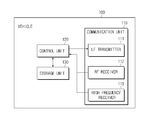
- FIG. 6 is a control block diagram of a vehicle according to an embodiment of the present invention.
- the vehicle 100 may include a communication unit no transceiving a wireless signal, a control unit 120 controlling operations of components of the vehicle 100 , and a storage unit 130 storing data.
- the communication unit no of the vehicle 100 may include an LF transmitter 111 transmitting the LF signal within the transceivable distance of the LF signal through the LF communication network, an RF receiver 112 receiving the RF signal within the transceivable distance of the RF signal through the RF communication network, and a high frequency receiver 113 receiving a signal having a predetermined frequency band in the vehicle 100 .
- the LF transmitter 111 may include an LF communication interface including an LF antenna and an LF transmitter transmitting a wireless signal (that is, the LF signal) having a frequency band which is 20 kHz or more and 150 kHz or less. Further, the LF transmitter 111 may further include an LF signal modulation module modulating a digital control signal output from the control unit 120 through the LF communication interface into a wireless signal having an analog form according to control of the control unit 120 .
- a plurality of LF antennas may be provided in the vehicle 100 , and the LF antennas may be provided in the front, the rear, sides, or the inside of the body, and transmit the LF signals having angles and intensities which are different from each other.
- the LF antenna may include the LF antenna 111 a provided in the handle 17 R of the right door 15 R, the LF antenna 111 c provided in the handle 17 L of the left door 15 L, the LF antenna 111 b provided in the top of the body, and the LF antenna 111 d provided in the trunk, described above with reference to FIG. 3 .
- the RF receiver 112 may include an RF communication interface including an RF antenna and an RF receiver receiving a wireless signal (that is, the RF signal) having an UHF band which is 300 MHz or more and 450 MHz or less. Further, the RF receiver 112 may further include an RF signal demodulation module for demodulating the wireless signal having the analog form received through the RF communication interface into the digital control signal.
- the control signal of the vehicle 100 , the RF signal, and the LF signal may have formats different from each other.
- the high frequency receiver 113 may include a high frequency communication interface including a high frequency antenna and a high frequency receiver receiving a predetermined frequency band which is higher than the reception frequency band of the RF receiver 112 , for example, an industrial scientific and medical (ISM) frequency band which is 900 MHz or more. Further, the high frequency receiver 113 may further include a high frequency signal demodulation module demodulating the wireless signal having the analog form received through the high frequency communication interface into the digital control signal.
- ISM industrial scientific and medical
- the high frequency receiver 113 may receive a high frequency signal in a plurality of predetermined frequency bands.
- the high frequency receiver 113 may receive the high frequency signal in frequency bands which are 902 MHz or more and 928 MHz or less, 2.4 GHz or more and 2.5 GHz or less, and 5.725 GHz or more and 5.875 GHz or less.
- the high frequency receiver 113 may include a plurality of high frequency signal demodulation modules demodulating the signals in the plurality of predetermined frequency bands, respectively.
- the control unit 120 may control each of the components included in the vehicle 100 .
- the control unit 120 may determine whether the signal received by the high frequency receiver 113 is the modulated LF signal, and determine that the relay attack is generated when it is determined that the signal is the modulated LF signal.
- control unit 120 may control the LF transmitter 111 so that the LF signal including an identification (ID) mutually shared with the remote control device 200 is transmitted. Further, the control unit 120 may determine that the relay attack is generated when the ID mutually shared with the remote control device 200 is detected from the signal received by the high frequency receiver 113 based on a result obtained by demodulating the signal received by the high frequency signal demodulation module of the high frequency receiver 113 .
- ID an identification
- control unit 120 may stop the operation in which the LF transmitter 111 transmits the LF signal even when the RF receiver 112 receives the RF signal, and determine that a normal authentication operation is not performed.
- the control unit 120 may determine that the relay attack is generated when it is determined that the signal received by the RF receiver 112 and the high frequency receiver 113 is the modulated LF signal.
- the control unit 120 may determine that the relay attack is generated when the ID mutually shared with the remote control device 200 is detected from the signal received by the high frequency receiver 113 based on the result obtained by demodulating the signal received by the high frequency signal demodulation module of the high frequency receiver 113 .
- the authentication information mutually shared by the remote control device 200 and the vehicle 100 may be previously stored in the storage unit 130 .
- the control unit 120 may control the high frequency receiver 113 to receive the signal in the frequency bands having a priority defined in the sequence which is from a high frequency band to a low frequency band.
- the high frequency receiver 113 may receive the signal in the plurality of frequency bands according to performance, and the priority on each of the plurality of frequency bands may be stored in the storage unit 130 .
- a high priority may be given to the frequency band in which the relay attack can be most easily generated, and may be previously stored in a manufacturing operation or a setting operation.
- the control unit 120 may first receive a signal in a first frequency band having the highest priority, and determine that the relay attack is generated when the high frequency receiver 113 receives the signal in the first frequency band and the received signal is the modulated LF signal, but next may allow the high frequency receiver 113 to receive a signal in a second frequency band having a high priority subsequent to the first frequency band when a predetermined time is passed in a state in which the signal is not received in the first frequency band.
- control unit 120 may determine that the relay attack is generated when the signal is received in the second frequency band and the received signal is the modulated LF signal, but next may allow the high frequency receiver 113 to receive a signal in a third frequency band having a high priority subsequent to the second frequency band when a predetermined time is passed in a state in which the signal is not received in the second frequency band.
- the control unit 120 may determine the frequency band of the signal received by the high frequency receiver 113 according to the priority of each of the frequency bands.
- the high frequency receiver 113 includes a plurality of high frequency signal demodulation modules demodulating signals of the plurality of frequency bands, respectively, each of the high frequency signal demodulation modules may demodulate the signal received in a corresponding frequency band according to a control signal of the control unit 120 .
- the control unit 120 may be implemented to include a memory (not shown) storing an algorithm for controlling operations of the components included in the vehicle 100 or data related to a program performing the algorithm, and a processor (not shown) performing the above-described operations using the data stored in the memory.
- the memory and the processor may be separately implemented as a chip.
- the memory and the processor may be implemented in a single chip.
- the ID and the authentication information mutually shared with the remote control device 200 may be stored in the storage unit 130 .
- the priority of each of the plurality of frequency bands may be stored in the storage unit 130 .
- the storage unit 130 may be implemented by at least one among storage media such as a non-volatile memory device such as a cache, a read only memory (ROM), a programmable ROM (PROM), an erasable PROM (EPROM), an electrically EPROM (EEPROM), and a flash memory, a volatile memory device such as a random access memory (RAM), a hard disk drive (HDD), and a compact disc-ROM (CD-ROM), but is not limited thereto.
- the storage unit 130 may be a memory implemented to be separate from the processor described above with respect to the control unit 120 , and implemented as a single chip together with the processor.
- At least one component may be added or deleted according to performance of the components of the vehicle 100 shown in FIG. 6 . Further, it may be easily understood to those skilled in the art that the positions of the components may be changed according to the performance or a structure of the system.
- each of the components shown in FIG. 6 may be software and/or a hardware component such as a field programmable gate array (FPGA) and an application specific integrated circuit (ASIC).
- FPGA field programmable gate array
- ASIC application specific integrated circuit
- FIG. 7 is a flowchart for describing a method of controlling the vehicle according to an embodiment of the present invention
- FIGS. 8 and 9 are conceptual diagrams illustrating results obtained by modulating the LF signal transmitted by the LF transmitter.
- the LF transmitter 111 of the vehicle 100 may transmit the LF signal around the vehicle 100 ( 1111 ).
- a range around the vehicle 100 may include a region which is within the transceivable distance of the LF signal, and be changed according to performance of the LF transmitter 111 .
- the high frequency signal demodulation module may demodulate the received signal ( 1113 ).
- the LF transmitter 111 may periodically transmit the LF signal in the LF frequency band which is 20 kHz or more and 150 kHz or less even when the remote control device 200 is not present around the vehicle 100 .
- the relay relays present around the vehicle 100 may allow the LF signal to reach the remote control device 200 by modulating the LF signal transmitted by the LF transmitter 111 into the signal having a high frequency band, and allow the LF signal to reach the remote control device 200 even when the remote control device 200 is not present around the vehicle 100 .
- the control unit 120 of the vehicle 100 may not approve the control of the vehicle 100 according to a normal authentication operation by determining that the relay attack is generated when the high frequency receiver 113 receives the LF signal modulated by the relay relays ( 1115 of FIG. 7 ).
- the determining of whether the high frequency receiver 113 receives the LF signal modulated by the relay relays may include determining whether the ID mutually shared by the vehicle 100 and the remote control device 200 is included in the signal demodulated by the high frequency signal demodulation module of the high frequency receiver 113 ( 1114 of FIG. 7 ).
- control unit 120 of the vehicle 100 may control the high frequency receiver 113 to receive the signal in the sequence which is from a high frequency band having a high priority to a low frequency band having a low priority (for example, in the sequence of BW 1 to BW 3 ) when the high frequency receiver 113 is implemented to be able to receive the signal in each of the plurality of predetermined frequency bands (BW 1 to BW 3 ).
- control unit 120 may control the plurality of high frequency signal demodulation modules to sequentially demodulate from the high frequency signal demodulation module demodulating the signal in the high frequency band having the high priority.
- control unit 120 of the vehicle 100 may determine that the normal authentication operation is performed when the high frequency receiver 113 does not receive the signal (“No” of 1112 ) and the RF receiver 112 receives the RF signal (“Yes” OF 1116 ) ( 1118 ).
- control unit 120 may determine that the normal authentication operation is performed when the high frequency receiver 113 does not receive the signal (“No” of 1112 ), the RF receiver 112 receives the RF signal (“Yes” of 1116 ), and the authentication information mutually shared by the vehicle 100 and the remote control device 200 is included in the RF signal (“Yes” of 1117 ) ( 1118 ).
- control unit 120 of the vehicle 100 may control the LF transmitter 111 to again transmit the LF signal when the RF signal is not received (“No” of 1116 ), the authentication information mutually shared by the vehicle 100 and the remote control device 200 is not included in the RF signal (“No” of 1117 ), or the ID mutually shared by the vehicle 100 and the remote control device 200 is not included in the modulated LF signal received by the high frequency receiver 113 (“No” of 1114 ).
- the vehicle may easily determine whether the relay attack is generated by only confirming whether the same signal as the LF signal transmitted by the vehicle is transmitted in the predetermined frequency band after the vehicle transmits the LF signal.
- module means, but is not limited to, a software and/or hardware component, such as a Field Programmable Gate Array (FPGA) or Application Specific Integrated Circuit (ASIC), which performs certain tasks.
- FPGA Field Programmable Gate Array
- ASIC Application Specific Integrated Circuit
- a module may advantageously be configured to reside on the addressable storage medium and configured to execute on one or more processors.
- a module may include, by way of example, components, such as software components, object-oriented software components, class components and task components, processes, functions, attributes, procedures, subroutines, segments of program code, drivers, firmware, microcode, circuitry, data, databases, data structures, tables, arrays, and variables.
- components such as software components, object-oriented software components, class components and task components, processes, functions, attributes, procedures, subroutines, segments of program code, drivers, firmware, microcode, circuitry, data, databases, data structures, tables, arrays, and variables.
- the operations provided for in the components and modules may be combined into fewer components and modules or further separated into additional components and modules.
- the components and modules may be implemented such that they execute one or more CPUs in a device.
- embodiments can thus be implemented through computer readable code/instructions in/on a medium, e.g., a computer readable medium, to control at least one processing element to implement any above described exemplary embodiment.
- a medium e.g., a computer readable medium
- the medium can correspond to any medium/media permitting the storing and/or transmission of the computer readable code.
- the computer-readable code can be recorded on a medium or transmitted through the Internet.
- the medium may include Read Only Memory (ROM), Random Access Memory (RAM), Compact Disk-Read Only Memories (CD-ROMs), magnetic tapes, floppy disks, and optical recording medium.
- ROM Read Only Memory
- RAM Random Access Memory
- CD-ROMs Compact Disk-Read Only Memories
- the medium may be a non-transitory computer-readable medium.
- the media may also be a distributed network, so that the computer readable code is stored or transferred and executed in a distributed fashion.
- the processing element could include at least one processor or at least one computer processor, and processing elements may be distributed and/or included in a single device.
Landscapes
- Engineering & Computer Science (AREA)
- Mechanical Engineering (AREA)
- Computer Security & Cryptography (AREA)
- Radar, Positioning & Navigation (AREA)
- Remote Sensing (AREA)
- Computer Networks & Wireless Communication (AREA)
- Physics & Mathematics (AREA)
- General Physics & Mathematics (AREA)
- Lock And Its Accessories (AREA)
Abstract
Description
Claims (19)
Applications Claiming Priority (2)
| Application Number | Priority Date | Filing Date | Title |
|---|---|---|---|
| KR1020160114991A KR101842436B1 (en) | 2016-09-07 | 2016-09-07 | Vehicle and control method thereof |
| KR10-2016-0114991 | 2016-09-07 |
Publications (2)
| Publication Number | Publication Date |
|---|---|
| US20180065597A1 US20180065597A1 (en) | 2018-03-08 |
| US10407025B2 true US10407025B2 (en) | 2019-09-10 |
Family
ID=61282342
Family Applications (1)
| Application Number | Title | Priority Date | Filing Date |
|---|---|---|---|
| US15/385,625 Active 2037-10-12 US10407025B2 (en) | 2016-09-07 | 2016-12-20 | Vehicle and method of controlling the same |
Country Status (2)
| Country | Link |
|---|---|
| US (1) | US10407025B2 (en) |
| KR (1) | KR101842436B1 (en) |
Cited By (2)
| Publication number | Priority date | Publication date | Assignee | Title |
|---|---|---|---|---|
| US10701523B2 (en) * | 2017-07-03 | 2020-06-30 | Denso Corporation | Mobile device and method of controlling mobile device |
| US11747438B1 (en) * | 2021-01-07 | 2023-09-05 | Bae Systems Information And Electronic Systems Integration Inc. | Cognitive electronic warfare scheduler |
Families Citing this family (4)
| Publication number | Priority date | Publication date | Assignee | Title |
|---|---|---|---|---|
| US10604114B2 (en) * | 2017-11-30 | 2020-03-31 | Trw Automotive U.S. Llc | Method for controlling access to a vehicle as well as a system for controlling access to a vehicle |
| KR102591989B1 (en) | 2018-09-11 | 2023-10-23 | 현대자동차주식회사 | Vehicle, control method thereof and tranceiver for vehicle |
| KR20210117752A (en) | 2020-03-20 | 2021-09-29 | 현대모비스 주식회사 | Smart key, method for controllong smart key, vehicle, method for controlling vehicle, system and method for controllong smart key including security function |
| KR20220064599A (en) * | 2020-11-12 | 2022-05-19 | 주식회사 가린시스템 | System and method of providing active service using remote vehicle starter based on big data analysis |
Citations (12)
| Publication number | Priority date | Publication date | Assignee | Title |
|---|---|---|---|---|
| JP2000185627A (en) | 1998-11-13 | 2000-07-04 | Valeo Securite Habitacle | User discrimination device for car |
| US20030043023A1 (en) * | 2001-08-30 | 2003-03-06 | Eric Perraud | Passive response communication system |
| US20060273888A1 (en) * | 2005-05-16 | 2006-12-07 | Sanyo Electric Co., Ltd | Radio Communication System and Radio Communication Device |
| US20080143500A1 (en) * | 2006-12-15 | 2008-06-19 | Riad Ghabra | Method and apparatus for an anti-theft system against radio relay attack in passive keyless entry/start systems |
| JP2012060482A (en) | 2010-09-10 | 2012-03-22 | Denso Corp | Control system |
| JP2013108255A (en) | 2011-11-18 | 2013-06-06 | Nippon Soken Inc | Smart system |
| US20140203907A1 (en) * | 2013-01-21 | 2014-07-24 | Omron Automotive Electronics Co., Ltd. | Communication system and communication device |
| US20140215567A1 (en) | 2013-01-28 | 2014-07-31 | Omron Automotive Electronics Co., Ltd. | Communication system and communication device |
| US20140327517A1 (en) * | 2011-10-11 | 2014-11-06 | Johnson Controls Automotive Electronics Sas | Remote control system, and method for automatically locking and/or unlocking at least one movable panel of a motor vehicle and/or for starting a motor vehicle engine using a remote control system |
| US20150074805A1 (en) * | 2012-04-17 | 2015-03-12 | Dae Dong Co., Ltd. | Method for preventing relay-attack on smart key system |
| JP2016117991A (en) | 2014-12-18 | 2016-06-30 | アルプス電気株式会社 | Keyless entry device |
| US9637086B2 (en) * | 2012-05-25 | 2017-05-02 | Denso Corporation | Smart system |
-
2016
- 2016-09-07 KR KR1020160114991A patent/KR101842436B1/en active Active
- 2016-12-20 US US15/385,625 patent/US10407025B2/en active Active
Patent Citations (14)
| Publication number | Priority date | Publication date | Assignee | Title |
|---|---|---|---|---|
| US6483425B1 (en) | 1998-11-13 | 2002-11-19 | Valeo Securite Habitacle | System for enhancing the security of a bi-directional data transmission system controlling access to an enclosed space, notably a vehicle |
| JP2000185627A (en) | 1998-11-13 | 2000-07-04 | Valeo Securite Habitacle | User discrimination device for car |
| US20030043023A1 (en) * | 2001-08-30 | 2003-03-06 | Eric Perraud | Passive response communication system |
| US20060273888A1 (en) * | 2005-05-16 | 2006-12-07 | Sanyo Electric Co., Ltd | Radio Communication System and Radio Communication Device |
| US20080143500A1 (en) * | 2006-12-15 | 2008-06-19 | Riad Ghabra | Method and apparatus for an anti-theft system against radio relay attack in passive keyless entry/start systems |
| JP2012060482A (en) | 2010-09-10 | 2012-03-22 | Denso Corp | Control system |
| US20140327517A1 (en) * | 2011-10-11 | 2014-11-06 | Johnson Controls Automotive Electronics Sas | Remote control system, and method for automatically locking and/or unlocking at least one movable panel of a motor vehicle and/or for starting a motor vehicle engine using a remote control system |
| JP2013108255A (en) | 2011-11-18 | 2013-06-06 | Nippon Soken Inc | Smart system |
| US20150074805A1 (en) * | 2012-04-17 | 2015-03-12 | Dae Dong Co., Ltd. | Method for preventing relay-attack on smart key system |
| US9637086B2 (en) * | 2012-05-25 | 2017-05-02 | Denso Corporation | Smart system |
| US20140203907A1 (en) * | 2013-01-21 | 2014-07-24 | Omron Automotive Electronics Co., Ltd. | Communication system and communication device |
| US20140215567A1 (en) | 2013-01-28 | 2014-07-31 | Omron Automotive Electronics Co., Ltd. | Communication system and communication device |
| JP2014146878A (en) | 2013-01-28 | 2014-08-14 | Omron Automotive Electronics Co Ltd | Communication system and communication device |
| JP2016117991A (en) | 2014-12-18 | 2016-06-30 | アルプス電気株式会社 | Keyless entry device |
Cited By (2)
| Publication number | Priority date | Publication date | Assignee | Title |
|---|---|---|---|---|
| US10701523B2 (en) * | 2017-07-03 | 2020-06-30 | Denso Corporation | Mobile device and method of controlling mobile device |
| US11747438B1 (en) * | 2021-01-07 | 2023-09-05 | Bae Systems Information And Electronic Systems Integration Inc. | Cognitive electronic warfare scheduler |
Also Published As
| Publication number | Publication date |
|---|---|
| KR101842436B1 (en) | 2018-03-28 |
| KR20180027835A (en) | 2018-03-15 |
| US20180065597A1 (en) | 2018-03-08 |
Similar Documents
| Publication | Publication Date | Title |
|---|---|---|
| US10407025B2 (en) | Vehicle and method of controlling the same | |
| CN107264470B (en) | Vehicle and control method thereof | |
| US10732257B2 (en) | Vehicle and method for controlling the same | |
| US9783161B2 (en) | Vehicle and control method thereof | |
| KR101744727B1 (en) | A smart key, a method for controlliong the smart key and a vehicle including the smart key | |
| KR102578196B1 (en) | Vehicle and control method thereof | |
| KR102485246B1 (en) | Vehicle and control method thereof | |
| US10640089B2 (en) | Remote control device and vehicle including the same | |
| US10803686B2 (en) | Vehicle and vehicle system | |
| US20200021679A1 (en) | Vehicle and control method thereof | |
| KR102642241B1 (en) | Vehicle And Control Method Thereof | |
| US10078932B2 (en) | Remote control device, vehicle, and method for controlling the vehicle | |
| CN110154984B (en) | Vehicle and control method thereof | |
| US20190118773A1 (en) | User authentication system, user authentication method and server | |
| KR101707823B1 (en) | Terminal connected with vehicle, vehicle, system having the same and method for conncetion to vehicle | |
| US20170151929A1 (en) | Vehicle and method for controlling the vehicle | |
| KR102909576B1 (en) | Vehicle and control method for the same | |
| KR101821108B1 (en) | Vehicle system and remote controlling method | |
| KR102455789B1 (en) | Vehicle and control method thereof | |
| KR101929317B1 (en) | Vehicle, vehicle system, and control method of the vehicle system | |
| KR20200005039A (en) | Vehicle and controlling method for the same | |
| KR101714461B1 (en) | Vehicle and controlling method for the same | |
| KR20190032023A (en) | Vehicle and control method thereof |
Legal Events
| Date | Code | Title | Description |
|---|---|---|---|
| AS | Assignment |
Owner name: KIA MOTORS CORPORATION, KOREA, REPUBLIC OF Free format text: ASSIGNMENT OF ASSIGNORS INTEREST;ASSIGNORS:KIM, SINJUNG;LEE, EUN-SANG;LEE, WI-JIK;AND OTHERS;REEL/FRAME:041188/0011 Effective date: 20161209 Owner name: SEOUL NATIONAL UNIVERSITY R&DB FOUNDATION, KOREA, Free format text: ASSIGNMENT OF ASSIGNORS INTEREST;ASSIGNORS:KIM, SINJUNG;LEE, EUN-SANG;LEE, WI-JIK;AND OTHERS;REEL/FRAME:041188/0011 Effective date: 20161209 Owner name: HYUNDAI MOTOR COMPANY, KOREA, REPUBLIC OF Free format text: ASSIGNMENT OF ASSIGNORS INTEREST;ASSIGNORS:KIM, SINJUNG;LEE, EUN-SANG;LEE, WI-JIK;AND OTHERS;REEL/FRAME:041188/0011 Effective date: 20161209 |
|
| STPP | Information on status: patent application and granting procedure in general |
Free format text: RESPONSE TO NON-FINAL OFFICE ACTION ENTERED AND FORWARDED TO EXAMINER |
|
| STPP | Information on status: patent application and granting procedure in general |
Free format text: NOTICE OF ALLOWANCE MAILED -- APPLICATION RECEIVED IN OFFICE OF PUBLICATIONS |
|
| STPP | Information on status: patent application and granting procedure in general |
Free format text: PUBLICATIONS -- ISSUE FEE PAYMENT VERIFIED |
|
| STCF | Information on status: patent grant |
Free format text: PATENTED CASE |
|
| MAFP | Maintenance fee payment |
Free format text: PAYMENT OF MAINTENANCE FEE, 4TH YEAR, LARGE ENTITY (ORIGINAL EVENT CODE: M1551); ENTITY STATUS OF PATENT OWNER: LARGE ENTITY Year of fee payment: 4 |