US10401365B2 - Inhibition of chemokine CCL7 or receptor CCR3 of same for the treatment and diagnosis of prostate cancer - Google Patents
Inhibition of chemokine CCL7 or receptor CCR3 of same for the treatment and diagnosis of prostate cancer Download PDFInfo
- Publication number
- US10401365B2 US10401365B2 US15/318,777 US201515318777A US10401365B2 US 10401365 B2 US10401365 B2 US 10401365B2 US 201515318777 A US201515318777 A US 201515318777A US 10401365 B2 US10401365 B2 US 10401365B2
- Authority
- US
- United States
- Prior art keywords
- ccr3
- ccl7
- cells
- prostate
- migration
- Prior art date
- Legal status (The legal status is an assumption and is not a legal conclusion. Google has not performed a legal analysis and makes no representation as to the accuracy of the status listed.)
- Expired - Fee Related
Links
- 0 C*C=CCC(CCC1)CC1N(CC1)CCN1C(CNCCc1ccc(C(F)(F)F)cc1)c1ccc(C(F)(F)F)cc1 Chemical compound C*C=CCC(CCC1)CC1N(CC1)CCN1C(CNCCc1ccc(C(F)(F)F)cc1)c1ccc(C(F)(F)F)cc1 0.000 description 2
- MLDRBYHNJICRKM-UHFFFAOYSA-N CC(C)(C)C1=CC=C(C(CNC(=O)NC2=CC=C(F)C=C2)N2CCN(C3CCCCC3)CC2)C=C1.CN1CCN(C(CNC(=O)NC2=CC=C(F)C=C2)C2=CC=C(N(C)C)C=C2)CC1.COC1=CC=C(C(CNCCC2=CC=C(C(C)(C)C)C=C2)N2CCN(C3CCCCC3)CC2)C=C1.[HH].[HH].[HH] Chemical compound CC(C)(C)C1=CC=C(C(CNC(=O)NC2=CC=C(F)C=C2)N2CCN(C3CCCCC3)CC2)C=C1.CN1CCN(C(CNC(=O)NC2=CC=C(F)C=C2)C2=CC=C(N(C)C)C=C2)CC1.COC1=CC=C(C(CNCCC2=CC=C(C(C)(C)C)C=C2)N2CCN(C3CCCCC3)CC2)C=C1.[HH].[HH].[HH] MLDRBYHNJICRKM-UHFFFAOYSA-N 0.000 description 2
- AMLHMONHHAGHEJ-UHFFFAOYSA-L C1=CC(CN2CCCNCCNCCCNCC2)=CC=C1CN1CCCNCCNCCCNCC1.CC1=CC(O)=C(C(=O)N2CCC(=CC(=O)NC3CCN(CC4=CC5=C(C=C4)C=C(F)C=C5)C3)CC2)C=C1.CCN1(CC2CCCCCC2)CCC(NC(=O)C2C3=C(C=CC(Cl)=C3)OC3=C2C=C(Cl)C=C3)CC1.Cl.O=C(NC1CC2CCC(C1)N2CC1=CC2=C(C=C1)C=C(F)C=C2)C1=C(C2=CC=CC=C2)C=CC=C1.[Br-].[HH].[HH].[HH].[H]N(C(=O)CC1=C2C=COC2=CC=C1)C1=CC(Br)=N(CCCC2=CC=CC=C2)C=C1.[I-] Chemical compound C1=CC(CN2CCCNCCNCCCNCC2)=CC=C1CN1CCCNCCNCCCNCC1.CC1=CC(O)=C(C(=O)N2CCC(=CC(=O)NC3CCN(CC4=CC5=C(C=C4)C=C(F)C=C5)C3)CC2)C=C1.CCN1(CC2CCCCCC2)CCC(NC(=O)C2C3=C(C=CC(Cl)=C3)OC3=C2C=C(Cl)C=C3)CC1.Cl.O=C(NC1CC2CCC(C1)N2CC1=CC2=C(C=C1)C=C(F)C=C2)C1=C(C2=CC=CC=C2)C=CC=C1.[Br-].[HH].[HH].[HH].[H]N(C(=O)CC1=C2C=COC2=CC=C1)C1=CC(Br)=N(CCCC2=CC=CC=C2)C=C1.[I-] AMLHMONHHAGHEJ-UHFFFAOYSA-L 0.000 description 1
- DXYBQNIRSPQTAN-UHFFFAOYSA-N C1=CC=C(NCC2=CC=C(CNC3=CC=CC=N3)C=C2)N=C1.CC(=O)NC1=NC(C(CCN2CCC(C3=CC=CC=C3)CC2)C(=O)NCC2=CC(C(F)(F)F)=CC(C(F)(F)F)=C2)=CS1.CCOC(=O)C1=C(NC(=O)NC2=CC=CC=C2)N(CC(O)C2=CC=CC=C2)N=C1.[HH].[HH].[HH].[HH].[HH].[HH].[HH] Chemical compound C1=CC=C(NCC2=CC=C(CNC3=CC=CC=N3)C=C2)N=C1.CC(=O)NC1=NC(C(CCN2CCC(C3=CC=CC=C3)CC2)C(=O)NCC2=CC(C(F)(F)F)=CC(C(F)(F)F)=C2)=CS1.CCOC(=O)C1=C(NC(=O)NC2=CC=CC=C2)N(CC(O)C2=CC=CC=C2)N=C1.[HH].[HH].[HH].[HH].[HH].[HH].[HH] DXYBQNIRSPQTAN-UHFFFAOYSA-N 0.000 description 1
- UFJQJYUEECIGQS-KWQBFBCLSA-N C=CCN1CC[C@@H](CC2=CC=C(F)C=C2)C[C@@H]1CCCCC(=O)CC1=CC=CC(C(C)=O)=C1.CC(=O)C1=CC(CC(=O)CCCC[C@H]2C[C@H](CC3=CC=C(F)C=C3)CCN2CC2CC2)=CC=C1.CC(=O)C1=CC(CC(=O)CCCC[C@H]2C[C@H](CC3=CC=C(F)C=C3)CCN2CCO)=CC=C1.CCCN1CC[C@@H](CC2=CC=C(F)C=C2)C[C@@H]1CCCNC(=O)NC1=CC(C(C)=O)=CC(C(C)=O)=C1.[HH].[HH].[HH] Chemical compound C=CCN1CC[C@@H](CC2=CC=C(F)C=C2)C[C@@H]1CCCCC(=O)CC1=CC=CC(C(C)=O)=C1.CC(=O)C1=CC(CC(=O)CCCC[C@H]2C[C@H](CC3=CC=C(F)C=C3)CCN2CC2CC2)=CC=C1.CC(=O)C1=CC(CC(=O)CCCC[C@H]2C[C@H](CC3=CC=C(F)C=C3)CCN2CCO)=CC=C1.CCCN1CC[C@@H](CC2=CC=C(F)C=C2)C[C@@H]1CCCNC(=O)NC1=CC(C(C)=O)=CC(C(C)=O)=C1.[HH].[HH].[HH] UFJQJYUEECIGQS-KWQBFBCLSA-N 0.000 description 1
- NGCRJQVINZYGOF-LZDJCPJRSA-N C=CCN1CC[C@@H](CC2=CC=C(F)C=C2)C[C@@H]1CCCNC(=O)NC1=CC(C(C)=O)=CC(C(C)=O)=C1.CCOC(=O)C1=C(NC(=O)NC(C)C)N(CC(O)C2=CC=CC=C2)N=C1.CCOC(=O)C1=C(NC(=O)NCC2=CC=CC=C2)N(CC(O)C2=CC=CC=C2)N=C1.[HH].[HH].[HH].[HH].[HH].[HH].[HH].[HH] Chemical compound C=CCN1CC[C@@H](CC2=CC=C(F)C=C2)C[C@@H]1CCCNC(=O)NC1=CC(C(C)=O)=CC(C(C)=O)=C1.CCOC(=O)C1=C(NC(=O)NC(C)C)N(CC(O)C2=CC=CC=C2)N=C1.CCOC(=O)C1=C(NC(=O)NCC2=CC=CC=C2)N(CC(O)C2=CC=CC=C2)N=C1.[HH].[HH].[HH].[HH].[HH].[HH].[HH].[HH] NGCRJQVINZYGOF-LZDJCPJRSA-N 0.000 description 1
- IIVAPMOPQJTXFA-AXXCHFASSA-N C=C[C@@H]1CN(C2CCN(C(=O)C3=CC4=C(C=C3)N=CC=C4)CC2)CC[C@@H]1CC1=CC(Cl)=C(Cl)C=C1.CC1=CC=CC=C1CC(=O)N1CCC(N2CCC(CC3=C(F)C=C(Cl)C=C3)CC2)CC1.CO[C@@H]1CN(C2CCN(C(=O)C3=CC4=C(C=C3)N=CC=C4)CC2)CC[C@H]1CC1=CC(Cl)=C(Cl)C=C1.NC1=CC=C(C(=O)N2CCC(N3CCC(CC4=CC(Cl)=C(Cl)C=C4)CC3)CC2)C=C1.[HH] Chemical compound C=C[C@@H]1CN(C2CCN(C(=O)C3=CC4=C(C=C3)N=CC=C4)CC2)CC[C@@H]1CC1=CC(Cl)=C(Cl)C=C1.CC1=CC=CC=C1CC(=O)N1CCC(N2CCC(CC3=C(F)C=C(Cl)C=C3)CC2)CC1.CO[C@@H]1CN(C2CCN(C(=O)C3=CC4=C(C=C3)N=CC=C4)CC2)CC[C@H]1CC1=CC(Cl)=C(Cl)C=C1.NC1=CC=C(C(=O)N2CCC(N3CCC(CC4=CC(Cl)=C(Cl)C=C4)CC3)CC2)C=C1.[HH] IIVAPMOPQJTXFA-AXXCHFASSA-N 0.000 description 1
- CDFOJXUIFOAIIV-SHQYCOJDSA-N CC(=N)N1CC[C@@H](CC2=CC=C(F)C=C2)C[C@@H]1CCCNC(=O)NC1=CC(C(C)=O)=CC(C(C)=O)=C1.CCC(=O)N1CC[C@@H](CC2=CC=C(F)C=C2)C[C@@H]1CCCNC(=O)NC1=CC(C(C)=O)=CC(C(C)=O)=C1.[HH].[HH].[HH].[HH].[HH].[HH] Chemical compound CC(=N)N1CC[C@@H](CC2=CC=C(F)C=C2)C[C@@H]1CCCNC(=O)NC1=CC(C(C)=O)=CC(C(C)=O)=C1.CCC(=O)N1CC[C@@H](CC2=CC=C(F)C=C2)C[C@@H]1CCCNC(=O)NC1=CC(C(C)=O)=CC(C(C)=O)=C1.[HH].[HH].[HH].[HH].[HH].[HH] CDFOJXUIFOAIIV-SHQYCOJDSA-N 0.000 description 1
- GJIWEEDMHCERNI-LNEGLDNXSA-N CC(=O)C(C)(C)C1=CC(NC(=O)NCCCN2CCC[C@@H](CC3=CC=C(F)C=C3)C2)=CC(C2=NN=NN2)=C1.C[C@H](C[C@@H](O)N1CCC[C@@H](CC2=CC=C(F)C=C2)C1)NC(=O)NC1=CC(N2C=CN=N2)=CC(N2C=CN=N2)=C1.[HH].[HH].[HH].[HH].[HH] Chemical compound CC(=O)C(C)(C)C1=CC(NC(=O)NCCCN2CCC[C@@H](CC3=CC=C(F)C=C3)C2)=CC(C2=NN=NN2)=C1.C[C@H](C[C@@H](O)N1CCC[C@@H](CC2=CC=C(F)C=C2)C1)NC(=O)NC1=CC(N2C=CN=N2)=CC(N2C=CN=N2)=C1.[HH].[HH].[HH].[HH].[HH] GJIWEEDMHCERNI-LNEGLDNXSA-N 0.000 description 1
- VFFGKVHSPRVMLB-UPVPKBNUSA-N CC(=O)C(C)(C)C1=CC(NC(=O)N[C@H](C)CCN2CCC[C@@H](CC3=CC=C(F)C=C3)C2)=CC(C2=NN=NN2)=C1.C[C@H](C[C@@H](O)N1CCC[C@@H](CC2=CC=C(F)C=C2)C1)NC(=O)NC1=CC(C2=NC=CO2)=CC(C2=NC=CO2)=C1.[HH].[HH].[HH].[HH].[HH] Chemical compound CC(=O)C(C)(C)C1=CC(NC(=O)N[C@H](C)CCN2CCC[C@@H](CC3=CC=C(F)C=C3)C2)=CC(C2=NN=NN2)=C1.C[C@H](C[C@@H](O)N1CCC[C@@H](CC2=CC=C(F)C=C2)C1)NC(=O)NC1=CC(C2=NC=CO2)=CC(C2=NC=CO2)=C1.[HH].[HH].[HH].[HH].[HH] VFFGKVHSPRVMLB-UPVPKBNUSA-N 0.000 description 1
- YNUIYYHEBAMHPG-AGHVFCSLSA-N CC(=O)C1=C(C)N=C(CC(=O)C[C@@H]2CN(C(=O)C(C)C)CC[C@H]2CN2CCC[C@@H](CC3=CC=C(F)C=C3)C2)S1.CC(=O)C1=C(C)N=C(CC(=O)C[C@@H]2CN(C(=O)C3CCCC3)CC[C@H]2CN2CCC[C@@H](CC3=CC=C(F)C=C3)C2)S1.CC(=O)C1=C(C)N=C(NC(=O)N[C@@H]2CCN(C)C[C@H]2CN2CCC[C@@H](CC3=CC=C(F)C=C3)C2)S1.COC(=O)N1CC[C@@H](CN2CCC[C@@H](CC3=CC=C(F)C=C3)C2)[C@H](CC(=O)CC2=NC(C)=C(C(C)=O)S2)C1.[HH].[HH] Chemical compound CC(=O)C1=C(C)N=C(CC(=O)C[C@@H]2CN(C(=O)C(C)C)CC[C@H]2CN2CCC[C@@H](CC3=CC=C(F)C=C3)C2)S1.CC(=O)C1=C(C)N=C(CC(=O)C[C@@H]2CN(C(=O)C3CCCC3)CC[C@H]2CN2CCC[C@@H](CC3=CC=C(F)C=C3)C2)S1.CC(=O)C1=C(C)N=C(NC(=O)N[C@@H]2CCN(C)C[C@H]2CN2CCC[C@@H](CC3=CC=C(F)C=C3)C2)S1.COC(=O)N1CC[C@@H](CN2CCC[C@@H](CC3=CC=C(F)C=C3)C2)[C@H](CC(=O)CC2=NC(C)=C(C(C)=O)S2)C1.[HH].[HH] YNUIYYHEBAMHPG-AGHVFCSLSA-N 0.000 description 1
- CETCMWNMRWQUPF-USSYNIGKSA-N CC(=O)C1=C(C)N=C(CC(=O)C[C@@H]2CN(C(=O)C3CC3)CC[C@H]2CN2CCC[C@@H](CC3=CC=C(F)C=C3)C2)S1.CC(=O)C1=C(C)N=C(CC(=O)C[C@@H]2CN(C(C)=O)CC[C@H]2CN2CCC[C@@H](CC3=CC=C(F)C=C3)C2)S1.CCC(=O)N1CC[C@@H](CN2CCC[C@@H](CC3=CC=C(F)C=C3)C2)[C@H](CC(=O)CC2=NC(C)=C(C(C)=O)S2)C1.CCNC(=O)N1CC[C@@H](CN2CCC[C@@H](CC3=CC=C(F)C=C3)C2)[C@H](CC(=O)CC2=NC(C)=C(C(C)=O)S2)C1.COCC(=O)N1CC[C@@H](CN2CCC[C@@H](CC3=CC=C(F)C=C3)C2)[C@H](CC(=O)CC2=NC(C)=C(C(C)=O)S2)C1.[HH] Chemical compound CC(=O)C1=C(C)N=C(CC(=O)C[C@@H]2CN(C(=O)C3CC3)CC[C@H]2CN2CCC[C@@H](CC3=CC=C(F)C=C3)C2)S1.CC(=O)C1=C(C)N=C(CC(=O)C[C@@H]2CN(C(C)=O)CC[C@H]2CN2CCC[C@@H](CC3=CC=C(F)C=C3)C2)S1.CCC(=O)N1CC[C@@H](CN2CCC[C@@H](CC3=CC=C(F)C=C3)C2)[C@H](CC(=O)CC2=NC(C)=C(C(C)=O)S2)C1.CCNC(=O)N1CC[C@@H](CN2CCC[C@@H](CC3=CC=C(F)C=C3)C2)[C@H](CC(=O)CC2=NC(C)=C(C(C)=O)S2)C1.COCC(=O)N1CC[C@@H](CN2CCC[C@@H](CC3=CC=C(F)C=C3)C2)[C@H](CC(=O)CC2=NC(C)=C(C(C)=O)S2)C1.[HH] CETCMWNMRWQUPF-USSYNIGKSA-N 0.000 description 1
- MMGNYOQHKKWMPO-GRWUVPLQSA-N CC(=O)C1=C(C)N=C(CC(=O)C[C@@H]2CN(C(=O)C3CCOCC3)CC[C@H]2CN2CCC[C@@H](CC3=CC=C(F)C=C3)C2)S1.CC(=O)C1=C(C)N=C(NC(=O)N[C@@H]2CCN(C(=O)C3CCOCC3)C[C@H]2CN2CCC[C@@H](CC3=CC=C(F)C=C3)C2)S1.[HH].[HH].[HH].[HH].[H]/C(CN1CCC[C@@H](CC2=CC=C(F)C=C2)C1)=C(/[H])NC(=O)NC1=CC=CC(C(C)=O)=C1 Chemical compound CC(=O)C1=C(C)N=C(CC(=O)C[C@@H]2CN(C(=O)C3CCOCC3)CC[C@H]2CN2CCC[C@@H](CC3=CC=C(F)C=C3)C2)S1.CC(=O)C1=C(C)N=C(NC(=O)N[C@@H]2CCN(C(=O)C3CCOCC3)C[C@H]2CN2CCC[C@@H](CC3=CC=C(F)C=C3)C2)S1.[HH].[HH].[HH].[HH].[H]/C(CN1CCC[C@@H](CC2=CC=C(F)C=C2)C1)=C(/[H])NC(=O)NC1=CC=CC(C(C)=O)=C1 MMGNYOQHKKWMPO-GRWUVPLQSA-N 0.000 description 1
- RTZUSTZIKDXOPY-ZSEDQDGGSA-N CC(=O)C1=C(C)N=C(CC(=O)C[C@@H]2CN(C(=O)CN(C)C)CC[C@H]2CN2CCC[C@@H](CC3=CC=C(F)C=C3)C2)S1.CC(=O)C1=C(C)N=C(CC(=O)C[C@@H]2CN(CC3=CC=CO3)CC[C@H]2CN2CCC[C@@H](CC3=CC=C(F)C=C3)C2)S1.CC(=O)C1=C(C)N=C(NC(=O)N[C@@H]2CC(CC#N)CC[C@H]2CN2CCC[C@@H](CC3=CC=C(F)C=C3)C2)S1.CNC(=O)N1CC[C@@H](CN2CCC[C@@H](CC3=CC=C(F)C=C3)C2)[C@H](CC(=O)CC2=NC(C)=C(C(C)=O)S2)C1.[HH].[HH].[HH] Chemical compound CC(=O)C1=C(C)N=C(CC(=O)C[C@@H]2CN(C(=O)CN(C)C)CC[C@H]2CN2CCC[C@@H](CC3=CC=C(F)C=C3)C2)S1.CC(=O)C1=C(C)N=C(CC(=O)C[C@@H]2CN(CC3=CC=CO3)CC[C@H]2CN2CCC[C@@H](CC3=CC=C(F)C=C3)C2)S1.CC(=O)C1=C(C)N=C(NC(=O)N[C@@H]2CC(CC#N)CC[C@H]2CN2CCC[C@@H](CC3=CC=C(F)C=C3)C2)S1.CNC(=O)N1CC[C@@H](CN2CCC[C@@H](CC3=CC=C(F)C=C3)C2)[C@H](CC(=O)CC2=NC(C)=C(C(C)=O)S2)C1.[HH].[HH].[HH] RTZUSTZIKDXOPY-ZSEDQDGGSA-N 0.000 description 1
- BJMFFBYZVDUNBD-SDNQUUOOSA-N CC(=O)C1=C(C)N=C(CC(=O)C[C@@H]2CN(C(=O)OC(C)(C)C)CC[C@H]2CN2CCC[C@@H](CC3=CC=C(F)C=C3)C2)S1.CC(=O)C1=C(C)N=C(NC(=O)N[C@@H]2CCNC[C@H]2CN2CCC[C@@H](CC3=CC=C(F)C=C3)C2)S1.CC(=O)C1=C(C)N=C(NC(=O)N[C@@H]2CN(C(=O)OC(C)(C)C)C[C@H]2CN2CCC[C@@H](CC3=CC=C(F)C=C3)C2)S1.CC(=O)C1=C(C)N=C(NC(=O)N[C@@H]2CNCC[C@H]2CN2CCC[C@@H](CC3=CC=C(F)C=C3)C2)S1.[HH].[HH].[HH].[HH].[HH].[HH].[HH] Chemical compound CC(=O)C1=C(C)N=C(CC(=O)C[C@@H]2CN(C(=O)OC(C)(C)C)CC[C@H]2CN2CCC[C@@H](CC3=CC=C(F)C=C3)C2)S1.CC(=O)C1=C(C)N=C(NC(=O)N[C@@H]2CCNC[C@H]2CN2CCC[C@@H](CC3=CC=C(F)C=C3)C2)S1.CC(=O)C1=C(C)N=C(NC(=O)N[C@@H]2CN(C(=O)OC(C)(C)C)C[C@H]2CN2CCC[C@@H](CC3=CC=C(F)C=C3)C2)S1.CC(=O)C1=C(C)N=C(NC(=O)N[C@@H]2CNCC[C@H]2CN2CCC[C@@H](CC3=CC=C(F)C=C3)C2)S1.[HH].[HH].[HH].[HH].[HH].[HH].[HH] BJMFFBYZVDUNBD-SDNQUUOOSA-N 0.000 description 1
- GGKYIWDLQUQHRU-XSDRTECOSA-N CC(=O)C1=C(C)N=C(CC(=O)C[C@@H]2CN(C3CCN(C(C)=O)CC3)CC[C@H]2CN2CCC[C@@H](CC3=CC=C(F)C=C3)C2)S1.CC(=O)C1=C(C)N=C(CC(=O)C[C@@H]2CN(C3CCN(C)CC3)CC[C@H]2CN2CCC[C@@H](CC3=CC=C(F)C=C3)C2)S1.CC(=O)C1=C(C)N=C(NC(=O)N[C@@H]2CN(C)CC[C@H]2CN2CCC[C@@H](CC3=CC=C(F)C=C3)C2)S1.CC(=O)C1=C(C)N=C(NC(=O)N[C@@H]2CN(CCO)CC[C@H]2CN2CCC[C@@H](CC3=CC=C(F)C=C3)C2)S1.[HH].[HH].[HH].[HH] Chemical compound CC(=O)C1=C(C)N=C(CC(=O)C[C@@H]2CN(C3CCN(C(C)=O)CC3)CC[C@H]2CN2CCC[C@@H](CC3=CC=C(F)C=C3)C2)S1.CC(=O)C1=C(C)N=C(CC(=O)C[C@@H]2CN(C3CCN(C)CC3)CC[C@H]2CN2CCC[C@@H](CC3=CC=C(F)C=C3)C2)S1.CC(=O)C1=C(C)N=C(NC(=O)N[C@@H]2CN(C)CC[C@H]2CN2CCC[C@@H](CC3=CC=C(F)C=C3)C2)S1.CC(=O)C1=C(C)N=C(NC(=O)N[C@@H]2CN(CCO)CC[C@H]2CN2CCC[C@@H](CC3=CC=C(F)C=C3)C2)S1.[HH].[HH].[HH].[HH] GGKYIWDLQUQHRU-XSDRTECOSA-N 0.000 description 1
- FCGBHXSUHNMAKF-MSTNQLPSSA-N CC(=O)C1=C(C)N=C(CC(=O)C[C@@H]2CN(CC(=O)N(C)C)CC[C@H]2CN2CCC[C@@H](CC3=CC=C(F)C=C3)C2)S1.CC(=O)C1=C(C)N=C(CC(=O)C[C@@H]2CN(CC3CC3)CC[C@H]2CN2CCC[C@@H](CC3=CC=C(F)C=C3)C2)S1.CC(=O)C1=C(C)N=C(NC(=O)N[C@@H]2CN(CCF)CC[C@H]2CN2CCC[C@@H](CC3=CC=C(F)C=C3)C2)S1.CC(=O)CN1CC[C@@H](CN2CCC[C@@H](CC3=CC=C(F)C=C3)C2)[C@H](CC(=O)CC2=NC(C)=C(C(C)=O)S2)C1.[HH].[HH] Chemical compound CC(=O)C1=C(C)N=C(CC(=O)C[C@@H]2CN(CC(=O)N(C)C)CC[C@H]2CN2CCC[C@@H](CC3=CC=C(F)C=C3)C2)S1.CC(=O)C1=C(C)N=C(CC(=O)C[C@@H]2CN(CC3CC3)CC[C@H]2CN2CCC[C@@H](CC3=CC=C(F)C=C3)C2)S1.CC(=O)C1=C(C)N=C(NC(=O)N[C@@H]2CN(CCF)CC[C@H]2CN2CCC[C@@H](CC3=CC=C(F)C=C3)C2)S1.CC(=O)CN1CC[C@@H](CN2CCC[C@@H](CC3=CC=C(F)C=C3)C2)[C@H](CC(=O)CC2=NC(C)=C(C(C)=O)S2)C1.[HH].[HH] FCGBHXSUHNMAKF-MSTNQLPSSA-N 0.000 description 1
- DZFONNXJGULMQQ-JZHLQHDBSA-N CC(=O)C1=C(C)N=C(NC(=O)N[C@@H]2CCCC[C@H]2CN2CCC[C@@H](CC3=CC=C(F)C=C3)C2)S1.CC(=O)C1=CC(NC(=O)N[C@@H]2CCCC[C@H]2CN2CCC[C@H](CC3=CC=C(F)C=C3)C2)=CC=C1.CC1=C(F)C=C(NC(=O)N[C@@H]2CCCC[C@H]2CN2CCC[C@@H](CC3=CC=C(F)C=C3)C2)C=C1.O=C(NC1=NC=CS1)N[C@@H]1CCCC[C@H]1CN1CCC[C@@H](CC2=CC=C(F)C=C2)C1.[HH].[HH].[HH].[HH].[HH].[HH].[HH].[HH] Chemical compound CC(=O)C1=C(C)N=C(NC(=O)N[C@@H]2CCCC[C@H]2CN2CCC[C@@H](CC3=CC=C(F)C=C3)C2)S1.CC(=O)C1=CC(NC(=O)N[C@@H]2CCCC[C@H]2CN2CCC[C@H](CC3=CC=C(F)C=C3)C2)=CC=C1.CC1=C(F)C=C(NC(=O)N[C@@H]2CCCC[C@H]2CN2CCC[C@@H](CC3=CC=C(F)C=C3)C2)C=C1.O=C(NC1=NC=CS1)N[C@@H]1CCCC[C@H]1CN1CCC[C@@H](CC2=CC=C(F)C=C2)C1.[HH].[HH].[HH].[HH].[HH].[HH].[HH].[HH] DZFONNXJGULMQQ-JZHLQHDBSA-N 0.000 description 1
- GHVXJEPHBTWNDZ-IUURVCGPSA-N CC(=O)C1=C(C)N=C(NC(=O)N[C@@H]2CCCO[C@H]2CN2CCC[C@@H](CC3=CC=C(F)C=C3)C2)S1.CC(=O)C1=C(C)N=C(NC(=O)N[C@@H]2CCOC[C@H]2CN2CCC[C@@H](CC3=CC=C(F)C=C3)C2)S1.CC(=O)C1=CC(NC(=O)N[C@@H]2CCCC[C@H]2CN2CCC[C@@H](CC3=CC=C(F)C=C3)C2)=CC=C1.[HH].[HH].[HH].[HH].[HH].[HH].[H]/C(C(=O)N1CCC(CN2CCC(C3=CC=C(Cl)C=C3)CC2)CC1)=C(/[H])C1=CC(Cl)=C(Cl)C=C1 Chemical compound CC(=O)C1=C(C)N=C(NC(=O)N[C@@H]2CCCO[C@H]2CN2CCC[C@@H](CC3=CC=C(F)C=C3)C2)S1.CC(=O)C1=C(C)N=C(NC(=O)N[C@@H]2CCOC[C@H]2CN2CCC[C@@H](CC3=CC=C(F)C=C3)C2)S1.CC(=O)C1=CC(NC(=O)N[C@@H]2CCCC[C@H]2CN2CCC[C@@H](CC3=CC=C(F)C=C3)C2)=CC=C1.[HH].[HH].[HH].[HH].[HH].[HH].[H]/C(C(=O)N1CCC(CN2CCC(C3=CC=C(Cl)C=C3)CC2)CC1)=C(/[H])C1=CC(Cl)=C(Cl)C=C1 GHVXJEPHBTWNDZ-IUURVCGPSA-N 0.000 description 1
- COTJHYYZJVSJGU-WPGJAAHLSA-N CC(=O)C1=C(C)N=C(NC(=O)N[C@@H]2CCN(C(=O)C(C)C)C[C@H]2CN2CCC[C@@H](CC3=CC=C(F)C=C3)C2)S1.CC(=O)C1=C(C)N=C(NC(=O)N[C@@H]2CCN(C(=O)C3CCCC3)C[C@H]2CN2CCC[C@@H](CC3=CC=C(F)C=C3)C2)S1.CCC(=O)N1CC[C@@H](NC(=O)NC2=NC(C)=C(C(C)=O)S2)[C@H](CN2CCC[C@@H](CC3=CC=C(F)C=C3)C2)C1.COC(=O)N1CC[C@@H](NC(=O)NC2=NC(C)=C(C(C)=O)S2)[C@H](CN2CCC[C@@H](CC3=CC=C(F)C=C3)C2)C1.[HH].[HH].[HH].[HH].[HH].[HH].[HH].[HH] Chemical compound CC(=O)C1=C(C)N=C(NC(=O)N[C@@H]2CCN(C(=O)C(C)C)C[C@H]2CN2CCC[C@@H](CC3=CC=C(F)C=C3)C2)S1.CC(=O)C1=C(C)N=C(NC(=O)N[C@@H]2CCN(C(=O)C3CCCC3)C[C@H]2CN2CCC[C@@H](CC3=CC=C(F)C=C3)C2)S1.CCC(=O)N1CC[C@@H](NC(=O)NC2=NC(C)=C(C(C)=O)S2)[C@H](CN2CCC[C@@H](CC3=CC=C(F)C=C3)C2)C1.COC(=O)N1CC[C@@H](NC(=O)NC2=NC(C)=C(C(C)=O)S2)[C@H](CN2CCC[C@@H](CC3=CC=C(F)C=C3)C2)C1.[HH].[HH].[HH].[HH].[HH].[HH].[HH].[HH] COTJHYYZJVSJGU-WPGJAAHLSA-N 0.000 description 1
- OAKFOSMOVQZEAY-MMSJBIAOSA-N CC(=O)C1=C(C)N=C(NC(=O)N[C@@H]2CCN(C(=O)C3CC3)C[C@H]2CN2CCC[C@@H](CC3=CC=C(F)C=C3)C2)S1.CC(=O)C1=C(C)N=C(NC(=O)N[C@@H]2CCN(C(C)=O)C[C@H]2CN2CCC[C@@H](CC3=CC=C(F)C=C3)C2)S1.CCNC(=O)N1CC[C@@H](NC(=O)NC2=NC(C)=C(C(C)=O)S2)[C@H](CN2CCC[C@@H](CC3=CC=C(F)C=C3)C2)C1.COCC(=O)N1CC[C@@H](NC(=O)NC2=NC(C)=C(C(C)=O)S2)[C@H](CN2CCC[C@@H](CC3=CC=C(F)C=C3)C2)C1.[HH].[HH].[HH].[HH].[HH].[HH].[HH].[HH].[HH] Chemical compound CC(=O)C1=C(C)N=C(NC(=O)N[C@@H]2CCN(C(=O)C3CC3)C[C@H]2CN2CCC[C@@H](CC3=CC=C(F)C=C3)C2)S1.CC(=O)C1=C(C)N=C(NC(=O)N[C@@H]2CCN(C(C)=O)C[C@H]2CN2CCC[C@@H](CC3=CC=C(F)C=C3)C2)S1.CCNC(=O)N1CC[C@@H](NC(=O)NC2=NC(C)=C(C(C)=O)S2)[C@H](CN2CCC[C@@H](CC3=CC=C(F)C=C3)C2)C1.COCC(=O)N1CC[C@@H](NC(=O)NC2=NC(C)=C(C(C)=O)S2)[C@H](CN2CCC[C@@H](CC3=CC=C(F)C=C3)C2)C1.[HH].[HH].[HH].[HH].[HH].[HH].[HH].[HH].[HH] OAKFOSMOVQZEAY-MMSJBIAOSA-N 0.000 description 1
- WDQBEDXCPQVWPI-ZMATXGRDSA-N CC(=O)C1=C(C)N=C(NC(=O)N[C@@H]2CCN(C(=O)CN(C)C)C[C@H]2CN2CCC[C@@H](CC3=CC=C(F)C=C3)C2)S1.CC(=O)C1=C(C)N=C(NC(=O)N[C@@H]2CCN(CC3=CC=CO3)C[C@H]2CN2CCC[C@@H](CC3=CC=C(F)C=C3)C2)S1.CC(=O)C1=C(C)N=C(NC(=O)N[C@@H]2CCN(CC=N)C[C@H]2CN2CCC[C@@H](CC3=CC=C(F)C=C3)C2)S1.CNC(=O)N1CC[C@@H](NC(=O)NC2=NC(C)=C(C(C)=O)S2)[C@H](CN2CCC[C@@H](CC3=CC=C(F)C=C3)C2)C1.[HH].[HH].[HH].[HH].[HH].[HH].[HH].[HH].[HH] Chemical compound CC(=O)C1=C(C)N=C(NC(=O)N[C@@H]2CCN(C(=O)CN(C)C)C[C@H]2CN2CCC[C@@H](CC3=CC=C(F)C=C3)C2)S1.CC(=O)C1=C(C)N=C(NC(=O)N[C@@H]2CCN(CC3=CC=CO3)C[C@H]2CN2CCC[C@@H](CC3=CC=C(F)C=C3)C2)S1.CC(=O)C1=C(C)N=C(NC(=O)N[C@@H]2CCN(CC=N)C[C@H]2CN2CCC[C@@H](CC3=CC=C(F)C=C3)C2)S1.CNC(=O)N1CC[C@@H](NC(=O)NC2=NC(C)=C(C(C)=O)S2)[C@H](CN2CCC[C@@H](CC3=CC=C(F)C=C3)C2)C1.[HH].[HH].[HH].[HH].[HH].[HH].[HH].[HH].[HH] WDQBEDXCPQVWPI-ZMATXGRDSA-N 0.000 description 1
- UONMJBPSLSEPRX-GAQWVHNQSA-N CC(=O)C1=C(C)N=C(NC(=O)N[C@@H]2CCN(C(=O)OC(C)(C)C)C[C@H]2CN2CCC[C@@H](CC3=CC=C(F)C=C3)C2)S1.CC(=O)C1=C(C)N=C(NC(=O)N[C@@H]2COCC[C@H]2CN2CCC[C@@H](CC3=CC=C(F)C=C3)C2)S1.[HH].[HH].[HH].[HH] Chemical compound CC(=O)C1=C(C)N=C(NC(=O)N[C@@H]2CCN(C(=O)OC(C)(C)C)C[C@H]2CN2CCC[C@@H](CC3=CC=C(F)C=C3)C2)S1.CC(=O)C1=C(C)N=C(NC(=O)N[C@@H]2COCC[C@H]2CN2CCC[C@@H](CC3=CC=C(F)C=C3)C2)S1.[HH].[HH].[HH].[HH] UONMJBPSLSEPRX-GAQWVHNQSA-N 0.000 description 1
- IQERLVHGGISVHF-AGAALBAYSA-N CC(=O)C1=C(C)N=C(NC(=O)N[C@@H]2CCN(C3CCN(C(C)=O)CC3)C[C@H]2CN2CCC[C@@H](CC3=CC=C(F)C=C3)C2)S1.CC(=O)C1=C(C)N=C(NC(=O)N[C@@H]2CCN(C3CCN(C)CC3)C[C@H]2CN2CCC[C@@H](CC3=CC=C(F)C=C3)C2)S1.CC(=O)C1=C(C)N=C(NC(=O)N[C@@H]2CCN(CCO)C[C@H]2CN2CCC[C@@H](CC3=CC=C(F)C=C3)C2)S1.[HH].[HH].[HH].[HH].[HH].[HH].[HH] Chemical compound CC(=O)C1=C(C)N=C(NC(=O)N[C@@H]2CCN(C3CCN(C(C)=O)CC3)C[C@H]2CN2CCC[C@@H](CC3=CC=C(F)C=C3)C2)S1.CC(=O)C1=C(C)N=C(NC(=O)N[C@@H]2CCN(C3CCN(C)CC3)C[C@H]2CN2CCC[C@@H](CC3=CC=C(F)C=C3)C2)S1.CC(=O)C1=C(C)N=C(NC(=O)N[C@@H]2CCN(CCO)C[C@H]2CN2CCC[C@@H](CC3=CC=C(F)C=C3)C2)S1.[HH].[HH].[HH].[HH].[HH].[HH].[HH] IQERLVHGGISVHF-AGAALBAYSA-N 0.000 description 1
- BHLUPSPWHZQDLR-XQIICKMTSA-N CC(=O)C1=C(C)N=C(NC(=O)N[C@@H]2CCN(CC3CC3)C[C@H]2CN2CCC[C@@H](CC3=CC=C(F)C=C3)C2)S1.CC(=O)C1=C(C)N=C(NC(=O)N[C@@H]2CCN(CCF)C[C@H]2CN2CCC[C@@H](CC3=CC=C(F)C=C3)C2)S1.CC(=O)CN1CC[C@@H](NC(=O)NC2=NC(C)=C(C(C)=O)S2)[C@H](CN2CCC[C@@H](CC3=CC=C(F)C=C3)C2)C1.[HH].[HH].[HH].[HH].[HH].[HH] Chemical compound CC(=O)C1=C(C)N=C(NC(=O)N[C@@H]2CCN(CC3CC3)C[C@H]2CN2CCC[C@@H](CC3=CC=C(F)C=C3)C2)S1.CC(=O)C1=C(C)N=C(NC(=O)N[C@@H]2CCN(CCF)C[C@H]2CN2CCC[C@@H](CC3=CC=C(F)C=C3)C2)S1.CC(=O)CN1CC[C@@H](NC(=O)NC2=NC(C)=C(C(C)=O)S2)[C@H](CN2CCC[C@@H](CC3=CC=C(F)C=C3)C2)C1.[HH].[HH].[HH].[HH].[HH].[HH] BHLUPSPWHZQDLR-XQIICKMTSA-N 0.000 description 1
- XWCWMOIKVJRVGS-VRJRWUEDSA-N CC(=O)C1=C(C)N=C(NC(=O)N[C@@H]2CN(C(=O)OC(C)(C)C)C[C@@H]2CN2CCC[C@@H](CC3=CC=C(F)C=C3)C2)S1.CC(=O)C1=C(C)N=C(NC(=O)N[C@@H]2CNC[C@H]2CN2CCC[C@@H](CC3=CC=C(F)C=C3)C2)S1.[HH].[HH].[HH].[HH] Chemical compound CC(=O)C1=C(C)N=C(NC(=O)N[C@@H]2CN(C(=O)OC(C)(C)C)C[C@@H]2CN2CCC[C@@H](CC3=CC=C(F)C=C3)C2)S1.CC(=O)C1=C(C)N=C(NC(=O)N[C@@H]2CNC[C@H]2CN2CCC[C@@H](CC3=CC=C(F)C=C3)C2)S1.[HH].[HH].[HH].[HH] XWCWMOIKVJRVGS-VRJRWUEDSA-N 0.000 description 1
- HTTPCJKAOYNMOE-MQJZKANHSA-N CC(=O)C1=C(C)N=C(NC(=O)N[C@@H]2CNC[C@@H]2CN2CCC[C@@H](CC3=CC=C(F)C=C3)C2)S1.CC(=O)C1=C(C)N=C(NC(=O)N[C@@H]2CS(=O)(=O)C[C@H]2CN2CCC[C@@H](CC3=CC=C(F)C=C3)C2)S1.[HH].[HH].[HH].[HH] Chemical compound CC(=O)C1=C(C)N=C(NC(=O)N[C@@H]2CNC[C@@H]2CN2CCC[C@@H](CC3=CC=C(F)C=C3)C2)S1.CC(=O)C1=C(C)N=C(NC(=O)N[C@@H]2CS(=O)(=O)C[C@H]2CN2CCC[C@@H](CC3=CC=C(F)C=C3)C2)S1.[HH].[HH].[HH].[HH] HTTPCJKAOYNMOE-MQJZKANHSA-N 0.000 description 1
- OJBFFFRPWJYQON-SRFUQPJVSA-N CC(=O)C1=C(F)C=CC(NC(=O)N[C@@H]2CCCC[C@H]2CN2CCC[C@@H](CC3=CC=C(F)C=C3)C2)=C1.CC1=C(NC(=O)N[C@@H]2CCCC[C@H]2CN2CCC[C@@H](CC3=CC=C(F)C=C3)C2)C=C(F)C=C1.CC1=CSC(NC(=O)N[C@@H]2CCCC[C@H]2CN2CCC[C@@H](CC3=CC=C(F)C=C3)C2)=N1.O=C(NC1=NC2=C(C=CC=C2Cl)S1)N[C@@H]1CCCC[C@H]1CN1CCC[C@@H](CC2=CC=C(F)C=C2)C1.[HH].[HH].[HH].[HH].[HH].[HH].[HH].[HH] Chemical compound CC(=O)C1=C(F)C=CC(NC(=O)N[C@@H]2CCCC[C@H]2CN2CCC[C@@H](CC3=CC=C(F)C=C3)C2)=C1.CC1=C(NC(=O)N[C@@H]2CCCC[C@H]2CN2CCC[C@@H](CC3=CC=C(F)C=C3)C2)C=C(F)C=C1.CC1=CSC(NC(=O)N[C@@H]2CCCC[C@H]2CN2CCC[C@@H](CC3=CC=C(F)C=C3)C2)=N1.O=C(NC1=NC2=C(C=CC=C2Cl)S1)N[C@@H]1CCCC[C@H]1CN1CCC[C@@H](CC2=CC=C(F)C=C2)C1.[HH].[HH].[HH].[HH].[HH].[HH].[HH].[HH] OJBFFFRPWJYQON-SRFUQPJVSA-N 0.000 description 1
- IHYJYWOCYWMEDC-RZAOFACASA-N CC(=O)C1=CC(CC(=O)CCCC[C@H]2C[C@H](CC3=CC=C(F)C=C3)CCN2)=CC=C1.CC(=O)C1=CC(CC(=O)CCCC[C@H]2C[C@H](CC3=CC=C(F)C=C3)CCN2C)=CC=C1.CC(=O)C1=CC(NC(=O)NCCC[C@H]2C[C@H](CC3=CC=C(F)C=C3)CCN2)=CC(C(C)=O)=C1.CCCN1CC[C@@H](CC2=CC=C(F)C=C2)C[C@@H]1CCCCC(=O)CC1=CC=CC(C(C)=O)=C1.[HH].[HH].[HH] Chemical compound CC(=O)C1=CC(CC(=O)CCCC[C@H]2C[C@H](CC3=CC=C(F)C=C3)CCN2)=CC=C1.CC(=O)C1=CC(CC(=O)CCCC[C@H]2C[C@H](CC3=CC=C(F)C=C3)CCN2C)=CC=C1.CC(=O)C1=CC(NC(=O)NCCC[C@H]2C[C@H](CC3=CC=C(F)C=C3)CCN2)=CC(C(C)=O)=C1.CCCN1CC[C@@H](CC2=CC=C(F)C=C2)C[C@@H]1CCCCC(=O)CC1=CC=CC(C(C)=O)=C1.[HH].[HH].[HH] IHYJYWOCYWMEDC-RZAOFACASA-N 0.000 description 1
- AJHWTWIDRFQTOQ-BWFPTPHKSA-N CC(=O)C1=CC(CC(=O)CCCC[C@H]2C[C@H](CC3=CC=CC=C3)CCN2)=CC=C1.N#CC1=CC(NC(=O)NCCCC[C@H]2C[C@H](CC3=CC=CC=C3)CCN2)=CC=C1.N#CC1=CC(NC(=O)NCC[C@H]2C[C@H](CC3=CC=CC=C3)CCN2)=CC=C1.N=CC1=CC(CC(=O)CCCC[C@@H]2C[C@H](CC3=CC=CC=C3)CCN2)=CC=C1.N=CC1=CC(CC(=O)CCCC[C@H]2C[C@H](CC3=CC=CC=C3)CCN2)=CC=C1 Chemical compound CC(=O)C1=CC(CC(=O)CCCC[C@H]2C[C@H](CC3=CC=CC=C3)CCN2)=CC=C1.N#CC1=CC(NC(=O)NCCCC[C@H]2C[C@H](CC3=CC=CC=C3)CCN2)=CC=C1.N#CC1=CC(NC(=O)NCC[C@H]2C[C@H](CC3=CC=CC=C3)CCN2)=CC=C1.N=CC1=CC(CC(=O)CCCC[C@@H]2C[C@H](CC3=CC=CC=C3)CCN2)=CC=C1.N=CC1=CC(CC(=O)CCCC[C@H]2C[C@H](CC3=CC=CC=C3)CCN2)=CC=C1 AJHWTWIDRFQTOQ-BWFPTPHKSA-N 0.000 description 1
- PKHCKMMWJVMOQJ-JCRXJPGISA-N CC(=O)C1=CC(NC(=O)NC2=CC=CC=C2CN2CCC(CC3=CC=C(F)C=C3)CC2)=CC=C1.CC1=CC=CC=C1NC(=O)N[C@@H]1CCCC[C@H]1CN1CCC[C@@H](CC2=CC=C(F)C=C2)C1.CNC(=O)C1=C(CN2CCC(CC3=CC=C(F)C=C3)CC2)C(NC(=O)NC2=CC=CC(C(C)=O)=C2)=CC=C1.N=CC1=CC(NC(=O)N[C@@H]2CCCC[C@H]2CN2CCC(CC3=CC=C(F)C=C3)CC2)=CC=C1.[HH].[HH].[HH].[HH].[HH].[HH].[HH].[HH].[HH].[HH].[HH].[H]C1(CN2CCC(CC3=CC=C(F)C=C3)CC2)CCCCC1([H])NC(=O)NC1=CC(OC)=CC=C1 Chemical compound CC(=O)C1=CC(NC(=O)NC2=CC=CC=C2CN2CCC(CC3=CC=C(F)C=C3)CC2)=CC=C1.CC1=CC=CC=C1NC(=O)N[C@@H]1CCCC[C@H]1CN1CCC[C@@H](CC2=CC=C(F)C=C2)C1.CNC(=O)C1=C(CN2CCC(CC3=CC=C(F)C=C3)CC2)C(NC(=O)NC2=CC=CC(C(C)=O)=C2)=CC=C1.N=CC1=CC(NC(=O)N[C@@H]2CCCC[C@H]2CN2CCC(CC3=CC=C(F)C=C3)CC2)=CC=C1.[HH].[HH].[HH].[HH].[HH].[HH].[HH].[HH].[HH].[HH].[HH].[H]C1(CN2CCC(CC3=CC=C(F)C=C3)CC2)CCCCC1([H])NC(=O)NC1=CC(OC)=CC=C1 PKHCKMMWJVMOQJ-JCRXJPGISA-N 0.000 description 1
- FYQFPPLDHSPIKU-STCVYDKKSA-N CC(=O)C1=CC(NC(=O)NC2CCCC(CN3CCC(CC4=CC=C(F)C=C4)CC3)C2)=CC=C1.COC1=CC=CC(NC(=O)N[C@@H]2CCCC[C@@H]2CN2CCCC(CC3=CC=CC=C3)C2)=C1.C[C@](CC1=CC=C(F)C=C1)(C(=O)O)N1CCC(CN2CCC(OC3=CC(Cl)=C(Cl)C=C3)CC2)CC1.[HH].[HH].[HH].[HH] Chemical compound CC(=O)C1=CC(NC(=O)NC2CCCC(CN3CCC(CC4=CC=C(F)C=C4)CC3)C2)=CC=C1.COC1=CC=CC(NC(=O)N[C@@H]2CCCC[C@@H]2CN2CCCC(CC3=CC=CC=C3)C2)=C1.C[C@](CC1=CC=C(F)C=C1)(C(=O)O)N1CCC(CN2CCC(OC3=CC(Cl)=C(Cl)C=C3)CC2)CC1.[HH].[HH].[HH].[HH] FYQFPPLDHSPIKU-STCVYDKKSA-N 0.000 description 1
- UQSWGNUXVNWXPL-HOBNHJBKSA-N CC(=O)C1=CC(NC(=O)NC2CCCCC2CN2CCC(CC3=CC=C(F)C=C3)CC2)=CC=C1.CC(=O)C1=CC(NC(=O)NN2CCCCC2CC2=CC=C(F)C=C2)=CC=C1.CC(=O)C1=CC(NC(=O)N[C@@H]2CCCC[C@H]2CN2CCC(CC3=CC=C(F)C=C3)CC2)=CC=C1.COC1=CC=CC=C1NC(=O)N[C@@H]1CCCC[C@H]1CN1CCC[C@@H](CC2=CC=C(F)C=C2)C1.COC1=CC=CC=C1NC(=O)N[C@@H]1CCCC[C@H]1CN1CCC[C@@H](CC2=CC=C(F)C=C2)C1.[HH].[HH].[HH].[HH].[HH].[HH].[HH].[HH].[HH].[HH] Chemical compound CC(=O)C1=CC(NC(=O)NC2CCCCC2CN2CCC(CC3=CC=C(F)C=C3)CC2)=CC=C1.CC(=O)C1=CC(NC(=O)NN2CCCCC2CC2=CC=C(F)C=C2)=CC=C1.CC(=O)C1=CC(NC(=O)N[C@@H]2CCCC[C@H]2CN2CCC(CC3=CC=C(F)C=C3)CC2)=CC=C1.COC1=CC=CC=C1NC(=O)N[C@@H]1CCCC[C@H]1CN1CCC[C@@H](CC2=CC=C(F)C=C2)C1.COC1=CC=CC=C1NC(=O)N[C@@H]1CCCC[C@H]1CN1CCC[C@@H](CC2=CC=C(F)C=C2)C1.[HH].[HH].[HH].[HH].[HH].[HH].[HH].[HH].[HH].[HH] UQSWGNUXVNWXPL-HOBNHJBKSA-N 0.000 description 1
- SNVHWEWKAWJDHE-ZUNURIKISA-M CC(=O)C1=CC(NC(=O)NCCCN2CCC(CC3=CC=C(F)C=C3)CC2)=CC=C1.O=C(CSC1=NC2=CC=CC=C2S1)NC1CCN(CC2=CC(Cl)=C(Cl)C=C2)CC1.O=C(CSC1=NC2=CC=CC=C2S1)NC1CCN(CC2=CC(Cl)=CC=C2)CC1.[HH].[HH].[HH].[HH].[HH].[H]/C1=C(\CN2(CC)CCC(NC(=O)C3C4=C(C=CC(Cl)=C4)OC4=C3C=C(Cl)C=C4)CC2)CCCCCC1.[I-] Chemical compound CC(=O)C1=CC(NC(=O)NCCCN2CCC(CC3=CC=C(F)C=C3)CC2)=CC=C1.O=C(CSC1=NC2=CC=CC=C2S1)NC1CCN(CC2=CC(Cl)=C(Cl)C=C2)CC1.O=C(CSC1=NC2=CC=CC=C2S1)NC1CCN(CC2=CC(Cl)=CC=C2)CC1.[HH].[HH].[HH].[HH].[HH].[H]/C1=C(\CN2(CC)CCC(NC(=O)C3C4=C(C=CC(Cl)=C4)OC4=C3C=C(Cl)C=C4)CC2)CCCCCC1.[I-] SNVHWEWKAWJDHE-ZUNURIKISA-M 0.000 description 1
- ILULPKYJKFDUQB-UTEGQLGGSA-N CC(=O)C1=CC(NC(=O)NCCCN2CCC[C@@H](CC3=CC=C(F)C=C3)C2)=CC(C(C)=O)=C1.CC(=O)C1=CC(NC(=O)NCCCN2CCC[C@@H](CC3=CC=C(F)C=C3)C2)=CC(C2=NN=NN2C)=C1.CC(=O)C1=CC(NC(=O)NCCCN2CCC[C@@H](CC3=CC=C(F)C=C3)C2)=CC=C1.[HH].[HH].[HH].[HH].[HH].[HH] Chemical compound CC(=O)C1=CC(NC(=O)NCCCN2CCC[C@@H](CC3=CC=C(F)C=C3)C2)=CC(C(C)=O)=C1.CC(=O)C1=CC(NC(=O)NCCCN2CCC[C@@H](CC3=CC=C(F)C=C3)C2)=CC(C2=NN=NN2C)=C1.CC(=O)C1=CC(NC(=O)NCCCN2CCC[C@@H](CC3=CC=C(F)C=C3)C2)=CC=C1.[HH].[HH].[HH].[HH].[HH].[HH] ILULPKYJKFDUQB-UTEGQLGGSA-N 0.000 description 1
- GMFFZHWTLVPOTA-AHGJYGOQSA-N CC(=O)C1=CC(NC(=O)NCCCN2CCC[C@@H](CC3=CC=C(F)C=C3)C2)=CC=C1.CC1=CC(C2=NN=NN2C)=CC(NC(=O)NCCCN2CCC[C@@H](CC3=CC=C(F)C=C3)C2)=C1.CN1N=NN=C1C1=CC(NC(=O)NCCCN2CCC[C@@H](CC3=CC=C(F)C=C3)C2)=CC=C1.[HH].[HH].[HH].[HH].[HH].[HH] Chemical compound CC(=O)C1=CC(NC(=O)NCCCN2CCC[C@@H](CC3=CC=C(F)C=C3)C2)=CC=C1.CC1=CC(C2=NN=NN2C)=CC(NC(=O)NCCCN2CCC[C@@H](CC3=CC=C(F)C=C3)C2)=C1.CN1N=NN=C1C1=CC(NC(=O)NCCCN2CCC[C@@H](CC3=CC=C(F)C=C3)C2)=CC=C1.[HH].[HH].[HH].[HH].[HH].[HH] GMFFZHWTLVPOTA-AHGJYGOQSA-N 0.000 description 1
- QQUGIUGUVMZJNW-SGBSAZPZSA-N CC(=O)C1=CC(NC(=O)NCCC[C@H]2C[C@H](CC3=CC=C(F)C=C3)CCN2C(C)=O)=CC(C(C)=O)=C1.CC(=O)C1=CC(NC(=O)NCCC[C@H]2C[C@H](CC3=CC=C(F)C=C3)CCN2CC(F)(F)F)=CC(C(C)=O)=C1.[HH].[HH].[HH].[HH] Chemical compound CC(=O)C1=CC(NC(=O)NCCC[C@H]2C[C@H](CC3=CC=C(F)C=C3)CCN2C(C)=O)=CC(C(C)=O)=C1.CC(=O)C1=CC(NC(=O)NCCC[C@H]2C[C@H](CC3=CC=C(F)C=C3)CCN2CC(F)(F)F)=CC(C(C)=O)=C1.[HH].[HH].[HH].[HH] QQUGIUGUVMZJNW-SGBSAZPZSA-N 0.000 description 1
- CBKPXHXQYCEDGM-KXPMECOESA-N CC(=O)C1=CC(NC(=O)NCCC[C@H]2C[C@H](CC3=CC=C(F)C=C3)CCN2CC(F)F)=CC(C(C)=O)=C1.CCCN1CC[C@@H](CC2=CC=C(F)C=C2)C[C@@H]1CCCNC(=O)NC1=CC(C(C)=O)=CC(C(C)=O)=C1.[HH].[HH].[HH].[HH].[HH] Chemical compound CC(=O)C1=CC(NC(=O)NCCC[C@H]2C[C@H](CC3=CC=C(F)C=C3)CCN2CC(F)F)=CC(C(C)=O)=C1.CCCN1CC[C@@H](CC2=CC=C(F)C=C2)C[C@@H]1CCCNC(=O)NC1=CC(C(C)=O)=CC(C(C)=O)=C1.[HH].[HH].[HH].[HH].[HH] CBKPXHXQYCEDGM-KXPMECOESA-N 0.000 description 1
- RTLRHCMAWLMGIF-NCBNWEKGSA-N CC(=O)C1=CC(NC(=O)NCCC[C@H]2C[C@H](CC3=CC=C(F)C=C3)CCN2CC(N)=O)=CC(C(C)=O)=C1.CC(=O)C1=CC(NC(=O)NCCC[C@H]2C[C@H](CC3=CC=C(F)C=C3)CCN2CCF)=CC(C(C)=O)=C1.[HH].[HH].[HH].[HH].[HH] Chemical compound CC(=O)C1=CC(NC(=O)NCCC[C@H]2C[C@H](CC3=CC=C(F)C=C3)CCN2CC(N)=O)=CC(C(C)=O)=C1.CC(=O)C1=CC(NC(=O)NCCC[C@H]2C[C@H](CC3=CC=C(F)C=C3)CCN2CCF)=CC(C(C)=O)=C1.[HH].[HH].[HH].[HH].[HH] RTLRHCMAWLMGIF-NCBNWEKGSA-N 0.000 description 1
- QNSIAHANPYPITD-KSKCZRCKSA-N CC(=O)C1=CC(NC(=O)NCCC[C@H]2C[C@H](CC3=CC=C(F)C=C3)CCN2CCCO)=CC(C(C)=O)=C1.CC(=O)CN1CC[C@@H](CC2=CC=C(F)C=C2)C[C@@H]1CCCNC(=O)NC1=CC(C(C)=O)=CC(C(C)=O)=C1.[HH].[HH].[HH].[HH].[HH] Chemical compound CC(=O)C1=CC(NC(=O)NCCC[C@H]2C[C@H](CC3=CC=C(F)C=C3)CCN2CCCO)=CC(C(C)=O)=C1.CC(=O)CN1CC[C@@H](CC2=CC=C(F)C=C2)C[C@@H]1CCCNC(=O)NC1=CC(C(C)=O)=CC(C(C)=O)=C1.[HH].[HH].[HH].[HH].[HH] QNSIAHANPYPITD-KSKCZRCKSA-N 0.000 description 1
- QLDJMEFHVIGNNA-VPTMOIEESA-N CC(=O)C1=CC(NC(=O)NCCC[C@H]2C[C@H](CC3=CC=C(F)C=C3)CCN2CCO)=CC(C(C)=O)=C1.C[C@H]1CN(CC[C@H](C(=O)NCC2=CC(C(F)(F)F)=CC(C(F)(F)F)=C2)C2CC2)CC[C@@]12C=CC1=CC=CC=C12.[HH].[HH].[HH].[HH] Chemical compound CC(=O)C1=CC(NC(=O)NCCC[C@H]2C[C@H](CC3=CC=C(F)C=C3)CCN2CCO)=CC(C(C)=O)=C1.C[C@H]1CN(CC[C@H](C(=O)NCC2=CC(C(F)(F)F)=CC(C(F)(F)F)=C2)C2CC2)CC[C@@]12C=CC1=CC=CC=C12.[HH].[HH].[HH].[HH] QLDJMEFHVIGNNA-VPTMOIEESA-N 0.000 description 1
- PWQHUVDKISPECD-AOOCBGAKSA-N CC(=O)C1=CC(NC(=O)N[C@@H](C)CCN2CCC[C@@H](CC3=CC=C(F)C=C3)C2)=CC(C(C)=O)=C1.CC1=CC(C)=C(CC[C@@H]2CCCC[C@@H]2NC(=O)CNC(=O)C2=CC(C(F)(F)F)=CC=C2)C=C1.CSC1=CC=C(C(=O)N[C@@H]2CCCC[C@@H]2NC(=O)CNC(=O)C2=C(CC(=O)CC(C)C)C=CC(C(F)(F)F)=C2)C=C1.[HH].[HH].[HH].[HH].[HH].[HH].[HH] Chemical compound CC(=O)C1=CC(NC(=O)N[C@@H](C)CCN2CCC[C@@H](CC3=CC=C(F)C=C3)C2)=CC(C(C)=O)=C1.CC1=CC(C)=C(CC[C@@H]2CCCC[C@@H]2NC(=O)CNC(=O)C2=CC(C(F)(F)F)=CC=C2)C=C1.CSC1=CC=C(C(=O)N[C@@H]2CCCC[C@@H]2NC(=O)CNC(=O)C2=C(CC(=O)CC(C)C)C=CC(C(F)(F)F)=C2)C=C1.[HH].[HH].[HH].[HH].[HH].[HH].[HH] PWQHUVDKISPECD-AOOCBGAKSA-N 0.000 description 1
- NDMMMSGFEUJPHF-HLHCKOMKSA-N CC(=O)C1=CC(NC(=O)N[C@@H](C)C[C@@H](O)N2CCC[C@@H](CC3=CC=C(F)C=C3)C2)=CC(C(C)=O)=C1.C[C@H](CCN1CCC[C@@H](CC2=CC=C(F)C=C2)C1)NC(=O)NC1=CC(Br)=CC(C2=NN=NN2C)=C1.C[C@H](C[C@@H](C)N1CCC[C@@H](CC2=CC=C(F)C=C2)C1)NC(=O)NC1=CC=CC(C2=NN=NN2C)=C1.[HH].[HH].[HH].[HH].[HH].[HH].[HH] Chemical compound CC(=O)C1=CC(NC(=O)N[C@@H](C)C[C@@H](O)N2CCC[C@@H](CC3=CC=C(F)C=C3)C2)=CC(C(C)=O)=C1.C[C@H](CCN1CCC[C@@H](CC2=CC=C(F)C=C2)C1)NC(=O)NC1=CC(Br)=CC(C2=NN=NN2C)=C1.C[C@H](C[C@@H](C)N1CCC[C@@H](CC2=CC=C(F)C=C2)C1)NC(=O)NC1=CC=CC(C2=NN=NN2C)=C1.[HH].[HH].[HH].[HH].[HH].[HH].[HH] NDMMMSGFEUJPHF-HLHCKOMKSA-N 0.000 description 1
- RQANZKUBSQCRBN-PJNVXLJCSA-N CC(=O)C1=CC(NC(=O)N[C@@H]2CCCC[C@H]2CN2CCC(CC3=CC=CC=C3)CC2)=CC=C1.COC1=CC=CC(NC(=O)NC2CCCCC2CN2CCC(CC3=CC=CC=C3)CC2)=C1.COC1=CC=CC(NC(=O)N[C@@H]2CCCC[C@H]2CN2CCC(CC3=CC=C(F)C=C3)CC2)=C1.O=C(NCC(C1=CC=C(C(F)(F)F)C=C1)N1CCN(C2CCCCC2)CC1)NC1=CC(Cl)=CC(Cl)=C1.[HH].[HH].[HH].[HH].[HH].[HH].[HH] Chemical compound CC(=O)C1=CC(NC(=O)N[C@@H]2CCCC[C@H]2CN2CCC(CC3=CC=CC=C3)CC2)=CC=C1.COC1=CC=CC(NC(=O)NC2CCCCC2CN2CCC(CC3=CC=CC=C3)CC2)=C1.COC1=CC=CC(NC(=O)N[C@@H]2CCCC[C@H]2CN2CCC(CC3=CC=C(F)C=C3)CC2)=C1.O=C(NCC(C1=CC=C(C(F)(F)F)C=C1)N1CCN(C2CCCCC2)CC1)NC1=CC(Cl)=CC(Cl)=C1.[HH].[HH].[HH].[HH].[HH].[HH].[HH] RQANZKUBSQCRBN-PJNVXLJCSA-N 0.000 description 1
- ODRFPUNTIZIYMN-LUCMVSKQSA-N CC(=O)C1=CC(NC(=O)N[C@@H]2CCCC[C@H]2CN2CCC[C@@H](CC3=CC=C(F)C=C3)C2)=CC(C(C)=O)=C1.O=C(CC1=CC2NC=CC2C=C1)C[C@@H]1CCCC[C@H]1CN1CCC[C@@H](CC2=CC=C(F)C=C2)C1.O=C(NC1=CC(F)=C(F)C=C1)N[C@@H]1CCCC[C@H]1CN1CCC[C@@H](CC2=CC=C(F)C=C2)C1.O=C(NC1=CC=C(F)C=C1)N[C@@H]1CCCC[C@H]1CN1CCC[C@@H](CC2=CC=C(F)C=C2)C1.O=C(NC1=NN=CS1)N[C@@H]1CCCC[C@H]1CN1CCC[C@@H](CC2=CC=C(F)C=C2)C1.[HH].[HH].[HH].[HH].[HH].[HH].[HH].[HH].[HH] Chemical compound CC(=O)C1=CC(NC(=O)N[C@@H]2CCCC[C@H]2CN2CCC[C@@H](CC3=CC=C(F)C=C3)C2)=CC(C(C)=O)=C1.O=C(CC1=CC2NC=CC2C=C1)C[C@@H]1CCCC[C@H]1CN1CCC[C@@H](CC2=CC=C(F)C=C2)C1.O=C(NC1=CC(F)=C(F)C=C1)N[C@@H]1CCCC[C@H]1CN1CCC[C@@H](CC2=CC=C(F)C=C2)C1.O=C(NC1=CC=C(F)C=C1)N[C@@H]1CCCC[C@H]1CN1CCC[C@@H](CC2=CC=C(F)C=C2)C1.O=C(NC1=NN=CS1)N[C@@H]1CCCC[C@H]1CN1CCC[C@@H](CC2=CC=C(F)C=C2)C1.[HH].[HH].[HH].[HH].[HH].[HH].[HH].[HH].[HH] ODRFPUNTIZIYMN-LUCMVSKQSA-N 0.000 description 1
- IZJYPPFOCYGPBS-MRFRVJCHSA-N CC(=O)C1=CC(NC(=O)N[C@H](C)CCN2CCC[C@@H](CC3=CC=C(F)C=C3)C2)=CC(C(C)=O)=C1.C[C@H](C[C@@H](O)N1CCC[C@@H](CC2=CC=C(F)C=C2)C1)NC(=O)NC1=CC(C2=NOC=C2)=CC(C2=NOC=C2)=C1.[HH].[HH].[HH].[HH].[HH].[H]/C(C(=O)CC1CCN(CC2=CC3=C(C=C2)C=C(F)C=C3)CC1)=C(/[H])C1=CC=CC=C1 Chemical compound CC(=O)C1=CC(NC(=O)N[C@H](C)CCN2CCC[C@@H](CC3=CC=C(F)C=C3)C2)=CC(C(C)=O)=C1.C[C@H](C[C@@H](O)N1CCC[C@@H](CC2=CC=C(F)C=C2)C1)NC(=O)NC1=CC(C2=NOC=C2)=CC(C2=NOC=C2)=C1.[HH].[HH].[HH].[HH].[HH].[H]/C(C(=O)CC1CCN(CC2=CC3=C(C=C2)C=C(F)C=C3)CC1)=C(/[H])C1=CC=CC=C1 IZJYPPFOCYGPBS-MRFRVJCHSA-N 0.000 description 1
- ABYQZIYCUGVVIO-ROHDMJJJSA-N CC(=O)C1=CC(NC(=O)N[C@H](C)CCN2CCC[C@@H](CC3=CC=C(F)C=C3)C2)=CC(C2=NN=NN2C)=C1.CC[C@H](C[C@@H](O)N1CCC[C@@H](CC2=CC=C(F)C=C2)C1)NC(=O)NC1=CC=CC(C2=NN=NN2C)=C1.O=C(NCCCN1CCC[C@@H](CC2=CC=C(F)C=C2)C1)NC1=CC(N2C=CC=N2)=CC(N2C=CC=N2)=C1.[HH].[HH].[HH].[HH].[HH].[HH] Chemical compound CC(=O)C1=CC(NC(=O)N[C@H](C)CCN2CCC[C@@H](CC3=CC=C(F)C=C3)C2)=CC(C2=NN=NN2C)=C1.CC[C@H](C[C@@H](O)N1CCC[C@@H](CC2=CC=C(F)C=C2)C1)NC(=O)NC1=CC=CC(C2=NN=NN2C)=C1.O=C(NCCCN1CCC[C@@H](CC2=CC=C(F)C=C2)C1)NC1=CC(N2C=CC=N2)=CC(N2C=CC=N2)=C1.[HH].[HH].[HH].[HH].[HH].[HH] ABYQZIYCUGVVIO-ROHDMJJJSA-N 0.000 description 1
- FHKJASKEFKVUQF-BXDMKEEASA-N CC(=O)C1=CC(NC(=O)N[C@H](C)C[C@@H](O)N2CCC[C@@H](CC3=CC=C(F)C=C3)C2)=CC(C(C)=O)=C1.CNC(=O)O[C@H](C[C@@H](C)NC(=O)NC1=CC=CC(C2=NN=NN2C)=C1)N1CCC[C@@H](CC2=CC=C(F)C=C2)C1.C[C@@H](CCN1CCC[C@@H](CC2=CC=C(F)C=C2)C1)NC(=O)NC1=CC=CC(C2=NN=NN2C)=C1.[HH].[HH].[HH].[HH].[HH].[HH].[HH].[HH] Chemical compound CC(=O)C1=CC(NC(=O)N[C@H](C)C[C@@H](O)N2CCC[C@@H](CC3=CC=C(F)C=C3)C2)=CC(C(C)=O)=C1.CNC(=O)O[C@H](C[C@@H](C)NC(=O)NC1=CC=CC(C2=NN=NN2C)=C1)N1CCC[C@@H](CC2=CC=C(F)C=C2)C1.C[C@@H](CCN1CCC[C@@H](CC2=CC=C(F)C=C2)C1)NC(=O)NC1=CC=CC(C2=NN=NN2C)=C1.[HH].[HH].[HH].[HH].[HH].[HH].[HH].[HH] FHKJASKEFKVUQF-BXDMKEEASA-N 0.000 description 1
- YLDGSEVKCAHQIC-UHFFFAOYSA-N CC(=O)C1=CC=CC(CN2CCC(CN3CCC(OC4=CC(Cl)=C(Cl)C=C4)CC3)CC2)=C1.O=C(O)COC1=CC=CC(N2CCC(CN3CCC(OC4=CC(Cl)=C(Cl)C=C4)CC3)CC2)=C1.O=C1NC=C(C(=O)N2CCC(N3CCC(OC4=CC(Cl)=C(Cl)C=C4)CC3)CC2)C2=CC=CC=C12.[HH].[HH] Chemical compound CC(=O)C1=CC=CC(CN2CCC(CN3CCC(OC4=CC(Cl)=C(Cl)C=C4)CC3)CC2)=C1.O=C(O)COC1=CC=CC(N2CCC(CN3CCC(OC4=CC(Cl)=C(Cl)C=C4)CC3)CC2)=C1.O=C1NC=C(C(=O)N2CCC(N3CCC(OC4=CC(Cl)=C(Cl)C=C4)CC3)CC2)C2=CC=CC=C12.[HH].[HH] YLDGSEVKCAHQIC-UHFFFAOYSA-N 0.000 description 1
- YNJPBBGOJBAMNN-UHFFFAOYSA-N CC(=O)C1=CC=CC=C1CN1CCC(CN2CCC(OC3=CC(Cl)=C(Cl)C=C3)CC2)CC1.O=C(O)C1=CC(N2CCC(CN3CCC(OC4=CC(Cl)=C(Cl)C=C4)CC3)CC2)=CC=C1.O=C(O)COC1=CC=C(N2CCC(CN3CCC(OC4=CC(Cl)=C(Cl)C=C4)CC3)CC2)C=C1.[HH] Chemical compound CC(=O)C1=CC=CC=C1CN1CCC(CN2CCC(OC3=CC(Cl)=C(Cl)C=C3)CC2)CC1.O=C(O)C1=CC(N2CCC(CN3CCC(OC4=CC(Cl)=C(Cl)C=C4)CC3)CC2)=CC=C1.O=C(O)COC1=CC=C(N2CCC(CN3CCC(OC4=CC(Cl)=C(Cl)C=C4)CC3)CC2)C=C1.[HH] YNJPBBGOJBAMNN-UHFFFAOYSA-N 0.000 description 1
- UYSKKARMSNSYLH-UHFFFAOYSA-N CC(=O)N1CCC(=CC(=O)NC2CCN(CC3=CC4=C(C=C3)C=C(F)C=C4)C2)CC1.COC1=CC(C(=O)N2CCC(=CC(=O)NC3CCN(CC4=CC5=C(C=C4)C=C(F)C=C5)C3)CC2)=C(O)C=C1.O=C(C=C1CCN(C(=O)C2=CC(F)=CC=C2)CC1)NC1CCN(CC2=CC3=C(C=C2)C=C(F)C=C3)C1.O=C(C=C1CCN(C(=O)C2=CC=C(F)C=C2)CC1)NC1CCN(CC2=CC3=C(C=C2)C=C(F)C=C3)C1.O=C(C=C1CCN(C(=O)C2=CC=CC=C2O)CC1)NC1CCN(CC2=CC3=C(C=C2)C=C(F)C=C3)C1.O=C(NC1CCN(CC2=CC3=C(C=C2)C=C(F)C=C3)C1)C1=CC=C(F)C=C1.[HH].[HH].[HH].[HH].[HH].[HH] Chemical compound CC(=O)N1CCC(=CC(=O)NC2CCN(CC3=CC4=C(C=C3)C=C(F)C=C4)C2)CC1.COC1=CC(C(=O)N2CCC(=CC(=O)NC3CCN(CC4=CC5=C(C=C4)C=C(F)C=C5)C3)CC2)=C(O)C=C1.O=C(C=C1CCN(C(=O)C2=CC(F)=CC=C2)CC1)NC1CCN(CC2=CC3=C(C=C2)C=C(F)C=C3)C1.O=C(C=C1CCN(C(=O)C2=CC=C(F)C=C2)CC1)NC1CCN(CC2=CC3=C(C=C2)C=C(F)C=C3)C1.O=C(C=C1CCN(C(=O)C2=CC=CC=C2O)CC1)NC1CCN(CC2=CC3=C(C=C2)C=C(F)C=C3)C1.O=C(NC1CCN(CC2=CC3=C(C=C2)C=C(F)C=C3)C1)C1=CC=C(F)C=C1.[HH].[HH].[HH].[HH].[HH].[HH] UYSKKARMSNSYLH-UHFFFAOYSA-N 0.000 description 1
- KHFRINXERHKWAP-FACUTTRUSA-N CC(=O)N1CCC(C(=O)N(CCCN2CCC(CC3=CC=C(C(N)=O)C=C3)CC2)C2=CC(Cl)=C(C)C=C2)CC1.CN1C=CC(NC(=O)N[C@@H]2CCCC[C@H]2CN2CCC[C@@H](CC3=CC=C(F)C=C3)C2)=N1.O=C(NC1=CC2=C(C=C1)NN=C2)N[C@@H]1CCCC[C@H]1CN1CCCC(CC2=CC=C(F)C=C2)C1.[HH].[HH].[HH].[HH] Chemical compound CC(=O)N1CCC(C(=O)N(CCCN2CCC(CC3=CC=C(C(N)=O)C=C3)CC2)C2=CC(Cl)=C(C)C=C2)CC1.CN1C=CC(NC(=O)N[C@@H]2CCCC[C@H]2CN2CCC[C@@H](CC3=CC=C(F)C=C3)C2)=N1.O=C(NC1=CC2=C(C=C1)NN=C2)N[C@@H]1CCCC[C@H]1CN1CCCC(CC2=CC=C(F)C=C2)C1.[HH].[HH].[HH].[HH] KHFRINXERHKWAP-FACUTTRUSA-N 0.000 description 1
- QUTUYXUBSFJBGB-UHFFFAOYSA-N CC(=O)NC1=CC=C(N2C(=O)C(CN(CCC3=CC=C(Cl)C=C3)C3CCN(C(=O)C4=C(F)C=CC=C4F)CC3)=C(C)N2C)C=C1.CC1=C(CN(CCC2=CC=C(Cl)C=C2)C2CCN(C(=O)C3=C(F)C=CC=C3F)CC2)C(=O)N(C2=C(Cl)C=CN=C2)N1C.CC1=C(CN(CCC2=CC=C(Cl)C=C2)C2CCN(C(=O)C3=C(F)C=CC=C3F)CC2)C(=O)N(C2=CC=C(N(C)C)C=C2)N1C.[HH] Chemical compound CC(=O)NC1=CC=C(N2C(=O)C(CN(CCC3=CC=C(Cl)C=C3)C3CCN(C(=O)C4=C(F)C=CC=C4F)CC3)=C(C)N2C)C=C1.CC1=C(CN(CCC2=CC=C(Cl)C=C2)C2CCN(C(=O)C3=C(F)C=CC=C3F)CC2)C(=O)N(C2=C(Cl)C=CN=C2)N1C.CC1=C(CN(CCC2=CC=C(Cl)C=C2)C2CCN(C(=O)C3=C(F)C=CC=C3F)CC2)C(=O)N(C2=CC=C(N(C)C)C=C2)N1C.[HH] QUTUYXUBSFJBGB-UHFFFAOYSA-N 0.000 description 1
- CNIUTVITSMDXKU-UHFFFAOYSA-N CC(=O)NCC1CCCN(C2CCN(CC3=CC(Cl)=C(Cl)C=C3)CC2)C1.O=C(CCC1CCCN(C2CCN(CC3=CC=C(Cl)C=C3)CC2)C1)C1=CC2=C(C=C1)N=CC=C2.O=C(CCC1CCCN(C2CCN(CCC3=CC(Cl)=C(Cl)C=C3)CC2)C1)C1=CC2=C(C=C1)N=CC=C2.O=C(NCC1CCCN(C2CCN(CC3=CC(Cl)=C(Cl)C=C3)CC2)C1)C1=CC=CC2=CC=CC=C21.O=C(NCC1CCCN(C2CCN(CC3=CC(Cl)=C(Cl)C=C3)CC2)C1)C1=CC=CC=C1Cl.[HH].[HH].[HH] Chemical compound CC(=O)NCC1CCCN(C2CCN(CC3=CC(Cl)=C(Cl)C=C3)CC2)C1.O=C(CCC1CCCN(C2CCN(CC3=CC=C(Cl)C=C3)CC2)C1)C1=CC2=C(C=C1)N=CC=C2.O=C(CCC1CCCN(C2CCN(CCC3=CC(Cl)=C(Cl)C=C3)CC2)C1)C1=CC2=C(C=C1)N=CC=C2.O=C(NCC1CCCN(C2CCN(CC3=CC(Cl)=C(Cl)C=C3)CC2)C1)C1=CC=CC2=CC=CC=C21.O=C(NCC1CCCN(C2CCN(CC3=CC(Cl)=C(Cl)C=C3)CC2)C1)C1=CC=CC=C1Cl.[HH].[HH].[HH] CNIUTVITSMDXKU-UHFFFAOYSA-N 0.000 description 1
- OWIQBIPGWRGMHL-XEFLCHPNSA-N CC(=O)NC[C@@H]1CN(C2CCN(C(=O)C3=CC4=C(C=C3)N=CC=C4)CC2)CC[C@@H]1CC1=CC(Cl)=C(Cl)C=C1.CO[C@@H]1CN(C2CCN(C(=O)C3=CC4=NC=CN=C4C=C3)CC2)CC[C@@H]1CC1=CC(Cl)=C(Cl)C=C1.CO[C@@H]1CN(C2CCN(C(=O)C3=CN=NC4=CC=CC=C43)CC2)CC[C@@H]1CC1=CC(Cl)=C(Cl)C=C1.CO[C@@H]1CN(C2CCN(C(=O)C3=NC4=C(C=CC=N4)C=C3)CC2)CC[C@@H]1CC1=CC(Cl)=C(Cl)C=C1.CO[C@@H]1CN(C2CCN(C(=O)C3=NC4=CC=CC=C4N=C3)CC2)CC[C@@H]1CC1=CC(Cl)=C(Cl)C=C1.[HH] Chemical compound CC(=O)NC[C@@H]1CN(C2CCN(C(=O)C3=CC4=C(C=C3)N=CC=C4)CC2)CC[C@@H]1CC1=CC(Cl)=C(Cl)C=C1.CO[C@@H]1CN(C2CCN(C(=O)C3=CC4=NC=CN=C4C=C3)CC2)CC[C@@H]1CC1=CC(Cl)=C(Cl)C=C1.CO[C@@H]1CN(C2CCN(C(=O)C3=CN=NC4=CC=CC=C43)CC2)CC[C@@H]1CC1=CC(Cl)=C(Cl)C=C1.CO[C@@H]1CN(C2CCN(C(=O)C3=NC4=C(C=CC=N4)C=C3)CC2)CC[C@@H]1CC1=CC(Cl)=C(Cl)C=C1.CO[C@@H]1CN(C2CCN(C(=O)C3=NC4=CC=CC=C4N=C3)CC2)CC[C@@H]1CC1=CC(Cl)=C(Cl)C=C1.[HH] OWIQBIPGWRGMHL-XEFLCHPNSA-N 0.000 description 1
- HMKMJCHZFGRTHU-BRUPOLENSA-N CC(=O)N[C@@H]1CN(C2CCN(C(=O)C3=CC4=C(C=C3)N=CC=C4)CC2)CC[C@@H]1CC1=CC(Cl)=C(Cl)C=C1.CC1=CC=CC=C1CC(=O)N1CCC(N2CCC(CC3=CC=C(F)C=C3)CC2)CC1.O=C(C1=NC=CC2=CC=CC=C21)N1CCC(N2CCC(CC3=CC(Cl)=C(Cl)C=C3)CC2)CC1.[HH] Chemical compound CC(=O)N[C@@H]1CN(C2CCN(C(=O)C3=CC4=C(C=C3)N=CC=C4)CC2)CC[C@@H]1CC1=CC(Cl)=C(Cl)C=C1.CC1=CC=CC=C1CC(=O)N1CCC(N2CCC(CC3=CC=C(F)C=C3)CC2)CC1.O=C(C1=NC=CC2=CC=CC=C21)N1CCC(N2CCC(CC3=CC(Cl)=C(Cl)C=C3)CC2)CC1.[HH] HMKMJCHZFGRTHU-BRUPOLENSA-N 0.000 description 1
- AAMXGZDTJJMTDM-QSMCUJMBSA-N CC(=O)N[C@H](C[C@@H](C)NC(=O)NC1=CC=CC(C2=NN=NN2C)=C1)N1CCC[C@@H](CC2=CC=C(F)C=C2)C1.CCC1=CC(C2=NN=NN2C)=CC(NC(=O)N[C@H](C)C[C@@H](N(C)C)N2CCC[C@@H](CC3=CC=C(F)C=C3)C2)=C1.C[C@H](C[C@@H](N)N1CCC[C@@H](CC2=CC=C(F)C=C2)C1)NC(=O)NC1=CC=CC(C2=NN=NN2C)=C1.[HH].[HH].[HH].[HH].[HH].[HH].[HH].[HH] Chemical compound CC(=O)N[C@H](C[C@@H](C)NC(=O)NC1=CC=CC(C2=NN=NN2C)=C1)N1CCC[C@@H](CC2=CC=C(F)C=C2)C1.CCC1=CC(C2=NN=NN2C)=CC(NC(=O)N[C@H](C)C[C@@H](N(C)C)N2CCC[C@@H](CC3=CC=C(F)C=C3)C2)=C1.C[C@H](C[C@@H](N)N1CCC[C@@H](CC2=CC=C(F)C=C2)C1)NC(=O)NC1=CC=CC(C2=NN=NN2C)=C1.[HH].[HH].[HH].[HH].[HH].[HH].[HH].[HH] AAMXGZDTJJMTDM-QSMCUJMBSA-N 0.000 description 1
- SPYBNIIZYBAASA-PTPMKCMSSA-N CC(=O)[C@](C)(CC1=CC=CC=C1)N1CCC(CN2CCC(OC3=C(C)C(Cl)=C(Cl)C=C3)CC2)CC1.CS(=O)(=O)C1=CC=CC=C1C(=O)NCC(O)CNC1CCN(CC2=CC(Cl)=C(Cl)C=C2)CC1.O=C(NC1=CC(Cl)=CC=C1)N[C@@H]1CCCC[C@H]1CN1CCC[C@@H](CC2=CC=C(F)C=C2)C1.O=C(NC1=CC=CC=C1OCC(O)CN1CCC(OC2=CC(Cl)=C(Cl)C=C2)CC1)C1CCC1.[HH].[HH].[HH].[HH].[HH] Chemical compound CC(=O)[C@](C)(CC1=CC=CC=C1)N1CCC(CN2CCC(OC3=C(C)C(Cl)=C(Cl)C=C3)CC2)CC1.CS(=O)(=O)C1=CC=CC=C1C(=O)NCC(O)CNC1CCN(CC2=CC(Cl)=C(Cl)C=C2)CC1.O=C(NC1=CC(Cl)=CC=C1)N[C@@H]1CCCC[C@H]1CN1CCC[C@@H](CC2=CC=C(F)C=C2)C1.O=C(NC1=CC=CC=C1OCC(O)CN1CCC(OC2=CC(Cl)=C(Cl)C=C2)CC1)C1CCC1.[HH].[HH].[HH].[HH].[HH] SPYBNIIZYBAASA-PTPMKCMSSA-N 0.000 description 1
- NALKNRSUHALZPY-BZPBHJCASA-N CC(C)(C(=O)O)N1CCC(C(=O)NC2CCN(CC3=CC(OC4=CC=CC=C4Cl)=CC=C3)CC2)(C2=CC=CC=C2)CC1.CC1=CC(NC(=O)N[C@@H]2CCCC[C@H]2CN2CCC[C@@H](CC3=CC=C(F)C=C3)C2)=NO1.CCCCOCCOC1=CC=C(C2=CC3=C(C=C2)N(CC(C)C)CCC/C(C(=O)NC2=CC=C([S+]([O-])CC4=CN=CN4CCC)C=C2)=C\3)C=C1.C[SH](=O)=O.O.[HH].[HH].[HH].[H]/C(C(=O)N1CCN(CC2=CC=C(F)C=C2)C[C@H]1C)=C(/[H])C1=C(CC(C)=O)C=C(Cl)C=C1 Chemical compound CC(C)(C(=O)O)N1CCC(C(=O)NC2CCN(CC3=CC(OC4=CC=CC=C4Cl)=CC=C3)CC2)(C2=CC=CC=C2)CC1.CC1=CC(NC(=O)N[C@@H]2CCCC[C@H]2CN2CCC[C@@H](CC3=CC=C(F)C=C3)C2)=NO1.CCCCOCCOC1=CC=C(C2=CC3=C(C=C2)N(CC(C)C)CCC/C(C(=O)NC2=CC=C([S+]([O-])CC4=CN=CN4CCC)C=C2)=C\3)C=C1.C[SH](=O)=O.O.[HH].[HH].[HH].[H]/C(C(=O)N1CCN(CC2=CC=C(F)C=C2)C[C@H]1C)=C(/[H])C1=C(CC(C)=O)C=C(Cl)C=C1 NALKNRSUHALZPY-BZPBHJCASA-N 0.000 description 1
- RWOLGJHHZUWDHR-UHFFFAOYSA-N CC(C)(C)C1=CC=C(C(CNC(=O)CC2=CC=C(C(F)(F)F)C=C2)N2CCN(C3CCCCC3)CC2)C=C1.COC1=CC=C(C(CNC(=O)CC2=CC=CC=C2)N2CCN(C3=CC=CC=C3)CC2)C=C1.O=C(NCC(C1=CC=C(C(F)(F)F)C=C1)N1CCN(C2CCCCC2)CC1)NC1=CC=C(C(F)(F)F)C=C1.O=C(NCC(C1=CC=CC=C1)N1CCN(C2CCCCC2)CC1)NC1=CC=C(F)C=C1.[HH].[HH].[HH] Chemical compound CC(C)(C)C1=CC=C(C(CNC(=O)CC2=CC=C(C(F)(F)F)C=C2)N2CCN(C3CCCCC3)CC2)C=C1.COC1=CC=C(C(CNC(=O)CC2=CC=CC=C2)N2CCN(C3=CC=CC=C3)CC2)C=C1.O=C(NCC(C1=CC=C(C(F)(F)F)C=C1)N1CCN(C2CCCCC2)CC1)NC1=CC=C(C(F)(F)F)C=C1.O=C(NCC(C1=CC=CC=C1)N1CCN(C2CCCCC2)CC1)NC1=CC=C(F)C=C1.[HH].[HH].[HH] RWOLGJHHZUWDHR-UHFFFAOYSA-N 0.000 description 1
- NRPDSKOLOPRHPN-KRVXFCHHSA-N CC(C)(C)C1=CC=C(C(CNC(=O)CC2=CC=CC=C2)N2CCN(C3=CC=CC=C3)CC2)C=C1.CC1=CC=C(CCNCC(C2=CC=C(N(C)C)C=C2)N2CCN(C3=CC=CC=C3)CC2)C=C1.CN1N=NN=C1C1=CC(NC(=O)N[C@@H]2CCCC[C@H]2CN2CCC[C@@H](CC3=CC=C(F)C=C3)C2)=CC=C1.[HH].[HH].[HH] Chemical compound CC(C)(C)C1=CC=C(C(CNC(=O)CC2=CC=CC=C2)N2CCN(C3=CC=CC=C3)CC2)C=C1.CC1=CC=C(CCNCC(C2=CC=C(N(C)C)C=C2)N2CCN(C3=CC=CC=C3)CC2)C=C1.CN1N=NN=C1C1=CC(NC(=O)N[C@@H]2CCCC[C@H]2CN2CCC[C@@H](CC3=CC=C(F)C=C3)C2)=CC=C1.[HH].[HH].[HH] NRPDSKOLOPRHPN-KRVXFCHHSA-N 0.000 description 1
- JLSWGJGSSXAYQZ-UHFFFAOYSA-N CC(C)(C)C1=CC=C(C(CNC(=O)NC2=CC=C(C(F)(F)F)C=C2)N2CCN(C3CCCCC3)CC2)C=C1.CC(C)CC(CNC(=O)NC1=CC(Cl)=CC(Cl)=C1)N1CCN(C2CCCCC2)CC1.COC1=CC=C(NC(=O)NCC(C2=CC=CC=C2)N2CCN(C3CCCCC3)CC2)C=C1.[HH].[HH].[HH].[HH] Chemical compound CC(C)(C)C1=CC=C(C(CNC(=O)NC2=CC=C(C(F)(F)F)C=C2)N2CCN(C3CCCCC3)CC2)C=C1.CC(C)CC(CNC(=O)NC1=CC(Cl)=CC(Cl)=C1)N1CCN(C2CCCCC2)CC1.COC1=CC=C(NC(=O)NCC(C2=CC=CC=C2)N2CCN(C3CCCCC3)CC2)C=C1.[HH].[HH].[HH].[HH] JLSWGJGSSXAYQZ-UHFFFAOYSA-N 0.000 description 1
- IEYXTBLMWRUDHD-UHFFFAOYSA-N CC(C)(C)C1=CC=C(C(CNC(=O)NC2=CC=CC=C2)N2CCN(C3CCCCC3)CC2)C=C1.CN1CCN(C(CNC(=O)NC2=CC(Cl)=CC(Cl)=C2)C2=CC=C(C(F)(F)F)C=C2)CC1.CN1CCN(C(CNCCC2=CC=CC=C2)C2=CC=C(C(F)(F)F)C=C2)CC1.FC(F)(F)C1=CC=C(C(CNCCC2=CC(Cl)=CC(Cl)=C2)N2CCN(C3CCCCC3)CC2)C=C1.[HH].[HH].[HH] Chemical compound CC(C)(C)C1=CC=C(C(CNC(=O)NC2=CC=CC=C2)N2CCN(C3CCCCC3)CC2)C=C1.CN1CCN(C(CNC(=O)NC2=CC(Cl)=CC(Cl)=C2)C2=CC=C(C(F)(F)F)C=C2)CC1.CN1CCN(C(CNCCC2=CC=CC=C2)C2=CC=C(C(F)(F)F)C=C2)CC1.FC(F)(F)C1=CC=C(C(CNCCC2=CC(Cl)=CC(Cl)=C2)N2CCN(C3CCCCC3)CC2)C=C1.[HH].[HH].[HH] IEYXTBLMWRUDHD-UHFFFAOYSA-N 0.000 description 1
- OEEJTDYFUWWZDC-UHFFFAOYSA-N CC(C)(C)C1=CC=C(C(CNCCC2=CC(Cl)=CC(Cl)=C2)N2CCN(C3CCCCC3)CC2)C=C1.CC(C)(C)C1=CC=C(C(CNCCC2=CC=CC=C2)N2CCN(C3CCCCC3)CC2)C=C1.COC1=CC=C(C(CNCCC2=CC=C(C)C=C2)N2CCN(C3=CC=CC=C3)CC2)C=C1.O=C(NCC(C1=CC=CC=C1)N1CCN(C2=CC=CC=C2)CC1)NC1=CC=C(F)C=C1.[HH].[HH].[HH] Chemical compound CC(C)(C)C1=CC=C(C(CNCCC2=CC(Cl)=CC(Cl)=C2)N2CCN(C3CCCCC3)CC2)C=C1.CC(C)(C)C1=CC=C(C(CNCCC2=CC=CC=C2)N2CCN(C3CCCCC3)CC2)C=C1.COC1=CC=C(C(CNCCC2=CC=C(C)C=C2)N2CCN(C3=CC=CC=C3)CC2)C=C1.O=C(NCC(C1=CC=CC=C1)N1CCN(C2=CC=CC=C2)CC1)NC1=CC=C(F)C=C1.[HH].[HH].[HH] OEEJTDYFUWWZDC-UHFFFAOYSA-N 0.000 description 1
- CJSDCHPJFFRZLA-XUUTUCDUSA-N CC(C)(C)C1=CC=C(C(CNCCC2=CC=C(C(F)(F)F)C=C2)N2CCN(C3CCCCC3)CC2)C=C1.CC1=CC=C(NC(=O)NCC(C2=CC=C(C(F)(F)F)C=C2)N2CCN(C)CC2)C=C1.CN1CCN(C(CNCCC2=CC=C(C(F)(F)F)C=C2)C2=CC=CC=C2)CC1.O=C(NC1=CC=CC=C1F)N[C@@H]1CCCC[C@H]1CN1CCC[C@@H](CC2=CC=C(F)C=C2)C1.[HH].[HH].[HH].[HH].[HH] Chemical compound CC(C)(C)C1=CC=C(C(CNCCC2=CC=C(C(F)(F)F)C=C2)N2CCN(C3CCCCC3)CC2)C=C1.CC1=CC=C(NC(=O)NCC(C2=CC=C(C(F)(F)F)C=C2)N2CCN(C)CC2)C=C1.CN1CCN(C(CNCCC2=CC=C(C(F)(F)F)C=C2)C2=CC=CC=C2)CC1.O=C(NC1=CC=CC=C1F)N[C@@H]1CCCC[C@H]1CN1CCC[C@@H](CC2=CC=C(F)C=C2)C1.[HH].[HH].[HH].[HH].[HH] CJSDCHPJFFRZLA-XUUTUCDUSA-N 0.000 description 1
- HGDYYWSXIPPYDX-UHFFFAOYSA-N CC(C)(C)C1=CC=C(CCNCC(C2=CC=C(C(C)(C)C)C=C2)N2CCN(C3CCCCC3)CC2)C=C1.COC1=CC=C(C(CNC(=O)NC2=CC=C(C(C)(C)C)C=C2)N2CCN(C3CCCCC3)CC2)C=C1.ClC1=CC(Cl)=CC(CCNCC(C2=CC=CC=C2)N2CCN(C3CCCCC3)CC2)=C1.[HH].[HH].[HH] Chemical compound CC(C)(C)C1=CC=C(CCNCC(C2=CC=C(C(C)(C)C)C=C2)N2CCN(C3CCCCC3)CC2)C=C1.COC1=CC=C(C(CNC(=O)NC2=CC=C(C(C)(C)C)C=C2)N2CCN(C3CCCCC3)CC2)C=C1.ClC1=CC(Cl)=CC(CCNCC(C2=CC=CC=C2)N2CCN(C3CCCCC3)CC2)=C1.[HH].[HH].[HH] HGDYYWSXIPPYDX-UHFFFAOYSA-N 0.000 description 1
- AAJSSYMUGZRMHH-IBYGFVMLSA-N CC(C)(C)C1=CC=C(CCNCC(C2=CC=C(C(F)(F)F)C=C2)N2CCN(C3CCCCC3)CC2)C=C1.COC1=CC=C(C(CNC(=O)NC2=CC(Cl)=CC(Cl)=C2)N2CCN(C3CCCCC3)CC2)C=C1.N=CC1=CC(NC(=O)N[C@@H]2CCCC[C@H]2CN2CCC[C@@H](CC3=CC=CC=C3)C2)=CC=C1.O=C(NC1=CC=CC=C1)N[C@@H]1CCCC[C@H]1CN1CCC[C@@H](CC2=CC=C(F)C=C2)C1.[HH].[HH].[HH].[HH].[HH].[HH] Chemical compound CC(C)(C)C1=CC=C(CCNCC(C2=CC=C(C(F)(F)F)C=C2)N2CCN(C3CCCCC3)CC2)C=C1.COC1=CC=C(C(CNC(=O)NC2=CC(Cl)=CC(Cl)=C2)N2CCN(C3CCCCC3)CC2)C=C1.N=CC1=CC(NC(=O)N[C@@H]2CCCC[C@H]2CN2CCC[C@@H](CC3=CC=CC=C3)C2)=CC=C1.O=C(NC1=CC=CC=C1)N[C@@H]1CCCC[C@H]1CN1CCC[C@@H](CC2=CC=C(F)C=C2)C1.[HH].[HH].[HH].[HH].[HH].[HH] AAJSSYMUGZRMHH-IBYGFVMLSA-N 0.000 description 1
- SJHPMOXQPMZYPH-UHFFFAOYSA-N CC(C)(C)C1=CC=C(NC(=O)NCC(C2=CC=C(C(C)(C)C)C=C2)N2CCN(C3CCCCC3)CC2)C=C1.CC1=CC=C(CCNCC(C2=CC=CC=C2)N2CCN(C)CC2)C=C1.CC1=CC=C(NC(=O)NCC(C2=CC=C(C(F)(F)F)C=C2)N2CCN(C3CCCCC3)CC2)C=C1.[HH].[HH].[H]C(CNCCC1=CC(C)=CC(C)=C1)(C1=CC=C(OC)C=C1)N1CCN(C2CCCCC2)CC1 Chemical compound CC(C)(C)C1=CC=C(NC(=O)NCC(C2=CC=C(C(C)(C)C)C=C2)N2CCN(C3CCCCC3)CC2)C=C1.CC1=CC=C(CCNCC(C2=CC=CC=C2)N2CCN(C)CC2)C=C1.CC1=CC=C(NC(=O)NCC(C2=CC=C(C(F)(F)F)C=C2)N2CCN(C3CCCCC3)CC2)C=C1.[HH].[HH].[H]C(CNCCC1=CC(C)=CC(C)=C1)(C1=CC=C(OC)C=C1)N1CCN(C2CCCCC2)CC1 SJHPMOXQPMZYPH-UHFFFAOYSA-N 0.000 description 1
- IWHKDPIAKYWOCM-UHFFFAOYSA-N CC(C)(C)c(cc1)ccc1NC(NCC(c(cc1)ccc1OC)N(CC1)CCN1C1CCCCC1)=O Chemical compound CC(C)(C)c(cc1)ccc1NC(NCC(c(cc1)ccc1OC)N(CC1)CCN1C1CCCCC1)=O IWHKDPIAKYWOCM-UHFFFAOYSA-N 0.000 description 1
- UOJQOOAVWIGUTE-UHFFFAOYSA-N CC(C)(C)c1ccc(C(CNCCc2cc(Cl)cc(Cl)c2)N(CC2)CCN2C2CCCCC2)cc1 Chemical compound CC(C)(C)c1ccc(C(CNCCc2cc(Cl)cc(Cl)c2)N(CC2)CCN2C2CCCCC2)cc1 UOJQOOAVWIGUTE-UHFFFAOYSA-N 0.000 description 1
- BRLXSTZIVYPJNE-UHFFFAOYSA-N CC(C)(C)c1ccc(C(CNCCc2ccccc2)N(CC2)CCN2C2CCCCC2)cc1 Chemical compound CC(C)(C)c1ccc(C(CNCCc2ccccc2)N(CC2)CCN2C2CCCCC2)cc1 BRLXSTZIVYPJNE-UHFFFAOYSA-N 0.000 description 1
- HWYVOJAPSVGJAJ-UHFFFAOYSA-N CC(C)(C)c1ccc(CCNCC(c2ccc(C(C)(C)C)cc2)N(CC2)CCN2C2CCCCC2)cc1 Chemical compound CC(C)(C)c1ccc(CCNCC(c2ccc(C(C)(C)C)cc2)N(CC2)CCN2C2CCCCC2)cc1 HWYVOJAPSVGJAJ-UHFFFAOYSA-N 0.000 description 1
- WAGQQVOOLIOBFX-QFEYZOMYSA-N CC(C)C1=CC(NC(=O)NCCCN2CCC[C@@H](CC3=CC=C(F)C=C3)C2)=CC(C2=NN=NN2C)=C1.CC(C)C1=CC(NC(=O)N[C@H](C)CCN2CCC[C@@H](CC3=CC=C(F)C=C3)C2)=CC(C2=NN=NN2C)=C1.CCC1=CC(C2=NN=NN2C)=CC(NC(=O)N[C@H](C)CCN2CCC[C@@H](CC3=CC=C(F)C=C3)C2)=C1.[HH].[HH].[HH].[HH].[HH].[HH] Chemical compound CC(C)C1=CC(NC(=O)NCCCN2CCC[C@@H](CC3=CC=C(F)C=C3)C2)=CC(C2=NN=NN2C)=C1.CC(C)C1=CC(NC(=O)N[C@H](C)CCN2CCC[C@@H](CC3=CC=C(F)C=C3)C2)=CC(C2=NN=NN2C)=C1.CCC1=CC(C2=NN=NN2C)=CC(NC(=O)N[C@H](C)CCN2CCC[C@@H](CC3=CC=C(F)C=C3)C2)=C1.[HH].[HH].[HH].[HH].[HH].[HH] WAGQQVOOLIOBFX-QFEYZOMYSA-N 0.000 description 1
- YGRKDSLGMZVEBU-SPIXYWRQSA-N CC(C)C1=CC(NC(=O)N[C@H](C)C[C@@H](O)N2CCC[C@@H](CC3=CC=C(F)C=C3)C2)=CC(C2=NN=NN2C)=C1.C[C@H](C[C@@H](O)N1CCC[C@@H](CC2=CC=C(F)C=C2)C1)NC(=O)NC1=CC(N2C=CC=N2)=CC(N2C=CC=N2)=C1.C[C@H](C[C@@H](O)N1CCC[C@@H](CC2=CC=C(F)C=C2)C1)NC(=O)NC1=CC=CC(C2=NC=CN2C)=C1.[HH].[HH].[HH].[HH].[HH].[HH].[HH] Chemical compound CC(C)C1=CC(NC(=O)N[C@H](C)C[C@@H](O)N2CCC[C@@H](CC3=CC=C(F)C=C3)C2)=CC(C2=NN=NN2C)=C1.C[C@H](C[C@@H](O)N1CCC[C@@H](CC2=CC=C(F)C=C2)C1)NC(=O)NC1=CC(N2C=CC=N2)=CC(N2C=CC=N2)=C1.C[C@H](C[C@@H](O)N1CCC[C@@H](CC2=CC=C(F)C=C2)C1)NC(=O)NC1=CC=CC(C2=NC=CN2C)=C1.[HH].[HH].[HH].[HH].[HH].[HH].[HH] YGRKDSLGMZVEBU-SPIXYWRQSA-N 0.000 description 1
- UKZKSPGCYLUWNR-AKEADQTFSA-N CC(C)C1=CC=C(CC[C@@H]2CCCC[C@@H]2NC(=O)CNC(=O)C2=CC(C(F)(F)F)=CC=C2)C=C1.O=C(CNC(=O)C1=CC(C(F)(F)F)=CC=C1)N[C@H]1CCCC[C@H]1CCC1=CC=C(C(F)(F)F)C=C1.O=C(CNC(=O)C1=CC(C(F)(F)F)=CC=C1)N[C@H]1CCCC[C@H]1CCC1=CC=C(OC(F)(F)F)C=C1.[HH].[HH].[HH].[HH].[HH].[HH] Chemical compound CC(C)C1=CC=C(CC[C@@H]2CCCC[C@@H]2NC(=O)CNC(=O)C2=CC(C(F)(F)F)=CC=C2)C=C1.O=C(CNC(=O)C1=CC(C(F)(F)F)=CC=C1)N[C@H]1CCCC[C@H]1CCC1=CC=C(C(F)(F)F)C=C1.O=C(CNC(=O)C1=CC(C(F)(F)F)=CC=C1)N[C@H]1CCCC[C@H]1CCC1=CC=C(OC(F)(F)F)C=C1.[HH].[HH].[HH].[HH].[HH].[HH] UKZKSPGCYLUWNR-AKEADQTFSA-N 0.000 description 1
- YOZWXNWRDKLAGJ-UHFFFAOYSA-N CC(C)CC(CNC(=O)NC1=CC=C(Cl)C=C1)N1CCN(C2CCCCC2)CC1.COC1=CC=C(C(CNC(=O)NC2=CC=C(C(F)(F)F)C=C2)N2CCN(C3CCCCC3)CC2)C=C1.COC1=CC=CC=C1CC(=O)NCC(C1=CC=C(C(C)(C)C)C=C1)N1CCN(C2=CC=CC=C2)CC1.[HH].[HH].[HH].[HH] Chemical compound CC(C)CC(CNC(=O)NC1=CC=C(Cl)C=C1)N1CCN(C2CCCCC2)CC1.COC1=CC=C(C(CNC(=O)NC2=CC=C(C(F)(F)F)C=C2)N2CCN(C3CCCCC3)CC2)C=C1.COC1=CC=CC=C1CC(=O)NCC(C1=CC=C(C(C)(C)C)C=C1)N1CCN(C2=CC=CC=C2)CC1.[HH].[HH].[HH].[HH] YOZWXNWRDKLAGJ-UHFFFAOYSA-N 0.000 description 1
- GZODQAPLJTZKMB-UHFFFAOYSA-N CC(C)CC(CNC(Nc1ccc(C)cc1)=O)N(CC1)CCN1c(cc1Cl)ccc1Cl Chemical compound CC(C)CC(CNC(Nc1ccc(C)cc1)=O)N(CC1)CCN1c(cc1Cl)ccc1Cl GZODQAPLJTZKMB-UHFFFAOYSA-N 0.000 description 1
- HEJRDNUVSUIPCY-ACAPEGCUSA-N CC(C)C[C@H](C[C@@H](O)N1CCC[C@@H](CC2=CC=C(F)C=C2)C1)NC(=O)NC1=CC=CC(C2=NN=NN2C)=C1.C[C@H](CC(=O)N1CCC[C@@H](CC2=CC=C(F)C=C2)C1)NC(=O)NC1=CC=CC(C2=NN=NN2C)=C1.C[C@H](CC(=O)N1CCC[C@@H](CC2=CC=C(F)C=C2)C1)NC(=O)NC1=CC=CC(C2=NN=NN2C)=C1.[HH].[HH].[HH].[HH].[HH].[HH].[HH] Chemical compound CC(C)C[C@H](C[C@@H](O)N1CCC[C@@H](CC2=CC=C(F)C=C2)C1)NC(=O)NC1=CC=CC(C2=NN=NN2C)=C1.C[C@H](CC(=O)N1CCC[C@@H](CC2=CC=C(F)C=C2)C1)NC(=O)NC1=CC=CC(C2=NN=NN2C)=C1.C[C@H](CC(=O)N1CCC[C@@H](CC2=CC=C(F)C=C2)C1)NC(=O)NC1=CC=CC(C2=NN=NN2C)=C1.[HH].[HH].[HH].[HH].[HH].[HH].[HH] HEJRDNUVSUIPCY-ACAPEGCUSA-N 0.000 description 1
- KZEPFXQDSDLFNM-IOWXTESQSA-N CC(C)[C@@H](NC(=O)C1=CC=CC=C1)C(=O)N1CCC(C2=CC=C(Cl)C=C2)CC1.COC1=CC=CC=C1S(=O)(=O)NC(=O)N1CCC(N2CCC(OC3=CC(Cl)=C(Cl)C=C3)CC2)CC1.[HH].[HH].[H]NC(=O)CCCCN1N=NC(C2=CC=C(C(=O)N3CCC(N4CCC(NC5=CC(Br)=C(Br)C=C5)CC4)CC3)C=C2)=N1 Chemical compound CC(C)[C@@H](NC(=O)C1=CC=CC=C1)C(=O)N1CCC(C2=CC=C(Cl)C=C2)CC1.COC1=CC=CC=C1S(=O)(=O)NC(=O)N1CCC(N2CCC(OC3=CC(Cl)=C(Cl)C=C3)CC2)CC1.[HH].[HH].[H]NC(=O)CCCCN1N=NC(C2=CC=C(C(=O)N3CCC(N4CCC(NC5=CC(Br)=C(Br)C=C5)CC4)CC3)C=C2)=N1 KZEPFXQDSDLFNM-IOWXTESQSA-N 0.000 description 1
- OBTMRTORUZAJAN-NQVUTEEYSA-N CC(C)[C@H](C[C@@H](O)N1CCC[C@@H](CC2=CC=C(F)C=C2)C1)NC(=O)NC1=CC=CC(C2=NN=NN2C)=C1.CCC[C@H](CCN1CCC[C@@H](CC2=CC=C(F)C=C2)C1)NC(=O)NC1=CC(C2=NN=NN2C)=CC(C(C)(C)O)=C1.CCC[C@H](C[C@@H](O)N1CCC[C@@H](CC2=CC=C(F)C=C2)C1)NC(=O)NC1=CC=CC(C2=NN=NN2C)=C1.[HH].[HH].[HH].[HH].[HH].[HH].[HH] Chemical compound CC(C)[C@H](C[C@@H](O)N1CCC[C@@H](CC2=CC=C(F)C=C2)C1)NC(=O)NC1=CC=CC(C2=NN=NN2C)=C1.CCC[C@H](CCN1CCC[C@@H](CC2=CC=C(F)C=C2)C1)NC(=O)NC1=CC(C2=NN=NN2C)=CC(C(C)(C)O)=C1.CCC[C@H](C[C@@H](O)N1CCC[C@@H](CC2=CC=C(F)C=C2)C1)NC(=O)NC1=CC=CC(C2=NN=NN2C)=C1.[HH].[HH].[HH].[HH].[HH].[HH].[HH] OBTMRTORUZAJAN-NQVUTEEYSA-N 0.000 description 1
- VCIAJXLBWJRPBT-BNIKKZEQSA-N CC(C)c1cc(-c2nnn[n]2C)cc(NC(N[C@H](C)C[C@H](N2C[C@H](Cc(cc3)ccc3F)CCC2)O)=O)c1 Chemical compound CC(C)c1cc(-c2nnn[n]2C)cc(NC(N[C@H](C)C[C@H](N2C[C@H](Cc(cc3)ccc3F)CCC2)O)=O)c1 VCIAJXLBWJRPBT-BNIKKZEQSA-N 0.000 description 1
- JLGVHMAMICHFHT-UHFFFAOYSA-N CC(C1=CC(Cl)=C(Cl)C=C1)N1CCC(N2CCCC(CCC(=O)C3=CC4=C(C=C3)N=CC=C4)C2)CC1.CC1CN(CC2=CC(Cl)=C(Cl)C=C2)CCC1N1CCCC(CCC(=O)C2=CC3=C(C=C2)N=CC=C3)C1.O=C(CCC1CCCN(C2CCN(C(=O)CC3=CC(Cl)=C(Cl)C=C3)CC2)C1)C1=CC2=C(C=C1)N=CC=C2.O=C(CCC1CCCN(C2CCN(CC3=CC(Cl)=C(Cl)C=C3)CC2)C1)C1=CC2=CC=CC=C2C=C1.O=C(CCC1CCCN(C2CCN(CC3=CC=CC=C3Cl)CC2)C1)C1=CC2=C(C=C1)N=CC=C2.O=C(NCC1CCCN(C2CCN(CC3=CC(Cl)=C(Cl)C=C3)CC2)C1)C1=CC=CC2=C1N=CC=C2.[HH] Chemical compound CC(C1=CC(Cl)=C(Cl)C=C1)N1CCC(N2CCCC(CCC(=O)C3=CC4=C(C=C3)N=CC=C4)C2)CC1.CC1CN(CC2=CC(Cl)=C(Cl)C=C2)CCC1N1CCCC(CCC(=O)C2=CC3=C(C=C2)N=CC=C3)C1.O=C(CCC1CCCN(C2CCN(C(=O)CC3=CC(Cl)=C(Cl)C=C3)CC2)C1)C1=CC2=C(C=C1)N=CC=C2.O=C(CCC1CCCN(C2CCN(CC3=CC(Cl)=C(Cl)C=C3)CC2)C1)C1=CC2=CC=CC=C2C=C1.O=C(CCC1CCCN(C2CCN(CC3=CC=CC=C3Cl)CC2)C1)C1=CC2=C(C=C1)N=CC=C2.O=C(NCC1CCCN(C2CCN(CC3=CC(Cl)=C(Cl)C=C3)CC2)C1)C1=CC=CC2=C1N=CC=C2.[HH] JLGVHMAMICHFHT-UHFFFAOYSA-N 0.000 description 1
- KQPUQEUKQSELDJ-JBRSBNLGSA-N CC(CN(CC1)C[C@@H](CN2C[C@H](Cc(cc3)ccc3F)CCC2)[C@@H]1NC(Nc1nc(C)c(C(C)=O)[s]1)=O)=O Chemical compound CC(CN(CC1)C[C@@H](CN2C[C@H](Cc(cc3)ccc3F)CCC2)[C@@H]1NC(Nc1nc(C)c(C(C)=O)[s]1)=O)=O KQPUQEUKQSELDJ-JBRSBNLGSA-N 0.000 description 1
- PXRJBYSXFOWDHK-JBRSBNLGSA-N CC(c1c(C)nc(NC(N[C@H](CC2)[C@H](CN3C[C@H](Cc(cc4)ccc4F)CCC3)CN2C(CN(C)C)=O)=O)[s]1)=O Chemical compound CC(c1c(C)nc(NC(N[C@H](CC2)[C@H](CN3C[C@H](Cc(cc4)ccc4F)CCC3)CN2C(CN(C)C)=O)=O)[s]1)=O PXRJBYSXFOWDHK-JBRSBNLGSA-N 0.000 description 1
- TXFKRSLQBDPWHK-QZNHQXDQSA-N CC(c1c(C)nc(NC(N[C@H](CC2)[C@H](CN3C[C@H](Cc(cc4)ccc4F)CCC3)CN2C(NC)=O)=O)[s]1)=O Chemical compound CC(c1c(C)nc(NC(N[C@H](CC2)[C@H](CN3C[C@H](Cc(cc4)ccc4F)CCC3)CN2C(NC)=O)=O)[s]1)=O TXFKRSLQBDPWHK-QZNHQXDQSA-N 0.000 description 1
- JFJNOPXZQKPBMQ-WPFOTENUSA-N CC(c1c(C)nc(NC(N[C@H]2[C@H](CN3C[C@H](Cc(cc4)ccc4F)CCC3)CN(CC=N)CC2)=O)[s]1)=O Chemical compound CC(c1c(C)nc(NC(N[C@H]2[C@H](CN3C[C@H](Cc(cc4)ccc4F)CCC3)CN(CC=N)CC2)=O)[s]1)=O JFJNOPXZQKPBMQ-WPFOTENUSA-N 0.000 description 1
- CCWUAAILIWKHIU-WPFOTENUSA-N CC(c1c(C)nc(NC(N[C@H]2[C@H](CN3C[C@H](Cc(cc4)ccc4F)CCC3)CN(CCF)CC2)=O)[s]1)=O Chemical compound CC(c1c(C)nc(NC(N[C@H]2[C@H](CN3C[C@H](Cc(cc4)ccc4F)CCC3)CN(CCF)CC2)=O)[s]1)=O CCWUAAILIWKHIU-WPFOTENUSA-N 0.000 description 1
- FRPOMOOESVDDAO-CLCZQPDDSA-N CC(c1c(C)nc(NC(N[C@H]2[C@H](CN3C[C@H](Cc(cc4)ccc4F)CCC3)CN(Cc3ccc[o]3)CC2)=O)[s]1)=O Chemical compound CC(c1c(C)nc(NC(N[C@H]2[C@H](CN3C[C@H](Cc(cc4)ccc4F)CCC3)CN(Cc3ccc[o]3)CC2)=O)[s]1)=O FRPOMOOESVDDAO-CLCZQPDDSA-N 0.000 description 1
- JSUGTZOUOKXRQN-UHFFFAOYSA-N CC(c1cc(NC(NCCCN2CCC(Cc(cc3)ccc3F)CC2)=O)ccc1)=O Chemical compound CC(c1cc(NC(NCCCN2CCC(Cc(cc3)ccc3F)CC2)=O)ccc1)=O JSUGTZOUOKXRQN-UHFFFAOYSA-N 0.000 description 1
- FDDSQKZQCHXOJV-FQEVSTJZSA-N CC(c1cc(NC(NCCCN2C[C@H](Cc(cc3)ccc3F)CCC2)=O)ccc1)=O Chemical compound CC(c1cc(NC(NCCCN2C[C@H](Cc(cc3)ccc3F)CCC2)=O)ccc1)=O FDDSQKZQCHXOJV-FQEVSTJZSA-N 0.000 description 1
- UHVITKONHRHSFJ-FIPFOOKPSA-N CC(c1cc(NC(NCCC[C@@H]2N(CC=C)CC[C@@H](Cc(cc3)ccc3F)C2)=O)cc(C(C)=O)c1)=O Chemical compound CC(c1cc(NC(NCCC[C@@H]2N(CC=C)CC[C@@H](Cc(cc3)ccc3F)C2)=O)cc(C(C)=O)c1)=O UHVITKONHRHSFJ-FIPFOOKPSA-N 0.000 description 1
- AEEJHYWVYVJIRH-OFVILXPXSA-N CC(c1cccc(NC(NCCC[C@@H]2N(CCO)CC[C@@H](Cc(cc3)ccc3F)C2)=O)c1)=O Chemical compound CC(c1cccc(NC(NCCC[C@@H]2N(CCO)CC[C@@H](Cc(cc3)ccc3F)C2)=O)c1)=O AEEJHYWVYVJIRH-OFVILXPXSA-N 0.000 description 1
- AOUUHMOZNDHYDX-UHFFFAOYSA-N CC1(N2CCCC(CCC(=O)C3=CC4=C(C=C3)N=CC=C4)C2)CCN(CC2=CC(Cl)=C(Cl)C=C2)CC1.CC1=CC=CC=C1CC(=O)NCC1CCCN(C2CCN(CC3=CC(Cl)=C(Cl)C=C3)CC2)C1.COC1=CC=CC=C1C(=O)NCC1CCCN(C2CCN(CC3=CC(Cl)=C(Cl)C=C3)CC2)C1.O=C(CCC1CCCN(C2CCN(CC3CCCCC3)CC2)C1)C1=CC2=C(C=C1)N=CC=C2.[HH].[HH] Chemical compound CC1(N2CCCC(CCC(=O)C3=CC4=C(C=C3)N=CC=C4)C2)CCN(CC2=CC(Cl)=C(Cl)C=C2)CC1.CC1=CC=CC=C1CC(=O)NCC1CCCN(C2CCN(CC3=CC(Cl)=C(Cl)C=C3)CC2)C1.COC1=CC=CC=C1C(=O)NCC1CCCN(C2CCN(CC3=CC(Cl)=C(Cl)C=C3)CC2)C1.O=C(CCC1CCCN(C2CCN(CC3CCCCC3)CC2)C1)C1=CC2=C(C=C1)N=CC=C2.[HH].[HH] AOUUHMOZNDHYDX-UHFFFAOYSA-N 0.000 description 1
- UPJOIAUEWUCABZ-UHFFFAOYSA-N CC12N=C(SCC(NC3CCN(Cc4cccc(Cl)c4)CC3)=O)SC1=CC=CC2 Chemical compound CC12N=C(SCC(NC3CCN(Cc4cccc(Cl)c4)CC3)=O)SC1=CC=CC2 UPJOIAUEWUCABZ-UHFFFAOYSA-N 0.000 description 1
- XLCCPWMYGAVYBZ-MFGRLEKJSA-M CC1=C(C(=O)NCC(=O)N[C@H]2CCCC[C@H]2NC(=O)C2=CC=C(S(C)(=O)=O)C=C2)C=C(C(F)(F)F)C=C1.CCN1(CC2CCCCCC2)CCC(NC(=O)C2C3=C(C=CC(Cl)=C3)OC3=C2C=C(Cl)C=C3)CC1.CS(=O)(=O)C1=CC=C(C(=O)N[C@@H]2CCCC[C@@H]2NC(=O)CNC(=O)C2=C(CC(=O)C3CCCCC3)C=CC(C(F)(F)F)=C2)C=C1.[HH].[HH].[HH].[HH].[HH].[HH].[HH].[HH].[HH].[HH].[I-] Chemical compound CC1=C(C(=O)NCC(=O)N[C@H]2CCCC[C@H]2NC(=O)C2=CC=C(S(C)(=O)=O)C=C2)C=C(C(F)(F)F)C=C1.CCN1(CC2CCCCCC2)CCC(NC(=O)C2C3=C(C=CC(Cl)=C3)OC3=C2C=C(Cl)C=C3)CC1.CS(=O)(=O)C1=CC=C(C(=O)N[C@@H]2CCCC[C@@H]2NC(=O)CNC(=O)C2=C(CC(=O)C3CCCCC3)C=CC(C(F)(F)F)=C2)C=C1.[HH].[HH].[HH].[HH].[HH].[HH].[HH].[HH].[HH].[HH].[I-] XLCCPWMYGAVYBZ-MFGRLEKJSA-M 0.000 description 1
- MAPNFRVTMVHCRL-JFXCUFSVSA-N CC1=C(C)C2C=CC(CC(=O)C[C@@H]3CCCC[C@H]3CN3CCC[C@@H](CC4=CC=C(F)C=C4)C3)=CC2N1.CN1CCN(C(CNCCC2=CC=CC=C2)C2=CC=CC=C2)CC1.COC1=CC=CC=C1CCNCC(C1=CC=C(C(C)(C)C)C=C1)N1CCN(C2=CC=CC=C2)CC1.COC1=CC=CC=C1CCNCC(C1=CC=C(C(F)(F)F)C=C1)N1CCN(C2CCCCC2)CC1.[HH].[HH] Chemical compound CC1=C(C)C2C=CC(CC(=O)C[C@@H]3CCCC[C@H]3CN3CCC[C@@H](CC4=CC=C(F)C=C4)C3)=CC2N1.CN1CCN(C(CNCCC2=CC=CC=C2)C2=CC=CC=C2)CC1.COC1=CC=CC=C1CCNCC(C1=CC=C(C(C)(C)C)C=C1)N1CCN(C2=CC=CC=C2)CC1.COC1=CC=CC=C1CCNCC(C1=CC=C(C(F)(F)F)C=C1)N1CCN(C2CCCCC2)CC1.[HH].[HH] MAPNFRVTMVHCRL-JFXCUFSVSA-N 0.000 description 1
- GULNYVACPMFAHA-UHFFFAOYSA-N CC1=C(CN(CCC2=CC=C(Cl)C=C2)C2CCN(C(=O)C3=C(F)C=CC=C3F)CC2)C(=O)N(C2=CC(F)=CC=C2)N1C.CC1=C(CN(CCC2=CC=C(Cl)C=C2)C2CCN(C(=O)C3=C(F)C=CC=C3F)CC2)C(=O)N(C2=CC=C(F)C=C2)N1C.CC1=C(CN(CCC2=CC=C(Cl)C=C2)C2CCN(C(=O)C3=C(F)C=CC=C3F)CC2)C(=O)N(C2CCCCC2)N1C Chemical compound CC1=C(CN(CCC2=CC=C(Cl)C=C2)C2CCN(C(=O)C3=C(F)C=CC=C3F)CC2)C(=O)N(C2=CC(F)=CC=C2)N1C.CC1=C(CN(CCC2=CC=C(Cl)C=C2)C2CCN(C(=O)C3=C(F)C=CC=C3F)CC2)C(=O)N(C2=CC=C(F)C=C2)N1C.CC1=C(CN(CCC2=CC=C(Cl)C=C2)C2CCN(C(=O)C3=C(F)C=CC=C3F)CC2)C(=O)N(C2CCCCC2)N1C GULNYVACPMFAHA-UHFFFAOYSA-N 0.000 description 1
- OEFOXBIHQKQATE-UHFFFAOYSA-N CC1=C(CN(CCC2=CC=C(Cl)C=C2)C2CCN(C(=O)C3=C(F)C=CC=C3F)CC2)C(=O)N(C2=CC=C(C(=O)O)C=C2)N1C.CC1=C(CN(CCC2=CC=C(Cl)C=C2)C2CCN(C(=O)C3=C(F)C=CC=C3F)CC2)C(=O)N(C2=CC=C(N)C=C2)N1C.[HH].[HH] Chemical compound CC1=C(CN(CCC2=CC=C(Cl)C=C2)C2CCN(C(=O)C3=C(F)C=CC=C3F)CC2)C(=O)N(C2=CC=C(C(=O)O)C=C2)N1C.CC1=C(CN(CCC2=CC=C(Cl)C=C2)C2CCN(C(=O)C3=C(F)C=CC=C3F)CC2)C(=O)N(C2=CC=C(N)C=C2)N1C.[HH].[HH] OEFOXBIHQKQATE-UHFFFAOYSA-N 0.000 description 1
- LEJQKPOTUMYPRC-UHFFFAOYSA-N CC1=C(CN(CCC2=CC=C(Cl)C=C2)C2CCN(C(=O)C3=C(F)C=CC=C3F)CC2)C(=O)N(C2=CC=C(C=N)C=C2)N1C.CC1=C(CN(CCC2=CC=C(Cl)C=C2)C2CCN(C(=O)C3=C(F)C=CC=C3F)CC2)C(=O)N(C2=CC=C([NH+]([O-])O)C=C2)N1C.COC1=CC=C(N2C(=O)C(CN(CCC3=CC=C(Cl)C=C3)C3CCN(C(=O)C4=C(F)C=CC=C4F)CC3)=C(C)N2C)C=C1 Chemical compound CC1=C(CN(CCC2=CC=C(Cl)C=C2)C2CCN(C(=O)C3=C(F)C=CC=C3F)CC2)C(=O)N(C2=CC=C(C=N)C=C2)N1C.CC1=C(CN(CCC2=CC=C(Cl)C=C2)C2CCN(C(=O)C3=C(F)C=CC=C3F)CC2)C(=O)N(C2=CC=C([NH+]([O-])O)C=C2)N1C.COC1=CC=C(N2C(=O)C(CN(CCC3=CC=C(Cl)C=C3)C3CCN(C(=O)C4=C(F)C=CC=C4F)CC3)=C(C)N2C)C=C1 LEJQKPOTUMYPRC-UHFFFAOYSA-N 0.000 description 1
- JOKXOPGBFFGRAQ-UHFFFAOYSA-N CC1=C(CN(CCC2=CC=C(Cl)C=C2)C2CCN(C(=O)C3=C(F)C=CC=C3F)CC2)C(=O)N(C2=CC=C(Cl)C=C2)N1C.CC1=C(CN(CCC2=CC=C(Cl)C=C2)C2CCN(C(=O)C3=C(F)C=CC=C3F)CC2)C(=O)N(C2=CC=C(O)C=C2)N1C.CC1=C(CN(CCC2=CC=C(Cl)C=C2)C2CCN(C(=O)C3=C(F)C=CC=C3F)CC2)C(=O)N(C2=CC=CC=C2F)N1C Chemical compound CC1=C(CN(CCC2=CC=C(Cl)C=C2)C2CCN(C(=O)C3=C(F)C=CC=C3F)CC2)C(=O)N(C2=CC=C(Cl)C=C2)N1C.CC1=C(CN(CCC2=CC=C(Cl)C=C2)C2CCN(C(=O)C3=C(F)C=CC=C3F)CC2)C(=O)N(C2=CC=C(O)C=C2)N1C.CC1=C(CN(CCC2=CC=C(Cl)C=C2)C2CCN(C(=O)C3=C(F)C=CC=C3F)CC2)C(=O)N(C2=CC=CC=C2F)N1C JOKXOPGBFFGRAQ-UHFFFAOYSA-N 0.000 description 1
- VNTCWOISHLNVMA-UHFFFAOYSA-N CC1=C(CN(CCC2=CC=C(Cl)C=C2)C2CCN(C(=O)C3=C(F)C=CC=C3F)CC2)C(=O)N(C2=CC=CC=C2)N1C.CC1=C(CN(CCC2=CC=C(Cl)C=C2)C2CCN(C(=O)C3=C(F)C=CC=C3F)CC2)C(=O)N(C2=CC=CC=N2)N1C.CC1=C(CN(CCCCC2=CC=CC=C2)C2CCN(C(=O)C3=CC=CC4=CC=CC=C43)CC2)C(=O)N(C2=CC=CC=C2)N1C Chemical compound CC1=C(CN(CCC2=CC=C(Cl)C=C2)C2CCN(C(=O)C3=C(F)C=CC=C3F)CC2)C(=O)N(C2=CC=CC=C2)N1C.CC1=C(CN(CCC2=CC=C(Cl)C=C2)C2CCN(C(=O)C3=C(F)C=CC=C3F)CC2)C(=O)N(C2=CC=CC=N2)N1C.CC1=C(CN(CCCCC2=CC=CC=C2)C2CCN(C(=O)C3=CC=CC4=CC=CC=C43)CC2)C(=O)N(C2=CC=CC=C2)N1C VNTCWOISHLNVMA-UHFFFAOYSA-N 0.000 description 1
- GXRREAJXOHHNCD-BZQFLCBXSA-N CC1=C(CN(CCC2=CC=C(Cl)C=C2)C2CCN(C(=O)C3=CC=CC=[N+]3[O-])CC2)C(=O)N(C2=CC=C(F)C=C2)N1C.CC1=CC(C)=C(CNC[C@H](NC(=O)CNC(=O)C2=CC(C(F)(F)F)=CC=C2)C(N)=O)C=C1.CC1=CC=C(CCN(CC2=C(C)N(C)N(C3=CC=C(F)C=C3)C2=O)C2CCN(C(=O)C3=C(F)C=CC=C3F)CC2)C=C1.[HH].[HH].[HH].[HH].[HH].[HH] Chemical compound CC1=C(CN(CCC2=CC=C(Cl)C=C2)C2CCN(C(=O)C3=CC=CC=[N+]3[O-])CC2)C(=O)N(C2=CC=C(F)C=C2)N1C.CC1=CC(C)=C(CNC[C@H](NC(=O)CNC(=O)C2=CC(C(F)(F)F)=CC=C2)C(N)=O)C=C1.CC1=CC=C(CCN(CC2=C(C)N(C)N(C3=CC=C(F)C=C3)C2=O)C2CCN(C(=O)C3=C(F)C=CC=C3F)CC2)C=C1.[HH].[HH].[HH].[HH].[HH].[HH] GXRREAJXOHHNCD-BZQFLCBXSA-N 0.000 description 1
- OZISFDKUPPCDAQ-UHFFFAOYSA-N CC1=C(CN(CCC2=CC=C(F)C=C2)C2CCN(C(=O)C3=C(F)C=CC=C3F)CC2)C(=O)N(C2=CC=C(F)C=C2)N1C.CC1=C(CN(CCC2=CC=CC=N2)C2CCN(C(=O)C3=C(F)C=CC=C3F)CC2)C(=O)N(C2=CC=C(F)C=C2)N1C.CC1=C(CN(CCC2=CN=CC=C2)C2CCN(C(=O)C3=C(F)C=CC=C3F)CC2)C(=O)N(C2=CC=C(F)C=C2)N1C Chemical compound CC1=C(CN(CCC2=CC=C(F)C=C2)C2CCN(C(=O)C3=C(F)C=CC=C3F)CC2)C(=O)N(C2=CC=C(F)C=C2)N1C.CC1=C(CN(CCC2=CC=CC=N2)C2CCN(C(=O)C3=C(F)C=CC=C3F)CC2)C(=O)N(C2=CC=C(F)C=C2)N1C.CC1=C(CN(CCC2=CN=CC=C2)C2CCN(C(=O)C3=C(F)C=CC=C3F)CC2)C(=O)N(C2=CC=C(F)C=C2)N1C OZISFDKUPPCDAQ-UHFFFAOYSA-N 0.000 description 1
- ZQTBQMAHHDHQTJ-UHFFFAOYSA-N CC1=C(CN(CCC2=CC=C(S(C)(=O)=O)C=C2)C2CCN(C(=O)C3=C(F)C=CC=C3F)CC2)C(=O)N(C2=CC=C(F)C=C2)N1C.CC1=C(CN(CCC2=CC=C([N+](=O)O)C=C2)C2CCN(C(=O)C3=CC=CC=N3)CC2)C(=O)N(C2=CC=C(F)C=C2)N1C.CC1=NC=CC(C)=C1C(=O)N1CCC(N(CCC2=CC=C([N+](=O)O)C=C2)CC2=C(C)N(C)N(C3=CC=C(F)C=C3)C2=O)CC1.[HH] Chemical compound CC1=C(CN(CCC2=CC=C(S(C)(=O)=O)C=C2)C2CCN(C(=O)C3=C(F)C=CC=C3F)CC2)C(=O)N(C2=CC=C(F)C=C2)N1C.CC1=C(CN(CCC2=CC=C([N+](=O)O)C=C2)C2CCN(C(=O)C3=CC=CC=N3)CC2)C(=O)N(C2=CC=C(F)C=C2)N1C.CC1=NC=CC(C)=C1C(=O)N1CCC(N(CCC2=CC=C([N+](=O)O)C=C2)CC2=C(C)N(C)N(C3=CC=C(F)C=C3)C2=O)CC1.[HH] ZQTBQMAHHDHQTJ-UHFFFAOYSA-N 0.000 description 1
- BSCGQNMCDNSFIQ-UHFFFAOYSA-N CC1=C(CN(CCC2=CC=C([N+](=O)O)C=C2)C2CCN(C(=O)C3=C(F)C=CC=C3F)CC2)C(=O)N(C2=CC=C(F)C=C2)N1C.COC1=C(N2C(=O)C(CN(CCC3=CC=C(Cl)C=C3)C3CCN(C(=O)C4=C(F)C=CC=C4F)CC3)=C(C)N2C)C=NC=C1.COC1=C(N2C(=O)C(CN(CCC3=CC=C(Cl)C=C3)C3CCN(C(=O)C4=C(F)C=CC=C4F)CC3)=C(C)N2C)C=NC=C1 Chemical compound CC1=C(CN(CCC2=CC=C([N+](=O)O)C=C2)C2CCN(C(=O)C3=C(F)C=CC=C3F)CC2)C(=O)N(C2=CC=C(F)C=C2)N1C.COC1=C(N2C(=O)C(CN(CCC3=CC=C(Cl)C=C3)C3CCN(C(=O)C4=C(F)C=CC=C4F)CC3)=C(C)N2C)C=NC=C1.COC1=C(N2C(=O)C(CN(CCC3=CC=C(Cl)C=C3)C3CCN(C(=O)C4=C(F)C=CC=C4F)CC3)=C(C)N2C)C=NC=C1 BSCGQNMCDNSFIQ-UHFFFAOYSA-N 0.000 description 1
- DATQEIVOZGYSMS-USXVQCLCSA-N CC1=C(CNC[C@H](CC(=O)CNC(=O)C2=C(N)C(C(F)(F)F)=CC=C2)C(=O)NC(C)(C)C)C=CC(Br)=C1.CC1=CC(C)=C(CNC[C@H](CC(=O)CNC(=O)C2=C(N)C(C(F)(F)F)=CC=C2)C(N)=O)C=C1.CCNC1=CC(C(=O)NCC(=O)N[C@@H](CNCC2=C(C)C=C(C)C=C2)C(=O)NC(C)(C)C)=CC(C(F)(F)F)=C1.[HH].[HH].[HH].[HH].[HH].[HH].[HH].[HH].[HH].[HH].[HH].[HH] Chemical compound CC1=C(CNC[C@H](CC(=O)CNC(=O)C2=C(N)C(C(F)(F)F)=CC=C2)C(=O)NC(C)(C)C)C=CC(Br)=C1.CC1=CC(C)=C(CNC[C@H](CC(=O)CNC(=O)C2=C(N)C(C(F)(F)F)=CC=C2)C(N)=O)C=C1.CCNC1=CC(C(=O)NCC(=O)N[C@@H](CNCC2=C(C)C=C(C)C=C2)C(=O)NC(C)(C)C)=CC(C(F)(F)F)=C1.[HH].[HH].[HH].[HH].[HH].[HH].[HH].[HH].[HH].[HH].[HH].[HH] DATQEIVOZGYSMS-USXVQCLCSA-N 0.000 description 1
- WOFVDIQBMJLMBK-NBXBJIKISA-N CC1=C(Cl)C(C)=C(OC2CCN(CC3CCN([C@@H](CC4=CC=C(F)C=C4)C(=O)O)CC3)CC2)C=C1.CC1=C(OC2CCN(CC3CCN([C@@](C)(CC4=CC=C(F)C=C4)C(=O)O)CC3)CC2)C=CC(Cl)=C1Cl.N.[HH] Chemical compound CC1=C(Cl)C(C)=C(OC2CCN(CC3CCN([C@@H](CC4=CC=C(F)C=C4)C(=O)O)CC3)CC2)C=C1.CC1=C(OC2CCN(CC3CCN([C@@](C)(CC4=CC=C(F)C=C4)C(=O)O)CC3)CC2)C=CC(Cl)=C1Cl.N.[HH] WOFVDIQBMJLMBK-NBXBJIKISA-N 0.000 description 1
- MTMSDEALVVZWPU-IGUSREQRSA-N CC1=C(Cl)C=CC(OC2CCN(C3CCN(C(=O)C4=CC(S(C)(=O)=O)=CC=C4)CC3)CC2)=C1Cl.O=C(NC1=CC=CC=C1OCCO)N[C@@H]1CCN(CC2=CC3=C(C=C2)C=C(F)C=C3)C1.O=C(O)[C@H](CC1=CC=C(Cl)C=C1)N1CCC(CN2CCC(OC3=CC(Cl)=C(Cl)C=C3)CC2)CC1.[HH].[HH].[HH].[HH] Chemical compound CC1=C(Cl)C=CC(OC2CCN(C3CCN(C(=O)C4=CC(S(C)(=O)=O)=CC=C4)CC3)CC2)=C1Cl.O=C(NC1=CC=CC=C1OCCO)N[C@@H]1CCN(CC2=CC3=C(C=C2)C=C(F)C=C3)C1.O=C(O)[C@H](CC1=CC=C(Cl)C=C1)N1CCC(CN2CCC(OC3=CC(Cl)=C(Cl)C=C3)CC2)CC1.[HH].[HH].[HH].[HH] MTMSDEALVVZWPU-IGUSREQRSA-N 0.000 description 1
- SNMDVUYGOYIGJA-PUYNJPRVSA-N CC1=C(Cl)C=CC(OC2CCN(CC3CCN([C@@H](CC4=CC=C(F)C=C4)C(=O)O)CC3)CC2)=C1.CC1=C(OC2CCN(CC3CCN([C@@H](CC4=CC=C(F)C=C4)C(=O)O)CC3)CC2)C=CC(Cl)=C1Cl.[HH].[HH] Chemical compound CC1=C(Cl)C=CC(OC2CCN(CC3CCN([C@@H](CC4=CC=C(F)C=C4)C(=O)O)CC3)CC2)=C1.CC1=C(OC2CCN(CC3CCN([C@@H](CC4=CC=C(F)C=C4)C(=O)O)CC3)CC2)C=CC(Cl)=C1Cl.[HH].[HH] SNMDVUYGOYIGJA-PUYNJPRVSA-N 0.000 description 1
- RTXTWRXIRPNOIR-NZDQWLFQSA-N CC1=C(Cl)C=CC(OC2CCN(CC3CCN([C@@H](CC4=CC=C(F)C=C4)C(=O)O)CC3)CC2)=C1Cl.CC1=CC=C(C(=O)N2CCC(N3CC[C@@H](OC4=C(Cl)C(C)=C(Cl)C=C4)C[C@H]3C(=O)O)CC2)C=C1.O=C(O)C1=C(N2CCC(CN3CCC(OC4=CC(Cl)=C(Cl)C=C4)CC3)CC2)N=CC=C1.[HH].[HH].[HH] Chemical compound CC1=C(Cl)C=CC(OC2CCN(CC3CCN([C@@H](CC4=CC=C(F)C=C4)C(=O)O)CC3)CC2)=C1Cl.CC1=CC=C(C(=O)N2CCC(N3CC[C@@H](OC4=C(Cl)C(C)=C(Cl)C=C4)C[C@H]3C(=O)O)CC2)C=C1.O=C(O)C1=C(N2CCC(CN3CCC(OC4=CC(Cl)=C(Cl)C=C4)CC3)CC2)N=CC=C1.[HH].[HH].[HH] RTXTWRXIRPNOIR-NZDQWLFQSA-N 0.000 description 1
- BMAKZEZXKRSGNN-AOTOKSAXSA-N CC1=C(Cl)C=CC(OC2CCN(CC3CCN([C@@](C)(CC4=CC=C(F)C=C4)C(=O)O)CC3)CC2)=C1.CC1=C(OC2CCN(CC3CCN([C@@](C)(CC4=CC=C(F)C=C4)C(=O)O)CC3)CC2)C=CC(Cl)=C1.O=C(O)C(C1=CC=CC=C1)N1CCO[C@@H](CN2CCC(OC3=CC(Cl)=C(Cl)C=C3)CC2)C1.[HH] Chemical compound CC1=C(Cl)C=CC(OC2CCN(CC3CCN([C@@](C)(CC4=CC=C(F)C=C4)C(=O)O)CC3)CC2)=C1.CC1=C(OC2CCN(CC3CCN([C@@](C)(CC4=CC=C(F)C=C4)C(=O)O)CC3)CC2)C=CC(Cl)=C1.O=C(O)C(C1=CC=CC=C1)N1CCO[C@@H](CN2CCC(OC3=CC(Cl)=C(Cl)C=C3)CC2)C1.[HH] BMAKZEZXKRSGNN-AOTOKSAXSA-N 0.000 description 1
- IHHYRSGNGNBMMZ-AVDNHYSXSA-N CC1=C(Cl)C=CC(OC2CCN(C[C@H](C)CNC(=O)C3=C(C(F)(F)F)NN=C3)CC2)=C1Cl.C[C@H](CNC(=O)C1=CNC(=O)C2=CC=CC=C21)CN1CCC(OC2=CC(Cl)=C(C#N)C=C2)CC1.[HH].[HH].[HH].[HH] Chemical compound CC1=C(Cl)C=CC(OC2CCN(C[C@H](C)CNC(=O)C3=C(C(F)(F)F)NN=C3)CC2)=C1Cl.C[C@H](CNC(=O)C1=CNC(=O)C2=CC=CC=C21)CN1CCC(OC2=CC(Cl)=C(C#N)C=C2)CC1.[HH].[HH].[HH].[HH] IHHYRSGNGNBMMZ-AVDNHYSXSA-N 0.000 description 1
- FKEWYLVNUONPTR-IWONLTRQSA-N CC1=C(Cl)C=CC(OC2CCN(C[C@H](C)CNC(=O)C3=CNC(=O)C4=C3C=C(S(C)(=O)=O)C=C4)CC2)=C1Cl.C[C@H](CNC(=O)C1=CNC(=O)C2=C1C=CC(F)=C2)CN1CCC(OC2=CC(Cl)=C(Cl)C=C2)CC1.C[C@H](CNC(=O)C1=CNC(=O)C2=C1C=CC(S(=O)(=O)CCCO)=C2)CN1CCC(OC2=CC(Cl)=C(Cl)C=C2)CC1.[HH].[HH].[HH].[HH].[HH].[HH].[HH] Chemical compound CC1=C(Cl)C=CC(OC2CCN(C[C@H](C)CNC(=O)C3=CNC(=O)C4=C3C=C(S(C)(=O)=O)C=C4)CC2)=C1Cl.C[C@H](CNC(=O)C1=CNC(=O)C2=C1C=CC(F)=C2)CN1CCC(OC2=CC(Cl)=C(Cl)C=C2)CC1.C[C@H](CNC(=O)C1=CNC(=O)C2=C1C=CC(S(=O)(=O)CCCO)=C2)CN1CCC(OC2=CC(Cl)=C(Cl)C=C2)CC1.[HH].[HH].[HH].[HH].[HH].[HH].[HH] FKEWYLVNUONPTR-IWONLTRQSA-N 0.000 description 1
- KKVBWEVSUQJUMH-ITUXNKMFSA-N CC1=C(Cl)C=CC(OC2CCN(C[C@H](C)CNC(=O)C3=CNC(=O)C4=C3C=CC(S(C)(=O)=O)=C4)CC2)=C1Cl.CC1=C(OC2CCN(C[C@H](O)CNC(=O)C3=CNC(=O)C4=C3C=CC=C4F)CC2)C=CC(Cl)=C1.CN1C=C(C(=O)NC[C@@H](O)CN2CCC(OC3=CC(Cl)=C(Cl)C=C3)CC2)C(C(F)(F)F)=CC1=O.O[C@H](CCC1CCN(CC2=CC(Cl)=C(Cl)C=C2)CC1)COC1=CC2=C(C=C1)N=CS2.[HH].[HH].[HH].[HH].[HH].[HH] Chemical compound CC1=C(Cl)C=CC(OC2CCN(C[C@H](C)CNC(=O)C3=CNC(=O)C4=C3C=CC(S(C)(=O)=O)=C4)CC2)=C1Cl.CC1=C(OC2CCN(C[C@H](O)CNC(=O)C3=CNC(=O)C4=C3C=CC=C4F)CC2)C=CC(Cl)=C1.CN1C=C(C(=O)NC[C@@H](O)CN2CCC(OC3=CC(Cl)=C(Cl)C=C3)CC2)C(C(F)(F)F)=CC1=O.O[C@H](CCC1CCN(CC2=CC(Cl)=C(Cl)C=C2)CC1)COC1=CC2=C(C=C1)N=CS2.[HH].[HH].[HH].[HH].[HH].[HH] KKVBWEVSUQJUMH-ITUXNKMFSA-N 0.000 description 1
- ULHRCONLYMGZOJ-RJOLZAAJSA-N CC1=C(Cl)C=CC(OC2CCN(C[C@H](O)CNC(=O)C3=CNC(=O)C=C3C(F)(F)F)CC2)=C1Cl.CC1=NN=C(C(=O)N2CCC(=CC(=O)N[C@@H]3CCN(CC4=CC5=C(C=C4)C=C(F)C=C5)C3)CC2)C=C1.C[C@H](COC1=CC=CC(C#N)=C1)CN1CCC(OC2=CC(Cl)=C(Cl)C=C2)CC1.O=C(NS(=O)(=O)C1=CC=C(F)C=C1)N1CCC(N2CCC(OC3=CC(Cl)=C(Cl)C=C3)CC2)CC1.[HH].[HH].[HH] Chemical compound CC1=C(Cl)C=CC(OC2CCN(C[C@H](O)CNC(=O)C3=CNC(=O)C=C3C(F)(F)F)CC2)=C1Cl.CC1=NN=C(C(=O)N2CCC(=CC(=O)N[C@@H]3CCN(CC4=CC5=C(C=C4)C=C(F)C=C5)C3)CC2)C=C1.C[C@H](COC1=CC=CC(C#N)=C1)CN1CCC(OC2=CC(Cl)=C(Cl)C=C2)CC1.O=C(NS(=O)(=O)C1=CC=C(F)C=C1)N1CCC(N2CCC(OC3=CC(Cl)=C(Cl)C=C3)CC2)CC1.[HH].[HH].[HH] ULHRCONLYMGZOJ-RJOLZAAJSA-N 0.000 description 1
- QMKAZMSBJQFCHQ-MJBZSYSDSA-N CC1=C(OC2CCN(CC3CCN([C@@H](CC4=CC=C(F)C=C4)C(=O)O)CC3)CC2)C=CC(Cl)=C1.N=CC1=CC=CC(C[C@@H](C(=O)O)N2CCC(CN3CCC(OC4=CC(Cl)=C(Cl)C=C4)CC3)CC2)=C1.[HH].[HH] Chemical compound CC1=C(OC2CCN(CC3CCN([C@@H](CC4=CC=C(F)C=C4)C(=O)O)CC3)CC2)C=CC(Cl)=C1.N=CC1=CC=CC(C[C@@H](C(=O)O)N2CCC(CN3CCC(OC4=CC(Cl)=C(Cl)C=C4)CC3)CC2)=C1.[HH].[HH] QMKAZMSBJQFCHQ-MJBZSYSDSA-N 0.000 description 1
- SDGCPYZAIMIFPL-SPFHVCQESA-N CC1=C(OC2CCN(CC3CCN([C@@H](CC4=CC=C(F)C=C4)C(=O)O)CC3)CC2)C=CC(F)=C1.O=C(NC[C@@H](O)CN1CCC(OC2=CC(Cl)=C(Cl)C=C2)CC1)C1=CNC2=CC=CC=C21.O=C(O)[C@H](CC1=CC=C(F)C=C1)N1CCC(CN2CCC(OC3=CC=C(Cl)C=C3)CC2)CC1.[HH].[HH].[HH].[HH].[HH] Chemical compound CC1=C(OC2CCN(CC3CCN([C@@H](CC4=CC=C(F)C=C4)C(=O)O)CC3)CC2)C=CC(F)=C1.O=C(NC[C@@H](O)CN1CCC(OC2=CC(Cl)=C(Cl)C=C2)CC1)C1=CNC2=CC=CC=C21.O=C(O)[C@H](CC1=CC=C(F)C=C1)N1CCC(CN2CCC(OC3=CC=C(Cl)C=C3)CC2)CC1.[HH].[HH].[HH].[HH].[HH] SDGCPYZAIMIFPL-SPFHVCQESA-N 0.000 description 1
- MGDYRUFDOLKLNS-JTBRFMHVSA-N CC1=C(OC2CCN(CC3CCN([C@@H](CC4=CC=CC=C4)C(=O)O)CC3)CC2)C=CC(Cl)=C1Cl.CC1=CC=C(S(=O)(=O)NC(=O)N2CCC(N3CCC(OC4=CC(Cl)=C(Cl)C=C4)CC3)CC2)C=C1.O=C(O)C(C1=CC=CC=C1)N1CCC(N2CCC(OC3=CC(Cl)=C(Cl)C=C3)CC2)CC1.[HH].[HH].[HH] Chemical compound CC1=C(OC2CCN(CC3CCN([C@@H](CC4=CC=CC=C4)C(=O)O)CC3)CC2)C=CC(Cl)=C1Cl.CC1=CC=C(S(=O)(=O)NC(=O)N2CCC(N3CCC(OC4=CC(Cl)=C(Cl)C=C4)CC3)CC2)C=C1.O=C(O)C(C1=CC=CC=C1)N1CCC(N2CCC(OC3=CC(Cl)=C(Cl)C=C3)CC2)CC1.[HH].[HH].[HH] MGDYRUFDOLKLNS-JTBRFMHVSA-N 0.000 description 1
- PCQYVGKQNPVCOZ-XKGRXTRHSA-N CC1=C(OC2CCN(CC3CCN([C@@](C)(CC4=CC=C(F)C=C4)C(=O)O)CC3)CC2)C=CC(F)=C1.CC1=CC=C(C[C@@H](C(=O)O)N2CCC(CN3CCC(OC4=CC(Cl)=C(Cl)C=C4)CC3)CC2)C=C1.N.O=C(O)C(C1=CC=CC=C1)N1CCCC(CN2CCC(OC3=CC(Cl)=C(Cl)C=C3)CC2)C1.[HH].[HH] Chemical compound CC1=C(OC2CCN(CC3CCN([C@@](C)(CC4=CC=C(F)C=C4)C(=O)O)CC3)CC2)C=CC(F)=C1.CC1=CC=C(C[C@@H](C(=O)O)N2CCC(CN3CCC(OC4=CC(Cl)=C(Cl)C=C4)CC3)CC2)C=C1.N.O=C(O)C(C1=CC=CC=C1)N1CCCC(CN2CCC(OC3=CC(Cl)=C(Cl)C=C3)CC2)C1.[HH].[HH] PCQYVGKQNPVCOZ-XKGRXTRHSA-N 0.000 description 1
- PHEJVNSTRSBHNM-MRRDHZGRSA-N CC1=C(OC2CCN(C[C@H](C)CNC(=O)C3=C(C(F)(F)F)NN=C3)CC2)C=CC(Cl)=C1.CC1=C(OC2CCN(C[C@H](O)CNC(=O)C3=CNC(=O)C=C3C(F)(F)F)CC2)C=CC(Cl)=C1.C[C@H](CNC(=O)C1=CNC(=O)C2=C1C=CC(S(=O)(=O)N(C)C)=C2)CN1CCC(OC2=CC(Cl)=C(Cl)C=C2)CC1.[HH].[HH].[HH].[HH].[HH] Chemical compound CC1=C(OC2CCN(C[C@H](C)CNC(=O)C3=C(C(F)(F)F)NN=C3)CC2)C=CC(Cl)=C1.CC1=C(OC2CCN(C[C@H](O)CNC(=O)C3=CNC(=O)C=C3C(F)(F)F)CC2)C=CC(Cl)=C1.C[C@H](CNC(=O)C1=CNC(=O)C2=C1C=CC(S(=O)(=O)N(C)C)=C2)CN1CCC(OC2=CC(Cl)=C(Cl)C=C2)CC1.[HH].[HH].[HH].[HH].[HH] PHEJVNSTRSBHNM-MRRDHZGRSA-N 0.000 description 1
- IRMIYXABQCVQFR-KYLHLXKOSA-N CC1=C(OC2CCN(C[C@H](C)CNC(=O)C3=CNC(=O)C4=C3C=C(S(C)(=O)=O)C=C4)CC2)C=CC(Cl)=C1.C[C@H](CNC(=O)C1=CNC(=O)C2=C1C=CC(S(=O)(=O)CC1CC1)=C2)CN1CCC(OC2=CC(Cl)=C(Cl)C=C2)CC1.[HH].[HH].[HH].[HH] Chemical compound CC1=C(OC2CCN(C[C@H](C)CNC(=O)C3=CNC(=O)C4=C3C=C(S(C)(=O)=O)C=C4)CC2)C=CC(Cl)=C1.C[C@H](CNC(=O)C1=CNC(=O)C2=C1C=CC(S(=O)(=O)CC1CC1)=C2)CN1CCC(OC2=CC(Cl)=C(Cl)C=C2)CC1.[HH].[HH].[HH].[HH] IRMIYXABQCVQFR-KYLHLXKOSA-N 0.000 description 1
- XLKKKHWCWKUVJZ-PSFBISPCSA-N CC1=C(OC2CCN(C[C@H](C)CNC(=O)C3=CNC(=O)C4=C3C=CC(F)=C4)CC2)C=CC(Cl)=C1.CC1=CC=C(S(=O)(=O)NC(=O)N2CCC(N3CCC(OC4=CC(F)=C(F)C=C4)CC3)CC2)C=C1.C[C@H](CNC(=O)C1=CNC(=O)C2=C1C=CC(S(=O)(=O)N1CC(C)(O)C1)=C2)CN1CCC(OC2=CC(Cl)=C(Cl)C=C2)CC1.[HH].[HH].[HH].[HH].[HH].[HH] Chemical compound CC1=C(OC2CCN(C[C@H](C)CNC(=O)C3=CNC(=O)C4=C3C=CC(F)=C4)CC2)C=CC(Cl)=C1.CC1=CC=C(S(=O)(=O)NC(=O)N2CCC(N3CCC(OC4=CC(F)=C(F)C=C4)CC3)CC2)C=C1.C[C@H](CNC(=O)C1=CNC(=O)C2=C1C=CC(S(=O)(=O)N1CC(C)(O)C1)=C2)CN1CCC(OC2=CC(Cl)=C(Cl)C=C2)CC1.[HH].[HH].[HH].[HH].[HH].[HH] XLKKKHWCWKUVJZ-PSFBISPCSA-N 0.000 description 1
- TWVOHGQFCZEKKG-GIZSFIMASA-N CC1=C(OC2CCN(C[C@H](C)CNC(=O)C3=CNC(=O)C4=C3C=CC(S(C)(=O)=O)=C4)CC2)C=CC(Cl)=C1.CC1=CC=C(S(=O)(=O)NC(=O)N2CCC(N3CCC(OC4=C(Cl)C=C(Cl)C=C4)CC3)CC2)C=C1.[HH].[HH].[HH] Chemical compound CC1=C(OC2CCN(C[C@H](C)CNC(=O)C3=CNC(=O)C4=C3C=CC(S(C)(=O)=O)=C4)CC2)C=CC(Cl)=C1.CC1=CC=C(S(=O)(=O)NC(=O)N2CCC(N3CCC(OC4=C(Cl)C=C(Cl)C=C4)CC3)CC2)C=C1.[HH].[HH].[HH] TWVOHGQFCZEKKG-GIZSFIMASA-N 0.000 description 1
- RDVTYSQORHQGBL-MNLBCBRLSA-N CC1=CC(C)=C(C(=O)N[C@@H]2CCCC[C@H]2CC(=O)CNC(=O)C2=CC(C(F)(F)F)=CC=C2)C=C1.CC1=CC=C(C(=O)N[C@@H]2CCCC[C@@H]2CC(=O)CNC(=O)C2=CC(C(F)(F)F)=CC=C2)C=C1.O=C(CNC(=O)C1=CC(C(F)(F)F)=CC=C1)N[C@H]1CCCC[C@@H]1CCC1=CC=C(Cl)C=C1.O=C(CNC(=O)C1=CC(C(F)(F)F)=CC=C1)N[C@H]1CCCC[C@H]1CCC1=CC=C(Cl)C=C1.[HH].[HH].[HH].[HH].[HH].[HH] Chemical compound CC1=CC(C)=C(C(=O)N[C@@H]2CCCC[C@H]2CC(=O)CNC(=O)C2=CC(C(F)(F)F)=CC=C2)C=C1.CC1=CC=C(C(=O)N[C@@H]2CCCC[C@@H]2CC(=O)CNC(=O)C2=CC(C(F)(F)F)=CC=C2)C=C1.O=C(CNC(=O)C1=CC(C(F)(F)F)=CC=C1)N[C@H]1CCCC[C@@H]1CCC1=CC=C(Cl)C=C1.O=C(CNC(=O)C1=CC(C(F)(F)F)=CC=C1)N[C@H]1CCCC[C@H]1CCC1=CC=C(Cl)C=C1.[HH].[HH].[HH].[HH].[HH].[HH] RDVTYSQORHQGBL-MNLBCBRLSA-N 0.000 description 1
- WGLAUOVZMCHMAN-RYVKFCEMSA-N CC1=CC(C)=C(CCC[C@H](NC(=O)CNC(=O)C2=C(C)C=CC(C(F)(F)F)=C2)C(=O)NC(C)(C)C)C=C1.CC1=CC(C)=C(CNC[C@H](NC(=O)CNC(=O)C2=CC(C(F)(F)F)=CC(N)=C2)C(=O)NC(C)(C)C)C=C1.CC1=CC(C)=C(CNC[C@H](NC(=O)CNC(=O)C2=CC(C(F)(F)F)=CC=C2)C(=O)NC(C)(C)C)C=C1.[HH].[HH].[HH].[HH].[HH].[HH].[HH].[HH].[HH].[HH].[HH].[HH].[HH] Chemical compound CC1=CC(C)=C(CCC[C@H](NC(=O)CNC(=O)C2=C(C)C=CC(C(F)(F)F)=C2)C(=O)NC(C)(C)C)C=C1.CC1=CC(C)=C(CNC[C@H](NC(=O)CNC(=O)C2=CC(C(F)(F)F)=CC(N)=C2)C(=O)NC(C)(C)C)C=C1.CC1=CC(C)=C(CNC[C@H](NC(=O)CNC(=O)C2=CC(C(F)(F)F)=CC=C2)C(=O)NC(C)(C)C)C=C1.[HH].[HH].[HH].[HH].[HH].[HH].[HH].[HH].[HH].[HH].[HH].[HH].[HH] WGLAUOVZMCHMAN-RYVKFCEMSA-N 0.000 description 1
- UHUHSAOGCUDPCP-VQQKSNGESA-N CC1=CC(C)=C(CCC[C@H](NC(=O)CNC(=O)C2=C(CC(=O)CC(C)C)C=CC(C(F)(F)F)=C2)C(=O)NC(C)(C)C)C=C1.CC1=CC(C)=C(CCC[C@H](NC(=O)CNC(=O)C2=C(CCC3=CC=CC=C3)C=CC(C(F)(F)F)=C2)C(=O)NC(C)(C)C)C=C1.CCCC1=C(C(=O)NCC(=O)N[C@@H](CCCC2=C(C)C=C(C)C=C2)C(=O)NC(C)(C)C)C=C(C(F)(F)F)C=C1.[HH].[HH].[HH].[HH].[HH].[HH].[HH].[HH].[HH] Chemical compound CC1=CC(C)=C(CCC[C@H](NC(=O)CNC(=O)C2=C(CC(=O)CC(C)C)C=CC(C(F)(F)F)=C2)C(=O)NC(C)(C)C)C=C1.CC1=CC(C)=C(CCC[C@H](NC(=O)CNC(=O)C2=C(CCC3=CC=CC=C3)C=CC(C(F)(F)F)=C2)C(=O)NC(C)(C)C)C=C1.CCCC1=C(C(=O)NCC(=O)N[C@@H](CCCC2=C(C)C=C(C)C=C2)C(=O)NC(C)(C)C)C=C(C(F)(F)F)C=C1.[HH].[HH].[HH].[HH].[HH].[HH].[HH].[HH].[HH] UHUHSAOGCUDPCP-VQQKSNGESA-N 0.000 description 1
- BHTVJVLKAMWNGV-HGTUGUHVSA-N CC1=CC(C)=C(CC[C@H]2CCCC[C@@H]2NC(=O)CNC(=O)C2=CC(C(F)(F)F)=CC=C2)C=C1.CC1=CC(C)=C(CN(C)[C@H]2CCCC[C@@H]2NC(=O)CNC(=O)C2=CC(C(F)(F)F)=CC=C2)C=C1.CC1=CC(C)=C(CN[C@H]2CCCC[C@@H]2NC(=O)CCC(=O)C2=CC(C(F)(F)F)=CC=C2)C(C)=C1.[HH].[HH].[HH].[HH].[HH] Chemical compound CC1=CC(C)=C(CC[C@H]2CCCC[C@@H]2NC(=O)CNC(=O)C2=CC(C(F)(F)F)=CC=C2)C=C1.CC1=CC(C)=C(CN(C)[C@H]2CCCC[C@@H]2NC(=O)CNC(=O)C2=CC(C(F)(F)F)=CC=C2)C=C1.CC1=CC(C)=C(CN[C@H]2CCCC[C@@H]2NC(=O)CCC(=O)C2=CC(C(F)(F)F)=CC=C2)C(C)=C1.[HH].[HH].[HH].[HH].[HH] BHTVJVLKAMWNGV-HGTUGUHVSA-N 0.000 description 1
- VGCAZWSLZDHAAQ-UHFFFAOYSA-N CC1=CC(C)=CC(CCNCC(C2=CC=C(C3=CC=CC=C3)C=C2)N2CCN(C3CCCCC3)CC2)=C1.FC(F)(F)C1=CC=C(C(CNCCC2=CC=CC=C2)N2CCN(C3CCCCC3)CC2)C=C1.[HH].[HH].[H]N(C(=O)NCC(C1=CC=CC=C1)N1CCN(C2CCCCC2)CC1)C1=CC=C(C)C=C1 Chemical compound CC1=CC(C)=CC(CCNCC(C2=CC=C(C3=CC=CC=C3)C=C2)N2CCN(C3CCCCC3)CC2)=C1.FC(F)(F)C1=CC=C(C(CNCCC2=CC=CC=C2)N2CCN(C3CCCCC3)CC2)C=C1.[HH].[HH].[H]N(C(=O)NCC(C1=CC=CC=C1)N1CCN(C2CCCCC2)CC1)C1=CC=C(C)C=C1 VGCAZWSLZDHAAQ-UHFFFAOYSA-N 0.000 description 1
- SLKFTOGSFWOYEI-UHFFFAOYSA-N CC1=CC(C)=CC(NC(=O)NCC(C2=CC=C(C3=CC=CC=C3)C=C2)N2CCN(C3CCCCC3)CC2)=C1.CN1CCN(C(CNC(=O)NC2=CC(Cl)=CC(Cl)=C2)C2=CC=C(N(C)C)C=C2)CC1.FC1=CC=C(CCNCC(C2=CC=C(C(F)(F)F)C=C2)N2CCN(C3CCCCC3)CC2)C=C1.[HH].[HH].[HH].[HH] Chemical compound CC1=CC(C)=CC(NC(=O)NCC(C2=CC=C(C3=CC=CC=C3)C=C2)N2CCN(C3CCCCC3)CC2)=C1.CN1CCN(C(CNC(=O)NC2=CC(Cl)=CC(Cl)=C2)C2=CC=C(N(C)C)C=C2)CC1.FC1=CC=C(CCNCC(C2=CC=C(C(F)(F)F)C=C2)N2CCN(C3CCCCC3)CC2)C=C1.[HH].[HH].[HH].[HH] SLKFTOGSFWOYEI-UHFFFAOYSA-N 0.000 description 1
- XBLDVFGEZUYZHF-UHFFFAOYSA-N CC1=CC(C)=CC(NC(=O)NCC(CC(C)C)N2CCN(C3=CC(Cl)=C(Cl)C=C3)CC2)=C1.CN(C)C1=CC=C(CCNCC(C2=CC=CC=C2)N2CCN(C3=CC=CC=C3)CC2)C=C1.FC(F)(F)C1=CC=C(CCNCC(C2=CC=CC=C2)N2CCN(C3CCCCC3)CC2)C=C1.[HH].[HH].[HH].[HH] Chemical compound CC1=CC(C)=CC(NC(=O)NCC(CC(C)C)N2CCN(C3=CC(Cl)=C(Cl)C=C3)CC2)=C1.CN(C)C1=CC=C(CCNCC(C2=CC=CC=C2)N2CCN(C3=CC=CC=C3)CC2)C=C1.FC(F)(F)C1=CC=C(CCNCC(C2=CC=CC=C2)N2CCN(C3CCCCC3)CC2)C=C1.[HH].[HH].[HH].[HH] XBLDVFGEZUYZHF-UHFFFAOYSA-N 0.000 description 1
- AAUPCQVZEBIULB-JSPJCKGXSA-N CC1=CC(C2=NN=NN2C)=CC(NC(=O)N[C@H](C)CCN2CCC[C@@H](CC3=CC=C(F)C=C3)C2)=C1.CCC1=CC(C2=NN=NN2C)=CC(NC(=O)NCCCN2CCC[C@@H](CC3=CC=C(F)C=C3)C2)=C1.C[C@H](CCN1CCC[C@@H](CC2=CC=C(F)C=C2)C1)NC(=O)NC1=CC=CC(C2=NN=NN2C)=C1.[HH].[HH].[HH].[HH].[HH].[HH] Chemical compound CC1=CC(C2=NN=NN2C)=CC(NC(=O)N[C@H](C)CCN2CCC[C@@H](CC3=CC=C(F)C=C3)C2)=C1.CCC1=CC(C2=NN=NN2C)=CC(NC(=O)NCCCN2CCC[C@@H](CC3=CC=C(F)C=C3)C2)=C1.C[C@H](CCN1CCC[C@@H](CC2=CC=C(F)C=C2)C1)NC(=O)NC1=CC=CC(C2=NN=NN2C)=C1.[HH].[HH].[HH].[HH].[HH].[HH] AAUPCQVZEBIULB-JSPJCKGXSA-N 0.000 description 1
- CNXZFBMHJBORDS-CFYWTMENSA-N CC1=CC(C2=NN=NN2C)=CC(NC(=O)N[C@H](C)C[C@@H](O)N2CCC[C@@H](CC3=CC=C(F)C=C3)C2)=C1.CCC1=CC(C2=NN=NN2C)=CC(NC(=O)N[C@H](C)C[C@@H](O)N2CCC[C@@H](CC3=CC=C(F)C=C3)C2)=C1.C[C@H](C[C@@H](O)N1CCC[C@@H](CC2=CC=C(F)C=C2)C1)NC(=O)NC1=CC(Br)=CC(C2=NN=NN2C)=C1.[HH].[HH].[HH].[HH].[HH].[HH] Chemical compound CC1=CC(C2=NN=NN2C)=CC(NC(=O)N[C@H](C)C[C@@H](O)N2CCC[C@@H](CC3=CC=C(F)C=C3)C2)=C1.CCC1=CC(C2=NN=NN2C)=CC(NC(=O)N[C@H](C)C[C@@H](O)N2CCC[C@@H](CC3=CC=C(F)C=C3)C2)=C1.C[C@H](C[C@@H](O)N1CCC[C@@H](CC2=CC=C(F)C=C2)C1)NC(=O)NC1=CC(Br)=CC(C2=NN=NN2C)=C1.[HH].[HH].[HH].[HH].[HH].[HH] CNXZFBMHJBORDS-CFYWTMENSA-N 0.000 description 1
- SFXPZZCXUQIQBA-GXVASRBRSA-N CC1=CC(C[C@@H](C(=O)O)N2CCC(CN3CCC(OC4=CC(Cl)=C(Cl)C=C4)CC3)CC2)=CC=C1.C[C@H](CNC(=O)C1=CN=NC2=CC=CC=C21)CN1CCC(OC2=CC(Cl)=C(Cl)C=C2)CC1.O=C(CC1=CC2=C(C=C1)N=CS2)C[C@@H]1CCCC[C@H]1CN1CCC[C@@H](CC2=CC=C(F)C=C2)C1.[HH].[HH] Chemical compound CC1=CC(C[C@@H](C(=O)O)N2CCC(CN3CCC(OC4=CC(Cl)=C(Cl)C=C4)CC3)CC2)=CC=C1.C[C@H](CNC(=O)C1=CN=NC2=CC=CC=C21)CN1CCC(OC2=CC(Cl)=C(Cl)C=C2)CC1.O=C(CC1=CC2=C(C=C1)N=CS2)C[C@@H]1CCCC[C@H]1CN1CCC[C@@H](CC2=CC=C(F)C=C2)C1.[HH].[HH] SFXPZZCXUQIQBA-GXVASRBRSA-N 0.000 description 1
- WIDPACHDKKSERQ-YXKSJPSGSA-N CC1=CC(NC(=O)N[C@@H]2CCCC[C@H]2CN2CCC[C@@H](CC3=CC=C(F)C=C3)C2)=CC=C1N1C=CC=N1.CC1=CC=C(CC(=O)NCC(C2=CC=CC=C2)N2CCN(C3=CC=CC=C3)CC2)C=C1.CN1N=NN=C1C1=CC=C(NC(=O)N[C@@H]2CCCC[C@H]2CN2CCC[C@@H](CC3=CC=C(F)C=C3)C2)C=C1.N.[HH].[HH].[HH].[HH].[HH] Chemical compound CC1=CC(NC(=O)N[C@@H]2CCCC[C@H]2CN2CCC[C@@H](CC3=CC=C(F)C=C3)C2)=CC=C1N1C=CC=N1.CC1=CC=C(CC(=O)NCC(C2=CC=CC=C2)N2CCN(C3=CC=CC=C3)CC2)C=C1.CN1N=NN=C1C1=CC=C(NC(=O)N[C@@H]2CCCC[C@H]2CN2CCC[C@@H](CC3=CC=C(F)C=C3)C2)C=C1.N.[HH].[HH].[HH].[HH].[HH] WIDPACHDKKSERQ-YXKSJPSGSA-N 0.000 description 1
- SMYWIQUGHYPYKG-VWIQTUQXSA-N CC1=CC(S(=O)(=O)NC(=O)N2CCC(N3CCC(OC4=CC(Cl)=C(Cl)C=C4)CC3)CC2)=CC=C1.O=C(O)[C@H](CC1=CC=C(F)C=C1)N1CCC(CN2CCC(OC3=CC(Cl)=C(Cl)C=C3)CC2)CC1.[HH].[HH] Chemical compound CC1=CC(S(=O)(=O)NC(=O)N2CCC(N3CCC(OC4=CC(Cl)=C(Cl)C=C4)CC3)CC2)=CC=C1.O=C(O)[C@H](CC1=CC=C(F)C=C1)N1CCC(CN2CCC(OC3=CC(Cl)=C(Cl)C=C3)CC2)CC1.[HH].[HH] SMYWIQUGHYPYKG-VWIQTUQXSA-N 0.000 description 1
- IUCXUSNFPRZLRV-UHFFFAOYSA-N CC1=CC2=C(C=C1)N=C(SCC(=O)NC1CCN(CC3=CC(Cl)=C(Cl)C=C3)CC1)S2.CCOC(=O)C1=CC2=C(C=C1)N=C(SCC(=O)NC1CCN(CC3=CC(Cl)=C(Cl)C=C3)CC1)S2.CCOC1=CC2=C(C=C1)N=C(SCC(=O)NC1CCN(CC3=CC(Cl)=C(Cl)C=C3)CC1)S2.O=C(CS/C1=N/C2=CC=CC=C2S1)NCC1CCCN(CC2=CC=CC3=CC=CC=C32)C1.O=C(CSC1=NC2=CC=CC=C2S1)NCC1CCCN(CC2=C/C3=CC=CC=C3/C=C\2)C1.[HH].[HH].[HH].[HH].[HH].[HH] Chemical compound CC1=CC2=C(C=C1)N=C(SCC(=O)NC1CCN(CC3=CC(Cl)=C(Cl)C=C3)CC1)S2.CCOC(=O)C1=CC2=C(C=C1)N=C(SCC(=O)NC1CCN(CC3=CC(Cl)=C(Cl)C=C3)CC1)S2.CCOC1=CC2=C(C=C1)N=C(SCC(=O)NC1CCN(CC3=CC(Cl)=C(Cl)C=C3)CC1)S2.O=C(CS/C1=N/C2=CC=CC=C2S1)NCC1CCCN(CC2=CC=CC3=CC=CC=C32)C1.O=C(CSC1=NC2=CC=CC=C2S1)NCC1CCCN(CC2=C/C3=CC=CC=C3/C=C\2)C1.[HH].[HH].[HH].[HH].[HH].[HH] IUCXUSNFPRZLRV-UHFFFAOYSA-N 0.000 description 1
- MKTJATVXILADKN-KAISUYJVSA-N CC1=CC=C(C(=O)N2CCC(N3CC[C@@H](OC4=C(Cl)C(C)=C(Cl)C=C4)C[C@@H]3C(=O)O)CC2)C=C1.CS(=O)(=O)C1=CC=CC(C(=O)N2CCC(N3CCC(OC4=CC(Cl)=C(Cl)C=C4)CC3)CC2)=C1.N/C(=N\C(=O)O)C1=CC=C(C(=O)N2CCC(N3CCC(OC4=CC(Cl)=C(Cl)C=C4)CC3)CC2)C=C1.[HH].[HH] Chemical compound CC1=CC=C(C(=O)N2CCC(N3CC[C@@H](OC4=C(Cl)C(C)=C(Cl)C=C4)C[C@@H]3C(=O)O)CC2)C=C1.CS(=O)(=O)C1=CC=CC(C(=O)N2CCC(N3CCC(OC4=CC(Cl)=C(Cl)C=C4)CC3)CC2)=C1.N/C(=N\C(=O)O)C1=CC=C(C(=O)N2CCC(N3CCC(OC4=CC(Cl)=C(Cl)C=C4)CC3)CC2)C=C1.[HH].[HH] MKTJATVXILADKN-KAISUYJVSA-N 0.000 description 1
- VPQQQKPWMDIUTD-UHFFFAOYSA-N CC1=CC=C(CCNCC(C2=CC=C(C(F)(F)F)C=C2)N2CCN(C3CCCCC3)CC2)C=C1.CC1=CC=C(NC(=O)NCC(CC(C)C)N2CCN(C3=CC(Cl)=C(Cl)C=C3)CC2)C=C1.[HH].[HH].[H]N(CC(C1=CC=C(C(F)(F)F)C=C1)N1CCN(C2CCCCC2)CC1)CN([H])C1=CC=CC=C1 Chemical compound CC1=CC=C(CCNCC(C2=CC=C(C(F)(F)F)C=C2)N2CCN(C3CCCCC3)CC2)C=C1.CC1=CC=C(NC(=O)NCC(CC(C)C)N2CCN(C3=CC(Cl)=C(Cl)C=C3)CC2)C=C1.[HH].[HH].[H]N(CC(C1=CC=C(C(F)(F)F)C=C1)N1CCN(C2CCCCC2)CC1)CN([H])C1=CC=CC=C1 VPQQQKPWMDIUTD-UHFFFAOYSA-N 0.000 description 1
- NQWDBNAWYPKVKH-XPSIOGMPSA-N CC1=CC=C(C[C@@H](C(=O)O)N2CCC(CN3CCC(OC4=CC(Cl)=C(Cl)C=C4)CC3)CC2)C=C1.CC1=CC=CC=C1C[C@@H](C(=O)O)N1CCC(CN2CCC(OC3=CC(Cl)=C(Cl)C=C3)CC2)CC1.[HH].[HH] Chemical compound CC1=CC=C(C[C@@H](C(=O)O)N2CCC(CN3CCC(OC4=CC(Cl)=C(Cl)C=C4)CC3)CC2)C=C1.CC1=CC=CC=C1C[C@@H](C(=O)O)N1CCC(CN2CCC(OC3=CC(Cl)=C(Cl)C=C3)CC2)CC1.[HH].[HH] NQWDBNAWYPKVKH-XPSIOGMPSA-N 0.000 description 1
- OAZLQSJQRGWOTQ-UHFFFAOYSA-N CC1=CC=C(NC(=O)NCC(C2=CC=C(C3=CC=CC=C3)C=C2)N2CCN(C3CCCCC3)CC2)C=C1.COC1=CC=C(C(CNC(=O)NC2=CC=C(C)C=C2)N2CCN(C3CCCCC3)CC2)C=C1.O=C(CC1=CC(Cl)=CC(Cl)=C1)NCC(C1=CC=CC=C1)N1CCN(C2CCCCC2)CC1.[HH].[HH].[HH].[HH].[HH] Chemical compound CC1=CC=C(NC(=O)NCC(C2=CC=C(C3=CC=CC=C3)C=C2)N2CCN(C3CCCCC3)CC2)C=C1.COC1=CC=C(C(CNC(=O)NC2=CC=C(C)C=C2)N2CCN(C3CCCCC3)CC2)C=C1.O=C(CC1=CC(Cl)=CC(Cl)=C1)NCC(C1=CC=CC=C1)N1CCN(C2CCCCC2)CC1.[HH].[HH].[HH].[HH].[HH] OAZLQSJQRGWOTQ-UHFFFAOYSA-N 0.000 description 1
- ILPZGZYGBHBVHL-UHFFFAOYSA-N CC1=CC=C(NC(=O)NCC(C2=CC=CC=C2)N2CCN(C3=CC=CC=C3)CC2)C=C1.COC1=CC=CC=C1C(CNCCC1=CC(Cl)=CC(Cl)=C1)N1CCN(C2CCCCC2)CC1.FC(F)(F)C1=CC=C(CCNCC(C2=CC=C(C(F)(F)F)C=C2)N2CCN(C3CCCCC3)CC2)C=C1.[HH].[HH].[HH] Chemical compound CC1=CC=C(NC(=O)NCC(C2=CC=CC=C2)N2CCN(C3=CC=CC=C3)CC2)C=C1.COC1=CC=CC=C1C(CNCCC1=CC(Cl)=CC(Cl)=C1)N1CCN(C2CCCCC2)CC1.FC(F)(F)C1=CC=C(CCNCC(C2=CC=C(C(F)(F)F)C=C2)N2CCN(C3CCCCC3)CC2)C=C1.[HH].[HH].[HH] ILPZGZYGBHBVHL-UHFFFAOYSA-N 0.000 description 1
- YNBDBFGKCFOLHF-WLOLSGMKSA-N CC1=CC=C(S(=O)(=O)N(C)C(=O)N2CCC(N3CCC(OC4=CC(Cl)=C(Cl)C=C4)CC3)CC2)C=C1.O=C(O)[C@H](CC1=CC=CC=C1)N1CCC(CN2CCC(OC3=CC(Cl)=C(Cl)C=C3)CC2)CC1.[HH] Chemical compound CC1=CC=C(S(=O)(=O)N(C)C(=O)N2CCC(N3CCC(OC4=CC(Cl)=C(Cl)C=C4)CC3)CC2)C=C1.O=C(O)[C@H](CC1=CC=CC=C1)N1CCC(CN2CCC(OC3=CC(Cl)=C(Cl)C=C3)CC2)CC1.[HH] YNBDBFGKCFOLHF-WLOLSGMKSA-N 0.000 description 1
- OKNUKJSZZTVVJR-UHFFFAOYSA-N CC1=CC=C(S(=O)(=O)NC(=O)N2CCC(N3CCC(OC4=C(C)C=C(Cl)C=C4)CC3)CC2)C=C1.O=C(NS(=O)(=O)C1=CC=CC(C(F)(F)F)=C1)N1CCC(N2CCC(OC3=CC(Cl)=C(Cl)C=C3)CC2)CC1.[HH].[HH] Chemical compound CC1=CC=C(S(=O)(=O)NC(=O)N2CCC(N3CCC(OC4=C(C)C=C(Cl)C=C4)CC3)CC2)C=C1.O=C(NS(=O)(=O)C1=CC=CC(C(F)(F)F)=C1)N1CCC(N2CCC(OC3=CC(Cl)=C(Cl)C=C3)CC2)CC1.[HH].[HH] OKNUKJSZZTVVJR-UHFFFAOYSA-N 0.000 description 1
- XLAZFMMNXRVLAN-OSCLQLNOSA-N CC1=CC=C(S(=O)(=O)NC(=O)N2CCC(N3CCC(OC4=C(Cl)C(C)=C(Cl)C=C4)CC3)CC2)C=C1.C[C@H](CNC(=O)C1=C(C(F)(F)F)NN=C1)CN1CCC(OC2=CC(Cl)=C(Cl)C=C2)CC1.C[C@H](CNC(=O)C1=C(C2CC2)NN=C1)CN1CCC(OC2=CC(Cl)=C(Cl)C=C2)CC1.[HH].[HH].[HH].[HH].[HH] Chemical compound CC1=CC=C(S(=O)(=O)NC(=O)N2CCC(N3CCC(OC4=C(Cl)C(C)=C(Cl)C=C4)CC3)CC2)C=C1.C[C@H](CNC(=O)C1=C(C(F)(F)F)NN=C1)CN1CCC(OC2=CC(Cl)=C(Cl)C=C2)CC1.C[C@H](CNC(=O)C1=C(C2CC2)NN=C1)CN1CCC(OC2=CC(Cl)=C(Cl)C=C2)CC1.[HH].[HH].[HH].[HH].[HH] XLAZFMMNXRVLAN-OSCLQLNOSA-N 0.000 description 1
- XGIGMYDMSXIZME-UHFFFAOYSA-N CC1=CC=C(S(=O)(=O)NC(=O)N2CCC(N3CCC(OC4=CC=C(Cl)C=C4)CC3)CC2)C=C1.O=C(NS(=O)(=O)CC1=CC=CC=C1)N1CCC(N2CCC(OC3=CC(Cl)=C(Cl)C=C3)CC2)CC1.[HH].[HH] Chemical compound CC1=CC=C(S(=O)(=O)NC(=O)N2CCC(N3CCC(OC4=CC=C(Cl)C=C4)CC3)CC2)C=C1.O=C(NS(=O)(=O)CC1=CC=CC=C1)N1CCC(N2CCC(OC3=CC(Cl)=C(Cl)C=C3)CC2)CC1.[HH].[HH] XGIGMYDMSXIZME-UHFFFAOYSA-N 0.000 description 1
- SSYFBZWYFFRKCZ-ICJPKEDWSA-N CC1=CC=CC(C(=O)N2CCC(N3CCC(CC4=CC(Cl)=C(Cl)C=C4)CC3)CC2)=C1.CC1=CC=CC=C1CC(=O)N1CCC(N2CCC(CC3=C(Cl)C=CC(Cl)=C3)CC2)CC1.CC[C@@H]1CN(C2CCN(C(=O)C3=CC4=C(C=C3)N=CC=C4)CC2)CC[C@@H]1CC1=CC(Cl)=C(Cl)C=C1.[HH] Chemical compound CC1=CC=CC(C(=O)N2CCC(N3CCC(CC4=CC(Cl)=C(Cl)C=C4)CC3)CC2)=C1.CC1=CC=CC=C1CC(=O)N1CCC(N2CCC(CC3=C(Cl)C=CC(Cl)=C3)CC2)CC1.CC[C@@H]1CN(C2CCN(C(=O)C3=CC4=C(C=C3)N=CC=C4)CC2)CC[C@@H]1CC1=CC(Cl)=C(Cl)C=C1.[HH] SSYFBZWYFFRKCZ-ICJPKEDWSA-N 0.000 description 1
- UWZFFCCJMZKRSP-UHFFFAOYSA-N CC1=CC=CC=C1C(=O)NCC1CCCN(C2CCN(CC3=CC(Cl)=C(Cl)C=C3)CC2)C1.O=C(CCC1CCCN(C2CCN(CC3=CC(Cl)=C(Cl)C=C3)CC2)C1)C1=CC2=C(C=C1)NC=C2.O=C(CCC1CCCN(C2CCN(CC3=CC(Cl)=C(Cl)C=C3)CC2)C1)C1=CC2=C(C=C1)NC=C2.[HH].[HH].[HH] Chemical compound CC1=CC=CC=C1C(=O)NCC1CCCN(C2CCN(CC3=CC(Cl)=C(Cl)C=C3)CC2)C1.O=C(CCC1CCCN(C2CCN(CC3=CC(Cl)=C(Cl)C=C3)CC2)C1)C1=CC2=C(C=C1)NC=C2.O=C(CCC1CCCN(C2CCN(CC3=CC(Cl)=C(Cl)C=C3)CC2)C1)C1=CC2=C(C=C1)NC=C2.[HH].[HH].[HH] UWZFFCCJMZKRSP-UHFFFAOYSA-N 0.000 description 1
- LWAPYZDOTKYQIZ-YRMHZFCISA-N CC1=CC=CC=C1CC(=O)N1CCC(N2CCC(CC3=C(Cl)C(Cl)=CC=C3)CC2)CC1.CC1=CC=CC=C1CC(=O)N1CCC(N2CCC(CC3=CC=CC=C3Cl)CC2)CC1.N#C[C@H]1CN(C2CCN(C(=O)C3=CC4=C(C=C3)N=CC=C4)CC2)CC[C@@H]1CC1=CC(Cl)=C(Cl)C=C1.[H]N1C=CC2=C1C=CC(C(=O)N1CCC(N3CCC(CC4=CC(Cl)=C(Cl)C=C4)CC3)CC1)=C2 Chemical compound CC1=CC=CC=C1CC(=O)N1CCC(N2CCC(CC3=C(Cl)C(Cl)=CC=C3)CC2)CC1.CC1=CC=CC=C1CC(=O)N1CCC(N2CCC(CC3=CC=CC=C3Cl)CC2)CC1.N#C[C@H]1CN(C2CCN(C(=O)C3=CC4=C(C=C3)N=CC=C4)CC2)CC[C@@H]1CC1=CC(Cl)=C(Cl)C=C1.[H]N1C=CC2=C1C=CC(C(=O)N1CCC(N3CCC(CC4=CC(Cl)=C(Cl)C=C4)CC3)CC1)=C2 LWAPYZDOTKYQIZ-YRMHZFCISA-N 0.000 description 1
- YNTCEWWHEJNAGD-UFCWOZGMSA-N CC1=CC=CC=C1CC(=O)N1CCC(N2CCC(CC3=C(Cl)C=C(Cl)C=C3)CC2)CC1.COC[C@@H]1CN(C2CCN(C(=O)C3=CC4=C(C=C3)N=CC=C4)CC2)CC[C@@H]1CC1=CC(Cl)=C(Cl)C=C1.CS(=O)(=O)N[C@@H]1CN(C2CCN(C(=O)C3=CC4=C(C=C3)N=CC=C4)CC2)CC[C@@H]1CC1=CC(Cl)=C(Cl)C=C1.O=C(C1=CC=CC2=C1N=CC=C2)N1CCC(N2CCC(CC3=CC(Cl)=C(Cl)C=C3)CC2)CC1.[HH] Chemical compound CC1=CC=CC=C1CC(=O)N1CCC(N2CCC(CC3=C(Cl)C=C(Cl)C=C3)CC2)CC1.COC[C@@H]1CN(C2CCN(C(=O)C3=CC4=C(C=C3)N=CC=C4)CC2)CC[C@@H]1CC1=CC(Cl)=C(Cl)C=C1.CS(=O)(=O)N[C@@H]1CN(C2CCN(C(=O)C3=CC4=C(C=C3)N=CC=C4)CC2)CC[C@@H]1CC1=CC(Cl)=C(Cl)C=C1.O=C(C1=CC=CC2=C1N=CC=C2)N1CCC(N2CCC(CC3=CC(Cl)=C(Cl)C=C3)CC2)CC1.[HH] YNTCEWWHEJNAGD-UFCWOZGMSA-N 0.000 description 1
- PAZXGYDWHCTHSZ-SXXNTOJWSA-N CC1=CC=CC=C1CC(=O)N1CCC(N2CCC(CC3=CC(Cl)=C(Cl)C=C3)CC2)CC1.CCO[C@@H]1CN(C2CCN(C(=O)C3=CC4=C(C=C3)N=CC=C4)CC2)CC[C@@H]1CC1=CC(Cl)=C(Cl)C=C1.O=C(C1=CC2=C(C=C1)N=CC=C2)N1CCC(N2CCC(CC3=CC(Cl)=C(Cl)C=C3)CC2)CC1.O=C(C1=CC2=C(C=C1)N=CC=C2)N1CCC(N2CC[C@H](CC3=CC(Cl)=C(Cl)C=C3)[C@H](CF)C2)CC1 Chemical compound CC1=CC=CC=C1CC(=O)N1CCC(N2CCC(CC3=CC(Cl)=C(Cl)C=C3)CC2)CC1.CCO[C@@H]1CN(C2CCN(C(=O)C3=CC4=C(C=C3)N=CC=C4)CC2)CC[C@@H]1CC1=CC(Cl)=C(Cl)C=C1.O=C(C1=CC2=C(C=C1)N=CC=C2)N1CCC(N2CCC(CC3=CC(Cl)=C(Cl)C=C3)CC2)CC1.O=C(C1=CC2=C(C=C1)N=CC=C2)N1CCC(N2CC[C@H](CC3=CC(Cl)=C(Cl)C=C3)[C@H](CF)C2)CC1 PAZXGYDWHCTHSZ-SXXNTOJWSA-N 0.000 description 1
- DLPLUNINMAJLJB-UHFFFAOYSA-N CC1=CC=CC=C1CC(=O)N1CCC(N2CCC(CC3=CC(Cl)=CC(Cl)=C3)CC2)CC1.O=C(C1=CN=NC2=CC=CC=C21)N1CCC(N2CCC(CC3=CC(Cl)=C(Cl)C=C3)CC2)CC1 Chemical compound CC1=CC=CC=C1CC(=O)N1CCC(N2CCC(CC3=CC(Cl)=CC(Cl)=C3)CC2)CC1.O=C(C1=CN=NC2=CC=CC=C21)N1CCC(N2CCC(CC3=CC(Cl)=C(Cl)C=C3)CC2)CC1 DLPLUNINMAJLJB-UHFFFAOYSA-N 0.000 description 1
- VNCRDPBLOWEAFM-UHFFFAOYSA-N CC1=CC=CC=C1CC(=O)N1CCC(N2CCC(CC3=CC(Cl)=CC=C3)CC2)CC1.CC1=CC=CC=C1CC(=O)N1CCC(N2CCC(CC3=CC(F)=CC(Cl)=C3)CC2)CC1.O=C(C1=CC=NC2=CC=CC=C21)N1CCC(N2CCC(CC3=CC(Cl)=C(Cl)C=C3)CC2)CC1 Chemical compound CC1=CC=CC=C1CC(=O)N1CCC(N2CCC(CC3=CC(Cl)=CC=C3)CC2)CC1.CC1=CC=CC=C1CC(=O)N1CCC(N2CCC(CC3=CC(F)=CC(Cl)=C3)CC2)CC1.O=C(C1=CC=NC2=CC=CC=C21)N1CCC(N2CCC(CC3=CC(Cl)=C(Cl)C=C3)CC2)CC1 VNCRDPBLOWEAFM-UHFFFAOYSA-N 0.000 description 1
- XDPLJDVCNSEFBH-ICJPKEDWSA-N CC1=CC=CC=C1CC(=O)N1CCC(N2CCC(CC3=CC(F)=C(Cl)C=C3)CC2)CC1.CC[C@@H]1CN(C2CCN(C(=O)C3=CC4=C(C=C3)N=CC=C4)CC2)CC[C@@H]1CC1=CC(Cl)=C(Cl)C=C1.COC1=CC=C(CC2CCN(C3CCN(C(=O)CC4=CC=CC=C4C)CC3)CC2)C=C1.O=C(C1=CC2=CC=CC=C2N=C1)N1CCC(N2CCC(CC3=CC(Cl)=C(Cl)C=C3)CC2)CC1 Chemical compound CC1=CC=CC=C1CC(=O)N1CCC(N2CCC(CC3=CC(F)=C(Cl)C=C3)CC2)CC1.CC[C@@H]1CN(C2CCN(C(=O)C3=CC4=C(C=C3)N=CC=C4)CC2)CC[C@@H]1CC1=CC(Cl)=C(Cl)C=C1.COC1=CC=C(CC2CCN(C3CCN(C(=O)CC4=CC=CC=C4C)CC3)CC2)C=C1.O=C(C1=CC2=CC=CC=C2N=C1)N1CCC(N2CCC(CC3=CC(Cl)=C(Cl)C=C3)CC2)CC1 XDPLJDVCNSEFBH-ICJPKEDWSA-N 0.000 description 1
- ZAZJOQPXVHGKIQ-NVZKKPSXSA-N CC1=CC=CC=C1CC(=O)N1CCC(N2CCC(CC3=CC(F)=CC(F)=C3)CC2)CC1.CC1=CC=CC=C1CC(=O)N1CCC(N2CCC(CC3=CC=C(Cl)C=C3)CC2)CC1.NC(=O)[C@@H]1CN(C2CCN(C(=O)C3=CC4=C(C=C3)N=CC=C4)CC2)CC[C@@H]1CC1=CC(Cl)=C(Cl)C=C1.[HH].[HH] Chemical compound CC1=CC=CC=C1CC(=O)N1CCC(N2CCC(CC3=CC(F)=CC(F)=C3)CC2)CC1.CC1=CC=CC=C1CC(=O)N1CCC(N2CCC(CC3=CC=C(Cl)C=C3)CC2)CC1.NC(=O)[C@@H]1CN(C2CCN(C(=O)C3=CC4=C(C=C3)N=CC=C4)CC2)CC[C@@H]1CC1=CC(Cl)=C(Cl)C=C1.[HH].[HH] ZAZJOQPXVHGKIQ-NVZKKPSXSA-N 0.000 description 1
- JGBQLDCTNLLAJY-XRBJEWSKSA-N CC1=CC=CC=C1CC(=O)N1CCC(N2CCC(CC3=CC=C(Br)C=C3)CC2)CC1.CC1=CC=CC=C1NC(=O)N1CCC(N2CCC(CC3=CC(Cl)=C(Cl)C=C3)CC2)CC1.C[C@@H]1CN(C2CCN(C(=O)C3=CC4=C(C=C3)N=CC=C4)CC2)CC[C@@H]1CC1=CC(Cl)=C(Cl)C=C1.[HH] Chemical compound CC1=CC=CC=C1CC(=O)N1CCC(N2CCC(CC3=CC=C(Br)C=C3)CC2)CC1.CC1=CC=CC=C1NC(=O)N1CCC(N2CCC(CC3=CC(Cl)=C(Cl)C=C3)CC2)CC1.C[C@@H]1CN(C2CCN(C(=O)C3=CC4=C(C=C3)N=CC=C4)CC2)CC[C@@H]1CC1=CC(Cl)=C(Cl)C=C1.[HH] JGBQLDCTNLLAJY-XRBJEWSKSA-N 0.000 description 1
- CKKLCWLUWDAVIT-XDNLYYGYSA-N CC1=CC=CC=C1S(=O)(=O)NC(=O)N1CCC(N2CCC(OC3=CC(Cl)=C(Cl)C=C3)CC2)CC1.C[C@H](CNC(=O)C1=CNC(=O)C2=C1C=C(F)C=C2)CN1CCC(OC2=CC(Cl)=C(Cl)C=C2)CC1.C[C@H](CNC(=O)C1=CNC(=O)C2=C1C=CC(S(C)(=O)=O)=C2)CN1CCC(OC2=CC(Cl)=C(Cl)C=C2)CC1.[HH].[HH].[HH].[HH].[HH].[HH] Chemical compound CC1=CC=CC=C1S(=O)(=O)NC(=O)N1CCC(N2CCC(OC3=CC(Cl)=C(Cl)C=C3)CC2)CC1.C[C@H](CNC(=O)C1=CNC(=O)C2=C1C=C(F)C=C2)CN1CCC(OC2=CC(Cl)=C(Cl)C=C2)CC1.C[C@H](CNC(=O)C1=CNC(=O)C2=C1C=CC(S(C)(=O)=O)=C2)CN1CCC(OC2=CC(Cl)=C(Cl)C=C2)CC1.[HH].[HH].[HH].[HH].[HH].[HH] CKKLCWLUWDAVIT-XDNLYYGYSA-N 0.000 description 1
- TXBNQUGVISJOIN-DOTPTTDOSA-N CC1=NN(C)C2=C1C=C(C(=O)NC(=O)NC1=CC(C(F)(F)F)=C(F)C=C1)C=N2.CCCC[C@H]1CN(CC2CCOCC2)C(=O)OC12CCN(C1(C)CCN(C(=O)C3=C(C)N=CN=C3C)CC1)CC2.O=C(CC1=CC=CC=C1)CC1CCN(CC2=CC3=C(C=C2)C=C(F)C=C3)CC1.O=C(CC1=CC=CC=C1C1=CC=CC=C1)N1CCN(CC2=CC3=C(C=C2)C=C(F)C=C3)CC1 Chemical compound CC1=NN(C)C2=C1C=C(C(=O)NC(=O)NC1=CC(C(F)(F)F)=C(F)C=C1)C=N2.CCCC[C@H]1CN(CC2CCOCC2)C(=O)OC12CCN(C1(C)CCN(C(=O)C3=C(C)N=CN=C3C)CC1)CC2.O=C(CC1=CC=CC=C1)CC1CCN(CC2=CC3=C(C=C2)C=C(F)C=C3)CC1.O=C(CC1=CC=CC=C1C1=CC=CC=C1)N1CCN(CC2=CC3=C(C=C2)C=C(F)C=C3)CC1 TXBNQUGVISJOIN-DOTPTTDOSA-N 0.000 description 1
- WVKKOPVPQLRXFL-UHFFFAOYSA-N CC1=NN(C)C2=NC(N(C)CCN(C)C)=C(C(=O)NC(=O)NC3=CC(OC(C)C)=CC=C3)C=C12.CCOCCN1CCN(C(=O)C2=CN=C(NCC3=CC=C(CNC4=NC=C(F)C=N4)C=C3)N=C2C(F)(F)F)CC1.FC1=CN=C(Cl)N=C1NCC1=CC=C(CNC2=NC(NCCN3CCOCC3)=NC=C2)C=C1.[HH].[HH].[HH].[HH].[HH].[HH].[HH].[H]Cl Chemical compound CC1=NN(C)C2=NC(N(C)CCN(C)C)=C(C(=O)NC(=O)NC3=CC(OC(C)C)=CC=C3)C=C12.CCOCCN1CCN(C(=O)C2=CN=C(NCC3=CC=C(CNC4=NC=C(F)C=N4)C=C3)N=C2C(F)(F)F)CC1.FC1=CN=C(Cl)N=C1NCC1=CC=C(CNC2=NC(NCCN3CCOCC3)=NC=C2)C=C1.[HH].[HH].[HH].[HH].[HH].[HH].[HH].[H]Cl WVKKOPVPQLRXFL-UHFFFAOYSA-N 0.000 description 1
- MSQZQIYZVLLWDQ-KEODAJRKSA-N CC1=NN=C2N(CCCN3CCN(C(C4=CC=CC=C4)C4=CC=CC=C4)CC3)C(=O)C3=CC=CC=C3N12.[HH].[HH].[HH].[H][C@@]12CC[C@]([H])(CC(CC(=O)N3CCC4=C(C=CC(F)=C4)C3)C1)N2CC1=CC2=C(C=C1)C=C(F)C=C2.[H][C@@]12CC[C@]([H])(CC(NC(=O)N3CCCN(C(=O)C4=CC=C(N)C=C4)CC3)C1)N2CC1=CC2=C(C=C1)C=C(F)C=C2.[H][C@@]12CC[C@]([H])(CC(NC(=O)N3CCC[C@H]3C(=O)NC3=CC=CC=C3OC)C1)N2CC1=CC2=C(C=C1)C=C(F)C=C2 Chemical compound CC1=NN=C2N(CCCN3CCN(C(C4=CC=CC=C4)C4=CC=CC=C4)CC3)C(=O)C3=CC=CC=C3N12.[HH].[HH].[HH].[H][C@@]12CC[C@]([H])(CC(CC(=O)N3CCC4=C(C=CC(F)=C4)C3)C1)N2CC1=CC2=C(C=C1)C=C(F)C=C2.[H][C@@]12CC[C@]([H])(CC(NC(=O)N3CCCN(C(=O)C4=CC=C(N)C=C4)CC3)C1)N2CC1=CC2=C(C=C1)C=C(F)C=C2.[H][C@@]12CC[C@]([H])(CC(NC(=O)N3CCC[C@H]3C(=O)NC3=CC=CC=C3OC)C1)N2CC1=CC2=C(C=C1)C=C(F)C=C2 MSQZQIYZVLLWDQ-KEODAJRKSA-N 0.000 description 1
- BGCKCCLTBNIQSQ-UUPVMZRSSA-N CC1=NN=NN1C1CCCC(NC(=O)N[C@@H]2CCCC[C@H]2CN2CCC[C@@H](CC3=CC=C(F)C=C3)C2)C1.CN(C)C1=CC=C(C(CNC(=O)NC2=CC(Cl)=CC(Cl)=C2)N2CCN(C3CCCCC3)CC2)C=C1.CN(C)C1=CC=C(CCNCC(C2=CC=C(C(C)(C)C)C=C2)N2CCN(C3CCCCC3)CC2)C=C1.COC1=CC=C(CCNCC(C2=CC=C(C(F)(F)F)C=C2)N2CCN(C3CCCCC3)CC2)C=C1.[HH].[HH].[HH].[HH] Chemical compound CC1=NN=NN1C1CCCC(NC(=O)N[C@@H]2CCCC[C@H]2CN2CCC[C@@H](CC3=CC=C(F)C=C3)C2)C1.CN(C)C1=CC=C(C(CNC(=O)NC2=CC(Cl)=CC(Cl)=C2)N2CCN(C3CCCCC3)CC2)C=C1.CN(C)C1=CC=C(CCNCC(C2=CC=C(C(C)(C)C)C=C2)N2CCN(C3CCCCC3)CC2)C=C1.COC1=CC=C(CCNCC(C2=CC=C(C(F)(F)F)C=C2)N2CCN(C3CCCCC3)CC2)C=C1.[HH].[HH].[HH].[HH] BGCKCCLTBNIQSQ-UUPVMZRSSA-N 0.000 description 1
- KSUJVSSFFWXRJD-BRHJORIOSA-N CCC1=CC(C2=NN=NN2C)=CC(NC(=O)NC[C@@H]2CCCN(CCC3=C(Cl)C=C(Cl)C=C3)C2)=C1.CN1N=NN=C1C1=CC(NC(=O)NCC2CCCN(CCCCC3=CC=C(F)C=C3)C2)=CC=C1.[HH].[HH].[HH].[HH] Chemical compound CCC1=CC(C2=NN=NN2C)=CC(NC(=O)NC[C@@H]2CCCN(CCC3=C(Cl)C=C(Cl)C=C3)C2)=C1.CN1N=NN=C1C1=CC(NC(=O)NCC2CCCN(CCCCC3=CC=C(F)C=C3)C2)=CC=C1.[HH].[HH].[HH].[HH] KSUJVSSFFWXRJD-BRHJORIOSA-N 0.000 description 1
- UMGHSMCACUBNHW-AWFAEFQGSA-N CCC1=CC(C2=NN=NN2C)=CC(NC(=O)NC[C@@H]2CCCN(CCC3=CC(F)=C(F)C=C3)C2)=C1.CCC1=CC(C2=NN=NN2C)=CC(NC(=O)NC[C@H]2CN(CCC3=CC=C(F)C=C3)CCC2(C)C)=C1.CN1N=NN=C1C1=CC(NC(=O)NCC2CCCN(CC3=CC=C(F)C=C3)C2)=CC=C1.[HH].[HH].[HH].[HH].[HH].[HH] Chemical compound CCC1=CC(C2=NN=NN2C)=CC(NC(=O)NC[C@@H]2CCCN(CCC3=CC(F)=C(F)C=C3)C2)=C1.CCC1=CC(C2=NN=NN2C)=CC(NC(=O)NC[C@H]2CN(CCC3=CC=C(F)C=C3)CCC2(C)C)=C1.CN1N=NN=C1C1=CC(NC(=O)NCC2CCCN(CC3=CC=C(F)C=C3)C2)=CC=C1.[HH].[HH].[HH].[HH].[HH].[HH] UMGHSMCACUBNHW-AWFAEFQGSA-N 0.000 description 1
- SWOHEOGERQKHGU-LPNNUKQYSA-N CCC1=CC(C2=NN=NN2C)=CC(NC(=O)NC[C@@H]2CCCN(CCC3=CC(F)=CC=C3)C2)=C1.CCC1=CC(C2=NN=NN2C)=CC(NC(=O)NC[C@@H]2CCCN(CCC3=CC=C(OC)C=C3)C2)=C1.[HH].[HH].[HH].[HH] Chemical compound CCC1=CC(C2=NN=NN2C)=CC(NC(=O)NC[C@@H]2CCCN(CCC3=CC(F)=CC=C3)C2)=C1.CCC1=CC(C2=NN=NN2C)=CC(NC(=O)NC[C@@H]2CCCN(CCC3=CC=C(OC)C=C3)C2)=C1.[HH].[HH].[HH].[HH] SWOHEOGERQKHGU-LPNNUKQYSA-N 0.000 description 1
- SVXJZQBYTHXZHV-MSOWCJNESA-N CCC1=CC(C2=NN=NN2C)=CC(NC(=O)NC[C@@H]2CCCN(CCC3=CC=C(C(F)(F)F)C=C3)C2)=C1.CCC1=CC(C2=NN=NN2C)=CC(NC(=O)NC[C@H]2CCCN(CCCC3=CC=C(F)C=C3)C2)=C1.[HH].[HH].[HH].[HH] Chemical compound CCC1=CC(C2=NN=NN2C)=CC(NC(=O)NC[C@@H]2CCCN(CCC3=CC=C(C(F)(F)F)C=C3)C2)=C1.CCC1=CC(C2=NN=NN2C)=CC(NC(=O)NC[C@H]2CCCN(CCCC3=CC=C(F)C=C3)C2)=C1.[HH].[HH].[HH].[HH] SVXJZQBYTHXZHV-MSOWCJNESA-N 0.000 description 1
- MWAFNMXPMXUCAL-WEOWNZKASA-N CCC1=CC(C2=NN=NN2C)=CC(NC(=O)NC[C@@H]2CCCN(CCC3=CC=C(C)C=C3)C2)=C1.CCC1=CC(NC(=O)NC[C@H]2CCCN(CCC3=CC=C(F)C=C3)C2)=CC(C2=NN=NN2C)=C1.[HH].[HH].[HH].[HH] Chemical compound CCC1=CC(C2=NN=NN2C)=CC(NC(=O)NC[C@@H]2CCCN(CCC3=CC=C(C)C=C3)C2)=C1.CCC1=CC(NC(=O)NC[C@H]2CCCN(CCC3=CC=C(F)C=C3)C2)=CC(C2=NN=NN2C)=C1.[HH].[HH].[HH].[HH] MWAFNMXPMXUCAL-WEOWNZKASA-N 0.000 description 1
- DZGPSIAGGKTCMC-GVLVXLAWSA-N CCC1=CC(C2=NN=NN2C)=CC(NC(=O)NC[C@@H]2CCCN(CCC3=CC=C(Cl)C=C3)C2)=C1.CCC1=CC(C2=NN=NN2C)=CC(NC(=O)NC[C@H]2CN(CCC3=CC=C(F)C=C3)CC[C@@H]2C(F)(F)F)=C1.CCC1=CC(C2=NN=NN2C)=CC(NC(=O)NC[C@H]2CN(CCC3=CC=C(F)C=C3)CC[C@@H]2C2=CC=CC=C2)=C1.[HH].[HH].[HH].[HH].[HH].[HH] Chemical compound CCC1=CC(C2=NN=NN2C)=CC(NC(=O)NC[C@@H]2CCCN(CCC3=CC=C(Cl)C=C3)C2)=C1.CCC1=CC(C2=NN=NN2C)=CC(NC(=O)NC[C@H]2CN(CCC3=CC=C(F)C=C3)CC[C@@H]2C(F)(F)F)=C1.CCC1=CC(C2=NN=NN2C)=CC(NC(=O)NC[C@H]2CN(CCC3=CC=C(F)C=C3)CC[C@@H]2C2=CC=CC=C2)=C1.[HH].[HH].[HH].[HH].[HH].[HH] DZGPSIAGGKTCMC-GVLVXLAWSA-N 0.000 description 1
- SGBHNMHNQDCRTR-LTKAYKBQSA-N CCC1=CC(C2=NN=NN2C)=CC(NC(=O)NC[C@@H]2CCCN(CCC3=CC=C(F)C=C3)C2)=C1.CN1N=NN=C1C1=CC(NC(=O)NC[C@@H]2CCCN(CCC3=CC=C(F)C=C3)C2)=CC=C1.[HH].[HH].[HH].[HH] Chemical compound CCC1=CC(C2=NN=NN2C)=CC(NC(=O)NC[C@@H]2CCCN(CCC3=CC=C(F)C=C3)C2)=C1.CN1N=NN=C1C1=CC(NC(=O)NC[C@@H]2CCCN(CCC3=CC=C(F)C=C3)C2)=CC=C1.[HH].[HH].[HH].[HH] SGBHNMHNQDCRTR-LTKAYKBQSA-N 0.000 description 1
- MQMUPUDPFBVZDD-RIFJDKNASA-N CCC1=CC(C2=NN=NN2C)=CC(NC(=O)NC[C@@H]2CCCN(CCC3=CC=C(N(C)C)C=C3)C2)=C1.CN1N=NN=C1C1=CC(NC(=O)NCC2CCN(CC3=CC=C(F)C=C3)CC2)=CC=C1.[HH].[HH].[HH].[HH] Chemical compound CCC1=CC(C2=NN=NN2C)=CC(NC(=O)NC[C@@H]2CCCN(CCC3=CC=C(N(C)C)C=C3)C2)=C1.CN1N=NN=C1C1=CC(NC(=O)NCC2CCN(CC3=CC=C(F)C=C3)CC2)=CC=C1.[HH].[HH].[HH].[HH] MQMUPUDPFBVZDD-RIFJDKNASA-N 0.000 description 1
- AMNYZDGUSGTOGL-DQHMPQRQSA-N CCC1=CC(C2=NN=NN2C)=CC(NC(=O)NC[C@@H]2CCCN(CCC3=CC=CC=C3)C2)=C1.CCC1=CC(C2=NN=NN2C)=CC(NC(=O)NC[C@H]2CN(CCC3=CC=C(F)C=C3)CC[C@@H]2CC)=C1.CN1N=NN=C1C1=CC(NC(=O)NCC2CCN(CCC3=CC=C(F)C=C3)CC2)=CC=C1.[HH].[HH].[HH].[HH].[HH].[HH] Chemical compound CCC1=CC(C2=NN=NN2C)=CC(NC(=O)NC[C@@H]2CCCN(CCC3=CC=CC=C3)C2)=C1.CCC1=CC(C2=NN=NN2C)=CC(NC(=O)NC[C@H]2CN(CCC3=CC=C(F)C=C3)CC[C@@H]2CC)=C1.CN1N=NN=C1C1=CC(NC(=O)NCC2CCN(CCC3=CC=C(F)C=C3)CC2)=CC=C1.[HH].[HH].[HH].[HH].[HH].[HH] AMNYZDGUSGTOGL-DQHMPQRQSA-N 0.000 description 1
- ZSAOQLPLLHRJIP-WIZPYCSQSA-N CCC1=CC(C2=NN=NN2C)=CC(NC(=O)NC[C@@H]2CCCN(CCC3=CC=CC=C3F)C2)=C1.CCC1=CC(C2=NN=NN2C)=CC(NC(=O)N[C@@H]2CCCN(CCC3=CC=C(F)C=C3)C2)=C1.CN1N=NN=C1C1=CC(NC(=O)NC[C@@H]2CCCN(CCCC3=CC=C(F)C=C3)C2)=CC=C1.[HH].[HH].[HH].[HH].[HH].[HH] Chemical compound CCC1=CC(C2=NN=NN2C)=CC(NC(=O)NC[C@@H]2CCCN(CCC3=CC=CC=C3F)C2)=C1.CCC1=CC(C2=NN=NN2C)=CC(NC(=O)N[C@@H]2CCCN(CCC3=CC=C(F)C=C3)C2)=C1.CN1N=NN=C1C1=CC(NC(=O)NC[C@@H]2CCCN(CCCC3=CC=C(F)C=C3)C2)=CC=C1.[HH].[HH].[HH].[HH].[HH].[HH] ZSAOQLPLLHRJIP-WIZPYCSQSA-N 0.000 description 1
- AWJJQVNDRVLNBL-BTSHUWQESA-N CCC1=CC(C2=NN=NN2C)=CC(NC(=O)NC[C@@H]2CCCN(CCCC3=CC=C(F)C=C3)C2)=C1.CO[C@@H]1CN(C2CCN(C(=O)C3=NC4=C(C=C3)C=NC=C4)CC2)CC[C@@H]1CC1=CC(Cl)=C(Cl)C=C1.CO[C@@H]1CN(C2CCN(C(=O)C3=NC=CC4=CC=CC=C43)CC2)CC[C@@H]1CC1=CC(Cl)=C(Cl)C=C1.[HH].[HH] Chemical compound CCC1=CC(C2=NN=NN2C)=CC(NC(=O)NC[C@@H]2CCCN(CCCC3=CC=C(F)C=C3)C2)=C1.CO[C@@H]1CN(C2CCN(C(=O)C3=NC4=C(C=C3)C=NC=C4)CC2)CC[C@@H]1CC1=CC(Cl)=C(Cl)C=C1.CO[C@@H]1CN(C2CCN(C(=O)C3=NC=CC4=CC=CC=C43)CC2)CC[C@@H]1CC1=CC(Cl)=C(Cl)C=C1.[HH].[HH] AWJJQVNDRVLNBL-BTSHUWQESA-N 0.000 description 1
- GSIDOZSCMKXHTH-NMXSBHOPSA-N CCC1=CC(C2=NN=NN2C)=CC(NC(=O)NC[C@H]2CN(CCC3=CC=C(F)C=C3)CC[C@@H]2C(C)C)=C1.CN1N=NN=C1C1=CC(NC(=O)NCC2CCN(CCC3=CC=C(F)C=C3)CC2)=CC=C1.CN1N=NN=C1C1=CC(NC(=O)NCC2CCN(CCCC3=CC=C(F)C=C3)CC2)=CC=C1.[HH].[HH].[HH].[HH].[HH].[HH] Chemical compound CCC1=CC(C2=NN=NN2C)=CC(NC(=O)NC[C@H]2CN(CCC3=CC=C(F)C=C3)CC[C@@H]2C(C)C)=C1.CN1N=NN=C1C1=CC(NC(=O)NCC2CCN(CCC3=CC=C(F)C=C3)CC2)=CC=C1.CN1N=NN=C1C1=CC(NC(=O)NCC2CCN(CCCC3=CC=C(F)C=C3)CC2)=CC=C1.[HH].[HH].[HH].[HH].[HH].[HH] GSIDOZSCMKXHTH-NMXSBHOPSA-N 0.000 description 1
- YKEJYXOIHZFERN-VTQHZPQASA-N CCC1=CC(C2=NN=NN2C)=CC(NC(=O)NC[C@H]2CN(CCC3=CC=C(F)C=C3)CC[C@@H]2C)=C1.CN1N=NN=C1C1=CC(NC(=O)NC[C@H]2CCCN(CCCC3=CC=C(F)C=C3)C2)=CC=C1.[HH].[HH].[HH].[HH] Chemical compound CCC1=CC(C2=NN=NN2C)=CC(NC(=O)NC[C@H]2CN(CCC3=CC=C(F)C=C3)CC[C@@H]2C)=C1.CN1N=NN=C1C1=CC(NC(=O)NC[C@H]2CCCN(CCCC3=CC=C(F)C=C3)C2)=CC=C1.[HH].[HH].[HH].[HH] YKEJYXOIHZFERN-VTQHZPQASA-N 0.000 description 1
- OMMCLRLJYLLEJK-LMXQRTOTSA-N CCC1=CC(C2=NN=NN2C)=CC(NC(=O)N[C@@H](C)[C@@H](O)CN(CCCC2=CC=C(F)C=C2)CC23CC4CC(CC(C4)C2)C3)=C1.CCC1=CC(C2=NN=NN2C)=CC(NC(=O)N[C@H](C)[C@@H](O)CN(CCCC2=CC=C(F)C=C2)CC(F)(F)F)=C1.CCC1=CC(NC(=O)N[C@H](C)[C@@H](O)CN(CCCC2=CC=C(F)C=C2)C2CCCCC2)=CC(C2=NN=NN2C)=C1.[HH].[HH].[HH].[HH].[HH].[HH].[HH].[HH].[HH] Chemical compound CCC1=CC(C2=NN=NN2C)=CC(NC(=O)N[C@@H](C)[C@@H](O)CN(CCCC2=CC=C(F)C=C2)CC23CC4CC(CC(C4)C2)C3)=C1.CCC1=CC(C2=NN=NN2C)=CC(NC(=O)N[C@H](C)[C@@H](O)CN(CCCC2=CC=C(F)C=C2)CC(F)(F)F)=C1.CCC1=CC(NC(=O)N[C@H](C)[C@@H](O)CN(CCCC2=CC=C(F)C=C2)C2CCCCC2)=CC(C2=NN=NN2C)=C1.[HH].[HH].[HH].[HH].[HH].[HH].[HH].[HH].[HH] OMMCLRLJYLLEJK-LMXQRTOTSA-N 0.000 description 1
- GLGIFPLSUOLFJG-BEBDEPNASA-N CCC1=CC(C2=NN=NN2C)=CC(NC(=O)N[C@@H]2CCCN(CCCC3=CC=C(F)C=C3)C2)=C1.CN1N=NN=C1C1=CC(NC(=O)NC[C@H]2CCCN(CCC3=CC=C(F)C=C3)C2)=CC=C1.[HH].[HH].[HH].[HH] Chemical compound CCC1=CC(C2=NN=NN2C)=CC(NC(=O)N[C@@H]2CCCN(CCCC3=CC=C(F)C=C3)C2)=C1.CN1N=NN=C1C1=CC(NC(=O)NC[C@H]2CCCN(CCC3=CC=C(F)C=C3)C2)=CC=C1.[HH].[HH].[HH].[HH] GLGIFPLSUOLFJG-BEBDEPNASA-N 0.000 description 1
- IENFCXSSNUMNGI-LRBLJGQSSA-N CCC1=CC(C2=NN=NN2C)=CC(NC(=O)N[C@@H]2CCCN(CCCCC3=CC=C(F)C=C3)C2)=C1.CN1N=NN=C1C1=CC(NC(=O)NCC2CCCN(CCCC3=CC=C(F)C=C3)C2)=CC=C1.[HH].[HH].[HH].[HH] Chemical compound CCC1=CC(C2=NN=NN2C)=CC(NC(=O)N[C@@H]2CCCN(CCCCC3=CC=C(F)C=C3)C2)=C1.CN1N=NN=C1C1=CC(NC(=O)NCC2CCCN(CCCC3=CC=C(F)C=C3)C2)=CC=C1.[HH].[HH].[HH].[HH] IENFCXSSNUMNGI-LRBLJGQSSA-N 0.000 description 1
- ZHOREJSLWOLTSK-OZHVZIMNSA-N CCC1=CC(C2=NN=NN2C)=CC(NC(=O)N[C@H](C)[C@@H](O)CN(C)CCCC2=CC=C(F)C=C2)=C1.CCC1=CC(C2=NN=NN2C)=CC(NC(=O)N[C@H](C)[C@@H](O)CNCCCC2=CC=C(F)C=C2)=C1.C[C@@H](NC(=O)NC1=CC=CC(C2=NN=NN2C)=C1)[C@@H](O)CN(CCCC1=CC=C(F)C=C1)CC(F)(F)F.C[C@H](NC(=O)NC1=CC=CC(C2=NN=NN2C)=C1)[C@@H](O)CN(CCCC1=CC=C(F)C=C1)CC12CC3CC(CC(C3)C1)C2.[HH].[HH].[HH].[HH].[HH].[HH].[HH].[HH].[HH].[HH].[HH].[HH].[HH] Chemical compound CCC1=CC(C2=NN=NN2C)=CC(NC(=O)N[C@H](C)[C@@H](O)CN(C)CCCC2=CC=C(F)C=C2)=C1.CCC1=CC(C2=NN=NN2C)=CC(NC(=O)N[C@H](C)[C@@H](O)CNCCCC2=CC=C(F)C=C2)=C1.C[C@@H](NC(=O)NC1=CC=CC(C2=NN=NN2C)=C1)[C@@H](O)CN(CCCC1=CC=C(F)C=C1)CC(F)(F)F.C[C@H](NC(=O)NC1=CC=CC(C2=NN=NN2C)=C1)[C@@H](O)CN(CCCC1=CC=C(F)C=C1)CC12CC3CC(CC(C3)C1)C2.[HH].[HH].[HH].[HH].[HH].[HH].[HH].[HH].[HH].[HH].[HH].[HH].[HH] ZHOREJSLWOLTSK-OZHVZIMNSA-N 0.000 description 1
- CJSKYDLETKRUBK-YHRUENGRSA-N CCC1=CC(C2=NN=NN2C)=CC(NC(=O)N[C@H](C)[C@@H](O)CN(C)[C@@H](C)[C@@H](O)C2=CC=CC=C2)=C1.C[C@@H](NC(=O)NC1=CC=CC(C2=NN=NN2C)=C1)[C@@H](O)CN(C)[C@H](C)[C@H](O)C1=CC=CC=C1.C[C@@H]([C@@H](O)C1=CC=CC=C1)N(C)C[C@H](O)[C@@H](C)NC(=O)NC1=CC=CC(C2=NN=NN2C)=C1.[HH].[HH].[HH].[HH].[HH].[HH].[HH].[HH].[HH].[HH].[HH].[HH] Chemical compound CCC1=CC(C2=NN=NN2C)=CC(NC(=O)N[C@H](C)[C@@H](O)CN(C)[C@@H](C)[C@@H](O)C2=CC=CC=C2)=C1.C[C@@H](NC(=O)NC1=CC=CC(C2=NN=NN2C)=C1)[C@@H](O)CN(C)[C@H](C)[C@H](O)C1=CC=CC=C1.C[C@@H]([C@@H](O)C1=CC=CC=C1)N(C)C[C@H](O)[C@@H](C)NC(=O)NC1=CC=CC(C2=NN=NN2C)=C1.[HH].[HH].[HH].[HH].[HH].[HH].[HH].[HH].[HH].[HH].[HH].[HH] CJSKYDLETKRUBK-YHRUENGRSA-N 0.000 description 1
- QRVSMVZFOLTIDC-HUNDJNIHSA-N CCC1=CC(C2=NN=NN2C)=CC(NC(=O)N[C@H](C)[C@@H](O)CN(CC)CCCC2=CC=C(F)C=C2)=C1.CCC1=CC(NC(=O)N[C@H](C)[C@@H](C)CN2CCC[C@@H](CC3=CC=C(F)C=C3)C2)=CC(C2=NN=NN2C)=C1.O=C(CC1CCN(CC2=CC3=C(C=C2)C=C(F)C=C3)CC1)C1=CC=C(F)C=C1.O=C(CC1CCN(CC2=CC3=C(C=C2)C=C(F)C=C3)CC1)C1=CC=CC=C1C1=CC=CC=C1.[HH].[HH].[HH].[HH].[HH] Chemical compound CCC1=CC(C2=NN=NN2C)=CC(NC(=O)N[C@H](C)[C@@H](O)CN(CC)CCCC2=CC=C(F)C=C2)=C1.CCC1=CC(NC(=O)N[C@H](C)[C@@H](C)CN2CCC[C@@H](CC3=CC=C(F)C=C3)C2)=CC(C2=NN=NN2C)=C1.O=C(CC1CCN(CC2=CC3=C(C=C2)C=C(F)C=C3)CC1)C1=CC=C(F)C=C1.O=C(CC1CCN(CC2=CC3=C(C=C2)C=C(F)C=C3)CC1)C1=CC=CC=C1C1=CC=CC=C1.[HH].[HH].[HH].[HH].[HH] QRVSMVZFOLTIDC-HUNDJNIHSA-N 0.000 description 1
- FIPGPIXNELGXKI-CEZJTIKRSA-N CCC1=CC(C2=NN=NN2C)=CC(NC(=O)N[C@H](C)[C@@H](O)CN(CC)[C@@H](C)CCC2=CC=C(F)C=C2)=C1.CCN(C[C@H](O)[C@@H](C)NC(=O)NC1=CC=CC(C2=NN=NN2C)=C1)[C@@H](C)CCC1=CC=C(F)C=C1.[HH].[HH].[HH].[HH].[HH].[HH] Chemical compound CCC1=CC(C2=NN=NN2C)=CC(NC(=O)N[C@H](C)[C@@H](O)CN(CC)[C@@H](C)CCC2=CC=C(F)C=C2)=C1.CCN(C[C@H](O)[C@@H](C)NC(=O)NC1=CC=CC(C2=NN=NN2C)=C1)[C@@H](C)CCC1=CC=C(F)C=C1.[HH].[HH].[HH].[HH].[HH].[HH] FIPGPIXNELGXKI-CEZJTIKRSA-N 0.000 description 1
- UHZSELOKZVULAN-WGXWGJPUSA-N CCC1=CC(C2=NN=NN2C)=CC(NC(=O)N[C@H](C)[C@@H](O)CN(CC)[C@@H](C)[C@@H](O)CC2=CC=C(F)C=C2)=C1.[HH].[HH].[HH].[HH] Chemical compound CCC1=CC(C2=NN=NN2C)=CC(NC(=O)N[C@H](C)[C@@H](O)CN(CC)[C@@H](C)[C@@H](O)CC2=CC=C(F)C=C2)=C1.[HH].[HH].[HH].[HH] UHZSELOKZVULAN-WGXWGJPUSA-N 0.000 description 1
- QNERKDSZULPWLI-QWYOYEQXSA-N CCC1=CC(C2=NN=NN2C)=CC(NC(=O)N[C@H](C)[C@@H](O)CN(CC)[C@@H](C)[C@H](O)CC2=CC=C(F)C=C2)=C1.CCN(C[C@H](O)[C@@H](C)NC(=O)NC1=CC=CC(C2=NN=NN2C)=C1)[C@@H](C)[C@H](O)CC1=CC=C(F)C=C1.[HH].[HH].[HH].[HH].[HH].[HH].[HH].[HH] Chemical compound CCC1=CC(C2=NN=NN2C)=CC(NC(=O)N[C@H](C)[C@@H](O)CN(CC)[C@@H](C)[C@H](O)CC2=CC=C(F)C=C2)=C1.CCN(C[C@H](O)[C@@H](C)NC(=O)NC1=CC=CC(C2=NN=NN2C)=C1)[C@@H](C)[C@H](O)CC1=CC=C(F)C=C1.[HH].[HH].[HH].[HH].[HH].[HH].[HH].[HH] QNERKDSZULPWLI-QWYOYEQXSA-N 0.000 description 1
- XUBAOPVKSZGISL-ZKILZPKCSA-N CCC1=CC(C2=NN=NN2C)=CC(NC(=O)N[C@H](C)[C@@H](O)CN(CCCC2=CC=C(F)C=C2)C(C)=O)=C1.CCC1=CC(C2=NN=NN2C)=CC(NC(=O)N[C@H](C)[C@@H](O)CN(CCCC2=CC=C(F)C=C2)CC2=CC=CC=C2)=C1.CCC1=CC(C2=NN=NN2C)=CC(NC(=O)N[C@H](C)[C@H](O)CN(CCCC2=CC=C(F)C=C2)S(C)(=O)=O)=C1.[HH].[HH].[HH].[HH].[HH].[HH].[HH].[HH].[HH] Chemical compound CCC1=CC(C2=NN=NN2C)=CC(NC(=O)N[C@H](C)[C@@H](O)CN(CCCC2=CC=C(F)C=C2)C(C)=O)=C1.CCC1=CC(C2=NN=NN2C)=CC(NC(=O)N[C@H](C)[C@@H](O)CN(CCCC2=CC=C(F)C=C2)CC2=CC=CC=C2)=C1.CCC1=CC(C2=NN=NN2C)=CC(NC(=O)N[C@H](C)[C@H](O)CN(CCCC2=CC=C(F)C=C2)S(C)(=O)=O)=C1.[HH].[HH].[HH].[HH].[HH].[HH].[HH].[HH].[HH] XUBAOPVKSZGISL-ZKILZPKCSA-N 0.000 description 1
- QYZPAFSZFBZQIZ-NHHYZXHNSA-N CCC1=CC(NC(=O)NC[C@@H]2CCCN(CCC3=CC(Cl)=CC=C3)C2)=CC(C2=NN=NN2C)=C1.CN1N=NN=C1C1=CC(NC(=O)NCC2CCCN(CCC3=CC=C(F)C=C3)C2)=CC=C1.[HH].[HH].[HH].[HH].[H]/C(C1=CC=CC=C1Br)=C1/CCN2C(=N)C3=C(N=C12)SC=C3C(C)(C)C Chemical compound CCC1=CC(NC(=O)NC[C@@H]2CCCN(CCC3=CC(Cl)=CC=C3)C2)=CC(C2=NN=NN2C)=C1.CN1N=NN=C1C1=CC(NC(=O)NCC2CCCN(CCC3=CC=C(F)C=C3)C2)=CC=C1.[HH].[HH].[HH].[HH].[H]/C(C1=CC=CC=C1Br)=C1/CCN2C(=N)C3=C(N=C12)SC=C3C(C)(C)C QYZPAFSZFBZQIZ-NHHYZXHNSA-N 0.000 description 1
- SCTCYUSQFSGCDB-UHFFFAOYSA-N CCC1=CC=CC(CC)=C1CC1=NC=CN1.O=C(NS(=O)(=O)C1=CC=CC=C1Cl)N1CCC(N2CCC(OC3=CC(Cl)=C(Cl)C=C3)CC2)CC1.[HH].[HH] Chemical compound CCC1=CC=CC(CC)=C1CC1=NC=CN1.O=C(NS(=O)(=O)C1=CC=CC=C1Cl)N1CCC(N2CCC(OC3=CC(Cl)=C(Cl)C=C3)CC2)CC1.[HH].[HH] SCTCYUSQFSGCDB-UHFFFAOYSA-N 0.000 description 1
- ZKQHZGIUFJUWSF-UHFFFAOYSA-N CCCCCN1CCCC(CNC(=O)CSC2=NC3=CC=CC=C3S2)C1.O=C(CSC1=NC2=CC=CC=C2S1)NCC1CCCN(CC2=CC=NC=C2)C1.O=C(CSC1=NC2=CC=CC=C2S1)NCC1CCCN(CC2=NC=CS2)C1.O=C(CSC1=NC2=CC=CC=C2S1)NCC1CCCN(CC2CCCCC2)C1.[HH].[HH].[HH].[HH] Chemical compound CCCCCN1CCCC(CNC(=O)CSC2=NC3=CC=CC=C3S2)C1.O=C(CSC1=NC2=CC=CC=C2S1)NCC1CCCN(CC2=CC=NC=C2)C1.O=C(CSC1=NC2=CC=CC=C2S1)NCC1CCCN(CC2=NC=CS2)C1.O=C(CSC1=NC2=CC=CC=C2S1)NCC1CCCN(CC2CCCCC2)C1.[HH].[HH].[HH].[HH] ZKQHZGIUFJUWSF-UHFFFAOYSA-N 0.000 description 1
- QUAUBNJRCMKAKB-FDTGMDIYSA-N CCCN(CCCC1=CC=C(F)C=C1)C[C@H](O)[C@@H](C)NC(=O)NC1=CC=CC(C2=NNN=N2C)=C1.CCN(CCCC1=CC=C(F)C=C1)C[C@H](O)[C@@H](C)NC(=O)NC1=CC=CC(C2=NNN=N2C)=C1.[HH].[HH].[HH].[HH].[HH].[HH] Chemical compound CCCN(CCCC1=CC=C(F)C=C1)C[C@H](O)[C@@H](C)NC(=O)NC1=CC=CC(C2=NNN=N2C)=C1.CCN(CCCC1=CC=C(F)C=C1)C[C@H](O)[C@@H](C)NC(=O)NC1=CC=CC(C2=NNN=N2C)=C1.[HH].[HH].[HH].[HH].[HH].[HH] QUAUBNJRCMKAKB-FDTGMDIYSA-N 0.000 description 1
- BXDFDXJAMMWPAQ-UHFFFAOYSA-N CCCN1CCCC(CNC(=O)CSC2=NC3=CC=CC=C3S2)C1.O=C(CSC1=NC2=CC=CC=C2S1)NC1CCN(CC2=CC=CC=C2)CC1.O=C(CSC1=NC2=CC=CC=C2S1)NCC1CCCN(CC2=CC=CC=C2)C1.O=C(CSC1=NC2=CC=CC=C2S1)NCC1CCCN(CC2=CN=CC=C2)C1.[HH].[HH].[HH].[HH] Chemical compound CCCN1CCCC(CNC(=O)CSC2=NC3=CC=CC=C3S2)C1.O=C(CSC1=NC2=CC=CC=C2S1)NC1CCN(CC2=CC=CC=C2)CC1.O=C(CSC1=NC2=CC=CC=C2S1)NCC1CCCN(CC2=CC=CC=C2)C1.O=C(CSC1=NC2=CC=CC=C2S1)NCC1CCCN(CC2=CN=CC=C2)C1.[HH].[HH].[HH].[HH] BXDFDXJAMMWPAQ-UHFFFAOYSA-N 0.000 description 1
- NNOWQHZNUGOGEV-FIPFOOKPSA-N CCCN1[C@@H](CCCNC(Nc2cc(C(C)=O)cc(C(C)=O)c2)=O)C[C@H](Cc(cc2)ccc2F)CC1 Chemical compound CCCN1[C@@H](CCCNC(Nc2cc(C(C)=O)cc(C(C)=O)c2)=O)C[C@H](Cc(cc2)ccc2F)CC1 NNOWQHZNUGOGEV-FIPFOOKPSA-N 0.000 description 1
- MDNOZORPZFSRQN-QZVVFYJESA-N CCN(C(=O)CC1=CC=C(S(C)(=O)=O)C=C1)C1CCN(CC[C@H](C2=CC=C(S(C)(=O)=O)C=C2)C2=CC(F)=CC(F)=C2)CC1.FC(F)(F)C1=CC(CNC(=S)[C@@H](NCCN2CCCCC2)C2=CSC=C2)=CC(C(F)(F)F)=C1.[HH].[HH] Chemical compound CCN(C(=O)CC1=CC=C(S(C)(=O)=O)C=C1)C1CCN(CC[C@H](C2=CC=C(S(C)(=O)=O)C=C2)C2=CC(F)=CC(F)=C2)CC1.FC(F)(F)C1=CC(CNC(=S)[C@@H](NCCN2CCCCC2)C2=CSC=C2)=CC(C(F)(F)F)=C1.[HH].[HH] MDNOZORPZFSRQN-QZVVFYJESA-N 0.000 description 1
- NYAATINHEPGEBB-MPNCEBAZSA-N CCN(C[C@H](O)[C@@H](C)NC(=O)NC1=CC=CC(C2=NN=NN2C)=C1)[C@@H](C)[C@@H](O)CC1=CC=C(F)C=C1.C[C@@H](NC(=O)NC1=CC=CC(C2=NN=NN2C)=C1)[C@@H](O)CN(C)[C@H](C)[C@@H](O)C1=CC=CC=C1.C[C@@H]([C@H](O)C1=CC=CC=C1)N(C)C[C@H](O)[C@@H](C)NC(=O)NC1=CC=CC(C2=NN=NN2C)=C1.[HH].[HH].[HH].[HH].[HH].[HH].[HH].[HH].[HH].[HH].[HH].[HH] Chemical compound CCN(C[C@H](O)[C@@H](C)NC(=O)NC1=CC=CC(C2=NN=NN2C)=C1)[C@@H](C)[C@@H](O)CC1=CC=C(F)C=C1.C[C@@H](NC(=O)NC1=CC=CC(C2=NN=NN2C)=C1)[C@@H](O)CN(C)[C@H](C)[C@@H](O)C1=CC=CC=C1.C[C@@H]([C@H](O)C1=CC=CC=C1)N(C)C[C@H](O)[C@@H](C)NC(=O)NC1=CC=CC(C2=NN=NN2C)=C1.[HH].[HH].[HH].[HH].[HH].[HH].[HH].[HH].[HH].[HH].[HH].[HH] NYAATINHEPGEBB-MPNCEBAZSA-N 0.000 description 1
- RXBGNQVESFBRNB-UHFFFAOYSA-N CCOC(c1c(NC(NC(C)C)=O)[n](CC(c2ccccc2)O)nc1)=O Chemical compound CCOC(c1c(NC(NC(C)C)=O)[n](CC(c2ccccc2)O)nc1)=O RXBGNQVESFBRNB-UHFFFAOYSA-N 0.000 description 1
- TUZLDFFTTYCPMR-UHFFFAOYSA-N CCOC(c1c(NC(NCc2ccccc2)=O)[n](CC(c2ccccc2)O)nc1)=O Chemical compound CCOC(c1c(NC(NCc2ccccc2)=O)[n](CC(c2ccccc2)O)nc1)=O TUZLDFFTTYCPMR-UHFFFAOYSA-N 0.000 description 1
- NISMPXFTUPEROR-UHFFFAOYSA-N CCOC(c1c(NC(Nc2ccccc2)=O)[n](CC(c2ccccc2)O)nc1)=O Chemical compound CCOC(c1c(NC(Nc2ccccc2)=O)[n](CC(c2ccccc2)O)nc1)=O NISMPXFTUPEROR-UHFFFAOYSA-N 0.000 description 1
- ZNJUYGVHJSRUPK-ZUBCYNBVSA-N CCS(=O)(=O)C1=CC2=C(C=C1)C(C(=O)NC[C@@H](C)CN1CCC(OC3=CC(Cl)=C(Cl)C=C3)CC1)=CNC2=O.O=C(NC[C@@H](O)CN1CCC(OC2=CC(Cl)=C(Cl)C=C2)CC1)C1=CNC(=O)C2=C1C=CC=C2F.O=C1C=C(C(F)(F)F)C(C(=O)NC[C@@H](O)CN2CCC(OC3=CC(Cl)=C(Cl)C=C3)CC2)=CN1.[HH].[HH].[HH].[HH].[HH] Chemical compound CCS(=O)(=O)C1=CC2=C(C=C1)C(C(=O)NC[C@@H](C)CN1CCC(OC3=CC(Cl)=C(Cl)C=C3)CC1)=CNC2=O.O=C(NC[C@@H](O)CN1CCC(OC2=CC(Cl)=C(Cl)C=C2)CC1)C1=CNC(=O)C2=C1C=CC=C2F.O=C1C=C(C(F)(F)F)C(C(=O)NC[C@@H](O)CN2CCC(OC3=CC(Cl)=C(Cl)C=C3)CC2)=CN1.[HH].[HH].[HH].[HH].[HH] ZNJUYGVHJSRUPK-ZUBCYNBVSA-N 0.000 description 1
- HGBHFFPXAUVFRD-LSPLZKBPSA-N CC[C@H](CCN1CCC[C@@H](CC2=CC=C(F)C=C2)C1)NC(=O)NC1=CC(C2=NN=NN2C)=CC(C(C)(C)O)=C1.C[C@H](CCN1CCC[C@@H](CC2=CC=C(F)C=C2)C1)NC(=O)NC1=CC(N2C=CC=N2)=CC(N2C=CC=N2)=C1.[HH].[HH].[HH].[HH].[HH] Chemical compound CC[C@H](CCN1CCC[C@@H](CC2=CC=C(F)C=C2)C1)NC(=O)NC1=CC(C2=NN=NN2C)=CC(C(C)(C)O)=C1.C[C@H](CCN1CCC[C@@H](CC2=CC=C(F)C=C2)C1)NC(=O)NC1=CC(N2C=CC=N2)=CC(N2C=CC=N2)=C1.[HH].[HH].[HH].[HH].[HH] HGBHFFPXAUVFRD-LSPLZKBPSA-N 0.000 description 1
- VQHKDCUXFKNNMT-UHFFFAOYSA-O CC[N+](CC1=CCCCCCC1)(CC1)CCC1NC(C(c1c2)c3cc(Cl)ccc3Oc1ccc2Cl)=O Chemical compound CC[N+](CC1=CCCCCCC1)(CC1)CCC1NC(C(c1c2)c3cc(Cl)ccc3Oc1ccc2Cl)=O VQHKDCUXFKNNMT-UHFFFAOYSA-O 0.000 description 1
- AEGWTDVTBXCVKI-VEHWYSQUSA-N CN(C)C1=CC=C(C(CNC(=O)CC2=CC=C(C(F)(F)F)C=C2)N2CCN(C3=CC=CC=C3)CC2)C=C1.FC1=CC=C(CCNCC(C2=CC=C(C(F)(F)F)C=C2)N2CCN(C3=CC=CC=C3)CC2)C=C1.O=C(CC1=CC2NN=CC2C=C1)C[C@@H]1CCCC[C@H]1CN1CCC[C@@H](CC2=CC=C(F)C=C2)C1.O=C(NC1=CC=C(N2C=NC=N2)C=C1)N[C@@H]1CCCC[C@H]1CN1CCC[C@@H](CC2=CC=C(F)C=C2)C1.[HH].[HH].[HH].[HH] Chemical compound CN(C)C1=CC=C(C(CNC(=O)CC2=CC=C(C(F)(F)F)C=C2)N2CCN(C3=CC=CC=C3)CC2)C=C1.FC1=CC=C(CCNCC(C2=CC=C(C(F)(F)F)C=C2)N2CCN(C3=CC=CC=C3)CC2)C=C1.O=C(CC1=CC2NN=CC2C=C1)C[C@@H]1CCCC[C@H]1CN1CCC[C@@H](CC2=CC=C(F)C=C2)C1.O=C(NC1=CC=C(N2C=NC=N2)C=C1)N[C@@H]1CCCC[C@H]1CN1CCC[C@@H](CC2=CC=C(F)C=C2)C1.[HH].[HH].[HH].[HH] AEGWTDVTBXCVKI-VEHWYSQUSA-N 0.000 description 1
- JNENKHPJBNALID-UHFFFAOYSA-N CN(C)C1=CC=C(C(CNCCC2=CC=C(C(F)(F)F)C=C2)N2CCN(C3=CC=CC=C3)CC2)C=C1.COC1=CC=C(C(CNC(=O)NC2=CC=C(F)C=C2)N2CCN(C3CCCCC3)CC2)C=C1.COC1=CC=C(C(CNCCC2=CC=C(F)C=C2)N2CCN(C)CC2)C=C1.[HH].[HH].[HH].[HH] Chemical compound CN(C)C1=CC=C(C(CNCCC2=CC=C(C(F)(F)F)C=C2)N2CCN(C3=CC=CC=C3)CC2)C=C1.COC1=CC=C(C(CNC(=O)NC2=CC=C(F)C=C2)N2CCN(C3CCCCC3)CC2)C=C1.COC1=CC=C(C(CNCCC2=CC=C(F)C=C2)N2CCN(C)CC2)C=C1.[HH].[HH].[HH].[HH] JNENKHPJBNALID-UHFFFAOYSA-N 0.000 description 1
- AUFFQBFZULQZIV-UHFFFAOYSA-N CN(C)C1=CC=C(CCCCC(C2=CC=C(C(F)(F)F)C=C2)N2CCN(C3=CC=CC=C3)CC2)C=C1.COC1=CC=CC=C1C(CNC(=O)NC1=CC=C(F)C=C1)N1CCN(C2CCCCC2)CC1.COC1=CC=CC=C1CC(=O)NCC(C1=CC=CC=C1OC)N1CCN(C2=CC=CC=C2)CC1.[HH].[HH].[HH] Chemical compound CN(C)C1=CC=C(CCCCC(C2=CC=C(C(F)(F)F)C=C2)N2CCN(C3=CC=CC=C3)CC2)C=C1.COC1=CC=CC=C1C(CNC(=O)NC1=CC=C(F)C=C1)N1CCN(C2CCCCC2)CC1.COC1=CC=CC=C1CC(=O)NCC(C1=CC=CC=C1OC)N1CCN(C2=CC=CC=C2)CC1.[HH].[HH].[HH] AUFFQBFZULQZIV-UHFFFAOYSA-N 0.000 description 1
- SWHGOHQAMYQZHA-WUJZYADXSA-N CN(C)C1=CC=C(CCNCC(C2=CC=C(C(F)(F)F)C=C2)N2CCN(C3CCCCC3)CC2)C=C1.CN1N=NN=C1C1=CC=CC=C1CC(=O)C[C@@H]1CCCC[C@H]1CN1CCC[C@@H](CC2=CC=C(F)C=C2)C1.COC1=CC=C(NC(=O)NCC(C2=CC=C(C(C)(C)C)C=C2)N2CCN(C3CCCCC3)CC2)C=C1.COC1=CC=CC=C1C(CNC(=O)NC1=CC=C(C)C=C1)N1CCN(C2=CC=CC=C2)CC1.[HH].[HH] Chemical compound CN(C)C1=CC=C(CCNCC(C2=CC=C(C(F)(F)F)C=C2)N2CCN(C3CCCCC3)CC2)C=C1.CN1N=NN=C1C1=CC=CC=C1CC(=O)C[C@@H]1CCCC[C@H]1CN1CCC[C@@H](CC2=CC=C(F)C=C2)C1.COC1=CC=C(NC(=O)NCC(C2=CC=C(C(C)(C)C)C=C2)N2CCN(C3CCCCC3)CC2)C=C1.COC1=CC=CC=C1C(CNC(=O)NC1=CC=C(C)C=C1)N1CCN(C2=CC=CC=C2)CC1.[HH].[HH] SWHGOHQAMYQZHA-WUJZYADXSA-N 0.000 description 1
- KGTSIZSIWSJSEO-UHFFFAOYSA-N CN(C)C1=CC=C(NC(=O)NCC(C2=CC=C(C(C)(C)C)C=C2)N2CCN(C3CCCCC3)CC2)C=C1.COC1=CC=C(CCNCC(C2=CC=C(C(C)(C)C)C=C2)N2CCN(C3=CC=CC=C3)CC2)C=C1.COC1=CC=CC=C1CCNCC(C1=CC=C(C(C)(C)C)C=C1)N1CCN(C2CCCCC2)CC1.O=C(NCC(C1=CC=CC=C1)N1CCN(C2CCCCC2)CC1)NC1=CC(Cl)=CC(Cl)=C1.[HH].[HH] Chemical compound CN(C)C1=CC=C(NC(=O)NCC(C2=CC=C(C(C)(C)C)C=C2)N2CCN(C3CCCCC3)CC2)C=C1.COC1=CC=C(CCNCC(C2=CC=C(C(C)(C)C)C=C2)N2CCN(C3=CC=CC=C3)CC2)C=C1.COC1=CC=CC=C1CCNCC(C1=CC=C(C(C)(C)C)C=C1)N1CCN(C2CCCCC2)CC1.O=C(NCC(C1=CC=CC=C1)N1CCN(C2CCCCC2)CC1)NC1=CC(Cl)=CC(Cl)=C1.[HH].[HH] KGTSIZSIWSJSEO-UHFFFAOYSA-N 0.000 description 1
- GCLUJDOLVHTKBS-HZKZUFNGSA-N CN(C)C1=CC=C(S(=O)(=O)NC(=O)N2CCC(N3CCC(OC4=CC(Cl)=C(Cl)C=C4)CC3)CC2)C=C1.O=C(O)[C@@H](CC1=CC=CC=C1)N1CCC(CN2CCC(OC3=CC(Cl)=C(Cl)C=C3)CC2)CC1.[HH].[HH] Chemical compound CN(C)C1=CC=C(S(=O)(=O)NC(=O)N2CCC(N3CCC(OC4=CC(Cl)=C(Cl)C=C4)CC3)CC2)C=C1.O=C(O)[C@@H](CC1=CC=CC=C1)N1CCC(CN2CCC(OC3=CC(Cl)=C(Cl)C=C3)CC2)CC1.[HH].[HH] GCLUJDOLVHTKBS-HZKZUFNGSA-N 0.000 description 1
- HKPNJXVXCZENRL-UHFFFAOYSA-N CN(C)C1=CC=CC=C1S(=O)(=O)NC(=O)N1CCC(N2CCC(OC3=CC(Cl)=C(Cl)C=C3)CC2)CC1.N=CC1=CC(S(=O)(=O)NC(=O)N2CCC(N3CCC(OC4=CC(Cl)=C(Cl)C=C4)CC3)CC2)=CC=C1.[HH].[HH] Chemical compound CN(C)C1=CC=CC=C1S(=O)(=O)NC(=O)N1CCC(N2CCC(OC3=CC(Cl)=C(Cl)C=C3)CC2)CC1.N=CC1=CC(S(=O)(=O)NC(=O)N2CCC(N3CCC(OC4=CC(Cl)=C(Cl)C=C4)CC3)CC2)=CC=C1.[HH].[HH] HKPNJXVXCZENRL-UHFFFAOYSA-N 0.000 description 1
- IIFVPKZATLNHGU-UHFFFAOYSA-N CN(C)c1ccc(CCNCC(c2ccc(C(F)(F)F)cc2)N(CC2)CCN2c2ccccc2)cc1 Chemical compound CN(C)c1ccc(CCNCC(c2ccc(C(F)(F)F)cc2)N(CC2)CCN2c2ccccc2)cc1 IIFVPKZATLNHGU-UHFFFAOYSA-N 0.000 description 1
- NEHOBSKADCYNHP-UHFFFAOYSA-N CN(CC1)CCN1C(CNCCc1ccc(C(F)(F)F)cc1)c1ccccc1 Chemical compound CN(CC1)CCN1C(CNCCc1ccc(C(F)(F)F)cc1)c1ccccc1 NEHOBSKADCYNHP-UHFFFAOYSA-N 0.000 description 1
- QZGKXOKSYKFMEL-JDWPBUQVSA-N CN(CCCC1=CC=C(F)C=C1)C[C@@H]1CCCC[C@H]1NC(=O)NC1=CC=CC(C2=NN=NN2C)=C1.CN1N=NN=C1C1=CC(NC(=O)N[C@@H]2CCCC[C@H]2CN(CCCC2=CC=C(F)C=C2)CC(F)(F)F)=CC=C1.CN1N=NN=C1C1=CC(NC(=O)N[C@@H]2CCCC[C@H]2CNCCCC2=CC=C(F)C=C2)=CC=C1.[HH].[HH].[HH].[HH].[HH].[HH] Chemical compound CN(CCCC1=CC=C(F)C=C1)C[C@@H]1CCCC[C@H]1NC(=O)NC1=CC=CC(C2=NN=NN2C)=C1.CN1N=NN=C1C1=CC(NC(=O)N[C@@H]2CCCC[C@H]2CN(CCCC2=CC=C(F)C=C2)CC(F)(F)F)=CC=C1.CN1N=NN=C1C1=CC(NC(=O)N[C@@H]2CCCC[C@H]2CNCCCC2=CC=C(F)C=C2)=CC=C1.[HH].[HH].[HH].[HH].[HH].[HH] QZGKXOKSYKFMEL-JDWPBUQVSA-N 0.000 description 1
- VROCYCACTHAKSH-ZTWBCBBTSA-N CN(C[C@@H](O)CN1CCC(OC2=CC(Cl)=C(Cl)C=C2)CC1)C(=O)C1=CNC(=O)C2=CC=CC=C21.C[C@H](CNC(=O)C1=NNC(=O)C2=CC=CC=C21)CN1CCC(OC2=CC(Cl)=C(Cl)C=C2)CC1.N=CC1=CC(OC[C@@H](O)CCN2CCC(OC3=CC(Cl)=C(Cl)C=C3)CC2)=CC=C1.[HH].[HH].[HH].[HH].[HH] Chemical compound CN(C[C@@H](O)CN1CCC(OC2=CC(Cl)=C(Cl)C=C2)CC1)C(=O)C1=CNC(=O)C2=CC=CC=C21.C[C@H](CNC(=O)C1=NNC(=O)C2=CC=CC=C21)CN1CCC(OC2=CC(Cl)=C(Cl)C=C2)CC1.N=CC1=CC(OC[C@@H](O)CCN2CCC(OC3=CC(Cl)=C(Cl)C=C3)CC2)=CC=C1.[HH].[HH].[HH].[HH].[HH] VROCYCACTHAKSH-ZTWBCBBTSA-N 0.000 description 1
- QMEIWEMWRRVQJE-MYBRKMLZSA-N CN1N=NN=C1C1=CC(NC(=O)N[C@@H]2CCCC[C@H]2CN2CCC[C@@H](CC3=CC=C(F)C=C3)C2)=CC(C2=NN=NN2C)=C1.COC1=CC=C(NC(=O)NCC(C2=CC=C(C(F)(F)F)C=C2)N2CCN(C3=CC=CC=C3)CC2)C=C1.COC1=CC=CC=C1NC(=O)NCC(C1=CC=C(C(F)(F)F)C=C1)N1CCN(C2CCCCC2)CC1.O=C(NCC(C1=CC=C(C(F)(F)F)C=C1)N1CCN(C2CCCCC2)CC1)NC1=CC=C(F)C=C1.[HH].[HH] Chemical compound CN1N=NN=C1C1=CC(NC(=O)N[C@@H]2CCCC[C@H]2CN2CCC[C@@H](CC3=CC=C(F)C=C3)C2)=CC(C2=NN=NN2C)=C1.COC1=CC=C(NC(=O)NCC(C2=CC=C(C(F)(F)F)C=C2)N2CCN(C3=CC=CC=C3)CC2)C=C1.COC1=CC=CC=C1NC(=O)NCC(C1=CC=C(C(F)(F)F)C=C1)N1CCN(C2CCCCC2)CC1.O=C(NCC(C1=CC=C(C(F)(F)F)C=C1)N1CCN(C2CCCCC2)CC1)NC1=CC=C(F)C=C1.[HH].[HH] QMEIWEMWRRVQJE-MYBRKMLZSA-N 0.000 description 1
- VULQVGRPRUVDHO-CGHHKCOBSA-N COC1=C(Cl)C=C(C(=O)NCCN2CCN(CC3=CC(Cl)=C(Cl)C=C3)CC2)C=C1.O=C(NS(=O)(=O)C1=CC=CC=C1)N1CCC(N2CCC(OC3=CC(Cl)=C(Cl)C=C3)CC2)CC1.O=C(O)CCNC1=CC=CC=C1C(=O)N1CCC(N2CCC(OC3=CC(Cl)=C(Cl)C=C3)CC2)CC1.O=C(O)[C@H](CC1=CC(F)=CC=C1)N1CCC(CN2CCC(OC3=CC(Cl)=C(Cl)C=C3)CC2)CC1.[HH].[HH].[HH].[HH] Chemical compound COC1=C(Cl)C=C(C(=O)NCCN2CCN(CC3=CC(Cl)=C(Cl)C=C3)CC2)C=C1.O=C(NS(=O)(=O)C1=CC=CC=C1)N1CCC(N2CCC(OC3=CC(Cl)=C(Cl)C=C3)CC2)CC1.O=C(O)CCNC1=CC=CC=C1C(=O)N1CCC(N2CCC(OC3=CC(Cl)=C(Cl)C=C3)CC2)CC1.O=C(O)[C@H](CC1=CC(F)=CC=C1)N1CCC(CN2CCC(OC3=CC(Cl)=C(Cl)C=C3)CC2)CC1.[HH].[HH].[HH].[HH] VULQVGRPRUVDHO-CGHHKCOBSA-N 0.000 description 1
- CPXOANWYJLMVHE-YAKNTBLCSA-N COC1=C(N)C=CC(C(=O)NC[C@@H](O)CN2CCC(OC3=CC(Cl)=C(Cl)C=C3)CC2)=C1.C[C@H](CNC(=O)C1=CNC(=O)C2=C1C=CC(S(C)(=O)=O)=C2)CN1CCC(OC2=CC(Cl)=C(C#N)C=C2)CC1.N#CC1=CC(OCCCN2CCC(OC3=CC(Cl)=C(Cl)C=C3)CC2)=CC=C1.[HH].[HH].[HH].[HH].[HH] Chemical compound COC1=C(N)C=CC(C(=O)NC[C@@H](O)CN2CCC(OC3=CC(Cl)=C(Cl)C=C3)CC2)=C1.C[C@H](CNC(=O)C1=CNC(=O)C2=C1C=CC(S(C)(=O)=O)=C2)CN1CCC(OC2=CC(Cl)=C(C#N)C=C2)CC1.N#CC1=CC(OCCCN2CCC(OC3=CC(Cl)=C(Cl)C=C3)CC2)=CC=C1.[HH].[HH].[HH].[HH].[HH] CPXOANWYJLMVHE-YAKNTBLCSA-N 0.000 description 1
- DTPKPCNMXQUAGX-UHFFFAOYSA-N COC1=C(OC)C=C(C(=O)N2CCC(=CC(=O)NC3CCN(CC4=CC5=C(C=C4)C=C(F)C=C5)C3)CC2)C=C1.O=C(C1=CC=CC=C1C1=CC=CC=C1)C1CCN(CC2=CC3=C(C=C2)C=C(F)C=C3)C1.O=C(C=C1CCN(C(=O)C2=C(O)C=C(F)C=C2)CC1)NC1CCN(CC2=CC3=C(C=C2)C=C(F)C=C3)C1.O=C(C=C1CCN(C(=O)C2=CC=CC=C2)CC1)NC1CCN(CC2=CC3=C(C=C2)C=C(F)C=C3)C1.O=C(CC1=CC=CC=C1C1=CC=CC=C1)N1CCCN(CC2=CC3=C(C=C2)C=C(F)C=C3)CC1.O=C(NC1CCN(CC2=CC3=C(C=C2)C=C(F)C=C3)C1)NS(=O)(=O)C1=CC=CC=C1.[HH].[HH].[HH].[HH].[HH].[HH] Chemical compound COC1=C(OC)C=C(C(=O)N2CCC(=CC(=O)NC3CCN(CC4=CC5=C(C=C4)C=C(F)C=C5)C3)CC2)C=C1.O=C(C1=CC=CC=C1C1=CC=CC=C1)C1CCN(CC2=CC3=C(C=C2)C=C(F)C=C3)C1.O=C(C=C1CCN(C(=O)C2=C(O)C=C(F)C=C2)CC1)NC1CCN(CC2=CC3=C(C=C2)C=C(F)C=C3)C1.O=C(C=C1CCN(C(=O)C2=CC=CC=C2)CC1)NC1CCN(CC2=CC3=C(C=C2)C=C(F)C=C3)C1.O=C(CC1=CC=CC=C1C1=CC=CC=C1)N1CCCN(CC2=CC3=C(C=C2)C=C(F)C=C3)CC1.O=C(NC1CCN(CC2=CC3=C(C=C2)C=C(F)C=C3)C1)NS(=O)(=O)C1=CC=CC=C1.[HH].[HH].[HH].[HH].[HH].[HH] DTPKPCNMXQUAGX-UHFFFAOYSA-N 0.000 description 1
- HXPGZTQMWCWMDV-QVEASTNWSA-N COC1=CC(O)=C(C(=O)N2CCC(=CC(=O)NC3CCN(CC4=CC5=C(C=C4)C=C(F)C=C5)C3)CC2)C=C1.COC1=CC=CC(C(=O)N2CCC(=CC(=O)NC3CCN(CC4=CC5=C(C=C4)C=C(F)C=C5)C3)CC2)=C1O.O=C(N[C@@H]1CCN(CC2=CC3=C(C=C2)C=C(F)C=C3)C1)C1=CC=CC=C1C1=CC=CC=C1.[HH].[HH].[HH].[HH].[HH].[H]C(C(=O)N[C@@H]1CCN(CC2=CC3=C(C=C2)C=C(F)C=C3)C1)=C1CCC(OC2=CC=CC=C2)CC1 Chemical compound COC1=CC(O)=C(C(=O)N2CCC(=CC(=O)NC3CCN(CC4=CC5=C(C=C4)C=C(F)C=C5)C3)CC2)C=C1.COC1=CC=CC(C(=O)N2CCC(=CC(=O)NC3CCN(CC4=CC5=C(C=C4)C=C(F)C=C5)C3)CC2)=C1O.O=C(N[C@@H]1CCN(CC2=CC3=C(C=C2)C=C(F)C=C3)C1)C1=CC=CC=C1C1=CC=CC=C1.[HH].[HH].[HH].[HH].[HH].[H]C(C(=O)N[C@@H]1CCN(CC2=CC3=C(C=C2)C=C(F)C=C3)C1)=C1CCC(OC2=CC=CC=C2)CC1 HXPGZTQMWCWMDV-QVEASTNWSA-N 0.000 description 1
- SOHAXNUCRCKJJB-HNQWKGHYSA-N COC1=CC(SC[C@@H](C)CN2CCC(OC3=CC(Cl)=C(Cl)C=C3)CC2)=CC=C1.C[C@H](CNC(=O)C1=CC=C(S(C)(=O)=O)S1)CN1CCC(OC2=CC(Cl)=C(Cl)C=C2)CC1.N=CC1=CC(S(=O)(=O)NC[C@@H](O)CN2CCC(OC3=CC(Cl)=C(Cl)C=C3)CC2)=CC=C1.[HH].[HH].[HH] Chemical compound COC1=CC(SC[C@@H](C)CN2CCC(OC3=CC(Cl)=C(Cl)C=C3)CC2)=CC=C1.C[C@H](CNC(=O)C1=CC=C(S(C)(=O)=O)S1)CN1CCC(OC2=CC(Cl)=C(Cl)C=C2)CC1.N=CC1=CC(S(=O)(=O)NC[C@@H](O)CN2CCC(OC3=CC(Cl)=C(Cl)C=C3)CC2)=CC=C1.[HH].[HH].[HH] SOHAXNUCRCKJJB-HNQWKGHYSA-N 0.000 description 1
- LWUACVYKDBZGMR-WJONPRSKSA-N COC1=CC=C(C(=O)N2CCC(=CC(=O)NC3CCN(CC4=CC5=C(C=C4)C=C(F)C=C5)C3)CC2)C=C1.COC1=CC=CC=C1C(=O)N1CCC(=CC(=O)NC2CCN(CC3=CC4=C(C=C3)C=C(F)C=C4)C2)CC1.O=C(C=C1CCN(C(=O)C2=CC3=C(C=C2)OCO3)CC1)NC1CCN(CC2=CC3=C(C=C2)C=C(F)C=C3)C1.O=C(CC1=CC=CC=C1)NC1CCN(CC2=CC3=C(C=C2)C=C(F)C=C3)C1.O=C(NC1CCCN(CC2=CC3=C(C=C2)C=C(F)C=C3)C1)C1=CC=CC=C1C1=CC=CC=C1.[HH].[HH].[HH].[HH].[HH].[HH].[H]/C(C(=O)NC1CCN(CC2=CC3=C(C=C2)C=C(F)C=C3)C1)=C(/[H])C1CCN(C(=O)C2=CC=CC=C2)CC1 Chemical compound COC1=CC=C(C(=O)N2CCC(=CC(=O)NC3CCN(CC4=CC5=C(C=C4)C=C(F)C=C5)C3)CC2)C=C1.COC1=CC=CC=C1C(=O)N1CCC(=CC(=O)NC2CCN(CC3=CC4=C(C=C3)C=C(F)C=C4)C2)CC1.O=C(C=C1CCN(C(=O)C2=CC3=C(C=C2)OCO3)CC1)NC1CCN(CC2=CC3=C(C=C2)C=C(F)C=C3)C1.O=C(CC1=CC=CC=C1)NC1CCN(CC2=CC3=C(C=C2)C=C(F)C=C3)C1.O=C(NC1CCCN(CC2=CC3=C(C=C2)C=C(F)C=C3)C1)C1=CC=CC=C1C1=CC=CC=C1.[HH].[HH].[HH].[HH].[HH].[HH].[H]/C(C(=O)NC1CCN(CC2=CC3=C(C=C2)C=C(F)C=C3)C1)=C(/[H])C1CCN(C(=O)C2=CC=CC=C2)CC1 LWUACVYKDBZGMR-WJONPRSKSA-N 0.000 description 1
- OMUIAMQAAMDTKE-UHFFFAOYSA-N COC1=CC=C(C(CNCCC2=CC(Cl)=CC(Cl)=C2)N2CCN(C3CCCCC3)CC2)C=C1.COC1=CC=C(CCNCC(C2=CC=C(C(C)(C)C)C=C2)N2CCN(C3CCCCC3)CC2)C=C1.COC1=CC=CC=C1C(CNC(=O)NC1=CC(Cl)=CC(Cl)=C1)N1CCN(C2CCCCC2)CC1.[HH].[HH].[HH] Chemical compound COC1=CC=C(C(CNCCC2=CC(Cl)=CC(Cl)=C2)N2CCN(C3CCCCC3)CC2)C=C1.COC1=CC=C(CCNCC(C2=CC=C(C(C)(C)C)C=C2)N2CCN(C3CCCCC3)CC2)C=C1.COC1=CC=CC=C1C(CNC(=O)NC1=CC(Cl)=CC(Cl)=C1)N1CCN(C2CCCCC2)CC1.[HH].[HH].[HH] OMUIAMQAAMDTKE-UHFFFAOYSA-N 0.000 description 1
- XCWBOLPDFWPXIG-UHFFFAOYSA-N COC1=CC=C(C(CNCCC2=CC=C(C(F)(F)F)C=C2)N2CCN(C3CCCCC3)CC2)C=C1.COC1=CC=C(CCNCC(C2=CC=C(C(F)(F)F)C=C2)N2CCN(C3=CC=CC=C3)CC2)C=C1.O=C(NCC(C1=CC=CC=C1)N1CCN(C2CCCCC2)CC1)NC1=CC=C(C(F)(F)F)C=C1.[HH].[HH].[HH] Chemical compound COC1=CC=C(C(CNCCC2=CC=C(C(F)(F)F)C=C2)N2CCN(C3CCCCC3)CC2)C=C1.COC1=CC=C(CCNCC(C2=CC=C(C(F)(F)F)C=C2)N2CCN(C3=CC=CC=C3)CC2)C=C1.O=C(NCC(C1=CC=CC=C1)N1CCN(C2CCCCC2)CC1)NC1=CC=C(C(F)(F)F)C=C1.[HH].[HH].[HH] XCWBOLPDFWPXIG-UHFFFAOYSA-N 0.000 description 1
- PYKYMLLKBDQZEV-GUIKUYJOSA-N COC1=CC=C(C(CNCCC2=CC=C(C)C=C2)N2CCN(C3CCCCC3)CC2)C=C1.COC1=CC=C(C(CNCCC2=CC=CC=C2)N2CCN(C3CCCCC3)CC2)C=C1.COC1=CC=C(NC(=O)NCC(C2=CC=C(C(F)(F)F)C=C2)N2CCN(C3CCCCC3)CC2)C=C1.COC1=CC=C(NC(=O)N[C@@H]2CCCC[C@H]2CN2CCC[C@@H](CC3=CC=C(F)C=C3)C2)C=C1.[HH].[HH].[HH].[HH] Chemical compound COC1=CC=C(C(CNCCC2=CC=C(C)C=C2)N2CCN(C3CCCCC3)CC2)C=C1.COC1=CC=C(C(CNCCC2=CC=CC=C2)N2CCN(C3CCCCC3)CC2)C=C1.COC1=CC=C(NC(=O)NCC(C2=CC=C(C(F)(F)F)C=C2)N2CCN(C3CCCCC3)CC2)C=C1.COC1=CC=C(NC(=O)N[C@@H]2CCCC[C@H]2CN2CCC[C@@H](CC3=CC=C(F)C=C3)C2)C=C1.[HH].[HH].[HH].[HH] PYKYMLLKBDQZEV-GUIKUYJOSA-N 0.000 description 1
- POKSFEQZDYUCNK-JEPXGGNZSA-N COC1=CC=C(C[C@@H](C(=O)O)N2CCC(CN3CCC(OC4=CC(Cl)=C(Cl)C=C4)CC3)CC2)C=C1.CS(=O)(=O)C1=CC=CC=C1C(=O)NC[C@@H](O)CN1CCC(OC2=CC(Cl)=C(Cl)C=C2)CC1.O=C(NCC(O)CN1CCC(OC2=CC(Cl)=C(Cl)C=C2)CC1)C1=NNC2=CC=CC=C21.[HH].[HH].[HH].[HH].[HH].[HH].[H]NC1=C2N=CN=C2N=C2/C(=C(\[H])C3=CC=CC=C3Br)CCN21 Chemical compound COC1=CC=C(C[C@@H](C(=O)O)N2CCC(CN3CCC(OC4=CC(Cl)=C(Cl)C=C4)CC3)CC2)C=C1.CS(=O)(=O)C1=CC=CC=C1C(=O)NC[C@@H](O)CN1CCC(OC2=CC(Cl)=C(Cl)C=C2)CC1.O=C(NCC(O)CN1CCC(OC2=CC(Cl)=C(Cl)C=C2)CC1)C1=NNC2=CC=CC=C21.[HH].[HH].[HH].[HH].[HH].[HH].[H]NC1=C2N=CN=C2N=C2/C(=C(\[H])C3=CC=CC=C3Br)CCN21 POKSFEQZDYUCNK-JEPXGGNZSA-N 0.000 description 1
- DAMSFYKRDZHCKA-UHFFFAOYSA-N COC1=CC=C(NC(=O)NCC(C2=CC=CC=C2OC)N2CCN(C3CCCCC3)CC2)C=C1.COC1=CC=CC=C1CCNCC(C1=CC=CC=C1OC)N1CCN(C2=CC=CC=C2)CC1.COC1=CC=CC=C1NC(=O)NCC(C1=CC=C(C(F)(F)F)C=C1)N1CCN(C)CC1.[HH].[HH].[HH].[HH].[HH] Chemical compound COC1=CC=C(NC(=O)NCC(C2=CC=CC=C2OC)N2CCN(C3CCCCC3)CC2)C=C1.COC1=CC=CC=C1CCNCC(C1=CC=CC=C1OC)N1CCN(C2=CC=CC=C2)CC1.COC1=CC=CC=C1NC(=O)NCC(C1=CC=C(C(F)(F)F)C=C1)N1CCN(C)CC1.[HH].[HH].[HH].[HH].[HH] DAMSFYKRDZHCKA-UHFFFAOYSA-N 0.000 description 1
- DVHRWPKBTHDHEM-UHFFFAOYSA-N COC1=CC=C(S(=O)(=O)NC(=O)N2CCC(N3CCC(OC4=CC(Cl)=C(Cl)C=C4)CC3)CC2)C=C1.O=C(NS(=O)(=O)C1=CC=C(Cl)C=C1)N1CCC(N2CCC(OC3=CC(Cl)=C(Cl)C=C3)CC2)CC1.[HH].[HH] Chemical compound COC1=CC=C(S(=O)(=O)NC(=O)N2CCC(N3CCC(OC4=CC(Cl)=C(Cl)C=C4)CC3)CC2)C=C1.O=C(NS(=O)(=O)C1=CC=C(Cl)C=C1)N1CCC(N2CCC(OC3=CC(Cl)=C(Cl)C=C3)CC2)CC1.[HH].[HH] DVHRWPKBTHDHEM-UHFFFAOYSA-N 0.000 description 1
- WBBDQUUXCNPOHO-UHFFFAOYSA-N COC1=CC=CC(C(=O)N2CCC(=CC(=O)NC3CCN(CC4=CC5=C(C=C4)C=C(F)C=C5)C3)CC2)=C1.COC1=CC=CC(O)=C1C(=O)N1CCC(=CC(=O)NC2CCN(CC3=CC4=C(C=C3)C=C(F)C=C4)C2)CC1.O=C(C=C1CCN(C(=O)C2=CC(O)=CC=C2)CC1)NC1CCN(CC2=CC3=C(C=C2)C=C(F)C=C3)C1.O=C(C=C1CCN(C(=O)C2=CC=C(O)C=C2)CC1)NC1CCN(CC2=CC3=C(C=C2)C=C(F)C=C3)C1.O=C(C=C1CCN(C(=O)C2=CC=CC=C2F)CC1)NC1CCN(CC2=CC3=C(C=C2)C=C(F)C=C3)C1.[HH].[HH].[HH].[HH].[HH].[HH] Chemical compound COC1=CC=CC(C(=O)N2CCC(=CC(=O)NC3CCN(CC4=CC5=C(C=C4)C=C(F)C=C5)C3)CC2)=C1.COC1=CC=CC(O)=C1C(=O)N1CCC(=CC(=O)NC2CCN(CC3=CC4=C(C=C3)C=C(F)C=C4)C2)CC1.O=C(C=C1CCN(C(=O)C2=CC(O)=CC=C2)CC1)NC1CCN(CC2=CC3=C(C=C2)C=C(F)C=C3)C1.O=C(C=C1CCN(C(=O)C2=CC=C(O)C=C2)CC1)NC1CCN(CC2=CC3=C(C=C2)C=C(F)C=C3)C1.O=C(C=C1CCN(C(=O)C2=CC=CC=C2F)CC1)NC1CCN(CC2=CC3=C(C=C2)C=C(F)C=C3)C1.[HH].[HH].[HH].[HH].[HH].[HH] WBBDQUUXCNPOHO-UHFFFAOYSA-N 0.000 description 1
- HTDAVRGBQTWMHY-UHFFFAOYSA-N COC1=CC=CC(C(=O)NCCN2CCC(OC3=CC(Cl)=C(Cl)C=C3)CC2)=C1.O=C(NS(=O)(=O)N1CCC(N2CCC(OC3=CC(Cl)=C(Cl)C=C3)CC2)CC1)C1=CC=CC=C1.O=C(O)C1=CC=CC(C(=O)N2CCC(N3CCC(OC4=CC(Cl)=C(Cl)C=C4)CC3)CC2)=C1.[HH].[HH].[HH] Chemical compound COC1=CC=CC(C(=O)NCCN2CCC(OC3=CC(Cl)=C(Cl)C=C3)CC2)=C1.O=C(NS(=O)(=O)N1CCC(N2CCC(OC3=CC(Cl)=C(Cl)C=C3)CC2)CC1)C1=CC=CC=C1.O=C(O)C1=CC=CC(C(=O)N2CCC(N3CCC(OC4=CC(Cl)=C(Cl)C=C4)CC3)CC2)=C1.[HH].[HH].[HH] HTDAVRGBQTWMHY-UHFFFAOYSA-N 0.000 description 1
- JNZKVMIALKAOBJ-QNRDJPFASA-N COC1=CC=CC(NC(=O)NC2CCCC(CN3CCC(CC4=CC=C(F)C=C4)CC3)C2)=C1.C[C@@H](CNC1CCN(CC2=CC(Cl)=C(Cl)C=C2)CC1)COC1=CC=CC(C#N)=C1.O=C(NC1=CC2=C(C=C1)NCC2)N[C@@H]1CCCC[C@H]1CN1CCC[C@@H](CC2=CC=C(F)C=C2)C1.[HH].[HH].[HH].[HH] Chemical compound COC1=CC=CC(NC(=O)NC2CCCC(CN3CCC(CC4=CC=C(F)C=C4)CC3)C2)=C1.C[C@@H](CNC1CCN(CC2=CC(Cl)=C(Cl)C=C2)CC1)COC1=CC=CC(C#N)=C1.O=C(NC1=CC2=C(C=C1)NCC2)N[C@@H]1CCCC[C@H]1CN1CCC[C@@H](CC2=CC=C(F)C=C2)C1.[HH].[HH].[HH].[HH] JNZKVMIALKAOBJ-QNRDJPFASA-N 0.000 description 1
- AIBOLIRGBXLCQL-MHNOODTQSA-N COC1=CC=CC(NC(=O)N[C@@H]2CCCC[C@H]2CN2CCC[C@@H](CC3=CC=C(F)C=C3)C2)=C1.O=C(CCCCN1CCC(C(C2=CC=CC=C2)C2=CC=CC=C2)CC1)N1CCC2=C(C=CC(F)=C2)C1=O.[HH].[HH].[HH].[HH].[HH].[H][C@@]12CC[C@]([H])(CC(NC(=O)N3CCC(N4C(=O)NC5=CC=CC=C54)CC3)C1)N2CC1=CC2=C(C=C1)C=C(F)C=C2.[H][C@@]12CC[C@]([H])(CC(NC(=O)N3CCCN(S(=O)(=O)C4=CC=CC=C4)CC3)C1)N2CC1=CC2=C(C=C1)C=C(F)C=C2 Chemical compound COC1=CC=CC(NC(=O)N[C@@H]2CCCC[C@H]2CN2CCC[C@@H](CC3=CC=C(F)C=C3)C2)=C1.O=C(CCCCN1CCC(C(C2=CC=CC=C2)C2=CC=CC=C2)CC1)N1CCC2=C(C=CC(F)=C2)C1=O.[HH].[HH].[HH].[HH].[HH].[H][C@@]12CC[C@]([H])(CC(NC(=O)N3CCC(N4C(=O)NC5=CC=CC=C54)CC3)C1)N2CC1=CC2=C(C=C1)C=C(F)C=C2.[H][C@@]12CC[C@]([H])(CC(NC(=O)N3CCCN(S(=O)(=O)C4=CC=CC=C4)CC3)C1)N2CC1=CC2=C(C=C1)C=C(F)C=C2 AIBOLIRGBXLCQL-MHNOODTQSA-N 0.000 description 1
- PBDVCPSOCQHMKF-ZYJBYPJVSA-N COC1=CC=CC(NC(=O)N[C@@H]2CCCC[C@H]2CN2CCC[C@H](CC3=CC=C(F)C=C3)C2)=C1.COC1=CC=CC(NC(=O)N[C@@H]2CCCC[C@H]2CN2CCC[C@H](CC3=CC=C(F)C=C3)C2)=C1.[HH].[HH].[HH].[HH].[HH].[H][C@@]12CC[C@]([H])(CC(NC(=O)N3CCC[C@H]3C(=O)NC3=CC=CC=C3F)C1)N2CC1=CC2=C(C=C1)C=C(F)C=C2 Chemical compound COC1=CC=CC(NC(=O)N[C@@H]2CCCC[C@H]2CN2CCC[C@H](CC3=CC=C(F)C=C3)C2)=C1.COC1=CC=CC(NC(=O)N[C@@H]2CCCC[C@H]2CN2CCC[C@H](CC3=CC=C(F)C=C3)C2)=C1.[HH].[HH].[HH].[HH].[HH].[H][C@@]12CC[C@]([H])(CC(NC(=O)N3CCC[C@H]3C(=O)NC3=CC=CC=C3F)C1)N2CC1=CC2=C(C=C1)C=C(F)C=C2 PBDVCPSOCQHMKF-ZYJBYPJVSA-N 0.000 description 1
- JCUQURAYNLSWCQ-RDFANXKESA-N COC1=CC=CC=C1CC(=O)N1CCC(N2CCC(CC3=CC=C(Br)C=C3)CC2)CC1.O=C(NC1=CC(Cl)=C(Cl)C=C1)NN1CCC(N2CCCC(CCC(=O)C3=CC4=C(C=C3)N=CC=C4)C2)CC1.O=C(NCC1CCCN(C2CCN(CC3=CC(Cl)=C(Cl)C=C3)CC2)C1)C1=NC=CC2=CC=CC=C21.[HH].[H]/C(C1=CC=CC=C1Br)=C1/CC(CCCC)N2CC3=CC=CC=C3N=C12 Chemical compound COC1=CC=CC=C1CC(=O)N1CCC(N2CCC(CC3=CC=C(Br)C=C3)CC2)CC1.O=C(NC1=CC(Cl)=C(Cl)C=C1)NN1CCC(N2CCCC(CCC(=O)C3=CC4=C(C=C3)N=CC=C4)C2)CC1.O=C(NCC1CCCN(C2CCN(CC3=CC(Cl)=C(Cl)C=C3)CC2)C1)C1=NC=CC2=CC=CC=C21.[HH].[H]/C(C1=CC=CC=C1Br)=C1/CC(CCCC)N2CC3=CC=CC=C3N=C12 JCUQURAYNLSWCQ-RDFANXKESA-N 0.000 description 1
- GJMRBMDJASHDBA-JYZJSCLGSA-N COC1=CC=CC=C1C[C@@H](C(=O)O)N1CCC(CN2CCC(OC3=CC(Cl)=C(Cl)C=C3)CC2)CC1.O=C(O)[C@H](CC1=CC(C(F)(F)F)=CC=C1)N1CCC(CN2CCC(OC3=CC(Cl)=C(Cl)C=C3)CC2)CC1.[HH].[HH] Chemical compound COC1=CC=CC=C1C[C@@H](C(=O)O)N1CCC(CN2CCC(OC3=CC(Cl)=C(Cl)C=C3)CC2)CC1.O=C(O)[C@H](CC1=CC(C(F)(F)F)=CC=C1)N1CCC(CN2CCC(OC3=CC(Cl)=C(Cl)C=C3)CC2)CC1.[HH].[HH] GJMRBMDJASHDBA-JYZJSCLGSA-N 0.000 description 1
- RSIBZFIORUEJBI-OUMYUWNPSA-N CO[C@@H]1CN(C2CCN(C(=O)C3=CC=CC4=C3N=CC=C4)CC2)CC[C@@H]1CC1=CC(Cl)=C(Cl)C=C1.CO[C@@H]1CN(C2CCN(C(=O)C3=CC=NC4=CC=CC=C43)CC2)CC[C@@H]1CC1=CC(Cl)=C(Cl)C=C1.CS(=O)(=O)NC[C@@H]1CN(C2CCN(C(=O)C3=CC4=C(C=C3)N=CC=C4)CC2)CC[C@@H]1CC1=CC(Cl)=C(Cl)C=C1.[HH] Chemical compound CO[C@@H]1CN(C2CCN(C(=O)C3=CC=CC4=C3N=CC=C4)CC2)CC[C@@H]1CC1=CC(Cl)=C(Cl)C=C1.CO[C@@H]1CN(C2CCN(C(=O)C3=CC=NC4=CC=CC=C43)CC2)CC[C@@H]1CC1=CC(Cl)=C(Cl)C=C1.CS(=O)(=O)NC[C@@H]1CN(C2CCN(C(=O)C3=CC4=C(C=C3)N=CC=C4)CC2)CC[C@@H]1CC1=CC(Cl)=C(Cl)C=C1.[HH] RSIBZFIORUEJBI-OUMYUWNPSA-N 0.000 description 1
- VMFHCPVQZNTAEM-UHFFFAOYSA-N COc1c(C(CNCCc2cc(Cl)cc(Cl)c2)N(CC2)CCN2C2CCCCC2)cccc1 Chemical compound COc1c(C(CNCCc2cc(Cl)cc(Cl)c2)N(CC2)CCN2C2CCCCC2)cccc1 VMFHCPVQZNTAEM-UHFFFAOYSA-N 0.000 description 1
- NRNLTIJPSVVKQO-UHFFFAOYSA-N COc1ccc(C(CNCCc2ccc(C(F)(F)F)cc2)N(CC2)CCN2C2CCCCC2)cc1 Chemical compound COc1ccc(C(CNCCc2ccc(C(F)(F)F)cc2)N(CC2)CCN2C2CCCCC2)cc1 NRNLTIJPSVVKQO-UHFFFAOYSA-N 0.000 description 1
- LSYZYRQQVQHRFA-UHFFFAOYSA-N COc1ccc(C(CNCCc2ccccc2)N(CC2)CCN2C2CCCCC2)cc1 Chemical compound COc1ccc(C(CNCCc2ccccc2)N(CC2)CCN2C2CCCCC2)cc1 LSYZYRQQVQHRFA-UHFFFAOYSA-N 0.000 description 1
- NKQKBALSOAMMEY-UHFFFAOYSA-N COc1ccc(CCNCC(c2ccc(C(F)(F)F)cc2)N(CC2)CCN2c2ccccc2)cc1 Chemical compound COc1ccc(CCNCC(c2ccc(C(F)(F)F)cc2)N(CC2)CCN2c2ccccc2)cc1 NKQKBALSOAMMEY-UHFFFAOYSA-N 0.000 description 1
- FOXLKPUVCDUTGG-LBLONITRSA-N CS(=O)(=O)C1=CC=C(C(=O)N[C@@H]2CCCC[C@@H]2NC(=O)CCC(=O)C2=CC(C(F)(F)F)=CC=C2)C=C1.CSC1=CC=C(C(=O)N[C@@H]2CCCC[C@H]2CC(=O)CNC(=O)C2=CC(C(F)(F)F)=CC=C2)C=C1.NS(=O)(=O)C1=CC=C(C(=O)N[C@@H]2CCCC[C@@H]2CC(=O)CNC(=O)C2=CC(C(F)(F)F)=CC=C2)C=C1.[HH].[HH].[HH].[HH].[HH] Chemical compound CS(=O)(=O)C1=CC=C(C(=O)N[C@@H]2CCCC[C@@H]2NC(=O)CCC(=O)C2=CC(C(F)(F)F)=CC=C2)C=C1.CSC1=CC=C(C(=O)N[C@@H]2CCCC[C@H]2CC(=O)CNC(=O)C2=CC(C(F)(F)F)=CC=C2)C=C1.NS(=O)(=O)C1=CC=C(C(=O)N[C@@H]2CCCC[C@@H]2CC(=O)CNC(=O)C2=CC(C(F)(F)F)=CC=C2)C=C1.[HH].[HH].[HH].[HH].[HH] FOXLKPUVCDUTGG-LBLONITRSA-N 0.000 description 1
- LSAAZWYRHWKTSG-QNPMOXIUSA-N CS(=O)(=O)C1=CC=CC(C(=O)N2CC[C@@H](N3CCC(OC4=CC(Cl)=C(Cl)C=C4)CC3)[C@H](C(=O)O)C2)=C1.O=C(C1=CC=C(C2=NNN=N2)C=C1)N1CCC(N2CCC(OC3=CC(Cl)=C(Cl)C=C3)CC2)CC1.[HH].[HH] Chemical compound CS(=O)(=O)C1=CC=CC(C(=O)N2CC[C@@H](N3CCC(OC4=CC(Cl)=C(Cl)C=C4)CC3)[C@H](C(=O)O)C2)=C1.O=C(C1=CC=C(C2=NNN=N2)C=C1)N1CCC(N2CCC(OC3=CC(Cl)=C(Cl)C=C3)CC2)CC1.[HH].[HH] LSAAZWYRHWKTSG-QNPMOXIUSA-N 0.000 description 1
- VTRPLDHXAHKUCK-IFWAUFLISA-N C[C@@H](CN1CCC[C@@H](CC2=CC=C(F)C=C2)C1)[C@@H](C)NC(=O)NC1=CC=CC(C2=NNN=N2C)=C1.C[C@@H](NC(=O)NC1=CC=CC(C2=NN=NN2C)=C1)[C@@H](O)CN(C)CCCC1=CC=C(F)C=C1.[HH].[HH].[HH].[HH].[HH] Chemical compound C[C@@H](CN1CCC[C@@H](CC2=CC=C(F)C=C2)C1)[C@@H](C)NC(=O)NC1=CC=CC(C2=NNN=N2C)=C1.C[C@@H](NC(=O)NC1=CC=CC(C2=NN=NN2C)=C1)[C@@H](O)CN(C)CCCC1=CC=C(F)C=C1.[HH].[HH].[HH].[HH].[HH] VTRPLDHXAHKUCK-IFWAUFLISA-N 0.000 description 1
- BYIVXFXCBUPYBB-XSYNGUHWSA-N C[C@@H](CNC1CCN(CC2=CC(Cl)=C(Cl)C=C2)CC1)COC1=CC=C(C#N)C=C1.C[C@H](CNC(=O)C1=CC=CC(C=N)=C1)CN1CCC(OC2=CC(Cl)=C(Cl)C=C2)CC1.[HH].[HH].[HH].[H]N1C=C(C(=O)NC[C@@H](C)CN2CCC(OC3=CC(Cl)=C(Cl)C=C3)CC2)C2=CC=CC=C2C1=O Chemical compound C[C@@H](CNC1CCN(CC2=CC(Cl)=C(Cl)C=C2)CC1)COC1=CC=C(C#N)C=C1.C[C@H](CNC(=O)C1=CC=CC(C=N)=C1)CN1CCC(OC2=CC(Cl)=C(Cl)C=C2)CC1.[HH].[HH].[HH].[H]N1C=C(C(=O)NC[C@@H](C)CN2CCC(OC3=CC(Cl)=C(Cl)C=C3)CC2)C2=CC=CC=C2C1=O BYIVXFXCBUPYBB-XSYNGUHWSA-N 0.000 description 1
- ULBDGSOVJJZZGI-VGEKUNLCSA-N C[C@@H](NC(=O)NC1=CC=CC(C2=NN=NN2C)=C1)[C@@H](O)CN(CCCC1=CC=C(F)C=C1)C1CC1.C[C@@H](NC(=O)NC1=CC=CC(C2=NN=NN2C)=C1)[C@@H](O)CN(CCCC1=CC=C(F)C=C1)C1CCCCC1.C[C@@H](NC(=O)NC1=CC=CC(C2=NN=NN2C)=C1)[C@@H](O)CN(CCCC1=CC=C(F)C=C1)CC1CC1.[HH].[HH].[HH].[HH].[HH].[HH].[HH].[HH].[HH] Chemical compound C[C@@H](NC(=O)NC1=CC=CC(C2=NN=NN2C)=C1)[C@@H](O)CN(CCCC1=CC=C(F)C=C1)C1CC1.C[C@@H](NC(=O)NC1=CC=CC(C2=NN=NN2C)=C1)[C@@H](O)CN(CCCC1=CC=C(F)C=C1)C1CCCCC1.C[C@@H](NC(=O)NC1=CC=CC(C2=NN=NN2C)=C1)[C@@H](O)CN(CCCC1=CC=C(F)C=C1)CC1CC1.[HH].[HH].[HH].[HH].[HH].[HH].[HH].[HH].[HH] ULBDGSOVJJZZGI-VGEKUNLCSA-N 0.000 description 1
- KKFDQVQJWDTUGZ-NRZKWYTQSA-N C[C@H](CCN1CCC[C@@H](CC2=CC=C(F)C=C2)C1)NC(=O)NC1=CC(N2C=CN=N2)=CC(N2=NNC=C2)=C1.C[C@H](C[C@@H](O)N1CCC[C@@H](CC2=CC=C(F)C=C2)C1)NC(=O)NC1=CC(C2=NC=CS2)=CC(C2=NC=CS2)=C1.[HH].[HH].[HH].[HH].[HH] Chemical compound C[C@H](CCN1CCC[C@@H](CC2=CC=C(F)C=C2)C1)NC(=O)NC1=CC(N2C=CN=N2)=CC(N2=NNC=C2)=C1.C[C@H](C[C@@H](O)N1CCC[C@@H](CC2=CC=C(F)C=C2)C1)NC(=O)NC1=CC(C2=NC=CS2)=CC(C2=NC=CS2)=C1.[HH].[HH].[HH].[HH].[HH] KKFDQVQJWDTUGZ-NRZKWYTQSA-N 0.000 description 1
- RDAGJBMDUZHDSM-IRLDBZIGSA-N C[C@H](CCN1C[C@H](Cc(cc2)ccc2F)CCC1)NC(Nc1cc([NH+]2[N-]NC=C2)cc(-[n]2nncc2)c1)=O Chemical compound C[C@H](CCN1C[C@H](Cc(cc2)ccc2F)CCC1)NC(Nc1cc([NH+]2[N-]NC=C2)cc(-[n]2nncc2)c1)=O RDAGJBMDUZHDSM-IRLDBZIGSA-N 0.000 description 1
- XOCGZIUYTJFBQU-COGNXTGLSA-N C[C@H](CNC(=O)C1=CC(=O)CC2=CC=CC=C21)CN1CCC(OC2=CC(Cl)=C(Cl)C=C2)CC1.C[C@H](CNC(=O)C1=CNC(=O)C2=CC=CC=C21)CN1CCC(OC2=CC=C(C#N)C=C2)CC1.O=C(NC[C@@H](O)CN1CCC(OC2=CC(Cl)=C(Cl)C=C2)CC1)C1=CN2C=C(F)C=CC2=N1.[HH].[HH].[HH].[HH] Chemical compound C[C@H](CNC(=O)C1=CC(=O)CC2=CC=CC=C21)CN1CCC(OC2=CC(Cl)=C(Cl)C=C2)CC1.C[C@H](CNC(=O)C1=CNC(=O)C2=CC=CC=C21)CN1CCC(OC2=CC=C(C#N)C=C2)CC1.O=C(NC[C@@H](O)CN1CCC(OC2=CC(Cl)=C(Cl)C=C2)CC1)C1=CN2C=C(F)C=CC2=N1.[HH].[HH].[HH].[HH] XOCGZIUYTJFBQU-COGNXTGLSA-N 0.000 description 1
- JWGXYCVDPVUTOY-TYSYCPFRSA-N C[C@H](CNC(=O)C1=CNC(=O)C2=C1C=CC(S(=O)(=O)N1CCC1)=C2)CN1CCC(OC2=CC(Cl)=C(Cl)C=C2)CC1.C[C@H](CNC(=O)C1=CNC(=O)C2=CC=CC=C21)CN1CCC(OC2=C(C(N)=O)C(Cl)=C(Cl)C=C2)CC1.[HH].[HH].[HH].[HH].[HH] Chemical compound C[C@H](CNC(=O)C1=CNC(=O)C2=C1C=CC(S(=O)(=O)N1CCC1)=C2)CN1CCC(OC2=CC(Cl)=C(Cl)C=C2)CC1.C[C@H](CNC(=O)C1=CNC(=O)C2=CC=CC=C21)CN1CCC(OC2=C(C(N)=O)C(Cl)=C(Cl)C=C2)CC1.[HH].[HH].[HH].[HH].[HH] JWGXYCVDPVUTOY-TYSYCPFRSA-N 0.000 description 1
- JLXPTMLJCKWZDM-HLXDAKSCSA-N C[C@H](CNC(=O)C1=CNC(=O)C2=C1C=CC(S(C)(=O)=O)=C2)CN1CCC(OC2=CC(Cl)=C(Cl)C=C2)CC1.O=C(NC1=CC2=C(C=C1)NN=C2)N[C@@H]1CCCC[C@H]1CN1CCC[C@@H](CC2=CC=C(F)C=C2)C1.O=C(NC[C@@H](O)CN1CCC(OC2=CC(Cl)=C(Cl)C=C2)CC1)N1C(=O)NC2=CC=CC=C21.[HH].[HH].[HH].[HH].[HH].[HH] Chemical compound C[C@H](CNC(=O)C1=CNC(=O)C2=C1C=CC(S(C)(=O)=O)=C2)CN1CCC(OC2=CC(Cl)=C(Cl)C=C2)CC1.O=C(NC1=CC2=C(C=C1)NN=C2)N[C@@H]1CCCC[C@H]1CN1CCC[C@@H](CC2=CC=C(F)C=C2)C1.O=C(NC[C@@H](O)CN1CCC(OC2=CC(Cl)=C(Cl)C=C2)CC1)N1C(=O)NC2=CC=CC=C21.[HH].[HH].[HH].[HH].[HH].[HH] JLXPTMLJCKWZDM-HLXDAKSCSA-N 0.000 description 1
- MRKMZVYMRPCVIP-ZLIGTFTASA-N C[C@H](C[C@H](N1C[C@H](Cc(cc2)ccc2F)CCC1)O)NC(Nc1cc(-[n]2nccc2)cc(-[n]2nccc2)c1)=O Chemical compound C[C@H](C[C@H](N1C[C@H](Cc(cc2)ccc2F)CCC1)O)NC(Nc1cc(-[n]2nccc2)cc(-[n]2nccc2)c1)=O MRKMZVYMRPCVIP-ZLIGTFTASA-N 0.000 description 1
- FLHWJOBAIDQWDE-FZOAFFARSA-N C[C@H](C[C@H](N1C[C@H](Cc(cc2)ccc2F)CCC1)O)NC(Nc1cc(-c2ncc[n]2C)ccc1)=O Chemical compound C[C@H](C[C@H](N1C[C@H](Cc(cc2)ccc2F)CCC1)O)NC(Nc1cc(-c2ncc[n]2C)ccc1)=O FLHWJOBAIDQWDE-FZOAFFARSA-N 0.000 description 1
- KDBCNKHHBUKNRH-BNIKKZEQSA-N C[C@H](C[C@H](N1C[C@H](Cc(cc2)ccc2F)CCC1)O)NC(Nc1cc(-c2ncc[s]2)cc(-c2ncc[s]2)c1)=O Chemical compound C[C@H](C[C@H](N1C[C@H](Cc(cc2)ccc2F)CCC1)O)NC(Nc1cc(-c2ncc[s]2)cc(-c2ncc[s]2)c1)=O KDBCNKHHBUKNRH-BNIKKZEQSA-N 0.000 description 1
- SIJGRQUNIWPFSC-HBFZRZKNSA-N C[C@](CC1=CC=CC=C1)(C(=O)O)N1CCC(CN2CCC(OC3=CC(Cl)=C(Cl)C=C3)CC2)CC1.O=C(O)CC1=CC(N2CCC(CN3CCC(OC4=CC(Cl)=C(Cl)C=C4)CC3)CC2)=CC=C1.O=C(O)[C@H](CC1=CC=CC=C1F)N1CCC(CN2CCC(OC3=CC(Cl)=C(Cl)C=C3)CC2)CC1.[HH] Chemical compound C[C@](CC1=CC=CC=C1)(C(=O)O)N1CCC(CN2CCC(OC3=CC(Cl)=C(Cl)C=C3)CC2)CC1.O=C(O)CC1=CC(N2CCC(CN3CCC(OC4=CC(Cl)=C(Cl)C=C4)CC3)CC2)=CC=C1.O=C(O)[C@H](CC1=CC=CC=C1F)N1CCC(CN2CCC(OC3=CC(Cl)=C(Cl)C=C3)CC2)CC1.[HH] SIJGRQUNIWPFSC-HBFZRZKNSA-N 0.000 description 1
- DQSLLQXQXYFIRA-IBGZPJMESA-N C[n]1nnnc1-c1cccc(NC(NCCCN2C[C@H](Cc(cc3)ccc3F)CCC2)=O)c1 Chemical compound C[n]1nnnc1-c1cccc(NC(NCCCN2C[C@H](Cc(cc3)ccc3F)CCC2)=O)c1 DQSLLQXQXYFIRA-IBGZPJMESA-N 0.000 description 1
- GJJRSPSNZFRQIQ-GOSISDBHSA-N Cc(cc(cc1)Cl)c1OC1CCN(C[C@@H](CNC(C(c2c3ccc(S(C)(=O)=O)c2)=CNC3=O)=O)O)CC1 Chemical compound Cc(cc(cc1)Cl)c1OC1CCN(C[C@@H](CNC(C(c2c3ccc(S(C)(=O)=O)c2)=CNC3=O)=O)O)CC1 GJJRSPSNZFRQIQ-GOSISDBHSA-N 0.000 description 1
- IGXXJZSHANKJAD-UHFFFAOYSA-N Cc(cc1)ccc1S(NC(N(CC1)CCC1N(CC1)CCC1Oc(c(C)c1)ccc1Cl)=O)(=O)=O Chemical compound Cc(cc1)ccc1S(NC(N(CC1)CCC1N(CC1)CCC1Oc(c(C)c1)ccc1Cl)=O)(=O)=O IGXXJZSHANKJAD-UHFFFAOYSA-N 0.000 description 1
- HFWLILWGBZWYRI-UHFFFAOYSA-N Cc(cc1)ccc1S(NC(N(CC1)CCC1N(CC1)CCC1Oc(c(Cl)c1C)ccc1Cl)=O)(=O)=O Chemical compound Cc(cc1)ccc1S(NC(N(CC1)CCC1N(CC1)CCC1Oc(c(Cl)c1C)ccc1Cl)=O)(=O)=O HFWLILWGBZWYRI-UHFFFAOYSA-N 0.000 description 1
- RUMOWLXMMCFECC-UHFFFAOYSA-N Cc(cc1)ccc1S(NC(N(CC1)CCC1N(CC1)CCC1Oc(cc1)ccc1Cl)=O)(=O)=O Chemical compound Cc(cc1)ccc1S(NC(N(CC1)CCC1N(CC1)CCC1Oc(cc1)ccc1Cl)=O)(=O)=O RUMOWLXMMCFECC-UHFFFAOYSA-N 0.000 description 1
- LCJFXGJVEJVLLZ-FQEVSTJZSA-N Cc1cc(NC(NCCCN2C[C@H](Cc(cc3)ccc3F)CCC2)=O)cc(-c2nnn[n]2C)c1 Chemical compound Cc1cc(NC(NCCCN2C[C@H](Cc(cc3)ccc3F)CCC2)=O)cc(-c2nnn[n]2C)c1 LCJFXGJVEJVLLZ-FQEVSTJZSA-N 0.000 description 1
- ZZMPTQZANQVWEF-UHFFFAOYSA-N Cc1ccc(CCNCC(c(cc2)ccc2OC)N(CC2)CCN2C2CCCCC2)cc1 Chemical compound Cc1ccc(CCNCC(c(cc2)ccc2OC)N(CC2)CCN2C2CCCCC2)cc1 ZZMPTQZANQVWEF-UHFFFAOYSA-N 0.000 description 1
- JAXMSMJZMJEPQW-UHFFFAOYSA-N Cc1ccc(CCNCC(c(cc2)ccc2OC)N(CC2)CCN2c2ccccc2)cc1 Chemical compound Cc1ccc(CCNCC(c(cc2)ccc2OC)N(CC2)CCN2c2ccccc2)cc1 JAXMSMJZMJEPQW-UHFFFAOYSA-N 0.000 description 1
- HUEWCRPAPGAMKE-UHFFFAOYSA-N Clc1cc(Cl)cc(CCNCC(c2ccccc2)N(CC2)CCN2C2CCCCC2)c1 Chemical compound Clc1cc(Cl)cc(CCNCC(c2ccccc2)N(CC2)CCN2C2CCCCC2)c1 HUEWCRPAPGAMKE-UHFFFAOYSA-N 0.000 description 1
- ICICVHDTRVMMRU-UHFFFAOYSA-N FC(c1ccc(C(CNCNc2ccccc2)N(CC2)CCN2C2CCCCC2)cc1)(F)F Chemical compound FC(c1ccc(C(CNCNc2ccccc2)N(CC2)CCN2C2CCCCC2)cc1)(F)F ICICVHDTRVMMRU-UHFFFAOYSA-N 0.000 description 1
- KOACYGPEOVSJCA-IBGZPJMESA-N N#Cc(cc1)ccc1OC[C@H](CNC1CCN(Cc(cc2)cc(Cl)c2Cl)CC1)O Chemical compound N#Cc(cc1)ccc1OC[C@H](CNC1CCN(Cc(cc2)cc(Cl)c2Cl)CC1)O KOACYGPEOVSJCA-IBGZPJMESA-N 0.000 description 1
- QMSRZGSMIWOCDN-ICYJSDOYSA-N N=CC1=CC(NC(=O)N[C@@H]2CCCC[C@H]2CN2CCC[C@@H](CC3=CC=C(F)C=C3)C2)=CC=C1.N=CC1=CC(NC(=O)N[C@@H]2CCCC[C@H]2CN2CCC[C@H](CC3=CC=C(F)C=C3)C2)=CC=C1.[HH].[HH].[HH].[HH].[HH].[HH].[HH].[H][C@@]12CC[C@]([H])(CC(NC(=O)N3CCC4(CC3)C(=O)N(C)CN4C3=CC=CC=C3)C1)N2CC1=CC2=C(C=C1)C=C(F)C=C2.[H][C@@]12CC[C@]([H])(CC(NC(=O)N3CCC4(CC3)C(=O)NCN4C3=CC=CC=C3)C1)N2CC1=CC2=C(C=C1)C=C(F)C=C2 Chemical compound N=CC1=CC(NC(=O)N[C@@H]2CCCC[C@H]2CN2CCC[C@@H](CC3=CC=C(F)C=C3)C2)=CC=C1.N=CC1=CC(NC(=O)N[C@@H]2CCCC[C@H]2CN2CCC[C@H](CC3=CC=C(F)C=C3)C2)=CC=C1.[HH].[HH].[HH].[HH].[HH].[HH].[HH].[H][C@@]12CC[C@]([H])(CC(NC(=O)N3CCC4(CC3)C(=O)N(C)CN4C3=CC=CC=C3)C1)N2CC1=CC2=C(C=C1)C=C(F)C=C2.[H][C@@]12CC[C@]([H])(CC(NC(=O)N3CCC4(CC3)C(=O)NCN4C3=CC=CC=C3)C1)N2CC1=CC2=C(C=C1)C=C(F)C=C2 QMSRZGSMIWOCDN-ICYJSDOYSA-N 0.000 description 1
- LIJICZBVCADUIT-BPZXXQLZSA-N N=CC1=CC=CC=C1C[C@@H](C(=O)O)N1CCC(CN2CCC(OC3=CC(Cl)=C(Cl)C=C3)CC2)CC1.O=C(CC1=CC2=C(Cl)NN=C2C=C1)C[C@@H]1CCCC[C@H]1CN1CCC[C@H](CC2=CC=C(F)C=C2)C1.[HH].[H]N1C=CC2=C1C=CC(NC(=O)N[C@@H]1CCCC[C@H]1CN1CCC[C@@H](CC3=CC=C(F)C=C3)C1)=C2 Chemical compound N=CC1=CC=CC=C1C[C@@H](C(=O)O)N1CCC(CN2CCC(OC3=CC(Cl)=C(Cl)C=C3)CC2)CC1.O=C(CC1=CC2=C(Cl)NN=C2C=C1)C[C@@H]1CCCC[C@H]1CN1CCC[C@H](CC2=CC=C(F)C=C2)C1.[HH].[H]N1C=CC2=C1C=CC(NC(=O)N[C@@H]1CCCC[C@H]1CN1CCC[C@@H](CC3=CC=C(F)C=C3)C1)=C2 LIJICZBVCADUIT-BPZXXQLZSA-N 0.000 description 1
- VKCDMYONIZRDGC-QGZVFWFLSA-N N=Cc1cc(C(NC[C@H](CN(CC2)CCC2Oc(cc2)cc(Cl)c2Cl)O)=O)ccc1 Chemical compound N=Cc1cc(C(NC[C@H](CN(CC2)CCC2Oc(cc2)cc(Cl)c2Cl)O)=O)ccc1 VKCDMYONIZRDGC-QGZVFWFLSA-N 0.000 description 1
- KSKZIPBYTDEQKA-YBKAEYAPSA-O O.O.[HH].[HH].[HH].[HH].[HH].[HH].[HH].[HH].[H][C@@]12CC[C@]([H])(CC(NC(=O)C3=CC=CC=C3C3=CC=CC=C3)C1)N2CC1=CC2=C(C=C1)C=C(F)C=C2.[H][C@@]12CC[C@]([H])(CC(NC(=O)N3CCC(N4C(=O)NC5=C4C=CC(N)=C5)CC3)C1)N2CC1=CC2=C(C=C1)C=C(F)C=C2.[H][C@@]12CC[C@]([H])(CC(NC(=O)N3CCCN(C(=O)C4=CC=CC=C4O)CC3)C1)N2CC1=CC2=C(C=C1)C=C(F)C=C2.[H][C@@]12CC[C@]([H])(CC(NC(=O)N3CCC[C@H]3C(=O)NC3=CC=CC=C3)C1)N2CC1=CC2=C(C=C1)C=C(F)C=C2.[H][C@@]12CC[C@]([H])(CC(NC(=O)N3CCC[C@H]3C(=O)NC3=CC=CC=C3[NH3+])C1)N2CC1=CC2=C(C=C1)C=C(F)C=C2 Chemical compound O.O.[HH].[HH].[HH].[HH].[HH].[HH].[HH].[HH].[H][C@@]12CC[C@]([H])(CC(NC(=O)C3=CC=CC=C3C3=CC=CC=C3)C1)N2CC1=CC2=C(C=C1)C=C(F)C=C2.[H][C@@]12CC[C@]([H])(CC(NC(=O)N3CCC(N4C(=O)NC5=C4C=CC(N)=C5)CC3)C1)N2CC1=CC2=C(C=C1)C=C(F)C=C2.[H][C@@]12CC[C@]([H])(CC(NC(=O)N3CCCN(C(=O)C4=CC=CC=C4O)CC3)C1)N2CC1=CC2=C(C=C1)C=C(F)C=C2.[H][C@@]12CC[C@]([H])(CC(NC(=O)N3CCC[C@H]3C(=O)NC3=CC=CC=C3)C1)N2CC1=CC2=C(C=C1)C=C(F)C=C2.[H][C@@]12CC[C@]([H])(CC(NC(=O)N3CCC[C@H]3C(=O)NC3=CC=CC=C3[NH3+])C1)N2CC1=CC2=C(C=C1)C=C(F)C=C2 KSKZIPBYTDEQKA-YBKAEYAPSA-O 0.000 description 1
- MKWLGHYFCURIOU-CPFMFNKDSA-O O=C(C1=CC=CC=C1C1=CC=CC=C1)N1CCCN(CC2=CC3=C(C=C2)C=C(F)C=C3)CC1.O=C(C=C1CCN(C(=O)C2=C(O)C=C(Cl)C=C2)CC1)NC1CCN(CC2=CC3=C(C=C2)C=C(F)C=C3)C1.O=C(CC1CCN(CC2=CC3=C(C=C2)C=C(F)C=C3)CC1)CS(=O)(=O)C1=CC=CC=C1.O=C(NC1CC2CCC(C1)N2CC1=CC2=C(C=C1)C=C(F)C=C2)C1=C(C(=O)N2CCCCC2)C=[N+](O)C=C1.O=C(N[C@H]1CCN(CC2=CC3=C(C=C2)C=C(F)C=C3)C1)C1=CC=CC=C1C1=CC=CC=C1.[HH].[HH].[HH].[HH].[HH].[H]/C(C(=O)NC1CCN(CC2=CC3=C(C=C2)C=C(F)C=C3)C1)=C(/[H])C1=CC=CC=C1 Chemical compound O=C(C1=CC=CC=C1C1=CC=CC=C1)N1CCCN(CC2=CC3=C(C=C2)C=C(F)C=C3)CC1.O=C(C=C1CCN(C(=O)C2=C(O)C=C(Cl)C=C2)CC1)NC1CCN(CC2=CC3=C(C=C2)C=C(F)C=C3)C1.O=C(CC1CCN(CC2=CC3=C(C=C2)C=C(F)C=C3)CC1)CS(=O)(=O)C1=CC=CC=C1.O=C(NC1CC2CCC(C1)N2CC1=CC2=C(C=C1)C=C(F)C=C2)C1=C(C(=O)N2CCCCC2)C=[N+](O)C=C1.O=C(N[C@H]1CCN(CC2=CC3=C(C=C2)C=C(F)C=C3)C1)C1=CC=CC=C1C1=CC=CC=C1.[HH].[HH].[HH].[HH].[HH].[H]/C(C(=O)NC1CCN(CC2=CC3=C(C=C2)C=C(F)C=C3)C1)=C(/[H])C1=CC=CC=C1 MKWLGHYFCURIOU-CPFMFNKDSA-O 0.000 description 1
- RPQCBUHTGONBHG-UHFFFAOYSA-N O=C(CCC1CCCN(C2CCN(C(=O)C3=CC(Cl)=C(Cl)C=C3)CC2)C1)C1=CC2=C(C=C1)N=CC=C2.O=C(CCC1CCCN(C2CCN(CC3=C(Cl)C=CC(Cl)=C3)CC2)C1)C1=CC2=C(C=C1)N=CC=C2.O=C(CCC1CCCN(C2CCN(CC3=CC(Cl)=C(Cl)C=C3)CC2)C1)C1=CC2=C(C=C1)N=CC=C2.O=C(NCC1CCCN(C2CCN(CC3=CC(Cl)=C(Cl)C=C3)CC2)C1)C1=C2C=CNC2=CC=C1.O=C(NCC1CCCN(C2CCN(CC3=CC(Cl)=C(Cl)C=C3)CC2)C1)C1=CN=NC2=CC=CC=C21.[HH].[HH].[HH] Chemical compound O=C(CCC1CCCN(C2CCN(C(=O)C3=CC(Cl)=C(Cl)C=C3)CC2)C1)C1=CC2=C(C=C1)N=CC=C2.O=C(CCC1CCCN(C2CCN(CC3=C(Cl)C=CC(Cl)=C3)CC2)C1)C1=CC2=C(C=C1)N=CC=C2.O=C(CCC1CCCN(C2CCN(CC3=CC(Cl)=C(Cl)C=C3)CC2)C1)C1=CC2=C(C=C1)N=CC=C2.O=C(NCC1CCCN(C2CCN(CC3=CC(Cl)=C(Cl)C=C3)CC2)C1)C1=C2C=CNC2=CC=C1.O=C(NCC1CCCN(C2CCN(CC3=CC(Cl)=C(Cl)C=C3)CC2)C1)C1=CN=NC2=CC=CC=C21.[HH].[HH].[HH] RPQCBUHTGONBHG-UHFFFAOYSA-N 0.000 description 1
- UQFYHLXDSPFACJ-NNXNZLOKSA-N O=C(CCC1CCCN(C2CCN(CC3=CC(Cl)=CC(Cl)=C3)CC2)C1)C1=CC2=C(C=C1)N=CC=C2.O=C(NC1C=CC=CN1)N[C@@H]1CCCC[C@H]1CN1CCC[C@@H](CC2=CC=C(F)C=C2)C1.O=C(NCC1CCCN(C2CCN(CC3=CC(Cl)=C(Cl)C=C3)CC2)C1)C1=CC=NC2=CC=CC=C21.O=C(NCC1CCCN(C2CCN(CC3=CC(Cl)=C(Cl)C=C3)CC2)C1)C1CCCCC1.[HH].[HH].[HH].[HH] Chemical compound O=C(CCC1CCCN(C2CCN(CC3=CC(Cl)=CC(Cl)=C3)CC2)C1)C1=CC2=C(C=C1)N=CC=C2.O=C(NC1C=CC=CN1)N[C@@H]1CCCC[C@H]1CN1CCC[C@@H](CC2=CC=C(F)C=C2)C1.O=C(NCC1CCCN(C2CCN(CC3=CC(Cl)=C(Cl)C=C3)CC2)C1)C1=CC=NC2=CC=CC=C21.O=C(NCC1CCCN(C2CCN(CC3=CC(Cl)=C(Cl)C=C3)CC2)C1)C1CCCCC1.[HH].[HH].[HH].[HH] UQFYHLXDSPFACJ-NNXNZLOKSA-N 0.000 description 1
- CCXRANQLYVBNNJ-MNACRZRQSA-N O=C(CNC(=O)C1=CC(C(F)(F)F)=CC=C1)C[C@H]1CCCC[C@@H]1NC(=O)C1=CC=C(Cl)C=C1.O=C(CNC(=O)C1=CC(C(F)(F)F)=CC=C1)N[C@H]1CCCC[C@@H]1CCC1=C(Cl)C=C(Cl)C=C1.O=C(CNC(=O)C1=CC(C(F)(F)F)=CC=C1)N[C@H]1CCCC[C@@H]1CCC1=CC=C(Cl)C=C1.[HH].[HH].[HH].[HH].[HH] Chemical compound O=C(CNC(=O)C1=CC(C(F)(F)F)=CC=C1)C[C@H]1CCCC[C@@H]1NC(=O)C1=CC=C(Cl)C=C1.O=C(CNC(=O)C1=CC(C(F)(F)F)=CC=C1)N[C@H]1CCCC[C@@H]1CCC1=C(Cl)C=C(Cl)C=C1.O=C(CNC(=O)C1=CC(C(F)(F)F)=CC=C1)N[C@H]1CCCC[C@@H]1CCC1=CC=C(Cl)C=C1.[HH].[HH].[HH].[HH].[HH] CCXRANQLYVBNNJ-MNACRZRQSA-N 0.000 description 1
- REVOXWINSBCNLK-UHFFFAOYSA-N O=C(CS/C1=N/C2=CC=CC=C2S1)NCC1CCCN(CC2=CC=CC3=CC=CC=C32)C1.O=C(CS/C1=N/C2=CC=CC=C2S1)NCC1CCCN(CC2=CC=CC3=CC=CC=C32)C1.O=C(CSC1=NC2=CC=CC=C2S1)NC1CCN(CC2=CC=C(Cl)C=C2)CC1.O=C(CSC1=NC2=CC=CC=C2S1)NCC1CCCN(CCC2=CC=CC=C2)C1.[HH].[HH].[HH].[HH] Chemical compound O=C(CS/C1=N/C2=CC=CC=C2S1)NCC1CCCN(CC2=CC=CC3=CC=CC=C32)C1.O=C(CS/C1=N/C2=CC=CC=C2S1)NCC1CCCN(CC2=CC=CC3=CC=CC=C32)C1.O=C(CSC1=NC2=CC=CC=C2S1)NC1CCN(CC2=CC=C(Cl)C=C2)CC1.O=C(CSC1=NC2=CC=CC=C2S1)NCC1CCCN(CCC2=CC=CC=C2)C1.[HH].[HH].[HH].[HH] REVOXWINSBCNLK-UHFFFAOYSA-N 0.000 description 1
- VWUAFXVOBQVFCC-BWAVDQGUSA-N O=C(NC1=CC(F)=CC=C1)N[C@@H]1CCCC[C@H]1CN1CCC[C@@H](CC2=CC=C(F)C=C2)C1.O=C(NC1=CC2=C(C=C1)NC=C2)N[C@@H]1CCCC[C@H]1CN1CCC[C@@H](CC2=CC=C(F)C=C2)C1.O=C(NC1=CC=C(Br)C=C1)N[C@@H]1CCCC[C@H]1CN1CCC[C@@H](CC2=CC=C(F)C=C2)C1.O=C(NC1=CC=C2NC=NC2C1)N[C@@H]1CCCC[C@H]1CN1CCC[C@@H](CC2=CC=C(F)C=C2)C1.[HH].[HH].[HH].[HH].[HH].[HH] Chemical compound O=C(NC1=CC(F)=CC=C1)N[C@@H]1CCCC[C@H]1CN1CCC[C@@H](CC2=CC=C(F)C=C2)C1.O=C(NC1=CC2=C(C=C1)NC=C2)N[C@@H]1CCCC[C@H]1CN1CCC[C@@H](CC2=CC=C(F)C=C2)C1.O=C(NC1=CC=C(Br)C=C1)N[C@@H]1CCCC[C@H]1CN1CCC[C@@H](CC2=CC=C(F)C=C2)C1.O=C(NC1=CC=C2NC=NC2C1)N[C@@H]1CCCC[C@H]1CN1CCC[C@@H](CC2=CC=C(F)C=C2)C1.[HH].[HH].[HH].[HH].[HH].[HH] VWUAFXVOBQVFCC-BWAVDQGUSA-N 0.000 description 1
- BCSKODLJXCHOJX-UHFFFAOYSA-N O=C(NCC(c1ccccc1)N(CC1)CCN1C1CCCCC1)Nc1ccc(C(F)(F)F)cc1 Chemical compound O=C(NCC(c1ccccc1)N(CC1)CCN1C1CCCCC1)Nc1ccc(C(F)(F)F)cc1 BCSKODLJXCHOJX-UHFFFAOYSA-N 0.000 description 1
- AYHZXPXNRGUEPG-UHFFFAOYSA-N O=C(NCC(c1ccccc1)N(CC1)CCN1c1ccccc1)Nc(cc1)ccc1F Chemical compound O=C(NCC(c1ccccc1)N(CC1)CCN1c1ccccc1)Nc(cc1)ccc1F AYHZXPXNRGUEPG-UHFFFAOYSA-N 0.000 description 1
- SHRVEEBUQYOBLS-UHFFFAOYSA-N O=C(NS(Cc1ccccc1)(=O)=O)N(CC1)CCC1N(CC1)CCC1Oc(cc1Cl)ccc1Cl Chemical compound O=C(NS(Cc1ccccc1)(=O)=O)N(CC1)CCC1N(CC1)CCC1Oc(cc1Cl)ccc1Cl SHRVEEBUQYOBLS-UHFFFAOYSA-N 0.000 description 1
- BTGBUQHCBDSPPG-UHFFFAOYSA-N O=C(O)C(C1=CC=CC=C1)N1CCC(CN2CCC(OC3=CC(Cl)=C(Cl)C=C3)CC2)CC1.O=C(O)C1=CC=C(N2CCC(CN3CCC(OC4=CC(Cl)=C(Cl)C=C4)CC3)CC2)C=C1.O=C(O)CC1=CC=CC=C1N1CCC(CN2CCC(OC3=CC(Cl)=C(Cl)C=C3)CC2)CC1.[HH].[HH] Chemical compound O=C(O)C(C1=CC=CC=C1)N1CCC(CN2CCC(OC3=CC(Cl)=C(Cl)C=C3)CC2)CC1.O=C(O)C1=CC=C(N2CCC(CN3CCC(OC4=CC(Cl)=C(Cl)C=C4)CC3)CC2)C=C1.O=C(O)CC1=CC=CC=C1N1CCC(CN2CCC(OC3=CC(Cl)=C(Cl)C=C3)CC2)CC1.[HH].[HH] BTGBUQHCBDSPPG-UHFFFAOYSA-N 0.000 description 1
- CTIWSGPFVKDNKJ-BDNHYFCVSA-N O=C(O)C(C1=CC=CC=C1)N1CCO[C@H](CN2CCC(OC3=CC(Cl)=C(Cl)C=C3)CC2)C1.O=C(O)CC1=CC=C(N2CCC(CN3CCC(OC4=CC(Cl)=C(Cl)C=C4)CC3)CC2)C=C1.O=C(O)[C@H](C1=CC=CC=C1)N1CCC(CN2CCC(OC3=CC(Cl)=C(Cl)C=C3)CC2)CC1.[HH].[HH].[HH] Chemical compound O=C(O)C(C1=CC=CC=C1)N1CCO[C@H](CN2CCC(OC3=CC(Cl)=C(Cl)C=C3)CC2)C1.O=C(O)CC1=CC=C(N2CCC(CN3CCC(OC4=CC(Cl)=C(Cl)C=C4)CC3)CC2)C=C1.O=C(O)[C@H](C1=CC=CC=C1)N1CCC(CN2CCC(OC3=CC(Cl)=C(Cl)C=C3)CC2)CC1.[HH].[HH].[HH] CTIWSGPFVKDNKJ-BDNHYFCVSA-N 0.000 description 1
- CWFFLSASVKZKSN-JTBRFMHVSA-N O=C(O)C1=CC=C(CN2CCC(CN3CCC(OC4=CC(Cl)=C(Cl)C=C4)CC3)CC2)C=C1.O=C(O)C1=CC=CC=C1N1CCC(CN2CCC(OC3=CC(Cl)=C(Cl)C=C3)CC2)CC1.O=C(O)[C@H](CC1=CC=C(F)C=C1)N1CCC(CN2CCC(OC3=C(Cl)C=C(Cl)C=C3)CC2)CC1.[HH].[HH].[HH] Chemical compound O=C(O)C1=CC=C(CN2CCC(CN3CCC(OC4=CC(Cl)=C(Cl)C=C4)CC3)CC2)C=C1.O=C(O)C1=CC=CC=C1N1CCC(CN2CCC(OC3=CC(Cl)=C(Cl)C=C3)CC2)CC1.O=C(O)[C@H](CC1=CC=C(F)C=C1)N1CCC(CN2CCC(OC3=C(Cl)C=C(Cl)C=C3)CC2)CC1.[HH].[HH].[HH] CWFFLSASVKZKSN-JTBRFMHVSA-N 0.000 description 1
- ZPYYYDGCTWHUNX-UHFFFAOYSA-N O=C(O)C1=CC=CC=C1C(=O)N1CCC(N2CCC(OC3=CC(Cl)=C(Cl)C=C3)CC2)CC1.O=C(O)CCCS(=O)(=O)N1CCC(N2CCC(OC3=CC(Cl)=C(Cl)C=C3)CC2)CC1.[HH].[HH] Chemical compound O=C(O)C1=CC=CC=C1C(=O)N1CCC(N2CCC(OC3=CC(Cl)=C(Cl)C=C3)CC2)CC1.O=C(O)CCCS(=O)(=O)N1CCC(N2CCC(OC3=CC(Cl)=C(Cl)C=C3)CC2)CC1.[HH].[HH] ZPYYYDGCTWHUNX-UHFFFAOYSA-N 0.000 description 1
- RMMLAWIMNLAAJS-PXJXBDIPSA-N O=C(O)COC1=CC=CC=C1N1CCC(CN2CCC(OC3=CC(Cl)=C(Cl)C=C3)CC2)CC1.O=C(O)[C@@H](C1=CC=CC=C1)N1CCC(CN2CCC(OC3=CC(Cl)=C(Cl)C=C3)CC2)CC1.O=C(O)[C@H](CC1=CC=CC=C1Cl)N1CCC(CN2CCC(OC3=CC(Cl)=C(Cl)C=C3)CC2)CC1.[HH].[HH].[HH] Chemical compound O=C(O)COC1=CC=CC=C1N1CCC(CN2CCC(OC3=CC(Cl)=C(Cl)C=C3)CC2)CC1.O=C(O)[C@@H](C1=CC=CC=C1)N1CCC(CN2CCC(OC3=CC(Cl)=C(Cl)C=C3)CC2)CC1.O=C(O)[C@H](CC1=CC=CC=C1Cl)N1CCC(CN2CCC(OC3=CC(Cl)=C(Cl)C=C3)CC2)CC1.[HH].[HH].[HH] RMMLAWIMNLAAJS-PXJXBDIPSA-N 0.000 description 1
- YSQQOGOBORIIMG-OAHLLOKOSA-N O[C@H](CNC(C(c1c2cccc1)=CNC2=O)=O)CN(CC1)CCC1Oc(cc1)cc(Cl)c1Cl Chemical compound O[C@H](CNC(C(c1c2cccc1)=CNC2=O)=O)CN(CC1)CCC1Oc(cc1)cc(Cl)c1Cl YSQQOGOBORIIMG-OAHLLOKOSA-N 0.000 description 1
- IGYNNXYCDMNULT-LLVKDONJSA-N O[C@H](CNC(c1c(C(F)(F)F)[nH]nc1)=O)CN(CC1)CCC1Oc(cc1)cc(Cl)c1Cl Chemical compound O[C@H](CNC(c1c(C(F)(F)F)[nH]nc1)=O)CN(CC1)CCC1Oc(cc1)cc(Cl)c1Cl IGYNNXYCDMNULT-LLVKDONJSA-N 0.000 description 1
- NDXPOARUSJMOJN-CQSZACIVSA-N O[C@H](CNC(c1c(C2CC2)[nH]nc1)=O)CN(CC1)CCC1Oc(cc1)cc(Cl)c1Cl Chemical compound O[C@H](CNC(c1c(C2CC2)[nH]nc1)=O)CN(CC1)CCC1Oc(cc1)cc(Cl)c1Cl NDXPOARUSJMOJN-CQSZACIVSA-N 0.000 description 1
- WWTPMUJJNMXDPS-UIKJLXMASA-N [HH].[HH].[HH].[HH].[HH].[H][C@@]12CC[C@]([H])(CC(NC(=O)N3CCC(N4C(=O)NC5=C4C=CC=C5F)CC3)C1)N2CC1=CC2=C(C=C1)C=C(F)C=C2.[H][C@@]12CC[C@]([H])(CC(NC(=O)N3CCCN(C(=O)C4=CC=C(F)C=C4)CC3)C1)N2CC1=CC2=C(C=C1)C=C(F)C=C2.[H][C@@]12CC[C@]([H])(CC(NC(=O)N3CCCN(C(=O)C4=CC=C(O)C=C4)CC3)C1)N2CC1=CC2=C(C=C1)C=C(F)C=C2.[H][C@@]12CC[C@]([H])(CC(NC(=O)N3CCN(C(=O)C4=C(Cl)C=CC=C4Cl)CC3)C1)N2CC1=CC2=C(C=C1)C=C(F)C=C2 Chemical compound [HH].[HH].[HH].[HH].[HH].[H][C@@]12CC[C@]([H])(CC(NC(=O)N3CCC(N4C(=O)NC5=C4C=CC=C5F)CC3)C1)N2CC1=CC2=C(C=C1)C=C(F)C=C2.[H][C@@]12CC[C@]([H])(CC(NC(=O)N3CCCN(C(=O)C4=CC=C(F)C=C4)CC3)C1)N2CC1=CC2=C(C=C1)C=C(F)C=C2.[H][C@@]12CC[C@]([H])(CC(NC(=O)N3CCCN(C(=O)C4=CC=C(O)C=C4)CC3)C1)N2CC1=CC2=C(C=C1)C=C(F)C=C2.[H][C@@]12CC[C@]([H])(CC(NC(=O)N3CCN(C(=O)C4=C(Cl)C=CC=C4Cl)CC3)C1)N2CC1=CC2=C(C=C1)C=C(F)C=C2 WWTPMUJJNMXDPS-UIKJLXMASA-N 0.000 description 1
- RBJFSPQCMDLJLC-SBJJVLSOSA-N [HH].[HH].[HH].[HH].[HH].[H][C@@]12CC[C@]([H])(CC(NC(=O)N3CCCN(C(=O)C4(C5=CC=CC=C5)CC4)CC3)C1)N2CC1=CC2=C(C=C1)C=C(F)C=C2.[H][C@@]12CC[C@]([H])(CC(NC(=O)N3CCCN(C(=O)C4=C(Cl)C=CC=C4Cl)CC3)C1)N2CC1=CC2=C(C=C1)C=C(F)C=C2.[H][C@@]12CC[C@]([H])(CC(NC(=O)N3CCCN(C(=O)C4=C(O)C=CC=C4F)CC3)C1)N2CC1=CC2=C(C=C1)C=C(F)C=C2.[H][C@@]12CC[C@]([H])(CC(NC(=O)N3CCC[C@H]3C(=O)NC3=CC(Br)=CC=C3)C1)N2CC1=CC2=C(C=C1)C=C(F)C=C2 Chemical compound [HH].[HH].[HH].[HH].[HH].[H][C@@]12CC[C@]([H])(CC(NC(=O)N3CCCN(C(=O)C4(C5=CC=CC=C5)CC4)CC3)C1)N2CC1=CC2=C(C=C1)C=C(F)C=C2.[H][C@@]12CC[C@]([H])(CC(NC(=O)N3CCCN(C(=O)C4=C(Cl)C=CC=C4Cl)CC3)C1)N2CC1=CC2=C(C=C1)C=C(F)C=C2.[H][C@@]12CC[C@]([H])(CC(NC(=O)N3CCCN(C(=O)C4=C(O)C=CC=C4F)CC3)C1)N2CC1=CC2=C(C=C1)C=C(F)C=C2.[H][C@@]12CC[C@]([H])(CC(NC(=O)N3CCC[C@H]3C(=O)NC3=CC(Br)=CC=C3)C1)N2CC1=CC2=C(C=C1)C=C(F)C=C2 RBJFSPQCMDLJLC-SBJJVLSOSA-N 0.000 description 1
- VIBFTWDJLUOVSQ-OYFCMECNSA-N [HH].[HH].[HH].[HH].[HH].[H][C@@]12CC[C@]([H])(CC(NC(=O)N3CCCN(CC4=C(Cl)C=CC=C4Cl)CC3)C1)N2CC1=CC2=C(C=C1)C=C(F)C=C2.[H][C@@]12CC[C@]([H])(CC(NC(=O)N3CCC[C@H]3C(=O)NC3=CC=C(Br)C=C3)C1)N2CC1=CC2=C(C=C1)C=C(F)C=C2.[H][C@@]12CC[C@]([H])(CC(NC(=O)N3CCC[C@H]3C(=O)NC3=CC=CC=C3Br)C1)N2CC1=CC2=C(C=C1)C=C(F)C=C2.[H][C@@]12CC[C@]([H])(CC(NC(=O)N3CCC[C@H]3C(=O)NC3=CC=CC=C3C(C)C)C1)N2CC1=CC2=C(C=C1)C=C(F)C=C2.[H][C@@]12CC[C@]([H])(CC(NC(=O)N3CCC[C@H]3C(=O)NC3=CC=CC=C3Cl)C1)N2CC1=CC2=C(C=C1)C=C(F)C=C2 Chemical compound [HH].[HH].[HH].[HH].[HH].[H][C@@]12CC[C@]([H])(CC(NC(=O)N3CCCN(CC4=C(Cl)C=CC=C4Cl)CC3)C1)N2CC1=CC2=C(C=C1)C=C(F)C=C2.[H][C@@]12CC[C@]([H])(CC(NC(=O)N3CCC[C@H]3C(=O)NC3=CC=C(Br)C=C3)C1)N2CC1=CC2=C(C=C1)C=C(F)C=C2.[H][C@@]12CC[C@]([H])(CC(NC(=O)N3CCC[C@H]3C(=O)NC3=CC=CC=C3Br)C1)N2CC1=CC2=C(C=C1)C=C(F)C=C2.[H][C@@]12CC[C@]([H])(CC(NC(=O)N3CCC[C@H]3C(=O)NC3=CC=CC=C3C(C)C)C1)N2CC1=CC2=C(C=C1)C=C(F)C=C2.[H][C@@]12CC[C@]([H])(CC(NC(=O)N3CCC[C@H]3C(=O)NC3=CC=CC=C3Cl)C1)N2CC1=CC2=C(C=C1)C=C(F)C=C2 VIBFTWDJLUOVSQ-OYFCMECNSA-N 0.000 description 1
- ABTJSIDGDCSVRT-XMDWQLTBSA-N [HH].[HH].[HH].[HH].[H][C@]12CN(CCCCNC(=O)C34CC5CC(CC(C5)C3)C4)CC[C@@]1([H])N1CCC3=C1/C2=C\C=C/3.[H][C@]12CN(CCCN)CC[C@@]1([H])N1CCC3=C1/C2=C\C=C/3.[H][C@]12CN(CCN)CC[C@@]1([H])N1CCC3=C1/C2=C\C=C/3 Chemical compound [HH].[HH].[HH].[HH].[H][C@]12CN(CCCCNC(=O)C34CC5CC(CC(C5)C3)C4)CC[C@@]1([H])N1CCC3=C1/C2=C\C=C/3.[H][C@]12CN(CCCN)CC[C@@]1([H])N1CCC3=C1/C2=C\C=C/3.[H][C@]12CN(CCN)CC[C@@]1([H])N1CCC3=C1/C2=C\C=C/3 ABTJSIDGDCSVRT-XMDWQLTBSA-N 0.000 description 1
- BCQMSVBZMYXXHH-VKHNVMSKSA-N [HH].[HH].[H]/C(C1=CC=C(OC)C=C1)=C1/CCN2C(=N)C3=CC=CC=C3N=C12.[H]/C(C1=CC=CC=C1Br)=C1/CCN2C1=NC1=CC=CC=C1/C2=N\C.[H]/C(C1=CC=CC=C1Br)=C1/CCN2C1=NC1=CC=CC=C1/C2=N\C#N.[H]/C(C1=CC=CC=C1CC)=C1/CCN2C(=N)C3=CC=CC=C3N=C12.[H]/N=C1\C2=C(N=C3/C(=C(\[H])C4=CC=CC=C4Br)CCN31)SC=C2 Chemical compound [HH].[HH].[H]/C(C1=CC=C(OC)C=C1)=C1/CCN2C(=N)C3=CC=CC=C3N=C12.[H]/C(C1=CC=CC=C1Br)=C1/CCN2C1=NC1=CC=CC=C1/C2=N\C.[H]/C(C1=CC=CC=C1Br)=C1/CCN2C1=NC1=CC=CC=C1/C2=N\C#N.[H]/C(C1=CC=CC=C1CC)=C1/CCN2C(=N)C3=CC=CC=C3N=C12.[H]/N=C1\C2=C(N=C3/C(=C(\[H])C4=CC=CC=C4Br)CCN31)SC=C2 BCQMSVBZMYXXHH-VKHNVMSKSA-N 0.000 description 1
- VUMCJKKJXNPRGZ-NIWHNYHASA-N [HH].[HH].[H]/C(C1=CC=CC=C1Br)=C1/CCN2C(=N)C3=C(N=C12)SC(C)=C3C.[H]/C(C1=CC=CC=C1Br)=C1/CCN2C(=N)C3=CC=CC=C3N=C12.[H]/C(C1=CC=CC=C1Cl)=C1/CCN2CC3=CC=CC=C3N=C12.[H]/C(C1=CC=CC=C1I)=C1/CCN2C(=N)C3=CC=CC=C3N=C12.[H]/N=C1/C2=C(N=C3/C(=C(\[H])C4=CC=CC=C4Br)CCN31)SC1=C2CCCC1 Chemical compound [HH].[HH].[H]/C(C1=CC=CC=C1Br)=C1/CCN2C(=N)C3=C(N=C12)SC(C)=C3C.[H]/C(C1=CC=CC=C1Br)=C1/CCN2C(=N)C3=CC=CC=C3N=C12.[H]/C(C1=CC=CC=C1Cl)=C1/CCN2CC3=CC=CC=C3N=C12.[H]/C(C1=CC=CC=C1I)=C1/CCN2C(=N)C3=CC=CC=C3N=C12.[H]/N=C1/C2=C(N=C3/C(=C(\[H])C4=CC=CC=C4Br)CCN31)SC1=C2CCCC1 VUMCJKKJXNPRGZ-NIWHNYHASA-N 0.000 description 1
- ZGQKECJWRWZNQT-PKEAZEAOSA-N [HH].[HH].[H][C@]12CN(CCC3=CC=C(F)C=C3)CC[C@@]1([H])N1CCC3=C1/C2=C\C=C/3.[H][C@]12CN(CCCC3=CC=C(F)C=C3)CC[C@@]1([H])N1CCC3=C1/C2=C\C=C/3.[H][C@]12CN(CCCCN)CC[C@@]1([H])N1CCC3=C1/C2=C\C=C/3 Chemical compound [HH].[HH].[H][C@]12CN(CCC3=CC=C(F)C=C3)CC[C@@]1([H])N1CCC3=C1/C2=C\C=C/3.[H][C@]12CN(CCCC3=CC=C(F)C=C3)CC[C@@]1([H])N1CCC3=C1/C2=C\C=C/3.[H][C@]12CN(CCCCN)CC[C@@]1([H])N1CCC3=C1/C2=C\C=C/3 ZGQKECJWRWZNQT-PKEAZEAOSA-N 0.000 description 1
- MGSAZTVFWUPWMW-PXVQRJSZSA-N [HH].[H]/C(C1=C(Cl)C=C(N(C)C)C=C1)=C1/CCN2CC3=CC=CC=C3N=C12.[H]/C(C1=CC=CC=C1Br)=C1/CCN2C(=N)C3=C(N=C12)OC(C)=C3C.[H]/C(C1=CC=CC=C1Br)=C1/CCN2C(=N)C3=CC=CC=C3N=C12.[H]/C(C1=CC=CC=C1C(F)(F)F)=C1/CCN2CC3=CC=CC=C3N=C12.[H]/C(C1=CC=CC=C1CC)=C1/CCN2CC3=CC=CC=C3N=C12.[H]/C(C1=CC=CC=C1F)=C1/CCN2CC3=CC=CC=C3N=C12 Chemical compound [HH].[H]/C(C1=C(Cl)C=C(N(C)C)C=C1)=C1/CCN2CC3=CC=CC=C3N=C12.[H]/C(C1=CC=CC=C1Br)=C1/CCN2C(=N)C3=C(N=C12)OC(C)=C3C.[H]/C(C1=CC=CC=C1Br)=C1/CCN2C(=N)C3=CC=CC=C3N=C12.[H]/C(C1=CC=CC=C1C(F)(F)F)=C1/CCN2CC3=CC=CC=C3N=C12.[H]/C(C1=CC=CC=C1CC)=C1/CCN2CC3=CC=CC=C3N=C12.[H]/C(C1=CC=CC=C1F)=C1/CCN2CC3=CC=CC=C3N=C12 MGSAZTVFWUPWMW-PXVQRJSZSA-N 0.000 description 1
- LWGUNEWRGHJMOL-LMLOITIXSA-N [H]/C(C1=C(Cl)C=C(Cl)C=C1)=C1/CCN2CC3=CC=CC=C3N=C12.[H]/C(C1=CC(Cl)=C(Cl)C=C1)=C1/CCN2CC3=CC=CC=C3N=C12.[H]/C(C1=CC=CC=C1C1=CC=CC=C1)=C1/CCN2CC3=CC=CC=C3N=C12.[H]/C(C1=CC=CC=C1Cl)=C1/CC(CC)N2CC3=CC=CC=C3N=C12.[H]/C(C1=CC=CC=C1OC(F)(F)F)=C1/CCN2CC3=CC=CC=C3N=C12.[H]/C(C1=CC=CC=C1OCC)=C1/CCN2CC3=CC=CC=C3N=C12 Chemical compound [H]/C(C1=C(Cl)C=C(Cl)C=C1)=C1/CCN2CC3=CC=CC=C3N=C12.[H]/C(C1=CC(Cl)=C(Cl)C=C1)=C1/CCN2CC3=CC=CC=C3N=C12.[H]/C(C1=CC=CC=C1C1=CC=CC=C1)=C1/CCN2CC3=CC=CC=C3N=C12.[H]/C(C1=CC=CC=C1Cl)=C1/CC(CC)N2CC3=CC=CC=C3N=C12.[H]/C(C1=CC=CC=C1OC(F)(F)F)=C1/CCN2CC3=CC=CC=C3N=C12.[H]/C(C1=CC=CC=C1OCC)=C1/CCN2CC3=CC=CC=C3N=C12 LWGUNEWRGHJMOL-LMLOITIXSA-N 0.000 description 1
- BSMDLSAMTKXWHQ-ZEPKHECDSA-N [H]/C(C1=C(Cl)C=C(F)C=C1)=C1/CCN2CC3=CC=CC=C3N=C12.[H]/C(C1=C(Cl)C=CC=C1Cl)=C1/CCN2CC3=CC=CC=C3N=C12.[H]/C(C1=CC=CC=C1Br)=C1/CC(C2=CC=C(F)C=C2)N2CC3=CC=CC=C3N=C12.[H]/C(C1=CC=CC=C1Br)=C1/CCN2C(=N)C3=C(N=C12)SC=C3C1CC1.[H]/C(C1=CC=CC=C1Br)=C1/CCN2CC3=CC=CC=C3N=C12.[H]/N=C1\C2=CC=CC=C2N=C2/C(=C(\[H])C3=CC=CC=C3Cl)CCN21 Chemical compound [H]/C(C1=C(Cl)C=C(F)C=C1)=C1/CCN2CC3=CC=CC=C3N=C12.[H]/C(C1=C(Cl)C=CC=C1Cl)=C1/CCN2CC3=CC=CC=C3N=C12.[H]/C(C1=CC=CC=C1Br)=C1/CC(C2=CC=C(F)C=C2)N2CC3=CC=CC=C3N=C12.[H]/C(C1=CC=CC=C1Br)=C1/CCN2C(=N)C3=C(N=C12)SC=C3C1CC1.[H]/C(C1=CC=CC=C1Br)=C1/CCN2CC3=CC=CC=C3N=C12.[H]/N=C1\C2=CC=CC=C2N=C2/C(=C(\[H])C3=CC=CC=C3Cl)CCN21 BSMDLSAMTKXWHQ-ZEPKHECDSA-N 0.000 description 1
- NHBUAUVKYSEIIN-NJMPUWSSSA-N [H][C@]12CN(CC3=CC=C(F)C=C3)CC[C@@]1([H])N1CCC3=C1/C2=C\C=C/3.[H][C@]12CN(CCCCNC(=O)C(C)(C)C)CC[C@@]1([H])N1CCC3=C1/C2=C\C=C/3.[H][C@]12CN(CCCCNC(=O)C3CCCCC3)CC[C@@]1([H])N1CCC3=C1/C2=C\C=C/3 Chemical compound [H][C@]12CN(CC3=CC=C(F)C=C3)CC[C@@]1([H])N1CCC3=C1/C2=C\C=C/3.[H][C@]12CN(CCCCNC(=O)C(C)(C)C)CC[C@@]1([H])N1CCC3=C1/C2=C\C=C/3.[H][C@]12CN(CCCCNC(=O)C3CCCCC3)CC[C@@]1([H])N1CCC3=C1/C2=C\C=C/3 NHBUAUVKYSEIIN-NJMPUWSSSA-N 0.000 description 1
Images


Classifications
-
- G01N33/57434—
-
- G—PHYSICS
- G01—MEASURING; TESTING
- G01N—INVESTIGATING OR ANALYSING MATERIALS BY DETERMINING THEIR CHEMICAL OR PHYSICAL PROPERTIES
- G01N33/00—Investigating or analysing materials by specific methods not covered by groups G01N1/00 - G01N31/00
- G01N33/48—Biological material, e.g. blood, urine; Haemocytometers
- G01N33/50—Chemical analysis of biological material, e.g. blood, urine; Testing involving biospecific ligand binding methods; Immunological testing
- G01N33/53—Immunoassay; Biospecific binding assay; Materials therefor
- G01N33/575—Immunoassay; Biospecific binding assay; Materials therefor for cancer
- G01N33/57555—Immunoassay; Biospecific binding assay; Materials therefor for cancer of the prostate
-
- A—HUMAN NECESSITIES
- A61—MEDICAL OR VETERINARY SCIENCE; HYGIENE
- A61K—PREPARATIONS FOR MEDICAL, DENTAL OR TOILETRY PURPOSES
- A61K31/00—Medicinal preparations containing organic active ingredients
- A61K31/33—Heterocyclic compounds
- A61K31/395—Heterocyclic compounds having nitrogen as a ring hetero atom, e.g. guanethidine or rifamycins
- A61K31/435—Heterocyclic compounds having nitrogen as a ring hetero atom, e.g. guanethidine or rifamycins having six-membered rings with one nitrogen as the only ring hetero atom
- A61K31/44—Non condensed pyridines; Hydrogenated derivatives thereof
- A61K31/445—Non condensed piperidines, e.g. piperocaine
- A61K31/4523—Non condensed piperidines, e.g. piperocaine containing further heterocyclic ring systems
- A61K31/453—Non condensed piperidines, e.g. piperocaine containing further heterocyclic ring systems containing a six-membered ring with oxygen as a ring hetero atom
-
- A—HUMAN NECESSITIES
- A61—MEDICAL OR VETERINARY SCIENCE; HYGIENE
- A61K—PREPARATIONS FOR MEDICAL, DENTAL OR TOILETRY PURPOSES
- A61K31/00—Medicinal preparations containing organic active ingredients
- A61K31/70—Carbohydrates; Sugars; Derivatives thereof
- A61K31/7088—Compounds having three or more nucleosides or nucleotides
- A61K31/713—Double-stranded nucleic acids or oligonucleotides
-
- A—HUMAN NECESSITIES
- A61—MEDICAL OR VETERINARY SCIENCE; HYGIENE
- A61P—SPECIFIC THERAPEUTIC ACTIVITY OF CHEMICAL COMPOUNDS OR MEDICINAL PREPARATIONS
- A61P35/00—Antineoplastic agents
-
- C—CHEMISTRY; METALLURGY
- C07—ORGANIC CHEMISTRY
- C07K—PEPTIDES
- C07K14/00—Peptides having more than 20 amino acids; Gastrins; Somatostatins; Melanotropins; Derivatives thereof
- C07K14/435—Peptides having more than 20 amino acids; Gastrins; Somatostatins; Melanotropins; Derivatives thereof from animals; from humans
- C07K14/705—Receptors; Cell surface antigens; Cell surface determinants
- C07K14/715—Receptors; Cell surface antigens; Cell surface determinants for cytokines; for lymphokines; for interferons
- C07K14/7158—Receptors; Cell surface antigens; Cell surface determinants for cytokines; for lymphokines; for interferons for chemokines
-
- C—CHEMISTRY; METALLURGY
- C07—ORGANIC CHEMISTRY
- C07K—PEPTIDES
- C07K16/00—Immunoglobulins [IG], e.g. monoclonal or polyclonal antibodies
- C07K16/18—Immunoglobulins [IG], e.g. monoclonal or polyclonal antibodies against material from animals or humans
- C07K16/24—Immunoglobulins [IG], e.g. monoclonal or polyclonal antibodies against material from animals or humans against cytokines, lymphokines or interferons
-
- C—CHEMISTRY; METALLURGY
- C07—ORGANIC CHEMISTRY
- C07K—PEPTIDES
- C07K16/00—Immunoglobulins [IG], e.g. monoclonal or polyclonal antibodies
- C07K16/18—Immunoglobulins [IG], e.g. monoclonal or polyclonal antibodies against material from animals or humans
- C07K16/28—Immunoglobulins [IG], e.g. monoclonal or polyclonal antibodies against material from animals or humans against receptors, cell surface antigens or cell surface determinants
- C07K16/2866—Immunoglobulins [IG], e.g. monoclonal or polyclonal antibodies against material from animals or humans against receptors, cell surface antigens or cell surface determinants against receptors for cytokines, lymphokines, interferons
-
- C—CHEMISTRY; METALLURGY
- C12—BIOCHEMISTRY; BEER; SPIRITS; WINE; VINEGAR; MICROBIOLOGY; ENZYMOLOGY; MUTATION OR GENETIC ENGINEERING
- C12N—MICROORGANISMS OR ENZYMES; COMPOSITIONS THEREOF; PROPAGATING, PRESERVING, OR MAINTAINING MICROORGANISMS; MUTATION OR GENETIC ENGINEERING; CULTURE MEDIA
- C12N15/00—Mutation or genetic engineering; DNA or RNA concerning genetic engineering, vectors, e.g. plasmids, or their isolation, preparation or purification; Use of hosts therefor
- C12N15/09—Recombinant DNA-technology
- C12N15/11—DNA or RNA fragments; Modified forms thereof; Non-coding nucleic acids having a biological activity
- C12N15/113—Non-coding nucleic acids modulating the expression of genes, e.g. antisense oligonucleotides; Antisense DNA or RNA; Triplex- forming oligonucleotides; Catalytic nucleic acids, e.g. ribozymes; Nucleic acids used in co-suppression or gene silencing
- C12N15/1138—Non-coding nucleic acids modulating the expression of genes, e.g. antisense oligonucleotides; Antisense DNA or RNA; Triplex- forming oligonucleotides; Catalytic nucleic acids, e.g. ribozymes; Nucleic acids used in co-suppression or gene silencing against receptors or cell surface proteins
-
- G01N33/57492—
-
- G—PHYSICS
- G01—MEASURING; TESTING
- G01N—INVESTIGATING OR ANALYSING MATERIALS BY DETERMINING THEIR CHEMICAL OR PHYSICAL PROPERTIES
- G01N33/00—Investigating or analysing materials by specific methods not covered by groups G01N1/00 - G01N31/00
- G01N33/48—Biological material, e.g. blood, urine; Haemocytometers
- G01N33/50—Chemical analysis of biological material, e.g. blood, urine; Testing involving biospecific ligand binding methods; Immunological testing
- G01N33/53—Immunoassay; Biospecific binding assay; Materials therefor
- G01N33/575—Immunoassay; Biospecific binding assay; Materials therefor for cancer
- G01N33/5758—Immunoassay; Biospecific binding assay; Materials therefor for cancer involving compounds serving as markers for tumours, cancers or neoplasias, e.g. cellular determinants, receptors, heat shock/stress proteins, A-protein, oligosaccharides or metabolites
- G01N33/5759—Immunoassay; Biospecific binding assay; Materials therefor for cancer involving compounds serving as markers for tumours, cancers or neoplasias, e.g. cellular determinants, receptors, heat shock/stress proteins, A-protein, oligosaccharides or metabolites involving compounds localised on the membrane of tumour or cancer cells
-
- G—PHYSICS
- G01—MEASURING; TESTING
- G01N—INVESTIGATING OR ANALYSING MATERIALS BY DETERMINING THEIR CHEMICAL OR PHYSICAL PROPERTIES
- G01N33/00—Investigating or analysing materials by specific methods not covered by groups G01N1/00 - G01N31/00
- G01N33/48—Biological material, e.g. blood, urine; Haemocytometers
- G01N33/50—Chemical analysis of biological material, e.g. blood, urine; Testing involving biospecific ligand binding methods; Immunological testing
- G01N33/68—Chemical analysis of biological material, e.g. blood, urine; Testing involving biospecific ligand binding methods; Immunological testing involving proteins, peptides or amino acids
- G01N33/6863—Cytokines, i.e. immune system proteins modifying a biological response such as cell growth proliferation or differentiation, e.g. TNF, CNF, GM-CSF, lymphotoxin, MIF or their receptors
-
- C—CHEMISTRY; METALLURGY
- C07—ORGANIC CHEMISTRY
- C07K—PEPTIDES
- C07K2317/00—Immunoglobulins specific features
- C07K2317/70—Immunoglobulins specific features characterized by effect upon binding to a cell or to an antigen
- C07K2317/73—Inducing cell death, e.g. apoptosis, necrosis or inhibition of cell proliferation
-
- C—CHEMISTRY; METALLURGY
- C07—ORGANIC CHEMISTRY
- C07K—PEPTIDES
- C07K2317/00—Immunoglobulins specific features
- C07K2317/70—Immunoglobulins specific features characterized by effect upon binding to a cell or to an antigen
- C07K2317/76—Antagonist effect on antigen, e.g. neutralization or inhibition of binding
-
- C—CHEMISTRY; METALLURGY
- C12—BIOCHEMISTRY; BEER; SPIRITS; WINE; VINEGAR; MICROBIOLOGY; ENZYMOLOGY; MUTATION OR GENETIC ENGINEERING
- C12N—MICROORGANISMS OR ENZYMES; COMPOSITIONS THEREOF; PROPAGATING, PRESERVING, OR MAINTAINING MICROORGANISMS; MUTATION OR GENETIC ENGINEERING; CULTURE MEDIA
- C12N2310/00—Structure or type of the nucleic acid
- C12N2310/10—Type of nucleic acid
- C12N2310/14—Type of nucleic acid interfering nucleic acids [NA]
-
- G—PHYSICS
- G01—MEASURING; TESTING
- G01N—INVESTIGATING OR ANALYSING MATERIALS BY DETERMINING THEIR CHEMICAL OR PHYSICAL PROPERTIES
- G01N2333/00—Assays involving biological materials from specific organisms or of a specific nature
- G01N2333/435—Assays involving biological materials from specific organisms or of a specific nature from animals; from humans
- G01N2333/705—Assays involving receptors, cell surface antigens or cell surface determinants
- G01N2333/715—Assays involving receptors, cell surface antigens or cell surface determinants for cytokines; for lymphokines; for interferons
- G01N2333/7158—Assays involving receptors, cell surface antigens or cell surface determinants for cytokines; for lymphokines; for interferons for chemokines
-
- G—PHYSICS
- G01—MEASURING; TESTING
- G01N—INVESTIGATING OR ANALYSING MATERIALS BY DETERMINING THEIR CHEMICAL OR PHYSICAL PROPERTIES
- G01N2800/00—Detection or diagnosis of diseases
- G01N2800/56—Staging of a disease; Further complications associated with the disease
Definitions
- a computer readable text file entitled “SequenceListing.txt,” created on or about 6 Dec. 2016 with a file size of about 14 kb contains the sequence listing for this application and is hereby incorporated by reference in its entirety.
- the present invention relates to the field of the diagnosis and medicinal products intended for the treatment of prostate cancer.
- Prostate cancer is the cancer most frequently observed in men over 50 years of age and represents the second cause of cancer-related death in developed countries.
- the extension of the prostate cancer is based on the TNM classification (T for tumor, N for “nodes” or lymph node involvement, M for metastasis) (Ohori, Wheeler et al. 1994; Salomon, Azria et al. 2010).
- T1 tumor not palpable or not visible with imaging
- T2 tumor limited to the prostate (including apex and capsule)]
- T3 extension beyond prostatic capsule
- T4 Extension to adjacent organs (neck of bladder, urethral sphincter, rectum, pelvic wall) or tumor attached to pelvic wall], N0, M0;
- metastatic prostate cancer all T, all N, M1.
- periprostatic adipose tissue periprostatic adipose tissue or PPAT.
- PPAT periprostatic adipose tissue
- the presence of the tumor in periprostatic adipose tissue thus represents the first stage of local extension of prostate cancer (stage pT3a) and is an established criterion of poor prognosis (Magi-Galluzzi, Evans et al. 2011; Houimel and Mazzucchelli 2013).
- the invasion of the surrounding tissues may be followed by remote dissemination of cancer cell (metastasis). These metastases are essentially localized in the bone and are the cause of the majority of disease-related deaths (mortality rate of approximately 90%).
- the bones essentially consisting of bone tissue, also contain hematopoietic tissue, adipose tissue, vessels, nerves, cartilaginous tissue and connective tissue.
- adipose tissue is present both at the local and remote dissemination stages of prostate cancer.
- mature adipocytes are mainly found along with, in a so-called “stromal vascular” fraction, other cells such as progenitor cells (Adipose Derived Stem Cells [ADSCs] and preadipocytes), fibroblasts, macrophages, lymphocytes, pericytes and endothelial cells (Ouchi, Parker et al. 2011).
- Adipocytes have a role in the energy fluctuations induced by food intake or fasting states by storing energy in the form of triglycerides or by releasing same in the form of fatty acids (FAs).
- Adipocytes are also active endocrine cells which secrete a great variety of molecules (called adipokines), which are particularly involved in appetite and energy balance regulation, the lipid metabolism, insulin sensitivity and blood pressure regulation (Ouchi, Parker et al. 2011).
- Adipocyte secretions include growth factors, chemokines, pro-angiogenic molecules or pro-inflammatory molecules (Ouchi, Parker et al. 2011).
- Tourniaire, Romier-Crouzet et al. (2013) reported that, under obesity conditions, the secretory profile of adipocytes is modified, and the secretion of certain chemokines may be increased. Furthermore, as summarized in Allott, Masko et al.
- Chemokines represent a large group of small proteins (of approximately 8 to 11 kDa) which interact with receptors belonging to the superfamily of G-protein-coupled seven-transmembrane domains receptors (GPCRs). Most of these have four characteristic cysteine residues which form two disulfide bridges, one between the first and the third cysteine residue and one between the second and fourth cysteine residue. According to the number of amino acids present between the first two cysteines (situated in the N-terminal part), chemokines are classified into four groups: C, CC, CXC and CX3C. Chemokines have various functions, the most studied whereof is attraction (chemotaxis) and immune system cell activation state control.
- these chemokines and the receptors thereof are known for regulating the tumoral process (proliferation, migration, invasion, angiogenesis, leukocyte infiltration). Some of these are produced by the tumor cells themselves, but also by stromal cells such as cancer-associated fibroblasts (CAFs), endothelial cells or immune cells (macrophages, lymphocytes) (Balkwill 2004).
- CAFs cancer-associated fibroblasts
- endothelial cells endothelial cells
- immune cells macrophages, lymphocytes
- the receptor CXCR4 is currently considered to be one of the most important receptors.
- the interaction of CXCR4 with the ligand CXCL12 thereof plays a role in the cellular migration of many cancers, including the prostate, in particularly in the context of bone metastasis (Taichman, Cooper et al. 2002).
- CXCL12 stimulates the invasive nature of prostate tumor cells and that it can be blocked using a pharmacological inhibitor (for example the CXCR4 antagonist called AMD3100) or a blocking antibody.
- the interaction between the receptor CCR2 and the chemokine CCL2 has also been identified for the involvement thereof in prostate tumor cell migration (Loberg, Day et al. 2010).
- chemokine receptors such as CXCR1 and CXCR2 have been described as playing a role in the invasion and growth of prostate tumor cells via the chemokines CXCL1, CXCL5 or CXCL8 (Inoue, Slaton et al. 2000; Begley, Kasina et al. 2008).
- chemokine receptors liable to interact in the migration of tumor cells in other types of cancers have also been identified, such as for example the receptors CCR1 (GeneID: 1230) (Loetscher, Pellegrino et al. 2001) and CCR3 (GeneID: 1232) (Loetscher, Pellegrino et al. 2001; Jung, Che et al. 2010; Johrer, Zelle-Rieser et al. 2005; Lee, Kim et al. 2010).
- the latter are very strongly expressed by eosinophils or basophiles and less significantly by lymphocytes (Th1 and Th2) and some epithelial cells.
- CCR1 and CCR3 are also involved in eosinophil migration regulation and play a major role in numerous inflammatory diseases such as asthma (Joubert, Jajoie-Kadoch et al. 2008).
- a number of ligands of CCR3 have been identified: CCL5, CCL7, CCL11, CCL13, CCL15, CCL24, CCL26 and CCL28.
- Jung, Che et al. (2010) demonstrated in carcinomas of the upper airways that CCR3 may play a role in cell migration via the chemokine CCL7 (GeneID:6354; Kuri-Harcuch and Green 1978). It has been demonstrated that the receptor CCR3 is overexpressed in kidney tumors (Jung, Che et al.
- the therapeutic strategy for localized tumors is currently based on the D'Amico classification if the characteristics of the cancer are considered exclusively (Guide ALD30, HAS/INCA, 2012). Indeed, further factors such as the characteristics of the patient and his/her preferences (in particular in the case where therapeutic alternatives having an equivalent benefit/risk ratio exist) are also considered.
- the D'Amico classification (Agrawal, Maxwell et al. 2009; Ohori, Wheeler et al. 1994) makes it possible to account for the following criteria: the size of the tumor, the Gleason score (Kiss, Longden et al. 2009) and the serum marker PSA (Prostate-Specific Antigen).
- the Gleason classification is based on the degree of differentiation of the tumor, scored from grade 1 (differentiated) to 5 (very poorly differentiated). This score is the sum of the two grades most frequently represented in the tumor analyzed. It varies from 2 to 10. The score of 2 corresponds to a tumor very similar to benign tissue. The higher the score, the more aggressive the tumor.
- the D'Amico classification defines three subgroups of localized prostate cancer according to the risk of recurrence (referring to the risk of biological recurrence 10 years after a local treatment), i.e. three cancer progression risk levels: a low risk, an intermediate risk and a high risk. The three subgroups defined according to the clinical and biological characteristics thereof are:
- TNM ⁇ T2a involvement of half of one lobe or less
- Gleason Score ⁇ 6 and PSA value ng/ml ⁇ 10
- the inventors characterized a specific regulation pathway of the local dissemination process of prostate cancer via the involvement of the chemokine receptor CCR3 under the dependency of one of these ligands, CCL7, expressed by PPAT.
- CM-Ad mature adipocytes obtained from the differentiation of the mouse pre-adipocyte line F442A stimulates the migration of human and mouse prostate cells.
- This migration is inhibited by the use of a known CCR1/CCR3 inhibitor (UCB35625) in all the prostate cancer cell lines studied whereas CCR1 not expressed in these lines.
- CCR1/CCR3 inhibitor UMB35625
- UCB35625 The importance of CCR3 in the MC-Ad-induced migration of cancerous prostate cells was confirmed by the absence of effect of UCB35625 on the migration of different tumor lines representative of different cancers (breast, colon, pancreas, melanoma), apart from a slight effect on the migration of the aggressive breast cancer line MDA-MB 231.
- the capability of inducing the migration of prostate tumor cells along a CCR3/CCL7 pathway was also detected for conditioned medium from mouse perigonadal and human periprostatic adipose tissue and the conditioned medium from primary adipocytes isolated from mouse perigonadal adipose tissue.
- the inventors also demonstrated in vivo that intraprostatic injection of tumor lines invalidated for CCR3 results in a reduction in tumoral mass along with a lack of disappearance of periprostatic adipose tissue under the effect of tumoral infiltration. Furthermore, the inventors demonstrated that the receptor CCR3 is expressed in human tumors and that this expression is linked with the aggressiveness of the tumors (correlation with the Gleason score, the percentage of non-differentiated cells, the peripheral site of the tumor) and with the extra-prostatic dissemination thereof (TNM stage). The expression is of the receptor CCR3 is also correlated with biological recurrence and surgical treatment failure.
- medullary adipocytes are capable of secreting CCL7 and the conditioned medium from these adipocytes induces the migration of prostate tumor cells, said migration being inhibited by UCB35625 or a blocking antibody targeted against CCR3 and/or CCL7.
- this strategy aimed at inhibiting CCR3 or CCL7 is of particular interest for obese subjects or subjects with abundant PPAT (the surface area whereof is greater than or equal to 10 cm 2 ).
- the inventors demonstrated that the genic expression of CCL7 is increased in the adipose tissues of obese mice and subjects. The secretion thereof is increased in conditioned medium from perigonadal tissue from obese mice and conditioned medium from primary adipocytes isolated from perigonadal tissue from obese mice.
- the migration of human prostatic cancer cells against conditioned medium from perigonadal tissue from obese mice and conditioned medium from primary adipocytes isolated from perigonadal tissue from obese mice is increased with respect to the same media obtained with animals of normal weight.
- the present invention consequently relates to an inhibitor of the expression of the chemokine CCL7 or an inhibitor of the expression of the receptor CCR3 or an inhibitor of the expression of the receptor CCR3 or an inhibitor of CCL7/CCR3 interaction for the use thereof to prevent or treat the extension of prostate cancer outside the prostatic capsule in a subject.
- extension of prostate cancer outside the prostatic capsule denotes locally advanced prostate cancer (as per the TNM classification: T3 or T4, N0, M0), prostate cancer with pelvic lymph node involvement (as per the TNM classification: all T, N1, M0) or metastatic prostate cancer (as per the TNM classification: all T, all N, M1).
- said inhibitor is used in an adult male who is obese or has abundant periprostatic adipose tissue.
- BMI Body Mass Index
- the term abundant periprostatic adipose tissue denotes a PPAT wherein the surface area is greater than or equal to 10 cm 2 .
- the PPAT surface area is measured using a method for measuring and calculating the area of an ellipse using images, obtained for example by CT or MRI imaging on said subject, of cross-sections at the femur at the point where the fusion of the symphysis pubis starts.
- the periprostatic adipose tissue deposit for which an image is obtained is situated between the anterior part of the prostate and the symphysis pubis. Such a method is described in the Materials and Methods section hereinafter.
- the limit of 10 cm 2 was defined statistically as being the surface area beyond which all patients have a significantly more aggressive cancer (Gleason score greater than or equal to 7).
- the inhibitors of the expression of CCL7 or CCR3 include nucleic acids such as optionally modified antisense oligonucleotides, interfering RNA, small hairpin RNA (shRNA or miRNA) or ribozymes, targeting the gene encoding CCL7 or the gene encoding CCR3.
- nucleic acids such as optionally modified antisense oligonucleotides, interfering RNA, small hairpin RNA (shRNA or miRNA) or ribozymes, targeting the gene encoding CCL7 or the gene encoding CCR3.
- the inhibitor of the expression of CCR3 is a shRNA targeting the gene CCR3. It is advantageously chosen from the shRNA: m4CCR3 (SEQ ID NO: 1), m5CCR3 (SEQ ID NO: 2), m6CCR3 (SEQ ID NO: 3).
- the inhibitor of the expression of CCR3 is an antisense oligonucleotide, optionally modified, targeting the gene CCR3. It is advantageously chosen in the group consisting of the antisense oligonucleotides TOP004 having the sequence SEQ ID NO: 14, TOP005 having the sequence SEQ ID NO: 15, TOP030 having the sequence SEQ ID NO: 16, TOP030-P 2 M-7-DAP having the sequence SEQ ID NO: 17, TOP030-P 2 M-8-DAP having the sequence SEQ ID NO: 18, TOP030-P 2 M-9-DAP having the sequence SEQ ID NO: 19, TOP030-P 2 M-10-DAP having the sequence SEQ ID NO: 20, TOP030-P 2 M-11-DAP having the sequence SEQ ID NO: 21, TOP030-P 2 M-12-DAP having the sequence SEQ ID NO: 22, TOP030-P 2 M-13-DAP having the sequence SEQ ID NO: 23, TOP030-P 2 M-14-DAP having the sequence SEQ ID NO: 24 and TOP030-P
- an inhibitor of CCL7/CCR3 interaction denotes a compound capable of inhibiting the activation of CCR3 by CCL7, without activating CCR3 itself.
- An inhibitor of CCL7-CCR3 interaction includes compounds capable of interacting with CCL7 and inhibiting the bonding thereof with CCR3 or inhibiting the activation of CCR3 resulting from said bonding, along with compounds capable of interacting with CCR3, and inhibiting the bonding thereof with CCL7 or the activation thereof resulting from said bonding.
- an inhibitor of CCL7/CCR3 interaction includes competitive and non-competitive CCR3 antagonists (referred to as CCR3 antagonists), preferably competitive CCR3 antagonists.
- the inhibitors of CCL7/CCR3 interaction include organic molecules.
- organic molecules inhibiting CCL7/CCR3 interaction mention may be made of the compounds I to DCCLXXXIV, as set forth in Table 7 below, preferably the compound U0B356625 (C301137C17IN702) having formula DLI 30 (hereinafter).
- Table 7 Organic molecules that inhibit the CCL7/CCR3 interaction.
- CCR3 inhibitors such as the compounds morpholine-acetamide and morpholine urea, in particular those described in the Applications WO 2002/26723 and WO 03/082293, and the U.S. Pat. Nos. 7,101,882, 7,157,457, 7,531,651 and 7,560,548.
- the inhibitors of CCL7/CCR3 interaction also include peptides.
- peptides inhibiting CCL7/CCR3 interaction mention may be made of the peptide met-RANTES (Kiss, Longden et al. 2009), or further peptides described in Houimel and Mazzucchelli 2013; Elsner, Escher et al. 2004; Kiss, Longden et al. 2009; Elsner, Petering et al. 1997; Loetscher, Pellegrino et al. 2001 and International Application WO2000073327.
- the inhibitors of CCL7/CCR3 interaction also include antibodies targeted against CCR3 or CCL7, preferably blocking antibodies, which may be polyclonal or monoclonal.
- antibody also includes functional antibody fragments, including chimeric, humanized, single-chain antibody fragments or fragments thereof (e.g. fragments Fv, Fab, Fab′ and F(ab′) 2 ).
- Preferred antibodies are those which are targeted against CCL7 or CCR3.
- the antibody is a monoclonal antibody or a fragment thereof.
- the methods for preparing monoclonal antibodies are well-known to those skilled in the art.
- the monoclonal antibodies may be prepared by immunizing a mammal (for example, a mouse, a rat, a rabbit, a camelid or humans) with the chemokine CCL7 or the receptor CCR3 or purified fragments thereof.
- anti-CCR3 monoclonal blocking antibody reference D083-3, clone 444-11, MBL international, Houimel and Mazzucchelli 2013
- anti-CCL7 polyclonal blocking antibody reference AF-282-NA, R&D systems, Szymczak and Deepe 2009
- the inhibitors of CCL7/CCR3 interaction also include peptidomimetics.
- peptidomimetic denotes a molecule which is not a peptide but which imitates aspects of the structure of peptides (Elsner, Petering et al. 1997).
- peptidomimetics inhibiting CCL7/CCR3 interaction mention may be made of those described in the U.S. Pat. No. 7,488,717.
- the inhibitors of CCL7/CCR3 interaction also include aptamers recognizing CCL7 or CCR3.
- Aptamers are molecules with a single strand of nucleic acid (DNA or RNA) which are selected for the ability thereof to bind with a target molecule.
- inhibitors of CCL7/CCR3 interaction may be identified, for example, by screening a collection of candidate compounds for the ability thereof to inhibit the activation of CCR3 in the presence of CCL7.
- Methods for measuring the activation of RCPG receptors which are known per se, and which are for example used routinely in high-speed screening tests, may be used to evaluate the activation of CCR3.
- methods for identifying inhibitors of CCL7/CCR3 interaction mention may be made of in vitro ligand/receptor interaction tests (Loetscher, Pellegrino et al. 2001), time-resolved fluorimetric assays (Kuri-Harcuch and Green 1978) or surface Plasmon resonance screening (Ohori, Iacono et al. 1994).
- the inhibitors used according to the invention may be administered to a subject alone, or in a mixture with at least one pharmaceutically acceptable excipient which may be any excipient known to those skilled in the art.
- the pharmaceutically acceptable excipients vary according to the inhibitor used and the method of administration chosen.
- the methods and routes of administration of the inhibitors used according to the invention may be adapted by those skilled in the art according to the subject and the inhibitor used.
- the inhibitors may be formulated for administration by the oral or nasal route, or by injection by the intravenous, intramuscular or subcutaneous route.
- the determination of the dose at which said inhibitor is used according to the invention may be performed using techniques known to those skilled in the art, for example during clinical trials. This dose will be dependent on various factors comprising in particular the activity of the inhibitor, the method of administration, the duration of administration, the duration of the treatment, other medicinal products or compounds used in conjunction with the inhibitor, age, sex, weight, general health and previous medical history of the subject treated.
- the present invention also relates to a method for preventing or treating the extension of prostate cancer outside the prostatic capsule, comprising the administration of an effective quantity of at least one inhibitor of the expression of the chemokine CCL7 or an inhibitor of the expression of the receptor CCR3 or an inhibitor of CCL7/CCR3 interaction, to a subject requiring this treatment.
- a method for preventing or treating the extension of prostate cancer outside the prostatic capsule comprising the administration of an effective quantity of at least one inhibitor of the expression of the chemokine CCL7 or an inhibitor of the expression of the receptor CCR3 or an inhibitor of CCL7/CCR3 interaction, to a subject requiring this treatment.
- effective quantity denotes a quantity of inhibitor used according to the invention to produce the biological result sought.
- the present invention also relates to an ex vivo method for determining the degree of aggressiveness of a prostate cancer tumor in a subject suffering from prostate cancer, or for determining the risk of biological recurrence of prostate cancer in a subject, comprising the following steps:
- step b) comparing the concentration or level of expression of the receptor CCR3 determined in step a) with the reference concentration or level of expression of the receptor CCR3 in healthy prostate epithelium,
- prostate tumor cells may be obtained according to methods known to those skilled in the art.
- prostate biopsies optionally targeted with a radiological examination, are the standard examination for establishing the diagnosis of prostate cancer (Ohori, Wheeler et al. 1994).
- These samples may also be obtained from endoscopic resection of the prostate or from total prostate resection specimens (Ohori, Wheeler et al. 1994).
- a sample of healthy prostate epithelium may be obtained according to methods known to those skilled in the art. For example, this may consist of normal prostate epithelium present outside the cancer sites in prostate biopsies, healthy prostate tissue present next to cancer sites on specimens from endoscopic resection and/or total prostate resection (Ohori, Wheeler et al. 1994).
- aggressive prostate cancer tumor with high extraprostatic dissemination potential denotes localized cancers wherein the progression is marked rapidly by local dissemination. These cancers at a high risk of progression have been defined using the D'Amico classification, as tumors having a TNM ⁇ T2c (involvement of both lobes) or a Gleason score ⁇ 8 or PSA value (ng/ml)>20.
- Said subject is preferably an adult male who is obese and/or has abundant PPAT.
- the measurement of the concentration of the receptor CCR3 in a sample of cells may be performed using a suitable immunological method (e.g. immunofluorescence, immunohistochemistry) by means of at least one specific antibody for the receptor CCR3.
- a suitable immunological method e.g. immunofluorescence, immunohistochemistry
- the specific antibody for the receptor CCR3 may be polyclonal or monoclonal. It may be of human or non-human origin (for example mouse), humanized, chimeric. It may be recombinant or synthetic. It may also be an antibody fragment (for example Fab′ 2 or Fab fragments) comprising a domain of the initial antibody recognizing the target antigen of said initial antibody. This may be for example the clone Y31, (Abcam Cambridge, Mass., USA; Lee, Kim et al. 2010).
- the reference concentration of the receptor CCR3 in the healthy prostate epithelium is dependent on the method used for measuring the concentration.
- the reference concentration of the receptor CCR3 in the healthy prostate epithelium may be obtained by immunohistochemical analysis of prostate epithelium.
- the immunolabeling may be the subject of a semi-quantitative visual evaluation. Four intensity levels may be distinguished: no labeling (0), weak labeling (1+), intermediate labeling (1++) and strong labeling (1+++), as described in the publications (Ohori and Scardino 1994) and (Saitoh, Miura et al. 1994).
- the reference concentration of the receptor CCR3 in the healthy prostate epithelium is then between zero and 1+.
- the method according to the present invention may comprise an additional step (c) after the comparison step (b), comprising the classification of said subject suffering from prostate cancer according to the degree of aggressiveness of the prostate cancer tumor, based on the level of concentration or expression of the receptor CCR3.
- the present invention also relates to the use of a specific antibody for the receptor CCR3, as defined above, for determining the degree of aggressiveness of a prostate cancer tumor in a subject suffering from prostate cancer.
- FIG. 1 Identification of chemokine receptors and role in the migration of prostate tumor cells.
- A Migration of LNCaP, C4-2B, Du-145 and PC-3 human prostate tumor cells against serum-free medium, medium containing 10% serum, or conditioned medium from mature adipocytes (CM-Ad).
- B Expression of the chemokine receptors CXCR1, CXCR2, CXCR4, CCR1, CCR2 and CCR3 by flow cytometry in Du-145 and PC-3 cells.
- C Migration of PC-3 against conditioned medium of adipocytes (CM-Ad) in the presence of CXCR4 inhibitor (AMD3100), CXCR1 and CXCR2 inhibitor (SB25002), CCR2 inhibitor (SB202525), CCR1 and CCR3 inhibitor (UCB35625) and 10 ⁇ g/ml of control IgG1, anti-CCR1 or anti-CCR3 antibody.
- D Expression of the receptor CCR3 by flow cytometry in human prostate (Du-145 and PC-3), breast (T47D and MDA-MB231), melanoma (501Mel and Lu1205), pancreas (CAPAN and PANC-1) and colon (sw620 and sw480) tumor cells) against conditioned medium from mature adipocytes (CM-Ad) in the presence of CCR1 and CCR3 inhibitor (UCB35625).
- FIG. 2 Identification of adipocyte chemokines and role in the migration of prostate tumor cells.
- A analysis of adipocyte secretome (adipocytes 3T3-F442A) by mass spectrometry and identification of adipocyte chemokines.
- B Migration of Du-145 and PC-3 cells against medium (serum-free) optionally supplemented with the human recombinant chemokine CCL7 (1-100 ng/ml). Migration of Du-145 and PC-3 cells against CM-Ad after treatment with anti-CCL7, CCR1 and CCR3 blocking antibodies.
- C Analysis of secretion of CCL7 in conditioned media of mouse perigonadal (AT-mu-PG) and human periprostatic (AT-hu-PP) adipose tissues by ELISA.
- FIG. 3 The expression of the chemokine CCL7 is positively regulated in the adipose tissue and adipocytes of obese subjects.
- A Analysis of the mRNA of CCL7 by qPCR in human visceral adipose tissue of normal-weight or obese patients. Analysis of the mRNA of CCL7 by qPCR in perigonadal adipose tissue of normal-weight mice, on a high-fat diet, and of obese Db/Db mice.
- B Measurement by ELISA assay of the quantity of CCL7 secreted by perigonadal adipose tissue explants from normal-weight or obese C57BL/6 mice (high-fat diet).
- C Measurement by ELISA assay of the quantity of CCL7 secreted by primary adipocytes or by Stromal Vascular Fraction (SVF) cells isolated from perigonadal adipose tissue from normal-weight or obese C57BL/6 mice (high-fat diet). Migration of PC-3 cells against conditioned medium from primary adipocytes or SVF cells isolated from adipose tissues from obese or normal-weight mice.
- C Measurement by ELISA assay of the quantity of CCL7 secreted by primary adipocytes or by Stromal Vascular Fraction (SVF) cells isolated from perigonadal adipose tissue from normal-weight or obese C57BL/6 mice (high-fat diet).
- SVF Stromal Vascular Fraction
- FIG. 4 Role of the receptor CCR3 in the migration of TRAMP-C1P3 cells.
- A Expression of the receptors CCR1 and CCR3 by TRAMP-C1P3 cells by flow cytometry. Migration of TRAMp-C1P3 cells against medium (serum-free) optionally supplemented with the human recombinant chemokine CCL7 (1-100 ng/ml). Migration of TRAMP-C1P3 cells against CM-Ad (3T3-F442A) after treatment with CCR1 and CCR3 inhibitor (200 nM UCB35625) and with 10 ⁇ g/ml of control IgG1, anti-CCR1 or anti-CCR3 antibody.
- FIG. 5 Role of the receptor CCR3 in tumor progression in vivo.
- A Measurement of the tumoral growth of TRAMP-C1P3 cells (shCtrl and shCCR3) 20 days after intraprostatic injection of 2 million cells in normal-weight and obese C57BL/6 mice.
- B Observations of cross-sections of these tumors after labeling with hematoxylin/eosin (H&E) at different magnification factors (10 ⁇ zoom).
- H&E hematoxylin/eosin
- FIG. 6 The expression of the receptor CCR3 is correlated with the aggressiveness of human prostate tumors.
- the expression of CCR3 was measured by immunohistochemistry and a representative result for the healthy epithelium and each group of tumors: low-grade (Gleason ⁇ 7), intermediate-grade (Gleason 3+4 and 4+3) and high-grade (Gleason >7) tumor, is shown (A and B, left-hand panels).
- the expression of CCR3 is strongly correlated with the Gleason scores which reflects the aggressiveness of the prostate cancer.
- a representation in quartile form is featured along with a correlation test (Spearman test).
- FIG. 7 Role of the CCR3/CCL7 pathway in the migration of prostate tumor cells in response to mouse medullary adipocyte secretions (bone metastasis context).
- A Development of two medullary adipocyte models: one in vitro model with the 14F1.1 line and one ex vivo model obtained from the differentiation of mouse mesenchymal medullary stem cells. During the treatment with the selection and differentiation medium, these cells change appearance and are charged with lipids until medullary adipocytes are obtained after 6 weeks of ex vivo differentiation.
- C Expression of the chemokine receptors CCR1 and CCR3 by flow cytometry in RM1-BM cells. Migration of RM1-BM against CM-Ad from F442A optionally in the presence of CCR1/CCR3 inhibitor (200 nM UCB35625) or 10 ⁇ g/ml of control IgG1, anti-CCR1 or anti-CCR3 antibody.
- RM1-BM cells Migration of RM1-BM cells against serum-free medium optionally supplemented with the recombinant chemokine CCL7 (100 ⁇ g/ml). Migration of RM1-BM against conditioned medium from mouse medullary adipocytes differentiated ex vivo (ex vivo) optionally in the presence of CCR1/CCR3 inhibitor (200 nM UCB35625) or 10 ⁇ g/ml of control IgG1, anti-CCR1 or anti-CCR3 antibody.
- CCR1/CCR3 inhibitor 200 nM UCB35625
- FIG. 8 The expression of CCR3 is higher in tumors of patients presenting with surgical treatment failure regardless of the Gleason score.
- A Scatchard diagram comparing the expression values of CCR3 in tumors from patients presenting with surgical treatment failure or not. We used a Student's test to correlate the expression of CCR3 with the occurrence or not of surgical treatment failure (which is a non-ordinal variable representing a category). The median values of the expression of CCR3 for both categories are demonstrated.
- B Scatchard diagram comparing the expression values of CCR3, after one year of follow-up, with the 4 Gleason score classes. The CCR3 values are systematically higher in patients presenting with surgical treatment failure regardless of the Gleason score class. The deviation tends to be greater for tumors having a low Gleason score ( ⁇ 7).
- FIG. 9 Human medullary adipocytes have the ability to chemoattract human prostate tumor cells, this effect is dependent on the CCR3/CCL7 pathway and is regulated by obesity.
- A Migration of PC-3 human prostate tumor cells against serum-free medium, containing 10% serum, or conditioned medium from human medullary adipocytes obtained from yellow marrow samples (CM-MAd).
- B Analysis of the secretion of CCL7 in conditioned media from subcutaneous, periprostatic and human medullary adipose tissues by ELISA (1 g of tissue in 8 ml of medium for 24 hr).
- C Migration of PC-3 cells against conditioned medium of human medullary adipocytes obtained from yellow marrow samples (CM-MAd) in the presence of CCR1/CCR3 inhibitor (200 nM UCB35625).
- D Migration of PC-3 cells against conditioned medium from human medullary adipocytes obtained from yellow marrow samples in the presence of IgG1 and blocking antibodies targeted against CCR3 and CCL7.
- E Analysis of the secretion of CCL7 in conditioned media of human subcutaneous and medullary adipose tissues obtained from non-obese (BMI ⁇ 25 mg/m 2 ) or obese (BMI>30 mg/m 2 ) by ELISA (1 g of tissue in 8 ml of medium for 24 hours).
- F Migration of PC-3 cells against conditioned medium of human medullar adipocytes obtained from yellow marrow samples (CM-MAd) from obese or normal-weight patients in the presence of CCR1/CCR3 inhibitor (200 nM UCB35625).
- the monoclonal antibodies targeted against CCR1 (D063-3 clone 141-2) and CCR3 (D083-3, clone 444-11) are obtained from MBL International (Worburn, Mass., USA).
- the anti-CCR2 (clone E68) and anti-CCR3 (clone Y31) monoclonal antibodies are obtained from Abcam (Cambridge, Mass., USA).
- the monoclonal antibodies against CXCR2 (clone 48311), CXCR4 (clone 44716) and CCR1 (clone 53504) are obtained from R&D Systems (Minneapolis, Minn., USA).
- the inhibitor targeting the receptor CXCR4, AMD3100 (Rosenkilde, Gerlach et al. 2004) is obtained from Sigman Aldrich and is used at final concentrations of 1, 10, 50 and 100 nM.
- the inhibitor targeting the receptors CXCR1 and CXCR2, SB225002 (White, Lee et al. 1998)) is obtained from Tocris (Bristol, United Kingdom) and is used at final concentrations of 1, 10 and 100 nm.
- the inhibitor targeting the receptor CCR2, sc-202525 (Cherney, Mo. et al. 2008) is obtained from Santa Cruz Biotechnology (Dallas, Tex., USA) and is used at final concentrations of 1, 10 and 50 and 100 nm.
- the inhibitor targeting the receptor CCR1 and CCR3, UCB35625 (Sabroe, Peck et al. 2000) is obtained from Tocris (Bristol, United Kingdom) and is used at final concentrations of 1, 50, 100 and 200 nM.
- the prostate cell lines LNCaP (ATCC® CRL-1740TM), DU-145 (ATCC® HTB-81TM), PC-3 (ATCC® CRL-1435TM), and the human carcinoma cell lines from the colon sw480 (ATCC® CCL-228TM) and sw620 (ATCC® CCL-227TM), pancreas CAPAN (ATCC® HTB-79TM) and PANC-I (ATCC® CRL-2547TM), breast ZR-75-1 (ATCC® CRL-1500TM) and MDA-MB321 (ATCC® CRM-HTB-26TM) and melanomas SK-Mel-28 (ATCC® HTB-72TM) and Lu1205 (donated by Dr.
- the mouse tumor line TRAMP-C1P3 derived from the line TRAMP-C1 is cultured in DMEM medium supplemented with 10% FCS, 125 ⁇ g/ml of streptomycin, 125 U/ml of penicillin, 5 mg/ml of insulin and 10 nM of dihydrotestosterone (18).
- the RM1-BM line is cultured in DMEM medium (Invitrogen, Auckland, NZ) containing 4.5 g/l of glucose, supplemented with 10% FCS, 125 ⁇ g/ml of streptomycin and 125 U/ml of penicillin.
- the RM1-BM line was supplied by Dr. Carl Power (Eastern Virginia Medical School). It consists of a syngeneic mouse cell line having a C57BL/6 genetic background and derived from the RM1 line and which is characterized by the high bone metastatic potential thereof. Indeed, following an intracardial injection to C57BL/6 mice, bone metastases are thus obtained in 86% of cases (Kanno, Amakasu et al. 1994).
- the mature adipocytes are obtained from the in vitro differentiation of the mouse pre-adipocyte line 3T3-F442A (00070654 Sigma Aldrich) (Kuri-Harcuch and Green 1978). These cells are cultured in DMEM culture medium (Invitrogen, Auckland, NZ) containing 10% FCS, 125 ⁇ g/ml of streptomycin and 125 U/ml of penicillin (complete DMEM medium). To induce adipocyte differentiation, 6 ⁇ 10 4 cells are inoculated in a 6-well plate. After 3 days of culture, the confluent cells are incubated in the presence of complete DMEM medium containing 50 mM of insulin (referred to as adipocyte differentiation medium) for a period of 10 to 14 days.
- adipocyte differentiation medium complete DMEM medium containing 50 mM of insulin
- CM-Ad Conditioned medium from adipocytes (CM-Ad) (1% BSA, 0% FCS) is obtained during the culture of the mouse adipocytes differentiated in vitro under the conditions described above.
- the line 14F1.1 is derived from immortalized bone marrow cells selected for the ability thereof to differentiate either into endothelial cells, or into medullary adipocytes (Yamamura, Salomon et al. 2011) and (Menzies and Salomon 2011). These cells are cultured in DMEM culture medium (Invitrogen, Auckland, NZ) containing 10% FCS, 125 ⁇ g/ml of streptomycin and 125 U/ml of penicillin (complete DMEM medium). Adipocyte differentiation is obtained 28 days after the cells have reached confluence.
- DMEM culture medium Invitrogen, Auckland, NZ
- a protocol was developed for the differentiation of the stromal vascular fraction bone marrow cells into medullary adipocytes in C57BL/6 mice.
- the tibias and femurs of C57BL/6 mice are isolated and then placed in DMEM (1% BSA) at 4° C.
- the bones are then cut at both ends and, using a syringe, the cells contained in the bone marrow are retrieved by injecting cold medium inside the bone.
- the cellular solution obtained is treated with a 2.5 ⁇ g/ml solution at a rate of 5 ⁇ L per 2 mL of cellular suspension.
- the mixture is left to incubate in a water-bath at 37° C. for 5 minutes. This step makes it possible to remove any traces of extracellular matrix.
- the liberase is then neutralized with a volume-by-volume addition of DMEM (10% FCS), and the cellular solution is filtered to remove debris and blood clots.
- DMEM 10% FCS
- the cellular suspension is centrifuged at 2000 RPM for 20 minutes and the sediment containing the stromal fraction cells is resuspended in DMEM medium containing 10% FCS, 125 ⁇ g/ml of streptomycin and 125 U/ml of penicillin.
- the cells are inoculated in 24-well plates at a density of 1-2 ⁇ 10 7 cells/mL and placed in culture at 37° C.
- CM-Ad med 1% BSA, 0% FCS
- CM-Ad med 1% BSA, 0% FCS
- AT-Visc The human visceral adipose tissues (AT-Visc) were collected according to the guidelines of the ethics committees of the Toulouse-Rangueil and Nancy-J. d'Arc hospitals (France). All the patients gave their informed consent to take part in the study and the research was conducted in accordance with the Declaration of Helsinki revised in 2000 (http;//www.wma.net/e/policy/b3.htm).
- the human samples of AT-Visc (intra-abdominal) from normal-weight subjects were obtained from 8 patients (aged 40.3 ⁇ 2.2 years and body mass index (BMI) of 23.3 ⁇ 1.2 kg/m2) having undergone an intra-abdominal surgical procedure.
- BMI body mass index
- the samples of AT-Visc from obese subjects were obtained from 21 patients suffering from grade III morbid obesity (aged from 41.3 ⁇ 2.2 years and BMI of 45.7 ⁇ 2.9 kg/m2) prior to bariatric surgery.
- the tissue samples were immediately frozen in liquid nitrogen after sampling and stored at ⁇ 80° C.
- the periprostatic adipose tissue samples were collected from radical prostate resection in accordance with the recommendations of the ethics committee of Rangueil university hospital (Toulouse, France). All the patients gave their informed consent to take part in this study which was conducted in accordance with the Declaration of Helsinki revised in 2000.
- the periprostatic adipose tissue samples are sampled in the vicinity of the tumor and do not exhibit visible fibrosis. This adipose tissue is immediately placed at 37° C. in DMEM medium (serum-free) supplemented with 1% Bovine Serum Albumin.
- mice Male C57BL/6 mice supplied by Janvier (Le Genest St-Isle, France) aged 8 weeks and accommodated in ventilated Plexiglas cages (3 mice per cage) were used. These C57BL/6 mice are either placed on a normal diet consisting of 5% fat (PicoLab Rodent Diet 20; Purina Mills Inc., Brentwood, Mo., USA), or, on a high-fat diet (60% fat, 22% carbohydrates and 18% protein) for 10 weeks. All the procedures were validated by the Midi-Pyrénées (France) animal ethics committee. At the end of the diet, the animals are sacrificed by cervical dislocation, weighed and the perigonadal adipose tissue (AT-PG) is sampled and immediately placed at 37° C. in DMEM (serum-free) medium supplemented with 1% Bovine Serum Albumin.
- DMEM perigonadal adipose tissue
- RNA are extracted using the RNeasy® Mini kit (Qiagen GmbH, Hilden, Germany). A total RNA microgram is transcribed to cDNA by Superscript II reverse transcriptase (Invitrogen, Auckland, NZ). Incubation is conducted in parallel under the same conditions for each sample in the absence of Superscript II to ensure that there is no contamination with the genomic DNA.
- the real-time PCR reaction is performed with 50 ng of cDNA, 5 ⁇ l of an oligonucleotide solution targeting the mouse gene of CCL-7 and 10 ⁇ l of SYBR Green TaqMan Universal PCR master mix (Applied Biosystems, Foster City, Calif.).
- the PCR reaction is first conducted on the genes of mixtures (GAPDH and HPRT) in order to normalize the genic expression (use of GeNorm software). Analyses then related to the expression of CCL7 gene (human or mouse). The nucleotide sequences of the primers and the optimal concentrations for use are compiled in table 1 below.
- the human or mouse adipose tissue is digested with liberase (Roche Applied Science, Meylan, France) for approximately 30 minutes at 37° C. under stirring. After digestion, liberase is inhibited by adding serum in the medium containing the cells. Adipocytes, due to the lipid content thereof, float whereas stromal vascular fraction (SVF) cells sink and are found at the bottom of the tube. The isolated primary adipocytes and the SVF cells are then cultured in DMEM (serum-free) medium containing 1% BSA for 24 hours. Conditioned medium is sampled after 24 hours of secretion. The cells are counted at the end of the experiment to refer the various secretions to the number of cells.
- liberase Roche Applied Science, Meylan, France
- the human and mouse CCL7 assays were conducted using the ELISA kit supplied by Peprotech and R&D system respectively in accordance with the protocols provided by these manufacturers.
- the tumor cells (from prostate, breast, colon, pancreas, or melanoma) were washed three times in FACS buffer (PBS supplemented with 0.5% BSA and 2% FCS) and fixed with a 3.7% paraformaldehyde solution for 20 min at 4° C.
- the tumor cells were suspended with anti-CXCR4 (10 ⁇ g/ml), anti-CXCR1 (10 ⁇ g/ml), anti-CXCR2 (1:25), anti-CCR1 (10 ⁇ g/ml), anti-CCR2 (20 ⁇ g/ml), anti-CCR3 (10 ⁇ g/ml) antibodies or isotypical mouse anti-IgG control antibodies at 4° C. for 2 hours.
- the tumor cells were incubated with a mouse anti-IgG secondary antibody (dilution to 1:200) coupled with Alexa Fluor 488 or coupled with Cyanine 5 (for cells expressing GFP) for 30 minutes at 4° C. Finally, 2 ⁇ 10 4 cells were analyzed by flow cytometry using a FACScan and FACScalibur flow cytometer (analysis on CellQuestTM software (BD-PharMingen)).
- CM-Ad human periprostatic adipose tissue
- CM-PGAT mouse perigonadal adipose tissue
- SVF vascular fraction cells isolated from PPAT or PGAT
- the chemokine is added to serum-free culture medium to verify the chemoattractant potential thereof on a cell line.
- the chemokine is added to serum-free culture medium to verify the chemoattractant potential thereof on a cell line.
- the chemokine is added to serum-free culture medium to verify the chemoattractant potential thereof on a cell line.
- the tumor cells are previously incubated in a tube with the blocking antibody or the inhibitor for 30 min at 37° C.
- the migration of the tumor cells is evaluated after 12 hrs of migration at 37° C. and 5% CO 2 by 1% toluidine blue staining supplemented with 0.1M borax (Sigma, St Louis, Mo., USA) and quantification of the absorbance (measured at 570 nm).
- CM-Ad conditioned media from adipocytes
- the conditioned media from adipocytes are sampled after 24 hours of secretion (medium free from serum and phenol red) centrifuged and filtered to remove the cell debris and supplemented with protease inhibitor.
- concentration of 5 ml of adipose CM-Ad medium was conducted with StrataClean resin (Agilent Technologies, Santa Clara, Calif., USA) according to the manufacturer's instructions.
- Mascot was used to automatically extract the “peak lists” from the raw files.
- the MS/MS data were compared to all the entries in the mouse databases ( Mus musculus ) and the identification of the peptides was validated using a computer system as described above (Santini, Salomon et al. 2010), except that 1% FDR was used for the validation peptides and proteins.
- m4CCR3 (SEQ ID NO: 1): 5′-cgcgtcccAGACCACACCCTATGAATAttcaagagaTATTCAT AGGGTGTGGTCTtttttggaaat-3, m5CCR3 (SEQ ID NO: 2): 5′-cgcgtcccGACCACACCCTATGAATATttcaagagaATATTCA TAGGGTGTGGTCtttttggaaat-3 and m6CCR3 (SEQ ID NO: 3) 5′-cgccgtcccGGTGAGAGGTTCCGGAAAttcaagagaGTTTCCG GAACCTCTCACCttttggaaat-3.
- the nucleotides targeting the sequence of CCR3 are shown in upper case, whereas the sequence responsible for the hairpin structure and the sequences required for directional cloning are represented in lower case letter.
- the lentiviral vector LVTHM® is a lentiviral vector (LV) coding for the shRNA CCR3 sequences under the control of the H1 promoter also expressing GFP.
- the TRAMP-C1P3 cells were then transfected in the presence of m4, m5 or m6-LVTHM for 24 hours at a multiplicity of infection (MOI) of 1:10.
- MOI multiplicity of infection
- the transfected population is selected by GFP expression (cell sorting). These cells were then analyzed by flow cytometry to validate the loss of expression of the CCR3 gene.
- the control used is the pLVTHM plasmid which expresses an ineffective shRNA sequence.
- mice Male C57BL/6 mice aged 18 weeks on a normal or high-fat diet were anesthetized with isoflurane. A transverse incision was made at the lower part of the abdomen. The muscles of the abdominal wall were incised, and the bladder and the seminal vesicles were released so as to expose the dorsal lobe of the prostate. A suspension of 2 ⁇ 10 6 cells (in 30 ⁇ l of PBS) was then carefully injected under the prostate capsule by means of a gauge 30 needle. The incision was closed using 4-0 suture and clips. The animals were then placed in cages and regular monitoring is conducted in order to monitor macroscopically the general condition of the mouse. After 20 days of tumor establishment, the mice are sacrificed, the primary tumor is thus removed, measured and weighed, and an acquisition in white light and GFP is carried out. The tumors are then placed in a paraformaldehyde solution (4%) and included in paraffin.
- the first database includes a cohort of 92 patients all operated on for prostate adenocarcinoma in the Urology Department ofière university hospital (France).
- the second database it consists of a single-center, prospective study.
- the patients included were all operated on for prostate adenocarcinoma, between Feb. 1, 2010 and Dec. 1, 2011, in the Urology Department ofière university hospital (France).
- the surgical treatment consisted of a radical prostate resection by the robot-assisted laparascopic route or by the open retropubic route.
- the prostate resection was associated in some cases with bilateral ilio-obuturator lymph node dissection (standard or extended). All the patients included in the study presented with localized disease with no metastatic site during the procedure. For all the patients, a form in respect of non-opposition to the use of their tissue samples for scientific purposes was collected and signed prior to the procedure in order to be included in a study.
- the fresh specimen accompanied by the certificate of non-opposition, is processed within 15 minutes following the surgical exeresis in order to obtain the shortest possible interval between devascularization and freezing to ensure preservation of the labile molecules.
- the tissue samples collected are placed in cryotubes and frozen in nitrogen and stored at ⁇ 80° C.
- TMA tissue microarrays
- the regions of interest retained for TMA preparation were selected by two pathologists in double-blind mode: the aim was to select a region rich in carcinomatous tissue.
- the tumor regions selected corresponded morphologically to sectors having a comparable histological differentiation to the Gleason score of the tumor or to the least favorable Gleason score in the case of a multifocal tumor.
- core samples of 0.2 mm in diameter were included on an orthonormal basis along a predefined plane in a receiving block. The receiving block could then be cut on a standard microtome.
- Immunohistochemistry experiments on human prostate tumor biopsies were conducted in order to detect the expression of CCR3. Immunolabeling was conducted using EnVisionTM FLEX Mini Kit, High pH (Dako Autostainer/Autostainer Plus) (Dako France, Trappes, FR).
- the TMA tissue Micro-Arrays
- the TMA are immersed in xylene to remove the paraffin and then rehydrated with successive graduated alcohol baths (100 to 70% followed by distilled water), followed by a treatment with antigen unmasking solution for antigen retrieval (Dako1X pH 6 citrate buffer with 95° C. water-bath).
- the samples are incubated with the anti-CCR3 primary antibody (diluted to 1:100).
- the TMA are then incubated with the biotinylated secondary antibody, then with HRP-conjugated streptavidin (Dako). They are then rinsed, and treated with liquid DAB (BioGenex, San Ramon, Calif.), and washed with distilled water. Finally, counterstaining was performed with hematoxylin (Dako), and the various TMA are finally mounted using EUKITT reagent.
- the slides are digitally scanned using the Hamamatsu Nanozoomer 2.0RS apparatus and analyzed using the software supplied by the manufacturer. The TMA readings were conducted by an anatomopathologist.
- the measurement of the surface area of the periprostatic adipose deposits was conducted on 15 patients from the main cohort used in our study. The measurements were conducted using preoperative CT-scan or MRI imaging data of each of these patients. For this, images of cross-sections at the femur were used, at the point where the fusion of the symphysis pubis starts.
- the adipose deposit which was studied is situated between the anterior part of the prostate and the symphysis pubis. It is easily recognizable by the difference in attenuation between the bone, the prostate and the adipose tissue. The thickness and width of the deposit were measured using these images. The area of this deposit was then approximated for each patient, by calculating an elliptical area based on the data collected.
- the Receptor CCR3 is Involved in the Migration of Prostate Tumor Cells Against Conditioned Medium from Adipocytes
- Boyden chamber migration tests were performed with prostate cancer lines of increasing aggressiveness (LNCaP, C4-2B, Du-145 and PC-3).
- the lower chamber contains different media: RPMI free from fetal calf serum (negative control), RPMI containing 10% fetal calf serum (positive control), conditioned medium from mature adipocytes (CM-Ad) (obtained from the in vitro differentiation of the mouse pre-adipocyte line 3T3-F442A (Kuri-Harcuch and Green 1978). The percentage of migrant cells against a medium containing 10% serum is dependent on tumoral aggressiveness.
- CM-Ad The percentage of migration in the presence of CM-Ad is similar to the migration induced by medium containing 10% serum for the LNCaP and C4-2B lines and is greater for the Du-145 and PC-3 lines (p ⁇ 0.05), demonstrating that this medium contains chemokines (see FIG. 1A ).
- the receptors CCR2, CXCR1, CXCR2 and CXCR4 are expressed by the prostate cancer lines Du-145 and PC-3, the expression detected by flow cytometry.
- the receptor CCR3 is expressed in the prostate cancer lines Du-145 and PC3 unlike the receptors CCR1 (see FIG. 1B ).
- FIG. 1D The specificity of the role of CCR3 in the migration of prostate cells against conditioned medium from mature adipocytes was studied. The results are shown in FIG. 1D .
- Various epithelial tumors were used, for which adipose tissue (AT) is situated anatomically in the vicinity when they become invasive. It consists of breast cancer (mammary AT), pancreatic and colon cancer (visceral AT). Furthermore, melanoma lines were included; this tumor when invading finding itself in contact with the AT of the hypodermis. Two pairs of lines were chosen for each tumor type. As shown in FIG.
- AT adipose tissue
- pancreatic cancer and melanoma lines express the receptor CCR3 (flow cytometry). All these lines migrate against CM-Ad, the percentage of migrant cells being correlated with the degree of aggressiveness thereof. The migration of pancreatic, colon cancer and melanoma tumor cells against CM-Ad medium is not affected by the presence of UCB35625 at a dose of 200 nM (right-hand panel).
- CM-Ad Proteomics Department, IPBS, CNRS UMR5089, Toulouse France. This analysis was conducted on 3 independent media. Six chemokines were detected reproducibly: CXCL1, CXCL5, CXCL12, CCL2, CCL7 and CCL9 (right-hand panel). The chemokines, CXCL1 and CXCL5, can interact with the receptor CXCR2, CXCL12 with CXCR4 and CCL2 with CCR2 (left-hand panel). These results (see FIG. 2A ) could explain why the inhibitors of CXCR1/CXCR2, CXCR4 and CCR2 partially reduce the chemotaxis induced by CM-Ad ( FIG. 1C ). Of the ligands of CCR3, only CCL7 is detected. It should also be noted that no ligand of CXCR1 was detected in the adipocyte secretions analyzed.
- the recombinant chemokine CCL7 is capable of inducing the migration of PC-3 and Du-145 prostate cells in a dose-dependent manner in a Boyden chamber migration test.
- the results are significant for both lines from 50 ng/mL compared to the medium alone (left-hand panel).
- migration of the prostate cells is inhibited by approximately 50% by a blocking antibody targeted against CCR3 and by a blocking antibody targeted against CCL7 (AF-456-NA, R&D System) (p ⁇ 0.001), whereas the antibody blocking CCR1 has no effect (right-hand panel).
- Perigonadal adipose tissue was sampled from male mice (3 independent experiments conducted on 3 independent lots of mice, containing 3 to 10 mice). Similar experiments were conducted with periprostatic adipose tissue in humans (AT-hu-PP). This AT is obtained on prostate resection specimens, remote from the tumor. This tissue exhibits macroscopic characteristics of AT and does not contain tumor cells. These experiments were conducted on 5 patients having a BMI between 20 and 25. For these two types of AT, conditioned medium was prepared using a 24-hour culture. These experiments (see FIG.
- the genic expression of CCL7 was evaluated in a series of samples of human (intra-abdominal) visceral AT (VAT) from patients who were either normal weight (Body Mass Index (mean BMI 23.3 ⁇ 1.2 kg/m 2 , 8 samples), or obese (mean BMI 45.7 ⁇ 2.9 kg/m 2 , 21 samples).
- VAT intra-abdominal visceral AT
- the results show an approximately 3-fold increase of the mRNA of CCL7 in the VAT of obese subjects compared to subjects of normal BMI (p ⁇ 0.01) (left-hand panel).
- mice In mice, the level of expression of the mRNA of CCL7 is also increased by a factor of 3 in mice rendered obese by a “High-Fat Diet” (HFD) compared to mice of normal weight (“Normal Diet”, ND) (p ⁇ 0.001). Similar results were obtained with a mouse genetic obesity model exhibiting invalidation of the leptin receptor (db/db mice) compared to wild mice.
- HFD High-Fat Diet
- Perigonadal adipose tissue was sampled from mice subjected for 8 weeks, either to a normal diet (normal-weight mice) or a high-fat diet resulting in the onset of obesity (obese, HFD) (independent experiments conducted on 3 different lots of mice). The results are shown in FIG. 3B .
- a 2.7-fold increase in the level of secretion of CCL7 is observed in the tissue from obese mice compared to normal-weight mice (p ⁇ 0.05) (left-hand panel).
- PC-3 tumor cells against conditioned medium is significantly increased by obesity (28% migrant cells against CM of AT of normal-weight mice versus 40% against CM of AT of obese HFD mice, p ⁇ 0.01) (right-hand panel).
- obesity 28% migrant cells against CM of AT of normal-weight mice versus 40% against CM of AT of obese HFD mice, p ⁇ 0.01) (right-hand panel).
- the migration of tumor cells against CM is inhibited by the use of inhibitors and antibodies blocking the CCR3/CCL7 pathway, the effect being however more pronounced under obesity conditions.
- UCB35625 or anti-CCR3 or CCL7 inhibit migration against CM of ND AT-mu-PG by 25%, whereas this effect is 60% for CM of HFD AT-mu-PG.
- AT-mu-PG of ND or HFD mice were digested with collagenase in order to be able to separate, after a short centrifugation, the mature adipocytes (floating cells) from the stromal vascular fraction (containing the endothelial cell, macrophages, adipocyte stem cells and pre-adipocytes, etc.). These mature adipocytes were then incubated for 24 hours in a serum-free medium supplemented with 1% BSA in order to prepare CM. The assay of CCL7 in these media (3 independent media) was conducted by ELISA. The results (see FIG.
- 3C demonstrate that the primary adipocytes secrete CCL7 and that this secretion is highly regulated in an obesity context (90 ⁇ 10 pg/mL/10 5 cells versus 720 ⁇ 80 pg/mL/10 5 cells, p ⁇ 0.001).
- the migration of tumor cells against CM of adipocytes from obese animals is significantly increased with respect to the CM of normal-weight animals (p ⁇ 0.01). Under both conditions, the migration of tumor cells against CM is inhibited by the use of inhibitors and antibodies blocking CCR3, the effect being however more pronounced using obesity conditions.
- TRAMP-C1P3 syngeneic mouse line for the mouse strain C57 BL/6 was used to produce orthotopic prostate tumor cell graft models in normal-weight or obese mice. This choice of line is justified in that the C57 BL/6 is a model sensitive to obesity induced by a high-fat diet with perfectly characterized reproducibility (Winzell and Ahren 2004).
- the results demonstrate that TRAMP-C1P3 cells, like human prostate tumor cells, express the receptor CCR3 but not the receptor CCR1 (left-hand panel).
- the recombinant chemokine CCL7 is capable of inducing dose-dependent chemotaxis as for the human lines from 50 ng/mL (center panel).
- CM-Ad migration induced by CM-Ad is significantly inhibited by the use of UCB35625 (200 nM, p ⁇ 0.05) of the blocking antibodies targeted against CCR3 (10 ⁇ g/mL, p ⁇ 0.001) or CCL7 (10 ⁇ g/mL, p ⁇ 0.01) whereas the blocking antibody targeted against CCR1 is ineffective (right-hand panel).
- FIG. 4B Three plasmids containing shRNA targeted against the coding sequence of CCR3 and against a non-coding sequence (control shRNA) were constructed. These plasmids were transfected by a lentiviral approach in the TRAMP-C1P3 line and 3 lines (m4CCR3, m5CCR3, m6CCR3) invalidated for the receptor CCR3 were obtained along with a control line (shCtrl). The results are represented in FIG. 4B . As shown in the left-hand panel (upper quadrant of FIG. 4B ), the 3 lines invalidated for CCR3 exhibit a significant reduction in the expression of the receptor with respect to the control line (immunofluorescence).
- the Receptor CCR3 is Involved in Tumor Progression in Mouse Models In Vivo
- mice injected with the m6CCR3 line there is no longer a difference in tumor size between the normal-weight or obese mice (tumor size 220 ⁇ 30 mm 3 versus 200 ⁇ 50 mm 3 ), (left-hand panel in FIG. 5A ).
- An anatomo-pathological analysis of the tumors was conducted (lower panel).
- the analysis of the histological sections of these tumors after hematoxylin-eosin (HE) staining confirms that the mice injected with the control line (C1P3 Ctrl) exhibit tumors of a large volume having completely invaded the dorsal lobe of the prostate.
- HE hematoxylin-eosin
- the mature adipocytes are delipidized and dedifferentiated which results in the replacement thereof by a fibrous tissue.
- CCR3 C1P3 m6CCR3
- tumors of a smaller volume are observed, characterized by a much less extensive invasion of the dorsal lobe of the prostate than for the C1P3 Ctrl line.
- intact adipose tissue is found, exhibiting hypertrophy and hyperplasia in the obese mice.
- the expression of the receptor CCR3 in human tumors was analyzed in a first TMA (Tumor Micro-Array) containing 92 prostate tumors.
- the results demonstrate that CCR3 is expressed in human prostate tumors (figure representing the immunohistochemistry labeling result, left-hand panel in FIG. 6A ) and that the level of expression thereof is correlated with the grade of the tumor defined by the Gleason score (coefficient of correlation of 0.62, p ⁇ 0.001, Spearman test) ( FIG. 6A , right-hand column).
- CCR3 The expression of the receptor of CCR3 is a factor of poor prognosis in prostate cancer. There is a significant correlation between the level of expression of CCR3 and surgical treatment failure (p ⁇ 0.001). Surgical treatment failure is defined either by biological recurrence (two successive PSA levels greater than 0.2 ng/mL), or by locoregional recurrence or the onset of remote metastases, or by the use of hormone deprivation treatment and/or radiotherapy immediately after surgery, a criterion which was used in a previous study (Malavaud et al., 2010).
- the CCR3 values were correlated with this criterion (see FIG. 8A ).
- the CCR3 values were compared in patients presenting with surgical treatment failure or not at one year of follow-up in the four Gleason score classes (i.e. ⁇ 7, 7 [3+4 or 4+3], >7), they were systematically higher in patients presenting with surgical treatment failure ( FIG. 8B ). Furthermore, the differences were greater in the case of a low Gleason score ( ⁇ 7).
- the CCR3 level could thus represent a prognostic factor of recurrence.
- Abundant PPAT was defined by a surface area greater than 10 cm2, the surface area for which all patients exhibit a Gleason score greater than 7 (see table 6 hereinafter).
- the line 14F1.1 which is a line of medullary pre-adipocytes wherein the differentiation (obtained after 21 days of confluence) in vitro makes it possible to obtain adipocytes containing lipids (Zipori, Friedman et al. 1984) (left-hand panel in FIG. 7A ).
- medullary adipocytes obtained from the in vitro differentiation of progenitors derived from C57BL/6 mouse bone marrow.
- progenitors were cultured for 4 weeks in a differentiation medium containing DMEM (10% serum) supplemented with 1 ⁇ M dexamethasone, 0.45 mM IBMX, 60 ⁇ M indomethacin and 10 ⁇ g/ml insulin, making it possible to obtain mature adipocytes containing lipid droplets (center panel in FIG. 7A ).
- the CCL7 assay using the ELISA method demonstrates that the conditioned media of these cells contain CCL7 at a comparable level to that of 3T3F442A differentiated in vitro (3 independent samples). These experiments also made it possible to demonstrate that these medullary adipocytes secrete quantities of CCL7 greater than those generated by ND visceral adipocytes (p ⁇ 0.001).
- medullary adipocytes are capable of inducing the migration of PC-3 tumor cells at a comparable level to that of F442A mature adipocytes (center panel). This migration is inhibited by UCB35625 (200 nM) and by the use of antibodies blocking CCR3 and CCL7 (10 ⁇ g/ml) (p ⁇ 0.01). The results are shown in FIG. 7B .
- the RM1-BM line is a prostate cancer line capable of forming bones metastases in 90% of cases in C57BL/6 mice after intracardiac injection (Ohori, Egawa et al. 1994). These cells, similar to all the prostate tumor lines studied, express the receptor CCR3 but not the receptor CCR1 as demonstrated by flow cytometry (left-hand panel in FIG. 7C ).
- the recombinant chemokine CCL7 induces significant migration of RM1-BM cells at a dose of 100 ng/mL with respect to the control (serum-free medium, p ⁇ 0.01) (center panel).
- RM1-BM cells against conditioned medium of medullary adipocytes is significantly inhibited by UCB35625 at the dose of 200 nM (p ⁇ 0.05), and by the blocking antibodies targeted against CCR3 and CCL7 at the dose of 10 ⁇ g/ml (p ⁇ 0.01) (right-hand panel).
- the results are given in FIG. 7C .
- FIG. 9A From yellow marrow samples from patients obtained in conjunction with the Traumatology department at Hôpital Pierre Paul Riquet (Toulouse university hospital, France), the medullary adipocytes are isolated and incubated for 24 hours in serum-free medium containing 1% BSA. After 24 hours, the conditioned medium is extracted. Migration tests were conducted using PC3 tumor cells as a model and as a chemoattractant medium: either culture medium containing 0% FCS (negative control), or culture medium containing 10% FCS (positive control), or conditioned medium of human medullary adipocytes (CM-MAd).
- CM-MAd conditioned medium of human medullary adipocytes
- the level of migrant cells in the presence of CM-MAd is similar to that obtained in the presence of medium containing 10% FCS, confirming the existence of targeted migration induced by CM-MAd and thus the presence of chemokines in these medullary adipocyte secretions.
- FIG. 9B Using an ELISA test, the presence of the chemokine CCL7 was demonstrated in CM-MAd in a quantity four times greater than that present in the conditioned medium of human subcutaneous adipose AT and two times greater than that of human periprostatic adipose tissue.
- FIGS. 9C and 9D The chemokine (CCL7) and the receptor (CCR3) thereof play a role in the targeted migration of PC3 tumor cells against CM-MAd, since this migration is inhibited by almost 50% using a CCR1/CCR3 inhibitor (UCB35625) and by almost one third using blocking antibodies targeted against CCR3 and CCL7, whereas antibodies targeted against CCR3 are ineffective.
- CCL7 and CCR3 CCR1/CCR3 inhibitor
- FIGS. 9E and 9F In the case of obesity, there is a strengthening of the CCL7-CCR3 pathway. Firstly, the secretion of CCL7 by medullary adipocytes, assayed by ELISA, is almost doubled in obese patients (BMI>30 mg/m 2 ) compared to non-obese patients (BMI ⁇ 25 mg/m 2 ). The level of secretion of CCL7 in medullary adipocytes is much greater in medullary adipocytes than subcutaneous adipocytes (including in obese subjects).
Landscapes
- Health & Medical Sciences (AREA)
- Life Sciences & Earth Sciences (AREA)
- Chemical & Material Sciences (AREA)
- Immunology (AREA)
- Molecular Biology (AREA)
- Engineering & Computer Science (AREA)
- General Health & Medical Sciences (AREA)
- Medicinal Chemistry (AREA)
- Organic Chemistry (AREA)
- Biochemistry (AREA)
- Biomedical Technology (AREA)
- Genetics & Genomics (AREA)
- Urology & Nephrology (AREA)
- Hematology (AREA)
- Cell Biology (AREA)
- Proteomics, Peptides & Aminoacids (AREA)
- Biophysics (AREA)
- Biotechnology (AREA)
- Physics & Mathematics (AREA)
- Microbiology (AREA)
- Public Health (AREA)
- Pharmacology & Pharmacy (AREA)
- Veterinary Medicine (AREA)
- Animal Behavior & Ethology (AREA)
- Pathology (AREA)
- Analytical Chemistry (AREA)
- General Physics & Mathematics (AREA)
- Food Science & Technology (AREA)
- Zoology (AREA)
- Epidemiology (AREA)
- Wood Science & Technology (AREA)
- Bioinformatics & Cheminformatics (AREA)
- General Engineering & Computer Science (AREA)
- Toxicology (AREA)
- Gastroenterology & Hepatology (AREA)
- Plant Pathology (AREA)
- Chemical Kinetics & Catalysis (AREA)
- General Chemical & Material Sciences (AREA)
- Nuclear Medicine, Radiotherapy & Molecular Imaging (AREA)
- Medicines Containing Antibodies Or Antigens For Use As Internal Diagnostic Agents (AREA)
Abstract
Description


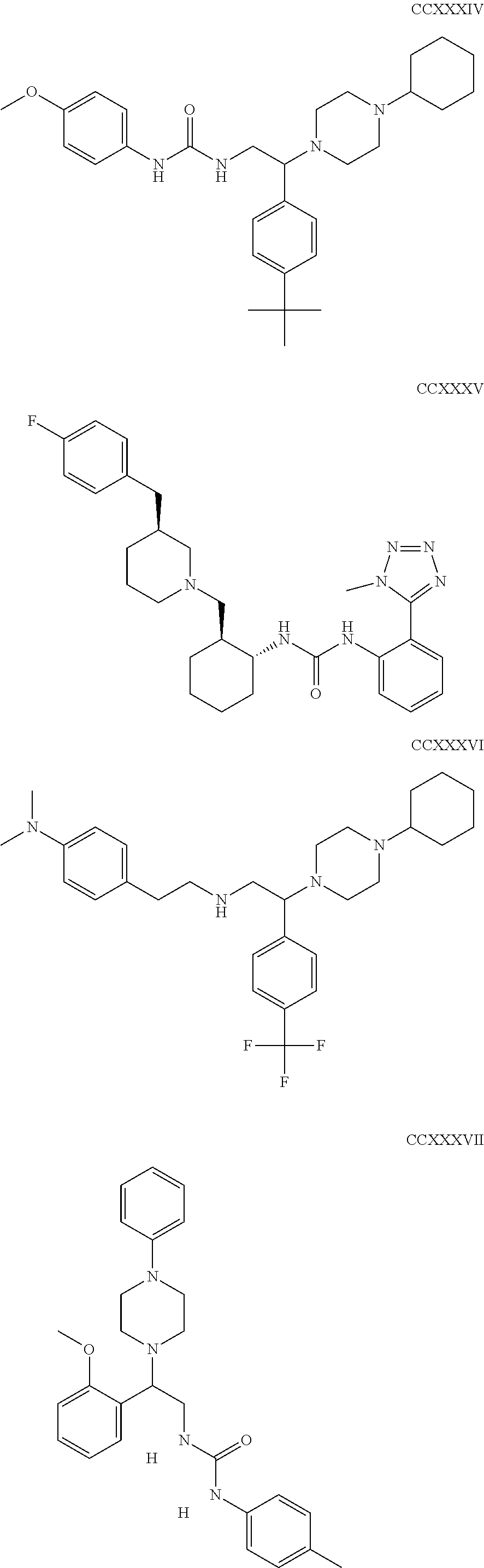


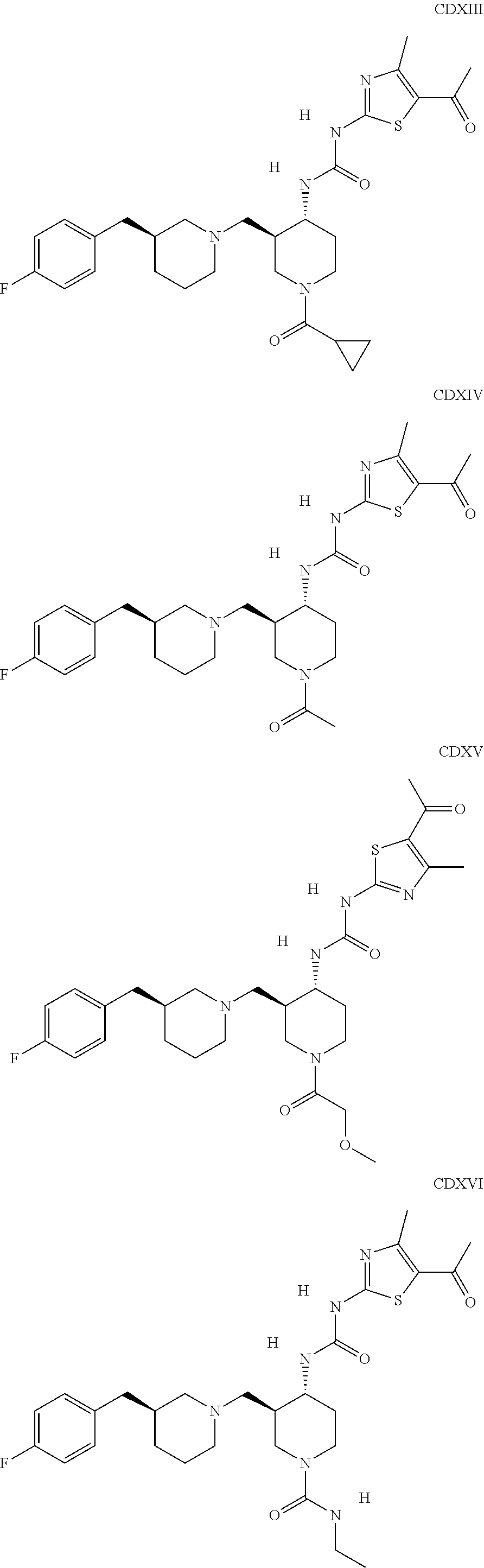


| TABLE 1 |
| primers used for Q-PCR |
| Sense | Antisense | ||||
| primer | primer | Concen- | |||
| Gene | (SEQ ID | (SEQ ID | tration | ||
| studied | Species | NO:) | NO:) | used | |
| CCL7 | Human | AAACCTCCA | CAGAAGTGC | 900 Nm | |
| ATTCTCATG | TGCAGAGGC | ||||
| TGGAA (4) | TT (5) | ||||
| CCL7 | Mouse | AAGATCCCC | CTTCCCAGG | 900 Nm | |
| AAGAGGAAT | GACACCGAC | ||||
| CTCAA (6) | TA (7) | ||||
| GADPH | Human/ | | GGCATGGAC | 500 Nm | |
| Mouse | AACTGCTTA | TGTGGTCAT | |||
| GC (8) | GAG (9) | ||||
| HPRT | Human/ | TGACACTGG | GCTTGCGAC | 900 Nm | |
| Mouse | CAAAACAAT | CTTGACCAT | |||
| GCA (10) | CT (11) | ||||
| HPRT | | TGGCCATCT | GGACGCAGC | 300 nM | |
| GCCTAGTAA | AACTGACAT | ||||
| AGC (12) | TTC (13) | ||||
Digestion of Adipose Tissue with Collagenase
| m4CCR3 (SEQ ID NO: 1): |
| 5′-cgcgtccccAGACCACACCCTATGAATAttcaagagaTATTCAT |
| AGGGTGTGGTCTtttttggaaat-3, |
| m5CCR3 (SEQ ID NO: 2): |
| 5′-cgcgtccccGACCACACCCTATGAATATttcaagagaATATTCA |
| TAGGGTGTGGTCtttttggaaat-3 |
| and |
| m6CCR3 (SEQ ID NO: 3) |
| 5′-cgccgtccccGGTGAGAGGTTCCGGAAAttcaagagaGTTTCCG |
| GAACCTCTCACCtttttggaaat-3. |
-
- AMD3100 (specific inhibitor of CXCR4; Rosenkilde et al., 2004) significantly reduces by approximately 20% (p<0.05) the migration of PC-3 cells against CM-Ad medium only at the maximum dose of 100 nM;
- SB225002 (inhibitor of CXCR2 and CXCR1 at a lower affinity; White et al., 1998) significantly inhibits by approximately 30% the migration induced by CM-Ad at the dose of 50 nM (p<0.01);
- sc-202525 (specific antagonist of CCR2; Cherney et al., 2008) inhibits by merely 10% the migration of tumor cells (p<0.05);
- UCB35625 (inhibitor of CCR1 and CCR3; Sabroe et al., 2000) induces a significant dose-dependent decrease in the migration of PC-3 tumor cells induced by CM-Ad from 50 nM (p<0.05). The maximum effect is observed at 200 nM (approximately 50% inhibition, p<0.001). These results were confirmed by a more specific approach based on the use of antibodies blocking CCR1 (reference D063-3, clone 141-2, MBL international Corp, (Iacono, Masciangelo et al. 1994)) or CCR3 (D083-3, clone 444-11, MBL international, (Iacono, Masciangelo et al. 1994)). The incubation of the tumor cells with a blocking antibody targeted against CCR3 (10 μg/ml) induces a significant inhibition of the migration induced by CM-Ad (approximately 50%, p<0.01) with respect to the isotypical control. On the other hand, no inhibition effect is observed with the use of blocking antibody targeted against CCR1, which is not expressed by the tumor cells.
| TABLE 2 |
| Clinical characteristics of cohort. |
| Percentage | ||
| Variables | of cohort | |
| Cohort size (number of | 101 | 100 |
| patients |
| Age at time of surgery | 63 | (47-75) | |
| (years), median (range) | |||
| Body Mass Index (BMI) (kg/m2), | 26.1 | (19-34) | |
| median (range) | |||
| Post-surgery PSA (ng/mL), | 7 | (2-37) | |
| median (range) | |||
| Latest PSA assay (ng/mL), | 0 | (0-4.02) | |
| median (range) | |||
| Prostate resection specimen | 48 | (22-93) | |
| weight (g), median (range) | |||
| Monitoring time (Day), median | 765 | (62-1736) | |
| (range) |
| Post-surgery | Monitoring | 71 | 70.30 |
| treatment | only | ||
| (number of | Radiotherapy | 16 | 15.84 |
| patients) | only | ||
| |
7 | 6.93 | |
| therapy only | |||
| |
7 | 6.93 | |
| and hormone | |||
| | |||
| Post-surgery | Biochemical | ||
| 14 | 13.86 | ||
| progression | recurrence | ||
| (number of | |
30 | 29.70 |
| patients) | treatment | ||
| failure a | |||
| No |
70 | 69.31 | |
| |
1 | 0.99 | |
| TABLE 3 |
| Histolocrical and immunohistochemical characteristics of cohort. |
| Percentage | ||
| Variables | of cohort | |
| Gleason score, | <7 | 18 | 17.82 |
| number of patients | =7 (3 + 4) | 39 | 38.62 |
| +7 (4 + 3) | 36 | 35.64 | |
| >7 | 8 | 7.92 |
| Percentage of undifferentiated | 40 | (0-100) | |
| contingent ( |
|||
| median (range) |
| Tumor site, | |
10 | 9.90 |
| number of | zone | ||
| patients | Peripheral | 91 | 90.10 |
| zone | |||
| Tumor stage, | |
6 | 5.94 |
| number of | pT2c | 35 | 34.65 |
| patients | pT3a | 44 | 42.57 |
| pT3b | 16 | 15.84 |
| Positive surgical margins, | 22 | 21.78 |
| number of patients |
| Presence of | No | 93 | 92.08 | |
| | Yes | 8 | 7.92 | |
| emboli, number | ||||
| of patients |
| Bilateral lymph node | 79 | 79.21 |
| dissection, number of patients |
| Lymph node | Nx (No | 22 | 21.78 |
| invasion, | lymphnode | ||
| number of | dissection | ||
| patients | conducted) | ||
| N0 | 74 | 73.27 | |
| |
5 | 4.95 |
| Expression of CCR3 (arbitrary | 48.5 | (11.4-94.7) | |
| units), median (range) | |||
-
- the Gleason score (p<0.001),
- the percentage of poorly histologically differentiated tumor contingent (
grade 4 andgrade 5 combined) (p<0.01), - the histological pT stage equivalent to the degree of extension of the tumor (p<0.03)
- the peripheral site of the tumor (p<0.04),
- the present of lymphatic emboli (p<0.02),
- biological recurrence defined by two successive PSA assays >0.2 mg/mL (P<0.001).
| TABLE 4 |
| Clinical characteristics of cohort for |
| which prostatic fat was measured. |
| Total number of patients (percentage in | 15 | (100) |
| column; %) | ||
| Age (Years), Median (range) | 62 | (48-71) |
| BMI (kg/m2), Median (range) | 28 | (20-34) |
| Initial PSA prior to prostate resection | 7 | (2-34) |
| (ng/ml), Median (range) | ||
| Prostate resection, specimen weight (g), | 48 | (32-69) |
| Median (range) |
| Proposed post-surgery | Monitoring only, n | 10 | (66.7) | |
| treatment | (percentage in | |||
| column) | ||||
| Radiotherapy, n | 3 | (20) | ||
| (percentage in | ||||
| column) | ||||
| Hormone therapy, n | 3 | (20) | ||
| (percentage in | ||||
| column) | ||||
| Post-surgery | No biological | 12 | (80) | |
| progression | recurrence | |||
| Biological recurrence | 3 | (20) | ||
| Death | 1 | (10) | ||
| TABLE 5 |
| Histological and immunohistochemical characteristics |
| of cohort for which prostatic fat was measured. |
| Total number of patients (percentage in | 15 | (100) |
| column; %) |
| Tumor site | Transitional, n | 1 | (6.7) | |
| (percentage in | ||||
| column) | ||||
| Peripheral, n | 14 | (93.3) | ||
| (percentage in | ||||
| column) | ||||
| Gleason score on | 5, n (percentage in | 2 | (13.3) | |
| prostate resection | column) | |||
| specimen | 6, n (percentage in | 1 | (6.7) | |
| column) | ||||
| 7, n (percentage in | 10 | (66.7) | ||
| column) | ||||
| 8, n (percentage in | 1 | (6.7) | ||
| column) | ||||
| 9, n (percentage in | 1 | (6.7) | ||
| column) |
| Percentage of poorly differentiated | 25 | (0-95) |
| contingent (grade 4 and 5 combined), Median | ||
| (range) | ||
| Tumor volume (prostate invasion | 13 | (6-48) |
| percentage), Median (range) |
| Presence of emboli | yes, n (percentage in | 2 | (13.3) | |
| column) | ||||
| no, n (percentage in | 13 | (56.7) | ||
| column) | ||||
| pTNM stage | pT2a, n (percentage | 1 | (6.7) | |
| in column) | ||||
| pT2b, n (percentage | 4 | (26.7) | ||
| in column) | ||||
| pT3a, n (percentage | 7 | (46.7) | ||
| in column) | ||||
| pT2a, n (percentage | 3 | (20) | ||
| in column) | ||||
| pT2a, n (percentage | 0 | (0) | ||
| in column) |
| Presence of metastatic lymph nodes **, n | 1 | (6.7) |
| (percentage in column) |
| Expression of CCR3 | 0 = none, n | 1 | (6.7) | |
| (percentage in | ||||
| column) | ||||
| 1 = low, n | 2 | (13.3) | ||
| (percentage in | ||||
| column) | ||||
| 2 = moderate, n | 10 | (66.67) | ||
| (percentage in | ||||
| column) | ||||
| 3 = high, n | 3 | (20) | ||
| (percentage in | ||||
| column) | ||||
| TABLE 6 |
| Correlation between surface area of periprostatic adipose deposit and various |
| clinical, histological and biochemical characteristics of cohort. |
| Periprostatic | ||
| adipose tissue | ||
| surface area |
| Small | Large | Spearman |
| surface | surface | coefficient | ||
| area | area | of | p- | |
| (<10 cm2) | (>10 cm2) | correlation | value | |
| Age (years), Median | 61 | (61-71) | 62 | (48-69) | −0.017 | 0.449 |
| (range) |
| Gleason | Gleason < 7 | 3 | (50) | 0 | (0) | ||
| score, n | Gleason | 3 | (50) | 6 | (60) | 0.5843 | 0.022 |
| (in column) | (3 + 4) | ||||||
| Gleason | 0 | (0) | 2 | (20) | |||
| (4 + 3) | |||||||
| Gleason > 7 | 0 | (0) | 2 | (20) |
| Non-differentiated | 5 | (0-25) | 25 | (20-95) | 0.461 | 0.083 |
| contingent, Median: | ||||||
| (range) |
| Tumor- | 1 = pT2b | 0 | (0) | 1 | (10) | 0.38 | 0.163 |
| stage, n | 2 = pT2c | 2 | (40) | 2 | (20) | ||
| (in columns) | 3 = pT3a | 3 | (60) | 4 | (40) | ||
| 4 = pT3b | 0 | (0) | 3 | (30) |
| Prostate weight, Median | 52 | (44-69) | 7.15 | (6.38-8.96) | −0.24 | 0.39 |
| (range) | ||||||
| PSA (ng/mL), Median | 6.7 | (7-7.5) | 7.15 | (6.38-8.96) | −0.163 | 0.89 |
| (range) |
| Biological | reascension | 1 | (20) | 2 | (20) | 0.116 | 0.681 |
| recurrence, | |||||||
| n (in | |||||||
| column) |
| BMI (kg/m2), Median | 28 | (22-34) | 27 | (20-31) | −0.243 | 0.3 |
| (range) | ||||||
| Overweight and obesity | 3 | (60) | 7 | (70) | −0.224 | 0.38 |
| (BMI ≥ 25 kg/m2), n (in | ||||||
| column) |
| Expression | 1 = low, n | 2 | (40) | 0 | (0) | 0.67 | 0.006 |
| of CCR3 | (percentage | ||||||
| in column) | |||||||
| 2 = moderate, n | 3 | (60) | 7 | (70) | |||
| (percentage | |||||||
| in column) | |||||||
| 3 = high, n | 0 | (0) | 3 | (30) | |||
| (percentage | |||||||
| in column) | |||||||
The Expression of the Receptor CCR3 Plays a Role in the Migration of Prostate Cancer Cells Induced by Medullary Adipocytes
- Agrawal, L., C. R. Maxwell. et al. (2009). J Gen Virol 90(Pt 3): 710-722.
- Allott, E. H., E. M. Masko, et al. (2013). Eur Urol 63(5): 800-809.
- Balkwill. F. (2004). Nat Rev Cancer 4(7): 540-550.
- Begley, L. A., S. Kasina, et al. (2008). Cytokine 43(2): 194-199.
- Cherney, R. J., R. Mo, et al. (2008). J Med Chem 51(4): 721-724.
- Contreras, A. F., A. Ferrero Guadagnoli, et al. (2010). Rev Fac Cien Med Univ Nac Cordoba 67(3): 104-107.
- Egawa, S., M. Ohori, et a). (1994). Nihon Hinyokika Gakkai Zasshi 85(10): 1543-1551.
- Elsner, J., S. E. Escher, et al. (2004). Allergy 59(12): 1243-1258.
- Elsner. L., H. Petering, et al. (1997). Eur J Immunol 27(11): 2892-2898.
- Houimel, M. and L. Mazzucchelli (2013). Immunol Lett 149(1-2): 19-29.
- Iacono, A. T., T. N. Masciangelo, et al. (1994). Chest 106(1): 311-313.
- Inoue. K., 3. W. Slaton, et al. (2000). Clin Cancer Res 6(5): 2104-2119.
- Johrer, K., C. Zelle-Rieser, et al. (2005). Clin Cancer Res 11(7): 2459-2465.
- Joubert, P., S. Lajoie-Kadoch, et al. (2008). J Immunol 180(2): 1268-1275.
- Jung, D. W., Z. M. Che, et al. (2010). Int J Cancer 127(2): 332-344.
- Kanno, A., H. Amakasu, et al. (1994). Tohoku J Exp Med 172(I): 83-90.
- Kiss, D. L., J. Longden, et al. (2009). Cell Mol Biol Lett 14(4): 537-547.
- Kuri-Harcuch, W. and H. Green (1978). Proc Natl Acad Sci USA 75(12): 6107-6109.
- Lee Y. J., D. H. Kim, et al. (2010). Ann Dermatol 22(4): 412-417.
- Loberg, R. D., L. L. Day, et al. (2006). Neoplasia 8(7): 578-586.
- Loetscher. P., A. Pellegrino, et al. (2001). J Biol Chem 276(5): 2986-2991.
- Lu, Y., Z. Cai, et al. (2007). J Cell Biochem 101(3): 676-685.
- Magi-Galluzzi, C., A. J. Evans, et al. (2011). Mod Pathol 24(1): 26-38.
- Malavaud, B., D). Pehejetski, et al., (2010). Eur J Cancer. 46(18):3417-24.
- Menzies, N. A. and J. A. Salomon (2011). Health Econ 20(12): 1523-1531.
- Ohori, M., S. Egawa, et al. (1994). Br J Urol 74(1): 72-79.
- Ohori, M. and P. T. Scardino (1994). Semin Oncol 21(5): 522-526.
- Ohori, M., T. M. Wheeler, et al. (1994). J Urol 152(5 Pt 2): 1714-1720.
- Ohori, N. P., A. T. Iacono, et al. (1994). Am J Surg Pathol 18(12): 1192-1204.
- Ouchi, N., J. L. Parker, et al. (2011). Nat Rev Immunol 11(2): 85-97.
- Rosenkilde, M. M., L. O. Gerlach, et al. (2004). J Biol Chem 279(4): 3033-3041.
- Sabroe, I., M. J. Peck, et al. (2000). J Biol Chem 275(34): 25985-25992.
- Saitoh. Y., M. Miura, et al. (1994). “Changes of scrum hepatitis C virus levels in patients with chronic hepatitis C treated with two courses of interferon administration.” Tohoku J Exp Med 173(4): 361-369.
- Salomon, L., D. Azria, et al. (2010).
Prog Urol 20 Suppl 4: 5217-251. - Santini, M. S., O. D. Salomon, et al. (2010). Rev Inst Med Trop Sao Paulo 52(4); 187-191.
- Sysel. A. M, V. E. Valli, et al. (2013). Anticancer Res. 33: 4203-12.
- Szymezak, W. A. and G. S. Deepe, Jr. (2009). J Immunol 183(3): 1964-1974.
- Taichnman, R. S., C. Cooper, et al. (2002). Cancer Res 62(6): 1832-1837.
- Toumiaire, F., B. Romier-Crouzet, et al. (2013). PLoS One 8(6): e66515.
- Vindrieux, D., P. Escobar. et al. (2009). Endocr Relat Cancer 16(3): 663-673.
- White, J. R., J. M. Lee, et al. (1998). J Biol Chem 273(17): 10095-10098.
- Winzell, M. S. and B. Ahren (2004). Diabetes 53 Suppl 3: S215-219.
- Yamamura, J., G. Salomon. et al. (2011). Radiol Res Pract 2011: 616852.
- Zhang. J., L. Patel, et al. (2010). Cytokine Growth Factor Rev 21(1): 41-48.
- Zhu, F., P. Liu, et al. (2014). Oncol Rep 31(5): 2049-2054.
- Zhu, X. H., B. Liao, et al. (2013). Zhonghua Er Bi Yan Hou Tou Jing Wai Ke Za Zhi 48(4): 316-321.
- Zipori, D., A. Friedman, et al. (1984). J Cell Physiol 118(2): 143-152.
Claims (6)
Applications Claiming Priority (3)
| Application Number | Priority Date | Filing Date | Title |
|---|---|---|---|
| FR1455491A FR3022142B1 (en) | 2014-06-16 | 2014-06-16 | INHIBITION OF CCL7 CHEMOKINE OR CCR3 RECEPTOR FOR THE TREATMENT AND DIAGNOSIS OF PROSTATE CANCER |
| FR1455491 | 2014-06-16 | ||
| PCT/IB2015/054550 WO2015193813A1 (en) | 2014-06-16 | 2015-06-16 | Inhibition of chemokine ccl7 or receptor ccr3 of same for the treatment and diagnosis of prostate cancer |
Related Parent Applications (1)
| Application Number | Title | Priority Date | Filing Date |
|---|---|---|---|
| PCT/IB2015/054550 A-371-Of-International WO2015193813A1 (en) | 2014-06-16 | 2015-06-16 | Inhibition of chemokine ccl7 or receptor ccr3 of same for the treatment and diagnosis of prostate cancer |
Related Child Applications (1)
| Application Number | Title | Priority Date | Filing Date |
|---|---|---|---|
| US16/511,126 Division US20200081009A1 (en) | 2014-06-16 | 2019-07-15 | Inhibition of Chemokine CCL7 or Receptor CCR3 of Same for the Treatment and Diagnosis of Prostate Cancer |
Publications (2)
| Publication Number | Publication Date |
|---|---|
| US20170131282A1 US20170131282A1 (en) | 2017-05-11 |
| US10401365B2 true US10401365B2 (en) | 2019-09-03 |
Family
ID=51905229
Family Applications (2)
| Application Number | Title | Priority Date | Filing Date |
|---|---|---|---|
| US15/318,777 Expired - Fee Related US10401365B2 (en) | 2014-06-16 | 2015-06-16 | Inhibition of chemokine CCL7 or receptor CCR3 of same for the treatment and diagnosis of prostate cancer |
| US16/511,126 Abandoned US20200081009A1 (en) | 2014-06-16 | 2019-07-15 | Inhibition of Chemokine CCL7 or Receptor CCR3 of Same for the Treatment and Diagnosis of Prostate Cancer |
Family Applications After (1)
| Application Number | Title | Priority Date | Filing Date |
|---|---|---|---|
| US16/511,126 Abandoned US20200081009A1 (en) | 2014-06-16 | 2019-07-15 | Inhibition of Chemokine CCL7 or Receptor CCR3 of Same for the Treatment and Diagnosis of Prostate Cancer |
Country Status (4)
| Country | Link |
|---|---|
| US (2) | US10401365B2 (en) |
| EP (1) | EP3155010B1 (en) |
| FR (1) | FR3022142B1 (en) |
| WO (1) | WO2015193813A1 (en) |
Families Citing this family (8)
| Publication number | Priority date | Publication date | Assignee | Title |
|---|---|---|---|---|
| EP3551034A1 (en) | 2016-12-07 | 2019-10-16 | Progenity, Inc. | Gastrointestinal tract detection methods, devices and systems |
| CA3045310A1 (en) | 2016-12-14 | 2018-06-21 | Progenity, Inc. | Treatment of a disease of the gastrointestinal tract with a chemokine/chemokine receptor inhibitor |
| CA3070342A1 (en) * | 2017-07-18 | 2019-01-24 | Kyowa Kirin Co., Ltd. | Anti-human ccr1 monoclonal antibody |
| WO2020106757A1 (en) | 2018-11-19 | 2020-05-28 | Progenity, Inc. | Ingestible device for delivery of therapeutic agent to the gastrointestinal tract |
| CN110993095B (en) * | 2019-11-26 | 2024-04-26 | 上海市第十人民医院 | Device for predicting the occurrence and metastasis of prostate cancer |
| CN121197633A (en) | 2019-12-13 | 2025-12-26 | 比特比德科有限责任公司 | Ingestible device for delivering therapeutic agents to the gastrointestinal tract |
| KR20250133491A (en) * | 2024-02-28 | 2025-09-08 | 재단법인 오송첨단의료산업진흥재단 | Novel Antibody Specific for human CCL7 and Uses Thereof |
| WO2025194116A1 (en) * | 2024-03-15 | 2025-09-18 | The Regents Of The University Of California | Pcsk9 inhibitors and uses thereof |
Citations (4)
| Publication number | Priority date | Publication date | Assignee | Title |
|---|---|---|---|---|
| WO2005106492A2 (en) | 2004-04-30 | 2005-11-10 | Bayer Healthcare Ag | Diagnostics and therapeutics for diseases associated with c-c chemokine receptor 3 (ccr3) |
| WO2008121132A2 (en) | 2007-03-30 | 2008-10-09 | Source Precision Medicine, Inc. D/B/A Source Mdx | Gene expression profiling for identification, monitoring, and treatment of prostate cancer |
| WO2010123956A2 (en) | 2009-04-22 | 2010-10-28 | Axikin Pharmaceuticals, Inc. | 2,5-disubstituted arylsulfonamide ccr3 antagonists |
| WO2012122499A2 (en) | 2011-03-09 | 2012-09-13 | Pestell Richard G | Prostate cancer cell lines, gene signatures and uses thereof |
Family Cites Families (5)
| Publication number | Priority date | Publication date | Assignee | Title |
|---|---|---|---|---|
| EP1181310A1 (en) | 1999-05-27 | 2002-02-27 | Celltek Biotechnologies Inc. | Chemokine receptor ccr3 antagonists |
| CZ20031194A3 (en) | 2000-09-29 | 2003-08-13 | Glaxo Group Limited | Urea derivatives |
| IL155093A0 (en) | 2000-09-29 | 2003-10-31 | Glaxo Group Ltd | Morpholin-acetamide derivatives for the treatment on inflammatory diseases |
| US20030221931A1 (en) | 2002-02-28 | 2003-12-04 | Steve Marsh | Sliding device |
| GB0207432D0 (en) | 2002-03-28 | 2002-05-08 | Glaxo Group Ltd | Novel compounds |
-
2014
- 2014-06-16 FR FR1455491A patent/FR3022142B1/en not_active Expired - Fee Related
-
2015
- 2015-06-16 US US15/318,777 patent/US10401365B2/en not_active Expired - Fee Related
- 2015-06-16 WO PCT/IB2015/054550 patent/WO2015193813A1/en not_active Ceased
- 2015-06-16 EP EP15738477.7A patent/EP3155010B1/en active Active
-
2019
- 2019-07-15 US US16/511,126 patent/US20200081009A1/en not_active Abandoned
Patent Citations (4)
| Publication number | Priority date | Publication date | Assignee | Title |
|---|---|---|---|---|
| WO2005106492A2 (en) | 2004-04-30 | 2005-11-10 | Bayer Healthcare Ag | Diagnostics and therapeutics for diseases associated with c-c chemokine receptor 3 (ccr3) |
| WO2008121132A2 (en) | 2007-03-30 | 2008-10-09 | Source Precision Medicine, Inc. D/B/A Source Mdx | Gene expression profiling for identification, monitoring, and treatment of prostate cancer |
| WO2010123956A2 (en) | 2009-04-22 | 2010-10-28 | Axikin Pharmaceuticals, Inc. | 2,5-disubstituted arylsulfonamide ccr3 antagonists |
| WO2012122499A2 (en) | 2011-03-09 | 2012-09-13 | Pestell Richard G | Prostate cancer cell lines, gene signatures and uses thereof |
Non-Patent Citations (10)
Also Published As
| Publication number | Publication date |
|---|---|
| US20200081009A1 (en) | 2020-03-12 |
| EP3155010A1 (en) | 2017-04-19 |
| WO2015193813A1 (en) | 2015-12-23 |
| FR3022142B1 (en) | 2019-07-12 |
| EP3155010B1 (en) | 2019-09-18 |
| FR3022142A1 (en) | 2015-12-18 |
| US20170131282A1 (en) | 2017-05-11 |
Similar Documents
| Publication | Publication Date | Title |
|---|---|---|
| US20200081009A1 (en) | Inhibition of Chemokine CCL7 or Receptor CCR3 of Same for the Treatment and Diagnosis of Prostate Cancer | |
| Miller et al. | IL-17A modulates peritoneal macrophage recruitment and M2 polarization in endometriosis | |
| Chi et al. | IL-36 signaling facilitates activation of the NLRP3 inflammasome and IL-23/IL-17 axis in renal inflammation and fibrosis | |
| Li et al. | Cornulin is induced in psoriasis lesions and promotes keratinocyte proliferation via phosphoinositide 3-kinase/Akt pathways | |
| Kim et al. | Circulating monocytes expressing CD31: implications for acute and chronic angiogenesis | |
| Wente et al. | CXCL14 expression and potential function in pancreatic cancer | |
| Guo et al. | Interleukin-17 promotes migration and invasion of human cancer cells through upregulation of MTA1 expression | |
| US20190049435A1 (en) | Methods and reagents for determination and treatment of organotropic metastasis | |
| Warren et al. | Tumor necrosis factor deficiency inhibits mammary tumorigenesis and a tumor necrosis factor neutralizing antibody decreases mammary tumor growth in neu/erbB2 transgenic mice | |
| CN112867495B (en) | Gastric cancer therapeutic composition comprising SYT11 inhibitor as active ingredient | |
| Ma et al. | Role of relaxin-2 in human primary osteosarcoma | |
| Li et al. | Loss of periplakin expression is associated with the tumorigenesis of colorectal carcinoma | |
| Ren et al. | Migration-inducing gene-7 independently predicts poor prognosis of human osteosarcoma and is associated with vasculogenic mimicry | |
| KR101539138B1 (en) | Combination therapy and method for assessing resistance to treatment | |
| Darmawan et al. | Dasatinib attenuates fibrosis in keloids by decreasing senescent cell burden | |
| JP2024508611A (en) | Method | |
| CN106177953B (en) | Application of TLR3 inhibitors in the preparation of products for the prevention and treatment of tumor metastasis | |
| KR102150239B1 (en) | Anticarcinogenic composition comprising an inhibitor of DRG2 as an active ingredient | |
| JP2021113824A (en) | Scirrhous gastric cancer therapeutic agent, and gastric cancer prognosis prediction method | |
| Liu et al. | Protective effects of engineered Lactobacillus crispatus strains expressing G-CSF on thin endometrium of mice | |
| KR101191958B1 (en) | Pharmaceutical composition for preventing and treating synovial sarcoma comprising TLE1 inhibitor | |
| Chen et al. | Denosumab induces neoplastic stromal cell apoptosis via p62 downregulation dependent on autophagy pathway in giant cell tumour of Bone | |
| KR20190112977A (en) | Use of HSP90AA1 for Treating or Diagnosing NANOG-mediated Diseases | |
| WO2022272291A1 (en) | Methods of determining responsiveness to chemotherapeutic compounds for cancer therapy | |
| CN114470196B (en) | Application of CCL3/CCR4 neutralizing antibody and NF- κB inhibitor in preparing NEC therapeutic drug |
Legal Events
| Date | Code | Title | Description |
|---|---|---|---|
| AS | Assignment |
Owner name: CENTRE HOSPITALIER UNIVERSITAIRE DE TOULOUSE, FRAN Free format text: ASSIGNMENT OF ASSIGNORS INTEREST;ASSIGNORS:MULLER, CATHERINE;LAURENT, VICTOR;GUERARD, ADRIEN;AND OTHERS;SIGNING DATES FROM 20170226 TO 20170302;REEL/FRAME:046004/0237 Owner name: CENTRE NATIONAL DE LA RECHERCHE SCIENTIFIQUE, FRAN Free format text: ASSIGNMENT OF ASSIGNORS INTEREST;ASSIGNORS:MULLER, CATHERINE;LAURENT, VICTOR;GUERARD, ADRIEN;AND OTHERS;SIGNING DATES FROM 20170226 TO 20170302;REEL/FRAME:046004/0237 Owner name: UNIVERSITE PAUL SABATIER (TOULOUSE III), FRANCE Free format text: ASSIGNMENT OF ASSIGNORS INTEREST;ASSIGNORS:MULLER, CATHERINE;LAURENT, VICTOR;GUERARD, ADRIEN;AND OTHERS;SIGNING DATES FROM 20170226 TO 20170302;REEL/FRAME:046004/0237 Owner name: INSTITUT NATIONAL DE LA SANTE ET DE LA RECHERCHE M Free format text: ASSIGNMENT OF ASSIGNORS INTEREST;ASSIGNORS:MULLER, CATHERINE;LAURENT, VICTOR;GUERARD, ADRIEN;AND OTHERS;SIGNING DATES FROM 20170226 TO 20170302;REEL/FRAME:046004/0237 |
|
| STPP | Information on status: patent application and granting procedure in general |
Free format text: DOCKETED NEW CASE - READY FOR EXAMINATION |
|
| STPP | Information on status: patent application and granting procedure in general |
Free format text: NOTICE OF ALLOWANCE MAILED -- APPLICATION RECEIVED IN OFFICE OF PUBLICATIONS |
|
| STPP | Information on status: patent application and granting procedure in general |
Free format text: PUBLICATIONS -- ISSUE FEE PAYMENT VERIFIED |
|
| STCF | Information on status: patent grant |
Free format text: PATENTED CASE |
|
| FEPP | Fee payment procedure |
Free format text: MAINTENANCE FEE REMINDER MAILED (ORIGINAL EVENT CODE: REM.); ENTITY STATUS OF PATENT OWNER: LARGE ENTITY |
|
| LAPS | Lapse for failure to pay maintenance fees |
Free format text: PATENT EXPIRED FOR FAILURE TO PAY MAINTENANCE FEES (ORIGINAL EVENT CODE: EXP.); ENTITY STATUS OF PATENT OWNER: LARGE ENTITY |
|
| STCH | Information on status: patent discontinuation |
Free format text: PATENT EXPIRED DUE TO NONPAYMENT OF MAINTENANCE FEES UNDER 37 CFR 1.362 |
|
| FP | Lapsed due to failure to pay maintenance fee |
Effective date: 20230903 |