US10399382B2 - Irrigation system propulsion wheels and methods of making - Google Patents

Irrigation system propulsion wheels and methods of making Download PDF

Info

Publication number
US10399382B2
US10399382B2 US15/435,513 US201715435513A US10399382B2 US 10399382 B2 US10399382 B2 US 10399382B2 US 201715435513 A US201715435513 A US 201715435513A US 10399382 B2 US10399382 B2 US 10399382B2
Authority
US
United States
Prior art keywords
wheel
tread
spades
wheel according
axis
Prior art date
Legal status (The legal status is an assumption and is not a legal conclusion. Google has not performed a legal analysis and makes no representation as to the accuracy of the status listed.)
Expired - Fee Related, expires
Application number
US15/435,513
Other versions
US20170239981A1 (en
Inventor
Matthew E. Welsh
Current Assignee (The listed assignees may be inaccurate. Google has not performed a legal analysis and makes no representation or warranty as to the accuracy of the list.)
Individual
Original Assignee
Individual
Priority date (The priority date is an assumption and is not a legal conclusion. Google has not performed a legal analysis and makes no representation as to the accuracy of the date listed.)
Filing date
Publication date
Application filed by Individual filed Critical Individual
Priority to US15/435,513 priority Critical patent/US10399382B2/en
Publication of US20170239981A1 publication Critical patent/US20170239981A1/en
Application granted granted Critical
Publication of US10399382B2 publication Critical patent/US10399382B2/en
Expired - Fee Related legal-status Critical Current
Adjusted expiration legal-status Critical

Links

Images

Classifications

    • BPERFORMING OPERATIONS; TRANSPORTING
    • B60VEHICLES IN GENERAL
    • B60BVEHICLE WHEELS; CASTORS; AXLES FOR WHEELS OR CASTORS; INCREASING WHEEL ADHESION
    • B60B15/00Wheels or wheel attachments designed for increasing traction
    • B60B15/02Wheels with spade lugs
    • AHUMAN NECESSITIES
    • A01AGRICULTURE; FORESTRY; ANIMAL HUSBANDRY; HUNTING; TRAPPING; FISHING
    • A01GHORTICULTURE; CULTIVATION OF VEGETABLES, FLOWERS, RICE, FRUIT, VINES, HOPS OR SEAWEED; FORESTRY; WATERING
    • A01G25/00Watering gardens, fields, sports grounds or the like
    • A01G25/09Watering arrangements making use of movable installations on wheels or the like
    • BPERFORMING OPERATIONS; TRANSPORTING
    • B60VEHICLES IN GENERAL
    • B60BVEHICLE WHEELS; CASTORS; AXLES FOR WHEELS OR CASTORS; INCREASING WHEEL ADHESION
    • B60B19/00Wheels not otherwise provided for or having characteristics specified in one of the subgroups of this group
    • B60B19/12Roller-type wheels
    • BPERFORMING OPERATIONS; TRANSPORTING
    • B60VEHICLES IN GENERAL
    • B60BVEHICLE WHEELS; CASTORS; AXLES FOR WHEELS OR CASTORS; INCREASING WHEEL ADHESION
    • B60B3/00Disc wheels, i.e. wheels with load-supporting disc body
    • B60B3/002Disc wheels, i.e. wheels with load-supporting disc body characterised by the shape of the disc
    • B60B3/007Disc wheels, i.e. wheels with load-supporting disc body characterised by the shape of the disc in the intermediate section
    • BPERFORMING OPERATIONS; TRANSPORTING
    • B60VEHICLES IN GENERAL
    • B60BVEHICLE WHEELS; CASTORS; AXLES FOR WHEELS OR CASTORS; INCREASING WHEEL ADHESION
    • B60B9/00Wheels of high resiliency, e.g. with conical interacting pressure-surfaces
    • B60B9/26Wheels of high resiliency, e.g. with conical interacting pressure-surfaces comprising resilient spokes
    • BPERFORMING OPERATIONS; TRANSPORTING
    • B60VEHICLES IN GENERAL
    • B60BVEHICLE WHEELS; CASTORS; AXLES FOR WHEELS OR CASTORS; INCREASING WHEEL ADHESION
    • B60B2310/00Manufacturing methods
    • B60B2310/20Shaping
    • B60B2310/222Shaping by twisting
    • BPERFORMING OPERATIONS; TRANSPORTING
    • B60VEHICLES IN GENERAL
    • B60BVEHICLE WHEELS; CASTORS; AXLES FOR WHEELS OR CASTORS; INCREASING WHEEL ADHESION
    • B60B2320/00Manufacturing or maintenance operations
    • B60B2320/10Assembling; disassembling
    • BPERFORMING OPERATIONS; TRANSPORTING
    • B60VEHICLES IN GENERAL
    • B60BVEHICLE WHEELS; CASTORS; AXLES FOR WHEELS OR CASTORS; INCREASING WHEEL ADHESION
    • B60B2360/00Materials; Physical forms thereof
    • B60B2360/10Metallic materials
    • B60B2360/102Steel
    • BPERFORMING OPERATIONS; TRANSPORTING
    • B60VEHICLES IN GENERAL
    • B60BVEHICLE WHEELS; CASTORS; AXLES FOR WHEELS OR CASTORS; INCREASING WHEEL ADHESION
    • B60B2900/00Purpose of invention
    • B60B2900/20Avoidance of
    • B60B2900/212Damage
    • BPERFORMING OPERATIONS; TRANSPORTING
    • B60VEHICLES IN GENERAL
    • B60BVEHICLE WHEELS; CASTORS; AXLES FOR WHEELS OR CASTORS; INCREASING WHEEL ADHESION
    • B60B2900/00Purpose of invention
    • B60B2900/50Improvement of
    • B60B2900/551Handling of obstacles or difficult terrains

Definitions

  • the present invention generally relates to wheels configured for propelling objects and structures on the ground, and particularly to wheels suitable for propelling or supporting irrigations systems and other equipment traveling across agricultural fields.
  • FIG. 1 schematically represents a nonlimiting example of a portion of a center-pivot irrigation system 10 of a type used in agricultural applications.
  • structural members of the system 10 can be seen to be equipped with wheels 12 that support the system 10 as it moves across the ground of a field.
  • the wheels 12 are represented as inflated tires, which are prone to puncture hazards in their path.
  • the present invention provides wheels adapted to roll on and across surfaces of fields, for example, as part of irrigation systems of types used in agricultural applications.
  • the wheels are suitable for use as replacements for conventional wheels and pneumatic tires commonly used in agricultural irrigation systems.
  • the wheel has an axis of rotation, a center portion comprising a central hub concentrically disposed on the axis of the wheel and multiple spokes radiating from the central hub, and a tread portion circumscribing the center portion.
  • a radially outermost extent of each spoke terminates at a spade that is oriented parallel to the axis of the wheel.
  • the tread portion includes tread plates each having a tread surface region. Each tread plate is between and attached to adjacent pairs of the spokes, and the spades of the center portion protrude radially outward beyond adjacent pairs of the tread plates.
  • a method of fabricating a wheel includes providing a one-piece flat pattern having a hub portion from which radiating arms emanate relative to an axis of the flat pattern located within the hub portion. Each radiating arm is twisted to form one spoke of a center portion of the wheel and an outer radial end of the arm forms a spade of the spoke. Tread plates are then individually attached between adjacent pairs of the spades.
  • a technical effect of the wheel is that it is not required to be inflated, and therefore is not prone to puncture hazards in its path.
  • the wheel is also not required to be formed of rubber or another pliable material that can be prone to degradation by the weather, for example, as a result of being damaged by ultraviolet rays of the sun.
  • the wheel does not require moving parts, and can be assembled without the need to interconnect a large number of parts.
  • FIG. 1 schematically represents a portion of a center-pivot irrigation system of a type used in agricultural applications.
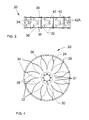
  • FIGS. 2, 3 and 4 represent perspective, top and side views of a wheel in accordance with a nonlimiting embodiment of this invention.
  • FIG. 5 is a plan view of a flat pattern suitable for fabricating a wheel center portion of the wheel shown in FIGS. 2, 3 and 4 .
  • FIGS. 6, 7 and 8 represent perspective, top and side views of a wheel in accordance with another nonlimiting embodiment of this invention.
  • FIG. 9 shows a profile view of a tread plate of the wheel shown in FIGS. 6, 7, and 8 .
  • FIG. 10 shows a profile view of an alternative tread plate for the wheels shown in FIGS. 1 through 3 and 5 through 7 .
  • FIGS. 2 through 4 and 6 through 8 represent various views of wheels 20 and 60 suitable for propelling an object or structure across a surface.
  • the wheels 20 and 60 are particularly well suited for propelling an irrigation system across the surface of an agricultural field.
  • irrigation systems such as that shown in FIG. 1
  • teachings of the invention are more generally applicable to a variety of applications in which a rugged wheel would be beneficial for transporting a structure across uneven ground typically encountered in an agricultural field.
  • relative terms may be used to describe the wheels 20 and 60 and their components
  • relative terms including but not limited to “axial,” “circumferential,” “radial,” etc., and related forms thereof may also be used to describe the nonlimiting embodiments represented in the drawings. All such relative terms are intended to indicate the construction and relative orientations of components and features of the wheels 20 and 60 , and therefore are intended to indicate the construction, installation and use of the invention and therefore help to define the scope of the invention.
  • the wheel 20 depicted in FIGS. 2 through 4 has an axis 22 of rotation and is rotationally symmetrical about its axis 22 .
  • the wheel 20 has a wheel center portion 24 circumscribed by a tread portion 26 .
  • the center portion 24 comprises multiple spokes 28 radiating from a central hub 30 that is concentrically disposed on the axis 22 of the wheel 20 .
  • the hub 30 is preferably formed to define a central hub opening surrounded by a pattern of holes by which the wheel 20 can be mounted to a section of an irrigation system or other appropriate structure.
  • Each spoke 28 has an approximately ninety-degree twist as a result of its radially innermost extent 31 lying in the plane of the center portion 24 and hub 30 so as to be approximately perpendicular to the axis 22 of the wheel 20 , and its radially outermost extent 32 terminating at a spade 34 (or blade) that is oriented approximately parallel to the wheel axis 22 . With this orientation, the spades 34 have axial widths in the axial direction of the wheel 20 .
  • the hub 30 can be reinforced with a plate as seen in FIGS. 2 and 4 .
  • the tread portion 26 generally defines a cylindrical shape whose axis coincides with the axis 22 of the wheel 20 .
  • the tread portion 26 is constructed of multiple individual tread plates 36 , each attached between an adjacent pair of spades 34 of the spokes 28 .
  • Each tread plate 36 has a width in the axial direction of the wheel 20 and a length in the circumferential direction of the wheel 20 .
  • Each tread plate 36 further defines along its length a radius of curvature having a center of curvature that approximately coincides with the axis 22 of the wheel 20 , resulting in the tread plates 36 defining, in combination, the generally cylindrical shape of the tread portion 26 .
  • the radially outermost extents 32 of the spades 34 radially protrude from the circular shape of the tread portion 26 and generally lie on a circle that is substantially concentric with the cylindrical shape of the tread portion 26 as a result of having a center of curvature that coincides with the axis 22 of the wheel 20 .
  • the axial widths of the spades 34 preferably exceed the widths of the tread plates 36 on each axial side of the wheel 20 .
  • Each tread plate 36 has a pair of rims or lips 38 projecting radially outward, preferably along the entire length of the plate 36 .
  • Each lip 38 is located along one of the lateral edges of the plate 36 that delimits the width of the plate 36 , and is oriented generally perpendicular to the spades 34 to which the plate 36 is attached.
  • the lips 38 located along the lateral edges of the plates 36 define a tread surface region 40 surrounded by a substantially continuous wall formed by the spades 34 and lips 38 .
  • the tread surface region 40 is recessed below the continuous wall, and therefore are preferably capable of partially containing soil contacted by the tread plates 36 as the wheel 20 rotates and traverses the soil.
  • soil traversed by the wheel 20 after being wetted by an irrigation system will remain at least partially contained within the wheel track (rut) created by the continual traversing of the wheel 20 over the same path.
  • the tread plates 36 are preferably formed to include an embossed pattern 42 that protrudes radially outward from the tread surface region 40 .
  • the embossed pattern 42 is shown in FIGS. 2 and 3 as comprising two raised linear portions 42 A that converge to give the pattern 42 an approximate V-shape, which aids in the clean out of soil over which the wheel 20 traverses.
  • the center portion 24 of the wheel 20 can be fabricated from a single piece, for example, from a flat pattern 44 represented in FIG. 5 as having a central hub portion 46 that defines the hub 30 of the wheel 20 and from which radiating arms 48 emanate, each arm 48 increasing in its width in the radially outward direction.
  • the pattern 44 is depicted as having a central opening 50 within the hub portion 46 that will define the central hub opening of the wheel 20 .
  • the center portion 24 of the wheel 20 can be fabricated from the pattern 44 by twisting each radiating arm 48 to form one of the spokes 28 , so that the outer radial ends 52 of the arms 48 form the spades 34 of the spokes 28 .
  • each radiating arm 48 is preferably twisted until its outer radial end 52 is roughly perpendicular to its original orientation within the pattern 44 , and is parallel to the axis 22 of the hub 30 (wheel).
  • the individual tread plates 36 can be attached between adjacent spades 34 in any suitable manner, such as by welding, bolts, etc.
  • the attachment of the tread plates 36 to the spades 34 confers structural integrity to the wheel 20 .
  • the ability to form the entire center portion 24 of the wheel 20 from a one-piece flat pattern 44 can greatly decrease the fabrication time and costs related to the manufacturing of the wheel 20 .
  • the center portion 24 and tread plates 36 of the wheel 20 can be fabricated from various structural materials, nonlimiting examples of which include corrosion-resistant steels, optionally galvanized to further promote corrosion resistance.
  • the wheel 20 can be fabricated in various axial widths and diameters and to have various numbers of spokes 28 .
  • wheels 20 can be manufactured in different size models for irrigation applications, including diameters of about forty-eight inches (about 1.2 meters) with twelve spokes 28 and sixty inches with fourteen spokes 28 (about 1.5 meters).
  • FIGS. 6 through 8 In view of similarities with the first embodiment of FIGS. 2 through 4 , the following discussion of the wheel 60 depicted in FIGS. 6 through 8 will focus primarily on aspects of the wheel 60 that differ from the first embodiment in some notable or significant manner. Other aspects of the wheel 60 not discussed in any detail can be, in terms of structure, function, fabrication, materials, etc., essentially as was described for the wheel 20 . For convenience, identical reference numerals are used in FIGS. 6 through 8 to denote the same or functionally related elements described for the wheel 60 of FIGS. 6 through 8 .
  • the tread plates 36 of the wheel 60 shown in FIGS. 6, 7 and 8 include an embossed pattern 42 that protrudes radially outward from the tread surface region 40 .
  • FIG. 9 schematically represents the profile of one of the tread plates 36 of FIGS. 6, 7 and 8 .
  • the embossed pattern 42 shown in FIGS. 6, 7 and 9 comprises a central raised linear portion that protrudes radially outward from the tread surface region 40 , onto which are superimposed two raised linear portions 42 A that further protrude radially outward from the tread surface region 40 .
  • the tread surface region 40 has two tapered regions 40 A that slope radially inward in opposite axial directions away from the embossed pattern 42 , so as to be between the pattern 42 and the lateral lips 38 of the tread plate 36 .
  • the raised linear portions 42 A are parallel to each other instead of converging, and are believed to offer certain advantages over the embossed pattern 42 shown in FIGS. 2 and 3 .
  • FIG. 10 schematically represents the profile of an alternative tread plate 36 also formed to include an embossed pattern 42 .
  • the pattern 42 comprises two centrally-located raised linear portions 42 A that are parallel to each other and protrude radially outward from the tread surface region 40 .
  • the tread surface region 40 has three regions 40 A that are flat when viewed in profile and separate the raised linear portions 42 A from each other and from the lateral lips 38 of the tread plate 36 .
  • the embossed pattern 42 of FIG. 10 is believed to offer certain performance advantages similar to the embossed pattern 42 of FIGS. 6, 7 and 8 .

Landscapes

  • Engineering & Computer Science (AREA)
  • Mechanical Engineering (AREA)
  • Water Supply & Treatment (AREA)
  • Life Sciences & Earth Sciences (AREA)
  • Environmental Sciences (AREA)
  • Tires In General (AREA)

Abstract

Wheels adapted to roll on and across surfaces of fields, for example, as part of irrigation systems of types used in agricultural applications. Such a wheel has an axis of rotation, a center portion comprising a central hub concentrically disposed on the axis of the wheel and multiple spokes radiating from the central hub, and a tread portion circumscribing the center portion. A radially outermost extent of each spoke terminates at a spade that is oriented parallel to the axis of the wheel. The tread portion includes tread plates, each located between and attached to adjacent pairs of the spokes. The spades protrude radially outward between and beyond adjacent pairs of the tread plates.

Description

CROSS REFERENCE TO RELATED APPLICATIONS
This application claims the benefit of U.S. Patent Application Ser. No. 62/297,263, filed Feb. 19, 2016, the contents of which are incorporated herein by reference.
BACKGROUND OF THE INVENTION
The present invention generally relates to wheels configured for propelling objects and structures on the ground, and particularly to wheels suitable for propelling or supporting irrigations systems and other equipment traveling across agricultural fields.
FIG. 1 schematically represents a nonlimiting example of a portion of a center-pivot irrigation system 10 of a type used in agricultural applications. In FIG. 1, structural members of the system 10 can be seen to be equipped with wheels 12 that support the system 10 as it moves across the ground of a field. The wheels 12 are represented as inflated tires, which are prone to puncture hazards in their path.
BRIEF DESCRIPTION OF THE INVENTION
The present invention provides wheels adapted to roll on and across surfaces of fields, for example, as part of irrigation systems of types used in agricultural applications. The wheels are suitable for use as replacements for conventional wheels and pneumatic tires commonly used in agricultural irrigation systems.
According to one aspect of the invention, the wheel has an axis of rotation, a center portion comprising a central hub concentrically disposed on the axis of the wheel and multiple spokes radiating from the central hub, and a tread portion circumscribing the center portion. A radially outermost extent of each spoke terminates at a spade that is oriented parallel to the axis of the wheel. The tread portion includes tread plates each having a tread surface region. Each tread plate is between and attached to adjacent pairs of the spokes, and the spades of the center portion protrude radially outward beyond adjacent pairs of the tread plates.
According to another aspect of the invention, a method of fabricating a wheel includes providing a one-piece flat pattern having a hub portion from which radiating arms emanate relative to an axis of the flat pattern located within the hub portion. Each radiating arm is twisted to form one spoke of a center portion of the wheel and an outer radial end of the arm forms a spade of the spoke. Tread plates are then individually attached between adjacent pairs of the spades.
A technical effect of the wheel is that it is not required to be inflated, and therefore is not prone to puncture hazards in its path. The wheel is also not required to be formed of rubber or another pliable material that can be prone to degradation by the weather, for example, as a result of being damaged by ultraviolet rays of the sun. In addition, the wheel does not require moving parts, and can be assembled without the need to interconnect a large number of parts.
Other aspects and advantages of this invention will be better appreciated from the following detailed description.
BRIEF DESCRIPTION OF THE DRAWINGS
FIG. 1 schematically represents a portion of a center-pivot irrigation system of a type used in agricultural applications.
FIGS. 2, 3 and 4 represent perspective, top and side views of a wheel in accordance with a nonlimiting embodiment of this invention.
FIG. 5 is a plan view of a flat pattern suitable for fabricating a wheel center portion of the wheel shown in FIGS. 2, 3 and 4.
FIGS. 6, 7 and 8 represent perspective, top and side views of a wheel in accordance with another nonlimiting embodiment of this invention.
FIG. 9 shows a profile view of a tread plate of the wheel shown in FIGS. 6, 7, and 8.
FIG. 10 shows a profile view of an alternative tread plate for the wheels shown in FIGS. 1 through 3 and 5 through 7.
DETAILED DESCRIPTION OF THE INVENTION
FIGS. 2 through 4 and 6 through 8 represent various views of wheels 20 and 60 suitable for propelling an object or structure across a surface. The wheels 20 and 60 are particularly well suited for propelling an irrigation system across the surface of an agricultural field. Although the invention will be described hereinafter in reference to irrigation systems such as that shown in FIG. 1, it will be appreciated that the teachings of the invention are more generally applicable to a variety of applications in which a rugged wheel would be beneficial for transporting a structure across uneven ground typically encountered in an agricultural field.
To facilitate the description provided below of the embodiments represented in the drawings, relative terms may be used to describe the wheels 20 and 60 and their components, On the basis of coaxial arrangements of certain components of the wheels 20 and 60, relative terms including but not limited to “axial,” “circumferential,” “radial,” etc., and related forms thereof may also be used to describe the nonlimiting embodiments represented in the drawings. All such relative terms are intended to indicate the construction and relative orientations of components and features of the wheels 20 and 60, and therefore are intended to indicate the construction, installation and use of the invention and therefore help to define the scope of the invention.
The wheel 20 depicted in FIGS. 2 through 4 has an axis 22 of rotation and is rotationally symmetrical about its axis 22. The wheel 20 has a wheel center portion 24 circumscribed by a tread portion 26. The center portion 24 comprises multiple spokes 28 radiating from a central hub 30 that is concentrically disposed on the axis 22 of the wheel 20. The hub 30 is preferably formed to define a central hub opening surrounded by a pattern of holes by which the wheel 20 can be mounted to a section of an irrigation system or other appropriate structure. Each spoke 28 has an approximately ninety-degree twist as a result of its radially innermost extent 31 lying in the plane of the center portion 24 and hub 30 so as to be approximately perpendicular to the axis 22 of the wheel 20, and its radially outermost extent 32 terminating at a spade 34 (or blade) that is oriented approximately parallel to the wheel axis 22. With this orientation, the spades 34 have axial widths in the axial direction of the wheel 20. The hub 30 can be reinforced with a plate as seen in FIGS. 2 and 4.
The tread portion 26 generally defines a cylindrical shape whose axis coincides with the axis 22 of the wheel 20. As represented in FIGS. 2 through 4, the tread portion 26 is constructed of multiple individual tread plates 36, each attached between an adjacent pair of spades 34 of the spokes 28. Each tread plate 36 has a width in the axial direction of the wheel 20 and a length in the circumferential direction of the wheel 20. Each tread plate 36 further defines along its length a radius of curvature having a center of curvature that approximately coincides with the axis 22 of the wheel 20, resulting in the tread plates 36 defining, in combination, the generally cylindrical shape of the tread portion 26. The radially outermost extents 32 of the spades 34 radially protrude from the circular shape of the tread portion 26 and generally lie on a circle that is substantially concentric with the cylindrical shape of the tread portion 26 as a result of having a center of curvature that coincides with the axis 22 of the wheel 20. In the embodiment shown in the Figures, the axial widths of the spades 34 preferably exceed the widths of the tread plates 36 on each axial side of the wheel 20.
Each tread plate 36 has a pair of rims or lips 38 projecting radially outward, preferably along the entire length of the plate 36. Each lip 38 is located along one of the lateral edges of the plate 36 that delimits the width of the plate 36, and is oriented generally perpendicular to the spades 34 to which the plate 36 is attached. With the spades 34 located at each circumferential end of a tread plate 36, the lips 38 located along the lateral edges of the plates 36 define a tread surface region 40 surrounded by a substantially continuous wall formed by the spades 34 and lips 38. The tread surface region 40 is recessed below the continuous wall, and therefore are preferably capable of partially containing soil contacted by the tread plates 36 as the wheel 20 rotates and traverses the soil. As a result, soil traversed by the wheel 20 after being wetted by an irrigation system will remain at least partially contained within the wheel track (rut) created by the continual traversing of the wheel 20 over the same path.
The tread plates 36 are preferably formed to include an embossed pattern 42 that protrudes radially outward from the tread surface region 40. The embossed pattern 42 is shown in FIGS. 2 and 3 as comprising two raised linear portions 42A that converge to give the pattern 42 an approximate V-shape, which aids in the clean out of soil over which the wheel 20 traverses.
The center portion 24 of the wheel 20, including its spokes 28 and hub 30, can be fabricated from a single piece, for example, from a flat pattern 44 represented in FIG. 5 as having a central hub portion 46 that defines the hub 30 of the wheel 20 and from which radiating arms 48 emanate, each arm 48 increasing in its width in the radially outward direction. The pattern 44 is depicted as having a central opening 50 within the hub portion 46 that will define the central hub opening of the wheel 20. The center portion 24 of the wheel 20 can be fabricated from the pattern 44 by twisting each radiating arm 48 to form one of the spokes 28, so that the outer radial ends 52 of the arms 48 form the spades 34 of the spokes 28. As such, each radiating arm 48 is preferably twisted until its outer radial end 52 is roughly perpendicular to its original orientation within the pattern 44, and is parallel to the axis 22 of the hub 30 (wheel). Thereafter, the individual tread plates 36 can be attached between adjacent spades 34 in any suitable manner, such as by welding, bolts, etc. The attachment of the tread plates 36 to the spades 34 confers structural integrity to the wheel 20. The ability to form the entire center portion 24 of the wheel 20 from a one-piece flat pattern 44 can greatly decrease the fabrication time and costs related to the manufacturing of the wheel 20.
The center portion 24 and tread plates 36 of the wheel 20 can be fabricated from various structural materials, nonlimiting examples of which include corrosion-resistant steels, optionally galvanized to further promote corrosion resistance. The wheel 20 can be fabricated in various axial widths and diameters and to have various numbers of spokes 28. As nonlimiting examples, wheels 20 can be manufactured in different size models for irrigation applications, including diameters of about forty-eight inches (about 1.2 meters) with twelve spokes 28 and sixty inches with fourteen spokes 28 (about 1.5 meters).
In view of similarities with the first embodiment of FIGS. 2 through 4, the following discussion of the wheel 60 depicted in FIGS. 6 through 8 will focus primarily on aspects of the wheel 60 that differ from the first embodiment in some notable or significant manner. Other aspects of the wheel 60 not discussed in any detail can be, in terms of structure, function, fabrication, materials, etc., essentially as was described for the wheel 20. For convenience, identical reference numerals are used in FIGS. 6 through 8 to denote the same or functionally related elements described for the wheel 60 of FIGS. 6 through 8.
The tread plates 36 of the wheel 60 shown in FIGS. 6, 7 and 8 include an embossed pattern 42 that protrudes radially outward from the tread surface region 40. FIG. 9 schematically represents the profile of one of the tread plates 36 of FIGS. 6, 7 and 8. The embossed pattern 42 shown in FIGS. 6, 7 and 9 comprises a central raised linear portion that protrudes radially outward from the tread surface region 40, onto which are superimposed two raised linear portions 42A that further protrude radially outward from the tread surface region 40. The tread surface region 40 has two tapered regions 40A that slope radially inward in opposite axial directions away from the embossed pattern 42, so as to be between the pattern 42 and the lateral lips 38 of the tread plate 36. The raised linear portions 42A are parallel to each other instead of converging, and are believed to offer certain advantages over the embossed pattern 42 shown in FIGS. 2 and 3.
FIG. 10 schematically represents the profile of an alternative tread plate 36 also formed to include an embossed pattern 42. In the embodiment of FIG. 10, the pattern 42 comprises two centrally-located raised linear portions 42A that are parallel to each other and protrude radially outward from the tread surface region 40. The tread surface region 40 has three regions 40A that are flat when viewed in profile and separate the raised linear portions 42A from each other and from the lateral lips 38 of the tread plate 36. The embossed pattern 42 of FIG. 10 is believed to offer certain performance advantages similar to the embossed pattern 42 of FIGS. 6, 7 and 8.
While the invention has been described in terms of a specific embodiment, it is apparent that other forms could be adopted by one skilled in the art. For example, the wheel center portion 24, tread portion 26, and patterns 44 from which they are fabricated could differ in appearance and construction from what is shown in the drawings, the functions of certain components could be performed by components of different construction but capable of a similar (though not necessarily equivalent) function, and various materials could be used in the construction of the wheel 20. Accordingly, it should be understood that the invention is not limited to the specific embodiment illustrated in the drawings. It should also be understood that the phraseology and terminology employed above are for the purpose of disclosing the illustrated embodiment, and do not necessarily serve as limitations to the scope of the invention. Therefore, the scope of the invention is to be limited only by the following claims.

Claims (13)

The invention claimed is:
1. A wheel comprising:
an axis of rotation;
a center portion comprising a central hub portion concentrically disposed on the axis of the wheel and multiple spokes radiating from the central hub portion, a radially innermost extent of each spoke extending from the central hub portion and lying in a plane that is perpendicular to the axis of the wheel, a radially outermost extent of each spoke terminating at a spade that is oriented parallel to the axis of the wheel, each spoke having an approximately ninety-degree twist extending from the innermost extent to the outermost extent thereof; and
a tread portion circumscribing the center portion, the tread portion comprising tread plates each having a tread surface region, each of the tread plates being between and attached to adjacent pairs of the spokes, the spades of the center portion protruding radially outward between and beyond adjacent pairs of the tread plates.
2. The wheel according to claim 1, wherein the central hub portion and each of the spokes of the center portion of the wheel are a single piece.
3. The wheel according to claim 1, wherein each tread plate has a width in an axial direction of the wheel and a length in a circumferential direction of the wheel, each tread plate having along the length thereof a radius of curvature having a center of curvature that coincides with the axis of the wheel.
4. The wheel according to claim 3, wherein at least some of the spades have axial widths that exceed the widths of the tread plates.
5. The wheel according to claim 3, wherein each tread plate has a pair of lips projecting radially outward entirely along the length of the tread plate.
6. The wheel according to claim 5, wherein each lip is located along one of two lateral edges of the tread plate that defines the width of the tread plate.
7. The wheel according to claim 6, wherein the lips of each tread plate are oriented perpendicular to the spades to which the tread plate is attached.
8. The wheel according to claim 5, wherein the spades are located at circumferential ends of the tread plates, and the spades and the lips associated with each tread plate define the tread surface region that is surrounded by a wall formed by the spades and the lips and is recessed below the wall.
9. The wheel according to claim 1, wherein the tread plates comprise an embossed pattern that protrudes radially outward from the tread surface region.
10. The wheel according to claim 9, wherein the embossed pattern comprises two raised linear portions that converge toward each other.
11. The wheel according to claim 9, wherein the embossed pattern comprises two raised linear portions that are parallel to each other and perpendicular to the spades of the wheel.
12. The wheel according to claim 1, wherein each spoke has a constant thickness and increases in width in a radially outward direction from the center portion of the wheel.
13. The wheel according to claim 1, wherein the wheel is installed on an agricultural irrigation system.
US15/435,513 2016-02-19 2017-02-17 Irrigation system propulsion wheels and methods of making Expired - Fee Related US10399382B2 (en)

Priority Applications (1)

Application Number Priority Date Filing Date Title
US15/435,513 US10399382B2 (en) 2016-02-19 2017-02-17 Irrigation system propulsion wheels and methods of making

Applications Claiming Priority (2)

Application Number Priority Date Filing Date Title
US201662297263P 2016-02-19 2016-02-19
US15/435,513 US10399382B2 (en) 2016-02-19 2017-02-17 Irrigation system propulsion wheels and methods of making

Publications (2)

Publication Number Publication Date
US20170239981A1 US20170239981A1 (en) 2017-08-24
US10399382B2 true US10399382B2 (en) 2019-09-03

Family

ID=59631491

Family Applications (1)

Application Number Title Priority Date Filing Date
US15/435,513 Expired - Fee Related US10399382B2 (en) 2016-02-19 2017-02-17 Irrigation system propulsion wheels and methods of making

Country Status (1)

Country Link
US (1) US10399382B2 (en)

Cited By (3)

* Cited by examiner, † Cited by third party
Publication number Priority date Publication date Assignee Title
US20240042796A1 (en) * 2018-05-14 2024-02-08 Shark Wheel, Inc. Farm irrigation wheel
US20240383280A1 (en) * 2021-10-21 2024-11-21 1434882 Alberta Ltd. Non-Pneumatic Tires for In-Field Irrigation Systems
US20250026143A1 (en) * 2023-07-19 2025-01-23 Amazing Marketing Inc Agricultural Wheel

Families Citing this family (3)

* Cited by examiner, † Cited by third party
Publication number Priority date Publication date Assignee Title
CN108990770A (en) * 2018-06-29 2018-12-14 广东知识城运营服务有限公司 A kind of farmland trolley that can change watering distance
FR3098147B1 (en) * 2019-07-04 2021-07-23 Borobo Convertible wheel suitable for climbing stairs and autonomous robot equipped with at least one such wheel
RU194995U1 (en) * 2019-10-28 2020-01-14 Общество с ограниченной ответственностью "Билдинг Строй Гроуп" WHEEL OF THE SELF-PROPELLED SUPPORT TROLLEY OF THE RAINING MACHINE

Citations (7)

* Cited by examiner, † Cited by third party
Publication number Priority date Publication date Assignee Title
US1923196A (en) * 1930-04-29 1933-08-22 Fortescue Albert John Traction wheel
US2106135A (en) * 1935-12-11 1938-01-18 Hamilton Caster And Mfg Compan Tractor wheel
US4023511A (en) * 1975-11-10 1977-05-17 Newman Dwight C Seed planting roller device
US5046785A (en) * 1989-09-29 1991-09-10 Bockerman Bernard J Traction wheel for center pivots and the like
US5865916A (en) * 1997-01-21 1999-02-02 Woolley; Walter L. Traction enhancers for irrigation systems
US20050224152A1 (en) * 2004-04-08 2005-10-13 Fredrick Zumach Tire traction enhancing device
US8657215B1 (en) * 2010-11-29 2014-02-25 Benjamin D. Blum Wheel apparatus for an irrigation system

Patent Citations (7)

* Cited by examiner, † Cited by third party
Publication number Priority date Publication date Assignee Title
US1923196A (en) * 1930-04-29 1933-08-22 Fortescue Albert John Traction wheel
US2106135A (en) * 1935-12-11 1938-01-18 Hamilton Caster And Mfg Compan Tractor wheel
US4023511A (en) * 1975-11-10 1977-05-17 Newman Dwight C Seed planting roller device
US5046785A (en) * 1989-09-29 1991-09-10 Bockerman Bernard J Traction wheel for center pivots and the like
US5865916A (en) * 1997-01-21 1999-02-02 Woolley; Walter L. Traction enhancers for irrigation systems
US20050224152A1 (en) * 2004-04-08 2005-10-13 Fredrick Zumach Tire traction enhancing device
US8657215B1 (en) * 2010-11-29 2014-02-25 Benjamin D. Blum Wheel apparatus for an irrigation system

Cited By (4)

* Cited by examiner, † Cited by third party
Publication number Priority date Publication date Assignee Title
US20240042796A1 (en) * 2018-05-14 2024-02-08 Shark Wheel, Inc. Farm irrigation wheel
US20240383280A1 (en) * 2021-10-21 2024-11-21 1434882 Alberta Ltd. Non-Pneumatic Tires for In-Field Irrigation Systems
US20250026143A1 (en) * 2023-07-19 2025-01-23 Amazing Marketing Inc Agricultural Wheel
US12508835B2 (en) * 2023-07-19 2025-12-30 Amazing Marketing Inc Agricultural wheel

Also Published As

Publication number Publication date
US20170239981A1 (en) 2017-08-24

Similar Documents

Publication Publication Date Title
US10399382B2 (en) Irrigation system propulsion wheels and methods of making
US8657215B1 (en) Wheel apparatus for an irrigation system
US10137735B2 (en) Wheel and tire assembly
US9186934B2 (en) Wheel and tire assembly
US11535064B2 (en) Airless flexible tire with Z-tread track pattern
US9718306B2 (en) Wheel and tire assembly
US9242510B2 (en) Wheel and tire assembly and method of assembly
US20110121090A1 (en) Polygonal Wheel with Radial Projections
US9290054B2 (en) Wheel and tire assembly including a collapsible wheel
US9090121B2 (en) Wheel and tire assembly
US20130026813A1 (en) Segmented Tire Apparatus
US20150191157A1 (en) Wheel and tire assembly with adjustable spacer system
US20170239994A1 (en) Non-pneumatic tire
US9272571B2 (en) Drive wheel assembly for self-propelled irrigation system
US907991A (en) Traction-wheel.
US9962992B1 (en) Wheel for center pivot irrigation system
CN109835116B (en) Airless flexible tire and wheel assembly
US10987972B2 (en) Wheel apparatus for self-propelled irrigation system
US2237247A (en) Wheel construction
HK40009481A (en) Airless flexible tire and wheel assembly
HK40009481B (en) Airless flexible tire and wheel assembly
DE1990704U (en) Automobile wheel

Legal Events

Date Code Title Description
STPP Information on status: patent application and granting procedure in general

Free format text: NON FINAL ACTION MAILED

STPP Information on status: patent application and granting procedure in general

Free format text: RESPONSE TO NON-FINAL OFFICE ACTION ENTERED AND FORWARDED TO EXAMINER

STPP Information on status: patent application and granting procedure in general

Free format text: NOTICE OF ALLOWANCE MAILED -- APPLICATION RECEIVED IN OFFICE OF PUBLICATIONS

STPP Information on status: patent application and granting procedure in general

Free format text: PUBLICATIONS -- ISSUE FEE PAYMENT RECEIVED

STPP Information on status: patent application and granting procedure in general

Free format text: PUBLICATIONS -- ISSUE FEE PAYMENT VERIFIED

STCF Information on status: patent grant

Free format text: PATENTED CASE

FEPP Fee payment procedure

Free format text: MAINTENANCE FEE REMINDER MAILED (ORIGINAL EVENT CODE: REM.); ENTITY STATUS OF PATENT OWNER: SMALL ENTITY

LAPS Lapse for failure to pay maintenance fees

Free format text: PATENT EXPIRED FOR FAILURE TO PAY MAINTENANCE FEES (ORIGINAL EVENT CODE: EXP.); ENTITY STATUS OF PATENT OWNER: SMALL ENTITY

STCH Information on status: patent discontinuation

Free format text: PATENT EXPIRED DUE TO NONPAYMENT OF MAINTENANCE FEES UNDER 37 CFR 1.362

FP Lapsed due to failure to pay maintenance fee

Effective date: 20230903