US10397475B2 - Capturing control apparatus and method of controlling the same - Google Patents

Capturing control apparatus and method of controlling the same Download PDF

Info

Publication number
US10397475B2
US10397475B2 US15/696,585 US201715696585A US10397475B2 US 10397475 B2 US10397475 B2 US 10397475B2 US 201715696585 A US201715696585 A US 201715696585A US 10397475 B2 US10397475 B2 US 10397475B2
Authority
US
United States
Prior art keywords
capturing
moving image
condition
frame image
unit
Prior art date
Legal status (The legal status is an assumption and is not a legal conclusion. Google has not performed a legal analysis and makes no representation as to the accuracy of the status listed.)
Active
Application number
US15/696,585
Other versions
US20180091734A1 (en
Inventor
Takayuki Jinno
Current Assignee (The listed assignees may be inaccurate. Google has not performed a legal analysis and makes no representation or warranty as to the accuracy of the list.)
Canon Inc
Original Assignee
Canon Inc
Priority date (The priority date is an assumption and is not a legal conclusion. Google has not performed a legal analysis and makes no representation as to the accuracy of the date listed.)
Filing date
Publication date
Application filed by Canon Inc filed Critical Canon Inc
Assigned to CANON KABUSHIKI KAISHA reassignment CANON KABUSHIKI KAISHA ASSIGNMENT OF ASSIGNORS INTEREST (SEE DOCUMENT FOR DETAILS). Assignors: JINNO, TAKAYUKI
Publication of US20180091734A1 publication Critical patent/US20180091734A1/en
Application granted granted Critical
Publication of US10397475B2 publication Critical patent/US10397475B2/en
Active legal-status Critical Current
Anticipated expiration legal-status Critical

Links

Images

Classifications

    • H04N5/23238
    • HELECTRICITY
    • H04ELECTRIC COMMUNICATION TECHNIQUE
    • H04NPICTORIAL COMMUNICATION, e.g. TELEVISION
    • H04N5/00Details of television systems
    • H04N5/222Studio circuitry; Studio devices; Studio equipment
    • H04N5/262Studio circuits, e.g. for mixing, switching-over, change of character of image, other special effects ; Cameras specially adapted for the electronic generation of special effects
    • H04N5/2628Alteration of picture size, shape, position or orientation, e.g. zooming, rotation, rolling, perspective, translation
    • G06T3/0006
    • GPHYSICS
    • G06COMPUTING OR CALCULATING; COUNTING
    • G06TIMAGE DATA PROCESSING OR GENERATION, IN GENERAL
    • G06T3/00Geometric image transformations in the plane of the image
    • G06T3/02Affine transformations
    • G06T5/009
    • GPHYSICS
    • G06COMPUTING OR CALCULATING; COUNTING
    • G06TIMAGE DATA PROCESSING OR GENERATION, IN GENERAL
    • G06T5/00Image enhancement or restoration
    • G06T5/90Dynamic range modification of images or parts thereof
    • G06T5/92Dynamic range modification of images or parts thereof based on global image properties
    • HELECTRICITY
    • H04ELECTRIC COMMUNICATION TECHNIQUE
    • H04NPICTORIAL COMMUNICATION, e.g. TELEVISION
    • H04N23/00Cameras or camera modules comprising electronic image sensors; Control thereof
    • H04N23/45Cameras or camera modules comprising electronic image sensors; Control thereof for generating image signals from two or more image sensors being of different type or operating in different modes, e.g. with a CMOS sensor for moving images in combination with a charge-coupled device [CCD] for still images
    • HELECTRICITY
    • H04ELECTRIC COMMUNICATION TECHNIQUE
    • H04NPICTORIAL COMMUNICATION, e.g. TELEVISION
    • H04N23/00Cameras or camera modules comprising electronic image sensors; Control thereof
    • H04N23/60Control of cameras or camera modules
    • H04N23/698Control of cameras or camera modules for achieving an enlarged field of view, e.g. panoramic image capture
    • HELECTRICITY
    • H04ELECTRIC COMMUNICATION TECHNIQUE
    • H04NPICTORIAL COMMUNICATION, e.g. TELEVISION
    • H04N23/00Cameras or camera modules comprising electronic image sensors; Control thereof
    • H04N23/70Circuitry for compensating brightness variation in the scene
    • H04N23/741Circuitry for compensating brightness variation in the scene by increasing the dynamic range of the image compared to the dynamic range of the electronic image sensors
    • H04N5/2258
    • H04N5/2355
    • GPHYSICS
    • G06COMPUTING OR CALCULATING; COUNTING
    • G06TIMAGE DATA PROCESSING OR GENERATION, IN GENERAL
    • G06T2207/00Indexing scheme for image analysis or image enhancement
    • G06T2207/20Special algorithmic details
    • G06T2207/20212Image combination
    • G06T2207/20221Image fusion; Image merging

Definitions

  • the present invention relates to an image processing technique concerning image composition.
  • Shadow-detail loss or highlight-detail loss may occur depending on the dynamic range of a solid-state image sensing element such as a CCD or CMOS sensor.
  • HDR high-dynamic-range
  • Patent literature 1 discloses a technique of HDR-combining a plurality of images captured by, using a plurality of sensors, performing synchronous shooting of images divided using a prism under different exposures.
  • Japanese Patent Laid-Open No. 2008-109176 discloses a technique of correcting a position shift between a plurality of images and HDR-combining them, thereby suppressing image degradation of a combined image caused by the position shift between the plurality of images.
  • a capturing control apparatus for generating a high-dynamic-range (HDR) moving image by combining a first moving image captured by a first capturing unit and a second moving image captured by a second capturing unit, comprises: a first setting unit configured to set a first capturing condition in the first capturing unit and the second capturing unit when capturing a frame image to be used in HDR composition; a second setting unit configured to set a second capturing condition different from the first capturing condition; a capturing control unit configured to control capturing by the first capturing unit and the second capturing unit using the first capturing condition and the second capturing condition; a deriving unit configured to derive a correction parameter used to correct a position shift between the frame image included in the first moving image and the frame image included in the second moving image based on the frame image captured under the second capturing condition, which is included in each of the first moving image and the second moving image obtained by capturing control of the capturing control unit; and a combining unit configured to perform geometric
  • the present invention provides a technique of enabling more preferable combined image generation.
  • FIG. 1 is a block diagram showing the schematic arrangement of a capturing system according to the first embodiment
  • FIG. 2 is a block diagram showing the functional arrangement of the capturing system according to the first embodiment
  • FIG. 3 is a flowchart showing processing according to the first embodiment
  • FIG. 4 is a view showing an example of a GUI configured to set a capturing condition for HDR composition
  • FIG. 5 is a view showing an example of a GUI configured to set a capturing condition for geometric correction
  • FIG. 6 is a view for explaining a shift of a camera posture
  • FIG. 7 is a view showing an example of moving images captured in a state in which the camera posture is shifted
  • FIG. 8 is a view showing an example of moving images including a geometric correction frame
  • FIG. 9 is a view for explaining the position of a geometric correction frame in moving image data
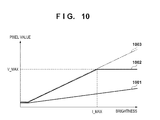
  • FIG. 10 is a graph showing the relationship between a scene brightness and a pixel value in HDR composition processing
  • FIG. 11 is a block diagram showing the functional arrangement of a capturing system according to the second embodiment.
  • FIG. 12 is a view showing an example of capturing condition information for geometric correction
  • FIG. 13 is a flowchart showing capturing processing according to the second embodiment
  • FIG. 14 is a block diagram showing the functional arrangement of an image processing unit according to the second embodiment.
  • FIG. 15 is a flowchart showing image processing according to the second embodiment.
  • FIG. 16 is a block diagram showing the schematic arrangement of a capturing system according to the third embodiment.
  • a capturing system that obtains two moving images under different exposures using two cameras and performs HDR composition will be described below as an example.
  • FIG. 1 is a block diagram showing the schematic arrangement of a capturing system according to the first embodiment.
  • the number of cameras used in this embodiment is not limited to two. However, a case of using two cameras each including an independent optical system will be described as an example for the descriptive convenience.
  • the capturing system is formed by a capturing unit 201 , a capturing condition setting application 104 , an image processing unit 107 , and an image output unit 108 .
  • the capturing unit 201 is formed by a camera 101 , a camera 102 , and a half mirror 103 . Although not illustrated in FIG. 1 , the camera 101 , the camera 102 , and the half mirror 103 are attached to a camera rig.
  • the camera 101 is a low exposure capturing camera configured to capture a low brightness image under a relatively low exposure (small exposure amount).
  • the camera 102 is a high exposure capturing camera configured to capture a high brightness image under a relatively high exposure (large exposure amount).
  • the half mirror 103 divides the optical path by transmitting and reflecting light from a capturing target to enable simultaneous shooting/synchronous shooting by the cameras 101 and 102 .
  • the camera 101 includes an external or internal neutral density filter (ND filter).
  • ND filter neutral density filter
  • the relative exposure amounts of the cameras 101 and 102 are assumed to be controlled by the ND filter.
  • the control can be either control of a shutter speed or control of the reflectance/transmittance of the half mirror itself as long as the relationship between the relative exposure amounts of the cameras 101 and 102 can be controlled. Alternatively, the control may be done by combining them.
  • the capturing condition setting application 104 is a PC terminal or a dedicated control terminal, and includes a capturing condition setting unit 105 that sets a capturing condition for HDR composition, and a capturing condition setting unit 106 that sets a capturing condition for geometric correction.
  • the capturing condition setting unit 105 sets the capturing condition of a frame image to be used in HDR composition for each camera.
  • the capturing condition setting unit 106 sets the capturing condition of a frame image to derive a geometric correction parameter to be used for geometric correction of a moving image captured by each camera.
  • the above-described two capturing conditions include information about the exposures of the cameras, as will be described later in detail.
  • the capturing condition for geometric correction further includes information about the frame number of a target.
  • Moving image data captured by each camera is temporarily stored in a DRAM or SRAM of a PC or a dedicated board for image processing.
  • the image processing unit 107 performs geometric correction processing and HDR composition processing for the stored moving image data.
  • the image processing unit 107 may be implemented by a PC and a control program, or may be formed as a dedicated board on which an image processing circuit is mounted.
  • the image output unit 108 outputs the moving image data that has undergone the HDR composition processing as an HDR moving image file. Note that the image processing unit 107 may be configured to output moving image data before composition and information used for geometric correction together with the HDR moving image file.
  • FIG. 2 is a block diagram showing the functional arrangement of the capturing system according to the first embodiment.
  • the user sets the capturing condition for HDR moving image capturing of each camera via the capturing condition setting unit 105 .
  • the capturing condition setting unit 105 reflects the set capturing conditions on the cameras 101 and 102 .
  • the user sets the capturing condition of a frame image for geometric correction of each camera via the capturing condition setting unit 106 .
  • the capturing condition setting unit 106 reflects the set capturing conditions on the cameras 101 and 102 .
  • the capturing unit 201 including the camera 101 , the camera 102 , and the half mirror 103 executes synchronous shooting.
  • a parameter calculation unit 202 obtains moving images captured by the cameras 101 and 102 and the information of the capturing conditions for geometric correction (for example, the information of frame numbers), and calculates parameters necessary for geometric correction.
  • a geometric correction processing unit 203 executes geometric correction processing for at least one of the moving images captured by the cameras 101 and 102 based on the calculated parameters.
  • An HDR composition processing unit 204 performs HDR composition processing for the moving image after the geometric correction processing.
  • the moving image that has undergone the HDR composition processing by the HDR composition processing unit 204 is output as a moving image file from the image output unit 108 .
  • FIG. 3 is a flowchart showing processing according to the first embodiment.
  • step S 301 the capturing condition setting unit 105 sets the capturing conditions of frame images for HDR composition based on an operation from the user.
  • step S 302 the capturing condition setting unit 106 sets the capturing conditions of frame images for geometric correction based on an operation from the user.
  • the capturing conditions include exposure conditions such as a shutter speed, an f-number, and an ND filter, as will be described later in detail with reference to FIGS. 4 and 5 .
  • step S 303 the capturing condition setting units 105 and 106 record the HDR composition capturing conditions and the geometric correction capturing conditions in, for example, the internal memories of the cameras 101 and 102 .
  • step S 304 the capturing unit 201 executes synchronous shooting using the cameras 101 and 102 based on the capturing conditions set in step S 303 .
  • FIG. 8 is a view showing an example of moving images including a geometric correction frame. That is, FIG. 8 is a view schematically showing moving image data captured based on the capturing conditions set in steps S 301 an S 302 .
  • Moving image data 800 a exemplarily represents moving image data captured by the camera 101
  • moving image data 800 b exemplarily represents moving image data captured by the camera 102
  • n is the frame number.
  • step S 305 the parameter calculation unit 202 obtains a frame number designated as a geometric correction frame from the capturing unit 201 based on the information of the geometric correction capturing condition set in step S 302 .
  • step S 306 the parameter calculation unit 202 extracts a frame image corresponding to the obtained frame number from each of the moving image data captured by the cameras 101 and 102 , thereby calculating geometric correction parameters.
  • step S 307 the geometric correction processing unit 203 executes geometric correction processing for the frames other than the geometric correction frame using the calculated geometric correction parameters. Note that the geometric correction processing can be done using an arbitrary known method and is performed for at least one of the moving image data captured by the cameras 101 and 102 .
  • step S 308 the HDR composition processing unit 204 executes HDR composition processing for the moving image data that has undergone the geometric correction processing in step S 307 .
  • a position shift of an object image may occur depending on the attachment accuracy of each camera.
  • FIG. 6 is a view for explaining a shift of a camera posture.
  • a posture state 600 a shows a correct camera posture.
  • a posture state 600 b represents a case in which the camera 101 is placed in a posture shifted from a correct posture (the dotted line in FIG. 6 ).
  • the position shift direction or position shift amount changes every time the camera attaching operation is performed.
  • FIG. 7 is a view showing an example of moving images captured in a state in which the camera posture represented by the posture state 600 b is shifted.
  • n is the frame number.
  • Moving image data 700 a represents a moving image captured by the camera 101
  • moving image data 700 b represents a moving image captured by the camera 102 .
  • geometric correction is performed before the HDR composition processing is performed.
  • well-known affine transformation can be used in general.
  • a transformation matrix as a geometric correction parameter needs to be obtained from the captured image. Note that the method of geometric correction need not always be affine transformation, and any other geometric correction method such as Helmert transformation may be used.
  • Points A, B, and C in the moving image data 700 b are examples of feature points in the image captured by the camera 102 .
  • a known method of extracting a feature point based on brightness gradient information can be used. For example, SIFT (Scale Invariant Feature Transform) or HOG (Histogram of Oriented Gradients) can be used.
  • the capturing condition of a frame image used to derive the geometric correction parameter for geometric correction is set independently of the capturing condition for HDR composition.
  • the geometric correction parameter transformation matrix
  • FIG. 4 is a view showing an example of a GUI (Graphical User Interface) configured to set a capturing condition for HDR composition by the capturing condition setting unit 105 .
  • the user sets ON/OFF of checkboxes of capturing condition setting in accordance with the number of connected cameras. For “camera body No.”, a camera as a capturing condition setting target is set.
  • a form is shown here in which the capturing condition setting unit 105 automatically recognizes connected cameras and causes the user to select a setting target camera in a pull-down menu.
  • a form that causes the user to directly input “camera body No.” to a text box is also usable.
  • the capturing condition setting unit 105 reflects the set capturing conditions on the cameras 101 and 102 .
  • the shutter speed, the f-number, the frame rate, and the ISO speed are set to the same values for the cameras 101 and 102 .
  • a 6-stop ND filter (1 ⁇ 8 exposure amount) is set only for the camera 101 (camera body No. 101 ).
  • FIG. 5 is a view showing an example of a GUI configured to set a capturing condition for geometric correction by the capturing condition setting unit 106 . Differences from the example shown in FIG. 4 are the settings of “frame number” and “reference camera body No.”
  • a frame number to capture a geometric correction frame image is designated.
  • an example in which only one frame is set is shown. However, a plurality of frames may be set.
  • the period (for example, 10 frames) of frame numbers to capture geometric correction images may be set.
  • reference camera body No. a camera that captures a reference image in obtaining a transformation matrix is designated.
  • the shutter speed, the f-number, the frame rate, and the ISO speed are set to the same values for the cameras 101 and 102 . Additionally, unlike the capturing conditions for the HDR moving image capturing shown in FIG. 4 , the ND filter of the camera 101 is set to “none”.
  • FIG. 8 is a view showing an example of moving images captured under the capturing conditions shown in FIGS. 4 and 5 .
  • the parameter calculation unit 202 extracts, via the camera, the information of the frame number (the frame number in FIG. 5 ) set by the capturing condition setting unit 106 .
  • the parameter calculation unit 202 also extracts a frame image corresponding to the frame number from each camera.
  • the points A′, B′, and C′ in the moving image data 800 a are points corresponding to the points A, B, and C in the moving image data 800 b .
  • the feature point extraction accuracy improves.
  • a geometric correction parameter transformation matrix
  • As a captured image serving as a reference when obtaining the transformation matrix an image of the camera set to “reference camera body No.” in the GUI of FIG. 5 is used.
  • geometric correction affine transformation
  • the frame number of the geometric correction frame is “1”.
  • the geometric correction frame need not always be the top frame, and may be a frame halfway through the moving image or the final frame. A plurality of frames may be selected. A text file in which a geometric correction frame number is set in advance may be loaded.
  • FIG. 9 is a view for explaining the position of a geometric correction frame in moving image data. A detailed example of a geometric correction application method will be described with reference to FIG. 9 .
  • a position setting 900 a shows a case in which only the first frame on the top is selected as a geometric correction frame. In this case, using a geometric correction parameter calculated using the first frame, geometric correction processing is performed for the second and subsequent frames. Note that when performing HDR composition, the first frame may be deleted, or the first frame may be replaced with the second frame.
  • a position setting 900 b shows a case in which only the final 10th frame is selected as a geometric correction frame.
  • geometric correction processing is performed for the first to ninth frames. Note that when performing HDR composition, the 10th frame may be deleted, or the 10th frame may be replaced with the 9th frame.
  • a position setting 900 c shows a case in which only the fifth frame that is a frame halfway through is selected as a geometric correction frame.
  • geometric correction processing is performed for the first to fourth frames and the sixth to 10th frames.
  • the fifth frame is generated by, for example, averaging the images of the fourth and sixth frames.
  • the fifth frame can be generated either before HDR composition or after composition.
  • a position setting 900 d shows a case in which a plurality of frames halfway through are selected as geometric correction frames.
  • geometric correction parameters are calculated using the second and sixth frames.
  • geometric correction processing is performed for the third to fifth frames.
  • geometric correction processing is performed for the seventh to 10th frames.
  • geometric correction processing is performed using the geometric correction parameter calculated using the second frame.
  • the second frame is generated by, for example, averaging the images of the first and third frames before HDR composition.
  • the sixth frame is generated by, for example, averaging the images of the fifth and seventh frames.
  • a moving image file formed by the image frames that have undergone the geometric correction processing is output, and the geometric correction frames are not recorded in the moving image file 1 to be output.
  • an appropriate exposure may be obtained in advance by pre-capturing before actual capturing, and the exposure of each camera may be set to the appropriate exposure as the geometric correction frame capturing condition.
  • a pre-capturing mode is provided, and the appropriate exposure condition is automatically reflected on the actual capturing.
  • a plurality of frames may be set as geometric correction frames, capturing of the plurality of geometric correction frames may be performed under different exposures, and geometric correction may be performed using frames with little shadow-detail loss or highlight-detail loss.
  • only a frame number or only a condition concerning exposure may be set, unlike the example shown in FIG. 5 .
  • setting of only a frame number or only a condition concerning exposure may be permitted.
  • capturing is performed by setting the exposure of the geometric correction frame of the camera on the low exposure capturing side to the exposure of the camera on the high exposure capturing side.
  • capturing may be done under a preset exposure higher than an exposure expected to cause shadow-detail loss.
  • a geometric correction frame number is held in the capturing system in advance, and capturing is performed under an exposure set in the frame number.
  • the geometric correction frame number extraction method in this case, preceding and subsequent frames are compared, and a frame in which the change in average brightness of the frame image is larger than a predetermined value is extracted. For example, a frame having a relatively high brightness is extracted.
  • FIG. 10 is a graph showing the relationship between a scene brightness and a pixel value in HDR composition processing.
  • an arbitrary known HDR composition processing method can be used for HDR composition by the HDR composition processing unit 204 .
  • a curve 1001 represents the relationship between the brightness and the pixel value in exposure setting of the camera 101
  • a curve 1002 represents the relationship between the brightness and the pixel value in exposure setting of the camera 102 .
  • saturation occurs at a brightness I_MAX more than a recordable maximum pixel value V_MAX.
  • V_MAX a recordable maximum pixel value
  • pixel data of the camera 102 is used in the range where the brightness is equal to or lower than I_MAX.
  • a value obtained by multiplying the pixel data of the camera 101 by a digital gain is used in the range where the brightness exceeds I_MAX.
  • a curve 1003 represents the relationship between the pixel value and a brightness obtained by multiplying the curve 1001 by the digital gain. That is, the characteristic of the curve 1002 is used in the brightness range of I_MAX or less, and the characteristic of the curve 1003 is used in the brightness range higher than I_MAX.
  • capturing conditions for geometric correction are set separately from capturing conditions for HDR composition.
  • a geometric correction parameter is derived based on a pair of frame images captured under the set capturing conditions for geometric correction. It is therefore possible to obtain a high-quality HDR-combined image while suppressing degradation caused by a position shift.
  • the arrangement according to the above-described first embodiment may be applied to panoramic composition processing (so-called stitching processing) of generating a wide-range (high-resolution) panoramic moving image by combining moving images captured by a plurality of cameras.
  • panoramic composition processing so-called stitching processing
  • capturing is performed using a plurality of cameras such that capturing regions partially overlap, and geometric correction processing is performed to suppress a shift by camera placement in the overlap region. Even in this processing, a corresponding point search is performed, and geometric correction is performed. Hence, if shadow-detail loss or highlight-detail loss occurs in the overlap region, the correction accuracy lowers.
  • a geometric correction frame is set, the frame is captured under an exposure different from that in the actual capturing. Accordingly, the corresponding point search accuracy can be improved by the geometric correction frame, and as a result, the geometric correction accuracy can be improved.
  • FIG. 11 is a block diagram showing the functional arrangement of a capturing system according to the second embodiment.
  • a capturing condition setting unit 105 receives a capturing condition for HDR moving image capturing of each camera from the user and reflects the capturing conditions on cameras 101 and 102 .
  • a capturing condition setting unit 106 receives a capturing condition for geometric correction processing of each camera from the user and reflects the capturing conditions on the cameras 101 and 102 .
  • a capturing unit 201 executes synchronous shooting using the cameras 101 and 102 based on the set capturing conditions. Moving images captured by the cameras 101 and 102 and the information of the geometric correction capturing conditions are sent to an image recording unit 1101 and recorded as files.
  • the image recording unit 1101 controls storage to store them as files suitable for the storage unit.
  • the storage unit is, for example, a dedicated recorder connected to the camera 101 or 102 , a nonvolatile medium such as a memory card, or the HDD of a PC or the like.
  • FIG. 12 is a view showing an example of capturing condition information for geometric correction.
  • capturing condition information set by the geometric correction capturing condition setting unit shown in FIG. 5 is recorded.
  • the capturing condition information may be saved as a text file separated from the moving image data or recorded as header information of the moving image data captured by the cameras 101 and 102 .
  • FIG. 13 is a flowchart showing capturing processing according to the second embodiment.
  • step S 1301 the capturing condition setting unit 105 receives the setting of the capturing condition for HDR composition from the user.
  • the capturing condition setting unit 106 receives the setting of the capturing condition for geometric correction from the user.
  • step S 1303 the capturing condition setting units 105 and 106 set the set HDR composition capturing condition and the geometric correction capturing condition in each camera.
  • step S 1304 the capturing unit 201 executes synchronous shooting based on the set capturing conditions.
  • step S 1305 the image recording unit 1101 records captured moving image data and the capturing condition information.
  • FIG. 14 is a block diagram showing the functional arrangement of an image processing unit according to the second embodiment.
  • An image input unit 1401 obtains a plurality of moving image files as the processing target and capturing condition information from the image recording unit 1101 .
  • the image input unit 1401 is, for example, an application in a PC or an application in a dedicated apparatus in which an image processing circuit is mounted.
  • the user inputs the moving image data of the processing target and the capturing condition information on this application. Note that if the capturing condition information is recorded in the header of the moving image data or the like, only the moving image data is selected.
  • a parameter calculation unit 202 calculates a geometric correction parameter based on the input moving image data and the capturing condition information.
  • a geometric correction processing unit 203 executes geometric correction processing of the input moving image data based on the calculated geometric correction parameter.
  • An HDR composition processing unit 204 performs HDR composition processing for the moving image data after the geometric correction processing.
  • An image output unit 108 outputs the moving image data that has undergone the HDR composition processing as an HDR moving image file.
  • FIG. 15 is a flowchart showing image processing according to the second embodiment.
  • step S 1501 the image input unit 1401 inputs moving image data of a processing target and capturing condition information based on a user instruction.
  • step S 1502 the parameter calculation unit 202 extracts a frame number designated as a geometric correction frame from the input capturing condition information.
  • step S 1503 the parameter calculation unit 202 calculates a geometric correction parameter using a frame image corresponding to the extracted frame number.
  • step S 1504 the geometric correction processing unit 203 executes geometric correction processing using the calculated geometric correction parameter.
  • step S 1505 the HDR composition processing unit 204 executes HDR composition processing based on the moving image data that has undergone the geometric correction.
  • step S 1506 the image output unit 108 outputs the moving image data that has undergone the HDR composition processing as an HDR moving image file.
  • capturing is performed by setting capturing conditions for geometric correction separately from capturing conditions for HDR composition. Captured data is recorded in the recording unit together with the capturing condition information.
  • the image processing apparatus specifies a pair of frame images captured under the capturing conditions for geometric correction based on the capturing condition information recorded in the recording unit, and derives a geometric correction parameter. It is therefore possible to obtain a high-quality HDR-combined image whose degradation caused by a position shift is suppressed.
  • FIG. 16 is a block diagram showing the schematic arrangement of a capturing system according to the third embodiment.
  • the number of sensors used is not limited to two. However, a case of using two sensors will be described as an example for the descriptive convenience.
  • the capturing system performs synchronous shooting by two sensors that share an optical system including a lens 1602 and a prism 1605 .
  • a sensor 1603 for low exposure capturing is a sensor that performs capturing under a relatively low exposure
  • a sensor 1604 for high exposure capturing is a sensor that performs capturing under a relatively high exposure.
  • the prism 1605 transmits and reflects light from a capturing target to divide the optical path, thereby enabling simultaneous shooting/synchronous shooting by the sensors 1603 and 1604 . Even in a multi-sensor system shown in FIG. 16 , if the relative positional relationship of the optical components such as the lens, the prism, and the sensors shifts, the position shift of the object image may occur.
  • the senor 1603 includes an external or internal neutral density filter (ND filter).
  • ND filter neutral density filter
  • the relative exposure amounts of the sensors 1603 and 1604 are assumed to be controlled by the ND filter.
  • the control can be control of a shutter speed as long as the relationship between the relative exposure amounts of the sensors 1603 and 1604 can be controlled.
  • a capturing condition setting application 104 is a PC terminal or a dedicated control terminal, and includes a capturing condition setting unit 105 for HDR composition, and a capturing condition setting unit 106 for geometric correction.
  • the capturing condition setting unit 105 sets a capturing condition for HDR moving image capturing for each sensor.
  • the capturing condition setting unit 106 sets a capturing condition of a frame image used to calculate a geometric correction parameter.
  • These capturing conditions include information about exposure, as in the first embodiment.
  • the capturing condition for geometric correction further includes information about the frame number of a target.
  • An image processing unit 107 performs geometric correction processing and HDR composition processing for moving image data captured by each sensor.
  • An image output unit 108 outputs the HDR moving image data generated by performing the HDR composition processing as an HDR moving image file.
  • the third embodiment even in the multi-sensor system using two sensors that share the optical system, it is possible to obtain a high-quality HDR-combined image while suppressing degradation caused by a position shift.
  • Embodiment(s) of the present invention can also be realized by a computer of a system or apparatus that reads out and executes computer executable instructions (e.g., one or more programs) recorded on a storage medium (which may also be referred to more fully as a ‘non-transitory computer-readable storage medium’) to perform the functions of one or more of the above-described embodiment(s) and/or that includes one or more circuits (e.g., application specific integrated circuit (ASIC)) for performing the functions of one or more of the above-described embodiment(s), and by a method performed by the computer of the system or apparatus by, for example, reading out and executing the computer executable instructions from the storage medium to perform the functions of one or more of the above-described embodiment(s) and/or controlling the one or more circuits to perform the functions of one or more of the above-described embodiment(s).
  • computer executable instructions e.g., one or more programs
  • a storage medium which may also be referred to more fully as a
  • the computer may comprise one or more processors (e.g., central processing unit (CPU), micro processing unit (MPU)) and may include a network of separate computers or separate processors to read out and execute the computer executable instructions.
  • the computer executable instructions may be provided to the computer, for example, from a network or the storage medium.
  • the storage medium may include, for example, one or more of a hard disk, a random-access memory (RAM), a read only memory (ROM), a storage of distributed computing systems, an optical disk (such as a compact disc (CD), digital versatile disc (DVD), or Blu-ray Disc (BD)TM), a flash memory device, a memory card, and the like.

Landscapes

  • Engineering & Computer Science (AREA)
  • Multimedia (AREA)
  • Signal Processing (AREA)
  • Physics & Mathematics (AREA)
  • General Physics & Mathematics (AREA)
  • Theoretical Computer Science (AREA)
  • Human Computer Interaction (AREA)
  • Studio Devices (AREA)
  • Cameras In General (AREA)
  • Stereoscopic And Panoramic Photography (AREA)

Abstract

A capturing control apparatus, method of controlling the capturing control apparatus, and a recording medium storing a program for controlling capturing control apparatus are disclosed. The capturing control apparatus generates a high-dynamic-range moving image by combining a first moving image captured by a first capturing unit and a second moving image captured by a second capturing unit using a first capturing condition and a second capturing condition. A correction parameter is derived for correcting a position shift between a frame image included in a first moving image and a frame image included in a second moving image based on the frame image captured under the second capturing condition. The capturing control apparatus performs geometric correction processing for at least one of the first moving image and the second moving image using the correction parameter, and combines the corrected first moving image and the corrected second moving image.

Description

BACKGROUND OF THE INVENTION Field of the Invention
The present invention relates to an image processing technique concerning image composition.
Description of the Related Art
In a capturing apparatus such as a digital camera, if an object has a wide brightness range, shadow-detail loss or highlight-detail loss may occur depending on the dynamic range of a solid-state image sensing element such as a CCD or CMOS sensor. There is known a high-dynamic-range (HDR) composition technology that combines a plurality of images captured under different exposures, thereby generating an image in which shadow-detail loss or highlight-detail loss is suppressed. Japanese Patent Laid-Open No. 11-98418 (patent literature 1) discloses a technique of HDR-combining a plurality of images captured by, using a plurality of sensors, performing synchronous shooting of images divided using a prism under different exposures. Japanese Patent Laid-Open No. 2008-109176 (patent literature 2) discloses a technique of correcting a position shift between a plurality of images and HDR-combining them, thereby suppressing image degradation of a combined image caused by the position shift between the plurality of images.
In a high brightness image to be used in HDR composition, highlight-detail loss readily occurs. In a low brightness image, shadow-detail loss readily occurs. If highlight-detail loss or shadow-detail loss occurs in these images, the accuracy of corresponding point search between images for position shift correction lowers. It is therefore impossible to appropriately apply position shift correction as described in patent literature 2.
SUMMARY OF THE INVENTION
According to one aspect of the present invention, a capturing control apparatus for generating a high-dynamic-range (HDR) moving image by combining a first moving image captured by a first capturing unit and a second moving image captured by a second capturing unit, comprises: a first setting unit configured to set a first capturing condition in the first capturing unit and the second capturing unit when capturing a frame image to be used in HDR composition; a second setting unit configured to set a second capturing condition different from the first capturing condition; a capturing control unit configured to control capturing by the first capturing unit and the second capturing unit using the first capturing condition and the second capturing condition; a deriving unit configured to derive a correction parameter used to correct a position shift between the frame image included in the first moving image and the frame image included in the second moving image based on the frame image captured under the second capturing condition, which is included in each of the first moving image and the second moving image obtained by capturing control of the capturing control unit; and a combining unit configured to perform geometric correction processing for at least one of the first moving image and the second moving image using the correction parameter, and after the geometric correction processing, combine the first moving image and the second moving image.
The present invention provides a technique of enabling more preferable combined image generation.
Further features of the present invention will become apparent from the following description of exemplary embodiments (with reference to the attached drawings).
BRIEF DESCRIPTION OF THE DRAWINGS
The accompanying drawings, which are incorporated in and constitute a part of the specification, illustrate embodiments of the invention and, together with the description, serve to explain the principles of the invention.
FIG. 1 is a block diagram showing the schematic arrangement of a capturing system according to the first embodiment;
FIG. 2 is a block diagram showing the functional arrangement of the capturing system according to the first embodiment;
FIG. 3 is a flowchart showing processing according to the first embodiment;
FIG. 4 is a view showing an example of a GUI configured to set a capturing condition for HDR composition;
FIG. 5 is a view showing an example of a GUI configured to set a capturing condition for geometric correction;
FIG. 6 is a view for explaining a shift of a camera posture;
FIG. 7 is a view showing an example of moving images captured in a state in which the camera posture is shifted;
FIG. 8 is a view showing an example of moving images including a geometric correction frame;
FIG. 9 is a view for explaining the position of a geometric correction frame in moving image data;
FIG. 10 is a graph showing the relationship between a scene brightness and a pixel value in HDR composition processing;
FIG. 11 is a block diagram showing the functional arrangement of a capturing system according to the second embodiment;
FIG. 12 is a view showing an example of capturing condition information for geometric correction;
FIG. 13 is a flowchart showing capturing processing according to the second embodiment;
FIG. 14 is a block diagram showing the functional arrangement of an image processing unit according to the second embodiment;
FIG. 15 is a flowchart showing image processing according to the second embodiment; and
FIG. 16 is a block diagram showing the schematic arrangement of a capturing system according to the third embodiment.
DESCRIPTION OF THE EMBODIMENTS
Preferred embodiments of the present invention will now be described in detail with reference to the accompanying drawings. Note that the embodiments to be described below are merely examples and are not intended to limit the scope of the present invention.
First Embodiment
As the first embodiment of a capturing control apparatus according to the present invention, a capturing system that obtains two moving images under different exposures using two cameras and performs HDR composition will be described below as an example.
Capturing System Configuration
FIG. 1 is a block diagram showing the schematic arrangement of a capturing system according to the first embodiment. The number of cameras used in this embodiment is not limited to two. However, a case of using two cameras each including an independent optical system will be described as an example for the descriptive convenience. The capturing system is formed by a capturing unit 201, a capturing condition setting application 104, an image processing unit 107, and an image output unit 108.
The capturing unit 201 is formed by a camera 101, a camera 102, and a half mirror 103. Although not illustrated in FIG. 1, the camera 101, the camera 102, and the half mirror 103 are attached to a camera rig.
The camera 101 is a low exposure capturing camera configured to capture a low brightness image under a relatively low exposure (small exposure amount). The camera 102 is a high exposure capturing camera configured to capture a high brightness image under a relatively high exposure (large exposure amount). The half mirror 103 divides the optical path by transmitting and reflecting light from a capturing target to enable simultaneous shooting/synchronous shooting by the cameras 101 and 102. Although not illustrated, the camera 101 includes an external or internal neutral density filter (ND filter). Here, the relative exposure amounts of the cameras 101 and 102 are assumed to be controlled by the ND filter. Note that the control can be either control of a shutter speed or control of the reflectance/transmittance of the half mirror itself as long as the relationship between the relative exposure amounts of the cameras 101 and 102 can be controlled. Alternatively, the control may be done by combining them.
In the capturing system, the cameras 101 and 102 are connected to each other by a GenLock (Generator Lock) port so as to be capable of synchronous shooting. The capturing condition setting application 104 is a PC terminal or a dedicated control terminal, and includes a capturing condition setting unit 105 that sets a capturing condition for HDR composition, and a capturing condition setting unit 106 that sets a capturing condition for geometric correction.
The capturing condition setting unit 105 sets the capturing condition of a frame image to be used in HDR composition for each camera. The capturing condition setting unit 106 sets the capturing condition of a frame image to derive a geometric correction parameter to be used for geometric correction of a moving image captured by each camera. The above-described two capturing conditions include information about the exposures of the cameras, as will be described later in detail. In addition, the capturing condition for geometric correction further includes information about the frame number of a target.
Moving image data captured by each camera is temporarily stored in a DRAM or SRAM of a PC or a dedicated board for image processing. The image processing unit 107 performs geometric correction processing and HDR composition processing for the stored moving image data. The image processing unit 107 may be implemented by a PC and a control program, or may be formed as a dedicated board on which an image processing circuit is mounted. The image output unit 108 outputs the moving image data that has undergone the HDR composition processing as an HDR moving image file. Note that the image processing unit 107 may be configured to output moving image data before composition and information used for geometric correction together with the HDR moving image file.
Capturing Processing Configuration
FIG. 2 is a block diagram showing the functional arrangement of the capturing system according to the first embodiment. As described with reference to FIG. 1, the user sets the capturing condition for HDR moving image capturing of each camera via the capturing condition setting unit 105. The capturing condition setting unit 105 reflects the set capturing conditions on the cameras 101 and 102. Similarly, the user sets the capturing condition of a frame image for geometric correction of each camera via the capturing condition setting unit 106. The capturing condition setting unit 106 reflects the set capturing conditions on the cameras 101 and 102.
Based on the set capturing conditions, the capturing unit 201 including the camera 101, the camera 102, and the half mirror 103 executes synchronous shooting. A parameter calculation unit 202 obtains moving images captured by the cameras 101 and 102 and the information of the capturing conditions for geometric correction (for example, the information of frame numbers), and calculates parameters necessary for geometric correction. A geometric correction processing unit 203 executes geometric correction processing for at least one of the moving images captured by the cameras 101 and 102 based on the calculated parameters. An HDR composition processing unit 204 performs HDR composition processing for the moving image after the geometric correction processing. The moving image that has undergone the HDR composition processing by the HDR composition processing unit 204 is output as a moving image file from the image output unit 108.
Capturing Processing Procedure
FIG. 3 is a flowchart showing processing according to the first embodiment.
In step S301, the capturing condition setting unit 105 sets the capturing conditions of frame images for HDR composition based on an operation from the user. In step S302, the capturing condition setting unit 106 sets the capturing conditions of frame images for geometric correction based on an operation from the user. The capturing conditions include exposure conditions such as a shutter speed, an f-number, and an ND filter, as will be described later in detail with reference to FIGS. 4 and 5.
In step S303, the capturing condition setting units 105 and 106 record the HDR composition capturing conditions and the geometric correction capturing conditions in, for example, the internal memories of the cameras 101 and 102. In step S304, the capturing unit 201 executes synchronous shooting using the cameras 101 and 102 based on the capturing conditions set in step S303.
FIG. 8 is a view showing an example of moving images including a geometric correction frame. That is, FIG. 8 is a view schematically showing moving image data captured based on the capturing conditions set in steps S301 an S302. Moving image data 800 a exemplarily represents moving image data captured by the camera 101, moving image data 800 b exemplarily represents moving image data captured by the camera 102, and n is the frame number. In the moving image data 800 a, the frame of n=1 is a geometric correction frame, which is captured under a high exposure as compared to the remaining frames. That is, the frame of n=1 is a frame captured under a geometric correction capturing condition for suppressing shadow-detail loss or highlight-detail loss to improve the accuracy of corresponding point search.
In step S305, the parameter calculation unit 202 obtains a frame number designated as a geometric correction frame from the capturing unit 201 based on the information of the geometric correction capturing condition set in step S302. In step S306, the parameter calculation unit 202 extracts a frame image corresponding to the obtained frame number from each of the moving image data captured by the cameras 101 and 102, thereby calculating geometric correction parameters.
In step S307, the geometric correction processing unit 203 executes geometric correction processing for the frames other than the geometric correction frame using the calculated geometric correction parameters. Note that the geometric correction processing can be done using an arbitrary known method and is performed for at least one of the moving image data captured by the cameras 101 and 102. In step S308, the HDR composition processing unit 204 executes HDR composition processing for the moving image data that has undergone the geometric correction processing in step S307.
Details of Geometric Correction Processing
When a plurality of cameras are used as described above, a position shift of an object image may occur depending on the attachment accuracy of each camera.
FIG. 6 is a view for explaining a shift of a camera posture. A posture state 600 a shows a correct camera posture. A posture state 600 b represents a case in which the camera 101 is placed in a posture shifted from a correct posture (the dotted line in FIG. 6). In addition, the position shift direction or position shift amount changes every time the camera attaching operation is performed.
FIG. 7 is a view showing an example of moving images captured in a state in which the camera posture represented by the posture state 600 b is shifted. In FIG. 7, n is the frame number. Moving image data 700 a represents a moving image captured by the camera 101, and moving image data 700 b represents a moving image captured by the camera 102.
In the moving image data 700 a, a position shift and deformation of the object occur, as compared to the moving image data 700 b. Hence, if HDR composition processing is performed using the two moving images, a multiple image is generated by the position shift and deformation of the object, resulting in lower image quality.
To prevent this, geometric correction is performed before the HDR composition processing is performed. As the method of geometric correction, well-known affine transformation can be used in general. To correct the shift or distortion that changes in every camera attachment, a transformation matrix as a geometric correction parameter needs to be obtained from the captured image. Note that the method of geometric correction need not always be affine transformation, and any other geometric correction method such as Helmert transformation may be used.
To obtain the transformation matrix of affine transformation, it is necessary to search for the coordinates of corresponding points between the images. However, if shadow-detail loss or highlight-detail loss occurs in the images, the detection accuracy in the corresponding point search lowers.
Points A, B, and C in the moving image data 700 b are examples of feature points in the image captured by the camera 102. To extract the feature points, a known method of extracting a feature point based on brightness gradient information can be used. For example, SIFT (Scale Invariant Feature Transform) or HOG (Histogram of Oriented Gradients) can be used.
The same feature point extraction needs to be performed even for the moving image data 700 a that is a low brightness image captured by the camera 101. However, shadow-detail loss (tones of a predetermined brightness or less are lost) may occur in the low brightness image, as indicated by the moving image data 700 a, and an image with a small brightness gradient may be obtained. Even if image processing for contrast enhancement is performed, an image including much noise is obtained. As a result, if SIFT or HOG configured to extract a feature point based on the brightness gradient information is used, the accuracy of feature point extraction lowers. Points A′ and C′ in the moving image data 700 a exemplarily represent occurrence of a position shift due to lowering of the detection accuracy. Also shown is that a point B′ corresponding to the point B cannot be detected in the moving image data 700 a. An inaccurate geometric correction parameter (transformation matrix) is calculated using the corresponding point detection result. As a result, the accuracy of geometric correction also lowers.
In the first embodiment, the capturing condition of a frame image used to derive the geometric correction parameter for geometric correction is set independently of the capturing condition for HDR composition. The geometric correction parameter (transformation matrix) is calculated based on a pair of frame images captured under the feature point.
FIG. 4 is a view showing an example of a GUI (Graphical User Interface) configured to set a capturing condition for HDR composition by the capturing condition setting unit 105. The user sets ON/OFF of checkboxes of capturing condition setting in accordance with the number of connected cameras. For “camera body No.”, a camera as a capturing condition setting target is set. A form is shown here in which the capturing condition setting unit 105 automatically recognizes connected cameras and causes the user to select a setting target camera in a pull-down menu. A form that causes the user to directly input “camera body No.” to a text box is also usable.
To reduce the effort of the user or reduce setting errors, even items (the shutter speed, the f-number, and the ND filter) to control the exposure of the camera are preferably automatically recognized and set in pull-down menus. The GUI shown in FIG. 4 is configured to set capturing conditions such as a frame rate and an ISO speed other than the items to control the exposure. If a “setting complete” button in the GUI is pressed, the capturing condition setting unit 105 reflects the set capturing conditions on the cameras 101 and 102.
Note that in FIG. 4, the shutter speed, the f-number, the frame rate, and the ISO speed are set to the same values for the cameras 101 and 102. However, a 6-stop ND filter (⅛ exposure amount) is set only for the camera 101 (camera body No. 101).
FIG. 5 is a view showing an example of a GUI configured to set a capturing condition for geometric correction by the capturing condition setting unit 106. Differences from the example shown in FIG. 4 are the settings of “frame number” and “reference camera body No.”
In the setting of “frame number”, a frame number to capture a geometric correction frame image is designated. Here, an example in which only one frame is set is shown. However, a plurality of frames may be set. The period (for example, 10 frames) of frame numbers to capture geometric correction images may be set. In the setting of “reference camera body No.”, a camera that captures a reference image in obtaining a transformation matrix is designated.
Note that in FIG. 5, the shutter speed, the f-number, the frame rate, and the ISO speed are set to the same values for the cameras 101 and 102. Additionally, unlike the capturing conditions for the HDR moving image capturing shown in FIG. 4, the ND filter of the camera 101 is set to “none”.
FIG. 8 is a view showing an example of moving images captured under the capturing conditions shown in FIGS. 4 and 5. When the capturing conditions as described above are set, shadow-detail loss is eliminated in the geometric correction frame (the frame of n=1 in FIG. 8). As a result, the accuracy of corresponding point search can be improved.
The parameter calculation unit 202 extracts, via the camera, the information of the frame number (the frame number in FIG. 5) set by the capturing condition setting unit 106. The parameter calculation unit 202 also extracts a frame image corresponding to the frame number from each camera.
The points A′, B′, and C′ in the moving image data 800 a are points corresponding to the points A, B, and C in the moving image data 800 b. Unlike the example of the moving image data 700 a, the feature point extraction accuracy improves. A geometric correction parameter (transformation matrix) is obtained using the corresponding points. As a captured image serving as a reference when obtaining the transformation matrix, an image of the camera set to “reference camera body No.” in the GUI of FIG. 5 is used. Using the obtained transformation matrix, geometric correction (affine transformation) is performed for the frames other than the geometric correction frame.
Note that in FIG. 5, the frame number of the geometric correction frame is “1”. However, the geometric correction frame need not always be the top frame, and may be a frame halfway through the moving image or the final frame. A plurality of frames may be selected. A text file in which a geometric correction frame number is set in advance may be loaded.
FIG. 9 is a view for explaining the position of a geometric correction frame in moving image data. A detailed example of a geometric correction application method will be described with reference to FIG. 9. Each gray frame in FIG. 9 represents a frame set as a geometric correction frame. Frames of frame numbers=1 to 10 will be referred to as a first frame to a 10th frame hereinafter.
A position setting 900 a shows a case in which only the first frame on the top is selected as a geometric correction frame. In this case, using a geometric correction parameter calculated using the first frame, geometric correction processing is performed for the second and subsequent frames. Note that when performing HDR composition, the first frame may be deleted, or the first frame may be replaced with the second frame.
A position setting 900 b shows a case in which only the final 10th frame is selected as a geometric correction frame. In this case, using a geometric correction parameter calculated using the 10th frame, geometric correction processing is performed for the first to ninth frames. Note that when performing HDR composition, the 10th frame may be deleted, or the 10th frame may be replaced with the 9th frame.
A position setting 900 c shows a case in which only the fifth frame that is a frame halfway through is selected as a geometric correction frame. In this case, using a geometric correction parameter calculated using the fifth frame, geometric correction processing is performed for the first to fourth frames and the sixth to 10th frames. Note that when performing HDR composition, the fifth frame is generated by, for example, averaging the images of the fourth and sixth frames. The fifth frame can be generated either before HDR composition or after composition.
A position setting 900 d shows a case in which a plurality of frames halfway through are selected as geometric correction frames. In this case, geometric correction parameters are calculated using the second and sixth frames. Using the geometric correction parameter calculated using the second frame, geometric correction processing is performed for the third to fifth frames. Similarly, using the geometric correction parameter calculated using the sixth frame, geometric correction processing is performed for the seventh to 10th frames. For the first frame without any geometric correction frame before the local frame, geometric correction processing is performed using the geometric correction parameter calculated using the second frame. Note that as in the case of the position setting 900 c shown in FIG. 9, the second frame is generated by, for example, averaging the images of the first and third frames before HDR composition. The sixth frame is generated by, for example, averaging the images of the fifth and seventh frames.
As described above, a moving image file formed by the image frames that have undergone the geometric correction processing is output, and the geometric correction frames are not recorded in the moving image file 1 to be output.
In the above-described example, a method has been described, in which the accuracy of corresponding point search is improved by raising the exposure of the low exposure capturing camera when capturing a scene assumed to have many shadow-detail loss regions in the geometric correction frame. Conversely, when capturing a scene assumed to have many highlight-detail loss regions, the exposure of the high exposure capturing camera is lowered.
Additionally, to improve the accuracy of corresponding point search, an appropriate exposure may be obtained in advance by pre-capturing before actual capturing, and the exposure of each camera may be set to the appropriate exposure as the geometric correction frame capturing condition. In this case, a pre-capturing mode is provided, and the appropriate exposure condition is automatically reflected on the actual capturing.
Alternatively, a plurality of frames may be set as geometric correction frames, capturing of the plurality of geometric correction frames may be performed under different exposures, and geometric correction may be performed using frames with little shadow-detail loss or highlight-detail loss.
In the geometric correction processing capturing condition setting, only a frame number or only a condition concerning exposure may be set, unlike the example shown in FIG. 5. Alternatively, as in the GUI shown in FIG. 5, setting of only a frame number or only a condition concerning exposure may be permitted.
In an arrangement that sets only a frame number, capturing is performed by setting the exposure of the geometric correction frame of the camera on the low exposure capturing side to the exposure of the camera on the high exposure capturing side. Alternatively, capturing may be done under a preset exposure higher than an exposure expected to cause shadow-detail loss.
In an arrangement that sets only a condition concerning exposure, a geometric correction frame number is held in the capturing system in advance, and capturing is performed under an exposure set in the frame number. As for the geometric correction frame number extraction method in this case, preceding and subsequent frames are compared, and a frame in which the change in average brightness of the frame image is larger than a predetermined value is extracted. For example, a frame having a relatively high brightness is extracted.
HDR Composition Processing
FIG. 10 is a graph showing the relationship between a scene brightness and a pixel value in HDR composition processing. For HDR composition by the HDR composition processing unit 204, an arbitrary known HDR composition processing method can be used.
A curve 1001 represents the relationship between the brightness and the pixel value in exposure setting of the camera 101, and a curve 1002 represents the relationship between the brightness and the pixel value in exposure setting of the camera 102. In the curve 1002, saturation occurs at a brightness I_MAX more than a recordable maximum pixel value V_MAX. In the curve 1001, although the pixel value is not saturated even if the brightness exceeds I_MAX, shadow-detail loss occurs on the low brightness side.
Considering these characteristics, in HDR composition, most simply, in the range where the brightness is equal to or lower than I_MAX, pixel data of the camera 102 is used. In the range where the brightness exceeds I_MAX, a value obtained by multiplying the pixel data of the camera 101 by a digital gain is used. Note that a curve 1003 represents the relationship between the pixel value and a brightness obtained by multiplying the curve 1001 by the digital gain. That is, the characteristic of the curve 1002 is used in the brightness range of I_MAX or less, and the characteristic of the curve 1003 is used in the brightness range higher than I_MAX.
As described above, according to the first embodiment, in the HDR capturing system using a plurality of cameras, capturing conditions for geometric correction are set separately from capturing conditions for HDR composition. A geometric correction parameter is derived based on a pair of frame images captured under the set capturing conditions for geometric correction. It is therefore possible to obtain a high-quality HDR-combined image while suppressing degradation caused by a position shift.
(Modification)
The arrangement according to the above-described first embodiment may be applied to panoramic composition processing (so-called stitching processing) of generating a wide-range (high-resolution) panoramic moving image by combining moving images captured by a plurality of cameras.
For example, when capturing a 360° panoramic image, a high brightness region where the brightness exceeds the D range of the capturing unit and a low brightness region coexist at a high possibility, and shadow-detail loss or highlight-detail loss readily occurs. To prevent this, capturing is performed using a plurality of cameras such that capturing regions partially overlap, and geometric correction processing is performed to suppress a shift by camera placement in the overlap region. Even in this processing, a corresponding point search is performed, and geometric correction is performed. Hence, if shadow-detail loss or highlight-detail loss occurs in the overlap region, the correction accuracy lowers.
As in the capturing in the form of HDR composition described above, a geometric correction frame is set, the frame is captured under an exposure different from that in the actual capturing. Accordingly, the corresponding point search accuracy can be improved by the geometric correction frame, and as a result, the geometric correction accuracy can be improved.
Second Embodiment
In the second embodiment, a method of temporarily recording a moving image file before geometric correction or HDR composition processing after capturing condition setting and capturing and separately performing image processing for the recorded image file will be described. A description of components and processing that are the same as in the first embodiment will be omitted.
Capturing System
FIG. 11 is a block diagram showing the functional arrangement of a capturing system according to the second embodiment. A capturing condition setting unit 105 receives a capturing condition for HDR moving image capturing of each camera from the user and reflects the capturing conditions on cameras 101 and 102. Similarly, a capturing condition setting unit 106 receives a capturing condition for geometric correction processing of each camera from the user and reflects the capturing conditions on the cameras 101 and 102.
A capturing unit 201 executes synchronous shooting using the cameras 101 and 102 based on the set capturing conditions. Moving images captured by the cameras 101 and 102 and the information of the geometric correction capturing conditions are sent to an image recording unit 1101 and recorded as files. The image recording unit 1101 controls storage to store them as files suitable for the storage unit. The storage unit is, for example, a dedicated recorder connected to the camera 101 or 102, a nonvolatile medium such as a memory card, or the HDD of a PC or the like.
FIG. 12 is a view showing an example of capturing condition information for geometric correction. As shown in FIG. 12, capturing condition information set by the geometric correction capturing condition setting unit shown in FIG. 5 is recorded. Note that the camera used for capturing, the composition partner camera, and the camera body No. of the reference camera are recorded together. The capturing condition information may be saved as a text file separated from the moving image data or recorded as header information of the moving image data captured by the cameras 101 and 102.
FIG. 13 is a flowchart showing capturing processing according to the second embodiment.
In step S1301, the capturing condition setting unit 105 receives the setting of the capturing condition for HDR composition from the user. In step S1302, the capturing condition setting unit 106 receives the setting of the capturing condition for geometric correction from the user.
In step S1303, the capturing condition setting units 105 and 106 set the set HDR composition capturing condition and the geometric correction capturing condition in each camera. In step S1304, the capturing unit 201 executes synchronous shooting based on the set capturing conditions. In step S1305, the image recording unit 1101 records captured moving image data and the capturing condition information.
Image Processing Apparatus
FIG. 14 is a block diagram showing the functional arrangement of an image processing unit according to the second embodiment.
An image input unit 1401 obtains a plurality of moving image files as the processing target and capturing condition information from the image recording unit 1101. The image input unit 1401 is, for example, an application in a PC or an application in a dedicated apparatus in which an image processing circuit is mounted. The user inputs the moving image data of the processing target and the capturing condition information on this application. Note that if the capturing condition information is recorded in the header of the moving image data or the like, only the moving image data is selected.
A parameter calculation unit 202 calculates a geometric correction parameter based on the input moving image data and the capturing condition information. A geometric correction processing unit 203 executes geometric correction processing of the input moving image data based on the calculated geometric correction parameter. An HDR composition processing unit 204 performs HDR composition processing for the moving image data after the geometric correction processing. An image output unit 108 outputs the moving image data that has undergone the HDR composition processing as an HDR moving image file.
FIG. 15 is a flowchart showing image processing according to the second embodiment.
In step S1501, the image input unit 1401 inputs moving image data of a processing target and capturing condition information based on a user instruction. In step S1502, the parameter calculation unit 202 extracts a frame number designated as a geometric correction frame from the input capturing condition information. In step S1503, the parameter calculation unit 202 calculates a geometric correction parameter using a frame image corresponding to the extracted frame number. In step S1504, the geometric correction processing unit 203 executes geometric correction processing using the calculated geometric correction parameter. In step S1505, the HDR composition processing unit 204 executes HDR composition processing based on the moving image data that has undergone the geometric correction. In step S1506, the image output unit 108 outputs the moving image data that has undergone the HDR composition processing as an HDR moving image file.
As described above, according to the second embodiment, in the HDR capturing system using a plurality of cameras, capturing is performed by setting capturing conditions for geometric correction separately from capturing conditions for HDR composition. Captured data is recorded in the recording unit together with the capturing condition information. The image processing apparatus specifies a pair of frame images captured under the capturing conditions for geometric correction based on the capturing condition information recorded in the recording unit, and derives a geometric correction parameter. It is therefore possible to obtain a high-quality HDR-combined image whose degradation caused by a position shift is suppressed.
Third Embodiment
In the third embodiment, a form in which images divided using a prism or the like are captured by synchronous shooting using a plurality of sensors and HDR-combined will be described. A description of components and processing contents that are the same as in the first embodiment will be omitted, and different components and processes will be explained.
Capturing System
FIG. 16 is a block diagram showing the schematic arrangement of a capturing system according to the third embodiment. The number of sensors used is not limited to two. However, a case of using two sensors will be described as an example for the descriptive convenience.
The capturing system performs synchronous shooting by two sensors that share an optical system including a lens 1602 and a prism 1605. A sensor 1603 for low exposure capturing is a sensor that performs capturing under a relatively low exposure, and a sensor 1604 for high exposure capturing is a sensor that performs capturing under a relatively high exposure. The prism 1605 transmits and reflects light from a capturing target to divide the optical path, thereby enabling simultaneous shooting/synchronous shooting by the sensors 1603 and 1604. Even in a multi-sensor system shown in FIG. 16, if the relative positional relationship of the optical components such as the lens, the prism, and the sensors shifts, the position shift of the object image may occur.
Although not illustrated, the sensor 1603 includes an external or internal neutral density filter (ND filter). Here, the relative exposure amounts of the sensors 1603 and 1604 are assumed to be controlled by the ND filter. Note that the control can be control of a shutter speed as long as the relationship between the relative exposure amounts of the sensors 1603 and 1604 can be controlled.
A capturing condition setting application 104 is a PC terminal or a dedicated control terminal, and includes a capturing condition setting unit 105 for HDR composition, and a capturing condition setting unit 106 for geometric correction. The capturing condition setting unit 105 sets a capturing condition for HDR moving image capturing for each sensor. The capturing condition setting unit 106 sets a capturing condition of a frame image used to calculate a geometric correction parameter. These capturing conditions include information about exposure, as in the first embodiment. In addition, the capturing condition for geometric correction further includes information about the frame number of a target.
An image processing unit 107 performs geometric correction processing and HDR composition processing for moving image data captured by each sensor. An image output unit 108 outputs the HDR moving image data generated by performing the HDR composition processing as an HDR moving image file.
As described above, according to the third embodiment, even in the multi-sensor system using two sensors that share the optical system, it is possible to obtain a high-quality HDR-combined image while suppressing degradation caused by a position shift.
Other Embodiments
Embodiment(s) of the present invention can also be realized by a computer of a system or apparatus that reads out and executes computer executable instructions (e.g., one or more programs) recorded on a storage medium (which may also be referred to more fully as a ‘non-transitory computer-readable storage medium’) to perform the functions of one or more of the above-described embodiment(s) and/or that includes one or more circuits (e.g., application specific integrated circuit (ASIC)) for performing the functions of one or more of the above-described embodiment(s), and by a method performed by the computer of the system or apparatus by, for example, reading out and executing the computer executable instructions from the storage medium to perform the functions of one or more of the above-described embodiment(s) and/or controlling the one or more circuits to perform the functions of one or more of the above-described embodiment(s). The computer may comprise one or more processors (e.g., central processing unit (CPU), micro processing unit (MPU)) and may include a network of separate computers or separate processors to read out and execute the computer executable instructions. The computer executable instructions may be provided to the computer, for example, from a network or the storage medium. The storage medium may include, for example, one or more of a hard disk, a random-access memory (RAM), a read only memory (ROM), a storage of distributed computing systems, an optical disk (such as a compact disc (CD), digital versatile disc (DVD), or Blu-ray Disc (BD)™), a flash memory device, a memory card, and the like.
While the present invention has been described with reference to exemplary embodiments, it is to be understood that the invention is not limited to the disclosed exemplary embodiments. The scope of the following claims is to be accorded the broadest interpretation so as to encompass all such modifications and equivalent structures and functions.
This application claims the benefit of Japanese Patent Application No. 2016-187474, filed Sep. 26, 2016, which is hereby incorporated by reference herein in its entirety.

Claims (11)

What is claimed is:
1. A capturing control apparatus that generates a high-dynamic-range (HDR) moving image by combining a first moving image captured by a first capturing unit and a second moving image captured by a second capturing unit, the capturing control apparatus comprising:
a memory configured to store instructions; and
a processor configured to execute the instructions stored in memory to provide:
a first setting unit configured to set a first capturing condition in the first capturing unit and the second capturing unit when capturing a first frame image pair to be used in HDR composition;
a second setting unit configured to set a second capturing condition, different from the first capturing condition, in the first capturing unit and the second capturing unit when capturing a second frame image pair to be used in deriving a geometric correction parameter;
a capturing control unit configured to control capturing of the first moving image by the first capturing unit and the second moving image by the second capturing unit by capturing at least one first frame image pair using the first capturing condition and at least one second frame image pair using the second capturing condition;
a deriving unit configured to derive the geometric correction parameter used to correct a position shift between a frame image of the first frame image pair included in the first moving image and another frame image of the first frame image pair included in the second moving image based on frame images of the second frame image pair captured under the second capturing condition, one frame image of the second frame image pair being included in each of the first moving image and the second moving image; and
a combining unit configured to perform geometric correction processing for at least one of the frame image of the first frame image pair included in the first moving image and the another frame image of the first frame image pair included in the second moving image using the derived geometric correction parameter based on the second frame image pair, and after the geometric correction processing, combine at least the first frame image pair included in the first moving image and the second moving image to generate the HDR moving image,
wherein each of the first capturing condition and the second capturing condition include a first exposure condition for the first capturing unit and a second exposure condition for the second capturing unit,
wherein, in the first capturing condition, the first exposure condition for the first capturing unit is different from the second exposure condition for the second capturing unit, and
wherein, in the second capturing condition, at least one of the first exposure condition or the second exposure condition is higher than in the first capturing condition when capturing a scene that has shadow-detail loss regions or lower than in the first capturing condition when capturing a scene that has highlight-detail loss regions.
2. The apparatus according to claim 1, wherein
the second setting unit is further configured to set a frame number to capture using the second capturing condition, and
the deriving unit is configured to extract, based on the frame number, the one frame image of the second frame image pair captured under the second capturing condition, which is included in each of the first moving image and the second moving image obtained by capturing control of the capturing control unit.
3. The apparatus according to claim 1, wherein
the first setting unit is configured to set the first capturing condition such that the first capturing unit captures a low brightness image to be used in the HDR composition, and the second capturing unit captures a high brightness image to be used in the HDR composition, and
the deriving unit is configured to extract, as the one frame image of the second frame image pair captured under the second capturing condition, a frame image having a relatively high brightness of a plurality of frame images included in the first moving image obtained by capturing control of the capturing control unit.
4. The apparatus according to claim 1, wherein in the second capturing condition, an exposure condition for the first capturing unit is the same as an exposure condition for the second capturing unit.
5. The apparatus according to claim 1, wherein the first capturing unit and the second capturing unit respectively comprise cameras that include independent optical systems or sensors that share an optical system.
6. The apparatus according to claim 1, wherein the combining unit is configured to perform panoramic composition processing after the geometric correction processing.
7. A method of controlling a capturing control apparatus that generates a high-dynamic-range (HDR) moving image by combining a first moving image captured by a first capturing unit and a second moving image captured by a second capturing unit, the method comprising:
setting a first capturing condition in the first capturing unit and the second capturing unit when capturing a first frame image pair to be used in HDR composition;
setting a second capturing condition, different from the first capturing condition, in the first capturing unit and the second capturing unit when capturing a second frame image pair to be used in deriving a geometric correction parameter;
controlling capturing of the first moving image by the first capturing unit and the second moving image by the second capturing unit by capturing at least one first frame image pair using the first capturing condition and at least one second frame image pair using the second capturing condition;
deriving the geometric correction parameter used to correct a position shift between a frame image of the first frame image pair included in the first moving image and another frame image of the first frame image pair included in the second moving image based on frame images of the second frame image pair captured under the second capturing condition, one frame image of the second frame image pair being included in each of the first moving image and the second moving image; and
performing geometric correction processing for at least one of the frame image of the first frame image pair included in the first moving image and the another frame image of the first frame image pair included in the second moving image using the derived geometric correction parameter based on the second frame image pair, and after the geometric correction processing, combining at least the first frame image pair included in the first moving image and the second moving image to generate the HDR moving image,
wherein each of the first capturing condition and the second capturing condition include a first exposure condition for the first capturing unit and a second exposure condition for the second capturing unit,
wherein, in the first capturing condition, the first exposure condition for the first capturing unit is different from the second exposure condition for the second capturing unit, and
wherein, in the second capturing condition, at least one of the first exposure condition or the second exposure condition is higher than in the first capturing condition when capturing a scene that has shadow-detail loss regions or lower than in the first capturing condition when capturing a scene that has highlight-detail loss regions.
8. A non-transitory computer-readable recording medium storing a program that causes a computer to function as a capturing control apparatus that generates a high-dynamic-range (HDR) moving image by combining a first moving image captured by a first capturing unit and a second moving image captured by a second capturing unit, the program comprising:
setting a first capturing condition in the first capturing unit and the second capturing unit when capturing a first frame image pair to be used in HDR composition;
setting a second capturing condition, different from the first capturing condition, in the first capturing unit and the second capturing unit when capturing a second frame image pair to be used in deriving a geometric correction parameter;
controlling capturing of the first moving image by the first capturing unit and the second moving image by the second capturing unit by capturing at least one first frame image pair using the first capturing condition and at least one second frame image pair using the second capturing condition;
deriving the geometric correction parameter used to correct a position shift between a frame image of the first frame image pair included in the first moving image and another frame image of the first frame image pair included in the second moving image based on frame images of the second frame image pair captured under the second capturing condition, one frame image of the second frame image pair being included in each of the first moving image and the second moving image; and
performing geometric correction processing for at least one of the frame image of the first frame image pair included in the first moving image and the another frame image of the first frame image pair included in the second moving image using the derived geometric correction parameter based on the second frame image pair, and after the geometric correction processing, combining at least the first frame image pair included in the first moving image and the second moving image to generate the HDR moving image,
wherein each of the first capturing condition and the second capturing condition include a first exposure condition for the first capturing unit and a second exposure condition for the second capturing unit,
wherein, in the first capturing condition, the first exposure condition for the first capturing unit is different from the second exposure condition for the second capturing unit, and
wherein, in the second capturing condition, at least one of the first exposure condition or the second exposure condition is higher than in the first capturing condition when capturing a scene that has shadow-detail loss regions or lower than in the first capturing condition when capturing a scene that has highlight-detail loss regions.
9. The apparatus according to claim 1, wherein one frame image of the second frame image pair is a top frame in each of the first moving image and the second moving image.
10. The apparatus according to claim 1, wherein one frame image of the second frame image pair is a final frame in each of the first moving image and the second moving image.
11. The apparatus according to claim 1, wherein,
in the second capturing condition, the first exposure condition for the first capturing unit and the second exposure condition for the second capturing unit are the same as the first exposure condition for the first capturing unit in the first capturing condition.
US15/696,585 2016-09-26 2017-09-06 Capturing control apparatus and method of controlling the same Active US10397475B2 (en)

Applications Claiming Priority (2)

Application Number Priority Date Filing Date Title
JP2016-187474 2016-09-26
JP2016187474A JP6741533B2 (en) 2016-09-26 2016-09-26 Imaging control device and control method thereof

Publications (2)

Publication Number Publication Date
US20180091734A1 US20180091734A1 (en) 2018-03-29
US10397475B2 true US10397475B2 (en) 2019-08-27

Family

ID=61685888

Family Applications (1)

Application Number Title Priority Date Filing Date
US15/696,585 Active US10397475B2 (en) 2016-09-26 2017-09-06 Capturing control apparatus and method of controlling the same

Country Status (2)

Country Link
US (1) US10397475B2 (en)
JP (1) JP6741533B2 (en)

Cited By (1)

* Cited by examiner, † Cited by third party
Publication number Priority date Publication date Assignee Title
US10609302B2 (en) * 2017-08-30 2020-03-31 Ricoh Company, Ltd. Imaging device, information processing system, program, image processing method

Families Citing this family (4)

* Cited by examiner, † Cited by third party
Publication number Priority date Publication date Assignee Title
US10764496B2 (en) * 2018-03-16 2020-09-01 Arcsoft Corporation Limited Fast scan-type panoramic image synthesis method and device
CN110213503A (en) * 2019-06-28 2019-09-06 Oppo广东移动通信有限公司 Image processing method, image processing device, storage medium and electronic equipment
CN111314594B (en) * 2020-03-19 2021-11-12 闻泰通讯股份有限公司 Camera module, control method and device, electronic equipment and storage medium
CN114841862B (en) * 2022-06-07 2023-02-03 北京拙河科技有限公司 Image splicing method and system based on hundred million pixel array type camera

Citations (15)

* Cited by examiner, † Cited by third party
Publication number Priority date Publication date Assignee Title
JPH1198418A (en) 1997-09-24 1999-04-09 Toyota Central Res & Dev Lab Inc Imaging device
US20050013501A1 (en) * 2003-07-18 2005-01-20 Kang Sing Bing System and process for generating high dynamic range images from multiple exposures of a moving scene
US20080095408A1 (en) 2006-10-23 2008-04-24 Sanyo Electric Co., Ltd. Imaging apparatus and method thereof
US20110058050A1 (en) * 2008-06-19 2011-03-10 Panasonic Corporation Method and apparatus for motion blur and ghosting prevention in imaging system
US20110080487A1 (en) * 2008-05-20 2011-04-07 Pelican Imaging Corporation Capturing and processing of images using monolithic camera array with heterogeneous imagers
US8811811B1 (en) * 2013-07-18 2014-08-19 Fraunhofer-Gesellscahft zur Foerderung der angewandten Forschung e.V. Camera system and method for generating high-quality HDR images or videos
US20150145952A1 (en) * 2012-06-11 2015-05-28 Sony Computer Entertainment Inc. Image capturing device and image capturing method
US20150348580A1 (en) * 2014-05-29 2015-12-03 Jaunt Inc. Camera array including camera modules
US20160191815A1 (en) * 2014-07-25 2016-06-30 Jaunt Inc. Camera array removing lens distortion
US9578259B2 (en) * 2013-03-14 2017-02-21 Fotonation Cayman Limited Systems and methods for reducing motion blur in images or video in ultra low light with array cameras
US20170187956A1 (en) * 2015-12-29 2017-06-29 VideoStitch Inc. System for processing data from an omnidirectional camera with multiple processors and/or multiple sensors connected to each processor
US20170230562A1 (en) * 2012-12-17 2017-08-10 Sony Corporation Methods, systems, and media for high dynamic range imaging
US20170236552A1 (en) * 2015-09-09 2017-08-17 Canon Kabushiki Kaisha Imaging device and playback device
US9774789B2 (en) * 2013-03-08 2017-09-26 Fotonation Cayman Limited Systems and methods for high dynamic range imaging using array cameras
US9998692B1 (en) * 2015-06-26 2018-06-12 The United States Of America As Represented By The Secretary Of The Navy Motion picture high dynamic range imaging

Family Cites Families (1)

* Cited by examiner, † Cited by third party
Publication number Priority date Publication date Assignee Title
JP2012239135A (en) * 2011-05-13 2012-12-06 Nikon Corp Electronic apparatus

Patent Citations (16)

* Cited by examiner, † Cited by third party
Publication number Priority date Publication date Assignee Title
JPH1198418A (en) 1997-09-24 1999-04-09 Toyota Central Res & Dev Lab Inc Imaging device
US20050013501A1 (en) * 2003-07-18 2005-01-20 Kang Sing Bing System and process for generating high dynamic range images from multiple exposures of a moving scene
US20080095408A1 (en) 2006-10-23 2008-04-24 Sanyo Electric Co., Ltd. Imaging apparatus and method thereof
JP2008109176A (en) 2006-10-23 2008-05-08 Sanyo Electric Co Ltd Imaging apparatus and imaging method
US20110080487A1 (en) * 2008-05-20 2011-04-07 Pelican Imaging Corporation Capturing and processing of images using monolithic camera array with heterogeneous imagers
US20110058050A1 (en) * 2008-06-19 2011-03-10 Panasonic Corporation Method and apparatus for motion blur and ghosting prevention in imaging system
US20150145952A1 (en) * 2012-06-11 2015-05-28 Sony Computer Entertainment Inc. Image capturing device and image capturing method
US20170230562A1 (en) * 2012-12-17 2017-08-10 Sony Corporation Methods, systems, and media for high dynamic range imaging
US9774789B2 (en) * 2013-03-08 2017-09-26 Fotonation Cayman Limited Systems and methods for high dynamic range imaging using array cameras
US9578259B2 (en) * 2013-03-14 2017-02-21 Fotonation Cayman Limited Systems and methods for reducing motion blur in images or video in ultra low light with array cameras
US8811811B1 (en) * 2013-07-18 2014-08-19 Fraunhofer-Gesellscahft zur Foerderung der angewandten Forschung e.V. Camera system and method for generating high-quality HDR images or videos
US20150348580A1 (en) * 2014-05-29 2015-12-03 Jaunt Inc. Camera array including camera modules
US20160191815A1 (en) * 2014-07-25 2016-06-30 Jaunt Inc. Camera array removing lens distortion
US9998692B1 (en) * 2015-06-26 2018-06-12 The United States Of America As Represented By The Secretary Of The Navy Motion picture high dynamic range imaging
US20170236552A1 (en) * 2015-09-09 2017-08-17 Canon Kabushiki Kaisha Imaging device and playback device
US20170187956A1 (en) * 2015-12-29 2017-06-29 VideoStitch Inc. System for processing data from an omnidirectional camera with multiple processors and/or multiple sensors connected to each processor

Cited By (2)

* Cited by examiner, † Cited by third party
Publication number Priority date Publication date Assignee Title
US10609302B2 (en) * 2017-08-30 2020-03-31 Ricoh Company, Ltd. Imaging device, information processing system, program, image processing method
US11258960B2 (en) 2017-08-30 2022-02-22 Ricoh Company, Ltd. Imaging device, information processing system, program, image processing method

Also Published As

Publication number Publication date
JP6741533B2 (en) 2020-08-19
US20180091734A1 (en) 2018-03-29
JP2018056659A (en) 2018-04-05

Similar Documents

Publication Publication Date Title
US10397475B2 (en) Capturing control apparatus and method of controlling the same
US9489747B2 (en) Image processing apparatus for performing object recognition focusing on object motion, and image processing method therefor
US8878946B2 (en) Image processing apparatus and control method therefor
US9832373B2 (en) Systems and methods for automatically capturing digital images based on adaptive image-capturing templates
JP6320571B2 (en) Image processing apparatus, image processing method, and program
US10033931B2 (en) Image processing apparatus and image processing method for processing still image data
JP6351271B2 (en) Image composition apparatus, image composition method, and program
JP5561112B2 (en) Image processing apparatus, imaging apparatus, and program
US9667882B2 (en) Image processing apparatus, image-pickup apparatus, image processing method, non-transitory computer-readable storage medium for generating synthesized image data
JP6720881B2 (en) Image processing apparatus and image processing method
JP6366739B2 (en) Image processing apparatus, image processing method, and program
US10708555B2 (en) Image processing apparatus, image processing method, and storage medium
CN103475809B (en) Camera device, synthetic image generation method
JP6305290B2 (en) Image processing apparatus, imaging apparatus, and image processing method
JP2018037857A5 (en) Image processing apparatus, image processing method, computer program, and storage medium
US20180352154A1 (en) Image processing method, electronic device, and non-transitory computer readable storage medium
KR100819811B1 (en) Photographing apparatus, and photographing method
US8629925B2 (en) Image processing apparatus, image processing method, and computer program
JP5179859B2 (en) Imaging apparatus and imaging method
JP5172283B2 (en) Stereo image processing apparatus, stereo image processing method, and program
US12395736B2 (en) Image processing apparatus, control method therefor, and storage medium
JP5539098B2 (en) Image processing apparatus, control method therefor, and program
US11343442B2 (en) Image processing apparatus, image processing method, and recording medium
JP6576032B2 (en) IMAGING DEVICE, IMAGING DEVICE CONTROL METHOD, PROGRAM
JP2015226224A (en) Imaging device

Legal Events

Date Code Title Description
FEPP Fee payment procedure

Free format text: ENTITY STATUS SET TO UNDISCOUNTED (ORIGINAL EVENT CODE: BIG.); ENTITY STATUS OF PATENT OWNER: LARGE ENTITY

AS Assignment

Owner name: CANON KABUSHIKI KAISHA, JAPAN

Free format text: ASSIGNMENT OF ASSIGNORS INTEREST;ASSIGNOR:JINNO, TAKAYUKI;REEL/FRAME:044813/0878

Effective date: 20170822

STPP Information on status: patent application and granting procedure in general

Free format text: RESPONSE TO NON-FINAL OFFICE ACTION ENTERED AND FORWARDED TO EXAMINER

STPP Information on status: patent application and granting procedure in general

Free format text: NOTICE OF ALLOWANCE MAILED -- APPLICATION RECEIVED IN OFFICE OF PUBLICATIONS

STPP Information on status: patent application and granting procedure in general

Free format text: PUBLICATIONS -- ISSUE FEE PAYMENT VERIFIED

STCF Information on status: patent grant

Free format text: PATENTED CASE

MAFP Maintenance fee payment

Free format text: PAYMENT OF MAINTENANCE FEE, 4TH YEAR, LARGE ENTITY (ORIGINAL EVENT CODE: M1551); ENTITY STATUS OF PATENT OWNER: LARGE ENTITY

Year of fee payment: 4