US10388958B2 - Electrode for an electrochemical element with an organic electrolyte, electrochemical elements comprising the electrode and polymeric material and its use as electrode active material or as electrode binder - Google Patents
Electrode for an electrochemical element with an organic electrolyte, electrochemical elements comprising the electrode and polymeric material and its use as electrode active material or as electrode binder Download PDFInfo
- Publication number
- US10388958B2 US10388958B2 US15/531,769 US201515531769A US10388958B2 US 10388958 B2 US10388958 B2 US 10388958B2 US 201515531769 A US201515531769 A US 201515531769A US 10388958 B2 US10388958 B2 US 10388958B2
- Authority
- US
- United States
- Prior art keywords
- electrode
- group
- polymeric material
- independently represent
- weight
- Prior art date
- Legal status (The legal status is an assumption and is not a legal conclusion. Google has not performed a legal analysis and makes no representation as to the accuracy of the status listed.)
- Active
Links
- 0 C[Y][5*][Y].[1*]C1=C([3*])C(N(C)[Ar])=C([4*])C([2*])=C1N([Ar])[Ar]C.[1*]C1=C([3*])C(N(C)[Ar][Y][5*][Y]C)=C([4*])C([2*])=C1N([Ar])[Ar]C.[Ar].[Ar].[Ar].[Ar].[Ar].[Ar].[Ar] Chemical compound C[Y][5*][Y].[1*]C1=C([3*])C(N(C)[Ar])=C([4*])C([2*])=C1N([Ar])[Ar]C.[1*]C1=C([3*])C(N(C)[Ar][Y][5*][Y]C)=C([4*])C([2*])=C1N([Ar])[Ar]C.[Ar].[Ar].[Ar].[Ar].[Ar].[Ar].[Ar] 0.000 description 25
- UWIMAVVRRMWKTO-UHFFFAOYSA-N C.C.C.CCC(=O)C1=CC=CC(C(=O)CC2=CC=C(N(C3=CC=C(N(C4=CC=C(C)C=C4)C4=CC=C(N(C5CC(C)(C)N([O])C(C)(C)C5)C5CC(C)(C)N([O])C(C)(C)C5)C=C4)C=C3)C3=CC=C(N(C4CC(C)(C)N([O])C(C)(C)C4)C4CC(C)(C)N([O])C(C)(C)C4)C=C3)C=C2)=C1.CCC(=O)CC(=O)CC1=CC=C(N(C2=CC=C(CC3CC(C)(C)N([O])C(C)(C)C3)C=C2)C2=CC=C(N(C3=CC=C(C)C=C3)C3=CC=C(NC4CC(C)(C)N([O])C(C)(C)C4)C=C3)C=C2)C=C1.CCC(=O)CC(=O)CC1=CC=C(N(C2=CC=C(N(C3=CC=C(C)C=C3)C3=CC=C(N(C4CC(C)(C)N([O])C(C)(C)C4)C4CC(C)(C)N([O])C(C)(C)C4)C=C3)C=C2)C2=CC=C(N(C3CC(C)(C)N([O])C(C)(C)C3)C3CC(C)(C)N([O])C(C)(C)C3)C=C2)C=C1.CNC(=O)CCC(=O)CC1=CC=C(N(C2=CC=CC=C2)C2=CC=C(N(C3=CC=CC=C3)C3=CC=C(C)C=C3)C=C2)C=C1.COC(=O)C1=CC=CC(C(=O)OC2=CC=C(N(C3=CC=CC=C3)C3=CC=C(N(C4=CC=CC=C4)C4=CC=C(C)C=C4)C=C3)C=C2)=C1.COC(=O)CCC(=O)OC1=CC=C(N(C2=CC=CC=C2)C2=CC=C(N(C3=CC=CC=C3)C3=CC=C(C)C=C3)C=C2)C=C1 Chemical compound C.C.C.CCC(=O)C1=CC=CC(C(=O)CC2=CC=C(N(C3=CC=C(N(C4=CC=C(C)C=C4)C4=CC=C(N(C5CC(C)(C)N([O])C(C)(C)C5)C5CC(C)(C)N([O])C(C)(C)C5)C=C4)C=C3)C3=CC=C(N(C4CC(C)(C)N([O])C(C)(C)C4)C4CC(C)(C)N([O])C(C)(C)C4)C=C3)C=C2)=C1.CCC(=O)CC(=O)CC1=CC=C(N(C2=CC=C(CC3CC(C)(C)N([O])C(C)(C)C3)C=C2)C2=CC=C(N(C3=CC=C(C)C=C3)C3=CC=C(NC4CC(C)(C)N([O])C(C)(C)C4)C=C3)C=C2)C=C1.CCC(=O)CC(=O)CC1=CC=C(N(C2=CC=C(N(C3=CC=C(C)C=C3)C3=CC=C(N(C4CC(C)(C)N([O])C(C)(C)C4)C4CC(C)(C)N([O])C(C)(C)C4)C=C3)C=C2)C2=CC=C(N(C3CC(C)(C)N([O])C(C)(C)C3)C3CC(C)(C)N([O])C(C)(C)C3)C=C2)C=C1.CNC(=O)CCC(=O)CC1=CC=C(N(C2=CC=CC=C2)C2=CC=C(N(C3=CC=CC=C3)C3=CC=C(C)C=C3)C=C2)C=C1.COC(=O)C1=CC=CC(C(=O)OC2=CC=C(N(C3=CC=CC=C3)C3=CC=C(N(C4=CC=CC=C4)C4=CC=C(C)C=C4)C=C3)C=C2)=C1.COC(=O)CCC(=O)OC1=CC=C(N(C2=CC=CC=C2)C2=CC=C(N(C3=CC=CC=C3)C3=CC=C(C)C=C3)C=C2)C=C1 UWIMAVVRRMWKTO-UHFFFAOYSA-N 0.000 description 1
- MKVUURLZBUQHKK-UHFFFAOYSA-N C.C1=CC=C(N(C2=CC=CC=C2)C2=CC=C(N(C3=CC=CC=C3)C3=CC=CC=C3)C=C2)C=C1.C1=CC=C(N(C2=CC=CC=C2)c2ccc(N(C3=CC=CC=C3)C3=CC=CC=C3)cc2)C=C1.C1=CC=C([N+](C2=CC=CC=C2)=C2C=CC(=[N+](C3=CC=CC=C3)C3=CC=CC=C3)C=C2)C=C1.[CH3-].[CH3-] Chemical compound C.C1=CC=C(N(C2=CC=CC=C2)C2=CC=C(N(C3=CC=CC=C3)C3=CC=CC=C3)C=C2)C=C1.C1=CC=C(N(C2=CC=CC=C2)c2ccc(N(C3=CC=CC=C3)C3=CC=CC=C3)cc2)C=C1.C1=CC=C([N+](C2=CC=CC=C2)=C2C=CC(=[N+](C3=CC=CC=C3)C3=CC=CC=C3)C=C2)C=C1.[CH3-].[CH3-] MKVUURLZBUQHKK-UHFFFAOYSA-N 0.000 description 1
- NYWJRAHWBRYWED-UHFFFAOYSA-N C.CCC(=O)C1=CC=CC(C(=O)CC2=CC=C(N(C3=CC=C(C)C=C3)C3=CC=C(N(C4=CC=CC=C4)C4=CC=CC=C4)C=C3)C=C2)=C1.CCC(=O)C1=CC=CC(C(=O)CC2=CC=C(N(C3=CC=C(CC4CC(C)(C)N([O])C(C)(C)C4)C=C3)C3=CC=C(N(C4=CC=C(C)C=C4)C4=CC=C(NC5CC(C)(C)N([O])C(C)(C)C5)C=C4)C=C3)C=C2)=C1.CCC(=O)C1=CC=CC(C(=O)CC2=CC=C(N(C3=CC=C(OC4CC(C)(C)N([O])C(C)(C)C4)C=C3)C3=CC=C(N(C4=CC=C(C)C=C4)C4=CC=C(OC5CC(C)(C)N([O])C(C)(C)C5)C=C4)C=C3)C=C2)=C1.CCC(=O)C1=CC=CC(C(=O)CC2=CC=C(N(C3=CC=CC=C3)C3=CC=C(N(C4=CC=CC=C4)C4=CC=C(C)C=C4)C=C3)C=C2)=C1.CCC(=O)CC(=O)CC1=CC=C(N(C2=CC=CC=C2)C2=CC=C(N(C3=CC=CC=C3)C3=CC=C(C)C=C3)C=C2)C=C1.CNC(=O)C1=CC=C(C(=O)CC2=CC=C(N(C3=CC=C(C)C=C3)C3=CC=C(N(C4=CC=C(OC)C=C4)C4=CC=C(OC)C=C4)C=C3)C=C2)C=C1 Chemical compound C.CCC(=O)C1=CC=CC(C(=O)CC2=CC=C(N(C3=CC=C(C)C=C3)C3=CC=C(N(C4=CC=CC=C4)C4=CC=CC=C4)C=C3)C=C2)=C1.CCC(=O)C1=CC=CC(C(=O)CC2=CC=C(N(C3=CC=C(CC4CC(C)(C)N([O])C(C)(C)C4)C=C3)C3=CC=C(N(C4=CC=C(C)C=C4)C4=CC=C(NC5CC(C)(C)N([O])C(C)(C)C5)C=C4)C=C3)C=C2)=C1.CCC(=O)C1=CC=CC(C(=O)CC2=CC=C(N(C3=CC=C(OC4CC(C)(C)N([O])C(C)(C)C4)C=C3)C3=CC=C(N(C4=CC=C(C)C=C4)C4=CC=C(OC5CC(C)(C)N([O])C(C)(C)C5)C=C4)C=C3)C=C2)=C1.CCC(=O)C1=CC=CC(C(=O)CC2=CC=C(N(C3=CC=CC=C3)C3=CC=C(N(C4=CC=CC=C4)C4=CC=C(C)C=C4)C=C3)C=C2)=C1.CCC(=O)CC(=O)CC1=CC=C(N(C2=CC=CC=C2)C2=CC=C(N(C3=CC=CC=C3)C3=CC=C(C)C=C3)C=C2)C=C1.CNC(=O)C1=CC=C(C(=O)CC2=CC=C(N(C3=CC=C(C)C=C3)C3=CC=C(N(C4=CC=C(OC)C=C4)C4=CC=C(OC)C=C4)C=C3)C=C2)C=C1 NYWJRAHWBRYWED-UHFFFAOYSA-N 0.000 description 1
- NQQGVDFQAATJEA-UHFFFAOYSA-J C.COC1=CC=C(I)C=C1.COC1=CC=C(N(C2=CC=C(CO)C=C2)C2=CC=C(N(C3=CC=C(N)C=C3)C3=CC=C(N)C=C3)C=C2)C=C1.COC1=CC=C(N(C2=CC=C(CO)C=C2)C2=CC=C(N(C3=CC=C([N+](=O)[O-])C=C3)C3=CC=C([N+](=O)[O-])C=C3)C=C2)C=C1.COC1=CC=C(N(C2=CC=C(CO)C=C2)C2=CC=C([N+](=O)[O-])C=C2)C=C1.COC1=CC=C(N(C2=CC=C(N)C=C2)C2=CC=C(CO)C=C2)C=C1.COC1=CC=C(N(C2=CC=C(N)C=C2)C2=CC=C(CO)C=C2)C=C1.Cl[Sn]Cl.Cl[Sn]Cl.NC1=CC=C([N+](=O)[O-])C=C1 Chemical compound C.COC1=CC=C(I)C=C1.COC1=CC=C(N(C2=CC=C(CO)C=C2)C2=CC=C(N(C3=CC=C(N)C=C3)C3=CC=C(N)C=C3)C=C2)C=C1.COC1=CC=C(N(C2=CC=C(CO)C=C2)C2=CC=C(N(C3=CC=C([N+](=O)[O-])C=C3)C3=CC=C([N+](=O)[O-])C=C3)C=C2)C=C1.COC1=CC=C(N(C2=CC=C(CO)C=C2)C2=CC=C([N+](=O)[O-])C=C2)C=C1.COC1=CC=C(N(C2=CC=C(N)C=C2)C2=CC=C(CO)C=C2)C=C1.COC1=CC=C(N(C2=CC=C(N)C=C2)C2=CC=C(CO)C=C2)C=C1.Cl[Sn]Cl.Cl[Sn]Cl.NC1=CC=C([N+](=O)[O-])C=C1 NQQGVDFQAATJEA-UHFFFAOYSA-J 0.000 description 1
- JRWHZCZLJBSFSG-UHFFFAOYSA-N C1=CC=C(NC2=CC=C(NC3=CC=CC=C3)C=C2)C=C1.NC1=CC=C(N(C2=CC=CC=C2)C2=CC=C(N(C3=CC=CC=C3)C3=CC=C(N)C=C3)C=C2)C=C1.NC1=CC=C(N(C2=CC=CC=C2)C2=CC=C(N(C3=CC=CC=C3)C3=CC=C(N)C=C3)C=C2)C=C1.O=[N+]([O-])C1=CC=C(N(C2=CC=CC=C2)C2=CC=C(N(C3=CC=CC=C3)C3=CC=C([N+](=O)[O-])C=C3)C=C2)C=C1 Chemical compound C1=CC=C(NC2=CC=C(NC3=CC=CC=C3)C=C2)C=C1.NC1=CC=C(N(C2=CC=CC=C2)C2=CC=C(N(C3=CC=CC=C3)C3=CC=C(N)C=C3)C=C2)C=C1.NC1=CC=C(N(C2=CC=CC=C2)C2=CC=C(N(C3=CC=CC=C3)C3=CC=C(N)C=C3)C=C2)C=C1.O=[N+]([O-])C1=CC=C(N(C2=CC=CC=C2)C2=CC=C(N(C3=CC=CC=C3)C3=CC=C([N+](=O)[O-])C=C3)C=C2)C=C1 JRWHZCZLJBSFSG-UHFFFAOYSA-N 0.000 description 1
- XCEFKOQJXASVRM-UHFFFAOYSA-N C=CC1CC(C=C)C(C(=O)OC2CC(C)(C)N(O)C(C)(C)C2)C1C(=O)OC1CC(C)(C)N(O)C(C)(C)C1 Chemical compound C=CC1CC(C=C)C(C(=O)OC2CC(C)(C)N(O)C(C)(C)C2)C1C(=O)OC1CC(C)(C)N(O)C(C)(C)C1 XCEFKOQJXASVRM-UHFFFAOYSA-N 0.000 description 1
- CYKDSCZXMLYFFO-UHFFFAOYSA-N CC1(C)CCCC(C)(C)N1[O-].CC1(C)CCCC(C)(C)[N+]1=O.[C+]#[O-]N1C(C)(C)CCCC1(C)C.[CH3-] Chemical compound CC1(C)CCCC(C)(C)N1[O-].CC1(C)CCCC(C)(C)[N+]1=O.[C+]#[O-]N1C(C)(C)CCCC1(C)C.[CH3-] CYKDSCZXMLYFFO-UHFFFAOYSA-N 0.000 description 1
- JBYOXAGMXJCVSM-UHFFFAOYSA-N CCC(=O)C1(C)=CC=C(N(C2=CC=C(C(=O)CC3=CC=C(N(C4=CC=CC=C4)C4=CC=C(N(C5=CC=CC=C5)C5=CC=C(C)C=C5)C=C4)C=C3)C=C2)C2=CC=C(N(C3=CC=CC=C3)C3=CC=CC=C3)C=C2)C=C1.CCC(=O)C1(C)=CC=C(N(C2=CC=CC=C2)C2=CC=C(C(=O)CC3=CC=C(N(C4=CC=CC=C4)C4=CC=C(N(C5=CC=CC=C5)C5=CC=C(C)C=C5)C=C4)C=C3)C=C2)C=C1.CNC(=O)C1=CC=C(N(C2=CC=CC=C2)C2=CC=C(N(C3=CC=CC=C3)C3=CC=C(C(=O)CC4=CC=C(N(C5=CC=CC=C5)C5=CC=C(N(C6=CC=CC=C6)C6=CC=C(C)C=C6)C=C5)C=C4)C=C3)C=C2)C=C1.COC(=O)CC1=CC=C(CC2=CC=C(CC(=O)OC3=CC=C(N(C4=CC=CC=C4)C4=CC=C(N(C5=CC=CC=C5)C5=CC=C(C)C=C5)C=C4)C=C3)C=C2)C=C1 Chemical compound CCC(=O)C1(C)=CC=C(N(C2=CC=C(C(=O)CC3=CC=C(N(C4=CC=CC=C4)C4=CC=C(N(C5=CC=CC=C5)C5=CC=C(C)C=C5)C=C4)C=C3)C=C2)C2=CC=C(N(C3=CC=CC=C3)C3=CC=CC=C3)C=C2)C=C1.CCC(=O)C1(C)=CC=C(N(C2=CC=CC=C2)C2=CC=C(C(=O)CC3=CC=C(N(C4=CC=CC=C4)C4=CC=C(N(C5=CC=CC=C5)C5=CC=C(C)C=C5)C=C4)C=C3)C=C2)C=C1.CNC(=O)C1=CC=C(N(C2=CC=CC=C2)C2=CC=C(N(C3=CC=CC=C3)C3=CC=C(C(=O)CC4=CC=C(N(C5=CC=CC=C5)C5=CC=C(N(C6=CC=CC=C6)C6=CC=C(C)C=C6)C=C5)C=C4)C=C3)C=C2)C=C1.COC(=O)CC1=CC=C(CC2=CC=C(CC(=O)OC3=CC=C(N(C4=CC=CC=C4)C4=CC=C(N(C5=CC=CC=C5)C5=CC=C(C)C=C5)C=C4)C=C3)C=C2)C=C1 JBYOXAGMXJCVSM-UHFFFAOYSA-N 0.000 description 1
- DUEDHDTXDMHNQA-UHFFFAOYSA-N CCC(=O)C1=CC=CC(C(=O)CC2=CC=C(N(C3=CC=CC=C3)C3=CC=C(N(C4=CC=CC=C4)C4=CC=C(C)C=C4)C=C3)C=C2)=C1 Chemical compound CCC(=O)C1=CC=CC(C(=O)CC2=CC=C(N(C3=CC=CC=C3)C3=CC=C(N(C4=CC=CC=C4)C4=CC=C(C)C=C4)C=C3)C=C2)=C1 DUEDHDTXDMHNQA-UHFFFAOYSA-N 0.000 description 1
- BGAQESJJEITTRG-UHFFFAOYSA-N CNC(=O)C1=CC=C(C(=O)CC2=CC=C(N(C3=CC=C(C)C=C3)C3=CC=C(N(C4=CC=C(CO)C=C4)C4=CC=C(OC)C=C4)C=C3)C=C2)C=C1.COC1=CC=C(N(C2=CC=C(CO)C=C2)C2=CC=C(N(C3=CC=C(N)C=C3)C3=CC=C(N)C=C3)C=C2)C=C1 Chemical compound CNC(=O)C1=CC=C(C(=O)CC2=CC=C(N(C3=CC=C(C)C=C3)C3=CC=C(N(C4=CC=C(CO)C=C4)C4=CC=C(OC)C=C4)C=C3)C=C2)C=C1.COC1=CC=C(N(C2=CC=C(CO)C=C2)C2=CC=C(N(C3=CC=C(N)C=C3)C3=CC=C(N)C=C3)C=C2)C=C1 BGAQESJJEITTRG-UHFFFAOYSA-N 0.000 description 1
Images


Classifications
-
- H—ELECTRICITY
- H01—ELECTRIC ELEMENTS
- H01M—PROCESSES OR MEANS, e.g. BATTERIES, FOR THE DIRECT CONVERSION OF CHEMICAL ENERGY INTO ELECTRICAL ENERGY
- H01M4/00—Electrodes
- H01M4/02—Electrodes composed of, or comprising, active material
- H01M4/36—Selection of substances as active materials, active masses, active liquids
- H01M4/60—Selection of substances as active materials, active masses, active liquids of organic compounds
- H01M4/602—Polymers
- H01M4/606—Polymers containing aromatic main chain polymers
-
- C—CHEMISTRY; METALLURGY
- C08—ORGANIC MACROMOLECULAR COMPOUNDS; THEIR PREPARATION OR CHEMICAL WORKING-UP; COMPOSITIONS BASED THEREON
- C08G—MACROMOLECULAR COMPOUNDS OBTAINED OTHERWISE THAN BY REACTIONS ONLY INVOLVING UNSATURATED CARBON-TO-CARBON BONDS
- C08G69/00—Macromolecular compounds obtained by reactions forming a carboxylic amide link in the main chain of the macromolecule
- C08G69/02—Polyamides derived from amino-carboxylic acids or from polyamines and polycarboxylic acids
- C08G69/26—Polyamides derived from amino-carboxylic acids or from polyamines and polycarboxylic acids derived from polyamines and polycarboxylic acids
- C08G69/32—Polyamides derived from amino-carboxylic acids or from polyamines and polycarboxylic acids derived from polyamines and polycarboxylic acids from aromatic diamines and aromatic dicarboxylic acids with both amino and carboxylic groups aromatically bound
-
- C—CHEMISTRY; METALLURGY
- C08—ORGANIC MACROMOLECULAR COMPOUNDS; THEIR PREPARATION OR CHEMICAL WORKING-UP; COMPOSITIONS BASED THEREON
- C08G—MACROMOLECULAR COMPOUNDS OBTAINED OTHERWISE THAN BY REACTIONS ONLY INVOLVING UNSATURATED CARBON-TO-CARBON BONDS
- C08G73/00—Macromolecular compounds obtained by reactions forming a linkage containing nitrogen with or without oxygen or carbon in the main chain of the macromolecule, not provided for in groups C08G12/00 - C08G71/00
- C08G73/02—Polyamines
- C08G73/026—Wholly aromatic polyamines
-
- C—CHEMISTRY; METALLURGY
- C08—ORGANIC MACROMOLECULAR COMPOUNDS; THEIR PREPARATION OR CHEMICAL WORKING-UP; COMPOSITIONS BASED THEREON
- C08G—MACROMOLECULAR COMPOUNDS OBTAINED OTHERWISE THAN BY REACTIONS ONLY INVOLVING UNSATURATED CARBON-TO-CARBON BONDS
- C08G73/00—Macromolecular compounds obtained by reactions forming a linkage containing nitrogen with or without oxygen or carbon in the main chain of the macromolecule, not provided for in groups C08G12/00 - C08G71/00
- C08G73/02—Polyamines
- C08G73/028—Polyamidoamines
-
- C—CHEMISTRY; METALLURGY
- C08—ORGANIC MACROMOLECULAR COMPOUNDS; THEIR PREPARATION OR CHEMICAL WORKING-UP; COMPOSITIONS BASED THEREON
- C08K—Use of inorganic or non-macromolecular organic substances as compounding ingredients
- C08K3/00—Use of inorganic substances as compounding ingredients
- C08K3/02—Elements
- C08K3/04—Carbon
-
- C—CHEMISTRY; METALLURGY
- C08—ORGANIC MACROMOLECULAR COMPOUNDS; THEIR PREPARATION OR CHEMICAL WORKING-UP; COMPOSITIONS BASED THEREON
- C08L—COMPOSITIONS OF MACROMOLECULAR COMPOUNDS
- C08L1/00—Compositions of cellulose, modified cellulose or cellulose derivatives
-
- C—CHEMISTRY; METALLURGY
- C08—ORGANIC MACROMOLECULAR COMPOUNDS; THEIR PREPARATION OR CHEMICAL WORKING-UP; COMPOSITIONS BASED THEREON
- C08L—COMPOSITIONS OF MACROMOLECULAR COMPOUNDS
- C08L27/00—Compositions of homopolymers or copolymers of compounds having one or more unsaturated aliphatic radicals, each having only one carbon-to-carbon double bond, and at least one being terminated by a halogen; Compositions of derivatives of such polymers
- C08L27/02—Compositions of homopolymers or copolymers of compounds having one or more unsaturated aliphatic radicals, each having only one carbon-to-carbon double bond, and at least one being terminated by a halogen; Compositions of derivatives of such polymers not modified by chemical after-treatment
- C08L27/12—Compositions of homopolymers or copolymers of compounds having one or more unsaturated aliphatic radicals, each having only one carbon-to-carbon double bond, and at least one being terminated by a halogen; Compositions of derivatives of such polymers not modified by chemical after-treatment containing fluorine atoms
- C08L27/16—Homopolymers or copolymers or vinylidene fluoride
-
- C—CHEMISTRY; METALLURGY
- C08—ORGANIC MACROMOLECULAR COMPOUNDS; THEIR PREPARATION OR CHEMICAL WORKING-UP; COMPOSITIONS BASED THEREON
- C08L—COMPOSITIONS OF MACROMOLECULAR COMPOUNDS
- C08L33/00—Compositions of homopolymers or copolymers of compounds having one or more unsaturated aliphatic radicals, each having only one carbon-to-carbon double bond, and only one being terminated by only one carboxyl radical, or of salts, anhydrides, esters, amides, imides or nitriles thereof; Compositions of derivatives of such polymers
- C08L33/02—Homopolymers or copolymers of acids; Metal or ammonium salts thereof
-
- C—CHEMISTRY; METALLURGY
- C08—ORGANIC MACROMOLECULAR COMPOUNDS; THEIR PREPARATION OR CHEMICAL WORKING-UP; COMPOSITIONS BASED THEREON
- C08L—COMPOSITIONS OF MACROMOLECULAR COMPOUNDS
- C08L77/00—Compositions of polyamides obtained by reactions forming a carboxylic amide link in the main chain; Compositions of derivatives of such polymers
- C08L77/10—Polyamides derived from aromatically bound amino and carboxyl groups of amino-carboxylic acids or of polyamines and polycarboxylic acids
-
- C—CHEMISTRY; METALLURGY
- C08—ORGANIC MACROMOLECULAR COMPOUNDS; THEIR PREPARATION OR CHEMICAL WORKING-UP; COMPOSITIONS BASED THEREON
- C08L—COMPOSITIONS OF MACROMOLECULAR COMPOUNDS
- C08L79/00—Compositions of macromolecular compounds obtained by reactions forming in the main chain of the macromolecule a linkage containing nitrogen with or without oxygen or carbon only, not provided for in groups C08L61/00 - C08L77/00
- C08L79/02—Polyamines
-
- H—ELECTRICITY
- H01—ELECTRIC ELEMENTS
- H01G—CAPACITORS; CAPACITORS, RECTIFIERS, DETECTORS, SWITCHING DEVICES, LIGHT-SENSITIVE OR TEMPERATURE-SENSITIVE DEVICES OF THE ELECTROLYTIC TYPE
- H01G11/00—Hybrid capacitors, i.e. capacitors having different positive and negative electrodes; Electric double-layer [EDL] capacitors; Processes for the manufacture thereof or of parts thereof
- H01G11/22—Electrodes
- H01G11/30—Electrodes characterised by their material
-
- H—ELECTRICITY
- H01—ELECTRIC ELEMENTS
- H01G—CAPACITORS; CAPACITORS, RECTIFIERS, DETECTORS, SWITCHING DEVICES, LIGHT-SENSITIVE OR TEMPERATURE-SENSITIVE DEVICES OF THE ELECTROLYTIC TYPE
- H01G11/00—Hybrid capacitors, i.e. capacitors having different positive and negative electrodes; Electric double-layer [EDL] capacitors; Processes for the manufacture thereof or of parts thereof
- H01G11/22—Electrodes
- H01G11/30—Electrodes characterised by their material
- H01G11/32—Carbon-based
-
- H—ELECTRICITY
- H01—ELECTRIC ELEMENTS
- H01G—CAPACITORS; CAPACITORS, RECTIFIERS, DETECTORS, SWITCHING DEVICES, LIGHT-SENSITIVE OR TEMPERATURE-SENSITIVE DEVICES OF THE ELECTROLYTIC TYPE
- H01G11/00—Hybrid capacitors, i.e. capacitors having different positive and negative electrodes; Electric double-layer [EDL] capacitors; Processes for the manufacture thereof or of parts thereof
- H01G11/22—Electrodes
- H01G11/30—Electrodes characterised by their material
- H01G11/48—Conductive polymers
-
- H—ELECTRICITY
- H01—ELECTRIC ELEMENTS
- H01M—PROCESSES OR MEANS, e.g. BATTERIES, FOR THE DIRECT CONVERSION OF CHEMICAL ENERGY INTO ELECTRICAL ENERGY
- H01M10/00—Secondary cells; Manufacture thereof
- H01M10/05—Accumulators with non-aqueous electrolyte
-
- H—ELECTRICITY
- H01—ELECTRIC ELEMENTS
- H01M—PROCESSES OR MEANS, e.g. BATTERIES, FOR THE DIRECT CONVERSION OF CHEMICAL ENERGY INTO ELECTRICAL ENERGY
- H01M10/00—Secondary cells; Manufacture thereof
- H01M10/05—Accumulators with non-aqueous electrolyte
- H01M10/052—Li-accumulators
-
- H—ELECTRICITY
- H01—ELECTRIC ELEMENTS
- H01M—PROCESSES OR MEANS, e.g. BATTERIES, FOR THE DIRECT CONVERSION OF CHEMICAL ENERGY INTO ELECTRICAL ENERGY
- H01M10/00—Secondary cells; Manufacture thereof
- H01M10/05—Accumulators with non-aqueous electrolyte
- H01M10/052—Li-accumulators
- H01M10/0525—Rocking-chair batteries, i.e. batteries with lithium insertion or intercalation in both electrodes; Lithium-ion batteries
-
- H—ELECTRICITY
- H01—ELECTRIC ELEMENTS
- H01M—PROCESSES OR MEANS, e.g. BATTERIES, FOR THE DIRECT CONVERSION OF CHEMICAL ENERGY INTO ELECTRICAL ENERGY
- H01M4/00—Electrodes
- H01M4/02—Electrodes composed of, or comprising, active material
- H01M4/36—Selection of substances as active materials, active masses, active liquids
- H01M4/362—Composites
- H01M4/364—Composites as mixtures
-
- H—ELECTRICITY
- H01—ELECTRIC ELEMENTS
- H01M—PROCESSES OR MEANS, e.g. BATTERIES, FOR THE DIRECT CONVERSION OF CHEMICAL ENERGY INTO ELECTRICAL ENERGY
- H01M4/00—Electrodes
- H01M4/02—Electrodes composed of, or comprising, active material
- H01M4/36—Selection of substances as active materials, active masses, active liquids
- H01M4/58—Selection of substances as active materials, active masses, active liquids of inorganic compounds other than oxides or hydroxides, e.g. sulfides, selenides, tellurides, halogenides or LiCoFy; of polyanionic structures, e.g. phosphates, silicates or borates
- H01M4/5825—Oxygenated metallic salts or polyanionic structures, e.g. borates, phosphates, silicates, olivines
-
- H—ELECTRICITY
- H01—ELECTRIC ELEMENTS
- H01M—PROCESSES OR MEANS, e.g. BATTERIES, FOR THE DIRECT CONVERSION OF CHEMICAL ENERGY INTO ELECTRICAL ENERGY
- H01M4/00—Electrodes
- H01M4/02—Electrodes composed of, or comprising, active material
- H01M4/36—Selection of substances as active materials, active masses, active liquids
- H01M4/60—Selection of substances as active materials, active masses, active liquids of organic compounds
- H01M4/602—Polymers
- H01M4/606—Polymers containing aromatic main chain polymers
- H01M4/608—Polymers containing aromatic main chain polymers containing heterocyclic rings
-
- H—ELECTRICITY
- H01—ELECTRIC ELEMENTS
- H01M—PROCESSES OR MEANS, e.g. BATTERIES, FOR THE DIRECT CONVERSION OF CHEMICAL ENERGY INTO ELECTRICAL ENERGY
- H01M4/00—Electrodes
- H01M4/02—Electrodes composed of, or comprising, active material
- H01M4/62—Selection of inactive substances as ingredients for active masses, e.g. binders, fillers
- H01M4/621—Binders
- H01M4/622—Binders being polymers
-
- H—ELECTRICITY
- H01—ELECTRIC ELEMENTS
- H01M—PROCESSES OR MEANS, e.g. BATTERIES, FOR THE DIRECT CONVERSION OF CHEMICAL ENERGY INTO ELECTRICAL ENERGY
- H01M4/00—Electrodes
- H01M4/02—Electrodes composed of, or comprising, active material
- H01M4/62—Selection of inactive substances as ingredients for active masses, e.g. binders, fillers
- H01M4/621—Binders
- H01M4/622—Binders being polymers
- H01M4/623—Binders being polymers fluorinated polymers
-
- H—ELECTRICITY
- H01—ELECTRIC ELEMENTS
- H01M—PROCESSES OR MEANS, e.g. BATTERIES, FOR THE DIRECT CONVERSION OF CHEMICAL ENERGY INTO ELECTRICAL ENERGY
- H01M4/00—Electrodes
- H01M4/02—Electrodes composed of, or comprising, active material
- H01M4/62—Selection of inactive substances as ingredients for active masses, e.g. binders, fillers
- H01M4/624—Electric conductive fillers
- H01M4/625—Carbon or graphite
-
- C—CHEMISTRY; METALLURGY
- C08—ORGANIC MACROMOLECULAR COMPOUNDS; THEIR PREPARATION OR CHEMICAL WORKING-UP; COMPOSITIONS BASED THEREON
- C08K—Use of inorganic or non-macromolecular organic substances as compounding ingredients
- C08K3/00—Use of inorganic substances as compounding ingredients
- C08K3/02—Elements
- C08K3/04—Carbon
- C08K3/041—Carbon nanotubes
-
- C—CHEMISTRY; METALLURGY
- C08—ORGANIC MACROMOLECULAR COMPOUNDS; THEIR PREPARATION OR CHEMICAL WORKING-UP; COMPOSITIONS BASED THEREON
- C08K—Use of inorganic or non-macromolecular organic substances as compounding ingredients
- C08K3/00—Use of inorganic substances as compounding ingredients
- C08K3/02—Elements
- C08K3/04—Carbon
- C08K3/042—Graphene or derivatives, e.g. graphene oxides
-
- C—CHEMISTRY; METALLURGY
- C08—ORGANIC MACROMOLECULAR COMPOUNDS; THEIR PREPARATION OR CHEMICAL WORKING-UP; COMPOSITIONS BASED THEREON
- C08L—COMPOSITIONS OF MACROMOLECULAR COMPOUNDS
- C08L2203/00—Applications
- C08L2203/20—Applications use in electrical or conductive gadgets
-
- H—ELECTRICITY
- H01—ELECTRIC ELEMENTS
- H01M—PROCESSES OR MEANS, e.g. BATTERIES, FOR THE DIRECT CONVERSION OF CHEMICAL ENERGY INTO ELECTRICAL ENERGY
- H01M4/00—Electrodes
- H01M4/02—Electrodes composed of, or comprising, active material
- H01M2004/026—Electrodes composed of, or comprising, active material characterised by the polarity
- H01M2004/028—Positive electrodes
-
- Y—GENERAL TAGGING OF NEW TECHNOLOGICAL DEVELOPMENTS; GENERAL TAGGING OF CROSS-SECTIONAL TECHNOLOGIES SPANNING OVER SEVERAL SECTIONS OF THE IPC; TECHNICAL SUBJECTS COVERED BY FORMER USPC CROSS-REFERENCE ART COLLECTIONS [XRACs] AND DIGESTS
- Y02—TECHNOLOGIES OR APPLICATIONS FOR MITIGATION OR ADAPTATION AGAINST CLIMATE CHANGE
- Y02E—REDUCTION OF GREENHOUSE GAS [GHG] EMISSIONS, RELATED TO ENERGY GENERATION, TRANSMISSION OR DISTRIBUTION
- Y02E60/00—Enabling technologies; Technologies with a potential or indirect contribution to GHG emissions mitigation
- Y02E60/10—Energy storage using batteries
-
- Y—GENERAL TAGGING OF NEW TECHNOLOGICAL DEVELOPMENTS; GENERAL TAGGING OF CROSS-SECTIONAL TECHNOLOGIES SPANNING OVER SEVERAL SECTIONS OF THE IPC; TECHNICAL SUBJECTS COVERED BY FORMER USPC CROSS-REFERENCE ART COLLECTIONS [XRACs] AND DIGESTS
- Y02—TECHNOLOGIES OR APPLICATIONS FOR MITIGATION OR ADAPTATION AGAINST CLIMATE CHANGE
- Y02E—REDUCTION OF GREENHOUSE GAS [GHG] EMISSIONS, RELATED TO ENERGY GENERATION, TRANSMISSION OR DISTRIBUTION
- Y02E60/00—Enabling technologies; Technologies with a potential or indirect contribution to GHG emissions mitigation
- Y02E60/13—Energy storage using capacitors
Definitions
- This disclosure relates to an electrode for an electrochemical element with an organic electrolyte, electrochemical elements comprising the electrode and a polymeric material capable of storing electrical energy and its use as electrode active material in the electrode or as an electrode binder.
- battery originally meant a plurality of electrochemical cells connected in series in a housing. However, even single electrochemical cells are nowadays frequently referred to as a battery.
- an energy-supplying chemical reaction made up of two electrically coupled, but spatially separated part reactions takes place.
- a part reaction which takes place at a relatively low redox potential proceeds at the negative electrode and a part reaction takes place at a relatively high redox potential at the positive electrode.
- electrons are liberated by an oxidation process at the negative electrode, resulting in an electron current flowing via an external load to the positive electrode which takes up a corresponding quantity of electrons.
- a reduction process takes place at the positive electrode.
- an ion current corresponding to the electrode reaction flows within the cell.
- This ion current is ensured by an ionically conductive electrolyte.
- this discharging reaction is reversible, i.e., it is possible to reverse the transformation of chemical energy into electric energy that occurred during discharge.
- the electrodes are generally named according to their function during discharging. The negative electrode in such cells is thus the anode, and the positive electrode is the cathode.
- Each electrode comprises at least one electrode active material and electrochemically inactive components.
- An electrode active material experiences a chemical transformation during charging and discharging, in particular an oxidation or reduction (the above-mentioned oxidation and reduction processes).
- electrochemically inactive components are essentially unaffected during charging and discharging.
- Examples of electrochemically inactive components of an electrode are electrode binders, current collectors, power outlet leads and conductivity-improving additives. Electrons are supplied to or conducted away from the electrodes by power outlet leads. Electrode binders ensure the mechanical stability of the electrodes and contacting of the particles of electrochemically active material with one another and with the power outlet lead. Conductivity-improving additives contribute to an improved electric connection between the electrochemically active particles and the power outlet lead.
- Lithium-ion batteries are the most frequently used secondary batteries for portable electronic devices.
- the mechanism for charge storage is based on the intercalation/deintercalation of Li-ions in usually metal oxides (electrode active material on the cathode side) and carbon (electrode active material on the anode side).
- Lithium-ion batteries exhibit good energy density and cycle stability, but moderate capacities or capacity retention at higher current densities because of the slow rates of the electrode reactions, resulting in low power densities.
- supercapacitors (formerly electric double-layer capacitors) can provide high pulsed currents at high power densities.
- capacity of double-layer capacitors is limited according to the nature of a capacitor.
- supercapacitors have a falling voltage characteristic.
- Battery cells utilizing organic compounds as electrode active materials are capable of showing higher power densities and also higher gravimetric energy densities than lithium-ion batteries.
- One example is the utilization of reversible oxidation/reduction-reactions of compounds containing stable radicals such as nitroxide radicals.
- EP 2 025 689 A1 discloses the use of nitroxide radical containing polymers as electrode active materials in secondary batteries which show very good capacity retention at higher current rates (high power density) and cyclic stability.
- organic electrode materials such as, for example, conducting polymers or also some polyradicals start to degrade when cycled to and held at higher potentials, for example, at potentials close to or above 4 V vs. Li/Li+.
- Li-ion batteries with metal oxide electrodes having good capacity retention at high current densities or high power densities have been a major goal to manufacture Li-ion batteries with metal oxide electrodes having good capacity retention at high current densities or high power densities.
- electric double layer capacitors show high power densities, but low energy densities.
- Electrode for an electrochemical element with an organic electrolyte including a polymeric material containing or composed of subunits according to general formulae (I) and/or (II):
- a secondary lithium-ion battery including the electrode for an electrochemical element with an organic electrolyte, including a polymeric material containing or composed of subunits according to general formulae (I) and/or (II):
- a supercapacitor including the electrode for an electrochemical element with an organic electrolyte, including a polymeric material containing or composed of subunits according to general formulae (I) and/or (II):
- FIG. 1 shows the cyclic voltammogram of a composite electrode of electrode example 1 (scan rate: 0.1 mV/s).
- FIG. 2 shows a rate capability test of a composite electrode of electrode example 1.
- FIG. 3 shows constant current charging/discharging at 10 C of a composite electrode of electrode example 1.
- FIG. 4 shows an IU-charging test of a composite electrode of electrode example 1, wherein the half-cell is charged with a constant current of 1 C until the cut-off voltage of 4 V (vs. Li/Li*) is reached. The half-cell is held at 4 V (vs. Li/Li*) for 2 h and then discharged with a constant current of 1 C.
- FIG. 5 shows a graph of an IU-charging test of a composite electrode of comparative electrode example 1, where the half-cell is charged with a constant current of 1 C until the cut-off voltage of 4 V (vs. Li/Li*) is reached. The half-cell is held at 4 V (vs. Li/Li*) for 1 h and then discharged with a constant current of 1 C.
- FIG. 6 shows a graph wherein the voltage curves correspond to charge/discharge processes, one conducted with the obtained positive electrode comprising compound 1 (2), the other conducted with a classical carbon supercapacitor electrode (1).
- Electrode materials based on these polymers, and utilized, e.g., in secondary Li-ion batteries show high gravimetric energy densities and also high power densities.
- an electrode is thus provided that is suitable as electrode for electrochemical elements with organic electrolytes, in particular for batteries and supercapacitors with organic electrolytes.
- the electrode is a positive electrode, for example, a positive electrode of a lithium-ion battery or a positive electrode of a supercapacitor.
- the electrode comprises, preferably as electrode active material, a polymeric material that contains or is composed of subunits according to general formulae (I) and/or (II):
- Ar 1 , Ar 4 and R 5 independently represent a bridging aryl group of formula (IIIa), (IIIb) or (IIIc):
- the polymeric material is either a polyamide or a polyester or a polyurethane.
- Cycle stabilities of Li-ion batteries containing the described polyamide or polyester or polyurethane as electrode active material are comparable to capacitors and excellent electrochemical stability when cycled to and held at high potentials is also given.
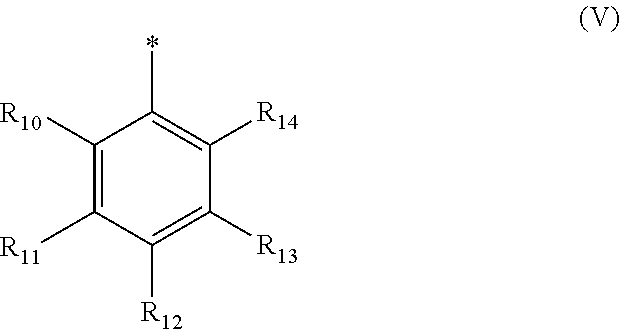
- Ar 2 and Ar 3 in structures (I) and (II) independently represent a non-bridging aryl group of formula (V):
- a ⁇ is the anion derived from the electrolyte salt and may be, for example, the anion derived from LiPF 6 , LiClO 4 , LiBF 4 , LiN(SO 2 CF 3 ) or NaCl.
- the polymer compound may also carry stable nitroxide radicals.
- the underlying mechanism of energy storage is the reversible oxidation/reduction of the nitroxide radical according to scheme 2 representatively showing the redox couples of 2,2,6,6-tetramethylpiperidine-1-oxyl (TEMPO):
- a ⁇ has the same meaning as before and C + is the cation derived from the electrolyte salt and may be, for example, Li + or Na + .
- Non-limiting examples of individual compounds having a structure represented by general formulae (I) and (II), are represented by the following formulae 1-16.
- the theoretical specific capacity (Ah/kg) is shown in brackets and has been calculated using equation (1):
- Theoretical specific capacity F /[3.6 ⁇ ( M/z )] (1)
- the polymeric material preferably has a dynamic viscosity from 2.5 mPas to 50 mPas (measured in NMP at 20° C. and a concentration of 2 wt. %).
- the polymeric material has an average molecular weight of 200.000 g/mol to 400.000 g/mol.
- the electrode may comprise a current collector, in particular a current collector made of aluminium or copper.
- the electrode comprises, in addition to the polymeric material according to general formulae (I) and (II) or to one of the preferred examples above, at least one carbon material selected from the group consisting of carbon black, graphite, activated carbon, carbon nanotubes and graphene, in particular as conductivity-improving additive.
- the carbon material is contained in the electrode in an amount of 0.1% by weight to 99.9% by weight, more preferably 25% by weight to 95% by weight, in particular 45% by weight to 75% by weight.
- the polymeric electrode material is preferably contained in the electrode in an amount of 0.1% by weight to 99.9% by weight, more preferably 25% by weight to 95% by weight, in particular 45% by weight to 75% by weight.
- the electrode comprises at least one electrode binder.
- All known binders for lithium-ion batteries are suitable as binder for an electrode.
- the binder is selected from the group consisting of a cellulose-based binder, a polyacrylate-based binder and a polyvinylidene-based binder (in particular polyvinylidene fluoride and polyvinylidene difluoride).
- the electrode binder is preferably contained in the electrode in an amount of 0.1% by weight to 20% by weight, more preferably 0.1% by weight to 10% by weight, in particular 1% by weight to 10% by weight. Even more preferred is an amount between 1% by weight to 7.5% by weight.
- the polymeric material described above itself has binding properties.
- the polymeric material as reactive electrode binder.
- the electrode that do not contain any additional electrode binder.
- These electrodes can consist of the polymeric electrode material and the carbon material.
- Each lithium-ion battery comprising an electrode as described above or the polymeric electrode material containing or being composed of subunits according to general formulae (I) and (II) above is part of this disclosure. It is preferred, that the lithium-ion battery is a secondary battery.
- the claimed lithium-ion battery contains the electrode described above as a positive electrode.
- the positive electrode of the lithium-ion battery contains at least one metal oxide as active material, in particular at least one oxide from the group comprising lithium-cobalt oxide (LiCoO 2 ), LiMn 2 O 4 spinel, lithium-iron phosphate (LiFePO 4 ) and derivatives such as LiNi 1/3 Mn 1/3 Co 1/3 O 2 or LiMnPO 4 , and the polymeric electrode material containing or being composed of subunits according to general formulae (I) and (II) above as electrode binder.
- the polymeric material is preferably contained in the electrode in an amount of 0.1% by weight to 20% by weight, more preferably 0.1% by weight to 10% by weight, in particular 1% by weight to 10% by weight.
- the negative electrode of the battery may contain metallic lithium or particles based on carbon like graphitic carbon or nongraphitic carbon materials capable of intercalation of lithium. Furthermore, the negative electrode may also contain metallic and semimetallic materials which can be alloyed with lithium. Thus, for example, the elements tin, antimony and silicon are able to form intermetallic phases with lithium.
- each supercapacitor that comprises an electrode as described above or the polymeric electrode material containing or being composed of subunits according to general formulae (I) and (II) above is part of this disclosure.
- Double-layer capacitance means that electrostatic storage is achieved by separation of charge in a Helmholtz double layer at the interface between the surface of a conductive electrode and an electrolyte and pseudocapacitance means a faradaic electrochemical storage with electron charge-transfer, achieved by redox reactions, intercalation or electrosorption.
- our supercapacitor comprises as negative electrode a carbon electrode, in particular an electrode comprising or being composed of activated carbon.
- the negative electrode contains the carbon or activated carbon in an amount of 10% by weight to 100% by weight, more preferably 25% by weight to 99% by weight, in particular 50% by weight to 99% by weight. Even more preferred is an amount of 75% by weight to 99% by weight.
- the positive electrode of a supercapacitor preferably comprises the polymeric compound described above, preferably in combination with carbon, in particular with activated carbon.
- the positive electrode of a supercapacitor preferably comprises the carbon in an amount of 1% by weight to 99% by weight, more preferably 15% by weight to 95% by weight, more preferably 50% by weight to 85% by weight, in particular 60% by weight to 80% by weight.
- the polymeric electrode material is preferably contained in the positive electrode of a supercapacitor in an amount of 5% by weight to 75% by weight, more preferably 10% by weight to 50% by weight, in particular 15% by weight to 40% by weight.
- the carbon is preferably contained in the electrode in an amount of 40% by weight to 99% by weight, more preferably 50% by weight to 80% by weight, and the polymeric compound is preferably contained in the electrode in an amount of 1% by weight to 60% by weight, more preferably 20% by weight to 50% by weight.
- the activated carbon used in the positive and/or in the negative electrode of the supercapacitor or in the electrode has a BET-surface of at least 900 m 2 /g (determined according to German standard DIN ISO 9277) and/or a capacity of at least 60 F/g (determined according to German standard DIN IEC 62391).
- the positive and the negative electrode of a supercapacitor may contain an electrode binder and/or a conductivity-improving additive, in particular one of the known binders for lithium-ion batteries and/or one of the conductivity-improving additives described above, preferably in an amount of 0.1% by weight to 20% by weight, more preferably 0.1% by weight to 10% by weight, in particular 1% by weight to 10% by weight.
- the above mentioned percentages relate in each case to the total weight of the electrodes in a dry condition, that is before the electrodes are impregnated with electrolyte, without taking into account the weight of a current collector, if any. Further, the above mentioned percentages preferably sum up to 100% by weight.
- the electrochemical element and the electrode may contain in particular any organic electrolyte known to be suitable as electrolyte for lithium-ion batteries or supercapacitors.
- the electrolyte is a mixture of a solvent and a conducting salt contained therein.
- the solvent preferably comprises ethylene carbonate (EC) and at least one further carbonate selected from the group consisting of diethyl carbonate (DEC), dimethyl carbonate (DMC), ethyl-methyl carbonate (EMC) and propylene carbonate (PC).
- the conducting salt is preferably a lithium fluorophosphate, a lithium borate and/or a lithium alkylsulfonylimid.
- a copolymer of N,N′-bis(4-aminophenyl)-N,N′-diphenyl-1,4-phenylenediamine and isophthaloyl dichloride (compound 1) was synthesized as a first example of a polymeric electrode material according to the following scheme:
- Step A N,N′-bis(4-nitrophenyl)-N,N′-diphenyl-1,4-phenylenediamine
- Step B N,N′-bis(4-aminophenyl)-N,N′-diphenyl-1,4-phenylenediamine
- N,N′-bis(4-aminophenyl)-N,N′-diphenyl-1,4-phenylenediamine (306 mg, 0.69 mmol) was dissolved in anhydrous NMP (1.85 mL), cooled to 0° C. and isophthaloyl dichloride (140 mg, 1 eq., recrystallized from n-hexane prior to use) was added in portions. The reaction mixture was gradually warmed up to room temperature with stirring. After 3 h the now highly viscous solution was added dropwise to 20 mL of stirred methanol. The precipitate was stirred in 20 mL of boiling methanol for 3 hours, filtered and dried under vacuum to obtain compound 1 as green solid (389 mg, 98%).
- Step B 4-Amino-4′,4′′-dimethoxytriphenylamine
- Step C N,N-Bis(4-nitrophenyl)-N′,N′-di(4-methoxyphenyl)-1,4-phenyl enedi amine
- Step D N,N-Bis(4-aminophenyl)-N′,N′-di(4-methoxyphenyl)-1,4-phenylenediamine
- N,N-Bis(4-nitrophenyl)-N′,N′-di(4-methoxyphenyl)-1,4-phenylenediamine (1.6 g, 2.84 mmol, 1 eq) was dissolved in 45 mL acetonitrile and 50 mL ethanol and tin(II)dichloride (14.1 g, 62.6 mmol, 22 eq) was added. The reaction mixture was stirred at 80° C. over night. After cooling ethyl acetate was added and the mixture washed with brine and NaHCO3. The organic phase was dried over Na2SO4 and concentrated under reduced pressure. After column chromatography on silica the title compound was obtained (1.4 g, 70%).
- N,N-Bis(4-aminophenyl)-N′,N′-di(4-methoxyphenyl)-1,4-phenylenediamine (0.1 g, 0.2 mmol, 1 eq)
- terephthalic acid 33 mg, 0.2 mmol, 1 eq
- calcium chloride 24 mg, 0.21 mmol, 1 eq
- Pyridine 0.1 mL, 1.24 mmol, 6 eq
- triphenyl phosphite (0.17 g, 0.77 mmol, 3.6 eq) was added, the reaction mixture stirred for four hours and then added dropwise to cold methanol (129 mg, 97%).
- Electrode Example 1 Lithium-Ion Battery
- a slurry containing 25 wt-% compound 1, 55 wt-% Super P and 20 wt-% PVdF (polyvinylidene difluoride) binder in NMP was cast on carbon-coated aluminum foil (current collector) by doctor blading (the percentages relate in each case to the total weight of the solids in the slurry, without taking into account the weight of NMP).
- Electrodes were die cut, dried and assembled in Swagelok cells, containing Lithium as anode and reference electrode, a Freudenberg 2190 separator, ethylene carbonate/diethyl carbonate (3/7, v/v) containing 1M LiPF 6 as electrolyte. Comparative Electrode Example 1
- a slurry containing 10 wt-% of a comparative compound (see structure below), 80 wt-% Super P and 10 wt-% PVdF (polyvinylidene difluoride) binder in NMP was cast on aluminum foil (current collector) by doctor blading (the percentages each relate to the total weight of the solids in the slurry without taking into account the weight of NMP).
- Electrodes were die cut, dried and assembled in Swagelok cells, containing Lithium as anode and reference electrode, a Freudenberg 2190 separator, ethylene carbonate/diethyl carbonate (3/7, v/v) containing 1M LiPF 6 as electrolyte.
- FIG. 5 shows a graph of an IU-charging test of a composite electrode of comparative electrode example 1, where the half-cell is charged with a constant current of 1 C until the cut-off voltage of 4 V (vs. Li/Li + ) is reached. The half-cell is held at 4 V (vs. Li/Li + ) for 1 h and then discharged with a constant current of 1 C.
- a slurry containing 22 wt-% of compound 1, 5 wt-% Super P (carbon black, a conductivity improving additive), 5 wt-% PVdF (polyvinylidene difluoride) binder in NMP and 68 wt.-% of an activated carbon was cast on carbon-coated aluminum foil (current collector) by doctor blading (the percentages each relate to the total weight of the solids in the slurry without taking into account the weight of NMP). Electrodes were die cut and dried.
- the carbon electrodes had been prepared using a slurry containing 6 wt-% Super P (a conductivity enhancer), 6 wt-% PVdF binder in NMP and 88 wt.-% of an activated carbon.
- the obtained positive electrodes have been compared to classical carbon supercapacitor electrodes.
- organic electrolyte ethylene carbonate/diethyl carbonate (3/7, v/v) containing 1M LiPF 6 was used.
- FIG. 6 shows a graph wherein the voltage curves correspond to charge/discharge processes, one conducted with the obtained positive electrode comprising compound 1 (2), the other conducted with a classical carbon supercapacitor electrode (1).
- Electrode Example 3 Lithium-Ion Battery
- a slurry containing 5 wt-% compound 1, 5 wt-% Super P, 85 wt-% lithium-iron phosphate and 5 wt-% PVdF (polyvinylidene difluoride) binder in NMP was cast on carbon-coated aluminum foil (current collector) by doctor blading (the percentages each relate to the total weight of the solids in the slurry, without taking into account the weight of NMP).
- Electrodes were die cut, dried and assembled in Swagelok cells, containing Lithium as anode and reference electrode, a Freudenberg 2190 separator, ethylene carbonate/diethyl carbonate (3/7, v/v) containing 1M LiPF 6 as electrolyte.
- the cell showed good cyclability.
- Electrode Example 4 Lithium-Ion Battery
- a slurry containing 7.5 wt-% compound 1, 5 wt-% Super P and 87.5 wt-% lithium-iron phosphate in NMP was cast on carbon-coated aluminum foil (current collector) by doctor blading (the percentages each relate to the total weight of the solids in the slurry, without taking into account the weight of NMP).
- Electrodes were die cut, dried and assembled in Swagelok cells, containing Lithium as anode and reference electrode, a Freudenberg 2190 separator, ethylene carbonate/diethyl carbonate (3/7, v/v) containing 1M LiPF 6 as electrolyte.
- the cell showed good cyclability.
Landscapes
- Chemical & Material Sciences (AREA)
- Chemical Kinetics & Catalysis (AREA)
- Engineering & Computer Science (AREA)
- Electrochemistry (AREA)
- General Chemical & Material Sciences (AREA)
- Polymers & Plastics (AREA)
- Health & Medical Sciences (AREA)
- Medicinal Chemistry (AREA)
- Organic Chemistry (AREA)
- Power Engineering (AREA)
- Materials Engineering (AREA)
- Microelectronics & Electronic Packaging (AREA)
- Composite Materials (AREA)
- Manufacturing & Machinery (AREA)
- Crystallography & Structural Chemistry (AREA)
- Inorganic Chemistry (AREA)
- Battery Electrode And Active Subsutance (AREA)
- Secondary Cells (AREA)
Abstract

wherein n is an integer ≥2, Y represents an amide group (—NH—CO— or —CO—NH—), an ester group (—O—CO— or —CO—O—) or a urethane group (—NH—CO—O— or —O—CO—NH—), R1, R2, R3 and R4 each independently represent H, alkyl (preferably —CH3, —C2H5), Alkoxy-(preferably —OCH3, —OC2H5), -halogen or —CN, Ar1 and Ar4 independently represent a bridging aryl group, Ar2 and Ar3 independently represent a non-bridging aryl group, and R5 is a bridging alkyl, alkene or aryl group, wherein Ar1 and Ar4 in structures (I) and (II) independently represent a bridging aryl group.
Description

wherein
-
- n is an integer ≥2,
- Y represents an amide group (—NH—CO— or —CO—NH—), an ester group (—O—CO— or —CO—O—) or a urethane group (—NH—CO—O— or —O—CO—NH—),
- R1, R2, R3 and R4 each independently represent H, alkyl (preferably —CH3, —C2H5), Alkoxy-(preferably —OCH3, —OC2H5), -halogen or —CN,
- Ar1 and Ar4 independently represent a bridging aryl group,
- Ar2 and Ar3 independently represent a non-bridging aryl group, and
- R5 is a bridging alkyl, alkene or aryl group,
wherein Ar1 and Ar4 in structures (I) and (II) independently represent a bridging aryl group of formula (IIIa), (IIIb) or (IIIc):

wherein
-
- * marks a point of attachment, and
- R6, R7, R8 and R9 each independently represent H, alkyl (preferably —CH3, —C2H5), Alkoxy-(preferably —OCH3, —OC2H5), -halogen or —CN
and wherein R5 represents one of groups of formulae (IVa) to (IVn)


wherein
-
- * marks a point of attachment,
- m=1 to 20, and
- R1, R2, R3, R4, R6, R7, R8, R9, Ar1, Ar2, Ar3 and Ar4 have the same meaning as before.

wherein
-
- n is an integer ≥2,
- Y represents an amide group (—NH—CO— or —CO—NH—), an ester group (—O—CO— or —CO—O—) or a urethane group (—NH—CO—O— or —O—CO—NH—),
- R1, R2, R3 and R4 each independently represent H, alkyl (preferably —CH3, —C2H5),
- Alkoxy-(preferably —OCH3, —OC2H5), -halogen or —CN,
- Ar1 and Ar4 independently represent a bridging aryl group,
- Ar2 and Ar3 independently represent a non-bridging aryl group, and
- R5 is a bridging alkyl, alkene or aryl group,
wherein Ar1 and Ar4 in structures (I) and (II) independently represent a bridging aryl group of formula (IIIa), (IIIb) or (IIIc):

wherein
-
- *marks a point of attachment, and
- R6, R7, R8 and R9 each independently represent H, alkyl (preferably —CH3, —C2H5),
- Alkoxy-(preferably —OCH3, —OC2H5), -halogen or —CN
and wherein R5 represents one of groups of formulae (IVa) to (IVn)


wherein
-
- * marks a point of attachment,
- m=1 to 20, and
- R1, R2, R3, R4, R6, R7, R8, R9, Ar1, Ar2, Ar3 and Ar4 have the same meaning as before or a polymeric material containing or being composed of subunits according to general formulae (I) and (II).

wherein
-
- n is an integer≥2,
- Y represents an amide group (—NH—CO— or —CO—NH—), an ester group (—O—CO— or —CO—O—) or a urethane group (—NH—CO—O— or —O—CO—NH—),
- R1, R2, R3 and R4 each independently represent H, alkyl (preferably —CH3, —C2H5),
- Alkoxy-(preferably —OCH3, —OC2H5), -halogen or —CN,
- Ar1 and Ar4 independently represent a bridging aryl group,
- Ar2 and Ar3 independently represent a non-bridging aryl group, and
- R5 is a bridging alkyl, alkene or aryl group,
wherein Ar1 and Ar4 in structures (I) and (II) independently represent a bridging aryl group of formula (IIIa), (IIIb) or (IIIc):

wherein
-
- * marks a point of attachment, and
- R6, R7, R8 and R9 each independently represent H, alkyl (preferably —CH3, —C2H5),
- Alkoxy-(preferably —OCH3, —OC2H5), -halogen or —CN
and wherein R5 represents one of groups of formulae (IVa) to (IVn)


wherein
-
- * marks a point of attachment,
- m=1 to 20, and
- R1, R2, R3, R4, R6, R7, R8, R9, Ar1, Ar2, Ar3 and Ar4 have the same meaning as before or a polymeric material containing or being composed of subunits according to general formulae (I) and (II).

wherein, in these structures (I) and (II),
-
- n is an integer≥2, preferably≥20,
- Y represents an amide group (—NH—CO— or —CO—NH—), an ester group (—O—CO— or —CO—O—) or a urethane group (—NH—CO—O— or —O—CO—NH—),
- R1, R2, R3 and R4 each independently represent H, alkyl (preferably —CH3, —C2H5), Alkoxy-(preferably —OCH3, —OC2H5), -halogen or —CN,
- Ar1 and Ar4 independently represent a bridging aryl group,
- Ar2 and Ar3 independently represent a non-bridging aryl group, and
- R5 is a bridging alkyl, alkene or aryl group.

wherein, in these structures (IIIa) to (IIIc),
-
- * marks a point of attachment
- R6, R7, R8 and R9 each independently represent H, alkyl (preferably —CH3, —C2H5), Alkoxy-(preferably —OCH3, —OC2H5), -halogen or —CN.
- R5 represents one of the groups of formulae (IVa) to (IVq):


wherein
-
- * marks a point of attachment,
- m=1 to 20, and
- R1, R2, R3, R4, R6, R7, R8, R9, Ar1, Ar2, Ar3 and Ar4 have the same meaning as before.

wherein
-
- R10, R11, R12, R13 and R14 each independently represent H, alkyl (preferably —CH3, —C2H5), Alkoxy-(preferably —OCH3, —OC2H5), halogen, CN or one of the groups of formulae (VIa) and (VIb)

wherein
-
- * marks a point of attachment and
- X represents O or NH.


In this scheme, A− has the same meaning as before and C+ is the cation derived from the electrolyte salt and may be, for example, Li+ or Na+.
Theoretical specific capacity=F/[3.6×(M/z)] (1)
-
- F=Faraday constant=96485 C/mol
- M=molecular weight of the repeating unit
- z=electrons transferred per repeating unit


Claims (20)



Applications Claiming Priority (4)
| Application Number | Priority Date | Filing Date | Title |
|---|---|---|---|
| EP14197166 | 2014-12-10 | ||
| EP14197166.3 | 2014-12-10 | ||
| EP14197166.3A EP3032621A1 (en) | 2014-12-10 | 2014-12-10 | Electrode for an electrochemical element with an organic electrolyte, electrochemical elements comprising the electrode and polymeric material and its use as electrode active material or as electrode binder |
| PCT/EP2015/077346 WO2016091569A1 (en) | 2014-12-10 | 2015-11-23 | Electrode for an electrochemical element with an organic electrolyte, electrochemical elements comprising the electrode and polymeric material and its use as electrode active material or as electrode binder |
Publications (2)
| Publication Number | Publication Date |
|---|---|
| US20170263934A1 US20170263934A1 (en) | 2017-09-14 |
| US10388958B2 true US10388958B2 (en) | 2019-08-20 |
Family
ID=52101093
Family Applications (1)
| Application Number | Title | Priority Date | Filing Date |
|---|---|---|---|
| US15/531,769 Active US10388958B2 (en) | 2014-12-10 | 2015-11-23 | Electrode for an electrochemical element with an organic electrolyte, electrochemical elements comprising the electrode and polymeric material and its use as electrode active material or as electrode binder |
Country Status (4)
| Country | Link |
|---|---|
| US (1) | US10388958B2 (en) |
| EP (2) | EP3032621A1 (en) |
| CN (1) | CN107251278B (en) |
| WO (1) | WO2016091569A1 (en) |
Families Citing this family (4)
| Publication number | Priority date | Publication date | Assignee | Title |
|---|---|---|---|---|
| US11034796B1 (en) * | 2015-08-06 | 2021-06-15 | Cornell University | Poly(arylamine)s and uses thereof |
| EP3154111B1 (en) | 2015-10-07 | 2019-06-12 | VARTA Microbattery GmbH | Composite material, electrode, method to produce the material and the electrode and electrochemical cell comprising the electrode |
| JP6969570B2 (en) * | 2016-10-24 | 2021-11-24 | Jsr株式会社 | Polymers, electrodes, power storage devices and methods for producing polymers |
| CN111574402A (en) * | 2020-05-29 | 2020-08-25 | 江苏畅鸿新材料科技有限公司 | Preparation method of fluorescent material |
Citations (4)
| Publication number | Priority date | Publication date | Assignee | Title |
|---|---|---|---|---|
| US6514431B1 (en) * | 1999-10-14 | 2003-02-04 | Nippon Mitsubishi Oil Corporation | Ion conductive material |
| EP2025689A1 (en) | 2006-06-06 | 2009-02-18 | NEC Corporation | Process for production of polyradical compound and battery cell |
| WO2010051259A1 (en) | 2008-10-27 | 2010-05-06 | Plextronics, Inc. | Polyarylamine ketones |
| US8304514B2 (en) | 2010-07-21 | 2012-11-06 | National Taiwan University Of Science & Technology | Conjugated polymer, method for preparing the same, and optoelectronic device employing the same |
-
2014
- 2014-12-10 EP EP14197166.3A patent/EP3032621A1/en not_active Withdrawn
-
2015
- 2015-11-23 CN CN201580067282.XA patent/CN107251278B/en active Active
- 2015-11-23 US US15/531,769 patent/US10388958B2/en active Active
- 2015-11-23 WO PCT/EP2015/077346 patent/WO2016091569A1/en not_active Ceased
- 2015-11-23 EP EP15797698.6A patent/EP3231029B1/en active Active
Patent Citations (4)
| Publication number | Priority date | Publication date | Assignee | Title |
|---|---|---|---|---|
| US6514431B1 (en) * | 1999-10-14 | 2003-02-04 | Nippon Mitsubishi Oil Corporation | Ion conductive material |
| EP2025689A1 (en) | 2006-06-06 | 2009-02-18 | NEC Corporation | Process for production of polyradical compound and battery cell |
| WO2010051259A1 (en) | 2008-10-27 | 2010-05-06 | Plextronics, Inc. | Polyarylamine ketones |
| US8304514B2 (en) | 2010-07-21 | 2012-11-06 | National Taiwan University Of Science & Technology | Conjugated polymer, method for preparing the same, and optoelectronic device employing the same |
Non-Patent Citations (5)
Also Published As
| Publication number | Publication date |
|---|---|
| EP3032621A1 (en) | 2016-06-15 |
| CN107251278B (en) | 2020-08-14 |
| US20170263934A1 (en) | 2017-09-14 |
| EP3231029B1 (en) | 2020-10-07 |
| EP3231029A1 (en) | 2017-10-18 |
| WO2016091569A1 (en) | 2016-06-16 |
| CN107251278A (en) | 2017-10-13 |
Similar Documents
| Publication | Publication Date | Title |
|---|---|---|
| TWI590510B (en) | Non-aqueous electrolyte for batteries, compounds, polymer electrolytes, and lithium secondary batteries | |
| US10468715B2 (en) | Composite material, electrode, method of producing the material and the electrode and electrochemical cell | |
| US10084203B2 (en) | Non-aqueous secondary battery and non-aqueous liquid electrolyte for secondary battery | |
| WO2016027788A1 (en) | Electrolyte composition, secondary battery, and method for using secondary battery | |
| KR20140127741A (en) | Additive for electrolyte of lithium battery, organic electrolytic solution comprising the same and Lithium battery using the solution | |
| EP3182501B1 (en) | Electrolyte for nonaqueous secondary battery and nonaqueous secondary battery using the same | |
| US11114694B2 (en) | Lithium battery | |
| EP4470058B1 (en) | Electrolytes for lithium-ion battery cells with nitrile additives | |
| KR20160019775A (en) | Polymer, binder and negative electrode including the same, and lithium battery including the negative electrode | |
| KR20170030544A (en) | Rechargeable lithium-ion cell comprising a redox shuttle additive | |
| US10388958B2 (en) | Electrode for an electrochemical element with an organic electrolyte, electrochemical elements comprising the electrode and polymeric material and its use as electrode active material or as electrode binder | |
| KR20190133659A (en) | Additive for electrolyte of lithium battery, organic electrolytic solution comprising the same and Lithium battery using the solution | |
| EP3373379B1 (en) | Additive for nonaqueous electrolyte solutions, nonaqueous electrolyte solution and electricity storage device | |
| JP5886160B2 (en) | Non-aqueous secondary battery electrolyte, non-aqueous secondary battery electrolyte kit, and non-aqueous secondary battery | |
| CN102694205B (en) | Electrolyte solvent and electrolyte solution and lithium rechargeable battery for oxysalt lithium positive active material | |
| JP2012204278A (en) | Electrode for lithium secondary battery and secondary battery using the same | |
| CN110931858B (en) | lithium battery | |
| JP6326255B2 (en) | Battery additive | |
| JP7180861B2 (en) | Electrolyte, lithium ion secondary battery, compound | |
| KR102351971B1 (en) | Mellitic triimide as electrode active material for lithium secondary battery and lithium secondary battery using the same | |
| CN110931859B (en) | Lithium battery | |
| KR102537230B1 (en) | Lithium battery | |
| KR20180087386A (en) | Electrolyte | |
| JPH01163975A (en) | Secondary battery |
Legal Events
| Date | Code | Title | Description |
|---|---|---|---|
| AS | Assignment |
Owner name: VARTA MICRO INNOVATION GMBH, AUSTRIA Free format text: ASSIGNMENT OF ASSIGNORS INTEREST;ASSIGNORS:SCHMUCK, MARTIN;KREN, HARALD;FAST, DAVID E.;AND OTHERS;SIGNING DATES FROM 20170516 TO 20170529;REEL/FRAME:042538/0876 |
|
| AS | Assignment |
Owner name: POLYMER COMPETENCE CENTER LEOBEN GMBH, AUSTRIA Free format text: CORRECTIVE ASSIGNMENT TO ADD 2-3 ADDITIONAL ASSIGNEE'S DATA PREVIOUSLY RECORDED ON REEL 042538 FRAME 0876. ASSIGNOR(S) HEREBY CONFIRMS THE ASSIGNMENT;ASSIGNORS:SCHMUCK, MARTIN;KREN, HARALD;FAST, DAVID E.;AND OTHERS;SIGNING DATES FROM 20170516 TO 20170529;REEL/FRAME:043341/0284 Owner name: VARTA MICRO INNOVATION GMBH, AUSTRIA Free format text: CORRECTIVE ASSIGNMENT TO ADD 2-3 ADDITIONAL ASSIGNEE'S DATA PREVIOUSLY RECORDED ON REEL 042538 FRAME 0876. ASSIGNOR(S) HEREBY CONFIRMS THE ASSIGNMENT;ASSIGNORS:SCHMUCK, MARTIN;KREN, HARALD;FAST, DAVID E.;AND OTHERS;SIGNING DATES FROM 20170516 TO 20170529;REEL/FRAME:043341/0284 Owner name: TECHNISCHE UNIVERSITAET GRAZ, AUSTRIA Free format text: CORRECTIVE ASSIGNMENT TO ADD 2-3 ADDITIONAL ASSIGNEE'S DATA PREVIOUSLY RECORDED ON REEL 042538 FRAME 0876. ASSIGNOR(S) HEREBY CONFIRMS THE ASSIGNMENT;ASSIGNORS:SCHMUCK, MARTIN;KREN, HARALD;FAST, DAVID E.;AND OTHERS;SIGNING DATES FROM 20170516 TO 20170529;REEL/FRAME:043341/0284 |
|
| AS | Assignment |
Owner name: VARTA MICROBATTERY GMBH, GERMANY Free format text: ASSIGNMENT OF ASSIGNORS INTEREST;ASSIGNOR:VARTA MICRO INNOVATION GMBH;REEL/FRAME:044716/0481 Effective date: 20180116 |
|
| STPP | Information on status: patent application and granting procedure in general |
Free format text: RESPONSE TO NON-FINAL OFFICE ACTION ENTERED AND FORWARDED TO EXAMINER |
|
| STPP | Information on status: patent application and granting procedure in general |
Free format text: NOTICE OF ALLOWANCE MAILED -- APPLICATION RECEIVED IN OFFICE OF PUBLICATIONS |
|
| STPP | Information on status: patent application and granting procedure in general |
Free format text: PUBLICATIONS -- ISSUE FEE PAYMENT VERIFIED |
|
| STCF | Information on status: patent grant |
Free format text: PATENTED CASE |
|
| MAFP | Maintenance fee payment |
Free format text: PAYMENT OF MAINTENANCE FEE, 4TH YEAR, LARGE ENTITY (ORIGINAL EVENT CODE: M1551); ENTITY STATUS OF PATENT OWNER: LARGE ENTITY Year of fee payment: 4 |
|
| AS | Assignment |
Owner name: DR. ING. H.C. F. PORSCHE AG, GERMANY Free format text: ASSIGNMENT OF ASSIGNORS INTEREST;ASSIGNOR:VARTA MICROBATTERY GMBH;REEL/FRAME:070253/0603 Effective date: 20241125 |