US10386822B2 - System for rapid identification of sources of variation in complex manufacturing processes - Google Patents
System for rapid identification of sources of variation in complex manufacturing processes Download PDFInfo
- Publication number
- US10386822B2 US10386822B2 US15/237,978 US201615237978A US10386822B2 US 10386822 B2 US10386822 B2 US 10386822B2 US 201615237978 A US201615237978 A US 201615237978A US 10386822 B2 US10386822 B2 US 10386822B2
- Authority
- US
- United States
- Prior art keywords
- manufacturing
- variation
- data
- computer
- variation identification
- Prior art date
- Legal status (The legal status is an assumption and is not a legal conclusion. Google has not performed a legal analysis and makes no representation as to the accuracy of the status listed.)
- Active, expires
Links
Images




Classifications
-
- G—PHYSICS
- G05—CONTROLLING; REGULATING
- G05B—CONTROL OR REGULATING SYSTEMS IN GENERAL; FUNCTIONAL ELEMENTS OF SUCH SYSTEMS; MONITORING OR TESTING ARRANGEMENTS FOR SUCH SYSTEMS OR ELEMENTS
- G05B19/00—Program-control systems
- G05B19/02—Program-control systems electric
- G05B19/418—Total factory control, i.e. centrally controlling a plurality of machines, e.g. direct or distributed numerical control [DNC], flexible manufacturing systems [FMS], integrated manufacturing systems [IMS] or computer integrated manufacturing [CIM]
- G05B19/4183—Total factory control, i.e. centrally controlling a plurality of machines, e.g. direct or distributed numerical control [DNC], flexible manufacturing systems [FMS], integrated manufacturing systems [IMS] or computer integrated manufacturing [CIM] characterised by data acquisition, e.g. workpiece identification
-
- G—PHYSICS
- G05—CONTROLLING; REGULATING
- G05B—CONTROL OR REGULATING SYSTEMS IN GENERAL; FUNCTIONAL ELEMENTS OF SUCH SYSTEMS; MONITORING OR TESTING ARRANGEMENTS FOR SUCH SYSTEMS OR ELEMENTS
- G05B19/00—Program-control systems
- G05B19/02—Program-control systems electric
- G05B19/418—Total factory control, i.e. centrally controlling a plurality of machines, e.g. direct or distributed numerical control [DNC], flexible manufacturing systems [FMS], integrated manufacturing systems [IMS] or computer integrated manufacturing [CIM]
- G05B19/41875—Total factory control, i.e. centrally controlling a plurality of machines, e.g. direct or distributed numerical control [DNC], flexible manufacturing systems [FMS], integrated manufacturing systems [IMS] or computer integrated manufacturing [CIM] characterised by quality surveillance of production
-
- G06F17/50—
-
- G—PHYSICS
- G06—COMPUTING OR CALCULATING; COUNTING
- G06F—ELECTRIC DIGITAL DATA PROCESSING
- G06F30/00—Computer-aided design [CAD]
-
- G—PHYSICS
- G06—COMPUTING OR CALCULATING; COUNTING
- G06Q—INFORMATION AND COMMUNICATION TECHNOLOGY [ICT] SPECIALLY ADAPTED FOR ADMINISTRATIVE, COMMERCIAL, FINANCIAL, MANAGERIAL OR SUPERVISORY PURPOSES; SYSTEMS OR METHODS SPECIALLY ADAPTED FOR ADMINISTRATIVE, COMMERCIAL, FINANCIAL, MANAGERIAL OR SUPERVISORY PURPOSES, NOT OTHERWISE PROVIDED FOR
- G06Q10/00—Administration; Management
- G06Q10/06—Resources, workflows, human or project management; Enterprise or organisation planning; Enterprise or organisation modelling
- G06Q10/063—Operations research, analysis or management
- G06Q10/0639—Performance analysis of employees; Performance analysis of enterprise or organisation operations
-
- G—PHYSICS
- G05—CONTROLLING; REGULATING
- G05B—CONTROL OR REGULATING SYSTEMS IN GENERAL; FUNCTIONAL ELEMENTS OF SUCH SYSTEMS; MONITORING OR TESTING ARRANGEMENTS FOR SUCH SYSTEMS OR ELEMENTS
- G05B2219/00—Program-control systems
- G05B2219/30—Nc systems
- G05B2219/32—Operator till task planning
- G05B2219/32194—Quality prediction
-
- Y—GENERAL TAGGING OF NEW TECHNOLOGICAL DEVELOPMENTS; GENERAL TAGGING OF CROSS-SECTIONAL TECHNOLOGIES SPANNING OVER SEVERAL SECTIONS OF THE IPC; TECHNICAL SUBJECTS COVERED BY FORMER USPC CROSS-REFERENCE ART COLLECTIONS [XRACs] AND DIGESTS
- Y02—TECHNOLOGIES OR APPLICATIONS FOR MITIGATION OR ADAPTATION AGAINST CLIMATE CHANGE
- Y02P—CLIMATE CHANGE MITIGATION TECHNOLOGIES IN THE PRODUCTION OR PROCESSING OF GOODS
- Y02P90/00—Enabling technologies with a potential contribution to greenhouse gas [GHG] emissions mitigation
- Y02P90/02—Total factory control, e.g. smart factories, flexible manufacturing systems [FMS] or integrated manufacturing systems [IMS]
-
- Y02P90/10—
-
- Y02P90/22—
-
- Y02P90/265—
Definitions
- the present invention relates to information handling systems. More specifically, embodiments of the invention relate to identifying sources of variation in complex manufacturing processes.
- An information handling system generally processes, compiles, stores, and/or communicates information or data for business, personal, or other purposes thereby allowing users to take advantage of the value of the information.
- information handling systems may also vary regarding what information is handled, how the information is handled, how much information is processed, stored, or communicated, and how quickly and efficiently the information may be processed, stored, or communicated.
- the variations in information handling systems allow for information handling systems to be general or configured for a specific user or specific use such as financial transaction processing, airline reservations, enterprise data storage, or global communications.
- information handling systems may include a variety of hardware and software components that may be configured to process, store, and communicate information and may include one or more computer systems, data storage systems, and networking systems.
- big data an amount of data that is larger than what can be copied in its entirety from the storage location to another computing device for processing within time limits acceptable for timely operation of an application using the data.
- In-database predictive analytics have become increasingly relevant and important to address big-data analytic problems.
- the amount of data that need be processed to perform the computations required to fit a predictive model become so large that it is too time-consuming to move the data to the analytic processor or server, then the computations must be moved to the data, i.e., to the data storage server and database.
- An example of a technology area where predictive analytics is important is with manufacturing applications. It can often be challenging with complex manufacturing applications (i.e., manufacturing applications involving many (e.g., more than 1000) discrete and/or interconnected steps) to estimate the components of variability in the final product quality attributable to factors observed or set during manufacturing.
- An example of a complex manufacturing application where it is desirable to estimate components of variability in a final product is the manufacture of semiconductors.
- tools for statistical analysis of manufacturing data including the Minitab statistical analysis tool, the statistical package for social sciences (SPSS) statistical analysis tool, the JMP statistical analysis tool, the statistical analysis system (SAS), the R Foundation statistical analysis tool, as well as the Statistica Analytics Platform available from Dell, Inc.
- wafers which are often circular
- wafers which are often circular
- wafers which are often circular
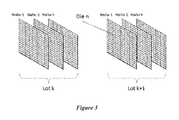
- wafers are stacked into lots
- lots are then moved through hundreds of processing steps automatically executed through various tools.
- certain specific combinations of tools are applied to all dies (chips) within wafers grouped into the same lot, and the variability between quality measurements assessed at the die (chip) level is the result of variability between dies (within wafers and lots), between wafers (within lots), and between lots.
- a system, method, and computer-readable medium are disclosed for identifying sources of variation in complex manufacturing processes via a variation identification operation.
- the variation identification operation is performed via a variation identification system.
- the variation identification operation addresses a special class of analytic problems, namely the estimation of variance components and related statistics from very large (big data) hierarchically nested designs of random factors. These types of data structures occur frequently across various industries, and in particular in automated and batch manufacturing where the variability in product quality as measured in final product testing is related to factors affecting batches, lots, wafers, suppliers, etc. upstream of the process.
- the variation identification operation uses closed-form operations to rapidly estimate variance components into an analytics system for manufacturing support.
- the variation identification operation incorporates closed-form operations into pre-arranged sets of analytic templates.
- the variation identification operation leverages in-database computations in big data environments to compute the aggregates on which the final estimation computations are based. Leveraging in-database computations allows the variation identification operation to operate rapidly on even extremely large hierarchically nested designs of random factors as they frequently occur in semiconductor manufacturing and elsewhere.
- FIG. 1 shows a general illustration of components of an information handling system as implemented in the system and method of the present invention.
- FIG. 2 shows a block diagram of an environment for variation identification.
- FIG. 3 shows a block diagram showing components of an example semiconductor chip manufacturing process.
- FIG. 4 shows a flow chart of a variation identification operation
- FIG. 5 shows an example screen presentation for a user interface for specification of a variation identification operation.
- FIG. 6 shows an example screen presentation for a user interface for the results of a variation identification operation.
- aspects of the present disclosure include a recognition that data from the complex manufacturing process are often hierarchically nested into multiple levels.
- aspects of the disclosure include a recognition that the hierarchical nesting results from the application of various steps of a manufacturing process flow to multiple batches or groups of the final product (e.g., dies, nested in wafers, nested in lots).
- aspects of the disclosure include a recognition that complex manufacturing process can be present in semiconductor manufacturing, process manufacturing in the pharmaceutical industry, or other multi step automated manufacturing.
- a typical process in semiconductor manufacturing includes lots (batches) of wafers, each containing large numbers of dies or chips that are processed through numerous steps to create the final circuitry for individual chip (within each wafer, within each lot).
- Final quality is determined at the die or chip level, where tests are performed to verify the integrity of the final product.
- the final quality measurement data are typically organized by chips (also referred to as a dies) within wafer, and wafers within lots, i.e., the data structure naturally assumes a 3-way hierarchically nested experimental design (Chips-within-Wafers, Wafers-within-Lots).
- the overall quality of the manufacturing process can be summarized by the overall observed variability (e.g., in failure rates for specific tests) between chips, which originates from differences between lots and differences between wafers.
- the components (sources) of variance (variability) to be able to trace an issue back to the Lot level, Wafer level, or Chip level.
- different root causes and corrective actions typically need to be taken.
- an information handling system may include any instrumentality or aggregate of instrumentalities operable to compute, classify, process, transmit, receive, retrieve, originate, switch, store, display, manifest, detect, record, reproduce, handle, or utilize any form of information, intelligence, or data for business, scientific, control, or other purposes.
- an information handling system may be a personal computer, a network storage device, or any other suitable device and may vary in size, shape, performance, functionality, and price.
- the information handling system may include random access memory (RAM), one or more processing resources such as a central processing unit (CPU) or hardware or software control logic, ROM, and/or other types of nonvolatile memory.
- Additional components of the information handling system may include one or more disk drives, one or more network ports for communicating with external devices as well as various input and output (I/O) devices, such as a keyboard, a mouse, and a video display.
- the information handling system may also include one or more buses operable to transmit communications between the various hardware components.
- FIG. 1 is a generalized illustration of an information handling system 100 that can be used to implement the system and method of the present invention.
- the information handling system 100 includes a processor (e.g., central processor unit or “CPU”) 102 , input/output (I/O) devices 104 , such as a display, a keyboard, a mouse, and associated controllers, a hard drive or disk storage 106 , and various other subsystems 108 .
- the information handling system 100 also includes network port 110 operable to connect to a network 140 , which is likewise accessible by a service provider server 142 .
- the information handling system 100 likewise includes system memory 112 , which is interconnected to the foregoing via one or more buses 114 .
- System memory 112 further comprises operating system (OS) 116 and in various embodiments may also comprise variation identification module 118 .
- OS operating system
- the variation identification module 118 performs a variation identification operation which identifies sources of variation in complex manufacturing processes.
- the variation identification operation is performed via a variation identification system.
- the variation identification operation addresses special class of analytic problems, namely the estimation of variance components and related statistics from very large (big data) hierarchically nested designs of random factors. These types of data structures occur frequently across various industries, and in particular in automated and batch manufacturing where the variability in product quality as measured in final product testing should be related to batches, lots, wafers, suppliers, etc. upstream of the process.
- the variation identification operation uses closed-form formulas to rapidly (i.e., via a single pass) estimate variance components into an analytics system for manufacturing support.
- a closed-form formula may be defined as a formula which can be expressed as a set of elementary functions (e.g., summation, subtraction, multiplication, division, raising to power, exponentiation, etc.) which are performed as a single pass on the raw data.
- elementary functions e.g., summation, subtraction, multiplication, division, raising to power, exponentiation, etc.
- the closed-form formulas used in the variation identification operation can be expressed as a set of elementary functions (e.g.
- the variation identification operation incorporates closed-form operations into pre-arranged sets of analytic templates.
- the variation identification operation leverages in-database computations in big data environments to compute the aggregates on which the final estimation computations are based. Leveraging in-database computations allows the variation identification operation to operate rapidly on even extremely large hierarchically nested designs of random factors as they frequently occur in semiconductor manufacturing and elsewhere.
- the data from the complex manufacturing process are hierarchically nested into multiple levels.
- the hierarchical nesting results from the application of various steps of a manufacturing process flow to multiple batches or groups of the final product (e.g., dies, nested in wafers, nested in lots).
- the complex manufacturing process corresponds to semiconductor manufacturing, process manufacturing in the pharmaceutical industry, or other multi step automated manufacturing.
- a typical process in semiconductor manufacturing includes lots (batches) of wafers, each containing large numbers of dies or chips that are processed through numerous steps to create the final circuitry for individual chip (within each wafer, within each lot).
- Final quality is determined at the die or chip level, where tests are performed to verify the integrity of the final product.
- the final quality measurement data are typically organized by chips (also referred to as a die) within wafer, and wafers within lots, i.e., the data structure naturally assumes a 3-way hierarchically nested experimental design (Chips-within-Wafers, Wafers-within-Lots).
- the overall quality of the manufacturing process can be summarized by the overall observed variability (e.g., in failure rates for specific tests) between chips, which originates from differences between lots and differences between wafers.
- variability e.g., in failure rates for specific tests
- sources of the variability observed in the chips different root causes and corrective actions typically need to be taken.
- FIG. 2 shows a simplified block diagram of a distributed analytics environment 200 for performing variation identification operations in accordance with an embodiment of the invention.
- the distributed analytics environment 200 includes a storage system 210 which includes one or more data repositories 214 .
- the distributed analytics environment 200 further includes an analytics system 220 which is coupled with the storage system 210 via a network 230 , which may be a private network, a public network, a local or wide area network, the Internet, combinations of the same, or the like.
- the network 140 is included within the network 230 .
- Either or both the storage system 210 and the analytics system 220 may reside within and execute on an information handling system 100 .
- Portions of the storage system 210 as well as the analytics system 220 provide a query construction system, an in-database feature selection system and/or a distributed analytics system. Some or all of the functions of a variation identification system and/or the distributed analytics system may be performed via the variation identification module 118 , respectively.
- the storage system 210 is configured to perform distributed computations to derive suitable aggregate summary statistics, such as summations, multiplications, and derivation of new variables via formulae.
- the storage system 210 comprises a SQL Server, an Oracle type storage system, an Apache Hive type storage system, an Apache Spark type storage system and/or a Teradata Server. It will be appreciated that other database platforms and systems are within the scope of the invention. It will also be appreciated that the storage system can comprise a plurality of databases which may or may not be the same type of database.
- the storage system 210 includes an analytics interface 240 .
- the storage system 210 further includes a query construction system 244 .
- the storage system 210 executes a query language 242 .
- the query language 242 enables the storage system 210 to initiate and control the execution of variation identification computations and aggregations in-database.
- the query language 242 is included within the analytics interface 240 .
- the query language 242 is defined by the type of storage system used and typically corresponds to one of the dialects of the SQL.
- the analytics system 220 performs statistical and mathematical computations.
- the analytics system 220 comprises a Statistica Analytics Platform available from Dell, Inc.
- the analytics system 220 comprises a workspace environment 250 , user interfaces 252 for combining aggregate statistics and numerical summaries computed by the Storage System 210 and a variation identification system 254 . Queries are constructed on the analytics system 220 as designed on the user interface 252 and are executed on the storage system 210 .
- the storage system 210 may include a query optimization layer (not shown).
- the variation identification system 254 generates in-database queries for execution by the query language 242 when performing variation identification from complex manufacturing system data.
- the analytics system 220 further performs mathematical and statistical computations to derive final predictive models.
- the Statistica Analytics Platform available from Dell, Inc. and the Graphical User Interface of the Statistica Analytics Platform are examples of the workspace environment 250 and user interfaces 252 , respectively.
- the workspace environment 250 provides summaries and aggregates which are computed via common queries, executed through the storage system 210 , and executed via distributed query execution enabled through the capabilities of the storage system 210 .
- the execution performed on the Storage System 210 is initiated via derived variables defined through queries (e.g., coded design matrices), sums, sums of squared values, sums of squared cross-products of values, weights, numbers of observations, and other aggregate values.
- the results of the execution performed on the storage system 210 are then further processed by the workspace environment 250 on the analytics system 220 to compute predictive models via multiple linear regression, general linear models, general logistic regression models, principal components analysis, cluster analyses, recursive partitioning (tree) models, and others.
- the execution performed on the storage system 210 includes performing certain computations and then creating subsamples of the results of the execution on the storage system 210 . These subsamples are accessed by the workspace environment via queries subsamples of all data. The analytics system 220 can then operate on subsamples to compute (iteratively, e.g., over consecutive samples) final predictive models. Additionally, in certain embodiments, the subsamples are further processed by the workspace environment 250 on the analytics system 220 to compute predictive models including recursive partitioning models (trees, boosted trees, random forests), support vector machines, neural networks, and others.
- recursive partitioning models trees, boosted trees, random forests
- consecutive samples may be samples relating to complex manufacturing processes, random samples extracted at the storage system 210 , or samples of consecutive observations returned by queries executing in the storage system 210 .
- the analytics system 220 computes and refines desired coefficients for predictive models from consecutively returned samples, until the computations of consecutive samples no longer lead to modifications of those coefficients. In this manner, not all data in the storage system 210 ever needs to be processed.
- the user interface 252 of the analytics system 220 provides user interface options to parameterize and optimize the computations. For example, in certain embodiments options are provided to enable variation identification from data subsets extracted from the storage system 210 , to derive best initial parameter estimates for any of the prediction models. The SQL query-based operation is then used to refine and finalize the model parameters.
- the user interface 252 also interacts with the variation identification system 254 to provide variation identification user interfaces.
- the variation identification user interfaces facilitate construction of queries for in database predictive analytics, especially for variation identification from complex manufacturing processes.
- the distributed analytics environment 200 enables variation identification analytics to be performed in a platform-agnostic fashion.
- the analytics system 220 is able to leverage all capabilities of the Storage System for distributed processing, to perform the data-processing-intensive operations of computing aggregates or samples.
- the variation identification system 254 provides efficient in-database computations for variation identification.
- the analytics system 220 provides user and automation interfaces.
- the storage system 210 stores data on which the in-database computations are performed.
- the storage system 210 includes an ability to execute SQL or SQL-like queries to compute simple summaries for selected data fields, or selected portions of data fields.
- the simple summaries include for example counts, sums, averages and standard deviations.
- the selected data fields or selected portions of data fields are defined by statements such as Select, Where and Group By statements.
- the user interface 252 of the analytics system 220 presents an automation interface.
- the automation interface enables users to automatically perform variation identification operations.
- the distributed analytics environment 200 is implemented, without requiring deployment of storage system specific agents or computer code, against many different data storage systems, including all standard databases, Hadoop type storage systems or Spark via Hive (and HiveQL), or to emerging appliances such as Microsoft APS.
- the analytics system 220 and workspace environment 250 are agnostic with respect to the actual storage systems in use, and hence capable of supporting hybrid environments. Such a distributed analytics system would be much easier to deploy, maintain, and scale.
- the network 230 may be a public network, such as the Internet, a physical private network, a virtual private network (VPN), a wireless network, or any combination thereof.
- the wireless network may be a personal area network (PAN), based on technologies such as Bluetooth or Ultra Wideband (UWB).
- the wireless network may include a wireless local area network (WLAN), based on variations of the IEEE 802.11 specification, often referred to as WiFi.
- the wireless network may include a wireless wide area network (WWAN) based on an industry standard including two and a half generation (2.5G) wireless technologies such as global system for mobile communications (GPRS) and enhanced data rates for GSM evolution (EDGE).
- WWANs based on existing third generation (3G) wireless technologies including universal mobile telecommunications system (UMTS) and wideband code division multiple access (W-CDMA).
- 3G third generation
- UMTS universal mobile telecommunications system
- W-CDMA wideband code division multiple access
- a variation identification operation is desirable when performing analysis on automated manufacturing data such as those that arise in the manufacture of semiconductor chips can also occur in various other manufacturing environments, including batch manufacturing where raw materials from different suppliers are incorporated into different batches of product, and final product quality is determined based on measurements applied to final individual product (within batch, within supplier).
- understanding the sources of variability (components of variance) of the final product quality can critically affect root cause analyses and process optimization efforts.
- a variation identification operation is also desirable when performing analysis on streaming data. Identifying variations in streaming data such as data that occur in Internet of Things (IoT) applications can also be desirable. For example, electricity-usage data collected at the household level can be analyzed hour-by-hour (hour-of-the-day), within household, within day-of-the-week, and so on, again giving rise to a hierarchically nested data structure. For power planning purposes, it can be of interest to understand the contribution to the variability in power usage attributable to variability between the hours-of-the-day, the households, and the days-of-the-week.
- IoT Internet of Things
- a fundamental analytic challenge arises from the sizes of the hierarchical nested design structure that occur in real-world applications and problems.
- chips dies
- hundreds of wafers are nested within hundreds of lots, thus given rise to nested analysis of variance (ANOVA) designs with data for tens or hundreds of thousands of individual (nested) levels.
- ANOVA analysis of variance
- Such large amounts of data far exceed the capabilities of known ANOVA analysis software for estimating components of variance.
- the data are frequently stored in a semi-structured (or noSQL) database, representing big data repositories and allowing for flexible format changes as the production processes evolve.
- the term fixed effects may be defined as factors in an experimental design with levels that are deliberately arranged by the experimenter.
- random effects may be defined as factors in an experimental design with levels that are not deliberately arranged by the experimenter, but randomly sampled from a large universe of potential levels.
- random factors may be sampled from a population of possible factor levels.
- observed Lots can be considered a sample from the universe of possible Lots
- observed Wafers can be considered a sample from the universe of possible wafers
- observed Dies can be considered a sample from the universe of possible wafers.
- the factors from each of these samples would be “random effects”.
- the operation would re-sample from the universe of possible Lots, Wafers, and Dies, i.e., look at a new production run.
- VEPAC Variance Estimation and Precision Analysis Computations
- ML maximum likelihood
- RML Restricted Maximum Likelihood
- the variation identification operation facilitates analysis on automated manufacturing data by computing variance components for hierarchically nested random effect designs such as found in big data.
- core computations of the variation identification operation include a new method for estimating variance components from very large hierarchically nested design, leveraging simplified and in-database computations.
- This variation identification operation scales to problems with tens and even hundreds of thousands of individual classes (e.g., Dies, within Wafers, within Lots). Accordingly, the variation identification operation is suitable for automated application in various industries such as the previously discussed use cases.
- the variation identification operation leverages closed-form computational formulas for unbalanced nested random effects designs within an automated analytics system to compute variance components.
- the variation identification operation is performed, at least in part, using in-database computations for aggregates (e.g., sums, sums of squares).
- the variation identification operation 400 provides automated variance components estimation in hierarchically nested random effects designs. More specifically, the variation identification operation 400 starts at step 410 with the variation identification system 254 prompting a user to select factors describing a hierarchically nested design.
- the prompting is via a variation identification graphical user interface. For example, the user may be prompted to select the fields that index Lots, Wafers, and Dies from a data repository semiconductor manufacturing information.
- step 410 selection of the factors is automated through programmatic interfaces to a computation server (e.g., Information handling system 100 executing the analytics system 220 ).
- the user is prompted to identify one or more continuous outcome or measurement variables for which the variation identification 254 system will compute variance components (which provide quantifiable product quality measurements).
- the computation server verifies that the specified factors identify a hierarchically nested design. In certain embodiments, if the design specified through the factors is not a hierarchically nested design, the variable identification operation suggests performance of a Random-Effects ANOVA analysis using common maximum Likelihood estimation methods, if such an analysis is possible given the size of the design.
- the computation server scans all values for the specified factors to identify the unique values for each specified factor. If some or all of the data for the unique values reside on a database server, then the analytics system 220 executes a query to the database server (e.g., storage system 210 ) to identify the unique factor values.
- the database server e.g., storage system 210
- the variable identification operation computes the sums, and sums of squares, and counts of valid (i.e., non-null) numbers of observations for each selected measurement variable. If the data reside on a database server, then these computations can be accomplished via queries inside the database server.
- the variable identification operation compute the variance components and related statistics using the closed-form computations based on the sums of valid (i.e., non-null) observations, sums, and sums of squares for each measurement variable.
- the variable identification operation reports the results of the variable identification operation.
- the results can include one or more of the components of variance attributable to each factor, a percent of variability attributable to each factor, relative to the total variability (variance), an estimated variance and standard error of the variance components, estimated covariances between the variance components, a statistical significance test of the estimated variance components, an ANOVA table, and/or a Pareto analysis and charts of all relative and absolute variance components.
- the results are used to identify any main sources of variability in the data.
- FIG. 5 shows an example screen presentation for a user interface 500 for specification of a variation identification operation.
- the user interface 500 provides a user interface to allow specification of the variables used within a variation identification operation to facilitate identification of variations which may have caused issues when performing a complex manufacturing operation.
- FIG. 6 shows an example screen presentation for a user interface 600 for the results of a variation identification operation.
- the user interface 600 provides results of a variation identification operation to enable identification of variations which may have caused issues when performing a complex manufacturing operation.
- the present invention may be embodied as a method, system, or computer program product. Accordingly, embodiments of the invention may be implemented entirely in hardware, entirely in software (including firmware, resident software, micro-code, etc.) or in an embodiment combining software and hardware. These various embodiments may all generally be referred to herein as a “circuit,” “module,” or “system.” Furthermore, the present invention may take the form of a computer program product on a computer-usable storage medium having computer-usable program code embodied in the medium.
- the computer-usable or computer-readable medium may be, for example, but not limited to, an electronic, magnetic, optical, electromagnetic, infrared, or semiconductor system, apparatus, or device. More specific examples (a non-exhaustive list) of the computer-readable medium would include the following: a portable computer diskette, a hard disk, a random access memory (RAM), a read-only memory (ROM), an erasable programmable read-only memory (EPROM or Flash memory), a portable compact disc read-only memory (CD-ROM), an optical storage device, or a magnetic storage device.
- a computer-usable or computer-readable medium may be any medium that can contain, store, communicate, or transport the program for use by or in connection with the instruction execution system, apparatus, or device.
- Computer program code for carrying out operations of the present invention may be written in an object oriented programming language such as Java, Smalltalk, C++ or the like. However, the computer program code for carrying out operations of the present invention may also be written in conventional procedural programming languages, such as the “C” programming language or similar programming languages.
- the program code may execute entirely on the user's computer, partly on the user's computer, as a stand-alone software package, partly on the user's computer and partly on a remote computer or entirely on the remote computer or server.
- the remote computer may be connected to the user's computer through a local area network (LAN) or a wide area network (WAN), or the connection may be made to an external computer (for example, through the Internet using an Internet Service Provider).
- LAN local area network
- WAN wide area network
- Internet Service Provider for example, AT&T, MCI, Sprint, EarthLink, MSN, GTE, etc.
- Embodiments of the invention are described with reference to flowchart illustrations and/or block diagrams of methods, apparatus (systems) and computer program products according to embodiments of the invention. It will be understood that each block of the flowchart illustrations and/or block diagrams, and combinations of blocks in the flowchart illustrations and/or block diagrams, can be implemented by computer program instructions. These computer program instructions may be provided to a processor of a general purpose computer, special purpose computer, or other programmable data processing apparatus to produce a machine, such that the instructions, which execute via the processor of the computer or other programmable data processing apparatus, create means for implementing the functions/acts specified in the flowchart and/or block diagram block or blocks.
- These computer program instructions may also be stored in a computer-readable memory that can direct a computer or other programmable data processing apparatus to function in a particular manner, such that the instructions stored in the computer-readable memory produce an article of manufacture including instruction means which implement the function/act specified in the flowchart and/or block diagram block or blocks.
- the computer program instructions may also be loaded onto a computer or other programmable data processing apparatus to cause a series of operational steps to be performed on the computer or other programmable apparatus to produce a computer implemented process such that the instructions which execute on the computer or other programmable apparatus provide steps for implementing the functions/acts specified in the flowchart and/or block diagram block or blocks.
Landscapes
- Engineering & Computer Science (AREA)
- Business, Economics & Management (AREA)
- Physics & Mathematics (AREA)
- Human Resources & Organizations (AREA)
- General Physics & Mathematics (AREA)
- Quality & Reliability (AREA)
- General Engineering & Computer Science (AREA)
- Manufacturing & Machinery (AREA)
- Automation & Control Theory (AREA)
- Theoretical Computer Science (AREA)
- Entrepreneurship & Innovation (AREA)
- Economics (AREA)
- Educational Administration (AREA)
- Development Economics (AREA)
- Strategic Management (AREA)
- Marketing (AREA)
- Operations Research (AREA)
- Tourism & Hospitality (AREA)
- General Business, Economics & Management (AREA)
- Game Theory and Decision Science (AREA)
- Computer Hardware Design (AREA)
- Evolutionary Computation (AREA)
- Geometry (AREA)
- General Factory Administration (AREA)
- Human Computer Interaction (AREA)
- Architecture (AREA)
- Software Systems (AREA)
Abstract
Description
Claims (18)
Priority Applications (5)
| Application Number | Priority Date | Filing Date | Title |
|---|---|---|---|
| US15/237,978 US10386822B2 (en) | 2016-08-16 | 2016-08-16 | System for rapid identification of sources of variation in complex manufacturing processes |
| US15/941,911 US10248110B2 (en) | 2015-03-23 | 2018-03-30 | Graph theory and network analytics and diagnostics for process optimization in manufacturing |
| US16/501,120 US20210019324A9 (en) | 2015-03-23 | 2019-03-11 | System for efficient information extraction from streaming data via experimental designs |
| US16/751,051 US11443206B2 (en) | 2015-03-23 | 2020-01-23 | Adaptive filtering and modeling via adaptive experimental designs to identify emerging data patterns from large volume, high dimensional, high velocity streaming data |
| US17/885,170 US11880778B2 (en) | 2015-03-23 | 2022-08-10 | Adaptive filtering and modeling via adaptive experimental designs to identify emerging data patterns from large volume, high dimensional, high velocity streaming data |
Applications Claiming Priority (1)
| Application Number | Priority Date | Filing Date | Title |
|---|---|---|---|
| US15/237,978 US10386822B2 (en) | 2016-08-16 | 2016-08-16 | System for rapid identification of sources of variation in complex manufacturing processes |
Related Parent Applications (1)
| Application Number | Title | Priority Date | Filing Date |
|---|---|---|---|
| US15/214,622 Continuation-In-Part US20180025276A1 (en) | 2015-03-23 | 2016-07-20 | System for Managing Effective Self-Service Analytic Workflows |
Related Child Applications (2)
| Application Number | Title | Priority Date | Filing Date |
|---|---|---|---|
| US14/690,600 Continuation-In-Part US9952577B2 (en) | 2015-03-23 | 2015-04-20 | Graph theory and network analytics and diagnostics for process optimization in manufacturing |
| US15/941,911 Continuation-In-Part US10248110B2 (en) | 2015-03-23 | 2018-03-30 | Graph theory and network analytics and diagnostics for process optimization in manufacturing |
Publications (2)
| Publication Number | Publication Date |
|---|---|
| US20180052450A1 US20180052450A1 (en) | 2018-02-22 |
| US10386822B2 true US10386822B2 (en) | 2019-08-20 |
Family
ID=61191497
Family Applications (1)
| Application Number | Title | Priority Date | Filing Date |
|---|---|---|---|
| US15/237,978 Active 2037-08-22 US10386822B2 (en) | 2015-03-23 | 2016-08-16 | System for rapid identification of sources of variation in complex manufacturing processes |
Country Status (1)
| Country | Link |
|---|---|
| US (1) | US10386822B2 (en) |
Citations (2)
| Publication number | Priority date | Publication date | Assignee | Title |
|---|---|---|---|---|
| US20050143853A1 (en) * | 2003-12-26 | 2005-06-30 | Semiconductor Leading Edge Technologies, Inc. | Mass-production transfer support system and semiconductor manufacturing system |
| US20130103174A1 (en) * | 2011-04-15 | 2013-04-25 | Cummins Intellectual Property, Inc. | Measurement systems analysis system and method |
-
2016
- 2016-08-16 US US15/237,978 patent/US10386822B2/en active Active
Patent Citations (2)
| Publication number | Priority date | Publication date | Assignee | Title |
|---|---|---|---|---|
| US20050143853A1 (en) * | 2003-12-26 | 2005-06-30 | Semiconductor Leading Edge Technologies, Inc. | Mass-production transfer support system and semiconductor manufacturing system |
| US20130103174A1 (en) * | 2011-04-15 | 2013-04-25 | Cummins Intellectual Property, Inc. | Measurement systems analysis system and method |
Non-Patent Citations (7)
| Title |
|---|
| Duncan, Acheson J., Quality Control and Industrial Statistics, 5th Edition, 1986, Section 3.1, Chapter 31 (Analyses Associated with Analysis of Variances), pp. 765-788. |
| George R. Butler et al., U.S. Appl. No. 14/826,770, filed Aug. 14, 2015, entitled Method for Performing In-Database Distributed Advanced Predictive Analytics Modeling via Common Queries. |
| Mahamunulu, D.M., Sampling Variances of the Estimates of Variance Components in the Unbalanced 3-way Nested Classification, The Annals of Mathematical Statistics, vol. 34, No. 2 (Jun. 1963), pp. 521-527, https://projecteuclid.org/download/pdf_1/euclid.aoms/1177704163. |
| Measurement Systems Analysis Reference Manual, 4th Edition, 2010 http://www.rubymetrology.com/add_help_doc/MSA_Reference_Manual_4th_Edition.pdf. |
| Milliken, George A. et al., Analysis of Messy Data: vol. I, Designed Experiments, 1992, Chapter 22 (Analysis of Mixed Models) and Chapter 23 (Two Case Studies of a Mixed Model), pp. 274-295. |
| Searle, S.R. et al., An Overview of Variance Component Estimation, Apr. 1994 https://ecommons.cornell.edu/bitstream/handle/1813/31816/BU-1231-M.pdf; isessionid=466ECEA15D5B0C70C2258A7D05AD05CA?sequence=1. |
| Vladimir S. Rastunkov et al., U.S. Appl. No. 15/067,643, filed Mar. 11, 2016, entitled Auto Query Construction for In-Database Predictive Analytics. |
Also Published As
| Publication number | Publication date |
|---|---|
| US20180052450A1 (en) | 2018-02-22 |
Similar Documents
| Publication | Publication Date | Title |
|---|---|---|
| Collin et al. | Extending approximate Bayesian computation with supervised machine learning to infer demographic history from genetic polymorphisms using DIYABC Random Forest | |
| US10467226B2 (en) | Method for in-database feature selection for high-dimensional inputs | |
| US10445657B2 (en) | General framework for cross-validation of machine learning algorithms using SQL on distributed systems | |
| US10671603B2 (en) | Auto query construction for in-database predictive analytics | |
| US20120221509A1 (en) | Determining a data mapping relationship between database tables | |
| US20140258987A1 (en) | Determining correctness of an application | |
| US20200134363A1 (en) | Automatic feature selection and model generation for linear models | |
| Dai et al. | Reliability modelling and verification of manufacturing processes based on process knowledge management | |
| US10191947B2 (en) | Partitioning advisor for online transaction processing workloads | |
| US20160306332A1 (en) | Graph Theory and Network Analytics and Diagnostics for Process Optimization in Manufacturing | |
| US20220197950A1 (en) | Eliminating many-to-many joins between database tables | |
| US10496948B1 (en) | Computer trend visualization using quadratic simplified closed form linear regression | |
| EP3580676B1 (en) | Sample-based multidimensional data cloning | |
| US10649973B2 (en) | Method for performing in-database distributed advanced predictive analytics modeling via common queries | |
| US10386822B2 (en) | System for rapid identification of sources of variation in complex manufacturing processes | |
| US10007681B2 (en) | Adaptive sampling via adaptive optimal experimental designs to extract maximum information from large data repositories | |
| US20230118040A1 (en) | Query Generation Using Derived Data Relationships | |
| US20180224835A1 (en) | Graph theory and network analytics and diagnostics for process optimization in manufacturing | |
| US12511554B2 (en) | Complex system for end-to-end causal inference | |
| CN119961297A (en) | A data tracing method, device and related equipment | |
| CN116010377A (en) | Heterogeneous database data processing method, device, and computer equipment | |
| Yaremchuk et al. | Big data and similarity-based software reliability assessment: The technique and applied tools | |
| US20210019324A9 (en) | System for efficient information extraction from streaming data via experimental designs | |
| Hu et al. | Comment on “Computation of Isotopic Peak Center-Mass Distribution by Fourier Transform” | |
| US12105749B2 (en) | Method for generating triples from log entries |
Legal Events
| Date | Code | Title | Description |
|---|---|---|---|
| AS | Assignment |
Owner name: DELL SOFTWARE, INC., TEXAS Free format text: ASSIGNMENT OF ASSIGNORS INTEREST;ASSIGNORS:HILL, THOMAS;SCOTT, DANIEL W.;RASTUNKOV, VLADIMIR S.;REEL/FRAME:039454/0619 Effective date: 20160815 |
|
| AS | Assignment |
Owner name: DELL SOFTWARE INC., CALIFORNIA Free format text: RELEASE OF SECURITY INTEREST IN CERTAIN PATENT COLLATERAL AT REEL/FRAME NO. 040587/0624;ASSIGNOR:CREDIT SUISSE AG, CAYMAN ISLANDS BRANCH, AS COLLATERAL AGENT;REEL/FRAME:042731/0327 Effective date: 20170605 Owner name: DELL SOFTWARE INC., CALIFORNIA Free format text: RELEASE OF SECURITY INTEREST IN CERTAIN PATENT COLLATERAL AT REEL/FRAME NO. 040581/0850;ASSIGNOR:CREDIT SUISSE AG, CAYMAN ISLANDS BRANCH, AS COLLATERAL AGENT;REEL/FRAME:042731/0286 Effective date: 20170605 |
|
| AS | Assignment |
Owner name: QUEST SOFTWARE INC., CALIFORNIA Free format text: CHANGE OF NAME;ASSIGNOR:DELL SOFTWARE INC.;REEL/FRAME:045546/0372 Effective date: 20161101 |
|
| AS | Assignment |
Owner name: TIBCO SOFTWARE INC., CALIFORNIA Free format text: ASSIGNMENT OF ASSIGNORS INTEREST;ASSIGNOR:QUEST SOFTWARE INC.;REEL/FRAME:045592/0967 Effective date: 20170605 |
|
| STPP | Information on status: patent application and granting procedure in general |
Free format text: RESPONSE TO NON-FINAL OFFICE ACTION ENTERED AND FORWARDED TO EXAMINER |
|
| STPP | Information on status: patent application and granting procedure in general |
Free format text: NOTICE OF ALLOWANCE MAILED -- APPLICATION RECEIVED IN OFFICE OF PUBLICATIONS |
|
| STPP | Information on status: patent application and granting procedure in general |
Free format text: PUBLICATIONS -- ISSUE FEE PAYMENT VERIFIED |
|
| STCF | Information on status: patent grant |
Free format text: PATENTED CASE |
|
| AS | Assignment |
Owner name: JPMORGAN CHASE BANK, N.A., AS COLLATERAL AGENT, IL Free format text: SECURITY INTEREST;ASSIGNOR:TIBCO SOFTWARE INC.;REEL/FRAME:050889/0727 Effective date: 20191029 |
|
| AS | Assignment |
Owner name: KKR LOAN ADMINISTRATION SERVICES LLC, AS COLLATERAL AGENT, NEW YORK Free format text: SECURITY AGREEMENT;ASSIGNOR:TIBCO SOFTWARE INC.;REEL/FRAME:052115/0318 Effective date: 20200304 |
|
| AS | Assignment |
Owner name: JPMORGAN CHASE BANK, N.A., AS COLLATERAL AGENT, ILLINOIS Free format text: SECURITY AGREEMENT;ASSIGNOR:TIBCO SOFTWARE INC.;REEL/FRAME:054275/0975 Effective date: 20201030 |
|
| AS | Assignment |
Owner name: TIBCO SOFTWARE INC., CALIFORNIA Free format text: RELEASE (REEL 054275 / FRAME 0975);ASSIGNOR:JPMORGAN CHASE BANK, N.A.;REEL/FRAME:056176/0398 Effective date: 20210506 |
|
| AS | Assignment |
Owner name: TIBCO SOFTWARE INC., CALIFORNIA Free format text: RELEASE (REEL 050889 / FRAME 0727);ASSIGNOR:JPMORGAN CHASE BANK, N.A.;REEL/FRAME:061575/0860 Effective date: 20220930 |
|
| AS | Assignment |
Owner name: TIBCO SOFTWARE INC., CALIFORNIA Free format text: RELEASE REEL 052115 / FRAME 0318;ASSIGNOR:KKR LOAN ADMINISTRATION SERVICES LLC;REEL/FRAME:061588/0511 Effective date: 20220930 |
|
| AS | Assignment |
Owner name: WILMINGTON TRUST, NATIONAL ASSOCIATION, AS NOTES COLLATERAL AGENT, DELAWARE Free format text: PATENT SECURITY AGREEMENT;ASSIGNORS:TIBCO SOFTWARE INC.;CITRIX SYSTEMS, INC.;REEL/FRAME:062113/0470 Effective date: 20220930 Owner name: GOLDMAN SACHS BANK USA, AS COLLATERAL AGENT, NEW YORK Free format text: SECOND LIEN PATENT SECURITY AGREEMENT;ASSIGNORS:TIBCO SOFTWARE INC.;CITRIX SYSTEMS, INC.;REEL/FRAME:062113/0001 Effective date: 20220930 Owner name: BANK OF AMERICA, N.A., AS COLLATERAL AGENT, NORTH CAROLINA Free format text: PATENT SECURITY AGREEMENT;ASSIGNORS:TIBCO SOFTWARE INC.;CITRIX SYSTEMS, INC.;REEL/FRAME:062112/0262 Effective date: 20220930 |
|
| AS | Assignment |
Owner name: CLOUD SOFTWARE GROUP, INC., FLORIDA Free format text: CHANGE OF NAME;ASSIGNOR:TIBCO SOFTWARE INC.;REEL/FRAME:062714/0634 Effective date: 20221201 |
|
| MAFP | Maintenance fee payment |
Free format text: PAYMENT OF MAINTENANCE FEE, 4TH YEAR, LARGE ENTITY (ORIGINAL EVENT CODE: M1551); ENTITY STATUS OF PATENT OWNER: LARGE ENTITY Year of fee payment: 4 |
|
| AS | Assignment |
Owner name: CLOUD SOFTWARE GROUP, INC. (F/K/A TIBCO SOFTWARE INC.), FLORIDA Free format text: RELEASE AND REASSIGNMENT OF SECURITY INTEREST IN PATENT (REEL/FRAME 062113/0001);ASSIGNOR:GOLDMAN SACHS BANK USA, AS COLLATERAL AGENT;REEL/FRAME:063339/0525 Effective date: 20230410 Owner name: CITRIX SYSTEMS, INC., FLORIDA Free format text: RELEASE AND REASSIGNMENT OF SECURITY INTEREST IN PATENT (REEL/FRAME 062113/0001);ASSIGNOR:GOLDMAN SACHS BANK USA, AS COLLATERAL AGENT;REEL/FRAME:063339/0525 Effective date: 20230410 Owner name: WILMINGTON TRUST, NATIONAL ASSOCIATION, AS NOTES COLLATERAL AGENT, DELAWARE Free format text: PATENT SECURITY AGREEMENT;ASSIGNORS:CLOUD SOFTWARE GROUP, INC. (F/K/A TIBCO SOFTWARE INC.);CITRIX SYSTEMS, INC.;REEL/FRAME:063340/0164 Effective date: 20230410 |
|
| AS | Assignment |
Owner name: WILMINGTON TRUST, NATIONAL ASSOCIATION, AS NOTES COLLATERAL AGENT, DELAWARE Free format text: SECURITY INTEREST;ASSIGNORS:CLOUD SOFTWARE GROUP, INC. (F/K/A TIBCO SOFTWARE INC.);CITRIX SYSTEMS, INC.;REEL/FRAME:067662/0568 Effective date: 20240522 |
|
| AS | Assignment |
Owner name: WILMINGTON TRUST, NATIONAL ASSOCIATION, AS NOTES COLLATERAL AGENT, DELAWARE Free format text: PATENT SECURITY AGREEMENT;ASSIGNORS:CLOUD SOFTWARE GROUP, INC.;CITRIX SYSTEMS, INC.;REEL/FRAME:072488/0172 Effective date: 20250814 |