US10384996B2 - Fluorene-containing compound and method for making the same - Google Patents
Fluorene-containing compound and method for making the same Download PDFInfo
- Publication number
- US10384996B2 US10384996B2 US15/650,992 US201715650992A US10384996B2 US 10384996 B2 US10384996 B2 US 10384996B2 US 201715650992 A US201715650992 A US 201715650992A US 10384996 B2 US10384996 B2 US 10384996B2
- Authority
- US
- United States
- Prior art keywords
- group
- fluorene
- alkyl
- clear solution
- followed
- Prior art date
- Legal status (The legal status is an assumption and is not a legal conclusion. Google has not performed a legal analysis and makes no representation as to the accuracy of the status listed.)
- Expired - Fee Related
Links
- NIHNNTQXNPWCJQ-UHFFFAOYSA-N fluorene Chemical compound C1=CC=C2CC3=CC=CC=C3C2=C1 NIHNNTQXNPWCJQ-UHFFFAOYSA-N 0.000 title claims abstract description 60
- 150000001875 compounds Chemical class 0.000 title claims abstract description 39
- 238000000034 method Methods 0.000 title description 9
- 239000000203 mixture Substances 0.000 claims description 21
- 125000002252 acyl group Chemical group 0.000 claims description 20
- 239000004593 Epoxy Substances 0.000 claims description 16
- 125000003342 alkenyl group Chemical group 0.000 claims description 16
- 125000004435 hydrogen atom Chemical group [H]* 0.000 claims description 13
- 125000000217 alkyl group Chemical group 0.000 claims description 11
- 125000002887 hydroxy group Chemical group [H]O* 0.000 claims description 11
- 125000002947 alkylene group Chemical group 0.000 claims description 9
- NIXOWILDQLNWCW-UHFFFAOYSA-M acrylate group Chemical group C(C=C)(=O)[O-] NIXOWILDQLNWCW-UHFFFAOYSA-M 0.000 claims description 5
- 239000003999 initiator Substances 0.000 claims description 5
- CERQOIWHTDAKMF-UHFFFAOYSA-M methacrylate group Chemical group C(C(=C)C)(=O)[O-] CERQOIWHTDAKMF-UHFFFAOYSA-M 0.000 claims description 5
- 229920000642 polymer Polymers 0.000 claims description 2
- 239000000243 solution Substances 0.000 description 69
- VLKZOEOYAKHREP-UHFFFAOYSA-N n-Hexane Chemical compound CCCCCC VLKZOEOYAKHREP-UHFFFAOYSA-N 0.000 description 52
- XEKOWRVHYACXOJ-UHFFFAOYSA-N Ethyl acetate Chemical group CCOC(C)=O XEKOWRVHYACXOJ-UHFFFAOYSA-N 0.000 description 48
- HEMHJVSKTPXQMS-UHFFFAOYSA-M Sodium hydroxide Chemical compound [OH-].[Na+] HEMHJVSKTPXQMS-UHFFFAOYSA-M 0.000 description 42
- YMWUJEATGCHHMB-UHFFFAOYSA-N Dichloromethane Chemical compound ClCCl YMWUJEATGCHHMB-UHFFFAOYSA-N 0.000 description 39
- 239000000843 powder Substances 0.000 description 32
- HEDRZPFGACZZDS-MICDWDOJSA-N Trichloro(2H)methane Chemical compound [2H]C(Cl)(Cl)Cl HEDRZPFGACZZDS-MICDWDOJSA-N 0.000 description 30
- 238000006243 chemical reaction Methods 0.000 description 30
- XLYOFNOQVPJJNP-UHFFFAOYSA-N water Substances O XLYOFNOQVPJJNP-UHFFFAOYSA-N 0.000 description 23
- 0 *OCC1=CC=C(C2(C3=CC=CC=C3)C3=C(C=CC=C3)C3=C2/C=C\C=C/3)C=C1 Chemical compound *OCC1=CC=C(C2(C3=CC=CC=C3)C3=C(C=CC=C3)C3=C2/C=C\C=C/3)C=C1 0.000 description 22
- 239000000047 product Substances 0.000 description 21
- 238000009833 condensation Methods 0.000 description 19
- 230000005494 condensation Effects 0.000 description 19
- 239000007795 chemical reaction product Substances 0.000 description 18
- 239000007788 liquid Substances 0.000 description 18
- YXFVVABEGXRONW-UHFFFAOYSA-N Toluene Chemical compound CC1=CC=CC=C1 YXFVVABEGXRONW-UHFFFAOYSA-N 0.000 description 17
- 150000002894 organic compounds Chemical class 0.000 description 17
- 238000005160 1H NMR spectroscopy Methods 0.000 description 16
- LFQSCWFLJHTTHZ-UHFFFAOYSA-N Ethanol Chemical compound CCO LFQSCWFLJHTTHZ-UHFFFAOYSA-N 0.000 description 15
- 239000007864 aqueous solution Substances 0.000 description 15
- 238000001914 filtration Methods 0.000 description 15
- 238000010183 spectrum analysis Methods 0.000 description 15
- 239000000126 substance Substances 0.000 description 15
- KFZMGEQAYNKOFK-UHFFFAOYSA-N Isopropanol Chemical compound CC(C)O KFZMGEQAYNKOFK-UHFFFAOYSA-N 0.000 description 14
- 150000001732 carboxylic acid derivatives Chemical class 0.000 description 14
- 239000000706 filtrate Substances 0.000 description 14
- -1 alkenyl halide Chemical class 0.000 description 13
- WYURNTSHIVDZCO-UHFFFAOYSA-N Tetrahydrofuran Chemical compound C1CCOC1 WYURNTSHIVDZCO-UHFFFAOYSA-N 0.000 description 12
- 239000012065 filter cake Substances 0.000 description 12
- 230000015572 biosynthetic process Effects 0.000 description 11
- 239000013078 crystal Substances 0.000 description 11
- 238000003786 synthesis reaction Methods 0.000 description 11
- 229920000297 Rayon Polymers 0.000 description 10
- 150000001266 acyl halides Chemical class 0.000 description 10
- 239000002904 solvent Substances 0.000 description 9
- RYHBNJHYFVUHQT-UHFFFAOYSA-N 1,4-Dioxane Chemical compound C1COCCO1 RYHBNJHYFVUHQT-UHFFFAOYSA-N 0.000 description 8
- SECXISVLQFMRJM-UHFFFAOYSA-N N-Methylpyrrolidone Chemical compound CN1CCCC1=O SECXISVLQFMRJM-UHFFFAOYSA-N 0.000 description 7
- 230000000052 comparative effect Effects 0.000 description 7
- 238000001816 cooling Methods 0.000 description 7
- 229920002799 BoPET Polymers 0.000 description 6
- RTZKZFJDLAIYFH-UHFFFAOYSA-N Diethyl ether Chemical compound CCOCC RTZKZFJDLAIYFH-UHFFFAOYSA-N 0.000 description 6
- UIIMBOGNXHQVGW-UHFFFAOYSA-M Sodium bicarbonate Chemical compound [Na+].OC([O-])=O UIIMBOGNXHQVGW-UHFFFAOYSA-M 0.000 description 6
- 238000004440 column chromatography Methods 0.000 description 6
- 238000004811 liquid chromatography Methods 0.000 description 6
- YLQBMQCUIZJEEH-UHFFFAOYSA-N tetrahydrofuran Natural products C=1C=COC=1 YLQBMQCUIZJEEH-UHFFFAOYSA-N 0.000 description 6
- QTBSBXVTEAMEQO-UHFFFAOYSA-N Acetic acid Chemical compound CC(O)=O QTBSBXVTEAMEQO-UHFFFAOYSA-N 0.000 description 5
- BRLQWZUYTZBJKN-UHFFFAOYSA-N Epichlorohydrin Chemical group ClCC1CO1 BRLQWZUYTZBJKN-UHFFFAOYSA-N 0.000 description 5
- OKKJLVBELUTLKV-UHFFFAOYSA-N Methanol Chemical compound OC OKKJLVBELUTLKV-UHFFFAOYSA-N 0.000 description 5
- 238000000605 extraction Methods 0.000 description 5
- 238000001953 recrystallisation Methods 0.000 description 5
- 238000004809 thin layer chromatography Methods 0.000 description 5
- SMZOUWXMTYCWNB-UHFFFAOYSA-N 2-(2-methoxy-5-methylphenyl)ethanamine Chemical compound COC1=CC=C(C)C=C1CCN SMZOUWXMTYCWNB-UHFFFAOYSA-N 0.000 description 4
- NIXOWILDQLNWCW-UHFFFAOYSA-N 2-Propenoic acid Natural products OC(=O)C=C NIXOWILDQLNWCW-UHFFFAOYSA-N 0.000 description 4
- RZVINYQDSSQUKO-UHFFFAOYSA-N 2-phenoxyethyl prop-2-enoate Chemical group C=CC(=O)OCCOC1=CC=CC=C1 RZVINYQDSSQUKO-UHFFFAOYSA-N 0.000 description 4
- 125000003903 2-propenyl group Chemical group [H]C([*])([H])C([H])=C([H])[H] 0.000 description 4
- BMULWKLWORMXCY-UHFFFAOYSA-N 4-(2,2,4,4-tetramethylpentan-3-yl)phenol Chemical compound CC(C)(C)C(C(C)(C)C)C1=CC=C(O)C=C1 BMULWKLWORMXCY-UHFFFAOYSA-N 0.000 description 4
- HAXZTRIGUXHFKG-UHFFFAOYSA-N CC1=CC=C(C2(C3=CC=CC=C3)C3=C(C=CC=C3)C3=C2/C=C\C=C/3)C=C1 Chemical compound CC1=CC=C(C2(C3=CC=CC=C3)C3=C(C=CC=C3)C3=C2/C=C\C=C/3)C=C1 HAXZTRIGUXHFKG-UHFFFAOYSA-N 0.000 description 4
- VEXZGXHMUGYJMC-UHFFFAOYSA-N Hydrochloric acid Chemical compound Cl VEXZGXHMUGYJMC-UHFFFAOYSA-N 0.000 description 4
- AFVFQIVMOAPDHO-UHFFFAOYSA-N Methanesulfonic acid Chemical compound CS(O)(=O)=O AFVFQIVMOAPDHO-UHFFFAOYSA-N 0.000 description 4
- UKLDJPRMSDWDSL-UHFFFAOYSA-L [dibutyl(dodecanoyloxy)stannyl] dodecanoate Chemical compound CCCCCCCCCCCC(=O)O[Sn](CCCC)(CCCC)OC(=O)CCCCCCCCCCC UKLDJPRMSDWDSL-UHFFFAOYSA-L 0.000 description 4
- 150000001350 alkyl halides Chemical class 0.000 description 4
- 238000000576 coating method Methods 0.000 description 4
- 239000012975 dibutyltin dilaurate Substances 0.000 description 4
- 150000003944 halohydrins Chemical class 0.000 description 4
- 239000002243 precursor Substances 0.000 description 4
- 238000010992 reflux Methods 0.000 description 4
- 238000002834 transmittance Methods 0.000 description 4
- 239000012956 1-hydroxycyclohexylphenyl-ketone Substances 0.000 description 3
- OZAIFHULBGXAKX-UHFFFAOYSA-N 2-(2-cyanopropan-2-yldiazenyl)-2-methylpropanenitrile Chemical group N#CC(C)(C)N=NC(C)(C)C#N OZAIFHULBGXAKX-UHFFFAOYSA-N 0.000 description 3
- POAOYUHQDCAZBD-UHFFFAOYSA-N 2-butoxyethanol Chemical class CCCCOCCO POAOYUHQDCAZBD-UHFFFAOYSA-N 0.000 description 3
- ZMANZCXQSJIPKH-UHFFFAOYSA-N Triethylamine Chemical compound CCN(CC)CC ZMANZCXQSJIPKH-UHFFFAOYSA-N 0.000 description 3
- BHELZAPQIKSEDF-UHFFFAOYSA-N allyl bromide Chemical compound BrCC=C BHELZAPQIKSEDF-UHFFFAOYSA-N 0.000 description 3
- MQDJYUACMFCOFT-UHFFFAOYSA-N bis[2-(1-hydroxycyclohexyl)phenyl]methanone Chemical group C=1C=CC=C(C(=O)C=2C(=CC=CC=2)C2(O)CCCCC2)C=1C1(O)CCCCC1 MQDJYUACMFCOFT-UHFFFAOYSA-N 0.000 description 3
- 239000011248 coating agent Substances 0.000 description 3
- 239000010408 film Substances 0.000 description 3
- 230000003287 optical effect Effects 0.000 description 3
- 229910000030 sodium bicarbonate Inorganic materials 0.000 description 3
- 235000017557 sodium bicarbonate Nutrition 0.000 description 3
- XXXFZKQPYACQLD-UHFFFAOYSA-N 2-(2-hydroxyethoxy)ethyl acetate Chemical group CC(=O)OCCOCCO XXXFZKQPYACQLD-UHFFFAOYSA-N 0.000 description 2
- SZIFAVKTNFCBPC-UHFFFAOYSA-N 2-chloroethanol Chemical compound OCCCl SZIFAVKTNFCBPC-UHFFFAOYSA-N 0.000 description 2
- DPNXHTDWGGVXID-UHFFFAOYSA-N 2-isocyanatoethyl prop-2-enoate Chemical compound C=CC(=O)OCCN=C=O DPNXHTDWGGVXID-UHFFFAOYSA-N 0.000 description 2
- YWFPGFJLYRKYJZ-UHFFFAOYSA-N 9,9-bis(4-hydroxyphenyl)fluorene Chemical compound C1=CC(O)=CC=C1C1(C=2C=CC(O)=CC=2)C2=CC=CC=C2C2=CC=CC=C21 YWFPGFJLYRKYJZ-UHFFFAOYSA-N 0.000 description 2
- WPLABMMOXKAICY-UHFFFAOYSA-N C=C(C)C(=O)OCCN=C=O.C=CC(=O)OCCN=C=O Chemical compound C=C(C)C(=O)OCCN=C=O.C=CC(=O)OCCN=C=O WPLABMMOXKAICY-UHFFFAOYSA-N 0.000 description 2
- GIGHXDJUQDQPLS-UHFFFAOYSA-N C=CC(=O)OC1=CC=C(C2(C3=CC=CC=C3)C3=C(C=CC=C3)C3=C2/C=C\C=C/3)C=C1 Chemical compound C=CC(=O)OC1=CC=C(C2(C3=CC=CC=C3)C3=C(C=CC=C3)C3=C2/C=C\C=C/3)C=C1 GIGHXDJUQDQPLS-UHFFFAOYSA-N 0.000 description 2
- XXIYMMDXRGSOJW-UHFFFAOYSA-M CO[Y](O)OC Chemical compound CO[Y](O)OC XXIYMMDXRGSOJW-UHFFFAOYSA-M 0.000 description 2
- 239000004215 Carbon black (E152) Substances 0.000 description 2
- HEDRZPFGACZZDS-UHFFFAOYSA-N Chloroform Chemical compound ClC(Cl)Cl HEDRZPFGACZZDS-UHFFFAOYSA-N 0.000 description 2
- ISWSIDIOOBJBQZ-UHFFFAOYSA-N Phenol Chemical compound OC1=CC=CC=C1 ISWSIDIOOBJBQZ-UHFFFAOYSA-N 0.000 description 2
- GOOHAUXETOMSMM-UHFFFAOYSA-N Propylene oxide Chemical compound CC1CO1 GOOHAUXETOMSMM-UHFFFAOYSA-N 0.000 description 2
- QAOWNCQODCNURD-UHFFFAOYSA-N Sulfuric acid Chemical compound OS(O)(=O)=O QAOWNCQODCNURD-UHFFFAOYSA-N 0.000 description 2
- 238000010521 absorption reaction Methods 0.000 description 2
- HFBMWMNUJJDEQZ-UHFFFAOYSA-N acryloyl chloride Chemical compound ClC(=O)C=C HFBMWMNUJJDEQZ-UHFFFAOYSA-N 0.000 description 2
- 150000001491 aromatic compounds Chemical class 0.000 description 2
- MVPPADPHJFYWMZ-UHFFFAOYSA-N chlorobenzene Chemical compound ClC1=CC=CC=C1 MVPPADPHJFYWMZ-UHFFFAOYSA-N 0.000 description 2
- 238000001035 drying Methods 0.000 description 2
- 150000002148 esters Chemical class 0.000 description 2
- 125000001495 ethyl group Chemical group [H]C([H])([H])C([H])([H])* 0.000 description 2
- 238000005227 gel permeation chromatography Methods 0.000 description 2
- VOZRXNHHFUQHIL-UHFFFAOYSA-N glycidyl methacrylate Chemical compound CC(=C)C(=O)OCC1CO1 VOZRXNHHFUQHIL-UHFFFAOYSA-N 0.000 description 2
- 150000008282 halocarbons Chemical class 0.000 description 2
- 229930195733 hydrocarbon Natural products 0.000 description 2
- 150000002430 hydrocarbons Chemical class 0.000 description 2
- 238000001746 injection moulding Methods 0.000 description 2
- RBQRWNWVPQDTJJ-UHFFFAOYSA-N methacryloyloxyethyl isocyanate Chemical compound CC(=C)C(=O)OCCN=C=O RBQRWNWVPQDTJJ-UHFFFAOYSA-N 0.000 description 2
- 229940098779 methanesulfonic acid Drugs 0.000 description 2
- 125000002496 methyl group Chemical group [H]C([H])([H])* 0.000 description 2
- 239000000178 monomer Substances 0.000 description 2
- NWVVVBRKAWDGAB-UHFFFAOYSA-N p-methoxyphenol Chemical compound COC1=CC=C(O)C=C1 NWVVVBRKAWDGAB-UHFFFAOYSA-N 0.000 description 2
- LLHKCFNBLRBOGN-UHFFFAOYSA-N propylene glycol methyl ether acetate Chemical compound COCC(C)OC(C)=O LLHKCFNBLRBOGN-UHFFFAOYSA-N 0.000 description 2
- HWCKGOZZJDHMNC-UHFFFAOYSA-M tetraethylammonium bromide Chemical compound [Br-].CC[N+](CC)(CC)CC HWCKGOZZJDHMNC-UHFFFAOYSA-M 0.000 description 2
- 238000001291 vacuum drying Methods 0.000 description 2
- 238000005406 washing Methods 0.000 description 2
- 238000003809 water extraction Methods 0.000 description 2
- 238000004383 yellowing Methods 0.000 description 2
- RBACIKXCRWGCBB-UHFFFAOYSA-N 1,2-Epoxybutane Chemical compound CCC1CO1 RBACIKXCRWGCBB-UHFFFAOYSA-N 0.000 description 1
- WJFKNYWRSNBZNX-UHFFFAOYSA-N 10H-phenothiazine Chemical compound C1=CC=C2NC3=CC=CC=C3SC2=C1 WJFKNYWRSNBZNX-UHFFFAOYSA-N 0.000 description 1
- RNFJDJUURJAICM-UHFFFAOYSA-N 2,2,4,4,6,6-hexaphenoxy-1,3,5-triaza-2$l^{5},4$l^{5},6$l^{5}-triphosphacyclohexa-1,3,5-triene Chemical compound N=1P(OC=2C=CC=CC=2)(OC=2C=CC=CC=2)=NP(OC=2C=CC=CC=2)(OC=2C=CC=CC=2)=NP=1(OC=1C=CC=CC=1)OC1=CC=CC=C1 RNFJDJUURJAICM-UHFFFAOYSA-N 0.000 description 1
- LDLCZOVUSADOIV-UHFFFAOYSA-N 2-bromoethanol Chemical compound OCCBr LDLCZOVUSADOIV-UHFFFAOYSA-N 0.000 description 1
- SVONRAPFKPVNKG-UHFFFAOYSA-N 2-ethoxyethyl acetate Chemical group CCOCCOC(C)=O SVONRAPFKPVNKG-UHFFFAOYSA-N 0.000 description 1
- SHDZTIZBSYDZSH-UHFFFAOYSA-N 2-methylprop-2-enoyl bromide Chemical compound CC(=C)C(Br)=O SHDZTIZBSYDZSH-UHFFFAOYSA-N 0.000 description 1
- LAMUXTNQCICZQX-UHFFFAOYSA-N 3-chloropropan-1-ol Chemical compound OCCCCl LAMUXTNQCICZQX-UHFFFAOYSA-N 0.000 description 1
- UJPHBDAPVWFPTG-UHFFFAOYSA-N 9-phenylfluoren-9-ol Chemical compound C12=CC=CC=C2C2=CC=CC=C2C1(O)C1=CC=CC=C1 UJPHBDAPVWFPTG-UHFFFAOYSA-N 0.000 description 1
- OSDWBNJEKMUWAV-UHFFFAOYSA-N Allyl chloride Chemical compound ClCC=C OSDWBNJEKMUWAV-UHFFFAOYSA-N 0.000 description 1
- JKYYVJAKUWDQAN-UHFFFAOYSA-N C1=CC=C(C2(C3=CC=C(OCC4CO4)C=C3)C3=C(C=CC=C3)C3=C2/C=C\C=C/3)C=C1 Chemical compound C1=CC=C(C2(C3=CC=C(OCC4CO4)C=C3)C3=C(C=CC=C3)C3=C2/C=C\C=C/3)C=C1 JKYYVJAKUWDQAN-UHFFFAOYSA-N 0.000 description 1
- DUMGBLWXUGJVSI-UHFFFAOYSA-K C=C(C)C(=O)O[Y](O)OC1=CC=C(C2(C3=CC=CC=C3)C3=C(C=CC=C3)C3=C2/C=C\C=C/3)C=C1 Chemical compound C=C(C)C(=O)O[Y](O)OC1=CC=C(C2(C3=CC=CC=C3)C3=C(C=CC=C3)C3=C2/C=C\C=C/3)C=C1 DUMGBLWXUGJVSI-UHFFFAOYSA-K 0.000 description 1
- ALJJVCRVLQDRMY-UHFFFAOYSA-N C=CC(=O)OCCCOC1=CC=C(C2(C3=CC=CC=C3)C3=C(C=CC=C3)C3=C2/C=C\C=C/3)C=C1 Chemical compound C=CC(=O)OCCCOC1=CC=C(C2(C3=CC=CC=C3)C3=C(C=CC=C3)C3=C2/C=C\C=C/3)C=C1 ALJJVCRVLQDRMY-UHFFFAOYSA-N 0.000 description 1
- CYYXUBCXFWQWSA-UHFFFAOYSA-N C=CC(=O)OCCOC1=CC=C(C2(C3=CC=CC=C3)C3=C(C=CC=C3)C3=C2/C=C\C=C/3)C=C1 Chemical compound C=CC(=O)OCCOC1=CC=C(C2(C3=CC=CC=C3)C3=C(C=CC=C3)C3=C2/C=C\C=C/3)C=C1 CYYXUBCXFWQWSA-UHFFFAOYSA-N 0.000 description 1
- ZUIQGYHHJOITED-UHFFFAOYSA-K C=CC(=O)O[Y](O)OC1=CC=C(C2(C3=CC=CC=C3)C3=C(C=CC=C3)C3=C2/C=C\C=C/3)C=C1 Chemical compound C=CC(=O)O[Y](O)OC1=CC=C(C2(C3=CC=CC=C3)C3=C(C=CC=C3)C3=C2/C=C\C=C/3)C=C1 ZUIQGYHHJOITED-UHFFFAOYSA-K 0.000 description 1
- XYYHGMQNSPWHET-UHFFFAOYSA-N C=CCOC1=CC=C(C2(C3=CC=CC=C3)C3=C(C=CC=C3)C3=C2/C=C\C=C/3)C=C1 Chemical compound C=CCOC1=CC=C(C2(C3=CC=CC=C3)C3=C(C=CC=C3)C3=C2/C=C\C=C/3)C=C1 XYYHGMQNSPWHET-UHFFFAOYSA-N 0.000 description 1
- LKENCFSOSZMINB-UHFFFAOYSA-N C=CCOCCOC1=CC=C(C2(C3=CC=CC=C3)C3=C(C=CC=C3)C3=C2/C=C\C=C/3)C=C1 Chemical compound C=CCOCCOC1=CC=C(C2(C3=CC=CC=C3)C3=C(C=CC=C3)C3=C2/C=C\C=C/3)C=C1 LKENCFSOSZMINB-UHFFFAOYSA-N 0.000 description 1
- JJPGTGYVSIUKAQ-UHFFFAOYSA-N CCOC1=CC=C(C2(C3=CC=CC=C3)C3=C(C=CC=C3)C3=C2/C=C\C=C/3)C=C1 Chemical compound CCOC1=CC=C(C2(C3=CC=CC=C3)C3=C(C=CC=C3)C3=C2/C=C\C=C/3)C=C1 JJPGTGYVSIUKAQ-UHFFFAOYSA-N 0.000 description 1
- QMELIZLCHCAEIR-UHFFFAOYSA-N COCCCOC1=CC=C(C2(C3=CC=CC=C3)C3=C(C=CC=C3)C3=C2/C=C\C=C/3)C=C1 Chemical compound COCCCOC1=CC=C(C2(C3=CC=CC=C3)C3=C(C=CC=C3)C3=C2/C=C\C=C/3)C=C1 QMELIZLCHCAEIR-UHFFFAOYSA-N 0.000 description 1
- IAYPIBMASNFSPL-UHFFFAOYSA-N Ethylene oxide Chemical compound C1CO1 IAYPIBMASNFSPL-UHFFFAOYSA-N 0.000 description 1
- CERQOIWHTDAKMF-UHFFFAOYSA-N Methacrylic acid Chemical compound CC(=C)C(O)=O CERQOIWHTDAKMF-UHFFFAOYSA-N 0.000 description 1
- CQJOORMGCLWPJF-UHFFFAOYSA-N OC1=CC=C(C2(C3=CC=CC=C3)C3=C(C=CC=C3)C3=C2/C=C\C=C/3)C=C1 Chemical compound OC1=CC=C(C2(C3=CC=CC=C3)C3=C(C=CC=C3)C3=C2/C=C\C=C/3)C=C1 CQJOORMGCLWPJF-UHFFFAOYSA-N 0.000 description 1
- SNKKMYFNYJLANV-UHFFFAOYSA-N OCCOC1=CC=C(C2(C3=CC=CC=C3)C3=C(C=CC=C3)C3=C2/C=C\C=C/3)C=C1 Chemical compound OCCOC1=CC=C(C2(C3=CC=CC=C3)C3=C(C=CC=C3)C3=C2/C=C\C=C/3)C=C1 SNKKMYFNYJLANV-UHFFFAOYSA-N 0.000 description 1
- TYBOFTARVPTCHO-UHFFFAOYSA-N [H]N(CCOC(=O)C(=C)C)C(=O)OC1=CC=C(C2(C3=CC=CC=C3)C3=C(C=CC=C3)C3=C2/C=C\C=C/3)C=C1 Chemical compound [H]N(CCOC(=O)C(=C)C)C(=O)OC1=CC=C(C2(C3=CC=CC=C3)C3=C(C=CC=C3)C3=C2/C=C\C=C/3)C=C1 TYBOFTARVPTCHO-UHFFFAOYSA-N 0.000 description 1
- DIARHWOEZKNSFN-UHFFFAOYSA-N [H]N(CCOC(=O)C(=C)C)C(=O)OCCOC1=CC=C(C2(C3=CC=CC=C3)C3=C(C=CC=C3)C3=C2/C=C\C=C/3)C=C1 Chemical compound [H]N(CCOC(=O)C(=C)C)C(=O)OCCOC1=CC=C(C2(C3=CC=CC=C3)C3=C(C=CC=C3)C3=C2/C=C\C=C/3)C=C1 DIARHWOEZKNSFN-UHFFFAOYSA-N 0.000 description 1
- BOTFLVBDASKTLR-UHFFFAOYSA-N [H]N(CCOC(=O)C=C)C(=O)OC1=CC=C(C2(C3=CC=CC=C3)C3=C(C=CC=C3)C3=C2/C=C\C=C/3)C=C1 Chemical compound [H]N(CCOC(=O)C=C)C(=O)OC1=CC=C(C2(C3=CC=CC=C3)C3=C(C=CC=C3)C3=C2/C=C\C=C/3)C=C1 BOTFLVBDASKTLR-UHFFFAOYSA-N 0.000 description 1
- BJTZLKUCVARWEK-UHFFFAOYSA-N [H]N(CCOC(=O)C=C)C(=O)OCCOC1=CC=C(C2(C3=CC=CC=C3)C3=C(C=CC=C3)C3=C2/C=C\C=C/3)C=C1 Chemical compound [H]N(CCOC(=O)C=C)C(=O)OCCOC1=CC=C(C2(C3=CC=CC=C3)C3=C(C=CC=C3)C3=C2/C=C\C=C/3)C=C1 BJTZLKUCVARWEK-UHFFFAOYSA-N 0.000 description 1
- 125000003647 acryloyl group Chemical group O=C([*])C([H])=C([H])[H] 0.000 description 1
- 239000000853 adhesive Substances 0.000 description 1
- 230000001070 adhesive effect Effects 0.000 description 1
- HUMNYLRZRPPJDN-UHFFFAOYSA-N benzaldehyde Chemical compound O=CC1=CC=CC=C1 HUMNYLRZRPPJDN-UHFFFAOYSA-N 0.000 description 1
- 229960004217 benzyl alcohol Drugs 0.000 description 1
- USFRYJRPHFMVBZ-UHFFFAOYSA-M benzyl(triphenyl)phosphanium;chloride Chemical compound [Cl-].C=1C=CC=CC=1[P+](C=1C=CC=CC=1)(C=1C=CC=CC=1)CC1=CC=CC=C1 USFRYJRPHFMVBZ-UHFFFAOYSA-M 0.000 description 1
- 125000004369 butenyl group Chemical group C(=CCC)* 0.000 description 1
- 239000003814 drug Substances 0.000 description 1
- 125000003700 epoxy group Chemical group 0.000 description 1
- 125000000816 ethylene group Chemical group [H]C([H])([*:1])C([H])([H])[*:2] 0.000 description 1
- 238000001125 extrusion Methods 0.000 description 1
- 239000003063 flame retardant Substances 0.000 description 1
- 125000003055 glycidyl group Chemical group C(C1CO1)* 0.000 description 1
- 230000010354 integration Effects 0.000 description 1
- VHRYZQNGTZXDNX-UHFFFAOYSA-N methacryloyl chloride Chemical compound CC(=C)C(Cl)=O VHRYZQNGTZXDNX-UHFFFAOYSA-N 0.000 description 1
- 238000006386 neutralization reaction Methods 0.000 description 1
- 239000012788 optical film Substances 0.000 description 1
- RPQRDASANLAFCM-UHFFFAOYSA-N oxiran-2-ylmethyl prop-2-enoate Chemical compound C=CC(=O)OCC1CO1 RPQRDASANLAFCM-UHFFFAOYSA-N 0.000 description 1
- 229950000688 phenothiazine Drugs 0.000 description 1
- 125000001997 phenyl group Chemical group [H]C1=C([H])C([H])=C(*)C([H])=C1[H] 0.000 description 1
- 229920000139 polyethylene terephthalate Polymers 0.000 description 1
- 239000005020 polyethylene terephthalate Substances 0.000 description 1
- 239000011148 porous material Substances 0.000 description 1
- VWQXLMJSFGLQIT-UHFFFAOYSA-N prop-2-enoyl bromide Chemical compound BrC(=O)C=C VWQXLMJSFGLQIT-UHFFFAOYSA-N 0.000 description 1
- 238000000746 purification Methods 0.000 description 1
- 238000010107 reaction injection moulding Methods 0.000 description 1
- 238000001228 spectrum Methods 0.000 description 1
- 229910001220 stainless steel Inorganic materials 0.000 description 1
- 239000010935 stainless steel Substances 0.000 description 1
- RKHXQBLJXBGEKF-UHFFFAOYSA-M tetrabutylphosphanium;bromide Chemical compound [Br-].CCCC[P+](CCCC)(CCCC)CCCC RKHXQBLJXBGEKF-UHFFFAOYSA-M 0.000 description 1
- 238000002207 thermal evaporation Methods 0.000 description 1
- 125000000391 vinyl group Chemical group [H]C([*])=C([H])[H] 0.000 description 1
Classifications
-
- C—CHEMISTRY; METALLURGY
- C07—ORGANIC CHEMISTRY
- C07C—ACYCLIC OR CARBOCYCLIC COMPOUNDS
- C07C37/00—Preparation of compounds having hydroxy or O-metal groups bound to a carbon atom of a six-membered aromatic ring
- C07C37/11—Preparation of compounds having hydroxy or O-metal groups bound to a carbon atom of a six-membered aromatic ring by reactions increasing the number of carbon atoms
- C07C37/115—Preparation of compounds having hydroxy or O-metal groups bound to a carbon atom of a six-membered aromatic ring by reactions increasing the number of carbon atoms using acetals
-
- C—CHEMISTRY; METALLURGY
- C07—ORGANIC CHEMISTRY
- C07C—ACYCLIC OR CARBOCYCLIC COMPOUNDS
- C07C271/00—Derivatives of carbamic acids, i.e. compounds containing any of the groups, the nitrogen atom not being part of nitro or nitroso groups
- C07C271/06—Esters of carbamic acids
- C07C271/08—Esters of carbamic acids having oxygen atoms of carbamate groups bound to acyclic carbon atoms
- C07C271/10—Esters of carbamic acids having oxygen atoms of carbamate groups bound to acyclic carbon atoms with the nitrogen atoms of the carbamate groups bound to hydrogen atoms or to acyclic carbon atoms
- C07C271/16—Esters of carbamic acids having oxygen atoms of carbamate groups bound to acyclic carbon atoms with the nitrogen atoms of the carbamate groups bound to hydrogen atoms or to acyclic carbon atoms to carbon atoms of hydrocarbon radicals substituted by singly-bound oxygen atoms
-
- C—CHEMISTRY; METALLURGY
- C07—ORGANIC CHEMISTRY
- C07C—ACYCLIC OR CARBOCYCLIC COMPOUNDS
- C07C271/00—Derivatives of carbamic acids, i.e. compounds containing any of the groups, the nitrogen atom not being part of nitro or nitroso groups
- C07C271/06—Esters of carbamic acids
- C07C271/40—Esters of carbamic acids having oxygen atoms of carbamate groups bound to carbon atoms of six-membered aromatic rings
- C07C271/42—Esters of carbamic acids having oxygen atoms of carbamate groups bound to carbon atoms of six-membered aromatic rings with the nitrogen atoms of the carbamate groups bound to hydrogen atoms or to acyclic carbon atoms
- C07C271/48—Esters of carbamic acids having oxygen atoms of carbamate groups bound to carbon atoms of six-membered aromatic rings with the nitrogen atoms of the carbamate groups bound to hydrogen atoms or to acyclic carbon atoms to carbon atoms of hydrocarbon radicals substituted by singly-bound oxygen atoms
-
- C—CHEMISTRY; METALLURGY
- C07—ORGANIC CHEMISTRY
- C07C—ACYCLIC OR CARBOCYCLIC COMPOUNDS
- C07C37/00—Preparation of compounds having hydroxy or O-metal groups bound to a carbon atom of a six-membered aromatic ring
- C07C37/68—Purification; separation; Use of additives, e.g. for stabilisation
- C07C37/70—Purification; separation; Use of additives, e.g. for stabilisation by physical treatment
- C07C37/84—Purification; separation; Use of additives, e.g. for stabilisation by physical treatment by crystallisation
-
- C—CHEMISTRY; METALLURGY
- C07—ORGANIC CHEMISTRY
- C07C—ACYCLIC OR CARBOCYCLIC COMPOUNDS
- C07C39/00—Compounds having at least one hydroxy or O-metal group bound to a carbon atom of a six-membered aromatic ring
- C07C39/12—Compounds having at least one hydroxy or O-metal group bound to a carbon atom of a six-membered aromatic ring polycyclic with no unsaturation outside the aromatic rings
- C07C39/17—Compounds having at least one hydroxy or O-metal group bound to a carbon atom of a six-membered aromatic ring polycyclic with no unsaturation outside the aromatic rings containing other rings in addition to the six-membered aromatic rings, e.g. cyclohexylphenol
-
- C—CHEMISTRY; METALLURGY
- C07—ORGANIC CHEMISTRY
- C07C—ACYCLIC OR CARBOCYCLIC COMPOUNDS
- C07C43/00—Ethers; Compounds having groups, groups or groups
- C07C43/02—Ethers
- C07C43/20—Ethers having an ether-oxygen atom bound to a carbon atom of a six-membered aromatic ring
- C07C43/215—Ethers having an ether-oxygen atom bound to a carbon atom of a six-membered aromatic ring having unsaturation outside the six-membered aromatic rings
-
- C—CHEMISTRY; METALLURGY
- C07—ORGANIC CHEMISTRY
- C07C—ACYCLIC OR CARBOCYCLIC COMPOUNDS
- C07C43/00—Ethers; Compounds having groups, groups or groups
- C07C43/02—Ethers
- C07C43/20—Ethers having an ether-oxygen atom bound to a carbon atom of a six-membered aromatic ring
- C07C43/23—Ethers having an ether-oxygen atom bound to a carbon atom of a six-membered aromatic ring containing hydroxy or O-metal groups
-
- C—CHEMISTRY; METALLURGY
- C07—ORGANIC CHEMISTRY
- C07C—ACYCLIC OR CARBOCYCLIC COMPOUNDS
- C07C69/00—Esters of carboxylic acids; Esters of carbonic or haloformic acids
- C07C69/52—Esters of acyclic unsaturated carboxylic acids having the esterified carboxyl group bound to an acyclic carbon atom
- C07C69/533—Monocarboxylic acid esters having only one carbon-to-carbon double bond
- C07C69/54—Acrylic acid esters; Methacrylic acid esters
-
- C—CHEMISTRY; METALLURGY
- C07—ORGANIC CHEMISTRY
- C07D—HETEROCYCLIC COMPOUNDS
- C07D303/00—Compounds containing three-membered rings having one oxygen atom as the only ring hetero atom
- C07D303/02—Compounds containing oxirane rings
- C07D303/12—Compounds containing oxirane rings with hydrocarbon radicals, substituted by singly or doubly bound oxygen atoms
- C07D303/18—Compounds containing oxirane rings with hydrocarbon radicals, substituted by singly or doubly bound oxygen atoms by etherified hydroxyl radicals
- C07D303/20—Ethers with hydroxy compounds containing no oxirane rings
- C07D303/22—Ethers with hydroxy compounds containing no oxirane rings with monohydroxy compounds
- C07D303/23—Oxiranylmethyl ethers of compounds having one hydroxy group bound to a six-membered aromatic ring, the oxiranylmethyl radical not being further substituted, i.e.
-
- C—CHEMISTRY; METALLURGY
- C08—ORGANIC MACROMOLECULAR COMPOUNDS; THEIR PREPARATION OR CHEMICAL WORKING-UP; COMPOSITIONS BASED THEREON
- C08G—MACROMOLECULAR COMPOUNDS OBTAINED OTHERWISE THAN BY REACTIONS ONLY INVOLVING UNSATURATED CARBON-TO-CARBON BONDS
- C08G61/00—Macromolecular compounds obtained by reactions forming a carbon-to-carbon link in the main chain of the macromolecule
- C08G61/12—Macromolecular compounds containing atoms other than carbon in the main chain of the macromolecule
-
- C—CHEMISTRY; METALLURGY
- C07—ORGANIC CHEMISTRY
- C07C—ACYCLIC OR CARBOCYCLIC COMPOUNDS
- C07C2603/00—Systems containing at least three condensed rings
- C07C2603/02—Ortho- or ortho- and peri-condensed systems
- C07C2603/04—Ortho- or ortho- and peri-condensed systems containing three rings
- C07C2603/06—Ortho- or ortho- and peri-condensed systems containing three rings containing at least one ring with less than six ring members
- C07C2603/10—Ortho- or ortho- and peri-condensed systems containing three rings containing at least one ring with less than six ring members containing five-membered rings
- C07C2603/12—Ortho- or ortho- and peri-condensed systems containing three rings containing at least one ring with less than six ring members containing five-membered rings only one five-membered ring
- C07C2603/18—Fluorenes; Hydrogenated fluorenes
Definitions
- the disclosure relates to a fluorene-containing compound, more particularly to a fluorene-containing compound and a method for making the same.
- U.S. Pat. No. 4,675,458 discloses a method for making 9,9-bis-(4-hydroxyphenyl)-fluorene, which is useful in making various types of fluorene-containing compounds.
- the fluorene-containing compounds are widely used in the fields of pharmaceuticals as disclosed in WO2012145330A1, optics as disclosed in US 2013/0266763 A1, flame-retardant research as disclosed in US20140179836 A1, etc.
- Many of such fluorene-containing compounds are prepared from 9,9-bis-(4-hydroxyphenyl)-fluorene or its derivatives, and thus, they normally have two phenyl groups each having a substituted group.
- Biphenyl-phenyl-4′-yl-phenyl-methanol is disclosed in F. Ullmann and R. von Wurstemberger, “Veber Derivate des Biphenylendiphenylmethans,” Chemische Berichte, vol. 37, 1904, pages 73-78.
- an object of the disclosure is to provide a novel fluorene-containing compound and a method for making the same.
- the novel fluorene-containing compound has a refractive index not less than 1.54.
- X is a single bond or O—X 1 n in which n ranges from 1 to 3 and X 1 is
- each of R 2 and R 3 is the same or different in each repeating unit m, and is independently a hydrogen atom, an alkyl group, an alkenyl group, or a hydroxyl group;
- R is selected from the group consisting of a hydrogen atom, an epoxy-containing group, an alkenyl group, an unsaturated acyl group, an alkyl-substituted unsaturated acyl group,
- R 11 is an unsubstituted alkenyl group or an alkyl-substituted alkenyl group
- a method for making a fluorene-containing compound includes the steps of:
- R 4 is an alkylene group and R 5 is an acrylate group or a methacrylate group, and combinations thereof;
- n 1 to 3
- each of R 2 and R 3 is the same or different in each repeating unit m, and is independently a hydrogen atom, an alkyl group, an alkenyl group, or a hydroxyl group, and
- R 1 is selected from the group consisting of an alkenyl group, an epoxy-containing group, an unsaturated acyl group, an alkyl-substituted unsaturated acyl group,
- each of R 6 and R 7 is the same or different in each repeating unit p, and is independently a hydrogen atom, an alkyl group, or a hydroxyl group.
- a curable composition includes the fluorene-containing compound.
- a polymer composition includes the curable composition.
- a fluorene-containing compound according to an embodiment of the disclosure has a formula (I)
- X is a single bond or O—X 1 n in which n ranges from 1 to 3 and X 1 is
- each of R 2 and R 3 is the same or different in each repeating unit m, and is independently a hydrogen atom, an alkyl group, an alkenyl group, or a hydroxyl group;
- R is selected from the group consisting of a hydrogen atom, an epoxy-containing group, an alkenyl group, an unsaturated acyl group, an alkyl-substituted unsaturated acyl group,
- R 11 is an unsubstituted alkenyl group or an alkyl-substituted alkenyl group
- X is a single bond, O—C 2 H 4 n , O—C 3 H 6 n , or —OC 3 H 5 (OH)—.
- Non-limiting examples of the alkyl group of R 2 and R 3 include methyl and ethyl.
- Nom-limiting examples of the alkenyl group of R 2 and R 3 include oxypropenyl and butenyl.
- Non-limiting examples of the epoxy-containing group of R include an epoxy group and a glycidyl group.
- a non-limiting example of the alkenyl group of R is an allyl group.
- a non-limiting example of the unsaturated acyl group of R is an acryloyl group.
- a non-limiting example of the alkyl-substituted unsaturated acyl group of R is a methacryloyl group.
- R 4 is an ethylene group.
- Non-limiting examples of the alkyl group of R 6 and R 7 include methyl and ethyl.
- Non-limiting examples of R 11 include a vinyl group and methylvinyl group.
- a method for making a fluorene-containing compound according to the disclosure includes steps (a) to (c).
- step (a) a precursor compound having a formula (II) is provided:
- a first organic compound is provided.
- the first organic compound is selected from the group consisting of alkenyl halide, alkylene oxide, an epoxy-containing unsaturated compound, an epoxy-containing alkyl halide, an unsaturated acyl halide, an alkyl-substituted unsaturated acyl halide, an unsaturated carboxylic acid, an alkyl-substituted unsaturated carboxylic acid, halohydrin,
- R 4 is an alkylene group and R 5 is an acrylate group or a methacrylate group, and combinations thereof.
- non-limiting examples of the alkenyl halide include allyl bromide and allyl chloride; non-limiting examples of the alkylene oxide include ethylene oxide, tetrahydrofuran, 1,2-epoxybutane, and propylene oxide; non-limiting examples of the epoxy-containing unsaturated compound include glycidyl acrylate, glycidyl methacrylate, and butenyl oxirane; a non-limiting example of the epoxy-containing alkyl halide is epichlorohydrin; non-limiting examples of the unsaturated acyl halide include acryloyl bromide and acryloyl chloride; non-limiting examples of the alkyl-substituted unsaturated acyl halide include methacryloyl bromide and methacryloyl chloride; a non-limiting example of the unsaturated carboxylic acid is acrylic acid; a non-limiting example of the alkyl-substit
- step (c) the precursor compound is reacted with the first organic compound in a first solvent to obtain a fluorene-containing compound of formula (III)
- X 2 is O—X 1 n OH, or —O—R 1 , in which n and X 1 are as defined above, and R 1 is selected from the group consisting of an alkenyl group, an epoxy-containing group, an unsaturated acyl group, an alkyl-substituted unsaturated acyl group,
- non-limiting examples of the alkenyl group, the epoxy-containing group, the unsaturated acyl group, and the alkyl-substituted unsaturated acyl group are the same as those of R.
- the first solvent is selected from the group consisting of water, ether, ester, alcohol, halogenated hydrocarbon, hydrocarbon, alkyl substituted aromatic compound, ether alcohol ester, ether alcohol, ether ester, and combinations thereof.
- non-limiting examples of the ether include 1,4-dioxane and tetrahydrofuran (THF); a non-limiting example of the ester is ethyl acetate; a non-limiting example of the alcohol is isopropanol (IPA); non-limiting example of the halogenated hydrocarbon include dichloromethane, chloroform, and chlorobenzene; a non-limiting example of the hydrocarbon is naphthenic oil; a non-limiting example of the alkyl substituted aromatic compound is toluene; a non-limiting example of the ether alcohol ester is diethylene glycol monoacetate (DGAc); a non-limiting example of the ether alcohol is ethylene glycol monobutyl ether (BCS); and a non-limiting example of the ether ester is ethylene glycol monoethyl ether acetate (CAC).
- THF 1,4-dioxane and tetrahydrofuran
- the first organic compound is halohydrin or alkylene oxide
- the fluorene-containing compound has a formula (IV)
- the method may further include steps (d) and (e).
- a second organic compound is provided.
- the second organic compound is selected from the group consisting of alkenyl halide, an epoxy-containing unsaturated compound, an unsaturated acyl halide, an alkyl-substituted unsaturated acyl halide, an unsaturated carboxylic acid, an alkyl-substituted unsaturated carboxylic acid,
- R 4 and R 5 are as defined above.
- non-limiting examples of the alkenyl halide, the epoxy-containing unsaturated compound, the unsaturated acyl halide, the alkyl-substituted unsaturated acyl halide, the unsaturated carboxylic acid, and the alkyl-substituted unsaturated carboxylic acid are the same as those of the first organic compound.
- step (e) the fluorene-containing compound of the formula (IV) is reacted with the second organic compound in a second solvent to obtain a fluorene-containing compound of formula (V)
- R 8 is an alkenyl group, an unsaturated acyl group, an alkyl-substituted unsaturated acyl group
- Non-limiting examples of the alkenyl group, the unsaturated acyl group, and the alkyl-substituted unsaturated acyl group of R 8 are the same as those of R.
- the first organic compound is an epoxy-containing alkyl halide
- the fluorene-containing compound has a formula (VI)
- the method may further include steps (f) and (g).
- a third organic compound is provided.
- the third organic compound is selected form the group consisting of an unsaturated carboxylic acid, an alkyl-substituted unsaturated carboxylic acid, and combinations thereof.
- unsaturated carboxylic acid and the alkyl-substituted unsaturated carboxylic acid are the same as those of the first organic compound.
- step (g) the fluorene-containing compound of formula (VI) is reacted with the third organic compound in a third solvent to obtain a fluorene-containing compound of formula (VII)
- R 6 , R 7 , R 9 , and R 10 are as defined above.
- a curable composition according to an embodiment of the disclosure includes the fluorene-containing compound of formula (I) and an initiator.
- the initiator may be a photoinitiator or a thermal initiator.
- a non-limiting example of the photoinitiator is 1-hydroxycyclohexyl phenyl ketone.
- a non-limiting example of the thermal initiator is 2,2′-azobis(2-methylpropionitrile) (AIBN).
- the curable composition may further include a curable monomer.
- a non-limiting example of the curable monomer is 2-phenoxyethyl acrylate (PhEA).
- a cured object made from the curable composition may be applied in an optical product, such as eyeglasses, lens, optical films (such as brightness enhancement films, reflective films, anti-reflection coatings, and so on), optical adhesives, etc.
- the cured object may be formed into the optical product using an injection molding machine, an extruder, an extrusion injection molding machine, a reaction injection molding machine, a coating machine, or a dispenser.
- reaction was terminated after 48 hours to obtain a reaction product.
- the reaction product was cooled to room temperature, washed with 70 g of water, followed by removal of water, and then subjected to condensation under a reduced pressure for removal of 1,4-dioxane to thereby obtain a clear viscose.
- Dichloromethane (10 g) and n-hexane (10 ml) were mixed with the clear viscose, and the temperature was reduced to and kept at ⁇ 20° C. for 6 hours, followed by filtration to obtain a clear filtrate.
- the clear filtrate was subjected to condensation under a reduced pressure to obtain white crystals (2.8798 g, 77% yield).
- the second clear solution was subjected to condensation under a reduced pressure to obtain a white powder.
- the white powder was dissolved and purified using liquid chromatography.
- the wash liquid was collected and subjected to condensation under a reduced pressure to obtain white crystals (2.328 g, 60% yield).
- the white acicular powder was confirmed to have a chemical structure represented by
- the white cloudy solution was subjected to recrystallization at ⁇ 20° C. for 6 hours, followed by filtration to collect a filter cake.
- the filter cake was washed with ice n-hexane to obtain white acicular powder (4.3755 g, 92% yield).
- the white acicular powder was confirmed to have a
- the white crystal powder and dichloromethane (20 g) was mixed and then subjected to filtration to collect a clear filtrate.
- 50 ml of n-hexane was added to the clear filtrate and then kept at ⁇ 20° C. for 6 hours, followed by filtration to collect a white powder (3.3455 g, 88.5% yield).
- the white powder was confirmed to have a chemical structure represented by
- a sodium hydroxide aqueous solution (including 0.1 g of sodium hydroxide and 20 g of water) was added to the reaction product for extraction, followed by removal of the aqueous solution to obtain a second clear solution.
- water was added to the second clear solution, followed by removal of the water.
- Such extraction step was repeated for twice, followed by condensation under a reduced pressure for removal of toluene to obtain a third clear solution.
- the third clear solution was purified using liquid chromatography.
- the wash liquid was collected and subjected to condensation under a reduced pressure to obtain a clear liquid (0.9007 g, 69.5% yield).
- reaction was terminated after 48 hours to obtain a reaction product.
- the reaction product was cooled to room temperature, washed with water followed by removal of water, and then subjected to condensation under a reduced pressure for removal of 1,4-dioxane to thereby obtain a yellow clear viscose.
- Dichloromethane (10 g) and n-hexane (5 ml) were mixed with the yellow clear viscose, and the temperature was reduced to and kept at ⁇ 20° C. for 6 hours, followed by filtration to obtain a clear filtrate.
- the clear filtrate was subjected to condensation under a reduced pressure to obtain light yellow crystals (0.6988 g, 87.6% yield).
- the white cloudy solution was subjected to recrystallization at ⁇ 20° C. for 6 hours, followed by filtration to collect a filter cake.
- the filter cake was washed with ice n-hexane to obtain white acicular powder (1.3800 g, 88.6% yield).
- the white cloudy solution was subjected to recrystallization at ⁇ 20° C. for 6 hours, followed by filtration to collect a filter cake.
- the filter cake was washed with ice n-hexane to obtain white acicular powder (1.366 g, 85.4% yield).
- the white acicular powder was confirmed to
- reaction product was cooled to room temperature, washed with 70 g of water followed by removal of the water, and then subjected to condensation under a reduced pressure for removal of 1,4-dioxane to obtain a viscose.
- Dichloromethane (10 g) and n-hexane (10 ml) were mixed with the viscose, and the temperature was reduced to and kept at ⁇ 20° C. for 6 hours, followed by filtration to obtain a clear filtrate.
- the clear filtrate was subjected to column chromatography for purification.
- a wash liquid for the column chromatography included dichloromethane and n-hexane. The wash liquid was collected and subjected to condensation under a reduced pressure to obtain a white powder (26% yield).
- the spectrum analysis for the white powder is: 1 H-NMR (500 MHz, CDCl 3 , 298K), ⁇ (ppm): 7.783 (d, 2H), 7.388 (d, 2H), 7.376 (t, 2H), 7.260 (t, 2H), 7.18 ⁇ 7.22 (m, 5H), 7.106 (d, 2H), 6.762 (d, 2H), 4.160 (m, 1H), 3.806 ⁇ 3.882 (d, 2H), 2.466 (m, 1H), 1.276 (m, 3H).
- the white powder was confirmed to have a chemical structure represented by
- n When calculated by 1H-NMR integration, n is about 1.32.
- the hydroxyl number determined by ASTM D4274-05 is 138.2 mgKOH/g, and thus n is calculated to be about 1.24.
- An average value of n is 1.3.
- the white powder obtained in Example 10 is hereinafter referred to as 4Ar-PG 1.3 .
- a sodium hydroxide aqueous solution (including 0.1 g of sodium hydroxide and 20 g of water) was added to the reaction product for extraction, followed by removal of the aqueous solution to obtain a second clear solution.
- water was added to the second clear solution, followed by removal of the water.
- the water extraction step was repeated for twice, followed by condensation under a reduced pressure for removal of toluene to obtain a third clear solution.
- the third clear solution was purified using liquid chromatography.
- reaction was terminated after 10 hours to obtain a reaction product.
- the reaction product was cooled to room temperature, and then subjected to condensation under a reduced pressure for removal of solvents to obtain a condensed product.
- the condensed product was washed by addition of a mixture solution of dichloromethane (15 g) and an aqueous sodium bicarbonate solution (70 g, 5 wt %) for a while, followed by removal of the mixture solution.
- the wash step was repeated, followed by drying to obtain a viscose.
- Dichloromethane (10 g) and n-hexane (10 ml) were mixed with the viscose, and the temperature was reduced to and kept at ⁇ 20° C.
- Y is C 3 H 5 ), 1.908 (s, 3H).
- the white powder was confirmed to have a chemical structure represented by
- Y is C 3 H 5 , (hereinafter referred to as 4Ar-GMA).
- the dichloromethane solution was washed with a hydrochloric acid aqueous solution (70 g, 0.1 vol/wt %), followed by removal of the hydrochloric acid aqueous solution, and then washed with a sodium bicarbonate aqueous solution (70 g, 5 wt %), followed by removal of the sodium bicarbonate aqueous solution.
- the wash step was repeated for several times, followed by vacuum drying to obtain a viscose.
- Dichloromethane (10 g) and n-hexane (10 ml) were mixed with the viscose, and the temperature was reduced to and kept at ⁇ 20° C. for 6 hours, followed by filtration to obtain a clear filtrate.
- the clear filtrate was purified using column chromatography.
- the wash liquid was collected and subjected to condensation under a reduced pressure to obtain a product (58% yield).
- a refractive index of each of the samples obtained in synthesis example and Examples 1 to 14 was measured using a refractometer (ATAGO, DR-A1-Plus) based on the following steps.
- the sample was dissolved in ethyl acetate in different concentrations, and the refractive index of each of the different concentration solutions was measured at 25° C. five times, and an average value thereof was calculated.
- the average values of the refractive indexes of the different concentration solutions were plotted versus the concentrations of the different concentration solutions.
- the refractive index of the sample i.e., the fluorene-containing compound
- the results are shown in Table 1.
- Example 4Ar-Phenol 1.740 Example 1 4Ar-Allyl 1.660
- Example 2 4Ar-Acrylate 1.680
- Example 3 4Ar-MOI 1.570
- Example 4 4Ar-AOI 1.570
- Example 5 4Ar-EtOH 1.650
- Example 6 4Ar-Et-Acrylate 1.634
- Example 7 4Ar-Et-Allyl 1.610
- Example 8 4Ar-Et-AOI 1.550
- Example 9 4Ar-Et-MOI 1.540
- Example 10 4Ar-PG 1.3 1.636
- Example 11 4Ar-PG 1.3 -acrylate 1.621
- Example 12 4Ar-GMA 1.623
- Example 13 4Ar-GE 1.643
- Example 14 4Ar-GE-AA 1.624
- 2-phenoxyethyl acrylate (91 wt %), 4Ar-Allyl obtained in Example 1 (5 wt %), and 1-hydroxycyclohexyl phenyl ketone (4 wt %, Ciba-Geigy, Irgacure® 184) were evenly mixed to obtain a curable composition.
- the curable composition was coated on a film of polyethylene terephthalate (PET film) using a coating knife to have a thickness of 0.26 mm.
- PET film polyethylene terephthalate
- the curable composition was cured by irradiation of UV light (250 mJ/cm 2 ) for four times. Infrared spectrometer was used to check whether or not the curable composition was cured. When no more changes of the absorption peak (1620 cm ⁇ 1 ) of the C ⁇ C group was detected, a cured object was formed on the PET film.
- Examples 16 to 26 Cured objects of Examples 16 to 26 were each prepared according to a procedure similar to that described in Example 15.
- 4Ar-Allyl of Example 1 was replaced by 4Ar-Acrylate of Example 2, 4Ar-MOI of Example 3, 4Ar-AOI of Example 4, 4Ar-EtOH of Example 5, 4Ar-Et-Acrylate of Example 6, 4Ar-Et-Allyl of Example 7, 4Ar-Et-AOI of Example 8, 4Ar-Et-MOI of Example 9, 4Ar-PG 1.3 of Example 10, 4Ar-PG 1.3 -acrylate of Example 11, and 4Ar-GMA of Example 12, respectively.
- Example 4Ar-AOI obtained in Example 4 (1 g) was dissolved in tetrahydrofuran (5 g), 0.004 g of 2,2′-azobis(2-methylpropionitrile) was then added, and heated to and kept at 65° C. for reaction for 5 hours. After the reaction was terminated, 20 g of methanol was added to precipitate a product. The product was subjected to filtration to collect a filter cake, followed by drying to obtain a white powder (0.87 g).
- 2-phenoxyethyl acrylate (96 wt %) and 1-hydroxycyclohexyl phenyl ketone (4 wt %, Ciba-Geigy, Irgacure® 184) were evenly mixed to obtain a curable composition.
- the curable composition was coated on a PET film using a coating knife to have a thickness of 0.26 mm.
- the curable composition was cured by irradiation of UV light (250 mJ/cm 2 ) for four times. Infrared spectrometer was used to check whether or not the curable composition was cured. When no more changes of the absorption peak (1620 cm ⁇ 1 ) of the C ⁇ C group was detected, a cured object was formed on the PET film.
- the detector employed to measure the molecular weights of the white powder in NMP at 35° C. was a RI detector. The average molecular weight of the white powder was 26600.
- CIE b* color values of the cured products of Examples 15 to 18 and 20 to 23 and Comparative Example were measured using a UV-Vis infrared spectrometer (V-670, JASCO Corporation), and then placed in an oven at a temperature 130° C.
- the CIE b* color values of the cured products were further measured after placed in the oven for 12 hours, 24, hours, 36 hours, 48 hours, and 60 hours, respectively. The results are listed in Table 2.
Landscapes
- Chemical & Material Sciences (AREA)
- Organic Chemistry (AREA)
- Chemical Kinetics & Catalysis (AREA)
- Health & Medical Sciences (AREA)
- Medicinal Chemistry (AREA)
- Polymers & Plastics (AREA)
- Crystallography & Structural Chemistry (AREA)
- Addition Polymer Or Copolymer, Post-Treatments, Or Chemical Modifications (AREA)
- Organic Low-Molecular-Weight Compounds And Preparation Thereof (AREA)
Abstract

-
- where X and R are as defined in as defined in the specification.
Description

where:


in which m ranges from 1 to 4, and each of R2 and R3 is the same or different in each repeating unit m, and is independently a hydrogen atom, an alkyl group, an alkenyl group, or a hydroxyl group; and

in which
-
- R4 is an alkylene group,
- R5 is an acrylate group or a methacrylate group,
- p ranges from 1 to 4,
- each of R6 and R7 is the same or different in each repeating unit p, and is independently a hydrogen atom, an alkyl group, or a hydroxyl group, and
- one of R9 and R10 is a hydroxyl group and the other of R9 and R10 is

in which R11 is an unsubstituted alkenyl group or an alkyl-substituted alkenyl group,

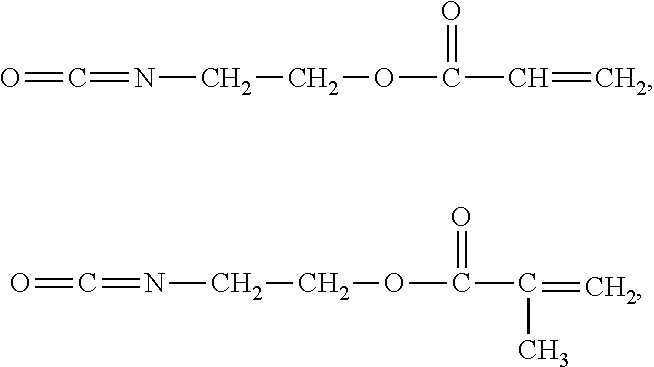
O═C═N—R4—R5, in which R4 is an alkylene group and R5 is an acrylate group or a methacrylate group, and combinations thereof; and

where X2 is

in which m ranges from 1 to 4, and each of R2 and R3 is the same or different in each repeating unit m, and is independently a hydrogen atom, an alkyl group, an alkenyl group, or a hydroxyl group, and

in which p ranges from 1 to 4, and each of R6 and R7 is the same or different in each repeating unit p, and is independently a hydrogen atom, an alkyl group, or a hydroxyl group.

where:

in which m ranges from 1 to 4, and each of R2 and R3 is the same or different in each repeating unit m, and is independently a hydrogen atom, an alkyl group, an alkenyl group, or a hydroxyl group; and

in which
-
- R4 is an alkylene group,
- R5 is an acrylate group or a methacrylate group,
- p ranges from 1 to 4,
- each of R6 and R7 is the same or different in each repeating unit p, and is independently a hydrogen atom, an alkyl group, or a hydroxyl group, and
- one of R9 and R10 is a hydroxyl group and the other of R9 and R10 is

in which R11 is an unsubstituted alkenyl group or an alkyl-substituted alkenyl group,


O═C═N—R4—R5, in which R4 is an alkylene group and R5 is an acrylate group or a methacrylate group, and combinations thereof.


in which p, R6, and R7 are as defined above.


and combinations thereof. R4 and R5 are as defined above.


in which p, R6, and R7 are as defined above.


(hereinafter referred to as 4Ar-Phenol).

(hereinafter referred to as 4Ar-Allyl).

(hereinafter referred to as 4Ar-Acrylate).

(hereinafter referred to as 4Ar-MOI).

(hereinafter referred to as 4Ar-AOI).

(hereinafter referred to as 4Ar-EtOH).

(hereinafter referred to as 4Ar-Et-Acrylate).

(hereinafter referred to as 4Ar-Et-Allyl).

(hereinafter referred to as 4Ar-Et-AOI).

(hereinafter referred to as 4Ar-Et-MOI).

When calculated by 1H-NMR integration, n is about 1.32. The hydroxyl number determined by ASTM D4274-05 is 138.2 mgKOH/g, and thus n is calculated to be about 1.24. An average value of n is 1.3. The white powder obtained in Example 10 is hereinafter referred to as 4Ar-PG1.3.

(hereinafter referred to as 4Ar-PG1.3-Acrylate).

Y is C3H5), 1.908 (s, 3H). The white powder was confirmed to have a chemical structure represented by

in which Y is C3H5, (hereinafter referred to as 4Ar-GMA).

(hereinafter referred to as 4Ar-GE).

Y is C3H5), 2.53 (s, 1H). The product was confirmed to have a chemical structure represented by

(hereinafter referred to as 4Ar-GE-AA).
| TABLE 1 | ||||
| Refractive | ||||
| Fluorene-containing compound | index | ||
| Synthesis Example | 4Ar-Phenol | 1.740 | ||
| Example 1 | 4Ar-Allyl | 1.660 | ||
| Example 2 | 4Ar-Acrylate | 1.680 | ||
| Example 3 | 4Ar-MOI | 1.570 | ||
| Example 4 | 4Ar-AOI | 1.570 | ||
| Example 5 | 4Ar-EtOH | 1.650 | ||
| Example 6 | 4Ar-Et-Acrylate | 1.634 | ||
| Example 7 | 4Ar-Et-Allyl | 1.610 | ||
| Example 8 | 4Ar-Et-AOI | 1.550 | ||
| Example 9 | 4Ar-Et-MOI | 1.540 | ||
| Example 10 | 4Ar-PG1.3 | 1.636 | ||
| Example 11 | 4Ar-PG1.3-acrylate | 1.621 | ||
| Example 12 | 4Ar-GMA | 1.623 | ||
| Example 13 | 4Ar-GE | 1.643 | ||
| Example 14 | 4Ar-GE-AA | 1.624 | ||
| TABLE 2 | ||
| b0 hr | Δb* = bt, hr − b0 hr | |
| Hours |
| 0 | 12 | 24 | 26 | 48 | 60 | |
| Example 15 | −0.14 | 0.25 | 0.31 | 0.31 | 0.54 | 0.77 |
| Example 16 | −0.19 | 0.25 | 0.31 | 0.31 | 0.53 | 0.72 |
| Example 17 | −0.03 | 0.24 | 0.25 | 0.25 | 0.42 | 0.68 |
| Example 18 | −0.04 | 0.25 | 0.25 | 0.27 | 0.44 | 0.62 |
| Example 20 | −0.18 | 0.25 | 0.28 | 0.29 | 0.54 | 0.77 |
| Example 21 | −0.15 | 0.23 | 0.33 | 0.33 | 0.54 | 0.78 |
| Example 22 | −0.04 | 0.25 | 0.27 | 0.27 | 0.43 | 0.66 |
| Example 23 | −0.04 | 0.25 | 0.25 | 0.28 | 0.44 | 0.67 |
| Comparative | −0.19 | 0.25 | 0.37 | 0.37 | 0.62 | 0.92 |
| Example | ||||||
| TABLE 3 | |||
| Transmittance (%) | |||
| Blue | Yellow | Red | |||
| (470 nm) | (570 nm) | (660 nm) | |||
| Example 15 | 88.6 | 89.6 | 89.8 | ||
| Example 16 | 89.2 | 89.3 | 89.6 | ||
| Example 17 | 89.5 | 89.5 | 89.5 | ||
| Example 18 | 89.5 | 89.5 | 89.5 | ||
| Example 20 | 89.1 | 89.3 | 89.5 | ||
| Example 21 | 88.5 | 89.6 | 89.7 | ||
| Example 22 | 89.4 | 89.4 | 89.4 | ||
| Example 23 | 89.4 | 89.4 | 89.5 | ||
| Comparative | 88.4 | 88.7 | 89.1 | ||
| Example | |||||
| PET film | 88.3 | 88.3 | 88.3 | ||
Claims (6)


Applications Claiming Priority (3)
| Application Number | Priority Date | Filing Date | Title |
|---|---|---|---|
| TW106102883 | 2017-01-25 | ||
| TW106102883A | 2017-01-25 | ||
| TW106102883A TWI633327B (en) | 2017-01-25 | 2017-01-25 | Thorium-containing compound, method for preparing thallium-containing compound, curable composition, and cured product |
Publications (2)
| Publication Number | Publication Date |
|---|---|
| US20180208531A1 US20180208531A1 (en) | 2018-07-26 |
| US10384996B2 true US10384996B2 (en) | 2019-08-20 |
Family
ID=62905984
Family Applications (1)
| Application Number | Title | Priority Date | Filing Date |
|---|---|---|---|
| US15/650,992 Expired - Fee Related US10384996B2 (en) | 2017-01-25 | 2017-07-17 | Fluorene-containing compound and method for making the same |
Country Status (2)
| Country | Link |
|---|---|
| US (1) | US10384996B2 (en) |
| TW (1) | TWI633327B (en) |
Families Citing this family (4)
| Publication number | Priority date | Publication date | Assignee | Title |
|---|---|---|---|---|
| JP7169907B2 (en) * | 2019-03-04 | 2022-11-11 | 大阪ガスケミカル株式会社 | Fluorene compound and method for producing the same |
| US11718580B2 (en) | 2019-05-08 | 2023-08-08 | Meta Platforms Technologies, Llc | Fluorene derivatized monomers and polymers for volume Bragg gratings |
| US11780819B2 (en) | 2019-11-27 | 2023-10-10 | Meta Platforms Technologies, Llc | Aromatic substituted alkane-core monomers and polymers thereof for volume Bragg gratings |
| US11879024B1 (en) | 2020-07-14 | 2024-01-23 | Meta Platforms Technologies, Llc | Soft mold formulations for surface relief grating fabrication with imprinting lithography |
Citations (2)
| Publication number | Priority date | Publication date | Assignee | Title |
|---|---|---|---|---|
| US4675458A (en) * | 1984-10-27 | 1987-06-23 | Ronm GmbH | Method for making 9,9-bis-(4-hydroxyphenyl)-fluorene |
| WO2015141710A1 (en) * | 2014-03-20 | 2015-09-24 | 富士フイルム株式会社 | Composition, curable composition, transparent film, solid-state imaging element, and display device |
Family Cites Families (7)
| Publication number | Priority date | Publication date | Assignee | Title |
|---|---|---|---|---|
| DE10115955B4 (en) * | 2001-03-30 | 2017-10-19 | Merck Patent Gmbh | Fluorinated fluorene derivatives |
| TWI230168B (en) * | 2002-10-25 | 2005-04-01 | Jung-Jr Wu | Aromatic group substituted oligofluorene compound |
| JP4296995B2 (en) * | 2004-06-11 | 2009-07-15 | Jsr株式会社 | Fluorene compound and method for producing the same |
| DE602005013264D1 (en) * | 2004-07-15 | 2009-04-23 | Osaka Gas Co Ltd | RESIN COMPOSITION AND FORM BODY THEREOF |
| US7540978B2 (en) * | 2004-08-05 | 2009-06-02 | Novaled Ag | Use of an organic matrix material for producing an organic semiconductor material, organic semiconductor material and electronic component |
| CN101048364A (en) * | 2004-10-29 | 2007-10-03 | 出光兴产株式会社 | Aromatic amine compound and organic electroluminescent device using the aromatic amine compound |
| KR101142293B1 (en) * | 2006-04-13 | 2012-05-08 | 토소가부시키가이샤 | Benzofluorene compound and use thereof |
-
2017
- 2017-01-25 TW TW106102883A patent/TWI633327B/en not_active IP Right Cessation
- 2017-07-17 US US15/650,992 patent/US10384996B2/en not_active Expired - Fee Related
Patent Citations (2)
| Publication number | Priority date | Publication date | Assignee | Title |
|---|---|---|---|---|
| US4675458A (en) * | 1984-10-27 | 1987-06-23 | Ronm GmbH | Method for making 9,9-bis-(4-hydroxyphenyl)-fluorene |
| WO2015141710A1 (en) * | 2014-03-20 | 2015-09-24 | 富士フイルム株式会社 | Composition, curable composition, transparent film, solid-state imaging element, and display device |
Non-Patent Citations (1)
| Title |
|---|
| Machine translation available for WO 2015141710. * |
Also Published As
| Publication number | Publication date |
|---|---|
| TWI633327B (en) | 2018-08-21 |
| US20180208531A1 (en) | 2018-07-26 |
| TW201827857A (en) | 2018-08-01 |
Similar Documents
| Publication | Publication Date | Title |
|---|---|---|
| US10384996B2 (en) | Fluorene-containing compound and method for making the same | |
| US9505700B2 (en) | High refractive index (meth) acrylates | |
| US6533959B2 (en) | Brominated materials | |
| EP2014639A1 (en) | Fluorine-containing adamantane derivative, fluorine-containing adamantane derivative having polymerizable group, resin composition containing the same, and antireflection film | |
| US20160120984A1 (en) | Sugar containing, amphiphilic copolymers | |
| TWI617544B (en) | Bicarbazole compound, photocurable composition, cured product thereof, curable composition for plastic lens, and plastic lens | |
| US20120010315A1 (en) | High refractive acrylate and the method for preparing the same | |
| JP7153664B2 (en) | 1,4:Acrylic acid derivative of 3,6-dianhydrohexitol | |
| US7939682B2 (en) | Fluorine-containing adamantane derivative, fluorine-containing adamantane derivative having polymerizable group, and resin composition containing same | |
| US7649106B2 (en) | Diol (meth) acrylate compound having urethane bond, method for producing the same, and polymer thereof | |
| CN104520376B (en) | Propylene oxide acids polymerizable composition for optical material and the preparation method of propylene oxide acids optical material | |
| WO2019067408A1 (en) | Polymers of haloalkyl and haloalkenyl ether (meth)acrylates | |
| CN112585113B (en) | Distillation and Purification of Fluorine-Containing Polymerizable Monomers | |
| JP2868188B2 (en) | (Meth) acrylic acid ester, method for producing the same, resin composition using the same, coating agent for optical fiber, and cured product | |
| JP2005008527A (en) | Polymerizable adamantane compound | |
| US20210130543A1 (en) | Synthesis of cyanurate and multifunctional alcohol-based polyether acrylate for uv curable materials | |
| JPS59216848A (en) | Naphthalene derivative | |
| US7649065B2 (en) | Fluoroadamantane derivative, fluorine-containing polymer and production method | |
| JP4028941B2 (en) | Optical products | |
| JP5082907B2 (en) | Novel tri (meth) acrylate and curable composition | |
| JP2923316B2 (en) | Adamantyl dicrotonate derivative | |
| JPH07316296A (en) | Method for producing sulfur-containing polymer particles | |
| US6846900B2 (en) | Polyvalent carboxylic acid ester, process for producing the carboxylic acid ester, plastic lens composition using the carboxylic ester, plastic lens obtained by curing the composition and process for producing the plastic lens | |
| BR112020005943B1 (en) | HALOALKYL ETHER (METH)ACRYLATES POLYMERS, ARTICLE OF MANUFACTURE, CURED COMPOSITION AND METHOD FOR PRODUCING POLYMER |
Legal Events
| Date | Code | Title | Description |
|---|---|---|---|
| AS | Assignment |
Owner name: NATIONAL KAOHSIUNG UNIVERSITY OF APPLIED SCIENCES, Free format text: ASSIGNMENT OF ASSIGNORS INTEREST;ASSIGNORS:YEN, FU-SAN;HSIEH, CHI-HAN;REEL/FRAME:043016/0432 Effective date: 20170703 |
|
| STPP | Information on status: patent application and granting procedure in general |
Free format text: RESPONSE TO NON-FINAL OFFICE ACTION ENTERED AND FORWARDED TO EXAMINER |
|
| STPP | Information on status: patent application and granting procedure in general |
Free format text: NOTICE OF ALLOWANCE MAILED -- APPLICATION RECEIVED IN OFFICE OF PUBLICATIONS |
|
| STPP | Information on status: patent application and granting procedure in general |
Free format text: PUBLICATIONS -- ISSUE FEE PAYMENT RECEIVED |
|
| STPP | Information on status: patent application and granting procedure in general |
Free format text: PUBLICATIONS -- ISSUE FEE PAYMENT VERIFIED |
|
| STCF | Information on status: patent grant |
Free format text: PATENTED CASE |
|
| FEPP | Fee payment procedure |
Free format text: MAINTENANCE FEE REMINDER MAILED (ORIGINAL EVENT CODE: REM.); ENTITY STATUS OF PATENT OWNER: SMALL ENTITY |
|
| LAPS | Lapse for failure to pay maintenance fees |
Free format text: PATENT EXPIRED FOR FAILURE TO PAY MAINTENANCE FEES (ORIGINAL EVENT CODE: EXP.); ENTITY STATUS OF PATENT OWNER: SMALL ENTITY |
|
| STCH | Information on status: patent discontinuation |
Free format text: PATENT EXPIRED DUE TO NONPAYMENT OF MAINTENANCE FEES UNDER 37 CFR 1.362 |
|
| FP | Lapsed due to failure to pay maintenance fee |
Effective date: 20230820 |