US10381578B2 - Organometallic compound and organic light-emitting device including the same - Google Patents
Organometallic compound and organic light-emitting device including the same Download PDFInfo
- Publication number
- US10381578B2 US10381578B2 US14/636,401 US201514636401A US10381578B2 US 10381578 B2 US10381578 B2 US 10381578B2 US 201514636401 A US201514636401 A US 201514636401A US 10381578 B2 US10381578 B2 US 10381578B2
- Authority
- US
- United States
- Prior art keywords
- group
- salt
- substituted
- tert
- sec
- Prior art date
- Legal status (The legal status is an assumption and is not a legal conclusion. Google has not performed a legal analysis and makes no representation as to the accuracy of the status listed.)
- Expired - Fee Related, expires
Links
- 0 *=CC=C(*1*(N)=CC=C1)C(N)=CI Chemical compound *=CC=C(*1*(N)=CC=C1)C(N)=CI 0.000 description 61
- TWWRVQFCLFRKFX-UHFFFAOYSA-N CC.CC.C[Y].C[Y][Y]([Y])[Y]([Y][Y])[Y](C)[Y][Y][Y].[Y]C[Y] Chemical compound CC.CC.C[Y].C[Y][Y]([Y])[Y]([Y][Y])[Y](C)[Y][Y][Y].[Y]C[Y] TWWRVQFCLFRKFX-UHFFFAOYSA-N 0.000 description 2
- YUWFEBAXEOLKSG-UHFFFAOYSA-N CC1=C(C)C(C)=C(C)C(C)=C1C Chemical compound CC1=C(C)C(C)=C(C)C(C)=C1C YUWFEBAXEOLKSG-UHFFFAOYSA-N 0.000 description 2
- ATRGSAURSVFBGF-DHLDVHAVSA-N BCP.C1=CC=C(N2C(C3=CC(C4=NC5=C(C=CC=C5)N4C4=CC=CC=C4)=CC(C4=NC5=C(C=CC=C5)N4C4=CC=CC=C4)=C3)=NC3=C2C=CC=C3)C=C1.C1=CC=C2C(=C1)C(C1=CC3=C(C=CC=C3)C=C1)=C1C=CC=CC1=C2C1=CC2=C(C=CC=C2)C=C1.C1=CC=C2C(=C1)C1=C(C=CC=C1)N2C1=CC=C(C2=CC=C(N3C4=CC=CC=C4C4=C3C=CC=C4)C=C2)C=C1.CC(C)(C)C1=CC2=C(C3=CC4=C(C=CC=C4)C=C3)C3=CC=CC=C3C(C3=CC4=C(C=CC=C4)C=C3)=C2C=C1.CC1=CC(N2C3=C(C=CC=C3)C3=C2C=CC=C3)=CC=C1C1=C(C)C=C(N2C3=C(C=CC=C3)C3=C2C=CC=C3)C=C1.[2H]C(B)P.[3H]P[BiH2] Chemical compound BCP.C1=CC=C(N2C(C3=CC(C4=NC5=C(C=CC=C5)N4C4=CC=CC=C4)=CC(C4=NC5=C(C=CC=C5)N4C4=CC=CC=C4)=C3)=NC3=C2C=CC=C3)C=C1.C1=CC=C2C(=C1)C(C1=CC3=C(C=CC=C3)C=C1)=C1C=CC=CC1=C2C1=CC2=C(C=CC=C2)C=C1.C1=CC=C2C(=C1)C1=C(C=CC=C1)N2C1=CC=C(C2=CC=C(N3C4=CC=CC=C4C4=C3C=CC=C4)C=C2)C=C1.CC(C)(C)C1=CC2=C(C3=CC4=C(C=CC=C4)C=C3)C3=CC=CC=C3C(C3=CC4=C(C=CC=C4)C=C3)=C2C=C1.CC1=CC(N2C3=C(C=CC=C3)C3=C2C=CC=C3)=CC=C1C1=C(C)C=C(N2C3=C(C=CC=C3)C3=C2C=CC=C3)C=C1.[2H]C(B)P.[3H]P[BiH2] ATRGSAURSVFBGF-DHLDVHAVSA-N 0.000 description 1
- FDWZZOBGHFUISO-ICEKJIEBSA-N BN=P.C.C1=CC=C(N(C2=CC3=C(C=C2)C2=C(C=C(N(C4=CC=CC=C4)C4=C5C=CC=CC5=CC=C4)C=C2)C32C3=CC=CC=C3C3=C2C=CC=C3)C2=C3C=CC=CC3=CC=C2)C=C1.C1=CC=C(N(C2=CC=C(C3=CC=C(N(C4=CC=CC=C4)C4=C5C=CC=CC5=CC=C4)C=C3)C=C2)C2=CC=CC3=C2C=CC=C3)C=C1.C1=CC=C(N(C2=CC=C(C3=CC=C(N(C4=CC=CC=C4)C4=CC5=C(C=CC=C5)C=C4)C=C3)C=C2)C2=CC3=C(C=CC=C3)C=C2)C=C1.CC1=CC(N(C2=CC=CC=C2)C2=CC3=C(C=C2)C2=C(C=C(N(C4=CC=CC=C4)C4=CC=CC(C)=C4)C=C2)C32C3=CC=CC=C3C3=C2C=CC=C3)=CC=C1.CC1=CC=CC(N(C2=CC=CC=C2)C2=CC=C(C3=CC=C(N(C4=CC=CC=C4)C4=CC=CC(C)=C4)C=C3)C=C2)=C1.[3H]PB Chemical compound BN=P.C.C1=CC=C(N(C2=CC3=C(C=C2)C2=C(C=C(N(C4=CC=CC=C4)C4=C5C=CC=CC5=CC=C4)C=C2)C32C3=CC=CC=C3C3=C2C=CC=C3)C2=C3C=CC=CC3=CC=C2)C=C1.C1=CC=C(N(C2=CC=C(C3=CC=C(N(C4=CC=CC=C4)C4=C5C=CC=CC5=CC=C4)C=C3)C=C2)C2=CC=CC3=C2C=CC=C3)C=C1.C1=CC=C(N(C2=CC=C(C3=CC=C(N(C4=CC=CC=C4)C4=CC5=C(C=CC=C5)C=C4)C=C3)C=C2)C2=CC3=C(C=CC=C3)C=C2)C=C1.CC1=CC(N(C2=CC=CC=C2)C2=CC3=C(C=C2)C2=C(C=C(N(C4=CC=CC=C4)C4=CC=CC(C)=C4)C=C2)C32C3=CC=CC=C3C3=C2C=CC=C3)=CC=C1.CC1=CC=CC(N(C2=CC=CC=C2)C2=CC=C(C3=CC=C(N(C4=CC=CC=C4)C4=CC=CC(C)=C4)C=C3)C=C2)=C1.[3H]PB FDWZZOBGHFUISO-ICEKJIEBSA-N 0.000 description 1
- ZNFRWNPRLKOEIZ-UHFFFAOYSA-N C.C.CC(C)N1C(N(C2=CC=CC=N2)C2=NC=CC=C2)N(C(C)C)[Ir]12C1=CC3=C(C=C1N1/C=C\NC12)OC1=C3C=CC=C1.CC(C)N1C(N2C3=CN=CC=C3C3=C2C=CC=C3)N(C(C)C)[Ir]12C1=CC3=C(C=C1N1/C=C\NC12)OC1=C3C=CC=C1.CC(C)N1C(N2C3=CN=CC=C3OC3=C2C=CC=C3)N(C(C)C)[Ir]12C1=CC(F)=NC(F)=C1C1=N2C=CC=C1.CC1=CC2=N(C=C1)[Ir]1(C3=CC(F)=C(C)C(F)=C32)N(C(C)C)C(N2C3=CN=CC=C3SC3=C2C=CC=C3)N1C(C)C Chemical compound C.C.CC(C)N1C(N(C2=CC=CC=N2)C2=NC=CC=C2)N(C(C)C)[Ir]12C1=CC3=C(C=C1N1/C=C\NC12)OC1=C3C=CC=C1.CC(C)N1C(N2C3=CN=CC=C3C3=C2C=CC=C3)N(C(C)C)[Ir]12C1=CC3=C(C=C1N1/C=C\NC12)OC1=C3C=CC=C1.CC(C)N1C(N2C3=CN=CC=C3OC3=C2C=CC=C3)N(C(C)C)[Ir]12C1=CC(F)=NC(F)=C1C1=N2C=CC=C1.CC1=CC2=N(C=C1)[Ir]1(C3=CC(F)=C(C)C(F)=C32)N(C(C)C)C(N2C3=CN=CC=C3SC3=C2C=CC=C3)N1C(C)C ZNFRWNPRLKOEIZ-UHFFFAOYSA-N 0.000 description 1
- COCWKIZMRIKJFY-UHFFFAOYSA-N C.C1=CC=C(C2=CC=NC3=C2C=CC2=C3N=CC=C2C2=CC=CC=C2)C=C1.CBP.CC1=NC2=C(C=CC3=C2N=C(C)C=C3C2=CC=CC=C2)C(C2=CC=CC=C2)=C1 Chemical compound C.C1=CC=C(C2=CC=NC3=C2C=CC2=C3N=CC=C2C2=CC=CC=C2)C=C1.CBP.CC1=NC2=C(C=CC3=C2N=C(C)C=C3C2=CC=CC=C2)C(C2=CC=CC=C2)=C1 COCWKIZMRIKJFY-UHFFFAOYSA-N 0.000 description 1
- IDZDJOGPRYDLLS-UHFFFAOYSA-N C.CC(C)(C)N1C(N(C2=CC=CC=N2)C2=NC=CC=C2)N(C(C)(C)C)[Ir]12C1=CC3=C(C=C1N1C=CNC12)OC1=C3C=CC=C1.CC(C)(C)N1C(N2C3=CN=CC=C3OC3=C2C=CC=C3)N(C(C)(C)C)[Ir]12C1=CC(F)=NC(F)=C1C1=N2C=CC=C1.CC1=CC2=N(C=C1)[Ir]1(C3=CC(F)=C(C)C(F)=C32)N(C(C)(C)C)C(N(C2=CC=CC=N2)C2=NC=CC=C2)N1C(C)(C)C.CC1=CC2=N(C=C1)[Ir]1(C3=CC(F)=C(C)C(F)=C32)N(C(C)(C)C)C(N2C3=CN=CC=C3OC3=C2C=CC=C3)N1C(C)(C)C.CN1C=CN2C3=CC4=C(C=C3[Ir]3(C12)N(C(C)(C)C)C(N1C2=CN=CC=C2C2=C1C=CC=C2)N3C(C)(C)C)C1=C(C=CC=C1)O4 Chemical compound C.CC(C)(C)N1C(N(C2=CC=CC=N2)C2=NC=CC=C2)N(C(C)(C)C)[Ir]12C1=CC3=C(C=C1N1C=CNC12)OC1=C3C=CC=C1.CC(C)(C)N1C(N2C3=CN=CC=C3OC3=C2C=CC=C3)N(C(C)(C)C)[Ir]12C1=CC(F)=NC(F)=C1C1=N2C=CC=C1.CC1=CC2=N(C=C1)[Ir]1(C3=CC(F)=C(C)C(F)=C32)N(C(C)(C)C)C(N(C2=CC=CC=N2)C2=NC=CC=C2)N1C(C)(C)C.CC1=CC2=N(C=C1)[Ir]1(C3=CC(F)=C(C)C(F)=C32)N(C(C)(C)C)C(N2C3=CN=CC=C3OC3=C2C=CC=C3)N1C(C)(C)C.CN1C=CN2C3=CC4=C(C=C3[Ir]3(C12)N(C(C)(C)C)C(N1C2=CN=CC=C2C2=C1C=CC=C2)N3C(C)(C)C)C1=C(C=CC=C1)O4 IDZDJOGPRYDLLS-UHFFFAOYSA-N 0.000 description 1
- ZZHBSDOROHUBLF-UHFFFAOYSA-N C1=CC2=C(C=C1)C=C(C1=C3C=CC=CC3=C(C3=C4C=CC=CC4=C(C4=CC=CC5=C4C=CC=C5)C4=C3C=CC=C4)C=C1)C=C2.C1=CC2=CC(C3=C4C=CC=CC4=C(C4=C5C=CC=CC5=C(C5=CC=CC6=C5C=CC=C6)C5=C4C=CC=C5)C=C3)=C3C=CC=CC3=C2C=C1.C1=CC2=CC=CC(C3=C4C=CC=CC4=C(C4=C5C=CC=CC5=C(C5=CC=CC6=C5C=CC=C6)C5=C4C=CC=C5)C=C3)=C2C=C1.C1=CC=C(C2=C3C=CC=CC3=C(C3=C4C=CC=CC4=C(C4=CC5=C(C=CC=C5)C=C4)C=C3)C3=C2C=CC=C3)C=C1.C1=CC=C(C2=CC=C(C3=C4C=CC=CC4=C(C4=C5C=CC=CC5=CC=C4)C4=C3C=CC=C4)C3=C2C=CC=C3)C=C1 Chemical compound C1=CC2=C(C=C1)C=C(C1=C3C=CC=CC3=C(C3=C4C=CC=CC4=C(C4=CC=CC5=C4C=CC=C5)C4=C3C=CC=C4)C=C1)C=C2.C1=CC2=CC(C3=C4C=CC=CC4=C(C4=C5C=CC=CC5=C(C5=CC=CC6=C5C=CC=C6)C5=C4C=CC=C5)C=C3)=C3C=CC=CC3=C2C=C1.C1=CC2=CC=CC(C3=C4C=CC=CC4=C(C4=C5C=CC=CC5=C(C5=CC=CC6=C5C=CC=C6)C5=C4C=CC=C5)C=C3)=C2C=C1.C1=CC=C(C2=C3C=CC=CC3=C(C3=C4C=CC=CC4=C(C4=CC5=C(C=CC=C5)C=C4)C=C3)C3=C2C=CC=C3)C=C1.C1=CC=C(C2=CC=C(C3=C4C=CC=CC4=C(C4=C5C=CC=CC5=CC=C4)C4=C3C=CC=C4)C3=C2C=CC=C3)C=C1 ZZHBSDOROHUBLF-UHFFFAOYSA-N 0.000 description 1
- AGRQECGHQWNEPW-UHFFFAOYSA-N C1=CC2=C(C=C1)C=C(C1=C3C=CC=CC3=C(C3=CC4=C(C=CC=C4)C4=C3C=CC=C4)C3=C1C=CC=C3)C=C2.C1=CC2=CC=CC(C3=C4C=CC=CC4=C(C4=C5C=CC=CC5=CC=C4)C4=C3C=CC=C4)=C2C=C1.C1=CC2=CC=CC(C3=C4C=CC=CC4=C(C4=CC5=C(C=CC=C5)C5=C4C=CC=C5)C4=C3C=CC=C4)=C2C=C1.C1=CC2=CC=CC(C3=C4C=CC=CC4=C(C4=CC5=C(C=CC=C5)C=C4)C4=C3C=CC=C4)=C2C=C1.C1=CC2=CC=CC(C3=C4C=CC=CC4=C(C4=CC5=C6C7=C4C=CC=C7/C=C\C6=C\C=C/5)C4=C3C=CC=C4)=C2C=C1 Chemical compound C1=CC2=C(C=C1)C=C(C1=C3C=CC=CC3=C(C3=CC4=C(C=CC=C4)C4=C3C=CC=C4)C3=C1C=CC=C3)C=C2.C1=CC2=CC=CC(C3=C4C=CC=CC4=C(C4=C5C=CC=CC5=CC=C4)C4=C3C=CC=C4)=C2C=C1.C1=CC2=CC=CC(C3=C4C=CC=CC4=C(C4=CC5=C(C=CC=C5)C5=C4C=CC=C5)C4=C3C=CC=C4)=C2C=C1.C1=CC2=CC=CC(C3=C4C=CC=CC4=C(C4=CC5=C(C=CC=C5)C=C4)C4=C3C=CC=C4)=C2C=C1.C1=CC2=CC=CC(C3=C4C=CC=CC4=C(C4=CC5=C6C7=C4C=CC=C7/C=C\C6=C\C=C/5)C4=C3C=CC=C4)=C2C=C1 AGRQECGHQWNEPW-UHFFFAOYSA-N 0.000 description 1
- XQTFWUOZILQRIN-UHFFFAOYSA-N C1=CC2=C(C=C1)C=C(C1=C3C=CC=CC3=C(C3=CC4=C5C6=C3C=CC=C6/C=C\C5=C\C=C/4)C3=C1C=CC=C3)C=C2.C1=CC=C(C2=C3C=CC=CC3=C(C3=CC4=C5C6=C3C=CC=C6/C=C\C5=C\C=C/4)C3=C2C=CC=C3)C=C1.C1=CC=C(C2=C3C=CC=CC3=C(C3=CC=C(C4=CC=CC5=C4C=CC=C5)C=C3)C3=C2C=CC=C3)C=C1.C1=CC=C(C2=CC(C3=CC=CC=C3)=CC(C3=C4C=CC=CC4=C(C4=C5C=CC=CC5=C5C=CC=CC5=C4)C4=C3C=CC=C4)=C2)C=C1.C1=CC=C(C2=CC(C3=CC=CC=C3)=CC(C3=C4C=CC=CC4=C(C4=C5C=CC=CC5=CC=C4)C4=C3C=CC=C4)=C2)C=C1 Chemical compound C1=CC2=C(C=C1)C=C(C1=C3C=CC=CC3=C(C3=CC4=C5C6=C3C=CC=C6/C=C\C5=C\C=C/4)C3=C1C=CC=C3)C=C2.C1=CC=C(C2=C3C=CC=CC3=C(C3=CC4=C5C6=C3C=CC=C6/C=C\C5=C\C=C/4)C3=C2C=CC=C3)C=C1.C1=CC=C(C2=C3C=CC=CC3=C(C3=CC=C(C4=CC=CC5=C4C=CC=C5)C=C3)C3=C2C=CC=C3)C=C1.C1=CC=C(C2=CC(C3=CC=CC=C3)=CC(C3=C4C=CC=CC4=C(C4=C5C=CC=CC5=C5C=CC=CC5=C4)C4=C3C=CC=C4)=C2)C=C1.C1=CC=C(C2=CC(C3=CC=CC=C3)=CC(C3=C4C=CC=CC4=C(C4=C5C=CC=CC5=CC=C4)C4=C3C=CC=C4)=C2)C=C1 XQTFWUOZILQRIN-UHFFFAOYSA-N 0.000 description 1
- UPOYQTDPKJYACP-UHFFFAOYSA-N C1=CC2=C(C=C1)C=C(C1=CC3=CC(C4=C5C=CC=CC5=C(C5=CC=CC6=C5C=CC=C6)C5=C4C=CC=C5)=CC=C3C=C1)C=C2.C1=CC2=C(C=C1)C=C(C1=CC3=CC(C4=C5C=CC=CC5=C(C5=CC=CC6=C5C=CC=C6C5=CC6=C(C=CC=C6)C=C5)C5=C4C=CC=C5)=CC=C3C=C1)C=C2.C1=CC2=CC=CC(C3=CC4=CC(C5=C6C=CC=CC6=C(C6=CC=CC7=C6C=CC=C7)C6=C5C=CC=C6)=CC=C4C=C3)=C2C=C1.C1=CC=C(C2=CC3=CC(C4=C5C=CC=CC5=C(C5=CC=CC6=C5C=CC=C6)C5=C4C=CC=C5)=CC=C3C=C2)C=C1 Chemical compound C1=CC2=C(C=C1)C=C(C1=CC3=CC(C4=C5C=CC=CC5=C(C5=CC=CC6=C5C=CC=C6)C5=C4C=CC=C5)=CC=C3C=C1)C=C2.C1=CC2=C(C=C1)C=C(C1=CC3=CC(C4=C5C=CC=CC5=C(C5=CC=CC6=C5C=CC=C6C5=CC6=C(C=CC=C6)C=C5)C5=C4C=CC=C5)=CC=C3C=C1)C=C2.C1=CC2=CC=CC(C3=CC4=CC(C5=C6C=CC=CC6=C(C6=CC=CC7=C6C=CC=C7)C6=C5C=CC=C6)=CC=C4C=C3)=C2C=C1.C1=CC=C(C2=CC3=CC(C4=C5C=CC=CC5=C(C5=CC=CC6=C5C=CC=C6)C5=C4C=CC=C5)=CC=C3C=C2)C=C1 UPOYQTDPKJYACP-UHFFFAOYSA-N 0.000 description 1
- NPZFSVCIECMROA-UHFFFAOYSA-N C1=CC2=C(C=C1)C=C(C1=CC=C(C3=C4C=CC=CC4=C(C4=CC=CC5=C4C=CC=C5)C4=C3C=CC=C4)C=C1)C=C2.C1=CC2=CC(C3=CC4=CC(C5=C6C=CC=CC6=C(C6=CC=CC7=C6C=CC=C7)C6=C5C=CC=C6)=CC=C4C=C3)=C3C=CC=CC3=C2C=C1.C1=CC=C(C2=CC=C(C3=C4C=CC=CC4=C(C4=C5C=CC=CC5=CC=C4)C4=C3C=CC=C4)C=C2)C=C1.C1=CC=C(C2=CC=CC(C3=C4C=CC=CC4=C(C4=CC=CC5=C4C=CC=C5)C4=C3C=CC=C4)=C2)C=C1 Chemical compound C1=CC2=C(C=C1)C=C(C1=CC=C(C3=C4C=CC=CC4=C(C4=CC=CC5=C4C=CC=C5)C4=C3C=CC=C4)C=C1)C=C2.C1=CC2=CC(C3=CC4=CC(C5=C6C=CC=CC6=C(C6=CC=CC7=C6C=CC=C7)C6=C5C=CC=C6)=CC=C4C=C3)=C3C=CC=CC3=C2C=C1.C1=CC=C(C2=CC=C(C3=C4C=CC=CC4=C(C4=C5C=CC=CC5=CC=C4)C4=C3C=CC=C4)C=C2)C=C1.C1=CC=C(C2=CC=CC(C3=C4C=CC=CC4=C(C4=CC=CC5=C4C=CC=C5)C4=C3C=CC=C4)=C2)C=C1 NPZFSVCIECMROA-UHFFFAOYSA-N 0.000 description 1
- LBCUNHDUMCQMBZ-WMTCLNHOSA-N C1=CC2=C(C=C1)N(C1=CC(N3C4=C(C=CC=C4)C4=C3C=CC=C4)=CC(N3C4=C(C=CC=C4)C4=C3C=CC=C4)=C1)C1=C2C=CC=C1.[3H]CP Chemical compound C1=CC2=C(C=C1)N(C1=CC(N3C4=C(C=CC=C4)C4=C3C=CC=C4)=CC(N3C4=C(C=CC=C4)C4=C3C=CC=C4)=C1)C1=C2C=CC=C1.[3H]CP LBCUNHDUMCQMBZ-WMTCLNHOSA-N 0.000 description 1
- FRGPQKXWSHJYFK-UHFFFAOYSA-H C1=CC2=C3C(=C1)O[Al]14(OC5=CC=CC6=C5N1=CC=C6)(O/C1=C/C=C\C5=C1N4=CC=C5)N3=CC=C2.C1=CC=C(C2=NN=C(C3=CC=CC=C3)N2C2=C3C=CC=CC3=CC=C2)C=C1.CC(C)(C)C1=CC=C(C2=NN=C(C3=CC=C(C4=CC=CC=C4)C=C3)N2C2=CC=CC=C2)C=C1.CC1=N2C3=C(C=CC=C3C=C1)O[AlH]21(OC2=CC=C(C3=CC=CC=C3)C=C2)OC2=C3C(=CC=C2)C=CC(C)=N31 Chemical compound C1=CC2=C3C(=C1)O[Al]14(OC5=CC=CC6=C5N1=CC=C6)(O/C1=C/C=C\C5=C1N4=CC=C5)N3=CC=C2.C1=CC=C(C2=NN=C(C3=CC=CC=C3)N2C2=C3C=CC=CC3=CC=C2)C=C1.CC(C)(C)C1=CC=C(C2=NN=C(C3=CC=C(C4=CC=CC=C4)C=C3)N2C2=CC=CC=C2)C=C1.CC1=N2C3=C(C=CC=C3C=C1)O[AlH]21(OC2=CC=C(C3=CC=CC=C3)C=C2)OC2=C3C(=CC=C2)C=CC(C)=N31 FRGPQKXWSHJYFK-UHFFFAOYSA-H 0.000 description 1
- VJCKSAVKZBFWKX-CUWRMNFMSA-N C1=CC2=CC=C(C3=C4C=CC(C5=CC=CC6=C5C=CC=C6)=CC4=C(C4=CC=C(C5=C6C=CC=CC6=CC=C5)C=C4)C4=C3C=CC=C4)C=C2C=C1.C1=CC=C(C2=C3C=CC=CC3=C(C3=CC4=C(C=C3)C=C(C3=CC5=C(C=CC=C5)C=C3)C=C4)C3=C2C=CC=C3)C=C1.C1=CC=C(C2=CC3=C(C=C2)C=C(C2=C4C=CC=CC4=C(C4=CC=CC=C4)C4=C2C=CC=C4)C=C3)C=C1.[2H]C1=C([2H])C([2H])=C(C2=C3C=CC=CC3=C(C3=CC4=C(C=CC=C4)C4=C3C=CC=C4)C3=C2C=CC=C3)C([2H])=C1[2H].[2H]C1=C([2H])C([2H])=C(C2=C3C=CC=CC3=C(C3=CC=C(C4=CC=C5C=CC=CC5=C4)C=C3)C3=C2C=CC=C3)C([2H])=C1[2H] Chemical compound C1=CC2=CC=C(C3=C4C=CC(C5=CC=CC6=C5C=CC=C6)=CC4=C(C4=CC=C(C5=C6C=CC=CC6=CC=C5)C=C4)C4=C3C=CC=C4)C=C2C=C1.C1=CC=C(C2=C3C=CC=CC3=C(C3=CC4=C(C=C3)C=C(C3=CC5=C(C=CC=C5)C=C3)C=C4)C3=C2C=CC=C3)C=C1.C1=CC=C(C2=CC3=C(C=C2)C=C(C2=C4C=CC=CC4=C(C4=CC=CC=C4)C4=C2C=CC=C4)C=C3)C=C1.[2H]C1=C([2H])C([2H])=C(C2=C3C=CC=CC3=C(C3=CC4=C(C=CC=C4)C4=C3C=CC=C4)C3=C2C=CC=C3)C([2H])=C1[2H].[2H]C1=C([2H])C([2H])=C(C2=C3C=CC=CC3=C(C3=CC=C(C4=CC=C5C=CC=CC5=C4)C=C3)C3=C2C=CC=C3)C([2H])=C1[2H] VJCKSAVKZBFWKX-CUWRMNFMSA-N 0.000 description 1
- YGFOPWDHQOBPSW-GHZAZCSRSA-N C1=CC2=CC=C(C3=C4C=CC=CC4=C(C4=CC=C(C5=C6C=CC=CC6=CC=C5)C=C4)C4=C3C=CC=C4)C=C2C=C1.C1=CC2=CC=C(C3=CC=CC(C4=C5C=CC=CC5=C(C5=CC=CC6=C5C=CC=C6)C5=C4C=CC=C5)=C3)C=C2C=C1.C1=CC2=CC=C(C3=CC=CC(C4=C5C=CC=CC5=C(C5=CC=CC6=C5C=CC=C6)C5=C4C=CC=C5)=C3)C=C2C=C1.C1=CC=C(C2=CC3=C(C=C2)C=C(C2=C4C=CC=CC4=C(C4=CC=CC5=C4C=CC=C5)C4=C2C=CC=C4)C=C3)C=C1.[2H]C1=C([2H])C([2H])=C(C2=C3C=CC=CC3=C(C3=CC=C(C4=CC=CC5=C4C=CC=C5)C=C3)C3=C2C=CC=C3)C([2H])=C1[2H] Chemical compound C1=CC2=CC=C(C3=C4C=CC=CC4=C(C4=CC=C(C5=C6C=CC=CC6=CC=C5)C=C4)C4=C3C=CC=C4)C=C2C=C1.C1=CC2=CC=C(C3=CC=CC(C4=C5C=CC=CC5=C(C5=CC=CC6=C5C=CC=C6)C5=C4C=CC=C5)=C3)C=C2C=C1.C1=CC2=CC=C(C3=CC=CC(C4=C5C=CC=CC5=C(C5=CC=CC6=C5C=CC=C6)C5=C4C=CC=C5)=C3)C=C2C=C1.C1=CC=C(C2=CC3=C(C=C2)C=C(C2=C4C=CC=CC4=C(C4=CC=CC5=C4C=CC=C5)C4=C2C=CC=C4)C=C3)C=C1.[2H]C1=C([2H])C([2H])=C(C2=C3C=CC=CC3=C(C3=CC=C(C4=CC=CC5=C4C=CC=C5)C=C3)C3=C2C=CC=C3)C([2H])=C1[2H] YGFOPWDHQOBPSW-GHZAZCSRSA-N 0.000 description 1
- ULJOSUUHZNPYIJ-UHFFFAOYSA-N C1=CC=C(C2=C3C=C(C4=CC=C5C=CC=CC5=C4)C=CC3=C(C3=CC=C4C(=C3)C=CC3=C4C=CC=C3)C3=C2C=CC=C3)C=C1.CC1(C)C2=CC(C3=C4C=CC(C5=CC6=C(C=CC=C6)C=C5)=CC4=C(C4=CC=C(C5=CC6=C(C=CC=C6)C=C5)C=C4)C4=CC=CC=C43)=CC=C2C2=C1C=CC=C2.CC1(C)C2=CC3=C(C4=CC5=C(C=CC=C5)C=C4)C4=CC=CC=C4C(C4=CC5=C(C=CC=C5)C=C4)=C3C=C2C2=C1C=C(C1=CC=C3C=CC=CC3=C1)C=C2 Chemical compound C1=CC=C(C2=C3C=C(C4=CC=C5C=CC=CC5=C4)C=CC3=C(C3=CC=C4C(=C3)C=CC3=C4C=CC=C3)C3=C2C=CC=C3)C=C1.CC1(C)C2=CC(C3=C4C=CC(C5=CC6=C(C=CC=C6)C=C5)=CC4=C(C4=CC=C(C5=CC6=C(C=CC=C6)C=C5)C=C4)C4=CC=CC=C43)=CC=C2C2=C1C=CC=C2.CC1(C)C2=CC3=C(C4=CC5=C(C=CC=C5)C=C4)C4=CC=CC=C4C(C4=CC5=C(C=CC=C5)C=C4)=C3C=C2C2=C1C=C(C1=CC=C3C=CC=CC3=C1)C=C2 ULJOSUUHZNPYIJ-UHFFFAOYSA-N 0.000 description 1
- KZAKBJAYWDUASW-UHFFFAOYSA-N C1=CC=C(C2=CC=C(C3=C4C=CC=CC4=C(C4=CC=CC=C4)C4=C3C=C(C3=CC=CC=C3)C=C4)C=C2)C=C1.CC1(C)C2=CC(C3=CC4=C(C5=CC6=C(C=C5)C5=C(C=CC=C5)C6(C)C)C5=CC=CC=C5C(C5=CC=C6C(=C5)C(C)(C)C5=C6C=CC=C5)=C4C=C3)=CC=C2C2=C1C=CC=C2.CC1(C)C2=CC(C3=CC4=C(C5=CC=C6C=CC=CC6=C5)C5=C(C=CC=C5)C(C5=CC=C6C=CC=CC6=C5)=C4C=C3)=CC=C2C2=C1C1=C(C=CC=C1)C=C2 Chemical compound C1=CC=C(C2=CC=C(C3=C4C=CC=CC4=C(C4=CC=CC=C4)C4=C3C=C(C3=CC=CC=C3)C=C4)C=C2)C=C1.CC1(C)C2=CC(C3=CC4=C(C5=CC6=C(C=C5)C5=C(C=CC=C5)C6(C)C)C5=CC=CC=C5C(C5=CC=C6C(=C5)C(C)(C)C5=C6C=CC=C5)=C4C=C3)=CC=C2C2=C1C=CC=C2.CC1(C)C2=CC(C3=CC4=C(C5=CC=C6C=CC=CC6=C5)C5=C(C=CC=C5)C(C5=CC=C6C=CC=CC6=C5)=C4C=C3)=CC=C2C2=C1C1=C(C=CC=C1)C=C2 KZAKBJAYWDUASW-UHFFFAOYSA-N 0.000 description 1
- MXXHWAIEFXLUJG-UHFFFAOYSA-N C1=CC=C(C2=CC=C(N(C3=CC=C(C4=CC5=C(C=C4)N(C4=CC=CC=C4)C4=C5/C=C\C=C/4)C=C3)C3=CC=C4C(=C3)C(C3=CC=CC=C3)(C3=CC=CC=C3)C3=C4C=CC=C3)C=C2)C=C1.CC1(C)C2=CC(N(C3=CC=CC=C3)C3=CC=C(C4=CC5=C(C=C4)N(C4=CC=C(C6=CC=CC=C6)C=C4)C4=C5/C=C\C=C/4)C=C3)=CC=C2C2=C1C=CC=C2 Chemical compound C1=CC=C(C2=CC=C(N(C3=CC=C(C4=CC5=C(C=C4)N(C4=CC=CC=C4)C4=C5/C=C\C=C/4)C=C3)C3=CC=C4C(=C3)C(C3=CC=CC=C3)(C3=CC=CC=C3)C3=C4C=CC=C3)C=C2)C=C1.CC1(C)C2=CC(N(C3=CC=CC=C3)C3=CC=C(C4=CC5=C(C=C4)N(C4=CC=C(C6=CC=CC=C6)C=C4)C4=C5/C=C\C=C/4)C=C3)=CC=C2C2=C1C=CC=C2 MXXHWAIEFXLUJG-UHFFFAOYSA-N 0.000 description 1
- LBUQSNGTOSCEOW-UHFFFAOYSA-N C1=CC=C(C2=CC=C(N(C3=CC=C(C4=CC5=C(C=C4)N(C4=CC=CC=C4)C4=C5/C=C\C=C/4)C=C3)C3=CC=C4C(=C3)C3(C5=C4C=CC=C5)C4=C(C=CC=C4)C4=C3C=CC=C4)C=C2)C=C1.CC1(C)C2=CC(N(C3=CC=C(C4=CC5=C(C=C4)N(C4=CC=CC=C4)C4=C5/C=C\C=C/4)C=C3)C3=CC=C4C(=C3)C(C)(C)C3=C4C=CC=C3)=CC=C2C2=C1C=CC=C2.CC1(C)C2=CC(N(C3=CC=CC=C3)C3=CC=C(C4=CC5=C(C=C4)N(C4=CC=CC=C4)C4=C5/C=C\C=C/4)C4=C3C=CC=C4)=CC=C2C2=C1C=CC=C2 Chemical compound C1=CC=C(C2=CC=C(N(C3=CC=C(C4=CC5=C(C=C4)N(C4=CC=CC=C4)C4=C5/C=C\C=C/4)C=C3)C3=CC=C4C(=C3)C3(C5=C4C=CC=C5)C4=C(C=CC=C4)C4=C3C=CC=C4)C=C2)C=C1.CC1(C)C2=CC(N(C3=CC=C(C4=CC5=C(C=C4)N(C4=CC=CC=C4)C4=C5/C=C\C=C/4)C=C3)C3=CC=C4C(=C3)C(C)(C)C3=C4C=CC=C3)=CC=C2C2=C1C=CC=C2.CC1(C)C2=CC(N(C3=CC=CC=C3)C3=CC=C(C4=CC5=C(C=C4)N(C4=CC=CC=C4)C4=C5/C=C\C=C/4)C4=C3C=CC=C4)=CC=C2C2=C1C=CC=C2 LBUQSNGTOSCEOW-UHFFFAOYSA-N 0.000 description 1
- CUGUCTUIUJZPLU-UHFFFAOYSA-N C1=CC=C(C2=CC=C(N(C3=CC=C(C4=CC=C(N(C5=CC=C(C6=CC=CC=C6)C=C5)C5=C/C6=C(\C=C/5)N(C5=CC=CC=C5)C5=C6C=CC=C5)C=C4)C=C3)C3=CC=C4C(=C3)C3=C(/C=C\C=C/3)N4C3=CC=CC=C3)C=C2)C=C1.C1=CC=C(C2=CC=CC(N(C3=CC=C(C4=CC=C(N(C5=CC=CC(C6=CC=CC=C6)=C5)C5=C/C6=C(\C=C/5)N(C5=CC=CC=C5)C5=C6C=CC=C5)C=C4)C=C3)C3=CC=C4C(=C3)C3=C(/C=C\C=C/3)N4C3=CC=CC=C3)=C2)C=C1.C1=CC=C(N2C3=CC=C(N(C4=CC=C(C5=CC=C(N(C6=CC=CC7=C6C=CC=C7)C6=C/C7=C(\C=C/6)N(C6=CC=CC=C6)C6=C7C=CC=C6)C=C5)C=C4)C4=C5C=CC=CC5=CC=C4)C=C3C3=C2/C=C\C=C/3)C=C1.FC1=CC=C(N2C3=CC=C(N(C4=CC=CC=C4)C4=CC=C(C5=CC=C(N(C6=CC=CC=C6)C6=C/C7=C(\C=C/6)N(C6=CC=C(F)C=C6)C6=C7C=CC=C6)C=C5)C=C4)C=C3C3=C2/C=C\C=C/3)C=C1.[C-]#[N+]C1=CC=C(N(C2=CC=C(C3=CC=C(N(C4=CC=C(C#N)C=C4)C4=C/C5=C(\C=C/4)N(C4=CC=CC=C4)C4=C5C=CC=C4)C=C3)C=C2)C2=CC=C3C(=C2)C2=C(/C=C\C=C/2)N3C2=CC=CC=C2)C=C1 Chemical compound C1=CC=C(C2=CC=C(N(C3=CC=C(C4=CC=C(N(C5=CC=C(C6=CC=CC=C6)C=C5)C5=C/C6=C(\C=C/5)N(C5=CC=CC=C5)C5=C6C=CC=C5)C=C4)C=C3)C3=CC=C4C(=C3)C3=C(/C=C\C=C/3)N4C3=CC=CC=C3)C=C2)C=C1.C1=CC=C(C2=CC=CC(N(C3=CC=C(C4=CC=C(N(C5=CC=CC(C6=CC=CC=C6)=C5)C5=C/C6=C(\C=C/5)N(C5=CC=CC=C5)C5=C6C=CC=C5)C=C4)C=C3)C3=CC=C4C(=C3)C3=C(/C=C\C=C/3)N4C3=CC=CC=C3)=C2)C=C1.C1=CC=C(N2C3=CC=C(N(C4=CC=C(C5=CC=C(N(C6=CC=CC7=C6C=CC=C7)C6=C/C7=C(\C=C/6)N(C6=CC=CC=C6)C6=C7C=CC=C6)C=C5)C=C4)C4=C5C=CC=CC5=CC=C4)C=C3C3=C2/C=C\C=C/3)C=C1.FC1=CC=C(N2C3=CC=C(N(C4=CC=CC=C4)C4=CC=C(C5=CC=C(N(C6=CC=CC=C6)C6=C/C7=C(\C=C/6)N(C6=CC=C(F)C=C6)C6=C7C=CC=C6)C=C5)C=C4)C=C3C3=C2/C=C\C=C/3)C=C1.[C-]#[N+]C1=CC=C(N(C2=CC=C(C3=CC=C(N(C4=CC=C(C#N)C=C4)C4=C/C5=C(\C=C/4)N(C4=CC=CC=C4)C4=C5C=CC=C4)C=C3)C=C2)C2=CC=C3C(=C2)C2=C(/C=C\C=C/2)N3C2=CC=CC=C2)C=C1 CUGUCTUIUJZPLU-UHFFFAOYSA-N 0.000 description 1
- CZQXBASLIRIUGI-UHFFFAOYSA-N C1=CC=C(N(C2=CC=C(C3=CC=C(N(C4=CC=CC=C4)C4=C/C5=C(\C=C/4)N(C4=CC=CC=C4)C4=C5C=CC=C4)C=C3)C=C2)C2=CC=C3C(=C2)C2=C(/C=C\C=C/2)N3C2=CC=CC=C2)C=C1.CC1(C)C2=CC(N(C3=CC=C(C4=CC5=C(C=C4)N(C4=CC=CC=C4)C4=C5/C=C\C=C/4)C=C3)C3=CC=CC=N3)=CC=C2C2=C1C=CC=C2.CC1=CC=C(N(C2=CC=C(C3=CC=C(N(C4=CC=C(C)C=C4)C4=C/C5=C(\C=C/4)N(C4=CC=CC=C4)C4=C5C=CC=C4)C=C3)C=C2)C2=CC=C3C(=C2)C2=C(/C=C\C=C/2)N3C2=CC=CC=C2)C=C1.FC1=CC=C(N(C2=CC=C(C3=CC=C(N(C4=CC=C(F)C=C4)C4=C/C5=C(\C=C/4)N(C4=CC=CC=C4)C4=C5C=CC=C4)C=C3)C=C2)C2=CC=C3C(=C2)C2=C(/C=C\C=C/2)N3C2=CC=CC=C2)C=C1 Chemical compound C1=CC=C(N(C2=CC=C(C3=CC=C(N(C4=CC=CC=C4)C4=C/C5=C(\C=C/4)N(C4=CC=CC=C4)C4=C5C=CC=C4)C=C3)C=C2)C2=CC=C3C(=C2)C2=C(/C=C\C=C/2)N3C2=CC=CC=C2)C=C1.CC1(C)C2=CC(N(C3=CC=C(C4=CC5=C(C=C4)N(C4=CC=CC=C4)C4=C5/C=C\C=C/4)C=C3)C3=CC=CC=N3)=CC=C2C2=C1C=CC=C2.CC1=CC=C(N(C2=CC=C(C3=CC=C(N(C4=CC=C(C)C=C4)C4=C/C5=C(\C=C/4)N(C4=CC=CC=C4)C4=C5C=CC=C4)C=C3)C=C2)C2=CC=C3C(=C2)C2=C(/C=C\C=C/2)N3C2=CC=CC=C2)C=C1.FC1=CC=C(N(C2=CC=C(C3=CC=C(N(C4=CC=C(F)C=C4)C4=C/C5=C(\C=C/4)N(C4=CC=CC=C4)C4=C5C=CC=C4)C=C3)C=C2)C2=CC=C3C(=C2)C2=C(/C=C\C=C/2)N3C2=CC=CC=C2)C=C1 CZQXBASLIRIUGI-UHFFFAOYSA-N 0.000 description 1
- GZNFOHORXBOFHX-UHFFFAOYSA-N C1=CC=C(N2C3=C(C=CC=C3)/N=C\2C2=CC=C(C3=CC4=C(\C5=CC6=C(C=CC=C6)C=C5)C5=CC=CC=C5/C(C5=CC6=C(C=CC=C6)C=C5)=C\4C=C3)C=C2)C=C1.C1=CC=C2C(=C1)/C(C1=CC3=C(C=CC=C3)C=C1)=C1/C=CC(C3=CC=C(C4=CC5=C(C=CC=C5)N=C4)N=C3)=C/C1=C/2C1=CC2=C(C=CC=C2)C=C1 Chemical compound C1=CC=C(N2C3=C(C=CC=C3)/N=C\2C2=CC=C(C3=CC4=C(\C5=CC6=C(C=CC=C6)C=C5)C5=CC=CC=C5/C(C5=CC6=C(C=CC=C6)C=C5)=C\4C=C3)C=C2)C=C1.C1=CC=C2C(=C1)/C(C1=CC3=C(C=CC=C3)C=C1)=C1/C=CC(C3=CC=C(C4=CC5=C(C=CC=C5)N=C4)N=C3)=C/C1=C/2C1=CC2=C(C=CC=C2)C=C1 GZNFOHORXBOFHX-UHFFFAOYSA-N 0.000 description 1
- KPXKOIYWUMNVFB-UHFFFAOYSA-N CC(C)(C)C1=CC(C2=C(F)N=C(F)C=C2)=N([Ir]23(Cl[Ir]45(Cl2)(C2=CC(F)=NC(F)=C2C2=N4C=CC(C(C)(C)C)=C2)C2=CC(F)=NC(F)=C2C2=N5C=CC(C(C)(C)C)=C2)C2=CC(F)=NC(F)=C2C2=N3C=CC(C(C)(C)C)=C2)C=C1.CC1=NN=NN1C1N(C(C)C)[Ir]23(C4=CC(F)=NC(F)=C4C4=N2C=CC(C(C)(C)C)=C4)(C2=CC(F)=NC(F)=C2C2=N3C=CC(C(C)(C)C)=C2)N1C(C)C.CC1=NN=NN1C1N(C(C)C)[Li+][N-]1C(C)C.[H]N1N=NN=C1C Chemical compound CC(C)(C)C1=CC(C2=C(F)N=C(F)C=C2)=N([Ir]23(Cl[Ir]45(Cl2)(C2=CC(F)=NC(F)=C2C2=N4C=CC(C(C)(C)C)=C2)C2=CC(F)=NC(F)=C2C2=N5C=CC(C(C)(C)C)=C2)C2=CC(F)=NC(F)=C2C2=N3C=CC(C(C)(C)C)=C2)C=C1.CC1=NN=NN1C1N(C(C)C)[Ir]23(C4=CC(F)=NC(F)=C4C4=N2C=CC(C(C)(C)C)=C4)(C2=CC(F)=NC(F)=C2C2=N3C=CC(C(C)(C)C)=C2)N1C(C)C.CC1=NN=NN1C1N(C(C)C)[Li+][N-]1C(C)C.[H]N1N=NN=C1C KPXKOIYWUMNVFB-UHFFFAOYSA-N 0.000 description 1
- ASDAXSNGXTUGRM-UHFFFAOYSA-N CC(C)(C)N1C(N(C2=CC=CC=N2)C2=NC=CC=C2)N(C(C)(C)C)[Ir]12C1=C3C(=CC=C1)C1=C(C=CC=C1)N1/C=C\N2=C\31.CC(C)(C)N1C(N2C3=CN=CC=C3SC3=C2C=CC=C3)N(C(C)(C)C)[Ir]12C1=CC(F)=NC(F)=C1C1=N2C=CC=C1.CC(C)N1C(N(C2=CC=C3C=CC=CC3=C2)C2=CC3=C(C=CC=C3)C=C2)N(C(C)C)[Ir]12C1=CC(F)=NC(F)=C1C1=N2C=CC=C1.CC1=CC2=N(C=C1)[Ir]1(C3=CC(F)=C(C)C(F)=C32)N(C(C)(C)C)C(N2C3=CN=CC=C3SC3=C2C=CC=C3)N1C(C)(C)C.CC1=CC2=N(C=C1)[Ir]1(C3=CC(F)=C(C)C(F)=C32)N(C(C)C)C(N2C3=CN=CC=C3C3=C2C=C(CO)C=C3)N1C(C)C Chemical compound CC(C)(C)N1C(N(C2=CC=CC=N2)C2=NC=CC=C2)N(C(C)(C)C)[Ir]12C1=C3C(=CC=C1)C1=C(C=CC=C1)N1/C=C\N2=C\31.CC(C)(C)N1C(N2C3=CN=CC=C3SC3=C2C=CC=C3)N(C(C)(C)C)[Ir]12C1=CC(F)=NC(F)=C1C1=N2C=CC=C1.CC(C)N1C(N(C2=CC=C3C=CC=CC3=C2)C2=CC3=C(C=CC=C3)C=C2)N(C(C)C)[Ir]12C1=CC(F)=NC(F)=C1C1=N2C=CC=C1.CC1=CC2=N(C=C1)[Ir]1(C3=CC(F)=C(C)C(F)=C32)N(C(C)(C)C)C(N2C3=CN=CC=C3SC3=C2C=CC=C3)N1C(C)(C)C.CC1=CC2=N(C=C1)[Ir]1(C3=CC(F)=C(C)C(F)=C32)N(C(C)C)C(N2C3=CN=CC=C3C3=C2C=C(CO)C=C3)N1C(C)C ASDAXSNGXTUGRM-UHFFFAOYSA-N 0.000 description 1
- IYTBFXADAZWNJH-UHFFFAOYSA-N CC(C)(C)N1C(N(C2=CC=CC=N2)C2=NC=CC=C2)N(C(C)(C)C)[Ir]12C1=C3C(=CC=C1)C1=C(C=CC=C1)N1C=CN2=C31.CC(C)(C)N1C(N2C3=CN=CC=C3OC3=C2C=CC=C3)N(C(C)(C)C)[Ir]12C1=CC(F)=NC(F)=C1C1=N2C=CC=C1.CC(C)(C)N1C(N2C3=CN=CC=C3SC3=C2C=CC=C3)N(C(C)(C)C)[Ir]12C1=CC(F)=NC(F)=C1C1=N2C=CC=C1.CC1=CC2=N(C=C1)[Ir]1(C3=CC(F)=C(C)C(F)=C32)N(C(C)(C)C)C(N2C3=CN=CC=C3SC3=C2C=CC=C3)N1C(C)(C)C.CN1C=CN2C3=CC4=C(C=C3[Ir]3(C12)N(C(C)(C)C)C(N(C1=CC=CC=N1)C1=NC=CC=C1)N3C(C)(C)C)C1=C(C=CC=C1)O4 Chemical compound CC(C)(C)N1C(N(C2=CC=CC=N2)C2=NC=CC=C2)N(C(C)(C)C)[Ir]12C1=C3C(=CC=C1)C1=C(C=CC=C1)N1C=CN2=C31.CC(C)(C)N1C(N2C3=CN=CC=C3OC3=C2C=CC=C3)N(C(C)(C)C)[Ir]12C1=CC(F)=NC(F)=C1C1=N2C=CC=C1.CC(C)(C)N1C(N2C3=CN=CC=C3SC3=C2C=CC=C3)N(C(C)(C)C)[Ir]12C1=CC(F)=NC(F)=C1C1=N2C=CC=C1.CC1=CC2=N(C=C1)[Ir]1(C3=CC(F)=C(C)C(F)=C32)N(C(C)(C)C)C(N2C3=CN=CC=C3SC3=C2C=CC=C3)N1C(C)(C)C.CN1C=CN2C3=CC4=C(C=C3[Ir]3(C12)N(C(C)(C)C)C(N(C1=CC=CC=N1)C1=NC=CC=C1)N3C(C)(C)C)C1=C(C=CC=C1)O4 IYTBFXADAZWNJH-UHFFFAOYSA-N 0.000 description 1
- BBZXCHHVYQELIJ-UHFFFAOYSA-N CC(C)(C)N1C(N(C2=CC=CC=N2)C2=NC=CC=C2)N(C(C)(C)C)[Ir]12C1=CC(F)=NC(F)=C1C1=N2C=CC=C1.CC(C)N1C(N(C2=CC=CC=N2)C2=NC=CC=C2)N(C(C)C)[Ir]12C1=C3C(=CC=C1)C1=C(C=CC=C1)N1/C=C\N2=C\31.CC(C)N1C(N2C3=CN=CC=C3SC3=C2C=CC=C3)N(C(C)C)[Ir]12C1=CC(F)=NC(F)=C1C1=N2C=CC=C1.CC1=CC2=N(C=C1)[Ir]1(C3=CC(F)=C(C)C(F)=C32)N(C(C)(C)C)C(N2C3=CN=CC=C3C3=C2C=CC=C3)N1C(C)(C)C.CC1=CC2=N(C=C1)[Ir]1(C3=CC(F)=C(C)C(F)=C32)N(C(C)C)C(N(C#N)C#N)N1C(C)C Chemical compound CC(C)(C)N1C(N(C2=CC=CC=N2)C2=NC=CC=C2)N(C(C)(C)C)[Ir]12C1=CC(F)=NC(F)=C1C1=N2C=CC=C1.CC(C)N1C(N(C2=CC=CC=N2)C2=NC=CC=C2)N(C(C)C)[Ir]12C1=C3C(=CC=C1)C1=C(C=CC=C1)N1/C=C\N2=C\31.CC(C)N1C(N2C3=CN=CC=C3SC3=C2C=CC=C3)N(C(C)C)[Ir]12C1=CC(F)=NC(F)=C1C1=N2C=CC=C1.CC1=CC2=N(C=C1)[Ir]1(C3=CC(F)=C(C)C(F)=C32)N(C(C)(C)C)C(N2C3=CN=CC=C3C3=C2C=CC=C3)N1C(C)(C)C.CC1=CC2=N(C=C1)[Ir]1(C3=CC(F)=C(C)C(F)=C32)N(C(C)C)C(N(C#N)C#N)N1C(C)C BBZXCHHVYQELIJ-UHFFFAOYSA-N 0.000 description 1
- ZHKAGCWERKLGQE-UHFFFAOYSA-N CC(C)(C)N1C(N(C2=CC=CC=N2)C2=NC=CC=C2)N(C(C)(C)C)[Ir]12C1=CC(F)=NC(F)=C1C1=N2C=CC=C1.CC1=CC2=N(C=C1)[Ir]1(C3=CC(F)=C(C)C(F)=C32)N(C(C)(C)C)C(N(C2=CC=CC=N2)C2=NC=CC=C2)N1C(C)(C)C.CC1=CC2=N(C=C1)[Ir]1(C3=CC(F)=C(C)C(F)=C32)N(C(C)(C)C)C(N2C3=CN=CC=C3C3=C2C=CC=C3)N1C(C)(C)C.CC1=CC2=N(C=C1)[Ir]1(C3=CC(F)=C(C)C(F)=C32)N(C(C)(C)C)C(N2C3=CN=CC=C3OC3=C2C=CC=C3)N1C(C)(C)C.CN1C=CN2C3=CC4=C(C=C3[Ir]3(C12)N(C(C)(C)C)C(N1C2=CN=CC=C2C2=C1C=CC=C2)N3C(C)(C)C)C1=C(C=CC=C1)O4 Chemical compound CC(C)(C)N1C(N(C2=CC=CC=N2)C2=NC=CC=C2)N(C(C)(C)C)[Ir]12C1=CC(F)=NC(F)=C1C1=N2C=CC=C1.CC1=CC2=N(C=C1)[Ir]1(C3=CC(F)=C(C)C(F)=C32)N(C(C)(C)C)C(N(C2=CC=CC=N2)C2=NC=CC=C2)N1C(C)(C)C.CC1=CC2=N(C=C1)[Ir]1(C3=CC(F)=C(C)C(F)=C32)N(C(C)(C)C)C(N2C3=CN=CC=C3C3=C2C=CC=C3)N1C(C)(C)C.CC1=CC2=N(C=C1)[Ir]1(C3=CC(F)=C(C)C(F)=C32)N(C(C)(C)C)C(N2C3=CN=CC=C3OC3=C2C=CC=C3)N1C(C)(C)C.CN1C=CN2C3=CC4=C(C=C3[Ir]3(C12)N(C(C)(C)C)C(N1C2=CN=CC=C2C2=C1C=CC=C2)N3C(C)(C)C)C1=C(C=CC=C1)O4 ZHKAGCWERKLGQE-UHFFFAOYSA-N 0.000 description 1
- RHONTQOFWFLXJQ-UHFFFAOYSA-N CC(C)N(C(C)C)C1N(C(C)C)[Ir]2(C3=CC=CC=C3C3=N2C=CC=C3)N1C(C)C.CC(C)N1C(N(C2=CC=CC=C2)C2=CC=CC=C2)N(C(C)C)[Ir]12C1=CC=CC=C1C1=N2C=CC=C1.CC(C)N1C(N([Si](C)(C)C)[Si](C)(C)C)N(C(C)C)[Ir]12C1=CC=CC=C1C1=N2C=CC=C1.CC(C)N1C(N2C3=CC=CC=C3SC3=C2C=CC=C3)N(C(C)C)[Ir]12C1=CC=CC=C1C1=N2C=CC=C1 Chemical compound CC(C)N(C(C)C)C1N(C(C)C)[Ir]2(C3=CC=CC=C3C3=N2C=CC=C3)N1C(C)C.CC(C)N1C(N(C2=CC=CC=C2)C2=CC=CC=C2)N(C(C)C)[Ir]12C1=CC=CC=C1C1=N2C=CC=C1.CC(C)N1C(N([Si](C)(C)C)[Si](C)(C)C)N(C(C)C)[Ir]12C1=CC=CC=C1C1=N2C=CC=C1.CC(C)N1C(N2C3=CC=CC=C3SC3=C2C=CC=C3)N(C(C)C)[Ir]12C1=CC=CC=C1C1=N2C=CC=C1 RHONTQOFWFLXJQ-UHFFFAOYSA-N 0.000 description 1
- WJGLPLWXDSBPJK-UHFFFAOYSA-N CC(C)N1C(N(C2=CC=C3C=CC=CC3=C2)C2=CC3=C(C=CC=C3)C=C2)N(C(C)C)[Ir]12C1=CC(F)=NC(F)=C1C1=N2C=CC=C1.CC(C)N1C(N(C2=CC=CC=C2)C2=CC3=C(C=CC=C3)C=C2)N(C(C)C)[Ir]12C1=CC(F)=NC(F)=C1C1=N2C=CC=C1.CC1=CC2=N(C=C1)[Ir]1(C3=CC(F)=C(C)C(F)=C32)N(C(C)C)C(N2C3=CN=CC=C3C3=C2C=C(CO)C=C3)N1C(C)C.CC1=CC2=N(C=C1)[Ir]1(C3=CC(F)=C(C)C(F)=C32)N(C(C)C)C(N2C3=CN=CC=C3SC3=C2C=CC(C(F)(F)F)=C3)N1C(C)C Chemical compound CC(C)N1C(N(C2=CC=C3C=CC=CC3=C2)C2=CC3=C(C=CC=C3)C=C2)N(C(C)C)[Ir]12C1=CC(F)=NC(F)=C1C1=N2C=CC=C1.CC(C)N1C(N(C2=CC=CC=C2)C2=CC3=C(C=CC=C3)C=C2)N(C(C)C)[Ir]12C1=CC(F)=NC(F)=C1C1=N2C=CC=C1.CC1=CC2=N(C=C1)[Ir]1(C3=CC(F)=C(C)C(F)=C32)N(C(C)C)C(N2C3=CN=CC=C3C3=C2C=C(CO)C=C3)N1C(C)C.CC1=CC2=N(C=C1)[Ir]1(C3=CC(F)=C(C)C(F)=C32)N(C(C)C)C(N2C3=CN=CC=C3SC3=C2C=CC(C(F)(F)F)=C3)N1C(C)C WJGLPLWXDSBPJK-UHFFFAOYSA-N 0.000 description 1
- CQKREAMGXIKIDJ-UHFFFAOYSA-N CC(C)N1C(N(C2=CC=CC=C2)C2=CC3=C(C=CC=C3)C=C2)N(C(C)C)[Ir]12C1=CC(F)=NC(F)=C1C1=N2C=CC=C1.CC(C)N1C(N2C3=C(C=CC=C3)CCC3=C2C=CC=C3)N(C(C)C)[Ir]12C1=CC(F)=NC(F)=C1C1=N2C=CC=C1.CC(C)N1C(N2C3=CN=CC=C3C3=C2C=C(CO)C=C3)N(C(C)C)[Ir]12C1=CC3=C(C=C1N1C=CN(C)C12)OC1=C3C=CC=C1.CC1=CC2=N(C=C1)[Ir]1(C3=CC(F)=C(C)C(F)=C32)N(C(C)C)C(N2C3=CN=CC=C3SC3=C2C=CC(C(F)(F)F)=C3)N1C(C)C Chemical compound CC(C)N1C(N(C2=CC=CC=C2)C2=CC3=C(C=CC=C3)C=C2)N(C(C)C)[Ir]12C1=CC(F)=NC(F)=C1C1=N2C=CC=C1.CC(C)N1C(N2C3=C(C=CC=C3)CCC3=C2C=CC=C3)N(C(C)C)[Ir]12C1=CC(F)=NC(F)=C1C1=N2C=CC=C1.CC(C)N1C(N2C3=CN=CC=C3C3=C2C=C(CO)C=C3)N(C(C)C)[Ir]12C1=CC3=C(C=C1N1C=CN(C)C12)OC1=C3C=CC=C1.CC1=CC2=N(C=C1)[Ir]1(C3=CC(F)=C(C)C(F)=C32)N(C(C)C)C(N2C3=CN=CC=C3SC3=C2C=CC(C(F)(F)F)=C3)N1C(C)C CQKREAMGXIKIDJ-UHFFFAOYSA-N 0.000 description 1
- OLMICFVFQPXEOH-UHFFFAOYSA-N CC(C)N1C(N(C2=CC=CC=N2)C2=NC=CC=C2)N(C(C)C)[Ir]12C1=C3C(=CC=C1)C1=C(C=CC=C1)N1C=CN2=C31.CC(C)N1C(N(C2=CC=CC=N2)C2=NC=CC=C2)N(C(C)C)[Ir]12C1=CC3=C(C=C1N1C=CN(C)C12)OC1=C3C=CC=C1.CC(C)N1C(N2C3=CN=CC=C3SC3=C2C=CC=C3)N(C(C)C)[Ir]12C1=CC(F)=NC(F)=C1C1=N2C=CC=C1.CC1=CC2=N(C=C1)[Ir]1(C3=CC(F)=C(C)C(F)=C32)N(C(C)C)C(N(C#N)C#N)N1C(C)C.CC1=CC2=N(C=C1)[Ir]1(C3=CC(F)=C(C)C(F)=C32)N(C(C)C)C(N2C3=CN=CC=C3SC3=C2C=CC=C3)N1C(C)C Chemical compound CC(C)N1C(N(C2=CC=CC=N2)C2=NC=CC=C2)N(C(C)C)[Ir]12C1=C3C(=CC=C1)C1=C(C=CC=C1)N1C=CN2=C31.CC(C)N1C(N(C2=CC=CC=N2)C2=NC=CC=C2)N(C(C)C)[Ir]12C1=CC3=C(C=C1N1C=CN(C)C12)OC1=C3C=CC=C1.CC(C)N1C(N2C3=CN=CC=C3SC3=C2C=CC=C3)N(C(C)C)[Ir]12C1=CC(F)=NC(F)=C1C1=N2C=CC=C1.CC1=CC2=N(C=C1)[Ir]1(C3=CC(F)=C(C)C(F)=C32)N(C(C)C)C(N(C#N)C#N)N1C(C)C.CC1=CC2=N(C=C1)[Ir]1(C3=CC(F)=C(C)C(F)=C32)N(C(C)C)C(N2C3=CN=CC=C3SC3=C2C=CC=C3)N1C(C)C OLMICFVFQPXEOH-UHFFFAOYSA-N 0.000 description 1
- DJYCXWNQPWWSNK-UHFFFAOYSA-N CC(C)N1C(N(C2=CC=CC=N2)C2=NC=CC=C2)N(C(C)C)[Ir]12C1=CC(F)=NC(F)=C1C1=N2C=CC=C1.CC(C)N1C(N2C=CC(C(F)(F)F)=N2)N(C(C)C)[Ir]12C1=CC(OC(F)(F)F)=CC=C1C1=N2C=CC=C1.CC(C)N1C(N2N=C(C(F)(F)F)C=C2C(F)(F)F)N(C(C)C)[Ir]12C1=CC(OC(F)(F)F)=CC=C1C1=N2C=CC=C1.CC1=CC2=N(C=C1)[Ir]1(C3=CC(F)=C(C)C(F)=C32)N(C(C)C)C(N2C=CC(C(F)(F)F)=N2)N1C(C)C.CC1=NN=NN1C1N(C(C)C)[Ir]2(C3=CC(F)=NC(F)=C3C3=N2C=CC=C3)N1C(C)C Chemical compound CC(C)N1C(N(C2=CC=CC=N2)C2=NC=CC=C2)N(C(C)C)[Ir]12C1=CC(F)=NC(F)=C1C1=N2C=CC=C1.CC(C)N1C(N2C=CC(C(F)(F)F)=N2)N(C(C)C)[Ir]12C1=CC(OC(F)(F)F)=CC=C1C1=N2C=CC=C1.CC(C)N1C(N2N=C(C(F)(F)F)C=C2C(F)(F)F)N(C(C)C)[Ir]12C1=CC(OC(F)(F)F)=CC=C1C1=N2C=CC=C1.CC1=CC2=N(C=C1)[Ir]1(C3=CC(F)=C(C)C(F)=C32)N(C(C)C)C(N2C=CC(C(F)(F)F)=N2)N1C(C)C.CC1=NN=NN1C1N(C(C)C)[Ir]2(C3=CC(F)=NC(F)=C3C3=N2C=CC=C3)N1C(C)C DJYCXWNQPWWSNK-UHFFFAOYSA-N 0.000 description 1
- QOAVAOKJGISMRH-UHFFFAOYSA-N CC(C)N1C(N(C2=CC=CC=N2)C2=NC=CC=C2)N(C(C)C)[Ir]12C1=CC(F)=NC(F)=C1C1=N2C=CC=C1.CC1=CC2=N(C=C1)[Ir]1(C3=CC(F)=C(C)C(F)=C32)N(C(C)C)C(N(C2=CC=CC=N2)C2=NC=CC=C2)N1C(C)C.CC1=CC2=N(C=C1)[Ir]1(C3=CC(F)=C(C)C(F)=C32)N(C(C)C)C(N2C3=CN=CC=C3C3=C2C=CC=C3)N1C(C)C.CC1=CC2=N(C=C1)[Ir]1(C3=CC(F)=C(C)C(F)=C32)N(C(C)C)C(N2C3=CN=CC=C3OC3=C2C=CC=C3)N1C(C)C.CC1=CC2=N(C=C1)[Ir]1(C3=CC(F)=C(C)C(F)=C32)N(C(C)C)C(N2C=CC(C(F)(F)F)=N2)N1C(C)C Chemical compound CC(C)N1C(N(C2=CC=CC=N2)C2=NC=CC=C2)N(C(C)C)[Ir]12C1=CC(F)=NC(F)=C1C1=N2C=CC=C1.CC1=CC2=N(C=C1)[Ir]1(C3=CC(F)=C(C)C(F)=C32)N(C(C)C)C(N(C2=CC=CC=N2)C2=NC=CC=C2)N1C(C)C.CC1=CC2=N(C=C1)[Ir]1(C3=CC(F)=C(C)C(F)=C32)N(C(C)C)C(N2C3=CN=CC=C3C3=C2C=CC=C3)N1C(C)C.CC1=CC2=N(C=C1)[Ir]1(C3=CC(F)=C(C)C(F)=C32)N(C(C)C)C(N2C3=CN=CC=C3OC3=C2C=CC=C3)N1C(C)C.CC1=CC2=N(C=C1)[Ir]1(C3=CC(F)=C(C)C(F)=C32)N(C(C)C)C(N2C=CC(C(F)(F)F)=N2)N1C(C)C QOAVAOKJGISMRH-UHFFFAOYSA-N 0.000 description 1
- IEPQWKJGQUABIM-UHFFFAOYSA-N CC(C)N1C(N2C3=CC=CC=C3C=CC3=C2C=CC=C3)N(C(C)C)[Ir]12C1=CC(F)=NC(F)=C1C1=N2C=CC=C1.CC(C)N1C(N2C=CC(C(F)(F)F)=N2)N(C(C)C)[Ir]12C1=CC(F)=NC(F)=C1C1=N2C=CC(C(C)(C)C)=C1.CC(C)N1C(N2C=CC(C(F)(F)F)=N2)N(C(C)C)[Ir]12C1=CC(F)=NC(F)=C1C1=N2C=CC=C1.CC1=CC2=N(C=C1)[Ir]1(C3=CC(F)=C(C)C(F)=C32)N(C(C)C)C(N2C=CC=N2)N1C(C)C.[C-]#[N+]C1=C(F)C=C2C(=C1F)C1=N(C=CC=C1)[Ir]21N(C(C)C)C(N2C=CC(C(F)(F)F)=N2)N1C(C)C Chemical compound CC(C)N1C(N2C3=CC=CC=C3C=CC3=C2C=CC=C3)N(C(C)C)[Ir]12C1=CC(F)=NC(F)=C1C1=N2C=CC=C1.CC(C)N1C(N2C=CC(C(F)(F)F)=N2)N(C(C)C)[Ir]12C1=CC(F)=NC(F)=C1C1=N2C=CC(C(C)(C)C)=C1.CC(C)N1C(N2C=CC(C(F)(F)F)=N2)N(C(C)C)[Ir]12C1=CC(F)=NC(F)=C1C1=N2C=CC=C1.CC1=CC2=N(C=C1)[Ir]1(C3=CC(F)=C(C)C(F)=C32)N(C(C)C)C(N2C=CC=N2)N1C(C)C.[C-]#[N+]C1=C(F)C=C2C(=C1F)C1=N(C=CC=C1)[Ir]21N(C(C)C)C(N2C=CC(C(F)(F)F)=N2)N1C(C)C IEPQWKJGQUABIM-UHFFFAOYSA-N 0.000 description 1
- UAENHTPSTSSGOI-UHFFFAOYSA-N CC(C)N1C(N2C3=CC=CC=C3C=CC3=C2C=CC=C3)N(C(C)C)[Ir]12C1=CC(F)=NC(F)=C1C1=N2C=CC=C1.CC1=C2C(=CC=N1)C1=C(C=CC=C1)N2C1N(C(C)C)[Ir]2(C3=CC4=C(C=C3N3C=CN(C)C32)OC2=C4C=CC=C2)N1C(C)C.CC1=CC2=N(C=C1)[Ir]1(C3=CC(F)=C(C)C(F)=C32)N(C(C)C)C(N2C3=CN=CC=C3C3=C2C=C(CO)C=C3)N1C(C)C Chemical compound CC(C)N1C(N2C3=CC=CC=C3C=CC3=C2C=CC=C3)N(C(C)C)[Ir]12C1=CC(F)=NC(F)=C1C1=N2C=CC=C1.CC1=C2C(=CC=N1)C1=C(C=CC=C1)N2C1N(C(C)C)[Ir]2(C3=CC4=C(C=C3N3C=CN(C)C32)OC2=C4C=CC=C2)N1C(C)C.CC1=CC2=N(C=C1)[Ir]1(C3=CC(F)=C(C)C(F)=C32)N(C(C)C)C(N2C3=CN=CC=C3C3=C2C=C(CO)C=C3)N1C(C)C UAENHTPSTSSGOI-UHFFFAOYSA-N 0.000 description 1
- LXACQXSOUIANKQ-UHFFFAOYSA-N CC(C)N1C(N2C3=CC=CC=C3CCC3=C2C=CC=C3)N(C(C)C)[Ir]12C1=CC(F)=NC(F)=C1C1=N2C=CC=C1.CC(C)N1C(N2C3=CN=CC=C3C3=C2C=C(CO)C=C3)N(C(C)C)[Ir]12C1=CC3=C(C=C1N1C=CN(C)C12)OC1=C3C=CC=C1.CC1=C2C(=CC=N1)C1=C(C=CC=C1)N2C1N(C(C)C)[Ir]2(C3=CC4=C(C=C3N3C=CN(C)C32)OC2=C4C=CC=C2)N1C(C)C.CC1=CC2=N(C=C1)[Ir]1(C3=CC(F)=C(C)C(F)=C32)N(C(C)C)C(N2C3=CN=CC=C3C3=C2C=C(CO)C=C3)N1C(C)C Chemical compound CC(C)N1C(N2C3=CC=CC=C3CCC3=C2C=CC=C3)N(C(C)C)[Ir]12C1=CC(F)=NC(F)=C1C1=N2C=CC=C1.CC(C)N1C(N2C3=CN=CC=C3C3=C2C=C(CO)C=C3)N(C(C)C)[Ir]12C1=CC3=C(C=C1N1C=CN(C)C12)OC1=C3C=CC=C1.CC1=C2C(=CC=N1)C1=C(C=CC=C1)N2C1N(C(C)C)[Ir]2(C3=CC4=C(C=C3N3C=CN(C)C32)OC2=C4C=CC=C2)N1C(C)C.CC1=CC2=N(C=C1)[Ir]1(C3=CC(F)=C(C)C(F)=C32)N(C(C)C)C(N2C3=CN=CC=C3C3=C2C=C(CO)C=C3)N1C(C)C LXACQXSOUIANKQ-UHFFFAOYSA-N 0.000 description 1
- COCSVIGPAKHZHW-UHFFFAOYSA-N CC(C)N1C(N2C3=CN=CC=C3C3=C2C=CC=C3)N(C(C)C)[Ir]12C1=CC3=C(C=C1N1C=CN(C)C12)OC1=C3C=CC=C1.CC(C)N1C(N2C3=CN=CC=C3OC3=C2C=CC=C3)N(C(C)C)[Ir]12C1=CC(F)=NC(F)=C1C1=N2C=CC=C1.CC1=CC2=N(C=C1)[Ir]1(C3=CC(F)=C(C)C(F)=C32)N(C(C)C)C(N(C2=CC=CC=N2)C2=NC=CC=C2)N1C(C)C.CC1=CC2=N(C=C1)[Ir]1(C3=CC(F)=C(C)C(F)=C32)N(C(C)C)C(N2C3=CN=CC=C3C3=C2C=CC=C3)N1C(C)C.CC1=CC2=N(C=C1)[Ir]1(C3=CC(F)=C(C)C(F)=C32)N(C(C)C)C(N2C3=CN=CC=C3OC3=C2C=CC=C3)N1C(C)C Chemical compound CC(C)N1C(N2C3=CN=CC=C3C3=C2C=CC=C3)N(C(C)C)[Ir]12C1=CC3=C(C=C1N1C=CN(C)C12)OC1=C3C=CC=C1.CC(C)N1C(N2C3=CN=CC=C3OC3=C2C=CC=C3)N(C(C)C)[Ir]12C1=CC(F)=NC(F)=C1C1=N2C=CC=C1.CC1=CC2=N(C=C1)[Ir]1(C3=CC(F)=C(C)C(F)=C32)N(C(C)C)C(N(C2=CC=CC=N2)C2=NC=CC=C2)N1C(C)C.CC1=CC2=N(C=C1)[Ir]1(C3=CC(F)=C(C)C(F)=C32)N(C(C)C)C(N2C3=CN=CC=C3C3=C2C=CC=C3)N1C(C)C.CC1=CC2=N(C=C1)[Ir]1(C3=CC(F)=C(C)C(F)=C32)N(C(C)C)C(N2C3=CN=CC=C3OC3=C2C=CC=C3)N1C(C)C COCSVIGPAKHZHW-UHFFFAOYSA-N 0.000 description 1
- PISFYALWSHKZCU-UHFFFAOYSA-N CC(C)N1C(N2C=CC(C(F)(F)F)=N2)N(C(C)C)[Ir]12C1=C(C=CC=C1)/C1=N2/C(C(F)(F)F)=C\N1C.CC1=C(F)C=C2C(=C1F)C1=N(C=CC=C1)[Ir]21N(C(C)C)C(N(C#N)C#N)N1C(C)C Chemical compound CC(C)N1C(N2C=CC(C(F)(F)F)=N2)N(C(C)C)[Ir]12C1=C(C=CC=C1)/C1=N2/C(C(F)(F)F)=C\N1C.CC1=C(F)C=C2C(=C1F)C1=N(C=CC=C1)[Ir]21N(C(C)C)C(N(C#N)C#N)N1C(C)C PISFYALWSHKZCU-UHFFFAOYSA-N 0.000 description 1
- GAWUADYDRQDRKQ-UHFFFAOYSA-N CC(C)N1C(N2C=CC(C(F)(F)F)=N2)N(C(C)C)[Ir]12C1=C(C=CC=C1)C1=N2C(C(F)(F)F)=CN1C.CC1=C(F)C=C2C(=C1F)C1=N(C=CC=C1)[Ir]21N(C(C)C)C(N(C#N)C#N)N1C(C)C.CC1=NN=NN1C1N(C(C)C)[Ir]2(C3=CC(F)=NC(F)=C3C3=N2C=CC(C(C)(C)C)=C3)N1C(C)C Chemical compound CC(C)N1C(N2C=CC(C(F)(F)F)=N2)N(C(C)C)[Ir]12C1=C(C=CC=C1)C1=N2C(C(F)(F)F)=CN1C.CC1=C(F)C=C2C(=C1F)C1=N(C=CC=C1)[Ir]21N(C(C)C)C(N(C#N)C#N)N1C(C)C.CC1=NN=NN1C1N(C(C)C)[Ir]2(C3=CC(F)=NC(F)=C3C3=N2C=CC(C(C)(C)C)=C3)N1C(C)C GAWUADYDRQDRKQ-UHFFFAOYSA-N 0.000 description 1
- GFVYBEWMZUKXDL-UHFFFAOYSA-N CC(C)N1C(N2C=CC(C(F)(F)F)=N2)N(C(C)C)[Ir]12C1=CC(F)=NC(F)=C1C1=N2C=CC(C(C)(C)C)=C1.CC(C)N1C(N2C=CC(C(F)(F)F)=N2)N(C(C)C)[Ir]12C1=CC(F)=NC(F)=C1C1=N2C=CC=C1.CC1=CC2=N(C=C1)[Ir]1(C3=CC(F)=C(C)C(F)=C32)N(C(C)C)C(N2C=CC=N2)N1C(C)C.CC1=NN=NN1C1N(C(C)C)[Ir]2(C3=CC(F)=NC(F)=C3C3=N2C=CC(C(C)(C)C)=C3)N1C(C)C.[C-]#[N+]C1=C(F)C=C2C(=C1F)C1=N(C=CC=C1)[Ir]21N(C(C)C)C(N2C=CC(C(F)(F)F)=N2)N1C(C)C Chemical compound CC(C)N1C(N2C=CC(C(F)(F)F)=N2)N(C(C)C)[Ir]12C1=CC(F)=NC(F)=C1C1=N2C=CC(C(C)(C)C)=C1.CC(C)N1C(N2C=CC(C(F)(F)F)=N2)N(C(C)C)[Ir]12C1=CC(F)=NC(F)=C1C1=N2C=CC=C1.CC1=CC2=N(C=C1)[Ir]1(C3=CC(F)=C(C)C(F)=C32)N(C(C)C)C(N2C=CC=N2)N1C(C)C.CC1=NN=NN1C1N(C(C)C)[Ir]2(C3=CC(F)=NC(F)=C3C3=N2C=CC(C(C)(C)C)=C3)N1C(C)C.[C-]#[N+]C1=C(F)C=C2C(=C1F)C1=N(C=CC=C1)[Ir]21N(C(C)C)C(N2C=CC(C(F)(F)F)=N2)N1C(C)C GFVYBEWMZUKXDL-UHFFFAOYSA-N 0.000 description 1
- LLOXCGTYVIHWJP-UHFFFAOYSA-N CC(C)N1C(N2C=CC(C(F)(F)F)=N2)N(C(C)C)[Ir]12C1=CC(OC(F)(F)F)=CC=C1C1=N2C=CC=C1.CC(C)N1C(N2C=NN=N2)N(C(C)C)[Ir]12C1=CC(F)=NC(F)=C1C1=N2C=CC=C1.CC(C)N1C(N2N=C(C(F)(F)F)C=C2C(F)(F)F)N(C(C)C)[Ir]12C1=CC(OC(F)(F)F)=CC=C1C1=N2C=CC=C1.CC1=CC2=N(C=C1)[Ir]1(C3=CC(F)=C(C)C(F)=C32)N(C(C)C)C(N2C=NN=N2)N1C(C)C.CC1=NN=NN1C1N(C(C)C)[Ir]2(C3=CC(F)=NC(F)=C3C3=N2C=CC=C3)N1C(C)C Chemical compound CC(C)N1C(N2C=CC(C(F)(F)F)=N2)N(C(C)C)[Ir]12C1=CC(OC(F)(F)F)=CC=C1C1=N2C=CC=C1.CC(C)N1C(N2C=NN=N2)N(C(C)C)[Ir]12C1=CC(F)=NC(F)=C1C1=N2C=CC=C1.CC(C)N1C(N2N=C(C(F)(F)F)C=C2C(F)(F)F)N(C(C)C)[Ir]12C1=CC(OC(F)(F)F)=CC=C1C1=N2C=CC=C1.CC1=CC2=N(C=C1)[Ir]1(C3=CC(F)=C(C)C(F)=C32)N(C(C)C)C(N2C=NN=N2)N1C(C)C.CC1=NN=NN1C1N(C(C)C)[Ir]2(C3=CC(F)=NC(F)=C3C3=N2C=CC=C3)N1C(C)C LLOXCGTYVIHWJP-UHFFFAOYSA-N 0.000 description 1
- LFNWXMUXNHYDHT-UHFFFAOYSA-N CC(C)N1C(N2C=CC=N2)N(C(C)C)[Ir]123(C1=CC(F)=NC(F)=C1C1=N2C=CC=C1)C1=CC(F)=NC(F)=C1C1=N3C=CC=C1.CC(C)N1[Li+][N-](C(C)C)C1N1C=CC=N1.FC1=NC(F)=C2C(=C1)[Ir]13(Cl[Ir]45(Cl1)(C1=CC(F)=NC(F)=C1C1=N4C=CC=C1)C1=CC(F)=NC(F)=C1C1=N5C=CC=C1)(C1=CC=NC(F)=C1C1=N3C=CC=C1)N1=C2C=CC=C1.[H]N1C=CC=N1 Chemical compound CC(C)N1C(N2C=CC=N2)N(C(C)C)[Ir]123(C1=CC(F)=NC(F)=C1C1=N2C=CC=C1)C1=CC(F)=NC(F)=C1C1=N3C=CC=C1.CC(C)N1[Li+][N-](C(C)C)C1N1C=CC=N1.FC1=NC(F)=C2C(=C1)[Ir]13(Cl[Ir]45(Cl1)(C1=CC(F)=NC(F)=C1C1=N4C=CC=C1)C1=CC(F)=NC(F)=C1C1=N5C=CC=C1)(C1=CC=NC(F)=C1C1=N3C=CC=C1)N1=C2C=CC=C1.[H]N1C=CC=N1 LFNWXMUXNHYDHT-UHFFFAOYSA-N 0.000 description 1
- ZCDSHBNBIABLNQ-UHFFFAOYSA-N CC(C)N1C(N2C=CC=N2)N(C(C)C)[Ir]12C1=CC(F)=NC(F)=C1C1=N2C=CC=C1.CC(C)N1C(N2C=NC=N2)N(C(C)C)[Ir]12C1=CC(F)=NC(F)=C1C1=N2C=CC=C1.CC(C)N1C(N2C=NC=N2)N(C(C)C)[Ir]12C1=CC3=C(C=C1N1C=CN(C)C12)OC1=C3C=CC=C1.CC1=CC(C(F)(F)F)=NN1C1N(C(C)C)[Ir]2(C3=CC(F)=NC(F)=C3C3=N2C=CC=C3)N1C(C)C.[C-]#[N+]C1=C(C#N)N=CN1C1N(C(C)C)[Ir]2(C3=CC(F)=NC(F)=C3C3=N2C=CC=C3)N1C(C)C Chemical compound CC(C)N1C(N2C=CC=N2)N(C(C)C)[Ir]12C1=CC(F)=NC(F)=C1C1=N2C=CC=C1.CC(C)N1C(N2C=NC=N2)N(C(C)C)[Ir]12C1=CC(F)=NC(F)=C1C1=N2C=CC=C1.CC(C)N1C(N2C=NC=N2)N(C(C)C)[Ir]12C1=CC3=C(C=C1N1C=CN(C)C12)OC1=C3C=CC=C1.CC1=CC(C(F)(F)F)=NN1C1N(C(C)C)[Ir]2(C3=CC(F)=NC(F)=C3C3=N2C=CC=C3)N1C(C)C.[C-]#[N+]C1=C(C#N)N=CN1C1N(C(C)C)[Ir]2(C3=CC(F)=NC(F)=C3C3=N2C=CC=C3)N1C(C)C ZCDSHBNBIABLNQ-UHFFFAOYSA-N 0.000 description 1
- KZSNAFYBKZVHMS-UHFFFAOYSA-N CC(C)N1C(N2C=CC=N2)N(C(C)C)[Ir]12C1=CC(F)=NC(F)=C1C1=N2C=CC=C1.CC(C)N1C(N2C=NC=N2)N(C(C)C)[Ir]12C1=CC3=C(C=C1N1/C=C\N(C)C12)OC1=C3C=CC=C1.CC1=CC(C(F)(F)F)=NN1C1N(C(C)C)[Ir]2(C3=CC(F)=NC(F)=C3C3=N2C=CC=C3)N1C(C)C.[C-]#[N+]C1=C(C#N)N=CN1C1N(C(C)C)[Ir]2(C3=CC(F)=NC(F)=C3C3=N2C=CC=C3)N1C(C)C Chemical compound CC(C)N1C(N2C=CC=N2)N(C(C)C)[Ir]12C1=CC(F)=NC(F)=C1C1=N2C=CC=C1.CC(C)N1C(N2C=NC=N2)N(C(C)C)[Ir]12C1=CC3=C(C=C1N1/C=C\N(C)C12)OC1=C3C=CC=C1.CC1=CC(C(F)(F)F)=NN1C1N(C(C)C)[Ir]2(C3=CC(F)=NC(F)=C3C3=N2C=CC=C3)N1C(C)C.[C-]#[N+]C1=C(C#N)N=CN1C1N(C(C)C)[Ir]2(C3=CC(F)=NC(F)=C3C3=N2C=CC=C3)N1C(C)C KZSNAFYBKZVHMS-UHFFFAOYSA-N 0.000 description 1
- NSMLEPIASIMJPL-UHFFFAOYSA-N CC(C)N1C(N2C=CN=C2)N(C(C)C)[Ir]12C1=CC(F)=NC(F)=C1C1=N2C=CC=C1.CC(C)N1C(N2C=NN=N2)N(C(C)C)[Ir]12C1=CC(F)=NC(F)=C1C1=N2C=CC=C1.CC(C)N1C(N2N=NN=C2C(F)(F)F)N(C(C)C)[Ir]12C1=CC(F)=NC(F)=C1C1=N2C=CC=C1.CC1=CC2=N(C=C1)[Ir]1(C3=CC(F)=C(C)C(F)=C32)N(C(C)C)C(N2C=NN=N2)N1C(C)C.[C-]#[N+]C1=C(F)C=C2C(=C1F)C1=N(C=CC=C1)[Ir]21N(C(C)C)C(N2C=NC=N2)N1C(C)C Chemical compound CC(C)N1C(N2C=CN=C2)N(C(C)C)[Ir]12C1=CC(F)=NC(F)=C1C1=N2C=CC=C1.CC(C)N1C(N2C=NN=N2)N(C(C)C)[Ir]12C1=CC(F)=NC(F)=C1C1=N2C=CC=C1.CC(C)N1C(N2N=NN=C2C(F)(F)F)N(C(C)C)[Ir]12C1=CC(F)=NC(F)=C1C1=N2C=CC=C1.CC1=CC2=N(C=C1)[Ir]1(C3=CC(F)=C(C)C(F)=C32)N(C(C)C)C(N2C=NN=N2)N1C(C)C.[C-]#[N+]C1=C(F)C=C2C(=C1F)C1=N(C=CC=C1)[Ir]21N(C(C)C)C(N2C=NC=N2)N1C(C)C NSMLEPIASIMJPL-UHFFFAOYSA-N 0.000 description 1
- VFYBCDPQPSIDEO-UHFFFAOYSA-N CC(C)N1C(N2C=CN=C2)N(C(C)C)[Ir]12C1=CC(F)=NC(F)=C1C1=N2C=CC=C1.CC(C)N1C(N2N=NN=C2C(F)(F)F)N(C(C)C)[Ir]12C1=CC(F)=NC(F)=C1C1=N2C=CC=C1.CC1=CC2=N(C=C1)[Ir]1(C3=CC(F)=C(C)C(F)=C32)N(C(C)C)C(N2C=NC=N2)N1C(C)C.[C-]#[N+]C1=C(F)C=C2C(=C1F)C1=N(C=CC=C1)[Ir]21N(C(C)C)C(N2C=NC=N2)N1C(C)C.[C-]#[N+]C1=C(F)C=C2C(=C1F)C1=N(C=CC=C1)[Ir]21N(C(C)C)C(N2N=C(C(F)(F)F)C=C2C)N1C(C)C Chemical compound CC(C)N1C(N2C=CN=C2)N(C(C)C)[Ir]12C1=CC(F)=NC(F)=C1C1=N2C=CC=C1.CC(C)N1C(N2N=NN=C2C(F)(F)F)N(C(C)C)[Ir]12C1=CC(F)=NC(F)=C1C1=N2C=CC=C1.CC1=CC2=N(C=C1)[Ir]1(C3=CC(F)=C(C)C(F)=C32)N(C(C)C)C(N2C=NC=N2)N1C(C)C.[C-]#[N+]C1=C(F)C=C2C(=C1F)C1=N(C=CC=C1)[Ir]21N(C(C)C)C(N2C=NC=N2)N1C(C)C.[C-]#[N+]C1=C(F)C=C2C(=C1F)C1=N(C=CC=C1)[Ir]21N(C(C)C)C(N2N=C(C(F)(F)F)C=C2C)N1C(C)C VFYBCDPQPSIDEO-UHFFFAOYSA-N 0.000 description 1
- FEJQHJUWGQPKTH-UHFFFAOYSA-N CC(C)N1C(N2C=NC(C(F)(F)F)=C2)N(C(C)C)[Ir]12C1=CC(F)=NC(F)=C1C1=N2C=CC=C1.CC(C)N1C(N2C=NC=N2)N(C(C)C)[Ir]12C1=CC(F)=NC(F)=C1C1=N2C=CC=C1.CC1=CC2=N(C=C1)[Ir]1(C3=CC(F)=C(C)C(F)=C32)N(C(C)C)C(N2N=C(C(F)(F)F)C=C2C)N1C(C)C.[C-]#[N+]C1=C(F)C=C2C(=C1F)C1=N(C=CC=C1)[Ir]21N(C(C)C)C(N2C=NN=N2)N1C(C)C Chemical compound CC(C)N1C(N2C=NC(C(F)(F)F)=C2)N(C(C)C)[Ir]12C1=CC(F)=NC(F)=C1C1=N2C=CC=C1.CC(C)N1C(N2C=NC=N2)N(C(C)C)[Ir]12C1=CC(F)=NC(F)=C1C1=N2C=CC=C1.CC1=CC2=N(C=C1)[Ir]1(C3=CC(F)=C(C)C(F)=C32)N(C(C)C)C(N2N=C(C(F)(F)F)C=C2C)N1C(C)C.[C-]#[N+]C1=C(F)C=C2C(=C1F)C1=N(C=CC=C1)[Ir]21N(C(C)C)C(N2C=NN=N2)N1C(C)C FEJQHJUWGQPKTH-UHFFFAOYSA-N 0.000 description 1
- LRQPBUKWMICWKE-UHFFFAOYSA-N CC(C)N1C(N2C=NC(C(F)(F)F)=C2)N(C(C)C)[Ir]12C1=CC(F)=NC(F)=C1C1=N2C=CC=C1.CC1=CC(C(F)(F)F)=NN1C1N(C(C)C)[Ir]2(C3=CC(F)=C(C)C(F)=C3C3=N2C=CC=C3)N1C(C)C.CC1=CC2=N(C=C1)[Ir]1(C3=CC(F)=C(C)C(F)=C32)N(C(C)C)C(N2C=NC=N2)N1C(C)C.CC1=CC2=N(C=C1)[Ir]1(C3=CC(F)=C(C)C(F)=C32)N(C(C)C)C(N2N=C(C(F)(F)F)C=C2C)N1C(C)C.[C-]#[N+]C1=C(F)C=C2C(=C1F)C1=N(C=CC=C1)[Ir]21N(C(C)C)C(N2C=NN=N2)N1C(C)C Chemical compound CC(C)N1C(N2C=NC(C(F)(F)F)=C2)N(C(C)C)[Ir]12C1=CC(F)=NC(F)=C1C1=N2C=CC=C1.CC1=CC(C(F)(F)F)=NN1C1N(C(C)C)[Ir]2(C3=CC(F)=C(C)C(F)=C3C3=N2C=CC=C3)N1C(C)C.CC1=CC2=N(C=C1)[Ir]1(C3=CC(F)=C(C)C(F)=C32)N(C(C)C)C(N2C=NC=N2)N1C(C)C.CC1=CC2=N(C=C1)[Ir]1(C3=CC(F)=C(C)C(F)=C32)N(C(C)C)C(N2N=C(C(F)(F)F)C=C2C)N1C(C)C.[C-]#[N+]C1=C(F)C=C2C(=C1F)C1=N(C=CC=C1)[Ir]21N(C(C)C)C(N2C=NN=N2)N1C(C)C LRQPBUKWMICWKE-UHFFFAOYSA-N 0.000 description 1
- NKBANIMLHFMVDT-UHFFFAOYSA-N CC(C)N1[Li+][N-](C(C)C)C1N1C=CC(C(F)(F)F)=N1.CC1=CN(C)C2=N1[Ir]13(C4=CC=CC=C42)(C2=CC=CC=C2C2=N1C(C(F)(F)F)=CN2C)N(C(C)C)C(N1C=CC(C(F)(F)F)=N1)N3C(C)C.CC1=CN(C)C2=N1[Ir]13(Cl[Ir]45(Cl1)(C1=CC=CC=C1C1=N4C(C(F)(F)F)=CN1C)C1=CC=CC=C1C1=N5C(C(F)(F)F)=CN1C)(C1=CC=CC=C12)C1=C/C=C\C=C\1C1=N3C(C)=CN1C.[H]N1C=CC(C(F)(F)F)=N1 Chemical compound CC(C)N1[Li+][N-](C(C)C)C1N1C=CC(C(F)(F)F)=N1.CC1=CN(C)C2=N1[Ir]13(C4=CC=CC=C42)(C2=CC=CC=C2C2=N1C(C(F)(F)F)=CN2C)N(C(C)C)C(N1C=CC(C(F)(F)F)=N1)N3C(C)C.CC1=CN(C)C2=N1[Ir]13(Cl[Ir]45(Cl1)(C1=CC=CC=C1C1=N4C(C(F)(F)F)=CN1C)C1=CC=CC=C1C1=N5C(C(F)(F)F)=CN1C)(C1=CC=CC=C12)C1=C/C=C\C=C\1C1=N3C(C)=CN1C.[H]N1C=CC(C(F)(F)F)=N1 NKBANIMLHFMVDT-UHFFFAOYSA-N 0.000 description 1
- JTGVGYCUCAVKKX-UHFFFAOYSA-N CC(C)N1[Li+][N-](C(C)C)C1N1C=CC=N1.[C-]#[N+]C1=C(F)C=C2C(=C1F)C1=N(C=CC=C1)[Ir]213(C2=CC(F)=C(C#N)C(F)=C2C2=N1C=CC=C2)N(C(C)C)C(N1C=CC(C(F)(F)F)=N1)N3C(C)C.[C-]#[N+]C1=C(F)C=C2C(=C1F)C1=N(C=CC=C1)[Ir]213(Cl[Ir]2(N4=C(C5=C(F)C(C#N)=C(F)C=C5)C=CC=C4)(Cl1)C1=CC(F)=C(C#N)C(F)=C1C1=N2C=CC=C1)C1=CC(F)=C(C#N)C(F)=C1C1=N3C=CC=C1.[H]N1C=CC(C(F)(F)F)=N1 Chemical compound CC(C)N1[Li+][N-](C(C)C)C1N1C=CC=N1.[C-]#[N+]C1=C(F)C=C2C(=C1F)C1=N(C=CC=C1)[Ir]213(C2=CC(F)=C(C#N)C(F)=C2C2=N1C=CC=C2)N(C(C)C)C(N1C=CC(C(F)(F)F)=N1)N3C(C)C.[C-]#[N+]C1=C(F)C=C2C(=C1F)C1=N(C=CC=C1)[Ir]213(Cl[Ir]2(N4=C(C5=C(F)C(C#N)=C(F)C=C5)C=CC=C4)(Cl1)C1=CC(F)=C(C#N)C(F)=C1C1=N2C=CC=C1)C1=CC(F)=C(C#N)C(F)=C1C1=N3C=CC=C1.[H]N1C=CC(C(F)(F)F)=N1 JTGVGYCUCAVKKX-UHFFFAOYSA-N 0.000 description 1
- LUGHPIOFIDKTSL-UHFFFAOYSA-N CC.CC.CC.CC.CC.CC.CC.CC.CC.CC.CC.CC.CC.CC1=C(C)C2=C(C(C)=C1C)C1=C(/C(C)=C\C=C/1)N1C2=CC=N1C.CC1=CC2=C(C=C1N1C=CC=N1C)N(C)C1=C2C=CC=C1.CC1=CC2=C(C=C1N1C=CC=N1C)OC1=C2C=CC=C1.CC1=CC2=C(C=C1N1C=CC=N1C)SC1=C2C=CC=C1.CC1=CN=CN=C1N1C=CC=N1C Chemical compound CC.CC.CC.CC.CC.CC.CC.CC.CC.CC.CC.CC.CC.CC1=C(C)C2=C(C(C)=C1C)C1=C(/C(C)=C\C=C/1)N1C2=CC=N1C.CC1=CC2=C(C=C1N1C=CC=N1C)N(C)C1=C2C=CC=C1.CC1=CC2=C(C=C1N1C=CC=N1C)OC1=C2C=CC=C1.CC1=CC2=C(C=C1N1C=CC=N1C)SC1=C2C=CC=C1.CC1=CN=CN=C1N1C=CC=N1C LUGHPIOFIDKTSL-UHFFFAOYSA-N 0.000 description 1
- YRAKDMCDKFZGPV-UHFFFAOYSA-N CC.CC.CC.CC.CC.CC.CC.CC.CC.CC.CC.CC.CC.CC1=C(C)C2=C(C(C)=C1C)N1C=CN(C)=C1C1=C2/C=C\C=C/1C.CC1=CC2=C(C=C1C1=N(C)C=CN1C)N(C)C1=C2C=CC=C1.CC1=CC2=C(C=C1C1=N(C)C=CN1C)OC1=C2C=CC=C1.CC1=CC2=C(C=C1C1=N(C)C=CN1C)SC1=C2C=CC=C1.CC1=CN=CN=C1C1=N(C)C=CN1C Chemical compound CC.CC.CC.CC.CC.CC.CC.CC.CC.CC.CC.CC.CC.CC1=C(C)C2=C(C(C)=C1C)N1C=CN(C)=C1C1=C2/C=C\C=C/1C.CC1=CC2=C(C=C1C1=N(C)C=CN1C)N(C)C1=C2C=CC=C1.CC1=CC2=C(C=C1C1=N(C)C=CN1C)OC1=C2C=CC=C1.CC1=CC2=C(C=C1C1=N(C)C=CN1C)SC1=C2C=CC=C1.CC1=CN=CN=C1C1=N(C)C=CN1C YRAKDMCDKFZGPV-UHFFFAOYSA-N 0.000 description 1
- SCXDPUXXLNVGIZ-UHFFFAOYSA-N CC.CC.CC.CC.CC.CC.CC.CC.CC.CC.CC.CC.CC.CC1=CC2=C(C=C1C1=N(C)C=CC=C1)N(C)C1=C2C=CC=C1.CC1=CC2=C(C=C1C1=N(C)C=CC=C1)OC1=C2C=CC=C1.CC1=CC2=C(C=C1C1=N(C)C=CC=C1)SC1=C2C=CC=C1.CC1=CC=CC2=C1C1=N(C)C=CC=C1C1=C(C)C(C)=C(C)C(C)=C21.CC1=CN=CN=C1C1=N(C)C=CC=C1 Chemical compound CC.CC.CC.CC.CC.CC.CC.CC.CC.CC.CC.CC.CC.CC1=CC2=C(C=C1C1=N(C)C=CC=C1)N(C)C1=C2C=CC=C1.CC1=CC2=C(C=C1C1=N(C)C=CC=C1)OC1=C2C=CC=C1.CC1=CC2=C(C=C1C1=N(C)C=CC=C1)SC1=C2C=CC=C1.CC1=CC=CC2=C1C1=N(C)C=CC=C1C1=C(C)C(C)=C(C)C(C)=C21.CC1=CN=CN=C1C1=N(C)C=CC=C1 SCXDPUXXLNVGIZ-UHFFFAOYSA-N 0.000 description 1
- GBPMLVGJUNBAMU-UHFFFAOYSA-N CC.CC.CC.CC.CC.CC.CC.CC.CC.CC.CC.CC.CC.CC1=CC2=C(C=C1C1=N(C)C=CC=N1)N(C)C1=C2C=CC=C1.CC1=CC2=C(C=C1C1=N(C)C=CC=N1)OC1=C2C=CC=C1.CC1=CC2=C(C=C1C1=N(C)C=CC=N1)SC1=C2C=CC=C1.CC1=CC=CC2=C1C1=N(C)C=CC=C1/C(C)=C\2C.CC1=CN=CN=C1C1=N(C)C=CC=N1 Chemical compound CC.CC.CC.CC.CC.CC.CC.CC.CC.CC.CC.CC.CC.CC1=CC2=C(C=C1C1=N(C)C=CC=N1)N(C)C1=C2C=CC=C1.CC1=CC2=C(C=C1C1=N(C)C=CC=N1)OC1=C2C=CC=C1.CC1=CC2=C(C=C1C1=N(C)C=CC=N1)SC1=C2C=CC=C1.CC1=CC=CC2=C1C1=N(C)C=CC=C1/C(C)=C\2C.CC1=CN=CN=C1C1=N(C)C=CC=N1 GBPMLVGJUNBAMU-UHFFFAOYSA-N 0.000 description 1
- UXIBJMYVRHPQFP-UHFFFAOYSA-N CC.CC.CC.CC.CC.CC.CC.CC.CC.CC.CC.CC.CC.CC1=CC2=C(C=C1C1=N(C)C=NC=C1)N(C)C1=C2C=CC=C1.CC1=CC2=C(C=C1C1=N(C)C=NC=C1)OC1=C2C=CC=C1.CC1=CC2=C(C=C1C1=N(C)C=NC=C1)SC1=C2C=CC=C1.CC1=CC=CC2=C1C1=N(C)C=NC=C1C1=C(C)C(C)=C(C)C(C)=C21.CC1=CN=CN=C1C1=N(C)C=NC=C1 Chemical compound CC.CC.CC.CC.CC.CC.CC.CC.CC.CC.CC.CC.CC.CC1=CC2=C(C=C1C1=N(C)C=NC=C1)N(C)C1=C2C=CC=C1.CC1=CC2=C(C=C1C1=N(C)C=NC=C1)OC1=C2C=CC=C1.CC1=CC2=C(C=C1C1=N(C)C=NC=C1)SC1=C2C=CC=C1.CC1=CC=CC2=C1C1=N(C)C=NC=C1C1=C(C)C(C)=C(C)C(C)=C21.CC1=CN=CN=C1C1=N(C)C=NC=C1 UXIBJMYVRHPQFP-UHFFFAOYSA-N 0.000 description 1
- WMTFEYUOOAAREA-UHFFFAOYSA-N CC.CC.CC.CC.CC.CC.CC.CC.CC.CC.CC.CC.CC.CC1=CC2=C(C=C1C1=N(C)C=NC=N1)N(C)C1=C2C=CC=C1.CC1=CC2=C(C=C1C1=N(C)C=NC=N1)OC1=C2C=CC=C1.CC1=CC2=C(C=C1C1=N(C)C=NC=N1)SC1=C2C=CC=C1.CC1=CC=CC2=C1C1=N(C)C=NC=C1/C(C)=C\2C.CC1=CN=CN=C1C1=N(C)C=NC=N1 Chemical compound CC.CC.CC.CC.CC.CC.CC.CC.CC.CC.CC.CC.CC.CC1=CC2=C(C=C1C1=N(C)C=NC=N1)N(C)C1=C2C=CC=C1.CC1=CC2=C(C=C1C1=N(C)C=NC=N1)OC1=C2C=CC=C1.CC1=CC2=C(C=C1C1=N(C)C=NC=N1)SC1=C2C=CC=C1.CC1=CC=CC2=C1C1=N(C)C=NC=C1/C(C)=C\2C.CC1=CN=CN=C1C1=N(C)C=NC=N1 WMTFEYUOOAAREA-UHFFFAOYSA-N 0.000 description 1
- DGGPMNWKWXTIIE-UHFFFAOYSA-N CC.CC.CC.CC.CC.CC.CC.CC.CC.CC.CC.CC.CC1=C(C)C2=C(C(C)=C1C)C1=C(/C(C)=C\C=C/1)N1C2=NC(C)=N1C.CC1=CC2=C(C=C1N1C=NC=N1C)N(C)C1=C2C=CC=C1.CC1=CC2=C(C=C1N1C=NC=N1C)OC1=C2C=CC=C1.CC1=CC2=C(C=C1N1C=NC=N1C)SC1=C2C=CC=C1.CC1=CN=CN=C1N1C=NC=N1C Chemical compound CC.CC.CC.CC.CC.CC.CC.CC.CC.CC.CC.CC.CC1=C(C)C2=C(C(C)=C1C)C1=C(/C(C)=C\C=C/1)N1C2=NC(C)=N1C.CC1=CC2=C(C=C1N1C=NC=N1C)N(C)C1=C2C=CC=C1.CC1=CC2=C(C=C1N1C=NC=N1C)OC1=C2C=CC=C1.CC1=CC2=C(C=C1N1C=NC=N1C)SC1=C2C=CC=C1.CC1=CN=CN=C1N1C=NC=N1C DGGPMNWKWXTIIE-UHFFFAOYSA-N 0.000 description 1
- NRIVBPOBMIYUPH-UHFFFAOYSA-N CC.CC.CC.CC.CC.CC.CC.CC.CC.CC.CC.CC.CC1=C(C)C2=C(C(C)=C1C)C1=C(C)N(C)C(C)N1C1=C2/C=C\C=C/1C.CC1=CC2=C(C=C1N1C=CN(C)C1C)N(C)C1=C2C=CC=C1.CC1=CC2=C(C=C1N1C=CN(C)C1C)OC1=C2C=CC=C1.CC1=CC2=C(C=C1N1C=CN(C)C1C)SC1=C2C=CC=C1.CC1=CN=CN=C1N1C=CN(C)C1C Chemical compound CC.CC.CC.CC.CC.CC.CC.CC.CC.CC.CC.CC.CC1=C(C)C2=C(C(C)=C1C)C1=C(C)N(C)C(C)N1C1=C2/C=C\C=C/1C.CC1=CC2=C(C=C1N1C=CN(C)C1C)N(C)C1=C2C=CC=C1.CC1=CC2=C(C=C1N1C=CN(C)C1C)OC1=C2C=CC=C1.CC1=CC2=C(C=C1N1C=CN(C)C1C)SC1=C2C=CC=C1.CC1=CN=CN=C1N1C=CN(C)C1C NRIVBPOBMIYUPH-UHFFFAOYSA-N 0.000 description 1
- PFFJGSSIWIJQFE-UHFFFAOYSA-N CC.CC.CC.CC.CC.CC.CC.CC.CC.CC.CC.CC.CC1=C2C3=C(C(C)=C(C)C(C)=C3C)C3=C(/C(C)=C\C=C/3)N2N(C)=N1.CC1=CC2=C(C=C1N1C=CN=N1C)N(C)C1=C2C=CC=C1.CC1=CC2=C(C=C1N1C=CN=N1C)OC1=C2C=CC=C1.CC1=CC2=C(C=C1N1C=CN=N1C)SC1=C2C=CC=C1.CC1=CN=CN=C1N1C=CN=N1C Chemical compound CC.CC.CC.CC.CC.CC.CC.CC.CC.CC.CC.CC.CC1=C2C3=C(C(C)=C(C)C(C)=C3C)C3=C(/C(C)=C\C=C/3)N2N(C)=N1.CC1=CC2=C(C=C1N1C=CN=N1C)N(C)C1=C2C=CC=C1.CC1=CC2=C(C=C1N1C=CN=N1C)OC1=C2C=CC=C1.CC1=CC2=C(C=C1N1C=CN=N1C)SC1=C2C=CC=C1.CC1=CN=CN=C1N1C=CN=N1C PFFJGSSIWIJQFE-UHFFFAOYSA-N 0.000 description 1
- OIKKFRVXVNHACU-UHFFFAOYSA-N CC.CC.CC.CC.CC.CC.CC.CC.CC.CC.CC.CC.CN(C)C(N(C)C)N(C1=CC=CC=C1)C1=CC=NC=C1.CN(C)C(N(C)C)N(C1=CC=CC=C1)C1=NC=NC=N1.CN(C)C(N(C)C)N(C1=CC=NC=C1)C1=CN=CN=C1.CN(C)C(N(C)C)N(C1=CN=CC=C1)C1=CN=CN=C1.CN(C)C(N(C)C)N(C1=CN=CN=C1)C1=CN=CN=C1.CN(C)C(N(C)C)N(C1=NC=CC=N1)C1=NC=NC=N1 Chemical compound CC.CC.CC.CC.CC.CC.CC.CC.CC.CC.CC.CC.CN(C)C(N(C)C)N(C1=CC=CC=C1)C1=CC=NC=C1.CN(C)C(N(C)C)N(C1=CC=CC=C1)C1=NC=NC=N1.CN(C)C(N(C)C)N(C1=CC=NC=C1)C1=CN=CN=C1.CN(C)C(N(C)C)N(C1=CN=CC=C1)C1=CN=CN=C1.CN(C)C(N(C)C)N(C1=CN=CN=C1)C1=CN=CN=C1.CN(C)C(N(C)C)N(C1=NC=CC=N1)C1=NC=NC=N1 OIKKFRVXVNHACU-UHFFFAOYSA-N 0.000 description 1
- YKBJADXRBIUBPC-UHFFFAOYSA-N CC.CC.CC.CC.CC.CC.CC.CC.CC.CC.CC1=CC=CC=C1C1=N(C)C=CC=N1.CC1=CC=NC=C1C1=N(C)C=CC=N1.CC1=CN=CC=C1C1=N(C)C=CC=N1.CC1=NC=CC=C1C1=N(C)C=CC=N1.CC1=NC=NC=C1C1=N(C)C=CC=N1 Chemical compound CC.CC.CC.CC.CC.CC.CC.CC.CC.CC.CC1=CC=CC=C1C1=N(C)C=CC=N1.CC1=CC=NC=C1C1=N(C)C=CC=N1.CC1=CN=CC=C1C1=N(C)C=CC=N1.CC1=NC=CC=C1C1=N(C)C=CC=N1.CC1=NC=NC=C1C1=N(C)C=CC=N1 YKBJADXRBIUBPC-UHFFFAOYSA-N 0.000 description 1
- TWAZBLGHXIMDRL-UHFFFAOYSA-N CC.CC.CC.CC.CC.CC.CC.CC.CC.CC.CC1=CC=CC=C1C1=N(C)C=CN1C.CC1=CC=NC=C1C1=N(C)C=CN1C.CC1=CN=CC=C1C1=N(C)C=CN1C.CC1=NC=CC=C1C1=N(C)C=CN1C.CC1=NC=NC=C1C1=N(C)C=CN1C Chemical compound CC.CC.CC.CC.CC.CC.CC.CC.CC.CC.CC1=CC=CC=C1C1=N(C)C=CN1C.CC1=CC=NC=C1C1=N(C)C=CN1C.CC1=CN=CC=C1C1=N(C)C=CN1C.CC1=NC=CC=C1C1=N(C)C=CN1C.CC1=NC=NC=C1C1=N(C)C=CN1C TWAZBLGHXIMDRL-UHFFFAOYSA-N 0.000 description 1
- GZCLVLHCDPGTAS-UHFFFAOYSA-N CC.CC.CC.CC.CC.CC.CC.CC.CC.CC.CC1=CC=CC=C1C1=N(C)C=NC=C1.CC1=CC=NC=C1C1=N(C)C=NC=C1.CC1=CN=CC=C1C1=N(C)C=NC=C1.CC1=NC=CC=C1C1=N(C)C=NC=C1.CC1=NC=NC=C1C1=N(C)C=NC=C1 Chemical compound CC.CC.CC.CC.CC.CC.CC.CC.CC.CC.CC1=CC=CC=C1C1=N(C)C=NC=C1.CC1=CC=NC=C1C1=N(C)C=NC=C1.CC1=CN=CC=C1C1=N(C)C=NC=C1.CC1=NC=CC=C1C1=N(C)C=NC=C1.CC1=NC=NC=C1C1=N(C)C=NC=C1 GZCLVLHCDPGTAS-UHFFFAOYSA-N 0.000 description 1
- ZHSBYWRHEHRRBT-UHFFFAOYSA-N CC.CC.CC.CC.CC.CC.CC.CC.CC.CC.CC1=CC=CC=C1C1=N(C)C=NC=N1.CC1=CC=NC=C1C1=N(C)C=NC=N1.CC1=CN=CC=C1C1=N(C)C=NC=N1.CC1=NC=CC=C1C1=N(C)C=NC=N1.CC1=NC=NC=C1C1=N(C)C=NC=N1 Chemical compound CC.CC.CC.CC.CC.CC.CC.CC.CC.CC.CC1=CC=CC=C1C1=N(C)C=NC=N1.CC1=CC=NC=C1C1=N(C)C=NC=N1.CC1=CN=CC=C1C1=N(C)C=NC=N1.CC1=NC=CC=C1C1=N(C)C=NC=N1.CC1=NC=NC=C1C1=N(C)C=NC=N1 ZHSBYWRHEHRRBT-UHFFFAOYSA-N 0.000 description 1
- OWRXBSHCIGIKJH-UHFFFAOYSA-N CC.CC.CC.CC.CC.CC.CC.CC.CC.CC.CC1=CC=CC=C1N1C=CC=N1C.CC1=CC=NC=C1N1C=CC=N1C.CC1=CN=CC=C1N1C=CC=N1C.CC1=NC=CC=C1N1C=CC=N1C.CC1=NC=NC=C1N1C=CC=N1C Chemical compound CC.CC.CC.CC.CC.CC.CC.CC.CC.CC.CC1=CC=CC=C1N1C=CC=N1C.CC1=CC=NC=C1N1C=CC=N1C.CC1=CN=CC=C1N1C=CC=N1C.CC1=NC=CC=C1N1C=CC=N1C.CC1=NC=NC=C1N1C=CC=N1C OWRXBSHCIGIKJH-UHFFFAOYSA-N 0.000 description 1
- BJYXKNORBLGNHM-UHFFFAOYSA-N CC.CC.CC.CC.CC.CC.CC.CC.CC.CC.CC1=CC=CC=C1N1C=CN(C)C1C.CC1=CC=NC=C1N1C=CN(C)C1C.CC1=CN=CC=C1N1C=CN(C)C1C.CC1=NC=CC=C1N1C=CN(C)C1C.CC1=NC=NC=C1N1C=CN(C)C1C Chemical compound CC.CC.CC.CC.CC.CC.CC.CC.CC.CC.CC1=CC=CC=C1N1C=CN(C)C1C.CC1=CC=NC=C1N1C=CN(C)C1C.CC1=CN=CC=C1N1C=CN(C)C1C.CC1=NC=CC=C1N1C=CN(C)C1C.CC1=NC=NC=C1N1C=CN(C)C1C BJYXKNORBLGNHM-UHFFFAOYSA-N 0.000 description 1
- QZUKRNBAZAEEIP-UHFFFAOYSA-N CC.CC.CC.CC.CC.CC.CC.CC.CC.CC.CC1=CC=CC=C1N1C=CN=N1C.CC1=CC=NC=C1N1C=CN=N1C.CC1=CN=CC=C1N1C=CN=N1C.CC1=NC=CC=C1N1C=CN=N1C.CC1=NC=NC=C1N1C=CN=N1C Chemical compound CC.CC.CC.CC.CC.CC.CC.CC.CC.CC.CC1=CC=CC=C1N1C=CN=N1C.CC1=CC=NC=C1N1C=CN=N1C.CC1=CN=CC=C1N1C=CN=N1C.CC1=NC=CC=C1N1C=CN=N1C.CC1=NC=NC=C1N1C=CN=N1C QZUKRNBAZAEEIP-UHFFFAOYSA-N 0.000 description 1
- WNAKSCXIMXJZGU-UHFFFAOYSA-N CC.CC.CC.CC.CC.CC.CC.CC.CC.CC.CC1=CC=CC=C1N1C=NC=N1C.CC1=CC=NC=C1N1C=NC=N1C.CC1=CN=CC=C1N1C=NC=N1C.CC1=NC=CC=C1N1C=NC=N1C.CC1=NC=NC=C1N1C=NC=N1C Chemical compound CC.CC.CC.CC.CC.CC.CC.CC.CC.CC.CC1=CC=CC=C1N1C=NC=N1C.CC1=CC=NC=C1N1C=NC=N1C.CC1=CN=CC=C1N1C=NC=N1C.CC1=NC=CC=C1N1C=NC=N1C.CC1=NC=NC=C1N1C=NC=N1C WNAKSCXIMXJZGU-UHFFFAOYSA-N 0.000 description 1
- OZANGIIADUTMPY-UHFFFAOYSA-N CC.CC.CC.CC.CC.CC.CC.CC.CC.CC.CN(C)C(N(C)C)N(C#N)C#N.CN(C)C(N(C)C)N(C1=CC=CC=C1)C1=CN=CC=C1.CN(C)C(N(C)C)N(C1=CC=CC=C1)C1=NC=CC=C1.CN(C)C(N(C)C)N(C1=CC=CC=N1)C1=NC=CC=C1.CN(C)C(N(C)C)N(C1=CC=CN=C1)C1=CN=CC=C1.CN(C)C(N(C)C)N(C1=CC=NC=C1)C1=CC=NC=C1 Chemical compound CC.CC.CC.CC.CC.CC.CC.CC.CC.CC.CN(C)C(N(C)C)N(C#N)C#N.CN(C)C(N(C)C)N(C1=CC=CC=C1)C1=CN=CC=C1.CN(C)C(N(C)C)N(C1=CC=CC=C1)C1=NC=CC=C1.CN(C)C(N(C)C)N(C1=CC=CC=N1)C1=NC=CC=C1.CN(C)C(N(C)C)N(C1=CC=CN=C1)C1=CN=CC=C1.CN(C)C(N(C)C)N(C1=CC=NC=C1)C1=CC=NC=C1 OZANGIIADUTMPY-UHFFFAOYSA-N 0.000 description 1
- VVUBXDQEKFWPCL-UHFFFAOYSA-N CC.CC.CC.CC.CC.CC.CC.CC.CC.CC1=CC(F)=NC(F)=C1C1=N(C)C=CC=C1.CC1=CC=CC=C1C1=N(C)C=CC=C1.CC1=CN=CC=C1C1=N(C)C=CC=C1.CC1=NC=CC=C1C1=N(C)C=CC=C1.CC1=NC=NC=C1C1=N(C)C=CC=C1 Chemical compound CC.CC.CC.CC.CC.CC.CC.CC.CC.CC1=CC(F)=NC(F)=C1C1=N(C)C=CC=C1.CC1=CC=CC=C1C1=N(C)C=CC=C1.CC1=CN=CC=C1C1=N(C)C=CC=C1.CC1=NC=CC=C1C1=N(C)C=CC=C1.CC1=NC=NC=C1C1=N(C)C=CC=C1 VVUBXDQEKFWPCL-UHFFFAOYSA-N 0.000 description 1
- VDVGTQNTSWLNHT-UHFFFAOYSA-N CC.CC.CC.CC.CC.CC.CC.CC.CN(C)C(N(C)C)N(C#N)C#N.CN(C)C(N(C)C)N(C1=CC=NC=C1)C1=CN=CN=C1.CN(C)C(N(C)C)N(C1=CN=CC=C1)C1=CN=CN=C1.CN(C)C(N(C)C)N(C1=CN=CN=C1)C1=CN=CN=C1.CN(C)C(N(C)C)N(C1=NC=NC=N1)C1=NC=NC=N1 Chemical compound CC.CC.CC.CC.CC.CC.CC.CC.CN(C)C(N(C)C)N(C#N)C#N.CN(C)C(N(C)C)N(C1=CC=NC=C1)C1=CN=CN=C1.CN(C)C(N(C)C)N(C1=CN=CC=C1)C1=CN=CN=C1.CN(C)C(N(C)C)N(C1=CN=CN=C1)C1=CN=CN=C1.CN(C)C(N(C)C)N(C1=NC=NC=N1)C1=NC=NC=N1 VDVGTQNTSWLNHT-UHFFFAOYSA-N 0.000 description 1
- GEQMZIZWOOJBGP-UHFFFAOYSA-N CC.CC.CC.CC.CC.CC.CC.CC.CN(C)C(N(C)C)N(C1=CC=C2C=CC=CC2=C1)C1=CC2=C(C=CC=C2)C=C1.CN(C)C(N(C)C)N(C1=CC=C2C=CC=CC2=C1)C1=CC2=C(C=CC=C2)C=C1.CN(C)C(N(C)C)N(C1=CC=CC=C1)C1=CC2=C(C=CC=C2)C=C1.CN(C)C(N(C)C)N(C1=CC=CC=C1)C1=CC=C2C=CC=CC2=C1 Chemical compound CC.CC.CC.CC.CC.CC.CC.CC.CN(C)C(N(C)C)N(C1=CC=C2C=CC=CC2=C1)C1=CC2=C(C=CC=C2)C=C1.CN(C)C(N(C)C)N(C1=CC=C2C=CC=CC2=C1)C1=CC2=C(C=CC=C2)C=C1.CN(C)C(N(C)C)N(C1=CC=CC=C1)C1=CC2=C(C=CC=C2)C=C1.CN(C)C(N(C)C)N(C1=CC=CC=C1)C1=CC=C2C=CC=CC2=C1 GEQMZIZWOOJBGP-UHFFFAOYSA-N 0.000 description 1
- IZKGZVFEJFZRPV-UHFFFAOYSA-N CC.CC.CC1=C(C2=N(C)C=CC=C2)C=NC=C1 Chemical compound CC.CC.CC1=C(C2=N(C)C=CC=C2)C=NC=C1 IZKGZVFEJFZRPV-UHFFFAOYSA-N 0.000 description 1
- CLRVIMPPRIKSJP-UHFFFAOYSA-N CC.CC.CCC1=C2C=CC=CC2=C(CC)C2=C1C=CC=C2 Chemical compound CC.CC.CCC1=C2C=CC=CC2=C(CC)C2=C1C=CC=C2 CLRVIMPPRIKSJP-UHFFFAOYSA-N 0.000 description 1
- RRHQXGPASQZEMO-UHFFFAOYSA-N CC.CC.[Ar].[Ar].[Ar].[Ar].[Ar].[Ar].[Ar].[Ar].[Ar].[Ar].[Ar].[Ar].[Ar].[Ar].[Ar].[Ar].[Ar].[Ar].[Ar].[Ar].[Ar].[Ar].[Ar].[Ar].[Ar].[Ar].[Ar].[Ar].[Ar].[Ar].[Ar].[Ar].[Ar].[Ar].[Ar].[Ar].[Ar].[Ar].[Ar].[Ar].[Ar].[Ar].[Ar].[Ar].[Ar].[Ar].[Ar].[Ar].[Ar].[Ar].[Ar].[Ar].[Ar].[Ar].[Ar].[Ar].[Ar].[Ar].[Ar].[Ar].[Ar].[Ar].[Ar].[Ar].[Ar].[Ar].[Ar].[Ar].[Ar].[Ar].[Ar].[Ar].[Ar].[Ar].[Ar].[Ar].[Ar].[Ar].[Ar].[Ar].[Ar].[Ar].[Ar].[Ar].[Ar].[Ar].[Ar].[Ar].[Ar].[Ar].[Ar].[Ar].[Ar].[Ar].[Ar].[Ar].[Ar].[Ar].[Ar].[Ar].[Ar].[Ar].[Ar].[Ar].[Ar].[Ar].[Ar].[Ar].[Ar].[Ar].[Ar].[Ar].[Ar].[Ar].[Ar].[Ar].[Ar].[Ar].[Ar].[Ar].[Ar].[Ar].[Ar].[Ar].[Ar].[Ar].[Ar].[Ar].[Ar].[Ar].[Ar].[Ar].[Ar].[Ar].[Ar].[Ar].[Ar].[Ar].[Ar].[Ar].[Ar].[Ar].[Ar].[Ar].[Ar].[Ar].[Ar].[Ar].[Ar].[Ar].[Ar].[Ar].[Ar].[Ar].[Ar].[Ar].[Ar].[Ar].[Ar].[Ar].[Ar].[Ar].[Ar].[Ar].[Ar].[Ar].[Ar].[Ar].[Ar].[Ar].[Ar].[Ar].[Ar].[Ar].[Ar].[Ar].[Ar].[Ar].[Ar].[Ar].[Ar].[Ar].[Ar].[Ar].[Ar].[Ar].[Ar].[Ar].[Ar].[Ar].[Ar].[Ar].[Ar].[Ar].[Ar].[Ar].[Ar].[Ar].[Ar].[Ar].[Ar].[Ar].[Ar].[Ar].[Ar].[Ar].[Ar].[Ar].[Ar].[Ar].[Ar].[Ar].[Ar].[Ar].[Ar].[Ar].[Ar].[Ar].[Ar].[Ar].[Ar].[Ar].[Ar].[Ar].[Ar].[Ar].[Ar].[Ar].[Ar].[Ar].[Ar].[Ar].[Ar].[Ar].[Ar].[Ar].[Ar].[Ar].[Ar].[Ar].[Ar].[Ar].[Ar].[Ar].[Ar].[Ar].[Ar].[Ar].[Ar].[Ar].[Ar].[Ar].[Ar].[Ar].[Ar].[Ar].[Ar].[Ar].[Ar].[Ar].[Ar].[Ar].[Ar].[Ar].[Ar].[Ar].[Ar].[Ar].[Ar].[Ar].[Ar].[Ar].[Ar].[Ar].[Ar].[Ar].[Ar].[Ar].[Ar].[Ar].[Ar].[Ar].[Ar].[Ar].[Ar].[Ar].[Ar].[Ar].[Ar].[Ar].[Ar].[Ar].[Ar].[Ar].[Ar].[Ar].[Ar].[Ar].[Ar].[Ar].[Ar].[Ar].[Ar].[Ar].[Ar].[Ar].[Ar].[Ar].[Ar].[Ar].[Ar].[Ar].[Ar].[Ar].[Ar].[Ar].[Ar].[Ar].[Ar].[Ar].[Ar].[Ar].[Ar].[Ar].[Ar].[Ar].[Ar].[Ar].[Ar].[Ar].[Ar].[Ar].[Ar].[Ar].[Ar].[Ar].[Ar].[Ar].[Ar].[Ar].[Ar].[Ar].[Ar].[Ar].[Ar].[Ar].[Ar].[Ar].[Ar].[Ar].[Ar].[Ar].[Ar].[Ar].[Ar].[Ar].[Ar].[Ar].[Ar].[Ar].[Ar].[Ar].[Ar].[Ar].[Ar].[Ar].[Ar].[Ar].[Ar].[Ar].[Ar].[Ar].[Ar].[Ar].[Ar].[Ar].[Ar].[Ar].[Ar].[Ar].[Ar].[Ar].[Ar].[Ar].[Ar].[Ar].[Ar].[Ar].[Ar].[Ar].[Ar].[Ar].[Ar].[Ar].[Ar].[Ar].[Ar].[Ar].[Ar].[Ar].[Ar].[Ar].[Ar].[Ar].[Ar].[Ar].[Ar].[Ar].[Ar].[Ar].[Ar].[Ar].[Ar].[Ar].[Ar].[Ar].[Ar].[Ar].[Ar].[Ar].[Ar].[Ar].[Ar].[Ar].[Ar].[Ar].[Ar].[Ar].[Ar].[Ar].[Ar].[Ar].[Ar].[Ar].[Ar].[Ar].[Ar].[Ar].[Ar].[Ar].[Ar].[Ar].[Ar].[Ar].[Ar].[Ar].[Ar].[Ar].[Ar].[Ar].[Ar].[Ar].[Ar].[Ar].[Ar].[Ar].[Ar].[Ar].[Ar].[Ar].[Ar].[Ar].[Ar].[Ar].[Ar].[Ar].[Ar].[Ar].[Ar].[Ar].[Ar].[Ar].[Ar].[Ar].[Ar].[Ar].[Ar].[Ar].[Ar].[Ar].[Ar].[Ar].[Ar].[Ar].[Ar].[Ar].[Ar].[Ar].[Ar].[Ar].[Ar].[Ar].[Ar].[Ar].[Ar]C1=C2C=C3C(=CC2=C([Ar])C2=CC=CC=C21)C([Ar])([Ar])C1=C3C=CC=C1 Chemical compound CC.CC.[Ar].[Ar].[Ar].[Ar].[Ar].[Ar].[Ar].[Ar].[Ar].[Ar].[Ar].[Ar].[Ar].[Ar].[Ar].[Ar].[Ar].[Ar].[Ar].[Ar].[Ar].[Ar].[Ar].[Ar].[Ar].[Ar].[Ar].[Ar].[Ar].[Ar].[Ar].[Ar].[Ar].[Ar].[Ar].[Ar].[Ar].[Ar].[Ar].[Ar].[Ar].[Ar].[Ar].[Ar].[Ar].[Ar].[Ar].[Ar].[Ar].[Ar].[Ar].[Ar].[Ar].[Ar].[Ar].[Ar].[Ar].[Ar].[Ar].[Ar].[Ar].[Ar].[Ar].[Ar].[Ar].[Ar].[Ar].[Ar].[Ar].[Ar].[Ar].[Ar].[Ar].[Ar].[Ar].[Ar].[Ar].[Ar].[Ar].[Ar].[Ar].[Ar].[Ar].[Ar].[Ar].[Ar].[Ar].[Ar].[Ar].[Ar].[Ar].[Ar].[Ar].[Ar].[Ar].[Ar].[Ar].[Ar].[Ar].[Ar].[Ar].[Ar].[Ar].[Ar].[Ar].[Ar].[Ar].[Ar].[Ar].[Ar].[Ar].[Ar].[Ar].[Ar].[Ar].[Ar].[Ar].[Ar].[Ar].[Ar].[Ar].[Ar].[Ar].[Ar].[Ar].[Ar].[Ar].[Ar].[Ar].[Ar].[Ar].[Ar].[Ar].[Ar].[Ar].[Ar].[Ar].[Ar].[Ar].[Ar].[Ar].[Ar].[Ar].[Ar].[Ar].[Ar].[Ar].[Ar].[Ar].[Ar].[Ar].[Ar].[Ar].[Ar].[Ar].[Ar].[Ar].[Ar].[Ar].[Ar].[Ar].[Ar].[Ar].[Ar].[Ar].[Ar].[Ar].[Ar].[Ar].[Ar].[Ar].[Ar].[Ar].[Ar].[Ar].[Ar].[Ar].[Ar].[Ar].[Ar].[Ar].[Ar].[Ar].[Ar].[Ar].[Ar].[Ar].[Ar].[Ar].[Ar].[Ar].[Ar].[Ar].[Ar].[Ar].[Ar].[Ar].[Ar].[Ar].[Ar].[Ar].[Ar].[Ar].[Ar].[Ar].[Ar].[Ar].[Ar].[Ar].[Ar].[Ar].[Ar].[Ar].[Ar].[Ar].[Ar].[Ar].[Ar].[Ar].[Ar].[Ar].[Ar].[Ar].[Ar].[Ar].[Ar].[Ar].[Ar].[Ar].[Ar].[Ar].[Ar].[Ar].[Ar].[Ar].[Ar].[Ar].[Ar].[Ar].[Ar].[Ar].[Ar].[Ar].[Ar].[Ar].[Ar].[Ar].[Ar].[Ar].[Ar].[Ar].[Ar].[Ar].[Ar].[Ar].[Ar].[Ar].[Ar].[Ar].[Ar].[Ar].[Ar].[Ar].[Ar].[Ar].[Ar].[Ar].[Ar].[Ar].[Ar].[Ar].[Ar].[Ar].[Ar].[Ar].[Ar].[Ar].[Ar].[Ar].[Ar].[Ar].[Ar].[Ar].[Ar].[Ar].[Ar].[Ar].[Ar].[Ar].[Ar].[Ar].[Ar].[Ar].[Ar].[Ar].[Ar].[Ar].[Ar].[Ar].[Ar].[Ar].[Ar].[Ar].[Ar].[Ar].[Ar].[Ar].[Ar].[Ar].[Ar].[Ar].[Ar].[Ar].[Ar].[Ar].[Ar].[Ar].[Ar].[Ar].[Ar].[Ar].[Ar].[Ar].[Ar].[Ar].[Ar].[Ar].[Ar].[Ar].[Ar].[Ar].[Ar].[Ar].[Ar].[Ar].[Ar].[Ar].[Ar].[Ar].[Ar].[Ar].[Ar].[Ar].[Ar].[Ar].[Ar].[Ar].[Ar].[Ar].[Ar].[Ar].[Ar].[Ar].[Ar].[Ar].[Ar].[Ar].[Ar].[Ar].[Ar].[Ar].[Ar].[Ar].[Ar].[Ar].[Ar].[Ar].[Ar].[Ar].[Ar].[Ar].[Ar].[Ar].[Ar].[Ar].[Ar].[Ar].[Ar].[Ar].[Ar].[Ar].[Ar].[Ar].[Ar].[Ar].[Ar].[Ar].[Ar].[Ar].[Ar].[Ar].[Ar].[Ar].[Ar].[Ar].[Ar].[Ar].[Ar].[Ar].[Ar].[Ar].[Ar].[Ar].[Ar].[Ar].[Ar].[Ar].[Ar].[Ar].[Ar].[Ar].[Ar].[Ar].[Ar].[Ar].[Ar].[Ar].[Ar].[Ar].[Ar].[Ar].[Ar].[Ar].[Ar].[Ar].[Ar].[Ar].[Ar].[Ar].[Ar].[Ar].[Ar].[Ar].[Ar].[Ar].[Ar].[Ar].[Ar].[Ar].[Ar].[Ar].[Ar].[Ar].[Ar].[Ar].[Ar].[Ar].[Ar].[Ar].[Ar].[Ar].[Ar].[Ar].[Ar].[Ar].[Ar].[Ar].[Ar].[Ar].[Ar].[Ar].[Ar].[Ar].[Ar].[Ar].[Ar].[Ar].[Ar].[Ar].[Ar].[Ar].[Ar].[Ar].[Ar].[Ar].[Ar].[Ar].[Ar].[Ar].[Ar].[Ar].[Ar].[Ar].[Ar].[Ar].[Ar].[Ar].[Ar].[Ar].[Ar].[Ar].[Ar].[Ar].[Ar].[Ar]C1=C2C=C3C(=CC2=C([Ar])C2=CC=CC=C21)C([Ar])([Ar])C1=C3C=CC=C1 RRHQXGPASQZEMO-UHFFFAOYSA-N 0.000 description 1
- AWTZLCWHVLPJCP-UHFFFAOYSA-N CC1(C)C2=CC(N(C3=CC=C(C4=CC5=C(C=C4)N(C4=CC=CC=C4)C4=C5/C=C\C=C/4)C=C3)C3=CC=CC(C4=CC=CC=C4)=C3)=CC=C2C2=C1C=CC=C2.CC1(C)C2=CC(N(C3=CC=C(C4=CC=CC=C4)C=C3)C3=CC=C(C4=CC5=C(C=C4)N(C4=CC=CC=C4)C4=C5/C=C\C=C/4)C=C3)=CC=C2C2=C1C=CC=C2.CC1(C)C2=CC(N(C3=CC=CC=C3)C3=CC=C(C4=CC5=C(C=C4)N(C4=CC=CC=C4)C4=C5/C=C\C=C/4)C=C3)=CC=C2C2=C1C=CC=C2 Chemical compound CC1(C)C2=CC(N(C3=CC=C(C4=CC5=C(C=C4)N(C4=CC=CC=C4)C4=C5/C=C\C=C/4)C=C3)C3=CC=CC(C4=CC=CC=C4)=C3)=CC=C2C2=C1C=CC=C2.CC1(C)C2=CC(N(C3=CC=C(C4=CC=CC=C4)C=C3)C3=CC=C(C4=CC5=C(C=C4)N(C4=CC=CC=C4)C4=C5/C=C\C=C/4)C=C3)=CC=C2C2=C1C=CC=C2.CC1(C)C2=CC(N(C3=CC=CC=C3)C3=CC=C(C4=CC5=C(C=C4)N(C4=CC=CC=C4)C4=C5/C=C\C=C/4)C=C3)=CC=C2C2=C1C=CC=C2 AWTZLCWHVLPJCP-UHFFFAOYSA-N 0.000 description 1
- PKEVQBGOLKYMHY-UHFFFAOYSA-N CC1(C)C2=CC(N(C3=CC=C(C4=CC5=C(C=C4)N(C4=CC=CC=C4)C4=C5/C=C\C=C/4)C=C3)C3=CC=CC(C4=CC=CN=C4)=C3)=CC=C2C2=C1C=CC=C2.CC1(C)C2=CC(N(C3=CC=C(C4=CN=CC=C4)C=C3)C3=CC=C(C4=CC5=C(C=C4)N(C4=CC=CC=C4)C4=C5/C=C\C=C/4)C=C3)=CC=C2C2=C1C=CC=C2.CC1(C)C2=CC(N(C3=CC=C4C(=C3)C(C)(C)C3=C4C=CC=C3)C3=CC4=C(C=C3)N(C3=CC=CC=C3)C3=C4/C=C\C=C/3)=CC=C2C2=C1C=CC=C2 Chemical compound CC1(C)C2=CC(N(C3=CC=C(C4=CC5=C(C=C4)N(C4=CC=CC=C4)C4=C5/C=C\C=C/4)C=C3)C3=CC=CC(C4=CC=CN=C4)=C3)=CC=C2C2=C1C=CC=C2.CC1(C)C2=CC(N(C3=CC=C(C4=CN=CC=C4)C=C3)C3=CC=C(C4=CC5=C(C=C4)N(C4=CC=CC=C4)C4=C5/C=C\C=C/4)C=C3)=CC=C2C2=C1C=CC=C2.CC1(C)C2=CC(N(C3=CC=C4C(=C3)C(C)(C)C3=C4C=CC=C3)C3=CC4=C(C=C3)N(C3=CC=CC=C3)C3=C4/C=C\C=C/3)=CC=C2C2=C1C=CC=C2 PKEVQBGOLKYMHY-UHFFFAOYSA-N 0.000 description 1
- GDGBVCGPECPQMS-UHFFFAOYSA-N CC1(C)C2=CC3=C(C4=CC=C5C=CC=CC5=C4)C4=CC=CC=C4C(C4=CC=C5C=CC=CC5=C4)=C3C=C2C2=C1C=C(C1=C3C=CC=CC3=CC=C1)C=C2.CC1(C)C2=CC3=C(C4=CC=C5C=CC=CC5=C4)C4=CC=CC=C4C(C4=CC=C5C=CC=CC5=C4)=C3C=C2C2=C1C=C(C1=CC=C(C3=C4C=CC=CC4=CC=C3)C=C1)C=C2.CC1(C)C2=CC3=C(C4=CC=C5C=CC=CC5=C4)C4=CC=CC=C4C(C4=CC=C5C=CC=CC5=C4)=C3C=C2C2=C1C=CC=C2 Chemical compound CC1(C)C2=CC3=C(C4=CC=C5C=CC=CC5=C4)C4=CC=CC=C4C(C4=CC=C5C=CC=CC5=C4)=C3C=C2C2=C1C=C(C1=C3C=CC=CC3=CC=C1)C=C2.CC1(C)C2=CC3=C(C4=CC=C5C=CC=CC5=C4)C4=CC=CC=C4C(C4=CC=C5C=CC=CC5=C4)=C3C=C2C2=C1C=C(C1=CC=C(C3=C4C=CC=CC4=CC=C3)C=C1)C=C2.CC1(C)C2=CC3=C(C4=CC=C5C=CC=CC5=C4)C4=CC=CC=C4C(C4=CC=C5C=CC=CC5=C4)=C3C=C2C2=C1C=CC=C2 GDGBVCGPECPQMS-UHFFFAOYSA-N 0.000 description 1
- APBPQBHMYSXHDP-UHFFFAOYSA-N CC1=CC(C2=C(C)C(C)=C(C)C=C2C)=N(C)C=C1.CC1=CC(C2=C(F)N=C(F)C=C2C)=N(C)C=C1.CC1=CC2=C(C=C1N1C=CN(C)C1C)OC1=C2C=CC=C1.CC1=CC=CC2=C1C1=N(C)C=CN1C1=C2C=CC=C1 Chemical compound CC1=CC(C2=C(C)C(C)=C(C)C=C2C)=N(C)C=C1.CC1=CC(C2=C(F)N=C(F)C=C2C)=N(C)C=C1.CC1=CC2=C(C=C1N1C=CN(C)C1C)OC1=C2C=CC=C1.CC1=CC=CC2=C1C1=N(C)C=CN1C1=C2C=CC=C1 APBPQBHMYSXHDP-UHFFFAOYSA-N 0.000 description 1
- MZNGIIJBLOMSCJ-UHFFFAOYSA-N CC1=CC2=C(C=C1)C1=C(C3=C(C=CC=C3)C=C1)C2(C)C Chemical compound CC1=CC2=C(C=C1)C1=C(C3=C(C=CC=C3)C=C1)C2(C)C MZNGIIJBLOMSCJ-UHFFFAOYSA-N 0.000 description 1
- KOHXVUHHVQVVBV-UHFFFAOYSA-N CN(C)C(N(C)C)N1C2=CC=CC=C2C2=C1C=CC=C2.CN(C)C(N(C)C)N1C2=CC=CC=C2CC2=C1C=CC=C2 Chemical compound CN(C)C(N(C)C)N1C2=CC=CC=C2C2=C1C=CC=C2.CN(C)C(N(C)C)N1C2=CC=CC=C2CC2=C1C=CC=C2 KOHXVUHHVQVVBV-UHFFFAOYSA-N 0.000 description 1
- YHBMLJBQKGYTSL-UHFFFAOYSA-N N#CC(C#N)=C1C(F)=C(F)C(=C(C#N)C#N)C(F)=C1F.[C-]#[N+]C1=NC2=C(N=C1C#N)C1=C(N=C(C#N)C(C#N)=N1)C1=C2/N=C([N+]#[C-])\C(C#N)=N/1 Chemical compound N#CC(C#N)=C1C(F)=C(F)C(=C(C#N)C#N)C(F)=C1F.[C-]#[N+]C1=NC2=C(N=C1C#N)C1=C(N=C(C#N)C(C#N)=N1)C1=C2/N=C([N+]#[C-])\C(C#N)=N/1 YHBMLJBQKGYTSL-UHFFFAOYSA-N 0.000 description 1
- UAEVUFVDJUQWEM-UHFFFAOYSA-L [Li]1OC2=C(C=CC=C2)C2=N1C1=C(C=CC=C1)S2.[Li]1OC2=CC=CC3=C2/N1=C\C=C/3 Chemical compound [Li]1OC2=C(C=CC=C2)C2=N1C1=C(C=CC=C1)S2.[Li]1OC2=CC=CC3=C2/N1=C\C=C/3 UAEVUFVDJUQWEM-UHFFFAOYSA-L 0.000 description 1
Images


Classifications
-
- C—CHEMISTRY; METALLURGY
- C07—ORGANIC CHEMISTRY
- C07F—ACYCLIC, CARBOCYCLIC OR HETEROCYCLIC COMPOUNDS CONTAINING ELEMENTS OTHER THAN CARBON, HYDROGEN, HALOGEN, OXYGEN, NITROGEN, SULFUR, SELENIUM OR TELLURIUM
- C07F15/00—Compounds containing elements of Groups 8, 9, 10 or 18 of the Periodic Table
-
- H01L51/0085—
-
- C—CHEMISTRY; METALLURGY
- C07—ORGANIC CHEMISTRY
- C07F—ACYCLIC, CARBOCYCLIC OR HETEROCYCLIC COMPOUNDS CONTAINING ELEMENTS OTHER THAN CARBON, HYDROGEN, HALOGEN, OXYGEN, NITROGEN, SULFUR, SELENIUM OR TELLURIUM
- C07F15/00—Compounds containing elements of Groups 8, 9, 10 or 18 of the Periodic Table
- C07F15/0006—Compounds containing elements of Groups 8, 9, 10 or 18 of the Periodic Table compounds of the platinum group
- C07F15/0033—Iridium compounds
-
- C—CHEMISTRY; METALLURGY
- C09—DYES; PAINTS; POLISHES; NATURAL RESINS; ADHESIVES; COMPOSITIONS NOT OTHERWISE PROVIDED FOR; APPLICATIONS OF MATERIALS NOT OTHERWISE PROVIDED FOR
- C09K—MATERIALS FOR MISCELLANEOUS APPLICATIONS, NOT PROVIDED FOR ELSEWHERE
- C09K11/00—Luminescent materials, e.g. electroluminescent or chemiluminescent
- C09K11/06—Luminescent materials, e.g. electroluminescent or chemiluminescent containing organic luminescent materials
-
- H—ELECTRICITY
- H10—SEMICONDUCTOR DEVICES; ELECTRIC SOLID-STATE DEVICES NOT OTHERWISE PROVIDED FOR
- H10K—ORGANIC ELECTRIC SOLID-STATE DEVICES
- H10K50/00—Organic light-emitting devices
-
- H—ELECTRICITY
- H10—SEMICONDUCTOR DEVICES; ELECTRIC SOLID-STATE DEVICES NOT OTHERWISE PROVIDED FOR
- H10K—ORGANIC ELECTRIC SOLID-STATE DEVICES
- H10K85/00—Organic materials used in the body or electrodes of devices covered by this subclass
- H10K85/30—Coordination compounds
- H10K85/341—Transition metal complexes, e.g. Ru(II)polypyridine complexes
- H10K85/342—Transition metal complexes, e.g. Ru(II)polypyridine complexes comprising iridium
-
- H01L51/5016—
-
- H—ELECTRICITY
- H10—SEMICONDUCTOR DEVICES; ELECTRIC SOLID-STATE DEVICES NOT OTHERWISE PROVIDED FOR
- H10K—ORGANIC ELECTRIC SOLID-STATE DEVICES
- H10K2101/00—Properties of the organic materials covered by group H10K85/00
- H10K2101/10—Triplet emission
-
- H—ELECTRICITY
- H10—SEMICONDUCTOR DEVICES; ELECTRIC SOLID-STATE DEVICES NOT OTHERWISE PROVIDED FOR
- H10K—ORGANIC ELECTRIC SOLID-STATE DEVICES
- H10K50/00—Organic light-emitting devices
- H10K50/10—OLEDs or polymer light-emitting diodes [PLED]
- H10K50/11—OLEDs or polymer light-emitting diodes [PLED] characterised by the electroluminescent [EL] layers
Definitions
- the present inventive concept relates to organometallic compounds and organic light-emitting devices including the organometallic compounds
- OLEDs Organic light-emitting devices
- advantages such as wide viewing angles, excellent contrast ratios, and quick response times.
- the OLEDs exhibit high brightness, excellent driving voltage characteristics, and can provide multicolored images.
- a typical organic light-emitting device may include an anode, a cathode, and an organic layer, including an emission layer, disposed between the anode and the cathode.
- the organic light-emitting device may also include a hole transport region disposed between the anode and the emission layer, and an electron transport region disposed between the emission layer and the cathode. Holes injected from the anode move to the emission layer via the hole transport region, while electrons injected from the cathode move to the emission layer via the electron transport region. Carriers such as the holes and electrons recombine in an emission layer to generate excitons. When the excitons drop from an excited state to a ground state, light is emitted.
- organometallic compounds and organic light-emitting devices including the organometallic compounds.
- an organometallic compound represented by Formula 1 is provided: M(L 1 ) n1 (L 2 ) n2 Formula 1
- L 1 is a ligand represented by Formula 2
- L 2 is a ligand represented by one of Formulae 3 to 5:
- M is Ir, Pt, Os, Ti, Zr, Hf, Eu, Th, or Tm;
- CY 1 and CY 2 are each independently a benzene, a naphthalene, a fluorene, a spiro-fluorene, an indene, a pyrrole, a thiophene, a furan, an imidazole, a pyrazole, a thiazole, an isothiazole, an oxazole, an isoxazole, a pyridine, a pyrazine, a pyrimidine, a pyridazine, a quinoline, an isoquinoline, a benzoquinoline, a quinoxaline, a quinazoline, a carbazole, a benzoimidazole, a benzofuran, a benzothiophene, an isobenzothiophene, an benzoxazole, an isobenzoxazole, a triazole, a tetrazole, an oxadiazole
- Y 1 to Y 4 are each independently C or N;
- Y 1 and Y 2 are linked to each other via a single bond or a double bond
- Y 3 and Y 4 are linked to each other via a single bond or a double bond;
- X 1 is N or CR 1 ;
- X 2 is N or CR 2 ;
- X 3 is N or CR 3 ;
- X 4 is N or CR 4 ;
- X 11 is N or CR 11 ;
- X 12 is N or CR 12 ;
- X 13 is N or CR 13 ;
- X 14 is N or CR 14 ;
- X 15 is N or CR 15 ;
- X 16 is N or CR 16 ;
- Z 1 to Z 4 , R 1 to R 4 , R 11 to R 16 , R 21 , R 22 , and Q 51 to Q 59 are each independently a hydrogen, a deuterium, —F, —Cl, —Br, —I, a hydroxyl group, a cyano group, a nitro group, an amino group, an amidino group, a hydrazine group, a hydrazone group, a carboxylic acid group or a salt thereof, a sulfonic acid group or a salt thereof, a phosphoric acid group or a salt thereof, a substituted or unsubstituted C 1 -C 60 alkyl group, a substituted or unsubstituted C 2 -C 60 alkenyl group, a substituted or unsubstituted C 2 -C 60 alkynyl group, a substituted or unsubstituted C 1 -C 60 alkoxy group, a substituted or unsubsti
- Z 32 is *—O—*′, *—S—*′, *—N(Q 51 )—*′, *—C(Q 52 )(Q 53 )—*′, *—C(Q 54 ) ⁇ C(Q 55 )—*′, or
- b2 is an integer selected from 1 to 10, and when b2 is 2 or greater, groups Z 32 are identical to or different from each other;
- a1 and a2 are each independently an integer selected from 0 to 5;
- n1 and n2 are each independently 1 or 2;
- * and *′ each indicates a binding site to M in Formula 1;
- At least one of X 11 to X 16 in Formula 4 is N;
- R 21 and R 22 are both phenyl groups substituted with a tert-butyl group
- R 21 and R 22 are both —Si(CH 3 ) 3 ;
- the substituted C 1 -C 60 alkyl group, the substituted C 2 -C 60 alkenyl group, the substituted C 2 -C 60 alkynyl group, the substituted C 1 -C 60 alkoxy group, the substituted C 3 -C 10 cycloalkyl group, the substituted C 2 -C 10 heterocycloalkyl group, the substituted C 3 -C 10 cycloalkenyl group, the substituted C 2 -C 10 heterocycloalkenyl group, the substituted C 6 -C 60 aryl group, the substituted C 6 -C 60 aryloxy group, the substituted C 6 -C 60 arylthio group, the substituted C 2 -C 60 heteroaryl group, the substituted monovalent non-aromatic condensed polycyclic group, and the substituted monovalent non-aromatic condensed heteropolycyclic group is
- a deuterium —F, —Cl, —Br, —I, a hydroxyl group, a cyano group, a nitro group, an amino group, an amidino group, a hydrazine group, a hydrazone group, a carboxylic acid group or a salt thereof, a sulfonic acid group or a salt thereof, a phosphoric acid group or a salt thereof, a C 1 -C 60 alkyl group, a C 2 -C 60 alkenyl group, a C 2 -C 60 alkynyl group, or a C 1 -C 60 alkoxy group,
- Q 1 to Q 3 , Q 11 to Q 17 , Q 21 to Q 27 , and Q 31 to Q 37 are each independently a hydrogen, a deuterium, —F, —Cl, —Br, —I, a hydroxyl group, a cyano group, a nitro group, an amino group, an amidino group, a hydrazine group, a hydrazone group, a carboxylic acid group or a salt thereof, a sulfonic acid group or a salt thereof, a phosphoric acid group or a salt thereof, a C 1 -C 60 alkyl group, a C 2 -C 60 alkenyl group, a C 2 -C 60 alkynyl group, a C 1 -C 60 alkoxy group, a C 3 -C 10 cycloalkyl group, a C 2 -C 10 heterocycloalkyl group, a C 3 -C 10 cycloalkenyl group, a C 2
- an organic light-emitting device comprising: a first electrode; a second electrode; and an organic layer disposed between the first electrode and the second electrode and comprising an emission layer and at least one of the organometallic compounds.
- FIG. 1 is a schematic cross-sectional view of an organic light-emitting device according to an embodiment of the present disclosure.
- FIGS. 2 to 14 are graphs of emission intensity (arbitrary unit, a. u.) versus wavelength (nanometer, nm) illustrating photoluminescent (PL) spectra of Compounds 52, 19, 2, 50, 1, 3, 5, 9, 54, 53, 51, 56, and 30, respectively.
- first, second, third etc. may be used herein to describe various elements, components, regions, layers, and/or sections, these elements, components, regions, layers, and/or sections should not be limited by these terms. These terms are only used to distinguish one element, component, region, layer, or section from another element, component, region, layer, or section. Thus, a first element, component, region, layer, or section discussed below could be termed a second element, component, region, layer, or section without departing from the teachings of the present embodiments.
- Exemplary embodiments are described herein with reference to cross section illustrations that are schematic illustrations of idealized embodiments. As such, variations from the shapes of the illustrations as a result, for example, of manufacturing techniques and/or tolerances, are to be expected. Thus, embodiments described herein should not be construed as limited to the particular shapes of regions as illustrated herein but are to include deviations in shapes that result, for example, from manufacturing. For example, a region illustrated or described as flat may, typically, have rough and/or nonlinear features. Moreover, sharp angles that are illustrated may be rounded. Thus, the regions illustrated in the figures are schematic in nature and their shapes are not intended to illustrate the precise shape of a region and are not intended to limit the scope of the present claims.
- an organometallic compound represented by Formula 1 M(L 1 ) n1 (L 2 ) n2 Formula 1
- L 1 may be a ligand represented by Formula 2
- L 2 may be a ligand represented by one of Formulae 3 to 5:
- organometallic compound of Formula 1 may be represented by Formula 1A, 1B, or 1C:
- M, CY 1 , CY 2 , Y 1 to Y 4 , X 1 to X 4 , X 11 to X 16 , Z 1 to Z 4 , R 21 , R 22 , n1, and n2 are the same as those defined herein.
- M may be iridium (Ir), platinum (Pt), osmium (Os), titanium (Ti), zirconium (Zr), hafnium (Hf), europium (Eu), terbium (Tb), or thulium (Tm).
- M in Formula 1 may be Ir or Pt.
- CY 1 and CY 2 may be each independently a benzene, a naphthalene, a fluorene, a spiro-fluorene, an indene, a pyrrole, a thiophene, a furan, an imidazole, a pyrazole, a thiazole, an isothiazole, an oxazole, an isoxazole, a pyridine, a pyrazine, a pyrimidine, a pyridazine, a quinoline, an isoquinoline, a benzoquinoline, a quinoxaline, a quinazoline, a carbazole, a benzoimidazole, a benzofuran, a benzothiophene, an isobenzothiophene, a benzoxazole, an isobenzoxazole, a triazole, a tetrazole, an o
- the first linking group may be represented by Formula 6: *—(Z 31 ) b1 —*′ Formula 6
- Z 31 may be *—O—*′, *—S—*′, *—N(Q 41 )—*′, *—C(Q 42 )(Q 43 )—*′, *—C(Q 44 ) ⁇ C(Q 45 )—*′, or
- Q 41 to Q 49 may be each independently
- b1 in Formula 6 may be an integer selected from 1 to 10, and when b1 is 2 or greater, groups Z 31 may be identical to or different from each other.
- Q 41 to Q 49 may be each independently
- a C 1 -C 20 alkyl group or a C 1 -C 20 alkoxy group each substituted with at least one of a deuterium, —F, —Cl, —Br, —I, a hydroxyl group, a cyano group, a nitro group, an amino group, an amidino group, a hydrazine group, a hydrazone group, a carboxylic acid group or a salt thereof, a sulfonic acid group or a salt thereof, a phosphoric acid group or a salt thereof, a phenyl group, a naphthyl group, a pyridinyl group, and a pyrimidinyl group, or
- a phenyl group a naphthyl group, a pyridinyl group, or a pyrimidinyl group.
- embodiments of the present inventive concept are not limited thereto.
- CY 1 and CY 2 may be linked to each other via a single bond or a first linking group, and the first linking group may be represented by *—C(Q 44 ) ⁇ C(Q 45 )—*′ or
- Q 44 to Q 49 may be each independently a hydrogen, a C 1 -C 10 alkyl group, or a C 1 -C 10 alkoxy group.
- embodiments of the present inventive concept are not limited thereto.
- CY 1 and CY 2 may be each independently a benzene, a naphthalene, a fluorene, a thiophene, a furan, an imidazole, a pyrazole, a pyridine, a pyrimidine, a quinoline, an isoquinoline, a benzoquinoline, a quinoxaline, a quinazoline, a carbazole, a benzoimidazole, a benzofuran, a benzothiophene, an isobenzothiophene, a triazole, a tetrazole, a triazine, a dibenzofuran, or a dibenzothiophene.
- CY 1 may be a pyridine or an imidazole
- CY 2 may be a benzene, a pyridine, or a dibenzofuran.
- Y 1 to Y 4 may be each independently a carbon (C) or a nitrogen (N).
- Y 1 and Y 2 may be linked to each other via a single bond or a double bond
- Y 3 and Y 4 may be linked to each other via a single bond or a double bond.
- Y 1 may be N, and Y 2 to Y 4 may be C.
- Y 1 , Y 3 , and Y 4 may be C, and Y 2 may be N.
- a2 in Formula 2A is 2, and Z 2 is —F:
- L 1 in Formula 1 may be selected from groups represented by Formulae 2-1 to 2-90:
- Z 1 and Z 2 may be the same as those defined above;
- Z 1a and Z 1b are the same or different and may each have the same definition as Z 1 ;
- Z 2a , Z 2b and Z 2c are the same or different and may each have the same definition as Z 2 ;
- a12 may be 1 or 2;
- a13 may be an integer selected from 1 to 3;
- a14 may be an integer selected from 1 to 4.
- * and *′ each indicates a binding site to M.
- Z 1 , Z 2 , Z 1a , Z 1b , Z 2a , Z 2b , and Z 2c may be each independently
- L 1 in Formula 1 may be selected from groups represented by Formulae 2-1A, 2-2a, 2-70A, and 2-87A:
- Z 1 and Z 2 may be the same as those defined above,
- Z 2a , Z 2b , and Z 2c are the same or different and may each have the same definition as Z 2 , and
- * and *′ each indicates a binding site to M.
- X 1 may be N or CR 1 ;
- X 2 may be N or CR 2 ;
- X 3 may be N or CR 3 ;
- X 4 may be N or CR 4 ;
- X 11 may be N or CR 11 ;
- X 12 may be N or CR 12 ;
- X 13 may be N or CR 13 ;
- X 14 may be N or CR 14 ;
- X 15 may be N or CR 15 ;
- X 16 may be N or CR 16 ;
- At least one of X 11 to X 16 in Formula 5 may be N.
- At least one of X 1 to X 4 in Formula 3 may be N.
- Z 1 to Z 4 , R 1 to R 4 , R 11 to R 16 , R 21 , R 22 , and Q 51 to Q 59 in above Formulae may be each independently a hydrogen, a deuterium, —F, —Cl, —Br, —I, a hydroxyl group, a cyano group, a nitro group, an amino group, an amidino group, a hydrazine group, a hydrazone group, a carboxylic acid group or a salt thereof, a sulfonic acid group or a salt thereof, a phosphoric acid group or a salt thereof, a substituted or unsubstituted C 1 -C 60 alkyl group, a substituted or unsubstituted C 2 -C 60 alkenyl group, a substituted or unsubstituted C 2 -C 60 alkynyl group, a substituted or unsubstituted C 1 -C 60 alkoxy group
- R 21 and R 22 may be optionally linked to each other via a single bond or a second linking group represented by Formula 7: *—(Z 32 ) b2 —*′ Formula 7
- Z 32 is *—O—*′, *—S—*′, *—N(Q 51 )—*′, *—C(Q 52 )(Q 53 )—*′, —C(Q 54 ) ⁇ C(Q 55 )—*′, or
- b2 is an integer selected from 1 to 10, and when b2 is 2 or greater, groups Z 32 are identical to or different from each other;
- R 21 and R 22 are both phenyl groups substituted with a tert-butyl group
- R 21 and R 22 are both —Si(CH 3 ) 3 .
- Z 1 to Z 4 , R 1 to R 4 , R 11 to R 16 , R 21 , R 22 , and Q 51 to Q 59 in above Formulae may be each independently
- a C 1 -C 20 alkyl group or a C 1 -C 20 alkoxy group each substituted with at least one of a deuterium, —F, —Cl, —Br, —I, a hydroxyl group, a cyano group, a nitro group, an amino group, an amidino group, a hydrazine group, a hydrazone group, a carboxylic acid group or a salt thereof, a sulfonic acid group or a salt thereof, a phosphoric acid group or a salt thereof, a phenyl group, a naphthyl group, a pyridinyl group, and a pyrimidinyl group,
- Q 1 to Q 3 may be each independently a hydrogen, a deuterium, —F, —Cl, —Br, —I, a hydroxyl group, a cyano group, a nitro group, an amino group, an amidino group, a hydrazine group, a hydrazone group, a carboxylic acid group or a salt thereof, a sulfonic acid group or a salt thereof, a phosphoric acid group or a salt thereof, a C 1 -C 20 alkyl group, a C 1 -C 20 alkoxy group, a phenyl group, a naphthyl group, an anthracenyl group, a pyrenyl group, a phenanthrenyl group, a fluorenyl group, a chrysenyl group, a carbazolyl group, a benzocarbazolyl group
- Z 1 to Z 4 , R 1 to R 4 , R 11 to R 16 , R 21 , R 22 , and Q 51 to Q 59 may be each independently
- a C 1 -C 20 alkyl group or a C 1 -C 20 alkoxy group each substituted with at least one of a deuterium, —F, —Cl, —Br, —I, a hydroxyl group, a cyano group, a nitro group, an amino group, an amidino group, a hydrazine group, a hydrazone group, a carboxylic acid group or a salt thereof, a sulfonic acid group or a salt thereof, and a phosphoric acid group or a salt thereof,
- Q 1 to Q 3 may be each independently a hydrogen, a deuterium, —F, —Cl, —Br, —I, a hydroxyl group, a cyano group, a nitro group, an amino group, an amidino group, a hydrazine group, a hydrazone group, a carboxylic acid group or a salt thereof, a sulfonic acid group or a salt thereof, a phosphoric acid group or a salt thereof, a C 1 -C 20 alkyl group, a C 1 -C 20 alkoxy group, a phenyl group, a naphthyl group, a pyridinyl group, a pyrimidinyl group, or a triazinyl group.
- Z 1 to Z 4 , R 1 to R 4 , R 1 to R 16 , R 21 , R 22 , and Q 51 to Q 59 may be each independently
- Q 1 to Q 3 may be each independently a hydrogen, a C 1 -C 20 alkoxy group, a phenyl group, a naphthyl group, a pyridinyl group, a pyrimidinyl group, or a triazinyl group.
- L 2 in Formula 1 may be a group represented by one of Formulae 3-1 to 3-4 and Formulae 4-1 to 4-4:
- Z 3 , Z 4 , R 1 to R 4 , and R 11 to R 16 may be each independently the same as those defined above.
- Z 3 , Z 4 , R 1 to R 4 , and R 11 to R 16 may be each independently
- a C 1 -C 20 alkyl group or a C 1 -C 20 alkoxy group each substituted with at least one of a deuterium, —F, —Cl, —Br, —I, a hydroxyl group, a cyano group, a nitro group, an amino group, an amidino group, a hydrazine group, a hydrazone group, a carboxylic acid group or a salt thereof, a sulfonic acid group or a salt thereof, and a phosphoric acid group or a salt thereof,
- * and *′ each indicates a binding site to M in Formula 1.
- Z 3 , Z 4 , R 1 to R 4 , and R 11 to R 16 may be each independently
- R 21 and R 22 in Formula 5 may be each independently
- a C 1 -C 20 alkyl group or a C 1 -C 20 alkoxy group each substituted with at least one of a deuterium, —F, —Cl, —Br, —I, a hydroxyl group, a cyano group, a nitro group, an amino group, an amidino group, a hydrazine group, a hydrazone group, a carboxylic acid group or a salt thereof, a sulfonic acid group or a salt thereof, and a phosphoric acid group or a salt thereof,
- Q 1 to Q 3 may be each independently a hydrogen, a phenyl group, or a naphthyl group
- a C 1 -C 20 alkyl group or a C 1 -C 20 alkoxy group each substituted with at least one of a deuterium, —F, —Cl, —Br, —I, a hydroxyl group, a cyano group, a nitro group, an amino group, an amidino group, a hydrazine group, a hydrazone group, a carboxylic acid group or a salt thereof, a sulfonic acid group or a salt thereof, and a phosphoric acid group or a salt thereof,
- a naphthyl group a fluorenyl group, a phenanthrenyl group, an anthracenyl group, a fluoranthenyl group, a triphenylenyl group, a pyrenyl group, a chrysenyl group, a pyrrolyl group, a thiophenyl group, a furanyl group, an imidazolyl group, a pyrazolyl group, a thiazolyl group, an isothiazolyl group, an oxazolyl group, an isoxazolyl group, an isoxazolyl group, a pyridinyl group, a pyrazinyl group, a pyrimidinyl group, a pyridazinyl group, an isoindolyl group, an indolyl group, an indazolyl group, a purinyl group, a quinolinyl group, an isoquino
- R 21 and R 22 in Formula 5 may be each independently
- L 2 in Formula 1 is a group represented by Formula 5A or 5B:
- Z 3 , Z 4 , Z 32 , and b2 may be the same as those defined in claim 1 ;
- X 31 may be N or CR 31 ;
- X 32 may be N or CR 32 ;
- X 33 may be N or CR 33 ;
- X 34 may be N or CR 34 ;
- X 35 may be N or CR 35 ;
- X 36 may be N or CR 36 ;
- X 37 may be N or CR 37 ;
- X 38 may be N or CR 38 ;
- At least one of X 31 to X 38 may be N;
- R 31 to R 38 are the same or different and may each have the same definition as R 1 .
- R 31 to R 38 in Formulae 5A and 5B may be each independently
- L 2 in Formula 1 may be selected from groups represented by Formulae 5-1 to 5-25.
- embodiments of the present inventive concept are not limited thereto.
- Z 3 , Z 4 , R 31 to R 38 , and Q 52 to Q 55 may be the same as those defined above.
- Z 3 , Z 4 , R 31 to R 38 , and Q 52 to Q 55 may be each independently
- a C 1 -C 20 alkyl group or a C 1 -C 20 alkoxy group each substituted with at least one of a deuterium, —F, —Cl, —Br, —I, a hydroxyl group, a cyano group, a nitro group, an amino group, an amidino group, a hydrazine group, a hydrazone group, a carboxylic acid group or a salt thereof, a sulfonic acid group or a salt thereof, and a phosphoric acid group or a salt thereof,
- d1 may be an integer selected from 1 to 4.
- d2 may be an integer selected from 1 to 5;
- d3 may be an integer selected from 1 to 3;
- d4 may be 1 or 2;
- d5 may be an integer selected from 1 to 7.
- Z 3 , Z 4 , R 31 to R 38 , and Q 52 to Q 55 may be each independently
- CY 1 may be a pyridine or an imidazole
- CY 2 may be a benzene, a pyridine, or a dibenzofuran
- Z 1 and Z 2 may be each independently
- L 2 in Formula 1 may be a ligand represented by one of Formulae 3-1 to 3-4, Formulae 4-1 to 4-4, and Formulae 5-1 to 5-25.
- L 1 in Formula 1 may be a ligand represented by one of Formulae 2-1 to 2-90
- L 2 in Formula 1 may be a ligand represented by one of Formulae 3-1 to 3-4, Formulae 4-1 to 4-4, and Formulae 5-1 to 5-25.
- L 1 in Formula 1 may be a ligand represented by one of Formulae 2-1A, 2-2A, 2-70A, and 2-87A
- L 2 in Formula 1 may be a ligand represented by one of Formulae 3-1 to 3-4, Formulae 4-1 to 4-4, and Formulae 5-1 to 5-25.
- a1 and a2 which indicate the number of groups Z 1 and the number of groups Z 2 , respectively, may be each independently an integer of 0 to 5.
- a1 may be 0, 1, or 2
- a2 may be 0, 1, 2, or 3.
- a1 number of groups Z 1 may be identical to or different from each other.
- a2 number of groups Z 2 may be identical to or different from each other.
- n1 and n2 may be each independently 1 or 2.
- M may be Ir; n1 may be 1; and n2 may be 2. In some other embodiments, n1 may be 2, and n2 may be 1.
- the organometallic compound of Formula 1 may be one of Compounds 1 to 56:
- L 1 may be a ligand represented by Formula 2 as described above.
- an organic light-emitting device including the organometallic compound of Formula 1 may have an improved emission efficiency.
- L 2 may be one of the ligands represented by Formulae 3 to 5 as described above,
- X 1 to X 4 in Formula 3 may be each independently nitrogen (N), and at least one of X 11 to X 16 in Formula 4 may be N.
- an organometallic compound including a ligand represented by Formula 3 and 4 may have improved electron mobility and improved electron transport ability.
- an organic light-emitting device including the organometallic compound of Formula 1, wherein L 2 is a ligand represented by Formula 3 or 4 may have an improved emission efficiency.
- R 21 and R 22 are both phenyl groups substituted with a tert-butyl group
- R 21 and R 22 are both —Si(CH 3 ) 3 .
- At least one of R 21 and R 22 in Formula 5 may be
- a C 1 -C 20 alkyl group or a C 1 -C 20 alkoxy group each substituted with at least one of a deuterium, —F, —Cl, —Br, —I, a hydroxyl group, a cyano group, a nitro group, an amino group, an amidino group, a hydrazine group, a hydrazone group, a carboxylic acid group or a salt thereof, a sulfonic acid group or a salt thereof, and a phosphoric acid group or a salt thereof,
- a naphthyl group a fluorenyl group, a phenanthrenyl group, an anthracenyl group, a fluoranthenyl group, a triphenylenyl group, a pyrenyl group, a chrysenyl group, a pyrrolyl group, a thiophenyl group, a furanyl group, an imidazolyl group, a pyrazolyl group, a thiazolyl group, an isothiazolyl group, an oxazolyl group, an isoxazolyl group, an isoxazolyl group, a pyridinyl group, a pyrazinyl group, a pyrimidinyl group, a pyridazinyl group, an isoindolyl group, an indolyl group, an indazolyl group, a purinyl group, a quinolinyl group, an isoquino
- Q 1 to Q 3 may be each independently selected from a hydrogen, a phenyl group, and a naphthyl group.
- An organometallic compound including the ligand of Formula 5 may have improved electron mobility and improved electron transport ability.
- an organic light-emitting device including the organometallic compound of Formula 1, wherein L 2 is a ligand of Formula 5 may have improved emission efficiency.
- the organometallic compound of Formula 1 may emit deep blue light having a peak emission wavelength of about 435 nanometers (nm) to about 500 nm, an x-color coordinate of about 0.14 to about 0.25, for example, about 0.16 to about 0.23, and a y-color coordinate of about 0.10 to about 0.41, for example, about 0.25 to about 0.35.
- a synthesis method of the organometallic compound of Formula 1 above may be easily understood to one of ordinary skill in the art based on the synthesis examples described below.
- the organometallic compound of Formula 1 above may be appropriate for use as a material for the organic layer, for example, a dopant of the EML.
- an organic light-emitting device includes
- organic layer includes an EML and at least one of the organometallic compounds of Formula 1 above.
- the organic light-emitting device may have a low driving voltage, a high efficiency, and a long lifetime.
- the organometallic compound of Formula 1 above may be used between a pair of electrodes of an organic light-emitting device.
- the organometallic compound of Formula 1 may be included in the EML.
- the organometallic compound of Formula 1 may serve as a dopant in the EML, and the EML may further include a host.
- the EML may emit red light, green light, or blue light.
- the phrase “(for example, the organic layer) including at least one organometallic compound means that “(the organic layer) including one of the organometallic compounds of Formula 1 above, or at least two different organometallic compounds of Formula 1 above”.
- the organic layer of the organic light-emitting device may include only Compound 1 as the organometallic compound.
- Compound 1 may be included in the EML of the organic light-emitting device.
- the organic layer of the organic light-emitting device may include Compounds 1 and 2 as the organometallic compound.
- Compounds 1 and 2 may be included both in the EML.
- the first electrode may be an anode as a hole injection electrode, and the second electrode may be a cathode as an electron injection electrode.
- the first electrode may be a cathode as an electron injection electrode, and the second electrode may be an anode as a hole injection electrode.
- the first electrode may be an anode
- the second electrode may be a cathode
- the organic layer may include:
- a hole transport region disposed between the first electrode and the emission layer and including at least one of a hole injection layer, a hole transport layer, and an electron blocking layer;
- an electron transport region disposed between the emission layer and the second electrode and including at least one of a hole blocking layer, an electron transport layer, and an electron injection layer.
- organic layer refers to a single layer and/or a plurality of layers disposed between the first and second electrodes of the organic light-emitting device.
- the “organic layer” may include, for example, an organic compound or an organometallic complex including a metal.
- FIG. 1 is a schematic view of an organic light-emitting device 10 according to an embodiment of the present disclosure.
- the organic light-emitting device 10 has a structure in which a substrate 11 , a first electrode 11 , an organic layer 15 , and a second electrode 19 are sequentially stacked in this order.
- a substrate may be disposed under the first electrode 11 or on the second electrode 190 in FIG. 1 .
- the substrate may be any substrate that is used in conventional organic light emitting devices.
- the substrate may be a glass substrate or a transparent plastic substrate with strong mechanical strength, thermal stability, transparency, surface smoothness, ease of handling, and water resistance.
- the first electrode 11 may be formed by depositing or sputtering a first electrode-forming material on the substrate 11 .
- the first electrode 11 may be an anode.
- a material having a high work function may be selected as a material for the first electrode to facilitate hole injection.
- the first electrode 11 may be a reflective electrode, a semi-transmissive electrode, or a transmissive electrode.
- the material for the first electrode 13 may be indium tin oxide (ITO), indium zinc oxide (IZO), tin oxide (SnO 2 ), or zinc oxide (ZnO).
- the material for the first electrode 13 may be metals, for example, magnesium (Mg), aluminum (Al), aluminum-lithium (Al—Li), calcium (Ca), magnesium-indium (Mg—In), magnesium-silver (Mg—Ag), or the like.
- the first electrode 11 may have a single-layer structure or a multi-layer structure including at least two layers.
- the first electrode 11 may have, but not limited to, a three-layered structure including ITO, Ag, and ITO layers.
- the organic layer 15 may be disposed on the first electrode 11 .
- the organic layer 15 may include at least one a hole transport region; an EML, and an electron transport region.
- the hole transport region may be disposed between the first electrode 11 and the EML.
- the hole transport region may include at least one of a hole injection layer (HIL), a hole transport layer (HTL), an electron blocking layer (EBL), and a buffer layer.
- HIL hole injection layer
- HTL hole transport layer
- EBL electron blocking layer
- buffer layer a buffer layer
- the hole transport region may include exclusively the HIL or the HTL.
- the electron transport region may have a structure including a HIL/HTL or a HIL/HTL/EBL, wherein the layers forming the structure of the electron transport region may be sequentially stacked on the first electrode 10 in the stated order.
- the HIL may be formed on the first electrode 11 by any of a variety of methods, for example, vacuum deposition, spin coating, casting, Langmuir-Blodgett (LB) deposition, or the like.
- vacuum deposition conditions may vary depending on the material that is used to form the HIL, and the desired structure and thermal properties of the HIL to be formed.
- vacuum deposition may be performed at a temperature of about 100° C. to about 500° C., a pressure of about 10 ⁇ 8 torr to about 10 ⁇ 3 torr, and a deposition rate of about 0.01 to about 100 Angstroms per second ( ⁇ /sec).
- the deposition conditions are not limited thereto.
- the coating conditions may vary depending on the material that is used to form the HIL, and the desired structure and thermal properties of the HIL to be formed.
- the coating rate may be in the range of about 2,000 revolutions per minute (rpm) to about 5,000 rpm, and a temperature at which heat treatment is performed to remove a solvent after coating may be in a range of about 80° to about 200° C.
- the coating conditions are not limited thereto.
- Conditions for forming the HTL and the EBL may be the same as those for the HIL described above.
- the hole transport region may include at least one of m-MTDATA, TDATA, 2-TNATA, NPB, ⁇ -NPB, TPD, Spiro-TPD, Spiro-NPB, methylated-NPB, TAPC, HMTPD, 4,4′,4′′-tris(N-carbazolyl)triphenylamine (TCTA), polyaniline/dodecylbenzene sulfonic acid (Pani/DBSA), poly(3,4-ethylenedioxythiophene)/poly(4-styrenesulfonate)(PEDOT/PSS), polyaniline/camphor sulfonic acid (Pani/CSA), polyaniline/poly(4-styrenesulfonate) (PANI/PSS), a compound represented by Formula 201 below, and a compound represented by Formula 202 below.
- TCTA 4,4′,4′′-tris(N-carbazolyl)triphenylamine
- TCTA 4,4
- Ar 101 and Ar 102 may be each independently
- xa and xb may be each independently an integer from 0 to 5, for example, may be 0, 1, or 2.
- xa may be 1, and xb may be 0, but are not limited thereto.
- R 101 to R 108 , R 111 to R 119 , and R 121 to R 124 may be each independently
- a C 1 -C 10 alkyl group or a C 1 -C 10 alkoxy group each substituted with at least one of a deuterium, —F, —Cl, —Br, —I, a hydroxyl group, a cyano group, a nitro group, an amino group, an amidino group, a hydrazine group, a hydrazone group, a carboxylic acid group or a salt thereof, a sulfonic acid group or a salt thereof, and a phosphoric acid group or a salt thereof,
- a phenyl group a naphthyl group, an anthracenyl group, a fluorenyl group, or a pyrenyl group, or
- a phenyl group, a naphthyl group, an anthracenyl group, a fluorenyl group, or a pyrenyl group each substituted with at least one of a deuterium, —F, —Cl, —Br, —I, a hydroxyl group, a cyano group, a nitro group, an amino group, an amidino group, a hydrazine group, a hydrazone group, a carboxylic acid group or a salt thereof, a sulfonic acid group or a salt thereof, a phosphoric acid group or a salt thereof, a C 1 -C 10 alkyl group, and a C 1 -C 10 alkoxy group.
- embodiments of the present disclosure are not limited thereto.
- R 109 may be
- a phenyl group a naphthyl group, an anthracenyl group, or a pyridinyl group, or
- a phenyl group, a naphthyl group, an anthracenyl group, or a pyridinyl group each substituted with at least one of a deuterium, —F, —Cl, —Br, —I, a hydroxyl group, a cyano group, a nitro group, an amino group, an amidino group, a hydrazine group, a hydrazone group, a carboxylic acid group or a salt thereof, a sulfonic acid group or a salt thereof, a phosphoric acid group or a salt thereof, a C 1 -C 20 alkyl group, a C 1 -C 20 alkoxy group, a phenyl group, a naphthyl group, an anthracenyl group, and a pyridinyl group.
- the compound of Formula 201 may be a compound represented by Formula 201A, but is not limited thereto:
- R 101 , R 111 , R 112 , and R 109 may be the same as those defined above.
- the compound of Formula 201 and the compound of Formula 202 may be Compounds HT1 to HT20 below, but are not limited thereto:
- a thickness of the hole transport region may be from about 100 ⁇ to about 10,000 ⁇ , and in some embodiments, from about 100 ⁇ to about 1,000 ⁇ .
- a thickness of the HIL may be from about 100 ⁇ to about 10,000 ⁇ , and in some embodiments, from about 100 ⁇ to about 1,000 ⁇
- a thickness of the HTL may be from about 50 ⁇ to about 2,000 ⁇ , and in some embodiments, from about 100 ⁇ to about 1,500 ⁇ .
- the hole transport region may further include a charge-generating material to improve conductivity, in addition to the materials as described above.
- the charge-generating material may be homogeneously or non-homogeneously dispersed in the hole transport region.
- the charge-generating material may be, for example, a p-dopant.
- the p-dopant may be one of a quinine derivative, a metal oxide, and a cyano group-containing compound, but is not limited thereto.
- Non-limiting examples of the p-dopant are quinone derivatives such as tetracyanoquinonedimethane (TCNQ), 2,3,5,6-tetrafluoro-tetracyano-1,4-benzoquinonedimethane (F4-TCNQ), and the like; metal oxides such as tungsten oxide, molybdenum oxide, and the like; and cyano-containing compounds such as Compound 200 below.
- the hole transport region may further include a buffer layer.
- the buffer layer may compensate for an optical resonance distance of light according to a wavelength of the light emitted from the EML, and thus may increase efficiency.
- the EML may be formed on the hole transport region by using vacuum deposition, spin coating, casting, LB deposition, or the like.
- the conditions for deposition and coating may be similar to those for the formation of the HIL, though the conditions for the deposition and coating may vary depending on the material that is used to form the EML.
- the EML may include a host and a dopant.
- the host may include at least one of TPBi, TBADN, AND (also referred to as “DNA”), CBP, CDBP, and TCP:
- the host may further include a compound represented by Formula 301:
- Ar 111 and Ar 112 may be each independently
- a phenylene group a naphthylene group, a phenanthrenylene group, or a pyrenylene group, or
- a phenylene group a naphthylene group, a phenanthrenylene group, a fluorenyl group, or a pyrenylene group, each substituted with at least one of a phenyl group, a naphthyl group, and an anthracenyl group.
- Ar 113 to Ar 116 may be each independently
- a C 1 -C 10 alkyl group a phenyl group, a naphthyl group, a phenanthrenyl group, or a pyrenyl group, or
- a phenyl group a naphthyl group, a phenanthrenyl group, a fluorenyl group, or a pyrenyl group, each substituted with at least one of a phenyl group, a naphthyl group, and an anthracenyl group.
- g, h, l, and j may be each independently an integer of 0 to 4, for example, 0, 1, or 2.
- Ar 113 to Ar 116 may be each independently
- a C 1 -C 10 alkyl group substituted with at least one of a phenyl group, a naphthyl group, and an anthracenyl group,
- a phenyl group a naphthyl group, an anthracenyl group, a pyrenyl group, a phenanthrenyl group, or a fluorenyl group,
- the host may include a compound represented by Formula 302:
- Ar 122 to Ar 125 may be defined the same as for Ar 113 in Formula 301 described above.
- Ar 126 and Ar 127 may be each independently a C 1 -C 10 alkyl group, for example, a methyl group, an ethyl group, or a propyl group.
- k and l may be each independently an integer of 0 to 4, for example, 0, 1, or 2.
- Non-limiting examples of the compound of Formula 301 and the compound of Formula 302 may include Compounds H1 to H42. However, embodiments of the present inventive concept are not limited thereto.
- the emission layer may be patterned into a red emission layer, a green emission layer, and a blue emission layer.
- the EML may have a stack structure including a red emission layer, a green emission layer, and/or a blue emission layer that are stacked upon one another to emit white light, but is not limited thereto.
- the EML may include the organometallic compound of Formula 1 as a dopant.
- the amount of the dopant may be from about 0.01 to about 20 parts by weight based on 100 parts by weight of the host. However, the amount of the dopant is not limited to this range.
- the thickness of the EML may be about 100 ⁇ to about 1,000 ⁇ , and in some embodiments, may be from about 200 ⁇ to about 600 ⁇ . When the thickness of the EML is within these ranges, the EML may have improved light emitting ability without a substantial increase in driving voltage.
- the electron transport region may be formed on the EML.
- the electron transport region may include at least one of a HBL, an ETL, and an EIL.
- the electron transport region may have a structure including a HBL/ETL/EIL, or an ETL/EIL, wherein the layers forming the structure of the electron transport region may be sequentially stacked on the EML in the stated order.
- the ETL may have a single-layer structure or a multi-layer structure including at least two different materials.
- Conditions for forming the HBL, ETL, and EIL of the electron transport region may be the same as those for the HIL described above.
- the HBL may include at least one of BCP below and Bphen below.
- BCP below and Bphen below.
- embodiments of the present disclosure are not limited thereto.
- the thickness of the HBL may be from about 20 ⁇ to about 1,000 ⁇ , and in some embodiments, from about 30 ⁇ to about 300 ⁇ . When the thickness of the HBL is within these ranges, the HBL may have improved hole blocking ability without a substantial increase in driving voltage.
- the ETL may further include at least one of Alq 3 , Balq, TAZ, and NTAZ, in addition to BCP and Bphen described above.
- the ETL may include at least one of Compounds ET1 and ET2 represented below, but is not limited thereto.
- a thickness of the ETL may be from about 100 ⁇ to about 1,000 ⁇ , and in some embodiments, from about 150 ⁇ to about 500 ⁇ . When the thickness of the ETL is within these ranges, the ETL may have satisfactory electron transporting ability without a substantial increase in driving voltage.
- the ETL may further include a metal-containing material, in addition to the above-described materials.
- the metal-containing material may include a lithium (Li) complex.
- Li complex Non-limiting examples of the Li complex are compound ET-D1 below (lithium quinolate (LiQ)), or compound ET-D2 below.
- the electron transport region may include an EIL that may facilitate injection of electrons from the second electrode 19 .
- the EIL may include at least one selected from LiF, NaCl, CsF, Li 2 O, and BaO.
- the thickness of the EIL may be from about 1 ⁇ to about 100 ⁇ , and in some embodiments, from about 3 ⁇ to about 90 ⁇ . When the thickness of the EIL is within these ranges, the EIL may have satisfactory electron injection ability without a substantial increase in driving voltage.
- the second electrode 19 is disposed on the organic layer 15 .
- the second electrode 19 may be a cathode.
- a material for the second electrode 19 may be a metal, an alloy, or an electrically conductive compound that have a low work function, or a combination thereof.
- Non-limiting examples of the material for the second electrode 19 are lithium (Li), magnesium (Mg), aluminum (Al), aluminum (Al)-lithium (Li), calcium (Ca), magnesium (Mg)-indium (In), and magnesium (Mg)-silver (Ag), or the like.
- the second electrode 19 may be formed as a transmissive electrode from, for example, indium tin oxide (ITO) or indium zinc oxide (IZO).
- a C 1 -C 60 alkyl group refers to a linear or branched aliphatic hydrocarbon monovalent group having 1 to 60 carbon atoms.
- Non-limiting examples of the C 1 -C 60 alkyl group a methyl group, an ethyl group, a propyl group, an isobutyl group, a sec-butyl group, a tert-butyl group, a pentyl group, an iso-amyl group, and a hexyl group.
- a C 1 -C 60 alkylene group refers to a divalent group having the same structure as the C 1 -C 60 alkyl.
- a C 1 -C 60 alkoxy group refers to a monovalent group represented by —OA 101 (where A 101 is a C 1 -C 60 alkyl group as described above.
- a 101 is a C 1 -C 60 alkyl group as described above.
- Non-limiting examples of the C 1 -C 60 alkoxy group are a methoxy group, an ethoxy group, and an isopropyloxy group.
- a C 2 -C 60 alkenyl group refers to a structure including at least one carbon double bond in the middle or at the terminal of the C 2 -C 60 alkyl group.
- Non-limiting examples of the C 2 -C 60 alkenyl group are an ethenyl group, a propenyl group, and a butenyl group.
- a C 2 -C 60 alkylene group refers to a divalent group having the same structure as the C 2 -C 60 alkenyl group.
- a C 2 -C 60 alkynyl group refers to a structure including at least one carbon triple bond in the middle or at the terminal of the C 2 -C 60 alkyl group.
- Non-limiting examples of the C 2 -C 60 alkynyl group are an ethynyl group and a propynyl group.
- a C 2 -C 60 alkynylene group used herein refers to a divalent group having the same structure as the C 2 -C 60 alkynyl group.
- a C 3 -C 10 cycloalkyl group refers to a monovalent, monocyclic hydrocarbon group having 3 to 10 carbon atoms.
- Non-limiting examples of the C 3 -C 10 cycloalkyl group are a cyclopropyl group, a cyclobutyl group, a cyclopentyl group, a cyclohexyl group, and a cycloheptyl group.
- a C 3 -C 10 cycloalkylene group refers to a divalent group having the same structure as the C 3 -C 10 cycloalkyl group.
- a C 2 -C 10 heterocycloalkyl group refers to a monovalent monocyclic group having 2 to 10 carbon atoms in which at least one hetero atom selected from N, O, P, and S is included as a ring-forming atom.
- Non-limiting examples of the C 3 -C 10 heterocycloalkyl group are a tetrahydrofuranyl group and a tetrahydrothiophenyl group.
- a C 2 -C 10 heterocycloalkylene group refers to a divalent group having the same structure as the C 2 -C 10 heterocycloalkyl group.
- a C 3 -C 10 cycloalkenyl group refers to a monovalent monocyclic group having 3 to 10 carbon atoms that includes at least one double bond in the ring but does not have aromaticity.
- Non-limiting examples of the C 3 -C 10 cycloalkenyl group are a cyclopentenyl group, a cyclohexenyl group, and a cycloheptenyl group.
- a C 3 -C 10 cycloalkenylene group refers to a divalent group having the same structure as the C 3 -C 10 cycloalkenyl group.
- a C 2 -C 10 heterocycloalkenyl group used herein refers to a monovalent monocyclic group having 2 to 10 carbon atoms that includes at least one double bond in the ring and in which at least one hetero atom selected from N, O, P, and S is included as a ring-forming atom.
- Non-limiting examples of the C 2 -C 10 heterocycloalkenyl group are a 2,3-dihydrofuranyl group and a 2,3-dihydrothiophenyl group.
- a C 2 -C 10 heterocycloalkenylene group used herein refers to a divalent group having the same structure as the C 2 -C 10 heterocycloalkenyl group.
- a C 6 -C 60 aryl group refers to a monovalent, aromatic carbocyclic aromatic group having 6 to 60 carbon atoms
- a C 6 -C 60 arylene group refers to a divalent, aromatic carbocyclic group having 6 to 60 carbon atoms.
- Non-limiting examples of the C 6 -C 60 aryl group are a phenyl group, a naphthyl group, an anthracenyl group, a phenanthrenyl group, a pyrenyl group, and a chrysenyl group.
- the C 6 -C 60 aryl group and the C 6 -C 60 arylene group include at least two rings, the rings may be fused to each other.
- a C 2 -C 60 heteroaryl group refers to a monovalent, aromatic carbocyclic aromatic group having 2 to 60 carbon atoms in which at least one heteroatom selected from N, O, P, and S is included as a ring-forming atom, and 2 to 60 carbon atoms.
- a C 2 -C 60 heteroarylene group refers to a divalent, aromatic carbocyclic group having 2 to 60 carbon atoms in which at least one hetero atom selected from N, O, P, and S is included as a ring-forming atom.
- Non-limiting examples of the C 2 -C 60 heteroaryl group are a pyridinyl group, a pyrimidinyl group, a pyrazinyl group, a pyridazinyl group, a triazinyl group, a quinolinyl group, and an isoquinolinyl group.
- the C 2 -C 60 heteroaryl and the C 2 -C 60 heteroarylene include at least two rings, the rings may be fused to each other.
- a C 6 -C 60 aryloxy group indicates —OA 102 (where A 102 is a C 6 -C 60 aryl group as described above), and a C 6 -C 60 arylthio group indicates —SA 103 (where A 103 is a C 6 -C 60 aryl group as described above).
- a monovalent non-aromatic condensed polycyclic group refers to a monovalent group having at least two rings condensed to each other, in which only carbon atoms (for example, 8 to 60 carbon atoms) are exclusively included as ring-forming atoms and the entire molecule is non-aromatic.
- a non-limiting example of the monovalent non-aromatic condensed polycyclic group is a fluorenyl group.
- a divalent non-aromatic condensed polycyclic group refers to a divalent group having the same structure as the monovalent non-aromatic condensed polycyclic group.
- a monovalent non-aromatic condensed heteropolycyclic group refers to a monovalent group having at least two rings condensed to each other, in which carbon atoms (for example, 2 to 60 carbon atoms) and a hetero atom selected from N, O, P, and S are as ring-forming atoms and the entire molecule is non-aromatic.
- a non-limiting example of the monovalent non-aromatic condensed heteropolycyclic group is a carbazolyl group.
- a divalent non-aromatic condensed heteropolycyclic group refers to a divalent group having the same structure as the monovalent non-aromatic condensed heteropolycyclic group.
- At least one substituent of the substituted C 1 -C 60 alkyl group, the substituted C 2 -C 60 alkenyl group, the substituted C 2 -C 60 alkynyl group, the substituted C 1 -C 60 alkoxy group, the substituted C 3 -C 10 cycloalkyl group, the substituted C 2 -C 10 heterocycloalkyl group, the substituted C 3 -C 10 cycloalkenyl group, the substituted C 2 -C 10 heterocycloalkenyl group, the substituted C 6 -C 60 aryl group, the substituted C 6 -C 60 aryloxy group, the substituted C 6 -C 60 arylthio group, the substituted C 2 -C 60 heteroaryl group, the substituted monovalent non-aromatic condensed polycyclic group, and the substituted monovalent non-aromatic condensed heteropolycyclic group may be selected from
- a deuterium —F, —Cl, —Br, —I, a hydroxyl group, a cyano group, a nitro group, an amino group, an amidino group, a hydrazine group, a hydrazone group, a carboxylic acid group or a salt thereof, a sulfonic acid group or a salt thereof, a phosphoric acid group or a salt thereof, a C 1 -C 60 alkyl group, a C 2 -C 60 alkenyl group, a C 2 -C 60 alkynyl group, and C 1 -C 60 alkoxy group;
- Q 1 to Q 3 , Q 11 to Q 17 , Q 21 to Q 27 , and Q 31 to Q 37 may be each independently selected from a hydrogen, a deuterium, —F, —Cl, —Br, —I, a hydroxyl group, a cyano group, a nitro group, an amino group, an amidino group, a hydrazine group, a hydrazone group, a carboxylic acid group or a salt thereof, a sulfonic acid group or a salt thereof, a phosphoric acid group or a salt thereof, a C 1 -C 60 alkyl group, a C 2 -C 60 alkenyl group, a C 2 -C 60 alkynyl group, a C 1 -C 60 alkoxy group, a C 3 -C 10 cycloalkyl group, a C 2 -C 10 heterocycloalkyl group, a C 3 -C 10 cycloalkenyl group,
- At least one substituent of the substituted C 1 -C 60 alkyl group, the substituted C 2 -C 60 alkenyl group, the substituted C 2 -C 60 alkynyl group, the substituted C 1 -C 60 alkoxy group, the substituted C 3 -C 10 cycloalkyl group, the substituted C 2 -C 10 heterocycloalkyl group, the substituted C 3 -C 10 cycloalkenyl group, the substituted C 2 -C 10 heterocycloalkenyl group, the substituted C 6 -C 60 aryl group, the substituted C 6 -C 60 aryloxy group, the substituted C 6 -C 60 arylthio group, the substituted C 2 -C 60 heteroaryl group, the substituted monovalent non-aromatic condensed polycyclic group, and the substituted monovalent non-aromatic condensed heteropolycyclic group may be selected from
- a deuterium —F, —Cl, —Br, —I, a hydroxyl group, a cyano group, a nitro group, an amino group, an amidino group, a hydrazine group, a hydrazone group, a carboxylic acid group or a salt thereof, a sulfonic acid group or a salt thereof, a phosphoric acid group or a salt thereof, a C 1 -C 60 alkyl group, a C 2 -C 60 alkenyl group, a C 2 -C 60 alkynyl group, and C 1 -C 60 alkoxy group,
- a cyclopentyl group a cyclohexyl group, a cycloheptyl group, a cyclopentenyl group, a cycloheptenyl group, a phenyl group, a pentalenyl group, an indenyl group, a naphthyl group, an azulenyl group, a heptalenyl group, an indacenyl group, an acenaphthyl group, a fluorenyl group, a spiro-fluorenyl group, a benzofluorenyl group, a dibenzofluorenyl group, a phenalenyl group, a phenanthrenyl group, an anthracenyl group, a fluoranthenyl group, a triphenylenyl group, a pyrenyl group, a chrysenyl group, a naphthacenyl group
- a cyclopentyl group a cyclohexyl group, a cycloheptyl group, a cyclopentenyl group, a cycloheptenyl group, a phenyl group, a pentalenyl group, an indenyl group, a naphthyl group, an azulenyl group, a heptalenyl group, an indacenyl group, an acenaphthyl group, a fluorenyl group, a spiro-fluorenyl group, a benzofluorenyl group, a dibenzofluorenyl group, a phenalenyl group, a phenanthrenyl group, an anthracenyl group, a fluoranthenyl group, a triphenylenyl group, a pyrenyl group, a chrysenyl group, a naphthacenyl group
- Q 1 to Q 3 , Q 11 to Q 17 , Q 21 to Q 27 , and Q 31 to Q 37 may be each independently selected from a hydrogen, a deuterium, —F, —Cl, —Br, —I, a hydroxyl group, a cyano group, a nitro group, an amino group, an amidino group, a hydrazine group, a hydrazone group, a carboxylic acid group or a salt thereof, a sulfonic acid group or a salt thereof, a phosphoric acid group or a salt thereof, a C 1 -C 60 alkyl group, a C 2 -C 60 alkenyl group, a C 2 -C 60 alkynyl group, a C 1 -C 60 alkoxy group, a cyclopentyl group, a cyclohexyl group, a cycloheptyl group, a cyclopentenyl group, a cyclohep
- Compound 30 (194 mg, Yield: 52%) was synthesized in the same manner as in Synthesis Example 1, except that sodium dicyanoimide and Intermediate B instead of 3-trifluoromethyl-pyrazole and Intermediate A, respectively, were used.
- Compound 52 was diluted in toluene to a concentration of 10 mM, and the photoluminescence (PL) of Compound 52 in the solution was measured using an ISC PC1 Spectrofluorometer equipped with a Xenon lamp. The same measurement was repeated for Compounds 19, 2, 50, 1, 3, 5, 9, 54, 53, 51, 56, and 30.
- PL spectra of Compounds 52, 19, 2, 50, 1, 3, 5, 9, 54, 53, 51, 56, and 30 are shown in FIGS. 2 to 14 , respectively.
- a solution of polymethylmethacrylate (PMMA) in CH 2 Cl 2 was mixed with 8 weight % of Compound 52 to obtain a mixture.
- This mixture was coated on a quartz substrate by using a spin coater, thermally treated in a 80° C. oven, and cooled down to room temperature to form a film. This film was used to evaluate photoluminescence quantum yield (PLQY) and color coordination of compound 52.
- PMMA polymethylmethacrylate
- PLQY photoluminescence quantum yield
- the photoluminescence quantum yield in film and the color coordination in film of Compound 52 were evaluated using a Hamamatsu Photonics absolute PL quantum yield measurement system using PLQY measurement software (Hamamatsu Photonics, Ltd., Shizuoka, Japan), equipped with a Xenon light source, a monochromator, a photonic multichannel analyzer, and an integrating sphere.
- PLQY measurement software Haamatsu Photonics, Ltd., Shizuoka, Japan
- Compounds 52, 19, 2, 50, 1, 3, 5, 9, 54, 53, 51, 56, and 30 were found to have higher photoluminescence quantum yields compared to those of Compounds A, B, C, and D, and emit high-purity blue light.
- an organometallic compound represented by Formula 1 may have improved electric characteristics and improved thermal stability, and thus an organic light-emitting device including the organometallic compound may have a low driving voltage, a high efficiency, a high luminance, and improved lifetime characteristics.
Landscapes
- Chemical & Material Sciences (AREA)
- Organic Chemistry (AREA)
- Engineering & Computer Science (AREA)
- Materials Engineering (AREA)
- Crystallography & Structural Chemistry (AREA)
- Inorganic Chemistry (AREA)
- Physics & Mathematics (AREA)
- Optics & Photonics (AREA)
- Electroluminescent Light Sources (AREA)
Abstract
M(L1)n1(L2)n2 Formula 1
wherein, in Formula 1,
- L1 is a ligand represented by Formula 2,
- L2 is a ligand represented by one of Formulae 3 to 5, and
- n1 and n2 are each independently 1 or 2,
wherein Formulae 1 to 5 are described in the specification.
Description
M(L1)n1(L2)n2 Formula 1

*—(Z32)b2—*′


M(L1)n1(L2)n2 Formula 1


*—(Z31)b1—*′

wherein Q41 to Q49 may be each independently

(where b1 in


*—(Z32)b2—*′


However, embodiments of the present inventive concept are not limited thereto.


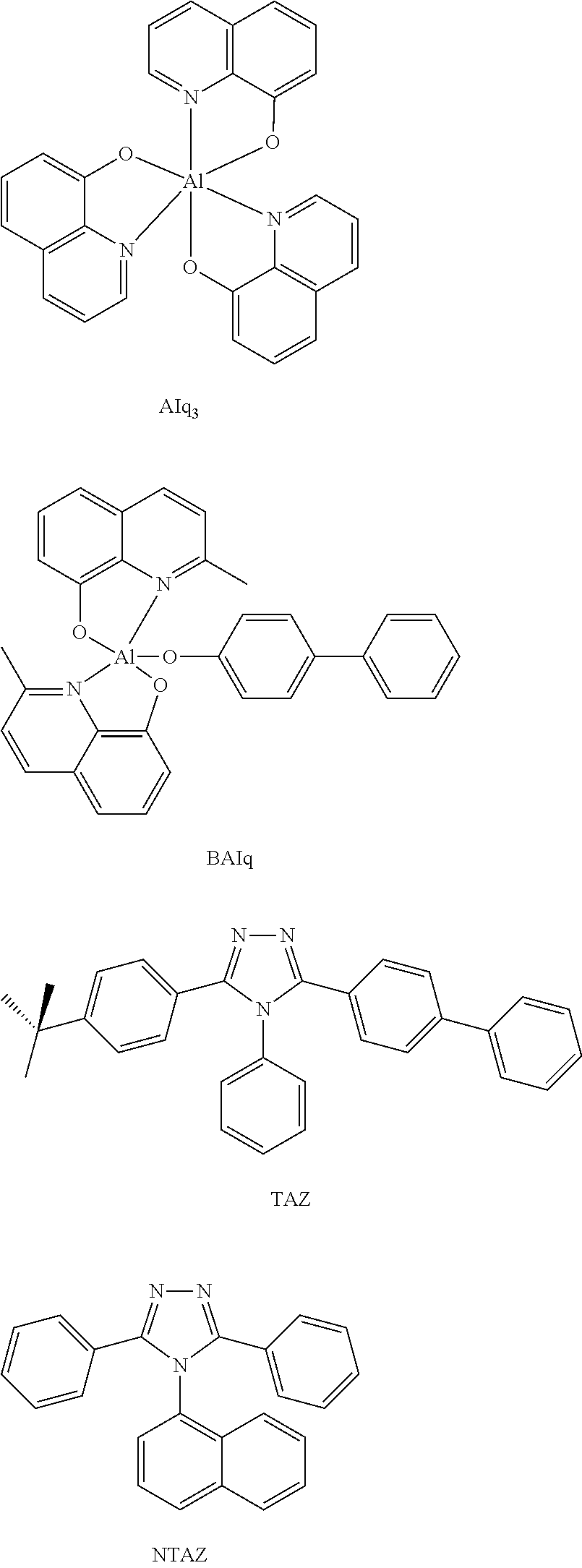


| TABLE 1 | |||||
| Compound No. | PLQY (%) | CIE_X | CIE_Y | ||
| 52 | 73 | 0.16 | 0.26 | ||
| 19 | 65 | 0.17 | 0.32 | ||
| 2 | 66 | 0.18 | 0.34 | ||
| 50 | 58 | 0.17 | 0.34 | ||
| 1 | 68 | 0.19 | 0.36 | ||
| 3 | 48 | 0.23 | 0.40 | ||
| 5 | 56 | 0.18 | 0.33 | ||
| 9 | 54 | 0.17 | 0.35 | ||
| 54 | 64 | 0.17 | 0.30 | ||
| 53 | 78 | 0.16 | 0.26 | ||
| 51 | 75 | 0.16 | 0.30 | ||
| 56 | 86 | 0.22 | 0.41 | ||
| 30 | 68 | 0.16 | 0.27 | ||
| A | 22 | 0.38 | 0.58 | ||
| B | 36 | 0.42 | 0.56 | ||
| C | 18 | 0.43 | 0.55 | ||
| D | 16 | 0.46 | 0.52 | ||

Claims (21)
M(L1)n1(L2)n2 Formula 1

*—(Z32)b2—*′; Formula 7


*—(Z31)b1—*′ Formula 6


M(L1)n1(L2)n2 Formula 1


M(L1)n1(L2)n2 Formula 1


Applications Claiming Priority (4)
| Application Number | Priority Date | Filing Date | Title |
|---|---|---|---|
| KR10-2014-0027947 | 2014-03-10 | ||
| KR20140027947 | 2014-03-10 | ||
| KR1020140164413A KR20150105902A (en) | 2014-03-10 | 2014-11-24 | Organometallic compound and organic light emitting device including the same |
| KR10-2014-0164413 | 2014-11-24 |
Publications (2)
| Publication Number | Publication Date |
|---|---|
| US20150255733A1 US20150255733A1 (en) | 2015-09-10 |
| US10381578B2 true US10381578B2 (en) | 2019-08-13 |
Family
ID=54018269
Family Applications (1)
| Application Number | Title | Priority Date | Filing Date |
|---|---|---|---|
| US14/636,401 Expired - Fee Related US10381578B2 (en) | 2014-03-10 | 2015-03-03 | Organometallic compound and organic light-emitting device including the same |
Country Status (2)
| Country | Link |
|---|---|
| US (1) | US10381578B2 (en) |
| KR (1) | KR20150105902A (en) |
Cited By (2)
| Publication number | Priority date | Publication date | Assignee | Title |
|---|---|---|---|---|
| US20210253618A1 (en) * | 2020-02-10 | 2021-08-19 | Samsung Electronics Co., Ltd. | Organometallic compound, organic light-emitting device including the same, and electronic apparatus including the organic light-emitting device |
| US11912916B2 (en) | 2018-07-02 | 2024-02-27 | Rohm And Haas Electronic Materials Korea Ltd. | Organic electroluminescent compound and organic electroluminescent device comprising the same |
Citations (4)
| Publication number | Priority date | Publication date | Assignee | Title |
|---|---|---|---|---|
| WO2010061625A1 (en) | 2008-11-28 | 2010-06-03 | 独立行政法人理化学研究所 | Novel compound and utilization of same |
| CN102558238A (en) | 2011-12-06 | 2012-07-11 | 吉林大学 | Iridium complexes containing guanidine group and application of iridium complexes to preparation of electroluminescent devices |
| US20130033171A1 (en) | 2011-08-05 | 2013-02-07 | Heh-Lung Huang | Organometallic compound and organic electroluminescence device employing the same |
| US20150194614A1 (en) | 2014-01-07 | 2015-07-09 | Samsung Electronics Co., Ltd. | Organometallic compound and organic light-emitting device including the same |
-
2014
- 2014-11-24 KR KR1020140164413A patent/KR20150105902A/en not_active Ceased
-
2015
- 2015-03-03 US US14/636,401 patent/US10381578B2/en not_active Expired - Fee Related
Patent Citations (6)
| Publication number | Priority date | Publication date | Assignee | Title |
|---|---|---|---|---|
| WO2010061625A1 (en) | 2008-11-28 | 2010-06-03 | 独立行政法人理化学研究所 | Novel compound and utilization of same |
| US20110234089A1 (en) * | 2008-11-28 | 2011-09-29 | Zhaomin Hou | Novel compound and use thereof |
| KR101278000B1 (en) | 2008-11-28 | 2013-06-27 | 도꾸리쯔교세이호징 리가가쿠 겐큐소 | Novel compound and utilization of same |
| US20130033171A1 (en) | 2011-08-05 | 2013-02-07 | Heh-Lung Huang | Organometallic compound and organic electroluminescence device employing the same |
| CN102558238A (en) | 2011-12-06 | 2012-07-11 | 吉林大学 | Iridium complexes containing guanidine group and application of iridium complexes to preparation of electroluminescent devices |
| US20150194614A1 (en) | 2014-01-07 | 2015-07-09 | Samsung Electronics Co., Ltd. | Organometallic compound and organic light-emitting device including the same |
Non-Patent Citations (2)
| Title |
|---|
| Virendra Kumar Rai, et al., "Bis-Cyclometalated Iridium(III) Complexes Bearing Ancillary Guanidinate Ligands. Synthesis, Structure, and Highly Efficient Electroluminescence", Inorg. Chem. 2012, 51, 822-835. |
| Virendra Kumar Rai, et al., "Guanidinate ligated iridium(III) complexes with various cyclometalated ligands: synthesis, structure, and highly efficient electrophosphorescent properties with a wide range of emission colours", J. Mater. Chem. C 2013, 1, 677-689. |
Cited By (3)
| Publication number | Priority date | Publication date | Assignee | Title |
|---|---|---|---|---|
| US11912916B2 (en) | 2018-07-02 | 2024-02-27 | Rohm And Haas Electronic Materials Korea Ltd. | Organic electroluminescent compound and organic electroluminescent device comprising the same |
| US20210253618A1 (en) * | 2020-02-10 | 2021-08-19 | Samsung Electronics Co., Ltd. | Organometallic compound, organic light-emitting device including the same, and electronic apparatus including the organic light-emitting device |
| US12240863B2 (en) * | 2020-02-10 | 2025-03-04 | Samsung Electronics Co., Ltd. | Organometallic compound, organic light-emitting device including the same, and electronic apparatus including the organic light-emitting device |
Also Published As
| Publication number | Publication date |
|---|---|
| US20150255733A1 (en) | 2015-09-10 |
| KR20150105902A (en) | 2015-09-18 |
Similar Documents
| Publication | Publication Date | Title |
|---|---|---|
| US11731994B2 (en) | Organometallic compound, organic light-emitting device including the organometallic compound, and diagnostic composition including the organometallic compound | |
| US10062852B2 (en) | Condensed cyclic compound and organic light-emitting device including the same | |
| US10193080B2 (en) | Condensed cyclic compound and organic light-emitting device including the same | |
| US20160035986A1 (en) | Condensed cyclic compound and organic light-emitting device including the same | |
| US11991921B2 (en) | Organometallic compound and organic light-emitting device including the same | |
| US20160155962A1 (en) | Organometallic compound and organic light-emitting device including the same | |
| US20170069853A1 (en) | Condensed cyclic comopund and organic light-emitting device including the same | |
| US9812657B2 (en) | Organometallic compound and organic light-emitting device including the same | |
| US20190140192A1 (en) | Organometallic compound, organic light-emitting device including organometallic compound, and diagnostic composition including organometallic compound | |
| US20150221878A1 (en) | Organometallic compound and organic light-emitting device including the same | |
| US10043986B2 (en) | Organometallic compound and organic light-emitting device including the same | |
| US20200295278A1 (en) | Organometallic compound and organic light-emitting device including the same | |
| US10672995B2 (en) | Organometallic compound and organic light-emitting device including the same | |
| US10043984B2 (en) | Condensed cyclic compound and organic light-emitting device including the same | |
| US11889750B2 (en) | Organometallic compound, organic light-emitting device including the organometallic compound, and diagnostic composition including the organometallic compound | |
| US20160322585A1 (en) | Condensed cyclic compound and organic light emitting device including the same | |
| US12225817B2 (en) | Condensed cyclic compound and organic light-emitting device including the same | |
| US20160028024A1 (en) | Organometallic compound and organic light-emitting device including the same | |
| US9960365B2 (en) | Condensed cyclic compound and organic light-emitting device including the same | |
| US20160181546A1 (en) | Organic light-emitting device | |
| US10381578B2 (en) | Organometallic compound and organic light-emitting device including the same | |
| US10581000B2 (en) | Condensed cyclic compound and organic light-emitting device including the same | |
| US10693086B2 (en) | Organometallic compound, organic light-emitting device including the organometallic compound, and diagnostic composition including the organometallic compound | |
| US20230183277A1 (en) | Organometallic compound, organic light-emitting device including the same, and electronic apparatus including the organic light-emitting device | |
| US20180301640A9 (en) | Organometallic compound and organic light-emitting device including the same |
Legal Events
| Date | Code | Title | Description |
|---|---|---|---|
| AS | Assignment |
Owner name: CHEIL INDUSTRIES INC.,, KOREA, REPUBLIC OF Free format text: ASSIGNMENT OF ASSIGNORS INTEREST;ASSIGNORS:RAI, VIRENDRA KUMAR;NOH, CHANGHO;DAS, RUPASREE RAGINI;AND OTHERS;SIGNING DATES FROM 20140911 TO 20150302;REEL/FRAME:035123/0558 Owner name: SAMSUNG ELECTRONICS CO., LTD., KOREA, REPUBLIC OF Free format text: ASSIGNMENT OF ASSIGNORS INTEREST;ASSIGNORS:RAI, VIRENDRA KUMAR;NOH, CHANGHO;DAS, RUPASREE RAGINI;AND OTHERS;SIGNING DATES FROM 20140911 TO 20150302;REEL/FRAME:035123/0558 |
|
| STPP | Information on status: patent application and granting procedure in general |
Free format text: NOTICE OF ALLOWANCE MAILED -- APPLICATION RECEIVED IN OFFICE OF PUBLICATIONS |
|
| STPP | Information on status: patent application and granting procedure in general |
Free format text: DOCKETED NEW CASE - READY FOR EXAMINATION |
|
| STPP | Information on status: patent application and granting procedure in general |
Free format text: NOTICE OF ALLOWANCE MAILED -- APPLICATION RECEIVED IN OFFICE OF PUBLICATIONS |
|
| FEPP | Fee payment procedure |
Free format text: PETITION RELATED TO MAINTENANCE FEES GRANTED (ORIGINAL EVENT CODE: PTGR); ENTITY STATUS OF PATENT OWNER: LARGE ENTITY |
|
| STCF | Information on status: patent grant |
Free format text: PATENTED CASE |
|
| FEPP | Fee payment procedure |
Free format text: MAINTENANCE FEE REMINDER MAILED (ORIGINAL EVENT CODE: REM.); ENTITY STATUS OF PATENT OWNER: LARGE ENTITY |
|
| LAPS | Lapse for failure to pay maintenance fees |
Free format text: PATENT EXPIRED FOR FAILURE TO PAY MAINTENANCE FEES (ORIGINAL EVENT CODE: EXP.); ENTITY STATUS OF PATENT OWNER: LARGE ENTITY |
|
| STCH | Information on status: patent discontinuation |
Free format text: PATENT EXPIRED DUE TO NONPAYMENT OF MAINTENANCE FEES UNDER 37 CFR 1.362 |
|
| FP | Lapsed due to failure to pay maintenance fee |
Effective date: 20230813 |