US10374168B2 - Materials for electronic devices - Google Patents
Materials for electronic devices Download PDFInfo
- Publication number
- US10374168B2 US10374168B2 US15/303,390 US201515303390A US10374168B2 US 10374168 B2 US10374168 B2 US 10374168B2 US 201515303390 A US201515303390 A US 201515303390A US 10374168 B2 US10374168 B2 US 10374168B2
- Authority
- US
- United States
- Prior art keywords
- aromatic ring
- atoms
- groups
- ring systems
- alkyl
- Prior art date
- Legal status (The legal status is an assumption and is not a legal conclusion. Google has not performed a legal analysis and makes no representation as to the accuracy of the status listed.)
- Active, expires
Links
- 0 CC.CC.CC.CC.C[Y]1C2=CC=CC=C2*2(C3=CC=CC=C3[Y](C)C3=C2C=CC=C3)C2=C1C=CC=C2 Chemical compound CC.CC.CC.CC.C[Y]1C2=CC=CC=C2*2(C3=CC=CC=C3[Y](C)C3=C2C=CC=C3)C2=C1C=CC=C2 0.000 description 76
- FZEYVTFCMJSGMP-UHFFFAOYSA-N [H]N1C2=CC=CC=C2C(=O)C2=C1C=CC=C2 Chemical compound [H]N1C2=CC=CC=C2C(=O)C2=C1C=CC=C2 FZEYVTFCMJSGMP-UHFFFAOYSA-N 0.000 description 9
- HXITXNWTGFUOAU-UHFFFAOYSA-N OB(c1ccccc1)O Chemical compound OB(c1ccccc1)O HXITXNWTGFUOAU-UHFFFAOYSA-N 0.000 description 6
- NRIJUGJZTIATIE-UHFFFAOYSA-N C1=CC=C(C2=CC=C(N3C4=CC=CC=C4C4(C5=CC=CC=C5N(C5=CC=C(C6=CC=CC=C6)C=C5)C5=C4C=C(C4=CC=CC6=C4OC4=C6C=CC=C4)C=C5)C4=C3C=CC=C4)C=C2)C=C1 Chemical compound C1=CC=C(C2=CC=C(N3C4=CC=CC=C4C4(C5=CC=CC=C5N(C5=CC=C(C6=CC=CC=C6)C=C5)C5=C4C=C(C4=CC=CC6=C4OC4=C6C=CC=C4)C=C5)C4=C3C=CC=C4)C=C2)C=C1 NRIJUGJZTIATIE-UHFFFAOYSA-N 0.000 description 5
- ZRXDAJSILQHQLX-UHFFFAOYSA-N C1=CC=C(C2=CC=C(N3C4=CC=CC=C4C4(C5=CC=CC=C5N(C5=CC=C(C6=CC=CC=C6)C=C5)C5=C4C=C(C4=CC=CC=C4)C=C5)C4=C3C=CC=C4)C=C2)C=C1 Chemical compound C1=CC=C(C2=CC=C(N3C4=CC=CC=C4C4(C5=CC=CC=C5N(C5=CC=C(C6=CC=CC=C6)C=C5)C5=C4C=C(C4=CC=CC=C4)C=C5)C4=C3C=CC=C4)C=C2)C=C1 ZRXDAJSILQHQLX-UHFFFAOYSA-N 0.000 description 5
- GLMKHGPTTIIZHN-UHFFFAOYSA-N C1=CC=C(C2=CC=C(N3C4=CC=C(C5=CC=CC=C5)C=C4C4(C5=CC=CC=C5N(C5=CC=C(C6=C7OC8=C(C=CC=C8)C7=CC=C6)C=C5)C5=C4C=CC=C5)C4=C3C=CC(C3=CC=CC=C3)=C4)C=C2)C=C1 Chemical compound C1=CC=C(C2=CC=C(N3C4=CC=C(C5=CC=CC=C5)C=C4C4(C5=CC=CC=C5N(C5=CC=C(C6=C7OC8=C(C=CC=C8)C7=CC=C6)C=C5)C5=C4C=CC=C5)C4=C3C=CC(C3=CC=CC=C3)=C4)C=C2)C=C1 GLMKHGPTTIIZHN-UHFFFAOYSA-N 0.000 description 4
- DVLSJPCXPNKPRJ-UHFFFAOYSA-N CC1(C)C2=C(C=CC=C2)C2=C1C=C(I)C=C2 Chemical compound CC1(C)C2=C(C=CC=C2)C2=C1C=C(I)C=C2 DVLSJPCXPNKPRJ-UHFFFAOYSA-N 0.000 description 4
- BMZSKYNEYUNDBG-UHFFFAOYSA-N CC1(C)C2=CC=CC=C2C2=C\C=C(N3C4=CC=C(C5=CC=CC=C5)C=C4C4(C5=CC(C6=CC=CC=C6)=CC=C5N(C5=CC=C(C6=CC=CC=C6)C=C5)C5=C4C=C(C4=CC=CC=C4)C=C5)C4=C3C=CC(C3=CC=CC=C3)=C4)/C=C\21 Chemical compound CC1(C)C2=CC=CC=C2C2=C\C=C(N3C4=CC=C(C5=CC=CC=C5)C=C4C4(C5=CC(C6=CC=CC=C6)=CC=C5N(C5=CC=C(C6=CC=CC=C6)C=C5)C5=C4C=C(C4=CC=CC=C4)C=C5)C4=C3C=CC(C3=CC=CC=C3)=C4)/C=C\21 BMZSKYNEYUNDBG-UHFFFAOYSA-N 0.000 description 4
- UKINYZNILIZQOE-UHFFFAOYSA-N Clc(cc1)cc2c1Nc1ccccc1C21c2ccccc2N(c(cc2)ccc2-c2ccccc2)c2ccccc12 Chemical compound Clc(cc1)cc2c1Nc1ccccc1C21c2ccccc2N(c(cc2)ccc2-c2ccccc2)c2ccccc12 UKINYZNILIZQOE-UHFFFAOYSA-N 0.000 description 4
- ZXHUJRZYLRVVNP-UHFFFAOYSA-N OB(O)C1=C2OC3=C(C=CC=C3)C2=CC=C1 Chemical compound OB(O)C1=C2OC3=C(C=CC=C3)C2=CC=C1 ZXHUJRZYLRVVNP-UHFFFAOYSA-N 0.000 description 4
- RIPZSADLUWTEFQ-UHFFFAOYSA-N BrC1=CC=C(C2=CC=CC3=C2OC2=C3C=CC=C2)C=C1 Chemical compound BrC1=CC=C(C2=CC=CC3=C2OC2=C3C=CC=C2)C=C1 RIPZSADLUWTEFQ-UHFFFAOYSA-N 0.000 description 3
- HJBVDZBRPQZTBJ-UHFFFAOYSA-N C1=CC=C(C2=CC=C(N3C4=CC=C(C5=CC=CC=C5)C=C4C4(C5=CC(C6=C7OC8=C(C=CC=C8)C7=CC=C6)=CC=C5N(C5=CC=C(C6=CC=CC=C6)C=C5)C5=C4C=CC=C5)C4=C3C=CC=C4)C=C2)C=C1 Chemical compound C1=CC=C(C2=CC=C(N3C4=CC=C(C5=CC=CC=C5)C=C4C4(C5=CC(C6=C7OC8=C(C=CC=C8)C7=CC=C6)=CC=C5N(C5=CC=C(C6=CC=CC=C6)C=C5)C5=C4C=CC=C5)C4=C3C=CC=C4)C=C2)C=C1 HJBVDZBRPQZTBJ-UHFFFAOYSA-N 0.000 description 3
- MDJVWKHDUILEGL-UHFFFAOYSA-N C1=CC=C(C2=CC=C(N3C4=CC=C(C5=CC=CC=C5)C=C4C4(C5=CC(C6=CC=CC=C6)=CC=C5N(C5=CC=C(C6=CC=CC=C6)C=C5)C5=C4C=C(C4=CC=CC=C4)C=C5)C4=C3C=CC(C3=CC=CC=C3)=C4)C=C2)C=C1 Chemical compound C1=CC=C(C2=CC=C(N3C4=CC=C(C5=CC=CC=C5)C=C4C4(C5=CC(C6=CC=CC=C6)=CC=C5N(C5=CC=C(C6=CC=CC=C6)C=C5)C5=C4C=C(C4=CC=CC=C4)C=C5)C4=C3C=CC(C3=CC=CC=C3)=C4)C=C2)C=C1 MDJVWKHDUILEGL-UHFFFAOYSA-N 0.000 description 3
- WBZAJAZPWRVWDP-UHFFFAOYSA-N C1=CC=C(C2=CC=C(N3C4=CC=C(C5=CC=CC=C5)C=C4C4(C5=CC(C6=CC=CC=C6)=CC=C5N(C5=CC=C(C6=CC=CC=C6)C=C5)C5=C4C=CC=C5)C4=C3C=CC=C4)C=C2)C=C1 Chemical compound C1=CC=C(C2=CC=C(N3C4=CC=C(C5=CC=CC=C5)C=C4C4(C5=CC(C6=CC=CC=C6)=CC=C5N(C5=CC=C(C6=CC=CC=C6)C=C5)C5=C4C=CC=C5)C4=C3C=CC=C4)C=C2)C=C1 WBZAJAZPWRVWDP-UHFFFAOYSA-N 0.000 description 3
- TUOSQDJAAWIGNC-UHFFFAOYSA-N CC1(C)C2=CC=CC=C2C2=CC=C(N3C4=CC=C(Br)C=C4C(=O)C4=C3C=CC(Br)=C4)C=C21 Chemical compound CC1(C)C2=CC=CC=C2C2=CC=C(N3C4=CC=C(Br)C=C4C(=O)C4=C3C=CC(Br)=C4)C=C21 TUOSQDJAAWIGNC-UHFFFAOYSA-N 0.000 description 3
- KKLCYBZPQDOFQK-UHFFFAOYSA-N CC1(C)OB(c2ccccc2)OC1(C)C Chemical compound CC1(C)OB(c2ccccc2)OC1(C)C KKLCYBZPQDOFQK-UHFFFAOYSA-N 0.000 description 3
- BFPZUDVCLGKLPP-UHFFFAOYSA-N Clc(cc1)cc(C2(c3cc(-c4ccccc4)ccc3N(c(cc3)ccc3-c3ccccc3)c(cc3)c2cc3-c2ccccc2)c2c3)c1N(c(cc1)ccc1-c1ccccc1)c2ccc3Cl Chemical compound Clc(cc1)cc(C2(c3cc(-c4ccccc4)ccc3N(c(cc3)ccc3-c3ccccc3)c(cc3)c2cc3-c2ccccc2)c2c3)c1N(c(cc1)ccc1-c1ccccc1)c2ccc3Cl BFPZUDVCLGKLPP-UHFFFAOYSA-N 0.000 description 3
- LPGHZEITEQSZBV-UHFFFAOYSA-N O=C1C2=CC(Br)=CC=C2N(C2=CC=C(C3=CC=C(F)C=C3)C=C2)C2=C1C=C(Br)C=C2 Chemical compound O=C1C2=CC(Br)=CC=C2N(C2=CC=C(C3=CC=C(F)C=C3)C=C2)C2=C1C=C(Br)C=C2 LPGHZEITEQSZBV-UHFFFAOYSA-N 0.000 description 3
- PYZRCYAYUHPFTH-UHFFFAOYSA-N [H]N1C2=C(C=C(Cl)C=C2)C2(C3=C1C=CC(Cl)=C3)C1=C(C=CC(C3=CC=CC=C3)=C1)N(C1=CC=C(C3=CC=CC=C3)C=C1)C1=C2C=C(C2=CC=CC=C2)C=C1 Chemical compound [H]N1C2=C(C=C(Cl)C=C2)C2(C3=C1C=CC(Cl)=C3)C1=C(C=CC(C3=CC=CC=C3)=C1)N(C1=CC=C(C3=CC=CC=C3)C=C1)C1=C2C=C(C2=CC=CC=C2)C=C1 PYZRCYAYUHPFTH-UHFFFAOYSA-N 0.000 description 3
- YBZIZTDGFHRUTJ-UHFFFAOYSA-N [H]N1C2=C(C=CC=C2)C2(C3=C1C=CC(C1=CC=CC=C1)=C3)C1=C(C=CC=C1)N(C1=CC=C(C3=CC=CC=C3)C=C1)C1=C2C=C(C2=CC=CC=C2)C=C1 Chemical compound [H]N1C2=C(C=CC=C2)C2(C3=C1C=CC(C1=CC=CC=C1)=C3)C1=C(C=CC=C1)N(C1=CC=C(C3=CC=CC=C3)C=C1)C1=C2C=C(C2=CC=CC=C2)C=C1 YBZIZTDGFHRUTJ-UHFFFAOYSA-N 0.000 description 3
- KQVAKZBTSSAAQX-UHFFFAOYSA-N c(cc1)ccc1-c(cc1)ccc1N(c1c2cccc1)c1ccccc1C21c(cc(cc2)-c3ccccc3)c2Nc2ccccc12 Chemical compound c(cc1)ccc1-c(cc1)ccc1N(c1c2cccc1)c1ccccc1C21c(cc(cc2)-c3ccccc3)c2Nc2ccccc12 KQVAKZBTSSAAQX-UHFFFAOYSA-N 0.000 description 3
- PKJBWOWQJHHAHG-UHFFFAOYSA-N BrC1=CC=C(C2=CC=CC=C2)C=C1 Chemical compound BrC1=CC=C(C2=CC=CC=C2)C=C1 PKJBWOWQJHHAHG-UHFFFAOYSA-N 0.000 description 2
- GNFNFUOLDRHCSA-UHFFFAOYSA-N C1=CC=C(C2=CC3=C(C=C2)N(C2=CC=C(C4=CC=CC5=C4C4=C(C=CC=C4)O5)C=C2)C2=CC=CC=C2C32C3=CC=CC=C3N(C3=CC=C(C4=C5\C6=C(C=CC=C6)O\C5=C\C=C\4)C=C3)C3=C2C=C(C2=CC=CC=C2)C=C3)C=C1 Chemical compound C1=CC=C(C2=CC3=C(C=C2)N(C2=CC=C(C4=CC=CC5=C4C4=C(C=CC=C4)O5)C=C2)C2=CC=CC=C2C32C3=CC=CC=C3N(C3=CC=C(C4=C5\C6=C(C=CC=C6)O\C5=C\C=C\4)C=C3)C3=C2C=C(C2=CC=CC=C2)C=C3)C=C1 GNFNFUOLDRHCSA-UHFFFAOYSA-N 0.000 description 2
- DYHYSIOLTRWEKM-UHFFFAOYSA-N C1=CC=C(C2=CC3=C(C=C2)N(C2=CC=C(C4=CC=CC5=C4OC4=C5C=CC=C4C4=CC=CC=C4)C=C2)C2=CC=CC=C2C32C3=CC=CC=C3N(C3=CC=C(C4=C5OC6=C(C=CC=C6C6=CC=CC=C6)C5=CC=C4)C=C3)C3=C2C=C(C2=CC=CC=C2)C=C3)C=C1 Chemical compound C1=CC=C(C2=CC3=C(C=C2)N(C2=CC=C(C4=CC=CC5=C4OC4=C5C=CC=C4C4=CC=CC=C4)C=C2)C2=CC=CC=C2C32C3=CC=CC=C3N(C3=CC=C(C4=C5OC6=C(C=CC=C6C6=CC=CC=C6)C5=CC=C4)C=C3)C3=C2C=C(C2=CC=CC=C2)C=C3)C=C1 DYHYSIOLTRWEKM-UHFFFAOYSA-N 0.000 description 2
- IXJMALNKWFJPKI-UHFFFAOYSA-N C1=CC=C(C2=CC=C(N3C4=CC=CC=C4C4(C5=CC(C6=C7OC8=C(C=CC=C8)C7=CC=C6)=CC=C5N(C5=CC=C(C6=CC=CC=C6)C=C5)C5=C4C=C(C4=CC=CC6=C4OC4=C6C=CC=C4)C=C5)C4=C3C=CC=C4)C=C2)C=C1 Chemical compound C1=CC=C(C2=CC=C(N3C4=CC=CC=C4C4(C5=CC(C6=C7OC8=C(C=CC=C8)C7=CC=C6)=CC=C5N(C5=CC=C(C6=CC=CC=C6)C=C5)C5=C4C=C(C4=CC=CC6=C4OC4=C6C=CC=C4)C=C5)C4=C3C=CC=C4)C=C2)C=C1 IXJMALNKWFJPKI-UHFFFAOYSA-N 0.000 description 2
- GABIOGISDMIDKL-UHFFFAOYSA-N C1=CC=C(C2=CC=C(N3C4=CC=CC=C4C4(C5=CC(C6=CC7=C(C=C6)C6=C(C=CC=C6)C76C7=CC=CC=C7C7=C6C=CC=C7)=CC=C5N(C5=CC=C(C6=CC=CC=C6)C=C5)C5=C4C=CC=C5)C4=C3C=CC=C4)C=C2)C=C1 Chemical compound C1=CC=C(C2=CC=C(N3C4=CC=CC=C4C4(C5=CC(C6=CC7=C(C=C6)C6=C(C=CC=C6)C76C7=CC=CC=C7C7=C6C=CC=C7)=CC=C5N(C5=CC=C(C6=CC=CC=C6)C=C5)C5=C4C=CC=C5)C4=C3C=CC=C4)C=C2)C=C1 GABIOGISDMIDKL-UHFFFAOYSA-N 0.000 description 2
- GFFSILGGBWRCAS-UHFFFAOYSA-N C1=CC=C(C2=CC=C(N3C4=CC=CC=C4C4(C5=CC(C6=CC=C(N7C8=C(C=CC=C8)C8=C7C=CC=C8)C=C6)=CC=C5N(C5=CC=C(C6=CC=CC=C6)C=C5)C5=C4C=CC=C5)C4=C3C=CC=C4)C=C2)C=C1 Chemical compound C1=CC=C(C2=CC=C(N3C4=CC=CC=C4C4(C5=CC(C6=CC=C(N7C8=C(C=CC=C8)C8=C7C=CC=C8)C=C6)=CC=C5N(C5=CC=C(C6=CC=CC=C6)C=C5)C5=C4C=CC=C5)C4=C3C=CC=C4)C=C2)C=C1 GFFSILGGBWRCAS-UHFFFAOYSA-N 0.000 description 2
- ZGHCMENRRAOTRM-UHFFFAOYSA-N C1=CC=C(C2=CC=C(N3C4=CC=CC=C4C4(C5=CC=CC=C5N(C5=CC=C(/C6=C/C=C\C7=C6C6=CC=CC=C6S7)C=C5)C5=C4C=CC=C5)C4=C3C=CC(C3=CC=CC=C3)=C4)C=C2)C=C1 Chemical compound C1=CC=C(C2=CC=C(N3C4=CC=CC=C4C4(C5=CC=CC=C5N(C5=CC=C(/C6=C/C=C\C7=C6C6=CC=CC=C6S7)C=C5)C5=C4C=CC=C5)C4=C3C=CC(C3=CC=CC=C3)=C4)C=C2)C=C1 ZGHCMENRRAOTRM-UHFFFAOYSA-N 0.000 description 2
- HXWLCVYLRPMRDY-UHFFFAOYSA-N C1=CC=C2C(=C1)[Ir]N1=C2C2=C(C=CC=C2)C=C1 Chemical compound C1=CC=C2C(=C1)[Ir]N1=C2C2=C(C=CC=C2)C=C1 HXWLCVYLRPMRDY-UHFFFAOYSA-N 0.000 description 2
- XFJASQQLAWYJFH-UHFFFAOYSA-N CC1(C)C2=C(C=CC=C2)C2=C1C=C(N1C3=C(C=CC=C3)C3(C4=C(C=CC=C4)N(C4=CC=C(C5=CC=CC=C5)C=C4)C4=C3C=CC=C4)C3=C1C=CC(C1=CC=CC=C1)=C3)C=C2 Chemical compound CC1(C)C2=C(C=CC=C2)C2=C1C=C(N1C3=C(C=CC=C3)C3(C4=C(C=CC=C4)N(C4=CC=C(C5=CC=CC=C5)C=C4)C4=C3C=CC=C4)C3=C1C=CC(C1=CC=CC=C1)=C3)C=C2 XFJASQQLAWYJFH-UHFFFAOYSA-N 0.000 description 2
- HVVISPILQSZVMO-UHFFFAOYSA-N CC1(C)C2=C(C=CC=C2)C2=CC=CC(C3=CC=C(N4C5=CC=C(C6=C7OC8=C(C=CC=C8)C7=CC=C6)C=C5C5(C6=CC=CC=C6N(C6=CC=C(C7=CC=CC=C7)C=C6)C6=C5C=CC=C6)C5=C4C=CC=C5)C=C3)=C21 Chemical compound CC1(C)C2=C(C=CC=C2)C2=CC=CC(C3=CC=C(N4C5=CC=C(C6=C7OC8=C(C=CC=C8)C7=CC=C6)C=C5C5(C6=CC=CC=C6N(C6=CC=C(C7=CC=CC=C7)C=C6)C6=C5C=CC=C6)C5=C4C=CC=C5)C=C3)=C21 HVVISPILQSZVMO-UHFFFAOYSA-N 0.000 description 2
- KEBYHQZNRPBOTM-UHFFFAOYSA-N CC1(C)C2=C3C(=CC=C2)C=CN2=C3C3=C1C(F)=CC=C3[Ir]21N2N=C(C(F)(F)F)C=C2C2=CC=CC=N21 Chemical compound CC1(C)C2=C3C(=CC=C2)C=CN2=C3C3=C1C(F)=CC=C3[Ir]21N2N=C(C(F)(F)F)C=C2C2=CC=CC=N21 KEBYHQZNRPBOTM-UHFFFAOYSA-N 0.000 description 2
- QOZYGKIAOWOAAB-UHFFFAOYSA-N CC1(C)C2=CC=CC=C2C2=CC=C(N3C4=CC=CC=C4C(=O)C4=C3C=CC=C4)C=C21 Chemical compound CC1(C)C2=CC=CC=C2C2=CC=C(N3C4=CC=CC=C4C(=O)C4=C3C=CC=C4)C=C21 QOZYGKIAOWOAAB-UHFFFAOYSA-N 0.000 description 2
- BTGGRNUSXQSJBK-UHFFFAOYSA-N CC1(C)C2=CC=CC=C2C2=CC=C(N3C4=CC=CC=C4C4(C5=CC(C6=CC=CC=C6)=CC=C5N(C5=CC=C(C6=CC=CC=C6)C=C5)C5=C4C=C(C4=CC=CC=C4)C=C5)C4=C3C=CC=C4)C=C21 Chemical compound CC1(C)C2=CC=CC=C2C2=CC=C(N3C4=CC=CC=C4C4(C5=CC(C6=CC=CC=C6)=CC=C5N(C5=CC=C(C6=CC=CC=C6)C=C5)C5=C4C=C(C4=CC=CC=C4)C=C5)C4=C3C=CC=C4)C=C21 BTGGRNUSXQSJBK-UHFFFAOYSA-N 0.000 description 2
- HWVNLCRYRLBCSR-UHFFFAOYSA-N CC1(C)C2=CC=CC=C2C2=CC=C(N3C4=CC=CC=C4C4(C5=CC=CC=C5N(C5=CC=C(C6=CC=CC=C6)C=C5)C5=C4C=C(C4=CC=CC6=C4OC4=C6C=CC=C4)C=C5)C4=C3C=CC=C4)C=C21 Chemical compound CC1(C)C2=CC=CC=C2C2=CC=C(N3C4=CC=CC=C4C4(C5=CC=CC=C5N(C5=CC=C(C6=CC=CC=C6)C=C5)C5=C4C=C(C4=CC=CC6=C4OC4=C6C=CC=C4)C=C5)C4=C3C=CC=C4)C=C21 HWVNLCRYRLBCSR-UHFFFAOYSA-N 0.000 description 2
- MUSJFZJSOBKARW-UHFFFAOYSA-N CC1(C)C2=CC=CC=C2C2=C\C=C(N3C4=CC=C(C5=CC=CC=C5)C=C4C4(C5=CC(C6=CC=CC=C6)=CC=C5N(C5=CC=C(C6=CC=CC=C6)C=C5)C5=C4C=CC=C5)C4=C3C=CC=C4)/C=C\21 Chemical compound CC1(C)C2=CC=CC=C2C2=C\C=C(N3C4=CC=C(C5=CC=CC=C5)C=C4C4(C5=CC(C6=CC=CC=C6)=CC=C5N(C5=CC=C(C6=CC=CC=C6)C=C5)C5=C4C=CC=C5)C4=C3C=CC=C4)/C=C\21 MUSJFZJSOBKARW-UHFFFAOYSA-N 0.000 description 2
- NTXYLYQBHWYPSM-UHFFFAOYSA-N CC1=CC=C2C(=C1)C1(C3=CC(C)=CC=C3N(C)C3=C1C(C)=CC=C3)C1=C(C=CC=C1C)N2C.CC1=CC=C2C(=C1)C1(C3=CC(C)=CC=C3N(C)C3=C1C=C(C)C=C3)C1=C(C=CC(C)=C1)N2C.CC1=CC=C2C(=C1)C1(C3=CC(C)=CC=C3N(C)C3=C1C=CC=C3C)C1=C(C(C)=CC=C1)N2C Chemical compound CC1=CC=C2C(=C1)C1(C3=CC(C)=CC=C3N(C)C3=C1C(C)=CC=C3)C1=C(C=CC=C1C)N2C.CC1=CC=C2C(=C1)C1(C3=CC(C)=CC=C3N(C)C3=C1C=C(C)C=C3)C1=C(C=CC(C)=C1)N2C.CC1=CC=C2C(=C1)C1(C3=CC(C)=CC=C3N(C)C3=C1C=CC=C3C)C1=C(C(C)=CC=C1)N2C NTXYLYQBHWYPSM-UHFFFAOYSA-N 0.000 description 2
- RVICSUOIBUJDOX-UHFFFAOYSA-N CC1=C\C=C/N2=C\1C1=C(C=CC=C1)[Ir]2 Chemical compound CC1=C\C=C/N2=C\1C1=C(C=CC=C1)[Ir]2 RVICSUOIBUJDOX-UHFFFAOYSA-N 0.000 description 2
- ITVJGMYTHZNMAI-UHFFFAOYSA-N ClC1=CC2=C(C=C1)N(C1=CC=C(C3=CC=CC=C3)C=C1)C1=C(C=CC=C1)C21C2=C(C=CC=C2)N(C2=CC=C(C3=CC=CC=C3)C=C2)C2=C1C=CC=C2 Chemical compound ClC1=CC2=C(C=C1)N(C1=CC=C(C3=CC=CC=C3)C=C1)C1=C(C=CC=C1)C21C2=C(C=CC=C2)N(C2=CC=C(C3=CC=CC=C3)C=C2)C2=C1C=CC=C2 ITVJGMYTHZNMAI-UHFFFAOYSA-N 0.000 description 2
- NTVWXXHLLUTUDW-UHFFFAOYSA-N Clc(cc1)ccc1Nc(ccc(Cl)c1)c1Br Chemical compound Clc(cc1)ccc1Nc(ccc(Cl)c1)c1Br NTVWXXHLLUTUDW-UHFFFAOYSA-N 0.000 description 2
- FFWHEMGQGJULDY-UHFFFAOYSA-N FC1=CC(F)=C2C(=C1)[Ir]N1=C2/C=C\C=C/1 Chemical compound FC1=CC(F)=C2C(=C1)[Ir]N1=C2/C=C\C=C/1 FFWHEMGQGJULDY-UHFFFAOYSA-N 0.000 description 2
- ZSNWXACZXJEVNL-UHFFFAOYSA-N FC1=CC(F)=C2C(=C1)[Pt]13C4=C(C(F)=CC(F)=C4)C4=CC=CC(=N41)C1(C4=C(C=CC=C4)C4=C1/C=C\C=C/4)C1=C\C=C/C2=N\13 Chemical compound FC1=CC(F)=C2C(=C1)[Pt]13C4=C(C(F)=CC(F)=C4)C4=CC=CC(=N41)C1(C4=C(C=CC=C4)C4=C1/C=C\C=C/4)C1=C\C=C/C2=N\13 ZSNWXACZXJEVNL-UHFFFAOYSA-N 0.000 description 2
- JRYKNKRTJDVGFA-UHFFFAOYSA-N FC1=CC=C(C2=CC=C(N3C4=CC=CC=C4C4(C5=CC=CC=C5N(C5=CC=C(C6=CC=CC=C6)C=C5)C5=C4C=C(C4=CC=CC=C4)C=C5)C4=C3C=CC=C4)C=C2)C=C1 Chemical compound FC1=CC=C(C2=CC=C(N3C4=CC=CC=C4C4(C5=CC=CC=C5N(C5=CC=C(C6=CC=CC=C6)C=C5)C5=C4C=C(C4=CC=CC=C4)C=C5)C4=C3C=CC=C4)C=C2)C=C1 JRYKNKRTJDVGFA-UHFFFAOYSA-N 0.000 description 2
- QNPLLNBTRSCDOG-UHFFFAOYSA-N O=C1C2=CC(Br)=CC=C2N(C2=CC=C(C3=CC=CC4=C3OC3=C4C=CC=C3)C=C2)C2=C1C=C(Br)C=C2 Chemical compound O=C1C2=CC(Br)=CC=C2N(C2=CC=C(C3=CC=CC4=C3OC3=C4C=CC=C3)C=C2)C2=C1C=C(Br)C=C2 QNPLLNBTRSCDOG-UHFFFAOYSA-N 0.000 description 2
- OATNDAAFFCSBOK-UHFFFAOYSA-N O=C1C2=CC(Br)=CC=C2N(C2=CC=C(C3=CC=CC=C3)C=C2)C2=C1C=C(Br)C=C2 Chemical compound O=C1C2=CC(Br)=CC=C2N(C2=CC=C(C3=CC=CC=C3)C=C2)C2=C1C=C(Br)C=C2 OATNDAAFFCSBOK-UHFFFAOYSA-N 0.000 description 2
- GGPSTWHSMFJTRQ-UHFFFAOYSA-N O=C1C2=CC(C3=CC=C4C(=C3)C3=C(C=CC=C3)N4C3=CC=CC=C3)=CC=C2N(C2=CC=C(C3=CC=CC=C3)C=C2)C2=C1C=C(C1=CC3=C(C=C1)N(C1=CC=CC=C1)C1=C3C=CC=C1)C=C2 Chemical compound O=C1C2=CC(C3=CC=C4C(=C3)C3=C(C=CC=C3)N4C3=CC=CC=C3)=CC=C2N(C2=CC=C(C3=CC=CC=C3)C=C2)C2=C1C=C(C1=CC3=C(C=C1)N(C1=CC=CC=C1)C1=C3C=CC=C1)C=C2 GGPSTWHSMFJTRQ-UHFFFAOYSA-N 0.000 description 2
- DZUKRVLWOZJYQJ-UHFFFAOYSA-N O=C1C2=CC(C3=CC=CC=C3)=CC=C2N(C2=CC=C(C3=CC=C(F)C=C3)C=C2)C2=C1C=C(C1=CC=CC=C1)C=C2 Chemical compound O=C1C2=CC(C3=CC=CC=C3)=CC=C2N(C2=CC=C(C3=CC=C(F)C=C3)C=C2)C2=C1C=C(C1=CC=CC=C1)C=C2 DZUKRVLWOZJYQJ-UHFFFAOYSA-N 0.000 description 2
- OBQPERRNOJSSHC-UHFFFAOYSA-N O=C1C2=CC=CC=C2N(C2=CC=C(C3=CC=C(F)C=C3)C=C2)C2=C1C=CC=C2 Chemical compound O=C1C2=CC=CC=C2N(C2=CC=C(C3=CC=C(F)C=C3)C=C2)C2=C1C=CC=C2 OBQPERRNOJSSHC-UHFFFAOYSA-N 0.000 description 2
- SAFUIUJWHWUXBM-UHFFFAOYSA-N O=C1C2=CC=CC=C2N(C2=CC=C(C3=CC=CC4=C3OC3=C4C=CC=C3)C=C2)C2=C1C=CC=C2 Chemical compound O=C1C2=CC=CC=C2N(C2=CC=C(C3=CC=CC4=C3OC3=C4C=CC=C3)C=C2)C2=C1C=CC=C2 SAFUIUJWHWUXBM-UHFFFAOYSA-N 0.000 description 2
- NZHLEPPPKUTQKT-UHFFFAOYSA-N O=C1OC2=C3C(=CC=C2)[Ir]2(C4=C(C=CC=C4)C4=CC=CC=N42)N2=C3\C1=C/C=C\2 Chemical compound O=C1OC2=C3C(=CC=C2)[Ir]2(C4=C(C=CC=C4)C4=CC=CC=N42)N2=C3\C1=C/C=C\2 NZHLEPPPKUTQKT-UHFFFAOYSA-N 0.000 description 2
- NDIDTZATWHPEKO-UHFFFAOYSA-N [H]CC1=N2[Ir]C3=C(C=CC=C3)C2=CC=C1 Chemical compound [H]CC1=N2[Ir]C3=C(C=CC=C3)C2=CC=C1 NDIDTZATWHPEKO-UHFFFAOYSA-N 0.000 description 2
- PSOHVIANZPOFCU-UHFFFAOYSA-N [H]N(C1=CC=C(Cl)C=C1)C1=C(Br)C=CC=C1 Chemical compound [H]N(C1=CC=C(Cl)C=C1)C1=C(Br)C=CC=C1 PSOHVIANZPOFCU-UHFFFAOYSA-N 0.000 description 2
- OQUQURHFKUVYIH-UHFFFAOYSA-N [H]N1C2=C(C=C(C3=CC=CC=C3)C=C2)C2(C3=C1C=CC(C1=CC=CC=C1)=C3)C1=C(C=CC(C3=CC=CC=C3)=C1)N(C1=CC=C(C3=CC=CC=C3)C=C1)C1=C2C=C(C2=CC=CC=C2)C=C1 Chemical compound [H]N1C2=C(C=C(C3=CC=CC=C3)C=C2)C2(C3=C1C=CC(C1=CC=CC=C1)=C3)C1=C(C=CC(C3=CC=CC=C3)=C1)N(C1=CC=C(C3=CC=CC=C3)C=C1)C1=C2C=C(C2=CC=CC=C2)C=C1 OQUQURHFKUVYIH-UHFFFAOYSA-N 0.000 description 2
- RTCLDSZFHZWNII-UHFFFAOYSA-N [H]N1C2=C(C=CC=C2)C2(C3=C1C=CC(C1=CC=CC4=C1OC1=C4C=CC=C1)=C3)C1=C(C=CC=C1)N(C1=CC=C(C3=CC=CC=C3)C=C1)C1=C2C=C(C2=CC=CC=C2)C=C1 Chemical compound [H]N1C2=C(C=CC=C2)C2(C3=C1C=CC(C1=CC=CC4=C1OC1=C4C=CC=C1)=C3)C1=C(C=CC=C1)N(C1=CC=C(C3=CC=CC=C3)C=C1)C1=C2C=C(C2=CC=CC=C2)C=C1 RTCLDSZFHZWNII-UHFFFAOYSA-N 0.000 description 2
- HXVMWKXBFQLNCX-UHFFFAOYSA-N [H]N1C2=C(C=CC=C2)C2(C3=C1C=CC(Cl)=C3)C1=C(C=CC=C1)N(C1=CC=C(C3=CC=CC=C3)C=C1)C1=C2C=C(C2=CC=CC=C2)C=C1 Chemical compound [H]N1C2=C(C=CC=C2)C2(C3=C1C=CC(Cl)=C3)C1=C(C=CC=C1)N(C1=CC=C(C3=CC=CC=C3)C=C1)C1=C2C=C(C2=CC=CC=C2)C=C1 HXVMWKXBFQLNCX-UHFFFAOYSA-N 0.000 description 2
- QPLZVYBJUSYVMC-UHFFFAOYSA-N [H]N1C2=C(C=CC=C2)C2(C3=C1C=CC=C3)C1=C(C=CC(C3=CC=CC=C3)=C1)N(C1=CC=C(C3=CC=CC=C3)C=C1)C1=C2C=C(C2=CC=CC=C2)C=C1 Chemical compound [H]N1C2=C(C=CC=C2)C2(C3=C1C=CC=C3)C1=C(C=CC(C3=CC=CC=C3)=C1)N(C1=CC=C(C3=CC=CC=C3)C=C1)C1=C2C=C(C2=CC=CC=C2)C=C1 QPLZVYBJUSYVMC-UHFFFAOYSA-N 0.000 description 2
- VCFCBODQHAKXAR-UHFFFAOYSA-N Br.CC.CC.CC.CC.CC.CC.CC.CC.CC.CC.CC.CC.CC.CC.CC.CC.O=C1C2=CC=CC=C2N([Ar])C2=CC=CC=C12.OBO.[Ar].[Ar].[Ar].[Ar]N1C2=C(C=CC=C2)C2(C3=C1C=CC=C3)C1=C(C=CC=C1)N([Ar])C1=C2C=CC=C1.[Ar]N1C2=C(C=CC=C2)C2(C3=C1C=CC=C3)C1=C(C=CC=C1)N([Ar])C1=C2C=CC=C1.[H]N(C1=CC=CC=C1)C1=CC=CC=C1Br.[H]N1C2=C(C=CC=C2)C2(C3=C1C=CC=C3)C1=C(C=CC=C1)N([Ar])C1=C2C=CC=C1 Chemical compound Br.CC.CC.CC.CC.CC.CC.CC.CC.CC.CC.CC.CC.CC.CC.CC.CC.O=C1C2=CC=CC=C2N([Ar])C2=CC=CC=C12.OBO.[Ar].[Ar].[Ar].[Ar]N1C2=C(C=CC=C2)C2(C3=C1C=CC=C3)C1=C(C=CC=C1)N([Ar])C1=C2C=CC=C1.[Ar]N1C2=C(C=CC=C2)C2(C3=C1C=CC=C3)C1=C(C=CC=C1)N([Ar])C1=C2C=CC=C1.[H]N(C1=CC=CC=C1)C1=CC=CC=C1Br.[H]N1C2=C(C=CC=C2)C2(C3=C1C=CC=C3)C1=C(C=CC=C1)N([Ar])C1=C2C=CC=C1 VCFCBODQHAKXAR-UHFFFAOYSA-N 0.000 description 1
- JEYLGFCAZBGCMC-UHFFFAOYSA-N BrC1=CC=C(C2=CC3=C(C=C2)N(C2=CC=CC=C2)C2=C3C=CC=C2)C=C1 Chemical compound BrC1=CC=C(C2=CC3=C(C=C2)N(C2=CC=CC=C2)C2=C3C=CC=C2)C=C1 JEYLGFCAZBGCMC-UHFFFAOYSA-N 0.000 description 1
- NVTHRATUICQJQQ-UHFFFAOYSA-N BrC1=CC=C(C2=CC=CC3=C2C2=C(C=CC=C2)O3)C=C1 Chemical compound BrC1=CC=C(C2=CC=CC3=C2C2=C(C=CC=C2)O3)C=C1 NVTHRATUICQJQQ-UHFFFAOYSA-N 0.000 description 1
- PUQSWSKFYZODAG-UHFFFAOYSA-N BrC1=CC=C(C2=CC=CC3=C2N(C2=CC=CC=C2)C2=C3C=CC=C2)C=C1 Chemical compound BrC1=CC=C(C2=CC=CC3=C2N(C2=CC=CC=C2)C2=C3C=CC=C2)C=C1 PUQSWSKFYZODAG-UHFFFAOYSA-N 0.000 description 1
- FIAXBPCUAUSGJH-UHFFFAOYSA-N BrC1=CC=C(C2=CC=CC3=C2SC2=C3C=CC=C2)C=C1 Chemical compound BrC1=CC=C(C2=CC=CC3=C2SC2=C3C=CC=C2)C=C1 FIAXBPCUAUSGJH-UHFFFAOYSA-N 0.000 description 1
- ZKXQNOCHFQJFEA-UHFFFAOYSA-N BrC1=CC=C(C2=CC=CC=C2)C=C1.C.ClC1=CC2=C(C=C1)N(C1=CC=C(C3=CC=CC=C3)C=C1)C1=C(C=CC=C1)C21C2=C(C=CC=C2)N(C2=CC=C(C3=CC=CC=C3)C=C2)C2=C1C=CC=C2.[H]N1C2=C(C=CC=C2)C2(C3=C1C=CC(Cl)=C3)C1=C(C=CC=C1)N(C1=CC=C(C3=CC=CC=C3)C=C1)C1=C2C=CC=C1 Chemical compound BrC1=CC=C(C2=CC=CC=C2)C=C1.C.ClC1=CC2=C(C=C1)N(C1=CC=C(C3=CC=CC=C3)C=C1)C1=C(C=CC=C1)C21C2=C(C=CC=C2)N(C2=CC=C(C3=CC=CC=C3)C=C2)C2=C1C=CC=C2.[H]N1C2=C(C=CC=C2)C2(C3=C1C=CC(Cl)=C3)C1=C(C=CC=C1)N(C1=CC=C(C3=CC=CC=C3)C=C1)C1=C2C=CC=C1 ZKXQNOCHFQJFEA-UHFFFAOYSA-N 0.000 description 1
- DYTYBRPMNQQFFL-UHFFFAOYSA-N BrC1=CC=CC2=C1OC1=C2C=CC=C1 Chemical compound BrC1=CC=CC2=C1OC1=C2C=CC=C1 DYTYBRPMNQQFFL-UHFFFAOYSA-N 0.000 description 1
- PGSNZIQSXDMLBC-UHFFFAOYSA-N C#CC#CC#COC1=CC2=C(C=C1OC#CC#CC#C)C1(C3=CC(C)=C(C)C=C32)C2=C(C=CC=C2)C2=C1/C=C\C(C1=CC3=C(C=C1)[Ir]/N1=C/C=C4/C=CC=C/C4=C\31)=C/2.[HH].[HH].[HH].[HH].[HH].[HH].[HH].[HH].[HH].[HH] Chemical compound C#CC#CC#COC1=CC2=C(C=C1OC#CC#CC#C)C1(C3=CC(C)=C(C)C=C32)C2=C(C=CC=C2)C2=C1/C=C\C(C1=CC3=C(C=C1)[Ir]/N1=C/C=C4/C=CC=C/C4=C\31)=C/2.[HH].[HH].[HH].[HH].[HH].[HH].[HH].[HH].[HH].[HH] PGSNZIQSXDMLBC-UHFFFAOYSA-N 0.000 description 1
- CUHKXIDDTSHZFH-UHFFFAOYSA-N C#CC#CC#COC1=CC=C(C2=CC3=C(C=C2)[Ir]/N2=C\C=C4\C=CC=C\C4=C\32)C=C1OC#CC#CC#C.[HH].[HH].[HH].[HH].[HH].[HH].[HH].[HH].[HH].[HH] Chemical compound C#CC#CC#COC1=CC=C(C2=CC3=C(C=C2)[Ir]/N2=C\C=C4\C=CC=C\C4=C\32)C=C1OC#CC#CC#C.[HH].[HH].[HH].[HH].[HH].[HH].[HH].[HH].[HH].[HH] CUHKXIDDTSHZFH-UHFFFAOYSA-N 0.000 description 1
- XSODQIWGWQZEJQ-UHFFFAOYSA-N C.ClC1=CC(Br)=C(I)C=C1.NC1=CC=C(Cl)C=C1.[H]N(C1=CC=C(Cl)C=C1)C1=CC=C(Cl)C=C1Br Chemical compound C.ClC1=CC(Br)=C(I)C=C1.NC1=CC=C(Cl)C=C1.[H]N(C1=CC=C(Cl)C=C1)C1=CC=C(Cl)C=C1Br XSODQIWGWQZEJQ-UHFFFAOYSA-N 0.000 description 1
- JPNSMGCJDKWKTE-UHFFFAOYSA-N C.O=C1C2=CC(Br)=CC=C2N(C2=CC=C(C3=CC=CC=C3)C=C2)C2=C1C=C(Br)C=C2.O=C1C2=CC(C3=CC=CC=C3)=CC=C2N(C2=CC=C(C3=CC=CC=C3)C=C2)C2=C1C=C(C1=CC=CC=C1)C=C2.OB(O)C1=CC=CC=C1 Chemical compound C.O=C1C2=CC(Br)=CC=C2N(C2=CC=C(C3=CC=CC=C3)C=C2)C2=C1C=C(Br)C=C2.O=C1C2=CC(C3=CC=CC=C3)=CC=C2N(C2=CC=C(C3=CC=CC=C3)C=C2)C2=C1C=C(C1=CC=CC=C1)C=C2.OB(O)C1=CC=CC=C1 JPNSMGCJDKWKTE-UHFFFAOYSA-N 0.000 description 1
- RIBAMJCODRJMIG-UHFFFAOYSA-N C.OB(O)C1=CC=CC=C1.[H]N1C2=C(C=CC=C2)C2(C3=C1C=CC(C1=CC=CC=C1)=C3)C1=C(C=CC=C1)N(C1=CC=C(C3=CC=CC=C3)C=C1)C1=C2C=C(C2=CC=CC=C2)C=C1.[H]N1C2=C(C=CC=C2)C2(C3=C1C=CC(Cl)=C3)C1=C(C=CC=C1)N(C1=CC=C(C3=CC=CC=C3)C=C1)C1=C2C=C(C2=CC=CC=C2)C=C1 Chemical compound C.OB(O)C1=CC=CC=C1.[H]N1C2=C(C=CC=C2)C2(C3=C1C=CC(C1=CC=CC=C1)=C3)C1=C(C=CC=C1)N(C1=CC=C(C3=CC=CC=C3)C=C1)C1=C2C=C(C2=CC=CC=C2)C=C1.[H]N1C2=C(C=CC=C2)C2(C3=C1C=CC(Cl)=C3)C1=C(C=CC=C1)N(C1=CC=C(C3=CC=CC=C3)C=C1)C1=C2C=C(C2=CC=CC=C2)C=C1 RIBAMJCODRJMIG-UHFFFAOYSA-N 0.000 description 1
- DMBXGCUOVIGXOS-UHFFFAOYSA-N C/C1=C/C=C\N2=C1C1=C(F)C=C(F)C=C1[Ir]2 Chemical compound C/C1=C/C=C\N2=C1C1=C(F)C=C(F)C=C1[Ir]2 DMBXGCUOVIGXOS-UHFFFAOYSA-N 0.000 description 1
- SMZSYGAUGZNTDZ-UHFFFAOYSA-N C1=CC2=C(C=C1)C1=C(S2)/C2=C/C=C\C3=N2[Pt]12C1=C(SC4=C1C=CC=C4)C1=N2/C(=C\C=C/1)C31C2=C(C=CC=C2)C2=C1C=CC=C2 Chemical compound C1=CC2=C(C=C1)C1=C(S2)/C2=C/C=C\C3=N2[Pt]12C1=C(SC4=C1C=CC=C4)C1=N2/C(=C\C=C/1)C31C2=C(C=CC=C2)C2=C1C=CC=C2 SMZSYGAUGZNTDZ-UHFFFAOYSA-N 0.000 description 1
- GUOIMVQDGTYEHO-UHFFFAOYSA-N C1=CC2=C(C=C1)C1=C(S2)C2=N3C(=CC=C2)CC2=N4/C(=C\C=C/2)C2=C(C5=C(C=CC=C5)S2)[Pt]134 Chemical compound C1=CC2=C(C=C1)C1=C(S2)C2=N3C(=CC=C2)CC2=N4/C(=C\C=C/2)C2=C(C5=C(C=CC=C5)S2)[Pt]134 GUOIMVQDGTYEHO-UHFFFAOYSA-N 0.000 description 1
- ZIBMOMRUIPOUQK-UHFFFAOYSA-N C1=CC2=C(C=C1)C1=N(/C=C/C=C/1)[Ir]2 Chemical compound C1=CC2=C(C=C1)C1=N(/C=C/C=C/1)[Ir]2 ZIBMOMRUIPOUQK-UHFFFAOYSA-N 0.000 description 1
- ZIZNUIVXANPWIT-UHFFFAOYSA-N C1=CC2=C(C=C1)N1C3=C(C=CC=C3)[Ir]C1N2 Chemical compound C1=CC2=C(C=C1)N1C3=C(C=CC=C3)[Ir]C1N2 ZIZNUIVXANPWIT-UHFFFAOYSA-N 0.000 description 1
- DAQJMBWEZIZZBU-SVXKRPBISA-N C1=CC2=C3C(=C1)C1=N4C(=C\C=C/1)/C1(C5=C(C=CC=C5)C5=C1/C=C\C=C/5)C1=N5C(=CC=C1)C1=C(C(=CC=C1)/C=C\2)[Pt]35/4 Chemical compound C1=CC2=C3C(=C1)C1=N4C(=C\C=C/1)/C1(C5=C(C=CC=C5)C5=C1/C=C\C=C/5)C1=N5C(=CC=C1)C1=C(C(=CC=C1)/C=C\2)[Pt]35/4 DAQJMBWEZIZZBU-SVXKRPBISA-N 0.000 description 1
- PMEDTYMNOUDFLL-UHFFFAOYSA-N C1=CC2=C3C(=C1)C1=N4C(=C\C=C/1)/C1(C5=C(C=CC=C5)C5=C1/C=C\C=C/5)C1=N5C(=CC=C1)C1=C(C(=CC=C1)CC2)[Pt]35/4 Chemical compound C1=CC2=C3C(=C1)C1=N4C(=C\C=C/1)/C1(C5=C(C=CC=C5)C5=C1/C=C\C=C/5)C1=N5C(=CC=C1)C1=C(C(=CC=C1)CC2)[Pt]35/4 PMEDTYMNOUDFLL-UHFFFAOYSA-N 0.000 description 1
- BOMQPBFWVQUQAE-UHFFFAOYSA-N C1=CC2=C3C(=C1)N(C1=CC=NC=C1)C1=C4/C(=C\C=C/1)C1=N(C=CN=C1)[Pt]34N1=CC=NC=C21 Chemical compound C1=CC2=C3C(=C1)N(C1=CC=NC=C1)C1=C4/C(=C\C=C/1)C1=N(C=CN=C1)[Pt]34N1=CC=NC=C21 BOMQPBFWVQUQAE-UHFFFAOYSA-N 0.000 description 1
- RAJINZIPYUCEBP-UHFFFAOYSA-N C1=CC2=CC3=CC=C4[Ir]N5=C(/C=C\C=C/5)C4=C3C=C2C=C1 Chemical compound C1=CC2=CC3=CC=C4[Ir]N5=C(/C=C\C=C/5)C4=C3C=C2C=C1 RAJINZIPYUCEBP-UHFFFAOYSA-N 0.000 description 1
- NRVPNTLMZJECCO-UHFFFAOYSA-N C1=CC2=CC=C3[Ir]N4=C(C=CC=C4)C3=C2C=C1 Chemical compound C1=CC2=CC=C3[Ir]N4=C(C=CC=C4)C3=C2C=C1 NRVPNTLMZJECCO-UHFFFAOYSA-N 0.000 description 1
- SPGCXEMPUKYTBZ-UHFFFAOYSA-N C1=CC2=N3C(=C1)CC1=N4/C(=C\C=C/1)C1=C(N=CO1)[Pt]34C1=C2OC=N1 Chemical compound C1=CC2=N3C(=C1)CC1=N4/C(=C\C=C/1)C1=C(N=CO1)[Pt]34C1=C2OC=N1 SPGCXEMPUKYTBZ-UHFFFAOYSA-N 0.000 description 1
- NHYZLMSGHZCYTO-UHFFFAOYSA-N C1=CC2=N3C(=C1)CC1=N4/C(=C\C=C/1)C1=C(N=CS1)[Pt]34C1=C2SC=N1 Chemical compound C1=CC2=N3C(=C1)CC1=N4/C(=C\C=C/1)C1=C(N=CS1)[Pt]34C1=C2SC=N1 NHYZLMSGHZCYTO-UHFFFAOYSA-N 0.000 description 1
- OPNJNJHUXOERHJ-UHFFFAOYSA-N C1=CC=C(C2=C3C=CC=CC3=C(C3=C4C=CC5=CC6=CC=CC=C6C=C5C4=CC=C3)C3=CC=CC=C32)C=C1 Chemical compound C1=CC=C(C2=C3C=CC=CC3=C(C3=C4C=CC5=CC6=CC=CC=C6C=C5C4=CC=C3)C3=CC=CC=C32)C=C1 OPNJNJHUXOERHJ-UHFFFAOYSA-N 0.000 description 1
- LXCFSFDAHQLFAC-UHFFFAOYSA-N C1=CC=C(C2=CC(C3=CC=CC=C3)=CC(C3=NC(C4=CC(C5=CC=CC=C5)=CC(C5=CC=CC=C5)=C4)=NC(C4=CC5=C(C=C4)C4=C(/C=C\C=C/4)C54C5=C(C=CC=C5)C5=C4C=CC=C5)=N3)=C2)C=C1 Chemical compound C1=CC=C(C2=CC(C3=CC=CC=C3)=CC(C3=NC(C4=CC(C5=CC=CC=C5)=CC(C5=CC=CC=C5)=C4)=NC(C4=CC5=C(C=C4)C4=C(/C=C\C=C/4)C54C5=C(C=CC=C5)C5=C4C=CC=C5)=N3)=C2)C=C1 LXCFSFDAHQLFAC-UHFFFAOYSA-N 0.000 description 1
- GETQJTOJAGIQPV-UHFFFAOYSA-N C1=CC=C(C2=CC3=C(C=C2)N(C2=CC=C(C4=C/C=C/C5=C\4C4=C(C=CC=C4)O5)C=C2)C2=CC=CC=C2C32C3=CC=CC=C3N(C3=CC=C(C4=C5OC6=C(C=CC=C6)C5=CC=C4)C=C3)C3=C2C=CC=C3)C=C1 Chemical compound C1=CC=C(C2=CC3=C(C=C2)N(C2=CC=C(C4=C/C=C/C5=C\4C4=C(C=CC=C4)O5)C=C2)C2=CC=CC=C2C32C3=CC=CC=C3N(C3=CC=C(C4=C5OC6=C(C=CC=C6)C5=CC=C4)C=C3)C3=C2C=CC=C3)C=C1 GETQJTOJAGIQPV-UHFFFAOYSA-N 0.000 description 1
- GTOIKUBDLUJXEF-UHFFFAOYSA-N C1=CC=C(C2=CC3=C(C=C2)N(C2=CC=C(C4=C/C=C/C5=C\4C4=C(C=CC=C4)S5)C=C2)C2=CC=CC=C2C32C3=CC=CC=C3N(C3=CC=C(C4=C5SC6=C(C=CC=C6)C5=CC=C4)C=C3)C3=C2C=CC=C3)C=C1 Chemical compound C1=CC=C(C2=CC3=C(C=C2)N(C2=CC=C(C4=C/C=C/C5=C\4C4=C(C=CC=C4)S5)C=C2)C2=CC=CC=C2C32C3=CC=CC=C3N(C3=CC=C(C4=C5SC6=C(C=CC=C6)C5=CC=C4)C=C3)C3=C2C=CC=C3)C=C1 GTOIKUBDLUJXEF-UHFFFAOYSA-N 0.000 description 1
- UBXZCEZJONTGCS-UHFFFAOYSA-N C1=CC=C(C2=CC3=C(C=C2)N(C2=CC=C(C4=C5OC6=C(C=CC=C6)C5=CC=C4)C=C2)C2=CC=CC=C2C32C3=CC=CC=C3N(C3=CC=C(C4=C/C=C/C5=C\4C4=C(C=CC=C4)O5)C=C3)C3=C2C=C(C2=CC=CC=C2)C=C3)C=C1 Chemical compound C1=CC=C(C2=CC3=C(C=C2)N(C2=CC=C(C4=C5OC6=C(C=CC=C6)C5=CC=C4)C=C2)C2=CC=CC=C2C32C3=CC=CC=C3N(C3=CC=C(C4=C/C=C/C5=C\4C4=C(C=CC=C4)O5)C=C3)C3=C2C=C(C2=CC=CC=C2)C=C3)C=C1 UBXZCEZJONTGCS-UHFFFAOYSA-N 0.000 description 1
- RSAGSDQSNKGUBK-UHFFFAOYSA-N C1=CC=C(C2=CC3=C(C=C2)N(C2=CC=C(C4=C5SC6=C(C=CC=C6)C5=CC=C4)C=C2)C2=CC=CC=C2C32C3=CC=CC=C3N(C3=CC=C(C4=C/C=C/C5=C\4C4=C(C=CC=C4)S5)C=C3)C3=C2C=C(C2=CC=CC=C2)C=C3)C=C1 Chemical compound C1=CC=C(C2=CC3=C(C=C2)N(C2=CC=C(C4=C5SC6=C(C=CC=C6)C5=CC=C4)C=C2)C2=CC=CC=C2C32C3=CC=CC=C3N(C3=CC=C(C4=C/C=C/C5=C\4C4=C(C=CC=C4)S5)C=C3)C3=C2C=C(C2=CC=CC=C2)C=C3)C=C1 RSAGSDQSNKGUBK-UHFFFAOYSA-N 0.000 description 1
- DKXCYVATWFPTDO-UHFFFAOYSA-N C1=CC=C(C2=CC3=C(C=C2)N(C2=CC=C(C4=CC=CC5=C4C4=C(C=CC=C4)O5)C=C2)C2=CC=CC=C2C32C3=CC=CC=C3N(C3=CC=C(C4=C5\C6=C(C=CC=C6)O\C5=C\C=C\4)C=C3)C3=C2C=CC=C3)C=C1 Chemical compound C1=CC=C(C2=CC3=C(C=C2)N(C2=CC=C(C4=CC=CC5=C4C4=C(C=CC=C4)O5)C=C2)C2=CC=CC=C2C32C3=CC=CC=C3N(C3=CC=C(C4=C5\C6=C(C=CC=C6)O\C5=C\C=C\4)C=C3)C3=C2C=CC=C3)C=C1 DKXCYVATWFPTDO-UHFFFAOYSA-N 0.000 description 1
- FYSKQZUVSZQDTJ-UHFFFAOYSA-N C1=CC=C(C2=CC3=C(C=C2)N(C2=CC=C(C4=CC=CC5=C4C4=C(C=CC=C4)S5)C=C2)C2=CC=CC=C2C32C3=CC=CC=C3N(C3=CC=C(C4=C5\C6=C(C=CC=C6)S\C5=C\C=C\4)C=C3)C3=C2C=C(C2=CC=CC=C2)C=C3)C=C1 Chemical compound C1=CC=C(C2=CC3=C(C=C2)N(C2=CC=C(C4=CC=CC5=C4C4=C(C=CC=C4)S5)C=C2)C2=CC=CC=C2C32C3=CC=CC=C3N(C3=CC=C(C4=C5\C6=C(C=CC=C6)S\C5=C\C=C\4)C=C3)C3=C2C=C(C2=CC=CC=C2)C=C3)C=C1 FYSKQZUVSZQDTJ-UHFFFAOYSA-N 0.000 description 1
- HGXKBCCPUDQWFZ-UHFFFAOYSA-N C1=CC=C(C2=CC3=C(C=C2)N(C2=CC=C(C4=CC=CC5=C4C4=C(C=CC=C4)S5)C=C2)C2=CC=CC=C2C32C3=CC=CC=C3N(C3=CC=C(C4=C5\C6=C(C=CC=C6)S\C5=C\C=C\4)C=C3)C3=C2C=CC=C3)C=C1 Chemical compound C1=CC=C(C2=CC3=C(C=C2)N(C2=CC=C(C4=CC=CC5=C4C4=C(C=CC=C4)S5)C=C2)C2=CC=CC=C2C32C3=CC=CC=C3N(C3=CC=C(C4=C5\C6=C(C=CC=C6)S\C5=C\C=C\4)C=C3)C3=C2C=CC=C3)C=C1 HGXKBCCPUDQWFZ-UHFFFAOYSA-N 0.000 description 1
- BFKGAXWPRUPHIY-UHFFFAOYSA-N C1=CC=C(C2=CC3=C(C=C2)N(C2=CC=C(C4=CC=CC5=C4OC4=C5C=CC=C4)C=C2)C2=CC=CC=C2C32C3=CC=CC=C3N(C3=CC=C(C4=C5OC6=C(C=CC=C6)C5=CC=C4)C=C3)C3=C2C=C(C2=CC=CC=C2)C=C3)C=C1 Chemical compound C1=CC=C(C2=CC3=C(C=C2)N(C2=CC=C(C4=CC=CC5=C4OC4=C5C=CC=C4)C=C2)C2=CC=CC=C2C32C3=CC=CC=C3N(C3=CC=C(C4=C5OC6=C(C=CC=C6)C5=CC=C4)C=C3)C3=C2C=C(C2=CC=CC=C2)C=C3)C=C1 BFKGAXWPRUPHIY-UHFFFAOYSA-N 0.000 description 1
- JAHILUGCEPMXHI-UHFFFAOYSA-N C1=CC=C(C2=CC3=C(C=C2)N(C2=CC=C(C4=CC=CC5=C4OC4=C5C=CC=C4C4=CC=CC=C4)C=C2)C2=CC=CC=C2C32C3=CC=CC=C3N(C3=CC=C(C4=C5OC6=C(C=CC=C6C6=CC=CC=C6)C5=CC=C4)C=C3)C3=C2C=CC=C3)C=C1 Chemical compound C1=CC=C(C2=CC3=C(C=C2)N(C2=CC=C(C4=CC=CC5=C4OC4=C5C=CC=C4C4=CC=CC=C4)C=C2)C2=CC=CC=C2C32C3=CC=CC=C3N(C3=CC=C(C4=C5OC6=C(C=CC=C6C6=CC=CC=C6)C5=CC=C4)C=C3)C3=C2C=CC=C3)C=C1 JAHILUGCEPMXHI-UHFFFAOYSA-N 0.000 description 1
- VZPJKLQYQOCLOF-UHFFFAOYSA-N C1=CC=C(C2=CC3=C(C=C2)N(C2=CC=C(C4=CC=CC5=C4SC4=C5C=CC=C4)C=C2)C2=CC=CC=C2C32C3=CC=CC=C3N(C3=CC=C(C4=C5SC6=C(C=CC=C6)C5=CC=C4)C=C3)C3=C2C=C(C2=CC=CC=C2)C=C3)C=C1 Chemical compound C1=CC=C(C2=CC3=C(C=C2)N(C2=CC=C(C4=CC=CC5=C4SC4=C5C=CC=C4)C=C2)C2=CC=CC=C2C32C3=CC=CC=C3N(C3=CC=C(C4=C5SC6=C(C=CC=C6)C5=CC=C4)C=C3)C3=C2C=C(C2=CC=CC=C2)C=C3)C=C1 VZPJKLQYQOCLOF-UHFFFAOYSA-N 0.000 description 1
- QERWPJCAMYUYIE-UHFFFAOYSA-N C1=CC=C(C2=CC3=C(C=C2)N(C2=CC=C(C4=CC=CC5=C4SC4=C5C=CC=C4C4=CC=CC=C4)C=C2)C2=CC=CC=C2C32C3=CC=CC=C3N(C3=CC=C(C4=C5SC6=C(C=CC=C6C6=CC=CC=C6)C5=CC=C4)C=C3)C3=C2C=C(C2=CC=CC=C2)C=C3)C=C1 Chemical compound C1=CC=C(C2=CC3=C(C=C2)N(C2=CC=C(C4=CC=CC5=C4SC4=C5C=CC=C4C4=CC=CC=C4)C=C2)C2=CC=CC=C2C32C3=CC=CC=C3N(C3=CC=C(C4=C5SC6=C(C=CC=C6C6=CC=CC=C6)C5=CC=C4)C=C3)C3=C2C=C(C2=CC=CC=C2)C=C3)C=C1 QERWPJCAMYUYIE-UHFFFAOYSA-N 0.000 description 1
- PAAUOSAZVZQUOF-UHFFFAOYSA-N C1=CC=C(C2=CC3=C(C=C2)N(C2=CC=C(C4=CC=CC5=C4SC4=C5C=CC=C4C4=CC=CC=C4)C=C2)C2=CC=CC=C2C32C3=CC=CC=C3N(C3=CC=C(C4=C5SC6=C(C=CC=C6C6=CC=CC=C6)C5=CC=C4)C=C3)C3=C2C=CC=C3)C=C1 Chemical compound C1=CC=C(C2=CC3=C(C=C2)N(C2=CC=C(C4=CC=CC5=C4SC4=C5C=CC=C4C4=CC=CC=C4)C=C2)C2=CC=CC=C2C32C3=CC=CC=C3N(C3=CC=C(C4=C5SC6=C(C=CC=C6C6=CC=CC=C6)C5=CC=C4)C=C3)C3=C2C=CC=C3)C=C1 PAAUOSAZVZQUOF-UHFFFAOYSA-N 0.000 description 1
- FNKXGYQXSDLTQJ-UHFFFAOYSA-N C1=CC=C(C2=CC=C(N3C4=C(C=CC=C4)C4(C5=C(C=CC=C5)N(C5=CC=C(C6=C7OC8=C(C=CC=C8)C7=CC=C6)C=C5)C5=C4C=C(C4=CC=CC=C4)C=C5)C4=C3C=CC(C3=CC=CC=C3)=C4)C=C2)C=C1 Chemical compound C1=CC=C(C2=CC=C(N3C4=C(C=CC=C4)C4(C5=C(C=CC=C5)N(C5=CC=C(C6=C7OC8=C(C=CC=C8)C7=CC=C6)C=C5)C5=C4C=C(C4=CC=CC=C4)C=C5)C4=C3C=CC(C3=CC=CC=C3)=C4)C=C2)C=C1 FNKXGYQXSDLTQJ-UHFFFAOYSA-N 0.000 description 1
- XNYCMZIGPXONGH-UHFFFAOYSA-N C1=CC=C(C2=CC=C(N3C4=CC(C5=CC=CC=C5)=CC5=C4[Pt]4(C6=C3/C=C(C3=CC=CC=C3)\C=C/6C3=N4C=CC=C3)N3=CC=CC=C53)C=C2)C=C1 Chemical compound C1=CC=C(C2=CC=C(N3C4=CC(C5=CC=CC=C5)=CC5=C4[Pt]4(C6=C3/C=C(C3=CC=CC=C3)\C=C/6C3=N4C=CC=C3)N3=CC=CC=C53)C=C2)C=C1 XNYCMZIGPXONGH-UHFFFAOYSA-N 0.000 description 1
- NEXBZFLXHWSJNL-UHFFFAOYSA-N C1=CC=C(C2=CC=C(N3C4=CC=C(C5=CC=CC=C5)C=C4C4(C5=CC(C6=C7\OC8=C(C=CC=C8)\C7=C/C=C\6)=CC=C5N(C5=CC=C(C6=CC=CC=C6)C=C5)C5=C4C=C(C4=CC=CC6=C4OC4=C6C=CC=C4)C=C5)C4=C3C=CC(C3=CC=CC=C3)=C4)C=C2)C=C1 Chemical compound C1=CC=C(C2=CC=C(N3C4=CC=C(C5=CC=CC=C5)C=C4C4(C5=CC(C6=C7\OC8=C(C=CC=C8)\C7=C/C=C\6)=CC=C5N(C5=CC=C(C6=CC=CC=C6)C=C5)C5=C4C=C(C4=CC=CC6=C4OC4=C6C=CC=C4)C=C5)C4=C3C=CC(C3=CC=CC=C3)=C4)C=C2)C=C1 NEXBZFLXHWSJNL-UHFFFAOYSA-N 0.000 description 1
- USTJQMGYTCDHNJ-UHFFFAOYSA-N C1=CC=C(C2=CC=C(N3C4=CC=CC5=C4[Pt]4(C6=C3/C=C\C=C/6C3=N4C=CC(C4=CC=CC=C4)=C3)N3=CC=C(C4=CC=CC=C4)C=C53)C=C2)C=C1 Chemical compound C1=CC=C(C2=CC=C(N3C4=CC=CC5=C4[Pt]4(C6=C3/C=C\C=C/6C3=N4C=CC(C4=CC=CC=C4)=C3)N3=CC=C(C4=CC=CC=C4)C=C53)C=C2)C=C1 USTJQMGYTCDHNJ-UHFFFAOYSA-N 0.000 description 1
- YNJXFUHAGIEBAK-UHFFFAOYSA-N C1=CC=C(C2=CC=C(N3C4=CC=CC5=C4[Pt]4(C6=C3/C=C\C=C/6C3=N4C=CC=C3)N3=CC=CC=C53)C=C2)C=C1 Chemical compound C1=CC=C(C2=CC=C(N3C4=CC=CC5=C4[Pt]4(C6=C3/C=C\C=C/6C3=N4C=CC=C3)N3=CC=CC=C53)C=C2)C=C1 YNJXFUHAGIEBAK-UHFFFAOYSA-N 0.000 description 1
- FRPVZQTXBDQZGQ-UHFFFAOYSA-N C1=CC=C(C2=CC=C(N3C4=CC=CC=C4C4(C5=CC(C6=C(C7=CC=CC=C7)C=C(C7=CC=CC=C7)C=C6)=CC=C5N(C5=CC=C(C6=CC=CC=C6)C=C5)C5=C4C=CC=C5)C4=C3C=CC=C4)C=C2)C=C1 Chemical compound C1=CC=C(C2=CC=C(N3C4=CC=CC=C4C4(C5=CC(C6=C(C7=CC=CC=C7)C=C(C7=CC=CC=C7)C=C6)=CC=C5N(C5=CC=C(C6=CC=CC=C6)C=C5)C5=C4C=CC=C5)C4=C3C=CC=C4)C=C2)C=C1 FRPVZQTXBDQZGQ-UHFFFAOYSA-N 0.000 description 1
- NMPWAZALUOLXAM-UHFFFAOYSA-N C1=CC=C(C2=CC=C(N3C4=CC=CC=C4C4(C5=CC(C6=C(C7=CC=CC=C7)C=CC(C7=CC=CC=C7)=C6)=CC=C5N(C5=CC=C(C6=CC=CC=C6)C=C5)C5=C4C=CC=C5)C4=C3C=CC=C4)C=C2)C=C1 Chemical compound C1=CC=C(C2=CC=C(N3C4=CC=CC=C4C4(C5=CC(C6=C(C7=CC=CC=C7)C=CC(C7=CC=CC=C7)=C6)=CC=C5N(C5=CC=C(C6=CC=CC=C6)C=C5)C5=C4C=CC=C5)C4=C3C=CC=C4)C=C2)C=C1 NMPWAZALUOLXAM-UHFFFAOYSA-N 0.000 description 1
- DOOGLNAHGVPUFW-UHFFFAOYSA-N C1=CC=C(C2=CC=C(N3C4=CC=CC=C4C4(C5=CC(C6=C7C(=CC=C6)C6(C8=C(C=CC=C8)C8=C6C=CC=C8)C6=C7C=CC=C6)=CC=C5N(C5=CC=C(C6=CC=CC=C6)C=C5)C5=C4C=CC=C5)C4=C3C=CC=C4)C=C2)C=C1 Chemical compound C1=CC=C(C2=CC=C(N3C4=CC=CC=C4C4(C5=CC(C6=C7C(=CC=C6)C6(C8=C(C=CC=C8)C8=C6C=CC=C8)C6=C7C=CC=C6)=CC=C5N(C5=CC=C(C6=CC=CC=C6)C=C5)C5=C4C=CC=C5)C4=C3C=CC=C4)C=C2)C=C1 DOOGLNAHGVPUFW-UHFFFAOYSA-N 0.000 description 1
- ZGRDWEIZWDSQEY-UHFFFAOYSA-N C1=CC=C(C2=CC=C(N3C4=CC=CC=C4C4(C5=CC(C6=C7C=CC=CC7=C7C=CC=CC7=C6)=CC=C5N(C5=CC=C(C6=CC=CC=C6)C=C5)C5=C4C=CC=C5)C4=C3C=CC=C4)C=C2)C=C1 Chemical compound C1=CC=C(C2=CC=C(N3C4=CC=CC=C4C4(C5=CC(C6=C7C=CC=CC7=C7C=CC=CC7=C6)=CC=C5N(C5=CC=C(C6=CC=CC=C6)C=C5)C5=C4C=CC=C5)C4=C3C=CC=C4)C=C2)C=C1 ZGRDWEIZWDSQEY-UHFFFAOYSA-N 0.000 description 1
- GNVBTURDZZOKEC-UHFFFAOYSA-N C1=CC=C(C2=CC=C(N3C4=CC=CC=C4C4(C5=CC(C6=C7C=CC=CC7=CC=C6)=CC=C5N(C5=CC=C(C6=CC=CC=C6)C=C5)C5=C4C=CC=C5)C4=C3C=CC=C4)C=C2)C=C1 Chemical compound C1=CC=C(C2=CC=C(N3C4=CC=CC=C4C4(C5=CC(C6=C7C=CC=CC7=CC=C6)=CC=C5N(C5=CC=C(C6=CC=CC=C6)C=C5)C5=C4C=CC=C5)C4=C3C=CC=C4)C=C2)C=C1 GNVBTURDZZOKEC-UHFFFAOYSA-N 0.000 description 1
- OMLDVENXAIDZGZ-UHFFFAOYSA-N C1=CC=C(C2=CC=C(N3C4=CC=CC=C4C4(C5=CC(C6=CC(C7=CC=CC=C7)=CC(C7=CC=CC=C7)=C6)=CC=C5N(C5=CC=C(C6=CC=CC=C6)C=C5)C5=C4C=CC=C5)C4=C3C=CC=C4)C=C2)C=C1 Chemical compound C1=CC=C(C2=CC=C(N3C4=CC=CC=C4C4(C5=CC(C6=CC(C7=CC=CC=C7)=CC(C7=CC=CC=C7)=C6)=CC=C5N(C5=CC=C(C6=CC=CC=C6)C=C5)C5=C4C=CC=C5)C4=C3C=CC=C4)C=C2)C=C1 OMLDVENXAIDZGZ-UHFFFAOYSA-N 0.000 description 1
- YECPIYIZZYWGSN-UHFFFAOYSA-N C1=CC=C(C2=CC=C(N3C4=CC=CC=C4C4(C5=CC(C6=CC7=C8C=CC=CC8=C8C=CC=CC8=C7C=C6)=CC=C5N(C5=CC=C(C6=CC=CC=C6)C=C5)C5=C4C=CC=C5)C4=C3C=CC=C4)C=C2)C=C1 Chemical compound C1=CC=C(C2=CC=C(N3C4=CC=CC=C4C4(C5=CC(C6=CC7=C8C=CC=CC8=C8C=CC=CC8=C7C=C6)=CC=C5N(C5=CC=C(C6=CC=CC=C6)C=C5)C5=C4C=CC=C5)C4=C3C=CC=C4)C=C2)C=C1 YECPIYIZZYWGSN-UHFFFAOYSA-N 0.000 description 1
- BZNGTEQDSWJJQT-UHFFFAOYSA-N C1=CC=C(C2=CC=C(N3C4=CC=CC=C4C4(C5=CC(C6=CC=C7C(=C6)C6=C(C=CC=C6)N7C6=CC=CC=C6)=CC=C5N(C5=CC=C(C6=CC=CC7=C6OC6=C7C=CC=C6)C=C5)C5=C4C=CC=C5)C4=C3C=CC=C4)C=C2)C=C1 Chemical compound C1=CC=C(C2=CC=C(N3C4=CC=CC=C4C4(C5=CC(C6=CC=C7C(=C6)C6=C(C=CC=C6)N7C6=CC=CC=C6)=CC=C5N(C5=CC=C(C6=CC=CC7=C6OC6=C7C=CC=C6)C=C5)C5=C4C=CC=C5)C4=C3C=CC=C4)C=C2)C=C1 BZNGTEQDSWJJQT-UHFFFAOYSA-N 0.000 description 1
- QEAKDIGACCRJDZ-UHFFFAOYSA-N C1=CC=C(C2=CC=C(N3C4=CC=CC=C4C4(C5=CC(C6=CC=C7C(=C6)C6=C(C=CC=C6)N7C6=CC=CC=C6)=CC=C5N(C5=CC=C(C6=CC=CC=C6)C=C5)C5=C4C=C(C4=CC=C6C(=C4)C4=C(C=CC=C4)N6C4=CC=CC=C4)C=C5)C4=C3C=CC=C4)C=C2)C=C1 Chemical compound C1=CC=C(C2=CC=C(N3C4=CC=CC=C4C4(C5=CC(C6=CC=C7C(=C6)C6=C(C=CC=C6)N7C6=CC=CC=C6)=CC=C5N(C5=CC=C(C6=CC=CC=C6)C=C5)C5=C4C=C(C4=CC=C6C(=C4)C4=C(C=CC=C4)N6C4=CC=CC=C4)C=C5)C4=C3C=CC=C4)C=C2)C=C1 QEAKDIGACCRJDZ-UHFFFAOYSA-N 0.000 description 1
- NQFALLVUCKTIHN-UHFFFAOYSA-N C1=CC=C(C2=CC=C(N3C4=CC=CC=C4C4(C5=CC(C6=CC=C7C(=C6)C6=C(C=CC=C6)N7C6=CC=CC=C6)=CC=C5N(C5=CC=C(C6=CC=CC=C6)C=C5)C5=C4C=CC=C5)C4=C3C=CC=C4)C=C2)C=C1 Chemical compound C1=CC=C(C2=CC=C(N3C4=CC=CC=C4C4(C5=CC(C6=CC=C7C(=C6)C6=C(C=CC=C6)N7C6=CC=CC=C6)=CC=C5N(C5=CC=C(C6=CC=CC=C6)C=C5)C5=C4C=CC=C5)C4=C3C=CC=C4)C=C2)C=C1 NQFALLVUCKTIHN-UHFFFAOYSA-N 0.000 description 1
- SXLSNVLPLOLQGX-UHFFFAOYSA-N C1=CC=C(C2=CC=C(N3C4=CC=CC=C4C4(C5=CC(C6=CC=C7C=CC=CC7=C6)=CC=C5N(C5=CC=C(C6=CC=CC=C6)C=C5)C5=C4C=CC=C5)C4=C3C=CC=C4)C=C2)C=C1 Chemical compound C1=CC=C(C2=CC=C(N3C4=CC=CC=C4C4(C5=CC(C6=CC=C7C=CC=CC7=C6)=CC=C5N(C5=CC=C(C6=CC=CC=C6)C=C5)C5=C4C=CC=C5)C4=C3C=CC=C4)C=C2)C=C1 SXLSNVLPLOLQGX-UHFFFAOYSA-N 0.000 description 1
- KNELWIHYVQWHLK-UHFFFAOYSA-N C1=CC=C(C2=CC=C(N3C4=CC=CC=C4C4(C5=CC(C6=CC=CC=C6)=CC=C5N(C5=CC=C(C6=C7OC8=C(C=CC=C8)C7=CC=C6)C=C5)C5=C4C=CC=C5)C4=C3C=CC=C4)C=C2)C=C1 Chemical compound C1=CC=C(C2=CC=C(N3C4=CC=CC=C4C4(C5=CC(C6=CC=CC=C6)=CC=C5N(C5=CC=C(C6=C7OC8=C(C=CC=C8)C7=CC=C6)C=C5)C5=C4C=CC=C5)C4=C3C=CC=C4)C=C2)C=C1 KNELWIHYVQWHLK-UHFFFAOYSA-N 0.000 description 1
- USKUVUYPFWWHJJ-UHFFFAOYSA-N C1=CC=C(C2=CC=C(N3C4=CC=CC=C4C4(C5=CC(C6=CC=CC=C6)=CC=C5N(C5=CC=C(C6=CC=C7C(=C6)OC6=C7C=CC=C6)C=C5)C5=C4C=CC=C5)C4=C3C=CC=C4)C=C2)C=C1 Chemical compound C1=CC=C(C2=CC=C(N3C4=CC=CC=C4C4(C5=CC(C6=CC=CC=C6)=CC=C5N(C5=CC=C(C6=CC=C7C(=C6)OC6=C7C=CC=C6)C=C5)C5=C4C=CC=C5)C4=C3C=CC=C4)C=C2)C=C1 USKUVUYPFWWHJJ-UHFFFAOYSA-N 0.000 description 1
- PBSKCASGBCYUGX-UHFFFAOYSA-N C1=CC=C(C2=CC=C(N3C4=CC=CC=C4C4(C5=CC(C6=CC=CC=C6)=CC=C5N(C5=CC=C(C6=CC=CC=C6)C=C5)C5=C4C=C(C4=CC=CC=C4)C=C5)C4=C3C=CC=C4)C=C2)C=C1 Chemical compound C1=CC=C(C2=CC=C(N3C4=CC=CC=C4C4(C5=CC(C6=CC=CC=C6)=CC=C5N(C5=CC=C(C6=CC=CC=C6)C=C5)C5=C4C=C(C4=CC=CC=C4)C=C5)C4=C3C=CC=C4)C=C2)C=C1 PBSKCASGBCYUGX-UHFFFAOYSA-N 0.000 description 1
- MLMCEJIZKKQATI-UHFFFAOYSA-N C1=CC=C(C2=CC=C(N3C4=CC=CC=C4C4(C5=CC=CC=C5N(/C5=C/C=C\C6=C5C5=CC=CC=C5O6)C5=C4C=CC=C5)C4=C3C=CC(C3=CC=CC=C3)=C4)C=C2)C=C1 Chemical compound C1=CC=C(C2=CC=C(N3C4=CC=CC=C4C4(C5=CC=CC=C5N(/C5=C/C=C\C6=C5C5=CC=CC=C5O6)C5=C4C=CC=C5)C4=C3C=CC(C3=CC=CC=C3)=C4)C=C2)C=C1 MLMCEJIZKKQATI-UHFFFAOYSA-N 0.000 description 1
- FAAKINZHCBETGN-UHFFFAOYSA-N C1=CC=C(C2=CC=C(N3C4=CC=CC=C4C4(C5=CC=CC=C5N(/C5=C/C=C\C6=C5C5=CC=CC=C5S6)C5=C4C=CC=C5)C4=C3C=CC(C3=CC=CC=C3)=C4)C=C2)C=C1 Chemical compound C1=CC=C(C2=CC=C(N3C4=CC=CC=C4C4(C5=CC=CC=C5N(/C5=C/C=C\C6=C5C5=CC=CC=C5S6)C5=C4C=CC=C5)C4=C3C=CC(C3=CC=CC=C3)=C4)C=C2)C=C1 FAAKINZHCBETGN-UHFFFAOYSA-N 0.000 description 1
- GZOJIPCVFBJXIJ-UHFFFAOYSA-N C1=CC=C(C2=CC=C(N3C4=CC=CC=C4C4(C5=CC=CC=C5N(C5=C6OC7=C(C=CC=C7)C6=CC=C5)C5=C4C=CC=C5)C4=C3C=CC(C3=CC=CC=C3)=C4)C=C2)C=C1 Chemical compound C1=CC=C(C2=CC=C(N3C4=CC=CC=C4C4(C5=CC=CC=C5N(C5=C6OC7=C(C=CC=C7)C6=CC=C5)C5=C4C=CC=C5)C4=C3C=CC(C3=CC=CC=C3)=C4)C=C2)C=C1 GZOJIPCVFBJXIJ-UHFFFAOYSA-N 0.000 description 1
- KMWKITSUXLCMFG-UHFFFAOYSA-N C1=CC=C(C2=CC=C(N3C4=CC=CC=C4C4(C5=CC=CC=C5N(C5=C6SC7=C(C=CC=C7)C6=CC=C5)C5=C4C=CC=C5)C4=C3C=CC(C3=CC=CC=C3)=C4)C=C2)C=C1 Chemical compound C1=CC=C(C2=CC=C(N3C4=CC=CC=C4C4(C5=CC=CC=C5N(C5=C6SC7=C(C=CC=C7)C6=CC=C5)C5=C4C=CC=C5)C4=C3C=CC(C3=CC=CC=C3)=C4)C=C2)C=C1 KMWKITSUXLCMFG-UHFFFAOYSA-N 0.000 description 1
- UHWAHDDUYAGNAR-UHFFFAOYSA-N C1=CC=C(C2=CC=C(N3C4=CC=CC=C4C4(C5=CC=CC=C5N(C5=CC(C6=CC=CC=C6)=CC(C6=CC=CC=C6)=C5)C5=C4C=C(C4=CC=CC=C4)C=C5)C4=C3C=CC=C4)C=C2)C=C1 Chemical compound C1=CC=C(C2=CC=C(N3C4=CC=CC=C4C4(C5=CC=CC=C5N(C5=CC(C6=CC=CC=C6)=CC(C6=CC=CC=C6)=C5)C5=C4C=C(C4=CC=CC=C4)C=C5)C4=C3C=CC=C4)C=C2)C=C1 UHWAHDDUYAGNAR-UHFFFAOYSA-N 0.000 description 1
- RQLFKAQBYKYKPM-UHFFFAOYSA-N C1=CC=C(C2=CC=C(N3C4=CC=CC=C4C4(C5=CC=CC=C5N(C5=CC=C(/C6=C/C=C\C7=C6C6=CC=CC=C6O7)C=C5)C5=C4C=CC=C5)C4=C3C=CC(C3=CC=CC=C3)=C4)C=C2)C=C1 Chemical compound C1=CC=C(C2=CC=C(N3C4=CC=CC=C4C4(C5=CC=CC=C5N(C5=CC=C(/C6=C/C=C\C7=C6C6=CC=CC=C6O7)C=C5)C5=C4C=CC=C5)C4=C3C=CC(C3=CC=CC=C3)=C4)C=C2)C=C1 RQLFKAQBYKYKPM-UHFFFAOYSA-N 0.000 description 1
- QIBFEPUCABEKAN-UHFFFAOYSA-N C1=CC=C(C2=CC=C(N3C4=CC=CC=C4C4(C5=CC=CC=C5N(C5=CC=C(C6=C7OC8=C(C=CC=C8)C7=CC=C6)C=C5)C5=C4C=CC=C5)C4=C3C=CC(C3=CC=CC5=C3OC3=C5C=CC=C3)=C4)C=C2)C=C1 Chemical compound C1=CC=C(C2=CC=C(N3C4=CC=CC=C4C4(C5=CC=CC=C5N(C5=CC=C(C6=C7OC8=C(C=CC=C8)C7=CC=C6)C=C5)C5=C4C=CC=C5)C4=C3C=CC(C3=CC=CC5=C3OC3=C5C=CC=C3)=C4)C=C2)C=C1 QIBFEPUCABEKAN-UHFFFAOYSA-N 0.000 description 1
- DVNYNGYBSYJCIZ-UHFFFAOYSA-N C1=CC=C(C2=CC=C(N3C4=CC=CC=C4C4(C5=CC=CC=C5N(C5=CC=C(C6=C7OC8=C(C=CC=C8)C7=CC=C6)C=C5)C5=C4C=CC=C5)C4=C3C=CC(C3=CC=CC=C3)=C4)C=C2)C=C1 Chemical compound C1=CC=C(C2=CC=C(N3C4=CC=CC=C4C4(C5=CC=CC=C5N(C5=CC=C(C6=C7OC8=C(C=CC=C8)C7=CC=C6)C=C5)C5=C4C=CC=C5)C4=C3C=CC(C3=CC=CC=C3)=C4)C=C2)C=C1 DVNYNGYBSYJCIZ-UHFFFAOYSA-N 0.000 description 1
- HJTCEUNCNWIWRC-UHFFFAOYSA-N C1=CC=C(C2=CC=C(N3C4=CC=CC=C4C4(C5=CC=CC=C5N(C5=CC=C(C6=C7SC8=C(C=CC=C8)C7=CC=C6)C=C5)C5=C4C=CC=C5)C4=C3C=CC(C3=CC=CC=C3)=C4)C=C2)C=C1 Chemical compound C1=CC=C(C2=CC=C(N3C4=CC=CC=C4C4(C5=CC=CC=C5N(C5=CC=C(C6=C7SC8=C(C=CC=C8)C7=CC=C6)C=C5)C5=C4C=CC=C5)C4=C3C=CC(C3=CC=CC=C3)=C4)C=C2)C=C1 HJTCEUNCNWIWRC-UHFFFAOYSA-N 0.000 description 1
- QBRUATGBDFAIKZ-UHFFFAOYSA-N C1=CC=C(C2=CC=C(N3C4=CC=CC=C4C4(C5=CC=CC=C5N(C5=CC=C(C6=CC=C7C(=C6)OC6=C7C=CC=C6)C=C5)C5=C4C=CC=C5)C4=C3C=CC(C3=CC=CC=C3)=C4)C=C2)C=C1 Chemical compound C1=CC=C(C2=CC=C(N3C4=CC=CC=C4C4(C5=CC=CC=C5N(C5=CC=C(C6=CC=C7C(=C6)OC6=C7C=CC=C6)C=C5)C5=C4C=CC=C5)C4=C3C=CC(C3=CC=CC=C3)=C4)C=C2)C=C1 QBRUATGBDFAIKZ-UHFFFAOYSA-N 0.000 description 1
- NWKAXRMCKKKELL-UHFFFAOYSA-N C1=CC=C(C2=CC=C(N3C4=CC=CC=C4C4(C5=CC=CC=C5N(C5=CC=C(C6=CC=CC=C6)C=C5)C5=C4C=C(/C4=C/C=C\C6=C4OC4=C6C=CC=C4)C=C5)C4=C3C=CC(C3=CC=CC5=C3OC3=C5C=CC=C3)=C4)C=C2)C=C1 Chemical compound C1=CC=C(C2=CC=C(N3C4=CC=CC=C4C4(C5=CC=CC=C5N(C5=CC=C(C6=CC=CC=C6)C=C5)C5=C4C=C(/C4=C/C=C\C6=C4OC4=C6C=CC=C4)C=C5)C4=C3C=CC(C3=CC=CC5=C3OC3=C5C=CC=C3)=C4)C=C2)C=C1 NWKAXRMCKKKELL-UHFFFAOYSA-N 0.000 description 1
- JHEOOTRDJKMLKF-UHFFFAOYSA-N C1=CC=C(C2=CC=C(N3C4=CC=CC=C4C4(C5=CC=CC=C5N(C5=CC=C(C6=CC=CC=C6)C=C5)C5=C4C=CC=C5)C4=C3C=CC=C4)C=C2)C=C1 Chemical compound C1=CC=C(C2=CC=C(N3C4=CC=CC=C4C4(C5=CC=CC=C5N(C5=CC=C(C6=CC=CC=C6)C=C5)C5=C4C=CC=C5)C4=C3C=CC=C4)C=C2)C=C1 JHEOOTRDJKMLKF-UHFFFAOYSA-N 0.000 description 1
- CFCMYSVRTHAENO-UHFFFAOYSA-N C1=CC=C(C2=CC=C(N3C4=CC=CC=C4C4(C5=CC=CC=C5N(C5=CC=C(C6=C\C=C7\OC8=C(C=CC=C8)\C7=C\6)C=C5)C5=C4C=CC=C5)C4=C3C=CC(C3=CC=CC=C3)=C4)C=C2)C=C1 Chemical compound C1=CC=C(C2=CC=C(N3C4=CC=CC=C4C4(C5=CC=CC=C5N(C5=CC=C(C6=C\C=C7\OC8=C(C=CC=C8)\C7=C\6)C=C5)C5=C4C=CC=C5)C4=C3C=CC(C3=CC=CC=C3)=C4)C=C2)C=C1 CFCMYSVRTHAENO-UHFFFAOYSA-N 0.000 description 1
- MGGJYMDBCZTFPL-UHFFFAOYSA-N C1=CC=C(C2=CC=N3C(=C2)C2=C4C(=CC=C2)N(C2=CC=CC=C2)C2=C5/C(=C\C=C/2)C2=N(C=CC(C6=CC=CC=C6)=C2)[Pt]453)C=C1 Chemical compound C1=CC=C(C2=CC=N3C(=C2)C2=C4C(=CC=C2)N(C2=CC=CC=C2)C2=C5/C(=C\C=C/2)C2=N(C=CC(C6=CC=CC=C6)=C2)[Pt]453)C=C1 MGGJYMDBCZTFPL-UHFFFAOYSA-N 0.000 description 1
- UECFWWIWARONIO-UHFFFAOYSA-N C1=CC=C(C2=CN3=C(C4=CC=CC=C4[Ir]3)C3=C2C=CC=C3)C=C1 Chemical compound C1=CC=C(C2=CN3=C(C4=CC=CC=C4[Ir]3)C3=C2C=CC=C3)C=C1 UECFWWIWARONIO-UHFFFAOYSA-N 0.000 description 1
- WDPKUHODPWDLIT-UHFFFAOYSA-N C1=CC=C(N(C2=CC=CC=C2)C2=CC3=C(C=C2)[Ir]/N2=C/C=C\C=C\32)C=C1 Chemical compound C1=CC=C(N(C2=CC=CC=C2)C2=CC3=C(C=C2)[Ir]/N2=C/C=C\C=C\32)C=C1 WDPKUHODPWDLIT-UHFFFAOYSA-N 0.000 description 1
- YILAQQYCSGPNDU-UHFFFAOYSA-N C1=CC=C(N2C3=CC=CC4=C3[Pt]3(C5=C2/C=C\C=C/5C2=N3C=C3C=CC=CC3=C2)N2=CC3=CC=CC=C3C=C42)C=C1 Chemical compound C1=CC=C(N2C3=CC=CC4=C3[Pt]3(C5=C2/C=C\C=C/5C2=N3C=C3C=CC=CC3=C2)N2=CC3=CC=CC=C3C=C42)C=C1 YILAQQYCSGPNDU-UHFFFAOYSA-N 0.000 description 1
- LGWXPPOZCHTZKT-UHFFFAOYSA-N C1=CC=C(N2C3=CC=CC4=C3[Pt]3(C5=C2/C=C\C=C/5C2=N3C=CC=C2)N2=CC=CC=C42)C=C1 Chemical compound C1=CC=C(N2C3=CC=CC4=C3[Pt]3(C5=C2/C=C\C=C/5C2=N3C=CC=C2)N2=CC=CC=C42)C=C1 LGWXPPOZCHTZKT-UHFFFAOYSA-N 0.000 description 1
- NSIUZHZWQLKUCN-UHFFFAOYSA-N C1=CC=C(N2C3=CC=CC4=N3[Pt]3(C5=CC=CC=C54)C4=C(C=CC=C4)/C4=C/C=C\C2=N43)C=C1 Chemical compound C1=CC=C(N2C3=CC=CC4=N3[Pt]3(C5=CC=CC=C54)C4=C(C=CC=C4)/C4=C/C=C\C2=N43)C=C1 NSIUZHZWQLKUCN-UHFFFAOYSA-N 0.000 description 1
- RXYWBWMEUSWRRL-UHFFFAOYSA-N C1=CC=C2C(=C1)C1=N3C(=C\C=C/1)/C1(C4=C(C=CC=C4)C4=C1/C=C\C=C/4)C1=N4C(=CC=C1)C1=C(C=CC=C1)[Pt]24/3 Chemical compound C1=CC=C2C(=C1)C1=N3C(=C\C=C/1)/C1(C4=C(C=CC=C4)C4=C1/C=C\C=C/4)C1=N4C(=CC=C1)C1=C(C=CC=C1)[Pt]24/3 RXYWBWMEUSWRRL-UHFFFAOYSA-N 0.000 description 1
- WNZDWXFIVALFRP-UHFFFAOYSA-N C1=CC=C2C(=C1)C=C1CC3=C4C(=C5C=CC=CC5=C3)C3=N(C=CC=C3)[Pt]43C1=C2C1=CC=CC=N13 Chemical compound C1=CC=C2C(=C1)C=C1CC3=C4C(=C5C=CC=CC5=C3)C3=N(C=CC=C3)[Pt]43C1=C2C1=CC=CC=N13 WNZDWXFIVALFRP-UHFFFAOYSA-N 0.000 description 1
- KHZXHXQUBOLTAA-UHFFFAOYSA-N C1=CC=C2C(=C1)C=C1N3=C2C2=CC=CC=C2[Pt]32C3=C(C=CC=C3)/C3=C4\C=CC=C\C4=C\C(=N32)C12C1=C(C=CC=C1)C1=C2C=CC=C1 Chemical compound C1=CC=C2C(=C1)C=C1N3=C2C2=CC=CC=C2[Pt]32C3=C(C=CC=C3)/C3=C4\C=CC=C\C4=C\C(=N32)C12C1=C(C=CC=C1)C1=C2C=CC=C1 KHZXHXQUBOLTAA-UHFFFAOYSA-N 0.000 description 1
- BEEMACGOQKBNAZ-UHFFFAOYSA-N C1=CC=C2C(=C1)C=CC1=C2C2=CC=CC=N2[Ir]12C1=CC=CC=C1C1=N2C=CC2=CC=CC=C21 Chemical compound C1=CC=C2C(=C1)C=CC1=C2C2=CC=CC=N2[Ir]12C1=CC=CC=C1C1=N2C=CC2=CC=CC=C21 BEEMACGOQKBNAZ-UHFFFAOYSA-N 0.000 description 1
- IVYGYJYWFPPDPU-UHFFFAOYSA-N C1=CC=C2C(=C1)C=CC=C2N(C1=CC2=C(C=C1)[Ir]/N1=C/C=C\C=C\21)C1=CC=CC2=CC=CC=C21 Chemical compound C1=CC=C2C(=C1)C=CC=C2N(C1=CC2=C(C=C1)[Ir]/N1=C/C=C\C=C\21)C1=CC=CC2=CC=CC=C21 IVYGYJYWFPPDPU-UHFFFAOYSA-N 0.000 description 1
- FEDALDXWLJZPFW-UHFFFAOYSA-N C1=CC=C2C(=C1)C=CN1=C2/C2=C/C=C\C3=C2[Pt]12C1=C(C=CC=C1C3)C1=C3C=CC=CC3=CC=N12 Chemical compound C1=CC=C2C(=C1)C=CN1=C2/C2=C/C=C\C3=C2[Pt]12C1=C(C=CC=C1C3)C1=C3C=CC=CC3=CC=N12 FEDALDXWLJZPFW-UHFFFAOYSA-N 0.000 description 1
- XODPXIHFMJALPX-UHFFFAOYSA-N C1=CC=C2C(=C1)C=CN1=C2C2=CC=CC=C2[Ir]12C1=C(C=CC=C1)C1=CC=CC=N12 Chemical compound C1=CC=C2C(=C1)C=CN1=C2C2=CC=CC=C2[Ir]12C1=C(C=CC=C1)C1=CC=CC=N12 XODPXIHFMJALPX-UHFFFAOYSA-N 0.000 description 1
- KMLRATZSXCJOEK-UHFFFAOYSA-N C1=CC=C2C=C3C(=CC2=C1)[Ir]N1=C3C2=C(C=CC=C2)/C=C\1 Chemical compound C1=CC=C2C=C3C(=CC2=C1)[Ir]N1=C3C2=C(C=CC=C2)/C=C\1 KMLRATZSXCJOEK-UHFFFAOYSA-N 0.000 description 1
- NQGHGUBYOAFTLE-UHFFFAOYSA-N C1=CC=N2C(=C1)C1=C3C(=CC=C1)/C1=C/C=C\C4=C\C=C5/C(=C41)[Pt]32N1=C5C=CC=C1 Chemical compound C1=CC=N2C(=C1)C1=C3C(=CC=C1)/C1=C/C=C\C4=C\C=C5/C(=C41)[Pt]32N1=C5C=CC=C1 NQGHGUBYOAFTLE-UHFFFAOYSA-N 0.000 description 1
- QQDVRXDORGABBH-UHFFFAOYSA-N C1=CC=N2C(=C1)C1=C3C(=CC=C1)N(C1=CC=NC=C1)C1=C4/C(=C\C=C/1)C1=N(C=CC=C1)[Pt]342 Chemical compound C1=CC=N2C(=C1)C1=C3C(=CC=C1)N(C1=CC=NC=C1)C1=C4/C(=C\C=C/1)C1=N(C=CC=C1)[Pt]342 QQDVRXDORGABBH-UHFFFAOYSA-N 0.000 description 1
- QFVQEMJJLCLPPA-UHFFFAOYSA-N C1=CC=N2C(=C1)C1=C3C(=C\C=C/1)/C1(C4=C(C=CC=C4)C4=C1/C=C\C=C/4)C1=C4C(=CC=C1)C1=N(C=CC=C1)[Pt]4/32 Chemical compound C1=CC=N2C(=C1)C1=C3C(=C\C=C/1)/C1(C4=C(C=CC=C4)C4=C1/C=C\C=C/4)C1=C4C(=CC=C1)C1=N(C=CC=C1)[Pt]4/32 QFVQEMJJLCLPPA-UHFFFAOYSA-N 0.000 description 1
- VDNMESXRQQCHCR-UHFFFAOYSA-N C1=CC=N2[Ir]C3=C(C=C(N4C5=C(C=CC=C5)C5=C4C=CC=C5)C=C3)C2=C1 Chemical compound C1=CC=N2[Ir]C3=C(C=C(N4C5=C(C=CC=C5)C5=C4C=CC=C5)C=C3)C2=C1 VDNMESXRQQCHCR-UHFFFAOYSA-N 0.000 description 1
- CQFKBVYLHZYYAT-UHFFFAOYSA-N C1=CC=N2[Ir]C3=C(SC4=C3C=CC=C4)C2=C1 Chemical compound C1=CC=N2[Ir]C3=C(SC4=C3C=CC=C4)C2=C1 CQFKBVYLHZYYAT-UHFFFAOYSA-N 0.000 description 1
- PMLCDZGURMJLOK-UHFFFAOYSA-N CB(O)O.CC.CC.CC.CC.O=C1C2=CC=CC=C2N([Ar])C2=C1C=CC=C2.O=C1C2=CC=CC=C2N([Ar])C2=C1C=CC=C2.O=C1C2=CC=CC=C2N([Ar])C2=C1C=CC=C2.[Ar]Br.[H]N1C2=CC=CC=C2C(=O)C2=C1C=CC=C2 Chemical compound CB(O)O.CC.CC.CC.CC.O=C1C2=CC=CC=C2N([Ar])C2=C1C=CC=C2.O=C1C2=CC=CC=C2N([Ar])C2=C1C=CC=C2.O=C1C2=CC=CC=C2N([Ar])C2=C1C=CC=C2.[Ar]Br.[H]N1C2=CC=CC=C2C(=O)C2=C1C=CC=C2 PMLCDZGURMJLOK-UHFFFAOYSA-N 0.000 description 1
- ZSDOUNCKHCISAZ-HXIBTQJOSA-M CC(C)(C)C1=CC(C(C)(C)C)=O[Ir]2(O1)C1=CC=CC=C1C1=N2C=CC2=CC=CC=C21 Chemical compound CC(C)(C)C1=CC(C(C)(C)C)=O[Ir]2(O1)C1=CC=CC=C1C1=N2C=CC2=CC=CC=C21 ZSDOUNCKHCISAZ-HXIBTQJOSA-M 0.000 description 1
- VPPYFEYAQJGBKQ-UHFFFAOYSA-N CC(C)(C)C1=CC(N2C3=CC=CC4=C3[Pt]3(C5=C(C=CC=C5)C5=CC=CC2=N53)N2=CC=CC=C42)=CC(C(C)(C)C)=C1 Chemical compound CC(C)(C)C1=CC(N2C3=CC=CC4=C3[Pt]3(C5=C(C=CC=C5)C5=CC=CC2=N53)N2=CC=CC=C42)=CC(C(C)(C)C)=C1 VPPYFEYAQJGBKQ-UHFFFAOYSA-N 0.000 description 1
- OBCVKHKWJKOMBX-UHFFFAOYSA-N CC(C)(C)C1=CC(N2C3=CC=CC4=C3[Pt]3(C5=C2/C=C\C=C/5C2=N3C=CC=C2)N2=CC=C(C3=CC=CC=C3)C=C42)=CC(C(C)(C)C)=C1 Chemical compound CC(C)(C)C1=CC(N2C3=CC=CC4=C3[Pt]3(C5=C2/C=C\C=C/5C2=N3C=CC=C2)N2=CC=C(C3=CC=CC=C3)C=C42)=CC(C(C)(C)C)=C1 OBCVKHKWJKOMBX-UHFFFAOYSA-N 0.000 description 1
- JBFMONVTNKFUMX-UHFFFAOYSA-N CC(C)(C)C1=CC(N2C3=CC=CC4=C3[Pt]3(C5=C2/C=C\C=C/5C2=N3C=CC=C2)N2=CC=CC=C42)=CC(C(C)(C)C)=C1 Chemical compound CC(C)(C)C1=CC(N2C3=CC=CC4=C3[Pt]3(C5=C2/C=C\C=C/5C2=N3C=CC=C2)N2=CC=CC=C42)=CC(C(C)(C)C)=C1 JBFMONVTNKFUMX-UHFFFAOYSA-N 0.000 description 1
- UCAMQNFZDQQSID-UHFFFAOYSA-N CC(C)(C)C1=CC(N2C3=CC=CC4=N3[Pt]3(C5=CC=CC=C54)C4=C(C=CC=C4)/C4=C/C=C\C2=N43)=CC(C(C)(C)C)=C1 Chemical compound CC(C)(C)C1=CC(N2C3=CC=CC4=N3[Pt]3(C5=CC=CC=C54)C4=C(C=CC=C4)/C4=C/C=C\C2=N43)=CC(C(C)(C)C)=C1 UCAMQNFZDQQSID-UHFFFAOYSA-N 0.000 description 1
- DFQXXTFXLJMCDU-UHFFFAOYSA-N CC(C)(C)C1=CC2=C(C=C1)C1=C(/C=C(C(C)(C)C)\C=C/1)C21C2=N3C(=CC=C2)C2=C(C=CC=C2)[Pt]32C3=CC=CC=C3C3=N2/C1=C/C=C\3 Chemical compound CC(C)(C)C1=CC2=C(C=C1)C1=C(/C=C(C(C)(C)C)\C=C/1)C21C2=N3C(=CC=C2)C2=C(C=CC=C2)[Pt]32C3=CC=CC=C3C3=N2/C1=C/C=C\3 DFQXXTFXLJMCDU-UHFFFAOYSA-N 0.000 description 1
- PLIRGZHLANGGHS-UHFFFAOYSA-N CC(C)(C)C1=CC2=C(C=C1)N1=C3C4=C(/C=C/C=C/4C=CN23)[Ir]1 Chemical compound CC(C)(C)C1=CC2=C(C=C1)N1=C3C4=C(/C=C/C=C/4C=CN23)[Ir]1 PLIRGZHLANGGHS-UHFFFAOYSA-N 0.000 description 1
- IPVDALBDTKKEKW-UHFFFAOYSA-N CC(C)(C)C1=CC2=C\C=C/C3=C\2C2=N([Ir]3)C3=C(C=CC=C3)N12 Chemical compound CC(C)(C)C1=CC2=C\C=C/C3=C\2C2=N([Ir]3)C3=C(C=CC=C3)N12 IPVDALBDTKKEKW-UHFFFAOYSA-N 0.000 description 1
- ZYUXIHJERUMUBW-UHFFFAOYSA-N CC(C)(C)C1=CC2=N/C(C(C)(C)C)=C\C3=C\2C2=N([Ir]3)C3=C(C=CC=C3)N12 Chemical compound CC(C)(C)C1=CC2=N/C(C(C)(C)C)=C\C3=C\2C2=N([Ir]3)C3=C(C=CC=C3)N12 ZYUXIHJERUMUBW-UHFFFAOYSA-N 0.000 description 1
- HBNWFBQCTCQMNH-UHFFFAOYSA-N CC(C)(C)C1=CC=C(C2=NN=C(C3=CC=C4[Ir]N5=C/C=C\C=C\5C4=C3)O2)C=C1 Chemical compound CC(C)(C)C1=CC=C(C2=NN=C(C3=CC=C4[Ir]N5=C/C=C\C=C\5C4=C3)O2)C=C1 HBNWFBQCTCQMNH-UHFFFAOYSA-N 0.000 description 1
- JYWXOHOBSPSACZ-UHFFFAOYSA-N CC(C)(C)C1=CC=C(N2C3=CC=CC4=C3[Pt]3(C5=C2/C=C\C=C/5C2=N3C=CC=C2)N2=CC=CC=C42)C=C1 Chemical compound CC(C)(C)C1=CC=C(N2C3=CC=CC4=C3[Pt]3(C5=C2/C=C\C=C/5C2=N3C=CC=C2)N2=CC=CC=C42)C=C1 JYWXOHOBSPSACZ-UHFFFAOYSA-N 0.000 description 1
- ZIULTKFJSSSCRX-UHFFFAOYSA-N CC(C)(C)C1=CC=C(N2C3=CC=CC4=N3[Pt]3(C5=CC=CC=C54)C4=C(C=CC=C4)/C4=C/C=C\C2=N43)C=C1 Chemical compound CC(C)(C)C1=CC=C(N2C3=CC=CC4=N3[Pt]3(C5=CC=CC=C54)C4=C(C=CC=C4)/C4=C/C=C\C2=N43)C=C1 ZIULTKFJSSSCRX-UHFFFAOYSA-N 0.000 description 1
- FFPDNJJXSZRNAJ-UHFFFAOYSA-N CC(C)(C)C1=CC=C2C(=C1)C1=N3C(=C\C=C/1)/C1(C4=C(C=CC=C4)C4=C1/C=C\C=C/4)C1=N4C(=CC=C1)C1=C(C=CC(C(C)(C)C)=C1)[Pt]24/3 Chemical compound CC(C)(C)C1=CC=C2C(=C1)C1=N3C(=C\C=C/1)/C1(C4=C(C=CC=C4)C4=C1/C=C\C=C/4)C1=N4C(=CC=C1)C1=C(C=CC(C(C)(C)C)=C1)[Pt]24/3 FFPDNJJXSZRNAJ-UHFFFAOYSA-N 0.000 description 1
- WRLAMZFCZUJJNA-UHFFFAOYSA-N CC(C)(C)C1=CC=C2C(=C1)[Pt]13C4=C(C=CC(C(C)(C)C)=C4)C4=CC=CC(=N41)C1(C4=C(C=CC=C4)C4=C1/C=C\C=C/4)C1=C\C=C/C2=N\13 Chemical compound CC(C)(C)C1=CC=C2C(=C1)[Pt]13C4=C(C=CC(C(C)(C)C)=C4)C4=CC=CC(=N41)C1(C4=C(C=CC=C4)C4=C1/C=C\C=C/4)C1=C\C=C/C2=N\13 WRLAMZFCZUJJNA-UHFFFAOYSA-N 0.000 description 1
- XRLXNSZOTQNDMI-UHFFFAOYSA-N CC(C)(C)C1=NC2=C\C=C/C3=C\2C2=N([Ir]3)C3=C(C=CC=C3)N12 Chemical compound CC(C)(C)C1=NC2=C\C=C/C3=C\2C2=N([Ir]3)C3=C(C=CC=C3)N12 XRLXNSZOTQNDMI-UHFFFAOYSA-N 0.000 description 1
- ZFJYMCAFHZYKSY-UHFFFAOYSA-N CC(C)(C)C1=NN2C(=C1)C1=N(C=CC=C1)[Ir]21C2=CC=C(F)C3=C2C2=N1C=C/C1=C\C=C\C(=C/21)C3(C)C Chemical compound CC(C)(C)C1=NN2C(=C1)C1=N(C=CC=C1)[Ir]21C2=CC=C(F)C3=C2C2=N1C=C/C1=C\C=C\C(=C/21)C3(C)C ZFJYMCAFHZYKSY-UHFFFAOYSA-N 0.000 description 1
- LVEBESSDZHERFS-UHFFFAOYSA-N CC(C)(C)C1=NN2C(=C1)C1=N(C=CC=C1)[Ir]21C2=CC=CC=C2C2=N1C=NC1=CC=CC=C12 Chemical compound CC(C)(C)C1=NN2C(=C1)C1=N(C=CC=C1)[Ir]21C2=CC=CC=C2C2=N1C=NC1=CC=CC=C12 LVEBESSDZHERFS-UHFFFAOYSA-N 0.000 description 1
- PNNHATYPVOXRIQ-UHFFFAOYSA-N CC.CC.CC.CC.COC(=O)C1=C(Br)C=CC=C1.COC(=O)C1=CC=CC=C1N(C1=CC=CC=C1)C1=CC=CC=C1.C[Ar].C[Ar].C[Ar].C[Ar].O=C(O)C1=CC=CC=C1N(C1=CC=CC=C1)C1=CC=CC=C1.O=C1C2=CC=CC=C2N(C2=CC=CC=C2)C2=C1C=CC=C2.[Cu].[H+].[H]N(C1=CC=CC=C1)C1=CC=CC=C1.[Li]O Chemical compound CC.CC.CC.CC.COC(=O)C1=C(Br)C=CC=C1.COC(=O)C1=CC=CC=C1N(C1=CC=CC=C1)C1=CC=CC=C1.C[Ar].C[Ar].C[Ar].C[Ar].O=C(O)C1=CC=CC=C1N(C1=CC=CC=C1)C1=CC=CC=C1.O=C1C2=CC=CC=C2N(C2=CC=CC=C2)C2=C1C=CC=C2.[Cu].[H+].[H]N(C1=CC=CC=C1)C1=CC=CC=C1.[Li]O PNNHATYPVOXRIQ-UHFFFAOYSA-N 0.000 description 1
- RPRCVCFYQHSPED-UHFFFAOYSA-N CC1(C)C2=C(C=CC=C2)C2=C/C=C(N(C3=CC4=C(C=C3)C3=CC=CC=C3C43C4=C(C=CC=C4)C4=C3C=CC=C4)C3=CC=CC=C3C3=CC=CC=C3)\C=C\21 Chemical compound CC1(C)C2=C(C=CC=C2)C2=C/C=C(N(C3=CC4=C(C=C3)C3=CC=CC=C3C43C4=C(C=CC=C4)C4=C3C=CC=C4)C3=CC=CC=C3C3=CC=CC=C3)\C=C\21 RPRCVCFYQHSPED-UHFFFAOYSA-N 0.000 description 1
- TYDFLAHAHFBKQD-UHFFFAOYSA-N CC1(C)C2=C(C=CC=C2)C2=C1C=C(C1=CC=C3C(=C1)C1(C4=CC=CC=C4N(C4=CC=C(C5=CC=CC=C5)C=C4)C4=C1C=CC=C4)C1=C(C=CC=C1)N3C1=CC=C(C3=C4OC5=C(C=CC=C5)C4=CC=C3)C=C1)C=C2 Chemical compound CC1(C)C2=C(C=CC=C2)C2=C1C=C(C1=CC=C3C(=C1)C1(C4=CC=CC=C4N(C4=CC=C(C5=CC=CC=C5)C=C4)C4=C1C=CC=C4)C1=C(C=CC=C1)N3C1=CC=C(C3=C4OC5=C(C=CC=C5)C4=CC=C3)C=C1)C=C2 TYDFLAHAHFBKQD-UHFFFAOYSA-N 0.000 description 1
- XXJLBDJZSRVYQI-UHFFFAOYSA-N CC1(C)C2=C(C=CC=C2)C2=CC=CC(C3=CC=C(N4C5=CC=C(C6=CC=CC=C6)C=C5C5(C6=CC(C7=CC=CC=C7)=CC=C6N(C6=CC=C(C7=CC=CC=C7)C=C6)C6=C5C=CC=C6)C5=C4C=CC=C5)C=C3)=C21 Chemical compound CC1(C)C2=C(C=CC=C2)C2=CC=CC(C3=CC=C(N4C5=CC=C(C6=CC=CC=C6)C=C5C5(C6=CC(C7=CC=CC=C7)=CC=C6N(C6=CC=C(C7=CC=CC=C7)C=C6)C6=C5C=CC=C6)C5=C4C=CC=C5)C=C3)=C21 XXJLBDJZSRVYQI-UHFFFAOYSA-N 0.000 description 1
- CRLFDHAINUNGLQ-UHFFFAOYSA-N CC1(C)C2=C(C=CC=C2)C2=CC=CC(C3=CC=C4C(=C3)C3(C5=CC=CC=C5N(C5=CC=C(C6=CC=CC=C6)C=C5)C5=C3C=CC=C5)C3=C(C=CC=C3)N4C3=CC=C(C4=C5OC6=C(C=CC=C6)C5=CC=C4)C=C3)=C21 Chemical compound CC1(C)C2=C(C=CC=C2)C2=CC=CC(C3=CC=C4C(=C3)C3(C5=CC=CC=C5N(C5=CC=C(C6=CC=CC=C6)C=C5)C5=C3C=CC=C5)C3=C(C=CC=C3)N4C3=CC=C(C4=C5OC6=C(C=CC=C6)C5=CC=C4)C=C3)=C21 CRLFDHAINUNGLQ-UHFFFAOYSA-N 0.000 description 1
- BEMOSBULCOXURK-CKWHXWLXSA-M CC1(C)C2=C3C(=CC=C2)/C=C\N2=C/3C3=C1C(F)=CC=C3[Ir]21OC(C2=CC=CC=C2)=CC(C2=CC=CC=C2)=O1 Chemical compound CC1(C)C2=C3C(=CC=C2)/C=C\N2=C/3C3=C1C(F)=CC=C3[Ir]21OC(C2=CC=CC=C2)=CC(C2=CC=CC=C2)=O1 BEMOSBULCOXURK-CKWHXWLXSA-M 0.000 description 1
- NOROUBVXWLDDIG-UHFFFAOYSA-N CC1(C)C2=C3C(=CC=C2)/C=C\N2=C3C3=C1C(F)=CC=C3[Ir]21C2=CC=C(F)C3=C2C2=N1C=C/C1=C\C=C\C(=C/21)C3(C)C Chemical compound CC1(C)C2=C3C(=CC=C2)/C=C\N2=C3C3=C1C(F)=CC=C3[Ir]21C2=CC=C(F)C3=C2C2=N1C=C/C1=C\C=C\C(=C/21)C3(C)C NOROUBVXWLDDIG-UHFFFAOYSA-N 0.000 description 1
- XOBRJDKEVNRMDO-UHFFFAOYSA-N CC1(C)C2=C3C(=CC=C2)C=CN2=C3C3=C1C=CC=C3[Ir]2 Chemical compound CC1(C)C2=C3C(=CC=C2)C=CN2=C3C3=C1C=CC=C3[Ir]2 XOBRJDKEVNRMDO-UHFFFAOYSA-N 0.000 description 1
- DVLLTOKEULPSNO-UHFFFAOYSA-N CC1(C)C2=C3C(=CC=C2F)[Ir]N2=C3C3=C1/C=C\C=C\3C=C2 Chemical compound CC1(C)C2=C3C(=CC=C2F)[Ir]N2=C3C3=C1/C=C\C=C\3C=C2 DVLLTOKEULPSNO-UHFFFAOYSA-N 0.000 description 1
- BTWDIXWINNJCID-UHFFFAOYSA-N CC1(C)C2=C3C4=N(C=C/C3=C/C=C\2)[Ir]2(C3=C(C=CC=C3)C3=C5C=CC=CC5=CC=N32)/C2=C/C=C(/F)C1=C42 Chemical compound CC1(C)C2=C3C4=N(C=C/C3=C/C=C\2)[Ir]2(C3=C(C=CC=C3)C3=C5C=CC=CC5=CC=N32)/C2=C/C=C(/F)C1=C42 BTWDIXWINNJCID-UHFFFAOYSA-N 0.000 description 1
- VSCJXRFXZGCTCW-UHFFFAOYSA-N CC1(C)C2=C3C4=N(C=C/C3=C/C=C\2)[Ir]2(C3=C(C=CC=C3)C3=CC=CC=N32)/C2=C/C=C(/F)C1=C42 Chemical compound CC1(C)C2=C3C4=N(C=C/C3=C/C=C\2)[Ir]2(C3=C(C=CC=C3)C3=CC=CC=N32)/C2=C/C=C(/F)C1=C42 VSCJXRFXZGCTCW-UHFFFAOYSA-N 0.000 description 1
- VKIDYDUREMQAIP-UHFFFAOYSA-N CC1(C)C2=C3C4=N(C=C/C3=C/C=C\2)[Ir]2(C3=C5\C6=C7C(=CC=N62)C=CC=C7C(C)(C)\C5=C\C=C\3)/C2=C/C=C(/F)C1=C42 Chemical compound CC1(C)C2=C3C4=N(C=C/C3=C/C=C\2)[Ir]2(C3=C5\C6=C7C(=CC=N62)C=CC=C7C(C)(C)\C5=C\C=C\3)/C2=C/C=C(/F)C1=C42 VKIDYDUREMQAIP-UHFFFAOYSA-N 0.000 description 1
- SLFMOLHSMVYZAS-UHFFFAOYSA-N CC1(C)C2=CC(C3=CC=C4C(=C3)C3(C5=CC=CC=C5N(C5=CC=C(C6=CC=CC=C6)C=C5)C5=C3C=CC=C5)C3=C(C=CC=C3)N4C3=CC=C(C4=CC=CC=C4)C=C3)=CC=C2C2=C1C=CC=C2 Chemical compound CC1(C)C2=CC(C3=CC=C4C(=C3)C3(C5=CC=CC=C5N(C5=CC=C(C6=CC=CC=C6)C=C5)C5=C3C=CC=C5)C3=C(C=CC=C3)N4C3=CC=C(C4=CC=CC=C4)C=C3)=CC=C2C2=C1C=CC=C2 SLFMOLHSMVYZAS-UHFFFAOYSA-N 0.000 description 1
- FZRCFJRFBMOHIS-UHFFFAOYSA-N CC1(C)C2=CC(N3C4=CC=CC5=C4[Pt]4(C6=C3/C=C\C=C/6C3=N4C=CC=C3)N3=CC=CC=C53)=CC=C2C2=C1C=CC=C2 Chemical compound CC1(C)C2=CC(N3C4=CC=CC5=C4[Pt]4(C6=C3/C=C\C=C/6C3=N4C=CC=C3)N3=CC=CC=C53)=CC=C2C2=C1C=CC=C2 FZRCFJRFBMOHIS-UHFFFAOYSA-N 0.000 description 1
- YQIQKTOKMDHBSP-UHFFFAOYSA-N CC1(C)C2=CC3=C(C=C2C2=C1C=CC=C2)C1=CC=CC=C1N3C1=NC(C2=CC=CC=C2)=NC(C2=CC=CC=C2)=N1 Chemical compound CC1(C)C2=CC3=C(C=C2C2=C1C=CC=C2)C1=CC=CC=C1N3C1=NC(C2=CC=CC=C2)=NC(C2=CC=CC=C2)=N1 YQIQKTOKMDHBSP-UHFFFAOYSA-N 0.000 description 1
- MJXDDVYNBJPAIS-UHFFFAOYSA-N CC1(C)C2=CC=C3/C=C\C(C4=CC=C5C(=C4)C4(C6=CC=CC=C6N(C6=CC=C(C7=CC=CC=C7)C=C6)C6=C4C=CC=C6)C4=C(C=CC=C4)N5C4=CC=C(C5=CC=CC=C5)C=C4)=C/C3=C2C2=C1C=CC=C2 Chemical compound CC1(C)C2=CC=C3/C=C\C(C4=CC=C5C(=C4)C4(C6=CC=CC=C6N(C6=CC=C(C7=CC=CC=C7)C=C6)C6=C4C=CC=C6)C4=C(C=CC=C4)N5C4=CC=C(C5=CC=CC=C5)C=C4)=C/C3=C2C2=C1C=CC=C2 MJXDDVYNBJPAIS-UHFFFAOYSA-N 0.000 description 1
- FFIHGUUPVULJLU-UHFFFAOYSA-N CC1(C)C2=CC=CC(C3=CC=C(N4C5=CC=C(C6=CC=CC=C6)C=C5C5(C6=CC=CC=C6N(C6=CC=C(C7=CC=CC=C7)C=C6)C6=C5C=CC=C6)C5=C4C=CC=C5)C=C3)=C2C2=C1C=CC=C2 Chemical compound CC1(C)C2=CC=CC(C3=CC=C(N4C5=CC=C(C6=CC=CC=C6)C=C5C5(C6=CC=CC=C6N(C6=CC=C(C7=CC=CC=C7)C=C6)C6=C5C=CC=C6)C5=C4C=CC=C5)C=C3)=C2C2=C1C=CC=C2 FFIHGUUPVULJLU-UHFFFAOYSA-N 0.000 description 1
- DUDBSZLPDPDESQ-UHFFFAOYSA-N CC1(C)C2=CC=CC(C3=CC=C4C(=C3)C3(C5=CC=CC=C5N(C5=CC=C(C6=CC=CC=C6)C=C5)C5=C3C=CC=C5)C3=C(C=CC=C3)N4C3=CC=C(C4=C5OC6=C(C=CC=C6)C5=CC=C4)C=C3)=C2C2=C1C=CC=C2 Chemical compound CC1(C)C2=CC=CC(C3=CC=C4C(=C3)C3(C5=CC=CC=C5N(C5=CC=C(C6=CC=CC=C6)C=C5)C5=C3C=CC=C5)C3=C(C=CC=C3)N4C3=CC=C(C4=C5OC6=C(C=CC=C6)C5=CC=C4)C=C3)=C2C2=C1C=CC=C2 DUDBSZLPDPDESQ-UHFFFAOYSA-N 0.000 description 1
- CYEHHCWWOPMDOR-UHFFFAOYSA-N CC1(C)C2=CC=CC(C3=CC=C4C(=C3)C3(C5=CC=CC=C5N(C5=CC=C(C6=CC=CC=C6)C=C5)C5=C3C=CC=C5)C3=C(C=CC=C3)N4C3=CC=C(C4=CC=CC=C4)C=C3)=C2C2=C1C=CC=C2 Chemical compound CC1(C)C2=CC=CC(C3=CC=C4C(=C3)C3(C5=CC=CC=C5N(C5=CC=C(C6=CC=CC=C6)C=C5)C5=C3C=CC=C5)C3=C(C=CC=C3)N4C3=CC=C(C4=CC=CC=C4)C=C3)=C2C2=C1C=CC=C2 CYEHHCWWOPMDOR-UHFFFAOYSA-N 0.000 description 1
- IRQWVSHVEPSVCX-UHFFFAOYSA-N CC1(C)C2=CC=CC3=CC=N4C(=C32)C2=C3C(=CC=C21)N(C1=CC=CC=C1)/C1=C/C=C2\C5=C1[Pt]34/N1=C/C=C3/C=CC=C(C3=C51)C2(C)C Chemical compound CC1(C)C2=CC=CC3=CC=N4C(=C32)C2=C3C(=CC=C21)N(C1=CC=CC=C1)/C1=C/C=C2\C5=C1[Pt]34/N1=C/C=C3/C=CC=C(C3=C51)C2(C)C IRQWVSHVEPSVCX-UHFFFAOYSA-N 0.000 description 1
- MBHPOBSZPYEADG-UHFFFAOYSA-N CC1(C)C2=CC=CC=C2C2=CC=C(Br)C=C21 Chemical compound CC1(C)C2=CC=CC=C2C2=CC=C(Br)C=C21 MBHPOBSZPYEADG-UHFFFAOYSA-N 0.000 description 1
- WPWGXZNBWOWOBU-UHFFFAOYSA-N CC1(C)C2=CC=CC=C2C2=CC=C(N3C4=CC=C(C5=CC=CC6=C5OC5=C6C=CC=C5)C=C4C(=O)C4=C3C=CC(C3=C5OC6=C(C=CC=C6)C5=CC=C3)=C4)C=C21 Chemical compound CC1(C)C2=CC=CC=C2C2=CC=C(N3C4=CC=C(C5=CC=CC6=C5OC5=C6C=CC=C5)C=C4C(=O)C4=C3C=CC(C3=C5OC6=C(C=CC=C6)C5=CC=C3)=C4)C=C21 WPWGXZNBWOWOBU-UHFFFAOYSA-N 0.000 description 1
- HZGRODUMZIHFFX-UHFFFAOYSA-N CC1(C)C2=CC=CC=C2C2=CC=C(N3C4=CC=C(C5=CC=CC=C5)C=C4C(=O)C4=C3C=CC(C3=CC=CC=C3)=C4)C=C21 Chemical compound CC1(C)C2=CC=CC=C2C2=CC=C(N3C4=CC=C(C5=CC=CC=C5)C=C4C(=O)C4=C3C=CC(C3=CC=CC=C3)=C4)C=C21 HZGRODUMZIHFFX-UHFFFAOYSA-N 0.000 description 1
- YJNWLELLBNWQST-UHFFFAOYSA-N CC1(C)C2=CC=CC=C2C2=CC=C(N3C4=CC=CC=C4C4(C5=CC(C6=C7OC8=C(C=CC=C8)C7=CC=C6)=CC=C5N(C5=CC=C(C6=CC=CC=C6)C=C5)C5=C4C=C(C4=CC=CC6=C4OC4=C6C=CC=C4)C=C5)C4=C3C=CC=C4)C=C21 Chemical compound CC1(C)C2=CC=CC=C2C2=CC=C(N3C4=CC=CC=C4C4(C5=CC(C6=C7OC8=C(C=CC=C8)C7=CC=C6)=CC=C5N(C5=CC=C(C6=CC=CC=C6)C=C5)C5=C4C=C(C4=CC=CC6=C4OC4=C6C=CC=C4)C=C5)C4=C3C=CC=C4)C=C21 YJNWLELLBNWQST-UHFFFAOYSA-N 0.000 description 1
- RMBDWSKPDFSQKS-UHFFFAOYSA-N CC1(C)C2=CC=CC=C2C2=CC=C(N3C4=CC=CC=C4C4(C5=CC=CC=C5N(C5=CC=C(C6=CC=CC=C6)C=C5)C5=C4C=C(C4=CC=CC=C4)C=C5)C4=C3C=CC=C4)C=C21 Chemical compound CC1(C)C2=CC=CC=C2C2=CC=C(N3C4=CC=CC=C4C4(C5=CC=CC=C5N(C5=CC=C(C6=CC=CC=C6)C=C5)C5=C4C=C(C4=CC=CC=C4)C=C5)C4=C3C=CC=C4)C=C21 RMBDWSKPDFSQKS-UHFFFAOYSA-N 0.000 description 1
- GPUCQHSWFJFGSR-UHFFFAOYSA-N CC1(C)C2=CC=CC=C2C2=C\C=C(N3C4=CC=C(C5=C6OC7=C(C=CC=C7)C6=CC=C5)C=C4C4(C5=CC(C6=CC=CC=C6)=CC=C5N(C5=CC=C(C6=CC=CC=C6)C=C5)C5=C4C=CC=C5)C4=C3C=CC=C4)/C=C\21 Chemical compound CC1(C)C2=CC=CC=C2C2=C\C=C(N3C4=CC=C(C5=C6OC7=C(C=CC=C7)C6=CC=C5)C=C4C4(C5=CC(C6=CC=CC=C6)=CC=C5N(C5=CC=C(C6=CC=CC=C6)C=C5)C5=C4C=CC=C5)C4=C3C=CC=C4)/C=C\21 GPUCQHSWFJFGSR-UHFFFAOYSA-N 0.000 description 1
- QXAYNSGQDKWUEF-UHFFFAOYSA-N CC1(C)C2=CC=CC=C2C2=C\C=C(N3C4=CC=C(C5=C6\OC7=C(C=CC=C7)\C6=C/C=C\5)C=C4C4(C5=CC(C6=CC=CC=C6)=CC=C5N(C5=CC=C(C6=CC=CC=C6)C=C5)C5=C4C=C(C4=CC=CC=C4)C=C5)C4=C3C=CC(C3=CC=CC5=C3OC3=C5C=CC=C3)=C4)/C=C\21 Chemical compound CC1(C)C2=CC=CC=C2C2=C\C=C(N3C4=CC=C(C5=C6\OC7=C(C=CC=C7)\C6=C/C=C\5)C=C4C4(C5=CC(C6=CC=CC=C6)=CC=C5N(C5=CC=C(C6=CC=CC=C6)C=C5)C5=C4C=C(C4=CC=CC=C4)C=C5)C4=C3C=CC(C3=CC=CC5=C3OC3=C5C=CC=C3)=C4)/C=C\21 QXAYNSGQDKWUEF-UHFFFAOYSA-N 0.000 description 1
- HTDLVYRYTMWUPO-UHFFFAOYSA-N CC1(C)OB(C2(C)C=CC=CC2)OC1(C)C Chemical compound CC1(C)OB(C2(C)C=CC=CC2)OC1(C)C HTDLVYRYTMWUPO-UHFFFAOYSA-N 0.000 description 1
- UCKOKGJSGGWBAS-UHFFFAOYSA-N CC1=C(C)/C2=N(/C=C/1)[Ir]C1=C2C=CC=C1 Chemical compound CC1=C(C)/C2=N(/C=C/1)[Ir]C1=C2C=CC=C1 UCKOKGJSGGWBAS-UHFFFAOYSA-N 0.000 description 1
- SAOKWDRHECZPFM-UHFFFAOYSA-N CC1=C(C)C=C2C(=C1)[Ir]N1=C2C2=C(C=CC=C2)C=C1 Chemical compound CC1=C(C)C=C2C(=C1)[Ir]N1=C2C2=C(C=CC=C2)C=C1 SAOKWDRHECZPFM-UHFFFAOYSA-N 0.000 description 1
- JIPCBSVJRCEBPD-UHFFFAOYSA-N CC1=C(C)N2=C3C4=C(/C=C/C=C/4C(C(C)(C)C)=CN13)[Ir]2 Chemical compound CC1=C(C)N2=C3C4=C(/C=C/C=C/4C(C(C)(C)C)=CN13)[Ir]2 JIPCBSVJRCEBPD-UHFFFAOYSA-N 0.000 description 1
- QTUMGNOQZPNXNZ-UHFFFAOYSA-N CC1=C(F)C2=C3C(=C1)[Ir]N1=C3C3=C(C=CC=C3C=C1)C2(C)C Chemical compound CC1=C(F)C2=C3C(=C1)[Ir]N1=C3C3=C(C=CC=C3C=C1)C2(C)C QTUMGNOQZPNXNZ-UHFFFAOYSA-N 0.000 description 1
- SKUCRZGHRPVIEV-UHFFFAOYSA-N CC1=C(F)C=C2[Ir]N3=C(C2=C1)C1=C(C=CC=C1)C=C3 Chemical compound CC1=C(F)C=C2[Ir]N3=C(C2=C1)C1=C(C=CC=C1)C=C3 SKUCRZGHRPVIEV-UHFFFAOYSA-N 0.000 description 1
- HEJPTNSBORQNCO-UHFFFAOYSA-N CC1=C/C2=C3\C4=N(C=C/C3=C/1F)[Ir]C1=CC=C(F)C(=C14)C2(C)C Chemical compound CC1=C/C2=C3\C4=N(C=C/C3=C/1F)[Ir]C1=CC=C(F)C(=C14)C2(C)C HEJPTNSBORQNCO-UHFFFAOYSA-N 0.000 description 1
- GAGJFBRMZDBUGR-UHFFFAOYSA-N CC1=C/C2=N(\C=C/1C)[Ir]C1=CC=C3C=CC=CC3=C12 Chemical compound CC1=C/C2=N(\C=C/1C)[Ir]C1=CC=C3C=CC=CC3=C12 GAGJFBRMZDBUGR-UHFFFAOYSA-N 0.000 description 1
- RXCXVMPELGWTPR-UHFFFAOYSA-N CC1=C/N2=C(C3=C(C=CC=C3)[Ir]2)/C(C)=C\1 Chemical compound CC1=C/N2=C(C3=C(C=CC=C3)[Ir]2)/C(C)=C\1 RXCXVMPELGWTPR-UHFFFAOYSA-N 0.000 description 1
- DOYGEIBANSPTER-UHFFFAOYSA-N CC1=C2C=CN3=C4C2=C(C=C1)C(C)(C)C1=C4C(=CC=C1F)[Ir]3 Chemical compound CC1=C2C=CN3=C4C2=C(C=C1)C(C)(C)C1=C4C(=CC=C1F)[Ir]3 DOYGEIBANSPTER-UHFFFAOYSA-N 0.000 description 1
- AKPBYHYVICXWSD-UHFFFAOYSA-N CC1=CC(C)=C(B2C3=CC=CC4=N3[Pt]3(C5=CC=CC=C54)C4=C(C=CC=C4)C4=CC=CC2=N43)C(C)=C1 Chemical compound CC1=CC(C)=C(B2C3=CC=CC4=N3[Pt]3(C5=CC=CC=C54)C4=C(C=CC=C4)C4=CC=CC2=N43)C(C)=C1 AKPBYHYVICXWSD-UHFFFAOYSA-N 0.000 description 1
- UXFPXZSWJGDGMT-UHFFFAOYSA-N CC1=CC(C)=C(N2C3=CC=CC4=N3[Pt]3(C5=CC=CC=C54)C4=C(C=CC=C4)/C4=C/C=C\C2=N43)C(C)=C1 Chemical compound CC1=CC(C)=C(N2C3=CC=CC4=N3[Pt]3(C5=CC=CC=C54)C4=C(C=CC=C4)/C4=C/C=C\C2=N43)C(C)=C1 UXFPXZSWJGDGMT-UHFFFAOYSA-N 0.000 description 1
- WTAZVZFIFJUSCQ-LWFKIUJUSA-M CC1=CC(C)=O[Ir]2(O1)C1=C(C=CC=C1)C1=N2C2=CC=CC=C2C=C1C Chemical compound CC1=CC(C)=O[Ir]2(O1)C1=C(C=CC=C1)C1=N2C2=CC=CC=C2C=C1C WTAZVZFIFJUSCQ-LWFKIUJUSA-M 0.000 description 1
- OJNAZBGMXMCMIB-LWFKIUJUSA-M CC1=CC(C)=O[Ir]2(O1)C1=C(SC3=C1C=CC=C3)C1=N2C=CC=C1 Chemical compound CC1=CC(C)=O[Ir]2(O1)C1=C(SC3=C1C=CC=C3)C1=N2C=CC=C1 OJNAZBGMXMCMIB-LWFKIUJUSA-M 0.000 description 1
- IGOXVFMFJNPHLW-LWFKIUJUSA-M CC1=CC(C)=O[Ir]2(O1)C1=CC=C(F)C3=C1C1=N2C=C(C2=CC=CC=C2)C2=CC=CC(=C21)C3(C)C Chemical compound CC1=CC(C)=O[Ir]2(O1)C1=CC=C(F)C3=C1C1=N2C=C(C2=CC=CC=C2)C2=CC=CC(=C21)C3(C)C IGOXVFMFJNPHLW-LWFKIUJUSA-M 0.000 description 1
- IHPUBIGXYBHSQI-LWFKIUJUSA-M CC1=CC(C)=O[Ir]2(O1)C1=CC=C(F)C3=C1C1=N2C=CC2=CC=CC(=C21)C3(C)C Chemical compound CC1=CC(C)=O[Ir]2(O1)C1=CC=C(F)C3=C1C1=N2C=CC2=CC=CC(=C21)C3(C)C IHPUBIGXYBHSQI-LWFKIUJUSA-M 0.000 description 1
- BAOOYKZKLIMZCS-LWFKIUJUSA-M CC1=CC(C)=O[Ir]2(O1)C1=CC=C3C=CC=CC3=C1C1=N2C2=CC=CC=C2/C(C)=C\1 Chemical compound CC1=CC(C)=O[Ir]2(O1)C1=CC=C3C=CC=CC3=C1C1=N2C2=CC=CC=C2/C(C)=C\1 BAOOYKZKLIMZCS-LWFKIUJUSA-M 0.000 description 1
- WNKUNRNKLQAINB-LWFKIUJUSA-M CC1=CC(C)=O[Ir]2(O1)C1=CC=CC3=C1C1=C(/N=C(C)\C=N/12)C1=C3C=CC=C1 Chemical compound CC1=CC(C)=O[Ir]2(O1)C1=CC=CC3=C1C1=C(/N=C(C)\C=N/12)C1=C3C=CC=C1 WNKUNRNKLQAINB-LWFKIUJUSA-M 0.000 description 1
- JUAAPYSWFORFFK-LWFKIUJUSA-M CC1=CC(C)=O[Ir]2(O1)C1=CC=CC3=C1C1=N2C=C/C2=C/C4=C(OCCO4)\C(=C/12)C3(C)C Chemical compound CC1=CC(C)=O[Ir]2(O1)C1=CC=CC3=C1C1=N2C=C/C2=C/C4=C(OCCO4)\C(=C/12)C3(C)C JUAAPYSWFORFFK-LWFKIUJUSA-M 0.000 description 1
- UANWBLRWTGLOTP-LWFKIUJUSA-M CC1=CC(C)=O[Ir]2(O1)C1=CC=CC3=C1C1=N2C=C/C2=C\C=C\C(=C/12)C3(C)C Chemical compound CC1=CC(C)=O[Ir]2(O1)C1=CC=CC3=C1C1=N2C=C/C2=C\C=C\C(=C/12)C3(C)C UANWBLRWTGLOTP-LWFKIUJUSA-M 0.000 description 1
- XSOKHDJSQGWTCW-LWFKIUJUSA-M CC1=CC(C)=O[Ir]2(O1)C1=CC=CC=C1C1=N2C2=CC=CC=C2C2=CC=CC=C21 Chemical compound CC1=CC(C)=O[Ir]2(O1)C1=CC=CC=C1C1=N2C2=CC=CC=C2C2=CC=CC=C21 XSOKHDJSQGWTCW-LWFKIUJUSA-M 0.000 description 1
- DJBWHQDTDAZYJX-LWFKIUJUSA-M CC1=CC(C)=O[Ir]2(O1)C1=CC=CC=C1C1=N2C2=CC=CC=C2N1C1=CC=CC=C1 Chemical compound CC1=CC(C)=O[Ir]2(O1)C1=CC=CC=C1C1=N2C2=CC=CC=C2N1C1=CC=CC=C1 DJBWHQDTDAZYJX-LWFKIUJUSA-M 0.000 description 1
- SFBJXBVMTPPEAT-LWFKIUJUSA-M CC1=CC(C)=O[Ir]2(O1)C1=CC=CC=C1C1=N2C=CC2=CC=CC=C21 Chemical compound CC1=CC(C)=O[Ir]2(O1)C1=CC=CC=C1C1=N2C=CC2=CC=CC=C21 SFBJXBVMTPPEAT-LWFKIUJUSA-M 0.000 description 1
- TYDYLORRQPJCHF-UHFFFAOYSA-N CC1=CC2=C(C=C1)N1C(C3=C(C)C=CC=C3C)=CN3=C1/C1=C(/C=C/C=C/21)[Ir]3 Chemical compound CC1=CC2=C(C=C1)N1C(C3=C(C)C=CC=C3C)=CN3=C1/C1=C(/C=C/C=C/21)[Ir]3 TYDYLORRQPJCHF-UHFFFAOYSA-N 0.000 description 1
- COJYCTIQLDWXKY-UHFFFAOYSA-N CC1=CC2=C(C=C1)[Ir]1(C3=C4\C5=N1C=C/C1=C/C=C\C(=C51)C(C)(C)\C4=C(F)\C=C\3)N1=CC=C3C=CC=CC3=C21 Chemical compound CC1=CC2=C(C=C1)[Ir]1(C3=C4\C5=N1C=C/C1=C/C=C\C(=C51)C(C)(C)\C4=C(F)\C=C\3)N1=CC=C3C=CC=CC3=C21 COJYCTIQLDWXKY-UHFFFAOYSA-N 0.000 description 1
- WBGYHQBOACPNLJ-UHFFFAOYSA-N CC1=CC2=C(C=C1)[Ir]N1=C2/C=C(C)/C=C\1 Chemical compound CC1=CC2=C(C=C1)[Ir]N1=C2/C=C(C)/C=C\1 WBGYHQBOACPNLJ-UHFFFAOYSA-N 0.000 description 1
- CZNSKQOXGWYRQA-UHFFFAOYSA-N CC1=CC2=C(C=C1C)N1=C3C4=C(\C=C(C(C)(C)C)\N=C/4C=CN23)[Ir]1 Chemical compound CC1=CC2=C(C=C1C)N1=C3C4=C(\C=C(C(C)(C)C)\N=C/4C=CN23)[Ir]1 CZNSKQOXGWYRQA-UHFFFAOYSA-N 0.000 description 1
- QAWLLECFZUCVID-UHFFFAOYSA-N CC1=CC2=C(C=C1C)[Pt]13C4=CC(C)=C(C)C=C4C4=N1/C(=C\C=C/4)C1(C4=C(C=CC=C4)C4=C1/C=C\C=C/4)C1=N3C2=CC=C1 Chemical compound CC1=CC2=C(C=C1C)[Pt]13C4=CC(C)=C(C)C=C4C4=N1/C(=C\C=C/4)C1(C4=C(C=CC=C4)C4=C1/C=C\C=C/4)C1=N3C2=CC=C1 QAWLLECFZUCVID-UHFFFAOYSA-N 0.000 description 1
- BQULHNFTFVIKLT-UHFFFAOYSA-N CC1=CC2=C(S1)C1=N3C(=CC=C1)CC1=N4/C(=C\C=C/1)C1=C(C=C(C)S1)[Pt]234 Chemical compound CC1=CC2=C(S1)C1=N3C(=CC=C1)CC1=N4/C(=C\C=C/1)C1=C(C=C(C)S1)[Pt]234 BQULHNFTFVIKLT-UHFFFAOYSA-N 0.000 description 1
- RMBIASIERKSUAO-UHFFFAOYSA-N CC1=CC=C(C)C(C2=CC3=C(C=C2)[Ir]N2=CC=CC=C32)=C1 Chemical compound CC1=CC=C(C)C(C2=CC3=C(C=C2)[Ir]N2=CC=CC=C32)=C1 RMBIASIERKSUAO-UHFFFAOYSA-N 0.000 description 1
- UQIUTHUATSIAOL-UHFFFAOYSA-M CC1=CC=C(C2=CC3=N4C(=C2)C2=C(C=CC=C2)[Ir]425(OC3=O)C3=C(C=C(C4=CC=CC=C4)C=C3C3=CC=CC=N32)C2=N5C=CC3=CC=CC=C32)C=C1 Chemical compound CC1=CC=C(C2=CC3=N4C(=C2)C2=C(C=CC=C2)[Ir]425(OC3=O)C3=C(C=C(C4=CC=CC=C4)C=C3C3=CC=CC=N32)C2=N5C=CC3=CC=CC=C32)C=C1 UQIUTHUATSIAOL-UHFFFAOYSA-M 0.000 description 1
- UBWNKHCEEQAEPW-UHFFFAOYSA-M CC1=CC=C(C2=CC3=N4C(=C2)C2=C(C=CC=C2)[Ir]425(OC3=O)C3=C(C=CC=C3C3=CC=CC=N32)C2=N5C=CC3=CC=CC=C32)C=C1 Chemical compound CC1=CC=C(C2=CC3=N4C(=C2)C2=C(C=CC=C2)[Ir]425(OC3=O)C3=C(C=CC=C3C3=CC=CC=N32)C2=N5C=CC3=CC=CC=C32)C=C1 UBWNKHCEEQAEPW-UHFFFAOYSA-M 0.000 description 1
- FAIAEGOYFZPXNR-UHFFFAOYSA-N CC1=CC=C(N(C2=CC3=C(C4=CC=CC=C42)C2=CC4=C(C=C2C3(C)C)C2=C\C=C/C=C\2C4(C)C)C2=C(C)C=C(C)C=C2)C(C)=C1 Chemical compound CC1=CC=C(N(C2=CC3=C(C4=CC=CC=C42)C2=CC4=C(C=C2C3(C)C)C2=C\C=C/C=C\2C4(C)C)C2=C(C)C=C(C)C=C2)C(C)=C1 FAIAEGOYFZPXNR-UHFFFAOYSA-N 0.000 description 1
- DDIRZNISTVEPLD-UHFFFAOYSA-N CC1=CC=C(N(C2=CC=C(C)C=C2)C2=CC3=C(C=C2)[Ir]N2=CC=CC=C32)C=C1 Chemical compound CC1=CC=C(N(C2=CC=C(C)C=C2)C2=CC3=C(C=C2)[Ir]N2=CC=CC=C32)C=C1 DDIRZNISTVEPLD-UHFFFAOYSA-N 0.000 description 1
- CRGASUDBRWGPFF-UHFFFAOYSA-N CC1=CC=C(N2C3=CC=CC4=C3[Pt]3(C5=C2/C=C\C=C/5C2=N3C=CC=C2)N2=CC=CC=C42)C=C1 Chemical compound CC1=CC=C(N2C3=CC=CC4=C3[Pt]3(C5=C2/C=C\C=C/5C2=N3C=CC=C2)N2=CC=CC=C42)C=C1 CRGASUDBRWGPFF-UHFFFAOYSA-N 0.000 description 1
- QJTPVXRZWHULFT-LWFKIUJUSA-M CC1=CC=C2C(=C1)C1=N(C3=CC(C)=CC=C3/C=C\1)[Ir]21OC(C)=CC(C)=O1 Chemical compound CC1=CC=C2C(=C1)C1=N(C3=CC(C)=CC=C3/C=C\1)[Ir]21OC(C)=CC(C)=O1 QJTPVXRZWHULFT-LWFKIUJUSA-M 0.000 description 1
- DWSBGRMEGYTVPO-UHFFFAOYSA-N CC1=CC=C2C(=C1)C1=N(C=CC(C)=C1)[Ir]21C2=CC=C(F)C3=C2C2=N1C=C/C1=C\C=C\C(=C/21)C3(C)C Chemical compound CC1=CC=C2C(=C1)C1=N(C=CC(C)=C1)[Ir]21C2=CC=C(F)C3=C2C2=N1C=C/C1=C\C=C\C(=C/21)C3(C)C DWSBGRMEGYTVPO-UHFFFAOYSA-N 0.000 description 1
- NSLALZLNSQIAIG-UHFFFAOYSA-N CC1=CC=C2[Ir]N3=C(C2=C1)C1=C(C=CC=C1)C=C3 Chemical compound CC1=CC=C2[Ir]N3=C(C2=C1)C1=C(C=CC=C1)C=C3 NSLALZLNSQIAIG-UHFFFAOYSA-N 0.000 description 1
- GUDHMYXEELTKBZ-UHFFFAOYSA-N CC1=CC=CC(C)=C1C1=CN2=C3C4=C(/C=C/C=C/4C4=C(C=CC(CC(C)(C)C)=C4)N13)[Ir]2 Chemical compound CC1=CC=CC(C)=C1C1=CN2=C3C4=C(/C=C/C=C/4C4=C(C=CC(CC(C)(C)C)=C4)N13)[Ir]2 GUDHMYXEELTKBZ-UHFFFAOYSA-N 0.000 description 1
- VTVNPVDTYDJFRH-UHFFFAOYSA-N CC1=C\C2=N(\C=C/1)[Ir]C1=C2C=CC=C1 Chemical compound CC1=C\C2=N(\C=C/1)[Ir]C1=C2C=CC=C1 VTVNPVDTYDJFRH-UHFFFAOYSA-N 0.000 description 1
- KCICMXNRRXREOK-UHFFFAOYSA-N CC1=NN2C(=C1)C1=N(C=CC=C1)O21([PH](C)(C)C2=CC=CC=C2)([PH](C)(C)C2=CC=CC=C2)N2N=C(C(F)(F)F)C=C2C2=N1C=CC=C2.OOOO Chemical compound CC1=NN2C(=C1)C1=N(C=CC=C1)O21([PH](C)(C)C2=CC=CC=C2)([PH](C)(C)C2=CC=CC=C2)N2N=C(C(F)(F)F)C=C2C2=N1C=CC=C2.OOOO KCICMXNRRXREOK-UHFFFAOYSA-N 0.000 description 1
- KFQIYMSXOMMTIF-UHFFFAOYSA-N CCCCCCCCCCOC1=CC(C2=CC3=C(C=C2)[Ir]/N2=C\C=C4\C=CC=C\C4=C\32)=CC=C1 Chemical compound CCCCCCCCCCOC1=CC(C2=CC3=C(C=C2)[Ir]/N2=C\C=C4\C=CC=C\C4=C\32)=CC=C1 KFQIYMSXOMMTIF-UHFFFAOYSA-N 0.000 description 1
- HKJYGUVACJAFMJ-UHFFFAOYSA-N CCCCCOC1=CC2=C(C=C1OCCCCC)C1(C3=CC(C)=C(C)C=C32)C2=C(C=CC=C2)C2=C1/C=C\C(C1=CC3=C(C=C1)[Ir]/N1=C/C=C\C=C\31)=C/2 Chemical compound CCCCCOC1=CC2=C(C=C1OCCCCC)C1(C3=CC(C)=C(C)C=C32)C2=C(C=CC=C2)C2=C1/C=C\C(C1=CC3=C(C=C1)[Ir]/N1=C/C=C\C=C\31)=C/2 HKJYGUVACJAFMJ-UHFFFAOYSA-N 0.000 description 1
- ZBPNVSPEUWMLGS-UHFFFAOYSA-N CCCCOC1=CC=C(C2=CC3=C(C=C2)[Ir]/N2=C/C=C\C=C\32)C=C1OCCCC Chemical compound CCCCOC1=CC=C(C2=CC3=C(C=C2)[Ir]/N2=C/C=C\C=C\32)C=C1OCCCC ZBPNVSPEUWMLGS-UHFFFAOYSA-N 0.000 description 1
- SCDYCFCSTGGAQU-UHFFFAOYSA-N CN(C)C1=C/N2=C(\C=C/1)C1=C(F)C=C(F)C=C1[Ir]2 Chemical compound CN(C)C1=C/N2=C(\C=C/1)C1=C(F)C=C(F)C=C1[Ir]2 SCDYCFCSTGGAQU-UHFFFAOYSA-N 0.000 description 1
- IYPGUVKOXAFLCG-UHFFFAOYSA-N CN(C)C1=CC=C2C(=C1)C1=N(C=CC=C1)[Ir]21/C2=C/C=C(/F)C3=C2C2=N1C=C/C1=C/C=C\C(=C21)C3(C)C Chemical compound CN(C)C1=CC=C2C(=C1)C1=N(C=CC=C1)[Ir]21/C2=C/C=C(/F)C3=C2C2=N1C=C/C1=C/C=C\C(=C21)C3(C)C IYPGUVKOXAFLCG-UHFFFAOYSA-N 0.000 description 1
- QMCQUAZKJGMUDW-UHFFFAOYSA-N CN(C)C1=CC=C2C(=C1)C1=N(C=CC=C1)[Ir]21/C2=C/C=C\C3=C2C2=N1C=C/C1=C/C=C\C(=C21)C3(C)C Chemical compound CN(C)C1=CC=C2C(=C1)C1=N(C=CC=C1)[Ir]21/C2=C/C=C\C3=C2C2=N1C=C/C1=C/C=C\C(=C21)C3(C)C QMCQUAZKJGMUDW-UHFFFAOYSA-N 0.000 description 1
- NYBTXPJJNPWKJR-QGANLEANSA-N CN1=C(C2=CC=CC=C2)C2=C3C(=CC=C2)N(C2=CC=C(C4=CC=CC=C4)C=C2)C2=C4C(=CC=C2)/C(C2=CC=CC=C2)=N(/C)[Pt]341 Chemical compound CN1=C(C2=CC=CC=C2)C2=C3C(=CC=C2)N(C2=CC=C(C4=CC=CC=C4)C=C2)C2=C4C(=CC=C2)/C(C2=CC=CC=C2)=N(/C)[Pt]341 NYBTXPJJNPWKJR-QGANLEANSA-N 0.000 description 1
- OPPHKPBVAFITPP-NYARZROUSA-N CN1=CC2=C3C(=CC=C2)N(C2=CC=CC=C2)C2=C4C(=CC=C2)/C=N(/C)[Pt]341 Chemical compound CN1=CC2=C3C(=CC=C2)N(C2=CC=CC=C2)C2=C4C(=CC=C2)/C=N(/C)[Pt]341 OPPHKPBVAFITPP-NYARZROUSA-N 0.000 description 1
- CKEIDZWKWGFSAD-UHFFFAOYSA-N CN1C2=C(C=CC=C2)C2(C3=C(C=CC=C3)N(C)C3=C2C=C(C2=CC=CC=C2)C=C3)C2=C1C=CC(C1=CC=CC=C1)=C2 Chemical compound CN1C2=C(C=CC=C2)C2(C3=C(C=CC=C3)N(C)C3=C2C=C(C2=CC=CC=C2)C=C3)C2=C1C=CC(C1=CC=CC=C1)=C2 CKEIDZWKWGFSAD-UHFFFAOYSA-N 0.000 description 1
- BOLLFLMOGBWEIC-UHFFFAOYSA-N CN1C2=C(C=CC=C2)C2=C1C1=N3C(=CC=C1)CC1=N4/C(=C\C=C/1)C1=C(C5=C(C=CC=C5)N1C)[Pt]234 Chemical compound CN1C2=C(C=CC=C2)C2=C1C1=N3C(=CC=C1)CC1=N4/C(=C\C=C/1)C1=C(C5=C(C=CC=C5)N1C)[Pt]234 BOLLFLMOGBWEIC-UHFFFAOYSA-N 0.000 description 1
- BTGGALXDPFMLSB-UHFFFAOYSA-N CN1C=CN2C3=C(C=C(C#N)C=C3)[Ir]3(C4=C(C=CC(C#N)=C4)N4C=CN(C)C43)C12 Chemical compound CN1C=CN2C3=C(C=C(C#N)C=C3)[Ir]3(C4=C(C=CC(C#N)=C4)N4C=CN(C)C43)C12 BTGGALXDPFMLSB-UHFFFAOYSA-N 0.000 description 1
- BPBCGDAGVIKDDK-UHFFFAOYSA-N CN1C=CN2C3=C(C=CC=C3)[Ir]C12 Chemical compound CN1C=CN2C3=C(C=CC=C3)[Ir]C12 BPBCGDAGVIKDDK-UHFFFAOYSA-N 0.000 description 1
- KVJQWSDDTLSOMG-UHFFFAOYSA-N CN1C=NC2=C1C1=N3C(=CC=C1)CC1=N4/C(=C\C=C/1)C1=C(N=CN1C)[Pt]234 Chemical compound CN1C=NC2=C1C1=N3C(=CC=C1)CC1=N4/C(=C\C=C/1)C1=C(N=CN1C)[Pt]234 KVJQWSDDTLSOMG-UHFFFAOYSA-N 0.000 description 1
- TWSZIXWOIGJOQQ-UHFFFAOYSA-N COC(=O)C1=C(Br)C=CC=C1.COC(=O)C1=CC=CC=C1N(C1=CC=C(C2=CC=CC=C2)C=C1)C1=CC=C(C2=CC=CC=C2)C=C1.[H]N(C1=CC=C(C2=CC=CC=C2)C=C1)C1=CC=C(C2=CC=CC=C2)C=C1 Chemical compound COC(=O)C1=C(Br)C=CC=C1.COC(=O)C1=CC=CC=C1N(C1=CC=C(C2=CC=CC=C2)C=C1)C1=CC=C(C2=CC=CC=C2)C=C1.[H]N(C1=CC=C(C2=CC=CC=C2)C=C1)C1=CC=C(C2=CC=CC=C2)C=C1 TWSZIXWOIGJOQQ-UHFFFAOYSA-N 0.000 description 1
- GWUDGAXTBMVINO-UHFFFAOYSA-N COC(=O)C1=CC=CC=C1N(C1=CC=C(C2=CC=CC=C2)C=C1)C1=CC=C(C2=CC=CC=C2)C=C1.O=C(O)C1=CC=CC=C1N(C1=CC=C(C2=CC=CC=C2)C=C1)C1=CC=C(C2=CC=CC=C2)C=C1 Chemical compound COC(=O)C1=CC=CC=C1N(C1=CC=C(C2=CC=CC=C2)C=C1)C1=CC=C(C2=CC=CC=C2)C=C1.O=C(O)C1=CC=CC=C1N(C1=CC=C(C2=CC=CC=C2)C=C1)C1=CC=C(C2=CC=CC=C2)C=C1 GWUDGAXTBMVINO-UHFFFAOYSA-N 0.000 description 1
- UYBIKMBHAUHINW-UHFFFAOYSA-N COC1=CC=C(N(C2=CC=C(OC)C=C2)C2=CC3=C(C=C2)[Ir]/N2=C/C=C\C=C\32)C=C1 Chemical compound COC1=CC=C(N(C2=CC=C(OC)C=C2)C2=CC3=C(C=C2)[Ir]/N2=C/C=C\C=C\32)C=C1 UYBIKMBHAUHINW-UHFFFAOYSA-N 0.000 description 1
- CDSLSJYHNPDVAJ-UHFFFAOYSA-N COC1=CC=C2C(=C1)C1=N(C=CC=C1)[Ir]21/C2=C/C=C(/F)C3=C2C2=N1C=C/C1=C/C=C\C(=C21)C3(C)C Chemical compound COC1=CC=C2C(=C1)C1=N(C=CC=C1)[Ir]21/C2=C/C=C(/F)C3=C2C2=N1C=C/C1=C/C=C\C(=C21)C3(C)C CDSLSJYHNPDVAJ-UHFFFAOYSA-N 0.000 description 1
- AUJYVNOTFMFMEW-UHFFFAOYSA-N C[C@@]1(F)C2=CC=CC3=N2[Pt]2(C4=C(SC5=C4C=CC=C5)C4=CC=CC1=N42)C1=C3SC2=C1C=CC=C2 Chemical compound C[C@@]1(F)C2=CC=CC3=N2[Pt]2(C4=C(SC5=C4C=CC=C5)C4=CC=CC1=N42)C1=C3SC2=C1C=CC=C2 AUJYVNOTFMFMEW-UHFFFAOYSA-N 0.000 description 1
- CXHXFDQEFKFYQJ-UHFFFAOYSA-N Clc(cc1)cc(Br)c1I Chemical compound Clc(cc1)cc(Br)c1I CXHXFDQEFKFYQJ-UHFFFAOYSA-N 0.000 description 1
- FHYPTDCKHZHKPJ-UHFFFAOYSA-N Clc(cc1)cc(C2(c3c4)C(C=C(CC5)c6ccccc6)=C5N(c(cc5)ccc5-c5ccccc5)c(cc5)c2cc5-c2ccccc2)c1Nc3ccc4Cl Chemical compound Clc(cc1)cc(C2(c3c4)C(C=C(CC5)c6ccccc6)=C5N(c(cc5)ccc5-c5ccccc5)c(cc5)c2cc5-c2ccccc2)c1Nc3ccc4Cl FHYPTDCKHZHKPJ-UHFFFAOYSA-N 0.000 description 1
- PSMCIASTCFTZSY-UHFFFAOYSA-N FC(F)(F)C1=CC(C(F)(F)F)=C2[Ir]N3=C(/C=C\C=C/3)C2=C1 Chemical compound FC(F)(F)C1=CC(C(F)(F)F)=C2[Ir]N3=C(/C=C\C=C/3)C2=C1 PSMCIASTCFTZSY-UHFFFAOYSA-N 0.000 description 1
- DMTVCRREKRGTHD-UHFFFAOYSA-N FC(F)(F)C1=CC=C(C2=CC=C(N3C4=CC=C(C5=CC=CC=C5)C=C4C4(C5=CC(C6=CC=CC=C6)=CC=C5N(C5=CC=C(C6=CC=C(C(F)(F)F)C=C6)C=C5)C5=C4C=CC=C5)C4=C3C=CC=C4)C=C2)C=C1 Chemical compound FC(F)(F)C1=CC=C(C2=CC=C(N3C4=CC=C(C5=CC=CC=C5)C=C4C4(C5=CC(C6=CC=CC=C6)=CC=C5N(C5=CC=C(C6=CC=C(C(F)(F)F)C=C6)C=C5)C5=C4C=CC=C5)C4=C3C=CC=C4)C=C2)C=C1 DMTVCRREKRGTHD-UHFFFAOYSA-N 0.000 description 1
- BOBZSLOIJOXNBP-UHFFFAOYSA-N FC(F)(F)C1=CC=C(C2=CC=C(N3C4=CC=CC=C4C4(C5=CC(C6=CC=CC=C6)=CC=C5N(C5=CC=C(C6=CC=C(C(F)(F)F)C=C6)C=C5)C5=C4C=CC=C5)C4=C3C=CC=C4)C=C2)C=C1 Chemical compound FC(F)(F)C1=CC=C(C2=CC=C(N3C4=CC=CC=C4C4(C5=CC(C6=CC=CC=C6)=CC=C5N(C5=CC=C(C6=CC=C(C(F)(F)F)C=C6)C=C5)C5=C4C=CC=C5)C4=C3C=CC=C4)C=C2)C=C1 BOBZSLOIJOXNBP-UHFFFAOYSA-N 0.000 description 1
- IZQXKHMSSIOCIG-UHFFFAOYSA-N FC(F)(F)C1=CC=C(C2=NN=C(C3=CC=C4[Ir]N5=C/C=C\C=C\5C4=C3)O2)C=C1 Chemical compound FC(F)(F)C1=CC=C(C2=NN=C(C3=CC=C4[Ir]N5=C/C=C\C=C\5C4=C3)O2)C=C1 IZQXKHMSSIOCIG-UHFFFAOYSA-N 0.000 description 1
- DHJUZHMGJYOWBY-UHFFFAOYSA-N FC1=CC(F)=C2C(=C1)[Ir]1(N3N=C(C(F)(F)F)N=C3C3=CC=CC=N31)N1=C2/C=C\C=C/1 Chemical compound FC1=CC(F)=C2C(=C1)[Ir]1(N3N=C(C(F)(F)F)N=C3C3=CC=CC=N31)N1=C2/C=C\C=C/1 DHJUZHMGJYOWBY-UHFFFAOYSA-N 0.000 description 1
- LVNHSWTYXAYHJO-UHFFFAOYSA-N FC1=CC(F)=C2C(=C1)[Ir]1(N3N=NN=C3C3=CC=CC=N31)N1=C2/C=C\C=C/1 Chemical compound FC1=CC(F)=C2C(=C1)[Ir]1(N3N=NN=C3C3=CC=CC=N31)N1=C2/C=C\C=C/1 LVNHSWTYXAYHJO-UHFFFAOYSA-N 0.000 description 1
- XQIOXIMBHIJOSQ-UHFFFAOYSA-N FC1=CC2=C(C(F)=C1)C1=N(C=CC=C1)[Ir]213(C2=C(C(F)=CC(F)=C2)C2=N1C=CC=C2)N1=CCC=N1B(N1=CCC=N1)(N1=CCC=N1)N1=CCC=N13 Chemical compound FC1=CC2=C(C(F)=C1)C1=N(C=CC=C1)[Ir]213(C2=C(C(F)=CC(F)=C2)C2=N1C=CC=C2)N1=CCC=N1B(N1=CCC=N1)(N1=CCC=N1)N1=CCC=N13 XQIOXIMBHIJOSQ-UHFFFAOYSA-N 0.000 description 1
- XFGPSHWWPIFPNL-UHFFFAOYSA-N FC1=CC=C(C2=CC=C(Br)C=C2)C=C1 Chemical compound FC1=CC=C(C2=CC=C(Br)C=C2)C=C1 XFGPSHWWPIFPNL-UHFFFAOYSA-N 0.000 description 1
- WINZXYKQHKRUDA-UHFFFAOYSA-N FC1=CC=C(C2=CC=C(N3C4=CC=C(C5=C6OC7=C(C=CC=C7)C6=CC=C5)C=C4C4(C5=CC(C6=C7\OC8=C(C=CC=C8)\C7=C/C=C\6)=CC=C5N(C5=CC=C(C6=CC=C(F)C=C6)C=C5)C5=C4C=CC=C5)C4=C3C=CC=C4)C=C2)C=C1 Chemical compound FC1=CC=C(C2=CC=C(N3C4=CC=C(C5=C6OC7=C(C=CC=C7)C6=CC=C5)C=C4C4(C5=CC(C6=C7\OC8=C(C=CC=C8)\C7=C/C=C\6)=CC=C5N(C5=CC=C(C6=CC=C(F)C=C6)C=C5)C5=C4C=CC=C5)C4=C3C=CC=C4)C=C2)C=C1 WINZXYKQHKRUDA-UHFFFAOYSA-N 0.000 description 1
- WGTABTHTUKTFHN-UHFFFAOYSA-N FC1=CC=C(C2=CC=C(N3C4=CC=C(C5=CC=CC=C5)C=C4C4(C5=CC(C6=CC=CC=C6)=CC=C5N(C5=CC=C(C6=CC=C(F)C=C6)C=C5)C5=C4C=CC=C5)C4=C3C=CC=C4)C=C2)C=C1 Chemical compound FC1=CC=C(C2=CC=C(N3C4=CC=C(C5=CC=CC=C5)C=C4C4(C5=CC(C6=CC=CC=C6)=CC=C5N(C5=CC=C(C6=CC=C(F)C=C6)C=C5)C5=C4C=CC=C5)C4=C3C=CC=C4)C=C2)C=C1 WGTABTHTUKTFHN-UHFFFAOYSA-N 0.000 description 1
- UOUYLSDFKNUEJM-UHFFFAOYSA-N FC1=CC=C(C2=CC=C(N3C4=CC=CC=C4C4(C5=CC(C6=C7\OC8=C(C=CC=C8)\C7=C/C=C\6)=CC=C5N(C5=CC=C(C6=CC=C(F)C=C6)C=C5)C5=C4C=CC=C5)C4=C3C=CC=C4)C=C2)C=C1 Chemical compound FC1=CC=C(C2=CC=C(N3C4=CC=CC=C4C4(C5=CC(C6=C7\OC8=C(C=CC=C8)\C7=C/C=C\6)=CC=C5N(C5=CC=C(C6=CC=C(F)C=C6)C=C5)C5=C4C=CC=C5)C4=C3C=CC=C4)C=C2)C=C1 UOUYLSDFKNUEJM-UHFFFAOYSA-N 0.000 description 1
- VZKYZWPMXYKGGC-UHFFFAOYSA-N FC1=CC=C(C2=CC=C(N3C4=CC=CC=C4C4(C5=CC(C6=CC=CC=C6)=CC=C5N(C5=CC=C(C6=CC=C(F)C=C6)C=C5)C5=C4C=CC=C5)C4=C3C=CC=C4)C=C2)C=C1 Chemical compound FC1=CC=C(C2=CC=C(N3C4=CC=CC=C4C4(C5=CC(C6=CC=CC=C6)=CC=C5N(C5=CC=C(C6=CC=C(F)C=C6)C=C5)C5=C4C=CC=C5)C4=C3C=CC=C4)C=C2)C=C1 VZKYZWPMXYKGGC-UHFFFAOYSA-N 0.000 description 1
- DOSNYUQBIVVVOL-UHFFFAOYSA-N FC1=CC=C(C2=CC=C(N3C4=CC=CC=C4C4(C5=CC=CC=C5N(C5=CC(C6=CC=CC=C6)=CC(C6=CC=CC=C6)=C5)C5=C4C=C(C4=CC=CC=C4)C=C5)C4=C3C=CC=C4)C=C2)C=C1 Chemical compound FC1=CC=C(C2=CC=C(N3C4=CC=CC=C4C4(C5=CC=CC=C5N(C5=CC(C6=CC=CC=C6)=CC(C6=CC=CC=C6)=C5)C5=C4C=C(C4=CC=CC=C4)C=C5)C4=C3C=CC=C4)C=C2)C=C1 DOSNYUQBIVVVOL-UHFFFAOYSA-N 0.000 description 1
- ZHIWGIQMNCLGNY-UHFFFAOYSA-N FC1=CC=C(N2C3=CC=CC4=C3[Pt]3(C5=C2/C=C\C=C/5C2=N3C=CC=C2)N2=CC=CC=C42)C=C1 Chemical compound FC1=CC=C(N2C3=CC=CC4=C3[Pt]3(C5=C2/C=C\C=C/5C2=N3C=CC=C2)N2=CC=CC=C42)C=C1 ZHIWGIQMNCLGNY-UHFFFAOYSA-N 0.000 description 1
- PMXQTEICFQDYRP-UHFFFAOYSA-N FC1=CC=C(N2C3=CC=CC4=C3[Pt]3(C5=C2/C=C\C=C/5C2=N3C=CN=C2)N2=CC=NC=C42)C=C1 Chemical compound FC1=CC=C(N2C3=CC=CC4=C3[Pt]3(C5=C2/C=C\C=C/5C2=N3C=CN=C2)N2=CC=NC=C42)C=C1 PMXQTEICFQDYRP-UHFFFAOYSA-N 0.000 description 1
- GRKFQOSLOIGKEI-UHFFFAOYSA-N FC1=CN2=C(C=C1)C1=CC=CC=C1[Ir]2 Chemical compound FC1=CN2=C(C=C1)C1=CC=CC=C1[Ir]2 GRKFQOSLOIGKEI-UHFFFAOYSA-N 0.000 description 1
- MSGOXQRRDDTYMP-UHFFFAOYSA-N FCC1=N2[Ir]C3=C(C=CC=C3)C2=CC=C1 Chemical compound FCC1=N2[Ir]C3=C(C=CC=C3)C2=CC=C1 MSGOXQRRDDTYMP-UHFFFAOYSA-N 0.000 description 1
- DGRUYWLCBDZTMM-UHFFFAOYSA-N FO(F)F#CC1=CC=C(C2=CC=C(N3C4=CC=C(C5=CC=CC=C5)C=C4C4(C5=CC(C6=C7OC8=C(C=CC=C8)C7=CC=C6)=CC=C5N(C5=CC=C(C6=CC=C(OC(F)(F)F)C=C6)C=C5)C5=C4C=CC=C5)C4=C3C=CC=C4)C=C2)C=C1 Chemical compound FO(F)F#CC1=CC=C(C2=CC=C(N3C4=CC=C(C5=CC=CC=C5)C=C4C4(C5=CC(C6=C7OC8=C(C=CC=C8)C7=CC=C6)=CC=C5N(C5=CC=C(C6=CC=C(OC(F)(F)F)C=C6)C=C5)C5=C4C=CC=C5)C4=C3C=CC=C4)C=C2)C=C1 DGRUYWLCBDZTMM-UHFFFAOYSA-N 0.000 description 1
- OIPSOVVCZXCVOA-UHFFFAOYSA-N FO(F)F#CC1=CC=C(C2=CC=C(N3C4=CC=C(C5=CC=CC=C5)C=C4C4(C5=CC(C6=C7OC8=C(C=CC=C8)C7=CC=C6)=CC=C5N(C5=CC=C(C6=CC=CC7=C6OC6=C7C=CC=C6)C=C5)C5=C4C=CC=C5)C4=C3C=CC=C4)C=C2)C=C1 Chemical compound FO(F)F#CC1=CC=C(C2=CC=C(N3C4=CC=C(C5=CC=CC=C5)C=C4C4(C5=CC(C6=C7OC8=C(C=CC=C8)C7=CC=C6)=CC=C5N(C5=CC=C(C6=CC=CC7=C6OC6=C7C=CC=C6)C=C5)C5=C4C=CC=C5)C4=C3C=CC=C4)C=C2)C=C1 OIPSOVVCZXCVOA-UHFFFAOYSA-N 0.000 description 1
- DTKRTJRLZMUEOU-UHFFFAOYSA-N FO(F)F#CC1=CC=C(C2=CC=C(N3C4=CC=C(C5=CC=CC=C5)C=C4C4(C5=CC(C6=CC=CC=C6)=CC=C5N(C5=CC=C(C6=CC=C(OC(F)(F)F)C=C6)C=C5)C5=C4C=CC=C5)C4=C3C=CC=C4)C=C2)C=C1 Chemical compound FO(F)F#CC1=CC=C(C2=CC=C(N3C4=CC=C(C5=CC=CC=C5)C=C4C4(C5=CC(C6=CC=CC=C6)=CC=C5N(C5=CC=C(C6=CC=C(OC(F)(F)F)C=C6)C=C5)C5=C4C=CC=C5)C4=C3C=CC=C4)C=C2)C=C1 DTKRTJRLZMUEOU-UHFFFAOYSA-N 0.000 description 1
- IPPJWBACDFODOA-UHFFFAOYSA-N FO(F)F#CC1=CC=C(C2=CC=C(N3C4=CC=C(C5=CC=CC=C5)C=C4C4(C5=CC=CC=C5N(C5=CC=C(C6=CC=C(OC(F)(F)F)C=C6)C=C5)C5=C4C=CC=C5)C4=C3C=CC=C4)C=C2)C=C1 Chemical compound FO(F)F#CC1=CC=C(C2=CC=C(N3C4=CC=C(C5=CC=CC=C5)C=C4C4(C5=CC=CC=C5N(C5=CC=C(C6=CC=C(OC(F)(F)F)C=C6)C=C5)C5=C4C=CC=C5)C4=C3C=CC=C4)C=C2)C=C1 IPPJWBACDFODOA-UHFFFAOYSA-N 0.000 description 1
- MAUVWRPTZNXAKH-UHFFFAOYSA-N FO(F)F#CC1=CC=C(C2=CC=C(N3C4=CC=C(C5=CC=CC=C5)C=C4C4(C5=CC=CC=C5N(C5=CC=C(C6=CC=CC7=C6OC6=C7C=CC=C6)C=C5)C5=C4C=CC=C5)C4=C3C=CC=C4)C=C2)C=C1 Chemical compound FO(F)F#CC1=CC=C(C2=CC=C(N3C4=CC=C(C5=CC=CC=C5)C=C4C4(C5=CC=CC=C5N(C5=CC=C(C6=CC=CC7=C6OC6=C7C=CC=C6)C=C5)C5=C4C=CC=C5)C4=C3C=CC=C4)C=C2)C=C1 MAUVWRPTZNXAKH-UHFFFAOYSA-N 0.000 description 1
- MXBJVFKSIBDHSS-UHFFFAOYSA-N FO(F)F#CC1=CC=C(C2=CC=C(N3C4=CC=CC=C4C4(C5=CC(C6=C7OC8=C(C=CC=C8)C7=CC=C6)=CC=C5N(C5=CC=C(C6=CC=C(OC(F)(F)F)C=C6)C=C5)C5=C4C=CC=C5)C4=C3C=CC=C4)C=C2)C=C1 Chemical compound FO(F)F#CC1=CC=C(C2=CC=C(N3C4=CC=CC=C4C4(C5=CC(C6=C7OC8=C(C=CC=C8)C7=CC=C6)=CC=C5N(C5=CC=C(C6=CC=C(OC(F)(F)F)C=C6)C=C5)C5=C4C=CC=C5)C4=C3C=CC=C4)C=C2)C=C1 MXBJVFKSIBDHSS-UHFFFAOYSA-N 0.000 description 1
- NXYICUMSYKIABQ-UHFFFAOYSA-N IC1=CC=C(C2=CC=CC=C2)C=C1 Chemical compound IC1=CC=C(C2=CC=CC=C2)C=C1 NXYICUMSYKIABQ-UHFFFAOYSA-N 0.000 description 1
- YMFAZDWZLWWBFC-UHFFFAOYSA-N Ic(cc1C2(c3ccccc3)c3ccccc3)ccc1-c(cc1)c2cc1-c1ccccc1 Chemical compound Ic(cc1C2(c3ccccc3)c3ccccc3)ccc1-c(cc1)c2cc1-c1ccccc1 YMFAZDWZLWWBFC-UHFFFAOYSA-N 0.000 description 1
- OTOCTLOUBQYEBG-UHFFFAOYSA-N Ic1ccc(C(c2c-3ccc(-c4ccccc4)c2)(c2ccccc2)c2ccccc2)c-3c1 Chemical compound Ic1ccc(C(c2c-3ccc(-c4ccccc4)c2)(c2ccccc2)c2ccccc2)c-3c1 OTOCTLOUBQYEBG-UHFFFAOYSA-N 0.000 description 1
- CQGLXKCIZVBSIH-UHFFFAOYSA-N Ic1cccc(C(c2c3)(c4ccccc4)c4ccccc4)c1-c2ccc3-c1ccccc1 Chemical compound Ic1cccc(C(c2c3)(c4ccccc4)c4ccccc4)c1-c2ccc3-c1ccccc1 CQGLXKCIZVBSIH-UHFFFAOYSA-N 0.000 description 1
- NMOVYXVNBKRJFX-AABGPCKGSA-N N#CC(C#N)=C1C(F)=C(F)C2=C(F)C(=C(C#N)C#N)C(F)=C(F)C2=C1F.O=C1OC(=O)/C2=C/C=C3/C(=O)OC(=O)C4=C3C2=C1C=C4.[C-]#[N+]/C(C#N)=C1\C2=CC=CC=C2/C(=C(/C#N)[N+]#[C-])C2=C1C=CC=C2.[C-]#[N+]/C(C#N)=C1\C2=CC=CC=C2C(=O)C2=C1C=CC=C2.[C-]#[N+]C(C#N)=C1C=CC(=C2C=CC(=C(C#N)[N+]#[C-])C=C2)C=C1.[C-]#[N+]C1=N/C2=NC(C#N)=NC3=NC(C#N)=N/C(=N/1)N32 Chemical compound N#CC(C#N)=C1C(F)=C(F)C2=C(F)C(=C(C#N)C#N)C(F)=C(F)C2=C1F.O=C1OC(=O)/C2=C/C=C3/C(=O)OC(=O)C4=C3C2=C1C=C4.[C-]#[N+]/C(C#N)=C1\C2=CC=CC=C2/C(=C(/C#N)[N+]#[C-])C2=C1C=CC=C2.[C-]#[N+]/C(C#N)=C1\C2=CC=CC=C2C(=O)C2=C1C=CC=C2.[C-]#[N+]C(C#N)=C1C=CC(=C2C=CC(=C(C#N)[N+]#[C-])C=C2)C=C1.[C-]#[N+]C1=N/C2=NC(C#N)=NC3=NC(C#N)=N/C(=N/1)N32 NMOVYXVNBKRJFX-AABGPCKGSA-N 0.000 description 1
- PLLPSUZEGMEFCM-ZXIZUBBTSA-N N#CC(C#N)=C1C=CC2=CC(=C(C#N)C#N)C=CC2=C1.[C-]#[N+]C1=C(F)C(F)=C(/C(C#N)=C2C(=C(/C#N)C3=C(F)C(F)=C(C#N)C(F)=C3F)C/2=C(/[N+]#[C-])C2=C(F)C(F)=C(C#N)C(F)=C2F)C(F)=C1F Chemical compound N#CC(C#N)=C1C=CC2=CC(=C(C#N)C#N)C=CC2=C1.[C-]#[N+]C1=C(F)C(F)=C(/C(C#N)=C2C(=C(/C#N)C3=C(F)C(F)=C(C#N)C(F)=C3F)C/2=C(/[N+]#[C-])C2=C(F)C(F)=C(C#N)C(F)=C2F)C(F)=C1F PLLPSUZEGMEFCM-ZXIZUBBTSA-N 0.000 description 1
- QSNSCYSYFYORTR-UHFFFAOYSA-N Nc(cc1)ccc1Cl Chemical compound Nc(cc1)ccc1Cl QSNSCYSYFYORTR-UHFFFAOYSA-N 0.000 description 1
- MNWDDKQKMWPRHG-UHFFFAOYSA-N O=C(O)C1=C(N(C2=CC=C(C3=CC=CC=C3)C=C2)C2=CC=C(C3=CC=CC=C3)C=C2)C=CC=C1.O=C1C2=CC(C3=CC=CC=C3)=CC=C2N(C2=CC=C(C3=CC=CC=C3)C=C2)C2=C1C=CC=C2 Chemical compound O=C(O)C1=C(N(C2=CC=C(C3=CC=CC=C3)C=C2)C2=CC=C(C3=CC=CC=C3)C=C2)C=CC=C1.O=C1C2=CC(C3=CC=CC=C3)=CC=C2N(C2=CC=C(C3=CC=CC=C3)C=C2)C2=C1C=CC=C2 MNWDDKQKMWPRHG-UHFFFAOYSA-N 0.000 description 1
- AVVRHXJZDUMYAG-UHFFFAOYSA-N O=C1C2=C(C=CC(C3=CC=CC=C3)=C2)N(C2=CC=C(C3=CC=CC=C3)C=C2)C2=C1C=C(C1=CC=CC=C1)C=C2 Chemical compound O=C1C2=C(C=CC(C3=CC=CC=C3)=C2)N(C2=CC=C(C3=CC=CC=C3)C=C2)C2=C1C=C(C1=CC=CC=C1)C=C2 AVVRHXJZDUMYAG-UHFFFAOYSA-N 0.000 description 1
- RMTQSCIMHQNLST-UHFFFAOYSA-N O=C1C2=C(C=CC(C3=CC=CC=C3)=C2)N(C2=CC=C(C3=CC=CC=C3)C=C2)C2=C1C=C(C1=CC=CC=C1)C=C2.[H]N(C1=CC=CC=C1)C1=CC=CC=C1Br.[H]N1C2=C(C=CC=C2)C2(C3=C1C=CC=C3)C1=C(C=CC(C3=CC=CC=C3)=C1)N(C1=CC=C(C3=CC=CC=C3)C=C1)C1=C2C=C(C2=CC=CC=C2)C=C1 Chemical compound O=C1C2=C(C=CC(C3=CC=CC=C3)=C2)N(C2=CC=C(C3=CC=CC=C3)C=C2)C2=C1C=C(C1=CC=CC=C1)C=C2.[H]N(C1=CC=CC=C1)C1=CC=CC=C1Br.[H]N1C2=C(C=CC=C2)C2(C3=C1C=CC=C3)C1=C(C=CC(C3=CC=CC=C3)=C1)N(C1=CC=C(C3=CC=CC=C3)C=C1)C1=C2C=C(C2=CC=CC=C2)C=C1 RMTQSCIMHQNLST-UHFFFAOYSA-N 0.000 description 1
- BVQANYCVYBORMZ-UHFFFAOYSA-N O=C1C2=CC(Br)=CC=C2N(C2=CC=C(C3=CC=CC=C3)C=C2)C2=C1C=C(Br)C=C2.O=C1C2=CC=CC=C2N(C2=CC=C(C3=CC=CC=C3)C=C2)C2=C1C=CC=C2 Chemical compound O=C1C2=CC(Br)=CC=C2N(C2=CC=C(C3=CC=CC=C3)C=C2)C2=C1C=C(Br)C=C2.O=C1C2=CC=CC=C2N(C2=CC=C(C3=CC=CC=C3)C=C2)C2=C1C=CC=C2 BVQANYCVYBORMZ-UHFFFAOYSA-N 0.000 description 1
- XWMJUBZPGIEVMT-UHFFFAOYSA-N O=C1C2=CC(C3=CC=CC4=C3OC3=C4C=CC=C3)=CC=C2N(C2=CC=C(C3=CC=CC=C3)C=C2)C2=C1C=C(C1=C3OC4=C(C=CC=C4)C3=CC=C1)C=C2 Chemical compound O=C1C2=CC(C3=CC=CC4=C3OC3=C4C=CC=C3)=CC=C2N(C2=CC=C(C3=CC=CC=C3)C=C2)C2=C1C=C(C1=C3OC4=C(C=CC=C4)C3=CC=C1)C=C2 XWMJUBZPGIEVMT-UHFFFAOYSA-N 0.000 description 1
- MTBWNUKPCDOGOZ-UHFFFAOYSA-N O=C1C2=CC(C3=CC=CC=C3)=CC=C2N(C2=CC=C(C3=CC=CC4=C3OC3=C4C=CC=C3)C=C2)C2=C1C=C(C1=CC=CC=C1)C=C2 Chemical compound O=C1C2=CC(C3=CC=CC=C3)=CC=C2N(C2=CC=C(C3=CC=CC4=C3OC3=C4C=CC=C3)C=C2)C2=C1C=C(C1=CC=CC=C1)C=C2 MTBWNUKPCDOGOZ-UHFFFAOYSA-N 0.000 description 1
- BJLAFJFXJCIZLG-UHFFFAOYSA-N O=C1C2=CC(C3=CC=CC=C3)=CC=C2N(C2=CC=C(C3=CC=CC=C3)C=C2)C2=C1C=CC=C2 Chemical compound O=C1C2=CC(C3=CC=CC=C3)=CC=C2N(C2=CC=C(C3=CC=CC=C3)C=C2)C2=C1C=CC=C2 BJLAFJFXJCIZLG-UHFFFAOYSA-N 0.000 description 1
- ODLWQFZWTQMKPM-UHFFFAOYSA-N O=C1C2=CC=CC=C2N(C2=CC=C(C3=CC=C4C(=C3)C3=C(C=CC=C3)N4C3=CC=CC=C3)C=C2)C2=C1C=CC=C2 Chemical compound O=C1C2=CC=CC=C2N(C2=CC=C(C3=CC=C4C(=C3)C3=C(C=CC=C3)N4C3=CC=CC=C3)C=C2)C2=C1C=CC=C2 ODLWQFZWTQMKPM-UHFFFAOYSA-N 0.000 description 1
- RRCATOQJPHOMRS-UHFFFAOYSA-N O=C1C2=CC=CC=C2N(C2=CC=C(C3=CC=CC4=C3C3=C(C=CC=C3)O4)C=C2)C2=C1C=CC=C2 Chemical compound O=C1C2=CC=CC=C2N(C2=CC=C(C3=CC=CC4=C3C3=C(C=CC=C3)O4)C=C2)C2=C1C=CC=C2 RRCATOQJPHOMRS-UHFFFAOYSA-N 0.000 description 1
- HARNEXAXMONSED-UHFFFAOYSA-N O=C1C2=CC=CC=C2N(C2=CC=C(C3=CC=CC4=C3N(C3=CC=CC=C3)C3=C4C=CC=C3)C=C2)C2=C1C=CC=C2 Chemical compound O=C1C2=CC=CC=C2N(C2=CC=C(C3=CC=CC4=C3N(C3=CC=CC=C3)C3=C4C=CC=C3)C=C2)C2=C1C=CC=C2 HARNEXAXMONSED-UHFFFAOYSA-N 0.000 description 1
- HEVVROGCTYXXNA-UHFFFAOYSA-N O=C1C2=CC=CC=C2N(C2=CC=C(C3=CC=CC4=C3SC3=C4C=CC=C3)C=C2)C2=C1C=CC=C2 Chemical compound O=C1C2=CC=CC=C2N(C2=CC=C(C3=CC=CC4=C3SC3=C4C=CC=C3)C=C2)C2=C1C=CC=C2 HEVVROGCTYXXNA-UHFFFAOYSA-N 0.000 description 1
- TVAKVIOZCDLBIT-UHFFFAOYSA-N O=C1C2=CC=CC=C2N(C2=CC=C(C3=CC=CC=C3)C=C2)C2=C1C=CC=C2 Chemical compound O=C1C2=CC=CC=C2N(C2=CC=C(C3=CC=CC=C3)C=C2)C2=C1C=CC=C2 TVAKVIOZCDLBIT-UHFFFAOYSA-N 0.000 description 1
- JBYDGUCPFGOJBS-UHFFFAOYSA-N O=C1C2=CC=CC=C2N(C2=CC=C(C3=CC=CC=C3)C=C2)C2=C1C=CC=C2.[H]N1C2=CC=CC=C2C(=O)C2=C1C=CC=C2 Chemical compound O=C1C2=CC=CC=C2N(C2=CC=C(C3=CC=CC=C3)C=C2)C2=C1C=CC=C2.[H]N1C2=CC=CC=C2C(=O)C2=C1C=CC=C2 JBYDGUCPFGOJBS-UHFFFAOYSA-N 0.000 description 1
- GHIBEADTIYBGOY-UHFFFAOYSA-N O=C1C2=CC=CC=C2N(C2=CC=CC3=C2OC2=C3C=CC=C2)C2=C1C=CC=C2 Chemical compound O=C1C2=CC=CC=C2N(C2=CC=CC3=C2OC2=C3C=CC=C2)C2=C1C=CC=C2 GHIBEADTIYBGOY-UHFFFAOYSA-N 0.000 description 1
- QXKXKVNAOYILKQ-UHFFFAOYSA-N O=C1OC2=C3C(=CC=C2)[Ir]N2=C3\C1=C/C=C\2 Chemical compound O=C1OC2=C3C(=CC=C2)[Ir]N2=C3\C1=C/C=C\2 QXKXKVNAOYILKQ-UHFFFAOYSA-N 0.000 description 1
- LBWUIEMCUYSDTN-UHFFFAOYSA-M O=C1O[Ir]2(C3=CC(F)=CC(F)=C3C3=C\C=C/C=N\32)N2=C1C=CC=C2 Chemical compound O=C1O[Ir]2(C3=CC(F)=CC(F)=C3C3=C\C=C/C=N\32)N2=C1C=CC=C2 LBWUIEMCUYSDTN-UHFFFAOYSA-M 0.000 description 1
- STBDJOUFVPFHDZ-UHFFFAOYSA-M O=C1O[Ir]2(C3=CC=CC=C3C3=N2C=CC2=CC=CC=C23)N2=C1C=CC=C2 Chemical compound O=C1O[Ir]2(C3=CC=CC=C3C3=N2C=CC2=CC=CC=C23)N2=C1C=CC=C2 STBDJOUFVPFHDZ-UHFFFAOYSA-M 0.000 description 1
- AXGMKYRUJHXJKI-UHFFFAOYSA-N O=P1(C2=CC=CC=C2)C2=C3C(=CC=C2)C2=N(C=CC=C2)[Pt]32C3=C(/C=C/C=C/31)C1=CC=CC=N12 Chemical compound O=P1(C2=CC=CC=C2)C2=C3C(=CC=C2)C2=N(C=CC=C2)[Pt]32C3=C(/C=C/C=C/31)C1=CC=CC=N12 AXGMKYRUJHXJKI-UHFFFAOYSA-N 0.000 description 1
- NPJBXZIUMUJAMQ-UHFFFAOYSA-N O=PC1=N2[Ir]C3=C(C=CC=C3)C2=CC=C1 Chemical compound O=PC1=N2[Ir]C3=C(C=CC=C3)C2=CC=C1 NPJBXZIUMUJAMQ-UHFFFAOYSA-N 0.000 description 1
- JWJQEUDGBZMPAX-UHFFFAOYSA-N OB(O)C1=CC=C2C(=C1)C1=C(C=CC=C1)N2C1=CC=CC=C1 Chemical compound OB(O)C1=CC=C2C(=C1)C1=C(C=CC=C1)N2C1=CC=CC=C1 JWJQEUDGBZMPAX-UHFFFAOYSA-N 0.000 description 1
- WDSYMNCLTORSPM-PFRFWRTMSA-N [C-]#[N+]/C(C#N)=C1\C2=CC3=C(C=C2C2=C1C=CC=C2)C(=C(\C#N)[N+]#[C-])/C1=C/C=C\C=C\31.[C-]#[N+]C(C#N)=C1C(F)=C(F)C(=C(C#N)[N+]#[C-])C(F)=C1F.[C-]#[N+]C(C#N)=C1C=CC(=C(C#N)[N+]#[C-])C=C1.[C-]#[N+]C1=NC2=C(N=C1C#N)C1=C(N=C(C#N)C(C#N)=N1)C1=C2/N=C([N+]#[C-])\C(C#N)=N/1.[C-]#[N+]C1=NC2=C3C(=C4C(C#N)=NC(C#N)=NC4=C2C(C#N)=N1)/N=C(C#N)\N=C/3[N+]#[C-] Chemical compound [C-]#[N+]/C(C#N)=C1\C2=CC3=C(C=C2C2=C1C=CC=C2)C(=C(\C#N)[N+]#[C-])/C1=C/C=C\C=C\31.[C-]#[N+]C(C#N)=C1C(F)=C(F)C(=C(C#N)[N+]#[C-])C(F)=C1F.[C-]#[N+]C(C#N)=C1C=CC(=C(C#N)[N+]#[C-])C=C1.[C-]#[N+]C1=NC2=C(N=C1C#N)C1=C(N=C(C#N)C(C#N)=N1)C1=C2/N=C([N+]#[C-])\C(C#N)=N/1.[C-]#[N+]C1=NC2=C3C(=C4C(C#N)=NC(C#N)=NC4=C2C(C#N)=N1)/N=C(C#N)\N=C/3[N+]#[C-] WDSYMNCLTORSPM-PFRFWRTMSA-N 0.000 description 1
- BVTYHCKMXQKQGP-UHFFFAOYSA-N [C-]#[N+]C([N+]#[C-])=C1C(F)=C(F)C(=C(C#N)C#N)C(F)=C1F Chemical compound [C-]#[N+]C([N+]#[C-])=C1C(F)=C(F)C(=C(C#N)C#N)C(F)=C1F BVTYHCKMXQKQGP-UHFFFAOYSA-N 0.000 description 1
- LEICKXLPNOHEBZ-UHFFFAOYSA-N [C-]#[N+]C1=C(F)C=C2C(=C1)C1=N3C(=C\C=C/1)/C1(C4=C(C=CC=C4)C4=C1/C=C\C=C/4)C1=N4C(=CC=C1)C1=C(C=C(F)C(C#N)=C1)[Pt]24/3 Chemical compound [C-]#[N+]C1=C(F)C=C2C(=C1)C1=N3C(=C\C=C/1)/C1(C4=C(C=CC=C4)C4=C1/C=C\C=C/4)C1=N4C(=CC=C1)C1=C(C=C(F)C(C#N)=C1)[Pt]24/3 LEICKXLPNOHEBZ-UHFFFAOYSA-N 0.000 description 1
- KQFIAXISPKAKPX-UHFFFAOYSA-N [C-]#[N+]C1=C(F)C=C2C(=C1F)C1=N3C(=CC=C1)C1(C4=C(C=CC=C4)C4=C1C=CC=C4)C1=N4/C(=C\C=C/1)C1=C(C=C(F)C(C#N)=C1F)[Pt]234 Chemical compound [C-]#[N+]C1=C(F)C=C2C(=C1F)C1=N3C(=CC=C1)C1(C4=C(C=CC=C4)C4=C1C=CC=C4)C1=N4/C(=C\C=C/1)C1=C(C=C(F)C(C#N)=C1F)[Pt]234 KQFIAXISPKAKPX-UHFFFAOYSA-N 0.000 description 1
- ALLVWSJXTUONMB-UHFFFAOYSA-N [C-]#[N+]C1=C(F)C=C2[Ir]N3=C(/C=C(N(C)C)\C=C/3)C2=C1F Chemical compound [C-]#[N+]C1=C(F)C=C2[Ir]N3=C(/C=C(N(C)C)\C=C/3)C2=C1F ALLVWSJXTUONMB-UHFFFAOYSA-N 0.000 description 1
- SEIOKBVBVUWETB-UHFFFAOYSA-N [C-]#[N+]C1=C(F)C=C2[Ir]N3=C(/C=C\C=C/3)C2=C1 Chemical compound [C-]#[N+]C1=C(F)C=C2[Ir]N3=C(/C=C\C=C/3)C2=C1 SEIOKBVBVUWETB-UHFFFAOYSA-N 0.000 description 1
- CLTCZJJUGVGYAQ-UHFFFAOYSA-N [C-]#[N+]C1=CC=C2[Ir]N3=C(/C=C(N(C)C)\C=C/3)C2=C1 Chemical compound [C-]#[N+]C1=CC=C2[Ir]N3=C(/C=C(N(C)C)\C=C/3)C2=C1 CLTCZJJUGVGYAQ-UHFFFAOYSA-N 0.000 description 1
- QLIWNSIUZAKCGO-UHFFFAOYSA-N [C-]#[N+]C1=CC=C2[Ir]N3=C(/C=C\C=C/3)C2=C1 Chemical compound [C-]#[N+]C1=CC=C2[Ir]N3=C(/C=C\C=C/3)C2=C1 QLIWNSIUZAKCGO-UHFFFAOYSA-N 0.000 description 1
- FQHFBFXXYOQXMN-UHFFFAOYSA-M [Li]1OC2=CC=CC3=CC=CN1=C32 Chemical compound [Li]1OC2=CC=CC3=CC=CN1=C32 FQHFBFXXYOQXMN-UHFFFAOYSA-M 0.000 description 1
Classifications
-
- C—CHEMISTRY; METALLURGY
- C07—ORGANIC CHEMISTRY
- C07D—HETEROCYCLIC COMPOUNDS
- C07D471/00—Heterocyclic compounds containing nitrogen atoms as the only ring hetero atoms in the condensed system, at least one ring being a six-membered ring with one nitrogen atom, not provided for by groups C07D451/00 - C07D463/00
- C07D471/02—Heterocyclic compounds containing nitrogen atoms as the only ring hetero atoms in the condensed system, at least one ring being a six-membered ring with one nitrogen atom, not provided for by groups C07D451/00 - C07D463/00 in which the condensed system contains two hetero rings
- C07D471/10—Spiro-condensed systems
-
- H01L51/0072—
-
- C—CHEMISTRY; METALLURGY
- C09—DYES; PAINTS; POLISHES; NATURAL RESINS; ADHESIVES; COMPOSITIONS NOT OTHERWISE PROVIDED FOR; APPLICATIONS OF MATERIALS NOT OTHERWISE PROVIDED FOR
- C09K—MATERIALS FOR MISCELLANEOUS APPLICATIONS, NOT PROVIDED FOR ELSEWHERE
- C09K11/00—Luminescent materials, e.g. electroluminescent or chemiluminescent
- C09K11/02—Use of particular materials as binders, particle coatings or suspension media therefor
- C09K11/025—Use of particular materials as binders, particle coatings or suspension media therefor non-luminescent particle coatings or suspension media
-
- C—CHEMISTRY; METALLURGY
- C09—DYES; PAINTS; POLISHES; NATURAL RESINS; ADHESIVES; COMPOSITIONS NOT OTHERWISE PROVIDED FOR; APPLICATIONS OF MATERIALS NOT OTHERWISE PROVIDED FOR
- C09K—MATERIALS FOR MISCELLANEOUS APPLICATIONS, NOT PROVIDED FOR ELSEWHERE
- C09K11/00—Luminescent materials, e.g. electroluminescent or chemiluminescent
- C09K11/06—Luminescent materials, e.g. electroluminescent or chemiluminescent containing organic luminescent materials
-
- H01L51/0052—
-
- H01L51/006—
-
- H01L51/0073—
-
- H—ELECTRICITY
- H10—SEMICONDUCTOR DEVICES; ELECTRIC SOLID-STATE DEVICES NOT OTHERWISE PROVIDED FOR
- H10K—ORGANIC ELECTRIC SOLID-STATE DEVICES
- H10K50/00—Organic light-emitting devices
- H10K50/10—OLEDs or polymer light-emitting diodes [PLED]
- H10K50/14—Carrier transporting layers
- H10K50/15—Hole transporting layers
-
- H—ELECTRICITY
- H10—SEMICONDUCTOR DEVICES; ELECTRIC SOLID-STATE DEVICES NOT OTHERWISE PROVIDED FOR
- H10K—ORGANIC ELECTRIC SOLID-STATE DEVICES
- H10K85/00—Organic materials used in the body or electrodes of devices covered by this subclass
- H10K85/60—Organic compounds having low molecular weight
- H10K85/615—Polycyclic condensed aromatic hydrocarbons, e.g. anthracene
-
- H—ELECTRICITY
- H10—SEMICONDUCTOR DEVICES; ELECTRIC SOLID-STATE DEVICES NOT OTHERWISE PROVIDED FOR
- H10K—ORGANIC ELECTRIC SOLID-STATE DEVICES
- H10K85/00—Organic materials used in the body or electrodes of devices covered by this subclass
- H10K85/60—Organic compounds having low molecular weight
- H10K85/631—Amine compounds having at least two aryl rest on at least one amine-nitrogen atom, e.g. triphenylamine
- H10K85/633—Amine compounds having at least two aryl rest on at least one amine-nitrogen atom, e.g. triphenylamine comprising polycyclic condensed aromatic hydrocarbons as substituents on the nitrogen atom
-
- H—ELECTRICITY
- H10—SEMICONDUCTOR DEVICES; ELECTRIC SOLID-STATE DEVICES NOT OTHERWISE PROVIDED FOR
- H10K—ORGANIC ELECTRIC SOLID-STATE DEVICES
- H10K85/00—Organic materials used in the body or electrodes of devices covered by this subclass
- H10K85/60—Organic compounds having low molecular weight
- H10K85/649—Aromatic compounds comprising a hetero atom
- H10K85/657—Polycyclic condensed heteroaromatic hydrocarbons
- H10K85/6572—Polycyclic condensed heteroaromatic hydrocarbons comprising only nitrogen in the heteroaromatic polycondensed ring system, e.g. phenanthroline or carbazole
-
- H—ELECTRICITY
- H10—SEMICONDUCTOR DEVICES; ELECTRIC SOLID-STATE DEVICES NOT OTHERWISE PROVIDED FOR
- H10K—ORGANIC ELECTRIC SOLID-STATE DEVICES
- H10K85/00—Organic materials used in the body or electrodes of devices covered by this subclass
- H10K85/60—Organic compounds having low molecular weight
- H10K85/649—Aromatic compounds comprising a hetero atom
- H10K85/657—Polycyclic condensed heteroaromatic hydrocarbons
- H10K85/6574—Polycyclic condensed heteroaromatic hydrocarbons comprising only oxygen in the heteroaromatic polycondensed ring system, e.g. cumarine dyes
-
- C—CHEMISTRY; METALLURGY
- C09—DYES; PAINTS; POLISHES; NATURAL RESINS; ADHESIVES; COMPOSITIONS NOT OTHERWISE PROVIDED FOR; APPLICATIONS OF MATERIALS NOT OTHERWISE PROVIDED FOR
- C09K—MATERIALS FOR MISCELLANEOUS APPLICATIONS, NOT PROVIDED FOR ELSEWHERE
- C09K2211/00—Chemical nature of organic luminescent or tenebrescent compounds
- C09K2211/10—Non-macromolecular compounds
- C09K2211/1003—Carbocyclic compounds
- C09K2211/1007—Non-condensed systems
-
- C—CHEMISTRY; METALLURGY
- C09—DYES; PAINTS; POLISHES; NATURAL RESINS; ADHESIVES; COMPOSITIONS NOT OTHERWISE PROVIDED FOR; APPLICATIONS OF MATERIALS NOT OTHERWISE PROVIDED FOR
- C09K—MATERIALS FOR MISCELLANEOUS APPLICATIONS, NOT PROVIDED FOR ELSEWHERE
- C09K2211/00—Chemical nature of organic luminescent or tenebrescent compounds
- C09K2211/10—Non-macromolecular compounds
- C09K2211/1003—Carbocyclic compounds
- C09K2211/1011—Condensed systems
-
- C—CHEMISTRY; METALLURGY
- C09—DYES; PAINTS; POLISHES; NATURAL RESINS; ADHESIVES; COMPOSITIONS NOT OTHERWISE PROVIDED FOR; APPLICATIONS OF MATERIALS NOT OTHERWISE PROVIDED FOR
- C09K—MATERIALS FOR MISCELLANEOUS APPLICATIONS, NOT PROVIDED FOR ELSEWHERE
- C09K2211/00—Chemical nature of organic luminescent or tenebrescent compounds
- C09K2211/10—Non-macromolecular compounds
- C09K2211/1003—Carbocyclic compounds
- C09K2211/1014—Carbocyclic compounds bridged by heteroatoms, e.g. N, P, Si or B
-
- C—CHEMISTRY; METALLURGY
- C09—DYES; PAINTS; POLISHES; NATURAL RESINS; ADHESIVES; COMPOSITIONS NOT OTHERWISE PROVIDED FOR; APPLICATIONS OF MATERIALS NOT OTHERWISE PROVIDED FOR
- C09K—MATERIALS FOR MISCELLANEOUS APPLICATIONS, NOT PROVIDED FOR ELSEWHERE
- C09K2211/00—Chemical nature of organic luminescent or tenebrescent compounds
- C09K2211/10—Non-macromolecular compounds
- C09K2211/1018—Heterocyclic compounds
- C09K2211/1025—Heterocyclic compounds characterised by ligands
- C09K2211/1029—Heterocyclic compounds characterised by ligands containing one nitrogen atom as the heteroatom
-
- C—CHEMISTRY; METALLURGY
- C09—DYES; PAINTS; POLISHES; NATURAL RESINS; ADHESIVES; COMPOSITIONS NOT OTHERWISE PROVIDED FOR; APPLICATIONS OF MATERIALS NOT OTHERWISE PROVIDED FOR
- C09K—MATERIALS FOR MISCELLANEOUS APPLICATIONS, NOT PROVIDED FOR ELSEWHERE
- C09K2211/00—Chemical nature of organic luminescent or tenebrescent compounds
- C09K2211/10—Non-macromolecular compounds
- C09K2211/1018—Heterocyclic compounds
- C09K2211/1025—Heterocyclic compounds characterised by ligands
- C09K2211/1088—Heterocyclic compounds characterised by ligands containing oxygen as the only heteroatom
-
- C—CHEMISTRY; METALLURGY
- C09—DYES; PAINTS; POLISHES; NATURAL RESINS; ADHESIVES; COMPOSITIONS NOT OTHERWISE PROVIDED FOR; APPLICATIONS OF MATERIALS NOT OTHERWISE PROVIDED FOR
- C09K—MATERIALS FOR MISCELLANEOUS APPLICATIONS, NOT PROVIDED FOR ELSEWHERE
- C09K2211/00—Chemical nature of organic luminescent or tenebrescent compounds
- C09K2211/10—Non-macromolecular compounds
- C09K2211/1018—Heterocyclic compounds
- C09K2211/1025—Heterocyclic compounds characterised by ligands
- C09K2211/1092—Heterocyclic compounds characterised by ligands containing sulfur as the only heteroatom
-
- C—CHEMISTRY; METALLURGY
- C09—DYES; PAINTS; POLISHES; NATURAL RESINS; ADHESIVES; COMPOSITIONS NOT OTHERWISE PROVIDED FOR; APPLICATIONS OF MATERIALS NOT OTHERWISE PROVIDED FOR
- C09K—MATERIALS FOR MISCELLANEOUS APPLICATIONS, NOT PROVIDED FOR ELSEWHERE
- C09K2211/00—Chemical nature of organic luminescent or tenebrescent compounds
- C09K2211/18—Metal complexes
- C09K2211/185—Metal complexes of the platinum group, i.e. Os, Ir, Pt, Ru, Rh or Pd
-
- H01L51/0056—
-
- H01L51/5016—
-
- H01L51/5056—
-
- H01L51/506—
-
- H01L51/5088—
-
- H01L51/5096—
-
- H—ELECTRICITY
- H10—SEMICONDUCTOR DEVICES; ELECTRIC SOLID-STATE DEVICES NOT OTHERWISE PROVIDED FOR
- H10K—ORGANIC ELECTRIC SOLID-STATE DEVICES
- H10K2101/00—Properties of the organic materials covered by group H10K85/00
- H10K2101/10—Triplet emission
-
- H—ELECTRICITY
- H10—SEMICONDUCTOR DEVICES; ELECTRIC SOLID-STATE DEVICES NOT OTHERWISE PROVIDED FOR
- H10K—ORGANIC ELECTRIC SOLID-STATE DEVICES
- H10K50/00—Organic light-emitting devices
- H10K50/10—OLEDs or polymer light-emitting diodes [PLED]
- H10K50/11—OLEDs or polymer light-emitting diodes [PLED] characterised by the electroluminescent [EL] layers
-
- H—ELECTRICITY
- H10—SEMICONDUCTOR DEVICES; ELECTRIC SOLID-STATE DEVICES NOT OTHERWISE PROVIDED FOR
- H10K—ORGANIC ELECTRIC SOLID-STATE DEVICES
- H10K50/00—Organic light-emitting devices
- H10K50/10—OLEDs or polymer light-emitting diodes [PLED]
- H10K50/14—Carrier transporting layers
- H10K50/15—Hole transporting layers
- H10K50/155—Hole transporting layers comprising dopants
-
- H—ELECTRICITY
- H10—SEMICONDUCTOR DEVICES; ELECTRIC SOLID-STATE DEVICES NOT OTHERWISE PROVIDED FOR
- H10K—ORGANIC ELECTRIC SOLID-STATE DEVICES
- H10K50/00—Organic light-emitting devices
- H10K50/10—OLEDs or polymer light-emitting diodes [PLED]
- H10K50/17—Carrier injection layers
-
- H—ELECTRICITY
- H10—SEMICONDUCTOR DEVICES; ELECTRIC SOLID-STATE DEVICES NOT OTHERWISE PROVIDED FOR
- H10K—ORGANIC ELECTRIC SOLID-STATE DEVICES
- H10K50/00—Organic light-emitting devices
- H10K50/10—OLEDs or polymer light-emitting diodes [PLED]
- H10K50/18—Carrier blocking layers
-
- H—ELECTRICITY
- H10—SEMICONDUCTOR DEVICES; ELECTRIC SOLID-STATE DEVICES NOT OTHERWISE PROVIDED FOR
- H10K—ORGANIC ELECTRIC SOLID-STATE DEVICES
- H10K50/00—Organic light-emitting devices
- H10K50/10—OLEDs or polymer light-emitting diodes [PLED]
- H10K50/18—Carrier blocking layers
- H10K50/181—Electron blocking layers
-
- H—ELECTRICITY
- H10—SEMICONDUCTOR DEVICES; ELECTRIC SOLID-STATE DEVICES NOT OTHERWISE PROVIDED FOR
- H10K—ORGANIC ELECTRIC SOLID-STATE DEVICES
- H10K85/00—Organic materials used in the body or electrodes of devices covered by this subclass
- H10K85/60—Organic compounds having low molecular weight
- H10K85/615—Polycyclic condensed aromatic hydrocarbons, e.g. anthracene
- H10K85/624—Polycyclic condensed aromatic hydrocarbons, e.g. anthracene containing six or more rings
-
- Y—GENERAL TAGGING OF NEW TECHNOLOGICAL DEVELOPMENTS; GENERAL TAGGING OF CROSS-SECTIONAL TECHNOLOGIES SPANNING OVER SEVERAL SECTIONS OF THE IPC; TECHNICAL SUBJECTS COVERED BY FORMER USPC CROSS-REFERENCE ART COLLECTIONS [XRACs] AND DIGESTS
- Y02—TECHNOLOGIES OR APPLICATIONS FOR MITIGATION OR ADAPTATION AGAINST CLIMATE CHANGE
- Y02E—REDUCTION OF GREENHOUSE GAS [GHG] EMISSIONS, RELATED TO ENERGY GENERATION, TRANSMISSION OR DISTRIBUTION
- Y02E10/00—Energy generation through renewable energy sources
- Y02E10/50—Photovoltaic [PV] energy
- Y02E10/549—Organic PV cells
Definitions
- the present application relates to a heterospirobifluorene compound of a formula (I) defined in greater detail below.
- the compound is preferably used in an electronic device, particularly preferably in an organic electroluminescent device (OLED).
- OLED organic electroluminescent device
- Organic electronic devices which comprise organic semiconductor materials as functional materials.
- OLEDs organic light-emitting diodes
- OLEDs in which organic compounds are employed as functional materials are described, for example, in U.S. Pat. Nos. 4,539,507, 5,151,629, EP 0676461 and WO 98/27136.
- OLEDs is taken to mean electronic devices which comprise one or more layers comprising organic compounds and emit light on application of electrical voltage.
- Layers having a hole-transporting function have a great influence on the performance data of electronic devices.
- triarylamines as materials having hole-transporting properties in the above-mentioned layers. These may be monotriarylamines, as described, for example, in JP 1995/053955, WO 2006/123667 and JP 2010/222268, or bis- or other oligoamines, as described, for example, in U.S. Pat. No. 7,504,163 or US 2005/0184657.
- triarylamine compounds as materials having hole-transporting properties for OLEDs are, inter alia, tris-p-biphenylamine, N,N′-di-1-naphthyl-N,N′-diphenyl-1,1′-biphenyl-4,4′-diamine (NPB) and 4,4′,4′′-tris-3-methylphenylphenylamino)triphenylamine (MTDATA).
- JP 2002-265938 discloses the use of spirobisacridine compounds in OLEDs.
- the compounds described in this published specification either contain no substituents on the benzene rings of the spirobisacridine skeleton or contain phenyl groups on the nitrogen atoms of the spirobisacridine skeleton.
- spirobisacridine compounds which conform to the formula (I) defined below and are characterised in that, in particular, they have an extended aromatic or heteroaromatic system on at least one of the nitrogen atoms and have an aromatic or heteroaromatic ring system on at least one of the benzene rings of the spirobisacrdine skeleton are highly suitable for use in OLEDs. They are suitable, in particular, for use in a hole-transporting layer.
- the compounds found have one or more properties selected from very good hole-conducting properties, very good electron-blocking properties, high oxidation stability, good solubility, and high temperature stability. On use in OLEDs, they result in one or more advantageous properties of the OLEDs selected from long lifetime, high quantum efficiency and low operating voltage.
- the present invention relates to a compound of the formula (I)
- An aryl group in the sense of this invention contains 6 to 60 aromatic ring atoms, none of which is a heteroatom.
- An aryl group in the sense of this Invention is taken to mean either a simple aromatic ring, i.e. benzene, or a condensed aromatic polycyclic ring system, for example naphthalene, phenanthrene or anthracene.
- a condensed aromatic polycyclic ring system in the sense of the present application consists of two or more simple aromatic rings condensed with one another. Condensation between rings here is taken to mean that the rings share at least one edge with one another.
- a heteroaryl group in the sense of this invention contains 5 to 60 aromatic ring atoms, at least one of which is a heteroatom.
- the heteroatoms of the heteroaryl group are preferably selected from N, O and S.
- a heteroaryl group in the sense of this invention is taken to mean either a simple aromatic ring, i.e. benzene, or a simple heteroaromatic ring, for example pyridine, pyrimidine or thiophene, or a condensed heteroaromatic polycyclic ring system, for example quinoline or carbazole.
- a condensed heteroaromatic polycyclic ring system in the sense of the present application consists of two or more simple heteroaromatic rings condensed with one another. Condensation between rings here is taken to mean that the rings share at least one edge with one another.
- An aryl or heteroaryl group which may in each case be substituted by the above-mentioned radicals and which may be linked to the aromatic or heteroaromatic ring system via any desired positions, is taken to mean, in particular, groups derived from benzene, naphthalene, anthracene, phenanthrene, pyrene, dihydropyrene, chrysene, perylene, triphenylene, fluoranthene, benzanthracene, benzophenanthrene, tetracene, pentacene, benzopyrene, furan, benzofuran, isobenzofuran, dibenzofuran, thiophene, benzothiophene, isobenzothiophene, dibenzothiophene, pyrrole, indole, isoindole, carbazole, pyridine, quinoline, isoquinoline, acridine, phenanthridine, benzo-5,
- An aromatic ring system in the sense of this invention contains 6 to 60 C atoms in the ring system and includes no heteroatoms as aromatic ring atoms.
- An aromatic ring system in the sense of this invention therefore contains no heteroaryl groups.
- An aromatic ring system in the sense of this invention is intended to be taken to mean a system which does not necessarily contain only aryl groups, but instead in which, in addition, a plurality of aryl groups may be connected by a single bond or by a non-aromatic unit, such as, for example, one or more optionally substituted C, Si, N, O or S atoms.
- the non-aromatic unit here preferably contains less than 10% of the atoms other than H, based on the total number of atoms other than H in the system.
- systems such as 9,9′-spirobifluorene, 9,9′-diarylfluorene, triarylamine, diaryl ether and stilbene are also intended to be taken to be aromatic ring systems in the sense of this invention, as are systems in which two or more aryl groups are connected, for example, by a linear or cyclic alkyl, alkenyl or alkynyl group or by a silyl group.
- systems in which two or more aryl groups are linked to one another via single bonds are also taken to be aromatic ring systems in the sense of this invention, such as, for example, systems such as biphenyl and terphenyl.
- a heteroaromatic ring system in the sense of this invention contains 5 to 60 aromatic ring atoms, at least one of which is a heteroatom.
- the heteroatoms of the heteroaromatic ring system are preferably selected from N, O and/or S.
- a heteroaromatic ring system corresponds to the above-mentioned definition of an aromatic ring system, but contains at least one heteroatom as one of the aromatic ring atoms. It consequently differs from an aromatic ring system in the sense of the definition of the present application, which, in accordance with this definition, cannot contain a heteroatom as aromatic ring atoms.
- An aromatic ring system having 6 to 60 aromatic ring atoms or a heteroaromatic ring system having 5 to 60 aromatic ring atoms are taken to mean, in particular, groups derived from the groups mentioned above under aryl groups and heteroaryl groups and from biphenyl, terphenyl, quaterphenyl, fluorene, spirobifluorene, dihydrophenanthrene, dihydropyrene, tetrahydropyrene, indenofluorene, truxene, isotruxene, spirotruxene, spiroisotruxene, indenocarbazole, or from combinations of these groups.
- a straight-chain alkyl group having 1 to 40 C atoms or a branched or cyclic alkyl group having 3 to 40 C atoms or an alkenyl or alkynyl group having 2 to 40 C atoms in which, in addition, individual H atoms or CH 2 groups may be substituted by the groups mentioned above under the definition of the radicals, is preferably taken to mean the radicals methyl, ethyl, n-propyl, i-propyl, n-butyl, i-butyl, s-butyl, t-butyl, 2-methylbutyl, n-pentyl, s-pentyl, cydopentyl, neopentyl, n-hexyl, cyclohexyl, neohexyl, n-heptyl, cydoheptyl, n-octyl, cyclo
- An alkoxy or thioalkyl group having 1 to 40 C atoms, in which, in addition, individual H atoms or CH 2 groups may be substituted by the groups mentioned above in the definition of the radicals, is preferably taken to mean methoxy, trifluoromethoxy, ethoxy, n-propoxy, i-propoxy, n-butoxy, i-butoxy, s-butoxy, t-butoxy, n-pentoxy, s-pentoxy, 2-methylbutoxy, n-hexoxy, cyclohexyloxy, n-heptoxy, cycloheptyloxy, n-octyloxy, cyclooctyl-oxy, 2-ethylhexyloxy, pentafluoroethoxy, 2,2,2-trifluoroethoxy, methylthio, ethylthio, n-propylthio, i-propylthio, n-butylthio
- two or more radicals may form a ring with one another is, for the purposes of the present application, intended to be taken to mean, inter alia, that the two radicals are linked to one another by a chemical bond. Furthermore, however, the above-mentioned formulation is also intended to be taken to mean that, in the case where one of the two radicals represents hydrogen, the second radical is bonded at the position to which the hydrogen atom was bonded, with formation of a ring.
- the compound of the formula (I) contains no arylamino group as substituent.
- An arylamino group in the sense of the present application is taken to mean a group in which one or more aryl or heteroaryl groups, preferably three aryl or heteroaryl groups, are bonded to a nitrogen atom.
- the compound of the formula (I) contains no condensed aryl group having more than 10 aromatic ring atoms and no condensed heteroaryl group having more than 14 aromatic ring atoms.
- precisely 1, 2 or 3 indices selected from the indices a, b, c and d are equal to 1, particularly preferably precisely 1 or 2 indices selected from the indices a, b, c and d are equal to 1.
- the index a is equal to 1, and the indices b, c and d are equal to 0.
- the indices a and b are equal to 1, and the indices c and d are equal to 0.
- the indices a and c are equal to 1, and the indices b and d are equal to 0.
- A is preferably a carbon atom.
- Y is preferably a nitrogen atom.
- At most three groups X, particularly preferably at most two groups X, and very particularly preferably at most one group X, per six-membered ring in the compound of the formula (I) are equal to N.
- not more than 2 directly adjacent groups X in a ring are equal to N.
- X is preferably equal to CR 1 .
- Ar 1 and Ar 2 are preferably selected on each occurrence, identically or differently, from aromatic ring systems having 6 to 24 aromatic ring atoms, which may be substituted by one or more radicals R 2 , or from heteroaromatic ring systems having 5 to 24 aromatic ring atoms, which may be substituted by one or more radicals R 2 . It is thus preferred in combination that at least one of the two groups Ar 1 and Ar 2 is an aromatic ring system having 12 to 24 aromatic ring atoms, which may be substituted by one or more radicals R 2 , or a heteroaromatic ring system having 12 to 24 aromatic ring atoms, which may be substituted by one or more radicals R 2 .
- both of the groups Ar 1 and Ar 2 are selected on each occurrence, identically or differently, from aromatic ring systems having 12 to 24 aromatic ring atoms, which may be substituted by one or more radicals R 2 , and heteroaromatic ring systems having 12 to 24 aromatic ring atoms, which may be substituted by one or more radicals R 2 .
- Ar 1 , Ar 2 , Ar 3 , Ar 4 , Ar 5 and Ar 6 preferably each contain at least one group selected from benzene, naphthalene, phenanthrene, fluoranthene, biphenyl, terphenyl, quaterphenyl, fluorene, indenofluorene, spirobifluorene, furan, benzofuran, isobenzofuran, dibenzofuran, thiophene, benzothiophene, isobenzothiophene, dibenzothiophene, indole, isoindole, carbazole, indolocarbazole, indenocarbazole, pyridine, quinoline, isoquinoline, acridine, phenanthridine, benzimidazole, pyrimidine, pyrazine and triazine, where the said groups may each be substituted by one or more radicals R 2 .
- Ar 3 , Ar 4 , Ar 5 , Ar 6 are preferably selected on each occurrence, identically or differently, from aromatic ring systems having 6 to 24 aromatic ring atoms, which may be substituted by one or more radicals R 2 , or from heteroaromatic ring systems having 5 to 24 aromatic ring atoms, which may be substituted by one or more radicals R 2 .
- the groups Ar 3 , Ar 4 , Ar 5 , Ar 6 occurring in the compound of the formula (I) are preferably selected identically.
- Preferred embodiments of the groups Ar 1 , Ar 2 , Ar 3 , Ar 4 , Ar 5 and Ar 6 are the groups indicated below:
- At least one of the groups Ar 1 and Ar 2 is selected from one of the above-mentioned groups of the formulae (Ar-2) to (Ar-15) and (Ar-18) to (Ar-66).
- both groups Ar 1 and Ar 2 are selected from one of the above-mentioned groups of the formulae (Ar-2) to (Ar-15) and (Ar-18) to (Ar-66).
- At least one of the groups Ar 1 , Ar 2 , Ar 3 , Ar 4 , Ar 5 and Ar 6 contains at least one heteroaryl group, as defined above.
- the at least one heteroaryl group preferably has 5 to 20 aromatic ring atoms, particularly preferably 6 to 14 aromatic ring atoms.
- the radical R 1 is preferably selected on each occurrence, identically or differently, from H, D, F, CN, Si(R 3 ) 3 , straight-chain alkyl or alkoxy groups having 1 to 10 C atoms, branched or cyclic alkyl or alkoxy groups having 3 to 10 C atoms, aromatic ring systems having 6 to 24 aromatic ring atoms and heteroaromatic ring systems having 5 to 24 aromatic ring atoms; where the said alkyl and alkoxy groups, the said aromatic ring systems and the said heteroaromatic ring systems may each be substituted by one or more radicals R 3 ; and where one or more CH 2 groups in the said alkyl or alkoxy groups may be replaced by —C ⁇ C—, —R 3 C ⁇ CR 3 —, Si(R 3 ) 2 , C ⁇ O, C ⁇ NR 3 , —NR 3 —, —O—, —S—, —C( ⁇ O)O— or —C( ⁇ O)NR 3
- the radical R 1 is particularly preferably selected on each occurrence, identically or differently, from H, F, CN, Si(R 3 ) 3 , aromatic ring systems having 6 to 24 aromatic ring atoms and heteroaromatic ring systems having 5 to 24 aromatic ring atoms; where the said aromatic ring systems and the said heteroaromatic ring systems may each be substituted by one or more radicals R 3 .
- the radical R 1 is very particularly preferably equal to H.
- the radical R 2 is preferably selected on each occurrence, identically or differently, from H, D, F, CN, Si(R 3 ) 3 , straight-chain alkyl or alkoxy groups having 1 to 10 C atoms, branched or cyclic alkyl or alkoxy groups having 3 to 10 C atoms, aromatic ring systems having 6 to 24 aromatic ring atoms and heteroaromatic ring systems having 5 to 24 aromatic ring atoms; where the said alkyl and alkoxy groups, the said aromatic ring systems and the said heteroaromatic ring systems may each be substituted by one or more radicals R 3 ; and where one or more CH 2 groups in the said alkyl or alkoxy groups may be replaced by —C ⁇ C—, —R 3 C ⁇ CR 3- , Si(R 3 ) 2 , C ⁇ O, C ⁇ NR 3 , —NR 3 —, —O—, —S—, —C( ⁇ O)O— or —C( ⁇ O)NR 3 —
- the radical R 2 is particularly preferably selected on each occurrence, identically or differently, from H, F, CN, Si(R 3 ) 3 , straight-chain alkyl groups having 1 to 10 C atoms, branched or cyclic alkyl groups having 3 to 10 C atoms, aromatic ring systems having 6 to 24 aromatic ring atoms and heteroaromatic ring systems having 5 to 24 aromatic ring atoms; where the said alkyl groups, the said aromatic ring systems and the said heteroaromatic ring systems may each be substituted by one or more radicals R 3 .
- the radical R 3 is preferably selected on each occurrence, identically or differently, from H, D, F, CN, Si(R 4 ) 3 , straight-chain alkyl or alkoxy groups having 1 to 10 C atoms, branched or cyclic alkyl or alkoxy groups having 3 to 10 C atoms, aromatic ring systems having 6 to 24 aromatic ring atoms and heteroaromatic ring systems having 5 to 24 aromatic ring atoms; where the said alkyl and alkoxy groups, the said aromatic ring systems and the said heteroaromatic ring systems may each be substituted by one or more radicals R 4 ; and where one or more CH 2 groups in the said alkyl or alkoxy groups may be replaced by —C ⁇ C—, —R 4 C ⁇ CR 4 —, Si(R 4 ) 2 , C ⁇ O, C ⁇ NR 4 , —NR 4 —, —O—, —S—, —C( ⁇ O)O— or —C( ⁇ O)NR 4
- the radical R 3 is particularly preferably selected on each occurrence, identically or differently, from H, F, CN, Si(R 4 ) 3 , straight-chain alkyl groups having 1 to 10 C atoms, branched or cyclic alkyl groups having 3 to 10 C atoms, aromatic ring systems having 6 to 24 aromatic ring atoms and heteroaromatic ring systems having 5 to 24 aromatic ring atoms; where the said alkyl groups, the said aromatic ring systems and the said heteroaromatic ring systems may each be substituted by one or more radicals R 4 .
- the compound of the formula (I) preferably conforms to one of the formulae (I-1) to (I-3)
- the compound of the formula (I) particularly preferably conforms to one of the formulae (I-1-1) to (I-1-4)
- the compounds of the formula (I) can be prepared using known reactions of organic chemistry, for example using bromination reactions, Buchwald coupling reactions and Suzuki coupling reactions.
- a preferred process for the preparation of compounds of the formula (I) begins with acridinone or a derivative of acridinone (Scheme 1). This is reacted In a Buchwald coupling, where an acridinone substituted by an aryl group on N is obtained. This is brominated in a further step, and aryl groups are introduced at the brominated positions in a Suzuki reaction. This route preferably gives symmetrical acridinone intermediates.
- Asymmetrical acridinone basic structures can be prepared in accordance with Scheme 2.
- the starting material is a diphenylamine derivative, which is converted into a carboxyl-substituted triphenyl derivative. This can be converted in a ring-closure reaction into an asymmetrically substituted acridinone derivative.
- spirobisacridines Scheme 3
- the reaction which results in the formation of the spiro unit may be followed by Suzuki coupling reactions for the introduction of substituents onto the aromatic rings and/or Buchwald coupling reactions for the introduction of substituents on the nitrogen atom of the spirobisacridine.
- the present invention relates to a process for the preparation of compounds of the formula (I), characterised in that it comprises the following steps:
- Step 2) is preferably carried out after step 1), and step 3) is preferably carried out after step 2). Furthermore, derivatisation and coupling reactions, for example Suzuki couplings, preferably follow step 3). It is again furthermore preferred that the organometallic compound in step 1) is an organo-lithium base, particularly preferably n-butyllithium. It is furthermore preferred that a nucleophilic addition reaction onto the carbonyl group, in which a tertiary alcohol forms, is carried out in step 1).
- the compounds described above in particular compounds which are substituted by reactive leaving groups, such as bromine, iodine, chlorine, boronic acid or boronic acid ester, can be used as monomers for the production of corresponding oligomers, dendrimers or polymers.
- reactive leaving groups such as bromine, iodine, chlorine, boronic acid or boronic acid ester
- Suitable reactive leaving groups are, for example, bromine, iodine, chlorine, boronic acids, boronic acid esters, amines, alkenyl or alkynyl groups having a terminal C—C double bond or C—C triple bond, oxiranes, oxetanes, groups which undergo a cycloaddition, for example a 1,3-dipolar cycloaddition, such as, for example, dienes or azides, carboxylic acid derivatives, alcohols and silanes.
- the invention therefore furthermore relates to oligomers, polymers or dendrimers containing one or more compounds of the formula (I), where the bond(s) to the polymer, oligomer or dendrimer may be localised at any desired positions In formula (I) which are substituted by R 1 or R 2 .
- the compound is a constituent of a side chain of the oligomer or polymer or a constituent of the main chain.
- An oligomer in the sense of this invention is taken to mean a compound which is built up from at least three monomer units.
- a polymer in the sense of the invention is taken to mean a compound which is built up from at least ten monomer units.
- the polymers, oligomers or dendrimers according to the invention may be conjugated, partially conjugated or non-conjugated.
- the oligomers or polymers according to the invention may be linear, branched or dendritic.
- the units of the formula (I) may be linked directly to one another or they may be linked to one another via a divalent group, for example via a substituted or unsubstituted alkylene group, via a heteroatom or via a divalent aromatic or heteroaromatic group.
- branched and dendritic structures for example, three or more units of the formula (I) may be linked via a trivalent or polyvalent group, for example via a trivalent or polyvalent aromatic or heteroaromatic group, to form a branched or dendritic oligomer or polymer.
- the monomers according to the invention are homopolymerised or copolymerised with further monomers.
- Suitable and preferred comonomers are selected from fluorenes (for example in accordance with EP 842208 or WO 2000/22026), spirobifluorenes (for example in accordance with EP 707020, EP 894107 or WO 2006/061181), para-phenylenes (for example in accordance with WO 1992/18552), carbazoles (for example in accordance with WO 2004/070772 or WO 2004/113468), thiophenes (for example in accordance with EP 1028136), dihydrophenanthrenes (for example in accordance with WO 2005/014689 or WO 2007/006383), cis- and trans-indenofluorenes (for example in accordance with WO 2004/041901 or WO 2004/113412), ketones (for example in accordance with WO 2005/040302), phenylenes (for example in accordance with
- the polymers, oligomers and dendrimers usually also contain further units, for example emitting (fluorescent or phosphorescent) units, such as, for example, vinyltriarylamines (for example in accordance with WO 2007/068325) or phosphorescent metal complexes (for example in accordance with WO 2006/003000), and/or charge-transport units, in particular those based on triarylamines.
- emitting fluorescent or phosphorescent
- vinyltriarylamines for example in accordance with WO 2007/068325
- phosphorescent metal complexes for example in accordance with WO 2006/003000
- charge-transport units in particular those based on triarylamines.
- the polymers and oligomers according to the invention are generally prepared by polymerisation of one or more types of monomer, at least one monomer of which results in recurring units of the formula ((I) in the polymer.
- Suitable polymerisation reactions are known to the person skilled in the art and are described in the literature.
- Particularly suitable and preferred polymerisation reactions which result in C—C or C—N links are the following:
- formulations of the compounds according to the invention are necessary. These formulations can be, for example, solutions, dispersions or emulsions. It may be preferred to use mixtures of two or more solvents for this purpose.
- Suitable and preferred solvents are, for example, toluene, anisole, o-, m- or p-xylene, methyl benzoate, mesitylene, tetralin, veratrol, THF, methyl-THF, THP, chlorobenzene, dioxane, phenoxytoluene, in particular 3-phenoxytoluene, ( ⁇ )-fenchone, 1,2,3,5-tetramethylbenzene, 1,2,4,5-tetramethylbenzene, 1-methylnaphthalene, 2-methylbenzothiazole, 2-phenoxyethanol, 2-pyrrolidinone, 3-methylanisole, 4-methylanisole, 3,4-dimethylanisole, 3,5-dimethylanisole, acetophenone, ⁇ -terpineol, benzothiazole, butyl benzoate, cumene, cyclohexanol, cyclohexanone, cyclohexylbenzene, decalin, do
- the invention therefore furthermore relates to a formulation, in particular a solution, dispersion or emulsion, comprising at least one compound of the formula (I) or at least one polymer, oligomer or dendrimer containing at least one unit of the formula (I), and at least one solvent, preferably an organic solvent.
- a formulation in particular a solution, dispersion or emulsion, comprising at least one compound of the formula (I) or at least one polymer, oligomer or dendrimer containing at least one unit of the formula (I), and at least one solvent, preferably an organic solvent.
- the compounds according to the invention are suitable for use in electronic devices, in particular in organic electroluminescent devices (OLEDs). Depending on the substitution, the compounds are employed in different functions and layers.
- OLEDs organic electroluminescent devices
- the invention therefore furthermore relates to the use of the compound of the formula (I) in an electronic device.
- the electronic device here is preferably selected from the group consisting of organic integrated circuits (OICs), organic field-effect transistors (OFETs), organic thin-film transistors (OTFTs), organic light-emitting transistors (OLETs), organic solar cells (OSCs), organic optical detectors, organic photoreceptors, organic field-quench devices (OFQDs), organic light-emitting electrochemical cells (OLECs), organic laser diodes (O-lasers) and particularly preferably organic electroluminescent devices (OLEDs).
- OICs organic integrated circuits
- OFETs organic field-effect transistors
- OFTs organic thin-film transistors
- OLETs organic light-emitting transistors
- OSCs organic solar cells
- organic optical detectors organic photoreceptors
- OFQDs organic field-quench devices
- OLEDs organic light-emitting electrochemical cells
- the invention furthermore relates, as already indicated above, to an electronic device comprising at least one compound of the formula (I).
- the electronic device here is preferably selected from the devices mentioned above.
- OLED organic electroluminescent device
- OLED organic electroluminescent device
- anode cathode and at least one emitting layer
- at least one organic layer which may be an emitting layer, a hole-transport layer or another layer, comprises at least one compound of the formula (I).
- the organic electroluminescent device may also comprise further layers. These are selected, for example, from in each case one or more hole-injection layers, hole-transport layers, hole-blocking layers, electron-transport layers, electron-injection layers, electron-blocking layers, exciton-blocking layers, inter-layers, charge-generation layers (IDMC 2003, Taiwan; Session 21 OLED (5), T. Matsumoto, T. Nakada, J. Endo, K. Mori, N. Kawamura, A. Yokol, J. Kido, Multiphoton Organic EL Device Having Charge Generation Layer ) and/or organic or inorganic p/n junctions.
- the sequence of the layers of the organic electroluminescent device comprising the compound of the formula (I) is preferably the following: anode/hole-injection layer/hole-transport layer/optionally further hole-transport layer/optionally electron-blocking layer/emitting layer/electron-transport layer/electron-injection layer/cathode.
- the organic electroluminescent device may comprise a plurality of emitting layers. These emission layers in this case particularly preferably have in total a plurality of emission maxima between 380 nm and 750 nm, resulting overall in white emission, i.e. various emitting compounds which are able to fluoresce or phosphoresce and which emit blue or yellow or orange or red light are used in the emitting layers. Particular preference is given to three-layer systems, i.e. systems having three emitting layers, where the three layers exhibit blue, green and orange or red emission (for the basic structure see, for example, WO 2005/011013).
- the compounds according to the invention are preferably present in the hole-transport layer, hole-injection layer or the electron-blocking layer.
- the compound of the formula (I) it is preferred in accordance with the invention for the compound of the formula (I) to be employed in an electronic device comprising one or more phosphorescent emitting compounds.
- the compound may be present in various layers here, preferably in a hole-transport layer, an electron-blocking layer, a hole-injection layer or in an emitting layer.
- phosphorescent emitting compounds typically encompasses compounds in which the light emission takes place through a spin-forbid-den transition, for example a transition from an excited triplet state or a state having a higher spin quantum number, for example a quintet state.
- Suitable phosphorescent emitting compounds are, in particular, compounds which emit light, preferably in the visible region, on suitable excitation and in addition contain at least one atom having an atomic number greater than 20, preferably greater than 38 and less than 84, particularly preferably greater than 56 and less than 80.
- the phosphorescent emitting compounds used are preferably compounds which contain copper, molybdenum, tungsten, rhenium, ruthenium, osmium, rhodium, iridium, palladium, platinum, silver, gold or europium, in particular compounds which contain iridium, platinum or copper.
- luminescent iridium, platinum or copper complexes are regarded as phosphorescent emitting compounds.
- Examples of the emitting compounds described above are revealed by the applications WO 00/70655, WO 01/41512, WO 02/02714, WO 02/15645, EP 1191613, EP 1191612, EP 1191614, WO 05/033244, WO 05/019373 and US 2005/0258742.
- all phosphorescent complexes as used in accordance with the prior art for phosphorescent OLEDs and as are known to the person skilled in the art in the area of organic electroluminescent devices are suitable.
- the person skilled in the art will also be able, without inventive step, to employ further phosphorescent complexes in combination with the compounds of the formula (I) in organic electroluminescent devices. Further examples are shown in a following table.
- the compound of the formula (I) can also be employed in accordance with the invention in an electronic device comprising one or more fluorescent emitting compounds.
- the compounds of the formula (I) are employed as hole-transport material.
- the compounds are then preferably present in a hole-transport layer, an electron-blocking layer or a hole-injection layer.
- a hole-transport layer in accordance with the present application is a layer having a hole-transporting function which is located between anode and emitting layer.
- Hole-injection layers and electron-blocking layers in the sense of the present invention are taken to be specific embodiments of hole-transport layers.
- a hole-Injection layer is a hole-transport layer which is directly adjacent to the anode or is only separated therefrom by a single coating of the anode.
- an electron-blocking layer is the hole-transport layer which is directly adjacent to the emitting layer on the anode side.
- the compound of the formula (I) is employed as hole-transport material in a hole-transport layer, a hole-injection layer or an electron-blocking layer, the compound can be employed as pure material, i.e. in a proportion of 100%, in the hole-transport layer, or it can be employed in combination with one or more further compounds.
- the organic layer comprising the compound of the formula (I) then additionally comprises one or more p-dopants.
- the p-dopants employed are preferably organic electron-acceptor compounds which are able to oxidise one or more of the other compounds of the mixture.
- p-dopants are the compounds disclosed in WO 2011/073149, EP 1968131, EP 2276085, EP 2213662, EP 1722602, EP 2045848, DE 102007031220, U.S. Pat. Nos. 8,044,390, 8,057,712, WO 2009/003455, WO 2010/094378, WO 2011/120709, US 2010/0096600 and WO 2012/095143.
- Particularly preferred p-dopants are quinodimethane compounds, aza-indenofluorenediones, azaphenalenes, azatriphenyenes, I 2 , metal halides, preferably transition-metal halides, metal oxides, preferably metal oxides containing at least one transition metal or a metal from the 3rd main group, and transition-metal complexes, preferably complexes of Cu, Co, Ni, Pd and Pt with ligands containing at least one oxygen atom as bonding site.
- the dopants are furthermore preferably transition-metal oxides, preferably oxides of rhenium, molybdenum and tungsten, particularly preferably Re 2 O 7 MoO 3 , WO 3 and ReO 3 .
- the p-dopants are preferably substantially uniformly distributed in the p-doped layers. This can be achieved, for example, by co-evaporation of the p-dopant and the hole-transport material matrix.
- Preferred p-dopants are, in particular, the following compounds:
- the compound of the formula (I) is used as hole-transport material in combination with a hexaazatriphenylene derivative, as described in US 2007/0092755.
- the hexaazatriphenylene derivative here is particularly preferably employed in a separate layer.
- the compound of the formula (I) is employed in an emitting layer as matrix material in combination with one or more emitting compounds, preferably phosphorescent emitting compounds.
- the proportion of the matrix material in the emitting layer is in this case between 50.0 and 99.9% by vol., preferably between 80.0 and 99.5% by vol. and particularly preferably between 92.0 and 99.5% by vol. for fluorescent emitting layers and between 85.0 and 97.0% by vol. for phosphorescent emitting layers.
- the proportion of the emitting compound is between 0.1 and 50.0% by vol., preferably between 0.5 and 20.0% by vol. and particularly preferably between 0.5 and 8.0% by vol. for fluorescent emitting layers and between 3.0 and 15.0% by vol. for phosphorescent emitting layers.
- An emitting layer of an organic electroluminescent device may also comprise systems comprising a plurality of matrix materials (mixed-matrix systems) and/or a plurality of emitting compounds.
- the emitting compounds are generally the compounds whose proportion in the system is the smaller and the matrix materials are the compounds whose proportion in the system is the greater.
- the proportion of an individual matrix material in the system may be smaller than the proportion of an individual emitting compound.
- the compounds of the formula (I) are preferably used as a component of mixed-matrix systems.
- the mixed-matrix systems preferably comprise two or three different matrix materials, particularly preferably two different matrix materials.
- One of the two materials here is preferably a material having hole-transporting properties and the other material is a material having electron-transporting properties.
- the compound of the formula (I) here is preferably the matrix material having hole-transporting properties.
- the desired electron-transporting and hole-transporting properties of the mixed-matrix components may also be combined principally or completely in a single mixed-matrix components, where the further mixed-matrix component(s) fulfil other functions.
- the two different matrix materials here may be present in a ratio of 1:50 to 1:1, preferably 1:20 to 1:1, particularly preferably 1:10 to 1:1 and very particularly preferably 1:4 to 1:1.
- Mixed-matrix systems are preferably employed in phosphorescent organic electroluminescent devices. More precise information on mixed-matrix systems is given, inter alia, in the application WO 2010/108579.
- the mixed-matrix systems may comprise one or more emitting compounds, preferably one or more phosphorescent emitting compounds.
- mixed-matrix systems are preferably employed in phosphorescent organic electroluminescent devices.
- Particularly suitable matrix materials which can be used as matrix components of a mixed-matrix system in combination with the compounds according to the invention are selected from the preferred matrix materials for phosphorescent emitting compounds indicated below or the preferred matrix materials for fluorescent emitting compounds, depending on what type of emitting compound is employed in the mixed-matrix system.
- Preferred phosphorescent emitting compounds for use in mixed-matrix systems are shown in a table below.
- Preferred phosphorescent emitting compounds are the above-mentioned compounds and the compounds shown in the following table:
- Preferred fluorescent emitting compounds are selected from the class of the arylamines.
- An arylamine or aromatic amine in the sense of the present invention is taken to mean a compound which contains three substituted or unsubstituted aromatic or heteroaromatic ring systems bonded directly to the nitrogen. At least one of these aromatic or heteroaromatic ring systems is preferably a condensed ring system, particularly preferably having at least 14 aromatic ring atoms.
- Preferred examples thereof are aromatic anthracenamines, aromatic anthracenediamines, aromatic pyrenamines, aromatic pyrenediamines, aromatic chrysenamines or aromatic chrysenediamines.
- An aromatic anthracenamine is taken to mean a compound in which one diarylamino group is bonded directly to an anthracene group, preferably in the 9-position.
- An aromatic anthracenediamine is taken to mean a compound in which two diarylamino groups are bonded directly to an anthracene group, preferably in the 9,10-position.
- Aromatic pyrenamines, pyrenediamines, chrysenamines and chrysenediamines are defined analogously thereto, where the diarylamino groups are preferably bonded to the pyrene in the 1-position or in the 1,6-position.
- indenofluorenamines or indenofluorenediamines for example in accordance with WO 2006/108497 or WO 2006/122630
- benzoindenofluorenamines or benzoindenofluorenediamines for example in accordance with WO 2008/006449
- dibenzoindenofluorenamines or dibenzoindenofluorenediamines for example in accordance with WO 2007/140847
- indenofluorene derivatives containing condensed aryl groups which are disclosed in WO 2010/012328.
- Preference is likewise given to the pyrene-arylamines disclosed in WO 2012/048780 and those in WO 2013/185871.
- Suitable matrix materials are materials from various classes of substance.
- Preferred matrix materials are selected from the classes of the oligoarylenes (for example 2,2′,7,7′-tetraphenylspirobifluorene in accordance with EP 676461 or dinaphthyl-anthracene), in particular the oligoarylenes containing condensed aromatic groups, the oligoarylenevinylenes (for example DPVBi or spiro-DPVBi in accordance with EP 676461), the polypodal metal complexes (for example in accordance with WO 2004/081017), the hole-conducting compounds (for example in accordance with WO 2004/058911), the electron-conducting compounds, in particular ketones, phosphine oxides, sulfoxides, etc.
- the oligoarylenes for example 2,2′,7,7′-tetraphenylspirobifluorene in accordance with EP 676461 or dinaph
- Particularly preferred matrix materials are selected from the classes of the oligoarylenes, comprising naphthalene, anthracene, benzanthracene and/or pyrene or atropisomers of these compounds, the oligoarylenevinylenes, the ketones, the phosphine oxides and the sulfoxides.
- Very particularly preferred matrix materials are selected from the classes of the oligoarylenes, comprising anthracene, benzanthracene, benzophenanthrene and/or pyrene or atropisomers of these compounds.
- An oligoarylene in the sense of this invention is intended to be taken to mean a compound in which at least three aryl or arylene groups are bonded to one another.
- Preferred matrix materials for phosphorescent emitting compounds are, besides the compounds of the formula (I), aromatic ketones, aromatic phosphine oxides or aromatic sulfoxides or sulfones, for example in accordance with WO 2004/013080, WO 2004/093207, WO 2006/005627 or WO 2010/006680, triarylamines, carbazole derivatives, for example CBP (N,N-biscarbazolylbiphenyl) or the carbazole derivatives disclosed in WO 2005/039246, US 2005/0069729, JP 2004/288381, EP 1205527 or WO 2008/086851, Indolocarbazole derivatives, for example in accordance with WO 2007/063754 or WO 2008/056746, indenocarbazole derivatives, for example in accordance with WO 2010/136109, WO 2011/000455 or WO 2013/041176, azacarbazole derivatives, for example in accordance with EP 1617710,
- Suitable charge-transport materials as can be used in the hole-injection or hole-transport layer or electron-blocking layer or in the electron-transport layer of the electronic device according to the invention, besides the compounds of the formula (I), are, for example, the compounds disclosed in Y. Shirota et al., Chem. Rev. 2007, 107(4), 953-1010, or other materials as are employed in these layers in accordance with the prior art.
- the OLED according to the invention preferably comprises two or more different hole-transporting layers.
- the compound of the formula (I) here can be employed in one or in several or in all hole-transporting layers.
- the compound of the formula (I) is employed in precisely one hole-transporting layer, and other compounds, preferably aromatic amine compounds, are employed in the other hole-transporting layers present.
- Materials which can be used for the electron-transport layer are all materials as are used in accordance with the prior art as electron-transport materials in the electron-transport layer. Particularly suitable are aluminium complexes, for example Alq 3 , zirconium complexes, for example Zrq 4 , lithium complexes, for example Liq, benzimidazole derivatives, triazine derivatives, pyrimidine derivatives, pyridine derivatives, pyrazine derivatives, quinoxaline derivatives, quinoline derivatives, oxadiazole derivatives, aromatic ketones, lactams, boranes, diazaphosphole derivatives and phosphine oxide derivatives. Furthermore suitable materials are derivatives of the above-mentioned compounds, as disclosed in JP 2000/053957, WO 2003/060956, WO 2004/028217, WO 2004/080975 and WO 2010/072300.
- the cathode of the electronic device preferably comprises metals having a low work function, metal alloys or multilayered structures comprising various metals, such as, for example, alkaline-earth metals, alkali metals, main-group metals or lanthanoids (for example Ca, Ba, Mg, Al, In, Mg, Yb, Sm, etc.). Also suitable are alloys comprising an alkali metal or alkaline-earth metal and silver, for example an alloy comprising magnesium and silver.
- further metals which have a relatively high work function such as, for example, Ag or Al
- lithium quinolinate (LiQ) can be used for this purpose.
- the layer thickness of this layer is preferably between 0.5 and 5 nm.
- the anode preferably comprises materials having a high work function.
- the anode preferably has a work function of greater than 4.5 eV vs. vacuum. Suitable for this purpose are on the one hand metals having a high redox potential, such as, for example, Ag, Pt or Au.
- metal/metal oxide electrodes for example Al/Ni/NiO x , Al/PtO x ) may also be preferred.
- at least one of the electrodes must be transparent or partially transparent in order to facilitate either irradiation of the organic material (organic solar cells) or the coupling-out of light (OLEDs, O-lasers).
- Preferred anode materials here are conductive mixed metal oxides.
- ITO indium tin oxide
- IZO indium zinc oxide
- the anode may also consist of a plurality of layers, for example of an inner layer of ITO and an outer layer of a metal oxide, preferably tungsten oxide, molybdenum oxide or vanadium oxide.
- the device is appropriately (depending on the application) structured, pro-vided with contacts and finally sealed in order to exclude harmful effects of water and air.
- the electronic device according to the invention is characterised in that one or more layers are applied by means of a sublimation process, in which the materials are applied by vapour deposition in vacuum sublimation units at an initial pressure of less than 10 ⁇ 5 mbar, preferably less than 10 ⁇ 6 mbar.
- the initial pressure it is also possible here for the initial pressure to be even lower, for example less than 10 ⁇ 7 mbar.
- OVPD organic vapour phase deposition
- carrier-gas sublimation in which the materials are applied at a pressure of between 10 ⁇ 6 mbar and 1 bar.
- OVJP organic vapour jet printing
- Soluble compounds of the formula (I) are necessary for this purpose. High solubility can be achieved through suitable substitution of the compounds.
- the electronic devices comprising one or more compounds of the formula (I) can be employed in displays, as light sources in lighting applications and as light sources in medical and/or cosmetic applications (for example light therapy).
- N-Bromosuccinimide (31.05 g, 172.7 mmol) is added in portions to a solution of the dihydroacridone (30.0 g, 86.3 mmol) in DMF (1400 ml) at 0° C. with exclusion of light, and the mixture is stirred overnight at room temperature. Half of the solvent is removed in a rotary evaporator, and 300 ml of ethanol are added to the mixture. The solid is filtered off with suction and recrystallised from DMF. Yield: 42 g, 97% of theory, yellow solid.
- OLEDs according to the invention and OLEDs in accordance with the prior art are produced by a general process in accordance with WO 04/058911, which is adapted to the circumstances described here (for example materials).
- the data of various OLEDs are presented in the following examples E1-E16 according to the Invention and reference examples V1 to V4.
- the substrates used are glass plates coated with structured ITO (Indium tin oxide) in a thickness of 50 nm.
- the OLEDs have the following layer structure: substrate/p-doped hole-injection layer (HIL)/hole-transport layer (HTL)/optionally p-doped hole-transport layer/electron-blocking layer (EBL)/emission layer (EML)/electron-transport layer (ETL)/electron-injection layer (EIL) and finally a cathode.
- the cathode is formed by an aluminium layer with a thickness of 100 nm.
- the emission layer here always consists of at least one matrix material (host material) and an emitting dopant (emitter), which is admixed with the matrix material or the matrix materials in a certain proportion by volume by co-evaporation.
- the electron-transport layers or the hole-injection layers may also consist of a mixture of two or more materials.
- the OLEDs are characterised by standard methods. For this purpose, the electroluminescence spectra and the current efficiency (in cd/A), the power efficiency and the external quantum efficiency (EQE, in percent) as a function of the luminous density, calculated from current/voltage/luminous density characteristic lines (IUL characteristic lines) assuming Lambert emission characteristics, and the lifetime are determined.
- the term EQE @10 mA/cm 2 denotes the external quantum efficiency at a current density of 10 mA/cm 2 .
- LT80 @ 60 mA/cm 2 is the lifetime by which the OLED has dropped to 80% of the initial intensity at a constant current of 60 mA/cm 2 .
- Example 1 a substance according to the invention (HTM5) and a substance of the prior art (HTMV2) are compared in an OLED comprising a blue-fluorescent emitting layer.
- the compounds are each employed in hole-transporting layers of the OLED.
- the external quantum efficiency at 10 mA/cm 2 of the compound according to the invention from sample E1 of 8.5% is significantly better than that of the reference sample V1 of only 6.0%.
- the lifetime LT80 at 60 mA/cm 2 is significantly increased in the case of sample E1 according to the invention, with 115 h, compared with the prior art in V1, with 38 h.
- Reference sample V2 exhibits a significantly lower quantum efficiency at 2 mA/cm 2 of 16.3% than sample E2 according to the invention of 20.1%.
- the lifetime LT80 of sample E2 according to the invention of 223 h is significantly longer than the reference lifetime of V2 of 96 h.
- Example 2 a further four substances according to the invention (HTM1, HTM2, HTM3 and HTM4) are compared with the prior art (HTMV1).
- sample E3 according to the invention achieves a higher quantum efficiency at 10 mA/cm 2 of 9.8% than the prior art (V3) of 8.5%.
- the lifetimes (80%) of the components comprising materials E3-E6 according to the invention, of E3 (214 h), E4 (180 h), E5 (154 h) and E6 (166 h), are significantly longer than the lifetime of the comparative material (V3) of 66 h.
- reference sample V4 In a triplet green component, reference sample V4 (19.8%) exhibits a lower quantum efficiency at 2 mA/cm 2 than, for example, sample E10 according to the invention (20.4%).
- the lifetimes (80%) at 20 mA/cm 2 of samples according to the invention E10 (199 h), E11 (223 h), E12 (205 h) and E13 (214 h) are also longer than in the case of the prior art V4 of only 193 h.
- Example 3 a further three substances according to the invention (HTM6, HTM7 and HTM8) are compared with the prior art (HTMV1).
- samples according to the invention E8 and E9 achieve a higher quantum efficiency at 10 mA/cm 2 of 8.6% and 9.1% respectively than the prior art (V3) of 8.5%.
- the lifetime (80%) of the component comprising material E8 according to the invention of 150 h is significantly longer than the lifetime of comparative component V3 of 66 h.
- reference sample V4 In a triplet green component, reference sample V4 (19.8%) exhibits a lower quantum efficiency at 2 mA/cm 2 than samples according to the invention E14 (21.5%), E15 (20.2%) and E16 (20.6%).
Landscapes
- Chemical & Material Sciences (AREA)
- Organic Chemistry (AREA)
- Engineering & Computer Science (AREA)
- Materials Engineering (AREA)
- Physics & Mathematics (AREA)
- Spectroscopy & Molecular Physics (AREA)
- Optics & Photonics (AREA)
- Electroluminescent Light Sources (AREA)
- Nitrogen Condensed Heterocyclic Rings (AREA)
Abstract
Description

- where the following applies to the symbols and indices occurring:
- A is C or Si;
- Y is on each occurrence, identically or differently, N or P;
- X is on each occurrence, identically or differently, CR1 or N;
- Ar1, Ar2 are on each occurrence, identically or differently, an aromatic ring system having 6 to 40 aromatic ring atoms, which may be substituted by one or more radicals R2, or a heteroaromatic ring system having 5 to 40 aromatic ring atoms, which may be substituted by one or more radicals R2;
- Ar3, Ar4, Ar5, Ar6 are on each occurrence, identically or differently, an aromatic ring system having 6 to 40 aromatic ring atoms, which may be substituted by one or more radicals R2, or a heteroaromatic ring system having 5 to 40 aromatic ring atoms, which may be substituted by one or more radicals R2;
- R1, R2 are selected on each occurrence, identically or differently, from H, D, F, C(═O)R3, CF3, OCF3, CN, Si(R3)3, N(R3)2, P(═O)(R3)2, OR3, S(═O)R3, S(═O)2R3, straight-chain alkyl or alkoxy groups having 1 to 20 C atoms, branched or cyclic alkyl or alkoxy groups having 3 to 20 C atoms, alkenyl or alkynyl groups having 2 to 20 C atoms, aromatic ring systems having 6 to 40 aromatic ring atoms and heteroaromatic ring systems having 5 to 40 aromatic ring atoms; where two or more radicals R1 or R2 may be linked to one another and may form a ring; where the said alkyl, alkoxy, alkenyl and alkynyl groups and the said aromatic ring systems and heteroaromatic ring systems may each be substituted by one or more radicals R3; and where one or more CH2 groups in the said alkyl, alkoxy, alkenyl and alkynyl groups may be replaced by —R3C═CR3—, —C≡C—, Si(R3)2, C═O, C═NR3, —C(═O)O—, —C(═O)NR3—, NR3, P(═O)(R3), —O—, —S—, SO or SO2;
- R3 is selected on each occurrence, identically or differently, from H, D, F, C(═O)R4, CF3, OCF3, CN, Si(R4)3, N(R4)2, P(═O)(R4)2, OR4, S(═O)R4, S(═O)2R4, straight-chain alkyl or alkoxy groups having 1 to 20 C atoms, branched or cyclic alkyl or alkoxy groups having 3 to 20 C atoms, alkenyl or alkynyl groups having 2 to 20 C atoms, aromatic ring systems having 6 to 40 aromatic ring atoms and heteroaromatic ring systems having 5 to 40 aromatic ring atoms; where two or more radicals R3 may be linked to one another and may form a ring; where the said alkyl, alkoxy, alkenyl and alkynyl groups and the said aromatic ring systems and heteroaromatic ring systems may each be substituted by one or more radicals R4; and where one or more CH2 groups in the said alkyl, alkoxy, alkenyl and alkynyl groups may be replaced by —R4C═CR4—, —C≡C—, Si(R4)2, C═O, C═NR4, —C(═O)O—, —C(═O)NR4—, NR4, P(═O)(R4), —O—, —S—, SO or SO2;
- R4 is selected on each occurrence, identically or differently, from H, D, F, CN, alkyl groups having 1 to 20 C atoms, aromatic ring systems having 6 to 40 aromatic ring atoms and heteroaromatic ring systems having 5 to 40 aromatic ring atoms; where two or more radicals R4 may be linked to one another and may form a ring; and where the said alkyl groups, aromatic ring systems and heteroaromatic ring systems may be substituted by F or CN;
- a, b, c, d are on each occurrence, identically or differently, 0 or 1;
- where at least one of the two groups Ar1 and Ar2 is an aromatic ring system having 12 to 40 aromatic ring atoms, which may be substituted by one or more radicals R2, or a heteroaromatic ring system having 12 to 40 aromatic ring atoms, which may be substituted by one or more radicals R2; and
- where at least one of the indices a, b, c and d is equal to 1.


where the groups indicated may each be substituted by radicals R2 at one or more of the free positions, and where the bond denoted by * represents the bonding position of the respective group.

where the symbols and indices occurring are defined as above.

where the symbols occurring are defined as above.
 |
1 |
 |
2 |
 |
3 |
 |
4 |
 |
5 |
 |
6 |
 |
7 |
 |
8 |
 |
9 |
 |
10 |
 |
11 |
 |
12 |
 |
13 |
 |
14 |
 |
15 |
 |
16 |
 |
17 |
 |
18 |
 |
19 |
 |
20 |
 |
21 |
 |
22 |
 |
23 |
 |
24 |
 |
25 |
 |
26 |
 |
27 |
 |
28 |
 |
29 |
 |
30 |
 |
31 |
 |
32 |
 |
33 |
 |
34 |
 |
35 |
 |
36 |
 |
37 |
 |
38 |
 |
39 |
 |
40 |
 |
41 |
 |
42 |
 |
43 |
 |
44 |
 |
45 |
 |
46 |
 |
47 |
 |
48 |
 |
49 |
 |
50 |
 |
51 |
 |
52 |
 |
53 |
 |
54 |
 |
55 |
 |
56 |
 |
57 |
 |
58 |
 |
59 |
 |
60 |
 |
61 |
 |
62 |
 |
63 |
 |
64 |
 |
65 |
 |
66 |
 |
67 |
 |
68 |
 |
69 |
 |
70 |
 |
71 |
 |
72 |
 |
73 |
 |
74 |
 |
75 |
 |
76 |
 |
77 |
 |
78 |
 |
79 |
 |
80 |
 |
81 |
 |
82 |


 |
 |
 |
 |
 |
 |
 |
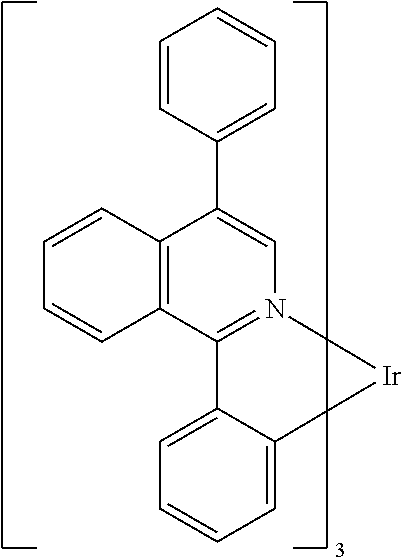 |
 |
 |
 |
 |
 |
 |
 |
 |
 |
 |
 |
 |
 |
 |
 |
 |
 |
 |
 |
 |
 |
 |
 |
 |
 |
 |
 |
 |
 |
 |
 |
 |
 |
 |
 |
 |
 |
 |
 |
 |
 |
 |
 |
 |
 |
 |
 |
 |
 |
 |
 |
 |
 |
 |
 |
 |
 |
 |
 |
 |
 |
 |
 |
 |
 |
 |
 |
 |
 |
 |
 |
 |
 |
 |
 |
 |
 |
 |
 |
 |
 |
 |
 |
 |
 |
 |
 |
 |
 |
 |
 |
 |
 |
 |
 |
 |
 |
 |
 |
 |
 |
 |
 |
 |
 |
 |
 |
 |
 |
 |
 |
 |
 |
 |
 |
 |
 |
 |
 |
 |
 |
 |
 |
 |
 |
 |
 |
 |
 |
 |
 |
 |
 |
 |
 |
 |
 |
 |
 |
 |
 |
 |

| Starting | Starting | ||
| material 1 | material 2 | Product | Yield |
 |  |  | 85% |
 |  |  | 89% |
 |  |  | 91% |
 |  |  | 81% |
 |  |  | 95% |
 |  |  | 90% |
 |  |  | 85% |
 | 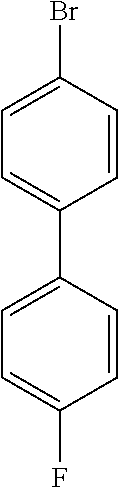 |  | 97% |
Step 2:

| Starting material 1 | Product | Yield |
 |  | 85% |
 |  | 93% |
 |  | 91% |
Step 3:

| Starting | Starting | ||
| material 1 | material 2 | Product | Yield |
 |  |  | 87% |
 |  |  | 82% |
 |  |  | 91% |
 |  |  | 87% |
 |  |  | 95% |
 |  |  | 92% |
A-2) Synthesis of Asymmetrical Acridinones
Step 1:


| Starting | Starting | ||
| material 1 | material 2 | Product | Yield |
 |  |  | 85% |
 |  |  | 89% |
 |  |  | 81% |
A-5) Suzuki Reaction

| Starting | Starting | |||
| Ex. | material 1 | material 2 | Product | Yield |
| V1 |  |  |  | 85% |
| 1 |  |  |  | 89% |
| 2 |  |  |  | 91% |
| V2 |  |  |  | 90% |
| V3 |  |  |  | 98% |
| 2b |  |  |  | |
A-6) Buchwald Reaction

| Starting | ||
| Ex. | Starting material 1 | material 2 |
| 3 |
 |
 |
| 4 |
 |
 |
| 5 |
 |
 |
| 6 |
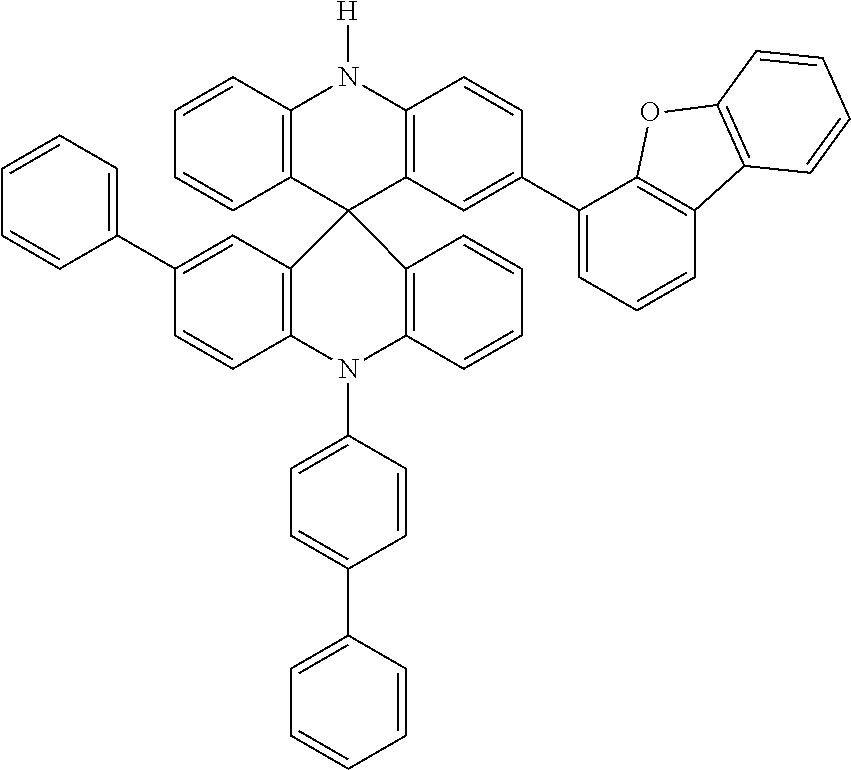 |
 |
| V4 |
 |
 |
| 7 |
 |
 |
| 8 |
 |
 |
| 9 |
 |
 |
| 10 |
 |
 |
| Ex. | Product | Yield | |
| 3 |
 |
65% | |
| 4 |
 |
69% | |
| 5 |
 |
71% | |
| 6 |
 |
75% | |
| V4 |
 |
81% | |
| 7 |
 |
79% | |
| 8 |
 |
70% | |
| 9 |
 |
60% | |
| 10 |
 |
||
| TABLE 1 |
| Structures of the materials used |
 |
F4TCNQ |
 |
HIM |
 |
H1 |
 |
SEB |
 |
H2 |
 |
TEG |
 |
ETM |
 |
LiQ |
 |
HTMV1 |
 |
HTMV2 |
 |
HTM1 |
 |
HTM2 |
 |
HTM3 |
 |
HTM4 |
 |
HTM5 |
 |
HTM6 |
 |
HTM7 |
 |
HTM8 |
| TABLE 2 |
| Structure of the OLEDs |
| EIL | |||||||
| HIL1 | HTL | HIL2 | EBL | EML | ETL | Thickness/ | |
| Ex. | Thickness/nm | Thickness/nm | Thickness/nm | Thickness/nm | Thickness/nm | Thickness/nm | nm |
| V1 | HIM:F4TCNQ(5%) | HIM | HTMV2 | H1:SEB(5%) | ETM:LiQ(50%) | LiQ | |
| 20 nm | 175 nm | 20 nm | 20 nm | 30 nm | 1 nm | ||
| E1 | HIM:F4TCNQ(5%) | HIM | HTM5 | H1:SEB(5%) | ETM:LiQ(50%) | LiQ | |
| 20 nm | 175 nm | 20 nm | 20 nm | 30 nm | 1 nm | ||
| V2 | HIM:F4TCNQ(5%) | HIM | HTMV2:F4TCNQ(5%) | HTMV2 | H2:TEG(10%) | ETM:LiQ(50%) | LiQ |
| 20 nm | 220 nm | 20 nm | 20 nm | 30 nm | 40 nm | 1 nm | |
| E2 | HIM:F4TCNQ(5%) | HIM | HTM5:F4TCNQ(5%) | HTM5 | H2:TEG(10%) | ETM:LiQ(50%) | LiQ |
| 20 nm | 220 nm | 20 nm | 20 nm | 30 nm | 40 nm | 1 nm | |
| V3 | HIM:F4TCNQ(5%) | HIM | HTMV1 | H1:SEB(5%) | ETM:LiQ(50%) | LiQ | |
| 20 nm | 175 nm | 20 nm | 20 nm | 30 nm | 1 nm | ||
| E3 | HIM:F4TCNQ(5%) | HIM | HTM1 | H1:SEB(5%) | ETM:LiQ(50%) | LiQ | |
| 20 nm | 175 nm | 20 nm | 20 nm | 30 nm | 1 nm | ||
| E4 | HIM:F4TCNQ(5%) | HIM | HTM2 | H1:SEB(5%) | ETM:LiQ(50%) | LiQ | |
| 20 nm | 175 nm | 20 nm | 20 nm | 30 nm | 1 nm | ||
| E5 | HIM:F4TCNQ(5%) | HIM | HTM3 | H1:SEB(5%) | ETM:LiQ(50%) | LiQ | |
| 20 nm | 175 nm | 20 nm | 20 nm | 30 nm | 1 nm | ||
| E6 | HIM:F4TCNQ(5%) | HIM | HTM4 | H1:SEB(5%) | ETM:LiQ(50%) | LiQ | |
| 20 nm | 175 nm | 20 nm | 20 nm | 30 nm | 1 nm | ||
| E7 | HIM:F4TCNQ(5%) | HIM | HTM6 | H1:SEB(5%) | ETM:LiQ(50%) | LiQ | |
| 20 nm | 175 nm | 20 nm | 20 nm | 30 nm | 1 nm | ||
| E8 | HIM:F4TCNQ(5%) | HIM | HTM7 | H1:SEB(5%) | ETM:LiQ(50%) | LiQ | |
| 20 nm | 175 nm | 20 nm | 20 nm | 30 nm | 1 nm | ||
| E9 | HIM:F4TCNQ(5%) | HIM | HTM8 | H1:SEB(5%) | ETM:LiQ(50%) | LiQ | |
| 20 nm | 175 nm | 20 nm | 20 nm | 30 nm | 1 nm | ||
| V4 | HIM:F4TCNQ(5%) | HIM | HTMV1:F4TCNQ(5%) | HTMV1 | H2:TEG(10%) | ETM:LiQ(50%) | LiQ |
| 20 nm | 220 nm | 20 nm | 20 nm | 30 nm | 40 nm | 1 nm | |
| E10 | HIM:F4TCNQ(5%) | HIM | HTM1:F4TCNQ(5%) | HTM1 | H2:TEG(10%) | ETM:LiQ(50%) | LiQ |
| 20 nm | 220 nm | 20 nm | 20 nm | 30 nm | 40 nm | 1 nm | |
| E11 | HIM:F4TCNQ(5%) | HIM | HTM2:F4TCNQ(5%) | HTM2 | H2:TEG(10%) | ETM:LiQ(50%) | LiQ |
| 20 nm | 220 nm | 20 nm | 20 nm | 30 nm | 40 nm | 1 nm | |
| E12 | HIM:F4TCNQ(5%) | HIM | HTM3:F4TCNQ(5%) | HTM3 | H2:TEG(10%) | ETM:LiQ(50%) | LiQ |
| 20 nm | 220 nm | 20 nm | 20 nm | 30 nm | 40 nm | 1 nm | |
| E13 | HIM:F4TCNQ(5%) | HIM | HTM4:F4TCNQ(5%) | HTM4 | H2:TEG(10%) | ETM:LiQ(50%) | LiQ |
| 20 nm | 220 nm | 20 nm | 20 nm | 30 nm | 40 nm | 1 nm | |
| E14 | HIM:F4TCNQ(5%) | HIM | HTM6:F4TCNQ(5%) | HTM6 | H2:TEG(10%) | ETM:LiQ(50%) | LiQ |
| 20 nm | 220 nm | 20 nm | 20 nm | 30 nm | 40 nm | 1 nm | |
| E15 | HIM:F4TCNQ(5%) | HIM | HTM7:F4TCNQ(5%) | HTM7 | H2:TEG(10%) | ETM:LiQ(50%) | LiQ |
| 20 nm | 220 nm | 20 nm | 20 nm | 30 nm | 40 nm | 1 nm | |
| E16 | HIM:F4TCNQ(5%) | HIM | HTM8:F4TCNQ(5%) | HTM8 | H2:TEG(10%) | ETM:LiQ(50%) | LiQ |
| 20 nm | 220 nm | 20 nm | 20 nm | 30 nm | 40 nm | 1 nm | |
Claims (23)


Applications Claiming Priority (4)
| Application Number | Priority Date | Filing Date | Title |
|---|---|---|---|
| EP14001344 | 2014-04-14 | ||
| EP14001344.2 | 2014-04-14 | ||
| EP14001344 | 2014-04-14 | ||
| PCT/EP2015/000603 WO2015158411A1 (en) | 2014-04-14 | 2015-03-19 | Materials for electronic devices |
Publications (2)
| Publication Number | Publication Date |
|---|---|
| US20170125701A1 US20170125701A1 (en) | 2017-05-04 |
| US10374168B2 true US10374168B2 (en) | 2019-08-06 |
Family
ID=50486702
Family Applications (1)
| Application Number | Title | Priority Date | Filing Date |
|---|---|---|---|
| US15/303,390 Active 2035-05-27 US10374168B2 (en) | 2014-04-14 | 2015-03-19 | Materials for electronic devices |
Country Status (7)
| Country | Link |
|---|---|
| US (1) | US10374168B2 (en) |
| EP (1) | EP3131901B1 (en) |
| JP (1) | JP6651460B2 (en) |
| KR (1) | KR102375983B1 (en) |
| CN (1) | CN106164074B (en) |
| TW (1) | TWI664171B (en) |
| WO (1) | WO2015158411A1 (en) |
Cited By (2)
| Publication number | Priority date | Publication date | Assignee | Title |
|---|---|---|---|---|
| US11233201B2 (en) | 2017-06-30 | 2022-01-25 | Kunshan Go-Visionox Opto-Electronics Co., Ltd. | Organic electroluminescent devices and preparation methods thereof |
| US11512245B2 (en) * | 2018-11-14 | 2022-11-29 | Wuhan China Star Optoelectronics Semiconductor Display Technology Co., Ltd. | Thermally activated delayed fluorescent deep-red light polymer material and method of fabricating same |
Families Citing this family (54)
| Publication number | Priority date | Publication date | Assignee | Title |
|---|---|---|---|---|
| JP7051691B2 (en) | 2016-02-05 | 2022-04-11 | メルク パテント ゲーエムベーハー | Materials for electronic devices |
| TWI764942B (en) | 2016-10-10 | 2022-05-21 | 德商麥克專利有限公司 | Electronic device |
| WO2018083053A1 (en) | 2016-11-02 | 2018-05-11 | Merck Patent Gmbh | Materials for electronic devices |
| TW201833118A (en) | 2016-11-22 | 2018-09-16 | 德商麥克專利有限公司 | Materials for electronic devices |
| KR102754844B1 (en) * | 2016-11-30 | 2025-01-15 | 삼성디스플레이 주식회사 | Polycyclic compound and organic electroluminescence device including the same |
| CN106831773A (en) * | 2017-01-05 | 2017-06-13 | 华南理工大学 | Compound containing 9,9'-spiroacridine and its preparation method and application |
| KR102817119B1 (en) | 2017-01-19 | 2025-06-09 | 삼성디스플레이 주식회사 | Organic electroluminescence device |
| EP3577101B1 (en) | 2017-02-02 | 2021-03-03 | Merck Patent GmbH | Materials for electronic devices |
| US20200055822A1 (en) | 2017-03-02 | 2020-02-20 | Merck Patent Gmbh | Materials for organic electronic devices |
| CN110573515B (en) | 2017-04-25 | 2023-07-25 | 默克专利有限公司 | Compounds for electronic devices |
| WO2018234346A1 (en) | 2017-06-23 | 2018-12-27 | Merck Patent Gmbh | MATERIALS FOR ORGANIC ELECTROLUMINESCENT DEVICES |
| EP3645501B1 (en) | 2017-06-28 | 2023-08-23 | Merck Patent GmbH | Materials for electronic devices |
| KR102734776B1 (en) | 2017-07-28 | 2024-11-27 | 메르크 파텐트 게엠베하 | Spirobifluorene derivatives for use in electronic devices |
| CN118405982A (en) | 2017-09-08 | 2024-07-30 | 默克专利有限公司 | Materials for electronic devices |
| KR20250035612A (en) | 2017-11-23 | 2025-03-12 | 메르크 파텐트 게엠베하 | Materials for electronic devices |
| WO2019115577A1 (en) | 2017-12-15 | 2019-06-20 | Merck Patent Gmbh | Substituted aromatic amines for use in organic electroluminescent devices |
| WO2019175149A1 (en) | 2018-03-16 | 2019-09-19 | Merck Patent Gmbh | Materials for organic electroluminescent devices |
| KR102697986B1 (en) * | 2018-04-05 | 2024-08-23 | 삼성디스플레이 주식회사 | Organic electroluminescence device and polycyclic compound for organic electroluminescence device |
| JP7325731B2 (en) | 2018-08-23 | 2023-08-15 | 国立大学法人九州大学 | organic electroluminescence element |
| TW202110788A (en) | 2019-05-03 | 2021-03-16 | 德商麥克專利有限公司 | Electronic device |
| TW202110789A (en) | 2019-05-03 | 2021-03-16 | 德商麥克專利有限公司 | Electronic device |
| CN112010843B (en) * | 2019-05-30 | 2022-03-08 | 烟台显华光电材料研究院有限公司 | Compound for preparing organic photoelectric device and application thereof |
| CN110590777A (en) * | 2019-08-19 | 2019-12-20 | 武汉华星光电半导体显示技术有限公司 | Hole transport material, electroluminescent device and preparation method of hole transport material |
| CN110950866B (en) * | 2019-11-26 | 2023-06-27 | 武汉华星光电半导体显示技术有限公司 | Hole transport material with spirobisacridine as core and organic light-emitting diode |
| US20210159424A1 (en) * | 2019-11-26 | 2021-05-27 | Wuhan China Star Optoelectronics Semiconductor Display Technology Co., Ltd. | Hole transporting material using spirobiacridine as core and organic light emitting diode |
| CN112812115B (en) * | 2020-02-28 | 2022-03-29 | 广东聚华印刷显示技术有限公司 | Acridine compound, polymer, application of polymer and light-emitting device |
| TW202208594A (en) | 2020-05-27 | 2022-03-01 | 德商麥克專利有限公司 | Materials for electronic devices |
| KR102930510B1 (en) * | 2020-08-06 | 2026-02-24 | 메르크 파텐트 게엠베하 | electronic devices |
| CN113666963A (en) * | 2021-08-30 | 2021-11-19 | 武汉天马微电子有限公司 | Compound, display panel and display device |
| WO2023052314A1 (en) | 2021-09-28 | 2023-04-06 | Merck Patent Gmbh | Materials for electronic devices |
| EP4410074B1 (en) | 2021-09-28 | 2025-05-21 | Merck Patent GmbH | Materials for electronic devices |
| EP4410071A1 (en) | 2021-09-28 | 2024-08-07 | Merck Patent GmbH | Materials for electronic devices |
| DE112022004658A5 (en) | 2021-09-28 | 2024-07-25 | Merck Patent Gmbh | MATERIALS FOR ELECTRONIC DEVICES |
| CN113845431B (en) * | 2021-10-20 | 2024-03-29 | 上海钥熠电子科技有限公司 | Spirofluorene derivative amine compound and organic electroluminescent device comprising the same |
| EP4437814A1 (en) | 2021-11-25 | 2024-10-02 | Merck Patent GmbH | Materials for electronic devices |
| KR20240128020A (en) | 2021-12-21 | 2024-08-23 | 메르크 파텐트 게엠베하 | Method for producing deuterated organic compounds |
| US20250160204A1 (en) | 2022-02-14 | 2025-05-15 | Merck Patent Gmbh | Materials for electronic devices |
| WO2023222559A1 (en) | 2022-05-18 | 2023-11-23 | Merck Patent Gmbh | Process for preparing deuterated organic compounds |
| EP4555039A1 (en) | 2022-07-11 | 2025-05-21 | Merck Patent GmbH | Materials for electronic devices |
| WO2024132993A1 (en) | 2022-12-19 | 2024-06-27 | Merck Patent Gmbh | Materials for electronic devices |
| CN120379953A (en) | 2022-12-20 | 2025-07-25 | 默克专利有限公司 | Process for preparing deuterated aromatic compounds |
| KR20250151490A (en) | 2023-02-17 | 2025-10-21 | 메르크 파텐트 게엠베하 | Materials for organic electroluminescent devices |
| KR20260015809A (en) | 2023-04-20 | 2026-02-03 | 메르크 파텐트 게엠베하 | Materials for electronic devices |
| WO2024240725A1 (en) | 2023-05-25 | 2024-11-28 | Merck Patent Gmbh | Tris[1,2,4]triazolo[1,5-a:1',5'-c:1'',5''-e][1,3,5]triazine derivatives for use in organic electroluminescent devices |
| CN121487940A (en) | 2023-07-12 | 2026-02-06 | 默克专利有限公司 | Material for electronic devices |
| WO2025021855A1 (en) | 2023-07-27 | 2025-01-30 | Merck Patent Gmbh | Materials for organic light-emitting devices and organic sensors |
| WO2025045842A1 (en) | 2023-08-30 | 2025-03-06 | Merck Patent Gmbh | Materials for organic light-emitting devices |
| WO2025045851A1 (en) | 2023-08-30 | 2025-03-06 | Merck Patent Gmbh | Materials for organic light-emitting devices |
| WO2025045843A1 (en) | 2023-08-30 | 2025-03-06 | Merck Patent Gmbh | Materials for organic light-emitting devices |
| WO2025083015A1 (en) | 2023-10-19 | 2025-04-24 | Merck Patent Gmbh | Materials for organic electroluminescent devices |
| WO2025132547A1 (en) | 2023-12-21 | 2025-06-26 | Merck Patent Gmbh | Mechanochemical method for deuterating organic compounds |
| WO2025132551A1 (en) | 2023-12-22 | 2025-06-26 | Merck Patent Gmbh | Materials for electronic devices |
| WO2025196145A1 (en) | 2024-03-22 | 2025-09-25 | Merck Patent Gmbh | Materials for organic light emitting devices |
| WO2025210013A1 (en) | 2024-04-04 | 2025-10-09 | Merck Patent Gmbh | Compounds for electronic devices, in particular compounds for oleds |
Citations (4)
| Publication number | Priority date | Publication date | Assignee | Title |
|---|---|---|---|---|
| JP2002265938A (en) | 2001-03-14 | 2002-09-18 | Toyo Ink Mfg Co Ltd | Organic electroluminescent device material and organic electroluminescent device using the same |
| US20110240979A1 (en) * | 2010-04-01 | 2011-10-06 | Hee-Yeon Kim | Condensed-cyclic compound and organic light-emitting device including the same |
| WO2012150001A1 (en) | 2011-05-05 | 2012-11-08 | Merck Patent Gmbh | Compounds for electronic devices |
| WO2013083216A1 (en) | 2011-11-17 | 2013-06-13 | Merck Patent Gmbh | Spiro dihydroacridine derivatives and the use thereof as materials for organic electroluminescence devices |
-
2015
- 2015-03-19 EP EP15711049.5A patent/EP3131901B1/en active Active
- 2015-03-19 JP JP2016562905A patent/JP6651460B2/en active Active
- 2015-03-19 WO PCT/EP2015/000603 patent/WO2015158411A1/en not_active Ceased
- 2015-03-19 US US15/303,390 patent/US10374168B2/en active Active
- 2015-03-19 KR KR1020167031633A patent/KR102375983B1/en active Active
- 2015-03-19 CN CN201580019580.1A patent/CN106164074B/en active Active
- 2015-04-09 TW TW104111439A patent/TWI664171B/en not_active IP Right Cessation
Patent Citations (6)
| Publication number | Priority date | Publication date | Assignee | Title |
|---|---|---|---|---|
| JP2002265938A (en) | 2001-03-14 | 2002-09-18 | Toyo Ink Mfg Co Ltd | Organic electroluminescent device material and organic electroluminescent device using the same |
| US20110240979A1 (en) * | 2010-04-01 | 2011-10-06 | Hee-Yeon Kim | Condensed-cyclic compound and organic light-emitting device including the same |
| WO2012150001A1 (en) | 2011-05-05 | 2012-11-08 | Merck Patent Gmbh | Compounds for electronic devices |
| US20140061548A1 (en) | 2011-05-05 | 2014-03-06 | Merck Patent CmbH | Compounds for electronic devices |
| WO2013083216A1 (en) | 2011-11-17 | 2013-06-13 | Merck Patent Gmbh | Spiro dihydroacridine derivatives and the use thereof as materials for organic electroluminescence devices |
| US20140316134A1 (en) | 2011-11-17 | 2014-10-23 | Merck Patent Gmbh | Spiro dihydroacridine derivatives and the use thereof as materials for organic electroluminescence devices |
Non-Patent Citations (3)
| Title |
|---|
| Gilman, H., et al "Synthesis of Some 5,10-Dihydrophenazasiline Derivatives", Journal of Organic Chemistry, vol. 26, No. 6, (1961), pp. 2013-2017. |
| International Search Report for PCT/EP2015/000603 dated May 28, 2015. |
| Vaeth and Tang; Light emitting diodes based on phosphorescent guest/polymeric host systems; 2002; Journal of Applied Physics; vol. 92, No. 7; pp. 3447-3453. * |
Cited By (2)
| Publication number | Priority date | Publication date | Assignee | Title |
|---|---|---|---|---|
| US11233201B2 (en) | 2017-06-30 | 2022-01-25 | Kunshan Go-Visionox Opto-Electronics Co., Ltd. | Organic electroluminescent devices and preparation methods thereof |
| US11512245B2 (en) * | 2018-11-14 | 2022-11-29 | Wuhan China Star Optoelectronics Semiconductor Display Technology Co., Ltd. | Thermally activated delayed fluorescent deep-red light polymer material and method of fabricating same |
Also Published As
| Publication number | Publication date |
|---|---|
| JP2017513855A (en) | 2017-06-01 |
| WO2015158411A1 (en) | 2015-10-22 |
| EP3131901A1 (en) | 2017-02-22 |
| TW201602091A (en) | 2016-01-16 |
| CN106164074A (en) | 2016-11-23 |
| KR20160143821A (en) | 2016-12-14 |
| KR102375983B1 (en) | 2022-03-17 |
| TWI664171B (en) | 2019-07-01 |
| JP6651460B2 (en) | 2020-02-19 |
| US20170125701A1 (en) | 2017-05-04 |
| CN106164074B (en) | 2019-01-18 |
| EP3131901B1 (en) | 2018-02-07 |
Similar Documents
| Publication | Publication Date | Title |
|---|---|---|
| US10374168B2 (en) | Materials for electronic devices | |
| US10665790B2 (en) | Materials for electronic devices | |
| US11056652B2 (en) | Compounds and organic electronic devices | |
| US10424739B2 (en) | Compounds for electronic devices | |
| US10957860B2 (en) | Materials for electronic devices | |
| US10944058B2 (en) | Compounds and organic electronic devices | |
| US10696664B2 (en) | Phenoxazine derivatives for organic electroluminescent devices | |
| US10727413B2 (en) | Materials for electronic devices | |
| US11189801B2 (en) | Phenoxazine derivatives for organic electroluminescent devices | |
| US10487262B2 (en) | Materials for organic electroluminescent devices | |
| US11365167B2 (en) | Materials for organic electroluminescent devices | |
| US10032989B2 (en) | Spirobifluorene derivative-based materials for electronic devices | |
| US10559756B2 (en) | Materials for electronic devices | |
| US12219874B2 (en) | Materials for electronic devices | |
| US10056549B2 (en) | Compounds for electronic devices | |
| US10020450B2 (en) | Materials for electronic devices | |
| US9985220B2 (en) | Materials for electronic devices | |
| US20180327339A1 (en) | Compounds for electronic devices | |
| US20180006237A1 (en) | Materials for electronic devices | |
| US10381575B2 (en) | Materials for electronic devices | |
| US20190002417A1 (en) | Materials for electronic devices |
Legal Events
| Date | Code | Title | Description |
|---|---|---|---|
| AS | Assignment |
Owner name: MERCK PATENT GMBH, GERMANY Free format text: ASSIGNMENT OF ASSIGNORS INTEREST;ASSIGNORS:PFISTER, JOCHEN;VOGES, FRANK;MONTENEGRO, ELVIRA;AND OTHERS;SIGNING DATES FROM 20160722 TO 20160725;REEL/FRAME:040006/0456 |
|
| STPP | Information on status: patent application and granting procedure in general |
Free format text: NOTICE OF ALLOWANCE MAILED -- APPLICATION RECEIVED IN OFFICE OF PUBLICATIONS |
|
| STPP | Information on status: patent application and granting procedure in general |
Free format text: PUBLICATIONS -- ISSUE FEE PAYMENT VERIFIED |
|
| STCF | Information on status: patent grant |
Free format text: PATENTED CASE |
|
| MAFP | Maintenance fee payment |
Free format text: PAYMENT OF MAINTENANCE FEE, 4TH YEAR, LARGE ENTITY (ORIGINAL EVENT CODE: M1551); ENTITY STATUS OF PATENT OWNER: LARGE ENTITY Year of fee payment: 4 |