US10364744B2 - Deep heat recovery gas turbine engine - Google Patents
Deep heat recovery gas turbine engine Download PDFInfo
- Publication number
- US10364744B2 US10364744B2 US15/457,789 US201715457789A US10364744B2 US 10364744 B2 US10364744 B2 US 10364744B2 US 201715457789 A US201715457789 A US 201715457789A US 10364744 B2 US10364744 B2 US 10364744B2
- Authority
- US
- United States
- Prior art keywords
- working fluid
- heat exchanger
- flow
- compressor
- heat
- Prior art date
- Legal status (The legal status is an assumption and is not a legal conclusion. Google has not performed a legal analysis and makes no representation as to the accuracy of the status listed.)
- Active, expires
Links
Images


Classifications
-
- F—MECHANICAL ENGINEERING; LIGHTING; HEATING; WEAPONS; BLASTING
- F02—COMBUSTION ENGINES; HOT-GAS OR COMBUSTION-PRODUCT ENGINE PLANTS
- F02C—GAS-TURBINE PLANTS; AIR INTAKES FOR JET-PROPULSION PLANTS; CONTROLLING FUEL SUPPLY IN AIR-BREATHING JET-PROPULSION PLANTS
- F02C6/00—Plural gas-turbine plants; Combinations of gas-turbine plants with other apparatus; Adaptations of gas-turbine plants for special use
- F02C6/18—Plural gas-turbine plants; Combinations of gas-turbine plants with other apparatus; Adaptations of gas-turbine plants for special use using the waste heat of gas-turbine plants outside the plants themselves, e.g. gas-turbine power heat plants
-
- F—MECHANICAL ENGINEERING; LIGHTING; HEATING; WEAPONS; BLASTING
- F01—MACHINES OR ENGINES IN GENERAL; ENGINE PLANTS IN GENERAL; STEAM ENGINES
- F01D—NON-POSITIVE DISPLACEMENT MACHINES OR ENGINES, e.g. STEAM TURBINES
- F01D15/00—Adaptations of machines or engines for special use; Combinations of engines with devices driven thereby
- F01D15/12—Combinations with mechanical gearing
-
- F—MECHANICAL ENGINEERING; LIGHTING; HEATING; WEAPONS; BLASTING
- F02—COMBUSTION ENGINES; HOT-GAS OR COMBUSTION-PRODUCT ENGINE PLANTS
- F02C—GAS-TURBINE PLANTS; AIR INTAKES FOR JET-PROPULSION PLANTS; CONTROLLING FUEL SUPPLY IN AIR-BREATHING JET-PROPULSION PLANTS
- F02C1/00—Gas-turbine plants characterised by the use of hot gases or unheated pressurised gases, as the working fluid
- F02C1/007—Gas-turbine plants characterised by the use of hot gases or unheated pressurised gases, as the working fluid combination of cycles
-
- F—MECHANICAL ENGINEERING; LIGHTING; HEATING; WEAPONS; BLASTING
- F02—COMBUSTION ENGINES; HOT-GAS OR COMBUSTION-PRODUCT ENGINE PLANTS
- F02C—GAS-TURBINE PLANTS; AIR INTAKES FOR JET-PROPULSION PLANTS; CONTROLLING FUEL SUPPLY IN AIR-BREATHING JET-PROPULSION PLANTS
- F02C1/00—Gas-turbine plants characterised by the use of hot gases or unheated pressurised gases, as the working fluid
- F02C1/04—Gas-turbine plants characterised by the use of hot gases or unheated pressurised gases, as the working fluid the working fluid being heated indirectly
-
- F—MECHANICAL ENGINEERING; LIGHTING; HEATING; WEAPONS; BLASTING
- F02—COMBUSTION ENGINES; HOT-GAS OR COMBUSTION-PRODUCT ENGINE PLANTS
- F02C—GAS-TURBINE PLANTS; AIR INTAKES FOR JET-PROPULSION PLANTS; CONTROLLING FUEL SUPPLY IN AIR-BREATHING JET-PROPULSION PLANTS
- F02C1/00—Gas-turbine plants characterised by the use of hot gases or unheated pressurised gases, as the working fluid
- F02C1/04—Gas-turbine plants characterised by the use of hot gases or unheated pressurised gases, as the working fluid the working fluid being heated indirectly
- F02C1/10—Closed cycles
-
- F—MECHANICAL ENGINEERING; LIGHTING; HEATING; WEAPONS; BLASTING
- F02—COMBUSTION ENGINES; HOT-GAS OR COMBUSTION-PRODUCT ENGINE PLANTS
- F02C—GAS-TURBINE PLANTS; AIR INTAKES FOR JET-PROPULSION PLANTS; CONTROLLING FUEL SUPPLY IN AIR-BREATHING JET-PROPULSION PLANTS
- F02C3/00—Gas-turbine plants characterised by the use of combustion products as the working fluid
- F02C3/04—Gas-turbine plants characterised by the use of combustion products as the working fluid having a turbine driving a compressor
-
- F—MECHANICAL ENGINEERING; LIGHTING; HEATING; WEAPONS; BLASTING
- F02—COMBUSTION ENGINES; HOT-GAS OR COMBUSTION-PRODUCT ENGINE PLANTS
- F02C—GAS-TURBINE PLANTS; AIR INTAKES FOR JET-PROPULSION PLANTS; CONTROLLING FUEL SUPPLY IN AIR-BREATHING JET-PROPULSION PLANTS
- F02C7/00—Features, components parts, details or accessories, not provided for in, or of interest apart form groups F02C1/00 - F02C6/00; Air intakes for jet-propulsion plants
- F02C7/08—Heating air supply before combustion, e.g. by exhaust gases
-
- F—MECHANICAL ENGINEERING; LIGHTING; HEATING; WEAPONS; BLASTING
- F02—COMBUSTION ENGINES; HOT-GAS OR COMBUSTION-PRODUCT ENGINE PLANTS
- F02C—GAS-TURBINE PLANTS; AIR INTAKES FOR JET-PROPULSION PLANTS; CONTROLLING FUEL SUPPLY IN AIR-BREATHING JET-PROPULSION PLANTS
- F02C7/00—Features, components parts, details or accessories, not provided for in, or of interest apart form groups F02C1/00 - F02C6/00; Air intakes for jet-propulsion plants
- F02C7/08—Heating air supply before combustion, e.g. by exhaust gases
- F02C7/10—Heating air supply before combustion, e.g. by exhaust gases by means of regenerative heat-exchangers
-
- F—MECHANICAL ENGINEERING; LIGHTING; HEATING; WEAPONS; BLASTING
- F02—COMBUSTION ENGINES; HOT-GAS OR COMBUSTION-PRODUCT ENGINE PLANTS
- F02K—JET-PROPULSION PLANTS
- F02K3/00—Plants including a gas turbine driving a compressor or a ducted fan
- F02K3/02—Plants including a gas turbine driving a compressor or a ducted fan in which part of the working fluid by-passes the turbine and combustion chamber
- F02K3/04—Plants including a gas turbine driving a compressor or a ducted fan in which part of the working fluid by-passes the turbine and combustion chamber the plant including ducted fans, i.e. fans with high volume, low pressure outputs, for augmenting the jet thrust, e.g. of double-flow type
- F02K3/06—Plants including a gas turbine driving a compressor or a ducted fan in which part of the working fluid by-passes the turbine and combustion chamber the plant including ducted fans, i.e. fans with high volume, low pressure outputs, for augmenting the jet thrust, e.g. of double-flow type with front fan
-
- F—MECHANICAL ENGINEERING; LIGHTING; HEATING; WEAPONS; BLASTING
- F25—REFRIGERATION OR COOLING; COMBINED HEATING AND REFRIGERATION SYSTEMS; HEAT PUMP SYSTEMS; MANUFACTURE OR STORAGE OF ICE; LIQUEFACTION SOLIDIFICATION OF GASES
- F25B—REFRIGERATION MACHINES, PLANTS OR SYSTEMS; COMBINED HEATING AND REFRIGERATION SYSTEMS; HEAT PUMP SYSTEMS
- F25B9/00—Compression machines, plants or systems, in which the refrigerant is air or other gas of low boiling point
- F25B9/002—Compression machines, plants or systems, in which the refrigerant is air or other gas of low boiling point characterised by the refrigerant
- F25B9/008—Compression machines, plants or systems, in which the refrigerant is air or other gas of low boiling point characterised by the refrigerant the refrigerant being carbon dioxide
-
- F—MECHANICAL ENGINEERING; LIGHTING; HEATING; WEAPONS; BLASTING
- F25—REFRIGERATION OR COOLING; COMBINED HEATING AND REFRIGERATION SYSTEMS; HEAT PUMP SYSTEMS; MANUFACTURE OR STORAGE OF ICE; LIQUEFACTION SOLIDIFICATION OF GASES
- F25B—REFRIGERATION MACHINES, PLANTS OR SYSTEMS; COMBINED HEATING AND REFRIGERATION SYSTEMS; HEAT PUMP SYSTEMS
- F25B9/00—Compression machines, plants or systems, in which the refrigerant is air or other gas of low boiling point
- F25B9/06—Compression machines, plants or systems, in which the refrigerant is air or other gas of low boiling point using expanders
-
- F—MECHANICAL ENGINEERING; LIGHTING; HEATING; WEAPONS; BLASTING
- F05—INDEXING SCHEMES RELATING TO ENGINES OR PUMPS IN VARIOUS SUBCLASSES OF CLASSES F01-F04
- F05D—INDEXING SCHEME FOR ASPECTS RELATING TO NON-POSITIVE-DISPLACEMENT MACHINES OR ENGINES, GAS-TURBINES OR JET-PROPULSION PLANTS
- F05D2220/00—Application
- F05D2220/30—Application in turbines
- F05D2220/32—Application in turbines in gas turbines
-
- F—MECHANICAL ENGINEERING; LIGHTING; HEATING; WEAPONS; BLASTING
- F05—INDEXING SCHEMES RELATING TO ENGINES OR PUMPS IN VARIOUS SUBCLASSES OF CLASSES F01-F04
- F05D—INDEXING SCHEME FOR ASPECTS RELATING TO NON-POSITIVE-DISPLACEMENT MACHINES OR ENGINES, GAS-TURBINES OR JET-PROPULSION PLANTS
- F05D2240/00—Components
- F05D2240/35—Combustors or associated equipment
-
- F—MECHANICAL ENGINEERING; LIGHTING; HEATING; WEAPONS; BLASTING
- F05—INDEXING SCHEMES RELATING TO ENGINES OR PUMPS IN VARIOUS SUBCLASSES OF CLASSES F01-F04
- F05D—INDEXING SCHEME FOR ASPECTS RELATING TO NON-POSITIVE-DISPLACEMENT MACHINES OR ENGINES, GAS-TURBINES OR JET-PROPULSION PLANTS
- F05D2260/00—Function
- F05D2260/20—Heat transfer, e.g. cooling
- F05D2260/213—Heat transfer, e.g. cooling by the provision of a heat exchanger within the cooling circuit
-
- F—MECHANICAL ENGINEERING; LIGHTING; HEATING; WEAPONS; BLASTING
- F25—REFRIGERATION OR COOLING; COMBINED HEATING AND REFRIGERATION SYSTEMS; HEAT PUMP SYSTEMS; MANUFACTURE OR STORAGE OF ICE; LIQUEFACTION SOLIDIFICATION OF GASES
- F25B—REFRIGERATION MACHINES, PLANTS OR SYSTEMS; COMBINED HEATING AND REFRIGERATION SYSTEMS; HEAT PUMP SYSTEMS
- F25B2309/00—Gas cycle refrigeration machines
- F25B2309/06—Compression machines, plants or systems characterised by the refrigerant being carbon dioxide
- F25B2309/061—Compression machines, plants or systems characterised by the refrigerant being carbon dioxide with cycle highest pressure above the supercritical pressure
-
- Y—GENERAL TAGGING OF NEW TECHNOLOGICAL DEVELOPMENTS; GENERAL TAGGING OF CROSS-SECTIONAL TECHNOLOGIES SPANNING OVER SEVERAL SECTIONS OF THE IPC; TECHNICAL SUBJECTS COVERED BY FORMER USPC CROSS-REFERENCE ART COLLECTIONS [XRACs] AND DIGESTS
- Y02—TECHNOLOGIES OR APPLICATIONS FOR MITIGATION OR ADAPTATION AGAINST CLIMATE CHANGE
- Y02T—CLIMATE CHANGE MITIGATION TECHNOLOGIES RELATED TO TRANSPORTATION
- Y02T50/00—Aeronautics or air transport
- Y02T50/60—Efficient propulsion technologies, e.g. for aircraft
-
- Y02T50/675—
Definitions
- This disclosure relates to gas turbine engines and, in particular, to a deep heat recovery system included in a gas turbine engine.
- Gas turbine engines are used on vehicles such as airplane and helicopters. These engines are internal combustion engines that operate to produce thrust by discharging a high velocity exhaust. Some gas turbine engines can also include fan blades to create thrust.
- Gas turbine engines include one or more compressors, a combustor and one or more turbines. Air is compressed in the compressor(s), mixed with fuel in the combustor and ignited, such that exhaust gases are created and discharged through a turbine to create thrust. The exhaust gas rotates the turbine, which is typically used to turn a shaft and produce shaft work output, such as to drive the compressor or a gearbox. There can be one or more turbines and corresponding shafts producing shaft work output. Systems within a gas turbine engine can use the shaft work output.
- An example of a gas turbine engine includes a system having a first heat exchanger coupled in series with a second heat exchanger in a flow path of a working fluid to sequentially transfer heat out of the working fluid.
- the working fluid may be super critical fluid, such as carbon dioxide (CO2).
- the first heat exchanger may be configured to recuperatively transfer heat from the working fluid to a compressed air flow received from an air compressor of a gas turbine engine to reduce a temperature of the working fluid below a first threshold.
- the second heat exchanger may be configured to transfer heat from the working fluid to an ambient air flow to reduce the temperature of the working fluid from below the first threshold to below a second threshold.
- the system may also include a compressor. The compressor may be included in the flow path downstream of the second heat exchanger.
- the compressor may be configured to receive the working fluid below the second threshold and compress the working fluid to increase the temperature of the compressed working fluid above the second threshold.
- the system may also include a third heat exchanger included in the flow path following the compressor.
- the third heat exchanger may be configured to recuperatively transfer heat from an exhaust output gas of a combustor of the gas turbine engine, to the compressed working fluid to increase the temperature of the compressed working fluid above a third threshold, the third threshold being greater than the first threshold
- a gas turbine engine may include a system having an air compressor configured to compress a flow of intake air, a combustor configured to receive the compressed flow of intake air and provide exhaust output gas as thrust to an aircraft.
- the system may include a carbon dioxide (CO2) compressor configured to compress a working fluid.
- the working fluid may be carbon dioxide.
- the system may further include a CO2 expander coupled to the CO2 compressor. The CO2 expander configured to receive and expand the compressed working fluid to generate mechanical energy and output a decompressed working fluid. A temperature of the working fluid may be reduced as the compressed working fluid expands.
- CO2 carbon dioxide
- the system may also include a compressed air heat exchanger positioned ahead of an inlet of the combustor and configured to recouperatively transfer heat from the decompressed working fluid to the compressed flow of intake air, and an output gas heat exchanger positioned after an outlet of the combustor and configured to recouperatively transfer heat from the exhaust output gas of the combustor to the compressed working fluid.
- the system may further include an ambient air heat exchanger positioned to receive an ambient air flow and transfer heat from the decompressed working fluid into the ambient airflow to lower a temperature of the decompressed working fluid to a transcritical mode.
- Another example gas turbine may operate with a method that includes receiving a flow of working fluid at a first heat exchanger included in the gas turbine engine.
- the flow of working fluid may be carbon dioxide (CO2).
- the method may also include transferring, in a recuperative cycle, heat from the flow of working fluid to a compressed air flow received from an air compressor of the gas turbine engine to reduce a temperature of the flow of working fluid below a first threshold.
- the method may also include receiving the flow of working fluid at a second heat exchanger that is included in the gas turbine engine and is coupled in series with the first heat exchanger, and the second heat exchanger transferring heat out of the flow of working fluid to an ambient air flow to reduce the temperature of the flow of working fluid from below the first threshold to below a second threshold.
- the method may also include compressing the flow of working fluid with a compressor to increase the temperature of the flow of working fluid from below the second threshold to above the second threshold.
- An example of a gas turbine engine may include two circuits having thermal contact in two heat exchangers.
- a first circuit may be an open circuit operating on air, which includes an air compressor, a compressed air heat exchanger, a combustor, an output gas heat exchanger, and an air turbine.
- a second circuit may be a closed circuit operating on a working fluid different from air.
- the working fluid may be a supercritical fluid, such as carbon dioxide (CO2).
- the second circuit may include a compressor, such as a CO2 compressor, the output gas heat exchanger, a turbine, such as a CO2 turbine, the compressed air heat exchanger, and an ambient air heat exchanger.
- the compressed air heat exchanger and the ambient air heat exchangers may be coupled in series in a flow path of a working fluid to sequentially transfer heat out of the working fluid.
- the ambient air heat exchanger may be positioned at the air compressor inlet and configured to transfer heat from the working fluid to an ambient air flow to reduce the temperature of the working fluid from below the first threshold to below a second threshold.
- the compressed air heat exchanger may be configured to recuperatively transfer heat from the working fluid to a compressed air flow received from the air compressor of the gas turbine engine to reduce a temperature of the working fluid below a first threshold.
- the air compressor may be configured to compress the air flow leaving the ambient air heat exchanger.
- the combustor may be configured to receive the compressed air flow and provide exhaust output gas as thrust to an aircraft.
- the compressor may be configured to receive the working fluid below the second threshold and compress the working fluid to increase the temperature of the compressed working fluid above the second threshold.
- the output gas heat exchanger may be configured to recuperatively transfer heat from the exhaust output gas of the combustor to the compressed working fluid.
- the expander may be coupled to the compressor.
- the expander may be configured to receive and expand the compressed working fluid to generate mechanical energy and output a decompressed working fluid. A temperature of the working fluid may be reduced as the compressed working fluid expands.
- the gas turbine may further include a working fluid heat exchanger configured to recuperatively transfer heat from the working fluid leaving the expander to the working fluid leaving the compressor.
- gas turbine may include a fan configured to receive air entering the gas turbine and generate two parallel streams: one stream for the air compressor and the other stream for the ambient air heat exchanger.
- the air compressor is positioned to receive the first air stream and configured to compress the air flow leaving the ambient air heat exchanger.
- the ambient air heat exchanger is positioned to receive the second air stream directed by the fan (such as a bypass air flow) and configured to transfer heat from the working fluid to an ambient air flow to reduce the temperature of the working fluid from below the first threshold to below a second threshold.
- the gas turbine may be configured to operate as a jet engine generating thrust by the air stream exiting the air turbine.
- the gas turbine may be configured to operate as a turbo-shaft and the turbine may be configured to generate power and transfer the generated power via a gear box.
- the fan may be configured as a propeller and the gas turbine may be configured to operate as a turboprop.
- the fan may be configured to provide a bypass air stream and the gas turbine may be configured to operate as a turbofan.
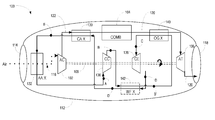
- FIG. 1 illustrates a first example of a gas turbine engine that includes a deep heat recovery system
- FIG. 2 illustrates an example of a thermodynamic cycle for the deep heat recovery system of FIG. 1 ;
- FIG. 3 illustrates a second example of a gas turbine engine that includes a deep heat recovery system
- FIG. 4 illustrates a third example of a gas turbine engine that includes a deep heat recovery system
- FIG. 5 illustrates a fourth example of a gas turbine engine that includes a deep heat recovery system.
- a gas turbine engine may include two circuits: one open circuit operating on air and a second closed circuit operating on a working fluid different than air.
- the processes of the working fluid are above the critical pressure and the working fluid circuit implements a super-critical cycle. However, if the ambient temperature is low, the heat rejection process may be designed and controlled to operate below the critical pressure and the working fluid circuit may implement a trans-critical cycle.
- the above-described process uses a working fluid, such as carbon dioxide (CO2), a carbon-dioxide mixture, or a fluid or a mixture that can operate as a super-critical and a transcritical working fluid.
- CO2 carbon dioxide
- CO2 carbon-dioxide mixture
- CO2 is described as the working fluid in a deep heat recovery system, and, therefore, the related cycles are supercritical (sCO2) or trans-critical (tCO2) cycles.
- the working fluid in the may be any other form of high pressure refrigerant having characteristics of heat absorption and heat rejection processes when used in a system where the working fluid is above the critical pressure (supercritical) and/or heat rejection processes when used below the critical pressure (trans-critical).
- the deep heat recovery system should not be construed as limited to CO2 as a working fluid even though the following description may describe the working fluid as CO2 for illustrative purposes.
- the deep heat recovery system provides efficient rotational power generation to one or more shafts for use within the gas turbine engine due to the deep heat recovery that occurs during a cycle.
- the deep heat recovery system uses recuperation processes via multiple heat exchangers to optimize efficiency of overall operation of the gas turbine engine through integration of the deep heat recovery system within the propulsion (or air stream side) of the gas turbine engine.
- a technical advantage of the systems and methods described below relates to the deep heat recovery system performing deep heat recovery using the same air flow stream used by the gas turbine engine for combustion to both extract and supply heat energy.
- Another related technical advantage of the systems and methods described below involves the strategic placement of a compressed air heat exchanger between the air compressor and the combustor to recuperatively transfer heat from the deep heat recovery system to the compressed air, followed by rejection of heat from the deep heat recovery system by strategic placement of an ambient air heat exchanger such that the working fluid, such as CO2, of the deep heat recovery system may be cooled as much as possible. Since the intent is to cool the working fluid as much as possible, depending on the ambient air temperature the cycle may operate in either of the supercritical mode or the transcritical mode with increased overall efficiency of the gas turbine engine.
- FIG. 1 illustrates an example gas turbine engine that includes a deep heat recovery system 100 .
- the gas turbine engine includes an air compressor 102 to provide compressed air to a combustor 104 where the compressed air is mixed with fuel and ignited. Exhaust gases from the combustor 104 are provided to a turbine 106 which rotates a shaft 108 to produce rotational energy or work. The rotational energy may be used to drive the compressor 102 and the deep heat recovery system 100 , as well as other systems and processes.
- a single turbine 106 and shaft 108 are illustrated. In other examples, multiple different and independent turbines and/or shafts may be used, which may rotate at the same or different speeds.
- the gas turbine engine includes an outer housing 112 having an inlet 114 for receipt of a flow of intake air, or ambient air 116 , and an outlet 118 through which a flow of exhaust output gases 120 are expelled to provide thrust for the gas turbine engine mounted on a vehicle, such as an airplane or helicopter.
- Portions of the deep heat recovery system 100 are included in the air stream side of the gas turbine engine, which includes the flow of ambient air 116 received in the inlet 114 and provided to the compressor 102 as intake air, a flow of compressed air 122 provided by the compressor 102 to the combustor 104 , and the flow of exhaust output gases 120 provided by the combustor 104 through the turbine 106 to the outlet 118 .
- the deep heat recovery system 100 may be a deep heat recover super critical carbon dioxide (sCO2) system that includes a first heat exchanger, which may be described as a compressed air heat exchanger (CA X) 130 operable as a CO2-to-air heat rejection exchanger.
- the compressed air heat exchanger 130 receives the flow of compressed air 122 output from the compressor 102 and transfers heat out of the flow of working fluid as part of a recuperative cycle to increase the temperature of the flow of compressed air 122 .
- the deep heat recovery system 100 includes a second heat exchanger, which is an ambient air heat exchanger (AA X) 132 coupled in series with the compressed air heat exchanger 130 in the path of the flow of working fluid.
- AA X ambient air heat exchanger
- the ambient air heat exchanger 132 is operable as a CO2-to-air heat rejection exchanger to reject heat from the working fluid 132 by transfer of heat to the ambient air flow.
- ambient air flow heated with the ambient air heat exchanger 132 is received at the compressor 102 .
- the deep heat recovery system 100 provides a two-stage process to recover or transfer heat from the flow of working fluid.
- the heat exchangers, as described herein may be any form of mechanism or device that provides transfer of heat energy between different fluids.
- Example heat exchangers include a plate heat exchanger, a micro/mini-channel heat exchanger, a printed circuit heat exchanger, a Marbond heat exchanger, and/or any other compact heat exchanger.
- the deep heat recovery system 100 also includes a compressor, or CO2 compressor 136 , and an expander, or a CO2 expander 138 .
- the compressor may be any form of mechanism or device capable of pressurizing the working fluid such that working fluid received at a lower pressure by the compressor is output at a higher pressure.
- Working fluid compressed by the CO2 compressor 136 is provided as compressed working fluid through a third heat exchanger, which is an output gas heat exchanger (OG X) 140 , to the CO2 expander 138 .
- the CO2 expander 138 is a turbine that extracts work from the working fluid in the form of mechanical shaft power by expanding the flow of working fluid to drop the pressure and raise the temperature of the flow of working fluid to output decompressed working fluid.
- the CO2 expander 138 may be any mechanism or device capable of extracting work from the compressed working fluid. In other examples, as discussed elsewhere, any number of CO2 expanders may be included in the deep heat recovery system 100 .
- the output gas heat exchanger 140 recuperates heat from the flow of exhaust output gas 120 to the flow of compressed working fluid by operating as an air-to-CO2 heat rejection exchanger.
- the deep heat recovery system 100 also includes a fourth heat exchanger, which is a working fluid heat exchanger (WF X) 142 to recuperate heat from the decompressed flow of working fluid to transfer to the compressed flow of working fluid output by the CO2 compressor 136 .
- the working fluid heat exchanger 142 is a CO2-to-CO2 recuperative heat exchanger. In some examples, the working fluid heat exchanger 142 may be omitted, and is therefore illustrated with dotted lines.
- the deep heat recovery system 100 may include a number of different fluid circuits.
- a first circuit may be considered an open circuit operating with air in which the components in the circuit are associated with a flow of air through (or around in the case of the bypass air) the gas turbine engine.
- the first circuit may include the air compressor 102 , the compressed air heat exchanger 130 , the combustor 104 , the output gas heat exchanger 140 and the air turbine 106 .
- a second circuit included in the deep heat recovery system 100 may be considered a closed circuit operating with the working fluid, such as CO2.
- the second circuit may include the fluid compressor 136 , the expander 138 , the output gas heat exchanger 140 , the compressed air heat exchanger 130 , and the ambient air heat exchanger 132 .
- the second circuit may also include the working fluid heat exchanger 142 .
- FIG. 2 is an example of a thermodynamic cycle for the deep heat recovery deep heat recovery system 100 which will be described with reference to FIG. 1 .
- the cycle illustrated in FIG. 2 will be described as beginning at point A in the flow path of the working fluid where a flow of working fluid is provided at an inlet to the CO2 compressor 136 . (see FIG. 1 ) In other examples, the cycle may commence at any other point in the working fluid flow path.
- the CO2 compressor 136 uses work provided by rotation of the shaft 108 to compress the flow of working fluid and increase the temperature and pressure of the working fluid at point B at the outlet of the CO2 compressor 136 , as illustrated in FIGS. 1 and 2 .
- the temperature of the flow of working fluid is increased from point A, which is below a temperature threshold value (T 1 ) to point B, which is above the temperature threshold value (T 1 ) by compression with the CO2 compressor 136 .
- the deep heat recovery system 100 drives the temperature of the working fluid as low as possible at point A so as to maximize efficiency of the compressor 136 without regard to the critical temperature for supercritical mode.
- the critical temperature of CO2 is not a target to which the deep heat recovery system is controlling, instead, the working fluid is cooled as much as possible using the series of heat exchangers 130 and 132 .
- the heat rejection process provided by the heat exchangers 130 and 132 may occur at or below the CO2 critical pressure.
- the critical point for CO2 is at 7.36 MPa (1,067 psia) and 31 degrees Celsius (88 degrees Fahrenheit) such that the supercritical mode for CO2 occurs at or above the critical point. Below the critical point, the cycle is transcritical.
- the cycle of the deep heat recover system is transcritical since the heat rejection process occurs below the critical pressure.
- the temperature of the working fluid is cooled below the temperature threshold value (T 1 ), where the temperature threshold value (T 1 ) is 31 degrees Celsius.
- the CO2 compressor 136 may operate with greater efficiency to compress the flow of working fluid due to the flow of working fluid being below the critical point when received by the compressor 136 .
- the cycle of deep heat recovery system is supercritical since the heat rejection process occurs above the critical pressure.
- the temperature of the working fluid is cooled below the temperature threshold value (T 1 ), where the temperature threshold value (T 1 ) is higher such that at point A the temperature of the working fluid is above the critical temperature of 31 degrees Celsius.
- the CO2 compressor 136 may still operate efficiently to compress the flow of working fluid, but with less efficiency than when the flow of working fluid is below the critical point at the time of receipt by the compressor 136 .
- recuperation of the heat using the air side of the gas turbine engine increases the efficiency using deep heat recovery to drive the temperature of working fluid to lower temperatures.
- point A occurs at the inlet to the CO2 compressor 136
- Point B occurs at the outlet of the CO2 compressor 136 when the flow of working fluid is compressed and the temperature has correspondingly increased above the threshold (T 1 ).
- the compressed flow of working fluid flows through the outlet gas heat exchanger 140 where the temperature of the flow of working fluid is further increased above a threshold (T 4 ) such that the working fluid is at a highest temperature at the inlet to the expander 138 at Point C.
- T 4 a threshold
- the temperature of the flow of working fluid may be increased above the threshold (T 3 ) at Point B′ prior to being further increased to Point C.
- the deep heat recovery system includes two stage recuperative heating of the working fluid via the outlet gas heat exchanger 140 and the working fluid heat exchanger 142 .
- the decrease in temperature below the threshold (T 4 ) occurs at the time the working fluid is decompressed by the expander 138 at Point D.
- the decompressed flow of working fluid is provided to the compressed air heat exchanger where heat from the working fluid is transferred to compressed air supplied by the compressor 102 at Point E.
- This first stage of cooling of the working fluid results in a reduction in temperature below the threshold (T 2 ), which may be considered a first threshold of the two stage cooling.
- the temperature of the flow of working fluid may be decreased during the second stage below the threshold (T 2 ) at Point D′ prior to being further decreased in temperature at Point E.
- the flow of working fluid is then further cooled in a second cooling stage by the ambient air heat exchanger 132 to decrease the temperature below the threshold T 1 , which may be considered a second threshold of the two stage cooling.
- the magnitude of reduction in temperature below the threshold T 1 is dependent on ambient conditions due to the heat from the working fluid being rejected to compressed ambient air by the compressed air heat exchanger 130 during the first cooling stage, and subsequently being rejected to ambient air by the ambient air heat exchanger 132 during the second cooling stage.
- the cooperative combination of the first cooling stage and the second cooling stage achieves a lower temperature of the working fluid than is otherwise possible while also providing a recuperative cycle of heat transfer.
- FIG. 3 illustrates a second example of a gas turbine engine that includes a deep heat recovery system 300 .
- the gas turbine engine is a turbofan gas turbine engine that includes a fan 302 (or propeller) within an outer bypass duct 303 surrounding the housing 112 .
- the fan 302 is rotated by the shaft 108 which is driven by the turbine 106 to create thrust for a vehicle such as a plane or helicopter upon which the gas turbine engine is mounted.
- the discussion focuses on differences with the other discussed gas turbine engines related to the deep heat recovery system 300 . Accordingly, the discussed features and functionality of other example systems are applicable unless otherwise noted.
- a flow of ambient air includes a core air stream 304 that flows through the inlet 114 for receipt and compression by the compressor 102 .
- the compressed flow of air is heated in the compressed air heat exchanger 130 , by recuperative cooling of the working fluid in a first cooling stage, and is then provided to the combustor 104 .
- Exhaust output gases 120 are channeled through the turbine 106 to the outlet 118 to create thrust.
- the flow of ambient air includes a bypass air stream 306 that flows within the outer bypass duct 303 around the housing 112 and also creates thrust. At least a portion of the bypass airstream 306 flowing in the outer bypass duct 303 flows through ambient air heat exchangers 308 positioned external to the housing 112 of the gas turbine engine.
- the ambient air heat exchangers 308 are CO 2 -to-air heat rejection exchangers that provide a second stage of cooling of the flow of working fluid in the deep heat recovery system 300 .
- FIG. 3 two ambient air heat exchangers 308 A and 308 B are illustrated, however, in other examples additional or fewer ambient air heat exchangers 308 may be mounted on the housing 112 .
- the thermodynamic cycle of the deep heat recovery system 300 is illustrated in FIG. 2 . Accordingly, depending on ambient conditions, the heat rejection cycle of Points D, E and A may occur above critical pressure as a supercritical cycle, or below critical pressure as a transcritical cycle.
- FIG. 4 illustrates a third example of a gas turbine engine that includes a deep heat recovery system 400 .
- the gas turbine engine is a turbo shaft or a turbo-prop gas turbine engine that includes a gear box 402 and a nacelle 404 surrounding the housing 112 .
- the gear box 402 may be rotated by the shaft 108 which is driven by the turbine 106 .
- the gear box 402 may provide a source of drive power for the purpose of creating thrust for a vehicle such as a plane or helicopter upon which the gas turbine engine is mounted.
- the gear box 402 may therefore drive a fan (not shown) to provide the core air stream 304 and the bypass air stream 306 .
- the bypass air stream 306 may enter the nacelle 404 via a scoop 406 formed as part of the nacelle 404 .
- a scoop 406 formed as part of the nacelle 404 .
- the ambient air heat exchanger(s) 308 are illustrated as mounted on the housing 112 as 308 A and 308 B within the nacelle 404 , the positioning of the ambient air heat exchanger(s) 308 in other examples may be any location that can utilize a stream or flow of ambient air provided by a fan driven by the gear box 402 to reject heat from the flow of working fluid.
- FIG. 5 illustrates a fourth example of a gas turbine engine that includes a deep heat recovery system 500 .
- the gas turbine engine of this example is illustrated as similar to FIG. 1 , however, in other examples, gas turbine engines similar to FIG. 3 or 4 are also possible.
- the discussion will focus on differences with the other discussed gas turbine engines related to the deep heat recovery system 500 . Accordingly, the discussed features and functionality of other example systems are applicable unless otherwise noted.
- the deep heat recovery system 500 includes a plurality of expanders 502 , which may be distributed throughout a vehicle such as an airplane or helicopter to provide sources of power.
- each of the expanders 502 may have an output shaft and/or a gear box to independently provide shaft power for systems in the vehicle such as pumps for hydraulic systems, generators for electrical systems, motors for mechanical systems, or any other functionality.
- the expanders 502 may be coupled in parallel to receive the compressed flow of working fluid at Point C after heat from the exhaust output gas has been transferred thereto.
- the expanders 502 may be turbines that are independently controlled by valves to be independently activated and deactivated to be driven with the compressed working fluid. Each of the expanders 502 when activated may decompress the working fluid and provide decompressed working fluid at Point D.
- the phrases “at least one of ⁇ A>, ⁇ B>, . . . and ⁇ N>” or “at least one of ⁇ A>, ⁇ B>, ⁇ N>, or combinations thereof” or “ ⁇ A>, ⁇ B>, . . . and/or ⁇ N>” are defined by the Applicant in the broadest sense, superseding any other implied definitions hereinbefore or hereinafter unless expressly asserted by the Applicant to the contrary, to mean one or more elements selected from the group comprising A, B, . . . and N.
- the phrases mean any combination of one or more of the elements A, B, . . . or N including any one element alone or the one element in combination with one or more of the other elements which may also include, in combination, additional elements not listed.
- the subject-matter of the disclosure relates, among others, to the following aspects:
Landscapes
- Engineering & Computer Science (AREA)
- Chemical & Material Sciences (AREA)
- Mechanical Engineering (AREA)
- General Engineering & Computer Science (AREA)
- Combustion & Propulsion (AREA)
- Physics & Mathematics (AREA)
- Thermal Sciences (AREA)
- Chemical Kinetics & Catalysis (AREA)
- Engine Equipment That Uses Special Cycles (AREA)
Abstract
Description
- 1. A system comprising:
- a first heat exchanger coupled in series with a second heat exchanger in a flow path of a working fluid to sequentially transfer heat out of the working fluid, the working fluid being a supercritical fluid;
- the first heat exchanger configured to recuperatively transfer heat from the working fluid to a compressed air flow received from an air compressor of a gas turbine engine to reduce a temperature of the working fluid below a first threshold, and the second heat exchanger configured to transfer heat from the working fluid to an ambient air flow to reduce the temperature of the working fluid from below the first threshold to below a second threshold;
- a compressor included in the flow path downstream of the second heat exchanger, the compressor configured to receive the working fluid below the second threshold and compress the working fluid to increase the temperature of the compressed working fluid above the second threshold; and
- a third heat exchanger included in the flow path following the compressor, the third heat exchanger configured to recuperatively transfer heat from an exhaust output gas of a combustor of the gas turbine engine, to the compressed working fluid to increase the temperature of the compressed working fluid above a third threshold, the third threshold being greater than the first threshold.
- 2. The system of claim 1, wherein the compressed air flow recuperatively heated by the first heat exchanger is provided to the combustor, the combustor configured to receive the compressed air flow recuperatively heated by the first heat exchanger and provide thrust for the gas turbine engine.
- 3. The system of claims 1 or 2, wherein, the working fluid is carbon dioxide (CO2).
- 4. The system as in any of of claims 1-3, further comprising an expander included in the flow path between the first heat exchanger and the third heat exchanger, the expander configured to receive and decompress the compressed working fluid received from the third heat exchanger and to output the decompressed working fluid for receipt by the first heat exchanger as the working fluid.
- 5. The system as in any of claims 1-4, further comprising a fourth heat exchanger coupled in the flow path between the expander and the first heat exchanger, and between the compressor and third heat exchanger, the fourth heat exchanger configured to recuperatively transfer heat from the decompressed working fluid output by the expander to the compressed working fluid output by the compressor.
- 6. The system as in any of claims 1-5, wherein the ambient air flow to which the second heat exchanger transfers heat is channeled to the air compressor of the gas turbine engine.
- 7. The system as in any of claims 1-5, wherein the gas turbine engine is a turboprop gas turbine engine and the ambient air flow to which the second heat exchanger transfers heat is a bypass stream directed around the gas turbine engine to create thrust.
- 8. The system as in any of claims 1-7, wherein the first threshold is a temperature at or above a critical point of CO2, and the second threshold temperature is below a critical point of CO2.
- 9. A system comprising:
- an air compressor configured to compress a flow of intake air;
- a combustor configured to receive the compressed flow of intake air and provide exhaust output gas as thrust to an aircraft;
- a fluid compressor configured to compress a working fluid, the working fluid being a supercritical fluid;
- an expander coupled to the fluid compressor and configured to receive and expand the compressed working fluid to generate mechanical energy and output a decompressed working fluid, wherein a temperature of the working fluid is reduced as the compressed working fluid expands;
- a compressed air heat exchanger positioned ahead of an inlet of the combustor and configured to recouperatively transfer heat from the decompressed working fluid to the compressed flow of intake air;
- an output gas heat exchanger positioned after an outlet of the combustor and configured to recouperatively transfer heat from the exhaust output gas of the combustor to the compressed working fluid; and
- an ambient air heat exchanger positioned to receive an ambient air flow and transfer heat from the decompressed working fluid into the ambient airflow to lower a temperature of the decompressed working fluid to a transcritical mode.
- 10. The system of claim 9, further comprising a working fluid heat exchanger positioned between the expander and the fluid compressor and configured to recouperatively transfer heat from the decompressed working fluid to the compressed working fluid.
- 11. The system as in claims 9 or 10, wherein at least two of the fluid compressor, the expander, or the air compressor are configured to rotate on separate and independent shafts.
- 12. The system as in any of claims 9-11, wherein the ambient air heat exchanger is a recuperative heat exchanger, and the ambient air flow heated by the ambient air heat exchanger comprises at least part of the flow of intake air provided to the fluid compressor.
- 13. The system as in any of claims 9-11, wherein the ambient air heat exchanger is a heat rejection heat exchanger, and the ambient air flow heated by the ambient air heat exchanger is a bypass air stream.
- 14. The system as in any of claims 9-13, wherein the fluid compressor, the expander, and the air compressor are all rotatably coupled to a single common shaft.
- 15. The system of claim 14, wherein the single common shaft is coupled with a fan.
- 16. The system of claim 14, wherein the single common shaft is coupled with a gear box.
- 17. A method comprising:
- receiving a flow of working fluid at a first heat exchanger included in a gas turbine engine, the flow of working fluid being a supercritical fluid;
- transferring, in a recuperative cycle, heat from the flow of working fluid to a compressed air flow received from an air compressor of the gas turbine engine to reduce a temperature of the flow of working fluid below a first threshold;
- receiving the flow of working fluid at a second heat exchanger that is included in the gas turbine engine and is coupled in series with the first heat exchanger, the second heat exchanger transferring heat out of the flow of working fluid to an ambient air flow to reduce the temperature of the flow of working fluid from below the first threshold to below a second threshold; and
- compressing the working fluid with a compressor to increase the temperature of the working fluid from below the second threshold to above the second threshold.
- 18. The method of
claim 17, wherein transferring heat out of the flow of working fluid to the ambient air flow to reduce the temperature of the flow of working fluid from below the first threshold to below the second threshold comprises reducing the temperature of the working fluid below a critical point and performing a heat rejection cycle in a transcritical mode. - 19. The method of claim 18, wherein transferring heat out of the flow of working fluid to the ambient air flow to reduce the temperature of the flow of working fluid from below the first threshold to below the second threshold comprises reducing the temperature of the working fluid to be above a critical point and performing a heat rejection cycle in a supercritical mode.
- 20. The method as in any of claims 17-19, wherein receiving the flow of working fluid at the first heat exchanger comprises receiving the flow of working fluid as a decompressed flow of working fluid output by an expander, the expander decompressing the flow of working fluid following compression of the flow of working fluid by the compressor.
Claims (20)
Priority Applications (3)
| Application Number | Priority Date | Filing Date | Title |
|---|---|---|---|
| US15/457,789 US10364744B2 (en) | 2016-06-08 | 2017-03-13 | Deep heat recovery gas turbine engine |
| CA2964986A CA2964986A1 (en) | 2016-06-08 | 2017-04-21 | Deep heat recovery gas turbine engine |
| EP17170539.5A EP3255263A1 (en) | 2016-06-08 | 2017-05-11 | Deep heat recovery gas turbine engine |
Applications Claiming Priority (2)
| Application Number | Priority Date | Filing Date | Title |
|---|---|---|---|
| US201662347430P | 2016-06-08 | 2016-06-08 | |
| US15/457,789 US10364744B2 (en) | 2016-06-08 | 2017-03-13 | Deep heat recovery gas turbine engine |
Publications (2)
| Publication Number | Publication Date |
|---|---|
| US20170356340A1 US20170356340A1 (en) | 2017-12-14 |
| US10364744B2 true US10364744B2 (en) | 2019-07-30 |
Family
ID=58709261
Family Applications (1)
| Application Number | Title | Priority Date | Filing Date |
|---|---|---|---|
| US15/457,789 Active 2037-07-28 US10364744B2 (en) | 2016-06-08 | 2017-03-13 | Deep heat recovery gas turbine engine |
Country Status (3)
| Country | Link |
|---|---|
| US (1) | US10364744B2 (en) |
| EP (1) | EP3255263A1 (en) |
| CA (1) | CA2964986A1 (en) |
Cited By (5)
| Publication number | Priority date | Publication date | Assignee | Title |
|---|---|---|---|---|
| EP3901445A1 (en) * | 2020-01-17 | 2021-10-27 | Raytheon Technologies Corporation | Supercritical co2 cycle for gas turbine engines using powered cooling flow |
| US11300049B2 (en) | 2020-03-09 | 2022-04-12 | Rolls-Royce North American Technologies Inc. | Inlet guide vane draw heat exchanger system |
| US20230250754A1 (en) * | 2022-02-08 | 2023-08-10 | Raytheon Technologies Corporation | Multiple turboexpander system having selective coupler |
| US20240117767A1 (en) * | 2020-03-27 | 2024-04-11 | Bae Systems Plc | Thermodynamic apparatus |
| EP4603686A1 (en) * | 2024-02-16 | 2025-08-20 | The Boeing Company | Power system for a flight vehicle |
Families Citing this family (15)
| Publication number | Priority date | Publication date | Assignee | Title |
|---|---|---|---|---|
| EP3109433B1 (en) * | 2015-06-19 | 2018-08-15 | Rolls-Royce Corporation | Engine driven by sc02 cycle with independent shafts for combustion cycle elements and propulsion elements |
| US11391211B2 (en) * | 2018-11-28 | 2022-07-19 | General Electric Company | Waste heat recovery system |
| JP7258143B2 (en) * | 2018-12-07 | 2023-04-14 | ダイキン工業株式会社 | Air conditioner |
| US20200224590A1 (en) * | 2019-01-16 | 2020-07-16 | United Technologies Corporation | Work recovery system for a gas turbine engine utilizing a recuperated supercritical co2 cycle driven by cooled cooling air waste heat |
| US11465766B2 (en) * | 2019-06-28 | 2022-10-11 | The Boeing Company | Systems and methods for cooling and generating power on high speed flight vehicles |
| WO2021084389A1 (en) * | 2019-10-28 | 2021-05-06 | Turbogen Ltd. | Gas turbine engine with a split recuperator using a high density working fluid |
| US11047265B1 (en) * | 2019-12-31 | 2021-06-29 | General Electric Company | Systems and methods for operating a turbocharged gas turbine engine |
| US11480103B2 (en) | 2020-01-17 | 2022-10-25 | Raytheon Technologies Corporation | Supercritical CO2 cycle for gas turbine engines using partial core exhaust flow |
| US11820526B2 (en) * | 2020-02-26 | 2023-11-21 | Honda Motor Co., Ltd. | Power supply apparatus for a flying body including a combustion gas and intake air heat exchanger |
| US11506124B2 (en) * | 2020-03-27 | 2022-11-22 | Raytheon Technologies Corporation | Supercritical CO2 cycle for gas turbine engines having supplemental cooling |
| US11485504B2 (en) | 2020-10-27 | 2022-11-01 | Pratt & Whitney Canada Corp. | Aircraft power plant with supercritical CO2 heat engine |
| ES2821746B2 (en) * | 2020-10-28 | 2021-07-07 | Univ Madrid Politecnica | CLOSED CYCLE THERMODYNAMIC SYSTEM TO TRANSFORM THERMAL ENERGY INTO MECHANICAL ENERGY |
| US11754021B2 (en) * | 2021-08-20 | 2023-09-12 | Raytheon Technologies Corporation | Propulsion systems for aircraft |
| FR3132736A1 (en) * | 2022-02-11 | 2023-08-18 | Safran | Heating turbine engine for a fuel conditioning system configured to supply an aircraft turbine engine using fuel from a cryogenic tank |
| EP4253742A1 (en) * | 2022-03-29 | 2023-10-04 | Raytheon Technologies Corporation | Recuperated engine with supercritical co2 bottoming cycle |
Citations (8)
| Publication number | Priority date | Publication date | Assignee | Title |
|---|---|---|---|---|
| US4498289A (en) | 1982-12-27 | 1985-02-12 | Ian Osgerby | Carbon dioxide power cycle |
| US20130096629A1 (en) | 2010-07-09 | 2013-04-18 | Medartis Ag | Osteosynthesis System |
| US20130180259A1 (en) | 2012-01-17 | 2013-07-18 | David S. Stapp | System and method for generating power using a supercritical fluid |
| WO2014158244A2 (en) | 2013-03-14 | 2014-10-02 | Rolls-Royce North American Technologies, Inc. | Intercooled gas turbine with closed combined power cycle |
| US20150240665A1 (en) | 2014-02-26 | 2015-08-27 | Peregrine Turbine Technologies, Llc | Power generation system and method with partially recuperated flow path |
| EP2952726A1 (en) | 2014-06-05 | 2015-12-09 | Rolls-Royce Corporation | Gas turbine engine driven by supercritical power generation system |
| US20160053638A1 (en) | 2014-08-22 | 2016-02-25 | Peregrine Turbine Technologies, Llc | Power generation system including multiple cores |
| US20160096629A1 (en) | 2013-03-14 | 2016-04-07 | Rolls-Royce Corporation | Trans-critical vapor cycle system with improved heat rejection |
-
2017
- 2017-03-13 US US15/457,789 patent/US10364744B2/en active Active
- 2017-04-21 CA CA2964986A patent/CA2964986A1/en not_active Abandoned
- 2017-05-11 EP EP17170539.5A patent/EP3255263A1/en not_active Withdrawn
Patent Citations (10)
| Publication number | Priority date | Publication date | Assignee | Title |
|---|---|---|---|---|
| US4498289A (en) | 1982-12-27 | 1985-02-12 | Ian Osgerby | Carbon dioxide power cycle |
| US20130096629A1 (en) | 2010-07-09 | 2013-04-18 | Medartis Ag | Osteosynthesis System |
| US20130180259A1 (en) | 2012-01-17 | 2013-07-18 | David S. Stapp | System and method for generating power using a supercritical fluid |
| WO2014158244A2 (en) | 2013-03-14 | 2014-10-02 | Rolls-Royce North American Technologies, Inc. | Intercooled gas turbine with closed combined power cycle |
| US20140352317A1 (en) * | 2013-03-14 | 2014-12-04 | Rolls-Royce North American Technologies, Inc. | Intercooled gas turbine with closed combined power cycle |
| US20160096629A1 (en) | 2013-03-14 | 2016-04-07 | Rolls-Royce Corporation | Trans-critical vapor cycle system with improved heat rejection |
| US20150240665A1 (en) | 2014-02-26 | 2015-08-27 | Peregrine Turbine Technologies, Llc | Power generation system and method with partially recuperated flow path |
| EP2952726A1 (en) | 2014-06-05 | 2015-12-09 | Rolls-Royce Corporation | Gas turbine engine driven by supercritical power generation system |
| US20160053638A1 (en) | 2014-08-22 | 2016-02-25 | Peregrine Turbine Technologies, Llc | Power generation system including multiple cores |
| US20160084584A1 (en) | 2014-08-22 | 2016-03-24 | Peregrine Turbine Technologies, Llc | Heat exchanger for a power generation system |
Non-Patent Citations (2)
| Title |
|---|
| European Office Action, issued in corresponding European Patent Application No. 17170539.5, dated Nov. 28, 2018, pp. 1-5, European Patent Office, Rijswijk, Netherlands. |
| European Search Report, European Patent Application No. 17170539.5, dated Oct. 25, 2017, pp. 9, European Patent Office, The Hague Rijswijk, The Netherlands. |
Cited By (7)
| Publication number | Priority date | Publication date | Assignee | Title |
|---|---|---|---|---|
| EP3901445A1 (en) * | 2020-01-17 | 2021-10-27 | Raytheon Technologies Corporation | Supercritical co2 cycle for gas turbine engines using powered cooling flow |
| US11428162B2 (en) | 2020-01-17 | 2022-08-30 | Raytheon Technologies Corporation | Supercritical CO2 cycle for gas turbine engines using powered cooling flow |
| US11300049B2 (en) | 2020-03-09 | 2022-04-12 | Rolls-Royce North American Technologies Inc. | Inlet guide vane draw heat exchanger system |
| US20240117767A1 (en) * | 2020-03-27 | 2024-04-11 | Bae Systems Plc | Thermodynamic apparatus |
| US12104529B2 (en) * | 2020-03-27 | 2024-10-01 | Bae Systems Plc | Thermodynamic apparatus |
| US20230250754A1 (en) * | 2022-02-08 | 2023-08-10 | Raytheon Technologies Corporation | Multiple turboexpander system having selective coupler |
| EP4603686A1 (en) * | 2024-02-16 | 2025-08-20 | The Boeing Company | Power system for a flight vehicle |
Also Published As
| Publication number | Publication date |
|---|---|
| US20170356340A1 (en) | 2017-12-14 |
| CA2964986A1 (en) | 2017-12-08 |
| EP3255263A1 (en) | 2017-12-13 |
Similar Documents
| Publication | Publication Date | Title |
|---|---|---|
| US10364744B2 (en) | Deep heat recovery gas turbine engine | |
| US11506124B2 (en) | Supercritical CO2 cycle for gas turbine engines having supplemental cooling | |
| US10584635B2 (en) | All CO2 aircraft | |
| US20190359340A1 (en) | Aircraft environmental control system | |
| US10677195B2 (en) | Engine driven by Sc02 cycle with independent shafts for combustion cycle elements and propulsion elements | |
| US6644033B2 (en) | Tip impingement turbine air starter for turbine engine | |
| CN106715840B (en) | Power generation system and method for generating power | |
| US9885283B2 (en) | Gas turbine engine driven by supercritical power generation system | |
| EP2971737B1 (en) | Intercooled gas turbine with closed combined power cycle | |
| US10443544B2 (en) | Gas turbine engine driven by sCO2 cycle with advanced heat rejection | |
| US10035602B2 (en) | No primary heat exchanger and bleed air (cabin discharge air) assist | |
| US20130239542A1 (en) | Structures and methods for intercooling aircraft gas turbine engines | |
| JP2018523045A (en) | Simple cycle system and method for waste heat recovery | |
| EP3922827B1 (en) | Supercritical co2 cycle and integrated auxiliary power for gas turbine engines | |
| US11187148B1 (en) | Power and cooling unit (PCU) | |
| EP3901445B1 (en) | Supercritical co2 cycle for gas turbine engines using powered cooling flow | |
| EP3147219B1 (en) | Propulsion system using supercritical co2 power transfer | |
| CN110249122B (en) | System and method for expanding a stream in a waste heat recovery system | |
| US11536164B1 (en) | Closed-loop brayton cycle system with turbine blade cooling | |
| CN110685817A (en) | Turbofan engine and aircraft |
Legal Events
| Date | Code | Title | Description |
|---|---|---|---|
| AS | Assignment |
Owner name: ROLLS-ROYCE NORTH AMERICAN TECHNOLOGIES, INC,, IND Free format text: ASSIGNMENT OF ASSIGNORS INTEREST;ASSIGNOR:VAISMAN, IGOR;REEL/FRAME:042119/0248 Effective date: 20160802 Owner name: ROLLS-ROYCE CORPORATION, INDIANA Free format text: ASSIGNMENT OF ASSIGNORS INTEREST;ASSIGNOR:BASTNAGEL, TOM E.;REEL/FRAME:042119/0277 Effective date: 20160722 Owner name: ROLLS-ROYCE NORTH AMERICAN TECHNOLOGIES, INC., IND Free format text: ASSIGNMENT OF ASSIGNORS INTEREST;ASSIGNOR:ARMSTRONG, MICHAEL JAMES;REEL/FRAME:042119/0274 Effective date: 20160722 |
|
| STPP | Information on status: patent application and granting procedure in general |
Free format text: NOTICE OF ALLOWANCE MAILED -- APPLICATION RECEIVED IN OFFICE OF PUBLICATIONS |
|
| STPP | Information on status: patent application and granting procedure in general |
Free format text: PUBLICATIONS -- ISSUE FEE PAYMENT VERIFIED |
|
| STCF | Information on status: patent grant |
Free format text: PATENTED CASE |
|
| MAFP | Maintenance fee payment |
Free format text: PAYMENT OF MAINTENANCE FEE, 4TH YEAR, LARGE ENTITY (ORIGINAL EVENT CODE: M1551); ENTITY STATUS OF PATENT OWNER: LARGE ENTITY Year of fee payment: 4 |