US10364316B2 - Conjugated polymer containing ethynyl crosslinking group, mixture, formulation, organic electronic device containing the same and application therof - Google Patents
Conjugated polymer containing ethynyl crosslinking group, mixture, formulation, organic electronic device containing the same and application therof Download PDFInfo
- Publication number
- US10364316B2 US10364316B2 US15/543,221 US201515543221A US10364316B2 US 10364316 B2 US10364316 B2 US 10364316B2 US 201515543221 A US201515543221 A US 201515543221A US 10364316 B2 US10364316 B2 US 10364316B2
- Authority
- US
- United States
- Prior art keywords
- group
- aryl
- ethynyl
- conjugated polymer
- polymer containing
- Prior art date
- Legal status (The legal status is an assumption and is not a legal conclusion. Google has not performed a legal analysis and makes no representation as to the accuracy of the status listed.)
- Active
Links
- 0 Cc(cc1)ccc1N(c(cc1)ccc1-c(cc1C2(*)*)ccc1-c1c2cc2-c3ccc(C)cc3C(*)(*)c2c1)c(cc1)ccc1C#C Chemical compound Cc(cc1)ccc1N(c(cc1)ccc1-c(cc1C2(*)*)ccc1-c1c2cc2-c3ccc(C)cc3C(*)(*)c2c1)c(cc1)ccc1C#C 0.000 description 55
- NFEBPMFFSGVANX-UHFFFAOYSA-N C#CN1C2=C(C=CC=C2)C2=C1/C=C\C=C/2 Chemical compound C#CN1C2=C(C=CC=C2)C2=C1/C=C\C=C/2 NFEBPMFFSGVANX-UHFFFAOYSA-N 0.000 description 5
- FHUMGXICUJYMEG-UHFFFAOYSA-N C#CC1=C/C2=C(\C=C/1)C1(C3=CC=CC=C3C3=C1C=CC=C3)C1=C2C=CC=C1 Chemical compound C#CC1=C/C2=C(\C=C/1)C1(C3=CC=CC=C3C3=C1C=CC=C3)C1=C2C=CC=C1 FHUMGXICUJYMEG-UHFFFAOYSA-N 0.000 description 3
- VKDGQBXLXJDYKX-UHFFFAOYSA-N C#CC1=C/C2=C(\C=C/1)N(C1=CC=CC=C1)C1=C2C=CC=C1 Chemical compound C#CC1=C/C2=C(\C=C/1)N(C1=CC=CC=C1)C1=C2C=CC=C1 VKDGQBXLXJDYKX-UHFFFAOYSA-N 0.000 description 3
- UYUZOCULCARWEP-UHFFFAOYSA-N C#CC1=C/C2=C(\C=C/1)OC1=C2C=CC=C1 Chemical compound C#CC1=C/C2=C(\C=C/1)OC1=C2C=CC=C1 UYUZOCULCARWEP-UHFFFAOYSA-N 0.000 description 3
- WSZBYXQREMPYLP-UHFFFAOYSA-N C#CC1=C2C=CC=CC2=CC2=C1C=CC=C2 Chemical compound C#CC1=C2C=CC=CC2=CC2=C1C=CC=C2 WSZBYXQREMPYLP-UHFFFAOYSA-N 0.000 description 3
- FYBWUSQKDOELLD-UHFFFAOYSA-N C#CC1=CC2=C(/C=C\S2)S1 Chemical compound C#CC1=CC2=C(/C=C\S2)S1 FYBWUSQKDOELLD-UHFFFAOYSA-N 0.000 description 3
- JJIQKIUIIVFHAN-UHFFFAOYSA-N C#CC1=CC=C(N2C3=C(C=CC=C3)C3=C2/C=C\C=C/3)C=C1 Chemical compound C#CC1=CC=C(N2C3=C(C=CC=C3)C3=C2/C=C\C=C/3)C=C1 JJIQKIUIIVFHAN-UHFFFAOYSA-N 0.000 description 3
- NDIDTZATWHPEKO-UHFFFAOYSA-N CC1=CC=CC2=N1[Ir]C1=CC=CC=C12 Chemical compound CC1=CC=CC2=N1[Ir]C1=CC=CC=C12 NDIDTZATWHPEKO-UHFFFAOYSA-N 0.000 description 3
- JQCVIYVAUYTBNP-UHFFFAOYSA-N C[n]1c(cc(cc2)C#C)c2c2c1cccc2 Chemical compound C[n]1c(cc(cc2)C#C)c2c2c1cccc2 JQCVIYVAUYTBNP-UHFFFAOYSA-N 0.000 description 3
- PBPUBKICGLWZMS-UHFFFAOYSA-N FC1=CC(F)=C2C(=C1)[Ir]1(N3=CC=CC=C3C3N=C(C(F)(F)F)N=N31)N1=C2C=CC=C1 Chemical compound FC1=CC(F)=C2C(=C1)[Ir]1(N3=CC=CC=C3C3N=C(C(F)(F)F)N=N31)N1=C2C=CC=C1 PBPUBKICGLWZMS-UHFFFAOYSA-N 0.000 description 3
- FFWHEMGQGJULDY-UHFFFAOYSA-N FC1=CC(F)=C2C(=C1)[Ir]N1=C2C=CC=C1 Chemical compound FC1=CC(F)=C2C(=C1)[Ir]N1=C2C=CC=C1 FFWHEMGQGJULDY-UHFFFAOYSA-N 0.000 description 3
- MAZIEXKAUFRDHY-UHFFFAOYSA-N C#C/C1=C2\OC=C\C2=C\C2=C1C=CO2 Chemical compound C#C/C1=C2\OC=C\C2=C\C2=C1C=CO2 MAZIEXKAUFRDHY-UHFFFAOYSA-N 0.000 description 2
- IQOONRUCVJOQGG-UHFFFAOYSA-N C#C/C1=C2\SC=C\C2=C\C2=C1C=CS2 Chemical compound C#C/C1=C2\SC=C\C2=C\C2=C1C=CS2 IQOONRUCVJOQGG-UHFFFAOYSA-N 0.000 description 2
- IADXAHBJHRCGMC-UHFFFAOYSA-N C#C/C1=C2\[Se]C=C\C2=C\C2=C1C=C[Se]2 Chemical compound C#C/C1=C2\[Se]C=C\C2=C\C2=C1C=C[Se]2 IADXAHBJHRCGMC-UHFFFAOYSA-N 0.000 description 2
- MWWATHDPGQKSAR-UHFFFAOYSA-N C#CC Chemical compound C#CC MWWATHDPGQKSAR-UHFFFAOYSA-N 0.000 description 2
- KKRIIYGZYMSWAE-UHFFFAOYSA-N C#CC1=C/C2=C(\C=C/1)C(C1=CC=CC=C1)(C1=CC=CC=C1)C1=C2C=CC=C1 Chemical compound C#CC1=C/C2=C(\C=C/1)C(C1=CC=CC=C1)(C1=CC=CC=C1)C1=C2C=CC=C1 KKRIIYGZYMSWAE-UHFFFAOYSA-N 0.000 description 2
- ZEAOECILXZWDIQ-UHFFFAOYSA-N C#CC1=C/C2=C(\C=C/1)C1=C(C=CC=C1)C2(C)C Chemical compound C#CC1=C/C2=C(\C=C/1)C1=C(C=CC=C1)C2(C)C ZEAOECILXZWDIQ-UHFFFAOYSA-N 0.000 description 2
- JDNRIIOYTBJXJE-UHFFFAOYSA-N C#CC1=C/C2=C(\C=C/1)C1=C(C=CC=C1)C2(C1=CC=CC=C1)C1=CC=CC=C1 Chemical compound C#CC1=C/C2=C(\C=C/1)C1=C(C=CC=C1)C2(C1=CC=CC=C1)C1=CC=CC=C1 JDNRIIOYTBJXJE-UHFFFAOYSA-N 0.000 description 2
- LZALFFPLQQKRCR-UHFFFAOYSA-N C#CC1=C/C2=C(\C=C/1)C1=C(C=CC=C1)C21C2=CC=CC=C2C2=C1C=CC=C2 Chemical compound C#CC1=C/C2=C(\C=C/1)C1=C(C=CC=C1)C21C2=CC=CC=C2C2=C1C=CC=C2 LZALFFPLQQKRCR-UHFFFAOYSA-N 0.000 description 2
- NKEOHEZMWVBEJH-UHFFFAOYSA-N C#CC1=C/C2=C(\C=C/1)C1=C(C=CC=C1)N2C1=CC=CC=C1 Chemical compound C#CC1=C/C2=C(\C=C/1)C1=C(C=CC=C1)N2C1=CC=CC=C1 NKEOHEZMWVBEJH-UHFFFAOYSA-N 0.000 description 2
- QXWVHOROKJTBTE-UHFFFAOYSA-N C#CC1=C/C2=C(\C=C/1)C1=C(C=CC=C1)O2 Chemical compound C#CC1=C/C2=C(\C=C/1)C1=C(C=CC=C1)O2 QXWVHOROKJTBTE-UHFFFAOYSA-N 0.000 description 2
- FIUPAUJJPSGJTF-UHFFFAOYSA-N C#CC1=C/C2=C(\C=C/1)C1=C(C=CC=C1)S2 Chemical compound C#CC1=C/C2=C(\C=C/1)C1=C(C=CC=C1)S2 FIUPAUJJPSGJTF-UHFFFAOYSA-N 0.000 description 2
- BSAZIUAZOJVKRF-UHFFFAOYSA-N C#CC1=C/C2=C(\C=C/1)C1=C(C=CC=C1)[Si]2(C)C Chemical compound C#CC1=C/C2=C(\C=C/1)C1=C(C=CC=C1)[Si]2(C)C BSAZIUAZOJVKRF-UHFFFAOYSA-N 0.000 description 2
- JHHTVHYKBKGOJY-UHFFFAOYSA-N C#CC1=C/C2=C(\C=C/1)C1=C(C=CC=C1)[Si]2(C1=CC=CC=C1)C1=CC=CC=C1 Chemical compound C#CC1=C/C2=C(\C=C/1)C1=C(C=CC=C1)[Si]2(C1=CC=CC=C1)C1=CC=CC=C1 JHHTVHYKBKGOJY-UHFFFAOYSA-N 0.000 description 2
- GLTCHUVZYHXTAK-UHFFFAOYSA-N C#CC1=C/C2=C(\C=C/1)C1=C(C=CC=C1)[Si]21C2=CC=CC=C2C2=C1C=CC=C2 Chemical compound C#CC1=C/C2=C(\C=C/1)C1=C(C=CC=C1)[Si]21C2=CC=CC=C2C2=C1C=CC=C2 GLTCHUVZYHXTAK-UHFFFAOYSA-N 0.000 description 2
- XEULTPLGHQUIPW-UHFFFAOYSA-N C#CC1=C/C2=C(\C=C/1)N(C)C1=C2C=CC=C1 Chemical compound C#CC1=C/C2=C(\C=C/1)N(C)C1=C2C=CC=C1 XEULTPLGHQUIPW-UHFFFAOYSA-N 0.000 description 2
- INJLIWMOZCHGKB-UHFFFAOYSA-N C#CC1=C/C2=C(\C=C/1)SC1=C2C=CC=C1 Chemical compound C#CC1=C/C2=C(\C=C/1)SC1=C2C=CC=C1 INJLIWMOZCHGKB-UHFFFAOYSA-N 0.000 description 2
- KJYMIVAJIGGVAF-UHFFFAOYSA-N C#CC1=C/C2=C(\C=C/1)[Si](C)(C)C1=C2C=CC=C1 Chemical compound C#CC1=C/C2=C(\C=C/1)[Si](C)(C)C1=C2C=CC=C1 KJYMIVAJIGGVAF-UHFFFAOYSA-N 0.000 description 2
- SDODVCSTRZAICB-UHFFFAOYSA-N C#CC1=C/C2=C(\C=C/1)[Si](C1=CC=CC=C1)(C1=CC=CC=C1)C1=C2C=CC=C1 Chemical compound C#CC1=C/C2=C(\C=C/1)[Si](C1=CC=CC=C1)(C1=CC=CC=C1)C1=C2C=CC=C1 SDODVCSTRZAICB-UHFFFAOYSA-N 0.000 description 2
- QBYXYKAWMCZRSC-UHFFFAOYSA-N C#CC1=C/C2=C(\C=C/1)[Si]1(C3=CC=CC=C3C3=C1C=CC=C3)C1=C2C=CC=C1 Chemical compound C#CC1=C/C2=C(\C=C/1)[Si]1(C3=CC=CC=C3C3=C1C=CC=C3)C1=C2C=CC=C1 QBYXYKAWMCZRSC-UHFFFAOYSA-N 0.000 description 2
- MCZUXEWWARACSP-UHFFFAOYSA-N C#CC1=C2C=CC=CC2=CC=C1 Chemical compound C#CC1=C2C=CC=CC2=CC=C1 MCZUXEWWARACSP-UHFFFAOYSA-N 0.000 description 2
- GKMQINSEDLMDFM-UHFFFAOYSA-N C#CC1=CC2=C(/C=C3/C=CO/C3=C/2)O1 Chemical compound C#CC1=CC2=C(/C=C3/C=CO/C3=C/2)O1 GKMQINSEDLMDFM-UHFFFAOYSA-N 0.000 description 2
- UXNDSBWKCXSELL-UHFFFAOYSA-N C#CC1=CC2=C(/C=C3/C=CS/C3=C/2)S1 Chemical compound C#CC1=CC2=C(/C=C3/C=CS/C3=C/2)S1 UXNDSBWKCXSELL-UHFFFAOYSA-N 0.000 description 2
- LNSSSSWDDLVZLX-UHFFFAOYSA-N C#CC1=CC2=C(/C=C3/C=C[Se]/C3=C/2)[Se]1 Chemical compound C#CC1=CC2=C(/C=C3/C=C[Se]/C3=C/2)[Se]1 LNSSSSWDDLVZLX-UHFFFAOYSA-N 0.000 description 2
- ORPJXCBVOHBRKF-UHFFFAOYSA-N C#CC1=CC2=C(/C=C\C=C/2)O1 Chemical compound C#CC1=CC2=C(/C=C\C=C/2)O1 ORPJXCBVOHBRKF-UHFFFAOYSA-N 0.000 description 2
- ZMOWLXJCKGPFBT-UHFFFAOYSA-N C#CC1=CC2=C(/C=C\C=C/2)S1 Chemical compound C#CC1=CC2=C(/C=C\C=C/2)S1 ZMOWLXJCKGPFBT-UHFFFAOYSA-N 0.000 description 2
- KLPCRQHQCFKFFY-UHFFFAOYSA-N C#CC1=CC2=C(/C=C\C=C/2)[Se]1 Chemical compound C#CC1=CC2=C(/C=C\C=C/2)[Se]1 KLPCRQHQCFKFFY-UHFFFAOYSA-N 0.000 description 2
- RGJLLZUXGXCIIN-UHFFFAOYSA-N C#CC1=CC2=C(/C=C\O2)O1 Chemical compound C#CC1=CC2=C(/C=C\O2)O1 RGJLLZUXGXCIIN-UHFFFAOYSA-N 0.000 description 2
- IGMNNPXYZFVVIK-UHFFFAOYSA-N C#CC1=CC2=C(/C=C\[Se]2)[Se]1 Chemical compound C#CC1=CC2=C(/C=C\[Se]2)[Se]1 IGMNNPXYZFVVIK-UHFFFAOYSA-N 0.000 description 2
- DGHUTFJRBDDVFF-UHFFFAOYSA-N C#CC1=CC2=C(C=C1)C=C1C=CC=CC1=C2 Chemical compound C#CC1=CC2=C(C=C1)C=C1C=CC=CC1=C2 DGHUTFJRBDDVFF-UHFFFAOYSA-N 0.000 description 2
- IZXPFTLEVNQLGD-UHFFFAOYSA-N C#CC1=CC=C2C=CC=CC2=C1 Chemical compound C#CC1=CC=C2C=CC=CC2=C1 IZXPFTLEVNQLGD-UHFFFAOYSA-N 0.000 description 2
- IROGWZUBHWKPLU-UHFFFAOYSA-N C#CC1=CC=CC(N2C3=C(C=CC=C3)C3=C2/C=C\C=C/3)=C1 Chemical compound C#CC1=CC=CC(N2C3=C(C=CC=C3)C3=C2/C=C\C=C/3)=C1 IROGWZUBHWKPLU-UHFFFAOYSA-N 0.000 description 2
- JRDYMBMYUHSRKX-UHFFFAOYSA-N C#CC1=CC=CC2=C1C=C1C=CC=CC1=C2 Chemical compound C#CC1=CC=CC2=C1C=C1C=CC=CC1=C2 JRDYMBMYUHSRKX-UHFFFAOYSA-N 0.000 description 2
- UEXCJVNBTNXOEH-UHFFFAOYSA-N C#CC1=CC=CC=C1 Chemical compound C#CC1=CC=CC=C1 UEXCJVNBTNXOEH-UHFFFAOYSA-N 0.000 description 2
- CTVCBOZMKFQEAP-UHFFFAOYSA-N C#CC1=CC=CO1 Chemical compound C#CC1=CC=CO1 CTVCBOZMKFQEAP-UHFFFAOYSA-N 0.000 description 2
- LWISLHRIEATKTM-UHFFFAOYSA-N C#CC1=CC=CS1 Chemical compound C#CC1=CC=CS1 LWISLHRIEATKTM-UHFFFAOYSA-N 0.000 description 2
- PFGWHIJKSDYECZ-UHFFFAOYSA-N C#CC1=CC=C[Se]1 Chemical compound C#CC1=CC=C[Se]1 PFGWHIJKSDYECZ-UHFFFAOYSA-N 0.000 description 2
- BTDQYXZCWSUPOK-UHFFFAOYSA-N C#CC1=COC=C1 Chemical compound C#CC1=COC=C1 BTDQYXZCWSUPOK-UHFFFAOYSA-N 0.000 description 2
- MJHLPKWONJUCFK-UHFFFAOYSA-N C#CC1=CSC=C1 Chemical compound C#CC1=CSC=C1 MJHLPKWONJUCFK-UHFFFAOYSA-N 0.000 description 2
- PLHISGDUUCWVID-UHFFFAOYSA-N C#CC1=C[Se]C=C1 Chemical compound C#CC1=C[Se]C=C1 PLHISGDUUCWVID-UHFFFAOYSA-N 0.000 description 2
- KDKYADYSIPSCCQ-UHFFFAOYSA-N C#CCC Chemical compound C#CCC KDKYADYSIPSCCQ-UHFFFAOYSA-N 0.000 description 2
- IBXNCJKFFQIKKY-UHFFFAOYSA-N C#CCCC Chemical compound C#CCCC IBXNCJKFFQIKKY-UHFFFAOYSA-N 0.000 description 2
- CGHIBGNXEGJPQZ-UHFFFAOYSA-N C#CCCCC Chemical compound C#CCCCC CGHIBGNXEGJPQZ-UHFFFAOYSA-N 0.000 description 2
- YVXHZKKCZYLQOP-UHFFFAOYSA-N C#CCCCCC Chemical compound C#CCCCCC YVXHZKKCZYLQOP-UHFFFAOYSA-N 0.000 description 2
- UMIPWJGWASORKV-UHFFFAOYSA-N C#CCCCCCC Chemical compound C#CCCCCCC UMIPWJGWASORKV-UHFFFAOYSA-N 0.000 description 2
- OSSQSXOTMIGBCF-UHFFFAOYSA-N C#CCCCCCCC Chemical compound C#CCCCCCCC OSSQSXOTMIGBCF-UHFFFAOYSA-N 0.000 description 2
- ILLHQJIJCRNRCJ-UHFFFAOYSA-N C#CCCCCCCCC Chemical compound C#CCCCCCCCC ILLHQJIJCRNRCJ-UHFFFAOYSA-N 0.000 description 2
- YVSFLVNWJIEJRV-UHFFFAOYSA-N C#CCCCCCCCCC Chemical compound C#CCCCCCCCCC YVSFLVNWJIEJRV-UHFFFAOYSA-N 0.000 description 2
- ZVDBUOGYYYNMQI-UHFFFAOYSA-N C#CCCCCCCCCCC Chemical compound C#CCCCCCCCCCC ZVDBUOGYYYNMQI-UHFFFAOYSA-N 0.000 description 2
- GZEDKDBFUBPZNG-UHFFFAOYSA-N C#CCCCCCCCCCCC Chemical compound C#CCCCCCCCCCCC GZEDKDBFUBPZNG-UHFFFAOYSA-N 0.000 description 2
- DZEFNRWGWQDGTR-UHFFFAOYSA-N C#CCCCCCCCCCCCC Chemical compound C#CCCCCCCCCCCCC DZEFNRWGWQDGTR-UHFFFAOYSA-N 0.000 description 2
- DONJGKADZJEXRJ-UHFFFAOYSA-N C#CCCCCCCCCCCCCC Chemical compound C#CCCCCCCCCCCCCC DONJGKADZJEXRJ-UHFFFAOYSA-N 0.000 description 2
- QBAUXHLFPCHTQH-UHFFFAOYSA-N C#CCOCCOC Chemical compound C#CCOCCOC QBAUXHLFPCHTQH-UHFFFAOYSA-N 0.000 description 2
- SWAJTUQESHEIHG-UHFFFAOYSA-N C#CCOCCOCC Chemical compound C#CCOCCOCC SWAJTUQESHEIHG-UHFFFAOYSA-N 0.000 description 2
- BOIHMJRXVKABCS-UHFFFAOYSA-N C#CCOCCOCCC Chemical compound C#CCOCCOCCC BOIHMJRXVKABCS-UHFFFAOYSA-N 0.000 description 2
- LQAWCLHWBNQCHM-UHFFFAOYSA-N C#CCOCCOCCOC Chemical compound C#CCOCCOCCOC LQAWCLHWBNQCHM-UHFFFAOYSA-N 0.000 description 2
- NIFIKPHRYNDRRF-UHFFFAOYSA-N C#CCOCCOCCOCC Chemical compound C#CCOCCOCCOCC NIFIKPHRYNDRRF-UHFFFAOYSA-N 0.000 description 2
- FSXNQGHGYWPWFZ-UHFFFAOYSA-N C#CCOCCOCCOCCC Chemical compound C#CCOCCOCCOCCC FSXNQGHGYWPWFZ-UHFFFAOYSA-N 0.000 description 2
- TYHJQPGPBRVOJZ-UHFFFAOYSA-N C#CCOCCOCCOCCOC Chemical compound C#CCOCCOCCOCCOC TYHJQPGPBRVOJZ-UHFFFAOYSA-N 0.000 description 2
- VWADZMVKLRTURE-UHFFFAOYSA-N C#CCOCCOCCOCCOCC Chemical compound C#CCOCCOCCOCCOCC VWADZMVKLRTURE-UHFFFAOYSA-N 0.000 description 2
- XXRGCTFXHXZBNX-UHFFFAOYSA-N C.C#CC.CC.CC.CC.CC.[3*].[Ar].[Ar].[Ar] Chemical compound C.C#CC.CC.CC.CC.CC.[3*].[Ar].[Ar].[Ar] XXRGCTFXHXZBNX-UHFFFAOYSA-N 0.000 description 2
- MFDQQDDDWJNQOD-UHFFFAOYSA-N C.C.CCN(C)CC Chemical compound C.C.CCN(C)CC MFDQQDDDWJNQOD-UHFFFAOYSA-N 0.000 description 2
- SMZSYGAUGZNTDZ-UHFFFAOYSA-N C1=CC2=C(C=C1)C1=C(S2)C2=CC=CC3=N2[Pt]12C1=C(SC4=C1C=CC=C4)C1=N2C(=CC=C1)C31C2=C(C=CC=C2)C2=C1/C=C\C=C/2 Chemical compound C1=CC2=C(C=C1)C1=C(S2)C2=CC=CC3=N2[Pt]12C1=C(SC4=C1C=CC=C4)C1=N2C(=CC=C1)C31C2=C(C=CC=C2)C2=C1/C=C\C=C/2 SMZSYGAUGZNTDZ-UHFFFAOYSA-N 0.000 description 2
- ZIBMOMRUIPOUQK-UHFFFAOYSA-N C1=CC2=C(C=C1)C1=N(C=CC=C1)[Ir]2 Chemical compound C1=CC2=C(C=C1)C1=N(C=CC=C1)[Ir]2 ZIBMOMRUIPOUQK-UHFFFAOYSA-N 0.000 description 2
- ZIZNUIVXANPWIT-UHFFFAOYSA-N C1=CC2=C(C=C1)N1C3=C(C=CC=C3)[Ir]C1N2 Chemical compound C1=CC2=C(C=C1)N1C3=C(C=CC=C3)[Ir]C1N2 ZIZNUIVXANPWIT-UHFFFAOYSA-N 0.000 description 2
- NRVPNTLMZJECCO-UHFFFAOYSA-N C1=CC2=CC=C3[Ir]N4=C(C=CC=C4)C3=C2C=C1 Chemical compound C1=CC2=CC=C3[Ir]N4=C(C=CC=C4)C3=C2C=C1 NRVPNTLMZJECCO-UHFFFAOYSA-N 0.000 description 2
- SPGCXEMPUKYTBZ-UHFFFAOYSA-N C1=CC2=N3C(=C1)C1=C(N=CO1)[Pt]31C3=C(OC=N3)C3=N1C(=CC=C3)C2 Chemical compound C1=CC2=N3C(=C1)C1=C(N=CO1)[Pt]31C3=C(OC=N3)C3=N1C(=CC=C3)C2 SPGCXEMPUKYTBZ-UHFFFAOYSA-N 0.000 description 2
- NHYZLMSGHZCYTO-UHFFFAOYSA-N C1=CC2=N3C(=C1)C1=C(N=CS1)[Pt]31C3=C(SC=N3)C3=N1C(=CC=C3)C2 Chemical compound C1=CC2=N3C(=C1)C1=C(N=CS1)[Pt]31C3=C(SC=N3)C3=N1C(=CC=C3)C2 NHYZLMSGHZCYTO-UHFFFAOYSA-N 0.000 description 2
- YTMZSVSOKQTJPL-UHFFFAOYSA-N C1=CC=C(C2=CC(C3=CC=C(C4=CC=C(N5C6=C(C=CC=C6)C6=C5/C=C\C=C/6)C=C4)C=C3)=NC(C3=CC=CC=C3)=N2)C=C1 Chemical compound C1=CC=C(C2=CC(C3=CC=C(C4=CC=C(N5C6=C(C=CC=C6)C6=C5/C=C\C=C/6)C=C4)C=C3)=NC(C3=CC=CC=C3)=N2)C=C1 YTMZSVSOKQTJPL-UHFFFAOYSA-N 0.000 description 2
- IBHBKWKFFTZAHE-UHFFFAOYSA-N C1=CC=C(N(C2=CC=C(C3=CC=C(N(C4=CC=CC=C4)C4=C5C=CC=CC5=CC=C4)C=C3)C=C2)C2=C3C=CC=CC3=CC=C2)C=C1 Chemical compound C1=CC=C(N(C2=CC=C(C3=CC=C(N(C4=CC=CC=C4)C4=C5C=CC=CC5=CC=C4)C=C3)C=C2)C2=C3C=CC=CC3=CC=C2)C=C1 IBHBKWKFFTZAHE-UHFFFAOYSA-N 0.000 description 2
- RZGMFRRDBNHLJU-UHFFFAOYSA-N C1=CC=C(N(C2=CC=CC=C2)C2=C3C=CC=CC3=C(N(C3=CC=CC=C3)C3=CC=CC=C3)C3=CC=CC=C32)C=C1 Chemical compound C1=CC=C(N(C2=CC=CC=C2)C2=C3C=CC=CC3=C(N(C3=CC=CC=C3)C3=CC=CC=C3)C3=CC=CC=C32)C=C1 RZGMFRRDBNHLJU-UHFFFAOYSA-N 0.000 description 2
- WDPKUHODPWDLIT-UHFFFAOYSA-N C1=CC=C(N(C2=CC=CC=C2)C2=CC3=C(C=C2)[Ir]N2=CC=CC=C32)C=C1 Chemical compound C1=CC=C(N(C2=CC=CC=C2)C2=CC3=C(C=C2)[Ir]N2=CC=CC=C32)C=C1 WDPKUHODPWDLIT-UHFFFAOYSA-N 0.000 description 2
- WRWCNKMJAJDJOS-UHFFFAOYSA-N C1=CC=C(N(C2=CC=CC=C2)C2=CC=C(N(C3=CC=CC=C3)C3=CC=CC=C3)C3=CC=CC=C32)C=C1 Chemical compound C1=CC=C(N(C2=CC=CC=C2)C2=CC=C(N(C3=CC=CC=C3)C3=CC=CC=C3)C3=CC=CC=C32)C=C1 WRWCNKMJAJDJOS-UHFFFAOYSA-N 0.000 description 2
- LGWXPPOZCHTZKT-UHFFFAOYSA-N C1=CC=C(N2C3=CC=CC4=C3[Pt]3(C5=C2C=CC=C5C2=N3C=CC=C2)N2=CC=CC=C42)C=C1 Chemical compound C1=CC=C(N2C3=CC=CC4=C3[Pt]3(C5=C2C=CC=C5C2=N3C=CC=C2)N2=CC=CC=C42)C=C1 LGWXPPOZCHTZKT-UHFFFAOYSA-N 0.000 description 2
- NSIUZHZWQLKUCN-UHFFFAOYSA-N C1=CC=C(N2C3=CC=CC4=N3[Pt]3(C5=CC=CC=C54)C4=C(C=CC=C4)C4=CC=CC2=N43)C=C1 Chemical compound C1=CC=C(N2C3=CC=CC4=N3[Pt]3(C5=CC=CC=C54)C4=C(C=CC=C4)C4=CC=CC2=N43)C=C1 NSIUZHZWQLKUCN-UHFFFAOYSA-N 0.000 description 2
- VDNMESXRQQCHCR-UHFFFAOYSA-N C1=CC=C2C(=C1)C1=C(C=CC=C1)N2C1=CC2=C(C=C1)[Ir]N1=CC=CC=C21 Chemical compound C1=CC=C2C(=C1)C1=C(C=CC=C1)N2C1=CC2=C(C=C1)[Ir]N1=CC=CC=C21 VDNMESXRQQCHCR-UHFFFAOYSA-N 0.000 description 2
- RXYWBWMEUSWRRL-UHFFFAOYSA-N C1=CC=C2C(=C1)C1=N3C(=CC=C1)C1(C4=C(C=CC=C4)C4=C1C=CC=C4)C1=N4C(=CC=C1)C1=C(C=CC=C1)[Pt]234 Chemical compound C1=CC=C2C(=C1)C1=N3C(=CC=C1)C1(C4=C(C=CC=C4)C4=C1C=CC=C4)C1=N4C(=CC=C1)C1=C(C=CC=C1)[Pt]234 RXYWBWMEUSWRRL-UHFFFAOYSA-N 0.000 description 2
- WNZDWXFIVALFRP-UHFFFAOYSA-N C1=CC=C2C(=C1)C=C1CC3=C4C(=C5C=CC=CC5=C3)C3=N(C=CC=C3)[Pt]43C1=C2C1=CC=CC=N13 Chemical compound C1=CC=C2C(=C1)C=C1CC3=C4C(=C5C=CC=CC5=C3)C3=N(C=CC=C3)[Pt]43C1=C2C1=CC=CC=N13 WNZDWXFIVALFRP-UHFFFAOYSA-N 0.000 description 2
- KHZXHXQUBOLTAA-UHFFFAOYSA-N C1=CC=C2C(=C1)C=C1N3=C2C2=CC=CC=C2[Pt]32C3=C(C=CC=C3)C3=C4C=CC=CC4=CC(=N32)C12C1=C(C=CC=C1)C1=C2C=CC=C1 Chemical compound C1=CC=C2C(=C1)C=C1N3=C2C2=CC=CC=C2[Pt]32C3=C(C=CC=C3)C3=C4C=CC=CC4=CC(=N32)C12C1=C(C=CC=C1)C1=C2C=CC=C1 KHZXHXQUBOLTAA-UHFFFAOYSA-N 0.000 description 2
- FEDALDXWLJZPFW-UHFFFAOYSA-N C1=CC=C2C(=C1)C=CN1=C2C2=CC=CC3=C2[Pt]12C1=C(C=CC=C1C3)C1=C3C=CC=CC3=CC=N12 Chemical compound C1=CC=C2C(=C1)C=CN1=C2C2=CC=CC3=C2[Pt]12C1=C(C=CC=C1C3)C1=C3C=CC=CC3=CC=N12 FEDALDXWLJZPFW-UHFFFAOYSA-N 0.000 description 2
- XODPXIHFMJALPX-UHFFFAOYSA-N C1=CC=C2C(=C1)C=CN1=C2C2=CC=CC=C2[Ir]12C1=C(C=CC=C1)C1=CC=CC=N12 Chemical compound C1=CC=C2C(=C1)C=CN1=C2C2=CC=CC=C2[Ir]12C1=C(C=CC=C1)C1=CC=CC=N12 XODPXIHFMJALPX-UHFFFAOYSA-N 0.000 description 2
- HXWLCVYLRPMRDY-UHFFFAOYSA-N C1=CC=C2C(=C1)[Ir]N1=C2C2=C(C=CC=C2)C=C1 Chemical compound C1=CC=C2C(=C1)[Ir]N1=C2C2=C(C=CC=C2)C=C1 HXWLCVYLRPMRDY-UHFFFAOYSA-N 0.000 description 2
- QFVQEMJJLCLPPA-UHFFFAOYSA-N C1=CC=N2C(=C1)C1=C3C(=CC=C1)C1(C4=C(C=CC=C4)C4=C1C=CC=C4)C1=C4C(=CC=C1)C1=N(C=CC=C1)[Pt]342 Chemical compound C1=CC=N2C(=C1)C1=C3C(=CC=C1)C1(C4=C(C=CC=C4)C4=C1C=CC=C4)C1=C4C(=CC=C1)C1=N(C=CC=C1)[Pt]342 QFVQEMJJLCLPPA-UHFFFAOYSA-N 0.000 description 2
- CQFKBVYLHZYYAT-UHFFFAOYSA-N C1=CC=N2[Ir]C3=C(SC4=C3C=CC=C4)C2=C1 Chemical compound C1=CC=N2[Ir]C3=C(SC4=C3C=CC=C4)C2=C1 CQFKBVYLHZYYAT-UHFFFAOYSA-N 0.000 description 2
- LVEBESSDZHERFS-UHFFFAOYSA-N CC(C)(C)C1=NN2C(=C1)C1=N(C=CC=C1)[Ir]21C2=CC=CC=C2C2=N1C=NC1=CC=CC=C12 Chemical compound CC(C)(C)C1=NN2C(=C1)C1=N(C=CC=C1)[Ir]21C2=CC=CC=C2C2=N1C=NC1=CC=CC=C12 LVEBESSDZHERFS-UHFFFAOYSA-N 0.000 description 2
- NNPPMTNAJDCUHE-UHFFFAOYSA-N CC(C)C Chemical compound CC(C)C NNPPMTNAJDCUHE-UHFFFAOYSA-N 0.000 description 2
- KEBYHQZNRPBOTM-UHFFFAOYSA-N CC1(C)C2=C3C(=CC=C2)C=CN2=C3C3=C1C(F)=CC=C3[Ir]21N2N=C(C(F)(F)F)C=C2C2=CC=CC=N21 Chemical compound CC1(C)C2=C3C(=CC=C2)C=CN2=C3C3=C1C(F)=CC=C3[Ir]21N2N=C(C(F)(F)F)C=C2C2=CC=CC=N21 KEBYHQZNRPBOTM-UHFFFAOYSA-N 0.000 description 2
- XOBRJDKEVNRMDO-UHFFFAOYSA-N CC1(C)C2=C3C(=CC=C2)[Ir]N2=C3C3=C1/C=C\C=C\3C=C2 Chemical compound CC1(C)C2=C3C(=CC=C2)[Ir]N2=C3C3=C1/C=C\C=C\3C=C2 XOBRJDKEVNRMDO-UHFFFAOYSA-N 0.000 description 2
- BTWDIXWINNJCID-UHFFFAOYSA-N CC1(C)C2=C3C(=CC=C2F)[Ir]2(C4=C(C=CC=C4)C4=C5C=CC=CC5=CC=N42)N2=C3C3=C1/C=C\C=C\3C=C2 Chemical compound CC1(C)C2=C3C(=CC=C2F)[Ir]2(C4=C(C=CC=C4)C4=C5C=CC=CC5=CC=N42)N2=C3C3=C1/C=C\C=C\3C=C2 BTWDIXWINNJCID-UHFFFAOYSA-N 0.000 description 2
- DVLLTOKEULPSNO-UHFFFAOYSA-N CC1(C)C2=C3C(=CC=C2F)[Ir]N2=C3C3=C1/C=C\C=C\3C=C2 Chemical compound CC1(C)C2=C3C(=CC=C2F)[Ir]N2=C3C3=C1/C=C\C=C\3C=C2 DVLLTOKEULPSNO-UHFFFAOYSA-N 0.000 description 2
- VKIDYDUREMQAIP-UHFFFAOYSA-N CC1(C)C2=CC=CC3=CC=N4C(=C32)C2=C(C=CC=C21)[Ir]41C2=CC=C(F)C3=C2C2=N1C=C/C1=C\C=C\C(=C/21)C3(C)C Chemical compound CC1(C)C2=CC=CC3=CC=N4C(=C32)C2=C(C=CC=C21)[Ir]41C2=CC=C(F)C3=C2C2=N1C=C/C1=C\C=C\C(=C/21)C3(C)C VKIDYDUREMQAIP-UHFFFAOYSA-N 0.000 description 2
- SAOKWDRHECZPFM-UHFFFAOYSA-N CC1=C(C)C=C2C(=C1)[Ir]N1=C2C2=C(C=CC=C2)C=C1 Chemical compound CC1=C(C)C=C2C(=C1)[Ir]N1=C2C2=C(C=CC=C2)C=C1 SAOKWDRHECZPFM-UHFFFAOYSA-N 0.000 description 2
- SKUCRZGHRPVIEV-UHFFFAOYSA-N CC1=C(F)C=C2[Ir]N3=C(C2=C1)C1=C(C=CC=C1)C=C3 Chemical compound CC1=C(F)C=C2[Ir]N3=C(C2=C1)C1=C(C=CC=C1)C=C3 SKUCRZGHRPVIEV-UHFFFAOYSA-N 0.000 description 2
- RYCLVGOFIVQDOV-UHFFFAOYSA-N CC1=C/C2=C(\C=C/1)C(C)(C)C1=C2C=CC=C1 Chemical compound CC1=C/C2=C(\C=C/1)C(C)(C)C1=C2C=CC=C1 RYCLVGOFIVQDOV-UHFFFAOYSA-N 0.000 description 2
- WTAZVZFIFJUSCQ-LWFKIUJUSA-M CC1=CC(C)=O[Ir]2(O1)C1=C(C=CC=C1)C1=N2C2=CC=CC=C2C=C1C Chemical compound CC1=CC(C)=O[Ir]2(O1)C1=C(C=CC=C1)C1=N2C2=CC=CC=C2C=C1C WTAZVZFIFJUSCQ-LWFKIUJUSA-M 0.000 description 2
- OJNAZBGMXMCMIB-LWFKIUJUSA-M CC1=CC(C)=O[Ir]2(O1)C1=C(SC3=C1C=CC=C3)C1=N2C=CC=C1 Chemical compound CC1=CC(C)=O[Ir]2(O1)C1=C(SC3=C1C=CC=C3)C1=N2C=CC=C1 OJNAZBGMXMCMIB-LWFKIUJUSA-M 0.000 description 2
- UANWBLRWTGLOTP-LWFKIUJUSA-M CC1=CC(C)=O[Ir]2(O1)C1=CC=CC3=C1C1=N2C=C/C2=C\C=C\C(=C/12)C3(C)C Chemical compound CC1=CC(C)=O[Ir]2(O1)C1=CC=CC3=C1C1=N2C=C/C2=C\C=C\C(=C/12)C3(C)C UANWBLRWTGLOTP-LWFKIUJUSA-M 0.000 description 2
- XSOKHDJSQGWTCW-LWFKIUJUSA-M CC1=CC(C)=O[Ir]2(O1)C1=CC=CC=C1C1=N2C2=CC=CC=C2C2=CC=CC=C21 Chemical compound CC1=CC(C)=O[Ir]2(O1)C1=CC=CC=C1C1=N2C2=CC=CC=C2C2=CC=CC=C21 XSOKHDJSQGWTCW-LWFKIUJUSA-M 0.000 description 2
- SFBJXBVMTPPEAT-LWFKIUJUSA-M CC1=CC(C)=O[Ir]2(O1)C1=CC=CC=C1C1=N2C=CC2=CC=CC=C21 Chemical compound CC1=CC(C)=O[Ir]2(O1)C1=CC=CC=C1C1=N2C=CC2=CC=CC=C21 SFBJXBVMTPPEAT-LWFKIUJUSA-M 0.000 description 2
- RMBIASIERKSUAO-UHFFFAOYSA-N CC1=CC=C(C)C(C2=CC3=C(C=C2)[Ir]N2=CC=CC=C32)=C1 Chemical compound CC1=CC=C(C)C(C2=CC3=C(C=C2)[Ir]N2=CC=CC=C32)=C1 RMBIASIERKSUAO-UHFFFAOYSA-N 0.000 description 2
- DDIRZNISTVEPLD-UHFFFAOYSA-N CC1=CC=C(N(C2=CC=C(C)C=C2)C2=CC3=C(C=C2)[Ir]N2=CC=CC=C32)C=C1 Chemical compound CC1=CC=C(N(C2=CC=C(C)C=C2)C2=CC3=C(C=C2)[Ir]N2=CC=CC=C32)C=C1 DDIRZNISTVEPLD-UHFFFAOYSA-N 0.000 description 2
- NSLALZLNSQIAIG-UHFFFAOYSA-N CC1=CC=C2[Ir]N3=C(C2=C1)C1=C(C=CC=C1)C=C3 Chemical compound CC1=CC=C2[Ir]N3=C(C2=C1)C1=C(C=CC=C1)C=C3 NSLALZLNSQIAIG-UHFFFAOYSA-N 0.000 description 2
- BOLLFLMOGBWEIC-UHFFFAOYSA-N CN1C2=C(C=CC=C2)C2=C1C1=CC=CC3=N1[Pt]21C2=C(C4=N1C(=CC=C4)C3)N(C)C1=C2C=CC=C1 Chemical compound CN1C2=C(C=CC=C2)C2=C1C1=CC=CC3=N1[Pt]21C2=C(C4=N1C(=CC=C4)C3)N(C)C1=C2C=CC=C1 BOLLFLMOGBWEIC-UHFFFAOYSA-N 0.000 description 2
- BTGGALXDPFMLSB-UHFFFAOYSA-N CN1C=CN2C3=C(C=C(C#N)C=C3)[Ir]3(C4=C(C=CC(C#N)=C4)N4C=CN(C)C43)C12 Chemical compound CN1C=CN2C3=C(C=C(C#N)C=C3)[Ir]3(C4=C(C=CC(C#N)=C4)N4C=CN(C)C43)C12 BTGGALXDPFMLSB-UHFFFAOYSA-N 0.000 description 2
- BPBCGDAGVIKDDK-UHFFFAOYSA-N CN1C=CN2C3=C(C=CC=C3)[Ir]C12 Chemical compound CN1C=CN2C3=C(C=CC=C3)[Ir]C12 BPBCGDAGVIKDDK-UHFFFAOYSA-N 0.000 description 2
- KVJQWSDDTLSOMG-UHFFFAOYSA-N CN1C=NC2=C1C1=CC=CC3=N1[Pt]21C2=C(C4=N1C(=CC=C4)C3)N(C)C=N2 Chemical compound CN1C=NC2=C1C1=CC=CC3=N1[Pt]21C2=C(C4=N1C(=CC=C4)C3)N(C)C=N2 KVJQWSDDTLSOMG-UHFFFAOYSA-N 0.000 description 2
- NMPMRRPVXSCHMH-UHFFFAOYSA-N FC1=CC(F)=C2C(=C1)[Ir]1(N3=CC=CC=C3C3N=NN=N31)N1=C2C=CC=C1 Chemical compound FC1=CC(F)=C2C(=C1)[Ir]1(N3=CC=CC=C3C3N=NN=N31)N1=C2C=CC=C1 NMPMRRPVXSCHMH-UHFFFAOYSA-N 0.000 description 2
- ZSNWXACZXJEVNL-UHFFFAOYSA-N FC1=CC(F)=C2C(=C1)[Pt]13C4=C(C(F)=CC(F)=C4)C4=CC=CC(=N41)C1(C4=CC=CC2=N43)C2=C(C=CC=C2)C2=C1C=CC=C2 Chemical compound FC1=CC(F)=C2C(=C1)[Pt]13C4=C(C(F)=CC(F)=C4)C4=CC=CC(=N41)C1(C4=CC=CC2=N43)C2=C(C=CC=C2)C2=C1C=CC=C2 ZSNWXACZXJEVNL-UHFFFAOYSA-N 0.000 description 2
- GRKFQOSLOIGKEI-UHFFFAOYSA-N FC1=CN2=C(C=C1)C1=CC=CC=C1[Ir]2 Chemical compound FC1=CN2=C(C=C1)C1=CC=CC=C1[Ir]2 GRKFQOSLOIGKEI-UHFFFAOYSA-N 0.000 description 2
- HYAYEGIOTVQSEI-UHFFFAOYSA-N N#CC1=C(F)C=C2[Ir]N3=C(C=CC=C3)C2=C1 Chemical compound N#CC1=C(F)C=C2[Ir]N3=C(C=CC=C3)C2=C1 HYAYEGIOTVQSEI-UHFFFAOYSA-N 0.000 description 2
- LBWUIEMCUYSDTN-UHFFFAOYSA-M O=C1O[Ir]2(C3=CC(F)=CC(F)=C3C3=CC=CC=N32)N2=C1C=CC=C2 Chemical compound O=C1O[Ir]2(C3=CC(F)=CC(F)=C3C3=CC=CC=N32)N2=C1C=CC=C2 LBWUIEMCUYSDTN-UHFFFAOYSA-M 0.000 description 2
- ODHXBMXNKOYIBV-UHFFFAOYSA-N c(cc1)ccc1N(c1ccccc1)c1ccccc1 Chemical compound c(cc1)ccc1N(c1ccccc1)c1ccccc1 ODHXBMXNKOYIBV-UHFFFAOYSA-N 0.000 description 2
- HALMEFLFRGYAMD-FATMREPNSA-N *.C.C.C#CC.CC.CC.CC.CC.CC.CC#C[Si](C)(C)C.[2HH].[3*].[3*].[3*].[3*].[Ar].[Ar].[Ar].[Ar].[Ar].[Ar].[Ar].[Ar] Chemical compound *.C.C.C#CC.CC.CC.CC.CC.CC.CC#C[Si](C)(C)C.[2HH].[3*].[3*].[3*].[3*].[Ar].[Ar].[Ar].[Ar].[Ar].[Ar].[Ar].[Ar] HALMEFLFRGYAMD-FATMREPNSA-N 0.000 description 1
- QRVKWTAIAXVUTE-UHFFFAOYSA-N BrC1=CC=C(N(C2=CC=CC=C2)C2=CC=CC=C2)C=C1.C.C.C.C.C.C.C#CC1=CC=C(N(C2=CC=C(B3OC(C)(C)C(C)(C)O3)C=C2)C2=CC=C(B3OC(C)(C)C(C)(C)O3)C=C2)C=C1.C#CC1=CC=C(N(C2=CC=C(Br)C=C2)C2=CC=C(Br)C=C2)C=C1.C1=CC=C(N(C2=CC=CC=C2)C2=CC=CC=C2)C=C1.C[Si](C)(C)C#CC1=CC=C(N(C2=CC=C(Br)C=C2)C2=CC=C(Br)C=C2)C=C1.C[Si](C)(C)C#CC1=CC=C(N(C2=CC=CC=C2)C2=CC=CC=C2)C=C1 Chemical compound BrC1=CC=C(N(C2=CC=CC=C2)C2=CC=CC=C2)C=C1.C.C.C.C.C.C.C#CC1=CC=C(N(C2=CC=C(B3OC(C)(C)C(C)(C)O3)C=C2)C2=CC=C(B3OC(C)(C)C(C)(C)O3)C=C2)C=C1.C#CC1=CC=C(N(C2=CC=C(Br)C=C2)C2=CC=C(Br)C=C2)C=C1.C1=CC=C(N(C2=CC=CC=C2)C2=CC=CC=C2)C=C1.C[Si](C)(C)C#CC1=CC=C(N(C2=CC=C(Br)C=C2)C2=CC=C(Br)C=C2)C=C1.C[Si](C)(C)C#CC1=CC=C(N(C2=CC=CC=C2)C2=CC=CC=C2)C=C1 QRVKWTAIAXVUTE-UHFFFAOYSA-N 0.000 description 1
- LVLODBONTHTYFT-UHFFFAOYSA-N C#C/C1=C/C2=C(C=CO2)O1.C#C/C1=C/C2=C(C=CS2)S1.C#C/C1=C/C2=C(C=C[Se]2)[Se]1.C#CC1=C2C=CC=CC2=CC2=C1C=CC=C2.C#CC1=CC=C(N(C2=CC=CC=C2)C2=C3C=CC=CC3=CC=C2)C=C1.C#CC1=CC=C(N(C2=CC=CC=C2)C2=CC=CC=C2)C=C1.C#CC1=CC=CO1.C#CC1=CC=CS1.C#CC1=CC=C[Se]1 Chemical compound C#C/C1=C/C2=C(C=CO2)O1.C#C/C1=C/C2=C(C=CS2)S1.C#C/C1=C/C2=C(C=C[Se]2)[Se]1.C#CC1=C2C=CC=CC2=CC2=C1C=CC=C2.C#CC1=CC=C(N(C2=CC=CC=C2)C2=C3C=CC=CC3=CC=C2)C=C1.C#CC1=CC=C(N(C2=CC=CC=C2)C2=CC=CC=C2)C=C1.C#CC1=CC=CO1.C#CC1=CC=CS1.C#CC1=CC=C[Se]1 LVLODBONTHTYFT-UHFFFAOYSA-N 0.000 description 1
- FZBQAQPPJKGFMG-UHFFFAOYSA-N C#C/C1=C/C=C\C2=C(N(C3=CC=CC=C3)C3=CC=CC=C3)C=CC=C21.C#CC1=CC(C2=CC=C(N(C3=CC=CC=C3)C3=CC=CC=C3)C=C2)=CC=C1.C#CC1=CC=C(C2=CC(N(C3=CC=CC=C3)C3=CC=CC=C3)=CC=C2)C=C1.C#CC1=CC=C(C2=CC=C(N(C3=CC=CC=C3)C3=CC=CC=C3)C=C2)C=C1.C#CC1=CC=CC(C2=CC(N(C3=CC=CC=C3)C3=CC=CC=C3)=CC=C2)=C1.C#CC1=CC=CC2=C1C=C1/C=C\C=C/C1=C2N(C1=CC=CC=C1)C1=CC=CC=C1 Chemical compound C#C/C1=C/C=C\C2=C(N(C3=CC=CC=C3)C3=CC=CC=C3)C=CC=C21.C#CC1=CC(C2=CC=C(N(C3=CC=CC=C3)C3=CC=CC=C3)C=C2)=CC=C1.C#CC1=CC=C(C2=CC(N(C3=CC=CC=C3)C3=CC=CC=C3)=CC=C2)C=C1.C#CC1=CC=C(C2=CC=C(N(C3=CC=CC=C3)C3=CC=CC=C3)C=C2)C=C1.C#CC1=CC=CC(C2=CC(N(C3=CC=CC=C3)C3=CC=CC=C3)=CC=C2)=C1.C#CC1=CC=CC2=C1C=C1/C=C\C=C/C1=C2N(C1=CC=CC=C1)C1=CC=CC=C1 FZBQAQPPJKGFMG-UHFFFAOYSA-N 0.000 description 1
- VPWQXAXUOMJAJO-UHFFFAOYSA-N C#CC#CCOC1=C(OCC#CC#C)C=C2C(=C1)C1=C(C=C(OC#CC#CC)C(OC#CC#CC)=C1)C21C2=C(C=CC=C2)C2=C1/C=C\C(C1=CC3=C(C=C1)[Ir]N1=CC=C4C=CC=CC4=C31)=C/2 Chemical compound C#CC#CCOC1=C(OCC#CC#C)C=C2C(=C1)C1=C(C=C(OC#CC#CC)C(OC#CC#CC)=C1)C21C2=C(C=CC=C2)C2=C1/C=C\C(C1=CC3=C(C=C1)[Ir]N1=CC=C4C=CC=CC4=C31)=C/2 VPWQXAXUOMJAJO-UHFFFAOYSA-N 0.000 description 1
- VUEGYIDGUJKTMI-UHFFFAOYSA-N C#CC#CCOC1=C(OCC#CC#C)C=C2C(=C1)C1=C(C=C(OC#CC#CC)C(OC#CC#CC)=C1)C21C2=C(C=CC=C2)C2=C1/C=C\C(C1=CC3=C(C=C1)[Ir]N1=CC=CC=C31)=C/2 Chemical compound C#CC#CCOC1=C(OCC#CC#C)C=C2C(=C1)C1=C(C=C(OC#CC#CC)C(OC#CC#CC)=C1)C21C2=C(C=CC=C2)C2=C1/C=C\C(C1=CC3=C(C=C1)[Ir]N1=CC=CC=C31)=C/2 VUEGYIDGUJKTMI-UHFFFAOYSA-N 0.000 description 1
- ZPVHHZPPYASOAR-UHFFFAOYSA-N C#CC#COC1=CC=C(C2=CC3=C(C=C2)[Ir]N2=CC=CC=C32)C=C1OC#CC#C Chemical compound C#CC#COC1=CC=C(C2=CC3=C(C=C2)[Ir]N2=CC=CC=C32)C=C1OC#CC#C ZPVHHZPPYASOAR-UHFFFAOYSA-N 0.000 description 1
- GIOFBLWVWFPDBE-UHFFFAOYSA-N C#CC.CC.CC.CC.CC.[3*].[Ar].[Ar].[Ar] Chemical compound C#CC.CC.CC.CC.CC.[3*].[Ar].[Ar].[Ar] GIOFBLWVWFPDBE-UHFFFAOYSA-N 0.000 description 1
- MQYLSOOQNMWJHK-UHFFFAOYSA-N C#CC1=C/C2=C(\C=C/1)C1=C(C=CC=C1)N2C.C#CC1=C/C2=C(\C=C/1)C1=C(C=CC=C1)N2C1=CC=CC=C1.C#CC1=C/C2=C(\C=C/1)C1=C(C=CC=C1)O2.C#CC1=C/C2=C(\C=C/1)C1=C(C=CC=C1)S2.C#CC1=C/C2=C(\C=C/1)N(C)C1=C2C=CC=C1.C#CC1=C/C2=C(\C=C/1)N(C1=CC=CC=C1)C1=C2C=CC=C1.C#CC1=C/C2=C(\C=C/1)OC1=C2C=CC=C1.C#CC1=C/C2=C(\C=C/1)SC1=C2C=CC=C1 Chemical compound C#CC1=C/C2=C(\C=C/1)C1=C(C=CC=C1)N2C.C#CC1=C/C2=C(\C=C/1)C1=C(C=CC=C1)N2C1=CC=CC=C1.C#CC1=C/C2=C(\C=C/1)C1=C(C=CC=C1)O2.C#CC1=C/C2=C(\C=C/1)C1=C(C=CC=C1)S2.C#CC1=C/C2=C(\C=C/1)N(C)C1=C2C=CC=C1.C#CC1=C/C2=C(\C=C/1)N(C1=CC=CC=C1)C1=C2C=CC=C1.C#CC1=C/C2=C(\C=C/1)OC1=C2C=CC=C1.C#CC1=C/C2=C(\C=C/1)SC1=C2C=CC=C1 MQYLSOOQNMWJHK-UHFFFAOYSA-N 0.000 description 1
- PGPAYBMLFZTAHV-UHFFFAOYSA-N C#CC1=C/C2=CC=CC(N(C3=CC=CC=C3)C3=CC=CC=C3)=C2/C=C\1.C#CC1=C2/C=C\C=C/C2=C(N(C2=CC=CC=C2)C2=CC=CC=C2)C=C1.C#CC1=CC=C(C2=CC(N(C3=CC=CC=C3)C3=CC=CC=C3)=CC=C2)S1.C#CC1=CC=C(C2=CC=C(N(C3=CC=CC=C3)C3=CC=CC=C3)C=C2)O1.C#CC1=CC=C(C2=CC=C(N(C3=CC=CC=C3)C3=CC=CC=C3)C=C2)S1.C#CC1=CC=C(C2=CC=C(N(C3=CC=CC=C3)C3=CC=CC=C3)C=C2)[Se]1 Chemical compound C#CC1=C/C2=CC=CC(N(C3=CC=CC=C3)C3=CC=CC=C3)=C2/C=C\1.C#CC1=C2/C=C\C=C/C2=C(N(C2=CC=CC=C2)C2=CC=CC=C2)C=C1.C#CC1=CC=C(C2=CC(N(C3=CC=CC=C3)C3=CC=CC=C3)=CC=C2)S1.C#CC1=CC=C(C2=CC=C(N(C3=CC=CC=C3)C3=CC=CC=C3)C=C2)O1.C#CC1=CC=C(C2=CC=C(N(C3=CC=CC=C3)C3=CC=CC=C3)C=C2)S1.C#CC1=CC=C(C2=CC=C(N(C3=CC=CC=C3)C3=CC=CC=C3)C=C2)[Se]1 PGPAYBMLFZTAHV-UHFFFAOYSA-N 0.000 description 1
- PGKMFLTVXVCNLX-UHFFFAOYSA-N C#CC1=C2C=CC=CC2=C(N(C2=CC=CC=C2)C2=CC=CC=C2)C2=C1C=CC=C2.C#CC1=CC(N(C2=CC=CC=C2)C2=C3C=CC=CC3=CC3=C2C=CC=C3)=CC=C1.C#CC1=CC(N(C2=CC=CC=C2)C2=C3C=CC=CC3=CC=C2)=CC=C1.C#CC1=CC(N(C2=CC=CC=C2)C2=CC=CC=C2)=CC=C1.C#CC1=CC2=C(C=C1)C(N(C1=CC=CC=C1)C1=CC=CC=C1)=C1C=CC=CC1=C2.C#CC1=CC=C(N(C2=CC=CC=C2)C2=C3C=CC=CC3=CC3=C2C=CC=C3)C=C1 Chemical compound C#CC1=C2C=CC=CC2=C(N(C2=CC=CC=C2)C2=CC=CC=C2)C2=C1C=CC=C2.C#CC1=CC(N(C2=CC=CC=C2)C2=C3C=CC=CC3=CC3=C2C=CC=C3)=CC=C1.C#CC1=CC(N(C2=CC=CC=C2)C2=C3C=CC=CC3=CC=C2)=CC=C1.C#CC1=CC(N(C2=CC=CC=C2)C2=CC=CC=C2)=CC=C1.C#CC1=CC2=C(C=C1)C(N(C1=CC=CC=C1)C1=CC=CC=C1)=C1C=CC=CC1=C2.C#CC1=CC=C(N(C2=CC=CC=C2)C2=C3C=CC=CC3=CC3=C2C=CC=C3)C=C1 PGKMFLTVXVCNLX-UHFFFAOYSA-N 0.000 description 1
- CSJGYOKKOZDASR-UHFFFAOYSA-N C#CC1=CC(N(C2=CC=CC=C2)C2=CC=CC=C2)=C2/C=C\C=C/C2=C1.C#CC1=CC2=C(C=C(C3=CC=C(N(C4=CC=CC=C4)C4=CC=CC=C4)C=C3)O2)O1.C#CC1=CC2=C(C=C(C3=CC=C(N(C4=CC=CC=C4)C4=CC=CC=C4)C=C3)S2)S1.C#CC1=CC2=C(C=C(C3=CC=C(N(C4=CC=CC=C4)C4=CC=CC=C4)C=C3)[Se]2)[Se]1.C#CC1=CC=C(C2=CC(N(C3=CC=CC=C3)C3=CC=CC=C3)=CC=C2)O1.C#CC1=CC=C(C2=CC(N(C3=CC=CC=C3)C3=CC=CC=C3)=CC=C2)[Se]1 Chemical compound C#CC1=CC(N(C2=CC=CC=C2)C2=CC=CC=C2)=C2/C=C\C=C/C2=C1.C#CC1=CC2=C(C=C(C3=CC=C(N(C4=CC=CC=C4)C4=CC=CC=C4)C=C3)O2)O1.C#CC1=CC2=C(C=C(C3=CC=C(N(C4=CC=CC=C4)C4=CC=CC=C4)C=C3)S2)S1.C#CC1=CC2=C(C=C(C3=CC=C(N(C4=CC=CC=C4)C4=CC=CC=C4)C=C3)[Se]2)[Se]1.C#CC1=CC=C(C2=CC(N(C3=CC=CC=C3)C3=CC=CC=C3)=CC=C2)O1.C#CC1=CC=C(C2=CC(N(C3=CC=CC=C3)C3=CC=CC=C3)=CC=C2)[Se]1 CSJGYOKKOZDASR-UHFFFAOYSA-N 0.000 description 1
- MWLFLMBCGZNTGC-UHFFFAOYSA-N C#CC1=CC2=C(C=C(C3=CC(N(C4=CC=CC=C4)C4=CC=CC=C4)=CC=C3)O2)O1.C#CC1=CC2=C(C=C(C3=CC(N(C4=CC=CC=C4)C4=CC=CC=C4)=CC=C3)S2)S1.C#CC1=CC2=C(C=C(C3=CC(N(C4=CC=CC=C4)C4=CC=CC=C4)=CC=C3)[Se]2)[Se]1.C#CC1=CC=C(N2C3=C(C=CC=C3)C3=C2/C=C\C=C/3)C=C1.C#CC1=CC=CC(N2C3=C(C=CC=C3)C3=C2/C=C\C=C/3)=C1 Chemical compound C#CC1=CC2=C(C=C(C3=CC(N(C4=CC=CC=C4)C4=CC=CC=C4)=CC=C3)O2)O1.C#CC1=CC2=C(C=C(C3=CC(N(C4=CC=CC=C4)C4=CC=CC=C4)=CC=C3)S2)S1.C#CC1=CC2=C(C=C(C3=CC(N(C4=CC=CC=C4)C4=CC=CC=C4)=CC=C3)[Se]2)[Se]1.C#CC1=CC=C(N2C3=C(C=CC=C3)C3=C2/C=C\C=C/3)C=C1.C#CC1=CC=CC(N2C3=C(C=CC=C3)C3=C2/C=C\C=C/3)=C1 MWLFLMBCGZNTGC-UHFFFAOYSA-N 0.000 description 1
- UYZGDEYMDKOPFJ-UHFFFAOYSA-N C#CCC1=CC=C(N(C2=CC=CC=C2)C2=CC=CC=C2)C=C1.C#CCCC1=CC=C(N(C2=CC=CC=C2)C2=CC=CC=C2)C=C1.C#CCCCC1=CC=C(N(C2=CC=CC=C2)C2=CC=CC=C2)C=C1.C#CCCCCC1=CC=C(N(C2=CC=CC=C2)C2=CC=CC=C2)C=C1.C#CCCCCCC1=CC=C(N(C2=CC=CC=C2)C2=CC=CC=C2)C=C1.C#CN1C2=C(C=CC=C2)C2=C1/C=C\C=C/2.C#CN1C2=C(C=CC=C2)C2=C1/C=C\C=C/2 Chemical compound C#CCC1=CC=C(N(C2=CC=CC=C2)C2=CC=CC=C2)C=C1.C#CCCC1=CC=C(N(C2=CC=CC=C2)C2=CC=CC=C2)C=C1.C#CCCCC1=CC=C(N(C2=CC=CC=C2)C2=CC=CC=C2)C=C1.C#CCCCCC1=CC=C(N(C2=CC=CC=C2)C2=CC=CC=C2)C=C1.C#CCCCCCC1=CC=C(N(C2=CC=CC=C2)C2=CC=CC=C2)C=C1.C#CN1C2=C(C=CC=C2)C2=C1/C=C\C=C/2.C#CN1C2=C(C=CC=C2)C2=C1/C=C\C=C/2 UYZGDEYMDKOPFJ-UHFFFAOYSA-N 0.000 description 1
- JLSMYSNNJLYROK-UHFFFAOYSA-N C#CCCCCCCC1=CC=C(N(C2=CC=CC=C2)C2=CC=CC=C2)C=C1.C#CCCCCCCCC1=CC=C(N(C2=CC=CC=C2)C2=CC=CC=C2)C=C1.C#CCCCCOC1=CC=C(N(C2=CC=CC=C2)C2=CC=CC=C2)C=C1.C#CCCCOC1=CC=C(N(C2=CC=CC=C2)C2=CC=CC=C2)C=C1.C#CCCOC1=CC=C(N(C2=CC=CC=C2)C2=CC=CC=C2)C=C1.C#CCOC1=CC=C(N(C2=CC=CC=C2)C2=CC=CC=C2)C=C1 Chemical compound C#CCCCCCCC1=CC=C(N(C2=CC=CC=C2)C2=CC=CC=C2)C=C1.C#CCCCCCCCC1=CC=C(N(C2=CC=CC=C2)C2=CC=CC=C2)C=C1.C#CCCCCOC1=CC=C(N(C2=CC=CC=C2)C2=CC=CC=C2)C=C1.C#CCCCOC1=CC=C(N(C2=CC=CC=C2)C2=CC=CC=C2)C=C1.C#CCCOC1=CC=C(N(C2=CC=CC=C2)C2=CC=CC=C2)C=C1.C#CCOC1=CC=C(N(C2=CC=CC=C2)C2=CC=CC=C2)C=C1 JLSMYSNNJLYROK-UHFFFAOYSA-N 0.000 description 1
- XSLJSJREHKGXAK-UHFFFAOYSA-N C#CCCCCCCOC1=CC=C(N(C2=CC=CC=C2)C2=CC=CC=C2)C=C1.C#CCCCCCOC1=CC=C(N(C2=CC=CC=C2)C2=CC=CC=C2)C=C1 Chemical compound C#CCCCCCCOC1=CC=C(N(C2=CC=CC=C2)C2=CC=CC=C2)C=C1.C#CCCCCCOC1=CC=C(N(C2=CC=CC=C2)C2=CC=CC=C2)C=C1 XSLJSJREHKGXAK-UHFFFAOYSA-N 0.000 description 1
- YSKZJXKBEDGSSG-UHFFFAOYSA-N C#Cc(cc1)ccc1N(c(cc1)ccc1Br)c(cc1)ccc1Br Chemical compound C#Cc(cc1)ccc1N(c(cc1)ccc1Br)c(cc1)ccc1Br YSKZJXKBEDGSSG-UHFFFAOYSA-N 0.000 description 1
- WZHPITKQXAKEQY-RLGPSGOWSA-N C.C#CC1=CC=C(N(C2=CC=C(C)C=C2)C2=CC=C(C3=CC4=C(C=C3)C3=C(C=C5C(=C3)C(CCCCCCCC)(CCCCCCCC)C3=C5/C=C\C(C)=C/3)C4(CCCCCCCC)CCCCCCCC)C=C2)C=C1.CCCCCCCCC1(CCCCCCCC)C2=C(C=CC(B3OC(C)(C)C(C)(C)O3)=C2)C2=C1C=C1C(=C2)C(CCCCCCCC)(CCCCCCCC)C2=C1/C=C\C(B1OC(C)(C)C(C)(C)O1)=C/2.CCCCCCCCC1(CCCCCCCC)C2=C(C=CC(C3=CC=C(N(C4=CC=C(C)C=C4)C4=CC=C(C#C[Si](C)(C)C)C=C4)C=C3)=C2)C2=C1C=C1C(=C2)C(CCCCCCCC)(CCCCCCCC)C2=C1/C=C\C(C)=C/2.C[Si](C)(C)C#CC1=CC=C(N(C2=[C+]C=C(Br)C=C2)C2=CC=C(Br)C=C2)C=C1.P.PP.[2H]B(I)OF Chemical compound C.C#CC1=CC=C(N(C2=CC=C(C)C=C2)C2=CC=C(C3=CC4=C(C=C3)C3=C(C=C5C(=C3)C(CCCCCCCC)(CCCCCCCC)C3=C5/C=C\C(C)=C/3)C4(CCCCCCCC)CCCCCCCC)C=C2)C=C1.CCCCCCCCC1(CCCCCCCC)C2=C(C=CC(B3OC(C)(C)C(C)(C)O3)=C2)C2=C1C=C1C(=C2)C(CCCCCCCC)(CCCCCCCC)C2=C1/C=C\C(B1OC(C)(C)C(C)(C)O1)=C/2.CCCCCCCCC1(CCCCCCCC)C2=C(C=CC(C3=CC=C(N(C4=CC=C(C)C=C4)C4=CC=C(C#C[Si](C)(C)C)C=C4)C=C3)=C2)C2=C1C=C1C(=C2)C(CCCCCCCC)(CCCCCCCC)C2=C1/C=C\C(C)=C/2.C[Si](C)(C)C#CC1=CC=C(N(C2=[C+]C=C(Br)C=C2)C2=CC=C(Br)C=C2)C=C1.P.PP.[2H]B(I)OF WZHPITKQXAKEQY-RLGPSGOWSA-N 0.000 description 1
- LQPWPPKOZZLXIK-UHFFFAOYSA-N C.C.C.C#CC.C#CC.CC.CC.CC.CC.CC.[3*].[3*].[Ar].[Ar].[Ar].[Ar].[Ar].[Ar] Chemical compound C.C.C.C#CC.C#CC.CC.CC.CC.CC.CC.[3*].[3*].[Ar].[Ar].[Ar].[Ar].[Ar].[Ar] LQPWPPKOZZLXIK-UHFFFAOYSA-N 0.000 description 1
- GNLJYAIEWTZPSV-UHFFFAOYSA-N C.C.C.C#CC.CC.CC.CC.CC.CC.CC.CC.CC.CC.CC#CS(C)(C)C.CC#CS(C)(C)C.[3*].[3*].[3*].[Ar].[Ar].[Ar].[Ar].[Ar].[Ar].[Ar].[Ar].[Ar] Chemical compound C.C.C.C#CC.CC.CC.CC.CC.CC.CC.CC.CC.CC.CC#CS(C)(C)C.CC#CS(C)(C)C.[3*].[3*].[3*].[Ar].[Ar].[Ar].[Ar].[Ar].[Ar].[Ar].[Ar].[Ar] GNLJYAIEWTZPSV-UHFFFAOYSA-N 0.000 description 1
- AJQVGSPLXYFIAH-SJXPVSIMSA-N C.C.C.C.C1=CC2=C(C=C1)C1=C(C=C3C(=C1)CC1=C3/C=C\C=C/1)C2.CC1=CC(Br)=C(C)C=C1Br.CC1=CC(C2=CC=CC=C2)=C(C)C=C1C1=CC=CC=C1.CCCCCCCCC1(CCCCCCCC)C2=C(C=CC(B3OC(C)(C)C(C)(C)O3)=C2)C2=C1C=C1C(=C2)C(CCCCCCCC)(CCCCCCCC)C2=C1/C=C\C(B1OC(C)(C)C(C)(C)O1)=C/2.CCCCCCCCC1(CCCCCCCC)C2=C(C=CC(Br)=C2)C2=C1C=C1C(=C2)C(CCCCCCCC)(CCCCCCCC)C2=C1/C=C\C(Br)=C/2.CCCCCCCCC1(CCCCCCCC)C2=C(C=CC=C2)C2=C1C=C1C(=C2)C(CCCCCCCC)(CCCCCCCC)C2=C1/C=C\C=C/2.O=C1C2=C(C=CC=C2)C2=C1C=C1C(=C2)C(=O)C2=C1/C=C\C=C/2.O=COC1=C(C2=CC=CC=C2)C=C(C(=O)O)C(C2=CC=CC=C2)=C1.OB(O)C1=CC=CC=C1.[2H]B(I)OF Chemical compound C.C.C.C.C1=CC2=C(C=C1)C1=C(C=C3C(=C1)CC1=C3/C=C\C=C/1)C2.CC1=CC(Br)=C(C)C=C1Br.CC1=CC(C2=CC=CC=C2)=C(C)C=C1C1=CC=CC=C1.CCCCCCCCC1(CCCCCCCC)C2=C(C=CC(B3OC(C)(C)C(C)(C)O3)=C2)C2=C1C=C1C(=C2)C(CCCCCCCC)(CCCCCCCC)C2=C1/C=C\C(B1OC(C)(C)C(C)(C)O1)=C/2.CCCCCCCCC1(CCCCCCCC)C2=C(C=CC(Br)=C2)C2=C1C=C1C(=C2)C(CCCCCCCC)(CCCCCCCC)C2=C1/C=C\C(Br)=C/2.CCCCCCCCC1(CCCCCCCC)C2=C(C=CC=C2)C2=C1C=C1C(=C2)C(CCCCCCCC)(CCCCCCCC)C2=C1/C=C\C=C/2.O=C1C2=C(C=CC=C2)C2=C1C=C1C(=C2)C(=O)C2=C1/C=C\C=C/2.O=COC1=C(C2=CC=CC=C2)C=C(C(=O)O)C(C2=CC=CC=C2)=C1.OB(O)C1=CC=CC=C1.[2H]B(I)OF AJQVGSPLXYFIAH-SJXPVSIMSA-N 0.000 description 1
- DMMHDEROFSXTOM-UHFFFAOYSA-N C.C.C1=CC2=C3C=CC=CC3=C3/C=C\C=C/C3=C2C=C1.C1=CC2=CC=C3/C=C\C=C/C3=C2C=C1.C1=CC=C(C2=CC=CC(C3=CC=CC=C3)=C2)C=C1.C1=CC=C2C(=C1)CC1=C2/C=C\C=C/1.C1=CC=C2C(=C1)OC1=C2/C=C\C=C/1.C1=CC=C2C(=C1)SC1=C2/C=C\C=C/1.C1=CC=C2C=C3C=CC=CC3=CC2=C1.C1=CC=C2C=CC=CC2=C1.CC1=CC=C(C)C=C1.CN1C2=CC=CC=C2C2=C1/C=C\C=C/2 Chemical compound C.C.C1=CC2=C3C=CC=CC3=C3/C=C\C=C/C3=C2C=C1.C1=CC2=CC=C3/C=C\C=C/C3=C2C=C1.C1=CC=C(C2=CC=CC(C3=CC=CC=C3)=C2)C=C1.C1=CC=C2C(=C1)CC1=C2/C=C\C=C/1.C1=CC=C2C(=C1)OC1=C2/C=C\C=C/1.C1=CC=C2C(=C1)SC1=C2/C=C\C=C/1.C1=CC=C2C=C3C=CC=CC3=CC2=C1.C1=CC=C2C=CC=CC2=C1.CC1=CC=C(C)C=C1.CN1C2=CC=CC=C2C2=C1/C=C\C=C/2 DMMHDEROFSXTOM-UHFFFAOYSA-N 0.000 description 1
- SSGVPAGWYRXSAC-UHFFFAOYSA-M C.C.C1=CC2=C3C=CC=CC3=C3/C=C\C=C/C3=C2C=C1.C1=CC2=CC=C3/C=C\C=N/C3=C2N=C1.C1=CC2=CN=CN=C2C=C1.C1=CC2=NC=CN=C2C=C1.C1=CC=C(C2=CC(C3=CC=CC=C3)=NC=N2)C=C1.C1=CC=C(C2=CC=CC(C3=CC=CC=C3)=N2)C=C1.C1=CC=C(C2=NC=NC(C3=CC=CC=C3)=N2)C=C1.C1=CC=C(N2C=NC3C=CC=CC32)C=C1.C1=CC=NC=C1.C1=CN=C2C=CC=CC2=C1.C1=CN=C2C=CC=NC2=C1.C1=CN=C2N=CC=CC2=C1.C1=CN=CC=N1.C1=CN=CN=C1.C1=NC=NC=N1.CC1=C(F)C(F)=C(C)C(F)=C1F.C[Al](N)O.O=S1(=O)C2=CC=CC=C2CC2=C1C=CC=C2 Chemical compound C.C.C1=CC2=C3C=CC=CC3=C3/C=C\C=C/C3=C2C=C1.C1=CC2=CC=C3/C=C\C=N/C3=C2N=C1.C1=CC2=CN=CN=C2C=C1.C1=CC2=NC=CN=C2C=C1.C1=CC=C(C2=CC(C3=CC=CC=C3)=NC=N2)C=C1.C1=CC=C(C2=CC=CC(C3=CC=CC=C3)=N2)C=C1.C1=CC=C(C2=NC=NC(C3=CC=CC=C3)=N2)C=C1.C1=CC=C(N2C=NC3C=CC=CC32)C=C1.C1=CC=NC=C1.C1=CN=C2C=CC=CC2=C1.C1=CN=C2C=CC=NC2=C1.C1=CN=C2N=CC=CC2=C1.C1=CN=CC=N1.C1=CN=CN=C1.C1=NC=NC=N1.CC1=C(F)C(F)=C(C)C(F)=C1F.C[Al](N)O.O=S1(=O)C2=CC=CC=C2CC2=C1C=CC=C2 SSGVPAGWYRXSAC-UHFFFAOYSA-M 0.000 description 1
- MPVPMOYWMLMPDB-UHFFFAOYSA-N C.CC1[Ar][Ar]1.[Ar] Chemical compound C.CC1[Ar][Ar]1.[Ar] MPVPMOYWMLMPDB-UHFFFAOYSA-N 0.000 description 1
- QNMDNIMPSKDFOY-UHFFFAOYSA-N C1=C/C2=C/C=C\C3=CC=C4/C=C\C=C\1C4=C32.C1=CC2=C(C=C1)C1=CC=C3CC4=C(C=CC=C4)C3=C1C2.C1=CC2=CC=C3/C=C\C=C/C3=C2C=C1.C1=CC=C2C(=C1)C=CC1=CC=C3/C=C\C=C/C3=C12.C1=CC=C2C(=C1)CC1=C2C=C2C(=C1)CC1=C2C=CC=C1.C1=CC=C2C=C3C(=CC2=C1)C=CC1=CC=CC=C13.C1=CC=C2C=C3C=CC=CC3=CC2=C1.C1=CC=C2C=CC=CC2=C1 Chemical compound C1=C/C2=C/C=C\C3=CC=C4/C=C\C=C\1C4=C32.C1=CC2=C(C=C1)C1=CC=C3CC4=C(C=CC=C4)C3=C1C2.C1=CC2=CC=C3/C=C\C=C/C3=C2C=C1.C1=CC=C2C(=C1)C=CC1=CC=C3/C=C\C=C/C3=C12.C1=CC=C2C(=C1)CC1=C2C=C2C(=C1)CC1=C2C=CC=C1.C1=CC=C2C=C3C(=CC2=C1)C=CC1=CC=CC=C13.C1=CC=C2C=C3C=CC=CC3=CC2=C1.C1=CC=C2C=CC=CC2=C1 QNMDNIMPSKDFOY-UHFFFAOYSA-N 0.000 description 1
- AUSZQXITAZDJLU-UHFFFAOYSA-N C1=CC(C2=CC=C(N3C4=C(C=CC=C4)C4=C3C=CC=C4)C=C2)=CC(C2=CC(C3=CC=C(N4C5=C(C=CC=C5)C5=C4/C=C\C=C/5)C=C3)=CC=C2)=C1 Chemical compound C1=CC(C2=CC=C(N3C4=C(C=CC=C4)C4=C3C=CC=C4)C=C2)=CC(C2=CC(C3=CC=C(N4C5=C(C=CC=C5)C5=C4/C=C\C=C/5)C=C3)=CC=C2)=C1 AUSZQXITAZDJLU-UHFFFAOYSA-N 0.000 description 1
- GUOIMVQDGTYEHO-UHFFFAOYSA-N C1=CC2=C(C=C1)C1=C(S2)C2=CC=CC3=N2[Pt]12C1=C(SC4=C1C=CC=C4)C1=N2C(=CC=C1)C3 Chemical compound C1=CC2=C(C=C1)C1=C(S2)C2=CC=CC3=N2[Pt]12C1=C(SC4=C1C=CC=C4)C1=N2C(=CC=C1)C3 GUOIMVQDGTYEHO-UHFFFAOYSA-N 0.000 description 1
- DAQJMBWEZIZZBU-SVXKRPBISA-N C1=CC2=C3C(=C1)C1=N4C(=CC=C1)C1(C5=C(C=CC=C5)C5=C1C=CC=C5)C1=N5C(=CC=C1)C1=C(C(=CC=C1)/C=C\2)[Pt]345 Chemical compound C1=CC2=C3C(=C1)C1=N4C(=CC=C1)C1(C5=C(C=CC=C5)C5=C1C=CC=C5)C1=N5C(=CC=C1)C1=C(C(=CC=C1)/C=C\2)[Pt]345 DAQJMBWEZIZZBU-SVXKRPBISA-N 0.000 description 1
- PMEDTYMNOUDFLL-UHFFFAOYSA-N C1=CC2=C3C(=C1)C1=N4C(=CC=C1)C1(C5=C(C=CC=C5)C5=C1C=CC=C5)C1=N5C(=CC=C1)C1=C(C(=CC=C1)CC2)[Pt]345 Chemical compound C1=CC2=C3C(=C1)C1=N4C(=CC=C1)C1(C5=C(C=CC=C5)C5=C1C=CC=C5)C1=N5C(=CC=C1)C1=C(C(=CC=C1)CC2)[Pt]345 PMEDTYMNOUDFLL-UHFFFAOYSA-N 0.000 description 1
- BOMQPBFWVQUQAE-UHFFFAOYSA-N C1=CC2=C3C(=C1)N(C1=CC=NC=C1)C1=C4C(=CC=C1)C1=N(C=CN=C1)[Pt]34N1=CC=NC=C21 Chemical compound C1=CC2=C3C(=C1)N(C1=CC=NC=C1)C1=C4C(=CC=C1)C1=N(C=CN=C1)[Pt]34N1=CC=NC=C21 BOMQPBFWVQUQAE-UHFFFAOYSA-N 0.000 description 1
- RAJINZIPYUCEBP-UHFFFAOYSA-N C1=CC2=CC3=CC=C4[Ir]N5=C(C=CC=C5)C4=C3C=C2C=C1 Chemical compound C1=CC2=CC3=CC=C4[Ir]N5=C(C=CC=C5)C4=C3C=C2C=C1 RAJINZIPYUCEBP-UHFFFAOYSA-N 0.000 description 1
- CLTPAQDLCMKBIS-UHFFFAOYSA-N C1=CC2=CC=CC(N(C3=CC=C(C4=CC=C(N(C5=C6C=CC=CC6=CC=C5)C5=C6C=CC=CC6=CC=C5)C=C4)C=C3)C3=C4C=CC=CC4=CC=C3)=C2C=C1 Chemical compound C1=CC2=CC=CC(N(C3=CC=C(C4=CC=C(N(C5=C6C=CC=CC6=CC=C5)C5=C6C=CC=CC6=CC=C5)C=C4)C=C3)C3=C4C=CC=CC4=CC=C3)=C2C=C1 CLTPAQDLCMKBIS-UHFFFAOYSA-N 0.000 description 1
- PPVQAWKMIMGHEO-UHFFFAOYSA-N C1=CC2=CC=C[N+]3=C2C(=C1)O[CH-]3 Chemical compound C1=CC2=CC=C[N+]3=C2C(=C1)O[CH-]3 PPVQAWKMIMGHEO-UHFFFAOYSA-N 0.000 description 1
- ACXSUJHVDMXOIS-UHFFFAOYSA-M C1=CC2=CC=C[N+]3=C2C(=C1)O[Cs-]3 Chemical compound C1=CC2=CC=C[N+]3=C2C(=C1)O[Cs-]3 ACXSUJHVDMXOIS-UHFFFAOYSA-M 0.000 description 1
- KSLWBVZPXSGYSY-UHFFFAOYSA-M C1=CC2=CC=C[N+]3=C2C(=C1)O[K-]3 Chemical compound C1=CC2=CC=C[N+]3=C2C(=C1)O[K-]3 KSLWBVZPXSGYSY-UHFFFAOYSA-M 0.000 description 1
- KOWUSWKVYJGKJD-UHFFFAOYSA-M C1=CC2=CC=C[N+]3=C2C(=C1)O[Rb-]3 Chemical compound C1=CC2=CC=C[N+]3=C2C(=C1)O[Rb-]3 KOWUSWKVYJGKJD-UHFFFAOYSA-M 0.000 description 1
- WHGDFOXMCOSHGN-UHFFFAOYSA-N C1=CC=C(C2=C3C=CC(N(C4=CC=CC=C4)C4=CC=CC=C4)=CC3=C(C3=CC=CC=C3)C3=CC=C(N(C4=CC=CC=C4)C4=CC=CC=C4)C=C32)C=C1 Chemical compound C1=CC=C(C2=C3C=CC(N(C4=CC=CC=C4)C4=CC=CC=C4)=CC3=C(C3=CC=CC=C3)C3=CC=C(N(C4=CC=CC=C4)C4=CC=CC=C4)C=C32)C=C1 WHGDFOXMCOSHGN-UHFFFAOYSA-N 0.000 description 1
- ZUWPWCOLKFVHFM-UHFFFAOYSA-N C1=CC=C(C2=CC(C3=CC=C(N4C5=C(C=CC=C5)C5=C4C=CC=C5)C=C3)=CC(C3=CC(C4=CC=C(N5C6=C(C=CC=C6)C6=C5/C=C\C=C/6)C=C4)=CC(C4=CC=CC=C4)=C3)=C2)C=C1 Chemical compound C1=CC=C(C2=CC(C3=CC=C(N4C5=C(C=CC=C5)C5=C4C=CC=C5)C=C3)=CC(C3=CC(C4=CC=C(N5C6=C(C=CC=C6)C6=C5/C=C\C=C/6)C=C4)=CC(C4=CC=CC=C4)=C3)=C2)C=C1 ZUWPWCOLKFVHFM-UHFFFAOYSA-N 0.000 description 1
- YTBQXVRJMPFOJG-UHFFFAOYSA-N C1=CC=C(C2=CC(C3=CC=CC(C4=CC=C(N5C6=C(C=CC=C6)C6=C5C=CC=C6)C=C4)=C3)=CC(C3=CC=C(N4C5=C(C=CC=C5)C5=C4/C=C\C=C/5)C=C3)=C2)C=C1 Chemical compound C1=CC=C(C2=CC(C3=CC=CC(C4=CC=C(N5C6=C(C=CC=C6)C6=C5C=CC=C6)C=C4)=C3)=CC(C3=CC=C(N4C5=C(C=CC=C5)C5=C4/C=C\C=C/5)C=C3)=C2)C=C1 YTBQXVRJMPFOJG-UHFFFAOYSA-N 0.000 description 1
- KIYUIZKNSAKHLS-UHFFFAOYSA-N C1=CC=C(C2=CC(C3=CC=CC(C4=CC=C(N5C6=C(C=CC=C6)C6=C5C=CC=C6)C=C4)=C3)=NC(C3=CC=CC=C3)=N2)C=C1 Chemical compound C1=CC=C(C2=CC(C3=CC=CC(C4=CC=C(N5C6=C(C=CC=C6)C6=C5C=CC=C6)C=C4)=C3)=NC(C3=CC=CC=C3)=N2)C=C1 KIYUIZKNSAKHLS-UHFFFAOYSA-N 0.000 description 1
- KOIMINKJYIDAOZ-UHFFFAOYSA-N C1=CC=C(C2=CC=C(C3=C4C=CC=CC4=C(C4=CC=C(C5=CC=CC=C5)C=C4)C4=CC=CC=C43)C=C2)C=C1 Chemical compound C1=CC=C(C2=CC=C(C3=C4C=CC=CC4=C(C4=CC=C(C5=CC=CC=C5)C=C4)C4=CC=CC=C43)C=C2)C=C1 KOIMINKJYIDAOZ-UHFFFAOYSA-N 0.000 description 1
- BXULDUDPDXYLRG-UHFFFAOYSA-N C1=CC=C(C2=CC=C(C3=CC=C(N(C4=CC=CC=C4)C4=CC=C(C5=CC=C(N(C6=CC=C(C7=CC=CC=C7)C=C6)C6=CC=C(C7=CC=CC=C7)C=C6)C=C5)C=C4)C=C3)C=C2)C=C1 Chemical compound C1=CC=C(C2=CC=C(C3=CC=C(N(C4=CC=CC=C4)C4=CC=C(C5=CC=C(N(C6=CC=C(C7=CC=CC=C7)C=C6)C6=CC=C(C7=CC=CC=C7)C=C6)C=C5)C=C4)C=C3)C=C2)C=C1 BXULDUDPDXYLRG-UHFFFAOYSA-N 0.000 description 1
- WXAIEIRYBSKHDP-UHFFFAOYSA-N C1=CC=C(C2=CC=C(N(C3=CC=C(C4=CC=CC=C4)C=C3)C3=CC=C(C4=CC=C(N(C5=CC=C(C6=CC=CC=C6)C=C5)C5=CC=C(C6=CC=CC=C6)C=C5)C=C4)C=C3)C=C2)C=C1 Chemical compound C1=CC=C(C2=CC=C(N(C3=CC=C(C4=CC=CC=C4)C=C3)C3=CC=C(C4=CC=C(N(C5=CC=C(C6=CC=CC=C6)C=C5)C5=CC=C(C6=CC=CC=C6)C=C5)C=C4)C=C3)C=C2)C=C1 WXAIEIRYBSKHDP-UHFFFAOYSA-N 0.000 description 1
- XNYCMZIGPXONGH-UHFFFAOYSA-N C1=CC=C(C2=CC=C(N3C4=CC(C5=CC=CC=C5)=CC5=C4[Pt]4(C6=C3C=C(C3=CC=CC=C3)C=C6C3=N4C=CC=C3)N3=CC=CC=C53)C=C2)C=C1 Chemical compound C1=CC=C(C2=CC=C(N3C4=CC(C5=CC=CC=C5)=CC5=C4[Pt]4(C6=C3C=C(C3=CC=CC=C3)C=C6C3=N4C=CC=C3)N3=CC=CC=C53)C=C2)C=C1 XNYCMZIGPXONGH-UHFFFAOYSA-N 0.000 description 1
- USTJQMGYTCDHNJ-UHFFFAOYSA-N C1=CC=C(C2=CC=C(N3C4=CC=CC5=C4[Pt]4(C6=C3C=CC=C6C3=N4C=CC(C4=CC=CC=C4)=C3)N3=CC=C(C4=CC=CC=C4)C=C53)C=C2)C=C1 Chemical compound C1=CC=C(C2=CC=C(N3C4=CC=CC5=C4[Pt]4(C6=C3C=CC=C6C3=N4C=CC(C4=CC=CC=C4)=C3)N3=CC=C(C4=CC=CC=C4)C=C53)C=C2)C=C1 USTJQMGYTCDHNJ-UHFFFAOYSA-N 0.000 description 1
- YNJXFUHAGIEBAK-UHFFFAOYSA-N C1=CC=C(C2=CC=C(N3C4=CC=CC5=C4[Pt]4(C6=C3C=CC=C6C3=N4C=CC=C3)N3=CC=CC=C53)C=C2)C=C1 Chemical compound C1=CC=C(C2=CC=C(N3C4=CC=CC5=C4[Pt]4(C6=C3C=CC=C6C3=N4C=CC=C3)N3=CC=CC=C53)C=C2)C=C1 YNJXFUHAGIEBAK-UHFFFAOYSA-N 0.000 description 1
- PMEUPEGLPWXPTC-UHFFFAOYSA-M C1=CC=C(C2=CC=C3C=CC=C4O[Cs-][N+]2=C34)C=C1 Chemical compound C1=CC=C(C2=CC=C3C=CC=C4O[Cs-][N+]2=C34)C=C1 PMEUPEGLPWXPTC-UHFFFAOYSA-M 0.000 description 1
- ULNRDDJZUNBNCI-UHFFFAOYSA-M C1=CC=C(C2=CC=C3C=CC=C4O[K-][N+]2=C34)C=C1 Chemical compound C1=CC=C(C2=CC=C3C=CC=C4O[K-][N+]2=C34)C=C1 ULNRDDJZUNBNCI-UHFFFAOYSA-M 0.000 description 1
- GOEQWGWKEMWOSR-UHFFFAOYSA-M C1=CC=C(C2=CC=C3C=CC=C4O[Na-][N+]2=C34)C=C1 Chemical compound C1=CC=C(C2=CC=C3C=CC=C4O[Na-][N+]2=C34)C=C1 GOEQWGWKEMWOSR-UHFFFAOYSA-M 0.000 description 1
- VUKNCVHDNBKVFK-UHFFFAOYSA-M C1=CC=C(C2=CC=C3C=CC=C4O[Rb-][N+]2=C34)C=C1 Chemical compound C1=CC=C(C2=CC=C3C=CC=C4O[Rb-][N+]2=C34)C=C1 VUKNCVHDNBKVFK-UHFFFAOYSA-M 0.000 description 1
- MGGJYMDBCZTFPL-UHFFFAOYSA-N C1=CC=C(C2=CC=N3C(=C2)C2=C4C(=CC=C2)N(C2=CC=CC=C2)C2=C5C(=CC=C2)C2=N(C=CC(C6=CC=CC=C6)=C2)[Pt]453)C=C1 Chemical compound C1=CC=C(C2=CC=N3C(=C2)C2=C4C(=CC=C2)N(C2=CC=CC=C2)C2=C5C(=CC=C2)C2=N(C=CC(C6=CC=CC=C6)=C2)[Pt]453)C=C1 MGGJYMDBCZTFPL-UHFFFAOYSA-N 0.000 description 1
- UECFWWIWARONIO-UHFFFAOYSA-N C1=CC=C(C2=CN3=C(C4=CC=CC=C4[Ir]3)C3=C2C=CC=C3)C=C1 Chemical compound C1=CC=C(C2=CN3=C(C4=CC=CC=C4[Ir]3)C3=C2C=CC=C3)C=C1 UECFWWIWARONIO-UHFFFAOYSA-N 0.000 description 1
- PHBJYIUTTPNUBD-UHFFFAOYSA-N C1=CC=C(C2=NC3=C(C=CC=C3)N2C2=CC=C(C3=C4C=CC=CC4=C(C4=CC=C5C=CC=CC5=C4)C4=CC=CC=C43)C=C2)C=C1 Chemical compound C1=CC=C(C2=NC3=C(C=CC=C3)N2C2=CC=C(C3=C4C=CC=CC4=C(C4=CC=C5C=CC=CC5=C4)C4=CC=CC=C43)C=C2)C=C1 PHBJYIUTTPNUBD-UHFFFAOYSA-N 0.000 description 1
- CRHRWHRNQKPUPO-UHFFFAOYSA-N C1=CC=C(N(C2=CC=C(N(C3=CC=C(N(C4=CC=CC=C4)C4=C5C=CC=CC5=CC=C4)C=C3)C3=CC=C(N(C4=CC=CC=C4)C4=C5C=CC=CC5=CC=C4)C=C3)C=C2)C2=C3C=CC=CC3=CC=C2)C=C1 Chemical compound C1=CC=C(N(C2=CC=C(N(C3=CC=C(N(C4=CC=CC=C4)C4=C5C=CC=CC5=CC=C4)C=C3)C3=CC=C(N(C4=CC=CC=C4)C4=C5C=CC=CC5=CC=C4)C=C3)C=C2)C2=C3C=CC=CC3=CC=C2)C=C1 CRHRWHRNQKPUPO-UHFFFAOYSA-N 0.000 description 1
- DCZNSJVFOQPSRV-UHFFFAOYSA-N C1=CC=C(N(C2=CC=CC=C2)C2=CC=C(C3=CC=C(N(C4=CC=CC=C4)C4=CC=CC=C4)C=C3)C=C2)C=C1 Chemical compound C1=CC=C(N(C2=CC=CC=C2)C2=CC=C(C3=CC=C(N(C4=CC=CC=C4)C4=CC=CC=C4)C=C3)C=C2)C=C1 DCZNSJVFOQPSRV-UHFFFAOYSA-N 0.000 description 1
- JPDUPGAVXNALOL-UHFFFAOYSA-N C1=CC=C(N(C2=CC=CC=C2)C2=CC=C(N(C3=CC=CC=C3)C3=CC=CC=C3)C=C2)C=C1 Chemical compound C1=CC=C(N(C2=CC=CC=C2)C2=CC=C(N(C3=CC=CC=C3)C3=CC=CC=C3)C=C2)C=C1 JPDUPGAVXNALOL-UHFFFAOYSA-N 0.000 description 1
- GCHWYAKNSHWLNJ-UHFFFAOYSA-N C1=CC=C(N(C2=CC=CC=C2)C2=CC=C(N(C3=CC=CC=C3)C3=CC=CC=C3)S2)C=C1 Chemical compound C1=CC=C(N(C2=CC=CC=C2)C2=CC=C(N(C3=CC=CC=C3)C3=CC=CC=C3)S2)C=C1 GCHWYAKNSHWLNJ-UHFFFAOYSA-N 0.000 description 1
- LIVLEZPWGOHETM-UHFFFAOYSA-N C1=CC=C(N(C2=CC=CC=C2)C2=CC=C3C(=C2)C(C2=CC4=CC=CC=C4C=C2)=C2C=CC(N(C4=CC=CC=C4)C4=CC=CC=C4)=CC2=C3C2=CC=C3C=CC=CC3=C2)C=C1 Chemical compound C1=CC=C(N(C2=CC=CC=C2)C2=CC=C3C(=C2)C(C2=CC4=CC=CC=C4C=C2)=C2C=CC(N(C4=CC=CC=C4)C4=CC=CC=C4)=CC2=C3C2=CC=C3C=CC=CC3=C2)C=C1 LIVLEZPWGOHETM-UHFFFAOYSA-N 0.000 description 1
- RWDHOHCKWZHEGY-UHFFFAOYSA-N C1=CC=C(N(C2=CC=CC=C2)C2=CC=C3C4=CC=C(N(C5=CC=CC=C5)C5=CC=CC=C5)C=C4C4(C3=C2)C2=C(C=CC=C2)C2=C4C=CC=C2)C=C1 Chemical compound C1=CC=C(N(C2=CC=CC=C2)C2=CC=C3C4=CC=C(N(C5=CC=CC=C5)C5=CC=CC=C5)C=C4C4(C3=C2)C2=C(C=CC=C2)C2=C4C=CC=C2)C=C1 RWDHOHCKWZHEGY-UHFFFAOYSA-N 0.000 description 1
- MQRCTQVBZYBPQE-UHFFFAOYSA-N C1=CC=C(N(C2=CC=CC=C2)C2=CC=C3C4=CC=C(N(C5=CC=CC=C5)C5=CC=CC=C5)C=C4C4(C3=C2)C2=CC(N(C3=CC=CC=C3)C3=CC=CC=C3)=CC=C2C2=CC=C(N(C3=CC=CC=C3)C3=CC=CC=C3)C=C24)C=C1 Chemical compound C1=CC=C(N(C2=CC=CC=C2)C2=CC=C3C4=CC=C(N(C5=CC=CC=C5)C5=CC=CC=C5)C=C4C4(C3=C2)C2=CC(N(C3=CC=CC=C3)C3=CC=CC=C3)=CC=C2C2=CC=C(N(C3=CC=CC=C3)C3=CC=CC=C3)C=C24)C=C1 MQRCTQVBZYBPQE-UHFFFAOYSA-N 0.000 description 1
- MCNJVPRHIXCHLM-UHFFFAOYSA-N C1=CC=C(N2C(C3=CC=C(C4=C5C=CC=CC5=C(C5=CC=C6C=CC=CC6=C5)C5=CC=CC=C54)C=C3)=NC3=C2C=CC=C3)C=C1 Chemical compound C1=CC=C(N2C(C3=CC=C(C4=C5C=CC=CC5=C(C5=CC=C6C=CC=CC6=C5)C5=CC=CC=C54)C=C3)=NC3=C2C=CC=C3)C=C1 MCNJVPRHIXCHLM-UHFFFAOYSA-N 0.000 description 1
- VOZBMWWMIQGZGM-UHFFFAOYSA-N C1=CC=C(N2C3=C(C=CC=C3)/N=C\2C2=CC=C(C3=CC4=C(C5=CC=C6C=CC=CC6=C5)C5=CC=CC=C5C(C5=CC6=CC=CC=C6C=C5)=C4C=C3)C=C2)C=C1 Chemical compound C1=CC=C(N2C3=C(C=CC=C3)/N=C\2C2=CC=C(C3=CC4=C(C5=CC=C6C=CC=CC6=C5)C5=CC=CC=C5C(C5=CC6=CC=CC=C6C=C5)=C4C=C3)C=C2)C=C1 VOZBMWWMIQGZGM-UHFFFAOYSA-N 0.000 description 1
- YILAQQYCSGPNDU-UHFFFAOYSA-N C1=CC=C(N2C3=CC=CC4=C3[Pt]3(C5=C2C=CC=C5C2=N3C=C3C=CC=CC3=C2)N2=CC3=CC=CC=C3C=C42)C=C1 Chemical compound C1=CC=C(N2C3=CC=CC4=C3[Pt]3(C5=C2C=CC=C5C2=N3C=C3C=CC=CC3=C2)N2=CC3=CC=CC=C3C=C42)C=C1 YILAQQYCSGPNDU-UHFFFAOYSA-N 0.000 description 1
- RUQICFLRSLDXDP-UHFFFAOYSA-N C1=CC=C2C(=C1)C(C1=CC=C(C3=C4C=CC=CC4=CC=C3)C=C1)=C1C=CC=CC1=C2C1=CC=C2C=CC=CC2=C1 Chemical compound C1=CC=C2C(=C1)C(C1=CC=C(C3=C4C=CC=CC4=CC=C3)C=C1)=C1C=CC=CC1=C2C1=CC=C2C=CC=CC2=C1 RUQICFLRSLDXDP-UHFFFAOYSA-N 0.000 description 1
- AWXGSYPUMWKTBR-UHFFFAOYSA-N C1=CC=C2C(=C1)C1=C(C=CC=C1)N2C1=CC=C(N(C2=CC=C(N3C4=CC=CC=C4C4=C3C=CC=C4)C=C2)C2=CC=C(N3C4=C(C=CC=C4)C4=C/C=C\C=C\43)C=C2)C=C1 Chemical compound C1=CC=C2C(=C1)C1=C(C=CC=C1)N2C1=CC=C(N(C2=CC=C(N3C4=CC=CC=C4C4=C3C=CC=C4)C=C2)C2=CC=C(N3C4=C(C=CC=C4)C4=C/C=C\C=C\43)C=C2)C=C1 AWXGSYPUMWKTBR-UHFFFAOYSA-N 0.000 description 1
- BEEMACGOQKBNAZ-UHFFFAOYSA-N C1=CC=C2C(=C1)C=CC1=C2C2=CC=CC=N2[Ir]12C1=CC=CC=C1C1=N2C=CC2=CC=CC=C21 Chemical compound C1=CC=C2C(=C1)C=CC1=C2C2=CC=CC=N2[Ir]12C1=CC=CC=C1C1=N2C=CC2=CC=CC=C21 BEEMACGOQKBNAZ-UHFFFAOYSA-N 0.000 description 1
- GWNJZSGBZMLRBW-UHFFFAOYSA-N C1=CC=C2C(=C1)C=CC=C2C1=C2C=CC=CC2=C(C2=CC=CC3=CC=CC=C32)C2=C1C=CC=C2 Chemical compound C1=CC=C2C(=C1)C=CC=C2C1=C2C=CC=CC2=C(C2=CC=CC3=CC=CC=C32)C2=C1C=CC=C2 GWNJZSGBZMLRBW-UHFFFAOYSA-N 0.000 description 1
- IVYGYJYWFPPDPU-UHFFFAOYSA-N C1=CC=C2C(=C1)C=CC=C2N(C1=CC2=C(C=C1)[Ir]N1=CC=CC=C21)C1=CC=CC2=CC=CC=C21 Chemical compound C1=CC=C2C(=C1)C=CC=C2N(C1=CC2=C(C=C1)[Ir]N1=CC=CC=C21)C1=CC=CC2=CC=CC=C21 IVYGYJYWFPPDPU-UHFFFAOYSA-N 0.000 description 1
- WSRDOIYIJTVGRB-UHFFFAOYSA-N C1=CC=C2C(=C1)CCN1=C2C2=CC=CC=C2[Ir]1 Chemical compound C1=CC=C2C(=C1)CCN1=C2C2=CC=CC=C2[Ir]1 WSRDOIYIJTVGRB-UHFFFAOYSA-N 0.000 description 1
- LGOZPFRUCUICKH-UHFFFAOYSA-M C1=CC=C2C(=C1)O[Cs-][N+]1=C2SC2=CC=CC=C21 Chemical compound C1=CC=C2C(=C1)O[Cs-][N+]1=C2SC2=CC=CC=C21 LGOZPFRUCUICKH-UHFFFAOYSA-M 0.000 description 1
- MAIALRIWXGBQRP-UHFFFAOYSA-N C1=CC=C2C=C(C3=C4C=CC=CC4=C(C4=C5C=CC=CC5=CC=C4)C4=CC=CC=C43)C=CC2=C1 Chemical compound C1=CC=C2C=C(C3=C4C=CC=CC4=C(C4=C5C=CC=CC5=CC=C4)C4=CC=CC=C43)C=CC2=C1 MAIALRIWXGBQRP-UHFFFAOYSA-N 0.000 description 1
- GRZQCUPEOIVZBR-UHFFFAOYSA-N C1=CC=C2C=C(C3=CC4=C(C5=CC6=CC=CC=C6C=C5)C5=CC=CC=C5C(C5=CC=C6C=CC=CC6=C5)=C4C=C3)C=CC2=C1 Chemical compound C1=CC=C2C=C(C3=CC4=C(C5=CC6=CC=CC=C6C=C5)C5=CC=CC=C5C(C5=CC=C6C=CC=CC6=C5)=C4C=C3)C=CC2=C1 GRZQCUPEOIVZBR-UHFFFAOYSA-N 0.000 description 1
- KMLRATZSXCJOEK-UHFFFAOYSA-N C1=CC=C2C=C3C(=CC2=C1)[Ir]N1=C3C2=C(C=CC=C2)C=C1 Chemical compound C1=CC=C2C=C3C(=CC2=C1)[Ir]N1=C3C2=C(C=CC=C2)C=C1 KMLRATZSXCJOEK-UHFFFAOYSA-N 0.000 description 1
- NQGHGUBYOAFTLE-UHFFFAOYSA-N C1=CC=N2C(=C1)C1=C3C(=CC=C1)/C1=C/C=C\C4=CC=C5C(=C41)[Pt]32N1=C5C=CC=C1 Chemical compound C1=CC=N2C(=C1)C1=C3C(=CC=C1)/C1=C/C=C\C4=CC=C5C(=C41)[Pt]32N1=C5C=CC=C1 NQGHGUBYOAFTLE-UHFFFAOYSA-N 0.000 description 1
- QQDVRXDORGABBH-UHFFFAOYSA-N C1=CC=N2C(=C1)C1=C3C(=CC=C1)N(C1=CC=NC=C1)C1=C4C(=CC=C1)C1=N(C=CC=C1)[Pt]342 Chemical compound C1=CC=N2C(=C1)C1=C3C(=CC=C1)N(C1=CC=NC=C1)C1=C4C(=CC=C1)C1=N(C=CC=C1)[Pt]342 QQDVRXDORGABBH-UHFFFAOYSA-N 0.000 description 1
- ZSDOUNCKHCISAZ-HXIBTQJOSA-M CC(C)(C)C1=CC(C(C)(C)C)=O[Ir]2(O1)C1=CC=CC=C1C1=N2C=CC2=CC=CC=C21 Chemical compound CC(C)(C)C1=CC(C(C)(C)C)=O[Ir]2(O1)C1=CC=CC=C1C1=N2C=CC2=CC=CC=C21 ZSDOUNCKHCISAZ-HXIBTQJOSA-M 0.000 description 1
- VPPYFEYAQJGBKQ-UHFFFAOYSA-N CC(C)(C)C1=CC(N2C3=CC=CC4=C3[Pt]3(C5=C(C=CC=C5)C5=CC=CC2=N53)N2=CC=CC=C42)=CC(C(C)(C)C)=C1 Chemical compound CC(C)(C)C1=CC(N2C3=CC=CC4=C3[Pt]3(C5=C(C=CC=C5)C5=CC=CC2=N53)N2=CC=CC=C42)=CC(C(C)(C)C)=C1 VPPYFEYAQJGBKQ-UHFFFAOYSA-N 0.000 description 1
- OBCVKHKWJKOMBX-UHFFFAOYSA-N CC(C)(C)C1=CC(N2C3=CC=CC4=C3[Pt]3(C5=C2C=CC=C5C2=N3C=CC=C2)N2=CC=C(C3=CC=CC=C3)C=C42)=CC(C(C)(C)C)=C1 Chemical compound CC(C)(C)C1=CC(N2C3=CC=CC4=C3[Pt]3(C5=C2C=CC=C5C2=N3C=CC=C2)N2=CC=C(C3=CC=CC=C3)C=C42)=CC(C(C)(C)C)=C1 OBCVKHKWJKOMBX-UHFFFAOYSA-N 0.000 description 1
- JBFMONVTNKFUMX-UHFFFAOYSA-N CC(C)(C)C1=CC(N2C3=CC=CC4=C3[Pt]3(C5=C2C=CC=C5C2=N3C=CC=C2)N2=CC=CC=C42)=CC(C(C)(C)C)=C1 Chemical compound CC(C)(C)C1=CC(N2C3=CC=CC4=C3[Pt]3(C5=C2C=CC=C5C2=N3C=CC=C2)N2=CC=CC=C42)=CC(C(C)(C)C)=C1 JBFMONVTNKFUMX-UHFFFAOYSA-N 0.000 description 1
- UCAMQNFZDQQSID-UHFFFAOYSA-N CC(C)(C)C1=CC(N2C3=CC=CC4=N3[Pt]3(C5=CC=CC=C54)C4=C(C=CC=C4)C4=CC=CC2=N43)=CC(C(C)(C)C)=C1 Chemical compound CC(C)(C)C1=CC(N2C3=CC=CC4=N3[Pt]3(C5=CC=CC=C54)C4=C(C=CC=C4)C4=CC=CC2=N43)=CC(C(C)(C)C)=C1 UCAMQNFZDQQSID-UHFFFAOYSA-N 0.000 description 1
- DFQXXTFXLJMCDU-UHFFFAOYSA-N CC(C)(C)C1=CC2=C(C=C1)C1=C(C=C(C(C)(C)C)C=C1)C21C2=CC=CC3=N2[Pt]2(C4=CC=CC=C43)C3=C(C=CC=C3)C3=CC=CC1=N32 Chemical compound CC(C)(C)C1=CC2=C(C=C1)C1=C(C=C(C(C)(C)C)C=C1)C21C2=CC=CC3=N2[Pt]2(C4=CC=CC=C43)C3=C(C=CC=C3)C3=CC=CC1=N32 DFQXXTFXLJMCDU-UHFFFAOYSA-N 0.000 description 1
- OIJYKHKCXASKCO-UHFFFAOYSA-N CC(C)(C)C1=CC2=C(S1)C1=CC=CC3=N1[Pt]21C2=C(SC(C(C)(C)C)=C2)C2=N1C(=CC=C2)C3 Chemical compound CC(C)(C)C1=CC2=C(S1)C1=CC=CC3=N1[Pt]21C2=C(SC(C(C)(C)C)=C2)C2=N1C(=CC=C2)C3 OIJYKHKCXASKCO-UHFFFAOYSA-N 0.000 description 1
- HBNWFBQCTCQMNH-UHFFFAOYSA-N CC(C)(C)C1=CC=C(C2=NN=C(C3=CC=C4[Ir]N5=CC=CC=C5C4=C3)O2)C=C1 Chemical compound CC(C)(C)C1=CC=C(C2=NN=C(C3=CC=C4[Ir]N5=CC=CC=C5C4=C3)O2)C=C1 HBNWFBQCTCQMNH-UHFFFAOYSA-N 0.000 description 1
- JYWXOHOBSPSACZ-UHFFFAOYSA-N CC(C)(C)C1=CC=C(N2C3=CC=CC4=C3[Pt]3(C5=C2C=CC=C5C2=N3C=CC=C2)N2=CC=CC=C42)C=C1 Chemical compound CC(C)(C)C1=CC=C(N2C3=CC=CC4=C3[Pt]3(C5=C2C=CC=C5C2=N3C=CC=C2)N2=CC=CC=C42)C=C1 JYWXOHOBSPSACZ-UHFFFAOYSA-N 0.000 description 1
- ZIULTKFJSSSCRX-UHFFFAOYSA-N CC(C)(C)C1=CC=C(N2C3=CC=CC4=N3[Pt]3(C5=CC=CC=C54)C4=C(C=CC=C4)C4=CC=CC2=N43)C=C1 Chemical compound CC(C)(C)C1=CC=C(N2C3=CC=CC4=N3[Pt]3(C5=CC=CC=C54)C4=C(C=CC=C4)C4=CC=CC2=N43)C=C1 ZIULTKFJSSSCRX-UHFFFAOYSA-N 0.000 description 1
- FFPDNJJXSZRNAJ-UHFFFAOYSA-N CC(C)(C)C1=CC=C2C(=C1)C1=N3C(=CC=C1)C1(C4=C(C=CC=C4)C4=C1C=CC=C4)C1=N4C(=CC=C1)C1=C(C=CC(C(C)(C)C)=C1)[Pt]234 Chemical compound CC(C)(C)C1=CC=C2C(=C1)C1=N3C(=CC=C1)C1(C4=C(C=CC=C4)C4=C1C=CC=C4)C1=N4C(=CC=C1)C1=C(C=CC(C(C)(C)C)=C1)[Pt]234 FFPDNJJXSZRNAJ-UHFFFAOYSA-N 0.000 description 1
- WRLAMZFCZUJJNA-UHFFFAOYSA-N CC(C)(C)C1=CC=C2C(=C1)[Pt]13C4=C(C=CC(C(C)(C)C)=C4)C4=CC=CC(=N41)C1(C4=CC=CC2=N43)C2=C(C=CC=C2)C2=C1C=CC=C2 Chemical compound CC(C)(C)C1=CC=C2C(=C1)[Pt]13C4=C(C=CC(C(C)(C)C)=C4)C4=CC=CC(=N41)C1(C4=CC=CC2=N43)C2=C(C=CC=C2)C2=C1C=CC=C2 WRLAMZFCZUJJNA-UHFFFAOYSA-N 0.000 description 1
- ZFJYMCAFHZYKSY-UHFFFAOYSA-N CC(C)(C)C1=NN2C(=C1)C1=N(C=CC=C1)[Ir]21C2=CC=C(F)C3=C2C2=N1C=CC1=CC=CC(=C12)C3(C)C Chemical compound CC(C)(C)C1=NN2C(=C1)C1=N(C=CC=C1)[Ir]21C2=CC=C(F)C3=C2C2=N1C=CC1=CC=CC(=C12)C3(C)C ZFJYMCAFHZYKSY-UHFFFAOYSA-N 0.000 description 1
- SERUDOUPGAUIFX-UHFFFAOYSA-N CC1(C)C2=C(C=CC(N(C3=CC=CC=C3)C3=CC=CC=C3)=C2)C2=C1/C=C1/C3=C(C=C(N(C4=CC=CC=C4)C4=CC=CC=C4)C=C3)C(C)(C)/C1=C/2 Chemical compound CC1(C)C2=C(C=CC(N(C3=CC=CC=C3)C3=CC=CC=C3)=C2)C2=C1/C=C1/C3=C(C=C(N(C4=CC=CC=C4)C4=CC=CC=C4)C=C3)C(C)(C)/C1=C/2 SERUDOUPGAUIFX-UHFFFAOYSA-N 0.000 description 1
- GJWBRYKOJMOBHH-UHFFFAOYSA-N CC1(C)C2=C(C=CC=C2)C2=C1C=C(N(C1=CC=C(C3=CC=CC=C3)C=C1)C1=CC=C(C3=CC=C4C(=C3)C3=C(C=CC=C3)N4C3=CC=CC=C3)C=C1)C=C2 Chemical compound CC1(C)C2=C(C=CC=C2)C2=C1C=C(N(C1=CC=C(C3=CC=CC=C3)C=C1)C1=CC=C(C3=CC=C4C(=C3)C3=C(C=CC=C3)N4C3=CC=CC=C3)C=C1)C=C2 GJWBRYKOJMOBHH-UHFFFAOYSA-N 0.000 description 1
- VSCJXRFXZGCTCW-UHFFFAOYSA-N CC1(C)C2=C3C(=CC=C2)C=CN2=C3C3=C1C(F)=CC=C3[Ir]21C2=C(C=CC=C2)C2=CC=CC=N21 Chemical compound CC1(C)C2=C3C(=CC=C2)C=CN2=C3C3=C1C(F)=CC=C3[Ir]21C2=C(C=CC=C2)C2=CC=CC=N21 VSCJXRFXZGCTCW-UHFFFAOYSA-N 0.000 description 1
- NOROUBVXWLDDIG-UHFFFAOYSA-N CC1(C)C2=C3C(=CC=C2)C=CN2=C3C3=C1C(F)=CC=C3[Ir]21C2=CC=C(F)C3=C2C2=N1C=C/C1=C/C=C\C(=C21)C3(C)C Chemical compound CC1(C)C2=C3C(=CC=C2)C=CN2=C3C3=C1C(F)=CC=C3[Ir]21C2=CC=C(F)C3=C2C2=N1C=C/C1=C/C=C\C(=C21)C3(C)C NOROUBVXWLDDIG-UHFFFAOYSA-N 0.000 description 1
- YCXNPUKZQYLOGE-UUDWHHQQSA-M CC1(C)C2=C3C(=CC=C2)C=CN2=C3C3=C1C(F)=CC=C3[Ir]21OC(C2=CC=CC=C2)=CC(C2=CC=CC=C2)O1 Chemical compound CC1(C)C2=C3C(=CC=C2)C=CN2=C3C3=C1C(F)=CC=C3[Ir]21OC(C2=CC=CC=C2)=CC(C2=CC=CC=C2)O1 YCXNPUKZQYLOGE-UUDWHHQQSA-M 0.000 description 1
- FZRCFJRFBMOHIS-UHFFFAOYSA-N CC1(C)C2=CC(N3C4=CC=CC5=C4[Pt]4(C6=C3C=CC=C6C3=N4C=CC=C3)N3=CC=CC=C53)=CC=C2C2=C1C=CC=C2 Chemical compound CC1(C)C2=CC(N3C4=CC=CC5=C4[Pt]4(C6=C3C=CC=C6C3=N4C=CC=C3)N3=CC=CC=C53)=CC=C2C2=C1C=CC=C2 FZRCFJRFBMOHIS-UHFFFAOYSA-N 0.000 description 1
- IRQWVSHVEPSVCX-UHFFFAOYSA-N CC1(C)C2=CC=CC3=CC=N4C(=C32)C2=C3C(=CC=C21)N(C1=CC=CC=C1)C1=CC=C2C5=C1[Pt]34N1=CC=C3/C=C\C=C(/C3=C51)C2(C)C Chemical compound CC1(C)C2=CC=CC3=CC=N4C(=C32)C2=C3C(=CC=C21)N(C1=CC=CC=C1)C1=CC=C2C5=C1[Pt]34N1=CC=C3/C=C\C=C(/C3=C51)C2(C)C IRQWVSHVEPSVCX-UHFFFAOYSA-N 0.000 description 1
- MIGINXSQZDTKLF-UHFFFAOYSA-N CC1(C)OB(c(cc2)ccc2N(c2ccc(B3OC(C)(C)C(C)(C)O3)cc2)c(cc2)ccc2C#C)OC1(C)C Chemical compound CC1(C)OB(c(cc2)ccc2N(c2ccc(B3OC(C)(C)C(C)(C)O3)cc2)c(cc2)ccc2C#C)OC1(C)C MIGINXSQZDTKLF-UHFFFAOYSA-N 0.000 description 1
- AUJYVNOTFMFMEW-UHFFFAOYSA-N CC1(F)C2=CC=CC3=N2[Pt]2(C4=C(SC5=C4C=CC=C5)C4=CC=CC1=N42)C1=C3SC2=C1C=CC=C2 Chemical compound CC1(F)C2=CC=CC3=N2[Pt]2(C4=C(SC5=C4C=CC=C5)C4=CC=CC1=N42)C1=C3SC2=C1C=CC=C2 AUJYVNOTFMFMEW-UHFFFAOYSA-N 0.000 description 1
- UCKOKGJSGGWBAS-UHFFFAOYSA-N CC1=C(C)C2=N(C=C1)[Ir]C1=C2C=CC=C1 Chemical compound CC1=C(C)C2=N(C=C1)[Ir]C1=C2C=CC=C1 UCKOKGJSGGWBAS-UHFFFAOYSA-N 0.000 description 1
- MNOIIDAMJCMUSK-UHFFFAOYSA-N CC1=C(C2=C3C=CC=CC3=C(C3=C(C)C=CC4=CC=CC=C43)C3=C2C=CC=C3)C2=CC=CC=C2C=C1 Chemical compound CC1=C(C2=C3C=CC=CC3=C(C3=C(C)C=CC4=CC=CC=C43)C3=C2C=CC=C3)C2=CC=CC=C2C=C1 MNOIIDAMJCMUSK-UHFFFAOYSA-N 0.000 description 1
- QTUMGNOQZPNXNZ-UHFFFAOYSA-N CC1=C(F)C2=C3C(=C1)[Ir]N1=C3C3=C(/C=C/C=C/3C=C1)C2(C)C Chemical compound CC1=C(F)C2=C3C(=C1)[Ir]N1=C3C3=C(/C=C/C=C/3C=C1)C2(C)C QTUMGNOQZPNXNZ-UHFFFAOYSA-N 0.000 description 1
- DOYGEIBANSPTER-UHFFFAOYSA-N CC1=C2\C=CN3=C4C5=C(C(F)=CC=C5[Ir]3)C(C)(C)C(=C\42)\C=C\1 Chemical compound CC1=C2\C=CN3=C4C5=C(C(F)=CC=C5[Ir]3)C(C)(C)C(=C\42)\C=C\1 DOYGEIBANSPTER-UHFFFAOYSA-N 0.000 description 1
- AKPBYHYVICXWSD-UHFFFAOYSA-N CC1=CC(C)=C(B2C3=CC=CC4=N3[Pt]3(C5=CC=CC=C54)C4=C(C=CC=C4)C4=CC=CC2=N43)C(C)=C1 Chemical compound CC1=CC(C)=C(B2C3=CC=CC4=N3[Pt]3(C5=CC=CC=C54)C4=C(C=CC=C4)C4=CC=CC2=N43)C(C)=C1 AKPBYHYVICXWSD-UHFFFAOYSA-N 0.000 description 1
- UXFPXZSWJGDGMT-UHFFFAOYSA-N CC1=CC(C)=C(N2C3=CC=CC4=N3[Pt]3(C5=CC=CC=C54)C4=C(C=CC=C4)C4=CC=CC2=N43)C(C)=C1 Chemical compound CC1=CC(C)=C(N2C3=CC=CC4=N3[Pt]3(C5=CC=CC=C54)C4=C(C=CC=C4)C4=CC=CC2=N43)C(C)=C1 UXFPXZSWJGDGMT-UHFFFAOYSA-N 0.000 description 1
- IGOXVFMFJNPHLW-LWFKIUJUSA-M CC1=CC(C)=O[Ir]2(O1)C1=CC=C(F)C3=C1C1=N2C=C(C2=CC=CC=C2)C2=CC=CC(=C21)C3(C)C Chemical compound CC1=CC(C)=O[Ir]2(O1)C1=CC=C(F)C3=C1C1=N2C=C(C2=CC=CC=C2)C2=CC=CC(=C21)C3(C)C IGOXVFMFJNPHLW-LWFKIUJUSA-M 0.000 description 1
- IHPUBIGXYBHSQI-LWFKIUJUSA-M CC1=CC(C)=O[Ir]2(O1)C1=CC=C(F)C3=C1C1=N2C=CC2=CC=CC(=C21)C3(C)C Chemical compound CC1=CC(C)=O[Ir]2(O1)C1=CC=C(F)C3=C1C1=N2C=CC2=CC=CC(=C21)C3(C)C IHPUBIGXYBHSQI-LWFKIUJUSA-M 0.000 description 1
- BAOOYKZKLIMZCS-LWFKIUJUSA-M CC1=CC(C)=O[Ir]2(O1)C1=CC=C3C=CC=CC3=C1C1=N2C2=CC=CC=C2C(C)=C1 Chemical compound CC1=CC(C)=O[Ir]2(O1)C1=CC=C3C=CC=CC3=C1C1=N2C2=CC=CC=C2C(C)=C1 BAOOYKZKLIMZCS-LWFKIUJUSA-M 0.000 description 1
- JUAAPYSWFORFFK-LWFKIUJUSA-M CC1=CC(C)=O[Ir]2(O1)C1=CC=CC3=C1C1=N2C=CC2=CC4=C(OCCO4)C(=C21)C3(C)C Chemical compound CC1=CC(C)=O[Ir]2(O1)C1=CC=CC3=C1C1=N2C=CC2=CC4=C(OCCO4)C(=C21)C3(C)C JUAAPYSWFORFFK-LWFKIUJUSA-M 0.000 description 1
- UFKTZTJZBZYVFX-FMFSYIAASA-M CC1=CC(C)O[Ir]2(O1)C1=CC=CC3=C1C1=C(N=C(C)C=C12)C1=C3C=CC=C1 Chemical compound CC1=CC(C)O[Ir]2(O1)C1=CC=CC3=C1C1=C(N=C(C)C=C12)C1=C3C=CC=C1 UFKTZTJZBZYVFX-FMFSYIAASA-M 0.000 description 1
- FQHZITKUOOFGDL-FMFSYIAASA-M CC1=CC(C)O[Ir]2(O1)C1=CC=CC3=C1C1=C(N=C(C)C=N12)C1=C3/C=C/C=C\1 Chemical compound CC1=CC(C)O[Ir]2(O1)C1=CC=CC3=C1C1=C(N=C(C)C=N12)C1=C3/C=C/C=C\1 FQHZITKUOOFGDL-FMFSYIAASA-M 0.000 description 1
- URBCIIJAPLMEND-UHFFFAOYSA-N CC1=CC2=C(C=C1)N1/C(C3=C(C)C=CC=C3C)=C\N3=C/1C1=C(C=CC=C21)C3 Chemical compound CC1=CC2=C(C=C1)N1/C(C3=C(C)C=CC=C3C)=C\N3=C/1C1=C(C=CC=C21)C3 URBCIIJAPLMEND-UHFFFAOYSA-N 0.000 description 1
- TYDYLORRQPJCHF-UHFFFAOYSA-N CC1=CC2=C(C=C1)N1C(C3=C(C)C=CC=C3C)=CN3=C1C1=C(C=CC=C21)[Ir]3 Chemical compound CC1=CC2=C(C=C1)N1C(C3=C(C)C=CC=C3C)=CN3=C1C1=C(C=CC=C21)[Ir]3 TYDYLORRQPJCHF-UHFFFAOYSA-N 0.000 description 1
- COJYCTIQLDWXKY-UHFFFAOYSA-N CC1=CC2=C(C=C1)[Ir]1(C3=C4C(=C(F)C=C3)C(C)(C)C3=C5C(=CC=C3)C=CN1=C54)N1=CC=C3C=CC=CC3=C21 Chemical compound CC1=CC2=C(C=C1)[Ir]1(C3=C4C(=C(F)C=C3)C(C)(C)C3=C5C(=CC=C3)C=CN1=C54)N1=CC=C3C=CC=CC3=C21 COJYCTIQLDWXKY-UHFFFAOYSA-N 0.000 description 1
- WBGYHQBOACPNLJ-UHFFFAOYSA-N CC1=CC2=C(C=C1)[Ir]N1=C2C=C(C)C=C1 Chemical compound CC1=CC2=C(C=C1)[Ir]N1=C2C=C(C)C=C1 WBGYHQBOACPNLJ-UHFFFAOYSA-N 0.000 description 1
- QAWLLECFZUCVID-UHFFFAOYSA-N CC1=CC2=C(C=C1C)[Pt]13C4=CC(C)=C(C)C=C4C4=N1C(=CC=C4)C1(C4=C(C=CC=C4)C4=C1C=CC=C4)C1=N3C2=CC=C1 Chemical compound CC1=CC2=C(C=C1C)[Pt]13C4=CC(C)=C(C)C=C4C4=N1C(=CC=C4)C1(C4=C(C=CC=C4)C4=C1C=CC=C4)C1=N3C2=CC=C1 QAWLLECFZUCVID-UHFFFAOYSA-N 0.000 description 1
- BQULHNFTFVIKLT-UHFFFAOYSA-N CC1=CC2=C(S1)C1=CC=CC3=N1[Pt]21C2=C(SC(C)=C2)C2=N1C(=CC=C2)C3 Chemical compound CC1=CC2=C(S1)C1=CC=CC3=N1[Pt]21C2=C(SC(C)=C2)C2=N1C(=CC=C2)C3 BQULHNFTFVIKLT-UHFFFAOYSA-N 0.000 description 1
- HEJPTNSBORQNCO-UHFFFAOYSA-N CC1=CC2=C3C(=C1F)C=CN1=C3C3=C(C(F)=CC=C3[Ir]1)C2(C)C Chemical compound CC1=CC2=C3C(=C1F)C=CN1=C3C3=C(C(F)=CC=C3[Ir]1)C2(C)C HEJPTNSBORQNCO-UHFFFAOYSA-N 0.000 description 1
- VTVNPVDTYDJFRH-UHFFFAOYSA-N CC1=CC2=N(C=C1)[Ir]C1=C2C=CC=C1 Chemical compound CC1=CC2=N(C=C1)[Ir]C1=C2C=CC=C1 VTVNPVDTYDJFRH-UHFFFAOYSA-N 0.000 description 1
- GAGJFBRMZDBUGR-UHFFFAOYSA-N CC1=CC2=N(C=C1C)[Ir]C1=CC=C3C=CC=CC3=C12 Chemical compound CC1=CC2=N(C=C1C)[Ir]C1=CC=C3C=CC=CC3=C12 GAGJFBRMZDBUGR-UHFFFAOYSA-N 0.000 description 1
- UQIUTHUATSIAOL-UHFFFAOYSA-M CC1=CC=C(C2=CC3=N4C(=C2)C2=C(C=CC=C2)[Ir]425(OC3=O)C3=C(C=C(C4=CC=CC=C4)C=C3C3=CC=CC=N32)C2=N5C=CC3=CC=CC=C32)C=C1 Chemical compound CC1=CC=C(C2=CC3=N4C(=C2)C2=C(C=CC=C2)[Ir]425(OC3=O)C3=C(C=C(C4=CC=CC=C4)C=C3C3=CC=CC=N32)C2=N5C=CC3=CC=CC=C32)C=C1 UQIUTHUATSIAOL-UHFFFAOYSA-M 0.000 description 1
- UBWNKHCEEQAEPW-UHFFFAOYSA-M CC1=CC=C(C2=CC3=N4C(=C2)C2=C(C=CC=C2)[Ir]425(OC3=O)C3=C(C=CC=C3C3=CC=CC=N32)C2=N5C=CC3=CC=CC=C32)C=C1 Chemical compound CC1=CC=C(C2=CC3=N4C(=C2)C2=C(C=CC=C2)[Ir]425(OC3=O)C3=C(C=CC=C3C3=CC=CC=N32)C2=N5C=CC3=CC=CC=C32)C=C1 UBWNKHCEEQAEPW-UHFFFAOYSA-M 0.000 description 1
- QMTNETZMSCJEMV-UHFFFAOYSA-N CC1=CC=C(N(C2=CC=C(C)C(C)=C2)C2=CC3=C(C=C(N(C4=CC=C(C)C(C)=C4)C4=CC(C)=C(C)C=C4)C4=CCCC=C43)C3=CC=CC=C32)C=C1C Chemical compound CC1=CC=C(N(C2=CC=C(C)C(C)=C2)C2=CC3=C(C=C(N(C4=CC=C(C)C(C)=C4)C4=CC(C)=C(C)C=C4)C4=CCCC=C43)C3=CC=CC=C32)C=C1C QMTNETZMSCJEMV-UHFFFAOYSA-N 0.000 description 1
- CRGASUDBRWGPFF-UHFFFAOYSA-N CC1=CC=C(N2C3=CC=CC4=C3[Pt]3(C5=C2C=CC=C5C2=N3C=CC=C2)N2=CC=CC=C42)C=C1 Chemical compound CC1=CC=C(N2C3=CC=CC4=C3[Pt]3(C5=C2C=CC=C5C2=N3C=CC=C2)N2=CC=CC=C42)C=C1 CRGASUDBRWGPFF-UHFFFAOYSA-N 0.000 description 1
- AJNGZJKCSRHCIH-GYVLLFFHSA-M CC1=CC=C([N+]2=CC3=CC=CC=C3O[Li-]2)C=C1 Chemical compound CC1=CC=C([N+]2=CC3=CC=CC=C3O[Li-]2)C=C1 AJNGZJKCSRHCIH-GYVLLFFHSA-M 0.000 description 1
- QJTPVXRZWHULFT-LWFKIUJUSA-M CC1=CC=C2C(=C1)C1=N(C3=CC(C)=CC=C3C=C1)[Ir]21OC(C)=CC(C)=O1 Chemical compound CC1=CC=C2C(=C1)C1=N(C3=CC(C)=CC=C3C=C1)[Ir]21OC(C)=CC(C)=O1 QJTPVXRZWHULFT-LWFKIUJUSA-M 0.000 description 1
- DWSBGRMEGYTVPO-UHFFFAOYSA-N CC1=CC=C2C(=C1)C1=N(C=CC(C)=C1)[Ir]21C2=CC=C(F)C3=C2C2=N1C=CC1=CC=CC(=C12)C3(C)C Chemical compound CC1=CC=C2C(=C1)C1=N(C=CC(C)=C1)[Ir]21C2=CC=C(F)C3=C2C2=N1C=CC1=CC=CC(=C12)C3(C)C DWSBGRMEGYTVPO-UHFFFAOYSA-N 0.000 description 1
- IFEHHQHKSROQAQ-UHFFFAOYSA-M CC1=CC=C2C=CC=C3O[Li-][N+]1=C23 Chemical compound CC1=CC=C2C=CC=C3O[Li-][N+]1=C23 IFEHHQHKSROQAQ-UHFFFAOYSA-M 0.000 description 1
- GUDHMYXEELTKBZ-UHFFFAOYSA-N CC1=CC=CC(C)=C1/C1=C/N2=C3/C4=C(C=CC=C4C4=C(C=CC(CC(C)(C)C)=C4)N13)[Ir]2 Chemical compound CC1=CC=CC(C)=C1/C1=C/N2=C3/C4=C(C=CC=C4C4=C(C=CC(CC(C)(C)C)=C4)N13)[Ir]2 GUDHMYXEELTKBZ-UHFFFAOYSA-N 0.000 description 1
- VMHYDSFIJBMXPU-UHFFFAOYSA-N CC1=CC=CC(N(C2=CC=CC=C2)C2=CC=C(C(C3=CC=C(N(C4=CC=CC=C4)C4=CC(C)=CC=C4)C=C3)C3=CC=C(N(C4=CC=CC=C4)C4=CC(C)=CC=C4)C=C3)C=C2)=C1 Chemical compound CC1=CC=CC(N(C2=CC=CC=C2)C2=CC=C(C(C3=CC=C(N(C4=CC=CC=C4)C4=CC(C)=CC=C4)C=C3)C3=CC=C(N(C4=CC=CC=C4)C4=CC(C)=CC=C4)C=C3)C=C2)=C1 VMHYDSFIJBMXPU-UHFFFAOYSA-N 0.000 description 1
- RVICSUOIBUJDOX-UHFFFAOYSA-N CC1=CC=CN2=C1C1=C(C=CC=C1)[Ir]2 Chemical compound CC1=CC=CN2=C1C1=C(C=CC=C1)[Ir]2 RVICSUOIBUJDOX-UHFFFAOYSA-N 0.000 description 1
- DMBXGCUOVIGXOS-UHFFFAOYSA-N CC1=CC=CN2=C1C1=C(F)C=C(F)C=C1[Ir]2 Chemical compound CC1=CC=CN2=C1C1=C(F)C=C(F)C=C1[Ir]2 DMBXGCUOVIGXOS-UHFFFAOYSA-N 0.000 description 1
- RXCXVMPELGWTPR-UHFFFAOYSA-N CC1=CN2=C(C(C)=C1)C1=C(C=CC=C1)[Ir]2 Chemical compound CC1=CN2=C(C(C)=C1)C1=C(C=CC=C1)[Ir]2 RXCXVMPELGWTPR-UHFFFAOYSA-N 0.000 description 1
- CJOLJMZWKAUZIM-UHFFFAOYSA-P CC1=NN2C(=C1)C1=N(C=CC=C1)[Os]21([PH](C)(C)C2=CC=CC=C2)([PH](C)(C)C2=CC=CC=C2)N2N=C(C(F)(F)F)C=C2C2=N1C=CC=C2 Chemical compound CC1=NN2C(=C1)C1=N(C=CC=C1)[Os]21([PH](C)(C)C2=CC=CC=C2)([PH](C)(C)C2=CC=CC=C2)N2N=C(C(F)(F)F)C=C2C2=N1C=CC=C2 CJOLJMZWKAUZIM-UHFFFAOYSA-P 0.000 description 1
- YLESOMMTWBOSFA-UHFFFAOYSA-N CC1=O[Ir]2(OC(C)C1)C1=CC=CC=C1C1=N2C2=CC=CC=C2N1C1=CC=CC=C1 Chemical compound CC1=O[Ir]2(OC(C)C1)C1=CC=CC=C1C1=N2C2=CC=CC=C2N1C1=CC=CC=C1 YLESOMMTWBOSFA-UHFFFAOYSA-N 0.000 description 1
- KFQIYMSXOMMTIF-UHFFFAOYSA-N CCCCCCCCCCOC1=CC(C2=CC3=C(C=C2)[Ir]N2=CC=C4C=CC=CC4=C32)=CC=C1 Chemical compound CCCCCCCCCCOC1=CC(C2=CC3=C(C=C2)[Ir]N2=CC=C4C=CC=CC4=C32)=CC=C1 KFQIYMSXOMMTIF-UHFFFAOYSA-N 0.000 description 1
- MUYTVBBFOWUTCV-UHFFFAOYSA-N CCCCCOC1=CC=C(C2=CC3=C(C=C2)[Ir]N2=CC=C4C=CC=CC4=C32)C=C1OCCCCC Chemical compound CCCCCOC1=CC=C(C2=CC3=C(C=C2)[Ir]N2=CC=C4C=CC=CC4=C32)C=C1OCCCCC MUYTVBBFOWUTCV-UHFFFAOYSA-N 0.000 description 1
- XXINHSKEGHOOQQ-UHFFFAOYSA-N CN(C)C.CN(C)C(N(C)C)N(C)C.CN(C)CC(CN(C)C)CN(C)C.CN(C)CN(C)C.CN(C)CN(C)CN(C)CN(C)C Chemical compound CN(C)C.CN(C)C(N(C)C)N(C)C.CN(C)CC(CN(C)C)CN(C)C.CN(C)CN(C)C.CN(C)CN(C)CN(C)CN(C)C XXINHSKEGHOOQQ-UHFFFAOYSA-N 0.000 description 1
- LFZLHLWMUUPQHH-UHFFFAOYSA-N CN(C)C1=CC2=N(C=C1)[Ir]C1=CC(F)=C(C#N)C(F)=C12 Chemical compound CN(C)C1=CC2=N(C=C1)[Ir]C1=CC(F)=C(C#N)C(F)=C12 LFZLHLWMUUPQHH-UHFFFAOYSA-N 0.000 description 1
- JAWAHGQBHGUETM-UHFFFAOYSA-N CN(C)C1=CC2=N(C=C1)[Ir]C1=CC=C(C#N)C=C12 Chemical compound CN(C)C1=CC2=N(C=C1)[Ir]C1=CC=C(C#N)C=C12 JAWAHGQBHGUETM-UHFFFAOYSA-N 0.000 description 1
- IYPGUVKOXAFLCG-UHFFFAOYSA-N CN(C)C1=CC=C2C(=C1)C1=N(C=CC=C1)[Ir]21C2=CC=C(F)C3=C2C2=N1C=CC1=CC=CC(=C12)C3(C)C Chemical compound CN(C)C1=CC=C2C(=C1)C1=N(C=CC=C1)[Ir]21C2=CC=C(F)C3=C2C2=N1C=CC1=CC=CC(=C12)C3(C)C IYPGUVKOXAFLCG-UHFFFAOYSA-N 0.000 description 1
- QMCQUAZKJGMUDW-UHFFFAOYSA-N CN(C)C1=CC=C2C(=C1)C1=N(C=CC=C1)[Ir]21C2=CC=CC3=C2C2=N1C=CC1=CC=CC(=C12)C3(C)C Chemical compound CN(C)C1=CC=C2C(=C1)C1=N(C=CC=C1)[Ir]21C2=CC=CC3=C2C2=N1C=CC1=CC=CC(=C12)C3(C)C QMCQUAZKJGMUDW-UHFFFAOYSA-N 0.000 description 1
- SCDYCFCSTGGAQU-UHFFFAOYSA-N CN(C)C1=CN2=C(C=C1)C1=C(F)C=C(F)C=C1[Ir]2 Chemical compound CN(C)C1=CN2=C(C=C1)C1=C(F)C=C(F)C=C1[Ir]2 SCDYCFCSTGGAQU-UHFFFAOYSA-N 0.000 description 1
- IUMXUXUTWCPXLR-UHFFFAOYSA-N CN(C)CCN(C)C.CN(C)CN(C)C Chemical compound CN(C)CCN(C)C.CN(C)CN(C)C IUMXUXUTWCPXLR-UHFFFAOYSA-N 0.000 description 1
- NYBTXPJJNPWKJR-QGANLEANSA-N CN1=C(C2=CC=CC=C2)C2=CC=CC3=C2[Pt]12C1=C(C=CC=C1N3C1=CC=C(C3=CC=CC=C3)C=C1)/C(C1=CC=CC=C1)=N\2C Chemical compound CN1=C(C2=CC=CC=C2)C2=CC=CC3=C2[Pt]12C1=C(C=CC=C1N3C1=CC=C(C3=CC=CC=C3)C=C1)/C(C1=CC=CC=C1)=N\2C NYBTXPJJNPWKJR-QGANLEANSA-N 0.000 description 1
- OPPHKPBVAFITPP-NYARZROUSA-N CN1=CC2=CC=CC3=C2[Pt]12C1=C(C=CC=C1N3C1=CC=CC=C1)/C=N\2C Chemical compound CN1=CC2=CC=CC3=C2[Pt]12C1=C(C=CC=C1N3C1=CC=CC=C1)/C=N\2C OPPHKPBVAFITPP-NYARZROUSA-N 0.000 description 1
- UYBIKMBHAUHINW-UHFFFAOYSA-N COC1=CC=C(N(C2=CC=C(OC)C=C2)C2=CC3=C(C=C2)[Ir]N2=CC=CC=C32)C=C1 Chemical compound COC1=CC=C(N(C2=CC=C(OC)C=C2)C2=CC3=C(C=C2)[Ir]N2=CC=CC=C32)C=C1 UYBIKMBHAUHINW-UHFFFAOYSA-N 0.000 description 1
- CDSLSJYHNPDVAJ-UHFFFAOYSA-N COC1=CC=C2C(=C1)C1=N(C=CC=C1)[Ir]21C2=CC=C(F)C3=C2C2=N1C=CC1=CC=CC(=C12)C3(C)C Chemical compound COC1=CC=C2C(=C1)C1=N(C=CC=C1)[Ir]21C2=CC=C(F)C3=C2C2=N1C=CC1=CC=CC(=C12)C3(C)C CDSLSJYHNPDVAJ-UHFFFAOYSA-N 0.000 description 1
- OBBFZPZUNHQWAB-UHFFFAOYSA-K C[Al](N)O.C[Be](N)O.C[Zn](N)N.C[Zn](N)O Chemical compound C[Al](N)O.C[Be](N)O.C[Zn](N)N.C[Zn](N)O OBBFZPZUNHQWAB-UHFFFAOYSA-K 0.000 description 1
- HCVJRLYAJIFIRD-UHFFFAOYSA-L C[Al](N)O.C[Zn](N)O Chemical compound C[Al](N)O.C[Zn](N)O HCVJRLYAJIFIRD-UHFFFAOYSA-L 0.000 description 1
- OMCMYHHISZUQPT-UHFFFAOYSA-N C[Si](C)(C)C#Cc(cc1)ccc1N(c(cc1)ccc1Br)c(cc1)ccc1Br Chemical compound C[Si](C)(C)C#Cc(cc1)ccc1N(c(cc1)ccc1Br)c(cc1)ccc1Br OMCMYHHISZUQPT-UHFFFAOYSA-N 0.000 description 1
- PSMCIASTCFTZSY-UHFFFAOYSA-N FC(F)(F)C1=CC(C(F)(F)F)=C2[Ir]N3=C(C=CC=C3)C2=C1 Chemical compound FC(F)(F)C1=CC(C(F)(F)F)=C2[Ir]N3=C(C=CC=C3)C2=C1 PSMCIASTCFTZSY-UHFFFAOYSA-N 0.000 description 1
- IZQXKHMSSIOCIG-UHFFFAOYSA-N FC(F)(F)C1=CC=C(C2=NN=C(C3=CC=C4[Ir]N5=CC=CC=C5C4=C3)O2)C=C1 Chemical compound FC(F)(F)C1=CC=C(C2=NN=C(C3=CC=C4[Ir]N5=CC=CC=C5C4=C3)O2)C=C1 IZQXKHMSSIOCIG-UHFFFAOYSA-N 0.000 description 1
- XQIOXIMBHIJOSQ-UHFFFAOYSA-N FC1=CC2=C(C(F)=C1)C1=N(C=CC=C1)[Ir]213(C2=C(C(F)=CC(F)=C2)C2=N1C=CC=C2)N1=CCC=N1B(N1=CCC=N1)(N1=CCC=N1)N1=CCC=N13 Chemical compound FC1=CC2=C(C(F)=C1)C1=N(C=CC=C1)[Ir]213(C2=C(C(F)=CC(F)=C2)C2=N1C=CC=C2)N1=CCC=N1B(N1=CCC=N1)(N1=CCC=N1)N1=CCC=N13 XQIOXIMBHIJOSQ-UHFFFAOYSA-N 0.000 description 1
- ZHIWGIQMNCLGNY-UHFFFAOYSA-N FC1=CC=C(N2C3=CC=CC4=C3[Pt]3(C5=C2C=CC=C5C2=N3C=CC=C2)N2=CC=CC=C42)C=C1 Chemical compound FC1=CC=C(N2C3=CC=CC4=C3[Pt]3(C5=C2C=CC=C5C2=N3C=CC=C2)N2=CC=CC=C42)C=C1 ZHIWGIQMNCLGNY-UHFFFAOYSA-N 0.000 description 1
- PMXQTEICFQDYRP-UHFFFAOYSA-N FC1=CC=C(N2C3=CC=CC4=C3[Pt]3(C5=C2C=CC=C5C2=N3C=CN=C2)N2=CC=NC=C42)C=C1 Chemical compound FC1=CC=C(N2C3=CC=CC4=C3[Pt]3(C5=C2C=CC=C5C2=N3C=CN=C2)N2=CC=NC=C42)C=C1 PMXQTEICFQDYRP-UHFFFAOYSA-N 0.000 description 1
- MSGOXQRRDDTYMP-UHFFFAOYSA-N FCC1=N2[Ir]C3=C(C=CC=C3)C2=CC=C1 Chemical compound FCC1=N2[Ir]C3=C(C=CC=C3)C2=CC=C1 MSGOXQRRDDTYMP-UHFFFAOYSA-N 0.000 description 1
- POOPBDSDYYOMGA-QFHYWFJHSA-M N#CC1=CC([N+]2=CC3=CC=CC=C3O[Li-]2)=CC=C1 Chemical compound N#CC1=CC([N+]2=CC3=CC=CC=C3O[Li-]2)=CC=C1 POOPBDSDYYOMGA-QFHYWFJHSA-M 0.000 description 1
- JZEFLWDQUHLKRB-UHFFFAOYSA-N N#CC1=CC=C2[Ir]N3=C(C=CC=C3)C2=C1 Chemical compound N#CC1=CC=C2[Ir]N3=C(C=CC=C3)C2=C1 JZEFLWDQUHLKRB-UHFFFAOYSA-N 0.000 description 1
- QTFQNKBKXXKIEZ-QFHYWFJHSA-M N#CC1=CC=CC=C1[N+]1=CC2=CC=CC=C2O[Li-]1 Chemical compound N#CC1=CC=CC=C1[N+]1=CC2=CC=CC=C2O[Li-]1 QTFQNKBKXXKIEZ-QFHYWFJHSA-M 0.000 description 1
- STBDJOUFVPFHDZ-UHFFFAOYSA-M O=C1O[Ir]2(C3=CC=CC=C3C3=N2C=CC2=CC=CC=C23)N2=C1C=CC=C2 Chemical compound O=C1O[Ir]2(C3=CC=CC=C3C3=N2C=CC2=CC=CC=C23)N2=C1C=CC=C2 STBDJOUFVPFHDZ-UHFFFAOYSA-M 0.000 description 1
- AXGMKYRUJHXJKI-UHFFFAOYSA-N O=P1(C2=CC=CC=C2)C2=CC=CC3=C2[Pt]2(C4=C1C=CC=C4C1=N2C=CC=C1)N1=CC=CC=C31 Chemical compound O=P1(C2=CC=CC=C2)C2=CC=CC3=C2[Pt]2(C4=C1C=CC=C4C1=N2C=CC=C1)N1=CC=CC=C31 AXGMKYRUJHXJKI-UHFFFAOYSA-N 0.000 description 1
- NPJBXZIUMUJAMQ-UHFFFAOYSA-N O=PC1=N2[Ir]C3=C(C=CC=C3)C2=CC=C1 Chemical compound O=PC1=N2[Ir]C3=C(C=CC=C3)C2=CC=C1 NPJBXZIUMUJAMQ-UHFFFAOYSA-N 0.000 description 1
- LEICKXLPNOHEBZ-UHFFFAOYSA-N [C-]#[N+]C1=C(F)C=C2C(=C1)C1=N3C(=CC=C1)C1(C4=C(C=CC=C4)C4=C1C=CC=C4)C1=N4C(=CC=C1)C1=C(C=C(F)C(C#N)=C1)[Pt]234 Chemical compound [C-]#[N+]C1=C(F)C=C2C(=C1)C1=N3C(=CC=C1)C1(C4=C(C=CC=C4)C4=C1C=CC=C4)C1=N4C(=CC=C1)C1=C(C=C(F)C(C#N)=C1)[Pt]234 LEICKXLPNOHEBZ-UHFFFAOYSA-N 0.000 description 1
- KQFIAXISPKAKPX-UHFFFAOYSA-N [C-]#[N+]C1=C(F)C=C2C(=C1F)C1=N3C(=CC=C1)C1(C4=C(C=CC=C4)C4=C1C=CC=C4)C1=N4C(=CC=C1)C1=C(C=C(F)C(C#N)=C1F)[Pt]234 Chemical compound [C-]#[N+]C1=C(F)C=C2C(=C1F)C1=N3C(=CC=C1)C1(C4=C(C=CC=C4)C4=C1C=CC=C4)C1=N4C(=CC=C1)C1=C(C=C(F)C(C#N)=C1F)[Pt]234 KQFIAXISPKAKPX-UHFFFAOYSA-N 0.000 description 1
- QUTNCALRRYHPQV-QFHYWFJHSA-M [C-]#[N+]C1=CC=C([N+]2=CC3=CC=CC=C3O[Li-]2)C=C1 Chemical compound [C-]#[N+]C1=CC=C([N+]2=CC3=CC=CC=C3O[Li-]2)C=C1 QUTNCALRRYHPQV-QFHYWFJHSA-M 0.000 description 1
- ACCPXOPHIIUEKA-UHFFFAOYSA-M [Li-]1OC2=C(C=CC3=C2C=CC=C3)C2=[N+]1C1=CC=CC=C1O2 Chemical compound [Li-]1OC2=C(C=CC3=C2C=CC=C3)C2=[N+]1C1=CC=CC=C1O2 ACCPXOPHIIUEKA-UHFFFAOYSA-M 0.000 description 1
- KJVZUONVPYOWDT-XMMWENQYSA-M [Li-]1OC2=C(C=CC=C2)/[N+]1=C/C1=C2C=CC=CC2=CC=C1 Chemical compound [Li-]1OC2=C(C=CC=C2)/[N+]1=C/C1=C2C=CC=CC2=CC=C1 KJVZUONVPYOWDT-XMMWENQYSA-M 0.000 description 1
- FIDMPKIEAREGPN-RANVTSCRSA-M [Li-]1OC2=C(C=CC=C2)/[N+]1=C/C1=CC=C(C2=CC=CC=C2)C=C1 Chemical compound [Li-]1OC2=C(C=CC=C2)/[N+]1=C/C1=CC=C(C2=CC=CC=C2)C=C1 FIDMPKIEAREGPN-RANVTSCRSA-M 0.000 description 1
- IRBLJRQKHACDEL-RRAJOLSVSA-M [Li-]1OC2=C(C=CC=C2)C=[N+]1C1=NC=CS1 Chemical compound [Li-]1OC2=C(C=CC=C2)C=[N+]1C1=NC=CS1 IRBLJRQKHACDEL-RRAJOLSVSA-M 0.000 description 1
- XOKYONHQSMDOPS-UHFFFAOYSA-M [Li-]1OC2=CC=CC3=CC=C(C4=CC=CC=C4)[N+]1=C32 Chemical compound [Li-]1OC2=CC=CC3=CC=C(C4=CC=CC=C4)[N+]1=C32 XOKYONHQSMDOPS-UHFFFAOYSA-M 0.000 description 1
- FQHFBFXXYOQXMN-UHFFFAOYSA-M [Li-]1OC2=CC=CC3=CC=C[N+]1=C32 Chemical compound [Li-]1OC2=CC=CC3=CC=C[N+]1=C32 FQHFBFXXYOQXMN-UHFFFAOYSA-M 0.000 description 1
- JYYNHLRZFVWBCW-UHFFFAOYSA-M [Li-]1OC2=CC=CC=C2C2=[N+]1C1=CC=CC=C1O2 Chemical compound [Li-]1OC2=CC=CC=C2C2=[N+]1C1=CC=CC=C1O2 JYYNHLRZFVWBCW-UHFFFAOYSA-M 0.000 description 1
- CIBSMFRNZTUOEN-UHFFFAOYSA-M [Li-]1OC2=CC=CC=C2C2=[N+]1C1=CC=CC=C1S2 Chemical compound [Li-]1OC2=CC=CC=C2C2=[N+]1C1=CC=CC=C1S2 CIBSMFRNZTUOEN-UHFFFAOYSA-M 0.000 description 1
- NADIMWSVJTWZKI-KMZJGFRYSA-M [Li-]1OC2=CC=CC=C2C=[N+]1C1=CC=CC=C1 Chemical compound [Li-]1OC2=CC=CC=C2C=[N+]1C1=CC=CC=C1 NADIMWSVJTWZKI-KMZJGFRYSA-M 0.000 description 1
- QKWAOMTWAOAZDX-UHFFFAOYSA-M [Li-]1OC2=CC=CC=C2[NH+]1CC1=CC=CS1 Chemical compound [Li-]1OC2=CC=CC=C2[NH+]1CC1=CC=CS1 QKWAOMTWAOAZDX-UHFFFAOYSA-M 0.000 description 1
Images


Classifications
-
- C—CHEMISTRY; METALLURGY
- C08—ORGANIC MACROMOLECULAR COMPOUNDS; THEIR PREPARATION OR CHEMICAL WORKING-UP; COMPOSITIONS BASED THEREON
- C08G—MACROMOLECULAR COMPOUNDS OBTAINED OTHERWISE THAN BY REACTIONS ONLY INVOLVING UNSATURATED CARBON-TO-CARBON BONDS
- C08G61/00—Macromolecular compounds obtained by reactions forming a carbon-to-carbon link in the main chain of the macromolecule
- C08G61/12—Macromolecular compounds containing atoms other than carbon in the main chain of the macromolecule
- C08G61/121—Macromolecular compounds containing atoms other than carbon in the main chain of the macromolecule derived from organic halides
-
- C—CHEMISTRY; METALLURGY
- C08—ORGANIC MACROMOLECULAR COMPOUNDS; THEIR PREPARATION OR CHEMICAL WORKING-UP; COMPOSITIONS BASED THEREON
- C08G—MACROMOLECULAR COMPOUNDS OBTAINED OTHERWISE THAN BY REACTIONS ONLY INVOLVING UNSATURATED CARBON-TO-CARBON BONDS
- C08G61/00—Macromolecular compounds obtained by reactions forming a carbon-to-carbon link in the main chain of the macromolecule
- C08G61/12—Macromolecular compounds containing atoms other than carbon in the main chain of the macromolecule
-
- C—CHEMISTRY; METALLURGY
- C08—ORGANIC MACROMOLECULAR COMPOUNDS; THEIR PREPARATION OR CHEMICAL WORKING-UP; COMPOSITIONS BASED THEREON
- C08L—COMPOSITIONS OF MACROMOLECULAR COMPOUNDS
- C08L65/00—Compositions of macromolecular compounds obtained by reactions forming a carbon-to-carbon link in the main chain; Compositions of derivatives of such polymers
-
- H01L51/0043—
-
- H—ELECTRICITY
- H10—SEMICONDUCTOR DEVICES; ELECTRIC SOLID-STATE DEVICES NOT OTHERWISE PROVIDED FOR
- H10K—ORGANIC ELECTRIC SOLID-STATE DEVICES
- H10K85/00—Organic materials used in the body or electrodes of devices covered by this subclass
- H10K85/10—Organic polymers or oligomers
- H10K85/151—Copolymers
-
- C—CHEMISTRY; METALLURGY
- C08—ORGANIC MACROMOLECULAR COMPOUNDS; THEIR PREPARATION OR CHEMICAL WORKING-UP; COMPOSITIONS BASED THEREON
- C08G—MACROMOLECULAR COMPOUNDS OBTAINED OTHERWISE THAN BY REACTIONS ONLY INVOLVING UNSATURATED CARBON-TO-CARBON BONDS
- C08G2261/00—Macromolecular compounds obtained by reactions forming a carbon-to-carbon link in the main chain of the macromolecule
- C08G2261/10—Definition of the polymer structure
- C08G2261/12—Copolymers
- C08G2261/124—Copolymers alternating
-
- C—CHEMISTRY; METALLURGY
- C08—ORGANIC MACROMOLECULAR COMPOUNDS; THEIR PREPARATION OR CHEMICAL WORKING-UP; COMPOSITIONS BASED THEREON
- C08G—MACROMOLECULAR COMPOUNDS OBTAINED OTHERWISE THAN BY REACTIONS ONLY INVOLVING UNSATURATED CARBON-TO-CARBON BONDS
- C08G2261/00—Macromolecular compounds obtained by reactions forming a carbon-to-carbon link in the main chain of the macromolecule
- C08G2261/10—Definition of the polymer structure
- C08G2261/13—Morphological aspects
- C08G2261/135—Cross-linked structures
-
- C—CHEMISTRY; METALLURGY
- C08—ORGANIC MACROMOLECULAR COMPOUNDS; THEIR PREPARATION OR CHEMICAL WORKING-UP; COMPOSITIONS BASED THEREON
- C08G—MACROMOLECULAR COMPOUNDS OBTAINED OTHERWISE THAN BY REACTIONS ONLY INVOLVING UNSATURATED CARBON-TO-CARBON BONDS
- C08G2261/00—Macromolecular compounds obtained by reactions forming a carbon-to-carbon link in the main chain of the macromolecule
- C08G2261/10—Definition of the polymer structure
- C08G2261/14—Side-groups
- C08G2261/141—Side-chains having aliphatic units
- C08G2261/1412—Saturated aliphatic units
-
- C—CHEMISTRY; METALLURGY
- C08—ORGANIC MACROMOLECULAR COMPOUNDS; THEIR PREPARATION OR CHEMICAL WORKING-UP; COMPOSITIONS BASED THEREON
- C08G—MACROMOLECULAR COMPOUNDS OBTAINED OTHERWISE THAN BY REACTIONS ONLY INVOLVING UNSATURATED CARBON-TO-CARBON BONDS
- C08G2261/00—Macromolecular compounds obtained by reactions forming a carbon-to-carbon link in the main chain of the macromolecule
- C08G2261/10—Definition of the polymer structure
- C08G2261/14—Side-groups
- C08G2261/141—Side-chains having aliphatic units
- C08G2261/1414—Unsaturated aliphatic units
-
- C—CHEMISTRY; METALLURGY
- C08—ORGANIC MACROMOLECULAR COMPOUNDS; THEIR PREPARATION OR CHEMICAL WORKING-UP; COMPOSITIONS BASED THEREON
- C08G—MACROMOLECULAR COMPOUNDS OBTAINED OTHERWISE THAN BY REACTIONS ONLY INVOLVING UNSATURATED CARBON-TO-CARBON BONDS
- C08G2261/00—Macromolecular compounds obtained by reactions forming a carbon-to-carbon link in the main chain of the macromolecule
- C08G2261/10—Definition of the polymer structure
- C08G2261/18—Definition of the polymer structure conjugated
-
- C—CHEMISTRY; METALLURGY
- C08—ORGANIC MACROMOLECULAR COMPOUNDS; THEIR PREPARATION OR CHEMICAL WORKING-UP; COMPOSITIONS BASED THEREON
- C08G—MACROMOLECULAR COMPOUNDS OBTAINED OTHERWISE THAN BY REACTIONS ONLY INVOLVING UNSATURATED CARBON-TO-CARBON BONDS
- C08G2261/00—Macromolecular compounds obtained by reactions forming a carbon-to-carbon link in the main chain of the macromolecule
- C08G2261/30—Monomer units or repeat units incorporating structural elements in the main chain
- C08G2261/31—Monomer units or repeat units incorporating structural elements in the main chain incorporating aromatic structural elements in the main chain
- C08G2261/312—Non-condensed aromatic systems, e.g. benzene
-
- C—CHEMISTRY; METALLURGY
- C08—ORGANIC MACROMOLECULAR COMPOUNDS; THEIR PREPARATION OR CHEMICAL WORKING-UP; COMPOSITIONS BASED THEREON
- C08G—MACROMOLECULAR COMPOUNDS OBTAINED OTHERWISE THAN BY REACTIONS ONLY INVOLVING UNSATURATED CARBON-TO-CARBON BONDS
- C08G2261/00—Macromolecular compounds obtained by reactions forming a carbon-to-carbon link in the main chain of the macromolecule
- C08G2261/30—Monomer units or repeat units incorporating structural elements in the main chain
- C08G2261/31—Monomer units or repeat units incorporating structural elements in the main chain incorporating aromatic structural elements in the main chain
- C08G2261/314—Condensed aromatic systems, e.g. perylene, anthracene or pyrene
- C08G2261/3142—Condensed aromatic systems, e.g. perylene, anthracene or pyrene fluorene-based, e.g. fluorene, indenofluorene, or spirobifluorene
-
- C—CHEMISTRY; METALLURGY
- C08—ORGANIC MACROMOLECULAR COMPOUNDS; THEIR PREPARATION OR CHEMICAL WORKING-UP; COMPOSITIONS BASED THEREON
- C08G—MACROMOLECULAR COMPOUNDS OBTAINED OTHERWISE THAN BY REACTIONS ONLY INVOLVING UNSATURATED CARBON-TO-CARBON BONDS
- C08G2261/00—Macromolecular compounds obtained by reactions forming a carbon-to-carbon link in the main chain of the macromolecule
- C08G2261/30—Monomer units or repeat units incorporating structural elements in the main chain
- C08G2261/31—Monomer units or repeat units incorporating structural elements in the main chain incorporating aromatic structural elements in the main chain
- C08G2261/316—Monomer units or repeat units incorporating structural elements in the main chain incorporating aromatic structural elements in the main chain bridged by heteroatoms, e.g. N, P, Si or B
- C08G2261/3162—Arylamines
-
- C—CHEMISTRY; METALLURGY
- C08—ORGANIC MACROMOLECULAR COMPOUNDS; THEIR PREPARATION OR CHEMICAL WORKING-UP; COMPOSITIONS BASED THEREON
- C08G—MACROMOLECULAR COMPOUNDS OBTAINED OTHERWISE THAN BY REACTIONS ONLY INVOLVING UNSATURATED CARBON-TO-CARBON BONDS
- C08G2261/00—Macromolecular compounds obtained by reactions forming a carbon-to-carbon link in the main chain of the macromolecule
- C08G2261/40—Polymerisation processes
- C08G2261/41—Organometallic coupling reactions
- C08G2261/411—Suzuki reactions
-
- C—CHEMISTRY; METALLURGY
- C08—ORGANIC MACROMOLECULAR COMPOUNDS; THEIR PREPARATION OR CHEMICAL WORKING-UP; COMPOSITIONS BASED THEREON
- C08G—MACROMOLECULAR COMPOUNDS OBTAINED OTHERWISE THAN BY REACTIONS ONLY INVOLVING UNSATURATED CARBON-TO-CARBON BONDS
- C08G2261/00—Macromolecular compounds obtained by reactions forming a carbon-to-carbon link in the main chain of the macromolecule
- C08G2261/50—Physical properties
- C08G2261/51—Charge transport
- C08G2261/514—Electron transport
-
- C—CHEMISTRY; METALLURGY
- C08—ORGANIC MACROMOLECULAR COMPOUNDS; THEIR PREPARATION OR CHEMICAL WORKING-UP; COMPOSITIONS BASED THEREON
- C08G—MACROMOLECULAR COMPOUNDS OBTAINED OTHERWISE THAN BY REACTIONS ONLY INVOLVING UNSATURATED CARBON-TO-CARBON BONDS
- C08G2261/00—Macromolecular compounds obtained by reactions forming a carbon-to-carbon link in the main chain of the macromolecule
- C08G2261/70—Post-treatment
- C08G2261/76—Post-treatment crosslinking
-
- C—CHEMISTRY; METALLURGY
- C08—ORGANIC MACROMOLECULAR COMPOUNDS; THEIR PREPARATION OR CHEMICAL WORKING-UP; COMPOSITIONS BASED THEREON
- C08G—MACROMOLECULAR COMPOUNDS OBTAINED OTHERWISE THAN BY REACTIONS ONLY INVOLVING UNSATURATED CARBON-TO-CARBON BONDS
- C08G2261/00—Macromolecular compounds obtained by reactions forming a carbon-to-carbon link in the main chain of the macromolecule
- C08G2261/90—Applications
- C08G2261/95—Use in organic luminescent diodes
-
- H01L51/0003—
-
- H01L51/0039—
-
- H01L51/42—
-
- H01L51/4253—
-
- H01L51/5056—
-
- H—ELECTRICITY
- H10—SEMICONDUCTOR DEVICES; ELECTRIC SOLID-STATE DEVICES NOT OTHERWISE PROVIDED FOR
- H10K—ORGANIC ELECTRIC SOLID-STATE DEVICES
- H10K30/00—Organic devices sensitive to infrared radiation, light, electromagnetic radiation of shorter wavelength or corpuscular radiation
-
- H—ELECTRICITY
- H10—SEMICONDUCTOR DEVICES; ELECTRIC SOLID-STATE DEVICES NOT OTHERWISE PROVIDED FOR
- H10K—ORGANIC ELECTRIC SOLID-STATE DEVICES
- H10K30/00—Organic devices sensitive to infrared radiation, light, electromagnetic radiation of shorter wavelength or corpuscular radiation
- H10K30/30—Organic devices sensitive to infrared radiation, light, electromagnetic radiation of shorter wavelength or corpuscular radiation comprising bulk heterojunctions, e.g. interpenetrating networks of donor and acceptor material domains
-
- H—ELECTRICITY
- H10—SEMICONDUCTOR DEVICES; ELECTRIC SOLID-STATE DEVICES NOT OTHERWISE PROVIDED FOR
- H10K—ORGANIC ELECTRIC SOLID-STATE DEVICES
- H10K50/00—Organic light-emitting devices
- H10K50/10—OLEDs or polymer light-emitting diodes [PLED]
- H10K50/14—Carrier transporting layers
- H10K50/15—Hole transporting layers
-
- H—ELECTRICITY
- H10—SEMICONDUCTOR DEVICES; ELECTRIC SOLID-STATE DEVICES NOT OTHERWISE PROVIDED FOR
- H10K—ORGANIC ELECTRIC SOLID-STATE DEVICES
- H10K71/00—Manufacture or treatment specially adapted for the organic devices covered by this subclass
- H10K71/10—Deposition of organic active material
- H10K71/12—Deposition of organic active material using liquid deposition, e.g. spin coating
-
- H—ELECTRICITY
- H10—SEMICONDUCTOR DEVICES; ELECTRIC SOLID-STATE DEVICES NOT OTHERWISE PROVIDED FOR
- H10K—ORGANIC ELECTRIC SOLID-STATE DEVICES
- H10K85/00—Organic materials used in the body or electrodes of devices covered by this subclass
- H10K85/10—Organic polymers or oligomers
- H10K85/111—Organic polymers or oligomers comprising aromatic, heteroaromatic, or aryl chains, e.g. polyaniline, polyphenylene or polyphenylene vinylene
- H10K85/115—Polyfluorene; Derivatives thereof
-
- Y—GENERAL TAGGING OF NEW TECHNOLOGICAL DEVELOPMENTS; GENERAL TAGGING OF CROSS-SECTIONAL TECHNOLOGIES SPANNING OVER SEVERAL SECTIONS OF THE IPC; TECHNICAL SUBJECTS COVERED BY FORMER USPC CROSS-REFERENCE ART COLLECTIONS [XRACs] AND DIGESTS
- Y02—TECHNOLOGIES OR APPLICATIONS FOR MITIGATION OR ADAPTATION AGAINST CLIMATE CHANGE
- Y02E—REDUCTION OF GREENHOUSE GAS [GHG] EMISSIONS, RELATED TO ENERGY GENERATION, TRANSMISSION OR DISTRIBUTION
- Y02E10/00—Energy generation through renewable energy sources
- Y02E10/50—Photovoltaic [PV] energy
- Y02E10/549—Organic PV cells
Definitions
- the present disclosure relates to the field of optoelectronic polymeric materials. Specifically, it relates to a conjugated polymer containing an ethynyl-crosslinking group, a mixture, a formulation, and an organic electronic device containing the same and an application thereof.
- OLEDs organic light-emitting diodes
- efficient OLED devices usually adopt a multi-layer device structure which comprises one or more hole-transport/injection layers, or electron-transport/injection layers, in addition to the light-emitting layer. Accordingly, in addition to developement of excellent light-emitting materials, the development of excellent electron-transport/injection materials and hole-transport/injection materials is also critical for obtaining high-efficiency OLEDs (J Mater Chem, 2008, 18: 4495-4509; Acc Chem Res, 2005, 38: 632-643; Adv Mater, 2007, 19: 810-814).
- solution processing OLEDs may be advantageously widely used in the preparation of large-area flexible devices with low-cost ink jet printing, printing, and other solution processs, and therefore are promising in a wide range of applications and great commercial value.
- the solvent used may dissolve the underlying hole-transport layer, causing problems such as miscibility and erosion of interfaces (J Mater Chem, 2008, 18: 4495-4509; Chem Soc Rev, 2010, 39: 2500-2521).
- crosslinking groups such as perfluorocyclobutane, styrene, oxetane, siloxane, acrylate and benzocyclobutene
- cross linking reaction of the crosslinking groups perfluorocyclobutane Advanced Funct. Mater., 2002, 12, 745
- styrene Advanced Mater., 2007, 19, 300
- oxetane Nature, 2003, 421, 829.
- siloxane Acc. Chem. Res., 2005, 38, 632
- acrylate Chem. Mater., 2003, 15, 1491
- benzocyclobutene Chem.
- Mater., 2007, 19, 4827. can induced under conditions such as illumination, heating, etc, to form an insoluble and infusible film of interpenetrating polymer network with excellent solvent resistance so that the problems such as miscibility and erosion of interfaces are prevented (TW201406810A, U.S. Pat. No. 7,592,414B2).
- a conjugated polymer containing an ethynyl crosslinking group a mixture, a formulation, and an organic electronic device containing the same; and uses thereof.
- the conjugated polymer material may have a conjugated backbone structure and a functionalized ethynyl crosslinking group as side chain. Since the polymer has a conjugated backbone structure, the polymer is endowed with various optical and electrical properties.
- the conjugated polymer material may be cross-linked under heating to form an insoluble and infusible film of interpenetrating polymer network with excellent solvent resistance and is suitable for making complex multilayer organic electronic devices.
- the conjugated polymer may be used in optoelectronic devices such as organic light emitting diodes, polymer solar cells, organic field effect transistors, perovskite solar cells, improving device performance.
- the conjugated polymer containing an ethynyl crosslinking group may have the following structure (Chemical Formula 1):
- Ar1 may be selected from a polymer backbone structural unit that may be any one selected from the group consisting of benzene, biphenyl, triphenyl, benzo, fluorene, indenofluorene, carbazole, indolocarbazole, dibenzosilole, dithienocyclopentadiene, dithienosilole, thiophene, anthracene, naphthalene, benzodithiophene, benzofuran, benzothiophene, and benzoselenophen compounds, or a combination thereof.
- Ar2 may be a hole-transport unit that may be any one selected from the group consisting of aryl amines, triphenylamine, naphthylamine, thiophene, carbazole, dibenzothiophene, dithienocyclopentadiene, dithienosilole, dibenzoselenophen, furan, thiophene, benzofuran, benzothiophene, benzoselenophene, carbazole, and indolocarbazole, or a combination thereof.
- Ar2 may be an electron-transport unit that is may be any one selected from the group consisting of pyrazole, imidazole, triazole, oxazole, thiazole, oxadiazole, oxatriazole, dioxazole, thiadiazole, pyridine, pyridazine, pyrimidine, pyrazine, triazine, oxazine, oxathiazin, oxadiazine, indole, benzimidazole, indoxazine, bisbenzoxazole, isoxazole, benzothiazole, quinoline, isoquinoline, cinnoline, quinazoline, quinoxaline, naphthalene, phthalein, pteridine, xanthene, acridine, phenazine, phenothiazine, phenox
- R3 may be any one selected from the group consisting of: alkyl having 1 to 30 carbon atoms, alkoxy having 1 to 30 carbon atoms, amino, alkenyl, alkynyl, aralkyl, heteroalkyl, aryl, and heteroaryl, or a combination thereof.
- the present disclosure also provides a mixture which may comprise the above-described conjugated organic polymer and at least another organic functional material that is any one selected from the group consisting of a hole-injection material (HIM), a hole-transport material (HTM), an electron-transport material (ETM), an electron-injection material (EIM), an electron-blocking material (EBM), a hole-blocking material (HBM), a light-emitting material (Emitter), and a host material (Host), and the like.
- HIM hole-injection material
- HTM hole-transport material
- ETM electron-transport material
- EIM electron-injection material
- EBM electron-blocking material
- HBM hole-blocking material
- Emitter light-emitting material
- Hos host material
- the present disclosure also provides a formulation useful as a printing ink, which may comprise a conjugated polymer according to one aspect of the present disclosure or a mixture thereof, and at least one organic solvent.
- the present disclosure further provides an organic electronic device which may comprise the conjugated organic polymer or a combination thereof, and the use thereof.
- the polymer material of the present disclosure has the following advantages:
- the conjugated polymer having an ethynyl crosslinking group as described in one aspect of the present disclosure is endowed with various optical properties (photoluminescence, electroluminescence, photovoltaic effect, etc.), electrical properties (semiconductor properties, carrier transport characteristics, etc.), and the like.
- the ethynyl crosslinking group is also cross-linkable, which may form a three-dimensional insoluble and infusible film of interpenetrating polymer network under heating to provide excellent solvent resistance.
- the conjugated polymer with solution process characteristics may be used in preparation of complex multi-layer optoelectronic devices by inkjet printing, screen printing, spin coating and other solution processing technology to prepare the polymeric optoelectronic devices.
- the formation of insoluble and infusible film of interpenetrating polymer network is also possible by way of cross linking, which can provide excellent solvent resistance, facilitating solution processing of multi-layer polymeric optoelectronic device.
- the conjugated polymer containing an ethynyl crosslinking group as described in one aspect of the present disclosure can initiate chemical reaction among the ethynyl crosslinking groups under heating conditions to produce a SP 2 hybrid conjugated double bond. That is, the conjugated polymer chains are bound together by one or more conjugated double bonds, which may increase the transport among the chains of carrier (hole or electron) conjugated polymer chains and thus has the potential to improve the carrier transport properties of the conjugated polymer film.
- FIG. 1 is a graph showing the absorbance of a P1 film prepared in Example 1, with or without crosslinking treatment, and after elution by a tetrahydrofuran solution;
- FIG. 2 is the 1 H NMR of the key intermediate, indenofluorene
- FIG. 3 is the 1 H NMR of 2,7-dibromo-6,6,12,12-tetraoctylindenofluorene.
- a conjugated polymer containing an ethynyl crosslinking group and its use.
- the conjugated polymer material has a conjugated backbone structure and a functionalized ethynyl crosslinking group as side chain.
- the present disclosure provides a conjugated polymer containing an ethynyl crosslinking group, having the following structure:
- small molecule refers to a molecule that is not a polymer, oligomer, dendrimer, or blend. In particular, there is no repetitive structure in small molecules.
- the molecular weight of the small molecule is no greater than 3000 g/mole, more preferably no greater than 2000 g/mole, and most preferably no greater than 1500 g/mole.
- the term “polymer” includes homopolymer, copolymer, and block copolymer.
- the polymer also includes dendrimer. The synthesis and application of dendrimers are described in Dendrimers and Dendrons, Wiley-VCH Verlag GmbH & Co. KGaA, 2002, Ed. George R. Newkome, Charles N. Moorefield, Fritz Vogtle.
- conjugated polymer as defined herein is a polymer whose backbone is predominantly composed of the sp2 hybrid orbital of carbon (C) atom.
- C carbon
- conjugated polymer in the present disclosure may also comprise aryl amine, aryl phosphine and other heteroarmotics, organometallic complexes, and the like.
- the polymers described in one aspect of the disclosure have a molecular weight (Mw) of no smaller than 10000 g/mole, more preferably no smaller than 50000 g/mole, more preferably no smaller than 100000 g/mole, and most preferably no smaller than 200000 g/mol.
- Mw molecular weight
- the polymers described in one aspect of the disclosure are provided, wherein Ar1 and Ar2 are the same or different in multiple occurences and independently selected from any one of the following structural groups: an cyclic aromatic group, including any one of benzene, biphenyl, triphenyl, benzo, fluorene, indenofluorene, and derivatives thereof; and, a heterocyclic aromatic group, including triphenylamine, dibenzothiophene, dibenzofuran, dibenzoselenophen, furan, thiophene, benzofuran, benzothiophene, benzoselenophene, carbazole, indolocarbazole, pyridylindole, pyrrolodipyridine, pyrazole, imidazole, triazole, oxazole, thiazole, oxadiazole, oxatriazole, dioxazole, thiadiazole, pyridine, pyrid
- the Ar1, Ar2 cyclic aryl groups and heterocyclic aryl groups may be further optionally substituted, wherein the substituents may be hydrogen, deuterium, alkyl, alkoxy, amino, alkenyl, alkynyl, aralkyl, heteroalkyl, aryl and heteroaryl, or a combination thereof.
- the conjugated polymer comprises at least one backbone structural unit.
- the backbone structural unit is typically a ⁇ -conjugated structural unit with relatively large energy gap, also referred to as backbone unit, which may be selected from monocyclic or polycyclic aryl or heteroaryl.
- the conjugated polymer may comprise two or more backbone structural units.
- the content of the backbone structural unit may be no smaller than 40 mol %, more preferably no smaller than 50 mol %, more preferably no smaller than 55 mol %, and most preferably no smaller than 60 mol %.
- Ar1 may be a polymer backbone structural unit that is any one selected from the group consisting of benzene, biphenyl, triphenyl, benzo, fluorene, indenofluorene, carbazole, indolocarbazole, dibenzosilole, dithienocyclopentadiene, dithienosilole, thiophene, anthracene, naphthalene, benzodithiophene, benzofuran, benzothiophene, benzene And selenophene and its derivatives, or a combination thereof.
- Ar1 may be a polymer backbone structural unit that is any one selected from the group consisting of benzene, biphenyl, triphenyl, benzo, fluorene, indenofluorene, carbazole, indolocarbazole, dibenzosilole, dithienocyclopentadiene, dithienosilole, thiophen
- Polymer backbone refers to a chain having the largest number of chain units or repeating units in a polymer chain with a branched (side chain) structure.
- the polymers of the present disclosure have hole-transport properties.
- the polymer according to one aspect of the disclosure is provided, wherein Ar2 may be selected from units having hole-transport properties, and a hole-transport unit may be preferably any one selected from the group consisting of aromatic amines, triphenylamine, naphthylamine, thiophene, carbazole, dibenzothiophene, dithienocyclopentadiene, dithienosilole, dibenzoselenophen, furan, thiophene, benzofuran, benzothiophene, benzoselenophene, carbazole, indolecarbazole, and their derivatives, or a combination thereof.
- aromatic amines triphenylamine, naphthylamine, thiophene, carbazole, dibenzothiophene, dithienocyclopentadiene, dithienosilole, dibenzoselenophen, furan, thiophene, benzofuran, benzothiophene, benzo
- Ar2 may have the structure represented by Chemical Formula 2:
- Chemical Formula 2 The preferred structural unit represented by Chemical Formula 2 is Chemical Formula 3
- Ar 1 -Ar 14 in Chemical Formula 2 and Chemical Formula 3 may be preferably selected from the group consisting of phenylene, naphthalene, anthracene, fluorene, spirobifluorene, indenofluorene, phenanthrene, thiophene, pyrrole, carbazole, binaphthalene, dehydrophenanthrene, and the like, or a combination thereof.
- Ar2 may have a structure represented by Chemical Formula 4 (D 1 ) n1 -(Ar 15 ) n2 -(D 2 ) n3 -(Ar 16 ) n4 Chemical Formula 4
- D 1 and D 2 may be independently the same or different in multiple occurrences and may be selected from any of the following functional groups or any combinations thereof: thiophene, selenophene, thieno[2,3b]thiophene, thieno [3,2b] thiophene, dithienothiophene, pyrrole, and aniline, all of which functional groups may be optionally substituted by any group below: halogen, —CN, —NC, —NCO, —NCS, —OCN, SCN, C( ⁇ O)NR 0 R 00 , —C( ⁇ O)X, —C( ⁇ O)R 0 , —NH 2 , —NR 0 R 00 , SH, SR 0 , —SO 3 H, —SO 2 R 0 , —OH, —NO 2 , —CF 3 , —SFS, silyl or carbyl or hydrocarbyl having 1 to 40 C atoms,
- Ar 15 and Ar 16 may be independently selected from the same or different forms in multiple occurrences and may be selected from mononuclear or polynuclear aryl or heteroaryl and may be optionally fused to their respective adjacent D 1 and D 2 .
- n1-n4 may be independently selected from an integer from 0 to 4.
- Ar 15 and Ar 16 in the materials represented by Chemical Formula 4 are selected from phenylene, naphthalene, anthracene, fluorene, spirobifluorene, indenofluorene, phenanthrene, thiophene, pyrrole, carbazole, binaphthalene, dehydrophenanthrene, or a combination thereof.
- the unit having the hole-transport property may correspond to the hole-transport material HTM in OLED.
- Suitable organic HTM materials may optionally comprise compounds having the following structural units: phthlocyanine, porphyrine, amine, aryl amine, triarylamine, thiophene, fused thiophene such as dithienothiophene and dibenzothiphene, pyrrole, aniline, carbazole, indolocarbazole, and their derivatives, or a combination thereof.
- cyclic aryl amine-derived compounds that may be used as HTM include, but not limited to, the general structure as follows:
- each Ar 1 to Ar 9 may be independently selected from: cyclic aryl groups such as benzene, biphenyl, triphenyl, benzo, naphthalene, anthracene, phenalene, phenanthrene, fluorene, pyrene, chrysene, perylene, azulene; and heterocyclic aryl groups such as dibenzothiophene, dibenzofuran, furan, thiophene, benzofuran, benzothiophene, benzoselenophene, carbazole, pyrazole, imidazole, triazole, isoxazole, thiazole, oxadiazole, oxatriazole, dioxazole, thiadiazole, pyridine, pyridazine, pyrimidine, pyrazine, triazine, oxazine, oxathiazin, oxadiazine, indole,
- Ar 1 to Ar 9 may be independently selected from the group consisting of:
- n is an integer of 1 to 20; X 1 to X 8 are CH or N; Ar 1 is as defined above.
- cyclic aryl amine-derived compounds may be found in U.S. Pat. Nos. 3,567,450, 4,720,432, 5,061,569, 3,615,404, and 5,061,569.
- HTM Suitable non-limiting examples of HTM compounds are set forth in the following table:
- the HTM described above may be incorporated into the polymer of the present disclosure by a hole-transport structural unit.
- the polymers of the present disclosure have electron-transport properties.
- the unit having the electron-transport characteristics may correspond to the electron-transport material ETM in the OLED.
- ETM is also sometimes called n-type organic semiconductor material.
- suitable ETM materials are not particularly limited and any metal complexes or organic compounds may be used as ETM as long as they have electron-transport properties.
- compounds that may be used as ETM may be molecules comprising at least one of the following groups:
- Non-limiting examples of suitable ETM compounds are listed in the following table:
- the ETM described above may be incorporated into the polymer of the present disclosure by an electron-transport structural unit.
- R3 is a linking group.
- R3 may be selected from alkyl, alkoxy, amino, alkenyl, alkynyl, aralkyl, heteroalkyl, aryl and heteroaryl having from 2 to 30 carbon atoms.
- R3 is a conjugated linking group, preferably selected from C1 to C30 alkyl, C1 to C30 alkoxy, benzene, biphenyl, triphenyl, benzo, thiophene, anthracene, naphthalene, benzodithiophene, aryl amine, triphenylamine, naphthylamine, thiophene, carbazole, dibenzothiophene, dithienocyclopentadiene, dithienosilole, dibenzoselenophen, furan, thiophene, benzofuran, benzothiophene, benzoselenophene, carbazole, furan and the like, or a combination thereof.
- Non-limiting examples of a suitable linking group R3 with a crosslinkable group are listed in the following table:
- the conjugated polymer of the present disclosure may have the general Chemical Formula 5 below:
- the conjugated polymer as described above is provided, wherein at least one of Ar1, Ar2 and Ar2-1 is selected as a hole-transport unit and at least one selected as an electron-transport unit.
- Ar2-1 is selected as an electron-transport unit
- Ar2 is selected as a hole-transport unit
- Ar1 is selected as a backbone structural unit having electron-transport property
- Ar2-1 is selected as a hole-transport unit
- Ar2 is selected as a hole-transport unit
- Ar2-1 is selected as a light emitting unit (including singlet emitter and triplet emitter), and Ar2 is selected as a hole-transport unit;
- the crosslinking group may be present in an amount of not greater than 50 mol %, more preferably not greater than 40 mol %, more preferably not greater than 30 mol %, and most preferably not greater than 20 mol %.
- repeating units containing crosslinking groups are:
- a general synthetic process of a conjugated polymer containing the ethynyl crosslinking group may be: first synthesizing a monomer with a functionalized ethynyl crosslinking group, and then producing the conjugated polymer containing the ethynyl crosslinking group using polymerization processes such as transition metal catalyzed coupling (Suzuki Polymerization, Heck Polymerization, Sonogashira Polymerization, Still Polymerization) and the Witting Reaction.
- the reaction duration, reaction temperature, monomer ratio, reaction pressure, solubility, amount of catalyst, ligand ratio, phase transfer catalyst, and other parameters may be manipulated to control the molecular weight and dispersion coefficient of the polymer.
- the synthesis route may be as follows:
- a general synthetic process of a multi- (ternary or above) conjugated polymer containing ethynyl crosslinking group may be: first synthesizing a monomer with a functionalized ethynyl crosslinking group, and then producing the conjugated polymer containing the ethynyl crosslinking group with multiple species f monomers (three kinds or above) using polymerization processes such as transition metal catalyzed coupling (Suzuki Polymerization, Heck Polymerization, Sonogashira Polymerization, Still Polymerization) and the Witting Reaction.
- reaction duration The reaction duration, reaction temperature, monomer ratio, reaction pressure, solubility, amount of catalyst, ligand ratio, phase transfer catalyst, and other parameters may be manipulated to control the molecular weight and dispersion coefficient of the polymer.
- the synthesis route may be as follows:
- the ethynyl crosslinking group is sensitive to some of the specific chemical reagents, temperature and so on used in the polymer reaction process, which may initiate reaction of the ethynyl group. For example, if the temperature required for the polymerization reaction exceeds 180° C. or even higher than 280° C., or 380° C., the cross-linking groups of the conjugated polymer side chains are relatively active at high temperature and result in polymerization reaction of the ethynyl crosslinking groups to each other, generating an insoluble and infusible polymer with no solution processing characteristics.
- the terminal hydrogen atoms on the ethynyl crosslinking group may be first protected to reduce its chemical reactivity.
- the most common protecting group for the terminal hydrogen atom of the ethynyl crosslinking group may be trimethylsilyl (TMS).
- TMS trimethylsilyl
- the polymer precursor may be treated with an alkali solution for some time to generate the targeted conjugated polymer, i.e., the conjugated polymer containing the ethynyl crosslinking group.
- TMS trimethylsilyl
- the synthetic route of the conjugated organic monomer containing an ethynyl crosslinking group may be as shown below, but is not limited to the use of the following route to synthesize the target compound.
- the starting material A (commercial chemical reagents or synthesized via chemical processes) may be obtained by electrophilic optional substitutiion reaction (e.g., halogenation such as chlorination, bromination, iodination) to obtain compound B.
- the compound B can react with trimethylsilyl acetylene in a Sonogashira coupling reaction catalyzed by Pd—Cu co-catalyst to yield compound C.
- the trimethylsilyl protective functional group may be removed from the compound C in an alkaline solution to produce the target compound D.
- conjugated polymers containing an ethynyl crosslinking group examples are given below, but are not limited thereto.
- the conjugated polymers containing the ethynyl crosslinking group listed herein have a distinct feature that the ethynyl group is linked to the backbone of the conjugated polymer directly or linked by a chain of conjugated aryl ring or heterocyclic aryl ring.
- the present disclosure also provides a mixture which may comprise a polymer according to one aspect of the disclosure, and at least another organic functional material.
- the organic functional material may include hole (also referred to as electron hole) injecting or transport material (HIM/HTM), hole-blocking material (HBM), electron-injection or transport material (EIM/ETM), electron-blocking material (EBM), organic host material (Host), singlet emitter (fluorescent emitter), multiplet emitter (phosphorescent emitter), especially light-emitting organometallic complexes.
- hole also referred to as electron hole
- HBM hole-blocking material
- EIM/ETM electron-injection or transport material
- EBM organic host material
- St singlet emitter
- phosphorescent emitter phosphorescent emitter
- Non-limiting examples of various organic functional materials are described, for example, in WO2010135519A1, US20090134784A1, and WO 2011110277A1.
- the organic functional material may be a small-molecule poly
- Suitable organic HIM/HTM materials for use in one aspect of the present disclosure may include any one of the compounds having the following structural units: phthalocyanines, porphyrins, amines, aryl amines, biphenyl triaryl amines, thiophenes, thiophenes such as dithiophenethiophene and thiophthene, pyrrole, aniline, carbazole, indeno-fluorene, and derivatives thereof.
- HIMs also include: fluorocarbon-containing polymers; polymers comprising conductive dopants; conductive polymers such as PEDOT/PSS; self-assembled monomers such as compounds comprising phosphonic acid and sliane derivatives; metal oxides, such as MoOx; metal complex, and a crosslinking compound, or a combination thereof.
- metal complexes that may be used as HTM or HIM may include, but are not limited to, the general structure as follows:
- M may be metal having an atomic weight greater than 40;
- (Y 1 -Y 2 ) is a bidentate ligand, wherein Y 1 and Y 2 are independently selected from C, N, O, P, and S; L is an auxiliary ligand; m is an integer from 1 to the maximum coordination number of the metal; m+n is the maximum coordination number of the metal.
- (Y 1 -Y 2 ) may be a 2-phenylpyridine derivative.
- (Y 1 -Y 2 ) may be a carbene ligand.
- M may be selected from Ir, Pt, Os, and Zn.
- the HOMO of the metal complex is greater than ⁇ 5.5 eV (relative to the vacuum level).
- EIM/ETM material used in one aspect of the present disclosure are not particularly limited, and any metal complex or organic compound may be used as EIM/ETM as long as they can transfer electrons.
- Preferred organic EIM/ETM materials may be selected from the group consisting of tris (8-quinolinolato) aluminum (AlQ3), phenazine, phenanthroline, anthracene, phenanthrene, fluorene, bifluorene, spiro-bifluorene, phenylene-vinylene, triazine, triazole, imidazole, pyrene, perylene, trans-indenofluorene, cis-indenonfluorene, dibenzol-indenofluorene, indenonaphthalene, benzanthracene and their derivatives, or any combination thereof.
- the hole-blocking layer (HBL) used in one aspect of the present disclosure is typically used to block holes from adjacent functional layers, particularly light-emitting layers. In contrast to a light-emitting device without a barrier layer, the presence of HBL usually leads to an increase in luminous efficiency.
- the hole-blocking material (HBM) of the hole-blocking layer (HBL) requires a lower HOMO than the adjacent functional layer, such as the light-emitting layer.
- the HBM has a greater energy level of excited state than the adjacent light-emitting layer, such as a singlet or triplet, depending on the emitter.
- the HBM has an electron-transport function.
- EIM/ETM materials with deep HOMO levels may be used as HBM.
- examples of metal complexes that may be used as EIM/ETM may include, but are not limited to, the following general structure:
- (O—N) or (N—N) is a bidentate ligand, wherein the metal coordinates with O, N, or N, N; L is an auxiliary ligand; and m is an integer whose value is from 1 to the maximum coordination number of the metal.
- the organic alkali metal compound may be used as the EIM.
- the organic alkali metal compound may be understood as a compound having at least one alkali metal, i.e., lithium, sodium, potassium, rubidium, and cesium, and further comprising at least one organic ligand.
- Non-limiting examples of suitable organic alkali metal compounds used in one aspect of the present disclosure may include the compounds described in U.S. Pat. No. 7,767,317 B2, EP 1941562B1 and EP 1144543B1.
- the preferred organic alkali metal compound may be a compound of the following formula:
- R 1 has the same meaning as described above, and the arc represents two or three atoms and the bond to form a 5- or 6-membered ring with metal M when necessary, while the atoms may be optionally substituted with one or more R 1 ; and wherein M is an alkali metal selected from lithium, sodium, potassium, rubidium, and cesium.
- the organic alkali metal compound may be in the form of a monomer, as described above, or in the form of an aggregate, for example, two alkali metal ions with two ligands, 4 alkali metal ions and 4 ligands, 6 alkali metal ions and 6 ligand, or in other forms.
- the preferred organic alkali metal compound may be a compound of the following formula:
- o each time it may be the same or different, selected from 0, 1, 2, 3 or 4;
- p each time it may be the same or different, selected from 0, 1, 2 or 3.
- the alkali metal M is selected from the group consisting of lithium, sodium, potassium, more preferably lithium or sodium, and most preferably lithium.
- the organic alkali metal compound is used in the electron-injection layer, and more preferably the electron-injection layer consists of the organic alkali metal compound.
- the organic alkali metal compound is doped into other ETMs to form an electron-transport layer or an electron-injection layer, more preferably an electron-transport layer.
- Non-limiting examples of a suitable organic alkali metal compound are listed in the following table:
- Examples of a triplet host material used in one aspect of the present disclosure are not particularly limited and any metal complex or organic compound may be used as the host material as long as its triplet energy is greater than that of the light emitter, especially a triplet emitter or phosphorescent emitter.
- metal complexes that may be used as triplet hosts may include, but are not limited to, the general structure as follows:
- M may be a metal
- (Y 3 -Y 4 ) may be a bidentate ligand, Y 3 and Y 4 may be independently selected from C, N, O, P, and S
- L may be an auxiliary ligand
- m may be an integer with the value from 1 to the maximum coordination number of the metal
- m+n is the maximum number of coordination of the metal.
- the metal complex which may be used as the triplet host has the following form:
- (O—N) may be a bidentate ligand in which the metal is coordinated to O and N atoms.
- M may be selected from Ir and Pt.
- Non-limiting examples of organic compounds that may be used as triplet host are selected from: compounds containing cyclic aryl groups, such as benzene, biphenyl, triphenyl, benzo, and fluorene; compounds containing heterocyclic aryl groups, such as triphenylamine, dibenzothiophene, dibenzofuran, dibenzoselenophen, furan, thiophene, benzofuran, benzothiophene, benzoselenophene, carbazole, indolocarbazole, indolopyridine, pyrrolodipyridine, pyrazole, imidazole, triazole, oxazole, thiazole, oxadiazole, oxatriazole, dioxazole, thiadiazole, pyridine, pyridazine, pyrimidine, pyrazine, triazine, oxazine, oxathiazin, o
- the triplet host material may be selected from compounds comprising at least one of the following groups:
- R 1 -R 7 may be independently selected from the group consisting of hydrogen, alkyl, alkoxy, amino, alkene, alkyne, aralkyl, heteroalkyl, aryl and heteroaryl, which may have the same meaning as Ar 1 and Ar 2 described above when they are aryl or heteroaryl; n may be an integer from 0 to 20; X 1 -X 8 may be selected from CH or N; and X 9 may be selected from CR 1 R 2 or NR 1 .
- Examples of singlet host material used in one aspect of the present disclosure are not particularly limited and any organic compound may be used as the host as long as its singlet state energy is greater than that of the light emitter, especially the singlet emitter or fluorescent light emitter.
- Non-limiting examples of organic compounds used as singlet host materials may be selected from: cyclic aryl compounds, such as benzene, biphenyl, triphenyl, benzo, naphthalene, anthracene, phenalene, phenanthrene, fluorene, pyrene, chrysene, perylene, azulene; heterocyclic aryl compounds, such as triphenylamine, dibenzothiophene, dibenzofuran, dibenzoselenophen, furan, thiophene, benzofuran, benzothiophene, benzoselenophene, carbazole, indolocarbazole, indolopyridine, pyrrolodipyridine, pyrazole, imidazole, triazole, isoxazole, thiazole, oxadiazole, oxatriazole, dioxazole, thiadiazole, pyridine, pyrid
- the monomorphic host material may be selected from compounds comprising at least one of the following groups:
- R 1 may be independently selected from the group consisting of hydrogen, alkyl, alkoxy, amino, alkene, alkyne, aralkyl, heteroalkyl, aryl and heteroaryl; Ar 1 is aryl or heteroaryl and has the same meaning as Ar 1 defined in the HTM above; n is an integer from 0 to 20; X 1 -X 8 is selected from CH or N; X 9 and X 10 are selected from CR 1 R 2 or NR 1 .
- Non-limiting examples of a suitable singlet host material are listed in the following table:
- HBM Hole-Blocking Material
- the hole-blocking layer (HBL) used in one aspect of the present disclosure is typically used to block holes from adjacent functional layers, particularly light-emitting layers. In contrast to a light-emitting device without a barrier layer, the presence of HBL usually leads to an increase in luminous efficiency.
- the hole-blocking material (HBM) of the hole-blocking layer (HBL) requires a lower HOMO than the adjacent functional layer, such as the light-emitting layer.
- the HBM has a greater energy level of excited state than the adjacent light-emitting layer, such as a singlet or triplet, depending on the emitter.
- the HBM has an electron-transport function.
- the HBM used comprises the same molecules as the host material in the light-emitting layer.
- the HBM may be selected from compounds comprising at least one of the following groups:
- the singlet emitter used in one aspect of the present disclosure tends to have a longer conjugate ⁇ -electron system.
- there have been many examples such as, but not limited to, any one of styrylamine and its derivatives or combinations thereof, and any one of indenofluorene and its derivatives or combinations thereof.
- the singlet emitter may be selected from the group consisting of monostyrylamines, distyrylamines, tristyrylamines, tetrastyrylamines, styrylphosphines, styryl ethers, and arylamines, or combinations thereof.
- Mono styrylamine refers to a compound which comprises an unsubstituted or optionally substituted styryl group and at least one amine, most preferably an aryl amine.
- Distyrylamine refers to a compound comprising two unsubstituted or optionally substituted styryl groups and at least one amine, most preferably an aryl amine.
- Ternarystyrylamine refers to a compound which comprises three unsubstituted or optionally substituted styryl groups and at least one amine, most preferably an aryl amine.
- Quaternarystyrylamine refers to a compound comprising four unsubstituted or optionally substituted styryl groups and at least one amine, most preferably an aryl amine.
- Preferred styrene is stilbene, which may be further optionally substituted.
- the corresponding phosphines and ethers are defined similarly to amines.
- Aryl amine or aromatic amine refers to a compound comprising three unsubstituted or optionally substituted cyclic or heterocyclic aryl systems directly attached to nitrogen. At least one of these cyclic or heterocyclic aryl systems is preferably selected from fused ring systems and most preferably has at least 14 aryl ring atoms.
- aryl anthramine refers to a compound in which a diarylamino group is directly attached to anthracene, most preferably at position 9.
- Aryl anthradiamine refers to a compound in which two diarylamino groups are directly attached to anthracene, most preferably at positions 9, 10.
- Aryl pyrene amines, aryl pyrene diamines, aryl chrysene amines and aryl chrysene diamine are similarly defined, wherein the diarylarylamino group is most preferably attached to position 1 or 1 and 6 of pyrene.
- Non-limiting examples of singlet emitter based on vinylamine and arylamine are also preferred examples which may be found in the following patent documents: WO 2006/000388, WO 2006/058737, WO 2006/000389, WO 2007/065549, WO 2007/115610, U.S. Pat. No. 7,250,532 B2, DE 102005058557 A1, CN 1583691 A, JP 08053397 A, U.S. Pat. No. 6,251,531 B1, US 2006/210830 A, EP 1957606 A1, and US 2008/0113101 A1.
- Non-limiting examples of singlet light emitters based on distyrylbenzene and its derivatives may be found in, for example, U.S. Pat. No. 5,121,029.
- Further preferred singlet emitters may be selected from the group consisting of: indenofluorene-amine, indenofluorene-diamine, benzoindenofluorene-amine, benzoindenofluorene-diamine, dibenzoindenofluorene-amine, and dibenzoindenofluorene-diamine.
- Suitable materials useful as singlet emissors include, but are not limited to, polycyclic aryl compounds, especially any one selected from the derivatives of the following compounds: anthracenes such as 9,10-di-naphthylanthracene, naphthalene, tetraphenyl, phenanthrene, perylene such as 2,5,8,11-tetra-t-butylatedylene, indenoperylene, phenylenes such as 4,4′-(bis (9-ethyl-3-carbazovinylene)-1,1′-biphenyl, periflanthene, decacyclene, coronene, fluorene, spirobifluorene, arylpyren (e.g., US 20060222886), arylenevinylene (e.g., U.S.
- anthracenes such as 9,10-di-naphthylanthracene, naphthalene,
- cyclopentadiene such as tetraphenylcyclopentadiene, rubrene, coumarine, rhodamine, quinacridone
- pyrane such as 4 (dicyanoethylene)-6-(4-dimethylaminostyryl-2-methyl)-4H-pyrane (DCM)
- thiapyran bis (azinyl) imine-boron compounds (US 2007/0092753 A1), bis (azinyl) methene compounds, carbostyryl compounds, oxazone, benzoxazole, benzothiazole, benzimidazole, and diketopyrrolopyrrole, or combinations thereof.
- Non-limiting examples of some singlet emitter material may be found in the following patent documents: US 20070252517 A1, U.S. Pat. Nos. 4,769,292, 6,020,078, US 2007/0252517 A1, and US 2007/0252517 A1.
- Non-limiting examples of suitable singlet emitters are listed in the following table:
- the triplet emitter used in one aspect of the present disclosure is also called a phosphorescent emitter.
- the triplet emitter may be a metal complex of the general formula M (L) n, wherein M may be a metal atom; L may be a same or different ligand each time it is present, and may be bonded or coordinated to the metal atom M at one or more positions; n may be an integer greater than 1, preferably 1, 2, 3, 4, 5 or 6.
- these metal complexes may be attached to a polymer by one or more positions, most preferably through an organic ligand.
- the metal atom M may be selected from the group consisting of transition metal elements or lanthanides or actinides, preferably Ir, Pt, Pd, Au, Rh, Ru, Os, Sm, Eu, Gd, Tb, Dy, Re, Cu or Ag, and particularly preferably Os, Ir, Ru, Rh, Re, Pd, or Pt.
- the triplet emitter comprises a chelating ligand, i.e., a ligand, coordinated to the metal by at least two bonding sites, and it is particularly preferred that the triplet emitter comprises two or three identical or different bidentate or multidentate ligand.
- Chelating ligands help to improve stability of metal complexes.
- Non-limiting examples of organic ligands may be selected from the group consisting of phenylpyridine derivatives, 7,8-benzoquinoline derivatives, 2 (2-thienyl) pyridine derivatives, 2 (1-naphthyl) pyridine derivatives, or 2 phenylquinoline derivatives. All of these organic ligands may be optionally substituted, for example, optionally substituted with fluoromethyl or trifluoromethyl.
- the auxiliary ligand may be preferably selected from acetylacetonate or picric acid.
- the metal complex which may be used as the triplet emitter may have the following form:
- M is a metal selected from the group consisting of transition metal elements or lanthanides or actinides;
- Ar 1 may be the same or different cyclic group each time it is present, which comprises at least one donor atom, that is, an atom with a lone pair of electrons, such as nitrogen atom or phosphorus atom, which is coordinated to the metal through its ring group;
- Ar 2 may be the same or different cyclic group comprising at least one C atom and is coordinated to the metal through its ring group;
- Ar 1 and Ar 2 are covalently bonded together, wherein each of them may carry one or more substituents which may also be joined together by substituents;
- L may be the same or different at each occurrence and is an auxiliary ligand, preferably a bidentate chelating ligand, and most preferably a monoanionic bidentate chelating ligand;
- m is 1, 2 or 3, preferably 2 or 3, and particularly preferably 3; and, N is 0, 1, or 2, preferably 0 or 1, particularly preferably 0.
- Non-limiting examples of triplet emitter materials that are extremely useful may be found in the following patent documents and references: WO 200070655, WO 200141512, WO 200202714, WO 200215645, EP 1191613, EP 1191612, EP 1191614, WO 2005033244, WO 2005019373, US 2005/0258742, WO 2009146770, WO 2010015307, WO 2010031485, WO 2010054731, WO 2010054728, WO 2010086089, WO 2010099852, WO 2010102709, US 20070087219 A1, US 20090061681 A1, US 20010053462 A1, Baldo, Thompson et al.
- Non-limiting examples of suitable triplet emitter are given in the following table:
- the organic functional materials described above including HIM, HTM, ETM, EIM, Host, fluorescent emitter, and phosphorescent emitters, may be in the form of polymers.
- the polymer suitable for the present disclosure is a conjugated polymer.
- the conjugated polymer may have the general formula: B x A y Chemical Formula 6
- B may be independently selected as the same or different structural elements in multiple occurrences.
- backbone unit a ⁇ -conjugated structural unit with relatively large energy gap, also referred to as backbone unit, which may be selected from monocyclic or polycyclic aryl or heteroaryl, preferably in the form of benzene, biphenylene, naphthalene, anthracene, phenanthrene, dihydrophenanthrene, 9,10-dihydrophenanthroline, fluorene, difluorene, spirobifluorene, p-phenylenevinylene, trans-indenofluorene, cis-indenofluorene, dibenzol-indenofluorene, indenonaphthalene and derivatives thereof, or a combination thereof.
- A a ⁇ -conjugated structural unit with relatively small energy gap, also referred to as a functional unit, which, according to different functional requirements, may be selected from the above-mentioned hole-injection or hole-transport material (HIM/HTM), hole-blocking material (HBM), electron-injection or electron-transport material (EIM/ETM), electron-blocking material (EBM), organic host material (Host), singlet emitter (fluorescent emitter), multiplet emitter (phosphorescent emitter), or a combination thereof.
- HIM/HTM hole-injection or hole-transport material
- HBM hole-blocking material
- EIM/ETM electron-injection or electron-transport material
- EBM electron-blocking material
- organic host material Host
- singlet emitter fluorescent emitter
- multiplet emitter phosphorescent emitter
- Non-limiting examples of light-emitting polymers are disclosed in WO2007043495, WO2006118345, WO2006114364, WO2006062226, WO2006052457, WO2005104264, WO2005056633, WO2005033174, WO2004113412, WO2004041901, WO2003099901, WO2003051092, WO2003020790, WO2003020790, US2020040076853, US2020040002576, US2007208567, US2005962631, EP201345477, EP2001344788, and DE102004020298.
- the polymers suitable for the present disclosure may be non-conjugated polymers.
- the nonconjugated polymer may be the backbone with all functional groups on the side chain.
- Non-limiting examples of such nonconjugated polymers for use as phosphorescent host or phosphorescent emitter materials may be found in patent applications such as U.S. Pat. No. 7,250,226 B2, JP2007059939A, JP2007211243A2 and JP2007197574A2.
- Non-limiting examples of such nonconjugated polymers used as fluorescent light-emitting materials may be found in the patent applications JP2005108556, JP2005285661, and JP2003338375.
- non-conjugated polymer may also be a polymer, with the conjugated functional units on the backbone linked by non-conjugated linking units.
- Non-limiting examples of such polymers are disclosed in DE102009023154.4 and DE102009023156.0.
- the present disclosure also provides a formulation which may comprise a conjugated organic polymer as described in one aspect of the present disclosure and at least one organic solvent.
- the organic solvents include, but are not limited to, methanol, ethanol, 2-methoxyethanol, dichloromethane, trichloromethane, chlorobenzene, o-dichlorobenzene, tetrahydrofuran, anisole, morpholine, toluene, o-xylene, m-xylene, p-xylene, 1,4-dioxahexane, acetone, methyl ethyl ketone, 1,2-dichloroethane, 3-phenoxytoluene, 1,1,1-trichloroethane, 1,1,2,2-tetrachloroethane, ethyl acetate, butyl acetate, dimethylformamide, dimethylacetamide, dimethyl sulfoxide, tetrahydronaphthalene
- the formulation according to one aspect of the disclosure is a suspension.
- the formulation in the examples of the present disclosure may comprise an organic mixture from 0.01 to 20 wt %, more preferably from 0.1 to 15 wt %, more preferably from 0.2 to 10 wt %, and most preferably from 0.25 to 5 wt %.
- the present disclosure also provides the use of said formulation as a coating or printing ink in the preparation of organic electronic devices, and particularly preferably by means of printing or coating in a preparation process.
- suitable printing or coating techniques may include, but are not limited to, ink-jet printing, typography, screen printing, dip coating, spin coating, blade coating, roll printing, torsion printing, lithography, flexography, rotary printing, spray coating, brush coating or pad printing, slit type extrusion coating, and so on.
- Preferred are inkjet printing, screen printing and gravure printing.
- the solution or suspension may additionally comprise one or more components such as surface active compounds, lubricants, wetting agents, dispersing agents, hydrophobic agents, binders, etc., for adjusting viscosity, film forming properties, improving adhesion, and the like.
- solvent, concentration, viscosity, etc. see Handbook of Print Media: Technologies and Production Methods, edited by Helmut Kipphan, ISBN 3-540-67326-1.
- the present disclosure also provides use of the polymers as described above, i.e. application of the polymers to an organic electronic device, which may be selected from, but not limited to, organic light emitting diodes (OLED), organic photovoltaics (OPVs), organic light emitting cells (OLEEC), organic field effect transistor (OFET), organic light emitting field effectors, organic lasers, organic spin electron devices, organic sensors, and organic plasmon emitting diodes, especially OLED.
- OLED organic light emitting diodes
- OOVs organic photovoltaics
- OLED organic light emitting cells
- OFET organic field effect transistor
- organic light emitting field effectors organic lasers
- organic spin electron devices organic spin electron devices
- organic sensors organic plasmon emitting diodes, especially OLED.
- OLED organic light emitting diodes
- OLED organic light emitting diodes
- OLED organic photovoltaics
- OEEC organic light emitting cells
- OFET organic field effect transistor
- the present disclosure further provides an organic electronic device which may comprise at least one polymer as described above.
- an organic electronic device may comprise at least a cathode, an anode, and a functional layer between the cathode and the anode, wherein the functional layer may comprise at least one of the polymers as described above.
- the above-described organic electronic device is an electroluminescent device, which may include a substrate, an anode, at least one light-emitting layer, and a cathode.
- the organic electronic device described above may be an OLED.
- Non-limiting examples of anode materials may include, but are not limited to, Al, Cu, Au, Ag, Mg, Fe, Co, Ni, Mn, Pd, Pt, ITO, aluminum-doped zinc oxide (AZO), and the like.
- suitable anode materials are known and may be readily selected for use by one of ordinary skill in the art.
- the anode material may be deposited using any suitable technique, such as suitable physical vapor deposition, including RF magnetron sputtering, vacuum thermal evaporation, electron beam (e-beam), and the like.
- the anode may be patterned.
- the patterned ITO conductive substrate is commercially available and may be used to fabricate the device according to the disclosure.
- the cathode may comprise a conductive metal or a metal oxide.
- the cathode may easily inject electrons into the EIL or ETL or directly into the light-emitting layer.
- the absolute value of the difference between the work function of the cathode and the LUMO energy level or the valence band energy level of the emitter in the light-emitting layer or of the n-type semiconductor material of the electron-injection layer (EIL) or the electron-transport layer (ETL) or the hole-blocking layer (HBL) may be smaller than 0.5 eV, more preferably smaller than 0.3 eV, and most preferably smaller than 0.2 eV.
- the light-emitting layer thereof may be prepared by printing with the formulation of the present disclosure.
- the reaction was carried out under argon protection at 110° C. for 24 hours, followed by the succeisve addition of 50 ⁇ L of bromobenzene to reflux for 2 hours and 20 mg of phenylboronic acid to reflux for 2 hours. After the reaction was completed and cooled to room temperature, the reaction solution was added dropwise to methanol for precipitation. The resulting flocculent precipitate was filtered, dried in vacuo, and the resulting polymer was redissolved in about 30 mL of tetrahydrofuran.
- the polymer P2 prepared in Example 1 was used as a hole-transport material in an organic/polymer electroluminescent device 0/PLEDs (ITO anode/hole-transport layer/light-emitting layer/electron-transport layer/aluminum cathode).
- the ITO conductive glass and block resistors of about 20 ohm/cm square were pre-cut into 15 mm ⁇ 15 mm square piece, ultrasonically cleaned successively with acetone, micron-level semiconductor special detergent, deionized water, and isopropyl alcohol, flushed with nitrogen, and placed in the oven for later use. Prior to use, the ITO glass pieces were bombarded by plasma for 10 minutes in an oxygen plasma etch instrument.
- PEDOT PSS dispersion in water (about 1%)
- CleviosTM PEDOT: PSS A14083 was used as a buffer layer in a high-speed spin coating (KW-4A), the thickness depending on the solution concentration and rotation speed, monitored in real time by a surface profiler (Tritek Alpha-Tencor-500 type).
- the thickness of the PEDOT: PSS film on the ITO substrate was 80 nm thick.
- the polymer P2 synthesized in Example 1 was dissolved in a toluene solution at a concentration of 5 mg/ml.
- the polymer P2 was spin-coated on a PEDOT: PSS film, and the thickness was 20 nm.
- the reaction was heated to 200° C. for 30 min on a hot plate, so that the substance P2 underwent a crosslinking reaction.
- the polymer P2 film was then rinsed with toluene and the thickness was determined to be 18-19 nm, indicating that the crosslinking reaction was effective and the solification of polymer P2 film was relatively complete.
- the fluorescent conjugated polymer P-PPV (P-PPV is a green-emitting material) or MEH-PPV (MEH-PPV is an orange-red emitting material) was weighed in a clean bottle, transferred to a film-specific glove box under nitrogen protection, dissolved in toluene, and filtered through a 0.45 micron filter.
- the fluorescent polymer was spin-coated on the hole-transport layer of the polymer P2 film, and the optimal thickness of the polymer light-emitting layer was 80 nm.
- the film thickness was measured using an Alpha-Tencor-500 surface profiler. Then, about 2-5 nm CsF was applied under vacuum deposition conditions as an electron-injection/transporting layer.
- Aluminum (100 nm) was vacuum evaporated on the electron-transport layer as a cathode.
- the light emitting area of the device has a region masked by the ITO interaction cover with an area determined to be 0.04 square centimeters. All preparation procedures were carried out in a glove box in a nitrogen atmosphere.
- the current-voltage characteristics, light intensity, and external quantum efficiency of the device were measured by the Keithley236 current-voltage measurement system and a calibrated silicon photodiode.
Landscapes
- Chemical & Material Sciences (AREA)
- Health & Medical Sciences (AREA)
- Chemical Kinetics & Catalysis (AREA)
- Medicinal Chemistry (AREA)
- Polymers & Plastics (AREA)
- Organic Chemistry (AREA)
- Engineering & Computer Science (AREA)
- Materials Engineering (AREA)
- Electroluminescent Light Sources (AREA)
- Polyoxymethylene Polymers And Polymers With Carbon-To-Carbon Bonds (AREA)
- Compositions Of Macromolecular Compounds (AREA)
Abstract
Description


-
- wherein Ar1, Ar2, Ar3 in multiple occurences are independently the same or different:
- Ar1 is selected from a single-bond or mononuclear or polynuclear aryl or heteroaryl, wherein the aryl or heteroaryl may be optionally substituted with other side chains.
- Ar2 is selected from mononuclear or polynuclear aryl or heteroaryl, wherein the aryl or heteroaryl may be optionally substituted with other side chains.
- Ar3 is selected from mononuclear or polynuclear aryl or heteroaryl, wherein the aryl or heteroaryl may be optionally substituted with other side chains. Ar3 may also be linked to other parts of
Chemical Formula 2 by a bridging group. - N is selected from 1, 2, 3, 4, or 5.

-
- wherein
- Ar4, Ar6′, Ar7, Ar10, Ar11, Ar13, and Ar14 are defined in the same way as Ar2 in
Chemical Formula 2, - Ary, Ar8, Ar9, and Ar12 are as defined in the same way as Ara in
Chemical Formula 2.
| TABLE 1 |
 |
 |
 |
 |
 |
 |
 |
 |
 |
 |
 |
 |
 |
 |
(D1)n1-(Ar15)n2-(D2)n3-(Ar16)n4 Chemical Formula 4


 |
 |
 |
 |
 |
 |
 |
 |


 |
 |
 |
 |
1 |
 |
2 |
 |
3 |
 |
4 |
 |
5 |
 |
6 |
 |
7 |
 |
8 |
 |
9 |
 |
10 |
 |
11 |
 |
12 |
 |
13 |
 |
14 |
 |
15 |
 |
16 |
 |
17 |
 |
18 |
 |
19 |
 |
20 |
 |
21 |
 |
22 |
 |
23 |
 |
24 |
 |
25 |
 |
26 |
 |
27 |
 |
28 |
 |
29 |
 |
30 |
 |
31 |
 |
32 |
 |
33 |
 |
34 |
 |
35 |
 |
36 |
 |
37 |
 |
38 |
 |
39 |
 |
40 |
 |
41 |
 |
42 |
 |
43 |
 |
44 |
 |
45 |
 |
46 |
 |
47 |
 |
48 |
 |
49 |
 |
50 |
 |
51 |
 |
52 |
 |
53 |
 |
54 |
 |
55 |
 |
56 |
 |
57 |
 |
57 |
 |
58 |
 |
59 |
 |
60 |
 |
61 |
 |
62 |
 |
63 |
 |
64 |
 |
65 |
 |
66 |
 |
67 |
 |
68 |


M may be metal having an atomic weight greater than 40;

(O—N) or (N—N) is a bidentate ligand, wherein the metal coordinates with O, N, or N, N; L is an auxiliary ligand; and m is an integer whose value is from 1 to the maximum coordination number of the metal.


 |
 |
 |
 |
 |
 |
 |
 |
 |
 |
 |
 |
 |
 |
 |
 |
 |
 |
 |
 |
 |
 |
 |
 |
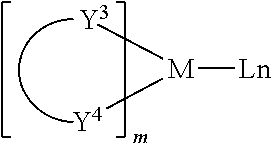
wherein M may be a metal; (Y3-Y4) may be a bidentate ligand, Y3 and Y4 may be independently selected from C, N, O, P, and S; L may be an auxiliary ligand; m may be an integer with the value from 1 to the maximum coordination number of the metal; and, m+n is the maximum number of coordination of the metal.

(O—N) may be a bidentate ligand in which the metal is coordinated to O and N atoms.


 |
 |
 |
 |
 |


 |
 |
 |
 |
 |
 |

wherein n may be an integer from 0 to 20; L may be an auxiliary ligand; and m may be an integer from 1 to 3.
 |
 |
 |
 |

 |
 |
 |
 |
 |
 |
 |
 |
 |
 |
 |
 |
 |
 |
 |
 |
 |
 |
 |
 |
 |
 |
 |
 |
 |
 |
 |
 |
 |
 |
 |
 |
 |
 |
 |
 |
 |
 |
 |
 |
 |
 |
 |
 |
 |
 |
 |
 |
 |
 |
 |
 |
 |
 |
 |
 |
 |
 |
 |
 |
 |
 |
 |
 |
 |
 |
 |
 |
 |
 |
 |
 |
 |
 |
 |
 |
 |
 |
 |
 |
 |
 |
 |
 |
 |
 |
 |
 |
 |
 |
 |
 |
 |
 |
 |
 |
 |
 |
 |
 |
 |
 |
 |
 |
 |
 |
 |
 |
 |
 |
 |
 |
 |
 |
 |
 |
 |
 |
 |
 |
 |
 |
 |
 |
 |
 |
 |
 |
 |
 |
 |
 |
 |
 |
 |
 |
 |
 |
 |
 |
 |
 |
 |
 |
 |
 |
 |
 |
 |
 |
 |
 |
 |
 |
 |
 |
 |
 |
 |
 |
 |
 |
 |
 |
 |
 |
 |
 |
 |
 |
 |
 |
 |
 |
 |
 |
 |
 |
 |
 |
 |
 |
 |
 |
 |
 |
 |
 |


Claims (13)


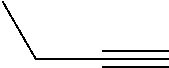


Applications Claiming Priority (4)
| Application Number | Priority Date | Filing Date | Title |
|---|---|---|---|
| CN201510015154 | 2015-01-13 | ||
| CN201510015154.2 | 2015-01-13 | ||
| CN201510015154 | 2015-01-13 | ||
| PCT/CN2015/097192 WO2016112761A1 (en) | 2015-01-13 | 2015-12-11 | Conjugated polymer containing ethynyl crosslinking group, mixture, composition, organic electronic device containing the same and application thereof |
Publications (2)
| Publication Number | Publication Date |
|---|---|
| US20180022865A1 US20180022865A1 (en) | 2018-01-25 |
| US10364316B2 true US10364316B2 (en) | 2019-07-30 |
Family
ID=56405225
Family Applications (1)
| Application Number | Title | Priority Date | Filing Date |
|---|---|---|---|
| US15/543,221 Active US10364316B2 (en) | 2015-01-13 | 2015-12-11 | Conjugated polymer containing ethynyl crosslinking group, mixture, formulation, organic electronic device containing the same and application therof |
Country Status (4)
| Country | Link |
|---|---|
| US (1) | US10364316B2 (en) |
| EP (1) | EP3246347B1 (en) |
| CN (1) | CN107108862B (en) |
| WO (1) | WO2016112761A1 (en) |
Families Citing this family (8)
| Publication number | Priority date | Publication date | Assignee | Title |
|---|---|---|---|---|
| WO2016072807A1 (en) * | 2014-11-06 | 2016-05-12 | 포항공과대학교 산학협력단 | Method for manufacturing perovskite nanocrystal particle light emitting body where organic ligand is substituted, nanocrystal particle light emitting body manufactured thereby, and light emitting device using same |
| KR102576153B1 (en) * | 2018-09-21 | 2023-09-06 | 주식회사 엘지화학 | Novel copolymer and organic light emitting device comprising the same |
| CN109728166B (en) * | 2018-12-10 | 2022-02-22 | 太原理工大学 | Methylamine lead iodide perovskite solar cells with organic light-emitting small molecule interface modification layer |
| CN112661942B (en) * | 2020-12-16 | 2023-03-21 | 华南理工大学 | P-type conjugated polymer based on 3-cyanothiophene, preparation method and photovoltaic application thereof |
| CN112608453B (en) * | 2020-12-17 | 2023-05-12 | 华中科技大学 | Pyridine-based D-A type cross conjugated polymer, and preparation and application thereof |
| CN113929879B (en) * | 2021-10-18 | 2023-06-30 | 湘潭大学 | Double-alkyne bridged one-dimensional linear or two-dimensional reticular organic energy storage material, and preparation method and application thereof |
| CN114588942B (en) * | 2022-02-25 | 2023-10-13 | 呼和浩特市联合鼎盛固体废物处理有限公司 | Method for producing hydrogen by solar energy |
| CN117567481B (en) * | 2023-11-16 | 2024-05-28 | 广州追光科技有限公司 | Organic compound containing ethynyl crosslinkable group and application thereof |
Citations (98)
| Publication number | Priority date | Publication date | Assignee | Title |
|---|---|---|---|---|
| US3567450A (en) | 1968-02-20 | 1971-03-02 | Eastman Kodak Co | Photoconductive elements containing substituted triarylamine photoconductors |
| US3615404A (en) | 1968-04-25 | 1971-10-26 | Scott Paper Co | 1 3-phenylenediamine containing photoconductive materials |
| US4720432A (en) | 1987-02-11 | 1988-01-19 | Eastman Kodak Company | Electroluminescent device with organic luminescent medium |
| US4769292A (en) | 1987-03-02 | 1988-09-06 | Eastman Kodak Company | Electroluminescent device with modified thin film luminescent zone |
| US5061569A (en) | 1990-07-26 | 1991-10-29 | Eastman Kodak Company | Electroluminescent device with organic electroluminescent medium |
| US5121029A (en) | 1987-12-11 | 1992-06-09 | Idemitsu Kosan Co., Ltd. | Electroluminescence device having an organic electroluminescent element |
| US5130603A (en) | 1989-03-20 | 1992-07-14 | Idemitsu Kosan Co., Ltd. | Organic electroluminescence device |
| US6020078A (en) | 1998-12-18 | 2000-02-01 | Eastman Kodak Company | Green organic electroluminescent devices |
| WO2000070655A2 (en) | 1999-05-13 | 2000-11-23 | The Trustees Of Princeton University | Very high efficiency organic light emitting devices based on electrophosphorescence |
| WO2001041512A1 (en) | 1999-12-01 | 2001-06-07 | The Trustees Of Princeton University | Complexes of form l2mx as phosphorescent dopants for organic leds |
| US6251531B1 (en) | 1995-02-25 | 2001-06-26 | Toyo Ink Manufacturing Co., Ltd. | Light-emitting material for organic electroluminescence device, and organic electroluminescence device for which the light-emitting material is adapted |
| US20010053462A1 (en) | 2000-05-02 | 2001-12-20 | Masayuki Mishima | Light-emitting device |
| WO2002002714A2 (en) | 2000-06-30 | 2002-01-10 | E.I. Du Pont De Nemours And Company | Electroluminescent iridium compounds with fluorinated phenylpyridines, phenylpyrimidines, and phenylquinolines and devices made with such compounds |
| WO2002015645A1 (en) | 2000-08-11 | 2002-02-21 | The Trustees Of Princeton University | Organometallic compounds and emission-shifting organic electrophosphorescence |
| EP1191612A2 (en) | 2000-09-26 | 2002-03-27 | Canon Kabushiki Kaisha | Luminescence device, display apparatus and metal coordination compound |
| EP1191613A2 (en) | 2000-09-26 | 2002-03-27 | Canon Kabushiki Kaisha | Luminescence device, display apparatus and metal coordination compound |
| EP1191614A2 (en) | 2000-09-26 | 2002-03-27 | Canon Kabushiki Kaisha | Luminescence device and metal coordination compound therefor |
| EP1284276A1 (en) | 2001-08-17 | 2003-02-19 | MERCK PATENT GmbH | Conjugated copolymers of dithienothiophene with vinylene or acetylene |
| WO2003020790A2 (en) | 2001-09-04 | 2003-03-13 | Covion Organic Semiconductors Gmbh | Conjugated polymers containing spirobifluorene units and the use thereof |
| US20030091862A1 (en) | 2001-08-31 | 2003-05-15 | Nippon Hoso Kyokai | Phosphorescent compound, a phosphorescent composition and an organic light-emitting device |
| WO2003051092A1 (en) | 2001-12-12 | 2003-06-19 | Canon Kabushiki Kaisha | [5] helicene AND dibenzofluorene MATERIALS FOR USE IN ORGANIC LIGHT EMITTING DEVICES |
| JP2003338375A (en) | 2002-03-14 | 2003-11-28 | Tdk Corp | Organic el element |
| WO2003099901A1 (en) | 2002-05-28 | 2003-12-04 | Sumitomo Chemical Company, Limited | Polymer and polymeric luminescent element comprising the same |
| US20040002576A1 (en) | 2002-03-15 | 2004-01-01 | Sumitomo Chemical Company, Limited | Polymer compound and polymer light emitting device using the same |
| US20040076853A1 (en) | 2002-04-24 | 2004-04-22 | Eastman Kodak Company | Organic light-emitting diode devices with improved operational stability |
| WO2004041901A1 (en) | 2002-11-08 | 2004-05-21 | Covion Organic Semiconductors Gmbh | Aryl-substituted polyindenofluorenes for use in organic electroluminiscent devices |
| US6824895B1 (en) | 2003-12-05 | 2004-11-30 | Eastman Kodak Company | Electroluminescent device containing organometallic compound with tridentate ligand |
| US6830828B2 (en) | 1998-09-14 | 2004-12-14 | The Trustees Of Princeton University | Organometallic complexes as phosphorescent emitters in organic LEDs |
| US6835469B2 (en) | 2001-10-17 | 2004-12-28 | The University Of Southern California | Phosphorescent compounds and devices comprising the same |
| WO2004113412A2 (en) | 2003-06-23 | 2004-12-29 | Covion Organic Semiconductors Gmbh | Polymer |
| CN1583691A (en) | 2004-06-04 | 2005-02-23 | 友达光电股份有限公司 | Anthracene compound and organic electroluminescent device comprising the anthracene compound |
| WO2005019373A2 (en) | 2003-08-19 | 2005-03-03 | Basf Aktiengesellschaft | Transition metal complexes comprising carbene ligands serving as emitters for organic light-emitting diodes (oled's) |
| WO2005033174A1 (en) | 2003-10-01 | 2005-04-14 | Sumitomo Chemical Company, Limited | Polymer light-emitting material and polymer light-emitting device |
| WO2005033244A1 (en) | 2003-09-29 | 2005-04-14 | Covion Organic Semiconductors Gmbh | Metal complexes |
| JP2005108556A (en) | 2003-09-29 | 2005-04-21 | Tdk Corp | Organic el element and organic el display |
| WO2005049689A2 (en) | 2003-11-17 | 2005-06-02 | Sumitomo Chemical Company, Limited | Crosslinkable substituted fluorene compounds and conjugated oligomers or polymers based thereon |
| WO2005052027A1 (en) | 2003-11-17 | 2005-06-09 | Sumitomo Chemical Company, Limited | Crosslinkable arylamine compounds and conjugated oligomers of polymers based thereon |
| WO2005056633A1 (en) | 2003-12-12 | 2005-06-23 | Sumitomo Chemical Company, Limited | Polymer compound and polymer light-emitting device using same |
| JP2005285661A (en) | 2004-03-30 | 2005-10-13 | Tdk Corp | Organic EL element and organic EL display |
| WO2005104264A1 (en) | 2004-04-26 | 2005-11-03 | Merck Patent Gmbh | Electroluminescent polymers and use therof |
| US20050258742A1 (en) | 2004-05-18 | 2005-11-24 | Yui-Yi Tsai | Carbene containing metal complexes as OLEDs |
| WO2006000389A1 (en) | 2004-06-26 | 2006-01-05 | Merck Patent Gmbh | Compounds for organic electronic devices |
| WO2006000388A1 (en) | 2004-06-26 | 2006-01-05 | Merck Patent Gmbh | Organic electroluminescent device |
| US7029766B2 (en) | 2003-12-05 | 2006-04-18 | Eastman Kodak Company | Organic element for electroluminescent devices |
| WO2006052457A2 (en) | 2004-11-03 | 2006-05-18 | Sumation Co.Ltd. | New class of bridged biphenylene polymers |
| WO2006058737A1 (en) | 2004-12-01 | 2006-06-08 | Merck Patent Gmbh | Compounds for organic electronic devices |
| WO2006062226A1 (en) | 2004-12-07 | 2006-06-15 | Sumitomo Chemical Company, Limited | Polymer material and device using same |
| US20060210830A1 (en) | 2005-03-15 | 2006-09-21 | Idemitsu Kosan Co., Ltd. | Aromatic amine derivative and organic electroluminescence device using the same |
| US20060222886A1 (en) | 2005-04-04 | 2006-10-05 | Raymond Kwong | Arylpyrene compounds |
| WO2006114364A1 (en) | 2005-04-28 | 2006-11-02 | Basf Aktiengesellschaft | Synthesis of phenyl-substituted polyfluoroanthenes and the use thereof |
| WO2006118345A1 (en) | 2005-04-28 | 2006-11-09 | Sumitomo Chemical Company, Limited | High-molecular compounds and high-molecular luminescent devices made by using the same |
| JP2007059939A (en) | 2001-08-31 | 2007-03-08 | Nippon Hoso Kyokai <Nhk> | Organic light emitting device and display device |
| WO2007043495A1 (en) | 2005-10-07 | 2007-04-19 | Sumitomo Chemical Company, Limited | Copolymer and polymer light emitting devices made by using the same |
| US20070087219A1 (en) | 2005-10-19 | 2007-04-19 | Eastman Kodak Company | Electroluminescent device |
| US20070092753A1 (en) | 2005-10-26 | 2007-04-26 | Eastman Kodak Company | Organic element for low voltage electroluminescent devices |
| WO2007065678A1 (en) | 2005-12-08 | 2007-06-14 | Merck Patent Gmbh | Novel materials for organic electroluminiescent devices |
| WO2007065549A1 (en) | 2005-12-08 | 2007-06-14 | Merck Patent Gmbh | Organic electroluminescent devices |
| US7250532B2 (en) | 2001-03-16 | 2007-07-31 | Idemitsu Kosan Co., Ltd. | Method for producing aromatic amino compound |
| JP2007197574A (en) | 2006-01-26 | 2007-08-09 | Showa Denko Kk | Polymer light-emitting material, organic electroluminescence element, and display device |
| WO2007095118A2 (en) | 2006-02-10 | 2007-08-23 | Universal Display Corporation | METAL COMPLEXES OF CYCLOMETALLATED IMIDAZO[1,2-f]PHENANTHRIDINE AND DIIMIDAZO[1,2-A:1',2'-C]QUINAZOLINE LIGANDS AND ISOELECTRONIC AND BENZANNULATED ANALOGS THEREOF |
| JP2007211243A (en) | 2007-02-07 | 2007-08-23 | Showa Denko Kk | Polymer of polymerizable compound |
| US20070208567A1 (en) | 2006-03-01 | 2007-09-06 | At&T Corp. | Error Correction In Automatic Speech Recognition Transcripts |
| WO2007115610A1 (en) | 2006-04-01 | 2007-10-18 | Merck Patent Gmbh | Materials for organic electroluminescent devices |
| US20070252517A1 (en) | 2006-04-27 | 2007-11-01 | Eastman Kodak Company | Electroluminescent device including an anthracene derivative |
| US20080027220A1 (en) | 2004-07-16 | 2008-01-31 | Merck Patent Gmbh | Metal Complexes |
| JP2008053397A (en) | 2006-08-24 | 2008-03-06 | Ricoh Co Ltd | Semiconductor device and manufacturing method thereof |
| US20080113101A1 (en) | 2006-11-09 | 2008-05-15 | Idemitsu Kosan Co., Ltd. | Organic-electroluminescence-material-containing solution, method for forming thin film of organic electroluminescence material, thin film of organic electroluminescence material and organic electroluminescence device |
| US20090061681A1 (en) | 2007-09-05 | 2009-03-05 | Mcmunigal Tom | Electrical receptacle assembly |
| US20090134784A1 (en) | 2004-10-21 | 2009-05-28 | Universal Display Corporation | Carbazole-containing materials in phosphorescent light emitting diodes |
| US7592414B2 (en) | 2000-08-01 | 2009-09-22 | Merck Patent Gmbh | Materials that can be structured, method for producing the same and their use |
| WO2009118087A1 (en) | 2008-03-25 | 2009-10-01 | Merck Patent Gmbh | Metal complexes |
| WO2009146770A2 (en) | 2008-06-05 | 2009-12-10 | Merck Patent Gmbh | Electronic device comprising metal complexes |
| JP2010010246A (en) | 2008-06-25 | 2010-01-14 | Sumitomo Chemical Co Ltd | Organic photoelectric conversion element |
| WO2010015307A1 (en) | 2008-08-04 | 2010-02-11 | Merck Patent Gmbh | Electronic devices comprising metal complexes having isonitrile ligands |
| WO2010031485A1 (en) | 2008-09-22 | 2010-03-25 | Merck Patent Gmbh | Materials for organic electroluminescence devices |
| WO2010054731A1 (en) | 2008-11-13 | 2010-05-20 | Merck Patent Gmbh | Materials for organic electroluminescent devices |
| WO2010054728A1 (en) | 2008-11-13 | 2010-05-20 | Merck Patent Gmbh | Materials for organic electroluminescent devices |
| WO2010086089A1 (en) | 2009-02-02 | 2010-08-05 | Merck Patent Gmbh | Metal complexes |
| WO2010099852A1 (en) | 2009-03-02 | 2010-09-10 | Merck Patent Gmbh | Metal complexes having azaborol ligands and electronic device having the same |
| WO2010102709A1 (en) | 2009-03-13 | 2010-09-16 | Merck Patent Gmbh | Materials for organic electroluminescence devices |
| CN101885834A (en) | 2010-07-16 | 2010-11-17 | 华南理工大学 | Conjugated polymer containing 4,5-ethylene-2,7-carbazole and its preparation method and application |
| WO2010135519A1 (en) | 2009-05-20 | 2010-11-25 | Universal Display Corporation | Metal complexes with boron-nitrogen heterocycle containing ligands for use in organic light emitting devices |
| DE102009023156A1 (en) | 2009-05-29 | 2010-12-02 | Merck Patent Gmbh | Polymers containing substituted indenofluorene derivatives as a structural unit, process for their preparation and their use |
| DE102009023154A1 (en) | 2009-05-29 | 2011-06-16 | Merck Patent Gmbh | A composition comprising at least one emitter compound and at least one polymer having conjugation-interrupting units |
| WO2011110277A1 (en) | 2010-03-11 | 2011-09-15 | Merck Patent Gmbh | Fibers in therapy and cosmetics |
| WO2011157339A1 (en) | 2010-06-15 | 2011-12-22 | Merck Patent Gmbh | Metal complexes |
| WO2012004407A2 (en) | 2010-07-09 | 2012-01-12 | Universite De Nantes | Bone regeneration membrane and method for forming a bone regeneration membrane |
| WO2012007088A1 (en) | 2010-07-16 | 2012-01-19 | Merck Patent Gmbh | Metal complexes |
| WO2012007087A1 (en) | 2010-07-16 | 2012-01-19 | Merck Patent Gmbh | Metal complexes |
| WO2012007086A1 (en) | 2010-07-16 | 2012-01-19 | Merck Patent Gmbh | Metal complexes |
| CN102399359A (en) | 2011-11-25 | 2012-04-04 | 华南理工大学 | Phosphate-containing triphenylamine conjugated polymer and its application |
| EP2525628A1 (en) | 2010-01-15 | 2012-11-21 | Sumitomo Chemical Company, Limited | Polymer light emitting element |
| CN103232592A (en) | 2013-04-01 | 2013-08-07 | 新疆大学 | Preparation of conjugated polymer based signal launch type mercury ion optical probe |
| KR20130120258A (en) * | 2012-04-25 | 2013-11-04 | 한국화학연구원 | Conductive polymers, organic photoelectric conversion materials and organic solar cells using the same |
| CN103408732A (en) | 2013-07-04 | 2013-11-27 | 中国科学院青岛生物能源与过程研究所 | Benzo [1,2-b:4,5-b'] dithiophene-containing polyaryl ethynylene semiconductor material |
| TW201406810A (en) | 2012-04-17 | 2014-02-16 | Merck Patent Gmbh | Crosslinkable and crosslinked polymers, their methods of manufacture and their use |
| EP2706584A1 (en) | 2012-09-07 | 2014-03-12 | Novaled AG | Charge transporting semi-conducting material and semi-conducting device |
| WO2016026806A1 (en) | 2014-08-22 | 2016-02-25 | Fraunhofer-Gesellschaft zur Förderung der angewandten Forschung e. V. | Organic electronic component having a cross-linked organic-electronic functional layer and alkinylether usable for production of said component |
Family Cites Families (1)
| Publication number | Priority date | Publication date | Assignee | Title |
|---|---|---|---|---|
| JP2014034618A (en) * | 2012-08-08 | 2014-02-24 | Kuraray Co Ltd | Organic thin film, and photoelectric conversion element using the same |
-
2015
- 2015-12-11 US US15/543,221 patent/US10364316B2/en active Active
- 2015-12-11 CN CN201580069863.7A patent/CN107108862B/en active Active
- 2015-12-11 WO PCT/CN2015/097192 patent/WO2016112761A1/en not_active Ceased
- 2015-12-11 EP EP15877672.4A patent/EP3246347B1/en active Active
Patent Citations (112)
| Publication number | Priority date | Publication date | Assignee | Title |
|---|---|---|---|---|
| US3567450A (en) | 1968-02-20 | 1971-03-02 | Eastman Kodak Co | Photoconductive elements containing substituted triarylamine photoconductors |
| US3615404A (en) | 1968-04-25 | 1971-10-26 | Scott Paper Co | 1 3-phenylenediamine containing photoconductive materials |
| US4720432A (en) | 1987-02-11 | 1988-01-19 | Eastman Kodak Company | Electroluminescent device with organic luminescent medium |
| US4769292A (en) | 1987-03-02 | 1988-09-06 | Eastman Kodak Company | Electroluminescent device with modified thin film luminescent zone |
| US5121029A (en) | 1987-12-11 | 1992-06-09 | Idemitsu Kosan Co., Ltd. | Electroluminescence device having an organic electroluminescent element |
| US5130603A (en) | 1989-03-20 | 1992-07-14 | Idemitsu Kosan Co., Ltd. | Organic electroluminescence device |
| US5061569A (en) | 1990-07-26 | 1991-10-29 | Eastman Kodak Company | Electroluminescent device with organic electroluminescent medium |
| US6251531B1 (en) | 1995-02-25 | 2001-06-26 | Toyo Ink Manufacturing Co., Ltd. | Light-emitting material for organic electroluminescence device, and organic electroluminescence device for which the light-emitting material is adapted |
| US6830828B2 (en) | 1998-09-14 | 2004-12-14 | The Trustees Of Princeton University | Organometallic complexes as phosphorescent emitters in organic LEDs |
| US6020078A (en) | 1998-12-18 | 2000-02-01 | Eastman Kodak Company | Green organic electroluminescent devices |
| WO2000070655A2 (en) | 1999-05-13 | 2000-11-23 | The Trustees Of Princeton University | Very high efficiency organic light emitting devices based on electrophosphorescence |
| WO2001041512A1 (en) | 1999-12-01 | 2001-06-07 | The Trustees Of Princeton University | Complexes of form l2mx as phosphorescent dopants for organic leds |
| US20010053462A1 (en) | 2000-05-02 | 2001-12-20 | Masayuki Mishima | Light-emitting device |
| WO2002002714A2 (en) | 2000-06-30 | 2002-01-10 | E.I. Du Pont De Nemours And Company | Electroluminescent iridium compounds with fluorinated phenylpyridines, phenylpyrimidines, and phenylquinolines and devices made with such compounds |
| US7592414B2 (en) | 2000-08-01 | 2009-09-22 | Merck Patent Gmbh | Materials that can be structured, method for producing the same and their use |
| WO2002015645A1 (en) | 2000-08-11 | 2002-02-21 | The Trustees Of Princeton University | Organometallic compounds and emission-shifting organic electrophosphorescence |
| EP1191612A2 (en) | 2000-09-26 | 2002-03-27 | Canon Kabushiki Kaisha | Luminescence device, display apparatus and metal coordination compound |
| EP1191613A2 (en) | 2000-09-26 | 2002-03-27 | Canon Kabushiki Kaisha | Luminescence device, display apparatus and metal coordination compound |
| EP1191614A2 (en) | 2000-09-26 | 2002-03-27 | Canon Kabushiki Kaisha | Luminescence device and metal coordination compound therefor |
| EP1191613B1 (en) | 2000-09-26 | 2006-03-29 | Canon Kabushiki Kaisha | Luminescence device, display apparatus and metal coordination compound |
| EP1191614B1 (en) | 2000-09-26 | 2009-05-06 | Canon Kabushiki Kaisha | Luminescence device and metal coordination compound therefor |
| EP1191612B1 (en) | 2000-09-26 | 2009-09-09 | Canon Kabushiki Kaisha | Luminescence device and display apparatus |
| US7250532B2 (en) | 2001-03-16 | 2007-07-31 | Idemitsu Kosan Co., Ltd. | Method for producing aromatic amino compound |
| EP1284276A1 (en) | 2001-08-17 | 2003-02-19 | MERCK PATENT GmbH | Conjugated copolymers of dithienothiophene with vinylene or acetylene |
| US7250226B2 (en) | 2001-08-31 | 2007-07-31 | Nippon Hoso Kyokai | Phosphorescent compound, a phosphorescent composition and an organic light-emitting device |
| JP2007059939A (en) | 2001-08-31 | 2007-03-08 | Nippon Hoso Kyokai <Nhk> | Organic light emitting device and display device |
| US20030091862A1 (en) | 2001-08-31 | 2003-05-15 | Nippon Hoso Kyokai | Phosphorescent compound, a phosphorescent composition and an organic light-emitting device |
| WO2003020790A2 (en) | 2001-09-04 | 2003-03-13 | Covion Organic Semiconductors Gmbh | Conjugated polymers containing spirobifluorene units and the use thereof |
| US6835469B2 (en) | 2001-10-17 | 2004-12-28 | The University Of Southern California | Phosphorescent compounds and devices comprising the same |
| WO2003051092A1 (en) | 2001-12-12 | 2003-06-19 | Canon Kabushiki Kaisha | [5] helicene AND dibenzofluorene MATERIALS FOR USE IN ORGANIC LIGHT EMITTING DEVICES |
| JP2003338375A (en) | 2002-03-14 | 2003-11-28 | Tdk Corp | Organic el element |
| US20040002576A1 (en) | 2002-03-15 | 2004-01-01 | Sumitomo Chemical Company, Limited | Polymer compound and polymer light emitting device using the same |
| US20040076853A1 (en) | 2002-04-24 | 2004-04-22 | Eastman Kodak Company | Organic light-emitting diode devices with improved operational stability |
| WO2003099901A1 (en) | 2002-05-28 | 2003-12-04 | Sumitomo Chemical Company, Limited | Polymer and polymeric luminescent element comprising the same |
| WO2004041901A1 (en) | 2002-11-08 | 2004-05-21 | Covion Organic Semiconductors Gmbh | Aryl-substituted polyindenofluorenes for use in organic electroluminiscent devices |
| WO2004113412A2 (en) | 2003-06-23 | 2004-12-29 | Covion Organic Semiconductors Gmbh | Polymer |
| WO2005019373A2 (en) | 2003-08-19 | 2005-03-03 | Basf Aktiengesellschaft | Transition metal complexes comprising carbene ligands serving as emitters for organic light-emitting diodes (oled's) |
| WO2005033244A1 (en) | 2003-09-29 | 2005-04-14 | Covion Organic Semiconductors Gmbh | Metal complexes |
| JP2005108556A (en) | 2003-09-29 | 2005-04-21 | Tdk Corp | Organic el element and organic el display |
| WO2005033174A1 (en) | 2003-10-01 | 2005-04-14 | Sumitomo Chemical Company, Limited | Polymer light-emitting material and polymer light-emitting device |
| CN102796260A (en) | 2003-11-17 | 2012-11-28 | 住友化学株式会社 | Crosslinkable arylamine compounds and conjugated oligomers of polymers based thereon |
| WO2005049689A2 (en) | 2003-11-17 | 2005-06-02 | Sumitomo Chemical Company, Limited | Crosslinkable substituted fluorene compounds and conjugated oligomers or polymers based thereon |
| WO2005052027A1 (en) | 2003-11-17 | 2005-06-09 | Sumitomo Chemical Company, Limited | Crosslinkable arylamine compounds and conjugated oligomers of polymers based thereon |
| US7029766B2 (en) | 2003-12-05 | 2006-04-18 | Eastman Kodak Company | Organic element for electroluminescent devices |
| US6824895B1 (en) | 2003-12-05 | 2004-11-30 | Eastman Kodak Company | Electroluminescent device containing organometallic compound with tridentate ligand |
| WO2005056633A1 (en) | 2003-12-12 | 2005-06-23 | Sumitomo Chemical Company, Limited | Polymer compound and polymer light-emitting device using same |
| JP2005285661A (en) | 2004-03-30 | 2005-10-13 | Tdk Corp | Organic EL element and organic EL display |
| WO2005104264A1 (en) | 2004-04-26 | 2005-11-03 | Merck Patent Gmbh | Electroluminescent polymers and use therof |
| US20070205714A1 (en) | 2004-04-26 | 2007-09-06 | Merck Patent Gmbh | Electroluminescent Polymers and the Use Thereof |
| DE102004020298A1 (en) | 2004-04-26 | 2005-11-10 | Covion Organic Semiconductors Gmbh | Electroluminescent polymers and their use |
| US20050258742A1 (en) | 2004-05-18 | 2005-11-24 | Yui-Yi Tsai | Carbene containing metal complexes as OLEDs |
| CN1583691A (en) | 2004-06-04 | 2005-02-23 | 友达光电股份有限公司 | Anthracene compound and organic electroluminescent device comprising the anthracene compound |
| WO2006000388A1 (en) | 2004-06-26 | 2006-01-05 | Merck Patent Gmbh | Organic electroluminescent device |
| WO2006000389A1 (en) | 2004-06-26 | 2006-01-05 | Merck Patent Gmbh | Compounds for organic electronic devices |
| US20080027220A1 (en) | 2004-07-16 | 2008-01-31 | Merck Patent Gmbh | Metal Complexes |
| US20090134784A1 (en) | 2004-10-21 | 2009-05-28 | Universal Display Corporation | Carbazole-containing materials in phosphorescent light emitting diodes |
| WO2006052457A2 (en) | 2004-11-03 | 2006-05-18 | Sumation Co.Ltd. | New class of bridged biphenylene polymers |
| WO2006058737A1 (en) | 2004-12-01 | 2006-06-08 | Merck Patent Gmbh | Compounds for organic electronic devices |
| WO2006062226A1 (en) | 2004-12-07 | 2006-06-15 | Sumitomo Chemical Company, Limited | Polymer material and device using same |
| US20060210830A1 (en) | 2005-03-15 | 2006-09-21 | Idemitsu Kosan Co., Ltd. | Aromatic amine derivative and organic electroluminescence device using the same |
| US20060222886A1 (en) | 2005-04-04 | 2006-10-05 | Raymond Kwong | Arylpyrene compounds |
| WO2006118345A1 (en) | 2005-04-28 | 2006-11-09 | Sumitomo Chemical Company, Limited | High-molecular compounds and high-molecular luminescent devices made by using the same |
| WO2006114364A1 (en) | 2005-04-28 | 2006-11-02 | Basf Aktiengesellschaft | Synthesis of phenyl-substituted polyfluoroanthenes and the use thereof |
| WO2007043495A1 (en) | 2005-10-07 | 2007-04-19 | Sumitomo Chemical Company, Limited | Copolymer and polymer light emitting devices made by using the same |
| US20070087219A1 (en) | 2005-10-19 | 2007-04-19 | Eastman Kodak Company | Electroluminescent device |
| US20070092753A1 (en) | 2005-10-26 | 2007-04-26 | Eastman Kodak Company | Organic element for low voltage electroluminescent devices |
| WO2007065678A1 (en) | 2005-12-08 | 2007-06-14 | Merck Patent Gmbh | Novel materials for organic electroluminiescent devices |
| WO2007065549A1 (en) | 2005-12-08 | 2007-06-14 | Merck Patent Gmbh | Organic electroluminescent devices |
| EP1957606A1 (en) | 2005-12-08 | 2008-08-20 | Merck Patent GmbH | Novel materials for organic electroluminiescent devices |
| DE102005058557A1 (en) | 2005-12-08 | 2007-06-14 | Merck Patent Gmbh | Organic electroluminescent device |
| JP2007197574A (en) | 2006-01-26 | 2007-08-09 | Showa Denko Kk | Polymer light-emitting material, organic electroluminescence element, and display device |
| WO2007095118A2 (en) | 2006-02-10 | 2007-08-23 | Universal Display Corporation | METAL COMPLEXES OF CYCLOMETALLATED IMIDAZO[1,2-f]PHENANTHRIDINE AND DIIMIDAZO[1,2-A:1',2'-C]QUINAZOLINE LIGANDS AND ISOELECTRONIC AND BENZANNULATED ANALOGS THEREOF |
| US20070208567A1 (en) | 2006-03-01 | 2007-09-06 | At&T Corp. | Error Correction In Automatic Speech Recognition Transcripts |
| WO2007115610A1 (en) | 2006-04-01 | 2007-10-18 | Merck Patent Gmbh | Materials for organic electroluminescent devices |
| US20070252517A1 (en) | 2006-04-27 | 2007-11-01 | Eastman Kodak Company | Electroluminescent device including an anthracene derivative |
| JP2008053397A (en) | 2006-08-24 | 2008-03-06 | Ricoh Co Ltd | Semiconductor device and manufacturing method thereof |
| US20080113101A1 (en) | 2006-11-09 | 2008-05-15 | Idemitsu Kosan Co., Ltd. | Organic-electroluminescence-material-containing solution, method for forming thin film of organic electroluminescence material, thin film of organic electroluminescence material and organic electroluminescence device |
| JP2007211243A (en) | 2007-02-07 | 2007-08-23 | Showa Denko Kk | Polymer of polymerizable compound |
| US20090061681A1 (en) | 2007-09-05 | 2009-03-05 | Mcmunigal Tom | Electrical receptacle assembly |
| WO2009118087A1 (en) | 2008-03-25 | 2009-10-01 | Merck Patent Gmbh | Metal complexes |
| WO2009146770A2 (en) | 2008-06-05 | 2009-12-10 | Merck Patent Gmbh | Electronic device comprising metal complexes |
| JP2010010246A (en) | 2008-06-25 | 2010-01-14 | Sumitomo Chemical Co Ltd | Organic photoelectric conversion element |
| WO2010015307A1 (en) | 2008-08-04 | 2010-02-11 | Merck Patent Gmbh | Electronic devices comprising metal complexes having isonitrile ligands |
| WO2010031485A1 (en) | 2008-09-22 | 2010-03-25 | Merck Patent Gmbh | Materials for organic electroluminescence devices |
| WO2010054728A1 (en) | 2008-11-13 | 2010-05-20 | Merck Patent Gmbh | Materials for organic electroluminescent devices |
| WO2010054731A1 (en) | 2008-11-13 | 2010-05-20 | Merck Patent Gmbh | Materials for organic electroluminescent devices |
| WO2010086089A1 (en) | 2009-02-02 | 2010-08-05 | Merck Patent Gmbh | Metal complexes |
| CN102282150A (en) | 2009-02-02 | 2011-12-14 | 默克专利有限公司 | Metal complexes |
| US20110284799A1 (en) | 2009-02-02 | 2011-11-24 | Merck Patent Gmbh | Metal complexes |
| WO2010099852A1 (en) | 2009-03-02 | 2010-09-10 | Merck Patent Gmbh | Metal complexes having azaborol ligands and electronic device having the same |
| WO2010102709A1 (en) | 2009-03-13 | 2010-09-16 | Merck Patent Gmbh | Materials for organic electroluminescence devices |
| WO2010135519A1 (en) | 2009-05-20 | 2010-11-25 | Universal Display Corporation | Metal complexes with boron-nitrogen heterocycle containing ligands for use in organic light emitting devices |
| DE102009023154A1 (en) | 2009-05-29 | 2011-06-16 | Merck Patent Gmbh | A composition comprising at least one emitter compound and at least one polymer having conjugation-interrupting units |
| DE102009023156A1 (en) | 2009-05-29 | 2010-12-02 | Merck Patent Gmbh | Polymers containing substituted indenofluorene derivatives as a structural unit, process for their preparation and their use |
| US20120056170A1 (en) | 2009-05-29 | 2012-03-08 | Merck Patent Gmbh | Composition comprising at least one emitter compound and at least one polymer having conjugation-interrupting units |
| US20120061617A1 (en) | 2009-05-29 | 2012-03-15 | Merck Patent Gmbh | Polymers which contain substituted indenofluorene derivatives as structural unit, process for the preparation thereof, and the use thereof |
| EP2525628A1 (en) | 2010-01-15 | 2012-11-21 | Sumitomo Chemical Company, Limited | Polymer light emitting element |
| WO2011110277A1 (en) | 2010-03-11 | 2011-09-15 | Merck Patent Gmbh | Fibers in therapy and cosmetics |
| WO2011157339A1 (en) | 2010-06-15 | 2011-12-22 | Merck Patent Gmbh | Metal complexes |
| WO2012004407A2 (en) | 2010-07-09 | 2012-01-12 | Universite De Nantes | Bone regeneration membrane and method for forming a bone regeneration membrane |
| CN101885834A (en) | 2010-07-16 | 2010-11-17 | 华南理工大学 | Conjugated polymer containing 4,5-ethylene-2,7-carbazole and its preparation method and application |
| WO2012007086A1 (en) | 2010-07-16 | 2012-01-19 | Merck Patent Gmbh | Metal complexes |
| WO2012007087A1 (en) | 2010-07-16 | 2012-01-19 | Merck Patent Gmbh | Metal complexes |
| WO2012007088A1 (en) | 2010-07-16 | 2012-01-19 | Merck Patent Gmbh | Metal complexes |
| CN102399359A (en) | 2011-11-25 | 2012-04-04 | 华南理工大学 | Phosphate-containing triphenylamine conjugated polymer and its application |
| TW201406810A (en) | 2012-04-17 | 2014-02-16 | Merck Patent Gmbh | Crosslinkable and crosslinked polymers, their methods of manufacture and their use |
| US20150069303A1 (en) | 2012-04-17 | 2015-03-12 | Merck Patent Gmbh | Polymers containing substituted triarylamine units and electroluminescent devices containing said polymers |
| KR20130120258A (en) * | 2012-04-25 | 2013-11-04 | 한국화학연구원 | Conductive polymers, organic photoelectric conversion materials and organic solar cells using the same |
| EP2706584A1 (en) | 2012-09-07 | 2014-03-12 | Novaled AG | Charge transporting semi-conducting material and semi-conducting device |
| CN103232592A (en) | 2013-04-01 | 2013-08-07 | 新疆大学 | Preparation of conjugated polymer based signal launch type mercury ion optical probe |
| CN103408732A (en) | 2013-07-04 | 2013-11-27 | 中国科学院青岛生物能源与过程研究所 | Benzo [1,2-b:4,5-b'] dithiophene-containing polyaryl ethynylene semiconductor material |
| WO2016026806A1 (en) | 2014-08-22 | 2016-02-25 | Fraunhofer-Gesellschaft zur Förderung der angewandten Forschung e. V. | Organic electronic component having a cross-linked organic-electronic functional layer and alkinylether usable for production of said component |
Non-Patent Citations (25)
| Title |
|---|
| Adachi, et al., "High-efficiency red electrophosphorescence devices", Appl. Phys. Lett. 78, 2001, pp. 1622-1624. |
| Baldo, et al., "High-efficiency fluorescent organic light-emitting devices using aphosphorescent sensitizer", Nature 403, 2000, pp. 750-753. |
| Bulovic, et al., "Transparent light-emitting devices", Nature, vol. 380, Mar. 7, 1996, p. 29. |
| Domercq, et al., "hoto-Patternable Hole-Transport Polymers for Organic Light-Emitting Diodes", Chem.Mater., 15, 2003, pp. 1491-1496. |
| Extended European Search Report of Parallel European Patent Application No. 15877672.4 dated Jul. 24, 2018. |
| First Office Action & Search Report for Priority Chinese Patent Application No. 201580069863.7, dated Sep. 29, 2018. |
| Gu, et al., "Transparent organic light emitting devices", Appl. Phys. Lett, vol. 68, No. 19, May 6, 1996, pp. 2606-2608. |
| Huang, et al., "Crosslinable hole-transproting materialsfor solution processed polymer light-emitting diodes", Journal of Material Chemistry, vol. 18, No. 38, Oct. 14, 2008, pp. 4485-4592. |
| Huang, et al., "Water/alcohol soluble conjugated polymers as highly efficient electron transporting/injection layer in optoelectronic devices", Chem Soc Rev,, 39, 2010, pp. 2500-2521. |
| International Search Report and Written Opinion for Application No. PCT/CN2015/097192 dated Mar. 11, 2016. |
| Jiang, et al., "Perfluorocyclobutane-Based ArylamineHole-Transporting Materials for Organic and Polymer Light-Emitting Diodes", Adv. Funct. Mater., No. 11-12, Dec. 2002, pp. 745-751. |
| Johnson, et al., "Luminescent Iridium( I), Rhodium( I), and Platinum( 11) Dithiolate Complexes", J . Am. Chem. SO, 105, 1983, pp. 1795-1802. |
| Kido, et al., "Bright red light-emitting organic electroluminescent devices having a europiumcomplex as an emitter", Appl. Phys. Lett., vol. No. 17, Oct. 24, 1994, pp. 2124-2126. |
| Kido, et al., "Electroluminescence in a Terbium Complex", Chemistry Letters, The Chemical Society of Japan, 1990, pp. 657-660. |
| Kipphan, "Handbook of Print Media: Technologies and Production Methods", ISBN 3-540-67326-1 Springer-Verlag Berlin Heidelberg New York, 2001, pp. 1-13. |
| Lei, et al., "Carbazole-based conjugated polymer with tethered acetylene groups: Synthesis and characterization", Dyes and Pigments, vol. 96, No. 1, Jul. 25, 2012, pp. 138-147. |
| Ma, et al., "Electroluminescence from triplet metal-ligand charge-transfer excited state of transition metal complexes", Synthetic Metals 94, 1998, pp. 245-248. |
| Ma, et al., "New Thermally Cross-Linkable Polymer and Its Application as a Hole-Transporting Layer for Solution Processed Multilayer Organic Light Emitting Diodes", Chem. Mater., 19, 2007, pp. 4827-4832. |
| Ma, et al., "Triphenylamine-based conjugated polmer/I-complex as turn on optical probe for mercury(II)", Sensors and Actuators B: Chemical: International Journal Devoted to Research and Development of Physical and Chemical Transducers, Elsevier BV, NL, vol. 182, Apr. 1, 2013, pp. 782-788. |
| Muller, et al., "Multi-colour organic light-emitting displays by solution processing", Nature, vol. 421, Feb. 20, 2003, pp. 829-833. |
| Niu, et al., "Crosslinkable Hole-Transport Layer on Conducting Polymer for High-Efficiency White Polymer Light-Emitting Diodes", Adv. Mater., 19, 2007, pp. 300-304. |
| Shi, et al., "TCNE—decorated triphenylamine-based conjugated polymer: Click synthesis and efficient trun-on fluorescent probing for Hg2+", Dyes and Pigments, vol. 104, Dec. 25, 2013, pp. 1-7. |
| Veinot, et al., "Toward the Ideal Organic Light-Emitting Diode. The Versatility and Utility of Interfacial Tailroing by Cross-Linked Siloxane Interlayers", Acc. Chem. Res., 38, 2005, pp. 632-643. |
| Wrighton, et al., "The Nature of the Lowest Excited State in Tricarbonylchloro-1 , 1 0-phenanthrolinerhenium( I) and Related Complexes", Journal of the American Chemical Society, 96:4, Feb. 20, 1974, pp. 998-1003. |
| Zeng, et al., "Polymer Light-Emitting Diodes with Cathodes Printed from Conducting AG Paste", Adv Mater, 19, 2007, pp. 810-814. |
Also Published As
| Publication number | Publication date |
|---|---|
| US20180022865A1 (en) | 2018-01-25 |
| CN107108862A (en) | 2017-08-29 |
| EP3246347A1 (en) | 2017-11-22 |
| EP3246347A4 (en) | 2018-08-22 |
| CN107108862B (en) | 2019-08-02 |
| EP3246347B1 (en) | 2025-04-23 |
| WO2016112761A1 (en) | 2016-07-21 |
Similar Documents
| Publication | Publication Date | Title |
|---|---|---|
| US10323180B2 (en) | Deuterated organic compound, mixture and composition containing said compound, and organic electronic device | |
| US10364316B2 (en) | Conjugated polymer containing ethynyl crosslinking group, mixture, formulation, organic electronic device containing the same and application therof | |
| US10840450B2 (en) | Polymer, and mixture or formulation, and organic electronic device containing same, and monomer thereof | |
| CN107001380B (en) | Compound, mixture containing the same, composition and organic electronic device | |
| US11292875B2 (en) | Cross-linkable polymer based on Diels-Alder reaction and use thereof in organic electronic device | |
| US11289654B2 (en) | Polymers containing furanyl crosslinkable groups and uses thereof | |
| US10573827B2 (en) | Organic metal complex, and polymer, mixture, composition and organic electronic device containing same and use thereof | |
| US10510967B2 (en) | Organic compound, and mixture, formulation and organic device comprising the same | |
| US11594690B2 (en) | Organometallic complex, and polymer, mixture and formulation comprising same, and use thereof in electronic device | |
| US11453745B2 (en) | High polymer, mixture containing same, composition, organic electronic component, and monomer for polymerization | |
| CN110760164B (en) | Organic mixture, composition containing organic mixture, organic electronic device and application | |
| CN111278892B (en) | Polymers, mixtures, compositions containing amide bond groups and uses thereof | |
| US20200109235A1 (en) | Conjugated polymer and use thereof in organic electronic device | |
| US20230380280A1 (en) | Organic compounds, mixtures and applications thereof in organic electronic devices | |
| CN111278819A (en) | Bipolar compounds, polymers, mixtures, compositions, organic electronic devices and applications |
Legal Events
| Date | Code | Title | Description |
|---|---|---|---|
| AS | Assignment |
Owner name: GUANGZHOU CHINARAY OPTOELECTRONIC MATERIALS LTD., Free format text: ASSIGNMENT OF ASSIGNORS INTEREST;ASSIGNOR:LIU, SHENGJIAN;REEL/FRAME:042991/0463 Effective date: 20170711 |
|
| STPP | Information on status: patent application and granting procedure in general |
Free format text: FINAL REJECTION MAILED |
|
| STPP | Information on status: patent application and granting procedure in general |
Free format text: RESPONSE AFTER FINAL ACTION FORWARDED TO EXAMINER |
|
| STPP | Information on status: patent application and granting procedure in general |
Free format text: NOTICE OF ALLOWANCE MAILED -- APPLICATION RECEIVED IN OFFICE OF PUBLICATIONS |
|
| STPP | Information on status: patent application and granting procedure in general |
Free format text: PUBLICATIONS -- ISSUE FEE PAYMENT VERIFIED |
|
| STCF | Information on status: patent grant |
Free format text: PATENTED CASE |
|
| MAFP | Maintenance fee payment |
Free format text: PAYMENT OF MAINTENANCE FEE, 4TH YEAR, LARGE ENTITY (ORIGINAL EVENT CODE: M1551); ENTITY STATUS OF PATENT OWNER: LARGE ENTITY Year of fee payment: 4 |