US10364267B2 - Deuterated bile acid derivatives as FXR/TGR5 agonists and methods of use thereof - Google Patents
Deuterated bile acid derivatives as FXR/TGR5 agonists and methods of use thereof Download PDFInfo
- Publication number
- US10364267B2 US10364267B2 US15/439,358 US201715439358A US10364267B2 US 10364267 B2 US10364267 B2 US 10364267B2 US 201715439358 A US201715439358 A US 201715439358A US 10364267 B2 US10364267 B2 US 10364267B2
- Authority
- US
- United States
- Prior art keywords
- compound
- substituted
- unsubstituted
- butyl
- formula
- Prior art date
- Legal status (The legal status is an assumption and is not a legal conclusion. Google has not performed a legal analysis and makes no representation as to the accuracy of the status listed.)
- Active
Links
- WWRCMNKATXZARA-UHFFFAOYSA-N CC1=C(C(C)C)C=CC=C1 Chemical compound CC1=C(C(C)C)C=CC=C1 WWRCMNKATXZARA-UHFFFAOYSA-N 0.000 description 51
- 0 [2*]C(C[C@@H](C)[C@@]1([H])CCC2C3C(C([4*])C([3*])[C@@]21C)[C@@]1(C)CC[C@@H](O[5*])C[C@@]1([H])[C@@H](C(C)(C)C)[C@@]3(C)O[6*])C(=O)O.[2*]C(C[C@@H](C)[C@@]1([H])CCC2C3C(C([4*])C([3*])[C@@]21C)[C@@]1(C)CC[C@@H](O[5*])C[C@@]1([H])[C@@H](C(C)(C)C)[C@@]3(C)O[6*])N(C)C Chemical compound [2*]C(C[C@@H](C)[C@@]1([H])CCC2C3C(C([4*])C([3*])[C@@]21C)[C@@]1(C)CC[C@@H](O[5*])C[C@@]1([H])[C@@H](C(C)(C)C)[C@@]3(C)O[6*])C(=O)O.[2*]C(C[C@@H](C)[C@@]1([H])CCC2C3C(C([4*])C([3*])[C@@]21C)[C@@]1(C)CC[C@@H](O[5*])C[C@@]1([H])[C@@H](C(C)(C)C)[C@@]3(C)O[6*])N(C)C 0.000 description 42
- KXIXHISTUVHOCY-UHFFFAOYSA-N CC(C)N1CCCCC1 Chemical compound CC(C)N1CCCCC1 KXIXHISTUVHOCY-UHFFFAOYSA-N 0.000 description 28
- XLZMWNWNBXSZKF-UHFFFAOYSA-N CC(C)N1CCOCC1 Chemical compound CC(C)N1CCOCC1 XLZMWNWNBXSZKF-UHFFFAOYSA-N 0.000 description 27
- TVYVQNHYIHAJTD-UHFFFAOYSA-N CC(C)C1=CC2=C(C=CC=C2)C=C1 Chemical compound CC(C)C1=CC2=C(C=CC=C2)C=C1 TVYVQNHYIHAJTD-UHFFFAOYSA-N 0.000 description 26
- GTADDTOGTOQQMD-UHFFFAOYSA-N CC(C)C1=CC=C(OC(F)(F)F)C=C1 Chemical compound CC(C)C1=CC=C(OC(F)(F)F)C=C1 GTADDTOGTOQQMD-UHFFFAOYSA-N 0.000 description 26
- HFPZCAJZSCWRBC-UHFFFAOYSA-N CC1=CC=C(C(C)C)C=C1 Chemical compound CC1=CC=C(C(C)C)C=C1 HFPZCAJZSCWRBC-UHFFFAOYSA-N 0.000 description 26
- RWGFKTVRMDUZSP-UHFFFAOYSA-N CC(C)C1=CC=CC=C1 Chemical compound CC(C)C1=CC=CC=C1 RWGFKTVRMDUZSP-UHFFFAOYSA-N 0.000 description 25
- XIMCWSMVGVJQQN-UHFFFAOYSA-N CC(C)CC1CC1 Chemical compound CC(C)CC1CC1 XIMCWSMVGVJQQN-UHFFFAOYSA-N 0.000 description 25
- YQOPNAOQGQSUHF-UHFFFAOYSA-N CC(C)N1CCCC1 Chemical compound CC(C)N1CCCC1 YQOPNAOQGQSUHF-UHFFFAOYSA-N 0.000 description 25
- QEJFJGSJIQQWRC-UHFFFAOYSA-N CC(C)C1(C)CC1 Chemical compound CC(C)C1(C)CC1 QEJFJGSJIQQWRC-UHFFFAOYSA-N 0.000 description 24
- ICTCCOUARBGHFR-UHFFFAOYSA-N CC(C)C1=C(F)C=CC=C1 Chemical compound CC(C)C1=C(F)C=CC=C1 ICTCCOUARBGHFR-UHFFFAOYSA-N 0.000 description 24
- HPBROFGYTXOJIO-UHFFFAOYSA-N CC(C)C1CC1 Chemical compound CC(C)C1CC1 HPBROFGYTXOJIO-UHFFFAOYSA-N 0.000 description 24
- HICXOWILYCTTMY-XNAMLAJRSA-N [H][C@@]12C[C@H](O)CC[C@]1(C)C1CC[C@@]3(C)C(CC[C@]3([H])[C@H](C)CCN(C)C)C1[C@](C)(O)[C@@H]2C(C)(C)C Chemical compound [H][C@@]12C[C@H](O)CC[C@]1(C)C1CC[C@@]3(C)C(CC[C@]3([H])[C@H](C)CCN(C)C)C1[C@](C)(O)[C@@H]2C(C)(C)C HICXOWILYCTTMY-XNAMLAJRSA-N 0.000 description 3
- YKILJGWOUPELQS-UHFFFAOYSA-N CC(=O)C1=C(C(C)C)C=CC=C1 Chemical compound CC(=O)C1=C(C(C)C)C=CC=C1 YKILJGWOUPELQS-UHFFFAOYSA-N 0.000 description 2
- KYCCMACNVPGVLE-UHFFFAOYSA-N CC(=O)N1CCC2=C1C=C(C(C)C)C=C2 Chemical compound CC(=O)N1CCC2=C1C=C(C(C)C)C=C2 KYCCMACNVPGVLE-UHFFFAOYSA-N 0.000 description 2
- KZESYXUKHKOJBX-UHFFFAOYSA-N CC(C)C1=C(F)C(F)=C(F)C(F)=C1F Chemical compound CC(C)C1=C(F)C(F)=C(F)C(F)=C1F KZESYXUKHKOJBX-UHFFFAOYSA-N 0.000 description 2
- BDAQGUZTTPIATR-UHFFFAOYSA-N CC(C)C1=CC(C(N)=O)=CC=C1 Chemical compound CC(C)C1=CC(C(N)=O)=CC=C1 BDAQGUZTTPIATR-UHFFFAOYSA-N 0.000 description 2
- ZZWJZCURFRSZPD-UHFFFAOYSA-N CC(C)C1=CC(N(C)C)=CC=C1 Chemical compound CC(C)C1=CC(N(C)C)=CC=C1 ZZWJZCURFRSZPD-UHFFFAOYSA-N 0.000 description 2
- SIZCAMBYKFGFAR-UHFFFAOYSA-N CC(C)C1=CC2=C(C=C1)N=CS2 Chemical compound CC(C)C1=CC2=C(C=C1)N=CS2 SIZCAMBYKFGFAR-UHFFFAOYSA-N 0.000 description 2
- CKMXAIVXVKGGFM-UHFFFAOYSA-N CC(C)C1=CC=C(C(=O)O)C=C1 Chemical compound CC(C)C1=CC=C(C(=O)O)C=C1 CKMXAIVXVKGGFM-UHFFFAOYSA-N 0.000 description 2
- PUACTIIESPYWSI-UHFFFAOYSA-N CC(C)C1=CN=CC=C1 Chemical compound CC(C)C1=CN=CC=C1 PUACTIIESPYWSI-UHFFFAOYSA-N 0.000 description 2
- BALXYFZYWHMSKB-UHFFFAOYSA-N C.CC(C)C1(C)CC1.CC(C)C1=C(F)C=CC=C1.CC(C)C1=CC2=C(C=CC=C2)C=C1.CC(C)C1CC1.CC(C)CC1CC1.CC(C)N1CCCC1.CC(C)N1CCCCC1.CC(C)N1CCCCC1.CC1=C(C(C)C)C=CC=C1.CC1=C(C(C)C)C=CC=C1.CC1=CC=C(C(C)C)C=C1.CC1=CC=C(C(C)C)C=C1 Chemical compound C.CC(C)C1(C)CC1.CC(C)C1=C(F)C=CC=C1.CC(C)C1=CC2=C(C=CC=C2)C=C1.CC(C)C1CC1.CC(C)CC1CC1.CC(C)N1CCCC1.CC(C)N1CCCCC1.CC(C)N1CCCCC1.CC1=C(C(C)C)C=CC=C1.CC1=C(C(C)C)C=CC=C1.CC1=CC=C(C(C)C)C=C1.CC1=CC=C(C(C)C)C=C1 BALXYFZYWHMSKB-UHFFFAOYSA-N 0.000 description 1
- BOXMHDAGBJUKOF-QWDKPSGKSA-N CC(=O)C1=C(C(C)C)C=CC=C1.CC(=O)C1=C(C(C)C)C=CC=C1.CC(=O)C1=CC=C(C(C)C)C=C1.CC(=O)C1=CC=CC(C(C)C)=C1.CC(C)C1=C2C=CC=CC2=CC=C1.CC(C)C1=C2C=CC=NC2=CC=C1.CC(C)C1=CC2=C(C=C1)C=NC=C2.CC(C)C1=CC2=C(C=C1)OCO2.CC(C)C1=CC2=C(C=CC=C2)C=C1.CC(C)C1=CC=C(C(=O)O)C=C1.CC(C)C1=CC=C(C2(C)CC2)C=C1.CC(C)C1=CC=C(C2=CC=NO2)C=C1.CC(C)C1=CC=C(C2=NN=CO2)C=C1.CC(C)C[C@]12CCC(CC1=O)C2(C)C.CC1=CSC(C2=CC=C(C(C)C)C=C2)=N1.CC1=NC=C(C2=CC=C(C(C)C)C=C2)O1.COC(=O)C1=CC=C(C(C)C)C=C1.COC(=O)C1=CC=CC(C(C)C)=C1.COC1=C(F)C=C(C(C)C)C=C1.COC1=C(OC)C=C(C(C)C)C=C1 Chemical compound CC(=O)C1=C(C(C)C)C=CC=C1.CC(=O)C1=C(C(C)C)C=CC=C1.CC(=O)C1=CC=C(C(C)C)C=C1.CC(=O)C1=CC=CC(C(C)C)=C1.CC(C)C1=C2C=CC=CC2=CC=C1.CC(C)C1=C2C=CC=NC2=CC=C1.CC(C)C1=CC2=C(C=C1)C=NC=C2.CC(C)C1=CC2=C(C=C1)OCO2.CC(C)C1=CC2=C(C=CC=C2)C=C1.CC(C)C1=CC=C(C(=O)O)C=C1.CC(C)C1=CC=C(C2(C)CC2)C=C1.CC(C)C1=CC=C(C2=CC=NO2)C=C1.CC(C)C1=CC=C(C2=NN=CO2)C=C1.CC(C)C[C@]12CCC(CC1=O)C2(C)C.CC1=CSC(C2=CC=C(C(C)C)C=C2)=N1.CC1=NC=C(C2=CC=C(C(C)C)C=C2)O1.COC(=O)C1=CC=C(C(C)C)C=C1.COC(=O)C1=CC=CC(C(C)C)=C1.COC1=C(F)C=C(C(C)C)C=C1.COC1=C(OC)C=C(C(C)C)C=C1 BOXMHDAGBJUKOF-QWDKPSGKSA-N 0.000 description 1
- PDLCCNYKIIUWHA-UHFFFAOYSA-N CC(=O)C1=CC=C(C(C)C)C=C1 Chemical compound CC(=O)C1=CC=C(C(C)C)C=C1 PDLCCNYKIIUWHA-UHFFFAOYSA-N 0.000 description 1
- JYTHSLNJXAEHQT-UHFFFAOYSA-N CC(=O)C1=CC=CC(C(C)C)=C1 Chemical compound CC(=O)C1=CC=CC(C(C)C)=C1 JYTHSLNJXAEHQT-UHFFFAOYSA-N 0.000 description 1
- MGSJZQDOYVHING-UHFFFAOYSA-N CC(=O)N1CCC2=C1C=C(C(C)C)C=C2.CC(C)C1=C(C#N)C=CC=C1.CC(C)C1=C(C(F)(F)F)C=CC=C1.CC(C)C1=C(C(N)=O)C=CC=C1.CC(C)C1=CC(C#N)=CC=C1.CC(C)C1=CC(C(F)(F)F)=CC=C1.CC(C)C1=CC(C(N)=O)=CC=C1.CC(C)C1=CC(N(C)C)=CC=C1.CC(C)C1=CC(OC(F)(F)F)=CC=C1.CC(C)C1=CC2=C(C=C1)CCC2.CC(C)C1=CC2=C(C=C1)CCCC2.CC(C)C1=CC2=C(C=C1)OCCO2.CC(C)C1=CC=C(C#N)C=C1.CC(C)C1=CC=C(C(F)(F)F)C=C1.CC(C)C1=CC=C(C(N)=O)C=C1.CC(C)C1=CC=C(C2CCCCC2)C=C1.CC(C)C1=CC=C(N(C)C)C=C1.CC(C)C1=CC=C(N)C=C1.CC(C)C1=CC=C(N2CCCCC2)C=C1.CC1=NC(C2=CC=C(C(C)C)C=C2)=CS1.COC1=C(C(C)C)C=CC=C1.COC1=CC=C(C(C)C)C=C1.COC1=CC=CC(C(C)C)=C1 Chemical compound CC(=O)N1CCC2=C1C=C(C(C)C)C=C2.CC(C)C1=C(C#N)C=CC=C1.CC(C)C1=C(C(F)(F)F)C=CC=C1.CC(C)C1=C(C(N)=O)C=CC=C1.CC(C)C1=CC(C#N)=CC=C1.CC(C)C1=CC(C(F)(F)F)=CC=C1.CC(C)C1=CC(C(N)=O)=CC=C1.CC(C)C1=CC(N(C)C)=CC=C1.CC(C)C1=CC(OC(F)(F)F)=CC=C1.CC(C)C1=CC2=C(C=C1)CCC2.CC(C)C1=CC2=C(C=C1)CCCC2.CC(C)C1=CC2=C(C=C1)OCCO2.CC(C)C1=CC=C(C#N)C=C1.CC(C)C1=CC=C(C(F)(F)F)C=C1.CC(C)C1=CC=C(C(N)=O)C=C1.CC(C)C1=CC=C(C2CCCCC2)C=C1.CC(C)C1=CC=C(N(C)C)C=C1.CC(C)C1=CC=C(N)C=C1.CC(C)C1=CC=C(N2CCCCC2)C=C1.CC1=NC(C2=CC=C(C(C)C)C=C2)=CS1.COC1=C(C(C)C)C=CC=C1.COC1=CC=C(C(C)C)C=C1.COC1=CC=CC(C(C)C)=C1 MGSJZQDOYVHING-UHFFFAOYSA-N 0.000 description 1
- WTCASQZCGDVUGO-NFAZJBOLSA-N CC(C)(C)C1=CC=C(S(N)(=O)=O)C=C1.[H][C@@]12C[C@H](C)CC[C@]1(C)C1CC[C@@]3(C)C(CC[C@]3([H])[C@H](C)CCC(=O)O)C1[C@]([2H])(O)[C@@H]2C([2H])C.[H][C@@]12C[C@H](C)CC[C@]1(C)C1CC[C@@]3(C)C(CC[C@]3([H])[C@H](C)CCCC(=O)CS(=O)(=O)C3=CC=C(C(C)(C)C)C=C3)C1[C@]([2H])(O)[C@@H]2C([2H])C Chemical compound CC(C)(C)C1=CC=C(S(N)(=O)=O)C=C1.[H][C@@]12C[C@H](C)CC[C@]1(C)C1CC[C@@]3(C)C(CC[C@]3([H])[C@H](C)CCC(=O)O)C1[C@]([2H])(O)[C@@H]2C([2H])C.[H][C@@]12C[C@H](C)CC[C@]1(C)C1CC[C@@]3(C)C(CC[C@]3([H])[C@H](C)CCCC(=O)CS(=O)(=O)C3=CC=C(C(C)(C)C)C=C3)C1[C@]([2H])(O)[C@@H]2C([2H])C WTCASQZCGDVUGO-NFAZJBOLSA-N 0.000 description 1
- ZSSKQAZGJBLRRM-UHFFFAOYSA-N CC(C)C#CC1=CC=CC=C1 Chemical compound CC(C)C#CC1=CC=CC=C1 ZSSKQAZGJBLRRM-UHFFFAOYSA-N 0.000 description 1
- HCMJRQKZVKXOGL-BNYMXGPCSA-N CC(C)C#CC1=CC=CC=C1.CC(C)C12CCC(CC1)C2.CC(C)C12CCC(CC1=O)C2.CC(C)C1=CC2=C(C=C1)C=NN2.CC(C)C1=CC2=C(C=C1)N=CN2.CC(C)C1=CC2=C(C=C1)N=CS2.CC(C)C1=CC2=C(C=CC=N2)C=C1.CC(C)C1=CC2=C(C=CN=C2)C=C1.CC(C)C1=CC=C(C2=CC=CC=C2)C=C1.CC(C)C[C@@]12CCC(CC1=O)C2(C)C.CC1=NC2=C(C=C(C(C)C)C=C2)S1 Chemical compound CC(C)C#CC1=CC=CC=C1.CC(C)C12CCC(CC1)C2.CC(C)C12CCC(CC1=O)C2.CC(C)C1=CC2=C(C=C1)C=NN2.CC(C)C1=CC2=C(C=C1)N=CN2.CC(C)C1=CC2=C(C=C1)N=CS2.CC(C)C1=CC2=C(C=CC=N2)C=C1.CC(C)C1=CC2=C(C=CN=C2)C=C1.CC(C)C1=CC=C(C2=CC=CC=C2)C=C1.CC(C)C[C@@]12CCC(CC1=O)C2(C)C.CC1=NC2=C(C=C(C(C)C)C=C2)S1 HCMJRQKZVKXOGL-BNYMXGPCSA-N 0.000 description 1
- FAMOAJMEFGYSNY-UHFFFAOYSA-N CC(C)C(C)(C)CO Chemical compound CC(C)C(C)(C)CO FAMOAJMEFGYSNY-UHFFFAOYSA-N 0.000 description 1
- XFEONUYOJLQDEG-UHFFFAOYSA-N CC(C)C(C)(C)CO.CC(C)C1=CC=C(C(C)(C)C)S1.CC(C)C1=CC=C(C2=CC=CC=C2)S1.CC(C)C1=CC=CO1.CC(C)C1=CC=CS1.CC(C)C1=CC=NC=C1.CC(C)C1=CN(C)C=N1.CC(C)C1=CN=CC=C1.CC(C)C1=CN=CC=N1.CC(C)C1=NC=CC=C1.CC(C)C1=NC=CO1.CC(C)C1=NC=CS1.CC(C)C1=NN(C)C=C1.CC(C)C1C=CC=N1.CC(C)C1CCC(C(C)(C)C)CC1.CC(C)C1CCC(C(C)C)CC1.CC(C)C1CCC(C)(C)CC1.CC(C)C1CCC(F)(F)CC1.CC(C)C1CCCC1.CC(C)C1CCCCC1.CC(C)C1CCCN1.CC(C)C1CCCO1.CC(C)C1CCNC1.CC(C)C1CCOCC1.CC1CN(C(C)C)CC1C.CCN1C=CC(C(C)C)=N1 Chemical compound CC(C)C(C)(C)CO.CC(C)C1=CC=C(C(C)(C)C)S1.CC(C)C1=CC=C(C2=CC=CC=C2)S1.CC(C)C1=CC=CO1.CC(C)C1=CC=CS1.CC(C)C1=CC=NC=C1.CC(C)C1=CN(C)C=N1.CC(C)C1=CN=CC=C1.CC(C)C1=CN=CC=N1.CC(C)C1=NC=CC=C1.CC(C)C1=NC=CO1.CC(C)C1=NC=CS1.CC(C)C1=NN(C)C=C1.CC(C)C1C=CC=N1.CC(C)C1CCC(C(C)(C)C)CC1.CC(C)C1CCC(C(C)C)CC1.CC(C)C1CCC(C)(C)CC1.CC(C)C1CCC(F)(F)CC1.CC(C)C1CCCC1.CC(C)C1CCCCC1.CC(C)C1CCCN1.CC(C)C1CCCO1.CC(C)C1CCNC1.CC(C)C1CCOCC1.CC1CN(C(C)C)CC1C.CCN1C=CC(C(C)C)=N1 XFEONUYOJLQDEG-UHFFFAOYSA-N 0.000 description 1
- WVRRTAZKJLBQBD-UHFFFAOYSA-N CC(C)C1(C)CC1.CC(C)C1=C(F)C=CC=C1.CC(C)C1=CC2=C(C=CC=C2)C=C1.CC(C)C1=CC=CC=C1.CC(C)C1CC1.CC(C)CC1CC1.CC(C)N1CCCC1.CC(C)N1CCCCC1.CC(C)N1CCCCC1.CC1=C(C(C)C)C=CC=C1.CC1=C(C(C)C)C=CC=C1.CC1=C(C(C)C)C=CC=C1.CC1=CC=C(C(C)C)C=C1.CC1=CC=C(C(C)C)C=C1 Chemical compound CC(C)C1(C)CC1.CC(C)C1=C(F)C=CC=C1.CC(C)C1=CC2=C(C=CC=C2)C=C1.CC(C)C1=CC=CC=C1.CC(C)C1CC1.CC(C)CC1CC1.CC(C)N1CCCC1.CC(C)N1CCCCC1.CC(C)N1CCCCC1.CC1=C(C(C)C)C=CC=C1.CC1=C(C(C)C)C=CC=C1.CC1=C(C(C)C)C=CC=C1.CC1=CC=C(C(C)C)C=C1.CC1=CC=C(C(C)C)C=C1 WVRRTAZKJLBQBD-UHFFFAOYSA-N 0.000 description 1
- IARMPGFJJSRHOU-UHFFFAOYSA-N CC(C)C12CCC(CC1)C2 Chemical compound CC(C)C12CCC(CC1)C2 IARMPGFJJSRHOU-UHFFFAOYSA-N 0.000 description 1
- KLINIJZHLLTAOX-UHFFFAOYSA-N CC(C)C12CCC(CC1=O)C2 Chemical compound CC(C)C12CCC(CC1=O)C2 KLINIJZHLLTAOX-UHFFFAOYSA-N 0.000 description 1
- LRKBACPCJTXJNF-UHFFFAOYSA-N CC(C)C1=C(C#N)C=CC=C1 Chemical compound CC(C)C1=C(C#N)C=CC=C1 LRKBACPCJTXJNF-UHFFFAOYSA-N 0.000 description 1
- LRMXTWCDIPSDCW-UHFFFAOYSA-N CC(C)C1=C(C(F)(F)F)C=CC=C1 Chemical compound CC(C)C1=C(C(F)(F)F)C=CC=C1 LRMXTWCDIPSDCW-UHFFFAOYSA-N 0.000 description 1
- KZXYTQOZYCREPI-UHFFFAOYSA-N CC(C)C1=C(C(N)=O)C=CC=C1 Chemical compound CC(C)C1=C(C(N)=O)C=CC=C1 KZXYTQOZYCREPI-UHFFFAOYSA-N 0.000 description 1
- RNEMUWDQJSRDMQ-UHFFFAOYSA-N CC(C)C1=C(Cl)C=CC=C1 Chemical compound CC(C)C1=C(Cl)C=CC=C1 RNEMUWDQJSRDMQ-UHFFFAOYSA-N 0.000 description 1
- SADYQIGZMLACIN-UHFFFAOYSA-N CC(C)C1=C(Cl)C=CC=C1.CC(C)C1=C(F)C(F)=C(F)C(F)=C1F.CC(C)C1=CC(C(C)(C)C)=CC=C1.CC(C)C1=CC(Cl)=CC=C1.CC(C)C1=CC(F)=CC(F)=C1.CC(C)C1=CC(F)=CC=C1.CC(C)C1=CC(N)=CC=C1.CC(C)C1=CC([N+](=O)[O-])=CC=C1.CC(C)C1=CC=C(C(C)(C)C)C=C1.CC(C)C1=CC=C(C(C)(C)CO)C=C1.CC(C)C1=CC=C(Cl)C=C1.CC(C)C1=CC=C(F)C=C1.CC(C)C1=CC=C(OC(F)(F)F)C=C1.CC(C)C1=CC=C([N+](=O)[O-])C=C1.CC(C)C1=CC=NC=N1.CC(C)C1=NC=CO1.CC1=C(C)C=C(C(C)C)C=C1.CC1=C(F)C=C(C(C)C)C=C1.CC1=CC=CC(C(C)C)=C1.COC(=O)C(C)(C)C1=CC=C(C(C)C)C=C1.COC1=CC(F)=CC(C(C)C)=C1 Chemical compound CC(C)C1=C(Cl)C=CC=C1.CC(C)C1=C(F)C(F)=C(F)C(F)=C1F.CC(C)C1=CC(C(C)(C)C)=CC=C1.CC(C)C1=CC(Cl)=CC=C1.CC(C)C1=CC(F)=CC(F)=C1.CC(C)C1=CC(F)=CC=C1.CC(C)C1=CC(N)=CC=C1.CC(C)C1=CC([N+](=O)[O-])=CC=C1.CC(C)C1=CC=C(C(C)(C)C)C=C1.CC(C)C1=CC=C(C(C)(C)CO)C=C1.CC(C)C1=CC=C(Cl)C=C1.CC(C)C1=CC=C(F)C=C1.CC(C)C1=CC=C(OC(F)(F)F)C=C1.CC(C)C1=CC=C([N+](=O)[O-])C=C1.CC(C)C1=CC=NC=N1.CC(C)C1=NC=CO1.CC1=C(C)C=C(C(C)C)C=C1.CC1=C(F)C=C(C(C)C)C=C1.CC1=CC=CC(C(C)C)=C1.COC(=O)C(C)(C)C1=CC=C(C(C)C)C=C1.COC1=CC(F)=CC(C(C)C)=C1 SADYQIGZMLACIN-UHFFFAOYSA-N 0.000 description 1
- PMPBFICDXLLSRM-UHFFFAOYSA-N CC(C)C1=C2C=CC=CC2=CC=C1 Chemical compound CC(C)C1=C2C=CC=CC2=CC=C1 PMPBFICDXLLSRM-UHFFFAOYSA-N 0.000 description 1
- PJPCAGTXGANYLQ-UHFFFAOYSA-N CC(C)C1=C2C=CC=NC2=CC=C1 Chemical compound CC(C)C1=C2C=CC=NC2=CC=C1 PJPCAGTXGANYLQ-UHFFFAOYSA-N 0.000 description 1
- LWYFMTMRWRGREZ-UHFFFAOYSA-N CC(C)C1=CC(C#N)=CC=C1 Chemical compound CC(C)C1=CC(C#N)=CC=C1 LWYFMTMRWRGREZ-UHFFFAOYSA-N 0.000 description 1
- OWOLIQXOOMFSJE-UHFFFAOYSA-N CC(C)C1=CC(C(C)(C)C)=CC=C1 Chemical compound CC(C)C1=CC(C(C)(C)C)=CC=C1 OWOLIQXOOMFSJE-UHFFFAOYSA-N 0.000 description 1
- BYPOENRTPJTXAT-UHFFFAOYSA-N CC(C)C1=CC(C(F)(F)F)=CC=C1 Chemical compound CC(C)C1=CC(C(F)(F)F)=CC=C1 BYPOENRTPJTXAT-UHFFFAOYSA-N 0.000 description 1
- MCGSDKVOKTWDRB-UHFFFAOYSA-N CC(C)C1=CC(Cl)=CC=C1 Chemical compound CC(C)C1=CC(Cl)=CC=C1 MCGSDKVOKTWDRB-UHFFFAOYSA-N 0.000 description 1
- DBJPSXMQULNSML-UHFFFAOYSA-N CC(C)C1=CC(F)=CC(F)=C1 Chemical compound CC(C)C1=CC(F)=CC(F)=C1 DBJPSXMQULNSML-UHFFFAOYSA-N 0.000 description 1
- NAYXHKRRAWPEKG-UHFFFAOYSA-N CC(C)C1=CC(F)=CC=C1 Chemical compound CC(C)C1=CC(F)=CC=C1 NAYXHKRRAWPEKG-UHFFFAOYSA-N 0.000 description 1
- XCCNRBCNYGWTQX-UHFFFAOYSA-N CC(C)C1=CC(N)=CC=C1 Chemical compound CC(C)C1=CC(N)=CC=C1 XCCNRBCNYGWTQX-UHFFFAOYSA-N 0.000 description 1
- SYSZWQKASZWAPX-UHFFFAOYSA-N CC(C)C1=CC(OC(F)(F)F)=CC=C1 Chemical compound CC(C)C1=CC(OC(F)(F)F)=CC=C1 SYSZWQKASZWAPX-UHFFFAOYSA-N 0.000 description 1
- NRKSONABASVOGU-UHFFFAOYSA-N CC(C)C1=CC([N+](=O)[O-])=CC=C1 Chemical compound CC(C)C1=CC([N+](=O)[O-])=CC=C1 NRKSONABASVOGU-UHFFFAOYSA-N 0.000 description 1
- ILBIJOWSHVGZPU-UHFFFAOYSA-N CC(C)C1=CC2=C(C=C1)C=NC=C2 Chemical compound CC(C)C1=CC2=C(C=C1)C=NC=C2 ILBIJOWSHVGZPU-UHFFFAOYSA-N 0.000 description 1
- WXPADKQYHOLVLC-UHFFFAOYSA-N CC(C)C1=CC2=C(C=C1)C=NN2 Chemical compound CC(C)C1=CC2=C(C=C1)C=NN2 WXPADKQYHOLVLC-UHFFFAOYSA-N 0.000 description 1
- XPQDAIPCBCVWIJ-UHFFFAOYSA-N CC(C)C1=CC2=C(C=C1)CCC2 Chemical compound CC(C)C1=CC2=C(C=C1)CCC2 XPQDAIPCBCVWIJ-UHFFFAOYSA-N 0.000 description 1
- OKJDRCDBHNDGRV-UHFFFAOYSA-N CC(C)C1=CC2=C(C=C1)CCCC2 Chemical compound CC(C)C1=CC2=C(C=C1)CCCC2 OKJDRCDBHNDGRV-UHFFFAOYSA-N 0.000 description 1
- RFPOYGARIHBHDV-UHFFFAOYSA-N CC(C)C1=CC2=C(C=C1)N=CN2 Chemical compound CC(C)C1=CC2=C(C=C1)N=CN2 RFPOYGARIHBHDV-UHFFFAOYSA-N 0.000 description 1
- KPRFGIWZMADDIL-UHFFFAOYSA-N CC(C)C1=CC2=C(C=C1)OCCO2 Chemical compound CC(C)C1=CC2=C(C=C1)OCCO2 KPRFGIWZMADDIL-UHFFFAOYSA-N 0.000 description 1
- JHUBNQSPUZXGKI-UHFFFAOYSA-N CC(C)C1=CC2=C(C=C1)OCO2 Chemical compound CC(C)C1=CC2=C(C=C1)OCO2 JHUBNQSPUZXGKI-UHFFFAOYSA-N 0.000 description 1
- UUSYINLEWOYLMM-UHFFFAOYSA-N CC(C)C1=CC2=C(C=CC=N2)C=C1 Chemical compound CC(C)C1=CC2=C(C=CC=N2)C=C1 UUSYINLEWOYLMM-UHFFFAOYSA-N 0.000 description 1
- VTGJBUMOVRFOIT-UHFFFAOYSA-N CC(C)C1=CC2=C(C=CN=C2)C=C1 Chemical compound CC(C)C1=CC2=C(C=CN=C2)C=C1 VTGJBUMOVRFOIT-UHFFFAOYSA-N 0.000 description 1
- YFDJCWXBKWRDPW-UHFFFAOYSA-N CC(C)C1=CC=C(C#N)C=C1 Chemical compound CC(C)C1=CC=C(C#N)C=C1 YFDJCWXBKWRDPW-UHFFFAOYSA-N 0.000 description 1
- QLPNXSSDHYYKBS-UHFFFAOYSA-N CC(C)C1=CC=C(C(C)(C)C)C=C1 Chemical compound CC(C)C1=CC=C(C(C)(C)C)C=C1 QLPNXSSDHYYKBS-UHFFFAOYSA-N 0.000 description 1
- MWJAOHMPULUQBQ-UHFFFAOYSA-N CC(C)C1=CC=C(C(C)(C)C)S1 Chemical compound CC(C)C1=CC=C(C(C)(C)C)S1 MWJAOHMPULUQBQ-UHFFFAOYSA-N 0.000 description 1
- VTASMXXAEGVHRD-UHFFFAOYSA-N CC(C)C1=CC=C(C(C)(C)CO)C=C1 Chemical compound CC(C)C1=CC=C(C(C)(C)CO)C=C1 VTASMXXAEGVHRD-UHFFFAOYSA-N 0.000 description 1
- RPQZZDWFWOIRAN-UHFFFAOYSA-N CC(C)C1=CC=C(C(F)(F)F)C=C1 Chemical compound CC(C)C1=CC=C(C(F)(F)F)C=C1 RPQZZDWFWOIRAN-UHFFFAOYSA-N 0.000 description 1
- JFYDEFSWRWLDGE-UHFFFAOYSA-N CC(C)C1=CC=C(C(N)=O)C=C1 Chemical compound CC(C)C1=CC=C(C(N)=O)C=C1 JFYDEFSWRWLDGE-UHFFFAOYSA-N 0.000 description 1
- YUUHIMPUXNZOFT-UHFFFAOYSA-N CC(C)C1=CC=C(C2(C)CC2)C=C1 Chemical compound CC(C)C1=CC=C(C2(C)CC2)C=C1 YUUHIMPUXNZOFT-UHFFFAOYSA-N 0.000 description 1
- KWSHGRJUSUJPQD-UHFFFAOYSA-N CC(C)C1=CC=C(C2=CC=CC=C2)C=C1 Chemical compound CC(C)C1=CC=C(C2=CC=CC=C2)C=C1 KWSHGRJUSUJPQD-UHFFFAOYSA-N 0.000 description 1
- QNPFFIQBYQEKLR-UHFFFAOYSA-N CC(C)C1=CC=C(C2=CC=CC=C2)S1 Chemical compound CC(C)C1=CC=C(C2=CC=CC=C2)S1 QNPFFIQBYQEKLR-UHFFFAOYSA-N 0.000 description 1
- GRPYIEMRRCNKLF-UHFFFAOYSA-N CC(C)C1=CC=C(C2=CC=NO2)C=C1 Chemical compound CC(C)C1=CC=C(C2=CC=NO2)C=C1 GRPYIEMRRCNKLF-UHFFFAOYSA-N 0.000 description 1
- IJSIASZENNQPSF-UHFFFAOYSA-N CC(C)C1=CC=C(C2=NN=CO2)C=C1 Chemical compound CC(C)C1=CC=C(C2=NN=CO2)C=C1 IJSIASZENNQPSF-UHFFFAOYSA-N 0.000 description 1
- KXSYMLMTVWUDDP-UHFFFAOYSA-N CC(C)C1=CC=C(C2CCCCC2)C=C1 Chemical compound CC(C)C1=CC=C(C2CCCCC2)C=C1 KXSYMLMTVWUDDP-UHFFFAOYSA-N 0.000 description 1
- FHBSIIZALGOVLM-UHFFFAOYSA-N CC(C)C1=CC=C(Cl)C=C1 Chemical compound CC(C)C1=CC=C(Cl)C=C1 FHBSIIZALGOVLM-UHFFFAOYSA-N 0.000 description 1
- XZISOEPNTDOUEA-UHFFFAOYSA-N CC(C)C1=CC=C(F)C=C1 Chemical compound CC(C)C1=CC=C(F)C=C1 XZISOEPNTDOUEA-UHFFFAOYSA-N 0.000 description 1
- MJRUTYCVCLZWSR-UHFFFAOYSA-N CC(C)C1=CC=C(N(C)C)C=C1 Chemical compound CC(C)C1=CC=C(N(C)C)C=C1 MJRUTYCVCLZWSR-UHFFFAOYSA-N 0.000 description 1
- LRTFPLFDLJYEKT-UHFFFAOYSA-N CC(C)C1=CC=C(N)C=C1 Chemical compound CC(C)C1=CC=C(N)C=C1 LRTFPLFDLJYEKT-UHFFFAOYSA-N 0.000 description 1
- SGZIDRGWNJDHRL-UHFFFAOYSA-N CC(C)C1=CC=C(N2CCCCC2)C=C1 Chemical compound CC(C)C1=CC=C(N2CCCCC2)C=C1 SGZIDRGWNJDHRL-UHFFFAOYSA-N 0.000 description 1
- JXMYUMNAEKRMIP-UHFFFAOYSA-N CC(C)C1=CC=C([N+](=O)[O-])C=C1 Chemical compound CC(C)C1=CC=C([N+](=O)[O-])C=C1 JXMYUMNAEKRMIP-UHFFFAOYSA-N 0.000 description 1
- AFOPCURQYRRFRQ-UHFFFAOYSA-N CC(C)C1=CC=CO1 Chemical compound CC(C)C1=CC=CO1 AFOPCURQYRRFRQ-UHFFFAOYSA-N 0.000 description 1
- LOXBELRNKUFSRD-UHFFFAOYSA-N CC(C)C1=CC=CS1 Chemical compound CC(C)C1=CC=CS1 LOXBELRNKUFSRD-UHFFFAOYSA-N 0.000 description 1
- FRGXNJWEDDQLFH-UHFFFAOYSA-N CC(C)C1=CC=NC=C1 Chemical compound CC(C)C1=CC=NC=C1 FRGXNJWEDDQLFH-UHFFFAOYSA-N 0.000 description 1
- KRNKNRPGDFPSFD-UHFFFAOYSA-N CC(C)C1=CC=NC=N1 Chemical compound CC(C)C1=CC=NC=N1 KRNKNRPGDFPSFD-UHFFFAOYSA-N 0.000 description 1
- PKWDSORGGFNLJY-UHFFFAOYSA-N CC(C)C1=CN(C)C=N1 Chemical compound CC(C)C1=CN(C)C=N1 PKWDSORGGFNLJY-UHFFFAOYSA-N 0.000 description 1
- GIMBKDZNMKTZMG-UHFFFAOYSA-N CC(C)C1=CN=CC=N1 Chemical compound CC(C)C1=CN=CC=N1 GIMBKDZNMKTZMG-UHFFFAOYSA-N 0.000 description 1
- FGBZKVZPZYYCLH-UHFFFAOYSA-N CC(C)C1=CN=CO1 Chemical compound CC(C)C1=CN=CO1 FGBZKVZPZYYCLH-UHFFFAOYSA-N 0.000 description 1
- PFYPDUUXDADWKC-UHFFFAOYSA-N CC(C)C1=NC=CC=C1 Chemical compound CC(C)C1=NC=CC=C1 PFYPDUUXDADWKC-UHFFFAOYSA-N 0.000 description 1
- LCIOLMRKUOHMSW-UHFFFAOYSA-N CC(C)C1=NC=CO1 Chemical compound CC(C)C1=NC=CO1 LCIOLMRKUOHMSW-UHFFFAOYSA-N 0.000 description 1
- BZFIPFGRXRRZSP-UHFFFAOYSA-N CC(C)C1=NC=CS1 Chemical compound CC(C)C1=NC=CS1 BZFIPFGRXRRZSP-UHFFFAOYSA-N 0.000 description 1
- QOLDCHQHOOFRGQ-UHFFFAOYSA-N CC(C)C1=NN(C)C=C1 Chemical compound CC(C)C1=NN(C)C=C1 QOLDCHQHOOFRGQ-UHFFFAOYSA-N 0.000 description 1
- HVVCQHOKKOHSOO-UHFFFAOYSA-N CC(C)C1C=CC=N1 Chemical compound CC(C)C1C=CC=N1 HVVCQHOKKOHSOO-UHFFFAOYSA-N 0.000 description 1
- DAPPPBKQVCURPG-UHFFFAOYSA-N CC(C)C1CCC(C(C)(C)C)CC1 Chemical compound CC(C)C1CCC(C(C)(C)C)CC1 DAPPPBKQVCURPG-UHFFFAOYSA-N 0.000 description 1
- GMUJGUXGVJZHSK-UHFFFAOYSA-N CC(C)C1CCC(C(C)C)CC1 Chemical compound CC(C)C1CCC(C(C)C)CC1 GMUJGUXGVJZHSK-UHFFFAOYSA-N 0.000 description 1
- YQPSXMHHSGZLTH-UHFFFAOYSA-N CC(C)C1CCC(C)(C)CC1 Chemical compound CC(C)C1CCC(C)(C)CC1 YQPSXMHHSGZLTH-UHFFFAOYSA-N 0.000 description 1
- BYKYPYPHULOVEW-UHFFFAOYSA-N CC(C)C1CCC(F)(F)CC1 Chemical compound CC(C)C1CCC(F)(F)CC1 BYKYPYPHULOVEW-UHFFFAOYSA-N 0.000 description 1
- TVSBRLGQVHJIKT-UHFFFAOYSA-N CC(C)C1CCCC1 Chemical compound CC(C)C1CCCC1 TVSBRLGQVHJIKT-UHFFFAOYSA-N 0.000 description 1
- GWESVXSMPKAFAS-UHFFFAOYSA-N CC(C)C1CCCCC1 Chemical compound CC(C)C1CCCCC1 GWESVXSMPKAFAS-UHFFFAOYSA-N 0.000 description 1
- UOADRGAJWNJVGC-UHFFFAOYSA-N CC(C)C1CCCN1 Chemical compound CC(C)C1CCCN1 UOADRGAJWNJVGC-UHFFFAOYSA-N 0.000 description 1
- UPNGRUTUSDLBAG-UHFFFAOYSA-N CC(C)C1CCCO1 Chemical compound CC(C)C1CCCO1 UPNGRUTUSDLBAG-UHFFFAOYSA-N 0.000 description 1
- QFHZPMOJWIBZCS-UHFFFAOYSA-N CC(C)C1CCNC1 Chemical compound CC(C)C1CCNC1 QFHZPMOJWIBZCS-UHFFFAOYSA-N 0.000 description 1
- VXPCMPWKRCZJLB-UHFFFAOYSA-N CC(C)C1CCOCC1 Chemical compound CC(C)C1CCOCC1 VXPCMPWKRCZJLB-UHFFFAOYSA-N 0.000 description 1
- WVSOVUIHTSSAEO-UHVKVPGESA-N CC(C)CC1CC1.CC(C)CC1CCCC1.CC(C)N(C(C)C)C(C)C.CC(C)N(C)C.CC(C)N1C(C)CCC1C.CC(C)N1C=CCCC1.CC(C)N1CC(F)(F)C(F)(F)C1.CC(C)N1CC2CC2C1.CC(C)N1CCC(C(C)(C)C)CC1.CC(C)N1CCC(C)(C)CC1.CC(C)N1CCC(CO)(CCl)CC1.CC(C)N1CCC(F)(F)CC1.CC(C)N1CCC(F)CC1.CC(C)N1CCC(O)CC1.CC(C)N1CCC2(CC1)CC2.CC(C)N1CCC2(CC1)COC2.CC(C)N1CCCCCC1.CC(C)N1CCN(C(=O)C(C)(C)C)CC1.CC(C)N1CCN(C(C)(C)C)CC1.CC(C)N1CCNCC1.CC(C)N1CCS(=O)(=O)CC1.CC(C)N1C[C@@H](C)C[C@@H](C)C1.CC(C)N1C[C@@H](C)C[C@H](C)C1.CC(C)N1C[C@@H](C)O[C@H](C)C1.CC(C)N1[C@@H](C)CCC[C@@H]1C.CC(C)N1[C@@H](C)CCC[C@H]1C.CC(C)NC(C)(C)C.CC1CCN(C(C)C)CC1.CNC(C)C Chemical compound CC(C)CC1CC1.CC(C)CC1CCCC1.CC(C)N(C(C)C)C(C)C.CC(C)N(C)C.CC(C)N1C(C)CCC1C.CC(C)N1C=CCCC1.CC(C)N1CC(F)(F)C(F)(F)C1.CC(C)N1CC2CC2C1.CC(C)N1CCC(C(C)(C)C)CC1.CC(C)N1CCC(C)(C)CC1.CC(C)N1CCC(CO)(CCl)CC1.CC(C)N1CCC(F)(F)CC1.CC(C)N1CCC(F)CC1.CC(C)N1CCC(O)CC1.CC(C)N1CCC2(CC1)CC2.CC(C)N1CCC2(CC1)COC2.CC(C)N1CCCCCC1.CC(C)N1CCN(C(=O)C(C)(C)C)CC1.CC(C)N1CCN(C(C)(C)C)CC1.CC(C)N1CCNCC1.CC(C)N1CCS(=O)(=O)CC1.CC(C)N1C[C@@H](C)C[C@@H](C)C1.CC(C)N1C[C@@H](C)C[C@H](C)C1.CC(C)N1C[C@@H](C)O[C@H](C)C1.CC(C)N1[C@@H](C)CCC[C@@H]1C.CC(C)N1[C@@H](C)CCC[C@H]1C.CC(C)NC(C)(C)C.CC1CCN(C(C)C)CC1.CNC(C)C WVSOVUIHTSSAEO-UHVKVPGESA-N 0.000 description 1
- DPUYDFJBHDYVQM-UHFFFAOYSA-N CC(C)CC1CCCC1 Chemical compound CC(C)CC1CCCC1 DPUYDFJBHDYVQM-UHFFFAOYSA-N 0.000 description 1
- RCPPFNDESOLKBL-HQVZTVAUSA-N CC(C)C[C@@]12CCC(CC1=O)C2(C)C Chemical compound CC(C)C[C@@]12CCC(CC1=O)C2(C)C RCPPFNDESOLKBL-HQVZTVAUSA-N 0.000 description 1
- RCPPFNDESOLKBL-JLOHTSLTSA-N CC(C)C[C@]12CCC(CC1=O)C2(C)C Chemical compound CC(C)C[C@]12CCC(CC1=O)C2(C)C RCPPFNDESOLKBL-JLOHTSLTSA-N 0.000 description 1
- RKBCYCFRFCNLTO-UHFFFAOYSA-N CC(C)N(C(C)C)C(C)C Chemical compound CC(C)N(C(C)C)C(C)C RKBCYCFRFCNLTO-UHFFFAOYSA-N 0.000 description 1
- VMOWKUTXPNPTEN-UHFFFAOYSA-N CC(C)N(C)C Chemical compound CC(C)N(C)C VMOWKUTXPNPTEN-UHFFFAOYSA-N 0.000 description 1
- CQZASKWWWQVEHM-UHFFFAOYSA-N CC(C)N1C(C)CCC1C Chemical compound CC(C)N1C(C)CCC1C CQZASKWWWQVEHM-UHFFFAOYSA-N 0.000 description 1
- MPNLIEVSFWMVLD-UHFFFAOYSA-N CC(C)N1C=CCCC1 Chemical compound CC(C)N1C=CCCC1 MPNLIEVSFWMVLD-UHFFFAOYSA-N 0.000 description 1
- QGQSKMNAMYEEBS-UHFFFAOYSA-N CC(C)N1CC(F)(F)C(F)(F)C1 Chemical compound CC(C)N1CC(F)(F)C(F)(F)C1 QGQSKMNAMYEEBS-UHFFFAOYSA-N 0.000 description 1
- SNCMDWGNPFFORV-UHFFFAOYSA-N CC(C)N1CC2CC2C1 Chemical compound CC(C)N1CC2CC2C1 SNCMDWGNPFFORV-UHFFFAOYSA-N 0.000 description 1
- ZBOWQFJNAVBQSJ-UHFFFAOYSA-N CC(C)N1CCC(C(C)(C)C)CC1 Chemical compound CC(C)N1CCC(C(C)(C)C)CC1 ZBOWQFJNAVBQSJ-UHFFFAOYSA-N 0.000 description 1
- AAKTXEKDVMWIKI-UHFFFAOYSA-N CC(C)N1CCC(CO)(CCl)CC1 Chemical compound CC(C)N1CCC(CO)(CCl)CC1 AAKTXEKDVMWIKI-UHFFFAOYSA-N 0.000 description 1
- HRQBLYONPKWINY-UHFFFAOYSA-N CC(C)N1CCC(F)(F)CC1 Chemical compound CC(C)N1CCC(F)(F)CC1 HRQBLYONPKWINY-UHFFFAOYSA-N 0.000 description 1
- DOFPPYUUEATYEE-UHFFFAOYSA-N CC(C)N1CCC(F)CC1 Chemical compound CC(C)N1CCC(F)CC1 DOFPPYUUEATYEE-UHFFFAOYSA-N 0.000 description 1
- UZRXHHMTKCJKTQ-UHFFFAOYSA-N CC(C)N1CCC(O)CC1 Chemical compound CC(C)N1CCC(O)CC1 UZRXHHMTKCJKTQ-UHFFFAOYSA-N 0.000 description 1
- ZHZUVBBBOHNVIT-UHFFFAOYSA-N CC(C)N1CCC2(CC1)CC2 Chemical compound CC(C)N1CCC2(CC1)CC2 ZHZUVBBBOHNVIT-UHFFFAOYSA-N 0.000 description 1
- XRPMIOSIODQGOB-UHFFFAOYSA-N CC(C)N1CCC2(CC1)COC2 Chemical compound CC(C)N1CCC2(CC1)COC2 XRPMIOSIODQGOB-UHFFFAOYSA-N 0.000 description 1
- BXVAVXHPXVAUBU-UHFFFAOYSA-N CC(C)N1CCCCCC1 Chemical compound CC(C)N1CCCCCC1 BXVAVXHPXVAUBU-UHFFFAOYSA-N 0.000 description 1
- BMNKTEBOEDWWSU-UHFFFAOYSA-N CC(C)N1CCN(C(=O)C(C)(C)C)CC1 Chemical compound CC(C)N1CCN(C(=O)C(C)(C)C)CC1 BMNKTEBOEDWWSU-UHFFFAOYSA-N 0.000 description 1
- XYPNOAVSRWKGCR-UHFFFAOYSA-N CC(C)N1CCN(C(C)(C)C)CC1 Chemical compound CC(C)N1CCN(C(C)(C)C)CC1 XYPNOAVSRWKGCR-UHFFFAOYSA-N 0.000 description 1
- WHKWMTXTYKVFLK-UHFFFAOYSA-N CC(C)N1CCNCC1 Chemical compound CC(C)N1CCNCC1 WHKWMTXTYKVFLK-UHFFFAOYSA-N 0.000 description 1
- SBGPTVPFOZMRNV-UHFFFAOYSA-N CC(C)N1CCS(=O)(=O)CC1 Chemical compound CC(C)N1CCS(=O)(=O)CC1 SBGPTVPFOZMRNV-UHFFFAOYSA-N 0.000 description 1
- YGVBOLZJGVSPLT-AOOOYVTPSA-N CC(C)N1C[C@@H](C)C[C@@H](C)C1 Chemical compound CC(C)N1C[C@@H](C)C[C@@H](C)C1 YGVBOLZJGVSPLT-AOOOYVTPSA-N 0.000 description 1
- YGVBOLZJGVSPLT-UWVGGRQHSA-N CC(C)N1C[C@@H](C)C[C@H](C)C1 Chemical compound CC(C)N1C[C@@H](C)C[C@H](C)C1 YGVBOLZJGVSPLT-UWVGGRQHSA-N 0.000 description 1
- IJUOMCMYAFYRGH-RKDXNWHRSA-N CC(C)N1C[C@@H](C)O[C@H](C)C1 Chemical compound CC(C)N1C[C@@H](C)O[C@H](C)C1 IJUOMCMYAFYRGH-RKDXNWHRSA-N 0.000 description 1
- WHVAWLHQHNRHJE-UWVGGRQHSA-N CC(C)N1[C@@H](C)CCC[C@@H]1C Chemical compound CC(C)N1[C@@H](C)CCC[C@@H]1C WHVAWLHQHNRHJE-UWVGGRQHSA-N 0.000 description 1
- WHVAWLHQHNRHJE-AOOOYVTPSA-N CC(C)N1[C@@H](C)CCC[C@H]1C Chemical compound CC(C)N1[C@@H](C)CCC[C@H]1C WHVAWLHQHNRHJE-AOOOYVTPSA-N 0.000 description 1
- ZWXQPERWRDHCMZ-UHFFFAOYSA-N CC(C)NC(C)(C)C Chemical compound CC(C)NC(C)(C)C ZWXQPERWRDHCMZ-UHFFFAOYSA-N 0.000 description 1
- GZMJMODBBDXMQL-UHFFFAOYSA-N CC(c(cc1)ccc1OC(F)(F)F)SC Chemical compound CC(c(cc1)ccc1OC(F)(F)F)SC GZMJMODBBDXMQL-UHFFFAOYSA-N 0.000 description 1
- MGMSKQZIAGFMRU-UHFFFAOYSA-N CC1=C(C)C=C(C(C)C)C=C1 Chemical compound CC1=C(C)C=C(C(C)C)C=C1 MGMSKQZIAGFMRU-UHFFFAOYSA-N 0.000 description 1
- FVVPJPAISNHAAD-UHFFFAOYSA-N CC1=C(F)C=C(C(C)C)C=C1 Chemical compound CC1=C(F)C=C(C(C)C)C=C1 FVVPJPAISNHAAD-UHFFFAOYSA-N 0.000 description 1
- XCYJPXQACVEIOS-UHFFFAOYSA-N CC1=CC=CC(C(C)C)=C1 Chemical compound CC1=CC=CC(C(C)C)=C1 XCYJPXQACVEIOS-UHFFFAOYSA-N 0.000 description 1
- VURNPMZKRGUZKC-UHFFFAOYSA-N CC1=CSC(C2=CC=C(C(C)C)C=C2)=N1 Chemical compound CC1=CSC(C2=CC=C(C(C)C)C=C2)=N1 VURNPMZKRGUZKC-UHFFFAOYSA-N 0.000 description 1
- HJCUHWIARIHRFE-UHFFFAOYSA-N CC1=NC(C2=CC=C(C(C)C)C=C2)=CS1 Chemical compound CC1=NC(C2=CC=C(C(C)C)C=C2)=CS1 HJCUHWIARIHRFE-UHFFFAOYSA-N 0.000 description 1
- VIYIYGNVHSOXKC-UHFFFAOYSA-N CC1=NC2=C(C=C(C(C)C)C=C2)S1 Chemical compound CC1=NC2=C(C=C(C(C)C)C=C2)S1 VIYIYGNVHSOXKC-UHFFFAOYSA-N 0.000 description 1
- PFYNYSGUENHRBG-UHFFFAOYSA-N CC1=NC=C(C2=CC=C(C(C)C)C=C2)O1 Chemical compound CC1=NC=C(C2=CC=C(C(C)C)C=C2)O1 PFYNYSGUENHRBG-UHFFFAOYSA-N 0.000 description 1
- IGCABXIFWGCNDH-UHFFFAOYSA-N CC1CCN(C(C)C)CC1 Chemical compound CC1CCN(C(C)C)CC1 IGCABXIFWGCNDH-UHFFFAOYSA-N 0.000 description 1
- KVKKSKOPQRYKMO-UHFFFAOYSA-N CC1CN(C(C)C)CC1C Chemical compound CC1CN(C(C)C)CC1C KVKKSKOPQRYKMO-UHFFFAOYSA-N 0.000 description 1
- YGRLDZCXSKNIRP-UHFFFAOYSA-N CCN1C=CC(C(C)C)=N1 Chemical compound CCN1C=CC(C(C)C)=N1 YGRLDZCXSKNIRP-UHFFFAOYSA-N 0.000 description 1
- GVVCHDNSTMEUCS-UAFMIMERSA-N CC[C@@H]1CC[C@@H](CC)P1C1=CC=CC=C1P1[C@H](CC)CC[C@H]1CC Chemical compound CC[C@@H]1CC[C@@H](CC)P1C1=CC=CC=C1P1[C@H](CC)CC[C@H]1CC GVVCHDNSTMEUCS-UAFMIMERSA-N 0.000 description 1
- XHFGWHUWQXTGAT-UHFFFAOYSA-N CNC(C)C Chemical compound CNC(C)C XHFGWHUWQXTGAT-UHFFFAOYSA-N 0.000 description 1
- XGVOSYVWGWEPAP-UHFFFAOYSA-N COC(=O)C(C)(C)C1=CC=C(C(C)C)C=C1 Chemical compound COC(=O)C(C)(C)C1=CC=C(C(C)C)C=C1 XGVOSYVWGWEPAP-UHFFFAOYSA-N 0.000 description 1
- IPIVTJSCIHXKOE-UHFFFAOYSA-N COC(=O)C1=CC=C(C(C)C)C=C1 Chemical compound COC(=O)C1=CC=C(C(C)C)C=C1 IPIVTJSCIHXKOE-UHFFFAOYSA-N 0.000 description 1
- FDXFTILZIXUGKL-UHFFFAOYSA-N COC(=O)C1=CC=CC(C(C)C)=C1 Chemical compound COC(=O)C1=CC=CC(C(C)C)=C1 FDXFTILZIXUGKL-UHFFFAOYSA-N 0.000 description 1
- NNZRVXTXKISCGS-UHFFFAOYSA-N COC1=C(C(C)C)C=CC=C1 Chemical compound COC1=C(C(C)C)C=CC=C1 NNZRVXTXKISCGS-UHFFFAOYSA-N 0.000 description 1
- BLJMXQUORADXKE-UHFFFAOYSA-N COC1=C(F)C=C(C(C)C)C=C1 Chemical compound COC1=C(F)C=C(C(C)C)C=C1 BLJMXQUORADXKE-UHFFFAOYSA-N 0.000 description 1
- KRLRXJANBUGNSF-UHFFFAOYSA-N COC1=C(OC)C=C(C(C)C)C=C1 Chemical compound COC1=C(OC)C=C(C(C)C)C=C1 KRLRXJANBUGNSF-UHFFFAOYSA-N 0.000 description 1
- WMGNXXBGCNZORH-UHFFFAOYSA-N COC1=CC(F)=CC(C(C)C)=C1 Chemical compound COC1=CC(F)=CC(C(C)C)=C1 WMGNXXBGCNZORH-UHFFFAOYSA-N 0.000 description 1
- JULZQKLZSNOEEJ-UHFFFAOYSA-N COC1=CC=C(C(C)C)C=C1 Chemical compound COC1=CC=C(C(C)C)C=C1 JULZQKLZSNOEEJ-UHFFFAOYSA-N 0.000 description 1
- HWINBBUYLKWIBO-UHFFFAOYSA-N COC1=CC=CC(C(C)C)=C1 Chemical compound COC1=CC=CC(C(C)C)=C1 HWINBBUYLKWIBO-UHFFFAOYSA-N 0.000 description 1
- IYAULVTWLPVFQO-JYFARCNSSA-N [H]C([2H])(C)[C@H]1[C@@]([2H])(O)C2C3CC[C@]([H])([C@H](C)CCC(=O)O)[C@@]3(C)CCC2[C@@]2(C)CC[C@@H](O)C[C@@]12[H].[H]C([2H])(C)[C@H]1[C@@]([2H])(O)C2C3CC[C@]([H])([C@H](C)CCN(C)C)[C@@]3(C)CCC2[C@@]2(C)CC[C@@H](O)C[C@@]12[H] Chemical compound [H]C([2H])(C)[C@H]1[C@@]([2H])(O)C2C3CC[C@]([H])([C@H](C)CCC(=O)O)[C@@]3(C)CCC2[C@@]2(C)CC[C@@H](O)C[C@@]12[H].[H]C([2H])(C)[C@H]1[C@@]([2H])(O)C2C3CC[C@]([H])([C@H](C)CCN(C)C)[C@@]3(C)CCC2[C@@]2(C)CC[C@@H](O)C[C@@]12[H] IYAULVTWLPVFQO-JYFARCNSSA-N 0.000 description 1
- KUNABSJMFCRHDZ-MZJWACQWSA-N [H]C([2H])(C)[C@H]1[C@@]([2H])(O)C2C3CC[C@]([H])([C@H](C)CCN(C)C)[C@@]3(C)CCC2[C@@]2(C)CC[C@@H](O)C[C@@]12[H] Chemical compound [H]C([2H])(C)[C@H]1[C@@]([2H])(O)C2C3CC[C@]([H])([C@H](C)CCN(C)C)[C@@]3(C)CCC2[C@@]2(C)CC[C@@H](O)C[C@@]12[H] KUNABSJMFCRHDZ-MZJWACQWSA-N 0.000 description 1
- WWEUNIQWUULFSV-LNMVUDDVSA-N [H]C1CC[C@@]2(C)[C@@]([H])(C1)[C@@H](C([2H])([2H])C)[C@@H](O)[C@]1([H])[C@]2([H])CC[C@@]2(C)[C@@]1([H])CC[C@]2([H])[C@H](C)CCC(=O)O Chemical compound [H]C1CC[C@@]2(C)[C@@]([H])(C1)[C@@H](C([2H])([2H])C)[C@@H](O)[C@]1([H])[C@]2([H])CC[C@@]2(C)[C@@]1([H])CC[C@]2([H])[C@H](C)CCC(=O)O WWEUNIQWUULFSV-LNMVUDDVSA-N 0.000 description 1
- DUUAOUWHAONBJP-AWISJPOZSA-N [H]C1CC[C@@]2(C)[C@]([H])(CC(=O)[C@]3([H])[C@]2([H])CC[C@@]2(C)[C@@]3([H])CC[C@]2([H])[C@H](C)CCC(=O)O)C1.[H][C@]12CC(=O)[C@]3([H])[C@]([H])(CC[C@@]4(C)[C@@]3([H])CC[C@]4([H])[C@H](C)CCC(=O)O)[C@@]1(C)CC[C@@H](OC1CCCCO1)C2 Chemical compound [H]C1CC[C@@]2(C)[C@]([H])(CC(=O)[C@]3([H])[C@]2([H])CC[C@@]2(C)[C@@]3([H])CC[C@]2([H])[C@H](C)CCC(=O)O)C1.[H][C@]12CC(=O)[C@]3([H])[C@]([H])(CC[C@@]4(C)[C@@]3([H])CC[C@]4([H])[C@H](C)CCC(=O)O)[C@@]1(C)CC[C@@H](OC1CCCCO1)C2 DUUAOUWHAONBJP-AWISJPOZSA-N 0.000 description 1
- WWXBDTOARZLFCH-KDFKYEQQSA-N [H][C@@]12C(=O)/C(=C/C)[C@]3([H])C[C@H](O)CC[C@]3(C)[C@@]1([H])CC[C@@]1(C)[C@@]2([H])CC[C@]1([H])[C@H](C)CCC(=O)OC.[H][C@@]12C(=O)C([2H])(C([2H])C)[C@]3([H])C[C@H](O)CC[C@]3(C)[C@@]1([H])CC[C@@]1(C)[C@@]2([H])CC[C@]1([H])[C@H](C)CCC(=O)OC Chemical compound [H][C@@]12C(=O)/C(=C/C)[C@]3([H])C[C@H](O)CC[C@]3(C)[C@@]1([H])CC[C@@]1(C)[C@@]2([H])CC[C@]1([H])[C@H](C)CCC(=O)OC.[H][C@@]12C(=O)C([2H])(C([2H])C)[C@]3([H])C[C@H](O)CC[C@]3(C)[C@@]1([H])CC[C@@]1(C)[C@@]2([H])CC[C@]1([H])[C@H](C)CCC(=O)OC WWXBDTOARZLFCH-KDFKYEQQSA-N 0.000 description 1
- WAQDBBYTDTXCDU-WCZLCVRVSA-N [H][C@@]12C(=O)/C(=C/C)[C@]3([H])C[C@H](O)CC[C@]3(C)[C@@]1([H])CC[C@@]1(C)[C@@]2([H])CC[C@]1([H])[C@H](C)CCC(=O)OC.[H][C@]12C=C(O[Si](C)(C)C)[C@]3([H])[C@]([H])(CC[C@@]4(C)[C@@]3([H])CC[C@]4([H])[C@H](C)CCC(=O)OC)[C@@]1(C)CC[C@@H](C)C2 Chemical compound [H][C@@]12C(=O)/C(=C/C)[C@]3([H])C[C@H](O)CC[C@]3(C)[C@@]1([H])CC[C@@]1(C)[C@@]2([H])CC[C@]1([H])[C@H](C)CCC(=O)OC.[H][C@]12C=C(O[Si](C)(C)C)[C@]3([H])[C@]([H])(CC[C@@]4(C)[C@@]3([H])CC[C@]4([H])[C@H](C)CCC(=O)OC)[C@@]1(C)CC[C@@H](C)C2 WAQDBBYTDTXCDU-WCZLCVRVSA-N 0.000 description 1
- ABBQQPXGFVRBCZ-BDWXOPKDSA-N [H][C@@]12C(=O)C([2H])(C([2H])C)[C@]3([H])C[C@H](O)CC[C@]3(C)[C@@]1([H])CC[C@@]1(C)[C@@]2([H])CC[C@]1([H])[C@H](C)CCC(=O)OC.[H][C@@]12C[C@H](O)CC[C@]1(C)[C@@]1([H])CC[C@@]3(C)[C@@]([H])(CC[C@]3([H])[C@H](C)CCC(=O)O)[C@]1([H])C(=O)[C@@H]2C([2H])C Chemical compound [H][C@@]12C(=O)C([2H])(C([2H])C)[C@]3([H])C[C@H](O)CC[C@]3(C)[C@@]1([H])CC[C@@]1(C)[C@@]2([H])CC[C@]1([H])[C@H](C)CCC(=O)OC.[H][C@@]12C[C@H](O)CC[C@]1(C)[C@@]1([H])CC[C@@]3(C)[C@@]([H])(CC[C@]3([H])[C@H](C)CCC(=O)O)[C@]1([H])C(=O)[C@@H]2C([2H])C ABBQQPXGFVRBCZ-BDWXOPKDSA-N 0.000 description 1
- VSYDEUXQTQGCFW-RWEOMBGVSA-N [H][C@@]12C[C@H](C)CC[C@]1(C)C1CC[C@@]3(C)C(CC[C@]3([H])[C@H](C)CCC(=O)O)C1[C@]([2H])(O)[C@@H]2C([2H])C.[H][C@@]12C[C@H](O)CC[C@]1(C)C1CC[C@@]3(C)C(CC[C@]3([H])[C@H](C)CCC(=O)O)C1[C@]([2H])(O)[C@@H]2C([2H])C Chemical compound [H][C@@]12C[C@H](C)CC[C@]1(C)C1CC[C@@]3(C)C(CC[C@]3([H])[C@H](C)CCC(=O)O)C1[C@]([2H])(O)[C@@H]2C([2H])C.[H][C@@]12C[C@H](O)CC[C@]1(C)C1CC[C@@]3(C)C(CC[C@]3([H])[C@H](C)CCC(=O)O)C1[C@]([2H])(O)[C@@H]2C([2H])C VSYDEUXQTQGCFW-RWEOMBGVSA-N 0.000 description 1
- IUJRQJSNGZCGGT-ONQZQPJLSA-N [H][C@@]12C[C@H](C)CC[C@]1(C)C1CC[C@@]3(C)C(CC[C@]3([H])[C@H](C)CCCC(=O)CS(=O)(=O)C3=CC=C(C(C)(C)C)C=C3)C1[C@]([2H])(O)[C@@H]2C([2H])C.[H][C@@]12C[C@H](O)CC[C@]1(C)C1CC[C@@]3(C)C(CC[C@]3([H])[C@H](C)CCCC(=O)CS(=O)(=O)C3=CC=C(C(C)(C)C)C=C3)C1[C@]([2H])(O)[C@@H]2C([2H])C Chemical compound [H][C@@]12C[C@H](C)CC[C@]1(C)C1CC[C@@]3(C)C(CC[C@]3([H])[C@H](C)CCCC(=O)CS(=O)(=O)C3=CC=C(C(C)(C)C)C=C3)C1[C@]([2H])(O)[C@@H]2C([2H])C.[H][C@@]12C[C@H](O)CC[C@]1(C)C1CC[C@@]3(C)C(CC[C@]3([H])[C@H](C)CCCC(=O)CS(=O)(=O)C3=CC=C(C(C)(C)C)C=C3)C1[C@]([2H])(O)[C@@H]2C([2H])C IUJRQJSNGZCGGT-ONQZQPJLSA-N 0.000 description 1
- VWRDFGIYPFQKDF-GBUJEPJQSA-N [H][C@@]12C[C@H](O)CC[C@]1(C)C1CC[C@@]3(C)C(CC[C@]3([H])[C@H](C)CCC(=O)O)C1C(=O)C2C([2H])([2H])C.[H][C@@]12C[C@H](O)CC[C@]1(C)C1CC[C@@]3(C)C(CC[C@]3([H])[C@H](C)CCC(=O)O)C1C(=O)[C@@H]2C([2H])([2H])C.[H][C@@]12C[C@H](OC3CCCCO3)CC[C@]1(C)C1CC[C@@]3(C)C(CC[C@]3([H])[C@H](C)CCC(=O)O)C1C(=O)C2C([2H])([2H])C.[H][C@]12CC(=O)C3C4CC[C@]([H])([C@H](C)CCC(=O)O)[C@@]4(C)CCC3[C@@]1(C)CC[C@@H](O)C2.[H][C@]12CC(=O)C3C4CC[C@]([H])([C@H](C)CCC(=O)O)[C@@]4(C)CCC3[C@@]1(C)CC[C@@H](OC1CCCCO1)C2 Chemical compound [H][C@@]12C[C@H](O)CC[C@]1(C)C1CC[C@@]3(C)C(CC[C@]3([H])[C@H](C)CCC(=O)O)C1C(=O)C2C([2H])([2H])C.[H][C@@]12C[C@H](O)CC[C@]1(C)C1CC[C@@]3(C)C(CC[C@]3([H])[C@H](C)CCC(=O)O)C1C(=O)[C@@H]2C([2H])([2H])C.[H][C@@]12C[C@H](OC3CCCCO3)CC[C@]1(C)C1CC[C@@]3(C)C(CC[C@]3([H])[C@H](C)CCC(=O)O)C1C(=O)C2C([2H])([2H])C.[H][C@]12CC(=O)C3C4CC[C@]([H])([C@H](C)CCC(=O)O)[C@@]4(C)CCC3[C@@]1(C)CC[C@@H](O)C2.[H][C@]12CC(=O)C3C4CC[C@]([H])([C@H](C)CCC(=O)O)[C@@]4(C)CCC3[C@@]1(C)CC[C@@H](OC1CCCCO1)C2 VWRDFGIYPFQKDF-GBUJEPJQSA-N 0.000 description 1
- ZRKYDCQNYFCOAB-SMHUQZIUSA-N [H][C@@]12C[C@H](O)CC[C@]1(C)C1CC[C@@]3(C)C(CC[C@]3([H])[C@H](C)CCC(=O)O)C1C(=O)[C@@H]2C([2H])C.[H][C@@]12C[C@H](O)CC[C@]1(C)C1CC[C@@]3(C)C(CC[C@]3([H])[C@H](C)CCC(=O)O)C1[C@]([2H])(O)[C@@H]2C([2H])C Chemical compound [H][C@@]12C[C@H](O)CC[C@]1(C)C1CC[C@@]3(C)C(CC[C@]3([H])[C@H](C)CCC(=O)O)C1C(=O)[C@@H]2C([2H])C.[H][C@@]12C[C@H](O)CC[C@]1(C)C1CC[C@@]3(C)C(CC[C@]3([H])[C@H](C)CCC(=O)O)C1[C@]([2H])(O)[C@@H]2C([2H])C ZRKYDCQNYFCOAB-SMHUQZIUSA-N 0.000 description 1
- ZXERDUOLZKYMJM-JATUOKBDSA-N [H][C@@]12C[C@H](O)CC[C@]1(C)C1CC[C@@]3(C)C(CC[C@]3([H])[C@H](C)CCC(=O)O)C1[C@H](O)[C@@H]2C([2H])([2H])C Chemical compound [H][C@@]12C[C@H](O)CC[C@]1(C)C1CC[C@@]3(C)C(CC[C@]3([H])[C@H](C)CCC(=O)O)C1[C@H](O)[C@@H]2C([2H])([2H])C ZXERDUOLZKYMJM-JATUOKBDSA-N 0.000 description 1
- ZXERDUOLZKYMJM-AMGBFIHRSA-N [H][C@@]12C[C@H](O)CC[C@]1(C)C1CC[C@@]3(C)C(CC[C@]3([H])[C@H](C)CCC(=O)O)C1[C@H](O)[C@@H]2CC Chemical compound [H][C@@]12C[C@H](O)CC[C@]1(C)C1CC[C@@]3(C)C(CC[C@]3([H])[C@H](C)CCC(=O)O)C1[C@H](O)[C@@H]2CC ZXERDUOLZKYMJM-AMGBFIHRSA-N 0.000 description 1
- XTWALLCJBRTTTF-CMNKCUQISA-N [H][C@@]12C[C@H](O)CC[C@]1(C)C1CC[C@@]3(C)C(CC[C@]3([H])[C@H](C)CCC(=O)O)C1[C@H](O)[C@@H]2CC.[H][C@@]12C[C@H](O)CC[C@]1(C)C1CC[C@@]3(C)C(CC[C@]3([H])[C@H](C)CCC(=O)OC)C1[C@H](O)[C@@H]2CC Chemical compound [H][C@@]12C[C@H](O)CC[C@]1(C)C1CC[C@@]3(C)C(CC[C@]3([H])[C@H](C)CCC(=O)O)C1[C@H](O)[C@@H]2CC.[H][C@@]12C[C@H](O)CC[C@]1(C)C1CC[C@@]3(C)C(CC[C@]3([H])[C@H](C)CCC(=O)OC)C1[C@H](O)[C@@H]2CC XTWALLCJBRTTTF-CMNKCUQISA-N 0.000 description 1
- IBZIPECXYGNCQX-IEYBJRCYSA-N [H][C@@]12C[C@H](O)CC[C@]1(C)C1CC[C@@]3(C)C(CC[C@]3([H])[C@H](C)CCC(=O)O)C1[C@H](O)[C@@H]2CC.[H][C@@]12C[C@H](O)CC[C@]1(C)C1CC[C@@]3(C)C(CC[C@]3([H])[C@H](C)CCC(=O)OC)C1[C@H](O)[C@@H]2CC.[H][C@]1([C@H](C)CCC(=O)OC)CCC2C3C(=O)/C(=C/C)[C@]4([H])C[C@H](O)CC[C@]4(C)C3CC[C@@]21C.[H][C@]1([C@H](C)CCC(=O)OC)CCC2C3C(CC[C@@]21C)[C@@]1(C)CC[C@@H](O)C[C@@]1([H])/C(=C\C)[C@H]3O Chemical compound [H][C@@]12C[C@H](O)CC[C@]1(C)C1CC[C@@]3(C)C(CC[C@]3([H])[C@H](C)CCC(=O)O)C1[C@H](O)[C@@H]2CC.[H][C@@]12C[C@H](O)CC[C@]1(C)C1CC[C@@]3(C)C(CC[C@]3([H])[C@H](C)CCC(=O)OC)C1[C@H](O)[C@@H]2CC.[H][C@]1([C@H](C)CCC(=O)OC)CCC2C3C(=O)/C(=C/C)[C@]4([H])C[C@H](O)CC[C@]4(C)C3CC[C@@]21C.[H][C@]1([C@H](C)CCC(=O)OC)CCC2C3C(CC[C@@]21C)[C@@]1(C)CC[C@@H](O)C[C@@]1([H])/C(=C\C)[C@H]3O IBZIPECXYGNCQX-IEYBJRCYSA-N 0.000 description 1
- ACGDGXRXSQZFCR-PXSBJEFDSA-N [H][C@@]12C[C@H](O)CC[C@]1(C)C1CC[C@@]3(C)C(CC[C@]3([H])[C@H](C)CCC(=O)O)C1[C@](C)(O)[C@@H]2C(C)(C)C Chemical compound [H][C@@]12C[C@H](O)CC[C@]1(C)C1CC[C@@]3(C)C(CC[C@]3([H])[C@H](C)CCC(=O)O)C1[C@](C)(O)[C@@H]2C(C)(C)C ACGDGXRXSQZFCR-PXSBJEFDSA-N 0.000 description 1
- BVBXSTPRSMPZID-WXSYBWFHSA-N [H][C@@]12C[C@H](O)CC[C@]1(C)C1CC[C@@]3(C)C(CC[C@]3([H])[C@H](C)CCC(=O)O)C1[C@](C)(O)[C@@H]2C(C)(C)C.[H][C@@]12C[C@H](O)CC[C@]1(C)C1CC[C@@]3(C)C(CC[C@]3([H])[C@H](C)CCN(C)C)C1[C@](C)(O)[C@@H]2C(C)(C)C Chemical compound [H][C@@]12C[C@H](O)CC[C@]1(C)C1CC[C@@]3(C)C(CC[C@]3([H])[C@H](C)CCC(=O)O)C1[C@](C)(O)[C@@H]2C(C)(C)C.[H][C@@]12C[C@H](O)CC[C@]1(C)C1CC[C@@]3(C)C(CC[C@]3([H])[C@H](C)CCN(C)C)C1[C@](C)(O)[C@@H]2C(C)(C)C BVBXSTPRSMPZID-WXSYBWFHSA-N 0.000 description 1
- QHDIHWRNWUKFFA-WKJDJJCKSA-N [H][C@@]12C[C@H](O)CC[C@]1(C)C1CC[C@@]3(C)C(CC[C@]3([H])[C@H](C)CCC(=O)OC)C1C(=O)C2([2H])C([2H])C.[H][C@]1([C@H](C)CCC(=O)OC)CCC2C3C(=O)/C(=C/C)[C@]4([H])C[C@H](O)CC[C@]4(C)C3CC[C@@]21C.[H][C@]12C=C(O[Si](C)(C)C)C3C4CC[C@]([H])([C@H](C)CCC(=O)OC)[C@@]4(C)CCC3[C@@]1(C)CC[C@@H](C)C2.[H][C@]12CC(=O)C3C4CC[C@]([H])([C@H](C)CCC(=O)O)[C@@]4(C)CCC3[C@@]1(C)CC[C@@H](O)C2.[H][C@]12CC(=O)C3C4CC[C@]([H])([C@H](C)CCC(=O)OC)[C@@]4(C)CCC3[C@@]1(C)CC[C@@H](O)C2 Chemical compound [H][C@@]12C[C@H](O)CC[C@]1(C)C1CC[C@@]3(C)C(CC[C@]3([H])[C@H](C)CCC(=O)OC)C1C(=O)C2([2H])C([2H])C.[H][C@]1([C@H](C)CCC(=O)OC)CCC2C3C(=O)/C(=C/C)[C@]4([H])C[C@H](O)CC[C@]4(C)C3CC[C@@]21C.[H][C@]12C=C(O[Si](C)(C)C)C3C4CC[C@]([H])([C@H](C)CCC(=O)OC)[C@@]4(C)CCC3[C@@]1(C)CC[C@@H](C)C2.[H][C@]12CC(=O)C3C4CC[C@]([H])([C@H](C)CCC(=O)O)[C@@]4(C)CCC3[C@@]1(C)CC[C@@H](O)C2.[H][C@]12CC(=O)C3C4CC[C@]([H])([C@H](C)CCC(=O)OC)[C@@]4(C)CCC3[C@@]1(C)CC[C@@H](O)C2 QHDIHWRNWUKFFA-WKJDJJCKSA-N 0.000 description 1
- PMVBOOCSLUURGO-JGIYJEIOSA-N [H][C@@]12C[C@H](O)CC[C@]1(C)C1CC[C@@]3(C)C(CC[C@]3([H])[C@H](C)CCC(=O)OC)C1[C@H](O)[C@@H]2CC.[H][C@]1([C@H](C)CCC(=O)OC)CCC2C3C(CC[C@@]21C)[C@@]1(C)CC[C@@H](O)C[C@@]1([H])/C(=C\C)[C@H]3O Chemical compound [H][C@@]12C[C@H](O)CC[C@]1(C)C1CC[C@@]3(C)C(CC[C@]3([H])[C@H](C)CCC(=O)OC)C1[C@H](O)[C@@H]2CC.[H][C@]1([C@H](C)CCC(=O)OC)CCC2C3C(CC[C@@]21C)[C@@]1(C)CC[C@@H](O)C[C@@]1([H])/C(=C\C)[C@H]3O PMVBOOCSLUURGO-JGIYJEIOSA-N 0.000 description 1
- LDNYZMYKDWHBFL-NUNLFUPESA-N [H][C@@]12C[C@H](O)CC[C@]1(C)C1CC[C@@]3(C)C(CC[C@]3([H])[C@H](C)CCCC(=O)CS(=O)(=O)C3=CC=C(C(C)(C)C)C=C3)C1[C@]([2H])(O)[C@@H]2C([2H])C Chemical compound [H][C@@]12C[C@H](O)CC[C@]1(C)C1CC[C@@]3(C)C(CC[C@]3([H])[C@H](C)CCCC(=O)CS(=O)(=O)C3=CC=C(C(C)(C)C)C=C3)C1[C@]([2H])(O)[C@@H]2C([2H])C LDNYZMYKDWHBFL-NUNLFUPESA-N 0.000 description 1
- HITGZXQTYZIMSS-PIJIFXERSA-N [H][C@@]12C[C@H](O)CC[C@]1(C)C1CC[C@@]3(C)C(CC[C@]3([H])[C@H](C)CCCC(=O)CS(=O)(=O)N(C)C)C1[C@]([2H])(O)[C@@H]2C([2H])C Chemical compound [H][C@@]12C[C@H](O)CC[C@]1(C)C1CC[C@@]3(C)C(CC[C@]3([H])[C@H](C)CCCC(=O)CS(=O)(=O)N(C)C)C1[C@]([2H])(O)[C@@H]2C([2H])C HITGZXQTYZIMSS-PIJIFXERSA-N 0.000 description 1
- SRORXGSHDMTRIF-KWNBUKGRSA-N [H][C@@]12C[C@H](O)CC[C@]1(C)[C@@]1([H])CC[C@@]3(C)[C@@]([H])(CC[C@]3([H])[C@H](C)CCC(=O)O)[C@]1([H])C(=O)C2C([2H])([2H])C.[H][C@@]12C[C@H](O)CC[C@]1(C)[C@@]1([H])CC[C@@]3(C)[C@@]([H])(CC[C@]3([H])[C@H](C)CCC(=O)O)[C@]1([H])C(=O)[C@@H]2C([2H])([2H])C Chemical compound [H][C@@]12C[C@H](O)CC[C@]1(C)[C@@]1([H])CC[C@@]3(C)[C@@]([H])(CC[C@]3([H])[C@H](C)CCC(=O)O)[C@]1([H])C(=O)C2C([2H])([2H])C.[H][C@@]12C[C@H](O)CC[C@]1(C)[C@@]1([H])CC[C@@]3(C)[C@@]([H])(CC[C@]3([H])[C@H](C)CCC(=O)O)[C@]1([H])C(=O)[C@@H]2C([2H])([2H])C SRORXGSHDMTRIF-KWNBUKGRSA-N 0.000 description 1
- FYRJORBJBTUJNP-DXMCHFOWSA-N [H][C@@]12C[C@H](O)CC[C@]1(C)[C@@]1([H])CC[C@@]3(C)[C@@]([H])(CC[C@]3([H])[C@H](C)CCC(=O)O)[C@]1([H])C(=O)C2C([2H])([2H])C.[H][C@@]12C[C@H](OC3CCCCO3)CC[C@]1(C)[C@@]1([H])CC[C@@]3(C)[C@@]([H])(CC[C@]3([H])[C@H](C)CCC(=O)O)[C@]1([H])C(=O)C2C([2H])([2H])C Chemical compound [H][C@@]12C[C@H](O)CC[C@]1(C)[C@@]1([H])CC[C@@]3(C)[C@@]([H])(CC[C@]3([H])[C@H](C)CCC(=O)O)[C@]1([H])C(=O)C2C([2H])([2H])C.[H][C@@]12C[C@H](OC3CCCCO3)CC[C@]1(C)[C@@]1([H])CC[C@@]3(C)[C@@]([H])(CC[C@]3([H])[C@H](C)CCC(=O)O)[C@]1([H])C(=O)C2C([2H])([2H])C FYRJORBJBTUJNP-DXMCHFOWSA-N 0.000 description 1
- ZRKYDCQNYFCOAB-PISUONJVSA-N [H][C@@]12C[C@H](O)CC[C@]1(C)[C@@]1([H])CC[C@@]3(C)[C@@]([H])(CC[C@]3([H])[C@H](C)CCC(=O)O)[C@]1([H])C(=O)[C@@H]2C([2H])([2H])C.[H][C@@]12C[C@H](O)CC[C@]1(C)[C@@]1([H])CC[C@@]3(C)[C@@]([H])(CC[C@]3([H])[C@H](C)CCC(=O)O)[C@]1([H])[C@H](O)[C@@H]2C([2H])([2H])C Chemical compound [H][C@@]12C[C@H](O)CC[C@]1(C)[C@@]1([H])CC[C@@]3(C)[C@@]([H])(CC[C@]3([H])[C@H](C)CCC(=O)O)[C@]1([H])C(=O)[C@@H]2C([2H])([2H])C.[H][C@@]12C[C@H](O)CC[C@]1(C)[C@@]1([H])CC[C@@]3(C)[C@@]([H])(CC[C@]3([H])[C@H](C)CCC(=O)O)[C@]1([H])[C@H](O)[C@@H]2C([2H])([2H])C ZRKYDCQNYFCOAB-PISUONJVSA-N 0.000 description 1
- ZRKYDCQNYFCOAB-QDZODYOISA-N [H][C@@]12C[C@H](O)CC[C@]1(C)[C@@]1([H])CC[C@@]3(C)[C@@]([H])(CC[C@]3([H])[C@H](C)CCC(=O)O)[C@]1([H])C(=O)[C@@H]2C([2H])C.[H][C@@]12C[C@H](O)CC[C@]1(C)[C@@]1([H])CC[C@@]3(C)[C@@]([H])(CC[C@]3([H])[C@H](C)CCC(=O)O)[C@]1([H])[C@]([2H])(O)[C@@H]2C([2H])C Chemical compound [H][C@@]12C[C@H](O)CC[C@]1(C)[C@@]1([H])CC[C@@]3(C)[C@@]([H])(CC[C@]3([H])[C@H](C)CCC(=O)O)[C@]1([H])C(=O)[C@@H]2C([2H])C.[H][C@@]12C[C@H](O)CC[C@]1(C)[C@@]1([H])CC[C@@]3(C)[C@@]([H])(CC[C@]3([H])[C@H](C)CCC(=O)O)[C@]1([H])[C@]([2H])(O)[C@@H]2C([2H])C ZRKYDCQNYFCOAB-QDZODYOISA-N 0.000 description 1
- ZXERDUOLZKYMJM-KQOCZDQESA-N [H][C@@]12C[C@H](O)CC[C@]1(C)[C@@]1([H])CC[C@@]3(C)[C@@]([H])(CC[C@]3([H])[C@H](C)CCC(=O)O)[C@]1([H])[C@]([2H])(O)[C@@H]2C([2H])C Chemical compound [H][C@@]12C[C@H](O)CC[C@]1(C)[C@@]1([H])CC[C@@]3(C)[C@@]([H])(CC[C@]3([H])[C@H](C)CCC(=O)O)[C@]1([H])[C@]([2H])(O)[C@@H]2C([2H])C ZXERDUOLZKYMJM-KQOCZDQESA-N 0.000 description 1
- JYSPYFNXLNTERF-PHHXPIJSSA-N [H][C@@]12C[C@H](OC3CCCCO3)CC[C@]1(C)[C@@]1([H])CC[C@@]3(C)[C@@]([H])(CC[C@]3([H])[C@H](C)CCC(=O)O)[C@]1([H])C(=O)C2C([2H])([2H])C.[H][C@]12CC(=O)[C@]3([H])[C@]([H])(CC[C@@]4(C)[C@@]3([H])CC[C@]4([H])[C@H](C)CCC(=O)O)[C@@]1(C)CC[C@@H](OC1CCCCO1)C2 Chemical compound [H][C@@]12C[C@H](OC3CCCCO3)CC[C@]1(C)[C@@]1([H])CC[C@@]3(C)[C@@]([H])(CC[C@]3([H])[C@H](C)CCC(=O)O)[C@]1([H])C(=O)C2C([2H])([2H])C.[H][C@]12CC(=O)[C@]3([H])[C@]([H])(CC[C@@]4(C)[C@@]3([H])CC[C@]4([H])[C@H](C)CCC(=O)O)[C@@]1(C)CC[C@@H](OC1CCCCO1)C2 JYSPYFNXLNTERF-PHHXPIJSSA-N 0.000 description 1
- LWEKJRDRDOUQCB-WKFIUQOVSA-N [H][C@]1([C@H](C)CCC(=O)OC)CCC2C3C(=O)/C(=C/C)[C@]4([H])C[C@H](O)CC[C@]4(C)C3CC[C@@]21C.[H][C@]1([C@H](C)CCC(=O)OC)CCC2C3C(CC[C@@]21C)[C@@]1(C)CC[C@@H](O)C[C@@]1([H])/C(=C\C)[C@H]3O Chemical compound [H][C@]1([C@H](C)CCC(=O)OC)CCC2C3C(=O)/C(=C/C)[C@]4([H])C[C@H](O)CC[C@]4(C)C3CC[C@@]21C.[H][C@]1([C@H](C)CCC(=O)OC)CCC2C3C(CC[C@@]21C)[C@@]1(C)CC[C@@H](O)C[C@@]1([H])/C(=C\C)[C@H]3O LWEKJRDRDOUQCB-WKFIUQOVSA-N 0.000 description 1
- DOVUKIOBZHBPPM-WRXTXSHCSA-N [H][C@]12C=C(O[Si](C)(C)C)[C@]3([H])[C@]([H])(CC[C@@]4(C)[C@@]3([H])CC[C@]4([H])[C@H](C)CCC(=O)OC)[C@@]1(C)CC[C@@H](C)C2.[H][C@]12CC(=O)[C@]3([H])[C@]([H])(CC[C@@]4(C)[C@@]3([H])CC[C@]4([H])[C@H](C)CCC(=O)OC)[C@@]1(C)CC[C@@H](O)C2 Chemical compound [H][C@]12C=C(O[Si](C)(C)C)[C@]3([H])[C@]([H])(CC[C@@]4(C)[C@@]3([H])CC[C@]4([H])[C@H](C)CCC(=O)OC)[C@@]1(C)CC[C@@H](C)C2.[H][C@]12CC(=O)[C@]3([H])[C@]([H])(CC[C@@]4(C)[C@@]3([H])CC[C@]4([H])[C@H](C)CCC(=O)OC)[C@@]1(C)CC[C@@H](O)C2 DOVUKIOBZHBPPM-WRXTXSHCSA-N 0.000 description 1
- IAAKTLPCIRMSOV-XVDDYVJNSA-N [H][C@]12CC(=O)[C@]3([H])[C@]([H])(CC[C@@]4(C)[C@@]3([H])CC[C@]4([H])[C@H](C)CCC(=O)O)[C@@]1(C)CC[C@@H](O)C2.[H][C@]12CC(=O)[C@]3([H])[C@]([H])(CC[C@@]4(C)[C@@]3([H])CC[C@]4([H])[C@H](C)CCC(=O)OC)[C@@]1(C)CC[C@@H](O)C2 Chemical compound [H][C@]12CC(=O)[C@]3([H])[C@]([H])(CC[C@@]4(C)[C@@]3([H])CC[C@]4([H])[C@H](C)CCC(=O)O)[C@@]1(C)CC[C@@H](O)C2.[H][C@]12CC(=O)[C@]3([H])[C@]([H])(CC[C@@]4(C)[C@@]3([H])CC[C@]4([H])[C@H](C)CCC(=O)OC)[C@@]1(C)CC[C@@H](O)C2 IAAKTLPCIRMSOV-XVDDYVJNSA-N 0.000 description 1
Classifications
-
- C—CHEMISTRY; METALLURGY
- C07—ORGANIC CHEMISTRY
- C07J—STEROIDS
- C07J41/00—Normal steroids containing one or more nitrogen atoms not belonging to a hetero ring
- C07J41/0033—Normal steroids containing one or more nitrogen atoms not belonging to a hetero ring not covered by C07J41/0005
- C07J41/0055—Normal steroids containing one or more nitrogen atoms not belonging to a hetero ring not covered by C07J41/0005 the 17-beta position being substituted by an uninterrupted chain of at least three carbon atoms which may or may not be branched, e.g. cholane or cholestane derivatives, optionally cyclised, e.g. 17-beta-phenyl or 17-beta-furyl derivatives
-
- C—CHEMISTRY; METALLURGY
- C07—ORGANIC CHEMISTRY
- C07B—GENERAL METHODS OF ORGANIC CHEMISTRY; APPARATUS THEREFOR
- C07B59/00—Introduction of isotopes of elements into organic compounds ; Labelled organic compounds per se
- C07B59/007—Steroids
-
- C—CHEMISTRY; METALLURGY
- C07—ORGANIC CHEMISTRY
- C07J—STEROIDS
- C07J43/00—Normal steroids having a nitrogen-containing hetero ring spiro-condensed or not condensed with the cyclopenta(a)hydrophenanthrene skeleton
- C07J43/003—Normal steroids having a nitrogen-containing hetero ring spiro-condensed or not condensed with the cyclopenta(a)hydrophenanthrene skeleton not condensed
-
- C—CHEMISTRY; METALLURGY
- C07—ORGANIC CHEMISTRY
- C07J—STEROIDS
- C07J9/00—Normal steroids containing carbon, hydrogen, halogen or oxygen substituted in position 17 beta by a chain of more than two carbon atoms, e.g. cholane, cholestane, coprostane
- C07J9/005—Normal steroids containing carbon, hydrogen, halogen or oxygen substituted in position 17 beta by a chain of more than two carbon atoms, e.g. cholane, cholestane, coprostane containing a carboxylic function directly attached or attached by a chain containing only carbon atoms to the cyclopenta[a]hydrophenanthrene skeleton
-
- C—CHEMISTRY; METALLURGY
- C07—ORGANIC CHEMISTRY
- C07B—GENERAL METHODS OF ORGANIC CHEMISTRY; APPARATUS THEREFOR
- C07B2200/00—Indexing scheme relating to specific properties of organic compounds
- C07B2200/05—Isotopically modified compounds, e.g. labelled
-
- C—CHEMISTRY; METALLURGY
- C07—ORGANIC CHEMISTRY
- C07J—STEROIDS
- C07J17/00—Normal steroids containing carbon, hydrogen, halogen or oxygen, having an oxygen-containing hetero ring not condensed with the cyclopenta(a)hydrophenanthrene skeleton
-
- C—CHEMISTRY; METALLURGY
- C07—ORGANIC CHEMISTRY
- C07J—STEROIDS
- C07J51/00—Normal steroids with unmodified cyclopenta(a)hydrophenanthrene skeleton not provided for in groups C07J1/00 - C07J43/00
Definitions
- the present invention relates generally to compounds and pharmaceutical compositions useful as FXR/TGR5 modulators. Specifically, the present invention relates to bile acid derivatives and methods for their preparation and use.
- Farnesoid X Receptor is an orphan nuclear receptor initially identified from a rat liver cDNA library (B M. Forman, et al., Cell, 1995, 81(5), 687-693) that is most closely related to the insect ecdysone receptor.
- FXR is a member of the nuclear receptor family of ligand-activated transcription factors that includes receptors for the steroid, retinoid, and thyroid hormones (D J. Mangelsdorf, et al., Cell, 1995, 83(6), 841-850).
- the relevant physiological ligands of FXR are bile acids (D. Parks et al., Science, 1999, 284(5418), 1362-1365).
- chenodeoxycholic acid which regulates the expression of several genes that participate in bile acid homeostasis.
- Farnesol and derivatives, together called farnesoids, are originally described to activate the rat orthologue at high concentration but they do not activate the human or mouse receptor.
- FXR is expressed in the liver, throughout the entire gastrointestinal tract including the esophagus, stomach, duodenum, small intestine, colon, ovary, adrenal gland and kidney. Beyond controlling intracellular gene expression, FXR seems to be also involved in paracrine and endocrine signaling by upregulating the expression of the cytokine Fibroblast Growth Factor (J. Holt et al., Genes Dev., 2003, 17(13), 1581-1591; T. Inagaki et al., Cell Metab., 2005, 2(4), 217-225).
- Small molecule compounds which act as FXR modulators have been disclosed in the following publications: WO 2000/037077, WO 2003/015771, WO 2004/048349, WO 2007/076260, WO 2007/092751, WO 2007/140174, WO 2007/140183, WO 2008/051942, WO 2008/157270, WO 2009/005998, WO 2009/012125, WO 2008/025539, and WO 2008/025540. Further small molecule FXR modulators have been recently reviewed (R. C. Buijsman et al. Curr. Med. Chem. 2005, 12, 1017-1075).
- TGR5 receptor is a G-protein-coupled receptor that has been identified as a cell-surface receptor that is responsive to bile acids (BAs).
- BAs bile acids
- the primary structure of TGR5 and its responsiveness to bile acids has been found to be highly conserved in TGR5 among human, bovine, rabbit, rat, and mouse, and thus suggests that TGR5 has important physiological functions.
- TGR5 has been found to be widely distributed in not only lymphoid tissues but also in other tissues. High levels of TGR5 mRNA have been detected in placenta, spleen, and monocytes/macrophages.
- Bile acids have been shown to induce internalization of the TGR5 fusion protein from the cell membrane to the cytoplasm (Kawamata et al., J. Bio. Chem., 2003, 278, 9435). TGR5 has been found to be identical to hGPCR19 reported by Takeda et al., FEBS Lett. 2002, 520,
- TGR5 is associated with the intracellular accumulation of cAMP, which is widely expressed in diverse cell types. While the activation of this membrane receptor in macrophages decreases pro-inflammatory cytokine production, (Kawamata, Y., et al., J. Biol. Chem. 2003, 278, 9435-9440) the stimulation of TGR5 by BAs in adipocytes and myocytes enhances energy expenditure (Watanabe, M., et al. Nature. 2006, 439, 484-489). This latter effect involves the cAMP-dependent induction of type 2 iodothyronine deiodinase (D2), which by, locally converting T4 into T3, gives rise to increased thyroid hormone activity.
- D2 type 2 iodothyronine deiodinase
- TGR5 knock-out mice show a significant fat accumulation with body weight gain when challenged with a high fat diet, indicating that the lack of TGR5 decreases energy expenditure and elicits obesity (Maruyama, T., et al., J. Endocrinol. 2006, 191, 197-205).
- bile acid activation of the membrane receptor has also been reported to promote the production of glucagon-like peptide 1 (GLP-1) in murine enteroendocrine cell lines (Katsuma, S., Biochem. Biophys. Res. Commun., 2005, 329, 386-390).
- GLP-1 glucagon-like peptide 1
- TGR5 modulators are also useful for the treatment of other diseases e.g., central nervous diseases as well as inflammatory diseases (WO 01/77325 and WO 02/84286).
- Modulators of TGR5 also provide methods of regulating bile acid and cholesterol homeostasis, fatty acid absorption, and protein and carbohydrate digestion.
- the invention provides compounds represented by Formula I and II, or pharmaceutically acceptable salts, stereoisomers, solvates, hydrates or combinations thereof:
- the present invention provides a pharmaceutical composition
- a pharmaceutical composition comprising a therapeutically effective amount of a compound or combination of compounds of the present invention, or a pharmaceutically acceptable salt form, stereoisomer, solvate, hydrate or combination thereof, in combination with a pharmaceutically acceptable carrier or excipient.
- the present invention provides a method for the prevention or treatment of an FXR mediated disease or condition.
- the method comprises administering a therapeutically effective amount of a compound of formula (I) or (II).
- the present invention also provides the use of a compound of formula (I) or (II) for the preparation of a medicament for the prevention or treatment of an FXR mediated disease or condition.
- the present invention provides a method for the prevention or treatment of a TGR5 mediated disease or condition.
- the method comprises administering a therapeutically effective amount of a compound of formula (I) or (II).
- the present invention also provides the use of a compound of formula (I) or (II) for the preparation of a medicament for the prevention or treatment of a TGR5 mediated disease or condition.
- a disease that involves modulation of the TGR5 receptor is selected from metabolic disease, inflammatory disease, liver disease, autoimmune disease, cardiac disease, kidney disease, cancer, and gastrointestinal disease.
- a first embodiment of the invention is a compound represented by Formula I or II as described above, or a pharmaceutically acceptable salt, hydrate, solvate, ester or prodrug thereof.
- R 2 , R 3 , R 4 , R 5 , and R 6 are each hydrogen.
- the compounds of the invention have the stereochemistry set forth in Formula IA and IIA:
- a second embodiment of the invention is a compound represented by Formula III and IV or a pharmaceutically acceptable salt, hydrate, solvate, ester or prodrug thereof,
- R a , R b , R c , R d , R e , R 2 , R 3 , R 4 and m are as previously defined.
- a third embodiment of the invention is a compound represented by Formula V or VI or a pharmaceutically acceptable salt, hydrate, solvate, ester or prodrug thereof:
- R a , R b , R c , R d , R e , R 3 and m are as previously defined.
- R 1 is C 1 -C 4 -alkyl, halogenated C 1 -C 4 -alkyl, C 1 -C 4 -alkenyl, phenyl-C 1 -C 4 -alkyl, substituted or unsubstituted C 3 -C 6 -cycloalkyl, C 1 -C 6 -cycloalkyl-C 1 -C 4 -alkyl, 5- or 6-membered heterocycloalkyl, amino, substituted or unsubstituted phenyl or halogen.
- R 1 is ethyl, butyl, t-butyl, propyl, benzyl, vinyl, allyl, CF 3 ,
- R 1 is methyl, isopropyl or phenyl. In certain embodiments of the compounds of the invention, R 1 is dimethylamino or p-tert-butylphenyl.
- R 1 is selected from the groups set forth in the table below:
- R 11 is hydrogen and R 10 is hydrogen, C 1 -C 4 -alkyl, halogenated C 1 -C 4 -alkyl, C 1 -C 4 -alkenyl, phenyl-C 1 -C 4 -alkyl, substituted or unsubstituted C 3 -C 6 -cycloalkyl, C 1 -C 6 -cycloalkyl-C 1 -C 4 -alkyl, 5- or 6-membered heterocycloalkyl, or substituted or unsubstituted phenyl.
- R 11 is hydrogen and R 10 is hydrogen, methyl, ethyl, isopropyl, butyl, t-butyl, propyl, benzyl, vinyl, allyl, CF 3 ,
- a fourth embodiment of the invention is a compound represented by Formula VII or VIII or a pharmaceutically acceptable salt, solvate, hydrate, ester or prodrug thereof:
- R a , R b , R c , R d , R e , and m are as previously defined.
- Representative compounds of the invention include, but are not limited to, the following compounds (compound 1 to compound 18 in Table 1) according to Formula VII, wherein, R c , R d , R e and m are delineated for each example in Table 1.
- Representative compounds of the invention include, but are not limited to, the following compounds (compound 1a to compound 18a in Table 2) according to Formula VIII, wherein, R c , R d , R e and m are delineated for each example in Table 2.
- a fifth embodiment of the invention is a compound represented by Formula IX or Formula X or a pharmaceutically acceptable salt, solvate, hydrate, ester or prodrug thereof:
- R a , R b and m are as previously defined.
- a sixth embodiment of the invention is a compound represented by Formula X-A or X-B or a pharmaceutically acceptable salt, solvate, hydrate, ester or prodrug thereof:
- R 1 and m are as previously defined.
- Representative compounds of the invention include, but are not limited to, the following compounds (compound 19 to compound 93 in Table 3) according to Formula X-A, wherein, R 1 and m are delineated for each compound in Table 3.
- Representative compounds of the invention include, but are not limited to, the following compounds (compound 94 to compound 168 in Table 4) according to Formula X-B, wherein, R 1 and m are delineated for each compound in Table 4.
- a seventh embodiment of the invention is a compound represented by Formula XI-A or XI-B or a pharmaceutically acceptable salt, solvate, hydrate, ester or prodrug thereof:
- R 1 and m are as previously defined.
- Representative compounds of the invention include, but are not limited to, the following compounds (compound 169 to compound 240 in Table 5) according to Formula X-A, wherein, R 1 and m are delineated for each example in Table 5
- Representative compounds of the invention include, but are not limited to, the following compounds (compound 241 to compound 312 in Table 6) according to Formula XI-B, wherein, R 1 and m are delineated for each example in Table 6.
- An eighth embodiment of the invention is a compound represented by Formula XII-A or XII-B or a pharmaceutically acceptable salt, solvate, hydrate, ester or prodrug thereof:
- R 10 and m are as previously defined.
- Representative compounds of the invention include, but are not limited to, the following compounds (compound 313 to compound 387 in Table 7) according to Formula XII-A, wherein, R 10 and m are delineated for each example in Table 7.
- Representative compounds of the invention include, but are not limited to, the following compounds (compound 388 to compound 459 in Table 8) according to Formula XII-B, wherein, R 10 and m are delineated for each example in Table 8.
- the present invention provides a method for the prevention or treatment of an FXR mediated disease or condition.
- the method comprises administering a therapeutically effective amount of a compound of formula (I) or (II).
- the present invention also provides the use of a compound of formula (I) or (II) for the preparation of a medicament for the prevention or treatment of an FXR mediated disease or condition.
- the FXR-mediated disease or condition is cardiovascular disease, atherosclerosis, arteriosclerosis, hypercholesteremia, or hyperlipidemia chronic liver disease, gastrointestinal disease, renal disease, metabolic disease, cancer (i.e., colorectal cancer), or neurological indications such as stroke.
- the chronic liver disease is primary biliary cirrhosis (PBC), cerebrotendinous xanthomatosis (CTX), primary sclerosing cholangitis (PSC), drug induced cholestasis, intrahepatic cholestasis of pregnancy, parenteral nutrition associated cholestasis (PNAC), bacterial overgrowth or sepsis associated cholestasis, autoimmune hepatitis, chronic viral hepatitis, alcoholic liver disease, nonalcoholic fatty liver disease (NAFLD), nonalcoholic steatohepatitis (NASH), liver transplant associated graft versus host disease, living donor transplant liver regeneration, congenital hepatic fibrosis, choledocholithiasis, granulomatous liver disease, intra- or extrahepatic malignancy, Sjogren's syndrome, Sarcoidosis, Wilson's disease, Gaucher's disease, hemochromatosis, or alpha 1-antitrypsin defici
- PBC
- the gastrointestinal disease is inflammatory bowel disease (IBD) (including Crohn's disease and ulcerative colitis), irritable bowel syndrome (MS), bacterial overgrowth, malabsorption, post-radiation colitis, or microscopic colitis.
- IBD inflammatory bowel disease
- MS irritable bowel syndrome
- bacterial overgrowth malabsorption, post-radiation colitis, or microscopic colitis.
- the renal disease is diabetic nephropathy, focal segmental glomerulosclerosis (FSGS), hypertensive nephrosclerosis, chronic glomerulonephritis, chronic transplant glomerulopathy, chronic interstitial nephritis, or polycystic kidney disease.
- FSGS focal segmental glomerulosclerosis
- hypertensive nephrosclerosis chronic glomerulonephritis
- chronic transplant glomerulopathy chronic interstitial nephritis
- chronic interstitial nephritis chronic interstitial nephritis
- polycystic kidney disease polycystic kidney disease
- the cardiovascular disease is atherosclerosis, arteriosclerosis, dyslipidemia, hypercholesterolemia, or hypertriglyceridemia.
- the metabolic disease is insulin resistance, Type I and Type II diabetes, or obesity.
- the invention provides the use of the compound or pharmaceutical composition of the invention, in the manufacture of a medicament for a treating or preventing a disease in a subject that involves modulation of the TGR5 receptor.
- the invention includes a method of treating or preventing a disease that involves modulation of the TGR5 receptor in a subject by administering a compound or pharmaceutical composition of the invention.
- a disease that involves modulation of the TGR5 receptor is selected from metabolic disease, inflammatory disease, liver disease, autoimmune disease, cardiac disease, kidney disease, cancer, and gastrointestinal disease.
- the invention provides for the use, wherein the disease is an inflammatory disease selected from allergy, osteoarthritis, appendicitis, bronchial asthma, pancreatitis, allergic rash, and psoriasis.
- the invention includes a method of treating or preventing an inflammatory disease selected from allergy, osteoarthritis, appendicitis, bronchial asthma, pancreatitis, allergic rash, and psoriasis.
- the invention provides for the use, wherein the disease is an autoimmune disease selected from rheumatoid arthritis, multiple sclerosis, and type I diabetes.
- the invention includes a method of treating or preventing an autoimmune disease selected from rheumatoid arthritis, multiple sclerosis, and type I diabetes.
- the invention provides for the use, wherein the disease is a gastrointestinal disease selected from inflammatory bowel disease (Crohn's disease, ulcerative colitis), short bowel syndrome (post-radiation colitis), microscopic colitis, irritable bowel syndrome (malabsorption), and bacterial overgrowth.
- the invention includes a method of treating or preventing a gastrointestinal disease selected from inflammatory bowel disease (Crohn's disease, ulcerative colitis), short bowel syndrome (post-radiation colitis), microscopic colitis, irritable bowel syndrome (malabsorption), and bacterial overgrowth.
- the invention provides for the use, wherein the disease is kidney disease selected from diabetic nephropathy, chronic renal failure, hypertensive nephrosclerosis, chronic glomerulonephritis, chronic transplant glomerulopathy, chronic interstitial nephritis, and polycystic kidney disease.
- the invention includes a method of treating or preventing kidney disease selected from diabetic nephropathy, chronic renal failure, hypertensive nephrosclerosis, chronic glomerulonephritis, chronic transplant glomerulopathy, chronic interstitial nephritis, and polycystic kidney disease.
- the invention provides for the use, wherein the disease is cancer selected from colorectal cancer, liver cancer, hepatocellular carcinoma, cholangio carcinoma, renal cancer, gastric cancer, pancreatic cancer, prostate cancer, and insulanoma.
- the invention includes a method of treating or preventing cancer selected from colorectal cancer, liver cancer, hepatocellular carcinoma, cholangio carcinoma, renal cancer, gastric cancer, pancreatic cancer, prostate cancer, and insulanoma.
- the compound is a selective FXR agonist over TGR5 activator.
- the compound is a selective TGR5 agonist over FXR activator.
- the compound is a dual agonist for both FXR and TGR5.
- Yet a further aspect of the present invention is a process of making any of the compounds delineated herein employing any of the synthetic means delineated herein.
- alkyl refers to a saturated, monovalent straight- or branched-chain hydrocarbon group.
- Preferred alkyl radicals include C 1 -C 6 alkyl and C 1 -C 8 alkyl radicals.
- Examples of C 1 -C 6 alkyl groups include, but are not limited to, methyl, ethyl, propyl, isopropyl, n-butyl, tert-butyl, neopentyl, n-hexyl groups; and examples of C 1 -C 8 alkyl groups include, but are not limited to, methyl, ethyl, propyl, isopropyl, n-butyl, tert-butyl, neopentyl, n-hexyl, heptyl, and octyl groups.
- alkenyl denote a monovalent group derived from a hydrocarbon moiety by the removal of a single hydrogen atom wherein the hydrocarbon moiety has at least one carbon-carbon double bond.
- Preferred alkenyl groups include C 2 -C 6 alkenyl and C 2 -C 8 alkenyl groups.
- Alkenyl groups include, but are not limited to, for example, ethenyl, propenyl, butenyl, 1-methyl-2-buten-1-yl, heptenyl, octenyl and the like.
- alkynyl denotes a monovalent group derived from a hydrocarbon moiety by the removal of a single hydrogen atom wherein the hydrocarbon moiety has at least one carbon-carbon triple bond.
- Preferred alkynyl groups include C 2 -C 6 alkynyl and C 2 -C 8 alkynyl groups.
- Representative alkynyl groups include, but are not limited to, for example, ethynyl, 1-propynyl, 1-butynyl, heptynyl, octynyl and the like.
- carbocycle refers to a saturated (e.g., “cycloalkyl”), partially saturated (e.g., “cycloalkenyl” or “cycloalkynyl”) or completely unsaturated (e.g., “aryl”) ring system containing zero heteroatom ring atom.
- Ring atoms or “ring members” are the atoms bound together to form the ring or rings.
- a carbocycle group is a divalent moiety linking two other elements in a depicted chemical structure (such as Z in Formula I A )
- the carbocycle group can be attached to the two other elements through any two substitutable ring atoms.
- a C 4 -C 6 carbocycle has 4-6 ring atoms.
- cycloalkyl denotes a monovalent group derived from a monocyclic or polycyclic saturated carbocyclic ring compound by the removal of a single hydrogen atom.
- Preferred cycloalkyl groups include C 3 -C 8 cycloalkyl and C 3 -C 12 cycloalkyl groups.
- C 3 -C 8 -cycloalkyl examples include, but are not limited to, cyclopropyl, cyclobutyl, cyclopentyl, cyclohexyl, cyclopentyl and cyclooctyl; and examples of C 3 -C 12 -cycloalkyl include, but not limited to, cyclopropyl, cyclobutyl, cyclopentyl, cyclohexyl, bicyclo[2.2.1]heptyl, and bicyclo[2.2.2]octyl.
- cycloalkenyl denote a monovalent group derived from a monocyclic or polycyclic carbocyclic ring compound having at least one carbon-carbon double bond by the removal of a single hydrogen atom.
- Preferred cycloalkenyl groups include C 3 -C 8 cycloalkenyl and C 3 -C 12 cycloalkenyl groups.
- C 3 -C 8 -cycloalkenyl examples include, but are not limited to, cyclopropenyl, cyclobutenyl, cyclopentenyl, cyclohexenyl, cycloheptenyl, cyclooctenyl, and the like; and examples of C 3 -C 12 -cycloalkenyl include, but not limited to, cyclopropenyl, cyclobutenyl, cyclopentenyl, cyclohexenyl, cycloheptenyl, cyclooctenyl, and the like.
- aryl refers to a mono- or bicyclic carbocyclic ring system having one or two aromatic rings including, but not limited to, phenyl, naphthyl, tetrahydronaphthyl, indanyl, indenyl and the like.
- arylalkyl refers to a C 1 -C 3 alkyl or C 1 -C 6 alkyl residue attached to an aryl ring. Examples include, but are not limited to, benzyl, phenethyl and the like.
- heteroaryl refers to a mono-, bi-, or tri-cyclic aromatic radical or ring having from five to ten ring atoms of which at least one ring atom is selected from S, O and N; wherein any N or S contained within the ring may be optionally oxidized.
- Preferred heteroaryl groups are monocyclic or bicyclic.
- Heteroaryl groups include, but are not limited to, pyridinyl, pyrazinyl, pyrimidinyl, pyrrolyl, pyrazolyl, imidazolyl, thiazolyl, oxazolyl, isooxazolyl, thiadiazolyl, oxadiazolyl, thiophenyl, furanyl, quinolinyl, isoquinolinyl, benzimidazolyl, benzooxazolyl, quinoxalinyl, and the like.
- heteroarylalkyl refers to a C 1 -C 3 alkyl or C 1 -C 6 alkyl residue attached to a heteroaryl ring. Examples include, but are not limited to, pyridinylmethyl, pyrimidinylethyl and the like.
- substituted refers to independent replacement of one, two, or three or more of the hydrogen atoms thereon with substituents including, but not limited to, deuterium, —F, —Cl, —Br, —I, —OH, protected hydroxy, —NO 2 , —CN, —NH 2 , N 3 , protected amino, C 1 -C 12 -alkyl, C 2 -C 12 -alkenyl, C 2 -C 12 -alkynyl, C 3 -C 12 -cycloalkyl, alkoxy, thioalkoxy, oxo, -halo-C 1 -C 12 -alkyl, -halo-C 2 -C 12 -alkenyl, -halo-C 2 -C 12 -alkynyl, -halo-C 3 -C 12 -cycloalkyl, —NH—C 1 -C 12 -al
- each substituent in a substituted moiety is additionally optionally substituted with one or more groups, each group being independently selected from —F, —Cl, —Br, —I, —OH, —NO 2 , —CN, or —NH 2 .
- any of the aryls, substituted aryls, heteroaryls and substituted heteroaryls described herein, can be any aromatic group.
- Aromatic groups can be substituted or unsubstituted.
- any alkyl, alkenyl, alkynyl, cycloalkyl and cycloalkenyl moiety described herein can also be an aliphatic group, an alicyclic group or a heterocyclic group.
- An “aliphatic group” is non-aromatic moiety that may contain any combination of carbon atoms, hydrogen atoms, halogen atoms, oxygen, nitrogen or other atoms, and optionally contain one or more units of unsaturation, e.g., double and/or triple bonds.
- An aliphatic group may be straight chained, branched or cyclic and preferably contains between about 1 and about 24 carbon atoms, more typically between about 1 and about 12 carbon atoms.
- aliphatic groups include, for example, polyalkoxyalkyls, such as polyalkylene glycols, polyamines, and polyimines, for example. Such aliphatic groups may be further substituted. It is understood that aliphatic groups may be used in place of the alkyl, alkenyl, alkynyl, alkylene, alkenylene, and alkynylene groups described herein.
- alicyclic denotes a monovalent group derived from a monocyclic or polycyclic saturated carbocyclic ring compound by the removal of a single hydrogen atom. Examples include, but are not limited to, cyclopropyl, cyclobutyl, cyclopentyl, cyclohexyl, bicyclo[2.2.1]heptyl, and bicyclo[2.2.2]octyl. Such alicyclic groups may be further substituted.
- heterocyclic or “heterocycloalkyl” can be used interchangeably and referred to a non-aromatic ring or a bi- or tri-cyclic group spiro, fused or bridged system, where (i) each ring system contains at least one heteroatom independently selected from oxygen, sulfur and nitrogen, (ii) each ring system can be saturated or unsaturated (iii) the nitrogen and sulfur heteroatoms may optionally be oxidized, (iv) the nitrogen heteroatom may optionally be quaternized, (v) any of the above rings may be fused to an aromatic ring, and (vi) the remaining ring atoms are carbon atoms which may be optionally oxo-substituted.
- heterocycloalkyl groups include, but are not limited to, 1,3-dioxolane, pyrrolidinyl, pyrazolinyl, pyrazolidinyl, imidazolinyl, imidazolidinyl, piperidinyl, piperazinyl, oxazolidinyl, isoxazolidinyl, morpholinyl, thiazolidinyl, isothiazolidinyl, quinoxalinyl, pyridazinonyl, 2-azabicyclo[2.2.1]heptyl, and tetrahydrofuryl. Such heterocyclic groups may be further substituted. Heteroaryl or heterocyclic groups can be C-attached or N-attached (where possible).
- alkyl, alkenyl, alkynyl, cycloalkyl, cycloalkenyl, cycloalkynyl, arylalkyl, heteroarylalkyl, and heterocycloalkyl are intended to be monovalent or divalent.
- alkylene, alkenylene, and alkynylene, cycloaklylene, cycloalkenylene, cycloalkynylene, arylalkylene, hetoerarylalkylene and heterocycloalkylene groups are to be included in the above definitions, and are applicable to provide the formulas herein with proper valency.
- hydroxy activating group refers to a labile chemical moiety which is known in the art to activate a hydroxy group so that it will depart during synthetic procedures such as in a substitution or elimination reactions.
- hydroxy activating group include, but not limited to, mesylate, tosylate, triflate, p-nitrobenzoate, phosphonate and the like.
- activated hydroxy refers to a hydroxy group activated with a hydroxy activating group, as defined above, including mesylate, tosylate, triflate, p-nitrobenzoate, phosphonate groups, for example.
- protected hydroxy refers to a hydroxy group protected with a hydroxy protecting group, as defined above, including benzoyl, acetyl, trimethylsilyl, triethylsilyl, and methoxymethyl groups.
- hydroxy protecting group refers to a labile chemical moiety which is known in the art to protect a hydroxy group against undesired reactions during synthetic procedures. After said synthetic procedure(s) the hydroxy protecting group as described herein may be selectively removed. Hydroxy protecting groups as known in the are described generally in T.H. Greene and P.G., S. M. Wuts, Protective Groups in Organic Synthesis, 3rd edition, John Wiley & Sons, New York (1999).
- hydroxy protecting groups include benzyloxycarbonyl, 4-nitrobenzyloxycarbonyl, 4-bromobenzyloxycarbonyl, 4-methoxybenzyloxycarbonyl, methoxycarbonyl, tert-butoxycarbonyl, isopropoxycarbonyl, diphenylmethoxycarbonyl, 2,2,2-trichloroethoxycarbonyl, 2-(trimethylsilyl)ethoxycarbonyl, 2-furfuryloxycarbonyl, allyloxycarbonyl, acetyl, formyl, chloroacetyl, trifluoroacetyl, methoxyacetyl, phenoxyacetyl, benzoyl, methyl, t-butyl, 2,2,2-trichloroethyl, 2-trimethylsilyl ethyl, 1,1-dimethyl-2-propenyl, 3-methyl-3-butenyl, allyl, benzyl, para-methoxybenzyldiphen
- Preferred hydroxy protecting groups for the present invention are acetyl (Ac or —C(O)CH 3 ), benzoyl (Bz or —C(O)C 6 H 5 ), and trimethylsilyl (TMS or —Si(CH 3 ) 3 ).
- halo and “halogen,” as used herein, refer to an atom selected from fluorine, chlorine, bromine and iodine.
- an atom as deuterium in the compounds of the invention indicates that this position is enriched with deuterium at a level which is significantly greater than the natural abundance of this isotope.
- the designation of an atom as deuterium signifies that this position is deuterated in at least 5% of the molecules.
- such a position is deuterated in at least 10, 20, 30, 40 or 50% of the molecules.
- such a position is deuterated in 60, 70, 80, 90 or 95% of the molecules.
- each such position is deuterated in at least 5%, 10%, 25%, 50%, 60%, 75%, 80%, 90% or 95% of the molecules.
- the compounds described herein contain one or more asymmetric centers and thus give rise to enantiomers, diastereomers, and other stereoisomeric forms that may be defined, in terms of absolute stereochemistry, as (R)- or (S)-, or as (D)- or (L)- for amino acids.
- the present invention is meant to include all such possible isomers, as well as their racemic and optically pure forms.
- Optical isomers may be prepared from their respective optically active precursors by the procedures described above, or by resolving the racemic mixtures. The resolution can be carried out in the presence of a resolving agent, by chromatography or by repeated crystallization or by some combination of these techniques, which are known to those skilled in the art.
- subject refers to a mammal.
- a subject therefore refers to, for example, dogs, cats, horses, cows, pigs, guinea pigs, and the like.
- the subject is a human.
- the subject may be referred to herein as a patient.
- the term “pharmaceutically acceptable salt” refers to those salts of the compounds formed by the process of the present invention which are, within the scope of sound medical judgment, suitable for use in contact with the tissues of humans and lower animals without undue toxicity, irritation, allergic response and the like, and are commensurate with a reasonable benefit/risk ratio.
- Pharmaceutically acceptable salts are well known in the art.
- salts in detail in J. Pharmaceutical Sciences, 66: 1-19 (1977).
- the salts can be prepared in situ during the final isolation and purification of the compounds of the invention, or separately by reacting the free base function with a suitable organic acid.
- suitable organic acid examples include, but are not limited to, nontoxic acid addition salts e.g., salts of an amino group formed with inorganic acids such as hydrochloric acid, hydrobromic acid, phosphoric acid, sulfuric acid and perchloric acid or with organic acids such as acetic acid, maleic acid, tartaric acid, citric acid, succinic acid or malonic acid or by using other methods used in the art such as ion exchange.
- salts include, but are not limited to, adipate, alginate, ascorbate, aspartate, benzenesulfonate, benzoate, bisulfate, borate, butyrate, camphorate, camphorsulfonate, citrate, cyclopentanepropionate, digluconate, dodecylsulfate, ethanesulfonate, formate, fumarate, glucoheptonate, glycerophosphate, gluconate, hemisulfate, heptanoate, hexanoate, hydroiodide, 2-hydroxy-ethanesulfonate, lactobionate, lactate, laurate, lauryl sulfate, malate, maleate, malonate, methanesulfonate, 2-naphthalenesulfonate, nicotinate, nitrate, oleate, oxalate, palmitate, pamo
- alkali or alkaline earth metal salts include sodium, lithium, potassium, calcium, magnesium, and the like.
- Further pharmaceutically acceptable salts include, when appropriate, nontoxic ammonium, quaternary ammonium, and amine cations formed using counterions such as halide, hydroxide, carboxylate, sulfate, phosphate, nitrate, alkyl having from 1 to 6 carbon atoms, sulfonate and aryl sulfonate.
- salts can also be prepared by deprotonation of the parent compound with a suitable base, thereby forming the anionic conjugate base of the parent compound.
- the counter ion is a cation.
- Suitable cations include ammonium and metal cations, such as alkali metal cations, including Li + , Na + , K ⁇ and Cs + , and alkaline earth metal cations, such as Mg 2+ and Ca 2+ .
- amino protecting group refers to a labile chemical moiety which is known in the art to protect an amino group against undesired reactions during synthetic procedures. After said synthetic procedure(s) the amino protecting group as described herein may be selectively removed.
- Amino protecting groups as known in the are described generally in T.H. Greene and P.G. M. Wuts, Protective Groups in Organic Synthesis, 3rd edition, John Wiley & Sons, New York (1999). Examples of amino protecting groups include, but are not limited to, t-butoxycarbonyl, 9-fluorenylmethoxycarbonyl, benzyloxycarbonyl, and the like.
- ester refers to esters of the compounds formed by the process of the present invention which hydrolyze in vivo and include those that break down readily in the human body to leave the parent compound or a salt thereof.
- Suitable ester groups include, for example, those derived from pharmaceutically acceptable aliphatic carboxylic acids, particularly alkanoic, alkenoic, cycloalkanoic and alkanedioic acids, in which each alkyl or alkenyl moiety advantageously has not more than 6 carbon atoms.
- esters include, but are not limited to, formates, acetates, propionates, butyrates, acrylates and ethyl succinates.
- prodrugs refers to those prodrugs of the compounds formed by the process of the present invention which are, within the scope of sound medical judgment, suitable for use in contact with the tissues of humans and lower animals with undue toxicity, irritation, allergic response, and the like, commensurate with a reasonable benefit/risk ratio, and effective for their intended use, as well as the zwitterionic forms, where possible, of the compounds of the present invention.
- Prodrug as used herein means a compound, which is convertible in vivo by metabolic means (e.g. by hydrolysis) to afford any compound delineated by the formulae of the instant invention.
- prodrugs are known in the art, for example, as discussed in Bundgaard, (ed.), Design of Prodrugs , Elsevier (1985); Widder, et al. (ed.), Methods in Enzymology , Vol. 4, Academic Press (1985); Krogsgaard-Larsen, et al., (ed). “Design and Application of Prodrugs, Textbook of Drug Design and Development , Chapter 5, 113-191 (1991); Bundgaard, et al., Journal of Drug Deliver Reviews, 8:1-38 (1992); Bundgaard, J. of Pharmaceutical Sciences, 77:285 et seq.
- treating means relieving, lessening, reducing, eliminating, modulating, or ameliorating, i.e. causing regression of the disease state or condition. Treating can also include inhibiting, i.e. arresting the development, of an existing disease state or condition, and relieving or ameliorating, i.e. causing regression of an existing disease state or condition, for example when the disease state or condition may already be present.
- preventing means, to completely or almost completely stop a disease state or condition, from occurring in a patient or subject, especially when the patient or subject is predisposed to such or at risk of contracting a disease state or condition.
- the compounds of the present invention can exist in either hydrated or unhydrated (the anhydrous) form or as solvates with other solvent molecules.
- hydrates include monohydrates, dihydrates, etc.
- solvates include ethanol solvates, acetone solvates, etc.
- Solidvates means solvent addition forms that contain either stoichiometric or non stoichiometric amounts of solvent. Some compounds have a tendency to trap a fixed molar ratio of solvent molecules in the crystalline solid state, thus forming a solvate. If the solvent is water the solvate formed is a hydrate, when the solvent is alcohol, the solvate formed is an alcoholate. Hydrates are formed by the combination of one or more molecules of water with one of the substances in which the water retains its molecular state as H 2 O, such combination being able to form one or more hydrate.
- analog refers to a chemical compound that is structurally similar to another but differs slightly in composition (as in the replacement of one atom by an atom of a different element or in the presence of a particular functional group, or the replacement of one functional group by another functional group).
- an analog is a compound that is similar to or comparable in function and appearance to the reference compound.
- aprotic solvent refers to a solvent that is relatively inert to proton activity, i.e., not acting as a proton-donor.
- examples include, but are not limited to, hydrocarbons, such as hexane and toluene, for example, halogenated hydrocarbons, such as, for example, methylene chloride, ethylene chloride, chloroform, and the like, heterocyclic compounds, such as, for example, tetrahydrofuran and N-methylpyrrolidinone, and ethers such as diethyl ether, bis-methoxymethyl ether.
- solvents are well known to those skilled in the art, and individual solvents or mixtures thereof may be preferred for specific compounds and reaction conditions, depending upon such factors as the solubility of reagents, reactivity of reagents and preferred temperature ranges, for example. Further discussions of aprotic solvents may be found in organic chemistry textbooks or in specialized monographs, for example: Organic Solvents Physical Properties and Methods of Purification, 4th ed., edited by John A. Riddick et al., Vol. II, in the Techniques of Chemistry Series , John Wiley & Sons, NY, 1986.
- protogenic organic solvent or “protic solvent” as used herein, refer to a solvent that tends to provide protons, such as an alcohol, for example, methanol, ethanol, propanol, isopropanol, butanol, t-butanol, and the like.
- solvents are well known to those skilled in the art, and individual solvents or mixtures thereof may be preferred for specific compounds and reaction conditions, depending upon such factors as the solubility of reagents, reactivity of reagents and preferred temperature ranges, for example. Further discussions of protogenic solvents may be found in organic chemistry textbooks or in specialized monographs, for example: Organic Solvents Physical Properties and Methods of Purification, 4th ed., edited by John A. Riddick et al., Vol. II, in the Techniques of Chemistry Series , John Wiley & Sons, NY, 1986.
- stable refers to compounds which possess stability sufficient to allow manufacture and which maintains the integrity of the compound for a sufficient period of time to be useful for the purposes detailed herein (e.g., therapeutic or prophylactic administration to a subject).
- the synthesized compounds can be separated from a reaction mixture and further purified by a method such as column chromatography, high pressure liquid chromatography, or recrystallization. Additionally, the various synthetic steps may be performed in an alternate sequence or order to give the desired compounds.
- the solvents, temperatures, reaction durations, etc. delineated herein are for purposes of illustration only and variation of the reaction conditions can produce the desired bridged macrocyclic products of the present invention.
- Synthetic chemistry transformations and protecting group methodologies (protection and deprotection) useful in synthesizing the compounds described herein include, for example, those described in R. Larock, Comprehensive Organic Transformations , VCH Publishers (1989); T.W. Greene and P.G.M.
- the compounds of this invention may be modified by appending various functionalities via synthetic means delineated herein to enhance selective biological properties.
- modifications include those which increase biological penetration into a given biological system (e.g., blood, lymphatic system, central nervous system), increase oral availability, increase solubility to allow administration by injection, alter metabolism and alter rate of excretion.
- compositions of the present invention comprise a therapeutically effective amount of a compound of the present invention formulated together with one or more pharmaceutically acceptable carriers.
- pharmaceutically acceptable carrier means a non-toxic, inert solid, semi-solid or liquid filler, diluent, encapsulating material or formulation auxiliary of any type.
- materials which can serve as pharmaceutically acceptable carriers are sugars such as lactose, glucose and sucrose; starches such as corn starch and potato starch; cellulose and its derivatives such as sodium carboxymethyl cellulose, ethyl cellulose and cellulose acetate; powdered tragacanth; malt; gelatin; talc; excipients such as cocoa butter and suppository waxes; oils such as peanut oil, cottonseed oil; safflower oil; sesame oil; olive oil; corn oil and soybean oil; glycols; such a propylene glycol; esters such as ethyl oleate and ethyl laurate; agar; buffering agents such as magnesium hydroxide and aluminum hydroxide; alginic acid; pyrogen-free water; isotonic saline; Ringer's solution; ethyl alcohol, and phosphate buffer solutions, as well as other non-toxic compatible lubricants such as sodium lauryl sulf
- compositions of this invention can be administered to humans and other animals orally, rectally, parenterally, intracisternally, intravaginally, intraperitoneally, topically (as by powders, ointments, or drops), buccally, or as an oral or nasal spray.
- compositions of this invention may be administered orally, parenterally, by inhalation spray, topically, rectally, nasally, buccally, vaginally or via an implanted reservoir, preferably by oral administration or administration by injection.
- the pharmaceutical compositions of this invention may contain any conventional non-toxic pharmaceutically-acceptable carriers, adjuvants or vehicles.
- the pH of the formulation may be adjusted with pharmaceutically acceptable acids, bases or buffers to enhance the stability of the formulated compound or its delivery form.
- parenteral as used herein includes subcutaneous, intracutaneous, intravenous, intramuscular, intraarticular, intraarterial, intrasynovial, intrasternal, intrathecal, intralesional and intracranial injection or infusion techniques.
- Liquid dosage forms for oral administration include pharmaceutically acceptable emulsions, microemulsions, solutions, suspensions, syrups and elixirs.
- the liquid dosage forms may contain inert diluents commonly used in the art such as, for example, water or other solvents, solubilizing agents and emulsifiers such as ethyl alcohol, isopropyl alcohol, ethyl carbonate, ethyl acetate, benzyl alcohol, benzyl benzoate, propylene glycol, 1,3-butylene glycol, dimethylformamide, oils (in particular, cottonseed, groundnut, corn, germ, olive, castor, and sesame oils), glycerol, tetrahydrofurfuryl alcohol, polyethylene glycols and fatty acid esters of sorbitan, and mixtures thereof.
- the oral compositions can also include adjuvants such as wetting agents, e
- sterile injectable aqueous or oleaginous suspensions may be formulated according to the known art using suitable dispersing or wetting agents and suspending agents.
- the sterile injectable preparation may also be a sterile injectable solution, suspension or emulsion in a nontoxic parenterally acceptable diluent or solvent, for example, as a solution in 1,3-butanediol.
- acceptable vehicles and solvents that may be employed are water, Ringer's solution, U.S.P. and isotonic sodium chloride solution.
- sterile, fixed oils are conventionally employed as a solvent or suspending medium.
- any bland fixed oil can be employed including synthetic mono- or diglycerides.
- fatty acids such as oleic acid are used in the preparation of injectables.
- the injectable formulations can be sterilized, for example, by filtration through a bacterial-retaining filter, or by incorporating sterilizing agents in the form of sterile solid compositions which can be dissolved or dispersed in sterile water or other sterile injectable medium prior to use.
- the rate of drug release can be controlled.
- biodegradable polymers include poly(orthoesters) and poly(anhydrides).
- Depot injectable formulations are also prepared by entrapping the drug in liposomes or microemulsions which are compatible with body tissues.
- compositions for rectal or vaginal administration are preferably suppositories which can be prepared by mixing the compounds of this invention with suitable non-irritating excipients or carriers such as cocoa butter, polyethylene glycol or a suppository wax which are solid at ambient temperature but liquid at body temperature and therefore melt in the rectum or vaginal cavity and release the active compound.
- suitable non-irritating excipients or carriers such as cocoa butter, polyethylene glycol or a suppository wax which are solid at ambient temperature but liquid at body temperature and therefore melt in the rectum or vaginal cavity and release the active compound.
- Solid dosage forms for oral administration include capsules, tablets, pills, powders, and granules.
- the active compound is mixed with at least one inert, pharmaceutically acceptable excipient or carrier such as sodium citrate or dicalcium phosphate and/or: a) fillers or extenders such as starches, lactose, sucrose, glucose, mannitol, and silicic acid, b) binders such as, for example, carboxymethylcellulose, alginates, gelatin, polyvinylpyrrolidinone, sucrose, and acacia, c) humectants such as glycerol, d) disintegrating agents such as agar-agar, calcium carbonate, potato or tapioca starch, alginic acid, certain silicates, and sodium carbonate, e) solution retarding agents such as paraffin, f) absorption accelerators such as quaternary ammonium compounds, g) wetting agents such as, for example, cetyl alcohol and g
- compositions of a similar type may also be employed as fillers in soft and hard-filled gelatin capsules using such excipients as lactose or milk sugar as well as high molecular weight polyethylene glycols and the like.
- the active compounds can also be in micro-encapsulated form with one or more excipients as noted above.
- the solid dosage forms of tablets, dragees, capsules, pills, and granules can be prepared with coatings and shells such as enteric coatings, release controlling coatings and other coatings well known in the pharmaceutical formulating art.
- the active compound may be admixed with at least one inert diluent such as sucrose, lactose or starch.
- Such dosage forms may also comprise, as is normal practice, additional substances other than inert diluents, e.g., tableting lubricants and other tableting aids such a magnesium stearate and microcrystalline cellulose.
- the dosage forms may also comprise buffering agents. They may optionally contain opacifying agents and can also be of a composition that they release the active ingredient(s) only, or preferentially, in a certain part of the intestinal tract, optionally, in a delayed manner.
- buffering agents include polymeric substances and waxes.
- Dosage forms for topical or transdermal administration of a compound of this invention include ointments, pastes, creams, lotions, gels, powders, solutions, sprays, inhalants or patches.
- the active component is admixed under sterile conditions with a pharmaceutically acceptable carrier and any needed preservatives or buffers as may be required.
- Ophthalmic formulation, ear drops, eye ointments, powders and solutions are also contemplated as being within the scope of this invention.
- the ointments, pastes, creams and gels may contain, in addition to an active compound of this invention, excipients such as animal and vegetable fats, oils, waxes, paraffins, starch, tragacanth, cellulose derivatives, polyethylene glycols, silicones, bentonites, silicic acid, talc and zinc oxide, or mixtures thereof.
- excipients such as animal and vegetable fats, oils, waxes, paraffins, starch, tragacanth, cellulose derivatives, polyethylene glycols, silicones, bentonites, silicic acid, talc and zinc oxide, or mixtures thereof.
- Powders and sprays can contain, in addition to the compounds of this invention, excipients such as lactose, talc, silicic acid, aluminum hydroxide, calcium silicates and polyamide powder, or mixtures of these substances.
- Sprays can additionally contain customary propellants such as chlorofluorohydrocarbons.
- Transdermal patches have the added advantage of providing controlled delivery of a compound to the body.
- dosage forms can be made by dissolving or dispensing the compound in the proper medium.
- Absorption enhancers can also be used to increase the flux of the compound across the skin.
- the rate can be controlled by either providing a rate controlling membrane or by dispersing the compound in a polymer matrix or gel.
- novel bile acid analogs of the compound of formula (1-7) are prepared from the compound of formula (1-1).
- the analogs of (1-1) were prepared by following a literature method ( J. Med. Chem., 2012, 55, 8493).
- the carboxyl group of the compound of formula (1-1) is protected as an ester compound of formula (1-2), which is shown as the exemplary methyl ester.
- the ester is the reaction product of compound (1-1) with an alcohol, and can be any ester, such as but not limited to the Me, Et, i Pr, n Pr, t Bu, i Bu, n Bu, MOM or Bn ester.
- silylating reagent can be but not limited to, TMSCl, TMSOTf, TMSBr, TESCl, TESOTf, TBSCl, TBSOTf, etc.
- the reaction solvent can be, but not limited to, THF, DCM and toluene.
- the preferred solvent is THF.
- the reaction temperature is from ⁇ 78° C. ⁇ 40° C.
- the compound of formula (1-3) was allowed to react with CD 3 CHO at lower temperature, ⁇ 78° C. ⁇ 10° C., and then moved to higher temperature to deliver compound of formula (1-4), 0° C. ⁇ 40° C.
- the reaction solvent can be, but is not limited to, hexanes, DCM and toluene.
- the preferred solvent is DCM.
- the compound of formula (1-4) was reduced by D2 gas in a protonic solvent such as MeOH, EtOH, iPrOH, etc. to give compound of formula (1-5).
- the preferred solvent is MeOH.
- Treated with base such as, but not limited to NaOH, KOH, LiOH, under elevated temperature provided compound of formula (1-6). Reduction of compound of formula (1-6) with NaBD 4 in aqueous NaOH solution provided compound of formula (1-7).
- Scheme 2 illustrates the preparation of compound of formula (2-5) from the compound of formula (1-1).
- the free 3-hydroxyl was protected with DHP to give compound of formula (2-1).
- Deprotection of 3-DHP gave the compound of formula (2-3).
- Epimerization of 6-position afforded the compound of formula (2-4) which was reduced with NaBH 4 to give desired compound of formula (2-5).
- Scheme 3 illustrates the preparation of compound of formula (3-3) from the compound of formula (1-4).
- the compound of formula (1-4) is converted to the compound of formula (3-1) through Luche reduction (V. Sepe, R. Ummarino, M. Valeria D'Auria, M. G. Chini, G. Bifulco, B. Renga, C. D'Amore, C. Debitus, S. Fiorucci, and A. Zampella, J. Med. Chem., 2012, 55, 84-93).
- Hydrogenation of compound of formula (3-1) gave the compound of formula (3-2).
- Hydrolysis afforded the compound of formula (3-3).
- Scheme 4 illustrates the preparation of the compound of formula (X-A).
- the 3-free hydroxyl of compound of formula (4-1) was protected by TBS to give the compound of formula (4-1).
- Step 1-4
- Step 1-6
- Step 2-1
- Step 3-2
- FXR Reporter Assay kit purchased from Indigo Bioscience (Catalogue number: IB00601) to determine the potency and efficacy of compound developed by Enanta that can induce FXR activation.
- the principle application of this reporter assay system is to quantify functional activity of human FXR.
- the assay utilizes non-human mammalian cells, CHO (Chinese hamster ovary) cells engineered to express human NR1H4 protein (referred to as FXR). Reporter cells also incorporate the cDNA encoding beetle luciferase which catalyzes the substrates and yields photon emission.
- Luminescence intensity of the reaction is quantified using a plate-reading luminometer, Envision.
- Reporter Cells include the luciferase reporter gene functionally linked to an FXR responsive promoter. Thus, quantifying changes in luciferase expression in the treated reporter cells provides a sensitive surrogate measure of the changes in FXR activity.
- EC 50 and efficacy (normalize to CDCA set as 100%) is determined by XLFit.
- the assay is according to the manufacturer's instructions. In brief, the assay was performed in white, 96 well plates using final volume of 100 ul containing cells with different doses of compounds. Retrieve Reporter Cells from ⁇ 80° C. storage.
- DMSO content of the samples was kept at 0.2%.
- Cells were incubated for additional 22 hours before luciferase activities were measured. Thirty minutes before intending to quantify FXR activity, remove Detection Substrate and Detection Buffer from the refrigerator and place them in a low-light area so that they may equilibrate to room temperature. Remove the plate's lid and discard all media contents by ejecting it into an appropriate waste container. Gently tap the inverted plate onto a clean absorbent paper towel to remove residual droplets. Cells will remain tightly adhered to well bottoms. Add 100 ⁇ l of luciferase detection reagent to each well of the assay plate.
- EC 50 and Efficacy (normalize to CDCA set as 100%) is determined by XLFit.
- the potency and efficacy of the compounds of the invention on TGR5 receptor was evaluated using in vitro assays which carried out using the express kit from DiscoverX (cAMP HUNTERTM eXpress GPBAR1 CHO-K1 GPCR Assay; Cataloguer number: 95-0049E2CP2S)GPBAR1 (G protein-coupled bile acid receptor 1) encodes a member of the G protein-coupled receptor (GPCR) superfamily. GPBAR1 activation following ligand binding initiates a series of second messenger cascades that result in a cellular response. Treatment of CHO cells expressing GPBAR1 with bile acids induces the production of intracellular cAMP and internalization of the receptor.
- DiscoverX cAMP HUNTERTM eXpress GPBAR1 CHO-K1 GPCR Assay; Cataloguer number: 95-0049E2CP2S)GPBAR1 (G protein-coupled bile acid receptor 1) encodes a member of the G protein-coupled receptor (GPCR) superfamily
Landscapes
- Chemical & Material Sciences (AREA)
- Organic Chemistry (AREA)
- Health & Medical Sciences (AREA)
- General Health & Medical Sciences (AREA)
- Pharmaceuticals Containing Other Organic And Inorganic Compounds (AREA)
Abstract

pharmaceutical compositions comprising these compounds and methods of using these compounds to treat or prevent a disease or disorder mediated by FXR and/or TGR5.
Description

wherein:
- Ra is hydrogen or substituted or unsubstituted —C1-C8 alkyl; preferably Ra is hydrogen or methyl;
- Rb is selected from the group consisting of:
- Rc is H or D;
- Rd is H or D;
- Re is H or D;
- D is deuterium;
- R1 is selected from the group consisting of:
- R2 is selected from the group consisting of:
- preferably R2 is hydrogen;
- m is selected from 0, 1, 2 and 3; preferably m is from 0, 1 or 2;
- R3 is hydrogen, hydroxyl, —OSO3H, —OSO3 −, —OAc, —OPO3H2 or —OPO3 2−, preferably R3 is hydrogen;
- R4 is hydrogen, halogen, CN, N3, hydroxyl, —OSO3H, —OSO3 −, —OAc, —OPO3H2, —OPO3 2−, —SR2 or —NHR2, wherein, R2 is as defined previously; preferably R4 is hydrogen;
- or R3 and R4 are taken together with the carbons they attached form —CH═CH— or cycloalkyl ring or heterocycloalkyl ring such as, but not limited to cyclopropyl, or epoxide;
- R5 and R6 are independently selected from hydrogen or hydroxyl protecting group such as, but not limited to, acetyl, trimethylsilyl, or benzyl; preferably R5 and R6 are hydrogen; R10 and R11 are each independently selected from hydrogen, substituted or unsubstituted —C1-C8 alkyl, substituted or unsubstituted —C2-C8 alkenyl, substituted or unsubstituted —C2-C8 alkynyl, substituted or unsubstituted —C3-C8 cycloalkyl, substituted or unsubstituted heterocycloalkyl; alternatively, R10 and R11 are taken together with the nitrogen atom to which they are attached to form an optionally substituted heterocyclic ring; preferably, R11 is hydrogen.

where m, Ra, Rb, Rc, Rd, Re, R2, R3, R4, R5, and R6 have the meanings given for these variables above.

wherein, Ra, Rb, Rc, Rd, Re, R2, R3, R4 and m are as previously defined.

wherein, Ra, Rb, Rc, Rd, Re, R3 and m are as previously defined.


or fluoro; or R1 is methyl, isopropyl or phenyl. In certain embodiments of the compounds of the invention, R1 is dimethylamino or p-tert-butylphenyl.
 |
 |
 |
 |
 |
 |
 |
 |
 |
 |
 |
 |
 |
 |
 |
 |
 |
 |
 |
 |
 |
 |
 |
 |
 |
 |
 |
 |
 |
 |
 |
 |
 |
 |
 |
 |
 |
 |
 |
 |
 |
 |
 |
 |
 |
 |
 |
 |
 |
 |
 |
 |
 |
 |
 |
 |
 |
 |
 |
 |
 |
 |
 |
 |
 |
 |
 |
 |
 |
 |
 |
 |
 |
 |
 |
 |
 |
 |
 |
 |
 |
 |
 |
 |
 |
 |
 |
 |
 |
 |
 |
 |
 |
 |
 |
 |
 |
 |
 |
 |
 |
 |
 |
 |
 |
 |
 |
 |
 |
 |
 |
 |
 |
 |
 |
 |
 |
 |
 |
 |
 |
 |
 |
 |
 |
 |
 |
 |
 |
 |


wherein Ra, Rb, Rc, Rd, Re, and m are as previously defined.

| TABLE 1 | ||||
| Compound | m | Rc | Rd | Re |
| 1 | 0 | H | H | H |
| 2 | 0 | D | H | H |
| 3 | 0 | D | D | H |
| 4 | 0 | H | H | D |
| 5 | 0 | D | H | D |
| 6 | 0 | D | D | D |
| 7 | 1 | H | H | H |
| 8 | 1 | D | H | H |
| 9 | 1 | D | D | H |
| 10 | 1 | H | H | D |
| 11 | 1 | D | H | D |
| 12 | 1 | D | D | D |
| 13 | 2 | H | H | H |
| 14 | 2 | D | H | H |
| 15 | 2 | D | D | H |
| 16 | 2 | H | H | D |
| 17 | 2 | D | H | D |
| 18 | 2 | D | D | D |

| TABLE 2 | ||||
| Compound | m | Rc | Rd | Re |
| 1a | 0 | H | H | H |
| 2a | 0 | D | H | H |
| 3a | 0 | D | D | H |
| 4a | 0 | H | H | D |
| 5a | 0 | D | H | D |
| 6a | 0 | D | D | D |
| 7a | 1 | H | H | H |
| 8a | 1 | D | H | H |
| 9a | 1 | D | D | H |
| 10a | 1 | H | H | D |
| 11a | 1 | D | H | D |
| 12a | 1 | D | D | D |
| 13a | 2 | H | H | H |
| 14a | 2 | D | H | H |
| 15a | 2 | D | D | H |
| 16a | 2 | H | H | D |
| 17a | 2 | D | H | D |
| 18a | 2 | D | D | D |

wherein, Ra, Rb and m are as previously defined.

wherein R1 and m are as previously defined.

| TABLE 3 | ||
| Compound | m | R1 |
| 19 | 0 | Methyl |
| 20 | 0 | Ethyl |
| 21 | 0 | Isopropyl |
| 22 | 0 | Butyl |
| 23 | 0 | t-Butyl |
| 24 | 0 | Propyl |
| 25 | 0 | Benzyl |
| 26 | 0 | Vinyl |
| 27 | 0 | Allyl |
| 28 | 0 | CF3 |
| 29 | 0 |
 |
| 30 | 0 |
 |
| 31 | 0 |
 |
| 32 | 0 |
 |
| 33 | 0 |
 |
| 34 | 0 |
 |
| 35 | 0 | NH2 |
| 36 | 0 |
 |
| 37 | 0 |
 |
| 38 | 0 |
 |
| 39 | 0 |
 |
| 40 | 0 |
 |
| 41 | 0 |
 |
| 42 | 0 |
 |
| 43 | 0 | F |
| 44 | 1 | Methyl |
| 45 | 1 | Ethyl |
| 46 | 1 | Isopropyl |
| 47 | 1 | Butyl |
| 48 | 1 | t-Butyl |
| 49 | 1 | Propyl |
| 50 | 1 | Benzyl |
| 51 | 1 | Vinyl |
| 52 | 1 | Allyl |
| 53 | 1 | CF3 |
| 54 | 1 |
 |
| 55 | 1 |
 |
| 56 | 1 |
 |
| 57 | 1 |
 |
| 58 | 1 |
 |
| 59 | 1 |
 |
| 60 | 1 | NH2 |
| 61 | 1 |
 |
| 62 | 1 |
 |
| 63 | 1 |
 |
| 64 | 1 |
 |
| 65 | 1 |
 |
| 66 | 1 |
 |
| 67 | 1 |
 |
| 68 | 1 | F |
| 69 | 2 | Methyl |
| 70 | 2 | Ethyl |
| 71 | 2 | Isopropyl |
| 72 | 2 | Butyl |
| 73 | 2 | t-Butyl |
| 74 | 2 | Propyl |
| 75 | 2 | Benzyl |
| 76 | 2 | Vinyl |
| 77 | 2 | Allyl |
| 78 | 2 | CF3 |
| 79 | 2 |
 |
| 80 | 2 |
 |
| 81 | 2 |
 |
| 82 | 2 |
 |
| 83 | 2 |
 |
| 84 | 2 |
 |
| 85 | 2 | NH2 |
| 86 | 2 |
 |
| 87 | 2 |
 |
| 88 | 2 |
 |
| 89 | 2 |
 |
| 90 | 2 |
 |
| 91 | 2 |
 |
| 92 | 2 |
 |
| 93 | 2 | F |

| TABLE 4 | ||
| Compound | m | R1 |
| 94 | 0 | Methyl |
| 95 | 0 | Ethyl |
| 96 | 0 | Isopropyl |
| 97 | 0 | Butyl |
| 98 | 0 | t-Butyl |
| 99 | 0 | Propyl |
| 100 | 0 | Benzyl |
| 101 | 0 | Vinyl |
| 102 | 0 | Allyl |
| 103 | 0 | CF3 |
| 104 | 0 |
 |
| 105 | 0 |
 |
| 106 | 0 |
 |
| 107 | 0 |
 |
| 108 | 0 |
 |
| 109 | 0 |
 |
| 110 | 0 | NH2 |
| 111 | 0 |
 |
| 112 | 0 |
 |
| 113 | 0 |
 |
| 114 | 0 |
 |
| 115 | 0 |
 |
| 116 | 0 |
 |
| 117 | 0 |
 |
| 118 | 0 | F |
| 119 | 1 | Methyl |
| 120 | 1 | Ethyl |
| 121 | 1 | Isopropyl |
| 122 | 1 | Butyl |
| 123 | 1 | t-Butyl |
| 124 | 1 | Propyl |
| 125 | 1 | Benzyl |
| 126 | 1 | Vinyl |
| 127 | 1 | Allyl |
| 128 | 1 | CF3 |
| 129 | 1 |
 |
| 130 | 1 |
 |
| 131 | 1 |
 |
| 132 | 1 |
 |
| 133 | 1 |
 |
| 134 | 1 |
 |
| 135 | 1 | NH2 |
| 136 | 1 |
 |
| 137 | 1 |
 |
| 138 | 1 |
 |
| 139 | 1 |
 |
| 140 | 1 |
 |
| 141 | 1 |
 |
| 142 | 1 |
 |
| 143 | 1 | F |
| 144 | 2 | Methyl |
| 145 | 2 | Ethyl |
| 146 | 2 | Isopropyl |
| 147 | 2 | Butyl |
| 148 | 2 | t-Butyl |
| 149 | 2 | Propyl |
| 150 | 2 | Benzyl |
| 151 | 2 | Vinyl |
| 152 | 2 | Allyl |
| 153 | 2 | CF3 |
| 154 | 2 |
 |
| 155 | 2 |
 |
| 156 | 2 |
 |
| 157 | 2 |
 |
| 158 | 2 |
 |
| 159 | 2 |
 |
| 160 | 2 | NH2 |
| 161 | 2 |
 |
| 162 | 2 |
 |
| 163 | 2 |
 |
| 164 | 2 |
 |
| 165 | 2 |
 |
| 166 | 2 |
 |
| 167 | 2 |
 |
| 168 | 2 | F |

wherein, R1 and m are as previously defined.

| TABLE 5 | ||
| Compound | m | R1 |
| 169 | 0 | Methyl |
| 170 | 0 | Ethyl |
| 171 | 0 | Isopropyl |
| 172 | 0 | Butyl |
| 173 | 0 | t-Butyl |
| 174 | 0 | Propyl |
| 175 | 0 | Benzyl |
| 176 | 0 | Vinyl |
| 177 | 0 | Allyl |
| 178 | 0 | CF3 |
| 179 | 0 |
 |
| 180 | 0 |
 |
| 181 | 0 |
 |
| 182 | 0 |
 |
| 183 | 0 |
 |
| 184 | 0 |
 |
| 185 | 0 | NH2 |
| 186 | 0 |
 |
| 187 | 0 |
 |
| 188 | 0 |
 |
| 189 | 0 |
 |
| 190 | 0 |
 |
| 191 | 0 |
 |
| 192 | 0 |
 |
| 193 | 1 | Methyl |
| 194 | 1 | Ethyl |
| 195 | 1 | Isopropyl |
| 196 | 1 | Butyl |
| 197 | 1 | t-Butyl |
| 198 | 1 | Propyl |
| 199 | 1 | Benzyl |
| 200 | 1 | Vinyl |
| 201 | 1 | Allyl |
| 202 | 1 | CF3 |
| 203 | 1 |
 |
| 204 | 1 |
 |
| 205 | 1 |
 |
| 206 | 1 |
 |
| 207 | 1 |
 |
| 208 | 1 |
 |
| 209 | 1 | NH2 |
| 210 | 1 |
 |
| 211 | 1 |
 |
| 212 | 1 |
 |
| 213 | 1 |
 |
| 214 | 1 |
 |
| 215 | 1 |
 |
| 216 | 1 |
 |
| 217 | 2 | Methyl |
| 218 | 2 | Ethyl |
| 219 | 2 | Isopropyl |
| 220 | 2 | Butyl |
| 221 | 2 | t-Butyl |
| 222 | 2 | Propyl |
| 223 | 2 | Benzyl |
| 224 | 2 | Vinyl |
| 225 | 2 | Allyl |
| 226 | 2 | CF3 |
| 227 | 2 |
 |
| 228 | 2 |
 |
| 229 | 2 |
 |
| 230 | 2 |
 |
| 231 | 2 |
 |
| 232 | 2 |
 |
| 233 | 2 | NH2 |
| 234 | 2 |
 |
| 235 | 2 |
 |
| 236 | 2 |
 |
| 237 | 2 |
 |
| 238 | 2 |
 |
| 239 | 2 |
 |
| 240 | 2 |
 |

| TABLE 6 | ||
| Compound | m | R1 |
| 241 | 0 | Methyl |
| 242 | 0 | Ethyl |
| 243 | 0 | Isopropyl |
| 244 | 0 | Butyl |
| 245 | 0 | t-Butyl |
| 246 | 0 | Propyl |
| 247 | 0 | Benzyl |
| 248 | 0 | Vinyl |
| 249 | 0 | Allyl |
| 250 | 0 | CF3 |
| 251 | 0 |
 |
| 252 | 0 |
 |
| 253 | 0 |
 |
| 254 | 0 |
 |
| 255 | 0 |
 |
| 256 | 0 |
 |
| 257 | 0 | NH2 |
| 258 | 0 |
 |
| 259 | 0 |
 |
| 260 | 0 |
 |
| 261 | 0 |
 |
| 262 | 0 |
 |
| 263 | 0 |
 |
| 264 | 0 |
 |
| 265 | 1 | Methyl |
| 266 | 1 | Ethyl |
| 267 | 1 | Isopropyl |
| 268 | 1 | Butyl |
| 269 | 1 | t-Butyl |
| 270 | 1 | Propyl |
| 271 | 1 | Benzyl |
| 272 | 1 | Vinyl |
| 273 | 1 | Allyl |
| 274 | 1 | CF3 |
| 275 | 1 |
 |
| 276 | 1 |
 |
| 277 | 1 |
 |
| 278 | 1 |
 |
| 279 | 1 |
 |
| 280 | 1 |
 |
| 281 | 1 | NH2 |
| 282 | 1 |
 |
| 283 | 1 |
 |
| 284 | 1 |
 |
| 285 | 1 |
 |
| 286 | 1 |
 |
| 287 | 1 |
 |
| 288 | 1 |
 |
| 289 | 2 | Methyl |
| 290 | 2 | Ethyl |
| 291 | 2 | Isopropyl |
| 292 | 2 | Butyl |
| 293 | 2 | t-Butyl |
| 294 | 2 | Propyl |
| 295 | 2 | Benzyl |
| 296 | 2 | Vinyl |
| 297 | 2 | Allyl |
| 298 | 2 | CF3 |
| 299 | 2 |
 |
| 300 | 2 |
 |
| 301 | 2 |
 |
| 302 | 2 |
 |
| 303 | 2 |
 |
| 304 | 2 |
 |
| 305 | 2 | NH2 |
| 306 | 2 |
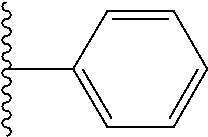 |
| 307 | 2 |
 |
| 308 | 2 |
 |
| 309 | 2 |
 |
| 310 | 2 |
 |
| 311 | 2 |
 |
| 312 | 2 |
 |

wherein, R10 and m are as previously defined.

| TABLE 7 | ||
| Compound | m | R10 |
| 313 | 0 | Methyl |
| 314 | 0 | Ethyl |
| 315 | 0 | Isopropyl |
| 316 | 0 | Butyl |
| 317 | 0 | t-Butyl |
| 318 | 0 | Propyl |
| 319 | 0 | Benzyl |
| 320 | 0 | Vinyl |
| 321 | 0 | Allyl |
| 322 | 0 | CF3 |
| 323 | 0 |
 |
| 324 | 0 |
 |
| 325 | 0 |
 |
| 326 | 0 |
 |
| 327 | 0 |
 |
| 328 | 0 |
 |
| 329 | 0 | H |
| 330 | 0 |
 |
| 331 | 0 |
 |
| 332 | 0 |
 |
| 333 | 0 |
 |
| 334 | 0 |
 |
| 335 | 0 |
 |
| 336 | 0 |
 |
| 337 | 0 |
 |
| 338 | 1 | Methyl |
| 339 | 1 | Ethyl |
| 340 | 1 | Isopropyl |
| 341 | 1 | Butyl |
| 342 | 1 | t-Butyl |
| 343 | 1 | Propyl |
| 344 | 1 | Benzyl |
| 345 | 1 | Vinyl |
| 346 | 1 | Allyl |
| 347 | 1 | CF3 |
| 348 | 1 |
 |
| 349 | 1 |
 |
| 350 | 1 |
 |
| 351 | 1 |
 |
| 352 | 1 |
 |
| 353 | 1 |
 |
| 354 | 1 | H |
| 355 | 1 |
 |
| 356 | 1 |
 |
| 357 | 1 |
 |
| 358 | 1 |
 |
| 359 | 1 |
 |
| 360 | 1 |
 |
| 361 | 1 |
 |
| 362 | 1 |
 |
| 363 | 2 | Methyl |
| 364 | 2 | Ethyl |
| 365 | 2 | Isopropyl |
| 366 | 2 | Butyl |
| 367 | 2 | t-Butyl |
| 368 | 2 | Propyl |
| 369 | 2 | Benzyl |
| 370 | 2 | Vinyl |
| 371 | 2 | Allyl |
| 372 | 2 | CF3 |
| 373 | 2 |
 |
| 374 | 2 |
 |
| 375 | 2 |
 |
| 376 | 2 |
 |
| 377 | 2 |
 |
| 378 | 2 |
 |
| 379 | 2 | H |
| 380 | 2 |
 |
| 381 | 2 |
 |
| 382 | 2 |
 |
| 383 | 2 |
 |
| 384 | 2 |
 |
| 385 | 2 |
 |
| 386 | 2 |
 |
| 387 | 2 |
 |

| TABLE 8 | ||
| Compound | m | R10 |
| 388 | 0 | Methyl |
| 389 | 0 | Ethyl |
| 390 | 0 | Isopropyl |
| 391 | 0 | Butyl |
| 392 | 0 | t-Butyl |
| 393 | 0 | Propyl |
| 394 | 0 | Benzyl |
| 395 | 0 | Vinyl |
| 396 | 0 | Allyl |
| 397 | 0 | CF3 |
| 398 | 0 |
 |
| 399 | 0 |
 |
| 400 | 0 |
 |
| 401 | 0 |
 |
| 402 | 0 |
 |
| 403 | 0 |
 |
| 404 | 0 | NH2 |
| 405 | 0 |
 |
| 406 | 0 |
 |
| 407 | 0 |
 |
| 408 | 0 |
 |
| 409 | 0 |
 |
| 410 | 0 |
 |
| 411 | 0 |
 |
| 412 | 1 | Methyl |
| 413 | 1 | Ethyl |
| 414 | 1 | Isopropyl |
| 415 | 1 | Butyl |
| 416 | 1 | t-Butyl |
| 417 | 1 | Propyl |
| 418 | 1 | Benzyl |
| 419 | 1 | Vinyl |
| 420 | 1 | Allyl |
| 421 | 1 | CF3 |
| 422 | 1 |
 |
| 423 | 1 |
 |
| 424 | 1 |
 |
| 425 | 1 |
 |
| 426 | 1 |
 |
| 427 | 1 |
 |
| 428 | 1 | NH2 |
| 429 | 1 |
 |
| 430 | 1 |
 |
| 431 | 1 |
 |
| 432 | 1 |
 |
| 433 | 1 |
 |
| 434 | 1 |
 |
| 435 | 1 |
 |
| 436 | 2 | Methyl |
| 437 | 2 | Ethyl |
| 438 | 2 | Isopropyl |
| 439 | 2 | Butyl |
| 440 | 2 | t-Butyl |
| 441 | 2 | Propyl |
| 442 | 2 | Benzyl |
| 443 | 2 | Vinyl |
| 444 | 2 | Allyl |
| 445 | 2 | CF3 |
| 446 | 2 |
 |
| 447 | 2 |
 |
| 448 | 2 |
 |
| 449 | 2 |
 |
| 450 | 2 |
 |
| 451 | 2 |
 |
| 452 | 2 | NH2 |
| 453 | 2 |
 |
| 454 | 2 |
 |
| 455 | 2 |
 |
| 456 | 2 |
 |
| 457 | 2 |
 |
| 458 | 2 |
 |
| 459 | 2 |
 |
-
- ACN for acetonitrile;
- BME for 2-mercaptoethanol;
- BOP for benzotriazol-1-yloxy-tris(dimethylamino)phosphonium hexafluorophosphate;
- BzCl for benzoyl chloride;
- CDI for carbonyldiimidazole;
- COD for cyclooctadiene;
- DABCO for 1,4-diazabicyclo[2.2.2]octane;
- DAST for diethylaminosulfur trifluoride;
- DABCYL for 6-(N-4′-carboxy-4-(dimethylamino)azobenzene)-aminohexyl-1-O-(2-cyanoethyl)-(N,N-diisopropyl)-phosphoramidite;
- DBU for 1,8-Diazabicycloundec-7-ene;
- DCC for N,N′-dicyclohexylcarbodiimide;
- DCM for dichloromethane;
- DHP for 3,4-Dihydro-2H-pyran;
- DIAD for diisopropyl azodicarboxylate;
- DIBAL-H for diisobutylaluminum hydride;
- DIPEA for diisopropyl ethylamine;
- DMAP for N,N-dimethylaminopyridine;
- DME for ethylene glycol dimethyl ether;
- DMEM for Dulbecco's Modified Eagles Media;
- DMF for N,N-dimethyl formamide;
- DMSO for dimethylsulfoxide;
- DSC for N,N′-disuccinimidyl carbonate;
- DPPA for diphenylphosphoryl azide;
- DUPHOS for

-
- EDANS for 5-(2-Amino-ethylamino)-naphthalene-1-sulfonic acid;
- EDCI or EDC for 1-(3-diethylaminopropyl)-3-ethylcarbodiimide hydrochloride;
- EtOAc for ethyl acetate;
- EtOH for ethyl alcohol;
- HATU for O (7-Azabenzotriazole-1-yl)-N,N,N′,N′-tetramethyluronium hexafluorophosphate;
- HCl for hydrochloric acid;
- Hoveyda's Cat. for Dichloro(o-isopropoxyphenylmethylene) (tricyclohexylphosphine)ruthenium(II);
- In for indium;
- KHMDS is potassium bis(trimethylsilyl) amide;
- Ms for mesyl;
- NMM for N-4-methylmorpholine;
- NMI for N-methylimidazole;
- NMO for N-4-methylmorpholine-N-Oxide;
- PyBrOP for Bromo-tri-pyrolidino-phosphonium hexafluorophosphate;
- Ph for phenyl;
- RCM for ring-closing metathesis;
- RT for reverse transcription;
- RT-PCR for reverse transcription-polymerase chain reaction;
- TBME for tert-butyl methyl ether;
- TEA for triethyl amine;
- Tf2O for trifluoromethanesulfonic anhydride;
- TFA for trifluoroacetic acid;
- THF for tetrahydrofuran;
- TLC for thin layer chromatography;
- (TMS)2NH for hexamethyldisilazane;
- TMSOTf for trimethylsilyl trifluoromethanesulfonate;
- TBS for t-Butyldimethylsilyl;
- TMS for trimethylsilyl;
- TPAP tetrapropylammonium perruthenate;
- TPP or PPh3 for triphenylphosphine;
- TrCl for trityl chloride;
- DMTrCl for 4,4′-dimethoxytrityl chloride;
- tBOC or Boc for tert-butyloxy carbonyl.
Synthetic Methods


Step 1-1:

Compound (1-1) was prepared by following the literature method (J. Med. Chem., 2012, 55, 8493). To a solution of compound (1-1) (30 g, 76.9 mmol) in MeOH (450 mL) was added acetyl chloride (2.3 g, 2.1 mL, 29.5 mmol) at rt and the reaction was stirred at rt for 19.5 h. Concentrated, chased with anhydrous THF and dried in vacuo to give compound (1-2) (32.1 g, 103% yield) as a white solid.
Step 1-2:

To a solution of LDA in THF/Hexanes/Ethylbenzene (250 mL, 500 mmol, 2.0 M) was added anhydrous THF (90 mL) and the solution was cooled at −50° C. A precooled solution of compound (1-2) (32.1 g, 76.9 mmol at most) and TMSCl (44 mL, 346.8 mmol) in THF (180 mL) was added over 5 min and the solution was stirred at −20° C. for 2 h. Quenched with Sat. NaHCO3 (150 mL) slowly. The organic layer was separated and dried over Na2SO4. Filtered, concentrated to give compound (1-3) (52 g) as a crude oil which was used for next step reaction without purification.
Step 1-3:

A solution of compound (1-3) (52 g, 76.9 mmol at most) mentioned above and CD3CHO (10 g, 212 mmol) in DCM (300 mL), precooled to −50° C., was added to a solution of BF3.Et2O (47 mL, 381 mmol) in DCM (300 mL) at −60° C. over 3 min. After stirred at below −60° C. for 2 h, the reaction was moved up to rt and stirred for 3 h. Cooled to 0° C., quenched with water (250 mL). The organic layer was separated and dried over Na2SO4. Filtered, concentrated, purified by Combiflash (Acetone/hexanes, 4-40%, v/v) to give compound (1-4) (20.1 g, 60% yield for 3 steps) as a white solid.

To a 500 mL round-bottomed flask containing Pd/C (10%, 750 mg, wetted by 1.5 mL of D2O) were added compound (1-4) (5.75 g, 13.3 mmol) and CD3OD (200 mL) and the atmosphere was replaced by D2 3 times. The reaction was stirred at room temperature for 16 h. Filtered through a pad of celite, eluted with MeOH, concentrated to give compound (1-5) (5.8 g, 99.7% yield) as a white solid.
Step 1-5:

To a 500 mL round-bottomed flask containing compound (1-5) (5.8 g, 13.3 mmol) were added MeOH (60 mL), H2O (12 mL), and 50% NaOH (12 mL) respectively and the solution was heated at 65° C. for 4.5 h. Cooled to 0° C., acidified with 3 NHCl to pH=2. Extracted with EtOAc (600 mL), the organic layer was washed with brine (100 mL). Dried, filtered, concentrated, purified by Combiflash (Acetone/hexanes, 0-40%, v/v) to give compound (1-6) (4.94 g, 88.2% yield) as a white solid.

To a 500 mL round-bottomed flask containing compound (1-6) (4.5 g, 10.6 mmol) were added 1 N NaOH solution (106 mL, 106 mmol) and NaBD4 (0.89 g, 21.3 mmol) and reaction was stirred at 100° C. for 80 min to reach 83% conversion by LC-MS. NaBD4 (0.45 g, 10.6 mmol) was added and reaction was stirred at 100° C. for another 70 min to reach completion. Cooled to 0° C., acidified with 3 N HCl (60 mL) to pH=1. Extracted with EtOAc, the organic layer was washed with brine. Dried, filtered, concentrated, recrystallized from EtOAc (27 mL)/hexanes (33 mL), to give a crystal example 1 (3.0 g, 66.7% yield) as a white solid. Mother liquor was concentrated to give another 1.5 g of example 1. MS (m/z): 470.35 [M+HCOOH—H]−. 1H NMR (500 MHz, CDCl3) 3.43 (1H, m), 2.40 (1H, m), 2.25 (1H, m), 0.94 (3H, d, J=6.5 Hz), 0.90 (3H, s), 0.66 (3H, s).

Step 2-1:

To a 1 L round-bottomed flask were added compound (1-1) (20 g, 51.2 mmol), a solvent mixture of CHCl3, CH2Cl2 and Et2O (700 mL, 1:1:2, v/v/v), TsOH.H2O (1.94 g, 10.2 mmol, 0.2 equiv.), 3,4-dihydro-2H-pyrane (16.2 g, 17.6 mL, 193 mmol, 3.77 equiv.) respectively and the reaction was stirred at rt for 2 h. Water (250 mL) was added and the organic layer was separated. The aqueous layer was extracted with EtOAc (800 mL) and the combined organic layers were washed with Sat. NaHCO3 and brine respectively. Dried, filtered, concentrated, purified by Combiflash (Acetone/hexanes, 0-100%, v/v) to give compound (2-1) (12 g, 49.4% yield) as a white solid.
Step 2-2:

To a 1-L round-bottomed flask containing compound (2-1) (10 g, 21.1 mmol) were added THF (200 mL) and HMPA (52.9 g, 51.4 mL, 295.4 mmol, 7.0 equiv.) and then the solution was cooled to −78° C. under N2 followed by addition of LDA dropwise over 25 min. An orange solution appeared. After stirred at −78° C. for 1 h, CD3CD2I (34.0 g, 16.9 mL, 211 mmol, 10.0 equiv.) was added dropwise and the color of reaction mixture turned to light yellow from orange. Stirred at −78° C.˜rt for 82 h. Concentrated, treated with EtOAc (500 mL) and H2O (100 mL). The organic layer was separated and washed with brine. Dried, filtered, concentrated, purified by combiflash (Acetone/Hexanes: 0-40%) to give compound (2-2) (2.06 g, 19.3% yield) as a white solid.
Step 2-3

To a 500 mL round-bottomed flask containing compound (2-2) (2.23 g, 4.39 mmol) were added PPTS (200 mg, 0.796 mmol, 0.18 equiv.) and EtOH (75 mL) and the solution was heated at 55° C. for 5 h. Concentrated, purified by combiflash (Acetone/Hexanes: 0˜100%) to give compound (2-3) (1.39 g, 74.7% yield) as a white solid. MS (m/z): 468.34 [M+HCOOH—H]−.
Step 2-4:

To a 500 mL round-bottomed flask containing compound (2-3) (1.39 g, 3.28 mmol) was added 1 N NaOH aqueous solution (100 mL, 100 mmol) and then the solution was heated at 100° C. for 3 h. Cooled to 0° C., acidified with 1 NHCl to pH=3. Extracted with EtOAc and washed with brine. Dried, filtered, and concentrated to give compound (2-4) (1.38 g, 99.3% yield) as a white solid. MS (m/z): 468.34 [M+HCOOH—H]−.
Step 2-5:

To a 100 mL round-bottomed flask containing compound (2-4) (1.38 g, 3.26 mmol) was added 1 N NaOH aqueous solution (24 mL, 24 mmol, 7.35 equiv.) and NaBH4 (123 mg, 3.26 mmol, 1.0 equiv.) respectively then the reaction was heated at 100° C. for 4 h. Diluted with H2O, cooled to 0° C., acidified with 1 N HCl to pH=3. Extracted with EtOAc and washed with brine. Dried, filtered, concentrated, purified by Combiflash (Acetone/Hexanes: 0˜100%) to give example 2 (0.42 g, 30.2% yield) as a white solid.

Step 3-1:

To a 250 mL 3-necked round-bottomed flask were added (1-4) (2 g, 4.61 mmol), THF (92 mL), MeOH (23 mL), CeCl3 (3.41 g, 13.83 mmol, 3.0 equiv.) and NaBH4 (209.3 mg, 5.53 mmol, 1.2 equiv.) respectively and the reaction was stirred at rt for 1.5 h. TLC indicated a complete reaction (TLC solvent: 30% acetone in hexane). Water (50 mL) and MeOH (50 mL) were added. Concentrated, dissolved with EtOAc, washed with brine and dried (Na2SO4) overnight. Filtered, concentrated, purified by Combiflash (80 g of SiO2, acetone/hexanes: 0˜100%) to give compound (3-1) as a white solid (2.0 g, 99% yield).

To a 100 mL round-bottomed flask were added (3-1) (100 mg, 0.23 mmol), Pd/C (10%, 10 mg), THF (4 mL) and the suspension was stirred at 0° C.˜rt for 64 h. Filtered, concentrated to give compound (3-2) as a white solid (98 mg, 98% yield).
Step 3-3:

A mixture of (3-2) (33 mg, 0.08 mmol), MeOH (2 mL), 50% NaOH (0.3 mL) and H2O (0.3 mL) was heated at 60° C. for 2 h. Diluted with H2O, cooled to 0° C., acidified with 10% citric acid, extracted with EtOAc. The organic layer was washed with brine. Dried, filtered, and concentrated to give example 3 as a white solid (30 mg, 94%). MS (m/z):

Step 4-1:

To a 100 mL round-bottomed flask were added (1-7) (900 mg, 2.11 mmol), THF (21 mL), and the solution was cooled to 0° C. under N2 followed by addition of TBSCl (953.8 mg, 6.33 mmol, 3.0 equiv.) and imidazole (1.0 g, 14.8 mmol, 7.0 equiv.). The reaction was moved to rt for 5.5 h. MeOH (21 mL) and K2CO3 (436.8 mg, 3.17 mmol, 1.5 equiv.) were added and the rxn was stirred at rt for 3 h. Cooled to 0° C., acidified with 0.3 N HCl to pH ˜5. Extracted with EtOAc, the organic layer was washed with brine and dried (Na2SO4) overnight. Filtered, concentrated, purified by Combiflash (40 g SiO2, acetone/hexanes: 0˜40%) to give compound (4-1) as a white solid (1.02 g, 89.5%).

To a 100 mL round-bottomed flask containing (4-1) (0.765 g, 1.42 mmol) was added toluene (14.2 mL) and the solution was cooled to 0° C. followed by addition of TEA (344 mg, 0.47 mL, 3.4 mmol, 2.4 equiv.) and DPPA (468.5 mg, 0.37 mL, 1.7 mmol, 1.2 equiv.). After stirred at 0° C. for 2 h, the reaction was heated at 100° C. for 4 h. Cooled to rt, 4-tert-butylbenzenesulfonamide (453.3 mg, 2.13 mmol, 1.5 equiv.) and DBU (432.4 mg, 0.45 mL, 2.84 mmol, 2.0 equiv.) were added respectively and reaction was stirred at rt for 69 h. Diluted with EtOAc, washed with Sat. NaHCO3 solution and brine successively. Dried, filtered, concentrated, purified by Combiflash (40 g SiO2, acetone/hexanes: 0˜40%) to give compound (4-2) as a white solid (815.3 mg, 79.4%).
Step 4-3:

To a 50 mL round-bottomed flask containing (4-2) (0.815 g, 1.09 mmol) were added MeOH (15 mL) and 1 drop of 37% conc. HCl. The mixture was stirred at room temperature for 80 min. Diluted with EtOAc, washed with Sat. NaHCO3 and brine. Dried, filtered and concentrated, purified by Combiflash (40 g SiO2, acetone/hexanes: 0˜40%) to give example 4 as a white solid (617 mg, 89.3%). MS (m/z): 634.43 [M+HCOOH—H]−.

The example 5 was prepared using same procedure as the one used in example 4. MS (m/z): 545.38 [M+HCOOH—H]−. 1H NMR (500 MHz, CDCl3) 8.89 (1H, m), 6.28 (1H, s), 3.30 (2H, m), 3.18 (2H, m), 2.84 (6H, s), 1.01 (3H, d, J=6.5 Hz), 0.92 (3H, s), 0.71 (3H, s).
| TABLE 8 | ||
| Example | EC50 (μM) | Efficacy (%) |
| CDCA | D | 100 |
| 6-ECDCA | B | 223 |
| 1 | B | 310 |
| 4 | A | 197 |
| 5 | B | 352. |
Claims (15)


Priority Applications (1)
| Application Number | Priority Date | Filing Date | Title |
|---|---|---|---|
| US15/439,358 US10364267B2 (en) | 2016-02-23 | 2017-02-22 | Deuterated bile acid derivatives as FXR/TGR5 agonists and methods of use thereof |
Applications Claiming Priority (2)
| Application Number | Priority Date | Filing Date | Title |
|---|---|---|---|
| US201662298717P | 2016-02-23 | 2016-02-23 | |
| US15/439,358 US10364267B2 (en) | 2016-02-23 | 2017-02-22 | Deuterated bile acid derivatives as FXR/TGR5 agonists and methods of use thereof |
Publications (2)
| Publication Number | Publication Date |
|---|---|
| US20170240585A1 US20170240585A1 (en) | 2017-08-24 |
| US10364267B2 true US10364267B2 (en) | 2019-07-30 |
Family
ID=59630913
Family Applications (1)
| Application Number | Title | Priority Date | Filing Date |
|---|---|---|---|
| US15/439,358 Active US10364267B2 (en) | 2016-02-23 | 2017-02-22 | Deuterated bile acid derivatives as FXR/TGR5 agonists and methods of use thereof |
Country Status (2)
| Country | Link |
|---|---|
| US (1) | US10364267B2 (en) |
| WO (1) | WO2017147159A1 (en) |
Families Citing this family (21)
| Publication number | Priority date | Publication date | Assignee | Title |
|---|---|---|---|---|
| WO2016073767A1 (en) | 2014-11-06 | 2016-05-12 | Enanta Pharmaceuticals, Inc. | Bile acid analogs an fxr/tgr5 agonists and methods of use thereof |
| US10208081B2 (en) | 2014-11-26 | 2019-02-19 | Enanta Pharmaceuticals, Inc. | Bile acid derivatives as FXR/TGR5 agonists and methods of use thereof |
| US11578097B2 (en) | 2014-11-26 | 2023-02-14 | Enanta Pharmaceuticals, Inc. | Tetrazole derivatives of bile acids as FXR/TGR5 agonists and methods of use thereof |
| JP2017535570A (en) | 2014-11-26 | 2017-11-30 | エナンタ ファーマシューティカルズ インコーポレイテッド | Bile acid analogs as FXR / TGR5 agonists and methods of use thereof |
| MX2017010376A (en) | 2015-02-11 | 2017-12-20 | Enanta Pharm Inc | Bile acid analogs as fxr/tgr5 agonists and methods of use thereof. |
| CA2981503C (en) | 2015-03-31 | 2023-09-19 | Enanta Pharmaceuticals, Inc. | Bile acid derivatives as fxr/tgr5 agonists and methods of use thereof |
| CA3045023A1 (en) * | 2016-11-29 | 2018-06-07 | Enanta Pharmaceuticals, Inc. | Process for preparation of sulfonylurea bile acid derivatives |
| US10472386B2 (en) | 2017-02-14 | 2019-11-12 | Enanta Pharmaceuticals, Inc. | Bile acid derivatives as FXR agonists and methods of use thereof |
| CA3058754A1 (en) | 2017-04-07 | 2018-10-11 | Enanta Pharmaceuticals, Inc. | Process for preparation of sulfonyl carbamate bile acid derivatives |
| WO2019023103A1 (en) | 2017-07-24 | 2019-01-31 | Intercept Pharmaceuticals, Inc. | Isotopically labeled bile acid derivatives |
| CN107955056A (en) * | 2017-12-06 | 2018-04-24 | 南京法恩化学有限公司 | A kind of synthetic method of Austria's shellfish cholic acid and intermediate |
| GB201812382D0 (en) | 2018-07-30 | 2018-09-12 | Nzp Uk Ltd | Compounds |
| EP3999101A1 (en) | 2019-07-18 | 2022-05-25 | ENYO Pharma | Method for decreasing adverse-effects of interferon |
| KR20220150270A (en) | 2019-10-07 | 2022-11-10 | 칼리오페, 인크. | GPR119 agonists |
| WO2021144330A1 (en) | 2020-01-15 | 2021-07-22 | INSERM (Institut National de la Santé et de la Recherche Médicale) | Use of fxr agonists for treating an infection by hepatitis d virus |
| TW202140440A (en) | 2020-02-28 | 2021-11-01 | 美商克力歐普股份有限公司 | Gpr40 agonists |
| WO2021236617A1 (en) | 2020-05-19 | 2021-11-25 | Kallyope, Inc. | Ampk activators |
| CN116390925A (en) | 2020-06-26 | 2023-07-04 | 卡尔优普公司 | AMPK activator |
| KR20230154806A (en) | 2021-01-14 | 2023-11-09 | 엔요 파마 | Synergistic effect of FXR agonist and IFN for treatment of HBV infection |
| CN117320722A (en) | 2021-04-28 | 2023-12-29 | 埃尼奥制药公司 | Use of FXR agonists as combination therapy strongly potentiates the effects of TLR3 agonists |
| TW202333741A (en) * | 2021-11-15 | 2023-09-01 | 大陸商海湃泰克(北京)生物醫藥科技有限公司 | Polycyclic compounds and methods thereof |
Citations (49)
| Publication number | Priority date | Publication date | Assignee | Title |
|---|---|---|---|---|
| US4202876A (en) | 1977-01-07 | 1980-05-13 | The Radiochemical Centre Limited | Investigating body function |
| EP0583566A2 (en) | 1992-08-04 | 1994-02-23 | ERREGIERRE INDUSTRIA CHIMICA Spa | Process for the preparation of glycine-conjugated bile acids and relative pharmaceutical compositions useful for treating hepatic insufficiency |
| WO1995026325A2 (en) * | 1994-03-25 | 1995-10-05 | Isotechnika Inc. | Enhancement of the efficacy of drugs by deuteration |
| US5512558A (en) | 1993-05-08 | 1996-04-30 | Hoechst Aktiengesellschaft | Nor-bile acid derivatives, processes for their preparation and the use of these compounds as medicaments |
| US5646316A (en) | 1994-04-08 | 1997-07-08 | Osteoarthritis Sciences, Inc. | Bile acid inhibitors of metalloproteinase enzymes |
| US5656277A (en) | 1992-06-30 | 1997-08-12 | Monteresearch S.R.L. | Nor- and homo- bile acids derivatives as absorption enhancers for medicaments |
| JPH1160594A (en) | 1997-08-25 | 1999-03-02 | Sankyo Co Ltd | Bile acid derivative |
| US6376531B1 (en) * | 1998-11-13 | 2002-04-23 | Rupert Charles Bell | Method of treatment using deuterium compounds |
| US6603008B1 (en) * | 1999-12-03 | 2003-08-05 | Pfizer Inc. | Sulfamoylheleroaryl pyrazole compounds as anti-inflammatory/analgesic agents |
| EP1364645A1 (en) | 2002-05-21 | 2003-11-26 | ZAMBONI, Paolo | Pharmaceutical combinations for topical use based on iron chelators, metalloprotease inhibitors and factor XIII for the treatment of lipodermatosclerosis and trophic lesions of the cutaneous tissues and muccous membranes |
| US20050054559A1 (en) | 2000-10-06 | 2005-03-10 | Gallop Mark A. | Compounds for sustained release of orally delivered drugs |
| US20070142340A1 (en) | 2001-03-12 | 2007-06-21 | Intercept Pharmaceuticals, Inc. | Steroids as agonists for FXR |
| WO2007111994A2 (en) | 2006-03-22 | 2007-10-04 | Syndexa Pharmaceuticals Corporation | Compounds and methods for treatment of disorders associated with er stress |
| US20080039435A1 (en) | 2004-02-26 | 2008-02-14 | Intercept Pharmaceuticals, Inc. | Novel Steroid Agonist For Fxr |
| WO2008091540A2 (en) | 2007-01-19 | 2008-07-31 | Intercept Pharmaceuticals, Inc. | 23-substituted bile acids as tgr5 modulators and methods of use thereof |
| US20080182832A1 (en) | 2006-06-27 | 2008-07-31 | Intercept Pharmaceuticals, Inc. | Bile acid derivatives as FXR ligands for the prevention or treatment of FXR-mediated diseases or conditions |
| US20080214515A1 (en) | 2005-05-19 | 2008-09-04 | Erregierre S.P.A. | Process for Preparing 3a(Beta)-7a(Beta)-Dihydroxy-6a(Beta)-Alkyl-5Beta-Cholanic Acid |
| US20090062526A1 (en) | 2007-08-28 | 2009-03-05 | Yu Donna D | novel method of synthesizing alkylated bile acid derivatives |
| US20090163474A1 (en) | 2007-10-19 | 2009-06-25 | Wyeth | FXR Agonists for the Treatment of Nonalcoholic Fatty Liver and Cholesterol Gallstone Diseases |
| WO2010014836A2 (en) | 2008-07-30 | 2010-02-04 | Intercept Pharmaceuticals, Inc. | Tgr5 modulators and methods of use thereof |
| US20100063018A1 (en) | 2006-02-14 | 2010-03-11 | Intercept Pharmaceuticals, Inc. | Bile acid derivatives as fxr ligands for the prevention or treatment of fxr-mediated diseases or conditions |
| US20100324004A1 (en) | 2007-09-06 | 2010-12-23 | Mclane Michael | Method for Treating Diabetes |
| WO2013020108A2 (en) | 2011-08-04 | 2013-02-07 | Lumena Pharmaceuticals, Inc. | Bile acid recycling inhibitors for treatment of pancreatitis |
| US20130116218A1 (en) | 2011-09-29 | 2013-05-09 | Ethicon Endo-Surgery, Inc. | Methods and compositions of bile acids |
| WO2013166176A1 (en) | 2012-05-01 | 2013-11-07 | Catabasis Pharmaceuticals, Inc. | Fatty acid conjugates of statin and fxr agonists; compositions and method of uses |
| US20130345188A1 (en) | 2012-06-19 | 2013-12-26 | Intercept Pharmaceuticals, Inc. | Preparation and Uses of Obeticholic Acid |
| WO2014036379A2 (en) | 2012-08-31 | 2014-03-06 | Metselex | Bile acids prevent or abolish progression of parkinson's and related neurodegenerative diseases |
| US20140186438A1 (en) | 2012-12-31 | 2014-07-03 | Amarin Pharmaceuticals Ireland Limited | Compositions comprising epa and obeticholic acid and methods of use thereof |
| US20140187633A1 (en) | 2012-12-31 | 2014-07-03 | Amarin Pharmaceuticals Ireland Limited | Methods of treating or preventing nonalcoholic steatohepatitis and/or primary biliary cirrhosis |
| US20140206657A1 (en) | 2013-01-18 | 2014-07-24 | City Of Hope | Bile acid analog tgr5 agonists |
| WO2014184271A1 (en) | 2013-05-14 | 2014-11-20 | Tes Pharma Srl. | 11-hydroxyl-derivatives of bile acids and amino acid conjugates thereof as farnesoid x receptor modulators |
| US20150112089A1 (en) | 2013-10-22 | 2015-04-23 | Metselex, Inc. | Deuterated bile acids |
| WO2015181275A1 (en) | 2014-05-29 | 2015-12-03 | Bar Pharmaceuticals S.R.L. | Cholane derivatives for use in the treatment and/or prevention of fxr and tgr5/gpbar1 mediated diseases |
| CN105175473A (en) * | 2015-08-19 | 2015-12-23 | 丽珠医药集团股份有限公司 | Obeticholic acid crystal form I, preparation method, pharmaceutical composition, and application thereof |
| US20160130297A1 (en) | 2014-11-06 | 2016-05-12 | Enanta Pharmaceuticals, Inc. | Bile acid analogs as fxr/tgr5 agonists and methods of use thereof |
| US20160145295A1 (en) | 2014-11-26 | 2016-05-26 | Enanta Pharmaceuticals, Inc. | Tetrazole derivatives of bile acids as fxr/tgr5 agonists and methods of use thereof |
| US20160145296A1 (en) * | 2014-11-26 | 2016-05-26 | Enanta Pharmaceuticals, Inc. | Bile acid analogs as fxr/tgr5 agonists and methods of use thereof |
| US20160176917A1 (en) | 2014-11-26 | 2016-06-23 | Enanta Pharmaceuticals, Inc. | Bile Acid Derivatives as FXR/TGR5 Agonists and Methods of Use Thereof |
| US20160185815A1 (en) | 2014-11-26 | 2016-06-30 | Enanta Pharmaceuticals, Inc. | Bile acid derivatives as fxr/tgr5 agonists and methods of use thereof |
| US20160229886A1 (en) | 2015-02-11 | 2016-08-11 | Enanta Pharmaceuticals, Inc. | Bile acid analogs as fxr/tgr5 agonists and methods of use thereof |
| US20160289262A1 (en) | 2015-03-31 | 2016-10-06 | Enanta Pharmaceuticals, Inc. | Bile acid derivatives as fxr/tgr5 agonists and methods of use thereof |
| WO2016173524A1 (en) | 2015-04-29 | 2016-11-03 | 正大天晴药业集团股份有限公司 | Chenodeoxycholic acid derivative |
| WO2017027396A1 (en) | 2015-08-07 | 2017-02-16 | Intercept Pharmaceuticals, Inc. | Methods for preparation of bile acids and derivatives thereof |
| CN106478759A (en) | 2015-08-31 | 2017-03-08 | 陕西合成药业股份有限公司 | Shellfish chlolic acid derivatives difficult to understand and its production and use |
| CN106518946A (en) | 2015-09-10 | 2017-03-22 | 上海迪诺医药科技有限公司 | Sulfonylurea derivative and pharmaceutical composition and application thereof |
| WO2017053826A1 (en) | 2015-09-24 | 2017-03-30 | Intercept Pharmaceuticals, Inc. | Methods and intermediates for the preparation bile acid derivatives |
| US20170101434A1 (en) | 2015-10-07 | 2017-04-13 | Intercept Pharmaceuticals, Inc. | Farnesoid x receptor modulators |
| WO2017129125A1 (en) | 2016-01-28 | 2017-08-03 | 正大天晴药业集团股份有限公司 | Steroid derivative fxr agonist |
| US20170260225A1 (en) | 2016-03-11 | 2017-09-14 | Intercept Pharmaceuticals, Inc. | 3-desoxy derivative and pharmaceutical compositions thereof |
-
2017
- 2017-02-22 WO PCT/US2017/018894 patent/WO2017147159A1/en not_active Ceased
- 2017-02-22 US US15/439,358 patent/US10364267B2/en active Active
Patent Citations (53)
| Publication number | Priority date | Publication date | Assignee | Title |
|---|---|---|---|---|
| US4202876A (en) | 1977-01-07 | 1980-05-13 | The Radiochemical Centre Limited | Investigating body function |
| US5656277A (en) | 1992-06-30 | 1997-08-12 | Monteresearch S.R.L. | Nor- and homo- bile acids derivatives as absorption enhancers for medicaments |
| EP0583566A2 (en) | 1992-08-04 | 1994-02-23 | ERREGIERRE INDUSTRIA CHIMICA Spa | Process for the preparation of glycine-conjugated bile acids and relative pharmaceutical compositions useful for treating hepatic insufficiency |
| US5512558A (en) | 1993-05-08 | 1996-04-30 | Hoechst Aktiengesellschaft | Nor-bile acid derivatives, processes for their preparation and the use of these compounds as medicaments |
| WO1995026325A2 (en) * | 1994-03-25 | 1995-10-05 | Isotechnika Inc. | Enhancement of the efficacy of drugs by deuteration |
| US5646316A (en) | 1994-04-08 | 1997-07-08 | Osteoarthritis Sciences, Inc. | Bile acid inhibitors of metalloproteinase enzymes |
| JPH1160594A (en) | 1997-08-25 | 1999-03-02 | Sankyo Co Ltd | Bile acid derivative |
| US6376531B1 (en) * | 1998-11-13 | 2002-04-23 | Rupert Charles Bell | Method of treatment using deuterium compounds |
| US6603008B1 (en) * | 1999-12-03 | 2003-08-05 | Pfizer Inc. | Sulfamoylheleroaryl pyrazole compounds as anti-inflammatory/analgesic agents |
| US20050054559A1 (en) | 2000-10-06 | 2005-03-10 | Gallop Mark A. | Compounds for sustained release of orally delivered drugs |
| US20070142340A1 (en) | 2001-03-12 | 2007-06-21 | Intercept Pharmaceuticals, Inc. | Steroids as agonists for FXR |
| EP1364645A1 (en) | 2002-05-21 | 2003-11-26 | ZAMBONI, Paolo | Pharmaceutical combinations for topical use based on iron chelators, metalloprotease inhibitors and factor XIII for the treatment of lipodermatosclerosis and trophic lesions of the cutaneous tissues and muccous membranes |
| US20080039435A1 (en) | 2004-02-26 | 2008-02-14 | Intercept Pharmaceuticals, Inc. | Novel Steroid Agonist For Fxr |
| US20080214515A1 (en) | 2005-05-19 | 2008-09-04 | Erregierre S.P.A. | Process for Preparing 3a(Beta)-7a(Beta)-Dihydroxy-6a(Beta)-Alkyl-5Beta-Cholanic Acid |
| US20100063018A1 (en) | 2006-02-14 | 2010-03-11 | Intercept Pharmaceuticals, Inc. | Bile acid derivatives as fxr ligands for the prevention or treatment of fxr-mediated diseases or conditions |
| WO2007111994A2 (en) | 2006-03-22 | 2007-10-04 | Syndexa Pharmaceuticals Corporation | Compounds and methods for treatment of disorders associated with er stress |
| US20080182832A1 (en) | 2006-06-27 | 2008-07-31 | Intercept Pharmaceuticals, Inc. | Bile acid derivatives as FXR ligands for the prevention or treatment of FXR-mediated diseases or conditions |
| WO2008091540A2 (en) | 2007-01-19 | 2008-07-31 | Intercept Pharmaceuticals, Inc. | 23-substituted bile acids as tgr5 modulators and methods of use thereof |
| US20090062526A1 (en) | 2007-08-28 | 2009-03-05 | Yu Donna D | novel method of synthesizing alkylated bile acid derivatives |
| US20100324004A1 (en) | 2007-09-06 | 2010-12-23 | Mclane Michael | Method for Treating Diabetes |
| US20090163474A1 (en) | 2007-10-19 | 2009-06-25 | Wyeth | FXR Agonists for the Treatment of Nonalcoholic Fatty Liver and Cholesterol Gallstone Diseases |
| WO2010014836A2 (en) | 2008-07-30 | 2010-02-04 | Intercept Pharmaceuticals, Inc. | Tgr5 modulators and methods of use thereof |
| WO2010014836A3 (en) | 2008-07-30 | 2010-04-01 | Intercept Pharmaceuticals, Inc. | Tgr5 modulators and methods of use thereof |
| US20110172198A1 (en) | 2008-07-30 | 2011-07-14 | Intercept Pharmaceuticals, Inc. | TGR5 Modulators And Methods Of Use Thereof |
| WO2013020108A2 (en) | 2011-08-04 | 2013-02-07 | Lumena Pharmaceuticals, Inc. | Bile acid recycling inhibitors for treatment of pancreatitis |
| US20130116218A1 (en) | 2011-09-29 | 2013-05-09 | Ethicon Endo-Surgery, Inc. | Methods and compositions of bile acids |
| WO2013166176A1 (en) | 2012-05-01 | 2013-11-07 | Catabasis Pharmaceuticals, Inc. | Fatty acid conjugates of statin and fxr agonists; compositions and method of uses |
| WO2013192097A1 (en) | 2012-06-19 | 2013-12-27 | Intercept Pharmaceuticals, Inc. | Preparation, uses and solid forms of obeticholic acid |
| US20130345188A1 (en) | 2012-06-19 | 2013-12-26 | Intercept Pharmaceuticals, Inc. | Preparation and Uses of Obeticholic Acid |
| WO2014036379A2 (en) | 2012-08-31 | 2014-03-06 | Metselex | Bile acids prevent or abolish progression of parkinson's and related neurodegenerative diseases |
| US20140186438A1 (en) | 2012-12-31 | 2014-07-03 | Amarin Pharmaceuticals Ireland Limited | Compositions comprising epa and obeticholic acid and methods of use thereof |
| US20140187633A1 (en) | 2012-12-31 | 2014-07-03 | Amarin Pharmaceuticals Ireland Limited | Methods of treating or preventing nonalcoholic steatohepatitis and/or primary biliary cirrhosis |
| US20140206657A1 (en) | 2013-01-18 | 2014-07-24 | City Of Hope | Bile acid analog tgr5 agonists |
| WO2014184271A1 (en) | 2013-05-14 | 2014-11-20 | Tes Pharma Srl. | 11-hydroxyl-derivatives of bile acids and amino acid conjugates thereof as farnesoid x receptor modulators |
| US20140371190A1 (en) | 2013-05-14 | 2014-12-18 | TES Pharma SrI. | Farnesoid X receptor modulators |
| US20150112089A1 (en) | 2013-10-22 | 2015-04-23 | Metselex, Inc. | Deuterated bile acids |
| WO2015181275A1 (en) | 2014-05-29 | 2015-12-03 | Bar Pharmaceuticals S.R.L. | Cholane derivatives for use in the treatment and/or prevention of fxr and tgr5/gpbar1 mediated diseases |
| US20160130297A1 (en) | 2014-11-06 | 2016-05-12 | Enanta Pharmaceuticals, Inc. | Bile acid analogs as fxr/tgr5 agonists and methods of use thereof |
| US20160145295A1 (en) | 2014-11-26 | 2016-05-26 | Enanta Pharmaceuticals, Inc. | Tetrazole derivatives of bile acids as fxr/tgr5 agonists and methods of use thereof |
| US20160145296A1 (en) * | 2014-11-26 | 2016-05-26 | Enanta Pharmaceuticals, Inc. | Bile acid analogs as fxr/tgr5 agonists and methods of use thereof |
| US20160176917A1 (en) | 2014-11-26 | 2016-06-23 | Enanta Pharmaceuticals, Inc. | Bile Acid Derivatives as FXR/TGR5 Agonists and Methods of Use Thereof |
| US20160185815A1 (en) | 2014-11-26 | 2016-06-30 | Enanta Pharmaceuticals, Inc. | Bile acid derivatives as fxr/tgr5 agonists and methods of use thereof |
| US20160229886A1 (en) | 2015-02-11 | 2016-08-11 | Enanta Pharmaceuticals, Inc. | Bile acid analogs as fxr/tgr5 agonists and methods of use thereof |
| US20160289262A1 (en) | 2015-03-31 | 2016-10-06 | Enanta Pharmaceuticals, Inc. | Bile acid derivatives as fxr/tgr5 agonists and methods of use thereof |
| WO2016173524A1 (en) | 2015-04-29 | 2016-11-03 | 正大天晴药业集团股份有限公司 | Chenodeoxycholic acid derivative |
| WO2017027396A1 (en) | 2015-08-07 | 2017-02-16 | Intercept Pharmaceuticals, Inc. | Methods for preparation of bile acids and derivatives thereof |
| CN105175473A (en) * | 2015-08-19 | 2015-12-23 | 丽珠医药集团股份有限公司 | Obeticholic acid crystal form I, preparation method, pharmaceutical composition, and application thereof |
| CN106478759A (en) | 2015-08-31 | 2017-03-08 | 陕西合成药业股份有限公司 | Shellfish chlolic acid derivatives difficult to understand and its production and use |
| CN106518946A (en) | 2015-09-10 | 2017-03-22 | 上海迪诺医药科技有限公司 | Sulfonylurea derivative and pharmaceutical composition and application thereof |
| WO2017053826A1 (en) | 2015-09-24 | 2017-03-30 | Intercept Pharmaceuticals, Inc. | Methods and intermediates for the preparation bile acid derivatives |
| US20170101434A1 (en) | 2015-10-07 | 2017-04-13 | Intercept Pharmaceuticals, Inc. | Farnesoid x receptor modulators |
| WO2017129125A1 (en) | 2016-01-28 | 2017-08-03 | 正大天晴药业集团股份有限公司 | Steroid derivative fxr agonist |
| US20170260225A1 (en) | 2016-03-11 | 2017-09-14 | Intercept Pharmaceuticals, Inc. | 3-desoxy derivative and pharmaceutical compositions thereof |
Non-Patent Citations (26)
Also Published As
| Publication number | Publication date |
|---|---|
| US20170240585A1 (en) | 2017-08-24 |
| WO2017147159A1 (en) | 2017-08-31 |
Similar Documents
| Publication | Publication Date | Title |
|---|---|---|
| US12281140B2 (en) | Bile acid derivatives as FXR/TGR5 agonists and methods of use thereof | |
| US10364267B2 (en) | Deuterated bile acid derivatives as FXR/TGR5 agonists and methods of use thereof | |
| US11958879B2 (en) | Bile acid derivatives as FXR/TGR5 agonists and methods of use thereof | |
| US11578097B2 (en) | Tetrazole derivatives of bile acids as FXR/TGR5 agonists and methods of use thereof | |
| US10323060B2 (en) | Benzoic acid derivatives of bile acid as FXR/TGR5 agonists and methods of use thereof | |
| US10246483B2 (en) | Bile acid analogs as FXR/TGR5 agonists and methods of use thereof | |
| US10266560B2 (en) | Bile acid analogs as FXR/TGR5 agonists and methods of use thereof | |
| US10323061B2 (en) | Heteroaryl containing bile acid analogs as FXR/TGR5 agonists and methods of use thereof | |
| US10519191B2 (en) | Bile acid analogs as FXR/TGR5 agonists and methods of use thereof | |
| US10149835B2 (en) | Isoxazole derivatives as FXR agonists and methods of use thereof | |
| US10138228B2 (en) | Isoxazole derivatives as FXR agonists and methods of use therof | |
| US10080742B2 (en) | Isoxazole derivatives as FXR agonists and methods of use thereof | |
| US10080743B2 (en) | Isoxazole derivatives as FXR agonists and methods of use thereof | |
| US10472386B2 (en) | Bile acid derivatives as FXR agonists and methods of use thereof | |
| US20160176917A1 (en) | Bile Acid Derivatives as FXR/TGR5 Agonists and Methods of Use Thereof | |
| US20170334893A1 (en) | Isoxazole Analogs as FXR Agonists and Methods of Use Thereof |
Legal Events
| Date | Code | Title | Description |
|---|---|---|---|
| AS | Assignment |
Owner name: ENANTA PHARMACEUTICALS, INC., MASSACHUSETTS Free format text: ASSIGNMENT OF ASSIGNORS INTEREST;ASSIGNORS:WANG, GUOQIANG;OR, YAT SUN;LONG, JIANG;AND OTHERS;SIGNING DATES FROM 20170425 TO 20170501;REEL/FRAME:042225/0440 |
|
| STPP | Information on status: patent application and granting procedure in general |
Free format text: NOTICE OF ALLOWANCE MAILED -- APPLICATION RECEIVED IN OFFICE OF PUBLICATIONS |
|
| STPP | Information on status: patent application and granting procedure in general |
Free format text: PUBLICATIONS -- ISSUE FEE PAYMENT VERIFIED |
|
| STCF | Information on status: patent grant |
Free format text: PATENTED CASE |
|
| MAFP | Maintenance fee payment |
Free format text: PAYMENT OF MAINTENANCE FEE, 4TH YEAR, LARGE ENTITY (ORIGINAL EVENT CODE: M1551); ENTITY STATUS OF PATENT OWNER: LARGE ENTITY Year of fee payment: 4 |