US10354121B2 - Method for verifying the veracity of a finger - Google Patents
Method for verifying the veracity of a finger Download PDFInfo
- Publication number
- US10354121B2 US10354121B2 US15/741,930 US201615741930A US10354121B2 US 10354121 B2 US10354121 B2 US 10354121B2 US 201615741930 A US201615741930 A US 201615741930A US 10354121 B2 US10354121 B2 US 10354121B2
- Authority
- US
- United States
- Prior art keywords
- fringe
- finger
- calculated
- feature
- average
- Prior art date
- Legal status (The legal status is an assumption and is not a legal conclusion. Google has not performed a legal analysis and makes no representation as to the accuracy of the status listed.)
- Active, expires
Links
Images


Classifications
-
- G—PHYSICS
- G06—COMPUTING OR CALCULATING; COUNTING
- G06V—IMAGE OR VIDEO RECOGNITION OR UNDERSTANDING
- G06V40/00—Recognition of biometric, human-related or animal-related patterns in image or video data
- G06V40/10—Human or animal bodies, e.g. vehicle occupants or pedestrians; Body parts, e.g. hands
- G06V40/12—Fingerprints or palmprints
- G06V40/1382—Detecting the live character of the finger, i.e. distinguishing from a fake or cadaver finger
-
- G06K9/00107—
-
- G06K9/00087—
-
- G06K9/00208—
-
- G06K9/00899—
-
- G—PHYSICS
- G06—COMPUTING OR CALCULATING; COUNTING
- G06V—IMAGE OR VIDEO RECOGNITION OR UNDERSTANDING
- G06V20/00—Scenes; Scene-specific elements
- G06V20/60—Type of objects
- G06V20/64—Three-dimensional [3D] objects
- G06V20/647—Three-dimensional [3D] objects by matching two-dimensional images to three-dimensional objects
-
- G—PHYSICS
- G06—COMPUTING OR CALCULATING; COUNTING
- G06V—IMAGE OR VIDEO RECOGNITION OR UNDERSTANDING
- G06V40/00—Recognition of biometric, human-related or animal-related patterns in image or video data
- G06V40/10—Human or animal bodies, e.g. vehicle occupants or pedestrians; Body parts, e.g. hands
- G06V40/12—Fingerprints or palmprints
- G06V40/1365—Matching; Classification
-
- G—PHYSICS
- G06—COMPUTING OR CALCULATING; COUNTING
- G06V—IMAGE OR VIDEO RECOGNITION OR UNDERSTANDING
- G06V40/00—Recognition of biometric, human-related or animal-related patterns in image or video data
- G06V40/40—Spoof detection, e.g. liveness detection
Definitions
- the present invention relates to a method for verifying the veracity of one or more fingers, as well as a verification device suitable for implementing such a verification method.
- the finger is a real finger rather than a decoy presented for the purpose of deceiving the identification/authentication system.
- This layer may for example be a layer of latex, silicone or gelatine or a printed sheet wound or just placed on the finger.
- One object of the present invention is to propose a method for verifying the veracity of a finger that does not have the drawbacks of the prior art and which in particular allows to provide better detection of a decoy in the case of a contactless verification device.
- a verification device comprising a projection device designed to project a pattern consisting of a plurality of lines which are parallel to one another on the finger and orthogonal to the favoured longitudinal direction of the finger, a capture device designed to capture an image of the finger and of the pattern, and a processing unit, the method comprising:
- Such a method therefore does not require a three-dimensional reconstruction of the finger and therefore offers a saving in time.
- the optical axis of the projection device and the optical axis of the capture device are concurrent.
- the feature-calculation step consists of calculating, for each fringe and for each point on said fringe, the sagitta at said point, and then calculating, for each fringe, the variance in the sagittas thus calculated, and then calculating, over all the fringes, the average of the variances in the sagittas thus calculated, and the physical feature calculated is this average.
- the feature-calculation step further consists, first of all of calculating, for each fringe and for each point on said fringe, the sagitta at said point, and then calculating, for each fringe, the average of the sagittas thus calculated, and then, over all the fringes, calculating the average of the averages of the sagittas thus calculated, and the physical feature calculated is the average of the averages.
- the invention also proposes a device for verifying the veracity of a finger, the verification device comprising means for implementing the verification method according to one of the preceding variants.
- FIG. 1 shows a device for verifying the veracity of a finger according to the invention
- FIG. 2 shows an algorithm of a method for verifying the veracity of a finger according to the invention
- FIG. 3 a shows an image of a pattern projected onto real fingers
- FIG. 3 b shows an image of a pattern projected onto a paper fraud
- FIG. 3 c shows an image of a pattern projected onto a latex fraud
- FIG. 4 a shows an image of fringes extracted from the image of the pattern in FIG. 3 a
- FIG. 4 b shows an image of the fringes extracted from the image of the pattern in FIG. 3 b
- FIG. 4 c shows an image of the fringes extracted from the image of the pattern in FIG. 3 c
- FIG. 5 is an example of a fringe
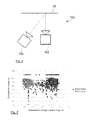
- FIG. 6 shows an example of implementation of the verification device according to the invention.
- FIG. 7 shows a diagram of results for the example implementation in FIG. 6 .
- the principle of the invention consists first of all of projecting onto the finger a pattern consisting of lines parallel to each other and orthogonal to the favoured longitudinal direction of the finger, and then capturing an image of the finger with the lines thus projected, and analysing the structures of the lines captured on the image in order to deduce therefrom the veracity of the finger.
- the decoy consists of a sheet of paper simply placed on the finger
- the projected lines will be rectilinear whereas, in the case of a finger, they will have a certain curvature.
- FIG. 1 shows a verification device 100 intended to verify whether or not the finger 50 is a real finger.
- the verification device 100 comprises a projection device 106 designed to project a pattern 52 consisting of a plurality of parallel lines on the finger 50 , a capture device 102 provided for capturing an image of the finger 2 and of the pattern 52 , and a processing unit 104 .
- the capture device 102 comprises at least one capture means such as for example a camera.
- the capture means 102 captures without contact an image of the pattern 52 thus projected onto the finger 50 .
- the pattern image 302 a - c is a digital image.
- FIG. 3 a shows a pattern image 302 a for a real finger 50 .
- FIG. 3 b shows a pattern image 302 b for a finger 50 covered with a paper fraud.
- FIG. 3 c shows a pattern image 302 c for a finger 50 covered with a latex fraud.
- the processing unit 104 extracts the fringes of the pattern image 302 a - c thus obtained.
- FIG. 4 a shows an image of fringes 402 a calculated from the pattern image 302 a.
- FIG. 4 b shows a fringe image 402 b calculated from the pattern image 302 b.
- FIG. 4 c shows a fringe image 402 c calculated from the pattern image 302 c.
- Analysing the fringes 402 a - c shows clearly that the frauds can be detected from the physical structure of said fringes 402 a - c .
- the fringes 402 a of a real finger 50 are curved, while the fringes 402 b of a paper decoy are rectilinear and some fringes 402 c of a silicone decoy are irregular because of the step between the surfaces of the finger 50 and the layer of latex.
- FIG. 2 shows an algorithm of a method 200 for verifying the validity of a finger 50 implemented by the verification device 100 .
- the verification method 200 comprises:
- the pattern 52 is preferably a single colour in order to allow to acquire additional information on other channels, for example the fingerprint of the finger under uniform illumination.
- the fringe-extraction step 206 consists for example of extracting the fringes corresponding to the black/white or white/black edges of the pattern image.
- the fringe-extraction step 206 consists, using the pattern image 302 a - c , for example of applying a Canny-Deriche horizontal filter in order to extract therefrom the fringes 402 a - c . It is also possible to use a horizontal contour detection of the Sobel, Prewitt type or any other suitable image processing method, in particular Fourier space filtering.
- the image of the fringes 402 a - c is binarised.
- the binarization is carried out for example by means of Otsu's method followed by a skeletonisation step.
- the method then comprises, between the fringe-extraction step 206 and the feature-calculation step 208 , a binarization step followed by a skeletonisation step.
- the elements of the image that do not with certainty constitute fringes 402 a - c but are other elements resulting for example from optical elements or segmentation of the finger. Furthermore, it is also preferable to ensure that the fringes have not been broken up around discontinuities in the finger.
- criteria of orientation and length in the first case and proximity in the second case allow respectively to eliminate or recombine pieces of fringes.
- the fringes are preserved only in a zone roughly encompassing the first phalanx of the finger.
- the pattern image 302 a - c relates to a plurality of fingers
- the segmentation step may for example be carried out by means of an Otsu algorithm applied to the sub-sampled image.
- the physical features are related to the form of the fringes or to irregularities in the fringes.
- the form of the fringes makes it possible to differentiate a real finger 50 from a paper decoy ( FIG. 4 b ).
- the presence of roughnesses makes it possible to differentiate a real finger 50 from a protruding latex decoy ( FIG. 4 c ).
- FIG. 5 shows an example of a fringe 402 a as extracted during the extraction step in a reference frame (O, x, y), where x is parallel to the longitudinal axis of the finger and y is an axis transverse to the finger in the plane of the pattern image 302 a .
- the point C (x i , y i ) is a point on the fringe 402 a .
- the points A and B are symmetrical points of the fringe 402 a having respectively as their ordinate y i ⁇ N and y i +N, where N is a relatively small fixed number of pixels that is for example 5 to 10 pixels.
- M is the middle of the segment [A, B] and the sagitta is the signed distance d(C, M).
- the feature-calculation step 208 consists first of all of calculating, for each fringe 402 a - c and for each point on said fringe 402 a - c , the sagitta at said point, and then, for each fringe 402 a - c , calculating the variance of the sagittas thus calculated, and then calculating, over all the fringes 402 a - c , the average of the variances of the sagittas thus calculated.
- the physical feature calculated is then this average of the variances or in the same way the standardised average of the variance of the sagittas.
- the feature-calculation step 208 consists first of all of calculating, for each fringe 402 a - c and for each point on said fringe 402 a - c , the sagitta at said point, and then, for each fringe 402 a - c , calculating the average of the sagittas thus calculated, and then, over all the fringes 402 a - c , calculating the average of the averages of the sagittas thus calculated.
- the physical feature calculated is then this average of the averages.
- the feature-calculation step 208 then consists of calculating, for each fringe 402 a - c , the parameters a, b and c of its modelling, and then, for each fringe 402 a - c , calculating, for each point on said fringe 402 a - c , the error between the actual fringe 402 a - c and the modelled fringe with the formula (x i ay i 2 ⁇ by i ⁇ c) 2 where ‘i’ is the index of the point on the fringe in question, and then, on each fringe 402 a - c , the average of this error, and then, over all the fringes 402 a - c , calculating the average of the average errors thus calculated.
- the physical feature calculated is then this average.
- the values x i and y i are the coordinates of the point of index ‘i’ of the fringe in question and which are obtained after the binarization step and the skeletonisation step.
- the comparison step 210 then consists of comparing the value of each feature with reference values of these features.
- the comparison step may be implemented by any suitable comparison means such as for example a neural network, a support vector machine (SVM) or a decision tree.
- SVM support vector machine
- the comparison means conventionally require a learning phase during which the real fingers 50 and fingers 50 covered with decoys are presented in front of a verification device 100 , which calculates the particular features to be recorded. Following this learning phase, the comparison means are able to classify each new finger 50 that is presented to it as a real finger or a false finger. Alternatively, the learning may be carried out with only real fingers and an algorithm of the one-class SVM type.
- FIG. 6 shows an example of the use of a verification device 100 with a camera 102 and a projection device 106 , where the finger 50 is at the intersection of the optical axes of the camera 102 and of the projection device 106 , which are not parallel.
- the optical axis of the projection device 106 and the optical axis of the capture device 102 are concurrent.
- the point of intersection of the axes is in a capture volume that is relatively large because the acquisition is done without contact.
- the capture volume is the volume that is situated opposite the capture device 102 in which the finger 50 can be positioned freely while guaranteeing that the captured image is sharp.
- the intersection point is situated at approximately 10 cm from the surface of the finger 50 , preferentially at approximately 5 cm and even more preferentially at approximately 2.5 cm.
- the optical axis of the projection device 106 and the optical axis of the capture device 102 here the camera 102 , are concurrent at the surface of the finger 50 .
- the camera 102 is here a full HD camera with a focal length of 12.5 mm and a resolution of around 600 dpi.
- the distance between the finger 50 and the camera 102 is around 200 mm.
- the angle between the optical axis of the camera 102 and the optical axis of the projection device 106 is between 10° and 60°, preferentially between 20° and 40°, and more preferentially equal to 26°.
- FIG. 7 shows a combination of two combined analyses, namely on the x axis the standardised average of the variance of the sagittas and on the y axis the standardised average of the parameters ‘a’ of the parabolic form.
- FIG. 7 show the detection of paper frauds ( FIG. 3 b ) with respect to real fingers, with 84% fraud detection and 1% false rejects (real fingers detected as fraud).
- the samples shown by crosses represent the real fingers and are collected together at the top part and on the left, and the samples represented by dots represent the paper frauds and are collected together at the top part and on the right.
Landscapes
- Engineering & Computer Science (AREA)
- Physics & Mathematics (AREA)
- General Physics & Mathematics (AREA)
- Multimedia (AREA)
- Theoretical Computer Science (AREA)
- Human Computer Interaction (AREA)
- Collating Specific Patterns (AREA)
- Electrophonic Musical Instruments (AREA)
- Auxiliary Devices For Music (AREA)
- Measurement Of The Respiration, Hearing Ability, Form, And Blood Characteristics Of Living Organisms (AREA)
Abstract
Description
-
- an illumination step in which the projection device illuminates the finger with the pattern,
- a contactless capture step in which the capture device captures a pattern image of the projected pattern on the finger,
- a fringe-extraction step in which the processing unit extracts fringes from the pattern image thus captured,
- a feature calculation step in which the processing unit calculates at least one feature relating to the physical structure of the fringes,
- a comparison step during which the processing unit compares the calculated feature or features thus calculated with reference values of these features, and
- a decision-making step in which the processing unit makes a decision regarding the veracity of the finger from the result of the comparison step.
-
- an
illumination step 201 in which theprojection device 106 illuminates thefinger 50 with the pattern 52, - a
capture step 202 in which thecapture device 102 captures a pattern image 302 a-c of the projected pattern 52 on thefinger 50, - a fringe-
extraction step 206 in which theprocessing unit 104 extracts the fringes 402 a-c from the pattern image 302 a-c thus captured, - a feature-
calculation step 208 in which theprocessing unit 104 calculates at least one feature relating to the physical structure of the fringes 402 a-c, - a
comparison step 210 during which theprocessing unit 104 compares the feature or features thus calculated with reference values of these features, and - a decision-making
step 212 in which theprocessing unit 104 makes a decision regarding the veracity of thefinger 50 from the result of thecomparison step 210.
- an
Claims (6)
Applications Claiming Priority (4)
| Application Number | Priority Date | Filing Date | Title |
|---|---|---|---|
| FR15/56531 | 2015-07-09 | ||
| FR1556531 | 2015-07-09 | ||
| FR1556531A FR3038761B1 (en) | 2015-07-09 | 2015-07-09 | METHOD OF VERIFYING THE TRUTH OF A FINGER |
| PCT/EP2016/065738 WO2017005703A1 (en) | 2015-07-09 | 2016-07-04 | Method for verifying the veracity of a finger |
Publications (2)
| Publication Number | Publication Date |
|---|---|
| US20180204044A1 US20180204044A1 (en) | 2018-07-19 |
| US10354121B2 true US10354121B2 (en) | 2019-07-16 |
Family
ID=54007903
Family Applications (1)
| Application Number | Title | Priority Date | Filing Date |
|---|---|---|---|
| US15/741,930 Active 2036-09-07 US10354121B2 (en) | 2015-07-09 | 2016-07-04 | Method for verifying the veracity of a finger |
Country Status (6)
| Country | Link |
|---|---|
| US (1) | US10354121B2 (en) |
| EP (1) | EP3320481B1 (en) |
| KR (1) | KR102628177B1 (en) |
| ES (1) | ES2940346T3 (en) |
| FR (1) | FR3038761B1 (en) |
| WO (1) | WO2017005703A1 (en) |
Families Citing this family (1)
| Publication number | Priority date | Publication date | Assignee | Title |
|---|---|---|---|---|
| CN110532913A (en) * | 2018-11-30 | 2019-12-03 | 神盾股份有限公司 | Electronic device and biological characteristic method for sensing |
Citations (11)
| Publication number | Priority date | Publication date | Assignee | Title |
|---|---|---|---|---|
| US20060120576A1 (en) * | 2004-11-08 | 2006-06-08 | Biomagnetic Imaging Llc | 3D Fingerprint and palm print data model and capture devices using multi structured lights and cameras |
| US20070211926A1 (en) * | 2006-03-13 | 2007-09-13 | Fujitsu Limited | Fingerprint authenticating apparatus, live-finger determining apparatus, and live-finger determining method |
| US20080002860A1 (en) * | 2006-06-30 | 2008-01-03 | Super Boaz J | Recognition method using hand biometrics with anti-counterfeiting |
| US20080095412A1 (en) * | 2004-09-13 | 2008-04-24 | The Ritsumeikan Trust | Method And System For Extracting Liveliness Information From Fingertip |
| US20090232368A1 (en) * | 2008-03-13 | 2009-09-17 | Fujitsu Limited | Authentication apparatus |
| WO2010036403A2 (en) | 2008-05-06 | 2010-04-01 | Flashscan3D, Llc | System and method for structured light illumination with frame subwindows |
| US20110064282A1 (en) * | 2009-09-16 | 2011-03-17 | General Electric Company | Method and system for contactless fingerprint detection and verification |
| US20110216948A1 (en) * | 2010-03-04 | 2011-09-08 | Flashscan3D, Llc | System and method for three-dimensional biometric data feature detection and recognition |
| US20110222755A1 (en) * | 2010-03-09 | 2011-09-15 | Hoya Corporation | Device, method and computer readable medium for evaluating shape of optical element |
| US20140049373A1 (en) | 2012-08-17 | 2014-02-20 | Flashscan3D, Llc | System and method for structured light illumination with spoofing detection |
| US20140294262A1 (en) * | 2013-04-02 | 2014-10-02 | Clarkson University | Fingerprint pore analysis for liveness detection |
Family Cites Families (1)
| Publication number | Priority date | Publication date | Assignee | Title |
|---|---|---|---|---|
| EP2177898A1 (en) * | 2008-10-14 | 2010-04-21 | Fraunhofer-Gesellschaft zur Förderung der angewandten Forschung e.V. | Method for selecting an optimized evaluation feature subset for an inspection of free-form surfaces and method for inspecting a free-form surface |
-
2015
- 2015-07-09 FR FR1556531A patent/FR3038761B1/en not_active Expired - Fee Related
-
2016
- 2016-07-04 KR KR1020187003680A patent/KR102628177B1/en active Active
- 2016-07-04 EP EP16734657.6A patent/EP3320481B1/en active Active
- 2016-07-04 ES ES16734657T patent/ES2940346T3/en active Active
- 2016-07-04 WO PCT/EP2016/065738 patent/WO2017005703A1/en not_active Ceased
- 2016-07-04 US US15/741,930 patent/US10354121B2/en active Active
Patent Citations (12)
| Publication number | Priority date | Publication date | Assignee | Title |
|---|---|---|---|---|
| US20080095412A1 (en) * | 2004-09-13 | 2008-04-24 | The Ritsumeikan Trust | Method And System For Extracting Liveliness Information From Fingertip |
| US20060120576A1 (en) * | 2004-11-08 | 2006-06-08 | Biomagnetic Imaging Llc | 3D Fingerprint and palm print data model and capture devices using multi structured lights and cameras |
| US20070211926A1 (en) * | 2006-03-13 | 2007-09-13 | Fujitsu Limited | Fingerprint authenticating apparatus, live-finger determining apparatus, and live-finger determining method |
| US20080002860A1 (en) * | 2006-06-30 | 2008-01-03 | Super Boaz J | Recognition method using hand biometrics with anti-counterfeiting |
| US20090232368A1 (en) * | 2008-03-13 | 2009-09-17 | Fujitsu Limited | Authentication apparatus |
| WO2010036403A2 (en) | 2008-05-06 | 2010-04-01 | Flashscan3D, Llc | System and method for structured light illumination with frame subwindows |
| US20110058023A1 (en) * | 2008-05-06 | 2011-03-10 | Flashscan3D, Llc | System and method for structured light illumination with frame subwindows |
| US20110064282A1 (en) * | 2009-09-16 | 2011-03-17 | General Electric Company | Method and system for contactless fingerprint detection and verification |
| US20110216948A1 (en) * | 2010-03-04 | 2011-09-08 | Flashscan3D, Llc | System and method for three-dimensional biometric data feature detection and recognition |
| US20110222755A1 (en) * | 2010-03-09 | 2011-09-15 | Hoya Corporation | Device, method and computer readable medium for evaluating shape of optical element |
| US20140049373A1 (en) | 2012-08-17 | 2014-02-20 | Flashscan3D, Llc | System and method for structured light illumination with spoofing detection |
| US20140294262A1 (en) * | 2013-04-02 | 2014-10-02 | Clarkson University | Fingerprint pore analysis for liveness detection |
Non-Patent Citations (9)
| Title |
|---|
| "3D Biometrics", 1 January 2013, SPRINGER NEW YORK, New York, NY, ISBN: 978-1-4614-7400-5, article DAVID ZHANG, GUANGMING LU: "3D Fingerprint Identification System", pages: 217 - 230, XP055274965, DOI: 10.1007/978-1-4614-7400-5_12 |
| Di Martino et al; "3D Curvature Analysis with a Novel One-Shot Technique;" The Institute of Electrical and Electronics Engineers, Inc. (IEEE) Conference Proceedings; Oct. 1, 2014; XP055274533; 5 pp. |
| EMANUELA MARASCO,ARUN ROSS: "A Survey on Anti-Spoofing Schemes for Fingerprint Recognition Systems", ACM COMPUTING SURVEYS., ACM, NEW YORK, NY, US., US, vol. 47, no. 2, 1 September 2014 (2014-09-01), US, pages A1 - A36, XP055229904, ISSN: 0360-0300, DOI: 10.1145/2617756 |
| J MATIAS DI MARTINO, MARTINO DI, FERN�NDEZ ALICIA, FERRARI JOS� A: "3D curvature analysis with a novel one-shot technique", THE INSTITUTE OF ELECTRICAL AND ELECTRONICS ENGINEERS, INC. (IEEE) CONFERENCE PROCEEDINGS, THE INSTITUTE OF ELECTRICAL AND ELECTRONICS ENGINEERS, INC. (IEEE), PISCATAWAY, 1 October 2014 (2014-10-01), Piscataway, pages 3818, XP055274533, DOI: 10.1109/ICIP.2014.7025775 |
| Marasco et al; "A Survey on Anti-Spoofing Schemes for Fingerprint Recognition Systems;" ACM Computing Surveys; vol. 47; No. 2; Article A; Sep. 1, 2014; XP055229904; 36 pp. |
| Sep. 6, 2016 Search Report issued in International Patent Application No. PCT/EP2016/065738. |
| VENKATESH, A.: "Large sieve inequalities for GL(n)-forms in the conductor aspect", ADVANCES IN MATHEMATICS, ACADEMIC PRESS, NEW YORK, NY, US, vol. 200, no. 2, 1 March 2006 (2006-03-01), US, pages 336 - 356, XP005274963, ISSN: 0001-8708, DOI: 10.1016/j.aim.2005.11.001 |
| Zhang et al; "3D Fingerprint Identification System;" 3D Biometrics; Jan. 1, 2013; XP055274965; pp. 217-230. |
| Zhang et al; "3D Fingerprint Reconstruction;" 3D Biometrics; Jan. 1, 2013; XP05274963; pp. 195-216. |
Also Published As
| Publication number | Publication date |
|---|---|
| US20180204044A1 (en) | 2018-07-19 |
| WO2017005703A1 (en) | 2017-01-12 |
| ES2940346T3 (en) | 2023-05-05 |
| EP3320481A1 (en) | 2018-05-16 |
| FR3038761B1 (en) | 2018-09-07 |
| FR3038761A1 (en) | 2017-01-13 |
| KR20180030083A (en) | 2018-03-21 |
| EP3320481B1 (en) | 2023-01-18 |
| KR102628177B1 (en) | 2024-01-22 |
Similar Documents
| Publication | Publication Date | Title |
|---|---|---|
| CN104820819B (en) | Verification method and verification device using a real finger as a fingerprint carrier | |
| Labati et al. | Contactless fingerprint recognition: a neural approach for perspective and rotation effects reduction | |
| KR102561723B1 (en) | System and method for performing fingerprint-based user authentication using images captured using a mobile device | |
| US8391590B2 (en) | System and method for three-dimensional biometric data feature detection and recognition | |
| CN107992797B (en) | Face recognition method and related device | |
| CN114120375B (en) | Method and system for performing fingerprint identification | |
| KR101632912B1 (en) | Method for User Authentication using Fingerprint Recognition | |
| CN101901336A (en) | Decision-level fusion method for fingerprint and finger vein dual-modal recognition | |
| CN103890778B (en) | Anti-spoofing equipment | |
| Kolberg et al. | Colfispoof: A new database for contactless fingerprint presentation attack detection research | |
| JP7665078B2 (en) | Slap Segmentation of Contactless Fingerprint Images | |
| Hartl et al. | Real-time detection and recognition of machine-readable zones with mobile devices. | |
| KR101601187B1 (en) | Device Control Unit and Method Using User Recognition Information Based on Palm Print Image | |
| US10354121B2 (en) | Method for verifying the veracity of a finger | |
| KR100489430B1 (en) | Recognising human fingerprint method and apparatus independent of location translation , rotation and recoding medium recorded program for executing the method | |
| US20160283705A1 (en) | Device for checking the authenticity of a fingerprint | |
| Gupta et al. | A slap fingerprint based verification system invariant to halo and sweat artifacts | |
| EP3627380B1 (en) | A method of verifying the acquisition of an individual's biometric data | |
| CN113378779B (en) | A household registration image judgment method, system and readable storage medium based on image recognition | |
| US9460335B2 (en) | Method for detecting the reality of venous networks for the purposes of identifying individuals, and biometric recognition method | |
| Mathivanan et al. | Peg Free Multi-Dimensional Palmprint Feature Extraction Using Hybrid Level Fusion Strategy | |
| Ren et al. | An Edge Detection Algorithm for Nonuniformly Illuminated Images in Finger-vein Authentication | |
| HK1228068B (en) | Image analysis for authenticating a product |
Legal Events
| Date | Code | Title | Description |
|---|---|---|---|
| AS | Assignment |
Owner name: MORPHO, FRANCE Free format text: ASSIGNMENT OF ASSIGNORS INTEREST;ASSIGNORS:MORICEAU, DAMIEN;JOURDAS, CECILE;REEL/FRAME:044538/0357 Effective date: 20160720 Owner name: IDEMIA IDENTITY & SECURITY FRANCE, FRANCE Free format text: CHANGE OF NAME;ASSIGNOR:MORPHO;REEL/FRAME:045650/0384 Effective date: 20071002 |
|
| FEPP | Fee payment procedure |
Free format text: ENTITY STATUS SET TO UNDISCOUNTED (ORIGINAL EVENT CODE: BIG.); ENTITY STATUS OF PATENT OWNER: LARGE ENTITY |
|
| STPP | Information on status: patent application and granting procedure in general |
Free format text: DOCKETED NEW CASE - READY FOR EXAMINATION |
|
| AS | Assignment |
Owner name: IDEMIA IDENTITY & SECURITY FRANCE, FRANCE Free format text: CORRECTIVE ASSIGNMENT TO CORRECT THE EXECUTION DATE OF THE ASSIGNOR PREVIOUSLY RECORDED AT REEL: 045650 FRAME: 0384. ASSIGNOR(S) HEREBY CONFIRMS THE CHANGE OF NAME;ASSIGNOR:MORPHO;REEL/FRAME:046084/0600 Effective date: 20171002 |
|
| AS | Assignment |
Owner name: IDEMIA IDENTITY & SECURITY, FRANCE Free format text: CHANGE OF NAME;ASSIGNOR:SAFRAN IDENTITY & SECURITY;REEL/FRAME:047529/0948 Effective date: 20171002 |
|
| AS | Assignment |
Owner name: SAFRAN IDENTITY & SECURITY, FRANCE Free format text: CHANGE OF NAME;ASSIGNOR:MORPHO;REEL/FRAME:048039/0605 Effective date: 20160613 |
|
| STPP | Information on status: patent application and granting procedure in general |
Free format text: NOTICE OF ALLOWANCE MAILED -- APPLICATION RECEIVED IN OFFICE OF PUBLICATIONS |
|
| STPP | Information on status: patent application and granting procedure in general |
Free format text: PUBLICATIONS -- ISSUE FEE PAYMENT VERIFIED |
|
| STCF | Information on status: patent grant |
Free format text: PATENTED CASE |
|
| AS | Assignment |
Owner name: IDEMIA IDENTITY & SECURITY FRANCE, FRANCE Free format text: CORRECTIVE ASSIGNMENT TO CORRECT THE THE RECEIVING PARTY DATA PREVIOUSLY RECORDED ON REEL 047529 FRAME 0948. ASSIGNOR(S) HEREBY CONFIRMS THE CHANGE OF NAME;ASSIGNOR:SAFRAN IDENTITY AND SECURITY;REEL/FRAME:055108/0009 Effective date: 20171002 |
|
| AS | Assignment |
Owner name: IDEMIA IDENTITY & SECURITY FRANCE, FRANCE Free format text: CORRECTIVE ASSIGNMENT TO CORRECT THE APPLICATION NUMBER PREVIOUSLY RECORDED AT REEL: 055108 FRAME: 0009. ASSIGNOR(S) HEREBY CONFIRMS THE CHANGE OF NAME;ASSIGNOR:SAFRAN IDENTITY AND SECURITY;REEL/FRAME:055314/0930 Effective date: 20171002 |
|
| MAFP | Maintenance fee payment |
Free format text: PAYMENT OF MAINTENANCE FEE, 4TH YEAR, LARGE ENTITY (ORIGINAL EVENT CODE: M1551); ENTITY STATUS OF PATENT OWNER: LARGE ENTITY Year of fee payment: 4 |
|
| AS | Assignment |
Owner name: IDEMIA IDENTITY & SECURITY FRANCE, FRANCE Free format text: CORRECTIVE ASSIGNMENT TO CORRECT THE THE REMOVE PROPERTY NUMBER 15001534 PREVIOUSLY RECORDED AT REEL: 055314 FRAME: 0930. ASSIGNOR(S) HEREBY CONFIRMS THE ASSIGNMENT;ASSIGNOR:SAFRAN IDENTITY & SECURITY;REEL/FRAME:066629/0638 Effective date: 20171002 Owner name: IDEMIA IDENTITY & SECURITY, FRANCE Free format text: CORRECTIVE ASSIGNMENT TO CORRECT THE ERRONEOUSLY NAMED PROPERTIES 14/366,087 AND 15/001,534 PREVIOUSLY RECORDED ON REEL 047529 FRAME 0948. ASSIGNOR(S) HEREBY CONFIRMS THE CHANGE OF NAME;ASSIGNOR:SAFRAN IDENTITY & SECURITY;REEL/FRAME:066343/0232 Effective date: 20171002 Owner name: SAFRAN IDENTITY & SECURITY, FRANCE Free format text: CORRECTIVE ASSIGNMENT TO CORRECT THE ERRONEOUSLY NAMED PROPERTIES 14/366,087 AND 15/001,534 PREVIOUSLY RECORDED ON REEL 048039 FRAME 0605. ASSIGNOR(S) HEREBY CONFIRMS THE CHANGE OF NAME;ASSIGNOR:MORPHO;REEL/FRAME:066343/0143 Effective date: 20160613 Owner name: IDEMIA IDENTITY & SECURITY FRANCE, FRANCE Free format text: CORRECTIVE ASSIGNMENT TO CORRECT THE REMOVE ERRONEOUSLY NAME PROPERTIES/APPLICATION NUMBERS PREVIOUSLY RECORDED AT REEL: 055108 FRAME: 0009. ASSIGNOR(S) HEREBY CONFIRMS THE ASSIGNMENT;ASSIGNOR:SAFRAN IDENTITY & SECURITY;REEL/FRAME:066365/0151 Effective date: 20171002 |
|
| AS | Assignment |
Owner name: IDEMIA PUBLIC SECURITY FRANCE, FRANCE Free format text: ASSIGNMENT OF ASSIGNORS INTEREST;ASSIGNOR:IDEMIA IDENTITY & SECURITY FRANCE;REEL/FRAME:071930/0625 Effective date: 20241231 |