US10344602B2 - Gas turbine engine transition duct and turbine center frame - Google Patents

Gas turbine engine transition duct and turbine center frame Download PDF

Info

Publication number
US10344602B2
US10344602B2 US15/131,292 US201615131292A US10344602B2 US 10344602 B2 US10344602 B2 US 10344602B2 US 201615131292 A US201615131292 A US 201615131292A US 10344602 B2 US10344602 B2 US 10344602B2
Authority
US
United States
Prior art keywords
transition duct
radially
radially outer
fairing
gas turbine
Prior art date
Legal status (The legal status is an assumption and is not a legal conclusion. Google has not performed a legal analysis and makes no representation as to the accuracy of the status listed.)
Active, expires
Application number
US15/131,292
Other versions
US20170298747A1 (en
Inventor
Harjit Hura
Paul Hadley Vitt
Brian David Keith
Jonathan Ong
Current Assignee (The listed assignees may be inaccurate. Google has not performed a legal analysis and makes no representation or warranty as to the accuracy of the list.)
General Electric Co
Original Assignee
General Electric Co
Priority date (The priority date is an assumption and is not a legal conclusion. Google has not performed a legal analysis and makes no representation as to the accuracy of the date listed.)
Filing date
Publication date
Application filed by General Electric Co filed Critical General Electric Co
Priority to US15/131,292 priority Critical patent/US10344602B2/en
Assigned to GENERAL ELECTRIC COMPANY reassignment GENERAL ELECTRIC COMPANY ASSIGNMENT OF ASSIGNORS INTEREST (SEE DOCUMENT FOR DETAILS). Assignors: HURA, HARJIT, MR., KEITH, BRIAN DAVID, MR., VITT, PAUL HADLEY, MR., ONG, JONATHAN, MR.
Priority to EP17164948.6A priority patent/EP3236012A1/en
Priority to CA2963517A priority patent/CA2963517A1/en
Priority to JP2017075627A priority patent/JP2017198200A/en
Priority to CN201710253128.2A priority patent/CN107304684B/en
Publication of US20170298747A1 publication Critical patent/US20170298747A1/en
Application granted granted Critical
Publication of US10344602B2 publication Critical patent/US10344602B2/en
Active legal-status Critical Current
Adjusted expiration legal-status Critical

Links

Images

Classifications

    • FMECHANICAL ENGINEERING; LIGHTING; HEATING; WEAPONS; BLASTING
    • F01MACHINES OR ENGINES IN GENERAL; ENGINE PLANTS IN GENERAL; STEAM ENGINES
    • F01DNON-POSITIVE DISPLACEMENT MACHINES OR ENGINES, e.g. STEAM TURBINES
    • F01D9/00Stators
    • F01D9/02Nozzles; Nozzle boxes; Stator blades; Guide conduits, e.g. individual nozzles
    • F01D9/023Transition ducts between combustor cans and first stage of the turbine in gas-turbine engines; their cooling or sealings
    • FMECHANICAL ENGINEERING; LIGHTING; HEATING; WEAPONS; BLASTING
    • F01MACHINES OR ENGINES IN GENERAL; ENGINE PLANTS IN GENERAL; STEAM ENGINES
    • F01DNON-POSITIVE DISPLACEMENT MACHINES OR ENGINES, e.g. STEAM TURBINES
    • F01D25/00Component parts, details, or accessories, not provided for in, or of interest apart from, other groups
    • FMECHANICAL ENGINEERING; LIGHTING; HEATING; WEAPONS; BLASTING
    • F01MACHINES OR ENGINES IN GENERAL; ENGINE PLANTS IN GENERAL; STEAM ENGINES
    • F01DNON-POSITIVE DISPLACEMENT MACHINES OR ENGINES, e.g. STEAM TURBINES
    • F01D25/00Component parts, details, or accessories, not provided for in, or of interest apart from, other groups
    • F01D25/16Arrangement of bearings; Supporting or mounting bearings in casings
    • F01D25/162Bearing supports
    • FMECHANICAL ENGINEERING; LIGHTING; HEATING; WEAPONS; BLASTING
    • F01MACHINES OR ENGINES IN GENERAL; ENGINE PLANTS IN GENERAL; STEAM ENGINES
    • F01DNON-POSITIVE DISPLACEMENT MACHINES OR ENGINES, e.g. STEAM TURBINES
    • F01D5/00Blades; Blade-carrying members; Heating, heat-insulating, cooling or antivibration means on the blades or the members
    • F01D5/12Blades
    • F01D5/14Form or construction
    • F01D5/141Shape, i.e. outer, aerodynamic form
    • F01D5/142Shape, i.e. outer, aerodynamic form of the blades of successive rotor or stator blade-rows
    • F01D5/143Contour of the outer or inner working fluid flow path wall, i.e. shroud or hub contour
    • FMECHANICAL ENGINEERING; LIGHTING; HEATING; WEAPONS; BLASTING
    • F01MACHINES OR ENGINES IN GENERAL; ENGINE PLANTS IN GENERAL; STEAM ENGINES
    • F01DNON-POSITIVE DISPLACEMENT MACHINES OR ENGINES, e.g. STEAM TURBINES
    • F01D5/00Blades; Blade-carrying members; Heating, heat-insulating, cooling or antivibration means on the blades or the members
    • F01D5/12Blades
    • F01D5/14Form or construction
    • F01D5/141Shape, i.e. outer, aerodynamic form
    • F01D5/145Means for influencing boundary layers or secondary circulations
    • FMECHANICAL ENGINEERING; LIGHTING; HEATING; WEAPONS; BLASTING
    • F01MACHINES OR ENGINES IN GENERAL; ENGINE PLANTS IN GENERAL; STEAM ENGINES
    • F01DNON-POSITIVE DISPLACEMENT MACHINES OR ENGINES, e.g. STEAM TURBINES
    • F01D9/00Stators
    • F01D9/02Nozzles; Nozzle boxes; Stator blades; Guide conduits, e.g. individual nozzles
    • FMECHANICAL ENGINEERING; LIGHTING; HEATING; WEAPONS; BLASTING
    • F01MACHINES OR ENGINES IN GENERAL; ENGINE PLANTS IN GENERAL; STEAM ENGINES
    • F01DNON-POSITIVE DISPLACEMENT MACHINES OR ENGINES, e.g. STEAM TURBINES
    • F01D9/00Stators
    • F01D9/02Nozzles; Nozzle boxes; Stator blades; Guide conduits, e.g. individual nozzles
    • F01D9/04Nozzles; Nozzle boxes; Stator blades; Guide conduits, e.g. individual nozzles forming ring or sector
    • F01D9/041Nozzles; Nozzle boxes; Stator blades; Guide conduits, e.g. individual nozzles forming ring or sector using blades
    • FMECHANICAL ENGINEERING; LIGHTING; HEATING; WEAPONS; BLASTING
    • F01MACHINES OR ENGINES IN GENERAL; ENGINE PLANTS IN GENERAL; STEAM ENGINES
    • F01DNON-POSITIVE DISPLACEMENT MACHINES OR ENGINES, e.g. STEAM TURBINES
    • F01D9/00Stators
    • F01D9/06Fluid supply conduits to nozzles or the like
    • F01D9/065Fluid supply or removal conduits traversing the working fluid flow, e.g. for lubrication-, cooling-, or sealing fluids
    • FMECHANICAL ENGINEERING; LIGHTING; HEATING; WEAPONS; BLASTING
    • F02COMBUSTION ENGINES; HOT-GAS OR COMBUSTION-PRODUCT ENGINE PLANTS
    • F02CGAS-TURBINE PLANTS; AIR INTAKES FOR JET-PROPULSION PLANTS; CONTROLLING FUEL SUPPLY IN AIR-BREATHING JET-PROPULSION PLANTS
    • F02C3/00Gas-turbine plants characterised by the use of combustion products as the working fluid
    • F02C3/04Gas-turbine plants characterised by the use of combustion products as the working fluid having a turbine driving a compressor
    • FMECHANICAL ENGINEERING; LIGHTING; HEATING; WEAPONS; BLASTING
    • F02COMBUSTION ENGINES; HOT-GAS OR COMBUSTION-PRODUCT ENGINE PLANTS
    • F02CGAS-TURBINE PLANTS; AIR INTAKES FOR JET-PROPULSION PLANTS; CONTROLLING FUEL SUPPLY IN AIR-BREATHING JET-PROPULSION PLANTS
    • F02C7/00Features, components parts, details or accessories, not provided for in, or of interest apart form groups F02C1/00 - F02C6/00; Air intakes for jet-propulsion plants
    • F02C7/20Mounting or supporting of plant; Accommodating heat expansion or creep
    • FMECHANICAL ENGINEERING; LIGHTING; HEATING; WEAPONS; BLASTING
    • F04POSITIVE - DISPLACEMENT MACHINES FOR LIQUIDS; PUMPS FOR LIQUIDS OR ELASTIC FLUIDS
    • F04DNON-POSITIVE-DISPLACEMENT PUMPS
    • F04D29/00Details, component parts, or accessories
    • F04D29/40Casings; Connections of working fluid
    • F04D29/52Casings; Connections of working fluid for axial pumps
    • F04D29/54Fluid-guiding means, e.g. diffusers
    • F04D29/541Specially adapted for elastic fluid pumps
    • F04D29/545Ducts
    • FMECHANICAL ENGINEERING; LIGHTING; HEATING; WEAPONS; BLASTING
    • F04POSITIVE - DISPLACEMENT MACHINES FOR LIQUIDS; PUMPS FOR LIQUIDS OR ELASTIC FLUIDS
    • F04DNON-POSITIVE-DISPLACEMENT PUMPS
    • F04D29/00Details, component parts, or accessories
    • F04D29/58Cooling; Heating; Diminishing heat transfer
    • F04D29/582Cooling; Heating; Diminishing heat transfer specially adapted for elastic fluid pumps
    • F04D29/584Cooling; Heating; Diminishing heat transfer specially adapted for elastic fluid pumps cooling or heating the machine
    • FMECHANICAL ENGINEERING; LIGHTING; HEATING; WEAPONS; BLASTING
    • F05INDEXING SCHEMES RELATING TO ENGINES OR PUMPS IN VARIOUS SUBCLASSES OF CLASSES F01-F04
    • F05DINDEXING SCHEME FOR ASPECTS RELATING TO NON-POSITIVE-DISPLACEMENT MACHINES OR ENGINES, GAS-TURBINES OR JET-PROPULSION PLANTS
    • F05D2220/00Application
    • F05D2220/30Application in turbines
    • F05D2220/32Application in turbines in gas turbines
    • YGENERAL TAGGING OF NEW TECHNOLOGICAL DEVELOPMENTS; GENERAL TAGGING OF CROSS-SECTIONAL TECHNOLOGIES SPANNING OVER SEVERAL SECTIONS OF THE IPC; TECHNICAL SUBJECTS COVERED BY FORMER USPC CROSS-REFERENCE ART COLLECTIONS [XRACs] AND DIGESTS
    • Y02TECHNOLOGIES OR APPLICATIONS FOR MITIGATION OR ADAPTATION AGAINST CLIMATE CHANGE
    • Y02TCLIMATE CHANGE MITIGATION TECHNOLOGIES RELATED TO TRANSPORTATION
    • Y02T50/00Aeronautics or air transport
    • Y02T50/60Efficient propulsion technologies, e.g. for aircraft
    • Y02T50/671
    • Y02T50/673

Definitions

  • the present invention relates to gas turbine engine turbine sections and, more specifically, to gas turbine engine high and low pressure turbines and a turbine center frame and transition duct therebetween.
  • At least some known gas turbine engines include in downstream serial flow relationship a forward fan, a core engine, and a low-pressure turbine (LPT).
  • the core engine includes at least one compressor, a combustor, and a high-pressure turbine (HPT).
  • the compressor and HPT are coupled through a shaft to define a high-pressure rotor assembly. Air entering the core engine is compressed, mixed with fuel, and ignited to form a high energy gas stream.
  • the high energy gas stream is directed through the HPT to rotatably drive the HPT such that the shaft rotatably drives the compressor.
  • the high energy gas stream is then channeled downstream from the HPT to the LPT via a transition duct.
  • the HPT has a smaller radius than the LPT and, thus, the transition duct has an “S” shaped cross-section to facilitate flow therebetween.
  • the transition duct has an “S” shaped cross-section to facilitate flow therebetween.
  • Such a quick transition with a shorter transition duct facilitates reducing the weight of the overall turbine assembly and facilitates increasing the performance of the engine.
  • using a shorter transition duct with aggressive curvature may lead to flow separation at the boundary layers of transition duct inner and outer walls.
  • the engine may include a turbine center frame (TCF) between the HPT and the LPT.
  • TCF turbine center frame
  • Radially extending TCF struts are surrounded and shrouded by and pass through fairings of the transition duct.
  • the fairings extend radially between the transition duct inner and outer walls.
  • U.S. Pat. No. 9,222,437 by Joseph Machnaim, et al. issued Dec. 29, 2015 and entitled “TRANSITION DUCT FOR USE IN A TURBINE ENGINE AND METHOD OF ASSEMBLY” discloses a transition duct fluidly connecting and coupling a high-pressure turbine (HPT) to a low-pressure turbine (LPT) in an aircraft gas turbine engine and is incorporated herein by reference.
  • HPT high-pressure turbine
  • LPT low-pressure turbine
  • transition ducts that have a shorter axial length with aggressive outer wall slope may lead to unwanted boundary layer flow separation of the fluid flowing therethrough.
  • known transition ducts include fairings to accommodate struts of the center frame extending therethrough that are used to support a turbine center frame.
  • transition duct described and disclosed in the patent document is designed to facilitate reducing flow separation of fluid channeled from the HPT to the LPT. More specifically, the transition duct includes an aggressive outer wall slope from the duct inlet to a predetermined axial location in the transition duct, and reduced outer wall slope from the predetermined axial location to the duct discharge. In the exemplary embodiment disclosed therein, the predetermined axial location is the thickest portion (T.sub.max location) of the aerodynamic strut fairing. Accordingly, the transition duct described therein facilitates improving LPT performance and efficiency by controlling the boundary layer interaction between the outer wall of the transition duct and the strut fairing.
  • the fairings and their aerodynamic interaction with the transition duct inner and outer walls may cause DP/P loss across the transition duct and the turbine center frame. It is therefore very important to minimize this DP/P loss and to minimize flow separation at the boundary layers of transition duct inner and outer walls.
  • a gas turbine engine transition duct includes a plurality of fairings including hollow fairing airfoils extending radially between radially outer and inner walls of the fairings, a transition duct flow passage radially disposed at least in part between the radially outer and inner walls, and a means for smoothing pressure gradients along the inner wall.
  • the means for smoothing pressure gradients may include a contracting duct flow area of a fairing airfoil passage extending through the transition duct between leading and trailing edges of the fairing airfoil and the fairing airfoil passage from the leading edge of the fairing airfoil to about 30% of the fairing chord.
  • Leading edges of the fairing airfoils may be attached to or intersecting the radially outer walls aft or downstream of regions of high curvature of the radially outer walls.
  • the leading edges may aftwardly sweep or aftwardly lean downstream.
  • the radially outer and inner intersection points of the leading edges along the radially outer and inner walls respectively may include the outer intersection points located aft and downstream of the inner intersection points.
  • leading edges may curve axially aftwardly and radially into the fairing airfoils and the transition duct flow passage between the radially outer and inner walls from radially outer and inner intersection points of the leading edges along the radially outer and inner walls respectively.
  • the transition duct may be circumscribed about a centerline axis and include first and second radial distances extending radially from the centerline axis to the radially outer and inner walls at upstream and downstream ends of the duct respectfully wherein the second radial distance is greater than the first radial distance.
  • the transition duct includes a height, a length, a first area at the upstream end, and a second area at the downstream end and an area ratio defined as (the second area/the first area) is greater than about 1.35.
  • a gas turbine engine transition duct and turbine center frame assembly includes a turbine center frame including an outer ring positioned about a central hub coupled together with struts extending radially therebetween, a transition duct including a plurality of fairings including hollow fairing airfoils extending radially between radially outer and inner walls of the fairings, and the struts passing radially through the hollow fairing airfoils.
  • a gas turbine engine circumscribed about a centerline axis includes, in downstream serial relationship, a fan, a low pressure booster or compressor, a high pressure compressor, a combustor, a high pressure turbine, and a low pressure turbine.
  • a turbine center frame in part supporting and coupling together the high and low pressure turbines includes an outer ring positioned about a central hub coupled together with struts extending radially therebetween and a transition duct fluidly connecting the high and low pressure turbines and including a plurality of fairings including hollow fairing airfoils extending radially between radially outer and inner walls of the fairings and the struts passing radially through the hollow fairing airfoils.
  • FIG. 1 is a cross-sectional view schematical illustration of an exemplary aircraft turbofan gas turbine engine including a low pressure loss transition duct and a turbine center frame between high and low pressure turbines.
  • FIG. 2 is a perspective view illustration of an exemplary turbine center frame that may be used in the turbine engine illustrated in FIG. 1 .
  • FIG. 3 is a perspective view illustration of an exemplary fairing with an aft swept leading edge that may be used with the turbine center frame illustrated in FIG. 2 .
  • FIG. 4 is a cross-sectional view illustration of an exemplary turbine center frame and transition duct that may be used in the turbine engine illustrated in FIG. 1 .
  • FIG. 5 is a schematic cross-sectional view illustration of the transition duct with the fairing illustrated in FIG. 3 .
  • FIG. 6 is a cross sectional view illustration of an alternative aft swept leading edge that may be used with the turbine center frame shown in FIG. 2 .
  • FIG. 7 is a cross-sectional view schematical illustration of a fairing airfoil of the fairing through 7 - 7 in FIG. 3 .
  • FIG. 8 is a cross-sectional view schematical illustration of a first flow area in a portion of the transition duct without the fairing airfoil through 8 - 8 in FIG. 5 .
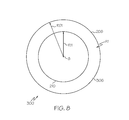
  • FIG. 9 is a cross-sectional view schematical illustration of a second flow area in a portion of the transition duct with the fairing airfoil through 9 - 9 in FIG. 5 .
  • FIG. 10 is a graphical illustration of exemplary pressure gradients along an inner wall of the transition duct illustrated in FIG. 5 .
  • FIG. 1 Illustrated schematically in FIG. 1 is an exemplary gas turbine engine 10 circumscribed about a centerline axis 8 of the engine 10 and including, in downstream serial relationship, a fan 12 which receives ambient air 14 , a low pressure booster or compressor 16 , a high pressure compressor (HPC) 18 , a combustor 20 which mixes fuel with the air 14 pressurized by the HPC 18 for generating combustion gases 22 which flow downstream through a high pressure turbine (HPT) 24 , and a low pressure turbine (LPT) 26 from which the combustion gases 22 are discharged from the engine 10 .
  • a first or high pressure shaft 28 joins the HPT 24 to the HPC 18
  • a second or low pressure shaft 30 joins the LPT 26 to both the fan 12 and the low pressure compressor 16 .
  • a substantially annular transition duct 300 fluidly connects the high pressure turbine 24 and the low pressure turbine 26 .
  • the transition duct 300 is diffusive and diffuses fluid flow 280 between the high pressure turbine 24 and the low pressure turbine 26
  • the transition duct 300 includes an exemplary fairing 200 that may be used with the turbine center frame 100 .
  • the turbine center frame 100 in part supports and mechanically and structurally couples the high pressure turbine 24 to the low pressure turbine 26 .
  • the turbine center frame 100 includes a central hub 102 and an outer ring 104 positioned about central hub 102 coupled together with struts 106 extending radially therebetween.
  • the fairings 200 are used to protect turbine center frame 100 from a hot gas path environment within the transition duct 300 .
  • Each of the struts 106 passes radially through and is protected by a hollow fairing airfoil 201 of the fairing 200 .
  • the fairing airfoil 201 includes a leading edge 202 and a trailing edge 206 and a chord C defined therebetween.
  • the fairing airfoil 201 has an aerodynamic cross-sectional shape, as further illustrated in FIG. 7 , and extends radially between radially outer and inner walls 302 , 304 of the fairing 200 .
  • Radially outer and inner shrouds 208 , 210 define the transition duct 300 and a transition duct flow passage 306 therein containing the fluid flow 280 .
  • An assembly of the plurality of fairings 200 are arranged about the central hub 102 of the turbine center frame 100 .
  • the substantially annular transition duct 300 is formed by the outer and inner shrouds 208 , 210 about the centerline axis 8 (illustrated in FIG. 1 ).
  • FIG. 5 Illustrated in FIG. 5 is a schematic cross-sectional view of the transition duct 300 formed at least in part by the radially outer shroud 208 and the radially inner shroud 210 .
  • the transition duct flow passage 306 is in part defined between the radially outer and inner walls 302 , 304 .
  • the radially outer and inner walls 302 , 304 extend and are contoured from an upstream end 310 of transition duct 300 to a downstream end 320 of transition duct 300 to facilitate coupling HPT in flow communication with LPT (shown in FIG. 1 ).
  • the transition duct flow passage 306 includes a fairing airfoil passage 307 extending through the transition duct flow passage 306 between the leading and trailing edges 202 , 206 of the fairing airfoil 201 .
  • radially outer wall 302 includes an aggressive outer wall slope from upstream end 310 to a predetermined axial location 308 , and reduced slope from predetermined axial location 308 to downstream end 320 of the transition duct 300 .
  • slope refers to the angle, at any given point, of radially outer wall 302 and radially inner wall 304 with respect to centerline axis 8 .
  • transition duct 300 radially outer wall 302 at upstream end 310 is located at a first radial distance 312 from the centerline axis 8 and radially outer wall 302 at downstream end 320 is located at a second radial distance 322 from the centerline axis 8 .
  • the second radial distance 322 is greater than the first radial distance 312 and they define a radius difference (AR) 332 between them.
  • transition duct 300 includes a height 314 , a length 316 , a first area 318 at the upstream end 310 , and a second area 328 at the downstream end 320 .
  • controlled radially outer wall 302 diffusion is provided when the transition duct 300 has radius ratio (AR 332 /height 314 ) of greater than about 2.0, a length 316 /height 314 ratio of between about 2.75 and 4.50, and an area ratio (second area 328 /first area 318 ) of greater than about 1.35.
  • the radially inner wall 304 may be shaped to reduce losses due to flow distortion caused by low momentum flow or regions exiting the high pressure turbine 24 .
  • the low momentum flow from the high pressure turbine 24 mostly occurs along the inner wall 304 of the transition duct 300 . It is generally known that the less you disturb the low momentum flow, the less additional loss you generate. In the transition duct 300 the primary way the flow gets disturbed is by static pressure gradients. Decreasing pressure in the downstream direction through the transition duct 300 accelerates the low momentum flow and increasing pressure decelerates the low momentum flow.
  • the inner wall 304 is shaped to smooth out pressure gradients so that the fluid does not get decelerated and re-accelerated. This reduces bouncing of the flow between deceleration and re-acceleration which keeps the losses low. When the pressure gradients are smooth, the fluid does not get decelerated/re-accelerated, and this reduction in bouncing the flow around keeps the losses low.
  • the exemplary means includes a contracting duct flow area A of the fairing airfoil passage 307 from the leading edge 202 of the fairing airfoil 201 to about 30% of the fairing chord C. Note that the fairing airfoil passage 307 extends through the transition duct 300 and the transition duct flow passage 306 between the leading and trailing edges 202 , 206 of the fairing airfoil 201 .
  • the contraction may be accomplished by increasing the radius R of the inner wall 304 of a predetermined or nominal transition duct design 344 indicated in dashed line format in FIG. 5 .
  • the duct area A is illustrated in FIG. 8 as an annular first area A 1 between the outer and inner shrouds 208 , 210 circumscribed about the centerline axis 8 at first outer and inner radii RO 1 , RI 1 respectively.
  • the duct area A is illustrated in FIG. 9 as a sectored annular second area A 2 between the outer and inner shrouds 208 , 210 circumscribed about the centerline axis 8 at second outer and inner radii RO 2 , RI 2 respectively and between the fairing airfoils 201 .
  • the second area A 2 is the sum of area sectors AS. Each of the area sectors AS extend between the outer and inner shrouds 208 , 210 and between each pair of the fairing airfoils 201 .
  • the second area A 2 may first decrease and then increase up through about the first 30% of the fairing airfoil passage 307 in which the fairing airfoil passage 307 has a lower area than at the inlet of the fairing airfoil passage 307 and through which the fluid flow 280 accelerates.
  • a constant curvature of the inner shroud 210 is maintained through the fairing airfoil passage 307 from the leading edge 202 of the fairing airfoil 201 through about 50% of the fairing chord C. This is further indicated by radius of curvature RC in FIGS. 5 and 6 .
  • the duct area A expands as illustrated in FIG. 10 .
  • FIG. 5 Illustrated in FIG. 5 is a schematic cross-sectional view of the fairing airfoil 201 in the transition duct 300 .
  • the leading edge 202 is swept aftwardly.
  • the exemplary leading edge 202 illustrated in FIG. 5 curves axially aftwardly and radially into the fairing airfoil 201 and the transition duct flow passage 306 between the radially outer and inner walls 302 , 304 from radially outer and inner intersection points 340 , 342 of the leading edge 202 along the radially outer and inner walls 302 , 304 respectively.
  • Exemplary aftwardly swept curved shapes of the leading edge 202 may be elliptical or parabolic or circular.
  • Sweep is defined relative to incoming stream surfaces of a fluid flowable through the transition duct flow passage 306 over the fairing airfoil 201 .
  • Aerodynamic sweep is a conventional parameter represented by the inclination of an airfoil surface, such as the leading edge 202 of the fairing airfoil 201 , in the direction of flow relative to the transition duct flow passage 306 .
  • a positive sweep angle is indicative of the leading edge 202 inclined in a downstream or aft direction.
  • FIG. 6 Illustrated in FIG. 6 is a schematic cross-sectional view illustration of another exemplary aft swept and aft or downstream leaning leading edge 222 of the fairing airfoil 201 in the transition duct 300 .
  • the downstream leaning leading edge 222 is swept downstream or aftwardly.
  • the exemplary downstream leaning leading edge 222 illustrated in FIG. 6 sweeps or leans axially aftwardly or downstream and radially into the fairing airfoil 201 and the transition duct flow passage 306 from the inner wall 304 from a radially inner intersection point 342 of the downstream leaning leading edge 222 along the radially inner wall 304 .
  • the leading edge 202 of the fairing airfoil 201 illustrated in FIG. 5 attaches or intersects the radially outer wall 302 aft or downstream of a region of high curvature 303 of the radially outer wall 302 .
  • the aft swept and aft or downstream leaning leading edge 222 of the fairing airfoil 201 illustrated in FIG. 6 attaches or intersects the radially outer wall 302 aft or downstream of a region of high curvature 303 of the radially outer wall 302 . This decreases interaction loss with a blade tip vortex from the HPT and incidence loss.
  • the swept leading edges place the intersection of the outer wall and leading edge in a lower velocity region.
  • the flow exiting the high pressure turbine upstream of the transition duct is not completely axial, it has some tangential swirl components 230 that generate incidence 232 on the leading edge 202 of the fairing airfoil 201 as illustrated in FIG. 7 .
  • Curvature of the outer wall causes the primary flow to accelerate then decelerate as it moves around the curvature. Combining the outer wall curvature with the leading edge incidence causes additional flow stress and loss generation.
  • By moving the fairing leading edge aft of the curvature region by using sweep the two flow regions are disconnected, reducing the flowfield stress and losses.
  • the swirling flow is generated in the HPT by inefficiencies in the blading near the outer wall where there is a gap to allow the blades to rotate and flow leaks over the top.
  • Sweeping the LE aft also re-aligns the static pressure gradients.
  • the thickening of the LE increases the static pressure locally, and any low momentum flow exiting the HPT is affected by this.
  • Conventionally located leading edges near the inner wall generate an increase in pressure that is directly in line with the low static pressure caused by the flow moving around the outer wall curvature.
  • This pressure gradient is normal to the flow exiting the HPT and has a maximum effect on the low momentum fluid flow, thus, increasing the losses in the duct.
  • the leading edge aft By sweeping the leading edge aft, the static pressure gradient becomes disconnected with the outer wall curvature reducing the effect on the low momentum fluid because flow now at an angle to the flow.

Landscapes

  • Engineering & Computer Science (AREA)
  • Mechanical Engineering (AREA)
  • General Engineering & Computer Science (AREA)
  • Physics & Mathematics (AREA)
  • Fluid Mechanics (AREA)
  • Chemical & Material Sciences (AREA)
  • Combustion & Propulsion (AREA)
  • Thermal Sciences (AREA)
  • Turbine Rotor Nozzle Sealing (AREA)

Abstract

A transition duct includes fairings with transition duct flow passage and hollow fairing airfoils extending between outer and inner walls of fairings and means for smoothing pressure gradients along inner wall. One means is a contracting duct flow area of flow passage from leading edge of fairing airfoil to about 30% of fairing chord. Leading edges of fairing airfoil intersect outer walls aft of regions of high curvature of outer walls. Leading edges may curve axially aftwardly and radially into fairing airfoils and transition duct flow passage between radially outer and inner walls from radially outer and inner intersection points. Transition duct downstream second area/upstream first area may be greater than about 1.35. Turbine center frame may include outer ring coupled to central hub with struts extending through hollow airfoils.

Description

BACKGROUND OF THE INVENTION Technical Field
The present invention relates to gas turbine engine turbine sections and, more specifically, to gas turbine engine high and low pressure turbines and a turbine center frame and transition duct therebetween.
Background Information
At least some known gas turbine engines include in downstream serial flow relationship a forward fan, a core engine, and a low-pressure turbine (LPT). The core engine includes at least one compressor, a combustor, and a high-pressure turbine (HPT). The compressor and HPT are coupled through a shaft to define a high-pressure rotor assembly. Air entering the core engine is compressed, mixed with fuel, and ignited to form a high energy gas stream. The high energy gas stream is directed through the HPT to rotatably drive the HPT such that the shaft rotatably drives the compressor. The high energy gas stream is then channeled downstream from the HPT to the LPT via a transition duct.
Generally, the HPT has a smaller radius than the LPT and, thus, the transition duct has an “S” shaped cross-section to facilitate flow therebetween. Generally, it is desirable to transition from the smaller-radius high-pressure turbine to the larger-radius low-pressure turbine within as short an axial distance as possible. Such a quick transition with a shorter transition duct facilitates reducing the weight of the overall turbine assembly and facilitates increasing the performance of the engine. However, using a shorter transition duct with aggressive curvature may lead to flow separation at the boundary layers of transition duct inner and outer walls.
The engine may include a turbine center frame (TCF) between the HPT and the LPT. Radially extending TCF struts are surrounded and shrouded by and pass through fairings of the transition duct. The fairings extend radially between the transition duct inner and outer walls.
U.S. Pat. No. 9,222,437 by Joseph Machnaim, et al. issued Dec. 29, 2015 and entitled “TRANSITION DUCT FOR USE IN A TURBINE ENGINE AND METHOD OF ASSEMBLY” discloses a transition duct fluidly connecting and coupling a high-pressure turbine (HPT) to a low-pressure turbine (LPT) in an aircraft gas turbine engine and is incorporated herein by reference. The patent notes that it is generally desirable to quickly transition from the smaller-radius HPT to the larger-radius LPT with a transition duct to channel fluid flowing therethrough. Transition to the larger radius facilitates improving LPT performance and efficiency. However, using a transition duct that has a shorter axial length with aggressive outer wall slope may lead to unwanted boundary layer flow separation of the fluid flowing therethrough. Furthermore, known transition ducts include fairings to accommodate struts of the center frame extending therethrough that are used to support a turbine center frame.
These known struts and fairings disrupt the flow of fluid flowing through the transition duct. Accordingly, boundary layer flow separation may also occur on the fairing or at the interface between the fairing and the outer wall, i.e. at the location where both the boundary layers interact. The transition duct described and disclosed in the patent document is designed to facilitate reducing flow separation of fluid channeled from the HPT to the LPT. More specifically, the transition duct includes an aggressive outer wall slope from the duct inlet to a predetermined axial location in the transition duct, and reduced outer wall slope from the predetermined axial location to the duct discharge. In the exemplary embodiment disclosed therein, the predetermined axial location is the thickest portion (T.sub.max location) of the aerodynamic strut fairing. Accordingly, the transition duct described therein facilitates improving LPT performance and efficiency by controlling the boundary layer interaction between the outer wall of the transition duct and the strut fairing.
The fairings and their aerodynamic interaction with the transition duct inner and outer walls may cause DP/P loss across the transition duct and the turbine center frame. It is therefore very important to minimize this DP/P loss and to minimize flow separation at the boundary layers of transition duct inner and outer walls.
SUMMARY OF THE INVENTION
A gas turbine engine transition duct includes a plurality of fairings including hollow fairing airfoils extending radially between radially outer and inner walls of the fairings, a transition duct flow passage radially disposed at least in part between the radially outer and inner walls, and a means for smoothing pressure gradients along the inner wall. The means for smoothing pressure gradients may include a contracting duct flow area of a fairing airfoil passage extending through the transition duct between leading and trailing edges of the fairing airfoil and the fairing airfoil passage from the leading edge of the fairing airfoil to about 30% of the fairing chord.
Leading edges of the fairing airfoils may be attached to or intersecting the radially outer walls aft or downstream of regions of high curvature of the radially outer walls. The leading edges may aftwardly sweep or aftwardly lean downstream.
The radially outer and inner intersection points of the leading edges along the radially outer and inner walls respectively may include the outer intersection points located aft and downstream of the inner intersection points.
The leading edges may curve axially aftwardly and radially into the fairing airfoils and the transition duct flow passage between the radially outer and inner walls from radially outer and inner intersection points of the leading edges along the radially outer and inner walls respectively.
The transition duct may be circumscribed about a centerline axis and include first and second radial distances extending radially from the centerline axis to the radially outer and inner walls at upstream and downstream ends of the duct respectfully wherein the second radial distance is greater than the first radial distance. The transition duct includes a height, a length, a first area at the upstream end, and a second area at the downstream end and an area ratio defined as (the second area/the first area) is greater than about 1.35.
A gas turbine engine transition duct and turbine center frame assembly includes a turbine center frame including an outer ring positioned about a central hub coupled together with struts extending radially therebetween, a transition duct including a plurality of fairings including hollow fairing airfoils extending radially between radially outer and inner walls of the fairings, and the struts passing radially through the hollow fairing airfoils.
A gas turbine engine circumscribed about a centerline axis includes, in downstream serial relationship, a fan, a low pressure booster or compressor, a high pressure compressor, a combustor, a high pressure turbine, and a low pressure turbine. A turbine center frame in part supporting and coupling together the high and low pressure turbines includes an outer ring positioned about a central hub coupled together with struts extending radially therebetween and a transition duct fluidly connecting the high and low pressure turbines and including a plurality of fairings including hollow fairing airfoils extending radially between radially outer and inner walls of the fairings and the struts passing radially through the hollow fairing airfoils.
BRIEF DESCRIPTION OF THE DRAWINGS
The invention, in accordance with preferred and exemplary embodiments, is more particularly described in the following detailed description taken in conjunction with the accompanying drawings in which:
FIG. 1 is a cross-sectional view schematical illustration of an exemplary aircraft turbofan gas turbine engine including a low pressure loss transition duct and a turbine center frame between high and low pressure turbines.
FIG. 2 is a perspective view illustration of an exemplary turbine center frame that may be used in the turbine engine illustrated in FIG. 1.
FIG. 3 is a perspective view illustration of an exemplary fairing with an aft swept leading edge that may be used with the turbine center frame illustrated in FIG. 2.
FIG. 4 is a cross-sectional view illustration of an exemplary turbine center frame and transition duct that may be used in the turbine engine illustrated in FIG. 1.
FIG. 5 is a schematic cross-sectional view illustration of the transition duct with the fairing illustrated in FIG. 3.
FIG. 6 is a cross sectional view illustration of an alternative aft swept leading edge that may be used with the turbine center frame shown in FIG. 2.
FIG. 7 is a cross-sectional view schematical illustration of a fairing airfoil of the fairing through 7-7 in FIG. 3.
FIG. 8 is a cross-sectional view schematical illustration of a first flow area in a portion of the transition duct without the fairing airfoil through 8-8 in FIG. 5.
FIG. 9 is a cross-sectional view schematical illustration of a second flow area in a portion of the transition duct with the fairing airfoil through 9-9 in FIG. 5.
FIG. 10 is a graphical illustration of exemplary pressure gradients along an inner wall of the transition duct illustrated in FIG. 5.
DESCRIPTION
Illustrated schematically in FIG. 1 is an exemplary gas turbine engine 10 circumscribed about a centerline axis 8 of the engine 10 and including, in downstream serial relationship, a fan 12 which receives ambient air 14, a low pressure booster or compressor 16, a high pressure compressor (HPC) 18, a combustor 20 which mixes fuel with the air 14 pressurized by the HPC 18 for generating combustion gases 22 which flow downstream through a high pressure turbine (HPT) 24, and a low pressure turbine (LPT) 26 from which the combustion gases 22 are discharged from the engine 10. A first or high pressure shaft 28 joins the HPT 24 to the HPC 18, and a second or low pressure shaft 30 joins the LPT 26 to both the fan 12 and the low pressure compressor 16. A substantially annular transition duct 300 fluidly connects the high pressure turbine 24 and the low pressure turbine 26. The transition duct 300 is diffusive and diffuses fluid flow 280 between the high pressure turbine 24 and the low pressure turbine 26.
Illustrated in FIGS. 2-4 is an exemplary turbine center frame 100 and the transition duct 300. The transition duct 300 includes an exemplary fairing 200 that may be used with the turbine center frame 100. The turbine center frame 100 in part supports and mechanically and structurally couples the high pressure turbine 24 to the low pressure turbine 26. The turbine center frame 100 includes a central hub 102 and an outer ring 104 positioned about central hub 102 coupled together with struts 106 extending radially therebetween. The fairings 200 are used to protect turbine center frame 100 from a hot gas path environment within the transition duct 300. Each of the struts 106 passes radially through and is protected by a hollow fairing airfoil 201 of the fairing 200. The fairing airfoil 201 includes a leading edge 202 and a trailing edge 206 and a chord C defined therebetween. In the exemplary embodiment, the fairing airfoil 201 has an aerodynamic cross-sectional shape, as further illustrated in FIG. 7, and extends radially between radially outer and inner walls 302, 304 of the fairing 200. Radially outer and inner shrouds 208, 210 define the transition duct 300 and a transition duct flow passage 306 therein containing the fluid flow 280. An assembly of the plurality of fairings 200 are arranged about the central hub 102 of the turbine center frame 100. The substantially annular transition duct 300 is formed by the outer and inner shrouds 208, 210 about the centerline axis 8 (illustrated in FIG. 1).
Illustrated in FIG. 5 is a schematic cross-sectional view of the transition duct 300 formed at least in part by the radially outer shroud 208 and the radially inner shroud 210. The transition duct flow passage 306 is in part defined between the radially outer and inner walls 302, 304. The radially outer and inner walls 302, 304 extend and are contoured from an upstream end 310 of transition duct 300 to a downstream end 320 of transition duct 300 to facilitate coupling HPT in flow communication with LPT (shown in FIG. 1). The transition duct flow passage 306 includes a fairing airfoil passage 307 extending through the transition duct flow passage 306 between the leading and trailing edges 202, 206 of the fairing airfoil 201.
More specifically, the curvature and slope of radially outer wall 302 are controlled to facilitate reducing flow separation within transition duct 300. For example, in the exemplary embodiment, radially outer wall 302 includes an aggressive outer wall slope from upstream end 310 to a predetermined axial location 308, and reduced slope from predetermined axial location 308 to downstream end 320 of the transition duct 300. As used herein, the term “slope” refers to the angle, at any given point, of radially outer wall 302 and radially inner wall 304 with respect to centerline axis 8.
Accordingly, in the exemplary embodiment of the transition duct 300, radially outer wall 302 at upstream end 310 is located at a first radial distance 312 from the centerline axis 8 and radially outer wall 302 at downstream end 320 is located at a second radial distance 322 from the centerline axis 8. The second radial distance 322 is greater than the first radial distance 312 and they define a radius difference (AR) 332 between them. Furthermore, in the exemplary embodiment, transition duct 300 includes a height 314, a length 316, a first area 318 at the upstream end 310, and a second area 328 at the downstream end 320. As such, controlled radially outer wall 302 diffusion is provided when the transition duct 300 has radius ratio (AR 332/height 314) of greater than about 2.0, a length 316/height 314 ratio of between about 2.75 and 4.50, and an area ratio (second area 328/first area 318) of greater than about 1.35.
The radially inner wall 304 may be shaped to reduce losses due to flow distortion caused by low momentum flow or regions exiting the high pressure turbine 24. The low momentum flow from the high pressure turbine 24 mostly occurs along the inner wall 304 of the transition duct 300. It is generally known that the less you disturb the low momentum flow, the less additional loss you generate. In the transition duct 300 the primary way the flow gets disturbed is by static pressure gradients. Decreasing pressure in the downstream direction through the transition duct 300 accelerates the low momentum flow and increasing pressure decelerates the low momentum flow. The inner wall 304 is shaped to smooth out pressure gradients so that the fluid does not get decelerated and re-accelerated. This reduces bouncing of the flow between deceleration and re-acceleration which keeps the losses low. When the pressure gradients are smooth, the fluid does not get decelerated/re-accelerated, and this reduction in bouncing the flow around keeps the losses low.
Graphically illustrated in FIG. 10 is one exemplary means for smoothing pressure gradients along the inner wall 304 to reduce these losses. The exemplary means includes a contracting duct flow area A of the fairing airfoil passage 307 from the leading edge 202 of the fairing airfoil 201 to about 30% of the fairing chord C. Note that the fairing airfoil passage 307 extends through the transition duct 300 and the transition duct flow passage 306 between the leading and trailing edges 202, 206 of the fairing airfoil 201. The contraction may be accomplished by increasing the radius R of the inner wall 304 of a predetermined or nominal transition duct design 344 indicated in dashed line format in FIG. 5.
The duct area A is illustrated in FIG. 8 as an annular first area A1 between the outer and inner shrouds 208, 210 circumscribed about the centerline axis 8 at first outer and inner radii RO1, RI1 respectively. The duct area A is illustrated in FIG. 9 as a sectored annular second area A2 between the outer and inner shrouds 208, 210 circumscribed about the centerline axis 8 at second outer and inner radii RO2, RI2 respectively and between the fairing airfoils 201. The second area A2 is the sum of area sectors AS. Each of the area sectors AS extend between the outer and inner shrouds 208, 210 and between each pair of the fairing airfoils 201. The second area A2 may first decrease and then increase up through about the first 30% of the fairing airfoil passage 307 in which the fairing airfoil passage 307 has a lower area than at the inlet of the fairing airfoil passage 307 and through which the fluid flow 280 accelerates. A constant curvature of the inner shroud 210 is maintained through the fairing airfoil passage 307 from the leading edge 202 of the fairing airfoil 201 through about 50% of the fairing chord C. This is further indicated by radius of curvature RC in FIGS. 5 and 6. Between about 30% to 50% of the fairing chord C or length of the fairing airfoil passage 307 the duct area A expands as illustrated in FIG. 10.
Illustrated in FIG. 5 is a schematic cross-sectional view of the fairing airfoil 201 in the transition duct 300. The leading edge 202 is swept aftwardly. The exemplary leading edge 202 illustrated in FIG. 5 curves axially aftwardly and radially into the fairing airfoil 201 and the transition duct flow passage 306 between the radially outer and inner walls 302, 304 from radially outer and inner intersection points 340, 342 of the leading edge 202 along the radially outer and inner walls 302, 304 respectively. Exemplary aftwardly swept curved shapes of the leading edge 202 may be elliptical or parabolic or circular.
Sweep is defined relative to incoming stream surfaces of a fluid flowable through the transition duct flow passage 306 over the fairing airfoil 201. Aerodynamic sweep is a conventional parameter represented by the inclination of an airfoil surface, such as the leading edge 202 of the fairing airfoil 201, in the direction of flow relative to the transition duct flow passage 306. A positive sweep angle is indicative of the leading edge 202 inclined in a downstream or aft direction.
Illustrated in FIG. 6 is a schematic cross-sectional view illustration of another exemplary aft swept and aft or downstream leaning leading edge 222 of the fairing airfoil 201 in the transition duct 300. The downstream leaning leading edge 222 is swept downstream or aftwardly. The exemplary downstream leaning leading edge 222 illustrated in FIG. 6 sweeps or leans axially aftwardly or downstream and radially into the fairing airfoil 201 and the transition duct flow passage 306 from the inner wall 304 from a radially inner intersection point 342 of the downstream leaning leading edge 222 along the radially inner wall 304.
The leading edge 202 of the fairing airfoil 201 illustrated in FIG. 5 attaches or intersects the radially outer wall 302 aft or downstream of a region of high curvature 303 of the radially outer wall 302. The aft swept and aft or downstream leaning leading edge 222 of the fairing airfoil 201 illustrated in FIG. 6 attaches or intersects the radially outer wall 302 aft or downstream of a region of high curvature 303 of the radially outer wall 302. This decreases interaction loss with a blade tip vortex from the HPT and incidence loss.
The swept leading edges place the intersection of the outer wall and leading edge in a lower velocity region. The flow exiting the high pressure turbine upstream of the transition duct is not completely axial, it has some tangential swirl components 230 that generate incidence 232 on the leading edge 202 of the fairing airfoil 201 as illustrated in FIG. 7. Curvature of the outer wall causes the primary flow to accelerate then decelerate as it moves around the curvature. Combining the outer wall curvature with the leading edge incidence causes additional flow stress and loss generation. By moving the fairing leading edge aft of the curvature region by using sweep, the two flow regions are disconnected, reducing the flowfield stress and losses. The swirling flow is generated in the HPT by inefficiencies in the blading near the outer wall where there is a gap to allow the blades to rotate and flow leaks over the top.
Sweeping the LE aft also re-aligns the static pressure gradients. The thickening of the LE increases the static pressure locally, and any low momentum flow exiting the HPT is affected by this. Conventionally located leading edges near the inner wall generate an increase in pressure that is directly in line with the low static pressure caused by the flow moving around the outer wall curvature. This pressure gradient is normal to the flow exiting the HPT and has a maximum effect on the low momentum fluid flow, thus, increasing the losses in the duct. By sweeping the leading edge aft, the static pressure gradient becomes disconnected with the outer wall curvature reducing the effect on the low momentum fluid because flow now at an angle to the flow.
While there have been described herein what are considered to be preferred and exemplary embodiments of the present invention, other modifications of the invention shall be apparent to those skilled in the art from the teachings herein and, it is, therefore, desired to be secured in the appended claims all such modifications as fall within the true spirit and scope of the invention.
Accordingly, what is desired to be secured by Letters Patent of the United States is the invention as defined and differentiated in the following claims:

Claims (25)

The invention claimed is:
1. A gas turbine engine transition duct comprising:
a plurality of fairings including hollow fairing airfoils extending radially between radially outer and inner walls of the plurality of fairings,
a transition duct flow passage radially disposed at least in part between the radially outer and inner walls,
the hollow fairing airfoils extending aft or downstream along a fairing chord, and
a means for smoothing pressure gradients along the radially inner wall.
2. The gas turbine engine transition duct in accordance with claim 1 further comprising a fairing airfoil passage extending through the gas turbine engine transition duct between leading and trailing edges of the hollow fairing airfoil and the means for smoothing pressure gradients including a contracting duct flow area of the fairing airfoil passage from the leading edge of the hollow fairing airfoil to about 30% of the fairing chord.
3. The gas turbine engine transition duct in accordance with claim 1 further comprising leading edges of each of the hollow fairing airfoils attached to or intersecting the radially outer wall aft or downstream of regions of curvature of the radially outer wall.
4. The gas turbine engine transition duct in accordance with claim 3 further comprising the leading edges aftwardly sweeping or aftwardly leaning downstream.
5. The gas turbine engine transition duct in accordance with claim 4 further comprising radially outer and inner intersection points of the leading edges along the radially outer and inner walls respectively and the radially outer intersection points located aft and downstream of the radially inner intersection points.
6. The gas turbine engine transition duct in accordance with claim 3 further comprising the leading edges curving axially aftwardly and radially into the transition duct flow passage from radially outer and inner intersection points of the leading edges along the radially outer and inner walls respectively.
7. The gas turbine engine transition duct in accordance with claim 6 further comprising the radially outer intersection points located aft and downstream of the radially inner intersection points.
8. The gas turbine engine transition duct in accordance with claim 3 further comprising:
the gas turbine engine transition duct circumscribed about a centerline axis;
a first radial distance extending radially from the centerline axis to the radially outer walls at an upstream end of the duct;
a second radial distance extending radially from the centerline axis to the radially outer walls at a downstream end of the duct;
the second radial distance greater than the first radial distance;
the transition duct including a height, a length, a first area at the upstream end, and a second area at the downstream end;
an area ratio defined as (the second area/the first area); and
the means for smoothing pressure gradients including the area ratio.
9. The gas turbine engine transition duct in accordance with claim 8 further comprising the leading edges aftwardly sweeping or aftwardly leaning downstream.
10. The gas turbine engine transition duct in accordance with claim 8 further comprising radially outer and inner intersection points of the leading edge along the radially outer and inner walls respectively and the radially outer intersection points located aft and downstream of the radially inner intersection points.
11. The gas turbine engine transition duct in accordance with claim 8 further comprising the leading edges curving axially aftwardly and radially into the transition duct flow passage from radially outer and inner intersection points of the leading edges along the radially outer and inner walls respectively.
12. The gas turbine engine transition duct in accordance with claim 11 further comprising the radially outer intersection points located aft and downstream of the radially inner intersection points.
13. A gas turbine engine transition duct and turbine center frame assembly comprising:
a turbine center frame including an outer ring positioned about a central hub coupled together with struts extending radially therebetween,
a transition duct including a plurality of fairings including hollow fairing airfoils extending radially between radially outer and inner walls of the plurality of fairings,
the struts passing radially through the hollow fairing airfoils,
a transition duct flow passage of the gas turbine engine transition duct radially disposed at least in part between the radially outer and inner walls,
the hollow fairing airfoils extending aft or downstream along a fairing chord, and
means for smoothing pressure gradients along the radially inner wall.
14. The gas turbine engine transition duct and turbine center frame assembly in accordance with claim 13 further comprising a fairing airfoil passage extending through the transition duct between leading and trailing edges of the hollow fairing airfoils and the means for smoothing pressure gradients including a contracting duct flow area of the fairing airfoil passage from the leading edge of the hollow fairing airfoil to about 30% of the fairing chord.
15. The gas turbine engine transition duct and turbine center frame assembly in accordance with claim 14 further comprising leading edges of the fairing airfoils attached to or intersecting the radially outer walls aft or downstream of regions of curvature of the radially outer walls.
16. The gas turbine engine transition duct and turbine center frame assembly in accordance with claim 15 further comprising the leading edges aftwardly sweeping or aftwardly leaning downstream.
17. The gas turbine engine transition duct and turbine center frame assembly in accordance with claim 16 further comprising radially outer and inner intersection points of the leading edges along the radially outer and inner walls respectively and the radially outer intersection points located aft and downstream of the radially inner intersection points.
18. The gas turbine engine transition duct and turbine center frame assembly in accordance with claim 15 further comprising the leading edges curving axially aftwardly and radially into the hollow fairing airfoils and the transition duct flow passage between the radially outer and inner walls from radially outer and inner intersection points of the leading edges along the radially outer and inner walls respectively.
19. The gas turbine engine transition duct and turbine center frame assembly in accordance with claim 18 further comprising the radially outer intersection points located aft and downstream of the radially inner intersection points.
20. A gas turbine engine comprising:
the gas turbine engine circumscribed about a centerline axis and including in downstream serial relationship a fan, a low pressure booster or compressor, a high pressure compressor, a combustor, a high pressure turbine, and a low pressure turbine;
a turbine center frame in part supporting and coupling together the high and low pressure turbines;
the turbine center frame including an outer ring positioned about a central hub coupled together with struts extending radially therebetween;
a transition duct fluidly connecting the high and low pressure turbines and including a plurality of fairings including hollow fairing airfoils extending radially between radially outer and inner walls of the plurality of fairings;
the struts passing radially through the hollow fairing airfoils;
a transition duct flow passage of the transition duct radially disposed at least in part between the radially outer and inner walls;
the hollow fairing airfoils extending aft or downstream along a fairing chord;
a fairing airfoil passage extending through the transition duct between leading and trailing edges of the hollow fairing airfoils;
a means for smoothing pressure gradients along the radially inner wall including a contracting duct flow area of the fairing airfoil passage from the leading edge of the hollow fairing airfoils to about 30% of the fairing chord; and
leading edges of the fairing airfoils attached to or intersecting the radially outer walls aft or downstream of regions of curvature of the radially outer walls.
21. The gas turbine engine in accordance with claim 20 further comprising:
a first radial distance extending radially from the centerline axis to the radially outer walls at an upstream end of the transition duct;
a second radial distance extending radially from the centerline axis to the radially outer walls at a downstream end of the transition duct;
the second radial distance greater than the first radial distance;
the transition duct including a height, a length, a first area at the upstream end, and a second area at the downstream end;
an area ratio defined as (the second area/the first area); and
the means for smoothing pressure gradients including the area ratio.
22. The gas turbine engine in accordance with claim 20 further comprising the leading edges aftwardly sweeping or aftwardly leaning downstream.
23. The gas turbine engine in accordance with claim 20 further comprising radially outer and inner intersection points of the leading edges along the radially outer and inner walls respectively and the radially outer intersection points located aft and downstream of the radially inner intersection points.
24. The gas turbine engine in accordance with claim 20 further comprising the leading edges curving axially aftwardly and radially into the hollow fairing airfoils and the transition duct flow passage between the radially outer and inner walls from radially outer and inner intersection points of the leading edges along the radially outer and inner walls respectively.
25. The gas turbine engine in accordance with claim 24 further comprising the radially outer intersection points located aft and downstream of the radially inner intersection points.
US15/131,292 2016-04-18 2016-04-18 Gas turbine engine transition duct and turbine center frame Active 2037-06-27 US10344602B2 (en)

Priority Applications (5)

Application Number Priority Date Filing Date Title
US15/131,292 US10344602B2 (en) 2016-04-18 2016-04-18 Gas turbine engine transition duct and turbine center frame
EP17164948.6A EP3236012A1 (en) 2016-04-18 2017-04-05 Gas turbine engine transition duct and turbine center frame
CA2963517A CA2963517A1 (en) 2016-04-18 2017-04-06 Gas turbine engine transition duct and turbine center frame
JP2017075627A JP2017198200A (en) 2016-04-18 2017-04-06 Gas turbine engine transition duct and turbine center frame
CN201710253128.2A CN107304684B (en) 2016-04-18 2017-04-18 Gas turbine engine transition duct and turbine center frame

Applications Claiming Priority (1)

Application Number Priority Date Filing Date Title
US15/131,292 US10344602B2 (en) 2016-04-18 2016-04-18 Gas turbine engine transition duct and turbine center frame

Publications (2)

Publication Number Publication Date
US20170298747A1 US20170298747A1 (en) 2017-10-19
US10344602B2 true US10344602B2 (en) 2019-07-09

Family

ID=58489597

Family Applications (1)

Application Number Title Priority Date Filing Date
US15/131,292 Active 2037-06-27 US10344602B2 (en) 2016-04-18 2016-04-18 Gas turbine engine transition duct and turbine center frame

Country Status (5)

Country Link
US (1) US10344602B2 (en)
EP (1) EP3236012A1 (en)
JP (1) JP2017198200A (en)
CN (1) CN107304684B (en)
CA (1) CA2963517A1 (en)

Cited By (1)

* Cited by examiner, † Cited by third party
Publication number Priority date Publication date Assignee Title
US20250243876A1 (en) * 2024-02-21 2025-07-31 MTU Aero Engines AG Turbomachine having a flow duct

Families Citing this family (5)

* Cited by examiner, † Cited by third party
Publication number Priority date Publication date Assignee Title
DE102018208151A1 (en) * 2018-05-24 2019-11-28 MTU Aero Engines AG Turbine intermediate housing with specifically designed annular space contour
US11454128B2 (en) * 2018-08-06 2022-09-27 General Electric Company Fairing assembly
US10920594B2 (en) * 2018-12-12 2021-02-16 Solar Turbines Incorporated Modal response tuned turbine blade
US11242770B2 (en) * 2020-04-02 2022-02-08 General Electric Company Turbine center frame and method
CN114048571B (en) * 2021-11-30 2024-06-18 中国航发湖南动力机械研究所 Pneumatic design method and system for transition section of turboshaft engine

Citations (16)

* Cited by examiner, † Cited by third party
Publication number Priority date Publication date Assignee Title
US5975537A (en) 1997-07-01 1999-11-02 General Electric Company Rotor and stator assembly configured as an aspirating face seal
US6036438A (en) * 1996-12-05 2000-03-14 Kabushiki Kaisha Toshiba Turbine nozzle
US6195983B1 (en) 1999-02-12 2001-03-06 General Electric Company Leaned and swept fan outlet guide vanes
US20030185669A1 (en) 2002-03-26 2003-10-02 Brauer John C. Aspirating face seal with axially extending seal teeth
US20030184022A1 (en) 2002-03-26 2003-10-02 Brauer John C. Aspirating face seal with axially biasing one piece annular spring
US6708482B2 (en) 2001-11-29 2004-03-23 General Electric Company Aircraft engine with inter-turbine engine frame
US20070253809A1 (en) 2006-05-01 2007-11-01 General Electric Company Methods and apparatus for assembling gas turbine engines
US20100040462A1 (en) * 2008-08-18 2010-02-18 United Technologies Corporation Separation-resistant inlet duct for mid-turbine frames
US20110225979A1 (en) 2008-12-06 2011-09-22 Mtu Aero Engines Gmbh Turbo engine
US8272643B2 (en) 2004-05-28 2012-09-25 Stein Seal Company Air riding seal
US20120251290A1 (en) 2011-03-31 2012-10-04 General Electric Company Aspirating face seal, and a related method thereof
EP2518272A2 (en) 2011-04-26 2012-10-31 United Technologies Corporation High area ratio turbine vane
US8387991B2 (en) 2009-04-06 2013-03-05 Rolls-Royce Plc Sealing assembly
WO2014046832A1 (en) 2012-09-21 2014-03-27 General Electric Company Transition duct for use in a turbine engine and method of assembly
US20140255159A1 (en) * 2013-03-07 2014-09-11 Pratt & Whitney Canada Corp. Integrated strut-vane
US20150300253A1 (en) 2014-02-13 2015-10-22 United Technologies Corporation Reduced Length Transition Ducts

Family Cites Families (2)

* Cited by examiner, † Cited by third party
Publication number Priority date Publication date Assignee Title
JP2005290985A (en) * 2003-10-09 2005-10-20 Mitsubishi Heavy Ind Ltd Exhaust diffuser for axial turbine
US9534497B2 (en) * 2012-05-02 2017-01-03 Honeywell International Inc. Inter-turbine ducts with variable area ratios

Patent Citations (22)

* Cited by examiner, † Cited by third party
Publication number Priority date Publication date Assignee Title
US6036438A (en) * 1996-12-05 2000-03-14 Kabushiki Kaisha Toshiba Turbine nozzle
US5975537A (en) 1997-07-01 1999-11-02 General Electric Company Rotor and stator assembly configured as an aspirating face seal
US6195983B1 (en) 1999-02-12 2001-03-06 General Electric Company Leaned and swept fan outlet guide vanes
US6708482B2 (en) 2001-11-29 2004-03-23 General Electric Company Aircraft engine with inter-turbine engine frame
US6883303B1 (en) 2001-11-29 2005-04-26 General Electric Company Aircraft engine with inter-turbine engine frame
US20030185669A1 (en) 2002-03-26 2003-10-02 Brauer John C. Aspirating face seal with axially extending seal teeth
US20030184022A1 (en) 2002-03-26 2003-10-02 Brauer John C. Aspirating face seal with axially biasing one piece annular spring
US6676369B2 (en) 2002-03-26 2004-01-13 General Electric Company Aspirating face seal with axially extending seal teeth
US6758477B2 (en) 2002-03-26 2004-07-06 General Electric Company Aspirating face seal with axially biasing one piece annular spring
US8272643B2 (en) 2004-05-28 2012-09-25 Stein Seal Company Air riding seal
US20070253809A1 (en) 2006-05-01 2007-11-01 General Electric Company Methods and apparatus for assembling gas turbine engines
US20100040462A1 (en) * 2008-08-18 2010-02-18 United Technologies Corporation Separation-resistant inlet duct for mid-turbine frames
EP2159398A2 (en) 2008-08-18 2010-03-03 United Technologies Corporation Separation-resistant inlet duct for mid-turbine frames
US20110225979A1 (en) 2008-12-06 2011-09-22 Mtu Aero Engines Gmbh Turbo engine
US8387991B2 (en) 2009-04-06 2013-03-05 Rolls-Royce Plc Sealing assembly
US20120251290A1 (en) 2011-03-31 2012-10-04 General Electric Company Aspirating face seal, and a related method thereof
EP2518272A2 (en) 2011-04-26 2012-10-31 United Technologies Corporation High area ratio turbine vane
WO2014046832A1 (en) 2012-09-21 2014-03-27 General Electric Company Transition duct for use in a turbine engine and method of assembly
US20140086739A1 (en) * 2012-09-21 2014-03-27 General Electric Company Transition duct for use in a turbine engine and method of assembly
US9222437B2 (en) 2012-09-21 2015-12-29 General Electric Company Transition duct for use in a turbine engine and method of assembly
US20140255159A1 (en) * 2013-03-07 2014-09-11 Pratt & Whitney Canada Corp. Integrated strut-vane
US20150300253A1 (en) 2014-02-13 2015-10-22 United Technologies Corporation Reduced Length Transition Ducts

Non-Patent Citations (2)

* Cited by examiner, † Cited by third party
Title
Extended European Search Report and Opinion issued in connection with corresponding EP Application No. 17164948.6 dated Aug. 17, 2017.
First Office Action and Search issued in connection with corresponding CN Application No. 201710253128.2 dated Oct. 18, 2018 (English Translation not available).

Cited By (2)

* Cited by examiner, † Cited by third party
Publication number Priority date Publication date Assignee Title
US20250243876A1 (en) * 2024-02-21 2025-07-31 MTU Aero Engines AG Turbomachine having a flow duct
US12435735B2 (en) * 2024-02-21 2025-10-07 MTU Aero Engines AG Turbomachine having a flow duct

Also Published As

Publication number Publication date
CA2963517A1 (en) 2017-10-18
CN107304684A (en) 2017-10-31
US20170298747A1 (en) 2017-10-19
JP2017198200A (en) 2017-11-02
CN107304684B (en) 2020-06-09
EP3236012A1 (en) 2017-10-25

Similar Documents

Publication Publication Date Title
US6338609B1 (en) Convex compressor casing
US10344602B2 (en) Gas turbine engine transition duct and turbine center frame
JP5410014B2 (en) The latest booster stator vane
JP5386076B2 (en) The latest booster system
US9249687B2 (en) Turbine exhaust diffusion system and method
JPH10502150A (en) Flow orientation assembly for the compression region of rotating machinery
EP2660424B1 (en) Inter-turbine ducts with variable area ratios
US8845286B2 (en) Inter-turbine ducts with guide vanes
US20210372288A1 (en) Compressor stator with leading edge fillet
US11131205B2 (en) Inter-turbine ducts with flow control mechanisms
US9222437B2 (en) Transition duct for use in a turbine engine and method of assembly
CN116753036A (en) Turbine engines with airfoils for high acceleration and low blade rotation
CN111075760A (en) Fluid wing
CA2944453C (en) Improved crosswind performance aircraft engine spinner
EP3354848B1 (en) Inter-turbine ducts with multiple splitter blades
RU2460905C2 (en) Axial-flow fan or compressor impeller and fan of bypass fanjet incorporating said impeller
CN115898557B (en) An active control structure for suppressing secondary flow in turbine guide vane passage
EP4685339A1 (en) Cantilever stator vane

Legal Events

Date Code Title Description
AS Assignment

Owner name: GENERAL ELECTRIC COMPANY, NEW YORK

Free format text: ASSIGNMENT OF ASSIGNORS INTEREST;ASSIGNORS:HURA, HARJIT, MR.;VITT, PAUL HADLEY, MR.;KEITH, BRIAN DAVID, MR.;AND OTHERS;SIGNING DATES FROM 20160407 TO 20160408;REEL/FRAME:038304/0538

STPP Information on status: patent application and granting procedure in general

Free format text: NOTICE OF ALLOWANCE MAILED -- APPLICATION RECEIVED IN OFFICE OF PUBLICATIONS

STPP Information on status: patent application and granting procedure in general

Free format text: PUBLICATIONS -- ISSUE FEE PAYMENT RECEIVED

STPP Information on status: patent application and granting procedure in general

Free format text: PUBLICATIONS -- ISSUE FEE PAYMENT VERIFIED

STCF Information on status: patent grant

Free format text: PATENTED CASE

MAFP Maintenance fee payment

Free format text: PAYMENT OF MAINTENANCE FEE, 4TH YEAR, LARGE ENTITY (ORIGINAL EVENT CODE: M1551); ENTITY STATUS OF PATENT OWNER: LARGE ENTITY

Year of fee payment: 4