US10344005B2 - Synthesis of cyclophanes for a self-assembly reaction - Google Patents
Synthesis of cyclophanes for a self-assembly reaction Download PDFInfo
- Publication number
- US10344005B2 US10344005B2 US15/698,284 US201715698284A US10344005B2 US 10344005 B2 US10344005 B2 US 10344005B2 US 201715698284 A US201715698284 A US 201715698284A US 10344005 B2 US10344005 B2 US 10344005B2
- Authority
- US
- United States
- Prior art keywords
- cyclophane
- ring
- heteroaryl
- aryl
- disulfide
- Prior art date
- Legal status (The legal status is an assumption and is not a legal conclusion. Google has not performed a legal analysis and makes no representation as to the accuracy of the status listed.)
- Active
Links
- 0 C*S(=O)(=O)*C.C*S(=O)(=O)*C.C*S(=O)*C.C*S(=O)*C.CC.CC.CC.CC Chemical compound C*S(=O)(=O)*C.C*S(=O)(=O)*C.C*S(=O)*C.C*S(=O)*C.CC.CC.CC.CC 0.000 description 31
- VRZBJSYNGSZQLB-UHFFFAOYSA-N CC.CC1=C(C(C)(C)C(C)(C)C)C(C)=C(C(C)(C)C(C)(C)C)C(C)=C1C(C)(C)C(C)(C)C.CC1=CC=C(C(C)(C)C(C)(C)C)C=C1.CC1=CC=C(C(C)(C)C(C)(C)C)C=C1.CC1=CC=C(C(C)(C)C(C)(C)C)C=C1 Chemical compound CC.CC1=C(C(C)(C)C(C)(C)C)C(C)=C(C(C)(C)C(C)(C)C)C(C)=C1C(C)(C)C(C)(C)C.CC1=CC=C(C(C)(C)C(C)(C)C)C=C1.CC1=CC=C(C(C)(C)C(C)(C)C)C=C1.CC1=CC=C(C(C)(C)C(C)(C)C)C=C1 VRZBJSYNGSZQLB-UHFFFAOYSA-N 0.000 description 2
- VJRCWYGQHFOTOR-UHFFFAOYSA-N ClC(Cl)Cl.c1c2cc3cc1CSCc1cc4cc(c1)CSCc1cc(cc(c1)CSCc1cc(cc(c1)CSC4)CSC2)CSC3.c1c2cc3cc1CSSCc1cc4cc(c1)CSSCc1cc(cc(c1)CSSCc1cc(cc(c1)CSSC4)CSSC2)CSSC3 Chemical compound ClC(Cl)Cl.c1c2cc3cc1CSCc1cc4cc(c1)CSCc1cc(cc(c1)CSCc1cc(cc(c1)CSC4)CSC2)CSC3.c1c2cc3cc1CSSCc1cc4cc(c1)CSSCc1cc(cc(c1)CSSCc1cc(cc(c1)CSSC4)CSSC2)CSSC3 VJRCWYGQHFOTOR-UHFFFAOYSA-N 0.000 description 2
- PPBXPUBPKUJTIT-UHFFFAOYSA-N C.C.C.CC1=C(C)C(C(C)(C)C(C)(C)C)=C(C)C(C(C)(C)C(C)(C)C)=C1C.CC1=C(C)C(C(C)(C)C(C)(C)C)=C(C)C(C)=C1C(C)(C)C(C)(C)C.CC1=C(C)C(C)=C2C(CC(C)(C)C)=C(C)C(C)=C(CC(C)(C)C)C2=C1C.CC1=C(C)C(CC(C)(C)C)=C2C(C)=C(C)C(C)=C(CC(C)(C)C)C2=C1C.CC1=C(C)C(CC(C)(C)C)=C2C(C)=C3C(C)=C(C)C(C)=C(CC(C)(C)C)C3=C(C)C2=C1C.CC1=C(C)C2=C(C)C(CC(C)(C)C)=C(C)C(C)=C2C(C)=C1CC(C)(C)C.CC1=C(C)C2=C(C)C3=C(C)C(CC(C)(C)C)=C(C)C(C)=C3C(C)=C2C(C)=C1CC(C)(C)C Chemical compound C.C.C.CC1=C(C)C(C(C)(C)C(C)(C)C)=C(C)C(C(C)(C)C(C)(C)C)=C1C.CC1=C(C)C(C(C)(C)C(C)(C)C)=C(C)C(C)=C1C(C)(C)C(C)(C)C.CC1=C(C)C(C)=C2C(CC(C)(C)C)=C(C)C(C)=C(CC(C)(C)C)C2=C1C.CC1=C(C)C(CC(C)(C)C)=C2C(C)=C(C)C(C)=C(CC(C)(C)C)C2=C1C.CC1=C(C)C(CC(C)(C)C)=C2C(C)=C3C(C)=C(C)C(C)=C(CC(C)(C)C)C3=C(C)C2=C1C.CC1=C(C)C2=C(C)C(CC(C)(C)C)=C(C)C(C)=C2C(C)=C1CC(C)(C)C.CC1=C(C)C2=C(C)C3=C(C)C(CC(C)(C)C)=C(C)C(C)=C3C(C)=C2C(C)=C1CC(C)(C)C PPBXPUBPKUJTIT-UHFFFAOYSA-N 0.000 description 1
- SFHGIGRZKWNKPO-UHFFFAOYSA-N C.C1=CC2=CC=C1CCSCC1=CC=C(C=C1)C1=NC3=NC(=N1)C1=CC=C(C=C1)CSSCC1=CC=C(C=C1)C1=NC2=NC(=N1)C1=CC=C(C=C1)CSSCC1=CC=C3C=C1.COc1cc(CSSCc2cc(C)c(CSSCc3cc(OC)c(CSSCc4cc(C)c(CS)cc4C)cc3C)cc2OC)c(C)cc1CS.COc1cc2c(C)cc1CSSCc1cc(C)c(cc1OC)CSSC2.COc1cc2c(C)cc1CSSCc1cc(OC)c(cc1C)CSSCc1cc(C)c(cc1OC)CSSC2.c1c2cc3cc1CSSCc1cc(cc(c1)CSSC3)CSSC2.c1c2cc3cc1CSSCc1cc4cc(c1)CSSCc1cc(cc(c1)CSSCc1cc(cc(c1)CSSC4)CSSC2)CSSC3.c1cc2ccc1CSSCc1ccc(cc1)CSSCc1ccc(cc1)CSSCc1ccc(cc1)CSSCc1ccc(cc1)CSSCc1ccc(cc1)CSSC2 Chemical compound C.C1=CC2=CC=C1CCSCC1=CC=C(C=C1)C1=NC3=NC(=N1)C1=CC=C(C=C1)CSSCC1=CC=C(C=C1)C1=NC2=NC(=N1)C1=CC=C(C=C1)CSSCC1=CC=C3C=C1.COc1cc(CSSCc2cc(C)c(CSSCc3cc(OC)c(CSSCc4cc(C)c(CS)cc4C)cc3C)cc2OC)c(C)cc1CS.COc1cc2c(C)cc1CSSCc1cc(C)c(cc1OC)CSSC2.COc1cc2c(C)cc1CSSCc1cc(OC)c(cc1C)CSSCc1cc(C)c(cc1OC)CSSC2.c1c2cc3cc1CSSCc1cc(cc(c1)CSSC3)CSSC2.c1c2cc3cc1CSSCc1cc4cc(c1)CSSCc1cc(cc(c1)CSSCc1cc(cc(c1)CSSC4)CSSC2)CSSC3.c1cc2ccc1CSSCc1ccc(cc1)CSSCc1ccc(cc1)CSSCc1ccc(cc1)CSSCc1ccc(cc1)CSSCc1ccc(cc1)CSSC2 SFHGIGRZKWNKPO-UHFFFAOYSA-N 0.000 description 1
- QMNDWPWNPNGRCL-UHFFFAOYSA-N C.CC.CC1=C(C)C(C(C)(C)S)=C(C)C(C)=C1C1=C(C)C(C)=C(C(C)(C)S)C(C)=C1C.CC1=C(C)C(C)=C2C(CS)=C3C(C)=C(C)C(C)=C(C)C3=C(CS)C2=C1C.CC1=C(C)C2=C(C)C3=C(CS)C(C)=C(C)C(CS)=C3C(C)=C2C(C)=C1C.CC1=CC=C(C(C)(C)C(C)(C)C)C=C1.CC1=CC=C(C(C)(C)C(C)(C)C)C=C1.CC1=CC=C(C(C)(C)C(C)(C)C)C=C1 Chemical compound C.CC.CC1=C(C)C(C(C)(C)S)=C(C)C(C)=C1C1=C(C)C(C)=C(C(C)(C)S)C(C)=C1C.CC1=C(C)C(C)=C2C(CS)=C3C(C)=C(C)C(C)=C(C)C3=C(CS)C2=C1C.CC1=C(C)C2=C(C)C3=C(CS)C(C)=C(C)C(CS)=C3C(C)=C2C(C)=C1C.CC1=CC=C(C(C)(C)C(C)(C)C)C=C1.CC1=CC=C(C(C)(C)C(C)(C)C)C=C1.CC1=CC=C(C(C)(C)C(C)(C)C)C=C1 QMNDWPWNPNGRCL-UHFFFAOYSA-N 0.000 description 1
- KUSXLQTUCYPYET-UHFFFAOYSA-N C.CC.CC1=C(C)C(C(C)(C)S)=C(C)C(C)=C1C1=C(C)C(C)=C(C(C)(C)S)C(C)=C1C.CC1=C(C)C(C)=C2C(CS)=C3C(C)=C(C)C(C)=C(C)C3=C(CS)C2=C1C.CC1=CC=C(C(C)(C)C)C=C1.CC1=CC=C(C(C)(C)S)C=C1.CC1=CC=C(C(C)(C)S)C=C1 Chemical compound C.CC.CC1=C(C)C(C(C)(C)S)=C(C)C(C)=C1C1=C(C)C(C)=C(C(C)(C)S)C(C)=C1C.CC1=C(C)C(C)=C2C(CS)=C3C(C)=C(C)C(C)=C(C)C3=C(CS)C2=C1C.CC1=CC=C(C(C)(C)C)C=C1.CC1=CC=C(C(C)(C)S)C=C1.CC1=CC=C(C(C)(C)S)C=C1 KUSXLQTUCYPYET-UHFFFAOYSA-N 0.000 description 1
- PJWPOXZRDBYLOT-KBUNPIHESA-N C1=C=C=C=C=C=C=C=CC2=CC=C(C=C2)C2=CC3=CC(=C2)C2=CC=C(C=C2)/C=C/C2=CC=C(C=C2)C2=CC(=CC(=C2)C2=CC=C(C=C2)CC=C=C=C=C=C=C=C=C=CC2=CC=C3C=C2)C2=CC=C(C=C=C=C=C=C=C=C=1)C=C2.C1=C=CC2=C3C=C=C=C=C/C4=C(C=C=1)/C1=C5C=C=C=C=CC(=C2C=C=C=C=C1)C1=C3C=C=C=C=C\C4=C/5C=C=C=C=C1.C1=C\c2cc3cc(c2)/C=C/c2cc4cc(c2)/C=C\c2cc(cc(c2)/C=C/c2cc/1cc(c2)/C=C\4)/C=C\3.COc1cc2c(C)cc1/C=C\c1cc(OC)c(cc1C)/C=C\c1cc(C)c(cc1OC)/C=C\2.COc1cc2c(C)cc1/C=C\c1cc(OC)c(cc1C)/C=C\c1cc(C)c(cc1OC)/C=C\c1cc(C)c(cc1OC)/C=C\2.COc1cc2c(C)cc1/C=C\c1cc(OC)c(cc1C)/C=C\c1cc(C)c(cc1OC)/C=C\c1cc(OC)c(cc1OC)/C=C\c1cc(OC)c(cc1C)/C=C\2.COc1cc2c(C)cc1/C=C\c1cc(OC)c(cc1C)/C=C\c1cc(OC)c(cc1C)/C=C/c1cc(C)c(cc1C)/C=C/c1cc(C)c(cc1OC)/C=C/c1cc(C)c(cc1OC)/C=C\2.COc1cc2c(C)cc1C=C=C=Cc1cc(C)c(cc1OC)C=C=C=C2 Chemical compound C1=C=C=C=C=C=C=C=CC2=CC=C(C=C2)C2=CC3=CC(=C2)C2=CC=C(C=C2)/C=C/C2=CC=C(C=C2)C2=CC(=CC(=C2)C2=CC=C(C=C2)CC=C=C=C=C=C=C=C=C=CC2=CC=C3C=C2)C2=CC=C(C=C=C=C=C=C=C=C=1)C=C2.C1=C=CC2=C3C=C=C=C=C/C4=C(C=C=1)/C1=C5C=C=C=C=CC(=C2C=C=C=C=C1)C1=C3C=C=C=C=C\C4=C/5C=C=C=C=C1.C1=C\c2cc3cc(c2)/C=C/c2cc4cc(c2)/C=C\c2cc(cc(c2)/C=C/c2cc/1cc(c2)/C=C\4)/C=C\3.COc1cc2c(C)cc1/C=C\c1cc(OC)c(cc1C)/C=C\c1cc(C)c(cc1OC)/C=C\2.COc1cc2c(C)cc1/C=C\c1cc(OC)c(cc1C)/C=C\c1cc(C)c(cc1OC)/C=C\c1cc(C)c(cc1OC)/C=C\2.COc1cc2c(C)cc1/C=C\c1cc(OC)c(cc1C)/C=C\c1cc(C)c(cc1OC)/C=C\c1cc(OC)c(cc1OC)/C=C\c1cc(OC)c(cc1C)/C=C\2.COc1cc2c(C)cc1/C=C\c1cc(OC)c(cc1C)/C=C\c1cc(OC)c(cc1C)/C=C/c1cc(C)c(cc1C)/C=C/c1cc(C)c(cc1OC)/C=C/c1cc(C)c(cc1OC)/C=C\2.COc1cc2c(C)cc1C=C=C=Cc1cc(C)c(cc1OC)C=C=C=C2 PJWPOXZRDBYLOT-KBUNPIHESA-N 0.000 description 1
- QEBJQAXXUFDRIN-UHFFFAOYSA-N C1=C=C=C=C=C=C=C=CC2=CC=C(C=C2)C2=NC3=NC(=N2)C2=CC=C(C=C2)/C=C/C2=CC=C(C=C2)C2=NC(=NC(=N2)C2=CC=C(C=C2)CC=C=C=C=C=C=C=C=C=CC2=CC=C3C=C2)C2=CC=C(C=C=C=C=C=C=C=C=1)C=C2.O=S1CC2=CC=C(C=C2)C2=CC=C(C=C2)CS(=O)CC2=CC=C(C=C2)C2=CC=C(C=C2)CS(=O)CC2=CC=C(C=C2)C2=CC=C(C=C2)C1.O=S1CC2=CC=C(C=C2)C2=CC=C(C=C2)CS(=O)CC2=CC=C(C=C2)C2=CC=C(C=C2)CS(=O)CC2=CC=C(C=C2)C2=CC=C(C=C2)CS(=O)CC2=CC=C(C=C2)C2=CC=C(C=C2)C1.O=S1CC2=CC=C(C=C2)C2=CC=C(C=C2)CS(=O)CC2=C\C=C(\C=C/2)C2=CC=C(C=C2)C1.O=S1Cc2ccc(cc2)-c2cc3cc(c2)-c2ccc(cc2)CS(=O)Cc2ccc(cc2)-c2cc4cc(c2)-c2ccc(cc2)CS(=O)Cc2ccc(cc2)-c2cc(cc(c2)-c2ccc(cc2)CS(=O)Cc2ccc(cc2)-c2cc(cc(c2)-c2ccc(cc2)CS(=O)Cc2ccc-4cc2)-c2ccc(cc2)C1)-c1ccc(cc1)CS(=O)Cc1ccc-3cc1 Chemical compound C1=C=C=C=C=C=C=C=CC2=CC=C(C=C2)C2=NC3=NC(=N2)C2=CC=C(C=C2)/C=C/C2=CC=C(C=C2)C2=NC(=NC(=N2)C2=CC=C(C=C2)CC=C=C=C=C=C=C=C=C=CC2=CC=C3C=C2)C2=CC=C(C=C=C=C=C=C=C=C=1)C=C2.O=S1CC2=CC=C(C=C2)C2=CC=C(C=C2)CS(=O)CC2=CC=C(C=C2)C2=CC=C(C=C2)CS(=O)CC2=CC=C(C=C2)C2=CC=C(C=C2)C1.O=S1CC2=CC=C(C=C2)C2=CC=C(C=C2)CS(=O)CC2=CC=C(C=C2)C2=CC=C(C=C2)CS(=O)CC2=CC=C(C=C2)C2=CC=C(C=C2)CS(=O)CC2=CC=C(C=C2)C2=CC=C(C=C2)C1.O=S1CC2=CC=C(C=C2)C2=CC=C(C=C2)CS(=O)CC2=C\C=C(\C=C/2)C2=CC=C(C=C2)C1.O=S1Cc2ccc(cc2)-c2cc3cc(c2)-c2ccc(cc2)CS(=O)Cc2ccc(cc2)-c2cc4cc(c2)-c2ccc(cc2)CS(=O)Cc2ccc(cc2)-c2cc(cc(c2)-c2ccc(cc2)CS(=O)Cc2ccc(cc2)-c2cc(cc(c2)-c2ccc(cc2)CS(=O)Cc2ccc-4cc2)-c2ccc(cc2)C1)-c1ccc(cc1)CS(=O)Cc1ccc-3cc1 QEBJQAXXUFDRIN-UHFFFAOYSA-N 0.000 description 1
- XIFMCKOMOKEUHM-MGYGDVTGSA-N C1=C=CC2=CC=C(C=C2)C2=CC=C(C=C=C=CC3=CC=C(C=C3)C3=CC=C(C=1)C=C3)C=C2.C1=CC2=CC=C1/C=C\C1=CC=C(C=C1)C1=CC=C(C=C1)/C=C\C1=CC=C(C=C1)C1=C/C=C(/C=C\C3=CC=C(C=C3)C3=CC=C(C=C3)/C=C\C3=CC=C2C=C3)\C=C\1.C1=CC2=CC=C1/C=C\C1=CC=C(C=C1)C1=CC=C(C=C1)/C=C\C1=CC=C(C=C1)C1=CC=C(C=C1)/C=C\C1=CC=C2C=C1.C1=CC2=CC=C1CCC1=CC=C(C=C1)C1=NC3=NC(=N1)C1=CC=C(C=C1)CCC1=CC=C(C=C1)C1=NC2=NC(=N1)C1=CC=C(C=C1)CCC1=CC=C3C=C1.COc1cc2c(C)cc1CCc1cc(OC)c(cc1C)CCc1cc(C)c(cc1C)CCc1cc(C)c(cc1OC)CCc1cc(C)c(cc1OC)CCc1cc(C)c(cc1OC)CC2.COc1cc2c(C)cc1CCc1cc(OC)c(cc1C)CCc1cc(C)c(cc1OC)CC2 Chemical compound C1=C=CC2=CC=C(C=C2)C2=CC=C(C=C=C=CC3=CC=C(C=C3)C3=CC=C(C=1)C=C3)C=C2.C1=CC2=CC=C1/C=C\C1=CC=C(C=C1)C1=CC=C(C=C1)/C=C\C1=CC=C(C=C1)C1=C/C=C(/C=C\C3=CC=C(C=C3)C3=CC=C(C=C3)/C=C\C3=CC=C2C=C3)\C=C\1.C1=CC2=CC=C1/C=C\C1=CC=C(C=C1)C1=CC=C(C=C1)/C=C\C1=CC=C(C=C1)C1=CC=C(C=C1)/C=C\C1=CC=C2C=C1.C1=CC2=CC=C1CCC1=CC=C(C=C1)C1=NC3=NC(=N1)C1=CC=C(C=C1)CCC1=CC=C(C=C1)C1=NC2=NC(=N1)C1=CC=C(C=C1)CCC1=CC=C3C=C1.COc1cc2c(C)cc1CCc1cc(OC)c(cc1C)CCc1cc(C)c(cc1C)CCc1cc(C)c(cc1OC)CCc1cc(C)c(cc1OC)CCc1cc(C)c(cc1OC)CC2.COc1cc2c(C)cc1CCc1cc(OC)c(cc1C)CCc1cc(C)c(cc1OC)CC2 XIFMCKOMOKEUHM-MGYGDVTGSA-N 0.000 description 1
- JMOVSTUNVSPBCR-BXYIXKKPSA-N C1=C=Cc2ccc(cc2)-c2cc3cc(c2)-c2ccc(cc2)/C=C\c2ccc(cc2)-c2cc4cc(c2)-c2ccc(cc2)/C=C\c2ccc(cc2)-c2cc(cc(c2)-c2ccc(cc2)C=C=Cc2ccc(cc2)-c2cc(cc(c2)-c2ccc(cc2)/C=C\c2ccc-3cc2)-c2ccc(cc2)C=Cc2ccc-4cc2)-c2ccc(cc2)C=1.C1=C=Cc2ccc(cc2)-c2nc3nc(n2)-c2ccc(cc2)/C=C\c2ccc(cc2)-c2nc4nc(n2)-c2ccc(cc2)/C=C\c2ccc(cc2)-c2nc(nc(n2)-c2ccc(cc2)C=C=Cc2ccc(cc2)-c2nc(nc(n2)-c2ccc(cc2)/C=C\c2ccc-3cc2)-c2ccc(cc2)C=Cc2ccc-4cc2)-c2ccc(cc2)C=1.COc1cc2c(C)cc1/C=C\c1cc(OC)c(cc1C)CCc1cc(C)c(cc1C)CCc1cc(OC)c(cc1OC)CCc1cc(OC)c(cc1C)CC2 Chemical compound C1=C=Cc2ccc(cc2)-c2cc3cc(c2)-c2ccc(cc2)/C=C\c2ccc(cc2)-c2cc4cc(c2)-c2ccc(cc2)/C=C\c2ccc(cc2)-c2cc(cc(c2)-c2ccc(cc2)C=C=Cc2ccc(cc2)-c2cc(cc(c2)-c2ccc(cc2)/C=C\c2ccc-3cc2)-c2ccc(cc2)C=Cc2ccc-4cc2)-c2ccc(cc2)C=1.C1=C=Cc2ccc(cc2)-c2nc3nc(n2)-c2ccc(cc2)/C=C\c2ccc(cc2)-c2nc4nc(n2)-c2ccc(cc2)/C=C\c2ccc(cc2)-c2nc(nc(n2)-c2ccc(cc2)C=C=Cc2ccc(cc2)-c2nc(nc(n2)-c2ccc(cc2)/C=C\c2ccc-3cc2)-c2ccc(cc2)C=Cc2ccc-4cc2)-c2ccc(cc2)C=1.COc1cc2c(C)cc1/C=C\c1cc(OC)c(cc1C)CCc1cc(C)c(cc1C)CCc1cc(OC)c(cc1OC)CCc1cc(OC)c(cc1C)CC2 JMOVSTUNVSPBCR-BXYIXKKPSA-N 0.000 description 1
- MYPWNHUGNUSJGZ-UHFFFAOYSA-N C1=CC2=CC=C1CCC1=CC=C(C=C1)C1=CC3=CC(=C1)C1=CC=C(C=C1)CCC1=CC=C(C=C1)C1=CC2=CC(=C1)C1=CC=C(C=C1)CCC1=CC=C3C=C1.COc1cc2c(C)cc1CCc1cc(C)c(cc1OC)CC2.COc1cc2c(C)cc1CCc1cc(OC)c(cc1C)CCc1cc(C)c(cc1OC)CCc1cc(C)c(cc1OC)CC2.c1cc2ccc1CCc1ccc(cc1)-c1cc3cc(c1)-c1ccc(cc1)CCc1ccc(cc1)-c1cc4cc(c1)-c1ccc(cc1)CCc1ccc(cc1)-c1cc(cc(c1)-c1ccc(cc1)CCc1ccc-3cc1)-c1ccc(cc1)CCc1ccc(cc1)-c1cc-2cc(c1)-c1ccc(cc1)CCc1ccc-4cc1.c1cc2ccc1CCc1ccc(cc1)-c1nc3nc(n1)-c1ccc(cc1)CCc1ccc(cc1)-c1nc4nc(n1)-c1ccc(cc1)CCc1ccc(cc1)-c1nc(nc(n1)-c1ccc(cc1)CCc1ccc-3cc1)-c1ccc(cc1)CCc1ccc(cc1)-c1nc-2nc(n1)-c1ccc(cc1)CCc1ccc-4cc1 Chemical compound C1=CC2=CC=C1CCC1=CC=C(C=C1)C1=CC3=CC(=C1)C1=CC=C(C=C1)CCC1=CC=C(C=C1)C1=CC2=CC(=C1)C1=CC=C(C=C1)CCC1=CC=C3C=C1.COc1cc2c(C)cc1CCc1cc(C)c(cc1OC)CC2.COc1cc2c(C)cc1CCc1cc(OC)c(cc1C)CCc1cc(C)c(cc1OC)CCc1cc(C)c(cc1OC)CC2.c1cc2ccc1CCc1ccc(cc1)-c1cc3cc(c1)-c1ccc(cc1)CCc1ccc(cc1)-c1cc4cc(c1)-c1ccc(cc1)CCc1ccc(cc1)-c1cc(cc(c1)-c1ccc(cc1)CCc1ccc-3cc1)-c1ccc(cc1)CCc1ccc(cc1)-c1cc-2cc(c1)-c1ccc(cc1)CCc1ccc-4cc1.c1cc2ccc1CCc1ccc(cc1)-c1nc3nc(n1)-c1ccc(cc1)CCc1ccc(cc1)-c1nc4nc(n1)-c1ccc(cc1)CCc1ccc(cc1)-c1nc(nc(n1)-c1ccc(cc1)CCc1ccc-3cc1)-c1ccc(cc1)CCc1ccc(cc1)-c1nc-2nc(n1)-c1ccc(cc1)CCc1ccc-4cc1 MYPWNHUGNUSJGZ-UHFFFAOYSA-N 0.000 description 1
- CQLBDRFXWNZTPU-UHFFFAOYSA-N C1=CC2=CC=C1CCC1=CC=C(C=C1)C1=CC=C(C=C1)CCC1=CC=C(C=C1)C1=C/C=C(/C=C/1)CCC1=CC=C(C=C1)C1=CC=C(C=C1)CCC1=CC=C2C=C1.C1=CC2=CC=C1CCC1=CC=C(C=C1)C1=CC=C(C=C1)CCC1=CC=C(C=C1)C1=CC=C(C=C1)CCC1=CC=C2C=C1.C1=CC2=CC=C1CCC1=CC=C(C=C1)C1=CC=C(C=C1)CCC1=CC=C2C=C1 Chemical compound C1=CC2=CC=C1CCC1=CC=C(C=C1)C1=CC=C(C=C1)CCC1=CC=C(C=C1)C1=C/C=C(/C=C/1)CCC1=CC=C(C=C1)C1=CC=C(C=C1)CCC1=CC=C2C=C1.C1=CC2=CC=C1CCC1=CC=C(C=C1)C1=CC=C(C=C1)CCC1=CC=C(C=C1)C1=CC=C(C=C1)CCC1=CC=C2C=C1.C1=CC2=CC=C1CCC1=CC=C(C=C1)C1=CC=C(C=C1)CCC1=CC=C2C=C1 CQLBDRFXWNZTPU-UHFFFAOYSA-N 0.000 description 1
- GLKISIUXRCZXGT-UHFFFAOYSA-N C1=CC2=CC=C1CCSCC1=CC=C(C=C1)C1=CC3=CC(=C1)C1=CC=C(C=C1)CSSCC1=CC=C(C=C1)C1=CC2=CC(=C1)C1=CC=C(C=C1)CSSCC1=CC=C3C=C1.C1=CC2=CC=C1CSSCC1=CC=C(C=C1)C1=CC=C(C=C1)CSSCC1=CC=C(C=C1)C1=CC=C(C=C1)CSSCC1=CC=C(C=C1)C1=CC=C(C=C1)CSSCC1=CC=C2C=C1.C1=CC2=CC=C1CSSCC1=CC=C(C=C1)C1=CC=C(C=C1)CSSCC1=CC=C(C=C1)C1=CC=C(C=C1)CSSCC1=CC=C2C=C1.COc1cc2c(C)cc1CSCc1cc(OC)c(cc1C)CSCc1cc(C)c(cc1C)CSC2 Chemical compound C1=CC2=CC=C1CCSCC1=CC=C(C=C1)C1=CC3=CC(=C1)C1=CC=C(C=C1)CSSCC1=CC=C(C=C1)C1=CC2=CC(=C1)C1=CC=C(C=C1)CSSCC1=CC=C3C=C1.C1=CC2=CC=C1CSSCC1=CC=C(C=C1)C1=CC=C(C=C1)CSSCC1=CC=C(C=C1)C1=CC=C(C=C1)CSSCC1=CC=C(C=C1)C1=CC=C(C=C1)CSSCC1=CC=C2C=C1.C1=CC2=CC=C1CSSCC1=CC=C(C=C1)C1=CC=C(C=C1)CSSCC1=CC=C(C=C1)C1=CC=C(C=C1)CSSCC1=CC=C2C=C1.COc1cc2c(C)cc1CSCc1cc(OC)c(cc1C)CSCc1cc(C)c(cc1C)CSC2 GLKISIUXRCZXGT-UHFFFAOYSA-N 0.000 description 1
- PXENKHNJARNUJY-UHFFFAOYSA-N C1=CC2=CC=C1CCSCC1=CC=C(C=C1)C1=CC3=CC(=C1)C1=CC=C(C=C1)CSSCC1=CC=C(C=C1)C1=CC2=CC(=C1)C1=CC=C(C=C1)CSSCC1=CC=C3C=C1.C1=CC2=CC=C1CSSCC1=CC=C(C=C1)C1=NC3=NC(=N1)C1=CC=C(C=C1)CSSCC1=CC=C(C=C1)C1=NC2=NC(=N1)C1=CC=C(C=C1)CSSCC1=CC=C3C=C1 Chemical compound C1=CC2=CC=C1CCSCC1=CC=C(C=C1)C1=CC3=CC(=C1)C1=CC=C(C=C1)CSSCC1=CC=C(C=C1)C1=CC2=CC(=C1)C1=CC=C(C=C1)CSSCC1=CC=C3C=C1.C1=CC2=CC=C1CSSCC1=CC=C(C=C1)C1=NC3=NC(=N1)C1=CC=C(C=C1)CSSCC1=CC=C(C=C1)C1=NC2=NC(=N1)C1=CC=C(C=C1)CSSCC1=CC=C3C=C1 PXENKHNJARNUJY-UHFFFAOYSA-N 0.000 description 1
- MOLOZCDSYHPJLI-UHFFFAOYSA-N C1=CC2=CC=C1CSCC1=CC=C(C=C1)C1=C/C=C(\C=C/1)CSCC1=CC=C2C=C1.C1=CC2=CC=C1CSCC1=CC=C(C=C1)C1=CC=C(C=C1)CSCC1=CC=C(C=C1)C1=CC=C(C=C1)CSCC1=CC=C(C=C1)C1=CC=C(C=C1)CSCC1=CC=C2C=C1.C1=CC2=CC=C1CSCC1=CC=C(C=C1)C1=CC=C(C=C1)CSCC1=CC=C(C=C1)C1=CC=C(C=C1)CSCC1=CC=C2C=C1.COc1cc2c(C)cc1CS(=O)(=O)Cc1cc(OC)c(cc1C)CS(=O)(=O)Cc1cc(C)c(cc1OC)CS(=O)(=O)C2.COc1cc2c(C)cc1CSCc1cc(OC)c(cc1C)CSCc1cc(OC)c(cc1C)CSCc1cc(C)c(cc1OC)CSCc1cc(C)c(cc1OC)CSC2.O=S1(=O)Cc2ccc(cc2)CS(=O)(=O)Cc2ccc(cc2)CS(=O)(=O)Cc2ccc(cc2)C1.O=S1(=O)Cc2ccc(cc2)CS(=O)(=O)Cc2ccc(cc2)CS(=O)(=O)Cc2ccc(cc2)CS(=O)(=O)Cc2ccc(cc2)CS(=O)(=O)Cc2ccc(cc2)CS(=O)(=O)Cc2ccc(cc2)CS(=O)(=O)Cc2ccc(cc2)C1 Chemical compound C1=CC2=CC=C1CSCC1=CC=C(C=C1)C1=C/C=C(\C=C/1)CSCC1=CC=C2C=C1.C1=CC2=CC=C1CSCC1=CC=C(C=C1)C1=CC=C(C=C1)CSCC1=CC=C(C=C1)C1=CC=C(C=C1)CSCC1=CC=C(C=C1)C1=CC=C(C=C1)CSCC1=CC=C2C=C1.C1=CC2=CC=C1CSCC1=CC=C(C=C1)C1=CC=C(C=C1)CSCC1=CC=C(C=C1)C1=CC=C(C=C1)CSCC1=CC=C2C=C1.COc1cc2c(C)cc1CS(=O)(=O)Cc1cc(OC)c(cc1C)CS(=O)(=O)Cc1cc(C)c(cc1OC)CS(=O)(=O)C2.COc1cc2c(C)cc1CSCc1cc(OC)c(cc1C)CSCc1cc(OC)c(cc1C)CSCc1cc(C)c(cc1OC)CSCc1cc(C)c(cc1OC)CSC2.O=S1(=O)Cc2ccc(cc2)CS(=O)(=O)Cc2ccc(cc2)CS(=O)(=O)Cc2ccc(cc2)C1.O=S1(=O)Cc2ccc(cc2)CS(=O)(=O)Cc2ccc(cc2)CS(=O)(=O)Cc2ccc(cc2)CS(=O)(=O)Cc2ccc(cc2)CS(=O)(=O)Cc2ccc(cc2)CS(=O)(=O)Cc2ccc(cc2)CS(=O)(=O)Cc2ccc(cc2)C1 MOLOZCDSYHPJLI-UHFFFAOYSA-N 0.000 description 1
- CSAKWTJHCSOBBI-UHFFFAOYSA-N C1=CC2=CC=C1CSCC1=CC=C(C=C1)C1=CC3=CC(=C1)C1=CC=C(C=C1)CSCC1=CC=C(C=C1)C1=CC2=CC(=C1)C1=CC=C(C=C1)CSCC1=CC=C3C=C1.C1=CC2=CC=C1CSCC1=CC=C(C=C1)C1=NC3=NC(=N1)C1=CC=C(C=C1)CSCC1=CC=C(C=C1)C1=NC2=NC(=N1)C1=CC=C(C=C1)CSCC1=CC=C3C=C1.c1c2cc3cc1CSCc1cc4cc(c1)CSCc1cc(cc(c1)CSCc1cc(cc(c1)CSC4)CSC2)CSC3.c1cc2ccc1CCCc1ccc(cc1)CSCc1ccc(cc1)CSCc1ccc(cc1)CSCc1ccc(cc1)CSC2.c1cc2ccc1CSCc1ccc(cc1)CSCc1ccc(cc1)CSC2.c1cc2ccc1CSCc1ccc(cc1)CSCc1ccc(cc1)CSCc1ccc(cc1)CSCc1ccc(cc1)CSCc1ccc(cc1)CSC2 Chemical compound C1=CC2=CC=C1CSCC1=CC=C(C=C1)C1=CC3=CC(=C1)C1=CC=C(C=C1)CSCC1=CC=C(C=C1)C1=CC2=CC(=C1)C1=CC=C(C=C1)CSCC1=CC=C3C=C1.C1=CC2=CC=C1CSCC1=CC=C(C=C1)C1=NC3=NC(=N1)C1=CC=C(C=C1)CSCC1=CC=C(C=C1)C1=NC2=NC(=N1)C1=CC=C(C=C1)CSCC1=CC=C3C=C1.c1c2cc3cc1CSCc1cc4cc(c1)CSCc1cc(cc(c1)CSCc1cc(cc(c1)CSC4)CSC2)CSC3.c1cc2ccc1CCCc1ccc(cc1)CSCc1ccc(cc1)CSCc1ccc(cc1)CSCc1ccc(cc1)CSC2.c1cc2ccc1CSCc1ccc(cc1)CSCc1ccc(cc1)CSC2.c1cc2ccc1CSCc1ccc(cc1)CSCc1ccc(cc1)CSCc1ccc(cc1)CSCc1ccc(cc1)CSCc1ccc(cc1)CSC2 CSAKWTJHCSOBBI-UHFFFAOYSA-N 0.000 description 1
- KEVYOCZIFBAXHD-UHFFFAOYSA-N C1=CC2=CC=C1CSSCC1=CC=C(C=C1)C1=CC=C(C=C1)CSSCC1=CC=C2C=C1.COc1cc2c(C)cc1CSCCc1cc(C)c(cc1C)CSSCc1cc(C)c(cc1OC)CSSCc1cc(C)c(cc1OC)CSSCc1cc(OC)c(cc1C)CSSC2.COc1cc2c(C)cc1CSSCc1cc(OC)c(cc1C)CSSCc1cc(OC)c(cc1C)CSSCc1cc(OC)c(cc1C)CSSCc1cc(C)c(cc1OC)CSSCc1cc(C)c(cc1OC)CSSC2.c1cc2ccc1CSSCc1ccc(cc1)CSSCc1ccc(cc1)CSSCc1ccc(cc1)CSSCc1ccc(cc1)CSSCc1ccc(cc1)CSSCc1ccc(cc1)CSSC2 Chemical compound C1=CC2=CC=C1CSSCC1=CC=C(C=C1)C1=CC=C(C=C1)CSSCC1=CC=C2C=C1.COc1cc2c(C)cc1CSCCc1cc(C)c(cc1C)CSSCc1cc(C)c(cc1OC)CSSCc1cc(C)c(cc1OC)CSSCc1cc(OC)c(cc1C)CSSC2.COc1cc2c(C)cc1CSSCc1cc(OC)c(cc1C)CSSCc1cc(OC)c(cc1C)CSSCc1cc(OC)c(cc1C)CSSCc1cc(C)c(cc1OC)CSSCc1cc(C)c(cc1OC)CSSC2.c1cc2ccc1CSSCc1ccc(cc1)CSSCc1ccc(cc1)CSSCc1ccc(cc1)CSSCc1ccc(cc1)CSSCc1ccc(cc1)CSSCc1ccc(cc1)CSSC2 KEVYOCZIFBAXHD-UHFFFAOYSA-N 0.000 description 1
- RBPLRKSRSVGBDH-LCUITPOOSA-N C1=CC2=CC=C1CSSCC1=CC=C(C=C1)CSSC2.CC1CC(C)(C)C2C(C)C(C)C(C(C)C2C)C(C)(C)CC(C)C2C(C)C(C)C(C(C)C2C)C(C)(C)CC(C)(C)C2C(C)C(C)C1C(C)C2C.ClCCl.SCC1=CC=C(CS)C=C1 Chemical compound C1=CC2=CC=C1CSSCC1=CC=C(C=C1)CSSC2.CC1CC(C)(C)C2C(C)C(C)C(C(C)C2C)C(C)(C)CC(C)C2C(C)C(C)C(C(C)C2C)C(C)(C)CC(C)(C)C2C(C)C(C)C1C(C)C2C.ClCCl.SCC1=CC=C(CS)C=C1 RBPLRKSRSVGBDH-LCUITPOOSA-N 0.000 description 1
- SIHKGSMRCYLMQQ-LFALNVSPSA-N C1=C\c2cc3cc(c2)/C=C/c2cc4cc(c2)/C=C\c2cc(cc(c2)/C=C/c2cc/1cc(c2)/C=C\4)/C=C\3.CC.CC.CC.CC.CC.CC.CC.CC.CS(C)=O.CS(C)=O.CSC.CSC.O=S.O=S.O=S.O=S.c1c2cc3cc1CCc1cc4cc(c1)CCc1cc(cc(c1)CCc1cc(cc(c1)CC4)CC2)CC3.c1c2cc3cc1CCc1cc4cc(c1)CCc1cc(cc(c1)CCc1cc(cc(c1)CC4)CC2)CC3.c1c2cc3cc1CSCc1cc4cc(c1)CSCc1cc(cc(c1)CSCc1cc(cc(c1)CSC4)CSC2)CSC3 Chemical compound C1=C\c2cc3cc(c2)/C=C/c2cc4cc(c2)/C=C\c2cc(cc(c2)/C=C/c2cc/1cc(c2)/C=C\4)/C=C\3.CC.CC.CC.CC.CC.CC.CC.CC.CS(C)=O.CS(C)=O.CSC.CSC.O=S.O=S.O=S.O=S.c1c2cc3cc1CCc1cc4cc(c1)CCc1cc(cc(c1)CCc1cc(cc(c1)CC4)CC2)CC3.c1c2cc3cc1CCc1cc4cc(c1)CCc1cc(cc(c1)CCc1cc(cc(c1)CC4)CC2)CC3.c1c2cc3cc1CSCc1cc4cc(c1)CSCc1cc(cc(c1)CSCc1cc(cc(c1)CSC4)CSC2)CSC3 SIHKGSMRCYLMQQ-LFALNVSPSA-N 0.000 description 1
- OLWNTYIIQNRTSY-KOEWPQFFSA-N C1=Cc2cc3cc(c2)/C=C\c2cc4cc(c2)/C=C\c2cc(cc(c2)/C=C\3)/C=C\c2cc1cc(c2)/C=C\4.CC.CC.CC.CC.CC.CC.CC.CC.CSC.CSC.C[S+](C)C.C[SH](C)C.F[B-](F)(F)F.F[B-](F)(F)F.F[B-](F)(F)F.F[B-](F)(F)F.c1c2cc3cc1CCc1cc4cc(c1)CCc1cc(cc(c1)CCc1cc(cc(c1)CC4)CC2)CC3.c1c2cc3cc1CCc1cc4cc(c1)CCc1cc(cc(c1)CCc1cc(cc(c1)CC4)CC2)CC3.c1c2cc3cc1CSCc1cc4cc(c1)CSCc1cc(cc(c1)CSCc1cc(cc(c1)CSC4)CSC2)CSC3 Chemical compound C1=Cc2cc3cc(c2)/C=C\c2cc4cc(c2)/C=C\c2cc(cc(c2)/C=C\3)/C=C\c2cc1cc(c2)/C=C\4.CC.CC.CC.CC.CC.CC.CC.CC.CSC.CSC.C[S+](C)C.C[SH](C)C.F[B-](F)(F)F.F[B-](F)(F)F.F[B-](F)(F)F.F[B-](F)(F)F.c1c2cc3cc1CCc1cc4cc(c1)CCc1cc(cc(c1)CCc1cc(cc(c1)CC4)CC2)CC3.c1c2cc3cc1CCc1cc4cc(c1)CCc1cc(cc(c1)CCc1cc(cc(c1)CC4)CC2)CC3.c1c2cc3cc1CSCc1cc4cc(c1)CSCc1cc(cc(c1)CSCc1cc(cc(c1)CSC4)CSC2)CSC3 OLWNTYIIQNRTSY-KOEWPQFFSA-N 0.000 description 1
- OBXTVOZAEBPEFJ-YHNXGXBQSA-N C1=Cc2cc3cc(c2)/C=C\c2cc4cc(c2)/C=C\c2cc(cc(c2)/C=C\3)/C=C\c2cc1cc(c2)/C=C\4.c1c2cc3cc1CSCc1cc4cc(c1)CSCc1cc(cc(c1)CSCc1cc(cc(c1)CSC4)CSC2)CSC3 Chemical compound C1=Cc2cc3cc(c2)/C=C\c2cc4cc(c2)/C=C\c2cc(cc(c2)/C=C\3)/C=C\c2cc1cc(c2)/C=C\4.c1c2cc3cc1CSCc1cc4cc(c1)CSCc1cc(cc(c1)CSCc1cc(cc(c1)CSC4)CSC2)CSC3 OBXTVOZAEBPEFJ-YHNXGXBQSA-N 0.000 description 1
- RMIOIPXXZAOXPX-UHFFFAOYSA-N C1SCC2=C3CSCC4=C1C1=C5CSCC(=C2CSC1)C1=C3CSCC4=C5CSC1.COc1cc2c(C)cc1CSCc1cc(C)c(cc1C)CSC2.c1cc2ccc1CSCc1ccc(cc1)-c1cc3cc(c1)-c1ccc(cc1)CSCc1ccc(cc1)-c1cc4cc(c1)-c1ccc(cc1)CSCc1ccc(cc1)-c1cc(cc(c1)-c1ccc(cc1)CSCc1ccc-3cc1)-c1ccc(cc1)CSCc1ccc(cc1)-c1cc-2cc(c1)-c1ccc(cc1)CSCc1ccc-4cc1.c1cc2ccc1CSCc1ccc(cc1)-c1nc3nc(n1)-c1ccc(cc1)CSCc1ccc(cc1)-c1nc4nc(n1)-c1ccc(cc1)CSCc1ccc(cc1)-c1nc(nc(n1)-c1ccc(cc1)CSCc1ccc-3cc1)-c1ccc(cc1)CSCc1ccc(cc1)-c1nc-2nc(n1)-c1ccc(cc1)CSCc1ccc-4cc1 Chemical compound C1SCC2=C3CSCC4=C1C1=C5CSCC(=C2CSC1)C1=C3CSCC4=C5CSC1.COc1cc2c(C)cc1CSCc1cc(C)c(cc1C)CSC2.c1cc2ccc1CSCc1ccc(cc1)-c1cc3cc(c1)-c1ccc(cc1)CSCc1ccc(cc1)-c1cc4cc(c1)-c1ccc(cc1)CSCc1ccc(cc1)-c1cc(cc(c1)-c1ccc(cc1)CSCc1ccc-3cc1)-c1ccc(cc1)CSCc1ccc(cc1)-c1cc-2cc(c1)-c1ccc(cc1)CSCc1ccc-4cc1.c1cc2ccc1CSCc1ccc(cc1)-c1nc3nc(n1)-c1ccc(cc1)CSCc1ccc(cc1)-c1nc4nc(n1)-c1ccc(cc1)CSCc1ccc(cc1)-c1nc(nc(n1)-c1ccc(cc1)CSCc1ccc-3cc1)-c1ccc(cc1)CSCc1ccc(cc1)-c1nc-2nc(n1)-c1ccc(cc1)CSCc1ccc-4cc1 RMIOIPXXZAOXPX-UHFFFAOYSA-N 0.000 description 1
- HUCRDBBTMGZBJM-UHFFFAOYSA-N C1SSCC2=C3CSSCC4=C1C1=C5CSSCC(=C2CSSC1)C1=C3CSSCC4=C5CSSC1.CCc1ccc(CSSCc2ccc(CSSCc3ccc(CSCCc4ccc(CSSCc5ccc(CSS)cc5)cc4)cc3)cc2)cc1.c1cc2ccc1CSSCc1ccc(cc1)-c1cc3cc(c1)-c1ccc(cc1)CSSCc1ccc(cc1)-c1cc4cc(c1)-c1ccc(cc1)CSSCc1ccc(cc1)-c1cc(cc(c1)-c1ccc(cc1)CSSCc1ccc-3cc1)-c1ccc(cc1)CSSCc1ccc(cc1)-c1cc-2cc(c1)-c1ccc(cc1)CSSCc1ccc-4cc1.c1cc2ccc1CSSCc1ccc(cc1)-c1nc3nc(n1)-c1ccc(cc1)CSSCc1ccc(cc1)-c1nc4nc(n1)-c1ccc(cc1)CSSCc1ccc(cc1)-c1nc(nc(n1)-c1ccc(cc1)CSSCc1ccc-3cc1)-c1ccc(cc1)CSSCc1ccc(cc1)-c1nc-2nc(n1)-c1ccc(cc1)CSSCc1ccc-4cc1 Chemical compound C1SSCC2=C3CSSCC4=C1C1=C5CSSCC(=C2CSSC1)C1=C3CSSCC4=C5CSSC1.CCc1ccc(CSSCc2ccc(CSSCc3ccc(CSCCc4ccc(CSSCc5ccc(CSS)cc5)cc4)cc3)cc2)cc1.c1cc2ccc1CSSCc1ccc(cc1)-c1cc3cc(c1)-c1ccc(cc1)CSSCc1ccc(cc1)-c1cc4cc(c1)-c1ccc(cc1)CSSCc1ccc(cc1)-c1cc(cc(c1)-c1ccc(cc1)CSSCc1ccc-3cc1)-c1ccc(cc1)CSSCc1ccc(cc1)-c1cc-2cc(c1)-c1ccc(cc1)CSSCc1ccc-4cc1.c1cc2ccc1CSSCc1ccc(cc1)-c1nc3nc(n1)-c1ccc(cc1)CSSCc1ccc(cc1)-c1nc4nc(n1)-c1ccc(cc1)CSSCc1ccc(cc1)-c1nc(nc(n1)-c1ccc(cc1)CSSCc1ccc-3cc1)-c1ccc(cc1)CSSCc1ccc(cc1)-c1nc-2nc(n1)-c1ccc(cc1)CSSCc1ccc-4cc1 HUCRDBBTMGZBJM-UHFFFAOYSA-N 0.000 description 1
- IKBBOTWBBOXRPI-HMGBCFCKSA-N C=CC1=CC=C(/C=C/C2=CC=C(/C=C/C3=CC=CC=C3)C=C2)C=C1.CC.CC Chemical compound C=CC1=CC=C(/C=C/C2=CC=C(/C=C/C3=CC=CC=C3)C=C2)C=C1.CC.CC IKBBOTWBBOXRPI-HMGBCFCKSA-N 0.000 description 1
- KQIIVZOLWCHATB-UHFFFAOYSA-N C=S1(=O)CC2=C3CS(=O)(=O)CC4=C(C1)C1=C5CS(=O)(=O)CC(=C2CS(=O)(=O)C1)C1=C3CS(=O)(=O)CC4=C5CS(=O)(=O)C1.O=S1(=O)Cc2ccc(cc2)-c2cc3cc(c2)-c2ccc(cc2)CS(=O)(=O)Cc2ccc(cc2)-c2cc4cc(c2)-c2ccc(cc2)CS(=O)(=O)Cc2ccc(cc2)-c2cc(cc(c2)-c2ccc(cc2)CS(=O)(=O)Cc2ccc(cc2)-c2cc(cc(c2)-c2ccc(cc2)CS(=O)(=O)Cc2ccc-4cc2)-c2ccc(cc2)C1)-c1ccc(cc1)CS(=O)(=O)Cc1ccc-3cc1.O=S1(=O)Cc2ccc(cc2)-c2nc3nc(n2)-c2ccc(cc2)CS(=O)(=O)Cc2ccc(cc2)-c2nc4nc(n2)-c2ccc(cc2)CS(=O)(=O)Cc2ccc(cc2)-c2nc(nc(n2)-c2ccc(cc2)CS(=O)(=O)Cc2ccc(cc2)-c2nc(nc(n2)-c2ccc(cc2)CS(=O)(=O)Cc2ccc-4cc2)-c2ccc(cc2)C1)-c1ccc(cc1)CS(=O)(=O)Cc1ccc-3cc1 Chemical compound C=S1(=O)CC2=C3CS(=O)(=O)CC4=C(C1)C1=C5CS(=O)(=O)CC(=C2CS(=O)(=O)C1)C1=C3CS(=O)(=O)CC4=C5CS(=O)(=O)C1.O=S1(=O)Cc2ccc(cc2)-c2cc3cc(c2)-c2ccc(cc2)CS(=O)(=O)Cc2ccc(cc2)-c2cc4cc(c2)-c2ccc(cc2)CS(=O)(=O)Cc2ccc(cc2)-c2cc(cc(c2)-c2ccc(cc2)CS(=O)(=O)Cc2ccc(cc2)-c2cc(cc(c2)-c2ccc(cc2)CS(=O)(=O)Cc2ccc-4cc2)-c2ccc(cc2)C1)-c1ccc(cc1)CS(=O)(=O)Cc1ccc-3cc1.O=S1(=O)Cc2ccc(cc2)-c2nc3nc(n2)-c2ccc(cc2)CS(=O)(=O)Cc2ccc(cc2)-c2nc4nc(n2)-c2ccc(cc2)CS(=O)(=O)Cc2ccc(cc2)-c2nc(nc(n2)-c2ccc(cc2)CS(=O)(=O)Cc2ccc(cc2)-c2nc(nc(n2)-c2ccc(cc2)CS(=O)(=O)Cc2ccc-4cc2)-c2ccc(cc2)C1)-c1ccc(cc1)CS(=O)(=O)Cc1ccc-3cc1 KQIIVZOLWCHATB-UHFFFAOYSA-N 0.000 description 1
- FOOPYGOIYPDHOP-UHFFFAOYSA-N C=S1(=O)Cc2cc(C)c(cc2OC)CS(=O)(=O)Cc2cc(C)c(cc2OC)CS(=O)(=O)Cc2cc(OC)c(cc2C)CS(=O)(=O)Cc2cc(OC)c(cc2C)CS(=O)(=O)Cc2cc(OC)c(cc2C)C1.COc1cc2c(C)cc1CS(=O)(=O)Cc1cc(C)c(cc1OC)CS(=O)(=O)C2.COc1cc2c(C)cc1CS(=O)(=O)Cc1cc(OC)c(cc1C)CS(=O)(=O)Cc1cc(C)c(cc1C)CS(=O)(=O)Cc1cc(C)c(cc1OC)CS(=O)(=O)Cc1cc(C)c(cc1OC)CS(=O)(=O)Cc1cc(C)c(cc1OC)CS(=O)(=O)C2.O=S1(=O)CC2=CC=C(C=C2)C2=CC3=CC(=C2)C2=CC=C(C=C2)CS(=O)(=O)CC2=CC=C(C=C2)C2=CC(=CC(=C2)C2=CC=C(C=C2)CS(=O)(=O)CC2=CC=C3C=C2)C2=CC=C(C=C2)C1 Chemical compound C=S1(=O)Cc2cc(C)c(cc2OC)CS(=O)(=O)Cc2cc(C)c(cc2OC)CS(=O)(=O)Cc2cc(OC)c(cc2C)CS(=O)(=O)Cc2cc(OC)c(cc2C)CS(=O)(=O)Cc2cc(OC)c(cc2C)C1.COc1cc2c(C)cc1CS(=O)(=O)Cc1cc(C)c(cc1OC)CS(=O)(=O)C2.COc1cc2c(C)cc1CS(=O)(=O)Cc1cc(OC)c(cc1C)CS(=O)(=O)Cc1cc(C)c(cc1C)CS(=O)(=O)Cc1cc(C)c(cc1OC)CS(=O)(=O)Cc1cc(C)c(cc1OC)CS(=O)(=O)Cc1cc(C)c(cc1OC)CS(=O)(=O)C2.O=S1(=O)CC2=CC=C(C=C2)C2=CC3=CC(=C2)C2=CC=C(C=C2)CS(=O)(=O)CC2=CC=C(C=C2)C2=CC(=CC(=C2)C2=CC=C(C=C2)CS(=O)(=O)CC2=CC=C3C=C2)C2=CC=C(C=C2)C1 FOOPYGOIYPDHOP-UHFFFAOYSA-N 0.000 description 1
- HLRAVANQOJFQGN-UHFFFAOYSA-N C=S1(=O)Cc2ccc(cc2)CS(=O)(=O)Cc2ccc(cc2)CS(=O)(=O)Cc2ccc(cc2)CS(=O)(=O)Cc2ccc(cc2)CS(=O)(=O)Cc2ccc(cc2)C1.C=S1(=O)Cc2ccc(cc2)CS(=O)(=O)Cc2ccc(cc2)CS(=O)(=O)Cc2ccc(cc2)CS(=O)(=O)Cc2ccc(cc2)CS(=O)(=O)Cc2ccc(cc2)CS(=O)(=O)Cc2ccc(cc2)C1.COc1cc2c(C)cc1CS(=O)(=O)Cc1cc(OC)c(cc1C)CS(=O)(=O)Cc1cc(C)c(cc1OC)CS(=O)(=O)Cc1cc(C)c(cc1OC)CS(=O)(=O)C2.O=S1(=O)Cc2cc3cc(c2)CS(=O)(=O)Cc2cc4cc(c2)CS(=O)(=O)Cc2cc(cc(c2)CS(=O)(=O)Cc2cc(cc(c2)CS(=O)(=O)C4)C1)CS(=O)(=O)C3 Chemical compound C=S1(=O)Cc2ccc(cc2)CS(=O)(=O)Cc2ccc(cc2)CS(=O)(=O)Cc2ccc(cc2)CS(=O)(=O)Cc2ccc(cc2)CS(=O)(=O)Cc2ccc(cc2)C1.C=S1(=O)Cc2ccc(cc2)CS(=O)(=O)Cc2ccc(cc2)CS(=O)(=O)Cc2ccc(cc2)CS(=O)(=O)Cc2ccc(cc2)CS(=O)(=O)Cc2ccc(cc2)CS(=O)(=O)Cc2ccc(cc2)C1.COc1cc2c(C)cc1CS(=O)(=O)Cc1cc(OC)c(cc1C)CS(=O)(=O)Cc1cc(C)c(cc1OC)CS(=O)(=O)Cc1cc(C)c(cc1OC)CS(=O)(=O)C2.O=S1(=O)Cc2cc3cc(c2)CS(=O)(=O)Cc2cc4cc(c2)CS(=O)(=O)Cc2cc(cc(c2)CS(=O)(=O)Cc2cc(cc(c2)CS(=O)(=O)C4)C1)CS(=O)(=O)C3 HLRAVANQOJFQGN-UHFFFAOYSA-N 0.000 description 1
- IIDNTWIPDNRDHX-YWHMSKRLSA-N C=S1Cc2cc(C)c(cc2OC)CS(=O)Cc2cc(C)c(cc2OC)CS(=O)Cc2cc(OC)c(cc2C)CS(=O)Cc2cc(OC)c(cc2C)CS(=O)Cc2cc(OC)c(cc2C)C1.COc1cc2c(C)cc1CS(=O)Cc1cc(C)c(cc1C)CS(=O)C2.O=S1CC2=C3CS(=O)CC4=C(C1)C1=C5CS(=O)CC(=C2CS(=O)C1)C1=C3CS(=O)CC4=C5CS(=O)C1.O=S1CC2=CC=C(C=C2)C2=NC3=NC(=N2)C2=CC=C(C=C2)C[S@](=O)CC2=CC=C(C=C2)C2=NC(=NC(=N2)C2=CC=C(C=C2)C[S@@](=O)CC2=CC=C3C=C2)C2=CC=C(C=C2)C1 Chemical compound C=S1Cc2cc(C)c(cc2OC)CS(=O)Cc2cc(C)c(cc2OC)CS(=O)Cc2cc(OC)c(cc2C)CS(=O)Cc2cc(OC)c(cc2C)CS(=O)Cc2cc(OC)c(cc2C)C1.COc1cc2c(C)cc1CS(=O)Cc1cc(C)c(cc1C)CS(=O)C2.O=S1CC2=C3CS(=O)CC4=C(C1)C1=C5CS(=O)CC(=C2CS(=O)C1)C1=C3CS(=O)CC4=C5CS(=O)C1.O=S1CC2=CC=C(C=C2)C2=NC3=NC(=N2)C2=CC=C(C=C2)C[S@](=O)CC2=CC=C(C=C2)C2=NC(=NC(=N2)C2=CC=C(C=C2)C[S@@](=O)CC2=CC=C3C=C2)C2=CC=C(C=C2)C1 IIDNTWIPDNRDHX-YWHMSKRLSA-N 0.000 description 1
- TUBOUHLHYBTUDL-YRKUOQONSA-N C=S1Cc2cc3cc(c2)C[S@](=O)Cc2cc4cc(c2)CS(=O)Cc2cc(cc(c2)C[S@@](=O)Cc2cc(cc(c2)CS(=O)C4)C1)CS(=O)C3.C=S1Cc2ccc(cc2)C[S@@](=O)Cc2ccc(cc2)CS(=O)Cc2ccc(cc2)C[S@](=O)Cc2ccc(cc2)C[S@@](=O)Cc2ccc(cc2)C1.COc1cc2c(C)cc1CS(=O)Cc1cc(OC)c(cc1C)C[S@@](=O)Cc1cc(C)c(cc1C)CS(=O)Cc1cc(C)c(cc1OC)C[S@](=O)Cc1cc(C)c(cc1OC)CS(=O)Cc1cc(C)c(cc1OC)CS(=O)C2.O=S1Cc2ccc(cc2)CS(=O)Cc2ccc(cc2)C[S@](=O)Cc2ccc(cc2)CS(=O)Cc2ccc(cc2)CS(=O)Cc2ccc(cc2)C[S@@](=O)Cc2ccc(cc2)C1 Chemical compound C=S1Cc2cc3cc(c2)C[S@](=O)Cc2cc4cc(c2)CS(=O)Cc2cc(cc(c2)C[S@@](=O)Cc2cc(cc(c2)CS(=O)C4)C1)CS(=O)C3.C=S1Cc2ccc(cc2)C[S@@](=O)Cc2ccc(cc2)CS(=O)Cc2ccc(cc2)C[S@](=O)Cc2ccc(cc2)C[S@@](=O)Cc2ccc(cc2)C1.COc1cc2c(C)cc1CS(=O)Cc1cc(OC)c(cc1C)C[S@@](=O)Cc1cc(C)c(cc1C)CS(=O)Cc1cc(C)c(cc1OC)C[S@](=O)Cc1cc(C)c(cc1OC)CS(=O)Cc1cc(C)c(cc1OC)CS(=O)C2.O=S1Cc2ccc(cc2)CS(=O)Cc2ccc(cc2)C[S@](=O)Cc2ccc(cc2)CS(=O)Cc2ccc(cc2)CS(=O)Cc2ccc(cc2)C[S@@](=O)Cc2ccc(cc2)C1 TUBOUHLHYBTUDL-YRKUOQONSA-N 0.000 description 1
- HCNUSWSSEMHYQG-UHFFFAOYSA-N CC(C)(C)CC1=CC=C(C2=NC(C3=CC=C(CC(C)(C)C)C=C3)=NC(C3=CC=C(CC(C)(C)C)C=C3)=N2)C=C1 Chemical compound CC(C)(C)CC1=CC=C(C2=NC(C3=CC=C(CC(C)(C)C)C=C3)=NC(C3=CC=C(CC(C)(C)C)C=C3)=N2)C=C1 HCNUSWSSEMHYQG-UHFFFAOYSA-N 0.000 description 1
- GPPFDSKIZYYMAP-UHFFFAOYSA-N CC(C)C1=CC=C(C(C)S)C=C1.CC1=CC(CS)=CC(CS)=C1.CCC1=CC(C)=C(CS)C=C1OC.CCC1=CC(CS)=CC(CS)=C1.CCC1=CC2=CC=C(CS)C=C2C=C1.CCC1=CC=C(C2=CC=C(C3=CC=C(C4=CC=C(CS)C=C4)C=C3)C=C2)C=C1.CCC1=CC=C(C2=CC=C(C3=CC=C(CS)C=C3)C=C2)C=C1.CCC1=CC=C(C2=CC=C(CS)C=C2)C=C1.CCC1=CC=C(CS)C=C1.COC1=C(CS)C(C)=C(CS)C(OC)=C1CS.SCC1=C(CS)C(CS)=C(CS)C(CS)=C1CS.SCC1=C2C=C3C=CC=CC3=CC2=C(CS)C=C1.SCC1=C2C=CC=CC2=C(CS)C2=CC=CC=C21.SCC1=CC=C(CS)C2=CC=CC=C12.SCC1=CC=CC(CS)=C1.SCC1=CC=CC2=C(CS)C=CC=C12 Chemical compound CC(C)C1=CC=C(C(C)S)C=C1.CC1=CC(CS)=CC(CS)=C1.CCC1=CC(C)=C(CS)C=C1OC.CCC1=CC(CS)=CC(CS)=C1.CCC1=CC2=CC=C(CS)C=C2C=C1.CCC1=CC=C(C2=CC=C(C3=CC=C(C4=CC=C(CS)C=C4)C=C3)C=C2)C=C1.CCC1=CC=C(C2=CC=C(C3=CC=C(CS)C=C3)C=C2)C=C1.CCC1=CC=C(C2=CC=C(CS)C=C2)C=C1.CCC1=CC=C(CS)C=C1.COC1=C(CS)C(C)=C(CS)C(OC)=C1CS.SCC1=C(CS)C(CS)=C(CS)C(CS)=C1CS.SCC1=C2C=C3C=CC=CC3=CC2=C(CS)C=C1.SCC1=C2C=CC=CC2=C(CS)C2=CC=CC=C21.SCC1=CC=C(CS)C2=CC=CC=C12.SCC1=CC=CC(CS)=C1.SCC1=CC=CC2=C(CS)C=CC=C12 GPPFDSKIZYYMAP-UHFFFAOYSA-N 0.000 description 1
- LWSYSCQGRROTHV-UHFFFAOYSA-N CC.CCC Chemical compound CC.CCC LWSYSCQGRROTHV-UHFFFAOYSA-N 0.000 description 1
- DSQBSPFQFSUWQO-UHFFFAOYSA-N CC1=C(C(C)(C)C(C)(C)C)C(C)=C(C(C)(C)C(C)(C)C)C(C)=C1C(C)(C)C(C)(C)C Chemical compound CC1=C(C(C)(C)C(C)(C)C)C(C)=C(C(C)(C)C(C)(C)C)C(C)=C1C(C)(C)C(C)(C)C DSQBSPFQFSUWQO-UHFFFAOYSA-N 0.000 description 1
- VHMWCQKFZREGFM-UHFFFAOYSA-N CC1=C(C(C)(C)C)C(C)=C(C(C)(C)S)C(C)=C1C(C)(C)S.CC1=C(C)C(C(C)(C)S)=C(C)C(C(C)(C)C)=C1C.CC1=C(C)C(C(C)(C)S)=C(C)C(C)=C1C(C)(C)C.CC1=C(C)C(C)=C2C(CS)=C(C)C(C)=C(CS)C2=C1C.CC1=C(C)C(CS)=C2C(C)=C(C)C(C)=C(CS)C2=C1C.CC1=C(C)C(CS)=C2C(C)=C3C(C)=C(C)C(C)=C(CS)C3=C(C)C2=C1C.CC1=C(C)C2=C(C)C3=C(CS)C(C)=C(C)C(CS)=C3C(C)=C2C(C)=C1C.CCC1=C(C)C2=C(C)C(C)=C(CS)C(C)=C2C(C)=C1C.CCC1=C(C)C2=C(C)C3=C(C)C(C)=C(CS)C(C)=C3C(C)=C2C(C)=C1C Chemical compound CC1=C(C(C)(C)C)C(C)=C(C(C)(C)S)C(C)=C1C(C)(C)S.CC1=C(C)C(C(C)(C)S)=C(C)C(C(C)(C)C)=C1C.CC1=C(C)C(C(C)(C)S)=C(C)C(C)=C1C(C)(C)C.CC1=C(C)C(C)=C2C(CS)=C(C)C(C)=C(CS)C2=C1C.CC1=C(C)C(CS)=C2C(C)=C(C)C(C)=C(CS)C2=C1C.CC1=C(C)C(CS)=C2C(C)=C3C(C)=C(C)C(C)=C(CS)C3=C(C)C2=C1C.CC1=C(C)C2=C(C)C3=C(CS)C(C)=C(C)C(CS)=C3C(C)=C2C(C)=C1C.CCC1=C(C)C2=C(C)C(C)=C(CS)C(C)=C2C(C)=C1C.CCC1=C(C)C2=C(C)C3=C(C)C(C)=C(CS)C(C)=C3C(C)=C2C(C)=C1C VHMWCQKFZREGFM-UHFFFAOYSA-N 0.000 description 1
- DKBLZYJMWAZRJX-UHFFFAOYSA-N CC1=C(C(C)(C)C)C(C)=C(C(C)(C)S)C(C)=C1C(C)(C)S.CC1=C(C)C(C(C)(C)S)=C(C)C(C(C)(C)C)=C1C.CC1=C(C)C(C(C)(C)S)=C(C)C(C)=C1C(C)(C)C.CC1=C(C)C(C)=C2C(CS)=C(C)C(C)=C(CS)C2=C1C.CC1=C(C)C(CS)=C2C(C)=C(C)C(C)=C(CS)C2=C1C.CC1=C(C)C(CS)=C2C(C)=C3C(C)=C(C)C(C)=C(CS)C3=C(C)C2=C1C.CCC1=C(C)C2=C(C)C(C)=C(CS)C(C)=C2C(C)=C1C.CCC1=C(C)C2=C(C)C3=C(C)C(C)=C(CS)C(C)=C3C(C)=C2C(C)=C1C Chemical compound CC1=C(C(C)(C)C)C(C)=C(C(C)(C)S)C(C)=C1C(C)(C)S.CC1=C(C)C(C(C)(C)S)=C(C)C(C(C)(C)C)=C1C.CC1=C(C)C(C(C)(C)S)=C(C)C(C)=C1C(C)(C)C.CC1=C(C)C(C)=C2C(CS)=C(C)C(C)=C(CS)C2=C1C.CC1=C(C)C(CS)=C2C(C)=C(C)C(C)=C(CS)C2=C1C.CC1=C(C)C(CS)=C2C(C)=C3C(C)=C(C)C(C)=C(CS)C3=C(C)C2=C1C.CCC1=C(C)C2=C(C)C(C)=C(CS)C(C)=C2C(C)=C1C.CCC1=C(C)C2=C(C)C3=C(C)C(C)=C(CS)C(C)=C3C(C)=C2C(C)=C1C DKBLZYJMWAZRJX-UHFFFAOYSA-N 0.000 description 1
- VEMVVKWVQJIVLO-UHFFFAOYSA-N CC1=C(C)C(C(C)(C)C(C)(C)C)=C(C)C(C)=C1C1=C(C)C(C)=C(C(C)(C)C(C)(C)C)C(C)=C1C.CC1=C(C)C(C)=C2C(CC(C)(C)C)=C3C(C)=C(C)C(C)=C(C)C3=C(CC(C)(C)C)C2=C1C.CC1=C(C)C2=C(C)C3=C(CC(C)(C)C)C(C)=C(C)C(CC(C)(C)C)=C3C(C)=C2C(C)=C1C Chemical compound CC1=C(C)C(C(C)(C)C(C)(C)C)=C(C)C(C)=C1C1=C(C)C(C)=C(C(C)(C)C(C)(C)C)C(C)=C1C.CC1=C(C)C(C)=C2C(CC(C)(C)C)=C3C(C)=C(C)C(C)=C(C)C3=C(CC(C)(C)C)C2=C1C.CC1=C(C)C2=C(C)C3=C(CC(C)(C)C)C(C)=C(C)C(CC(C)(C)C)=C3C(C)=C2C(C)=C1C VEMVVKWVQJIVLO-UHFFFAOYSA-N 0.000 description 1
- PYEZFKRAKVAOOM-UHFFFAOYSA-N CCC1=CC2=CC3=CC=C(CS)C=C3C=C2C=C1.CCC1=CC=C(C2=NC(C3=CC=C(CS)C=C3)=NC(C3=CC=C(CS)C=C3)=N2)C=C1.CCC1=CC=CC2=CC3=C(CS)C=CC=C3C=C21.SCC1=CC=C(C2=CC(C3=CC=C(CS)C=C3)=CC(C3=CC=C(CS)C=C3)=C2)C=C1 Chemical compound CCC1=CC2=CC3=CC=C(CS)C=C3C=C2C=C1.CCC1=CC=C(C2=NC(C3=CC=C(CS)C=C3)=NC(C3=CC=C(CS)C=C3)=N2)C=C1.CCC1=CC=CC2=CC3=C(CS)C=CC=C3C=C21.SCC1=CC=C(C2=CC(C3=CC=C(CS)C=C3)=CC(C3=CC=C(CS)C=C3)=C2)C=C1 PYEZFKRAKVAOOM-UHFFFAOYSA-N 0.000 description 1
- GBWJSDMAURXHKX-UHFFFAOYSA-N CCSSCc1cc2cc(c1)CSSCc1cccc(c1)CSSC2.c1c2cc3cc1CSSCc1cc4cc(c1)CSSCc1cc(cc(c1)CSSCc1cc(cc(c1)CSSC4)CSSC2)CSSC3 Chemical compound CCSSCc1cc2cc(c1)CSSCc1cccc(c1)CSSC2.c1c2cc3cc1CSSCc1cc4cc(c1)CSSCc1cc(cc(c1)CSSCc1cc(cc(c1)CSSC4)CSSC2)CSSC3 GBWJSDMAURXHKX-UHFFFAOYSA-N 0.000 description 1
- UJUWMBFQXYAVKW-UHFFFAOYSA-N COc(c(CSCc1cc(OC)c(CSC2)cc1OC)c1)cc2c1OC Chemical compound COc(c(CSCc1cc(OC)c(CSC2)cc1OC)c1)cc2c1OC UJUWMBFQXYAVKW-UHFFFAOYSA-N 0.000 description 1
- OPJVPHQLDIKMOG-HNRBIFIRSA-N COc(c(C[S@](Cc1cc(OC)c(C[S@](C2)=O)cc1OC)=O)c1)cc2c1OC Chemical compound COc(c(C[S@](Cc1cc(OC)c(C[S@](C2)=O)cc1OC)=O)c1)cc2c1OC OPJVPHQLDIKMOG-HNRBIFIRSA-N 0.000 description 1
- OZYIUNMRTLTZAP-ZVDPRMQHSA-N COc(cc1CS(Cc(cc(c(CS(Cc(c(OC)c2)cc(OC)c2[S@@](Cc(cc(c(CS(Cc2cc(OC)c(CS(C3)=O)cc2OC)=O)c2)OC)c2OC)=O)=O)c2)OC)c2OC)=O)c3cc1OC Chemical compound COc(cc1CS(Cc(cc(c(CS(Cc(c(OC)c2)cc(OC)c2[S@@](Cc(cc(c(CS(Cc2cc(OC)c(CS(C3)=O)cc2OC)=O)c2)OC)c2OC)=O)=O)c2)OC)c2OC)=O)c3cc1OC OZYIUNMRTLTZAP-ZVDPRMQHSA-N 0.000 description 1
- ZYYRRWVASFQFOD-PBJKEDEQSA-N COc1cc(CS)c(C)cc1CS.COc1cc(CSSCc2cc(C)c(CS)cc2OC)c(C)cc1CS.COc1cc2c(C)cc1CSCc1cc(OC)c(cc1C)CSCc1cc(C)c(cc1OC)CSC2.[2H]CC Chemical compound COc1cc(CS)c(C)cc1CS.COc1cc(CSSCc2cc(C)c(CS)cc2OC)c(C)cc1CS.COc1cc2c(C)cc1CSCc1cc(OC)c(cc1C)CSCc1cc(C)c(cc1OC)CSC2.[2H]CC ZYYRRWVASFQFOD-PBJKEDEQSA-N 0.000 description 1
- DEJBFLIANYFYAT-UHFFFAOYSA-N COc1cc2c(C)cc1CS(=O)Cc1cc(OC)c(cc1C)CS(=O)Cc1cc(C)c(cc1OC)CS(=O)C2.COc1cc2c(C)cc1CS(=O)Cc1cc(OC)c(cc1C)CS(=O)Cc1cc(C)c(cc1OC)CS(=O)Cc1cc(C)c(cc1OC)CS(=O)C2.O=S1(=O)CC2=CC=C(C=C2)C2=CC=C(C=C2)CS(=O)(=O)CC2=CC=C(C=C2)C2=CC=C(C=C2)CS(=O)(=O)CC2=CC=C(C=C2)C2=CC=C(C=C2)C1.O=S1(=O)CC2=CC=C(C=C2)C2=CC=C(C=C2)CS(=O)(=O)CC2=CC=C(C=C2)C2=CC=C(C=C2)CS(=O)(=O)CC2=CC=C(C=C2)C2=CC=C(C=C2)CS(=O)(=O)CC2=CC=C(C=C2)C2=CC=C(C=C2)C1.O=S1(=O)CC2=CC=C(C=C2)C2=CC=C(C=C2)CS(=O)(=O)CC2=C\C=C(\C=C/2)C2=CC=C(C=C2)C1.O=S1(=O)CC2=CC=C(C=C2)C2=NC3=NC(=N2)C2=CC=C(C=C2)CS(=O)(=O)CC2=CC=C(C=C2)C2=NC(=NC(=N2)C2=CC=C(C=C2)CS(=O)(=O)CC2=CC=C3C=C2)C2=CC=C(C=C2)C1.O=S1Cc2ccc(cc2)CS(=O)Cc2ccc(cc2)CS(=O)Cc2ccc(cc2)C1 Chemical compound COc1cc2c(C)cc1CS(=O)Cc1cc(OC)c(cc1C)CS(=O)Cc1cc(C)c(cc1OC)CS(=O)C2.COc1cc2c(C)cc1CS(=O)Cc1cc(OC)c(cc1C)CS(=O)Cc1cc(C)c(cc1OC)CS(=O)Cc1cc(C)c(cc1OC)CS(=O)C2.O=S1(=O)CC2=CC=C(C=C2)C2=CC=C(C=C2)CS(=O)(=O)CC2=CC=C(C=C2)C2=CC=C(C=C2)CS(=O)(=O)CC2=CC=C(C=C2)C2=CC=C(C=C2)C1.O=S1(=O)CC2=CC=C(C=C2)C2=CC=C(C=C2)CS(=O)(=O)CC2=CC=C(C=C2)C2=CC=C(C=C2)CS(=O)(=O)CC2=CC=C(C=C2)C2=CC=C(C=C2)CS(=O)(=O)CC2=CC=C(C=C2)C2=CC=C(C=C2)C1.O=S1(=O)CC2=CC=C(C=C2)C2=CC=C(C=C2)CS(=O)(=O)CC2=C\C=C(\C=C/2)C2=CC=C(C=C2)C1.O=S1(=O)CC2=CC=C(C=C2)C2=NC3=NC(=N2)C2=CC=C(C=C2)CS(=O)(=O)CC2=CC=C(C=C2)C2=NC(=NC(=N2)C2=CC=C(C=C2)CS(=O)(=O)CC2=CC=C3C=C2)C2=CC=C(C=C2)C1.O=S1Cc2ccc(cc2)CS(=O)Cc2ccc(cc2)CS(=O)Cc2ccc(cc2)C1 DEJBFLIANYFYAT-UHFFFAOYSA-N 0.000 description 1
- AVOROEMNLOTNBF-UHFFFAOYSA-N COc1cc2c(C)cc1CSCc1cc(C)c(cc1C)CSCc1cc(C)c(cc1OC)CSCc1cc(C)c(cc1OC)CSC2.COc1cc2c(C)cc1CSCc1cc(OC)c(cc1C)CSCc1cc(C)c(cc1C)CSCc1cc(C)c(cc1OC)CSCc1cc(C)c(cc1OC)CSCc1cc(C)c(cc1OC)CSC2.c1cc2ccc1CSCc1ccc(cc1)CSCc1ccc(cc1)CSCc1ccc(cc1)CSCc1ccc(cc1)CSCc1ccc(cc1)CSCc1ccc(cc1)CSC2 Chemical compound COc1cc2c(C)cc1CSCc1cc(C)c(cc1C)CSCc1cc(C)c(cc1OC)CSCc1cc(C)c(cc1OC)CSC2.COc1cc2c(C)cc1CSCc1cc(OC)c(cc1C)CSCc1cc(C)c(cc1C)CSCc1cc(C)c(cc1OC)CSCc1cc(C)c(cc1OC)CSCc1cc(C)c(cc1OC)CSC2.c1cc2ccc1CSCc1ccc(cc1)CSCc1ccc(cc1)CSCc1ccc(cc1)CSCc1ccc(cc1)CSCc1ccc(cc1)CSCc1ccc(cc1)CSC2 AVOROEMNLOTNBF-UHFFFAOYSA-N 0.000 description 1
- CPKCMXPRDOUEFN-UHFFFAOYSA-N COc1cc2c(C)cc1CSSCc1cc(C)c(cc1OC)CSSC2 Chemical compound COc1cc2c(C)cc1CSSCc1cc(C)c(cc1OC)CSSC2 CPKCMXPRDOUEFN-UHFFFAOYSA-N 0.000 description 1
- MIPUDBPHMGAEOB-UHFFFAOYSA-N ClC(Cl)Cl.O=S1(=O)Cc2ccc(cc2)CCCc2ccc(cc2)CS(=O)(=O)Cc2ccc(cc2)C1.SCc1ccc(CS)cc1.SCc1ccc(CSSCc2ccc(CS)cc2)cc1.c1cc2ccc1CSCc1ccc(cc1)CSCc1ccc(cc1)CSC2 Chemical compound ClC(Cl)Cl.O=S1(=O)Cc2ccc(cc2)CCCc2ccc(cc2)CS(=O)(=O)Cc2ccc(cc2)C1.SCc1ccc(CS)cc1.SCc1ccc(CSSCc2ccc(CS)cc2)cc1.c1cc2ccc1CSCc1ccc(cc1)CSCc1ccc(cc1)CSC2 MIPUDBPHMGAEOB-UHFFFAOYSA-N 0.000 description 1
- CXNSZBBINHGUIU-UHFFFAOYSA-N ClC(Cl)Cl.SCC1=CC(CS)=CC(CS)=C1.[c+]1c2cc3cc1CSSCc1cc4cc(c1)CSSCc1cc(cc(c1)CSSCc1cc(cc(c1)CSSC4)CSSC2)CSSC3.c1c2cc3cc1CSSCc1cc(cc(c1)CSSC3)CSSC2 Chemical compound ClC(Cl)Cl.SCC1=CC(CS)=CC(CS)=C1.[c+]1c2cc3cc1CSSCc1cc4cc(c1)CSSCc1cc(cc(c1)CSSCc1cc(cc(c1)CSSC4)CSSC2)CSSC3.c1c2cc3cc1CSSCc1cc(cc(c1)CSSC3)CSSC2 CXNSZBBINHGUIU-UHFFFAOYSA-N 0.000 description 1
- VIXGAZLPMBORHP-UHFFFAOYSA-N ClC(Cl)Cl.SCc1ccc(CS)cc1.SCc1ccc(CSSCc2ccc(CS)cc2)cc1.c1cc2ccc1CSCc1ccc(cc1)CSCc1ccc(cc1)CSC2 Chemical compound ClC(Cl)Cl.SCc1ccc(CS)cc1.SCc1ccc(CSSCc2ccc(CS)cc2)cc1.c1cc2ccc1CSCc1ccc(cc1)CSCc1ccc(cc1)CSC2 VIXGAZLPMBORHP-UHFFFAOYSA-N 0.000 description 1
- TWLMOQGBMJGUSZ-UHFFFAOYSA-N O=S(Cc(cc1)ccc1-c1ccc(CS(C2)=O)cc1)Cc(cc1)ccc1-c1ccc2cc1 Chemical compound O=S(Cc(cc1)ccc1-c1ccc(CS(C2)=O)cc1)Cc(cc1)ccc1-c1ccc2cc1 TWLMOQGBMJGUSZ-UHFFFAOYSA-N 0.000 description 1
- YNRZFGPRKDJVHW-UHDXITAHSA-N O=S(Cc1ccc([C@H]2N=C(c3ccc(CS(Cc(cc4)ccc4C4=N[C@@H]5NC(c6ccc(CS(Cc7ccc8cc7)=O)cc6)=N4)=O)cc3)N=C8N2)cc1)Cc1ccc5cc1 Chemical compound O=S(Cc1ccc([C@H]2N=C(c3ccc(CS(Cc(cc4)ccc4C4=N[C@@H]5NC(c6ccc(CS(Cc7ccc8cc7)=O)cc6)=N4)=O)cc3)N=C8N2)cc1)Cc1ccc5cc1 YNRZFGPRKDJVHW-UHDXITAHSA-N 0.000 description 1
- BZBBDESSSSQXEF-GOEDJMQNSA-N O=S1CC2=CC=C(C=C2)C2=CC3=CC(=C2)C2=CC=C(C=C2)C[S@](=O)CC2=CC=C(C=C2)C2=CC(=CC(=C2)C2=CC=C(C=C2)C[S@@](=O)CC2=CC=C3C=C2)C2=CC=C(C=C2)C1.O=S1Cc2ccc(cc2)-c2nc3nc(n2)-c2ccc(cc2)CS(=O)Cc2ccc(cc2)-c2nc4nc(n2)-c2ccc(cc2)CS(=O)Cc2ccc(cc2)-c2nc(nc(n2)-c2ccc(cc2)CS(=O)Cc2ccc(cc2)-c2nc(nc(n2)-c2ccc(cc2)CS(=O)Cc2ccc-4cc2)-c2ccc(cc2)C1)-c1ccc(cc1)CS(=O)Cc1ccc-3cc1.O=S1Cc2ccc(cc2)CS(=O)Cc2ccc(cc2)CS(=O)Cc2ccc(cc2)CS(=O)Cc2ccc(cc2)CS(=O)Cc2ccc(cc2)CS(=O)Cc2ccc(cc2)CS(=O)Cc2ccc(cc2)C1 Chemical compound O=S1CC2=CC=C(C=C2)C2=CC3=CC(=C2)C2=CC=C(C=C2)C[S@](=O)CC2=CC=C(C=C2)C2=CC(=CC(=C2)C2=CC=C(C=C2)C[S@@](=O)CC2=CC=C3C=C2)C2=CC=C(C=C2)C1.O=S1Cc2ccc(cc2)-c2nc3nc(n2)-c2ccc(cc2)CS(=O)Cc2ccc(cc2)-c2nc4nc(n2)-c2ccc(cc2)CS(=O)Cc2ccc(cc2)-c2nc(nc(n2)-c2ccc(cc2)CS(=O)Cc2ccc(cc2)-c2nc(nc(n2)-c2ccc(cc2)CS(=O)Cc2ccc-4cc2)-c2ccc(cc2)C1)-c1ccc(cc1)CS(=O)Cc1ccc-3cc1.O=S1Cc2ccc(cc2)CS(=O)Cc2ccc(cc2)CS(=O)Cc2ccc(cc2)CS(=O)Cc2ccc(cc2)CS(=O)Cc2ccc(cc2)CS(=O)Cc2ccc(cc2)CS(=O)Cc2ccc(cc2)C1 BZBBDESSSSQXEF-GOEDJMQNSA-N 0.000 description 1
- STWRQBYJSPXXQE-UHFFFAOYSA-N SCC1=CC(CS)=CC(CS)=C1 Chemical compound SCC1=CC(CS)=CC(CS)=C1 STWRQBYJSPXXQE-UHFFFAOYSA-N 0.000 description 1
Images


Classifications
-
- C—CHEMISTRY; METALLURGY
- C07—ORGANIC CHEMISTRY
- C07D—HETEROCYCLIC COMPOUNDS
- C07D251/00—Heterocyclic compounds containing 1,3,5-triazine rings
- C07D251/02—Heterocyclic compounds containing 1,3,5-triazine rings not condensed with other rings
- C07D251/12—Heterocyclic compounds containing 1,3,5-triazine rings not condensed with other rings having three double bonds between ring members or between ring members and non-ring members
- C07D251/14—Heterocyclic compounds containing 1,3,5-triazine rings not condensed with other rings having three double bonds between ring members or between ring members and non-ring members with hydrogen or carbon atoms directly attached to at least one ring carbon atom
- C07D251/24—Heterocyclic compounds containing 1,3,5-triazine rings not condensed with other rings having three double bonds between ring members or between ring members and non-ring members with hydrogen or carbon atoms directly attached to at least one ring carbon atom to three ring carbon atoms
-
- C—CHEMISTRY; METALLURGY
- C07—ORGANIC CHEMISTRY
- C07C—ACYCLIC OR CARBOCYCLIC COMPOUNDS
- C07C321/00—Thiols, sulfides, hydropolysulfides or polysulfides
- C07C321/12—Sulfides, hydropolysulfides, or polysulfides having thio groups bound to acyclic carbon atoms
- C07C321/16—Sulfides, hydropolysulfides, or polysulfides having thio groups bound to acyclic carbon atoms of a saturated carbon skeleton containing rings
-
- C—CHEMISTRY; METALLURGY
- C07—ORGANIC CHEMISTRY
- C07D—HETEROCYCLIC COMPOUNDS
- C07D341/00—Heterocyclic compounds containing rings having three or more sulfur atoms as the only ring hetero atoms
-
- C—CHEMISTRY; METALLURGY
- C07—ORGANIC CHEMISTRY
- C07D—HETEROCYCLIC COMPOUNDS
- C07D495/00—Heterocyclic compounds containing in the condensed system at least one hetero ring having sulfur atoms as the only ring hetero atoms
- C07D495/22—Heterocyclic compounds containing in the condensed system at least one hetero ring having sulfur atoms as the only ring hetero atoms in which the condensed system contains four or more hetero rings
Definitions
- the method comprises forming a disulfide cyclophane by contacting a linker with a metal salt and an oxidant, the linker comprising an aromatic ring and a plurality of thiol groups, and forming a thiacyclophane by desulfurization of the disulfide cyclophane.
- the linker has a formula
- ring 1 is aryl or heteroaryl; each R independently is carboxyl ester, aminocarbonyl, aliphatic, heteroaliphatic, NO 2 , sulfonyl, amine, protected amine, aryl, heteroaryl, OH, oxo or halogen; m is from 0 to 4; n is from 2 to 6 and each L independently is a bond, aliphatic, aralkyl, aryl, heteroaryl or heteroaralkyl.
- n is 2, in other embodiments, n is 3 and in further embodiments, n is 6.
- ring 1 is phenyl.
- L is a bond or lower alkyl, and may be CH2.
- at least one L is aralkyl.
- R is alkoxy, and may be methoxy.
- the linker has a formula selected from
- each R a independently is hydrogen, carboxyl ester, aminocarbonyl, aliphatic, heteroaliphatic, NO 2 , sulfonyl, amine, protected amine, aryl, heteroaryl, OH or halogen; each R b independently is hydrogen, aliphatic or heteroaliphatic; each R c independently is hydrogen, aliphatic or heteroaliphatic; ring 1 is aryl or heteroaryl; m is from 0 to 3; and p is from 1 to 4.
- R c is hydrogen, and in other embodiments, each R a independently is selected from hydrogen or alkoxy.
- the metal salt may be a metal dihalide, metal trihalide, metal tetrahalide, metal triflate or a combination thereof, and may comprise a pnictogen, transition metal or a combination thereof.
- the metal salt comprises antimony, arsenic, bismuth or zinc, and in particular examples, the metal salt is SbCl 3 or AsCl 3 .
- the oxidant comprises iodine, oxygen, bicarbonate salt, 2,3-dichloro-5,6-dicyano-1,4-benzoquinone (DDQ) or a combination thereof.
- DDQ 2,3-dichloro-5,6-dicyano-1,4-benzoquinone
- contacting the linker with a metal salt and an oxidant comprises contacting the linker with less than a stoichiometric amount of the metal salt and/or the oxidant.
- the desulfurization of the disulfide cyclophane may comprise contacting the disulfide cyclophane with a phosphoramide, and in some embodiments, the phosphoramide is hexamethylphosphoramide, hexaethylphosphoramide or a combination thereof.
- the desulfurization of the disulfide cyclophane comprises using glassware washed with aqua regia and then oven and/or flame dried. The desulfurization of the disulfide cyclophane may proceed without agitation, without heat above ambient temperature, or a combination thereof.
- the method further comprises forming an unsaturated hydrocarbon cyclophane by desulfurization of the thiacyclophane, and may further comprise forming a saturated hydrocarbon cyclophane by reducing the unsaturated hydrocarbon cyclophane.
- the desulfurization of the thiacyclophane comprises contacting the thiacyclophane with dimethoxycarbonium tetrafluoroborate.
- the desulfurization of the thiacyclophane comprises contacting the thiacyclophane with an oxidizing agent to form an oxidized intermediate, followed by pyrolysis of the oxidized intermediate or a base-induced elimination such as a Ramberg-Backlund elimination.
- the oxidized intermediate has a formula
- ring 1 is aryl or heteroaryl; each R independently is carboxyl ester, aminocarbonyl, aliphatic, heteroaliphatic, NO 2 , sulfonyl, amine, protected amine, aryl, heteroaryl, OH, oxo or halogen; m is from 0 to 4; p is from 1 to 10; and each L independently is a bond, aliphatic, aralkyl, aryl, heteroaryl or heteroaralkyl.
- the disulfide cyclophane has a formula selected from
- the thiacyclophane has a formula selected from
- the unsaturated cyclophane has a formula selected from
- the saturated cyclophane has a formula selected from
- ring 1 is aryl or heteroaryl; each R independently is carboxyl ester, aminocarbonyl, aliphatic, heteroaliphatic, NO 2 , sulfonyl, amine, protected amine, aryl, heteroaryl, OH, oxo or halogen; m is from 0 to 4; p is from 1 to 10; and each L independently is a bond, aliphatic, aralkyl, aryl, heteroaryl or heteroaralkyl. In certain examples, p is from 1 to 6.
- the method further comprises forming a polymer by contacting the unsaturated cyclophane with a ring-opening reagent or catalyst.
- the ring-opening reagent or catalyst is [1,3-bis-(2,4,6-trimethylphenyl)-2-imidazolidinylidene]dichloro(phenylmethylene) (tricyclohexylphosphine)ruthenium, and in some examples, the polymer has a formula
- each R independently is carboxyl ester, aminocarbonyl, aliphatic, heteroaliphatic, NO 2 , sulfonyl, amine, protected amine, aryl, heteroaryl, OH, oxo or halogen; and m is from 0 to 4.
- ring 1 is aryl or heteroaryl; each R independently is carboxyl ester, aminocarbonyl, aliphatic, heteroaliphatic, NO 2 , sulfonyl, amine, protected amine, aryl, heteroaryl, OH, oxo or halogen; m independently is from 0 to 4; p is from 1 to 10; each L independently is aliphatic, aralkyl, aryl, heteroaryl or heteroaralkyl; and L a is single bond, double bond, —S—, —S(O)—, —S(O) 2 —, or —S—S—.
- ring 1 is phenyl, m is 0, p is 1, 2 or 3 and each L is CH 2 , then L a is not —S—; if ring 1 is phenyl, m is 0, L a is —S—S— and each L is CH 2 , then p is not 1, 2 or 3; if ring 1 is phenyl, m is 0, and each L is CH 2 , then L a is not a single bond or a double bond; and if ring 1 is 1,5-naphthyl, m is 0, p is 1 and each L is CH 2 , then L a is not —S—S—.
- each R independently is heteroaliphatic, and may be methoxy.
- Each L independently may be aliphatic or aralkyl, and in some embodiments, at least one L is CH 2 or benzyl.
- ring 1 is aryl or heteroaryl; each R independently is carboxyl ester, aminocarbonyl, aliphatic, heteroaliphatic, NO 2 , sulfonyl, amine, protected amine, aryl, heteroaryl, OH, oxo or halogen; m is from 0 to 4; each L independently is a bond, aliphatic, aralkyl, aryl, heteroaryl or heteroaralkyl; and L b is —S—, —S(O)—, —S(O) 2 , —S—S—, double bond or single bond, provided that if ring 1 is phenyl, m is 0 and each L is CH 2 , then L b is not —S—, single bond or double bond.
- ring 1 is phenyl, and in other embodiments, ring 1 is triazine.
- each L is CH 2 and in other examples, each L is benzyl, benzyl, benz
- ring 1 is aryl or heteroaryl; each R independently is carboxyl ester, aminocarbonyl, aliphatic, heteroaliphatic, NO 2 , sulfonyl, amine, protected amine, aryl, heteroaryl, OH, oxo or halogen; m is from 0 to 4; each L independently is a bond, aliphatic, aralkyl, aryl, heteroaryl or heteroaralkyl; and L c is —S—, —S(O)—, —S(O)2—, —S—S—, double bond or single bond.
- ring 1 is phenyl. In other embodiments, ring 1 is a heteroaryl, and ring 1 may be a triazine. In some examples, L is CH 2 and in certain other examples, each L is benzyl.
- FIG. 1 is a single crystal X-ray structure representation of an exemplary disulfide macrocyclic trimer.
- FIG. 2 is a proton NMR spectrum of trisulfone[3.3.3]-paracyclophane.
- FIG. 3 is a mass spectrum of trithia[3.3.3]-paracyclophane.
- FIG. 4 is a diagram providing stacked NMR spectra of [L 2 2 ] (top), [L 2 3 ], [L 2 4 ], [L 2 5 ], and [L 2 6 ] (bottom).
- FIG. 5 a single crystal X-ray structure representation of tetrahedron [L 3 4 ].
- FIG. 6 is a Diffusion-Ordered Spectroscopy (DOSY) NMR spectrum of a crude reaction mixture of [L 3 2 ] (A; dimer) and [L 3 4 ] (B; tetrahedron) in a crude reaction mixture in CDCl 3 .
- DOSY Diffusion-Ordered Spectroscopy
- FIG. 7 is a graph of product distribution versus concentration, illustrating the product distribution of [L 3 2 ] dimer and [L 3 4 ] tetrahedron as a function of starting dithiol concentration, with each reaction run in CDCl 3 with stoichiometric amounts of antimony trichloride and iodine.
- FIG. 8 is a single crystal X-ray structure representation of thiatetrahedrophane 5.
- “Aliphatic” refers to a substantially hydrocarbon-based group, or a radical thereof (e.g., C 6 H 13 , for a hexane group), including cyclic versions thereof, such as alkyl, alkenyl, alkynyl, cycloalkyl, cycloalkenyl, and cycloalkynyl, and further including straight- and branched-chain arrangements, and all stereo and position isomers as well.
- an aliphatic group contains from one to at least twenty-five carbon atoms (C 1 -C 25 ); for example, from one to fifteen (C 1 -C 15 ), from one to ten (C 1 -C 10 ), from one to six (C 1 -C 6 ), or from one to four (C 1 -C 4 ) carbon atoms.
- a cycloaliphatic group such as cycloalkyl and cycloalkenyl, contains at least three carbon atoms, such as from three to at least 25 carbon atoms.
- the term “lower aliphatic” refers to an aliphatic group comprising from one to ten carbon atoms. Unless expressly referred to as an “unsubstituted aliphatic,” an aliphatic group can either be unsubstituted or substituted.
- Alkyl refers to a straight (i.e., unbranched), branched or cyclic saturated hydrocarbon chain. Unless expressly stated otherwise, an alkyl group contains from one to at least twenty-five carbon atoms (C 1 -C 25 ); for example, from one to fifteen (C 1 -C 15 ), from one to ten (C 1 -C 10 ), from one to six (C 1 -C 6 ), or from one to four (C 1 -C 4 ) carbon atoms.
- a cycloalkyl contains from three to at least twenty-five carbon atoms (C 1 -C 25 ); for example, from three to fifteen (C 1 -C 15 ), from three to ten (C 1 -C 10 ), from three to six (C 1 -C 6 ).
- the term “lower alkyl” refers to an alkyl group comprising from one to ten carbon atoms or three to ten for a cycloalkyl. Unless expressly referred to as “unsubstituted alkyl,” an alkyl group can either be substituted or unsubstituted.
- alkyl groups include, but are not limited to, groups such as methyl, ethyl, n-propyl, isopropyl, n-butyl, t-butyl, isobutyl, sec-butyl, homologs and isomers of, for example, n-pentyl, n-hexyl, n-heptyl, n-octyl, and the like.
- cycloalkyl groups include, but are not limited to, cyclopropyl, cyclobutyl, cyclopentyl, cyclohexyl and the like.
- Alkoxy refers to the group —O-alkyl.
- Amino refers to the group —NR′R′′, wherein R′ and R′′ independently are selected from hydrogen, aliphatic, or heteroaliphatic, or where R′ and R′′ are optionally joined together with the nitrogen bound thereto to form a cycloamino group such as a heterocyclic, heteroaryl group comprising at least one ring nitrogen.
- exemplary cycloamino groups include, but are not limited to, pyrrolidine, pyrrole, imidazole, triazole, tetrazole, piperidine, triazinane, piperazine, morpholine, azepane, diazepane, azocane, diazocane, azonane or azecane.
- R′ and/or R′′ may be an amine protecting group, as understood by a person of ordinary skill in the art, thereby forming a “protected amino” group.
- exemplary amine protecting groups include, but are not limited to, tert-butyloxycarbonyl (Boc), benzyl, benzoyl, or benzoyloxycarbonyl (Cbz). Additional information concerning protecting groups is provided by Greene and Wuts, Protective Groups in Organic Synthesis; 3rd Ed.; John Wiley & Sons, New York, 1999, which is incorporated herein by reference.
- Aminoalkyl refers to a chemical functional group -alkyl-amino, where alkyl and amino are as defined herein.
- Aminocarbonyl refers to a chemical functional group —C( ⁇ O)-amino, where amino is as defined herein.
- a primary aminocarbonyl is —CONH 2 .
- Cyano refers to the chemical functional group —CN.
- “Cyclophane” is a molecule that comprises an aromatic unit and an aliphatic or heteroaliphatic chain or bridge connecting two non-adjacent positions of the aromatic ring.
- a cyclophane molecule comprises a plurality of aromatic units and bridges between the aromatic units, and may form a cage-like structure.
- the units are in sequence and form a ring-like structure.
- the units form a cage molecule such as a tetrahedron-like structure or larger cage molecule such as a structure comprising 12 or 24 linker units.
- a “disulfide cyclophane” is a cyclophane that comprises bridges between the aromatic units that include a disulfide bond (—S—S—);
- a “thiacyclophane” is a cyclophane that comprises a thioether in the bridges (—S—);
- an “unsaturated hydrocarbon cyclophane” or “unsaturated cyclophane” comprises hydrocarbon bridges that include at least one double bond; and a “saturated hydrocarbon cyclophane” or “saturated cyclophane” comprises saturated hydrocarbon bridges.
- Carboxyl “carboxylic acid” or “carboxy” refers to the chemical functional group —CO 2 H.
- Carboxyl ester refers to the chemical functional group —CO 2 R where R is aliphatic, heteroaliphatic, aryl or heteroaryl.
- “Acyl” refers to —C(O)R where R is aliphatic, heteroaliphatic, aryl or heteroaryl.
- Aryl or “Ar” refers to a monovalent aromatic carbocyclic group of from 6 to 15 carbon atoms having a single ring (e.g., phenyl) or multiple condensed rings (e.g., naphthyl or anthryl) in which at least one of the condensed rings is aromatic (e.g., 2-benzoxazolinone, 9,10-dihydrophenanthrene, and the like), provided that the point of attachment is through an atom of the aromatic aryl group. Unless otherwise specified, the aryl group may be optionally substituted. Preferred aryl groups include phenyl and naphthyl.
- Aryloxy refers to the group —O-aryl.
- Arylthio refers to the group —S-aryl.
- Alkyl refers to the group -alkyl-aryl.
- exemplary aralkyl groups include benzyl and phenethyl.
- Heteroaliphatic refers to an aliphatic compound or group, having at least one heteroatom, i.e., one or more carbon atoms has been replaced with an atom having at least one lone pair of electrons, typically nitrogen, oxygen, phosphorus, silicon, or sulfur.
- a heteroaliphatic group contains from two to at least twenty-five carbon or heteroatoms (referred to as a C 2 -C 25 heteroaliphatic although at least one of the carbon atoms has been replaced by a heteroatom); for example, from two to fifteen (C 2 -C 15 ), from two to ten (C 2 -C 10 ), from two to six (C 2 -C 6 ), or from two to four carbon or heteroatoms (C 2 -C 4 ).
- Heteroaliphatic compounds or groups may be substituted or unsubstituted, branched or unbranched, cyclic or acyclic, and include “alkoxy”, “alkylthio”, “heterocycle”, “heterocyclyl”, “heterocycloaliphatic”, or “heterocyclic” groups.
- a heterocyclic group contains at least three atoms, such as from three to at least twenty five, referred to as C 3 -C 25 (although at least one of the carbon atoms has been replaced by a heteroatom).
- heteroaliphatic groups include methoxy, ethoxy, propoxy, butoxy, PEG, such as PEG2, PEG, 3, PEG 4, PEG 5, PEG 6, PEG 7, PEG 8, PEG 9 or PEG 10, methoxymethyl or methylthiomethyl.
- heterocycles include morpholino, tetrahydrofuranyl and piperidinyl.
- Halo refers to fluoro, chloro, bromo, and iodo.
- Heteroaryl refers to an aromatic group having from 1 to 15 carbon atoms and at least one, and more typically 1 to 4, heteroatoms selected from oxygen, nitrogen or sulfur within the ring. Unless otherwise specified, the heteroaryl group may be optionally substituted.
- Such heteroaryl groups can have a single ring (e.g., pyridinyl, imidazolyl or furyl) or multiple condensed rings (e.g., indolizinyl, quinolinyl, benzimidazolyl, benzopyrazolyl or benzothienyl), wherein at least one of the condensed rings is aromatic and may or may not contain a heteroatom, provided that the point of attachment is through an atom of an aromatic ring.
- the nitrogen and/or sulfur ring atom(s) of the heteroaryl group are optionally oxidized to provide N-oxide (N ⁇ O), sulfinyl, or sulfonyl moieties.
- Preferred heteroaryls include pyridinyl, pyrrolyl, indolyl, thiophenyl, benzopyrazolyl and furanyl.
- Heteroaryloxy refers to the group —O-heteroaryl.
- Heteroarylthio refers to the group —S-heteroaryl.
- Heteroaralkyl refers to the group -alkyl-heteroaryl.
- exemplary heteroaralkyl groups include picolyl and furfuryl.
- Oxo refers to an oxygen that is double bonded to a carbon atom.
- “Sulfonamide” refers to the group —SO 2 -amino, where amino is as defined herein.
- a primary sulfonamide is —SO 2 NH 2 .
- Sulfonyl refers to the group —SO 2 —R, where R is aliphatic, heteroaliphatic, aryl or heteroaryl. Sulfonyl includes groups such as —SO 2 -methyl, —SO 2 -phenyl, —SO 2 -thiophene, —SO 2 -cyclohexyl, —SO 2 -benzyne and —SO 2 -(4-methylphenyl).
- a group can be substituted with one or more substituents (up to two substituents for each methylene [—CH 2 —] carbon, such as in an saturated aliphatic or heteroaliphatic chain or ring, or up to one substituent for each carbon of a —C ⁇ C— double bond such as in an aryl group, heteroaryl group or an unsaturated aliphatic or heteroaliphatic chain or ring, or up to one substituent for a carbon of a terminal methine group).
- substituents up to two substituents for each methylene [—CH 2 —] carbon, such as in an saturated aliphatic or heteroaliphatic chain or ring, or up to one substituent for each carbon of a —C ⁇ C— double bond such as in an aryl group, heteroaryl group or an unsaturated aliphatic or heteroaliphatic chain or ring, or up to one substituent for a carbon of a terminal methine group).
- substituents include, but are not limited to, aliphatic, heteroaliphatic, amino, aminocarbonyl, sulfonamide, halo, cyano, carboxy, hydroxyl, mercapto, trifluoromethyl, alkyl, alkoxy, alkylthio, arylalkyl, heteroaryl, alkylamino, dialkylamino, aryl, aryloxy, heteroaryloxy, heterocyclic, arylthio, heteroarylthio, oxo, NO 2 , sulfonyl or other functionality.
- a group that is substituted has 1 substituent, 1 or 2 substituents, 1, 2, or 3 substituents or 1, 2, 3 or 4 substituents.
- impermissible substitution patterns are understood by a person having ordinary skill in the art.
- Desulfurization means to remove one or more sulfur atoms from a molecule, via a chemical reaction or process. For example, desulfurization of a disulfide bond (CH 2 —S—S—CH 2 ) to form a thioether (CH 2 —S—CH 2 ), or desulfurization of a thioether to form a hydrocarbon.
- ring 1 is aryl or heteroaryl
- each R independently is carboxyl ester, aminocarbonyl, aliphatic, heteroaliphatic, NO 2 , sulfonyl, amine, protected amine, aryl, heteroaryl, OH, oxo or halogen
- m independently is from 0 to 4
- p is from 1 to 10
- each L independently is aliphatic, aralkyl, aryl, heteroaryl or heteroaralkyl
- L a is single bond, double bond, —S—, —S(O)—, —S(O) 2 — or —S—S—.
- L a is not a single bond or a double bond
- L a is —S—S—
- ring 1 is a 1,4-disubstituted phenyl
- m is 0 and each L is CH 2
- p is not 1, 2 or 3
- ring 1 is 1,5-naphthyl
- m is 0 and each L is CH 2 , then p is not 1.
- ring 1 is aryl, and in certain embodiments, ring 1 is phenyl, naphthyl or anthracenyl. In other embodiments, ring 1 is heteroaryl.
- At least one L is aliphatic, and in certain embodiments, at least one L is alkyl. In particular embodiments, at least one L is CH 2 . In some examples, at least one L is aralkyl, and in certain examples, at least one L is benzyl, or [1,1′-biphenyl]-4-ylmethyl.
- m is greater than 0, such as 1, 2, 3 or 4.
- p is 1, 2 or 3.
- p is greater than 3, such as 4, 5, 6, 7, 8, 9 or 10.
- each R is heteroaliphatic, including, but not limited to alkoxy, such as methoxy or ethoxy, or PEG, such as a PEG 2, PEG 3, PEG 4 PEG, 5 PEG 6 PEG, 8 or PEG 10. In particular embodiments, each R is methoxy.
- ring 1 is a six-membered ring, and the two L moieties are para to each other. In alternative embodiments, the two L moieties are meta to each other.
- each R a independently is hydrogen, carboxyl ester, aminocarbonyl, aliphatic, heteroaliphatic, NO 2 , sulfonyl, amine, protected amine, aryl, heteroaryl, OH or halogen; each R b independently is hydrogen, aliphatic or heteroaliphatic; each R c independently is hydrogen, aliphatic or heteroaliphatic; and q is from 1 to 4.
- R c is hydrogen, and in others R c is alkyl.
- each R a independently is hydrogen or alkoxy.
- the compounds have a formula selected from
- ring 1 is phenyl, leading to compounds having a formula Ia
- each m is zero.
- each R independently is alkoxy, particularly methoxy.
- each m is 2 and R is methoxy.
- the compounds have a formula Ib
- L is CH 2 , and in certain embodiments, all L's are CH 2 .
- p is 1, 2 or 3. In other examples, p is greater than 3, such as 4, 5, 6, 7, 8, 9 or 10.
- ring 1 is aryl or heteroaryl; each R independently is carboxyl ester, aminocarbonyl, aliphatic, heteroaliphatic, NO 2 , sulfonyl, amine, protected amine, aryl, heteroaryl, OH, oxo or halogen; m is from 0 to 4; each L independently is a bond, aliphatic, aralkyl, aryl, heteroaryl or heteroaralkyl; and L b is —S—, —S(O)—, —S(O) 2 , —S—S—, double bond or single bond. Also with respect to formula II, if ring 1 is phenyl, and each L is CH 2 , then m is not 0.
- ring 1 is aryl, such as phenyl or naphthyl, but in other embodiments, ring 1 is heteroaryl, such as pyridine, triazine, imidazole, pyrazole, thiophene, furan, pyrrole or triazole. In certain embodiments, ring 1 is a triazine.
- At least one L is CH 2 and in certain examples, each L is CH 2 . In other embodiments, at least one L is benzyl. In a particular embodiment, ring 1 is a triazine and each L is benzyl.
- the compounds have a formula selected from
- ring 1 is aryl or heteroaryl; each R independently is carboxyl ester, aminocarbonyl, aliphatic, heteroaliphatic, NO 2 , sulfonyl, amine, protected amine, aryl, heteroaryl, OH, oxo or halogen; m is from 0 to 4; each L independently is a bond, aliphatic, aralkyl, aryl, heteroaryl or heteroaralkyl; and L c is —S—, —S(O)—, —S(O) 2 , —S—S—, double bond or single bond.
- each L is CH 2 , and m is 0 then L c is not a single bond, and if ring 1 is phenyl, one L is benzyl and the other two L moieties are CH 2 , and m is 0, then L c is not a single bond.
- ring 1 is aryl, such as phenyl, naphthyl or anthracenyl, but in other embodiments, ring 1 is heteroaryl, such as pyridine, triazine, imidazole, pyrazole, thiophene, furan, or triazole.
- each L is CH 2 , and in other embodiments, each L is benzyl. In particular embodiments, ring 1 is triazine or phenyl and each L is benzyl.
- the compounds have a formula selected from
- R a , R b , and R c are as defined above, and m is from 0 to 3.
- the moiety have a cage-like structure larger than a tetrahedron, such as comprising 6, 8, 10, 12, 14, 16, 18, 20, 22, 24 or more linker moieties.
- the cage-like structure comprises 12 or 24 linker moieties.
- the compound is selected from:
- a general method of making the disclosed compounds comprises forming a disulfide cyclophane by contacting a linker with a metal salt, and an oxidant, the linker comprising an aromatic ring and a plurality of thiol groups, and then forming a thiacyclophane by desulfurization of the disulfide cyclophane.
- the linker can be any suitable linker that comprises at least one aromatic unit, such as an aryl ring, heteroaryl ring, or a combination thereof, and two or more thiol groups.
- the thiol groups may be attached directly to the aromatic unit, or they may be attached to an aliphatic or heteroaliphatic chain or ring, which is in turn attached to the aromatic unit.
- Suitable aromatic units include, but are not limited to, phenyl, naphthyl, biphenyl, terphenyl, quaterphenyl, 1,3,5-triazinyl or 2,4,6-triphenyl-1,3,5-triazinyl.
- the thiol-containing groups may be attached at any positions suitable to form the desired cyclophane. In some embodiments, the thiol-containing groups are attached to the aromatic units at any suitable non-adjacent positions, such as at positions 1 and 3, or 1 and 4 on a phenyl ring.
- Suitable thiol-containing groups include, but are not limited to, —SH, —CH 2 SH and —CH(CH 3 )SH.
- the linker comprises two thiol-containing groups, and in other embodiments, the linker comprises three thiol-containing groups.
- the linker has a formula selected from
- each R a independently is hydrogen, carboxyl ester, aminocarbonyl, aliphatic, heteroaliphatic, NO 2 , sulfonyl, amine, protected amine, aryl, heteroaryl, OH, oxo or halogen; each R b independently is hydrogen, aliphatic or heteroaliphatic; each R c independently is hydrogen, aliphatic or heteroaliphatic; p is from 1 to 4; ring 1 is aryl or heteroaryl and m is 0 to 3.
- at least one RC is hydrogen, and in other embodiments, at least one R c is alkyl.
- each R c is hydrogen or each R c is alkyl.
- each R a independently is hydrogen or heteroaliphatic, and in particular embodiments, each R a independently is hydrogen or alkoxy, such as methoxy.
- the linker is selected from
- the metal salt can be any metal salt that will facilitate the reaction to form the disulfide bond.
- Suitable salts include, but are not limited to, triflates and halides, such as F, Cl, Br or I, and may be monohalides, dihalides, trihalides or tetrahalides.
- Suitable metals include, but are not limited to, transition metals and pnictogens. Exemplary metals include but are not limited to, antimony, arsenic, bismuth or zinc.
- the metal salt is SbCl 3 or AsCl 3 .
- a stoichiometric amount of the metal salt is used or an excess of the metal salt is used. However, in other embodiments, less than a stoichiometric amount of the metal salt is used.
- the oxidant can be any oxidant that facilitates the formation of the disulfide bond. Suitable oxidants include, but are not limited to, oxygen, iodine, bicarbonate, 2,3-dichloro-5,6-dicyano-1,4-benzoquinone (DDQ) or combinations thereof.
- DDQ 2,3-dichloro-5,6-dicyano-1,4-benzoquinone
- the reaction is performed in any solvent suitable to facilitate formation of the desired disulfide cyclophane(s).
- Suitable solvents are typically aprotic solvents including, but not limited to, benzene, toluene, acetone, tetrahydrofuran (THF), chlorinated solvents such as dichloromethane, chloroform, tetrachlorethane, and dichloroethane, or combination thereof.
- Deuterated solvents are also suitable, such as CdCl 3 , (CD 3 ) 2 CO and C 6 D 6 .
- a certain solvent or solvent mixture is selected such that the reaction results in a desired amount of a desired cyclophane.
- a reaction performed in CDCl 3 results in an excess of a disulfide cyclophane trimer, over other macrocycles formed such as the dimer and tetramer, whereas a reaction performed in THF-d 8 gave an excess of a disulfide cyclophane tetramer, and a reaction performed in (CD 3 ) 2 CO resulted in an excess of a disulfide cyclophane dimer. Concentration may also have an effect.
- the linker has three thiol groups and the disulfide-forming reaction results in a mixture of tetrahedron-like compounds and dimers of the linker
- low concentrations of the linker in the reaction favor the formation of the dimer, whereas higher concentrations result in a higher ratio of the tetrahedron-like structure.
- the desulfurization of the disulfide cyclophane to form a thiacyclophane is performed by contacting the disulfide cyclophane with a suitable phosphoramide in a suitable solvent.
- the glassware used for the reaction is prepared by washing with aqua regia and then oven and/or flame dried.
- Suitable phosphoramides are any phosphoramides that can remove a sulfur from the disulfide bond to form a thioether, and include, but are not limited to, hexamethylphosphoramide (HMPT), and hexaethylphosphoramide (HEPT).
- Suitable solvents for the desulfurization include, but are not limited to, chlorinated solvents such as chloroform and dichloromethane.
- the reaction is performed in an inert atmosphere, such as under nitrogen or argon.
- the desulfurization reaction after gently mixing the reagents, the desulfurization reaction left to sit without agitation, such as without stirring, swirling or shaking.
- the desulfurization reaction may also proceed without external heating, such as at or below the ambient temperature.
- the thiacyclophanes can undergo further desulfurization to form an unsaturated hydrocarbon cyclophane.
- the desulfurization reaction is performed in the presence of a suitable reagent.
- the desulfurization reaction is performed in the presence of a methylating compound and a base.
- Any suitable methylating agent can be used, such as, but not limited to, methyl iodide, trimethyloxonium tetrafluoroborate, dimethoxycarbonium tetrafluoroborate, dimethyl carbonate, diazomethane or combinations thereof.
- Suitable bases include any base that will facilitate the desulfurization reaction.
- Suitable bases include, but are not limited to, a hydride base such as sodium hydride or potassium hydride, a hydroxide salt such as sodium hydroxide, lithium hydroxide, potassium hydroxide or cesium hydroxide, a tertbutoxide, such as potassium tertbutoxide, or combinations thereof.
- the reaction is performed in a suitable solvent, such as an aprotic solvent.
- suitable solvents include, but are not limited to, THF, ether, or MTBE.
- Treatment with the methylating agent initially forms a methylated species that can then undergo further methylation with the same methylating agent or a different methylating agent, followed by treatment with the same base, or a different base, to form the unsaturated cyclophane.
- the methylated species can be oxidized by a suitable oxidizing agent, such as bromine and bicarnonate, to form a sulfoxide compound.
- a suitable oxidizing agent such as bromine and bicarnonate
- the sulfoxide compound is then heated such that it undergoes pyrolysis, or heated in a suitable solvent, such as N-methyl-2-pyrrolidinone, for a time effective to form the unsaturated cyclophane.
- a suitable oxidizing agent such as bromine and bicarnonate
- the thiacyclophane is reacted with n-butyl lithium in a suitable solvent, such as THF, or ether, before being reacted with a methylating agent such as methyl iodide to form a rearranged product.
- a suitable solvent such as THF, or ether
- a methylating agent such as methyl iodide
- the rearranged product is dissolved in a dry solvent and treated with Borch reagent ((MeO) 2 CHBF 4 ) to form a dimethylsulfonium salt.
- Suitable solvents for this reaction include, but are not limited to, chlorinated solvents, such as dichloromethane and chloroform.
- the dimethylsulfonium salt is then reacted with a strong base, such as potassium tert-butoxide, to form the unsaturated hydrocarbon cyclophane (Scheme 2).
- the desulfurization of the thiacyclophane is performed by first oxidizing the thioether with a suitable oxidizing agent, and then exposing the oxidized cyclophane to pyrolysis to form the unsaturated cyclophane.
- suitable oxidizing agents include any oxidizing agent that can oxidize the thioether to a sulfoxide or a sulfonyl (—CH 2 —S—CH 2 — to —CH 2 —SO—CH 2 — or —CH 2 —SO 2 —CH 2 —), such as, but not limited to, hydrogen peroxide or m-chloroperbenzoic acid (mCPBA).
- Suitable solvents include any solvent that will facilitate the oxidation of the thioether moiety, such as chloroform, dichloromethane, acetic acid or combinations thereof.
- a Ramberg-Backlund-type elimination can be performed to form the unsaturated cyclophane from the oxidized cyclophane, by treating the oxidized cyclophane with a suitable base, such as a hydroxide base, in an alcohol such as tert-butanol.
- Another alternative to form the unsaturated hydrocarbon cyclophane is to perform a Steven's rearrangement on the thiacyclophane, such as by treating the thiacyclophane with benzyne, the performing oxidation and pyrolysis to form the hydrocarbon cyclophane.
- An alternative to this approach is to perform a Pummerer rearrangement, such as by treating the thiacyclophane with an oxidizing agent such as meta-chloroperoxybenxoic acid, followed by acetic anhydride treatment and elimination. Additional information concerning these method can be found in Tetrahedron Letters 1975, No. 45: 3881-3884, and Organic and Biomolecular Chemistry, 2011, 9: 5018-5020, both of which are incorporated herein by reference.
- over-desulfurization with the phosphoramide can occur, thereby forming the hydrocarbon cyclophane directly from the disulfide cyclophane.
- the unsaturated hydrocarbon cyclophanes may then be converted to a saturated hydrocarbon cyclophanes by reducing the double bond to a single bond.
- Reactions to reduce unsaturated hydrocarbons to for saturated hydrocarbons are well known to persons of ordinary skill in the art, and include, but are not limited to, hydrogenation in the presence of a metal catalyst such as palladium on carbon or a nickel catalyst.
- An alternative is to form a saturated hydrocarbon cyclophane directly from the thiacyclophane, such as by treating the thiacyclophane with Raney nickel, and optionally additional hydrogen gas, to desulfurize the thiacyclophane and form the saturated hydrocarbon cyclophane in one reaction.
- cyclophanes The well-defined topology and high strain of cyclophanes has found utility in a number of applications including asymmetric catalysis, insulating plastics, protecting barriers in chemical deposition processes, organic electronics, and host-guest chemistry and molecular recognition.
- paracyclophane is used in the Parylene process for making a barrier coating for electronic and medical devices.
- Cyclophanes are particularly useful for host-guest interactions and molecular recognition applications because the ring size and shape of the cyclophane can be easily designed to fit a desired molecule or ion.
- the cyclophanes can be synthesized to accommodate the guest molecule or ion. This flexibility allows a chemist great control over the properties of the interior, hydrophobic cavity, and also over the possible binding opportunities to the aromatic rings via cation- ⁇ and polar- ⁇ interactions.
- the cyclophanes can also be modified to increase or decrease solubility in water and/or organic solvents as required.
- the host-guest properties of cyclophanes mean that they are of interest as drug delivery systems and for separation applications. These include fluid purification, where a cyclophane is designed to remove contaminants such as organic molecules, from water or other fluids. Cyclophanes can also be used in solid-liquid extraction processes. Another potential application of the host-guest properties of cyclophanes is to remove odorants, such as in an air freshening system.
- polymers such as conjugating polymers, conducting polymers and the like.
- the polymers are soluble polymers, such as soluble conducting polymers.
- An unsaturated hydrocarbon cyclophane comprising 2, 3, 4, 5, 6, 7, 8, 9, 10 or more linker units can be synthesized by the disclosed methods, and then be exposed to a ring-opening reagent or catalyst to form the polymer.
- an unsaturated hydrocarbon cyclophane is treated with the second generation Grubbs' catalyst ([1,3-bis-(2,4,6-trimethylphenyl)-2-imidazolidinylidene]dichloro(phenylmethylene) (tricyclohexylphosphine)ruthenium) in a suitable solvent such as THF (Scheme 3).
- the mixture is heated at from 40° C. to 80° C. for a sufficient time to facilitate the reaction, such as for from 3 hours to 24 hours.
- the reaction is then quenched, such as by adding the reaction mixture to ethyl vinyl ether.
- 1,3,5-tris(bromomethyl)benzene (5.0 g, 14.01 mmol) and thiourea (6.40 g, 84.10 mmol) were dissolved in acetone (400 mL) and stirred for 16 hours at 63° C.
- the thiouronium salt was filtered, placed in a 1 L round bottom flask and purged with N 2 .
- Degassed 3 M NaOH 250 mL was cannulated into the flask and the solution was stirred for 4 hours at 80° C.
- FIG. 1 provides a single crystal X-ray structure representation of 1.
- reaction mixture was quenched with 0.5 mL of deionized water, poured into 5 mL of water and the product was extracted with chloroform. The organic extract was dried with Na 2 SO 4 , filtered, concentrated and dried in vacuo overnight to give a rearranged product that was used without further purification. (40% yield).
- the substrate (6.78 mg, 0.009 mmol) was dissolved in 1 mL of dry dichloromethane (DCM) and transferred to oven-dried glass vial with stir bar.
- Borch reagent (MeO) 2 CHBF 4 ) (0.05 mL) was added dropwise over ten minutes with cooling in ice, and the reaction was stirred under nitrogen for six hours, resulting in a dark red precipitate forming.
- the reaction mixture was then concentrated down and mixed with 2.5 mL of ethyl acetate, stirred overnight and then dried in vacuo giving the dimethyl sulfonium salt as a brown oil.
- the dimethyl sulfonium salt was then re-dissolved in 2 mL of dry THF and added dropwise to a solution of potassium tert-butoxide (12 equivalents) in 1 mL dry THF on an ice bath. The solution rapidly turned from brown to yellow. The reaction was quenched with saturated NH 4 Cl (0.3 mL) after 16 hours and poured into a separatory funnel. The mixture was extracted three times with chloroform, the chloroform fractions combined and washed with H 2 O and brine. The solution was then dried with Na 2 SO 4 , filtered and concentrated to give the unsaturated hydrocarbon cyclophane.
- FIG. 2 provides a 1 H NMR spectra. With respect to FIG. 2 , peak ‘a’ represents the methylene protons, and peak ‘b’ is the aromatic protons. The other two peals are solvent peaks, from dichloromethane (dcm) and tetrachloroethane (Tced2).
- the known 2,11,20-trithia[3.3.3](1,3,5)cyclophane 3 was prepared by exposing tridisulfide [4.4.4](1,3,5)cyclophane [L 3 2 ] to a stoichiometric amount of hexamethylphosphoramide, HMPT (or hexaethylphosphoramide, HEPT), for 1.5 hours at 25° C. in quantitative yield (see synthesis, above). Over two steps, this gave a yield of 92%, a vast improvement over the previously reported 5.3% yield by condensation of 1,3,5-tris(bromomethyl)benzene with 1,3,5-tris(mercaptomethyl)benzene [H 3 L 3 ].
- the conversion to larger cyclic disulfides increased after 16-24 hours at ambient temperature. Additionally, this slow conversion to higher ordered cyclophanes like trimers, tetramers, pentamers and hexamers was mediated by the amount of SbCl 3 , concentration, and/or choice of solvent.
- the thioether 2 was prepared by desulfurization of [L 2 3 ] with HMPT in 4 hours in dichloromethane or 2 hours in chloroform.
- FIG. 5 shows the single crystal X-ray structure representation of tetrahedron [L 3 4 ], with the hydrogen atoms and solvents of crystallization omitted for clarity.
- the thiatetrahedrophane 5 proceeded by desulfurization with a phosphoramide at ambient temperature in 1 hour (Scheme 7).
- the molecule was confirmed by spectral data via 1H-NMR, exhibiting time-averaged tetrahedral symmetry.
- the loss of a sulfur atom decreased the size of the cyclic structure only slightly and the aromatic and methylene singlets displayed a small, yet expected upfield shift relative to its disulfide analog in CDCl 3 .
- Diffraction grade crystals were grown by vapor diffusion of pentanes into chloroform or solvent evaporation. Both [L 3 4 ] and 5 capsules exhibited robust chemical stability and did not show decomposition over time or with exposure to light and silica gel.
- FIG. 8 provides a single crystal X-ray structure representation of thiatetrahedrophane 5.
- the previously unknown trithioether 1 was not coplanar such that the benzene rings are in a “face conformation” in the solid state, as commonly seen in paracyclophanes, in which the arenes are perpendicular to the molecular plane and methylene protons are in the equatorial position.
- the C—S—C angles were 90.69°, 98.58°, and 103.55° and the average ring distance between the two closest benzene rings was 3.968 ⁇ , too large a distance for ⁇ - ⁇ interactions.
- the highly crystalline [L 3 2 ] synthesized by the disclosed method was soluble in polar organic solvents like methylene chloride, as well as benzene.
- polar organic solvents like methylene chloride, as well as benzene.
- Whitesides' Wurtz coupling to the dimer may have included insoluble polymers that affected Whitesides' ability to collect mass spectrometry and grow single crystals.
- Disclosed herein is a selective, high yielding alternative to traditional cyclophane synthesis by the use of a metal additive, such as a pnictogen additive, to direct the self-assembly of discrete disulfide cyclophanes.
- a metal additive such as a pnictogen additive
- Using a supramolecular approach eliminated the need for caustic, temperature-sensitive methods by limiting the rapid formation of unfavorable insoluble oligomers.
- This dynamic covalent methodology allowed the synthesis of formerly inaccessible, higher ordered species such as trimers, tetramers, pentamers, hexamers and tetrahedra to be performed cleanly in high yield.
Landscapes
- Chemical & Material Sciences (AREA)
- Organic Chemistry (AREA)
- Organic Low-Molecular-Weight Compounds And Preparation Thereof (AREA)
- Heterocyclic Carbon Compounds Containing A Hetero Ring Having Oxygen Or Sulfur (AREA)
Abstract
Description

where


where


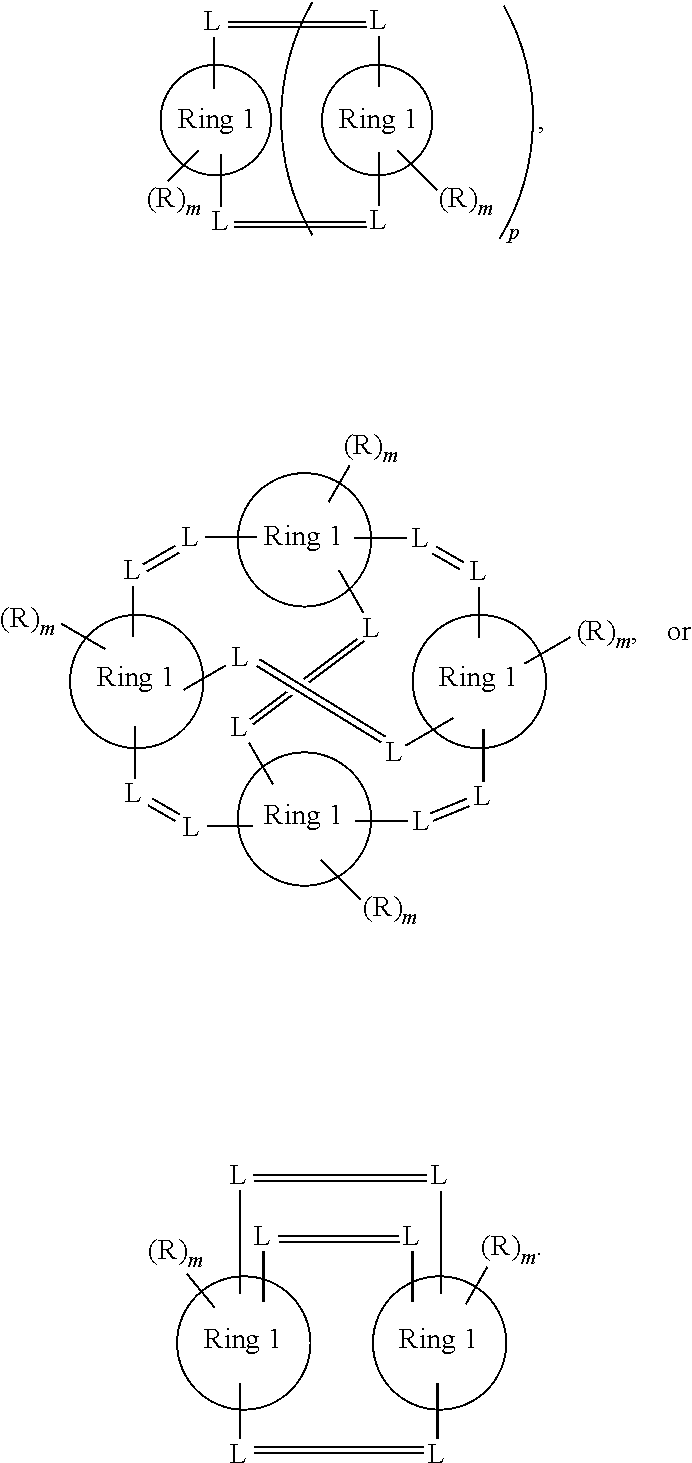

With respect to the formulas above for the disulfide cyclophane, the thiacyclophane, the unsaturated cyclophane and the saturated cyclophane,

wherein p is from 1 to 10; each R independently is carboxyl ester, aminocarbonyl, aliphatic, heteroaliphatic, NO2, sulfonyl, amine, protected amine, aryl, heteroaryl, OH, oxo or halogen; and m is from 0 to 4.

With respect to this formula,

With respect to this formula,


With respect to formula I,

moiety is selected from


where each Ra independently is hydrogen, carboxyl ester, aminocarbonyl, aliphatic, heteroaliphatic, NO2, sulfonyl, amine, protected amine, aryl, heteroaryl, OH or halogen; each Rb independently is hydrogen, aliphatic or heteroaliphatic; each Rc independently is hydrogen, aliphatic or heteroaliphatic; and q is from 1 to 4. In some embodiments, Rc is hydrogen, and in others Rc is alkyl. In some examples, each Ra independently is hydrogen or alkoxy.


In certain embodiments of formula Ia, compounds have a formula selected from

In some embodiments, each m is zero. In other embodiments, each R independently is alkoxy, particularly methoxy. In certain embodiments, each m is 2 and R is methoxy. In particular embodiment, the compounds have a formula Ib

In certain embodiments of formula Ia, compounds have a formula selected from

In some embodiments of formulas Ia and Ib, at least on L is CH2, and in certain embodiments, all L's are CH2. In some embodiments, p is 1, 2 or 3. In other examples, p is greater than 3, such as 4, 5, 6, 7, 8, 9 or 10.


With respect to formula III,


moiety has a formula selected from

Wherein

moiety have a cage-like structure larger than a tetrahedron, such as comprising 6, 8, 10, 12, 14, 16, 18, 20, 22, 24 or more linker moieties. In certain embodiments, the cage-like structure comprises 12 or 24 linker moieties.


III. Methods of Making the Compounds


where each Ra independently is hydrogen, carboxyl ester, aminocarbonyl, aliphatic, heteroaliphatic, NO2, sulfonyl, amine, protected amine, aryl, heteroaryl, OH, oxo or halogen; each Rb independently is hydrogen, aliphatic or heteroaliphatic; each Rc independently is hydrogen, aliphatic or heteroaliphatic; p is from 1 to 4;


V. Examples


| TABLE 1 |
| Distribution of discrete disulfide macrocycles by oxidation |
| of [H2L1] performed at 2 mM concentration |
| (6 equivalents I2, ⅔ equivalents pnictogen trichloride) |
| Solvent | Dimer | Trimer | Tetramer | ||
| CDCl3 | 18 | 64 | 18 | ||
| TCE-d2 | 19 | 66 | 15 | ||
| C6D6 | 18 | 64 | 18 | ||
| Toluene- | 32 | 53 | 15 | ||
| d8 | |||||
| THF-d8 | 8 | 35 | 57 | ||
| (CD3)2CO | 61 | 30 | 9 | ||

Analysis of the Molecular structures
Claims (18)


Priority Applications (1)
| Application Number | Priority Date | Filing Date | Title |
|---|---|---|---|
| US15/698,284 US10344005B2 (en) | 2014-11-18 | 2017-09-07 | Synthesis of cyclophanes for a self-assembly reaction |
Applications Claiming Priority (3)
| Application Number | Priority Date | Filing Date | Title |
|---|---|---|---|
| US201462081398P | 2014-11-18 | 2014-11-18 | |
| US14/944,584 US9790192B2 (en) | 2014-11-18 | 2015-11-18 | Synthesis of cyclophanes from a self-assembly reaction |
| US15/698,284 US10344005B2 (en) | 2014-11-18 | 2017-09-07 | Synthesis of cyclophanes for a self-assembly reaction |
Related Parent Applications (1)
| Application Number | Title | Priority Date | Filing Date |
|---|---|---|---|
| US14/944,584 Division US9790192B2 (en) | 2014-11-18 | 2015-11-18 | Synthesis of cyclophanes from a self-assembly reaction |
Publications (2)
| Publication Number | Publication Date |
|---|---|
| US20170369456A1 US20170369456A1 (en) | 2017-12-28 |
| US10344005B2 true US10344005B2 (en) | 2019-07-09 |
Family
ID=55961096
Family Applications (2)
| Application Number | Title | Priority Date | Filing Date |
|---|---|---|---|
| US14/944,584 Active US9790192B2 (en) | 2014-11-18 | 2015-11-18 | Synthesis of cyclophanes from a self-assembly reaction |
| US15/698,284 Active US10344005B2 (en) | 2014-11-18 | 2017-09-07 | Synthesis of cyclophanes for a self-assembly reaction |
Family Applications Before (1)
| Application Number | Title | Priority Date | Filing Date |
|---|---|---|---|
| US14/944,584 Active US9790192B2 (en) | 2014-11-18 | 2015-11-18 | Synthesis of cyclophanes from a self-assembly reaction |
Country Status (1)
| Country | Link |
|---|---|
| US (2) | US9790192B2 (en) |
Families Citing this family (3)
| Publication number | Priority date | Publication date | Assignee | Title |
|---|---|---|---|---|
| US9790192B2 (en) * | 2014-11-18 | 2017-10-17 | University Of Oregon | Synthesis of cyclophanes from a self-assembly reaction |
| WO2017211985A1 (en) * | 2016-06-08 | 2017-12-14 | Ucb Biopharma Sprl | Methods for identifying proteins by using synthetic receptors |
| WO2018038898A2 (en) * | 2016-08-05 | 2018-03-01 | The Regents Of The University Of California | Mithrene and methods of fabrication of mithrene |
Citations (1)
| Publication number | Priority date | Publication date | Assignee | Title |
|---|---|---|---|---|
| US9790192B2 (en) * | 2014-11-18 | 2017-10-17 | University Of Oregon | Synthesis of cyclophanes from a self-assembly reaction |
-
2015
- 2015-11-18 US US14/944,584 patent/US9790192B2/en active Active
-
2017
- 2017-09-07 US US15/698,284 patent/US10344005B2/en active Active
Patent Citations (1)
| Publication number | Priority date | Publication date | Assignee | Title |
|---|---|---|---|---|
| US9790192B2 (en) * | 2014-11-18 | 2017-10-17 | University Of Oregon | Synthesis of cyclophanes from a self-assembly reaction |
Non-Patent Citations (12)
| Title |
|---|
| Brisig et al., "Selection and amplification of a catalyst from a dynamic combinatorial library," Angewandte Chemie, vol. 42, No. 11, pp. 1270-1273, 2003. Published Mar. 13, 2003. |
| Chan et al., "A new one-flask Ramberg-Backlund reaction," J. Chem. Soc., Chem. Commun., pp. 1771-1772, 1994. Published Jan. 1, 1994. |
| Collins et al., "Pnictogen-directed synthesis of discrete disulfide macrocycles," Chem. Commun., vol. 49, pp. 6588-6601, 2013. Published Jun. 5, 2013. |
| Gross et al., "Concave Hydrocarbons," Chem. Eur. J., vol. 2, No. 12, pp. 1585-1595, Dec. 1996. |
| Houk et al., "Structure-reactivity relations for thiol-disulfide interchange," J. Am. Chem. Soc., vol. 109, pp. 6825-6836, 1987. Oct. 1, 1987. |
| Mitchell et al., "Syntheses and reactions of the first dithia [3.1.3.1] metacyclophanes, [2.1.2.1] metacyclophanes, and [2.1.2.1] metacyclophanedienes," J. Org. Chem., vol. 49, pp. 2534-2540, 1984. Published Jul. 1, 1984. |
| Montanari, et al., "Mild preparation of functionalized [2.2] paracyclophanes via the Pummerer rearrangement," Organic & Biomolecular Chemistry, vol. 9, pp. 5018-5020, 2011. Published Mar. 31, 2011. |
| Otsubo et al., An alternate route for the conversion of dithia [3.3] cyclophanes to cyclophane-dienes. Reaction with benzyne followed by sulfoxide pyrolysis, Pergamon Press, Tetrahedron Letters No. 45, pp. 3881-3884, Sep. 29, 1975. |
| Otto et al., "Selection and amplification of hosts from dynamic combinatorial libraries of macrocyclic disulfides," Science, vol. 297, pp. 590-593, Jul. 26, 2002. |
| Singh et al., "Comparisons of rate constants for thiolate-disulfide interchange in water and in polar aprotic solvents using dynamic H NMR line shape analysis," J. Am. Chem. Soc., vol. 112, pp. 1190-1197, 1990. Published Jan. 1, 1990. |
| West et al., "Dynamic combination discovery of a [2]-catenane and its guest-induced conversion into a molecular square host," JACS Communications, Feb. 28, 2008. |
| Yu et al., "Synthesis and ring-opening metathesis of tetraalkoxy-substituted [2.2] paracyclophane-1,9-dienes," Chem. Eur. J., vol. 17, pp. 6991-6997, 2011. Published Jun. 14, 2011. |
Also Published As
| Publication number | Publication date |
|---|---|
| US20170369456A1 (en) | 2017-12-28 |
| US20160137598A1 (en) | 2016-05-19 |
| US9790192B2 (en) | 2017-10-17 |
Similar Documents
| Publication | Publication Date | Title |
|---|---|---|
| US4156683A (en) | Complexes of macrocyclic compounds | |
| US20050043553A1 (en) | Synthesis of triphenylphosphonium quinols and quinones | |
| US20170369456A1 (en) | Synthesis of cyclophanes for a self-assembly reaction | |
| Block et al. | 1, 3-Dithietane | |
| Dhau et al. | Synthesis, characterization, X-ray crystal structure and antibacterial activity of bis [3-(4-chloro-N, N-diethylpyridine-2-carboxamide)] diselenide | |
| Hussain et al. | Synthesis, spectroscopic characterization, X-ray crystal structure and biological activities of homo-and heterobimetallic complexes with potassium-1-dithiocarboxylatopiperidine-4-carboxylate | |
| US20210171457A1 (en) | Process for making diaryl sulfones | |
| JP4094064B2 (en) | Cyclic phenol sulfide containing sulfinyl group or sulfonyl group and process for producing the same | |
| JP5596258B2 (en) | Calixarene dimer compound and method for producing the same | |
| Qi et al. | Synthesis and hydrolysis of 4-chloro-PyMTA and 4-iodo-PyMTA esters and their oxidative degradation with Cu (I/II) and oxygen | |
| CN104098432A (en) | Synthetic method for trifluoromethyl methylation arene | |
| CN113214124A (en) | Monofluoromethylselenated reagent and preparation method and application thereof | |
| Akabori et al. | Synthesis and physicochemical properties of dioxathia (n) ferrocenophanes. | |
| Forensi et al. | 1, 8, 10-Trisubstituted anthracenyl hydrocarbons: Towards versatile scaffolds for multiple-H-bonded recognition arrays | |
| WO2024022998A1 (en) | Process for preparing daprodustat and cocrystals thereof | |
| CN105980394B (en) | Metallocene derivatives with anticancer activity | |
| EP2053049B1 (en) | Preparation of 2' , 6' -di-pyrazolyl-pyridine containing a reactive group R in 4' position | |
| EP4105199A1 (en) | Method for producing alkane disulfonic acid compound | |
| JP2016166160A (en) | Porphyrin compounds and uses thereof | |
| Freijee et al. | The dimerization of some magnesacycloalkanes and benzomagnesacycloalkenes; the relation between ring size, ring strain and degree of association | |
| CH634068A5 (en) | PRIMIDILSULFURI WITH ANTI-SECRETORY ACTIVITY, PROCESS FOR THEIR PREPARATION AND PHARMACEUTICAL COMPOSITIONS THAT CONTAIN THEM. | |
| CN115028568B (en) | Synthesis method of 3-selenoindole compound promoted by visible light | |
| EP0181743B1 (en) | Polymerization initiator | |
| JP3442087B2 (en) | New disulfide compounds | |
| KR100884636B1 (en) | Manufacturing method of coenzyme # 10 |
Legal Events
| Date | Code | Title | Description |
|---|---|---|---|
| FEPP | Fee payment procedure |
Free format text: ENTITY STATUS SET TO UNDISCOUNTED (ORIGINAL EVENT CODE: BIG.); ENTITY STATUS OF PATENT OWNER: SMALL ENTITY |
|
| FEPP | Fee payment procedure |
Free format text: ENTITY STATUS SET TO SMALL (ORIGINAL EVENT CODE: SMAL); ENTITY STATUS OF PATENT OWNER: SMALL ENTITY |
|
| AS | Assignment |
Owner name: UNIVERSITY OF OREGON, OREGON Free format text: ASSIGNMENT OF ASSIGNORS INTEREST;ASSIGNORS:JOHNSON, DARREN W.;COLLINS, MARY;SIGNING DATES FROM 20151130 TO 20151202;REEL/FRAME:043808/0896 |
|
| STPP | Information on status: patent application and granting procedure in general |
Free format text: NOTICE OF ALLOWANCE MAILED -- APPLICATION RECEIVED IN OFFICE OF PUBLICATIONS |
|
| STPP | Information on status: patent application and granting procedure in general |
Free format text: PUBLICATIONS -- ISSUE FEE PAYMENT VERIFIED |
|
| STCF | Information on status: patent grant |
Free format text: PATENTED CASE |
|
| MAFP | Maintenance fee payment |
Free format text: PAYMENT OF MAINTENANCE FEE, 4TH YR, SMALL ENTITY (ORIGINAL EVENT CODE: M2551); ENTITY STATUS OF PATENT OWNER: SMALL ENTITY Year of fee payment: 4 |