US10344000B2 - Substituted bicyclic pyrazole compounds as RORgammaT inhibitors and uses thereof - Google Patents
Substituted bicyclic pyrazole compounds as RORgammaT inhibitors and uses thereof Download PDFInfo
- Publication number
- US10344000B2 US10344000B2 US15/770,255 US201615770255A US10344000B2 US 10344000 B2 US10344000 B2 US 10344000B2 US 201615770255 A US201615770255 A US 201615770255A US 10344000 B2 US10344000 B2 US 10344000B2
- Authority
- US
- United States
- Prior art keywords
- chloro
- mmol
- cyclohex
- tetrahydro
- ene
- Prior art date
- Legal status (The legal status is an assumption and is not a legal conclusion. Google has not performed a legal analysis and makes no representation as to the accuracy of the status listed.)
- Active
Links
- 0 *.*C1=C[Y]=C(*)C(C(=O)N2N=C(c3cC(*)C(*)(C(=O)O)CC3)C(C)=C2C)=C1* Chemical compound *.*C1=C[Y]=C(*)C(C(=O)N2N=C(c3cC(*)C(*)(C(=O)O)CC3)C(C)=C2C)=C1* 0.000 description 41
- ZZSMSVPVELCPTJ-UHFFFAOYSA-N CC(C)C1=C(C(C)(C)C)CCCC1 Chemical compound CC(C)C1=C(C(C)(C)C)CCCC1 ZZSMSVPVELCPTJ-UHFFFAOYSA-N 0.000 description 4
- IUAVAKAEXAAZAL-UHFFFAOYSA-N COC(=O)C1CCC2=C(C1)N(C(=O)C1=C(C3CC3)C=CC=C1Cl)N=C2I Chemical compound COC(=O)C1CCC2=C(C1)N(C(=O)C1=C(C3CC3)C=CC=C1Cl)N=C2I IUAVAKAEXAAZAL-UHFFFAOYSA-N 0.000 description 4
- GDSQTWDUCDSZEY-UHFFFAOYSA-N C1=NNC2=C1CCCC2 Chemical compound C1=NNC2=C1CCCC2 GDSQTWDUCDSZEY-UHFFFAOYSA-N 0.000 description 3
- RKHYOJXPZVSMNO-UHFFFAOYSA-N CC(=O)C1CCC2=C(C1)NN=C2C1=CCC(C(=O)OC(C)(C)C)CC1.CC(=O)C1CCC2=C(C1)NN=C2I Chemical compound CC(=O)C1CCC2=C(C1)NN=C2C1=CCC(C(=O)OC(C)(C)C)CC1.CC(=O)C1CCC2=C(C1)NN=C2I RKHYOJXPZVSMNO-UHFFFAOYSA-N 0.000 description 2
- MRRXHOCMKZLCHU-UHFFFAOYSA-N CC(=O)C1CCC2=C(C1)NN=C2C1=CCC(C)(C(=O)OC(C)(C)C)CC1 Chemical compound CC(=O)C1CCC2=C(C1)NN=C2C1=CCC(C)(C(=O)OC(C)(C)C)CC1 MRRXHOCMKZLCHU-UHFFFAOYSA-N 0.000 description 2
- HYNBSBAWGATECV-UHFFFAOYSA-N CC(C)(C)OC(=O)C1CCC(=O)CC1 Chemical compound CC(C)(C)OC(=O)C1CCC(=O)CC1 HYNBSBAWGATECV-UHFFFAOYSA-N 0.000 description 2
- RWYIYHBLOVRAEE-UHFFFAOYSA-N CC1(CO)CCC2=C(C1)N(C(=O)C1=C(C3CC3)C=CC=C1Cl)N=C2C1=CCC(C(=O)O)CC1 Chemical compound CC1(CO)CCC2=C(C1)N(C(=O)C1=C(C3CC3)C=CC=C1Cl)N=C2C1=CCC(C(=O)O)CC1 RWYIYHBLOVRAEE-UHFFFAOYSA-N 0.000 description 2
- ZREZDODZGZVRBD-UHFFFAOYSA-N CCOC(=O)C1CC=C(B2OC(C)(C)C(C)(C)O2)CC1 Chemical compound CCOC(=O)C1CC=C(B2OC(C)(C)C(C)(C)O2)CC1 ZREZDODZGZVRBD-UHFFFAOYSA-N 0.000 description 2
- YMTSXVDWHXFWSY-LKVSRFHLSA-N CCOC(=O)[C@@H]1CC=C(C2=NNC3=C2CCC(C(C)=O)C3)C[C@@H]1C Chemical compound CCOC(=O)[C@@H]1CC=C(C2=NNC3=C2CCC(C(C)=O)C3)C[C@@H]1C YMTSXVDWHXFWSY-LKVSRFHLSA-N 0.000 description 2
- XBCUPRJEXXPKLA-LKVSRFHLSA-N CCOC(=O)[C@@H]1CCC(C2=NNC3=C2CCC(C(C)=O)C3)=C[C@@H]1C Chemical compound CCOC(=O)[C@@H]1CCC(C2=NNC3=C2CCC(C(C)=O)C3)=C[C@@H]1C XBCUPRJEXXPKLA-LKVSRFHLSA-N 0.000 description 2
- XSNZTSBNXMQBRI-UHFFFAOYSA-N COC(=O)C1=C(Cl)C=CC=C1Br Chemical compound COC(=O)C1=C(Cl)C=CC=C1Br XSNZTSBNXMQBRI-UHFFFAOYSA-N 0.000 description 2
- ASGQEWAVHWBJRG-UHFFFAOYSA-N COC(=O)C1CCC2=C(C1)NN=C2I Chemical compound COC(=O)C1CCC2=C(C1)NN=C2I ASGQEWAVHWBJRG-UHFFFAOYSA-N 0.000 description 2
- CJTIWGBQCVYTQE-UHFFFAOYSA-N FC1=CC=C(Br)C=C1Cl Chemical compound FC1=CC=C(Br)C=C1Cl CJTIWGBQCVYTQE-UHFFFAOYSA-N 0.000 description 2
- VDMYDFPQXAWWLE-UHFFFAOYSA-N IC1=NNC2=C1CCC2 Chemical compound IC1=NNC2=C1CCC2 VDMYDFPQXAWWLE-UHFFFAOYSA-N 0.000 description 2
- AZHMCMMGUMQQHX-UHFFFAOYSA-N IC1=NNC2=C1CCCC2 Chemical compound IC1=NNC2=C1CCCC2 AZHMCMMGUMQQHX-UHFFFAOYSA-N 0.000 description 2
- KGZRAQJFRXGZTN-UHFFFAOYSA-N N#CC1(C2=C(C(=O)N3N=C(C4=CCC(C(=O)O)CC4)C4=C3COCC4)C(Cl)=CC=C2)CC1 Chemical compound N#CC1(C2=C(C(=O)N3N=C(C4=CCC(C(=O)O)CC4)C4=C3COCC4)C(Cl)=CC=C2)CC1 KGZRAQJFRXGZTN-UHFFFAOYSA-N 0.000 description 2
- NUCVOBJTDKPMNB-UHFFFAOYSA-N N#CC1(C2=C(C(=O)N3N=C(C4=CCC(C(=O)O)CC4)C4=C3COCC4)C(Cl)=CC=C2)CCC1 Chemical compound N#CC1(C2=C(C(=O)N3N=C(C4=CCC(C(=O)O)CC4)C4=C3COCC4)C(Cl)=CC=C2)CCC1 NUCVOBJTDKPMNB-UHFFFAOYSA-N 0.000 description 2
- CZWTXRYSVVTLNY-LKFWMAMKSA-M BrC1=NNC2=C1CCOC2.CCOC(=O)C1CC=C(B2OC(C)(C)C(C)(C)O2)CC1.CCOC(=O)C1CC=C(C2=NN(C(=O)C3=C(C4CCC4)C=CC=C3Cl)C3=C2CCOC3)CC1.CCOC(=O)C1CC=C(C2=NNC3=C2CCOC3)CC1.O=C(Cl)C1=C(C2CCC2)C=CC=C1Cl.O=C(O)[C@@H]1CC=C(C2=NN(C(=O)C3=C(C4CCC4)C=CC=C3Cl)C3=C2CCOC3)CC1.O=C(O)[C@H]1CC=C(C2=NN(C(=O)C3=C(C4CCC4)C=CC=C3Cl)C3=C2CCOC3)CC1.[Li]O Chemical compound BrC1=NNC2=C1CCOC2.CCOC(=O)C1CC=C(B2OC(C)(C)C(C)(C)O2)CC1.CCOC(=O)C1CC=C(C2=NN(C(=O)C3=C(C4CCC4)C=CC=C3Cl)C3=C2CCOC3)CC1.CCOC(=O)C1CC=C(C2=NNC3=C2CCOC3)CC1.O=C(Cl)C1=C(C2CCC2)C=CC=C1Cl.O=C(O)[C@@H]1CC=C(C2=NN(C(=O)C3=C(C4CCC4)C=CC=C3Cl)C3=C2CCOC3)CC1.O=C(O)[C@H]1CC=C(C2=NN(C(=O)C3=C(C4CCC4)C=CC=C3Cl)C3=C2CCOC3)CC1.[Li]O CZWTXRYSVVTLNY-LKFWMAMKSA-M 0.000 description 1
- UEPMTDZGKJUERD-UHFFFAOYSA-L Br[Zn]C1CCC1.COC(=O)C1=C(Cl)C=CC=C1Br.COC(=O)C1=C(Cl)C=CC=C1C1CCC1.O=C(O)C1=C(Cl)C=CC=C1C1CCC1.O[K] Chemical compound Br[Zn]C1CCC1.COC(=O)C1=C(Cl)C=CC=C1Br.COC(=O)C1=C(Cl)C=CC=C1C1CCC1.O=C(O)C1=C(Cl)C=CC=C1C1CCC1.O[K] UEPMTDZGKJUERD-UHFFFAOYSA-L 0.000 description 1
- NGYMOWRHXDLRGE-UHFFFAOYSA-M C.C.C.C.C.CC(C)(C)OC(=O)C1CC=C(B2OC(C)(C)C(C)(C)O2)CC1.CC(O)C1CCC2=C(C1)N(C(=O)C1=C(C3CC3)C=CC=C1Cl)N=C2C1=CCC(C(=O)O)CC1.CC(O)C1CCC2=C(C1)N(C(=O)C1=C(C3CC3)C=CC=C1Cl)N=C2C1=CCC(C(=O)OC(C)(C)C)CC1.CC(O)C1CCC2=C(C1)N(C(=O)C1=C(C3CC3)C=CC=C1Cl)N=C2I.CSF.C[Mg]Cl.O=C(C1=C(C2CC2)C=CC=C1Cl)N1N=C(I)C2=C1CC(CO)CC2.[H]C(=O)C1CCC2=C(C1)N(C(=O)C1=C(C3CC3)C=CC=C1Cl)N=C2I Chemical compound C.C.C.C.C.CC(C)(C)OC(=O)C1CC=C(B2OC(C)(C)C(C)(C)O2)CC1.CC(O)C1CCC2=C(C1)N(C(=O)C1=C(C3CC3)C=CC=C1Cl)N=C2C1=CCC(C(=O)O)CC1.CC(O)C1CCC2=C(C1)N(C(=O)C1=C(C3CC3)C=CC=C1Cl)N=C2C1=CCC(C(=O)OC(C)(C)C)CC1.CC(O)C1CCC2=C(C1)N(C(=O)C1=C(C3CC3)C=CC=C1Cl)N=C2I.CSF.C[Mg]Cl.O=C(C1=C(C2CC2)C=CC=C1Cl)N1N=C(I)C2=C1CC(CO)CC2.[H]C(=O)C1CCC2=C(C1)N(C(=O)C1=C(C3CC3)C=CC=C1Cl)N=C2I NGYMOWRHXDLRGE-UHFFFAOYSA-M 0.000 description 1
- CVGKPPOAAGWVQI-UHFFFAOYSA-N C.C.C.C.C1CCOC1.C1CCOC1.CCOC(=O)C1(C)CC=C(B2OC(C)(C)C(C)(C)O2)CC1.CCOC(=O)C1(C)CC=C(OS(=O)(=O)C(F)(F)F)CC1.CCOC(=O)C1(C)CCC(=O)CC1.CCOC(=O)C1(C)CCC2(CC1)OCCO2.CCOC(=O)C1CCC(=O)CC1.CCOC(=O)C1CCC2(CC1)OCCO2.NO[N+](=O)[O-].NO[N+](=O)[O-].NO[N+](=O)[O-].N[Ce](O[N+](=O)[O-])(O[N+](=O)[O-])O[N+](=O)[O-].OCCO Chemical compound C.C.C.C.C1CCOC1.C1CCOC1.CCOC(=O)C1(C)CC=C(B2OC(C)(C)C(C)(C)O2)CC1.CCOC(=O)C1(C)CC=C(OS(=O)(=O)C(F)(F)F)CC1.CCOC(=O)C1(C)CCC(=O)CC1.CCOC(=O)C1(C)CCC2(CC1)OCCO2.CCOC(=O)C1CCC(=O)CC1.CCOC(=O)C1CCC2(CC1)OCCO2.NO[N+](=O)[O-].NO[N+](=O)[O-].NO[N+](=O)[O-].N[Ce](O[N+](=O)[O-])(O[N+](=O)[O-])O[N+](=O)[O-].OCCO CVGKPPOAAGWVQI-UHFFFAOYSA-N 0.000 description 1
- TUAFYCKCTPJYCU-UHFFFAOYSA-N C.C.C.C.CC(C)(C)OC(=O)C1CC=C(B2OC(C)(C)C(C)(C)O2)CC1.CC(C)(C)OC(=O)C1CC=C(C2=NN(C(=O)C3=C(C4CC4)C=CC=C3Cl)C3=C2CCC(CO)C3)CC1.COC(=O)C1CCC2=C(C1)N(C(=O)C1=C(C3CC3)C=CC=C1Cl)N=C2I.O=C(O)C1CC=C(C2=NN(C(=O)C3=C(C4CC4)C=CC=C3Cl)C3=C2CCC(CO)C3)CC1.O=C(O)C1CCC2=C(C1)N(C(=O)C1=C(C3CC3)C=CC=C1Cl)N=C2I Chemical compound C.C.C.C.CC(C)(C)OC(=O)C1CC=C(B2OC(C)(C)C(C)(C)O2)CC1.CC(C)(C)OC(=O)C1CC=C(C2=NN(C(=O)C3=C(C4CC4)C=CC=C3Cl)C3=C2CCC(CO)C3)CC1.COC(=O)C1CCC2=C(C1)N(C(=O)C1=C(C3CC3)C=CC=C1Cl)N=C2I.O=C(O)C1CC=C(C2=NN(C(=O)C3=C(C4CC4)C=CC=C3Cl)C3=C2CCC(CO)C3)CC1.O=C(O)C1CCC2=C(C1)N(C(=O)C1=C(C3CC3)C=CC=C1Cl)N=C2I TUAFYCKCTPJYCU-UHFFFAOYSA-N 0.000 description 1
- AQVCUABNQIXUFB-UHFFFAOYSA-N C.C.C.C=C(C[Si](C)(C)C)C1=CC=CC(Cl)=C1C(=O)OC.C=C(FC)C1=CC=CC(Cl)=C1C(=O)OC.C=CC[Si](C)(C)C.CFC1(C2=CC=CC(Cl)=C2C(=O)O)CC1.COC(=O)C1=C(Cl)C=CC=C1Br.COC(=O)C1=C(Cl)C=CC=C1C1(FC)CC1.COC(=O)C1=C(Cl)C=CC=C1C1(FC)CCN=N1 Chemical compound C.C.C.C=C(C[Si](C)(C)C)C1=CC=CC(Cl)=C1C(=O)OC.C=C(FC)C1=CC=CC(Cl)=C1C(=O)OC.C=CC[Si](C)(C)C.CFC1(C2=CC=CC(Cl)=C2C(=O)O)CC1.COC(=O)C1=C(Cl)C=CC=C1Br.COC(=O)C1=C(Cl)C=CC=C1C1(FC)CC1.COC(=O)C1=C(Cl)C=CC=C1C1(FC)CCN=N1 AQVCUABNQIXUFB-UHFFFAOYSA-N 0.000 description 1
- SMSYIWSXROQDAU-UHFFFAOYSA-N C.C.C.CC(C)(C)OC(=O)C1CC=C(B2OC(C)(C)C(C)(C)O2)CC1.CC(C)(C)OC(=O)C1CC=C(C2=NN(C(=O)C3=C(C4CC4)C=CC=C3Cl)C3=C2CCC(O)C3)CC1.CSF.O=C(C1=C(C2CC2)C=CC=C1Cl)N1N=C(I)C2=C1CC(O)CC2.O=C(C1=C(C2CC2)C=CC=C1Cl)N1N=C(I)C2=C1CC(O)CC2.O=C(O)C1CC=C(C2=NN(C(=O)C3=C(C4CC4)C=CC=C3Cl)C3=C2CCC(O)C3)CC1 Chemical compound C.C.C.CC(C)(C)OC(=O)C1CC=C(B2OC(C)(C)C(C)(C)O2)CC1.CC(C)(C)OC(=O)C1CC=C(C2=NN(C(=O)C3=C(C4CC4)C=CC=C3Cl)C3=C2CCC(O)C3)CC1.CSF.O=C(C1=C(C2CC2)C=CC=C1Cl)N1N=C(I)C2=C1CC(O)CC2.O=C(C1=C(C2CC2)C=CC=C1Cl)N1N=C(I)C2=C1CC(O)CC2.O=C(O)C1CC=C(C2=NN(C(=O)C3=C(C4CC4)C=CC=C3Cl)C3=C2CCC(O)C3)CC1 SMSYIWSXROQDAU-UHFFFAOYSA-N 0.000 description 1
- VDJAGNKICXFKOK-UHFFFAOYSA-N C.C.C.CC(C)(C)OC(=O)C1CC=C(B2OC(C)(C)C(C)(C)O2)CC1.COC(=O)C1CCC2=C(C1)N(C(=O)C1=C(C3CC3)C=CC=C1Cl)N=C2I.O=C(C1=C(C2CC2)C=CC=C1Cl)N1N=C(I)C2=C1CC(CO)CC2.O=C(O)C1CC=C(C2=NN(C(=O)C3=C(C4CC4)C=CC=C3Cl)C3=C2CCC(CO)C3)CC1 Chemical compound C.C.C.CC(C)(C)OC(=O)C1CC=C(B2OC(C)(C)C(C)(C)O2)CC1.COC(=O)C1CCC2=C(C1)N(C(=O)C1=C(C3CC3)C=CC=C1Cl)N=C2I.O=C(C1=C(C2CC2)C=CC=C1Cl)N1N=C(I)C2=C1CC(CO)CC2.O=C(O)C1CC=C(C2=NN(C(=O)C3=C(C4CC4)C=CC=C3Cl)C3=C2CCC(CO)C3)CC1 VDJAGNKICXFKOK-UHFFFAOYSA-N 0.000 description 1
- XWJLOERKRKDEIJ-UHFFFAOYSA-N C.C.COC(=O)C1CCC2=C(C1)N(C(=O)C1=C(C3CC3)C=CC=C1Cl)N=C2C1=CCC(C(=O)O)CC1.COC(=O)C1CCC2=C(C1)N(C(=O)C1=C(C3CC3)C=CC=C1Cl)N=C2C1=CCC(C(=O)OC(C)(C)C)CC1.O=CC(F)(F)F Chemical compound C.C.COC(=O)C1CCC2=C(C1)N(C(=O)C1=C(C3CC3)C=CC=C1Cl)N=C2C1=CCC(C(=O)O)CC1.COC(=O)C1CCC2=C(C1)N(C(=O)C1=C(C3CC3)C=CC=C1Cl)N=C2C1=CCC(C(=O)OC(C)(C)C)CC1.O=CC(F)(F)F XWJLOERKRKDEIJ-UHFFFAOYSA-N 0.000 description 1
- MOHWKXIYGAQUJJ-UHFFFAOYSA-J C.CC(=O)O[Rh]([Rh])(OC(C)=O)(OC(C)=O)OC(C)=O.CC(C)(C)OC(=O)C1CC=C(B2OC(C)(C)C(C)(C)O2)CC1.CC(C)(C)OC(=O)C1CC=C(C2=NN(C(=O)OC(C)(C)C)C3=C2OCCC3)CC1.CC(C)(C)OC(=O)N1N=C(O)C2=C1CCCO2.CC(C)(C)OC(=O)N1N=C(OS(=O)(=O)C(F)(F)F)C2=C1CCCO2.CC(C)(C)OC(=O)OC(=O)OC(C)(C)C.CCOC(=O)C(=[N+]=[N-])C(=O)CCCO.CCOC(=O)C1OCCCC1=O.COC(=O)C1CC=C(C2=NNC3=C2OCCC3)CC1.N=N.O.O=C(Cl)C1=C(C2CC2)C=CC=C1Cl.O=C1CCCO1.OC1=NNC2=C1OCCC2.[HH] Chemical compound C.CC(=O)O[Rh]([Rh])(OC(C)=O)(OC(C)=O)OC(C)=O.CC(C)(C)OC(=O)C1CC=C(B2OC(C)(C)C(C)(C)O2)CC1.CC(C)(C)OC(=O)C1CC=C(C2=NN(C(=O)OC(C)(C)C)C3=C2OCCC3)CC1.CC(C)(C)OC(=O)N1N=C(O)C2=C1CCCO2.CC(C)(C)OC(=O)N1N=C(OS(=O)(=O)C(F)(F)F)C2=C1CCCO2.CC(C)(C)OC(=O)OC(=O)OC(C)(C)C.CCOC(=O)C(=[N+]=[N-])C(=O)CCCO.CCOC(=O)C1OCCCC1=O.COC(=O)C1CC=C(C2=NNC3=C2OCCC3)CC1.N=N.O.O=C(Cl)C1=C(C2CC2)C=CC=C1Cl.O=C1CCCO1.OC1=NNC2=C1OCCC2.[HH] MOHWKXIYGAQUJJ-UHFFFAOYSA-J 0.000 description 1
- PMOVJRTYRPHIID-UHFFFAOYSA-N C.NCC1CCC2=C(C1)N(C(=O)C1=C(C3CC3)C=CC=C1Cl)N=C2C1=CCC(C(=O)O)CC1 Chemical compound C.NCC1CCC2=C(C1)N(C(=O)C1=C(C3CC3)C=CC=C1Cl)N=C2C1=CCC(C(=O)O)CC1 PMOVJRTYRPHIID-UHFFFAOYSA-N 0.000 description 1
- TUVBJSPUCMUOSD-UHFFFAOYSA-N C1=NNC2=C1CCC2 Chemical compound C1=NNC2=C1CCC2 TUVBJSPUCMUOSD-UHFFFAOYSA-N 0.000 description 1
- LHNAZHNZJIZRCV-UHFFFAOYSA-N C1=NNC2=C1CCOC2 Chemical compound C1=NNC2=C1CCOC2 LHNAZHNZJIZRCV-UHFFFAOYSA-N 0.000 description 1
- AUQZMUCVLXLFOF-UHFFFAOYSA-N C=C(C)B(F)(F)F.C=C(C)C1=CC=CC(Cl)=C1C(=O)OC.CC1(C2=CC=CC(Cl)=C2C(=O)O)CC1.COC(=O)C1=C(Cl)C=CC=C1Br.COC(=O)C1=C(Cl)C=CC=C1C1(C)CC1.[KH] Chemical compound C=C(C)B(F)(F)F.C=C(C)C1=CC=CC(Cl)=C1C(=O)OC.CC1(C2=CC=CC(Cl)=C2C(=O)O)CC1.COC(=O)C1=C(Cl)C=CC=C1Br.COC(=O)C1=C(Cl)C=CC=C1C1(C)CC1.[KH] AUQZMUCVLXLFOF-UHFFFAOYSA-N 0.000 description 1
- MQQHZJANNKLZPV-GPFGRTHNSA-N CC(=O)C1CCC2=C(C1)N(C(=O)C1=C(C3CC3)C=CC=C1Cl)N=C2I.CC(=O)[C@@H]1CCC2=C(C1)N(C(=O)C1=C(C3CC3)C=CC=C1Cl)N=C2I.CC(=O)[C@H]1CCC2=C(C1)N(C(=O)C1=C(C3CC3)C=CC=C1Cl)N=C2I Chemical compound CC(=O)C1CCC2=C(C1)N(C(=O)C1=C(C3CC3)C=CC=C1Cl)N=C2I.CC(=O)[C@@H]1CCC2=C(C1)N(C(=O)C1=C(C3CC3)C=CC=C1Cl)N=C2I.CC(=O)[C@H]1CCC2=C(C1)N(C(=O)C1=C(C3CC3)C=CC=C1Cl)N=C2I MQQHZJANNKLZPV-GPFGRTHNSA-N 0.000 description 1
- SLZPCEHEGCALCI-UHFFFAOYSA-N CC(=O)C1CCC2=C(C1)NN=C2C1=CCC(C(=O)OC(C)(C)C)CC1.CC(=O)C1CCC2=C(C1)NN=C2C1=CCC(C(=O)OC(C)(C)C)CC1 Chemical compound CC(=O)C1CCC2=C(C1)NN=C2C1=CCC(C(=O)OC(C)(C)C)CC1.CC(=O)C1CCC2=C(C1)NN=C2C1=CCC(C(=O)OC(C)(C)C)CC1 SLZPCEHEGCALCI-UHFFFAOYSA-N 0.000 description 1
- JVIQEYYNYGZTPX-UHFFFAOYSA-N CC(=O)C1CCC2=C(C1)NN=C2C1=CCC(C)(C(=O)OC(C)(C)C)CC1.CC(=O)C1CCC2=C(C1)NN=C2C1=CCC(C)(C(=O)OC(C)(C)C)CC1 Chemical compound CC(=O)C1CCC2=C(C1)NN=C2C1=CCC(C)(C(=O)OC(C)(C)C)CC1.CC(=O)C1CCC2=C(C1)NN=C2C1=CCC(C)(C(=O)OC(C)(C)C)CC1 JVIQEYYNYGZTPX-UHFFFAOYSA-N 0.000 description 1
- KCPYMLLEBOBVJD-NSMBSDNGSA-N CC(=O)C1CCC2=C(C1)NN=C2I.CC(=O)[C@@H]1CCC2=C(C1)NN=C2I.CC(=O)[C@H]1CCC2=C(C1)NN=C2I Chemical compound CC(=O)C1CCC2=C(C1)NN=C2I.CC(=O)[C@@H]1CCC2=C(C1)NN=C2I.CC(=O)[C@H]1CCC2=C(C1)NN=C2I KCPYMLLEBOBVJD-NSMBSDNGSA-N 0.000 description 1
- NGSPZTCZSRYDHS-CUEBCLCWSA-N CC(=O)C1CCC2=C(C1)NN=C2I.CCOC(=O)[C@@H]1CC=C(C2=NNC3=C2CCC(C(C)=O)C3)C[C@@H]1C.CCOC(=O)[C@@H]1CCC(C2=NNC3=C2CCC(C(C)=O)C3)=C[C@@H]1C Chemical compound CC(=O)C1CCC2=C(C1)NN=C2I.CCOC(=O)[C@@H]1CC=C(C2=NNC3=C2CCC(C(C)=O)C3)C[C@@H]1C.CCOC(=O)[C@@H]1CCC(C2=NNC3=C2CCC(C(C)=O)C3)=C[C@@H]1C NGSPZTCZSRYDHS-CUEBCLCWSA-N 0.000 description 1
- ZFOOOBKJKQEHEN-UHFFFAOYSA-N CC(C)(C)C1=C(C(C)(C)C)CCCC1 Chemical compound CC(C)(C)C1=C(C(C)(C)C)CCCC1 ZFOOOBKJKQEHEN-UHFFFAOYSA-N 0.000 description 1
- IQZJLPUBCNFUJK-UHFFFAOYSA-N CC(C)(C)C1=C(C(C)(C)C)OCCC1 Chemical compound CC(C)(C)C1=C(C(C)(C)C)OCCC1 IQZJLPUBCNFUJK-UHFFFAOYSA-N 0.000 description 1
- FPPQKYTWISSUGQ-UHFFFAOYSA-N CC(C)(C)C1CCCCC1C(C)(C)C Chemical compound CC(C)(C)C1CCCCC1C(C)(C)C FPPQKYTWISSUGQ-UHFFFAOYSA-N 0.000 description 1
- MALODUHOUIPLQR-UHFFFAOYSA-N CC(C)(C)OC(=O)C1CC=C(B2OC(C)(C)C(C)(C)O2)CC1 Chemical compound CC(C)(C)OC(=O)C1CC=C(B2OC(C)(C)C(C)(C)O2)CC1 MALODUHOUIPLQR-UHFFFAOYSA-N 0.000 description 1
- CEEBSDPHRUFVIY-UHFFFAOYSA-N CC(C)(C)OC(=O)C1CC=C(B2OC(C)(C)C(C)(C)O2)CC1.CC(C)(C)OC(=O)C1CC=C(C2=NN(C(=O)C3=C(Cl)C=CC=C3C3(C(F)(F)F)CC3)C3=C2CCCC3)CC1.IC1=NNC2=C1CCCC2.O=C(C1=C(Cl)C=CC=C1C1(C(F)(F)F)CC1)N1N=C(I)C2=C1CCCC2.O=C(Cl)C1=C(Cl)C=CC=C1C1(C(F)(F)F)CC1.O=C(O)C1CC=C(C2=NN(C(=O)C3=C(Cl)C=CC=C3C3(C(F)(F)F)CC3)C3=C2CCCC3)CC1 Chemical compound CC(C)(C)OC(=O)C1CC=C(B2OC(C)(C)C(C)(C)O2)CC1.CC(C)(C)OC(=O)C1CC=C(C2=NN(C(=O)C3=C(Cl)C=CC=C3C3(C(F)(F)F)CC3)C3=C2CCCC3)CC1.IC1=NNC2=C1CCCC2.O=C(C1=C(Cl)C=CC=C1C1(C(F)(F)F)CC1)N1N=C(I)C2=C1CCCC2.O=C(Cl)C1=C(Cl)C=CC=C1C1(C(F)(F)F)CC1.O=C(O)C1CC=C(C2=NN(C(=O)C3=C(Cl)C=CC=C3C3(C(F)(F)F)CC3)C3=C2CCCC3)CC1 CEEBSDPHRUFVIY-UHFFFAOYSA-N 0.000 description 1
- QAZBXZFCFCAHKT-UHFFFAOYSA-M CC(C)(C)OC(=O)C1CC=C(B2OC(C)(C)C(C)(C)O2)CC1.CC1CCCC2=C1C(C1=CCC(C(=O)O)CC1)=NN2C(=O)C1=C(C2CC2)C=CC=C1Cl.CC1CCCC2=C1C(I)=NN2.CC1CCCC2=C1C(I)=NN2C(=O)C1=C(C2CC2)C=CC=C1Cl.CC1CCCC2=C1C=NN2.CSF.C[Mg]Cl.O=C(Cl)C1=C(C2CC2)C=CC=C1Cl.O=C1CCCC2=C1C=NN2.SN=[IH] Chemical compound CC(C)(C)OC(=O)C1CC=C(B2OC(C)(C)C(C)(C)O2)CC1.CC1CCCC2=C1C(C1=CCC(C(=O)O)CC1)=NN2C(=O)C1=C(C2CC2)C=CC=C1Cl.CC1CCCC2=C1C(I)=NN2.CC1CCCC2=C1C(I)=NN2C(=O)C1=C(C2CC2)C=CC=C1Cl.CC1CCCC2=C1C=NN2.CSF.C[Mg]Cl.O=C(Cl)C1=C(C2CC2)C=CC=C1Cl.O=C1CCCC2=C1C=NN2.SN=[IH] QAZBXZFCFCAHKT-UHFFFAOYSA-M 0.000 description 1
- LYCQKRAQASWYKU-UHFFFAOYSA-N CC(C)(C)OC(=O)N1CCC2=C(C1)NN=C2I Chemical compound CC(C)(C)OC(=O)N1CCC2=C(C1)NN=C2I LYCQKRAQASWYKU-UHFFFAOYSA-N 0.000 description 1
- DDHDELALWVYDFX-UHFFFAOYSA-N CC(O)C1CCC2=C(C1)N(C(=O)C1=C(C3CC3)C=CC=C1Cl)N=C2C1=CCC(C(=O)OC(C)(C)C)CC1 Chemical compound CC(O)C1CCC2=C(C1)N(C(=O)C1=C(C3CC3)C=CC=C1Cl)N=C2C1=CCC(C(=O)OC(C)(C)C)CC1 DDHDELALWVYDFX-UHFFFAOYSA-N 0.000 description 1
- PKYUXKXOJJLLPC-UHFFFAOYSA-N CC1(C(=O)O)CC=C(C2=NN(C(=O)C3=C(C4CC4)C=CC=C3Cl)C3=C2CCC(CO)C3)CC1 Chemical compound CC1(C(=O)O)CC=C(C2=NN(C(=O)C3=C(C4CC4)C=CC=C3Cl)C3=C2CCC(CO)C3)CC1 PKYUXKXOJJLLPC-UHFFFAOYSA-N 0.000 description 1
- ANEMYDHYMMRIOU-UHFFFAOYSA-N CC1(C2=C(C(=O)N3N=C(C4=CCC(C(=O)O)CC4)C4=C3CCC4)C(Cl)=CC=C2)CC1 Chemical compound CC1(C2=C(C(=O)N3N=C(C4=CCC(C(=O)O)CC4)C4=C3CCC4)C(Cl)=CC=C2)CC1 ANEMYDHYMMRIOU-UHFFFAOYSA-N 0.000 description 1
- HGPJJCGNZAOEEU-UHFFFAOYSA-N CC1(C2=C(C(=O)N3N=C(C4=CCC(C(=O)O)CC4)C4=C3COCC4)C(Cl)=CC=C2)CC1 Chemical compound CC1(C2=C(C(=O)N3N=C(C4=CCC(C(=O)O)CC4)C4=C3COCC4)C(Cl)=CC=C2)CC1 HGPJJCGNZAOEEU-UHFFFAOYSA-N 0.000 description 1
- PDGCUSCKBWCRCM-UHFFFAOYSA-N CC1CCCC2=C1C(C1=CCC(C(=O)O)CC1)=NN2C(=O)C1=C(C2CC2)C=CC=C1Cl Chemical compound CC1CCCC2=C1C(C1=CCC(C(=O)O)CC1)=NN2C(=O)C1=C(C2CC2)C=CC=C1Cl PDGCUSCKBWCRCM-UHFFFAOYSA-N 0.000 description 1
- ZXYAWONOWHSQRU-UHFFFAOYSA-N CCOC(=O)C1CCC(=O)CC1 Chemical compound CCOC(=O)C1CCC(=O)CC1 ZXYAWONOWHSQRU-UHFFFAOYSA-N 0.000 description 1
- LYHMXFJMKCVFGJ-UHFFFAOYSA-L CCOC(=O)C1CCN(C2=NN(C(=O)C3=C(C4CC4)C=CC=C3Cl)C3=C2CCCC3)CC1.CCOC(=O)C1CCNCC1.O=C(C1=C(C2CC2)C=CC=C1Cl)N1N=C(I)C2=C1CCCC2.O=C(O)C1CCN(C2=NN(C(=O)C3=C(C4CC4)C=CC=C3Cl)C3=C2CCCC3)CC1.O=COO[K].[KH].[Li]O Chemical compound CCOC(=O)C1CCN(C2=NN(C(=O)C3=C(C4CC4)C=CC=C3Cl)C3=C2CCCC3)CC1.CCOC(=O)C1CCNCC1.O=C(C1=C(C2CC2)C=CC=C1Cl)N1N=C(I)C2=C1CCCC2.O=C(O)C1CCN(C2=NN(C(=O)C3=C(C4CC4)C=CC=C3Cl)C3=C2CCCC3)CC1.O=COO[K].[KH].[Li]O LYHMXFJMKCVFGJ-UHFFFAOYSA-L 0.000 description 1
- DXMFTUJTIBBTNC-RMWLUSQFSA-M CCOC(=O)C1CCNCC1O.CCOC(=O)[C@H]1CCN(C2=NN(C(=O)C3=C(C4CC4)C=CC=C3Cl)C3=C2CCCC3)C[C@H]1O.O=C(C1=C(C2CC2)C=CC=C1Cl)N1N=C(I)C2=C1CCCC2.O=C(O)[C@H]1CCN(C2=NN(C(=O)C3=C(C4CC4)C=CC=C3Cl)C3=C2CCCC3)C[C@H]1O.[Li]O Chemical compound CCOC(=O)C1CCNCC1O.CCOC(=O)[C@H]1CCN(C2=NN(C(=O)C3=C(C4CC4)C=CC=C3Cl)C3=C2CCCC3)C[C@H]1O.O=C(C1=C(C2CC2)C=CC=C1Cl)N1N=C(I)C2=C1CCCC2.O=C(O)[C@H]1CCN(C2=NN(C(=O)C3=C(C4CC4)C=CC=C3Cl)C3=C2CCCC3)C[C@H]1O.[Li]O DXMFTUJTIBBTNC-RMWLUSQFSA-M 0.000 description 1
- HPEHTBZMFLPOMV-OAYMMKAWSA-N CCOC(=O)[C@@H]1CC=C(B2OC(C)(C)C(C)(C)O2)C[C@@H]1C.CCOC(=O)[C@@H]1CCC(=O)C[C@@H]1C.CCOC(=O)[C@@H]1CCC(B2OC(C)(C)C(C)(C)O2)=C[C@@H]1C Chemical compound CCOC(=O)[C@@H]1CC=C(B2OC(C)(C)C(C)(C)O2)C[C@@H]1C.CCOC(=O)[C@@H]1CCC(=O)C[C@@H]1C.CCOC(=O)[C@@H]1CCC(B2OC(C)(C)C(C)(C)O2)=C[C@@H]1C HPEHTBZMFLPOMV-OAYMMKAWSA-N 0.000 description 1
- BSKIKANQAZCQHK-UHFFFAOYSA-M COC(=O)C1=C(Cl)C=CC=C1Br.COC(=O)C1=C(Cl)C=CC=C1C1CC1.O=C(O)C1=C(Cl)C=CC=C1C1CC1.OB(O)C1CC1.O[Na] Chemical compound COC(=O)C1=C(Cl)C=CC=C1Br.COC(=O)C1=C(Cl)C=CC=C1C1CC1.O=C(O)C1=C(Cl)C=CC=C1C1CC1.OB(O)C1CC1.O[Na] BSKIKANQAZCQHK-UHFFFAOYSA-M 0.000 description 1
- OWRCSIRJXOUBPW-UHFFFAOYSA-M COC(=O)C1CC=C(B2OC(C)(C)C(C)(C)O2)CC1.COC(=O)C1CC=C(C2=NN(C(=O)C3=C(C4CC4)C=CC=C3Cl)C3=C2CCCC3)CC1.O=C(C1=C(C2CC2)C=CC=C1Cl)N1N=C(I)C2=C1CCCC2.O=C(O)C1CC=C(C2=NN(C(=O)C3=C(C4CC4)C=CC=C3Cl)C3=C2CCCC3)CC1.[Li]O Chemical compound COC(=O)C1CC=C(B2OC(C)(C)C(C)(C)O2)CC1.COC(=O)C1CC=C(C2=NN(C(=O)C3=C(C4CC4)C=CC=C3Cl)C3=C2CCCC3)CC1.O=C(C1=C(C2CC2)C=CC=C1Cl)N1N=C(I)C2=C1CCCC2.O=C(O)C1CC=C(C2=NN(C(=O)C3=C(C4CC4)C=CC=C3Cl)C3=C2CCCC3)CC1.[Li]O OWRCSIRJXOUBPW-UHFFFAOYSA-M 0.000 description 1
- ZAJKCJCTINNYQD-UHFFFAOYSA-N COC(=O)C1CC=C(B2OC(C)(C)C(C)(C)O2)CC1.COC(=O)C1CC=C(OS(=O)(=O)C(F)(F)F)CC1.COC(=O)C1CCC(=O)CC1.O=S(=O)(N(C1=CC=CC=C1)S(=O)(=O)C(F)(F)F)C(F)(F)F Chemical compound COC(=O)C1CC=C(B2OC(C)(C)C(C)(C)O2)CC1.COC(=O)C1CC=C(OS(=O)(=O)C(F)(F)F)CC1.COC(=O)C1CCC(=O)CC1.O=S(=O)(N(C1=CC=CC=C1)S(=O)(=O)C(F)(F)F)C(F)(F)F ZAJKCJCTINNYQD-UHFFFAOYSA-N 0.000 description 1
- OFGXDXNUMLCTHD-UHFFFAOYSA-M COC(=O)C1CC=C(C2=NN(C(=O)C3=C(C4CC4)C=CC=C3Cl)C3=C2OCCC3)CC1.O=C(O)C1CC=C(C2=NN(C(=O)C3=C(C4CC4)C=CC=C3Cl)C3=C2OCCC3)CC1.[Li]O Chemical compound COC(=O)C1CC=C(C2=NN(C(=O)C3=C(C4CC4)C=CC=C3Cl)C3=C2OCCC3)CC1.O=C(O)C1CC=C(C2=NN(C(=O)C3=C(C4CC4)C=CC=C3Cl)C3=C2OCCC3)CC1.[Li]O OFGXDXNUMLCTHD-UHFFFAOYSA-M 0.000 description 1
- BLYKGTCYDJZLFB-UHFFFAOYSA-N COC(=O)C1CCC(=O)CC1 Chemical compound COC(=O)C1CCC(=O)CC1 BLYKGTCYDJZLFB-UHFFFAOYSA-N 0.000 description 1
- SRBWEKRHZSXSKG-UHFFFAOYSA-N COC(=O)C1CCC2=C(C1)N(C(=O)C1=C(C3(C(F)(F)F)CC3)C=CC=C1Cl)N=C2I Chemical compound COC(=O)C1CCC2=C(C1)N(C(=O)C1=C(C3(C(F)(F)F)CC3)C=CC=C1Cl)N=C2I SRBWEKRHZSXSKG-UHFFFAOYSA-N 0.000 description 1
- GYZPGDFVCZKJLW-UHFFFAOYSA-N COC(=O)C1CCC2=C(C1)N(C(=O)C1=C(C3(F)CCC3)C=CC=C1Cl)N=C2I Chemical compound COC(=O)C1CCC2=C(C1)N(C(=O)C1=C(C3(F)CCC3)C=CC=C1Cl)N=C2I GYZPGDFVCZKJLW-UHFFFAOYSA-N 0.000 description 1
- RIADOJFBBOEMGA-UHFFFAOYSA-N COC(=O)C1CCC2=C(C1)N(C(=O)C1=C(C3CC3)C=CC(F)=C1Cl)N=C2I Chemical compound COC(=O)C1CCC2=C(C1)N(C(=O)C1=C(C3CC3)C=CC(F)=C1Cl)N=C2I RIADOJFBBOEMGA-UHFFFAOYSA-N 0.000 description 1
- WASOBVUTTFIWES-DKWNGVGWSA-N COC(=O)C1CCC2=C(C1)N(C(=O)C1=C(Cl)C(F)=CC=C1C1CC1)N=C2I.COC(=O)[C@@H]1CCC2=C(C1)N(C(=O)C1=C(Cl)C(F)=CC=C1C1CC1)N=C2I.COC(=O)[C@H]1CCC2=C(C1)N(C(=O)C1=C(Cl)C(F)=CC=C1C1CC1)N=C2I Chemical compound COC(=O)C1CCC2=C(C1)N(C(=O)C1=C(Cl)C(F)=CC=C1C1CC1)N=C2I.COC(=O)[C@@H]1CCC2=C(C1)N(C(=O)C1=C(Cl)C(F)=CC=C1C1CC1)N=C2I.COC(=O)[C@H]1CCC2=C(C1)N(C(=O)C1=C(Cl)C(F)=CC=C1C1CC1)N=C2I WASOBVUTTFIWES-DKWNGVGWSA-N 0.000 description 1
- PNGBBFOVGOPFRE-UHFFFAOYSA-N COC(c1c(C2CC2)cccc1[ClH]CC(C1)C1c1c(C(O)=O)c(Cl)ccc1)=O Chemical compound COC(c1c(C2CC2)cccc1[ClH]CC(C1)C1c1c(C(O)=O)c(Cl)ccc1)=O PNGBBFOVGOPFRE-UHFFFAOYSA-N 0.000 description 1
- HTMRTSDJYZOAHX-UHFFFAOYSA-N FC1=CC=C(Br)C=C1Cl.O=C(O)C1=C(Cl)C(F)=CC=C1C1CC1.O=CC1=C(Cl)C(F)=CC=C1Br.O=CC1=C(Cl)C(F)=CC=C1C1CC1.O=ClO[Na].OB(O)C1CC1 Chemical compound FC1=CC=C(Br)C=C1Cl.O=C(O)C1=C(Cl)C(F)=CC=C1C1CC1.O=CC1=C(Cl)C(F)=CC=C1Br.O=CC1=C(Cl)C(F)=CC=C1C1CC1.O=ClO[Na].OB(O)C1CC1 HTMRTSDJYZOAHX-UHFFFAOYSA-N 0.000 description 1
- FTDDZUYCLFBMDD-UHFFFAOYSA-N IC1=NNC2=C1CCCC2.O=C(C1=C(C2CC2)C=CC=C1Cl)N1N=C(I)C2=C1CCCC2.O=C(Cl)C1=C(C2CC2)C=CC=C1Cl.O=C(Cl)C1OCl1.O=C(O)C1=C(C2CC2)C=CC=C1Cl Chemical compound IC1=NNC2=C1CCCC2.O=C(C1=C(C2CC2)C=CC=C1Cl)N1N=C(I)C2=C1CCCC2.O=C(Cl)C1=C(C2CC2)C=CC=C1Cl.O=C(Cl)C1OCl1.O=C(O)C1=C(C2CC2)C=CC=C1Cl FTDDZUYCLFBMDD-UHFFFAOYSA-N 0.000 description 1
- ZURPSLCKEIKLQJ-UHFFFAOYSA-N IC1=NNC2=C1CCOC2 Chemical compound IC1=NNC2=C1CCOC2 ZURPSLCKEIKLQJ-UHFFFAOYSA-N 0.000 description 1
- ZXXIVUWQPBTAFL-UHFFFAOYSA-N N#CC1(C2=C(C(=O)N3N=C(C4=CCC(C(=O)O)CC4)C4=C3CCC4)C(Cl)=CC=C2)CCC1 Chemical compound N#CC1(C2=C(C(=O)N3N=C(C4=CCC(C(=O)O)CC4)C4=C3CCC4)C(Cl)=CC=C2)CCC1 ZXXIVUWQPBTAFL-UHFFFAOYSA-N 0.000 description 1
- JDJHYKJHAZJLMJ-UHFFFAOYSA-N N#CC1CC1.O=C(O)C1=C(Cl)C=CC=C1F.[C-]#[N+]C1(C2=CC=CC(Cl)=C2C(=O)O)CC1 Chemical compound N#CC1CC1.O=C(O)C1=C(Cl)C=CC=C1F.[C-]#[N+]C1(C2=CC=CC(Cl)=C2C(=O)O)CC1 JDJHYKJHAZJLMJ-UHFFFAOYSA-N 0.000 description 1
- WIXRBJZYOQWSAQ-UHFFFAOYSA-N N#CC1CCC1.O=C(O)C1=C(Cl)C=CC=C1F.[C-]#[N+]C1(C2=CC=CC(Cl)=C2C(=O)O)CCC1 Chemical compound N#CC1CCC1.O=C(O)C1=C(Cl)C=CC=C1F.[C-]#[N+]C1(C2=CC=CC(Cl)=C2C(=O)O)CCC1 WIXRBJZYOQWSAQ-UHFFFAOYSA-N 0.000 description 1
- XIEOHJOMTUEPRR-UHFFFAOYSA-N O=C(C1=C(C2(C(F)(F)F)CC2)C=CC=C1Cl)N1N=C(Br)C2=C1CCCC2 Chemical compound O=C(C1=C(C2(C(F)(F)F)CC2)C=CC=C1Cl)N1N=C(Br)C2=C1CCCC2 XIEOHJOMTUEPRR-UHFFFAOYSA-N 0.000 description 1
- NAICNYBCFATPSZ-UHFFFAOYSA-N O=C(C1=C(C2CC2)C=CC=C1Cl)N1N=C(I)C2=C1CC(O)CC2 Chemical compound O=C(C1=C(C2CC2)C=CC=C1Cl)N1N=C(I)C2=C1CC(O)CC2 NAICNYBCFATPSZ-UHFFFAOYSA-N 0.000 description 1
- CISAKYLUZUKXMB-UHFFFAOYSA-N O=C(C1=C(C2CC2)C=CC=C1Cl)N1N=C(I)C2=C1CCC2 Chemical compound O=C(C1=C(C2CC2)C=CC=C1Cl)N1N=C(I)C2=C1CCC2 CISAKYLUZUKXMB-UHFFFAOYSA-N 0.000 description 1
- ZNZLEMZPQHWNBS-UHFFFAOYSA-N O=C(C1=C(C2CC2)C=CC=C1Cl)N1N=C(I)C2=C1CCCC2 Chemical compound O=C(C1=C(C2CC2)C=CC=C1Cl)N1N=C(I)C2=C1CCCC2 ZNZLEMZPQHWNBS-UHFFFAOYSA-N 0.000 description 1
- XGCJVJBUAHAYGE-UHFFFAOYSA-N O=C(C1=C(C2CC2)C=CC=C1Cl)N1N=C(I)C2=C1COCC2 Chemical compound O=C(C1=C(C2CC2)C=CC=C1Cl)N1N=C(I)C2=C1COCC2 XGCJVJBUAHAYGE-UHFFFAOYSA-N 0.000 description 1
- URGXUQODOUMRFP-UHFFFAOYSA-N O=C(O)C1=C(Cl)C=CC=C1Br Chemical compound O=C(O)C1=C(Cl)C=CC=C1Br URGXUQODOUMRFP-UHFFFAOYSA-N 0.000 description 1
- XNTIGDVFBDJLTQ-UHFFFAOYSA-N O=C(O)C1=C(Cl)C=CC=C1F Chemical compound O=C(O)C1=C(Cl)C=CC=C1F XNTIGDVFBDJLTQ-UHFFFAOYSA-N 0.000 description 1
- QAFOKQIYEDRCOC-UHFFFAOYSA-N O=C(O)C1CC=C(C2=NN(C(=O)C3=C(C4(C(F)(F)F)CC4)C=CC=C3Cl)C3=C2CCC(CO)C3)CC1 Chemical compound O=C(O)C1CC=C(C2=NN(C(=O)C3=C(C4(C(F)(F)F)CC4)C=CC=C3Cl)C3=C2CCC(CO)C3)CC1 QAFOKQIYEDRCOC-UHFFFAOYSA-N 0.000 description 1
- IGYAUHQCRPJGPR-UHFFFAOYSA-N O=C(O)C1CC=C(C2=NN(C(=O)C3=C(C4CC4)C=CC(F)=C3Cl)C3=C2CCC(CO)C3)CC1 Chemical compound O=C(O)C1CC=C(C2=NN(C(=O)C3=C(C4CC4)C=CC(F)=C3Cl)C3=C2CCC(CO)C3)CC1 IGYAUHQCRPJGPR-UHFFFAOYSA-N 0.000 description 1
- HFSAGKPGELWVHD-UHFFFAOYSA-N O=C(O)C1CC=C(C2=NN(C(=O)C3=C(C4CC4)C=CC=C3Cl)C3=C2CCC(O)C3)CC1 Chemical compound O=C(O)C1CC=C(C2=NN(C(=O)C3=C(C4CC4)C=CC=C3Cl)C3=C2CCC(O)C3)CC1 HFSAGKPGELWVHD-UHFFFAOYSA-N 0.000 description 1
- IASCSMPEGOLIMN-UHFFFAOYSA-N O=C(O)C1CC=C(C2=NN(C(=O)C3=C(C4CC4)C=CC=C3Cl)C3=C2CCOC3)CC1 Chemical compound O=C(O)C1CC=C(C2=NN(C(=O)C3=C(C4CC4)C=CC=C3Cl)C3=C2CCOC3)CC1 IASCSMPEGOLIMN-UHFFFAOYSA-N 0.000 description 1
- AQBHEQADCRXFNX-UHFFFAOYSA-N O=C(O)C1CC=C(C2=NN(C(=O)C3=C(C4COC4)C=CC=C3Cl)C3=C2CCC(CO)C3)CC1 Chemical compound O=C(O)C1CC=C(C2=NN(C(=O)C3=C(C4COC4)C=CC=C3Cl)C3=C2CCC(CO)C3)CC1 AQBHEQADCRXFNX-UHFFFAOYSA-N 0.000 description 1
- BALNNHTWROZTIP-UHFFFAOYSA-N O=C(O)C1CC=C(C2=NN(C(=O)C3=C(Cl)C=CC=C3C3CC3)C3=C2CCC3)CC1 Chemical compound O=C(O)C1CC=C(C2=NN(C(=O)C3=C(Cl)C=CC=C3C3CC3)C3=C2CCC3)CC1 BALNNHTWROZTIP-UHFFFAOYSA-N 0.000 description 1
- CDEFUCOLWMGQPQ-RDTXWAMCSA-N O=C(O)[C@@H]1CCN(C2=NN(C(=O)C3=C(C4(C(F)(F)F)CC4)C=CC=C3Cl)C3=C2CCCC3)C[C@H]1O Chemical compound O=C(O)[C@@H]1CCN(C2=NN(C(=O)C3=C(C4(C(F)(F)F)CC4)C=CC=C3Cl)C3=C2CCCC3)C[C@H]1O CDEFUCOLWMGQPQ-RDTXWAMCSA-N 0.000 description 1
- IOGNNGFDGJQIKR-VQIMIIECSA-N O=C(O)[C@@H]1CCN(C2=NN(C(=O)C3=C(C4CC4)C=CC=C3Cl)C3=C2CCCC3)C[C@H]1O Chemical compound O=C(O)[C@@H]1CCN(C2=NN(C(=O)C3=C(C4CC4)C=CC=C3Cl)C3=C2CCCC3)C[C@H]1O IOGNNGFDGJQIKR-VQIMIIECSA-N 0.000 description 1
- FUVZDXDCPRQZSQ-UHFFFAOYSA-N O=C1CCCC2=C1C=NN2 Chemical compound O=C1CCCC2=C1C=NN2 FUVZDXDCPRQZSQ-UHFFFAOYSA-N 0.000 description 1
- MZVXLRJQSAHYNO-UHFFFAOYSA-N OC1CCC2=C(C1)NN=C2 Chemical compound OC1CCC2=C(C1)NN=C2 MZVXLRJQSAHYNO-UHFFFAOYSA-N 0.000 description 1
- IUBYBGQOXRLEKK-UHFFFAOYSA-N OC1CCC2=C(C1)NN=C2I Chemical compound OC1CCC2=C(C1)NN=C2I IUBYBGQOXRLEKK-UHFFFAOYSA-N 0.000 description 1
- DUTCNEDHRBWSGF-UHFFFAOYSA-N OCC1=C(Cl)C=CC=C1I Chemical compound OCC1=C(Cl)C=CC=C1I DUTCNEDHRBWSGF-UHFFFAOYSA-N 0.000 description 1
Classifications
-
- C—CHEMISTRY; METALLURGY
- C07—ORGANIC CHEMISTRY
- C07D—HETEROCYCLIC COMPOUNDS
- C07D231/00—Heterocyclic compounds containing 1,2-diazole or hydrogenated 1,2-diazole rings
- C07D231/54—Heterocyclic compounds containing 1,2-diazole or hydrogenated 1,2-diazole rings condensed with carbocyclic rings or ring systems
- C07D231/56—Benzopyrazoles; Hydrogenated benzopyrazoles
-
- A—HUMAN NECESSITIES
- A61—MEDICAL OR VETERINARY SCIENCE; HYGIENE
- A61P—SPECIFIC THERAPEUTIC ACTIVITY OF CHEMICAL COMPOUNDS OR MEDICINAL PREPARATIONS
- A61P11/00—Drugs for disorders of the respiratory system
- A61P11/06—Antiasthmatics
-
- A—HUMAN NECESSITIES
- A61—MEDICAL OR VETERINARY SCIENCE; HYGIENE
- A61P—SPECIFIC THERAPEUTIC ACTIVITY OF CHEMICAL COMPOUNDS OR MEDICINAL PREPARATIONS
- A61P17/00—Drugs for dermatological disorders
- A61P17/06—Antipsoriatics
-
- A—HUMAN NECESSITIES
- A61—MEDICAL OR VETERINARY SCIENCE; HYGIENE
- A61P—SPECIFIC THERAPEUTIC ACTIVITY OF CHEMICAL COMPOUNDS OR MEDICINAL PREPARATIONS
- A61P19/00—Drugs for skeletal disorders
- A61P19/02—Drugs for skeletal disorders for joint disorders, e.g. arthritis, arthrosis
-
- A—HUMAN NECESSITIES
- A61—MEDICAL OR VETERINARY SCIENCE; HYGIENE
- A61P—SPECIFIC THERAPEUTIC ACTIVITY OF CHEMICAL COMPOUNDS OR MEDICINAL PREPARATIONS
- A61P29/00—Non-central analgesic, antipyretic or antiinflammatory agents, e.g. antirheumatic agents; Non-steroidal antiinflammatory drugs [NSAID]
-
- A—HUMAN NECESSITIES
- A61—MEDICAL OR VETERINARY SCIENCE; HYGIENE
- A61P—SPECIFIC THERAPEUTIC ACTIVITY OF CHEMICAL COMPOUNDS OR MEDICINAL PREPARATIONS
- A61P37/00—Drugs for immunological or allergic disorders
- A61P37/02—Immunomodulators
-
- C—CHEMISTRY; METALLURGY
- C07—ORGANIC CHEMISTRY
- C07D—HETEROCYCLIC COMPOUNDS
- C07D401/00—Heterocyclic compounds containing two or more hetero rings, having nitrogen atoms as the only ring hetero atoms, at least one ring being a six-membered ring with only one nitrogen atom
- C07D401/02—Heterocyclic compounds containing two or more hetero rings, having nitrogen atoms as the only ring hetero atoms, at least one ring being a six-membered ring with only one nitrogen atom containing two hetero rings
- C07D401/04—Heterocyclic compounds containing two or more hetero rings, having nitrogen atoms as the only ring hetero atoms, at least one ring being a six-membered ring with only one nitrogen atom containing two hetero rings directly linked by a ring-member-to-ring-member bond
-
- C—CHEMISTRY; METALLURGY
- C07—ORGANIC CHEMISTRY
- C07D—HETEROCYCLIC COMPOUNDS
- C07D471/00—Heterocyclic compounds containing nitrogen atoms as the only ring hetero atoms in the condensed system, at least one ring being a six-membered ring with one nitrogen atom, not provided for by groups C07D451/00 - C07D463/00
- C07D471/02—Heterocyclic compounds containing nitrogen atoms as the only ring hetero atoms in the condensed system, at least one ring being a six-membered ring with one nitrogen atom, not provided for by groups C07D451/00 - C07D463/00 in which the condensed system contains two hetero rings
- C07D471/04—Ortho-condensed systems
-
- C—CHEMISTRY; METALLURGY
- C07—ORGANIC CHEMISTRY
- C07D—HETEROCYCLIC COMPOUNDS
- C07D491/00—Heterocyclic compounds containing in the condensed ring system both one or more rings having oxygen atoms as the only ring hetero atoms and one or more rings having nitrogen atoms as the only ring hetero atoms, not provided for by groups C07D451/00 - C07D459/00, C07D463/00, C07D477/00 or C07D489/00
- C07D491/02—Heterocyclic compounds containing in the condensed ring system both one or more rings having oxygen atoms as the only ring hetero atoms and one or more rings having nitrogen atoms as the only ring hetero atoms, not provided for by groups C07D451/00 - C07D459/00, C07D463/00, C07D477/00 or C07D489/00 in which the condensed system contains two hetero rings
- C07D491/04—Ortho-condensed systems
- C07D491/044—Ortho-condensed systems with only one oxygen atom as ring hetero atom in the oxygen-containing ring
- C07D491/052—Ortho-condensed systems with only one oxygen atom as ring hetero atom in the oxygen-containing ring the oxygen-containing ring being six-membered
-
- C—CHEMISTRY; METALLURGY
- C07—ORGANIC CHEMISTRY
- C07D—HETEROCYCLIC COMPOUNDS
- C07D491/00—Heterocyclic compounds containing in the condensed ring system both one or more rings having oxygen atoms as the only ring hetero atoms and one or more rings having nitrogen atoms as the only ring hetero atoms, not provided for by groups C07D451/00 - C07D459/00, C07D463/00, C07D477/00 or C07D489/00
- C07D491/02—Heterocyclic compounds containing in the condensed ring system both one or more rings having oxygen atoms as the only ring hetero atoms and one or more rings having nitrogen atoms as the only ring hetero atoms, not provided for by groups C07D451/00 - C07D459/00, C07D463/00, C07D477/00 or C07D489/00 in which the condensed system contains two hetero rings
- C07D491/10—Spiro-condensed systems
- C07D491/107—Spiro-condensed systems with only one oxygen atom as ring hetero atom in the oxygen-containing ring
-
- A—HUMAN NECESSITIES
- A61—MEDICAL OR VETERINARY SCIENCE; HYGIENE
- A61K—PREPARATIONS FOR MEDICAL, DENTAL OR TOILETRY PURPOSES
- A61K2121/00—Preparations for use in therapy
Definitions
- T helper cells Upon activation by antigen-presenting cells na ⁇ ve T helper cells undergo clonal expansion and will ultimately differentiate into cytokine secreting effector T cells, such as Th1 and Th2 subtypes.
- cytokine secreting effector T cells such as Th1 and Th2 subtypes.
- Th1 and Th2 subtypes A third and distinct effector subset has been identified, which plays a key role in providing immunity to bacteria and fungi at mucosal surfaces (Kastelein et al., Annu. Rev. Immunol. 25: 221-242, 2007).
- This effector T helper cell subset can be distinguished based on its ability to produce large quantities of IL-17/F, IL-21 and IL-22, and is named Th17 (Miossec et al., New Eng. J. Med. 2361: 888-898, 2009).
- Th1 and Th2 effector cells express Tbet and GATA3, respectively.
- a Thymocyte/T cell specific variant of Retinoic Acid Receptor-related Orphan Receptor (ROR), RORgammaT is highly expressed in Th17 cells (He et al., Immunity 9: 797-806, 1998).
- RORgammaT belongs to the nuclear hormone receptor superfamily (Hirose et al., Biochem. Biophys. Res. Comm. 205: 1976-1983, 1994).
- RORgammaT is a truncated form of RORgamma, lacking the first N-terminal 21 amino acids and is, in contrast to RORgamma which is expressed in multiple tissues (heart, brain, kidney, lung, liver, and muscle), exclusively expressed in cells of the lymphoid lineage and embryonic lymphoid tissue inducers (Sun et al., Science 288: 2369-2372, 2000; Eberl et al., Nat. Immunol. 5: 64-73, 2004).
- RORgammaT was shown to play a crucial role in non-Th17 lymphoid cells.
- RORgammaT was critically important in innate lymphoid cells expressing Thy1, SCA-1, and IL-23R proteins. Genetic disruption of RORgamma in a mouse colitis model dependent on these innate lymphoid cells prevented colitis development (Buonocore et al., Nature 464: 1371-1375, 2010).
- RORgammaT was shown to play a crucial role in other non-Th17 cells, such as mast cells (Hueber et al., J. Immunol. 184: 3336-3340, 2010).
- RORgammaT Based on the role of IL-17 producing cells (either Th17 or non-Th17 cells), RORgammaT has been identified as a key mediator in the pathogenesis of several diseases (Louten et al., J. Allergy Clin. Immunol. 123: 1004-1011, 2009; Annuziato et al., Nat. Rev. Rheumatol. 5: 325-331, 2009). This was confirmed using several disease models representative of autoimmune diseases.
- RORgammaT being a critical mediator in Th17 cells and non-Th17 cells
- antagonism of the transcriptional activity of RORgammaT is expected to have a beneficial effect on autoimmune diseases such as, but not limited to, rheumatoid arthritis, psoriasis, multiple sclerosis, inflammatory bowel disease, Crohn's disease, and asthma
- autoimmune diseases such as, but not limited to, rheumatoid arthritis, psoriasis, multiple sclerosis, inflammatory bowel disease, Crohn's disease, and asthma
- Antagonism of RORgammaT may also be beneficial in other diseases that are characterized by increased levels of Th17 cells and/or elevated levels of Th17 hallmark cytokines such as IL-17, IL-22 and IL-23.
- diseases Kawasaki Disease (Jia et al., Clin. Exp. Immunol. 162: 131-137, 2010) and Hashimoto's thyroiditis (Figueroa-Vega et al., J Clin. Endocrinol. Metab. 95: 953-962, 2010).
- Other examples include various infectious diseases such as, but not limited to, mucosal leishmaniasis (Boaventura et al., Eur. J Immunol. 40: 2830-2836, 2010). In each of the above examples the inhibition may be enhanced by simultaneous inhibition of RORalpha.
- agonists include T0901317 and SR1078 (Wang et al., ACS Chem. Biol. 5:1029-1034, 2010).
- antagonists have been reported such as 7-oxygenated sterols (Wang et al., J. Biol. Chem. 285: 5013-5025, 2009) and compounds described in EP2181710 A1.
- One exemplary immune disorder in need of better therapy is psoriasis.
- Various therapeutics have been developed in an attempt to treat psoriasis.
- the traditional therapies for psoriasis often have toxic adverse effects.
- An exemplary inflammatory disorder in need of better treatment is rheumatoid arthritis.
- Numerous therapeutics have been developed in an attempt to treat this disorder.
- some patients develop resistance to current therapies.
- Another exemplary disorder in need of better therapy is cancer.
- the present invention provides compounds that alter the interaction of coregulator proteins with RORgammaT (and thereby, as commonly observed for nuclear hormone receptors, antagonize RORgammaT-mediated transcriptional activity; see e.g. “Differential Biochemical and Cellular Actions of Premarin Estrogens: Distinct Pharmacology of Bazedoxifene-Conjugate Estrogens Combination”. Berrodin, T. J., Chang, K. C. N., Ltd, B. S., Freedman, L. P., Nagpal, S. Molecular Endrocrinology, January 2009, 23(1):74-85) and are useful for the treatment of RORgammaT-mediated diseases or conditions, in particular autoimmune diseases and inflammatory diseases, as well as pharmaceutical compositions comprising such compounds and pharmaceutical carriers.
- alkyl refers to an aliphatic hydrocarbon group having one of its hydrogen atoms replaced with a bond having the specified number of carbon atoms.
- an alkyl group contains, for example, from 1 to 4 carbon atoms (C 1-4 )alkyl.
- Non-limiting examples of alkyl groups include methyl, ethyl, n-propyl, isopropyl, n-butyl, sec-butyl, isobutyl and tert-butyl.
- an alkyl group is linear. In another embodiment, an alkyl group is branched.
- spirocyclic refers to a spiro ring system which is a bicyclic ring wherein the two rings are joined through a common ring carbon atom.
- spirocyclic moiety include azaspiro[4.4]nonane, azaspiro[3.4]octane and so on.
- halogen refers to fluorine, chlorine, bromine and iodine (alternatively referred to as fluoro (F), chloro (Cl), bromo (Br), and iodo (I)).
- a halogen is F or Cl.
- halogen is F.
- substituted means that one or more hydrogens on the designated atom/atoms is/are replaced with a selection from the indicated group, provided that the designated atom's normal valency under the existing circumstances is not exceeded, and that the substitution results in a stable compound. Combinations of substituents and/or variables are permissible only if such combinations result in stable compounds.
- Stable compound or “stable structure” is defined as a compound or structure that is sufficiently robust to survive isolation to a useful degree of purity from a reaction mixture, and formulation into an efficacious therapeutic agent.
- purified refers to the physical state of a compound after the compound has been isolated through a synthetic process (e.g., from a reaction mixture), from a natural source, or a combination thereof.
- purified also refers to the physical state of a compound after the compound has been obtained from a purification process or processes described herein or well-known to the skilled artisan (e.g., chromatography, recrystallization, and the like), in sufficient purity to be characterizable by standard analytical techniques described herein or well-known to the skilled artisan.
- amount refers to an amount of the compound of Formulas (I-III) and/or an additional therapeutic agent, or a composition thereof, that is effective in producing the desired therapeutic, ameliorative, inhibitory or preventative effect when administered to a subject suffering from an RORgammaT-mediated disease or disorder.
- amount can refer to each individual agent or to the combination as a whole, wherein the amounts of all agents administered are together effective, but wherein the component agent of the combination may not be present individually in an effective amount.
- a “subject” is a human or non-human mammal. In one embodiment, a subject is a human.
- the present invention provides a compound according to Formula I
- Ring A is selected from:
- Ring A in the definition of Ring A is meant to encompass compounds embraced by both of the following formulae:
- Ring A in Formula I are similarly understood to encompass regioisomers permitted by the two orientations of attachment allowed by the definition of Ring A.
- the present invention provides a compound according to Formula I, wherein:
- Ring A is selected from:
- the present invention provides a compound according to Formula I, wherein:
- Ring A is selected from:
- the present invention provides a compound according to Formula I, wherein:
- Ring A is selected from:
- X is C.
- Y is CH.
- R 1a is H.
- Rib is H or OH.
- R 2a is Cl.
- R 2b is cyclopropyl optionally substituted with CF 3 .
- R 2c is H.
- R 2d is H.
- Ring A is selected from:
- Ring A is selected from:
- Ring A is optionally substituted with one or two substituents independently selected from OH, halogen, (C 1-4 )alkyl and (C ⁇ O)O(C 1-4 )alkyl, wherein (C 1-4 )alkyl is optionally substituted with OH, methylpyrrolidinyl, or NH 2 .
- Ring A is
- the compound is in the form of a free acid.
- the invention embraces all combinations of such embodiments, such as where X is C, Y is CH, R 1a is H, R 2a is Cl, and R 2b is cyclopropyl optionally substituted with CF 3 .
- the present invention provides a compound according to Formula II:
- Ring A is selected from:
- the present invention provides a compound according to Formula II, wherein:
- Ring A is selected from:
- Ring A is selected from:
- Ring A is selected from:
- Ring A is optionally substituted with one or two substituents independently selected from OH, halogen, (C 1-4 )alkyl and (C ⁇ O)O(C 1-4 )alkyl, wherein (C 1-4 )alkyl is optionally substituted with OH, methylpyrrolidinyl, or NH 2 .
- Ring A is
- n 0.
- R 3 is CF 3 .
- the compound is in the form of a free acid. The invention embraces all combinations of such embodiments, such as where Ring A is
- the present invention provides a compound according to Formula III:
- the present invention provides a compound according to Formula III, wherein:
- Exemplary specific compounds according to the instant invention include, for example:
- Ring A is N-(2-aminoethyl)-2-aminoethyl-N-(2-aminoethyl)-2-aminoethyl-N-(2-aminoethyl)-2-aminoethyl-N-(2-aminoethyl)-2-aminoethyl-N-(2-aminoethyl)-2-aminoethyl
- Ring A of Formula I is optionally substituted with one or two substituents independently selected from OH, F, aminomethyl, COOH, methyl, (C ⁇ O)O-methyl, spirofuran, said spirofuran substituted with oxo, hydroxymethyl, hydroxyethyl, and (C ⁇ O)O-pyrrolidine, said pyrrolidine substituted with methyl.
- Ring A of Formula I is unsubstituted.
- X is C.
- the invention also provides a compound of Formulas I-III, or a pharmaceutically acceptable salt thereof in purified form.
- a compound of Formula I, II, or III is provided in the form of a free base or free acid (i.e, not a salt form).
- the invention includes prodrugs, hydrates or solvates of the compounds described herein.
- prodrug hydrate, “salt”, “solvate”, “ester”, and the like is intended to equally apply to the salt, solvate, ester, and prodrug of enantiomers, stereoisomers, rotamers, tautomers, positional isomers, racemates, or prodrugs of the inventive compounds.
- the compounds of Formulas (I-III) may contain asymmetric or chiral centers, and, therefore, exist in different stereoisomeric forms. It is intended that all stereoisomeric forms of the compounds of Formulas (I-III) as well as mixtures thereof, including racemic mixtures, form part of the present invention.
- the present invention embraces all geometric and positional isomers. For example, if a compound of Formulas (I-III) incorporates a double bond or a fused ring, both the cis- and trans-forms, as well as mixtures, are embraced within the scope of the invention.
- Compounds described herein may contain an asymmetric center and may thus exist as enantiomers. Where the compounds according to the invention possess two or more asymmetric centers, they may additionally exist as diastereomers.
- the present invention includes all such possible stereoisomers as substantially pure resolved enantiomers, racemic mixtures thereof, as well as mixtures of diastereomers.
- the above Formulas (I-III) are shown without a definitive stereochemistry at certain positions.
- the present invention includes all stereoisomers of Formulas (I-III) and pharmaceutically acceptable salts thereof.
- Diastereoisomeric pairs of enantiomers may be separated by, for example, fractional crystallization from a suitable solvent, and the pair of enantiomers thus obtained may be separated into individual stereoisomers by conventional means, for example by the use of an optically active acid or base as a resolving agent or on a chiral HPLC column. Further, any enantiomer or diastereomer of a compound of the general Formulas (I-III) may be obtained by stereospecific synthesis using optically pure starting materials or reagents of known configuration.
- Some of the compounds described herein may exist with different points of attachment of hydrogen. Such compounds are referred to as tautomers. For example, compounds including carbonyl —CH 2 C(O)— groups (keto forms) may undergo tautomerism to form hydroxyl —CH ⁇ C(OH)— groups (enol forms). Both keto and enol forms, individually as well as mixtures thereof, are included within the scope of the present invention.
- the compounds of Formulas I-III may exist in different tautomeric forms, and all such forms are embraced within the scope of the invention. Also, for example, imine-enamine forms of the compounds are included in the invention.
- Diastereomeric mixtures can be separated into their individual diastereomers on the basis of their physical chemical differences by methods well known to those skilled in the art, such as, for example, by chromatography and/or fractional crystallization.
- Enantiomers can be separated by converting the enantiomeric mixture into a diastereomeric mixture by reaction with an appropriate optically active compound (e.g. chiral auxiliary such as a chiral alcohol or Mosher's acid chloride), separating the diastereomers and converting (e.g. hydrolyzing) the individual diastereomers to the corresponding pure enantiomers.
- an appropriate optically active compound e.g. chiral auxiliary such as a chiral alcohol or Mosher's acid chloride
- some of the compounds of Formulas (I-III) may be atropisomers (e.g. substituted biaryls) and are considered as part of this invention.
- Enantiomers can also be separated by use of chiral HPLC column.
- All stereoisomers for example, geometric isomers, optical isomers and the like
- of the present compounds including those of the salts, solvates, esters, and prodrugs of the compounds as well as the salts, solvates, and esters of the prodrugs, such as those that may exist due to asymmetric carbons on various substituents, including enantiomeric forms (which may exist even in the absence of asymmetric carbons), rotameric forms, atropisomers, and diastereomeric forms, are contemplated within the scope of this invention, as are positional isomers.
- Individual stereoisomers of the compounds of the invention may, for example, be substantially free of other isomers, or may be admixed, for example, as racemates or with all other, or other selected, stereoisomers.
- the chiral centers of the present invention can have the S or R configuration as defined by the IUPAC 1974 Recommendations.
- salts refers to salts prepared from pharmaceutically acceptable non-toxic bases or acids.
- pharmaceutically acceptable non-toxic bases including inorganic bases and organic bases.
- Salts derived from such inorganic bases include aluminum, ammonium, calcium, copper (ic and ous), ferric, ferrous, lithium, magnesium, manganese (-ic and -ous), potassium, sodium, zinc and the like salts. Preferred are the ammonium, calcium, magnesium, potassium and sodium salts.
- Salts prepared from pharmaceutically acceptable organic non-toxic bases include salts of primary, secondary, and tertiary amines derived from both naturally occurring and synthetic sources.
- organic non-toxic bases from which salts can be formed include, for example, arginine, betaine, caffeine, choline, N,N′-dibenzylethylenediamine, diethylamine, 2-diethylaminoethanol, 2-dimethylaminoethanol, ethanolamine, ethylenediamine, N-ethyl-morpholine, N-ethylpiperidine, glucamine, glucosamine, histidine, hydrabamine, isopropylamine, dicyclohexylamine, lysine, methylglucamine, morpholine, piperazine, piperidine, polyamine resins, procaine, purines, theobromine, triethylamine, trimethylamine, tripropylamine, tromethamine and the like.
- the compound of the present invention When the compound of the present invention is basic, its corresponding salt can be conveniently prepared from pharmaceutically acceptable non-toxic inorganic and organic acids.
- Such acids include, for example, acetic, benzenesulfonic, benzoic, camphorsulfonic, citric, ethanesulfonic, fumaric, gluconic, glutamic, hydrobromic, hydrochloric, isethionic, lactic, maleic, malic, mandelic, methanesulfonic, mucic, nitric, pamoic, pantothenic, phosphoric, succinic, sulfuric, tartaric, p-toluenesulfonic acid and the like.
- Preferred are citric, hydrobromic, hydrochloric, maleic, phosphoric, sulfuric, and tartaric acids.
- the compounds of Formulas I-III can form salts which are also within the scope of this invention.
- Reference to a compound of Formulas I-III herein is understood to include reference to salts thereof, unless otherwise indicated.
- pharmaceutically acceptable salt represents those salts that are, within the scope of medical judgment, suitable for use in contact for the tissues of humans and lower animals without undue toxicity, irritation, allergic response and the like, and are commensurate with a reasonable benefit/risk ratio.
- Pharmaceutically acceptable salts are well known in the art.
- the free base function may be obtained during the final isolation and purification of the compounds of the invention, or separately by reacting the free base function with a suitable mineral acid such as hydrochloric acid, phosphoric acid, or sulfuric acid, or with an organic acid such as for example ascorbic acid, citric acid, tartaric acid, lactic acid, maleic acid, malonic acid, fumaric acid, glycolic acid, succinic acid, propionic acid, acetic acid, methanesulfonic acid, and the like.
- the acid function can be reacted with an organic or a mineral base, like sodium hydroxide, potassium hydroxide, calcium hydroxide, calcium carbonate, ammonium (e.g. diethylamine) or lithium hydroxide.
- solvates of compounds of Formulas (I-III).
- solvate refers to a complex of variable stoichiometry formed by a solute (i.e., a compound of Formulas (I-III)) or a pharmaceutically acceptable salt thereof and a solvent that does not interfere with the biological activity of the solute.
- solvents include but are not limited to water, ethanol, and acetic acid.
- the solvent is water, the solvate is known as hydrate; hydrate includes, but is not limited to, hemi-, mono, sesqui-, di- and trihydrates.
- the compounds of the invention may form hydrates or solvates. It is known to those of skill in the art that charged compounds form hydrated species when lyophilized with water, or form solvated species when concentrated in a solution with an appropriate organic solvent.
- One or more compounds of the invention may exist in unsolvated as well as solvated forms with pharmaceutically acceptable solvents such as water, ethanol, and the like, and it is intended that the invention embrace both solvated and unsolvated forms.
- “Solvate” may also mean a physical association of a compound of this invention with one or more solvent molecules. This physical association involves varying degrees of ionic and covalent bonding, including hydrogen bonding.
- solvate will be capable of isolation, for example when one or more solvent molecules are incorporated in the crystal lattice of the crystalline solid.
- Solvate encompasses both solution-phase and isolatable solvates.
- suitable solvates include ethanolates, methanolates, and the like.
- “Hydrate” is a solvate wherein the solvent molecule is H 2 O.
- the present invention includes within its scope the use prodrugs of the compounds of this invention.
- prodrugs will be functional derivatives of the compounds of this invention which are readily convertible in vivo into the required compound.
- the term “administering” shall encompass the treatment of the various conditions described with a compound of Formulas I-III or with a compound that may not be a compound of Formulas I-III, but that converts to a compound of Formulas I-III in vivo after administration to the patient.
- Conventional procedures for the selection and preparation of suitable prodrug derivatives are described, for example, in “Design of Prodrugs,” ed. H. Bundgaard, Elsevier, 1985.
- prodrug means a compound (e.g., a drug precursor) that is transformed in vivo to yield a compound of Formulas I-III or a pharmaceutically acceptable salt, hydrate or solvate of the compound.
- the transformation may occur by various mechanisms (e.g., by metabolic or chemical processes), such as, for example, through hydrolysis in blood.
- a discussion of prodrugs and the use of prodrugs is provided by T. Higuchi and W. Stella, “Prodrugs as Novel Delivery Systems,” Vol. 14 of the A.C.S. Symposium Series, 1987; and in Bioreversible Carriers in Drug Design, ed. Edward B. Roche, American Pharmaceutical Association and Pergamon Press, 1987.
- the atoms may exhibit their natural isotopic abundances, or one or more of the atoms may be artificially enriched in a particular isotope having the same atomic number, but an atomic mass or mass number different from the atomic mass or mass number predominantly found in nature.
- the present invention is meant to include all suitable isotopic variations of the compounds of generic Formulas I-III.
- different isotopic forms of hydrogen (H) include protium ( 1 H) and deuterium ( 2 H). Protium is the predominant hydrogen isotope found in nature.
- Enriching for deuterium may afford certain therapeutic advantages, such as increasing in vivo half-life or reducing dosage requirements, or may provide a compound useful as a standard for characterization of biological samples.
- isotopically-enriched compounds within generic Formulas (I-III) can be prepared without undue experimentation by conventional techniques well known to those skilled in the art or by processes analogous to those described in the Schemes and Examples herein using appropriate isotopically-enriched reagents and/or intermediates.
- Compounds of the present invention alter the interaction of coregulator proteins with Retinoic Acid Receptor-related Orphan Receptor gamma t (RORgammaT) and thereby antagonize RORgammaT-mediated transcriptional activity, and as such are useful in the treatment of diseases and conditions in which inhibition of RORgammaT is desirable, such as autoimmune and inflammatory diseases and disorders.
- RORgammaT Retinoic Acid Receptor-related Orphan Receptor gamma t
- another embodiment of the present invention provides a method for treating a disease or condition mediated by RORgammaT in a subject comprising administering to the subject an amount of a compound having Formulas I-III, or a pharmaceutically acceptable salt thereof, that is effective for treating the disease or condition mediated by RORgammaT in the subject.
- the compounds according to the invention can be used in therapy.
- a further aspect of the invention resides in the use of compounds according to the invention or a pharmaceutically acceptable salt thereof for the treatment of RORgammaT-mediated diseases or RORgammaT mediated conditions.
- Another aspect of the invention resides in the use of compounds or a pharmaceutically acceptable salt thereof having the general Formulas (I-III) for the treatment of autoimmune diseases, in particular those diseases in which Th17 cells and non-Th17 cells, which express Th17 hallmark cytokines, play a prominent role.
- autoimmune diseases in particular those diseases in which Th17 cells and non-Th17 cells, which express Th17 hallmark cytokines, play a prominent role.
- These include, but are not limited to, the treatment of rheumatoid arthritis, psoriasis, inflammatory bowel disease, Crohn's disease, ankylosing spondylitis and multiple sclerosis.
- compounds or a pharmaceutically acceptable salt thereof having the general Formulas (I-III) can be used for treatment of inflammatory diseases in which Th17 cells and/or non-Th17 cells, which express Th17 hallmark cytokines, play a prominent role, such as but not limited to respiratory diseases, osteoarthritis and asthma.
- compounds or a pharmaceutically acceptable salt thereof having the general Formulas (I-III) can be used for treatment of infectious diseases in which Th17 cells and/or non-Th17 cells, which express Th17 hallmark cytokines, play a prominent role, such as but not limited to mucosal leishmaniasis.
- the invention provides a method of treating a disorder selected from the group consisting of an autoimmune disorder and an inflammatory disorder, where the method comprises administering to a subject in need thereof a therapeutically effective amount of a compound described herein (e.g., a compound of Formula I, II, or III) to treat the disorder.
- a compound described herein e.g., a compound of Formula I, II, or III
- the disorder is an autoimmune disorder.
- the autoimmune disorder is rheumatoid arthritis, psoriasis, Crohn's disease, inflammatory bowel disease, multiple sclerosis, psoriasis, ankylosing spondylitis, systemic lupus erythematosus, chronic graft-versus-host disease, acute graft-versus-host disease, Celiac Sprue, idiopathic thrombocytopenic thrombotic purpura, myasthenia gravis, Sjogren's syndrome, scleroderma, ulcerative colitis, or epidermal hyperplasia.
- the autoimmune disorder is rheumatoid arthritis, psoriasis, Crohn's disease, inflammatory bowel disease, multiple sclerosis, or psoriasis.
- the disorder is an inflammatory disorder.
- the inflammatory disorder is a respiratory disease or osteoarthritis.
- the inflammatory disorder is osteoarthritis or asthma.
- Compounds or a pharmaceutically acceptable salt thereof having the general Formulas (I-III) can also be used for treatment of other diseases in which Th17 cells and/or non-Th17 cells, which express Th17 hallmark cytokines, play a prominent role, such as but not limited to Kawasaki disease and Hashimoto's thyroiditis.
- the disease or condition is an autoimmune disease or an inflammatory disease.
- the disease or condition includes, but is not limited to, multiple sclerosis, inflammatory bowel disease, Crohn's disease, ankylosing spondylitis, psoriasis, rheumatoid arthritis, asthma, osteoarthritis, Kawasaki disease, Hashimoto's thyroiditis or mucosal leishmaniasis.
- the compounds according to the invention can be used in therapies to treat or prevent multiple sclerosis, inflammatory bowel disease, Crohn's disease, psoriasis, rheumatoid arthritis, asthma, osteoarthritis, Kawasaki disease, Hashimoto's thyroiditis and mucosal leishmaniasis.
- the compounds according to the invention can be used to treat or prevent psoriasis.
- the compounds according to the invention can be used to treat inflammatory bowel disease.
- the compounds according to the invention can be used to treat cancer.
- cancer includes, but is not limited to, colorectal, lung, and pancreatic cancer.
- Additional exemplary cancers contemplated for treatment include, for example, ovarian cancer, a melanoma, breast cancer, prostate cancer, renal cell carcinoma, testicular cancer, uterine cancer, brain cancer, bladder cancer, leukemia, a B-cell lymphoma, and non-Hodgkin lymphoma.
- the compounds according to the invention can be used to treat colorectal cancer.
- the compounds according to the invention can be used to treat lung cancer.
- the compounds according to the invention can be used to treat pancreatic cancer.
- Another aspect of the inventin provides a method of inhibiting the activity of ROR ⁇ .
- the method comprises exposing a ROR ⁇ to an effective amount of a compound described herein (e.g., a compound of Formula I, II, or III) to inhibit the activity of said ROR ⁇ .
- a compound described herein e.g., a compound of Formula I, II, or III
- Another aspect of the present invention further includes the use of a compound of Formulas I-III, or a pharmaceutically acceptable salt thereof, in the manufacture of a medicament for the treatment of a disease or condition mediated by RORgammaT.
- the compounds of this invention can be administered for the treatment or prevention of afflictions, diseases and illnesses according to the invention by any means that effects contact of the active ingredient compound with the site of action in the body of a warm-blooded animal.
- administration can be oral, topical, including transdermal, ocular, buccal, intranasal, inhalation, intravaginal, rectal, intracistemal and parenteral.
- parenteral refers to modes of administration that include subcutaneous, intravenous, intramuscular, intraarticular injection or infusion, intrastemal and intraperitoneal.
- a warm-blooded animal is a member of the animal kingdom possessed of a homeostatic mechanism and includes mammals and birds.
- the compounds can be administered by any conventional means available for use in conjunction with pharmaceuticals, either as individual therapeutic agents or in a combination of therapeutic agents. They can be administered alone, but are generally administered with a pharmaceutical carrier selected on the basis of the chosen route of administration and standard pharmaceutical practice.
- the dosage administered will be dependent on the age, health and weight of the recipient, the extent of disease, kind of concurrent treatment, if any, frequency of treatment and the nature of the effect desired.
- a daily dosage of active ingredient compound will be from about 1.0-2000 milligrams per day. Ordinarily, from 10 to 500 milligrams per day in one or more applications is effective to obtain desired results.
- These dosages are the effective amounts for the treatment and prevention of afflictions, diseases and illnesses described above, e.g., autoimmune and inflammatory diseases and disorders.
- compositions include e.g. those suitable for oral, sublingual, subcutaneous, intravenous, intramuscular, nasal, local, or rectal administration, and the like, all in unit dosage forms for administration.
- the active ingredient may be presented as discrete units, such as tablets, capsules, powders, granulates, solutions, suspensions, and the like.
- the pharmaceutical composition of the invention may be presented in unit-dose or multi-dose containers, e.g. injection liquids in predetermined amounts, for example in sealed vials and ampoules, and may also be stored in a freeze dried (lyophilized) condition requiring only the addition of sterile liquid carrier, e.g. water, prior to use.
- the active agent may be compressed into solid dosage units, such as pills, tablets, or be processed into capsules or suppositories.
- the active agent can be applied as a fluid composition, e.g. as an injection preparation, in the form of a solution, suspension, emulsion, or as a spray, e.g. a nasal spray.
- solid dosage units For making solid dosage units, the use of conventional additives such as fillers, colorants, polymeric binders and the like is contemplated. In general any pharmaceutically acceptable additive that does not interfere with the function of the active compounds can be used. Suitable carriers with which the active agent of the invention can be administered as solid compositions include lactose, starch, cellulose derivatives and the like, or mixtures thereof, used in suitable amounts. For parenteral administration, aqueous suspensions, isotonic saline solutions and sterile injectable solutions may be used, containing pharmaceutically acceptable dispersing agents and/or wetting agents, such as propylene glycol or butylene glycol.
- compositions comprising a compound of Formulas (I-III), or a pharmaceutically acceptable salt thereof, and one or more pharmaceutically acceptable excipients or carriers.
- excipient and “carrier” may be used interchangeably.
- composition is intended to encompass a product comprising the active ingredient(s), and the inert ingredient(s) (pharmaceutically acceptable excipients) that make up the carrier, as well as any product that results, directly or indirectly, from combination, complexation or aggregation of any two or more of the ingredients, or from dissociation of one or more of the ingredients, or from other types of reactions or interactions of one or more of the ingredients.
- the pharmaceutical compositions of the present invention encompass any composition made by admixing a compound of Formulas I-III, additional active ingredient(s), and pharmaceutically acceptable excipients.
- compositions of the present invention comprise a compound represented by Formulas I-III (or pharmaceutically acceptable salts thereof) as an active ingredient, a pharmaceutically acceptable carrier and optionally other therapeutic ingredients or adjuvants.
- the compositions include compositions suitable for oral, rectal, topical, and parenteral (including subcutaneous, intramuscular, and intravenous) administration, although the most suitable route in any given case will depend on the particular host, and nature and severity of the conditions for which the active ingredient is being administered.
- the pharmaceutical compositions may be conveniently presented in unit dosage form and prepared by any of the methods well known in the art of pharmacy.
- the active ingredient can be administered orally in solid dosage forms, such as capsules, tablets, troches, dragées, granules and powders, or in liquid dosage forms, such as elixirs, syrups, emulsions, dispersions, and suspensions.
- the active ingredient can also be administered parenterally, in sterile liquid dosage forms, such as dispersions, suspensions or solutions.
- dosages forms that can also be used to administer the active ingredient as an ointment, cream, drops, transdermal patch or powder for topical administration, as an ophthalmic solution or suspension formation, i.e., eye drops, for ocular administration, as an aerosol spray or powder composition for inhalation or intranasal administration, or as a cream, ointment, spray or suppository for rectal or vaginal administration.
- Gelatin capsules contain the active ingredient and powdered carriers, such as lactose, starch, cellulose derivatives, magnesium stearate, stearic acid, and the like. Similar diluents can be used to make compressed tablets. Both tablets and capsules can be manufactured as sustained release products to provide for continuous release of medication over a period of hours. Compressed tablets can be sugar coated or film coated to mask any unpleasant taste and protect the tablet from the atmosphere, or enteric coated for selective disintegration in the gastrointestinal tract.
- powdered carriers such as lactose, starch, cellulose derivatives, magnesium stearate, stearic acid, and the like. Similar diluents can be used to make compressed tablets. Both tablets and capsules can be manufactured as sustained release products to provide for continuous release of medication over a period of hours. Compressed tablets can be sugar coated or film coated to mask any unpleasant taste and protect the tablet from the atmosphere, or enteric coated for selective disintegration in the gastrointestinal tract.
- Liquid dosage forms for oral administration can contain coloring and flavoring to increase patient acceptance.
- parenteral solutions In general, water, a suitable oil, saline, aqueous dextrose (glucose), and related sugar solutions and glycols such as propylene glycol or polyethylene glycols are suitable carriers for parenteral solutions.
- Solutions for parenteral administration preferably contain a water soluble salt of the active ingredient, suitable stabilizing agents, and if necessary, buffer substances.
- Antioxidizing agents such as sodium bisulfite, sodium sulfite, or ascorbic acid, either alone or combined, are suitable stabilizing agents.
- citric acid and its salts and sodium EDTA are also used.
- parenteral solutions can contain preservatives, such as benzalkonium chloride, methyl- or propylparaben, and chlorobutanol.
- Suitable pharmaceutical carriers are described in Remington's Pharmaceutical Sciences , A. Osol, a standard reference text in this field.
- the compounds of the present invention may be conveniently delivered in the form of an aerosol spray presentation from pressurized packs or nebulizers.
- the compounds may also be delivered as powders which may be formulated and the powder composition may be inhaled with the aid of an insufflation powder inhaler device.
- the preferred delivery system for inhalation is a metered dose inhalation (MDI) aerosol, which may be formulated as a suspension or solution of a compound of Formulas I-III in suitable propellants, such as fluorocarbons or hydrocarbons.
- MDI metered dose inhalation
- an ophthalmic preparation may be formulated with an appropriate weight percent solution or suspension of the compounds of Formulas I-III in an appropriate ophthalmic vehicle, such that the compound is maintained in contact with the ocular surface for a sufficient time period to allow the compound to penetrate the corneal and internal regions of the eye.
- Useful pharmaceutical dosage-forms for administration of the compounds of this invention include, but are not limited to, hard and soft gelatin capsules, tablets, parenteral injectables, and oral suspensions.
- a large number of unit capsules may be prepared by filling standard two-piece hard gelatin capsules each with 100 milligrams of powdered active ingredient, 150 milligrams of lactose, 50 milligrams of cellulose, and 6 milligrams magnesium stearate.
- a mixture of active ingredient in a digestible oil such as soybean oil, cottonseed oil or olive oil may be prepared and injected by means of a positive displacement pump into gelatin to form soft gelatin capsules containing 100 milligrams of the active ingredient.
- the capsules may be washed and dried.
- a large number of tablets may be prepared by conventional procedures so that the dosage unit is 100 milligrams of active ingredient, 0.2 milligrams of colloidal silicon dioxide, 5 milligrams of magnesium stearate, 275 milligrams of microcrystalline cellulose, 11 milligrams of starch and 98.8 milligrams of lactose.
- Appropriate coatings may be applied to increase palatability or delay absorption.
- a parenteral composition suitable for administration by injection may be prepared by stirring 1.5% by weight of active ingredient in 10% by volume propylene glycol. The solution may be made to volume with water for injection and sterilized.
- An aqueous suspension may be prepared for oral administration so that each 5 milliliters contain 100 milligrams of finely divided active ingredient, 100 milligrams of sodium carboxymethyl cellulose, 5 milligrams of sodium benzoate, 1.0 grams of sorbitol solution, U.S.P., and 0.025 milliliters of vanillin.
- the same dosage forms can generally be used when the compounds of this invention are administered stepwise or in conjunction with another therapeutic agent.
- the dosage form and administration route should be selected depending on the compatibility of the combined drugs.
- coadministration is understood to include the administration of the two agents concomitantly or sequentially, or alternatively as a fixed dose combination of the two active components.
- the present invention also relates to a pharmaceutical composition
- a pharmaceutical composition comprising compounds or pharmaceutically acceptable salts thereof having the general Formulas I-III in admixture with pharmaceutically acceptable auxiliaries and optionally other therapeutic agents.
- the auxiliaries must be “acceptable” in the sense of being compatible with the other ingredients of the composition and not deleterious to the recipients thereof.
- the invention further includes a pharmaceutical composition, as hereinbefore described, in combination with packaging material suitable for said composition, said packaging material including instructions for the use of the composition for the use as hereinbefore described.
- the exact dose and regimen of administration of the active ingredient, or a pharmaceutical composition thereof, may vary with the particular compound, the route of administration, and the age and condition of the individual subject to whom the medicament is to be administered.
- a dosage for humans preferably contains 0.0001-100 mg per kg body weight.
- the desired dose may be presented as one dose or as multiple subdoses administered at appropriate intervals throughout the day.
- the dosage as well as the regimen of administration may differ between a female and a male recipient.
- Combination therapies according to the present invention thus comprise the administration of at least one compound of formulas (I-III) or a pharmaceutically acceptable salt thereof, or a physiologically functional derivative thereof, and the use of at least one other pharmaceutically active agent.
- the compound(s) of formulas (I-III) and the other pharmaceutically active agent(s) may be administered together or separately and, when administered separately this may occur simultaneously or sequentially in any order.
- a compound of Formulas (I-III) may be combined with one or more other active agents such as: (1) TNF-a inhibitors; (2) non-selective COX-I/COX-2 inhibitors; (3) COX-2 inhibitors; (4) other agents for treatment of inflammatory and autoimmune diseases including glucocorticoids, methotrexate, leflunomide, sulfasalazine, azathioprine, cyclosporin, tacrolimus, penicillamine, bucillamine, actarit, mizoribine
- the other therapeutic ingredient(s) may be used in the form of salts, for example as alkali metal or amine salts or as acid addition salts, or prodrugs, or as esters, for example lower alkyl esters, or as solvates, for example hydrates, to optimize the activity and/or stability and/or physical characteristics, such as solubility, of the therapeutic ingredient. It will be clear also that, where appropriate, the therapeutic ingredients may be used in optically pure form.
- compositions comprising a combination as defined above together with a pharmaceutically acceptable diluent or carrier represent a further aspect of the invention.
- These combinations are of particular interest in respiratory diseases and are conveniently adapted for inhaled or intranasal delivery.
- the individual compounds of such combinations may be administered either sequentially or simultaneously in separate or combined pharmaceutical compositions.
- the individual compounds will be administered simultaneously in a combined pharmaceutical composition.
- Appropriate doses of known therapeutic agents will be readily appreciated by those skilled in the art.
- compositions of the present invention include those that also comprise at least one additional therapeutically active agent, in addition to the compound of Formulas I-III.
- the invention further includes a compound of Formulas I-III in combination with one or more other drug(s).
- Scheme 1 illustrates a general method toward the preparation of compounds of the instant invention. Starting with the halogenation of compound A followed by N-acylation with either carboxylic acids or acid chlorides in the presence of base led to the formation of compound C. Subsequent cross coupling followed by ester hydrolysis afforded the final product I.
- Scheme 2 illustrates a general method toward the preparation of compounds of the instant invention.
- Starting with the halogenation of compound A followed by a Suzuki cross coupling yielded compound C.
- N-acylation with either carboxylic acids or acid chlorides in the presence of base led to the formation of compound D.
- Ester hydrolysis led to the final product II.
- Methyl 2-bromo-6-chlorobenzoate (1.0 g, 4.0 mmol), cyclopropylboronic acid (516 mg, 6.0 mmol), Pd(OAc) 2 (90 mg, 0.4 mmol), Cy 3 P (224 mg, 0.8 mmol) and K 3 PO 4 (2.5 g, 12.0 mmol) were mixed in toluene (20 mL) and H 2 O (2.5 mL). The mixture was stirred at 100° C. for 14 h under N 2 atmosphere. The mixture was cooled down and poured into water. The mixture was extracted with EtOAc and the organic layer was dried over Na 2 SO 4 and concentrated. The residue was purified by flash chromatography (Petroleum/EtOAc 15/1) to give the title compound. MS: 211 (M+1).
- reaction mixture was then cooled to 0° C., additional diiodomethane (4.0 mL, 47.5 mmol) was added, followed by Et 2 Zn (47.4 mL, 47.4 mmol) under N 2 atmosphere. The reaction was then heated at 60° C. overnight. The reaction mixture was cooled down, quenched with NH 4 Cl solution, and extracted with EtOAc. The organic layer washed with brine, dried over Na 2 SO 4 , filtered and concentrated, the residue was purified by flash chromatography (0 to 10% EtOAc in petroleum ether) to afford crude product containing some starting material.
- Bis(triphenylphosphine)palladium(ii) dichloride 120 mg, 0.171 mmol was added to a solution of methyl 2-chloro-6-(4,4,5,5-tetramethyl-1,3,2-dioxaborolan-2-yl)benzoate (2.00 g, 6.74 mmol), 2-bromo-3,3,3-trifluoroprop-1-ene (3.54 g, 20.23 mmol) and K 2 CO 3 (1.86 g, 13.49 mmol) in THF (25 mL) and water (2 mL). The resultant mixture was stirred at 70° C. for 5 h.
- Diazomethane (300 mL, 75.0 mmol in Et 2 O) was added to a solution of methyl 2-chloro-6-(3,3,3-trifluoroprop-1-en-2-yl)benzoate (1.03 g, 3.89 mmol) in DCM (10 mL). The resultant mixture was stirred at 0° C. for 24 h, and quenched with AcOH (1 mL). Then the reaction mixture was concentrated in vacuo and purified by column chromatography on silica gel (0-10% EtOAc in petroleum ether) to give the title compound. MS: 307 (M+1).
- Diisobutylaluminum hydride 55 mL, 55.0 mmol (1.0 Min toluene) was added to a stirred mixture of 1-(3-chloro-2-(((4-methoxybenzyl)oxy)methyl)phenyl)-cyclopropanecarbonitrile (9 g, 27.5 mmol) in toluene (60 mL) at room temperature and the mixture was stirred at room temperature for 2 h. The mixture was cooled to 0° C., i-PrOH (12 mL) was added. After stirring at 0° C.
- DDQ 1-chloro-3-(1-(difluoromethyl)cyclopropyl)-2-(((4-methoxybenzyl)oxy)methyl)benzene (2 g, 5.67 mmol) in DCM (12 mL) and water (2 mL) at room temperature and the mixture was stirred at room temperature for 18 h.
- the mixture was filtered and the filter cake was washed with dichloromethane (30 mL), the combined organic fractions were washed with Na 2 SO 3 (Saturated, 2 ⁇ 20 mL), dried (Na 2 SO 4 ), filtered and concentrated.
- allyltrimethylsilane (2.74 g, 23.97 mmol), TEA (7.71 mL, 55.3 mmol), Pd(OAc) 2 (0.207 g, 0.922 mmol) and DPPF (1.022 g, 1.844 mmol) was added and the mixture was stirred for an additional 18 h. Then the above operation was repeated after another 18 h. The mixture was cooled, diluted with water (100 mL) and extracted with EtOAc (3*150 mL). The organic layers were concentrated in vacuo. The residue was purified by column chromatography on silica gel, eluting with petroleum ether to give the title compound.
- Potassium thioacetate (424 mg, 3.71 mmol) was added to a stirred mixture of methyl 2-chloro-6-(1-(fluoromethyl)cyclopropyl)benzoate (300 mg, 1.236 mmol) and TRITON®X-114 (63 mg, 0.122 mmol) in DMF (20 mL) and the mixture was stirred at 130° C. for 2 h. The mixture was cooled, hydrochloric acid (1 M, 8 mL) was added and the mixture was extracted with ethyl acetate (3 ⁇ 50 mL).
- n-Butyllithium (9.2 mL, 23.00 mmol) (2.5 Min hexane) was added drop wise to a stirred solution of 1-bromo-3-chloro-2-(((4-methoxybenzyl)oxy)methyl)benzene (6.00 g, 17.56 mmol) in anhydrous THF (40 mL) at ⁇ 65° C. under nitrogen atmosphere.
- cyclobutanone 2.0 mL, 26.8 mmol
- Step 2 (2-chloro-6-cyclopropylphenyl)(3-iodo-4,5,6,7-tetrahydro-1H-indazol-1-yl)methanone (i-13a)
- the mixture of the two stereoisomers was purified by chiral SFC (OJ-H column, 20%/80% Methanol with 0.25% DME/CO 2 ) to afford i-20A (faster eluting): MS: 485 (M+1). i-20B (slower eluting): MS: 485 (M+1).
- the mixture of the two stereoisomers was purified by chiral SFC (OJ-H column, 15%/85% Methanol with 0.25% DMEA/CO 2 ) to afford i-21A (faster eluting): MS: 503 (M+1).
- Step 1 Preparation of racemic ethyl (cis)-2-methyl-4-(4,4,5,5-tetramethyl-1,3,2-dioxaborolan-2-yl)cyclohex-3-ene-1-carboxylate and racemic ethyl (cis)-6-methyl-4-(4,4,5,5-tetramethyl-1,3,2-dioxaborolan-2-yl)cyclohex-3-ene-1-carboxylate
- Step 1 Preparation of methyl (R or S)-3-((3S,4R or 3R, 4S)-4-(ethoxycarbonyl)-3-methylcyclohex-1-en-1-yl)-4,5,6,7-tetrahydro-1H-indazole-6-carboxylate i-29D (peak 3)/i-29B (peak 1-peak 2) and methyl (R or S)-3-((4R,5S or 4S,5R)-4-(ethoxycarbonyl)-5-methylcyclohex-1-en-1-yl)-4,5,6,7-tetrahydro-1H-indazole-6-carboxylate i-29C (peak 2)/i-29A (peak 1-peak 1)
- the mixture was degassed for 5 min, followed by the addition of 1,1′-bis(diphenylphosphino) ferrocene-palladium(ii)dichloride dichloromethane complex (0.37 g, 0.46 mmol).
- the vial was sealed and heated at 90° C. for 14 h.
- the reaction mixture was cooled down, diluted with H 2 O, and extracted with EtOAc.
- the organic layer was separated, washed with brine, dried over MgSO 4 , and concentrated.
- the residue was purified by flash chromatography (50-100% EtOAc/hexanes) to give 1.1 g of final compound as a mixture of four diastereomers.
- the mixture of the isomers was purified by chiral SFC (OJ-H column, 10%/90% Methanol+0.25% Dimethyl Ethyl Amine/CO 2 ) to afford three separate peaks. Peaks two and three each contain a single diastereomer, peak 2 yielding i-29C and peak 3 yielding i-29D. The first peak contains two diastereomers and was resubmitted through chiral SFC (Phenomenex, Lux-2 column, 25%/75% Methanol+0.25% Dimethyl Ethyl Amine/CO 2 ) to afford i-29A (faster eluting peak) and i-29B (slower eluting peak)
- Step 3 Preparation of (S)-4-(1-(2-Chloro-6-cyclobutylbenzoyl)-1,4,5,7-tetrahydropyrano[3,4-c]pyrazol-3-yl)cyclohex-3-ene-1-carboxylic acid, and (R)-4-(1-(2-Chloro-6-cyclobutylbenzoyl)-1,4,5,7-tetrahydropyrano[3,4-c]pyrazol-3-yl)cyclohex-3-ene-1-carboxylic Acid (2A-A and 2A-B)
- racemic 3-iodo-4-methyl-4,5,6,7-tetrahydro-1H-indazole (3 g, 11.5 mmol, 1 equiv)
- DCM 38.2 mL, 0.3 M
- triethylamine (4.79 mL, 34.3 mmol, 3 equiv)
- DMAP 280 mg, 2.29 mmol, 0.2 equiv
- the reaction was stirred at room temperature for 5 minutes followed by the addition of 2-chloro-6-cyclopropylbenzoyl chloride (3.7 g, 17.2 mmol, 1.5 equiv). After 12 h, the reaction was concentrated in vacuo, and purified using SiO 2 gel chromatography to afford a mixture of isomers. MS: 441 (M+1).
- racemic methyl 1-(2-chloro-6-cyclopropylbenzoyl)-3-iodo-4,5,6,7-tetrahydro-1H-indazole-6-carboxylate 530 mg, 1.1 mmol, 1 equiv
- THF 5.5 mL, 0.2 M
- the reaction flask was cooled to ⁇ 78° C., followed by the addition of lithium diisopropyl amide (0.82 mL, 2M in THF, 1.64 mmol, 1.50 equiv).
- racemic methyl 1-(2-chloro-6-cyclopropylbenzoyl)-6-(2-chloroethyl)-3-iodo-4,5,6,7-tetrahydro-1H-indazole-6-carboxylate 270 mg, 0.5 mmol, 1 equiv
- DMSO DMSO
- K 2 CO 3 273 mg, 1.97 mmol, 4 equiv
- NaI 74 mg, 0.5 mmol, 1 equiv
- NH 4 Cl 53 mg, 1.0 mmol, 2 equiv).
- racemic 1′-(2-chloro-6-cyclopropylbenzoyl)-3′-iodo-1′,4,4′,5,5′,7′-hexahydro-2H-spiro[furan-3,6′-indazol]-2-one 56 mg, 0.11 mmol, 1 equiv
- 2 nd Gen Sphos Precatalyst 8. mg, 0.11 mmol, 0.1 equiv
- racemic tert-butyl 4-(4,4,5,5-tetramethyl-1,3,2-dioxaborolan-2-yl)cyclohex-3-enecarboxylate 70 mg, 0.23 mmol, 2 equiv
- dioxane 564 L, 0.2 M
- Step 2 Preparation of (2-chloro-6-cyclopropylphenyl)((R or S)-6-((R or S)-1-hydroxyethyl)-3-iodo-4,5,6,7-tetrahydro-1H-indazol-1-yl)methanone and (2-chloro-6-cyclopropylphenyl)((R or S)-6-((R or S)-1-hydroxy ethyl)-3-iodo-4,5,6,7-tetrahydro-1H-indazol-1-yl)methanone (8A-2A)
- Step 3 Preparation of tert-butyl 4-((R or S)-1-(2-chloro-6-cyclopropylbenzoyl)-6-((R or S)-1-hydroxyethyl)-4,5,6,7-tetrahydro-1H-indazol-3-yl)cyclohex-3-ene-1-carboxylate (8A-3A)
- Step 1 Preparation of tert-butyl 4-((R or S)-1-(2-chloro-6-cyclopropylbenzoyl)-6-((R or S)-1-hydroxyethyl)-4,5,6,7-tetrahydro-1H-indazol-3-yl)cyclohex-3-ene-1-carboxylate (8A-3B)
- reaction mixture was stirred for 30 minutes followed by the addition of methyl iodide (281 mg, 1.98 mmol, 4 equiv).
- the reaction mixture was slowly warmed to room temperature over 16 h, and then quenched with saturated NH 4 Cl (25 mL) and diluted with EtOAc (25 mL). The layers were separated, and the resulting aqueous layer was extracted with EtOAc (3 ⁇ 25 mL). The combined organic layers were washed with brine, dried over Na 2 SO 4 , and concentrated in vacuo.
- racemic methyl-1-(2-chloro-6-cyclopropylbenzoyl)-3-iodo-6-methyl-4,5,6,7-tetrahydro-1H-indazole-6-carboxylate 600 mg, 1.2 mmol, 1 equiv
- THF 4 mL, 0.3 M
- the reaction flask was cooled to ⁇ 78° C., followed by the addition of diisobutyl aluminum hydride (3.6 mL, 1M in THF, 3.6 mmol, 3.00 equiv). The reaction mixture was slowly warmed to 0° C.
- Step 1 Preparation of (S)-(2-chloro-6-cyclopropylphenyl)(6-hydroxy-3-iodo-4,5,6,7-tetrahydro-1H-indazol-1-yl)methanone and (R)-(2-chloro-6-cyclopropylphenyl)(6-hydroxy-3-iodo-4,5,6,7-tetrahydro-1H-indazol-1-yl)methanone (10A-1A)
- Step 1 Preparation of ethyl 2-diazo-6-hydroxy-3-oxohexanoate (15A-1)
- Ethyl diazoacetate (21.87 g, 192 mmol) was added drop wise over 5 min to a cold solution of LDA (100 mL, 200 mmol) in THF (600 mL) under an atmosphere of nitrogen, the temperature being maintained at ⁇ 78° C.
- the orange-brown solution was stirred at ⁇ 78° C. for 15 min and this was followed by drop wise addition of dihydrofuran-2(3H)-one (15.0 g, 174 mmol) at ⁇ 78° C.
- the solution was stirred at ⁇ 78° C. for 2 h, before dropwise addition of acetic acid (40 mL).
- Step 2 Preparation of ethyl 3-oxotetrahydro-2H-pyran-2-carboxylate (15A-2)
- Step 4 Preparation of tert-butyl 3-hydroxy-6,7-dihydropyrano[3,2-c]pyrazole-1(5H)-carboxylate (15A-4)
- Step 5 Preparation of tert-butyl 3-(((trifluoromethyl)sulfonyl)oxy)-6,7-dihydropyrano[3,2-c]pyrazole-1(5H)-carboxylate (15A-5)
- Step 6 Preparation of tert-butyl 3-(4-(tert-butoxycarbonyl)cyclohex-1-en-1-yl)-6,7-dihydropyrano[3,2-c]pyrazole-1(5H)-carboxylate (15A-6)
- PdCl 2 (dppf) (0.138 g, 0.188 mmol) was added to the mixture of K 2 CO 3 (1.039 g, 7.52 mmol) and tert-butyl 3-(((trifluoromethyl)sulfonyl)oxy)-6,7-dihydropyrano[3,2-c]pyrazole-1(5H)-carboxylate (1.40 g, 3.76 mmol) and tert-butyl 4-(4,4,5,5-tetramethyl-1,3,2-dioxaborolan-2-yl)cyclohex-3-enecarboxylate (1.275 g, 4.14 mmol) in dioxane (25 mL) and water (3.0 mL), the resultant mixture was stirred at 70° C.
- Step 7 methyl 4-(1,5,6,7-tetrahydropyrano[3,2-c]pyrazol-3-yl)cyclohex-3-ene-1-carboxylate (15A-7)
- Step 8 Preparation of methyl 4-(1-(2-chloro-6-cyclopropylbenzoyl)-1,5,6,7-tetrahydropyrano[3,2-c]pyrazol-3-yl)cyclohex-3-ene-1-carboxylate (15A-8)
- Step 9 Preparation of 4-(1-(2-chloro-6-cyclopropylbenzoyl)-1,5,6,7-tetrahydropyrano[3,2-c]pyrazol-3-yl)cyclohex-3-enecarboxylic Acid (15A)
- Step 2 Preparation of ethyl trans-(3R or S,4R or S)-1-(1-(2-chloro-6-cyclopropylbenzoyl)-4,5,6,7-tetrahydro-1H-indazol-3-yl)-3-hydroxypiperidine-4-carboxylate and trans-ethyl (3R or S,4R or S)-1-(1-(2-chloro-6-cyclopropylbenzoyl)-4,5,6,7-tetrahydro-1H-indazol-3-yl)-3-hydroxypiperidine-4-carboxylate (17A-2A)
- Step 1 Preparation of ethyl trans-3-((tert-butyldiphenylsilyl)oxy)-1-(1-(2-chloro-6-(1-(trifluoromethyl)cyclopropyl)benzoyl)-4,5,6,7-tetrahydro-1H-indazol-3-yl)piperidine-4-carboxylate (18A-1)
- Step 1 Preparation of cis-ethyl 1-(1-(2-chloro-6-cyclopropylbenzoyl)-4,5,6,7-tetrahydro-1H-indazol-3-yl)-3-hydroxypiperidine-4-carboxylate (19A-1)
- Step 2 Preparation of cis 1-(1-(2-chloro-6-cyclopropylbenzoyl)-4,5,6,7-tetrahydro-1H-indazol-3-yl)-3-hydroxypiperidine-4-carboxylic Acid (19A)
- the compounds of the invention inhibit RORgammaT activity.
- Activation of RORgammaT activity can be measured using, e.g., biochemical TR-FRET assay.
- TR-FRET technique is a sensitive biochemical proximity assay that will give information concerning the interaction of a ligand with the LBD, in the presence of cofactor-derived peptides (Zhou et al., Methods 25:54-61, 2001).
- RORgammaT To identify novel antagonists of RORgammaT, an assay was developed which employs the interaction of RORgammaT with its co-activator peptide SRC1_2. This peptide mimics the recruitment of co-activators to RORgammaT through its interaction with the LXXLL (e.g., NR box) motifs (Xie et al., J. Immunol. 175: 3800-09, 2005; Kurebayashi et al., Biochem. Biophys. Res. Commun. 315: 919-27, 2004; Jin et al., Mol. Endocrinology 24:923-29, 2010).
- LXXLL e.g., NR box
- HIS-tagged ROR ⁇ -LBD protein was recombinantly expressed in Escherichia coli .
- the ROR ⁇ -LBD protein was purified by Ni2+-affinity resin. Purified protein was then diluted in assay buffer (50 mM Tris pH 7.0, 50 mM KCl, 1 mM EDTA, 0.1 mM DTT, 100 mg/ml bovine serum albumin, delipidated) to obtain a ROR ⁇ -LBD final concentration of 3 nM.
- Europium tagged anti-HIS antibody was also added to this solution (1.25 nM).
- SF9 cells not expressing any recombinant protein were lysed (32,000 cells per ml in 25 mM Tris, 50 mM NaCl) and the previously frozen lysate was added to the diluted ROR ⁇ -LBD solution at a ratio of 0.75 ml SF9 lysate per 15 ml of diluted ROR ⁇ -LBD.
- a stock of biotinylated-LXXLL peptide from coactivator SRC1 (Biotin-SPSSHSSLTERHKILHRLLQEGSP) (SEQ ID NO: 1) and APC-conjugated streptavidin (final concentrations 100 nM and 8 nM respectively) were also added to each well.
- IC50 values for test compounds were calculated from the quotient of the fluorescence signal at 665 nm divided by the fluorescence signal at 615 nm.
Landscapes
- Chemical & Material Sciences (AREA)
- Organic Chemistry (AREA)
- Health & Medical Sciences (AREA)
- Veterinary Medicine (AREA)
- Life Sciences & Earth Sciences (AREA)
- Public Health (AREA)
- General Health & Medical Sciences (AREA)
- Animal Behavior & Ethology (AREA)
- Pharmacology & Pharmacy (AREA)
- Chemical Kinetics & Catalysis (AREA)
- General Chemical & Material Sciences (AREA)
- Medicinal Chemistry (AREA)
- Nuclear Medicine, Radiotherapy & Molecular Imaging (AREA)
- Bioinformatics & Cheminformatics (AREA)
- Engineering & Computer Science (AREA)
- Immunology (AREA)
- Rheumatology (AREA)
- Pulmonology (AREA)
- Physical Education & Sports Medicine (AREA)
- Orthopedic Medicine & Surgery (AREA)
- Dermatology (AREA)
- Pain & Pain Management (AREA)
- Pharmaceuticals Containing Other Organic And Inorganic Compounds (AREA)
- Nitrogen Condensed Heterocyclic Rings (AREA)
- Plural Heterocyclic Compounds (AREA)
Abstract

Description

wherein:
Ring A is selected from:

each optionally substituted with one or two substituents independently selected from OH, halogen, (C1-4)alkyl and (C═O)O(C1-4)alkyl, wherein a carbon in the (C1-4)alkyl chain may bond to a carbon on Ring A and form a spirocyclic moiety, wherein (C1-4)alkyl is optionally substituted with OH, methylpyrrolidine, NH2 or oxo;
- X is N or C, wherein when X is N then the dashed line is absent and when X is C the dashed line represents a double bond;
- Y is N or CH;
- R1a is H or (C1-4)alkyl;
- R1b is H, OH or (C1-4)alkyl;
- R2a is Cl or (C1-4)alkyl;
- R2b is cyclopropyl, cyclobutyl, oxetane or azetidine, each optionally substituted with (C1-4)alkyl, F, CF3, CHF2 or CN;
- R2c is H or F; and
- R2d is H or (C1-4)alkyl;
- or a pharmaceutically acceptable salt thereof.

in the definition of Ring A is meant to encompass compounds embraced by both of the following formulae:

The groups

in the definition of Ring A in Formula I are similarly understood to encompass regioisomers permitted by the two orientations of attachment allowed by the definition of Ring A.

each optionally substituted with one or two substituents independently selected from OH, halogen, (C1-4)alkyl and (C═O)O(C1-4)alkyl, wherein a carbon in the (C1-4)alkyl chain may bond to a carbon on Ring A and form a spirocyclic moiety, wherein (C1-4)alkyl is optionally substituted with OH, methylpyrrolidinyl, NH2 or oxo;
- X is N or C, wherein when X is N then the dashed line is absent and when X is C the dashed line represents a double bond;
- Y is N or CH;
- R1a is H or (C1-4)alkyl;
- R1b is H, OH or (C1-4)alkyl;
- R2a is Cl or (C1-4)alkyl;
- R2b is cyclopropyl, cyclobutyl, oxetanyl or azetidinyl, each optionally substituted with (C1-4)alkyl, F, CF3, CHF2 or CN;
- R2c is H or F; and
- R2d is H or (C1-4)alkyl;
or a pharmaceutically acceptable salt thereof.

each optionally substituted with one or two substituents independently selected from OH, F, (C1-4)alkyl and (C═O)O(C1-4)alkyl, wherein a carbon in the (C1-4)alkyl chain may bond to a carbon on Ring A and form a spirocyclic moiety, wherein (C1-4)alkyl is optionally substituted with OH, methylpyrrolidine, NH2 or oxo;
- X is N or C, wherein when X is N then the dashed line is absent and when X is C the dashed line represents a double bond;
- Y is N or CH;
- R1a is H or methyl;
- R1b is H, OH or methyl;
- R2a is Cl or methyl;
- R2b is cyclopropyl, cyclobutyl, oxetane or azetidine, each optionally substituted with methyl, F, CF3, CHF2 and CN;
- R2c is H or F; and
- R2d is H or (C1-4)alkyl;
- or a pharmaceutically acceptable salt thereof.

each optionally substituted with one or two substituents independently selected from OH, F, (C1-4)alkyl and (C═O)O(C1-4)alkyl, wherein a carbon in the (C1-4)alkyl chain may bond to a carbon on Ring A and form a spirocyclic moiety, wherein (C1-4)alkyl is optionally substituted with OH, methylpyrrolidinyl, NH2 or oxo;
- X is N or C, wherein when X is N then the dashed line is absent and when X is C the dashed line represents a double bond;
- Y is N or CH;
- R1a is H or methyl;
- R1b is H, OH or methyl;
- R2a is Cl or methyl;
- R2b is cyclopropyl, cyclobutyl, oxetanyl or azetidinyl, each optionally substituted with methyl, F, CF3, CHF2 and CN;
- R2c is H or F; and
- R2d is H or (C1-4)alkyl;
or a pharmaceutically acceptable salt thereof.

each optionally substituted with one or two substituents independently selected from OH, halogen, (C1-4)alkyl and (C═O)O(C1-4)alkyl, wherein (C1-4)alkyl is optionally substituted with OH, methylpyrrolidine, or NH2. In certain embodiments, Ring A is selected from:

each optionally substituted with one or two substituents independently selected from OH, halogen, (C1-4)alkyl and (C═O)O(C1-4)alkyl, wherein (C1-4)alkyl is optionally substituted with OH, methylpyrrolidinyl, or NH2. In certain embodiments, Ring A is

optionally substituted with one or two substituents independently selected from halogen and (C1-4)alkyl, wherein the (C1-4)alkyl is optionally substituted with OH or NH2. In certain embodiments, the compound is in the form of a free acid. The invention embraces all combinations of such embodiments, such as where X is C, Y is CH, R1a is H, R2a is Cl, and R2b is cyclopropyl optionally substituted with CF3.

wherein:
Ring A is selected from:

each optionally substituted with one or two substituents independently selected from OH, F, (C1-4)alkyl and (C═O)O(C1-4)alkyl, wherein a carbon in the (C1-4)alkyl chain may bond to a carbon on Ring A and form a spirocyclic moiety, wherein (C1-4)alkyl is optionally substituted with OH, methylpyrrolidine, NH2 or oxo;
- n is 0 or 1; and
- R2d is H or (C1-4)alkyl; and
- R3 is methyl, F, CF3, CHF2 or CN;
or a pharmaceutically acceptable salt thereof.

each optionally substituted with one or two substituents independently selected from OH, F, (C1-4)alkyl and (C═O)O(C1-4)alkyl, wherein a carbon in the (C1-4)alkyl chain may bond to a carbon on Ring A and form a spirocyclic moiety, wherein (C1-4)alkyl is optionally substituted with OH, methylpyrrolidinyl, NH2 or oxo;
- n is 0 or 1; and
- R2d is H or (C1-4)alkyl; and
- R3 is methyl, F, CF3, CHF2 or CN;
or a pharmaceutically acceptable salt thereof.

each optionally substituted with one or two substituents independently selected from OH, halogen, (C1-4)alkyl and (C═O)O(C1-4)alkyl, wherein (C1-4)alkyl is optionally substituted with OH, methylpyrrolidine, or NH2. In certain embodiments, Ring A is selected from:

each optionally substituted with one or two substituents independently selected from OH, halogen, (C1-4)alkyl and (C═O)O(C1-4)alkyl, wherein (C1-4)alkyl is optionally substituted with OH, methylpyrrolidinyl, or NH2. In certain embodiments, Ring A is

optionally substituted with one or two substituents independently selected from halogen and (C1-4)alkyl, wherein the (C1-4)alkyl is optionally substituted with OH or NH2. In certain embodiments, n is 0. In certain embodiments, R3 is CF3. In certain embodiments, the compound is in the form of a free acid. The invention embraces all combinations of such embodiments, such as where Ring A is

optionally substituted with one or two substituents independently selected from halogen and (C1-4)alkyl, wherein the (C1-4)alkyl is optionally substituted with OH or NH2, n is 0, and R3 is CF3.

wherein:
- R1 is independently selected from OH, F, (C1-4)alkyl and (C═O)O(C1-4)alkyl, wherein a carbon in the (C1-4)alkyl chain may bond to a carbon on the cyclohexyl ring and form a spirocyclic moiety, wherein (C1-4)alkyl is optionally substituted with OH, methylpyrrolidine, NH2 or oxo;
- n is 0 or 1; and
- R3 is methyl, F, CF3, CHF2 or CN;
or a pharmaceutically acceptable salt thereof.
- R1 is independently selected from OH, F, (C1-4)alkyl and (C═O)O(C1-4)alkyl, wherein a carbon in the (C1-4)alkyl chain may bond to a carbon on the cyclohexyl ring and form a spirocyclic moiety, wherein (C1-4)alkyl is optionally substituted with OH, methylpyrrolidinyl, NH2 or oxo;
- n is 0 or 1; and
- R3 is methyl, F, CF3, CHF2 or CN;
or a pharmaceutically acceptable salt thereof.
- R1 is independently selected from OH, F, and (C1-4)alkyl, wherein (C1-4)alkyl is optionally substituted with OH, methylpyrrolidine, or NH2. In certain embodiments,
- R1 is independently selected from OH, F, and (C1-4)alkyl, wherein (C1-4)alkyl is optionally substituted with OH, methylpyrrolidinyl, or NH2. In certain embodiments,
- R1 is independently selected from (C1-4)alkyl optionally substituted with OH or NH2. In certain embodiments, n is 0. In certain embodiments, R3 is CF3. In certain embodiments, the compound is in the form of a free acid. The invention embraces all combinations of such embodiments, such as where R1 is independently selected from (C1-4)alkyl optionally substituted with OH or NH2, n is 0, and R3 is CF3.
- 4-(1-(2-chloro-6-cyclopropylbenzoyl)-4,5,6,7-tetrahydro-1H-indazol-3-yl)cyclohex-3-ene-1-carboxylic acid;
- 4-{1-[(2-chloro-6-cyclopropylphenyl)carbonyl]-1,4,5,7-tetrahydropyrano[3,4-c]pyrazol-3-yl}cyclohex-3-ene-1-carboxylic acid;
- 4-{1-[(2-chloro-6-cyclopropylphenyl)carbonyl]-1,4,5,6-tetrahydrocyclopenta[c]pyrazol-3-yl}cyclohex-3-ene-1-carboxylic acid;
- 4-(1-{[2-chloro-6-(1-methylcyclopropyl)phenyl]carbonyl}-1,4,5,7-tetrahydropyrano[3,4-c]pyrazol-3-yl)cyclohex-3-ene-1-carboxylic acid;
- 4-(1-{[2-chloro-6-(1-methylcyclopropyl)phenyl]carbonyl}-1,4,5,6-tetrahydrocyclopenta[c]pyrazol-3-yl)cyclohex-3-ene-1-carboxylic acid;
- 4-(1-{[2-chloro-6-(1-cyanocyclobutyl)phenyl]carbonyl}-1,4,5,6-tetrahydrocyclopenta[c]pyrazol-3-yl)cyclohex-3-ene-1-carboxylic acid;
- (S)-4-(1-(2-Chloro-6-cyclobutylbenzoyl)-1,4,5,7-tetrahydropyrano[3,4-c]pyrazol-3-yl)cyclohex-3-ene-1-carboxylic acid;
- (R)-4-(1-(2-Chloro-6-cyclobutylbenzoyl)-1,4,5,7-tetrahydropyrano[3,4-c]pyrazol-3-yl)cyclohex-3-ene-1-carboxylic acid;
- (1R or S)-4-(1-{[2-chloro-6-(1-cyanocyclopropyl)phenyl]carbonyl}-1,4,5,7-tetrahydropyrano[3,4-c]pyrazol-3-yl)cyclohex-3-ene-1-carboxylic acid;
- (1R or S)-4-(1-{[2-chloro-6-(1-cyanocyclobutyl)phenyl]carbonyl}-1,4,5,7-tetrahydropyrano[3,4-c]pyrazol-3-yl)cyclohex-3-ene-1-carboxylic acid;
- 4-((R or S)-1-(2-chloro-6-cyclopropylbenzoyl)-4-methyl-4,5,6,7-tetrahydro-1H-indazol-3-yl)cyclohex-3-ene-1-carboxylic acid;
- 4-((R or S)-1-(2-chloro-6-cyclopropylbenzoyl)-6-(methoxycarbonyl)-4,5,6,7-tetrahydro-1H-indazol-3-yl)cyclohex-3-ene-1-carboxylic acid;
- 4-(1′-(2-chloro-6-cyclopropylbenzoyl)-2-oxo-1′,4,4′,5,5′,7′-hexahydro-2H-spiro[furan-3,6′-indazol]-3′-yl)cyclohex-3-ene-1-carboxylic acid;
- 4-((R or S)-1-(2-chloro-6-cyclopropylbenzoyl)-6-(hydroxymethyl)-4,5,6,7-tetrahydro-1H-indazol-3-yl)cyclohex-3-ene-1-carboxylic acid;
- 4-((R or S)-1-(2-chloro-6-cyclopropylbenzoyl)-6-(hydroxymethyl)-4,5,6,7-tetrahydro-1H-indazol-3-yl)cyclohex-3-ene-1-carboxylic acid;
- 4-((R or S)-1-(2-chloro-6-cyclopropyl-3-fluorobenzoyl)-6-(hydroxymethyl)-4,5,6,7-tetrahydro-1H-indazol-3-yl)cyclohex-3-ene-1-carboxylic acid;
- 4-((R or S)-1-(2-chloro-6-(oxetan-3-yl)benzoyl)-6-(hydroxymethyl)-4,5,6,7-tetrahydro-1H-indazol-3-yl)cyclohex-3-ene-1-carboxylic acid;
- 4-((R or S)-1-(2-chloro-6-(1-(trifluoromethyl)cyclopropyl)benzoyl)-6-(hydroxymethyl)-4,5,6,7-tetrahydro-1H-indazol-3-yl)cyclohex-3-ene-1-carboxylic acid;
- 4-((R or S)-1-(2-chloro-6-cyclopropylbenzoyl)-6-((R or S)-1-hydroxyethyl)-4,5,6,7-tetrahydro-1H-indazol-3-yl)cyclohex-3-ene-1-carboxylic acid;
- 4-((R or S)-1-(2-chloro-6-cyclopropylbenzoyl)-6-(hydroxymethyl)-6-methyl-4,5,6,7-tetrahydro-1H-indazol-3-yl)cyclohex-3-ene-1-carboxylic acid;
- 4-((R or S)-1-(2-chloro-6-cyclopropylbenzoyl)-6-hydroxy-4,5,6,7-tetrahydro-1H-indazol-3-yl)cyclohex-3-ene-1-carboxylic acid;
- 4-(1-(2-chloro-6-cyclopropylbenzoyl)-6-fluoro-4,5,6,7-tetrahydro-1H-indazol-3-yl)cyclohex-3-ene-1-carboxylic acid;
- 4-(1-(2-chloro-6-(1-(trifluoromethyl)cyclopropyl)benzoyl)-4,5,6,7-tetrahydro-1H-pyrazolo[4,3-b]pyridin-3-yl)cyclohex-3-ene-1-carboxylic acid;
- (R or S)-4-((R or S)-1-(2-chloro-6-cyclopropylbenzoyl)-6-(hydroxymethyl)-4,5,6,7-tetrahydro-1H-indazol-3-yl)-1-methylcyclohex-3-ene-1-carboxylic acid;
- 4-((R or S)-6-(aminomethyl)-1-(2-chloro-6-cyclopropylbenzoyl)-4,5,6,7-tetrahydro-1H-indazol-3-yl)cyclohex-3-ene-1-carboxylic acid;
- 4-(1-(2-chloro-6-cyclopropylbenzoyl)-1,5,6,7-tetrahydropyrano[3,2-c]pyrazol-3-yl)cyclohex-3-ene-1-carboxylic acid;
- 1-(1-(2-chloro-6-cyclopropylbenzoyl)-4,5,6,7-tetrahydro-1H-indazol-3-yl)piperidine-4-carboxylic acid;
- Trans-(3R or S,4R or S)-1-(1-(2-chloro-6-cyclopropylbenzoyl)-4,5,6,7-tetrahydro-1H-indazol-3-yl)-3-hydroxypiperidine-4-carboxylic acid;
- Trans-(3R or S,4R or S)-1-(1-(2-chloro-6-(1-(trifluoromethyl)cyclopropyl)benzoyl)-4,5,6,7-tetrahydro-1H-indazol-3-yl)-3-hydroxypiperidine-4-carboxylic acid; and
- cis 1-(1-(2-chloro-6-cyclopropylbenzoyl)-4,5,6,7-tetrahydro-1H-indazol-3-yl)-3-hydroxypiperidine-4-carboxylic acid;
or a pharmaceutically acceptable salt thereof.

In an embodiment, Ring A is

In an embodiment, Ring A of Formula I is optionally substituted with one or two substituents independently selected from OH, F, aminomethyl, COOH, methyl, (C═O)O-methyl, spirofuran, said spirofuran substituted with oxo, hydroxymethyl, hydroxyethyl, and (C═O)O-pyrrolidine, said pyrrolidine substituted with methyl. In an embodiment, Ring A of Formula I is unsubstituted. In an embodiment, X is C.


| Structure | Source |
 |
Matrix Scientific |
 |
Sigma Aldrich |
 |
Spectra Group Limited Inc |
 |
Sigma Aldrich |
 |
Sigma Aldrich |
 |
Matrix Scientific |
 |
Astatech Inc |
 |
Sigma Aldrich |
 |
Matrix Scientific |
 |
Enamine |
 |
Anichem Inc |
 |
Enamine |
 |
Combi-Blocks Inc |
 |
Enovation Chemicals Llc |
 |
Sigma Aldrich |
 |
Chembridge Corporation |


| TABLE 1 | |||
| Intermediate | Structure | IUPAC Name | MS (M + 1) |
| i-12b |
 |
3-iodo-4,5,6,7- tetrahydro-1H-indazole | 249 |
| i-12c |
 |
3-iodo-4,5,6,7- tetrahydro-1H-indazol- 6-ol | 264 |
| i-12d |
 |
methyl 3-iodo-4,5,6,7- tetrahydro-1H-indazole- 6-carboxylate | 307 |
| i-12e |
 |
tert-butyl 3-iodo- 1,4,5,7-tetrahydro-6H- pyrazolo[3,4- c]pyridine-6- carboxylate | 350 |
| i-12f |
 |
3-iodo-1,4,5,7- tetrahydropyrano[3,4- c]pyrazole | 251 |
| i-12g |
 |
tert-butyl 3-iodo- 1,5,6,7-tetrahydro-4H- pyrazolo[4,3- b]pyridine-4- carboxylate | 350 |

| TABLE 2 | |||
| MS | |||
| Intermediate | Structure | IUPAC Name | (M + 1) |
| i-13b |
 |
(2-chloro-6-cyclopropylphenyl)(3-iodo- 4,7-dihydropyrano[3,4-c]pyrazol- 1(5H)-yl)methanone | 429 |
| i-13c |
 |
(2-chloro-6-cyclopropylphenyl)(3-iodo- 5,6-dihydrocyclopenta[c]pyrazol- 1(4H)-yl)methanone | 412.9 |
| i-13g |
 |
methyl 1-(2-chloro-6- cyclopropylbenzoyl)-3-iodo-4,5,6,7- tetrahydro-1H-indazole-6-carboxylate | 485 |
| i-13h |
 |
tert-butyl 1-(2-chloro-6- cyclopropylbenzoyl)-3-iodo-1,5,6,7- tetrahydro-4H-pyrazolo[4,3-b]pyridine- 4-carboxylate | 528 |
| i-13j |
 |
(2-chloro-6-cyclopropylphenyl)(6- hydroxy-3-iodo-4,5,6,7-tetrahydro-1H- indazol-1-yl)methanone | 443 |
| i-13k |
 |
methyl 1-(2-chloro-6-cyclopropyl-3- fluorobenzoyl)-3-iodo-4,5,6,7- tetrahydro-1H-indazole-6-carboxylate | 503 |
| i-13l |
 |
(2-chloro-6-(1- (trifluoromethyl)cyclopropyl)phenyl)(3- iodo-4,5,6,7-tetrahydro-1H-indazol-1- yl)methanone | 447 |

| TABLE 3 | |||
| MS | |||
| Intermediate | Structure | IUPAC Name | (M + 1) |
| i-15A |
 |
methyl (R or S)-1-(2-chloro-6- cyclopropylbenzoyl)-3-iodo-4,5,6,7- tetrahydro-1H-indazole-6-carboxylate | 485 |
| i-16A |
 |
methyl (R or S)-1-(2-chloro-6-(1- (trifluoromethyl)cyclopropyl)benzoyl)- 3-iodo-4,5,6,7-tetrahydro-1H- indazole-6-carboxylate | 553 |
| TABLE 4 | |||
| Intermediate | Structure | IUPAC Name | Spectral Data |
| i-15B |
 |
methyl (R or S)-1-(2- chloro-6- cyclopropylbenzoyl)- 3-iodo-4,5,6,7- tetrahydro-1H- indazole-6- carboxylate | MS: 485 (M + 1) |
| i-19B |
 |
methyl (R or S)-1-(2- chloro-6-(1-fluoro- cyclobutyl)benzoyl)- 3-iodo-4,5,6,7- tetrahydro-1H- indazole-6- carboxylate | 1H NMR (400 MHz, CDCl3) δ 7.35-7.48 (m, 3H), 3.76 (s, 3H), 3.50-3.61 (m, 1H), 3.24-3.36 (m, 1H), 2.79- 2.89 (m, 1H), 2.52-2.70 (m, 4H), 2.35-2.49 (m, 3H), 2.20-2.29 (m, 1H), 1.88- 1.99 (m, 1H), 1.75-1.84 (m, 1H). |


| TABLE 5 | |||
| Intermediate | Structure | IUPAC Name | NMR |
| i-22b |
 |
ethyl 4-(4,4,5,5-tetramethyl- 1,3,2-dioxaborolan-2- yl)cyclohex-3-ene-1- carboxylate | 1HNMR (400 MHz, CDCl3, ppm): δ 6.55-6.56 (1H, s), 4.18-4.16 (2H, m), 2.49- 2.54 (1H, s), 2.26-2.37 (3H, m), 2.01-2.17 (2H, m), 1.59-1.67 (1H, m), 1.26- 1.29 (15H, m). |
| i-22c |
 |
tert-butyl 4-(4,4,5,5- tetramethyl-1,3,2- dioxaborolan-2-yl)cyclohex- 3-ene-1-carboxylate | 1HNMR (400 MHz, CDCl3, ppm): δ 6.56 (m, 1H), 2.41 (m, H), 2.28 (m, 3H), 2.12 (m, 1H), 1.98 (m, 1H), 1.58 (m, 1H), 1.45 (s, 9H), 1.25 (s, 12H). |


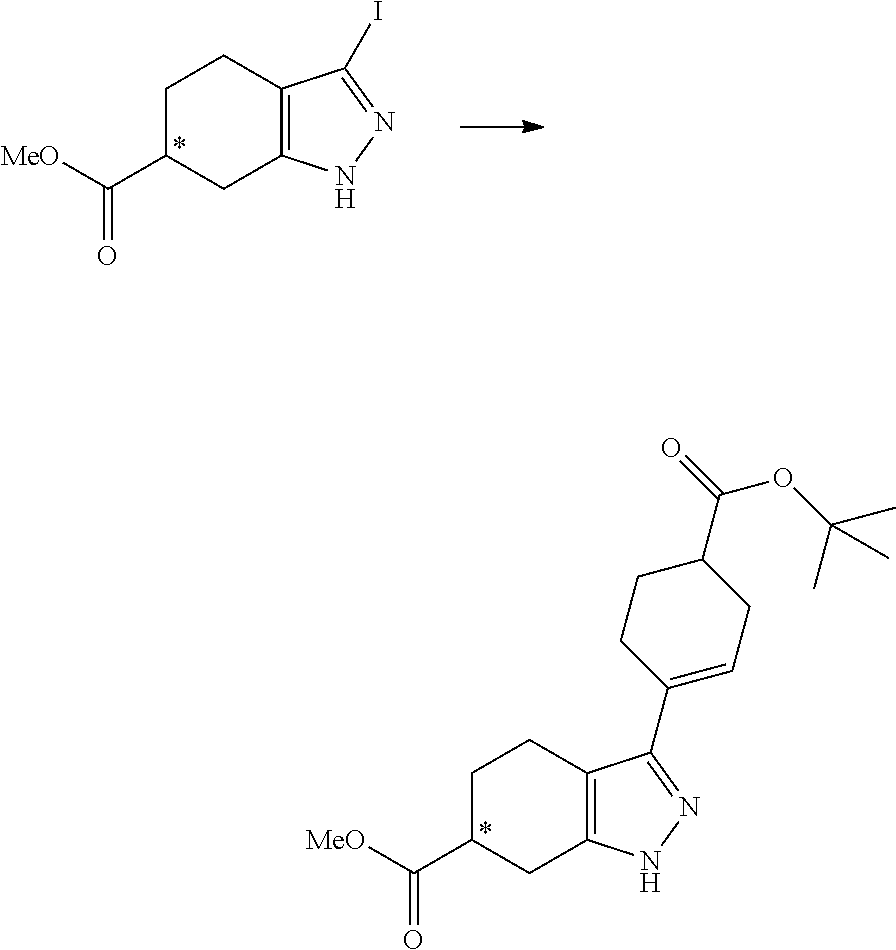
| TABLE 6 | |||
| Intermediate | Structure | IUPAC Name | MS (M + 1) |
| i-25A |
 |
methyl (6R or S)-3-(4- (tert-butoxycarbonyl)-4- methylcyclohex-1-en-1- yl)-4,5,6,7-tetrahydro- 1H-indazole-6- carboxylate | 375 |
| i-25B |
 |
methyl (6R or S)-3-(4- (tert-butoxycarbonyl)-4- methylcyclohex-1-en-1- yl)-4,5,6,7-tetrahydro- 1H-indazole-6- carboxylate | 375 |


i-29A (peak 1-peak 1): 1H NMR (CDCl3, 600 MHz) δ 5.99 (brs, 1H), 4.08-4.28 (m, 2H), 3.70 (s, 3H), 2.80-2.98 (m, 2H), 2.62-2.76 (m, 4H), 2.42-2.60 (m, 3H), 2.32-2.39 (m, 1H), 2.26-2.32 (m, 1H), 2.14-2.22 (m, 1H), 1.76-1.84 (m, 1H), 1.24 (t, J=7.2 Hz, 3H), 0.94 (d, J=7.2 Hz, 3H). MS: 347 (M+1).
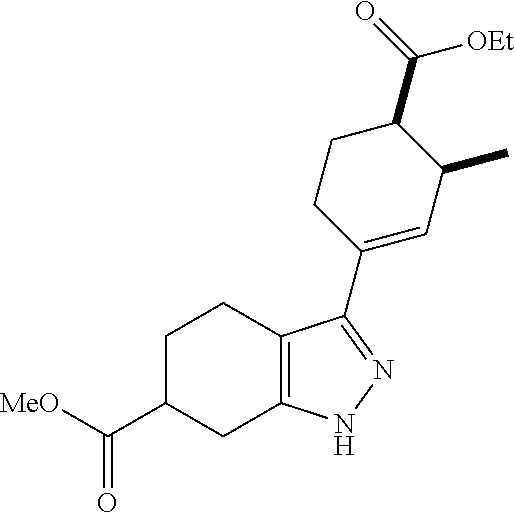
i-29B (peak 1-peak 2): 1H NMR (CDCl3, 600 MHz) δ 5.94-5.98 (m, 1H), 4.08-4.22 (m, 2H), 3.73 (s, 3H), 2.90-2.96 (m, 1H), 2.77-2.87 (m, 2H), 2.66-2.76 (m, 3H), 2.54-2.64 (m, 2H), 2.26-2.33 (m, 1H), 2.16-2.22 (m, 1H), 1.94-1.99 (m, 1H), 1.76-1.88 (m, 2H), 1.26 (t, J=7.2 Hz, 3H), 0.95 (d, J=7.2 Hz, 3H). MS: 347 (M+1).

i-29C (peak 2): 1H NMR (CDCl3, 600 MHz) δ 5.98 (brs, 1H), 4.04-4.28 (m, 2H), 3.70 (s, 3H), 2.86-2.94 (m, 1H), 2.62-2.84 (m, 5H), 2.42-2.60 (m, 2H), 2.30-2.40 (m, 1H), 2.14-2.20 (m, 1H), 1.90-2.00 (m, 1H), 1.74-1.86 (m, 2H), 1.24 (t, J=7.2 Hz, 3H), 0.94 (d, J=7.2 Hz, 3H). MS: 347 (M+1).

i-29D (peak 3): 1H NMR (CDCl3, 600 MHz) δ 5.97 (brs, 1H), 4.04-4.20 (m, 2H), 3.70 (s, 3H), 2.86-2.94 (m, 2H), 2.62-2.84 (m, 3H), 2.30-2.60 (m, 6H), 2.10-2.20 (m, 1H), 1.70-1.84 (m, 1H), 1.24 (t, J=7.2 Hz, 3H), 0.94 (d, J=7.2 Hz, 3H). MS: 347 (M+1).

| TABLE 7 | |||
| Exact Mass | |||
| Example No. | Structure | IUPAC Name | [M + H]+ |
| 1B |
 |
4-{1-[(2-chloro-6- cyclopropylphenyl) carbonyl]-1,4,5,7- tetrahydropyrano[3,4- c]pyrazol-3- yl}cyclohex-3-ene-1- carboxylic acid | 427 |
| 1C |
 |
4-{1-[(2-chloro-6- cyclopropylphenyl) carbonyl]-1,4,5,6- tetrahydrocyclopenta [c]pyrazol-3- yl}cyclohex-3-ene-1- carboxylic acid | 411 |
| 1D |
 |
4-(1-{[2-chloro-6-(1- methylcyclopropyl) phenyl]carbonyl}- 1,4,5,7- tetrahydropyrano[3,4- c]pyrazol-3- yl)cyclohex-3-ene-1- carboxylic acid | 441 |
| 1E |
 |
4-(1-{[2-chloro-6-(1- methylcyclopropyl) phenyl]carbonyl}- 1,4,5,6- tetrahydrocyclopenta [c]pyrazol-3- yl)cyclohex-3-ene-1- carboxylic acid | 425 |
| 1F |
 |
4-(1-{[2-chloro-6-(1- cyanocyclobutyl) phenyl]carbonyl}- 1,4,5,6- tetrahydrocyclopenta [c]pyrazol-3- yl)cyclohex-3-ene-1- carboxylic acid | 450 |

| TABLE 8 | |||
| Example | Exact Mass | ||
| No. | Structure | IUPAC Name | [M + H]+ |
| 2B-A |
 |
(1R or S)-4-(1-{[2-chloro-6-(1- cyanocyclopropyl)phenyl] carbonyl}-1,4,5,7- tetrahydropyrano[3,4- c]pyrazol-3-yl)cyclohex-3-ene- 1-carboxylic acid | 452 |
| 2B-B |
 |
(1R or S)-4-(1-{[2-chloro-6-(1- cyanocyclopropyl)phenyl] carbonyl}-1,4,5,7- tetrahydropyrano[3,4- c]pyrazol-3-yl)cyclohex-3-ene- 1-carboxylic acid | 452 |
| 2C-A |
 |
(1R or S)-4-(1-{[2-chloro-6-(1- cyanocyclobutyl)phenyl] carbonyl}-1,4,5,7- tetrahydropyrano[3,4- c]pyrazol-3-yl)cyclohex-3-ene- 1-carboxylic acid | 466 |
| 2C-B |
 |
(1R or S)-4-(1-{[2-chloro-6-(1- cyanocyclobutyl)phenyl] carbonyl}-1,4,5,7- tetrahydropyrano[3,4- c]pyrazol-3-yl)cyclohex-3-ene- 1-carboxylic acid | 466 |


| TABLE 9 | |||
| Exact | |||
| Mass | |||
| Example No. | Structure | IUPAC Name | [M + H]+ |
| 7B |
 |
4-((R or S)-1-(2-chloro- 6-cyclopropyl-3- fluorobenzoyl)-6- (hydroxymethyl)- 4,5,6,7-tetrahydro-1H- indaozl-3-yl)cyclohex- 3-ene-1-carboxylic acid | 473 |
| 7C |
 |
4-((R or S)-1-(2-chloro- 6-(oxetan-3- yl)benzoyl)-6- (hydroxymethyl)- 4,5,6,7-tetrahydro-1H- indaozl-3-yl)cyclohex- 3-ene-1-carboxylic acid | 471 |
| 7D |
 |
4-((R or S)-1-(2-chloro- 6-(1- (trifluoromethyl)cyclo- propyl)benzoyl)-6- (hydroxymethyl)- 4,5,6,7-tetrahydro-1H- indazol-3-yl)cyclohex- 3-ene-1-carboxylic acid | 523 |


| Example No. | Fret IC50 (nM) | ||
| 1A | 22 | ||
| 1B | 73 | ||
| 1C | 130 | ||
| 1D | 38 | ||
| 1E | 33 | ||
| 1F | 1171 | ||
| 2A-A | 56 | ||
| 2A-B | 102 | ||
| 2B-A | 728 | ||
| 2B-B | 978 | ||
| 2C-A | 676 | ||
| 2C-B | 1050 | ||
| 3A | 1809 | ||
| 3B | 334 | ||
| 4A | 14 | ||
| 5A | 354 | ||
| 6A | 173 | ||
| 7A | 9 | ||
| 7B | 14 | ||
| 7C | 15 | ||
| 7D | 5 | ||
| 8A | 1801 | ||
| 8B | 475 | ||
| 9A | 3990 | ||
| 9B | 1986 | ||
| 10A | 57 | ||
| 10B | 32 | ||
| 11A | 16 | ||
| 12A | 255 | ||
| 13A | 11 | ||
| 13B | 34 | ||
| 14A | 1196 | ||
| 15A | 56 | ||
| 16A | 149 | ||
| 17A | 19 | ||
| 17B | 681 | ||
| 18A | 598 | ||
| 18B | 10 | ||
| 19A | 1197 | ||
Claims (23)


Priority Applications (1)
| Application Number | Priority Date | Filing Date | Title |
|---|---|---|---|
| US15/770,255 US10344000B2 (en) | 2015-10-27 | 2016-10-27 | Substituted bicyclic pyrazole compounds as RORgammaT inhibitors and uses thereof |
Applications Claiming Priority (3)
| Application Number | Priority Date | Filing Date | Title |
|---|---|---|---|
| US201562246918P | 2015-10-27 | 2015-10-27 | |
| US15/770,255 US10344000B2 (en) | 2015-10-27 | 2016-10-27 | Substituted bicyclic pyrazole compounds as RORgammaT inhibitors and uses thereof |
| PCT/US2016/059057 WO2017075178A1 (en) | 2015-10-27 | 2016-10-27 | SUBSTITUTED BICYCLIC PYRAZOLE COMPOUNDS AS RORgammaT INHIBITORS AND USES THEREOF |
Publications (2)
| Publication Number | Publication Date |
|---|---|
| US20180305320A1 US20180305320A1 (en) | 2018-10-25 |
| US10344000B2 true US10344000B2 (en) | 2019-07-09 |
Family
ID=58630774
Family Applications (1)
| Application Number | Title | Priority Date | Filing Date |
|---|---|---|---|
| US15/770,255 Active US10344000B2 (en) | 2015-10-27 | 2016-10-27 | Substituted bicyclic pyrazole compounds as RORgammaT inhibitors and uses thereof |
Country Status (6)
| Country | Link |
|---|---|
| US (1) | US10344000B2 (en) |
| EP (1) | EP3368516B1 (en) |
| JP (1) | JP2018531957A (en) |
| AU (1) | AU2016344111A1 (en) |
| CA (1) | CA3002846A1 (en) |
| WO (1) | WO2017075178A1 (en) |
Cited By (1)
| Publication number | Priority date | Publication date | Assignee | Title |
|---|---|---|---|---|
| US10689369B2 (en) | 2015-10-27 | 2020-06-23 | Merck Sharp & Dohme Corp. | Substituted indazole compounds as RORgammaT inhibitors and uses thereof |
Families Citing this family (3)
| Publication number | Priority date | Publication date | Assignee | Title |
|---|---|---|---|---|
| US9809561B2 (en) | 2013-12-20 | 2017-11-07 | Merck Sharp & Dohme Corp. | Tetrahydronaphthyridine, benzoxazine, aza-benzoxazine and related bicyclic compounds for inhibition of RORgamma activity and the treatment of disease |
| WO2017075185A1 (en) | 2015-10-27 | 2017-05-04 | Merck Sharp & Dohme Corp. | Heteroaryl substituted benzoic acids as rorgammat inhibitors and uses thereof |
| EP3663299B1 (en) * | 2017-08-01 | 2023-03-08 | Chia Tai Tianqing Pharmaceutical Group Co., Ltd. | Bicyclic compound acting as ror gamma inhibitor |
Citations (123)
| Publication number | Priority date | Publication date | Assignee | Title |
|---|---|---|---|---|
| US4670447A (en) | 1983-08-22 | 1987-06-02 | Hoechst-Roussel Pharmaceuticals Inc. | Antipsychotic 3-(piperidinyl)- and 3-(pyrrolidinyl)-1H-indazoles |
| US4751235A (en) | 1986-12-23 | 1988-06-14 | Sandoz Pharm. Corp. | Anti-atherosclerotic indolizine derivatives |
| EP0429257A2 (en) | 1989-11-17 | 1991-05-29 | Glaxo Group Limited | Indole derivatives |
| WO1992013856A1 (en) | 1991-02-12 | 1992-08-20 | Pfizer Inc. | 5-heteroyl indole derivatives |
| JPH06250441A (en) | 1993-03-01 | 1994-09-09 | Nippon Kayaku Co Ltd | Electrophotographic toner |
| WO1996037467A1 (en) | 1995-05-22 | 1996-11-28 | Merck Frosst Canada Inc. | N-benzylindol-3-yl butanoic acid derivatives as cyclooxygenase-2 inhibitors |
| US5583152A (en) | 1985-04-17 | 1996-12-10 | Zeneca Inc. | Method for treating vasospastic cardiovascular diseases heterocyclic amide derivatives |
| WO1997001561A1 (en) | 1995-06-28 | 1997-01-16 | Bayer Aktiengesellschaft | Microbicidal benzotriazoles |
| WO1997048697A1 (en) | 1996-06-19 | 1997-12-24 | Rhone-Poulenc Rorer Limited | Substituted azabicylic compounds and their use as inhibitors of the production of tnf and cyclic amp phosphodiesterase |
| WO1998022457A1 (en) | 1996-11-19 | 1998-05-28 | Amgen Inc. | Aryl and heteroaryl substituted fused pyrrole antiinflammatory agents |
| EP0882718A1 (en) | 1995-12-28 | 1998-12-09 | Fujisawa Pharmaceutical Co., Ltd. | Benzimidazole derivatives |
| US6020354A (en) | 1995-08-10 | 2000-02-01 | Bayer Aktiengesellschaft | Halobenzimidazoles and their use as microbicides |
| US6037367A (en) | 1995-07-14 | 2000-03-14 | Smithkline Beecham Corporation | Substituted-pent-4-ynoic acids |
| WO2000017202A1 (en) | 1998-09-18 | 2000-03-30 | Basf Aktiengesellschaft | 4-aminopyrrolopyrimidines as kinase inhibitors |
| US6133290A (en) | 1998-07-31 | 2000-10-17 | Eli Lilly And Company | 5-HT1F agonists |
| WO2001012600A1 (en) | 1999-08-12 | 2001-02-22 | Cor Therapeutics, Inc. | INHIBITORS OF FACTOR Xa |
| US6348032B1 (en) | 1998-11-23 | 2002-02-19 | Cell Pathways, Inc. | Method of inhibiting neoplastic cells with benzimidazole derivatives |
| WO2002100819A1 (en) | 2001-06-11 | 2002-12-19 | Dainippon Pharmaceutical Co., Ltd. | N-arylphenylacetamide derivatives and medicinal compositions containing the same |
| WO2003014075A2 (en) | 2001-08-03 | 2003-02-20 | Schering Corporation | Novel gamma secretase inhibitors |
| WO2004056830A1 (en) | 2002-12-19 | 2004-07-08 | Pfizer Products Inc. | Pyrrolopyrimidine derivatives |
| JP2004307487A (en) | 2003-03-26 | 2004-11-04 | Dai Ichi Seiyaku Co Ltd | Indolylmaleimides |
| US6828344B1 (en) | 1998-02-25 | 2004-12-07 | Genetics Institute, Llc | Inhibitors of phospholipase enzymes |
| WO2005028434A2 (en) | 2003-09-18 | 2005-03-31 | Conforma Therapeutics Corporation | Novel heterocyclic compounds as hsp90-inhibitors |
| WO2005037834A1 (en) | 2003-10-20 | 2005-04-28 | Biovitrum Ab | NOVEL TETRAYDROSPIRO{PIPERIDINE-2,7’ -PYRROLO[3,2-b]PYRIDINE DERIVATIVES AND NOVEL INDOLE DERIVATIVES USEFUL IN THE TREATMENT OF 5-HT6 RECEPTOR -RELATED DISORDERS |
| US20060004000A1 (en) | 2002-10-02 | 2006-01-05 | Sanofi-Aventis | Indazolecarboxamide derivatives, preparation and use thereof as CDK1, CDK2 and CDK4 inhibitors |
| WO2006007486A2 (en) | 2004-07-01 | 2006-01-19 | New York University | COMPOSITIONS AND METHODS FOR MODULATION OF RORϜt |
| US20060030612A1 (en) | 2004-08-03 | 2006-02-09 | Wyeth | Indazoles useful in treating cardiovascular diseases |
| WO2006026754A2 (en) | 2004-09-03 | 2006-03-09 | Plexxikon, Inc. | Bicyclic heteroaryl pde4b inhibitors |
| US20060100230A1 (en) | 2002-07-03 | 2006-05-11 | Hilmar Bischoff | Indolin phenylsulfonamide derivatives |
| WO2006052190A1 (en) | 2004-11-11 | 2006-05-18 | Astrazeneca Ab | Indazole sulphonamide derivatives |
| WO2006057460A1 (en) | 2004-11-29 | 2006-06-01 | Japan Tobacco Inc. | Nitrogen-containing fused ring compound and use thereof |
| WO2006063167A1 (en) | 2004-12-08 | 2006-06-15 | Smithkline Beecham Corporation | 1h-pyrrolo[2,3-b]pyridines |
| US7115750B1 (en) | 1999-09-20 | 2006-10-03 | Takeda Pharmaceutical Company Limited | Melanin concentrating hormone antagonist |
| US20070010537A1 (en) | 2004-08-20 | 2007-01-11 | Kazumasa Hamamura | Fused pyramidine derivative and use thereof |
| US20070049556A1 (en) | 2005-09-01 | 2007-03-01 | Xuqing Zhang | Novel benzopyran derivatives as potassium channel openers |
| WO2007024944A1 (en) | 2005-08-25 | 2007-03-01 | Schering Corporation | Imidazole derivatives as functionally selective alpha2c adrenoreceptor agonists |
| US20070060567A1 (en) | 2005-09-15 | 2007-03-15 | Jean Ackermann | Novel indolyl derivatives which are L-CPT1 inhibitors |
| US20070191603A1 (en) | 2006-02-13 | 2007-08-16 | Jean Ackermann | Novel bicyclic sulfonamide derivatives which are L-CPT1 inhibitors |
| US20070197782A1 (en) | 2006-02-17 | 2007-08-23 | Rigel Pharmaceuticals, Inc. | 2,4-pyrimidinediamine compounds for treating or preventing autoimmune diseases |
| WO2007103308A2 (en) | 2006-03-07 | 2007-09-13 | Array Biopharma Inc. | Heterobicyclic pyrazole compounds and methods of use |
| JP2007238463A (en) | 2006-03-06 | 2007-09-20 | Nippon Menaade Keshohin Kk | ROR activator |
| WO2007125405A2 (en) | 2006-05-01 | 2007-11-08 | Pfizer Products Inc. | Substituted 2-amino-fused heterocyclic compounds |
| WO2007138998A1 (en) | 2006-05-26 | 2007-12-06 | Japan Tobacco Inc. | Pharmaceutical composition comprising nitrogenated fused cyclic compound |
| US20070281922A1 (en) | 2006-06-01 | 2007-12-06 | Wyeth | 1-Sulfonylindazolylamine and - amide derivatives as 5-hydroxytryptamine-6 ligands |
| WO2007144327A2 (en) | 2006-06-12 | 2007-12-21 | Glaxo Group Limited | Phenyl-pyrazole derivatives as non-steroidal glucocoricoid receptor ligands |
| WO2008003703A1 (en) | 2006-07-03 | 2008-01-10 | Biovitrum Ab (Publ) | Indoles as 5-ht6 modulators |
| US20080027100A1 (en) | 2005-08-25 | 2008-01-31 | Schering Corporation And Pharmacopeia, Inc. | Functionally selective alpha2C adrenoreceptor agonists |
| US20080058386A1 (en) | 2006-08-31 | 2008-03-06 | Taipei Medical University | Indoline-sulfonamides compounds |
| US7355042B2 (en) | 2001-10-16 | 2008-04-08 | Hypnion, Inc. | Treatment of CNS disorders using CNS target modulators |
| WO2008045664A2 (en) | 2006-10-06 | 2008-04-17 | Kalypsys, Inc. | Heterocyclic pde4 inhibitors as antiinflammatory agents |
| WO2008062740A1 (en) | 2006-11-20 | 2008-05-29 | Japan Tobacco Inc. | Nitrogenated fused ring compound and use thereof |
| WO2008074692A1 (en) | 2006-12-21 | 2008-06-26 | F. Hoffmann-La Roche Ag | Sulfonamide derivatives as liver carnitine palmitoyl transferase (l-cptl ) |
| WO2008097428A2 (en) | 2007-02-02 | 2008-08-14 | Irm Llc | Compounds and compositions as modulators of gpr119 activity |
| US7420059B2 (en) | 2003-11-20 | 2008-09-02 | Bristol-Myers Squibb Company | HMG-CoA reductase inhibitors and method |
| WO2008132434A2 (en) | 2007-04-26 | 2008-11-06 | Syngenta Participations Ag | 4-aza indole derivatives and their use as fungicides |
| WO2008138889A2 (en) | 2007-05-11 | 2008-11-20 | Novartis Ag | 3, 6-disubstituted-imidazo [1, 2-b] pyridazines and 3, 5-disubstituted pyrazolo[1, 5-a] pyrimidines as phosphatidylinositol-3-kinase inhibitors |
| WO2008150827A1 (en) | 2007-05-29 | 2008-12-11 | Smithkline Beecham Corporation | Naphthyridine, derivatives as p13 kinase inhibitors |
| WO2008153858A1 (en) | 2007-06-05 | 2008-12-18 | Schering Corporation | Polycyclic indazole derivatives and their use as erk inhibitors for the treatment of cancer |
| US20090005410A1 (en) | 2007-06-22 | 2009-01-01 | Chemocentryx, Inc. | N-(2-(hetaryl)aryl) arylsulfonamides and n-(2-(hetaryl) hetaryl arylsulfonamides |
| WO2009015067A2 (en) | 2007-07-25 | 2009-01-29 | Boehringer Ingelheim International Gmbh | Glucocorticoid mimetics, methods of making them, pharmaceutical compositions, and uses thereof |
| WO2009032667A1 (en) | 2007-08-29 | 2009-03-12 | Smithkline Beecham Corporation | Thiazole and oxazole kinase inhibitors |
| US20090075973A1 (en) | 2007-09-14 | 2009-03-19 | Cara Therapeutics, Inc. | Benzo-fused heterocycles |
| US7514465B2 (en) | 2004-11-16 | 2009-04-07 | Yung Shin Pharm. Ind. Co., Ltd. | Synthesis of N2-(substituted arylmethyl)-3-(substituted phenyl)indazoles as novel anti-angiogenic agents |
| US20090124616A1 (en) | 2007-04-16 | 2009-05-14 | Abbott Laboratories | 7-nonsubstituted indole mcl-1 inhibitors |
| WO2009077956A2 (en) | 2007-12-14 | 2009-06-25 | Alla Chem, Llc | HETEROCYCLIC INHIBITORS OF AN Hh-SIGNAL CASCADE, MEDICINAL COMPOSITIONS BASED THEREON AND METHODS FOR TREATING DISEASES CAUSED BY THE ABERRANT ACTIVITY OF AN Hh-SIGNAL SYSTEM |
| US7569571B2 (en) | 2003-12-23 | 2009-08-04 | Novartis Ag | Substituted pyrazolo [3,4-d]pyrimidines as cytokine modulators |
| US20090247502A1 (en) | 2008-03-28 | 2009-10-01 | Cara Therapeutics, Inc. | Substituted pyridoxazines |
| WO2009147187A1 (en) | 2008-06-05 | 2009-12-10 | Glaxo Group Limited | 4-carboxamide indazole derivatives useful as inhibitors of p13-kinases |
| WO2009149819A1 (en) | 2008-06-09 | 2009-12-17 | Sanofi-Aventis | Annelated pyrrolidin sulfonamides with oxadiazolone headgroup, processes for their preparation and their use as pharmaceuticals |
| WO2009149820A1 (en) | 2008-06-09 | 2009-12-17 | Sanofi-Aventis | Annelated n-heterocyclic sulfonamides with oxadiazolone headgroup, processes for their preparation and their use as pharmaceuticals |
| WO2009157196A1 (en) | 2008-06-25 | 2009-12-30 | 武田薬品工業株式会社 | Amide compound |
| WO2010017827A1 (en) | 2008-08-14 | 2010-02-18 | European Molecular Biology Laboratory | 6-substituted 1-sulfonyl-2, 3-dihydro-indole derivatives for the treatment of proliferative diseases |
| WO2010038901A1 (en) | 2008-10-02 | 2010-04-08 | Taisho Pharmaceutical Co., Ltd. | 7-piperidinoalkyl-3,4-dihydroquinolone derivative |
| US7696229B2 (en) | 2006-02-17 | 2010-04-13 | Memory Pharmaceuticals Corporation | Compounds having 5-HT6 receptor affinity |
| EP2181710A1 (en) | 2008-10-28 | 2010-05-05 | Phenex Pharmaceuticals AG | Ligands for modulation of orphan receptor-gamma (NR1F3) activity |
| WO2010050837A1 (en) | 2008-10-28 | 2010-05-06 | Haskin Lev Yakovlevich | Wind power plant |
| WO2010057101A2 (en) | 2008-11-17 | 2010-05-20 | Schering Corporation | Compounds useful as hiv blockers |
| WO2010059602A2 (en) | 2008-11-19 | 2010-05-27 | Schering Corporation | Inhibitors of diacylglycerol acyltransferase |
| WO2010068483A2 (en) | 2008-11-25 | 2010-06-17 | University Of Rochester | Mlk inhibitors and methods of use |
| WO2010071853A1 (en) | 2008-12-19 | 2010-06-24 | Sirtris Pharmaceuticals, Inc. | Thiazolopyridine sirtuin modulating compounds |
| US7772252B2 (en) | 2001-02-16 | 2010-08-10 | Aventis Pharmaceuticals Inc. | Heterocyclic substituted carbonyl derivatives and their use as dopamine D3 receptor ligands |
| WO2010102958A1 (en) | 2009-03-09 | 2010-09-16 | Glaxo Group Limited | 4-oxadiazol-2 -yl- indazoles as inhibitors of p13 kinases |
| US20100234340A1 (en) | 2009-02-06 | 2010-09-16 | Gruenenthal Gmbh | Substituted Spiroamide Compounds |
| WO2010117425A1 (en) | 2009-03-31 | 2010-10-14 | Biogen Idec Ma Inc. | Certain substituted pyrimidines, pharmaceutical compositions thereof, and methods for their use |
| WO2010123139A1 (en) | 2009-04-24 | 2010-10-28 | 持田製薬株式会社 | Arylcarboxamide derivative having sulfamoyl group |
| WO2010125082A1 (en) | 2009-04-30 | 2010-11-04 | Glaxo Group Limited | Oxazole substituted indazoles as pi3-kinase inhibitors |
| WO2010150837A1 (en) | 2009-06-25 | 2010-12-29 | 第一三共株式会社 | Indoline derivative |
| WO2011014775A1 (en) | 2009-07-31 | 2011-02-03 | The Brigham And Women's Hospital, Inc. | Modulation of sgk1 expression in th17 cells to modulate th17-mediated immune responses |
| WO2011019634A2 (en) | 2009-08-10 | 2011-02-17 | Taipei Medical University | Aryl substituted sulfonamide compounds and their use as anticancer agents |
| WO2011059839A1 (en) | 2009-10-29 | 2011-05-19 | Sirtris Pharmaceuticals, Inc. | Bicyclic pyridines and analogs as sirtuin modulators |
| US20110118246A1 (en) | 2008-06-05 | 2011-05-19 | Ian Robert Baldwin | Novel Compounds |
| WO2011067364A1 (en) | 2009-12-03 | 2011-06-09 | Glaxo Group Limited | Novel compounds |
| WO2011067365A1 (en) | 2009-12-03 | 2011-06-09 | Glaxo Group Limited | Benzpyrazole derivatives as inhibitors of p13 kinases |
| WO2011067366A1 (en) | 2009-12-03 | 2011-06-09 | Glaxo Group Limited | Indazole derivatives as pi 3 - kinase inhibitors |
| US20110150864A1 (en) | 2009-12-18 | 2011-06-23 | Gilles Bignan | Substituted aminothiazolone indazoles as estrogen related receptor-alpha modulators |
| US20110178063A1 (en) | 2008-06-05 | 2011-07-21 | Glaxo Group Limited | Benzpyrazol derivatives as inhibitors of pi3 kinases |
| WO2011103189A1 (en) | 2010-02-16 | 2011-08-25 | Uwm Research Foundation, Inc. | Methods of reducing virulence in bacteria |
| WO2011109059A1 (en) | 2010-03-01 | 2011-09-09 | Gtx, Inc. | Compounds for treatment of cancer |
| WO2011146313A1 (en) | 2010-05-19 | 2011-11-24 | The University Of North Carolina At Chapel Hill | Pyrazolopyrimidine compounds for the treatment of cancer |
| WO2012032065A1 (en) | 2010-09-08 | 2012-03-15 | Glaxo Group Limited | Indazole derivatives for use in the treatment of influenza virus infection |
| WO2012032067A1 (en) | 2010-09-08 | 2012-03-15 | Glaxo Group Limited | Polymorphs and salts of n- [5- [4- (5- { [(2r,6s) -2, 6 - dimethyl - 4 -morpholinyl] methyl} - 1, 3 - oxazol - 2 - yl) - 1h- inda zol-6-yl] -2- (methyloxy) - 3 - pyridinyl] methanesulfonamide |
| WO2012037108A1 (en) | 2010-09-13 | 2012-03-22 | Glaxosmithkline Llc | Aminoquinoline derivatives as antiviral agents |
| WO2012064744A2 (en) | 2010-11-08 | 2012-05-18 | Lycera Corporation | Tetrahydroquinoline and related bicyclic compounds for inhibition of rorϒ activity and the treatment of disease |
| WO2012077932A2 (en) | 2010-12-07 | 2012-06-14 | 제일약품주식회사 | Novel pyrazole pyridine derivative or pharmaceutically acceptable salts thereof, method for producing same, and pharmaceutical composition including same |
| EP2487159A1 (en) | 2011-02-11 | 2012-08-15 | MSD Oss B.V. | RorgammaT inhibitors |
| WO2012139775A1 (en) | 2011-04-14 | 2012-10-18 | Phenex Pharmaceuticals Ag | Pyrrolo sulfonamide compounds for modulation of orphan nuclear receptor rar-related orphan receptor-gamma (rorgamma, nr1f3) activity and for the treatment of chronic inflammatory and autoimmune diseases |
| WO2012176763A1 (en) | 2011-06-20 | 2012-12-27 | 大日本住友製薬株式会社 | Novel indazole derivative |
| WO2013169704A2 (en) | 2012-05-08 | 2013-11-14 | Merck Sharp & Dohme Corp. | TETRAHYDRONAPHTHYRIDINE AND RELATED BICYCLIC COMPOUNDS FOR INHIBITION OF RORgamma ACTIVITY AND THE TREATMENT OF DISEASE |
| WO2014026327A1 (en) | 2012-08-15 | 2014-02-20 | Merck Sharp & Dohme Corp. | 4-heteroaryl substituted benzoic acid compounds as rorgammat inhibitors and uses thereof |
| WO2014028597A2 (en) | 2012-08-15 | 2014-02-20 | Merck Sharp & Dohme Corp. | 3-CYCLOHEXENYL AND CYCLOHEXYL SUBSTITUTED INDOLE AND INDAZOLE COMPOUNDS AS RORgammaT INHIBITORS AND USES THEREOF |
| WO2014026329A1 (en) | 2012-08-15 | 2014-02-20 | Merck Sharp & Dohme Corp. | N-alkylated indole and indazole compounds as rorgammat inhibitors and uses thereof |
| WO2014028600A2 (en) | 2012-08-15 | 2014-02-20 | Merck Sharp & Dohme Corp. | 3-AMINOCYCLOALKYL COMPOUNDS AS RORgammaT INHIBITORS AND USES THEREOF |
| WO2015008234A1 (en) | 2013-07-17 | 2015-01-22 | Glenmark Pharmaceuticals S.A. | Bicyclic heterocyclic compounds as ror gamma modulators |
| US20150126493A1 (en) | 2012-05-08 | 2015-05-07 | Merck Sharp & Dohme Corp. | BICYCLIC SULFONE COMPOUNDS FOR INHIBITION OF RORgamma ACTIVITY AND THE TREATMENT OF DISEASE |
| WO2015087234A1 (en) | 2013-12-10 | 2015-06-18 | Glenmark Pharmaceuticals S.A. | Bicyclic heteroaryl indole analogues useful as ror gamma modulators |
| WO2015139621A1 (en) | 2014-03-18 | 2015-09-24 | 北京韩美药品有限公司 | 4-heteroaryl substituted benzoic acid or benzamides compound |
| US9273070B2 (en) | 2010-12-22 | 2016-03-01 | Paul Knochel | Organozinc complexes and processes for making and using the same |
| JP2016141632A (en) | 2015-01-30 | 2016-08-08 | 第一三共株式会社 | Condensed bicyclic heterocyclic derivative |
| WO2016130818A1 (en) | 2015-02-11 | 2016-08-18 | Merck Sharp & Dohme Corp. | SUBSTITUTED PYRAZOLE COMPOUNDS AS RORgammaT INHIBITORS AND USES THEREOF |
| WO2016128908A1 (en) | 2015-02-12 | 2016-08-18 | Advinus Therapeutics Limited | Bicyclic compounds, compositions and medicinal applications thereof |
| US20160304476A1 (en) | 2013-12-20 | 2016-10-20 | Merck Sharp & Dohme Corp. | TETRAHYDRONAPHTHYRIDINE, BENZOXAZINE, AZA-BENZOXAZINE AND RELATED BICYCLIC COMPOUNDS FOR INHIBITION OF RORgamma ACTIVITY AND THE TREATMENT OF DISEASE |
| US20160304505A1 (en) | 2013-12-20 | 2016-10-20 | Merck Sharp & Dohme Corp. | 2-ACYLAMIDOMETHYL AND SULFONYLAMIDOMETHYL BENZOXAZINE CARBAMATES FOR INHIBITION OF RORgamma ACTIVITY AND THE TREATMENT OF DISEASE |
| US20160311787A1 (en) | 2013-12-20 | 2016-10-27 | Merck Sharp & Dohme Corp. | CARBAMATE BENZOXAZINE PROPIONIC ACIDS AND ACID DERIVATIVES FOR MODULATION OF RORgamma ACTIVITY AND THE TREATMENT OF DISEASE |
-
2016
- 2016-10-27 US US15/770,255 patent/US10344000B2/en active Active
- 2016-10-27 WO PCT/US2016/059057 patent/WO2017075178A1/en not_active Ceased
- 2016-10-27 JP JP2018521301A patent/JP2018531957A/en not_active Ceased
- 2016-10-27 EP EP16860767.9A patent/EP3368516B1/en active Active
- 2016-10-27 AU AU2016344111A patent/AU2016344111A1/en not_active Abandoned
- 2016-10-27 CA CA3002846A patent/CA3002846A1/en not_active Abandoned
Patent Citations (186)
| Publication number | Priority date | Publication date | Assignee | Title |
|---|---|---|---|---|
| US4670447A (en) | 1983-08-22 | 1987-06-02 | Hoechst-Roussel Pharmaceuticals Inc. | Antipsychotic 3-(piperidinyl)- and 3-(pyrrolidinyl)-1H-indazoles |
| US5583152A (en) | 1985-04-17 | 1996-12-10 | Zeneca Inc. | Method for treating vasospastic cardiovascular diseases heterocyclic amide derivatives |
| US4751235A (en) | 1986-12-23 | 1988-06-14 | Sandoz Pharm. Corp. | Anti-atherosclerotic indolizine derivatives |
| EP0429257A2 (en) | 1989-11-17 | 1991-05-29 | Glaxo Group Limited | Indole derivatives |
| WO1992013856A1 (en) | 1991-02-12 | 1992-08-20 | Pfizer Inc. | 5-heteroyl indole derivatives |
| JPH06250441A (en) | 1993-03-01 | 1994-09-09 | Nippon Kayaku Co Ltd | Electrophotographic toner |
| WO1996037467A1 (en) | 1995-05-22 | 1996-11-28 | Merck Frosst Canada Inc. | N-benzylindol-3-yl butanoic acid derivatives as cyclooxygenase-2 inhibitors |
| US5639780A (en) | 1995-05-22 | 1997-06-17 | Merck Frosst Canada, Inc. | N-benzyl indol-3-yl butanoic acid derivatives as cyclooxygenase inhibitors |
| US5985903A (en) | 1995-06-28 | 1999-11-16 | Bayer Aktiengesellschaft | Microbicidal benzotriazoles |
| US6172092B1 (en) | 1995-06-28 | 2001-01-09 | Bayer Aktiengesellschaft | Microbicidal benzotriazoles |
| WO1997001561A1 (en) | 1995-06-28 | 1997-01-16 | Bayer Aktiengesellschaft | Microbicidal benzotriazoles |
| US6037367A (en) | 1995-07-14 | 2000-03-14 | Smithkline Beecham Corporation | Substituted-pent-4-ynoic acids |
| US6638960B2 (en) | 1995-08-10 | 2003-10-28 | Bayer Aktiengesellschaft | Halogenobenzimidazoles and their use as microbicides |
| US6020354A (en) | 1995-08-10 | 2000-02-01 | Bayer Aktiengesellschaft | Halobenzimidazoles and their use as microbicides |
| US6160001A (en) | 1995-08-10 | 2000-12-12 | Bayer Aktiengesellschaft | Halobenzimidazoles and their use as microbicides |
| US6387939B1 (en) | 1995-08-10 | 2002-05-14 | Bayer Aktiengesellschaft | Halogenzimidazoles and their use as microbicides |
| EP0882718A1 (en) | 1995-12-28 | 1998-12-09 | Fujisawa Pharmaceutical Co., Ltd. | Benzimidazole derivatives |
| US6352985B1 (en) | 1995-12-28 | 2002-03-05 | Fujisawa Pharmaceutical Co., Ltd. | Benzimidazole compounds |
| US7329675B2 (en) | 1996-06-19 | 2008-02-12 | Aventis Pharma Limited | Substituted azabicyclic compounds |
| WO1997048697A1 (en) | 1996-06-19 | 1997-12-24 | Rhone-Poulenc Rorer Limited | Substituted azabicylic compounds and their use as inhibitors of the production of tnf and cyclic amp phosphodiesterase |
| US6440973B1 (en) | 1996-11-19 | 2002-08-27 | Amgen Inc. | Aryl and heteroaryl substituted fused pyrrole antiinflammatory agents |
| US6605634B2 (en) | 1996-11-19 | 2003-08-12 | Amgen, Inc. | Aryl and heteroaryl substituted fused pyrrole anti-inflammatory agents |
| WO1998022457A1 (en) | 1996-11-19 | 1998-05-28 | Amgen Inc. | Aryl and heteroaryl substituted fused pyrrole antiinflammatory agents |
| US6180643B1 (en) | 1996-11-19 | 2001-01-30 | Amgen Inc. | Aryl and heteroaryl substituted fused pyrrole antiinflammatory agents |
| US6828344B1 (en) | 1998-02-25 | 2004-12-07 | Genetics Institute, Llc | Inhibitors of phospholipase enzymes |
| US6133290A (en) | 1998-07-31 | 2000-10-17 | Eli Lilly And Company | 5-HT1F agonists |
| WO2000017202A1 (en) | 1998-09-18 | 2000-03-30 | Basf Aktiengesellschaft | 4-aminopyrrolopyrimidines as kinase inhibitors |
| US6348032B1 (en) | 1998-11-23 | 2002-02-19 | Cell Pathways, Inc. | Method of inhibiting neoplastic cells with benzimidazole derivatives |
| US6534535B1 (en) | 1999-08-12 | 2003-03-18 | Millennium Pharmaceuticals, Inc. | Inhibitors of factor Xa |
| WO2001012600A1 (en) | 1999-08-12 | 2001-02-22 | Cor Therapeutics, Inc. | INHIBITORS OF FACTOR Xa |
| US7115750B1 (en) | 1999-09-20 | 2006-10-03 | Takeda Pharmaceutical Company Limited | Melanin concentrating hormone antagonist |
| US7772252B2 (en) | 2001-02-16 | 2010-08-10 | Aventis Pharmaceuticals Inc. | Heterocyclic substituted carbonyl derivatives and their use as dopamine D3 receptor ligands |
| WO2002100819A1 (en) | 2001-06-11 | 2002-12-19 | Dainippon Pharmaceutical Co., Ltd. | N-arylphenylacetamide derivatives and medicinal compositions containing the same |
| US7084176B2 (en) | 2001-06-11 | 2006-08-01 | Dainippon Pharmaceutical Co., Ltd. | N-arylphenylacetamide derivatives and medicinal compositions containing the same |
| WO2003014075A2 (en) | 2001-08-03 | 2003-02-20 | Schering Corporation | Novel gamma secretase inhibitors |
| US6683091B2 (en) | 2001-08-03 | 2004-01-27 | Schering Corporation | Gamma Secretase inhibitors |
| US7355042B2 (en) | 2001-10-16 | 2008-04-08 | Hypnion, Inc. | Treatment of CNS disorders using CNS target modulators |
| US20060100230A1 (en) | 2002-07-03 | 2006-05-11 | Hilmar Bischoff | Indolin phenylsulfonamide derivatives |
| US7482342B2 (en) | 2002-10-02 | 2009-01-27 | Sanofi-Aventis | Indazolecarboxamide derivatives, preparation and use thereof as CDK1, CDK2 and CDK4 inhibitors |
| US20060004000A1 (en) | 2002-10-02 | 2006-01-05 | Sanofi-Aventis | Indazolecarboxamide derivatives, preparation and use thereof as CDK1, CDK2 and CDK4 inhibitors |
| WO2004056830A1 (en) | 2002-12-19 | 2004-07-08 | Pfizer Products Inc. | Pyrrolopyrimidine derivatives |
| JP2004307487A (en) | 2003-03-26 | 2004-11-04 | Dai Ichi Seiyaku Co Ltd | Indolylmaleimides |
| WO2005028434A2 (en) | 2003-09-18 | 2005-03-31 | Conforma Therapeutics Corporation | Novel heterocyclic compounds as hsp90-inhibitors |
| US7138401B2 (en) | 2003-09-18 | 2006-11-21 | Conforma Therapeutics Corporation | 2-aminopurine analogs having HSP90-inhibiting activity |
| WO2005037834A1 (en) | 2003-10-20 | 2005-04-28 | Biovitrum Ab | NOVEL TETRAYDROSPIRO{PIPERIDINE-2,7’ -PYRROLO[3,2-b]PYRIDINE DERIVATIVES AND NOVEL INDOLE DERIVATIVES USEFUL IN THE TREATMENT OF 5-HT6 RECEPTOR -RELATED DISORDERS |
| US7420059B2 (en) | 2003-11-20 | 2008-09-02 | Bristol-Myers Squibb Company | HMG-CoA reductase inhibitors and method |
| US7569571B2 (en) | 2003-12-23 | 2009-08-04 | Novartis Ag | Substituted pyrazolo [3,4-d]pyrimidines as cytokine modulators |
| WO2006007486A2 (en) | 2004-07-01 | 2006-01-19 | New York University | COMPOSITIONS AND METHODS FOR MODULATION OF RORϜt |
| US20070154487A1 (en) | 2004-07-01 | 2007-07-05 | Dan Littman | Compositions and methods for modulation of RORgammat functions |
| US20060030612A1 (en) | 2004-08-03 | 2006-02-09 | Wyeth | Indazoles useful in treating cardiovascular diseases |
| US20070010537A1 (en) | 2004-08-20 | 2007-01-11 | Kazumasa Hamamura | Fused pyramidine derivative and use thereof |
| WO2006026754A2 (en) | 2004-09-03 | 2006-03-09 | Plexxikon, Inc. | Bicyclic heteroaryl pde4b inhibitors |
| US20060100218A1 (en) | 2004-09-03 | 2006-05-11 | Ibrahim Prabha N | PDE4B inhibitors |
| WO2006052190A1 (en) | 2004-11-11 | 2006-05-18 | Astrazeneca Ab | Indazole sulphonamide derivatives |
| US7514465B2 (en) | 2004-11-16 | 2009-04-07 | Yung Shin Pharm. Ind. Co., Ltd. | Synthesis of N2-(substituted arylmethyl)-3-(substituted phenyl)indazoles as novel anti-angiogenic agents |
| EP1820515A1 (en) | 2004-11-29 | 2007-08-22 | Japan Tobacco, Inc. | Nitrogen-containing fused ring compound and use thereof |
| WO2006057460A1 (en) | 2004-11-29 | 2006-06-01 | Japan Tobacco Inc. | Nitrogen-containing fused ring compound and use thereof |
| US20070010670A1 (en) | 2004-11-29 | 2007-01-11 | Japan Tobacco Inc. | Nitrogen-containing fused ring compounds and use thereof |
| US20090233955A1 (en) | 2004-12-08 | 2009-09-17 | Frazee James S | 1H-Pyrrolo[2,3-B]Pyridnes |
| WO2006063167A1 (en) | 2004-12-08 | 2006-06-15 | Smithkline Beecham Corporation | 1h-pyrrolo[2,3-b]pyridines |
| US20080027100A1 (en) | 2005-08-25 | 2008-01-31 | Schering Corporation And Pharmacopeia, Inc. | Functionally selective alpha2C adrenoreceptor agonists |
| WO2007024944A1 (en) | 2005-08-25 | 2007-03-01 | Schering Corporation | Imidazole derivatives as functionally selective alpha2c adrenoreceptor agonists |
| US20070049556A1 (en) | 2005-09-01 | 2007-03-01 | Xuqing Zhang | Novel benzopyran derivatives as potassium channel openers |
| US7713996B2 (en) | 2005-09-15 | 2010-05-11 | Hoffmann-La Roche Inc. | Indolyl derivatives which are L-CPT1 inhibitors |
| US20070060567A1 (en) | 2005-09-15 | 2007-03-15 | Jean Ackermann | Novel indolyl derivatives which are L-CPT1 inhibitors |
| WO2007031429A1 (en) | 2005-09-15 | 2007-03-22 | F. Hoffmann-La Roche Ag | Novel heterobicyclic derivatives useful as inhibitors of liver carnitine palmitoyl transferase |
| US7696200B2 (en) | 2006-02-13 | 2010-04-13 | Hoffmann-La Roche Inc. | Bicyclic sulfonamide derivatives which are L-CPT1 inhibitors |
| WO2007093507A1 (en) | 2006-02-13 | 2007-08-23 | F. Hoffmann-La Roche Ag | Heterobicyclic sulfonamide derivatives for the treatment of diabetes |
| US20070191603A1 (en) | 2006-02-13 | 2007-08-16 | Jean Ackermann | Novel bicyclic sulfonamide derivatives which are L-CPT1 inhibitors |
| US20100130484A1 (en) | 2006-02-13 | 2010-05-27 | Jean Ackermann | Novel bicyclic sulfonamide derivatives which are l-cpt1 inhibitors |
| US7696229B2 (en) | 2006-02-17 | 2010-04-13 | Memory Pharmaceuticals Corporation | Compounds having 5-HT6 receptor affinity |
| US20070197782A1 (en) | 2006-02-17 | 2007-08-23 | Rigel Pharmaceuticals, Inc. | 2,4-pyrimidinediamine compounds for treating or preventing autoimmune diseases |
| JP2007238463A (en) | 2006-03-06 | 2007-09-20 | Nippon Menaade Keshohin Kk | ROR activator |
| WO2007103308A2 (en) | 2006-03-07 | 2007-09-13 | Array Biopharma Inc. | Heterobicyclic pyrazole compounds and methods of use |
| WO2007125405A2 (en) | 2006-05-01 | 2007-11-08 | Pfizer Products Inc. | Substituted 2-amino-fused heterocyclic compounds |
| US20080305169A1 (en) | 2006-05-26 | 2008-12-11 | Japan Tobacco Inc. | Pharmaceutical Compositions Comprising Nitrogen-Containing Fused Ring Coumpounds |
| WO2007138998A1 (en) | 2006-05-26 | 2007-12-06 | Japan Tobacco Inc. | Pharmaceutical composition comprising nitrogenated fused cyclic compound |
| US20070281922A1 (en) | 2006-06-01 | 2007-12-06 | Wyeth | 1-Sulfonylindazolylamine and - amide derivatives as 5-hydroxytryptamine-6 ligands |
| WO2007144327A2 (en) | 2006-06-12 | 2007-12-21 | Glaxo Group Limited | Phenyl-pyrazole derivatives as non-steroidal glucocoricoid receptor ligands |
| WO2008003703A1 (en) | 2006-07-03 | 2008-01-10 | Biovitrum Ab (Publ) | Indoles as 5-ht6 modulators |
| US7741495B2 (en) | 2006-08-31 | 2010-06-22 | Taipei Medical University | Indoline-sulfonamides compounds |
| US20080058386A1 (en) | 2006-08-31 | 2008-03-06 | Taipei Medical University | Indoline-sulfonamides compounds |
| US20090275586A1 (en) | 2006-10-06 | 2009-11-05 | Kalypsys, Inc. | Heterocyclic inhibitors of pde4 |
| WO2008045664A2 (en) | 2006-10-06 | 2008-04-17 | Kalypsys, Inc. | Heterocyclic pde4 inhibitors as antiinflammatory agents |
| WO2008062740A1 (en) | 2006-11-20 | 2008-05-29 | Japan Tobacco Inc. | Nitrogenated fused ring compound and use thereof |
| WO2008074692A1 (en) | 2006-12-21 | 2008-06-26 | F. Hoffmann-La Roche Ag | Sulfonamide derivatives as liver carnitine palmitoyl transferase (l-cptl ) |
| US7799933B2 (en) | 2006-12-21 | 2010-09-21 | Hoffman-La Roche Inc. | Sulfonamide derivatives |
| US20080153805A1 (en) | 2006-12-21 | 2008-06-26 | Ceccarelli Simona M | Sulfonamide derivatives |
| US20100022515A1 (en) | 2007-02-02 | 2010-01-28 | Irm Llc | Compounds and compositions as modulators of gpr119 activity |
| WO2008097428A2 (en) | 2007-02-02 | 2008-08-14 | Irm Llc | Compounds and compositions as modulators of gpr119 activity |
| US20090124616A1 (en) | 2007-04-16 | 2009-05-14 | Abbott Laboratories | 7-nonsubstituted indole mcl-1 inhibitors |
| WO2008132434A2 (en) | 2007-04-26 | 2008-11-06 | Syngenta Participations Ag | 4-aza indole derivatives and their use as fungicides |
| WO2008138889A2 (en) | 2007-05-11 | 2008-11-20 | Novartis Ag | 3, 6-disubstituted-imidazo [1, 2-b] pyridazines and 3, 5-disubstituted pyrazolo[1, 5-a] pyrimidines as phosphatidylinositol-3-kinase inhibitors |
| WO2008150827A1 (en) | 2007-05-29 | 2008-12-11 | Smithkline Beecham Corporation | Naphthyridine, derivatives as p13 kinase inhibitors |
| WO2008153858A1 (en) | 2007-06-05 | 2008-12-18 | Schering Corporation | Polycyclic indazole derivatives and their use as erk inhibitors for the treatment of cancer |
| US20090005410A1 (en) | 2007-06-22 | 2009-01-01 | Chemocentryx, Inc. | N-(2-(hetaryl)aryl) arylsulfonamides and n-(2-(hetaryl) hetaryl arylsulfonamides |
| WO2009015067A2 (en) | 2007-07-25 | 2009-01-29 | Boehringer Ingelheim International Gmbh | Glucocorticoid mimetics, methods of making them, pharmaceutical compositions, and uses thereof |
| US20100317863A1 (en) | 2007-07-25 | 2010-12-16 | Boehringer Ingelheim International Gmbh | Glucocorticoid Mimetics, Methods of Making Them, Pharmaceutical Compositions and Uses Thereof |
| WO2009032667A1 (en) | 2007-08-29 | 2009-03-12 | Smithkline Beecham Corporation | Thiazole and oxazole kinase inhibitors |
| US20090075973A1 (en) | 2007-09-14 | 2009-03-19 | Cara Therapeutics, Inc. | Benzo-fused heterocycles |
| WO2009035997A2 (en) | 2007-09-14 | 2009-03-19 | Cara Therapeutics, Inc. | Benzo-fused heterocycles |
| US20110053915A1 (en) | 2007-12-14 | 2011-03-03 | Alla Chem, Llc | HETEROCYCLIC INHIBITORS OF AN Hh-SIGNAL CASCADE, MEDICINAL COMPOSITIONS BASED THEREON AND METHODS FOR TREATING DISEASES CAUSED BY THE ABERRANT ACTIVITY OF AN Hh-SIGNAL SYSTEM |
| WO2009077956A2 (en) | 2007-12-14 | 2009-06-25 | Alla Chem, Llc | HETEROCYCLIC INHIBITORS OF AN Hh-SIGNAL CASCADE, MEDICINAL COMPOSITIONS BASED THEREON AND METHODS FOR TREATING DISEASES CAUSED BY THE ABERRANT ACTIVITY OF AN Hh-SIGNAL SYSTEM |
| US20090247502A1 (en) | 2008-03-28 | 2009-10-01 | Cara Therapeutics, Inc. | Substituted pyridoxazines |
| WO2009147187A1 (en) | 2008-06-05 | 2009-12-10 | Glaxo Group Limited | 4-carboxamide indazole derivatives useful as inhibitors of p13-kinases |
| US20110112070A1 (en) | 2008-06-05 | 2011-05-12 | Ian Robert Baldwin | 4-carboxamide indazole derivatives useful as inhibitors of p13-kinases |
| US20110118246A1 (en) | 2008-06-05 | 2011-05-19 | Ian Robert Baldwin | Novel Compounds |
| US20110178063A1 (en) | 2008-06-05 | 2011-07-21 | Glaxo Group Limited | Benzpyrazol derivatives as inhibitors of pi3 kinases |
| WO2009149819A1 (en) | 2008-06-09 | 2009-12-17 | Sanofi-Aventis | Annelated pyrrolidin sulfonamides with oxadiazolone headgroup, processes for their preparation and their use as pharmaceuticals |
| WO2009149820A1 (en) | 2008-06-09 | 2009-12-17 | Sanofi-Aventis | Annelated n-heterocyclic sulfonamides with oxadiazolone headgroup, processes for their preparation and their use as pharmaceuticals |
| WO2009157196A1 (en) | 2008-06-25 | 2009-12-30 | 武田薬品工業株式会社 | Amide compound |
| US20110130384A1 (en) | 2008-06-25 | 2011-06-02 | Takeda Pharmaceutical Company Limited | Amide compound |
| WO2010017827A1 (en) | 2008-08-14 | 2010-02-18 | European Molecular Biology Laboratory | 6-substituted 1-sulfonyl-2, 3-dihydro-indole derivatives for the treatment of proliferative diseases |
| WO2010038901A1 (en) | 2008-10-02 | 2010-04-08 | Taisho Pharmaceutical Co., Ltd. | 7-piperidinoalkyl-3,4-dihydroquinolone derivative |
| US20110263046A1 (en) | 2008-10-28 | 2011-10-27 | Phenex Pharmaceuticals Ag | Methods of identification of novel ligands for modulation of orphan nuclear receptor RAR-related orphan receptor-gamma (NR1F3) activity |
| WO2010050837A1 (en) | 2008-10-28 | 2010-05-06 | Haskin Lev Yakovlevich | Wind power plant |
| EP2181710A1 (en) | 2008-10-28 | 2010-05-05 | Phenex Pharmaceuticals AG | Ligands for modulation of orphan receptor-gamma (NR1F3) activity |
| WO2010057101A2 (en) | 2008-11-17 | 2010-05-20 | Schering Corporation | Compounds useful as hiv blockers |
| WO2010059602A2 (en) | 2008-11-19 | 2010-05-27 | Schering Corporation | Inhibitors of diacylglycerol acyltransferase |
| WO2010068483A2 (en) | 2008-11-25 | 2010-06-17 | University Of Rochester | Mlk inhibitors and methods of use |
| WO2010071853A1 (en) | 2008-12-19 | 2010-06-24 | Sirtris Pharmaceuticals, Inc. | Thiazolopyridine sirtuin modulating compounds |
| US20100234340A1 (en) | 2009-02-06 | 2010-09-16 | Gruenenthal Gmbh | Substituted Spiroamide Compounds |
| WO2010102958A1 (en) | 2009-03-09 | 2010-09-16 | Glaxo Group Limited | 4-oxadiazol-2 -yl- indazoles as inhibitors of p13 kinases |
| WO2010117425A1 (en) | 2009-03-31 | 2010-10-14 | Biogen Idec Ma Inc. | Certain substituted pyrimidines, pharmaceutical compositions thereof, and methods for their use |
| WO2010123139A1 (en) | 2009-04-24 | 2010-10-28 | 持田製薬株式会社 | Arylcarboxamide derivative having sulfamoyl group |
| WO2010125082A1 (en) | 2009-04-30 | 2010-11-04 | Glaxo Group Limited | Oxazole substituted indazoles as pi3-kinase inhibitors |
| WO2010150837A1 (en) | 2009-06-25 | 2010-12-29 | 第一三共株式会社 | Indoline derivative |
| WO2011014775A1 (en) | 2009-07-31 | 2011-02-03 | The Brigham And Women's Hospital, Inc. | Modulation of sgk1 expression in th17 cells to modulate th17-mediated immune responses |
| WO2011019634A2 (en) | 2009-08-10 | 2011-02-17 | Taipei Medical University | Aryl substituted sulfonamide compounds and their use as anticancer agents |
| WO2011059839A1 (en) | 2009-10-29 | 2011-05-19 | Sirtris Pharmaceuticals, Inc. | Bicyclic pyridines and analogs as sirtuin modulators |
| WO2011067365A1 (en) | 2009-12-03 | 2011-06-09 | Glaxo Group Limited | Benzpyrazole derivatives as inhibitors of p13 kinases |
| WO2011067366A1 (en) | 2009-12-03 | 2011-06-09 | Glaxo Group Limited | Indazole derivatives as pi 3 - kinase inhibitors |
| WO2011067364A1 (en) | 2009-12-03 | 2011-06-09 | Glaxo Group Limited | Novel compounds |
| US20110150864A1 (en) | 2009-12-18 | 2011-06-23 | Gilles Bignan | Substituted aminothiazolone indazoles as estrogen related receptor-alpha modulators |
| WO2011103189A1 (en) | 2010-02-16 | 2011-08-25 | Uwm Research Foundation, Inc. | Methods of reducing virulence in bacteria |
| WO2011109059A1 (en) | 2010-03-01 | 2011-09-09 | Gtx, Inc. | Compounds for treatment of cancer |
| WO2011146313A1 (en) | 2010-05-19 | 2011-11-24 | The University Of North Carolina At Chapel Hill | Pyrazolopyrimidine compounds for the treatment of cancer |
| WO2012032065A1 (en) | 2010-09-08 | 2012-03-15 | Glaxo Group Limited | Indazole derivatives for use in the treatment of influenza virus infection |
| WO2012032067A1 (en) | 2010-09-08 | 2012-03-15 | Glaxo Group Limited | Polymorphs and salts of n- [5- [4- (5- { [(2r,6s) -2, 6 - dimethyl - 4 -morpholinyl] methyl} - 1, 3 - oxazol - 2 - yl) - 1h- inda zol-6-yl] -2- (methyloxy) - 3 - pyridinyl] methanesulfonamide |
| WO2012037108A1 (en) | 2010-09-13 | 2012-03-22 | Glaxosmithkline Llc | Aminoquinoline derivatives as antiviral agents |
| US9512111B2 (en) | 2010-11-08 | 2016-12-06 | Lycera Corporation | N-sulfonylated tetrahydroquinolines and related bicyclic compounds for inhibition of RORγ activity and the treatment of disease |
| WO2012064744A2 (en) | 2010-11-08 | 2012-05-18 | Lycera Corporation | Tetrahydroquinoline and related bicyclic compounds for inhibition of rorϒ activity and the treatment of disease |
| US20140088094A1 (en) | 2010-11-08 | 2014-03-27 | Merck Sharp & Dohme Corp. | N-SULFONYLATED TETRAHYDROQUINOLINES AND RELATED BICYCLIC COMPOUNDS FOR INHIBITION OF RORgamma ACTIVITY AND THE TREATMENT OF DISEASE |
| WO2012077932A2 (en) | 2010-12-07 | 2012-06-14 | 제일약품주식회사 | Novel pyrazole pyridine derivative or pharmaceutically acceptable salts thereof, method for producing same, and pharmaceutical composition including same |
| US9273070B2 (en) | 2010-12-22 | 2016-03-01 | Paul Knochel | Organozinc complexes and processes for making and using the same |
| US9603838B2 (en) | 2011-02-11 | 2017-03-28 | Merck Sharp & Dohme Corp. | RORgammaT inhibitors |
| EP2487159A1 (en) | 2011-02-11 | 2012-08-15 | MSD Oss B.V. | RorgammaT inhibitors |
| US9884043B2 (en) | 2011-02-11 | 2018-02-06 | Merck Sharp & Dohme Corp. | RORgammaT inhibitors |
| US20170340610A1 (en) | 2011-02-11 | 2017-11-30 | Merck Sharp & Dohme Corp. | RORgammaT INHIBITORS |
| WO2012106995A1 (en) | 2011-02-11 | 2012-08-16 | Merck Sharp & Dohme Corp. | Rorgammat inhibitors |
| US9095583B2 (en) | 2011-02-11 | 2015-08-04 | Merck Sharp & Dohme Corp. | RORgammaT inhibitors |
| US20150297566A1 (en) | 2011-02-11 | 2015-10-22 | Merck Sharp & Dohme Corp. | RORgammaT INHIBITORS |
| WO2012139775A1 (en) | 2011-04-14 | 2012-10-18 | Phenex Pharmaceuticals Ag | Pyrrolo sulfonamide compounds for modulation of orphan nuclear receptor rar-related orphan receptor-gamma (rorgamma, nr1f3) activity and for the treatment of chronic inflammatory and autoimmune diseases |
| WO2012176763A1 (en) | 2011-06-20 | 2012-12-27 | 大日本住友製薬株式会社 | Novel indazole derivative |
| US20170313722A1 (en) | 2012-05-08 | 2017-11-02 | Merck Sharp & Dohme Corp. | TETRAHYDRONAPHTHYRIDINE AND RELATED BICYCLIC COMPOUNDS FOR INHIBITION OF RORgamma ACTIVITY AND THE TREATMENT OF DISEASE |
| US9266827B2 (en) | 2012-05-08 | 2016-02-23 | Merck Sharp & Dohme Corp. | Bicyclic sulfone compounds for inhibition of RORgamma activity and the treatment of disease |
| US20150111877A1 (en) | 2012-05-08 | 2015-04-23 | Merck Sharp & Dohme Corp. | TETRAHYDRONAPHTHYRIDINE AND RELATED BICYCLIC COMPOUNDS FOR INHIBITION OF RORgamma ACTIVITY AND THE TREATMENT OF DISEASE |
| US20150126493A1 (en) | 2012-05-08 | 2015-05-07 | Merck Sharp & Dohme Corp. | BICYCLIC SULFONE COMPOUNDS FOR INHIBITION OF RORgamma ACTIVITY AND THE TREATMENT OF DISEASE |
| WO2013169704A2 (en) | 2012-05-08 | 2013-11-14 | Merck Sharp & Dohme Corp. | TETRAHYDRONAPHTHYRIDINE AND RELATED BICYCLIC COMPOUNDS FOR INHIBITION OF RORgamma ACTIVITY AND THE TREATMENT OF DISEASE |
| US9657033B2 (en) | 2012-05-08 | 2017-05-23 | Lycera Corporation | Tetrahydronaphthyridine and related bicyclic compounds for inhibition of RORγ activity and the treatment of disease |
| US20150210687A1 (en) | 2012-08-15 | 2015-07-30 | Merck Sharp & Dohme Corp. | N-ALKYLATED INDOLE AND INDAZOLE COMPOUNDS AS RORgammaT INHIBITORS AND USES THEREOF |
| US9663522B2 (en) | 2012-08-15 | 2017-05-30 | Merck Sharp & Dohme Corp. | 3-aminocycloalkyl compounds as RORgammaT inhibitors and uses thereof |
| US20150218096A1 (en) | 2012-08-15 | 2015-08-06 | Merck Sharp & Dohme Corp. | 4-HETEROARYL SUBSTITUTED BENZOIC ACID COMPOUNDS AS RORgammaT INHIBITORS AND USES THEREOF |
| US20150218169A1 (en) | 2012-08-15 | 2015-08-06 | Merck Sharp & Dohme Corp. | 3-AMINOCYCLOALKYL COMPOUNDS AS RORgammaT INHIBITORS AND USES THEREOF |
| WO2014026327A1 (en) | 2012-08-15 | 2014-02-20 | Merck Sharp & Dohme Corp. | 4-heteroaryl substituted benzoic acid compounds as rorgammat inhibitors and uses thereof |
| US20180022701A1 (en) | 2012-08-15 | 2018-01-25 | Merck Sharp & Dohme Corp. | 4-HETEROARYL SUBSTITUTED BENZOIC ACID COMPOUNDS AS RORgammaT INHIBITORS AND USES THEREOF |
| WO2014028597A2 (en) | 2012-08-15 | 2014-02-20 | Merck Sharp & Dohme Corp. | 3-CYCLOHEXENYL AND CYCLOHEXYL SUBSTITUTED INDOLE AND INDAZOLE COMPOUNDS AS RORgammaT INHIBITORS AND USES THEREOF |
| WO2014028600A2 (en) | 2012-08-15 | 2014-02-20 | Merck Sharp & Dohme Corp. | 3-AMINOCYCLOALKYL COMPOUNDS AS RORgammaT INHIBITORS AND USES THEREOF |
| WO2014026329A1 (en) | 2012-08-15 | 2014-02-20 | Merck Sharp & Dohme Corp. | N-alkylated indole and indazole compounds as rorgammat inhibitors and uses thereof |
| US9745265B2 (en) | 2012-08-15 | 2017-08-29 | Merck Sharp & Dohme Corp. | 4-heteroaryl substituted benzoic acid compounds as RORgammaT inhibitors and uses thereof |
| US20150191434A1 (en) | 2012-08-15 | 2015-07-09 | Merck Sharp & Dohme Corp. | 3-CYCLOHEXENYL AND CYCLOHEXYL SUBSTITUTED INDOLE AND INDAZOLE COMPOUNDS AS RORgammaT INHIBITORS AND USES THEREOF |
| WO2014028589A2 (en) | 2012-08-15 | 2014-02-20 | Merck Sharp & Dohme Corp. | 4-HETEROARYL SUBSTITUTED BENZOIC ACID COMPOUNDS AS RORgammaT INHIBITORS AND USES THEREOF |
| WO2014028591A2 (en) | 2012-08-15 | 2014-02-20 | Merck Sharp & Dohme Corp. | N-ALKYLATED INDOLE AND INDAZOLE COMPOUNDS AS RORgammaT INHIBITORS AND USES THEREOF |
| US9556168B2 (en) | 2012-08-15 | 2017-01-31 | Merck Sharp & Dohme Corp. | N-alkylated indole and indazole compounds as RORgammaT inhibitors and uses thereof |
| US9487490B2 (en) | 2012-08-15 | 2016-11-08 | Merck Sharp & Dohme Corp. | 3-cyclohexenyl and cyclohexyl substituted indole and indazole compounds as RORgammaT inhibitors and uses thereof |
| WO2014026328A1 (en) | 2012-08-15 | 2014-02-20 | Merck Sharp & Dohme Corp. | 3-cyclohexenyl substituted indole and indazole compounds as rorgammat inhibitors and uses thereof |
| WO2015008234A1 (en) | 2013-07-17 | 2015-01-22 | Glenmark Pharmaceuticals S.A. | Bicyclic heterocyclic compounds as ror gamma modulators |
| WO2015087234A1 (en) | 2013-12-10 | 2015-06-18 | Glenmark Pharmaceuticals S.A. | Bicyclic heteroaryl indole analogues useful as ror gamma modulators |
| US20160311787A1 (en) | 2013-12-20 | 2016-10-27 | Merck Sharp & Dohme Corp. | CARBAMATE BENZOXAZINE PROPIONIC ACIDS AND ACID DERIVATIVES FOR MODULATION OF RORgamma ACTIVITY AND THE TREATMENT OF DISEASE |
| US20160304505A1 (en) | 2013-12-20 | 2016-10-20 | Merck Sharp & Dohme Corp. | 2-ACYLAMIDOMETHYL AND SULFONYLAMIDOMETHYL BENZOXAZINE CARBAMATES FOR INHIBITION OF RORgamma ACTIVITY AND THE TREATMENT OF DISEASE |
| US20160304476A1 (en) | 2013-12-20 | 2016-10-20 | Merck Sharp & Dohme Corp. | TETRAHYDRONAPHTHYRIDINE, BENZOXAZINE, AZA-BENZOXAZINE AND RELATED BICYCLIC COMPOUNDS FOR INHIBITION OF RORgamma ACTIVITY AND THE TREATMENT OF DISEASE |
| WO2015139621A1 (en) | 2014-03-18 | 2015-09-24 | 北京韩美药品有限公司 | 4-heteroaryl substituted benzoic acid or benzamides compound |
| JP2016141632A (en) | 2015-01-30 | 2016-08-08 | 第一三共株式会社 | Condensed bicyclic heterocyclic derivative |
| WO2016130818A1 (en) | 2015-02-11 | 2016-08-18 | Merck Sharp & Dohme Corp. | SUBSTITUTED PYRAZOLE COMPOUNDS AS RORgammaT INHIBITORS AND USES THEREOF |
| US20180016239A1 (en) | 2015-02-11 | 2018-01-18 | Merck Sharp & Dohme Corp. | SUBSTITUTED PYRAZOLE COMPOUNDS AS RORgammaT INHIBITORS AND USES THEREOF |
| WO2016128908A1 (en) | 2015-02-12 | 2016-08-18 | Advinus Therapeutics Limited | Bicyclic compounds, compositions and medicinal applications thereof |
Non-Patent Citations (125)
Cited By (1)
| Publication number | Priority date | Publication date | Assignee | Title |
|---|---|---|---|---|
| US10689369B2 (en) | 2015-10-27 | 2020-06-23 | Merck Sharp & Dohme Corp. | Substituted indazole compounds as RORgammaT inhibitors and uses thereof |
Also Published As
| Publication number | Publication date |
|---|---|
| JP2018531957A (en) | 2018-11-01 |
| US20180305320A1 (en) | 2018-10-25 |
| EP3368516A1 (en) | 2018-09-05 |
| CA3002846A1 (en) | 2017-05-04 |
| WO2017075178A1 (en) | 2017-05-04 |
| AU2016344111A1 (en) | 2018-05-10 |
| EP3368516A4 (en) | 2019-04-03 |
| EP3368516B1 (en) | 2020-07-15 |
Similar Documents
| Publication | Publication Date | Title |
|---|---|---|
| US9663522B2 (en) | 3-aminocycloalkyl compounds as RORgammaT inhibitors and uses thereof | |
| US9487490B2 (en) | 3-cyclohexenyl and cyclohexyl substituted indole and indazole compounds as RORgammaT inhibitors and uses thereof | |
| US9556168B2 (en) | N-alkylated indole and indazole compounds as RORgammaT inhibitors and uses thereof | |
| US10221142B2 (en) | Substituted pyrazole compounds as RORgammaT inhibitors and uses thereof | |
| US10689369B2 (en) | Substituted indazole compounds as RORgammaT inhibitors and uses thereof | |
| EP3368516B1 (en) | SUBSTITUTED BICYCLIC PYRAZOLE COMPOUNDS AS RORgammaT INHIBITORS AND USES THEREOF | |
| US10584121B2 (en) | Heteroaryl substituted benzoic acids as RORgammaT inhibitors and uses thereof |
Legal Events
| Date | Code | Title | Description |
|---|---|---|---|
| FEPP | Fee payment procedure |
Free format text: ENTITY STATUS SET TO UNDISCOUNTED (ORIGINAL EVENT CODE: BIG.); ENTITY STATUS OF PATENT OWNER: LARGE ENTITY |
|
| AS | Assignment |
Owner name: MERCK SHARP & DOHME CORP., NEW JERSEY Free format text: ASSIGNMENT OF ASSIGNORS INTEREST;ASSIGNORS:LAPOINTE, BLAIR T.;FULLER, PETER H.;GUNAYDIN, HAKAN;AND OTHERS;SIGNING DATES FROM 20180119 TO 20180202;REEL/FRAME:046595/0131 |
|
| AS | Assignment |
Owner name: WILMINGTON TRUST, NATIONAL ASSOCIATION, MINNESOTA Free format text: SECURITY INTEREST;ASSIGNOR:LYCERA CORP.;REEL/FRAME:048002/0201 Effective date: 20190102 |
|
| STPP | Information on status: patent application and granting procedure in general |
Free format text: NOTICE OF ALLOWANCE MAILED -- APPLICATION RECEIVED IN OFFICE OF PUBLICATIONS |
|
| STPP | Information on status: patent application and granting procedure in general |
Free format text: PUBLICATIONS -- ISSUE FEE PAYMENT VERIFIED |
|
| STCF | Information on status: patent grant |
Free format text: PATENTED CASE |
|
| AS | Assignment |
Owner name: MERCK SHARP & DOHME LLC, NEW JERSEY Free format text: MERGER;ASSIGNOR:MERCK SHARP & DOHME CORP.;REEL/FRAME:061102/0145 Effective date: 20220407 |
|
| MAFP | Maintenance fee payment |
Free format text: PAYMENT OF MAINTENANCE FEE, 4TH YEAR, LARGE ENTITY (ORIGINAL EVENT CODE: M1551); ENTITY STATUS OF PATENT OWNER: LARGE ENTITY Year of fee payment: 4 |