US10340787B2 - Power factor correction stage control during start-up for efficient use of a negative temperature coefficient thermistor - Google Patents

Power factor correction stage control during start-up for efficient use of a negative temperature coefficient thermistor Download PDF

Info

Publication number
US10340787B2
US10340787B2 US14/782,988 US201514782988A US10340787B2 US 10340787 B2 US10340787 B2 US 10340787B2 US 201514782988 A US201514782988 A US 201514782988A US 10340787 B2 US10340787 B2 US 10340787B2
Authority
US
United States
Prior art keywords
pfc
switch
stage
current
ntc thermistor
Prior art date
Legal status (The legal status is an assumption and is not a legal conclusion. Google has not performed a legal analysis and makes no representation as to the accuracy of the status listed.)
Active, expires
Application number
US14/782,988
Other versions
US20170141678A1 (en
Inventor
Jun Liu
Qingfeng Liu
Zhaotu FAN
Zhe Li
Current Assignee (The listed assignees may be inaccurate. Google has not performed a legal analysis and makes no representation or warranty as to the accuracy of the list.)
Aes Global Holdings Pte Ltd
Original Assignee
Astec International Ltd
Priority date (The priority date is an assumption and is not a legal conclusion. Google has not performed a legal analysis and makes no representation as to the accuracy of the date listed.)
Filing date
Publication date
Application filed by Astec International Ltd filed Critical Astec International Ltd
Assigned to ASTEC INTERNATIONAL LIMITED reassignment ASTEC INTERNATIONAL LIMITED ASSIGNMENT OF ASSIGNORS INTEREST (SEE DOCUMENT FOR DETAILS). Assignors: FAN, Zhaotu, LIU, JUN, LI, ZHE, LIU, QINGFENG
Publication of US20170141678A1 publication Critical patent/US20170141678A1/en
Application granted granted Critical
Publication of US10340787B2 publication Critical patent/US10340787B2/en
Assigned to AES GLOBAL HOLDINGS PTE. LTD. reassignment AES GLOBAL HOLDINGS PTE. LTD. CONFIRMATORY PATENT ASSIGNMENT Assignors: ASTEC INTERNATIONAL LIMITED
Active legal-status Critical Current
Adjusted expiration legal-status Critical

Links

Images

Classifications

    • HELECTRICITY
    • H02GENERATION; CONVERSION OR DISTRIBUTION OF ELECTRIC POWER
    • H02MAPPARATUS FOR CONVERSION BETWEEN AC AND AC, BETWEEN AC AND DC, OR BETWEEN DC AND DC, AND FOR USE WITH MAINS OR SIMILAR POWER SUPPLY SYSTEMS; CONVERSION OF DC OR AC INPUT POWER INTO SURGE OUTPUT POWER; CONTROL OR REGULATION THEREOF
    • H02M1/00Details of apparatus for conversion
    • H02M1/42Circuits or arrangements for compensating for or adjusting power factor in converters or inverters
    • H02M1/4208Arrangements for improving power factor of AC input
    • H02M1/4241Arrangements for improving power factor of AC input using a resonant converter
    • HELECTRICITY
    • H02GENERATION; CONVERSION OR DISTRIBUTION OF ELECTRIC POWER
    • H02HEMERGENCY PROTECTIVE CIRCUIT ARRANGEMENTS
    • H02H9/00Emergency protective circuit arrangements for limiting excess current or voltage without disconnection
    • H02H9/001Emergency protective circuit arrangements for limiting excess current or voltage without disconnection limiting speed of change of electric quantities, e.g. soft switching on or off
    • HELECTRICITY
    • H02GENERATION; CONVERSION OR DISTRIBUTION OF ELECTRIC POWER
    • H02MAPPARATUS FOR CONVERSION BETWEEN AC AND AC, BETWEEN AC AND DC, OR BETWEEN DC AND DC, AND FOR USE WITH MAINS OR SIMILAR POWER SUPPLY SYSTEMS; CONVERSION OF DC OR AC INPUT POWER INTO SURGE OUTPUT POWER; CONTROL OR REGULATION THEREOF
    • H02M1/00Details of apparatus for conversion
    • H02M1/32Means for protecting converters other than automatic disconnection
    • HELECTRICITY
    • H02GENERATION; CONVERSION OR DISTRIBUTION OF ELECTRIC POWER
    • H02MAPPARATUS FOR CONVERSION BETWEEN AC AND AC, BETWEEN AC AND DC, OR BETWEEN DC AND DC, AND FOR USE WITH MAINS OR SIMILAR POWER SUPPLY SYSTEMS; CONVERSION OF DC OR AC INPUT POWER INTO SURGE OUTPUT POWER; CONTROL OR REGULATION THEREOF
    • H02M1/00Details of apparatus for conversion
    • H02M1/36Means for starting or stopping converters
    • HELECTRICITY
    • H02GENERATION; CONVERSION OR DISTRIBUTION OF ELECTRIC POWER
    • H02MAPPARATUS FOR CONVERSION BETWEEN AC AND AC, BETWEEN AC AND DC, OR BETWEEN DC AND DC, AND FOR USE WITH MAINS OR SIMILAR POWER SUPPLY SYSTEMS; CONVERSION OF DC OR AC INPUT POWER INTO SURGE OUTPUT POWER; CONTROL OR REGULATION THEREOF
    • H02M1/00Details of apparatus for conversion
    • H02M1/42Circuits or arrangements for compensating for or adjusting power factor in converters or inverters
    • H02M1/4208Arrangements for improving power factor of AC input
    • H02M1/4225Arrangements for improving power factor of AC input using a non-isolated boost converter
    • HELECTRICITY
    • H02GENERATION; CONVERSION OR DISTRIBUTION OF ELECTRIC POWER
    • H02MAPPARATUS FOR CONVERSION BETWEEN AC AND AC, BETWEEN AC AND DC, OR BETWEEN DC AND DC, AND FOR USE WITH MAINS OR SIMILAR POWER SUPPLY SYSTEMS; CONVERSION OF DC OR AC INPUT POWER INTO SURGE OUTPUT POWER; CONTROL OR REGULATION THEREOF
    • H02M7/00Conversion of AC power input into DC power output; Conversion of DC power input into AC power output
    • H02M7/02Conversion of AC power input into DC power output without possibility of reversal
    • H02M7/04Conversion of AC power input into DC power output without possibility of reversal by static converters
    • H02M7/06Conversion of AC power input into DC power output without possibility of reversal by static converters using discharge tubes without control electrode or semiconductor devices without control electrode
    • HELECTRICITY
    • H02GENERATION; CONVERSION OR DISTRIBUTION OF ELECTRIC POWER
    • H02MAPPARATUS FOR CONVERSION BETWEEN AC AND AC, BETWEEN AC AND DC, OR BETWEEN DC AND DC, AND FOR USE WITH MAINS OR SIMILAR POWER SUPPLY SYSTEMS; CONVERSION OF DC OR AC INPUT POWER INTO SURGE OUTPUT POWER; CONTROL OR REGULATION THEREOF
    • H02M1/00Details of apparatus for conversion
    • H02M1/32Means for protecting converters other than automatic disconnection
    • H02M1/327Means for protecting converters other than automatic disconnection against abnormal temperatures
    • H02M2001/327
    • YGENERAL TAGGING OF NEW TECHNOLOGICAL DEVELOPMENTS; GENERAL TAGGING OF CROSS-SECTIONAL TECHNOLOGIES SPANNING OVER SEVERAL SECTIONS OF THE IPC; TECHNICAL SUBJECTS COVERED BY FORMER USPC CROSS-REFERENCE ART COLLECTIONS [XRACs] AND DIGESTS
    • Y02TECHNOLOGIES OR APPLICATIONS FOR MITIGATION OR ADAPTATION AGAINST CLIMATE CHANGE
    • Y02BCLIMATE CHANGE MITIGATION TECHNOLOGIES RELATED TO BUILDINGS, e.g. HOUSING, HOUSE APPLIANCES OR RELATED END-USER APPLICATIONS
    • Y02B70/00Technologies for an efficient end-user side electric power management and consumption
    • Y02B70/10Technologies improving the efficiency by using switched-mode power supplies [SMPS], i.e. efficient power electronics conversion e.g. power factor correction or reduction of losses in power supplies or efficient standby modes
    • Y02B70/126
    • YGENERAL TAGGING OF NEW TECHNOLOGICAL DEVELOPMENTS; GENERAL TAGGING OF CROSS-SECTIONAL TECHNOLOGIES SPANNING OVER SEVERAL SECTIONS OF THE IPC; TECHNICAL SUBJECTS COVERED BY FORMER USPC CROSS-REFERENCE ART COLLECTIONS [XRACs] AND DIGESTS
    • Y02TECHNOLOGIES OR APPLICATIONS FOR MITIGATION OR ADAPTATION AGAINST CLIMATE CHANGE
    • Y02PCLIMATE CHANGE MITIGATION TECHNOLOGIES IN THE PRODUCTION OR PROCESSING OF GOODS
    • Y02P80/00Climate change mitigation technologies for sector-wide applications
    • Y02P80/10Efficient use of energy, e.g. using compressed air or pressurized fluid as energy carrier
    • Y02P80/112

Definitions

  • the present disclosure relates to power factor correction (PFC) stages of power supply units. More specifically, the present disclosure relates to the use of negative temperature coefficient (NTC) thermistors for limiting in-rush current and efficiently lowering a resistance of the NTC thermistor during start-up.
  • NTC negative temperature coefficient
  • NTC thermistors are commonly used as an in-rush current limiter to reduce the likelihood of tripping a fuse or damaging the power supply unit component parts. NTC thermistors are designed such that their resistance drops as the device heats up. If the resistance of the NTC thermistor is too high at start-up, e.g. if the ambient temperature is particularly cold, a high voltage drop at the PFC stage output may prevent the power supply unit from powering up and functioning properly.
  • a power factor correction (PFC) stage of a power supply unit has a PFC circuit including a rectifier circuit for connection to an input power source, a PFC controller circuit connected to the rectifier circuit, where the PFC controller circuit includes a PFC switch, a current sensor connected to the PFC switch, at least one high frequency bypass capacitor connected between the PFC controller circuit and the rectifier circuit, and at least one bulk storage capacitor connected between the PFC controller circuit and an output of the PFC stage.
  • the PFC stage also has a negative temperature coefficient (NTC) thermistor connected in series with the PFC switch and the current sensor.
  • NTC negative temperature coefficient
  • the PFC controller circuit causes the PFC switch to turn-on until the PFC controller circuit causes the PFC switch to turn-off after a current through the current sensor is sensed as being equal to or greater than a preset value.
  • a method of controlling a power factor correction (PFC) stage of a power supply unit includes the steps of starting the power supply unit, turning on a PFC switch, keeping the PFC switch on while a current through the PFC switch is less than a preset value, turning off the PFC switch when the current through the PFC switch is equal to or greater than the preset value, and operating the PFC stage normally after the PFC switch is turned off.
  • PFC power factor correction
  • FIG. 1 is an example PFC stage of a power supply unit
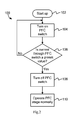
  • FIG. 2 is an example logic flow for the FIG. 1 example.
  • FIG. 1 shows a power factor correction (PFC) stage 10 of a power supply unit 12 .
  • the power supply unit 12 may include the PFC stage 10 and a converter 14 that may be connected to a load 16 .
  • the converter 14 may include an LLC circuit and a buck converter, or depending on the design criteria and the expected load 16 converter 14 may be another type of converter as is known.
  • the PFC stage 10 may include a PFC circuit including a rectifier circuit 18 for connection to an input power source (shown as dashed box 20 ).
  • a PFC controller circuit shown generally within dashed box 22 , may be connected to the rectifier circuit 18 .
  • the PFC controller circuit 22 may include a PFC switch 24 and may further include at least a digital PFC controller 26 , at least one inductor 28 , and a diode 30 .
  • a current sensor 32 may be connected to the PFC switch 24 and may also form a part of PFC controller circuit 22 . The current sensor 32 may be alternatively connected at a location such that it is not a part of PFC controller circuit 22 .
  • the PFC circuit may also include at least one high frequency bypass capacitor 34 connected between the PFC controller circuit 22 and the rectifier circuit 18 .
  • the PFC circuit may also include at least one bulk storage capacitor 36 connected between the PFC controller circuit 22 and an output 38 of the PFC stage.
  • the PFC stage 10 also may include a negative temperature coefficient (NTC) thermistor 40 connected in series with the PFC switch 24 and the current sensor 32 .
  • NTC negative temperature coefficient
  • the PFC circuit includes all of the same components as the PFC stage 10 , except for the NTC thermistor 40 .
  • the PFC controller circuit 22 causes the PFC switch 24 to turn-on until the PFC controller circuit 22 causes the PFC switch 24 to turn-off after a current through the current sensor 32 is sensed as being equal to or greater than a preset value.
  • Turning on the PFC switch 24 at start-up bypasses bulk storage capacitor 36 and allows current to immediately begin to flow through the NTC thermistor 40 without waiting for any delays caused by the initial charging of the bulk storage capacitor 36 . This allows the NTC thermistor 40 to heat up quickly and efficiently to enable the power supply unit 12 to power up earlier and operate normally.
  • an output of the PFC stage 10 at output 38 may be 90 Watts at 28 Volts with a peak current of 3.2 Amps.
  • An initial resistance of an NTC thermistor may be low, e.g. 10 Ohms, at an ambient temperature of 25° C. (room temperature); however, the same NTC thermistor's initial resistance may be more than an order of magnitude greater, e.g., 150 Ohms, compared to room temperature resistance, if the ambient temperature is very low, e.g., ⁇ 40° C.
  • the large initial NTC thermistor resistance causes a significant voltage drop at the output 38 upon start-up; this is especially true at a full load condition at a low ambient temperature.
  • the combined resistance of the load and the NTC thermistor must be low enough to enable enough power to be supplied at the output 38 to allow the converter 14 to start-up properly.
  • the combined resistance for both the load and the NTC thermistor should be about 22.5 Ohms.
  • the PFC switch is turned on continuously until the current through the PFC switch and the NTC thermistor reaches a preset value.
  • the preset value may be set based on the performance and specification of the particular NTC thermistor chosen. For example, a current of 5 Amps may be sufficient to cause the NTC thermistor's resistance to drop to a low level, e.g., about 18 Ohms.
  • Power supply units employing the disclosed example may be effectively implemented in a variety of power supplies, e.g., adaptors and chargers.
  • the input power source 20 may be an alternating current source.
  • the PFC switch may be a MOSFET device or another suitable switch as may be appropriate for the intended application and use of the PFC stage 10 and power supply unit 12 .
  • the current sensor 32 is disclosed as a resistor but may be other types of sensors as are known.
  • other types of current sensors may include fiber-optic sensors, Hall-effect sensors, current-sensing integrated circuits, direct or in-direct sensors, or even current estimators that do not sense a current but rather estimate a current based on other known circuit parameters.
  • the NTC thermistor 40 may further include a bypass switch, shown at dashed line 42 , connected in parallel with the NTC thermistor 40 .
  • the bypass switch 42 may be turned on once the PFC switch 24 is turned off at start-up.
  • the bypass switch 42 may increase the power efficiency of the PFC stage 10 by reducing the overall resistance by eliminating the NTC thermistor 40 from the circuit once the initial in-rush currents are limited and the NTC thermistor 40 has fulfilled its intended purpose.
  • the PFC controller circuit may also cause the PFC switch 24 to be turned on for at least a minimum number of power cycles of the power source after the current through the current sensor 32 is equal to or greater than the preset value.
  • the minimum number of power cycles may be predetermined and set in the PFC controller 26 , based on the performance requirements, the acceptable time delay in powering up the power supply unit 14 , and the designer's confidence that the NTC thermistor's resistance will have dropped sufficiently.
  • the example disclosed shows a single inductor 28 ; however, it is noted that a particular PFC stage design may include multiple inductors, inductor with multiple windings, or a combination depending on the design specifications. Likewise, the high frequency bypass capacitor 34 and/or the bulk storage capacitor 36 may be formed of one or multiple capacitors. Also, PFC stage topographies, other than the disclosed FIG. 1 example, may also effectively employ the control scheme disclosed.
  • FIG. 2 shows an example method 100 of controlling the power factor correction (PFC) stage 10 of the power supply unit 12 .
  • the method 100 may be, for example, programed into the PFC controller 26 .
  • the method 100 may include starting the power supply unit 12 at 102 and turning on the PFC switch 24 at 104 .
  • the method 100 may include determining if the current through the PFC switch 24 is equal to or greater than the preset value at 106 .
  • the PFC switch 24 is on while a current through the PFC switch is less than the preset value.
  • the method 100 further includes turning off the PFC switch 24 when the current through the PFC switch 24 is equal to or greater than the preset value at 108 .
  • the preset value may be selected so that it indicates that a resistance of the NTC thermistor 40 of the PFC stage 10 is sufficiently low to allow the power supply unit 12 to operate normally.
  • the method 100 further includes operating the PFC stage 10 normally after the PFC switch 24 is turned off at 110 .
  • the method 100 may further include connecting a bypass switch 42 in parallel with the NTC thermistor 40 and turning on the bypass switch 42 once the PFC switch 24 is turned off.
  • the method 100 may still further include causing the PFC controller circuit 22 to turn on the PFC switch 24 for at least a minimum number of power cycles of the power source 20 after the current through the current sensor 32 is equal to or greater than the preset value.
  • Example embodiments are provided so that this disclosure will be thorough, and will fully convey the scope to those who are skilled in the art. Numerous specific details are set forth such as examples of specific components, devices, and methods, to provide a thorough understanding of embodiments of the present disclosure. It will be apparent to those skilled in the art that specific details need not be employed, that example embodiments may be embodied in many different forms and that neither should be construed to limit the scope of the disclosure. In some example embodiments, well-known processes, well-known device structures, and well-known technologies are not described in detail.

Landscapes

  • Engineering & Computer Science (AREA)
  • Power Engineering (AREA)
  • Dc-Dc Converters (AREA)
  • Rectifiers (AREA)

Abstract

A power factor correction (PFC) stage of a power supply unit has a PFC circuit including a rectifier circuit, a PFC controller circuit with a PFC switch, a current sensor connected to the PFC switch, a high frequency bypass capacitor connected between the PFC controller circuit and the rectifier circuit, and a bulk storage capacitor connected between the PFC controller circuit and an output of the PFC stage. The PFC stage also has a negative temperature coefficient thermistor connected in series with the PFC switch and the current sensor. During a start-up of the power supply unit, the PFC controller circuit causes the PFC switch to turn-on until the PFC controller circuit causes the PFC switch to turn-off after a current through the current sensor is sensed as being equal to or greater than a preset value.

Description

FIELD
The present disclosure relates to power factor correction (PFC) stages of power supply units. More specifically, the present disclosure relates to the use of negative temperature coefficient (NTC) thermistors for limiting in-rush current and efficiently lowering a resistance of the NTC thermistor during start-up.
BACKGROUND
This section provides background information related to the present disclosure which is not necessarily prior art.
Start-up issues, particularly at full load and a low ambient temperature, are known to power supply designers. For example, NTC thermistors are commonly used as an in-rush current limiter to reduce the likelihood of tripping a fuse or damaging the power supply unit component parts. NTC thermistors are designed such that their resistance drops as the device heats up. If the resistance of the NTC thermistor is too high at start-up, e.g. if the ambient temperature is particularly cold, a high voltage drop at the PFC stage output may prevent the power supply unit from powering up and functioning properly.
It is known to delay starting the PFC circuit until the bulk storage capacitor is fully charged. This results in the NTC thermistor heating up and its resistance dropping during charging of the bulk storage capacitor. This allows the NTC thermistor resistance to drop sufficiently to allow the power supply unit to properly power up; however, the time necessary to charge the bulk storage capacitor may be unacceptably long. For example, see the background of U.S. patent application publication US2013/0223120.
It is also known to actively control in-rush current as opposed to the passive control of the NTC thermistor. However, active control requires more component parts and may increase the cost of the PFC circuit and power supply unit.
SUMMARY
This section provides a general summary of the disclosure, and is not a comprehensive disclosure of its full scope or all of its features.
A power factor correction (PFC) stage of a power supply unit has a PFC circuit including a rectifier circuit for connection to an input power source, a PFC controller circuit connected to the rectifier circuit, where the PFC controller circuit includes a PFC switch, a current sensor connected to the PFC switch, at least one high frequency bypass capacitor connected between the PFC controller circuit and the rectifier circuit, and at least one bulk storage capacitor connected between the PFC controller circuit and an output of the PFC stage. The PFC stage also has a negative temperature coefficient (NTC) thermistor connected in series with the PFC switch and the current sensor. During a start-up of the power supply unit, the PFC controller circuit causes the PFC switch to turn-on until the PFC controller circuit causes the PFC switch to turn-off after a current through the current sensor is sensed as being equal to or greater than a preset value.
A method of controlling a power factor correction (PFC) stage of a power supply unit includes the steps of starting the power supply unit, turning on a PFC switch, keeping the PFC switch on while a current through the PFC switch is less than a preset value, turning off the PFC switch when the current through the PFC switch is equal to or greater than the preset value, and operating the PFC stage normally after the PFC switch is turned off.
Further areas of applicability will become apparent from the description provided herein. The description and specific examples in this summary are intended for purposes of illustration only and are not intended to limit the scope of the present disclosure.
DRAWINGS
The drawings described herein are for illustrative purposes only of selected embodiments and not all possible implementations, and are not intended to limit the scope of the present disclosure.
FIG. 1 is an example PFC stage of a power supply unit; and
FIG. 2 is an example logic flow for the FIG. 1 example.
Corresponding reference numerals indicate corresponding parts throughout the several views of the drawings.
DETAILED DESCRIPTION
Example embodiments will now be described more fully with reference to the accompanying drawings.
FIG. 1 shows a power factor correction (PFC) stage 10 of a power supply unit 12. The power supply unit 12 may include the PFC stage 10 and a converter 14 that may be connected to a load 16. The converter 14 may include an LLC circuit and a buck converter, or depending on the design criteria and the expected load 16 converter 14 may be another type of converter as is known.
The PFC stage 10 may include a PFC circuit including a rectifier circuit 18 for connection to an input power source (shown as dashed box 20). A PFC controller circuit, shown generally within dashed box 22, may be connected to the rectifier circuit 18. The PFC controller circuit 22 may include a PFC switch 24 and may further include at least a digital PFC controller 26, at least one inductor 28, and a diode 30. A current sensor 32 may be connected to the PFC switch 24 and may also form a part of PFC controller circuit 22. The current sensor 32 may be alternatively connected at a location such that it is not a part of PFC controller circuit 22. The PFC circuit may also include at least one high frequency bypass capacitor 34 connected between the PFC controller circuit 22 and the rectifier circuit 18. The PFC circuit may also include at least one bulk storage capacitor 36 connected between the PFC controller circuit 22 and an output 38 of the PFC stage. The PFC stage 10 also may include a negative temperature coefficient (NTC) thermistor 40 connected in series with the PFC switch 24 and the current sensor 32. In the disclosed example, the PFC circuit includes all of the same components as the PFC stage 10, except for the NTC thermistor 40.
During a start-up of the power supply unit 12, the PFC controller circuit 22 causes the PFC switch 24 to turn-on until the PFC controller circuit 22 causes the PFC switch 24 to turn-off after a current through the current sensor 32 is sensed as being equal to or greater than a preset value. Turning on the PFC switch 24 at start-up bypasses bulk storage capacitor 36 and allows current to immediately begin to flow through the NTC thermistor 40 without waiting for any delays caused by the initial charging of the bulk storage capacitor 36. This allows the NTC thermistor 40 to heat up quickly and efficiently to enable the power supply unit 12 to power up earlier and operate normally.
For example, an output of the PFC stage 10 at output 38 may be 90 Watts at 28 Volts with a peak current of 3.2 Amps. An initial resistance of an NTC thermistor may be low, e.g. 10 Ohms, at an ambient temperature of 25° C. (room temperature); however, the same NTC thermistor's initial resistance may be more than an order of magnitude greater, e.g., 150 Ohms, compared to room temperature resistance, if the ambient temperature is very low, e.g., −40° C. The large initial NTC thermistor resistance causes a significant voltage drop at the output 38 upon start-up; this is especially true at a full load condition at a low ambient temperature. The combined resistance of the load and the NTC thermistor must be low enough to enable enough power to be supplied at the output 38 to allow the converter 14 to start-up properly. For this example, for the power at the output 38 to reach 90 Watts, the combined resistance for both the load and the NTC thermistor should be about 22.5 Ohms.
Using the disclosed control scheme above at start-up, the PFC switch is turned on continuously until the current through the PFC switch and the NTC thermistor reaches a preset value. This in turn allows the NTC thermistor to heat up and its resistance to drop efficiently without a need for any additional components allowing for a compact, simple, and cost effective design. The preset value may be set based on the performance and specification of the particular NTC thermistor chosen. For example, a current of 5 Amps may be sufficient to cause the NTC thermistor's resistance to drop to a low level, e.g., about 18 Ohms. Power supply units employing the disclosed example may be effectively implemented in a variety of power supplies, e.g., adaptors and chargers.
The input power source 20 may be an alternating current source.
The PFC switch may be a MOSFET device or another suitable switch as may be appropriate for the intended application and use of the PFC stage 10 and power supply unit 12.
The current sensor 32 is disclosed as a resistor but may be other types of sensors as are known. For example, other types of current sensors may include fiber-optic sensors, Hall-effect sensors, current-sensing integrated circuits, direct or in-direct sensors, or even current estimators that do not sense a current but rather estimate a current based on other known circuit parameters.
The NTC thermistor 40 may further include a bypass switch, shown at dashed line 42, connected in parallel with the NTC thermistor 40. The bypass switch 42 may be turned on once the PFC switch 24 is turned off at start-up. The bypass switch 42 may increase the power efficiency of the PFC stage 10 by reducing the overall resistance by eliminating the NTC thermistor 40 from the circuit once the initial in-rush currents are limited and the NTC thermistor 40 has fulfilled its intended purpose.
The PFC controller circuit may also cause the PFC switch 24 to be turned on for at least a minimum number of power cycles of the power source after the current through the current sensor 32 is equal to or greater than the preset value. The minimum number of power cycles may be predetermined and set in the PFC controller 26, based on the performance requirements, the acceptable time delay in powering up the power supply unit 14, and the designer's confidence that the NTC thermistor's resistance will have dropped sufficiently.
The example disclosed shows a single inductor 28; however, it is noted that a particular PFC stage design may include multiple inductors, inductor with multiple windings, or a combination depending on the design specifications. Likewise, the high frequency bypass capacitor 34 and/or the bulk storage capacitor 36 may be formed of one or multiple capacitors. Also, PFC stage topographies, other than the disclosed FIG. 1 example, may also effectively employ the control scheme disclosed.
FIG. 2 shows an example method 100 of controlling the power factor correction (PFC) stage 10 of the power supply unit 12. The method 100 may be, for example, programed into the PFC controller 26. The method 100 may include starting the power supply unit 12 at 102 and turning on the PFC switch 24 at 104. The method 100 may include determining if the current through the PFC switch 24 is equal to or greater than the preset value at 106. The PFC switch 24 is on while a current through the PFC switch is less than the preset value. The method 100 further includes turning off the PFC switch 24 when the current through the PFC switch 24 is equal to or greater than the preset value at 108. The preset value may be selected so that it indicates that a resistance of the NTC thermistor 40 of the PFC stage 10 is sufficiently low to allow the power supply unit 12 to operate normally. The method 100 further includes operating the PFC stage 10 normally after the PFC switch 24 is turned off at 110.
The method 100 may further include connecting a bypass switch 42 in parallel with the NTC thermistor 40 and turning on the bypass switch 42 once the PFC switch 24 is turned off.
The method 100 may still further include causing the PFC controller circuit 22 to turn on the PFC switch 24 for at least a minimum number of power cycles of the power source 20 after the current through the current sensor 32 is equal to or greater than the preset value.
The foregoing description of the embodiments has been provided for purposes of illustration and description. It is not intended to be exhaustive or to limit the disclosure. Individual elements or features of a particular embodiment are generally not limited to that particular embodiment, but, where applicable, are interchangeable and can be used in a selected embodiment, even if not specifically shown or described. The same may also be varied in many ways. Such variations are not to be regarded as a departure from the disclosure, and all such modifications are intended to be included within the scope of the disclosure.
Example embodiments are provided so that this disclosure will be thorough, and will fully convey the scope to those who are skilled in the art. Numerous specific details are set forth such as examples of specific components, devices, and methods, to provide a thorough understanding of embodiments of the present disclosure. It will be apparent to those skilled in the art that specific details need not be employed, that example embodiments may be embodied in many different forms and that neither should be construed to limit the scope of the disclosure. In some example embodiments, well-known processes, well-known device structures, and well-known technologies are not described in detail.
The terminology used herein is for the purpose of describing particular example embodiments only and is not intended to be limiting. As used herein, the singular forms “a,” “an,” and “the” may be intended to include the plural forms as well, unless the context clearly indicates otherwise. The terms “comprises,” “comprising,” “including,” and “having,” are inclusive and therefore specify the presence of stated features, integers, steps, operations, elements, and/or components, but do not preclude the presence or addition of one or more other features, integers, steps, operations, elements, components, and/or groups thereof. The method steps, processes, and operations described herein are not to be construed as necessarily requiring their performance in the particular order discussed or illustrated, unless specifically identified as an order of performance. It is also to be understood that additional or alternative steps may be employed.
When an element or layer is referred to as being “on,” “engaged to,” “connected to,” or “coupled to” another element or layer, it may be directly on, engaged, connected or coupled to the other element or layer, or intervening elements or layers may be present. In contrast, when an element is referred to as being “directly on,” “directly engaged to,” “directly connected to,” or “directly coupled to” another element or layer, there may be no intervening elements or layers present. Other words used to describe the relationship between elements should be interpreted in a like fashion (e.g., “between” versus “directly between,” “adjacent” versus “directly adjacent,” etc.). As used herein, the term “and/or” includes any and all combinations of one or more of the associated listed items.

Claims (14)

What is claimed is:
1. A power factor correction (PFC) stage of a power supply unit, the PFC stage comprising:
a PFC circuit including a rectifier circuit for connection to an input power source, a PFC controller circuit connected to the rectifier circuit and including a PFC switch, a current sensor connected to the PFC switch of the PFC controller circuit, at least one high frequency bypass capacitor connected between the PFC controller circuit and the rectifier circuit, and at least one bulk storage capacitor connected between the PFC controller circuit and an output of the PFC stage; and
a negative temperature coefficient (NTC) thermistor connected in series with the PFC switch of the PFC controller circuit and the current sensor to limit an in-rush current in the PFC circuit, and
wherein, during a start-up of the power supply unit, the PFC controller circuit is configured to turn-on the PFC switch continuously to allow a current through the NTC thermistor to increase and a resistance of the NTC thermistor to decrease, and turn-off the PFC switch after the current through the NTC thermistor is sensed as being equal to or greater than a preset value based on the resistance of the NTC thermistor.
2. The PFC stage of claim 1 wherein the input power source is an alternating current source.
3. The PFC stage of claim 1 wherein the PFC controller circuit further includes at least a digital PFC controller, at least one inductor, and a diode.
4. The PFC stage of claim 1 wherein the PFC switch is a MOSFET device.
5. The PFC stage of claim 1 wherein the current sensor comprises a resistor.
6. The PFC stage of claim 1 further comprising a bypass switch connected in parallel with the NTC thermistor, wherein the bypass switch is turned on once the PFC switch is turned off.
7. The PFC stage of claim 1 wherein the PFC controller circuit further causes the PFC switch to be turned on for at least a minimum number of power cycles of the power source after the current through the NTC thermistor is equal to or greater than the preset value.
8. A method of controlling a power factor correction (PFC) stage of a power supply unit during a start-up of the power supply unit, the PFC stage including a PFC switch, a current sensor, and a negative temperature coefficient (NTC) thermistor to limit in-rush current, the method comprising:
controlling the PFC switch of the PFC stage to turn on continuously to allow a current through the NTC thermistor connected in series with the PFC switch and the current sensor to increase and a resistance of the NTC thermistor to decrease; and
controlling the PFC switch to turn off when the current through the NTC thermistor is equal to or greater than a preset value based on the resistance of the NTC thermistor.
9. The method of claim 8 wherein the PFC stage is connected to an alternating current power source.
10. The method of claim 8 wherein the PFC stage further includes a rectifier circuit and a PFC controller circuit having at least a digital PFC controller, at least one inductor, and a diode.
11. The method of claim 8 wherein the PFC switch is a MOSFET device.
12. The method of claim 8 wherein the current sensor comprises a resistor.
13. The method of claim 8 further comprising turning on a bypass switch connected in parallel with the NTC thermistor once the PFC switch is turned off.
14. The method of claim 8 further comprising turning on the PFC switch for at least a minimum number of power cycles of a power source after the current through the NTC thermistor is equal to or greater than the preset value.
US14/782,988 2015-04-17 2015-04-17 Power factor correction stage control during start-up for efficient use of a negative temperature coefficient thermistor Active 2035-06-08 US10340787B2 (en)

Applications Claiming Priority (1)

Application Number Priority Date Filing Date Title
PCT/CN2015/076890 WO2016165133A1 (en) 2015-04-17 2015-04-17 Power factor correction stage control during start-up for efficient use of negative temperature coefficient thermistor

Publications (2)

Publication Number Publication Date
US20170141678A1 US20170141678A1 (en) 2017-05-18
US10340787B2 true US10340787B2 (en) 2019-07-02

Family

ID=57126340

Family Applications (1)

Application Number Title Priority Date Filing Date
US14/782,988 Active 2035-06-08 US10340787B2 (en) 2015-04-17 2015-04-17 Power factor correction stage control during start-up for efficient use of a negative temperature coefficient thermistor

Country Status (3)

Country Link
US (1) US10340787B2 (en)
CN (1) CN107646164B (en)
WO (1) WO2016165133A1 (en)

Families Citing this family (9)

* Cited by examiner, † Cited by third party
Publication number Priority date Publication date Assignee Title
KR102334932B1 (en) * 2017-04-04 2021-12-06 삼성전자주식회사 Module for Stabilizing Power and Display Apparatus being applied the module
JP6904079B2 (en) * 2017-06-14 2021-07-14 富士電機株式会社 Switching power supply
US11011975B2 (en) * 2018-02-20 2021-05-18 Texas Instruments Incorporated Boost power factor correction conversion
CN110572059A (en) * 2018-06-06 2019-12-13 伟训科技股份有限公司 Power Supplies with Inrush Current Suppression
US20230028599A1 (en) * 2019-12-20 2023-01-26 Hewlett-Packard Development Company, L.P. Power supplies
CN113285615B (en) * 2020-02-20 2022-06-14 宏碁股份有限公司 Power supply
JP7385538B2 (en) * 2020-07-31 2023-11-22 株式会社安川電機 Power converter, temperature estimation method and program
CN217183010U (en) * 2022-04-25 2022-08-12 上海安世博能源科技有限公司 Power supply circuit and power adapter
CN115711475A (en) * 2022-11-28 2023-02-24 海信空调有限公司 Air conditioner and control method thereof

Citations (18)

* Cited by examiner, † Cited by third party
Publication number Priority date Publication date Assignee Title
US5715154A (en) * 1995-06-08 1998-02-03 Sgs-Thomson Microelectronics S.A. Circuit and method for controlling an inrush current limiter in a power conversion system that includes power factor correction
US5834924A (en) * 1995-09-29 1998-11-10 Motorola Inc. In-rush current reduction circuit for boost converters and electronic ballasts
JP2000092695A (en) 1998-09-11 2000-03-31 Murata Mfg Co Ltd Rush current suppression circuit and element
US20020080630A1 (en) * 2000-12-27 2002-06-27 Hodge Stuart I. Method and circuitry for active inrush current limiter and power factor control
US20020130640A1 (en) * 2001-03-15 2002-09-19 Beniamin Acatrinei Power factor correction circuit
US20070014134A1 (en) * 2005-07-13 2007-01-18 Chih-Chung Shih Inrush current control circuit
CN101268597A (en) 2005-06-03 2008-09-17 雅达电子国际有限公司 Active inrush current control for AC-to-DC converters with relays
US20080224636A1 (en) * 2007-03-12 2008-09-18 Melanson John L Power control system for current regulated light sources
CN201336630Y (en) 2009-01-04 2009-10-28 青岛海信电器股份有限公司 Power supply circuit and electrical appliance with same
US20100014330A1 (en) * 2008-07-16 2010-01-21 Acbel Polytech Inc. Ac to dc power converter with hold-up time function
US20110221402A1 (en) * 2010-03-12 2011-09-15 Park Young-Bae Power factor correction circuit and driving method thereof
US20130223120A1 (en) 2012-02-29 2013-08-29 Murata Manufacturing Co., Ltd. Method and apparatus for active inrush control of boost power stage
US20130307422A1 (en) * 2012-05-15 2013-11-21 Osram Sylvania Inc. Driver circuit for solid state light sources
CN104218824A (en) 2013-05-29 2014-12-17 群光电能科技股份有限公司 Bypass device of negative temperature coefficient thermistor
JP2015073366A (en) 2013-10-02 2015-04-16 株式会社アイ・ライティング・システム Inrush current prevention circuit and power supply device
US20160126859A1 (en) * 2014-11-04 2016-05-05 Dell Products, L.P. Systems and methods for controlling inrush electrical currents using a virtual miller capacitor and a metal-oxide-semiconductor field-effect transistor (mosfet)
US20160360582A1 (en) * 2015-06-02 2016-12-08 Rohm Co., Ltd. Switching converter and lighting device using the same
US20170184294A1 (en) * 2014-07-08 2017-06-29 Philips Lighting Holding B.V. Tube led

Family Cites Families (2)

* Cited by examiner, † Cited by third party
Publication number Priority date Publication date Assignee Title
JPH10155272A (en) * 1996-11-20 1998-06-09 Matsushita Electric Ind Co Ltd Power supply equipment
KR101561341B1 (en) * 2013-09-02 2015-10-16 엘에스산전 주식회사 Power factor correction circuit

Patent Citations (18)

* Cited by examiner, † Cited by third party
Publication number Priority date Publication date Assignee Title
US5715154A (en) * 1995-06-08 1998-02-03 Sgs-Thomson Microelectronics S.A. Circuit and method for controlling an inrush current limiter in a power conversion system that includes power factor correction
US5834924A (en) * 1995-09-29 1998-11-10 Motorola Inc. In-rush current reduction circuit for boost converters and electronic ballasts
JP2000092695A (en) 1998-09-11 2000-03-31 Murata Mfg Co Ltd Rush current suppression circuit and element
US20020080630A1 (en) * 2000-12-27 2002-06-27 Hodge Stuart I. Method and circuitry for active inrush current limiter and power factor control
US20020130640A1 (en) * 2001-03-15 2002-09-19 Beniamin Acatrinei Power factor correction circuit
CN101268597A (en) 2005-06-03 2008-09-17 雅达电子国际有限公司 Active inrush current control for AC-to-DC converters with relays
US20070014134A1 (en) * 2005-07-13 2007-01-18 Chih-Chung Shih Inrush current control circuit
US20080224636A1 (en) * 2007-03-12 2008-09-18 Melanson John L Power control system for current regulated light sources
US20100014330A1 (en) * 2008-07-16 2010-01-21 Acbel Polytech Inc. Ac to dc power converter with hold-up time function
CN201336630Y (en) 2009-01-04 2009-10-28 青岛海信电器股份有限公司 Power supply circuit and electrical appliance with same
US20110221402A1 (en) * 2010-03-12 2011-09-15 Park Young-Bae Power factor correction circuit and driving method thereof
US20130223120A1 (en) 2012-02-29 2013-08-29 Murata Manufacturing Co., Ltd. Method and apparatus for active inrush control of boost power stage
US20130307422A1 (en) * 2012-05-15 2013-11-21 Osram Sylvania Inc. Driver circuit for solid state light sources
CN104218824A (en) 2013-05-29 2014-12-17 群光电能科技股份有限公司 Bypass device of negative temperature coefficient thermistor
JP2015073366A (en) 2013-10-02 2015-04-16 株式会社アイ・ライティング・システム Inrush current prevention circuit and power supply device
US20170184294A1 (en) * 2014-07-08 2017-06-29 Philips Lighting Holding B.V. Tube led
US20160126859A1 (en) * 2014-11-04 2016-05-05 Dell Products, L.P. Systems and methods for controlling inrush electrical currents using a virtual miller capacitor and a metal-oxide-semiconductor field-effect transistor (mosfet)
US20160360582A1 (en) * 2015-06-02 2016-12-08 Rohm Co., Ltd. Switching converter and lighting device using the same

Also Published As

Publication number Publication date
US20170141678A1 (en) 2017-05-18
CN107646164B (en) 2020-06-16
WO2016165133A1 (en) 2016-10-20
CN107646164A (en) 2018-01-30

Similar Documents

Publication Publication Date Title
US10340787B2 (en) Power factor correction stage control during start-up for efficient use of a negative temperature coefficient thermistor
CN109247026B (en) Switch actuation measurement circuit for voltage converters
US8278997B1 (en) Apparatus and methodology for controlling hot swap MOSFETs
CN103107684B (en) Power Converter Controller IC Having Pins with Multiple Functions
JP5775026B2 (en) Dynamic damper
CN105794095B (en) Power supply device and method for limiting output current of the power supply device
CN107005142B (en) Multifunction terminal
US20170299444A1 (en) Temperature Sensing Circuit For Transmitting Data Across Isolation Barrier
CN105706532A (en) Driver with open output protection
KR101561341B1 (en) Power factor correction circuit
TWI552525B (en) Switching topology for connecting two nodes in electronic system
EP3182572B1 (en) Electronic circuit and method for operating an electronic circuit
JP5654353B2 (en) Capacitive power supply and electronic device
CN100544154C (en) Burst current control circuit
CN202384759U (en) Circuit to suppress inrush current
US9484801B2 (en) Start-up regulator for high-input-voltage power converters
WO2017181083A1 (en) Temperature sensing circuit for transmitting data across isolation barrier
CN113014122A (en) AC/DC power supply circuit and electric device
CN100592615C (en) Device for converting an alternating voltage
US9252673B2 (en) Controller
JP2024510743A (en) Power converter for converting input to output for driving a load, and corresponding LED-based lighting device and corresponding method
KR100784439B1 (en) Inrush Current Suppression Circuit of Power Supply
JP2021048731A (en) Switching power supply
KR20090006602A (en) Power supply
KR20150136875A (en) Power Supply Device

Legal Events

Date Code Title Description
AS Assignment

Owner name: ASTEC INTERNATIONAL LIMITED, HONG KONG

Free format text: ASSIGNMENT OF ASSIGNORS INTEREST;ASSIGNORS:LIU, JUN;LIU, QINGFENG;FAN, ZHAOTU;AND OTHERS;SIGNING DATES FROM 20150922 TO 20150923;REEL/FRAME:036751/0811

STPP Information on status: patent application and granting procedure in general

Free format text: NOTICE OF ALLOWANCE MAILED -- APPLICATION RECEIVED IN OFFICE OF PUBLICATIONS

STPP Information on status: patent application and granting procedure in general

Free format text: PUBLICATIONS -- ISSUE FEE PAYMENT VERIFIED

STCF Information on status: patent grant

Free format text: PATENTED CASE

MAFP Maintenance fee payment

Free format text: PAYMENT OF MAINTENANCE FEE, 4TH YEAR, LARGE ENTITY (ORIGINAL EVENT CODE: M1551); ENTITY STATUS OF PATENT OWNER: LARGE ENTITY

Year of fee payment: 4

AS Assignment

Owner name: AES GLOBAL HOLDINGS PTE. LTD., SINGAPORE

Free format text: CONFIRMATORY PATENT ASSIGNMENT;ASSIGNOR:ASTEC INTERNATIONAL LIMITED;REEL/FRAME:070404/0890

Effective date: 20250214