US10335406B2 - Opioid compositions resistant to overdose and abuse - Google Patents
Opioid compositions resistant to overdose and abuse Download PDFInfo
- Publication number
- US10335406B2 US10335406B2 US15/795,126 US201715795126A US10335406B2 US 10335406 B2 US10335406 B2 US 10335406B2 US 201715795126 A US201715795126 A US 201715795126A US 10335406 B2 US10335406 B2 US 10335406B2
- Authority
- US
- United States
- Prior art keywords
- acid
- enzyme
- opioid
- substituted
- independently
- Prior art date
- Legal status (The legal status is an assumption and is not a legal conclusion. Google has not performed a legal analysis and makes no representation as to the accuracy of the status listed.)
- Active
Links
- 0 *C(C(NC*1*(C*C(CCC(C(CNC(CCC(O)=O)C(O)=O)=O)NN)=O)C1)=O)NC([C@@](*)N(*)C(O*)=O)=O Chemical compound *C(C(NC*1*(C*C(CCC(C(CNC(CCC(O)=O)C(O)=O)=O)NN)=O)C1)=O)NC([C@@](*)N(*)C(O*)=O)=O 0.000 description 142
- ATUOYWHBWRKTHZ-UHFFFAOYSA-N CCC Chemical compound CCC ATUOYWHBWRKTHZ-UHFFFAOYSA-N 0.000 description 5
- DLQIOBHDXGHHFB-UICOGKGYSA-N [2H]PCC(C)(C)P Chemical compound [2H]PCC(C)(C)P DLQIOBHDXGHHFB-UICOGKGYSA-N 0.000 description 5
- CKTVMXUUVGEMSZ-TUYCMOBSSA-N CC(C)(P)CI.[2H]PCC(C)(C)P Chemical compound CC(C)(P)CI.[2H]PCC(C)(C)P CKTVMXUUVGEMSZ-TUYCMOBSSA-N 0.000 description 3
- BTBYIHGTKSGJAP-UHFFFAOYSA-N C.CC(C)(C)C(=N)N.CC(C)(C)CN.CC(C)(C)CN=C(N)N.CC(C)(C)N=C(N)N Chemical compound C.CC(C)(C)C(=N)N.CC(C)(C)CN.CC(C)(C)CN=C(N)N.CC(C)(C)N=C(N)N BTBYIHGTKSGJAP-UHFFFAOYSA-N 0.000 description 2
- CIIDLXOAZNMULT-UHFFFAOYSA-N C.CCC Chemical compound C.CCC CIIDLXOAZNMULT-UHFFFAOYSA-N 0.000 description 2
- KUNWNYNDCCMZKZ-UHFFFAOYSA-N CC(C)(P)CI Chemical compound CC(C)(P)CI KUNWNYNDCCMZKZ-UHFFFAOYSA-N 0.000 description 2
- JLHMVTORNNQCRM-UHFFFAOYSA-N CCP Chemical compound CCP JLHMVTORNNQCRM-UHFFFAOYSA-N 0.000 description 2
- PRMKMILZPVVQJA-UHFFFAOYSA-N COCCOCC(=O)NCCCCOC1=CC=C(C(=O)OC2=CC3=CC=C(C(=N)N)C=C3C=C2)C=C1.COCCOCC(=O)NCCCCOC1=CC=C(C(=O)OC2=CC=C(C(=N)N)C=C2)C=C1.COCCOCC(=O)NCCCCOC1=CC=C(C(=O)OC2=CC=C(NC(=N)N)C=C2)C=C1.COCCOCCCCC(=O)NCCOC1=CC=C(C(=O)OC2=CC3=CC=C(C(=N)N)C=C3C=C2)C=C1.COCCOCCCCC(=O)NCCOC1=CC=C(C(=O)OC2=CC=C(C(=N)N)C=C2)C=C1.COCCOCCCCC(=O)NCCOC1=CC=C(C(=O)OC2=CC=C(NC(=N)N)C=C2)C=C1 Chemical compound COCCOCC(=O)NCCCCOC1=CC=C(C(=O)OC2=CC3=CC=C(C(=N)N)C=C3C=C2)C=C1.COCCOCC(=O)NCCCCOC1=CC=C(C(=O)OC2=CC=C(C(=N)N)C=C2)C=C1.COCCOCC(=O)NCCCCOC1=CC=C(C(=O)OC2=CC=C(NC(=N)N)C=C2)C=C1.COCCOCCCCC(=O)NCCOC1=CC=C(C(=O)OC2=CC3=CC=C(C(=N)N)C=C3C=C2)C=C1.COCCOCCCCC(=O)NCCOC1=CC=C(C(=O)OC2=CC=C(C(=N)N)C=C2)C=C1.COCCOCCCCC(=O)NCCOC1=CC=C(C(=O)OC2=CC=C(NC(=N)N)C=C2)C=C1 PRMKMILZPVVQJA-UHFFFAOYSA-N 0.000 description 2
- DWKOSOOMOWTKAP-UHFFFAOYSA-N C.C.C.C.CC(=O)CC(C)(C)P.CC(=O)NCC(C)(C)C.CC(=O)NCC(C)(C)C.CC(=O)OCC(C)(C)P.CC(C)(C)CC(=O)O.CC(C)(C)CN=C=O.CC(C)(C)CNC(=O)O.CC(C)(C)CO Chemical compound C.C.C.C.CC(=O)CC(C)(C)P.CC(=O)NCC(C)(C)C.CC(=O)NCC(C)(C)C.CC(=O)OCC(C)(C)P.CC(C)(C)CC(=O)O.CC(C)(C)CN=C=O.CC(C)(C)CNC(=O)O.CC(C)(C)CO DWKOSOOMOWTKAP-UHFFFAOYSA-N 0.000 description 1
- AFMAQFTXNBSLOR-UHFFFAOYSA-N C.C.C.C.CC(C)(C)C(=N)N.CC(C)(C)CN.CC(C)(C)CN=C(N)N.CC(C)(C)N=C(N)N Chemical compound C.C.C.C.CC(C)(C)C(=N)N.CC(C)(C)CN.CC(C)(C)CN=C(N)N.CC(C)(C)N=C(N)N AFMAQFTXNBSLOR-UHFFFAOYSA-N 0.000 description 1
- AKWJJYRPIAJTFZ-UHFFFAOYSA-N C.C.CC(C)(C)C(=N)N.CC(C)(C)CN.CC(C)(C)CN=C(N)N.CC(C)(C)N=C(N)N Chemical compound C.C.CC(C)(C)C(=N)N.CC(C)(C)CN.CC(C)(C)CN=C(N)N.CC(C)(C)N=C(N)N AKWJJYRPIAJTFZ-UHFFFAOYSA-N 0.000 description 1
- OHWMLSXDTYASDN-UHFFFAOYSA-N C.C/C(N)=N\CC(C)(C)C.CC(=N)C(C)(C)C.CC(C)(C)N=C(N)N.CCC(C)(C)C Chemical compound C.C/C(N)=N\CC(C)(C)C.CC(=N)C(C)(C)C.CC(C)(C)N=C(N)N.CCC(C)(C)C OHWMLSXDTYASDN-UHFFFAOYSA-N 0.000 description 1
- DVZOQTQSXMDOIZ-UHFFFAOYSA-N C/C(N)=N\CC(C)(C)C.CC(=N)C(C)(C)C.CC(C)(C)CN.CC(C)(C)N=C(N)N Chemical compound C/C(N)=N\CC(C)(C)C.CC(=N)C(C)(C)C.CC(C)(C)CN.CC(C)(C)N=C(N)N DVZOQTQSXMDOIZ-UHFFFAOYSA-N 0.000 description 1
- FVDBHPFCTXLERQ-PWPWDEEGSA-N C=CCN(CC(=O)OCC)C(=O)/C(C)=C/C1=CC=C(C(=O)OC2=CC=C(CC(=N)N)C=C2)C=C1.CCOC(=O)C1CCCCN1C(=O)/C(C)=C/C1=CC=C(C(=O)OC2=CC=C(CC(=N)N)C=C2)C=C1.CCOC(=O)C1CCCN1C(=O)/C(C)=C/C1=CC=C(C(=O)OC2=CC=C(CC(=N)N)C=C2)C=C1.CCOC(=O)CN(C(=O)/C(C)=C/C1=CC=C(C(=O)OC2=CC=C(CC(=N)N)C=C2)C=C1)C1=CC=CC=C1 Chemical compound C=CCN(CC(=O)OCC)C(=O)/C(C)=C/C1=CC=C(C(=O)OC2=CC=C(CC(=N)N)C=C2)C=C1.CCOC(=O)C1CCCCN1C(=O)/C(C)=C/C1=CC=C(C(=O)OC2=CC=C(CC(=N)N)C=C2)C=C1.CCOC(=O)C1CCCN1C(=O)/C(C)=C/C1=CC=C(C(=O)OC2=CC=C(CC(=N)N)C=C2)C=C1.CCOC(=O)CN(C(=O)/C(C)=C/C1=CC=C(C(=O)OC2=CC=C(CC(=N)N)C=C2)C=C1)C1=CC=CC=C1 FVDBHPFCTXLERQ-PWPWDEEGSA-N 0.000 description 1
- FPZFJIUBMSMZAV-UHFFFAOYSA-N CC(=O)C1CCN(C(=O)C(CCCCC(=N)N)NS(C)(=O)=O)CC1 Chemical compound CC(=O)C1CCN(C(=O)C(CCCCC(=N)N)NS(C)(=O)=O)CC1 FPZFJIUBMSMZAV-UHFFFAOYSA-N 0.000 description 1
- ZYAIAMBWHJCDPN-OHKYCDEKSA-N CC(=O)CC[C@H](NC(=O)[C@@H](CCC1=CC=CC=C1)CS(=O)(=O)CC1=CC=CC=C1)C(=O)CCC1=CC=C(C(=N)N)C=C1.CC(=O)N1C[C@H](O)C[C@H]1C(=O)C[C@@H](CCCNC(=N)N)C(=O)C1=NC2=C(C=CC=C2)S1.N=C(N)C1=CC=C(CC(=O)C(=O)O)C=C1.N=C(N)C1=CC=C(N)C=C1.N=C(N)C1=CC=C(OCCCOC2=CC=C(C(=N)N)C=C2)C=C1.N=C(N)CC1=CC=C(C(=O)OC2=CC3=CC=C(C(=N)N)C=C3C=C2)C=C1.NCCCC[C@H](NS(=O)(=O)C1=CC=CC=C1)C(=O)CCl Chemical compound CC(=O)CC[C@H](NC(=O)[C@@H](CCC1=CC=CC=C1)CS(=O)(=O)CC1=CC=CC=C1)C(=O)CCC1=CC=C(C(=N)N)C=C1.CC(=O)N1C[C@H](O)C[C@H]1C(=O)C[C@@H](CCCNC(=N)N)C(=O)C1=NC2=C(C=CC=C2)S1.N=C(N)C1=CC=C(CC(=O)C(=O)O)C=C1.N=C(N)C1=CC=C(N)C=C1.N=C(N)C1=CC=C(OCCCOC2=CC=C(C(=N)N)C=C2)C=C1.N=C(N)CC1=CC=C(C(=O)OC2=CC3=CC=C(C(=N)N)C=C3C=C2)C=C1.NCCCC[C@H](NS(=O)(=O)C1=CC=CC=C1)C(=O)CCl ZYAIAMBWHJCDPN-OHKYCDEKSA-N 0.000 description 1
- PZRNOULFKBOPQK-UHFFFAOYSA-N CC(=O)CP.CC(=O)NCP.CC(=O)OCP Chemical compound CC(=O)CP.CC(=O)NCP.CC(=O)OCP PZRNOULFKBOPQK-UHFFFAOYSA-N 0.000 description 1
- JONKCRKGJMHPNE-SEWPFXFMSA-N CC(=O)C[C@@H](CCCCN)C(=O)NCCN(CCCCCC(=O)NCCOCCOCCCC(=O)CCCCCN(CCCC(=O)[C@H](CCCCN)NC(C)=O)C(=O)OC1=C2O[C@H]3C(=O)CC[C@@]4(C)[C@H]5CC(=C2[C@@]34CCN5C)C=C1)C(=O)OC1=C2O[C@H]3C(=O)CC[C@@]4(C)[C@H]5CC(=C2[C@@]34CCN5C)C=C1.CC(C)(C)OC(=O)CCCN.CN1CC[C@]23C4=C5C=CC(OC(=O)OC6=CC=C([N+](=O)[O-])C=C6)=C4O[C@H]2C(=O)CC[C@@]3(C)[C@H]1C5.COC(=O)CCCCCBr.NCCOCCOCCN Chemical compound CC(=O)C[C@@H](CCCCN)C(=O)NCCN(CCCCCC(=O)NCCOCCOCCCC(=O)CCCCCN(CCCC(=O)[C@H](CCCCN)NC(C)=O)C(=O)OC1=C2O[C@H]3C(=O)CC[C@@]4(C)[C@H]5CC(=C2[C@@]34CCN5C)C=C1)C(=O)OC1=C2O[C@H]3C(=O)CC[C@@]4(C)[C@H]5CC(=C2[C@@]34CCN5C)C=C1.CC(C)(C)OC(=O)CCCN.CN1CC[C@]23C4=C5C=CC(OC(=O)OC6=CC=C([N+](=O)[O-])C=C6)=C4O[C@H]2C(=O)CC[C@@]3(C)[C@H]1C5.COC(=O)CCCCCBr.NCCOCCOCCN JONKCRKGJMHPNE-SEWPFXFMSA-N 0.000 description 1
- XMNQRFXQYRMCLL-UHFFFAOYSA-N CC(C)(C)C.CC(C)(C)C.CC(C)(C)C.N=C(N)C1=CC=C(OC(=O)C2=CC=CC=C2)C=C1.N=C(N)C1=CC=C2C=C(OC(=O)C3=CC=CC=C3)C=CC2=C1.NC(N)=NC1=CC=C(OC(=O)C2=CC=CC=C2)C=C1 Chemical compound CC(C)(C)C.CC(C)(C)C.CC(C)(C)C.N=C(N)C1=CC=C(OC(=O)C2=CC=CC=C2)C=C1.N=C(N)C1=CC=C2C=C(OC(=O)C3=CC=CC=C3)C=CC2=C1.NC(N)=NC1=CC=C(OC(=O)C2=CC=CC=C2)C=C1 XMNQRFXQYRMCLL-UHFFFAOYSA-N 0.000 description 1
- GHCOERGXEYAKLK-SSRSMRTLSA-N CC(C)(C)C1CCCC1C(=O)C[C@@H](CCCNC(=N)N)C(=O)C1=NC2=C(C=CC=C2)S1.CC(C)(C)CC(=O)C[C@@H](CCCNC(=N)N)C(=O)C1=NC2=C(C=CC=C2)S1.CCC(C)(C)C.CCC(C)(C)C.N=C(N)NCCC[C@H](CC(=O)C1CCC[Y]1)C(=O)C1=NC2=C(C=CC=C2)S1.N=C(N)NCCC[C@H](CC(=O)C1CCC[Y]1)C(=O)C1=NC2=C(C=CC=C2)S1 Chemical compound CC(C)(C)C1CCCC1C(=O)C[C@@H](CCCNC(=N)N)C(=O)C1=NC2=C(C=CC=C2)S1.CC(C)(C)CC(=O)C[C@@H](CCCNC(=N)N)C(=O)C1=NC2=C(C=CC=C2)S1.CCC(C)(C)C.CCC(C)(C)C.N=C(N)NCCC[C@H](CC(=O)C1CCC[Y]1)C(=O)C1=NC2=C(C=CC=C2)S1.N=C(N)NCCC[C@H](CC(=O)C1CCC[Y]1)C(=O)C1=NC2=C(C=CC=C2)S1 GHCOERGXEYAKLK-SSRSMRTLSA-N 0.000 description 1
- YLPDXDWKBNRXCG-HNWYTTJFSA-N CC(C)(C)CC(=O)N1CCN(C(=O)[C@H](CCCCC(=N)N)NS(=O)(=O)C2=CC3=C(C=CC=C3)C=C2)CC1.CC(C)(C)CC(C)(CCOC1=CC=C(C(=N)N)C=C1)COC1=CC=C(C(=N)N)C=C1.CC(C)(C)CN1CCN(C(=N)N)CC1.CC(C)C1=CC(C(C)C)=C(S(=O)(=O)N[C@@H](CCCCC(=N)N)C(=O)N2CCN(C(=O)CC(C)(C)C)CC2)C(C(C)C)=C1.CCC(C)(C)C.CCC(C)(C)C.CCC(C)(C)C.N=C(N)C1=CC2=CC=CC=C2C=C1.N=C(N)C1=CC=CC=C1.N=C(N)NC1=CC=CC=C1 Chemical compound CC(C)(C)CC(=O)N1CCN(C(=O)[C@H](CCCCC(=N)N)NS(=O)(=O)C2=CC3=C(C=CC=C3)C=C2)CC1.CC(C)(C)CC(C)(CCOC1=CC=C(C(=N)N)C=C1)COC1=CC=C(C(=N)N)C=C1.CC(C)(C)CN1CCN(C(=N)N)CC1.CC(C)C1=CC(C(C)C)=C(S(=O)(=O)N[C@@H](CCCCC(=N)N)C(=O)N2CCN(C(=O)CC(C)(C)C)CC2)C(C(C)C)=C1.CCC(C)(C)C.CCC(C)(C)C.CCC(C)(C)C.N=C(N)C1=CC2=CC=CC=C2C=C1.N=C(N)C1=CC=CC=C1.N=C(N)NC1=CC=CC=C1 YLPDXDWKBNRXCG-HNWYTTJFSA-N 0.000 description 1
- MMMHJBDJIUGYBF-QDMQKESHSA-N CC(C)(C)CC(=O)N1CCN(C(=O)[C@H](CCCCC(=N)N)NS(=O)(=O)C2=CC3=C(C=CC=C3)C=C2)CC1.CC(C)(C)CC1=C(C(=O)OC2=CC=C3C=C(C(=N)N)C=CC3=C2)C=CC(NC(=N)N)=C1.CC(C)(C)CC1=C(OC(=O)C2=CC=C(NC(=N)N)C=C2)C=C2C=CC(C(=N)N)=CC2=C1.CC(C)(C)CC1=C2C=C(C(=N)N)C=CC2=CC(OC(=O)C2=CC=C(NC(=N)N)C=C2)=C1.CC(C)C1=CC(C(C)C)=C(S(=O)(=O)N[C@@H](CCCCC(=N)N)C(=O)N2CCN(C(=O)CC(C)(C)C)CC2)C(C(C)C)=C1.CCC(C)(C)C.N=C(N)C1=CC=C(CCC(=O)[C@H](CCC(=O)O)NC(=O)[C@@H](CCC2=CC=CC=C2)CS(=O)(=O)CC2=CC=CC=C2)C=C1 Chemical compound CC(C)(C)CC(=O)N1CCN(C(=O)[C@H](CCCCC(=N)N)NS(=O)(=O)C2=CC3=C(C=CC=C3)C=C2)CC1.CC(C)(C)CC1=C(C(=O)OC2=CC=C3C=C(C(=N)N)C=CC3=C2)C=CC(NC(=N)N)=C1.CC(C)(C)CC1=C(OC(=O)C2=CC=C(NC(=N)N)C=C2)C=C2C=CC(C(=N)N)=CC2=C1.CC(C)(C)CC1=C2C=C(C(=N)N)C=CC2=CC(OC(=O)C2=CC=C(NC(=N)N)C=C2)=C1.CC(C)C1=CC(C(C)C)=C(S(=O)(=O)N[C@@H](CCCCC(=N)N)C(=O)N2CCN(C(=O)CC(C)(C)C)CC2)C(C(C)C)=C1.CCC(C)(C)C.N=C(N)C1=CC=C(CCC(=O)[C@H](CCC(=O)O)NC(=O)[C@@H](CCC2=CC=CC=C2)CS(=O)(=O)CC2=CC=CC=C2)C=C1 MMMHJBDJIUGYBF-QDMQKESHSA-N 0.000 description 1
- YKIGEMVAJHUOOG-UHFFFAOYSA-N CC(C)(C)CC(C(=O)C(=O)O)C1=CC=C(C(=N)N)C=C1.CC(C)(C)CC1=C(CC(=O)C(=O)O)C=CC(C(=N)N)=C1.CC(C)(C)C[Y]C(=O)C(=O)CC1=CC=C(C(=N)N)C=C1 Chemical compound CC(C)(C)CC(C(=O)C(=O)O)C1=CC=C(C(=N)N)C=C1.CC(C)(C)CC1=C(CC(=O)C(=O)O)C=CC(C(=N)N)=C1.CC(C)(C)C[Y]C(=O)C(=O)CC1=CC=C(C(=N)N)C=C1 YKIGEMVAJHUOOG-UHFFFAOYSA-N 0.000 description 1
- MDXVCAWKFFFLEB-UHFFFAOYSA-N CC(C)(C)CC(C(=O)O)C1=CC=C(OC(=O)C2=CC=C(C(=N)N)C=C2)C=C1.CC(C)(C)CC1=C(CC(=O)O)C=CC(OC(=O)C2=CC=C(C(=N)N)C=C2)=C1.CC(C)(C)CC1=CC(C(=O)OC2=CC=C(CC(=O)O)C=C2)=CC=C1C(N)N.CC(C)(C)CC1=CC(C(N)N)=CC=C1C(=O)OC1=CC=C(CC(=O)O)C=C1.CC(C)(C)CC1=CC(CC(=O)O)=CC=C1OC(=O)C1=CC=C(C(=N)N)C=C1.CN(C)C(=O)CC1=CC=C(OC(=O)C2=CC=C(C(=N)N)C(CC(C)(C)C)=C2)C=C1 Chemical compound CC(C)(C)CC(C(=O)O)C1=CC=C(OC(=O)C2=CC=C(C(=N)N)C=C2)C=C1.CC(C)(C)CC1=C(CC(=O)O)C=CC(OC(=O)C2=CC=C(C(=N)N)C=C2)=C1.CC(C)(C)CC1=CC(C(=O)OC2=CC=C(CC(=O)O)C=C2)=CC=C1C(N)N.CC(C)(C)CC1=CC(C(N)N)=CC=C1C(=O)OC1=CC=C(CC(=O)O)C=C1.CC(C)(C)CC1=CC(CC(=O)O)=CC=C1OC(=O)C1=CC=C(C(=N)N)C=C1.CN(C)C(=O)CC1=CC=C(OC(=O)C2=CC=C(C(=N)N)C(CC(C)(C)C)=C2)C=C1 MDXVCAWKFFFLEB-UHFFFAOYSA-N 0.000 description 1
- SNVCQBRLLMCXKI-UHFFFAOYSA-N CC(C)(C)CC(C(=O)O)C1=CC=C(OC(=O)C2=CC=C(NC(=N)N)C=C2)C=C1.CC(C)(C)CC1=C(CC(=O)O)C=CC(OC(=O)C2=CC=C(NC(=N)N)C=C2)=C1.CC(C)(C)CC1=CC(C(=O)OC2=CC=C(CC(=O)O)C=C2)=CC=C1NC(=N)N.CC(C)(C)CC1=CC(CC(=O)O)=CC=C1OC(=O)C1=CC=C(NC(=N)N)C=C1.CC(C)(C)CC1=CC(NC(=N)N)=CC=C1C(=O)OC1=CC=C(CC(=O)O)C=C1.CN(C)C(=O)CC1=CC=C(OC(=O)C2=CC=C(NC(=N)N)C(CC(C)(C)C)=C2)C=C1 Chemical compound CC(C)(C)CC(C(=O)O)C1=CC=C(OC(=O)C2=CC=C(NC(=N)N)C=C2)C=C1.CC(C)(C)CC1=C(CC(=O)O)C=CC(OC(=O)C2=CC=C(NC(=N)N)C=C2)=C1.CC(C)(C)CC1=CC(C(=O)OC2=CC=C(CC(=O)O)C=C2)=CC=C1NC(=N)N.CC(C)(C)CC1=CC(CC(=O)O)=CC=C1OC(=O)C1=CC=C(NC(=N)N)C=C1.CC(C)(C)CC1=CC(NC(=N)N)=CC=C1C(=O)OC1=CC=C(CC(=O)O)C=C1.CN(C)C(=O)CC1=CC=C(OC(=O)C2=CC=C(NC(=N)N)C(CC(C)(C)C)=C2)C=C1 SNVCQBRLLMCXKI-UHFFFAOYSA-N 0.000 description 1
- QAUODBLMUOZDHB-UHFFFAOYSA-N CC(C)(C)CC1=C2C=C(C(=N)N)C=CC2=CC(OC(=O)C2=CC=C(NC(=N)N)C=C2)=C1.CC(C)(C)CC1=C2C=CC(C(=N)N)=CC2=CC=C1OC(=O)C1=CC=C(NC(=N)N)C=C1.CC(C)(C)CC1=CC(C(=N)N)=CC2=CC=C(OC(=O)C3=CC=C(NC(=N)N)C=C3)C=C21.CC(C)(C)CC1=CC(C(=O)OC2=CC=C3C=C(C(=N)N)C=CC3=C2)=CC=C1NC(=N)N.CC(C)(C)CC1=CC2=CC(OC(=O)C3=CC=C(NC(=N)N)C=C3)=CC=C2C=C1C(=N)N.CC(C)(C)CNC(=N)NC1=CC=C(C(=O)OC2=CC=C3C=C(C(=N)N)C=CC3=C2)C=C1 Chemical compound CC(C)(C)CC1=C2C=C(C(=N)N)C=CC2=CC(OC(=O)C2=CC=C(NC(=N)N)C=C2)=C1.CC(C)(C)CC1=C2C=CC(C(=N)N)=CC2=CC=C1OC(=O)C1=CC=C(NC(=N)N)C=C1.CC(C)(C)CC1=CC(C(=N)N)=CC2=CC=C(OC(=O)C3=CC=C(NC(=N)N)C=C3)C=C21.CC(C)(C)CC1=CC(C(=O)OC2=CC=C3C=C(C(=N)N)C=CC3=C2)=CC=C1NC(=N)N.CC(C)(C)CC1=CC2=CC(OC(=O)C3=CC=C(NC(=N)N)C=C3)=CC=C2C=C1C(=N)N.CC(C)(C)CNC(=N)NC1=CC=C(C(=O)OC2=CC=C3C=C(C(=N)N)C=CC3=C2)C=C1 QAUODBLMUOZDHB-UHFFFAOYSA-N 0.000 description 1
- KDVGGYDZXAYKEG-UHFFFAOYSA-N CC(C)(C)CC1=CC=C(OC(=O)C2=CC3=C(C=C2)C=C(C(=N)N)C=C3)C=C1.CC(C)(C)CC1=CC=C(OC(=O)C2=CC=C(NC(=N)N)C=C2)C=C1 Chemical compound CC(C)(C)CC1=CC=C(OC(=O)C2=CC3=C(C=C2)C=C(C(=N)N)C=C3)C=C1.CC(C)(C)CC1=CC=C(OC(=O)C2=CC=C(NC(=N)N)C=C2)C=C1 KDVGGYDZXAYKEG-UHFFFAOYSA-N 0.000 description 1
- OYBGFALQYZLVQV-UHFFFAOYSA-N CC(C)(C)CC1=CC=C(OC(=O)C2=CC3=CC=C(C(=N)N)C=C3C=C2)C=C1.CC(C)(C)CC1=CC=C(OC(=O)C2=CC=C(C(=N)N)C=C2)C=C1.CC(C)(C)CC1=CC=C(OC(=O)C2=CC=C(N=C(N)N)C=C2)C=C1.CC(C)(C)COC1=CC=C(C(=O)OC2=CC3=CC=C(C(=N)N)C=C3C=C2)C=C1.CC(C)(C)COC1=CC=C(C(=O)OC2=CC=C(C(=N)N)C=C2)C=C1.CC(C)(C)COC1=CC=C(C(=O)OC2=CC=C(N=C(N)N)C=C2)C=C1 Chemical compound CC(C)(C)CC1=CC=C(OC(=O)C2=CC3=CC=C(C(=N)N)C=C3C=C2)C=C1.CC(C)(C)CC1=CC=C(OC(=O)C2=CC=C(C(=N)N)C=C2)C=C1.CC(C)(C)CC1=CC=C(OC(=O)C2=CC=C(N=C(N)N)C=C2)C=C1.CC(C)(C)COC1=CC=C(C(=O)OC2=CC3=CC=C(C(=N)N)C=C3C=C2)C=C1.CC(C)(C)COC1=CC=C(C(=O)OC2=CC=C(C(=N)N)C=C2)C=C1.CC(C)(C)COC1=CC=C(C(=O)OC2=CC=C(N=C(N)N)C=C2)C=C1 OYBGFALQYZLVQV-UHFFFAOYSA-N 0.000 description 1
- WWDIKPHLFXGVRB-UHFFFAOYSA-N CC(C)(C)CC1=CC=C(OC(=O)C2=CC=C(C(=N)N)C=C2)C=C1.CN(C)C(=O)CC1=C(CC(C)(C)C)C=C(OC(=O)C2=CC=C(C(=N)N)C=C2)C=C1.CN(C)C(=O)CC1=C(CC(C)(C)C)C=C(OC(=O)C2=CC=C(C(=N)N)C=C2)C=C1.CN(C)C(=O)CC1=CC=C(OC(=O)C2=C(CC(C)(C)C)C=C(C(=N)N)C=C2)C=C1.CN(C)C(=O)CC1=CC=C(OC(=O)C2=CC=C(C(=N)N)C=C2)C(CC(C)(C)C)=C1.CN(CC(C)(C)C)C(=O)CC1=CC=C(OC(=O)C2=CC=C(C(=N)N)C=C2)C=C1 Chemical compound CC(C)(C)CC1=CC=C(OC(=O)C2=CC=C(C(=N)N)C=C2)C=C1.CN(C)C(=O)CC1=C(CC(C)(C)C)C=C(OC(=O)C2=CC=C(C(=N)N)C=C2)C=C1.CN(C)C(=O)CC1=C(CC(C)(C)C)C=C(OC(=O)C2=CC=C(C(=N)N)C=C2)C=C1.CN(C)C(=O)CC1=CC=C(OC(=O)C2=C(CC(C)(C)C)C=C(C(=N)N)C=C2)C=C1.CN(C)C(=O)CC1=CC=C(OC(=O)C2=CC=C(C(=N)N)C=C2)C(CC(C)(C)C)=C1.CN(CC(C)(C)C)C(=O)CC1=CC=C(OC(=O)C2=CC=C(C(=N)N)C=C2)C=C1 WWDIKPHLFXGVRB-UHFFFAOYSA-N 0.000 description 1
- VSJJMLRTKYILFV-UHFFFAOYSA-N CC(C)(C)CCC(=O)CCCCOC(C)(C)C Chemical compound CC(C)(C)CCC(=O)CCCCOC(C)(C)C VSJJMLRTKYILFV-UHFFFAOYSA-N 0.000 description 1
- STRFUVMYNZDGMC-AJLZYMDHSA-N CC(C)(C)OC(=O)CCCN.CN1CC[C@]23C4=C5C=CC(OC(=O)OC6=CC=C([N+](=O)[O-])C=C6)=C4O[C@H]2C(=O)CC[C@@]3(C)[C@H]1C5.COC(=O)CCCCCBr.COCCOCCCC(=O)CCCCCN(CCCC(=O)[C@H](CCCCN)NC(C)=O)C(=O)OC1=C2O[C@H]3C(=O)CC[C@@]4(C)[C@H]5CC(=C2[C@@]34CCN5C)C=C1.COCCOCCN Chemical compound CC(C)(C)OC(=O)CCCN.CN1CC[C@]23C4=C5C=CC(OC(=O)OC6=CC=C([N+](=O)[O-])C=C6)=C4O[C@H]2C(=O)CC[C@@]3(C)[C@H]1C5.COC(=O)CCCCCBr.COCCOCCCC(=O)CCCCCN(CCCC(=O)[C@H](CCCCN)NC(C)=O)C(=O)OC1=C2O[C@H]3C(=O)CC[C@@]4(C)[C@H]5CC(=C2[C@@]34CCN5C)C=C1.COCCOCCN STRFUVMYNZDGMC-AJLZYMDHSA-N 0.000 description 1
- FGNQYBCLCCPSFE-HHWDUWOGSA-N CC(C)(CN)CCC(=O)OC(C)(C)C.COC(=O)CCCCCBr.COC1=C2O[C@H]3C(OC(=O)N(CCCCCC(=O)CCCOCCOCCNC(=O)CCCCCN(CC(C)(C)CCC(=O)[C@H](CCCNC(=N)N)NC(=O)CCC(C)=O)C(=O)O/C4=C/C[C@@]5(C)[C@H]6CC7=C8C(=C(OC)C=C7)O[C@@H]4[C@]85CCN6C)CC(C)(C)CNC(=O)[C@H](CCCNC(=N)N)CC(=O)CNC(C)=O)=CC[C@@]4(C)[C@H]5CC(=C2[C@@]34CCN5C)C=C1.COC1=C2O[C@H]3C(OC(=O)OC4=CC=C([N+](=O)[O-])C=C4)=CC[C@@]4(C)[C@H]5CC(=C2[C@@]34CCN5C)C=C1.NCCOCCON Chemical compound CC(C)(CN)CCC(=O)OC(C)(C)C.COC(=O)CCCCCBr.COC1=C2O[C@H]3C(OC(=O)N(CCCCCC(=O)CCCOCCOCCNC(=O)CCCCCN(CC(C)(C)CCC(=O)[C@H](CCCNC(=N)N)NC(=O)CCC(C)=O)C(=O)O/C4=C/C[C@@]5(C)[C@H]6CC7=C8C(=C(OC)C=C7)O[C@@H]4[C@]85CCN6C)CC(C)(C)CNC(=O)[C@H](CCCNC(=N)N)CC(=O)CNC(C)=O)=CC[C@@]4(C)[C@H]5CC(=C2[C@@]34CCN5C)C=C1.COC1=C2O[C@H]3C(OC(=O)OC4=CC=C([N+](=O)[O-])C=C4)=CC[C@@]4(C)[C@H]5CC(=C2[C@@]34CCN5C)C=C1.NCCOCCON FGNQYBCLCCPSFE-HHWDUWOGSA-N 0.000 description 1
- DWIPDHMHJUUIFM-BZMATMGYSA-N CC(C)(CN)CCC(=O)OC(C)(C)C.COC(=O)CCCCCBr.COC1=C2O[C@H]3C(OC(=O)OC4=CC=C([N+](=O)[O-])C=C4)=CC[C@@]4(C)[C@H]5CC(=C2[C@@]34CCN5C)C=C1.COCCOCCCC(=O)CCCCCN(CC(C)(C)CNC(=O)[C@H](CCCNC(=N)N)CC(=O)CNC(C)=O)C(=O)OC1=CC[C@@]2(C)[C@H]3CC4=C5C(=C(OC)C=C4)O[C@@H]1[C@]52CCN3C.COCCOCCN Chemical compound CC(C)(CN)CCC(=O)OC(C)(C)C.COC(=O)CCCCCBr.COC1=C2O[C@H]3C(OC(=O)OC4=CC=C([N+](=O)[O-])C=C4)=CC[C@@]4(C)[C@H]5CC(=C2[C@@]34CCN5C)C=C1.COCCOCCCC(=O)CCCCCN(CC(C)(C)CNC(=O)[C@H](CCCNC(=N)N)CC(=O)CNC(C)=O)C(=O)OC1=CC[C@@]2(C)[C@H]3CC4=C5C(=C(OC)C=C4)O[C@@H]1[C@]52CCN3C.COCCOCCN DWIPDHMHJUUIFM-BZMATMGYSA-N 0.000 description 1
- WGLLSSPDPJPLOR-UHFFFAOYSA-N CC(C)=C(C)C Chemical compound CC(C)=C(C)C WGLLSSPDPJPLOR-UHFFFAOYSA-N 0.000 description 1
- FANVYKCKFWZMDD-UHFFFAOYSA-N CC(CC(C)O)c(cc1)ccc1O Chemical compound CC(CC(C)O)c(cc1)ccc1O FANVYKCKFWZMDD-UHFFFAOYSA-N 0.000 description 1
- XGFQUYQDZWTZNR-UHFFFAOYSA-N CC.CC(=O)N(C)C.CC(=O)N(C)C(C)C.CC(N)=O Chemical compound CC.CC(=O)N(C)C.CC(=O)N(C)C(C)C.CC(N)=O XGFQUYQDZWTZNR-UHFFFAOYSA-N 0.000 description 1
- AEVOUMJARKSHIN-UHFFFAOYSA-N CC.CC.CC.CC(C)(C)CC1=C(OC(=O)C2=CC=CC=C2)C=CC(C(=N)N)=C1.CC(C)(C)CC1=C(OC(=O)C2=CC=CC=C2)C=CC(N=C(N)N)=C1.CC(C)(C)CC1=C(OC(=O)C2=CC=CC=C2)C=CC2=CC(C(=N)N)=CC=C21 Chemical compound CC.CC.CC.CC(C)(C)CC1=C(OC(=O)C2=CC=CC=C2)C=CC(C(=N)N)=C1.CC(C)(C)CC1=C(OC(=O)C2=CC=CC=C2)C=CC(N=C(N)N)=C1.CC(C)(C)CC1=C(OC(=O)C2=CC=CC=C2)C=CC2=CC(C(=N)N)=CC=C21 AEVOUMJARKSHIN-UHFFFAOYSA-N 0.000 description 1
- MBHJEQACHXMNBX-UHFFFAOYSA-N CC.CC.CC.CCC(C)(C)C.CCC(C)(C)C.CCC(C)(C)C.CCC(C)(C)C.CCC(C)(C)C.CCC(C)(C)C.N=C(N)C1=CC=C(OC(=O)C2=CC=CC=C2)C=C1.N=C(N)C1=CC=C(OC(=O)C2=CC=CC=C2)C=C1.N=C(N)C1=CC=C2C=C(OC(=O)C3=CC=CC=C3)C=CC2=C1.N=C(N)C1=CC=C2C=C(OC(=O)C3=CC=CC=C3)C=CC2=C1.NC(N)=NC1=CC=C(OC(=O)C2=CC=CC=C2)C=C1.NC(N)=NC1=CC=C(OC(=O)C2=CC=CC=C2)C=C1 Chemical compound CC.CC.CC.CCC(C)(C)C.CCC(C)(C)C.CCC(C)(C)C.CCC(C)(C)C.CCC(C)(C)C.CCC(C)(C)C.N=C(N)C1=CC=C(OC(=O)C2=CC=CC=C2)C=C1.N=C(N)C1=CC=C(OC(=O)C2=CC=CC=C2)C=C1.N=C(N)C1=CC=C2C=C(OC(=O)C3=CC=CC=C3)C=CC2=C1.N=C(N)C1=CC=C2C=C(OC(=O)C3=CC=CC=C3)C=CC2=C1.NC(N)=NC1=CC=C(OC(=O)C2=CC=CC=C2)C=C1.NC(N)=NC1=CC=C(OC(=O)C2=CC=CC=C2)C=C1 MBHJEQACHXMNBX-UHFFFAOYSA-N 0.000 description 1
- KWBSNZRNBKLLPP-UHFFFAOYSA-N CC1=CC=C(CC(=N)N)C=C1 Chemical compound CC1=CC=C(CC(=N)N)C=C1 KWBSNZRNBKLLPP-UHFFFAOYSA-N 0.000 description 1
- NUPLIMRMONXZCI-VCMDONPDSA-N CCC(=N)NCCC[C@H](NC(=O)CCC(C)=O)C(=O)CCC1CC(C(=O)O)CCN1C(=O)OC(C)(C)C.COC(=O)C1=CC(CN)=NC=C1.COC1=C2O[C@H]3C(OC(=O)OC4=CC=C([N+](=O)[O-])C=C4)=CC[C@@]4(C)[C@H]5CC(=C2[C@@]34CCN5C)C=C1.COCCOCCCC(=O)C1CCN(C(=O)OC2=CC[C@@]3(C)[C@H]4CC5=C6C(=C(OC)C=C5)O[C@@H]2[C@]63CCN4C)C(CCC(=O)[C@H](CCCNC(=N)N)NC(=O)CCC(C)=O)C1.COCCOCCN Chemical compound CCC(=N)NCCC[C@H](NC(=O)CCC(C)=O)C(=O)CCC1CC(C(=O)O)CCN1C(=O)OC(C)(C)C.COC(=O)C1=CC(CN)=NC=C1.COC1=C2O[C@H]3C(OC(=O)OC4=CC=C([N+](=O)[O-])C=C4)=CC[C@@]4(C)[C@H]5CC(=C2[C@@]34CCN5C)C=C1.COCCOCCCC(=O)C1CCN(C(=O)OC2=CC[C@@]3(C)[C@H]4CC5=C6C(=C(OC)C=C5)O[C@@H]2[C@]63CCN4C)C(CCC(=O)[C@H](CCCNC(=N)N)NC(=O)CCC(C)=O)C1.COCCOCCN NUPLIMRMONXZCI-VCMDONPDSA-N 0.000 description 1
- XEKMHGCLNQOVHA-YFFZQPLWSA-N CCC(=N)NCCC[C@H](NC(=O)CCC(C)=O)C(=O)CCC1CC(C(=O)O)CCN1C(=O)OC(C)(C)C.COC1=C2O[C@H]3C(OC(=O)N4CCC(C(=O)CCCOCCOCCNC(=O)C5CCN(C(=O)OC6=CC[C@@]7(C)[C@H]8CC9=C%10C(=C(OC)C=C9)O[C@@H]6[C@]%107CCN8C)C(CNC(=O)[C@H](CCCNC(=N)N)CC(=O)CNC(C)=O)C5)CC4CCC(=O)[C@H](CCCNC(=N)N)NC(=O)CCC(C)=O)=CC[C@@]4(C)[C@H]5CC(=C2[C@@]34CCN5C)C=C1.COC1=C2O[C@H]3C(OC(=O)OC4=CC=C([N+](=O)[O-])C=C4)=CC[C@@]4(C)[C@H]5CC(=C2[C@@]34CCN5C)C=C1.NCCOCCOCCN Chemical compound CCC(=N)NCCC[C@H](NC(=O)CCC(C)=O)C(=O)CCC1CC(C(=O)O)CCN1C(=O)OC(C)(C)C.COC1=C2O[C@H]3C(OC(=O)N4CCC(C(=O)CCCOCCOCCNC(=O)C5CCN(C(=O)OC6=CC[C@@]7(C)[C@H]8CC9=C%10C(=C(OC)C=C9)O[C@@H]6[C@]%107CCN8C)C(CNC(=O)[C@H](CCCNC(=N)N)CC(=O)CNC(C)=O)C5)CC4CCC(=O)[C@H](CCCNC(=N)N)NC(=O)CCC(C)=O)=CC[C@@]4(C)[C@H]5CC(=C2[C@@]34CCN5C)C=C1.COC1=C2O[C@H]3C(OC(=O)OC4=CC=C([N+](=O)[O-])C=C4)=CC[C@@]4(C)[C@H]5CC(=C2[C@@]34CCN5C)C=C1.NCCOCCOCCN XEKMHGCLNQOVHA-YFFZQPLWSA-N 0.000 description 1
- BXMRRKMKILWHCF-UHFFFAOYSA-N CCC(C)(C)C.CCC(C)(C)C.CCC(C)(C)C.COCC(C)(C)C.COCC(C)(C)C.COCC(C)(C)C.N=C(N)C1=CC=C(C(=O)OC2=CC=CC=C2)C=C1.N=C(N)C1=CC=C(OC(=O)C2=CC=CC=C2)C=C1.N=C(N)C1=CC=C2C=C(C(=O)OC3=CC=CC=C3)C=CC2=C1.N=C(N)C1=CC=C2C=C(OC(=O)C3=CC=CC=C3)C=CC2=C1.NC(N)=NC1=CC=C(C(=O)OC2=CC=CC=C2)C=C1.NC(N)=NC1=CC=C(OC(=O)C2=CC=CC=C2)C=C1 Chemical compound CCC(C)(C)C.CCC(C)(C)C.CCC(C)(C)C.COCC(C)(C)C.COCC(C)(C)C.COCC(C)(C)C.N=C(N)C1=CC=C(C(=O)OC2=CC=CC=C2)C=C1.N=C(N)C1=CC=C(OC(=O)C2=CC=CC=C2)C=C1.N=C(N)C1=CC=C2C=C(C(=O)OC3=CC=CC=C3)C=CC2=C1.N=C(N)C1=CC=C2C=C(OC(=O)C3=CC=CC=C3)C=CC2=C1.NC(N)=NC1=CC=C(C(=O)OC2=CC=CC=C2)C=C1.NC(N)=NC1=CC=C(OC(=O)C2=CC=CC=C2)C=C1 BXMRRKMKILWHCF-UHFFFAOYSA-N 0.000 description 1
- GSJVYFGORWZDTL-XXHAXISISA-N CCC(C)(C)C.CCC(C)(C)C.N=C(N)NCCC[C@H](NS(=O)(=O)C1=CC=CC=C1)C(=O)CCl.NCCCC[C@H](NS(=O)(=O)C1=CC=CC=C1)C(=O)CCl Chemical compound CCC(C)(C)C.CCC(C)(C)C.N=C(N)NCCC[C@H](NS(=O)(=O)C1=CC=CC=C1)C(=O)CCl.NCCCC[C@H](NS(=O)(=O)C1=CC=CC=C1)C(=O)CCl GSJVYFGORWZDTL-XXHAXISISA-N 0.000 description 1
- FVVJVPOBXNQTGR-UHFFFAOYSA-N CCC(C)(C)P Chemical compound CCC(C)(C)P FVVJVPOBXNQTGR-UHFFFAOYSA-N 0.000 description 1
- FZMLKENAMKEQOI-UHFFFAOYSA-N CCC1=CC=C(C(=N)N)C=C1 Chemical compound CCC1=CC=C(C(=N)N)C=C1 FZMLKENAMKEQOI-UHFFFAOYSA-N 0.000 description 1
- BCJLECYTCRZSFA-UHFFFAOYSA-N CCC1=CC=C(CC(=N)N)C=C1 Chemical compound CCC1=CC=C(CC(=N)N)C=C1 BCJLECYTCRZSFA-UHFFFAOYSA-N 0.000 description 1
- KLWOFISHGCDBOD-UHFFFAOYSA-N CCCC1=CC=C(CC(=N)N)C=C1 Chemical compound CCCC1=CC=C(CC(=N)N)C=C1 KLWOFISHGCDBOD-UHFFFAOYSA-N 0.000 description 1
- RVOWUROHHGPPBM-DQBZCZPXSA-N CCOC(=O)C1CCN(C(=O)[C@H](CCCCC(=N)N)NS(=O)(=O)C2=C(C(C)C)C=C(C(C)C)C=C2C(C)C)CC1.CCOC(=O)C1CCN(C(=O)[C@H](CCCCC(=N)N)NS(=O)(=O)C2=CC3=C(C=CC=C3)C=C2)CC1.CCOC(=O)N1CCN(C(=O)[C@H](CCCCC(=N)N)NS(=O)(=O)C2=C(C(C)C)C=C(C(C)C)C=C2C(C)C)CC1.CCOC(=O)N1CCN(C(=O)[C@H](CCCCC(=N)N)NS(=O)(=O)C2=CC3=C(C=CC=C3)C=C2)CC1.N=C(N)CCCC[C@H](NS(=O)(=O)C1=CC2=C(C=CC=C2)C=C1)C(=O)N1CCN(C(=O)CCCCC(=O)O)CC1 Chemical compound CCOC(=O)C1CCN(C(=O)[C@H](CCCCC(=N)N)NS(=O)(=O)C2=C(C(C)C)C=C(C(C)C)C=C2C(C)C)CC1.CCOC(=O)C1CCN(C(=O)[C@H](CCCCC(=N)N)NS(=O)(=O)C2=CC3=C(C=CC=C3)C=C2)CC1.CCOC(=O)N1CCN(C(=O)[C@H](CCCCC(=N)N)NS(=O)(=O)C2=C(C(C)C)C=C(C(C)C)C=C2C(C)C)CC1.CCOC(=O)N1CCN(C(=O)[C@H](CCCCC(=N)N)NS(=O)(=O)C2=CC3=C(C=CC=C3)C=C2)CC1.N=C(N)CCCC[C@H](NS(=O)(=O)C1=CC2=C(C=CC=C2)C=C1)C(=O)N1CCN(C(=O)CCCCC(=O)O)CC1 RVOWUROHHGPPBM-DQBZCZPXSA-N 0.000 description 1
- IDSUVINTHPMJFB-UHFFFAOYSA-N CN(C)C(=O)CC1=C(CC(C)(C)C)C=C(OC(=O)C2=CC=C(NC(=N)N)C=C2)C=C1.CN(C)C(=O)CC1=C(CC(C)(C)C)C=C(OC(=O)C2=CC=C(NC(=N)N)C=C2)C=C1.CN(C)C(=O)CC1=CC=C(OC(=O)C2=C(CC(C)(C)C)C=C(NC(=N)N)C=C2)C=C1.CN(C)C(=O)CC1=CC=C(OC(=O)C2=CC=C(NC(=N)N)C=C2)C(CC(C)(C)C)=C1.CN(C)C(=O)COC(=O)CC1=CC=C(OC(=O)C2=CC=C(C(=N)N)C(CC(C)(C)C)=C2)C=C1.CN(CC(C)(C)C)C(=O)CC1=CC=C(OC(=O)C2=CC=C(NC(=N)N)C=C2)C=C1 Chemical compound CN(C)C(=O)CC1=C(CC(C)(C)C)C=C(OC(=O)C2=CC=C(NC(=N)N)C=C2)C=C1.CN(C)C(=O)CC1=C(CC(C)(C)C)C=C(OC(=O)C2=CC=C(NC(=N)N)C=C2)C=C1.CN(C)C(=O)CC1=CC=C(OC(=O)C2=C(CC(C)(C)C)C=C(NC(=N)N)C=C2)C=C1.CN(C)C(=O)CC1=CC=C(OC(=O)C2=CC=C(NC(=N)N)C=C2)C(CC(C)(C)C)=C1.CN(C)C(=O)COC(=O)CC1=CC=C(OC(=O)C2=CC=C(C(=N)N)C(CC(C)(C)C)=C2)C=C1.CN(CC(C)(C)C)C(=O)CC1=CC=C(OC(=O)C2=CC=C(NC(=N)N)C=C2)C=C1 IDSUVINTHPMJFB-UHFFFAOYSA-N 0.000 description 1
- KUDQNFNHNRHHAK-UHFFFAOYSA-N CN(C)C(=O)COC(=O)CC1=CC=C(C(=O)OC2=CC=C(NC(=N)N)C=C2)C=C1 Chemical compound CN(C)C(=O)COC(=O)CC1=CC=C(C(=O)OC2=CC=C(NC(=N)N)C=C2)C=C1 KUDQNFNHNRHHAK-UHFFFAOYSA-N 0.000 description 1
- WILWKZSXCCASPF-CRZVSLITSA-N CN1CC[C@]23C4=C5/C=C\C(C(C)(C)C)=C/4O[C@H]2C(=O)CC[C@@]3(C)[C@H]1C5.COC1=C2O[C@H]3C(C(C)(C)C)=CC[C@@]4(C)[C@H]5CC(=C2[C@@]34CCN5C)C=C1.[H][C@@]12C=C[C@H](O)[C@@H]3O/C4=C(C(C)(C)C)/C=C\C5=C4[C@@]31CCN(C)[C@@H]2C5 Chemical compound CN1CC[C@]23C4=C5/C=C\C(C(C)(C)C)=C/4O[C@H]2C(=O)CC[C@@]3(C)[C@H]1C5.COC1=C2O[C@H]3C(C(C)(C)C)=CC[C@@]4(C)[C@H]5CC(=C2[C@@]34CCN5C)C=C1.[H][C@@]12C=C[C@H](O)[C@@H]3O/C4=C(C(C)(C)C)/C=C\C5=C4[C@@]31CCN(C)[C@@H]2C5 WILWKZSXCCASPF-CRZVSLITSA-N 0.000 description 1
- WDTTUVPJWRZFPN-UHFFFAOYSA-N COC(=O)C1=CC=C(O)C=C1.COCCOCCCOC1=CC=C(C(=O)Cl)C=C1.COCCOCCCOC1=CC=C(C(=O)Cl)C=C1.COCCOCCCOC1=CC=C(C(=O)OC2=CC3=C(C=C2)C=C(C(=N)N)C=C3)C=C1.COCCOCCCOC1=CC=C(C(=O)OC2=CC=C(C(=N)N)C=C2)C=C1.COCCOCCCOC1=CC=C(C(=O)OC2=CC=C(NC(=N)N)C=C2)C=C1.COCCOCCO.N=C(N)C1=CC2=C(C=C1)C=C(O)C=C2.N=C(N)C1=CC=C(O)C=C1.N=C(N)NC1=CC=C(O)C=C1 Chemical compound COC(=O)C1=CC=C(O)C=C1.COCCOCCCOC1=CC=C(C(=O)Cl)C=C1.COCCOCCCOC1=CC=C(C(=O)Cl)C=C1.COCCOCCCOC1=CC=C(C(=O)OC2=CC3=C(C=C2)C=C(C(=N)N)C=C3)C=C1.COCCOCCCOC1=CC=C(C(=O)OC2=CC=C(C(=N)N)C=C2)C=C1.COCCOCCCOC1=CC=C(C(=O)OC2=CC=C(NC(=N)N)C=C2)C=C1.COCCOCCO.N=C(N)C1=CC2=C(C=C1)C=C(O)C=C2.N=C(N)C1=CC=C(O)C=C1.N=C(N)NC1=CC=C(O)C=C1 WDTTUVPJWRZFPN-UHFFFAOYSA-N 0.000 description 1
- HMEREGQNWSOVAX-UHFFFAOYSA-N COC(=O)C1=CC=C(O)C=C1.N=C(N)C1=CC2=C(C=C1)C=C(O)C=C2.N=C(N)C1=CC2=C(C=C1)C=C(OC(=O)C1=CC=C(OCCN)C=C1)C=C2.N=C(N)C1=CC=C(O)C=C1.N=C(N)C1=CC=C(OC(=O)C2=CC=C(OCCN)C=C2)C=C1.N=C(N)NC1=CC=C(O)C=C1.N=C(N)NC1=CC=C(OC(=O)C2=CC=C(OCCN)C=C2)C=C1.O=C(NCCBr)OCC1=CC=CC=C1.O=C(NCCOC1=CC=C(C(=O)Cl)C=C1)OCC1=CC=CC=C1 Chemical compound COC(=O)C1=CC=C(O)C=C1.N=C(N)C1=CC2=C(C=C1)C=C(O)C=C2.N=C(N)C1=CC2=C(C=C1)C=C(OC(=O)C1=CC=C(OCCN)C=C1)C=C2.N=C(N)C1=CC=C(O)C=C1.N=C(N)C1=CC=C(OC(=O)C2=CC=C(OCCN)C=C2)C=C1.N=C(N)NC1=CC=C(O)C=C1.N=C(N)NC1=CC=C(OC(=O)C2=CC=C(OCCN)C=C2)C=C1.O=C(NCCBr)OCC1=CC=CC=C1.O=C(NCCOC1=CC=C(C(=O)Cl)C=C1)OCC1=CC=CC=C1 HMEREGQNWSOVAX-UHFFFAOYSA-N 0.000 description 1
- OVWWGUDDDARKKT-UHFFFAOYSA-N COC(=O)C1=CC=C(O)C=C1.O=C(Cl)C1=CC=C(OCCCOCCOCCCOC2=CC=C(C(=O)Cl)C=C2)C=C1.OCCOCCOCCO Chemical compound COC(=O)C1=CC=C(O)C=C1.O=C(Cl)C1=CC=C(OCCCOCCOCCCOC2=CC=C(C(=O)Cl)C=C2)C=C1.OCCOCCOCCO OVWWGUDDDARKKT-UHFFFAOYSA-N 0.000 description 1
- NGXGCNURYZRLRW-ACEXZHBBSA-N COCCOCCCC(=O)C1CCN(C(=O)OC2=CC[C@@]3(O)[C@H]4CC5=C6C(=C(OC)C=C5)O[C@@H]2[C@]63CCN4C)C(CNC(=O)[C@H](CCCCC(=N)N)NC(=O)CNC(C)=O)C1.COCCOCCCCC(=O)NCCOC1=CC=C(C(=O)OC2=CC3=CC=C(C(=N)N)C=C3C=C2)C=C1 Chemical compound COCCOCCCC(=O)C1CCN(C(=O)OC2=CC[C@@]3(O)[C@H]4CC5=C6C(=C(OC)C=C5)O[C@@H]2[C@]63CCN4C)C(CNC(=O)[C@H](CCCCC(=N)N)NC(=O)CNC(C)=O)C1.COCCOCCCCC(=O)NCCOC1=CC=C(C(=O)OC2=CC3=CC=C(C(=N)N)C=C3C=C2)C=C1 NGXGCNURYZRLRW-ACEXZHBBSA-N 0.000 description 1
- AGVQXRMZALVCNS-WAUXWUHUSA-N COCCOCCCC(=O)C1CCN(C(=O)OC2=CC[C@@]3(O)[C@H]4CC5=C6C(=C(OC)C=C5)O[C@@H]2[C@]63CCN4C)C(CNC(=O)[C@H](CCCCC(C)=N)NC(=O)CNC(C)=O)C1 Chemical compound COCCOCCCC(=O)C1CCN(C(=O)OC2=CC[C@@]3(O)[C@H]4CC5=C6C(=C(OC)C=C5)O[C@@H]2[C@]63CCN4C)C(CNC(=O)[C@H](CCCCC(C)=N)NC(=O)CNC(C)=O)C1 AGVQXRMZALVCNS-WAUXWUHUSA-N 0.000 description 1
- PEEDMAPTIUKXAI-DUQNYORBSA-N COCCOCCCC(=O)OC1=C2O[C@H]3C(=O)CC[C@@]4(O)[C@H]5CC(=C2[C@@]34CCN5CC2CC2)C=C1.COCCOCCCCC(=O)OC1=C2O[C@H]3C(=O)CC[C@@]4(O)[C@H]5CC(=C2[C@@]34CCN5CC2CC2)C=C1.COCCOCCCCC(=O)ON1C(=O)CCC1=O.COCCOCCN.O=C1CC[C@@]2(O)[C@H]3CC4=C5C(=C(O)C=C4)O[C@@H]1[C@]52CCN3CC1CC1.O=C1CC[C@@]2(O)[C@H]3CC4=C5C(=C(O)C=C4)O[C@@H]1[C@]52CCN3CC1CC1 Chemical compound COCCOCCCC(=O)OC1=C2O[C@H]3C(=O)CC[C@@]4(O)[C@H]5CC(=C2[C@@]34CCN5CC2CC2)C=C1.COCCOCCCCC(=O)OC1=C2O[C@H]3C(=O)CC[C@@]4(O)[C@H]5CC(=C2[C@@]34CCN5CC2CC2)C=C1.COCCOCCCCC(=O)ON1C(=O)CCC1=O.COCCOCCN.O=C1CC[C@@]2(O)[C@H]3CC4=C5C(=C(O)C=C4)O[C@@H]1[C@]52CCN3CC1CC1.O=C1CC[C@@]2(O)[C@H]3CC4=C5C(=C(O)C=C4)O[C@@H]1[C@]52CCN3CC1CC1 PEEDMAPTIUKXAI-DUQNYORBSA-N 0.000 description 1
- OEJSPTZEURPPTB-UHFFFAOYSA-N COCCOCCCCC(=O)NCCOC1=CC=C(C(=O)OC2=CC3=C(C=C2)C=C(C(=N)N)C=C3)C=C1.COCCOCCCCC(=O)NCCOC1=CC=C(C(=O)OC2=CC=C(C(=N)N)C=C2)C=C1.COCCOCCCCC(=O)NCCOC1=CC=C(C(=O)OC2=CC=C(NC(=N)N)C=C2)C=C1.COCCOCCCCC(=O)ON1C(=O)CCC1=O.N=C(N)C1=CC2=C(C=C1)C=C(OC(=O)C1=CC=C(OCCN)C=C1)C=C2.N=C(N)C1=CC=C(OC(=O)C2=CC=C(OCCN)C=C2)C=C1.N=C(N)NC1=CC=C(OC(=O)C2=CC=C(OCCN)C=C2)C=C1 Chemical compound COCCOCCCCC(=O)NCCOC1=CC=C(C(=O)OC2=CC3=C(C=C2)C=C(C(=N)N)C=C3)C=C1.COCCOCCCCC(=O)NCCOC1=CC=C(C(=O)OC2=CC=C(C(=N)N)C=C2)C=C1.COCCOCCCCC(=O)NCCOC1=CC=C(C(=O)OC2=CC=C(NC(=N)N)C=C2)C=C1.COCCOCCCCC(=O)ON1C(=O)CCC1=O.N=C(N)C1=CC2=C(C=C1)C=C(OC(=O)C1=CC=C(OCCN)C=C1)C=C2.N=C(N)C1=CC=C(OC(=O)C2=CC=C(OCCN)C=C2)C=C1.N=C(N)NC1=CC=C(OC(=O)C2=CC=C(OCCN)C=C2)C=C1 OEJSPTZEURPPTB-UHFFFAOYSA-N 0.000 description 1
- DYKDMDISLIHWHI-UHFFFAOYSA-N COCCOCCCCC(=O)NCCOC1=CC=C(C(=O)OC2=CC3=CC=C(C(=N)N)C=C3C=C2)C=C1 Chemical compound COCCOCCCCC(=O)NCCOC1=CC=C(C(=O)OC2=CC3=CC=C(C(=N)N)C=C3C=C2)C=C1 DYKDMDISLIHWHI-UHFFFAOYSA-N 0.000 description 1
- QFLLFLSDDMDPCZ-LACAHKQTSA-N CO[C@@H]1C(CO)O[C@@H](O[C@@H]2C(CO)O[C@@H](O[C@@H]3C(CO)O[C@@H](OC)C(N)[C@H]3O)C(NC(=O)CCCNC(=O)C(=O)CC3=CC=C(C(=N)N)C=C3)[C@H]2O)C(NC(C)=O)[C@H]1O Chemical compound CO[C@@H]1C(CO)O[C@@H](O[C@@H]2C(CO)O[C@@H](O[C@@H]3C(CO)O[C@@H](OC)C(N)[C@H]3O)C(NC(=O)CCCNC(=O)C(=O)CC3=CC=C(C(=N)N)C=C3)[C@H]2O)C(NC(C)=O)[C@H]1O QFLLFLSDDMDPCZ-LACAHKQTSA-N 0.000 description 1
- QGZKDVFQNNGYKY-UHFFFAOYSA-N N Chemical compound N QGZKDVFQNNGYKY-UHFFFAOYSA-N 0.000 description 1
- WICGBBUFUFUILB-UHFFFAOYSA-N N=C(N)C1=CC2=C(C=C1)C=C(O)C=C2.N=C(N)C1=CC2=C(C=C1)C=C(OC(=O)C1=CC=C(OCCCOCCOCCCOC3=CC=C(C(=O)OC4=CC5=C(C=C4)C=C(C(=N)N)C=C5)C=C3)C=C1)C=C2.N=C(N)C1=CC=C(O)C=C1.N=C(N)C1=CC=C(OC(=O)C2=CC=C(OCCCOCCOCCCOC3=CC=C(C(=O)OC4=CC=C(C(=N)N)C=C4)C=C3)C=C2)C=C1.N=C(N)CC1=CC=C(OC(=O)C2=CC=C(OCCCOCCOCCCOC3=CC=C(C(=O)OC4=CC=C(NC(=N)N)C=C4)C=C3)C=C2)C=C1.N=C(N)NC1=CC=C(O)C=C1.O=C(Cl)C1=CC=C(OCCCOCCOCCCOC2=CC=C(C(=O)Cl)C=C2)C=C1 Chemical compound N=C(N)C1=CC2=C(C=C1)C=C(O)C=C2.N=C(N)C1=CC2=C(C=C1)C=C(OC(=O)C1=CC=C(OCCCOCCOCCCOC3=CC=C(C(=O)OC4=CC5=C(C=C4)C=C(C(=N)N)C=C5)C=C3)C=C1)C=C2.N=C(N)C1=CC=C(O)C=C1.N=C(N)C1=CC=C(OC(=O)C2=CC=C(OCCCOCCOCCCOC3=CC=C(C(=O)OC4=CC=C(C(=N)N)C=C4)C=C3)C=C2)C=C1.N=C(N)CC1=CC=C(OC(=O)C2=CC=C(OCCCOCCOCCCOC3=CC=C(C(=O)OC4=CC=C(NC(=N)N)C=C4)C=C3)C=C2)C=C1.N=C(N)NC1=CC=C(O)C=C1.O=C(Cl)C1=CC=C(OCCCOCCOCCCOC2=CC=C(C(=O)Cl)C=C2)C=C1 WICGBBUFUFUILB-UHFFFAOYSA-N 0.000 description 1
- VNUXAYRULHAANK-UHFFFAOYSA-N N=C(N)C1=CC2=C(C=C1)C=C(OC(=O)C1=CC=C(OCCCCC(=O)CCOCCOCCC(=O)NCCCOC3=CC=C(C(=O)OC4=CC5=C(C=C4)C=C(C(=N)N)C=C5)C=C3)C=C1)C=C2.N=C(N)C1=CC=C(OC(=O)C2=CC=C(OCCC(=O)CCCOCCOCCNC(=O)CCOC3=CC=C(C(=O)OC4=CC=C(C(=N)N)C=C4)C=C3)C=C2)C=C1.N=C(N)C1=CC=C(OC(=O)C2=CC=C(OCCCCC(=O)CCOCCOCCC(=O)NCCCOC3=CC=C(C(=O)OC4=CC=C(C(=N)N)C=C4)C=C3)C=C2)C=C1.N=C(N)CC1=CC=C(OC(=O)C2=CC=C(OCCC(=O)NCCOCCOCCCC(=O)CCOC3=CC=C(C(=O)OC4=CC=C(NC(=N)N)C=C4)C=C3)C=C2)C=C1 Chemical compound N=C(N)C1=CC2=C(C=C1)C=C(OC(=O)C1=CC=C(OCCCCC(=O)CCOCCOCCC(=O)NCCCOC3=CC=C(C(=O)OC4=CC5=C(C=C4)C=C(C(=N)N)C=C5)C=C3)C=C1)C=C2.N=C(N)C1=CC=C(OC(=O)C2=CC=C(OCCC(=O)CCCOCCOCCNC(=O)CCOC3=CC=C(C(=O)OC4=CC=C(C(=N)N)C=C4)C=C3)C=C2)C=C1.N=C(N)C1=CC=C(OC(=O)C2=CC=C(OCCCCC(=O)CCOCCOCCC(=O)NCCCOC3=CC=C(C(=O)OC4=CC=C(C(=N)N)C=C4)C=C3)C=C2)C=C1.N=C(N)CC1=CC=C(OC(=O)C2=CC=C(OCCC(=O)NCCOCCOCCCC(=O)CCOC3=CC=C(C(=O)OC4=CC=C(NC(=N)N)C=C4)C=C3)C=C2)C=C1 VNUXAYRULHAANK-UHFFFAOYSA-N 0.000 description 1
- SOSHKJFCWGCUHX-UHFFFAOYSA-N N=C(N)C1=CC2=C(C=C1)C=C(OC(=O)C1=CC=C(OCCN)C=C1)C=C2.N=C(N)C1=CC2=C(C=C1)C=C(OC(=O)C1=CC=C(OCCNC(=O)CCCC(=O)NCCOCCNC(=O)CCCC(=O)NCCOC3=CC=C(C(=O)OC4=C/C5=C(C=C(C(=N)N)C=C5)/C=C\4)C=C3)C=C1)C=C2.N=C(N)C1=CC=C(OC(=O)C2=CC=C(OCCN)C=C2)C=C1.N=C(N)C1=CC=C(OC(=O)C2=CC=C(OCCNC(=O)CCCC(=O)NCCOCCNC(=O)CCCC(=O)NCCOC3=CC=C(C(=O)OC4=CC=C(C(=N)N)C=C4)C=C3)C=C2)C=C1.N=C(N)NC1=CC=C(OC(=O)C2=CC=C(OCCN)C=C2)C=C1.N=C(N)NC1=CC=C(OC(=O)C2=CC=C(OCCNC(=O)CCCC(=O)NCCOCCNC(=O)CCCC(=O)NCCOC3=CC=C(C(=O)OC4=CC=C(NC(N)N)C=C4)C=C3)C=C2)C=C1.O=C(CCCC(=O)ON1C(=O)CCC1=O)NCCOCCNC(=O)CCCC(=O)ON1C(=O)CCC1=O Chemical compound N=C(N)C1=CC2=C(C=C1)C=C(OC(=O)C1=CC=C(OCCN)C=C1)C=C2.N=C(N)C1=CC2=C(C=C1)C=C(OC(=O)C1=CC=C(OCCNC(=O)CCCC(=O)NCCOCCNC(=O)CCCC(=O)NCCOC3=CC=C(C(=O)OC4=C/C5=C(C=C(C(=N)N)C=C5)/C=C\4)C=C3)C=C1)C=C2.N=C(N)C1=CC=C(OC(=O)C2=CC=C(OCCN)C=C2)C=C1.N=C(N)C1=CC=C(OC(=O)C2=CC=C(OCCNC(=O)CCCC(=O)NCCOCCNC(=O)CCCC(=O)NCCOC3=CC=C(C(=O)OC4=CC=C(C(=N)N)C=C4)C=C3)C=C2)C=C1.N=C(N)NC1=CC=C(OC(=O)C2=CC=C(OCCN)C=C2)C=C1.N=C(N)NC1=CC=C(OC(=O)C2=CC=C(OCCNC(=O)CCCC(=O)NCCOCCNC(=O)CCCC(=O)NCCOC3=CC=C(C(=O)OC4=CC=C(NC(N)N)C=C4)C=C3)C=C2)C=C1.O=C(CCCC(=O)ON1C(=O)CCC1=O)NCCOCCNC(=O)CCCC(=O)ON1C(=O)CCC1=O SOSHKJFCWGCUHX-UHFFFAOYSA-N 0.000 description 1
- POBZYLSDXSFDOQ-UHFFFAOYSA-N N=C(N)C1=CC2=C(C=C1)C=C(OC(=O)C1=CC=C(OCCOCCOC3=CC=C(C(=O)OC4=CC5=C(C=C4)C=C(C(=N)N)C=C5)C=C3)C=C1)C=C2.N=C(N)C1=CC=C(OC(=O)C2=CC=C(OCCOCCOC3=CC=C(C(=O)OC4=CC=C(C(=N)N)C=C4)C=C3)C=C2)C=C1.NC(N)=NC1=CC=C(OC(=O)C2=CC=C(OCCCCC(=O)CCOCCOCCC(=O)NCCCOC3=CC=C(C(=O)OC4=CC=C(N=C(N)N)C=C4)C=C3)C=C2)C=C1.NC(N)=NC1=CC=C(OC(=O)C2=CC=C(OCCOCCOC3=CC=C(C(=O)OC4=CC=C(N=C(N)N)C=C4)C=C3)C=C2)C=C1 Chemical compound N=C(N)C1=CC2=C(C=C1)C=C(OC(=O)C1=CC=C(OCCOCCOC3=CC=C(C(=O)OC4=CC5=C(C=C4)C=C(C(=N)N)C=C5)C=C3)C=C1)C=C2.N=C(N)C1=CC=C(OC(=O)C2=CC=C(OCCOCCOC3=CC=C(C(=O)OC4=CC=C(C(=N)N)C=C4)C=C3)C=C2)C=C1.NC(N)=NC1=CC=C(OC(=O)C2=CC=C(OCCCCC(=O)CCOCCOCCC(=O)NCCCOC3=CC=C(C(=O)OC4=CC=C(N=C(N)N)C=C4)C=C3)C=C2)C=C1.NC(N)=NC1=CC=C(OC(=O)C2=CC=C(OCCOCCOC3=CC=C(C(=O)OC4=CC=C(N=C(N)N)C=C4)C=C3)C=C2)C=C1 POBZYLSDXSFDOQ-UHFFFAOYSA-N 0.000 description 1
- MMAOOKVHTZBTHH-UHFFFAOYSA-N N=C(N)CCCC1=CC=C(CC(=N)N)C=C1 Chemical compound N=C(N)CCCC1=CC=C(CC(=N)N)C=C1 MMAOOKVHTZBTHH-UHFFFAOYSA-N 0.000 description 1
- CMRXUVVPDUXHDD-NSHDSACASA-N N=C(N)NCCC[C@H](NS(=O)(=O)C1=CC=CC=C1)C(=O)CCl Chemical compound N=C(N)NCCC[C@H](NS(=O)(=O)C1=CC=CC=C1)C(=O)CCl CMRXUVVPDUXHDD-NSHDSACASA-N 0.000 description 1
- XCEADKRYJXLQQB-UHFFFAOYSA-N [H]CC(CCCCNC)C(=O)NC(CCCCNC(=O)CCCC(=O)NCCCOC1=CC=C(C(=O)OC2=CC=C(C(=N)N)C=C2)C=C1)C(=O)O.[H]CC(CCCCNC)C(=O)NC(CCCCNC(=O)NCCCOC1=CC=C(C(=O)OC2=CC=C(C(=N)N)C=C2)C=C1)C(=O)O.[H]CC(COC(=O)NCCCOC1=CC=C(C(=O)OC2=CC3=CC=C(C(=N)N)C=C3C=C2)C=C1)C(=O)NC(CCC(=O)O)C(=O)O Chemical compound [H]CC(CCCCNC)C(=O)NC(CCCCNC(=O)CCCC(=O)NCCCOC1=CC=C(C(=O)OC2=CC=C(C(=N)N)C=C2)C=C1)C(=O)O.[H]CC(CCCCNC)C(=O)NC(CCCCNC(=O)NCCCOC1=CC=C(C(=O)OC2=CC=C(C(=N)N)C=C2)C=C1)C(=O)O.[H]CC(COC(=O)NCCCOC1=CC=C(C(=O)OC2=CC3=CC=C(C(=N)N)C=C3C=C2)C=C1)C(=O)NC(CCC(=O)O)C(=O)O XCEADKRYJXLQQB-UHFFFAOYSA-N 0.000 description 1
Classifications
-
- A—HUMAN NECESSITIES
- A61—MEDICAL OR VETERINARY SCIENCE; HYGIENE
- A61K—PREPARATIONS FOR MEDICAL, DENTAL OR TOILETRY PURPOSES
- A61K31/00—Medicinal preparations containing organic active ingredients
- A61K31/33—Heterocyclic compounds
- A61K31/395—Heterocyclic compounds having nitrogen as a ring hetero atom, e.g. guanethidine or rifamycins
- A61K31/435—Heterocyclic compounds having nitrogen as a ring hetero atom, e.g. guanethidine or rifamycins having six-membered rings with one nitrogen as the only ring hetero atom
- A61K31/47—Quinolines; Isoquinolines
- A61K31/485—Morphinan derivatives, e.g. morphine, codeine
-
- A—HUMAN NECESSITIES
- A61—MEDICAL OR VETERINARY SCIENCE; HYGIENE
- A61K—PREPARATIONS FOR MEDICAL, DENTAL OR TOILETRY PURPOSES
- A61K45/00—Medicinal preparations containing active ingredients not provided for in groups A61K31/00 - A61K41/00
- A61K45/06—Mixtures of active ingredients without chemical characterisation, e.g. antiphlogistics and cardiaca
-
- A—HUMAN NECESSITIES
- A61—MEDICAL OR VETERINARY SCIENCE; HYGIENE
- A61K—PREPARATIONS FOR MEDICAL, DENTAL OR TOILETRY PURPOSES
- A61K47/00—Medicinal preparations characterised by the non-active ingredients used, e.g. carriers or inert additives; Targeting or modifying agents chemically bound to the active ingredient
- A61K47/50—Medicinal preparations characterised by the non-active ingredients used, e.g. carriers or inert additives; Targeting or modifying agents chemically bound to the active ingredient the non-active ingredient being chemically bound to the active ingredient, e.g. polymer-drug conjugates
- A61K47/51—Medicinal preparations characterised by the non-active ingredients used, e.g. carriers or inert additives; Targeting or modifying agents chemically bound to the active ingredient the non-active ingredient being chemically bound to the active ingredient, e.g. polymer-drug conjugates the non-active ingredient being a modifying agent
- A61K47/54—Medicinal preparations characterised by the non-active ingredients used, e.g. carriers or inert additives; Targeting or modifying agents chemically bound to the active ingredient the non-active ingredient being chemically bound to the active ingredient, e.g. polymer-drug conjugates the non-active ingredient being a modifying agent the modifying agent being an organic compound
- A61K47/55—Medicinal preparations characterised by the non-active ingredients used, e.g. carriers or inert additives; Targeting or modifying agents chemically bound to the active ingredient the non-active ingredient being chemically bound to the active ingredient, e.g. polymer-drug conjugates the non-active ingredient being a modifying agent the modifying agent being an organic compound the modifying agent being also a pharmacologically or therapeutically active agent, i.e. the entire conjugate being a codrug
-
- A—HUMAN NECESSITIES
- A61—MEDICAL OR VETERINARY SCIENCE; HYGIENE
- A61K—PREPARATIONS FOR MEDICAL, DENTAL OR TOILETRY PURPOSES
- A61K47/00—Medicinal preparations characterised by the non-active ingredients used, e.g. carriers or inert additives; Targeting or modifying agents chemically bound to the active ingredient
- A61K47/50—Medicinal preparations characterised by the non-active ingredients used, e.g. carriers or inert additives; Targeting or modifying agents chemically bound to the active ingredient the non-active ingredient being chemically bound to the active ingredient, e.g. polymer-drug conjugates
- A61K47/51—Medicinal preparations characterised by the non-active ingredients used, e.g. carriers or inert additives; Targeting or modifying agents chemically bound to the active ingredient the non-active ingredient being chemically bound to the active ingredient, e.g. polymer-drug conjugates the non-active ingredient being a modifying agent
- A61K47/56—Medicinal preparations characterised by the non-active ingredients used, e.g. carriers or inert additives; Targeting or modifying agents chemically bound to the active ingredient the non-active ingredient being chemically bound to the active ingredient, e.g. polymer-drug conjugates the non-active ingredient being a modifying agent the modifying agent being an organic macromolecular compound, e.g. an oligomeric, polymeric or dendrimeric molecule
- A61K47/61—Medicinal preparations characterised by the non-active ingredients used, e.g. carriers or inert additives; Targeting or modifying agents chemically bound to the active ingredient the non-active ingredient being chemically bound to the active ingredient, e.g. polymer-drug conjugates the non-active ingredient being a modifying agent the modifying agent being an organic macromolecular compound, e.g. an oligomeric, polymeric or dendrimeric molecule the organic macromolecular compound being a polysaccharide or a derivative thereof
-
- A—HUMAN NECESSITIES
- A61—MEDICAL OR VETERINARY SCIENCE; HYGIENE
- A61K—PREPARATIONS FOR MEDICAL, DENTAL OR TOILETRY PURPOSES
- A61K47/00—Medicinal preparations characterised by the non-active ingredients used, e.g. carriers or inert additives; Targeting or modifying agents chemically bound to the active ingredient
- A61K47/50—Medicinal preparations characterised by the non-active ingredients used, e.g. carriers or inert additives; Targeting or modifying agents chemically bound to the active ingredient the non-active ingredient being chemically bound to the active ingredient, e.g. polymer-drug conjugates
- A61K47/51—Medicinal preparations characterised by the non-active ingredients used, e.g. carriers or inert additives; Targeting or modifying agents chemically bound to the active ingredient the non-active ingredient being chemically bound to the active ingredient, e.g. polymer-drug conjugates the non-active ingredient being a modifying agent
- A61K47/62—Medicinal preparations characterised by the non-active ingredients used, e.g. carriers or inert additives; Targeting or modifying agents chemically bound to the active ingredient the non-active ingredient being chemically bound to the active ingredient, e.g. polymer-drug conjugates the non-active ingredient being a modifying agent the modifying agent being a protein, peptide or polyamino acid
- A61K47/64—Drug-peptide, drug-protein or drug-polyamino acid conjugates, i.e. the modifying agent being a peptide, protein or polyamino acid which is covalently bonded or complexed to a therapeutically active agent
Definitions
- the present invention relates to compounds, methods and formulations for the prevention and/or treatment of pain. More particularly, the invention relates to pharmaceutical agents that interact with analgesic receptors, methods of preparing these agents, and their use for analgesia, pain, overdose protection, and other conditions.
- opioid agonists or opioids
- opioid receptors The class of drugs exhibiting opium or morphine-like properties are referred to as opioid agonists, or opioids, and they interact with opioid receptors in the brain, the peripheral nervous system and other tissues.
- the three major opioid receptor subtypes are mu, delta, and kappa. Each of these receptors has a unique anatomical distribution in the central nervous system, the peripheral nervous system and the gastrointestinal tract. Most of the clinically-used opioids exert their desired therapeutic action (i.e. analgesia) at the mu-receptor subtype.
- Opioids include morphine, codeine, oxycodone, hydrocodone, hydromorphone, and the like. Examples of marketed opioids in the United States include OxyContin®, Vicodin®, and Percocet®. The opioids have diverse effects, including analgesia, euphoria, drowsiness, changes in mood and alterations of the endocrine and autonomic nervous systems. Opioid analgesics comprise the major class of drugs used in the management of moderate to severe pain. As a class, opioids are among the most prescribed drugs in the U.S. Pharmacologically, opioid agonists represent an important class of agents for the management of pain.
- opioids pass rapidly through the blood-brain-barrier (BBB) and rapidly reach peak concentrations that produce the “highs” experienced by opioid abusers.
- BBB blood-brain-barrier
- Current strategies to reduce abuse have focused on formulation or alternative delivery strategies, such as orally administered extended-release formulations and transdermal patches.
- these “tamper-resistant” formulations can often be easily defeated by crushing, chewing, or dissolving the formulation in commonly available household solvents, enabling the abuser to achieve the desired pharmacokinetic profile for achieving the high.
- compositions and methods of treatment that can effectively be used to treat opioid addiction without the risk of diversion.
- Some of the advantages of the compositions of the disclosure include:
- compositions of the disclosure comprise prodrugs that are designed not to be orally bioavailable.
- the compositions of the disclosure may only convert to active opioid in the presence of digestive enzymes in the lumen of the small intestine, and not in the systemic circulation.
- compositions of the disclosure provide diminished oral absorption of enzyme-labile opioid prodrugs and small molecule trypsin inhibitors.
- Oral absorption of unmodified enzyme-labile opioid prodrugs and small molecule trypsin inhibitors may result in undesired systemic exposures of the opioid prodrug and/or the trypsin inhibitor and their derived metabolites. Ingestion of these bioavailable molecules can produce high systemic exposures, especially in an overdose scenario.
- the compounds of the disclosure solve this challenge by limiting the oral absorption of the polymer modified prodrugs and inhibitors described herein.
- the small molecule prodrugs and trypsin inhibitors employed in the art have divergent molecular weights and physicochemical properties. This can result in differential interactions with fluids, surfaces, and tissues present in the gastrointestinal tract. These differential interactions can result in the effective partitioning or separation of the prodrug molecules and the trypsin inhibitors during transport along the small intestine. This can dramatically reduce the effective concentration of the trypsin inhibitor molecules local to the prodrug molecules resulting in greatly diminished trypsin inhibition effects focal to the prodrug molecules. This further results in effective cleavage of the opioid agonist from the opioid prodrug molecules in the small intestine that is unimpeded by the partitioned trypsin inhibitor molecules. Consequently, the intended reduction in opioid exposure (i.e.
- the compounds of the disclosure have similar molecular weights and physicochemical properties and may not partition or separate from prodrug molecules and trypsin inhibitors during transport along the small intestine.
- the present disclosure provides formulations of digestive enzyme-labile opioid prodrugs with novel digestive enzyme inhibitors, that provide unique and effective solutions to the critical shortcomings of previously published strategies.
- compositions comprising a macromolecular GI enzyme-labile opioid agonist prodrug, and/or a macromolecular GI enzyme inhibitor.
- the macromolecular enzyme-labile opioid prodrug comprising an opioid agonist covalently bonded to a promoiety comprising a gastrointestinal (GI) enzyme-cleavable moiety and a macromolecular addend.
- GI gastrointestinal
- the GI enzyme activates the release of the opioid agonist from the GI enzyme-labile opioid promoiety within the GI tract for the treatment of pain, while the macromolecular GI enzyme inhibitor modulates the activity of the same enzyme within the GI tract that mediates the release of the opioid agonist from the enzyme-labile opioid prodrug to prevent oral overdose or abuse of the composition.
- the current disclosure provides enzyme-labile opioid prodrugs and the GI enzyme inhibitors that are covalently modified with a macromolecular addend.
- the macromolecular addend is chosen to limit or prevent the oral absorption of the enzyme-labile opioid prodrug, and/or the enzyme inhibitor from the gastrointestinal tract following ingestion while permitting absorption of the drug in the lumen of the small intestine.
- the macromolecular addend is a polymer.
- the macromolecular addends can be installed on the enzyme-labile opioid prodrug and/or the enzyme inhibitor to create physicochemical parity between the enzyme-labile opioid prodrug and the enzyme inhibitor to prevent/minimize the undesired partitioning of the enzyme-labile opioid prodrug and the enzyme inhibitor during their transit through the GI tract, specifically the small intestine.
- the macromolecular addends can be judiciously attached to the GI enzyme-labile opioid prodrug and/or the GI enzyme inhibitor so as to also prevent or minimize absorption of metabolites derived from the enzyme-labile opioid prodrug and/or the enzyme inhibitor.
- some of the aforementioned issues are addressed by formulating all or some of the GI enzyme inhibitor component in a controlled-delivery matrix or device.
- the above unique aspects of the disclosure serve to prevent or limit systematic exposures (and potential safety risks) of the enzyme-labile opioid prodrug and/or the enzyme inhibitor and their resulting metabolites, as well as dramatically improving the efficiency of both the opioid delivery, and overdose protection mechanisms.
- the disclosure provides a pharmaceutical composition
- a pharmaceutical composition comprising a GI enzyme-labile opioid agonist prodrug, and a macromolecular GI enzyme inhibitor.
- the opioid agonist is selected from the group consisting of morphine, hydromorphone, hydrocodone, oxycodone, codeine, levorphanol, meperidine, methadone, oxymorphone, dihydrocodeine, tramadol, pharmaceutically acceptable salts thereof, and mixtures thereof.
- the disclosure provides a pharmaceutical composition
- a pharmaceutical composition comprising a macromolecular GI enzyme-labile opioid agonist prodrug, and a GI enzyme inhibitor.
- the opioid is selected from the group consisting of morphine, hydromorphone, hydrocodone, oxycodone, codeine, levorphanol, meperidine, methadone, oxymorphone, dihydrocodeine, tramadol, pharmaceutically acceptable salts thereof, and mixtures thereof.
- the disclosure provides a pharmaceutical composition
- a pharmaceutical composition comprising a macromolecular GI enzyme-labile opioid agonist prodrug, and a macromolecular GI enzyme inhibitor.
- the opioid agonist is selected from the group consisting of morphine, hydromorphone, hydrocodone, oxycodone, codeine, levorphanol, meperidine, methadone, oxymorphone, dihydrocodeine, tramadol, pharmaceutically acceptable salts thereof, and mixtures thereof.
- the disclosure provides a pharmaceutical composition
- a pharmaceutical composition comprising a GI enzyme-labile opioid agonist prodrug, and a GI enzyme inhibitor whereby all or some of the GI enzyme-labile opioid agonist prodrug and/or all or some of the GI enzyme inhibitor is formulated in a controlled-delivery matrix or device.
- the opioid agonist is selected from the group consisting of morphine, hydromorphone, hydrocodone, oxycodone, codeine, levorphanol, meperidine, methadone, oxymorphone, dihydrocodeine, tramadol, pharmaceutically acceptable salts thereof, and mixtures thereof.
- the disclosure provides a pharmaceutical composition
- a pharmaceutical composition comprising a macromolecular GI enzyme-labile opioid agonist prodrug, and a GI enzyme inhibitor whereby all or some of the GI enzyme inhibitor and/or the macromolecular GI enzyme-labile opioid agonist prodrug are/is formulated in a controlled-delivery matrix or device.
- the opioid agonist is selected from the group consisting of morphine, hydromorphone, hydrocodone, oxycodone, codeine, levorphanol, meperidine, methadone, oxymorphone, dihydrocodeine, tramadol, pharmaceutically acceptable salts thereof, and mixtures thereof.
- the disclosure provides a pharmaceutical composition
- a pharmaceutical composition comprising a macromolecular GI enzyme-labile opioid agonist prodrug, and a macromolecular GI enzyme inhibitor whereby all or some of the macromolecular GI enzyme inhibitor and/or the macromolecular gastrointestinal enzyme-labile opioid agonist prodrug are/is formulated in a controlled-delivery matrix or device.
- the opioid agonist is selected from the group consisting of morphine, hydromorphone, hydrocodone, oxycodone, codeine, levorphanol, meperidine, methadone, oxymorphone, dihydrocodeine, tramadol, pharmaceutically acceptable salts thereof, and mixtures thereof.
- any or all of the embodiments described above may optionally contain a macromolecular opioid antagonist polymer conjugate.
- the macromolecular opioid antagonist polymer conjugate is designed to not be absorbed from, and remain intact in, the GI tract.
- the opioid antagonist polymer conjugate is further designed to release a monomeric FDA-approved opioid antagonist drug when dose forms of the invention are subjected to chemical tampering by potential abusers.
- the opioid antagonist is selected from the group consisting of buprenorphine, cyclazocine, cyclorphan, naloxone, naltrexone, nalmephene, 6-amino-6-desoxo-naloxone, levallorphan, nalbuphine, naltrendol, naltrindole, nalorphine, nor-binaltorphimine, oxilorphan, pentazocine, piperidine-N-alkylcarboxylate opioid antagonists such as those described in U.S. Pat. Nos. 5,159,081, 5,250,542, 5,270,328, and 5,434,171, and derivatives, mixtures, salts, polymorphs, or prodrugs thereof.
- the disclosure provides a macromolecule of formula:
- the macromolecule is formulated in an extended release matrix or in an immediate release matrix.
- the gastrointestinal enzyme can be trypsin.
- the gastrointestinal enzyme inhibitor can be a trypsin inverse substrate.
- the trypsin inverse substrate can be selected from the group consisting of:
- the trypsin inverse substrate can comprise a compound selected from the group consisting of:
- R is an aryl, substituted aryl, heteroaryl, substituted heteroaryl, cinnamyl, substituted cinnamyl, acrylate, substituted acrylate, styryl, or substituted styryl;
- Y is H, halogen, an electron withdrawing group, an electron donating group,
- n is an integer between 1 and 1000.
- the R—C( ⁇ O)—O— ester group is derived from benzoic acid, salicylic acid, aspirin, 3-hydroxybenzoic acid, 4-hydroxybenzoic acid, galic acid, 2,3,4-trihydroxybenzoic acid, 2,3,6-trihydroxybenzoic acid, 2,4,5-trihydroxy benzoic acid, 6-methylsalicylic acid, o-cresotinic acid, (alkyl)-anacardic acids, o-thymotic acid, 3-O-methylgallic acid, 4-O-methylgallic acid, syringic acid, 3,4,5-trimethoxybenzoic acid, diflusinal, p-anisic acid, 2,3-dihydroxybenzoic acid, alpha-resorcylic acid, anthranilic acid, 3-aminobenzoic acid, 4,5-dimethylanthranilic acid, N-methylanthranilic acid, protocatechuic acid, gentisic
- the trypsin inverse substrate can be selected from the group consisting of:
- R can be hydrogen, alkyl, substituted alkyl, aryl, substituted aryl, hydroxy, amino, cyano, halogen, alkoxy, alkylamino, acyloxy, acylamino, benzyloxy, benzylamino, substituted benzyloxy, substituted benzylamino, —COOH, an ester, a heterocycle, a natural or an unnatural amino acid, or a polypeptide consisting of from 2 to 10 natural and/or unnatural amino acids.
- X can be an ester, a thioester, an amide, an amine, a carbamate, a carbonate, an ether, a thioether, or a urea.
- the macromolecule can be selected from the group consisting of:
- m is an integer between 2 and 1000; and and R is hydrogen, alkyl, substituted alkyl, aryl, substituted aryl, hydroxy, amino, cyano, halogen, alkoxy, alkylamino, acyloxy, acylamino, benzyloxy, benzylamino, substituted benzyloxy, substituted benzylamino, —COOH, an ester, a heterocycle, a natural or an unnatural amino acid, or a polypeptide consisting of from 2 to 10 natural and/or unnatural amino acids.
- the polymer can be selected from the group consisting of poly-D-lysine, poly-L-lysine, poly-D-( ⁇ -N-methyl)lysine, poly-L-( ⁇ -N-methyl)lysine, poly-D-( ⁇ -N-methyl)lysine, poly-L-( ⁇ -N-methyl)lysine, polyglutamic acid, cellulose, modified cellulose, chitosan, modified chitosan, or polyalkylene glycol.
- the polymer can be polyethylene glycol.
- the disclosure provides a macromolecule of formula:
- P is selected to provide fewer than 20% of absorption of the macromolecule from the gastrointestinal tract of a subject following oral administration.
- the macromolecule can be formulated in an immediate release matrix or in an extended release matrix.
- the gastrointestinal enzyme can release an opioid from PD.
- PD can comprises an opioid, and the opioid can be selected from the group consisting of morphine, hydromorphone, hydrocodone, oxycodone, codeine, levorphanol, meperidine, methadone, oxymorphone, dihydrocodeine, tramadol, pharmaceutically acceptable salts thereof, prodrugs thereof, and mixtures thereof.
- the polymer can be selected from the group consisting of poly-D-lysine, poly-L-lysine, poly-D-( ⁇ -N-methyl)lysine, poly-L-( ⁇ -N-methyl)lysine, poly-D-( ⁇ -N-methyl)lysine, poly-L-( ⁇ -N-methyl)lysine, polyglutamic acid, cellulose, modified cellulose, chitosan, modified chitosan, or polyalkylene glycol.
- the polymer can be polyethylene glycol.
- the gastrointestinal enzyme-labile opioid agonist prodrug is:
- the gastrointestinal enzyme-labile opioid agonist prodrug is:
- composition comprising a macromolecule of formula
- the gastrointestinal enzyme inhibitor can be a trypsin inverse substrate.
- P 1 and P 2 are identical.
- P 1 and P 2 have an equal or functionally equivalent number of hydrogen bond donating groups.
- P 1 and P 2 have an equal or functionally equivalent number of hydrogen bond accepting groups.
- P 1 and P 2 have an equal or functionally equivalent molecular composition.
- P 1 and P 2 have an equal or functionally equivalent similar charge state.
- P 1 and P 2 have an equal or functionally equivalent polar surface area.
- P 1 and P 2 have an equal or functionally equivalent number of rotatable bonds.
- P 1 and P 2 have an equal or an equivalent molecular weights.
- the disclosure provides a composition comprising: a gastrointestinal enzyme inhibitor; and a therapeutically-effective amount of a macromolecule of formula:
- inhibitor and the therapeutically-effective amount of the macromolecule are each independently formulated in an immediate release matrix or in an extended release matrix.
- the gastrointestinal enzyme is trypsin.
- the gastrointestinal enzyme inhibitor is a trypsin inverse substrate. In some cases, wherein the trypsin inverse substrate is:
- the trypsin inverse substrate is:
- R is an aryl, substituted aryl, heteroaryl, substituted heteroaryl, cinnamyl, substituted cinnamyl, acrylate, substituted acrylate, styryl, or substituted styryl;
- Y is H, halogen, an electron withdrawing group, an electron donating group,
- n is an integer between 1 and 1000.
- the R—C( ⁇ O)—O— ester group is derived from benzoic acid, salicylic acid, aspirin, 3-hydroxybenzoic acid, 4-hydroxybenzoic acid, galic acid, 2,3,4-trihydroxybenzoic acid, 2,3,6-trihydroxybenzoic acid, 2,4,5-trihydroxy benzoic acid, 6-methylsalicylic acid, o-cresotinic acid, (alkyl)-anacardic acids, o-thymotic acid, 3-O-methylgallic acid, 4-O-methylgallic acid, syringic acid, 3,4,5-trimethoxybenzoic acid, diflusinal, p-anisic acid, 2,3-dihydroxybenzoic acid, alpha-resorcylic acid, anthranilic acid, 3-aminobenzoic acid, 4,5-dimethylanthranilic acid, N-methylanthranilic acid, protocatechuic acid, gentisic acid, piperonylic acid, 3-
- the trypsin inverse substrate is:
- R is hydrogen, alkyl, substituted alkyl, aryl, substituted aryl, hydroxy, amino, cyano, halogen, alkoxy, alkylamino, acyloxy, acylamino, benzyloxy, benzylamino, substituted benzyloxy, substituted benzylamino, —COOH, an ester, a heterocycle, a natural or an unnatural amino acid, or a polypeptide consisting of from 2 to 10 natural and/or unnatural amino acids.
- X is an ester, a thioester, an amide, an amine, a carbamate, a carbonate, an ether, a thioether, or a urea.
- the disclosure provides a method for treating a condition, the method comprising administering to a subject in need thereof a therapeutically-effective amount of a macromolecule of formula
- Alkyl by itself or as part of another substituent refers to a saturated branched or straight-chain monovalent hydrocarbon radical derived by the removal of one hydrogen atom from a single carbon atom of a parent alkane.
- Typical alkyl groups include, but are not limited to, methyl; ethyl, propyls such as propan-1-yl or propan-2-yl; and butyls such as butan-1-yl, butan-2-yl, 2-methyl-propan-1-yl or 2-methyl-propan-2-yl.
- an alkyl group comprises from 1 to 20 carbon atoms.
- an alkyl group comprises from 1 to 10 carbon atoms.
- an alkyl group comprises from 1 to 6 carbon atoms, such as from 1 to 4 carbon atoms.
- Alkanyl by itself or as part of another substituent refers to a saturated branched, straight-chain or cyclic alkyl radical derived by the removal of one hydrogen atom from a single carbon atom of an alkane.
- Typical alkanyl groups include, but are not limited to, methanyl; ethanyl; propanyls such as propan-1-yl, propan-2-yl (isopropyl), cyclopropan-1-yl, etc.; butanyls such as butan-1-yl, butan-2-yl (sec-butyl), 2-methyl-propan-1-yl (isobutyl), 2-methyl-propan-2-yl (t-butyl), cyclobutan-1-yl, etc.; and the like.
- Alkylene refers to a branched or un-branched saturated hydrocarbon chain, usually having from 1 to 40 carbon atoms, more usually 1 to 10 carbon atoms and even more usually 1 to 6 carbon atoms. This term is exemplified by methylene, ethylene, the propylene isomers and the like.
- Alkenyl by itself or as part of another substituent refers to an unsaturated branched, straight-chain or cyclic alkyl radical having at least one carbon-carbon double bond derived by the removal of one hydrogen atom from a single carbon atom of an alkene.
- the group may be in either the cis- or trans-conformation about the double bond(s).
- Typical alkenyl groups include, but are not limited to, ethenyl; propenyls such as prop-1-en-1-yl, prop-1-en-2-yl, prop-2-en-1-yl (allyl), prop-2-en-2-yl, cycloprop-1-en-1-yl; cycloprop-2-en-1-yl; butenyls such as but-1-en-1-yl, but-1-en-2-yl, 2-methyl-prop-1-en-1-yl, but-2-en-1-yl, but-2-en-1-yl, but-2-en-2-yl, buta-1,3-dien-1-yl, buta-1,3-dien-2-yl, cyclobut-1-en-1-yl, cyclobut-1-en-3-yl, cyclobuta-1,3-dien-1-yl, etc.; and the like.
- Alkynyl by itself or as part of another substituent refers to an unsaturated branched, straight-chain or cyclic alkyl radical having at least one carbon-carbon triple bond derived by the removal of one hydrogen atom from a single carbon atom of an alkyne.
- Typical alkynyl groups include, but are not limited to, ethynyl; propynyls such as prop-1-yn-1-yl, prop-2-yn-1-yl, etc.; butynyls such as but-1-yn-1-yl, but-1-yn-3-yl, but-3-yn-1-yl, etc.; and the like.
- “Acyl” by itself or as part of another substituent refers to a radical —C(O)R′, where R′ is hydrogen, alkyl, cycloalkyl, cycloheteroalkyl, aryl, arylalkyl, heteroalkyl, heteroaryl, heteroarylalkyl as defined herein and substituted versions thereof.
- Representative examples include, but are not limited to formyl, acetyl, cyclohexylcarbonyl, cyclohexylmethylcarbonyl, benzoyl, benzylcarbonyl, piperonyl, succinyl, and malonyl, and the like.
- “Acylamino” refers to the groups —NR′C(O) alkyl, —NR′C(O)substituted alkyl, NR′C(O)cycloalkyl, —NR′C(O)substituted cycloalkyl, —NR′C(O)cycloalk-enyl, —NR′C(O)substituted cycloalkenyl, —NR′C(O) alkenyl, —NR′C(O)substituted alkenyl, —NR′C(O)alkynyl, —NR′C(O)substituted alkynyl, NR′C(O)aryl, —NR′C(O)substituted aryl, —NR′C(O)heteroaryl, —NR′C(O)substituted heteroaryl, —NR′C(O)heterocyclic, and —NR′
- Amino refers to the group —NH 2 .
- Substituted amino refers to the group —NRR where each R is independently selected from the group consisting of hydrogen, alkyl, substituted alkyl, cycloalkyl, substituted cycloalkyl, alkenyl, substituted alkenyl, cycloalkenyl, substituted cycloalkenyl, alkynyl, substituted alkynyl, aryl, heteroaryl, and heterocyclyl provided that at least one R is not hydrogen.
- “Aminoacyl” refers to the group-C(O)NR′R, wherein R′ and R′′ independently are selected from the group consisting of hydrogen, alkyl, substituted alkyl, alkenyl, substituted alkenyl, alkynyl, substituted alkynyl, aryl, substituted aryl, cycloalkyl, substituted cycloalkyl, cycloalkenyl, substituted cycloalkenyl, heteroaryl, substituted heteroaryl, heterocyclic, and substituted heterocyclic and where R and R are optionally joined together with the nitrogen bound thereto to form a heterocyclic or substituted heterocyclic group, and wherein alkyl, substituted alkyl, alkenyl, substituted alkenyl, alkynyl, substituted alkynyl, cycloalkyl, substituted cycloalkyl, cycloalkenyl, substituted cycloalkenyl, aryl, substituted aryl, hetero
- Alkoxy by itself or as part of another substituent refers to a radical —OR′ where R′ represents an alkyl or cycloalkyl group as defined herein. Representative examples include, but are not limited to, methoxy, ethoxy, propoxy, butoxy, cyclohexyloxy and the like.
- Alkoxycarbonyl by itself or as part of another substituent refers to a radical —C(O)OR′ where R′ represents an alkyl or cycloalkyl group as defined herein.
- Representative examples include, but are not limited to, methoxycarbonyl, ethoxycarbonyl, propoxycarbonyl, butoxycarbonyl, cyclohexyloxycarbonyl and the like.
- Aryl by itself or as part of another substituent refers to a monovalent aromatic hydrocarbon radical derived by the removal of one hydrogen atom from a single carbon atom of an aromatic ring system.
- Typical aryl groups include, but are not limited to, groups derived from aceanthrylene, acenaphthylene, acephenanthrylene, anthracene, azulene, benzene, chrysene, coronene, fluoranthene, fluorene, hexacene, hexaphene, hexylene, asindacene, Sindacene, indane, indene, naphthalene, octacene, octaphene, octalene, ovalene, penta-2,4-diene, pentacene, pentalene, pentaphene, perylene, phenalene, phenanthrene, picene, pleiaden
- Arylalkyl by itself or as part of another substituent refers to an acyclic alkyl radical in which one of the hydrogen atoms bonded to a carbon atom, typically a terminal or sp3 carbon atom, is replaced with an aryl group.
- Typical arylalkyl groups include, but are not limited to, benzyl, 2-phenylethan-1-yl, 2-phenylethen-1-yl, naphthylmethyl, 2-naphthylethan-1-yl, 2-naphthylethen-1-yl, naphthobenzyl, 2-naphthophenylethan-1-yl and the like.
- an arylalkyl group is (C7-C30) arylalkyl, e.g., the alkanyl, alkenyl or alkynyl moiety of the arylalkyl group is (C1-C10) and the aryl moiety is (C6-C20).
- an arylalkyl group is (C7-C20) arylalkyl, e.g., the alkanyl, alkenyl or alkynyl moiety of the arylalkyl group is (C1-C8) and the aryl moiety is (C6-C12).
- Arylaryl by itself or as part of another substituent, refers to a monovalent hydrocarbon group derived by the removal of one hydrogen atom from a single carbon atom of a ring system in which two or more identical or non-identical aromatic ring systems are joined directly together by a single bond, where the number of such direct ring junctions is one less than the number of aromatic ring systems involved.
- Typical arylaryl groups include, but are not limited to, biphenyl, triphenyl, phenylnapthyl, binaphthyl, biphenylnapthyl, and the like. When the number of carbon atoms in an arylaryl group is specified, the numbers refer to the carbon atoms comprising each aromatic ring.
- (C5-C14) arylaryl is an arylaryl group in which each aromatic ring comprises from 5 to 14 carbons, e.g., biphenyl, triphenyl, binaphthyl, phenylnapthyl, etc.
- each aromatic ring system of an arylaryl group is independently a (C5-C14) aromatic.
- each aromatic ring system of an arylaryl group is independently a (C5-C10) aromatic.
- each aromatic ring system is identical, e.g., biphenyl, triphenyl, binaphthyl, trinaphthyl, etc.
- Carboxyl refers to —CO2H or salt thereof.
- Cycloalkyl by itself or as part of another substituent refers to a saturated or unsaturated cyclic alkyl radical. Where a specific level of saturation is intended, the nomenclature “cycloalkanyl” or “cycloalkenyl” is used. Typical cycloalkyl groups include, but are not limited to, groups derived from cyclopropane, cyclobutane, cyclopentane, cyclohexane and the like. In certain embodiments, the cycloalkyl group is (C3-C10) cycloalkyl. In certain embodiments, the cycloalkyl group is (C3-C7) cycloalkyl.
- Cycloheteroalkyl or “heterocyclyl” by itself or as part of another substituent, refers to a saturated or unsaturated cyclic alkyl radical in which one or more carbon atoms (and any associated hydrogen atoms) are independently replaced with the same or different heteroatom.
- Typical heteroatoms to replace the carbon atom(s) include, but are not limited to, N, P, 0, S, Si, etc. Where a specific level of saturation is intended, the nomenclature “cycloheteroalkanyl” or “cycloheteroalkenyl” is used.
- Typical cycloheteroalkyl groups include, but are not limited to, groups derived from epoxides, azirines, thiiranes, imidazolidine, morpholine, piperazine, piperidine, pyrazolidine, pyrrolidine, quinuclidine and the like.
- Heteroalkyl, Heteroalkanyl, Heteroalkenyl and Heteroalkynyl by themselves or as part of another substituent refer to alkyl, alkanyl, alkenyl and alkynyl groups, respectively, in which one or more of the carbon atoms (and any associated hydrogen atoms) are independently replaced with the same or different heteroatomic groups.
- Typical heteroatomic groups which can be included in these groups include, but are not limited to, —O—, —S—, —S—S—, —O—S—, —NRR′, ⁇ N—N ⁇ , PR′, P(O)2R, —O—P(O)2-, —S—O—, —S(O)—, —SO2-, SNRR′, and the like where R, R′ are independently hydrogen, alkyl, substituted alkyl, aryl, substituted aryl, arylalkyl, substituted arylalkyl, cycloalkyl, substituted cycloalkyl, cycloheteroalkyl, substituted cycloheteroalkyl, heteroalkyl, substituted heteroalkyl, heteroaryl, substituted heteroaryl, heteroarylalkyl or substituted heteroarylalkyl.
- Heteroaryl by itself or as part of another substituent, refers to a monovalent heteroaromatic radical derived by the removal of one hydrogen atom from a single atom of a heteroaromatic ring system.
- Typical heteroaryl groups include, but are not limited to, groups derived from acridine, arsindole, carbazole, carboline, chromane, chromene, cinnoline, furan, imidazole, indazole, indole, indoline, indolizine, isobenzofuran, isochromene, isoindole, isoindoline, isoquinoline, isothiazole, isoxazole, naphthyridine, oxadiazole, oxazole, perimidine, phenanthridine, phenanthroline, phenazine, phthalazine, pteridine, purine, pyran, pyrazine, pyrazo
- the heteroaryl group is from 5-20 membered heteroaryl. In certain embodiments, the heteroaryl group is from 5-10 membered heteroaryl. In certain embodiments, heteroaryl groups are those derived from thiophene, pyrrole, benzothiophene, benzofuran, indole, pyridine, quinoline, imidazole, oxazole and pyrazme.
- Heteroarylalkyl by itself or as part of another substituent, refers to an acyclic alkyl radical in which one of the hydrogen atoms bonded to a carbon atom, typically a terminal or sp 3 carbon atom, is replaced with a heteroaryl group. Where specific alkyl moieties are intended, the nomenclature heteroarylalkanyl, heteroarylalkenyl and/or heteroarylalkynyl is used.
- the heteroarylalkyl group is a 6-30 membered heteroarylalkyl, e.g., the alkanyl, alkenyl or alkynyl moiety of the heteroarylalkyl is 1-10 membered and the heteroaryl moiety is a 5-20-membered heteroaryl.
- the heteroarylalkyl group is 6-20 membered heteroarylalkyl, e.g., the alkanyl, alkenyl or alkynyl moiety of the heteroarylalkyl is 1-8 membered and the heteroaryl moiety is a 5-12-membered heteroaryl.
- Heterocycle,” “heterocyclic,” “heterocycloalkyl,” and “heterocyclyl” refer to a saturated or unsaturated group having a single ring or multiple condensed rings, including fused bridged and spiro-ring systems, and having from 3 to 15 ring atoms, including 1 to 4 heteroatoms. These heteroatoms are selected from the group consisting of nitrogen, sulfur, or oxygen, wherein, in fused ring systems, one or more of the rings can be cycloalkyl, aryl, or heteroaryl, provided that the point of attachment is through the non-aromatic ring.
- the nitrogen and/or sulfur atom(s) of the heterocyclic group are optionally oxidized to provide for the N-oxide, —S(O)—, or —SO 2 — moieties.
- “Aromatic Ring System” by itself or as part of another substituent, refers to an unsaturated cyclic or polycyclic ring system having a conjugated ⁇ -electron system. Specifically included within the definition of “aromatic ring system” are fused ring systems in which one or more of the rings are aromatic, and one or more of the rings are saturated or unsaturated, such as, for example, fluorene, indane, indene, phenalene, etc.
- Typical aromatic ring systems include, but are not limited to, aceanthrylene, acenaphthylene, acephenanthrylene, anthracene, azulene, benzene, chrysene, coronene, fluoranthene, fluorene, hexacene, hexaphene, hexylene, asindacene, Sindacene, indane, indene, naphthalene, octacene, octaphene, octalene, ovalene, penta-2,4-diene, pentacene, pentalene, pentaphene, perylene, phenalene, phenanthrene, picene, pleiadene, pyrene, pyranthrene, rubicene, triphenylene, trinaphthalene and the like.
- Heteroaromatic Ring System by itself or as part of another substituent, refers to an aromatic ring system in which one or more carbon atoms (and any associated hydrogen atoms) are independently replaced with the same or different heteroatom. Typical heteroatoms to replace the carbon atoms include, but are not limited to, N, P, O, S, Si, etc. Specifically included within the definition of “heteroaromatic ring systems” are fused ring systems in which one or more of the rings are aromatic and one or more of the rings are saturated or unsaturated, such as, for example, arsindole, benzodioxan, benzofuran, chromane, chromene, indole, indoline, xanthene, etc.
- Typical heteroaromatic ring systems include, but are not limited to, arsindole, carbazole, carboline, chromane, chromene, cinnoline, furan, imidazole, indazole, indole, indoline, indolizine, isobenzofuran, isochromene, isoindole, isoindoline, isoquinoline, isothiazole, isoxazole, naphthyridine, oxadiazole, oxazole, perimidine, phenanthridine, phenanthroline, phenazine, phthalazine, pteridine, purine, pyran, pyrazine, pyrazole, pyridazine, pyridine, pyrimidine, pyrrole, pyrrolizine, quinazoline, quinoline, quinolizine, quinoxaline, tetrazole, thiadiazole,
- “Substituted” refers to a group in which one or more hydrogen atoms are independently replaced with the same or different substituent(s).
- Typical substituents include, but are not limited to, alkylenedioxy (such as methylenedioxy), -M, —R, —O—, ⁇ O, —OR, —SR, —S—, ⁇ S, —NRR′, —NHR, ⁇ NR, —CF 3 , —CN, —OCN, —SCN, —NO, —NO 2 , ⁇ N 2 , —N 3 , —S(O)O—, —S(O) 2 OH, —S(O) 2 R, —OS(O) 2 R, —P(O)O 2 , —C(O)R, —C(O)OR, —C(S)OR, —C(O)NRR′, —NRC(O)—, C( ⁇ NH)NRR′
- any of the groups disclosed herein which contain one or more substituents it is understood, of course, that such groups do not contain any substitution or substitution patterns which are sterically impractical and/or synthetically non-feasible.
- the subject compounds include all stereochemical isomers arising from the substitution of these compounds.
- Dose unit refers to a combination of a macromolecular GI enzyme-cleavable prodrug (e.g., trypsin-cleavable prodrug) and a macromolecular or small molecule GI enzyme inhibitor (e.g., a trypsin inhibitor).
- a macromolecular GI enzyme-cleavable prodrug e.g., trypsin-cleavable prodrug
- a macromolecular or small molecule GI enzyme inhibitor e.g., a trypsin inhibitor
- An “intended dose” is a dose that provides a therapeutically effective amount of drug (i.e., a sufficient amount of drug to effect a therapeutic effect, e.g., a dose within the respective drug's therapeutic window, or therapeutic range).
- Multiple dose units or “multiples of a dose unit” or a “multiple of a dose unit” refers to at least two or more single dose units.
- GI enzyme refers to an enzyme located in the gastrointestinal (GI) tract, which encompasses the anatomical sites from mouth to anus. Trypsin is an example of a GI enzyme.
- Gastrointestinal enzyme-cleavable moiety or “GI enzyme-cleavable moiety” refers to a group comprising a site susceptible to cleavage by a GI enzyme.
- a “trypsin-cleavable moiety” refers to a group comprising a site susceptible to cleavage by trypsin.
- Gastrointestinal enzyme inhibitor or “GI enzyme inhibitor” refers to any agent capable of inhibiting the action of a gastrointestinal enzyme on a substrate.
- the term also encompasses salts of gastrointestinal enzyme inhibitors.
- a “trypsin inhibitor” refers to any agent capable of inhibiting the action of trypsin on a substrate.
- gastrointestinal enzyme inverse substrate or “IS” refers to any agent capable of acting as an inverse substrate for a digestive enzyme.
- Inverse substrates are designed to bind to, and be hydrolyzed by, enzymes in a manner that is “inverse” to “normal” substrates.
- the amino acid (or amino acid mimic) recognized by the enzyme is directly connected to the C-terminus of carbonyl containing group to be hydrolyzed (e.g. amide, ester, etc.), which is further connected to a leaving group (e.g. amine or alcohol, etc.).
- inverse substrates have the amino acid (or amino acid mimic) recognized by the enzyme directly connected to the leaving group of the carbonyl group undergoing hydrolysis by the enzyme.
- the term also encompasses salts of gastrointestinal enzyme inverse substrates.
- a “trypsin inverse substrate” refers to any agent capable of acting as an inverse substrate for trypsin.
- “Patient” or “Subject” includes humans, and also other mammals, such as livestock, zoo animals, and companion animals, such as a cat, dog, or horse.
- “Pharmaceutical composition” refers to a combination of compounds described herein and can further comprise a pharmaceutically acceptable carrier, with which the compound is administered to a patient.
- PD profile refers to a profile of the efficacy of a drug in a patient (or subject or user), which is characterized by PD parameters such as analgesia.
- PD parameters include “drug Emax” (the maximum drug efficacy), “drug EC50” (the concentration of drug at 50% of the Emax) and side effects.
- PK parameter refers to a measure of drug concentration in blood or plasma of a subject, such as: 1) “drug Cmax”, the maximum concentration of drug achieved in blood or plasma; 2) “drug Tmax”, the time elapsed following ingestion to achieve Cmax; and 3) “drug exposure”, the total concentration of drug present in blood or plasma over a selected period of time, which can be measured using the area under the curve (AUC) of a time course of drug release over a selected period of time (t). Modification of one or more PK parameters provides for a modified PK profile.
- PK profile refers to a profile of drug concentration in blood or plasma. Such a profile can be a relationship of drug concentration over time (i.e., a “concentration-time PK profile”) or a relationship of drug concentration versus number of doses ingested (i.e., a “concentration-dose PK profile”).
- a PK profile is characterized by PK parameters.
- Preventing or “prevention” or “prophylaxis” refers to a reduction in risk of occurrence of a condition, such as pain.
- Prodrug refers to a derivative of an active agent that requires a transformation within the body to release the active agent.
- the transformation is an enzymatic transformation.
- the transformation involves a cyclization-release transformation.
- the transformation is a combination of an enzymatic transformation and a cyclization-release transformation. Prodrugs are frequently, although not necessarily, pharmacologically inactive until converted to the active agent.
- “Promoiety” refers to a chemical moiety that is attached to a chemical functionality on an active agent, thereby converting the active agent into a prodrug. Typically, the promoiety will be attached to the drug via bond(s) that are cleaved directly, or indirectly, by enzymatic or non-enzymatic means in vivo.
- solute refers to a complex or aggregate formed by one or more molecules of a solute, e.g. a prodrug or a pharmaceutically acceptable salt thereof, and one or more molecules of a solvent.
- solvates are typically crystalline solids having a substantially fixed molar ratio of solute and solvent.
- Representative solvents include by way of example, water, methanol, ethanol, isopropanol, acetic acid, and the like. When the solvent is water, the solvate formed is a hydrate.
- “Therapeutically effective amount” means the amount of a compound (e.g., prodrug) that, when administered to a patient for preventing or treating a condition such as pain, is sufficient to effect such treatment.
- the “therapeutically effective amount” will vary depending on the compound, the condition and its severity and the age, weight, etc. of the patient.
- agonist means a molecule such as a compound, a drug, an enzyme activator or a hormone that enhances the activity of another molecule or the activity of the target receptor.
- agonist as used herein includes all biochemically functional variants of agonists such as full agonists, partial agonists, inverse agonists, biased agonists, and the like.
- amino acid refers to either natural and/or unnatural or synthetic amino acids, and both the D or L optical isomers, the N-acyl and N-methyl derivatives thereof, and amino acid analogs and peptidomimetics.
- Naturally occurring amino acids are those encoded by the genetic code, as well as those amino acids that are later modified, e.g., hydroxyproline, carboxyglutamate, and O-phosphoserine.
- Amino acid analogs refers to compounds that have the same basic chemical structure as a naturally occurring amino acid, i.e., an ⁇ -carbon that is bound to a hydrogen, a carboxyl group, an amino group, and an R group, e.g., homoserine, norleucine, methionine sulfoxide, methionine, and methyl sulfonium.
- Such analogs have modified side-chains, such as norleucine, homoarginine, homolysine, N-methyl lysine, ornithine, and the like, or modified peptide backbones, but retain the same basic chemical structure as a naturally occurring amino acid.
- Amino acid mimetics refers to chemical compounds that have a structure that is different from the general chemical structure of an amino acid, but that functions in a manner similar to a naturally occurring amino acid.
- the unnatural amino acid L-(7-hydroxycoumarin-4-yl)ethylglycine (or 7-hydroxycoumarin-ethylglycine) finds use with the invention.
- amino-acid side-chain refers to the side-chains that emanate from the alpha-carbon of natural or non-natural amino acids, and any amide, peptide, or polypeptide derivatives thereof.
- naturally occurring amino acid side-chains can include: —CH 3 , —CH 2 SH, —CH 2 COOH, —CH 2 CH 2 COOH, —CH 2 C6H 5 , —H, —CH 2 —C3H 3 N 2 , —CH(CH 3 )CH 2 CH 3 , —(CH 2 ) 4 NH 2 , —CH 2 CH(CH 3 ) 2 , —CH 2 CH 2 SCH 3 , —CH 2 CONH 2 , —(CH 2 ) 4 NHCOC 4 H 5 NCH 3 , —CH 2 CH 2 CH 2 —, —CH 2 CH 2 CONH 2 , —(CH 2 ) 3 NH—C(NH)NH 2 , —CH 2 OH
- non-natural amino acid side chains can include alkylamines, arylamines, bicycloalkylamines, benzamidine, alkybenzamidine, alkylamidines, alkylguanidines, arylguanidines, alkylarylguanidines, or any suitable analog bearing a basic nitrogen capable of being recognized by trypsin.
- linker as used herein defines an assembly of covalently linked atoms that serve to conjoin elements of the invention. Functionally, linkers are used to covalently connect GI enzyme-labile opioid prodrug moieties to macromolecular polymers, and also to covalently connect GI enzyme inhibitors to macromolecular polymers. Structurally, linkers can be characterized as homobifunctional or heterobifunctional with respect to the functionalities present on their termini. Homobifunctional linkers possess identical functional groups on their termini, and heterobifunctional linkers possess different chemical functionalities on their termini.
- Non-limiting examples of homobifunctional linkers can be derived from suitably protected or activated forms of diamines, dicarboxylic acids, diols, bis-isocyanates, bis-carbamoylchlorides, bischloroformates, dihalo, and the like.
- Non-limiting examples of heterobifunctional linkers can be derived from suitably protected or activated forms of amino acids, amino alcohols, hydroxy acids, halo amines, halo acids, halo alcohols, and the like.
- linkers and the elements of the invention to which they are attached commonly involve, but are not limited to, the formation of amides, ureas, esters, ethers, carbamates, thioesters, thioethers, amines, and the like. It is intended that the intervening atoms disposed between the terminal chemical functionalities of linker molecules are of very broad scope. Non-limiting examples can include alkyl, aryl, alkoxy, aryloxy, alkenyl, alkynyl, alkylester, alkylether, alkylamide, heterocycles, substituted heterocycles, and the like. If desirable, the linker moiety may bear substituents.
- linkers that find use within the scope of the invention may be further defined based on commercial availability, cost, ease of synthesis, and the complimentary nature between the functional groups present on the termini of the linker and the chemical functionalities present on the specific elements of the invention which they conjoin.
- small molecule refers to molecules that are not covalently attached to a macromolecular entity such as a polyalkylene glycol, a polypeptide, a polysaccharide, a polyester, a polyamide, a biopolymer, a polymer, etc. and the like.
- An “enzymatically degradable linkage” means a linkage that is subject to degradation by one or more enzymes under ordinary physiological conditions.
- halogen refers to fluoro, bromo, chloro and/or iodo.
- modulator means a molecule that interacts with a target.
- the interactions include, but are not limited to, agonist, antagonist, and the like, as defined herein.
- macromolecular refers to the overall size of a molecular entity. This can relate to the molecular weight a molecule containing a very large number of atoms, such as a protein, nucleic acid, or natural or synthetic polymer. However, other molecular features such as charge state, conformational rigidity, hydration sphere radius, radius of gyration, etc. can also be considered to impart macromolecularity.
- biopolymer refers to polymers produced by living organisms; in other words, they are polymeric biomolecules. Biopolymers contain monomeric units that are covalently bonded to form larger structures. There are three main classes of biopolymers, classified according to the monomeric units used and the structure of the biopolymer formed: polynucleotides (RNA and DNA), which are long polymers composed of 13 or more nucleotide monomers; polypeptides, which are polymers of amino acids; and polysaccharides, which are often linear bonded polymeric carbohydrate structures.
- RNA and DNA polynucleotides
- polypeptides which are polymers of amino acids
- polysaccharides which are often linear bonded polymeric carbohydrate structures.
- opioid means a substance, whether agonist, antagonist, or mixed agonist-antagonist, which reacts with one or more receptor sites bound by endogenous opioid peptides such as the enkephalins, endorphins and the dynorphins.
- opioid agonist means a diverse group of drugs, of natural, synthetic, or semi-synthetic origin, that displays opium or morphine-like properties.
- Opioids agonists encompasses full-, partial-, mixed-, inverse- or biased-agonists, and the like.
- They can include, without limitation, morphine, heroin, hydromorphone, oxymorphone, buprenorphine, levorphanol, butorphanol, codeine, dihydrocodeine, hydrocodone, oxycodone, meperidine, methadone, nalbulphine, opium, pentazocine, propoxyphene, as well as less widely employed compounds such as alfentanil, allylprodine, alphaprodine, anileridine, benzylmorphine, bezitramide, clonitazene, cyclazocine, desomorphine, dextromoramide, dezocine, diampromide, dihydromorphine, dimenoxadol, dimepheptanol, dimethylthiambutene, dioxaphetyl butyrate, dipipanone, eptazocine, ethoheptazine, ethylmethylthiambutene, ethylmorphine,
- PEG or “polyalkyleneglycol” or “polyethylene glycol,” as used herein, is meant to encompass any water-soluble poly(akylene oxide).
- PEG oligomers for use in the present invention can be —(CH 2 CH 2 O) n or —(CH 2 CH 2 O) n CH 2 CH 2 —, but can also include polyalkylene glycols including, but not limited to polypropylene- or polybutylene glycols where n can be from about 2 to 400, preferably from about 10 to about 200.
- pharmaceutically acceptable or “pharmacologically acceptable” is meant a material which is not biologically or otherwise undesirable, i.e., the material may be administered to an individual without causing any undesirable biological effects or interacting in a deleterious manner with any of the components of the composition in which it is contained.
- Such salts include:
- the terms “treat” or “treatment” are used interchangeably and are meant to indicate a postponement of development of diseases and/or a reduction in the severity of such symptoms that will or are expected to develop.
- the terms further include ameliorating existing symptoms, preventing additional symptoms, and ameliorating or preventing the underlying symptoms.
- the term “subject” encompasses mammals and non-mammals.
- mammals include, but are not limited to, any member of the Mammalian class: humans, non-human primates such as chimpanzees, and other apes and monkey species; farm animals such as cattle, horses, sheep, goats, swine; domestic animals such as rabbits, dogs, and cats; laboratory animals including rodents, such as rats, mice and guinea pigs, and the like.
- non-mammals include, but are not limited to, birds, fish and the like. The term does not denote a particular age or gender.
- a entity or “an entity” refers to one or more of that entity.
- a compound refers to one or more compounds.
- the terms “comprising”, “including” and “having” can be used interchangeably.
- compositions and pharmaceutical formulations of the present invention are described below. Also included are non-limiting descriptions of the optional and preferred embodiments useful in the practice of the present invention.
- compositions comprising a macromolecular GI enzyme-labile opioid agonist prodrug and a macromolecular GI enzyme inhibitor are administered to a patient for the prevention and/or treatment of pain.
- the opioid and/or the GI enzyme inhibitor can each be covalently linked either directly, or via suitable linkers, onto suitably functionalized macromolecules such as oligomeric or polymer addends.
- the covalent link is not susceptible to cleavage within the GI tract.
- the macromolecular GI enzyme-labile opioid prodrug and/or the macromolecular GI enzyme inhibitor, and/or a small-molecule GI enzyme inhibitor can be formulated in a controlled-delivery matrix or device.
- any or all of the embodiments of the invention may optionally contain a non-bioavailable macromolecular opioid antagonist polymer conjugate to discourage chemical tampering by potential abusers.
- the opioid agonist can be hydrocodone, hydromorphone, morphine, oxycodone, oxymorphone, and/or salts or prodrugs thereof
- the GI inhibitor or GI inverse substrate is a trypsin inhibitor and can be an arginine-based inhibitor, a lysine-based inhibitor, an arginine mimic-based inhibitor, a lysine mimic-based inhibitor, and salts thereof.
- the inhibition can operate via a reversible, or an irreversible, or an “inverse substrate” mechanism.
- the opioid and/or the GI enzyme inhibitor are preferably covalently attached to a “non-absorbable”, water soluble polymer, such as poly-amino acid, poly-D-amino acid, poly N-methyl (D-, or L-) amino acid, a “biopolymer”, or polyalkylene glycol (e.g. PEG).
- a “non-absorbable”, water soluble polymer such as poly-amino acid, poly-D-amino acid, poly N-methyl (D-, or L-) amino acid, a “biopolymer”, or polyalkylene glycol (e.g. PEG).
- the disclosure provides a macromolecular GI enzyme-labile opioid prodrug that provides controlled release of an opioid.
- the disclosure provides a promoiety that is attached to an opioid through any chemical moiety on the opioid, where the structural moiety has a reactive group.
- reactive groups on an opioid include, but are not limited to ketone, phenol, and amide. It is contemplated that opioids useful for the treatment of pain in subjects bearing at least some of the functionalities described herein will be developed in the future (e.g. biased opioid agonists); such opioids are included as part of the scope of this disclosure.
- any drug, therapeutically acceptable drug salt, drug derivative, drug analog, drug homologue, polymorph or prodrug can be used in the present invention.
- the drug can be orally administered.
- drugs susceptible to abuse are used. Drugs commonly susceptible to abuse include analgesics and psychoactive drugs, including but not limited to opioids and amphetamines.
- orally administered drugs with narrow therapeutic indices can be used.
- compositions of the invention have the advantages that the macromolecular GI enzyme-labile opioid agonist prodrugs and the macromolecular GI enzyme inhibitors, and their resulting metabolites, are not significantly absorbed from the GI tract.
- the subject will not be exposed to high systemic concentrations of opioid prodrugs, opioid prodrug metabolites, enzyme inhibitors, and/or metabolites of enzyme inhibitors with uncharacterized safety profiles.
- compositions of the invention prevent overdose via the oral route. If multiple pharmaceutical oral dosage forms of the invention are co-ingested, the resulting concentration of the macromolecular GI-enzyme inhibitor reaches a high enough level in the small intestine so that the GI enzyme-mediated release of the opioid is inhibited.
- this resulting inhibition of the digestive enzyme mediated release of the opioid will be sustained due to the non-absorbability of the macromolecular GI-enzyme inhibitor and/or the controlled release of the GI enzyme inhibitor from a controlled release matrix or device.
- intentional ingestion of multiple pills of the invention will not enable abusers to achieve the desired pharmacokinetic profile for achieving a “high” or euphoric state.
- accidental co-ingestion of multiple pills by young children, the elderly, or the subjects will be less likely to produce toxic or lethal effects.
- the opioid is an opioid agonist.
- the class of drugs exhibiting opium or morphine-like properties are referred to as opioid agonists, or opioids, and they interact with opioid receptors in the brain, the peripheral nervous system and other tissues.
- opioid agonists or opioids
- the three major opioid receptor subtypes are mu, delta, and kappa. Each of these receptors has a unique anatomical distribution in the central nervous system, the peripheral nervous system and the gastrointestinal tract. Most of the clinically used opioids exert their desired therapeutic action (i.e. analgesia) at the mu receptor subtype.
- opioid agonists useful in the present invention include, but are not limited to full-, partial-, inverse-, or biased-agonists such as, alfentanil, allylprodine, alphaprodine, anileridine, benzylmorphine, bezitramide, buprenorphine, butorphanol, clonitazene, codeine, desomorphine, dextromoramide, dezocine, diampromide, diamorphone, dihydrocodeine, dihydromorphine, dimenoxadol, dimepheptanol, dimethylthiambutene, dioxaphetyl butyrate, dipipanone, eptazocine, ethoheptazine, ethylmethylthiambutene, ethylmorphine, etonitazene, etorphine, dihydroetorphine, fentanyl and derivatives, heroin, hydro
- the amount of the delivered opioid agonist can be from about 1 ng to about 1000 mg.
- a pharmaceutical composition of the present invention includes one or more opioids such as hydrocodone, hydromorphone, morphine, oxycodone, oxymorphone, and/or salts or prodrugs thereof, as the therapeutically active ingredient.
- opioids such as hydrocodone, hydromorphone, morphine, oxycodone, oxymorphone, and/or salts or prodrugs thereof, as the therapeutically active ingredient.
- Prodrugs of opioids include such as those described in U.S. Pat. No. 8,217,005 to Jenkins et al., U.S. Pat. No. 8,101,661 to Mickle, and U.S. Pat. Nos. 8,133,881, 7,375,082 and 7,338,939 all to Mickle et al., prodrugs described in U.S. Publication Nos.
- the opioid agonist can be present in such dosage forms in an amount normally prescribed, typically about 0.5 to about 50 percent on a dry weight basis, based on the total weight of the formulation.
- the amount of the delivered opioid agonist can be about 1 mg, about 5 mg, about 10 mg, about 15 mg, about 25 mg, about 50 mg, about 75 mg, about 100 mg, about 125 mg, about 150 mg, about 175 mg or about 200 mg. More typically, the drug can be present in an amount from about 1 mg to about 500 mg, preferably about 1 mg to 200 mg. As will be understood by one of skill in the art, a dosage form preferably contains an appropriate amount of drug to provide a therapeutic effect.
- Polymers suitable for conjugation to a GI enzyme labile opioid prodrug and a GI enzyme inhibitor include, but are not limited to, linear, branched, brush (or comb), or dendrimeric polymers.
- the polymer can be polycationic or polyanionic materials including natural and/or unnatural polyamino acids having net positive or negative charge at neutral pH, positively or negatively charged polysaccharides, and positively or negatively charged synthetic polymers.
- the polymers may be isotactic, syndiotactic, or atactic as appropriate.
- Methods for synthesis of biopolymers and for conjugating them to biological materials are well known in the art (see, for example, published U.S. Patent Application 20040043030; U.S. Pat. Nos. 5,177,059; 6,716,821; 5,824,701; 6,664,331; 5,880,131; Kameda, Y. et al., Biomaterials 25: 3259-3266, 2004; Thanou, M. et al, Current Opinion in Investigational Drugs 4(6): 701-709, 2003; Veronese, F. M., et al., II Farmaco 54: 497-516, 1999).
- dendritic polymers may be used for preparation of macromolecular embodiments of the invention.
- Appropriate dendrimers include, but are not limited to, polyamido amine (PAMAM) (Gunatillake et al., Macromolecules, 1988, 21, 1556; U.S. Pat. No. 4,507,466), polyethyleneimine (U.S. Pat. No. 4,631,337), polypropyleneimine (U.S. Pat. No. 5,530,092), and Frechet-type dendrimers (U.S. Pat. No. 5,041,516; Hawker et al., J. Am. Chem.
- the molecular weight of the scaffold polymer portion of a polymer conjugate of the invention is greater than about 500 Daltons (Da), and more preferably is greater than about 1,000 Da. In another aspect of the invention, the polymer has a molecular weight of about 1,000 Da to about 250,000 Da.
- the ranges of molecular weights for the polymer portion of the conjugate can be from about 500 Da to about 200,000 Da, preferably about 1,000 Da to about 50,000 Da, more preferably about 2,000 Da to about 50,000 Da, or from about 1,500 Da to about 50,000 Da.
- the polymer backbones having an average molecular weight of about 1,000 Da, 2,000 Da, 5,000 Da, about 7,000 Da, about 10,000, about 15,000 Da and about 17,500 Da, about 20,000 Da, about 30,000 Da, about 35,000 Da, about 40,000 Da, about 45,000 Da, and about 50,000 Da are particularly preferred.
- polymers suitable for use in the invention include, but are not limited to those available commercially, such as monofunctionalized mPEG-NH 2 (M w ⁇ 1 kDa, ⁇ 20 kDa), mPEG-OH (M w ⁇ 1 kDa, 2 kDa, ⁇ 3 kDa, ⁇ 5 kDa, ⁇ 10 kDa, ⁇ 12 kDa, ⁇ 20 kDa), or di-functionalized NH 2 —PEG-NH 2 (M, ⁇ 1 kDa, 2 kDa, ⁇ 3 kDa, ⁇ 5 kDa, ⁇ 10 kDa, ⁇ 12 kDa, ⁇ 20 kDa), HO-PEG-OH (M w ⁇ 1 kDa, 2 kDa, ⁇ 3 kDa, ⁇ 5 kDa, ⁇ 10 kDa, ⁇ 12 kDa, ⁇ 20 kDa),
- Non-limiting examples of polymers for use in the present invention also include: polyesters, polyethers, poly(orthoesters), poly(vinyl alcohols), polyamides, polycarbonates, polyacrylamides, polyalkylene glycols, polyalkylene oxides, polyalkylene terephthalates, polyolefins, polyvinyl ethers, polyvinyl esters, polyvinyl halides, polyvinylpyrrolidone, polyglycolides, polysiloxanes, polylactides, polyurethanes, polyethylenes, polyanhydrides, polyhydroxyacids, polypropylfumerates, polycaprolactones, polyacetals, polyurethanes, polyphosphazenes, polyacrylates, polymethacrylates, polycyanoacrylates, polyureas, polystyrenes, polyamines, olefinic polymers, and block- or co-polymers thereof.
- Non-limiting examples of biopolymers for use in the present invention include: polyesters such as polyhyroxyalkanoates, polylactic acid and the like; proteins such as silks, collagens, gelatins, elastin, resilin, adhesives, polyamino acids, soy, zein, wheat gluten, casein, serum albumin and the like; polysaccharides such as xanthan, dextran, gellan, levan, curdian, polygalactosamine, cellulose, pullulan, elsinan, yeast glucans, starch, agar, alginate, carrageenan, pectin, konjac, and various gums (e.g.
- guar chitin, chitosan, hyaluronic acid, and the like
- lipids/surfactants such as acetoglycerides, waxes, emulsions, and the like
- polyphenols such as lignin, tannin, humic acid and the like
- specialty polymers such as shellac, poly-gamma-glutamic acid, natural rubbers, synthetic rubbers from natural fats, and the like.
- chemically modified versions to enhance solubility/functionality in the drug product formulation, resist digestion/degradation, facilitate chemical modification with antagonist synthons, etc.
- the polymer is a “charged polymer” wherein the polymer can have one or more charged groups.
- Charged polymers can include a wide range of species, including polycations and their precursors (e.g., polybases, polysalts, etc.), polyanions and their precursors (e.g., polyacids, polysalts, etc.), polymers having multiple anionic and cationic groups (e.g., polymers having multiple acidic and basic groups such as are found in various proteins), ionomers (charged polymers in which a small but significant proportion of the constitutional units carry charges), and so forth.
- the number of charged groups is so large that the polymers are soluble in polar solvents (particularly water) when in ionically dissociated form (also called polyions).
- Some charged polymers have both anionic and cationic groups (e.g., proteins) and may have a net negative charge (e.g., because the anionic groups contribute more charge than the cationic groups—referred to herein as polyanions), a net positive charge (e.g., because the cationic groups contribute more charge than the anionic groups—referred to herein as polycations), or may have a neutral net charge (e.g., because the cationic groups and anionic groups contribute equal charge).
- the net charge of a particular charged polymer may change with the pH of its surrounding environment.
- Charged polymers containing both cationic and anionic groups may be categorized herein as either polycations or polyanions, depending on which groups predominate.
- suitable polycations may be selected, for instance, from the following: polyamines, including polyamidoamines, poly(amino methacrylates) including poly(dialkylaminoalkyl methacrylates) such as poly(dimethylaminoethyl methacrylate) and poly(diethylaminoethyl methacrylate), polyvinylamines, polyvinylpyridines including quaternary polyvinylpyridines such as poly(N-ethyl-4-vinylpyridine), poly(vinylbenzyltrimethylamines), polyallylamines such as poly(allylamine hydrochloride) (PAH) and poly(diallyidialklylamines) such as poly(diallyidimethylammonium chloride), spermine, spermidine, hexadimethrene bromide(polybrene), polyimines including polyalkyleneimines such as polyethyleneimines, polypropyleneimines and eth, poly
- the preferred polymers for use in the invention include poly(d-glutamic acid), poly(dl-glutamic acid), poly(l-aspartic acid), poly(d-aspartic acid), poly(dl-aspartic acid), poly(l-lysine), poly(d-lysine), poly(dl-lysine), and copolymers of the polyamino acids, and the polymers of the N-methyl derivatives of the amino acids.
- Other preferred polymers include polyethylene glycol (PEG), as well as poly(2-hydroxyethyl 1-glutamine), chitosan, carboxymethyl dextran, hyaluronic acid, human serum albumin and alginic acid.
- suitable polyanions may be selected, for instance, from the following: polysulfonates such as polyvinylsulfonates, poly(styrenesulfonates) such as poly(sodium styrenesulfonate) (PSS), sulfonated poly(tetrafluoroethylene), sulfonated polymers such as those described in U.S. Pat. No.
- polysulfonates such as polyvinylsulfonates, poly(styrenesulfonates) such as poly(sodium styrenesulfonate) (PSS), sulfonated poly(tetrafluoroethylene), sulfonated polymers such as those described in U.S. Pat. No.
- 5,840,387 including sulfonated styrene-ethylene/butylene-styrene triblock copolymers, sulfonated styrenic homopolymers and copolymers such as a sulfonated versions of the polystyrene-polyolefin copolymers described in U.S. Pat. No. 6,545,097 to Pinchuk et al., which polymers may be sulfonated, for example, using the processes described in U.S. Pat. Nos.
- polysulfates such as polyvinylsulfates, sulfated and non-sulfated glycosaminoglycans as well as certain proteoglycans, for example, heparin, heparin sulfate, chondroitin sulfate, keratan sulfate, dermatan sulfate, polycarboxylates such as acrylic acid polymers and salts thereof (e.g., ammonium, potassium, sodium, etc.), for instance, those available from Atofina and Polysciences Inc., methacrylic acid polymers and salts thereof (e.g., EUDRAGIT, a methacrylic acid and ethyl acrylate copolymer), carboxymethylcellulose, carboxymethylamylose and carboxylic acid derivatives of various other polymers, polyanionic peptides and proteins
- Non-limiting examples of polysaccharides and biopolymers for use in the present invention include amylose, amylopectin, glycogen, cellulose, hyaluronic acid, chondroitin sulfate, heparin, dextrin, inulin, mannan, chitin, galactose, guar gum, carrageenan, agar, furcellaran, xanthan gum, other hydrocolloid gums, pectic acid and pectin, locust bean gum, acacia, ghatti gum, pentosan, arabinogalactan, alginates and alginate derivatives, gellan, gellan gum, glucose, collagen (and gelatin), cellulose, carboxymethylcellulose, hydroxymethylcellulose, hydroxypropylmethylcellulose, methylcellulose, and methoxycellulose, fibrin, xanthan and xanthan gum, agarose, chitosan (polycationic polysaccharide polymers), albumin, human
- Exemplary natural polymers include naturally occurring polysaccharides, such as, for example, arabinans, fructans, fucans, galactans, galacturonans, glucans, mannans, xylans (such as, for example, inulin), levan, fucoidan, carrageenan, galatocarolose, pectic acid, pectins, including amylose, pullulan, glycogen, amylopectin, cellulose, dextran, dextrin, dextrose, glucose, polyglucose, polydextrose, pustulan, chitin, agarose, keratin, chondroitin, dermatan, hyaluronic acid, alginic acid, xanthan gum, starch and various other natural homopolymer or heteropolymers, such as those containing one or more of the following aldoses, ketoses, acids or amines: erythrose, threose, ribose, arabinose
- Non-limiting examples of polyesters include polylactic acid, polyglycolic acid, poly(lactide-co-glycolide), poly(e-caprolactone), polydioxanone, poly(ethylene terephthalate), poly(malic acid), poly(tartronic acid), polyphosphazenes, poly(orthoester), poly(valeric acid), poly(buteric acid), polyhydroxybutyrate, polyhydroxyvalerate, polyanhydride, and copolymers of the monomers used to synthesize any of the above-mentioned polymers, e.g., poly(lactic-co-glycolic acid) (PLGA) or the copolymer of polyhydroxy butyrate with hydroxyvaleric acid.
- PLGA poly(lactic-co-glycolic acid)
- Polyethers and poly(orthoesters) can also be used in preparing the polymer conjugate for use in the present invention. These polymers can be incorporated into multi-blocks resulting in block polymers having diverse degradation rates, mechanical strengths, porosities, diffusivities, and inherent viscosities.
- polyethers include polyethylene glycol and polypropylene glycol.
- An example of a multi-block copolymer is poly(ether ester amide).
- tri-block copolymers of poly(orthoesters) with various poly(ethylene glycol) contents are useful for their stability in water/oil (w/o) emulsions.
- block copolymers include diblock copolymers of poly (lactic-co-glycolic acid) and poly(ethylene glycol) (PEG), triblock copolymers of PEG-PLGA-PEG, copolymers of PLGA and polylysine, and poly (ester ether) block copolymers.
- the polymer is poly(ethylene glycol) (PEG) or a related poly(alkylene glycol).
- PEG includes poly(ethylene glycol) in any its forms, including linear forms (e.g., alkoxy PEG or bifunctional PEG), branched or multi-arm forms (e.g., forked PEG or PEG attached to a polyol core), pendant PEG, and the like.
- the general formula of PEG is —CH 2 CH 2 O—(CH 2 CH 2 O) n —CH 2 CH 2 — wherein n is from about 0 to about 500, typically from about 2 to about 200.
- Similar polymers can also be derived from polypropylene glycol and related poly(alkylene) glycols.
- Multi-armed or branched PEG molecules such as those described in U.S. Pat. No. 5,932,462 can also be used as the PEG polymer.
- a multi-armed, branched, or star or dendrimeric polymers possess two or more polymer arms extending from a central branch point that is covalently attached, either directly or indirectly via intervening connecting atoms, to one or more active moieties such as an opioid agonist, antagonist, or digestive enzyme inhibitor.
- active moieties such as an opioid agonist, antagonist, or digestive enzyme inhibitor.
- poly(ethylene glycol) or PEG represents or includes all the above forms of PEG or poly(alkylene glycols).
- the disclosure provides for a compositions comprising a gastrointestinal enzyme inhibitor (I).
- a gastrointestinal enzyme inhibitor can inhibit at least one of any of the GI enzymes disclosed herein.
- the GI enzyme can be, for example, pepsin, trypsin, chymotrypsin, colipase, elastase, aminopeptidases, dipeptidylaminopeptidase IV, tripeptidase, enteropeptidases, carboxypeptidases, dipeptidal aminopeptidases, pteroyl polyglutamate hydrolyase, gamma-glutamyl transferase, aminoaspartate aminopeptidases, amino-oligopeptidase, membrane Gly-Leu peptidase, and zinc stable Asp-Lys peptidase).
- GI enzyme inhibitor is a protease inhibitor, such as a trypsin inhibitor, or a chymotrypsin inhibitor.
- trypsin inhibitor refers to any agent capable of inhibiting the action of trypsin on a substrate, and includes prodrugs and salts of trypsin inhibitors.
- the inhibitor may be a small molecule, or a macromolecule designed to not be absorbed from the gastrointestinal tract following ingestion.
- the ability of an agent to inhibit trypsin can be measured using assays well known in the art. For example, in a typical assay, one unit corresponds to the amount of inhibitor that reduces the trypsin activity by one benzoyl-L-arginine ethyl ester unit (BAEE-U).
- One BAEE-U is the amount of enzyme that increases the absorbance at 253 nm by 0.001 per minute at pH 7.6 and 25° C. See, for example, K. Ozawa, M. Laskowski, 1966, J. Biol. Chem. 241, 3955 and Y. Birk, 1976, Meth. Enzymol. 45, 700.
- a trypsin inhibitor can interact with an active site of trypsin, such as the S1 pocket and the S3/4 pocket.
- the S1 pocket has an aspartate residue which has affinity for a positively charged moiety.
- the S3/4 pocket is a hydrophobic pocket.
- the disclosure provides for specific trypsin inhibitors and non-specific serine protease inhibitors.
- trypsin inhibitors There are many trypsin inhibitors known in the art, and include inhibitors that are specific to trypsin and those that inhibit trypsin and other proteases such as chymotrypsin.
- the disclosure provides for trypsin inhibitors that are proteins, peptides, and small molecules.
- the disclosure provides for trypsin inhibitors that are irreversible inhibitors, inverse substrates, or reversible inhibitors.
- trypsin inhibitors that are competitive inhibitors, non-competitive inhibitors, or uncompetitive inhibitors.
- the disclosure provides for natural, synthetic or semi-synthetic trypsin inhibitors.
- the disclosure also provides for salts of natural, synthetic or semi-synthetic trypsin inhibitors.
- Trypsin inhibitors can be derived from a variety of animal or vegetable sources: for example, soybean, corn, lima and other beans, squash, sunflower, bovine and other animal pancreas and lung, chicken and turkey egg white, soy-based infant formula, and mammalian blood. Trypsin inhibitors can also be of microbial origin: for example, antipain; see, for example, H. Umezawa, 1976, Meth. Enzymol. 45, 678.
- the trypsin inhibitor is derived from soybean.
- Trypsin inhibitors derived from soybean are readily available and are considered to be safe for human consumption. They include, but are not limited to, SBTI, which inhibits trypsin, and Bowman-Birk inhibitor, which inhibits trypsin and chymotrypsin.
- SBTI which inhibits trypsin
- Bowman-Birk inhibitor which inhibits trypsin and chymotrypsin.
- trypsin inhibitors are available, for example from Sigma-Aldrich, St. Louis, Mo., USA.
- a trypsin inhibitor can be an arginine mimic or lysine mimic, either natural or synthetic compound.
- the trypsin inhibitor is an arginine mimic or a lysine mimic, wherein the arginine mimic or lysine mimic is a synthetic compound.
- an arginine mimic or lysine mimic can include a compound capable of binding to the S1 pocket of trypsin and/or interfering with trypsin active site function.
- the arginine or lysine mimic can be a cleavable or non-cleavable substrate.
- trypsin inhibitors which are arginine mimics and/or lysine mimics, include, but not limited to, arylguanidines, benzamidines, 3,4-dichloroisocoumarin, diisopropylfluorophosphate, benzyl amines, gabexate mesylate, and phenylmethanesulfonyl fluoride, or substituted versions or analogs thereof.
- trypsin inhibitors comprise a covalently modifiable group, such as a chloroketone moiety, an aldehyde moiety, or an epoxide moiety.
- Other examples of trypsin inhibitors are 4-amidinophenylpyruvate (p-APPA), 3-amidinophenyl-pyruvate (m-APPA), aprotinin, or pentamidine.
- Proteases can be inhibited by naturally occurring peptide or protein inhibitors, or by naturally occurring small molecule, or synthetic, inhibitors.
- protein or peptide inhibitors that are protease inhibitors include, but are not limited to, A1-anti-trypsin from human plasma, aprotinin, trypsin inhibitor from soybean (SBTI), Bowman-Birk Inhibitor from soybean (BBSI), trypsin inhibitor from egg white (ovomucoid), chromostatin, and potato-derived carboxypeptidase inhibitor.
- small molecule irreversible inhibitors that are protease inhibitors include, but are not limited to, TPCK (1-chloro-3-tosylamido-4-phenyl-2-butanone), TLCK(1-chloro-3-tosylamido-7-amino-2-heptone), and PMSF (phenylmethyl sulfonyl fluoride).
- small molecule inhibitors that are protease inhibitors include, but are not limited to benzamidine, apixaban, camostat, 3,4 dichloroisocoumarin, E-aminocaprionic acid, amastatin, lysianadioic acid, 1,10-phenanthroline, cysteamine, and bestatin.
- GI gastrointestinal
- GI Enzyme Substrate specificities Inhibitors Trypsin Arg, Lys, positively TLCK, Benzamidine, charged residues Bowman-Birk, SBTI Chymotrypsin Phe, Tyr, Trp, bulky ⁇ -Aminocaprionic TPCK, hydrophobic residues Bowman-Birk Pepsin Leu, Phe, Trp, Tyr Pepstatin, PMSF Carboxypeptidase Not Arg, Lys Potato-derived inhibitor, A 1,10-phenanthroline Carboxypeptidase Arg, Lys Potato-derived inhibitor, B Lysianadioic acid, Elastase Ala, Gly, Ser, small A1-antitrypsin, 3,4- neutral residues dichlorocoumarin Aminopeptidase Free N-terminal Amino Bestatin, Amastatin Acid residues
- trypsin inhibitors which are arginine mimics and/or lysine mimics, include, but not limited to, arylguanidine, benzamidine, 3,4-dichloroisocoumarin, diisopropylfluorophosphate, gabexate mesylate, and phenyl-methanesulfonyl fluoride, or substituted versions or analogs thereof.
- trypsin inhibitors comprise a covalently modifiable group, such as a chloroketone moiety, an aldehyde moiety, or an epoxide moiety.
- Other examples of trypsin inhibitors are aprotinin, nafamostat, camostat and pentamidine.
- trypsin inhibitors include compounds of formula:
- Q 1 is selected from —O-Q 4 or -Q 4 -CO 2 H, where Q 4 is C 1 -C 4 alkyl; Q 2 is N or CH; and Q 3 is aryl or substituted aryl.
- trypsin inhibitors include compounds of formula:
- Q 5 is —C(O)—CO 2 H or —NH-Q 6 -Q 7 -SO2-Aryl, where Q 6 is —(CH2) p -CO 2 H; Q 7 is —(CH 2 ) r —C 6 H 5 ; Q 8 is NH; n is a number from zero to two; o is zero or one; p is an integer from one to three; and r is an integer from one to three.
- trypsin inhibitors include compounds of formula:
- Q 5 is —C(O)—CO 2 H or —NH-Q 6 -Q 7 -SO 2 -Aryl, where Q 6 is —(CH 2 ) p —CO 2 H; Q 7 is —(CH 2 ) r —CO 2 H; p is an integer from one to three; r is an integer from one to three.
- trypsin inhibitors include compounds of formula:
- Q is acetyl, —S(O) 2 -Me, Benzyl, hydrogen or alkyl, or amino acid(s);
- R is —OH, ⁇ O, or hydrogen, and n is an integer from zero to 2.
- trypsin inhibitors include compounds of formulae:
- A represents a group of the following formula:
- R t9 and R t10 each represent independently a hydrogen atom or C 1-4 alkyl group
- R t8 represents a group from the following formulae:
- each R t11 , R t12 , and R t13 each represent independently a hydrogen atom, a phenyl group, a C 1-4 alkyl group substituted by a phenyl group, a C 1-10 alkyl group, a C 1-10 alkoxyl group, a C 1-10 alkenyl group having one to three double bonds, a C 1-10 alkynyl group having one to two triple bonds, a group of formula R t15 —C(O)XR t16 , wherein R t15 represents a single bond or a C 1-8 alkylene group, X represents an oxygen atom or a NH-group, and R t16 represents a hydrogen atom, a C 1-4 alkyl group substituted by a phenyl group, or a C 3-7 cycloalkyl group represented by
- R t14 represents a hydrogen atom, a C 1-4 alkyl group substituted by a phenyl group provided that R t11 , R t12 , and R t13 do not simultaneously represent hydrogen atoms, or non-toxic salts, addition acid salts, hydrates, or solvates thereof.
- the trypsin inhibitor is a compound selected from the following:
- the trypsin inhibitor is of the formula:
- R t1 is selected from hydrogen, halogen, nitro, alkyl, substituted alkyl, alkoxy, carboxyl, alkoxycarbonyl, acyl, aminoacyl, guanidine, amidino, carbamide, amino, substituted amino, hydroxyl, cyano and —(CH 2 ) m —C(O)—O—(CH 2 ) m —C(O)—N—R n1 R n2 , wherein each m is independently zero to 2; and R n1 and R n2 are independently selected from hydrogen and C 1-4 alkyl.
- R t1 is guanidino or amidino.
- R t1 is —(CH 2 ) m —C(O)—O—(CH 2 ) m —C(O)—N—R n1 R n2 wherein m is one and R n1 and R n2 are methyl.
- the trypsin inhibitor is of the formula:
- L t1 is selected from —C(O)—O—; —OC(O)—; O—(CH 2 ) m —O—; —C(O)—NR t3 —; —NR t3 —C(O)—;
- R t3 is selected from hydrogen, C 1-6 alkyl, and substituted C 1-6 alkyl;
- Ar t1 and Ar t2 are independently a substituted or unsubstituted aryl group;
- m is a number from 1 to 3; and
- R t2 is selected from hydrogen, halogen, nitro, alkyl, substituted alkyl, alkoxy, carboxyl, alkoxycarbonyl, acyl, aminoacyl, guanidine, amidino, carbamide, amino, substituted amino, hydroxyl, cyano, and —(CH 2 ) m —C(O)—O—(CH 2 ) m —C(O)
- R t2 is guanidine or amidino.
- R t2 is —(CH 2 ) m —C(O)—O—(CH 2 ) m —C(O)—N—R n1 R n2 , wherein m is one and R n1 and R n2 are methyl.
- the trypsin inhibitor is a compound of formula:
- the trypsin inhibitor is compound I-9.
- the trypsin inhibitor is compound I-10 or a bis-arylamidine variant thereof (see, for example J. D. Geratz, M. C.-F. Cheng and R. R. Tidwell (1976) J. Med. Chem. 19, 634-639.
- composition according to the embodiments may further comprise one or more additional trypsin inhibitors.
- the invention also includes inhibitors of other enzymes involved in protein assimilation that can be used in combination with a prodrug disclosed herein comprising an amino acid of alanine, arginine, asparagine, aspartic acid, cysteine, glutamic acid, glutamine, glycine, histidine, isoleucine, leucine, lysine, methionine, phenylalanine, proline, serine, threonine, tryptophan, tyrosine, or valine or amino acid variants or mimics thereof.
- a prodrug disclosed herein comprising an amino acid of alanine, arginine, asparagine, aspartic acid, cysteine, glutamic acid, glutamine, glycine, histidine, isoleucine, leucine, lysine, methionine, phenylalanine, proline, serine, threonine, tryptophan, tyrosine, or valine or amino
- the GI enzyme inhibitor can be covalently attached to a macromolecular entity (i.e. polymer).
- a macromolecular entity i.e. polymer
- the inhibitor and the polymer can be conjoined via ester, thioester, amide, amine, carbamate, carbonate, ether, thioether, and urea linkages, and the like.
- the particular linkage and linkage chemistry employed are intended to be of very broad scope and can be readily determined by one skilled in the art based upon the guidance presented herein and will depend upon the subject inhibitor, functional groups within the molecules available either for attachment to a polymer or conversion to a suitable attachment site, and the presence of additional functional groups within the inhibitor molecule.
- the macromolecular GI enzyme inhibitors of the invention preferably have inhibitory activity against the target GI enzyme.
- a macromolecular GI enzyme inhibitor in accordance with the invention will retain from about 30% to about 100% of the specific activity of the unmodified small-molecule parent inhibitor. Such activity may be determined using suitable in-vivo, or in-vitro assays, depending upon the known activity of the particular inhibitor.
- an inhibitor-polymer conjugate of the invention will possess a specific activity of about 30%, 40%, 50%, 60%, 70%, 75%, 80%, 85%, 90%, 95%, or 100% relative to that of the unmodified small molecule parent inhibitor, when measured in a suitable assay, such as those well known in the art.
- the macromolecular GI enzyme inhibitors of the invention are not required to be absorbed from the GI tract, and preferably are not absorbed from the GI tract following oral ingestion.
- macromolecular GI enzyme inhibitors in accordance with the invention will demonstrate only about 0% to about 30% absorption from the GI tract into the systemic circulation. Absorption from the GI can be evaluated using suitable in-vivo or in-vitro assays.
- an inhibitor-polymer conjugates or the IS-polymer conjugates of the invention will possess GI absorption percentages of about 0%, 0.25%, 0.5%, 0.75%, 1% 2%, 5%, 10%, 15%, 25%, or 30%, when measured in a suitable assay, such as those well known in the art.
- the disclosure provides a macromolecule of formula:
- the macromolecular GI inhibitor is represented by the formula below:
- the polymer P can be any of the polymers described above, such as, for example, PEG, polypeptides, polysaccharides and biopolymers and the like.
- the inhibitor can be derived from amidinophenylpyruvate (APPA) including, but not limited to:
- Y can be O, NH, NR or S;
- X is as defined above, and it links APPA to another moiety, such as a polymer.
- APPA can be attached to a polymer as shown in the non-limiting examples below:
- n, m, and p can independently be an integer from zero to 1,000; h represents a number of substituted or unsubstituted methylene units and can be an integer from zero to ten.
- R is independently hydrogen, methyl, ethyl, substituted alkyl, or substituted aryl.
- Each R′ can independently be hydrogen, methyl, ethyl, substituted alkyl, or substituted aryl, acyl, or substituted acyl.
- the inhibitor can be derived from an activated ketone derivative, including, but not limited to the following:
- an activated ketone derivative inhibitor can be attached to a polymer as shown in the non-limiting examples below:
- n, m and p can independently be an integer from zero to 1,000; h represents a number of substituted or unsubstituted methylene units and can be an integer from zero to ten.
- R is independently hydrogen, methyl, ethyl, substituted alkyl, or substituted aryl.
- Each R′ can independently be hydrogen, methyl, ethyl, substituted alkyl, or substituted aryl, acetyl, acyl, or substituted acyl;
- AA is a natural or unnatural amino-acid side-chain as defined herein.
- the inhibitor can be derived from chloroketone analogs as shown below:
- the chloroketone analogs can also include lysine-mimic or arginine mimic side-chain variants.
- Non-limiting examples of chloroketone analog inhibitors attached to a polymer are shown below:
- n, m and p can independently be an integer from zero to 1,000; h represents a number of substituted or unsubstituted methylene units and can be an integer from zero to ten.
- R is independently hydrogen, methyl, ethyl, substituted alkyl, or substituted aryl.
- Each R′ can independently be hydrogen, methyl, ethyl, substituted alkyl, or substituted aryl, acetyl, acyl, or substituted acyl.
- the inhibitor can be an aldehyde analog, including, but not limited to the following aldehyde examples:
- n, m and p can independently be an integer from zero to 1,000; h represents a number of substituted or unsubstituted methylene units and can be an integer from zero to ten.
- R is independently hydrogen, methyl, ethyl, substituted alkyl, or substituted aryl.
- Each R′ can independently be hydrogen, methyl, ethyl, substituted alkyl, or substituted aryl, acetyl, acyl, or substituted acyl.
- the aldehyde inhibitors can have an amino-acid side-chain alpha to the aldehyde moiety.
- the inhibitor can have cycloheteroalkyl groups, naphthylamidines, arylguanidines, arylamidines, benzylamines, 4-guanidinopiperazines, and peptide based structures, as illustrated below:
- X is a linker as defined herein, that directly or indirectly links the inhibitor to a macromolecular construct, such as a polymer.
- a linker as defined herein, that directly or indirectly links the inhibitor to a macromolecular construct, such as a polymer.
- n, m and p can independently be an integer from zero to 1,000; h represents a number of substituted or unsubstituted methylene units and can be an integer from zero to ten.
- R is independently hydrogen, methyl, ethyl, substituted alkyl, or substituted aryl.
- Each R′ can independently be hydrogen, methyl, ethyl, substituted alkyl, or substituted aryl, acetyl, acyl, or substituted acyl.
- compositions, pharmaceutical formulations, and methods disclosed herein comprise an inverse substrate GI enzyme inhibitor, or a macromolecular GI enzyme inhibitor, for GI enzymes, such as trypsin.
- a polymer is attached to an inverse substrate GI enzyme inhibitor as illustrated below:
- X is a linker as defined herein that directly or indirectly links the inverse substrate GI enzyme inhibitor to a macromolecular entity (e.g. polymer);
- n is an integer between 1 and 10; each R is hydrogen, alkyl, substituted alkyl, acyl, substituted acyl, aryl, substituted aryl, heteroaryl, substituted heteroaryl, cinnamyl, substituted cinnamyl, acrylate, substituted acrylate, styryl, substituted styryl, alkylamino, hydroxy, methoxy, alkoxy, or amino-acid, or polypeptide; Each o is an integer from zero to 5; Y can be any functionality capable of being recognized by or interacting with a digestive enzyme.
- the digestive enzyme may be trypsin, whereby Y is preferably:
- the inverse substrate GI enzyme inhibitor can be attached to the polymer as illustrated below:
- X is a linker as defined herein that directly or indirectly links the inverse substrate GI enzyme inhibitor to a macromolecular entity (e.g. polymer);
- n is an integer between 1 and 10; each R can be hydrogen, alkyl, substituted alkyl, acyl, substituted acyl, carboxyl, substituted carboxyl, aryl, substituted aryl, heteroaryl, substituted heteroaryl, cinnamyl, substituted cinnamyl, acrylate, substituted acrylate, styryl, substituted styryl, alkylamino, hydroxy, methoxy, alkoxy, or amino-acid, or polypeptide;
- Y can be any functionality capable of being recognized by or interacting with a digestive enzyme.
- the digestive enzyme may be trypsin, whereby Y is preferably:
- the products produced by the hydrolysis are a GRAS acid and an alcohol, such as the substituted phenol shown above, where the alcohol is still directly attached, or attached via a linker moiety “X”, to a non-absorbable macromolecular entity such as a polymer.
- Inverse substrates derived from GRAS acids have the advantage that the liberated GRAS acids have well-characterized safety profiles.
- the inverse substrate GI enzyme inhibitors described above are chemically stable and are not easily hydrolyzed by the acid in the stomach, or non-specifically by digestive enzymes, of the subjects to whom they are administered.
- GRAS acid metabolites include, but are not limited to: Benzoic acid, salicylic acid, aspirin, 3-hydroxybenzoic acid, 4-hydroxybenzoic acid, galic acid, 2,3,4-trihydroxybenzoic acid, 2,3,6-trihydroxybenzoic acid, 2,4,5-trihydroxy benzoic acid, 6-methylsalicylic acid, o-cresotinic acid, (alkyl)-anacardic acids, o-thymotic acid, 3-O-methylgallic acid, 4-O-methylgallic acid, syringic acid, 3,4,5-trimethoxybenzoic acid, diflusinal, p-anisic acid, 2,3-dihydroxybenzoic acid, alpha-resorcylic acid, anthranilic acid, 3-aminobenzoic acid, 4,5-dimethylanthranilic acid, N-methylanthranilic acid, protocatechuic acid, gentisic acid, piperonylic acid, 3-methoxysal
- inverse substrates for trypsin can have the inhibitor structures with linker functionalities (X) as shown below:
- each R can be hydrogen, alkyl, substituted alkyl, acyl, substituted acyl, carboxyl, substituted carboxyl, aryl, substituted aryl, heteroaryl, substituted heteroaryl, cinnamyl, substituted cinnamyl, acrylate, substituted acrylate, styryl, substituted styryl, alkylamino, hydroxy, methoxy, alkoxy, or amino-acid, or polypeptide; each o is an integer from zero to 5.
- inverse substrates for trypsin can have the inhibitor structures with polymer attachment functionalities (X) as shown below:
- each R can be hydrogen, alkyl, substituted alkyl, acyl, substituted acyl, carboxyl, substituted carboxyl, aryl, substituted aryl, heteroaryl, substituted heteroaryl, cinnamyl, substituted cinnamyl, acrylate, substituted acrylate, styryl, substituted styryl, alkylamino, hydroxy, methoxy, alkoxy, or amino-acid, or polypeptide; each o is an integer from zero to 5.
- inverse substrates for trypsin comprising benzoate ester moieties can have the non-limiting structures shown below where X is a linker as defined herein:
- inverse substrates for trypsin comprising benzoate ester moieties can have the non-limiting structures shown below where X is a linker as defined herein:
- inverse substrate GI enzyme inhibitors attached to PEG polymers are shown in the non-limiting examples below:
- k, h, and m each represent a number of substituted or unsubstituted methylene units and independently can be an integer from zero to ten; n is an integer from 1 to 1,000 to 1,000; h represents a number of substituted or unsubstituted methylene units and can be an integer from zero to ten.
- R can be hydrogen, methyl, ethyl, substituted alkyl, or substituted aryl.
- inverse substrate GI enzyme inhibitors attached to macromolecular polypeptide scaffolds are shown in the examples below:
- h and k represent a number of substituted or unsubstituted methylene units and can independently be an integer from zero to ten; n and m can independently be an integer from zero to 1,000; h.
- R is independently hydrogen, methyl, ethyl, substituted alkyl, or substituted aryl.
- Each R′ can independently be hydrogen, methyl, ethyl, substituted alkyl, or substituted aryl, acyl, or substituted acyl.
- inverse substrate GI enzyme inhibitors attached to representative polysaccharide polymers are shown in the examples below:
- n, m and p can independently be an integer from zero to 1,000; h and k represent a number of substituted or unsubstituted methylene units and can be an integer from zero to ten.
- R is independently hydrogen, methyl, ethyl, substituted alkyl, or substituted aryl.
- compositions comprising a GI enzyme-labile opioid agonist prodrug attached to a polymer having the general formula below:
- PD is the GI enzyme-labile opioid agonist prodrug
- X is a functional “linker” group as defined herein that directly, or indirectly, covalently joins PD to the polymer
- n is an integer between 1 and 1000
- P is a polymer.
- the polymer P can be any of the polymers described above, such as, for example, PEG, polypeptides, polysaccharides and biopolymers.
- the polymer is selected such that when attached to the opioid or opioid prodrug it is chemically stable to the acidic conditions in the stomach, and to non-specific actions of digestive enzymes.
- the polymer prevents the systemic absorption of the GI enzyme labile opioid agonist prodrug and resulting non-GRAS metabolites while allowing specific GI enzymes to recognize the prodrug and mediate the release of the delivered opioid.
- the disclosure provides a macromolecule of formula:
- the linkage between the polymer and the GI enzyme labile opioid prodrug (PD in Formulae above) is preferably stable enough under physiological conditions so that the minimal monomeric opioid or opioid prodrug is released from the polymer resulting from chemical hydrolysis or enzymatic (e.g. cleavage of linker moiety X) following administration to a patient.
- the linkage (X) for connecting the GI enzyme labile opioid prodrug to the polymer can include, but is not limited to, ester, thioester, amide, amine, carbamate, carbonate, ether, thioether, and urea linkages.
- linkage and linkage chemistry employed will depend upon the subject opioid, inhibitor, functional groups within the molecules available either for attachment to a polymer or conversion to a suitable attachment functionality, the presence of additional functional groups within the molecule, and the like, and can be readily determined by one skilled in the art based upon the guidance presented herein.
- the GI enzyme labile opioid prodrug can generally be hydrolyzed under specific physiological conditions.
- the GI enzyme labile opioid prodrug can be cleaved enzymatically, preferably by a GI enzyme.
- the GI enzyme is preferably trypsin or chymotrypsin.
- a compound wherein an opioid agonist is covalently linked to a GI enzyme cleavable moiety.
- the opioid can be morphine, a morphone or other phenol containing opioid, or a codone or other ketone containing opioids, such as illustrated by the structures below:
- D can be a phenolic opioid selected from buprenorphine, dihydroetorphine, diprenorphine, etorphine, hydromorphone, levorphanol, morphine, nalmefene, and oxymorphone or D is a ketone-containing opioid selected from acetylmorphone, hydrocodone, hydromorphone, oxycodone, oxymorphone, pentamorphone, ketobemidone and methadone.
- the invention provides pharmaceutical compositions which comprise a GI enzyme-labile opioid prodrug for controlled release of an opioid.
- the disclosure provides a promoiety that is attached to an opioid through any structural moiety on the opioid, where the structural moiety has a reactive group.
- Any type of reactive group on an opioid can provide a handle for a point of attachment to a promoiety.
- Examples of reactive groups on an opioid include, but are not limited to, alcohol (such as phenol), ketone, amino, and amide.
- An alcohol (such as a phenol) on an opioid can provide a point of attachment to a promoiety by reaction to form a linkage, such as a carbamate, an ether, or an ester.
- a ketone on an opioid can provide a point of attachment to a promoiety by reaction to form a linkage, such as an enol-ester or enol-carbamate.
- An amino group on an opioid can provide a point of attachment to a promoiety by reaction to form an amino linkage, including quaternary salts, or an amide.
- An amide on an opioid can provide a point of attachment to a promoiety by reaction to form a linkage via acylation of the nitrogen atom, acylation of the enolic oxygen of the amide moiety, or acylation of the imino-alcohol tautomer of the amide moiety.
- the promoiety comprises an enzyme-cleavable moiety that is susceptible to cleavage by a GI enzyme. Such cleavage can initiate, contribute to, or effect drug release.
- the opioid is a phenolic opioid.
- a phenoic opioid is attached through the phenolic oxygen to a linker, which is further attached to a GI enzyme cleavable moiety.
- Such drugs can be phenol-modified opioid agonist drugs or include phenol-modified opioid partial agonist, inverse agonists, mixed agonist-antagonist drugs, or partial antagonist drugs, and the like.
- the disclosure provides for ketone-modified opioids.
- ketone-modified opioids Such as ketone-modified opioid agonists, partial agonists, inverse agonists, mixed agonist-antagonists, partial antagonists, or biased-agonists and the like.
- the disclosure provides for opioid prodrug polymer conjugates co-formulated with small molecule GI enzyme inhibitors, GI enzyme inhibitor-polymer conjugates or inverse substrate-polymer conjugates.
- the opioid prodrug is the prodrug of morphine, hydromorphone, hydrocodone, oxycodone, codeine, and oxymorphone.
- the prodrug can be attached to a polymer, such as PEG or polypeptide, as described in detail above.
- the opioid promoiety is an enolic or phenolic ester and the release of the opioid drug molecule from the macromolecular GI enzyme-labile opioid prodrug occurs concomitant with enzyme hydrolysis.
- the GI enzyme recognizes the amino acid ester, and directly hydrolyzes the bond between the opioid and the amino acid, thereby releasing the opioid agonist drug molecule, as illustrated below:
- Macromolecular GI enzyme-labile opioid prodrugs that operate via this mechanism can be described by the general formula:
- D is an opioid as defined above;
- X is a covalent bond, or functional group, or “linker” that conjoins the GI enzyme-labile opioid prodrug to a macromolecular polymer; and
- AA is a natural or unnatural amino acid side chain that is recognized by the GI enzyme that modulates the release of opioid D.
- Non-limiting examples of macromolecular GI enzyme-labile opioid prodrugs that operate via this mechanism include the following:
- D is an opioid agonist as defined above;
- AA is a natural or unnatural amino acid side chain that is recognized by a digestive enzyme;
- h represents a number of substituted or unsubstituted methylene units and can be an integer from zero to ten;
- n, m, and p can independently be an integer from 1 to 1000;
- R is independently hydrogen, methyl, ethyl, substituted alkyl, or substituted aryl;
- Each R′ can independently be hydrogen, methyl, ethyl, substituted alkyl, or substituted aryl, acyl, or substituted acyl.
- macromolecular trypsin enzyme-labile hydrocodone oxycodone
- hydromorphone hydromorphone prodrugs
- X can be H or OH;
- AA is a natural or unnatural amino acid side chain that is recognized by a digestive enzyme;
- h represents a number of substituted or unsubstituted methylene units and can be an integer from zero to ten;
- n, m, and p can independently be an integer from 1 to 1000.
- R is independently hydrogen, methyl, ethyl, substituted alkyl, or substituted aryl.
- Each R′ can independently be hydrogen, methyl, ethyl, substituted alkyl, or substituted aryl, acyl, or substituted acyl.
- the GI enzyme-labile opioid prodrug is and enolic or phenolic carbamate and the release of the opioid agonist drug molecule from the macromolecular GI enzyme-labile opioid prodrug occurs via the two-step process depicted below.
- the initial enzyme hydrolysis of the promoiety results in the formation of a nucleophilic oxygen nucleophile (e.g. phenolate or carboxylate) which then undergoes a rapid intramolecular cyclization-release reaction to release the opioid drug molecule, as illustrated below:
- Macromolecular GI enzyme-labile opioid prodrug moieties that operate via this mechanism can be described by the general formulae:
- D is an opioid agonist as defined above;
- AA is a natural or unnatural amino acid side chain that is recognized by a digestive enzyme;
- AA′ is a natural or unnatural amino acid side chain;
- Z is an electron donating or electron withdrawing group such as hydroxy, methoxy, alkoxy, substituted alkoxy, amino, substituted amino, carboxyl, substituted carboxyl, acyl, substituted acyl, acylamino, substituted acylamino, halogen, cyano, nitro, and the like;
- X is a linker as defined herein;
- R is independently hydrogen, methyl, ethyl, substituted alkyl, or substituted aryl, or a natural or unnatural amino acid or a polypeptide comprising up to 10 natural and/or unnatural amino acids; adjacent R groups can be joined to form a cyclic or heterocyclic structure.
- Non-limiting examples of macromolecular GI enzyme-labile opioid prodrugs that operate via this mechanism include the following:
- D is an opioid agonist as defined above;
- AA is a natural or unnatural amino acid side chain that is recognized by a digestive enzyme;
- AA′ is a natural or unnatural amino acid side chain;
- R is independently hydrogen, methyl, ethyl, substituted alkyl, or substituted aryl, or a natural or unnatural amino acid, or a polypeptide comprising up to 10 natural and/or unnatural amino acids; adjacent R groups can be joined to form a cyclic or heterocyclic structure;
- h represents a number of substituted or unsubstituted methylene units and can be an integer from zero to ten;
- n, m, and p can independently be an integer from 1 to 1000;
- each R′ can independently be hydrogen, methyl, ethyl, substituted alkyl, or substituted aryl, acyl, or substituted acyl.
- macromolecular trypsin enzyme-labile hydrocodone oxycodone
- hydromorphone hydromorphone prodrugs
- X can be H or OH;
- AA is a natural or unnatural amino acid side chain that is recognized by a digestive enzyme;
- AA′ is a natural or unnatural amino acid side chain;
- R is independently hydrogen, methyl, ethyl, substituted alkyl, or substituted aryl, or a natural or unnatural amino acid, or a polypeptide comprising up to 10 natural and/or unnatural amino acids; adjacent R groups can be joined to form a cyclic or heterocyclic structure;
- h represents a number of substituted or unsubstituted methylene units and can be an integer from zero to ten;
- n, m, and p can independently be an integer from 1 to 1000;
- each R′ can independently be hydrogen, methyl, ethyl, substituted alkyl, or substituted aryl, acyl, or substituted acyl.
- the GI enzyme-labile opioid prodrug is an enolic or phenolic carbamate and the release of the opioid agonist drug molecule from the macromolecular GI enzyme-labile opioid prodrug occurs via the two-step process depicted below. Cleavage of the GI enzyme promoiety reveals an internal nucleophilic amine. Subsequent controlled release of the opioid drug is then mediated as the appended nucleophilic amine undergoes a rapid intramolecular cyclization-release reaction, whereby the parent phenolic or enolic opioid is released.
- Macromolecular GI enzyme-labile opioid prodrugs that operate via this mechanism can be described by the general formulae:
- D is an opioid agonist as defined above;
- AA is a natural or unnatural amino acid side chain that is recognized by a digestive enzyme;
- R is independently hydrogen, methyl, ethyl, substituted alkyl, or substituted aryl, or a natural or unnatural amino acid, or a polypeptide comprising up to 10 natural and/or unnatural amino acids; adjacent R groups can be joined to form a cyclic or heterocyclic structure; m, n and o independently represent an integer from zero to six; and
- X is a linker as defined herein.
- macromolecular trypsin enzyme-labile hydrocodone oxycodone
- hydromorphone hydromorphone prodrugs
- D is an opioid agonist as defined above;
- AA is a natural or unnatural amino acid side chain that is recognized by a digestive enzyme;
- R is independently hydrogen, methyl, ethyl, substituted alkyl, or substituted aryl, or a natural or unnatural amino acid, or a polypeptide comprising up to 10 natural and/or unnatural amino acids; adjacent R groups can be joined to form a cyclic or heterocyclic structure;
- h represents a number of substituted or unsubstituted methylene units and can be an integer from zero to ten;
- n, m, and p can independently be an integer from 1 to 1000;
- each R′ can independently be hydrogen, methyl, ethyl, substituted alkyl, or substituted aryl, acyl, or substituted acyl.
- macromolecular trypsin enzyme-labile hydrocodone oxycodone
- hydromorphone hydromorphone prodrugs
- X is H or OH;
- AA is a natural or unnatural amino acid side chain that is recognized by a digestive enzyme;
- R is independently hydrogen, methyl, ethyl, substituted alkyl, or substituted aryl, or a natural or unnatural amino acid, or a polypeptide comprising up to 10 natural and/or unnatural amino acids; adjacent R groups can be joined to form a cyclic or heterocyclic structure;
- h represents a number of substituted or unsubstituted methylene units and can be an integer from zero to ten;
- n, m, and p can independently be an integer from 1 to 1000;
- each R′ can independently be hydrogen, methyl, ethyl, substituted alkyl, or substituted aryl, acyl, or substituted acyl.
- macromolecular trypsin enzyme-labile hydrocodone oxycodone
- hydromorphone hydromorphone prodrugs
- X is H or OH; AA is lysine, arginine or a lysine or arginine mimic; R′ is hydrogen or methyl; R is a acetyl, a substituted amino acid, or a substituted di- or tri-peptide; h is an integer between 1-5; n is an integer between 10-100.
- the GI enzyme-labile opioid prodrug is an enolic or phenolic ester and the release of the opioid agonist drug molecule from the macromolecular GI enzyme-labile opioid prodrug occurs via the two-step process depicted below. Cleavage of the GI enzyme promoiety reveals an internal nucleophilic amine. Subsequent controlled release of the opioid drug is then mediated as the appended nucleophilic amine undergoes an intramolecular cyclization-release reaction, whereby the parent phenolic or enolic opioid is released. This is depicted below whereby the digestive enzyme can be trypsin; AA can be the side-chain of lysine or arginine; and P is a polymeric addend:
- Macromolecular GI enzyme-labile opioid prodrugs that operate via this mechanism can be described by the general formulae:
- D is an opioid agonist as defined above;
- AA is a natural or unnatural amino acid side chain that is recognized by a digestive enzyme;
- AA′ is a natural or unnatural amino acid side chain;
- R is independently hydrogen, methyl, ethyl, substituted alkyl, or substituted aryl, or a natural or unnatural amino acid, or a polypeptide comprising up to 10 natural and/or unnatural amino acids; adjacent R groups can be joined to form a cyclic or heterocyclic structure;
- n represents a number of substituted or unsubstituted methylene units and can be an integer from zero to five;
- o represents an integer from zero to 16; and
- X is a linker as defined herein.
- macromolecular trypsin enzyme-labile hydrocodone oxycodone
- hydromorphone hydromorphone prodrugs
- D is an opioid agonist as defined above;
- AA is a natural or unnatural amino acid side chain that is recognized by a digestive enzyme;
- R is independently hydrogen, methyl, ethyl, substituted alkyl, or substituted aryl, or a natural or unnatural amino acid, or a polypeptide comprising up to 10 natural and/or unnatural amino acids; adjacent R groups can be joined to form a cyclic or heterocyclic structure;
- h represents a number of substituted or unsubstituted methylene units and can be an integer from zero to ten;
- n, m, and p can independently be an integer from 1 to 1000;
- each R′ can independently be hydrogen, methyl, ethyl, substituted alkyl, or substituted aryl, acyl, or substituted acyl.
- macromolecular trypsin enzyme-labile hydrocodone oxycodone
- hydromorphone hydromorphone prodrugs
- X can be H or OH;
- AA is a natural or unnatural amino acid side chain that is recognized by a digestive enzyme;
- R is independently hydrogen, methyl, ethyl, substituted alkyl, or substituted aryl, or a natural or unnatural amino acid, or a polypeptide comprising up to 10 natural and/or unnatural amino acids; adjacent R groups can be joined to form a cyclic or heterocyclic structure;
- h represents a number of substituted or unsubstituted methylene units and can be an integer from zero to ten;
- n, m, and p can independently be an integer from 1 to 1000;
- each R′ can independently be hydrogen, methyl, ethyl, substituted alkyl, or substituted aryl, acyl, or substituted acyl.
- Cleavage of the terminal amino-acid residue of GI enzyme promoiety reveals a terminal lysine substrate which is subsequently recognized and cleaved by trypsin. This process iterates n+1 times until the opioid is released via the cleavage of the final lysine-ester residue that is directly attached to the opioid molecule.
- AA is the side-chain of lysine or arginine and P is a polymeric addend:
- Macromolecular GI enzyme-labile opioid prodrugs that operate via this mechanism can be described by the general formula:
- D is an opioid agonist as defined above;
- AA is an amino-acid side-chain that is recognized by a digestive enzyme;
- R is independently hydrogen, methyl, ethyl, substituted alkyl, or substituted aryl, acyl, substituted acyl, or a natural or unnatural amino acid, or a polypeptide comprising up to 10 natural and/or unnatural amino acids; adjacent R groups can be joined to form a cyclic or heterocyclic structure; r is an integer from zero to ten; and
- X is a linker as defined herein.
- macromolecular digestive enzyme-labile hydrocodone, oxycodone, hydromorphone, and oxymorphone prodrugs that operate via this mechanism can include the following:
- D is an opioid agonist as defined above;
- AA is an amino-acid side-chain that is recognized by a digestive enzyme;
- R is independently hydrogen, methyl, ethyl, alkyl or substituted alkyl, aryl or substituted aryl, acyl or substituted acyl, or a natural or unnatural amino acid, or a polypeptide comprising up to 10 natural and/or unnatural amino acids;
- r is an integer from zero to ten; adjacent R groups can be joined to form a cyclic or heterocyclic structure; and
- h is an integer representing a number of methylene, or substituted methylene, units from zero to ten;
- n, m, and p can independently be an integer from 1 to 1000;
- each R′ can independently be hydrogen, methyl, ethyl, substituted alkyl, or substituted aryl, acyl, or substituted acyl.
- macromolecular trypsin enzyme-labile hydrocodone oxycodone
- hydromorphone hydromorphone prodrugs
- X is H or OH;
- AA is an amino-acid side-chain that is recognized by a digestive enzyme;
- R is independently hydrogen, methyl, ethyl, alkyl or substituted alkyl, aryl or substituted aryl, acyl or substituted acyl, or a natural or unnatural amino acid, or a polypeptide comprising up to 10 natural and/or unnatural amino acids; adjacent R groups can be joined to form a cyclic or heterocyclic structure;
- r is an integer from zero to ten; and
- h is an integer representing a number of methylene, or substituted methylene, units from zero to ten;
- n, m, and p can independently be an integer from 1 to 1000;
- each R′ can independently be hydrogen, methyl, ethyl, alkyl or substituted alkyl, or aryl or substituted aryl, acyl or substituted acyl.
- the macromolecular GI enzyme labile opioid prodrugs of the invention are not required to have, and preferably do not have opioid activity.
- a macromolecular GI enzyme labile opioid prodrug in accordance with the invention will retain from about 0% to about 30% of the centrally-mediated opioid activity of the unmodified parent opioid compound.
- Such activity may be determined using suitable in-vivo, or in-vitro assays, depending upon the known activity of the particular opioid parent compound.
- a functional opioid receptor based assay, or an in vivo hot-plate or tail-flick analgesia assay can be used to assess the level of agonist activity of the polymer conjugates of the invention.
- a macromolecular GI enzyme labile opioid prodrug of the invention will possess centrally-mediated opioid agonist activity of about 0%, 0.25%, 0.5%, 0.75%, 1% 2%, 5%, 10%, 15%, 25%, or 30% relative to that of the unmodified parent opioid agonist, when measured in a suitable model, such as those well known in the art.
- a macromolecular GI enzyme labile opioid prodrug of the invention will have ⁇ 1-10% of the centrally mediated opioid agonist activity of the unmodified parent opioid compound.
- the macromolecular GI enzyme labile opioid prodrugs of the invention are not required to be, and preferably are not orally bioavailable and/or are not absorbed from the GI tract following ingestion, and/or do not readily traverse the blood-brain barrier (i.e. do not penetrate the central nervous system—CNS).
- a macromolecular GI enzyme-labile opioid prodrug in accordance with the invention will retain from about 0% to about 30% of the oral bioavailability or CNS penetration of the unmodified parent opioid compound. Oral bioavailability and CNS penetration can be determined using suitable in-vivo assays.
- an opioid-polymer conjugate of the invention will possess bioavailability of about 0%, 0.25%, 0.5%, 0.75%, 1% 2%, 5%, 10%, 15%, 25%, or 30% relative to that of the unmodified parent opioid, when measured in a suitable model, such as those well known in the art.
- a macromolecular GI enzyme labile opioid prodrug of the invention will have ⁇ 1-10% of the oral bioavailability or central penetrance of the unmodified parent opioid compound.
- compositions comprising a GI enzyme labile opioid agonist prodrug attached to a polymer having the general formula below:
- D* is an opioid antagonist
- X is a functional linking group as defined herein, and can be an ester, a thioester, an amide, a carbamate, a carbonate, or a urea
- n is an integer between 1 and 1000
- P is a polymer.
- the polymer P can be any of the polymers described above, such as, for example, a PEG, a polypeptide, a polysaccharide or a biopolymer.
- the polymer and linker X are selected such that they are chemically stable to the chemical conditions in the GI tract, and to specific and non-specific actions of digestive enzymes in order to prevent or minimize the release of the opioid antagonist following oral ingestion by subjects.
- the polymer is chosen to prevent or minimize the absorption of the macromolecular opioid antagonist polymer conjugate from the GI tract following ingestion by a subject.
- linkage and linkage chemistry employed will depend upon the functional groups present on the subject opioid antagonist for attachment to a polymer or the chemical conversion of a functional group present on the opioid antagonist to a suitable attachment functionality.
- the presence of amenable functional groups present on the opioid antagonist molecule can be readily determined by one skilled in the art based upon the guidance presented herein.
- the opioid antagonist polymer conjugate is designed to release the appended opioid antagonist upon chemical tampering by potential abusers.
- Chemical tampering methods aimed at hydrolyzing the opioid agonist molecules from macromolecular GI enzyme-labile opioid agonist prodrugs, or chemically destroying the macromolecular GI enzyme inhibitors of the invention, will also efficiently liberate the opioid antagonist from opioid agonist polymer conjugate.
- chemical tampering efforts aimed at oral and/or non-oral routes of abuse will be effectively thwarted by the presence of the opioid antagonist polymer conjugate.
- Suitable opioid antagonists include, but are not limited to, buprenorphine, cyclazocine, cyclorphan, naloxone, naltrexone, nalmephene, 6-amino-6-desoxo-naloxone, levallorphan, nalbuphine, naltrendol, naltrindole, nalorphine, nor-binaltorphimine, oxilorphan, pentazocine, piperidine-N-alkylcarboxylate opioid antagonists such as those described in U.S. Pat. Nos. 5,159,081, 5,250,542, 5,270,328, and 5,434,171, and derivatives, mixtures, salts, polymorphs, or prodrugs thereof.
- the opioid antagonist-releasing substrates may be linked via an ester, or suitably chemically-labile functionality as described above, to the amine, phenol, alcohol, or ketone functionalities found in naltrexone or naloxone as illustrated below.
- Non-limiting generic examples of macromolecular opioid antagonists comprising chemically releasable opioid antagonists are shown below:
- D* is an opioid antagonist as defined above and can preferably be naltrexone or naloxone
- P is a polymer as defined herein
- X is a linker as defined herein.
- R is cyclopropylmethyl or allyl
- R′ is hydrogen, methyl, alkyl, aryl, substituted alkyl, or substituted aryl, acyl or substituted acyl
- X is a linker as defined herein.
- macromolecular opioid antagonists of the invention are shown below:
- R is cyclopropylmethyl or allyl
- R′ is hydrogen, methyl, alkyl, aryl, substituted alkyl, or substituted aryl, acyl or substituted acyl
- h represent a number of unsubstituted or substituted methylene units and can be an integer from zero to ten
- n is an integer from 1 to 1000.
- the macromolecular GI enzyme labile opioid prodrugs of the invention can be synthesized using techniques and materials known to those of skill in the art, such as described, for example, in Smith and March, MARCH'S ADVANCED ORGANIC CHEMISTRY: Reactions, Mechanisms, and Structure, Fifth Edition, (Wiley-Interscience, 2001), Vogel, A TEXTBOOK OF PRACTICAL ORGANIC CHEMISTRY, Including Qualitative Organic Analysis, Fourth Edition, New York, (Longman, 1978), Carey and Sundberg, ADVANCED ORGANIC CHEMISTY 3 rd Ed., Vols.
- the procedures described herein for synthesizing the compounds of the invention can include one or more steps of protection and deprotection (e.g., the formation and removal of suitable protecting groups).
- the synthetic procedures disclosed below can include various purifications, such as column chromatography, flash chromatography, thin-layer chromatography (TLC), recrystallization, distillation, high-pressure liquid chromatography (HPLC), dialysis, size-exclusion chromatography, and the like.
- the synthetic methods use a polymer having a functional group, where the functional group present on the polymer can react with a functional group on the GI enzyme labile opioid prodrug, and/or the GI enzyme inhibitor, thereby providing a covalently-bonded macromolecular GI enzyme labile opioid prodrug and/or macromolecular GI enzyme inhibitor.
- the functional group of the polymer can be, for example, a carboxylic acid, an ester, an aldehyde, an alcohol, an amine, an isocyanate, and the like. Representative general syntheses of polymer conjugates of GI enzyme labile opioid prodrugs, and/or the GI enzyme inhibitors are illustrated below.
- the polymer and the opioid can be bonded using a coupling reagent to form an ester linkage, or an activated agonist, such as an opioid whose phenolic or enolic group is activated as a para-nitrophenyl carbamate, or related activated derivative, that can be reacted with an alcohol-containing or amine-containing polymer to form a carbonate or a carbamate linkage, respectively.
- an activated agonist such as an opioid whose phenolic or enolic group is activated as a para-nitrophenyl carbamate, or related activated derivative
- the opioid-polymer conjugate product can be collected and purified using methods known in the art.
- compounds as described herein can be purified by any of the means known in the art, including chromatographic means, such as high performance liquid chromatography (HPLC), preparative thin layer chromatography, flash column chromatography and ion exchange chromatography, size exclusion chromatography.
- HPLC high performance liquid chromatography
- Any suitable stationary phase can be used, including normal and reversed phases as well as ionic resins. See, e.g., Introduction to Modern Liquid Chromatography, 2nd Edition, ed. L. R. Snyder and J. J. Kirkland, John Wiley and Sons, 1979; and Thin Layer Chromatography, ed E. Stahl, Springer-Verlag, New York, 1969.
- the compounds described herein can contain one or more chiral centers and/or double bonds and therefore, can exist as stereoisomers, such as double-bond isomers (i.e., geometric isomers), enantiomers or diastereomers. Accordingly, all possible enantiomers and stereoisomers of the compounds including the stereoisomerically pure form (e.g., geometrically pure, enantiomerically pure or diastereomerically pure) and enantiomeric and stereoisomeric mixtures are included in the description of the compounds herein. Enantiomeric and stereoisomeric mixtures can be resolved into their component enantiomers or stereoisomers using separation techniques or chiral synthesis techniques well known to the skilled artisan.
- the compounds can also exist in several tautomeric forms including the enol form, the keto form and mixtures thereof. Accordingly, the chemical structures depicted herein encompass all possible tautomeric forms of the illustrated compounds.
- the compounds described also include isotopically labeled compounds where one or more atoms have an atomic mass different from the atomic mass conventionally found in nature. Examples of isotopes that can be incorporated into the compounds disclosed herein include, but are not limited to, 2 H, 3 H, 11 C, 13 C, 14 C, 15 N, 18 O, 17 O, etc.
- Compounds can exist in unsolvated forms as well as solvated forms, including hydrated forms. In general, compounds can be hydrated or solvated. Certain compounds can exist in multiple crystalline or amorphous forms. In general, all physical forms are equivalent for the uses contemplated herein and are intended to be within the scope of the present disclosure.
- macromolecular GI enzyme-labile opioid prodrugs are combined, or co-formulated, with small molecule, or macromolecular, GI enzyme inhibitors into a pharmaceutically acceptable dose formulations as shown below on TABLE 2:
- dose forms that are suitable for oral administration are made by combining a macromolecular GI enzyme-labile opioid prodrug and the small molecule GI enzyme inhibitor in an immediate release matrix.
- dose forms that are suitable for oral administration are made by combining a macromolecular GI enzyme-labile opioid prodrug with a small molecule GI enzyme inhibitor whereby the macromolecular GI enzyme-labile opioid prodrug is formulated in an immediate release matrix, and some or all of the small molecule GI enzyme inhibitor is formulated in an extended release matrix.
- dose forms that are suitable for oral administration are made by combining a macromolecular GI enzyme-labile opioid prodrug with a small molecule GI enzyme inhibitor whereby some or all of the macromolecular GI enzyme-labile opioid prodrug, and some or all of the small molecule GI enzyme inhibitor, is formulated in an extended release matrix.
- dose forms that are suitable for oral administration are made by combining a macromolecular GI enzyme-labile opioid prodrug and a macromolecular GI enzyme inhibitor in an immediate release matrix.
- dose forms that are suitable for oral administration are made by combining a macromolecular GI enzyme-labile opioid prodrug with a macromolecular GI enzyme inhibitor whereby the macromolecular GI enzyme-labile opioid prodrug is formulated in an immediate release matrix, and some or all of the macromolecular GI enzyme inhibitor is formulated in an extended release matrix.
- dose forms that are suitable for oral administration are made by combining a macromolecular GI enzyme-labile opioid prodrug with a macromolecular GI enzyme inhibitor whereby some or all of the macromolecular GI enzyme-labile opioid prodrug, and some or all of the macromolecular GI enzyme inhibitor, is formulated in an extended release matrix.
- any or all of the formulation options described above may optionally contain a macromolecular opioid antagonist.
- Macromolecular GI enzyme-labile opioid prodrugs, small molecule GI enzyme inhibitors, and/or macromolecular GI enzyme inhibitors described herein may independently be present in a unit dosage form of the invention in a mass range of from about 0.1 mg to about 2000 mg; from about 1 mg to about 1000 mg, from about 5 mg to about 1000 mg, from about 5 mg to about 25 mg, from about 10 mg to 100 mg, from about 50 mg to about 250 mg, from about 100 mg to about 200 mg, from about 1 mg to about 50 mg, from about 50 mg to about 100 mg, from about 100 mg to about 150 mg, from about 150 mg to about 200 mg, from about 200 mg to about 250 mg, from about 250 mg to about 300 mg, from about 300 mg to about 350 mg, from about 350 mg to about 400 mg, from about 400 mg to about 450 mg, from about 450 mg to about 500 mg, from about 500 mg to about 550 mg, from about 550 mg to about 600 mg, from about 600 mg to about 650 mg, from about 650 mg to about 700 mg,
- the mass ratio of the macromolecular GI enzyme-labile opioid prodrug to the co-formulated small molecule GI enzyme inhibitor, or to the co-formulated macromolecular GI enzyme inhibitor can be from about 1:100 to about 100:1, preferably from about 1:50 to about 50:1, more preferably from about 1:10 to about 10:1, and even more preferably from about 1:5 to about 5:1.
- the mass ratio of the macromolecular GI enzyme-labile opioid prodrug to the small molecule GI enzyme inhibitor, or the macromolecular GI enzyme inhibitor can be 1:10, 1:9, 1:8, 1:7, 1:6, 1:5, 1:4, 1:3, 1:2, 1:1, 2:1, 3:1, 4:1, 5:1, 6:1, 7:1, 8:1, 9:1, 10:1, and the like.
- the mass ratio can be: about 20:about 1; about 19.9:about 1; about 19.8:about 1; about 19.7:about 1; about 19.6:about 1; about 19.5:about 1; about 19.4:about 1; about 19.3:about 1; about 19.2:about 1; about 19.1:about 1; about 19:about 1; about 18.9:about 1; about 18.8:about 1; about 18.7:about 1; about 18.6:about 1; about 18.5:about 1; about 18.4:about 1; about 18.3:about 1; about 18.2:about 1; about 18.1:about 1; about 18:about 1; about 17.9:about 1; about 17.8:about 1; about 17.7:about 1; about 17.6:about 1; about 17.5:about 1; about 17.4:about 1; about 17.3:about 1; about 17.2:about 1;
- the amount of the optional macromolecular opioid antagonist included in the dose formulation options described above can be selected to release between 0.1 to 100 mgs of bioavailable opioid antagonist in the event that the dose form is subjected to chemical tampering.
- a dose unit form of the invention, or composition of the disclosure can be designed to provide an analgesic effect to a subject for a defined period of time.
- the amount of opioid agonist delivered by prescribed doses of the invention can be based on the currently defined doses, and resulting systemic exposures, of opioid agonists used for effective opioid-based treatment of pain in subjects.
- compositions or formulations of the invention are designed to demonstrate non-linear, or dose-independent, pharmacokinetics whereby at least one of the ADME processes are saturable, at least one PK parameter is dose independent, and the resulting AUC values are disproportional to the dose administered.
- compositions or formulations of the invention are designed to demonstrate reduced systemic exposures (e.g. Cmax, AUC) of the delivered opioid agonist when doses in excess of the recommended doses are ingested by subjects.
- the non-linear behavior of compositions or formulations of the invention results from progressive inhibition of GI enzymes (e.g.
- compositions or formulations of the invention can be “tuned” by adjusting the extent of GI enzyme inhibition exerted by the intended dose. Commonly, this will involve increasing or decreasing the potency, and/or the amount, of the macromolecular GI enzyme inhibitor contained in the intended dose form.
- compositions comprising one or more compounds described above in association with one or more non-toxic, pharmaceutically acceptable carriers and/or diluents and/or adjuvants (collectively referred to herein as “carrier” materials).
- carrier materials
- the compounds of the present invention are intended for oral administration, preferably in the form of a pharmaceutical composition adapted to such a route, and in a dose effective for the prevention or treatment of pain.
- compositions can comprise a further prodrug or drug.
- a prodrug or drug would provide additional analgesia or other benefits.
- examples include opioid antagonists, acetaminophen, non-steroidal anti-inflammatory drugs (NSAIDs) and other analgesics.
- Other examples include drugs or prodrugs that have benefits other than, or in addition to, analgesia (e.g. laxatives).
- compounds disclosed herein and/or pharmaceutical compositions thereof can be used in combination therapy with at least one other therapeutic agent.
- the compounds disclosed herein and/or pharmaceutical compositions thereof and the therapeutic agent can act additively or, more preferably, synergistically.
- compounds disclosed herein and/or pharmaceutical compositions thereof are administered concurrently with the administration of another therapeutic agent.
- compounds disclosed herein and/or pharmaceutical compositions thereof may be administered together with another therapeutic agent (e.g. including, but not limited to, peripheral opioid antagonists, laxatives, non-opioid analgesics and the like).
- compounds disclosed herein and/or pharmaceutical compositions thereof are administered prior or subsequent to administration of other therapeutic agents.
- the oral dosage form can contain one or more macromolecular enzyme-labile opioid prodrug, one or more macromolecular enzyme inhibitor, and one or more macromolecular opioid antagonist, and a non-opioid drug.
- non-opioid drugs would preferably provide additional analgesia and/or anti-inflammatory effects, and include, for example, aspirin, acetaminophen, non-steroidal anti-inflammatory drugs (“NSAIDS”) such as, for example, naproxen, ibuprofen, ketoprofen, N-methyl-D-aspartate (NMDA) receptor antagonists, such as, for example, a morphinan such as dextromethorphan or dextrorphan, or ketamine, a cycooxygenase-II inhibitors (“COX-II inhibitors”); and/or glycine receptor antagonists.
- NSAIDS non-steroidal anti-inflammatory drugs
- NMDA N-methyl-D-aspartate
- the pharmaceutical composition can be in the form of, for example, a tablet, a capsule, a soft gelatin (softgel) capsule, a hard gelatin capsule, a suspension or a liquid.
- the pharmaceutical composition is preferably made in the form of a dosage unit designed to deliver a particular amount of an opioid agonist, a GI enzyme inhibitor, and, optionally, a macromolecular opioid antagonist and/or another active ingredient. Examples of such dosage units are tablets or capsules.
- the amount of compounds disclosed herein and/or pharmaceutical compositions thereof that will be effective in the treatment or prevention of diseases in a patient will depend on the specific nature of the condition and can be determined by standard clinical techniques known in the art.
- the amount of compounds disclosed herein and/or pharmaceutical compositions thereof administered will, of course, be dependent on, among other factors, the subject being treated, the weight of the subject, the severity of the affliction, the manner of administration and the judgment of the prescribing physician.
- the daily dose can be administered in one, two, three, four, five, six, seven, eight, or more doses per day.
- the compounds of this invention are ordinarily combined with one or more excipients appropriate to the oral route of administration.
- the compounds may be admixed with lactose, sucrose, starch powder, cellulose esters of alkanoic acids, cellulose alkyl esters, talc, stearic acid, magnesium stearate, magnesium oxide, sodium and calcium salts of phosphoric and sulfuric acids, gelatin, acacia gum, sodium alginate, polyvinylpyrrolidone, and/or polyvinyl alcohol, water, lubrisol, labrafac, plant derived oils or waxes, polyethylene glycols, etc. and then tableted or encapsulated for convenient administration.
- Such capsules or tablets may contain a controlled-release formulation as may be provided in a dispersion of active compound in hydroxypropylmethyl cellulose, polylactic acid, polyglycolic acid, or combinations of polylactic and polyglycolic acids of various molecular weights and mass ratios.
- anhydrous compositions and dosage forms comprising active ingredients, since water can facilitate the degradation of some compounds.
- water e.g., 5%
- water e.g., 5%
- water and heat accelerate the decomposition of some compounds.
- the effect of water on a formulation can be of great significance since moisture and/or humidity are commonly encountered during manufacture, handling, packaging, storage, shipment, and use of formulations.
- Anhydrous compositions and dosage forms provided herein can be prepared using anhydrous or low moisture containing ingredients and low moisture or low humidity conditions.
- An anhydrous composition should be prepared and stored such that its anhydrous nature is maintained.
- anhydrous compositions are generally packaged using materials known to prevent exposure to water such that they can be included in suitable formulary kits. Examples of suitable packaging include, but are not limited to, hermetically sealed foils, plastics, unit dose containers (e.g., vials), blister packs, and strip packs.
- Oral dosage forms are either solid, gel or liquid.
- the solid dosage forms can be tablets, capsules, granules, or bulk powders.
- Types of oral tablets include compressed, chewable lozenges and tablets which may be enteric-coated, sugar-coated or film-coated.
- Capsules may be hard or soft gelatin capsules, while granules and powders may be provided in non-effervescent or effervescent form with the combination of other ingredients known to those skilled in the art.
- the formulations are solid oral dosage forms such as for example, capsules or tablets.
- the tablets, pills, capsules, troches, and the like can contain one or more of the following ingredients, or compounds of a similar nature: a binder; a lubricant; a diluent; a glidant; a disintegrating agent; a coloring agent; a sweetening agent; a flavoring agent; a wetting agent; an enteric coating; a film coating agent and modified release agent.
- binders include microcrystalline cellulose, methyl paraben, polyalkyleneoxides, gum tragacanth, glucose solution, acacia mucilage, gelatin solution, molasses, polyvinylpyrrolidine, povidone, crospovidones, sucrose and starch and starch derivatives.
- Lubricants include talc, starch, magnesium/calcium stearate, lycopodium and stearic acid.
- Diluents include, for example, lactose, sucrose, trehalose, lysine, leucine, lecithin, starch, kaolin, salt, mannitol and dicalcium phosphate.
- Glidants include, but are not limited to, colloidal silicon dioxide.
- Disintegrating agents include crosscarmellose sodium, sodium starch glycolate, alginic acid, corn starch, potato starch, bentonite, methylcellulose, agar and carboxymethylcellulose.
- Coloring agents include, for example, any of the approved certified water soluble FD and C dyes, mixtures thereof; and water insoluble FD and C dyes suspended on alumina hydrate and advanced coloring or anti-forgery color/opalescent additives known to those skilled in the art.
- Sweetening agents include sucrose, lactose, mannitol and artificial sweetening agents such as saccharin and any number of spray dried flavors.
- Flavoring agents include natural flavors extracted from plants such as fruits and synthetic blends of compounds which produce a pleasant sensation or mask unpleasant taste, such as, but not limited to peppermint and methyl salicylate.
- Wetting agents include propylene glycol monostearate, sorbitan monooleate, diethylene glycol monolaurate and polyoxyethylene lauryl ether.
- Enteric-coatings include fatty acids, fats, waxes, shellac, ammoniated shellac and cellulose acetate phthalates.
- Film coatings include hydroxyethylcellulose, sodium carboxymethylcellulose, polyethylene glycol 4000 and cellulose acetate phthalate.
- Modified release agents include polymers such as the Eudragit series and cellulose esters.
- the compound, or derivative thereof can be provided in a composition that protects it from the acidic environment of the stomach.
- the composition can be formulated in an enteric coating that maintains its integrity in the stomach and releases the active compound in the intestine.
- the composition may also be formulated in combination with an antacid or other such ingredient.
- the dosage unit form When the dosage unit form is a capsule, it can contain, in addition to material of the above type, a liquid carrier such as a fatty oil or liquid polyethylene glycol.
- dosage unit forms can contain various other materials which modify the physical form of the dosage unit, for example, coatings of sugar and other enteric agents.
- the compounds can also be administered as a component of an elixir, suspension, syrup, wafer, sprinkle, chewing gum or the like.
- a syrup may contain, in addition to the active compounds, sucrose as a sweetening agent and certain preservatives, dyes and colorings and flavors.
- tablet and capsule formulations may be coated as known by those of skill in the art in order to modify or sustain dissolution of the active ingredient.
- they may be coated with a conventional enterically digestible coating, such as phenylsalicylate, waxes and cellulose acetate phthalate.
- Liquid oral dosage forms include aqueous solutions, emulsions, suspensions, solutions and/or suspensions reconstituted from non-effervescent granules and effervescent preparations reconstituted from effervescent granules.
- Aqueous solutions include, for example, elixirs and syrups.
- Emulsions are either oil-in-water or water-in-oil.
- Liquid compositions can, for example, be prepared by dissolving, dispersing, or otherwise mixing an active compound as defined above and optional adjuvants in a vehicle, such as, for example, water, saline, aqueous dextrose, glycerol, glycols, ethanol, and the like, to thereby form a solution or suspension, colloidal dispersion, emulsion or liposomal formulation.
- a vehicle such as, for example, water, saline, aqueous dextrose, glycerol, glycols, ethanol, and the like, to thereby form a solution or suspension, colloidal dispersion, emulsion or liposomal formulation.
- composition to be administered may also contain minor amounts of non-toxic auxiliary substances such as wetting agents, emulsifying agents, solubilizing agents, pH buffering agents and the like, for example, acetate, sodium citrate, cyclodextrin derivatives, sorbitan monolaurate, triethanolamine sodium acetate, triethanolamine oleate, and other such agents.
- auxiliary substances such as wetting agents, emulsifying agents, solubilizing agents, pH buffering agents and the like, for example, acetate, sodium citrate, cyclodextrin derivatives, sorbitan monolaurate, triethanolamine sodium acetate, triethanolamine oleate, and other such agents.
- Elixirs are clear, sweetened, hydroalcoholic preparations.
- Vehicles used in elixirs include solvents.
- Syrups are concentrated aqueous solutions of a sugar, for example, sucrose, and may contain a preservative.
- An emulsion is a two-phase system in which one liquid is dispersed in the form of small globules throughout another liquid.
- Carriers used in emulsions are non-aqueous liquids, emulsifying agents and preservatives.
- Suspensions use suspending agents and preservatives.
- Acceptable substances used in non-effervescent granules, to be reconstituted into a liquid oral dosage form include diluents, sweeteners and wetting agents.
- Acceptable substances used in effervescent granules, to be reconstituted into a liquid oral dosage form include organic acids and a source of carbon dioxide. Coloring and flavoring agents are used in all of the above dosage forms.
- Solvents include glycerin, sorbitol, ethyl alcohol and syrup.
- preservatives include glycerin, methyl and propylparaben, benzoic acid, sodium benzoate and alcohol.
- non-aqueous liquids utilized in emulsions include mineral oil and cottonseed oil.
- emulsifying agents include gelatin, acacia, tragacanth, bentonite, and surfactants such as polyoxyethylene sorbitan monooleate.
- Suspending agents include sodium carboxymethylcellulose, pectin, tragacanth, Veegum and acacia.
- Sweetening agents include sucrose, syrups, glycerin and artificial sweetening agents such as saccharin.
- Wetting agents include propylene glycol monostearate, sorbitan monooleate, diethylene glycol monolaurate and polyoxyethylene lauryl ether.
- Organic acids include citric and tartaric acid.
- Sources of carbon dioxide include sodium bicarbonate and sodium carbonate.
- Coloring agents include any of the approved certified water soluble FD&C dyes, and mixtures thereof.
- Flavoring agents include natural flavors extracted from plants such fruits, and synthetic blends of compounds which produce a pleasant taste sensation.
- the solution or suspension in for example, polyethylene glycol, propylene carbonate, vegetable oils or triglycerides, is in some embodiments encapsulated in a gelatin capsule.
- a gelatin capsule Such solutions, and the preparation and encapsulation thereof, are disclosed in U.S. Pat. Nos. 4,328,245; 4,409,239; and 4,410,545.
- the solution e.g., for example, in a polyethylene glycol or alcohol, may be diluted with a sufficient quantity of a liquid vehicle, e.g., water, to be easily measured for administration.
- liquid or semi-solid oral formulations may be prepared by dissolving or dispersing the active compound or salt in vegetable oils, glycols, triglycerides, propylene glycol esters (e.g., propylene carbonate) and other such carriers, and encapsulating these solutions or suspensions in hard or soft gelatin capsule shells.
- Other useful formulations include those set forth in U.S. Pat. Nos. RE28,819 and 4,358,603.
- such formulations include, but are not limited to, those containing compounds provided herein, in a dialkylated mono- or polyalkylene glycol, including, but not limited to, 1,2-dimethoxyethane, diglyme, triglyme, tetraglyme, polyethylene glycol-350-dimethyl ether, polyethylene glycol-550-dimethyl ether, polyethylene glycol-750-dimethyl ether wherein 350, 550 and 750 refer to the approximate average molecular weight of the polyethylene glycol, and one or more antioxidants, such as butylated hydroxytoluene (BHT), butylated hydroxyanisole (BHA), propyl gallate, vitamin E, hydroquinone, hydroxycoumarins, ethanolamine, lecithin, cephalin, ascorbic acid, malic acid, sorbitol, phosphoric acid, thiodipropionic acid and its esters, and dithiocarbamates.
- BHT butylated hydroxy
- formulations include, but are not limited to, aqueous alcoholic solutions including an acetal.
- Alcohols used in these formulations are any water-miscible solvents having one or more hydroxyl groups, including, but not limited to, propylene glycol and ethanol.
- Acetals include, but are not limited to, di(lower alkyl) acetals of lower alkyl aldehydes such as acetaldehyde diethyl acetal.
- the compositions are lactose-free compositions containing excipients that are well known in the art and are listed, for example, in the U.S. Pharmacopeia (USP) 25-NF20 (2002).
- lactose-free compositions contain active ingredients, a binder/filler, and a lubricant in compatible amounts.
- Particular lactose-free dosage forms contain active ingredients, microcrystalline cellulose, pre-gelatinized starch, and magnesium stearate.
- Active ingredients provided herein can be administered by controlled release means or by delivery devices that are well known to those of ordinary skill in the art. Examples include, but are not limited to, those described in U.S. Pat. Nos. 3,845,770; 3,916,899; 3,536,809; 3,598,123; 4,008,719; 5,674,533; 5,059,595; 5,591,767; 5,120,548; 5,073,543; 5,639,476; 5,354,556; 5,639,480; 5,733,566; 5,739,108; 5,891,474; 5,922,356; 5,972,891; 5,980,945; 5,993,855; 6,045,830; 6,087,324; 6,113,943; 6,197,350; 6,248,363; 6,264,970; 6,267,981; 6,376,461; 6,419,961; 6,589,548; 6,613,358; 6,699,500 and 6,740,634.
- Such dosage forms can be used to provide slow or controlled-release of one or more active ingredients using, for example, hydroxypropylmethyl cellulose, other polymer matrices, gels, permeable membranes, osmotic systems, multilayer coatings, microparticles, liposomes, microspheres, or a combination thereof to provide the desired release profile in varying proportions.
- Suitable controlled-release formulations known to those of ordinary skill in the art, including those described herein, can be readily selected for use with the active ingredients provided herein.
- controlled-release products have a common goal of improving drug therapy over that achieved by their non-controlled counterparts.
- Advantages of controlled-release formulations include extended activity of the drug, reduced dosage frequency, enhanced opioid delivery efficiency, optimized overdose protection when doses in excess of the prescribed doses are co-ingested, and increased patient compliance.
- controlled-release formulations can be used to affect the time of onset and/or the duration of action or other characteristics, such as blood levels of the active opioid delivered, or the duration of trypsin inhibition, or the occurrence of side (e.g., adverse) effects.
- Controlled-release formulations of the invention can be designed to initially release an amount of drug (active opioid) that promptly produces the desired therapeutic effect, and gradually and continually release of other amounts of drug to maintain this level of therapeutic or prophylactic effect over an extended period of time. Further, the formulations can be designed to release GI enzyme inhibitors (either small molecule or macromolecular variants) over an extended period of time in the lumen of the GI tract in order to appropriately assert and maintain the appropriate level of GI enzyme inhibition in order to achieve the desired level of overdose protection (i.e. non-linear pharmacokinetics).
- GI enzyme inhibitors either small molecule or macromolecular variants
- Controlled-release of an active ingredient can be stimulated by various conditions including, but not limited to, pH, temperature, enzymes, water, or other physiological conditions or compounds.
- the active ingredients can be dispersed in a solid inner matrix, e.g., polymethylmethacrylate, polybutylmethacrylate, plasticized or unplasticized polyvinylchloride, plasticized nylon, plasticized polyethyleneterephthalate, natural rubber, polyisoprene, polyisobutylene, polybutadiene, polyethylene, ethylene-vinylacetate copolymers, silicone rubbers, polydimethylsiloxanes, silicone carbonate copolymers, hydrophilic polymers such as hydrogels of esters of acrylic and methacrylic acid, collagen, cross-linked polyvinylalcohol and cross-linked partially hydrolyzed polyvinyl acetate, that is surrounded by an outer polymeric membrane, e.g., polyethylene, polypropylene, ethylene/propylene copolymers, ethylene/ethyl acrylate copolymers, ethylene/vinylacetate copolymers, silicone rubbers, polydimethyl siloxanes, ne
- lyophilized powders which can be reconstituted for administration as solutions, emulsions and other mixtures. They may also be reconstituted and formulated as solids or gels.
- the dosage form is comprised of beads that on dissolution or diffusion release compositions and/or compounds disclosed herein over an extended period of hours, preferably, over a period of at least 6 hours, more preferably, over a period of at least 8 hours and even more preferably, over a period of at least 12 hours and most preferably, over a period of at least 24 hours.
- the beads may have a central composition or core comprising compounds disclosed herein and pharmaceutically acceptable vehicles, including optional lubricants, antioxidants and buffers.
- the beads may be medical preparations with a diameter of about 1 to about 2 mm. Individual beads may comprise doses of the compounds disclosed herein.
- the beads in some embodiments, are formed of non-cross-linked materials to enhance their discharge from the gastrointestinal tract.
- the beads may be coated with a release rate-controlling polymer that gives a timed-release profile.
- the time-release beads may be manufactured into a tablet for therapeutically effective administration.
- the beads can be made into matrix tablets by direct compression of a plurality of beads coated with, for example, an acrylic resin and blended with excipients such as hydroxypropylmethyl cellulose.
- the manufacture of beads has been disclosed in the art (Lu, Int. J. Pharm. 1994, 112, 117-124; Pharmaceutical Sciences by Remington, 14 th ed, pp 1626-1628 (1970); Fincher, J. Pharm. Sci. 1968, 57, 1825-1835; Benedikt, U.S. Pat. No. 4,083,949) as has the manufacture of tablets (Pharmaceutical Sciences, by Remington, 17 th Ed, Ch. 90, pp 1603-1625 (1985).
- polymeric materials can be used (See “Medical Applications of Controlled Release,” Langer and Wise (eds.), CRC Press., Boca Raton, Fla. (1974); “Controlled Drug Bioavailability,” Drug Product Design and Performance, Smolen and Ball (eds.), Wiley, New York (1984); Langer et al., 1983, J Macromol. Sci. Rev. Macromol Chem. 23:61; Levy et al., 1985, Science 228: 190; During et al., 1989, Ann. Neurol. 25:351; Howard et al., 1989, J. Neurosurg. 71:105).
- polymeric materials are used for oral sustained release delivery.
- Such polymers include, for example, sodium carboxymethylcellulose, hydroxypropylcellulose, hydroxypropylmethylcellulose and hydroxyethylcellulose (most preferred, hydroxypropylmethylcellulose).
- Other cellulose ethers have been described (Alderman, Int. J. Pharm. Tech. & Prod. Mfr. 1984, 5(3) 1-9). Factors affecting drug release are well known to the skilled artisan and have been described in the art (Bamba et al., Int. J. Pharm. 1979, 2, 307).
- enteric-coated preparations can be used for oral sustained release administration.
- Coating materials include, for example, polymers with a pH-dependent solubility (i.e., pH-controlled release), polymers with a slow or pH-dependent rate of swelling, dissolution or erosion (i.e., time-controlled release), polymers that are degraded by enzymes (i.e., enzyme-controlled release) and polymers that form firm layers that are destroyed by an increase in pressure (i.e., pressure-controlled release).
- drug-releasing lipid matrices can be used for oral sustained release administration.
- solid microparticles of compositions and/or compounds disclosed herein may be coated with a thin controlled release layer of a lipid (e.g., glyceryl behenate and/or glyceryl palmitostearate) as disclosed in Farah et al., U.S. Pat. No. 6,375,987 and Joachim et al., U.S. Pat. No. 6,379,700.
- the lipid-coated particles can optionally be compressed to form a tablet.
- Another controlled release lipid-based matrix material which is suitable for sustained release oral administration comprises polyglycolized glycerides as disclosed in Roussin et al., U.S. Pat. No. 6,171,615.
- waxes can be used for oral sustained release administration.
- suitable sustained releasing waxes are disclosed in Cain et al., U.S. Pat. No. 3,402,240 (carnauba wax, candedilla wax, esparto wax and ouricury wax); Shtohryn et al., U.S. Pat. No. 4,820,523 (hydrogenated vegetable oil, bees wax, caranuba wax, paraffin, candelillia, ozokerite and mixtures thereof); and Walters, U.S. Pat. No. 4,421,736 (mixture of paraffin and castor wax).
- osmotic delivery systems are used for oral sustained release administration (Verma et al., Drug Dev. Ind. Pharm. 2000, 26:695-708).
- OROS® systems made by Alza Corporation, Mountain View, Calif. are used for oral sustained release delivery devices (Theeuwes et al., U.S. Pat. No. 3,845,770; Theeuwes et al., U.S. Pat. No. 3,916,899).
- an oral sustained release pump may be used (Langer, supra; Sefton, 1987, CRC Crit Ref Biomed. Eng. 14:201; Saudek et al., 1989, N. Engl. J Med. 321:574).
- the dosage form comprises compounds disclosed herein coated on a polymer substrate.
- the polymer can be an erodible or a non-erodible polymer.
- the coated substrate may be folded onto itself to provide a bilayer polymer drug dosage form.
- compounds disclosed herein can be coated onto a polymer such as a polypeptide, collagen, gelatin, polyvinyl alcohol, polyorthoester, polyacetyl, or a polyorthocarbonate and the coated polymer folded onto itself to provide a bilaminated dosage form.
- the bioerodible dosage form erodes at a controlled rate to dispense the compounds over a sustained release period.
- biodegradable polymers comprise a member selected from the group consisting of biodegradable poly(amides), poly (amino acids), poly(esters), poly(lactic acid), poly(glycolic acid), poly(carbohydrate), poly(orthoester), poly (orthocarbonate), poly(acetyl), poly(anhydrides), biodegradable poly(dihydropyrans), and poly(dioxinones) which are known in the art (Rosoff, Controlled Release of Drugs, Chap. 2, pp. 53-95 (1989); Heller et al., U.S. Pat. No. 3,811,444; Michaels, U.S. Pat. No. 3,962,414; Capozza, U.S. Pat.
- the dosage form comprises compounds disclosed herein loaded into a polymer that releases the drug(s) by diffusion through a polymer, or by flux through pores or by rupture of a polymer matrix.
- the drug delivery polymeric dosage form comprises a concentration of 0.1 mg to 2500 mg of active agents homogenously contained in or on a polymer.
- the dosage form comprises at least one exposed surface at the beginning of dose delivery. The non-exposed surface, when present, is coated with a pharmaceutically acceptable material impermeable to the passage of the drug(s).
- the dosage form may be manufactured by procedures known in the art.
- An example of providing a dosage form comprises blending a pharmaceutically acceptable carrier like polyethylene glycol, with a known dose of compositions and/or compounds disclosed herein at an elevated temperature, (e.g., 37° C.), and adding it to a silastic medical grade elastomer with a cross-linking agent, for example, octanoate, followed by casting in a mold. The step is repeated for each optional successive layer. The system is allowed to set for about 1 hour, to provide the dosage form.
- a pharmaceutically acceptable carrier like polyethylene glycol
- a known dose of compositions and/or compounds disclosed herein at an elevated temperature, (e.g., 37° C.)
- a silastic medical grade elastomer with a cross-linking agent for example, octanoate
- Representative polymers for manufacturing the dosage form comprise a member selected from the group consisting of olefin, and vinyl polymers, addition polymers, condensation polymers, carbohydrate polymers, and silicone polymers as represented by polyethylene, polypropylene, polyvinyl acetate, polymethylacrylate, polyisobutylmethacrylate, poly alginate, polyamide and polysilicone.
- the polymers and procedures for manufacturing them have been described in the art (Coleman et al., Polymers 1990, 31, 1187-1231; Roerdink et al., Drug Carrier Systems 1989, 9, 57-10; Leong et al., Adv. Drug Delivery Rev. 1987, 1, 199-233; Roff et al., Handbook of Common Polymers 1971, CRC Press; Chien et al., U.S. Pat. No. 3,992,518).
- the dosage form comprises a plurality of tiny pills.
- the tiny time-release pills provide a number of individual doses for providing various time doses for achieving a sustained-release drug delivery profile over an extended period of time up to 24 hours.
- the matrix comprises a hydrophilic polymer selected from the group consisting of a polysaccharide, agar, agarose, natural gum, alkali alginate including sodium alginate, carrageenan, fucoidan, furcellaran, laminaran, hypnea, gum arabic, gum ghatti, gum karaya, gum tragacanth, locust bean gum, pectin, amylopectin, gelatin, and a hydrophilic colloid.
- the hydrophilic matrix comprises a plurality of 4 to 50 tiny pills, each tiny pill comprises a dose population of from 10 ng, 0.5 mg, 1 mg, 1.2 mg, 1.4 mg, 1.6 mg, 5.0 mg, etc.
- the tiny pills comprise a release rate-controlling wall of 0.001 mm up to 10 mm thickness to provide for the timed release of drug(s).
- Representative wall forming materials include a triglyceryl ester selected from the group consisting of glyceryl tristearate, glyceryl monostearate, glyceryl dipalmitate, glyceryl laureate, glyceryl didecenoate and glyceryl tridenoate.
- Other wall forming materials comprise polyvinyl acetate, phthalate, methylcellulose phthalate and microporous olefins. Procedures for manufacturing tiny pills are disclosed in Urquhart et al., U.S. Pat. No. 4,434,153; Urquhart et al., U.S. Pat. No. 4,721,613; Theeuwes, U.S. Pat. No. 4,853,229; Barry, U.S. Pat. No. 2,996,431; Neville, U.S. Pat. No. 3,139,383; Mehta, U.S. Pat. No. 4,752,470.
- the dosage form comprises an osmotic dosage form, which comprises a semipermeable wall that surrounds a therapeutic composition comprising compounds disclosed herein.
- the osmotic dosage form comprising a homogenous composition, imbibes fluid through the semipermeable wall into the dosage form in response to the concentration gradient across the semipermeable wall.
- the therapeutic composition in the dosage form develops osmotic pressure differential that causes the therapeutic composition to be administered through an exit from the dosage form over a prolonged period of time up to 24 hours (or even in some cases up to 30 hours) to provide controlled and sustained release.
- These delivery platforms can provide an essentially zero order delivery profile as opposed to the spiked profiles of immediate release formulations.
- the dosage form comprises another osmotic dosage form comprising a wall surrounding a compartment, the wall comprising a semipermeable polymeric composition permeable to the passage of fluid and substantially impermeable to the passage of compounds disclosed herein present in the compartment, a drug-containing layer composition in the compartment, a hydrogel push layer composition in the compartment comprising an osmotic formulation for imbibing and absorbing fluid for expanding in size for pushing the drug composition layer from the dosage form, and at least one passageway in the wall for releasing the composition.
- the method delivers compounds disclosed herein by imbibing fluid through the semipermeable wall at a fluid imbibing rate determined by the permeability of the semipermeable wall and the osmotic pressure across the semipermeable wall causing the push layer to expand, thereby delivering the compounds disclosed herein from the dosage form through the exit passageway to a subject over a prolonged period of time (up to 24 or even 30 hours).
- the hydrogel layer composition may comprise 10 mg to 1000 mg of a hydrogel such as a member selected from the group consisting of a polyalkylene oxide of 1,000,000 to 8,000,000 weight-average molecular weight which are selected from the group consisting of a polyethylene oxide of 1,000,000 weight-average molecular weight, a polyethylene oxide of 2,000,000 molecular weight, a polyethylene oxide of 4,000,000 molecular weight, a polyethylene oxide of 5,000,000 molecular weight, a polyethylene oxide of 7,000,000 molecular weight and a polypropylene oxide of the 1,000,000 to 8,000,000 weight-average molecular weight; or 10 mg to 1000 mg of an alkali carboxymethylcellulose of 10,000 to 6,000,000 weight average molecular weight, such as sodium carboxymethylcellulose or potassium carboxymethylcellulose.
- a hydrogel such as a member selected from the group consisting of a polyalkylene oxide of 1,000,000 to 8,000,000 weight-average molecular weight which are selected from the group consisting of a polyethylene oxide of 1,000,000 weight-average molecular weight, a
- the hydrogel expansion layer comprises 0.0 mg to 350 mg, in present manufacture; 0.1 mg to 250 mg of a hydroxyalkylcellulose of 7,500 to 4,500,00 weight-average molecular weight (e.g., hydroxymethylcellulose, hydroxyethylcellulose, hydroxypropylcellulose, hydroxybutylcellulose or hydroxypentylcellulose) in present manufacture; 1 mg to 50 mg of an osmagent selected from the group consisting of sodium chloride, potassium chloride, potassium acid phosphate, tartaric acid, citric acid, raffinose, magnesium sulfate, magnesium chloride, urea, inositol, sucrose, glucose and sorbitol; 0 to 5 mg of a colorant, such as ferric oxide; 0 mg to 30 mg, in a present manufacture, 0.1 mg to 30 mg of a hydroxypropylalkylcellulose of 9,000 to 225,000 average-number molecular weight, selected from the group consisting of hydroxypropylethylcellulose,
- the semipermeable wall comprises a composition that is permeable to the passage of fluid and impermeable to the passage of compounds disclosed herein.
- the wall is non-toxic and comprises a polymer selected from the group consisting of a cellulose acylate, cellulose diacylate, cellulose triacylate, cellulose acetate, cellulose diacetate and cellulose triacetate.
- the wall comprises 75 wt % (weight percent) to 100 wt % of the cellulosic wall-forming polymer; or, the wall can comprise additionally 0.01 wt % to 80 wt % of polyethylene glycol, or 1 wt % to 25 wt % of a cellulose ether selected from the group consisting of hydroxypropylcellulose or a hydroxypropylalkylcellulose such as hydroxypropylmethylcellulose.
- the total weight percent of all components comprising the wall is equal to 100 wt %.
- the internal compartment comprises the drug-containing composition alone or in layered position with an expandable hydrogel composition.
- the expandable hydrogel composition in the compartment increases in dimension by imbibing the fluid through the semipermeable wall, causing the hydrogel to expand and occupy space in the compartment, whereby the drug composition is pushed from the dosage form.
- the therapeutic layer and the expandable layer act together during the operation of the dosage form for the release of compounds disclosed herein to a subject over time.
- the dosage form comprises a passageway in the wall that connects the exterior of the dosage form with the internal compartment.
- the osmotic powered dosage form can be made to deliver drug from the dosage form to the subject at a zero order rate of release over a period of up to about 24 hours.
- the expression “passageway” as used herein comprises means and methods suitable for the metered release of the compounds disclosed herein from the compartment of the dosage form.
- the exit means comprises at least one passageway, including orifice, bore, aperture, pore, porous element, hollow fiber, capillary tube, channel, porous overlay, or porous element that provides for the osmotic controlled release of the compounds disclosed herein.
- the passageway includes a material that erodes or is leached from the wall in a fluid environment of use to produce at least one controlled-release dimensioned passageway.
- Representative materials suitable for forming a passageway, or a multiplicity of passageways comprise a leachable poly(glycolic) acid or poly(lactic) acid polymer in the wall, a gelatinous filament, poly(vinyl alcohol), leach-able polysaccharides, salts, and oxides.
- a pore passageway, or more than one pore passageway can be formed by leaching a leachable compound, such as sorbitol, from the wall.
- the passageway possesses controlled-release dimensions, such as round, triangular, square and elliptical, for the metered release of compositions and/or drugs from the dosage form.
- the dosage form can be constructed with one or more passageways in spaced apart relationship on a single surface or on more than one surface of the wall.
- fluid environment denotes an aqueous or biological fluid as in a human patient, including the gastrointestinal tract.
- Passageways and equipment for forming passageways are disclosed in Theeuwes et al., U.S. Pat. No. 3,845,770; Theeuwes et al., U.S. Pat. No. 3,916,899; Saunders et al., U.S. Pat. No. 4,063,064; Theeuwes et al., U.S. Pat. No. 4,088,864 and Ayer et al., U.S. Pat. No. 4,816,263.
- Passageways formed by leaching are disclosed in Ayer et al., U.S. Pat. No. 4,200,098 and Ayer et al., U.S. Pat. No. 4,285,987.
- the sustained release oral dosage form (regardless of the specific form of the sustained release dosage form) preferably, provides therapeutic concentrations of the compounds disclosed herein in the patient's blood over a period of at least about 6 hours, more preferably, over a period of at least about 8 hours, even preferably, over a period of at least about 12 hours and most preferably, over a period of at least 24 hours.
- the pharmaceutical composition of this invention may be prepared by uniformly mixing predetermined amounts of the active ingredient, the absorption aid and optionally the base, etc. in a stirrer or a grinding mill, if required at an elevated temperature.
- compositions may be manufactured by means of conventional mixing, dissolving, granulating, dragee-making, levigating, emulsifying, encapsulating, entrapping or lyophilizing processes.
- Pharmaceutical compositions may be formulated in a conventional manner using one or more physiologically acceptable carriers, diluents, excipients or auxiliaries, which facilitate processing of compositions and compounds disclosed herein into preparations which can be used pharmaceutically.
Landscapes
- Health & Medical Sciences (AREA)
- Life Sciences & Earth Sciences (AREA)
- Bioinformatics & Cheminformatics (AREA)
- Engineering & Computer Science (AREA)
- Animal Behavior & Ethology (AREA)
- Pharmacology & Pharmacy (AREA)
- Epidemiology (AREA)
- Medicinal Chemistry (AREA)
- Chemical & Material Sciences (AREA)
- General Health & Medical Sciences (AREA)
- Public Health (AREA)
- Veterinary Medicine (AREA)
- Proteomics, Peptides & Aminoacids (AREA)
- Molecular Biology (AREA)
- Emergency Medicine (AREA)
- Pharmaceuticals Containing Other Organic And Inorganic Compounds (AREA)
Abstract
Description

wherein:
-
- I is a gastrointestinal enzyme inhibitor;
- X is independently at each occurrence a cleavable or non-cleavable linker that joins I to a polymer P, wherein P is selected to provide less than 20% absorption of the macromolecule from the gastrointestinal tract of a subject following oral administration; and
- n is an integer from 1 to 1000.

-
- AA is a side chain of a natural or an unnatural amino acid;
- R is aryl, substituted aryl, heteroaryl, substituted heteroaryl, cinnamyl, substituted cinnamyl, acrylate, substituted acrylate, styryl, or substituted styryl;
- Y is H, halogen, an electron withdrawing group, an electron donating group,

and
-
- n is an integer from 1 to 1000.


and

where R can be hydrogen, alkyl, substituted alkyl, aryl, substituted aryl, hydroxy, amino, cyano, halogen, alkoxy, alkylamino, acyloxy, acylamino, benzyloxy, benzylamino, substituted benzyloxy, substituted benzylamino, —COOH, an ester, a heterocycle, a natural or an unnatural amino acid, or a polypeptide consisting of from 2 to 10 natural and/or unnatural amino acids.

or;
m is an integer between 2 and 1000; and
and R is hydrogen, alkyl, substituted alkyl, aryl, substituted aryl, hydroxy, amino, cyano, halogen, alkoxy, alkylamino, acyloxy, acylamino, benzyloxy, benzylamino, substituted benzyloxy, substituted benzylamino, —COOH, an ester, a heterocycle, a natural or an unnatural amino acid, or a polypeptide consisting of from 2 to 10 natural and/or unnatural amino acids.

wherein:
-
- PD is a gastrointestinal enzyme-labile opioid agonist prodrug;
- X is a linker group that covalently joins PD to a polymer;
- P is a polymer; and
- n is an integer between 1 and 1000.

-
- wherein D is an opioid agonist;
- AA is a natural or an unnatural amino acid side-chain that is recognized by a digestive enzyme; and
- R is independently hydrogen, methyl, ethyl, substituted alkyl, substituted aryl, a natural or an unnatural amino acid, or a polypeptide consisting of from 2 to 10 natural and/or unnatural amino acids; wherein, adjacent R groups can be joined to form a ring.

or

-
- where Y is H or OH;
- AA is a natural or unnatural amino acid side chain that is recognized by a digestive enzyme; and
- R is independently hydrogen, methyl, ethyl, substituted alkyl, or substituted aryl, or a natural or unnatural amino acid, or a polypeptide comprising up to 10 natural and/or unnatural amino acids; adjacent R groups can be joined to form a ring.

and a therapeutically-effective amount of a macromolecule of formula:

wherein:
-
- PD is a gastrointestinal enzyme-labile opioid against prodrug;
- I is a gastrointestinal enzyme inhibitor;
- X is independently at each occurrence absent or a cleavable or non-cleavable linker that joins I and PD to a polymer;
- P1 and P2 are a polymer, wherein each P1 and P2 is independently selected to provide less than 20% absorption of the macromolecule from the gastrointestinal tract of a subject following oral administration; and
- n is an integer from 1 to 1000.

wherein the inhibitor and the therapeutically-effective amount of the macromolecule are each independently formulated in an immediate release matrix or in an extended release matrix.

-
- AA is a side chain of a natural or an unnatural amino acid;
- R is aryl, substituted aryl, heteroaryl, substituted heteroaryl, cinnamyl, substituted cinnamyl, acrylate, substituted acrylate, styryl, or substituted styryl;
- Y is H, halogen, an electron withdrawing group, an electron donating group,

and
-
- n is an integer from 1 to 1000.


and

and R is hydrogen, alkyl, substituted alkyl, aryl, substituted aryl, hydroxy, amino, cyano, halogen, alkoxy, alkylamino, acyloxy, acylamino, benzyloxy, benzylamino, substituted benzyloxy, substituted benzylamino, —COOH, an ester, a heterocycle, a natural or an unnatural amino acid, or a polypeptide consisting of from 2 to 10 natural and/or unnatural amino acids.

and a macromolecule of formula:

wherein:
-
- PD is a gastrointestinal enzyme-labile opioid against prodrug;
- I is a gastrointestinal enzyme inverse substrate;
- X is a linker group that covalently joins I to a polymer;
- P1 and P2 are a polymer, wherein each P1 and P2 is independently selected to provide less than 20% absorption of the macromolecule from the gastrointestinal tract of a subject following oral administration; and
- n is an integer from 1 to 1000.
-
- (1) acid addition salts, formed with inorganic acids such as hydrochloric acid, hydrobromic acid, sulfuric acid, nitric acid, phosphoric acid, and the like; or formed with organic acids such as acetic acid, propionic acid, hexanoic acid, cyclopentanepropionic acid, glycolic acid, pyruvic acid, lactic acid, malonic acid, succinic acid, malic acid, maleic acid, fumaric acid, tartaric acid, citric acid, benzoic acid, 3-(4-hydroxybenzoyl)benzoic acid, cinnamic acid, mandelic acid, methanesulfonic acid, ethanesulfonic acid, 1,2-ethanedisulfonic acid, 2-hydroxyethanesulfonic acid, benzenesulfonic acid, 2-naphthalenesulfonic acid, 4-methylbicyclo-[2.2.2]oct-2-ene-1-carboxylic acid, glucoheptonic acid, 4,4′-methylenebis-(3-hydroxy-2-ene-1-carboxylic acid), 3-phenylpropionic acid, trimethylacetic acid, tertiary butylacetic acid, lauryl sulfuric acid, gluconic acid, glutamic acid, hydroxynaphthoic acid, salicylic acid, stearic acid, muconic acid, and the like;
- (2) salts formed when an acidic proton present in the parent compound either is replaced by a metal ion, e.g., an alkali metal ion, an alkaline earth ion, or an aluminum ion; or coordinates with an organic base. Acceptable organic bases include ethanolamine, diethanolamine, triethanolamine, tromethamine, N-methylglucamine, and the like. Acceptable inorganic bases include aluminum hydroxide, calcium hydroxide, potassium hydroxide, sodium carbonate, sodium hydroxide, and the like. It should be understood that a reference to a pharmaceutically acceptable salt includes the solvent addition forms or crystal forms thereof, particularly solvates or polymorphs. Solvates contain either stoichiometric or non-stoichiometric amounts of a solvent, and are often formed during the process of crystallization. Hydrates are formed when the solvent is water, or alcoholates are formed when the solvent is alcohol. Polymorphs include the different crystal packing arrangements of the same elemental composition of a compound. Polymorphs usually have different X-ray diffraction patterns, infrared spectra, melting points, density, hardness, crystal shape, optical and electrical properties, stability, and solubility. Various factors such as the recrystallization solvent, rate of crystallization, and storage temperature may cause a single crystal form to dominate.
| TABLE 1 |
| Table of GI Enzymes, Corresponding Substrate |
| Specificities, and Inhibitors |
| GI Enzyme | Substrate specificities | Inhibitors |
| Trypsin | Arg, Lys, positively | TLCK, Benzamidine, |
| charged residues | Bowman-Birk, SBTI | |
| Chymotrypsin | Phe, Tyr, Trp, bulky | □-Aminocaprionic TPCK, |
| hydrophobic residues | Bowman-Birk | |
| Pepsin | Leu, Phe, Trp, Tyr | Pepstatin, PMSF |
| Carboxypeptidase | Not Arg, Lys | Potato-derived inhibitor, |
| A | 1,10-phenanthroline | |
| Carboxypeptidase | Arg, Lys | Potato-derived inhibitor, |
| B | Lysianadioic acid, | |
| Elastase | Ala, Gly, Ser, small | A1-antitrypsin, 3,4- |
| neutral residues | dichlorocoumarin | |
| Aminopeptidase | Free N-terminal Amino | Bestatin, Amastatin |
| Acid residues | ||

Wherein: Q1 is selected from —O-Q4 or -Q4-CO2H, where Q4 is C1-C4 alkyl; Q2 is N or CH; and Q3 is aryl or substituted aryl.

Wherein: Q5 is —C(O)—CO2H or —NH-Q6-Q7-SO2-Aryl, where Q6 is —(CH2)p-CO2H; Q7 is —(CH2)r—C6H5; Q8 is NH; n is a number from zero to two; o is zero or one; p is an integer from one to three; and r is an integer from one to three.

Wherein: Q5 is —C(O)—CO2H or —NH-Q6-Q7-SO2-Aryl, where Q6 is —(CH2)p—CO2H; Q7 is —(CH2)r—CO2H; p is an integer from one to three; r is an integer from one to three.

Wherein: Q is acetyl, —S(O)2-Me, Benzyl, hydrogen or alkyl, or amino acid(s); R is —OH, ═O, or hydrogen, and n is an integer from zero to 2.


A description of methods to prepare Compound I-1, Compound I-2, Compound I-3, Compound I-4, Compound I-5, Compound I-7, and Compound I-8 is provided in PCT International Publication Number WO 2010/045599A1, published 22 Apr. 2010, which is hereby incorporated by reference in its entirety. The synthesis used to make compound I-11 is provided in J. Med. Chem. 2003, Vol. 46, No. 18, 3865. Compounds I-6, I-7, I-9, I-10, I-12, and I-13 can be obtained commercially (Sigma-Aldrich, St. Louis, Mo., USA.). In certain embodiments, the trypsin inhibitor is SBTI, BBSI, Compound I-1, Compound I-6, Compound I-8, Compound I-9, or Compound I-10. In certain embodiments, the trypsin inhibitor is camostat.

Wherein A represents a group of the following formula:

where Rt9 and Rt10 each represent independently a hydrogen atom or C1-4 alkyl group; Rt8 represents a group from the following formulae:

wherein each Rt11, Rt12, and Rt13 each represent independently a hydrogen atom, a phenyl group, a C1-4 alkyl group substituted by a phenyl group, a C1-10 alkyl group, a C1-10 alkoxyl group, a C1-10 alkenyl group having one to three double bonds, a C1-10 alkynyl group having one to two triple bonds, a group of formula Rt15—C(O)XRt16, wherein Rt15 represents a single bond or a C1-8 alkylene group, X represents an oxygen atom or a NH-group, and Rt16 represents a hydrogen atom, a C1-4 alkyl group substituted by a phenyl group, or a C3-7 cycloalkyl group represented by

with the structure representing a 4-7 membered monocyclic heterocycle containing 1 to 2 nitrogen atoms; Rt14 represents a hydrogen atom, a C1-4 alkyl group substituted by a phenyl group provided that Rt11, Rt12, and Rt13 do not simultaneously represent hydrogen atoms, or non-toxic salts, addition acid salts, hydrates, or solvates thereof.


Wherein: X is NH; n is zero or one; and Rt1 is selected from hydrogen, halogen, nitro, alkyl, substituted alkyl, alkoxy, carboxyl, alkoxycarbonyl, acyl, aminoacyl, guanidine, amidino, carbamide, amino, substituted amino, hydroxyl, cyano and —(CH2)m—C(O)—O—(CH2)m—C(O)—N—Rn1Rn2, wherein each m is independently zero to 2; and Rn1 and Rn2 are independently selected from hydrogen and C1-4 alkyl. In certain embodiments, in Rt1 is guanidino or amidino. In certain embodiments, Rt1 is —(CH2)m—C(O)—O—(CH2)m—C(O)—N—Rn1Rn2 wherein m is one and Rn1 and Rn2 are methyl.

Wherein: X is NH, n is zero or one, Lt1 is selected from —C(O)—O—; —OC(O)—; O—(CH2)m—O—; —C(O)—NRt3—; —NRt3—C(O)—; Rt3 is selected from hydrogen, C1-6 alkyl, and substituted C1-6 alkyl; Art1 and Art2 are independently a substituted or unsubstituted aryl group; m is a number from 1 to 3; and Rt2 is selected from hydrogen, halogen, nitro, alkyl, substituted alkyl, alkoxy, carboxyl, alkoxycarbonyl, acyl, aminoacyl, guanidine, amidino, carbamide, amino, substituted amino, hydroxyl, cyano, and —(CH2)m—C(O)—O—(CH2)m—C(O)—N—Rn1Rn2, wherein each m is independently zero to 2; and Rn1 and Rn2 are independently selected from hydrogen and C1-4 alkyl.

wherein each X is NH; each n is independently zero or one; L′1 is selected from —C(O)—O—; —O—C(O)—, —O—(CH2)m—O—, —OCH2—Art2—CH2—O—, —C(O)—NRt3—; —NRt3—C(O)—; Rt3 is selected from hydrogen, C1-6 alkyl, and substituted C1-6 alkyl; Art1 and Art2 are independently a substituted or unsubstituted aryl group, and m is an integer from 1 to 3. In certain embodiments Art1 or Art2 is phenyl. In other embodiments Art1 or Art2 is naphthyl.


wherein:
-
- I is a gastrointestinal enzyme inhibitor;
- X is a linker group that covalently joins I to a polymer;
- P is a polymer; and
- n is an integer between 1 and 1000,
wherein P is selected to provide fewer than 0.25%, fewer than 0.5%, fewer than 0.75%, fewer than 1%, fewer than 2%, fewer than 5%, fewer than 10%, fewer than 15%, fewer than 25%, or fewer than 30% of absorption of the macromolecule from the gastrointestinal tract of a subject following oral administration.

where I is the inhibitor; X is a “linker” that links the inhibitor to a polymer P, and n is an integer between 1 and 1000. The polymer P can be any of the polymers described above, such as, for example, PEG, polypeptides, polysaccharides and biopolymers and the like.

where Y can be O, NH, NR or S; X is as defined above, and it links APPA to another moiety, such as a polymer. For example, APPA can be attached to a polymer as shown in the non-limiting examples below:


Where n, m, and p can independently be an integer from zero to 1,000; h represents a number of substituted or unsubstituted methylene units and can be an integer from zero to ten. R is independently hydrogen, methyl, ethyl, substituted alkyl, or substituted aryl. Each R′ can independently be hydrogen, methyl, ethyl, substituted alkyl, or substituted aryl, acyl, or substituted acyl.

and can include lysine-mimic or arginine mimic side-chain variants. For example, an activated ketone derivative inhibitor can be attached to a polymer as shown in the non-limiting examples below:


Where n, m and p can independently be an integer from zero to 1,000; h represents a number of substituted or unsubstituted methylene units and can be an integer from zero to ten. R is independently hydrogen, methyl, ethyl, substituted alkyl, or substituted aryl. Each R′ can independently be hydrogen, methyl, ethyl, substituted alkyl, or substituted aryl, acetyl, acyl, or substituted acyl; AA is a natural or unnatural amino-acid side-chain as defined herein.


Where n, m and p can independently be an integer from zero to 1,000; h represents a number of substituted or unsubstituted methylene units and can be an integer from zero to ten. R is independently hydrogen, methyl, ethyl, substituted alkyl, or substituted aryl. Each R′ can independently be hydrogen, methyl, ethyl, substituted alkyl, or substituted aryl, acetyl, acyl, or substituted acyl.


Where n, m and p can independently be an integer from zero to 1,000; h represents a number of substituted or unsubstituted methylene units and can be an integer from zero to ten. R is independently hydrogen, methyl, ethyl, substituted alkyl, or substituted aryl. Each R′ can independently be hydrogen, methyl, ethyl, substituted alkyl, or substituted aryl, acetyl, acyl, or substituted acyl. The aldehyde inhibitors can have an amino-acid side-chain alpha to the aldehyde moiety.


where X is a linker as defined herein, that directly or indirectly links the inhibitor to a macromolecular construct, such as a polymer. Representative structures, illustrated using 4-aminobenzamidine are shown in the non-limiting examples below:


Where n, m and p can independently be an integer from zero to 1,000; h represents a number of substituted or unsubstituted methylene units and can be an integer from zero to ten. R is independently hydrogen, methyl, ethyl, substituted alkyl, or substituted aryl. Each R′ can independently be hydrogen, methyl, ethyl, substituted alkyl, or substituted aryl, acetyl, acyl, or substituted acyl.

where X is a linker as defined herein that directly or indirectly links the inverse substrate GI enzyme inhibitor to a macromolecular entity (e.g. polymer); n is an integer between 1 and 10; each R is hydrogen, alkyl, substituted alkyl, acyl, substituted acyl, aryl, substituted aryl, heteroaryl, substituted heteroaryl, cinnamyl, substituted cinnamyl, acrylate, substituted acrylate, styryl, substituted styryl, alkylamino, hydroxy, methoxy, alkoxy, or amino-acid, or polypeptide; Each o is an integer from zero to 5; Y can be any functionality capable of being recognized by or interacting with a digestive enzyme. The digestive enzyme may be trypsin, whereby Y is preferably:


where X is a linker as defined herein that directly or indirectly links the inverse substrate GI enzyme inhibitor to a macromolecular entity (e.g. polymer); n is an integer between 1 and 10; each R can be hydrogen, alkyl, substituted alkyl, acyl, substituted acyl, carboxyl, substituted carboxyl, aryl, substituted aryl, heteroaryl, substituted heteroaryl, cinnamyl, substituted cinnamyl, acrylate, substituted acrylate, styryl, substituted styryl, alkylamino, hydroxy, methoxy, alkoxy, or amino-acid, or polypeptide; Y can be any functionality capable of being recognized by or interacting with a digestive enzyme. The digestive enzyme may be trypsin, whereby Y is preferably:


The products produced by the hydrolysis are a GRAS acid and an alcohol, such as the substituted phenol shown above, where the alcohol is still directly attached, or attached via a linker moiety “X”, to a non-absorbable macromolecular entity such as a polymer. Inverse substrates derived from GRAS acids have the advantage that the liberated GRAS acids have well-characterized safety profiles. In addition, the inverse substrate GI enzyme inhibitors described above are chemically stable and are not easily hydrolyzed by the acid in the stomach, or non-specifically by digestive enzymes, of the subjects to whom they are administered. Exemplary GRAS acid metabolites include, but are not limited to: Benzoic acid, salicylic acid, aspirin, 3-hydroxybenzoic acid, 4-hydroxybenzoic acid, galic acid, 2,3,4-trihydroxybenzoic acid, 2,3,6-trihydroxybenzoic acid, 2,4,5-trihydroxy benzoic acid, 6-methylsalicylic acid, o-cresotinic acid, (alkyl)-anacardic acids, o-thymotic acid, 3-O-methylgallic acid, 4-O-methylgallic acid, syringic acid, 3,4,5-trimethoxybenzoic acid, diflusinal, p-anisic acid, 2,3-dihydroxybenzoic acid, alpha-resorcylic acid, anthranilic acid, 3-aminobenzoic acid, 4,5-dimethylanthranilic acid, N-methylanthranilic acid, protocatechuic acid, gentisic acid, piperonylic acid, 3-methoxysalicylic acid, fenamic acid, toifenamic acid, mefenamic acid, flufenamic acid, vanillic acid, isovanillic acid, veratric acid, 3,5-dimethoxybenzoic acid, 2,4-diaminobenzoic acid, N-acetylanthranilic acid, 2-acetylamino-4-aminobenzoic acid, 2,4-diacetylaminobenzoic acid, 4-aminosalicylic acid, 3-hydroxyanthranilic acid, 3-methoxyanthranilic acid, nicotinic acid, isonicotinic acids, and cinnamic acids.

where X is a linker as defined herein that directly or indirectly links the inverse substrate GI enzyme inhibitor to a macromolecular entity (e.g. polymer); each R can be hydrogen, alkyl, substituted alkyl, acyl, substituted acyl, carboxyl, substituted carboxyl, aryl, substituted aryl, heteroaryl, substituted heteroaryl, cinnamyl, substituted cinnamyl, acrylate, substituted acrylate, styryl, substituted styryl, alkylamino, hydroxy, methoxy, alkoxy, or amino-acid, or polypeptide; each o is an integer from zero to 5.

where X is a linker as defined herein that directly or indirectly links the inverse substrate GI enzyme inhibitor to a macromolecular entity (e.g. polymer); each R can be hydrogen, alkyl, substituted alkyl, acyl, substituted acyl, carboxyl, substituted carboxyl, aryl, substituted aryl, heteroaryl, substituted heteroaryl, cinnamyl, substituted cinnamyl, acrylate, substituted acrylate, styryl, substituted styryl, alkylamino, hydroxy, methoxy, alkoxy, or amino-acid, or polypeptide; each o is an integer from zero to 5.


Where k, h, and m each represent a number of substituted or unsubstituted methylene units and independently can be an integer from zero to ten; n is an integer from 1 to 1,000 to 1,000; h represents a number of substituted or unsubstituted methylene units and can be an integer from zero to ten. R can be hydrogen, methyl, ethyl, substituted alkyl, or substituted aryl.


Where h and k, represent a number of substituted or unsubstituted methylene units and can independently be an integer from zero to ten; n and m can independently be an integer from zero to 1,000; h. R is independently hydrogen, methyl, ethyl, substituted alkyl, or substituted aryl. Each R′ can independently be hydrogen, methyl, ethyl, substituted alkyl, or substituted aryl, acyl, or substituted acyl.


Where n, m and p can independently be an integer from zero to 1,000; h and k represent a number of substituted or unsubstituted methylene units and can be an integer from zero to ten. R is independently hydrogen, methyl, ethyl, substituted alkyl, or substituted aryl.

where PD is the GI enzyme-labile opioid agonist prodrug, X is a functional “linker” group as defined herein that directly, or indirectly, covalently joins PD to the polymer; n is an integer between 1 and 1000; and P is a polymer. The polymer P can be any of the polymers described above, such as, for example, PEG, polypeptides, polysaccharides and biopolymers. The polymer is selected such that when attached to the opioid or opioid prodrug it is chemically stable to the acidic conditions in the stomach, and to non-specific actions of digestive enzymes. The polymer prevents the systemic absorption of the GI enzyme labile opioid agonist prodrug and resulting non-GRAS metabolites while allowing specific GI enzymes to recognize the prodrug and mediate the release of the delivered opioid.

wherein:
-
- PD is a gastrointestinal enzyme-labile opioid against prodrug;
- X is a linker group that covalently joins PD to a polymer;
- P is a polymer; and
- n is an integer between 1 and 1000,
wherein P is selected to provide fewer than 0.25%, fewer than 0.5%, fewer than 0.75%, fewer than 1%, fewer than 2%, fewer than 5%, fewer than 10%, fewer than 15%, fewer than 25%, or fewer than 30% of absorption of the macromolecule from the gastrointestinal tract of a subject following oral administration.

D can be a phenolic opioid selected from buprenorphine, dihydroetorphine, diprenorphine, etorphine, hydromorphone, levorphanol, morphine, nalmefene, and oxymorphone or D is a ketone-containing opioid selected from acetylmorphone, hydrocodone, hydromorphone, oxycodone, oxymorphone, pentamorphone, ketobemidone and methadone.


Where D is an opioid as defined above; X is a covalent bond, or functional group, or “linker” that conjoins the GI enzyme-labile opioid prodrug to a macromolecular polymer; and AA is a natural or unnatural amino acid side chain that is recognized by the GI enzyme that modulates the release of opioid D.


Where D is an opioid agonist as defined above; AA is a natural or unnatural amino acid side chain that is recognized by a digestive enzyme; h represents a number of substituted or unsubstituted methylene units and can be an integer from zero to ten; n, m, and p can independently be an integer from 1 to 1000; R is independently hydrogen, methyl, ethyl, substituted alkyl, or substituted aryl; Each R′ can independently be hydrogen, methyl, ethyl, substituted alkyl, or substituted aryl, acyl, or substituted acyl.


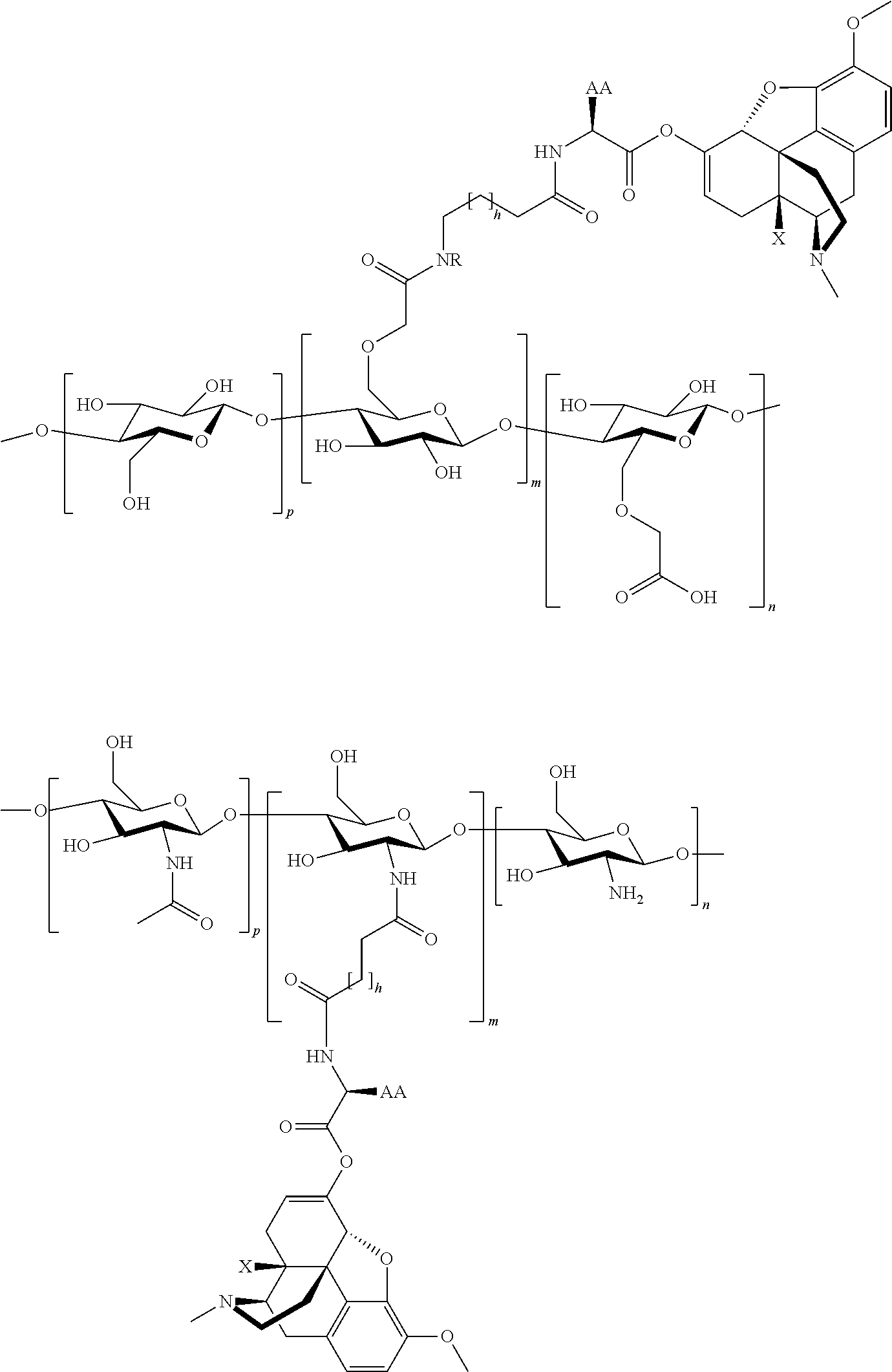

Where X can be H or OH; AA is a natural or unnatural amino acid side chain that is recognized by a digestive enzyme; h represents a number of substituted or unsubstituted methylene units and can be an integer from zero to ten; n, m, and p can independently be an integer from 1 to 1000. R is independently hydrogen, methyl, ethyl, substituted alkyl, or substituted aryl. Each R′ can independently be hydrogen, methyl, ethyl, substituted alkyl, or substituted aryl, acyl, or substituted acyl.


Where D is an opioid agonist as defined above; AA is a natural or unnatural amino acid side chain that is recognized by a digestive enzyme; AA′ is a natural or unnatural amino acid side chain; Z is an electron donating or electron withdrawing group such as hydroxy, methoxy, alkoxy, substituted alkoxy, amino, substituted amino, carboxyl, substituted carboxyl, acyl, substituted acyl, acylamino, substituted acylamino, halogen, cyano, nitro, and the like; X is a linker as defined herein; R is independently hydrogen, methyl, ethyl, substituted alkyl, or substituted aryl, or a natural or unnatural amino acid or a polypeptide comprising up to 10 natural and/or unnatural amino acids; adjacent R groups can be joined to form a cyclic or heterocyclic structure.


Where D is an opioid agonist as defined above; AA is a natural or unnatural amino acid side chain that is recognized by a digestive enzyme; AA′ is a natural or unnatural amino acid side chain; R is independently hydrogen, methyl, ethyl, substituted alkyl, or substituted aryl, or a natural or unnatural amino acid, or a polypeptide comprising up to 10 natural and/or unnatural amino acids; adjacent R groups can be joined to form a cyclic or heterocyclic structure; h represents a number of substituted or unsubstituted methylene units and can be an integer from zero to ten; n, m, and p can independently be an integer from 1 to 1000; each R′ can independently be hydrogen, methyl, ethyl, substituted alkyl, or substituted aryl, acyl, or substituted acyl.


Where X can be H or OH; AA is a natural or unnatural amino acid side chain that is recognized by a digestive enzyme; AA′ is a natural or unnatural amino acid side chain; R is independently hydrogen, methyl, ethyl, substituted alkyl, or substituted aryl, or a natural or unnatural amino acid, or a polypeptide comprising up to 10 natural and/or unnatural amino acids; adjacent R groups can be joined to form a cyclic or heterocyclic structure; h represents a number of substituted or unsubstituted methylene units and can be an integer from zero to ten; n, m, and p can independently be an integer from 1 to 1000; each R′ can independently be hydrogen, methyl, ethyl, substituted alkyl, or substituted aryl, acyl, or substituted acyl.


Where D is an opioid agonist as defined above; AA is a natural or unnatural amino acid side chain that is recognized by a digestive enzyme; R is independently hydrogen, methyl, ethyl, substituted alkyl, or substituted aryl, or a natural or unnatural amino acid, or a polypeptide comprising up to 10 natural and/or unnatural amino acids; adjacent R groups can be joined to form a cyclic or heterocyclic structure; m, n and o independently represent an integer from zero to six; and X is a linker as defined herein.


Where D is an opioid agonist as defined above; AA is a natural or unnatural amino acid side chain that is recognized by a digestive enzyme; R is independently hydrogen, methyl, ethyl, substituted alkyl, or substituted aryl, or a natural or unnatural amino acid, or a polypeptide comprising up to 10 natural and/or unnatural amino acids; adjacent R groups can be joined to form a cyclic or heterocyclic structure; h represents a number of substituted or unsubstituted methylene units and can be an integer from zero to ten; n, m, and p, can independently be an integer from 1 to 1000; each R′ can independently be hydrogen, methyl, ethyl, substituted alkyl, or substituted aryl, acyl, or substituted acyl.


Where X is H or OH; AA is a natural or unnatural amino acid side chain that is recognized by a digestive enzyme; R is independently hydrogen, methyl, ethyl, substituted alkyl, or substituted aryl, or a natural or unnatural amino acid, or a polypeptide comprising up to 10 natural and/or unnatural amino acids; adjacent R groups can be joined to form a cyclic or heterocyclic structure; h represents a number of substituted or unsubstituted methylene units and can be an integer from zero to ten; n, m, and p can independently be an integer from 1 to 1000; each R′ can independently be hydrogen, methyl, ethyl, substituted alkyl, or substituted aryl, acyl, or substituted acyl.


Where X is H or OH; AA is lysine, arginine or a lysine or arginine mimic; R′ is hydrogen or methyl; R is a acetyl, a substituted amino acid, or a substituted di- or tri-peptide; h is an integer between 1-5; n is an integer between 10-100.


Where D is an opioid agonist as defined above; AA is a natural or unnatural amino acid side chain that is recognized by a digestive enzyme; AA′ is a natural or unnatural amino acid side chain; R is independently hydrogen, methyl, ethyl, substituted alkyl, or substituted aryl, or a natural or unnatural amino acid, or a polypeptide comprising up to 10 natural and/or unnatural amino acids; adjacent R groups can be joined to form a cyclic or heterocyclic structure; n represents a number of substituted or unsubstituted methylene units and can be an integer from zero to five; o represents an integer from zero to 16; and X is a linker as defined herein.


Where D is an opioid agonist as defined above; AA is a natural or unnatural amino acid side chain that is recognized by a digestive enzyme; R is independently hydrogen, methyl, ethyl, substituted alkyl, or substituted aryl, or a natural or unnatural amino acid, or a polypeptide comprising up to 10 natural and/or unnatural amino acids; adjacent R groups can be joined to form a cyclic or heterocyclic structure; h represents a number of substituted or unsubstituted methylene units and can be an integer from zero to ten; n, m, and p, can independently be an integer from 1 to 1000; each R′ can independently be hydrogen, methyl, ethyl, substituted alkyl, or substituted aryl, acyl, or substituted acyl.


Where X can be H or OH; AA is a natural or unnatural amino acid side chain that is recognized by a digestive enzyme; R is independently hydrogen, methyl, ethyl, substituted alkyl, or substituted aryl, or a natural or unnatural amino acid, or a polypeptide comprising up to 10 natural and/or unnatural amino acids; adjacent R groups can be joined to form a cyclic or heterocyclic structure; h represents a number of substituted or unsubstituted methylene units and can be an integer from zero to ten; n, m, and p, can independently be an integer from 1 to 1000; each R′ can independently be hydrogen, methyl, ethyl, substituted alkyl, or substituted aryl, acyl, or substituted acyl.


Where D is an opioid agonist as defined above; AA is an amino-acid side-chain that is recognized by a digestive enzyme; R is independently hydrogen, methyl, ethyl, substituted alkyl, or substituted aryl, acyl, substituted acyl, or a natural or unnatural amino acid, or a polypeptide comprising up to 10 natural and/or unnatural amino acids; adjacent R groups can be joined to form a cyclic or heterocyclic structure; r is an integer from zero to ten; and X is a linker as defined herein.


Where D is an opioid agonist as defined above; AA is an amino-acid side-chain that is recognized by a digestive enzyme; R is independently hydrogen, methyl, ethyl, alkyl or substituted alkyl, aryl or substituted aryl, acyl or substituted acyl, or a natural or unnatural amino acid, or a polypeptide comprising up to 10 natural and/or unnatural amino acids; r is an integer from zero to ten; adjacent R groups can be joined to form a cyclic or heterocyclic structure; and h is an integer representing a number of methylene, or substituted methylene, units from zero to ten; n, m, and p, can independently be an integer from 1 to 1000; each R′ can independently be hydrogen, methyl, ethyl, substituted alkyl, or substituted aryl, acyl, or substituted acyl.


Where X is H or OH; AA is an amino-acid side-chain that is recognized by a digestive enzyme; R is independently hydrogen, methyl, ethyl, alkyl or substituted alkyl, aryl or substituted aryl, acyl or substituted acyl, or a natural or unnatural amino acid, or a polypeptide comprising up to 10 natural and/or unnatural amino acids; adjacent R groups can be joined to form a cyclic or heterocyclic structure; r is an integer from zero to ten; and h is an integer representing a number of methylene, or substituted methylene, units from zero to ten; n, m, and p, can independently be an integer from 1 to 1000; each R′ can independently be hydrogen, methyl, ethyl, alkyl or substituted alkyl, or aryl or substituted aryl, acyl or substituted acyl.

where D* is an opioid antagonist, X is a functional linking group as defined herein, and can be an ester, a thioester, an amide, a carbamate, a carbonate, or a urea; n is an integer between 1 and 1000; and P is a polymer. The polymer P can be any of the polymers described above, such as, for example, a PEG, a polypeptide, a polysaccharide or a biopolymer. The polymer and linker X are selected such that they are chemically stable to the chemical conditions in the GI tract, and to specific and non-specific actions of digestive enzymes in order to prevent or minimize the release of the opioid antagonist following oral ingestion by subjects. The polymer is chosen to prevent or minimize the absorption of the macromolecular opioid antagonist polymer conjugate from the GI tract following ingestion by a subject.


Wherein D* is an opioid antagonist as defined above and can preferably be naltrexone or naloxone, and P is a polymer as defined herein, and X is a linker as defined herein.


Wherein R is cyclopropylmethyl or allyl; R′ is hydrogen, methyl, alkyl, aryl, substituted alkyl, or substituted aryl, acyl or substituted acyl; and X is a linker as defined herein.

Wherein R is cyclopropylmethyl or allyl; R′ is hydrogen, methyl, alkyl, aryl, substituted alkyl, or substituted aryl, acyl or substituted acyl; h represent a number of unsubstituted or substituted methylene units and can be an integer from zero to ten; n is an integer from 1 to 1000.


| TABLE 2 | |||
 | (I) | ||
 | (II) | ||
 | (III) | ||
 | (IV) | ||
 | (V) | ||
 | (VI) | ||
wherein PD, X, P, I, and n are as previously defined for each component, respectively.

Claims (15)


Priority Applications (3)
| Application Number | Priority Date | Filing Date | Title |
|---|---|---|---|
| US15/795,126 US10335406B2 (en) | 2015-10-01 | 2017-10-26 | Opioid compositions resistant to overdose and abuse |
| US16/386,671 US11154549B2 (en) | 2015-10-01 | 2019-04-17 | Opioid compositions resistant to overdose and abuse |
| US17/475,224 US20220054479A1 (en) | 2015-10-01 | 2021-09-14 | Opioid compositions resistant to overdose and abuse |
Applications Claiming Priority (5)
| Application Number | Priority Date | Filing Date | Title |
|---|---|---|---|
| US201562236048P | 2015-10-01 | 2015-10-01 | |
| US15/284,269 US9808452B2 (en) | 2015-10-01 | 2016-10-03 | Polysubunit opioid prodrugs resistant to overdose and abuse |
| US201662413913P | 2016-10-27 | 2016-10-27 | |
| US15/683,356 US10251878B2 (en) | 2015-10-01 | 2017-08-22 | Polysubunit opioid prodrugs resistant to overdose and abuse |
| US15/795,126 US10335406B2 (en) | 2015-10-01 | 2017-10-26 | Opioid compositions resistant to overdose and abuse |
Related Parent Applications (1)
| Application Number | Title | Priority Date | Filing Date |
|---|---|---|---|
| US15/683,356 Continuation-In-Part US10251878B2 (en) | 2015-10-01 | 2017-08-22 | Polysubunit opioid prodrugs resistant to overdose and abuse |
Related Child Applications (1)
| Application Number | Title | Priority Date | Filing Date |
|---|---|---|---|
| US16/386,671 Division US11154549B2 (en) | 2015-10-01 | 2019-04-17 | Opioid compositions resistant to overdose and abuse |
Publications (2)
| Publication Number | Publication Date |
|---|---|
| US20180085366A1 US20180085366A1 (en) | 2018-03-29 |
| US10335406B2 true US10335406B2 (en) | 2019-07-02 |
Family
ID=61687157
Family Applications (3)
| Application Number | Title | Priority Date | Filing Date |
|---|---|---|---|
| US15/795,126 Active US10335406B2 (en) | 2015-10-01 | 2017-10-26 | Opioid compositions resistant to overdose and abuse |
| US16/386,671 Active US11154549B2 (en) | 2015-10-01 | 2019-04-17 | Opioid compositions resistant to overdose and abuse |
| US17/475,224 Abandoned US20220054479A1 (en) | 2015-10-01 | 2021-09-14 | Opioid compositions resistant to overdose and abuse |
Family Applications After (2)
| Application Number | Title | Priority Date | Filing Date |
|---|---|---|---|
| US16/386,671 Active US11154549B2 (en) | 2015-10-01 | 2019-04-17 | Opioid compositions resistant to overdose and abuse |
| US17/475,224 Abandoned US20220054479A1 (en) | 2015-10-01 | 2021-09-14 | Opioid compositions resistant to overdose and abuse |
Country Status (1)
| Country | Link |
|---|---|
| US (3) | US10335406B2 (en) |
Cited By (3)
| Publication number | Priority date | Publication date | Assignee | Title |
|---|---|---|---|---|
| US11129825B2 (en) | 2015-10-01 | 2021-09-28 | Elysium Therapeutics, Inc. | Polysubunit opioid prodrugs resistant to overdose and abuse |
| US11154549B2 (en) | 2015-10-01 | 2021-10-26 | Elysium Therapeutics, Inc. | Opioid compositions resistant to overdose and abuse |
| US11197933B2 (en) | 2017-03-17 | 2021-12-14 | Elysium Therapeutics, Inc. | Polysubunit opioid prodrugs resistant to overdose and abuse |
Families Citing this family (4)
| Publication number | Priority date | Publication date | Assignee | Title |
|---|---|---|---|---|
| CN117715632A (en) * | 2021-03-09 | 2024-03-15 | 恩赛斯生物科学股份有限公司 | Compositions comprising an enzyme-cleavable prodrug and nafamostat and methods of use thereof |
| KR20230174213A (en) | 2021-03-09 | 2023-12-27 | 엔사이스 바이오사이언시즈 인크. | Modified release compositions of nafamostat and methods of use thereof |
| WO2023183795A1 (en) * | 2022-03-22 | 2023-09-28 | Elysium Therapeutics, Inc. | Opioid antagonist prodrugs and formulations for the reversal of opioid overdoses |
| WO2025029623A2 (en) * | 2023-07-28 | 2025-02-06 | The Children's Medical Center Corporation | Light-triggered polymer-naloxone conjugate for opioid reversal |
Citations (91)
| Publication number | Priority date | Publication date | Assignee | Title |
|---|---|---|---|---|
| US2996431A (en) | 1953-12-16 | 1961-08-15 | Barry Richard Henry | Friable tablet and process for manufacturing same |
| US3139383A (en) | 1961-06-26 | 1964-06-30 | Norton Co | Encapsulated time release pellets and method for encapsulating the same |
| US3402240A (en) | 1957-06-25 | 1968-09-17 | Pfizer & Co C | Medicinal tablet and process of making same |
| US3811444A (en) | 1972-12-27 | 1974-05-21 | Alza Corp | Bioerodible ocular device |
| US3845770A (en) | 1972-06-05 | 1974-11-05 | Alza Corp | Osmatic dispensing device for releasing beneficial agent |
| US3916899A (en) | 1973-04-25 | 1975-11-04 | Alza Corp | Osmotic dispensing device with maximum and minimum sizes for the passageway |
| US3962414A (en) | 1972-04-27 | 1976-06-08 | Alza Corporation | Structured bioerodible drug delivery device |
| US3992518A (en) | 1974-10-24 | 1976-11-16 | G. D. Searle & Co. | Method for making a microsealed delivery device |
| US4063064A (en) | 1976-02-23 | 1977-12-13 | Coherent Radiation | Apparatus for tracking moving workpiece by a laser beam |
| US4066747A (en) | 1976-04-08 | 1978-01-03 | Alza Corporation | Polymeric orthoesters housing beneficial drug for controlled release therefrom |
| US4070347A (en) | 1976-08-16 | 1978-01-24 | Alza Corporation | Poly(orthoester) co- and homopolymers and poly(orthocarbonate) co- and homopolymers having carbonyloxy functionality |
| US4079038A (en) | 1976-03-05 | 1978-03-14 | Alza Corporation | Poly(carbonates) |
| US4083949A (en) | 1973-07-17 | 1978-04-11 | Byk Gulden Lomberg Chemische Fabrik Gmbh | New oral form of medicament and a method for producing it |
| US4088864A (en) | 1974-11-18 | 1978-05-09 | Alza Corporation | Process for forming outlet passageways in pills using a laser |
| US4093709A (en) | 1975-01-28 | 1978-06-06 | Alza Corporation | Drug delivery devices manufactured from poly(orthoesters) and poly(orthocarbonates) |
| US4200098A (en) | 1978-10-23 | 1980-04-29 | Alza Corporation | Osmotic system with distribution zone for dispensing beneficial agent |
| US4285987A (en) | 1978-10-23 | 1981-08-25 | Alza Corporation | Process for manufacturing device with dispersion zone |
| US4421736A (en) | 1982-05-20 | 1983-12-20 | Merrel Dow Pharmaceuticals Inc. | Sustained release diethylpropion compositions |
| US4434153A (en) | 1982-03-22 | 1984-02-28 | Alza Corporation | Drug delivery system comprising a reservoir containing a plurality of tiny pills |
| US4507466A (en) | 1983-01-07 | 1985-03-26 | The Dow Chemical Corporation | Dense star polymers having core, core branches, terminal groups |
| US4631337A (en) | 1983-01-07 | 1986-12-23 | The Dow Chemical Company | Hydrolytically-stable dense star polyamine |
| US4721613A (en) | 1982-12-13 | 1988-01-26 | Alza Corporation | Delivery system comprising means for shielding a multiplicity of reservoirs in selected environment of use |
| US4752470A (en) | 1986-11-24 | 1988-06-21 | Mehta Atul M | Controlled release indomethacin |
| US4765539A (en) | 1985-02-19 | 1988-08-23 | Imperial Chemical Industries Plc | Electrostatic spraying apparatus |
| US4816263A (en) | 1987-10-02 | 1989-03-28 | Alza Corporation | Dosage form for treating cardiovascular diseases comprising isradipine |
| US4820523A (en) | 1986-04-15 | 1989-04-11 | Warner-Lambert Company | Pharmaceutical composition |
| US4853229A (en) | 1987-10-26 | 1989-08-01 | Alza Corporation | Method for adminstering tiny pills |
| US4962885A (en) | 1978-04-17 | 1990-10-16 | Coffee Ronald A | Process and apparatus for spraying liquid |
| US5041516A (en) | 1989-06-21 | 1991-08-20 | Cornell Research Foundation, Inc. | Dendritic molecules and method of production |
| US5112598A (en) | 1988-05-04 | 1992-05-12 | Hermes Fabrik Pharmazeutischer Preparate Franz Gradinger Gmbh & Co. Kg | Vitamin a aerosol-inhalate preparations |
| US5159081A (en) | 1991-03-29 | 1992-10-27 | Eli Lilly And Company | Intermediates of peripherally selective n-carbonyl-3,4,4-trisubstituted piperidine opioid antagonists |
| US5177059A (en) | 1989-11-15 | 1993-01-05 | Sandoz Ltd. | Polymyxin B conjugates |
| US5250542A (en) | 1991-03-29 | 1993-10-05 | Eli Lilly And Company | Peripherally selective piperidine carboxylate opioid antagonists |
| US5270328A (en) | 1991-03-29 | 1993-12-14 | Eli Lilly And Company | Peripherally selective piperidine opioid antagonists |
| WO1994012285A2 (en) | 1992-12-01 | 1994-06-09 | Electrosols Ltd. | Dispensing device |
| WO1994014543A2 (en) | 1992-12-22 | 1994-07-07 | Electrosols Ltd. | Dispensing device |
| US5434171A (en) | 1993-12-08 | 1995-07-18 | Eli Lilly And Company | Preparation of 3,4,4-trisubstituted-piperidinyl-N-alkylcarboxylates and intermediates |
| WO1995026234A1 (en) | 1994-03-29 | 1995-10-05 | Electrosols Limited | Dispensing device |
| WO1995026235A1 (en) | 1994-03-29 | 1995-10-05 | Electrosols Limited | Dispensing device |
| US5468574A (en) | 1994-05-23 | 1995-11-21 | Dais Corporation | Fuel cell incorporating novel ion-conducting membrane |
| WO1995032807A1 (en) | 1994-05-27 | 1995-12-07 | Electrosols Ltd. | Dispensing device |
| US5698155A (en) | 1991-05-31 | 1997-12-16 | Gs Technologies, Inc. | Method for the manufacture of pharmaceutical cellulose capsules |
| US5824701A (en) | 1993-10-20 | 1998-10-20 | Enzon, Inc. | Taxane-based prodrugs |
| US5840387A (en) | 1995-07-28 | 1998-11-24 | Aegis Biosciences L.L.C. | Sulfonated multiblock copolymer and uses therefor |
| US5880131A (en) | 1993-10-20 | 1999-03-09 | Enzon, Inc. | High molecular weight polymer-based prodrugs |
| US5932462A (en) | 1995-01-10 | 1999-08-03 | Shearwater Polymers, Inc. | Multiarmed, monofunctional, polymer for coupling to molecules and surfaces |
| US5950619A (en) | 1995-03-14 | 1999-09-14 | Siemens Aktiengesellschaft | Ultrasonic atomizer device with removable precision dosating unit |
| US5954047A (en) | 1997-10-17 | 1999-09-21 | Systemic Pulmonary Development, Ltd. | Methods and apparatus for delivering aerosolized medication |
| US5970974A (en) | 1995-03-14 | 1999-10-26 | Siemens Aktiengesellschaft | Dosating unit for an ultrasonic atomizer device |
| US6171615B1 (en) | 1998-07-06 | 2001-01-09 | Gattefoss{acute over (e)} | Sustained release theophylline formulations, excipient systems and methods of production |
| US6375987B1 (en) | 1996-10-01 | 2002-04-23 | Gattefossé, S.A. | Process for the manufacture of pharmaceutical composition with modified release of active principle comprising the matrix |
| US6379700B2 (en) | 1998-06-16 | 2002-04-30 | Gattefosse S.A. | Process for manufacturing tablets for the sustained release of active principle(s) |
| US6545097B2 (en) | 2000-12-12 | 2003-04-08 | Scimed Life Systems, Inc. | Drug delivery compositions and medical devices containing block copolymer |
| US6664331B2 (en) | 1998-03-12 | 2003-12-16 | Nektar Therapeutics Al, Corporation | Poly(ethylene glycol) derivatives with proximal reactive groups |
| US20040043030A1 (en) | 2001-07-31 | 2004-03-04 | Immunomedics, Inc. | Polymeric delivery systems |
| US6716821B2 (en) | 2001-12-21 | 2004-04-06 | Immunogen Inc. | Cytotoxic agents bearing a reactive polyethylene glycol moiety, cytotoxic conjugates comprising polyethylene glycol linking groups, and methods of making and using the same |
| WO2004041324A2 (en) | 2002-10-30 | 2004-05-21 | Mylan Pharmaceuticals, Inc. | Transdermal delivery of fentanyl |
| WO2004062614A2 (en) | 2003-01-13 | 2004-07-29 | New River Pharmaceuticals Inc. | Carbohydrate conjugates to prevent abuse of controlled substances |
| WO2004082620A2 (en) | 2003-03-13 | 2004-09-30 | Controlled Chemicals, Inc. | Oxycodone conjugates with lower the abuse potential and extended duration of action |
| US20050037059A1 (en) | 2003-08-15 | 2005-02-17 | Mylan Technologies, Inc. | Transdermal patch incorporating active agent migration barrier layer |
| US20050176644A1 (en) | 2003-09-30 | 2005-08-11 | New River Pharmaceuticals Inc. | Compounds and compositions for prevention of overdose of oxycodone |
| US7060290B1 (en) | 1999-02-18 | 2006-06-13 | Supergen, Inc. | Phosphocholine linked prodrug derivatives |
| WO2006073396A1 (en) | 2005-01-05 | 2006-07-13 | Regents Of The University Of Minnesota | Analgesic conjugates |
| WO2007120864A2 (en) | 2006-04-14 | 2007-10-25 | Shire Llc | Compositions and methods for enhancing analgesic potency of covalently bound compounds, attenuating its adverse side effects, and preventing their abuse |
| WO2007140272A2 (en) | 2006-05-26 | 2007-12-06 | Pharmacofore, Inc. | Controlled release of phenolic opioids |
| US7338939B2 (en) | 2003-09-30 | 2008-03-04 | New River Pharmaceuticals Inc. | Abuse-resistant hydrocodone compounds |
| US7375082B2 (en) | 2002-02-22 | 2008-05-20 | Shire Llc | Abuse-resistant hydrocodone compounds |
| WO2008101187A2 (en) | 2007-02-16 | 2008-08-21 | Pharmacofore, Inc. | Pro-drugs of peripheral phenolic opioid antagonists |
| US20090137618A1 (en) | 2007-11-26 | 2009-05-28 | Jenkins Thomas E | Pro-drugs for controlled release of biologically active compounds |
| US20090136980A1 (en) | 2001-06-11 | 2009-05-28 | Medarex, Inc. | CD10-activated prodrug compounds |
| WO2009092073A2 (en) | 2008-01-18 | 2009-07-23 | Shire Llc | Amino acid and peptide prodrugs of opioid analgesics with reduced gi side-effects |
| US20090209569A1 (en) | 2008-02-14 | 2009-08-20 | Alkermes, Inc. | Selective opioid compounds |
| US20100080797A1 (en) | 2005-08-26 | 2010-04-01 | Yeomans David C | Therapy procedure for drug delivery for trigeminal pain |
| WO2010045599A1 (en) | 2008-10-17 | 2010-04-22 | Pharmacofore, Inc. | Pharmaceutical compositions with attenuated release of phenolic opioids |
| WO2011002995A1 (en) | 2009-07-02 | 2011-01-06 | Kempharm, Inc. | Phenylethanoic acid, phenylpropanoic acid and phenylpropenoic acid conjugates and prodrugs of hydrocodone, methods of making and use thereof |
| WO2011002991A1 (en) | 2009-07-02 | 2011-01-06 | Kempharm, Inc. | Benzoic acid, benzoic acid derivatives and heteroaryl carboxylic acid conjugates of hydrocodone, prodrugs, methods of making and use thereof |
| US20110262360A1 (en) | 2010-04-21 | 2011-10-27 | Jenkins Thomas E | Compositions Comprising Enzyme-Cleavable Phenol-Modified Opioid Prodrugs and Inhibitors Thereof |
| US20110262359A1 (en) | 2010-04-21 | 2011-10-27 | Jenkins Thomas E | Compositions comprising enzyme-cleavable prodrugs of active agents and inhibitors thereof |
| US8101661B2 (en) | 2006-12-11 | 2012-01-24 | Kempharm, Inc. | Polar hydrophilic prodrugs and non-standard amino acid conjugates of amphetamine and other stimulants and processes for making and using the same |
| US8133881B2 (en) | 2003-01-13 | 2012-03-13 | Shire Llc | Carbohydrate conjugates to prevent abuse of controlled substances |
| US8163701B2 (en) | 2005-08-19 | 2012-04-24 | Signature Therapeutics, Inc. | Prodrugs of active agents |
| US20120142718A1 (en) | 2007-02-16 | 2012-06-07 | Jenkins Thomas E | N-17-Alkylated Prodrugs of Opioids |
| US20120178773A1 (en) | 2011-01-11 | 2012-07-12 | Jenkins Thomas E | Compositions Comprising Enzyme-Cleavable Oxycodone Prodrug |
| WO2012109445A1 (en) | 2011-02-09 | 2012-08-16 | QRxPharma Ltd. | Hybrid opioid compounds and compositions |
| WO2012122420A2 (en) | 2011-03-09 | 2012-09-13 | Pharmacofore, Inc. | Opioid prodrugs with heterocyclic linkers |
| US8569228B2 (en) | 2011-01-11 | 2013-10-29 | Signature Therapeutics, Inc. | Compositions comprising enzyme-cleavable oxycodone prodrug |
| US20140016935A1 (en) | 2007-10-29 | 2014-01-16 | Lockheed Martin Corporation | Fiber optic network adjustment |
| US9040032B2 (en) | 2010-04-21 | 2015-05-26 | Signature Therapeutics, Inc. | Compositions comprising enzyme-cleavable opioid prodrugs and inhibitors thereof |
| US9139612B2 (en) | 2011-03-09 | 2015-09-22 | Signature Therapeutics, Inc. | Active agent prodrugs with heterocyclic linkers |
| US9217005B2 (en) | 2010-08-26 | 2015-12-22 | Takasago International Corporation | Ruthenium-diamine complexes and method for producing optically active compounds |
| WO2017059459A1 (en) | 2015-10-01 | 2017-04-06 | Elysium Therapeutics, Inc. | Polysubunit opioid prodrugs resistant to overdose and abuse |
Family Cites Families (4)
| Publication number | Priority date | Publication date | Assignee | Title |
|---|---|---|---|---|
| US5530092A (en) | 1992-01-13 | 1996-06-25 | Dsm N.V. | Dendritic macromolecule and the preparation thereof |
| EP2560490A1 (en) | 2010-04-21 | 2013-02-27 | Signature Therapeutics, Inc. | Compositions comprising enzyme-cleavable prodrugs of active agents and inhibitors thereof |
| US10335406B2 (en) | 2015-10-01 | 2019-07-02 | Elysium Therapeutics, Inc. | Opioid compositions resistant to overdose and abuse |
| CA3056239C (en) | 2017-03-17 | 2023-09-12 | Elysium Therapeutics, Inc. | Polysubunit opioid prodrugs resistant to overdose and abuse |
-
2017
- 2017-10-26 US US15/795,126 patent/US10335406B2/en active Active
-
2019
- 2019-04-17 US US16/386,671 patent/US11154549B2/en active Active
-
2021
- 2021-09-14 US US17/475,224 patent/US20220054479A1/en not_active Abandoned
Patent Citations (100)
| Publication number | Priority date | Publication date | Assignee | Title |
|---|---|---|---|---|
| US2996431A (en) | 1953-12-16 | 1961-08-15 | Barry Richard Henry | Friable tablet and process for manufacturing same |
| US3402240A (en) | 1957-06-25 | 1968-09-17 | Pfizer & Co C | Medicinal tablet and process of making same |
| US3139383A (en) | 1961-06-26 | 1964-06-30 | Norton Co | Encapsulated time release pellets and method for encapsulating the same |
| US3962414A (en) | 1972-04-27 | 1976-06-08 | Alza Corporation | Structured bioerodible drug delivery device |
| US3845770A (en) | 1972-06-05 | 1974-11-05 | Alza Corp | Osmatic dispensing device for releasing beneficial agent |
| US3811444A (en) | 1972-12-27 | 1974-05-21 | Alza Corp | Bioerodible ocular device |
| US3916899A (en) | 1973-04-25 | 1975-11-04 | Alza Corp | Osmotic dispensing device with maximum and minimum sizes for the passageway |
| US4083949A (en) | 1973-07-17 | 1978-04-11 | Byk Gulden Lomberg Chemische Fabrik Gmbh | New oral form of medicament and a method for producing it |
| US3992518A (en) | 1974-10-24 | 1976-11-16 | G. D. Searle & Co. | Method for making a microsealed delivery device |
| US4088864A (en) | 1974-11-18 | 1978-05-09 | Alza Corporation | Process for forming outlet passageways in pills using a laser |
| US4093709A (en) | 1975-01-28 | 1978-06-06 | Alza Corporation | Drug delivery devices manufactured from poly(orthoesters) and poly(orthocarbonates) |
| US4063064A (en) | 1976-02-23 | 1977-12-13 | Coherent Radiation | Apparatus for tracking moving workpiece by a laser beam |
| US4079038A (en) | 1976-03-05 | 1978-03-14 | Alza Corporation | Poly(carbonates) |
| US4066747A (en) | 1976-04-08 | 1978-01-03 | Alza Corporation | Polymeric orthoesters housing beneficial drug for controlled release therefrom |
| US4070347A (en) | 1976-08-16 | 1978-01-24 | Alza Corporation | Poly(orthoester) co- and homopolymers and poly(orthocarbonate) co- and homopolymers having carbonyloxy functionality |
| US4962885A (en) | 1978-04-17 | 1990-10-16 | Coffee Ronald A | Process and apparatus for spraying liquid |
| US4285987A (en) | 1978-10-23 | 1981-08-25 | Alza Corporation | Process for manufacturing device with dispersion zone |
| US4200098A (en) | 1978-10-23 | 1980-04-29 | Alza Corporation | Osmotic system with distribution zone for dispensing beneficial agent |
| US4434153A (en) | 1982-03-22 | 1984-02-28 | Alza Corporation | Drug delivery system comprising a reservoir containing a plurality of tiny pills |
| US4421736A (en) | 1982-05-20 | 1983-12-20 | Merrel Dow Pharmaceuticals Inc. | Sustained release diethylpropion compositions |
| US4721613A (en) | 1982-12-13 | 1988-01-26 | Alza Corporation | Delivery system comprising means for shielding a multiplicity of reservoirs in selected environment of use |
| US4507466A (en) | 1983-01-07 | 1985-03-26 | The Dow Chemical Corporation | Dense star polymers having core, core branches, terminal groups |
| US4631337A (en) | 1983-01-07 | 1986-12-23 | The Dow Chemical Company | Hydrolytically-stable dense star polyamine |
| US4765539A (en) | 1985-02-19 | 1988-08-23 | Imperial Chemical Industries Plc | Electrostatic spraying apparatus |
| US4820523A (en) | 1986-04-15 | 1989-04-11 | Warner-Lambert Company | Pharmaceutical composition |
| US4752470A (en) | 1986-11-24 | 1988-06-21 | Mehta Atul M | Controlled release indomethacin |
| US4816263A (en) | 1987-10-02 | 1989-03-28 | Alza Corporation | Dosage form for treating cardiovascular diseases comprising isradipine |
| US4853229A (en) | 1987-10-26 | 1989-08-01 | Alza Corporation | Method for adminstering tiny pills |
| US5556611A (en) | 1988-05-04 | 1996-09-17 | Hermes Fabrik Pharmazeutischer Praparate | Vitamin A aerosol-inhalant preparations and method |
| US5112598A (en) | 1988-05-04 | 1992-05-12 | Hermes Fabrik Pharmazeutischer Preparate Franz Gradinger Gmbh & Co. Kg | Vitamin a aerosol-inhalate preparations |
| US5041516A (en) | 1989-06-21 | 1991-08-20 | Cornell Research Foundation, Inc. | Dendritic molecules and method of production |
| US5177059A (en) | 1989-11-15 | 1993-01-05 | Sandoz Ltd. | Polymyxin B conjugates |
| US5159081A (en) | 1991-03-29 | 1992-10-27 | Eli Lilly And Company | Intermediates of peripherally selective n-carbonyl-3,4,4-trisubstituted piperidine opioid antagonists |
| US5250542A (en) | 1991-03-29 | 1993-10-05 | Eli Lilly And Company | Peripherally selective piperidine carboxylate opioid antagonists |
| US5270328A (en) | 1991-03-29 | 1993-12-14 | Eli Lilly And Company | Peripherally selective piperidine opioid antagonists |
| US5698155A (en) | 1991-05-31 | 1997-12-16 | Gs Technologies, Inc. | Method for the manufacture of pharmaceutical cellulose capsules |
| WO1994012285A2 (en) | 1992-12-01 | 1994-06-09 | Electrosols Ltd. | Dispensing device |
| WO1994014543A2 (en) | 1992-12-22 | 1994-07-07 | Electrosols Ltd. | Dispensing device |
| US5880131A (en) | 1993-10-20 | 1999-03-09 | Enzon, Inc. | High molecular weight polymer-based prodrugs |
| US5824701A (en) | 1993-10-20 | 1998-10-20 | Enzon, Inc. | Taxane-based prodrugs |
| US5434171A (en) | 1993-12-08 | 1995-07-18 | Eli Lilly And Company | Preparation of 3,4,4-trisubstituted-piperidinyl-N-alkylcarboxylates and intermediates |
| WO1995026235A1 (en) | 1994-03-29 | 1995-10-05 | Electrosols Limited | Dispensing device |
| WO1995026234A1 (en) | 1994-03-29 | 1995-10-05 | Electrosols Limited | Dispensing device |
| US5468574A (en) | 1994-05-23 | 1995-11-21 | Dais Corporation | Fuel cell incorporating novel ion-conducting membrane |
| WO1995032807A1 (en) | 1994-05-27 | 1995-12-07 | Electrosols Ltd. | Dispensing device |
| US5932462A (en) | 1995-01-10 | 1999-08-03 | Shearwater Polymers, Inc. | Multiarmed, monofunctional, polymer for coupling to molecules and surfaces |
| US5950619A (en) | 1995-03-14 | 1999-09-14 | Siemens Aktiengesellschaft | Ultrasonic atomizer device with removable precision dosating unit |
| US5970974A (en) | 1995-03-14 | 1999-10-26 | Siemens Aktiengesellschaft | Dosating unit for an ultrasonic atomizer device |
| US5840387A (en) | 1995-07-28 | 1998-11-24 | Aegis Biosciences L.L.C. | Sulfonated multiblock copolymer and uses therefor |
| US6375987B1 (en) | 1996-10-01 | 2002-04-23 | Gattefossé, S.A. | Process for the manufacture of pharmaceutical composition with modified release of active principle comprising the matrix |
| US5954047A (en) | 1997-10-17 | 1999-09-21 | Systemic Pulmonary Development, Ltd. | Methods and apparatus for delivering aerosolized medication |
| US6664331B2 (en) | 1998-03-12 | 2003-12-16 | Nektar Therapeutics Al, Corporation | Poly(ethylene glycol) derivatives with proximal reactive groups |
| US6379700B2 (en) | 1998-06-16 | 2002-04-30 | Gattefosse S.A. | Process for manufacturing tablets for the sustained release of active principle(s) |
| US6171615B1 (en) | 1998-07-06 | 2001-01-09 | Gattefoss{acute over (e)} | Sustained release theophylline formulations, excipient systems and methods of production |
| US7060290B1 (en) | 1999-02-18 | 2006-06-13 | Supergen, Inc. | Phosphocholine linked prodrug derivatives |
| US6545097B2 (en) | 2000-12-12 | 2003-04-08 | Scimed Life Systems, Inc. | Drug delivery compositions and medical devices containing block copolymer |
| US20090136980A1 (en) | 2001-06-11 | 2009-05-28 | Medarex, Inc. | CD10-activated prodrug compounds |
| US20040043030A1 (en) | 2001-07-31 | 2004-03-04 | Immunomedics, Inc. | Polymeric delivery systems |
| US6716821B2 (en) | 2001-12-21 | 2004-04-06 | Immunogen Inc. | Cytotoxic agents bearing a reactive polyethylene glycol moiety, cytotoxic conjugates comprising polyethylene glycol linking groups, and methods of making and using the same |
| US7375082B2 (en) | 2002-02-22 | 2008-05-20 | Shire Llc | Abuse-resistant hydrocodone compounds |
| WO2004041324A2 (en) | 2002-10-30 | 2004-05-21 | Mylan Pharmaceuticals, Inc. | Transdermal delivery of fentanyl |
| WO2004062614A2 (en) | 2003-01-13 | 2004-07-29 | New River Pharmaceuticals Inc. | Carbohydrate conjugates to prevent abuse of controlled substances |
| US8133881B2 (en) | 2003-01-13 | 2012-03-13 | Shire Llc | Carbohydrate conjugates to prevent abuse of controlled substances |
| WO2004082620A2 (en) | 2003-03-13 | 2004-09-30 | Controlled Chemicals, Inc. | Oxycodone conjugates with lower the abuse potential and extended duration of action |
| US20050037059A1 (en) | 2003-08-15 | 2005-02-17 | Mylan Technologies, Inc. | Transdermal patch incorporating active agent migration barrier layer |
| US7338939B2 (en) | 2003-09-30 | 2008-03-04 | New River Pharmaceuticals Inc. | Abuse-resistant hydrocodone compounds |
| US20050176644A1 (en) | 2003-09-30 | 2005-08-11 | New River Pharmaceuticals Inc. | Compounds and compositions for prevention of overdose of oxycodone |
| WO2006073396A1 (en) | 2005-01-05 | 2006-07-13 | Regents Of The University Of Minnesota | Analgesic conjugates |
| US8163701B2 (en) | 2005-08-19 | 2012-04-24 | Signature Therapeutics, Inc. | Prodrugs of active agents |
| US20100080797A1 (en) | 2005-08-26 | 2010-04-01 | Yeomans David C | Therapy procedure for drug delivery for trigeminal pain |
| WO2007120864A2 (en) | 2006-04-14 | 2007-10-25 | Shire Llc | Compositions and methods for enhancing analgesic potency of covalently bound compounds, attenuating its adverse side effects, and preventing their abuse |
| US8217005B2 (en) | 2006-05-26 | 2012-07-10 | Signature Therapeutics, Inc. | Controlled release of phenolic opioids |
| WO2007140272A2 (en) | 2006-05-26 | 2007-12-06 | Pharmacofore, Inc. | Controlled release of phenolic opioids |
| US8101661B2 (en) | 2006-12-11 | 2012-01-24 | Kempharm, Inc. | Polar hydrophilic prodrugs and non-standard amino acid conjugates of amphetamine and other stimulants and processes for making and using the same |
| WO2008101187A2 (en) | 2007-02-16 | 2008-08-21 | Pharmacofore, Inc. | Pro-drugs of peripheral phenolic opioid antagonists |
| US20120142718A1 (en) | 2007-02-16 | 2012-06-07 | Jenkins Thomas E | N-17-Alkylated Prodrugs of Opioids |
| US20140016935A1 (en) | 2007-10-29 | 2014-01-16 | Lockheed Martin Corporation | Fiber optic network adjustment |
| US20090137618A1 (en) | 2007-11-26 | 2009-05-28 | Jenkins Thomas E | Pro-drugs for controlled release of biologically active compounds |
| WO2009092073A2 (en) | 2008-01-18 | 2009-07-23 | Shire Llc | Amino acid and peptide prodrugs of opioid analgesics with reduced gi side-effects |
| US20090209569A1 (en) | 2008-02-14 | 2009-08-20 | Alkermes, Inc. | Selective opioid compounds |
| WO2010045599A1 (en) | 2008-10-17 | 2010-04-22 | Pharmacofore, Inc. | Pharmaceutical compositions with attenuated release of phenolic opioids |
| US20110281886A1 (en) * | 2008-10-17 | 2011-11-17 | Jenkins Thomas E | Pharmaceutical Compositions with Attenuated Release of Phenolic Opioids |
| US8802681B2 (en) | 2008-10-17 | 2014-08-12 | Signature Therapeutics, Inc. | Pharmaceutical compositions with attenuated release of phenolic opioids |
| WO2011002995A1 (en) | 2009-07-02 | 2011-01-06 | Kempharm, Inc. | Phenylethanoic acid, phenylpropanoic acid and phenylpropenoic acid conjugates and prodrugs of hydrocodone, methods of making and use thereof |
| WO2011002991A1 (en) | 2009-07-02 | 2011-01-06 | Kempharm, Inc. | Benzoic acid, benzoic acid derivatives and heteroaryl carboxylic acid conjugates of hydrocodone, prodrugs, methods of making and use thereof |
| US20110262359A1 (en) | 2010-04-21 | 2011-10-27 | Jenkins Thomas E | Compositions comprising enzyme-cleavable prodrugs of active agents and inhibitors thereof |
| US20110262360A1 (en) | 2010-04-21 | 2011-10-27 | Jenkins Thomas E | Compositions Comprising Enzyme-Cleavable Phenol-Modified Opioid Prodrugs and Inhibitors Thereof |
| US9040032B2 (en) | 2010-04-21 | 2015-05-26 | Signature Therapeutics, Inc. | Compositions comprising enzyme-cleavable opioid prodrugs and inhibitors thereof |
| US9217005B2 (en) | 2010-08-26 | 2015-12-22 | Takasago International Corporation | Ruthenium-diamine complexes and method for producing optically active compounds |
| US20120178773A1 (en) | 2011-01-11 | 2012-07-12 | Jenkins Thomas E | Compositions Comprising Enzyme-Cleavable Oxycodone Prodrug |
| US8569228B2 (en) | 2011-01-11 | 2013-10-29 | Signature Therapeutics, Inc. | Compositions comprising enzyme-cleavable oxycodone prodrug |
| US8497237B2 (en) | 2011-01-11 | 2013-07-30 | Signature Therapeutics, Inc. | Compositions comprising enzyme-cleavable oxycodone prodrug |
| WO2012109445A1 (en) | 2011-02-09 | 2012-08-16 | QRxPharma Ltd. | Hybrid opioid compounds and compositions |
| US8685916B2 (en) | 2011-03-09 | 2014-04-01 | Signature Therapeutics, Inc. | Opioid prodrugs with heterocyclic linkers |
| WO2012122420A2 (en) | 2011-03-09 | 2012-09-13 | Pharmacofore, Inc. | Opioid prodrugs with heterocyclic linkers |
| US9095627B2 (en) | 2011-03-09 | 2015-08-04 | Signature Therapeutics, Inc. | Opioid prodrugs with heterocyclic linkers |
| US9139612B2 (en) | 2011-03-09 | 2015-09-22 | Signature Therapeutics, Inc. | Active agent prodrugs with heterocyclic linkers |
| WO2017059459A1 (en) | 2015-10-01 | 2017-04-06 | Elysium Therapeutics, Inc. | Polysubunit opioid prodrugs resistant to overdose and abuse |
| US20170100390A1 (en) | 2015-10-01 | 2017-04-13 | Elysium Therapeutics, Inc. | Polysubunit opioid prodrugs resistant to overdose and abuse |
| US9808452B2 (en) | 2015-10-01 | 2017-11-07 | Elysium Therapeutics, Inc. | Polysubunit opioid prodrugs resistant to overdose and abuse |
Non-Patent Citations (57)
| Title |
|---|
| Alderman, et al. A review of cellulose ethers in hydrophilic matrices for oral controlled-release dosage forms. Int. J. Pharm. Tech. Prod. Mfr 5.3 (1984): 1-9. |
| Bak, et al. Acyloxyalkoxy-based Cyclic Prodrugs of Opioid Peptides: Evaluation of the Chemical and Enzymatic Stability as well as Their Transport Properties Across Caco-2 Cell Monolayers. Pharmaceutical Research, 1999, vol. 16, pp. 24-29. |
| Bamba, et al. Release mechanisms in gelforming sustained release preparations. International Journal of Pharmaceutics. vol. 2, Issues 5-6, Jun. 1979, pp. 307-315. |
| Birk, Y. Trypsin and chymotrypsin inhibitors from soybeans. Methods Enzymol. 1976;45:700-7. |
| Carey, et al. Advanced Organic Chemistry. 4th Edition, vols. A and B, Springer, New York. 1937. |
| Coleman, et al. Polymer Reviews: A Practical Guide to Polymer Miscibility. 1990, 31, 1187-1231. |
| Co-pending U.S. Appl. No. 15/683,356, filed Aug. 22, 2017. |
| Definition of "ex vivo" from thefreedictionary.com, accessed Oct. 7, 2014. |
| During, et al. Controlled release of dopamine from a polymeric brain implant: in vivo characterization. Ann Neurol. Apr. 1989;25(4):351-6. |
| EP16852850.3 The Extended European Search report dated Mar. 21, 2019. |
| FDA Center for Drug Evaluation and Research, Joint Meeting of the Anesthetic and Life Support Drugs Advisory Committee and the Drug Safety and Risk Management Advisory Committee, Meeting Transcript, Jul. 23-24, 2010. |
| Fincher, JH. Particle size of drugs and its relationship to absorption and activity. J Pharm Sci. Nov. 1968;57(11):1825-35. |
| Geratz, et al. Novel Bis(benzamidine) Compounds with an Aromatic Central Link. Inhibitors of Thrombin, Pancreatic Kallkrein, I Trypsin, and Compliment. J. Medicinal Chemistry, 1976, vol. 19, pp. 634-639. |
| Goodson. Medical Applications of Controlled Release. vol. 2, pp. 115-138, 1984. |
| Gotoh, et al. The Advantages of the Ussing Chamber in Drug Absorption Studies. Journal of Biomolecular Screening 10(5), pp. 517-523, 2005. |
| Greene, et al. Protective Groups in Organic Synthesis. 2nd Edition, Wiley, 1991. |
| Gunatillake, et al. Thermal polymerization of a 2-(carboxyalkyl)-2-oxazoline. Macromolecules, 1988, 21 (6), pp. 1556-1562. |
| Hawker, et al. One-step synthesis of hyperbranched dendritic polyesters. J. Am. Chem. Soc., 1991, 113 (12), pp. 4583-4588. |
| Howard, et al. Intracerebral drug delivery in rats with lesion-induced memory deficits. J Neurosurg. Jul. 1989;71(1):105-12. |
| International Search Report with Opinion dated Dec. 23, 2016 for PCT/US16/55231. |
| Ito, et al. A medium-term rat liver bioassay for rapid in vivo detection of carcinogenic potential of chemicals. Cancer Sci. Jan. 2003;94(1):3-8. |
| Kaneda, et al. The use of PVP as a polymeric carrier to improve the plasma half-life of drugs. Biomaterials. Jul. 2004;25(16):3259-66. |
| Langer, et al. Chemical and Physical Structure of Polymers as Carriers for Controlled Release of Bioactive Agents: A Review. J Macromol. Sci. Rev. Macromol. Chem. 1983, 23:61-126. |
| Langer, et al. Medical Applications of Controlled Release. CRC Press, Boca Raton, 1974. |
| Langer, R. New methods of drug delivery. Science. Sep. 28, 1990;249(4976):1527-33. |
| Leong, et al. Polymeric controlled drug delivery. Advanced Drug Delivery Reviews, vol. 1, Issue 3, Sep. 1988, pp. 199-233. |
| Levy, et al. Inhibition of calcification of bioprosthetic heart valves by local controlled-release diphosphonate. Science. Apr. 12, 1985;228(4696):190-2. |
| Lin, et al. The 0.25-nm X-ray structure of the Bowman-Birk-type inhibitor from mun gean in ternary complex with porcine trypsin. Eur. J. Biochem, 1993, vol. 212, pp. 549-555. |
| Lu, et al. Dimensionless presentation for drug release from a coated pure drug bead: 2. Experiment. Int. J. Pharm. 1994, 112, 117-124. |
| Markwardt, et al. Comparative Studies on the Inhibition of Trypsin, Plasmin, and Thrombin, by Derivatives of Benzylamine and Benzylamidine. Eur. J. Biochem, 1968, vol. 6, pp. 502-506. |
| Notice of allowance dated Aug. 17, 2017 for U.S. Appl. No. 15/284,269. |
| Ozawa, et al. The reactive site of trypsin inhibitors. J Biol Chem. Sep. 10, 1966;241(17):3955-61. |
| Raleigh, et al. American Association for Cancer Research Anuual Meeting. 1999, 40, 397. |
| Remington. The Science and Practice of Pharmacy. 19th Edition, Mack Publishing Co., 1995. |
| Roerdink, et al. Drug Carrier Systems 1989, 9, 57-10. |
| Roff, et al. Handbook of common polymers. Fibers, Films, Plastics and Rubbers. CRC Press, 688p (1971). |
| Rosoff. Controlled Release of Drugs. Chapter 2, pp. 53-95, 1989. |
| Saudek, et al. A preliminary trial of the programmable implantable medication system for insulin delivery. N Engl J Med. Aug. 31, 1989;321(9):574-9. |
| Schanker, et al. Absorption of drugs from the rat small intestine. Journal of Pharmacology and Experimental Therapeutics 123.1 (1958): 81-88. |
| Sefton, MV. Implantable pumps. Crit Rev Biomed Eng. 1987;14(3):201-40. |
| Sekizaki et al. "The Structural Requirements for an Inverse Substrate for Enzymatic Peptide Synthesis: Position Isomers of Guanidononaphthyl Esters as the Acyl Donor Component", Chem. Pharm. Bull. 1999. vol. 47(1), pp. 104-110. |
| Smith, et al. March's Advanced Organic Chemistry: Reactions, Mechanisms, and Structure. Fifth Edition, Wiley-Interscience, 2001. |
| Smolen, et al. Controlled Drug Bioavailability. vol. 1, Drug Product Design and Performance (1984). |
| Snyder, et al. Introduction to Modern Liquid Chromatography. 2nd Edition, John Wiley & Sons, 1979. |
| Stahl, E. Thin-layer Chromatography. Springer-Verlag, New York, 1969. |
| Thanou, et al. Polymer-protein and polymer-drug conjugates in cancer therapy. Curr Opin Investig Drugs. Jun. 2003;4(6):701-9. |
| Tomalia, et al. Discovery of dendrimers and dendritic polymers: a brief historical perspective. Journal of Polymer Science Part A: Polymer Chemistry. vol. 40, Issue 16, pp. 2719-2728, Aug. 15, 2002. |
| U.S. Appl. No. 15/683,356 Notice of Allowance dated Jan. 3, 2019. |
| U.S. Appl. No. 15/683,356 Notice of Allowance dated Jan. 9, 2019. |
| U.S. Appl. No. 15/683,356 Notice of Allowance dated Nov. 26, 2018. |
| U.S. Appl. No. 15/683,356 Office Action dated Aug. 16, 2018. |
| Umezawa, H. Structures and activities of protease inhibitors of microbial origin. Methods Enzymol. 1976;45:678-95. |
| Van Gelder, et al. Drug Metabolism and Disposition 30 (8) p. 924-930, 2002. |
| Verma, et al. Osmotically controlled oral drug delivery. Drug Dev Ind Pharm. Jul. 2000;26(7):695-708. |
| Veronese, et al. Bioconjugation in pharmaceutical chemistry. Farmaco. Aug. 30, 1999;54(8):497-516. |
| Verschoyle, et al. British J. Cancer, 1999, 80, Suppl. 2, 96. Poster Presentations. |
| Vogel. A Textbook of Practical Organic Chemistry, Including Qualitative Organic Analysis. Fourth Edition, New York, Longman 1978. |
Cited By (3)
| Publication number | Priority date | Publication date | Assignee | Title |
|---|---|---|---|---|
| US11129825B2 (en) | 2015-10-01 | 2021-09-28 | Elysium Therapeutics, Inc. | Polysubunit opioid prodrugs resistant to overdose and abuse |
| US11154549B2 (en) | 2015-10-01 | 2021-10-26 | Elysium Therapeutics, Inc. | Opioid compositions resistant to overdose and abuse |
| US11197933B2 (en) | 2017-03-17 | 2021-12-14 | Elysium Therapeutics, Inc. | Polysubunit opioid prodrugs resistant to overdose and abuse |
Also Published As
| Publication number | Publication date |
|---|---|
| US20200093817A1 (en) | 2020-03-26 |
| US20180085366A1 (en) | 2018-03-29 |
| US11154549B2 (en) | 2021-10-26 |
| US20220054479A1 (en) | 2022-02-24 |
Similar Documents
| Publication | Publication Date | Title |
|---|---|---|
| US11154549B2 (en) | Opioid compositions resistant to overdose and abuse | |
| US20230241054A1 (en) | Polysubunit opioid prodrugs resistant to overdose and abuse | |
| US11318132B2 (en) | Diversion-resistant opioid formulations | |
| US20250161468A1 (en) | Polysubunit opioid prodrugs resistant to overdose and abuse | |
| US8921418B2 (en) | Controlled release of phenolic opioids | |
| US8163701B2 (en) | Prodrugs of active agents | |
| AU2002360284A1 (en) | Polymer conjugates of opioid antagonists |
Legal Events
| Date | Code | Title | Description |
|---|---|---|---|
| FEPP | Fee payment procedure |
Free format text: ENTITY STATUS SET TO UNDISCOUNTED (ORIGINAL EVENT CODE: BIG.); ENTITY STATUS OF PATENT OWNER: SMALL ENTITY |
|
| FEPP | Fee payment procedure |
Free format text: ENTITY STATUS SET TO SMALL (ORIGINAL EVENT CODE: SMAL); ENTITY STATUS OF PATENT OWNER: SMALL ENTITY |
|
| AS | Assignment |
Owner name: ELYSIUM THERAPEUTICS, INC., CALIFORNIA Free format text: ASSIGNMENT OF ASSIGNORS INTEREST;ASSIGNOR:JENKINS, THOMAS E.;REEL/FRAME:044390/0762 Effective date: 20171212 |
|
| STPP | Information on status: patent application and granting procedure in general |
Free format text: NOTICE OF ALLOWANCE MAILED -- APPLICATION RECEIVED IN OFFICE OF PUBLICATIONS |
|
| STPP | Information on status: patent application and granting procedure in general |
Free format text: PUBLICATIONS -- ISSUE FEE PAYMENT VERIFIED |
|
| STCF | Information on status: patent grant |
Free format text: PATENTED CASE |
|
| MAFP | Maintenance fee payment |
Free format text: PAYMENT OF MAINTENANCE FEE, 4TH YR, SMALL ENTITY (ORIGINAL EVENT CODE: M2551); ENTITY STATUS OF PATENT OWNER: SMALL ENTITY Year of fee payment: 4 |