US10328078B2 - Pteridine dione monocarboxylate transporter inhibitors - Google Patents
Pteridine dione monocarboxylate transporter inhibitors Download PDFInfo
- Publication number
- US10328078B2 US10328078B2 US15/545,152 US201615545152A US10328078B2 US 10328078 B2 US10328078 B2 US 10328078B2 US 201615545152 A US201615545152 A US 201615545152A US 10328078 B2 US10328078 B2 US 10328078B2
- Authority
- US
- United States
- Prior art keywords
- methyl
- alkyl
- isobutyl
- group
- dione
- Prior art date
- Legal status (The legal status is an assumption and is not a legal conclusion. Google has not performed a legal analysis and makes no representation as to the accuracy of the status listed.)
- Active
Links
- 0 [1*]N1C(=O)C2=C(N=C(CC[3*])C(CCC([4*])O)=N2)N([2*])C1=O.[1*]N1C(=O)C2=C(N=C(CC[3*])C(CCCCC([4*])O)=N2)N([2*])C1=O Chemical compound [1*]N1C(=O)C2=C(N=C(CC[3*])C(CCC([4*])O)=N2)N([2*])C1=O.[1*]N1C(=O)C2=C(N=C(CC[3*])C(CCCCC([4*])O)=N2)N([2*])C1=O 0.000 description 18
- MULWSEKVQGADFH-UHFFFAOYSA-N CC(C)C1=CC=CC=C1.C[Y] Chemical compound CC(C)C1=CC=CC=C1.C[Y] MULWSEKVQGADFH-UHFFFAOYSA-N 0.000 description 11
- HLWVADIAYHXLDP-UHFFFAOYSA-N CCCC#CC(C)C Chemical compound CCCC#CC(C)C HLWVADIAYHXLDP-UHFFFAOYSA-N 0.000 description 5
- BVNGOUWVGRIQGL-UHFFFAOYSA-N CC(=O)NC(C)C.CC(=O)NC(C)C.CC(C)NC(=O)C(N)CCC(N)=O.CC(C)OC1=CC(CC(N)C(=O)O)=CC=C1.CC(C)OC1=CC=C(CC(N)C(=O)O)C=C1 Chemical compound CC(=O)NC(C)C.CC(=O)NC(C)C.CC(C)NC(=O)C(N)CCC(N)=O.CC(C)OC1=CC(CC(N)C(=O)O)=CC=C1.CC(C)OC1=CC=C(CC(N)C(=O)O)C=C1 BVNGOUWVGRIQGL-UHFFFAOYSA-N 0.000 description 3
- ASPDTOYZUQEARO-UHFFFAOYSA-N CC(C)CN1C(=O)N(C)C(=O)C2=C1N=C(COC1=C(Br)C=C(Cl)C=C1)C(CCCCCO)=N2 Chemical compound CC(C)CN1C(=O)N(C)C(=O)C2=C1N=C(COC1=C(Br)C=C(Cl)C=C1)C(CCCCCO)=N2 ASPDTOYZUQEARO-UHFFFAOYSA-N 0.000 description 3
- ATPOUOURVYPLOY-UHFFFAOYSA-N CC(C)CN1C(=O)N(C)C(=O)C2=C1N=C(COC1=CC=CC3=C1C=CN3)C(CCCCCO)=N2 Chemical compound CC(C)CN1C(=O)N(C)C(=O)C2=C1N=C(COC1=CC=CC3=C1C=CN3)C(CCCCCO)=N2 ATPOUOURVYPLOY-UHFFFAOYSA-N 0.000 description 3
- BXPOXQVTVAQBFU-UHFFFAOYSA-N CC(C)CN1C(=O)N(C)C(=O)C2=C1N=C(COC1=CC=NC3=C1C=CC=C3)C(CCCCCO)=N2 Chemical compound CC(C)CN1C(=O)N(C)C(=O)C2=C1N=C(COC1=CC=NC3=C1C=CC=C3)C(CCCCCO)=N2 BXPOXQVTVAQBFU-UHFFFAOYSA-N 0.000 description 3
- XQIJUAIPUDUWRL-UHFFFAOYSA-N CC(=O)NC(C)C.CC(=O)NC(C)C.CC(C)NC(=O)C(N)CCC(N)=O.CC(C)OC1=CC=C(CC(N)C(=O)O)C=C1.CC(N)CC1=CC=CC(OC(C)C)=C1 Chemical compound CC(=O)NC(C)C.CC(=O)NC(C)C.CC(C)NC(=O)C(N)CCC(N)=O.CC(C)OC1=CC=C(CC(N)C(=O)O)C=C1.CC(N)CC1=CC=CC(OC(C)C)=C1 XQIJUAIPUDUWRL-UHFFFAOYSA-N 0.000 description 2
- WVFCKWVOTODEHX-UHFFFAOYSA-N CC(=O)OCCCCCC1=NC2=C(N=C1COC1=CC=NC3=C1C=CC=C3)N(CC(C)C)C(=O)N(C)C2=O Chemical compound CC(=O)OCCCCCC1=NC2=C(N=C1COC1=CC=NC3=C1C=CC=C3)N(CC(C)C)C(=O)N(C)C2=O WVFCKWVOTODEHX-UHFFFAOYSA-N 0.000 description 2
- XKYTXFPRGLWAPU-UHFFFAOYSA-N CC(C)C1=C([Y])N(C)N=N1.CC(C)C1=CC=CC=C1.CC(C)C1=CC=CN1C.CC(C)C1=CC=CN=N1.CC(C)C1=CC=CO1.CC(C)C1=CC=CS1.CC(C)C1=CC=NC=C1.CC(C)C1=CC=NC=N1.CC(C)C1=CC=NN=C1.CC(C)C1=CN(C)C=C1.CC(C)C1=CN(C)N=C1.CC(C)C1=CN=CC=C1.CC(C)C1=CN=CC=N1.CC(C)C1=CN=CN1C.CC(C)C1=CN=CN=C1.CC(C)C1=CN=CO1.CC(C)C1=CN=CS1.CC(C)C1=COC=C1.CC(C)C1=COC=N1.CC(C)C1=CSC=C1.CC(C)C1=CSC=N1.CC(C)C1=NC=CC=C1.CC(C)C1=NC=CC=N1.CC(C)C1=NC=CN1C.CC(C)C1=NC=CO1.CC(C)C1=NC=CS1.CC(C)C1=NC=NC=N1.CC(C)C1=NN(C)C=C1.CC(C)C1=NN(C)N=C1[Y].CC(C)C1=NN(C)N=N1.CC(C)C1=NN=CC=N1.CC(C)C1=NN=CN=N1.CC(C)C1=NN=NN1C.C[Y].C[Y].C[Y].C[Y].C[Y].C[Y].C[Y].C[Y].C[Y].C[Y].C[Y].C[Y].C[Y].C[Y].C[Y].C[Y].C[Y].C[Y].C[Y].C[Y].C[Y].C[Y].C[Y].C[Y].C[Y].C[Y].C[Y].C[Y].C[Y] Chemical compound CC(C)C1=C([Y])N(C)N=N1.CC(C)C1=CC=CC=C1.CC(C)C1=CC=CN1C.CC(C)C1=CC=CN=N1.CC(C)C1=CC=CO1.CC(C)C1=CC=CS1.CC(C)C1=CC=NC=C1.CC(C)C1=CC=NC=N1.CC(C)C1=CC=NN=C1.CC(C)C1=CN(C)C=C1.CC(C)C1=CN(C)N=C1.CC(C)C1=CN=CC=C1.CC(C)C1=CN=CC=N1.CC(C)C1=CN=CN1C.CC(C)C1=CN=CN=C1.CC(C)C1=CN=CO1.CC(C)C1=CN=CS1.CC(C)C1=COC=C1.CC(C)C1=COC=N1.CC(C)C1=CSC=C1.CC(C)C1=CSC=N1.CC(C)C1=NC=CC=C1.CC(C)C1=NC=CC=N1.CC(C)C1=NC=CN1C.CC(C)C1=NC=CO1.CC(C)C1=NC=CS1.CC(C)C1=NC=NC=N1.CC(C)C1=NN(C)C=C1.CC(C)C1=NN(C)N=C1[Y].CC(C)C1=NN(C)N=N1.CC(C)C1=NN=CC=N1.CC(C)C1=NN=CN=N1.CC(C)C1=NN=NN1C.C[Y].C[Y].C[Y].C[Y].C[Y].C[Y].C[Y].C[Y].C[Y].C[Y].C[Y].C[Y].C[Y].C[Y].C[Y].C[Y].C[Y].C[Y].C[Y].C[Y].C[Y].C[Y].C[Y].C[Y].C[Y].C[Y].C[Y].C[Y].C[Y] XKYTXFPRGLWAPU-UHFFFAOYSA-N 0.000 description 2
- JELIXQBORFHDGB-UHFFFAOYSA-N CC(C)CN1C(=O)N(C)C(=O)C2=C1N=C(COC1=C(Br)C=C(Br)C3=C1C=CN=C3)C(CCCCCO)=N2 Chemical compound CC(C)CN1C(=O)N(C)C(=O)C2=C1N=C(COC1=C(Br)C=C(Br)C3=C1C=CN=C3)C(CCCCCO)=N2 JELIXQBORFHDGB-UHFFFAOYSA-N 0.000 description 2
- QOVJUWJBUQJFHU-UHFFFAOYSA-N CC(C)CN1C(=O)N(C)C(=O)C2=C1N=C(COC1=C(Br)C=C(Br)C=C1)C(CCCCCO)=N2 Chemical compound CC(C)CN1C(=O)N(C)C(=O)C2=C1N=C(COC1=C(Br)C=C(Br)C=C1)C(CCCCCO)=N2 QOVJUWJBUQJFHU-UHFFFAOYSA-N 0.000 description 2
- QPKWOVDQVFXBOF-UHFFFAOYSA-N CC(C)CN1C(=O)N(C)C(=O)C2=C1N=C(COC1=C(Br)C=CC(F)=C1)C(CCCCCO)=N2 Chemical compound CC(C)CN1C(=O)N(C)C(=O)C2=C1N=C(COC1=C(Br)C=CC(F)=C1)C(CCCCCO)=N2 QPKWOVDQVFXBOF-UHFFFAOYSA-N 0.000 description 2
- LPTPYXIUNPOMTQ-UHFFFAOYSA-N CC(C)CN1C(=O)N(C)C(=O)C2=C1N=C(COC1=C(Br)C=CC=C1)C(CCCCCO)=N2 Chemical compound CC(C)CN1C(=O)N(C)C(=O)C2=C1N=C(COC1=C(Br)C=CC=C1)C(CCCCCO)=N2 LPTPYXIUNPOMTQ-UHFFFAOYSA-N 0.000 description 2
- WFZKCIKHDPKHGE-UHFFFAOYSA-N CC(C)CN1C(=O)N(C)C(=O)C2=C1N=C(COC1=C(C3=CC=CC=C3)C=CC=C1)C(CCCCCO)=N2 Chemical compound CC(C)CN1C(=O)N(C)C(=O)C2=C1N=C(COC1=C(C3=CC=CC=C3)C=CC=C1)C(CCCCCO)=N2 WFZKCIKHDPKHGE-UHFFFAOYSA-N 0.000 description 2
- FWUZRGXCRXNFIY-UHFFFAOYSA-N CC(C)CN1C(=O)N(C)C(=O)C2=C1N=C(COC1=C(Cl)C=CC=C1)C(CCCCCO)=N2 Chemical compound CC(C)CN1C(=O)N(C)C(=O)C2=C1N=C(COC1=C(Cl)C=CC=C1)C(CCCCCO)=N2 FWUZRGXCRXNFIY-UHFFFAOYSA-N 0.000 description 2
- RHNMPKYXTDYQDX-UHFFFAOYSA-N CC(C)CN1C(=O)N(C)C(=O)C2=C1N=C(COC1=C(F)C=CC=C1)C(CCCCCO)=N2 Chemical compound CC(C)CN1C(=O)N(C)C(=O)C2=C1N=C(COC1=C(F)C=CC=C1)C(CCCCCO)=N2 RHNMPKYXTDYQDX-UHFFFAOYSA-N 0.000 description 2
- PFFZKXJCCFVGQG-UHFFFAOYSA-N CC(C)CN1C(=O)N(C)C(=O)C2=C1N=C(COC1=C3C=CC=CC3=CC=C1)C(CCC1=CC=CC=C1CO)=N2 Chemical compound CC(C)CN1C(=O)N(C)C(=O)C2=C1N=C(COC1=C3C=CC=CC3=CC=C1)C(CCC1=CC=CC=C1CO)=N2 PFFZKXJCCFVGQG-UHFFFAOYSA-N 0.000 description 2
- CYCYPUYYTORBNO-UHFFFAOYSA-N CC(C)CN1C(=O)N(C)C(=O)C2=C1N=C(COC1=CC=C(C(F)(F)F)C=C1)C(CCCCCO)=N2 Chemical compound CC(C)CN1C(=O)N(C)C(=O)C2=C1N=C(COC1=CC=C(C(F)(F)F)C=C1)C(CCCCCO)=N2 CYCYPUYYTORBNO-UHFFFAOYSA-N 0.000 description 2
- KNSGAEWYKVZNMJ-UHFFFAOYSA-N CC(C)CN1C(=O)N(C)C(=O)C2=C1N=C(COC1=CC=C(C3=CC=CC=C3)C=C1)C(CCCCCO)=N2 Chemical compound CC(C)CN1C(=O)N(C)C(=O)C2=C1N=C(COC1=CC=C(C3=CC=CC=C3)C=C1)C(CCCCCO)=N2 KNSGAEWYKVZNMJ-UHFFFAOYSA-N 0.000 description 2
- OVWRROWZIQDOLP-UHFFFAOYSA-N CC(C)CN1C(=O)N(C)C(=O)C2=C1N=C(COC1=CC=C(N)C3=C1C=CC=C3)C(CCCCCO)=N2 Chemical compound CC(C)CN1C(=O)N(C)C(=O)C2=C1N=C(COC1=CC=C(N)C3=C1C=CC=C3)C(CCCCCO)=N2 OVWRROWZIQDOLP-UHFFFAOYSA-N 0.000 description 2
- SBNSXGFGJNCOJW-UHFFFAOYSA-N CC(C)CN1C(=O)N(C)C(=O)C2=C1N=C(COC1=CC=C([N+](=O)[O-])C3=C1C=CC=C3)C(CCCCCO)=N2 Chemical compound CC(C)CN1C(=O)N(C)C(=O)C2=C1N=C(COC1=CC=C([N+](=O)[O-])C3=C1C=CC=C3)C(CCCCCO)=N2 SBNSXGFGJNCOJW-UHFFFAOYSA-N 0.000 description 2
- FVJLJTASWKFQCP-UHFFFAOYSA-N CC(C)CN1C(=O)N(C)C(=O)C2=C1N=C(COC1=CC=C3C=CC=CC3=C1)C(CCCCCO)=N2 Chemical compound CC(C)CN1C(=O)N(C)C(=O)C2=C1N=C(COC1=CC=C3C=CC=CC3=C1)C(CCCCCO)=N2 FVJLJTASWKFQCP-UHFFFAOYSA-N 0.000 description 2
- ZRPCCABJMGSWMP-UHFFFAOYSA-N CC(C)CN1C(=O)N(C)C(=O)C2=C1N=C(COC1=CC=C3C=CC=NC3=C1)C(CCCCCO)=N2 Chemical compound CC(C)CN1C(=O)N(C)C(=O)C2=C1N=C(COC1=CC=C3C=CC=NC3=C1)C(CCCCCO)=N2 ZRPCCABJMGSWMP-UHFFFAOYSA-N 0.000 description 2
- ZRYWWBDGYKHMDR-UHFFFAOYSA-N CC(C)CN1C(=O)N(C)C(=O)C2=C1N=C(COC1=CC=C3N=CC=CC3=C1)C(CCCCCO)=N2 Chemical compound CC(C)CN1C(=O)N(C)C(=O)C2=C1N=C(COC1=CC=C3N=CC=CC3=C1)C(CCCCCO)=N2 ZRYWWBDGYKHMDR-UHFFFAOYSA-N 0.000 description 2
- ODXUMEPUIQEVLD-UHFFFAOYSA-N CC(C)CN1C(=O)N(C)C(=O)C2=C1N=C(COC1=CC=CC(C(F)(F)F)=C1)C(CCCCCO)=N2 Chemical compound CC(C)CN1C(=O)N(C)C(=O)C2=C1N=C(COC1=CC=CC(C(F)(F)F)=C1)C(CCCCCO)=N2 ODXUMEPUIQEVLD-UHFFFAOYSA-N 0.000 description 2
- TUDNASVHEPSHJY-UHFFFAOYSA-N CC(C)CN1C(=O)N(C)C(=O)C2=C1N=C(COC1=CC=CC(N)=C1)C(CCCCCO)=N2 Chemical compound CC(C)CN1C(=O)N(C)C(=O)C2=C1N=C(COC1=CC=CC(N)=C1)C(CCCCCO)=N2 TUDNASVHEPSHJY-UHFFFAOYSA-N 0.000 description 2
- NNORJQDWLVFEMM-UHFFFAOYSA-N CC(C)CN1C(=O)N(C)C(=O)C2=C1N=C(COC1=CC=CC([N+](=O)[O-])=C1)C(CCCCCO)=N2 Chemical compound CC(C)CN1C(=O)N(C)C(=O)C2=C1N=C(COC1=CC=CC([N+](=O)[O-])=C1)C(CCCCCO)=N2 NNORJQDWLVFEMM-UHFFFAOYSA-N 0.000 description 2
- AAEUEFWLAISCKK-UHFFFAOYSA-N CC(C)CN1C(=O)N(C)C(=O)C2=C1N=C(COC1=CC=CC3=C1C=CC=C3)C(CCCCCO)=N2 Chemical compound CC(C)CN1C(=O)N(C)C(=O)C2=C1N=C(COC1=CC=CC3=C1C=CC=C3)C(CCCCCO)=N2 AAEUEFWLAISCKK-UHFFFAOYSA-N 0.000 description 2
- FIHHWLWMXIZNFC-UHFFFAOYSA-N CC(C)CN1C(=O)N(C)C(=O)C2=C1N=C(COC1=CC=CC3=C1C=CN=C3)C(CCCCCO)=N2 Chemical compound CC(C)CN1C(=O)N(C)C(=O)C2=C1N=C(COC1=CC=CC3=C1C=CN=C3)C(CCCCCO)=N2 FIHHWLWMXIZNFC-UHFFFAOYSA-N 0.000 description 2
- XQJJRNLAIMJUDO-UHFFFAOYSA-N CC(C)CN1C(=O)N(C)C(=O)C2=C1N=C(COC1=CC=CC3=C1C=NC=C3)C(CCCCCO)=N2 Chemical compound CC(C)CN1C(=O)N(C)C(=O)C2=C1N=C(COC1=CC=CC3=C1C=NC=C3)C(CCCCCO)=N2 XQJJRNLAIMJUDO-UHFFFAOYSA-N 0.000 description 2
- KIFPNZPBSRAVOS-UHFFFAOYSA-N CC(C)CN1C(=O)N(C)C(=O)C2=C1N=C(COC1=CC=CC3=C1N=CC=C3)C(CCCCCO)=N2 Chemical compound CC(C)CN1C(=O)N(C)C(=O)C2=C1N=C(COC1=CC=CC3=C1N=CC=C3)C(CCCCCO)=N2 KIFPNZPBSRAVOS-UHFFFAOYSA-N 0.000 description 2
- CKSQCCNLTRMURI-UHFFFAOYSA-N CC(C)CN1C(=O)N(C)C(=O)C2=C1N=C(COC1=CC=CC3=C1N=CC=N3)C(CCCCCO)=N2 Chemical compound CC(C)CN1C(=O)N(C)C(=O)C2=C1N=C(COC1=CC=CC3=C1N=CC=N3)C(CCCCCO)=N2 CKSQCCNLTRMURI-UHFFFAOYSA-N 0.000 description 2
- SXTDEVFFTMXSNN-UHFFFAOYSA-N CC(C)CN1C(=O)N(C)C(=O)C2=C1N=C(COC1=CC=CC=C1)C(CCCCCO)=N2 Chemical compound CC(C)CN1C(=O)N(C)C(=O)C2=C1N=C(COC1=CC=CC=C1)C(CCCCCO)=N2 SXTDEVFFTMXSNN-UHFFFAOYSA-N 0.000 description 2
- HBUPYJWADTUVBN-UHFFFAOYSA-N CC(C)CN1C(=O)N(C)C(=O)C2=C1N=C(COC1=CC=NC=C1)C(CCCCCO)=N2 Chemical compound CC(C)CN1C(=O)N(C)C(=O)C2=C1N=C(COC1=CC=NC=C1)C(CCCCCO)=N2 HBUPYJWADTUVBN-UHFFFAOYSA-N 0.000 description 2
- XGXCZTIKSVRCFZ-UHFFFAOYSA-N CC(C)CN1C(=O)N(C)C(=O)C2=C1N=C(COC1=CN=CC3=C1C=CC=C3)C(CCCCCO)=N2 Chemical compound CC(C)CN1C(=O)N(C)C(=O)C2=C1N=C(COC1=CN=CC3=C1C=CC=C3)C(CCCCCO)=N2 XGXCZTIKSVRCFZ-UHFFFAOYSA-N 0.000 description 2
- ITABJFLADVHYOL-UHFFFAOYSA-N CC(C)CN1C(=O)N(C)C(=O)C2=C1N=C(COC1=CN=CC=C1)C(CCCCCO)=N2 Chemical compound CC(C)CN1C(=O)N(C)C(=O)C2=C1N=C(COC1=CN=CC=C1)C(CCCCCO)=N2 ITABJFLADVHYOL-UHFFFAOYSA-N 0.000 description 2
- KRVCNHKXUWJLIH-UHFFFAOYSA-N CC(C)CN1C(=O)N(C)C(=O)C2=C1N=C(COC1=NC=C3C=CC=CC3=C1)C(CCCCCO)=N2 Chemical compound CC(C)CN1C(=O)N(C)C(=O)C2=C1N=C(COC1=NC=C3C=CC=CC3=C1)C(CCCCCO)=N2 KRVCNHKXUWJLIH-UHFFFAOYSA-N 0.000 description 2
- OOQSNFLZZVDRSV-UHFFFAOYSA-N CC1=C(OCC2=NC3=C(N=C2CCCCCO)C(=O)N(C)C(=O)N3CC(C)C)C=CC=C1 Chemical compound CC1=C(OCC2=NC3=C(N=C2CCCCCO)C(=O)N(C)C(=O)N3CC(C)C)C=CC=C1 OOQSNFLZZVDRSV-UHFFFAOYSA-N 0.000 description 2
- RYJIHAGSLUVWJK-UHFFFAOYSA-N [C-]#[N+]C1=C(OCC2=NC3=C(N=C2CCCCCO)C(=O)N(C)C(=O)N3CC(C)C)C=CC=C1 Chemical compound [C-]#[N+]C1=C(OCC2=NC3=C(N=C2CCCCCO)C(=O)N(C)C(=O)N3CC(C)C)C=CC=C1 RYJIHAGSLUVWJK-UHFFFAOYSA-N 0.000 description 2
- XNCQHMCRDKKGKX-UHFFFAOYSA-N C#CC1=CC=CC=C1CC.CC(=O)OCC1=C(C#CC2=NC3=C(N=C2CO[Si](C)(C)C(C)(C)C)N(CC(C)C)C(=O)N(C)C3=O)C=CC=C1.CC(C)CN1C(=O)N(C)C(=O)C2=C1N=C(CO[Si](C)(C)C(C)(C)C)C(OS(=O)(=O)C(F)(F)F)=N2 Chemical compound C#CC1=CC=CC=C1CC.CC(=O)OCC1=C(C#CC2=NC3=C(N=C2CO[Si](C)(C)C(C)(C)C)N(CC(C)C)C(=O)N(C)C3=O)C=CC=C1.CC(C)CN1C(=O)N(C)C(=O)C2=C1N=C(CO[Si](C)(C)C(C)(C)C)C(OS(=O)(=O)C(F)(F)F)=N2 XNCQHMCRDKKGKX-UHFFFAOYSA-N 0.000 description 1
- BBKYTKYTOKQUJK-YKVJHHDASA-N C.CC#N.CC(C)CN1C(=O)N(C)C(=O)C2=C1N=C(CO[Si](C)(C)C(C)(C)C)C(=O)C2.CC(C)CN1C(=O)N(C)C(=O)C2=C1NC(CO[Si](C)(C)C(C)(C)C)C(=O)C2.[2H][2H] Chemical compound C.CC#N.CC(C)CN1C(=O)N(C)C(=O)C2=C1N=C(CO[Si](C)(C)C(C)(C)C)C(=O)C2.CC(C)CN1C(=O)N(C)C(=O)C2=C1NC(CO[Si](C)(C)C(C)(C)C)C(=O)C2.[2H][2H] BBKYTKYTOKQUJK-YKVJHHDASA-N 0.000 description 1
- MTUAYWCZBHOTIR-UHFFFAOYSA-N C.CC(=O)OCCCC#CC1=NC2=C(N=C1CO)N(CC(C)C)C(=O)N(C)C2=O.CC(=O)OCCCCCC1=NC2=C(N=C1CO)N(CC(C)C)C(=O)N(C)C2=O.CO Chemical compound C.CC(=O)OCCCC#CC1=NC2=C(N=C1CO)N(CC(C)C)C(=O)N(C)C2=O.CC(=O)OCCCCCC1=NC2=C(N=C1CO)N(CC(C)C)C(=O)N(C)C2=O.CO MTUAYWCZBHOTIR-UHFFFAOYSA-N 0.000 description 1
- AVQXHJZIRGXOTP-UHFFFAOYSA-N C.CC(=O)OCCCC#CC1=NC2=C(N=C1CO/C1=C/C=C\C3=C1C=CC=C3)N(CC(C)C)C(=O)N(C)C2=O.CC(=O)OCCCCCC1=NC2=C(N=C1CO/C1=C/C=C\C3=C1C=CC=C3)N(CC(C)C)C(=O)N(C)C2=O.CO Chemical compound C.CC(=O)OCCCC#CC1=NC2=C(N=C1CO/C1=C/C=C\C3=C1C=CC=C3)N(CC(C)C)C(=O)N(C)C2=O.CC(=O)OCCCCCC1=NC2=C(N=C1CO/C1=C/C=C\C3=C1C=CC=C3)N(CC(C)C)C(=O)N(C)C2=O.CO AVQXHJZIRGXOTP-UHFFFAOYSA-N 0.000 description 1
- UMMZTKFBWJPYDK-UHFFFAOYSA-M C1CCOC1.CC(=O)OCCCCCC1=NC2=C(N=C1CO/C1=C/C=C\C3=C1C=CC=C3)N(CC(C)C)C(=O)N(C)C2=O.CC(C)CN1C(=O)N(C)C(=O)C2=C1N=C(CO/C1=C/C=C\C3=C1C=CC=C3)C(CCCCCO)=N2.O=COO[K].[KH] Chemical compound C1CCOC1.CC(=O)OCCCCCC1=NC2=C(N=C1CO/C1=C/C=C\C3=C1C=CC=C3)N(CC(C)C)C(=O)N(C)C2=O.CC(C)CN1C(=O)N(C)C(=O)C2=C1N=C(CO/C1=C/C=C\C3=C1C=CC=C3)C(CCCCCO)=N2.O=COO[K].[KH] UMMZTKFBWJPYDK-UHFFFAOYSA-M 0.000 description 1
- LPHCBTHIHGRLSN-UHFFFAOYSA-N CC(=O)OCC1=C(C#CC2=NC3=C(N=C2CO[Si](C)(C)C(C)(C)C)N(CC(C)C)C(=O)N(C)C3=O)C=CC=C1.CC(=O)OCC1=C(CCC2=NC3=C(N=C2CO)N(CC(C)C)C(=O)N(C)C3=O)C=CC=C1 Chemical compound CC(=O)OCC1=C(C#CC2=NC3=C(N=C2CO[Si](C)(C)C(C)(C)C)N(CC(C)C)C(=O)N(C)C3=O)C=CC=C1.CC(=O)OCC1=C(CCC2=NC3=C(N=C2CO)N(CC(C)C)C(=O)N(C)C3=O)C=CC=C1 LPHCBTHIHGRLSN-UHFFFAOYSA-N 0.000 description 1
- SGDQXKFWHVFDFW-UHFFFAOYSA-N CC(=O)OCC1=C(CCC2=NC3=C(N=C2CO)N(CC(C)C)C(=O)N(C)C3=O)C=CC=C1.CC(=O)OCC1=C(CCC2=NC3=C(N=C2COC2=C4C=CC=CC4=CC=C2)N(CC(C)C)C(=O)N(C)C3=O)C=CC=C1.OC1=CC=CC2=CC=CC=C12 Chemical compound CC(=O)OCC1=C(CCC2=NC3=C(N=C2CO)N(CC(C)C)C(=O)N(C)C3=O)C=CC=C1.CC(=O)OCC1=C(CCC2=NC3=C(N=C2COC2=C4C=CC=CC4=CC=C2)N(CC(C)C)C(=O)N(C)C3=O)C=CC=C1.OC1=CC=CC2=CC=CC=C12 SGDQXKFWHVFDFW-UHFFFAOYSA-N 0.000 description 1
- WSLQKBUJBWZMTC-UHFFFAOYSA-N CC(=O)OCC1=C(CCC2=NC3=C(N=C2COC2=C4C=CC=CC4=CC=C2)N(CC(C)C)C(=O)N(C)C3=O)C=CC=C1.CC(C)CN1C(=O)N(C)C(=O)C2=C1N=C(COC1=C3C=CC=CC3=CC=C1)C(CCC1=C(CO)C=CC=C1)=N2 Chemical compound CC(=O)OCC1=C(CCC2=NC3=C(N=C2COC2=C4C=CC=CC4=CC=C2)N(CC(C)C)C(=O)N(C)C3=O)C=CC=C1.CC(C)CN1C(=O)N(C)C(=O)C2=C1N=C(COC1=C3C=CC=CC3=CC=C1)C(CCC1=C(CO)C=CC=C1)=N2 WSLQKBUJBWZMTC-UHFFFAOYSA-N 0.000 description 1
- RTQLUJJBFADLKD-UHFFFAOYSA-N CC(=O)OCCCC#CC1=NC2=C(N=C1CO)N(CC(C)C)C(=O)N(C)C2=O.CC(=O)OCCCC#CC1=NC2=C(N=C1CO[Si](C)(C)C(C)(C)C)N(CC(C)C)C(=O)N(C)C2=O.CC1=CC=C(S(=O)(=O)O)C=C1 Chemical compound CC(=O)OCCCC#CC1=NC2=C(N=C1CO)N(CC(C)C)C(=O)N(C)C2=O.CC(=O)OCCCC#CC1=NC2=C(N=C1CO[Si](C)(C)C(C)(C)C)N(CC(C)C)C(=O)N(C)C2=O.CC1=CC=C(S(=O)(=O)O)C=C1 RTQLUJJBFADLKD-UHFFFAOYSA-N 0.000 description 1
- PPDCQRVEWBYSIE-UHFFFAOYSA-N CC(=O)OCCCCCC1=NC2=C(N=C1CO/C1=C/C=C\C3=C1C=CN=C3)N(CC(C)C)C(=O)N(C)C2=O.CC(C)CN1C(=O)N(C)C(=O)C2=C1N=C(CO/C1=C/C=C\C3=C1C=CN=C3)C(CCCCCO)=N2.N#C[K] Chemical compound CC(=O)OCCCCCC1=NC2=C(N=C1CO/C1=C/C=C\C3=C1C=CN=C3)N(CC(C)C)C(=O)N(C)C2=O.CC(C)CN1C(=O)N(C)C(=O)C2=C1N=C(CO/C1=C/C=C\C3=C1C=CN=C3)C(CCCCCO)=N2.N#C[K] PPDCQRVEWBYSIE-UHFFFAOYSA-N 0.000 description 1
- OTFIBJUZUWWRJT-UHFFFAOYSA-N CC(=O)OCCCCCC1=NC2=C(N=C1COC1=C(Br)C=C(Br)C3=C1C=CN=C3)N(CC(C)C)C(=O)N(C)C2=O Chemical compound CC(=O)OCCCCCC1=NC2=C(N=C1COC1=C(Br)C=C(Br)C3=C1C=CN=C3)N(CC(C)C)C(=O)N(C)C2=O OTFIBJUZUWWRJT-UHFFFAOYSA-N 0.000 description 1
- FTVMMNXGIQLOCM-UHFFFAOYSA-N CC(=O)OCCCCCC1=NC2=C(N=C1COC1=C(Br)C=C(Br)C=C1)N(CC(C)C)C(=O)N(C)C2=O Chemical compound CC(=O)OCCCCCC1=NC2=C(N=C1COC1=C(Br)C=C(Br)C=C1)N(CC(C)C)C(=O)N(C)C2=O FTVMMNXGIQLOCM-UHFFFAOYSA-N 0.000 description 1
- KNIKXXYNJXIJTH-UHFFFAOYSA-N CC(=O)OCCCCCC1=NC2=C(N=C1COC1=C(Br)C=C(Cl)C=C1)N(CC(C)C)C(=O)N(C)C2=O Chemical compound CC(=O)OCCCCCC1=NC2=C(N=C1COC1=C(Br)C=C(Cl)C=C1)N(CC(C)C)C(=O)N(C)C2=O KNIKXXYNJXIJTH-UHFFFAOYSA-N 0.000 description 1
- MAQPQWRFFUQRFN-UHFFFAOYSA-N CC(=O)OCCCCCC1=NC2=C(N=C1COC1=C(Br)C=CC(F)=C1)N(CC(C)C)C(=O)N(C)C2=O Chemical compound CC(=O)OCCCCCC1=NC2=C(N=C1COC1=C(Br)C=CC(F)=C1)N(CC(C)C)C(=O)N(C)C2=O MAQPQWRFFUQRFN-UHFFFAOYSA-N 0.000 description 1
- AFRGMCBTIQJKQA-UHFFFAOYSA-N CC(=O)OCCCCCC1=NC2=C(N=C1COC1=C(Br)C=CC=C1)N(CC(C)C)C(=O)N(C)C2=O Chemical compound CC(=O)OCCCCCC1=NC2=C(N=C1COC1=C(Br)C=CC=C1)N(CC(C)C)C(=O)N(C)C2=O AFRGMCBTIQJKQA-UHFFFAOYSA-N 0.000 description 1
- HCHVPYJMALSZNL-UHFFFAOYSA-N CC(=O)OCCCCCC1=NC2=C(N=C1COC1=C(C)C=CC=C1)N(CC(C)C)C(=O)N(C)C2=O Chemical compound CC(=O)OCCCCCC1=NC2=C(N=C1COC1=C(C)C=CC=C1)N(CC(C)C)C(=O)N(C)C2=O HCHVPYJMALSZNL-UHFFFAOYSA-N 0.000 description 1
- BYUVKFLPAPNTDX-UHFFFAOYSA-N CC(=O)OCCCCCC1=NC2=C(N=C1COC1=C(C3=CC=CC=C3)C=CC=C1)N(CC(C)C)C(=O)N(C)C2=O Chemical compound CC(=O)OCCCCCC1=NC2=C(N=C1COC1=C(C3=CC=CC=C3)C=CC=C1)N(CC(C)C)C(=O)N(C)C2=O BYUVKFLPAPNTDX-UHFFFAOYSA-N 0.000 description 1
- SFYVLZJRUOWXMY-UHFFFAOYSA-N CC(=O)OCCCCCC1=NC2=C(N=C1COC1=C(Cl)C=CC=C1)N(CC(C)C)C(=O)N(C)C2=O Chemical compound CC(=O)OCCCCCC1=NC2=C(N=C1COC1=C(Cl)C=CC=C1)N(CC(C)C)C(=O)N(C)C2=O SFYVLZJRUOWXMY-UHFFFAOYSA-N 0.000 description 1
- HLTGSTGLSDSJKP-UHFFFAOYSA-N CC(=O)OCCCCCC1=NC2=C(N=C1COC1=C(F)C=CC=C1)N(CC(C)C)C(=O)N(C)C2=O Chemical compound CC(=O)OCCCCCC1=NC2=C(N=C1COC1=C(F)C=CC=C1)N(CC(C)C)C(=O)N(C)C2=O HLTGSTGLSDSJKP-UHFFFAOYSA-N 0.000 description 1
- JNTXWIYBCORNLO-UHFFFAOYSA-N CC(=O)OCCCCCC1=NC2=C(N=C1COC1=CC=C(C(F)(F)F)C=C1)N(CC(C)C)C(=O)N(C)C2=O Chemical compound CC(=O)OCCCCCC1=NC2=C(N=C1COC1=CC=C(C(F)(F)F)C=C1)N(CC(C)C)C(=O)N(C)C2=O JNTXWIYBCORNLO-UHFFFAOYSA-N 0.000 description 1
- ANWNQMALPAUHNE-UHFFFAOYSA-N CC(=O)OCCCCCC1=NC2=C(N=C1COC1=CC=C(C3=CC=CC=C3)C=C1)N(CC(C)C)C(=O)N(C)C2=O Chemical compound CC(=O)OCCCCCC1=NC2=C(N=C1COC1=CC=C(C3=CC=CC=C3)C=C1)N(CC(C)C)C(=O)N(C)C2=O ANWNQMALPAUHNE-UHFFFAOYSA-N 0.000 description 1
- OKBMXBXGZKRZGH-UHFFFAOYSA-N CC(=O)OCCCCCC1=NC2=C(N=C1COC1=CC=C([N+](=O)[O-])C3=C1C=CC=C3)N(CC(C)C)C(=O)N(C)C2=O Chemical compound CC(=O)OCCCCCC1=NC2=C(N=C1COC1=CC=C([N+](=O)[O-])C3=C1C=CC=C3)N(CC(C)C)C(=O)N(C)C2=O OKBMXBXGZKRZGH-UHFFFAOYSA-N 0.000 description 1
- LRFFDKGHKHZCJL-UHFFFAOYSA-N CC(=O)OCCCCCC1=NC2=C(N=C1COC1=CC=C3C=CC=CC3=C1)N(CC(C)C)C(=O)N(C)C2=O Chemical compound CC(=O)OCCCCCC1=NC2=C(N=C1COC1=CC=C3C=CC=CC3=C1)N(CC(C)C)C(=O)N(C)C2=O LRFFDKGHKHZCJL-UHFFFAOYSA-N 0.000 description 1
- WBENMOLABNYZRF-UHFFFAOYSA-N CC(=O)OCCCCCC1=NC2=C(N=C1COC1=CC=C3C=CC=NC3=C1)N(CC(C)C)C(=O)N(C)C2=O Chemical compound CC(=O)OCCCCCC1=NC2=C(N=C1COC1=CC=C3C=CC=NC3=C1)N(CC(C)C)C(=O)N(C)C2=O WBENMOLABNYZRF-UHFFFAOYSA-N 0.000 description 1
- CXYWQCMCZJBTSK-UHFFFAOYSA-N CC(=O)OCCCCCC1=NC2=C(N=C1COC1=CC=C3N=CC=CC3=C1)N(CC(C)C)C(=O)N(C)C2=O Chemical compound CC(=O)OCCCCCC1=NC2=C(N=C1COC1=CC=C3N=CC=CC3=C1)N(CC(C)C)C(=O)N(C)C2=O CXYWQCMCZJBTSK-UHFFFAOYSA-N 0.000 description 1
- MYSJQZYUEGEXPY-UHFFFAOYSA-N CC(=O)OCCCCCC1=NC2=C(N=C1COC1=CC=CC(C(F)(F)F)=C1)N(CC(C)C)C(=O)N(C)C2=O Chemical compound CC(=O)OCCCCCC1=NC2=C(N=C1COC1=CC=CC(C(F)(F)F)=C1)N(CC(C)C)C(=O)N(C)C2=O MYSJQZYUEGEXPY-UHFFFAOYSA-N 0.000 description 1
- ZUGBNDDFUSINNV-UHFFFAOYSA-N CC(=O)OCCCCCC1=NC2=C(N=C1COC1=CC=CC([N+](=O)[O-])=C1)N(CC(C)C)C(=O)N(C)C2=O Chemical compound CC(=O)OCCCCCC1=NC2=C(N=C1COC1=CC=CC([N+](=O)[O-])=C1)N(CC(C)C)C(=O)N(C)C2=O ZUGBNDDFUSINNV-UHFFFAOYSA-N 0.000 description 1
- KOSVTBILCFQNOI-UHFFFAOYSA-N CC(=O)OCCCCCC1=NC2=C(N=C1COC1=CC=CC3=C1C=CN3)N(CC(C)C)C(=O)N(C)C2=O Chemical compound CC(=O)OCCCCCC1=NC2=C(N=C1COC1=CC=CC3=C1C=CN3)N(CC(C)C)C(=O)N(C)C2=O KOSVTBILCFQNOI-UHFFFAOYSA-N 0.000 description 1
- UKQIONLHXPKPSY-UHFFFAOYSA-N CC(=O)OCCCCCC1=NC2=C(N=C1COC1=CC=CC3=C1C=NC=C3)N(CC(C)C)C(=O)N(C)C2=O Chemical compound CC(=O)OCCCCCC1=NC2=C(N=C1COC1=CC=CC3=C1C=NC=C3)N(CC(C)C)C(=O)N(C)C2=O UKQIONLHXPKPSY-UHFFFAOYSA-N 0.000 description 1
- XHFFQNUDFPPORQ-UHFFFAOYSA-N CC(=O)OCCCCCC1=NC2=C(N=C1COC1=CC=CC3=C1N=CC=C3)N(CC(C)C)C(=O)N(C)C2=O Chemical compound CC(=O)OCCCCCC1=NC2=C(N=C1COC1=CC=CC3=C1N=CC=C3)N(CC(C)C)C(=O)N(C)C2=O XHFFQNUDFPPORQ-UHFFFAOYSA-N 0.000 description 1
- JGGAXRKROQIGAI-UHFFFAOYSA-N CC(=O)OCCCCCC1=NC2=C(N=C1COC1=CC=CC3=C1N=CC=N3)N(CC(C)C)C(=O)N(C)C2=O Chemical compound CC(=O)OCCCCCC1=NC2=C(N=C1COC1=CC=CC3=C1N=CC=N3)N(CC(C)C)C(=O)N(C)C2=O JGGAXRKROQIGAI-UHFFFAOYSA-N 0.000 description 1
- RKYYPANTANIBPV-UHFFFAOYSA-N CC(=O)OCCCCCC1=NC2=C(N=C1COC1=CC=CC=C1)N(CC(C)C)C(=O)N(C)C2=O Chemical compound CC(=O)OCCCCCC1=NC2=C(N=C1COC1=CC=CC=C1)N(CC(C)C)C(=O)N(C)C2=O RKYYPANTANIBPV-UHFFFAOYSA-N 0.000 description 1
- QZBNVBKBAPBUDX-UHFFFAOYSA-N CC(=O)OCCCCCC1=NC2=C(N=C1COC1=CC=NC=C1)N(CC(C)C)C(=O)N(C)C2=O Chemical compound CC(=O)OCCCCCC1=NC2=C(N=C1COC1=CC=NC=C1)N(CC(C)C)C(=O)N(C)C2=O QZBNVBKBAPBUDX-UHFFFAOYSA-N 0.000 description 1
- OGAVWZCWTNFSKW-UHFFFAOYSA-N CC(=O)OCCCCCC1=NC2=C(N=C1COC1=CN=CC3=C1C=CC=C3)N(CC(C)C)C(=O)N(C)C2=O Chemical compound CC(=O)OCCCCCC1=NC2=C(N=C1COC1=CN=CC3=C1C=CC=C3)N(CC(C)C)C(=O)N(C)C2=O OGAVWZCWTNFSKW-UHFFFAOYSA-N 0.000 description 1
- OYVWDNMSRJIRGZ-UHFFFAOYSA-N CC(=O)OCCCCCC1=NC2=C(N=C1COC1=CN=CC=C1)N(CC(C)C)C(=O)N(C)C2=O Chemical compound CC(=O)OCCCCCC1=NC2=C(N=C1COC1=CN=CC=C1)N(CC(C)C)C(=O)N(C)C2=O OYVWDNMSRJIRGZ-UHFFFAOYSA-N 0.000 description 1
- ZPCGMRQLSPRSBP-UHFFFAOYSA-N CC(=O)OCCCCCC1=NC2=C(N=C1COC1=NC=C3C=CC=CC3=C1)N(CC(C)C)C(=O)N(C)C2=O Chemical compound CC(=O)OCCCCCC1=NC2=C(N=C1COC1=NC=C3C=CC=CC3=C1)N(CC(C)C)C(=O)N(C)C2=O ZPCGMRQLSPRSBP-UHFFFAOYSA-N 0.000 description 1
- NDNCNHLZNBNNMB-UHFFFAOYSA-N CC(C)C.CC(C)C.CC(C)C.CC(C)C.CC(C)C.CC(C)C.CC(C)C.CC(C)C1=C2C(=CC=N1)C=CN2C.CC(C)C1=C2C(=CN=C1)C=CN2C.CC(C)C1=C2C(=NC=C1)C=CN2C.CC(C)C1=C2C=CN(C)C2=CC=N1.CC(C)C1=C2C=CN(C)C2=CN=C1.CC(C)C1=C2C=CN(C)C2=NC=C1.CC(C)C1=CC2=C(/C=C\N2C)N=C1.CC(C)C1=CC2=C(N=C1)N(C)/C=C\2.CC(C)C1=CC=NC2=C1C=CN2C.CC(C)C1=CC=NC2=C1N(C)C=C2.CC(C)C1=NC2=C(C=C1)/C=C\N2C.CC(C)C1=NC2=C(C=C1)N(C)/C=C\2.CN1C(=O)CC2=CC=CC=C21.CN1C(=O)CC2=CC=CN=C21.CN1C(=O)CC2=CC=NC=C21.CN1C(=O)N(C)C2=CC=CC=C21.CN1C(=O)N(C)C2=NC=CC=C21.CN1C(=O)OC2=CC=CC=C21.CN1C(=O)OC2=CC=CN=C21.C[Y].C[Y].C[Y].C[Y].C[Y].C[Y].C[Y].C[Y].C[Y].C[Y].C[Y].C[Y].C[Y].C[Y].C[Y].C[Y].C[Y].C[Y].C[Y] Chemical compound CC(C)C.CC(C)C.CC(C)C.CC(C)C.CC(C)C.CC(C)C.CC(C)C.CC(C)C1=C2C(=CC=N1)C=CN2C.CC(C)C1=C2C(=CN=C1)C=CN2C.CC(C)C1=C2C(=NC=C1)C=CN2C.CC(C)C1=C2C=CN(C)C2=CC=N1.CC(C)C1=C2C=CN(C)C2=CN=C1.CC(C)C1=C2C=CN(C)C2=NC=C1.CC(C)C1=CC2=C(/C=C\N2C)N=C1.CC(C)C1=CC2=C(N=C1)N(C)/C=C\2.CC(C)C1=CC=NC2=C1C=CN2C.CC(C)C1=CC=NC2=C1N(C)C=C2.CC(C)C1=NC2=C(C=C1)/C=C\N2C.CC(C)C1=NC2=C(C=C1)N(C)/C=C\2.CN1C(=O)CC2=CC=CC=C21.CN1C(=O)CC2=CC=CN=C21.CN1C(=O)CC2=CC=NC=C21.CN1C(=O)N(C)C2=CC=CC=C21.CN1C(=O)N(C)C2=NC=CC=C21.CN1C(=O)OC2=CC=CC=C21.CN1C(=O)OC2=CC=CN=C21.C[Y].C[Y].C[Y].C[Y].C[Y].C[Y].C[Y].C[Y].C[Y].C[Y].C[Y].C[Y].C[Y].C[Y].C[Y].C[Y].C[Y].C[Y].C[Y] NDNCNHLZNBNNMB-UHFFFAOYSA-N 0.000 description 1
- WSVBTLNCEUKBSY-UHFFFAOYSA-N CC(C)C.CC(C)C1=C2C=COC2=CC=C1.CC(C)C1=C2C=COC2=CN=C1.CC(C)C1=C2C=COC2=NC=C1.CC(C)C1=C2N=COC2=CC=C1.CC(C)C1=C2N=COC2=CC=N1.CC(C)C1=C2N=COC2=CN=C1.CC(C)C1=C2N=COC2=NC=C1.CC(C)C1=C2OC=CC2=CC=C1.CC(C)C1=C2OC=CC2=NC=C1.CC(C)C1=C2OC=NC2=CC=C1.CC(C)C1=C2OC=NC2=CC=N1.CC(C)C1=C2OC=NC2=CN=C1.CC(C)C1=C2OC=NC2=NC=C1.CC(C)C1=CC2=C(C=C1)/C=C\O2.CC(C)C1=CC2=C(C=C1)/C=C\O2.CC(C)C1=CC2=C(C=C1)/N=C\O2.CC(C)C1=CC2=C(C=C1)/N=C\O2.CC(C)C1=CC2=C(C=C1)O/C=C\2.CC(C)C1=CC2=C(C=C1)O/C=C\2.CC(C)C1=CC2=C(C=C1)O/C=N\2.CC(C)C1=CC2=C(C=C1)O/C=N\2.CC(C)C1=CC=CC2=C1C=CO2.CC(C)C1=CC=CC2=C1N=CO2.CC(C)C1=CC=CC2=C1OC=C2.CC(C)C1=CC=CC2=C1OC=N2.CN1C(=O)OC2=NC=NC=C21.C[Y].C[Y].C[Y].C[Y].C[Y].C[Y].C[Y].C[Y].C[Y].C[Y].C[Y].C[Y].C[Y].C[Y].C[Y].C[Y].C[Y].C[Y].C[Y].C[Y].C[Y].C[Y].C[Y].C[Y].C[Y].C[Y] Chemical compound CC(C)C.CC(C)C1=C2C=COC2=CC=C1.CC(C)C1=C2C=COC2=CN=C1.CC(C)C1=C2C=COC2=NC=C1.CC(C)C1=C2N=COC2=CC=C1.CC(C)C1=C2N=COC2=CC=N1.CC(C)C1=C2N=COC2=CN=C1.CC(C)C1=C2N=COC2=NC=C1.CC(C)C1=C2OC=CC2=CC=C1.CC(C)C1=C2OC=CC2=NC=C1.CC(C)C1=C2OC=NC2=CC=C1.CC(C)C1=C2OC=NC2=CC=N1.CC(C)C1=C2OC=NC2=CN=C1.CC(C)C1=C2OC=NC2=NC=C1.CC(C)C1=CC2=C(C=C1)/C=C\O2.CC(C)C1=CC2=C(C=C1)/C=C\O2.CC(C)C1=CC2=C(C=C1)/N=C\O2.CC(C)C1=CC2=C(C=C1)/N=C\O2.CC(C)C1=CC2=C(C=C1)O/C=C\2.CC(C)C1=CC2=C(C=C1)O/C=C\2.CC(C)C1=CC2=C(C=C1)O/C=N\2.CC(C)C1=CC2=C(C=C1)O/C=N\2.CC(C)C1=CC=CC2=C1C=CO2.CC(C)C1=CC=CC2=C1N=CO2.CC(C)C1=CC=CC2=C1OC=C2.CC(C)C1=CC=CC2=C1OC=N2.CN1C(=O)OC2=NC=NC=C21.C[Y].C[Y].C[Y].C[Y].C[Y].C[Y].C[Y].C[Y].C[Y].C[Y].C[Y].C[Y].C[Y].C[Y].C[Y].C[Y].C[Y].C[Y].C[Y].C[Y].C[Y].C[Y].C[Y].C[Y].C[Y].C[Y] WSVBTLNCEUKBSY-UHFFFAOYSA-N 0.000 description 1
- HZGZKCTVCHIPDQ-UHFFFAOYSA-N CC(C)C1=C2/C=C\C=C/C2=CC=C1.C[Y] Chemical compound CC(C)C1=C2/C=C\C=C/C2=CC=C1.C[Y] HZGZKCTVCHIPDQ-UHFFFAOYSA-N 0.000 description 1
- HTSBJSYQWRTRHF-UHFFFAOYSA-N CC(C)C1=C2C(=CC=C1)N=CN2C.CC(C)C1=C2C(=CC=N1)C=CN2C.CC(C)C1=C2C(=CC=N1)N=CN2C.CC(C)C1=C2C(=CN=C1)C=CN2C.CC(C)C1=C2C(=CN=C1)N=CN2C.CC(C)C1=C2C(=NC=C1)C=CN2C.CC(C)C1=C2C(=NC=C1)N=CN2C.CC(C)C1=C2C=CN(C)C2=CC=N1.CC(C)C1=C2C=CN(C)C2=CN=C1.CC(C)C1=C2C=CN(C)C2=NC=C1.CC(C)C1=C2N=CN(C)C2=CC=N1.CC(C)C1=C2N=CN(C)C2=CN=C1.CC(C)C1=C2N=CN(C)C2=NC=C1.CC(C)C1=CC2=C(/C=C\N2C)N=C1.CC(C)C1=CC2=C(C=C1)/N=C\N2C.CC(C)C1=CC2=C(C=C1)/N=C\N2C.CC(C)C1=CC2=C(C=C1)N(C)/C=N\2.CC(C)C1=CC2=C(C=C1)N(C)/C=N\2.CC(C)C1=CC2=C(N=C1)N(C)/C=C\2.CC(C)C1=CC=CC2=C1N(C)C=N2.CC(C)C1=CC=CC2=C1N=CN2C.CC(C)C1=CC=NC2=C1N(C)C=C2.CC(C)C1=NC2=C(C=C1)/C=C\N2C.CC(C)C1=NC2=C(C=C1)N(C)/C=C\2.C[Y].C[Y].C[Y].C[Y].C[Y].C[Y].C[Y].C[Y].C[Y].C[Y].C[Y].C[Y].C[Y].C[Y].C[Y].C[Y].C[Y].C[Y].C[Y].C[Y].C[Y].C[Y].C[Y].C[Y] Chemical compound CC(C)C1=C2C(=CC=C1)N=CN2C.CC(C)C1=C2C(=CC=N1)C=CN2C.CC(C)C1=C2C(=CC=N1)N=CN2C.CC(C)C1=C2C(=CN=C1)C=CN2C.CC(C)C1=C2C(=CN=C1)N=CN2C.CC(C)C1=C2C(=NC=C1)C=CN2C.CC(C)C1=C2C(=NC=C1)N=CN2C.CC(C)C1=C2C=CN(C)C2=CC=N1.CC(C)C1=C2C=CN(C)C2=CN=C1.CC(C)C1=C2C=CN(C)C2=NC=C1.CC(C)C1=C2N=CN(C)C2=CC=N1.CC(C)C1=C2N=CN(C)C2=CN=C1.CC(C)C1=C2N=CN(C)C2=NC=C1.CC(C)C1=CC2=C(/C=C\N2C)N=C1.CC(C)C1=CC2=C(C=C1)/N=C\N2C.CC(C)C1=CC2=C(C=C1)/N=C\N2C.CC(C)C1=CC2=C(C=C1)N(C)/C=N\2.CC(C)C1=CC2=C(C=C1)N(C)/C=N\2.CC(C)C1=CC2=C(N=C1)N(C)/C=C\2.CC(C)C1=CC=CC2=C1N(C)C=N2.CC(C)C1=CC=CC2=C1N=CN2C.CC(C)C1=CC=NC2=C1N(C)C=C2.CC(C)C1=NC2=C(C=C1)/C=C\N2C.CC(C)C1=NC2=C(C=C1)N(C)/C=C\2.C[Y].C[Y].C[Y].C[Y].C[Y].C[Y].C[Y].C[Y].C[Y].C[Y].C[Y].C[Y].C[Y].C[Y].C[Y].C[Y].C[Y].C[Y].C[Y].C[Y].C[Y].C[Y].C[Y].C[Y] HTSBJSYQWRTRHF-UHFFFAOYSA-N 0.000 description 1
- JAELTKBHFHZTHA-UHFFFAOYSA-N CC(C)C1=C2C(=CC=C1)N=CN2C.CC(C)C1=C2C(=CC=N1)N=CN2C.CC(C)C1=C2C(=CN=C1)N=CN2C.CC(C)C1=C2C(=NC=C1)N=CN2C.CC(C)C1=C2C=CN(C)C2=CC=C1.CC(C)C1=C2N=CN(C)C2=CC=C1.CC(C)C1=C2N=CN(C)C2=CC=N1.CC(C)C1=C2N=CN(C)C2=CN=C1.CC(C)C1=C2N=CN(C)C2=NC=C1.CC(C)C1=CC2=C(C=C1)/C=C\N2C.CC(C)C1=CC2=C(C=C1)/C=C\N2C.CC(C)C1=CC2=C(C=C1)/N=C\N2C.CC(C)C1=CC2=C(C=C1)/N=C\N2C.CC(C)C1=CC2=C(C=C1)N(C)/C=C\2.CC(C)C1=CC2=C(C=C1)N(C)/C=C\2.CC(C)C1=CC2=C(C=C1)N(C)/C=N\2.CC(C)C1=CC2=C(C=C1)N(C)/C=N\2.CC(C)C1=CC=CC2=C1C=CN2C.CC(C)C1=CC=CC2=C1N(C)C=C2.CC(C)C1=CC=CC2=C1N(C)C=N2.CC(C)C1=CC=CC2=C1N=CN2C.CN1C=CC2=CC=CC=C21.C[Y].C[Y].C[Y].C[Y].C[Y].C[Y].C[Y].C[Y].C[Y].C[Y].C[Y].C[Y].C[Y].C[Y].C[Y].C[Y].C[Y].C[Y].C[Y].C[Y].C[Y].C[Y] Chemical compound CC(C)C1=C2C(=CC=C1)N=CN2C.CC(C)C1=C2C(=CC=N1)N=CN2C.CC(C)C1=C2C(=CN=C1)N=CN2C.CC(C)C1=C2C(=NC=C1)N=CN2C.CC(C)C1=C2C=CN(C)C2=CC=C1.CC(C)C1=C2N=CN(C)C2=CC=C1.CC(C)C1=C2N=CN(C)C2=CC=N1.CC(C)C1=C2N=CN(C)C2=CN=C1.CC(C)C1=C2N=CN(C)C2=NC=C1.CC(C)C1=CC2=C(C=C1)/C=C\N2C.CC(C)C1=CC2=C(C=C1)/C=C\N2C.CC(C)C1=CC2=C(C=C1)/N=C\N2C.CC(C)C1=CC2=C(C=C1)/N=C\N2C.CC(C)C1=CC2=C(C=C1)N(C)/C=C\2.CC(C)C1=CC2=C(C=C1)N(C)/C=C\2.CC(C)C1=CC2=C(C=C1)N(C)/C=N\2.CC(C)C1=CC2=C(C=C1)N(C)/C=N\2.CC(C)C1=CC=CC2=C1C=CN2C.CC(C)C1=CC=CC2=C1N(C)C=C2.CC(C)C1=CC=CC2=C1N(C)C=N2.CC(C)C1=CC=CC2=C1N=CN2C.CN1C=CC2=CC=CC=C21.C[Y].C[Y].C[Y].C[Y].C[Y].C[Y].C[Y].C[Y].C[Y].C[Y].C[Y].C[Y].C[Y].C[Y].C[Y].C[Y].C[Y].C[Y].C[Y].C[Y].C[Y].C[Y] JAELTKBHFHZTHA-UHFFFAOYSA-N 0.000 description 1
- LAHOMDOOXQNCCG-UHFFFAOYSA-N CC(C)C1=C2C=CC=CC2=CC=C1.CC(C)C1=C2C=CC=CC2=CC=N1.CC(C)C1=C2C=CC=CC2=CN=C1.CC(C)C1=C2C=CC=CC2=CN=N1.CC(C)C1=C2C=CC=CC2=NC=C1.CC(C)C1=C2C=CC=CC2=NC=N1.CC(C)C1=C2C=CC=CC2=NN=C1.CC(C)C1=C2C=CC=NC2=CC=C1.CC(C)C1=C2C=CC=NC2=CC=N1.CC(C)C1=C2C=CC=NC2=CN=C1.CC(C)C1=C2C=CC=NC2=NC=C1.CC(C)C1=C2C=CN=CC2=CC=C1.CC(C)C1=C2C=CN=CC2=CC=N1.CC(C)C1=C2C=CN=CC2=CN=C1.CC(C)C1=C2C=CN=CC2=NC=C1.CC(C)C1=C2C=CN=NC2=CC=C1.CC(C)C1=C2C=NC=CC2=CC=C1.CC(C)C1=C2C=NC=CC2=CC=N1.CC(C)C1=C2C=NC=CC2=CN=C1.CC(C)C1=C2C=NC=CC2=NC=C1.CC(C)C1=C2C=NC=NC2=CC=C1.CC(C)C1=C2N=CC=CC2=CC=C1.CC(C)C1=C2N=CC=CC2=CC=N1.CC(C)C1=C2N=CC=CC2=CN=C1.CC(C)C1=C2N=CC=CC2=NC=C1.CC(C)C1=C2N=CC=CC2=NC=N1.CC(C)C1=C2N=CC=NC2=CC=C1.CC(C)C1=C2N=CN=CC2=CC=C1.CC(C)C1=CC=C2C=CC=CC2=C1.C[Y].C[Y].C[Y].C[Y].C[Y].C[Y].C[Y].C[Y].C[Y].C[Y].C[Y].C[Y].C[Y].C[Y].C[Y].C[Y].C[Y].C[Y].C[Y].C[Y].C[Y].C[Y].C[Y].C[Y].C[Y].C[Y].C[Y].C[Y].C[Y] Chemical compound CC(C)C1=C2C=CC=CC2=CC=C1.CC(C)C1=C2C=CC=CC2=CC=N1.CC(C)C1=C2C=CC=CC2=CN=C1.CC(C)C1=C2C=CC=CC2=CN=N1.CC(C)C1=C2C=CC=CC2=NC=C1.CC(C)C1=C2C=CC=CC2=NC=N1.CC(C)C1=C2C=CC=CC2=NN=C1.CC(C)C1=C2C=CC=NC2=CC=C1.CC(C)C1=C2C=CC=NC2=CC=N1.CC(C)C1=C2C=CC=NC2=CN=C1.CC(C)C1=C2C=CC=NC2=NC=C1.CC(C)C1=C2C=CN=CC2=CC=C1.CC(C)C1=C2C=CN=CC2=CC=N1.CC(C)C1=C2C=CN=CC2=CN=C1.CC(C)C1=C2C=CN=CC2=NC=C1.CC(C)C1=C2C=CN=NC2=CC=C1.CC(C)C1=C2C=NC=CC2=CC=C1.CC(C)C1=C2C=NC=CC2=CC=N1.CC(C)C1=C2C=NC=CC2=CN=C1.CC(C)C1=C2C=NC=CC2=NC=C1.CC(C)C1=C2C=NC=NC2=CC=C1.CC(C)C1=C2N=CC=CC2=CC=C1.CC(C)C1=C2N=CC=CC2=CC=N1.CC(C)C1=C2N=CC=CC2=CN=C1.CC(C)C1=C2N=CC=CC2=NC=C1.CC(C)C1=C2N=CC=CC2=NC=N1.CC(C)C1=C2N=CC=NC2=CC=C1.CC(C)C1=C2N=CN=CC2=CC=C1.CC(C)C1=CC=C2C=CC=CC2=C1.C[Y].C[Y].C[Y].C[Y].C[Y].C[Y].C[Y].C[Y].C[Y].C[Y].C[Y].C[Y].C[Y].C[Y].C[Y].C[Y].C[Y].C[Y].C[Y].C[Y].C[Y].C[Y].C[Y].C[Y].C[Y].C[Y].C[Y].C[Y].C[Y] LAHOMDOOXQNCCG-UHFFFAOYSA-N 0.000 description 1
- DKIGSVCIESEFGE-UHFFFAOYSA-N CC(C)C1=C2C=CC=CC2=CC=C1.CC(C)C1=C2C=CC=CC2=CC=N1.CC(C)C1=C2C=CC=CC2=CN=C1.CC(C)C1=C2C=CC=CC2=CN=N1.CC(C)C1=C2C=CC=CC2=NC=C1.CC(C)C1=C2C=CC=CC2=NC=N1.CC(C)C1=C2C=CC=CC2=NN=C1.CC(C)C1=C2C=CC=NC2=CC=C1.CC(C)C1=C2C=CC=NC2=CC=N1.CC(C)C1=C2C=CC=NC2=CN=C1.CC(C)C1=C2C=CC=NC2=NC=C1.CC(C)C1=C2C=CN=CC2=CC=C1.CC(C)C1=C2C=CN=CC2=CC=N1.CC(C)C1=C2C=CN=CC2=CN=C1.CC(C)C1=C2C=CN=CC2=NC=C1.CC(C)C1=C2C=CN=NC2=CC=C1.CC(C)C1=C2C=NC=CC2=CC=C1.CC(C)C1=C2C=NC=CC2=CC=N1.CC(C)C1=C2C=NC=CC2=CN=C1.CC(C)C1=C2C=NC=CC2=NC=C1.CC(C)C1=C2C=NC=NC2=CC=C1.CC(C)C1=C2N=CC=CC2=CC=C1.CC(C)C1=C2N=CC=CC2=CC=N1.CC(C)C1=C2N=CC=CC2=CN=C1.CC(C)C1=C2N=CC=CC2=NC=C1.CC(C)C1=C2N=CC=NC2=CC=C1.CC(C)C1=CC=C2C=CC=CC2=C1.C[Y].C[Y].C[Y].C[Y].C[Y].C[Y].C[Y].C[Y].C[Y].C[Y].C[Y].C[Y].C[Y].C[Y].C[Y].C[Y].C[Y].C[Y].C[Y].C[Y].C[Y].C[Y].C[Y].C[Y].C[Y].C[Y].C[Y] Chemical compound CC(C)C1=C2C=CC=CC2=CC=C1.CC(C)C1=C2C=CC=CC2=CC=N1.CC(C)C1=C2C=CC=CC2=CN=C1.CC(C)C1=C2C=CC=CC2=CN=N1.CC(C)C1=C2C=CC=CC2=NC=C1.CC(C)C1=C2C=CC=CC2=NC=N1.CC(C)C1=C2C=CC=CC2=NN=C1.CC(C)C1=C2C=CC=NC2=CC=C1.CC(C)C1=C2C=CC=NC2=CC=N1.CC(C)C1=C2C=CC=NC2=CN=C1.CC(C)C1=C2C=CC=NC2=NC=C1.CC(C)C1=C2C=CN=CC2=CC=C1.CC(C)C1=C2C=CN=CC2=CC=N1.CC(C)C1=C2C=CN=CC2=CN=C1.CC(C)C1=C2C=CN=CC2=NC=C1.CC(C)C1=C2C=CN=NC2=CC=C1.CC(C)C1=C2C=NC=CC2=CC=C1.CC(C)C1=C2C=NC=CC2=CC=N1.CC(C)C1=C2C=NC=CC2=CN=C1.CC(C)C1=C2C=NC=CC2=NC=C1.CC(C)C1=C2C=NC=NC2=CC=C1.CC(C)C1=C2N=CC=CC2=CC=C1.CC(C)C1=C2N=CC=CC2=CC=N1.CC(C)C1=C2N=CC=CC2=CN=C1.CC(C)C1=C2N=CC=CC2=NC=C1.CC(C)C1=C2N=CC=NC2=CC=C1.CC(C)C1=CC=C2C=CC=CC2=C1.C[Y].C[Y].C[Y].C[Y].C[Y].C[Y].C[Y].C[Y].C[Y].C[Y].C[Y].C[Y].C[Y].C[Y].C[Y].C[Y].C[Y].C[Y].C[Y].C[Y].C[Y].C[Y].C[Y].C[Y].C[Y].C[Y].C[Y] DKIGSVCIESEFGE-UHFFFAOYSA-N 0.000 description 1
- OVYAXOXWAUXOTE-UHFFFAOYSA-N CC(C)C1=C2C=CN(C)C2=CC=C1.CC(C)C1=C2C=CN=NC2=NC=C1.CC(C)C1=C2C=CN=NC2=NC=N1.CC(C)C1=C2C=NC=NC2=NC=C1.CC(C)C1=C2C=NC=NC2=NC=N1.CC(C)C1=C2N=CC=CC2=CN=N1.CC(C)C1=C2N=CC=CC2=NC=N1.CC(C)C1=C2N=CC=CC2=NN=C1.CC(C)C1=C2N=CC=NC2=CC=N1.CC(C)C1=C2N=CC=NC2=CN=C1.CC(C)C1=C2N=CC=NC2=NC=C1.CC(C)C1=C2N=CC=NC2=NC=N1.CC(C)C1=C2N=CN(C)C2=CC=C1.CC(C)C1=C2N=CN=CC2=CC=C1.CC(C)C1=C2N=CN=CC2=CC=N1.CC(C)C1=C2N=CN=CC2=CN=C1.CC(C)C1=C2N=NC=CC2=CC=N1.CC(C)C1=C2N=NC=CC2=CN=C1.CC(C)C1=C2N=NC=CC2=NC=C1.CC(C)C1=C2N=NC=CC2=NC=N1.CC(C)C1=CC2=C(C=C1)/C=C\N2C.CC(C)C1=CC2=C(C=C1)/C=C\N2C.CC(C)C1=CC2=C(C=C1)N(C)/C=C\2.CC(C)C1=CC2=C(C=C1)N(C)/C=C\2.CC(C)C1=CC=CC2=C1C=CN2C.CC(C)C1=CC=CC2=C1N(C)C=C2.CN1C=CC2=CC=CC=C21.C[Y].C[Y].C[Y].C[Y].C[Y].C[Y].C[Y].C[Y].C[Y].C[Y].C[Y].C[Y].C[Y].C[Y].C[Y].C[Y].C[Y].C[Y].C[Y].C[Y].C[Y].C[Y].C[Y].C[Y].C[Y].C[Y].C[Y] Chemical compound CC(C)C1=C2C=CN(C)C2=CC=C1.CC(C)C1=C2C=CN=NC2=NC=C1.CC(C)C1=C2C=CN=NC2=NC=N1.CC(C)C1=C2C=NC=NC2=NC=C1.CC(C)C1=C2C=NC=NC2=NC=N1.CC(C)C1=C2N=CC=CC2=CN=N1.CC(C)C1=C2N=CC=CC2=NC=N1.CC(C)C1=C2N=CC=CC2=NN=C1.CC(C)C1=C2N=CC=NC2=CC=N1.CC(C)C1=C2N=CC=NC2=CN=C1.CC(C)C1=C2N=CC=NC2=NC=C1.CC(C)C1=C2N=CC=NC2=NC=N1.CC(C)C1=C2N=CN(C)C2=CC=C1.CC(C)C1=C2N=CN=CC2=CC=C1.CC(C)C1=C2N=CN=CC2=CC=N1.CC(C)C1=C2N=CN=CC2=CN=C1.CC(C)C1=C2N=NC=CC2=CC=N1.CC(C)C1=C2N=NC=CC2=CN=C1.CC(C)C1=C2N=NC=CC2=NC=C1.CC(C)C1=C2N=NC=CC2=NC=N1.CC(C)C1=CC2=C(C=C1)/C=C\N2C.CC(C)C1=CC2=C(C=C1)/C=C\N2C.CC(C)C1=CC2=C(C=C1)N(C)/C=C\2.CC(C)C1=CC2=C(C=C1)N(C)/C=C\2.CC(C)C1=CC=CC2=C1C=CN2C.CC(C)C1=CC=CC2=C1N(C)C=C2.CN1C=CC2=CC=CC=C21.C[Y].C[Y].C[Y].C[Y].C[Y].C[Y].C[Y].C[Y].C[Y].C[Y].C[Y].C[Y].C[Y].C[Y].C[Y].C[Y].C[Y].C[Y].C[Y].C[Y].C[Y].C[Y].C[Y].C[Y].C[Y].C[Y].C[Y] OVYAXOXWAUXOTE-UHFFFAOYSA-N 0.000 description 1
- ARCLTXHSSHVPAV-UHFFFAOYSA-N CC(C)C1=C2C=CN=NC2=NC=C1.CC(C)C1=C2C=CN=NC2=NC=N1.CC(C)C1=C2C=NC=NC2=NC=C1.CC(C)C1=C2C=NC=NC2=NC=N1.CC(C)C1=C2N=CC=CC2=CN=N1.CC(C)C1=C2N=CC=CC2=NN=C1.CC(C)C1=C2N=CC=NC2=CC=N1.CC(C)C1=C2N=CC=NC2=CN=C1.CC(C)C1=C2N=CC=NC2=NC=C1.CC(C)C1=C2N=CC=NC2=NC=N1.CC(C)C1=C2N=CN=CC2=CC=N1.CC(C)C1=C2N=CN=CC2=CN=C1.CC(C)C1=C2N=NC=CC2=CC=N1.CC(C)C1=C2N=NC=CC2=CN=C1.CC(C)C1=C2N=NC=CC2=NC=C1.CC(C)C1=C2N=NC=CC2=NC=N1.C[Y].C[Y].C[Y].C[Y].C[Y].C[Y].C[Y].C[Y].C[Y].C[Y].C[Y].C[Y].C[Y].C[Y].C[Y].C[Y] Chemical compound CC(C)C1=C2C=CN=NC2=NC=C1.CC(C)C1=C2C=CN=NC2=NC=N1.CC(C)C1=C2C=NC=NC2=NC=C1.CC(C)C1=C2C=NC=NC2=NC=N1.CC(C)C1=C2N=CC=CC2=CN=N1.CC(C)C1=C2N=CC=CC2=NN=C1.CC(C)C1=C2N=CC=NC2=CC=N1.CC(C)C1=C2N=CC=NC2=CN=C1.CC(C)C1=C2N=CC=NC2=NC=C1.CC(C)C1=C2N=CC=NC2=NC=N1.CC(C)C1=C2N=CN=CC2=CC=N1.CC(C)C1=C2N=CN=CC2=CN=C1.CC(C)C1=C2N=NC=CC2=CC=N1.CC(C)C1=C2N=NC=CC2=CN=C1.CC(C)C1=C2N=NC=CC2=NC=C1.CC(C)C1=C2N=NC=CC2=NC=N1.C[Y].C[Y].C[Y].C[Y].C[Y].C[Y].C[Y].C[Y].C[Y].C[Y].C[Y].C[Y].C[Y].C[Y].C[Y].C[Y] ARCLTXHSSHVPAV-UHFFFAOYSA-N 0.000 description 1
- VRNWTJUAPXEYKW-UHFFFAOYSA-N CC(C)C1=C2C=COC2=CC=N1.CC(C)C1=C2C=COC2=CN=C1.CC(C)C1=C2C=COC2=NC=C1.CC(C)C1=C2C=COC2=NC=N1.CC(C)C1=C2N=COC2=CC=N1.CC(C)C1=C2N=COC2=CN=C1.CC(C)C1=C2N=COC2=NC=C1.CC(C)C1=C2OC=CC2=CC=N1.CC(C)C1=C2OC=CC2=CN=C1.CC(C)C1=C2OC=CC2=NC=C1.CC(C)C1=C2OC=CC2=NC=N1.CC(C)C1=C2OC=NC2=CC=N1.CC(C)C1=C2OC=NC2=CN=C1.CC(C)C1=C2OC=NC2=NC=C1.CC(C)C1=CC2=C(/C=C\O2)N=C1.CC(C)C1=CC2=C(C=C1)/N=C\O2.CC(C)C1=CC2=C(C=C1)/N=C\O2.CC(C)C1=CC2=C(C=C1)O/C=N\2.CC(C)C1=CC2=C(C=C1)O/C=N\2.CC(C)C1=CC2=C(N=C1)O/C=C\2.CC(C)C1=CC=CC2=C1N=CO2.CC(C)C1=CC=CC2=C1OC=N2.CC(C)C1=CC=NC2=C1C=CO2.CC(C)C1=CC=NC2=C1OC=C2.CC(C)C1=NC2=C(C=C1)/C=C\O2.CC(C)C1=NC2=C(C=C1)O/C=C\2.CC(C)C1=NC=NC2=C1OC=C2.C[Y].C[Y].C[Y].C[Y].C[Y].C[Y].C[Y].C[Y].C[Y].C[Y].C[Y].C[Y].C[Y].C[Y].C[Y].C[Y].C[Y].C[Y].C[Y].C[Y].C[Y].C[Y].C[Y].C[Y].C[Y].C[Y].C[Y] Chemical compound CC(C)C1=C2C=COC2=CC=N1.CC(C)C1=C2C=COC2=CN=C1.CC(C)C1=C2C=COC2=NC=C1.CC(C)C1=C2C=COC2=NC=N1.CC(C)C1=C2N=COC2=CC=N1.CC(C)C1=C2N=COC2=CN=C1.CC(C)C1=C2N=COC2=NC=C1.CC(C)C1=C2OC=CC2=CC=N1.CC(C)C1=C2OC=CC2=CN=C1.CC(C)C1=C2OC=CC2=NC=C1.CC(C)C1=C2OC=CC2=NC=N1.CC(C)C1=C2OC=NC2=CC=N1.CC(C)C1=C2OC=NC2=CN=C1.CC(C)C1=C2OC=NC2=NC=C1.CC(C)C1=CC2=C(/C=C\O2)N=C1.CC(C)C1=CC2=C(C=C1)/N=C\O2.CC(C)C1=CC2=C(C=C1)/N=C\O2.CC(C)C1=CC2=C(C=C1)O/C=N\2.CC(C)C1=CC2=C(C=C1)O/C=N\2.CC(C)C1=CC2=C(N=C1)O/C=C\2.CC(C)C1=CC=CC2=C1N=CO2.CC(C)C1=CC=CC2=C1OC=N2.CC(C)C1=CC=NC2=C1C=CO2.CC(C)C1=CC=NC2=C1OC=C2.CC(C)C1=NC2=C(C=C1)/C=C\O2.CC(C)C1=NC2=C(C=C1)O/C=C\2.CC(C)C1=NC=NC2=C1OC=C2.C[Y].C[Y].C[Y].C[Y].C[Y].C[Y].C[Y].C[Y].C[Y].C[Y].C[Y].C[Y].C[Y].C[Y].C[Y].C[Y].C[Y].C[Y].C[Y].C[Y].C[Y].C[Y].C[Y].C[Y].C[Y].C[Y].C[Y] VRNWTJUAPXEYKW-UHFFFAOYSA-N 0.000 description 1
- UHVBJLAGBACUJI-UHFFFAOYSA-N CC(C)C1=C2C=COC2=CC=N1.CC(C)C1=C2C=COC2=NC=N1.CC(C)C1=C2C=CSC2=CC=C1.CC(C)C1=C2N=CSC2=CC=C1.CC(C)C1=C2OC=CC2=CC=N1.CC(C)C1=C2OC=CC2=CN=C1.CC(C)C1=C2OC=CC2=NC=N1.CC(C)C1=C2SC=CC2=CC=C1.CC(C)C1=C2SC=NC2=CC=C1.CC(C)C1=CC2=C(/C=C\O2)N=C1.CC(C)C1=CC2=C(C=C1)/C=C\S2.CC(C)C1=CC2=C(C=C1)/C=C\S2.CC(C)C1=CC2=C(C=C1)/N=C\S2.CC(C)C1=CC2=C(C=C1)/N=C\S2.CC(C)C1=CC2=C(C=C1)S/C=C\2.CC(C)C1=CC2=C(C=C1)S/C=C\2.CC(C)C1=CC2=C(C=C1)S/C=N\2.CC(C)C1=CC2=C(C=C1)S/C=N\2.CC(C)C1=CC2=C(N=C1)O/C=C\2.CC(C)C1=CC=CC2=C1C=CS2.CC(C)C1=CC=CC2=C1SC=C2.CC(C)C1=CC=NC2=C1C=CO2.CC(C)C1=CC=NC2=C1OC=C2.CC(C)C1=NC2=C(C=C1)/C=C\O2.CC(C)C1=NC2=C(C=C1)O/C=C\2.CC(C)C1=NC=NC2=C1C=CO2.CC(C)C1=NC=NC2=C1OC=C2.C[Y].C[Y].C[Y].C[Y].C[Y].C[Y].C[Y].C[Y].C[Y].C[Y].C[Y].C[Y].C[Y].C[Y].C[Y].C[Y].C[Y].C[Y].C[Y].C[Y].C[Y].C[Y].C[Y].C[Y].C[Y].C[Y].C[Y] Chemical compound CC(C)C1=C2C=COC2=CC=N1.CC(C)C1=C2C=COC2=NC=N1.CC(C)C1=C2C=CSC2=CC=C1.CC(C)C1=C2N=CSC2=CC=C1.CC(C)C1=C2OC=CC2=CC=N1.CC(C)C1=C2OC=CC2=CN=C1.CC(C)C1=C2OC=CC2=NC=N1.CC(C)C1=C2SC=CC2=CC=C1.CC(C)C1=C2SC=NC2=CC=C1.CC(C)C1=CC2=C(/C=C\O2)N=C1.CC(C)C1=CC2=C(C=C1)/C=C\S2.CC(C)C1=CC2=C(C=C1)/C=C\S2.CC(C)C1=CC2=C(C=C1)/N=C\S2.CC(C)C1=CC2=C(C=C1)/N=C\S2.CC(C)C1=CC2=C(C=C1)S/C=C\2.CC(C)C1=CC2=C(C=C1)S/C=C\2.CC(C)C1=CC2=C(C=C1)S/C=N\2.CC(C)C1=CC2=C(C=C1)S/C=N\2.CC(C)C1=CC2=C(N=C1)O/C=C\2.CC(C)C1=CC=CC2=C1C=CS2.CC(C)C1=CC=CC2=C1SC=C2.CC(C)C1=CC=NC2=C1C=CO2.CC(C)C1=CC=NC2=C1OC=C2.CC(C)C1=NC2=C(C=C1)/C=C\O2.CC(C)C1=NC2=C(C=C1)O/C=C\2.CC(C)C1=NC=NC2=C1C=CO2.CC(C)C1=NC=NC2=C1OC=C2.C[Y].C[Y].C[Y].C[Y].C[Y].C[Y].C[Y].C[Y].C[Y].C[Y].C[Y].C[Y].C[Y].C[Y].C[Y].C[Y].C[Y].C[Y].C[Y].C[Y].C[Y].C[Y].C[Y].C[Y].C[Y].C[Y].C[Y] UHVBJLAGBACUJI-UHFFFAOYSA-N 0.000 description 1
- BMHLQVSCDPAQMZ-UHFFFAOYSA-N CC(C)C1=C2C=CSC2=CC=C1.CC(C)C1=C2C=CSC2=CN=C1.CC(C)C1=C2C=CSC2=NC=C1.CC(C)C1=C2N=CSC2=CC=C1.CC(C)C1=C2N=CSC2=CC=N1.CC(C)C1=C2N=CSC2=CN=C1.CC(C)C1=C2N=CSC2=NC=C1.CC(C)C1=C2SC=CC2=CC=C1.CC(C)C1=C2SC=CC2=CN=C1.CC(C)C1=C2SC=CC2=NC=C1.CC(C)C1=C2SC=NC2=CC=C1.CC(C)C1=C2SC=NC2=CC=N1.CC(C)C1=C2SC=NC2=CN=C1.CC(C)C1=C2SC=NC2=NC=C1.CC(C)C1=CC2=C(C=C1)/C=C\S2.CC(C)C1=CC2=C(C=C1)/C=C\S2.CC(C)C1=CC2=C(C=C1)/N=C\S2.CC(C)C1=CC2=C(C=C1)/N=C\S2.CC(C)C1=CC2=C(C=C1)S/C=C\2.CC(C)C1=CC2=C(C=C1)S/C=C\2.CC(C)C1=CC2=C(C=C1)S/C=N\2.CC(C)C1=CC2=C(C=C1)S/C=N\2.CC(C)C1=CC=CC2=C1C=CS2.CC(C)C1=CC=CC2=C1N=CS2.CC(C)C1=CC=CC2=C1SC=C2.CC(C)C1=CC=CC2=C1SC=N2.CC(C)C1=NC=NC2=C1C=CO2.C[Y].C[Y].C[Y].C[Y].C[Y].C[Y].C[Y].C[Y].C[Y].C[Y].C[Y].C[Y].C[Y].C[Y].C[Y].C[Y].C[Y].C[Y].C[Y].C[Y].C[Y].C[Y].C[Y].C[Y].C[Y].C[Y].C[Y] Chemical compound CC(C)C1=C2C=CSC2=CC=C1.CC(C)C1=C2C=CSC2=CN=C1.CC(C)C1=C2C=CSC2=NC=C1.CC(C)C1=C2N=CSC2=CC=C1.CC(C)C1=C2N=CSC2=CC=N1.CC(C)C1=C2N=CSC2=CN=C1.CC(C)C1=C2N=CSC2=NC=C1.CC(C)C1=C2SC=CC2=CC=C1.CC(C)C1=C2SC=CC2=CN=C1.CC(C)C1=C2SC=CC2=NC=C1.CC(C)C1=C2SC=NC2=CC=C1.CC(C)C1=C2SC=NC2=CC=N1.CC(C)C1=C2SC=NC2=CN=C1.CC(C)C1=C2SC=NC2=NC=C1.CC(C)C1=CC2=C(C=C1)/C=C\S2.CC(C)C1=CC2=C(C=C1)/C=C\S2.CC(C)C1=CC2=C(C=C1)/N=C\S2.CC(C)C1=CC2=C(C=C1)/N=C\S2.CC(C)C1=CC2=C(C=C1)S/C=C\2.CC(C)C1=CC2=C(C=C1)S/C=C\2.CC(C)C1=CC2=C(C=C1)S/C=N\2.CC(C)C1=CC2=C(C=C1)S/C=N\2.CC(C)C1=CC=CC2=C1C=CS2.CC(C)C1=CC=CC2=C1N=CS2.CC(C)C1=CC=CC2=C1SC=C2.CC(C)C1=CC=CC2=C1SC=N2.CC(C)C1=NC=NC2=C1C=CO2.C[Y].C[Y].C[Y].C[Y].C[Y].C[Y].C[Y].C[Y].C[Y].C[Y].C[Y].C[Y].C[Y].C[Y].C[Y].C[Y].C[Y].C[Y].C[Y].C[Y].C[Y].C[Y].C[Y].C[Y].C[Y].C[Y].C[Y] BMHLQVSCDPAQMZ-UHFFFAOYSA-N 0.000 description 1
- QYCGDRQYYLJKTA-UHFFFAOYSA-N CC(C)C1=C2C=CSC2=CC=N1.CC(C)C1=C2C=CSC2=CN=C1.CC(C)C1=C2C=CSC2=NC=C1.CC(C)C1=C2C=CSC2=NC=N1.CC(C)C1=C2N=CSC2=CC=N1.CC(C)C1=C2N=CSC2=CN=C1.CC(C)C1=C2N=CSC2=NC=C1.CC(C)C1=C2SC=CC2=CC=N1.CC(C)C1=C2SC=CC2=CN=C1.CC(C)C1=C2SC=CC2=NC=C1.CC(C)C1=C2SC=CC2=NC=N1.CC(C)C1=C2SC=NC2=CC=N1.CC(C)C1=C2SC=NC2=CN=C1.CC(C)C1=C2SC=NC2=NC=C1.CC(C)C1=CC2=C(/C=C\S2)N=C1.CC(C)C1=CC2=C(N=C1)S/C=C\2.CC(C)C1=CC=CC2=C1N=CS2.CC(C)C1=CC=CC2=C1SC=N2.CC(C)C1=CC=NC2=C1C=CS2.CC(C)C1=CC=NC2=C1SC=C2.CC(C)C1=NC2=C(C=C1)/C=C\S2.CC(C)C1=NC2=C(C=C1)S/C=C\2.CC(C)C1=NC=NC2=C1C=CS2.CC(C)C1=NC=NC2=C1SC=C2.C[Y].C[Y].C[Y].C[Y].C[Y].C[Y].C[Y].C[Y].C[Y].C[Y].C[Y].C[Y].C[Y].C[Y].C[Y].C[Y].C[Y].C[Y].C[Y].C[Y].C[Y].C[Y].C[Y].C[Y] Chemical compound CC(C)C1=C2C=CSC2=CC=N1.CC(C)C1=C2C=CSC2=CN=C1.CC(C)C1=C2C=CSC2=NC=C1.CC(C)C1=C2C=CSC2=NC=N1.CC(C)C1=C2N=CSC2=CC=N1.CC(C)C1=C2N=CSC2=CN=C1.CC(C)C1=C2N=CSC2=NC=C1.CC(C)C1=C2SC=CC2=CC=N1.CC(C)C1=C2SC=CC2=CN=C1.CC(C)C1=C2SC=CC2=NC=C1.CC(C)C1=C2SC=CC2=NC=N1.CC(C)C1=C2SC=NC2=CC=N1.CC(C)C1=C2SC=NC2=CN=C1.CC(C)C1=C2SC=NC2=NC=C1.CC(C)C1=CC2=C(/C=C\S2)N=C1.CC(C)C1=CC2=C(N=C1)S/C=C\2.CC(C)C1=CC=CC2=C1N=CS2.CC(C)C1=CC=CC2=C1SC=N2.CC(C)C1=CC=NC2=C1C=CS2.CC(C)C1=CC=NC2=C1SC=C2.CC(C)C1=NC2=C(C=C1)/C=C\S2.CC(C)C1=NC2=C(C=C1)S/C=C\2.CC(C)C1=NC=NC2=C1C=CS2.CC(C)C1=NC=NC2=C1SC=C2.C[Y].C[Y].C[Y].C[Y].C[Y].C[Y].C[Y].C[Y].C[Y].C[Y].C[Y].C[Y].C[Y].C[Y].C[Y].C[Y].C[Y].C[Y].C[Y].C[Y].C[Y].C[Y].C[Y].C[Y] QYCGDRQYYLJKTA-UHFFFAOYSA-N 0.000 description 1
- IDYVOYMCNSXNPD-UHFFFAOYSA-N CC(C)C1=C2C=CSC2=CC=N1.CC(C)C1=C2C=CSC2=NC=N1.CC(C)C1=C2SC=CC2=CC=N1.CC(C)C1=C2SC=CC2=NC=N1.CC(C)C1=CC2=C(/C=C\S2)N=C1.CC(C)C1=CC2=C(N=C1)S/C=C\2.CC(C)C1=CC=NC2=C1C=CS2.CC(C)C1=CC=NC2=C1SC=C2.CC(C)C1=NC2=C(C=C1)/C=C\S2.CC(C)C1=NC2=C(C=C1)S/C=C\2.CC(C)C1=NC=NC2=C1C=CS2.CC(C)C1=NC=NC2=C1SC=C2.C[Y].C[Y].C[Y].C[Y].C[Y].C[Y].C[Y].C[Y].C[Y].C[Y].C[Y].C[Y] Chemical compound CC(C)C1=C2C=CSC2=CC=N1.CC(C)C1=C2C=CSC2=NC=N1.CC(C)C1=C2SC=CC2=CC=N1.CC(C)C1=C2SC=CC2=NC=N1.CC(C)C1=CC2=C(/C=C\S2)N=C1.CC(C)C1=CC2=C(N=C1)S/C=C\2.CC(C)C1=CC=NC2=C1C=CS2.CC(C)C1=CC=NC2=C1SC=C2.CC(C)C1=NC2=C(C=C1)/C=C\S2.CC(C)C1=NC2=C(C=C1)S/C=C\2.CC(C)C1=NC=NC2=C1C=CS2.CC(C)C1=NC=NC2=C1SC=C2.C[Y].C[Y].C[Y].C[Y].C[Y].C[Y].C[Y].C[Y].C[Y].C[Y].C[Y].C[Y] IDYVOYMCNSXNPD-UHFFFAOYSA-N 0.000 description 1
- KWXFLOXUVHGTCM-UHFFFAOYSA-N CC(C)C1=CC2=C(C=C1)N=CC=C2.C[Y] Chemical compound CC(C)C1=CC2=C(C=C1)N=CC=C2.C[Y] KWXFLOXUVHGTCM-UHFFFAOYSA-N 0.000 description 1
- KZYBRGBUNDSBBA-UHFFFAOYSA-N CC(C)C1=CC2=C(C=CC=C2)C=C1.C[Y] Chemical compound CC(C)C1=CC2=C(C=CC=C2)C=C1.C[Y] KZYBRGBUNDSBBA-UHFFFAOYSA-N 0.000 description 1
- KXTWBIUENOSBLS-UHFFFAOYSA-N CC(C)C1=CC2=C(C=CC=C2)C=N1.C[Y] Chemical compound CC(C)C1=CC2=C(C=CC=C2)C=N1.C[Y] KXTWBIUENOSBLS-UHFFFAOYSA-N 0.000 description 1
- CCZXRXPORJVPFS-UHFFFAOYSA-N CC(C)C1=CC2=C(C=CC=N2)C=C1.C[Y] Chemical compound CC(C)C1=CC2=C(C=CC=N2)C=C1.C[Y] CCZXRXPORJVPFS-UHFFFAOYSA-N 0.000 description 1
- KNQJWBPNGKMOHN-UHFFFAOYSA-N CC(C)CI.CC(C)CN1C(=O)N(C)C(=O)C=C1Cl.CN1C(=O)C=C(Cl)NC1=O Chemical compound CC(C)CI.CC(C)CN1C(=O)N(C)C(=O)C=C1Cl.CN1C(=O)C=C(Cl)NC1=O KNQJWBPNGKMOHN-UHFFFAOYSA-N 0.000 description 1
- GBKGZUVPSDDJNG-UHFFFAOYSA-N CC(C)CN(C([ClH]/[O]=C(\N(C)C1=O)/N(CC(C)C)C(Cl)=C1[N+]([O-])=O)=CC(N1C)=O)C1=O Chemical compound CC(C)CN(C([ClH]/[O]=C(\N(C)C1=O)/N(CC(C)C)C(Cl)=C1[N+]([O-])=O)=CC(N1C)=O)C1=O GBKGZUVPSDDJNG-UHFFFAOYSA-N 0.000 description 1
- YKGTXCNVZAWQOL-WATBNUHYSA-N CC(C)CN1C(=O)N(C)C(=O)C([N+](=O)[O-])=C1Cl.CC(C)CN1C(=O)N(C)C(=O)C2=C1N=C(CO[Si](C)(C)C(C)(C)C)C(=O)C2.CC(C)CN1C(=O)N(C)C(=O)C2=C1N=C(CO[Si](C)(C)C(C)(C)C)C(O[3H]F)=N2.CCC(N)C(=O)OC.CN1C(=O)C=C(Cl)NC1=O.COC(=O)C(CO[Si](C)(C)C(C)(C)C)NC1=C([N+](=O)[O-])C(=O)N(C)C(=O)N1CC(C)C Chemical compound CC(C)CN1C(=O)N(C)C(=O)C([N+](=O)[O-])=C1Cl.CC(C)CN1C(=O)N(C)C(=O)C2=C1N=C(CO[Si](C)(C)C(C)(C)C)C(=O)C2.CC(C)CN1C(=O)N(C)C(=O)C2=C1N=C(CO[Si](C)(C)C(C)(C)C)C(O[3H]F)=N2.CCC(N)C(=O)OC.CN1C(=O)C=C(Cl)NC1=O.COC(=O)C(CO[Si](C)(C)C(C)(C)C)NC1=C([N+](=O)[O-])C(=O)N(C)C(=O)N1CC(C)C YKGTXCNVZAWQOL-WATBNUHYSA-N 0.000 description 1
- NGBPWZQTCSVHCT-UHFFFAOYSA-N CC(C)CN1C(=O)N(C)C(=O)C([N+](=O)[O-])=C1Cl.CC(C)CN1C(=O)N(C)C(=O)C=C1Cl.O=S(=O)(O)O Chemical compound CC(C)CN1C(=O)N(C)C(=O)C([N+](=O)[O-])=C1Cl.CC(C)CN1C(=O)N(C)C(=O)C=C1Cl.O=S(=O)(O)O NGBPWZQTCSVHCT-UHFFFAOYSA-N 0.000 description 1
- PAJKQXKWMKJDJC-UHFFFAOYSA-M CC(C)CN1C(=O)N(C)C(=O)C([N+](=O)[O-])=C1Cl.CCC(N)C(=O)OC.COC(=O)C(CO[Si](C)(C)C(C)(C)C)NC1=C([N+](=O)[O-])C(=O)N(C)C(=O)N1CC(C)C.O=COO[Na].[NaH] Chemical compound CC(C)CN1C(=O)N(C)C(=O)C([N+](=O)[O-])=C1Cl.CCC(N)C(=O)OC.COC(=O)C(CO[Si](C)(C)C(C)(C)C)NC1=C([N+](=O)[O-])C(=O)N(C)C(=O)N1CC(C)C.O=COO[Na].[NaH] PAJKQXKWMKJDJC-UHFFFAOYSA-M 0.000 description 1
- BOUQBNQCCIDNPV-UHFFFAOYSA-N CC(C)CN1C(=O)N(C)C(=O)C2=C1N=C(COC1=C(Br)C=C(Br)C3=C1C=CN=C3)C(CCCCCO)=N2.CC(C)CN1C(=O)N(C)C(=O)C2=C1N=C(COC1=CC=CC3=C1N=CC=C3)C(CCCCCO)=N2.CC(C)CN1C(=O)N(C)C(=O)C2=C1N=C(COC1=CC=CC3=C1N=CC=N3)C(CCCCCO)=N2.CC(C)CN1C(=O)N(C)C(=O)C2=C1N=C(COC1=CC=NC=C1)C(CCCCCO)=N2.CC(C)CN1C(=O)N(C)C(=O)C2=C1N=C(COC1=CN=CC=C1)C(CCCCCO)=N2.CC(C)CN1C(=O)N(C)C(=O)C2=C1N=C(COC1=NC=C3C=CC=CC3=C1)C(CCCCCO)=N2 Chemical compound CC(C)CN1C(=O)N(C)C(=O)C2=C1N=C(COC1=C(Br)C=C(Br)C3=C1C=CN=C3)C(CCCCCO)=N2.CC(C)CN1C(=O)N(C)C(=O)C2=C1N=C(COC1=CC=CC3=C1N=CC=C3)C(CCCCCO)=N2.CC(C)CN1C(=O)N(C)C(=O)C2=C1N=C(COC1=CC=CC3=C1N=CC=N3)C(CCCCCO)=N2.CC(C)CN1C(=O)N(C)C(=O)C2=C1N=C(COC1=CC=NC=C1)C(CCCCCO)=N2.CC(C)CN1C(=O)N(C)C(=O)C2=C1N=C(COC1=CN=CC=C1)C(CCCCCO)=N2.CC(C)CN1C(=O)N(C)C(=O)C2=C1N=C(COC1=NC=C3C=CC=CC3=C1)C(CCCCCO)=N2 BOUQBNQCCIDNPV-UHFFFAOYSA-N 0.000 description 1
- XWXQIZGCGPSDPB-UHFFFAOYSA-N CC(C)CN1C(=O)N(C)C(=O)C2=C1N=C(COC1=C(Br)C=C(Br)C=C1)C(CCCCCO)=N2.CC(C)CN1C(=O)N(C)C(=O)C2=C1N=C(COC1=C(F)C=CC=C1)C(CCCCCO)=N2.CC(C)CN1C(=O)N(C)C(=O)C2=C1N=C(COC1=CC=C(C3=CC=CC=C3)C=C1)C(CCCCCO)=N2.CC(C)CN1C(=O)N(C)C(=O)C2=C1N=C(COC1=CC=C3N=CC=CC3=C1)C(CCCCCO)=N2.CC(C)CN1C(=O)N(C)C(=O)C2=C1N=C(COC1=CC=CC(C(F)(F)F)=C1)C(CCCCCO)=N2.CC(C)CN1C(=O)N(C)C(=O)C2=C1N=C(COC1=CC=CC=C1)C(CCCCCO)=N2 Chemical compound CC(C)CN1C(=O)N(C)C(=O)C2=C1N=C(COC1=C(Br)C=C(Br)C=C1)C(CCCCCO)=N2.CC(C)CN1C(=O)N(C)C(=O)C2=C1N=C(COC1=C(F)C=CC=C1)C(CCCCCO)=N2.CC(C)CN1C(=O)N(C)C(=O)C2=C1N=C(COC1=CC=C(C3=CC=CC=C3)C=C1)C(CCCCCO)=N2.CC(C)CN1C(=O)N(C)C(=O)C2=C1N=C(COC1=CC=C3N=CC=CC3=C1)C(CCCCCO)=N2.CC(C)CN1C(=O)N(C)C(=O)C2=C1N=C(COC1=CC=CC(C(F)(F)F)=C1)C(CCCCCO)=N2.CC(C)CN1C(=O)N(C)C(=O)C2=C1N=C(COC1=CC=CC=C1)C(CCCCCO)=N2 XWXQIZGCGPSDPB-UHFFFAOYSA-N 0.000 description 1
- NSCNIOFZRKBYRF-UHFFFAOYSA-N CC(C)CN1C(=O)N(C)C(=O)C2=C1N=C(COC1=C(Br)C=C(Cl)C=C1)C(CCCCCO)=N2.CC(C)CN1C(=O)N(C)C(=O)C2=C1N=C(COC1=C(Br)C=CC(F)=C1)C(CCCCCO)=N2.CC(C)CN1C(=O)N(C)C(=O)C2=C1N=C(COC1=C(C3=CC=CC=C3)C=CC=C1)C(CCCCCO)=N2.CC(C)CN1C(=O)N(C)C(=O)C2=C1N=C(COC1=CC=C(C(F)(F)F)C=C1)C(CCCCCO)=N2.CC(C)CN1C(=O)N(C)C(=O)C2=C1N=C(COC1=CC=C3C=CC=NC3=C1)C(CCCCCO)=N2.CC(C)CN1C(=O)N(C)C(=O)C2=C1N=C(COC1=CC=CC3=C1C=NC=C3)C(CCCCCO)=N2 Chemical compound CC(C)CN1C(=O)N(C)C(=O)C2=C1N=C(COC1=C(Br)C=C(Cl)C=C1)C(CCCCCO)=N2.CC(C)CN1C(=O)N(C)C(=O)C2=C1N=C(COC1=C(Br)C=CC(F)=C1)C(CCCCCO)=N2.CC(C)CN1C(=O)N(C)C(=O)C2=C1N=C(COC1=C(C3=CC=CC=C3)C=CC=C1)C(CCCCCO)=N2.CC(C)CN1C(=O)N(C)C(=O)C2=C1N=C(COC1=CC=C(C(F)(F)F)C=C1)C(CCCCCO)=N2.CC(C)CN1C(=O)N(C)C(=O)C2=C1N=C(COC1=CC=C3C=CC=NC3=C1)C(CCCCCO)=N2.CC(C)CN1C(=O)N(C)C(=O)C2=C1N=C(COC1=CC=CC3=C1C=NC=C3)C(CCCCCO)=N2 NSCNIOFZRKBYRF-UHFFFAOYSA-N 0.000 description 1
- CEIOWWDXGXHXAK-UHFFFAOYSA-N CC(C)CN1C(=O)N(C)C(=O)C2=C1N=C(COC1=C(Br)C=CC=C1)C(CCCCCO)=N2.CC(C)CN1C(=O)N(C)C(=O)C2=C1N=C(COC1=C(Cl)C=CC=C1)C(CCCCCO)=N2.CC(C)CN1C(=O)N(C)C(=O)C2=C1N=C(COC1=CC=C(N)C3=C1C=CC=C3)C(CCCCCO)=N2.CC(C)CN1C(=O)N(C)C(=O)C2=C1N=C(COC1=CC=C([N+](=O)[O-])C3=C1C=CC=C3)C(CCCCCO)=N2.CC(C)CN1C(=O)N(C)C(=O)C2=C1N=C(COC1=CC=C3C=CC=CC3=C1)C(CCCCCO)=N2.CC(C)CN1C(=O)N(C)C(=O)C2=C1N=C(COC1=CC=NC3=C1C=CC=C3)C(CCCCCO)=N2 Chemical compound CC(C)CN1C(=O)N(C)C(=O)C2=C1N=C(COC1=C(Br)C=CC=C1)C(CCCCCO)=N2.CC(C)CN1C(=O)N(C)C(=O)C2=C1N=C(COC1=C(Cl)C=CC=C1)C(CCCCCO)=N2.CC(C)CN1C(=O)N(C)C(=O)C2=C1N=C(COC1=CC=C(N)C3=C1C=CC=C3)C(CCCCCO)=N2.CC(C)CN1C(=O)N(C)C(=O)C2=C1N=C(COC1=CC=C([N+](=O)[O-])C3=C1C=CC=C3)C(CCCCCO)=N2.CC(C)CN1C(=O)N(C)C(=O)C2=C1N=C(COC1=CC=C3C=CC=CC3=C1)C(CCCCCO)=N2.CC(C)CN1C(=O)N(C)C(=O)C2=C1N=C(COC1=CC=NC3=C1C=CC=C3)C(CCCCCO)=N2 CEIOWWDXGXHXAK-UHFFFAOYSA-N 0.000 description 1
- JOUDRWYBRCYLBD-UHFFFAOYSA-N CC(C)CN1C(=O)N(C)C(=O)C2=C1N=C(COC1=C3C=CC=CC3=CC=C1)C(CCC1=CC=CC=C1CO)=N2.CC(C)CN1C(=O)N(C)C(=O)C2=C1N=C(COC1=CC=CC(N)=C1)C(CCCCCO)=N2.CC(C)CN1C(=O)N(C)C(=O)C2=C1N=C(COC1=CC=CC([N+](=O)[O-])=C1)C(CCCCCO)=N2.[C-]#[N+]C1=C(OCC2=NC3=C(N=C2CCCCCO)C(=O)N(C)C(=O)N3CC(C)C)C=CC=C1 Chemical compound CC(C)CN1C(=O)N(C)C(=O)C2=C1N=C(COC1=C3C=CC=CC3=CC=C1)C(CCC1=CC=CC=C1CO)=N2.CC(C)CN1C(=O)N(C)C(=O)C2=C1N=C(COC1=CC=CC(N)=C1)C(CCCCCO)=N2.CC(C)CN1C(=O)N(C)C(=O)C2=C1N=C(COC1=CC=CC([N+](=O)[O-])=C1)C(CCCCCO)=N2.[C-]#[N+]C1=C(OCC2=NC3=C(N=C2CCCCCO)C(=O)N(C)C(=O)N3CC(C)C)C=CC=C1 JOUDRWYBRCYLBD-UHFFFAOYSA-N 0.000 description 1
- FEBPCBKVLJIOBH-UHFFFAOYSA-N CC(C)CN1C(=O)N(C)C(=O)C2=C1N=C(COC1=CC=CC3=C1C=CC=C3)C(CCCCCO)=N2.CC(C)CN1C(=O)N(C)C(=O)C2=C1N=C(COC1=CC=CC3=C1C=CC=N3)C(CCCCCO)=N2.CC(C)CN1C(=O)N(C)C(=O)C2=C1N=C(COC1=CC=CC3=C1C=CN3)C(CCCCCO)=N2.CC(C)CN1C(=O)N(C)C(=O)C2=C1N=C(COC1=CC=CC3=C1C=CN=C3)C(CCCCCO)=N2.CC(C)CN1C(=O)N(C)C(=O)C2=C1N=C(COC1=CN=CC3=C1C=CC=C3)C(CCCCCO)=N2.CC1=C(OCC2=NC3=C(N=C2CCCCCO)C(=O)N(C)C(=O)N3CC(C)C)C=CC=C1 Chemical compound CC(C)CN1C(=O)N(C)C(=O)C2=C1N=C(COC1=CC=CC3=C1C=CC=C3)C(CCCCCO)=N2.CC(C)CN1C(=O)N(C)C(=O)C2=C1N=C(COC1=CC=CC3=C1C=CC=N3)C(CCCCCO)=N2.CC(C)CN1C(=O)N(C)C(=O)C2=C1N=C(COC1=CC=CC3=C1C=CN3)C(CCCCCO)=N2.CC(C)CN1C(=O)N(C)C(=O)C2=C1N=C(COC1=CC=CC3=C1C=CN=C3)C(CCCCCO)=N2.CC(C)CN1C(=O)N(C)C(=O)C2=C1N=C(COC1=CN=CC3=C1C=CC=C3)C(CCCCCO)=N2.CC1=C(OCC2=NC3=C(N=C2CCCCCO)C(=O)N(C)C(=O)N3CC(C)C)C=CC=C1 FEBPCBKVLJIOBH-UHFFFAOYSA-N 0.000 description 1
- ANJPRASHQRBVNB-UHFFFAOYSA-N CC(C)CN1C(=O)N(C)C(=O)C2=C1N=C(COC1=CC=CC3=C1C=CC=N3)C(CCCCCO)=N2 Chemical compound CC(C)CN1C(=O)N(C)C(=O)C2=C1N=C(COC1=CC=CC3=C1C=CC=N3)C(CCCCCO)=N2 ANJPRASHQRBVNB-UHFFFAOYSA-N 0.000 description 1
- HRTMCGPSBFAJJO-UHFFFAOYSA-N CC(C)CN1C(=O)N(C)C(=O)C2=C1N=C(CO[Si](C)(C)C(C)(C)C)C(=O)C2.CC(C)CN1C(=O)N(C)C(=O)C2=C1N=C(CO[Si](C)(C)C(C)(C)C)C(OS(=O)(=O)C(F)(F)F)=N2.O=S(=O)(OS(=O)(=O)C(F)(F)F)C(F)(F)F Chemical compound CC(C)CN1C(=O)N(C)C(=O)C2=C1N=C(CO[Si](C)(C)C(C)(C)C)C(=O)C2.CC(C)CN1C(=O)N(C)C(=O)C2=C1N=C(CO[Si](C)(C)C(C)(C)C)C(OS(=O)(=O)C(F)(F)F)=N2.O=S(=O)(OS(=O)(=O)C(F)(F)F)C(F)(F)F HRTMCGPSBFAJJO-UHFFFAOYSA-N 0.000 description 1
- WUKVNIJSLZHXEZ-UHFFFAOYSA-N CC(C)CN1C(=O)N(C)C(=O)C2=C1NC(CO[Si](C)(C)C(C)(C)C)C(=O)C2.COC(=O)C(CO[Si](C)(C)C(C)(C)C)NC1=C([N+](=O)[O-])C(=O)N(C)C(=O)N1CC(C)C.[Zn] Chemical compound CC(C)CN1C(=O)N(C)C(=O)C2=C1NC(CO[Si](C)(C)C(C)(C)C)C(=O)C2.COC(=O)C(CO[Si](C)(C)C(C)(C)C)NC1=C([N+](=O)[O-])C(=O)N(C)C(=O)N1CC(C)C.[Zn] WUKVNIJSLZHXEZ-UHFFFAOYSA-N 0.000 description 1
- QUCKCRZJAZWQIM-UHFFFAOYSA-N CC(C)c1c(cc[nH]2)c2ccc1 Chemical compound CC(C)c1c(cc[nH]2)c2ccc1 QUCKCRZJAZWQIM-UHFFFAOYSA-N 0.000 description 1
- APSDCWHLWNDJOT-UHFFFAOYSA-N CC(OCc1ccccc1C#C)=O Chemical compound CC(OCc1ccccc1C#C)=O APSDCWHLWNDJOT-UHFFFAOYSA-N 0.000 description 1
- UJMPGBQYOSCWFE-UHFFFAOYSA-N CC.CC(C)C.CC(C)C.CC(C)C.CC(C)C.CC(C)C.CC(C)C.CC(C)C.CC(C)C.CC(C)C.CC(C)C.CC(C)C.CC(C)C.CC(C)C.CC(C)C.CC(C)C.CC(C)C.CC(C)C1=CC=NC2=C1C=CN2C.CN1C(=O)CC2=CC=CC=C21.CN1C(=O)CC2=CC=CN=C21.CN1C(=O)CC2=CC=NC=C21.CN1C(=O)CC2=CN=CC=C21.CN1C(=O)CC2=CN=CN=C21.CN1C(=O)CC2=NC=CC=C21.CN1C(=O)CC2=NC=NC=C21.CN1C(=O)N(C)C2=CC=CC=C21.CN1C(=O)N(C)C2=CN=CC=C21.CN1C(=O)N(C)C2=NC=CC=C21.CN1C(=O)N(C)C2=NC=NC=C21.CN1C(=O)OC2=CC=CC=C21.CN1C(=O)OC2=CC=CN=C21.CN1C(=O)OC2=CC=NC=C21.CN1C(=O)OC2=CN=CC=C21.CN1C(=O)OC2=CN=CN=C21.CN1C(=O)OC2=NC=CC=C21.C[Y].C[Y].C[Y].C[Y].C[Y].C[Y].C[Y].C[Y].C[Y].C[Y].C[Y].C[Y].C[Y].C[Y].C[Y].C[Y].C[Y].C[Y] Chemical compound CC.CC(C)C.CC(C)C.CC(C)C.CC(C)C.CC(C)C.CC(C)C.CC(C)C.CC(C)C.CC(C)C.CC(C)C.CC(C)C.CC(C)C.CC(C)C.CC(C)C.CC(C)C.CC(C)C.CC(C)C1=CC=NC2=C1C=CN2C.CN1C(=O)CC2=CC=CC=C21.CN1C(=O)CC2=CC=CN=C21.CN1C(=O)CC2=CC=NC=C21.CN1C(=O)CC2=CN=CC=C21.CN1C(=O)CC2=CN=CN=C21.CN1C(=O)CC2=NC=CC=C21.CN1C(=O)CC2=NC=NC=C21.CN1C(=O)N(C)C2=CC=CC=C21.CN1C(=O)N(C)C2=CN=CC=C21.CN1C(=O)N(C)C2=NC=CC=C21.CN1C(=O)N(C)C2=NC=NC=C21.CN1C(=O)OC2=CC=CC=C21.CN1C(=O)OC2=CC=CN=C21.CN1C(=O)OC2=CC=NC=C21.CN1C(=O)OC2=CN=CC=C21.CN1C(=O)OC2=CN=CN=C21.CN1C(=O)OC2=NC=CC=C21.C[Y].C[Y].C[Y].C[Y].C[Y].C[Y].C[Y].C[Y].C[Y].C[Y].C[Y].C[Y].C[Y].C[Y].C[Y].C[Y].C[Y].C[Y] UJMPGBQYOSCWFE-UHFFFAOYSA-N 0.000 description 1
- LKYYGWKSUWFVBO-UHFFFAOYSA-N CC.CC(C)C.CC(C)C.CC(C)C.CC(C)C.CC(C)C.CC(C)C.CC(C)C.CC(C)C.CC(C)C.CC(C)C.CC(C)C1=C2C=COC2=CC=C1.CC(C)C1=C2N=COC2=CC=C1.CC(C)C1=C2OC=CC2=CC=C1.CC(C)C1=C2OC=NC2=CC=C1.CC(C)C1=CC2=C(C=C1)/C=C\O2.CC(C)C1=CC2=C(C=C1)/C=C\O2.CC(C)C1=CC2=C(C=C1)O/C=C\2.CC(C)C1=CC2=C(C=C1)O/C=C\2.CC(C)C1=CC=CC2=C1C=CO2.CC(C)C1=CC=CC2=C1OC=C2.CN1C(=O)CC2=CN=CC=C21.CN1C(=O)CC2=CN=CN=C21.CN1C(=O)CC2=NC=CC=C21.CN1C(=O)CC2=NC=NC=C21.CN1C(=O)N(C)C2=CN=CC=C21.CN1C(=O)N(C)C2=NC=NC=C21.CN1C(=O)OC2=CC=NC=C21.CN1C(=O)OC2=CN=CC=C21.CN1C(=O)OC2=CN=CN=C21.CN1C(=O)OC2=NC=CC=C21.CN1C(=O)OC2=NC=NC=C21.C[Y].C[Y].C[Y].C[Y].C[Y].C[Y].C[Y].C[Y].C[Y].C[Y].C[Y].C[Y].C[Y].C[Y].C[Y].C[Y].C[Y].C[Y].C[Y].C[Y].C[Y] Chemical compound CC.CC(C)C.CC(C)C.CC(C)C.CC(C)C.CC(C)C.CC(C)C.CC(C)C.CC(C)C.CC(C)C.CC(C)C.CC(C)C1=C2C=COC2=CC=C1.CC(C)C1=C2N=COC2=CC=C1.CC(C)C1=C2OC=CC2=CC=C1.CC(C)C1=C2OC=NC2=CC=C1.CC(C)C1=CC2=C(C=C1)/C=C\O2.CC(C)C1=CC2=C(C=C1)/C=C\O2.CC(C)C1=CC2=C(C=C1)O/C=C\2.CC(C)C1=CC2=C(C=C1)O/C=C\2.CC(C)C1=CC=CC2=C1C=CO2.CC(C)C1=CC=CC2=C1OC=C2.CN1C(=O)CC2=CN=CC=C21.CN1C(=O)CC2=CN=CN=C21.CN1C(=O)CC2=NC=CC=C21.CN1C(=O)CC2=NC=NC=C21.CN1C(=O)N(C)C2=CN=CC=C21.CN1C(=O)N(C)C2=NC=NC=C21.CN1C(=O)OC2=CC=NC=C21.CN1C(=O)OC2=CN=CC=C21.CN1C(=O)OC2=CN=CN=C21.CN1C(=O)OC2=NC=CC=C21.CN1C(=O)OC2=NC=NC=C21.C[Y].C[Y].C[Y].C[Y].C[Y].C[Y].C[Y].C[Y].C[Y].C[Y].C[Y].C[Y].C[Y].C[Y].C[Y].C[Y].C[Y].C[Y].C[Y].C[Y].C[Y] LKYYGWKSUWFVBO-UHFFFAOYSA-N 0.000 description 1
- BEBYPPKYXPJZGC-UHFFFAOYSA-N [C-]#[N+]C1=C(OCC2=NC3=C(N=C2CCCCCOC(C)=O)C(=O)N(C)C(=O)N3CC(C)C)C=CC=C1 Chemical compound [C-]#[N+]C1=C(OCC2=NC3=C(N=C2CCCCCOC(C)=O)C(=O)N(C)C(=O)N3CC(C)C)C=CC=C1 BEBYPPKYXPJZGC-UHFFFAOYSA-N 0.000 description 1
Images


Classifications
-
- A—HUMAN NECESSITIES
- A61—MEDICAL OR VETERINARY SCIENCE; HYGIENE
- A61K—PREPARATIONS FOR MEDICAL, DENTAL OR TOILETRY PURPOSES
- A61K31/00—Medicinal preparations containing organic active ingredients
- A61K31/33—Heterocyclic compounds
- A61K31/395—Heterocyclic compounds having nitrogen as a ring hetero atom, e.g. guanethidine or rifamycins
- A61K31/495—Heterocyclic compounds having nitrogen as a ring hetero atom, e.g. guanethidine or rifamycins having six-membered rings with two or more nitrogen atoms as the only ring heteroatoms, e.g. piperazine or tetrazines
- A61K31/505—Pyrimidines; Hydrogenated pyrimidines, e.g. trimethoprim
- A61K31/519—Pyrimidines; Hydrogenated pyrimidines, e.g. trimethoprim ortho- or peri-condensed with heterocyclic rings
-
- A—HUMAN NECESSITIES
- A61—MEDICAL OR VETERINARY SCIENCE; HYGIENE
- A61K—PREPARATIONS FOR MEDICAL, DENTAL OR TOILETRY PURPOSES
- A61K31/00—Medicinal preparations containing organic active ingredients
- A61K31/13—Amines
- A61K31/155—Amidines (), e.g. guanidine (H2N—C(=NH)—NH2), isourea (N=C(OH)—NH2), isothiourea (—N=C(SH)—NH2)
-
- A—HUMAN NECESSITIES
- A61—MEDICAL OR VETERINARY SCIENCE; HYGIENE
- A61K—PREPARATIONS FOR MEDICAL, DENTAL OR TOILETRY PURPOSES
- A61K31/00—Medicinal preparations containing organic active ingredients
- A61K31/33—Heterocyclic compounds
- A61K31/395—Heterocyclic compounds having nitrogen as a ring hetero atom, e.g. guanethidine or rifamycins
- A61K31/495—Heterocyclic compounds having nitrogen as a ring hetero atom, e.g. guanethidine or rifamycins having six-membered rings with two or more nitrogen atoms as the only ring heteroatoms, e.g. piperazine or tetrazines
- A61K31/4985—Pyrazines or piperazines ortho- or peri-condensed with heterocyclic ring systems
-
- A—HUMAN NECESSITIES
- A61—MEDICAL OR VETERINARY SCIENCE; HYGIENE
- A61K—PREPARATIONS FOR MEDICAL, DENTAL OR TOILETRY PURPOSES
- A61K31/00—Medicinal preparations containing organic active ingredients
- A61K31/33—Heterocyclic compounds
- A61K31/395—Heterocyclic compounds having nitrogen as a ring hetero atom, e.g. guanethidine or rifamycins
- A61K31/495—Heterocyclic compounds having nitrogen as a ring hetero atom, e.g. guanethidine or rifamycins having six-membered rings with two or more nitrogen atoms as the only ring heteroatoms, e.g. piperazine or tetrazines
- A61K31/505—Pyrimidines; Hydrogenated pyrimidines, e.g. trimethoprim
- A61K31/519—Pyrimidines; Hydrogenated pyrimidines, e.g. trimethoprim ortho- or peri-condensed with heterocyclic rings
- A61K31/525—Isoalloxazines, e.g. riboflavins, vitamin B2
-
- A—HUMAN NECESSITIES
- A61—MEDICAL OR VETERINARY SCIENCE; HYGIENE
- A61K—PREPARATIONS FOR MEDICAL, DENTAL OR TOILETRY PURPOSES
- A61K45/00—Medicinal preparations containing active ingredients not provided for in groups A61K31/00 - A61K41/00
- A61K45/06—Mixtures of active ingredients without chemical characterisation, e.g. antiphlogistics and cardiaca
-
- A—HUMAN NECESSITIES
- A61—MEDICAL OR VETERINARY SCIENCE; HYGIENE
- A61P—SPECIFIC THERAPEUTIC ACTIVITY OF CHEMICAL COMPOUNDS OR MEDICINAL PREPARATIONS
- A61P37/00—Drugs for immunological or allergic disorders
- A61P37/02—Immunomodulators
- A61P37/06—Immunosuppressants, e.g. drugs for graft rejection
-
- C—CHEMISTRY; METALLURGY
- C07—ORGANIC CHEMISTRY
- C07D—HETEROCYCLIC COMPOUNDS
- C07D475/00—Heterocyclic compounds containing pteridine ring systems
-
- C—CHEMISTRY; METALLURGY
- C07—ORGANIC CHEMISTRY
- C07D—HETEROCYCLIC COMPOUNDS
- C07D475/00—Heterocyclic compounds containing pteridine ring systems
- C07D475/02—Heterocyclic compounds containing pteridine ring systems with an oxygen atom directly attached in position 4
-
- A—HUMAN NECESSITIES
- A61—MEDICAL OR VETERINARY SCIENCE; HYGIENE
- A61K—PREPARATIONS FOR MEDICAL, DENTAL OR TOILETRY PURPOSES
- A61K2300/00—Mixtures or combinations of active ingredients, wherein at least one active ingredient is fully defined in groups A61K31/00 - A61K41/00
Definitions
- Malignant cells are highly anabolic and require very high levels nutrients, ATP and building blocks to synthesize components needed for their growth and survival.
- Use of the glycolytic pathway provides ATP but also drives production of lactate, which is produced from pyruvate at the end of the glycolytic pathway.
- Massive lactate production by the tumor cell requires an efficient means for its consumption or elimination, to prevent intracellular acidification of the cancer cell.
- lactate is converted to pyruvate for entry into the TCA cycle. More commonly, however, lactate homeostasis is maintained via a family of twelve-membrane pass cell surface proteins known as the monocarboxylate transporters (MCTs; also known as the SLC16a transporter family). Fourteen MCTs are known, but only MCT1, MCT2, MCT3 and MCT4 transport small monocarboxylates such as lactate, pyruvate and ketone bodies (acetoacetate and ⁇ -hydroxybutyrate) across plasma membranes in a proton-linked exchange. 3 Expression analyses have established that most aggressive tumor types express markedly elevated levels of MCT1, MCT4 or both.
- MCTs monocarboxylate transporters
- the chaperone protein CD147 which contains immunoglobulin-like domains, is required for MCT1 and MCT4 cell surface expression and is co-localized with the transporters. MCT1, MCT4 and CD147 are now high priority targets for cancer therapeutics. 4
- MCT1 and MCT4 are regulated by two major oncogenic transcription factors, MYC and hypoxia inducible factor-1a (HIF-1 ⁇ ), respectively, 4,5 that direct marked increases in the production of key proteins that support aerobic glycolysis, including amino acid transporters and enzymes involved in the catabolism of glutamine and glucose. 6
- MYC oncogenic transcription factors
- HIF-1 ⁇ hypoxia inducible factor-1a
- Malignancies having MYC involvement and hypoxic tumors are generally resistant to current frontline therapies, with high rates of treatment failure, relapse and high patient mortality.
- inhibition of MCT1 or MCT4 can kill tumor cells ex vivo and provoke tumor regression in vivo, 4,9 and their potency is augmented by agents such as metformin that force a glycolytic phenotype upon the cancer cell. 4
- MCT1 inhibitors are related pyrrolopyrimidine diones, pyrrolopyridazinones, and thienopyrimidine diones, 18,23 including a compound that has advanced into clinical trials for treating some human malignancies. 24,25
- MCT2 has very high sequence homology with MCT1, yet it likely has a lesser role than MCT1 and MCT4 for monocarboxylate transport in human cancers based upon expression studies.
- MCT2 inhibition may play a role in potential off-target effects of current agents that could arise from blocking lactate transport in normal cells.
- the first highly potent MCT inhibitor was initially identified via a cell-based assay seeking immunosuppressive agents that inhibit NFAT1-directed IL-2 transcription. 26 MCT1 inhibition as its mechanism of action was described a full decade later. 18 Several subsequently published analogs are also potent MCT1 inhibitors, with low nanomolar Ki values for MCT1 inhibition and low nanomolar EC 50 values inn MTT assays for growth of MCT1-expressing tumors.
- MCT1 and MCT4 are inversely expressed.
- Small molecule MCT1 inhibitors are now known to disable tumor cell metabolism, proliferation and survival, and impair tumorigenic potential in vivo in tumors expressing high levels of MCT1.
- 4 MCT4 inhibitors are likely to be similarly effective for tumors expressing elevated levels of MCT4.
- Antitumor effects of MCT1 inhibitors are augmented by co-administration of the biguanide metformin, which is thought to further augment reliance by tumor cells upon aerobic glycolysis and thus increase the demand to MCT1-mediated efflux of lactate. 4
- inhibitors of MCT1 and/or MCT4 may have other important biological effects, such as immune suppression, 18 anti-inflammatory, 26 and anti-diabetic effects.
- 27-32 MCT1 is normally expressed at very low levels in pancreatic islets and in beta-cells in particular. 27-28 This scenario explains the very slow uptake of lactate in these cells. 29
- EIHI exercise-induced hyperinsulinism
- the invention provides, in various embodiments, a MCT-inhibitory compound of formula A or of formula B
- R 1 and R 2 are each independently selected from the group consisting of hydrogen, (C 1 -C 6 )alkyl, (C 3 -C 6 )branched alkyl, (C 3 -C 7 )cycloalkyl, (C 1 -C 6 )fluoroalkyl, a (C 6 -C 10 )aryl ring system, a 5- to 9-membered heteroaryl ring system, a (C 1 -C 6 )alkyl-(C 6 -C 10 )aryl ring system, and a (C 1 -C 6 )alkyl-(5- to 9-membered)heteroaryl ring system;
- R 2 comprises an aryl or heteroaryl ring system
- the ring system bears 0-2 independently selected substituents from the group consisting of fluoro, chloro, trifluoromethyl, (C 1 -C 6 )alkoxy, and (C 1 -C 6 )fluoroalkoxy;
- E is CH 2 , CH(C 1 -C 6 )alkyl, or CH(C 3 -C 7 )cycloalkyl;
- J is O, S, S(O), S(O) 2 , NH, N(C 1 -C 6 )alkyl, or NC( ⁇ O)(C 1 -C 6 )alkyl;
- R 3 is a monocyclic or bicyclic (C 6 -C 10 )aryl or a monocyclic or bicyclic (5- to 10-membered) heteroaryl group wherein the aryl or heteroaryl can be substituted or unsubstituted;
- R 4 is hydrogen, (C 1 -C 6 )alkyl, (C 3 -C 6 )branched alkyl, (C 1 -C 6 )fluoroalkyl, (C 3 -C 7 )cycloalkyl, a (4- to 7-membered)heteroaryl, or a monocyclic or bicyclic (C 6 -C 10 )aryl or a monocyclic or bicyclic (5- to 10-membered) heteroaryl group wherein the aryl or heteroaryl can be substituted or unsubstituted;
- Z is a bond, or is —O—, —CH 2 —, —CH(Me)-, —S—, —NH—, or —N(C1-C6)alkyl;
- n 1, 2, 3, or 4;
- ring is an aryl or heteroaryl group of any one of the following formulas:
- each M is an independently selected CH or N, provided that M group is a nitrogen atom in one or two instances;
- G is S, O, NH, NMe, or NCF 3 ;
- T is independently at each occurrence CH or N;
- R 5 is optionally present, R 5 being one to four instances of independently selected F, Cl, Br, CF 3 , (C 1 -C 6 )alkyl, OCF 3 , O(C 1 -C 6 )alkyl, or CO—(C 1 -C 6 )alkyl;
- the cyclic group indicated as “ring” is a (C 3 -C 7 )cycloalkyl or a saturated (3- to 7-membered)heterocyclyl comprising 1-2 heteroatoms selected from the group consisting of 0, NH, N(C1-C6)alkyl, and N(C1-C6)fluoroalkyl; wherein the points of bonding may be cis or trans;
- the invention further provides a pharmaceutical composition comprising a compound of the invention and a pharmaceutically acceptable excipient.
- the invention provides a method of inhibiting monocarboxylate transporter MCT1, monocarboxylate transporter MCT4, or both, comprising contacting the monocarboxylate transporter with an effective amount or concentration of a compound of the invention.
- the invention further provides a method of treatment of a condition in a mammal wherein treatment of the condition with a compound having an inhibitor effect on MCT1, MCT4, or both is medically indicated, comprising administering an effective amount of a compound of the invention.
- the compound can show an antitumor, antidiabetes, anti-inflammatory, or immunosuppressive pharmacological effect.
- FIG. 1 shows pteridine dione inhibitors of MCT of structures A and B.
- FIG. 2 shows the general scaffold type, termed a “pteridine dione”, with the numbering conventions for this ring system and a naming example to illustrate the numbering conventions.
- FIG. 3 shows tumor volume results from a mouse tumor xenograft study
- FIG. 4 shows final tumor weight results from a mouse tumor xenograft study.
- FIG. 5 shows the structure of SR-11431, the product of Example 3, used in the mouse tumor xenograft study referred to in FIGS. 3 and 4 .
- FIG. 6 shows a graph of a time course study of tumor volume for mice to whom was administered SR-11431 and SR-11431 plus Metformin, versus vehicle.
- FIG. 7 shows a comparison of test animal body weights from the study of FIG. 6 at day 29.
- FIG. 8 shows a comparison of tumor weight from the study of FIG. 6 at day 32.
- MCT1 and MCT4 refer to monocarboxylate transporter isoform 1 and monocarboxylate transporter isoform 4, respectively.
- inhibitor refers to a compound that binds to a target and renders it biologically inactive or less active.
- heteroatom refers to an atom of any element other than carbon or hydrogen. Common heteroatoms include nitrogen, oxygen, phosphorus, sulfur and selenium.
- CNS central nervous system of an organism.
- EC 50 refers to the dose of a test compound which produces 50% of its maximum response or effect in an assay.
- IC 50 refers to the dose of a test compound which produces 50% inhibition in a biochemical assay.
- alkyl refers to a hydrocarbon group, and includes branched chain variations, or “branched alkyl” groups.
- fluoroalkyl refers to an alkyl group having any chemically possible number of fluorine atoms bonded thereto; thus, the term encompasses mono-, di-, and trifluoromethyl, perfluoroalkyl groups, and the like.
- fluoroalkoxy refers to an alkoxy group having any chemically possible number of fluorine atoms bonded thereto; thus, the term encompasses mono-, di-, and trifluoromethoxy, perfluoroalkoxy groups, and the like.
- cycloalkyl refers to a cyclic hydrocarbon group, and may include alkyl substituents on the cyclic hydrocarbon group.
- substituted alkyl refers to alkyl moieties having substituents replacing a hydrogen atom on one or more carbon atoms of the hydrocarbon backbone.
- substituents can include, for example, a halogen, a halogenated alkyl (e.g., CF 3 ), a hydroxyl, a carbonyl, an amino, an amido, an amidine, an imine, an alkoxy, a halogenated alkoxy (e.g., OCF 3 , OCHF 2 , etc.) a cyano, a nitro, an azido, a sulfhydryl, an alkylthio, a sulfate, a sulfonate, a sulfamoyl, a sulfonamido, a sulfonyl, a heterocyclyl, an aralkyl, or an aromatic or heteroaromatic group.
- aryl and “heteroaryl” as used herein includes 5-, 6- and 7-membered single-ring aromatic groups that may include from zero to four heteroatoms, for example, benzene, pyrrole, furan, thiophene, imidazole, oxazole, thiazole, triazole, pyrazole, pyridine, pyrazine, pyridazine, pyrimidine, and the like.
- aryl groups having heteroatoms in the ring structure may also be referred to as “aryl heterocycles” or “heteroaromatics.”
- the aromatic ring can be substituted at one or more ring positions with such substituents as described above, for example, halogen, alkyl, aralkyl, alkenyl, alkynyl, cycloalkyl, hydroxyl, alkoxyl, amino, nitro, sulfhydryl, imino, amido, phosphonate, phosphinate, carbonyl, carboxyl, silyl, ether, alkylthio, sulfonyl, sulfonamido, ketone, aldehyde, ester, heterocyclyl, aromatic or heteroaromatic moieties, —CF 3 , —CN, or the like.
- aryl also includes polycyclic ring systems having two or more cyclic rings in which two or more carbons are common to two adjoining rings (the rings are “fused rings”) wherein at least one of the rings is aromatic, e.g., the other cyclic rings can be cycloalkyls, cycloalkenyls, cycloalkynyls, aryls and/or heterocyclyls.
- ortho, meta and para apply to 1,2-, 1,3- and 1,4-disubstituted benzenes, respectively.
- the names “1,2-dimethylbenzene” and “ortho, meta-dimethylbenzene” are synonymous.
- aralkyl refers to an alkyl group substituted with an aryl group (e.g., an aromatic or heteroaromatic group). Examples include CH 2 Ph, CH 2 CH 2 Ph, CH 2 CH 2 -indole, and the like.
- the aromatic ring can be substituted at one or more ring positions with such substituents, as described above.
- lower alkyl as used herein means an alkyl group, as defined above, but having from one to ten carbons, more preferably from one to six carbon atoms in its backbone structure. Likewise, “lower alkenyl” and “lower alkynyl” have similar chain lengths.
- heterocyclyl or “heterocyclic group” as used herein refer to 3- to 10-membered ring structures, more preferably 3- to 7-membered rings that include one to four heteroatoms. Heterocycles can also be polycycles.
- Heterocyclyl groups include, for example, azetidine, azepine, thiophene, furan, pyran, isobenzofuran, chromene, xanthene, phenoxathiin, pyrrole, imidazole, pyrazole, isothiazole, isoxazole, pyridine, pyrazine, pyrimidine, pyridazine, indolizine, isoindole, indole, indazole, purine, quinolizine, isoquinoline, quinoline, phthalazine, naphthyridine, quinoxaline, quinazoline, cinnoline, pteridine, carbazole, carboline, phenanthridine, acridine, pyrimidine, phenanthroline, phenazine, phenarsazine, phenothiazine, furazan, phenoxazine,
- the heterocyclic ring can be substituted at one or more positions with such substituents as described above, as for example, halogen, alkyl, aralkyl, alkenyl, alkynyl, cycloalkyl, hydroxyl, amino, nitro, sulfhydryl, imino, amido, phosphonate, phosphinate, carbonyl, carboxyl, silyl, ether, alkylthio, sulfonyl, ketone, aldehyde, ester, a heterocyclyl, an aromatic or heteroaromatic moiety, —CF 3 , —CN, or the like.
- substituents as described above, as for example, halogen, alkyl, aralkyl, alkenyl, alkynyl, cycloalkyl, hydroxyl, amino, nitro, sulfhydryl, imino, amido, phosphonate, phosphinate, carbonyl, carboxy
- polycyclyl or “polycyclic group” refer to two or more rings (e.g., cycloalkyls, cycloalkenyls, cycloalkynyls, aryls and/or heterocyclyls) in which two or more carbons are common to two adjoining rings, e.g., the rings are “fused rings”. Rings that are joined through non-adjacent atoms are termed “bridged” rings.
- Each of the rings of the polycycle can be substituted with such substituents as described above, as for example, halogen, alkyl, aralkyl, alkenyl, alkynyl, cycloalkyl, hydroxyl, amino, nitro, sulfhydryl, imino, amido, phosphonate, phosphinate, carbonyl, carboxyl, silyl, ether, alkylthio, sulfonyl, ketone, aldehyde, ester, a heterocyclyl, an aromatic or heteroaromatic moiety, —CF 3 , —CN, or the like.
- substituents as described above, as for example, halogen, alkyl, aralkyl, alkenyl, alkynyl, cycloalkyl, hydroxyl, amino, nitro, sulfhydryl, imino, amido, phosphonate, phosphinate, carbonyl, carboxyl, si
- carrier refers to an aromatic or non-aromatic ring in which each atom of the ring is carbon.
- halogen designates —F, —Cl, —Br or —I.
- hydroxyl means —OH
- sulfonyl means —SO 2 —.
- amine and “amino” as used herein are recognized in the art and refer to both unsubstituted and substituted amines, e.g., a moiety that can be represented by the general formulas —NH 2 , —NHR, —NRR′′, where R and R′ are alkyl, cycloalkyl, aryl, or heterocyclyl groups, as example.
- alkoxyl refers to an alkyl group, as defined above, having an oxygen radical attached thereto.
- Representative alkoxyl groups include methoxy, ethoxy, propyloxy, tert-butoxy and the like.
- ether refers to two hydrocarbons groups covalently linked by an oxygen atom.
- sulfonamido is art recognized and includes a moiety that can be represented by the general formula —SO 2 —N(R)(R′) wherein where R, and R′ are alkyl, cycloalkyl, aryl, or heterocyclyl groups, as examples.
- each expression e.g., alkyl, m, n, etc., when it occurs more than once in any structure, is intended to be independent of its definition elsewhere in the same structure.
- substitution or “substituted with” includes the implicit proviso that such substitution is in accordance with permitted valence of the substituted atom and the substituent, and that the substitution results in a stable compound, e.g., which does not spontaneously undergo transformation such as by rearrangement, cyclization, elimination, etc.
- protecting group means temporary substituents which protect a potentially reactive functional group from undesired chemical transformations.
- protecting groups include carbamates of amines, esters of carboxylic acids, silyl ethers of alcohols, and acetals and ketals of aldehydes and ketones, respectively.
- the field of protecting group chemistry has been reviewed (Greene, T. W.; Wuts, P. G. M. Protective Groups in Organic Synthesis, 2nd ed.; Wiley: New York, 1991).
- Example indicates the procedures followed for the preparation of a claimed compound
- the compounds of the present invention may be prepared by the methods illustrated in the general reaction schemes as, for example, described in the examples, or by modifications thereof, using readily available starting materials, reagents and conventional synthesis procedures not mentioned here.
- Certain compounds of the present invention may exist in particular geometric or stereoisomeric forms.
- the present invention contemplates all such compounds, including cis- and trans-isomers, R- and S-enantiomers, diastereomers, (D)-isomers, (L)-isomers, the racemic mixtures thereof, and other mixtures thereof, as falling within the scope of the invention.
- Additional asymmetric carbon atoms may be present in a substituent such as an alkyl group. All such isomers, as well as mixtures thereof, are intended to be included in this invention.
- Hydrates refer to molecules of water present in the crystal lattice.
- Solvates refer to molecules of a relatively benign solvent, such as ethanol, present in the crystal lattice.
- the invention provides, in various embodiments, a MCT-inhibitory compound of formula A or of formula R
- R 1 and R 2 are each independently selected from the group consisting of hydrogen, (C 1 -C 6 )alkyl, (C 3 -C 6 )branched alkyl, (C 3 -C 7 )cycloalkyl, (C 1 -C 6 )fluoroalkyl, a (C 6 -C 10 )aryl ring system, a 5- to 9-membered heteroaryl ring system, a (C 1 -C 6 )alkyl-(C 6 -C 10 )aryl ring system, and a (C 1 -C 6 )alkyl-(5- to 9-membered)heteroaryl ring system;
- R 2 comprises an aryl or heteroaryl ring system
- the ring system bears 0-2 independently selected substituents from the group consisting of fluoro, chloro, trifluoromethyl, (C 1 -C 6 )alkoxy, and (C 1 -C 6 )fluoroalkoxy;
- E is CH 2 , CH(C 1 -C 6 )alkyl, or CH(C 3 -C 7 )cycloalkyl;
- J is Q, S, S(O), S(O) 2 , NH, N(C 1 -C 6 )alkyl, or NC( ⁇ O)(C 1 -C 6 )alkyl;
- R 3 is a monocyclic or bicyclic (C 6 -C 10 )aryl or a monocyclic or bicyclic (5- to 10-membered) heteroaryl group wherein the aryl or heteroaryl can be substituted or unsubstituted;
- R 4 is hydrogen, (C 1 -C 6 )alkyl, (C 3 -C 6 )branched alkyl, (C 1 -C 6 )fluoroalkyl, (C 3 -C 7 )cycloalkyl, a (4- to 7-membered)heteroaryl, or a monocyclic or bicyclic (C 6 -C 10 )aryl or a monocyclic or bicyclic (5- to 10-membered) heteroaryl group wherein the aryl or heteroaryl can be substituted or unsubstituted;
- Z is a bond, or is —O—, —CH 2 —, —CH(Me)-, —S—, —NH—, or —N(C1-C6)alkyl;
- n 1, 2, 3, or 4;
- ring is an aryl or heteroaryl group of any one of the following formulas:
- each M is an independently selected CH or N, provided that M group is a nitrogen atom in one or two instances;
- G is S, O, NH, N(C 1 -C 6 )alkyl, or NCF 3 .
- T is independently at each occurrence CH or N;
- R 5 is optionally present, R 5 being one to four instances of independently selected F, Cl, Br, CF 3 , (C 1 -C 6 )alkyl, OCF 3 , O(C 1 -C 6 )alkyl, or CO—(C 1 -C 6 )alkyl;
- the cyclic group indicated as “ring” is a (C 3 -C 7 )cycloalkyl or a saturated (3- to 7-membered)heterocyclyl comprising 1-2 heteroatoms selected from the group consisting of O, NH, N(C1-C6)alkyl, and N(C1-C6)fluoroalkyl; wherein the points of bonding may be cis or trans;
- R 3 is monocyclic, and the core ring system can consist of 5 or 6 atoms in total, with 1-6 carbon atoms, 0-4 nitrogen atoms, 0-2 oxygen atoms, and 0-1 sulfur atoms.
- Representative examples of a monocyclic R 3 group include:
- X is H, (C 1 -C 6 )alkyl, or CF 3 ;
- Y is optionally present and, when present, Y is 1-3 instances of a substituent selected from the group consisting of H, F, Cl, Br, CF 3 , (C1-C6)alkyl, NH 2 , NHMe, NMe 2 , NH(C 1 -C 6 )alkyl, N((C 1 -C 6 )alkyl) 2 , O(C 1 -C 6 )alkyl; NH—(CH 2 ) j —CH 2 -Q, and
- R 3 is a bicyclic group, wherein the core ring system can consist of 9 or 10 atoms in total, with 4-10 carbon atoms, 0-6 nitrogen atoms, 0-2 oxygen atoms, and 0-2 sulfur atoms.
- 9-atom ring systems examples include the following:
- X is H, (C 1 -C 6 )alkyl, or CF 3 ;
- Y is optionally present and, when present, Y is 1-3 instances of a substituent selected from the group consisting of H, F, Cl, Br, CF 3 , (C1-C6)alkyl, NH 2 , NHMe, NMe 2 , NH(C 1 -C 6 )alkyl, N((C 1 -C 6 )alkyl) 2 , O(C 1 -C 6 )alkyl; NH—(CH 2 ) j —CH 2 -Q, and
- 10-atom ring systems include the following:
- X is H, (C 1 -C 6 )alkyl, or CF 3 ;
- Y is optionally present and, when present, Y is 1-3 instances of a substituent selected from the group consisting of H, F, Cl, Br, CF 3 , (C1-C6)alkyl, NH 2 , NHMe, NMe 2 , NH(C 1 -C 6 )alkyl, N((C 1 -C 6 )alkyl) 2 , O(C 1 -C 6 )alkyl; NH—(CH 2 ) j —CH 2 -Q, and
- Preparative HPLC was performed on a Shimadzu LC-8A preparative HPLC instrument on SunFire C 18 OBD 10 ⁇ m (30 ⁇ 250 mm) with CH 3 CN+50% MeOH/H 2 O+0.1% TFA as eluents to purify the targeted compounds.
- LC-MS was performed on Agilent Technologies 1200 series analytical HPLC instrument paired with a 6140 quadrupole mass spectrometer or with a Thermo Scientific UltiMate 3000 mass spectrometer.
- NMO N-methylmorpholine N-oxide
- NMP N-methyl pyrrolidinone
- DIAD diisopropyl azodicarboxylate
- Certain compounds of the invention can be made from the synthetic intermediate 7-(((tert-butyldimethylsilyl)oxy)methyl)-1-isobutyl-3-methyl-2,4-dioxo-1,2,3,4-tetrahydropteridin-6-yl trifluoromethanesulfonate (compound 6), prepared as described in Scheme 1 and Example 1.
- R 1 of structures A and B is equal to Me
- R 2 is equal to i-butyl
- E is equal to CH 2
- J O.
- 6-Chloro-1-isobutyl-3-methylpyrimidine-2,4(1H,3H)-dione K 2 CO 3 (62.19 g, 450.0 mmol) was added to the suspension of 6-chloro-3-methylpyrimidine-2,4(1H,3H)-dione (40.14 g, 250.0 mmol) in DMSO (300 mL). The mixture was stirred at room temperature for 5 min, then 1-iodo-2-methylpropane (46.03 g, 250.0 mmol) was added and the resultant mixture was heated to 60° C. for 24 h.
- 6-Chloro-1-isobutyl-3-methyl-5-nitropyrimidine-2,4(1H,3H)-dione H 2 SO 4 (340 mL) was cooled to 0° C. and added dropwise to 6-Chloro-1-isobutyl-3-methylpyrimidine-2,4(1H,3H)-dione (45.40 g, 209.5 mmol) at 0° C. Fuming HNO 3 (26.40 g, 419.0 mmol) was added dropwise with vigorous stirring. The resultant mixture was stirred at 0° C. for 1 h, then room temperature for 2 h. Cooled to 0° C. The reaction mixture was slowly poured into ice, extracted with EA.
- Methyl O-(tert-butyldimethylsilyl)-N-(3-isobutyl-1-methyl-5-nitro-2,6-dioxo-1,2,3,6-tetrahydro-pyrimidin-4-yl)serinate A mixture of 6-Chloro-1-isobutyl-3-methyl-5-nitropyrimidine-2,4(1H,3H)-dione (18.32 g, 70.0 mmol), methyl O-(tert-butyldimethylsilyl)serinate (17.97 g, 77.0 mmol), Na 2 CO 3 (18.55 g, 175.0 mmol) in DMF (140 mL) was heated to 65° C. for 1 h.
- Example 1 The product of Example 1: 7-(((tert-butyldimethylsilyl)oxy)methyl)-1-isobutyl-3-methyl-2,4-dioxo-1,2,3,4-tetrahydropteridin-6-yl trifluoromethanesulfonate: A suspension of 7-(((tert-butyldimethylsilyl)oxy)methyl)-1-isobutyl-3-methyl-1,5-dihydropteridine-2,4,6(3H)-trione (5.77 g, 14.63 mmol) in CH 2 Cl 2 (120 mL) was cooled to 0° C. under N 2 .
- Pd(PPh 3 ) 4 (556 mg, 0.482 mmol) was added followed by TEA (5.85 g, 57.78 mmol), and degassed. The reaction was stirred at 100° C. for 1.5 hours, then cooled to room temperature. The reaction was quenched with saturated NH 4 Cl, extracted with EA. The combined organic extracts were washed with brine, dried over Na 2 SO 4 .
- Steps 1-2 As in Example 2
- Step 4B as in Step 3 of Example 2, with Slightly Modified Mitsunobu Conditions
- Step 4B Product, 5-(1-isobutyl-3-methyl-2,4-dioxo-7-((quinolin-4-yloxy)methyl)-1,2,3,4-tetrahydropteridin-6-yl)pentyl acetate
- Step 5 final product, 6-(5-hydroxypentyl-1-isobutyl-3-methyl-7-((quinolin-4-yloxy)methyl)pteridine-2,4-(1H,3H)-dione (acetate removal conditions: K 2 CO 3 , THF, room temperature, 1 h): White solid (TFA salt).
- Step 4B product, 5-(1-isobutyl-7-((isoquinolin-4-yloxy)methyl)-3-methyl-2,4-dioxo-1,2,3,4-tetrahydropteridin-6-yl)pentyl acetate:
- Step 5 final product 6-(5-hydroxypentyl-1-isobutyl-7-((isoquinolin-4-yloxy)methyl)-3-methyl-pteridine-2,4-(1H,3H)-dione: white solid (TFA salt). Single peak in analytical HPLC; LC-MS (ESI): m/z 478 [M+1] + .
- Step 4B product, 5-(7-(((1H-indol-4-yl)oxy)methyl)-1-isobutyl-3-methyl-2,4-dioxo-1,2,3,4-tetrahydropteridin-6-yl)pentyl acetate:
- Step 5 (final) product 7-(((1H-indol-4-yl)oxy)methyl)-6-(5-hydroxypentyl)-1-isobutyl-3-methylpteridine-2,4-(1H,3H)-dione: brown solid (TFA salt). Single peak in analytical HPLC; LC-MS (ESI): m/z 466 [M+1] + .
- Step 4B product, 5-(1-isobutyl-3-methyl-2,4-dioxo-7-((2-trifluoromethyl)phenoxy)methyl)-1,2,3,4-tetrahydropteridin-6-yl)pentyl acetate:
- Step 5 final product 6-(5-hydroxypentyl)-1-isobutyl-3-methyl-7-((2-(trifluoromethyl)phenoxy)methyl)pteridine-2,4-(1H,3H)-dione: white solid.
- Step 4B product, 5-(1-isobutyl-3-methyl-7-(((4-nitronaphthalen-1-yl)oxy)methyl)-2,4-dioxo-1,2,3,4-tetrahydropteridin-6-yl)pentyl acetate:
- Step 5 final product 6-(5-hydroxypentyl)-1-isobutyl-3-methyl-7-(((4-nitronaphthalen-1-yl)oxy)methylpteridine-2,4-(1H,3H)-dione (acetate removal conditions: K 2 CO 3 , MeOH, room temperature, 1 h): yellow solid. >95% purity in analytical HPLC; LC-MS (ESI): m/z 492 [M+1] + .
- Step 4B product, 5-(1-isobutyl-3-methyl-7-((naphthalen-2-yloxy)methyl)-2,4-dioxox-1,2,3,4-tetrahydropteridin-6-yl)pentyl acetate:
- Step 5 final product 6-(5-hydroxypentyl)-1-isobutyl-3-methyl-7-((naphthalene-2-yloxy)methyl)pteridine-2,4-(1H,3H)-dione (acetate removal conditions: K 2 CO 3 , MeOH, room temperature, 1 h): white solid. Single peak in analytical HPLC; LC-MS (ESI): m/z 477 [M+1] + .
- Step 4B product, 5-(7-((2-bromophenoxy)methyl)-1-isobutyl-3-methyl-2,4-dioxo-1,2,3,4-tetrahydropteridin-6-yl)pentyl acetate:
- Step 5 (final) product 7-((2-bromophenoxy)methyl)-6-(5-hydroxypentyl)-1-isobutyl-3-methylpteridine-2,4-(1H,3H)-dione: white solid. >98% purity in analytical HPLC; LC-MS (ESI): m/z 505 [M+1] + .
- Step 4B product, 5-(1-isobutyl-3-methyl-2,4-dioxo-7-((quinolin-4-yloxy)methyl)-1,2,3,4-tetrahydropteridin-6-yl)pentyl acetate:
- Step 5 final product 6-(5-hydroxypentyl)-1-isobutyl-3-methyl-7-((quinolin-4-yloxy)methyl)pteridine-2,4(1H,3H)-dione (acetate removal conditions: K 2 CO 3 , MeOH, room temperature, 1 h): white solid (TFA salt). Single peak in analytical HPLC; LC-MS (ESI): m/z 478 [M+1] + .
- Step 4B product, 5-(7-((2-chlorophenoxy)methyl)-1-isobutyl-3-methyl-2,4-dioxo-1,2,3,4-tetrahydropteridin-6-yl)pentyl acetate:
- Step 5 (final) product 7-((2-chlorophenoxy)methyl)-6-(5-hydroxypentyl)-1-isobutyl-3-methylpteridine-2,4-(1H,3H)-dione: white solid. >98% purity in analytical HPLC; LC-MS (ESI): m/z 461 [M+1] + .
- Step 4B product, 5-(7-(([1,1′-biphenyl]-4-yloxy)methyl)-1-isobutyl-3-methyl-2,4-dioxo-1,2,3,4-tetrahydropteridin-6-yl)pentyl acetate:
- Step 5 (final) product 7-(([1,1′-biphenyl]-4-yloxy)methyl)-6-(5-hydroxypentyl)-1-isobutyl-3-methylpteridine-2,4-(1H,3H)-dione: white solid.
- Step 4B product, 5-(1-isobutyl-3-methyl-2,4-dioxo-7-(phenoxymethyl)-1,2,3,4-tetrahydropteridin-6-yl)pentyl acetate:
- Step 5 final product 6-(5-hydroxypentyl)-1-isobutyl-3-methyl-7-(phenoxymethyl)pteridine-2,4-(1H,3H)-dione: white solid. Single peak in analytical HPLC; LC-MS (ESI): m/z 427 [M+1] + .
- Step 4B product, 5-(1-isobutyl-3-methyl-2,4-dioxo-7-((3-trifluoromethyl)phenoxy)methyl)-1,2,3,4-tetrahydropteridin-6-yl)pentyl acetate:
- Step 5 final product 6-(5-hydroxypentyl)-1-isobutyl-3-methyl-7-((3-(trifluoromethyl)phenoxy)methyl)pteridine-2,4-(1H,3H)-dione: white solid. >98% purity in analytical HPLC; LC-MS (ESI): m/z 495 [M+1] + .
- Step 4B product, 5-(7-((2-fluorophenoxy)methyl)-1-isobutyl-3-methyl-2,4-dioxo-1,2,3,4-tetrahydropteridin-6-yl)pentyl acetate:
- Step 5 (final) product 7-((2-fluorophenoxy)methyl)-6-(5-hydroxypentyl)-1-isobutyl-3-methylpteridine-2,4-(1H,3H)-dione: white solid. >98% purity in analytical HPLC; LC-MS (ESI): m/z 445 [M+1] + .
- Step 4B product, 5-(1-isobutyl-3-methyl-2,4-dioxo-7-((quinolin-6-yloxy)methyl)-1,2,3,4-tetrahydropteridin-6-yl)pentyl acetate:
- Step 5 final product 6-(5-hydroxypentyl)-1-isobutyl-3-methyl-7-((quinolin-6-yloxy)methyl)pteridine-2,4-(1H,3H)-dione (acetate removal conditions: K 2 CO 3 , MeOH, room temperature, 1 h): yellow solid (TFA salt). Single peak in analytical HPLC; LC-MS (ESI): m/z 478 [M+1] + .
- Step 4B product, 5-(7-((2,4-dibromophenoxy)methyl)-1-isobutyl-3-methyl-2,4-dioxo-1,2,3,4-tetrahydropteridin-6-yl)pentyl acetate:
- Step 5 (final) product 7-((2,4-dibromophenoxy)methyl)-6-(5-hydroxypentyl)-1-isobutyl-3-methylpteridine-2,4-(1H,3H)-dione: white solid.
- Step 4B product, 5-(1-isobutyl-3-methyl-2,4-dioxo-7-((quinolin-7-yloxy)methyl)-1,2,3,4-tetrahydropteridin-6-yl)pentyl acetate:
- Step 5 final product 6-(5-hydroxypentyl)-1-isobutyl-3-methyl-7-((quinolin-7-yloxy)methyl)pteridine-2,4-(1H,3H)-dione: white solid (TFA salt). >95% purity in analytical HPLC; LC-MS (ESI): m/z 478 [M+1] + .
- Step 4B product, 5-(7-((2-bromo-4-chlorophenoxy)methyl)-1-isobutyl-3-methyl-2,4-dioxo-1,2,3,4-tetrahydropteridin-6-yl)pentyl acetate:
- Step 5 (final) product, 7-((2-bromo-4-chlorophenoxy)methyl)-6-(5-hydroxypentyl)-1-isobutyl-3-methylpteridine-2,4-(1H,3H)-dione: white solid.
- Step 4B product, 5-(1-isobutyl-3-methyl-2,4-dioxo-7-((4-trifluoromethyl)phenoxy)methyl)-1,2,3,4-tetrahydropteridin-6-yl)pentyl acetate:
- Step 5 final product 6-(5-hydroxypentyl)-1-isobutyl-3-methyl-7-((4-(trifluoromethyl)phenoxy)methyl)pteridine-2,4-(1H,3H)-dione: white solid. >98% purity in analytical HPLC; LC-MS (ESI): m/z 495 [M+1] + .
- Step 4B product, 5-(7-(([1,1′-biphenyl]-2-yloxy)methyl)-1-isobutyl-3-methyl-2,4-dioxo-1,2,3,4-tetrahydropteridin-6-yl)pentyl acetate:
- Step 5 (final) product, 7-(([1,1′-biphenyl]-2-yloxy)methyl)-6-(5-hydroxypentyl)-1-isobutyl-3-methylpteridine-2,4-(1H,3H)-dione: white solid.
- Step 4B product, 5-(7-((2-bromo-5-fluorophenoxy)methyl)-1-isobutyl-3-methyl-2,4-dioxo-1,2,3,4-tetrahydropteridin-6-yl)pentyl acetate:
- Step 5 final product, 7-((2-bromo-5-fluorophenoxy)methyl)-6-(5-hydroxypentyl)-1-isobutyl-3-methylpteridine-2,4-(1H,3H)-dione: white solid.
- Step 4B product, 5-(1-isobutyl-7-((isoquinolin-8-yloxy)methyl)-3-methyl-2,4-dioxo-1,2,3,4-tetrahydropteridin-6-yl)pentyl acetate:
- Step 5 final product, 6-(5-hydroxypentyl-1-isobutyl-7-((isoquinolin-8-yloxy)methyl)-3-methyl-pteridine-2,4-(1H,3H)-dione: white solid (TFA salt). Single peak in analytical HPLC; LC-MS (ESI): m/z 478 [M+1] + .
- Step 4B product, 5-(1-isobutyl-3-methyl-2,4-dioxo-7-((quinolin-8-yloxy)methyl)-1,2,3,4-tetrahydropteridin-6-yl)pentyl acetate:
- Step 5 final product, 6-(5-hydroxypentyl-1-isobutyl-3-methyl-7-((quinolin-8-yloxy)methyl)pteridine-2,4-(1H,3H)-dione (acetate removal conditions: K 2 CO 3 , MeOH, room temperature, 1 h): white solid (TFA salt). Single peak in analytical HPLC; LC-MS (ESI): m/z 478 [M+1] + .
- Step 4B product, 5-(1-isobutyl-7-((isoquinolin-3-yloxy)methyl)-3-methyl-2,4-dioxo-1,2,3,4-tetrahydropteridin-6-yl)pentyl acetate:
- Step 5 final product, 6-(5-hydroxypentyl)-1-isobutyl-7-((isoquinolin-3-yloxy)methyl)-3-methylpteridine-2,4-(1H,3H)-dione (acetate removal conditions: K 2 CO 3 , MeOH, room temperature, 1 h): yellow solid (TFA salt). Single peak in analytical HPLC; LC-MS (ESI): m/z 478 [M+1] + .
- Step 4B product, 5-(1-isobutyl-3-methyl-2,4-dioxo-7-((pyridin-4-yloxy)methyl)-1,2,3,4-tetrahydropteridin-6-yl)pentyl acetate:
- Step 5 (final) product, 6-(5-hydroxypentyl-1-isobutyl-3-methyl-7-((pyridin-4-yloxy)methyl)pteridine-2,4-(1H,3H)-dione: white solid (TFA salt). Single peak in analytical HPLC; LC-MS (ESI): m/z 428 [M+1] + .
- Step 4B product, 5-(7-(((6,8-dibromoisoquinolin-5-yl)oxy)methyl)-1-isobutyl-3-methyl-2,4-dioxo-1,2,3,4-tetrahydropteridin-6-yl)pentyl acetate:
- Step 5 final product, 7-(((6,8-dibromoisoquinolin-5-yl)oxy)methyl)-6-(5-hydroxypentyl-1-isobutyl-3-methylpteridine-2,4-(1H,3H)-dione: white solid (TFA salt). Single peak in analytical HPLC; LC-MS (ESI): m/z 634 [M+1] + .
- Step 4B product, 5-(1-isobutyl-3-methyl-2,4-dioxo-7-((quinoxalin-5-yloxy)methyl)-1,2,3,4-tetrahydropteridin-6-yl)pentyl acetate:
- Step 5 final product, 6-(5-hydroxypentyl-1-isobutyl-3-methyl-7-((quinoxalin-5-yloxy)methyl)pteridine-2,4-(1H,3H)-dione: white solid (TFA salt). Single peak in analytical HPLC; LC-MS (ESI): m/z 479 [M+1] + .
- Step 4B product, 5-(1-isobutyl-3-methyl-2,4-dioxo-7-((pyridine-3-yloxy)methyl)-1,2,3,4-tetrahydropteridin-6-yl)pentyl acetate:
- Step 5 (final) product, 6-(5-hydroxypentyl)-1-isobutyl-3-methyl-7-((pyridine-3-yloxy)methyl)pteridine-2,4-(1H,3H)-dione: white solid (TFA salt). Single peak in analytical HPLC; LC-MS (ESI): m/z 428 [M+1] + .
- Step 4B product, 5-(1-isobutyl-3-methyl-7-((3-nitrophenoxy)methyl)-2,4-dioxo-1,2,3,4-tetrahydropteridin-6-yl)pentyl acetate:
- Step 5 final product, 6-(5-hydroxypentyl)-1-isobutyl-3-methyl-7-((3-nitrophenoxy)methyl)pteridine-2,4-(1H,3H)-dione: yellow solid.
- Step 4B product, 5-(7-((2-cyanophenoxy)methyl)-1-isobutyl-3-methyl-2,4-dioxo-1,2,3,4-tetrahydropteridin-6-yl)pentyl acetate:
- Step 5 (final) product, 2-((6-(5-hydroxypentyl)-1-isobutyl-3-methyl-2,4-dioxo-1,2,3,4-tetrahydropteridine-7-yl)methoxy)benzonitrile: orange solid. Single peak in analytical HPLC; LC-MS (ESI): m/z 452 [M+1] + .
- Pd(PPh 3 ) 4 (151 mg, 0.13 mmol) was added followed by TEA (1.58 g, 15.7 mmol), and degassed. The reaction was stirred at 100° C. for 1 hour, then cooled to room temperature. The reaction was quenched with saturated NH 4 Cl, extracted with EA. The combined organic extracts were washed with brine, dried over Na 2 SO 4 .
- mice were transplanted with cultured tumor cells and after an incubation period (typically 8-12 days), mice were left untreated or were treated daily with a 30 mg/kg dose of the test compound. Tumor volumes were measured with calipers over ⁇ 20 days of treatment. Tumors were excised and weighed at the end of treatment. In some experiments the mice were co-treated daily with a 30 mg/kg dose of the test compound and 5 mg/kg of metformin.
Landscapes
- Health & Medical Sciences (AREA)
- Chemical & Material Sciences (AREA)
- Organic Chemistry (AREA)
- Life Sciences & Earth Sciences (AREA)
- Animal Behavior & Ethology (AREA)
- General Health & Medical Sciences (AREA)
- Public Health (AREA)
- Veterinary Medicine (AREA)
- Pharmacology & Pharmacy (AREA)
- Medicinal Chemistry (AREA)
- Epidemiology (AREA)
- Immunology (AREA)
- Bioinformatics & Cheminformatics (AREA)
- Engineering & Computer Science (AREA)
- Transplantation (AREA)
- Chemical Kinetics & Catalysis (AREA)
- General Chemical & Material Sciences (AREA)
- Nuclear Medicine, Radiotherapy & Molecular Imaging (AREA)
- Pharmaceuticals Containing Other Organic And Inorganic Compounds (AREA)
- Medicines That Contain Protein Lipid Enzymes And Other Medicines (AREA)
- Acyclic And Carbocyclic Compounds In Medicinal Compositions (AREA)
Abstract
Description

wherein


wherein


wherein a wavy line indicates a point of bonding, and wherein the group or groups Y, when indicated on a bicyclic ring system above, can be present on either ring, or in both rings.


The following compounds were made according to the methods of General Scheme 2:

| TABLE 1 | |||
| example | chemical structure | type | groups present |
| 2 |
 |
A | R1 = Me, R2 = i-Bu, R4 = H, Z = CH2, n = 3, E = CH2, J = O,  |
| 3 |
 |
A | R1 = Me, R2 = i-Bu, R4 = H, Z = CH2, n = 3, E = CH2, J = O,  |
| 4 |
 |
A | R1 = Me, R2 = i-Bu, R4 = H, Z = CH2, n = 3, E = CH2, J = O,  |
| 5 |
 |
A | R1 = Me, R2 = i-Bu, R4 = H, Z = CH2, n = 3, E = CH2, J = O,  |
| 6 |
 |
A | R1 = Me, R2 = i-Bu, R4 = H, Z = CH2, n = 3, E = CH2, J = O,  |
| 7 |
 |
A | R1 = Me, R2 = i-Bu, R4 = H, Z = CH2, n = 3, E = CH2, J = O,  |
| 8 |
 |
A | R1 = Me, R2 = i-Bu, R4 = H, Z = CH2, n = 3, E = CH2, J = O,  |
| 9 |
 |
A | R1 = Me, R2 = i-Bu, R4 = H, Z = CH2, n = 3, E = CH2, J = O,  |
| 10 |
 |
A | R1 = Me, R2 = i-Bu, R4 = H, Z = CH2, n = 3, E = CH2, J = O,  |
| 11 |
 |
A | R1 = Me, R2 = i-Bu, R4 = H, Z = CH2, n = 3, E = CH2, J = O,  |
| 12 |
 |
A | R1 = Me, R2 = i-Bu, R4 = H, Z = CH2, n = 3, E = CH2, J = O,  |
| 13 |
 |
A | R1 = Me, R2 = i-Bu, R4 = H, Z = CH2, n = 3, E = CH2, J = O,  |
| 14 |
 |
A | R1 = Me, R2 = i-Bu, R4 = H, Z = CH2, n = 3, E = CH2, J = O,  |
| 15 |
 |
A | R1 = Me, R2 = i-Bu, R4 = H, Z = CH2, n = 3, E = CH2, J = O,  |
| 16 |
 |
A | R1 = Me, R2 = i-Bu, R4 = H, Z = CH2, n = 3, E = CH2, J = O,  |
| 17 |
 |
A | R1 = Me, R2 = i-Bu, R4 = H, Z = CH2, n = 3, E = CH2, J = O,  |
| 18 |
 |
A | R1 = Me, R2 = i-Bu, R4 = H, Z = CH2, n = 3, E = CH2, J = O,  |
| 19 |
 |
A | R1 = Me, R2 = i-Bu, R4 = H, Z = CH2, n = 3, E = CH2, J = O,  |
| 20 |
 |
A | R1 = Me, R2 = i-Bu, R4 = H, Z = CH2, n = 3, E = CH2, J = O,  |
| 21 |
 |
A | R1 = Me, R2 = i-Bu, R4 = H, Z = CH2, n = 3, E = CH2, J = O,  |
| 22 |
 |
A | R1 = Me, R2 = i-Bu, R4 = H, Z = CH2, n = 3, E = CH2, J = O,  |
| 23 |
 |
A | R1 = Me, R2 = i-Bu, R4 = H, Z = CH2, n = 3, E = CH2, J = O,  |
| 24 |
 |
A | R1 = Me, R2 = i-Bu, R4 = H, Z = CH2, n = 3, E = CH2, J = O,  |
| 25 |
 |
A | R1 = Me, R2 = i-Bu, R4 = H, Z = CH2, n = 3, E = CH2, J = O,  |
| 26 |
 |
A | R1 = Me, R2 = i-Bu, R4 = H, Z = CH2, n = 3, E = CH2, J = O,  |
| 27 |
 |
A | R1 = Me, R2 = i-Bu, R4 = H, Z = CH2, n = 3, E = CH2, J = O,  |
| 28 |
 |
A | R1 = Me, R2 = i-Bu, R4 = H, Z = CH2, n = 3, E = CH2, J = O,  |
| 29 |
 |
A | R1 = Me, R2 = i-Bu, R4 = H, Z = CH2, n = 3, E = CH2, J = O,  |
| 30 |
 |
A | R1 = Me, R2 = i-Bu, R4 = H, Z = CH2, n = 3, E = CH2, J = O,  |
| 31 |
 |
A | R1 = Me, R2 = i-Bu, R4 = H, Z = CH2, n = 3, E = CH2, J = O,  |
| 32 |
 |
A | R1 = Me, R2 = i-Bu, R4 = H, Z = CH2, n = 3, E = CH2, J = O,  |
| 33 |
 |
A | R1 = Me, R2 = i-Bu, R4 = H, Z = CH2, n = 3, E = CH2, J = O,  |
| 34 |
 |
A | R1 = Me, R2 = i-Bu, R4 = H, Z = CH2, n = 3, E = CH2, J = O,  |


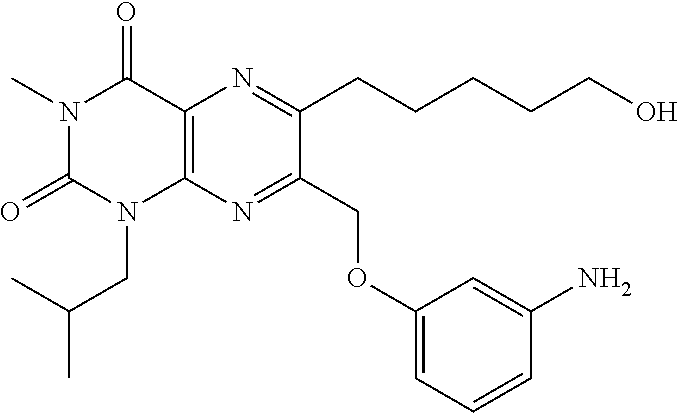


| TABLE 2 | |||
| 35 |
 |
B | R1 = Me, R2 = i-Bu, R4 = H, Z = CH2, n = 1, E = CH2, J = O,  |


| TABLE 3 | |||
| approximate | |||
| Example | potency (EC50 nM) | ||
| 2 | <50 | ||
| 3 | <50 | ||
| 4 | <50 | ||
| 5 | <50 | ||
| 6 | <50 | ||
| 7 | <50 | ||
| 8 | 300 | ||
| 9 | <50 | ||
| 10 | <50 | ||
| 11 | <50 | ||
| 12 | <50 | ||
| 13 | <50 | ||
| 14 | ≤100 | ||
| 15 | ≤100 | ||
| 16 | ≤100 | ||
| 17 | ≤100 | ||
| 18 | ≤100 | ||
| 19 | ≤250 | ||
| 20 | ≤250 | ||
| 21 | ≤250 | ||
| 22 | ≤250 | ||
| 23 | ≤250 | ||
| 24 | ≤250 | ||
| 25 | ≤250 | ||
| 26 | ≤500 | ||
| 27 | ≤500 | ||
| 28 | ≤1000 | ||
| 29 | ≤1000 | ||
| 30 | ≤1000 | ||
| 31 | ≤1000 | ||
| 32 | ≤1000 | ||
| 33 | ≤100 | ||
| 34 | ≥2000 | ||
| 35 | ≤100 | ||
- 1. Warburg, O. On the origin of cancer cells. Science 1956, 123, 309-314.
- 2. Koppenol, W. H.; Bounds, P. L.; Dang, C. V. Otto Warburg's contributions to current concepts of cancer metabolism. Nature Rev. Cancer 2011, 11, 325-327.
- 3. Halestrap, A. P. The SLC16 gene family—structure, role and regulation in health and disease. Mol. Asp. Med. 2013, 34, 337-349.
- 4. Doherty, J. R.; Yang, C.; Scott, K.; Cameron M. D.; Fallahi, M.; Li, W; Hall, M. A.; Amelio, A. L.; Mishra, J. K.; Li, F; Tortosa, M.; Genau, H. M.; Rounbehler, R. J.; Yungi, L.; Dang, C. V.; Kumar, K. G.; Butler, A. A.; Bannister, T. D.; Hooper, A. T.; Unsal-Kacmaz, K.; Roush, W. R.; and Cleveland, J. L. Blocking lactate export by inhibiting the myc target MCT1 disables glycolysis and glutathione synthesis. Cancer Res. 2014, 74, 908-920.
- 5. Ullah, M. S.; Davies, A. J.; Halestrap, A. P. The plasma membrane lactate transporter MCT4, but not MCT1, is up-regulated by hypoxia through a HIF-1α-dependent mechanism. J. Biol. Chem. 2006, 281, 9030-9037.
- 6. Dang, C. V. The interplay between MYC and HIF in the Warburg effect. Ernst Schering Found Symp. Proc. 2007, 35-53.
- 7. Vaupel, P.; Mayer, A. Hypoxia in cancer: significance and impact on clinical outcome. Cancer Metastasis Rev. 2007, 26, 225-239.
- 8. Kizaka-Kondoh, S.; Inoue, M.; Harada, H.; Hiraoka, M. Tumor hypoxia: a target for selective cancer therapy. Cancer Sci. 2003, 94, 1021-1028.
- 9. Le Floch, R.; Chiche, J.; Marchiq, I.; Naiken, T.; Ilk, K.; Murray, C. M.; Critchlow, S. E.; Roux, D.; Simon, M. P.; Pouyssegur, J. CD147 subunit of lactate/H+ symporters MCT1 and hypoxia-inducible MCT4 is critical for energetics and growth of glycolytic tumors. Proc. Natl. Acad. Sci. USA 2011, 108, 16663-16668.
- 10. Sonveaux, P.; Vegran, F.; Schroeder, T.; Wergin, M. C.; Verrax, J.; Rabbani, Z. N.; De Saedeleer, C.; J.; Kennedy, K. M.; Diepart, C.; Jordan, B. F.; Kelley, M. J.; Gallez, B.; Wahl, M. L.; Feron, O.; Dewhirst, M. W. Targeting lactate-fueled respiration selectively kills hypoxic tumor cells in mice. J. Clin Invest. 2008, 118, 3930-3942.
- 11. Broer, S.; Schneider, H.; Broer, A.; Rahman, B.; Hamprecht, B.; Deitmer, J. W. Characterization of the
monocarboxylate transporter 1 expressed in Xenopus laevis oocytes by changes in cytosolic pH. Biochem. J. 1998, 333, 167-174. - 12. Jackson, V, N.; Halestrap, A. P. The kinetics, substrate, and inhibitor specificity of the monocarboxylate (lactate) transporter of rat liver cells determined using the fluorescent intracellular pH indicator, 2′,7′-bis(carboxyethyl)-5(6)-carboxyfluorescein. J. Biological Chem. 1996, 271, 861-868.
- 13. Kobayashi, M.; Itagaki, S.; Hirano, T.; Iseki, K. mechanism of L-lactic acid transport in L6 skeletal muscle cells. Drug Metab. Pharmacokin. 2004, 19, 363-368.
- 14. Wang, Q.; Morris, M. E. Flavonoids modulate monocarboxylate transporter-1-mediated transport of γ-hydroxybutyrate in vitro and in vivo. Drug Metabolism and Disposition 2007, 35, 201-208.
- 15. Draoui, N.; Schicke, O.; Fernandes A.; Drozak, X.; Fady, N.; Dumont, A.; Douxfils, J.; Hermans, E.; Dogné, J-M.; Corbau, R.; Marchand, A.; Chaltin, P.; Sonveaux, P.; Feron, O.; Riant, O. Synthesis and pharmacological evaluation of carboxycoumarins as a new antitumor treatment targeting lactate transport in cancer cells. Bioorg. Med. Chem. 2013, 21, 7107-7117.
- 16. Mereddy, V. R.; Drewes, L. R.; Alam, M. A.; Jonnalagadda, S. K.; Gurrapu, S. Preparation of benzopyran derivatives and related compounds as MCT1 inhibitors. PCT Int. Appl. 2013, WO2013109972 A2 20130725.
- 17. Wang, H, and Bannister, T. D.; Synthesis and Structure-Activity Relationships of Pteridine Diane and
Trione Monocarboxylate Transporter 1 Inhibitors, J. Med. Chem., 2014, 57 (17), 7317-7324 - 18. Murray, C. M.; Hutchinson, R.; Bantick, J. R.; Belfield, G. P.; Benjamin, A. D.; Brazma, D.; Bundick, R. V.; Cook, I. D.; Craggs, R. I.; Edwards, S.; Evans, L. R.; Harrison, R.; Holness, E.; Jackson, A. P.; Jackson, C. G.; Kingston, L. P.; Perry, M. W. D.; Ross, A. R. J.; Rugman, P. A.; Sidhu, S. S.; Sullivan, M.; Taylor-Fishwick, D. A.; Walker, P. C.; Whitehead, Y. M.; Wilkinson, D. J.; Wright, A.; Donald, D. Monocarboxylate transporter MCT1 is a target for immunosuppression. Nat. Chem. Biol. 2005, 1, 371-376.
- 19. Guile, S. D.; Bantick, J. R.; Cheshire, D. R.; Cooper, M. E.; Davis, A. M.; Donald, D. K.; Evans, R.; Eyssade, C.; Ferguson, D. D.; Hill, S.; Hutchinson, R.; Ingall, A. H.; Kingston, L. P.; Marin, I.; Martin, B. P.; Mohammed, R. T.; Murry, C.; Perry, M. W. D.; Reynolds, R. H.; Thorne, P. V.; Wilkinson, D. J.; Withnall, J. Potent blockers of the monocarboxylate transporter MCT1: novel immunomodulatory compounds. Bioorg. Med. Chem. Lett. 2006, 16, 2260-2265.
- 20. Guile, S. D.; Bantick, J. R.; Cooper, M. E.; Donald, D. K.; Eyssade, C.; Ingall, A. H.; Lewis, R. J.; Martin, B. P.; Mohammed, R. T.; Potter, T. J.; Reynolds, R. H.; St-Gallay, S. A.; Wright, A. D. Optimization of
monocarboxylate transporter 1 blockers through analysis and modulation of atropisomer interconversion properties. J. Med. Chem. 2007, 50, 254-263. - 21. Bueno, V.; Binet, I.; Steger, U.; Bundick, R.; Ferguson, D.; Murray, C.; Donald, D.; Wood, K. The specific monocarboxylate transporter (MCT1) inhibitor, AR-C117977, a novel immunosuppressant, prolongs allograft survival in the mouse. Transplantation 2007, 84, 1204-1207.
- 22. Ovens, M. J.; Davies, A. J.; Wilson, M. C.; Murray, C. M.; Halestrap, A. P. AR-C155858 is a potent inhibitor of monocarboxylate transporters MCT1 and MCT2 that binds to an intracellular site involving transmembrane helices 7-10. Biochem. J. 2010, 425, 523-530.
- 23. Critchlow, S, E.; Tate, L. Use of a MCT1 inhibitor in the treatment of cancers expressing MCT1 over MCT4. PCT Int. Appl. 2010, WO2010089580 A1 20100812.
- 24. http://clinicaltrials.gov/show/NCT01791595
- 25. Polanski, R.; Hodgkinson, C. L.; Fusi, A.; Nonaka, D.; Priest, L.; Kelly, P.; Trapani, F.; Bishop, P. W.; White, A.; Critchlow, S. E.; Smith, P. D.; Blackhall F.; Dive, C.; Morrow, C. J. Activity of the
monocarboxylate transporter 1 inhibitor AZD3965 in small cell lung cancer. Clin. Cancer Res. 2014, 20, 926-937. - 26. Michne, W. F.; Schroeder, J. D.; Guiles, J. W.; Treasurywala, A. M.; Weigelt, C. A.; Stansberry, M. F.; McAvoy, E.; Shah, C. R.; Bump, E.; Schlegel, D. Novel Inhibitors of the Nuclear Factor of Activated T Cells (NFAT)-Mediated Transcription of .beta.-Galactosidase: Potential Immunosuppressive and Antiinflammatory Agents. J. Med. Chem., 1995, 38 (14), 2557-2569.
- 27. Otonkoski, T; Jiao, H; Kaminen-Ahola, N; et al. Physical exercise-induced hypoglycemia caused by failed silencing of
monocarboxylate transporter 1 in pancreatic beta cells. Am J Hum Genet 2007; 81, 467-474. - 28. Zhao, C.; Wilson, M. C.; Schuit, F.; Halestrap, A. P.; Rutter, G. A. Expression and distribution of lactate/monocarboxylate transporter isoforms in pancreatic islets and the exocrine pancreas. Diabetes 2001; 50, 361-366.
- 29. Sekine, N.; Cirulli, V.; Regazzi, R.; et al. Low lactate dehydrogenase and high mitochondrial glycerol phosphate dehydrogenase in pancreatic beta-cells. Potential role in nutrient sensing. J Biol Chem 1994, 269, 4895-4902.
- 30. Otonkoski, T.; Kaminen, N.; Ustinov, J.; et al. Physical exercise-induced hyperinsulinemic hypoglycemia is an autosomal-dominant trait characterized by abnormal pyruvate-induced insulin release. Diabetes 2003; 52, 199-204.
- 31. Pullen T. J.; Sylow, L.; Sun, G.; Halestrap, A. P.; Richter, E. A.; Rutter, G. A. Overexpression of Monocarboxylate Transporter-1 (Slc16a1) in Mouse Pancreatic beta-Cells Leads to Relative Hyperinsulinism During Exercise. Diabetes 2012, 61, 1719-1725.
- 32. Best, L.; Yates, A. P.; Meats, J. E.; Tomlinson, S. Effects of lactate on pancreatic islets: Lactate efflux as a possible determinant of islet-cell depolarization by glucose. Biochem. J. 1989; 259, 507-511.
Claims (7)


Priority Applications (1)
| Application Number | Priority Date | Filing Date | Title |
|---|---|---|---|
| US15/545,152 US10328078B2 (en) | 2015-01-22 | 2016-01-22 | Pteridine dione monocarboxylate transporter inhibitors |
Applications Claiming Priority (3)
| Application Number | Priority Date | Filing Date | Title |
|---|---|---|---|
| US201562106472P | 2015-01-22 | 2015-01-22 | |
| US15/545,152 US10328078B2 (en) | 2015-01-22 | 2016-01-22 | Pteridine dione monocarboxylate transporter inhibitors |
| PCT/US2016/014458 WO2016118823A1 (en) | 2015-01-22 | 2016-01-22 | Pteridine dione monocarboxylate transporter inhibitors |
Related Parent Applications (1)
| Application Number | Title | Priority Date | Filing Date |
|---|---|---|---|
| PCT/US2016/014458 A-371-Of-International WO2016118823A1 (en) | 2015-01-22 | 2016-01-22 | Pteridine dione monocarboxylate transporter inhibitors |
Related Child Applications (2)
| Application Number | Title | Priority Date | Filing Date |
|---|---|---|---|
| US16/423,362 Division US10874675B2 (en) | 2015-01-22 | 2019-05-28 | Pteridine dione monocarboxylate transporter inhibitors |
| US16/423,362 Continuation US10874675B2 (en) | 2015-01-22 | 2019-05-28 | Pteridine dione monocarboxylate transporter inhibitors |
Publications (2)
| Publication Number | Publication Date |
|---|---|
| US20180008605A1 US20180008605A1 (en) | 2018-01-11 |
| US10328078B2 true US10328078B2 (en) | 2019-06-25 |
Family
ID=56417788
Family Applications (2)
| Application Number | Title | Priority Date | Filing Date |
|---|---|---|---|
| US15/545,152 Active US10328078B2 (en) | 2015-01-22 | 2016-01-22 | Pteridine dione monocarboxylate transporter inhibitors |
| US16/423,362 Active US10874675B2 (en) | 2015-01-22 | 2019-05-28 | Pteridine dione monocarboxylate transporter inhibitors |
Family Applications After (1)
| Application Number | Title | Priority Date | Filing Date |
|---|---|---|---|
| US16/423,362 Active US10874675B2 (en) | 2015-01-22 | 2019-05-28 | Pteridine dione monocarboxylate transporter inhibitors |
Country Status (5)
| Country | Link |
|---|---|
| US (2) | US10328078B2 (en) |
| EP (1) | EP3247361A4 (en) |
| JP (1) | JP6612882B2 (en) |
| CA (1) | CA2974696A1 (en) |
| WO (1) | WO2016118823A1 (en) |
Cited By (1)
| Publication number | Priority date | Publication date | Assignee | Title |
|---|---|---|---|---|
| US20190282582A1 (en) * | 2015-01-22 | 2019-09-19 | The Scripps Research Institute | Pteridine dione monocarboxylate transporter inhibitors |
Families Citing this family (2)
| Publication number | Priority date | Publication date | Assignee | Title |
|---|---|---|---|---|
| WO2020033019A2 (en) * | 2018-04-25 | 2020-02-13 | Charles R. Drew University Of Medicine And Science | Novel mct4 inhibitors and uses thereof |
| TWI823932B (en) * | 2018-05-11 | 2023-12-01 | 中國大陸商迪哲(江蘇)醫藥有限公司 | Triazolopyrimidine compounds and their use in treating cancer |
Family Cites Families (7)
| Publication number | Priority date | Publication date | Assignee | Title |
|---|---|---|---|---|
| JPH0312882Y2 (en) | 1986-05-01 | 1991-03-26 | ||
| EP1187615A2 (en) * | 1999-02-02 | 2002-03-20 | K.U. Leuven Research & Development | Immunosurpressive effects of pteridine derivatives |
| US6946465B2 (en) * | 1999-02-02 | 2005-09-20 | 4 Aza Bioscience Nv | Immunosuppressive effects of pteridine derivatives |
| US20040072746A1 (en) * | 2001-10-16 | 2004-04-15 | Michael Sullivan | Inhibitors of monocarboxylate transport |
| WO2010089580A1 (en) | 2009-02-06 | 2010-08-12 | Astrazeneca Ab | Use of a mct1 inhibitor in the treatment of cancers expressing mct1 over mct4 |
| US9296728B2 (en) | 2012-01-20 | 2016-03-29 | Regents Of The University Of Minnesota | Therapeutic compounds |
| JP6612882B2 (en) | 2015-01-22 | 2019-11-27 | ザ スクリプス リサーチ インスティテュート | Pteridinedione monocarboxylic acid transporter inhibitor |
-
2016
- 2016-01-22 JP JP2017538316A patent/JP6612882B2/en not_active Expired - Fee Related
- 2016-01-22 EP EP16740816.0A patent/EP3247361A4/en not_active Withdrawn
- 2016-01-22 US US15/545,152 patent/US10328078B2/en active Active
- 2016-01-22 CA CA2974696A patent/CA2974696A1/en not_active Abandoned
- 2016-01-22 WO PCT/US2016/014458 patent/WO2016118823A1/en not_active Ceased
-
2019
- 2019-05-28 US US16/423,362 patent/US10874675B2/en active Active
Non-Patent Citations (7)
| Title |
|---|
| Gura, Systems for identifying New Drugs Are Often Faulty, Cancer Models, Science, vol. 278, No. 5340, pp. 1041-1042, Nov. 1997. * |
| Gurrapu et al., Monocarboxylate Transporter 1 Inhibitors as Potential Anticancer Agents, ACS Medicinal Chemistry Letters, 6, pp. 558-561 (2015). * |
| Johnson et al., Relationships between drug activity in NCI preclinical in vitro and in vivo models and early clinical trials, British Journal of Cancer (2001) 64(10): 1424-1431. * |
| Pearce et al., Failure modes in anticancer drug discovery and development, Cancer Drug Design and Discovery Edited by Stephen Neidle, Chapter 18, pp. 424-435 (2008). * |
| Simone, Oncology: Introduction, Cecil Textbook of Medicine, 20th Edition, vol. 1, pp. 1004-1010, 1996. * |
| Wang et al., Synthesis and Structure-Activity Relationships of Pteridine Dione and Trione Monocarboxylate Transporter 1 Inhibitors , Journal of Medicinal Chemistry, vol. 57, pp. 7317-7324 (2014). * |
| Wang et al., Synthesis and Structure—Activity Relationships of Pteridine Dione and Trione Monocarboxylate Transporter 1 Inhibitors , Journal of Medicinal Chemistry, vol. 57, pp. 7317-7324 (2014). * |
Cited By (2)
| Publication number | Priority date | Publication date | Assignee | Title |
|---|---|---|---|---|
| US20190282582A1 (en) * | 2015-01-22 | 2019-09-19 | The Scripps Research Institute | Pteridine dione monocarboxylate transporter inhibitors |
| US10874675B2 (en) * | 2015-01-22 | 2020-12-29 | The Scripps Research Institute | Pteridine dione monocarboxylate transporter inhibitors |
Also Published As
| Publication number | Publication date |
|---|---|
| US20190282582A1 (en) | 2019-09-19 |
| CA2974696A1 (en) | 2016-07-28 |
| EP3247361A1 (en) | 2017-11-29 |
| US10874675B2 (en) | 2020-12-29 |
| EP3247361A4 (en) | 2018-08-15 |
| JP6612882B2 (en) | 2019-11-27 |
| WO2016118823A1 (en) | 2016-07-28 |
| JP2018502874A (en) | 2018-02-01 |
| US20180008605A1 (en) | 2018-01-11 |
Similar Documents
| Publication | Publication Date | Title |
|---|---|---|
| US11560389B2 (en) | Heterocyclic inhibitors of monocarboxylate transporters | |
| US9994555B2 (en) | Chromenone inhibitors of monocarboxylate transporters | |
| US7534800B2 (en) | 7-azaindoles as inhibitors of c-Jun N-terminal kinases for the treatment of neurodegenerative disorders | |
| US10874675B2 (en) | Pteridine dione monocarboxylate transporter inhibitors | |
| US5405864A (en) | Chemotherapeutic maleimides | |
| WO2021193756A1 (en) | Novel benzimidazole derivative | |
| US9994566B2 (en) | Compound of 5-hydroxyl-1,7-naphthyridine substituted by aryl or heteroaryl, preparation method thereof and pharmaceutical use thereof | |
| US12534436B2 (en) | Disubstituted adamantyl derivative or pharmaceutically acceptable salt thereof, and pharmaceutical composition for suppressing cancer growth comprising same as active ingredient | |
| EA032032B1 (en) | Derivatives of 2-aminopyridine as adenosine areceptor antagonists and ligands of melatonin mtreceptors | |
| US10100051B2 (en) | Compound of 5-hydroxyl-1,7-naphthyridine substituted by aryloxy or heteroaryloxy, preparation method thereof and pharmaceutical use thereof | |
| US10980781B2 (en) | 6-amino-2,4-dihydropyrano [2,3-c] pyrazoles and methods of use | |
| US20180117021A1 (en) | Compound of 3-hydroxyl pyridine, preparation method thereof and pharmaceutical use thereof | |
| CN116283658A (en) | Hydrazide hydrazone HIF-2 alpha inhibitor and application thereof | |
| US20240376057A1 (en) | 2,4-dioxo-1,2,3,4-tetrahydropyrimidine derivatives and their use in the treatment of tumors | |
| CN104292244A (en) | 6,7-Dihydro-5H-1,2,4-triazolo[3,4-b][1,3,4]thiadiazole and preparation method thereof | |
| RU2814498C2 (en) | Crystal form of phosphodiesterase inhibitor, method of its preparation and use | |
| CN118647608A (en) | Imidazolinone derivatives as inhibitors of protein kinases, in particular DYRK1A, CLK1 and/or CLK4 |
Legal Events
| Date | Code | Title | Description |
|---|---|---|---|
| FEPP | Fee payment procedure |
Free format text: ENTITY STATUS SET TO SMALL (ORIGINAL EVENT CODE: SMAL); ENTITY STATUS OF PATENT OWNER: SMALL ENTITY |
|
| STPP | Information on status: patent application and granting procedure in general |
Free format text: NOTICE OF ALLOWANCE MAILED -- APPLICATION RECEIVED IN OFFICE OF PUBLICATIONS |
|
| STPP | Information on status: patent application and granting procedure in general |
Free format text: PUBLICATIONS -- ISSUE FEE PAYMENT VERIFIED |
|
| STCF | Information on status: patent grant |
Free format text: PATENTED CASE |
|
| AS | Assignment |
Owner name: UNIVERSITY OF FLORIDA RESEARCH FOUNDATION INCORPORATED, FLORIDA Free format text: ASSIGNMENT OF ASSIGNORS INTEREST;ASSIGNOR:UNIVERSITY OF FLORIDA BOARD OF TRUSTEES;REEL/FRAME:061161/0489 Effective date: 20220401 Owner name: UNIVERSITY OF FLORIDA BOARD OF TRUSTEES, FLORIDA Free format text: ASSIGNMENT OF ASSIGNORS INTEREST;ASSIGNOR:THE SCRIPPS RESEARCH INSTITUTE;REEL/FRAME:061161/0379 Effective date: 20220401 Owner name: THE SCRIPPS RESEARCH INSTITUTE, CALIFORNIA Free format text: ASSIGNMENT OF ASSIGNORS INTEREST;ASSIGNORS:BANNISTER, THOMAS D.;WANG, HUI;WANG, CHAO;AND OTHERS;SIGNING DATES FROM 20201130 TO 20201201;REEL/FRAME:060795/0205 |
|
| AS | Assignment |
Owner name: UNIVERSITY OF FLORIDA RESEARCH FOUNDATION, INCORPORATED, FLORIDA Free format text: CORRECTIVE ASSIGNMENT TO CORRECT THE COMMA OF THE ASSIGNEE NAME PREVIOUSLY RECORDED AT REEL: 061161 FRAME: 0489. ASSIGNOR(S) HEREBY CONFIRMS THE ASSIGNMENT;ASSIGNOR:UNIVERSITY OF FLORIDA BOARD OF TRUSTEES;REEL/FRAME:062062/0800 Effective date: 20220401 |
|
| MAFP | Maintenance fee payment |
Free format text: PAYMENT OF MAINTENANCE FEE, 4TH YR, SMALL ENTITY (ORIGINAL EVENT CODE: M2551); ENTITY STATUS OF PATENT OWNER: SMALL ENTITY Year of fee payment: 4 |