US10319337B2 - Information processing device and display control method for calculating data transfer rates - Google Patents
Information processing device and display control method for calculating data transfer rates Download PDFInfo
- Publication number
- US10319337B2 US10319337B2 US15/840,093 US201715840093A US10319337B2 US 10319337 B2 US10319337 B2 US 10319337B2 US 201715840093 A US201715840093 A US 201715840093A US 10319337 B2 US10319337 B2 US 10319337B2
- Authority
- US
- United States
- Prior art keywords
- display
- data transfer
- display devices
- transfer rate
- resolution
- Prior art date
- Legal status (The legal status is an assumption and is not a legal conclusion. Google has not performed a legal analysis and makes no representation as to the accuracy of the status listed.)
- Expired - Fee Related
Links
Images






Classifications
-
- G—PHYSICS
- G09—EDUCATION; CRYPTOGRAPHY; DISPLAY; ADVERTISING; SEALS
- G09G—ARRANGEMENTS OR CIRCUITS FOR CONTROL OF INDICATING DEVICES USING STATIC MEANS TO PRESENT VARIABLE INFORMATION
- G09G5/00—Control arrangements or circuits for visual indicators common to cathode-ray tube indicators and other visual indicators
- G09G5/003—Details of a display terminal, the details relating to the control arrangement of the display terminal and to the interfaces thereto
- G09G5/006—Details of the interface to the display terminal
-
- G—PHYSICS
- G06—COMPUTING OR CALCULATING; COUNTING
- G06F—ELECTRIC DIGITAL DATA PROCESSING
- G06F3/00—Input arrangements for transferring data to be processed into a form capable of being handled by the computer; Output arrangements for transferring data from processing unit to output unit, e.g. interface arrangements
- G06F3/14—Digital output to display device ; Cooperation and interconnection of the display device with other functional units
- G06F3/1423—Digital output to display device ; Cooperation and interconnection of the display device with other functional units controlling a plurality of local displays, e.g. CRT and flat panel display
-
- G—PHYSICS
- G06—COMPUTING OR CALCULATING; COUNTING
- G06F—ELECTRIC DIGITAL DATA PROCESSING
- G06F3/00—Input arrangements for transferring data to be processed into a form capable of being handled by the computer; Output arrangements for transferring data from processing unit to output unit, e.g. interface arrangements
- G06F3/14—Digital output to display device ; Cooperation and interconnection of the display device with other functional units
- G06F3/1423—Digital output to display device ; Cooperation and interconnection of the display device with other functional units controlling a plurality of local displays, e.g. CRT and flat panel display
- G06F3/1431—Digital output to display device ; Cooperation and interconnection of the display device with other functional units controlling a plurality of local displays, e.g. CRT and flat panel display using a single graphics controller
-
- G—PHYSICS
- G06—COMPUTING OR CALCULATING; COUNTING
- G06F—ELECTRIC DIGITAL DATA PROCESSING
- G06F3/00—Input arrangements for transferring data to be processed into a form capable of being handled by the computer; Output arrangements for transferring data from processing unit to output unit, e.g. interface arrangements
- G06F3/14—Digital output to display device ; Cooperation and interconnection of the display device with other functional units
-
- G—PHYSICS
- G09—EDUCATION; CRYPTOGRAPHY; DISPLAY; ADVERTISING; SEALS
- G09G—ARRANGEMENTS OR CIRCUITS FOR CONTROL OF INDICATING DEVICES USING STATIC MEANS TO PRESENT VARIABLE INFORMATION
- G09G2320/00—Control of display operating conditions
- G09G2320/06—Adjustment of display parameters
- G09G2320/0606—Manual adjustment
-
- G—PHYSICS
- G09—EDUCATION; CRYPTOGRAPHY; DISPLAY; ADVERTISING; SEALS
- G09G—ARRANGEMENTS OR CIRCUITS FOR CONTROL OF INDICATING DEVICES USING STATIC MEANS TO PRESENT VARIABLE INFORMATION
- G09G2340/00—Aspects of display data processing
- G09G2340/04—Changes in size, position or resolution of an image
- G09G2340/0407—Resolution change, inclusive of the use of different resolutions for different screen areas
-
- G—PHYSICS
- G09—EDUCATION; CRYPTOGRAPHY; DISPLAY; ADVERTISING; SEALS
- G09G—ARRANGEMENTS OR CIRCUITS FOR CONTROL OF INDICATING DEVICES USING STATIC MEANS TO PRESENT VARIABLE INFORMATION
- G09G2350/00—Solving problems of bandwidth in display systems
-
- G—PHYSICS
- G09—EDUCATION; CRYPTOGRAPHY; DISPLAY; ADVERTISING; SEALS
- G09G—ARRANGEMENTS OR CIRCUITS FOR CONTROL OF INDICATING DEVICES USING STATIC MEANS TO PRESENT VARIABLE INFORMATION
- G09G2352/00—Parallel handling of streams of display data
-
- G—PHYSICS
- G09—EDUCATION; CRYPTOGRAPHY; DISPLAY; ADVERTISING; SEALS
- G09G—ARRANGEMENTS OR CIRCUITS FOR CONTROL OF INDICATING DEVICES USING STATIC MEANS TO PRESENT VARIABLE INFORMATION
- G09G2354/00—Aspects of interface with display user
-
- G—PHYSICS
- G09—EDUCATION; CRYPTOGRAPHY; DISPLAY; ADVERTISING; SEALS
- G09G—ARRANGEMENTS OR CIRCUITS FOR CONTROL OF INDICATING DEVICES USING STATIC MEANS TO PRESENT VARIABLE INFORMATION
- G09G2360/00—Aspects of the architecture of display systems
- G09G2360/04—Display device controller operating with a plurality of display units
-
- G—PHYSICS
- G09—EDUCATION; CRYPTOGRAPHY; DISPLAY; ADVERTISING; SEALS
- G09G—ARRANGEMENTS OR CIRCUITS FOR CONTROL OF INDICATING DEVICES USING STATIC MEANS TO PRESENT VARIABLE INFORMATION
- G09G2370/00—Aspects of data communication
- G09G2370/04—Exchange of auxiliary data, i.e. other than image data, between monitor and graphics controller
- G09G2370/045—Exchange of auxiliary data, i.e. other than image data, between monitor and graphics controller using multiple communication channels, e.g. parallel and serial
-
- G—PHYSICS
- G09—EDUCATION; CRYPTOGRAPHY; DISPLAY; ADVERTISING; SEALS
- G09G—ARRANGEMENTS OR CIRCUITS FOR CONTROL OF INDICATING DEVICES USING STATIC MEANS TO PRESENT VARIABLE INFORMATION
- G09G2370/00—Aspects of data communication
- G09G2370/10—Use of a protocol of communication by packets in interfaces along the display data pipeline
-
- G—PHYSICS
- G09—EDUCATION; CRYPTOGRAPHY; DISPLAY; ADVERTISING; SEALS
- G09G—ARRANGEMENTS OR CIRCUITS FOR CONTROL OF INDICATING DEVICES USING STATIC MEANS TO PRESENT VARIABLE INFORMATION
- G09G2370/00—Aspects of data communication
- G09G2370/22—Detection of presence or absence of input display information or of connection or disconnection of a corresponding information source
Definitions
- the embodiments discussed herein relate to an information processing device and a display control method.
- a multi-display setup is known.
- a PC Personal Computer
- a PC equipped with single connector and a branch device connected to the connector of the PC are used.
- the branch device splits the display data of multiple streams, and transmits the splitted data to each display device respectively.
- Multi-Stream Transport hereinafter referred to as “MST”) supported by DisplayPort 1.2a (hereinafter represented as “DP1.2a”) standardized by VESA is one of the specifications for implementing the second method.
- MST Multi-Stream Transport
- DP1.2a DisplayPort 1.2a
- an information processing device capable of connecting to a display device using a function expansion unit.
- the information processing device includes: a calculation unit configured to calculate, from a resolution to be used in the display device, a data transfer rate of the display device; and a display controlling unit configured to display, based on a data transfer rate at a given resolution calculated by the calculation unit, a ratio of the data transfer rate of the display device to an allowable data transfer rate, so as to be visibly recognized.
- FIG. 1 is a diagram illustrating an overall configuration of a display system according to an embodiment
- FIG. 2 is another diagram illustrating an overall configuration of a display system
- FIG. 3 is a diagram illustrating a hardware configuration of a microcontroller according to the embodiment.
- FIG. 4 is a diagram illustrating a functional configuration of the microcontroller according to the embodiment.
- FIG. 5 illustrates an example of a conversion table according to the embodiment
- FIG. 6 illustrates an example of EDID information according to the embodiment
- FIG. 7 illustrates an example of DPCD information according to the embodiment
- FIG. 8A illustrates an example of data stored in an internal memory of the microcontroller according to the embodiment
- FIG. 8B illustrates an example of data stored in an internal memory of the microcontroller according to the embodiment
- FIG. 9 is a flowchart describing an example of a resolution setting processing
- FIG. 10 is a flowchart describing an example of a resolution setting routine
- FIG. 11A is a flowchart illustrating an example of a process flow of the configurable resolution display processing according to the embodiment
- FIG. 11B is a flowchart illustrating an example of a process flow of the configurable resolution display processing according to the embodiment.
- FIG. 11C is a flowchart illustrating an example of a process flow of the configurable resolution display processing according to the embodiment.
- FIG. 12 is a flowchart describing an example of a resolution setting routine according to the embodiment.
- FIG. 13 is a view illustrating an example of a display screen according to the embodiment.
- FIG. 14 is a view illustrating an example of a display screen according to the embodiment.
- FIG. 15 is a view illustrating an example of a display screen according to the embodiment.
- FIG. 1 is a diagram illustrating a display system according to the present embodiment.
- the display system displays information on the multiple display devices (hereinafter referred to as “displays”) connected to an information processing device.
- an information processing device is a personal computer (PC).
- the information processing device is not necessarily a PC, and other devices such as a tablet device may be used as the information processing device.
- a Source Device which is a mode supported in DP 1.2a standardized by VESA
- a Branch Device which is a mode supported in DP 1.2a standardized by VESA
- a PC main unit 10 corresponds to the Source Device.
- a function expansion unit, which is docked to the PC main unit 10 is an example of the Branch Device (branch device 20 ).
- the function expansion unit may be an external port replicator connected to the PC main unit 10 , or may be embedded with the PC main unit 10 .
- An example of the Sink Device is a display connected to the branch device 20 .
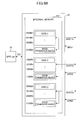
- a first display 31 , a second display 32 , and a third display 33 are illustrated, all of which are connected to the branch device 20 .
- a fourth display 34 is directly connected to an output port 12 of a graphic chip 11 inside the PC main unit 10 .
- the first display 31 , the second display 32 , and the third display 33 are connected to an output port 13 of the graphic chip 11 via the branch device 20 .
- main link signal lines are used for transmitting display data to be displayed on the display.
- a data transfer rate of the main link is 5.4 Gbps (Gigabits per second) per lane.
- the fourth display 34 is not affected by the data transfer rates of the first, second, or third displays ( 31 , 32 , or 33 ), and can use a bandwidth of 21.6 Gbps for transferring display data.
- each of the first, second, and third displays ( 31 to 33 ) needs to be configured such that a sum of data transfer rates of the first to third displays ( 31 to 33 ) does not exceed 21.6 Gbps.
- a data transfer rate corresponds to an available frequency when transferring display data.
- PBN which will be described later represents a peak bandwidth obtained by normalizing data transfer rate. That is, a value represented by PBN is proportional to data transfer rate.
- An HPD signal line is used for sending and receiving a signal indicating whether a display is connected or not. When an HPD signal is changed from Low to High, it means that the corresponding display was connected. When an HPD signal is Low, it means that the corresponding display is not connected.
- An AUX signal line is used for sending and receiving control signals concerning communication between the graphic chip 11 and a display.
- the PC main unit 10 is equipped with a microcontroller 15 .
- the microcontroller 15 is connected to both the AUX signal lines associated with the output ports 12 and 13 respectively and to both the HPD signal lines associated with the output ports 12 and 13 respectively, so that the AUX signals and the HPD signals associated with the output ports 12 and 13 can be entered.
- the microcontroller 15 monitors (performs snooping) communications between the graphic chip 11 and each display by using both the AUX signal line connected to the output port 12 and the AUX signal line connected to the output port 13 , to obtain EDID (Extended Display Identification Data) information from the first display 31 to the fourth display 34 .
- the microcontroller 15 can use a conventional method to perform snooping of the AUX signal.
- the EDID information includes display information of a screen such as a resolution.
- the microcontroller 15 further obtains DPCD (Display Port Configuration Data) information which is retained in the branch device 20 and each display.
- the DPCD information includes information about data transfer, such as a data transfer rate and the number of lanes.
- the DPCD information retained in the branch device 20 includes data transfer rate between the branch device 20 and the graphic chip 11 .
- the DPCD information retained in each display includes a data transfer rate between the branch device 20 and each display.
- the graphic chip 11 is triggered with a change of the HPD signal from Low into High to start communication with the connected display.
- the microcontroller 15 obtains the EDID information transmitted from the connected display to the graphic chip 11 , and stores the EDID information into an internal memory of the microcontroller 15 .
- the microcontroller 15 obtains the DPCD information, and stores the DPCD information into the internal memory of the microcontroller 15 .
- the microcontroller 15 may obtain the DPCD information (data transfer rate) retained in the branch device 20 via the AUX signal line before the display is connected, and store the DPCD information into the internal memory.
- the microcontroller 15 may obtain the DPCD information retained in each display after each of the display is connected, and store the DPCD information into the internal memory.
- a configurable resolution display application which will be described later, reads the EDID information and the DPCD information stored in the internal memory of the microcontroller 15 via I2C (I-squared-C), by using a GPIO pin 16 .
- a first display 31 is connected to an output port 12 of a graphic chip 11 .
- a second display 32 is connected to an output port 13 of the graphic chip 11 .
- a third display 33 is connected to an output port 14 of the graphic chip 11 .
- each display can use a data transfer rate of 21.6 Gbps for transferring display data.
- each of the first display 31 to the third display 33 may be configured independently such that a data transfer rate of each display does not exceed 21.6 Gbps. In this case, a user can easily predict at what resolution each display can display.
- the first to third displays ( 31 to 33 ) need to be configured such that a sum of data transfer rates of the first to third displays ( 31 to 33 ) does not exceed 21.6 Gbps.
- configurable resolution ranges of each of the first display 31 to the third display 33 vary depending on the resolutions of other displays. Accordingly, the information processing device according to the present embodiment displays configurable resolution ranges of each of multiple displays connected to the branch device 20 in a visible manner.
- the microcontroller 15 includes a processor 151 and an internal memory 152 .
- the processor 151 obtains the DPCD information by snooping into the AUX signal, thereby to obtain the data transfer rate and the number of the lanes (4 lanes in the present embodiment).
- a data transfer rate per lane is 5.4 Gbps
- data transfer at 21.6 Gbps can be attained using 4 lanes.
- a data transfer rate per lane is 2.7 Gbps
- data transfer at 10.8 Gbps can be attained using 4 lanes.
- the processor 151 also obtains the EDID information to obtain information concerning display setting of a display, such as a resolution and the like.
- the internal memory 152 stores the EDID information and the DPCD information.
- the microcontroller 15 includes an acquisition unit 153 , a calculation unit 154 , a conversion unit 155 , a memory unit 156 , a setting unit 157 , and a display controlling unit 158 .
- the acquisition unit 153 acquires the DPCD information and the EDID information.
- the calculation unit 154 calculates a data transfer rate from a resolution used by a display.
- the conversion unit 155 converts a resolution into a pixel clock frequency by using a conversion table 40 of VESA standard, for example.
- the memory unit 156 stores the conversion table 40 , EDID information 50 , and DPCD information 60 .
- the memory unit 156 may store a program for the configurable resolution display application.
- the setting unit 157 sets a resolution of a display.
- the display controlling unit 158 displays, based on a data transfer rate calculated from the certain resolution, a ratio of the data transfer rate to be used to an allowable data transfer rate, so as to be visibly recognized.
- the functions of the acquisition unit 153 , the calculation unit 154 , the conversion unit 155 , the setting unit 157 , and the display controlling unit 158 can be embodied by the processor. Also, the function of the memory unit 156 can be embodied by the internal memory 152 .
- FIG. 5 illustrates an example of the conversion table 40 according to the present embodiment.
- the conversion table 40 stores a resolution (display resolution) 41 , a refresh rate 42 , and a pixel clock frequency 43 , each of which is correlated with each other.
- the conversion unit 155 can convert a set of the resolution 41 and the refresh rate 42 into the pixel clock frequency 43 .
- the conversion unit 155 may perform conversion from only the resolution 41 into the pixel clock frequency 43 .
- two types of mode may exist for the same resolution; a first mode adopting a display timing in which a pixel clock frequency is reduced by reducing a blanking interval (RB: Reduced Blanking), and a second mode adopting a display timing (CRT Timing) which does not reduce a blanking interval.
- RB blanking interval
- CRT Timing display timing
- Whether Reduced Blanking is used or CRT Timing is used can be detected by referring to the EDID information which is one of display information.
- FIG. 6 illustrates an example of the EDID information 50 according to the present embodiment.
- the EDID information 50 according to VESA standard includes information about displayable resolutions of a display. If a display supports Reduced Blanking timing, a pixel clock frequency is necessarily stored in one of Detailed Timings located in address ranges from 36h to 7Dh. When information of the same resolution is stored in the Detailed Timing and the Standard Timing of the EDID information 50 , or in the Detailed Timing and the Established Timing of the EDID information 50 , the pixel clock frequency in the Detailed Timing (corresponding to Reduced Blanking) is applied. As for a resolution which is stored only in the Standard Timing or Established Timing, the pixel clock frequency corresponding to CRT timing is applied.
- FIG. 7 illustrates an example of a storage region of the DPCD information 60 according to the present embodiment.
- the DPCD information 60 and the EDID information 50 are stored in the internal memory 152 .
- Addresses from 00000h to 000FFh are Receiver Capability Field, and addresses from 00100h to 001FFh are Link Configuration Field.
- the Link Configuration Field contained in addresses from 00100h to 001FFh of the internal memory 152 stores a data transfer rate. Further, at address 00101h, the number of lanes (Lane Count) is stored.
- FIG. 8A and FIG. 8B Examples of data stored in the internal memory 152 of the microcontroller according to the present embodiment are illustrated in FIG. 8A and FIG. 8B .
- FIG. 8A illustrates an example of data stored in the internal memory 152 when the display system is configured such that the branch device 20 is used, as illustrated in FIG. 1 .
- FIG. 8B illustrates an example of data stored in the internal memory 152 when the display system is configured such that the branch device 20 is not used, as illustrated in FIG. 2 .
- information about the fourth display is stored from addresses 00000h to 01000h.
- Information about the fourth display includes the EDID information (EDID_ 4 ) and the DPCD (data transfer rate) of the fourth display. Note that an address (or address range) where “All “0”” is written represents that no data is stored in the address (or address range).
- information about the first, second, and third display is stored.
- the EDID information of the first, second, and third displays EDID_ 21 , EDID_ 22 , and EDID_ 23
- the DPCD data transfer rate
- Presence or absence of the branch device 20 , and the number of displays connected to the branch device 20 can be identified by the EDID information obtained from the corresponding AUX signal line.
- the number of the EDID information stored in the internal memory 152 obtained via the AUX signal line is 1, it means that the branch device 20 does not exist.
- the number of the EDID information is more than 1, it means that as many displays as the number of the EDID information are connected to the branch device 20 .
- the example of the internal memory 152 illustrated in FIG. 8A represents that the branch device 20 exists and three displays are connected to the branch device 20 .
- the example of the internal memory 152 illustrated in FIG. 8A also represents that a display (which is not connected to the branch device 20 ) is connected to a port independent of other displays.
- the example of the internal memory 152 illustrated in FIG. 8B represents that the branch device 20 does not exist and that three displays are respectively connected to ports independently. Note that contents of the internal memory 152 are updated for every access from the graphic chip 11 .
- whether the displays are independently connected or connected via the branch device 20 can be identified based on the number of the EDID information stored in the predetermined addresses of the internal memory 152 . Also, based on the DPCD information stored in the predetermined addresses of the internal memory 152 , data transfer rate can be identified.
- FIGS. 9 and 10 Before describing the configurable resolution display processing, an example of a resolution setting processing for the display system illustrated in FIG. 2 will be explained, with reference to FIGS. 9 and 10 .
- the configurable resolution display processing according to the present embodiment performed by, for example, the display system illustrated in FIG. 1 , will be explained with reference to FIGS. 11A to 11C and FIG. 12 .
- FIGS. 13 to 15 examples of contents displayed on a screen by performing the configurable resolution display processing according to the present embodiment will be described.
- the display system illustrated in FIG. 2 does not include a branch device 20 , and each of the first display 31 , the second display 32 , and the third display 33 is connected to the graphic chip 11 directly.
- the processor 151 first detects the number of displays connected to the PC main unit 10 (step S 10 ) (in the following description, the number is referred to as “n”). In the example illustrated in FIG. 2 , n is 3.
- the processor 151 sets a variable i to 1 (step S 12 ).
- the variable i represents a type of an identification number of the display currently connected.
- the processor 151 identifies a displayable resolution of the first display (step S 16 ).
- the processor 151 determines whether the variable i is less than n (step S 18 ).
- the processor 151 add 1 to the variable i (step S 20 ), and the processing reverts to step S 14 .
- the processor 151 repeats the steps S 14 to S 20 until the variable i becomes not less than n at step S 18 .
- step S 22 A user selects, among the selectable displays (first, second, and third displays) which is displayed on the screen, one display. In the following description, a case in which the user selects the first display will be described.
- the processor 151 selects the first display (step S 22 ).
- the processor 151 sets a variable j to 1 (step S 24 ).
- the variable j represents a display number of a display whose resolution is being set. What is described here is a case, in which a number “1” of the first display selected by the user is set to the variable j.
- the processor 151 executes a resolution setting routine for display j which will be described later (step S 26 ).
- the processor 151 determines whether the variable j is less than n (step S 28 ).
- the processor 151 adds 1 to the variable j (step S 30 ), and the processing reverts to step S 26 .
- the processor 151 repeats the steps S 26 to S 30 until the variable j becomes not less than n at step S 28 .
- resolutions of the first through third displays are set.
- the processor 151 decides that the setting of the displays completed and terminates the processing.
- the resolution setting routine which is called at step S 26 in FIG. 9 will be described with reference to a flowchart illustrated in FIG. 10 .
- the processor 151 selects display j (here, the first display is selected) (step S 262 ).
- the processor 151 displays a resolution selection menu (step S 264 ).
- the processor 151 determines whether a desired resolution is displayed on the resolution selection menu or not (step S 266 ). If it is determined that the desired resolution is displayed on the resolution selection menu, the processor 151 select the desired resolution in accordance with an operation of the user, sets the resolution of the first display to the selected resolution (step S 268 ), and terminates the routine.
- the resolution of the first display is set to 1920 ⁇ 1080 60 Hz 24 bpp, for example.
- the processor 151 determines whether the display is set to one of the resolutions existing in the resolution selection menu in accordance with an operation of the user (step S 270 ). If it is determined that the display is set to one of the resolutions existing in the resolution selection menu in accordance with an operation of the user, the processor 151 selects the resolution from the resolution selection menu, sets the selected resolution to the first display (step S 268 ), and terminates the routine. If it is determined that the display is not set to one of the resolutions existing in the resolution selection menu at step S 270 , the processor 151 abandons setting a resolution of the first display (step S 272 ), and terminates the routine.
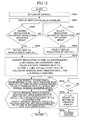
- FIGS. 11A to 11C are a set of flowcharts illustrating an example of a process flow of the configurable resolution display processing according to the present embodiment.
- FIG. 12 is a flowchart illustrating an example of a process flow of a resolution setting routine according to the present embodiment.
- the acquisition unit 153 in the processor 151 performs steps S 10 through S 20 . Since these steps are the same as the steps S 10 through S 20 illustrated in FIG. 9 and are already explained, the description of these steps is omitted.
- the acquisition unit 153 reads the EDID information retained in a display in response to a change of the HPD signal which changes from Low to High when the display is connected (step S 32 ).
- the acquisition unit 153 reads EDID information of each display from the internal memory 152 via I2C (step S 34 ). After step S 34 , the processing proceeds to “1” in FIG. 11B ).
- the acquisition unit 153 sets AddressE to 00000h, to designate a storage region for the EDID information in the internal memory 152 (step S 36 ).
- the acquisition unit 153 obtains data stored in an address range from AddressE to (AddressE+000FFh) as the EDID information (step S 38 ).
- the EDID information 50 stored in the “Receiver Capability Field” in the internal memory 152 illustrated in FIG. 7 is obtained.
- the acquisition unit 153 determines whether the designated region is “All “0”” (no information is stored) or not (step S 40 ). If it is determined that the designated region is not “All “0””, the acquisition unit 153 adds a variable n to 1, and adds the AddressE to 100h, to designate a storage region for the EDID information of the second display connected to the branch device 20 (step S 42 ). The acquisition unit 153 again performs step S 38 to obtain data stored in an address range from AddressE to (AddressE+000FFh) as the EDID information of the second display (step S 38 ).
- Steps S 38 to S 42 are repeatedly executed until it is determined that the designated region is “All “0”” at step S 40 . By repeating these steps, the EDID information of the first to third displays is obtained.
- the acquisition unit 153 sets AddressD to 01000h to designate a storage region for the DPCD information in the internal memory 152 (step S 44 ).
- the acquisition unit 153 obtains a part of the DPCD information stored in an address of AddressD+00100h, and stores the information to LINK_BW (step S 46 ).
- the DPCD information stored in the “Link Configuration Field” in the internal memory 152 illustrated in FIG. 7 is obtained.
- the value stored in the LINK_BW is 06h, it means that the data transfer rate is 1.62 Gbps.
- the value is 0Ah, it means that the data transfer rate is 2.7 Gbps.
- the value is 14h it means that the data transfer rate is 5.4 Gbps.
- the usable data transfer rate is expressed in units of PBNs (Payload Bandwidth Numbers).
- PBNs Payload Bandwidth Numbers
- One unit of PBN is 54/64 (Mbytes/sec).
- the display controlling unit 158 displays a bar graph representing the total data transfer rate in green.
- Displayable total pixel rate is determined in advance, and a maximum total data transfer rate corresponding to the total pixel rate is 21.6 Gbps when using MST in DP 1.2a.
- the data transfer rate of 21.6 Gbps regulated in DP 1.2a is in an unused state. Accordingly, since a usable data transfer rate at this point of time is 2560 PBN, which is a maximum data transfer rate, the display controlling unit 158 displays a bar graph representing the total data transfer rate of 2560 PBN in green.
- a bar graph 171 representing the total data transfer rate of 2560 PBN is displayed in green (note: in the drawings, a white box is used instead of green).
- a red (black is used in the drawings instead of red) portion 172 is illustrated in FIG. 13 , the portion 172 is not displayed in red color and is displayed in green when step S 56 is executed.
- the acquisition unit 153 sets a variable i to 1 (step S 58 ).
- the acquisition unit 153 reads the EDID information of the i-th display (step S 14 ).
- the calculation unit 154 identifies a displayable resolution of the first display from the EDID information (step S 62 ).
- the calculation unit 154 converts the displayable resolution into a pixel clock frequency based on the conversion table 40 to identify a maximum displayable frequency ( ⁇ MHz) of the first display (step S 64 ).
- the calculation unit 154 calculates an allowable data transfer rate to be used by the first display Y( 1 ) PBN, based on a formula (1) described below (step S 66 ).
- calculation is performed by adding a margin of 0.6%.
- the data transfer rate to be used is obtained by multiplying an actual data transfer rate (PBN) by 1.06.
- the display controlling unit 158 displays a bar graph representing the calculated individual data transfer rate Y( 1 ) PBN having a length of “559.7 PBN” in green (step S 68 ).
- step S 68 By performing step S 68 , in a PBN display region 170 in the screen “(a)” illustrated in FIG. 13 , for example, a bar graph 173 representing the maximum data transfer rate of the first display having a length of 559.7 PBN is displayed in green. Though a red (black) portion 174 is illustrated in FIG. 13 , the portion 174 is not displayed in red color and is displayed in green when step S 68 is executed.
- the acquisition unit 153 determines whether the variable i is less than n (step S 70 ).
- the processor 151 adds 1 to the variable i (step S 72 ), and the processing reverts to step S 60 .
- the processor 151 repeats steps S 60 to S 68 until the variable i becomes not less than 3. By repeating the steps, maximum data transfer rates of the second and the third displays are identified.
- the conversion unit 155 obtains, based on the conversion table 40 , the pixel clock frequency corresponding to the resolution as “268.5 MHz”, by converting “2560 ⁇ 1600 60 Hz (RB)”.
- the display controlling unit 158 displays a bar graph representing the calculated individual data transfer rate of the second display Y( 2 ) PBN having a length of “1011.9 PBN” in green (step S 68 ).
- a bar graph 175 representing the maximum data transfer rate of the second display having a length of 1011.9 PBN is displayed in green.
- a bar graph 176 representing the maximum data transfer rate of the third display having a length of 988.4 PBN is displayed in green.
- a maximum displayable resolution turns out to be 1920 ⁇ 1440 60 Hz (234 MHz), based on the conversion table 40 . Therefore, it is determined that a resolution of “1920 ⁇ 1440 60 Hz” or less can be used for the third display.
- the calculation unit 154 selects the first display in accordance with the user's operation (step S 74 ).
- the setting unit 157 determines whether the variable j is less than n ( 3 ) and the usable data transfer rate z is not less than the data transfer rate A (step S 82 ). If it is determined that the variable j is less than n and the usable data transfer rate z is not less than the data transfer rate A, the setting unit 157 adds j to 1 (step S 84 ), and performs step S 80 again. If it is determined that the variable j is not less than n or the usable data transfer rate z is less than the data transfer rate A, the setting unit 157 determines that resolution changes of displays are completed, and terminates the processing.
- the resolution setting routine which is called at step S 80 in FIG. 11C will be described with reference to a flowchart illustrated in FIG. 12 .
- the setting unit 157 selects a display j (step S 802 ).
- the display controlling unit 158 displays a resolution selection menu (step S 804 ).
- the setting unit 157 determines whether a desired resolution is displayed on the resolution selection menu or not (step S 806 ). If it is determined that the desired resolution for the display j is displayed on the resolution selection menu, the calculation unit 154 selects the desired resolution for the display j in accordance with the user's operation (step S 808 ).
- the calculation unit 154 converts the resolution into a pixel clock frequency (which will be referred to as “x MHz”) based on the conversion table 40 (step S 810 ).
- a resolution of “1920 ⁇ 1080 60 Hz 24 bpp” is selected from the resolution selection menu
- the calculation unit 154 converts the above resolution into a pixel clock frequency of “148.5 MHz” based on the conversion table 40 .
- the calculation unit 154 calculates a data transfer rate Y( 1 ) PBN by substituting “148.5 MHz” in the above formula (1).
- the data transfer rate Y( 1 ) PBN will be “559.7 PBN”.
- the calculation unit 154 calculates a residual usable data transfer rate z.
- the display controlling unit 158 changes color of a portion of the bar graph representing the total data transfer rate. Specifically, in the bar graph, the portion extending from the left end to a position corresponding to the data transfer rate Y(j) is displayed in red, and the rest of the bar graph corresponding to the residual usable data transfer rate z is displayed in green (step S 812 ). Next, the display controlling unit 158 changes color of a portion of the bar graph representing the data transfer rate of the first display. Specifically, in the bar graph, the portion extending from the left end to a position corresponding to the data transfer rate Y(j) is displayed in red, and the rest of the bar graph is displayed in green (step S 814 ). After step S 814 , the processing terminates.
- step S 806 determines whether a resolution existing in the resolution selection menu is set (step S 830 ). If it is determined that a resolution existing in the resolution selection menu is set, the calculation unit 154 selects the resolution in accordance with the user's operation (step S 838 ). After executing steps S 810 to S 814 , the processing terminates.
- steps S 810 to S 814 when a resolution of “1280 ⁇ 1280 60 Hz 24 bpp” is selected, at steps S 810 to S 814 , a pixel clock frequency corresponding to the selected resolution and a data transfer rate Y(j) PBN are calculated, and the color of a portion of the bar graph corresponding to the data transfer rate in use is changed to red (steps S 810 -S 814 ).
- step S 830 it is determined that a resolution existing in the resolution selection menu is not set, the setting unit 157 determines whether the variable is not less than 2 (step S 816 ). If it is determined that j is less than 2, the setting unit 157 suspends the resolution setting (step S 820 ). If it is determined that j is not less than 2, the setting unit 157 subtracts 2 from the variable j, and the processing reverts to the previous display setting (step S 818 ).
- the setting unit 157 determines, at step S 82 , that the variable j is less than 3 and the residual usable data transfer rate z (2033 PBN) is not less than a data transfer rate A calculated at step S 78 (245 PBN).
- the setting unit 157 adds j to 1 (step S 84 ), and executes step S 80 again to perform a resolution setting process of the second display.
- the display controlling unit 158 displays a bar graph representing the data transfer rate of the second display, such that a left end of a portion 177 , corresponding to the data transfer rate Y( 2 ) displayed in red, is aligned with a right end of a portion 174 of the bar graph representing the data transfer rate of the first display, corresponding to the data transfer rate Y( 1 ) displayed in red.
- step S 82 in FIG. 11C (just after the resolution setting process of the second display is completed), the variable j is less than 3 and the residual usable data transfer rate z (988 PBN) is not less than the data transfer rate A (245 PBN).
- the setting unit 157 adds 1 to the variable j (step S 84 ), and executes step S 80 again to perform a resolution setting process of the third display.
- the display controlling unit 158 displays a bar graph representing the data transfer rate of the third display, such that a left end of a portion 178 , corresponding to the data transfer rate Y( 3 ) displayed in red, is aligned with a right end of a portion 177 of the bar graph representing the data transfer rate of the second display, corresponding to the data transfer rate Y( 2 ) displayed in red.
- the display controlling unit 158 displays the portion 178 corresponding to the data transfer rate Y( 3 ) in red, and terminates the processing.
- the display system in the present embodiment including multiple displays can calculate data transfer rates to be used for the multiple displays respectively, calculate a ratio of a sum of the data transfer rates to the maximum data transfer rate of 21.64 Gbps, and display the ratio and the maximum data transfer rate in different colors. Since a data transfer rate is in proportion to a display resolution, a user can easily identify a displayable resolution of each display by looking at a graph representing a usage of a data transfer rate displayed in colors.
- the display control method according to the present embodiment can be embodied by adding the configurable resolution display application and the microcontroller to obtain and maintain the EDID information and the DPCD information. Therefore, since modification of drivers or OS is not required, the display system according to the present embodiment can be easily provided.
- step S 804 the display controlling unit 158 does not need to display the resolution selection menu when the residual usable data transfer rate z is less than a predetermined threshold.
- FIG. 14 illustrates an example of a display screen used in a display system in which a first display is connected to a PC main unit 10 independently of a second display and a third display, and the second display and the third display are connected to the PC main unit 10 via a branch device 20 .
- a data transfer rate of the first display is expressed as a bar graph independent of other graphs, which includes a red portion 272 and a green portion 271 .
- how much percent of the allowable data transfer rate (displayable resolution) of the first display is in use can be displayed visibly.
- a bar graph 273 representing a total allowable data transfer rate, and individual graphs 274 and 275 each representing a data transfer rate of the second display and a data transfer rate of the third display are displayed.
- a screen “(b)” or “(c)” of FIG. 14 by displaying red bars 276 , 277 , and 278 , and green bars 273 , 274 , and 275 , allowable data transfer rates of the second display and the third display can be displayed visibly.
- FIG. 15 illustrates an example of a display screen used in a display system in which a first, a second, and a third displays are connected to a PC main unit 10 independently of each other.
- a red bar graph 372 and a green bar graph 371 are displayed for representing a data transfer rate of the first display
- a red bar graph 373 is displayed for representing a data transfer rate of the second display
- a red bar graph 375 and a green bar graph 374 are displayed for representing a data transfer rate of the third display.
- the display system according to the present embodiment displays, when displaying a graph representing the total data transfer rate, how much percent of a total allowable data transfer rate (displayable resolution) is currently being used in a certain color (for example, in red), and displays a residual data transfer rate in a different color (for example, green).
- the display system according to the present embodiment also displays individual graphs respectively corresponding to each display juxtaposed with the graph representing the total data transfer rate, and displays in the individual graphs to what extent data transfer rates are used when resolution settings are performed.
- the display system according to the present embodiment can display residual data transfer rates of each display visibly.
- the information processing system, the display control program, and the display control method are described in the above embodiment.
- the information processing system, the display control program, and the display control method according to the present invention are not limited to the embodiment described above.
- Various modifications or enhancement can be applied within the scope of the present invention. Further, multiple embodiments or modified examples can be combined as long as inconsistencies do not occur in the combination.
- the display system according to the present embodiment may be controlled by software instead of the microcontroller in the PC main unit 10 .
- an interface for the software obtaining the AUX signal and the HPD signal is required in the display system.
- an application program configured to cause a CPU of the PC main unit 10 to perform the same functions as the functions which are embodied by the microcontroller in the embodiment described above, based on the AUX signal or HPD signal, and by executing the application program by the CPU of the PC main unit 10 , the configurable resolution display processing according to the present disclosure can be performed without requiring the microcontroller.
Landscapes
- Engineering & Computer Science (AREA)
- Theoretical Computer Science (AREA)
- Physics & Mathematics (AREA)
- General Physics & Mathematics (AREA)
- Human Computer Interaction (AREA)
- General Engineering & Computer Science (AREA)
- Computer Hardware Design (AREA)
- Computer Graphics (AREA)
- Controls And Circuits For Display Device (AREA)
- Digital Computer Display Output (AREA)
Abstract
Description
- [Patent Document 1] Japanese Laid-Open Patent Publication No. 2010-160304.
Y(i) PBN←×MHz×24 bpp÷8×64÷54×1.06 (1)
If a resolution of the first display is set to “1920×1080 60 Hz 24 bpp”, the pixel clock frequency corresponding to the resolution is identified as 148.5 MHz based on the conversion table 40, and the data transfer rate to be used is calculated as 559.7 PBN (=148.5 MHz×24 bpp÷8×64÷54×1.06), based on the formula (1). The
Claims (6)
Applications Claiming Priority (1)
| Application Number | Priority Date | Filing Date | Title |
|---|---|---|---|
| PCT/JP2015/069858 WO2017009889A1 (en) | 2015-07-10 | 2015-07-10 | Information processing device, display control program, and display control method |
Related Parent Applications (1)
| Application Number | Title | Priority Date | Filing Date |
|---|---|---|---|
| PCT/JP2015/069858 Continuation WO2017009889A1 (en) | 2015-07-10 | 2015-07-10 | Information processing device, display control program, and display control method |
Publications (2)
| Publication Number | Publication Date |
|---|---|
| US20180102105A1 US20180102105A1 (en) | 2018-04-12 |
| US10319337B2 true US10319337B2 (en) | 2019-06-11 |
Family
ID=57757942
Family Applications (1)
| Application Number | Title | Priority Date | Filing Date |
|---|---|---|---|
| US15/840,093 Expired - Fee Related US10319337B2 (en) | 2015-07-10 | 2017-12-13 | Information processing device and display control method for calculating data transfer rates |
Country Status (4)
| Country | Link |
|---|---|
| US (1) | US10319337B2 (en) |
| EP (1) | EP3321925B1 (en) |
| JP (1) | JP6597781B2 (en) |
| WO (1) | WO2017009889A1 (en) |
Families Citing this family (3)
| Publication number | Priority date | Publication date | Assignee | Title |
|---|---|---|---|---|
| CN108470551B (en) * | 2018-05-28 | 2020-01-10 | 京东方科技集团股份有限公司 | GOA circuit driving method, driving device and display device |
| US11990082B2 (en) | 2020-08-17 | 2024-05-21 | Qualcomm Incorporated | Adaptively configuring image data transfer time |
| CN117280701A (en) * | 2021-08-03 | 2023-12-22 | 三星电子株式会社 | Electronic equipment and image processing methods |
Citations (15)
| Publication number | Priority date | Publication date | Assignee | Title |
|---|---|---|---|---|
| JP2001352326A (en) | 2000-06-08 | 2001-12-21 | Sony Corp | Communication device, communication control device, and communication method |
| JP2003125374A (en) | 2001-10-12 | 2003-04-25 | Toshiba Corp | Video distribution system, transmitting apparatus and transmitting method thereof, and receiving apparatus and receiving method |
| US20090182917A1 (en) | 2008-01-15 | 2009-07-16 | Kim Jechan | System having capability for daisy-chained serial distribution of video display data |
| US20100171746A1 (en) | 2009-01-08 | 2010-07-08 | Seiko Epson Corporation | Image data processing method and image display system |
| US20110234910A1 (en) * | 2008-12-26 | 2011-09-29 | Fujitsu Limited | Resolution changing device, resolution changing method, and resolution changing program |
| JP2013120234A (en) | 2011-12-06 | 2013-06-17 | Canon Inc | Image displaying device, image output device, control method, and program |
| US20130207942A1 (en) | 2012-02-14 | 2013-08-15 | Seiko Epson Corporation | Display apparatus and method of controlling display apparatus |
| US20130215154A1 (en) * | 2012-02-16 | 2013-08-22 | Peter Seraphim Ponomarev | Visual Representation of Chart Scaling |
| US20140032711A1 (en) * | 2012-07-27 | 2014-01-30 | Fujitsu Limited | Bandwidth control apparatus, bandwidth control method, and bandwidth control program |
| US20140104242A1 (en) | 2012-10-12 | 2014-04-17 | Nvidia Corporation | System and method for concurrent display of a video signal on a plurality of display devices |
| US20140253566A1 (en) * | 2013-03-11 | 2014-09-11 | Raydium Semiconductor Corporation | Source driving circuit and data transmission method thereof |
| US20140327685A1 (en) | 2013-05-03 | 2014-11-06 | Samsung Electronics Co., Ltd. | Image transmitting apparatus, image receiving apparatus, and control methods thereof |
| JP2015055845A (en) | 2013-09-13 | 2015-03-23 | シャープ株式会社 | Display device and display method |
| US20150249804A1 (en) * | 2014-02-28 | 2015-09-03 | Seiko Epson Corporation | Display apparatus and method for controlling display apparatus |
| US20150334388A1 (en) * | 2014-05-15 | 2015-11-19 | Qualcomm Incorporated | System and method to optimize video performance in wireless-dock with ultra-high definition display |
Family Cites Families (2)
| Publication number | Priority date | Publication date | Assignee | Title |
|---|---|---|---|---|
| US6693641B1 (en) * | 2000-05-25 | 2004-02-17 | Intel Corporation | Calculating display mode values |
| WO2013013185A1 (en) * | 2011-07-21 | 2013-01-24 | Kohler Co. | Quick connector for faucet |
-
2015
- 2015-07-10 EP EP15898205.8A patent/EP3321925B1/en not_active Not-in-force
- 2015-07-10 WO PCT/JP2015/069858 patent/WO2017009889A1/en not_active Ceased
- 2015-07-10 JP JP2017528003A patent/JP6597781B2/en not_active Expired - Fee Related
-
2017
- 2017-12-13 US US15/840,093 patent/US10319337B2/en not_active Expired - Fee Related
Patent Citations (17)
| Publication number | Priority date | Publication date | Assignee | Title |
|---|---|---|---|---|
| JP2001352326A (en) | 2000-06-08 | 2001-12-21 | Sony Corp | Communication device, communication control device, and communication method |
| JP2003125374A (en) | 2001-10-12 | 2003-04-25 | Toshiba Corp | Video distribution system, transmitting apparatus and transmitting method thereof, and receiving apparatus and receiving method |
| US20090182917A1 (en) | 2008-01-15 | 2009-07-16 | Kim Jechan | System having capability for daisy-chained serial distribution of video display data |
| US20110234910A1 (en) * | 2008-12-26 | 2011-09-29 | Fujitsu Limited | Resolution changing device, resolution changing method, and resolution changing program |
| US20100171746A1 (en) | 2009-01-08 | 2010-07-08 | Seiko Epson Corporation | Image data processing method and image display system |
| JP2010160304A (en) | 2009-01-08 | 2010-07-22 | Seiko Epson Corp | Image data processing method and image display system |
| JP2013120234A (en) | 2011-12-06 | 2013-06-17 | Canon Inc | Image displaying device, image output device, control method, and program |
| JP2013167699A (en) | 2012-02-14 | 2013-08-29 | Seiko Epson Corp | Display unit and display unit control method |
| US20130207942A1 (en) | 2012-02-14 | 2013-08-15 | Seiko Epson Corporation | Display apparatus and method of controlling display apparatus |
| US20130215154A1 (en) * | 2012-02-16 | 2013-08-22 | Peter Seraphim Ponomarev | Visual Representation of Chart Scaling |
| US20140032711A1 (en) * | 2012-07-27 | 2014-01-30 | Fujitsu Limited | Bandwidth control apparatus, bandwidth control method, and bandwidth control program |
| US20140104242A1 (en) | 2012-10-12 | 2014-04-17 | Nvidia Corporation | System and method for concurrent display of a video signal on a plurality of display devices |
| US20140253566A1 (en) * | 2013-03-11 | 2014-09-11 | Raydium Semiconductor Corporation | Source driving circuit and data transmission method thereof |
| US20140327685A1 (en) | 2013-05-03 | 2014-11-06 | Samsung Electronics Co., Ltd. | Image transmitting apparatus, image receiving apparatus, and control methods thereof |
| JP2015055845A (en) | 2013-09-13 | 2015-03-23 | シャープ株式会社 | Display device and display method |
| US20150249804A1 (en) * | 2014-02-28 | 2015-09-03 | Seiko Epson Corporation | Display apparatus and method for controlling display apparatus |
| US20150334388A1 (en) * | 2014-05-15 | 2015-11-19 | Qualcomm Incorporated | System and method to optimize video performance in wireless-dock with ultra-high definition display |
Non-Patent Citations (4)
| Title |
|---|
| "VESA® DisplayPort® Standard", Version 1, Revision 2a, Errata Version 1, Video Electronics Standards Association, Feb. 2014, pp. 1-554. |
| "VESA® DisplayPort® Standard", Version 1, Revision 2a, Video Electronics Standards Association, May 23, 2012, pp. 1-554. |
| Extended (supplementary) European Search Report dated May 30, 2018, issued in counterpart European Application No. 15898205.8. (9 pages). |
| International Search Report dated Oct. 6, 2015, issued in counterpart International Application No. PCT/JP2015/069858 (1 page). |
Also Published As
| Publication number | Publication date |
|---|---|
| EP3321925B1 (en) | 2020-09-02 |
| EP3321925A4 (en) | 2018-06-27 |
| JPWO2017009889A1 (en) | 2018-05-24 |
| WO2017009889A1 (en) | 2017-01-19 |
| US20180102105A1 (en) | 2018-04-12 |
| JP6597781B2 (en) | 2019-10-30 |
| EP3321925A1 (en) | 2018-05-16 |
Similar Documents
| Publication | Publication Date | Title |
|---|---|---|
| US7009616B2 (en) | Multi-mode display | |
| US8723873B2 (en) | Intelligent video graphics switcher | |
| US7812832B2 (en) | Display capable of displaying images in response to signals of a plurality of signal formats | |
| US8582028B2 (en) | Multi-monitor control | |
| US8325195B2 (en) | System and method for interfacing graphical information with an information handling system wireless transceiver | |
| US9508282B2 (en) | Virtualized display output ports configuration | |
| CN112788256B (en) | Video transmission method and system for adaptively adjusting bandwidth | |
| US20090182917A1 (en) | System having capability for daisy-chained serial distribution of video display data | |
| JP6907400B2 (en) | Image display device and image display method | |
| US10509614B2 (en) | Video display apparatus-apparatus communication | |
| US10319337B2 (en) | Information processing device and display control method for calculating data transfer rates | |
| TW201738761A (en) | Display device | |
| US20210081159A1 (en) | Electronic device and method for managing power source of electronic device | |
| CN112601032B (en) | Display system, method and device based on daisy chain connection | |
| US20140111526A1 (en) | Terminal device and display apparatus | |
| US20200012613A1 (en) | Configuration options for display devices | |
| JP6583932B2 (en) | Display device, display system, display method, and display program | |
| JP2013120234A (en) | Image displaying device, image output device, control method, and program | |
| CN213876695U (en) | Display interface circuit and display device | |
| US20240314866A1 (en) | Online pairing method and computer-readable storage medium | |
| KR20250162502A (en) | Device and method for setting the operating range of adaptive synchronization | |
| KR100595719B1 (en) | Computer device having an image display function of an external computer device | |
| KR20040022640A (en) | computer system and method for transmitting data thereof | |
| KR20200116281A (en) | Computer input/output signal asynchronous time division multiplex transmission apparatus and method | |
| KR20160098854A (en) | Mobile device for providing multi-mode and method of driving the same |
Legal Events
| Date | Code | Title | Description |
|---|---|---|---|
| AS | Assignment |
Owner name: FUJITSU LIMITED, JAPAN Free format text: ASSIGNMENT OF ASSIGNORS INTEREST;ASSIGNOR:AOKI, NORIYUKI;REEL/FRAME:044852/0450 Effective date: 20171201 |
|
| FEPP | Fee payment procedure |
Free format text: ENTITY STATUS SET TO UNDISCOUNTED (ORIGINAL EVENT CODE: BIG.); ENTITY STATUS OF PATENT OWNER: LARGE ENTITY |
|
| AS | Assignment |
Owner name: FUJITSU CLIENT COMPUTING LIMITED, JAPAN Free format text: ASSIGNMENT OF ASSIGNORS INTEREST;ASSIGNOR:FUJITSU LIMITED;REEL/FRAME:048049/0084 Effective date: 20181228 |
|
| STPP | Information on status: patent application and granting procedure in general |
Free format text: NOTICE OF ALLOWANCE MAILED -- APPLICATION RECEIVED IN OFFICE OF PUBLICATIONS |
|
| STPP | Information on status: patent application and granting procedure in general |
Free format text: PUBLICATIONS -- ISSUE FEE PAYMENT RECEIVED |
|
| STPP | Information on status: patent application and granting procedure in general |
Free format text: PUBLICATIONS -- ISSUE FEE PAYMENT VERIFIED |
|
| STCF | Information on status: patent grant |
Free format text: PATENTED CASE |
|
| FEPP | Fee payment procedure |
Free format text: MAINTENANCE FEE REMINDER MAILED (ORIGINAL EVENT CODE: REM.); ENTITY STATUS OF PATENT OWNER: LARGE ENTITY |
|
| LAPS | Lapse for failure to pay maintenance fees |
Free format text: PATENT EXPIRED FOR FAILURE TO PAY MAINTENANCE FEES (ORIGINAL EVENT CODE: EXP.); ENTITY STATUS OF PATENT OWNER: LARGE ENTITY |
|
| STCH | Information on status: patent discontinuation |
Free format text: PATENT EXPIRED DUE TO NONPAYMENT OF MAINTENANCE FEES UNDER 37 CFR 1.362 |
|
| FP | Lapsed due to failure to pay maintenance fee |
Effective date: 20230611 |