US10315847B2 - Extruded slat/link conveyance chain - Google Patents

Extruded slat/link conveyance chain Download PDF

Info

Publication number
US10315847B2
US10315847B2 US14/986,522 US201514986522A US10315847B2 US 10315847 B2 US10315847 B2 US 10315847B2 US 201514986522 A US201514986522 A US 201514986522A US 10315847 B2 US10315847 B2 US 10315847B2
Authority
US
United States
Prior art keywords
conveyor belt
slats
belt system
spaced
leading edge
Prior art date
Legal status (The legal status is an assumption and is not a legal conclusion. Google has not performed a legal analysis and makes no representation as to the accuracy of the status listed.)
Expired - Fee Related, expires
Application number
US14/986,522
Other versions
US20160185530A1 (en
Inventor
Dennis Malkowski
Karl Ronald Heinze
Current Assignee (The listed assignees may be inaccurate. Google has not performed a legal analysis and makes no representation or warranty as to the accuracy of the list.)
Marmon Foodservice Technologies Inc
Original Assignee
Prince Castle LLC
Priority date (The priority date is an assumption and is not a legal conclusion. Google has not performed a legal analysis and makes no representation as to the accuracy of the date listed.)
Filing date
Publication date
Application filed by Prince Castle LLC filed Critical Prince Castle LLC
Priority to US14/986,522 priority Critical patent/US10315847B2/en
Assigned to Prince Castle LLC reassignment Prince Castle LLC ASSIGNMENT OF ASSIGNORS INTEREST (SEE DOCUMENT FOR DETAILS). Assignors: HEINZE, KARL, MALKOWSKI, DENNIS
Publication of US20160185530A1 publication Critical patent/US20160185530A1/en
Application granted granted Critical
Publication of US10315847B2 publication Critical patent/US10315847B2/en
Assigned to MARMON FOODSERVICE TECHNOLOGIES, INC. reassignment MARMON FOODSERVICE TECHNOLOGIES, INC. MERGER AND CHANGE OF NAME (SEE DOCUMENT FOR DETAILS). Assignors: CORNELIUS, INC., Prince Castle LLC
Expired - Fee Related legal-status Critical Current
Adjusted expiration legal-status Critical

Links

Images

Classifications

    • BPERFORMING OPERATIONS; TRANSPORTING
    • B65CONVEYING; PACKING; STORING; HANDLING THIN OR FILAMENTARY MATERIAL
    • B65GTRANSPORT OR STORAGE DEVICES, e.g. CONVEYORS FOR LOADING OR TIPPING, SHOP CONVEYOR SYSTEMS OR PNEUMATIC TUBE CONVEYORS
    • B65G17/00Conveyors having an endless traction element, e.g. a chain, transmitting movement to a continuous or substantially-continuous load-carrying surface or to a series of individual load-carriers; Endless-chain conveyors in which the chains form the load-carrying surface
    • B65G17/30Details; Auxiliary devices
    • B65G17/38Chains or like traction elements; Connections between traction elements and load-carriers
    • B65G17/42Attaching load carriers to traction elements
    • AHUMAN NECESSITIES
    • A47FURNITURE; DOMESTIC ARTICLES OR APPLIANCES; COFFEE MILLS; SPICE MILLS; SUCTION CLEANERS IN GENERAL
    • A47JKITCHEN EQUIPMENT; COFFEE MILLS; SPICE MILLS; APPARATUS FOR MAKING BEVERAGES
    • A47J37/00Baking; Roasting; Grilling; Frying
    • A47J37/06Roasters; Grills; Sandwich grills
    • A47J37/08Bread-toasters
    • A47J37/0857Bread-toasters with bread supports or heating means movable during the toasting operation
    • BPERFORMING OPERATIONS; TRANSPORTING
    • B65CONVEYING; PACKING; STORING; HANDLING THIN OR FILAMENTARY MATERIAL
    • B65GTRANSPORT OR STORAGE DEVICES, e.g. CONVEYORS FOR LOADING OR TIPPING, SHOP CONVEYOR SYSTEMS OR PNEUMATIC TUBE CONVEYORS
    • B65G17/00Conveyors having an endless traction element, e.g. a chain, transmitting movement to a continuous or substantially-continuous load-carrying surface or to a series of individual load-carriers; Endless-chain conveyors in which the chains form the load-carrying surface
    • B65G17/06Conveyors having an endless traction element, e.g. a chain, transmitting movement to a continuous or substantially-continuous load-carrying surface or to a series of individual load-carriers; Endless-chain conveyors in which the chains form the load-carrying surface having a load-carrying surface formed by a series of interconnected, e.g. longitudinal, links, plates, or platforms
    • B65G17/067Conveyors having an endless traction element, e.g. a chain, transmitting movement to a continuous or substantially-continuous load-carrying surface or to a series of individual load-carriers; Endless-chain conveyors in which the chains form the load-carrying surface having a load-carrying surface formed by a series of interconnected, e.g. longitudinal, links, plates, or platforms the load carrying surface being formed by plates or platforms attached to more than one traction element

Definitions

  • the present invention is directed to a wire conveyor belt having a plurality of slats and configured to receive and compress a food product against a reactive surface without leaving marks or deforming the food product.
  • a conveyor toaster is a well-known cooking device that uses a heated platen and a slowly rotating conveyor belt.
  • the conveyor belt urges food product (being carried by the conveyor belt) against the platen while it simultaneously pulls the food product across the platen's hot surface.
  • Conveyor toasters are ill-suited for consumer use because of their size, manufacturing cost, power requirements, and the time required to pre-heat the platen to operating temperature. They are preferred, however, by restaurants and food services that require high-volume through-put and consistent heating/toasting.
  • Wire conveyor belts used in conveyor toasters and in other fields of technology have been known for many years.
  • Wire conveyor belts are ideal for material handling, cooking, icing, slicing breading, cooling, filling, inspecting, and packing of products like breads, rolls, buns, donuts, confections, cakes, pies, pastries, meat, seafood, poultry, and other processed foods.
  • the simple, open design of wire conveyor belts provides efficient operation with minimum maintenance and easy cleanup to meet sanitation requirements.
  • FIGS. 1 and 2 a known exemplary wire conveyor belt 10 comprising a plurality of spaced metal rods 16 interconnected by coupling “hook” and “loop” connection elements 18 , 20 formed at the rod ends of adjacent metal rods is illustrated.
  • the rods 16 support a food product to be conveyed and hold the components of the belt together by way of the interconnected hook and loop connection elements 18 , 20 .
  • Wire conveyor belts and conveyor toasters create a number of problems in the food industry. It has been found, for example, in some instances that the rods of a wire conveyor belt can undesirably leave a mark on a food product that runs on top of the belt which can damage the food product and/or render it aesthetically unpleasing to the retailer or the consumer at the point of sale.
  • the markings often become prominent if the product is heated while it is on the belt and/or put under pressure, particularly when the product being conveyed is naturally soft or pliable, such as with many food products processed using conveyor toasters. Since product appearance is an important part of any food item, the marking can be a barrier to the use of a conventional wire conveyor belt to carry food products.
  • some conveyor belts include metal plates that attach to the metal rods to provide a uniformly flat support surface.
  • One such conveyor belt for example, is the wire conveyor belt disclosed in U.S. Pat. No. 7,987,972, which is herein incorporated by reference in its entirety. This design provides a flat support surface, but is relatively expensive to produce and can create gaps between the plates that can mark or even deform a food product.
  • the plates in the belt are attached to a first spaced rod at a first end and to a second spaced rod that is adjacent to the first spaced rod at the second end. Gaps are naturally created in the conveyor belt when the plates rotate about a driving mechanism. These gaps can allow for the food product to be pinched when the plates come together after the belt already has been loaded with a food product.
  • FIG. 1 is a top view of a segment of a known, conventional wire conveyor belt.
  • FIG. 2 is a side perspective view of the wire conveyor belt segment shown in FIG. 1 .
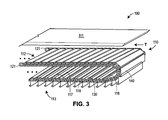
  • FIG. 3 is a perspective view of a conveyor belt system according to the invention, the system comprising the conveyor belt of FIG. 1 and a plurality of metal slats coupled thereto and an opposing reactive surface.
  • FIG. 4A is a perspective view of a metal slat
  • FIG. 4B is a perspective view of the metal slat of FIG. 4A coupled to a conveyor belt metal rod.
  • FIG. 5A is a perspective view of an alternative metal slat illustrating the top surface thereof
  • FIG. 5B is a perspective view of the alternative metal slat of FIG. 5A , illustrating the bottom surface thereof.
  • FIG. 6 is cross sectional view of the conveyor belt system of FIG. 3 .
  • FIG. 7 is a horizontal toaster comprising the conveyor belt system of FIG. 3 .
  • FIG. 8 is a toaster with an angled product feed comprising the conveyor belt system of FIG. 3 .
  • FIG. 9 is a perspective view of a vertical toaster using the conveyor belt system of FIG. 3 .
  • FIG. 10 is a perspective view of the conveyor belt system of FIG. 3 implemented in the vertical toaster of FIG. 9 .
  • FIG. 11 is a cross-sectional side view of the vertical conveyor belt system of FIG. 10 .
  • a conveyor belt system heats and places a food product under a compressive force without substantially marking or pinching the food product.
  • a conveyor belt system 100 provides a continuous flat support surface for conveying an item, particularly a food item, and includes a conveyor belt 110 that is structured and arranged to receive, grip, retain, and compress the item against a reactive surface 111 .
  • the conveyor belt 110 comprises a plurality of spaced metal rods 116 disposed in succession and transversely with respect to a direction of conveyance travel T as represented by arrow T of the belt 110 .
  • the plurality of spaced rods 116 are provided by a conventional wire conveyor belt (such as the belt 10 depicted in FIG. 1 ) which essentially serves as a scaffolding for a plurality of metal slats 140 discussed in more detail below. Other scaffoldings capable of receiving metal slats 140 may also be used.
  • Each rod 116 has two end portions 121 and a supporting rod portion extending there between.
  • Each end portion 121 comprises a terminal hook connection element 118 that protrudes in a first direction, curves, and extends in a direction substantially opposite to the first direction for a predetermined distance.
  • Each rod 116 also has two loop connection elements 120 , which are formed in the rods themselves. As best shown in FIG. 2 , the hook connection elements 18 , 118 are interconnected/coupled to loop connection elements 20 , 120 of an adjacent spaced metal rod 16 , 116 so as to interlock the adjacent spaced metal rods 16 , 116 .
  • the rods 116 are preferably formed from a suitable metal such as copper, iron, aluminum, and nickel, and/or using a suitable alloy such as steel, brass, and bronze.
  • Stainless steel is a preferred material for manufacturing the metal rods 116 and AISI T-304 is an exemplary type of stainless steel that may be used.
  • the conveyor belt 110 comprises the plurality of spaced metal rods 116 and the plurality of substantially flat metal slats 140 .
  • the conveyor belt 110 includes a top side, or support surface, 112 and a bottom side 113 .
  • the top side 112 provides the flat support surface for conveying a food product, and the bottom side 113 functions as a return section of the conveyor belt 110 .
  • the support surface 112 is formed by the plurality of metal slats 140 which are coupled to selected rods of the plurality of spaced metal rods 116 .
  • the slats 140 are coupled to a first spaced rod of the plurality of spaced rods 116 and extend over at least a second spaced rod, the second spaced rod being adjacent to the first spaced rod and supporting the metal slat 140 and the trailing edge is unsecured and free of any attachment, so as to provide a hinged joint arranged to provide partial rotation at the leading edge of each slat
  • each metal slat 140 includes a slat base portion 141 having a leading edge 142 and a trailing edge 143 relative to the direction of conveyance travel, for example, the direction of travel T of FIG. 3 .
  • Each metal slat 140 attaches to the conveyor belt 110 by coupling the leading edge 142 to one of the plurality of metal rods 116 .
  • the trailing edge 143 is unsecured and free of any attachment, so as to provide a hinged joint 130 arranged to provide partial rotation at the leading edge of each slat, as illustrated in FIG. 4B .
  • the trailing edge 143 is bent inwardly and does not couple to the rod 116 of the conveyor belt 110 .
  • the trailing edge 143 provides a rounded, curved, or angled edge that advantageously reduces any gap between the trailing edge 143 of the slat 140 and the following, adjacent hinged joint 130 of the conveyor belt 110 , as illustrated in FIG. 3 .
  • the slats 140 are preferably formed from a metal material, such as stainless steel, or any other suitable material.
  • the slats 140 can be manufactured from an extrudable material including, but not limited to, extrudable metals, extrudable polymers, and extrudable ceramics.
  • Exemplary extrudable metals include, but are not limited to, aluminum, brass, copper, magnesium, and steel.
  • Aluminum alloys such as hard coated anodized aluminum, for example AA 6063-T6, are preferred.
  • Exemplary extrudable plastics include, but are not limited to, polyvinylchlorides, polyethylenes, polypropylenes, acetals, acrylics, nylons (polyamides), polystyrene, acrylonitrile butadiene styrenes, and polycarbonates.
  • FIGS. 5A and 5B illustrate an alternative slat 240 .
  • Slat 240 comprises multiple channel portions 250 protruding from leading edge 242 , each channel portion 250 comprising a u-shaped hook member.
  • the slats 240 further comprise multiple notches 260 along the trailing edge 243 , the notches 260 being disposed in positions along the trailing edge 243 that correspond to the positions of the channel portions 250 protruding from the leading edge 242 .
  • the surface of the slats 140 is generally smooth.
  • the top surface may, however, be corrugated or textured to better grip an item.
  • the top surface of the alternative conveyor belt slats 240 may therefore include gripping features 241 to retain an item while the item is transported to facilitate the frictional engagement of the food product urged against the reactive surface 111 .
  • the roughness of the surface of the slats 240 in one embodiment may be provided by shot peening the surfaces of the slats 240 using a predetermined shot size, as is disclosed in U.S. Application Publication No. US 2010/0275789 A1, which is herein incorporated by reference in its entirety.
  • the surface of the slat 240 may have gripping features 241 such as an abrasive coating, dimples, furrows, or protrusions that would be strong enough to grip the food product, but not so abrasive that the gripping features rip, tear, or mark the food product.
  • gripping features 241 such as an abrasive coating, dimples, furrows, or protrusions that would be strong enough to grip the food product, but not so abrasive that the gripping features rip, tear, or mark the food product.
  • the metal slats 140 of the conveyor belt 110 work in conjunction with the reactive surface 111 to allow for the conveyor belt system 100 to receive and convey a food product without creating any marks or deformities on the food product.
  • the described system 100 is used in a horizontal toaster 700 illustrated in FIG. 7 , an angled toaster 800 illustrated in FIG. 8 , and a vertical toaster 901 illustrated in FIG. 9 .
  • Existing conveyor toasters usually include a product feed where the product is inserted into an opening of the toaster.
  • the product travels down an angled shoot 801 , usually angled at about 45 degrees, and is received by a conveyor belt 110 (not shown in FIG. 8 ).
  • the conveyor belt 110 receives the food product and urges it through an opening between the conveyor belt and a heated platen.
  • the food product is compressed through this opening between the platen and the conveyor belt, also called a compressive gap, to process the food product.
  • Some feed conveyor toasters include a tapered platen, like the reactive surface 111 illustrated in FIGS. 3 and 6 , to create a wider clearance to receive the food product. Nonetheless, these toasters are still vulnerable to tearing and pinching the food product. Additionally, existing wire conveyor belts that utilize attachable plates create gaps between the plates where the food product can get pinched.
  • the conveyor belt system 100 of FIG. 3 provides a larger clearance, or opening, to receive food product than existing systems, by virtue of the hinge action of the metal slats, and thereby reduces the chances of pinching and deforming food products.
  • the system 100 not only provides a larger clearance for receiving food product, but also advantageously exerts a larger compressive force on the food product upon entry on the belt to smoothly grab and pull the food product along the conveyor belt without marking or deforming the food product.
  • the conveyor belt system 100 used in a conveyor toaster advantageously provides a larger clearance for receiving food product, exerts a larger compressive force on the food product against the reactive surface, and minimizes the number of gaps in the conveyor belt surface where a food product is likely to get pinched than existing conveyor belts.
  • FIG. 6 which is a cross-sectional view of the system illustrated in FIG. 3 , the rotational movement or hinge action of the slats 140 and the ratio of slats 140 to rods 116 of the conveyor belt 110 , which allow the conveyor belt system 100 to provide a large clearance for receiving the food product.
  • the slat 140 creates an angled opening.
  • the trailing edge 143 of the slats 140 creates an overhang of the belt 110 , which allows the system 100 to have a larger clearance, or area, for receiving the food.
  • the trailing edge 143 creates a trajectory that extends beyond the circumference of the conveyor belt 110 .
  • This trajectory is formed by the trailing edge 143 of the slat 140 as it rotates about a driving mechanism and is depicted in FIG. 6 by a shaded region. This shaded region illustrates the additional clearance for receiving a food product provided by the conveyor belt system according to the disclosure.
  • the trajectory of the overhang of the conveyor belt system 100 is created by the ratio of slats 140 to spaced metal rods 116 of the conveyor belt 110 .
  • the conveyor belt 110 comprises at least twice as many rods 116 as it comprises slats 140 .
  • the length of the slat 140 is related to the pitch 117 of the conveyor belt 110 , or the distance between each spaced rod 116 . In the illustrated embodiments, the length of the slat 140 is at least twice the length of the pitch 117 of the conveyor belt 110 .
  • the slat 140 can have a length of three or even four times the pitch 117 of the conveyor belt 110 , or put differently, the conveyor belt 110 comprises a slat 140 attached to every third or every fourth rod 116 , as opposed to a slat 140 attached to every other rod 116 as is illustrated in the system 100 of FIG. 3 .
  • This ratio of slats 140 to rods 116 allows for a greater clearance area while also minimizing the number of spaces in the conveyor belt surface that may pinch the food product. Further, lower ratios of slats to rods, or a longer slats, provide greater compressive action for advantageously “grabbing” a food product upon entry into the conveyor belt system 100 .
  • a wire conveyor belt having metal plates attached to each of the spaced rods includes gaps, or sites for pinching, between each plate.
  • the metal plates do not create an overhang because the two ends of the plates are fixed to the rods of the conveyor belt.
  • the gaps in the conveyor surface typically begin to close at the point where the conveyor belt receives the food product, but there are still significant opportunities for the conveyor belt to pinch the food product between the plates as the plates come together.
  • the present conveyor belt system 100 overcomes this problem in a few ways. Firstly, the slats 140 overly at least two rods 116 , thus form fewer gaps in the conveyor belt surface 112 when the slats 140 rotate about the driving mechanism. With fewer gaps, there are fewer sites for pinching food product. Secondly, unlike existing wire conveyor belts with metal plates or slats, the slats 140 of the present disclosure are only fixed to the conveyor belt 110 at the leading edge 142 of the slat 140 . This configuration can advantageously close the gaps between the slats 140 as the slats 140 rotate about the driving mechanism. And thirdly, the trailing edge 143 is curved or bent inwardly, which further closes the gap between the metal slats and additionally provides a smooth surface to prevent marking or tearing the food product.
  • the conveyor belt system 100 exerts a compressive force on the food product to smoothly grab the food product from the feed and pull the food product through the compression gap without marking or deforming the product.
  • the reactive surface 111 which can be a heated or non-heated platen or a second conveyor belt, is parallel to the top side 112 of the conveyor belt 110 .
  • the reactive surface 111 and the conveyor belt 110 together grab the food product and carry the food product through the conveyor belt system 100 .
  • the reactive surface 111 may be tapered at the end to help with receiving the food product from the feed.
  • the reactive surface 111 may also be coated with Teflon to reduce the friction between the food product and the reactive surface 111 .
  • the cross-section of the conveyor belt system 100 in FIG. 6 illustrates the rotational motion of the metal slats 140 .
  • the slats 140 transition from a hanging, vertical position at the bottom side 113 of the conveyor belt 110 to a horizontal position at the top side 112 of the conveyor belt 110 , where the slats 140 lay flat to provide the flat support surface 112 .
  • the trailing edge 143 of the slats 140 creates the trajectory that extends beyond the circumference of the conveyor belt 110 .
  • the metal slats 140 apply a compressive force on to the food product over a greater area illustrated by the shaded region.
  • the added compressive force can advantageously help overcome the frictional force between the food product and the reactive surface 111 to allow the conveyor belt system 100 to grab the food product and pull the product through the compressive gap of the system 100 .
  • the conveyor belt system 100 of FIG. 3 may be used in a vertical toaster 901 , as illustrated in FIG. 9 .
  • the vertical toaster 901 also disclosed in U.S. Application Publication No. US 2010/02757789, has multiple removable and adjustable conveyor belts that receive a food product at an opening at the top of the toaster.
  • the vertical toaster 901 comprises an additional mechanism to keep the metal slats 140 from rotating at the return loop and interfering with the conveyor belt system 100 .
  • a vertical conveyor belt system 900 utilizing the second alternative hanging slats 240 includes a guide structure 902 that runs the full length of the conveyor belt 110 .
  • the system 900 includes the guide structure 902 on both ends of the conveyor belt 110 .
  • the guide structure 902 includes a bar 904 that interacts with the slats 240 at the edge of the conveyor belt 110 and keeps the slats 240 flat so they do not flip about the hinged coupling 130 of the leading edge 242 of the slat 240 and the rod 116 .
  • the guide bar 904 is fixed to a bracket 905 that attaches the guide bar 904 to the conveyor belt housing 906 .
  • FIG 11 is a side view of the vertically-oriented conveyor belt system 900 utilizing the first alternative slat 140 and illustrates the rotation of the metal slats 140 and how the guide bar 904 keeps the slats 140 from rotating about the hinged joint 130 .
  • This guiding structure 902 may also be implemented in a horizontal toaster to keep the slats from hanging vertically at the return loop.
  • Another embodiment of the present disclosure may utilize the hanging slats to sweep away crumbs and other debris away from the conveyor belt system.
  • the compression gap can be adjusted according to varying sizes of food product.
  • the conveyor belt can be adjusted with respect to the reactive surface as illustrated and explained in U.S. Application Publication No. US2010/0275789.
  • the reactive surface can be adjusted with respect to the conveyor belt as is known in the art.

Landscapes

  • Engineering & Computer Science (AREA)
  • Mechanical Engineering (AREA)
  • Food Science & Technology (AREA)
  • Chain Conveyers (AREA)

Abstract

A conveyor belt system that provides a continuous flat support surface for a food item that grips the food item when compressed against a reactive surface. The conveyor belt system comprises a conveyor belt and a reactive surface, the conveyor belt having a top side and a bottom side, the top side being parallel to the reactive surface and facing the reactive surface. The conveyor belt further comprises a plurality of spaced rods and a plurality of flat metal slats, each slat having a leading edge and a trailing edge relative to a direction of conveyance travel of the conveyor belt, the leading edge of the slat coupled to one of the plurality of rods to provide a hinged joint at the leading edge of the slat.

Description

CROSS REFERENCE TO RELATED APPLICATION
The benefit under 35 U.S.C. § 119(e) of U.S. provisional patent application Ser. No. 62/099,146, filed Dec. 31, 2014, the entire disclosure of which is incorporated herein by reference, is hereby claimed.
FIELD OF THE INVENTION
The present invention is directed to a wire conveyor belt having a plurality of slats and configured to receive and compress a food product against a reactive surface without leaving marks or deforming the food product.
BACKGROUND
A conveyor toaster is a well-known cooking device that uses a heated platen and a slowly rotating conveyor belt. The conveyor belt urges food product (being carried by the conveyor belt) against the platen while it simultaneously pulls the food product across the platen's hot surface. By virtue of its design, a conveyor toaster is able to process food products continuously as opposed to the toasters commonly used by consumers that process food products in batch mode. Conveyor toasters are ill-suited for consumer use because of their size, manufacturing cost, power requirements, and the time required to pre-heat the platen to operating temperature. They are preferred, however, by restaurants and food services that require high-volume through-put and consistent heating/toasting.
Wire conveyor belts used in conveyor toasters and in other fields of technology have been known for many years. Wire conveyor belts are ideal for material handling, cooking, icing, slicing breading, cooling, filling, inspecting, and packing of products like breads, rolls, buns, donuts, confections, cakes, pies, pastries, meat, seafood, poultry, and other processed foods. The simple, open design of wire conveyor belts provides efficient operation with minimum maintenance and easy cleanup to meet sanitation requirements. With reference to FIGS. 1 and 2, a known exemplary wire conveyor belt 10 comprising a plurality of spaced metal rods 16 interconnected by coupling “hook” and “loop” connection elements 18, 20 formed at the rod ends of adjacent metal rods is illustrated. In the conveyor belt 10, the rods 16 support a food product to be conveyed and hold the components of the belt together by way of the interconnected hook and loop connection elements 18, 20.
Wire conveyor belts and conveyor toasters, however, create a number of problems in the food industry. It has been found, for example, in some instances that the rods of a wire conveyor belt can undesirably leave a mark on a food product that runs on top of the belt which can damage the food product and/or render it aesthetically unpleasing to the retailer or the consumer at the point of sale. The markings often become prominent if the product is heated while it is on the belt and/or put under pressure, particularly when the product being conveyed is naturally soft or pliable, such as with many food products processed using conveyor toasters. Since product appearance is an important part of any food item, the marking can be a barrier to the use of a conventional wire conveyor belt to carry food products.
To overcome the marking problems, some conveyor belts include metal plates that attach to the metal rods to provide a uniformly flat support surface. One such conveyor belt, for example, is the wire conveyor belt disclosed in U.S. Pat. No. 7,987,972, which is herein incorporated by reference in its entirety. This design provides a flat support surface, but is relatively expensive to produce and can create gaps between the plates that can mark or even deform a food product. The plates in the belt are attached to a first spaced rod at a first end and to a second spaced rod that is adjacent to the first spaced rod at the second end. Gaps are naturally created in the conveyor belt when the plates rotate about a driving mechanism. These gaps can allow for the food product to be pinched when the plates come together after the belt already has been loaded with a food product.
Accordingly, there exists a need in the marketplace for a conveyor belt system that is capable of heating and placing a food product under a compressive force without substantially marking or pinching the food product.
BRIEF DESCRIPTION OF THE DRAWINGS
FIG. 1 is a top view of a segment of a known, conventional wire conveyor belt.
FIG. 2 is a side perspective view of the wire conveyor belt segment shown in FIG. 1.
FIG. 3 is a perspective view of a conveyor belt system according to the invention, the system comprising the conveyor belt of FIG. 1 and a plurality of metal slats coupled thereto and an opposing reactive surface.
FIG. 4A is a perspective view of a metal slat, and FIG. 4B is a perspective view of the metal slat of FIG. 4A coupled to a conveyor belt metal rod.
FIG. 5A is a perspective view of an alternative metal slat illustrating the top surface thereof, and FIG. 5B is a perspective view of the alternative metal slat of FIG. 5A, illustrating the bottom surface thereof.
FIG. 6 is cross sectional view of the conveyor belt system of FIG. 3.
FIG. 7 is a horizontal toaster comprising the conveyor belt system of FIG. 3.
FIG. 8 is a toaster with an angled product feed comprising the conveyor belt system of FIG. 3.
FIG. 9 is a perspective view of a vertical toaster using the conveyor belt system of FIG. 3.
FIG. 10 is a perspective view of the conveyor belt system of FIG. 3 implemented in the vertical toaster of FIG. 9.
FIG. 11 is a cross-sectional side view of the vertical conveyor belt system of FIG. 10.
DETAILED DESCRIPTION
A conveyor belt system, disclosed herein, heats and places a food product under a compressive force without substantially marking or pinching the food product. According to the disclosure and illustrated generally in FIG. 3, a conveyor belt system 100 provides a continuous flat support surface for conveying an item, particularly a food item, and includes a conveyor belt 110 that is structured and arranged to receive, grip, retain, and compress the item against a reactive surface 111.
Referring to FIG. 3, the conveyor belt 110 comprises a plurality of spaced metal rods 116 disposed in succession and transversely with respect to a direction of conveyance travel T as represented by arrow T of the belt 110. In the illustrated embodiment, the plurality of spaced rods 116 are provided by a conventional wire conveyor belt (such as the belt 10 depicted in FIG. 1) which essentially serves as a scaffolding for a plurality of metal slats 140 discussed in more detail below. Other scaffoldings capable of receiving metal slats 140 may also be used. Each rod 116 has two end portions 121 and a supporting rod portion extending there between. Each end portion 121 comprises a terminal hook connection element 118 that protrudes in a first direction, curves, and extends in a direction substantially opposite to the first direction for a predetermined distance. Each rod 116 also has two loop connection elements 120, which are formed in the rods themselves. As best shown in FIG. 2, the hook connection elements 18, 118 are interconnected/coupled to loop connection elements 20, 120 of an adjacent spaced metal rod 16, 116 so as to interlock the adjacent spaced metal rods 16, 116. The rods 116 are preferably formed from a suitable metal such as copper, iron, aluminum, and nickel, and/or using a suitable alloy such as steel, brass, and bronze. Stainless steel is a preferred material for manufacturing the metal rods 116 and AISI T-304 is an exemplary type of stainless steel that may be used.
Referring back to FIG. 3, the conveyor belt 110 comprises the plurality of spaced metal rods 116 and the plurality of substantially flat metal slats 140. The conveyor belt 110 includes a top side, or support surface, 112 and a bottom side 113. The top side 112 provides the flat support surface for conveying a food product, and the bottom side 113 functions as a return section of the conveyor belt 110.
The support surface 112 is formed by the plurality of metal slats 140 which are coupled to selected rods of the plurality of spaced metal rods 116. As illustrated in FIG. 3, the slats 140 are coupled to a first spaced rod of the plurality of spaced rods 116 and extend over at least a second spaced rod, the second spaced rod being adjacent to the first spaced rod and supporting the metal slat 140 and the trailing edge is unsecured and free of any attachment, so as to provide a hinged joint arranged to provide partial rotation at the leading edge of each slat
In FIG. 4A, each metal slat 140 includes a slat base portion 141 having a leading edge 142 and a trailing edge 143 relative to the direction of conveyance travel, for example, the direction of travel T of FIG. 3. Each metal slat 140 attaches to the conveyor belt 110 by coupling the leading edge 142 to one of the plurality of metal rods 116. Further, the trailing edge 143 is unsecured and free of any attachment, so as to provide a hinged joint 130 arranged to provide partial rotation at the leading edge of each slat, as illustrated in FIG. 4B. As better illustrated in FIG. 4A, the trailing edge 143 is bent inwardly and does not couple to the rod 116 of the conveyor belt 110. Instead, the trailing edge 143 provides a rounded, curved, or angled edge that advantageously reduces any gap between the trailing edge 143 of the slat 140 and the following, adjacent hinged joint 130 of the conveyor belt 110, as illustrated in FIG. 3. The slats 140 are preferably formed from a metal material, such as stainless steel, or any other suitable material. For example, the slats 140 can be manufactured from an extrudable material including, but not limited to, extrudable metals, extrudable polymers, and extrudable ceramics. Exemplary extrudable metals include, but are not limited to, aluminum, brass, copper, magnesium, and steel. Aluminum alloys such as hard coated anodized aluminum, for example AA 6063-T6, are preferred. Exemplary extrudable plastics include, but are not limited to, polyvinylchlorides, polyethylenes, polypropylenes, acetals, acrylics, nylons (polyamides), polystyrene, acrylonitrile butadiene styrenes, and polycarbonates.
FIGS. 5A and 5B illustrate an alternative slat 240. Slat 240 comprises multiple channel portions 250 protruding from leading edge 242, each channel portion 250 comprising a u-shaped hook member. The slats 240 further comprise multiple notches 260 along the trailing edge 243, the notches 260 being disposed in positions along the trailing edge 243 that correspond to the positions of the channel portions 250 protruding from the leading edge 242.
In the conveyor belt system 100 of FIG. 3, the surface of the slats 140 is generally smooth. The top surface may, however, be corrugated or textured to better grip an item. Illustrated in FIG. 5A, the top surface of the alternative conveyor belt slats 240 may therefore include gripping features 241 to retain an item while the item is transported to facilitate the frictional engagement of the food product urged against the reactive surface 111. The roughness of the surface of the slats 240 in one embodiment may be provided by shot peening the surfaces of the slats 240 using a predetermined shot size, as is disclosed in U.S. Application Publication No. US 2010/0275789 A1, which is herein incorporated by reference in its entirety. Alternatively, the surface of the slat 240 may have gripping features 241 such as an abrasive coating, dimples, furrows, or protrusions that would be strong enough to grip the food product, but not so abrasive that the gripping features rip, tear, or mark the food product.
The metal slats 140 of the conveyor belt 110 work in conjunction with the reactive surface 111 to allow for the conveyor belt system 100 to receive and convey a food product without creating any marks or deformities on the food product. The described system 100 is used in a horizontal toaster 700 illustrated in FIG. 7, an angled toaster 800 illustrated in FIG. 8, and a vertical toaster 901 illustrated in FIG. 9.
To better understand the benefits of the conveyor belt system 100 according to the present disclosure, a discussion of the shortcomings of existing conveyor toasters is provided here. Existing conveyor toasters usually include a product feed where the product is inserted into an opening of the toaster. For example, in the angled toaster 800 in FIG. 8, the product travels down an angled shoot 801, usually angled at about 45 degrees, and is received by a conveyor belt 110 (not shown in FIG. 8). The conveyor belt 110 receives the food product and urges it through an opening between the conveyor belt and a heated platen. In some conveyor toasters, the food product is compressed through this opening between the platen and the conveyor belt, also called a compressive gap, to process the food product. Problems arise, however, when the food product is caught at an angle in the compressive gap, thereby causing the food product to tear or become deformed. To overcome this problem, some feed conveyor toasters include a tapered platen, like the reactive surface 111 illustrated in FIGS. 3 and 6, to create a wider clearance to receive the food product. Nonetheless, these toasters are still vulnerable to tearing and pinching the food product. Additionally, existing wire conveyor belts that utilize attachable plates create gaps between the plates where the food product can get pinched. The conveyor belt system 100 of FIG. 3 provides a larger clearance, or opening, to receive food product than existing systems, by virtue of the hinge action of the metal slats, and thereby reduces the chances of pinching and deforming food products. The system 100 not only provides a larger clearance for receiving food product, but also advantageously exerts a larger compressive force on the food product upon entry on the belt to smoothly grab and pull the food product along the conveyor belt without marking or deforming the food product.
Thus, the conveyor belt system 100 used in a conveyor toaster advantageously provides a larger clearance for receiving food product, exerts a larger compressive force on the food product against the reactive surface, and minimizes the number of gaps in the conveyor belt surface where a food product is likely to get pinched than existing conveyor belts. As best illustrated in FIG. 6, which is a cross-sectional view of the system illustrated in FIG. 3, the rotational movement or hinge action of the slats 140 and the ratio of slats 140 to rods 116 of the conveyor belt 110, which allow the conveyor belt system 100 to provide a large clearance for receiving the food product. At the point in the system 100 of receiving the food product, the slat 140 creates an angled opening. In contrast, conventional conveyor toasters do not have an angled opening for receiving food product and instead receive the food product close to the rounded end of the conveyor belt. Referring back to FIG. 6, the trailing edge 143 of the slats 140 creates an overhang of the belt 110, which allows the system 100 to have a larger clearance, or area, for receiving the food. As the slat 140 rotates about a driving mechanism (not shown in FIG. 6), the trailing edge 143 creates a trajectory that extends beyond the circumference of the conveyor belt 110. This trajectory is formed by the trailing edge 143 of the slat 140 as it rotates about a driving mechanism and is depicted in FIG. 6 by a shaded region. This shaded region illustrates the additional clearance for receiving a food product provided by the conveyor belt system according to the disclosure.
The trajectory of the overhang of the conveyor belt system 100 is created by the ratio of slats 140 to spaced metal rods 116 of the conveyor belt 110. For example in FIG. 6 the conveyor belt 110 comprises at least twice as many rods 116 as it comprises slats 140. The length of the slat 140 is related to the pitch 117 of the conveyor belt 110, or the distance between each spaced rod 116. In the illustrated embodiments, the length of the slat 140 is at least twice the length of the pitch 117 of the conveyor belt 110. Accordingly, each metal slat 140 hingedly couples to one rod 116 at the leading edge 142, the body 141 overlies the following, second rod 116, and the slat 140 terminates at the trailing edge 143, just short of a third rod 116. However, in another embodiment, the slat 140 can have a length of three or even four times the pitch 117 of the conveyor belt 110, or put differently, the conveyor belt 110 comprises a slat 140 attached to every third or every fourth rod 116, as opposed to a slat 140 attached to every other rod 116 as is illustrated in the system 100 of FIG. 3. This ratio of slats 140 to rods 116 allows for a greater clearance area while also minimizing the number of spaces in the conveyor belt surface that may pinch the food product. Further, lower ratios of slats to rods, or a longer slats, provide greater compressive action for advantageously “grabbing” a food product upon entry into the conveyor belt system 100.
Another problem with existing conveyor toasters is that the food product often gets pinched in the spaces between the slats of the conveyor belt. For example, a wire conveyor belt having metal plates attached to each of the spaced rods includes gaps, or sites for pinching, between each plate. The metal plates do not create an overhang because the two ends of the plates are fixed to the rods of the conveyor belt. Thus, when the plates rotate about a driving mechanism, the plates separate to form gaps in the conveyor belt surface, and then come back together and form a flat surface after rotating about the driving mechanism. The gaps in the conveyor surface typically begin to close at the point where the conveyor belt receives the food product, but there are still significant opportunities for the conveyor belt to pinch the food product between the plates as the plates come together.
The present conveyor belt system 100 overcomes this problem in a few ways. Firstly, the slats 140 overly at least two rods 116, thus form fewer gaps in the conveyor belt surface 112 when the slats 140 rotate about the driving mechanism. With fewer gaps, there are fewer sites for pinching food product. Secondly, unlike existing wire conveyor belts with metal plates or slats, the slats 140 of the present disclosure are only fixed to the conveyor belt 110 at the leading edge 142 of the slat 140. This configuration can advantageously close the gaps between the slats 140 as the slats 140 rotate about the driving mechanism. And thirdly, the trailing edge 143 is curved or bent inwardly, which further closes the gap between the metal slats and additionally provides a smooth surface to prevent marking or tearing the food product.
The conveyor belt system 100 exerts a compressive force on the food product to smoothly grab the food product from the feed and pull the food product through the compression gap without marking or deforming the product. The reactive surface 111, which can be a heated or non-heated platen or a second conveyor belt, is parallel to the top side 112 of the conveyor belt 110. The reactive surface 111 and the conveyor belt 110 together grab the food product and carry the food product through the conveyor belt system 100. The reactive surface 111 may be tapered at the end to help with receiving the food product from the feed. The reactive surface 111 may also be coated with Teflon to reduce the friction between the food product and the reactive surface 111.
The cross-section of the conveyor belt system 100 in FIG. 6 illustrates the rotational motion of the metal slats 140. The slats 140 transition from a hanging, vertical position at the bottom side 113 of the conveyor belt 110 to a horizontal position at the top side 112 of the conveyor belt 110, where the slats 140 lay flat to provide the flat support surface 112. As the slats 140 rotate, the trailing edge 143 of the slats 140 creates the trajectory that extends beyond the circumference of the conveyor belt 110. After receiving the food product, the metal slats 140 apply a compressive force on to the food product over a greater area illustrated by the shaded region. The added compressive force can advantageously help overcome the frictional force between the food product and the reactive surface 111 to allow the conveyor belt system 100 to grab the food product and pull the product through the compressive gap of the system 100.
The conveyor belt system 100 of FIG. 3 may be used in a vertical toaster 901, as illustrated in FIG. 9. The vertical toaster 901, also disclosed in U.S. Application Publication No. US 2010/02757789, has multiple removable and adjustable conveyor belts that receive a food product at an opening at the top of the toaster. The vertical toaster 901 comprises an additional mechanism to keep the metal slats 140 from rotating at the return loop and interfering with the conveyor belt system 100. Better illustrated in FIG. 10, a vertical conveyor belt system 900 utilizing the second alternative hanging slats 240 includes a guide structure 902 that runs the full length of the conveyor belt 110. In one embodiment, the system 900 includes the guide structure 902 on both ends of the conveyor belt 110. The guide structure 902 includes a bar 904 that interacts with the slats 240 at the edge of the conveyor belt 110 and keeps the slats 240 flat so they do not flip about the hinged coupling 130 of the leading edge 242 of the slat 240 and the rod 116. The guide bar 904 is fixed to a bracket 905 that attaches the guide bar 904 to the conveyor belt housing 906. FIG. 11 is a side view of the vertically-oriented conveyor belt system 900 utilizing the first alternative slat 140 and illustrates the rotation of the metal slats 140 and how the guide bar 904 keeps the slats 140 from rotating about the hinged joint 130. This guiding structure 902 may also be implemented in a horizontal toaster to keep the slats from hanging vertically at the return loop. Another embodiment of the present disclosure may utilize the hanging slats to sweep away crumbs and other debris away from the conveyor belt system.
In accordance with a preferred embodiment of the conveyor belt system, the compression gap can be adjusted according to varying sizes of food product. In one embodiment, the conveyor belt can be adjusted with respect to the reactive surface as illustrated and explained in U.S. Application Publication No. US2010/0275789. In another embodiment, the reactive surface can be adjusted with respect to the conveyor belt as is known in the art.
While the present invention has been described with respect to a particular embodiment of the present invention, this is by way of illustration for purposes of disclosure rather than to confine the invention to any specific arrangement as there are various alterations, changes, deviations, eliminations, substitutions, omissions and departures which may be made in the particular embodiment shown and described without departing from the scope of the claims.

Claims (17)

What is claimed is:
1. A conveyor belt system for compressing a food product, comprising:
a conveyor belt and an opposing reactive surface, the conveyor belt having a top side and a bottom side, the top side being substantially parallel to and facing the reactive surface;
the conveyor belt further comprising a plurality of spaced rods and a plurality of substantially flat slats, the slats comprising a base portion having a leading edge and a trailing edge relative to a direction of conveyance travel of the conveyor belt, the leading edge being coupled to one of the plurality of rods and the trailing edge being free of attachment, so as to provide a hinged joint arranged to provide at least partial rotation at the leading edge of each slat,
wherein the trailing edge of each slat comprises a bent portion, the bent portion comprising an arm extending at an acute angle relative to an axis defined by the base portion.
2. The conveyor belt system according to claim 1, wherein the slats are coupled to a first spaced rod and extend over at least a second spaced rod, the second spaced rod being immediately adjacent to the first spaced rod.
3. The conveyor belt system according to claim 2, wherein the slats extend over the first spaced rod and the second spaced rod, wherein the slats substantially abut without contacting a third spaced rod, the third spaced rod being immediately adjacent to the second spaced rod.
4. The conveyor belt system according to claim 1, wherein the slats comprise at least one channel portion at the leading edge, the channel portion capable of receiving one of the plurality of rods and permitting at least partial rotation of the slat.
5. The conveyor belt system according to claim 1, wherein the slats comprise multiple channel portions protruding from the leading edge, each channel portion comprising a u-shaped hook member.
6. The conveyor belt system according to claim 5, wherein the slats comprise multiple notches along the trailing edge, the notches being disposed in positions along the trailing edge that correspond to the positions of the channel portions protruding from the leading edge.
7. The conveyor belt system according to claim 1, wherein the plurality of spaced rods are provided by a wire conveyor belt scaffolding.
8. The conveyor belt system according to claim 1, wherein the slats comprise a material selected from the group consisting of metals, plastics, and ceramics.
9. The conveyor belt system according to claim 1, wherein the plurality of slats create a substantially flat support surface for conveying a food item at the top side of the conveyor belt.
10. The conveyor belt system according to claim 1, wherein the conveyor belt system is arranged for the conveyor belt to run in a substantially horizontal direction and each slat hangs vertically from the hinged joint at a bottom return side of the conveyor belt, the bottom return side of the conveyor belt traveling in a direction opposite the direction of conveyance.
11. The conveyor belt system according to claim 1, wherein each slat has a length along the direction of conveyance that is greater than a distance between two immediately adjacent spaced rods.
12. The conveyor belt system according to claim 1, wherein a top conveyance side of the conveyor belt system is adapted to compress the food product against the reactive surface.
13. The conveyor belt system according to claim 1, wherein the reactive surface is a heated platen for heating the food product or a second conveyor belt.
14. A food heating device comprising:
a conveyor belt and at least one platen for heating food products, the conveyor belt comprising a top side and a bottom side, the top side being substantially parallel to and facing the platen;
the conveyor belt further comprising a plurality of spaced rods and a plurality of substantially flat metal slats, the slats comprising a base portion having a leading edge and a trailing edge relative to a direction of conveyance travel of the conveyor belt, the leading edge being coupled to one of the plurality of rods and the trailing edge being free of attachment, so as to provide a hinged joint arranged to provide partial rotation at the leading edge of each slat;
wherein the conveyor belt is configured to compress the food product against the at least one platen while moving relative to the at least one platen,
wherein the slats comprise multiple channel portions protruding from the leading edge, each channel portion comprising a u-shaped hook member, and
wherein the slats comprise multiple notches along the trailing edge, the notches being disposed in positions along the trailing edge that correspond to the positions of the channel portions protruding from the leading edge.
15. The conveyor belt system according to claim 14, wherein the slats couple to a first spaced rod and extend over at least a second spaced rod, the second spaced rod being immediately adjacent to the first spaced rod.
16. The conveyor belt system according to claim 15, wherein the slats extend over the first spaced rod and the second spaced rod, wherein the slats substantially abut without contacting a third spaced rod, the third spaced rod being immediately adjacent to the second spaced rod.
17. The conveyor belt system according to claim 14, wherein the slats comprise at least one channel portion at the leading edge, the channel portion capable of receiving one of the plurality of rods and permitting at least partial rotation of the slat (around an axis defined by the respective rod).
US14/986,522 2014-12-31 2015-12-31 Extruded slat/link conveyance chain Expired - Fee Related US10315847B2 (en)

Priority Applications (1)

Application Number Priority Date Filing Date Title
US14/986,522 US10315847B2 (en) 2014-12-31 2015-12-31 Extruded slat/link conveyance chain

Applications Claiming Priority (2)

Application Number Priority Date Filing Date Title
US201462099146P 2014-12-31 2014-12-31
US14/986,522 US10315847B2 (en) 2014-12-31 2015-12-31 Extruded slat/link conveyance chain

Publications (2)

Publication Number Publication Date
US20160185530A1 US20160185530A1 (en) 2016-06-30
US10315847B2 true US10315847B2 (en) 2019-06-11

Family

ID=56163365

Family Applications (1)

Application Number Title Priority Date Filing Date
US14/986,522 Expired - Fee Related US10315847B2 (en) 2014-12-31 2015-12-31 Extruded slat/link conveyance chain

Country Status (1)

Country Link
US (1) US10315847B2 (en)

Cited By (4)

* Cited by examiner, † Cited by third party
Publication number Priority date Publication date Assignee Title
US20190077605A1 (en) * 2017-09-08 2019-03-14 Jignesh Patel Conveyor belt for use within a toaster appliance for preventing the pinching of food buns
US20190382205A1 (en) * 2017-01-20 2019-12-19 Packsize Llc Belt conveyor and system
US20200039751A1 (en) * 2017-02-21 2020-02-06 Tecno Pool S.P.A. An improved bar conveyor
US10905129B2 (en) 2018-04-19 2021-02-02 Prince Castle LLC Conveyor belt system comprising plates with a lateral movement stop

Families Citing this family (17)

* Cited by examiner, † Cited by third party
Publication number Priority date Publication date Assignee Title
US10464757B2 (en) 2014-12-31 2019-11-05 Prince Castle LLC Sprocket driven conveyor belt link and conveyor belt assembly
US10315847B2 (en) 2014-12-31 2019-06-11 Prince Castle LLC Extruded slat/link conveyance chain
US9889992B1 (en) 2015-05-13 2018-02-13 Prince Castle LLC Conveyor belt slat
US9908708B1 (en) 2015-05-13 2018-03-06 Prince Castle LLC Conveyor belt link with coupling mechanism
US10271689B2 (en) 2015-09-10 2019-04-30 Prince Castle LLC Modular food holding system
US9901213B2 (en) 2015-09-10 2018-02-27 Prince Castle LLC Modular food holding system
US10455983B2 (en) 2015-09-10 2019-10-29 Prince Castle LLC Modular food holding system
US9962038B2 (en) 2015-09-10 2018-05-08 Prince Castle LLC Modular food holding system
US10154757B2 (en) 2015-09-10 2018-12-18 Prince Castle LLC Modular food holding system
EP3199477B1 (en) 2016-01-27 2019-07-17 Prince Castle LLC A slat for a chain conveyor belt and a conveyor belt system comprising the same
US11185191B2 (en) 2016-05-20 2021-11-30 Marmon Foodservice Technologies, Inc. Modular food holding system
US10308433B2 (en) 2016-06-29 2019-06-04 Prince Castle LLC Conveyor belt slat with side carrier connection
US20180000284A1 (en) * 2016-06-29 2018-01-04 Prince Castle LLC Continuous conveyor belt for food heating device
US10723560B2 (en) 2016-11-18 2020-07-28 Prince Castle LLC Side-by-side snap on slats for a chain conveyor belt and conveyor belt system comprising same
US10660466B2 (en) 2017-04-11 2020-05-26 Prince Castle LLC Toaster with adjustable conveyor
US10843871B2 (en) * 2017-12-01 2020-11-24 Prince Castle LLC Side-by-side slats for a chain conveyor belt and conveyor belt system comprising same
WO2021113607A1 (en) * 2019-12-04 2021-06-10 West Liberty Foods, L.L.C. Automated food preparation and packaging systems, methods, and apparatus

Citations (42)

* Cited by examiner, † Cited by third party
Publication number Priority date Publication date Assignee Title
US861484A (en) * 1906-11-19 1907-07-30 Isaac F Stewart Endless carrier.
US2987167A (en) 1957-10-10 1961-06-06 Ruth R Young Belt conveyor structures
US3098875A (en) * 1960-07-05 1963-07-23 Universal Oil Prod Co Production of salicylaldehydes
US3447668A (en) * 1967-04-12 1969-06-03 Eskimo Pie Corp Conveyer
US3693452A (en) * 1971-06-03 1972-09-26 William L Mcginley Broiler and grill
US4281594A (en) * 1979-07-26 1981-08-04 Npi Corporation Bun section toaster
US4394901A (en) 1980-12-16 1983-07-26 Ashworth Bros., Inc. Modular plastic conveyor belt
US4473365A (en) 1980-11-26 1984-09-25 Lapeyre James M Detachable link chain
US5307923A (en) 1992-04-21 1994-05-03 Maskinfabrikken Baeltix A/S Chain-link conveyor
JPH06141985A (en) 1992-11-09 1994-05-24 Asahi Sousetsu Kk Net conveyor for fryer
US5358095A (en) * 1993-08-23 1994-10-25 Curl Robert B Removable conveyer flight
US5473975A (en) * 1995-02-02 1995-12-12 Middleby Marshall Inc. Conveyor toaster oven
US5588354A (en) * 1995-09-21 1996-12-31 Marshall Air Systems, Inc. Apparatus for conveyorized griddle-like cooking of food products
US6223889B1 (en) 1996-06-10 2001-05-01 Span Tech Llc Modular link conveyor with interdigitating grid and interleaving side wings
US6311610B1 (en) * 2000-11-27 2001-11-06 Prince Castle Inc. Food product toaster
US6581758B1 (en) 1998-03-30 2003-06-24 Mcc Nederland Conveyor mat
US6707014B1 (en) * 2001-01-05 2004-03-16 Dave O. Corey Oven apparatus for efficiently cooking food
US20040211323A1 (en) * 2003-04-22 2004-10-28 Heinzen Thomas E. Apparatus and method for forming food products by gradual compression
US6918486B2 (en) 2002-10-03 2005-07-19 Tsubakimoto Chain Co. Conveyor chain
US7278535B2 (en) 2004-11-10 2007-10-09 Ped Invest A/S Net belt
US7314132B2 (en) 2002-02-26 2008-01-01 Span Tech Llc Rodless conveyor belt or chain
US7419051B2 (en) 2004-10-29 2008-09-02 Ped Invest A/S Side-flexing conveyor belt
US7530455B2 (en) 2007-07-23 2009-05-12 Habasit Ag Module with large open hinge for easy cleaning
US7708135B2 (en) 2007-10-25 2010-05-04 Restaurant Technology, Inc. Food transport system and method
US7721877B2 (en) 2007-12-03 2010-05-25 Cambridge International, Inc. Quick splice conveyor belt system and method therefor
US20100275789A1 (en) 2009-04-30 2010-11-04 Prince Castle, Inc Toaster with removable and adjustable conveyors
US7878323B2 (en) 2005-10-10 2011-02-01 Rexnord Flattop Europe B.V. Conveyor
US7975840B2 (en) 2007-09-21 2011-07-12 Cambridge International, Inc. Flat wire conveyor belt system
US7987972B2 (en) 2008-10-31 2011-08-02 Cambridge International, Inc. Wire plate conveyor belt
US20110277643A1 (en) * 2010-05-11 2011-11-17 Roger Schwierking Quick heating quartz toaster
US8113340B1 (en) 2009-02-03 2012-02-14 Hormel Foods Corporation Modular conveyer belt
US8499928B1 (en) 2012-05-09 2013-08-06 Miaw Yeou Metal Industry Co., Ltd. Chain boards of a metal filings conveyer
US8506687B2 (en) 2009-04-28 2013-08-13 Cambridge International, Inc. Electrostatic precipitator and self cleaning collection belt therefor
US8752698B2 (en) 2011-12-06 2014-06-17 Ashworth Bros., Inc. Conveyor belt with alignment features
US8863944B2 (en) 2012-02-20 2014-10-21 Laitram, L.L.C. Abrasion resistant conveyor belt
US8939279B2 (en) 2013-01-08 2015-01-27 Solus Industrial Innovations, Llc Modular conveying systems and methods
US20150129395A1 (en) 2013-11-08 2015-05-14 Cambridge International Inc. Varvariable spaced conveyor belt with clinched rod ends
US20150151919A1 (en) 2013-11-27 2015-06-04 Cambridge International Inc. Variable width drive openings for conveyor belt
US9073694B2 (en) 2012-04-18 2015-07-07 Tsubakimoto Chain Co. Conveyor belt
US20150191312A1 (en) 2013-12-31 2015-07-09 Cambridge International Inc. Variable spaced conveyor belt with shortened edge link cut-off
US20160185530A1 (en) 2014-12-31 2016-06-30 Prince Castle LLC Extruded slat/link conveyance chain
US20160185529A1 (en) 2014-12-31 2016-06-30 Prince Castle LLC Sprocket driven conveyor belt link and conveyor belt assembly

Patent Citations (43)

* Cited by examiner, † Cited by third party
Publication number Priority date Publication date Assignee Title
US861484A (en) * 1906-11-19 1907-07-30 Isaac F Stewart Endless carrier.
US2987167A (en) 1957-10-10 1961-06-06 Ruth R Young Belt conveyor structures
US3098875A (en) * 1960-07-05 1963-07-23 Universal Oil Prod Co Production of salicylaldehydes
US3447668A (en) * 1967-04-12 1969-06-03 Eskimo Pie Corp Conveyer
US3693452A (en) * 1971-06-03 1972-09-26 William L Mcginley Broiler and grill
US4281594A (en) * 1979-07-26 1981-08-04 Npi Corporation Bun section toaster
US4473365A (en) 1980-11-26 1984-09-25 Lapeyre James M Detachable link chain
US4394901A (en) 1980-12-16 1983-07-26 Ashworth Bros., Inc. Modular plastic conveyor belt
US5307923A (en) 1992-04-21 1994-05-03 Maskinfabrikken Baeltix A/S Chain-link conveyor
JPH06141985A (en) 1992-11-09 1994-05-24 Asahi Sousetsu Kk Net conveyor for fryer
US5358095A (en) * 1993-08-23 1994-10-25 Curl Robert B Removable conveyer flight
US5473975A (en) * 1995-02-02 1995-12-12 Middleby Marshall Inc. Conveyor toaster oven
US5588354A (en) * 1995-09-21 1996-12-31 Marshall Air Systems, Inc. Apparatus for conveyorized griddle-like cooking of food products
US6223889B1 (en) 1996-06-10 2001-05-01 Span Tech Llc Modular link conveyor with interdigitating grid and interleaving side wings
US6581758B1 (en) 1998-03-30 2003-06-24 Mcc Nederland Conveyor mat
US6311610B1 (en) * 2000-11-27 2001-11-06 Prince Castle Inc. Food product toaster
US6707014B1 (en) * 2001-01-05 2004-03-16 Dave O. Corey Oven apparatus for efficiently cooking food
US7314132B2 (en) 2002-02-26 2008-01-01 Span Tech Llc Rodless conveyor belt or chain
US6918486B2 (en) 2002-10-03 2005-07-19 Tsubakimoto Chain Co. Conveyor chain
US20040211323A1 (en) * 2003-04-22 2004-10-28 Heinzen Thomas E. Apparatus and method for forming food products by gradual compression
US7419051B2 (en) 2004-10-29 2008-09-02 Ped Invest A/S Side-flexing conveyor belt
US7278535B2 (en) 2004-11-10 2007-10-09 Ped Invest A/S Net belt
US7878323B2 (en) 2005-10-10 2011-02-01 Rexnord Flattop Europe B.V. Conveyor
US7530455B2 (en) 2007-07-23 2009-05-12 Habasit Ag Module with large open hinge for easy cleaning
US7975840B2 (en) 2007-09-21 2011-07-12 Cambridge International, Inc. Flat wire conveyor belt system
US7708135B2 (en) 2007-10-25 2010-05-04 Restaurant Technology, Inc. Food transport system and method
US7721877B2 (en) 2007-12-03 2010-05-25 Cambridge International, Inc. Quick splice conveyor belt system and method therefor
US7987972B2 (en) 2008-10-31 2011-08-02 Cambridge International, Inc. Wire plate conveyor belt
US8113340B1 (en) 2009-02-03 2012-02-14 Hormel Foods Corporation Modular conveyer belt
US8506687B2 (en) 2009-04-28 2013-08-13 Cambridge International, Inc. Electrostatic precipitator and self cleaning collection belt therefor
US20100275789A1 (en) 2009-04-30 2010-11-04 Prince Castle, Inc Toaster with removable and adjustable conveyors
US20110277643A1 (en) * 2010-05-11 2011-11-17 Roger Schwierking Quick heating quartz toaster
US8752698B2 (en) 2011-12-06 2014-06-17 Ashworth Bros., Inc. Conveyor belt with alignment features
US8863944B2 (en) 2012-02-20 2014-10-21 Laitram, L.L.C. Abrasion resistant conveyor belt
US9073694B2 (en) 2012-04-18 2015-07-07 Tsubakimoto Chain Co. Conveyor belt
US8499928B1 (en) 2012-05-09 2013-08-06 Miaw Yeou Metal Industry Co., Ltd. Chain boards of a metal filings conveyer
US8939279B2 (en) 2013-01-08 2015-01-27 Solus Industrial Innovations, Llc Modular conveying systems and methods
US20150129395A1 (en) 2013-11-08 2015-05-14 Cambridge International Inc. Varvariable spaced conveyor belt with clinched rod ends
US20150151919A1 (en) 2013-11-27 2015-06-04 Cambridge International Inc. Variable width drive openings for conveyor belt
US20150191312A1 (en) 2013-12-31 2015-07-09 Cambridge International Inc. Variable spaced conveyor belt with shortened edge link cut-off
US9221611B2 (en) 2013-12-31 2015-12-29 Cambridge International Inc. Variable spaced conveyor belt with shortened edge link cut-off
US20160185530A1 (en) 2014-12-31 2016-06-30 Prince Castle LLC Extruded slat/link conveyance chain
US20160185529A1 (en) 2014-12-31 2016-06-30 Prince Castle LLC Sprocket driven conveyor belt link and conveyor belt assembly

Non-Patent Citations (1)

* Cited by examiner, † Cited by third party
Title
"Patent Translate", EPO and Google. (Year: 2018). *

Cited By (7)

* Cited by examiner, † Cited by third party
Publication number Priority date Publication date Assignee Title
US20190382205A1 (en) * 2017-01-20 2019-12-19 Packsize Llc Belt conveyor and system
US10968042B2 (en) * 2017-01-20 2021-04-06 Packsize Llc Belt conveyor and system
US20200039751A1 (en) * 2017-02-21 2020-02-06 Tecno Pool S.P.A. An improved bar conveyor
US10689199B2 (en) * 2017-02-21 2020-06-23 Tecno Pool S.P.A. Bar conveyor
US20190077605A1 (en) * 2017-09-08 2019-03-14 Jignesh Patel Conveyor belt for use within a toaster appliance for preventing the pinching of food buns
US10562709B2 (en) * 2017-09-08 2020-02-18 A. J. Antunes & Co. Conveyor belt for use within a toaster appliance for preventing the pinching of food buns
US10905129B2 (en) 2018-04-19 2021-02-02 Prince Castle LLC Conveyor belt system comprising plates with a lateral movement stop

Also Published As

Publication number Publication date
US20160185530A1 (en) 2016-06-30

Similar Documents

Publication Publication Date Title
US10315847B2 (en) Extruded slat/link conveyance chain
US10464757B2 (en) Sprocket driven conveyor belt link and conveyor belt assembly
US10273089B2 (en) Conveyor belt slat
EP2346754B1 (en) Wire plate conveyor belt
US10494183B2 (en) Conveyor belt slat with side carrier connection
US20190112130A1 (en) Snap On Slat For A Chain Conveyor Belt And Conveyor Belt System Comprising Same
US10173844B2 (en) Conveyor belt link with coupling mechanism
US10611573B2 (en) Toaster with conveyor and belt wrapper
WO2016205606A1 (en) Plate conveyor belt
US10843871B2 (en) Side-by-side slats for a chain conveyor belt and conveyor belt system comprising same
US10723560B2 (en) Side-by-side snap on slats for a chain conveyor belt and conveyor belt system comprising same
US10905129B2 (en) Conveyor belt system comprising plates with a lateral movement stop
US6311610B1 (en) Food product toaster
US10562709B2 (en) Conveyor belt for use within a toaster appliance for preventing the pinching of food buns
EP1647216A3 (en) Forming and cooking with controlled curtain spillage
US20190367280A1 (en) Conveyor belt comprising interlocking plates having a staked-end
US11279563B2 (en) Systems and methods for a wire plate conveyor belt
US7246698B2 (en) Endless conveyor belt and splicing member for forming same
US20180000284A1 (en) Continuous conveyor belt for food heating device
WO2017109969A1 (en) Shutter opening/closing device
CN2855269Y (en) Baking slicer

Legal Events

Date Code Title Description
AS Assignment

Owner name: PRINCE CASTLE LLC, ILLINOIS

Free format text: ASSIGNMENT OF ASSIGNORS INTEREST;ASSIGNORS:MALKOWSKI, DENNIS;HEINZE, KARL;REEL/FRAME:037730/0392

Effective date: 20150123

STPP Information on status: patent application and granting procedure in general

Free format text: NOTICE OF ALLOWANCE MAILED -- APPLICATION RECEIVED IN OFFICE OF PUBLICATIONS

STPP Information on status: patent application and granting procedure in general

Free format text: PUBLICATIONS -- ISSUE FEE PAYMENT VERIFIED

STCF Information on status: patent grant

Free format text: PATENTED CASE

AS Assignment

Owner name: MARMON FOODSERVICE TECHNOLOGIES, INC., MINNESOTA

Free format text: MERGER AND CHANGE OF NAME;ASSIGNORS:PRINCE CASTLE LLC;CORNELIUS, INC.;REEL/FRAME:055107/0614

Effective date: 20201228

FEPP Fee payment procedure

Free format text: MAINTENANCE FEE REMINDER MAILED (ORIGINAL EVENT CODE: REM.); ENTITY STATUS OF PATENT OWNER: LARGE ENTITY

LAPS Lapse for failure to pay maintenance fees

Free format text: PATENT EXPIRED FOR FAILURE TO PAY MAINTENANCE FEES (ORIGINAL EVENT CODE: EXP.); ENTITY STATUS OF PATENT OWNER: LARGE ENTITY

STCH Information on status: patent discontinuation

Free format text: PATENT EXPIRED DUE TO NONPAYMENT OF MAINTENANCE FEES UNDER 37 CFR 1.362

FP Lapsed due to failure to pay maintenance fee

Effective date: 20230611