US10301322B2 - Processes for the preparation of edoxaban and intermediates thereof - Google Patents
Processes for the preparation of edoxaban and intermediates thereof Download PDFInfo
- Publication number
- US10301322B2 US10301322B2 US15/850,882 US201715850882A US10301322B2 US 10301322 B2 US10301322 B2 US 10301322B2 US 201715850882 A US201715850882 A US 201715850882A US 10301322 B2 US10301322 B2 US 10301322B2
- Authority
- US
- United States
- Prior art keywords
- formula
- group
- compound
- substituted
- acid
- Prior art date
- Legal status (The legal status is an assumption and is not a legal conclusion. Google has not performed a legal analysis and makes no representation as to the accuracy of the status listed.)
- Active
Links
- 238000002360 preparation method Methods 0.000 title abstract description 81
- 238000000034 method Methods 0.000 title abstract description 63
- 230000008569 process Effects 0.000 title abstract description 58
- HGVDHZBSSITLCT-JLJPHGGASA-N Edoxaban Chemical compound N([C@H]1CC[C@@H](C[C@H]1NC(=O)C=1SC=2CN(C)CCC=2N=1)C(=O)N(C)C)C(=O)C(=O)NC1=CC=C(Cl)C=N1 HGVDHZBSSITLCT-JLJPHGGASA-N 0.000 title abstract description 50
- 239000000543 intermediate Substances 0.000 title abstract description 27
- 229960000622 edoxaban Drugs 0.000 title abstract description 26
- 150000001875 compounds Chemical class 0.000 claims abstract description 247
- -1 hexanyl Chemical group 0.000 claims description 121
- 125000003710 aryl alkyl group Chemical group 0.000 claims description 107
- 125000003118 aryl group Chemical group 0.000 claims description 93
- 125000003107 substituted aryl group Chemical group 0.000 claims description 84
- 125000001931 aliphatic group Chemical group 0.000 claims description 72
- 229910052739 hydrogen Inorganic materials 0.000 claims description 58
- 125000000217 alkyl group Chemical group 0.000 claims description 45
- 125000000999 tert-butyl group Chemical group [H]C([H])([H])C(*)(C([H])([H])[H])C([H])([H])[H] 0.000 claims description 30
- 125000001424 substituent group Chemical group 0.000 claims description 26
- 239000001257 hydrogen Substances 0.000 claims description 15
- 125000002496 methyl group Chemical group [H]C([H])([H])* 0.000 claims description 15
- 229910052736 halogen Inorganic materials 0.000 claims description 12
- 150000002367 halogens Chemical class 0.000 claims description 12
- 125000001495 ethyl group Chemical group [H]C([H])([H])C([H])([H])* 0.000 claims description 11
- 125000000113 cyclohexyl group Chemical group [H]C1([H])C([H])([H])C([H])([H])C([H])(*)C([H])([H])C1([H])[H] 0.000 claims description 8
- 125000001449 isopropyl group Chemical group [H]C([H])([H])C([H])(*)C([H])([H])[H] 0.000 claims description 7
- 125000004108 n-butyl group Chemical group [H]C([H])([H])C([H])([H])C([H])([H])C([H])([H])* 0.000 claims description 7
- 125000002914 sec-butyl group Chemical group [H]C([H])([H])C([H])([H])C([H])(*)C([H])([H])[H] 0.000 claims description 7
- 125000004435 hydrogen atom Chemical group [H]* 0.000 claims description 6
- 125000004123 n-propyl group Chemical group [H]C([H])([H])C([H])([H])C([H])([H])* 0.000 claims description 6
- 125000004186 cyclopropylmethyl group Chemical group [H]C([H])(*)C1([H])C([H])([H])C1([H])[H] 0.000 claims description 5
- 125000003136 n-heptyl group Chemical class [H]C([H])([H])C([H])([H])C([H])([H])C([H])([H])C([H])([H])C([H])([H])C([H])([H])* 0.000 claims description 5
- 125000001280 n-hexyl group Chemical class C(CCCCC)* 0.000 claims description 5
- 125000000740 n-pentyl group Chemical class [H]C([H])([H])C([H])([H])C([H])([H])C([H])([H])C([H])([H])* 0.000 claims description 5
- 150000003839 salts Chemical class 0.000 abstract description 100
- WEVYAHXRMPXWCK-UHFFFAOYSA-N Acetonitrile Chemical compound CC#N WEVYAHXRMPXWCK-UHFFFAOYSA-N 0.000 description 219
- YMWUJEATGCHHMB-UHFFFAOYSA-N Dichloromethane Chemical compound ClCCl YMWUJEATGCHHMB-UHFFFAOYSA-N 0.000 description 150
- 239000000243 solution Substances 0.000 description 91
- 239000000725 suspension Substances 0.000 description 71
- XEKOWRVHYACXOJ-UHFFFAOYSA-N Ethyl acetate Chemical compound CCOC(C)=O XEKOWRVHYACXOJ-UHFFFAOYSA-N 0.000 description 69
- ZMANZCXQSJIPKH-UHFFFAOYSA-N Triethylamine Chemical compound CCN(CC)CC ZMANZCXQSJIPKH-UHFFFAOYSA-N 0.000 description 60
- 238000006243 chemical reaction Methods 0.000 description 60
- HEDRZPFGACZZDS-MICDWDOJSA-N Trichloro(2H)methane Chemical compound [2H]C(Cl)(Cl)Cl HEDRZPFGACZZDS-MICDWDOJSA-N 0.000 description 52
- XLYOFNOQVPJJNP-UHFFFAOYSA-N water Substances O XLYOFNOQVPJJNP-UHFFFAOYSA-N 0.000 description 49
- AFVFQIVMOAPDHO-UHFFFAOYSA-N Methanesulfonic acid Chemical compound CS(O)(=O)=O AFVFQIVMOAPDHO-UHFFFAOYSA-N 0.000 description 46
- 239000002904 solvent Substances 0.000 description 45
- 238000005160 1H NMR spectroscopy Methods 0.000 description 42
- KDLHZDBZIXYQEI-UHFFFAOYSA-N Palladium Chemical compound [Pd] KDLHZDBZIXYQEI-UHFFFAOYSA-N 0.000 description 42
- 239000000203 mixture Substances 0.000 description 42
- 239000007787 solid Substances 0.000 description 42
- 239000002585 base Substances 0.000 description 34
- 239000002253 acid Substances 0.000 description 33
- KRKNYBCHXYNGOX-UHFFFAOYSA-N citric acid Chemical compound OC(=O)CC(O)(C(O)=O)CC(O)=O KRKNYBCHXYNGOX-UHFFFAOYSA-N 0.000 description 33
- 125000001997 phenyl group Chemical group [H]C1=C([H])C([H])=C(*)C([H])=C1[H] 0.000 description 33
- 0 *C.CN(C)C(=O)[C@H]1CC[C@H]([NH])[C@H](BOC=N)C1.O=C(O)C(=O)O Chemical compound *C.CN(C)C(=O)[C@H]1CC[C@H]([NH])[C@H](BOC=N)C1.O=C(O)C(=O)O 0.000 description 31
- 238000010511 deprotection reaction Methods 0.000 description 31
- 125000000547 substituted alkyl group Chemical group 0.000 description 30
- JOXIMZWYDAKGHI-UHFFFAOYSA-N toluene-4-sulfonic acid Chemical compound CC1=CC=C(S(O)(=O)=O)C=C1 JOXIMZWYDAKGHI-UHFFFAOYSA-N 0.000 description 29
- OKKJLVBELUTLKV-UHFFFAOYSA-N Methanol Chemical compound OC OKKJLVBELUTLKV-UHFFFAOYSA-N 0.000 description 28
- UIIMBOGNXHQVGW-UHFFFAOYSA-M Sodium bicarbonate Chemical compound [Na+].OC([O-])=O UIIMBOGNXHQVGW-UHFFFAOYSA-M 0.000 description 28
- 239000011541 reaction mixture Substances 0.000 description 28
- 125000004432 carbon atom Chemical group C* 0.000 description 26
- MIOPJNTWMNEORI-GMSGAONNSA-N (S)-camphorsulfonic acid Chemical compound C1C[C@@]2(CS(O)(=O)=O)C(=O)C[C@@H]1C2(C)C MIOPJNTWMNEORI-GMSGAONNSA-N 0.000 description 25
- JUJWROOIHBZHMG-UHFFFAOYSA-N Pyridine Chemical compound C1=CC=NC=C1 JUJWROOIHBZHMG-UHFFFAOYSA-N 0.000 description 25
- QTBSBXVTEAMEQO-UHFFFAOYSA-N Acetic acid Chemical compound CC(O)=O QTBSBXVTEAMEQO-UHFFFAOYSA-N 0.000 description 24
- LFQSCWFLJHTTHZ-UHFFFAOYSA-N Ethanol Chemical compound CCO LFQSCWFLJHTTHZ-UHFFFAOYSA-N 0.000 description 24
- MUBZPKHOEPUJKR-UHFFFAOYSA-N Oxalic acid Chemical compound OC(=O)C(O)=O MUBZPKHOEPUJKR-UHFFFAOYSA-N 0.000 description 24
- YXFVVABEGXRONW-UHFFFAOYSA-N Toluene Chemical compound CC1=CC=CC=C1 YXFVVABEGXRONW-UHFFFAOYSA-N 0.000 description 24
- 229940093499 ethyl acetate Drugs 0.000 description 23
- 235000019439 ethyl acetate Nutrition 0.000 description 23
- 239000012074 organic phase Substances 0.000 description 23
- 229940098779 methanesulfonic acid Drugs 0.000 description 22
- BDAGIHXWWSANSR-UHFFFAOYSA-N methanoic acid Natural products OC=O BDAGIHXWWSANSR-UHFFFAOYSA-N 0.000 description 22
- KFZMGEQAYNKOFK-UHFFFAOYSA-N Isopropanol Chemical compound CC(C)O KFZMGEQAYNKOFK-UHFFFAOYSA-N 0.000 description 20
- QJVMDGXTANLPMW-GMXVVIOVSA-N n-[(1r,2s,5s)-2-amino-5-(dimethylcarbamoyl)cyclohexyl]-5-methyl-6,7-dihydro-4h-[1,3]thiazolo[5,4-c]pyridine-2-carboxamide Chemical compound C1[C@@H](C(=O)N(C)C)CC[C@H](N)[C@@H]1NC(=O)C(S1)=NC2=C1CN(C)CC2 QJVMDGXTANLPMW-GMXVVIOVSA-N 0.000 description 20
- VEXZGXHMUGYJMC-UHFFFAOYSA-N Hydrochloric acid Chemical compound Cl VEXZGXHMUGYJMC-UHFFFAOYSA-N 0.000 description 19
- BZLVMXJERCGZMT-UHFFFAOYSA-N Methyl tert-butyl ether Chemical compound COC(C)(C)C BZLVMXJERCGZMT-UHFFFAOYSA-N 0.000 description 19
- ZMXDDKWLCZADIW-UHFFFAOYSA-N N,N-Dimethylformamide Chemical compound CN(C)C=O ZMXDDKWLCZADIW-UHFFFAOYSA-N 0.000 description 18
- 125000004104 aryloxy group Chemical group 0.000 description 18
- 150000007522 mineralic acids Chemical class 0.000 description 18
- 150000007524 organic acids Chemical class 0.000 description 18
- 238000003756 stirring Methods 0.000 description 18
- QSBNTEHANGMBFT-RRFJBIMHSA-N (1S,3R,4R)-3-(benzylamino)-4-hydroxy-N,N-dimethylcyclohexane-1-carboxamide Chemical compound C(C1=CC=CC=C1)N[C@@H]1C[C@H](CC[C@H]1O)C(=O)N(C)C QSBNTEHANGMBFT-RRFJBIMHSA-N 0.000 description 17
- 239000008346 aqueous phase Substances 0.000 description 17
- 239000007822 coupling agent Substances 0.000 description 17
- XTHFKEDIFFGKHM-UHFFFAOYSA-N Dimethoxyethane Chemical compound COCCOC XTHFKEDIFFGKHM-UHFFFAOYSA-N 0.000 description 16
- WYURNTSHIVDZCO-UHFFFAOYSA-N Tetrahydrofuran Chemical compound C1CCOC1 WYURNTSHIVDZCO-UHFFFAOYSA-N 0.000 description 16
- RDOXTESZEPMUJZ-UHFFFAOYSA-N anisole Chemical compound COC1=CC=CC=C1 RDOXTESZEPMUJZ-UHFFFAOYSA-N 0.000 description 16
- 125000002102 aryl alkyloxo group Chemical group 0.000 description 16
- 239000003054 catalyst Substances 0.000 description 16
- 125000004169 (C1-C6) alkyl group Chemical group 0.000 description 15
- 238000001914 filtration Methods 0.000 description 15
- PMZURENOXWZQFD-UHFFFAOYSA-L Sodium Sulfate Chemical compound [Na+].[Na+].[O-]S([O-])(=O)=O PMZURENOXWZQFD-UHFFFAOYSA-L 0.000 description 14
- 239000003153 chemical reaction reagent Substances 0.000 description 14
- 125000002147 dimethylamino group Chemical group [H]C([H])([H])N(*)C([H])([H])[H] 0.000 description 14
- IXCSERBJSXMMFS-UHFFFAOYSA-N hydrogen chloride Substances Cl.Cl IXCSERBJSXMMFS-UHFFFAOYSA-N 0.000 description 14
- 229910000041 hydrogen chloride Inorganic materials 0.000 description 14
- 238000007327 hydrogenolysis reaction Methods 0.000 description 14
- 229910000030 sodium bicarbonate Inorganic materials 0.000 description 14
- 235000017557 sodium bicarbonate Nutrition 0.000 description 14
- 229910052799 carbon Inorganic materials 0.000 description 13
- CPELXLSAUQHCOX-UHFFFAOYSA-N Hydrogen bromide Chemical compound Br CPELXLSAUQHCOX-UHFFFAOYSA-N 0.000 description 12
- HEMHJVSKTPXQMS-UHFFFAOYSA-M Sodium hydroxide Chemical compound [OH-].[Na+] HEMHJVSKTPXQMS-UHFFFAOYSA-M 0.000 description 12
- DTQVDTLACAAQTR-UHFFFAOYSA-N Trifluoroacetic acid Chemical compound OC(=O)C(F)(F)F DTQVDTLACAAQTR-UHFFFAOYSA-N 0.000 description 12
- 238000004128 high performance liquid chromatography Methods 0.000 description 12
- UMJSCPRVCHMLSP-UHFFFAOYSA-N pyridine Natural products COC1=CC=CN=C1 UMJSCPRVCHMLSP-UHFFFAOYSA-N 0.000 description 12
- 229920006395 saturated elastomer Polymers 0.000 description 12
- OKTJSMMVPCPJKN-UHFFFAOYSA-N Carbon Chemical compound [C] OKTJSMMVPCPJKN-UHFFFAOYSA-N 0.000 description 11
- FAPWRFPIFSIZLT-UHFFFAOYSA-M Sodium chloride Chemical class [Na+].[Cl-] FAPWRFPIFSIZLT-UHFFFAOYSA-M 0.000 description 11
- 150000004820 halides Chemical class 0.000 description 11
- OSWFIVFLDKOXQC-UHFFFAOYSA-N 4-(3-methoxyphenyl)aniline Chemical compound COC1=CC=CC(C=2C=CC(N)=CC=2)=C1 OSWFIVFLDKOXQC-UHFFFAOYSA-N 0.000 description 10
- IAZDPXIOMUYVGZ-WFGJKAKNSA-N Dimethyl sulfoxide Chemical compound [2H]C([2H])([2H])S(=O)C([2H])([2H])[2H] IAZDPXIOMUYVGZ-WFGJKAKNSA-N 0.000 description 10
- IAZDPXIOMUYVGZ-UHFFFAOYSA-N Dimethylsulphoxide Chemical compound CS(C)=O IAZDPXIOMUYVGZ-UHFFFAOYSA-N 0.000 description 10
- UFHFLCQGNIYNRP-UHFFFAOYSA-N Hydrogen Chemical compound [H][H] UFHFLCQGNIYNRP-UHFFFAOYSA-N 0.000 description 10
- CDBYLPFSWZWCQE-UHFFFAOYSA-L Sodium Carbonate Chemical compound [Na+].[Na+].[O-]C([O-])=O CDBYLPFSWZWCQE-UHFFFAOYSA-L 0.000 description 10
- 239000004280 Sodium formate Substances 0.000 description 10
- 125000003545 alkoxy group Chemical group 0.000 description 10
- WPYMKLBDIGXBTP-UHFFFAOYSA-N benzoic acid Chemical compound OC(=O)C1=CC=CC=C1 WPYMKLBDIGXBTP-UHFFFAOYSA-N 0.000 description 10
- 125000001797 benzyl group Chemical group [H]C1=C([H])C([H])=C(C([H])=C1[H])C([H])([H])* 0.000 description 10
- 230000006104 desulfonylation Effects 0.000 description 10
- 238000005688 desulfonylation reaction Methods 0.000 description 10
- 235000019253 formic acid Nutrition 0.000 description 10
- 239000012535 impurity Substances 0.000 description 10
- 229910052763 palladium Inorganic materials 0.000 description 10
- 150000003254 radicals Chemical class 0.000 description 10
- HLBBKKJFGFRGMU-UHFFFAOYSA-M sodium formate Chemical group [Na+].[O-]C=O HLBBKKJFGFRGMU-UHFFFAOYSA-M 0.000 description 10
- 235000019254 sodium formate Nutrition 0.000 description 10
- 238000004809 thin layer chromatography Methods 0.000 description 10
- RYHBNJHYFVUHQT-UHFFFAOYSA-N 1,4-Dioxane Chemical compound C1COCCO1 RYHBNJHYFVUHQT-UHFFFAOYSA-N 0.000 description 9
- JCXJVPUVTGWSNB-UHFFFAOYSA-N Nitrogen dioxide Chemical compound O=[N]=O JCXJVPUVTGWSNB-UHFFFAOYSA-N 0.000 description 9
- 125000000753 cycloalkyl group Chemical group 0.000 description 9
- 150000002170 ethers Chemical class 0.000 description 9
- 238000002955 isolation Methods 0.000 description 9
- LZDKZFUFMNSQCJ-UHFFFAOYSA-N 1,2-diethoxyethane Chemical compound CCOCCOCC LZDKZFUFMNSQCJ-UHFFFAOYSA-N 0.000 description 8
- ASOKPJOREAFHNY-UHFFFAOYSA-N 1-Hydroxybenzotriazole Chemical compound C1=CC=C2N(O)N=NC2=C1 ASOKPJOREAFHNY-UHFFFAOYSA-N 0.000 description 8
- PAQZWJGSJMLPMG-UHFFFAOYSA-N 2,4,6-tripropyl-1,3,5,2$l^{5},4$l^{5},6$l^{5}-trioxatriphosphinane 2,4,6-trioxide Chemical compound CCCP1(=O)OP(=O)(CCC)OP(=O)(CCC)O1 PAQZWJGSJMLPMG-UHFFFAOYSA-N 0.000 description 8
- VHYFNPMBLIVWCW-UHFFFAOYSA-N 4-Dimethylaminopyridine Chemical compound CN(C)C1=CC=NC=C1 VHYFNPMBLIVWCW-UHFFFAOYSA-N 0.000 description 8
- LSNNMFCWUKXFEE-UHFFFAOYSA-M Bisulfite Chemical compound OS([O-])=O LSNNMFCWUKXFEE-UHFFFAOYSA-M 0.000 description 8
- JGFZNNIVVJXRND-UHFFFAOYSA-N N,N-Diisopropylethylamine (DIPEA) Chemical compound CCN(C(C)C)C(C)C JGFZNNIVVJXRND-UHFFFAOYSA-N 0.000 description 8
- 235000011054 acetic acid Nutrition 0.000 description 8
- 125000002618 bicyclic heterocycle group Chemical group 0.000 description 8
- SBZXBUIDTXKZTM-UHFFFAOYSA-N diglyme Chemical compound COCCOCCOC SBZXBUIDTXKZTM-UHFFFAOYSA-N 0.000 description 8
- NPZTUJOABDZTLV-UHFFFAOYSA-N hydroxybenzotriazole Substances O=C1C=CC=C2NNN=C12 NPZTUJOABDZTLV-UHFFFAOYSA-N 0.000 description 8
- 229910052751 metal Inorganic materials 0.000 description 8
- 239000002184 metal Substances 0.000 description 8
- UZKWTJUDCOPSNM-UHFFFAOYSA-N methoxybenzene Substances CCCCOC=C UZKWTJUDCOPSNM-UHFFFAOYSA-N 0.000 description 8
- 125000002911 monocyclic heterocycle group Chemical group 0.000 description 8
- 239000003921 oil Substances 0.000 description 8
- 239000012044 organic layer Substances 0.000 description 8
- 235000006408 oxalic acid Nutrition 0.000 description 8
- 239000000047 product Substances 0.000 description 8
- 238000010992 reflux Methods 0.000 description 8
- 125000005415 substituted alkoxy group Chemical group 0.000 description 8
- YLQBMQCUIZJEEH-UHFFFAOYSA-N tetrahydrofuran Natural products C=1C=COC=1 YLQBMQCUIZJEEH-UHFFFAOYSA-N 0.000 description 8
- FPQQSJJWHUJYPU-UHFFFAOYSA-N 3-(dimethylamino)propyliminomethylidene-ethylazanium;chloride Chemical compound Cl.CCN=C=NCCCN(C)C FPQQSJJWHUJYPU-UHFFFAOYSA-N 0.000 description 7
- KXDHJXZQYSOELW-UHFFFAOYSA-N Carbamic acid Chemical group NC(O)=O KXDHJXZQYSOELW-UHFFFAOYSA-N 0.000 description 7
- FEWJPZIEWOKRBE-UHFFFAOYSA-N Tartaric acid Natural products [H+].[H+].[O-]C(=O)C(O)C(O)C([O-])=O FEWJPZIEWOKRBE-UHFFFAOYSA-N 0.000 description 7
- 150000001298 alcohols Chemical class 0.000 description 7
- WRJWRGBVPUUDLA-UHFFFAOYSA-N chlorosulfonyl isocyanate Chemical compound ClS(=O)(=O)N=C=O WRJWRGBVPUUDLA-UHFFFAOYSA-N 0.000 description 7
- 239000012043 crude product Substances 0.000 description 7
- 125000004663 dialkyl amino group Chemical group 0.000 description 7
- 150000002825 nitriles Chemical class 0.000 description 7
- NXJCBFBQEVOTOW-UHFFFAOYSA-L palladium(2+);dihydroxide Chemical compound O[Pd]O NXJCBFBQEVOTOW-UHFFFAOYSA-L 0.000 description 7
- 125000006239 protecting group Chemical group 0.000 description 7
- JFAKGZAZXHBRLC-JENIJYKNSA-N (1-methylcyclohexyl) N-[(1S,2R,4S)-4-(dimethylcarbamoyl)-2-[(5-methyl-6,7-dihydro-4H-[1,3]thiazolo[5,4-c]pyridine-2-carbonyl)amino]cyclohexyl]carbamate Chemical compound CN(C(=O)[C@@H]1C[C@H]([C@H](CC1)NC(OC1(CCCCC1)C)=O)NC(=O)C=1SC=2CN(CCC=2N=1)C)C JFAKGZAZXHBRLC-JENIJYKNSA-N 0.000 description 6
- HEDRZPFGACZZDS-UHFFFAOYSA-N Chloroform Chemical compound ClC(Cl)Cl HEDRZPFGACZZDS-UHFFFAOYSA-N 0.000 description 6
- FXHOOIRPVKKKFG-UHFFFAOYSA-N N,N-Dimethylacetamide Chemical compound CN(C)C(C)=O FXHOOIRPVKKKFG-UHFFFAOYSA-N 0.000 description 6
- RWRDLPDLKQPQOW-UHFFFAOYSA-N Pyrrolidine Chemical compound C1CCNC1 RWRDLPDLKQPQOW-UHFFFAOYSA-N 0.000 description 6
- VYPSYNLAJGMNEJ-UHFFFAOYSA-N Silicium dioxide Chemical compound O=[Si]=O VYPSYNLAJGMNEJ-UHFFFAOYSA-N 0.000 description 6
- QAOWNCQODCNURD-UHFFFAOYSA-N Sulfuric acid Chemical compound OS(O)(=O)=O QAOWNCQODCNURD-UHFFFAOYSA-N 0.000 description 6
- 230000008878 coupling Effects 0.000 description 6
- 238000010168 coupling process Methods 0.000 description 6
- 238000005859 coupling reaction Methods 0.000 description 6
- 239000000706 filtrate Substances 0.000 description 6
- 239000006260 foam Substances 0.000 description 6
- 229910000042 hydrogen bromide Inorganic materials 0.000 description 6
- 150000007529 inorganic bases Chemical class 0.000 description 6
- 125000000959 isobutyl group Chemical group [H]C([H])([H])C([H])(C([H])([H])[H])C([H])([H])* 0.000 description 6
- 150000007530 organic bases Chemical class 0.000 description 6
- 150000003512 tertiary amines Chemical class 0.000 description 6
- CXWXQJXEFPUFDZ-UHFFFAOYSA-N tetralin Chemical compound C1=CC=C2CCCCC2=C1 CXWXQJXEFPUFDZ-UHFFFAOYSA-N 0.000 description 6
- GQHTUMJGOHRCHB-UHFFFAOYSA-N 2,3,4,6,7,8,9,10-octahydropyrimido[1,2-a]azepine Chemical compound C1CCCCN2CCCN=C21 GQHTUMJGOHRCHB-UHFFFAOYSA-N 0.000 description 5
- DXZLXXIVEMEQTF-UHFFFAOYSA-N 5-methyl-6,7-dihydro-4H-[1,3]thiazolo[5,4-c]pyridine-2-carbonyl chloride hydrochloride Chemical compound Cl.CN1CCc2nc(sc2C1)C(Cl)=O DXZLXXIVEMEQTF-UHFFFAOYSA-N 0.000 description 5
- IJGRMHOSHXDMSA-UHFFFAOYSA-N Atomic nitrogen Chemical compound N#N IJGRMHOSHXDMSA-UHFFFAOYSA-N 0.000 description 5
- 239000005711 Benzoic acid Substances 0.000 description 5
- ZJEICMBSEMTWRQ-XYJFISCASA-N CC1=CN=C(NC(=O)C(=O)N[C@H]2CC[C@H](C(=O)N(C)C)C[C@H]2NC(=O)C2=NC3=C(CN(C)CC3)S2)C=C1 Chemical compound CC1=CN=C(NC(=O)C(=O)N[C@H]2CC[C@H](C(=O)N(C)C)C[C@H]2NC(=O)C2=NC3=C(CN(C)CC3)S2)C=C1 ZJEICMBSEMTWRQ-XYJFISCASA-N 0.000 description 5
- CUPZGIQJJCHZQT-GMXVVIOVSA-N CN1CCC2=C(C1)SC(C(=O)N1[C@@H]3C[C@@H](C(=O)N(C)C)CC[C@@H]3NS1(=O)=O)=N2 Chemical compound CN1CCC2=C(C1)SC(C(=O)N1[C@@H]3C[C@@H](C(=O)N(C)C)CC[C@@H]3NS1(=O)=O)=N2 CUPZGIQJJCHZQT-GMXVVIOVSA-N 0.000 description 5
- UMZWSFDFLUXEFM-SGMGOOAPSA-N CN[C@H]1CC[C@H](C(=O)N(C)C)C[C@H]1NC(=O)/C1=N/C2=C(CN(C)CC2)S1 Chemical compound CN[C@H]1CC[C@H](C(=O)N(C)C)C[C@H]1NC(=O)/C1=N/C2=C(CN(C)CC2)S1 UMZWSFDFLUXEFM-SGMGOOAPSA-N 0.000 description 5
- FEWJPZIEWOKRBE-JCYAYHJZSA-N Dextrotartaric acid Chemical compound OC(=O)[C@H](O)[C@@H](O)C(O)=O FEWJPZIEWOKRBE-JCYAYHJZSA-N 0.000 description 5
- 239000005909 Kieselgur Substances 0.000 description 5
- OFOBLEOULBTSOW-UHFFFAOYSA-N Malonic acid Chemical compound OC(=O)CC(O)=O OFOBLEOULBTSOW-UHFFFAOYSA-N 0.000 description 5
- 235000010233 benzoic acid Nutrition 0.000 description 5
- 230000002051 biphasic effect Effects 0.000 description 5
- FJDQFPXHSGXQBY-UHFFFAOYSA-L caesium carbonate Chemical compound [Cs+].[Cs+].[O-]C([O-])=O FJDQFPXHSGXQBY-UHFFFAOYSA-L 0.000 description 5
- 229910000024 caesium carbonate Inorganic materials 0.000 description 5
- 150000008280 chlorinated hydrocarbons Chemical class 0.000 description 5
- 238000003776 cleavage reaction Methods 0.000 description 5
- 150000002148 esters Chemical class 0.000 description 5
- AZWJPQKNPCTYCU-UHFFFAOYSA-N ethyl 2-[(5-chloropyridin-2-yl)amino]-2-oxoacetate;hydrochloride Chemical compound Cl.CCOC(=O)C(=O)NC1=CC=C(Cl)C=N1 AZWJPQKNPCTYCU-UHFFFAOYSA-N 0.000 description 5
- 150000002431 hydrogen Chemical class 0.000 description 5
- 229910000039 hydrogen halide Inorganic materials 0.000 description 5
- 239000012433 hydrogen halide Substances 0.000 description 5
- 238000000746 purification Methods 0.000 description 5
- 230000007017 scission Effects 0.000 description 5
- 229910000029 sodium carbonate Inorganic materials 0.000 description 5
- 239000011780 sodium chloride Substances 0.000 description 5
- 150000003462 sulfoxides Chemical class 0.000 description 5
- 239000011975 tartaric acid Substances 0.000 description 5
- 235000002906 tartaric acid Nutrition 0.000 description 5
- 150000003628 tricarboxylic acids Chemical class 0.000 description 5
- QHORMZHJCCLTMA-RNJXMRFFSA-N (1r,4s,6s)-n,n-dimethyl-7-oxabicyclo[4.1.0]heptane-4-carboxamide Chemical compound C1[C@@H](C(=O)N(C)C)CC[C@H]2O[C@H]21 QHORMZHJCCLTMA-RNJXMRFFSA-N 0.000 description 4
- HIEDNXSBEYNHJB-ZLUOBGJFSA-N (1s,4s,5s)-4-bromo-6-oxabicyclo[3.2.1]octan-7-one Chemical compound Br[C@H]1CC[C@@H]2C(=O)O[C@H]1C2 HIEDNXSBEYNHJB-ZLUOBGJFSA-N 0.000 description 4
- DYLIWHYUXAJDOJ-OWOJBTEDSA-N (e)-4-(6-aminopurin-9-yl)but-2-en-1-ol Chemical compound NC1=NC=NC2=C1N=CN2C\C=C\CO DYLIWHYUXAJDOJ-OWOJBTEDSA-N 0.000 description 4
- 125000001637 1-naphthyl group Chemical group [H]C1=C([H])C([H])=C2C(*)=C([H])C([H])=C([H])C2=C1[H] 0.000 description 4
- 125000001622 2-naphthyl group Chemical group [H]C1=C([H])C([H])=C2C([H])=C(*)C([H])=C([H])C2=C1[H] 0.000 description 4
- 125000000094 2-phenylethyl group Chemical group [H]C1=C([H])C([H])=C(C([H])=C1[H])C([H])([H])C([H])([H])* 0.000 description 4
- KLDLRDSRCMJKGM-UHFFFAOYSA-N 3-[chloro-(2-oxo-1,3-oxazolidin-3-yl)phosphoryl]-1,3-oxazolidin-2-one Chemical compound C1COC(=O)N1P(=O)(Cl)N1CCOC1=O KLDLRDSRCMJKGM-UHFFFAOYSA-N 0.000 description 4
- ZWIYEBIMFPQYDI-UHFFFAOYSA-N 5-methyl-6,7-dihydro-4h-[1,3]thiazolo[5,4-c]pyridine-2-carboxylic acid;hydrochloride Chemical compound Cl.C1N(C)CCC2=C1SC(C(O)=O)=N2 ZWIYEBIMFPQYDI-UHFFFAOYSA-N 0.000 description 4
- BVKZGUZCCUSVTD-UHFFFAOYSA-M Bicarbonate Chemical class OC([O-])=O BVKZGUZCCUSVTD-UHFFFAOYSA-M 0.000 description 4
- CJAVKCWJAZZXQB-UHFFFAOYSA-N CC(=O)C(=O)NC1=NC=C(Cl)C=C1 Chemical compound CC(=O)C(=O)NC1=NC=C(Cl)C=C1 CJAVKCWJAZZXQB-UHFFFAOYSA-N 0.000 description 4
- RMXZTTMYKOKERN-UHFFFAOYSA-N CC(=O)C1=NC2=C(CN(C)CC2)S1 Chemical compound CC(=O)C1=NC2=C(CN(C)CC2)S1 RMXZTTMYKOKERN-UHFFFAOYSA-N 0.000 description 4
- NADBYZLZUDZNCF-YIZRAAEISA-N CN[C@H]1CC[C@H](C(=O)N(C)C)C[C@H]1N Chemical compound CN[C@H]1CC[C@H](C(=O)N(C)C)C[C@H]1N NADBYZLZUDZNCF-YIZRAAEISA-N 0.000 description 4
- QOSSAOTZNIDXMA-UHFFFAOYSA-N Dicylcohexylcarbodiimide Chemical compound C1CCCCC1N=C=NC1CCCCC1 QOSSAOTZNIDXMA-UHFFFAOYSA-N 0.000 description 4
- 239000007821 HATU Substances 0.000 description 4
- FEWJPZIEWOKRBE-XIXRPRMCSA-N Mesotartaric acid Chemical class OC(=O)[C@@H](O)[C@@H](O)C(O)=O FEWJPZIEWOKRBE-XIXRPRMCSA-N 0.000 description 4
- IMNFDUFMRHMDMM-UHFFFAOYSA-N N-Heptane Chemical class CCCCCCC IMNFDUFMRHMDMM-UHFFFAOYSA-N 0.000 description 4
- CTQNGGLPUBDAKN-UHFFFAOYSA-N O-Xylene Chemical compound CC1=CC=CC=C1C CTQNGGLPUBDAKN-UHFFFAOYSA-N 0.000 description 4
- NQRYJNQNLNOLGT-UHFFFAOYSA-N Piperidine Chemical compound C1CCNCC1 NQRYJNQNLNOLGT-UHFFFAOYSA-N 0.000 description 4
- PXIPVTKHYLBLMZ-UHFFFAOYSA-N Sodium azide Chemical compound [Na+].[N-]=[N+]=[N-] PXIPVTKHYLBLMZ-UHFFFAOYSA-N 0.000 description 4
- 239000012317 TBTU Substances 0.000 description 4
- 150000001412 amines Chemical group 0.000 description 4
- 150000004945 aromatic hydrocarbons Chemical class 0.000 description 4
- 125000001743 benzylic group Chemical group 0.000 description 4
- 230000015572 biosynthetic process Effects 0.000 description 4
- 125000000319 biphenyl-4-yl group Chemical group [H]C1=C([H])C([H])=C([H])C([H])=C1C1=C([H])C([H])=C([*])C([H])=C1[H] 0.000 description 4
- 150000004649 carbonic acid derivatives Chemical class 0.000 description 4
- 125000002915 carbonyl group Chemical group [*:2]C([*:1])=O 0.000 description 4
- 239000003795 chemical substances by application Substances 0.000 description 4
- MGNZXYYWBUKAII-UHFFFAOYSA-N cyclohexa-1,3-diene Chemical compound C1CC=CC=C1 MGNZXYYWBUKAII-UHFFFAOYSA-N 0.000 description 4
- AUELWJRRASQDKI-UHFFFAOYSA-N cyclohexyl carbamate Chemical compound NC(=O)OC1CCCCC1 AUELWJRRASQDKI-UHFFFAOYSA-N 0.000 description 4
- 239000012458 free base Substances 0.000 description 4
- 229910052500 inorganic mineral Inorganic materials 0.000 description 4
- 238000011068 loading method Methods 0.000 description 4
- 235000010755 mineral Nutrition 0.000 description 4
- 239000011707 mineral Substances 0.000 description 4
- 229910052757 nitrogen Inorganic materials 0.000 description 4
- KJIFKLIQANRMOU-UHFFFAOYSA-N p-toluenesulfonic acid monohydrate Substances O.CC1=CC=C(S(O)(=O)=O)C=C1 KJIFKLIQANRMOU-UHFFFAOYSA-N 0.000 description 4
- 238000005191 phase separation Methods 0.000 description 4
- BASFCYQUMIYNBI-UHFFFAOYSA-N platinum Chemical compound [Pt] BASFCYQUMIYNBI-UHFFFAOYSA-N 0.000 description 4
- VLLMWSRANPNYQX-UHFFFAOYSA-N thiadiazole Chemical compound C1=CSN=N1.C1=CSN=N1 VLLMWSRANPNYQX-UHFFFAOYSA-N 0.000 description 4
- 238000012546 transfer Methods 0.000 description 4
- 125000000026 trimethylsilyl group Chemical group [H]C([H])([H])[Si]([*])(C([H])([H])[H])C([H])([H])[H] 0.000 description 4
- 239000008096 xylene Substances 0.000 description 4
- MACXXPMHJMPFKB-FXQIFTODSA-N (1S,3S,4S)-4-bromo-3-hydroxy-N,N-dimethylcyclohexane-1-carboxamide Chemical compound O[C@H]1C[C@H](CC[C@@H]1Br)C(=O)N(C)C MACXXPMHJMPFKB-FXQIFTODSA-N 0.000 description 3
- SVDLJIZSZKQSOK-JENIJYKNSA-N 2-methylhexan-2-yl N-[(1S,2R,4S)-4-(dimethylcarbamoyl)-2-[(5-methyl-6,7-dihydro-4H-[1,3]thiazolo[5,4-c]pyridine-2-carbonyl)amino]cyclohexyl]carbamate Chemical compound CN(C(=O)[C@@H]1C[C@H]([C@H](CC1)NC(OC(C)(CCCC)C)=O)NC(=O)C=1SC=2CN(CCC=2N=1)C)C SVDLJIZSZKQSOK-JENIJYKNSA-N 0.000 description 3
- NLXLAEXVIDQMFP-UHFFFAOYSA-N Ammonia chloride Chemical class [NH4+].[Cl-] NLXLAEXVIDQMFP-UHFFFAOYSA-N 0.000 description 3
- OVQGRUKSOUGSIG-XYJFISCASA-N CN(C(=O)[C@@H]1C[C@H]([C@H](CC1)NC(OCC[Si](C)(C)C)=O)NC(=O)C=1SC=2CN(CCC=2N=1)C)C Chemical compound CN(C(=O)[C@@H]1C[C@H]([C@H](CC1)NC(OCC[Si](C)(C)C)=O)NC(=O)C=1SC=2CN(CCC=2N=1)C)C OVQGRUKSOUGSIG-XYJFISCASA-N 0.000 description 3
- XIHGXMYMPIETQE-FPMFFAJLSA-N CN1CCC2=C(C1)SC(C(=O)N1[C@@H]3C[C@@H](C(=O)N(C)C)CC[C@@H]3N(C)S1(=O)=O)=N2 Chemical compound CN1CCC2=C(C1)SC(C(=O)N1[C@@H]3C[C@@H](C(=O)N(C)C)CC[C@@H]3N(C)S1(=O)=O)=N2 XIHGXMYMPIETQE-FPMFFAJLSA-N 0.000 description 3
- VEXZGXHMUGYJMC-UHFFFAOYSA-M Chloride anion Chemical compound [Cl-] VEXZGXHMUGYJMC-UHFFFAOYSA-M 0.000 description 3
- YNAVUWVOSKDBBP-UHFFFAOYSA-N Morpholine Chemical compound C1COCCN1 YNAVUWVOSKDBBP-UHFFFAOYSA-N 0.000 description 3
- KWYUFKZDYYNOTN-UHFFFAOYSA-M Potassium hydroxide Chemical compound [OH-].[K+] KWYUFKZDYYNOTN-UHFFFAOYSA-M 0.000 description 3
- PBCJIPOGFJYBJE-UHFFFAOYSA-N acetonitrile;hydrate Chemical compound O.CC#N PBCJIPOGFJYBJE-UHFFFAOYSA-N 0.000 description 3
- 150000007513 acids Chemical class 0.000 description 3
- 150000001414 amino alcohols Chemical class 0.000 description 3
- VZTDIZULWFCMLS-UHFFFAOYSA-N ammonium formate Chemical compound [NH4+].[O-]C=O VZTDIZULWFCMLS-UHFFFAOYSA-N 0.000 description 3
- 238000013459 approach Methods 0.000 description 3
- 239000007864 aqueous solution Substances 0.000 description 3
- 125000004429 atom Chemical group 0.000 description 3
- 150000001540 azides Chemical class 0.000 description 3
- 235000015165 citric acid Nutrition 0.000 description 3
- 239000007789 gas Substances 0.000 description 3
- 125000001072 heteroaryl group Chemical group 0.000 description 3
- 125000005842 heteroatom Chemical group 0.000 description 3
- JMMWKPVZQRWMSS-UHFFFAOYSA-N isopropanol acetate Natural products CC(C)OC(C)=O JMMWKPVZQRWMSS-UHFFFAOYSA-N 0.000 description 3
- 229940011051 isopropyl acetate Drugs 0.000 description 3
- GWYFCOCPABKNJV-UHFFFAOYSA-N isovaleric acid Chemical compound CC(C)CC(O)=O GWYFCOCPABKNJV-UHFFFAOYSA-N 0.000 description 3
- XSXHWVKGUXMUQE-UHFFFAOYSA-N osmium dioxide Inorganic materials O=[Os]=O XSXHWVKGUXMUQE-UHFFFAOYSA-N 0.000 description 3
- 150000003891 oxalate salts Chemical class 0.000 description 3
- NLKNQRATVPKPDG-UHFFFAOYSA-M potassium iodide Chemical compound [K+].[I-] NLKNQRATVPKPDG-UHFFFAOYSA-M 0.000 description 3
- ROSDSFDQCJNGOL-UHFFFAOYSA-N protonated dimethyl amine Natural products CNC ROSDSFDQCJNGOL-UHFFFAOYSA-N 0.000 description 3
- 229930195734 saturated hydrocarbon Natural products 0.000 description 3
- 239000007858 starting material Substances 0.000 description 3
- 238000003786 synthesis reaction Methods 0.000 description 3
- SFARCXXINIHVSC-MJBXVCDLSA-N (1-methylcyclohexyl) N-[(1S,2R,4S)-2-amino-4-(dimethylcarbamoyl)cyclohexyl]carbamate Chemical compound N[C@H]1[C@H](CC[C@@H](C1)C(=O)N(C)C)NC(OC1(CCCCC1)C)=O SFARCXXINIHVSC-MJBXVCDLSA-N 0.000 description 2
- RBQGFRFUYBHSFK-ONAKXNSWSA-N (1S,3R,4R)-3-(benzylamino)-4-hydroxy-N,N-dimethylcyclohexane-1-carboxamide methanesulfonic acid Chemical compound CS(O)(=O)=O.CN(C)C(=O)[C@H]1CC[C@@H](O)[C@@H](C1)NCc1ccccc1 RBQGFRFUYBHSFK-ONAKXNSWSA-N 0.000 description 2
- VUSWCWPCANWBFG-ZCFIWIBFSA-N (1s)-cyclohex-3-ene-1-carboxylic acid Chemical compound OC(=O)[C@H]1CCC=CC1 VUSWCWPCANWBFG-ZCFIWIBFSA-N 0.000 description 2
- MIOPJNTWMNEORI-XVKPBYJWSA-M (R)-camphorsulfonate Chemical class C1C[C@]2(CS([O-])(=O)=O)C(=O)C[C@H]1C2(C)C MIOPJNTWMNEORI-XVKPBYJWSA-M 0.000 description 2
- VTBOTOBFGSVRMA-UHFFFAOYSA-N 1-Methylcyclohexanol Chemical compound CC1(O)CCCCC1 VTBOTOBFGSVRMA-UHFFFAOYSA-N 0.000 description 2
- 125000003903 2-propenyl group Chemical group [H]C([*])([H])C([H])=C([H])[H] 0.000 description 2
- 125000001494 2-propynyl group Chemical group [H]C#CC([H])([H])* 0.000 description 2
- ZJXSAVMGNYQKBJ-DBILESDWSA-N CC1(O)CCCCC1.CN(C)C(=O)[C@H]1CC[C@H]2[C@@H](C1)N(CC1=CC=CC=C1)S(=O)(=O)N2C(=O)OC1(C)CCCCC1.[H]N(CC1=CC=CC=C1)C1C[C@@H](C(=O)N(C)C)CC[C@H]1O Chemical compound CC1(O)CCCCC1.CN(C)C(=O)[C@H]1CC[C@H]2[C@@H](C1)N(CC1=CC=CC=C1)S(=O)(=O)N2C(=O)OC1(C)CCCCC1.[H]N(CC1=CC=CC=C1)C1C[C@@H](C(=O)N(C)C)CC[C@H]1O ZJXSAVMGNYQKBJ-DBILESDWSA-N 0.000 description 2
- XSFUYQDQGVDZLA-WDSIFCCWSA-N CCCCC(C)(C)OC(=O)N[C@H]1CC[C@H](C(=O)N(C)C)C[C@H]1NC(=O)/C1=N/C2=C(CN(C)CC2)S1.CN1CCC2=C(C1)S/C(C(=O)N[C@@H]1C[C@@H](C(=O)N(C)C)CC[C@@H]1NC(=O)OC1(C)CCCCC1)=N\2.CN1CCC2=C(C1)S/C(C(=O)N[C@@H]1C[C@@H](C(=O)N(C)C)CC[C@@H]1NC(=O)OCC[Si](C)(C)C)=N\2 Chemical compound CCCCC(C)(C)OC(=O)N[C@H]1CC[C@H](C(=O)N(C)C)C[C@H]1NC(=O)/C1=N/C2=C(CN(C)CC2)S1.CN1CCC2=C(C1)S/C(C(=O)N[C@@H]1C[C@@H](C(=O)N(C)C)CC[C@@H]1NC(=O)OC1(C)CCCCC1)=N\2.CN1CCC2=C(C1)S/C(C(=O)N[C@@H]1C[C@@H](C(=O)N(C)C)CC[C@@H]1NC(=O)OCC[Si](C)(C)C)=N\2 XSFUYQDQGVDZLA-WDSIFCCWSA-N 0.000 description 2
- WRGWTHKMRIDAQM-BSBDIGKYSA-N CN(C)C(=O)[C@H]1CC[C@H]2[C@@H](C1)NS(=O)(=O)N2C(=O)OC(C)(C)C.CN1CCC2=C(C1)SC(C(=O)Cl)=N2.CN1CCC2=C(C1)SC(C(=O)N1[C@@H]3C[C@@H](C(=O)N(C)C)CCC3N(C(=O)OC(C)(C)C)S1(=O)=O)=N2.Cl Chemical compound CN(C)C(=O)[C@H]1CC[C@H]2[C@@H](C1)NS(=O)(=O)N2C(=O)OC(C)(C)C.CN1CCC2=C(C1)SC(C(=O)Cl)=N2.CN1CCC2=C(C1)SC(C(=O)N1[C@@H]3C[C@@H](C(=O)N(C)C)CCC3N(C(=O)OC(C)(C)C)S1(=O)=O)=N2.Cl WRGWTHKMRIDAQM-BSBDIGKYSA-N 0.000 description 2
- IGJKMRFHTWIJQU-FWLYMLDXSA-N Cl.Cl.[H]N(C(=O)/C1=N/C2=C(CN(C)CC2)S1)[C@@H]1C[C@@H](C(=O)N(C)C)CC[C@@H]1N.[H]N(C(=O)/C1=N/C2=C(CN(C)CC2)S1)[C@@H]1C[C@@H](C(=O)N(C)C)CC[C@@H]1NC(=O)OC1(C)CCCCC1 Chemical compound Cl.Cl.[H]N(C(=O)/C1=N/C2=C(CN(C)CC2)S1)[C@@H]1C[C@@H](C(=O)N(C)C)CC[C@@H]1N.[H]N(C(=O)/C1=N/C2=C(CN(C)CC2)S1)[C@@H]1C[C@@H](C(=O)N(C)C)CC[C@@H]1NC(=O)OC1(C)CCCCC1 IGJKMRFHTWIJQU-FWLYMLDXSA-N 0.000 description 2
- 206010051055 Deep vein thrombosis Diseases 0.000 description 2
- PCLIMKBDDGJMGD-UHFFFAOYSA-N N-bromosuccinimide Chemical compound BrN1C(=O)CCC1=O PCLIMKBDDGJMGD-UHFFFAOYSA-N 0.000 description 2
- 208000010378 Pulmonary Embolism Diseases 0.000 description 2
- 239000007868 Raney catalyst Substances 0.000 description 2
- 229910000564 Raney nickel Inorganic materials 0.000 description 2
- NPXOKRUENSOPAO-UHFFFAOYSA-N Raney nickel Chemical compound [Al].[Ni] NPXOKRUENSOPAO-UHFFFAOYSA-N 0.000 description 2
- KJTLSVCANCCWHF-UHFFFAOYSA-N Ruthenium Chemical compound [Ru] KJTLSVCANCCWHF-UHFFFAOYSA-N 0.000 description 2
- 229910006080 SO2X Inorganic materials 0.000 description 2
- KDYFGRWQOYBRFD-UHFFFAOYSA-N Succinic acid Natural products OC(=O)CCC(O)=O KDYFGRWQOYBRFD-UHFFFAOYSA-N 0.000 description 2
- DKGAVHZHDRPRBM-UHFFFAOYSA-N Tert-Butanol Chemical compound CC(C)(C)O DKGAVHZHDRPRBM-UHFFFAOYSA-N 0.000 description 2
- 206010047249 Venous thrombosis Diseases 0.000 description 2
- CLZISMQKJZCZDN-UHFFFAOYSA-N [benzotriazol-1-yloxy(dimethylamino)methylidene]-dimethylazanium Chemical compound C1=CC=C2N(OC(N(C)C)=[N+](C)C)N=NC2=C1 CLZISMQKJZCZDN-UHFFFAOYSA-N 0.000 description 2
- 230000003213 activating effect Effects 0.000 description 2
- 125000003158 alcohol group Chemical group 0.000 description 2
- 238000005937 allylation reaction Methods 0.000 description 2
- 125000000746 allylic group Chemical group 0.000 description 2
- PNEYBMLMFCGWSK-UHFFFAOYSA-N aluminium oxide Inorganic materials [O-2].[O-2].[O-2].[Al+3].[Al+3] PNEYBMLMFCGWSK-UHFFFAOYSA-N 0.000 description 2
- 239000003146 anticoagulant agent Substances 0.000 description 2
- 230000008901 benefit Effects 0.000 description 2
- WGQKYBSKWIADBV-UHFFFAOYSA-N benzylamine Chemical compound NCC1=CC=CC=C1 WGQKYBSKWIADBV-UHFFFAOYSA-N 0.000 description 2
- 239000012455 biphasic mixture Substances 0.000 description 2
- 238000009835 boiling Methods 0.000 description 2
- KDYFGRWQOYBRFD-NUQCWPJISA-N butanedioic acid Chemical compound O[14C](=O)CC[14C](O)=O KDYFGRWQOYBRFD-NUQCWPJISA-N 0.000 description 2
- 150000001721 carbon Chemical group 0.000 description 2
- 229960001701 chloroform Drugs 0.000 description 2
- 150000001860 citric acid derivatives Chemical class 0.000 description 2
- 238000001816 cooling Methods 0.000 description 2
- ZLFZITWZOYXXAW-QXXZOGQOSA-N edoxaban tosylate Chemical compound CC1=CC=C(S(O)(=O)=O)C=C1.N([C@H]1CC[C@@H](C[C@H]1NC(=O)C=1SC=2CN(C)CCC=2N=1)C(=O)N(C)C)C(=O)C(=O)NC1=CC=C(Cl)C=N1 ZLFZITWZOYXXAW-QXXZOGQOSA-N 0.000 description 2
- PSMMNJNZVZZNOI-SJILXJHISA-N edoxaban tosylate hydrate Chemical compound O.CC1=CC=C(S(O)(=O)=O)C=C1.N([C@H]1CC[C@@H](C[C@H]1NC(=O)C=1SC=2CN(C)CCC=2N=1)C(=O)N(C)C)C(=O)C(=O)NC1=CC=C(Cl)C=N1 PSMMNJNZVZZNOI-SJILXJHISA-N 0.000 description 2
- 239000000284 extract Substances 0.000 description 2
- 150000004675 formic acid derivatives Chemical class 0.000 description 2
- 238000011065 in-situ storage Methods 0.000 description 2
- 239000010410 layer Substances 0.000 description 2
- 239000007788 liquid Substances 0.000 description 2
- HGVDHZBSSITLCT-UHFFFAOYSA-N n'-(5-chloropyridin-2-yl)-n-[4-(dimethylcarbamoyl)-2-[(5-methyl-6,7-dihydro-4h-[1,3]thiazolo[5,4-c]pyridine-2-carbonyl)amino]cyclohexyl]oxamide Chemical compound N=1C=2CCN(C)CC=2SC=1C(=O)NC1CC(C(=O)N(C)C)CCC1NC(=O)C(=O)NC1=CC=C(Cl)C=N1 HGVDHZBSSITLCT-UHFFFAOYSA-N 0.000 description 2
- 229910052760 oxygen Inorganic materials 0.000 description 2
- 229910052697 platinum Inorganic materials 0.000 description 2
- BWHMMNNQKKPAPP-UHFFFAOYSA-L potassium carbonate Chemical compound [K+].[K+].[O-]C([O-])=O BWHMMNNQKKPAPP-UHFFFAOYSA-L 0.000 description 2
- 102000004196 processed proteins & peptides Human genes 0.000 description 2
- 108090000765 processed proteins & peptides Proteins 0.000 description 2
- 238000006702 propargylation reaction Methods 0.000 description 2
- 125000003186 propargylic group Chemical group 0.000 description 2
- SBYHFKPVCBCYGV-UHFFFAOYSA-N quinuclidine Chemical compound C1CC2CCN1CC2 SBYHFKPVCBCYGV-UHFFFAOYSA-N 0.000 description 2
- 229910052703 rhodium Inorganic materials 0.000 description 2
- 239000010948 rhodium Substances 0.000 description 2
- MHOVAHRLVXNVSD-UHFFFAOYSA-N rhodium atom Chemical compound [Rh] MHOVAHRLVXNVSD-UHFFFAOYSA-N 0.000 description 2
- 229910052707 ruthenium Inorganic materials 0.000 description 2
- 239000000126 substance Substances 0.000 description 2
- 238000006467 substitution reaction Methods 0.000 description 2
- 229910052717 sulfur Inorganic materials 0.000 description 2
- UVVYSFPLEUQCKK-AXFHLTTASA-N tert-butyl n-[(1s,2r,4s)-2-amino-4-(dimethylcarbamoyl)cyclohexyl]carbamate Chemical compound CN(C)C(=O)[C@H]1CC[C@H](NC(=O)OC(C)(C)C)[C@H](N)C1 UVVYSFPLEUQCKK-AXFHLTTASA-N 0.000 description 2
- AEDQGYUTGGDGDQ-UHFFFAOYSA-N tert-butyl n-[4-(dimethylcarbamoyl)-2-[(5-methyl-6,7-dihydro-4h-[1,3]thiazolo[5,4-c]pyridine-2-carbonyl)amino]cyclohexyl]carbamate Chemical compound C1C(C(=O)N(C)C)CCC(NC(=O)OC(C)(C)C)C1NC(=O)C(S1)=NC2=C1CN(C)CC2 AEDQGYUTGGDGDQ-UHFFFAOYSA-N 0.000 description 2
- 238000012360 testing method Methods 0.000 description 2
- PTMFUWGXPRYYMC-UHFFFAOYSA-N triethylazanium;formate Chemical compound OC=O.CCN(CC)CC PTMFUWGXPRYYMC-UHFFFAOYSA-N 0.000 description 2
- IMNIMPAHZVJRPE-UHFFFAOYSA-N triethylenediamine Chemical compound C1CN2CCN1CC2 IMNIMPAHZVJRPE-UHFFFAOYSA-N 0.000 description 2
- ITMCEJHCFYSIIV-UHFFFAOYSA-N triflic acid Chemical compound OS(=O)(=O)C(F)(F)F ITMCEJHCFYSIIV-UHFFFAOYSA-N 0.000 description 2
- 229930195735 unsaturated hydrocarbon Natural products 0.000 description 2
- 125000000391 vinyl group Chemical group [H]C([*])=C([H])[H] 0.000 description 2
- LWDMJKWXADMRDB-ONAKXNSWSA-N (1S,3R,4R)-3-(benzylamino)-4-hydroxy-N,N-dimethylcyclohexane-1-carboxamide 4-methylbenzenesulfonic acid Chemical compound Cc1ccc(cc1)S(O)(=O)=O.CN(C)C(=O)[C@H]1CC[C@@H](O)[C@@H](C1)NCc1ccccc1 LWDMJKWXADMRDB-ONAKXNSWSA-N 0.000 description 1
- AERSBGDCJDSOFW-ONAKXNSWSA-N (1S,3R,4R)-3-(benzylamino)-4-hydroxy-N,N-dimethylcyclohexane-1-carboxamide formic acid Chemical compound OC=O.CN(C)C(=O)[C@H]1CC[C@@H](O)[C@@H](C1)NCc1ccccc1 AERSBGDCJDSOFW-ONAKXNSWSA-N 0.000 description 1
- VPMKLTSJAQUYHH-ONAKXNSWSA-N (1S,3R,4R)-3-(benzylamino)-4-hydroxy-N,N-dimethylcyclohexane-1-carboxamide oxalic acid Chemical compound OC(=O)C(O)=O.CN(C)C(=O)[C@H]1CC[C@@H](O)[C@@H](C1)NCc1ccccc1 VPMKLTSJAQUYHH-ONAKXNSWSA-N 0.000 description 1
- NVWWGQHBEUSUBL-UHFFFAOYSA-N (3-chloropyridin-2-yl) 2-amino-2-oxoacetate Chemical group NC(C(=O)OC1=NC=CC=C1Cl)=O NVWWGQHBEUSUBL-UHFFFAOYSA-N 0.000 description 1
- 125000004178 (C1-C4) alkyl group Chemical group 0.000 description 1
- 125000000229 (C1-C4)alkoxy group Chemical group 0.000 description 1
- 125000004191 (C1-C6) alkoxy group Chemical group 0.000 description 1
- 125000006619 (C1-C6) dialkylamino group Chemical group 0.000 description 1
- DJGCPVPBYDYIAK-OAYFPLQCSA-N *.*.CN(C)C(=O)[C@H]1CC[C@@H](O)[C@H](NCC2=CC=CC=C2)C1.CN(C)C(=O)[C@H]1CC[C@@H](O)[C@H](NCC2=CC=CC=C2)C1 Chemical compound *.*.CN(C)C(=O)[C@H]1CC[C@@H](O)[C@H](NCC2=CC=CC=C2)C1.CN(C)C(=O)[C@H]1CC[C@@H](O)[C@H](NCC2=CC=CC=C2)C1 DJGCPVPBYDYIAK-OAYFPLQCSA-N 0.000 description 1
- ZLIAAQITTYCMCG-FEHBAXHNSA-N *.*.CN(C)C(=O)[C@H]1CC[C@H](NC(=O)OC2(C)CCCCC2)[C@H](N)C1.CN(C)C(=O)[C@H]1CC[C@H](NC(=O)OC2(C)CCCCC2)[C@H](N)C1 Chemical compound *.*.CN(C)C(=O)[C@H]1CC[C@H](NC(=O)OC2(C)CCCCC2)[C@H](N)C1.CN(C)C(=O)[C@H]1CC[C@H](NC(=O)OC2(C)CCCCC2)[C@H](N)C1 ZLIAAQITTYCMCG-FEHBAXHNSA-N 0.000 description 1
- WXCMYHWVOZORCE-UHFFFAOYSA-N 1,2,3a,4-tetrahydro-[1,3]thiazolo[5,4-b]pyridine Chemical group C1=CNC2SCNC2=C1 WXCMYHWVOZORCE-UHFFFAOYSA-N 0.000 description 1
- 125000000530 1-propynyl group Chemical group [H]C([H])([H])C#C* 0.000 description 1
- 125000001462 1-pyrrolyl group Chemical group [*]N1C([H])=C([H])C([H])=C1[H] 0.000 description 1
- 125000004174 2-benzimidazolyl group Chemical group [H]N1C(*)=NC2=C([H])C([H])=C([H])C([H])=C12 0.000 description 1
- 125000002941 2-furyl group Chemical group O1C([*])=C([H])C([H])=C1[H] 0.000 description 1
- KRIMXCDMVRMCTC-UHFFFAOYSA-N 2-methylhexan-2-ol Chemical compound CCCCC(C)(C)O KRIMXCDMVRMCTC-UHFFFAOYSA-N 0.000 description 1
- CLXVYAKWRMYRBO-MJBXVCDLSA-N 2-methylhexan-2-yl N-[(1S,2R,4S)-2-amino-4-(dimethylcarbamoyl)cyclohexyl]carbamate Chemical compound N[C@H]1[C@H](CC[C@@H](C1)C(N(C)C)=O)NC(OC(C)(CCCC)C)=O CLXVYAKWRMYRBO-MJBXVCDLSA-N 0.000 description 1
- 125000000389 2-pyrrolyl group Chemical group [H]N1C([*])=C([H])C([H])=C1[H] 0.000 description 1
- 125000000175 2-thienyl group Chemical group S1C([*])=C([H])C([H])=C1[H] 0.000 description 1
- ZNGINKJHQQQORD-UHFFFAOYSA-N 2-trimethylsilylethanol Chemical compound C[Si](C)(C)CCO ZNGINKJHQQQORD-UHFFFAOYSA-N 0.000 description 1
- JMTMSDXUXJISAY-UHFFFAOYSA-N 2H-benzotriazol-4-ol Chemical compound OC1=CC=CC2=C1N=NN2 JMTMSDXUXJISAY-UHFFFAOYSA-N 0.000 description 1
- 125000000474 3-butynyl group Chemical group [H]C#CC([H])([H])C([H])([H])* 0.000 description 1
- 125000003682 3-furyl group Chemical group O1C([H])=C([*])C([H])=C1[H] 0.000 description 1
- 125000001397 3-pyrrolyl group Chemical group [H]N1C([H])=C([*])C([H])=C1[H] 0.000 description 1
- 125000001541 3-thienyl group Chemical group S1C([H])=C([*])C([H])=C1[H] 0.000 description 1
- KDDQRKBRJSGMQE-UHFFFAOYSA-N 4-thiazolyl Chemical group [C]1=CSC=N1 KDDQRKBRJSGMQE-UHFFFAOYSA-N 0.000 description 1
- CWDWFSXUQODZGW-UHFFFAOYSA-N 5-thiazolyl Chemical group [C]1=CN=CS1 CWDWFSXUQODZGW-UHFFFAOYSA-N 0.000 description 1
- 206010003658 Atrial Fibrillation Diseases 0.000 description 1
- NOWKCMXCCJGMRR-UHFFFAOYSA-N Aziridine Chemical compound C1CN1 NOWKCMXCCJGMRR-UHFFFAOYSA-N 0.000 description 1
- DHGMYIIOUPMNNP-HKEUHMILSA-N B=NS.O=C(O)[C@@H]1CC=CCC1.O=C1O[C@H]2C[C@@H]1CC[C@@H]2Br Chemical compound B=NS.O=C(O)[C@@H]1CC=CCC1.O=C1O[C@H]2C[C@@H]1CC[C@@H]2Br DHGMYIIOUPMNNP-HKEUHMILSA-N 0.000 description 1
- IJCKKVSZASRGJN-IWJOWXBYSA-M BI(I)I.C.CCOC(=O)[C@H]1CC[C@@H](N=[N+]=[N-])[C@H](BOC=N)C1.CCOC(=O)[C@H]1CC[C@@H](O)[C@H](BOC=N)C1.CCOC(=O)[C@H]1CC[C@H](N=[N+]=[N-])[C@H](BOC=N)C1.CCOC(=O)[C@H]1CC[C@H]2O[C@H]2C1.CN(C)C(=O)[C@H]1CC[C@H](N=[N+]=[N-])[C@H](BOC=N)C1.CN1CCC2=C(C1)SC(C(=O)N[C@@H]1C[C@@H](C(=O)N(C)C)CC[C@@H]1N=[N+]=[N-])=N2.I.II.I[IH]I.[H]N(C(=O)C(=O)NC1=CC=C(Cl)C=N1)[C@H]1CC[C@H](C(=O)N(C)C)C[C@H]1NC(=O)C1=NC2=C(CN(C)CC2)S1.[V].[V]I Chemical compound BI(I)I.C.CCOC(=O)[C@H]1CC[C@@H](N=[N+]=[N-])[C@H](BOC=N)C1.CCOC(=O)[C@H]1CC[C@@H](O)[C@H](BOC=N)C1.CCOC(=O)[C@H]1CC[C@H](N=[N+]=[N-])[C@H](BOC=N)C1.CCOC(=O)[C@H]1CC[C@H]2O[C@H]2C1.CN(C)C(=O)[C@H]1CC[C@H](N=[N+]=[N-])[C@H](BOC=N)C1.CN1CCC2=C(C1)SC(C(=O)N[C@@H]1C[C@@H](C(=O)N(C)C)CC[C@@H]1N=[N+]=[N-])=N2.I.II.I[IH]I.[H]N(C(=O)C(=O)NC1=CC=C(Cl)C=N1)[C@H]1CC[C@H](C(=O)N(C)C)C[C@H]1NC(=O)C1=NC2=C(CN(C)CC2)S1.[V].[V]I IJCKKVSZASRGJN-IWJOWXBYSA-M 0.000 description 1
- WKBOTKDWSSQWDR-UHFFFAOYSA-N Bromine atom Chemical compound [Br] WKBOTKDWSSQWDR-UHFFFAOYSA-N 0.000 description 1
- MMJGEEAYBNMCEW-KMJAJMITSA-K C.CCOC(=O)[C@H]1CC[C@H](N)[C@H](BOC=N)C1.CCOC(=O)[C@H]1CC[C@H](N=[N+]=[N-])[C@H](BOC=N)C1.CCOC(=O)[C@H]1CC[C@H](NC(=O)OCC2=CC=CC=C2)[C@H](BOC=N)C1.CCOC(=O)[C@H]1CC[C@H]2O[C@H]2C1.CI.CI.CN(C)C(=O)[C@H]1CC[C@H](N)[C@H](BOC=N)C1.CN(C)C(=O)[C@H]1CC[C@H](NC(=O)C(=O)NC2=CC=C(Cl)C=N2)[C@H](BOC=N)C1.CN(C)C(=O)[C@H]1CC[C@H](NC(=O)C(=O)NC2=CC=C(Cl)C=N2)[C@H](N)C1.I.ICI.I[IH]I.I[V](I)I Chemical compound C.CCOC(=O)[C@H]1CC[C@H](N)[C@H](BOC=N)C1.CCOC(=O)[C@H]1CC[C@H](N=[N+]=[N-])[C@H](BOC=N)C1.CCOC(=O)[C@H]1CC[C@H](NC(=O)OCC2=CC=CC=C2)[C@H](BOC=N)C1.CCOC(=O)[C@H]1CC[C@H]2O[C@H]2C1.CI.CI.CN(C)C(=O)[C@H]1CC[C@H](N)[C@H](BOC=N)C1.CN(C)C(=O)[C@H]1CC[C@H](NC(=O)C(=O)NC2=CC=C(Cl)C=N2)[C@H](BOC=N)C1.CN(C)C(=O)[C@H]1CC[C@H](NC(=O)C(=O)NC2=CC=C(Cl)C=N2)[C@H](N)C1.I.ICI.I[IH]I.I[V](I)I MMJGEEAYBNMCEW-KMJAJMITSA-K 0.000 description 1
- BATFXBNWGXPBQK-VDWBQBBKSA-N C.CN1CCC2=C(C1)SC(C(=O)N[C@@H]1C[C@@H](C(=O)N(C)C)CC[C@@H]1N)=N2 Chemical compound C.CN1CCC2=C(C1)SC(C(=O)N[C@@H]1C[C@@H](C(=O)N(C)C)CC[C@@H]1N)=N2 BATFXBNWGXPBQK-VDWBQBBKSA-N 0.000 description 1
- RZCNSZFYBFMRMD-QXXZOGQOSA-N C.[H]N(C(=O)C(=O)NC1=CC=C(Cl)C=N1)[C@H]1CC[C@H](C(=O)N(C)C)C[C@H]1NC(=O)C1=NC2=C(CN(C)CC2)S1 Chemical compound C.[H]N(C(=O)C(=O)NC1=CC=C(Cl)C=N1)[C@H]1CC[C@H](C(=O)N(C)C)C[C@H]1NC(=O)C1=NC2=C(CN(C)CC2)S1 RZCNSZFYBFMRMD-QXXZOGQOSA-N 0.000 description 1
- BSMYJRZXJOKEHA-GXMMBGFXSA-H CC(=O)N1[C@@H]2C[C@@H](C(=O)N(C)C)CC[C@@H]2NS1(=O)=O.CC(=O)NS(=O)(=O)N[C@@H]1C[C@@H](C(=O)N(C)C)CC[C@H]1C.CC(=O)NS(=O)(=O)N[C@@H]1C[C@@H](C(=O)N(C)C)CC[C@H]1O.CC(=O)N[C@@H]1C[C@@H](C(=O)N(C)C)CC[C@@H]1N.CCI.CCN(CC)CC.CC[N+](CC)(CC)S(=O)(=O)[N-]C(C)=O.CN(C)C(=O)[C@H]1CC[C@@H](O)[C@H](N)C1.CN(C)C(=O)[C@H]1CC[C@H](Br)[C@@H](O)C1.CNC.C[V].C[V](I)(I)I.C[V](I)I.C[V]I.IC(I)I.N.O.O=C1O[C@H]2C[C@@H]1CC[C@@H]2Br.[V]CI Chemical compound CC(=O)N1[C@@H]2C[C@@H](C(=O)N(C)C)CC[C@@H]2NS1(=O)=O.CC(=O)NS(=O)(=O)N[C@@H]1C[C@@H](C(=O)N(C)C)CC[C@H]1C.CC(=O)NS(=O)(=O)N[C@@H]1C[C@@H](C(=O)N(C)C)CC[C@H]1O.CC(=O)N[C@@H]1C[C@@H](C(=O)N(C)C)CC[C@@H]1N.CCI.CCN(CC)CC.CC[N+](CC)(CC)S(=O)(=O)[N-]C(C)=O.CN(C)C(=O)[C@H]1CC[C@@H](O)[C@H](N)C1.CN(C)C(=O)[C@H]1CC[C@H](Br)[C@@H](O)C1.CNC.C[V].C[V](I)(I)I.C[V](I)I.C[V]I.IC(I)I.N.O.O=C1O[C@H]2C[C@@H]1CC[C@@H]2Br.[V]CI BSMYJRZXJOKEHA-GXMMBGFXSA-H 0.000 description 1
- FCRKQUHYNVKCST-RNJXMRFFSA-N CC(=O)[C@H]1CC[C@H]2O[C@H]2C1 Chemical compound CC(=O)[C@H]1CC[C@H]2O[C@H]2C1 FCRKQUHYNVKCST-RNJXMRFFSA-N 0.000 description 1
- VYDHXTSBONNQIJ-DBILESDWSA-N CCCCC(C)(C)O.CCCCC(C)(C)OC(=O)N1[C@H]2CC[C@H](C(=O)N(C)C)C[C@H]2N(CC2=CC=CC=C2)S1(=O)=O.[H]N(CC1=CC=CC=C1)C1C[C@@H](C(=O)N(C)C)CC[C@H]1O Chemical compound CCCCC(C)(C)O.CCCCC(C)(C)OC(=O)N1[C@H]2CC[C@H](C(=O)N(C)C)C[C@H]2N(CC2=CC=CC=C2)S1(=O)=O.[H]N(CC1=CC=CC=C1)C1C[C@@H](C(=O)N(C)C)CC[C@H]1O VYDHXTSBONNQIJ-DBILESDWSA-N 0.000 description 1
- QAMYZDLXFHQBKJ-RFPCQGDISA-N CCCCC(C)(C)OC(=O)N1[C@H]2CC[C@H](C(=O)N(C)C)C[C@H]2N(CC2=CC=CC=C2)S1(=O)=O.CCCCC(C)(C)OC(=O)N1[C@H]2CC[C@H](C(=O)N(C)C)C[C@H]2NS1(=O)=O Chemical compound CCCCC(C)(C)OC(=O)N1[C@H]2CC[C@H](C(=O)N(C)C)C[C@H]2N(CC2=CC=CC=C2)S1(=O)=O.CCCCC(C)(C)OC(=O)N1[C@H]2CC[C@H](C(=O)N(C)C)C[C@H]2NS1(=O)=O QAMYZDLXFHQBKJ-RFPCQGDISA-N 0.000 description 1
- VDDYOQHAAIWPFH-FEHBAXHNSA-N CCCCC(C)(C)OC(=O)N1[C@H]2CC[C@H](C(=O)N(C)C)C[C@H]2NS1(=O)=O.CCCCC(C)(C)OC(=O)N[C@H]1CC[C@H](C(=O)N(C)C)C[C@H]1N Chemical compound CCCCC(C)(C)OC(=O)N1[C@H]2CC[C@H](C(=O)N(C)C)C[C@H]2NS1(=O)=O.CCCCC(C)(C)OC(=O)N[C@H]1CC[C@H](C(=O)N(C)C)C[C@H]1N VDDYOQHAAIWPFH-FEHBAXHNSA-N 0.000 description 1
- IMWQVLUPHYSPJK-XAMXEHFPSA-N CCCCC(C)(C)OC(=O)N[C@H]1CC[C@H](C(=O)N(C)C)C[C@H]1N.CN(C)C(=O)[C@H]1CC[C@H](NC(=O)OC2(C)CCCCC2)[C@H](N)C1.CN(C)C(=O)[C@H]1CC[C@H](NC(=O)OCC[Si](C)(C)C)[C@H](N)C1 Chemical compound CCCCC(C)(C)OC(=O)N[C@H]1CC[C@H](C(=O)N(C)C)C[C@H]1N.CN(C)C(=O)[C@H]1CC[C@H](NC(=O)OC2(C)CCCCC2)[C@H](N)C1.CN(C)C(=O)[C@H]1CC[C@H](NC(=O)OCC[Si](C)(C)C)[C@H](N)C1 IMWQVLUPHYSPJK-XAMXEHFPSA-N 0.000 description 1
- UJBQJMYOYJRSBY-KMXRHBLWSA-N CCCCC(C)(C)OC(=O)N[C@H]1CC[C@H](C(=O)N(C)C)C[C@H]1N.CN1CCC2=C(C1)SC(C(=O)O)=N2.Cl.[H]N(C(=O)/C1=N/C2=C(CN(C)CC2)S1)[C@@H]1C[C@@H](C(=O)N(C)C)CC[C@@H]1NC(=O)OC(C)(C)CCCC Chemical compound CCCCC(C)(C)OC(=O)N[C@H]1CC[C@H](C(=O)N(C)C)C[C@H]1N.CN1CCC2=C(C1)SC(C(=O)O)=N2.Cl.[H]N(C(=O)/C1=N/C2=C(CN(C)CC2)S1)[C@@H]1C[C@@H](C(=O)N(C)C)CC[C@@H]1NC(=O)OC(C)(C)CCCC UJBQJMYOYJRSBY-KMXRHBLWSA-N 0.000 description 1
- WCHDEPNCNAVZQU-AWJFQJDWSA-N CCN(CC)CC.CS(=O)(=O)O.CS(=O)(=O)O.Cl.[H]N(C(=O)/C1=N/C2=C(CN(C)CC2)S1)[C@@H]1C[C@@H](C(=O)N(C)C)CC[C@@H]1N.[H]N(C(=O)/C1=N/C2=C(CN(C)CC2)S1)[C@@H]1C[C@@H](C(=O)N(C)C)CC[C@@H]1NC(=O)OC(C)(C)C.[H]N(C(=O)C(=O)N([H])[C@H]1CC[C@H](C(=O)N(C)C)C[C@H]1N([H])C(=O)C1=NC2=C(CN(C)CC2)S1)C1=CC=C(Cl)C=N1.[H]N(C(=O)C(C)=O)C1=NC=C(Cl)C=C1 Chemical compound CCN(CC)CC.CS(=O)(=O)O.CS(=O)(=O)O.Cl.[H]N(C(=O)/C1=N/C2=C(CN(C)CC2)S1)[C@@H]1C[C@@H](C(=O)N(C)C)CC[C@@H]1N.[H]N(C(=O)/C1=N/C2=C(CN(C)CC2)S1)[C@@H]1C[C@@H](C(=O)N(C)C)CC[C@@H]1NC(=O)OC(C)(C)C.[H]N(C(=O)C(=O)N([H])[C@H]1CC[C@H](C(=O)N(C)C)C[C@H]1N([H])C(=O)C1=NC2=C(CN(C)CC2)S1)C1=CC=C(Cl)C=N1.[H]N(C(=O)C(C)=O)C1=NC=C(Cl)C=C1 WCHDEPNCNAVZQU-AWJFQJDWSA-N 0.000 description 1
- FJVWGLXWJZHMRP-VSFUJWEPSA-N CCN(CC)CC.CS(=O)(=O)O.CS(=O)(=O)O.Cl.[H]N(C(=O)/C1=N/C2=C(CN(C)CC2)S1)[C@@H]1C[C@@H](C(=O)N(C)C)CC[C@@H]1N.[H]N(C(=O)/C1=N/C2=C(CN(C)CC2)S1)[C@@H]1C[C@@H](C(=O)N(C)C)CC[C@@H]1NC(=O)OC(C)(C)CCCC.[H]N(C(=O)C(=O)N([H])[C@H]1CC[C@H](C(=O)N(C)C)C[C@H]1N([H])C(=O)C1=NC2=C(CN(C)CC2)S1)C1=CC=C(Cl)C=N1.[H]N(C(=O)C(C)=O)C1=NC=C(Cl)C=C1 Chemical compound CCN(CC)CC.CS(=O)(=O)O.CS(=O)(=O)O.Cl.[H]N(C(=O)/C1=N/C2=C(CN(C)CC2)S1)[C@@H]1C[C@@H](C(=O)N(C)C)CC[C@@H]1N.[H]N(C(=O)/C1=N/C2=C(CN(C)CC2)S1)[C@@H]1C[C@@H](C(=O)N(C)C)CC[C@@H]1NC(=O)OC(C)(C)CCCC.[H]N(C(=O)C(=O)N([H])[C@H]1CC[C@H](C(=O)N(C)C)C[C@H]1N([H])C(=O)C1=NC2=C(CN(C)CC2)S1)C1=CC=C(Cl)C=N1.[H]N(C(=O)C(C)=O)C1=NC=C(Cl)C=C1 FJVWGLXWJZHMRP-VSFUJWEPSA-N 0.000 description 1
- YASGZBILIQYGMR-VSFUJWEPSA-N CCN(CC)CC.CS(=O)(=O)O.CS(=O)(=O)O.Cl.[H]N(C(=O)/C1=N/C2=C(CN(C)CC2)S1)[C@@H]1C[C@@H](C(=O)N(C)C)CC[C@@H]1N.[H]N(C(=O)/C1=N/C2=C(CN(C)CC2)S1)[C@@H]1C[C@@H](C(=O)N(C)C)CC[C@@H]1NC(=O)OC1(C)CCCCC1.[H]N(C(=O)C(=O)N([H])[C@H]1CC[C@H](C(=O)N(C)C)C[C@H]1N([H])C(=O)C1=NC2=C(CN(C)CC2)S1)C1=CC=C(Cl)C=N1.[H]N(C(=O)C(C)=O)C1=NC=C(Cl)C=C1 Chemical compound CCN(CC)CC.CS(=O)(=O)O.CS(=O)(=O)O.Cl.[H]N(C(=O)/C1=N/C2=C(CN(C)CC2)S1)[C@@H]1C[C@@H](C(=O)N(C)C)CC[C@@H]1N.[H]N(C(=O)/C1=N/C2=C(CN(C)CC2)S1)[C@@H]1C[C@@H](C(=O)N(C)C)CC[C@@H]1NC(=O)OC1(C)CCCCC1.[H]N(C(=O)C(=O)N([H])[C@H]1CC[C@H](C(=O)N(C)C)C[C@H]1N([H])C(=O)C1=NC2=C(CN(C)CC2)S1)C1=CC=C(Cl)C=N1.[H]N(C(=O)C(C)=O)C1=NC=C(Cl)C=C1 YASGZBILIQYGMR-VSFUJWEPSA-N 0.000 description 1
- LSQWUGYWDZRKNW-UHFFFAOYSA-N CCOC(C(Nc(nc1)ccc1Cl)=O)=O Chemical compound CCOC(C(Nc(nc1)ccc1Cl)=O)=O LSQWUGYWDZRKNW-UHFFFAOYSA-N 0.000 description 1
- JVOSMIXJTVOBFB-SMTJOBNMSA-N CN(C)C(=O)[C@H]1CC[C@@H](O)[C@H](NCC2=CC=CC=C2)C1.CN(C)C(=O)[C@H]1CC[C@H]2O[C@H]2C1.NCC1=CC=CC=C1 Chemical compound CN(C)C(=O)[C@H]1CC[C@@H](O)[C@H](NCC2=CC=CC=C2)C1.CN(C)C(=O)[C@H]1CC[C@H]2O[C@H]2C1.NCC1=CC=CC=C1 JVOSMIXJTVOBFB-SMTJOBNMSA-N 0.000 description 1
- ZMBUQXHAEUZKAF-KPGBSZIZSA-M CN(C)C(=O)[C@H]1CC[C@H](Br)[C@@H](O)C1.CN(C)C(=O)[C@H]1CC[C@H]2O[C@H]2C1.O[Na] Chemical compound CN(C)C(=O)[C@H]1CC[C@H](Br)[C@@H](O)C1.CN(C)C(=O)[C@H]1CC[C@H]2O[C@H]2C1.O[Na] ZMBUQXHAEUZKAF-KPGBSZIZSA-M 0.000 description 1
- CMSRVXRASOVXKH-XFDVFEFHSA-N CN(C)C(=O)[C@H]1CC[C@H](Br)[C@@H](O)C1.CNC.O=C1O[C@H]2C[C@@H]1CC[C@@H]2Br Chemical compound CN(C)C(=O)[C@H]1CC[C@H](Br)[C@@H](O)C1.CNC.O=C1O[C@H]2C[C@@H]1CC[C@@H]2Br CMSRVXRASOVXKH-XFDVFEFHSA-N 0.000 description 1
- VLJZDORYUDCORN-DOPJRALCSA-N CN(C)C(=O)[C@H]1CC[C@H](NC(=O)C(=O)NC2=CC=C(Cl)C=N2)[C@H](NC(=O)C(=O)CC2=NC=C(Cl)C=C2)C1 Chemical compound CN(C)C(=O)[C@H]1CC[C@H](NC(=O)C(=O)NC2=CC=C(Cl)C=N2)[C@H](NC(=O)C(=O)CC2=NC=C(Cl)C=C2)C1 VLJZDORYUDCORN-DOPJRALCSA-N 0.000 description 1
- UASLXCGPQOBOPZ-WTJDZSIWSA-N CN(C)C(=O)[C@H]1CC[C@H](NC(=O)OC(C)(C)C)[C@H](N)C1.CN(C)C(=O)[C@H]1CC[C@H]2[C@@H](C1)NS(=O)(=O)N2C(=O)OC(C)(C)C Chemical compound CN(C)C(=O)[C@H]1CC[C@H](NC(=O)OC(C)(C)C)[C@H](N)C1.CN(C)C(=O)[C@H]1CC[C@H]2[C@@H](C1)NS(=O)(=O)N2C(=O)OC(C)(C)C UASLXCGPQOBOPZ-WTJDZSIWSA-N 0.000 description 1
- YKFYNURRQPENTH-SIBLTCJXSA-N CN(C)C(=O)[C@H]1CC[C@H](NC(=O)OC(C)(C)C)[C@H](N)C1.CN1CCC2=C(C1)SC(C(=O)O)=N2.Cl.[H]N(C(=O)/C1=N/C2=C(CN(C)CC2)S1)[C@@H]1C[C@@H](C(=O)N(C)C)CC[C@@H]1NC(=O)OC(C)(C)C Chemical compound CN(C)C(=O)[C@H]1CC[C@H](NC(=O)OC(C)(C)C)[C@H](N)C1.CN1CCC2=C(C1)SC(C(=O)O)=N2.Cl.[H]N(C(=O)/C1=N/C2=C(CN(C)CC2)S1)[C@@H]1C[C@@H](C(=O)N(C)C)CC[C@@H]1NC(=O)OC(C)(C)C YKFYNURRQPENTH-SIBLTCJXSA-N 0.000 description 1
- LRIVILQFDQJCMC-ZPNVVYAHSA-N CN(C)C(=O)[C@H]1CC[C@H](NC(=O)OC2(C)CCCCC2)[C@H](N)C1.CN(C)C(=O)[C@H]1CC[C@H]2[C@@H](C1)N(CC1=CC=CC=C1)S(=O)(=O)N2C(=O)OC1(C)CCCCC1.CN(C)C(=O)[C@H]1CC[C@H]2[C@@H](C1)NS(=O)(=O)N2C(=O)OC1(C)CCCCC1.O=C(O)CC(O)(CC(=O)O)C(=O)O Chemical compound CN(C)C(=O)[C@H]1CC[C@H](NC(=O)OC2(C)CCCCC2)[C@H](N)C1.CN(C)C(=O)[C@H]1CC[C@H]2[C@@H](C1)N(CC1=CC=CC=C1)S(=O)(=O)N2C(=O)OC1(C)CCCCC1.CN(C)C(=O)[C@H]1CC[C@H]2[C@@H](C1)NS(=O)(=O)N2C(=O)OC1(C)CCCCC1.O=C(O)CC(O)(CC(=O)O)C(=O)O LRIVILQFDQJCMC-ZPNVVYAHSA-N 0.000 description 1
- JCUKZIPDFDLLNN-FEHBAXHNSA-N CN(C)C(=O)[C@H]1CC[C@H](NC(=O)OC2(C)CCCCC2)[C@H](N)C1.CN(C)C(=O)[C@H]1CC[C@H]2[C@@H](C1)NS(=O)(=O)N2C(=O)OC1(C)CCCCC1 Chemical compound CN(C)C(=O)[C@H]1CC[C@H](NC(=O)OC2(C)CCCCC2)[C@H](N)C1.CN(C)C(=O)[C@H]1CC[C@H]2[C@@H](C1)NS(=O)(=O)N2C(=O)OC1(C)CCCCC1 JCUKZIPDFDLLNN-FEHBAXHNSA-N 0.000 description 1
- UDWGIUKFPWFECH-KMXRHBLWSA-N CN(C)C(=O)[C@H]1CC[C@H](NC(=O)OC2(C)CCCCC2)[C@H](N)C1.CN1CCC2=C(C1)SC(C(=O)O)=N2.Cl.[H]N(C(=O)/C1=N/C2=C(CN(C)CC2)S1)[C@@H]1C[C@@H](C(=O)N(C)C)CC[C@@H]1NC(=O)OC1(C)CCCCC1 Chemical compound CN(C)C(=O)[C@H]1CC[C@H](NC(=O)OC2(C)CCCCC2)[C@H](N)C1.CN1CCC2=C(C1)SC(C(=O)O)=N2.Cl.[H]N(C(=O)/C1=N/C2=C(CN(C)CC2)S1)[C@@H]1C[C@@H](C(=O)N(C)C)CC[C@@H]1NC(=O)OC1(C)CCCCC1 UDWGIUKFPWFECH-KMXRHBLWSA-N 0.000 description 1
- ZYNYCPNSOUPCQW-NPJKQCRJSA-N CN(C)C(=O)[C@H]1CC[C@H](NC(=O)OCC[Si](C)(C)C)[C@H](N)C1.CN(C)C(=O)[C@H]1CC[C@H]2[C@@H](C1)NS(=O)(=O)N2C(=O)OCC[Si](C)(C)C Chemical compound CN(C)C(=O)[C@H]1CC[C@H](NC(=O)OCC[Si](C)(C)C)[C@H](N)C1.CN(C)C(=O)[C@H]1CC[C@H]2[C@@H](C1)NS(=O)(=O)N2C(=O)OCC[Si](C)(C)C ZYNYCPNSOUPCQW-NPJKQCRJSA-N 0.000 description 1
- VVBHDUFGUCMYPS-VYNSGZCESA-N CN(C)C(=O)[C@H]1CC[C@H](NC(=O)OCC[Si](C)(C)C)[C@H](N)C1.CN1CCC2=C(C1)SC(C(=O)O)=N2.Cl.[H]N(C(=O)/C1=N/C2=C(CN(C)CC2)S1)[C@@H]1C[C@@H](C(=O)N(C)C)CC[C@@H]1NC(=O)OCC[Si](C)(C)C Chemical compound CN(C)C(=O)[C@H]1CC[C@H](NC(=O)OCC[Si](C)(C)C)[C@H](N)C1.CN1CCC2=C(C1)SC(C(=O)O)=N2.Cl.[H]N(C(=O)/C1=N/C2=C(CN(C)CC2)S1)[C@@H]1C[C@@H](C(=O)N(C)C)CC[C@@H]1NC(=O)OCC[Si](C)(C)C VVBHDUFGUCMYPS-VYNSGZCESA-N 0.000 description 1
- NVXNCLDHTFVTQY-VQVNZARYSA-N CN(C)C(=O)[C@H]1CC[C@H]2C(C1)N(CC1=CC=CC=C1)S(=O)(=O)N2C(=O)OC(C)(C)C.[H]N(CC1=CC=CC=C1)C1C[C@@H](C(=O)N(C)C)CC[C@H]1O Chemical compound CN(C)C(=O)[C@H]1CC[C@H]2C(C1)N(CC1=CC=CC=C1)S(=O)(=O)N2C(=O)OC(C)(C)C.[H]N(CC1=CC=CC=C1)C1C[C@@H](C(=O)N(C)C)CC[C@H]1O NVXNCLDHTFVTQY-VQVNZARYSA-N 0.000 description 1
- LKRNALQPFLNDEK-JAMWHCRDSA-N CN(C)C(=O)[C@H]1CC[C@H]2[C@@H](C1)N(CC1=CC=CC=C1)S(=O)(=O)N2C(=O)OC(C)(C)C.CN(C)C(=O)[C@H]1CC[C@H]2[C@@H](C1)NS(=O)(=O)N2C(=O)OC(C)(C)C Chemical compound CN(C)C(=O)[C@H]1CC[C@H]2[C@@H](C1)N(CC1=CC=CC=C1)S(=O)(=O)N2C(=O)OC(C)(C)C.CN(C)C(=O)[C@H]1CC[C@H]2[C@@H](C1)NS(=O)(=O)N2C(=O)OC(C)(C)C LKRNALQPFLNDEK-JAMWHCRDSA-N 0.000 description 1
- FYYIOECXNLHYED-RFPCQGDISA-N CN(C)C(=O)[C@H]1CC[C@H]2[C@@H](C1)N(CC1=CC=CC=C1)S(=O)(=O)N2C(=O)OC1(C)CCCCC1.CN(C)C(=O)[C@H]1CC[C@H]2[C@@H](C1)NS(=O)(=O)N2C(=O)OC1(C)CCCCC1 Chemical compound CN(C)C(=O)[C@H]1CC[C@H]2[C@@H](C1)N(CC1=CC=CC=C1)S(=O)(=O)N2C(=O)OC1(C)CCCCC1.CN(C)C(=O)[C@H]1CC[C@H]2[C@@H](C1)NS(=O)(=O)N2C(=O)OC1(C)CCCCC1 FYYIOECXNLHYED-RFPCQGDISA-N 0.000 description 1
- DMDBRYXYANWNFQ-PCJCKPRSSA-N CN(C)C(=O)[C@H]1CC[C@H]2[C@@H](C1)N(CC1=CC=CC=C1)S(=O)(=O)N2C(=O)OCC[Si](C)(C)C.CN(C)C(=O)[C@H]1CC[C@H]2[C@@H](C1)NS(=O)(=O)N2C(=O)OCC[Si](C)(C)C Chemical compound CN(C)C(=O)[C@H]1CC[C@H]2[C@@H](C1)N(CC1=CC=CC=C1)S(=O)(=O)N2C(=O)OCC[Si](C)(C)C.CN(C)C(=O)[C@H]1CC[C@H]2[C@@H](C1)NS(=O)(=O)N2C(=O)OCC[Si](C)(C)C DMDBRYXYANWNFQ-PCJCKPRSSA-N 0.000 description 1
- MLVSLJVJQUNMFH-SEFPRWKQSA-N CN(C)C(=O)[C@H]1CC[C@H]2[C@@H](C1)N(CC1=CC=CC=C1)S(=O)(=O)N2C(=O)OCC[Si](C)(C)C.[H]N(CC1=CC=CC=C1)C1C[C@@H](C(=O)N(C)C)CC[C@H]1O Chemical compound CN(C)C(=O)[C@H]1CC[C@H]2[C@@H](C1)N(CC1=CC=CC=C1)S(=O)(=O)N2C(=O)OCC[Si](C)(C)C.[H]N(CC1=CC=CC=C1)C1C[C@@H](C(=O)N(C)C)CC[C@H]1O MLVSLJVJQUNMFH-SEFPRWKQSA-N 0.000 description 1
- GMBOFDBAMXNJTL-YIZRAAEISA-N CN(C)C(=O)[C@H]1CC[C@H]2[C@@H](C1)NS(=O)(=O)N2C Chemical compound CN(C)C(=O)[C@H]1CC[C@H]2[C@@H](C1)NS(=O)(=O)N2C GMBOFDBAMXNJTL-YIZRAAEISA-N 0.000 description 1
- UKAXMCWWIRXJNS-ZNYRENHVSA-M CN(C)C(=O)[C@H]1CC[C@H]2[C@@H](C1)NS(=O)(=O)N2C(=O)OC(C)(C)C.CN1CCC2=C(C1)SC(C(=O)Cl)=N2.CN1CCC2=C(C1)SC(C(=O)N1[C@@H]3C[C@@H](C(=O)N(C)C)CCC3N(C(=O)OC(C)(C)C)S1(=O)=O)=N2.Cl.O=COO[Cs].[CsH] Chemical compound CN(C)C(=O)[C@H]1CC[C@H]2[C@@H](C1)NS(=O)(=O)N2C(=O)OC(C)(C)C.CN1CCC2=C(C1)SC(C(=O)Cl)=N2.CN1CCC2=C(C1)SC(C(=O)N1[C@@H]3C[C@@H](C(=O)N(C)C)CCC3N(C(=O)OC(C)(C)C)S1(=O)=O)=N2.Cl.O=COO[Cs].[CsH] UKAXMCWWIRXJNS-ZNYRENHVSA-M 0.000 description 1
- GTXWASHCJAOPPY-VGJIZGLVSA-N CN1CCC2=C(C1)SC(C(=O)N1[C@@H]3C[C@@H](C(=O)N(C)C)CCC3N(C(=O)OC(C)(C)C)S1(=O)=O)=N2.CN1CCC2=C(C1)SC(C(=O)N1[C@@H]3C[C@@H](C(=O)N(C)C)CCC3NS1(=O)=O)=N2 Chemical compound CN1CCC2=C(C1)SC(C(=O)N1[C@@H]3C[C@@H](C(=O)N(C)C)CCC3N(C(=O)OC(C)(C)C)S1(=O)=O)=N2.CN1CCC2=C(C1)SC(C(=O)N1[C@@H]3C[C@@H](C(=O)N(C)C)CCC3NS1(=O)=O)=N2 GTXWASHCJAOPPY-VGJIZGLVSA-N 0.000 description 1
- RYDDMNUUOHGNQG-MKLWWAKISA-N CN1CCC2=C(C1)SC(C(=O)N1[C@@H]3C[C@@H](C(=O)N(C)C)CCC3NS1(=O)=O)=N2.CN1CCC2=C(C1)SC(C(=O)NC1C[C@@H](C(=O)N(C)C)CC[C@@H]1N)=N2 Chemical compound CN1CCC2=C(C1)SC(C(=O)N1[C@@H]3C[C@@H](C(=O)N(C)C)CCC3NS1(=O)=O)=N2.CN1CCC2=C(C1)SC(C(=O)NC1C[C@@H](C(=O)N(C)C)CC[C@@H]1N)=N2 RYDDMNUUOHGNQG-MKLWWAKISA-N 0.000 description 1
- JBKGLISNTLNJAZ-IKIGKKBPSA-N CN1CCC2=C(C1)SC(C(=O)NC1C[C@@H](C(=O)N(C)C)CC[C@@H]1N)=N2.Cl.[H]N(C(=O)C(=O)N([H])[C@H]1CC[C@H](C(=O)N(C)C)C[C@H]1NC(=O)/C1=N/C2=C(CN(C)CC2)S1)C1=CC=C(Cl)C=N1.[H]N(C(=O)C(C)=O)C1=NC=C(Cl)C=C1 Chemical compound CN1CCC2=C(C1)SC(C(=O)NC1C[C@@H](C(=O)N(C)C)CC[C@@H]1N)=N2.Cl.[H]N(C(=O)C(=O)N([H])[C@H]1CC[C@H](C(=O)N(C)C)C[C@H]1NC(=O)/C1=N/C2=C(CN(C)CC2)S1)C1=CC=C(Cl)C=N1.[H]N(C(=O)C(C)=O)C1=NC=C(Cl)C=C1 JBKGLISNTLNJAZ-IKIGKKBPSA-N 0.000 description 1
- AGIDTEXMNDFIRJ-QZQFLQKHSA-N CS(=O)(=O)O.[H]N(C(=O)C1=NC2=C(CN(C)CC2)S1)[C@@H]1C[C@@H](C(=O)N(C)C)CC[C@@H]1N.[H]N(C(=O)C1=NC2=C(CN(C)CC2)S1)[C@@H]1C[C@@H](C(=O)N(C)C)CC[C@@H]1NC(=O)OCC[Si](C)(C)C Chemical compound CS(=O)(=O)O.[H]N(C(=O)C1=NC2=C(CN(C)CC2)S1)[C@@H]1C[C@@H](C(=O)N(C)C)CC[C@@H]1N.[H]N(C(=O)C1=NC2=C(CN(C)CC2)S1)[C@@H]1C[C@@H](C(=O)N(C)C)CC[C@@H]1NC(=O)OCC[Si](C)(C)C AGIDTEXMNDFIRJ-QZQFLQKHSA-N 0.000 description 1
- 239000004215 Carbon black (E152) Substances 0.000 description 1
- 208000005189 Embolism Diseases 0.000 description 1
- 108010074860 Factor Xa Proteins 0.000 description 1
- DGZWBIVDVBBMCC-VDWBQBBKSA-N N-[(1R,2S,5S)-2-amino-5-(dimethylcarbamoyl)cyclohexyl]-5-methyl-6,7-dihydro-4H-[1,3]thiazolo[5,4-c]pyridine-2-carboxamide hydrochloride Chemical compound Cl.CN(C)C(=O)[C@H]1CC[C@H](N)[C@@H](C1)NC(=O)c1nc2CCN(C)Cc2s1 DGZWBIVDVBBMCC-VDWBQBBKSA-N 0.000 description 1
- OFKMEDJKDGBHCV-XQQFMLRXSA-N N[C@H]1[C@H](CC[C@@H](C1)C(N(C)C)=O)NC(OCC[Si](C)(C)C)=O Chemical compound N[C@H]1[C@H](CC[C@@H](C1)C(N(C)C)=O)NC(OCC[Si](C)(C)C)=O OFKMEDJKDGBHCV-XQQFMLRXSA-N 0.000 description 1
- DGWADFWMBTXJQR-UHFFFAOYSA-L O=C([Li]O)C(=O)NC1=NC=C(Cl)C=C1.[Li]OC(=O)C1=NC2=C(CN(C)CC2)S1 Chemical compound O=C([Li]O)C(=O)NC1=NC=C(Cl)C=C1.[Li]OC(=O)C1=NC2=C(CN(C)CC2)S1 DGWADFWMBTXJQR-UHFFFAOYSA-L 0.000 description 1
- UIIMBOGNXHQVGW-DEQYMQKBSA-M Sodium bicarbonate-14C Chemical compound [Na+].O[14C]([O-])=O UIIMBOGNXHQVGW-DEQYMQKBSA-M 0.000 description 1
- 229920002472 Starch Polymers 0.000 description 1
- 208000006011 Stroke Diseases 0.000 description 1
- YPVSCUCADGILMK-RNJXMRFFSA-N [(1S,2R,4S)-2-amino-4-(dimethylcarbamoyl)cyclohexyl]carbamic acid Chemical compound CN(C)C(=O)[C@H]1CC[C@H](NC(O)=O)[C@H](N)C1 YPVSCUCADGILMK-RNJXMRFFSA-N 0.000 description 1
- KPCZJLGGXRGYIE-UHFFFAOYSA-N [C]1=CC=CN=C1 Chemical group [C]1=CC=CN=C1 KPCZJLGGXRGYIE-UHFFFAOYSA-N 0.000 description 1
- TZKNYNYPHRHBDW-ONAKXNSWSA-N acetic acid (1S,3R,4R)-3-(benzylamino)-4-hydroxy-N,N-dimethylcyclohexane-1-carboxamide Chemical compound CC(O)=O.CN(C)C(=O)[C@H]1CC[C@@H](O)[C@@H](C1)NCc1ccccc1 TZKNYNYPHRHBDW-ONAKXNSWSA-N 0.000 description 1
- 229910000288 alkali metal carbonate Inorganic materials 0.000 description 1
- 150000008041 alkali metal carbonates Chemical class 0.000 description 1
- HSFWRNGVRCDJHI-UHFFFAOYSA-N alpha-acetylene Natural products C#C HSFWRNGVRCDJHI-UHFFFAOYSA-N 0.000 description 1
- 230000004075 alteration Effects 0.000 description 1
- 238000010640 amide synthesis reaction Methods 0.000 description 1
- 125000003277 amino group Chemical group 0.000 description 1
- 235000019270 ammonium chloride Nutrition 0.000 description 1
- 238000004458 analytical method Methods 0.000 description 1
- 229940127219 anticoagulant drug Drugs 0.000 description 1
- 150000005840 aryl radicals Chemical class 0.000 description 1
- 150000001558 benzoic acid derivatives Chemical class 0.000 description 1
- 239000012267 brine Substances 0.000 description 1
- GDTBXPJZTBHREO-UHFFFAOYSA-N bromine Substances BrBr GDTBXPJZTBHREO-UHFFFAOYSA-N 0.000 description 1
- 229910052794 bromium Inorganic materials 0.000 description 1
- 230000003197 catalytic effect Effects 0.000 description 1
- 150000001805 chlorine compounds Chemical group 0.000 description 1
- 125000001309 chloro group Chemical group Cl* 0.000 description 1
- 239000012230 colorless oil Substances 0.000 description 1
- 238000002425 crystallisation Methods 0.000 description 1
- 230000008025 crystallization Effects 0.000 description 1
- 230000007812 deficiency Effects 0.000 description 1
- 230000002939 deleterious effect Effects 0.000 description 1
- 238000011161 development Methods 0.000 description 1
- 150000004985 diamines Chemical class 0.000 description 1
- 150000001991 dicarboxylic acids Chemical class 0.000 description 1
- 238000006073 displacement reaction Methods 0.000 description 1
- 238000010931 ester hydrolysis Methods 0.000 description 1
- UREBWPXBXRYXRJ-UHFFFAOYSA-N ethyl acetate;methanol Chemical compound OC.CCOC(C)=O UREBWPXBXRYXRJ-UHFFFAOYSA-N 0.000 description 1
- 125000002534 ethynyl group Chemical group [H]C#C* 0.000 description 1
- 238000003818 flash chromatography Methods 0.000 description 1
- 239000003517 fume Substances 0.000 description 1
- 238000010438 heat treatment Methods 0.000 description 1
- 229930195733 hydrocarbon Natural products 0.000 description 1
- 150000002430 hydrocarbons Chemical group 0.000 description 1
- 230000007062 hydrolysis Effects 0.000 description 1
- 238000006460 hydrolysis reaction Methods 0.000 description 1
- 230000006872 improvement Effects 0.000 description 1
- 230000001939 inductive effect Effects 0.000 description 1
- 239000003112 inhibitor Substances 0.000 description 1
- 238000003402 intramolecular cyclocondensation reaction Methods 0.000 description 1
- 238000003328 mesylation reaction Methods 0.000 description 1
- 125000005905 mesyloxy group Chemical group 0.000 description 1
- 229910000000 metal hydroxide Inorganic materials 0.000 description 1
- 150000004692 metal hydroxides Chemical class 0.000 description 1
- 230000005012 migration Effects 0.000 description 1
- 238000013508 migration Methods 0.000 description 1
- 150000002762 monocarboxylic acid derivatives Chemical class 0.000 description 1
- 150000002763 monocarboxylic acids Chemical class 0.000 description 1
- 125000002950 monocyclic group Chemical group 0.000 description 1
- 125000000449 nitro group Chemical group [O-][N+](*)=O 0.000 description 1
- 125000004433 nitrogen atom Chemical group N* 0.000 description 1
- QJGQUHMNIGDVPM-UHFFFAOYSA-N nitrogen group Chemical group [N] QJGQUHMNIGDVPM-UHFFFAOYSA-N 0.000 description 1
- 125000006340 pentafluoro ethyl group Chemical group FC(F)(F)C(F)(F)* 0.000 description 1
- 239000012071 phase Substances 0.000 description 1
- JSSXHAMIXJGYCS-UHFFFAOYSA-N piperazin-4-ium-2-carboxylate Chemical compound OC(=O)C1CNCCN1 JSSXHAMIXJGYCS-UHFFFAOYSA-N 0.000 description 1
- 229910000027 potassium carbonate Inorganic materials 0.000 description 1
- 238000001556 precipitation Methods 0.000 description 1
- 125000002924 primary amino group Chemical group [H]N([H])* 0.000 description 1
- 125000001436 propyl group Chemical group [H]C([*])([H])C([H])([H])C([H])([H])[H] 0.000 description 1
- 238000010926 purge Methods 0.000 description 1
- 125000000561 purinyl group Chemical group N1=C(N=C2N=CNC2=C1)* 0.000 description 1
- 125000003373 pyrazinyl group Chemical group 0.000 description 1
- 239000000376 reactant Substances 0.000 description 1
- 238000007363 ring formation reaction Methods 0.000 description 1
- 239000012047 saturated solution Substances 0.000 description 1
- 229940011622 savaysa Drugs 0.000 description 1
- 238000000926 separation method Methods 0.000 description 1
- 239000000741 silica gel Substances 0.000 description 1
- 229910002027 silica gel Inorganic materials 0.000 description 1
- 239000002002 slurry Substances 0.000 description 1
- AJPJDKMHJJGVTQ-UHFFFAOYSA-M sodium dihydrogen phosphate Chemical compound [Na+].OP(O)([O-])=O AJPJDKMHJJGVTQ-UHFFFAOYSA-M 0.000 description 1
- 229910052938 sodium sulfate Inorganic materials 0.000 description 1
- 235000011152 sodium sulphate Nutrition 0.000 description 1
- AKHNMLFCWUSKQB-UHFFFAOYSA-L sodium thiosulfate Chemical compound [Na+].[Na+].[O-]S([O-])(=O)=S AKHNMLFCWUSKQB-UHFFFAOYSA-L 0.000 description 1
- 235000019345 sodium thiosulphate Nutrition 0.000 description 1
- HPALAKNZSZLMCH-UHFFFAOYSA-M sodium;chloride;hydrate Chemical compound O.[Na+].[Cl-] HPALAKNZSZLMCH-UHFFFAOYSA-M 0.000 description 1
- 235000019698 starch Nutrition 0.000 description 1
- 239000008107 starch Substances 0.000 description 1
- QFGUZGATFHIPML-UHFFFAOYSA-N sulfamoyl carbamate Chemical compound NC(=O)OS(N)(=O)=O QFGUZGATFHIPML-UHFFFAOYSA-N 0.000 description 1
- 150000003460 sulfonic acids Chemical class 0.000 description 1
- 125000000472 sulfonyl group Chemical group *S(*)(=O)=O 0.000 description 1
- 125000004434 sulfur atom Chemical group 0.000 description 1
- 239000006228 supernatant Substances 0.000 description 1
- 230000009885 systemic effect Effects 0.000 description 1
- LFKDJXLFVYVEFG-UHFFFAOYSA-N tert-butyl carbamate Chemical group CC(C)(C)OC(N)=O LFKDJXLFVYVEFG-UHFFFAOYSA-N 0.000 description 1
- AEDQGYUTGGDGDQ-OFQRWUPVSA-N tert-butyl n-[(1s,2r,4s)-4-(dimethylcarbamoyl)-2-[(5-methyl-6,7-dihydro-4h-[1,3]thiazolo[5,4-c]pyridine-2-carbonyl)amino]cyclohexyl]carbamate Chemical compound C1[C@@H](C(=O)N(C)C)CC[C@H](NC(=O)OC(C)(C)C)[C@@H]1NC(=O)C(S1)=NC2=C1CN(C)CC2 AEDQGYUTGGDGDQ-OFQRWUPVSA-N 0.000 description 1
- 238000002560 therapeutic procedure Methods 0.000 description 1
- OLPRIZQBWZMBAS-UHFFFAOYSA-N thiadiazolidine 1,1-dioxide Chemical class O=S1(=O)CCNN1 OLPRIZQBWZMBAS-UHFFFAOYSA-N 0.000 description 1
- 231100000331 toxic Toxicity 0.000 description 1
- 230000002588 toxic effect Effects 0.000 description 1
- 125000004665 trialkylsilyl group Chemical group 0.000 description 1
- 125000002221 trityl group Chemical group [H]C1=C([H])C([H])=C([H])C([H])=C1C([*])(C1=C(C(=C(C(=C1[H])[H])[H])[H])[H])C1=C([H])C([H])=C([H])C([H])=C1[H] 0.000 description 1
- 229920002554 vinyl polymer Polymers 0.000 description 1
Classifications
-
- C—CHEMISTRY; METALLURGY
- C07—ORGANIC CHEMISTRY
- C07D—HETEROCYCLIC COMPOUNDS
- C07D513/00—Heterocyclic compounds containing in the condensed system at least one hetero ring having nitrogen and sulfur atoms as the only ring hetero atoms, not provided for in groups C07D463/00, C07D477/00 or C07D499/00 - C07D507/00
- C07D513/02—Heterocyclic compounds containing in the condensed system at least one hetero ring having nitrogen and sulfur atoms as the only ring hetero atoms, not provided for in groups C07D463/00, C07D477/00 or C07D499/00 - C07D507/00 in which the condensed system contains two hetero rings
- C07D513/04—Ortho-condensed systems
-
- C—CHEMISTRY; METALLURGY
- C07—ORGANIC CHEMISTRY
- C07C—ACYCLIC OR CARBOCYCLIC COMPOUNDS
- C07C271/00—Derivatives of carbamic acids, i.e. compounds containing any of the groups, the nitrogen atom not being part of nitro or nitroso groups
- C07C271/06—Esters of carbamic acids
- C07C271/32—Esters of carbamic acids having oxygen atoms of carbamate groups bound to carbon atoms of rings other than six-membered aromatic rings
- C07C271/36—Esters of carbamic acids having oxygen atoms of carbamate groups bound to carbon atoms of rings other than six-membered aromatic rings with the nitrogen atom of at least one of the carbamate groups bound to a carbon atom of a ring other than a six-membered aromatic ring
-
- C—CHEMISTRY; METALLURGY
- C07—ORGANIC CHEMISTRY
- C07F—ACYCLIC, CARBOCYCLIC OR HETEROCYCLIC COMPOUNDS CONTAINING ELEMENTS OTHER THAN CARBON, HYDROGEN, HALOGEN, OXYGEN, NITROGEN, SULFUR, SELENIUM OR TELLURIUM
- C07F7/00—Compounds containing elements of Groups 4 or 14 of the Periodic Table
- C07F7/02—Silicon compounds
- C07F7/08—Compounds having one or more C—Si linkages
- C07F7/0803—Compounds with Si-C or Si-Si linkages
- C07F7/081—Compounds with Si-C or Si-Si linkages comprising at least one atom selected from the elements N, O, halogen, S, Se or Te
- C07F7/0812—Compounds with Si-C or Si-Si linkages comprising at least one atom selected from the elements N, O, halogen, S, Se or Te comprising a heterocyclic ring
-
- C—CHEMISTRY; METALLURGY
- C07—ORGANIC CHEMISTRY
- C07C—ACYCLIC OR CARBOCYCLIC COMPOUNDS
- C07C2601/00—Systems containing only non-condensed rings
- C07C2601/12—Systems containing only non-condensed rings with a six-membered ring
- C07C2601/14—The ring being saturated
Definitions
- the present invention relates to processes for the preparation of Edoxaban and intermediates used in the preparation thereof.
- Edoxaban tosylate monohydrate an oral anti-coagulant
- SAVAYSA® an oral anti-coagulant
- SE stroke and systemic embolism
- NVAF nonvalvular atrial fibrillation
- PE pulmonary embolism
- Edoxaban (1) is a factor Xa (“FXa”) inhibitor having the chemical name N 1 -(5-chloro-2-pyridinyl)-N 2 -[(1S,2R,4S)-4-[(dimethylamino)carbonyl]-2-[[(4,5,6,7-tetrahydro-5-methylthiazolo[5,4-c]pyridin-2-yl)carbonyl]amino]cyclohexyl]ethanediamide, and the following structural formula:
- U.S. Pat. No. 7,365,205 B2 discloses preparation of Edoxaban (1) and salts thereof as a member of a class of diamine derivatives that inhibit FXa.
- the synthesis of intermediate (III) in either route requires the use of sodium azide as a nitrogen source for the introduction of the two cis-amino groups on the cyclohexyl ring.
- Sodium azide is a highly toxic reagent having deleterious effects on the environment, which poses safety concerns when used on an industrial scale.
- intermediate (II) the azide displacement of the mesyloxy group to yield intermediate (III) produces as much as 10% to 15% of the undesired trans-isomer (III-B), which can carry through subsequent steps as an impurity if not removed.
- III-B the undesired trans-isomer
- U.S. Pat. No. 8,357,808 B2 discloses conditions for the preparation of Edoxaban intermediate (XI) (see Scheme 2).
- XI Edoxaban intermediate
- Scheme 2 the generation of ‘Impurity X’, which is formed during the subsequent reaction of oxalate salt (X-A), is reportedly minimized by controlling the order of addition of reaction components, and adding a tertiary amine in divided portions.
- this approach to impurity control can be operationally challenging to implement on an industrial scale.
- the present invention provides improved processes for the preparation of Edoxaban (1), as well as processes for the preparation of intermediates useful in the preparation of Edoxaban, as depicted in Scheme 4.
- the improved processes of the present invention provided herein avoid the use of azide reagents and provide a high degree of regio- and stereo-selectivity during introduction of the diamino groups at the 3- and 4-positions of the cyclohexyl ring in compound (4).
- the positioning of the carbamate protecting group of compound (4) in the process of the present invention simplifies the later introduction of the two ring units while also limiting the generation of ‘Impurity X’.
- Intermediate compound (5) may be converted to Edoxaban (1) using the methods described herein.
- R is selected from the group consisting of alkoxy, substituted alkoxy, aryloxy, substituted aryloxy, arylalkoxy, substituted arylalkoxy and dialkylamino;
- R 1 is CR 1a R 1b R 1c ;
- R 1a , R 1b and R 1c are independently selected from the group consisting of H, alkyl, —C ⁇ CR 1d , —CR 1e ⁇ C(R 1e ) 2 , aryl and substituted aryl;
- R 1d is selected from the group consisting of H, alkyl, substituted alkyl, aryl, substituted aryl, arylalkyl, and substituted arylalkyl;
- R 1e is either (a) three independent groups selected from the group consisting of H, alkyl, substituted alkyl, aryl, substituted aryl, arylalkyl, and substituted arylalkyl or (b) two R 1e taken together form a cyclic hydrocarbon ring with the carbon or carbons to which they are bonded, and the other R 1e is selected from the group consisting of H, alkyl, substituted alkyl, aryl, substituted aryl, arylalkyl, and substituted arylalkyl;
- R 1a , R 1b and R 1c is —C ⁇ CR 1d , —CR 1e ⁇ C(R 1e ) 2 , aryl or substituted aryl;
- R 2 is selected from the group consisting of an aliphatic group, substituted aliphatic group, aryl, substituted aryl, arylalkyl, and substituted arylalkyl;
- R 3a , R 3b and R 3c are either (a) three independent C1-C6 alkyl groups, (b) R 3a is C1-C6 alkyl and R 3b and R 3c together form a saturated hetero monocyclic ring group with the N to which they are bonded or (c) R 3a , R 3b and R 3c together form a saturated hetero bicyclic ring group with the N to which they are bonded;
- X is halogen or —OSO 2 R 5 ;
- R 4 and R 5 are independently selected from the group consisting of alkyl, substituted alkyl, phenyl and substituted phenyl.
- intermediate compound (5) is a compound of formula (5-A), and compound (5-A) is converted to Edoxaban (1) by the following process depicted in Scheme 5.
- Edoxaban (1) is prepared from intermediate compound (5-A) according to this process, further advantages are afforded in the provision of novel intermediates, and salt forms thereof, that offer opportunities for isolation and purification, if desired.
- salts of embodiments of the intermediate compounds (3), (8) and (10) are more crystalline than the free forms, thereby providing a more convenient means for the isolation and purification of these intermediates.
- R is selected from the group consisting of alkoxy, substituted alkoxy, aryloxy, substituted aryloxy, arylalkoxy, substituted arylalkoxy and dialkylamino;
- R 1 is CR 1a R 1b R 1c ;
- R 1a , R 1b and R 1c are independently selected from the group consisting of H, alkyl, —C ⁇ CR 1d , —CR 1e ⁇ C(R 1e ) 2 , aryl and substituted aryl;
- R 1d is selected from the group consisting of H, alkyl, substituted alkyl, aryl, substituted aryl, arylalkyl, and substituted arylalkyl;
- R 1e is either (a) three independent groups selected from the group consisting of H, alkyl, substituted alkyl, aryl, substituted aryl, arylalkyl, and substituted arylalkyl or (b) two R 1e taken together form a cyclic hydrocarbon ring with the carbon or carbons to which they are bonded, and the other R 1e is selected from the group consisting of H, alkyl, substituted alkyl, aryl, substituted aryl, arylalkyl, and substituted arylalkyl; and
- R 1a , R 1b and R 1c is —C ⁇ CR 1d , —CR 1e ⁇ C(R 1e ) 2 , aryl or substituted aryl.
- the compound of Formula (3) is further reacted with an acid of Formula HA to produce a salt of Formula (3-S):
- the acid of Formula HA is an organic or inorganic acid. More preferably, the acid of Formula HA is selected from the group consisting of hydrogen bromide, hydrogen chloride, formic acid, acetic acid, oxalic acid, methanesulfonic acid, p-toluenesulfonic acid and camphorsulfonic acid. Most preferably, the acid of Formula HA is methanesulfonic acid.
- R is dimethylamino; and R 1a , R 1b and R 1c are independently selected from the group consisting of H, aryl, and substituted aryl; and at least one of R 1a , R 1b and R 1c is aryl or substituted aryl.
- R 1a and R 1b are both H; and R 1c is phenyl.
- R is selected from the group consisting of alkoxy, substituted alkoxy, aryloxy, substituted aryloxy, arylalkoxy, substituted arylalkoxy and dialkylamino;
- R 1 is CR 1a R 1b R 1c ;
- R 1a , R 1b and R 1c are independently selected from the group consisting of H, alkyl, —C ⁇ CR 1d , —CR 1e ⁇ C(R 1e ) 2 , aryl and substituted aryl;
- R 1d is selected from the group consisting of H, alkyl, substituted alkyl, aryl, substituted aryl, arylalkyl, and substituted arylalkyl;
- R 1e is either (a) three independent groups selected from the group consisting of H, alkyl, substituted alkyl, aryl, substituted aryl, arylalkyl, and substituted arylalkyl or (b) two R 1e taken together form a cyclic hydrocarbon ring with the carbon or carbons to which they are bonded, and the other R 1e is selected from the group consisting of H, alkyl, substituted alkyl, aryl, substituted aryl, arylalkyl, and substituted arylalkyl; and
- R 1a , R 1b and R 1c is —C ⁇ CR 1d , —CR 1e ⁇ C(R 1e ) 2 , aryl or substituted aryl.
- R is dimethylamino
- R 1a and R 1b are both H
- R 1c is phenyl or substituted phenyl.
- the compound of Formula (3) is a salt of Formula (3-1AS):
- HA is an organic or inorganic acid.
- HA is selected from the group consisting of hydrogen halides, monocarboxylic acids, dicarboxylic acids, and sulfonic acids. More preferably, HA is selected from the group consisting of hydrogen bromide, hydrogen chloride, formic acid, acetic acid, oxalic acid, methanesulfonic acid, p-toluenesulfonic acid and camphorsulfonic acid.
- R is selected from the group consisting of alkoxy, substituted alkoxy, aryloxy, substituted aryloxy, arylalkoxy, substituted arylalkoxy and dialkylamino;
- R 1 is CR 1a R 1b R 1c ;
- R 1a , R 1b and R 1c are independently selected from the group consisting of H, —C ⁇ CR 1d , —CR 1e ⁇ C(R 1e ) 2 , aryl and substituted aryl;
- R 1d is selected from the group consisting of H, alkyl, substituted alkyl, aryl, substituted aryl, arylalkyl, and substituted arylalkyl;
- R 1e is either (a) three independent groups selected from the group consisting of H, alkyl, substituted alkyl, aryl, substituted aryl, arylalkyl, and substituted arylalkyl or (b) two R 1e taken together form a cyclic hydrocarbon ring with the carbon or carbons to which they are bonded, and the other R 1e is selected from the group consisting of H, alkyl, substituted alkyl, aryl, substituted aryl, arylalkyl, and substituted arylalkyl;
- R 1a , R 1b and R 1c is —C ⁇ CR 1d , —CR 1e ⁇ C(R 1e ) 2 , aryl or substituted aryl;
- R 2 is selected from the group consisting of an aliphatic group, substituted aliphatic group, aryl, substituted aryl, arylalkyl, and substituted arylalkyl;
- R 3a , R 3b and R 3C are either (a) three independent C1-C6 alkyl groups, (b) R 3a is C1-C6 alkyl and R 3b and R 3c together form a saturated hetero monocyclic ring group with the N to which they are bonded or (c) R 3a , R 3b and R 3c together form a saturated hetero bicyclic ring group with the N to which they are bonded.
- R 3a , R 3b and R 3c are three independent C1-C6 alkyl groups.
- each of R 3a , R 3b and R 3c is ethyl.
- an amount of at least about 2 mole equivalents of the compound of Formula (B) with respect to the compound of Formula (3) is used.
- the compound of Formula (3) is first reacted with less than about 2 mole equivalents of a compound of Formula (B) with respect to a compound of Formula (3) to form an intermediate compound, and the compound of Formula (4) is produced by further reacting the intermediate compound with a sulfonylating agent (S): R 4 SO 2 X (S) wherein X is halogen or —OSO 2 R 5 ; and R 4 and R 5 are independently selected from the group consisting of alkyl, substituted alkyl, phenyl and substituted phenyl.
- S sulfonylating agent
- the compound of Formula (B) is prepared in situ by reacting together chlorosulfonylisocyanate, R 2 OH and NR 3a R 3b R 3c , wherein R 2 is selected from the group consisting of an aliphatic group, substituted aliphatic group, aryl, substituted aryl, arylalkyl, and substituted arylalkyl; and R 3a , R 3b and R 3c are either (a) three independent C1-C6 alkyl groups, (b) R 3a is C1-C6 alkyl and R 3b and R 3c together form a saturated hetero monocyclic ring group with the N to which they are bonded or (c) R 3a , R 3b and R 3c together form a saturated hetero bicyclic ring group with the N to which they are bonded.
- R 3a , R 3b and R 3c are three independent C1-C6 alkyl groups. More preferably,
- the compound of Formula (3) is a salt of Formula (3-S):
- HA is an organic or inorganic acid.
- HA is selected from the group consisting of hydrogen bromide, hydrogen chloride, formic acid, acetic acid, oxalic acid, methanesulfonic acid, p-toluenesulfonic acid and camphorsulfonic acid. More preferably, HA is methanesulfonic acid.
- R is dimethylamino; and R 1a , R 1b and R 1c are independently selected from the group consisting of H, aryl, and substituted aryl; and at least one of R 1a , R 1b and R 1c is aryl or substituted aryl.
- R 1a and R 1b are both H; and R 1c is phenyl.
- R 1a , R 1b and R 1c are independently selected from the group consisting of H, aryl, and substituted aryl; and at least one of R 1a , R 1b and R 1c is aryl or substituted aryl; and R 2 is an aliphatic group or a substituted aliphatic group.
- R 1a and R 1b are both H;
- R 1c is phenyl; and
- R 2 is selected from the group consisting of t-butyl, 2-methyl-2-hexanyl, 1-methylcyclohexyl and 2-trimethylsilylethyl.
- R is selected from the group consisting of alkoxy, substituted alkoxy, aryloxy, substituted aryloxy, arylalkoxy, substituted arylalkoxy and dialkylamino;
- R 1 is CR 1a R 1b R 1c ;
- R 1a , R 1b and R 1c are independently selected from the group consisting of H, alkyl, —C ⁇ CR 1d , —CR 1e ⁇ C(R 1e ) 2 , aryl and substituted aryl;
- R 1d is selected from the group consisting of H, alkyl, substituted alkyl, aryl, substituted aryl, arylalkyl, and substituted arylalkyl;
- R 1e is either (a) three independent groups selected from the group consisting of H, alkyl, substituted alkyl, aryl, substituted aryl, arylalkyl, and substituted arylalkyl or (b) two R 1e taken together form a cyclic hydrocarbon ring with the carbon or carbons to which they are bonded, and the other R 1e is selected from the group consisting of H, alkyl, substituted alkyl, aryl, substituted aryl, arylalkyl, and substituted arylalkyl;
- R 1a , R 1b and R 1c is —C ⁇ CR d , —CR 1e ⁇ C(R 1e ) 2 , aryl or substituted aryl;
- R 2 is selected from the group consisting of an aliphatic group, substituted aliphatic group, aryl, substituted aryl, arylalkyl, and substituted arylalkyl.
- R is dimethylamino;
- R 1a , R 1b and R 1c are independently selected from the group consisting of H, aryl, and substituted aryl; at least one of R 1a , R 1b and R 1c is aryl or substituted aryl; and
- R 2 is an aliphatic group or a substituted aliphatic group. More preferably, R is dimethylamino; R 1a and R 1b are both H; R 1c is phenyl; and R 2 is an aliphatic group or a substituted aliphatic group.
- R is dimethylamino; R 1a and R 1b are both H; R 1c is phenyl; and R 2 is selected from the group consisting of t-butyl, 2-methyl-2-hexanyl, 1-methylcyclohexyl and 2-trimethylsilylethyl.
- R is selected from the group consisting of alkoxy, substituted alkoxy, aryloxy, substituted aryloxy, arylalkoxy, substituted arylalkoxy and dialkylamino;
- R 1 is CR 1a R 1b R 1c ;
- R 1a , R 1b and R 1c are independently selected from the group consisting of H, alkyl, —C ⁇ CR 1d , —CR 1e ⁇ C(R 1e ) 2 , aryl and substituted aryl;
- R 1d is selected from the group consisting of H, alkyl, substituted alkyl, aryl, substituted aryl, arylalkyl, and substituted arylalkyl;
- R 1e is either (a) three independent groups selected from the group consisting of H, alkyl, substituted alkyl, aryl, substituted aryl, arylalkyl, and substituted arylalkyl or (b) two R 1e taken together form a cyclic hydrocarbon ring with the carbon or carbons to which they are bonded, and the other R 1e is selected from the group consisting of H, alkyl, substituted alkyl, aryl, substituted aryl, arylalkyl, and substituted arylalkyl;
- R 1a , R 1b and R 1c is —C ⁇ CR 1d , —CR 1e ⁇ C(R 1e ) 2 , aryl or substituted aryl;
- R 2 is selected from the group consisting of aliphatic group, substituted aliphatic group, aryl, substituted aryl, arylalkyl, and substituted arylalkyl.
- the deprotection of the compound of Formula (4) occurs by hydrogenolysis.
- the hydrogenolysis is conducted in the presence of a hydrogen source and palladium catalyst selected from the group consisting of palladium on carbon and palladium hydroxide on carbon.
- the hydrogen source is sodium formate or a salt thereof, and the process is conducted in a C1-C3 alcohol as solvent.
- R is dimethylamino; and R 1a , R 1b and R 1c are independently selected from the group consisting of H, aryl, and substituted aryl; and at least one of R 1a , R 1b and R 1c is aryl or substituted aryl.
- R 1a and R 1b are both H; and R 1c is phenyl.
- R 1a , R 1b and R 1c are independently selected from the group consisting of H, aryl, and substituted aryl; and at least one of R 1a , R 1b and R 1c is aryl or substituted aryl; and R 2 is an aliphatic group or a substituted aliphatic group.
- R 1a and R 1b are both H;
- R 1c is phenyl; and
- R 2 is selected from the group consisting of t-butyl, 2-methyl-2-hexanyl, 1-methylcyclohexyl and 2-trimethylsilylethyl.
- G is selected from the group consisting of OH, halide and OR 6 ;
- R 2 is selected from the group consisting of an aliphatic group, substituted aliphatic group, aryl, substituted aryl, arylalkyl, and substituted arylalkyl;
- R 6 is selected from the group consisting of an aliphatic group, substituted aliphatic group, aryl, substituted aryl, arylalkyl, and substituted arylalkyl;
- the base B2 is selected from the group consisting of tertiary amines, metal carbonates and metal bicarbonates;
- the base B3 is selected from the group consisting of organic and inorganic bases.
- G in the compound of Formula (21) is halide.
- a hydrogen halide salt of the compound of Formula (21) is used.
- R 2 is an aliphatic group or a substituted aliphatic group.
- R 2 is selected from the group consisting of t-butyl, 2-methyl-2-hexanyl, 1-methylcyclohexyl and 2-trimethylsilylethyl.
- the deprotection of the compound of Formula (6-A) occurs in the presence of trifluoroacetic acid.
- the desulfonylation of the compound of Formula (7-A) occurs in the presence of pyridine.
- a hydrogen chloride salt of the compound of Formula (22) is used.
- the compound of Formula (10-A) is further reacted with an acid HA to produce a salt of Formula (10-AS):
- HA is an organic or inorganic acid.
- HA is a sulfonic acid. More preferably, HA is camphorsulfonic acid. Most preferably, HA is (R)-camphorsulfonic acid.
- the desulfonylation of the compound of Formula (7-A) occurs in the presence of an aqueous base.
- the aqueous base is aqueous pyridine.
- R 2 is selected from the group consisting of an aliphatic group, substituted aliphatic group, aryl, substituted aryl, arylalkyl, and substituted arylalkyl.
- R 2 is an aliphatic group or a substituted aliphatic group.
- R 2 is selected from the group consisting of t-butyl, 2-methyl-2-hexanyl, 1-methylcyclohexyl and 2-trimethylsilylethyl.
- G is selected from the group consisting of OH, halide and OR 6 ;
- R 1 is CR 1a R 1b R 1c ;
- R 1a , R 1b and R 1c are independently selected from the group consisting of H, alkyl, —C ⁇ CR 1d , —CR 1e ⁇ C(R 1e ) 2 , aryl and substituted aryl;
- R 1d is selected from the group consisting of H, alkyl, substituted alkyl, aryl, substituted aryl, arylalkyl, and substituted arylalkyl;
- R 1e is either (a) three independent groups selected from the group consisting of H, alkyl, substituted alkyl, aryl, substituted aryl, arylalkyl, and substituted arylalkyl or (b) two R 1e taken together form a cyclic hydrocarbon ring with the carbon or carbons to which they are bonded, and the other R 1e is selected from the group consisting of H, alkyl, substituted alkyl, aryl, substituted aryl, arylalkyl, and substituted arylalkyl;
- R 1a , R 1b and R 1c is —C ⁇ CR 1d , —CR 1e ⁇ C(R 1e ) 2 , aryl or substituted aryl;
- R 2 is selected from the group consisting of an aliphatic group, substituted aliphatic group, aryl, substituted aryl, arylalkyl, and substituted arylalkyl;
- R 6 is selected from the group consisting of an aliphatic group, substituted aliphatic group, aryl, substituted aryl, arylalkyl, and substituted arylalkyl.
- the deprotection in step (a) occurs by hydrogenolysis.
- the hydrogenolysis is conducted in the presence of a hydrogen source and a palladium catalyst selected from the group consisting of palladium on carbon and palladium hydroxide on carbon.
- the hydrogen source is sodium formate.
- step (b) is conducted without isolation of the compound of Formula (5-A) in step (a).
- the desulfonylation in step (b) occurs in the presence of pyridine.
- the compound of Formula (8-A) is further reacted with an acid HA to produce a salt of Formula (8-AS):
- HA is an organic or inorganic acid.
- HA is selected from the group consisting of a mono-, di-, or tricarboxylic acid, a mineral acid and a sulfonic acid. More preferably, HA is selected from the group consisting of sulfuric acid, benzoic acid, tartaric acid, citric acid, camphorsulfonic acid and p-toluenesulfonic acid.
- G in the compound of Formula (21) is OH and the reaction in step (c) occurs in the presence of a coupling agent which is N-(3-dimethylaminopropyl)-N′-ethylcarbodiimide hydrochloride/1-hydroxybenzo triazole.
- step (d) occurs in the presence of acid; step (e) is conducted without isolation of the compound of Formula (10-A) or a salt thereof in step (d); a hydrogen halide salt of the compound of Formula (22) is used.
- R is dimethylamino; and R 1a , R 1b and R 1c are independently selected from the group consisting of H, aryl, and substituted aryl; and at least one of R 1a , R 1b and R 1c is aryl or substituted aryl.
- R 1a and R 1b are both H; and R 1c is phenyl.
- R 1a , R 1b and R 1c are independently selected from the group consisting of H, aryl, and substituted aryl; and at least one of R 1a , R 1b and R 1c is aryl or substituted aryl; and R 2 is an aliphatic group or a substituted aliphatic group.
- R 1a and R 1b are both H;
- R 1c is phenyl; and
- R 2 is selected from the group consisting of t-butyl, 2-methyl-2-hexanyl, 1-methylcyclohexyl and 2-trimethylsilylethyl.
- R 2 is selected from the group consisting of a C5-C10 aliphatic group, substituted aliphatic group, aryl, substituted aryl, arylalkyl, and substituted arylalkyl.
- R 2 is an aliphatic group or a substituted aliphatic group.
- the compounds of formula (8-A) is a compound selected from the group consisting of:
- the compound of Formula (8-A) is a salt of Formula (8-A4S):
- HA is an organic or inorganic acid.
- HA is selected from the group consisting of a mono-, di-, and tricarboxylic acids, mineral acids and sulfonic acid. More preferably, HA is selected from the group consisting of sulfuric acid, benzoic acid, tartaric acid, citric acid, camphorsulfonic acid and p-toluenesulfonic acid.
- R 2 is selected from the group consisting of an aliphatic group, substituted aliphatic group, aryl, substituted aryl, arylalkyl, and substituted arylalkyl.
- R 2 is an aliphatic group or a substituted aliphatic group.
- the compound of Formula (9-A) is a compound selected from the group consisting of:
- HA is an organic or inorganic acid.
- HA is a mono-, di-, or tricarboxylic acid, a mineral acid or a sulfonic acid.
- HA is camphorsulfonic acid. More preferably, HA is (R)-camphorsulfonic acid.
- the improved processes of the present invention avoid the use of azide reagents and provide a high degree of regio- and stereo-selectivity during introduction of the diamino groups at the 3- and 4-positions of the cyclohexyl ring in compound (4).
- the positioning of the carbamate protecting group of compound (4) in the process of the present invention simplifies the later introduction of the two ring units while also limiting the generation of ‘Impurity X’.
- C1-Cx refers to the total number of carbon atoms in the indicated group, including substituent groups, with C1-Cx including C1-C2, C1-C3 . . . C1-Cx.
- a group designated as “C1-C4” indicates that there are one to four carbon atoms in the moiety, i.e., groups containing 1 carbon atom, 2 carbon atoms, 3 carbon atoms or 4 carbon atoms.
- C1-C4 alkyl indicates that there are one to four carbon atoms in the alkyl group, i.e.
- the alkyl group is selected from among methyl, ethyl, propyl, iso-propyl, n-butyl, iso-butyl, sec-butyl, and t-butyl.
- a numerical range such as “1 to 10” refers to each integer in the given range; e.g., “1 to 10 carbon atoms” means that the group may have 1 carbon atom, 2 carbon atoms, 3 carbon atoms, 4 carbon atoms, 5 carbon atoms, 6 carbon atoms, 7 carbon atoms, 8 carbon atoms, 9 carbon atoms, or 10 carbon atoms.
- aliphatic alone or as part of another substituent, means, unless otherwise stated, a straight chain, branched chain or cyclic hydrocarbon radical, or a combination thereof, which may be fully saturated, or mono- or polyunsaturated, and can include di- and multivalent radicals, having the number of carbon atoms designated.
- saturated hydrocarbon radicals include, but are not limited to, groups such as methyl, ethyl, n-propyl, iso-propyl, n-butyl, t-butyl, iso-butyl, sec-butyl, hexanyl, 2-methyl-2-hexanyl, cyclohexyl, 1-methylcyclohexyl, cyclopropylmethyl, and isomers of, for example, n-pentyl, n-hexyl, n-heptyl, n-octyl, and the like.
- An unsaturated hydrocarbon radical is one having one or more double bonds or triple bonds.
- unsaturated hydrocarbon radicals include, but are not limited to, vinyl, 2-propenyl, crotyl, 2-isopentenyl, 2-(butadienyl), 2,4-pentadienyl, 3-(1,4-pentadienyl), ethynyl, 1-propynyl, 2-propynyl, 3-butynyl, and the higher homologs and isomers.
- alkyl alone or as part of another substituent, means, unless otherwise stated, a straight or branched chain, saturated hydrocarbon radical having the number of carbon atoms designated (e.g. C1-C4 means one to four carbon atoms). When there is no indication of the number of carbon atoms in the alkyl, it is meant, unless otherwise indicated by context, that there are from 1 to 10 carbons.
- saturated hydrocarbon groups include methyl, ethyl, n-propyl, iso-propyl, n-butyl, t-butyl, iso-butyl and sec-butyl.
- aryl alone or as part of another substituent, means, unless otherwise stated, a polyunsaturated, aromatic, hydrocarbon radical which can be a single ring or multiple rings (preferably from 1 to 3 rings) which are fused together or linked covalently having the number of carbon atoms designated. When there is no indication of the number of carbon atoms in the aryl, it is meant, unless otherwise indicated by context, that there are from 6 to 18 carbons.
- aryl groups include: phenyl, 1-naphthyl, 2-naphthyl and 4-biphenyl.
- arylalkyl alone or as part of another substituent, means, unless otherwise stated, an aryl substituent as defined herein attached through an alkyl radical to the parent structure.
- arylalkyl groups include benzyl, and phenethyl.
- heteroaryl refers to an aryl radical that contains from one to four heteroatoms selected from N, O, and S, wherein the nitrogen and sulfur atoms are optionally oxidized, and the nitrogen atom(s) are optionally quaternized.
- a heteroaryl group can optionally be attached to the remainder of the molecule through a heteroatom.
- heteroaryl groups include: 1-pyrrolyl, 2-pyrrolyl, 3-pyrrolyl, 3-pyrazolyl, 2-imidazolyl, 4-imidazolyl, pyrazinyl, 2-oxazolyl, 4-oxazolyl, 2-phenyl-4-oxazolyl, 5-oxazolyl, 3-isoxazolyl, 4-isoxazolyl, 5-isoxazolyl, 2-thiazolyl, 4-thiazolyl, 5-thiazolyl, 2-furyl, 3-furyl, 2-thienyl, 3-thienyl, 2-pyridinyl, 3-pyridinyl, 4-pyridinyl, 2-pyrimidyl, 4-pyrimidyl, 5-benzothiazolyl, purinyl, 2-benzimidazolyl, 5-indolyl, 1-isoquinolyl, 5-isoquinolyl, 2-quinoxalinyl, 5-quinoxalinyl, 3-quinolyl, and 6-quinoly
- alkoxy or “alkoxy group”, alone or as part of another substituent, means, unless otherwise stated, a radical of the formula AlkO- wherein Alk is an alkyl group as defined above. This term is exemplified by groups such as methoxy, ethoxy, propoxy, isopropoxy, butoxy, sec-butoxy, tert-butoxy, pentoxy, and the like.
- aryloxy or “aryloxy group”, alone or as part of another substituent, means, unless otherwise stated, a radical of the formula ArO—, wherein Ar is aryl as defined above. This term is exemplified by groups such as phenoxy, naphthoxy, and the like.
- saturated hetero monocyclic ring group means, unless otherwise stated, a saturated monocyclic ring having the number of carbon atoms designated that contains from one to four heteroatoms selected from N, O, and S. When there is no indication of the number of carbon atoms in the ring, it is meant, unless otherwise indicated by context, that there are from 1 to 10 carbons.
- saturated hetero monocyclic ring group include pyrrolidine, morpholine and piperidine.
- saturated hetero bicyclic ring group means, unless otherwise stated, a group having two rings that are either fused together across a bond between two atoms or a joined by a bridge across a series of atoms. When there is no indication of the number of carbon atoms in the ring, it is meant, unless otherwise indicated by context, that there are from 1 to 10 carbons.
- saturated hetero bicyclic ring group include 1,4-diazabicyclo[2.2.2]octane and quinuclidine.
- substituted refers to the replacement of one or more hydrogen atoms with any one of a variety of substituents.
- a substituent may be a non-hydrogen atom or multiple atoms of which at least one is a non-hydrogen atom and one or more may or may not be hydrogen atoms.
- a substituted group e.g., substituted —CH 2 CH 3
- may be fully substituted e.g. —CF 2 CF 3
- mono-substituted e.g.
- Substituted compounds may comprise substituents selected from the group consisting of: R′′′, OR′′, NR′′R′′, SR′′, halogen, SiR′′′R′′′R′′′, OCOR′′′, COR′′, CO 2 R′′, CONR′′R′′, NR′′CO 2 R′′′, NR′′COR′′′, SOR′′′, SO 2 R′′′, CN, NO 2 and CF 3 .
- each R′′ may be selected, independently, from the group consisting of hydrogen, an aliphatic group, aryl and arylalkyl.
- each R′′′ may be selected, independently, from the group consisting of an aliphatic group, aryl and arylalkyl.
- An example of a substituted aliphatic group e.g., substituted ethyl
- substituent groups on substituted aliphatic groups include trialkylsilyl such as trimethylsilyl.
- substituent groups on substituted aryls include methoxy, methyl, nitro, and chloro.
- radical arylalkyl is attached to the structure in question by the alkyl group.
- wt % or % w/w refers to weight percent and is used to express weight solute/weight solution as a percentage.
- volumes refers to the parts of solvent or liquids by volume (mL) with respect to the weight of solute (g). For example, when a reaction is conducted using 1 g of starting material and 100 mL of solvent, it is said that 100 volumes of solvent are used.
- room temperature generally refers to a temperature of 20-25° C.
- Coupled reagent or “coupling agent” refers to a compound that aids in bringing about a reaction to couple one compound to another compound.
- the term “about” means “close to” and that variation from the exact value that follows the term is within amounts that a person of skill in the art would understand to be reasonable.
- a variation of ⁇ 5° C. is generally acceptable when carrying out the processes of the present invention; when used with respect to mole equivalents, a variation of ⁇ 0.1 moles is generally acceptable; and when used with respect to volumes, a variation of 10% is generally acceptable.
- Edoxaban (1) and the intermediates thereof may be prepared by exemplary processes as set out in Scheme 6. Exemplary reagents and conditions for these reactions are disclosed herein.
- R 1 is CR 1a R 1b R 1c ;
- R 1a , R 1b and R 1c are independently selected from the group consisting of H, alkyl, —C ⁇ CR 1d , —CR 1e ⁇ C(R 1e ) 2 , aryl and substituted aryl;
- R 1d is H, alkyl, substituted alkyl, aryl, substituted aryl, arylalkyl, and substituted arylalkyl;
- R 1e is either (a) three independent groups selected from the group consisting of H, alkyl, substituted alkyl, aryl, substituted aryl, arylalkyl, and substituted arylalkyl or (b) two R 1e taken together form a cyclic hydrocarbon ring with the carbon or carbons to which they are bonded, and the other R 1e is selected from the group consisting of H, alkyl, substituted alkyl, aryl, substituted aryl, arylalkyl, and substituted arylalkyl;
- R 1a , R 1b and R 1c is —C ⁇ CR 1d , —CR 1e ⁇ C(R 1e ) 2 , aryl or substituted aryl;
- R 2 is selected from the group consisting of an aliphatic group, substituted aliphatic group, aryl, substituted aryl, arylalkyl, and substituted arylalkyl;
- R 3a , R 3b and R 3c are either (a) three independent C1-C6 alkyl groups, (b) R 3a is C1-C6 alkyl and R 3b and R 3c together form a saturated hetero monocyclic ring group with the N to which they are bonded or (c) R 3a , R 3b and R 3c together form a saturated hetero bicyclic ring group with the N to which they are bonded;
- G is selected from the group consisting of OH, halide and OR 6 ;
- R 6 is selected from the group consisting of an aliphatic group, substituted aliphatic group, aryl, substituted aryl, arylalkyl, and substituted arylalkyl.
- R is selected from the group consisting of alkoxy, substituted alkoxy, aryloxy, substituted aryloxy, arylalkoxy, substituted arylalkoxy and dialkylamino.
- R is selected from the group consisting of C1-C4 alkoxy and C1-C6 dialkylamino. More preferably, R is dimethylamino.
- R 1 is CR 1a R 1b R 1c ; wherein R 1a , R 1b and R 1c are independently selected from the group consisting of H, alkyl, —C ⁇ CR 1d , —CR 1e ⁇ C(R 1e ) 2 , aryl and substituted aryl; R 1d is H, alkyl, substituted alkyl, aryl, substituted aryl, arylalkyl, and substituted arylalkyl; R 1e is either (a) three independent groups selected from the group consisting of H, alkyl, substituted alkyl, aryl, substituted aryl, arylalkyl, and substituted arylalkyl or (b) two R 1e taken together form a cyclic hydrocarbon ring with the carbon or carbons to which they are bonded, and the other R 1e is selected from the group consisting of H, alkyl, substituted alkyl, aryl, substituted alkyl, aryl, substituted
- R 1a , R 1b and R 1c are independently selected from the group consisting of H, aryl, and substituted aryl. More preferably, R 1a and R 1b are H, and R 1c is phenyl (R 1 is benzyl); R 1a , R 1b and R 1c are phenyl (R 1 is trityl); R 1a and R 1b are H, and R 1c is substituted phenyl (R 1 is substituted benzyl), wherein the substituent is selected from R′′′, OR′′′, halogen, and NO 2 , wherein R′′′ is methyl; R 1a and R 1b are H, and R 1c is —CH ⁇ CH 2 (R 1 is allyl); or R 1a and R 1b are H, and R 1c is —C ⁇ CH (R 1 is propargyl). Most preferably, R 1 is benzyl.
- R 2 is selected from the group consisting of an aliphatic group, substituted aliphatic group, aryl, substituted aryl, arylalkyl and substituted arylalkyl.
- the aliphatic group is preferably selected from the group consisting of methyl, ethyl, n-propyl, isopropyl, n-butyl, t-butyl, isobutyl, sec-butyl, 2-methyl-2-hexanyl, 1-methylcyclohexyl, cyclopropylmethyl, (cyclohexyl)methyl, isomers of n-pentyl, isomers of n-hexyl, isomers of n-heptyl, and isomers of n-octyl.
- the substituted aliphatic group is substituted with trimethylsilyl or halide.
- the aryl group is preferably selected from the group consisting of phenyl, 1-naphthyl, 2-naphthyl and 4-biphenyl.
- the substituted aryl group is preferably substituted with one or more substituents selected from the group consisting of R′′′, OR′′′, halogen, and NO 2 , wherein each R′′′ is methyl.
- arylalkyl is selected from the group consisting of benzyl and phenethyl.
- Substituted arylalkyl is preferably substituted with one or more substituents selected from the group consisting of R′′′, OR′′′, halogen and NO 2 , wherein each R′′′ is methyl.
- R 2 is an aliphatic group or a substituted aliphatic group. More preferably, R 2 is selected from the group consisting of t-butyl, 2-methyl-2-hexanyl, 2-trimethylsilylethyl and 1-methylcyclohexyl.
- R 3a , R 3b and R 3c may be either (a) three independent C1 to C6 alkyl groups.
- R 3a may be a C1-C6 alkyl
- R 3b and R 3c together with the N to which they are bound, form a hetero monocyclic ring group.
- the hetero monocyclic ring group is a pyrrolidine, piperidine or morpholine ring group.
- R 3a , R 3b and R 3c together with the N to which they are bound, may form a saturated hetero bicyclic ring group.
- the saturated hetero bicyclic ring group is 1,4-diazabicyclo[2.2.2]octane or quinuclidine.
- each of R 3a , R 3b and R 3c is ethyl.
- G is selected from the group consisting of OH, halide and OR 6 , wherein R 6 is selected from the group consisting of an aliphatic group, substituted aliphatic group, aryl, substituted aryl, arylalkyl, and substituted arylalkyl.
- the aliphatic group is preferably selected from the group consisting of methyl, ethyl, n-propyl, isopropyl, n-butyl, t-butyl, isobutyl, sec-butyl, 2-methyl-2-hexanyl, 1-methylcyclohexyl, cyclopropylmethyl, (cyclohexyl)methyl, isomers of n-pentyl, isomers of n-hexyl, isomers of n-heptyl, and isomers of n-octyl.
- the substituted aliphatic group is substituted with trimethylsilyl or halide.
- the aryl group is preferably selected from the group consisting of phenyl, 1-naphthyl, 2-naphthyl and 4-biphenyl.
- the substituted aryl group is preferably substituted with one or more substituents selected from the group consisting of R′′′, OR′′′, halogen, and NO 2 , wherein each R′′′ is methyl.
- arylalkyl is selected from the group consisting of benzyl and phenethyl.
- Substituted arylalkyl is preferably substituted with one or more substituents selected from the group consisting of R′′′, OR′′′, halogen and NO 2 , wherein each R′′′ is methyl.
- G is OH or chloride.
- the reaction of a compound of Formula (2) and a compound of Formula (20) may be conducted with or without a solvent.
- the solvent is selected from the group consisting of alcohols, nitriles, N,N-dialkylamides, sulfoxides, ethers, aromatic hydrocarbons, aqueous mixtures thereof and water.
- the solvent may be selected from the group consisting of methanol, ethanol, isopropanol, acetonitrile, N,N-dimethylformamide, N,N-dimethylacetamide, dimethyl sulfoxide, 1,2-dimethoxyethane, 1,2-diethoxyethane, diglyme, tetrahydrofuran, 1,4-dioxane, methyl t-butyl ether, anisole, toluene, xylene, aqueous mixtures thereof and water.
- the solvent is water.
- the reaction of a compound of Formula (2) and a compound of Formula (20) may be conducted at any suitable temperature.
- the reaction temperature is in the range of room temperature to the boiling point of the reaction mixture.
- the reaction temperature is in the range of 75° C. to 95° C.
- the compound of Formula (3) may be further reacted with an acid of Formula HA to produce a salt of Formula (3-S):
- R and R 1 are as defined above.
- HA may be any suitable organic or inorganic acid.
- acid HA may be selected from the group consisting of hydrogen bromide, hydrogen chloride, citric acid, malonic acid, tartaric acid, succinic acid, formic acid, acetic acid, oxalic acid, methanesulfonic acid, p-toluenesulfonic acid and camphorsulfonic acid.
- HA is methanesulfonic acid.
- R and R 1 are as defined above.
- the salt has the Formula (3-A1S):
- HA may be any suitable organic or inorganic acid.
- acid HA may be selected from the group consisting of a hydrogen halide, monocarboxylic acid, a dicarboxylic acid, a tricarboxylic acid and a sulfonic acid, hydrogen bromide, hydrogen chloride, citric acid, malonic acid, tartaric acid, succinic acid, formic acid, acetic acid, oxalic acid, methanesulfonic acid, p-toluenesulfonic acid and camphorsulfonic acid.
- HA is methanesulfonic acid.
- An embodiment of compound (3) for example, wherein R is dimethylamine and R 1 is benzyl, is a viscous oil. Conversion of an oil to an isolatable solid salt provides an improvement in the physical handling of the substance and furthermore provides an opportunity for purification, if required.
- R, R 1 , R 2 , R 3a , R 3b , and R 3c are as defined above.
- the compound of Formula (3) may first react with less than about 2 mole equivalents of a compound of Formula (B), with respect to a compound of Formula (3), to form an intermediate and then the compound of Formula (4) may be produced by further reacting the intermediate with a sulfonylating agent (S): R 4 SO 2 X (S) wherein
- X is halogen or —OSO 2 R 5 ;
- R 4 and R 5 are independently selected from the group consisting of alkyl, substituted alkyl, phenyl and substituted phenyl.
- R 4 is preferably selected from the group consisting of C1-C6 alkyl, substituted C1-C6 alkyl wherein the substituent is halide, phenyl and substituted phenyl group wherein the substituent is selected from C1-C6 alkyl, C1-C6 alkoxy, halide and NO 2 . More preferably, R 4 in the sulfonylating agent (S) is methyl and X is chloride.
- the compound of Formula (B) may be provided as a preformed reagent or it may be prepared in situ by reacting together approximately equimolar amounts of chlorosulfonylisocyanate, R 2 OH and NR 3a R 3b R 3c . The formed compound of Formula (B) may then be reacted with a compound of Formula (3).
- the reaction of a compound of Formula (3) and a compound of Formula (B) occurs in the presence of a base B1, selected from the group of inorganic and organic bases.
- base B1 is an inorganic base or an organic base.
- the base may be selected from the group consisting of tertiary amines, metal carbonates, metal bicarbonates and metal hydroxides.
- base B1 may be selected from the group consisting of triethylamine, pyridine, DBU, potassium carbonate, cesium carbonate, sodium carbonate, sodium bicarbonate, sodium hydroxide and potassium hydroxide.
- an excess amount of the amine NR 3a R 3b R 3c used to make Formula (B) is used as the base B1.
- reaction of a compound of Formula (3) and a compound of Formula (B) may be conducted in a solvent selected from the group consisting of nitriles, chlorinated hydrocarbons, esters, ethers, aromatic hydrocarbons, N,N-dialkylamides and sulfoxides.
- the solvent may be selected from the group consisting of acetonitrile, dichloromethane, ethyl acetate, isopropyl acetate, 1,2-dimethoxyethane, 1,2-diethoxyethane, diglyme, tetrahydrofuran, 1,4-dioxane, methyl t-butyl ether, anisole, toluene, xylene, N,N-dimethylformamide, N,N-dimethylacetamide and dimethyl sulfoxide.
- the solvent is acetonitrile.
- the reaction of a compound of Formula (3) and a compound of Formula (B) may be conducted at any suitable temperature.
- the initial reaction temperature is in the range of ⁇ 15° C. to room temperature and thereafter the reaction temperature is raised to between room temperature and the boiling point of the solvent to complete the reaction. More preferably, the initial reaction temperature is in the range of ⁇ 10° C. to 10° C., and the final reaction temperature is in the range of 70° C. to 90° C.
- a compound of Formula (B) may be reacted with a salt of Formula (3-S):
- HA is an organic or inorganic acid
- Acid HA may be a suitable organic or inorganic acid.
- acid HA may be selected from the group consisting of hydrogen bromide, hydrogen chloride, formic acid, acetic acid, oxalic acid, methanesulfonic acid, p-toluenesulfonic acid and camphorsulfonic acid.
- HA is methanesulfonic acid.
- additional base B1 may be used during the reaction to liberate the free base form of Formula (3-S).
- R, R 1 and R 2 are as defined above.
- a compound of Formula (4) wherein R is alkoxy, substituted alkoxy, aryloxy, substituted aryloxy, arylalkoxy or substituted arylalkoxy may, if desired, be converted to a compound of Formula (4-A) by known methods of ester hydrolysis and amide formation such as those reported in, for example, U.S. Pat. No. 8,686,189 B2.
- a compound of Formula (4-A) may be converted to a compound of Formula (1) according to the methods described herein.
- R, R 1 and R 2 are as defined above.
- R 1 is a substituted or unsubstituted benzylic protecting group. More preferably, R 1 is benzyl.
- suitable conditions for cleavage of benzylic, allylic and propargylic protecting groups from an amine may be employed.
- suitable methods may be found in Greene, T. W.; Wuts, P. G. M. Protective Groups in Organic Synthesis ; Fourth edition; Wiley: New York, 2007, in Liu, Yong et al. Org. Biomol. Chem. 2005, 3(18), 3329-3335 (de-allylation) and in Zheng, Huaiji et al. Org. Lett., 2011, 13(24), 6448-6451 (de-propargylation).
- hydrogenolysis conditions are employed.
- Hydrogenolysis may be conducted in the presence of a suitable catalyst selected from the group consisting of palladium, platinum, rhodium, ruthenium, and Raney-nickel.
- the suitable catalyst may be finely dispersed solids or adsorbed on an inert support such as carbon or alumina.
- the suitable catalyst may be wet or dry.
- the suitable catalyst is palladium hydroxide on carbon (Pd(OH) 2 /C) or palladium on carbon (Pd/C). More preferably, the catalyst is 10 wt % palladium on carbon (10% w/w), 66% wet.
- the catalyst loading may be from about 0.1 wt % to about 20 wt % palladium with respect to the weight of a compound of Formula (4).
- the catalyst loading is 20 wt % palladium with respect to the weight of a compound of Formula (4).
- Hydrogenolysis is conducted in the presence of a hydrogen source selected from hydrogen gas or a hydrogen transfer reagent.
- the hydrogen transfer reagent may be a derivative of formic acid selected from the group consisting of cyclohexadiene, tetralin, sodium formate, ammonium formate, triethyl ammonium formate and formic acid.
- the hydrogen source is sodium formate.
- the deprotection of a compound of Formula (4) is conducted in a solvent selected from the group consisting of alcohols, ethers, aqueous mixtures thereof and water.
- the solvent may be selected from the group consisting of methanol, ethanol, isopropanol, 1,2-dimethoxyethane, 1,2-diethoxyethane, diglyme, tetrahydrofuran, 1,4-dioxane, methyl t-butyl ether and anisole, aqueous mixtures thereof and water.
- the solvent is selected from group consisting of C1-C3 alcohols.
- the deprotection of a compound of Formula (4) is conducted at any suitable temperature.
- the temperature is in the range of about 40° C. to about 85° C.
- R 2 and G are as defined above.
- G may be selected from OH, halide and OR 6 .
- R 6 may be an aliphatic group, substituted aliphatic group, aryl, substituted aryl, arylalkyl, and substituted arylalkyl.
- An aliphatic group may be selected from the group consisting of methyl, ethyl, n-propyl, isopropyl, n-butyl, t-butyl, isobutyl, sec-butyl, 2-methyl-2-hexanyl, 1-methylcyclohexyl, cyclopropylmethyl, (cyclohexyl)methyl, homologs and isomers of n-pentyl, homologs and isomers of n-hexyl, homologs and isomers of n-heptyl, homologs and isomers of n-octyl.
- a substituted aliphatic group may be substituted by trimethylsilyl or halide.
- Aryl may be selected from the group consisting of phenyl, 1-naphthyl, 2-naphthyl, 4-biphenyl. Substituted aryl may be substituted by one or more substituents selected from the group consisting of R′′′, OR′′′, halogen, and NO 2 wherein each R′′′ is methyl.
- Arylalkyl may be selected from the group consisting of benzyl and phenethyl. Substituted arylalkyl may be substituted by one or more substituents selected from the group consisting of R′′′, OR′′′, halogen and NO 2 wherein each R′′′ is methyl.
- G is OH or chloride.
- a coupling agent may be required. Any suitable coupling agent useful for the preparation of peptides may be used, for example.
- the coupling agent may be selected from the group consisting of dicyclohexylcarbodiimide (DCC)/1-hydroxybenzotriazole (HOBt), N-(3-dimethylaminopropyl)-N′-ethylcarbodiimide hydrochloride (EDC HCl)/1-hydroxybenzotriazole (HOBt), propylphosphonic anhydride (T3P®), phosphoric acid bis(2-oxooxazolidide) chloride (BOP-Cl), N,N,N′,N′-tetramethyl-O-(benzotriazol-1-yl)uronium tetrafluoroborate (TBTU), N,N,N′,N′-tetramethyl-O
- G is chloride and a coupling agent is not required.
- a hydrogen halide salt of the compound of Formula (21) is used. More preferably, the hydrogen halide salt is hydrogen chloride.
- Base B2 may be any suitable inorganic or organic base.
- Base B2 may be selected from the group consisting of tertiary amines, metal carbonates and metal bicarbonates.
- base B2 may be selected from the group consisting of triethylamine, diisopropylethylamine, 4-dimethylaminopyridine (DMAP) and cesium carbonate.
- DMAP 4-dimethylaminopyridine
- reaction of a compound of Formula (5-A) with a compound of Formula (21) or a salt thereof may be conducted in a solvent selected from the group consisting of nitriles, chlorinated hydrocarbons, esters, ethers, aromatic hydrocarbons, N,N-dialkylamides and water.
- the solvent may be selected from the group consisting of acetonitrile, dichloromethane, chloroform, ethyl acetate, isopropyl acetate, 1,2-dimethoxyethane, 1,2-diethoxyethane, diglyme, tetrahydrofuran, 1,4-dioxane, methyl t-butyl ether, anisole, toluene, xylene, N,N-dimethylformamide, N,N-dimethylacetamide and water.
- the solvent is dichloromethane or acetonitrile.
- reaction of a compound of Formula (5-A) with a compound of Formula (21) or a salt thereof may be conducted at any suitable temperature.
- the temperature is in the range of about 0° C. to about 30° C.
- the deprotection of a compound of Formula (6-A) to produce a compound of Formula (7-A), that is, the removal of the substituent CO 2 R 2 , is conducted under suitable conditions for cleavage of a carbamate protecting group including, for example, acidolysis, base hydrolysis and hydrogenolysis (when R 2 is arylalkyl).
- the deprotection is conducted by acidolysis using a suitable acid.
- suitable acids may be selected from the group consisting of trifluoroacetic acid, methanesulfonic acid, p-toluenesulfonic acid, camphorsulfonic acid, trifluoromethanesulfonic acid and hydrogen chloride.
- the acid is trifluoroacetic acid.
- the suitable acid may also function as solvent for the deprotection.
- the deprotection may be conducted in the presence of a solvent selected from the group consisting of nitriles, chlorinated hydrocarbons and water.
- the solvent is dichloromethane.
- R 2 is arylalkyl
- the deprotection may be conducted using hydrogenolysis conditions in a suitable solvent.
- the suitable solvent may be selected from the group consisting of alcohols, esters, ethers and aqueous mixtures thereof.
- the deprotection of a compound of Formula (6-A) may be conducted at any suitable temperature.
- the temperature is in the range of about 20° C. to about 80° C.
- the desulfonylation of a compound of Formula (7-A) to produce a compound of Formula (10-A) may be conducted under suitable conditions for cleavage of a sulfonyl group from thiadiazolidine 1,1-dioxides.
- deprotection occurs in the presence of pyridine. More preferably, the pyridine is provided as an aqueous solution.
- the desulfonylation of a compound of Formula (7-A) may be conducted in a solvent selected from the group consisting of alcohols, nitriles, ethers, N,N-dialkylamides, sulfoxides and water.
- the solvent may be selected from the group consisting of methanol, ethanol, isopropanol, acetonitrile, 1,2-dimethoxyethane, 1,2-diethoxyethane, diglyme, tetrahydrofuran, 1,4-dioxane, methyl t-butyl ether, anisole, N,N-dimethylformamide, N,N-dimethylacetamide, dimethyl sulfoxide and water.
- the solvent is acetonitrile.
- the desulfonylation of a compound of Formula (7-A) may be conducted at any suitable temperature.
- the temperature is in the range of about 60° C. to about 100° C.
- the compound of Formula (10-A) may be further reacted with an acid HA to produce a salt of Formula (10-AS):
- HA is an organic or inorganic acid
- HA may be any suitable organic or inorganic acid.
- acid HA is a sulfonic acid.
- acid HA is camphorsulfonic acid.
- HA is (R)-camphorsulfonic acid and salt (10-AS) is provided as a crystalline solid.
- Reaction of a compound of Formula (10-A) or a salt thereof and a compound of Formula (22) or a salt thereof may be conducted in a solvent selected from the group consisting of ethers, aromatic hydrocarbons, N,N-dialkylamides and sulfoxides.
- the solvent may be selected from the group consisting of 1,2-dimethoxyethane, 1,2-diethoxyethane, diglyme, tetrahydrofuran, 1,4-dioxane, methyl t-butyl ether, anisole, toluene, xylene, N,N-dimethylformamide, N,N-dimethylacetamide, dimethyl sulfoxide and water.
- the solvent is acetonitrile.
- Base B3 may be any suitable inorganic or organic base.
- base B3 is selected from the group consisting of tertiary amines and alkali metal carbonates. More preferably, base B3 is selected from the group consisting of triethylamine, diisopropylethylamine, 1,8-diazabicyclo(5.4.0)undec-7-ene (DBU), 4-dimethylaminopyridine and cesium carbonate.
- the reaction of a compound of Formula (10-A) or a salt thereof and a compound of Formula (22) of a salt thereof may be conducted at any suitable temperature.
- the temperature is in the range of about 50° C. to about 70° C.
- a salt of Formula (10-AS), as described herein, or a salt of Formula (22) may be used, with a corresponding adjustment of additional base B3 to facilitate reaction.
- Any crystalline and stable salt of a compound of Formula (22) may be used.
- a hydrogen chloride salt of a compound of Formula (22) is used.
- R 2 is as defined above.
- R 1 , R 2 and G are as defined above.
- the protecting group R 1 is a substituted or unsubstituted benzylic protecting group. More preferably, R 1 is benzyl.
- suitable conditions for cleavage of benzylic, allylic and propargylic type protecting groups from an amine may be employed.
- suitable methods may be found in T. W. Greene and P. G. M. Wuts, “Protective Groups in Organic Synthesis”, Fourth edition, Wiley, New York 2007, in Liu, Yong et al. Org. Biomol. Chem. 2005, 3(18), 3329-3335 (de-allylation) and in Zheng, Huaiji et al. Org. Lett., 2011, 13(24), 6448-6451 (de-propargylation).
- hydrogenolysis conditions are employed.
- Hydrogenolysis may be conducted in the presence of a suitable catalyst selected from the group consisting of palladium, platinum, rhodium, ruthenium, and Raney-nickel.
- the suitable catalyst may be finely dispersed solids or adsorbed on an inert support such as carbon or alumina.
- the suitable catalyst may be wet or dry.
- the suitable catalyst is palladium hydroxide on carbon (Pd(OH) 2 /C) or palladium on carbon (Pd/C). More preferably, the catalyst is 10 wt % palladium on carbon (10% w/w), 66% wet.
- the catalyst loading may be from about 0.1 wt % to about 20 wt % palladium with respect to the weight of a compound of Formula (4).
- the catalyst loading is 20 wt % palladium with respect to the weight of a compound of Formula (4).
- Hydrogenolysis is conducted in the presence of a hydrogen source selected from hydrogen gas or a hydrogen transfer reagent.
- the hydrogen transfer reagent may be a derivative of formic acid selected from the group consisting of cyclohexadiene, tetralin, sodium formate, ammonium formate, triethyl ammonium formate and formic acid.
- the hydrogen source is sodium formate.
- the deprotection of a compound of Formula (4-A) is conducted in a solvent selected from the group consisting of methanol, ethanol, isopropanol, 1,2-dimethoxyethane, 1,2-diethoxyethane, diglyme, tetrahydrofuran, 1,4-dioxane, methyl t-butyl ether and anisole, aqueous mixtures thereof and water.
- a solvent selected from the group consisting of C1-C3 alcohols.
- the deprotection of a compound of Formula (4-A) is conducted at any suitable temperature.
- the temperature is in the range of about 40° C. to about 85° C.
- the deprotection of a compound of Formula (4-A) is conducted without isolation of a compound of Formula (5-A) and the compound of Formula (5-A) is further subjected to desulfonylation.
- the deprotection and desulfonylation steps (steps (a) and (b)) may be telescoped to reduce operations associated with the isolation and manipulation of a compound of Formula (5-A).
- the desulfonylation of a compound of Formula (5-A) to produce a compound of Formula (8-A) may be conducted under similar conditions as described above for desulfonylation of a compound of Formula (7-A) to produce a compound of Formula (10-A).
- the compound of Formula (8-A) may be further reacted with an acid HA to produce a salt of Formula (8-AS):
- HA is an organic or inorganic acid
- Acid HA may be any suitable organic or inorganic acid.
- Acid HA may be selected from the group consisting of a mono-, di-, or tricarboxylic acid, a mineral acid and a sulfonic acid.
- HA may be selected from the group consisting of sulfuric acid, benzoic acid, tartaric acid, citric acid, camphorsulfonic acid and p-toluenesulfonic acid.
- HA is citric acid.
- a coupling agent may be required. Any suitable coupling agent useful for the preparation of peptides may be used, for example.
- the coupling agent may be selected from the group consisting of dicyclohexylcarbodiimide (DCC)/1-hydroxybenzotriazole (HOBt), N-(3-dimethylaminopropyl)-N′-ethylcarbodiimide hydrochloride (EDC HCl)/1-hydroxybenzotriazole (HOBt), propylphosphonic anhydride (T3P®), phosphoric acid bis(2-oxooxazolidide) chloride (BOP-Cl), N,N,N′,N′-tetramethyl-O-(benzotriazol-1-yl)uronium tetrafluoroborate (TBTU), N,N,N′,N′-tetramethyl-O-(1H-benzotriazol-1-yl)uronium hexafluorophosphate (HBTU) and 1-[bis(dimethylamino)methylene]-1H-1,2,3-triazolo[4,5-b]
- G is OH and a coupling agent is used.
- the coupling agent is EDC.HCl/HOBt.
- Base B4 may be any suitable inorganic or organic base.
- Base B4 may be selected from the group consisting of tertiary amines and metal carbonates and metal bicarbonates.
- base B4 may be selected from the group consisting of triethylamine, diisopropylethylamine and cesium carbonate.
- reaction of a compound of Formula (8-A) or a salt thereof with a compound of Formula (21) or a salt thereof may be conducted in a solvent selected from the group consisting of nitriles, chlorinated hydrocarbons, esters, ethers, N,N-dialkylamides, sulfoxides and water.
- the solvent may be selected from the group consisting of acetonitrile, dichloromethane, chloroform, ethyl acetate, isopropyl acetate, 1,2-dimethoxyethane, 1,2-diethoxyethane, diglyme, tetrahydrofuran, 1,4-dioxane, methyl t-butyl ether, anisole, N,N-dimethylformamide, N,N-dimethylacetamide, dimethyl sulfoxide and water.
- the solvent is dichloromethane or acetonitrile.
- reaction of a compound of Formula (8-A) or a salt thereof with a compound of Formula (21) or a salt thereof may be conducted at any suitable temperature.
- the temperature is in the range of about 0° C. to about 30° C.
- the deprotection of a compound of Formula (9-A) to produce a compound of Formula (10-A) is conducted under suitable conditions for cleavage of a carbamate protecting group including acidolysis and hydrogenolysis (when R 2 is arylalkyl).
- the deprotection is conducted by acidolysis using a suitable acid.
- suitable acids may be selected from the group consisting of trifluoroacetic acid, methanesulfonic acid, p-toluenesulfonic acid, camphorsulfonic acid, trifluoromethanesulfonic acid and hydrogen chloride.
- the acid is trifluoroacetic acid.
- the suitable acid may also function as solvent for the deprotection.
- the deprotection may be conducted in the presence of a solvent selected from the group consisting of nitriles, chlorinated hydrocarbons and water.
- the solvent is acetonitrile.
- R 2 is arylalkyl
- the deprotection may be conducted using hydrogenolysis conditions in a suitable solvent.
- the suitable solvent may be selected from the group consisting of alcohols, esters, ethers and aqueous mixtures thereof.
- the deprotection of a compound of Formula (9-A) may be conducted at any suitable temperature.
- the temperature is in the range of about 20° C. to about 30° C.
- the compound of Formula (10-A) may be further reacted with an acid HA to produce a salt of Formula (10-AS):
- HA is an organic or inorganic acid
- HA may be any suitable organic or inorganic acid.
- acid HA is a sulfonic acid. More preferably, acid HA is camphorsulfonic acid. Most preferably, HA is (R)-camphorsulfonic acid and salt (10-AS) is provided as a crystalline solid.
- the deprotection of a compound of Formula (9-A) is conducted without isolation of a compound of Formula (10-A) and the compound of Formula (10-A) is further subjected to the next step.
- the deprotection and coupling steps (steps (d) and (e)) may be telescoped to reduce operations associated with the isolation and manipulation of a compound of Formula (10-A).
- Reaction of a compound of Formula (10-A) or a salt thereof and a compound of Formula (22) or a salt thereof may be conducted as described above.
- a salt of Formula (10-AS), as described herein, or a salt of Formula (22) may be used, with a corresponding adjustment of base B3 to facilitate reaction.
- Any crystalline and stable salt of a compound of Formula (22) may be used.
- a hydrogen chloride salt of a compound of Formula (22) is used.
- R 2 is as defined above.
- R 2 is as defined above.
- reaction mixture was first treated with 10% aqueous sodium thiosulfate solution (122 mL) yielding a negative test for the presence of bromine using potassium iodide starch test paper, followed by slowly adding a solution of sodium phosphate monobasic (32.20 g, 233.4 mmol) in water (122 mL) due to effervescence.
- the biphasic solution was stirred and warmed to room temperature for 0.5 h.
- the aqueous and organic phases were separated and the aqueous phase was extracted with ethyl acetate (8 ⁇ 150 mL).
- the combined organic phases were dried over anhydrous sodium sulfate (100 g), filtered and concentrated in vacuo at about 35° C. to a volume of about 200 mL to afford a slurry.
- the damp cake was pulped in hot 2-propanol (70 mL) at about 60° C. for about 30 minutes before stirring at about 0° C. for 1 hour.
- the crude product was collected by filtration, washed with cold 2-propanol (2 ⁇ 20 mL), and dried in vacuo at about 45° C. to afford 1-methyl-cyclohexyl(3aR,5S,7aS)-3-benzyl-5-(dimethylcarbamoyl)-2,2-dioxooctahydro-2,1,3-benzothiazole-1-carboxylate (27.18 g, 68% yield).
- reaction mixture was stirred at ⁇ 5 to ⁇ 10° C. over 12 hours. A small amount of unreacted starting material was detected by TLC. Additional 5-Methyl-4,5,6,7-tetrahydrothiazolo[5,4-c]pyridine-2-carbonyl chloride hydrochloride (291 mg, 1.15 mmol) was added and stirring was continued for another 3 hours. Following completion of the reaction (TLC), the reaction was quenched with saturated aqueous sodium bicarbonate solution (15 mL) and diluted with dichloromethane (15 mL) and water (15 mL). The organic layer was separated and washed with saturated aqueous sodium bicarbonate solution (10 mL), dried over anhydrous sodium sulfate and filtered.
- Racemic (5-A) was prepared according to the examples herein starting from racemic 3-cyclohexene-1-carboxylic acid.
- Triethylamine (1 mL, 6.86 mmol) and 2-[(5-chloropyridin-2-yl)amino]-2-oxoacetate ethyl ester monohydrochloride (95 mg, 0.343 mmol) were added and heating at 70° C. was continued for 11 hours.
- Water (5 drops) was added and the reaction mixture was cooled to room temperature.
- the resulting suspension was filtered and washed with a mixture of acetonitrile-water (1:1) (5 mL). The damp solids were dried in vacuo at about 55° C.
- reaction mixture was stirred at room temperature for about 20 hours. Following completion of the reaction (TLC), solvent was evaporated in vacuo and the residue was dissolved in dichloromethane (30 mL). The solution was washed twice with saturated aqueous sodium bicarbonate solution (15 mL), and the aqueous layer was extracted with dichloromethane (10 mL). The combined organic layer was dried over anhydrous sodium sulfate, filtered and evaporated to dryness.
- reaction mixture was stirred at room temperature for 10 hours and following the completion of the deprotection reaction (TLC), triethylamine (2.2 mL, 15.3 mmol) and 2-[(5-chloropyridin-2-yl)amino]-2-oxoacetate ethyl ester monohydrochloride (300 mg, 1.123 mmol) were added.
- TLC deprotection reaction
- the reaction mixture was heated to reflux for 20 hours. Water (0.5 mL) was added and the reaction mixture was cooled to room temperature. The resulting suspension was treated with a mixture of acetonitrile (4 mL) and water (1 mL). Most of the solids dissolved.
- the thin suspension was washed with a saturated aqueous sodium bicarbonate solution (2 ⁇ 3 mL).
- the organic phase was then washed with a saturated aqueous sodium chloride solution (3 mL).
- the organic phase was dried over anhydrous sodium sulfate and concentrated in vacuo at about 35° C. to dryness to yield 1.06 g of a yellow solid.
- acetonitrile 2.3 mL
- the suspension was diluted with methyl tert-butyl ether (0.8 mL) and cooled to about 0° C. for 3.5 hours.
- the suspension was filtered through a pad of diatomaceous earth and washed with dichloromethane (100 mL).
- the biphasic solution was concentrated in vacuo at about 35° C. to a volume of 150 mL.
- dichloromethane 200 mL
- the aqueous and organic phases were separated.
- the aqueous phase was extracted with dichloromethane (100 mL) and the combined organic phases were concentrated in vacuo at about 35° C. to 100 mL.
- Acetonitrile (200 mL) was added and the solution concentrated in vacuo at about 35° C. to 100 mL.
- the free base form of Formula (8-A4) was prepared by stirring the citrate salt (2.00 g, 3.86 mmol) in a mixture of dichloromethane (10 mL) and aqueous sodium carbonate (0.67 g in 10 mL water) for 1 hour. The aqueous and organic phases were separated, the aqueous phase was extracted with dichloromethane (2 ⁇ 10 mL) and the combined organic extracts concentrated in vacuo at about 35° C. to afford 1-methyl cyclohexyl ⁇ (1S,2R,4S)-2-amino-4-[(dimethylamino)carbonyl]cyclohexyl ⁇ carbamate (1.26 g, 100% yield).
- reaction mixture was stirred at room temperature for about 20 hours. Following completion of the reaction (TLC), the reaction mixture was washed twice with saturated aqueous sodium bicarbonate solution (25 mL), and then with brine (20 mL). The organic layer was dried over anhydrous sodium sulfate, filtered and evaporated to dryness to yield a foam (11.08 g).
- the crude product was dissolved in acetonitrile (20 mL) and immediately a thick suspension was formed. Methyl t-butyl ether (5 mL) was added and the suspension was cooled in an ice bath and stirred for 1 hour. The solids were filtered and washed with cold (about 0° C.) methyl t-butyl ether (8 mL).
- reaction mixture was stirred at room temperature for 0.5 hours and following the completion of reaction (TLC), the solvent was evaporated and the residue was dissolved in dichloromethane (100 mL).
- dichloromethane 100 mL
- the organic layer was treated with saturated aqueous sodium bicarbonate (50 mL) and solid sodium chloride (10 g).
- the organic layer was separated and the aqueous mixture was extracted with dichloromethane (3 ⁇ 30 mL).
Landscapes
- Chemical & Material Sciences (AREA)
- Organic Chemistry (AREA)
- Organic Low-Molecular-Weight Compounds And Preparation Thereof (AREA)
Abstract
Description


the process comprising reacting a compound of Formula (2):

with a compound of Formula (20):
R1—NH2 (20),
wherein

wherein the acid of Formula HA is an organic or inorganic acid. More preferably, the acid of Formula HA is selected from the group consisting of hydrogen bromide, hydrogen chloride, formic acid, acetic acid, oxalic acid, methanesulfonic acid, p-toluenesulfonic acid and camphorsulfonic acid. Most preferably, the acid of Formula HA is methanesulfonic acid.

wherein

wherein HA is an organic or inorganic acid. Preferably, HA is selected from the group consisting of hydrogen halides, monocarboxylic acids, dicarboxylic acids, and sulfonic acids. More preferably, HA is selected from the group consisting of hydrogen bromide, hydrogen chloride, formic acid, acetic acid, oxalic acid, methanesulfonic acid, p-toluenesulfonic acid and camphorsulfonic acid.

the process comprising reacting, a compound of Formula (3) or a salt thereof:

with a compound of Formula (B):

wherein
R4SO2X (S)
wherein X is halogen or —OSO2R5; and R4 and R5 are independently selected from the group consisting of alkyl, substituted alkyl, phenyl and substituted phenyl.

wherein HA is an organic or inorganic acid. Preferably, HA is selected from the group consisting of hydrogen bromide, hydrogen chloride, formic acid, acetic acid, oxalic acid, methanesulfonic acid, p-toluenesulfonic acid and camphorsulfonic acid. More preferably, HA is methanesulfonic acid.

wherein

the process comprising deprotecting a compound of Formula (4):

wherein

the process comprising:

with a compound of Formula (21) or a salt thereof:

in the presence of a base B2 and, optionally in the presence of a coupling agent, to produce a compound of Formula (6-A):


wherein

wherein HA is an organic or inorganic acid. Preferably, HA is a sulfonic acid. More preferably, HA is camphorsulfonic acid. Most preferably, HA is (R)-camphorsulfonic acid.

the process comprising desulfonylating a compound of Formula (7-A):


wherein R2 is selected from the group consisting of an aliphatic group, substituted aliphatic group, aryl, substituted aryl, arylalkyl, and substituted arylalkyl. In a preferred embodiment of the eighth aspect, R2 is an aliphatic group or a substituted aliphatic group. Preferably, R2 is selected from the group consisting of t-butyl, 2-methyl-2-hexanyl, 1-methylcyclohexyl and 2-trimethylsilylethyl.


the process comprising:

to produce a compound of Formula (5-A):


in the presence of a base B4 and, optionally in the presence of a coupling agent, to produce a compound of Formula (9-A):


wherein

wherein HA is an organic or inorganic acid. Preferably, HA is selected from the group consisting of a mono-, di-, or tricarboxylic acid, a mineral acid and a sulfonic acid. More preferably, HA is selected from the group consisting of sulfuric acid, benzoic acid, tartaric acid, citric acid, camphorsulfonic acid and p-toluenesulfonic acid.

wherein

or a salt thereof.

wherein HA is an organic or inorganic acid. Preferably, HA is selected from the group consisting of a mono-, di-, and tricarboxylic acids, mineral acids and sulfonic acid. More preferably, HA is selected from the group consisting of sulfuric acid, benzoic acid, tartaric acid, citric acid, camphorsulfonic acid and p-toluenesulfonic acid.

wherein R2 is selected from the group consisting of an aliphatic group, substituted aliphatic group, aryl, substituted aryl, arylalkyl, and substituted arylalkyl. In a preferred embodiment of the twelfth aspect, R2 is an aliphatic group or a substituted aliphatic group. Preferably, the compound of Formula (9-A) is a compound selected from the group consisting of:


wherein HA is an organic or inorganic acid. In a preferred embodiment of the thirteenth aspect, HA is a mono-, di-, or tricarboxylic acid, a mineral acid or a sulfonic acid. Preferably, HA is camphorsulfonic acid. More preferably, HA is (R)-camphorsulfonic acid.


the process comprising reacting a compound of Formula (2):

with a compound of Formula (20):
R1—NH2 (20),
wherein R and R1 are as defined above.

wherein R and R1 are as defined above.

wherein R and R1 are as defined above.


the process comprising reacting, a compound of Formula (3) or a salt thereof:

with a compound of Formula (B):

wherein R, R1, R2, R3a, R3b, and R3c are as defined above.
R4SO2X (S)
wherein

wherein HA is an organic or inorganic acid.
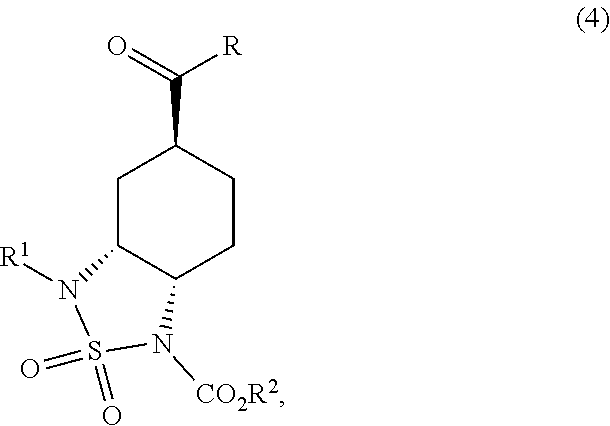
wherein R, R1 and R2 are as defined above.


the process comprising deprotecting a compound of Formula (4):

wherein R, R1 and R2 are as defined above.

the process comprising:

with a compound of Formula (21) or a salt thereof:

in the presence of a base B2 and, optionally in the presence of a coupling agent, to produce a compound of Formula (6-A):

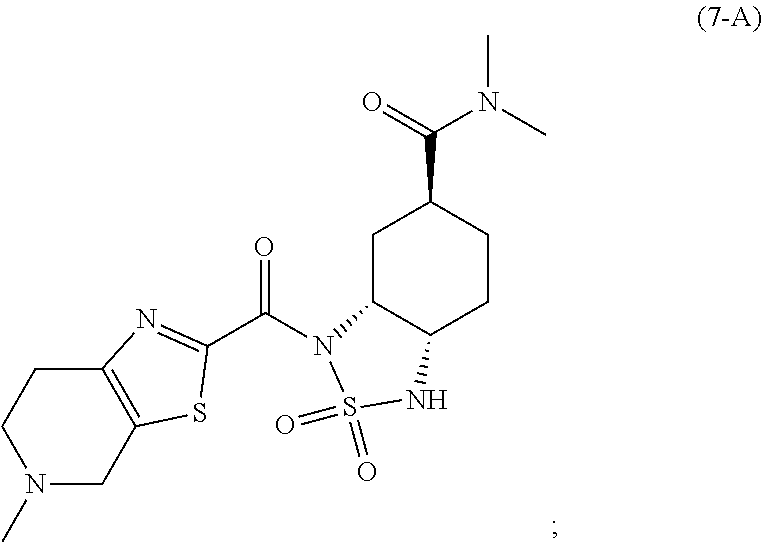


wherein R2 and G are as defined above.

wherein HA is an organic or inorganic acid.

wherein R2 is as defined above.


the process comprising:

to produce a compound of Formula (5-A):


in the presence of a base B4 and, optionally, in the presence of a coupling agent, to produce a compound of Formula (9-A):


and

wherein R1, R2 and G are as defined above.

wherein HA is an organic or inorganic acid.

wherein HA is an organic or inorganic acid.

wherein R2 is as defined above.

wherein R2 is as defined above.

wherein HA is an organic or inorganic acid.


Claims (3)


Priority Applications (1)
| Application Number | Priority Date | Filing Date | Title |
|---|---|---|---|
| US15/850,882 US10301322B2 (en) | 2016-12-27 | 2017-12-21 | Processes for the preparation of edoxaban and intermediates thereof |
Applications Claiming Priority (2)
| Application Number | Priority Date | Filing Date | Title |
|---|---|---|---|
| US201662439248P | 2016-12-27 | 2016-12-27 | |
| US15/850,882 US10301322B2 (en) | 2016-12-27 | 2017-12-21 | Processes for the preparation of edoxaban and intermediates thereof |
Publications (2)
| Publication Number | Publication Date |
|---|---|
| US20180179226A1 US20180179226A1 (en) | 2018-06-28 |
| US10301322B2 true US10301322B2 (en) | 2019-05-28 |
Family
ID=62625461
Family Applications (1)
| Application Number | Title | Priority Date | Filing Date |
|---|---|---|---|
| US15/850,882 Active US10301322B2 (en) | 2016-12-27 | 2017-12-21 | Processes for the preparation of edoxaban and intermediates thereof |
Country Status (1)
| Country | Link |
|---|---|
| US (1) | US10301322B2 (en) |
Families Citing this family (7)
| Publication number | Priority date | Publication date | Assignee | Title |
|---|---|---|---|---|
| CN109942600B (en) * | 2019-04-15 | 2021-08-20 | 内蒙古京东药业有限公司 | A kind of preparation method of edoxaban |
| WO2021001728A1 (en) * | 2019-07-04 | 2021-01-07 | Glenmark Life Sciences Limited | Process for preparation of edoxaban |
| CN111763157B (en) * | 2020-04-26 | 2021-10-26 | 中山大学 | Chiral amino compound, preparation method and application thereof, and preparation method for preparing edoxaban intermediate from chiral amino compound |
| CN112321613B (en) * | 2020-11-06 | 2022-04-12 | 江苏华阳制药有限公司 | Preparation method of idoxaban tosylate and isomer thereof |
| CN115477659B (en) * | 2021-06-15 | 2026-03-17 | 山东新时代药业有限公司 | An intermediate compound of edoxaban |
| WO2024197723A1 (en) * | 2023-03-30 | 2024-10-03 | 浙江九洲药业股份有限公司 | Preparation method for edoxaban tosilate |
| CN117658865B (en) * | 2023-12-05 | 2025-07-29 | 山东安舜制药有限公司 | Synthesis method of ideoxaban intermediate |
Citations (9)
| Publication number | Priority date | Publication date | Assignee | Title |
|---|---|---|---|---|
| US7342014B2 (en) * | 2001-06-20 | 2008-03-11 | Daiichi Pharmaceutical Co., Ltd. | Diamine derivatives |
| US7547786B2 (en) | 2003-11-12 | 2009-06-16 | Daiichi Sankyo Company, Limited | Process for producing thiazole derivative |
| US20120035369A1 (en) | 2009-03-13 | 2012-02-09 | Daiichi Sankyo Company, Limited | Method for producing optically active diamine derivative |
| US8357808B2 (en) | 2009-03-10 | 2013-01-22 | Daiichi Sankyo Company, Limited | Process for producing diamine derivative |
| US8686189B2 (en) | 2005-09-16 | 2014-04-01 | Daiichi Sankyo Company, Limited | Optically active diamine derivative and process for producing the same |
| CN104761571A (en) | 2015-03-10 | 2015-07-08 | 山东科兴生物制品有限公司 | Synthesis method of edoxaban |
| CA2940001A1 (en) | 2014-02-18 | 2015-08-27 | Daiichi Sankyo Company, Limited | Method for producing inhibitor of activated blood coagulation factor x (fxa) |
| CN105198776A (en) | 2015-10-30 | 2015-12-30 | 天津药物研究院药业有限责任公司 | Edoxaban intermediate and preparation method thereof |
| US20160016974A1 (en) | 2013-03-29 | 2016-01-21 | Daiichi Sankyo Company, Limited | Preparation method of optically active diamine compound |
-
2017
- 2017-12-21 US US15/850,882 patent/US10301322B2/en active Active
Patent Citations (11)
| Publication number | Priority date | Publication date | Assignee | Title |
|---|---|---|---|---|
| US7342014B2 (en) * | 2001-06-20 | 2008-03-11 | Daiichi Pharmaceutical Co., Ltd. | Diamine derivatives |
| US7365205B2 (en) | 2001-06-20 | 2008-04-29 | Daiichi Sankyo Company, Limited | Diamine derivatives |
| US7547786B2 (en) | 2003-11-12 | 2009-06-16 | Daiichi Sankyo Company, Limited | Process for producing thiazole derivative |
| US8686189B2 (en) | 2005-09-16 | 2014-04-01 | Daiichi Sankyo Company, Limited | Optically active diamine derivative and process for producing the same |
| US8357808B2 (en) | 2009-03-10 | 2013-01-22 | Daiichi Sankyo Company, Limited | Process for producing diamine derivative |
| US20120035369A1 (en) | 2009-03-13 | 2012-02-09 | Daiichi Sankyo Company, Limited | Method for producing optically active diamine derivative |
| US20160016974A1 (en) | 2013-03-29 | 2016-01-21 | Daiichi Sankyo Company, Limited | Preparation method of optically active diamine compound |
| CA2940001A1 (en) | 2014-02-18 | 2015-08-27 | Daiichi Sankyo Company, Limited | Method for producing inhibitor of activated blood coagulation factor x (fxa) |
| US20170050983A1 (en) | 2014-02-18 | 2017-02-23 | Daiichi Sankyo Company, Limited | Method for producing inhibitor of activated blood coagulation factor x (fxa) |
| CN104761571A (en) | 2015-03-10 | 2015-07-08 | 山东科兴生物制品有限公司 | Synthesis method of edoxaban |
| CN105198776A (en) | 2015-10-30 | 2015-12-30 | 天津药物研究院药业有限责任公司 | Edoxaban intermediate and preparation method thereof |
Non-Patent Citations (3)
| Title |
|---|
| Liu et al.; "Synthesis of a non-hydrolyzable estrone sulfate analogue bearing the difluoromethanesulfonamide group and its evaluation as a steroid sulfatase inhibitor"; Org. Biomol. Chem.; 2005; pp. 3329-3335; vol. 3. |
| Nagata et al.; "Stereoselective synthesis and biological evaluation of 3,4-diaminocyclohexanecarboxylic acid derivatives as factor Xa inhibitors"; Bioorganic & Medicinal Chemistry Letters; 2008; pp. 4587-4592; vol. 18. |
| Zheng et al.; "Au-Catalyzed Piperidine Synthesis via Tandem Acyloxy Migration/lntramolecular [3+2] Cycloaddition of Enynyl Esters"; Organic Letters; 2011; pp. 6448-6451; vol. 13:24. |
Also Published As
| Publication number | Publication date |
|---|---|
| US20180179226A1 (en) | 2018-06-28 |
Similar Documents
| Publication | Publication Date | Title |
|---|---|---|
| US20180179226A1 (en) | Processes for the Preparation of Edoxaban and Intermediates Thereof | |
| ES3060188T3 (en) | Cyclopropyl-amide compounds as dual lsd1/hdac inhibitors | |
| ES2626390T3 (en) | Retinoid-related orphan gamma receptor modulators (ROR-gamma) for use in the treatment of autoimmune and inflammatory diseases | |
| US9643927B1 (en) | Process for the preparation of kinase inhibitors and intermediates thereof | |
| JP6832946B2 (en) | How to prepare kinase inhibitors and their intermediates | |
| KR20180008402A (en) | Riluzole prodrugs and uses thereof | |
| JP2009197010A (en) | Derivative having ppar agonistic activity | |
| CA3095451A1 (en) | Ox2r compounds | |
| CN102348680A (en) | Method for producing optically active diamine derivative | |
| US11352323B2 (en) | Processes for making, and methods of using, glycopyrronium compounds | |
| JP2007261945A (en) | Thiazole derivative | |
| US11459315B2 (en) | Modulators of methyl modifying enzymes, compositions and uses thereof | |
| CA2758965C (en) | Method for the preparation of amphiphilic imidazolinium compounds | |
| JP2022517902A (en) | RIP1 inhibitor | |
| JP5665057B2 (en) | HDL raising agent | |
| WO2016139355A1 (en) | N-substituted 3,3'-(biphenyl-4,4'-diyl)bis-2-aminopropanenitriles as dppi inhibitors | |
| WO2022059778A1 (en) | Cyclic urea derivative | |
| EP3551608A1 (en) | Pendant amines and derivatives as inhibitors of leukotriene a4 hydrolase | |
| WO2001017947A1 (en) | Process for the preparation of 2,3-dihydroazepine compounds | |
| EP2144890A1 (en) | Method for preparing halogenated amines | |
| JP5704763B2 (en) | Production of trans-4-aminocyclopent-2-ene-1-carboxylic acid derivative | |
| BRPI0613423A2 (en) | pharmaceutical composition, compound or a pharmaceutically acceptable salt thereof, and use of a compound or a pharmaceutically acceptable salt thereof | |
| KR20200116118A (en) | Method for producing 2-chloro-4-nitroimidazole derivative | |
| US20250109106A1 (en) | Synthetic intermediates and improved processes for preparing ROCk inhibitors | |
| KR101868438B1 (en) | Method for preparing amide derivatives |
Legal Events
| Date | Code | Title | Description |
|---|---|---|---|
| FEPP | Fee payment procedure |
Free format text: ENTITY STATUS SET TO UNDISCOUNTED (ORIGINAL EVENT CODE: BIG.); ENTITY STATUS OF PATENT OWNER: LARGE ENTITY |
|
| AS | Assignment |
Owner name: APOTEX INC., CANADA Free format text: ASSIGNMENT OF ASSIGNORS INTEREST;ASSIGNORS:BODHURI, PRABHUDAS;CAMMISA, EDUARDO GUSTAVO;KARADEOLIAN, AVEDIS;AND OTHERS;SIGNING DATES FROM 20180102 TO 20180108;REEL/FRAME:044942/0429 |
|
| STPP | Information on status: patent application and granting procedure in general |
Free format text: NOTICE OF ALLOWANCE MAILED -- APPLICATION RECEIVED IN OFFICE OF PUBLICATIONS |
|
| STPP | Information on status: patent application and granting procedure in general |
Free format text: PUBLICATIONS -- ISSUE FEE PAYMENT VERIFIED |
|
| STCF | Information on status: patent grant |
Free format text: PATENTED CASE |
|
| MAFP | Maintenance fee payment |
Free format text: PAYMENT OF MAINTENANCE FEE, 4TH YEAR, LARGE ENTITY (ORIGINAL EVENT CODE: M1551); ENTITY STATUS OF PATENT OWNER: LARGE ENTITY Year of fee payment: 4 |
|
| AS | Assignment |
Owner name: THE BANK OF NOVA SCOTIA, CANADA Free format text: SECURITY INTEREST;ASSIGNOR:APOTEX INC.;REEL/FRAME:063364/0710 Effective date: 20230401 |