US10296993B2 - Method and apparatus for defining performance milestone track for planned process - Google Patents

Method and apparatus for defining performance milestone track for planned process Download PDF

Info

Publication number
US10296993B2
US10296993B2 US14/537,449 US201414537449A US10296993B2 US 10296993 B2 US10296993 B2 US 10296993B2 US 201414537449 A US201414537449 A US 201414537449A US 10296993 B2 US10296993 B2 US 10296993B2
Authority
US
United States
Prior art keywords
assessment
historical data
data
conjunction
select
Prior art date
Legal status (The legal status is an assumption and is not a legal conclusion. Google has not performed a legal analysis and makes no representation as to the accuracy of the status listed.)
Active, expires
Application number
US14/537,449
Other versions
US20160133145A1 (en
Inventor
Timothy W. Jacobs
Robert John Rolleston
Current Assignee (The listed assignees may be inaccurate. Google has not performed a legal analysis and makes no representation or warranty as to the accuracy of the list.)
Conduent Business Services LLC
Original Assignee
Conduent Business Services LLC
Priority date (The priority date is an assumption and is not a legal conclusion. Google has not performed a legal analysis and makes no representation as to the accuracy of the date listed.)
Filing date
Publication date
Application filed by Conduent Business Services LLC filed Critical Conduent Business Services LLC
Assigned to XEROX CORPORATION reassignment XEROX CORPORATION ASSIGNMENT OF ASSIGNORS INTEREST (SEE DOCUMENT FOR DETAILS). Assignors: JACOBS, TIMOTHY W., ROLLESTON, ROBERT JOHN
Priority to US14/537,449 priority Critical patent/US10296993B2/en
Publication of US20160133145A1 publication Critical patent/US20160133145A1/en
Assigned to CONDUENT BUSINESS SERVICES, LLC reassignment CONDUENT BUSINESS SERVICES, LLC ASSIGNMENT OF ASSIGNORS INTEREST (SEE DOCUMENT FOR DETAILS). Assignors: XEROX CORPORATION
Publication of US10296993B2 publication Critical patent/US10296993B2/en
Application granted granted Critical
Assigned to JPMORGAN CHASE BANK, N.A. reassignment JPMORGAN CHASE BANK, N.A. SECURITY AGREEMENT Assignors: CONDUENT BUSINESS SERVICES, LLC
Assigned to CONDUENT STATE & LOCAL SOLUTIONS, INC., ADVECTIS, INC., CONDUENT TRANSPORT SOLUTIONS, INC., CONDUENT HEALTH ASSESSMENTS, LLC, CONDUENT CASUALTY CLAIMS SOLUTIONS, LLC, CONDUENT BUSINESS SERVICES, LLC, CONDUENT BUSINESS SOLUTIONS, LLC, CONDUENT COMMERCIAL SOLUTIONS, LLC reassignment CONDUENT STATE & LOCAL SOLUTIONS, INC. RELEASE BY SECURED PARTY (SEE DOCUMENT FOR DETAILS). Assignors: JPMORGAN CHASE BANK, N.A.
Assigned to BANK OF AMERICA, N.A. reassignment BANK OF AMERICA, N.A. SECURITY INTEREST (SEE DOCUMENT FOR DETAILS). Assignors: CONDUENT BUSINESS SERVICES, LLC
Assigned to U.S. BANK, NATIONAL ASSOCIATION reassignment U.S. BANK, NATIONAL ASSOCIATION SECURITY INTEREST (SEE DOCUMENT FOR DETAILS). Assignors: CONDUENT BUSINESS SERVICES, LLC
Active legal-status Critical Current
Adjusted expiration legal-status Critical

Links

Images

Classifications

    • GPHYSICS
    • G06COMPUTING OR CALCULATING; COUNTING
    • G06QINFORMATION AND COMMUNICATION TECHNOLOGY [ICT] SPECIALLY ADAPTED FOR ADMINISTRATIVE, COMMERCIAL, FINANCIAL, MANAGERIAL OR SUPERVISORY PURPOSES; SYSTEMS OR METHODS SPECIALLY ADAPTED FOR ADMINISTRATIVE, COMMERCIAL, FINANCIAL, MANAGERIAL OR SUPERVISORY PURPOSES, NOT OTHERWISE PROVIDED FOR
    • G06Q50/00Information and communication technology [ICT] specially adapted for implementation of business processes of specific business sectors, e.g. utilities or tourism
    • G06Q50/10Services
    • G06Q50/20Education
    • GPHYSICS
    • G06COMPUTING OR CALCULATING; COUNTING
    • G06QINFORMATION AND COMMUNICATION TECHNOLOGY [ICT] SPECIALLY ADAPTED FOR ADMINISTRATIVE, COMMERCIAL, FINANCIAL, MANAGERIAL OR SUPERVISORY PURPOSES; SYSTEMS OR METHODS SPECIALLY ADAPTED FOR ADMINISTRATIVE, COMMERCIAL, FINANCIAL, MANAGERIAL OR SUPERVISORY PURPOSES, NOT OTHERWISE PROVIDED FOR
    • G06Q10/00Administration; Management
    • G06Q10/06Resources, workflows, human or project management; Enterprise or organisation planning; Enterprise or organisation modelling
    • G06Q10/063Operations research, analysis or management
    • G06Q10/0639Performance analysis of employees; Performance analysis of enterprise or organisation operations
    • G06Q10/06398Performance of employee with respect to a job function

Definitions

  • This disclosure presents various embodiments of a method of defining a performance milestone track for a planned process.
  • the method is applied to define a performance milestone track for a student in a specific grade level at a specific educational institution based on historical data regarding prior assessments of students in the same grade level at the same educational institution.
  • the method can also be applied to any repeatable process with measurable performance milestones in a variety of fields.
  • the method can be applied to skills training and corresponding task performance for military operations, emergency operations, healthcare, traffic control operations, power plant operations, vehicle operations, manufacturing tasks, construction tasks, and office tasks.
  • Various embodiments of a computational device for performing the method are also provided.
  • the disclosure also presents various embodiments of a computer-readable medium storing program instructions that, when executed, cause a computational device to perform the method.
  • Student learning for example, is often chaotic—starting at different points in time with different abilities, progressing in leaps and bounds, or sometimes even regressing over short periods of time. Given this state, it is often difficult for teachers to set appropriate end goals, intermediate milestones, and to understand where the student is with respect to progress against a personalized learning goal. Often it is desirable to set short term milestones that will enable progress to be measured and provide feedback that enables the teacher to more confidently assess whether the goal will be reached or not.
  • a method of defining a performance milestone track for a planned process includes: selecting a desired time range in relation to a duration for a repeatable process in conjunction with using a computational device to define a set of average assessment trajectories for the repeatable process; retrieving historical data from a storage device accessible to the computational device, wherein the historical data is representative of assessment data for a plurality of actors in conjunction with selective assessments of the plurality of actors during performances of the repeatable process, wherein the historical data includes an assessment parameter identifying a value for the corresponding selective assessment; processing a select time portion of the retrieved historical data at the computational device using a binning algorithm, wherein the binning algorithm assigns historical data for the select time portion across a plurality of quantile range bins based on select ranges of assessment parameter values for the corresponding historical data; and separately processing a select actor portion of the retrieved historical data for each quantile range bin at the computational device using a smoothing algorithm to form the set of average assessment tra
  • a computational device for defining a performance milestone track for a planned process.
  • the computational device includes: at least one data processor configured to execute program instructions; and a non-transitory storage device configured to store program instructions that, when executed by the at least one processor, cause the computational device to perform a method of defining a performance milestone track for a planned process.
  • the at least one data processor is configured to select a desired time range in relation to a duration for a repeatable process to define a set of average assessment trajectories for the repeatable process.
  • the at least one data processor is configured to retrieve historical data from a data storage device accessible to the computational device, wherein the historical data is representative of assessment data for a plurality of actors in conjunction with selective assessments of the plurality of actors during performances of the repeatable process, wherein the historical data includes an assessment parameter identifying a value for the corresponding selective assessment.
  • the at least one data processor is configured to process a select time portion of the retrieved historical data using a binning algorithm, wherein the binning algorithm assigns historical data for the select time portion across a plurality of quantile range bins based on select ranges of assessment parameter values for the corresponding historical data.
  • the at least one data processor is configured to separately process a select actor portion of the retrieved historical data for each quantile range bin using a smoothing algorithm to form the set of average assessment trajectories for the repeatable process.
  • a non-transitory computer-readable medium storing program instructions.
  • the program instructions when executed by at least one processor, cause a corresponding computational device to perform a method of defining a performance milestone track for a planned process.
  • the method includes: selecting a desired time range in relation to a duration for a repeatable process in conjunction with using a computational device to define a set of average assessment trajectories for the repeatable process; retrieving historical data from a storage device accessible to the computational device, wherein the historical data is representative of assessment data for a plurality of actors in conjunction with selective assessments of the plurality of actors during performances of the repeatable process, wherein the historical data includes an assessment parameter identifying a value for the corresponding selective assessment; processing a select time portion of the retrieved historical data at the computational device using a binning algorithm, wherein the binning algorithm assigns historical data for the select time portion across a plurality of quantile range bins based on select ranges of assessment parameter values for the corresponding historical data; and
  • FIGS. 1 and 12 provide graphs of historical data with score and month axes.
  • data points for each month are linearly overlaid along the month axis.
  • data points for each month are jittered along the month axis.
  • FIGS. 2 and 13 provide graphs reflecting statistical analyses of the historical data of FIG. 1 .
  • the data points are summarized by a smoothed line representing the mean with an error estimate.
  • the data points are summarized in a box plot that includes dispersion information.
  • FIG. 3 provides a graph of the historical data of FIG. 1 plotted with trajectories lines connecting data points for each student;
  • FIG. 4 provides a graph reflecting statistical analysis of the historical data of FIG. 1 , the trajectory lines of FIG. 3 , a goal line, and two current student scores;
  • FIG. 5 provides a graph of a cumulative distribution function for scores during the first month from the historical data of FIG. 1 ;
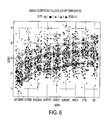
  • FIG. 6 provides a graph of average student score trajectories for the historical data of FIG. 1 and a current student score for the first month in which the average scores are grouped using quartile binning of scores during the first month;
  • FIG. 7 provides a graph of average student score trajectories for the historical data of FIG. 1 and a current student score for the third month in which the average scores are grouped using quartile binning of scores during the third month;
  • FIG. 8 is a flowchart of an exemplary embodiment of a process for defining a performance milestone track for a planned process
  • FIG. 9 in combination with FIG. 8 , is a flowchart of another exemplary embodiment of a process for defining a performance milestone track for a planned process
  • FIG. 10 in combination with FIGS. 8 and 9 , is a flowchart of yet another exemplary embodiment of a process for defining a performance milestone track for a planned process.
  • FIG. 11 is a block diagram of an exemplary embodiment of a computational device for defining a performance milestone track for a planned process.
  • the disclosure describes various embodiments of a system and method that, for example, enables teachers to establish a set of milestones for a student's progress towards a learning goal. It incorporates both an algorithmic element and a visual element.
  • the method uses historical data to establish a set of milestones.
  • a profile of the current student's performance on the topic is calculated based on the student's assessment data and used to subset the historical data which is then used to establish intermediate milestones along the way to the goal.
  • the visualization presented to the user indicates the beginning state of the student and the calculated milestones likely necessary to achieve the end goal.
  • the method is suited to: 1) use historical data to calculate an appropriate set of milestones likely to meet a goal and 2) show the progress a student is making against this set of defined milestones to indicate if the student is at risk of not meeting the end goal.
  • One aspect of this method is the use of historical data to calculate an appropriate set of milestones which will result in successful completion of the goal for a select student.
  • exemplary sample data is used throughout the disclosure, it should be understood that the method is equally suited to any data set in which student outcomes are measured for a topic and for which there is a suitable history of outcome measurements for that topic.
  • the historical data set should possess a number of intermediate measures for a number of students and the success or failure criteria for a student in meeting a desired goal. It is useful to understand some of the characteristics typical of such data sets.
  • the data used in this example is AIMsweb data from a select school district. More specifically, it is MAZE General Outcome Measurement (GOM) data for Grade 5 of the select school district.
  • GOM General Outcome Measurement
  • Maze is a multiple-choice cloze task that students complete while reading silently. For example, the first sentence of a 150-400 word passage is left intact. Thereafter, every seventh word may be replaced with three words inside parenthesis. One of the words is from the original passage. The other two words provide selections that are less suited than the word from the original passage.
  • an assessment was given each month throughout the school year. The scores were stored in a field called “Score1.” The goal is to achieve at or above a certain cut-off score by the end of the school year, e.g., the final assessment score in May.
  • Table 1 provides a small portion of the Grade 5 MAZE data used as an example in this document.
  • a typical data set will contain such records for hundreds or thousands of students.
  • the method disclosed herein solves the problem of how to determine which of these historical records are applicable to defining a set of milestones for a current student. To better understand the problem and the solution, a further investigation and characterization of the data is useful.
  • FIGS. 1 and 12 show the Score1 data values for the exemplary data set.
  • the graph on the left shows a simple point plot of this data. Note that in using this representation there can be many points stacked on top of another and there is no sense for how many such points there may be.
  • the graph on the right “jitters” the points to alleviate this overprint problem. This helps to show the general spread of the data at each month and the general upward trend, but offers little in providing guidance in setting any intermediate milestones for a specific student or unique milestones for each student in a class.
  • a statistical summary of the data results in a much cleaner representation, as shown in FIGS. 2 and 13 .
  • FIG. 2 shows a smoothed line through the mean MAZE score for each month and an error estimate around the mean.
  • FIG. 13 shows a box plot of this data. Here the viewer can better see the dispersion of MAZE scores for each month, and still perceive the general upward trend.
  • FIG. 3 shows the historical data as trajectory lines—line for each student who has taken a Grade 5 MAZE assessment.
  • the graph shows that the GOM score trajectories can be somewhat chaotic.
  • the graph shows data for all students in the history database.
  • a smoothed average track of all historical students see the black line
  • a standard deviation of average track see the shaded area
  • a goal line see the dashed line
  • the dashed line and the associated wide shaded band are the month by month mean of all the historical data and one standard deviation about the mean.
  • the dashed horizontal line indicates the yearend target goal score. Also shown are the initial known scores (one in September and the other in November.) for two current students, neither of which is very close to the population average.
  • the method disclosed herein provides a mechanism to create more personalized intermediate milestone tracks for a current student.
  • One aspect of the method is the application of a binning algorithm applied to each of the historical records at each point in time. This binned data is used to establish a set of milestone tracks. A new student is matched to a milestone track that best fits the initial knowledge of that student's level.
  • the binning algorithm uses quantiles to establish the bins. There are many ways to bin, or quantize data, but the use of quantile ranges is a concept familiar to the educational community.
  • the empirical cumulative distribution function can be used to determine bins.
  • an assessment is given each month of the school year (i.e., nine total assessments).
  • Quantiles are established for each month's scores using the history of data available. Therefore, there would be nine sets of quantiles for this data.
  • quartiles as the quantile unit. This results in four bins for each month—thirty six bins in total. It is possible to use any number of quantile bins.
  • the historical data establishes the thresholds for each bin at each month. To determine which bin a new student's scores fall in, we apply the appropriate thresholds as determined by which month the initial assessments were taken. An example ECDF used for this purpose is shown in FIG.
  • the example ECDF in FIG. 5 is derived from the Grade 5 MAZE September assessment data. This function would be used to determine the September quantile data. A different function, based on October historical data, would be used to determine the October quantile data. It is also possible to define the milestone tracks using overlapping bins or some other binning strategy.
  • An example set of data for a new student in November is shown in Table 3.
  • the Score1 data is entered by the teacher but the quantile data is determined by the tool using the algorithm described above.
  • Student scores for assessments can vary considerably over time, even while the topic being assessed is held constant. This makes tracking progress and setting intermediate goals on the road to achieving a milestone particularly challenging—even for experienced teachers.
  • the data used to construct the visual tool is particularly relevant for the student whose data is being evaluated because it comes from historical data gathered by the school or school district in which the student is enrolled.
  • the method includes: i) Within each time period of the historical data, a) calculating quartile (or another appropriate binning) ranges, and b) calculating average track within each quartile and ii) for a new student in month M, a) using the quartile break points for month M, b) determining the student's quartile position Q, and c) using the average track defined for quartile Q in month M.
  • an exemplary embodiment of a process 800 for defining a performance milestone track for a planned process begins at 802 where a desired time range is selected in relation to a duration for a repeatable process in conjunction with using a computational device to define a set of average assessment trajectories for the repeatable process.
  • historical data is retrieved from a storage device accessible to the computational device ( 804 ).
  • the historical data is representative of assessment data for a plurality of actors in conjunction with selective assessments of the plurality of actors during performances of the repeatable process.
  • the historical data includes an assessment parameter identifying a value for the corresponding selective assessment.
  • a select time portion of the retrieved historical data is processed at the computational device using a binning algorithm.
  • the binning algorithm assigns historical data for the select time portion across a plurality of quantile range bins based on select ranges of assessment parameter values for the corresponding historical data.
  • a select actor portion of the retrieved historical data for each quantile range bin is separately processed at the computational device using a smoothing algorithm to form the set of average assessment trajectories for the repeatable process.
  • the set of average assessment trajectories are representative of average assessment parameter values over time in relation to the duration of the repeatable process.
  • the process 800 also includes formatting the set of average assessment trajectories in at least one of a graph format and a table format.
  • the formatted set of average assessment trajectories is sent to at least one of a display device, a printing device, and a storage device.
  • the repeatable process is a specific grade level at a specific educational institution.
  • the plurality of actors are a plurality of students having completed the specific grade level at the specific education institution during one or more academic years.
  • the duration is defined by first and last days of an academic year.
  • the specific educational institution is a public school district. In an even further embodiment of the process 800 , the specific educational institution is a specific school in the school district.
  • the specific educational institution is a private school. In yet another further embodiment of the process 800 , the specific educational institution is one of an early childhood school, a primary school, a secondary school, and a post-secondary school.
  • the duration is defined by a first time range, at least one intermediate time range, and a last time range, wherein the desired time range is representative of the first time range, one of the at least one intermediate time range, or the last time range.
  • the first time range is representative of an initial assessment of the plurality of actors in conjunction with starting performance of the repeatable process.
  • each intermediate time range is representative of completion of a first or intermediate assessment period during performance of the repeatable process.
  • the last time range is representative of completion of a last assessment period during performance of the repeatable process.
  • the repeatable process includes daily assessment periods, weekly assessment periods, monthly assessment periods, quarterly assessment periods, semester assessment periods, or trimester assessment periods.
  • the historical data includes a time parameter identifying a specific time range in relation to the duration.
  • the select time portion includes retrieved historical data with time parameters corresponding to the desired time range.
  • the historical data includes an actor parameter identifying a specific actor associated with performance of the repeatable process.
  • each select actor portion includes retrieved historical data with actor parameters corresponding to the actor parameters associated with the corresponding quantile range bin from the desired time range through at least a next time range of the repeatable process.
  • a minimum assessment level for the repeatable process is identified prior to forming the set of average assessment trajectories.
  • the process 800 also includes identifying the actor parameters for historical data in a last time range of the repeatable process that is less than the minimum acceptable level. Next, historical data associated with the identified actor parameters is eliminated from the select actor portion of the retrieved historical data for each quantile range unless doing so would eliminate all historical data from the select actor portion.
  • the historical data includes an iteration parameter identifying a specific iteration of the repeatable process.
  • the process 800 also includes selecting one or more desired iterations of the repeatable process at the computational device, wherein the retrieved historical data is limited to historical data associated with the one or more desired iterations.
  • the plurality of quantile range bins include four quartile range bins.
  • the select ranges defining the plurality of quantile range bins overlap by a predetermined margin such that one or more assessment parameter values at the borders of adjacent range bins are members of both adjacent range bins.
  • each average assessment trajectory includes at least one of a mean value over time, values ranging one standard deviation from the mean, values ranging two standard deviations from the mean, and values ranging three standard deviations from the mean.
  • an exemplary embodiment of a process 900 for defining a performance milestone track for a planned process includes the process 800 of FIG. 8 .
  • the process 900 also includes receiving new assessment data for a new actor performing a current iteration of the repeatable process ( 902 ).
  • the new assessment data is received at the computational device.
  • the new assessment data is associated with the desired time range. Selection of the desired time range in 802 is based at least in part on receipt of the new assessment data.
  • a new assessment value from the new assessment data is compared to the average assessment trajectories from 808 .
  • the average assessment trajectory that most closely matches the new assessment value is selected as a performance milestone track for the new actor ( 906 ).
  • the performance milestone track includes at least one of a mean value over time, values ranging one standard deviation from the mean, values ranging two standard deviations from the mean, and values ranging three standard deviations from the mean.
  • an exemplary embodiment of a process 1000 for defining a performance milestone track for a planned process includes the processes 800 , 900 of FIGS. 8 and 9 .
  • the performance milestone track is representative of average assessment parameter values over time in relation to the duration of the repeatable process and new assessment data for the new actor in relation to the desired time range.
  • the process 1000 continues from 906 to 1002 where the performance milestone track is formatted in at least one of a graph format and a table format.
  • the formatted performance milestone track is sent to at least one of a display device, a printing device, and a storage device ( 1004 ).
  • the formatted performance milestone track is used to assess performance of the corresponding new actor for the current iteration of the repeatable process.
  • an exemplary embodiment of a computational device 1100 for defining a performance milestone track for a planned process includes at least one data processor 1102 and a non-transitory storage device 1104 .
  • the at least one data processor 1102 is configured to execute program instructions.
  • the non-transitory storage device 1104 configured to store program instructions that, when executed by the at least one processor 1102 , cause the computational device 1100 to perform a method of defining a performance milestone track for a planned process.
  • the non-transitory storage device 1104 may be external to the computational device 1100 or a combination internal and external storage devices.
  • the non-transitory storage device 1104 may be remote to the computational device 1100 or a combination of local and remote storage devices.
  • the at least one data processor 1102 is configured to select a desired time range in relation to a duration for a repeatable process to define a set of average assessment trajectories for the repeatable process.
  • the at least one data processor 1102 is configured to retrieve historical data from a data storage device 1106 accessible to the computational device 1100 .
  • the data storage device 1106 may be internal, external, or a combination thereof to the computational device 1100 .
  • the data storage device 1106 may be local, remote, or a combination thereof to the computational device 1100 .
  • the historical data is representative of assessment data for a plurality of actors in conjunction with selective assessments of the plurality of actors during performances of the repeatable process.
  • the historical data includes an assessment parameter identifying a value for the corresponding selective assessment.
  • the at least one data processor 1102 is configured to process a select time portion of the retrieved historical data using a binning algorithm.
  • the binning algorithm may include a quartile binning algorithm or any suitable binning algorithm.
  • the binning algorithm assigns historical data for the select time portion across a plurality of quantile range bins based on select ranges of assessment parameter values for the corresponding historical data.
  • the at least one data processor 1102 is configured to separately process a select actor portion of the retrieved historical data for each quantile range bin using a smoothing algorithm to form the set of average assessment trajectories for the repeatable process.
  • the smoothing algorithm may include a local regression (LOESS) algorithm, a locally weighted scatterplot smoothing (LOWESS) algorithm, or any suitable smoothing algorithm.
  • the computational device 1100 also includes an input device 1108 configured to permit an operator of the computational device 1100 to interact with the at least one processor 1102 in conjunction with execution of the program instructions.
  • the at least one data processor 1102 in conjunction with execution of the program instructions, is configured to receive new assessment data for a new actor performing a current iteration of the repeatable process. In the embodiment being described, the new assessment data is received via the input device 1108 .
  • the new assessment data is associated with the desired time range. Selection of the desired time range is based at least in part on receipt of the new assessment data.
  • the at least one data processor 1102 is configured to compare a new assessment value from the new assessment data to the average assessment trajectories.
  • the at least one data processor 1102 is configured to select the average assessment trajectory that most closely matches the new assessment value as a performance milestone track for the new actor.
  • the performance milestone track is representative of average assessment parameter values over time in relation to the duration of the repeatable process and new assessment data for the new actor in relation to the desired time range.
  • the computational device 1100 also includes a display device 1110 configured to permit an operator of the computational device 1100 to interact with the at least one processor 1102 in conjunction with execution of the program instructions.
  • the at least one data processor 1102 is configured to format the performance milestone track in at least one of a graph format and a table format.
  • the at least one data processor 1102 is configured to send the formatted performance milestone track to at least one of the display device 1110 , a printing device 1112 , and a performance milestone storage device 1114 .
  • the performance milestone storage device 1114 may be internal, external, or a combination thereof to the computational device 1100 .
  • the performance milestone storage device 1114 may be local, remote, or a combination thereof to the computational device 1100 .
  • the formatted performance milestone track is configured to enable a user of the computational device 1100 to assess performance of the corresponding new actor for the current iteration of the repeatable process.
  • the set of average assessment trajectories are representative of average assessment parameter values over time in relation to the duration of the repeatable process.
  • the computational device 1100 also includes a display device 1110 configured to permit an operator of the computational device 1100 to interact with the at least one processor in conjunction with execution of the program instructions.
  • the at least one data processor 1102 is configured to format the set of average assessment trajectories in at least one of a graph format and a table format.
  • the at least one data processor 1102 is configured to send the formatted set of average assessment trajectories to at least one of the display device 1110 , a printing device 1112 , and a performance milestone storage device 1114 .
  • the computational device 1100 also includes an input device 1108 configured to permit an operator of the computational device 1100 to interact with the at least one processor 1102 in conjunction with execution of the program instructions.
  • the desired time range is received by the at least one processor 1102 from the input device 1108 in conjunction with operator interaction to select the desired time range.
  • the historical data includes a time parameter identifying a specific time range in relation to the duration.
  • the select time portion includes retrieved historical data with time parameters corresponding to the desired time range.
  • the historical data includes an actor parameter identifying a specific actor associated with performance of the repeatable process.
  • each select actor portion includes retrieved historical data with actor parameters corresponding to the actor parameters associated with the corresponding quantile range bin from the desired time range through at least a next time range of the repeatable process.
  • a minimum assessment level for the repeatable process is identified prior to forming the set of average assessment trajectories.
  • the at least one data processor 1102 is configured to identify the actor parameters for historical data in a last time range of the repeatable process that is less than the minimum acceptable level.
  • the at least one data processor 1102 is configured to eliminate historical data associated with the identified actor parameters from the select actor portion of the retrieved historical data for each quantile range unless doing so would eliminate all historical data from the select actor portion.
  • the historical data includes an iteration parameter identifying a specific iteration of the repeatable process.
  • the at least one data processor 1102 in conjunction with execution of the program instructions, is configured to select one or more desired iterations of the repeatable process.
  • the retrieved historical data is limited to historical data associated with the one or more desired iterations.
  • the computational device 1100 includes an input device 1108 configured to permit an operator of the computational device to interact with the at least one processor 1102 in conjunction with execution of the program instructions.
  • the one or more desired iterations are received by the at least one processor 1102 from the input device 1108 in conjunction with operator interaction to select the one or more desired iterations.
  • the plurality of quantile range bins include four quartile range bins.
  • the select ranges defining the plurality of quantile range bins overlap by a predetermined margin such that one or more assessment parameter values at the borders of adjacent range bins are members of both adjacent range bins.
  • FIGS. 8-10 various exemplary embodiments of non-transitory computer-readable medium storing program instructions that, when executed by at least one processor, cause a corresponding computational device to perform a method of defining a performance milestone track for a planned process.
  • various embodiments of the computational device 1100 are described above with reference to FIG. 11 .
  • Various embodiments of the method of defining a performance milestone track for a planned process 800 , 900 , 1000 , for example, are described above with reference to FIGS. 8-10 .
  • non-transitory computer-readable medium store program instructions that, when executed by at least one processor, may cause a corresponding computational device to perform various combinations of functions associated with the various embodiments of the processes 800 , 900 , 1000 for defining a performance milestone track for a planned process described above with reference to FIGS. 8-10 .
  • the various embodiments of the computational device 1100 described above with reference to FIG. 11 may include the at least one processor 1102 and may perform the various combination of functions associated with defining a performance milestone track for a planned process based on the program instructions stored on corresponding embodiments of the non-transitory computer readable medium.
  • the program instructions of the various exemplary embodiments of non-transitory computer-readable medium are defined by any suitable combination of the processes 800 , 900 , 1000 described above with reference to FIGS. 8-10 .
  • the at least one processor 1102 and the computational device 1100 associated with the various exemplary embodiments of non-transitory computer-readable medium are defined by any suitable combination of the computational device 1100 described above with reference to FIG. 11 .

Landscapes

  • Business, Economics & Management (AREA)
  • Human Resources & Organizations (AREA)
  • Engineering & Computer Science (AREA)
  • Educational Administration (AREA)
  • Strategic Management (AREA)
  • Economics (AREA)
  • Tourism & Hospitality (AREA)
  • Theoretical Computer Science (AREA)
  • General Physics & Mathematics (AREA)
  • Physics & Mathematics (AREA)
  • Entrepreneurship & Innovation (AREA)
  • Development Economics (AREA)
  • Marketing (AREA)
  • General Business, Economics & Management (AREA)
  • Educational Technology (AREA)
  • Game Theory and Decision Science (AREA)
  • Quality & Reliability (AREA)
  • Operations Research (AREA)
  • Health & Medical Sciences (AREA)
  • General Health & Medical Sciences (AREA)
  • Primary Health Care (AREA)
  • Management, Administration, Business Operations System, And Electronic Commerce (AREA)

Abstract

A method of defining a performance milestone track for a planned process includes: selecting a time range relating to a repeatable process to define a set of average assessment trajectories, retrieving historical data representative of assessment data for actors in conjunction with selective assessments of the actors during performances of the repeatable process. The historical data includes an assessment parameter identifying a value for the selective assessment. The method includes processing a select time portion of the historical data using a binning algorithm to assign historical data for the select time portion across quantile range bins based on select ranges of assessment parameter values for the historical data and separately processing a select actor portion of the historical data for each quantile range bin using a smoothing algorithm to form the set of average assessment trajectories for the repeatable process. A computational device for performing the method is also provided.

Description

BACKGROUND
This disclosure presents various embodiments of a method of defining a performance milestone track for a planned process. In several embodiments, the method is applied to define a performance milestone track for a student in a specific grade level at a specific educational institution based on historical data regarding prior assessments of students in the same grade level at the same educational institution. However, the method can also be applied to any repeatable process with measurable performance milestones in a variety of fields. For example, the method can be applied to skills training and corresponding task performance for military operations, emergency operations, healthcare, traffic control operations, power plant operations, vehicle operations, manufacturing tasks, construction tasks, and office tasks. Various embodiments of a computational device for performing the method are also provided. The disclosure also presents various embodiments of a computer-readable medium storing program instructions that, when executed, cause a computational device to perform the method.
Student learning, for example, is often chaotic—starting at different points in time with different abilities, progressing in leaps and bounds, or sometimes even regressing over short periods of time. Given this state, it is often difficult for teachers to set appropriate end goals, intermediate milestones, and to understand where the student is with respect to progress against a personalized learning goal. Often it is desirable to set short term milestones that will enable progress to be measured and provide feedback that enables the teacher to more confidently assess whether the goal will be reached or not.
BRIEF DESCRIPTION
In one aspect, a method of defining a performance milestone track for a planned process is provided. In one embodiment, the method includes: selecting a desired time range in relation to a duration for a repeatable process in conjunction with using a computational device to define a set of average assessment trajectories for the repeatable process; retrieving historical data from a storage device accessible to the computational device, wherein the historical data is representative of assessment data for a plurality of actors in conjunction with selective assessments of the plurality of actors during performances of the repeatable process, wherein the historical data includes an assessment parameter identifying a value for the corresponding selective assessment; processing a select time portion of the retrieved historical data at the computational device using a binning algorithm, wherein the binning algorithm assigns historical data for the select time portion across a plurality of quantile range bins based on select ranges of assessment parameter values for the corresponding historical data; and separately processing a select actor portion of the retrieved historical data for each quantile range bin at the computational device using a smoothing algorithm to form the set of average assessment trajectories for the repeatable process.
In another aspect, a computational device for defining a performance milestone track for a planned process is provided. In one embodiment, the computational device includes: at least one data processor configured to execute program instructions; and a non-transitory storage device configured to store program instructions that, when executed by the at least one processor, cause the computational device to perform a method of defining a performance milestone track for a planned process. In conjunction with execution of the program instructions, the at least one data processor is configured to select a desired time range in relation to a duration for a repeatable process to define a set of average assessment trajectories for the repeatable process. In conjunction with execution of the program instructions, the at least one data processor is configured to retrieve historical data from a data storage device accessible to the computational device, wherein the historical data is representative of assessment data for a plurality of actors in conjunction with selective assessments of the plurality of actors during performances of the repeatable process, wherein the historical data includes an assessment parameter identifying a value for the corresponding selective assessment. In conjunction with execution of the program instructions, the at least one data processor is configured to process a select time portion of the retrieved historical data using a binning algorithm, wherein the binning algorithm assigns historical data for the select time portion across a plurality of quantile range bins based on select ranges of assessment parameter values for the corresponding historical data. In conjunction with execution of the program instructions, the at least one data processor is configured to separately process a select actor portion of the retrieved historical data for each quantile range bin using a smoothing algorithm to form the set of average assessment trajectories for the repeatable process.
In yet another aspect, a non-transitory computer-readable medium storing program instructions is provided. The program instructions, when executed by at least one processor, cause a corresponding computational device to perform a method of defining a performance milestone track for a planned process. In one embodiment, the method includes: selecting a desired time range in relation to a duration for a repeatable process in conjunction with using a computational device to define a set of average assessment trajectories for the repeatable process; retrieving historical data from a storage device accessible to the computational device, wherein the historical data is representative of assessment data for a plurality of actors in conjunction with selective assessments of the plurality of actors during performances of the repeatable process, wherein the historical data includes an assessment parameter identifying a value for the corresponding selective assessment; processing a select time portion of the retrieved historical data at the computational device using a binning algorithm, wherein the binning algorithm assigns historical data for the select time portion across a plurality of quantile range bins based on select ranges of assessment parameter values for the corresponding historical data; and separately processing a select actor portion of the retrieved historical data for each quantile range bin at the computational device using a smoothing algorithm to form the set of average assessment trajectories for the repeatable process.
BRIEF DESCRIPTION OF THE DRAWINGS
FIGS. 1 and 12 provide graphs of historical data with score and month axes. In the left view, data points for each month are linearly overlaid along the month axis. In the right view, data points for each month are jittered along the month axis.
FIGS. 2 and 13 provide graphs reflecting statistical analyses of the historical data of FIG. 1. In the left view, the data points are summarized by a smoothed line representing the mean with an error estimate. In the right view, the data points are summarized in a box plot that includes dispersion information.
FIG. 3 provides a graph of the historical data of FIG. 1 plotted with trajectories lines connecting data points for each student;
FIG. 4 provides a graph reflecting statistical analysis of the historical data of FIG. 1, the trajectory lines of FIG. 3, a goal line, and two current student scores;
FIG. 5 provides a graph of a cumulative distribution function for scores during the first month from the historical data of FIG. 1;
FIG. 6 provides a graph of average student score trajectories for the historical data of FIG. 1 and a current student score for the first month in which the average scores are grouped using quartile binning of scores during the first month;
FIG. 7 provides a graph of average student score trajectories for the historical data of FIG. 1 and a current student score for the third month in which the average scores are grouped using quartile binning of scores during the third month;
FIG. 8 is a flowchart of an exemplary embodiment of a process for defining a performance milestone track for a planned process;
FIG. 9, in combination with FIG. 8, is a flowchart of another exemplary embodiment of a process for defining a performance milestone track for a planned process;
FIG. 10, in combination with FIGS. 8 and 9, is a flowchart of yet another exemplary embodiment of a process for defining a performance milestone track for a planned process; and
FIG. 11 is a block diagram of an exemplary embodiment of a computational device for defining a performance milestone track for a planned process.
DETAILED DESCRIPTION
The disclosure describes various embodiments of a system and method that, for example, enables teachers to establish a set of milestones for a student's progress towards a learning goal. It incorporates both an algorithmic element and a visual element. The method uses historical data to establish a set of milestones. A profile of the current student's performance on the topic is calculated based on the student's assessment data and used to subset the historical data which is then used to establish intermediate milestones along the way to the goal. The visualization presented to the user indicates the beginning state of the student and the calculated milestones likely necessary to achieve the end goal.
In summary, the method is suited to: 1) use historical data to calculate an appropriate set of milestones likely to meet a goal and 2) show the progress a student is making against this set of defined milestones to indicate if the student is at risk of not meeting the end goal. One aspect of this method is the use of historical data to calculate an appropriate set of milestones which will result in successful completion of the goal for a select student.
Although one set of exemplary sample data is used throughout the disclosure, it should be understood that the method is equally suited to any data set in which student outcomes are measured for a topic and for which there is a suitable history of outcome measurements for that topic. The historical data set should possess a number of intermediate measures for a number of students and the success or failure criteria for a student in meeting a desired goal. It is useful to understand some of the characteristics typical of such data sets.
The data used in this example is AIMsweb data from a select school district. More specifically, it is MAZE General Outcome Measurement (GOM) data for Grade 5 of the select school district. Maze is a multiple-choice cloze task that students complete while reading silently. For example, the first sentence of a 150-400 word passage is left intact. Thereafter, every seventh word may be replaced with three words inside parenthesis. One of the words is from the original passage. The other two words provide selections that are less suited than the word from the original passage. For each student in this data set, an assessment was given each month throughout the school year. The scores were stored in a field called “Score1.” The goal is to achieve at or above a certain cut-off score by the end of the school year, e.g., the final assessment score in May.
To show the structure of the data, e.g. the monthly score on a particular topic, for a given student; A small portion of the data for a single student is shown in Table 1. Table 1 provides a small portion of the Grade 5 MAZE data used as an example in this document.
TABLE 1
StudentID GOM Month Score1
100279 MAZE September 27
100279 MAZE October 42
100279 MAZE November 40
100279 MAZE December 43
100279 MAZE January 33
100279 MAZE February 36
100279 MAZE March 40
100279 MAZE April 48
100279 MAZE May 38
A typical data set will contain such records for hundreds or thousands of students. The method disclosed herein solves the problem of how to determine which of these historical records are applicable to defining a set of milestones for a current student. To better understand the problem and the solution, a further investigation and characterization of the data is useful.
FIGS. 1 and 12 show the Score1 data values for the exemplary data set. The graph on the left shows a simple point plot of this data. Note that in using this representation there can be many points stacked on top of another and there is no sense for how many such points there may be. The graph on the right “jitters” the points to alleviate this overprint problem. This helps to show the general spread of the data at each month and the general upward trend, but offers little in providing guidance in setting any intermediate milestones for a specific student or unique milestones for each student in a class. A statistical summary of the data results in a much cleaner representation, as shown in FIGS. 2 and 13. FIG. 2 shows a smoothed line through the mean MAZE score for each month and an error estimate around the mean. This representation clearly shows the increase in Score1 over time, however this figure loses the sense of variability inherent in the raw data. FIG. 13 shows a box plot of this data. Here the viewer can better see the dispersion of MAZE scores for each month, and still perceive the general upward trend.
There are at least two issues with all of these representations. First, there is no sense of individual student trajectories. Additionally, the plots are for the entire historical student population and do not provide a sense of the applicability of the current student to the population mean. These are statistical summaries of the entire sample, where there is a large variance in the spread of the data. The question remains: Where in this spread is the current student likely positioned?
A representation of the trajectory nature of this data is shown in FIG. 3 which shows the historical data as trajectory lines—line for each student who has taken a Grade 5 MAZE assessment. The graph shows that the GOM score trajectories can be somewhat chaotic. The graph shows data for all students in the history database.
With reference to FIG. 4, three elements are added to the graph of FIG. 3: 1) a smoothed average track of all historical students (see the black line), 2) a standard deviation of average track (see the shaded area), and 3) a goal line (see the dashed line). The dashed line and the associated wide shaded band are the month by month mean of all the historical data and one standard deviation about the mean. The dashed horizontal line indicates the yearend target goal score. Also shown are the initial known scores (one in September and the other in November.) for two current students, neither of which is very close to the population average.
This introduces some of the elements needed to satisfy the desired features enumerated above. However, this is hardly satisfactory in that it does not use the historical data in a way that is tailored to the new student(s). This issue is mainly due to the large variance of the data at any given month. For the example given in FIG. 4, the two current students are at very different positions, and will likely follow different trajectories throughout the year. Student-1 (star) is well below the expected level, and their plan may be to simply get to the goal. Student-2 (triangle) is already above the end goal, but they should not be expected to learn nothing, but rather to exceed the target goal. Using a single historical average for these two students does them each a disservice; Given the wealth of historical data, what can we realistically expect each student to accomplish?
The method disclosed herein provides a mechanism to create more personalized intermediate milestone tracks for a current student. One aspect of the method is the application of a binning algorithm applied to each of the historical records at each point in time. This binned data is used to establish a set of milestone tracks. A new student is matched to a milestone track that best fits the initial knowledge of that student's level. In one embodiment, the binning algorithm uses quantiles to establish the bins. There are many ways to bin, or quantize data, but the use of quantile ranges is a concept familiar to the educational community.
For example, the empirical cumulative distribution function (ECDF) can be used to determine bins. In the example data, an assessment is given each month of the school year (i.e., nine total assessments). Quantiles are established for each month's scores using the history of data available. Therefore, there would be nine sets of quantiles for this data. In the example given in this document we use quartiles as the quantile unit. This results in four bins for each month—thirty six bins in total. It is possible to use any number of quantile bins. The historical data establishes the thresholds for each bin at each month. To determine which bin a new student's scores fall in, we apply the appropriate thresholds as determined by which month the initial assessments were taken. An example ECDF used for this purpose is shown in FIG. 5. The example ECDF in FIG. 5 is derived from the Grade 5 MAZE September assessment data. This function would be used to determine the September quantile data. A different function, based on October historical data, would be used to determine the October quantile data. It is also possible to define the milestone tracks using overlapping bins or some other binning strategy.
If this ECDF is used to define quantile bins, based upon the historical data for September, it is possible to assign each track to a quantile bin, and to average only the tracks which share the same quantile. The result of such an algorithm is shown in FIG. 6 where the trajectories of average scores are shown. Each of the four curves represent a set of students selected by how well they scored on the September assessment (i.e. which quartile their scores fell in). Notice that we now have four very distinct tracks. This is a useful result given the chaotic nature of the historical data and the chaotic nature shown in the score trajectory for certain students. This is true for other data sets we have also investigated. Each new student, with a score in September, can now be associated with a more personalized learning track.
An example set of data for a new student in September is shown in Table 2. The Score1 data is entered by the teacher but the quantile data is determined by the tool using the algorithm described above.
TABLE 2
StudentID Month GOM Score1 quantile
3 September MAZE 12.00 1.00
In this example set, the student score profile would be (September=1). This student's score in September is plotted in FIG. 6 (see star). In this case, the student should be assigned the quartile-1 learning trajectory (the lowest track).
An example set of data for a new student in November is shown in Table 3. The Score1 data is entered by the teacher but the quantile data is determined by the tool using the algorithm described above. In this example set, the student score profile would be (November=4).
TABLE 3
StudentID Month GOM Score1 quantile
4 November MAZE 38.00 4.00
This student's score in November is plotted in FIG. 7 (see triangle). In this case, the student should be assigned the highest quartile learning trajectory (shown in blue). Notice also that the quantile curves are different than those shown in FIG. 6. This plot is using the November scores to establish each quantile set. This ability to use the quantile score for any month is another aspect of the method disclosed herein.
Student scores for assessments can vary considerably over time, even while the topic being assessed is held constant. This makes tracking progress and setting intermediate goals on the road to achieving a milestone particularly challenging—even for experienced teachers. We have described a system and method that isolates relevant historical data and presents a visualization that makes this task simpler and more confident. The data used to construct the visual tool is particularly relevant for the student whose data is being evaluated because it comes from historical data gathered by the school or school district in which the student is enrolled.
The tool allows setting appropriate goals for any student, regardless of when performance is measured and finds a milestone track appropriate to the student's available initial ability. In summary form, the method includes: i) Within each time period of the historical data, a) calculating quartile (or another appropriate binning) ranges, and b) calculating average track within each quartile and ii) for a new student in month M, a) using the quartile break points for month M, b) determining the student's quartile position Q, and c) using the average track defined for quartile Q in month M.
With reference to FIG. 8, an exemplary embodiment of a process 800 for defining a performance milestone track for a planned process begins at 802 where a desired time range is selected in relation to a duration for a repeatable process in conjunction with using a computational device to define a set of average assessment trajectories for the repeatable process. Next, historical data is retrieved from a storage device accessible to the computational device (804). The historical data is representative of assessment data for a plurality of actors in conjunction with selective assessments of the plurality of actors during performances of the repeatable process. The historical data includes an assessment parameter identifying a value for the corresponding selective assessment. At 806, a select time portion of the retrieved historical data is processed at the computational device using a binning algorithm. The binning algorithm assigns historical data for the select time portion across a plurality of quantile range bins based on select ranges of assessment parameter values for the corresponding historical data. Next, a select actor portion of the retrieved historical data for each quantile range bin is separately processed at the computational device using a smoothing algorithm to form the set of average assessment trajectories for the repeatable process.
In another embodiment of the process 800, the set of average assessment trajectories are representative of average assessment parameter values over time in relation to the duration of the repeatable process. In this embodiment, the process 800 also includes formatting the set of average assessment trajectories in at least one of a graph format and a table format. Next, the formatted set of average assessment trajectories is sent to at least one of a display device, a printing device, and a storage device.
In yet another embodiment of the process 800, the repeatable process is a specific grade level at a specific educational institution. In this embodiment, the plurality of actors are a plurality of students having completed the specific grade level at the specific education institution during one or more academic years. In the embodiment being described, the duration is defined by first and last days of an academic year.
In a further embodiment of the process 800, the specific educational institution is a public school district. In an even further embodiment of the process 800, the specific educational institution is a specific school in the school district.
In another further embodiment of the process 800, the specific educational institution is a private school. In yet another further embodiment of the process 800, the specific educational institution is one of an early childhood school, a primary school, a secondary school, and a post-secondary school.
In still another embodiment of the process 800, the duration is defined by a first time range, at least one intermediate time range, and a last time range, wherein the desired time range is representative of the first time range, one of the at least one intermediate time range, or the last time range. In a further embodiment of the process 800, the first time range is representative of an initial assessment of the plurality of actors in conjunction with starting performance of the repeatable process. In this embodiment, each intermediate time range is representative of completion of a first or intermediate assessment period during performance of the repeatable process. In the embodiment being described, the last time range is representative of completion of a last assessment period during performance of the repeatable process.
In still yet another embodiment of the process 800, the repeatable process includes daily assessment periods, weekly assessment periods, monthly assessment periods, quarterly assessment periods, semester assessment periods, or trimester assessment periods.
In another embodiment of the process 800, the historical data includes a time parameter identifying a specific time range in relation to the duration. In this embodiment, the select time portion includes retrieved historical data with time parameters corresponding to the desired time range.
In yet another embodiment of the process 800, the historical data includes an actor parameter identifying a specific actor associated with performance of the repeatable process. In this embodiment, each select actor portion includes retrieved historical data with actor parameters corresponding to the actor parameters associated with the corresponding quantile range bin from the desired time range through at least a next time range of the repeatable process. In a further embodiment of the process 800, a minimum assessment level for the repeatable process is identified prior to forming the set of average assessment trajectories. In this embodiment, the process 800 also includes identifying the actor parameters for historical data in a last time range of the repeatable process that is less than the minimum acceptable level. Next, historical data associated with the identified actor parameters is eliminated from the select actor portion of the retrieved historical data for each quantile range unless doing so would eliminate all historical data from the select actor portion.
In still another embodiment of the process 800, the historical data includes an iteration parameter identifying a specific iteration of the repeatable process. In this embodiment, the process 800 also includes selecting one or more desired iterations of the repeatable process at the computational device, wherein the retrieved historical data is limited to historical data associated with the one or more desired iterations.
In still yet another embodiment of the process 800, the plurality of quantile range bins include four quartile range bins. In another embodiment of the process 800, the select ranges defining the plurality of quantile range bins overlap by a predetermined margin such that one or more assessment parameter values at the borders of adjacent range bins are members of both adjacent range bins. In yet another embodiment of the process 800, each average assessment trajectory includes at least one of a mean value over time, values ranging one standard deviation from the mean, values ranging two standard deviations from the mean, and values ranging three standard deviations from the mean.
With reference to FIGS. 8 and 9, an exemplary embodiment of a process 900 for defining a performance milestone track for a planned process includes the process 800 of FIG. 8. The process 900 also includes receiving new assessment data for a new actor performing a current iteration of the repeatable process (902). The new assessment data is received at the computational device. The new assessment data is associated with the desired time range. Selection of the desired time range in 802 is based at least in part on receipt of the new assessment data. At 904, a new assessment value from the new assessment data is compared to the average assessment trajectories from 808. Next, the average assessment trajectory that most closely matches the new assessment value is selected as a performance milestone track for the new actor (906).
In another embodiment of the process 900, the performance milestone track includes at least one of a mean value over time, values ranging one standard deviation from the mean, values ranging two standard deviations from the mean, and values ranging three standard deviations from the mean.
With reference to FIGS. 8-10, an exemplary embodiment of a process 1000 for defining a performance milestone track for a planned process includes the processes 800, 900 of FIGS. 8 and 9. In this embodiment of the process 1000, the performance milestone track is representative of average assessment parameter values over time in relation to the duration of the repeatable process and new assessment data for the new actor in relation to the desired time range. The process 1000 continues from 906 to 1002 where the performance milestone track is formatted in at least one of a graph format and a table format. Next, the formatted performance milestone track is sent to at least one of a display device, a printing device, and a storage device (1004). At 1006, the formatted performance milestone track is used to assess performance of the corresponding new actor for the current iteration of the repeatable process.
With reference to FIG. 11, an exemplary embodiment of a computational device 1100 for defining a performance milestone track for a planned process includes at least one data processor 1102 and a non-transitory storage device 1104. The at least one data processor 1102 is configured to execute program instructions. The non-transitory storage device 1104 configured to store program instructions that, when executed by the at least one processor 1102, cause the computational device 1100 to perform a method of defining a performance milestone track for a planned process. The non-transitory storage device 1104 may be external to the computational device 1100 or a combination internal and external storage devices. The non-transitory storage device 1104 may be remote to the computational device 1100 or a combination of local and remote storage devices. In conjunction with execution of the program instructions, the at least one data processor 1102 is configured to select a desired time range in relation to a duration for a repeatable process to define a set of average assessment trajectories for the repeatable process. In conjunction with execution of the program instructions, the at least one data processor 1102 is configured to retrieve historical data from a data storage device 1106 accessible to the computational device 1100. The data storage device 1106 may be internal, external, or a combination thereof to the computational device 1100. The data storage device 1106 may be local, remote, or a combination thereof to the computational device 1100. The historical data is representative of assessment data for a plurality of actors in conjunction with selective assessments of the plurality of actors during performances of the repeatable process. The historical data includes an assessment parameter identifying a value for the corresponding selective assessment. In conjunction with execution of the program instructions, the at least one data processor 1102 is configured to process a select time portion of the retrieved historical data using a binning algorithm. The binning algorithm may include a quartile binning algorithm or any suitable binning algorithm. The binning algorithm assigns historical data for the select time portion across a plurality of quantile range bins based on select ranges of assessment parameter values for the corresponding historical data. In conjunction with execution of the program instructions, the at least one data processor 1102 is configured to separately process a select actor portion of the retrieved historical data for each quantile range bin using a smoothing algorithm to form the set of average assessment trajectories for the repeatable process. The smoothing algorithm may include a local regression (LOESS) algorithm, a locally weighted scatterplot smoothing (LOWESS) algorithm, or any suitable smoothing algorithm.
In another embodiment, the computational device 1100 also includes an input device 1108 configured to permit an operator of the computational device 1100 to interact with the at least one processor 1102 in conjunction with execution of the program instructions. In this embodiment, in conjunction with execution of the program instructions, the at least one data processor 1102 is configured to receive new assessment data for a new actor performing a current iteration of the repeatable process. In the embodiment being described, the new assessment data is received via the input device 1108. The new assessment data is associated with the desired time range. Selection of the desired time range is based at least in part on receipt of the new assessment data. In conjunction with execution of the program instructions, the at least one data processor 1102 is configured to compare a new assessment value from the new assessment data to the average assessment trajectories. In conjunction with execution of the program instructions, the at least one data processor 1102 is configured to select the average assessment trajectory that most closely matches the new assessment value as a performance milestone track for the new actor.
In a further embodiment of the computational device 1100, the performance milestone track is representative of average assessment parameter values over time in relation to the duration of the repeatable process and new assessment data for the new actor in relation to the desired time range. In this embodiment, the computational device 1100 also includes a display device 1110 configured to permit an operator of the computational device 1100 to interact with the at least one processor 1102 in conjunction with execution of the program instructions. In the embodiment being described, in conjunction with execution of the program instructions, the at least one data processor 1102 is configured to format the performance milestone track in at least one of a graph format and a table format. In conjunction with execution of the program instructions, the at least one data processor 1102 is configured to send the formatted performance milestone track to at least one of the display device 1110, a printing device 1112, and a performance milestone storage device 1114. The performance milestone storage device 1114 may be internal, external, or a combination thereof to the computational device 1100. The performance milestone storage device 1114 may be local, remote, or a combination thereof to the computational device 1100. The formatted performance milestone track is configured to enable a user of the computational device 1100 to assess performance of the corresponding new actor for the current iteration of the repeatable process.
In yet another embodiment of the computational device 1100, the set of average assessment trajectories are representative of average assessment parameter values over time in relation to the duration of the repeatable process. In this embodiment, the computational device 1100 also includes a display device 1110 configured to permit an operator of the computational device 1100 to interact with the at least one processor in conjunction with execution of the program instructions. In the embodiment being described, in conjunction with execution of the program instructions, the at least one data processor 1102 is configured to format the set of average assessment trajectories in at least one of a graph format and a table format. In conjunction with execution of the program instructions, the at least one data processor 1102 is configured to send the formatted set of average assessment trajectories to at least one of the display device 1110, a printing device 1112, and a performance milestone storage device 1114.
In still another embodiment, the computational device 1100 also includes an input device 1108 configured to permit an operator of the computational device 1100 to interact with the at least one processor 1102 in conjunction with execution of the program instructions. In this embodiment, the desired time range is received by the at least one processor 1102 from the input device 1108 in conjunction with operator interaction to select the desired time range.
In still yet another embodiment of the computational device 1100, the historical data includes a time parameter identifying a specific time range in relation to the duration. In this embodiment, the select time portion includes retrieved historical data with time parameters corresponding to the desired time range.
In another embodiment of the computational device 1100, the historical data includes an actor parameter identifying a specific actor associated with performance of the repeatable process. In this embodiment, each select actor portion includes retrieved historical data with actor parameters corresponding to the actor parameters associated with the corresponding quantile range bin from the desired time range through at least a next time range of the repeatable process. In a further embodiment of the computational device 1100, a minimum assessment level for the repeatable process is identified prior to forming the set of average assessment trajectories. In this embodiment, in conjunction with execution of the program instructions, the at least one data processor 1102 is configured to identify the actor parameters for historical data in a last time range of the repeatable process that is less than the minimum acceptable level. In the embodiment being described, in conjunction with execution of the program instructions, the at least one data processor 1102 is configured to eliminate historical data associated with the identified actor parameters from the select actor portion of the retrieved historical data for each quantile range unless doing so would eliminate all historical data from the select actor portion.
In yet another embodiment of the computational device 1100, the historical data includes an iteration parameter identifying a specific iteration of the repeatable process. In this embodiment, in conjunction with execution of the program instructions, the at least one data processor 1102 is configured to select one or more desired iterations of the repeatable process. The retrieved historical data is limited to historical data associated with the one or more desired iterations. In a further embodiment, the computational device 1100 includes an input device 1108 configured to permit an operator of the computational device to interact with the at least one processor 1102 in conjunction with execution of the program instructions. In this embodiment, the one or more desired iterations are received by the at least one processor 1102 from the input device 1108 in conjunction with operator interaction to select the one or more desired iterations. In still another embodiment of the computational device 1100, the plurality of quantile range bins include four quartile range bins. In still yet another embodiment of the computational device 1100, the select ranges defining the plurality of quantile range bins overlap by a predetermined margin such that one or more assessment parameter values at the borders of adjacent range bins are members of both adjacent range bins.
With reference to FIGS. 8-10, various exemplary embodiments of non-transitory computer-readable medium storing program instructions that, when executed by at least one processor, cause a corresponding computational device to perform a method of defining a performance milestone track for a planned process. For example, various embodiments of the computational device 1100 are described above with reference to FIG. 11. Various embodiments of the method of defining a performance milestone track for a planned process 800, 900, 1000, for example, are described above with reference to FIGS. 8-10.
In addition to the disclosure above, various exemplary embodiments of non-transitory computer-readable medium are disclosed herein. The various embodiments of non-transitory computer-readable medium store program instructions that, when executed by at least one processor, may cause a corresponding computational device to perform various combinations of functions associated with the various embodiments of the processes 800, 900, 1000 for defining a performance milestone track for a planned process described above with reference to FIGS. 8-10. For example, the various embodiments of the computational device 1100 described above with reference to FIG. 11 may include the at least one processor 1102 and may perform the various combination of functions associated with defining a performance milestone track for a planned process based on the program instructions stored on corresponding embodiments of the non-transitory computer readable medium.
In other words, the program instructions of the various exemplary embodiments of non-transitory computer-readable medium are defined by any suitable combination of the processes 800, 900, 1000 described above with reference to FIGS. 8-10. Similarly, the at least one processor 1102 and the computational device 1100 associated with the various exemplary embodiments of non-transitory computer-readable medium are defined by any suitable combination of the computational device 1100 described above with reference to FIG. 11.
It will be appreciated that variants of the above-disclosed and other features and functions, or alternatives thereof, may be combined into many other different computer platforms, computer applications, or combinations thereof. Various presently unforeseen or unanticipated alternatives, modifications, variations, or improvements therein may be subsequently made by those skilled in the art which are also intended to be encompassed by the following claims.

Claims (20)

What is claimed is:
1. A method of defining a performance milestone track for a planned process, comprising:
selecting a desired time range in relation to a duration for a repeatable process in conjunction with using a computational device to define a set of average assessment trajectories for the repeatable process;
retrieving historical data from a data storage device accessible to the computational device, wherein the historical data is representative of assessment data for a plurality of actors in conjunction with selective assessments of the plurality of actors during performances of the repeatable process, wherein the historical data includes an assessment parameter identifying a value for the corresponding selective assessment;
processing a select time portion of the retrieved historical data at the computational device using a binning algorithm, wherein the binning algorithm assigns historical data for the select time portion across a plurality of quantile range bins based on select ranges of assessment parameter values for the corresponding historical data; and
separately processing a select actor portion of the retrieved historical data for each quantile range bin at the computational device using a smoothing algorithm to form the set of average assessment trajectories for the repeatable process.
2. The method of claim 1, further comprising:
receiving new assessment data for a new actor performing a current iteration of the repeatable process, wherein the new assessment data is received at the computational device, wherein the new assessment data is received at the computational device, wherein the new assessment data is associated with the desired time range, wherein selection of the desired time range is based at least in part on receipt of the new assessment data;
comparing a new assessment value from the new assessment data to the average assessment trajectories; and
selecting an average assessment trajectory that most closely matches the new assessment value as a performance milestone track for the new actor.
3. The method of claim 2 wherein the performance milestone track is representative of average assessment parameter values over time in relation to the duration of the repeatable process and new assessment data for the new actor in relation to the desired time range, the method further comprising:
formatting the performance milestone track in at least one of a graph format and a table format;
sending the formatted performance milestone track to at least one of a display device, a printing device, and a performance milestone storage device; and
using the formatted performance milestone track to assess performance of the corresponding new actor for the current iteration of the repeatable process.
4. The method of claim 1 wherein the set of average assessment trajectories are representative of average assessment parameter values over time in relation to the duration of the repeatable process, the method further comprising:
formatting the set of average assessment trajectories in at least one of a graph format and a table format; and
sending the formatted set of average assessment trajectories to at least one of a display device, a printing device, and a performance milestone storage device.
5. The method of claim 1 wherein the repeatable process is a specific grade level at a specific educational institution, wherein the plurality of actors are a plurality of students having completed the specific grade level at the specific education institution during one or more academic years, wherein the duration is defined by first and last days of an academic year.
6. The method of claim 1 wherein the duration is defined by a first time range, at least one intermediate time range, and a last time range;
wherein the desired time range is representative of the first time range, one of the at least one intermediate time range, or the last time range;
wherein the first time range is representative of an initial assessment of the plurality of actors in conjunction with starting performance of the repeatable process;
wherein each intermediate time range is representative of completion of a first or intermediate assessment period during performance of the repeatable process;
wherein the last time range is representative of completion of a last assessment period during performance of the repeatable process.
7. The method of claim 1 wherein the repeatable process includes daily assessment periods, weekly assessment periods, monthly assessment periods, quarterly assessment periods, semester assessment periods, or trimester assessment periods.
8. The method of claim 1 wherein the historical data includes a time parameter identifying a specific time range in relation to the duration;
wherein the select time portion includes retrieved historical data with time parameters corresponding to the desired time range.
9. The method of claim 1 wherein the historical data includes an actor parameter identifying a specific actor associated with performance of the repeatable process;
wherein each select actor portion includes retrieved historical data with actor parameters corresponding to the assessment parameters associated with the corresponding quantile range bin from the desired time range through at least a next time range of the repeatable process;
wherein a minimum assessment level for the repeatable process is identified prior to forming the set of average assessment trajectories, the method further comprising:
identifying the actor parameters for historical data in a last time range of the repeatable process that is less than the minimum acceptable level; and
eliminating historical data associated with the identified actor parameters from the select actor portion of the retrieved historical data for each quantile range unless doing so would eliminate all historical data from the select actor portion.
10. The method of claim 1 wherein the historical data includes an iteration parameter identifying a specific iteration of the repeatable process, the method further comprising:
selecting one or more desired iterations of the repeatable process at the computational device, wherein the retrieved historical data is limited to historical data associated with the one or more desired iterations.
11. The method of claim 1 wherein the plurality of quantile range bins include four quartile range bins.
12. The method of claim 1 wherein the select ranges defining the plurality of quantile range bins overlap by a predetermined margin such that one or more assessment parameter values at the borders of adjacent range bins are members of both adjacent range bins.
13. The method of claim 1 wherein each average assessment trajectory includes at least one of a mean value over time, values ranging one standard deviation from the mean, values ranging two standard deviations from the mean, and values ranging three standard deviations from the mean.
14. A computational device for defining a performance milestone track for a planned process, comprising:
at least one data processor configured to execute program instructions; and
a non-transitory storage device configured to store program instructions that, when executed by the at least one processor, cause the computational device to perform a method of defining a performance milestone track for a planned process;
wherein, in conjunction with execution of the program instructions, the at least one data processor is configured to select a desired time range in relation to a duration for a repeatable process to define a set of average assessment trajectories for the repeatable process;
wherein, in conjunction with execution of the program instructions, the at least one data processor is configured to retrieve historical data from a data storage device accessible to the computational device, wherein the historical data is representative of assessment data for a plurality of actors in conjunction with selective assessments of the plurality of actors during performances of the repeatable process, wherein the historical data includes an assessment parameter identifying a value for the corresponding selective assessment;
wherein, in conjunction with execution of the program instructions, the at least one data processor is configured to process a select time portion of the retrieved historical data using a binning algorithm, wherein the binning algorithm assigns historical data for the select time portion across a plurality of quantile range bins based on select ranges of assessment parameter values for the corresponding historical data;
wherein, in conjunction with execution of the program instructions, the at least one data processor is configured to separately process a select actor portion of the retrieved historical data for each quantile range bin using a smoothing algorithm to form the set of average assessment trajectories for the repeatable process.
15. The computational device of claim 14, further comprising:
an input device configured to permit an operator of the computational device to interact with the at least one processor in conjunction with execution of the program instructions;
wherein, in conjunction with execution of the program instructions, the at least one data processor is configured to receive new assessment data for a new actor performing a current iteration of the repeatable process, wherein the new assessment data is received via the input device, wherein the new assessment data is associated with the desired time range, wherein selection of the desired time range is based at least in part on receipt of the new assessment data;
wherein, in conjunction with execution of the program instructions, the at least one data processor is configured to compare a new assessment value from the new assessment data to the average assessment trajectories;
wherein, in conjunction with execution of the program instructions, the at least one data processor is configured to select an average assessment trajectory that most closely matches the new assessment value as a performance milestone track for the new actor.
16. The computational device of claim 15 wherein the performance milestone track is representative of average assessment parameter values over time in relation to the duration of the repeatable process and new assessment data for the new actor in relation to the desired time range, the computational device further comprising:
a display device configured to permit an operator of the computational device to interact with the at least one processor in conjunction with execution of the program instructions;
wherein, in conjunction with execution of the program instructions, the at least one data processor is configured to format the performance milestone track in at least one of a graph format and a table format;
wherein, in conjunction with execution of the program instructions, the at least one data processor is configured to send the formatted performance milestone track to at least one of the display device, a printing device, and a performance milestone storage device;
wherein the formatted performance milestone track is configured to enable a user of the computational device to assess performance of the corresponding new actor for the current iteration of the repeatable process.
17. The computational device of claim 14 wherein the set of average assessment trajectories are representative of average assessment parameter values over time in relation to the duration of the repeatable process, the computational device further comprising:
a display device configured to permit an operator of the computational device to interact with the at least one processor in conjunction with execution of the program instructions;
wherein, in conjunction with execution of the program instructions, the at least one data processor is configured to format the set of average assessment trajectories in at least one of a graph format and a table format;
wherein, in conjunction with execution of the program instructions, the at least one data processor is configured to send the formatted set of average assessment trajectories to at least one of the display device, a printing device, and a performance milestone storage device.
18. The computational device of claim 14, further comprising:
an input device configured to permit an operator of the computational device to interact with the at least one processor in conjunction with execution of the program instructions, wherein the desired time range is received by the at least one processor from the input device in conjunction with operator interaction to select the desired time range.
19. The computational device of claim 14 wherein the historical data includes an iteration parameter identifying a specific iteration of the repeatable process;
wherein, in conjunction with execution of the program instructions, the at least one data processor is configured to select one or more desired iterations of the repeatable process, wherein the retrieved historical data is limited to historical data associated with the one or more desired iterations;
the computational device further comprising:
an input device configured to permit an operator of the computational device to interact with the at least one processor in conjunction with execution of the program instructions, wherein the one or more desired iterations are received by the at least one processor from the input device in conjunction with operator interaction to select the one or more desired iterations.
20. A non-transitory computer-readable medium storing program instructions that, when executed by at least one processor, cause a corresponding computational device to perform a method of defining a performance milestone track for a planned process, the method comprising:
selecting a desired time range in relation to a duration for a repeatable process in conjunction with using a computational device to define a set of average assessment trajectories for the repeatable process;
retrieving historical data from a data storage device accessible to the computational device, wherein the historical data is representative of assessment data for a plurality of actors in conjunction with selective assessments of the plurality of actors during performances of the repeatable process, wherein the historical data includes an assessment parameter identifying a value for the corresponding selective assessment;
processing a select time portion of the retrieved historical data at the computational device using a binning algorithm, wherein the binning algorithm assigns historical data for the select time portion across a plurality of quantile range bins based on select ranges of assessment parameter values for the corresponding historical data; and
separately processing a select actor portion of the retrieved historical data for each quantile range bin at the computational device using a smoothing algorithm to form the set of average assessment trajectories for the repeatable process.
US14/537,449 2014-11-10 2014-11-10 Method and apparatus for defining performance milestone track for planned process Active 2037-11-17 US10296993B2 (en)

Priority Applications (1)

Application Number Priority Date Filing Date Title
US14/537,449 US10296993B2 (en) 2014-11-10 2014-11-10 Method and apparatus for defining performance milestone track for planned process

Applications Claiming Priority (1)

Application Number Priority Date Filing Date Title
US14/537,449 US10296993B2 (en) 2014-11-10 2014-11-10 Method and apparatus for defining performance milestone track for planned process

Publications (2)

Publication Number Publication Date
US20160133145A1 US20160133145A1 (en) 2016-05-12
US10296993B2 true US10296993B2 (en) 2019-05-21

Family

ID=55912653

Family Applications (1)

Application Number Title Priority Date Filing Date
US14/537,449 Active 2037-11-17 US10296993B2 (en) 2014-11-10 2014-11-10 Method and apparatus for defining performance milestone track for planned process

Country Status (1)

Country Link
US (1) US10296993B2 (en)

Families Citing this family (5)

* Cited by examiner, † Cited by third party
Publication number Priority date Publication date Assignee Title
EP4148593A1 (en) 2017-02-27 2023-03-15 QlikTech International AB Methods and systems for extracting and visualizing patterns in large-scale data sets
CN110909085B (en) * 2019-11-25 2025-02-07 深圳前海微众银行股份有限公司 Data processing method, device, equipment and storage medium
CN113256040A (en) * 2020-02-07 2021-08-13 顾得科技教育股份有限公司 Learning trajectory analysis system
CN111507479B (en) * 2020-04-15 2021-08-10 深圳前海微众银行股份有限公司 Feature binning method, device, equipment and computer-readable storage medium
CN112633592B (en) * 2020-12-30 2023-07-18 鱼快创领智能科技(南京)有限公司 Vehicle constant running route calculation method and system based on machine learning clustering algorithm

Citations (10)

* Cited by examiner, † Cited by third party
Publication number Priority date Publication date Assignee Title
US6120300A (en) * 1996-04-17 2000-09-19 Ho; Chi Fai Reward enriched learning system and method II
US6292830B1 (en) 1997-08-08 2001-09-18 Iterations Llc System for optimizing interaction among agents acting on multiple levels
US20070276723A1 (en) 2006-04-28 2007-11-29 Gideon Samid BiPSA: an inferential methodology and a computational tool
US7311524B2 (en) 2002-01-17 2007-12-25 Harcourt Assessment, Inc. System and method assessing student achievement
US20100070455A1 (en) 2008-09-12 2010-03-18 Navigenics, Inc. Methods and Systems for Incorporating Multiple Environmental and Genetic Risk Factors
US8468244B2 (en) 2007-01-05 2013-06-18 Digital Doors, Inc. Digital information infrastructure and method for security designated data and with granular data stores
US8628331B1 (en) * 2010-04-06 2014-01-14 Beth Ann Wright Learning model for competency based performance
US20140058763A1 (en) 2012-07-24 2014-02-27 Deloitte Development Llc Fraud detection methods and systems
US8744937B2 (en) 2005-02-25 2014-06-03 Sap Ag Consistent set of interfaces derived from a business object model
US20140222522A1 (en) 2013-02-07 2014-08-07 Ibms, Llc Intelligent management and compliance verification in distributed work flow environments

Patent Citations (10)

* Cited by examiner, † Cited by third party
Publication number Priority date Publication date Assignee Title
US6120300A (en) * 1996-04-17 2000-09-19 Ho; Chi Fai Reward enriched learning system and method II
US6292830B1 (en) 1997-08-08 2001-09-18 Iterations Llc System for optimizing interaction among agents acting on multiple levels
US7311524B2 (en) 2002-01-17 2007-12-25 Harcourt Assessment, Inc. System and method assessing student achievement
US8744937B2 (en) 2005-02-25 2014-06-03 Sap Ag Consistent set of interfaces derived from a business object model
US20070276723A1 (en) 2006-04-28 2007-11-29 Gideon Samid BiPSA: an inferential methodology and a computational tool
US8468244B2 (en) 2007-01-05 2013-06-18 Digital Doors, Inc. Digital information infrastructure and method for security designated data and with granular data stores
US20100070455A1 (en) 2008-09-12 2010-03-18 Navigenics, Inc. Methods and Systems for Incorporating Multiple Environmental and Genetic Risk Factors
US8628331B1 (en) * 2010-04-06 2014-01-14 Beth Ann Wright Learning model for competency based performance
US20140058763A1 (en) 2012-07-24 2014-02-27 Deloitte Development Llc Fraud detection methods and systems
US20140222522A1 (en) 2013-02-07 2014-08-07 Ibms, Llc Intelligent management and compliance verification in distributed work flow environments

Non-Patent Citations (4)

* Cited by examiner, † Cited by third party
Title
Aimsweb Data Management and Reporting, printed from http://www.aimsweb.com/assessments/features/data-management-and-reporting on Oct. 15, 2014, Copyright 2014, 2 pp.
Aimsweb Sample Reports, printed from http://www.aimsweb.com/assessments/features/data-management-and-reporting on Oct. 15, 2014, Copyright 2014, 2 pp.
Aimsweb the most comprehensive assessment system for grades K-12; Copyright 2013, Pearson Education, Inc., 7 pp.
Linking the R-CBM and MAZE with the Lexile Framework for Reading, Sep. 14, 2011, MetaMetrics, Inc., 59 pp.

Also Published As

Publication number Publication date
US20160133145A1 (en) 2016-05-12

Similar Documents

Publication Publication Date Title
Lee et al. Enhancing pre-service teachers' self-efficacy beliefs for technology integration through lesson planning practice
West et al. Prairielearn: Mastery-based online problem solving with adaptive scoring and recommendations driven by machine learning
US10296993B2 (en) Method and apparatus for defining performance milestone track for planned process
US20180158351A1 (en) System for utilizing assessment without testing
US20140188442A1 (en) System and Method for Selecting Predictors for a Student Risk Model
US20150325132A1 (en) Method and system of activity selection for early childhood development
US11393354B2 (en) System and method for generating an assessment paper and measuring the quality thereof
US20230410237A1 (en) Dynamic education planning methods and systems
US8696365B1 (en) System for defining, tracking, and analyzing student growth over time
JP6925347B2 (en) Management system, management method and program
KR20220065722A (en) Learning problem recommendation system that recommends evaluable problems through unification of the score probability distribution form and operation thereof
KR20190025871A (en) Method, apparatus and computer program for providing personalized educational contents
JP2020003690A (en) Learning support device, method, and computer program
CN107430824A (en) Semi-automated system and method for evaluating responses
KR101996249B1 (en) Method, apparatus and computer program for operating a machine learning framework for providing personalized educational contents
US10467922B2 (en) Interactive training system
KR101251119B1 (en) Device and method for learning by modeling structure of concept of question
Jimenez-Raygoza et al. Proposal of a computer system for vocational guidance with data mining
KR20230033918A (en) Apparatus and method for learning coordinating
JP6760649B2 (en) Learning support system, learning support method, server device, and program
KR20160044912A (en) On-Line Learning Manegement System
US20180108265A1 (en) Student progress system
JP2006079113A (en) Test problem setting system, test problem setting method and program therefor
JP2021026282A (en) Information processor and information processing method
US20250139723A1 (en) Progress tracking system

Legal Events

Date Code Title Description
AS Assignment

Owner name: XEROX CORPORATION, CONNECTICUT

Free format text: ASSIGNMENT OF ASSIGNORS INTEREST;ASSIGNORS:JACOBS, TIMOTHY W.;ROLLESTON, ROBERT JOHN;REEL/FRAME:034138/0694

Effective date: 20141103

AS Assignment

Owner name: CONDUENT BUSINESS SERVICES, LLC, TEXAS

Free format text: ASSIGNMENT OF ASSIGNORS INTEREST;ASSIGNOR:XEROX CORPORATION;REEL/FRAME:041542/0022

Effective date: 20170112

STPP Information on status: patent application and granting procedure in general

Free format text: NOTICE OF ALLOWANCE MAILED -- APPLICATION RECEIVED IN OFFICE OF PUBLICATIONS

STPP Information on status: patent application and granting procedure in general

Free format text: PUBLICATIONS -- ISSUE FEE PAYMENT VERIFIED

STCF Information on status: patent grant

Free format text: PATENTED CASE

AS Assignment

Owner name: JPMORGAN CHASE BANK, N.A., NEW YORK

Free format text: SECURITY AGREEMENT;ASSIGNOR:CONDUENT BUSINESS SERVICES, LLC;REEL/FRAME:052189/0698

Effective date: 20200318

AS Assignment

Owner name: CONDUENT HEALTH ASSESSMENTS, LLC, NEW JERSEY

Free format text: RELEASE BY SECURED PARTY;ASSIGNOR:JPMORGAN CHASE BANK, N.A.;REEL/FRAME:057969/0180

Effective date: 20211015

Owner name: CONDUENT CASUALTY CLAIMS SOLUTIONS, LLC, NEW JERSEY

Free format text: RELEASE BY SECURED PARTY;ASSIGNOR:JPMORGAN CHASE BANK, N.A.;REEL/FRAME:057969/0180

Effective date: 20211015

Owner name: CONDUENT BUSINESS SOLUTIONS, LLC, NEW JERSEY

Free format text: RELEASE BY SECURED PARTY;ASSIGNOR:JPMORGAN CHASE BANK, N.A.;REEL/FRAME:057969/0180

Effective date: 20211015

Owner name: CONDUENT COMMERCIAL SOLUTIONS, LLC, NEW JERSEY

Free format text: RELEASE BY SECURED PARTY;ASSIGNOR:JPMORGAN CHASE BANK, N.A.;REEL/FRAME:057969/0180

Effective date: 20211015

Owner name: ADVECTIS, INC., GEORGIA

Free format text: RELEASE BY SECURED PARTY;ASSIGNOR:JPMORGAN CHASE BANK, N.A.;REEL/FRAME:057969/0180

Effective date: 20211015

Owner name: CONDUENT TRANSPORT SOLUTIONS, INC., NEW JERSEY

Free format text: RELEASE BY SECURED PARTY;ASSIGNOR:JPMORGAN CHASE BANK, N.A.;REEL/FRAME:057969/0180

Effective date: 20211015

Owner name: CONDUENT STATE & LOCAL SOLUTIONS, INC., NEW JERSEY

Free format text: RELEASE BY SECURED PARTY;ASSIGNOR:JPMORGAN CHASE BANK, N.A.;REEL/FRAME:057969/0180

Effective date: 20211015

Owner name: CONDUENT BUSINESS SERVICES, LLC, NEW JERSEY

Free format text: RELEASE BY SECURED PARTY;ASSIGNOR:JPMORGAN CHASE BANK, N.A.;REEL/FRAME:057969/0180

Effective date: 20211015

AS Assignment

Owner name: BANK OF AMERICA, N.A., NORTH CAROLINA

Free format text: SECURITY INTEREST;ASSIGNOR:CONDUENT BUSINESS SERVICES, LLC;REEL/FRAME:057970/0001

Effective date: 20211015

Owner name: U.S. BANK, NATIONAL ASSOCIATION, CONNECTICUT

Free format text: SECURITY INTEREST;ASSIGNOR:CONDUENT BUSINESS SERVICES, LLC;REEL/FRAME:057969/0445

Effective date: 20211015

MAFP Maintenance fee payment

Free format text: PAYMENT OF MAINTENANCE FEE, 4TH YEAR, LARGE ENTITY (ORIGINAL EVENT CODE: M1551); ENTITY STATUS OF PATENT OWNER: LARGE ENTITY

Year of fee payment: 4