US10283766B2 - Negative electrode active material for lithium secondary battery - Google Patents

Negative electrode active material for lithium secondary battery Download PDF

Info

Publication number
US10283766B2
US10283766B2 US15/109,394 US201415109394A US10283766B2 US 10283766 B2 US10283766 B2 US 10283766B2 US 201415109394 A US201415109394 A US 201415109394A US 10283766 B2 US10283766 B2 US 10283766B2
Authority
US
United States
Prior art keywords
negative electrode
electrode active
active material
alloy
silicon
Prior art date
Legal status (The legal status is an assumption and is not a legal conclusion. Google has not performed a legal analysis and makes no representation as to the accuracy of the status listed.)
Active, expires
Application number
US15/109,394
Other versions
US20160329561A1 (en
Inventor
Cheol Ho Park
Seon Kyong Kim
Seung Chul Lee
Young Pil Choi
Hyang Yeon Kim
Jae Woong Kim
Min Seok Sung
Current Assignee (The listed assignees may be inaccurate. Google has not performed a legal analysis and makes no representation or warranty as to the accuracy of the list.)
Iljin Electric Co Ltd
Original Assignee
Iljin Electric Co Ltd
Priority date (The priority date is an assumption and is not a legal conclusion. Google has not performed a legal analysis and makes no representation as to the accuracy of the date listed.)
Filing date
Publication date
Application filed by Iljin Electric Co Ltd filed Critical Iljin Electric Co Ltd
Publication of US20160329561A1 publication Critical patent/US20160329561A1/en
Assigned to ILJIN ELECTRIC CO., LTD. reassignment ILJIN ELECTRIC CO., LTD. ASSIGNMENT OF ASSIGNORS INTEREST (SEE DOCUMENT FOR DETAILS). Assignors: CHOI, YOUNG PIL, KIM, HYANG YEON, KIM, JAE WOONG, KIM, SEON KYONG, LEE, SEUNG CHUL, PARK, CHEOL HO, SUNG, MIN SEOK
Application granted granted Critical
Publication of US10283766B2 publication Critical patent/US10283766B2/en
Active legal-status Critical Current
Adjusted expiration legal-status Critical

Links

Images

Classifications

    • HELECTRICITY
    • H01ELECTRIC ELEMENTS
    • H01MPROCESSES OR MEANS, e.g. BATTERIES, FOR THE DIRECT CONVERSION OF CHEMICAL ENERGY INTO ELECTRICAL ENERGY
    • H01M4/00Electrodes
    • H01M4/02Electrodes composed of, or comprising, active material
    • H01M4/36Selection of substances as active materials, active masses, active liquids
    • H01M4/38Selection of substances as active materials, active masses, active liquids of elements or alloys
    • H01M4/386Silicon or alloys based on silicon
    • C22C1/002
    • CCHEMISTRY; METALLURGY
    • C22METALLURGY; FERROUS OR NON-FERROUS ALLOYS; TREATMENT OF ALLOYS OR NON-FERROUS METALS
    • C22CALLOYS
    • C22C1/00Making non-ferrous alloys
    • C22C1/11Making amorphous alloys
    • CCHEMISTRY; METALLURGY
    • C22METALLURGY; FERROUS OR NON-FERROUS ALLOYS; TREATMENT OF ALLOYS OR NON-FERROUS METALS
    • C22CALLOYS
    • C22C28/00Alloys based on a metal not provided for in groups C22C5/00 - C22C27/00
    • CCHEMISTRY; METALLURGY
    • C22METALLURGY; FERROUS OR NON-FERROUS ALLOYS; TREATMENT OF ALLOYS OR NON-FERROUS METALS
    • C22CALLOYS
    • C22C45/00Amorphous alloys
    • HELECTRICITY
    • H01ELECTRIC ELEMENTS
    • H01MPROCESSES OR MEANS, e.g. BATTERIES, FOR THE DIRECT CONVERSION OF CHEMICAL ENERGY INTO ELECTRICAL ENERGY
    • H01M10/00Secondary cells; Manufacture thereof
    • H01M10/05Accumulators with non-aqueous electrolyte
    • H01M10/052Li-accumulators
    • H01M10/0525Rocking-chair batteries, i.e. batteries with lithium insertion or intercalation in both electrodes; Lithium-ion batteries
    • HELECTRICITY
    • H01ELECTRIC ELEMENTS
    • H01MPROCESSES OR MEANS, e.g. BATTERIES, FOR THE DIRECT CONVERSION OF CHEMICAL ENERGY INTO ELECTRICAL ENERGY
    • H01M4/00Electrodes
    • H01M4/02Electrodes composed of, or comprising, active material
    • H01M4/04Processes of manufacture in general
    • H01M4/0471Processes of manufacture in general involving thermal treatment, e.g. firing, sintering, backing particulate active material, thermal decomposition, pyrolysis
    • HELECTRICITY
    • H01ELECTRIC ELEMENTS
    • H01MPROCESSES OR MEANS, e.g. BATTERIES, FOR THE DIRECT CONVERSION OF CHEMICAL ENERGY INTO ELECTRICAL ENERGY
    • H01M4/00Electrodes
    • H01M4/02Electrodes composed of, or comprising, active material
    • H01M4/13Electrodes for accumulators with non-aqueous electrolyte, e.g. for lithium-accumulators; Processes of manufacture thereof
    • H01M4/134Electrodes based on metals, Si or alloys
    • HELECTRICITY
    • H01ELECTRIC ELEMENTS
    • H01MPROCESSES OR MEANS, e.g. BATTERIES, FOR THE DIRECT CONVERSION OF CHEMICAL ENERGY INTO ELECTRICAL ENERGY
    • H01M4/00Electrodes
    • H01M4/02Electrodes composed of, or comprising, active material
    • H01M4/36Selection of substances as active materials, active masses, active liquids
    • H01M4/38Selection of substances as active materials, active masses, active liquids of elements or alloys
    • HELECTRICITY
    • H01ELECTRIC ELEMENTS
    • H01MPROCESSES OR MEANS, e.g. BATTERIES, FOR THE DIRECT CONVERSION OF CHEMICAL ENERGY INTO ELECTRICAL ENERGY
    • H01M4/00Electrodes
    • H01M4/02Electrodes composed of, or comprising, active material
    • H01M4/36Selection of substances as active materials, active masses, active liquids
    • H01M4/48Selection of substances as active materials, active masses, active liquids of inorganic oxides or hydroxides
    • H01M4/52Selection of substances as active materials, active masses, active liquids of inorganic oxides or hydroxides of nickel, cobalt or iron
    • HELECTRICITY
    • H01ELECTRIC ELEMENTS
    • H01MPROCESSES OR MEANS, e.g. BATTERIES, FOR THE DIRECT CONVERSION OF CHEMICAL ENERGY INTO ELECTRICAL ENERGY
    • H01M10/00Secondary cells; Manufacture thereof
    • H01M10/05Accumulators with non-aqueous electrolyte
    • H01M10/052Li-accumulators
    • HELECTRICITY
    • H01ELECTRIC ELEMENTS
    • H01MPROCESSES OR MEANS, e.g. BATTERIES, FOR THE DIRECT CONVERSION OF CHEMICAL ENERGY INTO ELECTRICAL ENERGY
    • H01M4/00Electrodes
    • H01M4/02Electrodes composed of, or comprising, active material
    • H01M2004/026Electrodes composed of, or comprising, active material characterised by the polarity
    • H01M2004/027Negative electrodes
    • HELECTRICITY
    • H01ELECTRIC ELEMENTS
    • H01MPROCESSES OR MEANS, e.g. BATTERIES, FOR THE DIRECT CONVERSION OF CHEMICAL ENERGY INTO ELECTRICAL ENERGY
    • H01M2220/00Batteries for particular applications
    • H01M2220/30Batteries in portable systems, e.g. mobile phone, laptop
    • YGENERAL TAGGING OF NEW TECHNOLOGICAL DEVELOPMENTS; GENERAL TAGGING OF CROSS-SECTIONAL TECHNOLOGIES SPANNING OVER SEVERAL SECTIONS OF THE IPC; TECHNICAL SUBJECTS COVERED BY FORMER USPC CROSS-REFERENCE ART COLLECTIONS [XRACs] AND DIGESTS
    • Y02TECHNOLOGIES OR APPLICATIONS FOR MITIGATION OR ADAPTATION AGAINST CLIMATE CHANGE
    • Y02EREDUCTION OF GREENHOUSE GAS [GHG] EMISSIONS, RELATED TO ENERGY GENERATION, TRANSMISSION OR DISTRIBUTION
    • Y02E60/00Enabling technologies; Technologies with a potential or indirect contribution to GHG emissions mitigation
    • Y02E60/10Energy storage using batteries

Definitions

  • the present invention relates to a negative electrode active material for a lithium secondary battery, and more particularly, to a negative electrode active material for a lithium secondary battery having high reversible efficiency and an excellent capacity maintaining characteristic.
  • a lithium battery in the related art uses a lithium metal as a negative electrode active material, but when a lithium metal is used, a battery is short-circuited due to formation of dendrite to cause danger of explosion, so that a carbon-based material is widely used as a negative electrode active material, instead of a lithium metal.
  • the carbon-based active material includes crystalline carbon, such as natural graphite and artificial graphite, and amorphous carbon, such as soft carbon and hard carbon.
  • crystalline carbon such as natural graphite and artificial graphite
  • amorphous carbon such as soft carbon and hard carbon.
  • the amorphous carbon has a large capacity, but has a problem in that irreversibility is large during a charging/discharging process.
  • Graphite is representatively used as the crystalline carbon, and has a theatrical limit capacity of 372 mAh/g, which is large, so that graphite is used as a negative electrode active material.
  • a development of a negative electrode active material having a high capacity beyond the capacity of graphite is essentially required.
  • a material, which is currently and actively researched is a silicon-based negative electrode active material.
  • the silicon has a high capacity and a high energy density, and is capable of occluding and discharging the larger amount of lithium ions than the negative electrode active material using the carbon-based material, so that it is possible to manufacture a secondary battery having a high capacity and a high energy density.
  • the silicon-based active material has a problem in a volume expansion, and in order to solve the problem, a silicon alloy, which finely disperses silicon inside a parent metal, is considered as a technology having the highest probability.
  • the representative silicon-based alloy is disclosed in Korean Patent No. 10-1263265. More particularly, the silicon-based alloy, in which silicon (Si), titanium (Ti), and iron (Fe) are mixed in a ratio of 67%:16.5%:16.5%, 70%:15%:15%, or 74%:13%:13%, is disclosed in the Patent Publication.
  • the silicon-based active material disclosed in the Patent Publication has a relatively large capacity and an improved life characteristic, but according to a rapid increase of the use of mobile devices, such as a mobile phone and a notebook computer, a silicon-based active material, which is capable of further improving a life characteristic of a secondary battery, has been continuously demanded.
  • An object of the present invention is to provide a negative electrode active material for a lithium secondary battery having high reversible efficiency and an excellent capacity maintaining characteristic.
  • Another object of the present invention is to provide a negative electrode active material for a lithium secondary battery, which is capable of implementing a secondary battery having a more improved life characteristic.
  • a negative electrode active material for a lithium secondary battery includes an alloy containing silicon (Si), titanium (Ti), and iron (Fe), in which the degree of amorphization of the alloy is raised by 40% or more by further adding copper (Cu) to the alloy.
  • the silicon (Si) may be contained in the alloy by 67 to 73 at %.
  • a ratio of the iron (Fe) to the titanium (Ti) contained in the alloy may be 1:1.
  • the copper (Cu) may be added to the alloy by 4 to 6 at %.
  • the alloy may further contain zirconium (Zr) of 0.01 to 4 at %.
  • the present invention has an effect in providing the negative electrode active material for a lithium secondary battery having high reversible efficiency and an excellent capacity maintaining characteristic.
  • the present invention has an effect in implementing a secondary battery having a more improved life characteristic.
  • FIGS. 1A to 1G are SEM pictures of enlarged negative electrode active materials of Examples 1 to 3, and Comparative Examples 1 to 4.
  • FIGS. 2A and 2B show diagrams of an example for describing a calculation of the degree of amorphization based on an XRD pattern.
  • FIG. 3 is a table representing calculated degrees of amorphization of the negative electrode active materials of Examples 1 to 3, and Comparative Examples 1 to 4.
  • FIGS. 4A to 4C are XRD data for the negative electrode active materials of Examples 1 to 3, and Comparative Examples 1 to 4.
  • FIGS. 5A to 5B are tables representing an active material charging quantity, an active material discharging quantity, and initial efficiency of the negative electrode active materials of Examples 1 to 3, and Comparative Examples 1 to 4.
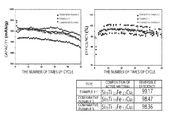
  • FIGS. 6A to 6D are graphs and tables representing a cycle life characteristic and reversible efficiency of the negative electrode active materials of Examples 1 to 3, and Comparative Examples 1 to 4.
  • a negative electrode active material for a lithium secondary battery includes an alloy containing silicon (Si), titanium (Ti), and iron (Fe), in which the degree of amorphization of the alloy is raised by 40% or more by further adding copper (Cu) to the alloy.
  • Respective characteristics of several exemplary embodiments of the present disclosure may be partially or entirely coupled or combined, and technically and variously connected and driven enough for those skilled in the art to fully understand, and respective exemplary embodiments may be independently carried out, and implemented together according to an associated relation.
  • a unit “%” used in the present specification means “atom %” unless otherwise regulated.
  • the present invention provides a negative electrode active material, in which the degree of amorphization of an alloy is raised by 40% or more by further adding copper (Cu) to the alloy containing silicon (Si), titanium (Ti), and iron (Fe).
  • the degree of amorphization is a value numerically representing the degree of amorphous region, not a crystalline region, which is included in the alloy, and as further described below, the degree of amorphization may be obtained by analyzing a result of XRD data.
  • silicon (Si) may involve in occlusion and discharge of lithium ions when a negative electrode active material is used as a battery.
  • silicon (Si) may be contained in the alloy by 67 to 73 at %, but is not essentially limited thereto.
  • titanium (Ti) and iron(Fe) form a matrix, in which silicon (Si), which involves in occlusion and discharge of lithium ions, is dispersible, together with silicon (Si).
  • silicon (Si) which involves in occlusion and discharge of lithium ions, is dispersible, together with silicon (Si).
  • Each of titanium (Ti) and iron (Fe) may be contained in the alloy by 10 to 20 at %, but is not essentially limited thereto.
  • titanium (Ti) and iron (Fe) may be added to the alloy by the ratio of 1:1.
  • copper (Cu) is added to the alloy containing silicon (Si), titanium (Ti), and iron (Fe), and suppresses the generation and the growth of a crystal during a process of the coagulation of the matrix of the alloy to serve to raise the degree of amorphization of the alloy.
  • copper (Cu) may be contained in the alloy by 4 to 6 at %, but if the degree of amorphization of the alloy is raised by 40% or more, the quantity of copper (Cu) contained in the alloy is not particularly limited.
  • Copper is added to the alloy containing silicon (Si), titanium (Ti), and iron (Fe) to suppress the generation and the growth of amorphous TiFeSi 2 , so that as a result of the ex situ XRD analysis of the alloy, a peak of a composition, in which silicon (Si), titanium (Ti), and iron (Fe) are combined by an integer ratio, may not be substantially observed.
  • the matrix is mainly formed as the amorphous region, not the crystalline region.
  • Zirconium (Zr) may be added to 0.01 to 4 at % to the alloy, other than silicon (Si), titanium (Ti), iron (Fe), and copper (Cu). Zirconium (Zr) is added to the alloy by 0.01 to 4 at % to serve to further improve reversible efficiency and a life characteristic of the alloy.
  • zirconium (Zr) When zirconium (Zr) is excessively added to the alloy, a CuSi 2 Zr crystal is formed in the matrix, so that the degree of amorphization of the alloy may be less than 40%. In this case, the reversible efficiency and the life characteristic of the alloy may be degraded, so that zirconium (Zr) may be added to the alloy by an appropriate quantity, that is, 0.01 to 4 at %.
  • a method of preparing the negative electrode active material of the present invention is not particularly limited, and for example, various fine powder preparing methods (a gas atomizer method, a centrifugal gas atomizer method, a plasma atomizer method, a rotating electrode method, and a mechanical alloy method) publicly known in the art may be used.
  • Example 1 a negative electrode active material having a composition of Si 70 Ti 12.5 Fe 12.5 Cu 5 was fabricated by mixing silicon (Si), titanium (Ti), iron (Fe), and copper (Cu) by a ratio of 70%:12.5%:12.5%:5%, melting the mixture by an arc melting method and the like, and applying a single roll rapid solidification method, which disperses the melt to a rotating copper roll.
  • Example 2 a negative electrode active material was fabricated in the same manner as that of Example 1, except that silicon (Si), titanium (Ti), iron (Fe), copper (Cu), and zirconium (Zr) were mixed by a ratio of 70%:12%:12%:5%:1%, so that the negative electrode active material had a composition of Si 70 Ti 12 Fe 12 Cu 5 Zr 1 .
  • Example 3 a negative electrode active material was fabricated in the same manner as that of Example 1, except that silicon (Si), titanium (Ti), iron (Fe), copper (Cu), and zirconium (Zr) were mixed by a ratio of 70%:11%:11%:5%:3%, so that the negative electrode active material had a composition of Si 70 Ti 11 Fe 11 Cu 5 Zr 3 .
  • a negative electrode active material was fabricated in the same manner as that of Example 1, except that silicon (Si), titanium (Ti), and iron (Fe) were mixed by a ratio of 70%:15%:15%, so that the negative electrode active material had a composition of Si 70 Ti 15 Fe 15 .
  • a negative electrode active material was fabricated in the same manner as that of Example 1, except that silicon (Si), titanium (Ti), iron (Fe), and copper (Cu) were mixed by a ratio of 70%:13.5%:13.5%:3%, so that the negative electrode active material had a composition of Si 70 Ti 13.5 Fe 13.5 Cu 3 .
  • a negative electrode active material was fabricated in the same manner as that of Example 1, except that silicon (Si), titanium (Ti), iron (Fe), and copper (Cu) were mixed by a ratio of 70%:11.5%:11.5%:7%, so that the negative electrode active material had a compo sition of Si 70 Ti 11.5 Fe 11.5 Cu 7 .
  • a negative electrode active material was fabricated in the same manner as that of Example 1, except that silicon (Si), titanium (Ti), iron (Fe), copper (Cu), and zirconium (Zr) were mixed by a ratio of 70%:10%:10%:5%:5%, so that the negative electrode active material has a composition of Si 70 Ti 10 Fe 10 Cu 5 Zr 5 .
  • SEM Scanning Electron Microscopy
  • FIGS. 1A to 1C are SEM pictures of enlarged negative electrode active materials of Examples 1 to 3
  • FIGS. 1D to 1G are SEM pictures of enlarged negative electrode active materials of Comparative Examples 1 to 4.
  • the negative electrode active materials of Examples 1 to 3 have finer structures than those of the negative electrode active materials of Comparative Examples 1 to 4.
  • FIGS. 2A and 2B show diagrams of an example for describing a calculation of the degree of amorphization based on an XRD pattern.
  • the degree of amorphization may be obtained by calculating an entire area from FIG. 2A , calculating a crystallization area from FIG. 2B , and the substituting the calculated values to the formula of the degree of amorphization below.
  • Degree of amorphization (%) ((entire area ⁇ crystallization area) ⁇ entire area) ⁇ 100
  • FIG. 3 is a table representing the calculated degrees of amorphization of the negative electrode active materials of Examples 1 to 3, and Comparative Examples 1 to 4.
  • the negative electrode active materials of Examples 1 to 3 have the degree of amorphization of 40% or more, and the negative electrode active materials of Comparative Examples 1 to 4 have the degree of amorphization less than 40%.
  • the Cu k ⁇ ray XRD measurement were performed on the negative electrode active materials of Examples 1 to 3, and Comparative Examples 1 to 4, and the result of the measurement is represented in FIGS. 4A to 4C .
  • FIG. 4A represents XRD data for the negative electrode active materials of Example 1 and Comparative Example 1.
  • FIG. 4B represents XRD data for the negative electrode active materials of Example 1 and Comparative Examples 2 and 3.
  • FIG. 4C represents XRD data for the negative electrode active materials of Examples 1 to 3 and Comparative Example 4.
  • a coin-shaped electrode plate was manufactured by using the negative electrode active materials of Examples 1 to 3, and Comparative Examples 1 to 4, and then the charging/discharging evaluation was performed.
  • the electrode plates were manufactured by mixing the negative electrode active materials of Example 1 and Comparative Examples 1 to 3, conductive graphite (SFG6 graphite), a conductive agent (a KB conductive agent), and a binder (a PI-based binder) in a weight ratio of 77:15:2:6. Further, the electrode plates were manufactured by mixing the negative electrode active materials of Examples 1 to 3, and Comparative Examples 1 and 4, a conductive agent (a KB conductive agent), and a binder (a PI-based binder) in a weight ratio of 86.6:3.4:10.
  • the charging/discharging was performed on the manufactured electrode plates one time, and then an active material charging quantity (mAh/g), an active material discharging quantity (mAh/g), and initial efficiency (%) were measured, and the measurement result is illustrated in FIGS. 5A and 5B .
  • a cycle life characteristic and reversible efficiency were measured by repeating the charging/discharging 50 times at 0.5 C, and the charging/discharging method was performed under the charging/discharging method for an active material for a lithium secondary battery, which is generally and publicly known in the art.
  • FIGS. 6A to 6D represent a cycle life characteristic and reversible efficiency of the negative electrode active materials of Examples 1 to 3, and Comparative Examples 1 to 4 according to the aforementioned charging/discharging.
  • FIGS. 6A and 6B represent cycle life characteristic and reversible efficiency of Examples and Comparative Examples listed in the table of FIG. 5A
  • FIGS. 6C and 6D represent cycle life characteristic and reversible efficiency of Examples and Comparative Examples listed in the table of FIG. 5B
  • Reversible efficiency was drawn from an average of efficiency from the 10 th to 50 th cycle.
  • the negative electrode active material (Example 1-1), in which copper (Cu) is added by 5 at %, represents an excellent capacity maintenance characteristic (that is, a cycle life characteristic), and has high reversible efficiency, compared to the negative electrode active material (Comparative Example 1-1), which is composed of silicon (Si), titanium (Ti), and iron (Fe).
  • the negative electrode active material (Example 1-1), in which copper (Cu) is added by 5 at %, represents an excellent capacity maintenance characteristic (that is, a cycle life characteristic), and has high reversible efficiency, compared to the negative electrode active materials (Comparative Examples 2 and 3), in which copper (Cu) is added by 3 at % and 7 at %.
  • the negative electrode active material (Example 1-2), in which copper (Cu) is added by 5 at %, represents an excellent capacity maintenance characteristic (that is, a cycle life characteristic), and has high reversible efficiency, compared to the negative electrode active material (Comparative Example 1-2), which is composed of silicon (Si), titanium(Ti), and iron (Fe).
  • the negative electrode active materials (Examples 2 and 3), in which zirconium (Zr) is added by 1 at % and 3 at %, represent an excellent capacity maintenance characteristic (that is, a cycle life characteristic), and have high reversible efficiency, compared to the negative electrode active material (Comparative Example 4), in which zirconium (Zr) is added by 5 at %. Based on the result, it can be seen that when zirconium is excessively added, that is, 5 at %, reversible efficiency and a life characteristic are degraded.
  • the degree of amorphization of the negative electrode active material is raised by copper and zirconium, that is, a lot of the amorphous regions is formed in the negative electrode active material, and a volume expansion of the negative electrode active material is suppressed during the charging/discharging, and thus, a cycle life characteristic and reversible efficiency of the negative electrode active material are improved.

Landscapes

  • Chemical & Material Sciences (AREA)
  • Engineering & Computer Science (AREA)
  • Chemical Kinetics & Catalysis (AREA)
  • Electrochemistry (AREA)
  • General Chemical & Material Sciences (AREA)
  • Materials Engineering (AREA)
  • Mechanical Engineering (AREA)
  • Metallurgy (AREA)
  • Organic Chemistry (AREA)
  • Manufacturing & Machinery (AREA)
  • Inorganic Chemistry (AREA)
  • Battery Electrode And Active Subsutance (AREA)

Abstract

A negative electrode active material for a lithium secondary battery according to an exemplary embodiment of the present invention includes an alloy containing silicon (Si), titanium (Ti), and iron (Fe), wherein the degree of amorphization of the alloy is raised by 40% or more by further adding copper (Cu) to the alloy.

Description

CROSS-REFERENCE TO PRIOR APPLICATIONS
This application is a national Stage Patent Application of PCT International Patent Application No. PCT/KR2014/012088, filed on Dec. 9, 2014 under 35 U.S.C. § 371, which claims priority of Korean Patent Application No. 10-2014-0006829, filed on Jan. 20, 2014, which are all hereby incorporated by reference in their entirety.
TECHNICAL FIELD
The present invention relates to a negative electrode active material for a lithium secondary battery, and more particularly, to a negative electrode active material for a lithium secondary battery having high reversible efficiency and an excellent capacity maintaining characteristic.
BACKGROUND ART
A lithium battery in the related art uses a lithium metal as a negative electrode active material, but when a lithium metal is used, a battery is short-circuited due to formation of dendrite to cause danger of explosion, so that a carbon-based material is widely used as a negative electrode active material, instead of a lithium metal.
The carbon-based active material includes crystalline carbon, such as natural graphite and artificial graphite, and amorphous carbon, such as soft carbon and hard carbon. However, the amorphous carbon has a large capacity, but has a problem in that irreversibility is large during a charging/discharging process. Graphite is representatively used as the crystalline carbon, and has a theatrical limit capacity of 372 mAh/g, which is large, so that graphite is used as a negative electrode active material.
In order to develop a next-generation high capacity lithium battery, a development of a negative electrode active material having a high capacity beyond the capacity of graphite is essentially required. To this end, a material, which is currently and actively researched, is a silicon-based negative electrode active material. The silicon has a high capacity and a high energy density, and is capable of occluding and discharging the larger amount of lithium ions than the negative electrode active material using the carbon-based material, so that it is possible to manufacture a secondary battery having a high capacity and a high energy density.
The silicon-based active material has a problem in a volume expansion, and in order to solve the problem, a silicon alloy, which finely disperses silicon inside a parent metal, is considered as a technology having the highest probability. The representative silicon-based alloy is disclosed in Korean Patent No. 10-1263265. More particularly, the silicon-based alloy, in which silicon (Si), titanium (Ti), and iron (Fe) are mixed in a ratio of 67%:16.5%:16.5%, 70%:15%:15%, or 74%:13%:13%, is disclosed in the Patent Publication.
Although the silicon-based active material disclosed in the Patent Publication has a relatively large capacity and an improved life characteristic, but according to a rapid increase of the use of mobile devices, such as a mobile phone and a notebook computer, a silicon-based active material, which is capable of further improving a life characteristic of a secondary battery, has been continuously demanded.
DISCLOSURE Technical Problem
An object of the present invention is to provide a negative electrode active material for a lithium secondary battery having high reversible efficiency and an excellent capacity maintaining characteristic.
Another object of the present invention is to provide a negative electrode active material for a lithium secondary battery, which is capable of implementing a secondary battery having a more improved life characteristic.
Objects of the present invention are not limited to the objects described above, and other objects that are not described will be clearly understood by a person skilled in the art from the description below.
Technical Solution
In order to achieve the aforementioned object, a negative electrode active material for a lithium secondary battery according to an exemplary embodiment of the present invention includes an alloy containing silicon (Si), titanium (Ti), and iron (Fe), in which the degree of amorphization of the alloy is raised by 40% or more by further adding copper (Cu) to the alloy.
The silicon (Si) may be contained in the alloy by 67 to 73 at %.
A ratio of the iron (Fe) to the titanium (Ti) contained in the alloy may be 1:1.
The copper (Cu) may be added to the alloy by 4 to 6 at %.
As a result of an ex situ XRD analysis of the alloy, a peak of a compound, in which silicon (Si), titanium (Ti), and iron (Fe) are combined by an integer ratio, may not be substantially observed.
The alloy may further contain zirconium (Zr) of 0.01 to 4 at %.
Other detailed matters of the exemplary embodiments are included in the detailed description and the drawings.
Advantageous Effects
The present invention has an effect in providing the negative electrode active material for a lithium secondary battery having high reversible efficiency and an excellent capacity maintaining characteristic.
The present invention has an effect in implementing a secondary battery having a more improved life characteristic.
Objects of the present invention are not limited to the objects described above, and other objects that are not described will be clearly understood by a p erson skilled in the art from the description below.
DESCRIPTION OF DRAWINGS
FIGS. 1A to 1G are SEM pictures of enlarged negative electrode active materials of Examples 1 to 3, and Comparative Examples 1 to 4.
FIGS. 2A and 2B show diagrams of an example for describing a calculation of the degree of amorphization based on an XRD pattern.
FIG. 3 is a table representing calculated degrees of amorphization of the negative electrode active materials of Examples 1 to 3, and Comparative Examples 1 to 4.
FIGS. 4A to 4C are XRD data for the negative electrode active materials of Examples 1 to 3, and Comparative Examples 1 to 4.
FIGS. 5A to 5B are tables representing an active material charging quantity, an active material discharging quantity, and initial efficiency of the negative electrode active materials of Examples 1 to 3, and Comparative Examples 1 to 4.
FIGS. 6A to 6D are graphs and tables representing a cycle life characteristic and reversible efficiency of the negative electrode active materials of Examples 1 to 3, and Comparative Examples 1 to 4.
BEST MODE
In order to achieve the aforementioned object, a negative electrode active material for a lithium secondary battery according to an exemplary embodiment of the present invention includes an alloy containing silicon (Si), titanium (Ti), and iron (Fe), in which the degree of amorphization of the alloy is raised by 40% or more by further adding copper (Cu) to the alloy.
[Mode for Carrying out the Invention]
Advantages and features of the present disclosure and methods accomplishing the advantages and features will become apparent from the following detailed description of exemplary embodiments with reference to the accompanying drawings. However, the present invention is not limited to exemplary embodiment disclosed herein but will be implemented in various forms. The exemplary embodiments are provided so that the present invention is completely disclosed, and a person of ordinary skilled in the art can fully understand the scope of the present invention. Therefore, the present invention will be defined only by the scope of the appended claims.
Respective characteristics of several exemplary embodiments of the present disclosure may be partially or entirely coupled or combined, and technically and variously connected and driven enough for those skilled in the art to fully understand, and respective exemplary embodiments may be independently carried out, and implemented together according to an associated relation.
The term “approximate” used in the present specification is used as a numerical value or a meaning close to the numerical value when an unique manufacturing and material allowable error is suggested to a mentioned meaning, and is used for preventing an unconscionable infringer from illegally using the disclosed contents including an accurate or absolute numerical value mentioned for helping the understanding of the present invention.
A unit “%” used in the present specification means “atom %” unless otherwise regulated.
The present invention provides a negative electrode active material, in which the degree of amorphization of an alloy is raised by 40% or more by further adding copper (Cu) to the alloy containing silicon (Si), titanium (Ti), and iron (Fe).
Here, the degree of amorphization is a value numerically representing the degree of amorphous region, not a crystalline region, which is included in the alloy, and as further described below, the degree of amorphization may be obtained by analyzing a result of XRD data.
In the present invention, silicon (Si) may involve in occlusion and discharge of lithium ions when a negative electrode active material is used as a battery. In the present invention, silicon (Si) may be contained in the alloy by 67 to 73 at %, but is not essentially limited thereto.
In the present invention, titanium (Ti) and iron(Fe) form a matrix, in which silicon (Si), which involves in occlusion and discharge of lithium ions, is dispersible, together with silicon (Si). Each of titanium (Ti) and iron (Fe) may be contained in the alloy by 10 to 20 at %, but is not essentially limited thereto.
In the meantime, titanium (Ti) and iron (Fe) may be added to the alloy by the ratio of 1:1.
In the present invention, copper (Cu) is added to the alloy containing silicon (Si), titanium (Ti), and iron (Fe), and suppresses the generation and the growth of a crystal during a process of the coagulation of the matrix of the alloy to serve to raise the degree of amorphization of the alloy. In the present invention, copper (Cu) may be contained in the alloy by 4 to 6 at %, but if the degree of amorphization of the alloy is raised by 40% or more, the quantity of copper (Cu) contained in the alloy is not particularly limited.
Copper is added to the alloy containing silicon (Si), titanium (Ti), and iron (Fe) to suppress the generation and the growth of amorphous TiFeSi2, so that as a result of the ex situ XRD analysis of the alloy, a peak of a composition, in which silicon (Si), titanium (Ti), and iron (Fe) are combined by an integer ratio, may not be substantially observed. This means that the matrix is mainly formed as the amorphous region, not the crystalline region.
Zirconium (Zr) may be added to 0.01 to 4 at % to the alloy, other than silicon (Si), titanium (Ti), iron (Fe), and copper (Cu). Zirconium (Zr) is added to the alloy by 0.01 to 4 at % to serve to further improve reversible efficiency and a life characteristic of the alloy.
When zirconium (Zr) is excessively added to the alloy, a CuSi2Zr crystal is formed in the matrix, so that the degree of amorphization of the alloy may be less than 40%. In this case, the reversible efficiency and the life characteristic of the alloy may be degraded, so that zirconium (Zr) may be added to the alloy by an appropriate quantity, that is, 0.01 to 4 at %.
EXAMPLE 1
A method of preparing the negative electrode active material of the present invention is not particularly limited, and for example, various fine powder preparing methods (a gas atomizer method, a centrifugal gas atomizer method, a plasma atomizer method, a rotating electrode method, and a mechanical alloy method) publicly known in the art may be used.
In Example 1, a negative electrode active material having a composition of Si70Ti12.5Fe12.5Cu5 was fabricated by mixing silicon (Si), titanium (Ti), iron (Fe), and copper (Cu) by a ratio of 70%:12.5%:12.5%:5%, melting the mixture by an arc melting method and the like, and applying a single roll rapid solidification method, which disperses the melt to a rotating copper roll.
EXAMPLE 2
In Example 2, a negative electrode active material was fabricated in the same manner as that of Example 1, except that silicon (Si), titanium (Ti), iron (Fe), copper (Cu), and zirconium (Zr) were mixed by a ratio of 70%:12%:12%:5%:1%, so that the negative electrode active material had a composition of Si70Ti12Fe12Cu5Zr1.
EXAMPLE 3
In Example 3, a negative electrode active material was fabricated in the same manner as that of Example 1, except that silicon (Si), titanium (Ti), iron (Fe), copper (Cu), and zirconium (Zr) were mixed by a ratio of 70%:11%:11%:5%:3%, so that the negative electrode active material had a composition of Si70Ti11Fe11Cu5Zr3.
COMPARATIVE EXAMPLE 1
In Comparative Example 1, a negative electrode active material was fabricated in the same manner as that of Example 1, except that silicon (Si), titanium (Ti), and iron (Fe) were mixed by a ratio of 70%:15%:15%, so that the negative electrode active material had a composition of Si70Ti15Fe15.
COMPARATIVE EXAMPLE 2
In Comparative Example 2, a negative electrode active material was fabricated in the same manner as that of Example 1, except that silicon (Si), titanium (Ti), iron (Fe), and copper (Cu) were mixed by a ratio of 70%:13.5%:13.5%:3%, so that the negative electrode active material had a composition of Si70Ti13.5Fe13.5Cu3.
COMPARATIVE EXAMPLE 3
In Comparative Example 3, a negative electrode active material was fabricated in the same manner as that of Example 1, except that silicon (Si), titanium (Ti), iron (Fe), and copper (Cu) were mixed by a ratio of 70%:11.5%:11.5%:7%, so that the negative electrode active material had a compo sition of Si70Ti11.5Fe11.5Cu7.
COMPARATIVE EXAMPLE 4
In Comparative Example 4, a negative electrode active material was fabricated in the same manner as that of Example 1, except that silicon (Si), titanium (Ti), iron (Fe), copper (Cu), and zirconium (Zr) were mixed by a ratio of 70%:10%:10%:5%:5%, so that the negative electrode active material has a composition of Si70Ti10Fe10Cu5Zr5.
SEM Analysis
A Scanning Electron Microscopy (SEM) analysis was performed on the fabricated negative electrode active material.
FIGS. 1A to 1C are SEM pictures of enlarged negative electrode active materials of Examples 1 to 3, and FIGS. 1D to 1G are SEM pictures of enlarged negative electrode active materials of Comparative Examples 1 to 4.
Referring to FIGS. 1A to 1G, it can be seen that the negative electrode active materials of Examples 1 to 3 have finer structures than those of the negative electrode active materials of Comparative Examples 1 to 4.
2. Analysis of the Degree of Amorphization
FIGS. 2A and 2B show diagrams of an example for describing a calculation of the degree of amorphization based on an XRD pattern.
The degree of amorphization may be obtained by calculating an entire area from FIG. 2A, calculating a crystallization area from FIG. 2B, and the substituting the calculated values to the formula of the degree of amorphization below.
Degree of amorphization (%)=((entire area−crystallization area)÷entire area)×100
FIG. 3 is a table representing the calculated degrees of amorphization of the negative electrode active materials of Examples 1 to 3, and Comparative Examples 1 to 4.
Referring to FIG. 3, it can be seen that the negative electrode active materials of Examples 1 to 3 have the degree of amorphization of 40% or more, and the negative electrode active materials of Comparative Examples 1 to 4 have the degree of amorphization less than 40%.
3. XRD Analysis
The Cu kαray XRD measurement were performed on the negative electrode active materials of Examples 1 to 3, and Comparative Examples 1 to 4, and the result of the measurement is represented in FIGS. 4A to 4C.
FIG. 4A represents XRD data for the negative electrode active materials of Example 1 and Comparative Example 1.
Referring to FIG. 4A, as a result of the XRD analysis for the negative electrode active materials of Example 1 and Comparative Example 1, it can be seen that a peak of TiFeSi2 is observed in the negative electrode active material of Comparative Example 1, but a peak of a composition, in which silicon (Si), titanium (Ti), and iron (Fe) are combined by an integer ratio, is not substantially observed in the negative electrode active material of Example 1.
From the results of FIGS. 3 and 4A, it can be seen that when copper (Cu) is added to the alloy containing silicon (Si), titanium (Ti), and iron (Fe), the generation and the growth of the TiFeSi2 crystal are suppressed, and the degree of amorphization of the negative electrode active material is raised.
FIG. 4B represents XRD data for the negative electrode active materials of Example 1 and Comparative Examples 2 and 3.
Referring to FIG. 4B, as the result of the XRD analysis for the negative electrode active materials of Example 1 and Comparative Examples 2 and 3, it can be seen that a peak of TiFeSi2 or Cu3Si is observed in the negative electrode active materials of Comparative Examples 2 and 3, but other peaks, other than a peak of silicon (Si), are not substantially observed in the negative electrode active material of Example 1.
From the results of FIGS. 3 and 4B, it can be seen that only when copper (Cu) is added by an appropriate quantity, that is, 4 to 6 at %, the generation and the growth of TiFeSi2 or Cu3Si crystal are suppressed, and the degree of amorphization of the negative electrode active material is raised.
FIG. 4C represents XRD data for the negative electrode active materials of Examples 1 to 3 and Comparative Example 4.
Referring to FIG. 4C, as the result of the XRD analysis for the negative electrode active materials of Examples 1 to 3 and Comparative Example 4, other peaks, other than a peak of silicon (Si), are not substantially observed in the negative electrode active materials of Examples 1 to 3, but a peak of CuSi2Zr is observed in the negative electrode active material of Comparative Example 4.
From the results of FIGS. 3 and 4C, it can be seen that only when zirconium (Zr) is added by an appropriate quantity, that is, 0.01 to 4 at %, the generation and the growth of the crystal are suppressed, and the degree of amorphization of the negative electrode active material is raised.
4. Active Material Capacity and Initial Efficiency
A coin-shaped electrode plate was manufactured by using the negative electrode active materials of Examples 1 to 3, and Comparative Examples 1 to 4, and then the charging/discharging evaluation was performed. Particularly, the electrode plates were manufactured by mixing the negative electrode active materials of Example 1 and Comparative Examples 1 to 3, conductive graphite (SFG6 graphite), a conductive agent (a KB conductive agent), and a binder (a PI-based binder) in a weight ratio of 77:15:2:6. Further, the electrode plates were manufactured by mixing the negative electrode active materials of Examples 1 to 3, and Comparative Examples 1 and 4, a conductive agent (a KB conductive agent), and a binder (a PI-based binder) in a weight ratio of 86.6:3.4:10.
The charging/discharging was performed on the manufactured electrode plates one time, and then an active material charging quantity (mAh/g), an active material discharging quantity (mAh/g), and initial efficiency (%) were measured, and the measurement result is illustrated in FIGS. 5A and 5B.
5. Cycle Life Characteristic and Reversible Efficiency
A cycle life characteristic and reversible efficiency were measured by repeating the charging/discharging 50 times at 0.5 C, and the charging/discharging method was performed under the charging/discharging method for an active material for a lithium secondary battery, which is generally and publicly known in the art.
FIGS. 6A to 6D represent a cycle life characteristic and reversible efficiency of the negative electrode active materials of Examples 1 to 3, and Comparative Examples 1 to 4 according to the aforementioned charging/discharging.
Particularly, FIGS. 6A and 6B represent cycle life characteristic and reversible efficiency of Examples and Comparative Examples listed in the table of FIG. 5A, and FIGS. 6C and 6D represent cycle life characteristic and reversible efficiency of Examples and Comparative Examples listed in the table of FIG. 5B. Reversible efficiency was drawn from an average of efficiency from the 10th to 50th cycle.
Referring to FIG. 6A, it can be seen that the negative electrode active material (Example 1-1), in which copper (Cu) is added by 5 at %, represents an excellent capacity maintenance characteristic (that is, a cycle life characteristic), and has high reversible efficiency, compared to the negative electrode active material (Comparative Example 1-1), which is composed of silicon (Si), titanium (Ti), and iron (Fe).
Referring to FIG. 6B, it can be seen that the negative electrode active material (Example 1-1), in which copper (Cu) is added by 5 at %, represents an excellent capacity maintenance characteristic (that is, a cycle life characteristic), and has high reversible efficiency, compared to the negative electrode active materials (Comparative Examples 2 and 3), in which copper (Cu) is added by 3 at % and 7 at %.
Referring to FIG. 6C, it can be seen that the negative electrode active material (Example 1-2), in which copper (Cu) is added by 5 at %, represents an excellent capacity maintenance characteristic (that is, a cycle life characteristic), and has high reversible efficiency, compared to the negative electrode active material (Comparative Example 1-2), which is composed of silicon (Si), titanium(Ti), and iron (Fe).
Referring to FIG. 6D, it can be seen that the negative electrode active materials (Examples 2 and 3), in which zirconium (Zr) is added by 1 at % and 3 at %, represent an excellent capacity maintenance characteristic (that is, a cycle life characteristic), and have high reversible efficiency, compared to the negative electrode active material (Comparative Example 4), in which zirconium (Zr) is added by 5 at %. Based on the result, it can be seen that when zirconium is excessively added, that is, 5 at %, reversible efficiency and a life characteristic are degraded.
Although not limited by a theory, the degree of amorphization of the negative electrode active material is raised by copper and zirconium, that is, a lot of the amorphous regions is formed in the negative electrode active material, and a volume expansion of the negative electrode active material is suppressed during the charging/discharging, and thus, a cycle life characteristic and reversible efficiency of the negative electrode active material are improved.
The exemplary embodiments of the present invention have been described in more detail with reference to the accompanying drawings, but the present invention is not essentially limited to the exemplary embodiments, and may be variously modified and carried out within the scope of the technical spirit of the present invention. Accordingly, the various exemplary embodiments disclosed herein are not intended to limit the technical spirit but describe with the true scope and spirit being indicated by the following claims. The scope of the present invention should be construed based on the following appended claims and it should be construed that the technical spirit included within the scope equivalent to the claims belongs to the present invention.
Claims (2)

The invention claimed is:
1. A negative electrode active material for a lithium secondary battery, comprising:
an alloy containing silicon (Si) by 67 to 73 at %, titanium (Ti) by 11 to 12.5 at %, iron (Fe) by 11 to 12.5 at %, and copper (Cu) by 4 to 6 at %,
wherein the degree of amorphization of the alloy is raised by 40%, and wherein generation and growth of amorphous TiFeSi2 is suppressed so that, in an ex situ x-ray power diffraction (XRD) plot of the alloy, a peak corresponding to a compound that contains silicon (Si), titanium (Ti), and iron (Fe) in an integer ratio is not substantially observed.
2. The negative electrode active material of claim 1, wherein the alloy further contains zirconium (Zr) of 0.01 to 4 at %.
US15/109,394 2014-01-20 2014-12-09 Negative electrode active material for lithium secondary battery Active 2035-07-18 US10283766B2 (en)

Applications Claiming Priority (3)

Application Number Priority Date Filing Date Title
KR1020140006829A KR101620849B1 (en) 2014-01-20 2014-01-20 Negative active material for lithium secondary battery
KR10-2014-0006829 2014-01-20
PCT/KR2014/012088 WO2015108281A1 (en) 2014-01-20 2014-12-09 Negative electrode active material for lithium secondary battery

Publications (2)

Publication Number Publication Date
US20160329561A1 US20160329561A1 (en) 2016-11-10
US10283766B2 true US10283766B2 (en) 2019-05-07

Family

ID=53543126

Family Applications (1)

Application Number Title Priority Date Filing Date
US15/109,394 Active 2035-07-18 US10283766B2 (en) 2014-01-20 2014-12-09 Negative electrode active material for lithium secondary battery

Country Status (5)

Country Link
US (1) US10283766B2 (en)
JP (1) JP6315730B2 (en)
KR (1) KR101620849B1 (en)
CN (1) CN106415895B (en)
WO (1) WO2015108281A1 (en)

Families Citing this family (1)

* Cited by examiner, † Cited by third party
Publication number Priority date Publication date Assignee Title
US10128675B2 (en) * 2015-09-14 2018-11-13 Toyota Jidosha Kabushiki Kaisha All-solid-state battery system and method of manufacturing the same

Citations (5)

* Cited by examiner, † Cited by third party
Publication number Priority date Publication date Assignee Title
KR20000052362A (en) 1999-01-25 2000-08-25 김순택 Lithium secondary battery
JP2010009837A (en) 2008-06-25 2010-01-14 Furukawa Electric Co Ltd:The Alloy negative electrode material for lithium secondary battery
JP2011070779A (en) 2009-09-24 2011-04-07 Sanyo Special Steel Co Ltd Si alloy for lithium secondary battery negative electrode material
KR20120012265A (en) 2010-07-30 2012-02-09 일진전기 주식회사 Anode active material
JP2013179033A (en) 2012-02-01 2013-09-09 Sanyo Special Steel Co Ltd Silicon-based alloy negative electrode material

Family Cites Families (3)

* Cited by examiner, † Cited by third party
Publication number Priority date Publication date Assignee Title
EP2219253B1 (en) * 1998-09-18 2015-06-10 Canon Kabushiki Kaisha Electrode material
WO2004086539A1 (en) * 2003-03-26 2004-10-07 Canon Kabushiki Kaisha Electrode material for lithium secondary battery and electrode structure having the electrode material
JP5072323B2 (en) * 2005-11-17 2012-11-14 パナソニック株式会社 Nonaqueous electrolyte secondary battery and method for producing negative electrode material for nonaqueous electrolyte secondary battery

Patent Citations (7)

* Cited by examiner, † Cited by third party
Publication number Priority date Publication date Assignee Title
KR20000052362A (en) 1999-01-25 2000-08-25 김순택 Lithium secondary battery
JP2010009837A (en) 2008-06-25 2010-01-14 Furukawa Electric Co Ltd:The Alloy negative electrode material for lithium secondary battery
JP2011070779A (en) 2009-09-24 2011-04-07 Sanyo Special Steel Co Ltd Si alloy for lithium secondary battery negative electrode material
KR20120012265A (en) 2010-07-30 2012-02-09 일진전기 주식회사 Anode active material
EP2600446A1 (en) 2010-07-30 2013-06-05 IL Jin Electric Co., Ltd. Negative active material
JP2013179033A (en) 2012-02-01 2013-09-09 Sanyo Special Steel Co Ltd Silicon-based alloy negative electrode material
US20140370386A1 (en) * 2012-02-01 2014-12-18 Sanyo Special Steel Co., Ltd. Si-Based-Alloy Anode Material

Also Published As

Publication number Publication date
JP2017504161A (en) 2017-02-02
KR20150086777A (en) 2015-07-29
KR101620849B1 (en) 2016-05-13
JP6315730B2 (en) 2018-04-25
CN106415895A (en) 2017-02-15
WO2015108281A1 (en) 2015-07-23
US20160329561A1 (en) 2016-11-10
CN106415895B (en) 2019-05-28

Similar Documents

Publication Publication Date Title
Fang et al. A practical high‐energy cathode for sodium‐ion batteries based on uniform P2‐Na0. 7CoO2 microspheres
Yang et al. Heterostructured nanocube‐shaped binary sulfide (SnCo) S2 interlaced with S‐doped graphene as a high‐performance anode for advanced Na+ batteries
Zhang et al. α-MoO3-x by plasma etching with improved capacity and stabilized structure for lithium storage
Wang et al. Crystal orientation tuning of LiFePO4 nanoplates for high rate lithium battery cathode materials
Hu et al. A hierarchical structure of carbon-coated Li3VO4 nanoparticles embedded in expanded graphite for high performance lithium ion battery
CN107743659B (en) Ionic liquid type high-energy lithium ion battery
CN106104863B (en) The negative electrode material of electrical storage device
Kim et al. In Situ Formation of a Cathode–Electrolyte Interface with Enhanced Stability by Titanium Substitution for High Voltage Spinel Lithium‐Ion Batteries
Zhang et al. Enhancing electrochemical performance of LiMn2O4 cathode material at elevated temperature by uniform nanosized TiO2 coating
Hwang et al. Nano-compacted Li2S/Graphene composite cathode for high-energy lithium–sulfur batteries
Liao et al. Heat‐resistant carbon‐coated potassium magnesium hexacyanoferrate nanoplates for high‐performance potassium‐ion batteries
Yeom et al. Nitrogen plasma-assisted functionalization of silicon/graphite anodes to enable fast kinetics
TW201246671A (en) Electrode active material and method for producing the same
US20160372745A1 (en) Negative electrode active material for lithium secondary battery
JP2016534509A (en) Positive electrode active material for secondary battery
Liu et al. Biphase‐to‐monophase structure evolution of Na0. 766+ xLixNi0. 33− xMn0. 5Fe0. 1Ti0. 07O2 toward ultradurable Na‐ion batteries
Yu et al. Solid-state synthesis of LiCoO2/LiCo0. 99Ti0. 01O2 composite as cathode material for lithium ion batteries
Fang et al. Latticed‐Confined Conversion Chemistry of Battery Electrode
Wang et al. Simultaneously Constructing a TiO2–LiF Composite Coating Enhancing the Cycling Stability of LiCoO2 at 4.6 V High Voltage
Sun et al. In Situ Constructed Spinel Layer Stabilized Upcycled LiCoO2 for High Performance Lithium‐Ion Batteries
Zheng et al. Magnetron sputtering deposition of MSb (M= Fe, Ni, Co) thin films as negative electrodes for Li-ion and Na-ion batteries
Wang et al. Structural evolution and electrochemical performance of Li2MnSiO4/C nanocomposite as cathode material for Li‐ion batteries
US10283766B2 (en) Negative electrode active material for lithium secondary battery
Xie et al. Electrochemical Li-uptake properties of nanosized NiSb2 prepared by solvothermal route
US20160315318A1 (en) Negative active material for lithium secondary battery

Legal Events

Date Code Title Description
AS Assignment

Owner name: ILJIN ELECTRIC CO., LTD., KOREA, REPUBLIC OF

Free format text: ASSIGNMENT OF ASSIGNORS INTEREST;ASSIGNORS:PARK, CHEOL HO;KIM, SEON KYONG;LEE, SEUNG CHUL;AND OTHERS;REEL/FRAME:048621/0856

Effective date: 20160626

STPP Information on status: patent application and granting procedure in general

Free format text: PUBLICATIONS -- ISSUE FEE PAYMENT VERIFIED

FEPP Fee payment procedure

Free format text: ENTITY STATUS SET TO SMALL (ORIGINAL EVENT CODE: SMAL); ENTITY STATUS OF PATENT OWNER: SMALL ENTITY

STCF Information on status: patent grant

Free format text: PATENTED CASE

MAFP Maintenance fee payment

Free format text: PAYMENT OF MAINTENANCE FEE, 4TH YR, SMALL ENTITY (ORIGINAL EVENT CODE: M2551); ENTITY STATUS OF PATENT OWNER: SMALL ENTITY

Year of fee payment: 4