US10277623B2 - Method of detection of comptromised accounts - Google Patents
Method of detection of comptromised accounts Download PDFInfo
- Publication number
- US10277623B2 US10277623B2 US15/075,077 US201615075077A US10277623B2 US 10277623 B2 US10277623 B2 US 10277623B2 US 201615075077 A US201615075077 A US 201615075077A US 10277623 B2 US10277623 B2 US 10277623B2
- Authority
- US
- United States
- Prior art keywords
- user
- password
- compromised
- account
- hashed
- Prior art date
- Legal status (The legal status is an assumption and is not a legal conclusion. Google has not performed a legal analysis and makes no representation as to the accuracy of the status listed.)
- Active, expires
Links
Images




Classifications
-
- H—ELECTRICITY
- H04—ELECTRIC COMMUNICATION TECHNIQUE
- H04L—TRANSMISSION OF DIGITAL INFORMATION, e.g. TELEGRAPHIC COMMUNICATION
- H04L63/00—Network architectures or network communication protocols for network security
- H04L63/14—Network architectures or network communication protocols for network security for detecting or protecting against malicious traffic
- H04L63/1441—Countermeasures against malicious traffic
-
- H—ELECTRICITY
- H04—ELECTRIC COMMUNICATION TECHNIQUE
- H04L—TRANSMISSION OF DIGITAL INFORMATION, e.g. TELEGRAPHIC COMMUNICATION
- H04L63/00—Network architectures or network communication protocols for network security
- H04L63/08—Network architectures or network communication protocols for network security for authentication of entities
- H04L63/083—Network architectures or network communication protocols for network security for authentication of entities using passwords
-
- H—ELECTRICITY
- H04—ELECTRIC COMMUNICATION TECHNIQUE
- H04L—TRANSMISSION OF DIGITAL INFORMATION, e.g. TELEGRAPHIC COMMUNICATION
- H04L9/00—Cryptographic mechanisms or cryptographic arrangements for secret or secure communications; Network security protocols
- H04L9/002—Countermeasures against attacks on cryptographic mechanisms
-
- H—ELECTRICITY
- H04—ELECTRIC COMMUNICATION TECHNIQUE
- H04L—TRANSMISSION OF DIGITAL INFORMATION, e.g. TELEGRAPHIC COMMUNICATION
- H04L9/00—Cryptographic mechanisms or cryptographic arrangements for secret or secure communications; Network security protocols
- H04L9/32—Cryptographic mechanisms or cryptographic arrangements for secret or secure communications; Network security protocols including means for verifying the identity or authority of a user of the system or for message authentication, e.g. authorization, entity authentication, data integrity or data verification, non-repudiation, key authentication or verification of credentials
- H04L9/3226—Cryptographic mechanisms or cryptographic arrangements for secret or secure communications; Network security protocols including means for verifying the identity or authority of a user of the system or for message authentication, e.g. authorization, entity authentication, data integrity or data verification, non-repudiation, key authentication or verification of credentials using a predetermined code, e.g. password, passphrase or PIN
-
- H—ELECTRICITY
- H04—ELECTRIC COMMUNICATION TECHNIQUE
- H04L—TRANSMISSION OF DIGITAL INFORMATION, e.g. TELEGRAPHIC COMMUNICATION
- H04L9/00—Cryptographic mechanisms or cryptographic arrangements for secret or secure communications; Network security protocols
- H04L9/32—Cryptographic mechanisms or cryptographic arrangements for secret or secure communications; Network security protocols including means for verifying the identity or authority of a user of the system or for message authentication, e.g. authorization, entity authentication, data integrity or data verification, non-repudiation, key authentication or verification of credentials
- H04L9/3236—Cryptographic mechanisms or cryptographic arrangements for secret or secure communications; Network security protocols including means for verifying the identity or authority of a user of the system or for message authentication, e.g. authorization, entity authentication, data integrity or data verification, non-repudiation, key authentication or verification of credentials using cryptographic hash functions
-
- G—PHYSICS
- G06—COMPUTING OR CALCULATING; COUNTING
- G06F—ELECTRIC DIGITAL DATA PROCESSING
- G06F21/00—Security arrangements for protecting computers, components thereof, programs or data against unauthorised activity
- G06F21/60—Protecting data
- G06F21/62—Protecting access to data via a platform, e.g. using keys or access control rules
- G06F21/6218—Protecting access to data via a platform, e.g. using keys or access control rules to a system of files or objects, e.g. local or distributed file system or database
- G06F21/6245—Protecting personal data, e.g. for financial or medical purposes
- G06F21/6254—Protecting personal data, e.g. for financial or medical purposes by anonymising data, e.g. decorrelating personal data from the owner's identification
-
- H—ELECTRICITY
- H04—ELECTRIC COMMUNICATION TECHNIQUE
- H04L—TRANSMISSION OF DIGITAL INFORMATION, e.g. TELEGRAPHIC COMMUNICATION
- H04L2209/00—Additional information or applications relating to cryptographic mechanisms or cryptographic arrangements for secret or secure communication H04L9/00
- H04L2209/42—Anonymization, e.g. involving pseudonyms
-
- H—ELECTRICITY
- H04—ELECTRIC COMMUNICATION TECHNIQUE
- H04L—TRANSMISSION OF DIGITAL INFORMATION, e.g. TELEGRAPHIC COMMUNICATION
- H04L63/00—Network architectures or network communication protocols for network security
- H04L63/06—Network architectures or network communication protocols for network security for supporting key management in a packet data network
Definitions
- Described herein are techniques and systems for detection of compromised accounts.
- Various embodiments of this disclosure include obtaining, by a computing device, a user credential including a user ID, and modifying the user ID.
- the computing device may transmit the modified user ID to a service including a database related to compromised accounts, receive a record corresponding to the modified user ID that includes information of a compromised account, and further determine whether an account of the user ID is compromised based on the received record.
- FIG. 1 is a diagram of an illustrative computing environment that includes a computing architecture for detection of compromised accounts.
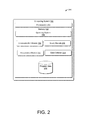
- FIG. 2 is a schematic diagram of an illustrative computing architecture to enable detection of compromised accounts.
- FIG. 3 is a diagram of an illustrative scheme that includes various records processed by a computing architecture illustrated in FIG. 1 .
- FIG. 4 is another schematic diagram of an illustrative computing architecture to enable detection of compromised accounts.
- FIG. 5 is a flow diagram of an illustrative process for detection of compromised accounts.
- Implementations herein relate to techniques that enable websites and corporate IT systems to detect relevant compromised accounts.
- the implementations include collecting and storing large amount of compromised account data by a service, which communicates with a website or an IT system.
- the implementations further include a communication protocol between the service and the website or IT system, and the communication protocol ensures security and privacy of user credentials without sacrificing usability of compromised account detection.
- the implementations may help websites or enterprise IT systems to detect compromised accounts (e.g., the accounts whose credentials have already been exposed on the Internet).
- the websites or enterprise IT systems may provide anonymized user ID to the service and then determine whether an account associated with the user ID is compromised. During the process, concerns such as security, visibility, and risks of exposure of sensitive data are addressed.
- FIG. 1 is a diagram of an illustrative computing environment 100 that includes a computing architecture for detection of compromised accounts.
- the environment 100 includes a computing system 102 associated with a service 104 .
- the computing system 102 may include a server or a collection of servers in a distributed configuration (e.g., cloud computing service, server farm, etc.) or non-distributed configuration.
- the service 104 includes a set of related hardware/software functionalities that may be reused for different purposes, together with the policies that, for example, detect compromised accounts.
- a compromised account refers to a piece of user credential (e.g., user ID and password pair) which has been exposed to the public.
- the service 104 may collect data related to compromised accounts and stored the data in a database 106 .
- the service 104 may be implemented by the computing system 102 that further communicated with other devices such as a computing system 108 associated with a service 110 and a user device 112 associated with a user 114 via a network 116 .
- the computing system 108 may include a server or a collection of servers in a distributed configuration (e.g., cloud computing service, server farm, etc.) or non-distributed configuration.
- the network 116 may include wired and/or wireless networks that enable communications between the various computing devices described in environment 100 .
- the network 116 may include local area networks (LANs), wide area networks (WAN), mobile telephone networks (MTNs), and other types of networks, possibly used in conjunction with one another, to facilitate communication between the various computing devices (e.g., the computing system 102 , the computing system 108 , and the user device 112 ).
- LANs local area networks
- WAN wide area networks
- MTNs mobile telephone networks
- the service 110 includes a set of related hardware/software functionalities that may be reused for different purposes, together with the policies that enable various provisions such as online shopping and social networking.
- the service 110 may manage account data 118 that includes data of various user accounts.
- the computing device may receive a login request 120 from the user device 112 .
- the login request may include user credential, for example, including a user identifier (ID) 122 and a password 124 associated with the user ID 122 .
- the user ID 122 may include an email address, a phone number, or other information used to identify the user 114 .
- the user 114 may attempt to login to the service 110 using the user ID 122 (e.g., abc@a.com).
- the service 110 may communicate with the service 104 to ensure security and safeguard.
- the computing system 108 may mark out the N characters of the user ID 122 to generate a modified user ID 126 , and N can range, for example, anywhere from 2 to 4 depending upon the discretion of the service 110 .
- the first N characters of the user ID 122 may be marked when the user ID is an email address; the last N characters of the user ID 122 may be marked when the user ID is a phone number.
- marking refers to “hiding”, “replacing”, “obscuring” or other operations that may be performed to anonymize the user ID 122 .
- the user ID 122 may be visible as **c@a.com to the service 104 such that the user ID 122 remains confidential to the service 104 .
- the modified user ID 126 is submitted to the computing system 102 .
- the computing system 102 may use the modified user ID 126 to query the database 106 , which stores huge amount of compromised account data.
- the computing system 102 may find one or more compromised records that match a pattern of the modified user ID 126 .
- An individual record may include a user ID (e.g., an email ID), a password hash, salt, and one or more hash algorithms.
- the service 104 may identify a record 130 that matches the modified user ID 126 .
- the computing system 102 may return the record 130 to the service 110 , which then determines whether an account associated with the user ID 122 is compromised. If the account is compromised, the computing system may generate a notification 128 and provide the notification 128 to the user device 112 .
- the user device 112 may communicate with the service 104 to evaluate whether an account of the user 114 is compromised. For example, the user device 112 may transmit a user ID 132 to the computing system 102 , and the user ID 132 may be modified to obscure a portion of a real user ID of the user 114 . Based on the user ID 132 , the computing system 102 may determine whether an account ID shares a pattern of the user ID 132 . The computing system 102 may provide a search result 134 to the user device 112 .
- FIG. 2 is a schematic diagram of an illustrative computing architecture 200 to enable detection of compromised accounts.
- the computing architecture 200 shows additional details of the computing system 102 , which may include additional modules, kernels, data, and/or hardware.
- the computing architecture 200 may include processor(s) 202 and memory 204 .
- the memory 204 may store various modules, applications, programs, or other data.
- the memory 204 may include instructions that, when executed by the processor(s) 202 , cause the processor(s) 202 to perform the operations described herein for the computing system 102 .
- the processors 202 may include one or more graphics processing units (GPU) and one or more central processing units (CPU).
- the computing system 102 may have additional features and/or functionality.
- the computing system 102 may also include additional data storage devices (removable and/or non-removable).
- Computer-readable media may include, at least, two types of computer-readable media, namely computer storage media and communication media.
- Computer storage media may include volatile and non-volatile, removable, and non-removable media implemented in any method or technology for storage of information, such as computer readable instructions, data structures, program modules, program data 216 , or other data.
- the system memory, the removable storage and the non-removable storage are all examples of computer storage media.
- Computer storage media includes, but is not limited to, RAM, ROM, EEPROM, flash memory or other memory technology, CD-ROM, digital versatile disks (DVD), or other optical storage, magnetic cassettes, magnetic tape, magnetic disk storage or other magnetic storage devices, or any other medium that can be used to store the desired information and which can be accessed by the computing system 102 . Any such computer storage media may be part of the computing system 102 .
- the computer-readable media may include computer-executable instructions that, when executed by the processor(s), perform various functions and/or operations described herein.
- communication media may embody computer-readable instructions, data structures, program modules, or other data in a modulated data signal, such as a carrier wave, or other mechanism.
- a modulated data signal such as a carrier wave, or other mechanism.
- computer storage media does not include communication media.
- the memory 204 may store an operating system 206 as well as a communication module 208 , a query module 210 , a presenting module 212 , and a data collector 214 .
- the communication module 208 may be configured to receive the user ID 126 associated with the user 114 from the computing system 108 .
- the user ID 126 may include one or more obscured letters.
- the user ID may include an email address of the user, and the ID may include the unobscured letters of the user ID.
- the query module 210 may be configured to search the database 106 to identify a record (e.g., the record 130 ) based on the user ID 126 .
- the database 106 includes a plurality of records associated with compromised accounts.
- the record 130 may include a user ID matching a pattern of unobscured letters of the user ID 126 , a hashed password corresponding to the user ID, and one or more hash algorithms associated with the hashed password.
- the one or more hash algorithms may include at least one of BCrypt, MD5, or SHA1.
- the one or more hash algorithms may include a first hash algorithm associated with the system and a second hash algorithms associated with a third party system (e.g., online compromised accounts providers), and the hashed password have been hashed using the first hash algorithm and the second hash algorithm.
- a third party system e.g., online compromised accounts providers
- the presenting module 212 may be configured to transmit information of the record 130 to the computing system 108 .
- the information of the identified record may include the user ID matching a pattern of unobscured letters of the user ID, the hashed password associated with the user ID, the one or more hash algorithms, and random data associated with the one or more hash algorithms.
- the data collector 214 may be configured to collecting data associated with a plurality of compromised accounts.
- an individual compromised account of the plurality of compromised accounts may include a compromised ID and a password associated with the compromised ID, and the compromised ID including a plurality of letters.
- the data collector 214 may further reverse the plurality of letters of the compromised ID to generate a reversed compromised ID, and perform an index operation on reversed compromised IDs of the plurality compromised accounts prior to the searching the database 106 .
- the service 110 may anonymize an email ID associated with the user 114 .
- the service 110 may mark the first N letters, and N can range from 2 to 4 first letter of the email. The marking ensures that email ID even remain anonymous to the service 104 .
- the anonymized email is then reversed. Accordingly, a query along with the anonymized email is submitted to the database that contains a list of compromised accounts for checking and verification. If the user credential is not compromised, the service 104 may not find a record of any of the values. In these instances, an empty record may be sent to the service 110 . If the user credential is compromised, the service 104 may send the record 130 to the service 110 .
- FIG. 3 is a diagram of an illustrative scheme that includes various records processed by a computing architecture illustrated in FIG. 1 .
- a database structure of the database 106 may be represented using for example a table 302 .
- the first column is id, which is a unique id or primary key for the tuple.
- the second column or attribute is the reversed email, an email xyz@gmail.com may be stored in a reversed order like moc.liamg@zyx in the database.
- the reversing process facilitates indexing and anonymized query processing.
- a password may be stored in form of the hashed value.
- the third column represents a salt value, namely random data that is used as an additional input to a one-way function that hashes a password or passphrase.
- the salt is used to safeguard the password against dictionary attacks and also against pre-computed rainbow table attacks. Further, one or more hash algorithms are stored in a column.
- FIG. 4 is a schematic diagram of an illustrative computing architecture 400 to enable detection of compromised accounts.
- the computing architecture 400 shows additional details of the computing system 108 , which may include additional modules, kernels, data, and/or hardware.
- the computing architecture 400 may include processor(s) 402 and memory 404 .
- the memory 404 may store various modules, applications, programs, or other data.
- the memory 404 may include instructions that, when executed by the processor(s) 402 , cause the processor(s) 402 to perform the operations described herein for the computing system 108 .
- the processors 402 may include one or more graphics processing units (GPU) and one or more central processing units (CPU).
- the computing system 108 may have additional features and/or functionality.
- the computing system 108 may also include additional data storage devices (removable and/or non-removable).
- Computer-readable media may include, at least, two types of computer-readable media, namely computer storage media and communication media.
- Computer storage media may include volatile and non-volatile, removable, and non-removable media implemented in any method or technology for storage of information, such as computer readable instructions, data structures, program modules, program data 414 , or other data.
- the system memory, the removable storage and the non-removable storage are all examples of computer storage media.
- Computer storage media includes, but is not limited to, RAM, ROM, EEPROM, flash memory or other memory technology, CD-ROM, digital versatile disks (DVD), or other optical storage, magnetic cassettes, magnetic tape, magnetic disk storage or other magnetic storage devices, or any other medium that can be used to store the desired information and which can be accessed by the computing system 108 . Any such computer storage media may be part of the computing system 108 .
- the computer-readable media may include computer-executable instructions that, when executed by the processor(s), perform various functions and/or operations described herein.
- communication media may embody computer-readable instructions, data structures, program modules, or other data in a modulated data signal, such as a carrier wave, or other mechanism.
- a modulated data signal such as a carrier wave, or other mechanism.
- computer storage media does not include communication media.
- the memory 404 may store an operating system 406 as well as an account handler 408 , a modifier 410 , and a communication module 412 .
- the account handler 408 may be configured to receive, from a user device, a user credential that include the user ID 122 and the password 124 .
- the modifier 410 may modify the user ID 122 by obscuring one or more letters of the user ID 122 to generate the modified user ID 126 .
- the communication module 412 may transmit the modified user ID 126 to the computing system 102 , and receive the record 130 corresponding the modified user ID 126 .
- the record 130 may include a user ID including unobscured letters of the user ID 126 , a hashed password corresponding to the ID, and one or more hash algorithms associated with the hashed password.
- the account handler 408 may further determine whether the ID of the record matches the user ID 122 . In response to a determination that the ID of the record 130 matches the user ID 122 , the account handler 408 may perform a hash operation on the password 124 using the one or more hash algorithms of the received record 130 to generate a hashed password corresponding to the user ID 122 .
- the account handler 408 may further determine whether the generated hashed password corresponding to the user ID 122 matches the password corresponding to the ID. In response to a determination that the generated hashed password matches the password associated with the ID, the communication module 412 may generate the notification 128 based on the user credential. For example, the notification may indicate that an account associated with the user credential is compromised. The communication module 412 may further provide the notification to the user device 112 .
- the service 110 may anonymize an email ID associated with the user 114 .
- the service 110 may mark the first N letters, and N can range from 2 to 4 first letter of the email. The marking ensures that email ID even remain anonymous to the service 104 .
- the anonymized email is then reversed. Accordingly, a query along with the reversed email is submitted to the database that contains a list of compromised accounts for checking and verification. If the user credential is not compromised, the service 104 may not find a record of any of the values. In these instances, an empty record may be sent to the service 110 . If the user credential is compromised, the service 104 may send the record 130 to the service 110 .
- the record 130 may include a user ID, salt and password hashes. Accordingly, after receiving the record 130 , the service 110 may determine whether the user ID is matched with the user ID 122 . If the user ID is not present in the account data 118 and a record match is not found, the service 110 may allow the user 114 to login on to the service 110 . If the user ID is present in the account data 118 , salt or the random text would be used to compute the password hash to evaluate the password. The password hash may be checked for availability in records. If the password hash is not found on the account data, the user 114 may be allowed to login on to the service 110 .
- the service may consider this account as a compromised account and report as a compromised account. Once an account is confirmed to be compromised, the service 110 may send a request to the user to, for example, initialize a password resetting process.
- FIG. 5 is a flow diagram of an illustrative process 500 for detection of compromised accounts.
- the process 500 is illustrated as a collection of blocks in a logical flow graph, which represent a sequence of operations that can be implemented in hardware, software, or a combination thereof.
- the blocks represent computer-executable instructions that, when executed by one or more processors, cause the one or more processors to perform the recited operations.
- computer-executable instructions include routines, programs, objects, components, data structures, and the like that perform particular functions or implement particular abstract data types.
- the order in which the operations are described is not intended to be construed as a limitation, and any number of the described blocks can be combined in any order and/or in parallel to implement the process.
- the process 500 is described with reference to the computing environment 100 . However, the process 500 may be implemented using other schemes, environments, and/or computing architecture.
- the computing system 108 may obtain a user credential including the user ID 122 .
- the user credential may include the password 124
- the user ID may include an email address and/or a phone number of the user 114 .
- the computing system 108 may further receive a login request including the user credential prior to obtaining the user credential. In some implementations, the computing system 108 may receive a query for a compromised record that indicates whether a user account is compromised and, the query may include the user credential.
- the computing system 108 modify the user ID 122 to anonymize the user ID 122 to generate the modified user ID 126 .
- the modified user ID 126 may include unobscured letters of the user ID 122 .
- the computing system 108 may anonymize the user ID 122 by obscuring one or more letters of the user ID 122 .
- the computing system 108 transmit the modified user ID 122 to the computing system 102 .
- the computing system 108 may determine a user account for a compromising evaluation in a predetermined time period, and the user account corresponds to the user credential.
- the computing system 108 may transmit random data associated with a hash to the computing device associated with the service 104 .
- the computing system 102 may receive the random data and search the database 106 based on the hashed password that are generated by the random data and the hash.
- the computing system 108 may receive the record 130 corresponding to the modified user ID 126 that includes information of a compromised account.
- the record 130 may include an identified ID corresponding to the modified user ID 126 , a hashed password corresponding the ID, and one or more hash algorithms associated with the hashed password.
- the one or more hash algorithms may include at least one of BCrypt, MD5, or SHA1.
- the one or more hash algorithms may include a first hash algorithm associated with the security service provider and a second hash algorithms associated with a third party system. In these instances, the hashed password has been hashed using the first hash algorithm and the second hash algorithm.
- the record 130 may further include random data associated with the one or more hash algorithms.
- the computing system 108 may determine whether an account of the user ID 122 is compromised based on the received record 130 . For example, the computing system 108 may determine whether the account of the user ID 122 is compromised based on the ID corresponding to the modified user ID 126 , the hashed password associated with the ID, and one or more hash algorithms associated with the hashed password.
- the computing system 108 may determine that the identified ID matches the user ID, and then perform a hash operation on the password 124 to generate a hashed user password corresponding to the user ID 122 .
- the computing system 108 may determine whether the hashed user password corresponding to the user ID 122 matches the hashed password associated with the identified ID in the record 130 .
- the computing system 108 may allow the user 114 to proceed the login process at 512 .
- the computing system 108 may label the account as uncompromised.
- the computing system 108 may generate the notification 128 based on the user credential at 514 and provide the notification 128 to the user 114 .
- the notification 128 may indicate that an account associated with the user credential is compromised.
- the computing system 108 obtain the user ID 122 and the password 124 from the user device 112 or the account data 118 .
- the computing system 108 then anonymizes the user ID 1122 by obscuring N letters of the user ID 122 and sends the modified user ID 126 to the computing system 102 .
- the computing system 102 uses the modified user ID 126 to query the database 106 including large amount of compromised account data and to identify the records which match a pattern of the modified user ID 126 .
- Each record includes a user ID, password hash, salt, and hash algorithm.
- the retrieved records (e.g., the record 130 ) then are sent back by the computing system 102 to the computing system 108 , which further uses the real user ID (e.g., the user ID 122 ) to check whether there are records with same user ID. If a match is found, the computing system 108 gets the salt and hash algorithm from the corresponding record and compute the hash with the password 124 . If this hash matches the password hash in the record, the computing system 108 reports to the service 110 that a compromise has been detected. Because the computing system 108 is inside or under the control of the service 110 , the password 124 may not be exposed to any 3 rd party and the service 104 .
- the real user ID e.g., the user ID 122
- the service 104 communicates with the service 110 in an anonymized manner and the service 104 is not aware of exact user IDs.
- the service 110 marks the three letters of the login ID and the service 104 is unable to know the exact user IDs.
- the anonymous id not only facilitates in maintaining privacy of users but is a mechanism of safeguard against phishing attacks.
- the security is further strengthened against any “brute force” attack aimed at guessing the output of these algorithms by the application of salt technique. For example, some random data may be added to the hashed word and the output of password hash algorithm and the salt random data may be hashed in a one-dimensional one-way hash process to a secure and theft resistant password. Hence a hash algorithm or salted hashed passwords are generated. This is the process make the user ID 122 and the password 124 secured.
Landscapes
- Engineering & Computer Science (AREA)
- Computer Security & Cryptography (AREA)
- Computer Networks & Wireless Communication (AREA)
- Signal Processing (AREA)
- Computer Hardware Design (AREA)
- Computing Systems (AREA)
- General Engineering & Computer Science (AREA)
- Information Retrieval, Db Structures And Fs Structures Therefor (AREA)
- Power Engineering (AREA)
Abstract
Description
Claims (12)
Priority Applications (1)
| Application Number | Priority Date | Filing Date | Title |
|---|---|---|---|
| US15/075,077 US10277623B2 (en) | 2016-03-18 | 2016-03-18 | Method of detection of comptromised accounts |
Applications Claiming Priority (1)
| Application Number | Priority Date | Filing Date | Title |
|---|---|---|---|
| US15/075,077 US10277623B2 (en) | 2016-03-18 | 2016-03-18 | Method of detection of comptromised accounts |
Publications (2)
| Publication Number | Publication Date |
|---|---|
| US20170272461A1 US20170272461A1 (en) | 2017-09-21 |
| US10277623B2 true US10277623B2 (en) | 2019-04-30 |
Family
ID=59856118
Family Applications (1)
| Application Number | Title | Priority Date | Filing Date |
|---|---|---|---|
| US15/075,077 Active 2036-12-19 US10277623B2 (en) | 2016-03-18 | 2016-03-18 | Method of detection of comptromised accounts |
Country Status (1)
| Country | Link |
|---|---|
| US (1) | US10277623B2 (en) |
Cited By (2)
| Publication number | Priority date | Publication date | Assignee | Title |
|---|---|---|---|---|
| US10614208B1 (en) * | 2019-02-21 | 2020-04-07 | Capital One Services, Llc | Management of login information affected by a data breach |
| WO2021002884A1 (en) * | 2019-07-03 | 2021-01-07 | Cyber Team Six, Llc | Data breach prevention and remediation |
Families Citing this family (2)
| Publication number | Priority date | Publication date | Assignee | Title |
|---|---|---|---|---|
| US11399021B2 (en) * | 2018-10-31 | 2022-07-26 | SpyCloud, Inc. | Filtering passwords based on a plurality of criteria |
| US10440015B1 (en) * | 2019-01-10 | 2019-10-08 | Capital One Services, Llc | Techniques for peer entity account management |
Citations (12)
| Publication number | Priority date | Publication date | Assignee | Title |
|---|---|---|---|---|
| US5491752A (en) * | 1993-03-18 | 1996-02-13 | Digital Equipment Corporation, Patent Law Group | System for increasing the difficulty of password guessing attacks in a distributed authentication scheme employing authentication tokens |
| US20080283593A1 (en) * | 2007-05-18 | 2008-11-20 | Bank Of America Corporation | Compromised Account Detection |
| US20080319889A1 (en) * | 2007-06-25 | 2008-12-25 | Ayman Hammad | Restricting access to compromised account information |
| US20100037060A1 (en) * | 2006-07-04 | 2010-02-11 | David Irvine | File system authentication |
| US20120167225A1 (en) * | 2010-12-28 | 2012-06-28 | Sap Ag | Password protection using personal information |
| US8495379B2 (en) * | 2009-01-22 | 2013-07-23 | Mitsubishi Electric Research Laboratories, Inc. | Method and system for managing a hierarchy of passwords |
| US8826023B1 (en) * | 2006-06-30 | 2014-09-02 | Symantec Operating Corporation | System and method for securing access to hash-based storage systems |
| US9071645B2 (en) * | 2009-02-23 | 2015-06-30 | Oracle International Corporation | Techniques for credential auditing |
| US9379896B1 (en) * | 2011-10-24 | 2016-06-28 | Google Inc. | Compromised password mitigation |
| US9698990B1 (en) * | 2015-02-10 | 2017-07-04 | Robert Barry O'Dell | Making unique passwords from the same string of characters, including any string of characters in a web address |
| US20170346797A1 (en) * | 2016-05-27 | 2017-11-30 | Dropbox, Inc. | Detecting compromised credentials |
| US20180189520A1 (en) * | 2016-12-21 | 2018-07-05 | AppBugs, INC. | Provision of risk information associated with compromised accounts |
-
2016
- 2016-03-18 US US15/075,077 patent/US10277623B2/en active Active
Patent Citations (13)
| Publication number | Priority date | Publication date | Assignee | Title |
|---|---|---|---|---|
| US5491752A (en) * | 1993-03-18 | 1996-02-13 | Digital Equipment Corporation, Patent Law Group | System for increasing the difficulty of password guessing attacks in a distributed authentication scheme employing authentication tokens |
| US8826023B1 (en) * | 2006-06-30 | 2014-09-02 | Symantec Operating Corporation | System and method for securing access to hash-based storage systems |
| US20100037060A1 (en) * | 2006-07-04 | 2010-02-11 | David Irvine | File system authentication |
| US20080283593A1 (en) * | 2007-05-18 | 2008-11-20 | Bank Of America Corporation | Compromised Account Detection |
| US20080319889A1 (en) * | 2007-06-25 | 2008-12-25 | Ayman Hammad | Restricting access to compromised account information |
| US8495379B2 (en) * | 2009-01-22 | 2013-07-23 | Mitsubishi Electric Research Laboratories, Inc. | Method and system for managing a hierarchy of passwords |
| US9071645B2 (en) * | 2009-02-23 | 2015-06-30 | Oracle International Corporation | Techniques for credential auditing |
| US20120167225A1 (en) * | 2010-12-28 | 2012-06-28 | Sap Ag | Password protection using personal information |
| US9379896B1 (en) * | 2011-10-24 | 2016-06-28 | Google Inc. | Compromised password mitigation |
| US9698990B1 (en) * | 2015-02-10 | 2017-07-04 | Robert Barry O'Dell | Making unique passwords from the same string of characters, including any string of characters in a web address |
| US20170346797A1 (en) * | 2016-05-27 | 2017-11-30 | Dropbox, Inc. | Detecting compromised credentials |
| US9961053B2 (en) * | 2016-05-27 | 2018-05-01 | Dropbox, Inc. | Detecting compromised credentials |
| US20180189520A1 (en) * | 2016-12-21 | 2018-07-05 | AppBugs, INC. | Provision of risk information associated with compromised accounts |
Cited By (6)
| Publication number | Priority date | Publication date | Assignee | Title |
|---|---|---|---|---|
| US10614208B1 (en) * | 2019-02-21 | 2020-04-07 | Capital One Services, Llc | Management of login information affected by a data breach |
| US11068583B2 (en) * | 2019-02-21 | 2021-07-20 | Capital One Services, Llc | Management of login information affected by a data breach |
| US20210334355A1 (en) * | 2019-02-21 | 2021-10-28 | Capital One Services, Llc | Management of login information affected by a data breach |
| US11762979B2 (en) * | 2019-02-21 | 2023-09-19 | Capital One Services, Llc | Management of login information affected by a data breach |
| WO2021002884A1 (en) * | 2019-07-03 | 2021-01-07 | Cyber Team Six, Llc | Data breach prevention and remediation |
| US11392723B2 (en) | 2019-07-03 | 2022-07-19 | Cyber Team Six | Data breach prevention and remediation |
Also Published As
| Publication number | Publication date |
|---|---|
| US20170272461A1 (en) | 2017-09-21 |
Similar Documents
| Publication | Publication Date | Title |
|---|---|---|
| US20220343017A1 (en) | Provision of risk information associated with compromised accounts | |
| US12432197B2 (en) | Filtering passwords based on a plurality of criteria | |
| US11558409B2 (en) | Detecting use of passwords that appear in a repository of breached credentials | |
| US12041166B2 (en) | Protecting data using controlled corruption in computer networks | |
| US10223524B1 (en) | Compromised authentication information clearing house | |
| US9838384B1 (en) | Password-based fraud detection | |
| US10176318B1 (en) | Authentication information update based on fraud detection | |
| US20200145389A1 (en) | Controlling Access to Data | |
| CN109829333B (en) | OpenID-based key information protection method and system | |
| US12028347B2 (en) | System and method for enabling a user to obtain authenticated access to an application using a biometric combination lock | |
| Tasevski et al. | Overview of SQL injection defense mechanisms | |
| US10320775B2 (en) | Eliminating abuse caused by password reuse in different systems | |
| US10277623B2 (en) | Method of detection of comptromised accounts | |
| Van Heerden et al. | Major security incidents since 2014: An African perspective | |
| US20180007079A1 (en) | Provision of risk information associated with compromised accounts | |
| Fandakly et al. | Beyond passwords: enforcing username security as the first line of defense | |
| Shahriar et al. | Mobile anti-phishing: Approaches and challenges | |
| Blue et al. | A novel approach for secure identity authentication in legacy database systems | |
| Ali | Mechanism for the prevention of password reuse through anonymized hashes | |
| Jindal et al. | Multi-factor authentication scheme using mobile app and camera | |
| Blue et al. | A novel approach for protecting legacy authentication databases in consideration of GDPR | |
| Latha et al. | Secure cloud web application in an industrial environment: a study | |
| Azhar et al. | Big Data Security Issues: A Review | |
| US20240305456A1 (en) | Data tags generations in network environments | |
| Gondil et al. | Survey on Multi keyword Ranked Search Scheme over Encrypted Data |
Legal Events
| Date | Code | Title | Description |
|---|---|---|---|
| AS | Assignment |
Owner name: APPBUGS, INC, WASHINGTON Free format text: ASSIGNMENT OF ASSIGNORS INTEREST;ASSIGNOR:WANG, RUI;REEL/FRAME:038039/0364 Effective date: 20160318 |
|
| STPP | Information on status: patent application and granting procedure in general |
Free format text: PUBLICATIONS -- ISSUE FEE PAYMENT VERIFIED |
|
| STCF | Information on status: patent grant |
Free format text: PATENTED CASE |
|
| MAFP | Maintenance fee payment |
Free format text: PAYMENT OF MAINTENANCE FEE, 4TH YEAR, MICRO ENTITY (ORIGINAL EVENT CODE: M3551); ENTITY STATUS OF PATENT OWNER: MICROENTITY Year of fee payment: 4 |
|
| AS | Assignment |
Owner name: PASSWORDPING LTD. D/B/A ENZOINC, COLORADO Free format text: ASSIGNMENT OF ASSIGNORS INTEREST;ASSIGNOR:APPBUGS, INC.;REEL/FRAME:072643/0392 Effective date: 20250921 |
|
| AS | Assignment |
Owner name: PASSWORDPING LTD. D/B/A ENZOIC, COLORADO Free format text: CORRECTIVE ASSIGNMENT TO CORRECT THE ASSIGNEE NAME PREVIOUSLY RECORDED ON REEL 72643 FRAME 392. ASSIGNOR(S) HEREBY CONFIRMS THE THE ASSIGNMENT.;ASSIGNOR:APPBUGS, INC.;REEL/FRAME:073571/0423 Effective date: 20250921 |