US10276439B2 - Rapid oxide etch for manufacturing through dielectric via structures - Google Patents

Rapid oxide etch for manufacturing through dielectric via structures Download PDF

Info

Publication number
US10276439B2
US10276439B2 US15/611,846 US201715611846A US10276439B2 US 10276439 B2 US10276439 B2 US 10276439B2 US 201715611846 A US201715611846 A US 201715611846A US 10276439 B2 US10276439 B2 US 10276439B2
Authority
US
United States
Prior art keywords
tdv
material layer
opening
substrate
forming
Prior art date
Legal status (The legal status is an assumption and is not a legal conclusion. Google has not performed a legal analysis and makes no representation as to the accuracy of the status listed.)
Active
Application number
US15/611,846
Other versions
US20180350677A1 (en
Inventor
Sebastian U. Engelmann
Li-Wen Hung
Eric Joseph
Eugene O'Sullivan
Jeff Waksman
Cornelia Tsang YANG
Current Assignee (The listed assignees may be inaccurate. Google has not performed a legal analysis and makes no representation or warranty as to the accuracy of the list.)
International Business Machines Corp
Original Assignee
International Business Machines Corp
Priority date (The priority date is an assumption and is not a legal conclusion. Google has not performed a legal analysis and makes no representation as to the accuracy of the date listed.)
Filing date
Publication date
Application filed by International Business Machines Corp filed Critical International Business Machines Corp
Priority to US15/611,846 priority Critical patent/US10276439B2/en
Assigned to INTERNATIONAL BUSINESS MACHINES CORPORATION reassignment INTERNATIONAL BUSINESS MACHINES CORPORATION ASSIGNMENT OF ASSIGNORS INTEREST (SEE DOCUMENT FOR DETAILS). Assignors: YANG, CORNELIA TSANG, ENGELMANN, SEBASTIAN U., HUNG, LI-WEN, JOSEPH, ERIC, O'SULLIVAN, EUGENE, WAKSMAN, JEFF
Publication of US20180350677A1 publication Critical patent/US20180350677A1/en
Application granted granted Critical
Publication of US10276439B2 publication Critical patent/US10276439B2/en
Active legal-status Critical Current
Anticipated expiration legal-status Critical

Links

Images

Classifications

    • H10W20/023
    • HELECTRICITY
    • H01ELECTRIC ELEMENTS
    • H01LSEMICONDUCTOR DEVICES NOT COVERED BY CLASS H10
    • H01L21/00Processes or apparatus adapted for the manufacture or treatment of semiconductor or solid state devices or of parts thereof
    • H01L21/70Manufacture or treatment of devices consisting of a plurality of solid state components formed in or on a common substrate or of parts thereof; Manufacture of integrated circuit devices or of parts thereof
    • H01L21/71Manufacture of specific parts of devices defined in group H01L21/70
    • H01L21/768Applying interconnections to be used for carrying current between separate components within a device comprising conductors and dielectrics
    • H01L21/76898Applying interconnections to be used for carrying current between separate components within a device comprising conductors and dielectrics formed through a semiconductor substrate
    • H01L21/8221
    • HELECTRICITY
    • H01ELECTRIC ELEMENTS
    • H01LSEMICONDUCTOR DEVICES NOT COVERED BY CLASS H10
    • H01L23/00Details of semiconductor or other solid state devices
    • H01L23/48Arrangements for conducting electric current to or from the solid state body in operation, e.g. leads, terminal arrangements ; Selection of materials therefor
    • H01L23/481Internal lead connections, e.g. via connections, feedthrough structures
    • HELECTRICITY
    • H01ELECTRIC ELEMENTS
    • H01LSEMICONDUCTOR DEVICES NOT COVERED BY CLASS H10
    • H01L23/00Details of semiconductor or other solid state devices
    • H01L23/52Arrangements for conducting electric current within the device in operation from one component to another, i.e. interconnections, e.g. wires, lead frames
    • H01L23/522Arrangements for conducting electric current within the device in operation from one component to another, i.e. interconnections, e.g. wires, lead frames including external interconnections consisting of a multilayer structure of conductive and insulating layers inseparably formed on the semiconductor body
    • H01L23/5227Inductive arrangements or effects of, or between, wiring layers
    • H01L27/0688
    • HELECTRICITY
    • H10SEMICONDUCTOR DEVICES; ELECTRIC SOLID-STATE DEVICES NOT OTHERWISE PROVIDED FOR
    • H10DINORGANIC ELECTRIC SEMICONDUCTOR DEVICES
    • H10D84/00Integrated devices formed in or on semiconductor substrates that comprise only semiconducting layers, e.g. on Si wafers or on GaAs-on-Si wafers
    • H10D84/01Manufacture or treatment
    • H10D84/02Manufacture or treatment characterised by using material-based technologies
    • H10D84/03Manufacture or treatment characterised by using material-based technologies using Group IV technology, e.g. silicon technology or silicon-carbide [SiC] technology
    • H10D84/038Manufacture or treatment characterised by using material-based technologies using Group IV technology, e.g. silicon technology or silicon-carbide [SiC] technology using silicon technology, e.g. SiGe
    • HELECTRICITY
    • H10SEMICONDUCTOR DEVICES; ELECTRIC SOLID-STATE DEVICES NOT OTHERWISE PROVIDED FOR
    • H10DINORGANIC ELECTRIC SEMICONDUCTOR DEVICES
    • H10D88/00Three-dimensional [3D] integrated devices
    • HELECTRICITY
    • H10SEMICONDUCTOR DEVICES; ELECTRIC SOLID-STATE DEVICES NOT OTHERWISE PROVIDED FOR
    • H10DINORGANIC ELECTRIC SEMICONDUCTOR DEVICES
    • H10D88/00Three-dimensional [3D] integrated devices
    • H10D88/01Manufacture or treatment
    • H10W20/0234
    • H10W20/0242
    • H10W20/2134
    • H10W90/00

Definitions

  • the present application relates generally to integrated circuit fabrication, more particularly, to the fabrication of through dielectric via (TDV) structures of different depths in a bonded structure using a single anisotropic etch process.
  • TDV through dielectric via
  • Three-dimensional (3D) integration of two substrates can produce a number of benefits to microelectronic applications.
  • 3D integration of microelectronic components can result in improved electrical performance and power consumption while reducing the area of the device footprint.
  • TDV structures provide electrical connection across the multiple substrates in a bonded structure, thus are essential elements for 3D integration.
  • TDV structures are commonly formed after multiple substrates are bonded.
  • the process used for creating TDV structures must etch through multiple back-end-of-line (BEOL) dielectrics. Typically, more than 5 ⁇ m-thick dielectrics need to be etched.
  • BEOL dielectrics are etched using a plasma of fluorocarbon gases, including for example, CHF 3 , CH 3 F, CF 4 , and CH 2 F 2 .
  • the present application provides an etching chemistry for forming TDV structures of different depths in a single anisotropic etch process, without the need for multiple design masks and/or application of multiple photoresist layers.
  • a method of forming a structure includes first forming a bonded structure including a first substrate and a second substrate bonded to each other through a boned material layer.
  • the first substrate includes a stack of a first semiconductor substrate and a first wiring structure having at least one first dielectric material layer and at least one first interconnect structure embedded therein
  • the second substrate includes a second semiconductor substrate and a second wiring structure having at least one second dielectric material layer and at least one second interconnect structure embedded therein.
  • the first substrate is bonded to the second substrate such that the at least one first dielectric material layer faces and underlies the at least one second dielectric material layer.
  • a first TDV opening and a second TDV opening are concurrently formed.
  • the first TDV opening extends through the second semiconductor substrate and the at least one second dielectric material layer to expose a last level second conductive line structure in the at least one second interconnect structure
  • the second TDV opening extends through the second semiconductor substrate, the at least one second dielectric material layer and the bonded material layer to expose a last level first conductor line structure in the at least one first interconnect structure.
  • a first TDV structure is formed in the first TDV opening and a second TDV structure is formed in the second TDV opening.
  • an integrated inductor includes a bonded structure including a first substrate and a second substrate bonded to each other through a boned material layer.
  • the first substrate includes a stack of a first semiconductor substrate and a first wiring structure having at least one first dielectric material layer and at least one first interconnect structure embedded therein
  • the second substrate includes a second semiconductor substrate and a second wiring structure having at least one second dielectric material layer and at least one second interconnect structure embedded therein.
  • the first substrate is bonded to the second substrate such that the at least one first dielectric material layer faces and underlies the at least one second dielectric material layer.
  • the inductor further includes a first TDV structure extending through the second semiconductor substrate and the at least one second dielectric material layer and contacting a last level second conductive line in the at least one second interconnect structure, and a second TDV structure extending through the second semiconductor substrate, the at least one second dielectric material layer and the bonded material layer and contacting a last level first conductive line in the at least one first interconnect structure.
  • the second TDV structure has a greater depth than the first TDV structure.
  • a third conductive line structure is embedded in at least one third dielectric material layer located over a backside surface of the second semiconductor structure and contacts top surfaces of the first TDV structure and the second TDV structure
  • FIG. 1A is a vertical cross-sectional view of an exemplary structure including a first substrate according to an embodiment of the present application.
  • FIG. 1B is a vertical cross-sectional view of an exemplary structure including a second substrate according to an embodiment of the present application.
  • FIG. 2 is a vertical cross-sectional view of the exemplary structures of FIGS. 1A-1B after bonding the first substrate and the second substrate through a bonded material layer to form a bonded structure.
  • FIG. 3 is a vertical cross-sectional view of the exemplary structure of FIG. 2 after thinning a backside of a second semiconductor substrate in the second substrate that is distal from the bonded material layer.
  • FIG. 4 is a vertical cross-sectional view of the exemplary structure of FIG. 3 after concurrently forming a first TDV opening and a second TDV opening that extends to a greater depth than the first TDV opening in the bonded structure.
  • FIG. 5 is a vertical cross-sectional view of the exemplary structure of FIG. 4 after forming a first TDV structure within the first TDV opening and a second TDV structure within the second TDV opening.
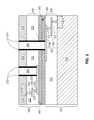
  • FIG. 6 is a vertical cross-sectional view of the exemplary structure of FIG. 5 after forming a third BEOL wiring structure on the backside of the second semiconductor substrate, contacting the first TDV structure and the second TDV structure.
  • FIG. 1A includes a first substrate 100
  • FIG. 1B includes a second substrate 200
  • the first substrate 100 shown in FIG. 1A can include a vertical stack of, from bottom to top, a first semiconductor substrate 110 and a first BEOL wiring structure 120
  • the second substrate 200 shown in FIG. 1B can include a vertical stack of, from bottom to top, a second semiconductor substrate 210 and a second BEOL wiring structure 220 .
  • the first semiconductor substrate 110 includes at least one first semiconductor device 112 .
  • the second semiconductor substrate 210 includes at least one second semiconductor device 212 .
  • Each of the at least one first semiconductor device 112 and the at least one second semiconductor device 212 can be, but is not limited to, a field effect transistor, a bipolar transistor, a diode, a resistor, a capacitor, and any other type of semiconductor devices known in the art.
  • a buried insulator layer (not shown) and/or a handle substrate (not shown) can be present within the first semiconductor substrate 110 and/or the second semiconductor substrate 210 .
  • Each of the first semiconductor substrate 110 and the second semiconductor substrate 210 can include a semiconductor material.
  • the semiconductor material may be selected from, but is not limited to, silicon, germanium, silicon-germanium alloy, silicon carbon alloy, silicon-germanium-carbon alloy, gallium arsenide, indium arsenide, indium phosphide, and any other III-V or II-VI compound semiconductor materials.
  • each of the first semiconductor substrate 110 and the second semiconductor substrate 210 is comprised of single crystalline silicon.
  • the first BEOL wiring structure 120 includes at least one first dielectric material layer 122 and at least one first interconnect structure 130 embedded therein.
  • the second BEOL wiring structure 220 includes at least one second dielectric material layer 222 and at least one second interconnect structure 230 embedded therein.
  • the at least one first interconnect structure 130 provides electrical connection to the at least one first semiconductor device 112 .
  • the at least one second interconnect structure 230 provides electrical connection to the at least one second semiconductor device 212 .
  • Each of the at least one first dielectric material layer 122 and the at least one second dielectric material layer 222 includes at least one dielectric material, which can be a doped or undoped silicate glass, silicon nitride, or a low dielectric constant (low-k) material such as organosilicate glass.
  • Each of the at least one first dielectric material layer 122 and the at least one second dielectric material layer 222 can include a plurality of dielectric material layers having different compositions.
  • the composition of the at least one first dielectric material layer 122 and the at least one second dielectric material layer 222 can include any dielectric material known in semiconductor processing technology and can be adjusted as needed.
  • a total thickness of each of the at least one first dielectric material layer 122 and the at least one second dielectric layer 222 may be from 5 ⁇ m to 10 ⁇ m, although lesser and greater thicknesses can also be employed.
  • the at least one first interconnect structure 130 can include first conductive via structures 132 and first conductive line structures 134 . As shown, the last level first conductive line structure, denoted as 134 L, has a top surface coplanar with a topmost surface of the at least one first dielectric material layer 122 . Likewise, the at least one second interconnect structure 230 can include second conductive via structures 232 and second conductive line structures 234 . As shown, the last level second conductive line structure, denoted as 234 L, has a top surface coplanar with a topmost surface of the at least one second dielectric material layer 222 .
  • the at least one first interconnect structure 130 and the at least one second interconnect structure 230 can be formed by dual damascene process known in the art.
  • Each of the at least one first interconnect structure 130 and the at least one second interconnect structure 230 may be composed a conductive material such as, for example, copper, aluminum, tungsten, silver, gold, or platinum. Alloys, such as copper-aluminum, can also be used.
  • a first bonding material layer 140 is deposited on a topmost surface of the first substrate 100 (i.e., topmost surfaces of the at least one first dielectric material layer 122 and the at least one first interconnect structure 130 ).
  • a second bonding material layer 240 is deposited on a topmost surface of the second substrate 200 (i.e., topmost surfaces of the at least one second dielectric material layer 222 and the at least one second interconnect structure 230 ).
  • Each of the first bonding material layer 140 and the second bonding material layer 240 can include a dielectric oxide such as, for example, silicon oxide to facilitate the bonding of the first substrate 100 and the second substrate 200 .
  • the first bonding material layer 140 and the second bonding material layer 240 can be formed, for example, by physical vapor deposition (PVD) or chemical vapor deposition (CVD). Although the present application describes and illustrated two separate bonding material layers, a single bonding material layer can be used and formed on one of the substrates 100 , 200 .
  • PVD physical vapor deposition
  • CVD chemical vapor deposition
  • the second substrate 200 shown in FIG. 1B is flipped upside down and brought into physical contact with the first substrate 100 shown in FIG. 1A such that a surface of the first bonding material layer 140 contacts a surface of the second bonding material layer 240 .
  • the flipping may also be reversed, i.e., the first substrate 100 is flipped and brought into contact with the second substrate 200 .
  • an oxide-to-oxide bonding is induced between the first and second bonding material layers 140 , 240 .
  • the oxide-to-oxide bonding can be effected by an anneal, with or without compression of the first and the second substrates 100 , 200 , at an elevated temperature, which can be in a range from 200° C. to 500° C., although lesser and greater temperatures can also be employed.
  • a bonded structure including the first substrate 100 and the second substrate 200 that are bonded to each other by a bonded material layer 340 is thus formed.
  • the bonded material layer 340 includes the first bonding material layer 140 (not separately shown) located below a bonding interface 341 and the second bonding material layer 240 (not separately shown) located above the bonding interface 341 .
  • the first bonding material layer 140 and the second bonding material layer 240 are of integral construction and collectively constitute the bonded material layer 340 . It is understood that the bonding interface 341 is shown only for the demonstrative purpose of marking the original location at which the first and second bonding material layers 140 , 240 contact each other. Further, it is understood that the bonding interface 341 may not be physically discernable once the bonded material layer 340 is formed.
  • a backside portion of the second substrate 200 i.e., a portion on the backside of the second semiconductor substrate 210 that is distal from the bonding interface 341 , can be removed to thin the second semiconductor substrate 210 to a desired target thickness.
  • the backside portion of the second semiconductor substrate 210 can be removed, for example, by grinding, cleaving, polishing, etching, or a combination thereof.
  • the second semiconductor substrate 210 can be thinned to a thickness in a range from 5 ⁇ m to 30 ⁇ m, although lesser and greater thicknesses can also be employed.
  • a first TDV opening 352 and a second TDV opening 354 are formed by a single anisotropic etch.
  • the first TDV opening 352 extends through the second semiconductor substrate 210 and the at least one second dielectric material layer 222 , exposing a surface of the last level second conductive line structure 234 L in the at least one second interconnect structure 230 .
  • the second TDV opening 354 extends through the second semiconductor substrate 210 , the at least one second dielectric layer 222 and the bonded material layer 340 , exposing a surface of the last level first conductive line structure 134 L in the at least one first interconnect structure 130 .
  • the second TDV opening 354 is thus extends to a greater depth than the first TDV opening 352 .
  • the first and second TDV openings 352 , 354 can be formed by first applying a photoresist layer (not shown) on the backside surface of the second semiconductor substrate 210 .
  • the photoresist layer is then lithographically patterned to form a first opening (not shown) over a region including the last level second conductive line structure 234 L and a second opening (not shown) over a region including the last level first conductive line structure 134 L.
  • the second semiconductor substrate 210 , the at least one second dielectric material layer 222 and the bonded material layer 340 are sequentially etched by a single anisotropic etch that employs the patterned photoresist layer as an etch mask.
  • the anisotropic etch continues until the surface of the last level first conductive line 134 L is exposed by the second TDV opening 354 .
  • the patterned photoresist layer can be removed, for example, by ashing.
  • the second semiconductor substrate 201 , the at least one second dielectric material layer 222 and the bonded material layer 320 can be anisotropically etched utilizing an etching gas containing fluorocarbon-containing molecules represented by a formula of C x F y M, wherein M is chlorine, bromine, sulfur, oxygen, or nitrogen, and wherein x is from 2 to 5 and y is form 4 to 10.
  • the fluorocarbon-containing molecule is C 5 F 10 O.
  • the C x F y M molecules Due to the weak bonding energy of the M species in the C x F y M molecules, the C x F y M molecules easily dissociate into fluorine-deficient fluorocarbon species such as, for example, CF 2 , CF, or C x′ F y′ M, wherein x′ is from 1 to 5, y′ is from 1 to 8.
  • fluorine-deficient fluorocarbon species including, but not limited to, CHF 3 , C 4 F 8 and C 5 HF 7 can also be used as the etching gas in the present application.
  • the fluorine-deficient fluorocarbon species provide a rapid dielectric etching rate, while maintaining a proper etching selectivity between the dielectric materials that provide the at least one second dielectric material layer 222 and the bonded material layer 340 and the conductive materials that provide the at least one first interconnect structure 130 and the at least second interconnect structure 230 .
  • the second semiconductor substrate 210 , the at least one second dielectric material layer 222 and the bonded material layer 324 can be etched at a rate of 15 nm/s with an etching gas containing C 5 F 10 O and C 5 HF 7 . This etching rate is about 10% faster than the conventional etching gas employing saturated fluorocarbon CF 4 under the same etching conditions.
  • the rapid dielectric etching rate and the proper etching selectivity of the fluorine-deficient fluorocarbon species ensure that the TDV openings of different depths can be formed concurrently, while the conductive materials (e.g., copper, tungsten) that provide interconnect structures 130 , 230 are not adversely affected.
  • the fluorine-deficient species also protect sidewalls of the TDV openings 352 , 354 during the anisotropic etch to against undesirable lateral etching.
  • TDV openings of different depths can be formed in a same fabrication step, without the need for multiple design masks and/or application of multiple photoresist layers.
  • TDV openings of different depths helps to reduce the fabrication cost.
  • the rapid etching rate of the fluorine-deficient fluorocarbon species also allows a more economic resist budget.
  • a first TDV structure 362 is formed within the first TDV opening 352 and a second TDV structure 364 is formed within the second TDV opening 354 .
  • the first TDV structure 362 and the second TDV structure 364 can be formed, for example, by filing the first TDV opening 352 and the second TDV opening 354 with a conductive material.
  • the conductive material can include, for example, copper, aluminum, tungsten, silver, gold, platinum, although other metallic elements and/or alloys thereof can also be employed.
  • the conductive material can be deposited, for example, by PVD, CVD, electroplating, electroless plating, or combinations thereof.
  • metal barriers including a metallic material such as Ta, Ti, W, TaN, TiN, WN, TaC, TiC, WC may be used before depositing the conductive material.
  • Excess portions of the conductive material above the backside surface of the second semiconductor substrate 210 can be subsequently removed, for example, by a recess etch, chemical mechanical planarization (CMP), or a combination thereof.
  • a remaining portion of the conductive material within the first TDV opening 352 constitutes the first TDV structure 362 .
  • the first TDV structure 362 extends through the second semiconductor substrate 201 and the at least one second dielectric material layer 222 and contacts the last level second conductive line structure 234 L in the at least one second interconnect structure 230 .
  • a remaining portion of the conductive material within the second TDV opening constitutes the second TDV structure 364 .
  • the second TDV structure 364 extends through the second semiconductor substrate 201 , the at least one second dielectric material layer 222 and the bonded material layer 340 and contacts the last level first conductive line structure 134 L in the at least one first interconnect structure 130 .
  • the top surfaces of the first and second TDV structures 362 , 364 can be coplanar with the backside surface of the second semiconductor substrate 201 .
  • a first dielectric liner 372 can be formed on sidewalls of the first TDV opening 352 to provide electrical isolation of the first TDV structure 362 from elements other than the at least one second interconnect structure 230
  • a second dielectric liner 374 can be formed on sidewalls of the second TDV opening 354 to provide electrical isolation of the second TDV structure 364 from elements other than the at least one first interconnect structure 130 .
  • the first and second dielectric liners 372 , 374 include a dielectric material, which can be silicon oxide, silicon nitride, silicon oxynitride, a dielectric metal oxide, a dielectric metal nitride, a dielectric metal oxynitride, or a combination thereof.
  • the first and second dielectric liners 372 , 374 can be formed, for example, by a conformal deposition of a dielectric material layer, and by a subsequent anisotropic etch that removes horizontal portions of the deposited dielectric material layer.
  • a remaining vertical portion of the conformal dielectric material layer within the first TDV opening 352 constitutes the first dielectric liner 372
  • a remaining vertical portion of the conformal dielectric material layer within the second TDV opening 354 constitutes the second dielectric liner 374 .
  • the lateral thickness of the first and second dielectric liners 372 , 374 can be in a range from 10 nm to 200 nm, although lesser and greater thicknesses can also be employed.
  • a third BEOL wiring structure 420 is formed on the backside surface of the second semiconductor substrate 210 .
  • the third BEOL wiring structure 420 includes at least one third dielectric material layer 422 and at least one third interconnect structure 430 embedded therein.
  • the at least one third interconnect structure 430 includes a third conductive line structure 434 contacting top surfaces of the first TDV structure 362 and the second TDV structure 364 .
  • the third conductive line structure 434 provides electrical connection between the at least one first semiconductor device 112 and the at least one second semiconductor device 212
  • the last level second conductive line structure 234 L and the third conductive line structure 434 are electrically connected in parallel by the first TDV structure 362 extended vertically in the second substrate 200 .
  • the last level first conductive line structure 134 L and the third conductive line structure 434 are electrically connected in parallel by the second TDV structure 364 extended vertically in the second substrate 200 .
  • the last level first and second conductive line structures 134 L, 234 L, the third conductive line structure 434 and the first and second TDV structures 362 , 364 are interconnected in electric continuity to effectively define an integrated inductor.

Landscapes

  • Engineering & Computer Science (AREA)
  • Physics & Mathematics (AREA)
  • Condensed Matter Physics & Semiconductors (AREA)
  • General Physics & Mathematics (AREA)
  • Computer Hardware Design (AREA)
  • Microelectronics & Electronic Packaging (AREA)
  • Power Engineering (AREA)
  • Manufacturing & Machinery (AREA)
  • Internal Circuitry In Semiconductor Integrated Circuit Devices (AREA)

Abstract

After bonding a second substrate to a first substrate through a bonded material layer to provide a bonded structure, through dielectric via (TDV) openings of different depths are concurrently formed in the bonded structure by performing a single anisotropic etch using fluorine-deficient species that are obtained by dissociation of fluorocarbon-containing molecules.

Description

BACKGROUND
The present application relates generally to integrated circuit fabrication, more particularly, to the fabrication of through dielectric via (TDV) structures of different depths in a bonded structure using a single anisotropic etch process.
Three-dimensional (3D) integration of two substrates, can produce a number of benefits to microelectronic applications. For example, 3D integration of microelectronic components can result in improved electrical performance and power consumption while reducing the area of the device footprint.
Through dielectric via (TDV) structures provide electrical connection across the multiple substrates in a bonded structure, thus are essential elements for 3D integration. TDV structures are commonly formed after multiple substrates are bonded. The process used for creating TDV structures must etch through multiple back-end-of-line (BEOL) dielectrics. Typically, more than 5 μm-thick dielectrics need to be etched. In conventional etching processes, the BEOL dielectrics are etched using a plasma of fluorocarbon gases, including for example, CHF3, CH3F, CF4, and CH2F2. However, such conventional gas compositions do not provide sufficient etching rates and etching selectivity that allows etching BEOL dielectrics to form TDVs of different depths in a single etching process, without adversely affecting the integrity of the metal used in the interconnect structures.
Therefore, a method for concurrently forming TDV of different depths, without the need for multiple design masks and/or application of multiple photoresist layers, and with no, or minimal, erosion of interconnect structures remains needed.
SUMMARY
The present application provides an etching chemistry for forming TDV structures of different depths in a single anisotropic etch process, without the need for multiple design masks and/or application of multiple photoresist layers.
According to an aspect of the present application, a method of forming a structure is provided. The method includes first forming a bonded structure including a first substrate and a second substrate bonded to each other through a boned material layer. The first substrate includes a stack of a first semiconductor substrate and a first wiring structure having at least one first dielectric material layer and at least one first interconnect structure embedded therein, and the second substrate includes a second semiconductor substrate and a second wiring structure having at least one second dielectric material layer and at least one second interconnect structure embedded therein. The first substrate is bonded to the second substrate such that the at least one first dielectric material layer faces and underlies the at least one second dielectric material layer. Next, a first TDV opening and a second TDV opening are concurrently formed. The first TDV opening extends through the second semiconductor substrate and the at least one second dielectric material layer to expose a last level second conductive line structure in the at least one second interconnect structure, and the second TDV opening extends through the second semiconductor substrate, the at least one second dielectric material layer and the bonded material layer to expose a last level first conductor line structure in the at least one first interconnect structure. Next, a first TDV structure is formed in the first TDV opening and a second TDV structure is formed in the second TDV opening.
According to yet another aspect of the present application, an integrated inductor is provided. The inductor includes a bonded structure including a first substrate and a second substrate bonded to each other through a boned material layer. The first substrate includes a stack of a first semiconductor substrate and a first wiring structure having at least one first dielectric material layer and at least one first interconnect structure embedded therein, and the second substrate includes a second semiconductor substrate and a second wiring structure having at least one second dielectric material layer and at least one second interconnect structure embedded therein. The first substrate is bonded to the second substrate such that the at least one first dielectric material layer faces and underlies the at least one second dielectric material layer. The inductor further includes a first TDV structure extending through the second semiconductor substrate and the at least one second dielectric material layer and contacting a last level second conductive line in the at least one second interconnect structure, and a second TDV structure extending through the second semiconductor substrate, the at least one second dielectric material layer and the bonded material layer and contacting a last level first conductive line in the at least one first interconnect structure. The second TDV structure has a greater depth than the first TDV structure. A third conductive line structure is embedded in at least one third dielectric material layer located over a backside surface of the second semiconductor structure and contacts top surfaces of the first TDV structure and the second TDV structure
BRIEF DESCRIPTION OF SEVERAL VIEWS OF THE DRAWINGS
FIG. 1A is a vertical cross-sectional view of an exemplary structure including a first substrate according to an embodiment of the present application.
FIG. 1B is a vertical cross-sectional view of an exemplary structure including a second substrate according to an embodiment of the present application.
FIG. 2 is a vertical cross-sectional view of the exemplary structures of FIGS. 1A-1B after bonding the first substrate and the second substrate through a bonded material layer to form a bonded structure.
FIG. 3 is a vertical cross-sectional view of the exemplary structure of FIG. 2 after thinning a backside of a second semiconductor substrate in the second substrate that is distal from the bonded material layer.
FIG. 4 is a vertical cross-sectional view of the exemplary structure of FIG. 3 after concurrently forming a first TDV opening and a second TDV opening that extends to a greater depth than the first TDV opening in the bonded structure.
FIG. 5 is a vertical cross-sectional view of the exemplary structure of FIG. 4 after forming a first TDV structure within the first TDV opening and a second TDV structure within the second TDV opening.
FIG. 6 is a vertical cross-sectional view of the exemplary structure of FIG. 5 after forming a third BEOL wiring structure on the backside of the second semiconductor substrate, contacting the first TDV structure and the second TDV structure.
DETAILED DESCRIPTION
The present application will now be described in greater detail by referring to the following discussion and drawings that accompany the present application. It is noted that the drawings of the present application are provided for illustrative purposes only and, as such, the drawings are not drawn to scale. It is also noted that like and corresponding elements are referred to by like reference numerals.
In the following description, numerous specific details are set forth, such as particular structures, components, materials, dimensions, processing steps and techniques, in order to provide an understanding of the various embodiments of the present application. However, it will be appreciated by one of ordinary skill in the art that the various embodiments of the present application may be practiced without these specific details. In other instances, well-known structures or processing steps have not been described in detail in order to avoid obscuring the present application.
Referring to FIGS. 1A and 1B, there are illustrated exemplary structures according to an embodiment of the present application. FIG. 1A includes a first substrate 100, while FIG. 1B includes a second substrate 200. The first substrate 100 shown in FIG. 1A can include a vertical stack of, from bottom to top, a first semiconductor substrate 110 and a first BEOL wiring structure 120. The second substrate 200 shown in FIG. 1B can include a vertical stack of, from bottom to top, a second semiconductor substrate 210 and a second BEOL wiring structure 220.
The first semiconductor substrate 110 includes at least one first semiconductor device 112. Likewise, the second semiconductor substrate 210 includes at least one second semiconductor device 212. Each of the at least one first semiconductor device 112 and the at least one second semiconductor device 212 can be, but is not limited to, a field effect transistor, a bipolar transistor, a diode, a resistor, a capacitor, and any other type of semiconductor devices known in the art. A buried insulator layer (not shown) and/or a handle substrate (not shown) can be present within the first semiconductor substrate 110 and/or the second semiconductor substrate 210.
Each of the first semiconductor substrate 110 and the second semiconductor substrate 210 can include a semiconductor material. The semiconductor material may be selected from, but is not limited to, silicon, germanium, silicon-germanium alloy, silicon carbon alloy, silicon-germanium-carbon alloy, gallium arsenide, indium arsenide, indium phosphide, and any other III-V or II-VI compound semiconductor materials. In one embodiment, each of the first semiconductor substrate 110 and the second semiconductor substrate 210 is comprised of single crystalline silicon.
The first BEOL wiring structure 120 includes at least one first dielectric material layer 122 and at least one first interconnect structure 130 embedded therein. Likewise, the second BEOL wiring structure 220 includes at least one second dielectric material layer 222 and at least one second interconnect structure 230 embedded therein. The at least one first interconnect structure 130 provides electrical connection to the at least one first semiconductor device 112. The at least one second interconnect structure 230 provides electrical connection to the at least one second semiconductor device 212.
Each of the at least one first dielectric material layer 122 and the at least one second dielectric material layer 222 includes at least one dielectric material, which can be a doped or undoped silicate glass, silicon nitride, or a low dielectric constant (low-k) material such as organosilicate glass. Each of the at least one first dielectric material layer 122 and the at least one second dielectric material layer 222 can include a plurality of dielectric material layers having different compositions. The composition of the at least one first dielectric material layer 122 and the at least one second dielectric material layer 222 can include any dielectric material known in semiconductor processing technology and can be adjusted as needed. In one embodiment, a total thickness of each of the at least one first dielectric material layer 122 and the at least one second dielectric layer 222 may be from 5 μm to 10 μm, although lesser and greater thicknesses can also be employed.
The at least one first interconnect structure 130 can include first conductive via structures 132 and first conductive line structures 134. As shown, the last level first conductive line structure, denoted as 134L, has a top surface coplanar with a topmost surface of the at least one first dielectric material layer 122. Likewise, the at least one second interconnect structure 230 can include second conductive via structures 232 and second conductive line structures 234. As shown, the last level second conductive line structure, denoted as 234L, has a top surface coplanar with a topmost surface of the at least one second dielectric material layer 222. The at least one first interconnect structure 130 and the at least one second interconnect structure 230 can be formed by dual damascene process known in the art. Each of the at least one first interconnect structure 130 and the at least one second interconnect structure 230 may be composed a conductive material such as, for example, copper, aluminum, tungsten, silver, gold, or platinum. Alloys, such as copper-aluminum, can also be used.
A first bonding material layer 140 is deposited on a topmost surface of the first substrate 100 (i.e., topmost surfaces of the at least one first dielectric material layer 122 and the at least one first interconnect structure 130). A second bonding material layer 240 is deposited on a topmost surface of the second substrate 200 (i.e., topmost surfaces of the at least one second dielectric material layer 222 and the at least one second interconnect structure 230). Each of the first bonding material layer 140 and the second bonding material layer 240 can include a dielectric oxide such as, for example, silicon oxide to facilitate the bonding of the first substrate 100 and the second substrate 200. The first bonding material layer 140 and the second bonding material layer 240 can be formed, for example, by physical vapor deposition (PVD) or chemical vapor deposition (CVD). Although the present application describes and illustrated two separate bonding material layers, a single bonding material layer can be used and formed on one of the substrates 100, 200.
Referring to FIG. 2, the second substrate 200 shown in FIG. 1B is flipped upside down and brought into physical contact with the first substrate 100 shown in FIG. 1A such that a surface of the first bonding material layer 140 contacts a surface of the second bonding material layer 240. The flipping may also be reversed, i.e., the first substrate 100 is flipped and brought into contact with the second substrate 200. Subsequently, an oxide-to-oxide bonding is induced between the first and second bonding material layers 140, 240. The oxide-to-oxide bonding can be effected by an anneal, with or without compression of the first and the second substrates 100, 200, at an elevated temperature, which can be in a range from 200° C. to 500° C., although lesser and greater temperatures can also be employed.
In the illustrated embodiment, a bonded structure including the first substrate 100 and the second substrate 200 that are bonded to each other by a bonded material layer 340 is thus formed. The bonded material layer 340 includes the first bonding material layer 140 (not separately shown) located below a bonding interface 341 and the second bonding material layer 240 (not separately shown) located above the bonding interface 341. The first bonding material layer 140 and the second bonding material layer 240 are of integral construction and collectively constitute the bonded material layer 340. It is understood that the bonding interface 341 is shown only for the demonstrative purpose of marking the original location at which the first and second bonding material layers 140, 240 contact each other. Further, it is understood that the bonding interface 341 may not be physically discernable once the bonded material layer 340 is formed.
Referring to FIG. 3, a backside portion of the second substrate 200, i.e., a portion on the backside of the second semiconductor substrate 210 that is distal from the bonding interface 341, can be removed to thin the second semiconductor substrate 210 to a desired target thickness. Specifically, the backside portion of the second semiconductor substrate 210 can be removed, for example, by grinding, cleaving, polishing, etching, or a combination thereof. In one embodiment, the second semiconductor substrate 210 can be thinned to a thickness in a range from 5 μm to 30 μm, although lesser and greater thicknesses can also be employed.
Referring to FIG. 4, a first TDV opening 352 and a second TDV opening 354 are formed by a single anisotropic etch. The first TDV opening 352 extends through the second semiconductor substrate 210 and the at least one second dielectric material layer 222, exposing a surface of the last level second conductive line structure 234L in the at least one second interconnect structure 230. The second TDV opening 354 extends through the second semiconductor substrate 210, the at least one second dielectric layer 222 and the bonded material layer 340, exposing a surface of the last level first conductive line structure 134L in the at least one first interconnect structure 130. The second TDV opening 354 is thus extends to a greater depth than the first TDV opening 352.
The first and second TDV openings 352, 354 can be formed by first applying a photoresist layer (not shown) on the backside surface of the second semiconductor substrate 210. The photoresist layer is then lithographically patterned to form a first opening (not shown) over a region including the last level second conductive line structure 234L and a second opening (not shown) over a region including the last level first conductive line structure 134L.
Subsequently, the second semiconductor substrate 210, the at least one second dielectric material layer 222 and the bonded material layer 340 are sequentially etched by a single anisotropic etch that employs the patterned photoresist layer as an etch mask. After exposing the surface of the last level first conductive line structure 234L by the first TDV opening 352, the anisotropic etch continues until the surface of the last level first conductive line 134L is exposed by the second TDV opening 354. After the anisotropic etch, the patterned photoresist layer can be removed, for example, by ashing.
In the present application, the second semiconductor substrate 201, the at least one second dielectric material layer 222 and the bonded material layer 320 can be anisotropically etched utilizing an etching gas containing fluorocarbon-containing molecules represented by a formula of CxFyM, wherein M is chlorine, bromine, sulfur, oxygen, or nitrogen, and wherein x is from 2 to 5 and y is form 4 to 10. In one embodiment the fluorocarbon-containing molecule is C5F10O. Due to the weak bonding energy of the M species in the CxFyM molecules, the CxFyM molecules easily dissociate into fluorine-deficient fluorocarbon species such as, for example, CF2, CF, or Cx′Fy′M, wherein x′ is from 1 to 5, y′ is from 1 to 8. Other fluorine-deficient fluorocarbon species including, but not limited to, CHF3, C4F8 and C5HF7 can also be used as the etching gas in the present application. The fluorine-deficient fluorocarbon species provide a rapid dielectric etching rate, while maintaining a proper etching selectivity between the dielectric materials that provide the at least one second dielectric material layer 222 and the bonded material layer 340 and the conductive materials that provide the at least one first interconnect structure 130 and the at least second interconnect structure 230. In one embodiment, the second semiconductor substrate 210, the at least one second dielectric material layer 222 and the bonded material layer 324 can be etched at a rate of 15 nm/s with an etching gas containing C5F10O and C5HF7. This etching rate is about 10% faster than the conventional etching gas employing saturated fluorocarbon CF4 under the same etching conditions. The rapid dielectric etching rate and the proper etching selectivity of the fluorine-deficient fluorocarbon species ensure that the TDV openings of different depths can be formed concurrently, while the conductive materials (e.g., copper, tungsten) that provide interconnect structures 130, 230 are not adversely affected. The fluorine-deficient species also protect sidewalls of the TDV openings 352, 354 during the anisotropic etch to against undesirable lateral etching.
In the present application, by employing fluorine-deficient fluorocarbon species that are obtained by dissociation of CxFyM molecules as an etchant in dielectric anisotropic etch, TDV openings of different depths (e.g., the first via opening 352, the second trench 354) can be formed in a same fabrication step, without the need for multiple design masks and/or application of multiple photoresist layers. Such a single step formation of the TDV openings of different depths helps to reduce the fabrication cost. The rapid etching rate of the fluorine-deficient fluorocarbon species also allows a more economic resist budget.
Referring to FIG. 5, a first TDV structure 362 is formed within the first TDV opening 352 and a second TDV structure 364 is formed within the second TDV opening 354. The first TDV structure 362 and the second TDV structure 364 can be formed, for example, by filing the first TDV opening 352 and the second TDV opening 354 with a conductive material. The conductive material can include, for example, copper, aluminum, tungsten, silver, gold, platinum, although other metallic elements and/or alloys thereof can also be employed. The conductive material can be deposited, for example, by PVD, CVD, electroplating, electroless plating, or combinations thereof. Optionally, metal barriers including a metallic material such as Ta, Ti, W, TaN, TiN, WN, TaC, TiC, WC may be used before depositing the conductive material.
Excess portions of the conductive material above the backside surface of the second semiconductor substrate 210 can be subsequently removed, for example, by a recess etch, chemical mechanical planarization (CMP), or a combination thereof. A remaining portion of the conductive material within the first TDV opening 352 constitutes the first TDV structure 362. The first TDV structure 362 extends through the second semiconductor substrate 201 and the at least one second dielectric material layer 222 and contacts the last level second conductive line structure 234L in the at least one second interconnect structure 230. A remaining portion of the conductive material within the second TDV opening constitutes the second TDV structure 364. The second TDV structure 364 extends through the second semiconductor substrate 201, the at least one second dielectric material layer 222 and the bonded material layer 340 and contacts the last level first conductive line structure 134L in the at least one first interconnect structure 130. In one embodiment, after the planarization process, the top surfaces of the first and second TDV structures 362, 364 can be coplanar with the backside surface of the second semiconductor substrate 201.
In some embodiments of the present application, before the filling of the first and second TDV openings 352, 354 with the conductive material, a first dielectric liner 372 can be formed on sidewalls of the first TDV opening 352 to provide electrical isolation of the first TDV structure 362 from elements other than the at least one second interconnect structure 230, and a second dielectric liner 374 can be formed on sidewalls of the second TDV opening 354 to provide electrical isolation of the second TDV structure 364 from elements other than the at least one first interconnect structure 130. The first and second dielectric liners 372, 374 include a dielectric material, which can be silicon oxide, silicon nitride, silicon oxynitride, a dielectric metal oxide, a dielectric metal nitride, a dielectric metal oxynitride, or a combination thereof. The first and second dielectric liners 372, 374 can be formed, for example, by a conformal deposition of a dielectric material layer, and by a subsequent anisotropic etch that removes horizontal portions of the deposited dielectric material layer. A remaining vertical portion of the conformal dielectric material layer within the first TDV opening 352 constitutes the first dielectric liner 372, and a remaining vertical portion of the conformal dielectric material layer within the second TDV opening 354 constitutes the second dielectric liner 374. The lateral thickness of the first and second dielectric liners 372, 374 can be in a range from 10 nm to 200 nm, although lesser and greater thicknesses can also be employed.
Referring to FIG. 6, a third BEOL wiring structure 420 is formed on the backside surface of the second semiconductor substrate 210. The third BEOL wiring structure 420 includes at least one third dielectric material layer 422 and at least one third interconnect structure 430 embedded therein. In one embodiment, the at least one third interconnect structure 430 includes a third conductive line structure 434 contacting top surfaces of the first TDV structure 362 and the second TDV structure 364. The third conductive line structure 434 provides electrical connection between the at least one first semiconductor device 112 and the at least one second semiconductor device 212
As shown, the last level second conductive line structure 234L and the third conductive line structure 434 are electrically connected in parallel by the first TDV structure 362 extended vertically in the second substrate 200. The last level first conductive line structure 134L and the third conductive line structure 434 are electrically connected in parallel by the second TDV structure 364 extended vertically in the second substrate 200. As a result, the last level first and second conductive line structures 134L, 234L, the third conductive line structure 434 and the first and second TDV structures 362, 364 are interconnected in electric continuity to effectively define an integrated inductor.
While the present application has been described in terms of specific embodiments, it is evident in view of the foregoing description that numerous alternatives, modifications and variations will be apparent to those skilled in the art. Each of the various embodiments of the present application can be implemented alone, or in combination with any other embodiments of the present application unless expressly disclosed otherwise or otherwise impossible as would be known to one of ordinary skill in the art. Accordingly, the present application is intended to encompass all such alternatives, modifications and variations which fall within the scope and spirit of the present application and the following claims.

Claims (19)

What is claimed is:
1. A method of forming a structure comprising:
forming a bonded structure comprising a first substrate and a second substrate bonded to each other through a boned material layer, wherein the first substrate comprises a stack of a first semiconductor substrate and a first wiring structure comprising at least one first dielectric material layer and at least one first interconnect structure embedded therein, and the second substrate comprises a second semiconductor substrate and a second wiring structure comprising at least one second dielectric material layer and at least one second interconnect structure embedded therein, the first substrate being bonded to the second substrate such that the at least one first dielectric material layer faces and underlies the at least one second dielectric material layer;
concurrently forming a first through dielectric via (TDV) opening and a second TDV opening utilizing a single anisotropic etch and an etching gas containing fluorocarbon-containing molecules having a formula CxFyM, wherein M is chlorine, bromine, sulfur, oxygen or nitrogen, and x is from 2 to 5, and y is from 4 to 10, the first TDV opening extending through the second semiconductor substrate and the at least one second dielectric material layer to expose a last level second conductive line structure in the at least one second interconnect structure, and the second TDV opening extending through the second semiconductor substrate, the at least one second dielectric material layer and the bonded material layer to expose a last level first conductor line structure in the at least one first interconnect structure; and
forming a first TDV structure within the first TDV opening and a second TDV structure within the second TDV opening.
2. The method of claim 1, wherein the etching gas dissociates during the single anisotropic etch into fluorine-deficient fluorocarbon species.
3. The method of claim 2, wherein the fluorine-deficient fluorocarbon species comprise CF2, CF, CHF3, C4F8, C5HF7, or Cx′Fy′M, wherein M is chlorine, bromine, sulfur, oxygen, or nitrogen, and wherein x′ is from 1 to 5 and y′ is from 1 to 8.
4. The method of claim 1, wherein the second TDV opening extends to a greater depth than the first TDV opening.
5. The method of claim 1, wherein the concurrently forming the first TDV opening and the second TDV opening comprises:
forming a photoresist layer over a backside surface of the second semiconductor substrate;
lithographically patterning the photoresist layer; and
sequentially etching the second semiconductor substrate, the at least one second dielectric material and the bonded material layer by a single anisotropic etch employing remaining portions of the photoresist layer as an etch mask.
6. The method of claim 5, wherein the second semiconductor substrate, the at least one second dielectric material and the bonded material layer are etched at a rate of 15 nm/s.
7. The method of claim 1, wherein the first TDV structure extends through the second substrate and contacts the last level second conductive line structure in the at least one second interconnect structure, and the second TDV structure extends through the second substrate and the bonded material layer and contacts the last level first conductive line structure in the at least one first interconnect structure.
8. The method of claim 1, wherein the forming the first TDV structure in the first TDV opening and the second TDV structure in the second TDV opening comprises:
depositing a conductive material within the first TDV opening and the second TDV opening and on a backside surface of the second semiconductor substrate; and
removing excess portions of the conductive material from the backside surface of the second semiconductor structure.
9. The method of claim 8, wherein the depositing the conductive material is performed by physical vapor deposition, chemical vapor deposition, electroplating, electroless plating, or combinations thereof.
10. The method of claim 8, wherein the removing the excess portions of the conductive material is performed by a recess etch, chemical mechanical planarization, or a combination thereof.
11. The method of claim 10, wherein the forming the first dielectric liner and the second dielectric liner comprises:
forming a dielectric material layer on exposed surfaces of the first TDV opening and the second TDV opening; and
removing horizontal portions of dielectric material layer.
12. The method of claim 1, further comprising forming a first dielectric liner on sidewalls of the first TDV opening, and a second dielectric liner on sidewalls of the second TDV opening prior to the forming the first TDV structure and the second TDV structure.
13. The method of claim 1, further comprising forming a third wiring structure over a backside surface of the second semiconductor substrate, wherein the third wiring structure comprising at least one third dielectric material layer and at least one third interconnect structure.
14. The method of claim 13, wherein the at least one third interconnect structure comprises a third conductive line structure contacting top surfaces of the first TDV structure and the second TDV structure.
15. The method of claim 1, further forming a first bonding material layer on the first wiring structure.
16. The method of claim 15, further comprising forming a second bonding material layer on the second wiring structure.
17. The method of claim 15, wherein the forming the bonded structure comprises:
contacting the second substrate to the first substrate, wherein a surface of the first bonding material layer is in direct contact with a surface of the second bonding material layer; and
introducing an oxide-to-oxide bonding between the first bonding material layer and the second bonding material layer to form a bonded material layer that bonds the first substrate and the second substrate.
18. The method of claim 17, wherein the oxide-to-oxide bonding is effected by an anneal.
19. The method of claim 18, wherein the anneal is performed at a temperature ranging from 200° C. to 500° C.
US15/611,846 2017-06-02 2017-06-02 Rapid oxide etch for manufacturing through dielectric via structures Active US10276439B2 (en)

Priority Applications (1)

Application Number Priority Date Filing Date Title
US15/611,846 US10276439B2 (en) 2017-06-02 2017-06-02 Rapid oxide etch for manufacturing through dielectric via structures

Applications Claiming Priority (1)

Application Number Priority Date Filing Date Title
US15/611,846 US10276439B2 (en) 2017-06-02 2017-06-02 Rapid oxide etch for manufacturing through dielectric via structures

Publications (2)

Publication Number Publication Date
US20180350677A1 US20180350677A1 (en) 2018-12-06
US10276439B2 true US10276439B2 (en) 2019-04-30

Family

ID=64459993

Family Applications (1)

Application Number Title Priority Date Filing Date
US15/611,846 Active US10276439B2 (en) 2017-06-02 2017-06-02 Rapid oxide etch for manufacturing through dielectric via structures

Country Status (1)

Country Link
US (1) US10276439B2 (en)

Cited By (1)

* Cited by examiner, † Cited by third party
Publication number Priority date Publication date Assignee Title
US20220271033A1 (en) * 2021-02-19 2022-08-25 Daniel Chanemougame Inverted top-tier fet for multi-tier gate-on-gate 3-dimension integration (3di)

Families Citing this family (1)

* Cited by examiner, † Cited by third party
Publication number Priority date Publication date Assignee Title
US11049844B2 (en) * 2019-07-01 2021-06-29 International Business Machines Corporation Semiconductor wafer having trenches with varied dimensions for multi-chip modules

Citations (20)

* Cited by examiner, † Cited by third party
Publication number Priority date Publication date Assignee Title
US4162185A (en) 1978-03-21 1979-07-24 International Business Machines Corporation Utilizing saturated and unsaturated halocarbon gases in plasma etching to increase etch of SiO2 relative to Si
US6074959A (en) 1997-09-19 2000-06-13 Applied Materials, Inc. Method manifesting a wide process window and using hexafluoropropane or other hydrofluoropropanes to selectively etch oxide
US6207532B1 (en) * 1999-09-30 2001-03-27 Taiwan Semiconductor Manufacturing Company STI process for improving isolation for deep sub-micron application
US6602434B1 (en) 1998-03-27 2003-08-05 Applied Materials, Inc. Process for etching oxide using hexafluorobutadiene or related fluorocarbons and manifesting a wide process window
US20030232504A1 (en) 2002-06-14 2003-12-18 Aaron Eppler Process for etching dielectric films with improved resist and/or etch profile characteristics
US20040035826A1 (en) 2000-12-21 2004-02-26 Kenji Adachi Etching method for insulating film
US20040035825A1 (en) 2000-11-08 2004-02-26 Shingo Nakamura Dry etching gas and method for dry etching
US6746961B2 (en) 2001-06-19 2004-06-08 Lam Research Corporation Plasma etching of dielectric layer with etch profile control
US20050014383A1 (en) 2003-07-15 2005-01-20 Bing Ji Use of hypofluorites, fluoroperoxides, and/or fluorotrioxides as oxidizing agent in fluorocarbon etch plasmas
US20070178699A1 (en) * 2006-01-31 2007-08-02 Matthias Schaller Method and system for advanced process control in an etch system by gas flow control on the basis of cd measurements
US7517804B2 (en) 2006-08-31 2009-04-14 Micron Technologies, Inc. Selective etch chemistries for forming high aspect ratio features and associated structures
US20090294814A1 (en) * 2008-06-03 2009-12-03 International Business Machines Corporation Three-Dimensional Integrated Circuits and Techniques for Fabrication Thereof
US20110059617A1 (en) 2009-09-10 2011-03-10 Matheson Tri-Gas, Inc. High aspect ratio silicon oxide etch
US20120146193A1 (en) * 2010-12-13 2012-06-14 Io Semiconductor, Inc. Thermal Conduction Paths for Semiconductor Structures
US8319597B2 (en) * 2008-12-18 2012-11-27 Stmicroelectronics S.R.L. Resistor structure of phase change material and trimming method thereof
US20140035935A1 (en) * 2012-08-03 2014-02-06 Qualcomm Mems Technologies, Inc. Passives via bar
US20150118854A1 (en) * 2013-10-25 2015-04-30 International Business Machines Corporation Molecular radical etch chemistry for increased throughput in pulsed plasma applications
US20150318263A1 (en) * 2014-04-30 2015-11-05 Taiwan Semiconductor Manufacturing Company, Ltd. 3d stacked-chip package
US20160049504A1 (en) * 2014-08-13 2016-02-18 Northrop Grumman Systems Corporation Integrated multichannel and single channel device structure and method of making the same
US20170365504A1 (en) * 2016-06-20 2017-12-21 Globalfoundries Inc. Forming air gap

Patent Citations (20)

* Cited by examiner, † Cited by third party
Publication number Priority date Publication date Assignee Title
US4162185A (en) 1978-03-21 1979-07-24 International Business Machines Corporation Utilizing saturated and unsaturated halocarbon gases in plasma etching to increase etch of SiO2 relative to Si
US6074959A (en) 1997-09-19 2000-06-13 Applied Materials, Inc. Method manifesting a wide process window and using hexafluoropropane or other hydrofluoropropanes to selectively etch oxide
US6602434B1 (en) 1998-03-27 2003-08-05 Applied Materials, Inc. Process for etching oxide using hexafluorobutadiene or related fluorocarbons and manifesting a wide process window
US6207532B1 (en) * 1999-09-30 2001-03-27 Taiwan Semiconductor Manufacturing Company STI process for improving isolation for deep sub-micron application
US20040035825A1 (en) 2000-11-08 2004-02-26 Shingo Nakamura Dry etching gas and method for dry etching
US20040035826A1 (en) 2000-12-21 2004-02-26 Kenji Adachi Etching method for insulating film
US6746961B2 (en) 2001-06-19 2004-06-08 Lam Research Corporation Plasma etching of dielectric layer with etch profile control
US20030232504A1 (en) 2002-06-14 2003-12-18 Aaron Eppler Process for etching dielectric films with improved resist and/or etch profile characteristics
US20050014383A1 (en) 2003-07-15 2005-01-20 Bing Ji Use of hypofluorites, fluoroperoxides, and/or fluorotrioxides as oxidizing agent in fluorocarbon etch plasmas
US20070178699A1 (en) * 2006-01-31 2007-08-02 Matthias Schaller Method and system for advanced process control in an etch system by gas flow control on the basis of cd measurements
US7517804B2 (en) 2006-08-31 2009-04-14 Micron Technologies, Inc. Selective etch chemistries for forming high aspect ratio features and associated structures
US20090294814A1 (en) * 2008-06-03 2009-12-03 International Business Machines Corporation Three-Dimensional Integrated Circuits and Techniques for Fabrication Thereof
US8319597B2 (en) * 2008-12-18 2012-11-27 Stmicroelectronics S.R.L. Resistor structure of phase change material and trimming method thereof
US20110059617A1 (en) 2009-09-10 2011-03-10 Matheson Tri-Gas, Inc. High aspect ratio silicon oxide etch
US20120146193A1 (en) * 2010-12-13 2012-06-14 Io Semiconductor, Inc. Thermal Conduction Paths for Semiconductor Structures
US20140035935A1 (en) * 2012-08-03 2014-02-06 Qualcomm Mems Technologies, Inc. Passives via bar
US20150118854A1 (en) * 2013-10-25 2015-04-30 International Business Machines Corporation Molecular radical etch chemistry for increased throughput in pulsed plasma applications
US20150318263A1 (en) * 2014-04-30 2015-11-05 Taiwan Semiconductor Manufacturing Company, Ltd. 3d stacked-chip package
US20160049504A1 (en) * 2014-08-13 2016-02-18 Northrop Grumman Systems Corporation Integrated multichannel and single channel device structure and method of making the same
US20170365504A1 (en) * 2016-06-20 2017-12-21 Globalfoundries Inc. Forming air gap

Non-Patent Citations (7)

* Cited by examiner, † Cited by third party
Title
Chatterjee, R. et al., "The evaluation of hexafiuorobenzene as an environmentally benign dielectric etch chemistry", Journal of The Electrochemical Society, 148(12), G721-G724 (2001).
Ikegami, N. et al., "Characteristics of very high-aspect-ratio contact hole etching", Japanese journal of applied physics, 36(4S), pp. 2470-2476 (1997).
Karecki, S. et al., "Characterization of iodoheptafluoropropane as a dielectric etchant. I. Process performance evaluation", Journal of Vacuum Science & Technology B, 19(4), pp. 1269-1292 (2001).
Murthy, B. et al., "A method for deep etching in dielectric films for 3D-chip and photonics applications", Microelectronics journal, 35(11), pp. 909-913 (2004).
Nagai, M. et al., "Low-k SiOCH Film Etching Process and Its Diagnostics Employing Ar/C5F10O/N2 Plasma", Japanese Journal of Applied Physics, vol. 45, Part 1, No. 9A, pp. 7100-7104 (2006).
Ryu, H. et al., "A comparative study on a high aspect ratio contact hole etching in UFC-and PFC-containing plasmas", Microelectronics journal, 38(1), pp. 125-129 (2007).
Ujiie, T. et al., "Fabrication of quartz microcapillary electrophoresis chips using plasma etching", Japanese Journal of Applied Physics, 39(6R), pp. 3677-3682 (2000).

Cited By (2)

* Cited by examiner, † Cited by third party
Publication number Priority date Publication date Assignee Title
US20220271033A1 (en) * 2021-02-19 2022-08-25 Daniel Chanemougame Inverted top-tier fet for multi-tier gate-on-gate 3-dimension integration (3di)
US12446291B2 (en) * 2021-02-19 2025-10-14 Tokyo Electron Limited Inverted top-tier FET for multi-tier gate-on-gate 3-dimension integration (3Di)

Also Published As

Publication number Publication date
US20180350677A1 (en) 2018-12-06

Similar Documents

Publication Publication Date Title
US10714379B2 (en) Reducing contact resistance in vias for copper interconnects
US10937694B2 (en) Chamferless via structures
US20220059403A1 (en) Removing Polymer Through Treatment
US8304906B2 (en) Partial air gap formation for providing interconnect isolation in integrated circuits
CN106548974A (en) Semiconductor device and method for manufacturing the same
TW201644054A (en) Semiconductor device structure and method of forming same
US9524933B2 (en) Semiconductor structures and fabrication methods thereof
US10832946B1 (en) Recessed interconnet line having a low-oxygen cap for facilitating a robust planarization process and protecting the interconnect line from downstream etch operations
CN108321083B (en) Semiconductor structure and method of forming the same
US9343435B2 (en) Semiconductor device and related manufacturing method
US10204860B2 (en) Semiconductor device with graphene encapsulated metal and method therefor
US10276439B2 (en) Rapid oxide etch for manufacturing through dielectric via structures
CN105097662B (en) Semiconductor device, manufacturing method thereof and electronic device
CN104037118B (en) Preparation method of semiconductor device
US9831124B1 (en) Interconnect structures
TW202042317A (en) Method of manufacturing semiconductor device
US20110227230A1 (en) Through-silicon via fabrication with etch stop film
US11315872B1 (en) Self-aligned top via
CN113972172B (en) Semiconductor structure and method for forming the same
US20230090755A1 (en) Beol tip-to-tip shorting and time dependent dielectric breakdown
US20250192023A1 (en) Fly-over metal jumper connection
US20250285973A1 (en) Source/drain contact cut and power rail notch
TWI512894B (en) Metal interconnect structure and process thereof
JP2012156356A (en) Method for manufacturing semiconductor device
CN117059565A (en) Encapsulation method

Legal Events

Date Code Title Description
AS Assignment

Owner name: INTERNATIONAL BUSINESS MACHINES CORPORATION, NEW Y

Free format text: ASSIGNMENT OF ASSIGNORS INTEREST;ASSIGNORS:ENGELMANN, SEBASTIAN U.;HUNG, LI-WEN;JOSEPH, ERIC;AND OTHERS;SIGNING DATES FROM 20170512 TO 20170530;REEL/FRAME:042570/0562

STPP Information on status: patent application and granting procedure in general

Free format text: PUBLICATIONS -- ISSUE FEE PAYMENT VERIFIED

STCF Information on status: patent grant

Free format text: PATENTED CASE

MAFP Maintenance fee payment

Free format text: PAYMENT OF MAINTENANCE FEE, 4TH YEAR, LARGE ENTITY (ORIGINAL EVENT CODE: M1551); ENTITY STATUS OF PATENT OWNER: LARGE ENTITY

Year of fee payment: 4