US10274468B2 - Methods and kit for determining presence of trivalent chromium conversion coating - Google Patents
Methods and kit for determining presence of trivalent chromium conversion coating Download PDFInfo
- Publication number
- US10274468B2 US10274468B2 US15/353,047 US201615353047A US10274468B2 US 10274468 B2 US10274468 B2 US 10274468B2 US 201615353047 A US201615353047 A US 201615353047A US 10274468 B2 US10274468 B2 US 10274468B2
- Authority
- US
- United States
- Prior art keywords
- metal substrate
- zirconium
- solvent
- test solution
- indicator
- Prior art date
- Legal status (The legal status is an assumption and is not a legal conclusion. Google has not performed a legal analysis and makes no representation as to the accuracy of the status listed.)
- Active, expires
Links
- 238000000034 method Methods 0.000 title claims abstract description 90
- 238000007739 conversion coating Methods 0.000 title claims abstract description 49
- 239000011651 chromium Substances 0.000 title claims abstract description 44
- VYZAMTAEIAYCRO-UHFFFAOYSA-N Chromium Chemical compound [Cr] VYZAMTAEIAYCRO-UHFFFAOYSA-N 0.000 title claims abstract description 42
- 229910052804 chromium Inorganic materials 0.000 title claims abstract description 42
- 229910052751 metal Inorganic materials 0.000 claims abstract description 112
- 239000002184 metal Substances 0.000 claims abstract description 112
- 239000000758 substrate Substances 0.000 claims abstract description 107
- 229910052726 zirconium Inorganic materials 0.000 claims abstract description 87
- QCWXUUIWCKQGHC-UHFFFAOYSA-N Zirconium Chemical compound [Zr] QCWXUUIWCKQGHC-UHFFFAOYSA-N 0.000 claims abstract description 86
- 239000002904 solvent Substances 0.000 claims abstract description 83
- 239000012085 test solution Substances 0.000 claims abstract description 64
- 230000008859 change Effects 0.000 claims abstract description 30
- 239000002253 acid Substances 0.000 claims description 49
- 230000004907 flux Effects 0.000 claims description 43
- 239000000463 material Substances 0.000 claims description 43
- 230000008569 process Effects 0.000 claims description 43
- 238000006243 chemical reaction Methods 0.000 claims description 31
- 238000010438 heat treatment Methods 0.000 claims description 23
- VEXZGXHMUGYJMC-UHFFFAOYSA-N Hydrochloric acid Chemical compound Cl VEXZGXHMUGYJMC-UHFFFAOYSA-N 0.000 claims description 19
- 239000003637 basic solution Substances 0.000 claims description 18
- 239000002585 base Substances 0.000 claims description 15
- 239000007787 solid Substances 0.000 claims description 15
- 239000000654 additive Substances 0.000 claims description 14
- 150000001447 alkali salts Chemical class 0.000 claims description 14
- 239000007800 oxidant agent Substances 0.000 claims description 11
- KRHYYFGTRYWZRS-UHFFFAOYSA-N Fluorane Chemical compound F KRHYYFGTRYWZRS-UHFFFAOYSA-N 0.000 claims description 10
- 239000000243 solution Substances 0.000 claims description 10
- NBVFGAJJMPGDDH-UHFFFAOYSA-K trisodium 4,5-dihydroxy-3-[[2-[hydroxy(oxido)arsoryl]phenyl]diazenyl]naphthalene-2,7-disulfonate Chemical compound [Na+].[Na+].[Na+].Oc1cc(cc2cc(c(N=Nc3ccccc3[As](O)([O-])=O)c(O)c12)S([O-])(=O)=O)S([O-])(=O)=O NBVFGAJJMPGDDH-UHFFFAOYSA-K 0.000 claims description 10
- 230000000996 additive effect Effects 0.000 claims description 9
- YXOLAZRVSSWPPT-UHFFFAOYSA-N Morin Chemical compound OC1=CC(O)=CC=C1C1=C(O)C(=O)C2=C(O)C=C(O)C=C2O1 YXOLAZRVSSWPPT-UHFFFAOYSA-N 0.000 claims description 8
- GRYLNZFGIOXLOG-UHFFFAOYSA-N Nitric acid Chemical compound O[N+]([O-])=O GRYLNZFGIOXLOG-UHFFFAOYSA-N 0.000 claims description 8
- 229910052783 alkali metal Inorganic materials 0.000 claims description 8
- 150000001340 alkali metals Chemical class 0.000 claims description 8
- 229910045601 alloy Inorganic materials 0.000 claims description 7
- 239000000956 alloy Substances 0.000 claims description 7
- 229910017604 nitric acid Inorganic materials 0.000 claims description 7
- BVKZGUZCCUSVTD-UHFFFAOYSA-L Carbonate Chemical compound [O-]C([O-])=O BVKZGUZCCUSVTD-UHFFFAOYSA-L 0.000 claims description 6
- 239000003638 chemical reducing agent Substances 0.000 claims description 6
- BTBUEUYNUDRHOZ-UHFFFAOYSA-N Borate Chemical compound [O-]B([O-])[O-] BTBUEUYNUDRHOZ-UHFFFAOYSA-N 0.000 claims description 5
- ZCDOYSPFYFSLEW-UHFFFAOYSA-N chromate(2-) Chemical compound [O-][Cr]([O-])(=O)=O ZCDOYSPFYFSLEW-UHFFFAOYSA-N 0.000 claims description 5
- 150000001642 boronic acid derivatives Chemical group 0.000 claims description 2
- 238000010998 test method Methods 0.000 claims description 2
- 238000012360 testing method Methods 0.000 abstract description 17
- 238000000576 coating method Methods 0.000 description 22
- 239000011248 coating agent Substances 0.000 description 20
- 150000007513 acids Chemical class 0.000 description 16
- 150000003754 zirconium Chemical class 0.000 description 13
- 239000003792 electrolyte Substances 0.000 description 12
- 239000000523 sample Substances 0.000 description 12
- 238000004737 colorimetric analysis Methods 0.000 description 11
- JOPOVCBBYLSVDA-UHFFFAOYSA-N chromium(6+) Chemical compound [Cr+6] JOPOVCBBYLSVDA-UHFFFAOYSA-N 0.000 description 10
- 238000010586 diagram Methods 0.000 description 10
- CMOAHYOGLLEOGO-UHFFFAOYSA-N oxozirconium;dihydrochloride Chemical compound Cl.Cl.[Zr]=O CMOAHYOGLLEOGO-UHFFFAOYSA-N 0.000 description 8
- 239000007788 liquid Substances 0.000 description 7
- 239000000203 mixture Substances 0.000 description 7
- RVTZCBVAJQQJTK-UHFFFAOYSA-N oxygen(2-);zirconium(4+) Chemical compound [O-2].[O-2].[Zr+4] RVTZCBVAJQQJTK-UHFFFAOYSA-N 0.000 description 7
- 239000000126 substance Substances 0.000 description 7
- 229910001928 zirconium oxide Inorganic materials 0.000 description 7
- KWYUFKZDYYNOTN-UHFFFAOYSA-M Potassium hydroxide Chemical compound [OH-].[K+] KWYUFKZDYYNOTN-UHFFFAOYSA-M 0.000 description 6
- XAGFODPZIPBFFR-UHFFFAOYSA-N aluminium Chemical compound [Al] XAGFODPZIPBFFR-UHFFFAOYSA-N 0.000 description 6
- 239000000843 powder Substances 0.000 description 6
- 229910052782 aluminium Inorganic materials 0.000 description 5
- 229910000838 Al alloy Inorganic materials 0.000 description 4
- CDBYLPFSWZWCQE-UHFFFAOYSA-L Sodium Carbonate Chemical compound [Na+].[Na+].[O-]C([O-])=O CDBYLPFSWZWCQE-UHFFFAOYSA-L 0.000 description 4
- 230000002378 acidificating effect Effects 0.000 description 4
- 150000001450 anions Chemical class 0.000 description 4
- 238000007744 chromate conversion coating Methods 0.000 description 4
- 230000007797 corrosion Effects 0.000 description 4
- 238000005260 corrosion Methods 0.000 description 4
- -1 dithionates Chemical class 0.000 description 4
- 238000005868 electrolysis reaction Methods 0.000 description 4
- XLYOFNOQVPJJNP-UHFFFAOYSA-N water Chemical compound O XLYOFNOQVPJJNP-UHFFFAOYSA-N 0.000 description 4
- FYYHWMGAXLPEAU-UHFFFAOYSA-N Magnesium Chemical compound [Mg] FYYHWMGAXLPEAU-UHFFFAOYSA-N 0.000 description 3
- MWUXSHHQAYIFBG-UHFFFAOYSA-N Nitric oxide Chemical compound O=[N] MWUXSHHQAYIFBG-UHFFFAOYSA-N 0.000 description 3
- MUBZPKHOEPUJKR-UHFFFAOYSA-N Oxalic acid Chemical compound OC(=O)C(O)=O MUBZPKHOEPUJKR-UHFFFAOYSA-N 0.000 description 3
- HEMHJVSKTPXQMS-UHFFFAOYSA-M Sodium hydroxide Chemical compound [OH-].[Na+] HEMHJVSKTPXQMS-UHFFFAOYSA-M 0.000 description 3
- 229910000831 Steel Inorganic materials 0.000 description 3
- ATJFFYVFTNAWJD-UHFFFAOYSA-N Tin Chemical compound [Sn] ATJFFYVFTNAWJD-UHFFFAOYSA-N 0.000 description 3
- 238000010521 absorption reaction Methods 0.000 description 3
- 230000015572 biosynthetic process Effects 0.000 description 3
- 230000001419 dependent effect Effects 0.000 description 3
- 238000009792 diffusion process Methods 0.000 description 3
- 230000000694 effects Effects 0.000 description 3
- 230000004927 fusion Effects 0.000 description 3
- 229910052749 magnesium Inorganic materials 0.000 description 3
- 239000011777 magnesium Substances 0.000 description 3
- UHZYTMXLRWXGPK-UHFFFAOYSA-N phosphorus pentachloride Chemical group ClP(Cl)(Cl)(Cl)Cl UHZYTMXLRWXGPK-UHFFFAOYSA-N 0.000 description 3
- 150000003839 salts Chemical class 0.000 description 3
- 239000010959 steel Substances 0.000 description 3
- 229910052718 tin Inorganic materials 0.000 description 3
- 239000011135 tin Substances 0.000 description 3
- RYGMFSIKBFXOCR-UHFFFAOYSA-N Copper Chemical compound [Cu] RYGMFSIKBFXOCR-UHFFFAOYSA-N 0.000 description 2
- MHAJPDPJQMAIIY-UHFFFAOYSA-N Hydrogen peroxide Chemical compound OO MHAJPDPJQMAIIY-UHFFFAOYSA-N 0.000 description 2
- BQCADISMDOOEFD-UHFFFAOYSA-N Silver Chemical compound [Ag] BQCADISMDOOEFD-UHFFFAOYSA-N 0.000 description 2
- HCHKCACWOHOZIP-UHFFFAOYSA-N Zinc Chemical compound [Zn] HCHKCACWOHOZIP-UHFFFAOYSA-N 0.000 description 2
- MCMNRKCIXSYSNV-UHFFFAOYSA-N Zirconium dioxide Chemical compound O=[Zr]=O MCMNRKCIXSYSNV-UHFFFAOYSA-N 0.000 description 2
- 230000004075 alteration Effects 0.000 description 2
- 238000004458 analytical method Methods 0.000 description 2
- 239000007864 aqueous solution Substances 0.000 description 2
- 230000008901 benefit Effects 0.000 description 2
- 229910052793 cadmium Inorganic materials 0.000 description 2
- BDOSMKKIYDKNTQ-UHFFFAOYSA-N cadmium atom Chemical compound [Cd] BDOSMKKIYDKNTQ-UHFFFAOYSA-N 0.000 description 2
- 150000004649 carbonic acid derivatives Chemical class 0.000 description 2
- 150000001768 cations Chemical class 0.000 description 2
- 239000012320 chlorinating reagent Substances 0.000 description 2
- 150000001805 chlorine compounds Chemical class 0.000 description 2
- 238000010276 construction Methods 0.000 description 2
- 229910052802 copper Inorganic materials 0.000 description 2
- 239000010949 copper Substances 0.000 description 2
- 230000001627 detrimental effect Effects 0.000 description 2
- PSHMSSXLYVAENJ-UHFFFAOYSA-N dilithium;[oxido(oxoboranyloxy)boranyl]oxy-oxoboranyloxyborinate Chemical compound [Li+].[Li+].O=BOB([O-])OB([O-])OB=O PSHMSSXLYVAENJ-UHFFFAOYSA-N 0.000 description 2
- 150000002222 fluorine compounds Chemical class 0.000 description 2
- 230000006870 function Effects 0.000 description 2
- 238000007499 fusion processing Methods 0.000 description 2
- 230000036541 health Effects 0.000 description 2
- XLYOFNOQVPJJNP-UHFFFAOYSA-M hydroxide Chemical compound [OH-] XLYOFNOQVPJJNP-UHFFFAOYSA-M 0.000 description 2
- 230000006872 improvement Effects 0.000 description 2
- 239000006193 liquid solution Substances 0.000 description 2
- HZRMTWQRDMYLNW-UHFFFAOYSA-N lithium metaborate Chemical compound [Li+].[O-]B=O HZRMTWQRDMYLNW-UHFFFAOYSA-N 0.000 description 2
- 229910001092 metal group alloy Inorganic materials 0.000 description 2
- 150000002739 metals Chemical class 0.000 description 2
- 229910003455 mixed metal oxide Inorganic materials 0.000 description 2
- 238000012986 modification Methods 0.000 description 2
- 230000004048 modification Effects 0.000 description 2
- 150000002823 nitrates Chemical class 0.000 description 2
- 230000001590 oxidative effect Effects 0.000 description 2
- BWHMMNNQKKPAPP-UHFFFAOYSA-L potassium carbonate Chemical compound [K+].[K+].[O-]C([O-])=O BWHMMNNQKKPAPP-UHFFFAOYSA-L 0.000 description 2
- 238000009877 rendering Methods 0.000 description 2
- 239000012266 salt solution Substances 0.000 description 2
- 229910052709 silver Inorganic materials 0.000 description 2
- 239000004332 silver Substances 0.000 description 2
- 229910000029 sodium carbonate Inorganic materials 0.000 description 2
- 241000894007 species Species 0.000 description 2
- 229910052725 zinc Inorganic materials 0.000 description 2
- 239000011701 zinc Substances 0.000 description 2
- ROWHHYPVXPNLMN-UHFFFAOYSA-N *.BC.CCCC Chemical compound *.BC.CCCC ROWHHYPVXPNLMN-UHFFFAOYSA-N 0.000 description 1
- IJDNQMDRQITEOD-UHFFFAOYSA-N *.CCCC Chemical compound *.CCCC IJDNQMDRQITEOD-UHFFFAOYSA-N 0.000 description 1
- HGPSVOAVAYJEIJ-XDHOZWIPSA-N 2-[(e)-(3,4-dihydroxyphenyl)-(3-hydroxy-4-oxoniumylidenecyclohexa-2,5-dien-1-ylidene)methyl]benzenesulfonate Chemical compound C1=CC(=O)C(O)=C\C1=C(C=1C(=CC=CC=1)S(O)(=O)=O)/C1=CC=C(O)C(O)=C1 HGPSVOAVAYJEIJ-XDHOZWIPSA-N 0.000 description 1
- BVKZGUZCCUSVTD-UHFFFAOYSA-M Bicarbonate Chemical class OC([O-])=O BVKZGUZCCUSVTD-UHFFFAOYSA-M 0.000 description 1
- WDQCHCWLIPRZMX-UHFFFAOYSA-N C.CCCC Chemical compound C.CCCC WDQCHCWLIPRZMX-UHFFFAOYSA-N 0.000 description 1
- 229910000990 Ni alloy Inorganic materials 0.000 description 1
- QAOWNCQODCNURD-UHFFFAOYSA-L Sulfate Chemical compound [O-]S([O-])(=O)=O QAOWNCQODCNURD-UHFFFAOYSA-L 0.000 description 1
- LSNNMFCWUKXFEE-UHFFFAOYSA-N Sulfurous acid Chemical class OS(O)=O LSNNMFCWUKXFEE-UHFFFAOYSA-N 0.000 description 1
- 235000005811 Viola adunca Nutrition 0.000 description 1
- 240000009038 Viola odorata Species 0.000 description 1
- 235000013487 Viola odorata Nutrition 0.000 description 1
- 235000002254 Viola papilionacea Nutrition 0.000 description 1
- 229910006213 ZrOCl2 Inorganic materials 0.000 description 1
- IWOOXBKSCHFEKW-UHFFFAOYSA-N [4-(dimethylaminodiazenyl)phenoxy]arsonic acid Chemical compound CN(N=NC1=CC=C(C=C1)O[As](O)(O)=O)C IWOOXBKSCHFEKW-UHFFFAOYSA-N 0.000 description 1
- 239000010953 base metal Substances 0.000 description 1
- 235000013361 beverage Nutrition 0.000 description 1
- 229910021538 borax Inorganic materials 0.000 description 1
- AXCZMVOFGPJBDE-UHFFFAOYSA-L calcium dihydroxide Chemical compound [OH-].[OH-].[Ca+2] AXCZMVOFGPJBDE-UHFFFAOYSA-L 0.000 description 1
- 239000000920 calcium hydroxide Substances 0.000 description 1
- 229910001861 calcium hydroxide Inorganic materials 0.000 description 1
- 230000000711 cancerogenic effect Effects 0.000 description 1
- 231100000357 carcinogen Toxicity 0.000 description 1
- 239000003183 carcinogenic agent Substances 0.000 description 1
- 230000015556 catabolic process Effects 0.000 description 1
- 239000003153 chemical reaction reagent Substances 0.000 description 1
- 150000001844 chromium Chemical class 0.000 description 1
- BFGKITSFLPAWGI-UHFFFAOYSA-N chromium(3+) Chemical compound [Cr+3] BFGKITSFLPAWGI-UHFFFAOYSA-N 0.000 description 1
- 238000004040 coloring Methods 0.000 description 1
- 238000012790 confirmation Methods 0.000 description 1
- 238000006731 degradation reaction Methods 0.000 description 1
- 238000001514 detection method Methods 0.000 description 1
- UQGFMSUEHSUPRD-UHFFFAOYSA-N disodium;3,7-dioxido-2,4,6,8,9-pentaoxa-1,3,5,7-tetraborabicyclo[3.3.1]nonane Chemical compound [Na+].[Na+].O1B([O-])OB2OB([O-])OB1O2 UQGFMSUEHSUPRD-UHFFFAOYSA-N 0.000 description 1
- 238000004090 dissolution Methods 0.000 description 1
- 239000008151 electrolyte solution Substances 0.000 description 1
- 229940021013 electrolyte solution Drugs 0.000 description 1
- 238000009713 electroplating Methods 0.000 description 1
- 230000005183 environmental health Effects 0.000 description 1
- 150000004675 formic acid derivatives Chemical class 0.000 description 1
- 230000008570 general process Effects 0.000 description 1
- 229910052739 hydrogen Inorganic materials 0.000 description 1
- 239000001257 hydrogen Substances 0.000 description 1
- 125000004435 hydrogen atom Chemical class [H]* 0.000 description 1
- 230000007062 hydrolysis Effects 0.000 description 1
- 238000006460 hydrolysis reaction Methods 0.000 description 1
- 230000000977 initiatory effect Effects 0.000 description 1
- 150000004694 iodide salts Chemical class 0.000 description 1
- 150000002500 ions Chemical class 0.000 description 1
- XGZVUEUWXADBQD-UHFFFAOYSA-L lithium carbonate Chemical compound [Li+].[Li+].[O-]C([O-])=O XGZVUEUWXADBQD-UHFFFAOYSA-L 0.000 description 1
- 229910052808 lithium carbonate Inorganic materials 0.000 description 1
- VTHJTEIRLNZDEV-UHFFFAOYSA-L magnesium dihydroxide Chemical compound [OH-].[OH-].[Mg+2] VTHJTEIRLNZDEV-UHFFFAOYSA-L 0.000 description 1
- 239000000347 magnesium hydroxide Substances 0.000 description 1
- 229910001862 magnesium hydroxide Inorganic materials 0.000 description 1
- OHZZTXYKLXZFSZ-UHFFFAOYSA-I manganese(3+) 5,10,15-tris(1-methylpyridin-1-ium-4-yl)-20-(1-methylpyridin-4-ylidene)porphyrin-22-ide pentachloride Chemical compound [Cl-].[Cl-].[Cl-].[Cl-].[Cl-].[Mn+3].C1=CN(C)C=CC1=C1C(C=C2)=NC2=C(C=2C=C[N+](C)=CC=2)C([N-]2)=CC=C2C(C=2C=C[N+](C)=CC=2)=C(C=C2)N=C2C(C=2C=C[N+](C)=CC=2)=C2N=C1C=C2 OHZZTXYKLXZFSZ-UHFFFAOYSA-I 0.000 description 1
- 230000007246 mechanism Effects 0.000 description 1
- QPJSUIGXIBEQAC-UHFFFAOYSA-N n-(2,4-dichloro-5-propan-2-yloxyphenyl)acetamide Chemical compound CC(C)OC1=CC(NC(C)=O)=C(Cl)C=C1Cl QPJSUIGXIBEQAC-UHFFFAOYSA-N 0.000 description 1
- UJVRJBAUJYZFIX-UHFFFAOYSA-N nitric acid;oxozirconium Chemical compound [Zr]=O.O[N+]([O-])=O.O[N+]([O-])=O UJVRJBAUJYZFIX-UHFFFAOYSA-N 0.000 description 1
- 235000006408 oxalic acid Nutrition 0.000 description 1
- 230000003647 oxidation Effects 0.000 description 1
- 238000007254 oxidation reaction Methods 0.000 description 1
- 239000003973 paint Substances 0.000 description 1
- 238000010422 painting Methods 0.000 description 1
- VLTRZXGMWDSKGL-UHFFFAOYSA-N perchloric acid Chemical class OCl(=O)(=O)=O VLTRZXGMWDSKGL-UHFFFAOYSA-N 0.000 description 1
- JRKICGRDRMAZLK-UHFFFAOYSA-L peroxydisulfate Chemical class [O-]S(=O)(=O)OOS([O-])(=O)=O JRKICGRDRMAZLK-UHFFFAOYSA-L 0.000 description 1
- 238000005498 polishing Methods 0.000 description 1
- 229910000027 potassium carbonate Inorganic materials 0.000 description 1
- 238000012545 processing Methods 0.000 description 1
- 230000000241 respiratory effect Effects 0.000 description 1
- NEIMTOOWBACOHT-UHFFFAOYSA-N rufigallol Chemical compound O=C1C2=C(O)C(O)=C(O)C=C2C(=O)C2=C1C=C(O)C(O)=C2O NEIMTOOWBACOHT-UHFFFAOYSA-N 0.000 description 1
- 235000010339 sodium tetraborate Nutrition 0.000 description 1
- 239000004328 sodium tetraborate Substances 0.000 description 1
- 238000002490 spark plasma sintering Methods 0.000 description 1
- 238000004611 spectroscopical analysis Methods 0.000 description 1
- XTQHKBHJIVJGKJ-UHFFFAOYSA-N sulfur monoxide Chemical class S=O XTQHKBHJIVJGKJ-UHFFFAOYSA-N 0.000 description 1
- 229910052815 sulfur oxide Inorganic materials 0.000 description 1
- QAOWNCQODCNURD-UHFFFAOYSA-N sulfuric acid group Chemical class S(O)(O)(=O)=O QAOWNCQODCNURD-UHFFFAOYSA-N 0.000 description 1
- 150000004764 thiosulfuric acid derivatives Chemical class 0.000 description 1
- 230000001988 toxicity Effects 0.000 description 1
- 231100000419 toxicity Toxicity 0.000 description 1
- 238000012546 transfer Methods 0.000 description 1
- ORZHVTYKPFFVMG-UHFFFAOYSA-N xylenol orange Chemical compound OC(=O)CN(CC(O)=O)CC1=C(O)C(C)=CC(C2(C3=CC=CC=C3S(=O)(=O)O2)C=2C=C(CN(CC(O)=O)CC(O)=O)C(O)=C(C)C=2)=C1 ORZHVTYKPFFVMG-UHFFFAOYSA-N 0.000 description 1
- 150000003755 zirconium compounds Chemical class 0.000 description 1
Images


Classifications
-
- G—PHYSICS
- G01—MEASURING; TESTING
- G01N—INVESTIGATING OR ANALYSING MATERIALS BY DETERMINING THEIR CHEMICAL OR PHYSICAL PROPERTIES
- G01N31/00—Investigating or analysing non-biological materials by the use of the chemical methods specified in the subgroup; Apparatus specially adapted for such methods
- G01N31/22—Investigating or analysing non-biological materials by the use of the chemical methods specified in the subgroup; Apparatus specially adapted for such methods using chemical indicators
-
- G—PHYSICS
- G01—MEASURING; TESTING
- G01N—INVESTIGATING OR ANALYSING MATERIALS BY DETERMINING THEIR CHEMICAL OR PHYSICAL PROPERTIES
- G01N21/00—Investigating or analysing materials by the use of optical means, i.e. using sub-millimetre waves, infrared, visible or ultraviolet light
- G01N21/75—Systems in which material is subjected to a chemical reaction, the progress or the result of the reaction being investigated
- G01N21/77—Systems in which material is subjected to a chemical reaction, the progress or the result of the reaction being investigated by observing the effect on a chemical indicator
- G01N21/78—Systems in which material is subjected to a chemical reaction, the progress or the result of the reaction being investigated by observing the effect on a chemical indicator producing a change of colour
Definitions
- Chromate conversion coatings are often used to protect metal surfaces such as aluminum, zinc, steel, cadmium, copper, silver, magnesium, tin, and alloys of these metals, from corrosion. After treatment, the resulting coating becomes an integral part of the metal surface and provides corrosion resistance as well as an inert surface that can be used for further processing, such as painting or other finishes, including electroplating.
- Chromate conversion processes have historically used a chemistry based on hexavalent chromium.
- hexavalent chromium Cr VI or Cr(VI)
- Cr VI or Cr(VI) hexavalent chromium
- Trivalent chromium Cr III or Cr(III)
- Trivalent chromium conversion processes typically include using trivalent chromium (Cr +3 ) and chemicals such as deoxidizers and/or acids that dissolve the surface of the metal to form a film that functions as the conversion coating.
- Trivalent chromium conversion process for aluminum and aluminum alloy metal substrates is performed at ambient temperatures and includes an acidic aqueous coating bath that contains an alkali metal hexafluorozirconate (ZrF 6 ⁇ 2 ), a water-soluble trivalent chromium salt (Cr +3 ), and sulfate (SO 4 ⁇ 2 ) (for acidity).
- the conversion coating is formed by a reaction between ions in the bath and metal cations of the base metal that is dispersed in the bath.
- the United States Navy has developed standards for trivalent chromium conversion on aluminum substrates, including MIL-DTL-5541 and MIL-DTL-81706B.
- hexavalent chromium species in coatings have been found to exist and are thought to result from oxidation of trivalent chromium.
- hexavalent chromium processes result in conversion to trivalent chromium. Because of the detrimental effects on human and environmental health related to hexavalent chromium, accurate speciation information is important in analyzing a treated metal surface.
- aspects and embodiments are directed to methods that test for the presence of a conversion coating on metal substrates that have been subjected to a trivalent chromium conversion process.
- a method of testing for the presence of a conversion coating on a metal substrate that has been subjected to a trivalent chromium conversion process comprises contacting a surface of the metal substrate with at least one solvent to generate a test solution, adding an indicator capable of detecting zirconium to the test solution in an amount sufficient to induce a color change of the test solution if zirconium is present in the test solution, and determining whether a color change indicating the presence of the conversion coating occurs in the test solution.
- a method for testing the presence of a conversion coating on a metal substrate that has been subjected to a trivalent chromium conversion process comprises obtaining a sample of the metal substrate, contacting a surface of the sample of the metal substrate with at least one solvent to generate a test solution, adding an indicator capable of detecting zirconium to the test solution in an amount sufficient to induce a color change of the test solution if zirconium is present in the test solution, and visually observing whether a color change result occurs within the test solution containing the indicator thereby indicating the existence or the absence of the conversion coating.
- a method for detecting the presence of a trivalent chromium conversion coating on a surface of a metal substrate that has been subjected to a trivalent chromium conversion process comprises contacting a surface of the metal substrate with at least one solvent to generate a test solution, adding an indicator capable of detecting zirconium to the test solution in an amount sufficient to induce a color change of the test solution if zirconium is present in the test solution, determining whether a color change indicating the presence of the conversion coating occurs in the test solution, and using the metal substrate in at least one of a decorative and functional application if the determination of the presence of the conversion coating is confirmed.
- the at least one solvent is capable of dissolving zirconium.
- the at least one solvent comprises at least one protic acid.
- the at least one protic acid is one of hydrochloric acid, hydrofluoric acid, and nitric acid.
- contacting the surface of the metal substrate comprises contacting the surface of the metal substrate with at least one base, and contacting the surface of the metal substrate with at least one acid.
- the at least one base is a basic solution.
- the method further comprises contacting the surface of the metal substrate with a flux material, and heating the metal substrate to a predetermined temperature prior to contacting the surface of the metal substrate with the at least one solvent.
- the flux material is a solid basic salt.
- the solid basic salt is a borate or a carbonate of an alkali metal.
- the at least one solvent is a protic acid.
- the at least one solvent includes at least one additive.
- the at least one additive is one of an oxidizing agent and a reducing agent.
- the indicator does not chemically react with any alloys present in the metal substrate.
- the indicator is one of morn hydrate and arsenazo I hydrate.
- a kit for determining the presence of a conversion coating on a metal substrate that has been subjected to a trivalent chromium conversion process comprises a solvent and an indicator capable of detecting zirconium in a test solution formed from contacting the solvent with a surface of the metal substrate.
- the indicator induces a color change of the test solution if zirconium is present in the test solution.
- the solvent is capable of dissolving zirconium.
- the solvent comprises at least one protic acid.
- the at least one protic acid is one of hydrochloric acid, hydrofluoric acid, and nitric acid.
- the kit further comprises a flux material.
- the flux material is a borate or a carbonate of an alkali metal.
- the indicator is one of morn hydrate and arsenazo I hydrate.
- the solvent and the indicator are provided together in a single solution.
- the kit further comprises at least one dispensing device for dispensing at least one of the solvent and the indicator onto the surface of the metal substrate.
- FIG. 1 is a functional block diagram illustrating one example of a testing process flow according to aspects of the present invention
- FIG. 2 is a functional block diagram illustrating one example of a colorimetric test method using liquid solvent in accordance with one or more aspects of the present invention
- FIG. 3 is a functional block diagram illustrating one example of a colorimetric test method using fusion flux in accordance with one or more aspects of the present invention
- FIG. 4 is a functional block diagram illustrating one example of a colorimetric test method using electrolysis in accordance with one or more aspects of the present invention
- FIG. 5A is a block diagram of one example of a kit in accordance with one or more aspects of the present invention.
- FIG. 5B is a block diagram of another example of a kit in accordance with one or more aspects of the present invention.
- colorimetric analysis techniques may also be used for determining the presence of a chromate conversion coating. These methods include spot testing the metal using a chemical solution that dissolves the coating. A color reagent then reacts with the chromium in the solution and causes a color change that indicates the presence of chromium, and hence, the presence of the conversion coating.
- many alloys that form metal substrates, including aluminum and nickel alloys contain chromium, which creates a false positive when this type of colorimetric test is performed.
- hexavalent chromium coating products include hexavalent conversion coatings, contain either no zirconium or very low levels of zirconium, i.e., less than 1%.
- zirconium is not a typical component of alloys that may form the metal substrate, including aluminum alloys, which reduces the likelihood of obtaining a false positive result.
- aspects of this disclosure take advantage of the higher levels of zirconium in the trivalent chromium conversion coating and the fact that zirconium is not a typical component of metal alloys, and embodiments are directed to various methods that include zirconium in verifying the presence of a trivalent chromium conversion coating.
- Embodiments of this disclosure include testing methods for the presence of trivalent chromium conversion coatings that may not require expensive equipment, may be performed on large samples, may be performed on metal alloy substrates that contain chromium, and may give quick and reliable results.
- At least one colorimetric test is provided that is capable of determining the presence of a trivalent chromium conversion coating. Discussed below are several different types of tests that use colorimetric analysis to determine the presence of a trivalent chromium conversion coating on a metal substrate.
- the metal substrate may be any metal substrate that has undergone a chromate conversion coating process.
- Non-limiting examples of metal substrates include aluminum, zinc, cadmium, copper, silver, magnesium, tin, and alloys of any one of these metals, and steel.
- the methods disclosed herein may be used on conversion coatings having a thickness in a range of approximately 0.25 to 1 micron, although it is within the scope of this disclosure for the methods to be applied to coatings that are thicker, i.e., greater than 1 micron, or thinner, i.e., less than 0.25 microns.
- FIG. 1 is a functional block diagram that shows one example of a testing process flow according to various aspects of the methods discussed below.
- the process flow begins at step 105 with obtaining a sample of a conversion coating substrate.
- the substrate may be a metal substrate, as described above.
- the metal substrate may be any metal substrate that has undergone a chromate conversion coating process, including aluminum, aluminum alloy, magnesium, tin, and steel substrates.
- the conversion coating process typically includes zirconium in the conversion bath.
- a determination step may also be included in the process for verifying that zirconium was included in the coating bath that formed the conversion coating on the metal substrate. This is shown in the flow diagram as step 102 .
- any zirconium oxide present in the conversion coating may be converted to a water-soluble form in step 110 .
- the process may comprise contacting a surface of the metal substrate with at least one solvent to generate a test solution.
- the solvent may be capable of dissolving zirconium and therefore may be capable of reacting with zirconium oxide present in the coating to form a water-soluble form of zirconium, such as a zirconium salt or complex.
- the solvent comprises one or more protic acids.
- hydrochloric acid may be used as the solvent to generate zirconyl chloride, which is a water-soluble form of zirconium.
- nitric acid may be used to generate zirconyl nitrate, which is another example of a water-soluble form of zirconium.
- hydrofluoric acid may combine with zirconium to generate a water-soluble form of zirconium.
- the process may comprise contacting the surface of the metal substrate with one or more bases, such as a basic solution, prior to contacting the surface of metal substrate with one or more acids.
- the surface of the metal substrate may first be contacted with potassium hydroxide, and then the surface may be contacted with hydrochloric acid to generate a water-soluble form of zirconium.
- converting the zirconium oxide present in the conversion coating to a water-soluble form in act 110 may further comprise contacting the surface of the metal substrate with a flux material, such as a solid basic salt, and then heating the substrate, as described in further detail below.
- a flux material such as a solid basic salt
- a solid basic salt such as a borate and/or a carbonate of an alkali metal may first be deposited onto the surface of the metal substrate and then heated to a temperature of about 1000° C. After heating, the process may include adding a solvent, such as a protic acid, e.g., hydrochloric, hydrofluoric, or nitric acid, to generate a water-soluble form of zirconium.
- a solvent such as a protic acid, e.g., hydrochloric, hydrofluoric, or nitric acid
- hydrolysis may be used to convert zirconium present in the conversion coating into a water-soluble form, as described below.
- an indicator may be used to detect for zirconium.
- one of morin hydrate or arsenazo I hydrate may be added to a test solution comprising the solvent and any dissolved zirconium, e.g., a test solution formed from a protic acid (aqueous) and the water-soluble form of zirconium.
- the indicator changes color in the presence of zirconium, and at step 120 a determination is made as to whether a color change has occurred.
- step 120 may include visually observing whether a color change result occurs within the test solution containing the indicator thereby indicating the existence or the absence of the conversion coating.
- the color change can be determined by the naked eye, and in other instances a device may be used to detect the color change. If the determination at step 120 is yes, then the presence of a trivalent chromium conversion coating is confirmed (step 125 a ). If the determination at step 120 is no, then there is no confirmation of the formation of a trivalent chromium conversion coating on the surface of the metal substrate (step 125 b ).
- Process 100 depicts one particular sequence of acts in a particular embodiment. Some acts, such as step 102 , are optional and, as such, may be omitted in accordance with one or more embodiments. Additionally, other acts can be added, without departing from the scope of the embodiments described herein.
- the process may further include using the metal substrate in an application if the presence of the conversion coating is confirmed.
- the metal substrate may be used in at least one of a decorative and functional application.
- Non-limiting examples of functional applications include using the metal substrate to provide corrosion resistance, as a base or bonding surface for paint, and in a chemical polishing application.
- One non-limiting example of a decorative application is to use the metal substrate in a metal coloring application.
- the metal substrate may be used in a number of different applications, e.g., for aircraft and aerospace structural components, construction applications, mechanical applications, including heat exchanger parts, and containers, including beverage cans.
- a colorimetric test using one or more liquid solvents is used to confirm the presence of a trivalent chromium conversion coating on a metal substrate, and is generally indicated at 200 in the process flow diagram shown in FIG. 2 .
- the method 200 may include contacting a surface of the metal substrate with at least one solvent to generate a test solution (step 235 ).
- the solvent is capable of dissolving zirconium.
- the solvent may be any one or more of a number of different solvents, including acids or bases.
- the term “solvent” refers to a substance that may be used alone or in combination with another substance for the purposes of converting or otherwise rendering zirconium into a water-soluble form such that it can be detected.
- contacting the surface of the metal substrate with the solvent may comprise adding one or more drops of solvent to the metal substrate.
- This type of contact may be suitable for substrates that are large in size.
- the metal substrate may be partially or fully immersed in the solvent.
- the solvent may be dispensed as liquid drops from a dropper, such as an eye dropper, or other dispensing device, such as a syringe or pipette.
- a pipette may dispense a large single drop of solvent onto the surface of the metal substrate.
- the drop size may vary in accordance with the composition of the solvent and the size of the pipette.
- a 3 mL sized pipette may be suitable for the processes disclosed herein.
- Suitable pipettes are readily available on the market, such as the SterilinTM line of transfer pipettes available from Thermo Fisher Scientific (Waltham, Mass.).
- the solvent comprises one or more acids.
- the solvent comprises one or more protic acids.
- protic acid refers to any acid capable of providing an ionizable hydrogen, i.e., a proton.
- Non-limiting examples of protic acids include hydrochloric, nitric, sulfuric, perchloric, acetic, phosphoric, polyphosphoric, carboxylic, hydrobromic, and hydrofluoric, and any combination thereof.
- the solvent comprises a mixture of hydrochloric and perchloric acids.
- the acid or acid mixtures allow for the conversion of zirconium present in the coating to be converted to a water-soluble form, i.e., a water-soluble zirconium salt or water-soluble zirconium complex, as generally described by the reaction shown in Equation (1) below:
- Equation (1a) reflects the reaction of zirconium oxide and hydrochloric acid to form zirconyl chloride (also referred to as zirconium oxychloride), which is a water-soluble form of zirconium: ZrO 2 +2HCl+7H 2 O ⁇ ZrOCl 2 *8H 2 O (or [Zr 4 (OH) 8 (H 2 O) 16 ]Cl 8 (H 2 O) 12 ) Equation (1a):
- the acid may be of any concentration capable of rendering zirconium into a soluble form for the purposes of performing the testing methods discussed herein.
- the solvent may comprise one or more bases.
- the base may be a basic salt and may be added in the form of a solid or in the form of an aqueous solution.
- the one or more bases comprise one or more basic solutions, such as an aqueous basic solution.
- basic solutions include hydroxide solutions such as potassium hydroxide and sodium hydroxide.
- calcium hydroxide and magnesium hydroxide solutions may be used.
- basic solutions include bicarbonates and carbonates, such as sodium carbonate and potassium carbonate.
- the concentration of basic solution may depend on the type of basic solution used. In some embodiments, the basic solution may be at a concentration of 50 wt % or higher. In some embodiments, the basic solution may be dilute, i.e., a concentration of less than 1 wt %. According to some embodiments, the basic solution may be a 50% by weight aqueous hydroxide solution.
- Treatment of the metal substrate with the basic solution converts zirconium present in the metal substrate to a zirconium salt as shown in the first part of the reaction described by Equation (2) below.
- the basic solution may be any concentration capable of converting zirconium in the coating to a zirconium salt for the purposes of performing the testing methods discussed herein.
- the zirconium salt formed from treatment with the basic solution is a water-insoluble zirconium salt. Upon treatment with acid, as discussed below, the zirconium is rendered into a water-soluble form.
- the zirconium salts formed from treatment with the basic solution may subsequently be treated with one or more acids to convert the zirconium salts to a water-soluble form, i.e., a water-soluble zirconium salt, as shown in the second part of the reaction described by Equation (2) below:
- C is a cation of a base salt
- B is a basic anion of a base salt
- H is the proton of a protic acid
- A is the anion of the protic acid
- x and y are dependent on the applied base and acid.
- the one or more acids may be the same acids as discussed above in reference to Equation (1).
- the metal substrate may be sequentially treated with a basic solution for purposes of releasing the oxide coating from the substrate to make the coating more amenable to the acidic conversion of the zirconium oxide to a soluble form (as outlined above in Equation (1a)). Therefore, act 235 of FIG. 2 may comprise a sequential treatment using a liquid base solvent first, and then a liquid acidic solvent.
- the solvent may also include one or more additives.
- the use of the additive is optional, and may be added to the test solution after contacting the surface of the metal, as shown in step 240 of FIG. 2 , or may be added to the liquid solvent before contacting the surface of the metal substrate.
- one or more additives may be mixed with solvent prior to contacting the metal substrate.
- the additive may be an oxidizing agent.
- oxidizing agents include hydrogen peroxide, nitrogen oxide (fuming nitric acids), chromate salts, sulfur oxides (fuming sulfuric acids), oxalic acid, and persulfate salts.
- the solvent comprises one or more acids and an additive that is an oxidizing agent.
- Oxidizing agents typically refer to substances capable of oxidizing.
- adding one or more oxidizing agents to an acidic solvent may enhance the effectiveness of the resulting solution.
- the additive may be a reducing agent.
- Non-limiting examples of reducing agents include thiosulphates, iodides, dithionates, formates, and bisulfites.
- the solvent comprises one or more basic solutions and an additive that is a reducing agent.
- the solvent is capable of near instantaneous dissolution of zirconium present in the coating of the metal substrate. In other embodiments, the solvent may take a period of time to dissolve the zirconium, and therefore the method may include a waiting period.
- an indicator may be added to the test solution, as indicated by step 245 in FIG. 2 .
- the indicator changes color in the presence of zirconium.
- Method 200 of FIG. 2 therefore includes step 250 for determining if a color change occurs in the test solution.
- the term “indicator” when used in reference to zirconium refers to a substance that will react or complex with a threshold level of zirconium to display a color change. In some instances, the threshold level may be as low as 0.0006%.
- the indicator must not react with any of the alloy elements present in the metal substrate.
- the indicator may be morin hydrate or arsenazo I hydrate.
- arsenazo I hydrate turns a dark blue-violet color
- morin hydrate turns an intense yellow fluorescent color, in the presence of zirconium.
- Other non-limiting examples of indicators include p-dimethylaminoazophenylarsenic acid (pararsonic acid), pyrocatechol violet, rufigallic acid, and xylenol orange.
- the amount of indicator added to the test solution may be any amount sufficient to induce and allow for detection of a color change of the test solution if zirconium is present in the test solution.
- the amount of indicator added to the test solution may depend on the solvent used.
- the indicator may be added using a dropper, such as an eye dropper, or a pipette. According to one embodiment, several drops or one large drop of solvent may be added to the metal substrate and then one or more drops of the indicator may be added to the test solution created by the solvent and any dissolved zirconium species.
- the solvent and the indicator may be added to the metal substrate at the same time.
- the solvent and indicator may be mixed together and then applied to the surface of the metal substrate. Therefore, steps 235 and 245 of FIG. 2 may be performed in one step.
- the solvent and indicator may be added in equal amounts.
- the ratio of solvent to indicator may be between 5:1 and 1:1 by weight.
- the amount of indicator added or otherwise included with the solvent may be an amount needed to cause an observable color change but not an amount so excessive that it inhibits the reaction or otherwise inhibits an observable color change.
- the indicator may be in solid form, i.e., the indicator may be a paper having the indicator disposed on one or more surfaces. The paper may come into contact with the test solution, and the indicator may turn color based on the presence of zirconium.
- the indicator may be a powder or gel. In some instances, the powder or gel can be added to the test solution, and in other instances, the powder or gel may be dissolved or mixed with a liquid solution first, and then added to the test solution.
- the color change can be observed with the naked eye.
- the color change can be observed by using an emission or absorption spectrophotometer. For instance, all or a portion of the test solution containing the indicator and any dissolved zirconium may be siphoned or otherwise removed from the metal substrate and introduced into a device, such as the emission or absorption spectrophotometer.
- a fusion flux process (also referred to as a flux fusion process) may be used for determining the presence of trivalent chromium conversion coating.
- the flux material may be used to render zirconium in the metal conversion coating to a more water-soluble form.
- the zirconium of the mixed metal oxide that comprises the coating may be converted to a readily acid digestible material through use of a flux material.
- zirconium is converted to a form that readily reacts with hydrochloric acid to yield a water-soluble form of zirconium, e.g., zirconyl chloride.
- nitrates, fluorides, chlorides, and other soluble zirconium salts formed from a corresponding acid may also be used in accordance with the processes described herein.
- the process involves a first step 330 of contacting the surface of the metal substrate that has undergone a conversion coating process with a flux material.
- a suitable flux material includes solid basic salts, and according to one embodiment, one or more solid basic salts may be used as the flux material.
- solid basic salts include borates and carbonates of the alkali metals, such as sodium carbonate, lithium metaborate, lithium tetraborate, sodium tetraborate, lithium carbonate, and combinations thereof.
- the flux material may be a mixture of one or more solid basic salts.
- the flux material may be a 50:50 mixture of lithium metaborate and lithium tetraborate.
- the flux material may be any suitable material that renders the zirconium into a more soluble form.
- the flux material may be provided in a powder form and may be applied as a layer onto the surface of the metal substrate.
- powdered flux material may be deposited onto the metal substrate as a continuous layer, or may be applied as a discontinuous layer, such that when heated (as described in further detail below) the deposited layer provides enough material to render the zirconium in the coating to a more soluble form for purposes of the test.
- a small amount of water may also be added to the powder flux material and mixed with the powder to form a paste to aid in applying the material to the surface of the metal substrate.
- the layer of flux material may cover a few millimeters of the surface of the metal substrate. In other instances, the layer may cover a larger area.
- the layer of flux material, and hence the test sample size may be about the size of a coin.
- the metal substrate is heated at step 332 to a predetermined temperature to fuse the flux material with the coating.
- the metal substrate may be heated to any temperature sufficient to effect thermal diffusion of the flux material, such as the base salt, into the coating and allow for the formation of a zirconium salt.
- the heat may be applied at a temperature in a range of from about 900° C. to about 1000° C. Heating may be performed for a period of time sufficient to effect thermal diffusion of the flux, but yet not harm the underlying metal substrate.
- the basic salt may react with the zirconium using the same reaction mechanism discussed above in reference to the first part of Equation (2).
- Heating may be performed in a furnace and therefore may require samples of the metal substrate to be of a size that is capable of being placed into the interior of the furnace.
- spot heating may be performed using a heating probe configured to provide localized heat to the test area.
- the heating probe may include a heating element, such as a filament, that can be heated to the required temperature required to perform the fusion process.
- the heating element may be capable of heating to a temperature of about 1000° C. in a few microseconds.
- Other heat sources capable of functioning as an energy source are also within the scope of this disclosure, such as lasers.
- one or more diode lasers may be directed at the flux material disposed on the surface of the metal substrate for purposes of heating and initiating the flux process.
- Other heat application methods and devices are also within the scope of this disclosure, including spark plasma sintering devices.
- the surface of the metal substrate may be contacted with one or more solvents, such as an acid, to form a test solution, as indicated in step 335 of FIG. 3 .
- one or more acids may be added according to the second part of Equation (2) as discussed above to form a water-soluble form of zirconium.
- the acid may be hydrochloric acid, hydrofluoric acid, or nitric acid.
- the one or more acids are capable of near-instantaneous conversion of zirconium into a water-soluble form, whereas in other instances step 335 may require a waiting period.
- an indicator may be added to the test solution at step 345 .
- the indicator may be added to the test solution as previously described and characterized in step 245 of FIG. 2 .
- an amount of indicator such as morin hydrate or arsenazo I hydrate, may be added to the test solution.
- the amount of indicator added is an amount sufficient to induce a color change of the test solution if zirconium is present in the test solution.
- Step 350 is similar to step 250 described above in reference to FIG. 2 , and includes determining if a color change occurs in the test solution. As discussed above, the color change can be observed with the naked eye, or may be observed by using a device capable of determining a color changes, such as an emission or absorption spectrophotometer.
- the indicator may be introduced to the zirconium salt at the same time as the one or more solvents.
- a solvent such as an acid
- the indicator may be mixed or otherwise provided as a mixture in an appropriate ratio, as described above. This implies that steps 335 and 345 may be performed in a single step.
- Process 300 also optionally includes step 340 , which includes the use of one or more additives and is similar to the discussion above in reference to step 240 of FIG. 2 .
- electrolysis may be used in a method for detecting the presence of a trivalent chromium conversion coating.
- a general process flow for this method is generally indicated at 400 in FIG. 4 .
- electrolysis refers to a method of using an electric current to initiate a chemical reaction.
- electric current may be coupled with various electrolyte solutions to electrolytically and/or chemically generate zirconium ions in solution from trivalent chromium treated surfaces.
- an electric current may be passed through an aqueous solution comprising one or more electrolytes which converts the zirconium in the coating to a water-soluble form of zirconium.
- Equation (3) Equation (3):
- Process 400 begins at step 433 by contacting the surface of the metal substrate that has undergone a trivalent chromium conversion process with an electrolyte.
- the electrolyte may be any one or more of the acids discussed above in reference to Equation (1). In certain instances, applying an electric current may enhance the ability to form a more water-soluble form of zirconium.
- the electrolyte may be any one or more salt solutions, such as those formed from dissolved chlorides, fluorides, and nitrates. An electrolyte formed from a mixture of one or more acids and a salt solution may also be used. The metal substrate may be completely immersed in the electrolyte, or a portion of the metal substrate may be immersed in the electrolyte.
- an electric current is applied to the electrolyte.
- the electric current may be applied at a predetermined level and for a predetermined period of time sufficient to convert at least a portion of the zirconium present in the coating to a water-soluble form of zirconium.
- the electrolyte functions as a test solution, and an indicator may be added to the test solution at step 445 .
- the indicator may be added at step 445 as previously described and characterized in step 245 of FIG. 2 . For instance, an amount of indicator, such as morin hydrate or arsenazo I hydrate, may be added to the test solution.
- Step 450 includes determining if a color change occurs in the test solution generated by the electrolyte and any dissolved zirconium, and is similar to step 250 described above in reference to FIG. 2 .
- a color change indicates the presence of zirconium and confirms the presence of a trivalent chromium conversion coating.
- the indicator may be added to the electrolyte before applying the electric current at step 437 .
- a water-soluble form of zirconium such as zirconyl chloride
- a chlorinating reagent is phosphorus pentachloride.
- phosphorus pentachloride PCl 5
- PCl 5 phosphorus pentachloride
- the zirconyl chloride may then be dissolved in a solution such as water or a dilute acid such as hydrochloric acid to form a test solution.
- An indicator may then be added to the test solution for purposes of detecting a color change and confirming the presence of a trivalent chromium conversion coating, as discussed above.
- a kit for determining the presence of a trivalent chromium conversion coating on a metal substrate that has been subjected to a chromate conversion process.
- the kit may therefore contain one or more physical components that may be used to carry out the methods disclosed herein.
- a kit 500 comprises a solvent 505 , and an indicator 510 capable of detecting zirconium.
- the indicator 510 may be added to a test solution formed from contacting the solvent 505 with a surface of the metal substrate to induce a color change of the test solution if zirconium is present in the test solution.
- the solvent 505 may comprise one or more protic acids, as described above, such as hydrochloric, hydrofluoric, and/or nitric acid
- the indicator 510 may be morin hydrate or arsenazo I hydrate.
- the solvent 505 and/or the indicator 510 may be provided in a container such as a bottle or vial and may include enough testing material to perform multiple tests.
- a container such as a bottle or vial and may include enough testing material to perform multiple tests.
- the bottle or vial may be opaque or colored so as to avoid degradation or other detrimental effects caused by light to the solvent or indicator.
- a single container may be used.
- the kit 500 also comprises at least one dispensing device 515 for dispensing at least one of the solvent 505 and the indicator 510 onto a surface of the metal substrate.
- the at least one dispensing device 515 may be a pipette, a stick, a syringe, or an eye dropper that includes a squeeze bulb, for purposes of drawing the material and dispensing it onto the surface of the metal substrate.
- the dispensing device 515 may be attached to the container that contains the solvent 505 and/or indicator 510 .
- an eye dropper dispenser may be removably attached to the container.
- the indicator 510 may be provided on a paper, or in another solid form, as described above.
- a kit 500 includes a solvent 505 , an indicator 510 , and at least one dispensing device 515 , as described above.
- the kit 500 may also comprise a flux material 520 .
- the flux material 520 may be any of the flux materials described herein.
- the flux material 520 may be a solid basic salt, such as a borate or a carbonate of an alkali metal.
- the flux material 520 may also be provided in a container and may also include a dispensing device, such as a spatula, spoon, or scoop, which may be used to add a layer of the flux material onto the surface of the metal substrate.
- the kit 500 may also comprise a heating device 525 .
- the heating device 525 may be used to heat the flux material disposed on the surface of the metal substrate to a predetermined temperature.
- the heating device 525 may be a heating device as described above, such as a heating probe or diode laser.
- the heating device 525 may be a heating probe that includes a filament or other heating element that is configured to heat the flux material to a temperature of about 1000° C.
- the heating device 525 may be configured to heat to any temperature sufficient to effect thermal diffusion of the flux material.
- the kit 500 may also include one or more additives 530 , such as an oxidizing or reducing agent, and is indicated as an optional component of the kits shown in FIGS. 5A and 5B .
- One or more additives 530 may be included separately, i.e., in separate containers and dispensing devices, or may be included with other components of the kit.
- one or more oxidizing agents may be included with the solvent.
- the oxidizing agent may be included in a separate container that may be configured to protect or otherwise inhibit the oxidizing agent from reacting with the air or other components, such as the solvent 505 , thereby reducing their effectiveness.
- references to “or” may be construed as inclusive so that any terms described using “or” may indicate any of a single, more than one, and all of the described terms.
- the term usage in the incorporated reference is supplementary to that of this document; for irreconcilable inconsistencies, the term usage in this document controls.
- titles or subtitles may be used in the specification for the convenience of a reader, which shall have no influence on the scope of the present invention.
Landscapes
- Life Sciences & Earth Sciences (AREA)
- Health & Medical Sciences (AREA)
- Chemical & Material Sciences (AREA)
- Physics & Mathematics (AREA)
- Pathology (AREA)
- Analytical Chemistry (AREA)
- Biochemistry (AREA)
- General Health & Medical Sciences (AREA)
- General Physics & Mathematics (AREA)
- Immunology (AREA)
- Plasma & Fusion (AREA)
- Chemical Kinetics & Catalysis (AREA)
- Engineering & Computer Science (AREA)
- Biophysics (AREA)
- Molecular Biology (AREA)
- Investigating Or Analyzing Non-Biological Materials By The Use Of Chemical Means (AREA)
Abstract
A method for testing for the presence of a trivalent chromium conversion coating on a metal substrate is provided. According to one embodiment, the method comprises contacting a surface of the metal substrate with at least one solvent to generate a test solution, adding an indicator capable of detecting zirconium to the test solution in an amount sufficient to induce a color change of the test solution if zirconium is present in the test solution, and determining whether a color change indicating the presence of the conversion coating occurs in the test solution.
Description
Chromate conversion coatings are often used to protect metal surfaces such as aluminum, zinc, steel, cadmium, copper, silver, magnesium, tin, and alloys of these metals, from corrosion. After treatment, the resulting coating becomes an integral part of the metal surface and provides corrosion resistance as well as an inert surface that can be used for further processing, such as painting or other finishes, including electroplating.
Chromate conversion processes have historically used a chemistry based on hexavalent chromium. However, hexavalent chromium (CrVI or Cr(VI)) is prohibited and banned in many regions of the world due to its toxicity and the hazards it poses to human health and the environment. For instance, hexavalent chromium has been shown to be a human respiratory carcinogen. Trivalent chromium (CrIII or Cr(III)) has shown in certain instances to be as effective as hexavalent chromium in providing protection against corrosion, and is much less harmful to the environment and human health.
Trivalent chromium conversion processes typically include using trivalent chromium (Cr+3) and chemicals such as deoxidizers and/or acids that dissolve the surface of the metal to form a film that functions as the conversion coating. For instance, one example of a trivalent chromium conversion process for aluminum and aluminum alloy metal substrates is performed at ambient temperatures and includes an acidic aqueous coating bath that contains an alkali metal hexafluorozirconate (ZrF6 −2), a water-soluble trivalent chromium salt (Cr+3), and sulfate (SO4 −2) (for acidity). The conversion coating is formed by a reaction between ions in the bath and metal cations of the base metal that is dispersed in the bath. The United States Navy has developed standards for trivalent chromium conversion on aluminum substrates, including MIL-DTL-5541 and MIL-DTL-81706B.
Despite the absence of hexavalent chromium in the trivalent chromium conversion process, in certain instances hexavalent chromium species in coatings have been found to exist and are thought to result from oxidation of trivalent chromium. In some instances, hexavalent chromium processes result in conversion to trivalent chromium. Because of the detrimental effects on human and environmental health related to hexavalent chromium, accurate speciation information is important in analyzing a treated metal surface.
Aspects and embodiments are directed to methods that test for the presence of a conversion coating on metal substrates that have been subjected to a trivalent chromium conversion process.
According to one embodiment, a method of testing for the presence of a conversion coating on a metal substrate that has been subjected to a trivalent chromium conversion process comprises contacting a surface of the metal substrate with at least one solvent to generate a test solution, adding an indicator capable of detecting zirconium to the test solution in an amount sufficient to induce a color change of the test solution if zirconium is present in the test solution, and determining whether a color change indicating the presence of the conversion coating occurs in the test solution.
According to one embodiment, a method for testing the presence of a conversion coating on a metal substrate that has been subjected to a trivalent chromium conversion process comprises obtaining a sample of the metal substrate, contacting a surface of the sample of the metal substrate with at least one solvent to generate a test solution, adding an indicator capable of detecting zirconium to the test solution in an amount sufficient to induce a color change of the test solution if zirconium is present in the test solution, and visually observing whether a color change result occurs within the test solution containing the indicator thereby indicating the existence or the absence of the conversion coating.
According to one embodiment, a method for detecting the presence of a trivalent chromium conversion coating on a surface of a metal substrate that has been subjected to a trivalent chromium conversion process comprises contacting a surface of the metal substrate with at least one solvent to generate a test solution, adding an indicator capable of detecting zirconium to the test solution in an amount sufficient to induce a color change of the test solution if zirconium is present in the test solution, determining whether a color change indicating the presence of the conversion coating occurs in the test solution, and using the metal substrate in at least one of a decorative and functional application if the determination of the presence of the conversion coating is confirmed.
In one example the at least one solvent is capable of dissolving zirconium. In another example the at least one solvent comprises at least one protic acid. In another example the at least one protic acid is one of hydrochloric acid, hydrofluoric acid, and nitric acid.
According to one example, contacting the surface of the metal substrate comprises contacting the surface of the metal substrate with at least one base, and contacting the surface of the metal substrate with at least one acid. In one example the at least one base is a basic solution.
In another example the method further comprises contacting the surface of the metal substrate with a flux material, and heating the metal substrate to a predetermined temperature prior to contacting the surface of the metal substrate with the at least one solvent. In one example the flux material is a solid basic salt. In one example the solid basic salt is a borate or a carbonate of an alkali metal. In another example, the at least one solvent is a protic acid. In another example, the at least one solvent includes at least one additive. In one example the at least one additive is one of an oxidizing agent and a reducing agent.
In one example the indicator does not chemically react with any alloys present in the metal substrate. In one example the indicator is one of morn hydrate and arsenazo I hydrate.
According to another embodiment a kit for determining the presence of a conversion coating on a metal substrate that has been subjected to a trivalent chromium conversion process comprises a solvent and an indicator capable of detecting zirconium in a test solution formed from contacting the solvent with a surface of the metal substrate.
In one example, the indicator induces a color change of the test solution if zirconium is present in the test solution. In another example, the solvent is capable of dissolving zirconium. In one example the solvent comprises at least one protic acid. In one example the at least one protic acid is one of hydrochloric acid, hydrofluoric acid, and nitric acid.
According to one example, the kit further comprises a flux material. In one example, the flux material is a borate or a carbonate of an alkali metal. In one example, the indicator is one of morn hydrate and arsenazo I hydrate. In one example, the solvent and the indicator are provided together in a single solution.
In one example, the kit further comprises at least one dispensing device for dispensing at least one of the solvent and the indicator onto the surface of the metal substrate.
Still other aspects, embodiments, and advantages of these example aspects and embodiments, are discussed in detail below. Moreover, it is to be understood that both the foregoing information and the following detailed description are merely illustrative examples of various aspects and embodiments, and are intended to provide an overview or framework for understanding the nature and character of the claimed aspects and embodiments. Embodiments disclosed herein may be combined with other embodiments, and references to “an embodiment,” “an example,” “some embodiments,” “some examples,” “an alternate embodiment,” “various embodiments,” “one embodiment,” “at least one embodiment,” “this and other embodiments,” “certain embodiments,” or the like are not necessarily mutually exclusive and are intended to indicate that a particular feature, structure, or characteristic described may be included in at least one embodiment. The appearances of such terms herein are not necessarily all referring to the same embodiment.
Various aspects of at least one embodiment are discussed below with reference to the accompanying figures, which are not intended to be drawn to scale. The figures are included to provide an illustration and a further understanding of the various aspects and embodiments, and are incorporated in and constitute a part of this specification, but are not intended as a definition of the limits of any particular embodiment. The drawings, together with the remainder of the specification, serve to explain principles and operations of the described and claimed aspects and embodiments. In the figures, each identical or nearly identical component that is illustrated in various figures is represented by a like numeral. For purposes of clarity, not every component may be labeled in every figure. In the figures:
Confirming the presence of trivalent chromium in a conversion coating on a metal substrate can be difficult in that new conversion coatings may be transparent and it is therefore difficult to determine whether the coating is present on a metal surface based on the coating's color. Typical testing methods for confirming the presence of the coating and the formation of trivalent chromium include scanning electron microscope (SEM) analysis, spectrometry, and spectrophotometric techniques. These methods, however, are expensive, require complex instrumentation and small treated metal sample sizes, and are generally inaccessible to most metal shops that perform the conversion process.
Besides the methods discussed above, colorimetric analysis techniques may also be used for determining the presence of a chromate conversion coating. These methods include spot testing the metal using a chemical solution that dissolves the coating. A color reagent then reacts with the chromium in the solution and causes a color change that indicates the presence of chromium, and hence, the presence of the conversion coating. However, many alloys that form metal substrates, including aluminum and nickel alloys, contain chromium, which creates a false positive when this type of colorimetric test is performed.
Many trivalent chromium conversion processes, including the trivalent conversion process discussed above, use zirconium, and the conversion coatings that result from these processes contain high levels of zirconium compounds, i.e., greater than 10-20%. In these processes, the zirconium is deposited in the mixed metal oxide that comprises the conversion coating, and therefore the conversion coating comprises zirconium oxide. In contrast, hexavalent chromium coating products, including hexavalent conversion coatings, contain either no zirconium or very low levels of zirconium, i.e., less than 1%. Furthermore, unlike chromium, zirconium is not a typical component of alloys that may form the metal substrate, including aluminum alloys, which reduces the likelihood of obtaining a false positive result. Aspects of this disclosure take advantage of the higher levels of zirconium in the trivalent chromium conversion coating and the fact that zirconium is not a typical component of metal alloys, and embodiments are directed to various methods that include zirconium in verifying the presence of a trivalent chromium conversion coating. Embodiments of this disclosure include testing methods for the presence of trivalent chromium conversion coatings that may not require expensive equipment, may be performed on large samples, may be performed on metal alloy substrates that contain chromium, and may give quick and reliable results.
In accordance with various embodiments, at least one colorimetric test is provided that is capable of determining the presence of a trivalent chromium conversion coating. Discussed below are several different types of tests that use colorimetric analysis to determine the presence of a trivalent chromium conversion coating on a metal substrate. The metal substrate may be any metal substrate that has undergone a chromate conversion coating process. Non-limiting examples of metal substrates include aluminum, zinc, cadmium, copper, silver, magnesium, tin, and alloys of any one of these metals, and steel. The methods disclosed herein may be used on conversion coatings having a thickness in a range of approximately 0.25 to 1 micron, although it is within the scope of this disclosure for the methods to be applied to coatings that are thicker, i.e., greater than 1 micron, or thinner, i.e., less than 0.25 microns.
Example Testing Process Flow
An overview of the methods disclosed herein is shown in FIG. 1 . Specifically, FIG. 1 is a functional block diagram that shows one example of a testing process flow according to various aspects of the methods discussed below. The process flow, generally indicated at 100, begins at step 105 with obtaining a sample of a conversion coating substrate. The substrate may be a metal substrate, as described above. For instance, the metal substrate may be any metal substrate that has undergone a chromate conversion coating process, including aluminum, aluminum alloy, magnesium, tin, and steel substrates. As discussed above, the conversion coating process typically includes zirconium in the conversion bath. In certain instances, a determination step may also be included in the process for verifying that zirconium was included in the coating bath that formed the conversion coating on the metal substrate. This is shown in the flow diagram as step 102.
Once a sample of the metal substrate has been obtained, any zirconium oxide present in the conversion coating may be converted to a water-soluble form in step 110. This may be accomplished using any of the methods discussed below. For instance, the process may comprise contacting a surface of the metal substrate with at least one solvent to generate a test solution. The solvent may be capable of dissolving zirconium and therefore may be capable of reacting with zirconium oxide present in the coating to form a water-soluble form of zirconium, such as a zirconium salt or complex. In some embodiments, the solvent comprises one or more protic acids. For instance, according to one embodiment, hydrochloric acid may be used as the solvent to generate zirconyl chloride, which is a water-soluble form of zirconium. According to another embodiment, nitric acid may be used to generate zirconyl nitrate, which is another example of a water-soluble form of zirconium. According to yet another embodiment, hydrofluoric acid may combine with zirconium to generate a water-soluble form of zirconium. According to some embodiments, the process may comprise contacting the surface of the metal substrate with one or more bases, such as a basic solution, prior to contacting the surface of metal substrate with one or more acids. For instance, in one embodiment, the surface of the metal substrate may first be contacted with potassium hydroxide, and then the surface may be contacted with hydrochloric acid to generate a water-soluble form of zirconium.
According to other embodiments, converting the zirconium oxide present in the conversion coating to a water-soluble form in act 110 may further comprise contacting the surface of the metal substrate with a flux material, such as a solid basic salt, and then heating the substrate, as described in further detail below. For instance, a solid basic salt such as a borate and/or a carbonate of an alkali metal may first be deposited onto the surface of the metal substrate and then heated to a temperature of about 1000° C. After heating, the process may include adding a solvent, such as a protic acid, e.g., hydrochloric, hydrofluoric, or nitric acid, to generate a water-soluble form of zirconium.
In accordance with another embodiment, hydrolysis may be used to convert zirconium present in the conversion coating into a water-soluble form, as described below.
In step 115, an indicator may be used to detect for zirconium. For instance, one of morin hydrate or arsenazo I hydrate may be added to a test solution comprising the solvent and any dissolved zirconium, e.g., a test solution formed from a protic acid (aqueous) and the water-soluble form of zirconium. As discussed in more detail below, the indicator changes color in the presence of zirconium, and at step 120 a determination is made as to whether a color change has occurred. In some embodiments, step 120 may include visually observing whether a color change result occurs within the test solution containing the indicator thereby indicating the existence or the absence of the conversion coating. As discussed herein, in some embodiments, the color change can be determined by the naked eye, and in other instances a device may be used to detect the color change. If the determination at step 120 is yes, then the presence of a trivalent chromium conversion coating is confirmed (step 125 a). If the determination at step 120 is no, then there is no confirmation of the formation of a trivalent chromium conversion coating on the surface of the metal substrate (step 125 b).
Method 1—Colorimetric Test with Liquid Solvent
According to one embodiment, a colorimetric test using one or more liquid solvents is used to confirm the presence of a trivalent chromium conversion coating on a metal substrate, and is generally indicated at 200 in the process flow diagram shown in FIG. 2 . The method 200 may include contacting a surface of the metal substrate with at least one solvent to generate a test solution (step 235). In some embodiments, the solvent is capable of dissolving zirconium. The solvent may be any one or more of a number of different solvents, including acids or bases. As used herein, the term “solvent” refers to a substance that may be used alone or in combination with another substance for the purposes of converting or otherwise rendering zirconium into a water-soluble form such that it can be detected.
In some embodiments, contacting the surface of the metal substrate with the solvent may comprise adding one or more drops of solvent to the metal substrate. This type of contact may be suitable for substrates that are large in size. In other embodiments, the metal substrate may be partially or fully immersed in the solvent. The solvent may be dispensed as liquid drops from a dropper, such as an eye dropper, or other dispensing device, such as a syringe or pipette. For instance, according to some embodiments, a pipette may dispense a large single drop of solvent onto the surface of the metal substrate. The drop size may vary in accordance with the composition of the solvent and the size of the pipette. For instance, a 3 mL sized pipette may be suitable for the processes disclosed herein. Suitable pipettes are readily available on the market, such as the Sterilin™ line of transfer pipettes available from Thermo Fisher Scientific (Waltham, Mass.).
According to some embodiments, the solvent comprises one or more acids. In certain embodiments, the solvent comprises one or more protic acids. The term “protic acid” refers to any acid capable of providing an ionizable hydrogen, i.e., a proton. Non-limiting examples of protic acids include hydrochloric, nitric, sulfuric, perchloric, acetic, phosphoric, polyphosphoric, carboxylic, hydrobromic, and hydrofluoric, and any combination thereof. For example, according to one embodiment, the solvent comprises a mixture of hydrochloric and perchloric acids. The acid or acid mixtures allow for the conversion of zirconium present in the coating to be converted to a water-soluble form, i.e., a water-soluble zirconium salt or water-soluble zirconium complex, as generally described by the reaction shown in Equation (1) below:
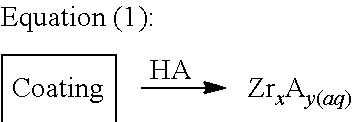
where: HA is a protic acid with H being the proton of the protic acid, A is the anion of the protic acid, and x and y are dependent on the applied acid. For instance, Equation (1a) below reflects the reaction of zirconium oxide and hydrochloric acid to form zirconyl chloride (also referred to as zirconium oxychloride), which is a water-soluble form of zirconium:
ZrO2+2HCl+7H2O→ZrOCl2*8H2O (or [Zr4(OH)8(H2O)16]Cl8(H2O)12) Equation (1a):
The acid may be of any concentration capable of rendering zirconium into a soluble form for the purposes of performing the testing methods discussed herein.
In accordance with some embodiments, the solvent may comprise one or more bases. As discussed further below, the base may be a basic salt and may be added in the form of a solid or in the form of an aqueous solution.
According to one embodiment, the one or more bases comprise one or more basic solutions, such as an aqueous basic solution. Non-limiting examples of basic solutions include hydroxide solutions such as potassium hydroxide and sodium hydroxide. In some instances, calcium hydroxide and magnesium hydroxide solutions may be used. Other non-limiting examples of basic solutions include bicarbonates and carbonates, such as sodium carbonate and potassium carbonate.
The concentration of basic solution may depend on the type of basic solution used. In some embodiments, the basic solution may be at a concentration of 50 wt % or higher. In some embodiments, the basic solution may be dilute, i.e., a concentration of less than 1 wt %. According to some embodiments, the basic solution may be a 50% by weight aqueous hydroxide solution. Treatment of the metal substrate with the basic solution converts zirconium present in the metal substrate to a zirconium salt as shown in the first part of the reaction described by Equation (2) below. The basic solution may be any concentration capable of converting zirconium in the coating to a zirconium salt for the purposes of performing the testing methods discussed herein. In some instances, the zirconium salt formed from treatment with the basic solution is a water-insoluble zirconium salt. Upon treatment with acid, as discussed below, the zirconium is rendered into a water-soluble form.
In accordance with some embodiments, the zirconium salts formed from treatment with the basic solution may subsequently be treated with one or more acids to convert the zirconium salts to a water-soluble form, i.e., a water-soluble zirconium salt, as shown in the second part of the reaction described by Equation (2) below:

where: C is a cation of a base salt, B is a basic anion of a base salt, H is the proton of a protic acid, A is the anion of the protic acid, and x and y are dependent on the applied base and acid. The one or more acids may be the same acids as discussed above in reference to Equation (1). According to one example, the metal substrate may be sequentially treated with a basic solution for purposes of releasing the oxide coating from the substrate to make the coating more amenable to the acidic conversion of the zirconium oxide to a soluble form (as outlined above in Equation (1a)). Therefore, act 235 of
In some embodiments, the solvent may also include one or more additives. The use of the additive is optional, and may be added to the test solution after contacting the surface of the metal, as shown in step 240 of FIG. 2 , or may be added to the liquid solvent before contacting the surface of the metal substrate. For instance, one or more additives may be mixed with solvent prior to contacting the metal substrate.
According to one embodiment, the additive may be an oxidizing agent. Non-limiting examples of oxidizing agents include hydrogen peroxide, nitrogen oxide (fuming nitric acids), chromate salts, sulfur oxides (fuming sulfuric acids), oxalic acid, and persulfate salts. In accordance with at least one embodiment, the solvent comprises one or more acids and an additive that is an oxidizing agent. Oxidizing agents typically refer to substances capable of oxidizing. In certain instances, adding one or more oxidizing agents to an acidic solvent may enhance the effectiveness of the resulting solution. According to another embodiment, the additive may be a reducing agent. Non-limiting examples of reducing agents include thiosulphates, iodides, dithionates, formates, and bisulfites. According to certain embodiments, the solvent comprises one or more basic solutions and an additive that is a reducing agent.
In some embodiments, the solvent is capable of near instantaneous dissolution of zirconium present in the coating of the metal substrate. In other embodiments, the solvent may take a period of time to dissolve the zirconium, and therefore the method may include a waiting period.
Once the zirconium has been converted to water-soluble form in a test solution formed with the solvent, an indicator may be added to the test solution, as indicated by step 245 in FIG. 2 . In accordance with at least one embodiment, the indicator changes color in the presence of zirconium. Method 200 of FIG. 2 therefore includes step 250 for determining if a color change occurs in the test solution. As used herein, the term “indicator” when used in reference to zirconium, refers to a substance that will react or complex with a threshold level of zirconium to display a color change. In some instances, the threshold level may be as low as 0.0006%. In addition, the indicator must not react with any of the alloy elements present in the metal substrate. In accordance with some embodiments, the indicator may be morin hydrate or arsenazo I hydrate. For example, arsenazo I hydrate turns a dark blue-violet color, and morin hydrate turns an intense yellow fluorescent color, in the presence of zirconium. Other non-limiting examples of indicators include p-dimethylaminoazophenylarsenic acid (pararsonic acid), pyrocatechol violet, rufigallic acid, and xylenol orange.
The amount of indicator added to the test solution may be any amount sufficient to induce and allow for detection of a color change of the test solution if zirconium is present in the test solution. In some embodiments, the amount of indicator added to the test solution may depend on the solvent used. In accordance with some embodiments, the indicator may be added using a dropper, such as an eye dropper, or a pipette. According to one embodiment, several drops or one large drop of solvent may be added to the metal substrate and then one or more drops of the indicator may be added to the test solution created by the solvent and any dissolved zirconium species.
In accordance with some embodiments, the solvent and the indicator may be added to the metal substrate at the same time. For instance, the solvent and indicator may be mixed together and then applied to the surface of the metal substrate. Therefore, steps 235 and 245 of FIG. 2 may be performed in one step. In some embodiments, the solvent and indicator may be added in equal amounts. According to certain embodiments, the ratio of solvent to indicator may be between 5:1 and 1:1 by weight. The amount of indicator added or otherwise included with the solvent may be an amount needed to cause an observable color change but not an amount so excessive that it inhibits the reaction or otherwise inhibits an observable color change.
In some embodiments, the indicator may be in solid form, i.e., the indicator may be a paper having the indicator disposed on one or more surfaces. The paper may come into contact with the test solution, and the indicator may turn color based on the presence of zirconium. In other instances, the indicator may be a powder or gel. In some instances, the powder or gel can be added to the test solution, and in other instances, the powder or gel may be dissolved or mixed with a liquid solution first, and then added to the test solution.
According to some embodiments, the color change can be observed with the naked eye. In other embodiments, the color change can be observed by using an emission or absorption spectrophotometer. For instance, all or a portion of the test solution containing the indicator and any dissolved zirconium may be siphoned or otherwise removed from the metal substrate and introduced into a device, such as the emission or absorption spectrophotometer.
Method 2—Colorimetric Test with Fusion Flux
According to another embodiment, a fusion flux process (also referred to as a flux fusion process) may be used for determining the presence of trivalent chromium conversion coating. One example of this process is shown generally at 300 in the process flow diagram of FIG. 3 . The flux material may be used to render zirconium in the metal conversion coating to a more water-soluble form. For instance, the zirconium of the mixed metal oxide that comprises the coating may be converted to a readily acid digestible material through use of a flux material. According to one embodiment, zirconium is converted to a form that readily reacts with hydrochloric acid to yield a water-soluble form of zirconium, e.g., zirconyl chloride. Other water-soluble forms of zirconium are also within the scope of this disclosure. For instance, nitrates, fluorides, chlorides, and other soluble zirconium salts formed from a corresponding acid may also be used in accordance with the processes described herein.
The process involves a first step 330 of contacting the surface of the metal substrate that has undergone a conversion coating process with a flux material. One example of a suitable flux material includes solid basic salts, and according to one embodiment, one or more solid basic salts may be used as the flux material. Non-limiting examples of solid basic salts include borates and carbonates of the alkali metals, such as sodium carbonate, lithium metaborate, lithium tetraborate, sodium tetraborate, lithium carbonate, and combinations thereof. According to some embodiments, the flux material may be a mixture of one or more solid basic salts. For instance, the flux material may be a 50:50 mixture of lithium metaborate and lithium tetraborate. The flux material may be any suitable material that renders the zirconium into a more soluble form.
The flux material may be provided in a powder form and may be applied as a layer onto the surface of the metal substrate. For instance, powdered flux material may be deposited onto the metal substrate as a continuous layer, or may be applied as a discontinuous layer, such that when heated (as described in further detail below) the deposited layer provides enough material to render the zirconium in the coating to a more soluble form for purposes of the test. A small amount of water may also be added to the powder flux material and mixed with the powder to form a paste to aid in applying the material to the surface of the metal substrate. In some instances, the layer of flux material may cover a few millimeters of the surface of the metal substrate. In other instances, the layer may cover a larger area. For instance, in some embodiments, the layer of flux material, and hence the test sample size, may be about the size of a coin.
Once the flux material is added to the metal substrate, the metal substrate is heated at step 332 to a predetermined temperature to fuse the flux material with the coating. The metal substrate may be heated to any temperature sufficient to effect thermal diffusion of the flux material, such as the base salt, into the coating and allow for the formation of a zirconium salt. According to some embodiments, the heat may be applied at a temperature in a range of from about 900° C. to about 1000° C. Heating may be performed for a period of time sufficient to effect thermal diffusion of the flux, but yet not harm the underlying metal substrate. In instances where the flux material is a solid basic salt, the basic salt may react with the zirconium using the same reaction mechanism discussed above in reference to the first part of Equation (2).
Heating may be performed in a furnace and therefore may require samples of the metal substrate to be of a size that is capable of being placed into the interior of the furnace. According to an alternative embodiment, spot heating may be performed using a heating probe configured to provide localized heat to the test area. For instance, the heating probe may include a heating element, such as a filament, that can be heated to the required temperature required to perform the fusion process. The heating element may be capable of heating to a temperature of about 1000° C. in a few microseconds. Using such a heating probe may allow for the metal substrate comprising the sample to be of any size, since only a small portion of the entire substrate needs to be tested. Other heat sources capable of functioning as an energy source are also within the scope of this disclosure, such as lasers. For instance, one or more diode lasers may be directed at the flux material disposed on the surface of the metal substrate for purposes of heating and initiating the flux process. Other heat application methods and devices are also within the scope of this disclosure, including spark plasma sintering devices.
Once the zirconium is treated with the flux material and heated, the surface of the metal substrate may be contacted with one or more solvents, such as an acid, to form a test solution, as indicated in step 335 of FIG. 3 . For instance, one or more acids may be added according to the second part of Equation (2) as discussed above to form a water-soluble form of zirconium. For example, in some embodiments, the acid may be hydrochloric acid, hydrofluoric acid, or nitric acid. In some instances, the one or more acids are capable of near-instantaneous conversion of zirconium into a water-soluble form, whereas in other instances step 335 may require a waiting period.
Once the zirconium has been rendered into a water-soluble form in a test solution formed with the one or more solvents, an indicator may be added to the test solution at step 345. The indicator may be added to the test solution as previously described and characterized in step 245 of FIG. 2 . For instance, an amount of indicator, such as morin hydrate or arsenazo I hydrate, may be added to the test solution. The amount of indicator added is an amount sufficient to induce a color change of the test solution if zirconium is present in the test solution. Step 350 is similar to step 250 described above in reference to FIG. 2 , and includes determining if a color change occurs in the test solution. As discussed above, the color change can be observed with the naked eye, or may be observed by using a device capable of determining a color changes, such as an emission or absorption spectrophotometer.
In some embodiments, the indicator may be introduced to the zirconium salt at the same time as the one or more solvents. For instance, a solvent, such as an acid, and the indicator may be mixed or otherwise provided as a mixture in an appropriate ratio, as described above. This implies that steps 335 and 345 may be performed in a single step.
Method 3—Colorimetric Test with Electrolysis
According to another embodiment, electrolysis may be used in a method for detecting the presence of a trivalent chromium conversion coating. A general process flow for this method is generally indicated at 400 in FIG. 4 . In general, the term “electrolysis” refers to a method of using an electric current to initiate a chemical reaction. According to the methods discussed herein, electric current may be coupled with various electrolyte solutions to electrolytically and/or chemically generate zirconium ions in solution from trivalent chromium treated surfaces. For instance, an electric current may be passed through an aqueous solution comprising one or more electrolytes which converts the zirconium in the coating to a water-soluble form of zirconium. The reaction is shown below by Equation (3):

where: A is the anion of the zirconium salt formed, and x and y are dependent on the electrolyte used.
At step 437 an electric current is applied to the electrolyte. The electric current may be applied at a predetermined level and for a predetermined period of time sufficient to convert at least a portion of the zirconium present in the coating to a water-soluble form of zirconium. Once this has occurred, the electrolyte functions as a test solution, and an indicator may be added to the test solution at step 445. The indicator may be added at step 445 as previously described and characterized in step 245 of FIG. 2 . For instance, an amount of indicator, such as morin hydrate or arsenazo I hydrate, may be added to the test solution. Step 450 includes determining if a color change occurs in the test solution generated by the electrolyte and any dissolved zirconium, and is similar to step 250 described above in reference to FIG. 2 . A color change indicates the presence of zirconium and confirms the presence of a trivalent chromium conversion coating. In some embodiments, the indicator may be added to the electrolyte before applying the electric current at step 437.
Other Methods of Forming Soluble Zirconium
According to one embodiment, a water-soluble form of zirconium, such as zirconyl chloride, may be formed from contacting the surface of the metal substrate with a chlorinating reagent. One example of such a chlorinating reagent is phosphorus pentachloride. According to this example, phosphorus pentachloride (PCl5) may be added as a layer onto the surface of the metal substrate. The surface may then be heated to a temperature of about 190° C., and the phosphorus pentachloride reacts with the zirconium oxide present in the conversion coating to generate zirconyl chloride. The zirconyl chloride may then be dissolved in a solution such as water or a dilute acid such as hydrochloric acid to form a test solution. An indicator may then be added to the test solution for purposes of detecting a color change and confirming the presence of a trivalent chromium conversion coating, as discussed above.
Kit for Performing Analysis
In accordance with at least one embodiment, a kit is provided for determining the presence of a trivalent chromium conversion coating on a metal substrate that has been subjected to a chromate conversion process. The kit may therefore contain one or more physical components that may be used to carry out the methods disclosed herein.
Referring to FIG. 5A , according to one embodiment, a kit 500 comprises a solvent 505, and an indicator 510 capable of detecting zirconium. The indicator 510 may be added to a test solution formed from contacting the solvent 505 with a surface of the metal substrate to induce a color change of the test solution if zirconium is present in the test solution. For instance, the solvent 505 may comprise one or more protic acids, as described above, such as hydrochloric, hydrofluoric, and/or nitric acid, and the indicator 510 may be morin hydrate or arsenazo I hydrate.
The solvent 505 and/or the indicator 510 may be provided in a container such as a bottle or vial and may include enough testing material to perform multiple tests. In some instances the bottle or vial may be opaque or colored so as to avoid degradation or other detrimental effects caused by light to the solvent or indicator. In instances where the solvent and indicator are mixed together to provide one liquid solution, a single container may be used.
In some embodiments, the kit 500 also comprises at least one dispensing device 515 for dispensing at least one of the solvent 505 and the indicator 510 onto a surface of the metal substrate. For instance, the at least one dispensing device 515 may be a pipette, a stick, a syringe, or an eye dropper that includes a squeeze bulb, for purposes of drawing the material and dispensing it onto the surface of the metal substrate. In some instances, the dispensing device 515 may be attached to the container that contains the solvent 505 and/or indicator 510. For instance, an eye dropper dispenser may be removably attached to the container. In other embodiments, the indicator 510 may be provided on a paper, or in another solid form, as described above.
Referring to FIG. 5B , according to another embodiment, a kit 500 includes a solvent 505, an indicator 510, and at least one dispensing device 515, as described above. In addition, the kit 500 may also comprise a flux material 520. The flux material 520 may be any of the flux materials described herein. For instance, the flux material 520 may be a solid basic salt, such as a borate or a carbonate of an alkali metal. The flux material 520 may also be provided in a container and may also include a dispensing device, such as a spatula, spoon, or scoop, which may be used to add a layer of the flux material onto the surface of the metal substrate. In accordance with another embodiment, the kit 500 may also comprise a heating device 525. The heating device 525 may be used to heat the flux material disposed on the surface of the metal substrate to a predetermined temperature. The heating device 525 may be a heating device as described above, such as a heating probe or diode laser. For instance, the heating device 525 may be a heating probe that includes a filament or other heating element that is configured to heat the flux material to a temperature of about 1000° C. The heating device 525 may be configured to heat to any temperature sufficient to effect thermal diffusion of the flux material.
In some embodiments, the kit 500 may also include one or more additives 530, such as an oxidizing or reducing agent, and is indicated as an optional component of the kits shown in FIGS. 5A and 5B . One or more additives 530 may be included separately, i.e., in separate containers and dispensing devices, or may be included with other components of the kit. For instance, one or more oxidizing agents may be included with the solvent. In other instances, the oxidizing agent may be included in a separate container that may be configured to protect or otherwise inhibit the oxidizing agent from reacting with the air or other components, such as the solvent 505, thereby reducing their effectiveness.
The aspects disclosed herein in accordance with the present invention, are not limited in their application to the details of construction and the arrangement of components set forth in the following description or illustrated in the accompanying drawing. These aspects are capable of assuming other embodiments and of being practiced or of being carried out in various ways. Examples of specific implementations are provided herein for illustrative purposes only and are not intended to be limiting. In particular, acts, components, elements, and features discussed in connection with any one or more embodiments are not intended to be excluded from a similar role in any other embodiments.
Also, the phraseology and terminology used herein is for the purpose of description and should not be regarded as limiting. Any references to examples, embodiments, components, elements or acts of the systems and methods herein referred to in the singular may also embrace embodiments including a plurality, and any references in plural to any embodiment, component, element or act herein may also embrace embodiments including only a singularity. References in the singular or plural form are not intended to limit the presently disclosed systems or methods, their components, acts, or elements. The use herein of “including,” “comprising,” “having,” “containing,” “involving,” and variations thereof is meant to encompass the items listed thereafter and equivalents thereof as well as additional items. References to “or” may be construed as inclusive so that any terms described using “or” may indicate any of a single, more than one, and all of the described terms. In addition, in the event of inconsistent usages of terms between this document and documents incorporated herein by reference, the term usage in the incorporated reference is supplementary to that of this document; for irreconcilable inconsistencies, the term usage in this document controls. Moreover, titles or subtitles may be used in the specification for the convenience of a reader, which shall have no influence on the scope of the present invention.
Having thus described several aspects of at least one example, it is to be appreciated that various alterations, modifications, and improvements will readily occur to those skilled in the art. For instance, examples disclosed herein may also be used in other contexts. Such alterations, modifications, and improvements are intended to be part of this disclosure, and are intended to be within the scope of the examples discussed herein. Accordingly, the foregoing description and drawings are by way of example only.
Claims (19)
1. A method of testing for the presence of a trivalent chromium conversion coating on a metal substrate that has been subjected to a chromate conversion process, comprising:
contacting a surface of the metal substrate with at least one solvent to generate a test solution, the at least one solvent being capable of dissolving zirconium to produce a water-soluble form of zirconium;
adding an indicator capable of detecting zirconium to the test solution in an amount that induces a color change of the test solution if zirconium is present in the test solution; and
confirming the presence of the trivalent chromium conversion coating based on detecting the color change in the test solution.
2. The method of claim 1 , wherein the at least one solvent comprises at least one protic acid.
3. The method of claim 1 , wherein contacting the surface of the metal substrate comprises:
contacting the surface of the metal substrate with at least one base; and
contacting the surface of the metal substrate with at least one acid.
4. The method of claim 3 , wherein the at least one base is a basic solution.
5. The method of claim 1 , further comprising:
contacting the surface of the metal substrate with a flux material; and
heating the metal substrate to a predetermined temperature prior to contacting the surface of the metal substrate with the at least one solvent.
6. The method of claim 5 , wherein the flux material is a solid basic salt.
7. The method of claim 6 , wherein the solid basic salt is a borate or a carbonate of an alkali metal.
8. The method of claim 5 , wherein the at least one solvent is a protic acid.
9. The method of claim 1 , wherein the at least one solvent includes at least one additive.
10. The method of claim 9 , wherein the at least one additive is one of an oxidizing agent and a reducing agent.
11. The method of claim 1 , wherein the indicator does not chemically react with any alloys present in the metal substrate.
12. The method of claim 1 , wherein the indicator is one of morin hydrate and arsenazo I hydrate.
13. A kit for determining the presence of a trivalent chromium conversion coating on a metal substrate that has been subjected to a chromate conversion process, comprising:
a solvent capable of dissolving zirconium to produce a water-soluble form of zirconium; and
an indicator capable of detecting zirconium in a test solution formed from contacting the solvent with a surface of the metal substrate.
14. The kit of claim 13 , wherein the solvent comprises at least one protic acid.
15. The kit of claim 14 , wherein the at least one protic acid is one of hydrochloric acid, hydrofluoric acid, and nitric acid.
16. The kit of claim 13 , further comprising a flux material.
17. The kit of claim 16 , wherein the flux material is a borate or a carbonate of an alkali metal.
18. The kit of claim 13 , wherein the indicator is one of morin hydrate and arsenazo I hydrate.
19. The kit of claim 13 , wherein the solvent and the indicator are provided together in a single solution.
Priority Applications (1)
| Application Number | Priority Date | Filing Date | Title |
|---|---|---|---|
| US15/353,047 US10274468B2 (en) | 2016-11-16 | 2016-11-16 | Methods and kit for determining presence of trivalent chromium conversion coating |
Applications Claiming Priority (1)
| Application Number | Priority Date | Filing Date | Title |
|---|---|---|---|
| US15/353,047 US10274468B2 (en) | 2016-11-16 | 2016-11-16 | Methods and kit for determining presence of trivalent chromium conversion coating |
Publications (2)
| Publication Number | Publication Date |
|---|---|
| US20180136178A1 US20180136178A1 (en) | 2018-05-17 |
| US10274468B2 true US10274468B2 (en) | 2019-04-30 |
Family
ID=62107740
Family Applications (1)
| Application Number | Title | Priority Date | Filing Date |
|---|---|---|---|
| US15/353,047 Active 2037-01-01 US10274468B2 (en) | 2016-11-16 | 2016-11-16 | Methods and kit for determining presence of trivalent chromium conversion coating |
Country Status (1)
| Country | Link |
|---|---|
| US (1) | US10274468B2 (en) |
Cited By (1)
| Publication number | Priority date | Publication date | Assignee | Title |
|---|---|---|---|---|
| US11155928B2 (en) | 2019-12-19 | 2021-10-26 | The United States Of America As Represented By The Secretary Of The Navy | Electrolytic process for deposition of chemical conversion coatings |
Citations (11)
| Publication number | Priority date | Publication date | Assignee | Title |
|---|---|---|---|---|
| US2902348A (en) | 1955-08-03 | 1959-09-01 | Allied Res Products Inc | Testing material |
| US3656908A (en) | 1970-12-01 | 1972-04-18 | Betz Laboratories | Method of determining the chromium content of aqueous mediums |
| US4546087A (en) | 1982-10-29 | 1985-10-08 | Deere & Company | Method for detecting the presence of a chromate coating on aluminum |
| US5165795A (en) | 1990-07-09 | 1992-11-24 | Metallgesellschaft Aktiengesellschaft | Method of determining the weight of conversion layers per unit of area |
| US5304257A (en) | 1993-09-27 | 1994-04-19 | The United States Of America As Represented By The Secretary Of The Navy | Trivalent chromium conversion coatings for aluminum |
| WO1999044056A1 (en) | 1998-02-27 | 1999-09-02 | The Government Of The United States Of America, Represented By The Secretary Of The Department Of Healt H And Human Services | Method for the determination of hexavalent chromium using ultrasonication and strong anion exchange solid phase extraction |
| US6375726B1 (en) | 2000-10-31 | 2002-04-23 | The United States Of America As Represented By The Secretary Of The Navy | Corrosion resistant coatings for aluminum and aluminum alloys |
| US6794651B2 (en) | 2002-06-13 | 2004-09-21 | The Boeing Company | Method of measuring chromated conversion coating amount using infrared absorbance |
| US7148068B1 (en) | 2003-04-01 | 2006-12-12 | Reheulishvili Aleksandre N | Method of trivalent chromium concentration determination by atomic spectrometry |
| US20100032060A1 (en) * | 2005-02-15 | 2010-02-11 | The U.S. Of America As Represented By The Secretary Of The Navy | Process for preparing chromium conversion coatings for magnesium alloys |
| US7800069B2 (en) | 2008-08-08 | 2010-09-21 | The Boeing Company | Method for performing IR spectroscopy measurements to determine coating weight/amount for metal conversion coatings |
-
2016
- 2016-11-16 US US15/353,047 patent/US10274468B2/en active Active
Patent Citations (11)
| Publication number | Priority date | Publication date | Assignee | Title |
|---|---|---|---|---|
| US2902348A (en) | 1955-08-03 | 1959-09-01 | Allied Res Products Inc | Testing material |
| US3656908A (en) | 1970-12-01 | 1972-04-18 | Betz Laboratories | Method of determining the chromium content of aqueous mediums |
| US4546087A (en) | 1982-10-29 | 1985-10-08 | Deere & Company | Method for detecting the presence of a chromate coating on aluminum |
| US5165795A (en) | 1990-07-09 | 1992-11-24 | Metallgesellschaft Aktiengesellschaft | Method of determining the weight of conversion layers per unit of area |
| US5304257A (en) | 1993-09-27 | 1994-04-19 | The United States Of America As Represented By The Secretary Of The Navy | Trivalent chromium conversion coatings for aluminum |
| WO1999044056A1 (en) | 1998-02-27 | 1999-09-02 | The Government Of The United States Of America, Represented By The Secretary Of The Department Of Healt H And Human Services | Method for the determination of hexavalent chromium using ultrasonication and strong anion exchange solid phase extraction |
| US6375726B1 (en) | 2000-10-31 | 2002-04-23 | The United States Of America As Represented By The Secretary Of The Navy | Corrosion resistant coatings for aluminum and aluminum alloys |
| US6794651B2 (en) | 2002-06-13 | 2004-09-21 | The Boeing Company | Method of measuring chromated conversion coating amount using infrared absorbance |
| US7148068B1 (en) | 2003-04-01 | 2006-12-12 | Reheulishvili Aleksandre N | Method of trivalent chromium concentration determination by atomic spectrometry |
| US20100032060A1 (en) * | 2005-02-15 | 2010-02-11 | The U.S. Of America As Represented By The Secretary Of The Navy | Process for preparing chromium conversion coatings for magnesium alloys |
| US7800069B2 (en) | 2008-08-08 | 2010-09-21 | The Boeing Company | Method for performing IR spectroscopy measurements to determine coating weight/amount for metal conversion coatings |
Non-Patent Citations (5)
| Title |
|---|
| Gou, Yang, A Study of Trivalent Chrome Process Coatings on Aluminum Alloy 2024-T3, The Ohio State University, 2011, pp. 1-190. (Year: 2011). * |
| Hummers et al. "Zirconium and Hafnium Tetrachlorides" Inorganic Syntheses, vol. IV, 1953, pp. 121-126. |
| Kennedy, David Colin, Sulfoxides as solvent extraction reagents for the analytical separation of metal ions, (1969). Retrospective Theses and Dissertations. 3583. (Year: 1969). * |
| Qi, J.T., et al, Trivalent chromium conversion coating formation on aluminum, Surface & Coatings Technology, 2015, 280, 317-329. (Year: 2015). * |
| Staff, Ames Laboratory and Spedding, F. H., Semi-annual summary research report in chemistry (1957). Ames Laboratory ISC Technical Reports.161. (Year: 1957). * |
Cited By (1)
| Publication number | Priority date | Publication date | Assignee | Title |
|---|---|---|---|---|
| US11155928B2 (en) | 2019-12-19 | 2021-10-26 | The United States Of America As Represented By The Secretary Of The Navy | Electrolytic process for deposition of chemical conversion coatings |
Also Published As
| Publication number | Publication date |
|---|---|
| US20180136178A1 (en) | 2018-05-17 |
Similar Documents
| Publication | Publication Date | Title |
|---|---|---|
| Zhang et al. | Influence of temperature on passive film properties on Ni–Cr–Mo Alloy C-2000 | |
| Feng et al. | Quantification of accelerated corrosion testing of coated AA7075-T6 | |
| CN103645187B (en) | A kind of test agent of online Fast nondestructive evaluation gold plate quality and using method | |
| Choudhary et al. | Recent insights in corrosion science from atomic spectroelectrochemistry | |
| Qi et al. | Influence of water immersion post-treatment parameters on trivalent chromium conversion coatings formed on AA2024-T351 alloy | |
| Nakatsugawa et al. | Effect of area ratio on the galvanic corrosion of AZX611 magnesium alloy/A6N01 aluminum alloy joint | |
| Nakatsugawa et al. | Effect of NaCl concentration on the galvanic corrosion behavior of a magnesium AZX611/aluminum A6N01 alloy joint | |
| Elaish et al. | Effects of fluoride ions in the growth of barrier-type films on aluminium | |
| Gwinner et al. | A step towards a better understanding of corrosion of zirconium in nitric acid with additions of fluorine: Focus on the role of the presence of an initial oxide film | |
| US20180136178A1 (en) | Methods and kit for determining presence of trivalent chromium conversion coating | |
| ZHANG | Preparation and performance of fluorescent sensing coating for monitoring corrosion of Al alloy 2024 | |
| Shruthi et al. | Detection of H2O2 from the reduction of dissolved oxygen on TCP-coated AA2024-T3: impact on the transient formation of Cr (VI) | |
| Mertens et al. | On the stability and composition of oxide layers on pre-treated titanium | |
| Munson et al. | Electrochemical characterization of different variants of a commercial trivalent chromium process (TCP) coating on aluminum alloy 7075-T6 | |
| Emelyanenko et al. | Corrosion behavior of superhydrophobic coatings on aluminum-magnesium alloy in potassium iodide solutions | |
| US3652224A (en) | Method for detecting cracks in metal bodies | |
| Ferrer et al. | Development of an aircraft lap joint simulant environment | |
| CN104483308A (en) | Method for quickly distinguishing 316L and 304 stainless steels | |
| Homazava et al. | Micro-capillary system coupled to ICP-MS as a novel technique for investigation of micro-corrosion processes | |
| Nickchi et al. | Corrosion characteristics of alloy 800 in aqueous solutions up to 200 C | |
| Parry et al. | Effect of chloride on the anodic dissolution of titanium in methanolic solutions | |
| Huang et al. | Forensic analysis of lead–tin solder by inductively coupled plasma mass spectrometry | |
| JP2016205946A (en) | Detecting corrosion points of metal materials | |
| Kawamura et al. | Internal transport numbers in molten AgNO3-LiNO3 | |
| Elaish | Influences of fluorine species on the anodizing behaviour of aluminium and AA 2024-T3 alloy |
Legal Events
| Date | Code | Title | Description |
|---|---|---|---|
| AS | Assignment |
Owner name: RAYTHEON COMPANY, MASSACHUSETTS Free format text: ASSIGNMENT OF ASSIGNORS INTEREST;ASSIGNORS:WOLFGONG, WILLIAM J.;FASOLINO, STEPHEN T.;REEL/FRAME:040345/0276 Effective date: 20161111 |
|
| STPP | Information on status: patent application and granting procedure in general |
Free format text: PUBLICATIONS -- ISSUE FEE PAYMENT VERIFIED |
|
| STCF | Information on status: patent grant |
Free format text: PATENTED CASE |
|
| CC | Certificate of correction | ||
| MAFP | Maintenance fee payment |
Free format text: PAYMENT OF MAINTENANCE FEE, 4TH YEAR, LARGE ENTITY (ORIGINAL EVENT CODE: M1551); ENTITY STATUS OF PATENT OWNER: LARGE ENTITY Year of fee payment: 4 |