US10274082B2 - Hydraulically actuated continuously variable transmission for a vehicular drive line provided with an internal combustion engine - Google Patents

Hydraulically actuated continuously variable transmission for a vehicular drive line provided with an internal combustion engine Download PDF

Info

Publication number
US10274082B2
US10274082B2 US14/650,480 US201314650480A US10274082B2 US 10274082 B2 US10274082 B2 US 10274082B2 US 201314650480 A US201314650480 A US 201314650480A US 10274082 B2 US10274082 B2 US 10274082B2
Authority
US
United States
Prior art keywords
hydraulic
pressure
distribution line
line
driven pump
Prior art date
Legal status (The legal status is an assumption and is not a legal conclusion. Google has not performed a legal analysis and makes no representation as to the accuracy of the status listed.)
Expired - Fee Related, expires
Application number
US14/650,480
Other versions
US20150308570A1 (en
Inventor
Francis Maria Antonius Van Der Sluis
Current Assignee (The listed assignees may be inaccurate. Google has not performed a legal analysis and makes no representation or warranty as to the accuracy of the list.)
Robert Bosch GmbH
Original Assignee
Robert Bosch GmbH
Priority date (The priority date is an assumption and is not a legal conclusion. Google has not performed a legal analysis and makes no representation as to the accuracy of the date listed.)
Filing date
Publication date
Application filed by Robert Bosch GmbH filed Critical Robert Bosch GmbH
Assigned to ROBERT BOSCH GMBH reassignment ROBERT BOSCH GMBH ASSIGNMENT OF ASSIGNORS INTEREST (SEE DOCUMENT FOR DETAILS). Assignors: VAN DER SLUIS, FRANCIS MARIA ANTONIUS
Publication of US20150308570A1 publication Critical patent/US20150308570A1/en
Application granted granted Critical
Publication of US10274082B2 publication Critical patent/US10274082B2/en
Expired - Fee Related legal-status Critical Current
Adjusted expiration legal-status Critical

Links

Images

Classifications

    • FMECHANICAL ENGINEERING; LIGHTING; HEATING; WEAPONS; BLASTING
    • F16ENGINEERING ELEMENTS AND UNITS; GENERAL MEASURES FOR PRODUCING AND MAINTAINING EFFECTIVE FUNCTIONING OF MACHINES OR INSTALLATIONS; THERMAL INSULATION IN GENERAL
    • F16HGEARING
    • F16H61/00Control functions within control units of change-speed- or reversing-gearings for conveying rotary motion ; Control of exclusively fluid gearing, friction gearing, gearings with endless flexible members or other particular types of gearing
    • F16H61/02Control functions within control units of change-speed- or reversing-gearings for conveying rotary motion ; Control of exclusively fluid gearing, friction gearing, gearings with endless flexible members or other particular types of gearing characterised by the signals used
    • F16H61/0202Control functions within control units of change-speed- or reversing-gearings for conveying rotary motion ; Control of exclusively fluid gearing, friction gearing, gearings with endless flexible members or other particular types of gearing characterised by the signals used the signals being electric
    • F16H61/0204Control functions within control units of change-speed- or reversing-gearings for conveying rotary motion ; Control of exclusively fluid gearing, friction gearing, gearings with endless flexible members or other particular types of gearing characterised by the signals used the signals being electric for gearshift control, e.g. control functions for performing shifting or generation of shift signal
    • F16H61/0206Layout of electro-hydraulic control circuits, e.g. arrangement of valves
    • FMECHANICAL ENGINEERING; LIGHTING; HEATING; WEAPONS; BLASTING
    • F16ENGINEERING ELEMENTS AND UNITS; GENERAL MEASURES FOR PRODUCING AND MAINTAINING EFFECTIVE FUNCTIONING OF MACHINES OR INSTALLATIONS; THERMAL INSULATION IN GENERAL
    • F16HGEARING
    • F16H61/00Control functions within control units of change-speed- or reversing-gearings for conveying rotary motion ; Control of exclusively fluid gearing, friction gearing, gearings with endless flexible members or other particular types of gearing
    • F16H61/0021Generation or control of line pressure
    • F16H61/0025Supply of control fluid; Pumps therefor
    • F16H61/0031Supply of control fluid; Pumps therefor using auxiliary pumps, e.g. pump driven by a different power source than the engine
    • FMECHANICAL ENGINEERING; LIGHTING; HEATING; WEAPONS; BLASTING
    • F16ENGINEERING ELEMENTS AND UNITS; GENERAL MEASURES FOR PRODUCING AND MAINTAINING EFFECTIVE FUNCTIONING OF MACHINES OR INSTALLATIONS; THERMAL INSULATION IN GENERAL
    • F16HGEARING
    • F16H61/00Control functions within control units of change-speed- or reversing-gearings for conveying rotary motion ; Control of exclusively fluid gearing, friction gearing, gearings with endless flexible members or other particular types of gearing
    • F16H61/66Control functions within control units of change-speed- or reversing-gearings for conveying rotary motion ; Control of exclusively fluid gearing, friction gearing, gearings with endless flexible members or other particular types of gearing specially adapted for continuously variable gearings
    • F16H61/662Control functions within control units of change-speed- or reversing-gearings for conveying rotary motion ; Control of exclusively fluid gearing, friction gearing, gearings with endless flexible members or other particular types of gearing specially adapted for continuously variable gearings with endless flexible members
    • F16H61/66272Control functions within control units of change-speed- or reversing-gearings for conveying rotary motion ; Control of exclusively fluid gearing, friction gearing, gearings with endless flexible members or other particular types of gearing specially adapted for continuously variable gearings with endless flexible members characterised by means for controlling the torque transmitting capability of the gearing

Definitions

  • the present invention relates to a continuously variable transmission.
  • Such a continuously variable transmission is generally known, and e.g. described in the international patent publication WO-A-2006/016797 in the name of Applicant.
  • the known continuously variable transmission which may be one of several known types, provides a speed ratio that may be controlled to an arbitrary value within a range of speed ratios covered by the transmission by an appropriate actuation thereof.
  • the actuation of the transmission further includes the control of a transmissible torque of the transmission.
  • transmission ratio and torque control requires a relatively large flow of hydraulic fluid at a relatively high pressure level.
  • the known transmission When the known transmission is applied in a vehicular drive line it comes with the limitation that the electrically driven pump has to be constantly operational and, moreover, has to be capable of providing the entire fluid flow that is required for main hydraulic function of the transmission. According to the present invention, the known transmission can be significantly improved upon. By such measure, i.e. by being able to selectively switch the electrically driven pump either downstream of, or in parallel with the mechanically driven pump the functionality and the overall efficiency of the transmission is improved relative to known transmission of WO-A-2006/016797. More in particular the transmission according to the invention adds two further hydraulic modes to the two known hydraulic modes provided by the known transmission.
  • the transmission according to the invention provides that the electrically driven pump can be supported by the mechanically driven pump in providing a flow of fluid required for the main hydraulic function of the transmission by switching both pumps in parallel.
  • the entire flow of fluid that is required for such main hydraulic function passes through, i.e. is pumped by the electrically driven pump.
  • the specifications of the electrically driven pump e.g. in terms of its drive motor, stroke volume, pump speed etc. are determined by the substantial flow and pressure requirements of the main hydraulic function during dynamic operation of the transmission.
  • the transmission according to the invention provides that, if the electrically driven pump fails, the vehicle can be continued to be used/operated. Such a failure of the electrically driven pump can, for instance, occur when insufficient electric power is available for the required operation of the electrically driven pump.
  • the electrically driven pump is again switched in parallel with the mechanically drive pump such that the mechanically driven pump provides the hydraulic fluid that is required for the said main hydraulic function of the transmission.
  • German patent application DE-A-41 34 268 describes a continuously variable transmission with an electro-hydraulic control system that is capable of the actuation of the transmission when the engine is stopped.
  • this latter transmission system has neither the capabilities, nor the advantages of the transmission according to the present invention.
  • this known transmission system lacks the energy efficient option to switch the electrically driven pump downstream, in series with the mechanically driven pump.
  • a one-way or check valve is provided at the discharge port or outlet of the mechanically driven pump and/or the electrically driven pump, to favourably prevent that, when a respective pump is not in operation, no fluid can leak towards the suction port or inlet of such pump, i.e. back to the fluid reservoir.
  • the mechanical driven pump is provided as variable flow pump that generates a flow of fluid that can be varied between zero and a certain maximum that depends on the speed of the engine driving the pump.
  • a very adaptive and responsive hydraulic system is obtained that can not only be operated in the said four different hydraulic modes, but wherein in each one of such four hydraulic modes, the flow of fluid generated by the then operational pump or pumps can be adapted to the fluid flow requirement of the transmission.
  • FIG. 1 is a schematic representation of a prior art and to be improved continuously variable transmission
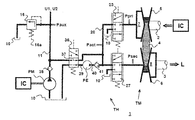
  • FIG. 2 represents the hydraulic configuration of the novel transmission according to the invention.
  • FIG. 1 schematically shows the known continuously variable transmission 1 comprising a mechanical system TM, for realising and changing a speed ratio between an input shaft 2 and an output shaft 3 of the transmission 1 , and a hydraulic system TH for the operation and control of the transmission 1 .
  • the hydraulic system TH is arranged both for the actuation of the said mechanical system TM and for the control of all auxiliary hydraulic users U 1 , U 2 of the transmission 1 , such as clutch pressurisation and lubrication of moving parts.
  • the transmission 1 may be incorporated between an internal combustion engine IC and a load L, for example in a motor vehicle drive line, for varying a speed ratio between the engine IC and the load L within a continuous range of possible speed ratios.
  • the mechanical system TM of the known transmission 1 comprises an endless flexible belt 4 that is wrapped around two pulleys 5 and 6 , whereby each pulley is connected to either the input shaft 2 or the output or secondary shaft 3 of the transmission 1 .
  • the belt 4 is frictionally engaged with the pulley discs of a respective pulley 5 , 6 by means of a clamping force that is generated by a hydraulic pressures in a pressure chamber 7 , resp. 8 of a piston-and-cylinder assembly that is associated with that respective pulley 5 , 6 , i.e. either the so-called primary pressure chamber 7 associated with the pulley 5 connected to the input shaft 2 , or the so-called secondary pressure chamber 8 associated with the pulley 6 connected to the input shaft 3 .
  • the hydraulic system TH of the known transmission 1 comprises a mechanically driven main pump PM and an electrically driven auxiliary pump PE, which latter pump PE may be activated on demand and to a variable extent, in particular during dynamic operation of the mechanical system TM of the transmission 1 .
  • the mechanically driven pump PM on the other hand is driven directly and continuously by the engine IC, the flow of fluid supplied thereby thus being dependent on the rotational speed of the drive shaft of the engine IC.
  • the mechanically driven pump PM draws fluid in via its inlet or suction port from a reservoir 10 for hydraulic fluid. This fluid is supplied via the outlet or discharge port of the pump PM to a distribution line 11 of the hydraulic system TH.
  • the electrically driven pump PE is provided downstream of the mechanically driven pump PM, such that it draws fluid from the distribution line 11 via its inlet 39 and supplies it to a main actuation line 20 of the hydraulic system TH for controlling a primary pressure Ppri in the primary pressure chamber 7 and a secondary pressure Psec in the secondary pressure chamber 8 of the transmission 1 .
  • the main actuation line 20 connects to both a primary valve 23 , which is located between the electrically driven pump PE and the primary pressure chamber 7 for controlling the primary pressure Ppri to a desired level, and a secondary valve 27 , which is located between the electrically driven pump PE and the secondary pressure chamber 8 for controlling the secondary pressure Psec to a desired level.
  • Both said valves 23 and 27 are operated under the influence of generally known valve biasing means that, typically, comprise respective valve-control conduits and springs.
  • a valve-control pressure, exerted in a respective valve-control conduit for operating a respective valve 23 , 27 is realised by means of a respective solenoid-operated additional valve (not shown).
  • the respective pressure level Ppri, Psec can be controlled between ambient pressure, i.e. the pressure level prevailing in the fluid reservoir 10 , and a main actuation pressure level Pact prevailing in the main actuation line 20 , which main actuation pressure Pact is effected by the appropriate, i.e. by a controlled operation of the electrically driven pump PE.
  • main actuation pressure Pact is effected by the appropriate, i.e. by a controlled operation of the electrically driven pump PE.
  • the auxiliary hydraulic users U 1 , U 2 of the transmission 1 can be connected to the distribution line 11 via further pressure-regulating valve 33 , such that these auxiliary hydraulic users U 1 , U 2 are supplied with fluid from the distribution line 11 , at least when the mechanically driven pump PM is running and the pressure level in the distribution line 11 can be maintained at the desired auxiliary pressure level Paux by means of an auxiliary pressure-regulating valve 16 of the hydraulic system TH.
  • any surplus of the flow of fluid generated by the mechanically driven pump PM is returned by the auxiliary pressure-regulating valve 16 to the fluid reservoir 10 . It is, however, common practice to direct the said flow surplus to one or more moving parts of the transmission 1 for the lubrication and/or cooling thereof.
  • the hydraulic system TH is provided with yet a further hydraulic line 30 , denoted supply line 30 hereinafter.
  • This supply line 30 is provided between and connects the distribution line 11 and the fluid reservoir 10 and allows the electrically driven pump PE to draw fluid directly from the reservoir 10 , bypassing the mechanically driven pump PM when this latter pump PM is stopped.
  • a one-way or check valve 31 is provided in the supply line 30 to prevent that fluid flows from the distribution line 11 directly (back) to the reservoir 10 when the mechanically driven pump PM is running, i.e. is pumping fluid from the reservoir into the distribution line 11 .
  • the further pressure control valve 33 is arranged to close the (direct) hydraulic connection between the distribution line 11 and the auxiliary hydraulic users U 1 , U 2 , at least when the mechanically driven pump PM is stopped, to prevent that the electrically driven pump PE draws fluid from the auxiliary hydraulic users U 1 , U 2 .
  • the hydraulic system TH of the known transmission 1 is provided with yet a further hydraulic line 34 , denoted the connecting line 34 , which is provided between and connects the outlet 40 of the electrically driven pump PE and the auxiliary hydraulic users U 1 , U 2 and which is interrupted by a switch valve 35 .
  • the switch valve 35 is arranged and operated (“switched”), by means of valve biasing means comprising a respective valve-control conduit 35 a , carrying the pressure in the distribution line 11 , and a spring 35 b , to connect the outlet 40 of the electrically driven pump PE to the auxiliary hydraulic users U 1 , U 2 when the pressure level in the distribution line 11 cannot be maintained at the (desired) auxiliary pressure Paux.
  • valve biasing means comprising a respective valve-control conduit 35 a , carrying the pressure in the distribution line 11 , and a spring 35 b , to connect the outlet 40 of the electrically driven pump PE to the auxiliary hydraulic users U 1 , U 2 when the pressure level in the distribution line 11 cannot be maintained at the (desired) auxiliary pressure Paux.
  • This condition for example occurs when the mechanically driven pump PM is stopped.
  • the switch valve 35 thus provides that the auxiliary hydraulic functions U 1 , U 2 of the transmission 1 can be continued to be supplied with hydraulic fluid, even when the mechanically driven pump PM is stopped and
  • the above known transmission 1 can be significantly improved by applying therein the hydraulic system TH of FIG. 2 .
  • the further pressure control valve 33 and the switch valve 35 of the known hydraulic system TH of FIG. 1 at least the hydraulic functions provided by these two valves 33 , 35 , have been replaced by a single switch valve 36 , denoted hydraulic-mode switch valve 36 hereinafter.
  • the hydraulic-mode shift valve 36 is arranged to switch the electrically driven pump PE either in parallel with the mechanically driven pump PM while opening a (direct) hydraulic connection 37 between the main actuation line 20 and the distribution line 11 , or in series with the mechanically driven pump PM while closing the said hydraulic connection 37 between the main actuation line 20 and the distribution line 11 .
  • the transmission 1 can favourably be operated in one or more of four different hydraulic modes.
  • the hydraulic-mode shift valve 36 is in the position depicted in FIG. 2 , wherein the electrically driven pump PE is switched in parallel with the mechanically driven pump PM and the hydraulic connection 37 between the main actuation line 20 and the distribution line 11 is opened. Further in this first hydraulic mode both said pumps PE, PM are operational, such that the electrically driven pump PE is supported by the mechanically driven pump PM.
  • This first hydraulic mode favourably allows the electrically driven pump PE and/or the mechanically driven pump PM to be smaller as compared to the prior art, such that it can be manufactured and/or operated more economically.
  • This first hydraulic mode is particularly useful and will normally be activated when the said transmission ratio and torque control demands a relatively large flow of hydraulic fluid, such as during an emergency stop of the vehicle.
  • the hydraulic-mode shift valve 36 is likewise in the position depicted in FIG. 2 , wherein the electrically driven pump PE is switched in parallel with the mechanically driven pump PM and the hydraulic connection 37 between the main actuation line 20 and the distribution line 11 is opened.
  • the mechanically driven pump PM in this second hydraulic mode only the mechanically driven pump PM is operational, whereas the electrically drive pump PE is not operational, for example due to electric or mechanical failure of the pump system.
  • the mechanically driven pump PM takes over the function of the electrically driven pump PE in full and thus favourably provides a back-up thereto.
  • a one-way or check valve 41 can be provided at the outlet 40 of the electrically driven pump PE, to favourably prevent that fluid leaks from the main actuation line 20 to the fluid reservoir 10 via this pump PE when it is not in operation.
  • the hydraulic-mode shift valve 36 is likewise in the position depicted in FIG. 2 , wherein the electrically driven pump PE is switched in parallel with the mechanically driven pump PM and the hydraulic connection 37 between the main actuation line 20 and the distribution line 11 is opened.
  • the electrically driven pump PE takes over the function of the mechanically driven pump PM in full and thus favourably allows the vehicle engine IC to be stopped to save fuel, whereas the transmission 1 remains functional.
  • a one-way or check valve 38 is provided at the discharge port or outlet of the mechanically driven pump PM, to favourably prevent that fluid leaks from the distribution line 11 to the fluid reservoir 10 via such respective pump PM.
  • the auxiliary pressure-regulating valve 16 effectively determines, at least influences, the main actuation pressure Pact, because of the hydraulic connection 37 between the main actuation line 20 and the distribution line 11 by the hydraulic-mode shift valve 36 .
  • this latter auxiliary pressure Paux is temporarily, i.e. during the activation of the said first hydraulic mode, allowed to exceed the said desired level thereof and, more in particular, is made to coincide with the said desired level for the main actuation pressure Pact.
  • auxiliary pressure-regulating valve 16 This particular control behaviour can be realised by (temporarily) using the auxiliary pressure-regulating valve 16 to control the main actuation pressure Pact to the said desired level thereof.
  • the auxiliary pressure-regulating valve 16 must be actively controllable, for example by incorporating the valve 16 with a hydraulic valve control line 16 a , as is schematically indicated in FIG. 2 .
  • a fourth hydraulic mode the hydraulic-mode shift valve 36 is switched from the position depicted in FIG. 2 into a position providing the said series connection between the electrically driven pump PE and the mechanically driven pump PM while closing the said hydraulic connection 37 between the main actuation line 20 and the distribution line 11 .
  • This fourth hydraulic mode provides a comparatively energy efficient and silent operation of the transmission 1 , in particular during steady state operation thereof, as occurs frequently during the typical use of any vehicle.

Landscapes

  • Engineering & Computer Science (AREA)
  • General Engineering & Computer Science (AREA)
  • Mechanical Engineering (AREA)
  • Control Of Transmission Device (AREA)

Abstract

A hydraulically actuated continuously variable transmission (1) is provided with a hydraulic system (TH) for the control of the torque transmissible by the transmission (1) as well as the speed ratio provided by the transmission (1). The hydraulic system (TH) is provided with a mechanically driven hydraulic pump (PM) and with an electrically driven hydraulic pump (PE) for generating a pressurised flow of hydraulic medium for the actuation of the transmission. The electrically driven pump (PE) can be switched either downstream of or in parallel with the mechanically driven pump (PM).

Description

BACKGROUND OF THE INVENTION
Field of the Invention
The present invention relates to a continuously variable transmission.
Description of the Related Art
Such a continuously variable transmission is generally known, and e.g. described in the international patent publication WO-A-2006/016797 in the name of Applicant. The known continuously variable transmission, which may be one of several known types, provides a speed ratio that may be controlled to an arbitrary value within a range of speed ratios covered by the transmission by an appropriate actuation thereof. In addition to such speed ratio control, the actuation of the transmission further includes the control of a transmissible torque of the transmission. Typically, such transmission ratio and torque control requires a relatively large flow of hydraulic fluid at a relatively high pressure level. Although such a high pressure level per se may be realised and controlled without extraordinary difficulty in the known transmission, it is particularly the large flow of fluid at such high pressure level that is required for dynamic operation of the transmission, i.e. for changing its speed ratio, that poses a significant strain to the lay-out and/or components of the hydraulic system of the transmission. Such strain is all the more felt where a hydraulic pump of the transmission is driven mechanically, i.e. directly by an internal combustion engine of a vehicular drive line in which the transmission is applied.
In the above-mentioned international publication it is therefore proposed to alleviate such strain by providing the transmission not only with a mechanically driven pump, but also with an electrically driven pump, e.g. driven by an electric motor that is supplied with power by the battery or generator/alternator of the vehicle in which the transmission is applied, which latter, electrically driven pump is incorporated downstream of the mechanically driven pump, i.e. which latter pump is supplied with fluid by the mechanically driven pump. In this known arrangement the so-called auxiliary hydraulic functions of the transmission, such as clutch pressurisation and lubrication of moving parts, are supplied with fluid by the mechanically driven pump, whereas its main hydraulic function, i.e. the said transmission ratio and torque control, is supplied with fluid also via the electrically driven pump. This known arrangement was found to provide a comparatively energy efficient and silent electro-hydraulic control system for a continuously variable transmission.
When the known transmission is applied in a vehicular drive line it comes with the limitation that the electrically driven pump has to be constantly operational and, moreover, has to be capable of providing the entire fluid flow that is required for main hydraulic function of the transmission. According to the present invention, the known transmission can be significantly improved upon. By such measure, i.e. by being able to selectively switch the electrically driven pump either downstream of, or in parallel with the mechanically driven pump the functionality and the overall efficiency of the transmission is improved relative to known transmission of WO-A-2006/016797. More in particular the transmission according to the invention adds two further hydraulic modes to the two known hydraulic modes provided by the known transmission.
BRIEF SUMMARY OF THE INVENTION
Firstly, the transmission according to the invention provides that the electrically driven pump can be supported by the mechanically driven pump in providing a flow of fluid required for the main hydraulic function of the transmission by switching both pumps in parallel. Instead, in the known transmission the entire flow of fluid that is required for such main hydraulic function passes through, i.e. is pumped by the electrically driven pump. This means that the specifications of the electrically driven pump (e.g. in terms of its drive motor, stroke volume, pump speed etc.) are determined by the substantial flow and pressure requirements of the main hydraulic function during dynamic operation of the transmission. By being able to switch the mechanically driven pump in parallel with the electrically driven pump, at least during such “dynamic operation” hydraulic mode of the transmission, the said required specifications of the electrically driven pump are alleviated and, as a result, the overall cost of the transmission is reduced.
Secondly, the transmission according to the invention provides that, if the electrically driven pump fails, the vehicle can be continued to be used/operated. Such a failure of the electrically driven pump can, for instance, occur when insufficient electric power is available for the required operation of the electrically driven pump. In such “electric-pump-failure” hydraulic mode of the transmission, the electrically driven pump is again switched in parallel with the mechanically drive pump such that the mechanically driven pump provides the hydraulic fluid that is required for the said main hydraulic function of the transmission.
Also the German patent application DE-A-41 34 268 describes a continuously variable transmission with an electro-hydraulic control system that is capable of the actuation of the transmission when the engine is stopped. However, this latter transmission system has neither the capabilities, nor the advantages of the transmission according to the present invention. For example, this known transmission system lacks the energy efficient option to switch the electrically driven pump downstream, in series with the mechanically driven pump.
In a further development of the invention, a one-way or check valve is provided at the discharge port or outlet of the mechanically driven pump and/or the electrically driven pump, to favourably prevent that, when a respective pump is not in operation, no fluid can leak towards the suction port or inlet of such pump, i.e. back to the fluid reservoir.
In yet a further development of the invention, the mechanical driven pump is provided as variable flow pump that generates a flow of fluid that can be varied between zero and a certain maximum that depends on the speed of the engine driving the pump. In this manner, a very adaptive and responsive hydraulic system is obtained that can not only be operated in the said four different hydraulic modes, but wherein in each one of such four hydraulic modes, the flow of fluid generated by the then operational pump or pumps can be adapted to the fluid flow requirement of the transmission.
BRIEF DESCRIPTION OF THE DRAWINGS
The invention will now be elucidated further along a drawing in which:
FIG. 1 is a schematic representation of a prior art and to be improved continuously variable transmission, and
FIG. 2 represents the hydraulic configuration of the novel transmission according to the invention.
DETAILED DESCRIPTION OF THE PREFERRED EMBODIMENTS
In the figures, identical references relate to corresponding technical functions or structures, as the case may be. The thick lines indicate hydraulic lines, i.e. passages for hydraulic fluid, whereas the dashed lines indicate pressure control lines for the control, i.e. the biasing of the various hydraulic valves.
FIG. 1 schematically shows the known continuously variable transmission 1 comprising a mechanical system TM, for realising and changing a speed ratio between an input shaft 2 and an output shaft 3 of the transmission 1, and a hydraulic system TH for the operation and control of the transmission 1. The hydraulic system TH is arranged both for the actuation of the said mechanical system TM and for the control of all auxiliary hydraulic users U1, U2 of the transmission 1, such as clutch pressurisation and lubrication of moving parts. The transmission 1 may be incorporated between an internal combustion engine IC and a load L, for example in a motor vehicle drive line, for varying a speed ratio between the engine IC and the load L within a continuous range of possible speed ratios.
In this particular example the mechanical system TM of the known transmission 1 comprises an endless flexible belt 4 that is wrapped around two pulleys 5 and 6, whereby each pulley is connected to either the input shaft 2 or the output or secondary shaft 3 of the transmission 1. The belt 4 is frictionally engaged with the pulley discs of a respective pulley 5, 6 by means of a clamping force that is generated by a hydraulic pressures in a pressure chamber 7, resp. 8 of a piston-and-cylinder assembly that is associated with that respective pulley 5, 6, i.e. either the so-called primary pressure chamber 7 associated with the pulley 5 connected to the input shaft 2, or the so-called secondary pressure chamber 8 associated with the pulley 6 connected to the input shaft 3.
The hydraulic system TH of the known transmission 1 comprises a mechanically driven main pump PM and an electrically driven auxiliary pump PE, which latter pump PE may be activated on demand and to a variable extent, in particular during dynamic operation of the mechanical system TM of the transmission 1. The mechanically driven pump PM on the other hand is driven directly and continuously by the engine IC, the flow of fluid supplied thereby thus being dependent on the rotational speed of the drive shaft of the engine IC.
The mechanically driven pump PM draws fluid in via its inlet or suction port from a reservoir 10 for hydraulic fluid. This fluid is supplied via the outlet or discharge port of the pump PM to a distribution line 11 of the hydraulic system TH. The electrically driven pump PE is provided downstream of the mechanically driven pump PM, such that it draws fluid from the distribution line 11 via its inlet 39 and supplies it to a main actuation line 20 of the hydraulic system TH for controlling a primary pressure Ppri in the primary pressure chamber 7 and a secondary pressure Psec in the secondary pressure chamber 8 of the transmission 1. To this end, by way of example, the main actuation line 20 connects to both a primary valve 23, which is located between the electrically driven pump PE and the primary pressure chamber 7 for controlling the primary pressure Ppri to a desired level, and a secondary valve 27, which is located between the electrically driven pump PE and the secondary pressure chamber 8 for controlling the secondary pressure Psec to a desired level. Both said valves 23 and 27 are operated under the influence of generally known valve biasing means that, typically, comprise respective valve-control conduits and springs. Hereby, a valve-control pressure, exerted in a respective valve-control conduit for operating a respective valve 23, 27, is realised by means of a respective solenoid-operated additional valve (not shown). By means of the primary and secondary valves 23 and 27, the respective pressure level Ppri, Psec can be controlled between ambient pressure, i.e. the pressure level prevailing in the fluid reservoir 10, and a main actuation pressure level Pact prevailing in the main actuation line 20, which main actuation pressure Pact is effected by the appropriate, i.e. by a controlled operation of the electrically driven pump PE. Alternatively, for example for improving the accuracy and/or responsiveness of the main actuation pressure Pact, it is possible to include an actuation pressure-regulating valve in the hydraulic system TH.
The auxiliary hydraulic users U1, U2 of the transmission 1 can be connected to the distribution line 11 via further pressure-regulating valve 33, such that these auxiliary hydraulic users U1, U2 are supplied with fluid from the distribution line 11, at least when the mechanically driven pump PM is running and the pressure level in the distribution line 11 can be maintained at the desired auxiliary pressure level Paux by means of an auxiliary pressure-regulating valve 16 of the hydraulic system TH.
Further in the present example of the hydraulic system TH, any surplus of the flow of fluid generated by the mechanically driven pump PM is returned by the auxiliary pressure-regulating valve 16 to the fluid reservoir 10. It is, however, common practice to direct the said flow surplus to one or more moving parts of the transmission 1 for the lubrication and/or cooling thereof.
To allow the continued operation of the known transmission 1 even when the mechanically driven pump PM is stopped—which inter alia occurs when the vehicle engine IC is stopped during continued operation of the drive line, e.g. in order to save fuel when the vehicle is at rest or during electric drive of the vehicle in a hybrid drive line—the hydraulic system TH is provided with yet a further hydraulic line 30, denoted supply line 30 hereinafter. This supply line 30 is provided between and connects the distribution line 11 and the fluid reservoir 10 and allows the electrically driven pump PE to draw fluid directly from the reservoir 10, bypassing the mechanically driven pump PM when this latter pump PM is stopped. A one-way or check valve 31 is provided in the supply line 30 to prevent that fluid flows from the distribution line 11 directly (back) to the reservoir 10 when the mechanically driven pump PM is running, i.e. is pumping fluid from the reservoir into the distribution line 11.
Further to allow the continued operation of the known transmission 1, the further pressure control valve 33 is arranged to close the (direct) hydraulic connection between the distribution line 11 and the auxiliary hydraulic users U1, U2, at least when the mechanically driven pump PM is stopped, to prevent that the electrically driven pump PE draws fluid from the auxiliary hydraulic users U1, U2. To still supply the auxiliary hydraulic users U1, U2 with fluid when the mechanically driven pump PM is stopped, the hydraulic system TH of the known transmission 1 is provided with yet a further hydraulic line 34, denoted the connecting line 34, which is provided between and connects the outlet 40 of the electrically driven pump PE and the auxiliary hydraulic users U1, U2 and which is interrupted by a switch valve 35. The switch valve 35 is arranged and operated (“switched”), by means of valve biasing means comprising a respective valve-control conduit 35 a, carrying the pressure in the distribution line 11, and a spring 35 b, to connect the outlet 40 of the electrically driven pump PE to the auxiliary hydraulic users U1, U2 when the pressure level in the distribution line 11 cannot be maintained at the (desired) auxiliary pressure Paux. This condition for example occurs when the mechanically driven pump PM is stopped. The switch valve 35 thus provides that the auxiliary hydraulic functions U1, U2 of the transmission 1 can be continued to be supplied with hydraulic fluid, even when the mechanically driven pump PM is stopped and/or when the pressure control valve 33 is closed.
According to the present invention the above known transmission 1 can be significantly improved by applying therein the hydraulic system TH of FIG. 2. In particular, in the improved hydraulic system TH of FIG. 2 the further pressure control valve 33 and the switch valve 35 of the known hydraulic system TH of FIG. 1, at least the hydraulic functions provided by these two valves 33, 35, have been replaced by a single switch valve 36, denoted hydraulic-mode switch valve 36 hereinafter. In accordance with the invention, the hydraulic-mode shift valve 36 is arranged to switch the electrically driven pump PE either in parallel with the mechanically driven pump PM while opening a (direct) hydraulic connection 37 between the main actuation line 20 and the distribution line 11, or in series with the mechanically driven pump PM while closing the said hydraulic connection 37 between the main actuation line 20 and the distribution line 11. By this feature, i.e. by the thus arranged hydraulic-mode shift valve 36 in the hydraulic system TH, the transmission 1 can favourably be operated in one or more of four different hydraulic modes.
In a first hydraulic mode, the hydraulic-mode shift valve 36 is in the position depicted in FIG. 2, wherein the electrically driven pump PE is switched in parallel with the mechanically driven pump PM and the hydraulic connection 37 between the main actuation line 20 and the distribution line 11 is opened. Further in this first hydraulic mode both said pumps PE, PM are operational, such that the electrically driven pump PE is supported by the mechanically driven pump PM. This first hydraulic mode favourably allows the electrically driven pump PE and/or the mechanically driven pump PM to be smaller as compared to the prior art, such that it can be manufactured and/or operated more economically. This first hydraulic mode is particularly useful and will normally be activated when the said transmission ratio and torque control demands a relatively large flow of hydraulic fluid, such as during an emergency stop of the vehicle.
In a second hydraulic mode, the hydraulic-mode shift valve 36 is likewise in the position depicted in FIG. 2, wherein the electrically driven pump PE is switched in parallel with the mechanically driven pump PM and the hydraulic connection 37 between the main actuation line 20 and the distribution line 11 is opened. However, in this second hydraulic mode only the mechanically driven pump PM is operational, whereas the electrically drive pump PE is not operational, for example due to electric or mechanical failure of the pump system. In this second operational mode, the mechanically driven pump PM takes over the function of the electrically driven pump PE in full and thus favourably provides a back-up thereto. A one-way or check valve 41 can be provided at the outlet 40 of the electrically driven pump PE, to favourably prevent that fluid leaks from the main actuation line 20 to the fluid reservoir 10 via this pump PE when it is not in operation.
In a third hydraulic mode, the hydraulic-mode shift valve 36 is likewise in the position depicted in FIG. 2, wherein the electrically driven pump PE is switched in parallel with the mechanically driven pump PM and the hydraulic connection 37 between the main actuation line 20 and the distribution line 11 is opened. However, in this third hydraulic mode only the electrically drive pump PE is operational, whereas mechanically driven pump PM is not operational, i.e. is not being driven by the vehicle engine IC. In this third operational mode, the electrically driven pump PE takes over the function of the mechanically driven pump PM in full and thus favourably allows the vehicle engine IC to be stopped to save fuel, whereas the transmission 1 remains functional. As an optional feature, a one-way or check valve 38 is provided at the discharge port or outlet of the mechanically driven pump PM, to favourably prevent that fluid leaks from the distribution line 11 to the fluid reservoir 10 via such respective pump PM.
It is noted that in the above-described first, second and third hydraulic modes of the transmission 1 according to the invention, at least in the particular embodiment thereof that is shown in FIG. 2, the auxiliary pressure-regulating valve 16 effectively determines, at least influences, the main actuation pressure Pact, because of the hydraulic connection 37 between the main actuation line 20 and the distribution line 11 by the hydraulic-mode shift valve 36. Thus, to allow the main actuation pressure Pact to be controlled to the desired level that is typically higher than the desired level for the auxiliary pressure Paux, this latter auxiliary pressure Paux is temporarily, i.e. during the activation of the said first hydraulic mode, allowed to exceed the said desired level thereof and, more in particular, is made to coincide with the said desired level for the main actuation pressure Pact. This particular control behaviour can be realised by (temporarily) using the auxiliary pressure-regulating valve 16 to control the main actuation pressure Pact to the said desired level thereof. Alternatively, it is possible to fully close the auxiliary pressure-regulating valve 16 and to (continue to) control the main actuation pressure Pact in the normal manner described hereinabove with reference to FIG. 1. In both such realizations, the auxiliary pressure-regulating valve 16 must be actively controllable, for example by incorporating the valve 16 with a hydraulic valve control line 16 a, as is schematically indicated in FIG. 2.
In a fourth hydraulic mode, the hydraulic-mode shift valve 36 is switched from the position depicted in FIG. 2 into a position providing the said series connection between the electrically driven pump PE and the mechanically driven pump PM while closing the said hydraulic connection 37 between the main actuation line 20 and the distribution line 11. This fourth hydraulic mode provides a comparatively energy efficient and silent operation of the transmission 1, in particular during steady state operation thereof, as occurs frequently during the typical use of any vehicle.
The present disclosure, in addition to the entirety of the preceding description and all details of the accompanying figures, also concerns and includes all the features of the appended set of claims. Bracketed references in the claims do not limit the scope thereof, but are merely provided as non-binding examples of the respective features. The claimed features can be applied separately in a given product or a given process, as the case may be, but it is also possible that to apply any combination of two or more of such features therein.
The invention(s) represented by the present disclosure is (are) not limited to the embodiments and/or the examples that are explicitly mentioned herein, but also encompasses amendments, modifications and practical applications thereof, in particular those that lie within reach of the person skilled in the relevant art.
Claims (8)

The invention claimed is:
1. A continuously variable transmission configured to transmit a drive power between an engine and a load at a variable transmission ratio, the transmission comprising:
a hydraulic system for the control of a hydraulic pressure in at least two parts of the hydraulic system that is an actuation pressure in a main actuation line and an auxiliary pressure in a distribution line, comprising
a first pump that is mechanically driven by the engine to pump hydraulic fluid from a reservoir to auxiliary hydraulic users via the distribution line,
a second pump that is electrically driven to pump hydraulic fluid from an inlet thereof to the main actuation line,
a switch valve configured to selectively provide a first hydraulic connection between the inlet of the electrically driven pump and the distribution line and a second hydraulic connection between the inlet of the electrically driven pump and the reservoir, to provide a main hydraulic connection between the main actuation line and the distribution line, when the inlet of the electrically driven pump is connected to the reservoir by the switch valve, and to close the main hydraulic connection between the main actuation line and the distribution line, when the inlet of the electrically driven pump is connected to the distribution line by the switch valve, and
a one-way valve provided between the mechanically driven pump and the distribution line,
wherein the one or more auxiliary hydraulic users are supplied with the hydraulic fluid, provided by the auxiliary pressure, directly from the distribution line, and when the inlet of the electrically driven pump is connected to the reservoir by the switch valve via the second hydraulic connection, the auxiliary hydraulic users are supplied with the hydraulic fluid from the distribution line via the main hydraulic connection.
2. The continuously variable transmission according to claim 1, further comprising a one-way valve provided between the electrically driven pump and the main actuation line.
3. The continuously variable transmission according to claim 1, further comprising a drive belt, and at least one adjustable pulley with a pressure chamber that is supplied with hydraulic fluid out of the main actuation line.
4. The continuously variable transmission according to claim 3, wherein the transmission is provided with the one or more auxiliary hydraulic users supplied with the hydraulic fluid out of the distribution line.
5. The continuously variable transmission according to claim 4, wherein the one or more auxiliary hydraulic users comprise one of a clutch and a lubrication system.
6. The continuously variable transmission according to claim 1, wherein the transmission is provided with a pressure control system configured to mutually independently control a hydraulic pressure in the distribution line and a hydraulic pressure in the actuation line.
7. A method for the control of the hydraulic pressure in the distribution line and of the hydraulic pressure in the actuation line of the continuously variable transmission according to claim 6, comprising:
controlling the hydraulic pressure in the distribution line and the hydraulic pressure in the main actuation line to the same level when the switch valve is in a position that provides the hydraulic connection between the main actuation line and the distribution line.
8. The method for the control of the hydraulic pressures according to claim 7, wherein the pressure control system that controls the hydraulic pressure in the distribution line comprises a controllable auxiliary pressure-regulating valve,
the method further comprising closing the controllable auxiliary pressure-regulating valve when the switch valve is in a position that provides the hydraulic connection between the main actuation line and the distribution line.
US14/650,480 2012-12-06 2013-12-06 Hydraulically actuated continuously variable transmission for a vehicular drive line provided with an internal combustion engine Expired - Fee Related US10274082B2 (en)

Applications Claiming Priority (3)

Application Number Priority Date Filing Date Title
NL1039930A NL1039930C2 (en) 2012-12-06 2012-12-06 Hydraulically actuated continously variable transmission for a vehicular drive line provided with an internal combustion engine.
NL1039930 2012-12-06
PCT/EP2013/075787 WO2014086968A1 (en) 2012-12-06 2013-12-06 Hydraulically actuated continuously variable transmission for a vehicular drive line provided with an internal combustion engine

Publications (2)

Publication Number Publication Date
US20150308570A1 US20150308570A1 (en) 2015-10-29
US10274082B2 true US10274082B2 (en) 2019-04-30

Family

ID=47790425

Family Applications (1)

Application Number Title Priority Date Filing Date
US14/650,480 Expired - Fee Related US10274082B2 (en) 2012-12-06 2013-12-06 Hydraulically actuated continuously variable transmission for a vehicular drive line provided with an internal combustion engine

Country Status (5)

Country Link
US (1) US10274082B2 (en)
JP (1) JP2016502631A (en)
CN (1) CN104903622B (en)
NL (1) NL1039930C2 (en)
WO (1) WO2014086968A1 (en)

Cited By (3)

* Cited by examiner, † Cited by third party
Publication number Priority date Publication date Assignee Title
US20200347931A1 (en) * 2017-12-28 2020-11-05 Nissan Motor Co., Ltd. Method for controlling power transmission device and power transmission device
US11560946B2 (en) * 2018-07-23 2023-01-24 Schaeffler Technologies AG & Co. KG Fluid system for a continuously variable transmission
US12038001B2 (en) * 2019-11-08 2024-07-16 Kyb Corporation Working fluid supply system

Families Citing this family (16)

* Cited by examiner, † Cited by third party
Publication number Priority date Publication date Assignee Title
US9851004B2 (en) * 2014-05-29 2017-12-26 GM Global Technology Operations LLC Method of controlling a variator
JP6182293B2 (en) * 2014-06-23 2017-08-16 本田技研工業株式会社 Hydraulic control device
US11022216B2 (en) 2016-12-01 2021-06-01 Transmission Cvtcorp Inc. CVT ratio control with respect to the actual engine torque of the prime mover
NL2018498B1 (en) 2017-03-10 2018-09-21 Hcvtransmission B V Continuously variable transmission and transmission system
US11499632B2 (en) * 2017-03-31 2022-11-15 Aisin Corporation Hydraulic control device for automatic transmission
JP6535365B2 (en) * 2017-05-26 2019-06-26 本田技研工業株式会社 Hydraulic control unit
JP6647255B2 (en) * 2017-08-10 2020-02-14 本田技研工業株式会社 Hydraulic control device
CN107965572B (en) * 2017-11-06 2020-06-26 北京理工大学 Electro-hydraulic control system for automatic transmission
CN108050245B (en) * 2017-12-29 2019-07-19 科力远混合动力技术有限公司 Hybrid power gearbox hydraulic control system
DE102018104093A1 (en) * 2018-02-23 2019-08-29 Schaeffler Technologies AG & Co. KG Fluid system with a pressure accumulator for pressing disc sets in a continuously variable belt drive; as well as steplessly adjustable belt drive
CN108443492A (en) * 2018-04-03 2018-08-24 湘潭大学 A kind of hydraulic mechanical stepless gearbox speed-ratio regulation device
CN108506482A (en) * 2018-04-03 2018-09-07 湘潭大学 A kind of hydraulic mechanical stepless gearbox speed-ratio regulation automatic control device
DE102018108712A1 (en) * 2018-04-12 2019-10-17 Schaeffler Technologies AG & Co. KG fluid arrangement
JP6771001B2 (en) * 2018-07-26 2020-10-21 本田技研工業株式会社 Hydraulic circuit of transmission
DE102018219322A1 (en) * 2018-11-13 2020-05-14 Zf Friedrichshafen Ag Hydraulic system for an automatic transmission
EP3935291A1 (en) * 2019-03-06 2022-01-12 Robert Bosch GmbH Method for operating an electric vehicle powertrain with a continuously variable transmission

Citations (6)

* Cited by examiner, † Cited by third party
Publication number Priority date Publication date Assignee Title
DE4134268A1 (en) 1990-10-29 1992-04-30 Volkswagen Ag Car IC engine drive system - has automatic gearbox and cut=out clutch at gearbox output side
EP0826910A1 (en) 1996-08-26 1998-03-04 Van Doorne's Transmissie B.V. Continuously variable transmission with at least two pumps connected in series/parallel
US6196806B1 (en) * 1998-09-21 2001-03-06 Van Doorne's Transmissie B.V. Continuously variable transmission
WO2006016797A1 (en) 2004-08-13 2006-02-16 Robert Bosch Gmbh Continuously variable transmission provided with a set of hydraulic pumps
US20080308355A1 (en) * 2007-04-20 2008-12-18 Toyota Jidosha Kabushiki Kaisha Oil supply system for vehicle
US20110301793A1 (en) 2010-06-08 2011-12-08 Industrial Technology Research Institute Method and system for controlling hydraulic apparatus for continuously variable transmission of hybrid vehicle system

Family Cites Families (4)

* Cited by examiner, † Cited by third party
Publication number Priority date Publication date Assignee Title
US7416039B1 (en) * 2002-09-20 2008-08-26 Anderson Donald C Regenerative self propelled vehicles
EP1865236A1 (en) * 2006-06-09 2007-12-12 Robert Bosch Gmbh Hydraulically actuated continuously variable transmission for a vehicular drive line provided with an internal combustion engine
ATE528556T1 (en) * 2007-06-29 2011-10-15 Bosch Gmbh Robert CONTROL SYSTEM FOR A CONTINUOUSLY VARIABLE TRANSMISSION
CN201588926U (en) * 2009-12-30 2010-09-22 重庆理工大学 Electro-hydraulic control system of motor-driven continuously variable transmission

Patent Citations (7)

* Cited by examiner, † Cited by third party
Publication number Priority date Publication date Assignee Title
DE4134268A1 (en) 1990-10-29 1992-04-30 Volkswagen Ag Car IC engine drive system - has automatic gearbox and cut=out clutch at gearbox output side
US5168975A (en) 1990-10-29 1992-12-08 Volkswagen Ag Motor vehicle drive arrangement
EP0826910A1 (en) 1996-08-26 1998-03-04 Van Doorne's Transmissie B.V. Continuously variable transmission with at least two pumps connected in series/parallel
US6196806B1 (en) * 1998-09-21 2001-03-06 Van Doorne's Transmissie B.V. Continuously variable transmission
WO2006016797A1 (en) 2004-08-13 2006-02-16 Robert Bosch Gmbh Continuously variable transmission provided with a set of hydraulic pumps
US20080308355A1 (en) * 2007-04-20 2008-12-18 Toyota Jidosha Kabushiki Kaisha Oil supply system for vehicle
US20110301793A1 (en) 2010-06-08 2011-12-08 Industrial Technology Research Institute Method and system for controlling hydraulic apparatus for continuously variable transmission of hybrid vehicle system

Non-Patent Citations (1)

* Cited by examiner, † Cited by third party
Title
International Search Report, dated Mar. 6, 2014, from corresponding PCT application.

Cited By (4)

* Cited by examiner, † Cited by third party
Publication number Priority date Publication date Assignee Title
US20200347931A1 (en) * 2017-12-28 2020-11-05 Nissan Motor Co., Ltd. Method for controlling power transmission device and power transmission device
US11454317B2 (en) * 2017-12-28 2022-09-27 Nissan Motor Co., Ltd. Method for controlling power transmission device and power transmission device
US11560946B2 (en) * 2018-07-23 2023-01-24 Schaeffler Technologies AG & Co. KG Fluid system for a continuously variable transmission
US12038001B2 (en) * 2019-11-08 2024-07-16 Kyb Corporation Working fluid supply system

Also Published As

Publication number Publication date
WO2014086968A1 (en) 2014-06-12
JP2016502631A (en) 2016-01-28
US20150308570A1 (en) 2015-10-29
CN104903622A (en) 2015-09-09
CN104903622B (en) 2020-02-07
NL1039930C2 (en) 2014-06-10

Similar Documents

Publication Publication Date Title
US10274082B2 (en) Hydraulically actuated continuously variable transmission for a vehicular drive line provided with an internal combustion engine
CN104976342B (en) Hydraulic pressure control device
EP2032879B1 (en) Hydraulically actuated continuously variable transmission for a vehicular drive line provided with an internal combustion engine
KR101339230B1 (en) Hydraulic control system for transmission
US8857382B2 (en) Hydraulic control apparatus for continuously variable transmission
CN100593657C (en) CVT with set of hydraulic pumps
JP6427471B2 (en) Hydraulic circuit and control device therefor
WO2012141128A1 (en) Hydraulic control device for drive force distribution device
KR20130060046A (en) Hydraulic control system for transmission
WO2010021218A1 (en) Hydraulic control device
CN105317992B (en) Hydraulic pressure control device
EP2066929A1 (en) Continuously variable transmission with a hydraulic control system and method for controlling said transmission
JP4043527B2 (en) Hydraulic emergency control device for adjusting constant tightening ratio in continuously variable winding transmission
JP6190858B2 (en) Hydraulic circuit control device
JP2011163393A (en) Hydraulic control device, and control device of belt type continuously variable transmission
US20200292067A1 (en) Hydraulic system and method for controlling pressure in a hydraulic system
NL1040572C2 (en) Hydraulically actuated continuously variable transmission for a vehicular drive line provided with an internal combustion engine.
JP2011052795A (en) Hydraulic controller for vehicular transmission mechanism
JP2011052797A (en) Hydraulic controller for belt type continuously variable transmission
CN112648368A (en) Hydraulic control device for continuously variable transmission

Legal Events

Date Code Title Description
AS Assignment

Owner name: ROBERT BOSCH GMBH, GERMANY

Free format text: ASSIGNMENT OF ASSIGNORS INTEREST;ASSIGNOR:VAN DER SLUIS, FRANCIS MARIA ANTONIUS;REEL/FRAME:036056/0349

Effective date: 20150616

STPP Information on status: patent application and granting procedure in general

Free format text: PUBLICATIONS -- ISSUE FEE PAYMENT VERIFIED

STCF Information on status: patent grant

Free format text: PATENTED CASE

FEPP Fee payment procedure

Free format text: MAINTENANCE FEE REMINDER MAILED (ORIGINAL EVENT CODE: REM.); ENTITY STATUS OF PATENT OWNER: LARGE ENTITY

LAPS Lapse for failure to pay maintenance fees

Free format text: PATENT EXPIRED FOR FAILURE TO PAY MAINTENANCE FEES (ORIGINAL EVENT CODE: EXP.); ENTITY STATUS OF PATENT OWNER: LARGE ENTITY

STCH Information on status: patent discontinuation

Free format text: PATENT EXPIRED DUE TO NONPAYMENT OF MAINTENANCE FEES UNDER 37 CFR 1.362

FP Lapsed due to failure to pay maintenance fee

Effective date: 20230430