US10273813B2 - Ceramic matrix composite component and process of producing a ceramic matrix composite component - Google Patents
Ceramic matrix composite component and process of producing a ceramic matrix composite component Download PDFInfo
- Publication number
- US10273813B2 US10273813B2 US14/926,803 US201514926803A US10273813B2 US 10273813 B2 US10273813 B2 US 10273813B2 US 201514926803 A US201514926803 A US 201514926803A US 10273813 B2 US10273813 B2 US 10273813B2
- Authority
- US
- United States
- Prior art keywords
- plies
- tip
- ceramic matrix
- matrix composite
- blade
- Prior art date
- Legal status (The legal status is an assumption and is not a legal conclusion. Google has not performed a legal analysis and makes no representation as to the accuracy of the status listed.)
- Active, expires
Links
Images



Classifications
-
- F—MECHANICAL ENGINEERING; LIGHTING; HEATING; WEAPONS; BLASTING
- F01—MACHINES OR ENGINES IN GENERAL; ENGINE PLANTS IN GENERAL; STEAM ENGINES
- F01D—NON-POSITIVE DISPLACEMENT MACHINES OR ENGINES, e.g. STEAM TURBINES
- F01D5/00—Blades; Blade-carrying members; Heating, heat-insulating, cooling or antivibration means on the blades or the members
- F01D5/12—Blades
- F01D5/28—Selecting particular materials; Particular measures relating thereto; Measures against erosion or corrosion
- F01D5/282—Selecting composite materials, e.g. blades with reinforcing filaments
-
- B—PERFORMING OPERATIONS; TRANSPORTING
- B32—LAYERED PRODUCTS
- B32B—LAYERED PRODUCTS, i.e. PRODUCTS BUILT-UP OF STRATA OF FLAT OR NON-FLAT, e.g. CELLULAR OR HONEYCOMB, FORM
- B32B18/00—Layered products essentially comprising ceramics, e.g. refractory products
-
- C—CHEMISTRY; METALLURGY
- C04—CEMENTS; CONCRETE; ARTIFICIAL STONE; CERAMICS; REFRACTORIES
- C04B—LIME, MAGNESIA; SLAG; CEMENTS; COMPOSITIONS THEREOF, e.g. MORTARS, CONCRETE OR LIKE BUILDING MATERIALS; ARTIFICIAL STONE; CERAMICS; REFRACTORIES; TREATMENT OF NATURAL STONE
- C04B35/00—Shaped ceramic products characterised by their composition; Ceramics compositions; Processing powders of inorganic compounds preparatory to the manufacturing of ceramic products
- C04B35/01—Shaped ceramic products characterised by their composition; Ceramics compositions; Processing powders of inorganic compounds preparatory to the manufacturing of ceramic products based on oxide ceramics
- C04B35/10—Shaped ceramic products characterised by their composition; Ceramics compositions; Processing powders of inorganic compounds preparatory to the manufacturing of ceramic products based on oxide ceramics based on aluminium oxide
- C04B35/111—Fine ceramics
- C04B35/117—Composites
-
- C—CHEMISTRY; METALLURGY
- C04—CEMENTS; CONCRETE; ARTIFICIAL STONE; CERAMICS; REFRACTORIES
- C04B—LIME, MAGNESIA; SLAG; CEMENTS; COMPOSITIONS THEREOF, e.g. MORTARS, CONCRETE OR LIKE BUILDING MATERIALS; ARTIFICIAL STONE; CERAMICS; REFRACTORIES; TREATMENT OF NATURAL STONE
- C04B35/00—Shaped ceramic products characterised by their composition; Ceramics compositions; Processing powders of inorganic compounds preparatory to the manufacturing of ceramic products
- C04B35/01—Shaped ceramic products characterised by their composition; Ceramics compositions; Processing powders of inorganic compounds preparatory to the manufacturing of ceramic products based on oxide ceramics
- C04B35/16—Shaped ceramic products characterised by their composition; Ceramics compositions; Processing powders of inorganic compounds preparatory to the manufacturing of ceramic products based on oxide ceramics based on silicates other than clay
- C04B35/18—Shaped ceramic products characterised by their composition; Ceramics compositions; Processing powders of inorganic compounds preparatory to the manufacturing of ceramic products based on oxide ceramics based on silicates other than clay rich in aluminium oxide
- C04B35/185—Mullite 3Al2O3-2SiO2
-
- C—CHEMISTRY; METALLURGY
- C04—CEMENTS; CONCRETE; ARTIFICIAL STONE; CERAMICS; REFRACTORIES
- C04B—LIME, MAGNESIA; SLAG; CEMENTS; COMPOSITIONS THEREOF, e.g. MORTARS, CONCRETE OR LIKE BUILDING MATERIALS; ARTIFICIAL STONE; CERAMICS; REFRACTORIES; TREATMENT OF NATURAL STONE
- C04B35/00—Shaped ceramic products characterised by their composition; Ceramics compositions; Processing powders of inorganic compounds preparatory to the manufacturing of ceramic products
- C04B35/515—Shaped ceramic products characterised by their composition; Ceramics compositions; Processing powders of inorganic compounds preparatory to the manufacturing of ceramic products based on non-oxide ceramics
- C04B35/56—Shaped ceramic products characterised by their composition; Ceramics compositions; Processing powders of inorganic compounds preparatory to the manufacturing of ceramic products based on non-oxide ceramics based on carbides or oxycarbides
- C04B35/563—Shaped ceramic products characterised by their composition; Ceramics compositions; Processing powders of inorganic compounds preparatory to the manufacturing of ceramic products based on non-oxide ceramics based on carbides or oxycarbides based on boron carbide
-
- C—CHEMISTRY; METALLURGY
- C04—CEMENTS; CONCRETE; ARTIFICIAL STONE; CERAMICS; REFRACTORIES
- C04B—LIME, MAGNESIA; SLAG; CEMENTS; COMPOSITIONS THEREOF, e.g. MORTARS, CONCRETE OR LIKE BUILDING MATERIALS; ARTIFICIAL STONE; CERAMICS; REFRACTORIES; TREATMENT OF NATURAL STONE
- C04B35/00—Shaped ceramic products characterised by their composition; Ceramics compositions; Processing powders of inorganic compounds preparatory to the manufacturing of ceramic products
- C04B35/515—Shaped ceramic products characterised by their composition; Ceramics compositions; Processing powders of inorganic compounds preparatory to the manufacturing of ceramic products based on non-oxide ceramics
- C04B35/56—Shaped ceramic products characterised by their composition; Ceramics compositions; Processing powders of inorganic compounds preparatory to the manufacturing of ceramic products based on non-oxide ceramics based on carbides or oxycarbides
- C04B35/565—Shaped ceramic products characterised by their composition; Ceramics compositions; Processing powders of inorganic compounds preparatory to the manufacturing of ceramic products based on non-oxide ceramics based on carbides or oxycarbides based on silicon carbide
-
- C—CHEMISTRY; METALLURGY
- C04—CEMENTS; CONCRETE; ARTIFICIAL STONE; CERAMICS; REFRACTORIES
- C04B—LIME, MAGNESIA; SLAG; CEMENTS; COMPOSITIONS THEREOF, e.g. MORTARS, CONCRETE OR LIKE BUILDING MATERIALS; ARTIFICIAL STONE; CERAMICS; REFRACTORIES; TREATMENT OF NATURAL STONE
- C04B35/00—Shaped ceramic products characterised by their composition; Ceramics compositions; Processing powders of inorganic compounds preparatory to the manufacturing of ceramic products
- C04B35/515—Shaped ceramic products characterised by their composition; Ceramics compositions; Processing powders of inorganic compounds preparatory to the manufacturing of ceramic products based on non-oxide ceramics
- C04B35/58—Shaped ceramic products characterised by their composition; Ceramics compositions; Processing powders of inorganic compounds preparatory to the manufacturing of ceramic products based on non-oxide ceramics based on borides, nitrides, i.e. nitrides, oxynitrides, carbonitrides or oxycarbonitrides or silicides
- C04B35/597—Shaped ceramic products characterised by their composition; Ceramics compositions; Processing powders of inorganic compounds preparatory to the manufacturing of ceramic products based on non-oxide ceramics based on borides, nitrides, i.e. nitrides, oxynitrides, carbonitrides or oxycarbonitrides or silicides based on silicon oxynitride, e.g. SIALONS
-
- C—CHEMISTRY; METALLURGY
- C04—CEMENTS; CONCRETE; ARTIFICIAL STONE; CERAMICS; REFRACTORIES
- C04B—LIME, MAGNESIA; SLAG; CEMENTS; COMPOSITIONS THEREOF, e.g. MORTARS, CONCRETE OR LIKE BUILDING MATERIALS; ARTIFICIAL STONE; CERAMICS; REFRACTORIES; TREATMENT OF NATURAL STONE
- C04B35/00—Shaped ceramic products characterised by their composition; Ceramics compositions; Processing powders of inorganic compounds preparatory to the manufacturing of ceramic products
- C04B35/71—Ceramic products containing macroscopic reinforcing agents
- C04B35/78—Ceramic products containing macroscopic reinforcing agents containing non-metallic materials
- C04B35/80—Fibres, filaments, whiskers, platelets, or the like
-
- C04B35/803—
-
- C—CHEMISTRY; METALLURGY
- C23—COATING METALLIC MATERIAL; COATING MATERIAL WITH METALLIC MATERIAL; CHEMICAL SURFACE TREATMENT; DIFFUSION TREATMENT OF METALLIC MATERIAL; COATING BY VACUUM EVAPORATION, BY SPUTTERING, BY ION IMPLANTATION OR BY CHEMICAL VAPOUR DEPOSITION, IN GENERAL; INHIBITING CORROSION OF METALLIC MATERIAL OR INCRUSTATION IN GENERAL
- C23C—COATING METALLIC MATERIAL; COATING MATERIAL WITH METALLIC MATERIAL; SURFACE TREATMENT OF METALLIC MATERIAL BY DIFFUSION INTO THE SURFACE, BY CHEMICAL CONVERSION OR SUBSTITUTION; COATING BY VACUUM EVAPORATION, BY SPUTTERING, BY ION IMPLANTATION OR BY CHEMICAL VAPOUR DEPOSITION, IN GENERAL
- C23C16/00—Chemical coating by decomposition of gaseous compounds, without leaving reaction products of surface material in the coating, i.e. chemical vapour deposition [CVD] processes
- C23C16/22—Chemical coating by decomposition of gaseous compounds, without leaving reaction products of surface material in the coating, i.e. chemical vapour deposition [CVD] processes characterised by the deposition of inorganic material, other than metallic material
-
- F—MECHANICAL ENGINEERING; LIGHTING; HEATING; WEAPONS; BLASTING
- F01—MACHINES OR ENGINES IN GENERAL; ENGINE PLANTS IN GENERAL; STEAM ENGINES
- F01D—NON-POSITIVE DISPLACEMENT MACHINES OR ENGINES, e.g. STEAM TURBINES
- F01D5/00—Blades; Blade-carrying members; Heating, heat-insulating, cooling or antivibration means on the blades or the members
- F01D5/12—Blades
- F01D5/14—Form or construction
- F01D5/18—Hollow blades, i.e. blades with cooling or heating channels or cavities; Heating, heat-insulating or cooling means on blades
-
- F—MECHANICAL ENGINEERING; LIGHTING; HEATING; WEAPONS; BLASTING
- F01—MACHINES OR ENGINES IN GENERAL; ENGINE PLANTS IN GENERAL; STEAM ENGINES
- F01D—NON-POSITIVE DISPLACEMENT MACHINES OR ENGINES, e.g. STEAM TURBINES
- F01D5/00—Blades; Blade-carrying members; Heating, heat-insulating, cooling or antivibration means on the blades or the members
- F01D5/12—Blades
- F01D5/14—Form or construction
- F01D5/20—Specially-shaped blade tips to seal space between tips and stator
-
- F—MECHANICAL ENGINEERING; LIGHTING; HEATING; WEAPONS; BLASTING
- F01—MACHINES OR ENGINES IN GENERAL; ENGINE PLANTS IN GENERAL; STEAM ENGINES
- F01D—NON-POSITIVE DISPLACEMENT MACHINES OR ENGINES, e.g. STEAM TURBINES
- F01D5/00—Blades; Blade-carrying members; Heating, heat-insulating, cooling or antivibration means on the blades or the members
- F01D5/12—Blades
- F01D5/28—Selecting particular materials; Particular measures relating thereto; Measures against erosion or corrosion
- F01D5/284—Selection of ceramic materials
-
- F—MECHANICAL ENGINEERING; LIGHTING; HEATING; WEAPONS; BLASTING
- F01—MACHINES OR ENGINES IN GENERAL; ENGINE PLANTS IN GENERAL; STEAM ENGINES
- F01D—NON-POSITIVE DISPLACEMENT MACHINES OR ENGINES, e.g. STEAM TURBINES
- F01D9/00—Stators
- F01D9/02—Nozzles; Nozzle boxes; Stator blades; Guide conduits, e.g. individual nozzles
- F01D9/04—Nozzles; Nozzle boxes; Stator blades; Guide conduits, e.g. individual nozzles forming ring or sector
- F01D9/041—Nozzles; Nozzle boxes; Stator blades; Guide conduits, e.g. individual nozzles forming ring or sector using blades
-
- C—CHEMISTRY; METALLURGY
- C04—CEMENTS; CONCRETE; ARTIFICIAL STONE; CERAMICS; REFRACTORIES
- C04B—LIME, MAGNESIA; SLAG; CEMENTS; COMPOSITIONS THEREOF, e.g. MORTARS, CONCRETE OR LIKE BUILDING MATERIALS; ARTIFICIAL STONE; CERAMICS; REFRACTORIES; TREATMENT OF NATURAL STONE
- C04B2235/00—Aspects relating to ceramic starting mixtures or sintered ceramic products
- C04B2235/02—Composition of constituents of the starting material or of secondary phases of the final product
- C04B2235/50—Constituents or additives of the starting mixture chosen for their shape or used because of their shape or their physical appearance
- C04B2235/52—Constituents or additives characterised by their shapes
- C04B2235/5208—Fibers
- C04B2235/5216—Inorganic
- C04B2235/524—Non-oxidic, e.g. borides, carbides, silicides or nitrides
- C04B2235/5244—Silicon carbide
-
- C—CHEMISTRY; METALLURGY
- C04—CEMENTS; CONCRETE; ARTIFICIAL STONE; CERAMICS; REFRACTORIES
- C04B—LIME, MAGNESIA; SLAG; CEMENTS; COMPOSITIONS THEREOF, e.g. MORTARS, CONCRETE OR LIKE BUILDING MATERIALS; ARTIFICIAL STONE; CERAMICS; REFRACTORIES; TREATMENT OF NATURAL STONE
- C04B2235/00—Aspects relating to ceramic starting mixtures or sintered ceramic products
- C04B2235/60—Aspects relating to the preparation, properties or mechanical treatment of green bodies or pre-forms
- C04B2235/602—Making the green bodies or pre-forms by moulding
- C04B2235/6028—Shaping around a core which is removed later
-
- C—CHEMISTRY; METALLURGY
- C04—CEMENTS; CONCRETE; ARTIFICIAL STONE; CERAMICS; REFRACTORIES
- C04B—LIME, MAGNESIA; SLAG; CEMENTS; COMPOSITIONS THEREOF, e.g. MORTARS, CONCRETE OR LIKE BUILDING MATERIALS; ARTIFICIAL STONE; CERAMICS; REFRACTORIES; TREATMENT OF NATURAL STONE
- C04B2235/00—Aspects relating to ceramic starting mixtures or sintered ceramic products
- C04B2235/60—Aspects relating to the preparation, properties or mechanical treatment of green bodies or pre-forms
- C04B2235/614—Gas infiltration of green bodies or pre-forms
-
- C—CHEMISTRY; METALLURGY
- C04—CEMENTS; CONCRETE; ARTIFICIAL STONE; CERAMICS; REFRACTORIES
- C04B—LIME, MAGNESIA; SLAG; CEMENTS; COMPOSITIONS THEREOF, e.g. MORTARS, CONCRETE OR LIKE BUILDING MATERIALS; ARTIFICIAL STONE; CERAMICS; REFRACTORIES; TREATMENT OF NATURAL STONE
- C04B2235/00—Aspects relating to ceramic starting mixtures or sintered ceramic products
- C04B2235/60—Aspects relating to the preparation, properties or mechanical treatment of green bodies or pre-forms
- C04B2235/616—Liquid infiltration of green bodies or pre-forms
-
- C—CHEMISTRY; METALLURGY
- C04—CEMENTS; CONCRETE; ARTIFICIAL STONE; CERAMICS; REFRACTORIES
- C04B—LIME, MAGNESIA; SLAG; CEMENTS; COMPOSITIONS THEREOF, e.g. MORTARS, CONCRETE OR LIKE BUILDING MATERIALS; ARTIFICIAL STONE; CERAMICS; REFRACTORIES; TREATMENT OF NATURAL STONE
- C04B2237/00—Aspects relating to ceramic laminates or to joining of ceramic articles with other articles by heating
- C04B2237/30—Composition of layers of ceramic laminates or of ceramic or metallic articles to be joined by heating, e.g. Si substrates
- C04B2237/32—Ceramic
- C04B2237/38—Fiber or whisker reinforced
-
- C—CHEMISTRY; METALLURGY
- C04—CEMENTS; CONCRETE; ARTIFICIAL STONE; CERAMICS; REFRACTORIES
- C04B—LIME, MAGNESIA; SLAG; CEMENTS; COMPOSITIONS THEREOF, e.g. MORTARS, CONCRETE OR LIKE BUILDING MATERIALS; ARTIFICIAL STONE; CERAMICS; REFRACTORIES; TREATMENT OF NATURAL STONE
- C04B2237/00—Aspects relating to ceramic laminates or to joining of ceramic articles with other articles by heating
- C04B2237/50—Processing aspects relating to ceramic laminates or to the joining of ceramic articles with other articles by heating
- C04B2237/62—Forming laminates or joined articles comprising holes, channels or other types of openings
-
- C—CHEMISTRY; METALLURGY
- C04—CEMENTS; CONCRETE; ARTIFICIAL STONE; CERAMICS; REFRACTORIES
- C04B—LIME, MAGNESIA; SLAG; CEMENTS; COMPOSITIONS THEREOF, e.g. MORTARS, CONCRETE OR LIKE BUILDING MATERIALS; ARTIFICIAL STONE; CERAMICS; REFRACTORIES; TREATMENT OF NATURAL STONE
- C04B2237/00—Aspects relating to ceramic laminates or to joining of ceramic articles with other articles by heating
- C04B2237/50—Processing aspects relating to ceramic laminates or to the joining of ceramic articles with other articles by heating
- C04B2237/84—Joining of a first substrate with a second substrate at least partially inside the first substrate, where the bonding area is at the inside of the first substrate, e.g. one tube inside another tube
-
- F—MECHANICAL ENGINEERING; LIGHTING; HEATING; WEAPONS; BLASTING
- F05—INDEXING SCHEMES RELATING TO ENGINES OR PUMPS IN VARIOUS SUBCLASSES OF CLASSES F01-F04
- F05D—INDEXING SCHEME FOR ASPECTS RELATING TO NON-POSITIVE-DISPLACEMENT MACHINES OR ENGINES, GAS-TURBINES OR JET-PROPULSION PLANTS
- F05D2220/00—Application
- F05D2220/30—Application in turbines
- F05D2220/32—Application in turbines in gas turbines
-
- F—MECHANICAL ENGINEERING; LIGHTING; HEATING; WEAPONS; BLASTING
- F05—INDEXING SCHEMES RELATING TO ENGINES OR PUMPS IN VARIOUS SUBCLASSES OF CLASSES F01-F04
- F05D—INDEXING SCHEME FOR ASPECTS RELATING TO NON-POSITIVE-DISPLACEMENT MACHINES OR ENGINES, GAS-TURBINES OR JET-PROPULSION PLANTS
- F05D2230/00—Manufacture
- F05D2230/30—Manufacture with deposition of material
- F05D2230/31—Layer deposition
-
- F—MECHANICAL ENGINEERING; LIGHTING; HEATING; WEAPONS; BLASTING
- F05—INDEXING SCHEMES RELATING TO ENGINES OR PUMPS IN VARIOUS SUBCLASSES OF CLASSES F01-F04
- F05D—INDEXING SCHEME FOR ASPECTS RELATING TO NON-POSITIVE-DISPLACEMENT MACHINES OR ENGINES, GAS-TURBINES OR JET-PROPULSION PLANTS
- F05D2230/00—Manufacture
- F05D2230/30—Manufacture with deposition of material
- F05D2230/31—Layer deposition
- F05D2230/314—Layer deposition by chemical vapour deposition
-
- F—MECHANICAL ENGINEERING; LIGHTING; HEATING; WEAPONS; BLASTING
- F05—INDEXING SCHEMES RELATING TO ENGINES OR PUMPS IN VARIOUS SUBCLASSES OF CLASSES F01-F04
- F05D—INDEXING SCHEME FOR ASPECTS RELATING TO NON-POSITIVE-DISPLACEMENT MACHINES OR ENGINES, GAS-TURBINES OR JET-PROPULSION PLANTS
- F05D2300/00—Materials; Properties thereof
- F05D2300/60—Properties or characteristics given to material by treatment or manufacturing
- F05D2300/603—Composites; e.g. fibre-reinforced
- F05D2300/6033—Ceramic matrix composites [CMC]
Definitions
- the present invention relates generally to gas turbines for power generation and more specifically to methods of forming ceramic matrix composite components for hot gas path turbine components for gas turbines.
- CMC blades and vanes are primarily equipped with internal cavities to reduce weight, reduce centrifugal load, and reduce operating temperatures of the components. These features are typically formed in CMC components using a combination of removable and expendable tooling. Internal cooling channels are advantageous for cooling both metal and CMC hot-gas path hardware as they reduce cooling flow requirements and thermal gradients/stress.
- SiC-based ceramic matrix composite (CMC) materials have been proposed as materials for certain components of gas turbine engines, such as the turbine blades, vanes, nozzles, and buckets.
- Various methods are known for fabricating SiC-based components, including Silicomp, melt infiltration (MI), chemical vapor infiltration (CVI), polymer inflation pyrolysis (PIP), and oxide/oxide processes. Though these fabrication techniques significantly differ from each other, each involves the use of hand lay-up and tooling or dies to produce a near-net-shape part through a process that includes the application of heat at various processing stages.
- the CMC preform blade is very fragile due to burn-off of the volatile substances of the composite.
- the open tip area of the CMC preform requires capping or closing before use in gas turbines.
- a tip cap is inserted into the fragile open tip area.
- the tip cap can be formed from of a CMC laminate part having a number of plies, generally 20-50 plies, and shaped as the open tip area to fill the open tip area of the CMC preform. Forming the CMC laminate tip cap by cutting out the CMC plies to the desired shape and laying up the plies in the desired geometry is time and labor intensive. Challenges also arise with placing the CMC laminate having a number of plies into the open tip area.
- a process of producing a ceramic matrix composite component includes positioning core plies on a mandrel. At least partially rigidizing the core plies to form a preform ceramic matrix composite arrangement defining a tip cavity and a hollow region. Ceramic matrix composite tip plies are positioned on the preform ceramic matrix composite arrangement and within the tip cavity. The ceramic matrix composite tip plies are densified to form a tip region of the composite component.
- a ceramic matrix composite component in another embodiment, includes one or more densified plies defining a tip cavity and at least one densified ceramic matrix composite tip ply applied to the one or more densified plies.
- the tip cavity and the at least one densified ceramic matrix composite tip ply form the tip region of the composite component.
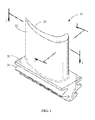
- FIG. 1 is a perspective view of a ceramic matrix composite (CMC) component of the present disclosure.
- CMC ceramic matrix composite
- FIG. 2 is a sectional view taken in direction 2 - 2 of FIG. 1 , according to the present disclosure.
- FIG. 3 is a sectional view taken in direction 3 - 3 of FIG. 1 including the tip arrangement, according to an embodiment of the present disclosure.
- FIG. 4 is a sectional view taken in direction 3 - 3 of FIG. 1 including the tip arrangement, according to an alternate embodiment of the present disclosure.
- FIG. 5 is a sectional view taken in direction 3 - 3 of FIG. 1 including the tip arrangement, according to an alternate embodiment of the present disclosure.
- FIG. 6 is a sectional view taken in direction 3 - 3 of FIG. 1 including the tip arrangement, according to an alternate embodiment of the present disclosure.
- FIG. 7 is a sectional view taken in direction 3 - 3 of FIG. 1 including the tip arrangement according to an alternate embodiment of the present disclosure.
- FIG. 8 is a sectional view taken in direction 3 - 3 of FIG. 1 including the tip arrangement, according to an alternate embodiment of the present disclosure.
- FIG. 9 is a sectional view taken in direction 3 - 3 of FIG. 1 including the tip arrangement, according to an alternate embodiment of the present disclosure.
- FIG. 10 is a sectional view taken in direction 3 - 3 of FIG. 1 including the tip arrangement, according to an alternate embodiment of the present disclosure.
- FIG. 11 shows a process of producing a ceramic matrix composite component having a blade tip, according to the present disclosure.
- CMC components minimize or eliminate additional hand lay-up steps in forming CMC components.
- Embodiments of the present disclosure for example, in comparison to concepts failing to include one or more of the features disclosed herein, enable a robust CMC airfoil system that provides reduced or eliminated fallout of parts and reduced cost.
- the process and tip arrangement reduces or eliminates squeezing of the plies into the hollow cavity of the component.
- Systems used to generate power include, but are not limited to, gas turbines, steam turbines, and other turbine assemblies, such as land based aero-derivatives, used for power generation.
- the power generation systems including the turbomachinery therein (e.g., turbines, compressors, and pumps), and other machinery may include components that are exposed to heavy wear conditions.
- certain power generation system components such as blades, buckets, casings, rotor wheels, shafts, shrouds, nozzles, and so forth, may operate in high heat and high revolution environments. These components are manufactured using ceramic matrix composites and these components may also be hollow and/or include cooling passages.
- the present disclosure provides a method to form ceramic matrix composite (CMC) components including hollow structures or cooling passages having robust tip regions following processing.
- An exemplary embodiment of the disclosure is shown in FIGS. 1-10 as a turbine blade, but the present disclosure is not limited to the illustrated structure.
- FIG. 1 is a perspective view of a component 10 , such as, but not limited to, a turbine blade or turbine vane. Although FIG. 1 shows a turbine blade, other suitable components having a tip region 30 may be formed.
- Component 10 is preferably formed of a ceramic matrix composite (CMC) material.
- CMC ceramic matrix composite
- Material for component 10 includes, but is not limited to, oxide based CMCs, such as, but not limited to, alumina, mullite, boron nitride, boron carbide, sialons (silicon, aluminum, oxygen, and nitrogen), intermetallics, and combinations thereof.
- a suitable example of material for component 10 includes, but is not limited to, AN-720 (oxide-oxide based), which is available from COI Ceramics, Inc., San Diego, Calif., or a hybrid oxide CMC material. Suitable examples of materials used to make components 10 , include, but are not limited to, SiC fibers impregnated with a SiC and carbon matrix with various binders.
- Component 10 includes an airfoil 22 against which the flow of hot exhaust gas is directed. The airfoil 22 extends from tip region 30 to dovetail 24 .
- Component 10 is mounted to a turbine disk (not shown) by the dovetail 24 which extends downwardly from airfoil 22 and engages a slot on the turbine disk.
- Component 10 includes at least one internal passage 50 , as shown in FIG. 2 , extending along the interior of airfoil 22 . During operation of a power generation system, a flow of cooling air is directed through internal passage 50 to reduce the temperature of airfoil 22 .
- Component 10 is constructed using a lay-up technique to form a near-net shape preform of a hollow preform ceramic matrix composite arrangement.
- Formed component 10 is laid-up using any suitable lay-up technique to achieve desired shape and geometry for component 10 .
- Most lay-up techniques used to form components 10 having at least one internal passage 50 include providing and positioning a plurality of plies on a mandrel or other mold.
- the mandrel (not shown) is “melted” or leached out of formed component 10 after it has gone through burnout or partial rigidization to form the hollow space or internal passage 50 in the component 10 (see, for example, FIGS. 2-10 ).
- a plurality of plies generally between 25-50 plies, are used to form a ceramic laminate part or cap, which is placed in the open tip of a blade prior to densification and final melt-infiltration.
- FIG. 2 is a sectional view of blade tip region 30 taken in direction 2 - 2 of FIG. 1 showing internal passages 50 of formed component 10 .
- a plurality of core wrap plies 62 and blade plies 60 (only a few have been shown for clarity) surround and form internal passages 50 of formed component 10 .
- the arrangement of blade tip region 30 is an exemplary embodiment of formed component 10 ; however, this exemplary embodiment of formed component 10 is for illustrative purposes, and should not be so narrowly construed.
- Formed component 10 is any preformed CMC component, such as, but not limited to, blades, shrouds and nozzles.
- the arrangement of tip region 30 includes a plurality of partially rigidized preform ceramic matrix composite plies.
- the partially rigidized preform ceramic matrix composite plies include two types, including core wrap plies 62 and blade plies 60 that form one or more tip cavities 301 into which tip plies 303 are applied.
- the arrangement of tip region 30 includes a plurality of core wrap plies 62 surrounding internal passage 50 and blade plies 60 surrounding core wrap plies 62 and internal passage 50 .
- the blade plies 60 form the outer periphery of the tip region 30 and the core wrap plies 62 are arranged in a curved orientation between blade plies 60 , wherein the ends of core wrap plies 62 , proximal to the tip region 30 , are in contact and form tip cavities 301 .
- the arrangement of FIG. 3 allows for partial to full densification of the core plies 62 .
- FIG. 4 shows an alternate embodiment, the tip region 30 includes a similar arrangement to FIG. 3 , wherein the tip region 30 further includes stiffener plies 506 adjacent to core wrap plies 62 to provide additional rigidity and dimensional stability.
- the tip region 30 includes a similar arrangement to FIG.
- the tip region 30 further includes stiffener plies 506 that extend to the point wherein the core wrap plies 62 contact each other.
- the arrangement of FIG. 5 like the arrangement in FIG. 4 , provides additional rigidity and dimensional stability.
- the arrangement shown in FIGS. 4-5 for example, enable an enclosed cavity at some radial location off the engine or turbine centerline that is smaller than the tip radial location, which, for example, may be located below the platform.
- FIG. 6 shows an alternate embodiment, where the blade plies 60 form the outer periphery of the tip region 30 and the core wrap plies 62 are arranged in a curved orientation between blade plies 60 , wherein the ends of core wrap plies 62 , below the terminus of the tip, are in contact and form tip cavities 301 .
- the arrangement shown in FIG. 6 permits, for example, consistent external tip surfaces and altered tip architecture.
- FIG. 7 shows an alternate embodiment, where the blade plies 60 form the outer periphery of the tip region 30 and the core wrap plies 62 are arranged in an inverted U-shaped orientation as a continuous ply between blade plies 60 and form a single tip cavity 301 .
- the arrangement of FIG. 7 allows enhanced structural Rigidity of hollow core.
- FIG. 8 shows an alternate embodiment, where the blade plies 60 form the outer periphery of the tip region 30 and the core wrap plies 62 are arranged in a curved arrangement extending from a surface of one blade ply 60 to another blade ply 60 to form a single tip cavity 301 .
- the arrangement of FIG. 8 allows for varied ply stiffness.
- FIG. 9 shows an alternate embodiment, the tip region 30 includes a similar arrangement to FIG. 8 , wherein the tip region 30 further includes stiffener plies 506 adjacent to blade ply 60 to provide additional rigidity and dimensional stability.
- FIG. 8 shows an alternate embodiment, where the blade plies 60 form the outer periphery of the tip region 30 and the core wrap plies 62 are arranged in a curved arrangement extending from a surface of one blade ply 60 to another blade ply 60 to form a single tip cavity 301 .
- the arrangement of FIG. 8 allows for varied ply stiffness.
- FIG. 9 shows an alternate embodiment, the tip region
- blade plies 60 form the outer periphery of the tip region 30 and a plurality of core wrap plies 62 are arranged in a curved arrangement extending from surfaces of blade ply 60 and contacting each other below the end of tip region 30 to form a three tip cavity 301 .
- tip cavities 301 are accessible from the end of tip region 30 .
- the tip cavities 301 include ceramic matrix composite tip plies 303 , or non-fiber based pre-preg ply, that are applied by any suitable technique, such as hand lay-up or similar lay-up process, to substantially fill the tip cavities and form the tip region 30 for consolidation and densification.
- process 1100 includes providing and positioning ceramic matrix composite plies, including core wrap plies 62 on a mandrel.
- Mandrel as utilized herein is any suitable tooling or device for forming the ceramic matrix plies into a preform or component having cavities and/or hollow regions.
- the positioning of the core wrap plies 62 define a hollow preform ceramic matrix composite arrangement having tip cavities (step 1101 ).
- the core wrap plies 62 are partially rigidized to form a rigidize preform ceramic matrix composite arrangement (or rigidized preform) (step 1103 ).
- partially rigidized refers to a curing or rigidization process, such as by autoclave, wherein organics or other volatiles are removed from the core wrap plies 62 to at least partially rigidize the structure.
- the rigidization includes a sufficient cure to rigidize the structure for further processing.
- the temperatures and times for partial rigidization vary based upon the desired level of rigidization and the amount and type of matrix present in the plies 60 .
- the rigidization may further include full rigidization and/or densification.
- the rigidized preform is positioned in tooling, such as airfoil or other component tooling, wherein blade plies 60 , core wrap plies 62 and tip plies 303 are positioned in the tooling (step 1105 ).
- Tooling may include, for example, airfoil tooling, or other known tooling arrangements.
- the plies are assembled onto the tooling without the use of a mandrel. Examples of material for blade plies 60 , core wrap plies 62 and tip plies 303 include, but are not limited to, a single ply or a plurality of plies, such as a series of plies formed into a laminate stack.
- blade plies 60 and core plies 62 include, but are not limited to, pre-preg composite plies including, for example, woven carbon fiber, binder material and coated SiC fibers.
- suitable materials for plies 60 include oxides containing alumina, zirconia, titania, magnesium, silica, mullite, and/or spinel; carbides containing silicon, boron, and/or titanium; nitrides containing silicon, and boron.
- Other known fibers suitable for use in the plies 60 include Nextel, Nicalon, hi-Nicalon, Tyranno, and Sylramic fibers.
- stiffener plies 506 may also be included in the preform ceramic matrix composite arrangement to provide additional rigidity and dimensional stability.
- mandrel or other tooling are utilized and, in one embodiment, these mandrels are melted out of formed hollow rigidized preform to create at least one internal passage 50 (see FIGS. 2-10 ).
- the hollow preform CMC arrangement is at least partially densified (step 1107 ).
- the ceramic matrix composite tip plies 303 are oriented in an orientation parallel or substantially parallel to the blade plies 60 .
- the hollow preform CMC arrangement having tip cavities Prior to densification, the hollow preform CMC arrangement having tip cavities is placed in an autoclave and an autoclave cycle is completed.
- the hollow preform CMC arrangement having tip cavities is subject to typical autoclave pressures and temperature cycles used in the industry for ceramic composite materials. Autoclaving pulls out any volatiles remaining in the plies and autoclave conditions can be varied depending on the ply material.
- a burn-out process is performed to remove any remaining mandrel material or additional binders in the hollow preform CMC arrangement having tip cavities.
- the burn-out process is generally conducted at a temperature of approximately 426-648° C. (approximately 800-1200° F.).
- Densification can be conducted in a vacuum furnace having an established atmosphere at temperatures above 1200° C. to allow matrix material, such as silicon or other materials, to melt-infiltrate into the preform component.
- the densification may be accomplished using any known techniques for densification, including, but not limited to, Silicomp, melt infiltration (MI), chemical vapor infiltration (CVI), polymer inflation pyrolysis (PIP), and oxide/oxide processes.
- the densification is by melt infiltration.
Landscapes
- Engineering & Computer Science (AREA)
- Chemical & Material Sciences (AREA)
- Ceramic Engineering (AREA)
- Materials Engineering (AREA)
- Organic Chemistry (AREA)
- Mechanical Engineering (AREA)
- Manufacturing & Machinery (AREA)
- Structural Engineering (AREA)
- General Engineering & Computer Science (AREA)
- Composite Materials (AREA)
- Chemical Kinetics & Catalysis (AREA)
- General Chemical & Material Sciences (AREA)
- Inorganic Chemistry (AREA)
- Metallurgy (AREA)
- Turbine Rotor Nozzle Sealing (AREA)
Abstract
Description
Claims (20)
Priority Applications (4)
| Application Number | Priority Date | Filing Date | Title |
|---|---|---|---|
| US14/926,803 US10273813B2 (en) | 2015-10-29 | 2015-10-29 | Ceramic matrix composite component and process of producing a ceramic matrix composite component |
| JP2016206456A JP7034583B2 (en) | 2015-10-29 | 2016-10-21 | Process for manufacturing ceramic matrix composite parts and ceramic matrix composite parts |
| EP16195339.3A EP3162559B1 (en) | 2015-10-29 | 2016-10-24 | Process of producing a ceramic matrix composite component |
| CN201610968736.7A CN106870016B (en) | 2015-10-29 | 2016-10-28 | Ceramic matrix composite components and process for producing ceramic matrix composite components |
Applications Claiming Priority (1)
| Application Number | Priority Date | Filing Date | Title |
|---|---|---|---|
| US14/926,803 US10273813B2 (en) | 2015-10-29 | 2015-10-29 | Ceramic matrix composite component and process of producing a ceramic matrix composite component |
Publications (2)
| Publication Number | Publication Date |
|---|---|
| US20170122114A1 US20170122114A1 (en) | 2017-05-04 |
| US10273813B2 true US10273813B2 (en) | 2019-04-30 |
Family
ID=57249672
Family Applications (1)
| Application Number | Title | Priority Date | Filing Date |
|---|---|---|---|
| US14/926,803 Active 2037-06-16 US10273813B2 (en) | 2015-10-29 | 2015-10-29 | Ceramic matrix composite component and process of producing a ceramic matrix composite component |
Country Status (4)
| Country | Link |
|---|---|
| US (1) | US10273813B2 (en) |
| EP (1) | EP3162559B1 (en) |
| JP (1) | JP7034583B2 (en) |
| CN (1) | CN106870016B (en) |
Cited By (3)
| Publication number | Priority date | Publication date | Assignee | Title |
|---|---|---|---|---|
| US20240052749A1 (en) * | 2022-08-15 | 2024-02-15 | Rtx Corporation | Airfoil leading edge venturi cooling passage |
| US20240102400A1 (en) * | 2022-06-03 | 2024-03-28 | Rtx Corporation | Engine article with ceramic insert and method therefor |
| US20240139998A1 (en) * | 2022-10-31 | 2024-05-02 | Raytheon Technologies Corporation | Mandrel with transition section for making multiple cmc articles |
Families Citing this family (11)
| Publication number | Priority date | Publication date | Assignee | Title |
|---|---|---|---|---|
| US10207471B2 (en) * | 2016-05-04 | 2019-02-19 | General Electric Company | Perforated ceramic matrix composite ply, ceramic matrix composite article, and method for forming ceramic matrix composite article |
| US10329927B2 (en) * | 2016-08-15 | 2019-06-25 | General Electric Company | Hollow ceramic matrix composite article, mandrel for forming hollow ceramic matrix composite article, and method for forming hollow ceramic matrix composite article |
| US11047240B2 (en) * | 2017-05-11 | 2021-06-29 | General Electric Company | CMC components having microchannels and methods for forming microchannels in CMC components |
| US10443410B2 (en) * | 2017-06-16 | 2019-10-15 | General Electric Company | Ceramic matrix composite (CMC) hollow blade and method of forming CMC hollow blade |
| DE102018210519A1 (en) * | 2018-06-27 | 2020-01-02 | Siemens Aktiengesellschaft | Ceramic fiber composite CMC molded body, intermediate in the manufacture, and manufacturing process therefor |
| DE102018211592A1 (en) * | 2018-07-12 | 2020-01-16 | Siemens Aktiengesellschaft | CMC molded body with cooling system |
| DE102018213595A1 (en) * | 2018-08-13 | 2020-02-13 | Siemens Aktiengesellschaft | CMC moldings, as well as manufacturing processes therefor |
| US11286781B2 (en) * | 2020-01-17 | 2022-03-29 | Raytheon Technologies Corporation | Multi-disk bladed rotor assembly for rotational equipment |
| US11401814B2 (en) | 2020-01-17 | 2022-08-02 | Raytheon Technologies Corporation | Rotor assembly with internal vanes |
| US11633816B1 (en) * | 2021-12-03 | 2023-04-25 | Raytheon Technologies Corporation | Machining of ceramic matrix composite during preforming and partial densification |
| US20240253333A1 (en) * | 2023-02-01 | 2024-08-01 | General Electric Company | Composite panels and methods for manufacturing the same |
Citations (6)
| Publication number | Priority date | Publication date | Assignee | Title |
|---|---|---|---|---|
| US20110206522A1 (en) * | 2010-02-24 | 2011-08-25 | Ioannis Alvanos | Rotating airfoil fabrication utilizing cmc |
| US20130171426A1 (en) | 2012-01-03 | 2013-07-04 | General Electric Company | Method of forming a ceramic matrix composite and a ceramic matrix composite component |
| US20130251939A1 (en) | 2012-03-23 | 2013-09-26 | General Electric Company | Process for producing ceramic composite components |
| US8740571B2 (en) | 2011-03-07 | 2014-06-03 | General Electric Company | Turbine bucket for use in gas turbine engines and methods for fabricating the same |
| US20140193577A1 (en) | 2012-04-13 | 2014-07-10 | General Electric Company | Pre-form ceramic matrix composite cavity and method of forming and method of forming a ceramic matrix composite component |
| US20140199174A1 (en) * | 2013-01-11 | 2014-07-17 | General Electric Company | Method of forming a ceramic matrix composite component, a ceramic matrix composite component and a tip member |
Family Cites Families (2)
| Publication number | Priority date | Publication date | Assignee | Title |
|---|---|---|---|---|
| US7555462B2 (en) * | 2001-04-12 | 2009-06-30 | International Business Machines Corporation | Method and apparatus for incorporating scanned checks into financial applications |
| US9410437B2 (en) * | 2012-08-14 | 2016-08-09 | General Electric Company | Airfoil components containing ceramic-based materials and processes therefor |
-
2015
- 2015-10-29 US US14/926,803 patent/US10273813B2/en active Active
-
2016
- 2016-10-21 JP JP2016206456A patent/JP7034583B2/en active Active
- 2016-10-24 EP EP16195339.3A patent/EP3162559B1/en active Active
- 2016-10-28 CN CN201610968736.7A patent/CN106870016B/en active Active
Patent Citations (6)
| Publication number | Priority date | Publication date | Assignee | Title |
|---|---|---|---|---|
| US20110206522A1 (en) * | 2010-02-24 | 2011-08-25 | Ioannis Alvanos | Rotating airfoil fabrication utilizing cmc |
| US8740571B2 (en) | 2011-03-07 | 2014-06-03 | General Electric Company | Turbine bucket for use in gas turbine engines and methods for fabricating the same |
| US20130171426A1 (en) | 2012-01-03 | 2013-07-04 | General Electric Company | Method of forming a ceramic matrix composite and a ceramic matrix composite component |
| US20130251939A1 (en) | 2012-03-23 | 2013-09-26 | General Electric Company | Process for producing ceramic composite components |
| US20140193577A1 (en) | 2012-04-13 | 2014-07-10 | General Electric Company | Pre-form ceramic matrix composite cavity and method of forming and method of forming a ceramic matrix composite component |
| US20140199174A1 (en) * | 2013-01-11 | 2014-07-17 | General Electric Company | Method of forming a ceramic matrix composite component, a ceramic matrix composite component and a tip member |
Non-Patent Citations (1)
| Title |
|---|
| Extended European Search Report and Opinion issued in connection with corresponding EP Application No. 16195339.3 dated Mar. 8, 2017. |
Cited By (6)
| Publication number | Priority date | Publication date | Assignee | Title |
|---|---|---|---|---|
| US20240102400A1 (en) * | 2022-06-03 | 2024-03-28 | Rtx Corporation | Engine article with ceramic insert and method therefor |
| US12055045B2 (en) * | 2022-06-03 | 2024-08-06 | Rtx Corporation | Engine article with ceramic insert and method therefor |
| US20240052749A1 (en) * | 2022-08-15 | 2024-02-15 | Rtx Corporation | Airfoil leading edge venturi cooling passage |
| US12055068B2 (en) * | 2022-08-15 | 2024-08-06 | Rtx Corporation | Airfoil leading edge venturi cooling passage |
| US20240139998A1 (en) * | 2022-10-31 | 2024-05-02 | Raytheon Technologies Corporation | Mandrel with transition section for making multiple cmc articles |
| US12397468B2 (en) * | 2022-10-31 | 2025-08-26 | Rtx Corporation | Method for forming multiple ceramic matrix composite articles |
Also Published As
| Publication number | Publication date |
|---|---|
| EP3162559B1 (en) | 2021-05-19 |
| JP2017095345A (en) | 2017-06-01 |
| EP3162559A1 (en) | 2017-05-03 |
| CN106870016B (en) | 2021-05-11 |
| JP7034583B2 (en) | 2022-03-14 |
| US20170122114A1 (en) | 2017-05-04 |
| CN106870016A (en) | 2017-06-20 |
Similar Documents
| Publication | Publication Date | Title |
|---|---|---|
| US10273813B2 (en) | Ceramic matrix composite component and process of producing a ceramic matrix composite component | |
| US10465533B2 (en) | Ceramic matrix composite component and process of producing a ceramic matrix composite component | |
| US9050769B2 (en) | Pre-form ceramic matrix composite cavity and method of forming and method of forming a ceramic matrix composite component | |
| US10260358B2 (en) | Ceramic matrix composite component and process of producing a ceramic matrix composite component | |
| CA3186312C (en) | Ceramic matrix composite component including counterflow channels and methods of producing | |
| US9663404B2 (en) | Method of forming a ceramic matrix composite and a ceramic matrix component | |
| US8980435B2 (en) | CMC component, power generation system and method of forming a CMC component | |
| CA3102096C (en) | Ceramic matrix composite component and method of producing a ceramic matrix composite component | |
| US20140199174A1 (en) | Method of forming a ceramic matrix composite component, a ceramic matrix composite component and a tip member | |
| JP2022179524A (en) | Ceramic matrix composite component and method of manufacture containing cooling channels in multiple plies |
Legal Events
| Date | Code | Title | Description |
|---|---|---|---|
| AS | Assignment |
Owner name: GENERAL ELECTRIC COMPANY, NEW YORK Free format text: ASSIGNMENT OF ASSIGNORS INTEREST;ASSIGNORS:KITTLESON, JACOB JOHN;MURRAY, JAMES JOSEPH, III;SIGNING DATES FROM 20151026 TO 20151027;REEL/FRAME:036915/0459 |
|
| AS | Assignment |
Owner name: UNITED STATES DEPARTMENT OF ENERGY, DISTRICT OF CO Free format text: CONFIRMATORY LICENSE;ASSIGNOR:GENERAL ELECTRIC GLOBAL RESEARCH CTR;REEL/FRAME:046331/0128 Effective date: 20180522 |
|
| STPP | Information on status: patent application and granting procedure in general |
Free format text: PUBLICATIONS -- ISSUE FEE PAYMENT VERIFIED |
|
| STCF | Information on status: patent grant |
Free format text: PATENTED CASE |
|
| MAFP | Maintenance fee payment |
Free format text: PAYMENT OF MAINTENANCE FEE, 4TH YEAR, LARGE ENTITY (ORIGINAL EVENT CODE: M1551); ENTITY STATUS OF PATENT OWNER: LARGE ENTITY Year of fee payment: 4 |
|
| AS | Assignment |
Owner name: GE INFRASTRUCTURE TECHNOLOGY LLC, SOUTH CAROLINA Free format text: ASSIGNMENT OF ASSIGNORS INTEREST;ASSIGNOR:GENERAL ELECTRIC COMPANY;REEL/FRAME:065727/0001 Effective date: 20231110 |