US10273226B2 - Pyrazolyl-heteroarylamides as pesticides - Google Patents
Pyrazolyl-heteroarylamides as pesticides Download PDFInfo
- Publication number
- US10273226B2 US10273226B2 US15/109,630 US201415109630A US10273226B2 US 10273226 B2 US10273226 B2 US 10273226B2 US 201415109630 A US201415109630 A US 201415109630A US 10273226 B2 US10273226 B2 US 10273226B2
- Authority
- US
- United States
- Prior art keywords
- spp
- phenyl
- methyl
- alkyl
- pyridinyl
- Prior art date
- Legal status (The legal status is an assumption and is not a legal conclusion. Google has not performed a legal analysis and makes no representation as to the accuracy of the status listed.)
- Active
Links
- 0 [1*]N(C(C)=[W])C1=CC([3H]C2=C(C)C(C)=NN2C)=CC=C1 Chemical compound [1*]N(C(C)=[W])C1=CC([3H]C2=C(C)C(C)=NN2C)=CC=C1 0.000 description 30
- SRBPPOIPESPUER-UHFFFAOYSA-N CC.CC.CC.CC.CC.CC.CC.CC.CC.CC.CC1=CN(C)C=C1.CC1=CN(C)C=C1.CC1=CN(C)C=N1.CC1=CN(C)N=C1.CC1=CN(C)N=C1.CC1=CN(C)N=N1.CC1=NN(C)C=C1.CC1=NN(C)C=N1.CC1=NN(C)N=C1.CC1=NN(C)N=N1 Chemical compound CC.CC.CC.CC.CC.CC.CC.CC.CC.CC.CC1=CN(C)C=C1.CC1=CN(C)C=C1.CC1=CN(C)C=N1.CC1=CN(C)N=C1.CC1=CN(C)N=C1.CC1=CN(C)N=N1.CC1=NN(C)C=C1.CC1=NN(C)C=N1.CC1=NN(C)N=C1.CC1=NN(C)N=N1 SRBPPOIPESPUER-UHFFFAOYSA-N 0.000 description 11
- FJVPSOPCFRAJEF-UHFFFAOYSA-N CN1N=C(C(F)(F)C(F)(F)F)C(C(F)(F)F)=C1N1C=C(Br)C=N1 Chemical compound CN1N=C(C(F)(F)C(F)(F)F)C(C(F)(F)F)=C1N1C=C(Br)C=N1 FJVPSOPCFRAJEF-UHFFFAOYSA-N 0.000 description 1
- GUKBALPKOHVKMG-UHFFFAOYSA-N CN1N=C(C(F)(F)C(F)(F)F)C(C(F)(F)F)=C1N1C=C(C2=CC(N)=CC=C2)C=N1 Chemical compound CN1N=C(C(F)(F)C(F)(F)F)C(C(F)(F)F)=C1N1C=C(C2=CC(N)=CC=C2)C=N1 GUKBALPKOHVKMG-UHFFFAOYSA-N 0.000 description 1
- IHTNBUFVJLUJIB-UHFFFAOYSA-N CN1N=C(C(F)(F)C(F)(F)F)C(C(F)(F)F)=C1N1C=C(C2=CC(NC(=O)C3=CC=NC=C3)=CC=C2)C=N1 Chemical compound CN1N=C(C(F)(F)C(F)(F)F)C(C(F)(F)F)=C1N1C=C(C2=CC(NC(=O)C3=CC=NC=C3)=CC=C2)C=N1 IHTNBUFVJLUJIB-UHFFFAOYSA-N 0.000 description 1
- PLCVKJZTPRLRQH-UHFFFAOYSA-N CN1N=C(C(F)(F)C(F)(F)F)C(C(F)(F)F)=C1N1C=C(C2=CC([N+](=O)[O-])=CC=C2)C=N1 Chemical compound CN1N=C(C(F)(F)C(F)(F)F)C(C(F)(F)F)=C1N1C=C(C2=CC([N+](=O)[O-])=CC=C2)C=N1 PLCVKJZTPRLRQH-UHFFFAOYSA-N 0.000 description 1
Classifications
-
- C—CHEMISTRY; METALLURGY
- C07—ORGANIC CHEMISTRY
- C07D—HETEROCYCLIC COMPOUNDS
- C07D403/00—Heterocyclic compounds containing two or more hetero rings, having nitrogen atoms as the only ring hetero atoms, not provided for by group C07D401/00
- C07D403/02—Heterocyclic compounds containing two or more hetero rings, having nitrogen atoms as the only ring hetero atoms, not provided for by group C07D401/00 containing two hetero rings
- C07D403/04—Heterocyclic compounds containing two or more hetero rings, having nitrogen atoms as the only ring hetero atoms, not provided for by group C07D401/00 containing two hetero rings directly linked by a ring-member-to-ring-member bond
-
- A—HUMAN NECESSITIES
- A01—AGRICULTURE; FORESTRY; ANIMAL HUSBANDRY; HUNTING; TRAPPING; FISHING
- A01N—PRESERVATION OF BODIES OF HUMANS OR ANIMALS OR PLANTS OR PARTS THEREOF; BIOCIDES, e.g. AS DISINFECTANTS, AS PESTICIDES OR AS HERBICIDES; PEST REPELLANTS OR ATTRACTANTS; PLANT GROWTH REGULATORS
- A01N25/00—Biocides, pest repellants or attractants, or plant growth regulators, characterised by their forms, or by their non-active ingredients or by their methods of application, e.g. seed treatment or sequential application; Substances for reducing the noxious effect of the active ingredients to organisms other than pests
- A01N25/30—Biocides, pest repellants or attractants, or plant growth regulators, characterised by their forms, or by their non-active ingredients or by their methods of application, e.g. seed treatment or sequential application; Substances for reducing the noxious effect of the active ingredients to organisms other than pests characterised by the surfactants
-
- A—HUMAN NECESSITIES
- A01—AGRICULTURE; FORESTRY; ANIMAL HUSBANDRY; HUNTING; TRAPPING; FISHING
- A01N—PRESERVATION OF BODIES OF HUMANS OR ANIMALS OR PLANTS OR PARTS THEREOF; BIOCIDES, e.g. AS DISINFECTANTS, AS PESTICIDES OR AS HERBICIDES; PEST REPELLANTS OR ATTRACTANTS; PLANT GROWTH REGULATORS
- A01N43/00—Biocides, pest repellants or attractants, or plant growth regulators containing heterocyclic compounds
- A01N43/48—Biocides, pest repellants or attractants, or plant growth regulators containing heterocyclic compounds having rings with two nitrogen atoms as the only ring hetero atoms
- A01N43/56—1,2-Diazoles; Hydrogenated 1,2-diazoles
-
- A—HUMAN NECESSITIES
- A01—AGRICULTURE; FORESTRY; ANIMAL HUSBANDRY; HUNTING; TRAPPING; FISHING
- A01N—PRESERVATION OF BODIES OF HUMANS OR ANIMALS OR PLANTS OR PARTS THEREOF; BIOCIDES, e.g. AS DISINFECTANTS, AS PESTICIDES OR AS HERBICIDES; PEST REPELLANTS OR ATTRACTANTS; PLANT GROWTH REGULATORS
- A01N43/00—Biocides, pest repellants or attractants, or plant growth regulators containing heterocyclic compounds
- A01N43/72—Biocides, pest repellants or attractants, or plant growth regulators containing heterocyclic compounds having rings with nitrogen atoms and oxygen or sulfur atoms as ring hetero atoms
- A01N43/74—Biocides, pest repellants or attractants, or plant growth regulators containing heterocyclic compounds having rings with nitrogen atoms and oxygen or sulfur atoms as ring hetero atoms five-membered rings with one nitrogen atom and either one oxygen atom or one sulfur atom in positions 1,3
- A01N43/76—1,3-Oxazoles; Hydrogenated 1,3-oxazoles
-
- A—HUMAN NECESSITIES
- A01—AGRICULTURE; FORESTRY; ANIMAL HUSBANDRY; HUNTING; TRAPPING; FISHING
- A01N—PRESERVATION OF BODIES OF HUMANS OR ANIMALS OR PLANTS OR PARTS THEREOF; BIOCIDES, e.g. AS DISINFECTANTS, AS PESTICIDES OR AS HERBICIDES; PEST REPELLANTS OR ATTRACTANTS; PLANT GROWTH REGULATORS
- A01N43/00—Biocides, pest repellants or attractants, or plant growth regulators containing heterocyclic compounds
- A01N43/90—Biocides, pest repellants or attractants, or plant growth regulators containing heterocyclic compounds having two or more relevant hetero rings, condensed among themselves or with a common carbocyclic ring system
-
- A—HUMAN NECESSITIES
- A61—MEDICAL OR VETERINARY SCIENCE; HYGIENE
- A61P—SPECIFIC THERAPEUTIC ACTIVITY OF CHEMICAL COMPOUNDS OR MEDICINAL PREPARATIONS
- A61P33/00—Antiparasitic agents
- A61P33/14—Ectoparasiticides, e.g. scabicides
-
- C—CHEMISTRY; METALLURGY
- C07—ORGANIC CHEMISTRY
- C07D—HETEROCYCLIC COMPOUNDS
- C07D231/00—Heterocyclic compounds containing 1,2-diazole or hydrogenated 1,2-diazole rings
- C07D231/02—Heterocyclic compounds containing 1,2-diazole or hydrogenated 1,2-diazole rings not condensed with other rings
- C07D231/10—Heterocyclic compounds containing 1,2-diazole or hydrogenated 1,2-diazole rings not condensed with other rings having two or three double bonds between ring members or between ring members and non-ring members
- C07D231/14—Heterocyclic compounds containing 1,2-diazole or hydrogenated 1,2-diazole rings not condensed with other rings having two or three double bonds between ring members or between ring members and non-ring members with hetero atoms or with carbon atoms having three bonds to hetero atoms with at the most one bond to halogen, e.g. ester or nitrile radicals, directly attached to ring carbon atoms
- C07D231/38—Nitrogen atoms
-
- C—CHEMISTRY; METALLURGY
- C07—ORGANIC CHEMISTRY
- C07D—HETEROCYCLIC COMPOUNDS
- C07D401/00—Heterocyclic compounds containing two or more hetero rings, having nitrogen atoms as the only ring hetero atoms, at least one ring being a six-membered ring with only one nitrogen atom
- C07D401/14—Heterocyclic compounds containing two or more hetero rings, having nitrogen atoms as the only ring hetero atoms, at least one ring being a six-membered ring with only one nitrogen atom containing three or more hetero rings
-
- C—CHEMISTRY; METALLURGY
- C07—ORGANIC CHEMISTRY
- C07D—HETEROCYCLIC COMPOUNDS
- C07D403/00—Heterocyclic compounds containing two or more hetero rings, having nitrogen atoms as the only ring hetero atoms, not provided for by group C07D401/00
- C07D403/14—Heterocyclic compounds containing two or more hetero rings, having nitrogen atoms as the only ring hetero atoms, not provided for by group C07D401/00 containing three or more hetero rings
-
- C—CHEMISTRY; METALLURGY
- C07—ORGANIC CHEMISTRY
- C07D—HETEROCYCLIC COMPOUNDS
- C07D407/00—Heterocyclic compounds containing two or more hetero rings, at least one ring having oxygen atoms as the only ring hetero atoms, not provided for by group C07D405/00
- C07D407/14—Heterocyclic compounds containing two or more hetero rings, at least one ring having oxygen atoms as the only ring hetero atoms, not provided for by group C07D405/00 containing three or more hetero rings
-
- C—CHEMISTRY; METALLURGY
- C07—ORGANIC CHEMISTRY
- C07D—HETEROCYCLIC COMPOUNDS
- C07D409/00—Heterocyclic compounds containing two or more hetero rings, at least one ring having sulfur atoms as the only ring hetero atoms
- C07D409/14—Heterocyclic compounds containing two or more hetero rings, at least one ring having sulfur atoms as the only ring hetero atoms containing three or more hetero rings
-
- C—CHEMISTRY; METALLURGY
- C07—ORGANIC CHEMISTRY
- C07D—HETEROCYCLIC COMPOUNDS
- C07D413/00—Heterocyclic compounds containing two or more hetero rings, at least one ring having nitrogen and oxygen atoms as the only ring hetero atoms
- C07D413/14—Heterocyclic compounds containing two or more hetero rings, at least one ring having nitrogen and oxygen atoms as the only ring hetero atoms containing three or more hetero rings
-
- C—CHEMISTRY; METALLURGY
- C07—ORGANIC CHEMISTRY
- C07D—HETEROCYCLIC COMPOUNDS
- C07D487/00—Heterocyclic compounds containing nitrogen atoms as the only ring hetero atoms in the condensed system, not provided for by groups C07D451/00 - C07D477/00
- C07D487/02—Heterocyclic compounds containing nitrogen atoms as the only ring hetero atoms in the condensed system, not provided for by groups C07D451/00 - C07D477/00 in which the condensed system contains two hetero rings
- C07D487/04—Ortho-condensed systems
-
- Y—GENERAL TAGGING OF NEW TECHNOLOGICAL DEVELOPMENTS; GENERAL TAGGING OF CROSS-SECTIONAL TECHNOLOGIES SPANNING OVER SEVERAL SECTIONS OF THE IPC; TECHNICAL SUBJECTS COVERED BY FORMER USPC CROSS-REFERENCE ART COLLECTIONS [XRACs] AND DIGESTS
- Y10—TECHNICAL SUBJECTS COVERED BY FORMER USPC
- Y10S—TECHNICAL SUBJECTS COVERED BY FORMER USPC CROSS-REFERENCE ART COLLECTIONS [XRACs] AND DIGESTS
- Y10S424/00—Drug, bio-affecting and body treating compositions
- Y10S424/10—Insect repellent
Definitions
- the present application relates to novel pyrazolylheteroarylamides, to processes for preparation thereof and to the use thereof for controlling animal pests, particularly arthropods and especially insects, arachnids and nematodes.
- halogen-substituted compounds are herbicidally active (cf. J. Org. Chem. 1997, 62(17), 5908-5919, J. Heterocycl. Chem. 1998, 35(6), 1493-1499, WO 2004/035545, WO 2004/106324, US 2006/069132, WO 2008/029084).
- the invention relates to compounds of the general formula (Ic)
- a preferred embodiment relates to inventive compounds as described above in the summary, where
- a further preferred embodiment relates to inventive compounds as described above in the summary, in which
- a further preferred embodiment relates to inventive compounds as described above in the summary, in which
- a further preferred embodiment relates to inventive compounds as described above in the summary, in which
- a further preferred embodiment relates to inventive compounds as described above in the summary, in which
- R 2 and R 5 are each independently hydrogen or fluorine
- R 3 is hydrogen
- R 4 is hydrogen, fluorine, chlorine or methyl.
- a further preferred embodiment relates to inventive compounds as described above in the summary, in which
- a further preferred embodiment relates to inventive compounds as described above in the summary, in which
- a further preferred embodiment relates to inventive compounds as described above in the summary, in which the compound is a compound of the formula (Ic-1)
- a further preferred embodiment relates to inventive compounds as described above in the summary, in which the compound is a compound of the formula (Ic-2)
- the invention also provides for the use of the inventive compounds (for example of the formula (Ic), (Ic-1) or (Ic-2)) for control of insects, arachnids and nematodes; pharmaceutical compositions comprising at least one inventive compound; an inventive compound for use as a medicament; for the use of an inventive compound for production of pharmaceutical compositions for control of parasites in animals; a process for producing crop protection compositions comprising at least one inventive compound and customary extenders and/or surfactants; a method for controlling pests, characterized in that an inventive compound is allowed to act on the pests and/or their habitat; the use of an inventive compound for protection of the propagation material of plants.
- inventive compounds for example of the formula (Ic), (Ic-1) or (Ic-2)
- alkyl represents straight-chain or branched hydrocarbons, preferably having 1 to 6 carbon atoms, for example methyl, ethyl, n-propyl, isopropyl, n-butyl, isobutyl, s-butyl, t-butyl, pentyl, 1-methylbutyl, 2-methylbutyl, 3-methylbutyl, 1,2-dimethylpropyl, 1,1-dimethylpropyl, 2,2-dimethylpropyl, 1-ethylpropyl, hexyl, 1-methylpentyl, 2-methylpentyl, 3-methylpentyl, 4-methylpentyl, 1,2-dimethylpropyl, 1,3-dimethylbutyl, 1,4-dimethylbutyl, 2,3-dimethylbutyl, 1,1-dimethylbutyl, 2,2-dimethylbutyl, 3,3-di
- alkyls having 1 to 4 carbon atoms such as inter alia methyl, ethyl, n-propyl, isopropyl, n-butyl, isobutyl, s-butyl or t-butyl.
- the inventive alkyls may be substituted by one or more identical or different radicals.
- alkenyl represents straight-chain or branched hydrocarbons, preferably having 2 to 6 carbon atoms and at least one double bond, for example vinyl, 2-propenyl, 2-butenyl, 3-butenyl, 1-methyl-2-propenyl, 2-methyl-2-propenyl, 2-pentenyl, 3-pentenyl, 4-pentenyl, 1-methyl-2-butenyl, 2-methyl-2-butenyl, 3-methyl-2-butenyl, 1-methyl-3-butenyl, 2-methyl-3-butenyl, 3-methyl-3-butenyl, 1,1-dimethyl-2-propenyl, 1,2-dimethyl-2-propenyl, 1-ethyl-2-propenyl, 2-hexenyl, 3-hexenyl, 4-hexenyl, 5-hexenyl, 1-methyl-2-pentenyl, 2-methyl-2-pentenyl, 3-methyl-2-penten
- alkenyls having 2 to 4 carbon atoms such as inter alia 2-propenyl, 2-butenyl or 1-methyl-2-propenyl.
- the inventive alkenyls may be substituted by one or more identical or different radicals.
- alkynyl represents straight-chain or branched hydrocarbons, preferably having 2 to 6 carbon atoms and at least one triple bond, for example 2-propynyl, 2-butynyl, 3-butynyl, 1-methyl-2-propynyl, 2-pentynyl, 3-pentynyl, 4-pentynyl, 1-methyl-3-butynyl, 2-methyl-3-butynyl, 1-methyl-2-butynyl, 1,1-dimethyl-2-propynyl, 1-ethyl-2-propynyl, 2-hexynyl, 3-hexynyl, 4-hexynyl, 5-hexynyl, 1-methyl-2-pentynyl, 1-methyl-3-pentynyl, 1-methyl-4-pentynyl, 2-methyl-3-pentynyl, 2-methyl-4-pentynyl
- alkynyls having 2 to 4 carbon atoms such as inter alia ethynyl, 2-propynyl or 2-butynyl-2-propenyl.
- inventive alkynyls may be substituted by one or more identical or different radicals.
- cycloalkyl represents mono-, bi- or tricyclic hydrocarbons, preferably having 3 to 10 carbons, for example cyclopropyl, cyclobutyl, cyclopentyl, cyclohexyl, cycloheptyl, cyclooctyl, bicyclo[2.2.1]heptyl, bicyclo[2.2.2]octyl or adamantyl.
- cycloalkyls having 3, 4, 5, 6 or 7 carbon atoms, such as inter alia cyclopropyl or cyclobutyl.
- the inventive cycloalkyls may be substituted by one or more identical or different radicals.
- alkylcycloalkyl represents mono-, bi- or tricyclic alkylcycloalkyl, preferably having 4 to 10 or 4 to 7 carbon atoms, for example ethylcyclopropyl, isopropylcyclobutyl, 3-methylcyclopentyl and 4-methylcyclohexyl. Also preferred are alkylcycloalkyls having 4, 5 or 7 carbon atoms, such as inter alia ethylcyclopropyl or 4-methylcyclohexyl.
- the inventive alkylcycloalkyls may be substituted by one or more identical or different radicals.
- cycloalkylalkyl represents mono-, bi- or tricyclic cycloalkylalkyl, preferably having 4 to 10 or 4 to 7 carbon atoms, for example cyclopropylmethyl, cyclobutylmethyl, cyclopentylmethyl, cyclohexylmethyl and cyclopentylethyl. Also preferred are cycloalkylalkyls having 4, 5 or 7 carbon atoms, such as inter alia cyclopropylmethyl or cyclobutylmethyl.
- the inventive cycloalkylalkyls may be substituted by one or more identical or different radicals.
- halogen represents fluorine, chlorine, bromine or iodine, especially fluorine, chlorine or bromine.
- halogen-substituted chemical groups for example haloalkyl, halocycloalkyl, haloalkyloxy, haloalkylsulphanyl, haloalkylsulphinyl or haloalkylsulphonyl, are mono- or polysubstituted by halogen up to the maximum possible number of substituents.
- the halogen atoms may be the same or different and may all be bonded to one carbon atom or to more than one carbon atom.
- halogen is especially fluorine, chlorine, bromine or iodine, preferably fluorine, chlorine or bromine and more preferably fluorine.
- halocycloalkyl represents mono-, bi- or tricyclic halocycloalkyl, preferably having 3 to 10 carbon atoms, such as inter alia 1-fluorocyclopropyl, 2-fluorocyclopropyl or 1-fluorocyclobutyl. Also preferred is halocycloalkyl having 3, 5 or 7 carbon atoms.
- the inventive halocycloalkyls may be substituted by one or more identical or different radicals.
- haloalkyl represents halogen-substituted alkyls, alkenyls or alkynyls having preferably 1 to 9 identical or different halogen atoms, for example monohaloalkyl such as CH2CH2Cl, CH2CH2F, CHC1CH3, CHFCH3, CH2Cl, CH2F; perhaloalkyl such as CCl3 or CF3 or CF2CF3; polyhaloalkyl such as CHF2, CH2F, CH2CHFCl, CHCl2, CF2CF2H, CH2CF3.
- monohaloalkyl such as CH2CH2Cl, CH2CH2F, CHC1CH3, CHFCH3, CH2Cl, CH2F
- perhaloalkyl such as CCl3 or CF3 or CF2CF3
- polyhaloalkyl such as CHF2, CH2F, CH2CHFCl, CHCl2, CF2CF2H, CH2CF3.
- Haloalkoxy is, for example, OCF3, OCHF2, OCH2F, OCF2CF3, OCH2CF3 and OCH2CH2Cl.
- haloalkyls are chlorodifluoromethyl, dichlorofluoromethyl, chloromethyl, bromomethyl, 1-fluoroethyl, 2-fluoroethyl, 2,2-difluoroethyl, 2,2,2-trifluoroethyl, 2,2,2-trichloroethyl, 2-chloro-2,2-difluoroethyl, pentafluoroethyl and pentafluoro-t-butyl.
- haloalkyls having 1 or 2 carbon atoms and having 1 to 5 identical or different halogen atoms selected from fluorine and chlorine, such as inter alia difluoromethyl, trifluoromethyl or 2,2-difluoroethyl.
- hydroxyalkyl represents straight-chain or branched alcohol, preferably having 1 to 6 carbon atoms, for example methanol, ethanol, n-propanol, isopropanol, n-butanol, isobutanol, s-butanol and t-butanol. Also preferably hydroxyalkyl groups having 1 to 4 carbon atoms.
- the inventive hydroxyalkyl groups may be substituted by one or more identical or different radicals.
- alkoxy represents straight-chain or branched O-alkyl, preferably having 1 to 6 carbon atoms, for example methoxy, ethoxy, n-propoxy, isopropoxy, n-butoxy, isobutoxy, s-butoxy and t-butoxy. Also preferably alkoxy groups having 1 to 4 carbon atoms.
- the inventive alkoxy groups may be substituted by one or more identical or different radicals.
- haloalkoxy represents halogen-substituted straight-chain or branched O-alkyl, preferably having 1 to 6 carbon atoms, such as inter alia difluoromethoxy, trifluoromethoxy, 2,2-difluoroethoxy, 1,1,2,2-tetrafluoroethoxy, 2,2,2-trifluoroethoxy and 2-chloro-1,1,2-trifluoroethoxy. Also preferably haloalkoxy groups having 1 to 4 carbon atoms.
- the inventive haloalkoxy groups may be substituted by one or more identical or different radicals.
- alkylsulphanyl represents straight-chain or branched S-alkyl, preferably having 1 to 6 carbon atoms, for example methylthio, ethylthio, n-propylthio, isopropylthio, n-butylthio, isobutylthio, s-butylthio and t-butylthio. Also preferably alkylsulphanyl groups having 1 to 4 carbon atoms.
- the inventive alkylsulphanyl groups may be substituted by one or more identical or different radicals.
- haloalkylsulphanyl i.e. halogen-substituted alkylsulphanyl groups
- alkylsulphinyl represents straight-chain or branched alkylsulphinyl, preferably having 1 to 6 carbon atoms, for example methylsulphinyl, ethylsulphinyl, n-propylsulphinyl, isopropylsulphinyl, n-butylsulphinyl, isobutylsulphinyl, s-butylsulphinyl and t-butylsulphinyl. Also preferably alkylsulphinyl groups having 1 to 4 carbon atoms.
- the inventive alkylsulphinyl groups may be substituted by one or more identical or different radicals.
- haloalkylsulphinyl groups i.e. halogen-substituted alkylsulphinyl groups
- difluoromethylsulphinyl trifluoromethylsulphinyl, chlorodifluoromethylsulphinyl, 1-fluoroethylsulphinyl, 2-fluoroethylsulphinyl, 2,2-difluoroethylsulphinyl, 1,1,2,2-tetrafluoroethylsulphinyl, 2,2,2-trifluoroethylsulphinyl and 2-chloro-1,1,2-trifluoroethylsulphinyl.
- alkylsulphonyl represents straight-chain or branched alkylsulphonyl, preferably having 1 to 6 carbon atoms, for example methylsulphonyl, ethylsulphonyl, n-propylsulphonyl, isopropylsulphonyl, n-butylsulphonyl, isobutylsulphonyl, s-butylsulphonyl and t-butylsulphonyl. Also preferably alkylsulphonyl groups having 1 to 4 carbon atoms.
- the inventive alkylsulphonyl groups may be substituted by one or more identical or different radicals.
- haloalkylsulphonyl groups i.e. halogen-substituted alkylsulphonyl groups
- alkylcarbonyl represents straight-chain or branched alkyl-C( ⁇ O), preferably having 2 to 7 carbon atoms, such as methylcarbonyl, ethylcarbonyl, n-propylcarbonyl, isopropylcarbonyl, s-butylcarbonyl and t-butylcarbonyl. Also preferably alkylcarbonyls having 1 to 4 carbon atoms.
- the inventive alkylcarbonyls may be substituted by one or more identical or different radicals.
- cycloalkylcarbonyl represents straight-chain or branched cycloalkylcarbonyl, preferably having 3 to 10 carbon atoms in the cycloalkyl moiety, for example cyclopropylcarbonyl, cyclobutylcarbonyl, cyclopentylcarbonyl, cyclohexylcarbonyl, cycloheptylcarbonyl, cyclooctylcarbonyl, bicyclo[2.2.1]heptyl, bicyclo[2.2.2]octylcarbonyl and adamantylcarbonyl. Also preferably cycloalkylcarbonyl having 3, 5 or 7 carbon atoms in the cycloalkyl moiety.
- the inventive cycloalkylcarbonyl groups may be substituted by one or more identical or different radicals.
- alkoxycarbonyl represents straight-chain or branched alkoxycarbonyl, preferably having 1 to 6 carbon atoms or 1 to 4 carbon atoms in the alkoxy moiety, for example methoxycarbonyl, ethoxycarbonyl, n-propoxycarbonyl, isopropoxycarbonyl, s-butoxycarbonyl and t-butoxycarbonyl.
- inventive alkoxycarbonyl groups may be substituted by one or more identical or different radicals.
- alkylaminocarbonyl represents straight-chain or branched alkylaminocarbonyl having preferably 1 to 6 carbon atoms or 1 to 4 carbon atoms in the alkyl moiety, for example methylaminocarbonyl, ethylaminocarbonyl, n-propylaminocarbonyl, isopropylaminocarbonyl, s-butylaminocarbonyl and t-butylaminocarbonyl.
- the inventive alkylaminocarbonyl groups may be substituted by one or more identical or different radicals.
- N,N-dialkylaminocarbonyl represents straight-chain or branched N,N-dialkylaminocarbonyl having preferably 1 to 6 carbon atoms or 1 to 4 carbon atoms in the alkyl moiety, for example N,N-dimethylaminocarbonyl, N,N-diethylaminocarbonyl, N,N-di(n-propylamino)carbonyl, N,N-di(isopropylamino)carbonyl and N,N-di(s-butylamino)carbonyl.
- the inventive N,N-dialkylaminocarbonyl groups may be substituted by one or more identical or different radicals.
- aryl represents a mono-, bi- or polycyclic aromatic system having preferably 6 to 14, especially 6 to 10, ring carbon atoms, for example phenyl, naphthyl, anthryl, phenanthrenyl, preferably phenyl.
- aryl also represents polycyclic systems such as tetrahydronaphthyl, indenyl, indanyl, fluorenyl, biphenyl, where the bonding site is on the aromatic system.
- bicyclic carbon cycles (only carbon as ring atoms), in which one ring is an aryl and the second ring is not an aryl, for example tetralinyl (C 10 H 11 ), where the bonding site may be on the aromatic or nonaromatic ring.
- inventive aryl groups may be substituted by one or more identical or different radicals.
- substituted aryls are the arylalkyls, which may likewise be substituted by one or more identical or different radicals and the alkyl and/or aryl moiety.
- arylalkyls include benzyl and 1-phenylethyl.
- heterocycle represents a carbocyclic ring system having at least one ring in which at least one carbon atom has been replaced by a heteroatom, preferably by a heteroatom from the group of N, O, S, P, B, Si, Se, and which is saturated or partly unsaturated and may at the same time be unsubstituted or substituted by a further substituent, where the bonding site is localized on a ring atom.
- the heterocyclic ring contains preferably 3 to 9 ring atoms, especially 3 to 6 ring atoms, and one or more, preferably 1 to 4, especially 1, 2 or 3, heteroatoms in the heterocyclic ring, preferably from the group of N, O and S, although no two oxygen atoms should be directly adjacent.
- the heterocyclic rings usually contain not more than 4 nitrogen atoms and/or not more than 2 oxygen atoms and/or not more than 2 sulphur atoms. If the heterocyclyl radical or the heterocyclic ring is optionally substituted, it may be fused to other carbocyclic or heterocyclic rings.
- the invention also encompasses optionally substituted polycyclic, preferably bicyclic, heterocycles, for example 8-azabicyclo[3.2.1]octanyl or 1-azabicyclo[2.2.1]heptyl, benzothiophenyl, e.g. benzothiophen-2-yl, benzofuranyl, e.g. benzofuran-2-yl, [1,2,4]triazolo[1,5-a]pyrimidinyl, e.g. [1,2,4]triazolo[1,5-a]pyrimidin-2-yl, 1,3-benzodioxolyl, e.g. 1,3-benzodioxol-5-yl.
- the invention also encompasses spirocyclic systems, for example 1-oxa-5-azaspiro[2.3]hexyl.
- Inventive heterocyclyl groups are, for example, piperidinyl, piperazinyl, morpholinyl, thiomorpholinyl, dihydropyranyl, tetrahydropyranyl, dioxanyl, pyrrolinyl, pyrrolidinyl, imidazolinyl, imidazolidinyl, thiazolidinyl, oxazolidinyl, dioxolanyl, dioxolyl, pyrazolidinyl, tetrahydrofuranyl, dihydrofuranyl, oxetanyl, oxiranyl, azetidinyl, aziridinyl, oxazetidinyl, oxaziridinyl, oxazepanyl, oxazinanyl, azepanyl, oxopyrrolidinyl, dioxopyrrolidinyl, oxomorpholinyl
- heteroaryls i.e. heteroaromatic systems.
- heteroaryl represents heteroaromatic compounds, i.e. fully unsaturated aromatic heterocyclic compounds covered by the above definition of heterocycles.
- heterocycles Preferably 5- to 7-membered rings having 1 to 3, preferably 1 or 2, identical or different heteroatoms from the abovementioned group.
- Inventive heteroaryls are, for example, furanyl, thiophenyl, pyrazolyl, imidazolyl, 1,2,3- and 1,2,4-triazolyl, isoxazolyl, thiazolyl, isothiazolyl, 1,2,3-, 1,3,4-, 1,2,4- and 1,2,5-oxadiazolyl, azepinyl, pyrrolyl, pyridinyl, pyridazinyl, pyrimidinyl, pyrazinyl, 1,3,5-, 1,2,4- and 1,2,3-triazinyl, 1,2,4-, 1,3,2-, 1,3,6- and 1,2,6-oxazinyl, oxepinyl, thiepinyl, 1,2,4-triazolonyl and 1,2,4-diazepinyl.
- the inventive heteroaryl groups may also be substituted by one or more identical or different radicals.
- Substituted groups such as a substituted alkyl, alkenyl, alkynyl, cycloalkyl, aryl, phenyl, benzyl, heterocyclyl and heteroaryl radical, mean, for example, a substituted radical derived from the unsubstituted base structure, where the substituents are, for example, one or more, preferably 1, 2 or 3, radicals from the group of halogen, oxo (O ⁇ ), alkoxy, alkylsulphanyl, hydroxyl, amino, nitro, carboxyl or a group equivalent to the carboxyl group, cyano, isocyano, azido, alkoxycarbonyl, alkylcarbonyl, formyl, carbamoyl, mono- and N,N-dialkylaminocarbonyl, substituted amino such as acylamino, mono- and N,N-dialkylamino, trialkylsilyl and optionally substituted cycloalkyl, optionally substituted
- substituted groups such as substituted alkyl, cycloalkyl, aryl, heteroaryl, etc. includes, as substituents, in addition to the saturated hydrocarbonaceous radicals mentioned, corresponding unsaturated aliphatic and aromatic radicals, such as in each case optionally substituted alkenyl, alkynyl, oxo (O ⁇ ), alkoxy, alkenyloxy, alkynyloxy, aryloxy (e.g. phenyloxy (phenyl-O—), benzyloxy (C 6 H 5 —CH 2 —O—), alkylthio, alkenylthio, alkynylthio, arylthio (e.g.
- phenylthio (phenyl-S—)), alkenyloxycarbonyl, alkynyloxycarbonyl, alkenylcarbonyl, alkynylcarbonyl, mono- and N,N-dialkenylaminocarbonyl, mono- and dialkynylaminocarbonyl, mono- and N,N-dialkenylamino, mono- and N,N-dialkynylamino, trialkenylsilyl, trialkynylsilyl, cycloalkyl, cycloalkenyl, cycloalkynyl, heteroaryl, aryl such as phenyl, phenoxy, etc.
- substituted cyclic radicals having aliphatic components in the ring also included are cyclic systems having such substituents that are bonded to the ring by a single bond, of a double bond on the ring, for example by an alkylidene group such as methylidene or ethylidene, or an oxo group, imino group or else a substituted imino group, or else cyclic systems having such substituents in which a second ring is bonded to two different atoms of the cyclic radical by two different atoms, for example naphthyl or tetrahydronaphthalenyl (e.g. 1,2,3,4-tetrahydronaphthalen-1-yl).
- radicals form one or more rings, these may be carbocyclic, heterocyclic, saturated, partially saturated, unsaturated, for example also aromatic and further-substituted.
- first substituent level may, if they contain hydrocarboneous moieties, optionally be further substituted therein (“second substituent level”), for example by one of the substituents as defined for the first substituent level.
- second substituent level may, if they contain hydrocarboneous moieties, optionally be further substituted therein, for example by one of the substituents as defined for the first substituent level.
- substituent levels are possible.
- substituted radical preferably embraces just one or two substituent levels.
- Preferred substituents for the substituent levels are, for example,
- Substituents composed of more than one substituent level are preferably alkoxyalkyl, alkylsulphanylalkyl, alkylsulphanylalkoxy, alkoxyalkoxy, phenethyl, benzyloxy, haloalkyl, halocycloalkyl, haloalkoxy, haloalkylsulphanyl, haloalkylsulphinyl, haloalkylsulphonyl, haloalkanoyl, haloalkylcarbonyl, haloalkoxycarbonyl, haloalkoxyalkoxy, haloalkoxyalkylsulphanyl, haloalkoxyalkanoyl, haloalkoxyalkyl.
- radicals having carbon atoms preference is given to those having 1 to 6 carbon atoms, preferably 1 to 4 carbon atoms, particularly 1 or 2 carbon atoms.
- substituents from the group of halogen for example fluorine and chlorine, (C 1 -C 4 )alkyl, preferably methyl or ethyl, (C 1 -C 4 )haloalkyl, preferably trifluoromethyl, (C 1 -C 4 )alkoxy, preferably methoxy or ethoxy, (C 1 -C 4 )haloalkoxy, nitro and cyano.
- substituents methyl, methoxy, fluorine and chlorine.
- Substituted amino such as mono- or disubstituted amino is a radical from the group of the substituted amino radicals N-substituted, for example, by one or two identical or different radicals from the group of alkyl, hydroxyl, amino, alkoxy, acyl and aryl; preferably N-mono- and N,N-dialkylamino (e.g.
- N-mono- or N,N-dialkoxyalkylamino groups e.g.
- cyclic amino groups encompasses heteroaromatic or aliphatic ring systems having one or more nitrogen atoms.
- the heterocycles are saturated or unsaturated, consist of one or more optionally fused ring systems and optionally include further heteroatoms, for example one or two nitrogen, oxygen and/or sulphur atoms.
- the term also encompasses those groups which have a spiro ring or bridged ring system.
- the number of atoms that form the cyclic amino group is unlimited and the group may consist, in the case of a one-ring system, for example, of 3 to 8 ring atoms and, in the case of a two-ring system, of 7 to 11 atoms.
- Examples of cyclic amino groups having saturated and unsaturated monocyclic groups having a nitrogen atom as heteroatom include 1-azetidinyl, pyrrolidino, 2-pyrrolin-1-yl, 1-pyrrolyl, piperidino, 1,4-dihydropyrazin-1-yl, 1,2,5,6-tetrahydropyrazin-1-yl, 1,4-dihydropyridin-1-yl, 1,2,5,6-tetrahydropyridin-1-yl, homopiperidinyl; examples of cyclic amino groups having saturated and unsaturated monocyclic groups having two or more nitrogen atoms as heteroatoms include 1-imidazolidinyl, 1-imidazolyl, 1-pyrazolyl, 1-triazolyl, 1-tetrazolyl, 1-piperazinyl, 1-homopiperazinyl, 1,2-dihydropyridazin-1-yl, 1,2-dihydropyrimidin-1-yl, perhydropyrimidin
- Substituted amino also includes quaternary ammonium compounds (salts) having four organic substituents on the nitrogen atom.
- Optionally substituted phenyl is preferably phenyl which is unsubstituted or mono- or polysubstituted, preferably up to trisubstituted, by identical or different radicals from the group of halogen, (C 1 -C 4 )alkyl, (C 1 -C 4 )alkoxy, (C 1 -C 4 )alkoxy-(C 1 -C 4 )alkoxy, (C 1 -C 4 )alkoxy-(C 1 -C 4 )alkyl, (C 1 -C 4 )haloalkyl, (C 1 -C 4 )haloalkoxy, (C 1 -C 4 )alkylsulphanyl, (C 1 -C 4 )haloalkylsulphanyl, cyano, isocyano and nitro, for example o-, m- and p-tolyl, dimethylphenyls, 2-, 3- and 4-chlorophenyl, 2-, 3-
- Optionally substituted cycloalkyl is preferably cycloalkyl which is unsubstituted or mono- or polysubstituted, preferably up to trisubstituted, by identical or different radicals from the group of halogen, cyano, (C 1 -C 4 )alkyl, (C 1 -C 4 )alkoxy, (C 1 -C 4 )alkoxy-(C 1 -C 4 )alkoxy, (C 1 -C 4 )alkoxy-(C 1 -C 4 )alkyl, (C 1 -C 4 )haloalkyl and (C 1 -C 4 )haloalkoxy, especially by one or two (C 1 -C 4 )alkyl radicals.
- Optionally substituted heterocyclyl is preferably heterocyclyl which is unsubstituted or mono- or polysubstituted, preferably up to trisubstituted, by identical or different radicals from the group of halogen, cyano, (C 1 -C 4 )alkyl, (C 1 -C 4 )alkoxy, (C 1 -C 4 )alkoxy-(C 1 -C 4 )alkoxy, (C 1 -C 4 )alkoxy-(C 1 -C 4 )alkyl, (C 1 -C 4 )haloalkyl, (C 1 -C 4 )haloalkoxy, nitro and oxo, especially mono- or polysubstituted by radicals from the group of halogen, (C 1 -C 4 )alkyl, (C 1 -C 4 )alkoxy, (C 1 -C 4 )haloalkyl and oxo, very particularly substituted by one or two
- alkyl-substituted heteroaryls are furanylmethyl, thiophenylmethyl, pyrazolylmethyl, imidazolylmethyl, 1,2,3- and 1,2,4-triazolylmethyl, isoxazolylmethyl, thiazolylmethyl, isothiazolylmethyl, 1,2,3-, 1,3,4-, 1,2,4- and 1,2,5-oxadiazolylmethyl, azepinylmethyl, pyrrolylmethyl, pyridinylmethyl, pyridazinylmethyl, pyrimidinylmethyl, pyrazinylmethyl, 1,3,5-, 1,2,4- and 1,2,3-triazinylmethyl, 1,2,4-, 1,3,2-, 1,3,6- and 1,2,6-oxazinylmethyl, oxepinylmethyl, thiepinylmethyl and 1,2,4-diazepinylmethyl.
- Salts of the inventive compounds that are suitable in accordance with the invention are all customary non-toxic salts, preferably agriculturally and/or physiologically acceptable salts.
- salts with bases or acid addition salts are all customary non-toxic salts, preferably agriculturally and/or physiologically acceptable salts.
- salts with bases or acid addition salts Preference is given to salts with inorganic bases, for example alkali metal salts (e.g. sodium, potassium or caesium salts), alkaline earth metal salts (e.g.
- ammonium salts or salts with organic bases especially with organic amines, for example triethylammonium, dicyclohexylammonium, N,N′-dibenzylethylenediammonium, pyridinium, picolinium or ethanolammonium salts, salts with inorganic acids (e.g. hydrochlorides, hydrobromides, dihydrosulphates, trihydrosulphates, or phosphates), salts with organic carboxylic acids or organic sulphonic acids (e.g.
- t-amines for example some of the inventive compounds, can form N-oxides, which are likewise inventive salts.
- inventive compounds may, depending on the nature of the substituents, be in the form of geometric and/or optically active isomers or corresponding isomer mixtures of varying composition.
- stereoisomers are, for example, enantiomers, diastereomers, atropisomers or geometric isomers.
- the invention therefore encompasses pure stereoisomers and any desired mixtures of these isomers.
- inventive compounds may possibly be present in different polymorphic forms or as a mixture of different polymorphic forms. Both the pure polymorphs and the polymorph mixtures are provided by the invention and can be used in accordance with the invention.
- One aspect 1 relates to compounds of the general formula (I)
- One aspect 3 relates to compounds according to aspect 1 or 2, in which
- One aspect 4 relates to compounds according to any of aspects 1 to 3, in which
- One aspect 5 relates to compounds according to any of aspects 1 to 4, in which
- One aspect 6 relates to compounds according to any of aspects 1 to 5, in which a compound of the general formula (I) is a compound of one of the formulae (Ia), (Ib), (Ic), (Id), (Ie), (If), (Ig), (Ih), (Ii) and (Ij)
- a 1 -A 4 , n, W, Q, R 1 and Z 1 -Z 3 radicals are each as defined according to any of aspects 1 to 6.
- One aspect 7 relates to compounds according to any of aspects 1 to 7, in which a compound of the formula (I) is a compound of the general formulae (Ic)
- Z 1 is CF 2 CF 3
- Z 2 is CF 3
- Z 3 is CH 3
- a 1 , A 2 are C—H
- a 3 is C—H, C—Cl
- C—F is C—H
- C—F C—OMe
- W is oxygen and Q is methyl, ethyl, cyclopropyl, 1-chlorocyclopropyl, 1-cyanocyclopropyl, 2,2,2-trifluoroethyl, 1,1,2,2-tetrafluoroethyl, phenyl, 4-fluorophenyl, 2-fluorophenyl, 3-fluorophenyl, 3,5-difluorophenyl, 2,6-difluorophenyl, 2-thiophenyl, 3-thiophenyl, 3-chloro-3-thiophenyl, 1-methyl-4-pyrazolyl, 4-pyridinyl, 3-chloro
- One aspect 8 relates to compounds according to aspect 7, in which
- Z 1 is CF 2 CF 3 ,
- Z 2 is CF 3 ,
- Z 3 is CH 3 .
- a 1 is C—H
- a 2 is N
- a 3 is C—H, C—Cl, C—F, C—CH 3 ,
- a 4 is C—H, C—F, C—OMe,
- W is oxygen
- Q is methyl, ethyl, cyclopropyl, 1-chlorocyclopropyl, 1-cyanocyclopropyl, 2,2,2-trifluoroethyl, 1,1,2,2-tetrafluoroethyl, phenyl, 4-fluorophenyl, 2-fluorophenyl, 3-fluorophenyl, 3,5-difluorophenyl, 2,6-difluorophenyl, 2-thiophenyl, 3-thiophenyl, 3-chloro-3-thiophenyl, 1-methyl-4-pyrazolyl, 4-pyridinyl, 3-chloro-2-pyridinyl, 2-chloro-4-pyridinyl, 3-fluoro-4-pyridinyl, 2,6-dichloro-4-pyridinyl.
- One aspect 9 relates to compounds of the general formula (Ih)
- Z 1 is CF 2 CF 3
- Z 2 is CF 3
- Z 3 is CH 3
- a 1 , A 2 are C—H
- a 3 is C—H, C—Cl
- C—F is C—H
- C—F C—OMe
- W is oxygen and Q is methyl, ethyl, cyclopropyl, 1-chlorocyclopropyl, 1-cyanocyclopropyl, 2,2,2-trifluoroethyl, 1,1,2,2-tetrafluoroethyl, phenyl, 4-fluorophenyl, 2-fluorophenyl, 3-fluorophenyl, 3,5-difluorophenyl, 2,6-difluorophenyl, 2-thiophenyl, 3-thiophenyl, 3-chloro-3-thiophenyl, 1-methyl-4-pyrazolyl, 4-pyridinyl, 3-chloro
- One aspect 10 relates to compounds according to aspect 9, in which
- Z 1 is CF 2 CF 3 ,
- Z 2 is CF 3 ,
- Z 3 is CH 3 .
- a 1 is C—H
- a 2 is N
- a 3 is C—H, C—Cl, C—F, C—CH 3 ,
- a 4 is C—H, C—F, C—OMe,
- W is oxygen
- Q is methyl, ethyl, cyclopropyl, 1-chlorocyclopropyl, 1-cyanocyclopropyl, 2,2,2-trifluoroethyl, 1,1,2,2-tetrafluoroethyl, phenyl, 4-fluorophenyl, 2-fluorophenyl, 3-fluorophenyl, 3,5-difluorophenyl, 2,6-difluorophenyl, 2-thiophenyl, 3-thiophenyl, 3-chloro-3-thiophenyl, 1-methyl-4-pyrazolyl, 4-pyridinyl, 3-chloro-2-pyridinyl, 2-chloro-4-pyridinyl, 3-fluoro-4-pyridinyl, 2,6-dichloro-4-pyridinyl.
- a particularly preferred embodiment of the present invention is directed, in an aspect 18, to compounds of the formula (Ic)
- a further preferred embodiment is directed, in an aspect 19, to compounds of the formula (Ic) according to aspect 18 in which R 6 is hydrogen or C 1 -C 6 -alkyl and n is 0 or 1, more preferably in which R 6 is hydrogen.
- a further preferred embodiment is directed, in an aspect 20, to compounds of the formula (Ic) according to aspect 18 or 19 in which the following chemical moieties are as follows:
- a 1 is CR 2 ,
- a 2 is CR 3 or nitrogen
- a 3 is CR 4 .
- a 4 is CR 5 , where
- R 2 and R 5 are each independently hydrogen, fluorine, chlorine, bromine, iodine, C 1 -C 4 -alkyl (e.g. methyl) and C 1 -C 4 -alkoxy (e.g. methoxy) and R 3 and R 4 are each independently hydrogen, fluorine, chlorine, bromine, iodine, cyano, nitro, C 1 -C 4 -alkyl (e.g. methyl), C 1 -C 4 -haloalkyl, more preferably in which R 2 and R 5 are each independently hydrogen, fluorine, methyl and methoxy, and R 3 and R 4 are each independently hydrogen, fluorine, chlorine, methyl.
- a further preferred embodiment is directed, in an aspect 21, to compounds of the formula (Ic) according to any of aspects 18 to 21 in which the following chemical moieties are as follows:
- a 1 is CR 2 ,
- a 2 is CR 3 ,
- a 3 is CR 4 .
- a 4 is CR 5 , where
- R 2 is hydrogen
- R 3 is hydrogen
- R 4 is hydrogen, fluorine, chlorine, bromine, iodine, methyl or ethyl and
- R 5 is hydrogen, fluorine, chlorine, bromine or iodine, more preferably R 2 is hydrogen, R 3 is hydrogen,
- R 4 is hydrogen, fluorine, chlorine or methyl and R 5 is hydrogen or fluorine.
- a further preferred embodiment is directed, in an aspect 22, to compounds of the formula (Ic) according to any of aspects 18 to 21 in which the following chemical moieties are as follows:
- a 1 is CR 2 ,
- a 2 is nitrogen
- a 3 is CR 4 .
- R 2 is hydrogen
- R 4 is hydrogen, fluorine, chlorine, bromine, iodine, methyl or ethyl
- R 5 is hydrogen, fluorine, chlorine, bromine or iodine, more preferably R 2 is hydrogen
- R 4 is hydrogen, fluorine, chlorine or methyl, preferably fluorine, chlorine or methyl
- R 5 is hydrogen or fluorine, preferably hydrogen.
- a further preferred embodiment is directed, in an aspect 23, to compounds of the formula (Ic) according to any of aspects 18 to 22 in which W is oxygen.
- a further preferred embodiment is directed, in an aspect 24, to compounds of the formula (Ic) according to any of aspects 18 to 23 in which
- a very particularly preferred embodiment is directed, in an aspect 25, to compounds of the formula (Ic) according to any of aspects 18 to 24 in which Z 1 is C 2 F 5 , Z 2 is CF 3 and Z 3 is methyl.
- a further preferred embodiment is directed, in an aspect 26, to compounds of the formula (Ic) according to any of aspects 18 to 25 in which Q is hydrogen, amino or one of the optionally independently mono- to hepta-hydroxyl-, -nitro-, -amino-, -halogen-, -alkoxy-, -cyano-, -hydroxycarbonyl-, -alkoxycarbonyl-, -alkylcarbamoyl-, -cycloalkylcarbamoyl-, -phenyl-substituted moieties C 1 -C 6 -alkyl, C 2 -C 6 -alkenyl, C 2 -C 6 -alkynyl, C 3 -C 6 -cycloalkyl, C 2 -C 5 -heterocyclyl, C 1 -C 4 -alkoxy, C 1 -C 6 -alkyl-C 3 -C 6 -cycloalkyl, C 3
- a further more preferred embodiment is directed, in an aspect 27, to compounds of the formula (Ic) according to any of aspects 18 to 25 in which Q is
- a further preferred embodiment is directed, in an aspect 28, to compounds of the formula (Ic) according to any of aspects 18 to 25 or 27 in which Q is
- a further preferred embodiment is directed, in an aspect 29, to compounds of the formula (Ic) according to any of aspects 18 to 25 or 27 to 28 in which Q is
- a further preferred embodiment is directed, in an aspect 30, to compounds of the formula (Ic) according to any of aspects 18 to 25 or 27 to 29 in which Q is
- a further preferred embodiment is directed, in an aspect 31, to compounds of the formula (Ic) according to any of aspects 18 to 25 or 27 to 30 in which Q is
- a further preferred embodiment is directed, in an aspect 32, to compounds of the formula (Ic) according to any of aspects 18 to 25 or 27 to 31 in which Q is
- a further preferred embodiment is directed, in an aspect 33, to compounds of the formula (Ic) according to any of aspects 18 to 25 or 27 to 32 in which Q is
- a further embodiment is directed, in an aspect 34, to compounds of the formula (Ic) according to any of aspects 18 to 25 or 27 to 32 in which Q is phenylthiomethyl, 1-phenylethyl, phenylcyclopentylmethyl, benzyloxymethyl, phenoxyethyl, 1-Me, 1-(3-Cl-Ph)-ethyl, 1-(4-Cl-Ph)-2-Me-prop-1-yl, 3-F-benzyl, 3-CF 3 -benzyl, 3-CF3-4-Me-pyrazol-1-ylmethyl rac-1-phenoxyethyl, 1-phenylprop-1-yl, 2-phenylethyl, 2-Cl-4-F-benzyl or tetralinyl,
- a further preferred embodiment is directed, in an aspect 35, to compounds of the formula (Ic) according to any of aspects 18 to 34 which are a compound of the formula (Ic-1)
- a further preferred embodiment is directed, in an aspect 36, to compounds of the formula (Ic-1) according to aspect 35 in which Q is
- a further preferred embodiment is directed, in an aspect 37, to compounds of the formula (Ic-1) according to aspect 35 in which Q is
- a further preferred embodiment is directed, in an aspect 38, to compounds of the formula (Ic-1) according to aspect 35 in which Q is a radical as specified in aspects 36 and 37.
- a further preferred embodiment is directed, in an aspect 39, to compounds of the formula (Ic) according to aspect 35 in which Q is 4-F-phenyl, 3-MeO-4-F-phenyl, 3-Cl-2-pyridinyl, 2-CN-5-pyridinyl, 4-pyridinyl.
- a further preferred embodiment is directed, in an aspect 40, to compounds of the formula (Ic-1) according to aspect 35 in which Q is a radical as specified in aspects 36, 37 and 38.
- a further preferred embodiment is directed, in an aspect 41, to compounds of the formula (Ic) according to any of aspects 18 to 34 which are a compound of the formula (Ic-2)
- a further preferred embodiment is directed to compounds of the formula (Ic-2) according to aspect 41 in which Q is 4-F-phenyl, 3-MeO, 4-F-phenyl, 3-Cl-2-pyridinyl, 2-CN-5-pyridinyl, 4-pyridinyl.
- the invention also relates to methods for controlling animal pests, in which inventive compounds of the general formula (I) are allowed to act on animal pests and/or their habitat.
- inventive compounds of the general formula (I) are used to control a multitude of different pests including, for example, harmful sucking insects, biting insects and other pests that are plant parasites, stored product pests, pests which destroy industrial materials and hygiene pests including parasites in the animal health sector.
- inventive compounds of the formula (I) are suitable for protecting plants and plant organs, for increasing harvest yields, for improving the quality of the harvested material and for controlling animal pests, especially insects, arachnids, helminths, nematodes and molluscs, which are encountered in agriculture, in horticulture, in animal husbandry, in aquacultures, in forests, in gardens and leisure facilities, in the protection of stored products and of materials, and in the hygiene sector. They can preferably be used as crop protection compositions. They are active against normally sensitive and resistant species and against all or some stages of development.
- the abovementioned pests include:
- pests from the phylum of the Arthropoda especially from the class of the Arachnida, for example Acarus spp., Aceria kuko, Aceria sheldoni, Aculops spp., Aculus spp., Amblyomma spp., Amphitetranychus viennensis, Argas spp., Boophilus spp., Brevipalpus spp., Bryobia graminum, Bryobia praetiosa, Centruroides spp., Chorioptes spp., Dermanyssus gallinae, Dermatophagoides pteronyssinus, Dermatophagoides farinae, Dermacentor spp., Eotetranychus spp., Epitrimerus pyri, Eutetranychus spp., Eriophyes spp., Glycyphagus domesticus, Halotydeus destructor,
- the Diplopoda for example, Blaniulus guttulatus
- the class of the Insecta for example from the order of the Blattodea, for example Blattella asahinai, Blattella germanica, Blatta orientalis, Leucophaea maderae, Panchlora spp., Parcoblatta spp., Periplaneta spp., Supella longipalpa
- the Coleoptera for example, Acalymma vittatum, Acanthoscelides obtectus
- Adoretus spp. Agelastica alni, Agriotes spp., Alphitobius diaperinus, Amphimallon solstitialis, Anobium punctatum, Anoplophora spp., Anthonomus spp., Anthrenus spp., Apion spp., Apogonia spp., Atomaria spp., Attagen
- Drosophila suzukii Echinocnemus spp., Fannia spp., Gasterophilus spp., Glossina spp., Haematopota spp., Hydrellia spp., Hydrellia griseola, Hylemya spp., Hippobosca spp., Hypoderma spp., Liriomyza spp., Lucilia spp., Lutzomyia spp., Mansonia spp., Musca spp., Oestrus spp., Oscinella frit, Paratanytarsus spp., Paralauterborniella subcincta, Pegomyia spp., Phlebotomus spp., Phorbia spp., Phormia spp., Piophila casei, Prodiplosis spp., Psila rosae, Rhagoletis spp.,
- Phenacoccus madeirensis Phloeomyzus passerinii, Phorodon humuli, Phylloxera spp., Pinnaspis aspidistrae, Planococcus spp., Prosopidopsylla flava, Protopulvinaria pyriformis, Pseudaulacaspis pentagona, Pseudococcus spp., e.g.
- the present invention further relates to formulations and use forms prepared therefrom as crop protection compositions and/or pesticides, for example drench, drip and spray liquors, comprising at least one of the inventive active ingredients.
- the use forms contain further crop protection agents and/or pesticides and/or action-enhancing adjuvants such as penetrants, e.g.
- vegetable oils for example rapeseed oil, sunflower oil, mineral oils, for example paraffin oils, alkyl esters of vegetable fatty acids, for example rapeseed oil methyl ester or soya oil methyl ester, or alkanol alkoxylates, and/or spreading agents, for example alkyl siloxanes and/or salts, for example organic or inorganic ammonium or phosphonium salts, for example ammonium sulphate or diammonium hydrogenphosphate, and/or retention promoters, for example dioctyl sulphosuccinate or hydroxypropylguar polymers, and/or humectants, for example glycerol, and/or fertilizers, for example ammonium-, potassium- or phosphorus-containing fertilizers.
- spreading agents for example alkyl siloxanes and/or salts, for example organic or inorganic ammonium or phosphonium salts, for example ammonium sulphate or diammonium hydrogenphosphate
- Customary formulations are, for example, water-soluble liquids (SL), emulsion concentrates (EC), emulsions in water (EW), suspension concentrates (SC, SE, FS, OD), water-dispersible granules (WG), granules (GR) and capsule concentrates (CS); these and further formulation types are described, for example, by Crop Life International and in Pesticide Specifications, Manual on development and use of FAO and WHO specifications for pesticides, FAO Plant Production and Protection Papers—173, prepared by the FAO/WHO Joint Meeting on Pesticide Specifications, 2004, ISBN: 9251048576.
- the formulations comprise, as well as one or more inventive active ingredients, further active agrochemical ingredients.
- formulations or use forms comprising auxiliaries, for example extenders, solvents, spontaneity promoters, carriers, emulsifiers, dispersants, frost protection agents, biocides, thickeners and/or further auxiliaries, for example adjuvants.
- auxiliaries for example extenders, solvents, spontaneity promoters, carriers, emulsifiers, dispersants, frost protection agents, biocides, thickeners and/or further auxiliaries, for example adjuvants.
- An adjuvant in this context is a component which improves the biological activity of the formulation without having biological activity itself.
- adjuvants are agents which promote the spreading characteristics, adhesion to the leaf surface or penetration.
- formulations are produced in a known manner, for example by mixing the active ingredients with auxiliaries, for example extenders, solvents and/or solid carriers and/or further auxiliaries, for example surfactants.
- auxiliaries for example extenders, solvents and/or solid carriers and/or further auxiliaries, for example surfactants.
- the formulations are produced either in suitable apparatuses or else before or during the application.
- Auxiliaries used may be those substances which are suitable for imparting particular properties, such as particular physical, technical and/or biological properties, to the formulation of the active ingredient or to the use forms prepared from these formulations (for example ready-to-use crop protection compositions such as spray liquors or seed-dressing products).
- Suitable extenders are, for example, water, polar and nonpolar organic chemical liquids, for example from the classes of the aromatic and non-aromatic hydrocarbons (such as paraffins, alkylbenzenes, alkylnaphthalenes, chlorobenzenes), the alcohols and polyols (which, if appropriate, may also be substituted, etherified and/or esterified), the ketones (such as acetone, cyclohexanone), esters (including fats and oils) and (poly)ethers, the unsubstituted and substituted amines, amides, lactams (such as N-alkylpyrrolidones) and lactones, the sulphones and sulphoxides (such as dimethyl sulphoxide).
- aromatic and non-aromatic hydrocarbons such as paraffins, alkylbenzenes, alkylnaphthalenes, chlorobenzenes
- the alcohols and polyols
- Useful liquid solvents essentially include: aromatics such as xylene, toluene or alkylnaphthalenes, chlorinated aromatics or chlorinated aliphatic hydrocarbons such as chlorobenzenes, chloroethylenes or methylene chloride, aliphatic hydrocarbons such as cyclohexane or paraffins, for example mineral oil fractions, mineral and vegetable oils, alcohols such as butanol or glycol and their ethers and esters, ketones such as acetone, methyl ethyl ketone, methyl isobutyl ketone or cyclohexanone, strongly polar solvents such as dimethylformamide and dimethyl sulphoxide, or else water.
- aromatics such as xylene, toluene or alkylnaphthalenes
- chlorinated aromatics or chlorinated aliphatic hydrocarbons such as chlorobenzenes, chloroethylenes or methylene chloride
- Suitable solvents are, for example, aromatic hydrocarbons, for example toluene, xylene or alkylnaphthalenes, chlorinated
- aromatic or aliphatic hydrocarbons for example chlorobenzene, chloroethylene or methylene chloride, aliphatic hydrocarbons, for example cyclohexane, paraffins, mineral oil fractions, mineral and vegetable oils, alcohols, for example methanol, ethanol, isopropanol, butanol or glycol or the ethers and esters thereof, ketones, for example acetone, methyl ethyl ketone, methyl isobutyl ketone or cyclohexanone, strongly polar solvents such as dimethyl sulphoxide, and water.
- aromatic or aliphatic hydrocarbons for example chlorobenzene, chloroethylene or methylene chloride
- aliphatic hydrocarbons for example cyclohexane
- paraffins mineral oil fractions, mineral and vegetable oils
- alcohols for example methanol, ethanol, isopropanol, butanol or glycol or the ethers and esters thereof
- ketones for example
- Useful carriers especially include: for example ammonium salts and natural rock flours such as kaolin, aluminas, talc, chalk, quartz, attapulgite, montmorillonite or diatomaceous earth, and synthetic rock flours such as finely divided silica, aluminium oxide and natural or synthetic silicates, resins, waxes and/or solid fertilizers. It is likewise possible to use mixtures of such carriers.
- natural rock flours such as kaolin, aluminas, talc, chalk, quartz, attapulgite, montmorillonite or diatomaceous earth
- synthetic rock flours such as finely divided silica, aluminium oxide and natural or synthetic silicates, resins, waxes and/or solid fertilizers. It is likewise possible to use mixtures of such carriers.
- Useful carriers for granules include, for example, crushed and fractionated natural rocks such as calcite, marble, pumice, sepiolite, dolomite, and synthetic granules of inorganic and organic flours, and also granules of organic material such as sawdust, paper, coconut shells, maize cobs and tobacco stalks.
- extenders or solvents are also possible.
- extenders or carriers which are gaseous at standard temperature and under standard pressure, for example aerosol propellants such as halohydrocarbons, or else butane, propane, nitrogen and carbon dioxide.
- emulsifiers and/or foam formers, dispersants or wetting agents having ionic or nonionic properties or mixtures of these surface-active substances are salts of polyacrylic acid, salts of lignosulphonic acid, salts of phenolsulphonic acid or naphthalenesulphonic acid, polycondensates of ethylene oxide with fatty alcohols or with fatty acids or with fatty amines, with substituted phenols (preferably alkylphenols or arylphenols), salts of sulphosuccinic esters, taurine derivatives (preferably alkyl taurates), phosphoric esters of polyethoxylated alcohols or phenols, fatty acid esters of polyols, and derivatives of the compounds containing sulphates, sulphonates and phosphates, for example alkylaryl polyglycol ethers, alkylsulphonates, alkyl sulphates, arylsulphonates, protein hydrolysates, lignos
- auxiliaries which may be present in the formulations and the use forms derived therefrom may be dyes such as inorganic pigments, for example iron oxide, titanium oxide and Prussian Blue, and organic dyes such as alizarin dyes, azo dyes and metal phthalocyanine dyes, and nutrients and trace nutrients such as salts of iron, manganese, boron, copper, cobalt, molybdenum and zinc.
- dyes such as inorganic pigments, for example iron oxide, titanium oxide and Prussian Blue
- organic dyes such as alizarin dyes, azo dyes and metal phthalocyanine dyes
- nutrients and trace nutrients such as salts of iron, manganese, boron, copper, cobalt, molybdenum and zinc.
- stabilizers such as low-temperature stabilizers, preservatives, antioxidants, light stabilizers or other agents which improve chemical and/or physical stability, may be present.
- foam formers or defoamers may be present.
- the formulations and use forms derived therefrom may comprise, as additional auxiliaries, also stickers such as carboxymethyl cellulose, natural and synthetic pulverulent, particulate or latex-type polymers, such as gum arabic, polyvinyl alcohol, polyvinyl acetate and natural phospholipids such as cephalins and lecithins, and synthetic phospholipids.
- additional auxiliaries may be mineral and vegetable oils.
- auxiliaries are, for example, fragrances, protective colloids, binders, adhesives, thickeners, thixotropic agents, penetrants, retention promoters, stabilizers, sequestrants, complexing agents, humectants, spreading agents.
- active ingredients can be combined with any solid or liquid additive which is commonly used for formulation purposes.
- Useful retention promoters include all those substances which reduce dynamic surface tension, for example dioctyl sulphosuccinate, or increase viscoelasticity, for example hydroxypropylguar polymers.
- Useful penetrants in the present context are all those substances which are typically used to improve the penetration of active agrochemical ingredients into plants.
- Penetrants are defined in this context by their ability to penetrate from the (generally aqueous) application liquor and/or from the spray coating into the cuticle of the plant and thereby increase the mobility of the active ingredients in the cuticle.
- the method described in the literature can be used to determine this property.
- Examples include alcohol alkoxylates, for example coconut fat ethoxylate (10) or isotridecyl ethoxylate (12), fatty acid esters, for example rapeseed oil methyl ester or soya oil methyl ester, fatty amine alkoxylates, for example tallowamine ethoxylate (15) or ammonium salts and/or phosphonium salts, for example ammonium sulphate or diammonium hydrogenphosphate.
- alcohol alkoxylates for example coconut fat ethoxylate (10) or isotridecyl ethoxylate (12)
- fatty acid esters for example rapeseed oil methyl ester or soya oil methyl ester
- fatty amine alkoxylates for example tallowamine ethoxylate (15) or ammonium salts and/or phosphonium salts, for example ammonium sulphate or diammonium hydrogenphosphate.
- fatty amine alkoxylates for example
- the formulations contain preferably between 0.00000001% and 98% by weight of active ingredient or more preferably between 0.01% and 95% by weight of active ingredient, more preferably between 0.5% and 90% by weight of active ingredient, based on the weight of the formulation.
- the active ingredient content of the use forms (crop protection compositions) prepared from the formulations may vary within wide ranges.
- the active ingredient concentration for the use forms may typically be between 0.00000001% and 95% by weight of active ingredient, preferably between 0.00001% and 1% by weight, based on the weight of the use form. Application is accomplished in a manner appropriate to the use forms.
- the compounds of the formula (I) can also be used in a mixture with one or more suitable fungicides, bactericides, acaricides, molluscicides, nematicides, insecticides, microbiological agents, beneficial organisms, herbicides, fertilizers, bird repellents, phytotonics, sterilants, safeners, semiochemicals and/or plant growth regulators, in order thus, for example, to broaden the spectrum of action, prolong the period of action, enhance the rate of action, prevent repellency or prevent evolution of resistance.
- active ingredient combinations of this kind can improve plant growth and/or tolerance to abiotic factors, for example high or low temperatures, to drought or to elevated water content or soil salinity. It is also possible to improve flowering and fruiting performance, optimize germination capacity and root development, facilitate harvesting and improve yields, influence maturation, improve the quality and/or the nutritional value of the harvested products, prolong storage life and/or improve the processability of the harvested products.
- the compounds of the formula (I) may be present in a mixture with other active ingredients or semiochemicals such as attractants and/or bird repellents and/or plant activators and/or growth regulators and/or fertilizers.
- the compounds of the formula (I) can be used in mixtures with agents to improve plant properties, for example growth, yield and quality of the harvested material.
- the compounds of the formula (I) are in the form of formulations or the use forms prepared from these formulations in a mixture with further compounds, preferably those as described below.
- afidopyropen for example afidopyropen, afoxolaner, azadirachtin, benclothiaz, benzoximate, bifenazate, bromopropylate, chinomethionat, cryolite, cyclaniliprole, cycloxaprid, cyhalodiamide, dicloromezotiaz, dicofol, diflovidazin, flometoquin, fluensulfone, flufenerim, flufenoxystrobin, flufiprole, fluhexafon, fluopyram, fluralaner, fufenozide, guadipyr, heptafluthrin, imidaclothiz, iprodione, meperfluthrin, paichongding, pyflubumide, pyridalyl, pyrifluquinazon, pyriminostrobin,
- All the fungicidal mixing components listed in classes (1) to (15) may optionally form salts with corresponding bases or acids if suitable functional groups are present.
- the fungicidal mixing components listed in classes (1) to (15) also include tautomeric forms if tautomerism is possible.
- Inhibitors of ergosterol biosynthesis for example (1.01) aldimorph, (1.02) azaconazole, (1.03) bitertanol, (1.04) bromuconazole, (1.05) cyproconazole, (1.06) diclobutrazole, (1.07) difenoconazole, (1.08) diniconazole, (1.09) diniconazole-M, (1.10) dodemorph, (1.11) dodemorph acetate, (1.12) epoxiconazole, (1.13) etaconazole, (1.14) fenarimol, (1.15) fenbuconazole, (1.16) fenhexamid, (1.17) fenpropidin, (1.18) fenpropimorph, (1.19) fluquinconazole, (1.20) flurprimidol, (1.21) flusilazole, (1.22) flutriafol, (1.23) furconazole, (1.24) furconazole-cis, (1.0
- Inhibitors of the respiratory chain at complex I or II for example (2.01) bixafen, (2.02) boscalid, (2.03) carboxin, (2.04) diflumetorim, (2.05) fenfuram, (2.06) fluopyram, (2.07) flutolanil, (2.08) fluxapyroxad, (2.09) furametpyr, (2.10) furmecyclox, (2.11) isopyrazam (mixture of syn-epimeric racemate 1RS,4SR,9RS and anti-epimeric racemate 1RS,4SR,9SR), (2.12) isopyrazam (anti-epimeric racemate 1RS,4SR,9SR), (2.13) isopyrazam (anti-epimeric enantiomer 1R,4S,9S), (2.14) isopyrazam (anti-epimeric enantiomer 1S,4R,9R), (2.15) isopyrazam (syn-epimeric racemate 1RS,4
- Inhibitors of the respiratory chain at complex III for example (3.01) ametoctradin, (3.02) amisulbrom, (3.03) azoxystrobin, (3.04) cyazofamid, (3.05) coumethoxystrobin, (3.06) coumoxystrobin, (3.07) dimoxystrobin, (3.08) enoxastrobin, (3.09) famoxadone, (3.10) fenamidone, (3.11) flufenoxystrobin, (3.12) fluoxastrobin, (3.13) kresoxim-methyl, (3.14) metominostrobin, (3.15) orysastrobin, (3.16) picoxystrobin, (3.17) pyraclostrobin, (3.18) pyrametostrobin, (3.19) pyraoxystrobin, (3.20) pyribencarb, (3.21) triclopyricarb, (3.22) trifloxystrobin, (3.23) (2E)-2-
- Inhibitors of mitosis and cell division for example (4.01) benomyl, (4.02) carbendazim, (4.03) chlorfenazole, (4.04) diethofencarb, (4.05) ethaboxam, (4.06) fluopicolide, (4.07) fuberidazole, (4.08) pencycuron, (4.09) thiabendazole, (4.10) thiophanate-methyl, (4.11) thiophanate, (4.12) zoxamide, (4.13) 5-chloro-7-(4-methylpiperidin-1-yl)-6-(2,4,6-trifluorophenyl)[1,2,4]triazolo[1,5-a]pyrimidine, (4.14) 3-chloro-5-(6-chloropyridin-3-yl)-6-methyl-4-(2,4,6-trifluorophenyl)pyridazine.
- Compounds capable of inducing host defence for example (6.01) acibenzolar-S-methyl, (6.02) isotianil, (6.03) probenazole, (6.04) tiadinil, (6.05) laminarin.
- Inhibitors of the amino acid and/or protein biosynthesis for example (7.01) andoprim, (7.02) blasticidin-S, (7.03) cyprodinil, (7.04) kasugamycin, (7.05) kasugamycin hydrochloride hydrate, (7.06) mepanipyrim, (7.07) pyrimethanil, (7.08) 3-(5-fluoro-3,3,4,4-tetramethyl-3,4-dihydroisoquinolin-1-yl)quinoline, (7.09) oxytetracycline, (7.10) streptomycin.
- Inhibitors of ATP production for example (8.01) fentin acetate, (8.02) fentin chloride, (8.03) fentin hydroxide, (8.04) silthiofam.
- Inhibitors of cell wall synthesis for example (9.01) benthiavalicarb, (9.02) dimethomorph, (9.03) flumorph, (9.04) iprovalicarb, (9.05) mandipropamid, (9.06) polyoxins, (9.07) polyoxorim, (9.08) validamycin A, (9.09) valifenalate, (9.10) polyoxin B, (9.11) (2E)-3-(4-tert-butylphenyl)-3-(2-chloropyridin-4-yl)-1-(morpholin-4-yl)prop-2-en-1-one, (9.12) (2Z)-3-(4-tert-butylphenyl)-3-(2-chloropyridin-4-y
- Inhibitors of lipid and membrane synthesis for example (10.01) biphenyl, (10.02) chloroneb, (10.03) dicloran, (10.04) edifenphos, (10.05) etridiazole, (10.06) iodocarb, (10.07) iprobenfos, (10.08) isoprothiolane, (10.09) propamocarb, (10.10) propamocarb hydrochloride, (10.11) prothiocarb, (10.12) pyrazophos, (10.13) quintozene, (10.14) tecnazene, (10.15) tolclofos-methyl.
- Inhibitors of melanin biosynthesis for example (11.01) carpropamid, (11.02) diclocymet, (11.03) fenoxanil, (11.04) phthalide, (11.05) pyroquilon, (11.06) tricyclazole, (11.07) 2,2,2-trifluoroethyl ⁇ 3-methyl-1-[(4-methylbenzoyl)amino]butan-2-yl ⁇ carbamate.
- Inhibitors of nucleic acid synthesis for example (12.01) benalaxyl, (12.02) benalaxyl-M (kiralaxyl), (12.03) bupirimate, (12.04) clozylacon, (12.05) dimethirimol, (12.06) ethirimol, (12.07) furalaxyl, (12.08) hymexazol, (12.09) metalaxyl, (12.10) metalaxyl-M (mefenoxam), (12.11) ofurace, (12.12) oxadixyl, (12.13) oxolinic acid, (12.14) octhilinone.
- Inhibitors of signal transduction for example (13.01) chlozolinate, (13.02) fenpiclonil, (13.03) fludioxonil, (13.04) iprodione, (13.05) procymidone, (13.06) quinoxyfen, (13.07) vinclozolin, (13.08) proquinazid.
- Compounds capable of acting as uncouplers for example (14.01) binapacryl, (14.02) dinocap, (14.03) ferimzone, (14.04) fluazinam, (14.05) meptyldinocap.
- the compounds of the formula (I) can be combined with biological pesticides.
- Biological pesticides include especially bacteria, fungi, yeasts, plant extracts and products formed by microorganisms, including proteins and secondary metabolites.
- Biological pesticides include bacteria such as spore-forming bacteria, root-colonizing bacteria and bacteria which act as biological insecticides, fungicides or nematicides.
- Bacillus amyloliquefaciens strain FZB42 (DSM 231179), or Bacillus cereus , especially B. cereus strain CNCM 1-1562 or Bacillus firmus , strain 1-1582 (Accession number CNCM 1-1582) or Bacillus pumilus , especially strain GB34 (Accession No. ATCC 700814) and strain QST2808 (Accession No. NRRL B-30087), or Bacillus subtilis , especially strain GB03 (Accession No. ATCC SD-1397), or Bacillus subtilis strain QST713 (Accession No. NRRL B-21661) or Bacillus subtilis strain OST 30002 (Accession No.
- NRRL B-50421 Bacillus thuringiensis , especially B. thuringiensis subspecies israelensis (serotype H-14), strain AM65-52 (Accession No. ATCC 1276), or B. thuringiensis subsp. aizawai , especially strain ABTS-1857 (SD-1372), or B. thuringiensis subsp. kurstaki strain HD-1, or B. thuringiensis subsp. tenebrionis strain NB 176 (SD-5428), Pasteuria penetrans, Pasteuria spp.
- fungi and yeasts which are used or can be used as biological pesticides are:
- Beauveria bassiana especially strain ATCC 74040, Coniothyrium minitans , especially strain CON/M/91-8 (Accession No. DSM-9660), Lecanicillium spp., especially strain HRO LEC 12 , Lecanicillium lecanii , (formerly known as Verticillium lecanii ), especially strain KV01 , Metarhizium anisopliae , especially strain F52 (DSM3884/ATCC 90448), Metschnikowia fructicola , especially strain NRRL Y-30752, Paecilomyces fumosoroseus (now: Isaria fumosorosea ), especially strain IFPC 200613, or strain Apopka 97 (Accession No.
- Paecilomyces lilacinus especially P. lilacinus strain 251 (AGAL 89/030550), Talaromyces flavus , especially strain V117b, Trichoderma atroviride , especially strain SC 1 (Accession Number CBS 122089), Trichoderma harzianum , especially T. harzianum rifai T39 (Accession Number CNCM 1-952).
- viruses which are used or can be used as biological pesticides are:
- Adoxophyes orana sumr fruit tortrix granulosis virus (GV), Cydia pomonella (codling moth) granulosis virus (GV), Helicoverpa armigera (cotton bollworm) nuclear polyhedrosis virus (NPV), Spodoptera exigua (beet armyworm) mNPV, Spodoptera frugiperda (fall armyworm) mNPV, Spodoptera littoralis (African cotton leafworm) NPV.
- GV granulosis virus
- Cydia pomonella codling moth
- GV Helicoverpa armigera (cotton bollworm) nuclear polyhedrosis virus
- NPV nuclear polyhedrosis virus
- Spodoptera exigua beet armyworm
- Spodoptera frugiperda fall armyworm
- Spodoptera littoralis Africann cotton leafworm
- bacteria and fungi which are added as ‘inoculant’ to plants or plant parts or plant organs and which, by virtue of their particular properties, promote plant growth and plant health. Examples include:
- plant extracts and products formed by microorganisms including proteins and secondary metabolites, which are used or can be used as biological pesticides are:
- the compounds of the formula (I) can be combined with safeners, for example benoxacor, cloquintocet (-mexyl), cyometrinil, cyprosulfamide, dichlormid, fenchlorazole (-ethyl), fenclorim, flurazole, fluxofenim, furilazole, isoxadifen (-ethyl), mefenpyr (-diethyl), naphthalic anhydride, oxabetrinil, 2-methoxy-N-( ⁇ 4-[(methylcarbamoyl)amino]phenyl ⁇ sulphonyl)benzamide (CAS 129531-12-0), 4-(dichloroacetyl)-1-oxa-4-azaspiro[4.5]decane (CAS 71526-07-3), 2,2,5-trimethyl-3-(dichloroacetyl)-1,3-oxazolidine (CAS 52836-31-4).
- Plants are understood here to mean all plants and plant populations such as desired and undesired wild plants or crop plants (including naturally occurring crop plants).
- Crop plants may be plants which can be obtained by conventional breeding and optimization methods or by biotechnological and genetic engineering methods or combinations of these methods, including the transgenic plants and including the plant cultivars which are protectable and non-protectable by plant breeders' rights.
- Parts of plants shall be understood to mean all parts and organs of the plants above and below ground, such as shoot, leaf, flower and root, examples given being leaves, needles, stalks, stems, flowers, fruit bodies, fruits and seeds, and also tubers, roots and rhizomes.
- Parts of plants also include harvested material and vegetative and generative propagation material, for example cuttings, tubers, rhizomes, slips and seeds.
- the inventive treatment of the plants and parts of plants with the active ingredients is effected directly or by action on their surroundings, habitat or storage space by the customary treatment methods, for example by dipping, spraying, atomizing, fogging, broadcasting, spreading-on, injecting and, in the case of propagation material, especially in the case of seeds, also by coating with one or more coats.
- plants and their parts are treated.
- wild plant species and plant cultivars, or those obtained by conventional biological breeding, such as crossing or protoplast fusion, and parts thereof are treated.
- transgenic plants and plant cultivars obtained by genetic engineering methods if appropriate in combination with conventional methods (genetically modified organisms), and parts thereof are treated.
- the term “parts” or “parts of plants” or “plant parts” has been explained above. Particular preference is given in accordance with the invention to treating plants of the respective commercially customary cultivars or those that are in use.
- Plant cultivars are understood to mean plants having new properties (“traits”) and which have been obtained by conventional breeding, by mutagenesis or by recombinant DNA techniques. They may be cultivars, varieties, biotypes or genotypes.
- the inventive treatment may also result in superadditive (“synergistic”) effects.
- superadditive the following effects extending beyond the effects that are actually to be expected are possible: reduced application rates and/or broadening of the activity spectrum and/or an increase in the activity of the compounds and compositions usable in accordance with the invention, better plant growth, increased tolerance to high or low temperatures, increased tolerance to drought or to levels of water or soil salinity, enhanced flowering performance, easier harvesting, accelerated ripening, higher yields, higher quality and/or higher nutritional value of the harvested products, increased storage life and/or processibility of the harvested products.
- transgenic plants or plant cultivars which are to be treated with preference in accordance with the invention include all plants which, through the genetic modification, received genetic material which imparts particular advantageous useful properties (“traits”) to these plants.
- traits are better plant growth, increased tolerance to high or low temperatures, increased tolerance to drought or to levels of water or soil salinity, enhanced flowering performance, easier harvesting, accelerated ripening, higher yields, higher quality and/or higher nutritional value of the harvested products, better storage life and/or processibility of the harvested products.
- transgenic plants include the important crop plants, such as cereals (wheat, rice), maize, soya beans, potatoes, sugarbeet, tomatoes, peas and other vegetable types, cotton, tobacco, oilseed rape, and also fruit plants (with the following fruits: apples, pears, citrus fruits and grapes), particular emphasis being given to maize, soya beans, potatoes, cotton, tobacco and oilseed rape.
- Bt plants Traits that are particularly emphasized are improved defence of the plants against insects, arachnids, nematodes, slugs and snails by toxins formed in the plants, especially those formed in the plants by the genetic material from Bacillus thuringiensis (for example by the genes CryIA(a), CryIA(b), CryIA(c), CryIIA, CryIIIA, CryIIIB2, Cry9c, Cry2Ab, Cry3Bb and CryIF, and also combinations thereof) (referred to hereinafter as “Bt plants”).
- Traits that are also particularly emphasized are the improved defence of plants against fungi, bacteria and viruses by systemic acquired resistance (SAR), systemin, phytoalexins, elicitors and also resistance genes and correspondingly expressed proteins and toxins. Traits that are additionally particularly emphasized are the increased tolerance of the plants to certain active herbicidal ingredients, for example imidazolinones, sulphonylureas, glyphosate or phosphinothricin (for example the “PAT” gene).
- active herbicidal ingredients for example imidazolinones, sulphonylureas, glyphosate or phosphinothricin (for example the “PAT” gene).
- PAT phosphinothricin
- the genes which impart the desired traits in question may also be present in combinations with one another in the transgenic plants. Examples of Bt plants include maize varieties, cotton varieties, soya bean varieties and potato varieties that are sold under the commercial names YIELD GARD® (e
- herbicide-tolerant plants include maize varieties, cotton varieties and soya bean varieties which are sold under the commercial names Roundup Ready® (tolerance to glyphosate e.g. maize, cotton, soya beans), Liberty Link® (tolerance to phosphinothricin, e.g. oilseed rape), IMI® (tolerance to imidazolinones) and STS® (tolerance to sulphonylureas, e.g. maize).
- Roundup Ready® tolerance to glyphosate e.g. maize, cotton, soya beans
- Liberty Link® tolerance to phosphinothricin, e.g. oilseed rape
- IMI® to imidazolinones
- STS® tolerance to sulphonylureas
- Herbicide-resistant plants (bred conventionally for herbicide tolerance) also include the varieties sold under the Clearfield® name (e.g. maize). Of course, these statements also apply to plant cultivars which have these genetic traits or genetic traits which are still to be developed and will be developed and/or marketed in the future.
- the plants listed can be treated in accordance with the invention in a particularly advantageous manner with the compounds of the general formula (I) and/or the inventive active ingredient mixtures.
- the areas of preference stated above for the active ingredients or mixtures also apply to the treatment of these plants. Particular emphasis is given to the treatment of plants with the compounds or mixtures specifically mentioned in the present text.
- transgenic plants or plant cultivars which are to be treated with preference in accordance with the invention include all plants which, by virtue of the genetic modification, received genetic material which imparts particularly advantageous, useful traits to these plants. Examples of such properties are better plant growth, increased tolerance to high or low temperatures, increased tolerance to drought or to levels of water or soil salinity, enhanced flowering performance, easier harvesting, accelerated ripening, higher yields, higher quality and/or higher nutritional value of the harvested products, better storage life and/or processibility of the harvested products.
- Such properties are increased resistance of the plants against animal and microbial pests, such as against insects, arachnids, nematodes, mites, slugs and snails owing, for example, to toxins formed in the plants, in particular those formed in the plants by the genetic material from Bacillus thuringiensis (for example by the genes CryIA(a), CryIA(b), CryIA(c), CryIIA, CryIIIA, CryIIIB2, Cry9c Cry2Ab, Cry3Bb and CryIF and also combinations thereof), and also increased resistance of the plants against phytopathogenic fungi, bacteria and/or viruses caused, for example, by systemic acquired resistance (SAR), systemin, phytoalexins, elicitors and resistance genes and correspondingly expressed proteins and toxins, and also increased tolerance of the plants to certain active herbicidal ingredients, for example imidazolinones, sulphonylureas, glyphos
- SAR systemic
- transgenic plants include the important crop plants, such as cereals (wheat, rice, triticale, barley, rye, oats), maize, soya beans, potatoes, sugar beet, sugar cane, tomatoes, peas and other types of vegetable, cotton, tobacco, oilseed rape and also fruit plants (with the fruits apples, pears, citrus fruits and grapes), particular emphasis being given to maize, soya beans, wheat, rice, potatoes, cotton, sugar cane, tobacco and oilseed rape. Traits which are particularly emphasized are the increased resistance of the plants to insects, arachnids, nematodes and slugs and snails.
- the treatment of the plants and plant parts with the inventive compounds of the formula (I) is effected directly or by action on their surroundings, habitat or storage space by the customary treatment methods, for example by dipping, spraying, atomizing, irrigating, evaporating, dusting, fogging, broadcasting, foaming, painting, spreading-on, injecting, watering (drenching), drip irrigating and, in the case of propagation material, especially in the case of seed, also by dry seed treatment, wet seed treatment, slurry treatment, incrustation, coating with one or more coats, etc. It is also possible to deploy the active ingredients by the ultra-low volume method or to inject the active ingredient preparation or the active ingredient itself into the soil.
- One preferred direct treatment of the plants is foliar application, meaning that inventive compounds of the formula (I) are applied to the foliage, and the frequency of treatment and the application rate may be adjusted for the infestation pressure of the particular pathogen, pest or weed.
- the inventive compounds of the formula (I) also get into the plants via the root system.
- the plants are then treated by the action of the inventive compounds of the formula (I) on the habitat of the plant.
- This can be accomplished, for example, by drenching, or by mixing into the soil or the nutrient solution, meaning that the locus of the plant (e.g. soil or hydroponic systems) is impregnated with a liquid form of the inventive compounds of the formula (I), or by soil application, meaning that the inventive compounds of the formula (I) are introduced in solid form (e.g. in the form of granules) into the locus of the plants.
- this can also be accomplished by metering the compound of the formula (I) in a solid application form (for example as granules) into a flooded paddy field.
- methods for the treatment of seed should also take account of the intrinsic insecticidal or nematicidal properties of pest-resistant or tolerant transgenic plants, in order to achieve optimum protection of the seed and of the germinating plant with minimum expenditure of crop protection products.
- the present invention therefore also relates, more particularly, to a method for protection of seed and germinating plants from attack by pests, by treating the seed with an inventive compound of the formula (I).
- inventive method for protecting seed and germinating plants against attack by pests comprises a method in which the seed is treated simultaneously in one operation or sequentially with an active ingredient of the formula I and mixing components. It also comprises a method in which
- the seed is treated at different times with an active ingredient of the formula (I) and a mixing component.
- the invention likewise relates to the use of the inventive compounds of the formula (I) for treatment of seed for protection of the seed and the resulting plant from animal pests.
- the invention further relates to seed which has been treated with an inventive compound of the formula (I) for protection from animal pests.
- the invention further relates to seed which has been treated simultaneously with an active ingredient of the formula (I) and mixing components.
- the invention further relates to seed which has been treated at different times with an active ingredient of the formula (I) and mixing components.
- the individual active ingredients in the inventive composition may be present on the seed in different layers.
- the layers comprising an active ingredient of the formula (I) and mixing components may optionally be separated by an intermediate layer.
- the invention also relates to seed in which an active ingredient of the formula (I) and mixing components have been applied as part of a coating or as a further layer or further layers in addition to a coating.
- the invention further relates to seed which, after the treatment with the inventive compound of the formula (I), is subjected to a film-coating process to prevent dust abrasion on the seed.
- One of the advantages of the present invention is that the particular systemic properties of the inventive compositions mean that treatment of the seed with these compositions protects not only the seed itself but also the resulting plants after emergence from animal pests. In this way, the immediate treatment of the crop at the time of sowing or shortly thereafter can be dispensed with.
- a further advantage is that the treatment of the seed with the inventive compound of the formula (I) can enhance germination and emergence of the treated seed.
- inventive compounds of the formula (I) can especially also be used for transgenic seed.
- inventive compounds of the formula (I) can be used in combination with signalling technology compositions, which results, by way of example, in better colonization by symbionts, for example rhizobia, mycorrhizae and/or endophytic bacteria or fungi, and/or in optimized nitrogen fixation.
- inventive compositions are suitable for protection of seed of any plant variety which is used in agriculture, in the greenhouse, in forests or in horticulture. More particularly, this includes seed of cereals (for example wheat, barley, rye, millet and oats), maize, cotton, soya beans, rice, potatoes, sunflowers, coffee, tobacco, canola, oilseed rape, beets (for example sugarbeets and fodder beets), peanuts, vegetables (for example tomatoes, cucumbers, beans, cruciferous vegetables, onions and lettuce), fruit plants, lawns and ornamental plants. Of particular significance is the treatment of the seed of cereals (such as wheat, barley, rye and oats), maize, soya, cotton, canola, oilseed rape and rice.
- cereals for example wheat, barley, rye, millet and oats
- maize cotton, soya beans, rice, potatoes, sunflowers, coffee, tobacco, canola, oilseed rape, be
- transgenic seed with an inventive compound of the formula (I) is also of particular significance.
- the heterologous genes in transgenic seed may originate from microorganisms such as Bacillus, Rhizobium, Pseudomonas, Serratia, Trichoderma, Clavibacter, Glomus or Gliocladium .
- the present invention is particularly suitable for the treatment of transgenic seed containing at least one heterologous gene originating from Bacillus sp.
- the heterologous gene is more preferably derived from Bacillus thuringiensis.
- the inventive compound of the formula (I) is applied to the seed alone or in a suitable formulation.
- the seed is preferably treated in a state in which it is sufficiently stable for no damage to occur in the course of treatment.
- the seed can be treated at any time between harvest and sowing. It is customary to use seed which has been separated from the plant and freed from cobs, shells, stalks, coats, hairs or the flesh of the fruits. For example, it is possible to use seed which has been harvested, cleaned and dried down to a moisture content which allows storage. Alternatively, it is also possible to use seed which, after drying, has been treated with, for example, water and then dried again, for example priming.
- the amount of the inventive composition and/or further additives applied to the seed is chosen such that the germination of the seed is not impaired and the plant which arises therefrom is not damaged. This has to be ensured particularly in the case of active ingredients which can exhibit phytotoxic effects at certain application rates.
- compositions can be applied directly, i.e. without containing any other components and without having been diluted.
- suitable formulations and methods for seed treatment are known to those skilled in the art and are described, for example, in the following documents: U.S. Pat. No. 4,272,417 A, U.S. Pat. No. 4,245,432 A, U.S. Pat. Nos. 4,808,430 A, 5,876,739 A, US 2003/0176428 A1, WO 2002/080675 A1, WO 2002/028186 A2.
- the compounds of the formula (I) for use in accordance with the invention can be converted to the customary seed dressing formulations, such as solutions, emulsions, suspensions, powders, foams, slurries or other coating compositions for seed, and also ULV formulations.
- customary seed dressing formulations such as solutions, emulsions, suspensions, powders, foams, slurries or other coating compositions for seed, and also ULV formulations.
- formulations are produced in a known manner, by mixing the compounds of the formula (I) with customary additives, for example customary extenders and solvents or diluents, dyes, wetters, dispersants, emulsifiers, antifoams, preservatives, secondary thickeners, stickers, gibberellins and also water.
- customary additives for example customary extenders and solvents or diluents, dyes, wetters, dispersants, emulsifiers, antifoams, preservatives, secondary thickeners, stickers, gibberellins and also water.
- Useful dyes which may be present in the seed dressing formulations usable in accordance with the invention are all dyes which are customary for such purposes. It is possible to use either pigments, which are sparingly soluble in water, or dyes, which are soluble in water. Examples include the dyes known by the names Rhodamine B, C.I. Pigment Red 112 and C.I. Solvent Red 1.
- Useful wetters which may be present in the seed dressing formulations usable in accordance with the invention are all substances which promote wetting and which are conventionally used for the formulation of active agrochemical ingredients. Preference is given to using alkyl naphthalenesulphonates, such as diisopropyl or diisobutyl naphthalenesulphonates.
- Useful dispersants and/or emulsifiers which may be present in the seed dressing formulations usable in accordance with the invention are all nonionic, anionic and cationic dispersants conventionally used for the formulation of active agrochemical ingredients. Preference is given to using nonionic or anionic dispersants or mixtures of nonionic or anionic dispersants.
- Suitable nonionic dispersants include in particular ethylene oxide/propylene oxide block polymers, alkylphenol polyglycol ethers and tristryrylphenol polyglycol ethers, and the phosphated or sulphated derivatives thereof.
- Suitable anionic dispersants are especially lignosulphonates, polyacrylic acid salts and arylsulphonate/formaldehyde condensates.
- Antifoams which may be present in the seed dressing formulations usable in accordance with the invention are all foam-inhibiting substances conventionally used for formulation of active agrochemical ingredients. Silicone antifoams and magnesium stearate can be used with preference.
- Preservatives which may be present in the seed dressing formulations usable in accordance with the invention are all substances usable for such purposes in agrochemical compositions. Examples include dichlorophene and benzyl alcohol hemiformal.
- Secondary thickeners which may be present in the seed dressing formulations usable in accordance with the invention are all substances which can be used for such purposes in agrochemical compositions.
- Preferred examples include cellulose derivatives, acrylic acid derivatives, xanthan, modified clays and finely divided silica.
- Useful stickers which may be present in the seed dressing formulations usable in accordance with the invention are all customary binders usable in seed dressing products.
- Preferred examples include polyvinylpyrrolidone, polyvinyl acetate, polyvinyl alcohol and tylose.
- the gibberellins are known (cf. R. Wegler “Chemie der convinced für Schweizer-und Schdlingsbehimmpfungsstoff” [Chemistry of the Crop Protection Compositions and Pesticides], vol. 2, Springer Verlag, 1970, p. 401-412).
- the seed dressing formulations usable in accordance with the invention can be used to treat a wide variety of different kinds of seed, either directly or after prior dilution with water.
- the concentrates or the preparations obtainable therefrom by dilution with water can be used to dress the seed of cereals, such as wheat, barley, rye, oats, and triticale, and also the seed of maize, rice, oilseed rape, peas, beans, cotton, sunflowers, soya beans and beets, or else a wide variety of different vegetable seed.
- the seed dressing formulations usable in accordance with the invention, or the dilute preparations thereof can also be used to dress seed of transgenic plants. In this case, additional synergistic effects can also occur in interaction with the substances formed by expression.
- useful equipment is all mixing units usable customarily for seed dressing.
- the procedure in seed dressing is to place the seed into a mixer in batchwise or continuous operation, to add the particular desired amount of seed dressing formulations, either as such or after prior dilution with water, and to mix until the formulation is distributed homogeneously on the seed. If appropriate, this is followed by a drying operation.
- the application rate of the seed dressing formulations usable in accordance with the invention can be varied within a relatively wide range. It is guided by the particular content of the inventive compounds of the formula (I) in the formulations and by the seed.
- the application rates of the compound of the formula (I) are generally between 0.001 and 50 g per kilogram of seed, preferably between 0.01 and 15 g per kilogram of seed.
- the active ingredients according to the present invention act against animal parasites, especially ectoparasites or else, in a further embodiment, endoparasites.
- animal parasites especially ectoparasites or else, in a further embodiment, endoparasites.
- endoparasites includes especially helminths such as cestodes, nematodes or trematodes, and protozoa such as coccidia.
- Ectoparasites are typically and preferably arthropods, especially insects such as flies (biting and licking), parasitic fly larvae, lice, hair lice, bird lice, fleas and the like; or acarids such as ticks, for example hard ticks or soft ticks, or mites such as scab mites, harvest mites, bird mites and the like, and also aquatic ectoparasites such as copepods.
- insects such as flies (biting and licking), parasitic fly larvae, lice, hair lice, bird lice, fleas and the like
- acarids such as ticks, for example hard ticks or soft ticks, or mites such as scab mites, harvest mites, bird mites and the like, and also aquatic ectoparasites such as copepods.
- the compounds of the formula (I) having favourable homeotherm toxicity are suitable for controlling parasites which occur in animal breeding and animal husbandry in livestock, breeding animals, zoo animals, laboratory animals, experimental animals and domestic animals. They are active against all or specific stages of development of the parasites.
- Agricultural livestock include, for example, mammals such as sheep, goats, horses, donkeys, camels, buffalo, rabbits, reindeer, fallow deer, and particularly cattle and pigs; poultry such as turkeys, ducks, geese, and particularly chickens; fish and crustaceans, for example in aquaculture, and also insects such as bees.
- mammals such as sheep, goats, horses, donkeys, camels, buffalo, rabbits, reindeer, fallow deer, and particularly cattle and pigs
- poultry such as turkeys, ducks, geese, and particularly chickens
- fish and crustaceans for example in aquaculture, and also insects such as bees.
- Domestic animals include, for example, mammals, such as hamsters, guinea pigs, rats, mice, chinchillas, ferrets, and particularly dogs, cats, caged birds, reptiles, amphibians and aquarium fish.
- mammals such as hamsters, guinea pigs, rats, mice, chinchillas, ferrets, and particularly dogs, cats, caged birds, reptiles, amphibians and aquarium fish.
- the compounds of the formula (I) are administered to mammals.
- the compounds of the formula (I) are administered to birds, namely caged birds and particularly poultry.
- Use of the compounds of the formula (I) for the control of animal parasites is intended to reduce or prevent illness, cases of deaths and reductions in performance (in the case of meat, milk, wool, hides, eggs, honey and the like), such that more economical and simpler animal keeping is enabled and better animal well-being is achievable.
- control means that the compounds of the formula (I) are effective in reducing the incidence of the particular parasite in an animal infected with such parasites to an innocuous degree. More specifically, “controlling” in the present context means that the compound of the formula (I) can kill the respective parasite, inhibit its growth, or inhibit its proliferation.
- These parasites include:
- Haematopinus spp. for example, Haematopinus spp., Linognathus spp., Pediculus spp., Phthirus spp., Solenopotes spp.; specific examples are: Linognathus setosus, Linognathus vituli, Linognathus ovillus, Linognathus oviformis, Linognathus pedalis, Linognathus stenopsis, Haematopinus asini macrocephalus, Haematopinus eurysternus, Haematopinus suis, Pediculus humanus capitis, Pediculus humanus corporis, Phylloera vastatrix, Phthirus pubis, Solenopotes capillatus;
- Nematocerina and Brachycerina for example, Aedes spp., Anopheles spp., Culex spp., Simulium spp., Eusimulium spp., Phlebotomus spp., Lutzomyia spp., Culicoides spp., Chrysops spp., Odagmia spp., Wilhelmia spp., Hybomitra spp., Atylotus spp., Tabanus spp., Haematopota spp., Philipomyia spp., Braula spp., Musca spp., Hydrotaea spp., Stomoxys spp., Haematobia spp., Morellia spp., Fannia spp., Glossina spp., Calliphora s
- Pulex spp. Ctenocephalides spp., Tunga spp., Xenopsylla spp., Ceratophyllus spp.
- specific examples are: Ctenocephalides canis, Ctenocephalides felis, Pulex irritans, Tunga penetrans, Xenopsylla cheopis;
- Ornithonyssus spp. Pneumonyssus spp., Raillietia spp., Pneumonyssus spp., Sternostoma spp., Varroa spp., Acarapis spp.; specific examples are: Argas persicus, Argas reflexus, Ornithodorus moubata, Otobius megnini, Rhipicephalus ( Boophilus ) microplus, Rhipicephalus ( Boophilus ) decoloratus, Rhipicephalus ( Boophilus ) annulatus, Rhipicephalus ( Boophilus ) calceratus, Hyalomma anatolicum, Hyalomma aegypticum, Hyalomma marginatum, Hyalomma transiens, Rhipicephalus evertsi, Ixodes ricinus, Ixodes hexagonus, Ixodes can
- Actinedida Prostigmata
- Acaridida Acaridida
- Acarapis spp. Cheyletiella spp., Ornitrocheyletia spp., Myobia spp., Psorergates spp., Demodex spp., Trombicula spp., Listrophorus spp., Acarus spp., Tyrophagus spp., Caloglyphus spp., Hypodectes spp., Pterolichus spp., Psoroptes spp., Chorioptes spp., Otodectes spp., Sarcoptes spp., Notoedres spp., Knemidocoptes spp., Cytodites spp.
- inventive active ingredients can be employed directly when they are used for the treatment of animals. They are preferably employed (administered) in the form of pharmaceutical compositions which may comprise pharmaceutically acceptable excipients and/or auxiliaries known in the prior art.
- the active ingredients can be formulated as a shampoo or as suitable formulations applicable in aerosols or unpressurized sprays, for example pump sprays and atomizer sprays.
- the inventive active ingredients can be employed as formulations (for example powders, wettable powders [“WP” ], emulsions, emulsifiable concentrates [“EC” ], free-flowing compositions, homogeneous solutions and suspension concentrates [“SC” ]), which contain the active ingredients in an amount of 1% to 80% by weight, directly or after dilution (e.g. 100- to 10 000-fold dilution), or they can be used as a chemical bath.
- formulations for example powders, wettable powders [“WP” ], emulsions, emulsifiable concentrates [“EC” ], free-flowing compositions, homogeneous solutions and suspension concentrates [“SC” ]
- inventive active ingredients in order to broaden the spectrum of activity, can be used in combination with suitable synergists, repellents or other active ingredients, for example acaricides, insecticides, anthelmintics, anti-protozoal agents.
- suitable synergists, repellents or other active ingredients for example acaricides, insecticides, anthelmintics, anti-protozoal agents.
- Potential mixing components for inventive compounds of the formula (I) may, in the case of applications in animal health, be one or more compounds from groups (INS-1) to (INS-25).
- Acetylcholinesterase (AChE) inhibitors for example carbamates, e.g. alanycarb, aldicarb, bendiocarb, benfuracarb, butocarboxim, butoxycarboxim, carbaryl, carbofuran, carbosulfan, ethiofencarb, fenobucarb, formetanate, furathiocarb, isoprocarb, methiocarb, methomyl, metolcarb, oxamyl, pirimicarb, propoxur, thiodicarb, thiofanox, triazamate, trimethacarb, XMC and xylylcarb; particular preference is given here, for applications against ectoparasites, to bendiocarb, carbaryl, methomyl, promacyl and propoxur; or
- organophosphates e.g. acephate, azamethiphos, azinphos (-methyl, -ethyl), cadusafos, chlorethoxyfos, chlorfenvinphos, chlormephos, chlorpyrifos (-methyl), coumaphos, cyanophos, demeton-S-methyl, diazinon, dichlorvos/DDVP, dicrotophos, dimethoate, dimethylvinphos, disulfoton, EPN, ethion, ethoprophos, famphur, fenamiphos, fenitrothion, fenthion, fosthiazate, heptenophos, isofenphos, isopropyl O-(methoxyaminothiophosphoryl) salicylate, isoxathion, malathion, mecarbam, methamidophos, methidathion, mevinphos, monocrotophos,
- INS-2 GABA-gated chloride channel antagonists, for example organochlorines, e.g. bromocyclene, chlordane and endosulfan (alpha-), heptachlor, lindane and toxaphene; particular preference is given here, for applications against ectoparasites, to endosulphan (alpha-) and lindane; or
- fiproles phenylpyrazoles
- acetoprole e.g. acetoprole, ethiprole, fipronil, pyrafluprole, pyriprole, rizazole
- particular preference is given here, for applications against ectoparasites, to fipronil and pyriprole; or
- arylisoxazolines, arylpyrrolines, arylpyrrolidines e.g. fluralaner (known from WO2009/2024541, ex. 11-1; but also compounds from WO2012007426, WO2012042006, WO2012042007, WO2012107533, WO2012120135, WO2012165186, WO2012155676, WO2012017359, WO2012127347, WO2012038851, WO2012120399, WO2012156400, WO2012163959, WO2011161130, WO2011073444, WO2011092287, WO2011075591, WO2011157748, WO 2007/075459, WO 2007/125984, WO 2005/085216, WO 2009/002809), afoxolaner (e.g.
- arylpyrrolines in WO2011149749
- structurally related arylpyrrolines known, for example, from WO2009/072621, WO 2010020522, WO 2009112275, WO 2009097992, WO 2009072621, JP 2008133273, JP 2007091708
- arylpyrrolidines e.g.
- INS-3 Sodium channel modulators/voltage-gated sodium channel blockers, for example pyrethroids, e.g. acrinathrin, allethrin (d-cis-trans, d-trans), bifenthrin, bioallethrin, bioallethrin S-cyclopentenyl, bioresmethrin, cycloprothrin, cyfluthrin (beta-), cyhalothrin (gamma-, lambda-), cypermethrin (alpha-, beta-, theta-, zeta-), cyphenothrin [(1R)-trans isomer], deltamethrin, dimefluthrin, empenthrin [(EZ)-(1R) isomer], esfenvalerate, etofenprox, fenpropathrin, fenvalerate, flucythrinate, flumethrin
- Nicotinergic acetylcholine receptor agonists for example neonicotinoids, e.g. acetamiprid, clothianidin, dinotefuran, imidacloprid, imidaclothin, nitenpyram, thiacloprid, thiamethoxam; particular preference is given here, for applications against ectoparasites, to chlothianidin, dinotefuran, imidacloprid, nitenpyram and thiacloprid; or nicotine.
- neonicotinoids e.g. acetamiprid, clothianidin, dinotefuran, imidacloprid, imidaclothin, nitenpyram, thiacloprid, thiamethoxam
- acetamiprid e.g. acetamiprid, clothianidin, dinotefuran, imidacloprid, imidaclothin, nitenpyram, thiacloprid, thiam
- Allosteric acetylcholine receptor modulators for example spinosyns, e.g. spinetoram and spinosad; particular preference is given here, for applications against ectoparasites, to spinosad and spinetoram.
- Chloride channel activators for example avermectins/milbemycins, e.g. abamectin, doramectin, emamectin benzoate, eprinomectin, ivermectin, latidectin, lepimectin, milbemycin oxime, milbemectin, moxidectin and selamectin; indole terpenoids, for example nodulisporic acid derivatives, especially nodulisporic acid A; particular preference is given here, for applications against ectoparasites, to doramectin, eprinomectin, ivermectin, milbemycin oxime, moxidectin, selamectin and nodulisporic acid A.
- avermectins/milbemycins e.g. abamectin, doramectin, em
- Juvenile hormone analogues for example hydroprene (S—), kinoprene, methoprene (S—); or fenoxycarb; pyriproxyfen; particular preference is given here, for applications against ectoparasites, to methoprene (S—) and pyriproxyfen.
- Slo-1 and latrophilin receptor agonists for example cyclic depsipeptides, e.g. emodepside and its precursor PF1022A (known from EP 382173, compound I); particular preference is given here, for applications against ectoparasites, to emodepside.
- INS-10 Oxidative phosphorylation inhibitors, ATP disruptors, for example diafenthiuron.
- Nicotinergic acetylcholine receptor antagonists for example bensultap, cartap (hydrochloride), thiocylam, and thiosultap (sodium).
- Chitin biosynthesis inhibitors type 0, for example benzoylureas, e.g. bistrifluron, chlorfluazuron, diflubenzuron, flucycloxuron, flufenoxuron, hexaflumuron, lufenuron, novaluron, noviflumuron, teflubenzuron and triflumuron; particular preference is given here, for applications against ectoparasites, to diflubenzuron, fluazuron, lufenuron and triflumuron.
- benzoylureas e.g. bistrifluron, chlorfluazuron, diflubenzuron, flucycloxuron, flufenoxuron, hexaflumuron, lufenuron, novaluron, noviflumuron, teflubenzuron and triflumuron; particular preference is given here, for applications against ectoparasites, to diflubenzuron, flu
- (INS-15) Moulting inhibitors for example cyromazine and dicyclanil; particular preference is given here, for applications against ectoparasites, to cyromazine and dicyclanil.
- Ecdysone agonists/disruptors for example diacylhydrazines, e.g. chromafenozide, halofenozide, methoxyfenozide and tebufenozide.
- Octopaminergic agonists for example amitraz, cymiazole, chlordimeform and demiditraz; particular preference is given here, for applications against ectoparasites, to amitraz, cymiazole and demiditraz.
- INS-18 Complex-III electron transport inhibitors, for example hydramethylnone; acequinocyl; fluacrypyrim.
- INS-20 Voltage-gated sodium channel blockers, for example indoxacarb and metaflumizone; particular preference is given here, for applications against ectoparasites, to indoxacarb and metaflumizone.
- Inhibitors of acetyl-CoA carboxylase for example tetronic acid derivatives, e.g. spirodiclofen and spiromesifen; or tetramic acid derivatives, e.g. spirotetramat.
- Ryanodine receptor effectors for example diamides, e.g. flubendiamide, chlorantraniliprole (Rynaxypyr), cyantraniliprole (Cyazypyr) and also 3-bromo-N- ⁇ 2-bromo-4-chloro-6-[(1-cyclopropylethyl)carbamoyl]phenyl ⁇ -1-(3-chloropyridin-2-yl)-1H-pyrazole-5-carboxamide (known from WO2005/077934) or methyl 2-[3,5-dibromo-2-( ⁇ [3-bromo-1-(3-chloropyridin-2-yl)-1H-pyrazol-5-yl]carbonyl ⁇ amino)benzoyl]-1,2-dimethylhydrazinecarboxylate (known from WO2007/043677), and also 1-(3-chloropyridin-2-yl)-N-[4-cyano
- 1229654-66-3-mixtures may contain also 1-(3-chloro-2-pyridinyl)-N-[4-cyano-2-methyl-6-[(methylamino)carbonyl]phenyl]-3-[[5-(trifluoromethyl)-1H-tetrazol-1-yl]methyl]-1H-pyrazole-5-carboxamide, CAS No. 1229656-17-0).
- Suitable synergists in the case of use together with ectoparasiticides here include MGK264 (N-octylbicycloheptenecarboxamide), piperonyl butoxide (PBO) and verbutin; particular preference is given here to piperonyl butoxide and MGK264.
- DEET N,N-diethyl-3-methylbenzamide
- icaridin (1-piperidinecarboxylic acid
- indalone butyl 3,4-dihydro-2,2-dimethyl-4-oxo-2H-pyran-6-carboxylate
- dihydronepetalactones nootkatone
- IR3535 3-[N-butyl-N-acetyl]-aminopropionic acid ethyl ester
- dodecanoic N,N-diethyl-3-methylbenzamide
- icaridin (1-piperidinecarbox
- insecticidally or acaricidally active compounds, synergists or repellents as mixing components for the inventive compounds of the formula (I) are afoxolaner, allethrin, amitraz, bioallethrin, chlothianidin, cyfluthrin (beta-), cyhalothrin (lambda-), cymiazole, cypermethrin (alpha-, zeta-), cyphenothrin, deltamethrin, demiditraz, dinotefuran, doramectin, eprinomectin, etofenprox, fenvalerate, fipronil, fluazuron, flucythrinate, flumethrin, fluralaner, fluvalinate (tau-), icaridin, imidacloprid, ivermectin, MGK264, milbemycin oxime, moxidec
- a vector is an arthropod, especially an insect or arachnid, capable of transmitting pathogens, for example, viruses, worms, single-cell organisms and bacteria, from a reservoir (plant, animal, human, etc.) to a host.
- pathogens for example, viruses, worms, single-cell organisms and bacteria
- the pathogens can be transmitted either mechanically (for example trachoma by non-stinging flies) to a host or after injection (for example malaria parasites by mosquitoes) into a host.
- vectors in the context of the present invention are insects, for example aphids, flies, leafhoppers or thrips, which can transmit plant viruses to plants.
- Other vectors capable of transmitting plant viruses are spider mites, lice, beetles and nematodes.
- vectors in the context of the present invention are insects and arachnids such as mosquitoes, especially of the genera Aedes, Anopheles , for example A. gambiae, A. arabiensis, A. funestus, A. dirus (malaria) and Culex , lice, fleas, flies, mites and ticks, which can transmit pathogens to animals and/or humans.
- insects and arachnids such as mosquitoes, especially of the genera Aedes, Anopheles , for example A. gambiae, A. arabiensis, A. funestus, A. dirus (malaria) and Culex , lice, fleas, flies, mites and ticks, which can transmit pathogens to animals and/or humans.
- Compounds of the formula (I) are suitable for use in the prevention of diseases and/or pathogens transmitted by vectors.
- a further aspect of the present invention is the use of inventive compounds for vector control, for example in agriculture, in horticulture, in forestry, in gardens and in leisure facilities, and also in the protection of materials and stored products.
- inventive compounds of the formula (I) are suitable for protecting industrial materials against attack or destruction by insects, for example from the orders Coleoptera, Hymenoptera, Isoptera, Lepidoptera, Psocoptera and Zygentoma.
- Industrial materials in the present context are understood to mean inanimate materials, such as preferably plastics, adhesives, sizes, papers and cards, leather, wood, processed wood products and coating compositions.
- plastics such as preferably plastics, adhesives, sizes, papers and cards, leather, wood, processed wood products and coating compositions.
- the use of the invention for protection of wood is particularly preferred.
- the inventive compositions or products also comprise at least one further insecticide and/or at least one fungicide.
- this inventive composition is a ready-to-use composition, meaning that it can be applied to the appropriate material without any further modifications.
- Useful further insecticides or fungicides include those mentioned above.
- inventive active ingredients and compositions can be used to protect objects which come into contact with saltwater or brackish water, especially hulls, screens, nets, buildings, moorings and signalling systems, against fouling. It is equally possible to use the inventive active ingredients and compositions, alone or in combinations with other active ingredients, as antifouling agents.
- the inventive compounds of the formula (I) are suitable for controlling animal pests in the hygiene sector. More particularly, the invention can be used in the domestic sector, in the hygiene sector and in the protection of stored products, particularly for control of insects, arachnids and mites encountered in enclosed spaces, for example dwellings, factory halls, offices, vehicle cabins.
- the active ingredients or compositions are used alone or in combination with other active ingredients and/or auxiliaries. They are preferably used in domestic insecticide products.
- the inventive active ingredients are effective against sensitive and resistant species and against all developmental stages.
- pests from the class Arachnida from the orders Scorpiones, Araneae and Opiliones, from the classes Chilopoda and Diplopoda, from the class Insecta the order Blattodea, from the orders Coleoptera, Dermaptera, Diptera, Heteroptera, Hymenoptera, Isoptera, Lepidoptera, Phthiraptera, Psocoptera, Saltatoria or Orthoptera, Siphonaptera and Zygentoma and from the class Malacostraca the order Isopoda.
- Application is effected, for example, in aerosols, unpressurized spray products, for example pump and atomizer sprays, automatic fogging systems, foggers, foams, gels, evaporator products with evaporator tablets made of cellulose or plastic, liquid evaporators, gel and membrane evaporators, propeller-driven evaporators, energy-free, or passive, evaporation systems, moth papers, moth bags and moth gels, as granules or dusts, in baits for spreading or in bait stations.
- inventive compounds can be prepared by customary methods known to those skilled in the art.
- Reaction scheme 1 shows the general preparation process A for the inventive compounds (I-1).
- the A 1 -A 4 , Q, W, R 1 and Z 1 -Z 3 radicals are each as defined above.
- the five-membered cycles composed of E1-E3, carbon and nitrogen are the 5-membered heterocycles defined under T.
- X is a halogen.
- U is bromine, iodine or triflate when M is a boronic acid, boronic ester or trifluoroboronate.
- U is a boronic acid, boronic ester or trifluoroboronate when M is bromine, iodine or triflate.
- Inventive compounds of the general structure (I-1) can be prepared by methods known from the literature, by means of palladium-catalysed reactions from the co-reactants 4 and 5 [e.g. WO 2005/040110; WO 2009/089508].
- the compounds of the general structure 5 are either commercially available or can be prepared by processes known to those skilled in the art.
- inventive compounds (I-1) can be prepared by the general preparation process B (Reaction Scheme 2).
- the A 1 -A 4 , Q, R 1 and Z 1 -Z 3 radicals are each as defined above.
- the five-membered cycles composed of E1-E3, carbon and nitrogen represent the 5-membered heterocycles defined under T.
- X is a halogen;
- X 1 is halogen or OH.
- U is bromine, iodine or triflate when M is a boronic acid, boronic ester or trifluoroboronate.
- U is a boronic acid, boronic ester or trifluoroboronate when M is bromine, iodine or triflate.
- Inventive compounds of the general structure (I-1) and (I-1-1) can be prepared in analogy to peptide coupling methods known from the literature from the starting materials 8 or 10 reacted with 9 [e.g. WO 2010/051926 or WO 2010/133312].
- Compounds of the general structure 8 can be prepared in analogy to methods known from literature by reduction from compounds of the general structure 7 [WO 2012/080376] or by a direct coupling route from the general structure 4.
- Compounds of the general structure 7 can be prepared in analogy to methods known from literature by means of palladium catalysed reactions [WO 2005/040110; WO 2009/089508].
- Inventive compounds of the general structure (I-1) can be produced by alkylation reactions, which are sufficiently well known to those skilled in the art, of amides of the structure (I-1-1) with alkylating reagents 11, preferably in the presence of basic reaction auxiliaries.
- intermediates of the general structure 8 can be reacted with suitably substituted (R 1a , R 1b ) ketones or aldehydes 12 to give compounds of the general structure 10 [WO 2012/080376], in order subsequently to obtain the inventive compounds of the general structure (I-1) in analogy to peptide coupling methods known from the literature [WO 2012/080376].
- Inventive compounds of the general structure (I-2) can be synthesized by preparation process C shown in Reaction Scheme 3.
- the A 1 -A 4 , Q, R 1 and Z 1 -Z 3 radicals are each as defined above.
- the five-membered cycles composed of E1-E3, carbon and nitrogen represent the 5-membered heterocycles defined under T.
- Inventive compounds of the general structure (I-2) can be prepared in analogy to processes known from the literature from compounds of the general structure (I-1) [WO 2012/056372; WO 2003/066050].
- the compounds of the general structure 2 are either commercially available or can be prepared by processes known to those skilled in the art or in analogy to these processes [WO 2010/051926; WO 2011/131615; WO 2006/018725; WO 2012/065932; WO 2007/077961; US2012-0115903; WO 2010/017902; WO 2010/127856; Tetrahedron Letters 2011, 44, 8451-8457].
- the compounds of the general structure 3 are either commercially available or can be prepared by processes known to those skilled in the art or in analogy to these processes [WO2009/155527; WO2007/138072].
- the compounds of the general structure 5 are either commercially available or can be prepared by processes known to those skilled in the art or in analogy to these processes [WO 2005/041904].
- the compounds of the general structure 6 are either commercially available or can be prepared by processes known to those skilled in the art or in analogy to these processes [Journal of Organic Chemistry 2013, 78(5), 1923-1933].
- Reaction Scheme 4 shows the general preparation process D for the inventive compounds (Ih).
- the Z 1 , Z 2 , Z 3 , A 1 , A 2 , A 3 , A 4 radicals in the abovementioned formulae 2, 14, 15, 16, 17 and 18 are each as defined above in general terms by the radical definitions for the general formula (Ih) or the general formula (I); this applies especially to the preferred or particularly preferred radical definitions of the formula (Ih).
- Compounds of the general structure 17 are synthesized by a [3+2] cycloaddition of the acetylenes 14 with appropriate (het)aryl azides 16 [analogously to Tetrahedron Letters, 2006, 47, (19) 3209-3212] and are then subsequently reduced to the amines/anilines 18 or converted to the inventive compounds (Ih).
- the inventive compounds (Ih) can be synthesized directly from the acetylenes 14 with appropriate (het)aryl azides 15 in the course of a [3+2] cycloaddition.
- Oxidizing agents for the oxidation of alcoholic groups are known (cf., for example, oxidation reagents in Organic Synthesis by Oxidation with Metal Compounds, Mijs, de Jonge, Plenum Verlag, New York, 1986; Manganese Compounds as Oxidizing Agens in Organic Chemistry, Arndt, Open Court Publishing Company, La Salle, Ill., 1981; The Oxidation of Organic Compounds by Permanganate Ion and Hexavalent Chromium, Lee, Open Court Publishing Company, La Salle, Ill., 1980).
- An oxidation can be conducted, for example, in the presence of permanganates (e.g. potassium permanganate), metal oxides (e.g.
- manganese dioxide chromium oxides, which are used, for example, in dipyridinechromium(VI) oxide as Collins reagent (cf. J. C. Collins et al., Tetrahedron Lett. 30, 3363-3366, 1968).
- pyridinium chlorochromate e.g. Corey's reagent
- ruthenium tetroxide cf. S.-I. Murahashi, N.
- protecting groups For deblocking/detachment of protecting groups (PG), it is possible to use any known suitable acidic or basic reaction auxiliaries by the procedures described in the literature.
- protecting groups of the carbamate type preference is given to using acidic reaction auxiliaries.
- t-butylcarbamate protecting group for example, mixtures of mineral acids such as hydrochloric acid, hydrobromic acid, nitric acid, sulphuric acid, phosphoric acid, or organic acids such as benzoic acid, formic acid, acetic acid, trifluoroacetic acid, methanesulphonic acid, benzenesulphonic acid or toluenesulphonic acid, and a suitable diluent such as water and/or an organic solvent such as tetrahydrofuran, dioxane, dichloromethane, chloroform, ethyl acetate, ethanol or methanol are used. Preference is given to mixtures of hydrochloric acid or acetic acid with water and/or an organic solvent such as ethyl acetate.
- Useful diluents or solvents for conducting the processes according to the invention in principle include all organic solvents which are inert under the specific reaction conditions. Examples include: hydrohalocarbons (e.g. hydrochlorocarbons, such as tetraethylene, tetrachloroethane, dichloropropane, methylene chloride, dichlorobutane, chloroform, carbon tetrachloride, trichloroethane, trichloroethylene, pentachloroethane, difluorobenzene, 1,2-dichloroethane, chlorobenzene, bromobenzene, dichlorobenzene, chlorotoluene, trichlorobenzene), alcohols (e.g.
- ethers e.g. ethyl propyl ether, methyl tert-butyl ether, n-butyl ether, anisole, phenetole, cyclohexyl methyl ether, dimethyl ether, diethyl ether, dipropyl ether, diisopropyl ether, di-n-butyl ether, diisobutyl ether, diisoamyl ether, ethylene glycol dimethyl ether, tetrahydrofuran, dioxane, dichlorodiethyl ether and polyethers of ethylene oxide and/or propylene oxide), amines (e.g.
- nitrohydrocarbons e.g. nitromethane, nitroethane, nitropropane, nitrobenzene, chloronitrobenzene, o-nitrotoluene; nitriles such as acetonitrile, propionitrile, butyronitrile, isobutyronitrile, benzonitrile, m-chlorobenzonitrile
- tetrahydrothiophene dioxide dimethyl sulphoxide, tetramethylene sulphoxide, dipropyl sulphoxide, benzyl methyl sulphoxide, diisobutyl sulphoxide, dibutyl sulphoxide, diisoamyl sulphoxide, sulphones (e.g.
- hexamethylenephosphoramide formamide, N-methylformamide, N,N-dimethylformamide, N,N-dipropylformamide, N,N-dibutylformamide, N-methylpyrrolidine, N-methylcaprolactam, 1,3-dimethyl-3,4,5,6-tetrahydro-2(1H)-pyrimidine, octylpyrrolidone, octylcaprolactam, 1,3-dimethyl-2-imidazolinedione, N-formylpiperidine, N,N′-1,4-diformylpiperazine) and ketones (e.g. acetone, acetophenone, methyl ethyl ketone, methyl butyl ketone).
- ketones e.g. acetone, acetophenone, methyl ethyl ketone, methyl butyl ketone.
- Basic reaction auxiliaries used for performance of the processes according to the invention may be any suitable acid binders.
- suitable acid binders include: alkaline earth metal or alkali metal compounds (e.g. hydroxides, hydrides, oxides and carbonates of lithium, sodium, potassium, magnesium, calcium and barium), amidine bases or guanidine bases (e.g.
- triethylamine trimethylamine, tribenzylamine, triisopropylamine, tributylamine, tricyclohexylamine, triamylamine, trihexylamine, N,N-dimethylaniline, N,N-dimethyltoluidine, N,N-dimethyl-p-aminopyridine, N-methylpyrrolidine, N-methylpiperidine, N-methylimidazole, N-methylpyrazole, N-methylmorpholine, N-methylhexamethylenediamine, pyridine, 4-pyrrolidinopyridine, 4-dimethylaminopyridine, quinoline, ⁇ -picoline, ⁇ -picoline, isoquinoline, pyrimidine, acridine, N,N,N′,N′-tetramethylenediamine, N,N,N′,N′-tetraethylenediamine, quinoxaline, N-propyldiisopropylamine, N-eth
- Acidic reaction auxiliaries used for performance of the processes according to the invention include all mineral acids (e.g. hydrohalic acids such as hydrofluoric acid, hydrochloric acid, hydrobromic acid or hydriodic acid, and also sulphuric acid, phosphoric acid, phosphorous acid, nitric acid), Lewis acids (e.g. aluminium(III) chloride, boron trifluoride or its etherate, titanium(V) chloride, tin(V) chloride, and organic acids (e.g.
- mineral acids e.g. hydrohalic acids such as hydrofluoric acid, hydrochloric acid, hydrobromic acid or hydriodic acid, and also sulphuric acid, phosphoric acid, phosphorous acid, nitric acid
- Lewis acids e.g. aluminium(III) chloride, boron trifluoride or its etherate, titanium(V) chloride, tin(V) chloride
- organic acids e.g.
- protecting groups are envisaged in the reaction schemes, it is possible to use any commonly known protecting groups. Especially those which are described by Greene T. W., Wuts P. G. W. in Protective Groups in Organic Synthesis; John Wiley & Sons, Inc. 1999, “Protection for the hydroxyl group including 1,2- and 1,3-diols”.
- 1-ethoxyethyl ether (EE-OR), 1-(2-chloroethoxy)ethyl ether (CEE-OR), 1-[2-(trimethylsilyl)ethoxy]ethyl ether (SEE-OR), 1-methyl-1-methoxyethyl ether (MIP-OR), 1-methyl-1-benzyloxyethyl ether (MBE-OR), 1-methyl-1-benzyloxy-2-fluoroethyl ether (MIP-OR), 1-methyl-1-phenoxyethyl ether, 2,2-trichloroethyl ether, 1,1-dianisyl-2,2,2-trichloroethyl ether (DATE-OR), 1,1,1,3,3,3-hexafluoro-2-phenylisopropyl ether (HIP-OR), 2-trimethylsilylethyl ether, 2-(benzylthio)ethyl ether, 2-(phenylselenyl)ethyl
- TTP-OR tetrahydropyranyl ether
- 3-bromotetrahydropyranyl ether 3-BrTHP-OR
- tetrahydrothiopyranyl ether 1-methoxycyclohexyl ether
- 2- and 4-picolyl ether 3-methyl-2-picolyl-N-oxido ether
- 2-quinolinylmethyl ether Qm-OR
- 1-pyrenylmethyl ether 1-pyrenylmethyl ether, diphenylmethyl ether (DPM-OR), para,para′-dinitrobenzhydryl ether (DNB-OR), 5-dibenzosuberyl ether, triphenylmethyl ether (Tr-OR), alpha-naphthyldiphenylmethyl ether, para-methoxyphenyldiphenylmethyl ether (MMTrOR), di(para-methoxyphenyl)phenylmethyl ether (DMTr-OR), tri(para-methoxyphenyl)
- para-methoxybenzyl ether MPM-OR
- DMPM-OR 3,4-dimethoxybenzyl ether
- ortho-nitrobenzyl ether para-nitrobenzyl ether, para-halobenzyl ether, 2,6-dichlorobenzyl ether, para-aminoacylbenzyl ether (PAB-OR), para-azidobenzyl ether (Azb-OR), 4-azido-3-chlorobenzyl ether, 2-trifluoromethylbenzyl ether, para-(methylsulphinyl)benzyl ether (Msib-OR)); of the silyl ether type (e.g.
- TMS-OR trimethylsilyl ether
- TES-OR triethylsilyl ether
- TIPS-OR triisopropylsilyl ether
- IPDMS-OR dimethylisopropylsilyl ether
- DEIPS-OR diethylisopropylsilyl ether
- TDS-OR dimethylhexylsilyl ether
- TDS-OR t-Butyldimethylsilyl ether
- TDPS-OR t-butyldiphenylsilyl ether
- tribenzylsilyl ether tri-para-xylylsilyl ether, triphenylsilyl ether (TPS-OR), diphenylmethylsilyl ether (DPMS-OR), di-t-butylmethylsilyl ether (DTBMS-OR), tris(trimethylsilyl)silyl ether (sisyl ether), di-t-butylmethylsilyl ether (
- Als-OR allylsulphonate
- Ms-OR methanesulphonate
- Ts-OR benzylsulphonate
- Ts-OR tosylate
- Npes-OR 2-[(4-nitrophenyl)ethyl]sulphonate
- Catalysts suitable for performance of a catalytic hydrogenation in the process according to the invention are all the customary hydrogenation catalysts, for example platinum catalysts (e.g. platinum sheet, platinum sponge, platinum black, colloidal platinum, platinum oxide, platinum wire), palladium catalysts (e.g. palladium sponge, palladium black, palladium oxide, palladium-charcoal, colloidal palladium, palladium barium sulphate, palladium barium carbonate, palladium hydroxide), nickel catalysts (e.g. reduced nickel, nickel oxide, Raney nickel), ruthenium catalysts, cobalt catalysts (e.g. reduced cobalt, Raney cobalt), copper catalysts (e.g.
- platinum catalysts e.g. platinum sheet, platinum sponge, platinum black, colloidal platinum, platinum oxide, platinum wire
- palladium catalysts e.g. palladium sponge, palladium black, palladium oxide, palladium-charcoal, colloidal palladium, palladium bar
- noble metal catalysts e.g. platinum and palladium or ruthenium catalysts
- a suitable support e.g. carbon or silicon
- rhodium catalysts e.g. tris(triphenylphosphine)rhodium(I) chloride in the presence of triphenylphosphine.
- chiral hydrogenation catalysts for example those which contain chiral diphosphine ligands such as (2S,3S)-( ⁇ )-2,3-bis(diphenylphosphino)butane [(S,S)-Chiraphos] or (R)-(+)-2,2′- or (S)-( ⁇ )-2,2′-bis(diphenylphosphino)-1,1′-binaphthalene [R(+)-BINAP or S( ⁇ )-BINAP]), which increases the proportion of one isomer in the isomer mixture or virtually completely prevents the formation of another isomer.
- chiral diphosphine ligands such as (2S,3S)-( ⁇ )-2,3-bis(diphenylphosphino)butane [(S,S)-Chiraphos] or (R)-(+)-2,2′- or (S)-( ⁇ )-2,2′-bis(diphenylphosphino)-1,
- Salts of the inventive compounds are prepared by standard methods.
- Representative acid addition salts are, for example, those which are formed by reaction with inorganic acids, for example sulphuric acid, hydrochloric acid, hydrobromic acid, phosphoric acid, or organic carboxylic acids such as acetic acid, trifluoroacetic acid, citric acid, succinic acid, butyric acid, lactic acid, formic acid, fumaric acid, maleic acid, malonic acid, camphoric acid, oxalic acid, phthalic acid, propionic acid, glycolic acid, glutaric acid, stearic acid, salicylic acid, sorbic acid, tartaric acid, cinnamic acid, valeric acid, picric acid, benzoic acid, or organic sulphonic acids such as methanesulphonic acid and 4-toluenesulphonic acid.
- inorganic acids for example sulphuric acid, hydrochloric acid, hydrobromic acid, phosphoric acid, or organic carboxy
- salts of inventive compounds which are formed from organic bases, for example pyridine or triethylamine, or those which are formed from inorganic bases, for example hydrides, hydroxides or carbonates of sodium, lithium, calcium, magnesium or barium, when the compounds of the general formula (I) have a structural element suitable for formation of this salt.
- organic bases for example pyridine or triethylamine
- inorganic bases for example hydrides, hydroxides or carbonates of sodium, lithium, calcium, magnesium or barium
- the 1 H NMR data are recorded with a Bruker Avance 400, equipped with a flow cell (volume 60 ⁇ l), or with a Bruker AVIII 400, equipped with a 1.7 mm cryo-CPTCI sample head, or with a Bruker AVII 600 (600.13 MHz), equipped with a 5 mm cryo-TCI sample head, or with a Bruker AVIII 600 (601.6 MHz), equipped with a 5 mm cryo-CPMNP sample head.
- Especially preferred compounds of the formula (Ic-1) are also those which result from arbitrary combinations of the radical definitions listed in Table 1a for Z 1 , Z 2 , Z 3 , R 1 , R 4 , R 5 and Q.
- Especially preferred compounds of the formula (Ic-1) are also those which result from arbitrary combinations of the radical definitions listed in Table 1b for Z 1 , Z 2 , Z 3 , R 1 , R 4 , R 5 and Q.
- Especially preferred compounds of the formula (Ic-2) are also those which result from arbitrary combinations of the radical definitions listed in Table 2 for Z 1 , Z 2 , Z 3 , R 1 , R 4 , R 5 and Q.
- the 1 H NMR data of selected examples are reported in the form of 1 H NMR peak lists. For each signal peak, first the ⁇ value in ppm and then the signal intensity in round brackets are listed. The ⁇ value-signal intensity number pairs for different signal peaks are listed with separation from one another by semicolons.
- the peak list for one example therefore has the form of:
- the intensity of sharp signals correlates with the height of the signals in a printed example of an NMR spectrum in cm and shows the true ratios of the signal intensities. In the case of broad signals, several peaks or the middle of the signal and the relative intensity thereof may be shown in comparison to the most intense signal in the spectrum.
- tetramethylsilane For calibration of the chemical shift of the 1H NMR spectra we use tetramethylsilane and/or the chemical shift of the solvent, particularly in the case of spectra measured in DMSO. Therefore, the tetramethylsilane peak may but need not occur in NMR peak lists.
- the peaks of stereoisomers of the target compounds and/or peaks of impurities usually have a lower intensity on average than the peaks of the target compounds (for example with a purity of >90%).
- Such stereoisomers and/or impurities may be typical of the particular preparation process. Their peaks can thus help in this case to identify reproduction of our preparation process with reference to “by-product fingerprints”.
- An expert calculating the peaks of the target compounds by known methods can, if required, isolate the peaks of the target compounds, optionally using additional intensity filters. This isolation would be similar to the relevant peak picking in conventional 1 H NMR interpretation.
- Instrument MS Waters SQD
- Instrument HPLC Waters UPLC
- eluent A water+0.025% formic acid
- eluent B acetonitrile (ULC)+0.025% formic acid
- oven 40° C.
- flow rate 0.600 ml/min
- UV detection DAD; 210 nm.
- the tubes are populated with 5-10 adult cat fleas ( Ctenocephalides felis ), sealed with a perforated plastic lid and incubated in a horizontal position at room temperature and ambient humidity. After 48 h, efficacy is determined. To this end, the test tubes are stood upright and the fleas are knocked to the base of the tube. Fleas which remain motionless at the base or move in an uncoordinated manner are considered to be dead or moribund.
- a substance shows good efficacy against Ctenocephalides felis if at least 80% efficacy was achieved in this test at an application rate of 5 ⁇ g/cm 2 .
- 100% efficacy means that all the fleas were dead or moribund.
- 0% efficacy means that no fleas were harmed.
- the following compounds from the preparation examples show an efficacy of 100% at an application rate of 5 ⁇ g/cm 2 (500 g/ha): 1-001, 1-003, 1-004, 1-006, 1-010, 1-012, 1-013, 1-016, 1-022, 1-023, 1-024, 1-025, 1-026, 1-027, 1-028, 1-031, 1-034, 1-036, 1-037, 1-040, 1-041, 1-049, 1-058, 1-064, 1-066, 1-068, 1-069, 1-073, 1-076, 1-081, 1-085, 1-086, 1-087, 1-088, 1-089, 1-091, 1-094, 1-095, 1-096, 1-097, 1-098, 1-099, 1-100, 1-101, 1-127, 2-005, 2-006
- the tubes are populated with 5-10 adult dog ticks ( Rhipicephalus sanguineus ), sealed with a perforated plastic lid and incubated in a horizontal position in the dark at room temperature and ambient humidity. After 48 h, efficacy is determined. To this end, the ticks are knocked to the floor of the tube and incubated on a hotplate at 45-50° C. for not more than 5 min. Ticks which remain motionless on the floor or move in such an uncoordinated manner that they are unable to deliberately avoid the heat by climbing upwards are considered to be dead or moribund.
- a substance shows good efficacy against Rhipicephalus sanguineus if at least 80% efficacy was achieved in this test at an application rate of 5 ⁇ g/cm 2 .
- An efficacy of 100% means that all the ticks were dead or moribund.
- 0% efficacy means that none of the ticks had been harmed.
- the following compounds from the preparation examples show an efficacy of 100% at an application rate of 5 ⁇ g/cm 2 (500 g/ha): 1-001, 1-002, 1-003, 1-004, 1-007, 1-008, 1-009, 1-010, 1-012, 1-013, 1-014, 1-016, 1-017, 1-022, 1-023, 1-024, 1-025, 1-026, 1-027, 1-028, 1-029, 1-031, 1-032, 1-034, 1-036, 1-038, 1-040, 1-041, 1-042, 1-048, 1-049, 1-054, 1-058, 1-060, 1-064, 1-066, 1-068, 1-069, 1-073, 1-075, 1-076, 1-077, 1-078, 1-081, 1-085, 1-086, 1-088, 1-089, 1-090, 1-091, 1-092, 1-093, 1-094, 1-0
- the following compounds from the preparation examples show an efficacy of 80% at an application rate of 5 ⁇ g/cm 2 (500 g/ha): 1-011, 1-015, 1-030, 1-035, 1-055, 1-061, 1-070, 1-084, 1-087, 1-098, 2-006
- Tick nymphs Amblyomma hebraeum ) are placed into perforated plastic cups and immersed in the desired concentration for one minute. The ticks are transferred on filter paper into a Petri dish and stored in a climate-controlled cabinet.
- the kill in % is determined. 100% means that all of the ticks have been killed; 0% means that none of the ticks have been killed.
- Test animals cattle ticks ( Boophilus microplus ) Parkhurst strain, SP-resistant
- the active ingredient solution is diluted with water to the concentration desired in each case.
- This active ingredient formulation is pipetted into tubes. 8-10 adult engorged female cattle ticks ( Boophilus microplus ) are transferred into a further tube with holes. The tube is immersed into the active ingredient formulation, and all the ticks are completely wetted. After the liquid has run out, the ticks are transferred on filter discs into plastic dishes and stored in a climate-controlled room.
- Efficacy is assessed after 7 days by laying of fertile eggs. Eggs which are not visibly fertile are stored in a climate-controlled cabinet until the larvae hatch after about 42 days. An efficacy of 100% means that none of the ticks has laid any fertile eggs; 0% means that all the eggs are fertile.
- the following compounds from the preparation examples show an efficacy of 100% at an application rate of 100 ppm: 1-004, 1-022, 1-024, 1-025, 1-026, 1-027, 1-038, 1-040, 1-041, 1-049, 1-060, 1-073, 1-080, 1-087, 1-088, 1-089, 1-094, 1-098, 1-099, 1-100
- 1 ⁇ l of the active ingredient solution is injected into the abdomen of 5 engorged adult female cattle ticks ( Boophilus microplus ). The animals are transferred into dishes and kept in a climate-controlled room.
- Efficacy is assessed after 7 days by laying of fertile eggs. Eggs which are not visibly fertile are stored in a climate-controlled cabinet until the larvae hatch after about 42 days. An efficacy of 100% means that none of the ticks has laid any fertile eggs; 0% means that all the eggs are fertile.
- the following compounds from the preparation examples show an efficacy of 100% at an application rate of 20 ⁇ g/animal: 1-001, 1-002, 1-003, 1-004, 1-005, 1-006, 1-007, 1-008, 1-009, 1-010, 1-011, 1-012, 1-013, 1-014, 1-015, 1-016, 1-017, 1-018, 1-019, 1-020, 1-022, 1-023, 1-024, 1-025, 1-026, 1-027, 1-028, 1-029, 1-030, 1-031, 1-032, 1-033, 1-034, 1-035, 1-036, 1-037, 1-038, 1-040, 1-041, 1-042, 1-043, 1-046, 1-047, 1-048, 1-049, 1-050, 1-052, 1-054, 1-055, 1-057, 1-058, 1-059, 1-060, 1-061, 1-062, 1-0
- the kill in % is determined. 100% means that all of the fleas have been killed; 0% means that none of the fleas have been killed.
- the following compounds from the preparation examples show an efficacy of 100% at an application rate of 100 ppm: 1-001, 1-002, 1-003, 1-004, 1-005, 1-006, 1-007, 1-008, 1-009, 1-010, 1-011, 1-012, 1-013, 1-014, 1-015, 1-016, 1-017, 1-019, 1-022, 1-023, 1-024, 1-025, 1-026, 1-027, 1-028, 1-029, 1-030, 1-031, 1-032, 1-033, 1-034, 1-035, 1-036, 1-037, 1-038, 1-040, 1-041, 1-042, 1-043, 1-047, 1-049, 1-055, 1-058, 1-060, 1-061, 1-062, 1-064, 1-066, 1-067, 1-068, 1-069, 1-070, 1-073, 1-075, 1-076, 1-077,
- the kill in % is determined. 100% means that all the larvae have been killed and 0% means that none of the larvae have been killed.
- the following compounds from the preparation examples show an efficacy of 100% at an application rate of 100 ppm: 1-001, 1-002, 1-003, 1-004, 1-005, 1-006, 1-007, 1-008, 1-009, 1-010, 1-011, 1-012, 1-013, 1-014, 1-015, 1-016, 1-017, 1-019, 1-022, 1-023, 1-024, 1-025, 1-026, 1-027, 1-028, 1-029, 1-030, 1-031, 1-032, 1-033, 1-034, 1-035, 1-036, 1-037, 1-038, 1-040, 1-041, 1-042, 1-043, 1-046, 1-047, 1-049, 1-050, 1-052, 1-054, 1-055, 1-057, 1-058, 1-060, 1-062, 1-064, 1-067, 1-068, 1-069, 1-070, 1-071,
- Vessels containing a sponge treated with sugar solution and the active ingredient formulation of the desired concentration are populated with 10 adult houseflies ( Musca domestica ).
- the kill in % is determined. 100% means that all of the flies have been killed; 0% means that none of the flies have been killed.
- the following compounds from the preparation examples show an efficacy of 100% at an application rate of 100 ppm: 1-001, 1-002, 1-003, 1-004, 1-006, 1-007, 1-010, 1-019, 1-024, 1-025, 1-027, 1-028, 1-034, 1-035, 1-036, 1-040, 1-055, 1-068, 1-075, 1-077, 1-084, 1-086, 1-087, 1-089, 1-094, 1-099, 1-100, 1-127, 2-001, 2-003
- an appropriate active ingredient formulation 1 part by weight of active ingredient is dissolved using the specified parts by weight of solvent and made up with water containing an emulsifier concentration of 1000 ppm until the desired concentration is attained. To produce further test concentrations, the preparation is diluted with emulsifier-containing water.
- Discs of Chinese cabbage leaves ( Brassica pekinensis ) infested by all stages of the green peach aphid ( Myzus persicae ) are sprayed with an active ingredient formulation of the desired concentration.
- the following compounds from the preparation examples show efficacy of 100% at an application rate of 100 g/ha: 1-001, 1-006, 1-009, 1-010, 1-025, 1-026, 1-027, 1-036, 1-040, 1-041, 1-064, 1-076, 1-081, 1-086, 1-098, 1-099, 1-100
- an appropriate active ingredient formulation 1 part by weight of active ingredient is dissolved using the specified parts by weight of solvent and made up with water containing an emulsifier concentration of 1000 ppm until the desired concentration is attained. To produce further test concentrations, the preparation is diluted with emulsifier-containing water.
- Discs of Chinese cabbage leaves ( Brassica pekinensis ) are sprayed with an active ingredient formulation of the desired concentration and, after drying, populated with larvae of the mustard beetle ( Phaedon cochleariae ).
- efficacy in % is determined. 100% means that all the beetle larvae have been killed; 0% means that no beetle larvae have been killed.
- the following compounds from the preparation examples show efficacy of 100% at an application rate of 100 g/ha: 1-001, 1-002, 1-003, 1-004, 1-005, 1-006, 1-007, 1-010, 1-011, 1-012, 1-013, 1-014, 1-015, 1-017, 1-019, 1-022, 1-023, 1-024, 1-025, 1-026, 1-027, 1-028, 1-034, 1-035, 1-036, 1-037, 1-038, 1-039, 1-040, 1-041, 1-042, 1-043, 1-047, 1-050, 1-054, 1-055, 1-060, 1-064, 1-067, 1-068, 1-069, 1-071, 1-073, 1-076, 1-081, 1-084, 1-085, 1-086, 1-087, 1-088, 1-089, 1-090, 1-091, 1-092, 1-093, 1-094,
- an appropriate active ingredient formulation 1 part by weight of active ingredient is dissolved using the specified parts by weight of solvent and made up with water containing an emulsifier concentration of 1000 ppm until the desired concentration is attained. To produce further test concentrations, the preparation is diluted with emulsifier-containing water.
- Leaf discs of maize ( Zea mays ) are sprayed with an active ingredient formulation of the desired concentration and, after drying, populated with caterpillars of the armyworm ( Spodoptera frugiperda ).
- the following compounds from the preparation examples show efficacy of 100% at an application rate of 100 g/ha: 1-001, 1-003, 1-004, 1-005, 1-006, 1-007, 1-010, 1-012, 1-013, 1-014, 1-015, 1-017, 1-019, 1-022, 1-023, 1-024, 1-025, 1-026, 1-027, 1-028, 1-034, 1-035, 1-036, 1-037, 1-038, 1-039, 1-040, 1-041, 1-043, 1-052, 1-054, 1-055, 1-064, 1-067, 1-068, 1-069, 1-071, 1-073, 1-076, 1-078, 1-081, 1-084, 1-086, 1-087, 1-088, 1-089, 1-091, 1-092, 1-093, 1-095, 1-096, 1-097, 1-098, 1-099, 1-100, 1-101, 1-117,
- an appropriate active ingredient formulation 1 part by weight of active ingredient is dissolved using the specified parts by weight of solvent and made up with water containing an emulsifier concentration of 1000 ppm until the desired concentration is attained. To produce further test concentrations, the preparation is diluted with emulsifier-containing water.
- Discs of bean leaves Phaseolus vulgaris ) infested by all stages of the greenhouse red spider mite ( Tetranychus urticae ) are sprayed with an active ingredient formulation of the desired concentration.
- the following compounds from the preparation examples show an efficacy of 100% at an application rate of 100 g/ha: 1-001, 1-003, 1-004, 1-006, 1-010, 1-012, 1-013, 1-015, 1-017, 1-019, 1-022, 1-023, 1-024, 1-025, 1-026, 1-027, 1-028, 1-029, 1-033, 1-034, 1-035, 1-038, 1-039, 1-040, 1-041, 1-042, 1-043, 1-046, 1-047, 1-048, 1-052, 1-053, 1-054, 1-058, 1-060, 1-063, 1-064, 1-065, 1-067, 1-071, 1-073, 1-078, 1-081, 1-085, 1-087, 1-088, 1-089, 1-091, 1-092, 1-093, 1-094, 1-095, 1-096, 1-097, 1-098, 1-099,
- the following compounds from the preparation examples show an efficacy of 90% at an application rate of 100 g/ha: 1-007, 1-011, 1-014, 1-018, 1-055, 1-068, 1-069, 1-076, 1-086
- the active ingredient is dissolved in the solvent (2 mg/ml).
- the active ingredient formulation is pipetted onto a glazed tile and, after it has dried off, adult mosquitoes of the species Anopheles gambiae strain RSPH (homozygot kdr) are placed onto the treated tile.
- the exposure time is 30 minutes.
- the active ingredient is dissolved in the solvent (2 mg/ml).
- the active ingredient formulation is pipetted onto a glazed tile and, after it has dried off, adult mosquitoes of the species Anopheles funestus strain FUMOZ-R (Hunt et al., Med Vet Entomol. 2005 September; 19 (3):271-5) are placed onto the treated tile.
- the exposure time is 30 minutes.
- the following compounds from the preparation examples show efficacy of 90-100% at an application rate of 100 mg/m 2 : 1-001, 1-022, 1-023, 1-024, 1-025, 1-036, 1-037, 1-040, 1-073
- the following compounds from the preparation examples show efficacy of 90-100% at an application rate of 20 mg/m 2 : 1-001, 1-022, 1-023, 1-024, 1-025, 1-026, 1-027, 1-036, 1-040, 1-081, 1-127
- the active ingredient is dissolved in the solvent (2 mg/ml).
- the active ingredient formulation is pipetted onto a glazed tile and, after it has dried off, adult mosquitoes of the species Aedes aegypti strain MONHEIM are placed onto the treated tile.
- the exposure time is 30 minutes.
- the following compounds from the preparation examples show efficacy of 90-100% at an application rate of 100 mg/m 2 : 1-001, 1-002, 1-003, 1-006, 1-010, 1-012, 1-013, 1-014, 1-016, 1-017, 1-019, 1-022, 1-023, 1-024, 1-025, 1-026, 1-027, 1-034, 1-035, 1-036, 1-037, 1-073, 1-081, 1-085, 1-094, 1-099, 1-100, 1-127, 2-001
- the following compounds from the preparation examples show efficacy of 90-100% at an application rate of 20 mg/m 2 : 1-001, 1-002, 1-003, 1-006, 1-010, 1-012, 1-013, 1-014, 1-016, 1-017, 1-019, 1-022, 1-023, 1-024, 1-025, 1-026, 1-027, 1-034, 1-035, 1-036, 1-037, 1-040, 1-073, 1-081, 1-086, 1-094, 1-099, 1-100, 1-127, 2-001
Landscapes
- Organic Chemistry (AREA)
- Chemical & Material Sciences (AREA)
- Life Sciences & Earth Sciences (AREA)
- Health & Medical Sciences (AREA)
- General Health & Medical Sciences (AREA)
- Dentistry (AREA)
- Environmental Sciences (AREA)
- Zoology (AREA)
- Wood Science & Technology (AREA)
- Engineering & Computer Science (AREA)
- Plant Pathology (AREA)
- Pest Control & Pesticides (AREA)
- Agronomy & Crop Science (AREA)
- Veterinary Medicine (AREA)
- Toxicology (AREA)
- Chemical Kinetics & Catalysis (AREA)
- Public Health (AREA)
- Pharmacology & Pharmacy (AREA)
- Tropical Medicine & Parasitology (AREA)
- General Chemical & Material Sciences (AREA)
- Nuclear Medicine, Radiotherapy & Molecular Imaging (AREA)
- Medicinal Chemistry (AREA)
- Animal Behavior & Ethology (AREA)
- Plural Heterocyclic Compounds (AREA)
- Pharmaceuticals Containing Other Organic And Inorganic Compounds (AREA)
- Agricultural Chemicals And Associated Chemicals (AREA)
- Nitrogen Condensed Heterocyclic Rings (AREA)
Abstract

in which the A1-A4, T, W, Q, R1 and Z1-Z3 radicals are each as defined in the description. Also described are processes for preparing the compounds of the formula (I). The inventive compounds are especially suitable for controlling insects, arachnids and nematodes in agriculture and ectoparasites in veterinary medicine.
Description

- in which
- R1 is hydrogen, optionally substituted C1-C6-alkyl, C3-C6-alkenyl, C3-C6-alkynyl, C3-C7-cycloalkyl, C1-C6-alkylcarbonyl, C1-C6-alkoxycarbonyl, aryl(C1-C3)-alkyl, heteroaryl(C1-C3)-alkyl;
- the following chemical moieties are as follows:
- A1 is CR2 or nitrogen,
- A2 is CR3 or nitrogen,
- A3 is CR4 or nitrogen, and
- A4 is CR5 or nitrogen,
- but not more than three of the chemical moieties A1 to A4 are simultaneously nitrogen;
- R2, R3, R4 and R5 are each independently hydrogen, halogen, cyano, nitro, optionally substituted C1-C6-alkyl, C3-C6-cycloalkyl, C1-C6-alkoxy, N—C1-C6-alkoxyimino-C1-C3-alkyl, C1-C6-alkylsulphanyl, C1-C6-alkylsulphinyl, C1-C6-alkylsulphonyl, N—C1-C6-alkylamino or N,N-di-C1-C6-alkylamino;
- if neither of the A2 and A3 moieties is nitrogen, R3 and R4 together with the carbon atom to which they are bonded may form a 5- or 6-membered ring containing 0, 1 or 2 nitrogen atoms and/or 0 or 1 oxygen atom and/or 0 or 1 sulphur atom, or
- if neither of the A1 and A2 moieties is nitrogen, R2 and R3 together with the carbon atom to which they are bonded may form a 5- or 6-membered ring containing 0, 1 or 2 nitrogen atoms and/or 0 or 1 oxygen atom and/or 0 or 1 sulphur atom;
- W is oxygen or sulphur;
- Q is hydrogen, amino or one of the following optionally substituted moieties: alkyl, alkyloxy, alkenyl, alkynyl, cycloalkyl, heterocyclyl, cycloalkylalkyl, arylalkyl, heteroarylalkyl, alkoxycarbonyl, or an N-alkylamino, N-alkylcarbonylamino, N,N-dialkylamino, alkylsulphonylamino moiety; or
- Q is an optionally mono- to penta-V-substituted aryl, or an optionally mono- to penta-V-substituted heteroaryl, where
- V is halogen, cyano, nitro, optionally substituted alkyl, alkenyl, alkynyl, cycloalkyl, alkoxy, N-alkoxyiminoalkyl, alkylsulphanyl, alkylsulphinyl, alkylsulphonyl, N,N-dialkylamino;
- R6 is independently halogen, cyano, nitro, amino or an optionally substituted C1-C6-alkyl, C1-C6-alkyloxy, C1-C6-alkylcarbonyl, C1-C6-alkylsulphanyl, C1-C6-alkylsulphinyl, C1-C6-alkylsulphonyl, and
- n has the values of 0-2 (when n=0, R6 is correspondingly H);
- Z1 is an optionally substituted alkyl or cycloalkyl, and
- Z2 is hydrogen, halogen, cyano, nitro, amino or an optionally substituted alkyl, alkylcarbonyl, alkylsulphanyl, alkylsulphinyl, alkylsulphonyl, and
- Z3 is hydrogen or an optionally substituted alkyl, cycloalkyl, alkenyl, alkynyl, aryl or hetaryl.
- R1 is hydrogen or an optionally independently with halogen, cyano, alkoxy or alkoxycarbonyl mono- to hepta-substituted C1-C6-alkyl, C3-C6-alkenyl, C3-C6-alkynyl, C3-C7-cycloalkyl, C3-C7-cycloalkyl-C1-C3-alkyl, C1-C6-alkylcarbonyl, C1-C6-alkoxycarbonyl, aryl(C1-C3)-alkyl, heteroaryl(C1-C3)-alkyl;
- the following chemical moieties are as follows:
- A1 is CR2 or nitrogen,
- A2 is CR3 or nitrogen,
- A3 is CR4 or nitrogen, and
- A4 is CR5 or nitrogen,
- but not more than three of the chemical moieties A1 to A4 are simultaneously nitrogen;
- R2, R3, R4 and R5 are each independently hydrogen, halogen, cyano, nitro, or an optionally independently with halogen, cyano, alkoxy or alkoxycarbonyl mono- to hepta-substituted C1-C6-alkyl, C3-C6-cycloalkyl, C1-C6-alkoxy, N—C1-C6-alkoxyimino-C1-C3-alkyl, C1-C6-alkylsulphanyl, C1-C6-alkylsulphinyl, C1-C6-alkylsulphonyl, N—C1-C6-alkylamino or N,N-di-C1-C6-alkylamino;
- W is oxygen or sulphur;
- Q is hydrogen, amino or one of the following independently with hydroxy, nitro, amino, halogen, alkoxy, cyano, hydroxycarbonyl, alkoxycarbonyl, alkylcarbamoyl, cycloalkylcarbamoyl, phenyl mono- to hepta-substituted moieties: C1-C6-alkyl, C2-C6-alkenyl, C2-C6-alkynyl, C3-C6-cycloalkyl, C2-C5-heterocyclyl, C1-C4-alkoxy, C1-C6-alkyl-C3-C6-cycloalkyl, C3-C6-cycloalkyl-C1-C6-alkyl, C1-C6-hydroxyalkyl, aryl(C1-C3)-alkyl, heteroaryl(C1-C3)-alkyl, C1-C4-alkoxycarbonyl, N—C1-C4-alkylamino, N—C1-C4-alkylcarbonylamino, N,N-di-C1-C4-alkylamino, C1-C4-alkylsulphonylamino; or
- Q is hydrogen, amino or one of the moieties selected from C1-C6-alkyl, C1-C6-alkyloxy, C2-C6-alkenyl, C2-C6-alkynyl, C3-C6-cycloalkyl, 5- or 6-membered heterocyclyl, C1-C6-alkyl-C3-C6-cycloalkyl, C3-C6-cycloalkyl-C1-C6-alkyl, C6-C10-aryl-(C1-C3)-alkyl, 5- or -6 membered heteroaryl-(C1-C3)-alkyl, C1-C4-alkoxycarbonyl, each of which is optionally independently substituted by 1, 2, 3, 4, 5, 6 or 7 substituents selected from the group consisting of hydroxy, nitro, amino, halogen, oxo, benzyloxy, C3-C6-cycloalkyl, C1-C6-alkoxy, C1-C6-haloalkoxy, cyano, hydroxycarbonyl, C1-C4-alkoxycarbonyl, C1-C6-alkylcarbamoyl, C3-C6-cycloalkylcarbamoyl, N,N-di-C1-C4-alkylamino, phenyl optionally substituted by 1, 2 or 3 substituents selected independently from the group of substituents consisting of halogen, C1-C6-alkoxy, C1-C6-haloalkoxy and C1-C6-alkyl, phenylthio optionally substituted by 1, 2 or 3 substituents selected independently from the group of substituents consisting of halogen, C1-C6-alkoxy, C1-C6-haloalkoxy and C1-C6-alkyl, phenyloxy optionally substituted by 1, 2 or 3 substituents selected independently from the group of substituents consisting of halogen, C1-C6-alkoxy, C1-C6-haloalkoxy and C1-C6-alkyl, 5- or 6-membered heteroaryl (e.g. pyrazolyl) optionally substituted by 1, 2 or 3 substituents selected independently from the group of substituents consisting of halogen, C1-C6-alkoxy, C1-C6-haloalkoxy and C1-C6-alkyl, or is an N—C1-C4-alkylamino, N—C1-C4-alkylcarbonylamino, C1-C4-alkylsulphonylamino moiety; or
- Q is an aryl substituted by 0, 1, 2, 3 or 4 V substituents or a 5- or 6-membered heteroaryl substituted by 0, 1, 2, 3 or 4 V substituents, or
- Q is a bicyclic heterocycle substituted by 0, 1, 2, 3 or 4 V substituents or a bicyclic carbocycle substituted by 0, 1, 2, 3 or 4 V substituents; where
- V is independently halogen, cyano, nitro or an optionally independently with halogen, cyano, alkoxy or alkoxycarbonyl mono- to hepta-substituted C1-C6-alkyl, C1-C6-haloalkyl, C2-C4-alkenyl, C2-C4-alkynyl, C3-C6-cycloalkyl, C1-C6-alkoxy, C1-C6-haloalkoxy, N—C1-C6-alkoxyimino-C1-C3-alkyl, C1-C6-alkylsulphanyl, C1-C6-alkylsulphinyl, C1-C6-alkylsulphonyl, N,N-di-(C1-C6-alkyl)amino;
- R6 is independently halogen, cyano, nitro, amino or an optionally mono- to hepta-halogen-substituted C1-C6-alkyl, C1-C6-alkyloxy, C1-C6-alkylcarbonyl, C1-C6-alkylsulphanyl, C1-C6-alkylsulphinyl, C1-C6-alkylsulphonyl, and
- n has the values of 0-1;
- Z1 is an optionally independently with halogen, cyano, alkoxy or alkoxycarbonyl mono- to hepta-substituted C1-C6-alkyl, C3-C6-cycloalkyl, and
- Z2 is hydrogen, halogen, cyano, nitro, amino or an independently with halogen, cyano, alkoxy or alkoxycarbonyl mono- to hepta-substituted C1-C6-alkyl, C1-C6-alkylcarbonyl, C1-C6-alkylsulphanyl, C1-C6-alkylsulphinyl, C1-C6-alkylsulphonyl, and
- Z3 is hydrogen or an optionally independently halogen, cyano, alkoxy and alkoxycarbonyl mono- to hepta-substituted C1-C6-alkyl, C3-C6-cycloalkyl, C3-C4-alkenyl, C3-C4-alkynyl, or is an optionally independently with halogen, cyano, alkoxy and alkoxycarbonyl mono- to penta-substituted aryl or hetaryl.
- R1 is hydrogen, C1-C4-alkyl, C3-C4-alkenyl, C3-C4-alkynyl;
- the following chemical moieties are as follows:
- A1 is CR2,
- A2 is CR3 or nitrogen,
- A3 is CR4, and
- A4 is CR5;
- W is oxygen;
- R6 is C1-C4-alkyl;
- n has the values of 0-1;
- Z1 is an in each case optionally mono- to hepta-halogen- or -cyano-substituted C1-C6-alkyl or C3-C6-cycloalkyl;
- Z2 is an in each case optionally mono- to hepta-halogen- or -cyano-substituted C1-C6-alkyl or C3-C6-cycloalkyl;
- Z3 is hydrogen or C1-C6-alkyl.
- R1 is hydrogen, methyl, ethyl, n-propyl, isopropyl, n-butyl, isobutyl, s-butyl or t-butyl, more preferably hydrogen;
- the following chemical moieties are as follows:
- A1 is CR2,
- A2 is CR3 or nitrogen,
- A3 is CR4, and
- A4 is CR5;
- W is oxygen;
- R6 is hydrogen (n=0);
- Z1 is an in each case optionally mono- to hepta-halogen-substituted
- Z2 is an in each case optionally mono- to hepta-halogen-substituted
- Z3 is C1-C6-alkyl.
- R2 and R5 are each independently hydrogen, fluorine, chlorine, bromine, iodine, methyl and methoxy;
- R3 and R4 are each independently hydrogen, fluorine, chlorine, bromine, iodine, cyano, nitro, C1-C4-alkyl, C1-C4-haloalkyl.
- Q is hydrogen;
- or
- C1-C6-alkyl optionally substituted by 1, 2, 3 or 4 substituents selected independently from the group consisting of
- fluorine,
- chlorine,
- bromine,
- iodine,
- cyano,
- oxo,
- methoxy,
- benzyloxy,
- ethoxy,
- N,N-di-C1-C4-alkylamino,
- phenylthio optionally independently substituted by 1, 2, 3 or 4 substituents selected from the group consisting of fluorine, chlorine, bromine, iodine, methoxy, methyl and trifluoromethyl,
- phenyloxy optionally independently substituted by 1, 2, 3 or 4 substituents selected from the group consisting of fluorine, chlorine, bromine, iodine, methoxy, methyl and trifluoromethyl,
- phenyl optionally independently substituted by 1, 2, 3 or 4 substituents selected from the group consisting of fluorine, chlorine, bromine, iodine, methoxy, methyl and trifluoromethyl,
- thiophenyl optionally independently substituted by 1, 2, 3 or 4 substituents selected from the group consisting of fluorine, chlorine, bromine, iodine, methoxy, methyl and trifluoromethyl,
- pyrazolyl optionally independently substituted by 1, 2, 3 or 4 substituents selected from the group consisting of fluorine, chlorine, bromine, iodine, methoxy, methyl and trifluoromethyl, and
- C3-C6-cycloalkyl;
- or
- C3-C6-cycloalkyl optionally substituted by 1, 2, 3 or 4 substituents selected independently from the group consisting of
- methoxy,
- fluorine,
- chlorine,
- bromine,
- iodine,
- cyano,
- methyl,
- phenyl optionally independently substituted by 1, 2, 3 or 4 substituents selected from the group consisting of fluorine, chlorine, bromine, iodine, methoxy, methyl and trifluoromethyl;
- or
- Q is one of the following groups substituted by 0, 1, 2, 3 or 4 V substituents: phenyl, naphthyl, pyridazinyl, pyrazinyl, pyrimidinyl, triazinyl, pyridinyl, pyrazolyl, thiazolyl, isothiazolyl, oxazolyl, isoxazolyl, triazolyl, imidazolyl, furanyl, thiophenyl, pyrrolyl, oxadiazolyl, thiadiazolyl, benzothiophenyl, benzofuranyl, [1,2,4]triazolo pyrimidinyl, 1,3-benzodioxolyl or tetralinyl, where
- V is independently fluorine, chlorine, bromine, iodine, cyano, nitro, methyl, ethyl, propyl, butyl, difluoromethyl, chlorodifluoromethyl, dichlorofluoromethyl, trifluoromethyl, chloromethyl, bromomethyl, 1-fluoroethyl, 2-fluoroethyl, 2,2-difluoroethyl, 2,2,2-trifluoroethyl, 1,2,2,2-tetrafluoroethyl, 1-chloro-1,2,2,2-tetrafluoroethyl, 2,2,2-trichloroethyl, 2-chloro-2,2-difluoroethyl, 1,1-difluoroethyl, pentafluoroethyl, pentafluoro-tert-butyl, heptafluoro-n-propyl, heptafluoroisopropyl, nonafluoro-n-butyl, cyclopropyl, cyclobutyl, methoxy, ethoxy, n-propoxy, 1-methylethoxy, fluoromethoxy, difluoromethoxy, chlorodifluoromethoxy, dichlorofluoromethoxy, trifluoromethoxy, 2,2,2-trifluoroethoxy, 2-chloro-2,2-difluoroethoxy, pentafluoroethoxy, N-methoxyiminomethyl, 1-(N-methoxyimino)ethyl, methylsulphanyl, methylsulphonyl, methylsulphinyl, trifluoromethylsulphonyl, trifluoromethylsulphinyl, trifluoromethylsulphanyl, N,N-di-C1-C4-alkylamino (e.g. N,N-dimethylamino).
- Q is C1-C6-alkyl optionally substituted by 1, 2, 3 or 4 substituents selected independently from the group consisting of
- fluorine,
- oxo,
- methoxy,
- benzyloxy,
- ethoxy,
- N,N-dimethylamino,
- phenylthio,
- phenyloxy,
- C3-C6-cycloalkyl,
- phenyl optionally independently substituted by 1, 2, 3 or 4 substituents selected from the group consisting of fluorine, chlorine and trifluoromethyl,
- thiophenyl optionally substituted by 1, 2, 3 or 4 trifluoromethyl, and
- pyrazolyl optionally independently substituted by 1, 2, 3 or 4 substituents selected from the group consisting of methyl and trifluoromethyl;
- or
- C3-C6-cycloalkyl optionally substituted by 1, 2, 3 or 4 substituents selected independently from the group consisting of
- methoxy,
- chlorine,
- cyano,
- methyl,
- phenyl optionally independently substituted by 1, 2, 3 or 4 substituents selected from the group consisting of chlorine, methyl and trifluoromethyl;
- or
- Q is one of the following groups substituted by 0, 1, 2, 3 or 4 V substituents: phenyl, naphthyl, pyridazinyl, pyrazinyl, pyrimidinyl, triazinyl, pyridinyl, pyrazolyl, thiazolyl, isothiazolyl, oxazolyl, isoxazolyl, triazolyl, imidazolyl, furanyl, thiophenyl, pyrrolyl, oxadiazolyl, thiadiazolyl, benzothiophenyl, benzofuranyl, [1,2,4]triazolo[1,5-a]pyrimidinyl, 1,3-benzodioxolyl or tetralinyl, where
- V is independently fluorine, chlorine, bromine, iodine, cyano, nitro, methyl, ethyl, propyl, butyl, difluoromethyl, chlorodifluoromethyl, dichlorofluoromethyl, trifluoromethyl, chloromethyl, bromomethyl, 1-fluoroethyl, 2-fluoroethyl, 2,2-difluoroethyl, 2,2,2-trifluoroethyl, 1,2,2,2-tetrafluoroethyl, 1-chloro-1,2,2,2-tetrafluoroethyl, 2,2,2-trichloroethyl, 2-chloro-2,2-difluoroethyl, 1,1-difluoroethyl, pentafluoroethyl, pentafluoro-tert-butyl, heptafluoro-n-propyl, heptafluoroisopropyl, nonafluoro-n-butyl, cyclopropyl, cyclobutyl, methoxy, ethoxy, n-propoxy, 1-methylethoxy, fluoromethoxy, difluoromethoxy, chlorodifluoromethoxy, dichlorofluoromethoxy, trifluoromethoxy, 2,2,2-trifluoroethoxy, 2-chloro-2,2-difluoroethoxy, pentafluoroethoxy, N-methoxyiminomethyl, 1-(N-methoxyimino)ethyl, methylsulphanyl, methylsulphonyl, methylsulphinyl, trifluoromethylsulphonyl, trifluoromethylsulphinyl, trifluoromethylsulphanyl, N,N-di-C1-C4-alkylamino (e.g. N,N-dimethylamino).


- in which
- R1 is hydrogen, optionally substituted C1-C6-alkyl, C3-C6-alkenyl, C3-C6-alkynyl, C3-C7-cycloalkyl, C1-C6-alkylcarbonyl, C1-C6-alkoxycarbonyl, aryl(C1-C3)-alkyl, heteroaryl(C1-C3)-alkyl, most preferably hydrogen;
- the following chemical moieties are as follows:
- A1 is CR2 or nitrogen,
- A2 is CR3 or nitrogen,
- A3 is CR4 or nitrogen, and
- A4 is CR5 or nitrogen,
- but not more than three of the chemical moieties A1 to A4 are simultaneously nitrogen;
- R2, R3, R4 and R5 are each independently hydrogen, halogen, cyano, nitro, optionally substituted C1-C6-alkyl, C3-C6-cycloalkyl, C1-C6-alkoxy, N—C1-C6-alkoxyimino-C1-C3-alkyl, C1-C6-alkylsulphanyl, C1-C6-alkylsulphinyl, C1-C6-alkylsulphonyl, N—C1-C6-alkylamino or N,N-di-C1-C6-alkylamino;
- if neither of the A2 and A3 moieties is nitrogen, R3 and R4 together with the carbon atom to which they are bonded may form a 5- or 6-membered ring containing 0, 1 or 2 nitrogen atoms and/or 0 or 1 oxygen atom and/or 0 or 1 sulphur atom, or
- if neither of the A1 and A2 moieties is nitrogen, R2 and R3 together with the carbon atom to which they are bonded may form a 5- or 6-membered ring containing 0, 1 or 2 nitrogen atoms and/or 0 or 1 oxygen atom and/or 0 or 1 sulphur atom;
- W is oxygen or sulphur;
- Q is hydrogen, amino or one of the following optionally substituted moieties: alkyl, alkyloxy, alkenyl, alkynyl, cycloalkyl, heterocyclyl, cycloalkylalkyl, arylalkyl, heteroarylalkyl, alkoxycarbonyl, or an N-alkylamino, N-alkylcarbonylamino, N,N-dialkylamino, alkylsulphonylamino moiety; or
- Q is an optionally mono- to penta-V-substituted aryl, or an optionally mono- to penta-V-substituted heteroaryl, where
- V is halogen, cyano, nitro, optionally substituted alkyl, alkenyl, alkynyl, cycloalkyl, alkoxy, N-alkoxyiminoalkyl, alkylsulphanyl, alkylsulphinyl, alkylsulphonyl, N,N-dialkylamino;
- T is one of the 5-membered heteroaromatic systems T1-T10 shown below, where the bond to the pyrazolyl head group is indicated by an asterisk,

- where
- R6 is independently halogen, cyano, nitro, amino or an optionally substituted C1-C6-alkyl, C1-C6-alkyloxy, C1-C6-alkylcarbonyl, C1-C6-alkylsulphanyl, C1-C6-alkylsulphinyl, C1-C6-alkylsulphonyl, and
- n has the values of 0-2;
- Z1 is an optionally substituted alkyl or cycloalkyl, and
- Z2 is hydrogen, halogen, cyano, nitro, amino or an optionally substituted alkyl, alkylcarbonyl, alkylsulphanyl, alkylsulphinyl, alkylsulphonyl, and
- Z3 is hydrogen or an optionally substituted alkyl, cycloalkyl, alkenyl, alkynyl, aryl or hetaryl.

- in which
- R1 is hydrogen or an optionally independently with halogen, cyano, alkoxy or alkoxycarbonyl mono- to hepta-substituted C1-C6-alkyl, C3-C6-alkenyl, C3-C6-alkynyl, C3-C7-cycloalkyl, C1-C6-alkylcarbonyl, C1-C6-alkoxycarbonyl, aryl(C1-C3)-alkyl, heteroaryl(C1-C3)-alkyl, most preferably hydrogen;
- the following chemical moieties are as follows:
- A1 is CR2 or nitrogen,
- A2 is CR3 or nitrogen,
- A3 is CR4 or nitrogen, and
- A4 is CR5 or nitrogen,
- but not more than three of the chemical moieties A1 to A4 are simultaneously nitrogen;
- R2, R3, R4 and R5 are each independently hydrogen, halogen, cyano, nitro, or optionally independently with halogen, cyano, alkoxy or alkoxycarbonyl mono- to hepta-substituted C1-C6-alkyl, C3-C6-cycloalkyl, C1-C6-alkoxy, N-alkoxyiminoalkyl, C1-C6-alkylsulphanyl, C1-C6-alkylsulphinyl, C1-C6-alkylsulphonyl, N—C1-C6-alkylamino, N,N-di-C1-C6-alkylamino;
- if neither of the A2 and A3 moieties is nitrogen, R3 and R4 together with the carbon atom to which they are bonded may form a 5- or 6-membered ring containing 0, 1 or 2 nitrogen atoms and/or 0 or 1 oxygen atom and/or 0 or 1 sulphur atom, or
- if neither of the A1 and A2 moieties is nitrogen, R2 and R3 together with the carbon atom to which they are bonded may form a 6-membered ring containing 0, 1 or 2 nitrogen atoms;
- W is oxygen or sulphur;
- Q is hydrogen, amino or optionally independently with halogen, cyano, C1-C6-alkoxy or C1-C6-alkoxycarbonyl mono- to hepta-substituted C1-C6-alkyl, C2-C6-alkenyl, C2-C6-alkynyl, C3-C6-cycloalkyl, C2-C5-heterocyclyl, C1-C4-alkoxy, C1-C6-alkyl-C3-C6-cycloalkyl, C3-C6-cycloalkyl-C1-C6-alkyl, C6-aryl-(C1-C3)-alkyl, 5- or 6-membered heteroaryl, 5- or 6-membered heteroaryl-(C1-C3)-alkyl, C1-C4-alkoxycarbonyl moieties, or an N—C1-C4-alkylamino, N—C1-C4-alkylcarbonylamino, N,N-di-C1-C4-alkylamino, C1-C4-alkylsulphonylamino moiety; or
- Q is an aryl substituted by 0, 1, 2, 3 or 4 V substituents or a 5- or 6-membered heteroaryl substituted by 0, 1, 2, 3 or 4 V substituents, where
- V is independently halogen, cyano, nitro or optionally independently with halogen, cyano, alkoxy or alkoxycarbonyl mono- to hepta-substituted C1-C6-alkyl, C2-C4-alkenyl, C2-C4-alkynyl, C3-C6-cycloalkyl, C1-C6-alkoxy, N—C1-C6-alkoxyimino-C1-C3-alkyl, C1-C6-alkylsulphanyl, C1-C6-alkylsulphinyl, C1-C6-alkylsulphonyl, N,N-di-(C1-C6-alkyl)amino;
- T is one of the 5-membered heteroaromatic systems T1-T10 shown below, where the bond to the pyrazolyl head group is indicated by an asterisk,

- where
- R6 is independently halogen, cyano, nitro, amino or an optionally mono- to hepta-halogen-substituted C1-C6-alkyl, C1-C6-alkyloxy, C1-C6-alkylcarbonyl, C1-C6-alkylsulphanyl, C1-C6-alkylsulphinyl, C1-C6-alkylsulphonyl, and
- n has the values of 0-1;
- Z1 is an optionally independently with halogen, cyano, alkoxy or alkoxycarbonyl mono- to hepta-substituted C1-C6-alkyl, C3-C6-cycloalkyl, and
- Z2 is hydrogen, halogen, cyano, nitro, amino or an optionally independently with halogen, cyano, alkoxy or alkoxycarbonyl mono- to hepta-substituted C1-C6-alkyl, C1-C6-alkylcarbonyl, C1-C6-alkylsulphanyl, C1-C6-alkylsulphinyl, C1-C6-alkylsulphonyl, and
- Z3 is hydrogen or an optionally independently with halogen, cyano, alkoxy or alkoxycarbonyl mono- to hepta-substituted C1-C6-alkyl, C3-C6-cycloalkyl C3-C6-alkenyl, C3-C6-alkynyl, or is an optionally independently mono- to penta-halogen-, -cyano-, -alkoxy- and -alkoxycarbonyl-substituted aryl or hetaryl.

- in which
- R1 is hydrogen or an optionally independently with halogen, cyano, alkoxy or alkoxycarbonyl mono- to hepta-substituted C3-C6-alkenyl, C3-C6-alkynyl, C3-C7-cycloalkyl, C1-C6-alkylcarbonyl, C1-C6-alkoxycarbonyl, aryl(C1-C3)-alkyl, heteroaryl(C1-C3)-alkyl, most preferably hydrogen;
- the following chemical moieties are as follows:
- A1 is CR2 or nitrogen,
- A2 is CR3 or nitrogen,
- A3 is CR4 or nitrogen, and
- A4 is CR5 or nitrogen,
- but not more than three of the chemical moieties A1 to A4 are simultaneously nitrogen;
- R2, R3, R4 and R5 are each independently hydrogen, halogen, cyano, nitro, or optionally independently with halogen, cyano, alkoxy or alkoxycarbonyl mono- to hepta-substituted C1-C6-alkyl, C3-C6-cycloalkyl, C1-C6-alkoxy, N-alkoxyiminoalkyl, C1-C6-alkylsulphanyl, C1-C6-alkylsulphonyl, N,N-di-C1-C6-alkylamino;
- if neither of the A2 and A3 moieties is nitrogen, R3 and R4 together with the carbon atom to which they are bonded may form a 5- or 6-membered ring containing 0, 1 or 2 nitrogen atoms and/or 0 or 1 oxygen atom and/or 0 or 1 sulphur atom, or
- if neither of the A1 and A2 moieties is nitrogen, R2 and R3 together with the carbon atom to which they are bonded may form a 6-membered ring containing 0, 1 or 2 nitrogen atoms;
- W is oxygen or sulphur;
- Q is hydrogen, amino or optionally independently with halogen, cyano, alkoxy or alkoxycarbonyl mono- to hepta-substituted C1-C6-alkyl, C2-C6-alkenyl, C2-C6-alkynyl, C3-C6-cycloalkyl, C2-C5-heterocyclyl, C1-C4-alkoxy, C3-C6-cycloalkyl-C1-C6-alkyl, aryl-(C1-C3)-alkyl, heteroaryl-(C1-C3)-alkyl, C1-C4-alkoxycarbonyl moieties, or is an N—C1-C4-alkylamino, N—C1-C4-alkylcarbonylamino, N,N-di-C1-C4-alkylamino, C1-C4-alkylsulphonylamino moieties; or
- Q is an optionally mono- to penta-V-substituted aryl, or an optionally mono- to penta-V-substituted heteroaryl, where
- V is independently halogen, cyano, nitro or optionally independently with halogen, cyano, alkoxy or alkoxycarbonyl mono- to hepta-substituted C1-C6-alkyl, C2-C4-alkenyl, C2-C4-alkynyl, C3-C6-cycloalkyl, C1-C6-alkoxy, N—C1-C6-alkoxyimino-C1-C3-alkyl, C1-C6-alkylsulphanyl, C1-C6-alkylsulphinyl, C1-C6-alkylsulphonyl, N,N-di-(C1-C6-alkyl)amino;
- T is one of the 5-membered heteroaromatic systems T1-T10 shown below, where the bond to the pyrazolyl head group is indicated by an asterisk,

- where
- R6 is independently halogen, cyano, nitro, amino or an optionally mono- to hepta-halogen-substituted C1-C6-alkyl, C1-C6-alkyloxy, C1-C6-alkylcarbonyl, C1-C6-alkylsulphanyl, C1-C6-alkylsulphinyl, C1-C6-alkylsulphonyl, and
- n has the values of 0-1;
- Z1 is an optionally substituted C1-C6-haloalkyl, C3-C6-cycloalkyl, C3-C6-halocycloalkyl, and
- Z2 is hydrogen, halogen, cyano, nitro, amino or an independently with halogen, cyano, alkoxy or alkoxycarbonyl mono- to hepta-substituted C1-C6-alkyl, C1-C6-alkylcarbonyl, C1-C6-alkylsulphanyl, C1-C6-alkylsulphinyl, C1-C6-alkylsulphonyl, and
- Z3 is hydrogen or an optionally independently with halogen, cyano, alkoxy and alkoxycarbonyl mono- to hepta-substituted C1-C6-alkyl, C3-C6-cycloalkyl, C3-C6-alkenyl, C3-C6-alkynyl, or is an optionally independently mono- to penta-halogen-, -cyano-, -alkoxy- and -alkoxycarbonyl-substituted aryl or hetaryl.

- in which
- R1 is hydrogen, methyl, ethyl, n-propyl, isopropyl, n-butyl, isobutyl, s-butyl, t-butyl, prop-2-enyl, 2-methylprop-2-enyl, prop-2-ynyl, methoxymethyl, ethoxymethyl, propoxymethyl, methylcarbonyl, ethylcarbonyl, n-propylcarbonyl, isopropylcarbonyl, s-butylcarbonyl, t-butylcarbonyl, methoxycarbonyl, ethoxycarbonyl, n-propoxycarbonyl, isopropoxycarbonyl, s-butoxycarbonyl, t-butoxycarbonyl, cyanomethyl, 2-cyanoethyl, benzyl, 4-methoxybenzyl, pyrid-2-ylmethyl, pyrid-3-ylmethyl, pyrid-4-yl-methyl, 4-chloropyrid-3-yl-methyl, most preferably hydrogen;
- the following chemical moieties are as follows:
- A1 is CR2 or nitrogen,
- A2 is CR3 or nitrogen,
- A3 is CR4 or nitrogen, and
- A4 is CR5 or nitrogen,
- but not more than three of the chemical moieties A1 to A4 are simultaneously nitrogen;
- R2 and R5 are each independently hydrogen, fluorine, chlorine, bromine, iodine, methyl and methoxy and
- R3 and R4 are each independently hydrogen, fluorine, chlorine, bromine, iodine, cyano, nitro, methyl, ethyl, fluoromethyl, difluoromethyl, chlorodifluoromethyl, trifluoromethyl, 2,2,2-trifluoroethyl, methoxy, ethoxy, n-propoxy, 1-methylethoxy, fluoromethoxy, difluoromethoxy, chlorodifluoromethoxy, dichlorofluoromethoxy, trifluoromethoxy, 2,2,2-trifluoroethoxy, 2-chloro-2,2-difluoroethoxy, pentafluoroethoxy, N-methoxyiminomethyl, 1-(N-methoxyimino)ethyl, methylsulphanyl, trifluoromethylsulphanyl, methylsulphonyl, methylsulphinyl, trifluoromethylsulphonyl, trifluoromethylsulphinyl;
- W is oxygen or sulphur;
- Q is hydrogen, methyl, ethyl, n-propyl, 1-methylethyl, 1,1-dimethylethyl, 1-methylpropyl, n-butyl, 2-methylpropyl, 2-methylbutyl, hydroxymethyl, 2-hydroxypropyl, cyanomethyl, 2-cyanoethyl, 2-fluoroethyl, 2,2-difluoroethyl, 2,2,2-trifluoroethyl, 1,1,2,2-tetrafluoroethyl, 1-trifluoromethylethyl, 2,2-difluoropropyl, 3,3,3-trifluoropropyl, 2,2-dimethyl-3-fluoropropyl, cyclopropyl, 1-cyanocyclopropyl, 1-chlorocyclopropyl, 1-methylcyclopropyl, 1-methoxycarbonylcyclopropyl, 1-(N-methylcarbamoyl)cyclopropyl, 1-(N-cyclopropylcarbamoyl)cyclopropyl, cyclopropylmethyl, cyclobutyl, cyclopentyl, cyclohexyl, 1-cyclopropylethyl, bis(cyclopropyl)methyl, 2,2-dimethylcyclopropylmethyl, 2-phenylcyclopropyl, 2,2-dichlorocyclopropyl, trans-2-chlorocyclopropyl, cis-2-chlorocyclopropyl, 2,2-difluorocyclopropyl, trans-2-fluorocyclopropyl, cis-2-fluorocyclopropyl, trans-4-hydroxycyclohexyl, 4-trifluoromethylcyclohexyl, prop-2-enyl, 2-methylprop-2-enyl, prop-2-ynyl, 1,1-dimethylbut-2-ynyl, 3-chloroprop-2-enyl, 3,3-dichloroprop-2-enyl, 3,3-dichloro-1,1-dimethylprop-2-enyl, oxetan-3-yl, thietan-3-yl, 1-oxidothietan-3-yl, 1,1-dioxidothietan-3-yl, isoxazol-3-ylmethyl, 3-methyloxetan-3-ylmethyl, benzyl, 2,6-difluorophenylmethyl, 3-fluorophenylmethyl, 2-fluorophenylmethyl, 2,5-difluorophenylmethyl, 1-phenylethyl, 4-chlorophenylethyl, 2-trifluoromethylphenylethyl, pyridin-2-ylethyl, pyridin-2-ylmethyl, 5-fluoropyridin-2-ylmethyl, (6-chloropyridin-3-yl)methyl, pyrimidin-2-ylmethyl, methoxy, 2-ethoxyethyl, 2-(methylsulphanyl)ethyl, 1-methyl-2-(ethylsulphanyl)ethyl, 2-methyl-1-(methylsulphanyl)propan-2-yl, methoxycarbonyl, methoxycarbonylmethyl, NH2, N-ethylamino, N-allylamino, N,N-dimethylamino, N,N-diethylamino, methylsulphonylamino; or
- Q is one of the following groups substituted by 0, 1, 2, 3 or 4 V substituents: phenyl, naphthyl, pyridazinyl, pyrazinyl, pyrimidinyl, triazinyl, pyridinyl, pyrazolyl, thiazolyl, isothiazolyl, oxazolyl, isoxazolyl, triazolyl, imidazolyl, furanyl, thiophenyl, pyrrolyl, oxadiazolyl, thiadiazolyl, where
- V is independently fluorine, chlorine, bromine, iodine, cyano, nitro, methyl, ethyl, difluoromethyl, chlorodifluoromethyl, dichlorofluoromethyl, trifluoromethyl, chloromethyl, bromomethyl, 1-fluoroethyl, 2-fluoroethyl, 2,2-difluoroethyl, 2,2,2-trifluoroethyl, 1,2,2,2-tetrafluoroethyl, 1-chloro-1,2,2,2-tetrafluoroethyl, 2,2,2-trichloroethyl, 2-chloro-2,2-difluoroethyl, 1,1-difluoroethyl, pentafluoroethyl, pentafluoro-tert-butyl, heptafluoro-n-propyl, heptafluoroisopropyl, nonafluoro-n-butyl, cyclopropyl, cyclobutyl, methoxy, ethoxy, n-propoxy, 1-methylethoxy, fluoromethoxy, difluoromethoxy, chlorodifluoromethoxy, dichlorofluoromethoxy, trifluoromethoxy, 2,2,2-trifluoroethoxy, 2-chloro-2,2-difluoroethoxy, pentafluoroethoxy, N-methoxyiminomethyl, 1-(N-methoxyimino)ethyl, methylsulphanyl, methylsulphonyl, methylsulphinyl, trifluoromethylsulphonyl, trifluoromethylsulphinyl, trifluoromethylsulphanyl, N,N-dimethylamino;
- T is one of the 5-membered heteroaromatic systems T1-T10 shown below, where the bond to the pyrazolyl head group is indicated by an asterisk,

- where
- R6 is independently halogen, cyano, nitro, amino, methyl, ethyl, 1-methylethyl, tert-butyl, trifluoromethyl, difluoromethyl, methoxy, ethoxy, trifluoromethoxy, 2,2-difluoroethoxy, 2,2,2-trifluoroethoxy, methylcarbonyl, ethylcarbonyl, trifluoromethylcarbonyl, methylsulphanyl, methylsulphinyl, methylsulphonyl, trifluoromethylsulphonyl, trifluoromethylsulphanyl, trifluoromethylsulphinyl, and
- n has the values of 0-1;
- Z′ is methyl, ethyl, 1,1-dimethylethyl, difluoromethyl, chlorodifluoromethyl, dichlorofluoromethyl, trifluoromethyl, bromodichlormethyl, chloromethyl, bromomethyl, 1-fluoroethyl, 1-fluoro-1-methylethyl, 2-fluoroethyl, 2,2-difluoroethyl, 2,2,2-trifluoroethyl, 1,2,2,2-tetrafluoroethyl, 1-chloro-1,2,2,2-tetrafluoroethyl, 2,2,2-trichloroethyl, 2-chloro-2,2-difluoroethyl, 1,1-difluoroethyl, pentafluoroethyl, pentafluoro-t-butyl, heptafluoro-n-propyl, heptafluoroisopropyl, nonafluoro-n-butyl, cyclopropyl, 1-chlorocyclopropyl, 1-fluorocyclopropyl, 1-bromocyclopropyl, 1-cyanpcyclopropyl, 1-trifluoromethylcyclopropyl, cyclobutyl and 2,2-difluoro-1-methylcyclopropyl, and
- Z2 is hydrogen, halogen, cyano, nitro, amino, methyl, ethyl, 1,1-dimethylethyl, difluoromethyl, chlorodifluoromethyl, dichlorofluoromethyl, trifluoromethyl, bromodichloromethyl, chloromethyl, bromomethyl, 1-fluoroethyl, 1-fluoro-1-methylethyl, 2-fluoroethyl, 2,2-difluoroethyl, 2,2,2-trifluoroethyl, 1,2,2,2-tetrafluoroethyl, 1-chloro-1,2,2,2-tetrafluoroethyl, 2,2,2-trichloroethyl, 2-chloro-2,2-difluoroethyl, 1,1-difluoroethyl, pentafluoroethyl, pentafluoro-t-butyl, heptafluoro-n-propyl, heptafluoroisopropyl, nonafluoro-n-butyl, methylsulphanyl, methylsulphinyl, methylsulphonyl, ethylthio, ethylsulphinyl, ethylsulphonyl, trifluoromethylsulphanyl, trifluoromethylsulphinyl, trifluoromethylsulphonyl, chlorodifluoromethylsulphanyl, chlorodifluoromethylsulphinyl, chlorodifluoromethylsulphonyl, dichlorofluoromethylsulphanyl, dichlorofluoromethylsulphinyl, dichlorofluoromethylsulphonyl and
- Z3 is hydrogen, methyl, ethyl, n-propyl, isopropyl, n-butyl, isobutyl, s-butyl, t-butyl, ethenyl, 1-propenyl, 2-propenyl, 1-propynyl, 1-butynyl, difluoromethyl, chlorodifluoromethyl, dichlorofluoromethyl, trifluoromethyl, chloromethyl, bromomethyl, 1-fluoroethyl, 1-fluoro-1-methylethyl, 2-fluoroethyl, 2,2-difluoroethyl, 2,2,2-trifluoroethyl, phenyl, 2-chlorophenyl, 3-chlorophenyl, 4-chlorophenyl, 2,5-dichlorophenyl, 2,4-dichlorophenyl, 3,4-dichlorophenyl, 2,6-dichlorophenyl, 2,6-dichloro-4-trifluoromethylphenyl, 3-chloro-5-trifluoromethylpyridin-2-yl.
- Z1 is trifluoromethyl, 1-chlorocyclopropyl, 1-fluorocyclopropyl or pentafluoroethyl;
- Z2 is trifluoromethyl, nitro, methylsulphanyl, methylsulphinyl, methylsulphonyl, fluorine, chlorine, bromine, cyano or iodine;
- Z3 is methyl, ethyl, n-propyl or hydrogen;
- R1 is hydrogen, methyl, ethyl, n-propyl, isopropyl, n-butyl, i-butyl, s-butyl, t-butyl, prop-2-enyl, 2-methylprop-2-enyl, prop-2-ynyl, methoxymethyl, ethoxymethyl, propoxymethyl, methylcarbonyl, ethylcarbonyl, n-propylcarbonyl, isopropylcarbonyl, s-butylcarbonyl, t-butylcarbonyl, methoxycarbonyl, ethoxycarbonyl, n-propoxycarbonyl, isopropoxycarbonyl, s-butoxycarbonyl, t-butoxycarbonyl, cyanomethyl, 2-cyanoethyl, benzyl, 4-methoxybenzyl, pyrid-2-ylmethyl, pyrid-3-ylmethyl, pyrid-4-yl-methyl, 4-chloropyrid-3-yl-methyl;
- A1 and A2 are each CH;
- A3 is CR4 and
- A4 is CR5;
- R4 is hydrogen, fluorine, chlorine, bromine, iodine or cyano;
- R5 is hydrogen, fluorine, chlorine, bromine, iodine, methyl or methoxy;
- T is one of the 5-membered heteroaromatic systems T1-T10 shown below, where the bond to the pyrazolyl head group is indicated by an asterisk,

- where
- R6 is hydrogen (n=0), methyl, ethyl, 2-methylethyl, 2,2-dimethylethyl, fluorine, chlorine, bromine, iodine, nitro, trifluoromethyl, amino;
- W is oxygen;
- Q is hydrogen, methyl, ethyl, n-propyl, 1-methylethyl, 1,1-dimethylethyl, 1-methylpropyl, n-butyl, 2-methylpropyl, 2-methylbutyl, hydroxymethyl, 2-hydroxypropyl, cyanomethyl, 2-cyanoethyl, 2-fluoroethyl, 2,2-difluoroethyl, 2,2,2-trifluoroethyl, 1,1,2,2-tetrafluoroethyl, 1-trifluoromethylethyl, 2,2-difluoropropyl, 3,3,3-trifluoropropyl, 2,2-dimethyl-3-fluoropropyl, cyclopropyl, 1-cyanocyclopropyl, 1-chlorocyclopropyl, 1-methylcyclopropyl, 1-methoxycarbonylcyclopropyl, 1-(N-methylcarbamoyl)cyclopropyl, 1-(N-cyclopropylcarbamoyl)cyclopropyl, cyclopropylmethyl, cyclobutyl, cyclopentyl, cyclohexyl, 1-cyclopropylethyl, bis(cyclopropyl)methyl, 2,2-dimethylcyclopropylmethyl, 2-phenylcyclopropyl, 2,2-dichlorocyclopropyl, trans-2-chlorocyclopropyl, cis-2-chlorocyclopropyl, 2,2-difluorocyclopropyl, trans-2-fluorocyclopropyl, cis-2-fluorocyclopropyl, trans-4-hydroxycyclohexyl, 4-trifluoromethylcyclohexyl, prop-2-enyl, 2-methylprop-2-enyl, prop-2-ynyl, 1,1-dimethylbut-2-ynyl, 3-chloroprop-2-enyl, 3,3-dichloroprop-2-enyl, 3,3-dichloro-1,1-dimethylprop-2-enyl, oxetan-3-yl, thietan-3-yl, 1-oxidothietan-3-yl, 1,1-dioxidothietan-3-yl, isoxazol-3-ylmethyl, 3-methyloxetan-3-ylmethyl, benzyl, 2,6-difluorophenylmethyl, 3-fluorophenylmethyl, 2-fluorophenylmethyl, 2,5-difluorophenylmethyl, 1-phenylethyl, 4-chlorophenylethyl, 2-trifluoromethylphenylethyl, pyridin-2-ylethyl, pyridin-2-ylmethyl, 5-fluoropyridin-2-ylmethyl, (6-chloropyridin-3-yl)methyl, pyrimidin-2-ylmethyl, methoxy, 2-ethoxyethyl, 2-(methylsulphanyl)ethyl, 1-methyl-2-(ethylsulphanyl)ethyl, 2-methyl-1-(methylsulphanyl)propan-2-yl, methoxycarbonyl, methoxycarbonylmethyl, NH2, N-ethylamino, N-allylamino, N,N-dimethylamino, N,N-diethylamino, methylsulphonylamino, most preferably hydrogen; or
- Q is one of the following groups substituted by 0, 1, 2, 3 or 4 V substituents: phenyl, naphthyl, pyridazinyl, pyrazinyl, pyrimidinyl, triazinyl, pyridinyl, pyrazolyl, thiazolyl, isothiazolyl, oxazolyl, isoxazolyl, triazolyl, imidazolyl, furanyl, thiophenyl, pyrrolyl, oxadiazolyl, thiadiazolyl, where
- V is independently fluorine, chlorine, bromine, iodine, cyano, nitro, methyl, ethyl, difluoromethyl, chlorodifluoromethyl, dichlorofluoromethyl, trifluoromethyl, chloromethyl, bromomethyl, 1-fluoroethyl, 2-fluoroethyl, 2,2-difluoroethyl, 2,2,2-trifluoroethyl, 1,2,2,2-tetrafluoroethyl, 1-chloro-1,2,2,2-tetrafluoroethyl, 2,2,2-trichloroethyl, 2-chloro-2,2-difluoroethyl, 1,1-difluoroethyl, pentafluoroethyl, pentafluoro-tert-butyl, heptafluoro-n-propyl, heptafluoroisopropyl, nonafluoro-n-butyl, cyclopropyl, cyclobutyl, methoxy, ethoxy, n-propoxy, 1-methylethoxy, fluoromethoxy, difluoromethoxy, chlorodifluoromethoxy, dichlorofluoromethoxy, trifluoromethoxy, 2,2,2-trifluoroethoxy, 2-chloro-2,2-difluoroethoxy, pentafluoroethoxy, N-methoxyiminomethyl, 1-(N-methoxyimino)ethyl, methylsulphanyl, methylsulphonyl, methylsulphinyl, trifluoromethylsulphonyl, trifluoromethylsulphinyl, trifluoromethylsulphanyl, N,N-dimethylamino.
- Z1 is trifluoromethyl, 1-chlorocyclopropyl, 1-fluorocyclopropyl or pentafluoroethyl;
- Z2 is trifluoromethyl, nitro, methylsulphanyl, methylsulphinyl, methylsulphonyl, fluorine, chlorine, bromine, cyano or iodine;
- Z3 is methyl, ethyl, n-propyl or hydrogen;
- R1 is hydrogen, methyl, ethyl, n-propyl, isopropyl, n-butyl, i-butyl, s-butyl, t-butyl, prop-2-enyl, 2-methylprop-2-enyl, prop-2-ynyl, methoxymethyl, ethoxymethyl, propoxymethyl, methylcarbonyl, ethylcarbonyl, n-propylcarbonyl, isopropylcarbonyl, s-butylcarbonyl, t-butylcarbonyl, methoxycarbonyl, ethoxycarbonyl, n-propoxycarbonyl, isopropoxycarbonyl, s-butoxycarbonyl, t-butoxycarbonyl, cyanomethyl, 2-cyanoethyl, benzyl, 4-methoxybenzyl, pyrid-2-ylmethyl, pyrid-3-ylmethyl, pyrid-4-yl-methyl, 4-chloropyrid-3-yl-methyl, most preferably hydrogen;
- A1 is CH;
- A2 is nitrogen;
- A3 is CR4 and
- A4 is CR5;
- R4 is hydrogen, fluorine, chlorine, bromine, iodine or cyano;
- R5 is hydrogen, fluorine, chlorine, bromine, iodine, methyl or methoxy;
- T is one of the 5-membered heteroaromatic systems T1-T10 shown below, where the bond to the pyrazolyl head group is indicated by an asterisk,

- where
- R6 is hydrogen (n=0), methyl, ethyl, 2-methylethyl, 2,2-dimethylethyl, fluorine, chlorine, bromine, iodine, nitro, trifluoromethyl, amino;
- W is oxygen;
- Q is hydrogen, methyl, ethyl, n-propyl, 1-methylethyl, 1,1-dimethylethyl, 1-methylpropyl, n-butyl, 2-methylpropyl, 2-methylbutyl, hydroxymethyl, 2-hydroxypropyl, cyanomethyl, 2-cyanoethyl, 2-fluoroethyl, 2,2-difluoroethyl, 2,2,2-trifluoroethyl, 1,1,2,2-tetrafluoroethyl, 1-trifluoromethylethyl, 2,2-difluoropropyl, 3,3,3-trifluoropropyl, 2,2-dimethyl-3-fluoropropyl, cyclopropyl, 1-cyanocyclopropyl, 1-chlorocyclopropyl, 1-methylcyclopropyl, 1-methoxycarbonylcyclopropyl, 1-(N-methylcarbamoyl)cyclopropyl, 1-(N-cyclopropylcarbamoyl)cyclopropyl, cyclopropylmethyl, cyclobutyl, cyclopentyl, cyclohexyl, 1-cyclopropylethyl, bis(cyclopropyl)methyl, 2,2-dimethylcyclopropylmethyl, 2-phenylcyclopropyl, 2,2-dichlorocyclopropyl, trans-2-chlorocyclopropyl, cis-2-chlorocyclopropyl, 2,2-difluorocyclopropyl, trans-2-fluorocyclopropyl, cis-2-fluorocyclopropyl, trans-4-hydroxycyclohexyl, 4-trifluoromethylcyclohexyl, prop-2-enyl, 2-methylprop-2-enyl, prop-2-ynyl, 1,1-dimethylbut-2-ynyl, 3-chloroprop-2-enyl, 3,3-dichloroprop-2-enyl, 3,3-dichloro-1,1-dimethylprop-2-enyl, oxetan-3-yl, thietan-3-yl, 1-oxidothietan-3-yl, 1,1-dioxidothietan-3-yl, isoxazol-3-ylmethyl, 3-methyloxetan-3-ylmethyl, benzyl, 2,6-difluorophenylmethyl, 3-fluorophenylmethyl, 2-fluorophenylmethyl, 2,5-difluorophenylmethyl, 1-phenylethyl, 4-chlorophenylethyl, 2-trifluoromethylphenylethyl, pyridin-2-ylethyl, pyridin-2-ylmethyl, 5-fluoropyridin-2-ylmethyl, (6-chloropyridin-3-yl)methyl, pyrimidin-2-ylmethyl, methoxy, 2-ethoxyethyl, 2-(methylsulphanyl)ethyl, 1-methyl-2-(ethylsulphanyl)ethyl, 2-methyl-1-(methylsulphanyl)propan-2-yl, methoxycarbonyl, methoxycarbonylmethyl, NH2, N-ethylamino, N-allylamino, N,N-dimethylamino, N,N-diethylamino, methylsulphonylamino; or
- Q is one of the following groups substituted by 0, 1, 2, 3 or 4 V substituents: phenyl, naphthyl, pyridazinyl, pyrazinyl, pyrimidinyl, triazinyl, pyridinyl, pyrazolyl, thiazolyl, isothiazolyl, oxazolyl, isoxazolyl, triazolyl, imidazolyl, furanyl, thiophenyl, pyrrolyl, oxadiazolyl, thiadiazolyl, where
- V is independently fluorine, chlorine, bromine, iodine, cyano, nitro, methyl, ethyl, difluoromethyl, chlorodifluoromethyl, dichlorofluoromethyl, trifluoromethyl, chloromethyl, bromomethyl, 1-fluoroethyl, 2-fluoroethyl, 2,2-difluoroethyl, 2,2,2-trifluoroethyl, 1,2,2,2-tetrafluoroethyl, 1-chloro-1,2,2,2-tetrafluoroethyl, 2,2,2-trichloroethyl, 2-chloro-2,2-difluoroethyl, 1,1-difluoroethyl, pentafluoroethyl, pentafluoro-tert-butyl, heptafluoro-n-propyl, heptafluoroisopropyl, nonafluoro-n-butyl, cyclopropyl, cyclobutyl, methoxy, ethoxy, n-propoxy, 1-methylethoxy, fluoromethoxy, difluoromethoxy, chlorodifluoromethoxy, dichlorofluoromethoxy, trifluoromethoxy, 2,2,2-trifluoroethoxy, 2-chloro-2,2-difluoroethoxy, pentafluoroethoxy, N-methoxyiminomethyl, 1-(N-methoxyimino)ethyl, methylsulphanyl, methylsulphonyl, methylsulphinyl, trifluoromethylsulphonyl, trifluoromethylsulphinyl, trifluoromethylsulphanyl, N,N-dimethylamino.


- in which
- R1 is hydrogen, optionally substituted C1-C6-alkyl, C3-C6-alkenyl, C3-C6-alkynyl, C3-C7-cycloalkyl, C1-C6-alkylcarbonyl, C1-C6-alkoxycarbonyl, aryl-(C1-C3)-alkyl, heteroaryl-(C1-C3)-alkyl, most preferably hydrogen;
- the following chemical moieties are as follows:
- A1 is CR2 or nitrogen,
- A2 is CR3 or nitrogen,
- A3 is CR4 or nitrogen, and
- A4 is CR5 or nitrogen,
- but not more than three of the chemical moieties A1 to A4 are simultaneously nitrogen;
- R2, R3, R4 and R5 are each independently hydrogen, halogen, cyano, nitro, optionally substituted C1-C6-alkyl, C3-C6-cycloalkyl, C1-C6-alkoxy, N—C1-C6-alkoxyimino-C1-C3-alkyl, C1-C6-alkylsulphanyl, C1-C6-alkylsulphinyl, C1-C6-alkylsulphonyl, N—C1-C6-alkylamino or N,N-di-C1-C6-alkylamino;
- if neither of the A2 and A3 moieties is nitrogen, R3 and R4 together with the carbon atom to which they are bonded may form a 5- or 6-membered ring containing 0, 1 or 2 nitrogen atoms and/or 0 or 1 oxygen atom and/or 0 or 1 sulphur atom, or
- if neither of the A1 and A2 moieties is nitrogen, R2 and R3 together with the carbon atom to which they are bonded may form a 5- or 6-membered ring containing 0, 1 or 2 nitrogen atoms and/or 0 or 1 oxygen atom and/or 0 or 1 sulphur atom;
- W is oxygen or sulphur;
- Q is hydrogen, amino or one of the following optionally substituted moieties: alkyl, alkyloxy, alkenyl, alkynyl, cycloalkyl, heterocyclyl, cycloalkylalkyl, arylalkyl, heteroarylalkyl, alkoxycarbonyl, or an N-alkylamino, N-alkylcarbonylamino, N,N-dialkylamino, alkylsulphonylamino moiety; or
- Q is an optionally mono- to penta-V-substituted aryl, or an optionally mono- to penta-V-substituted heteroaryl, where
- V is halogen, cyano, nitro, optionally substituted alkyl, alkenyl, alkynyl, cycloalkyl, alkoxy, N-alkoxyiminoalkyl, alkylsulphanyl, alkylsulphinyl, alkylsulphonyl, N,N-dialkylamino;
- T is one of the 5-membered heteroaromatic systems T1-T10 shown below, where the bond to the pyrazolyl head group is indicated by an asterisk,

-
- where
- R6 is independently halogen, cyano, nitro, amino or an optionally substituted C1-C6-alkyl, C1-C6-alkyloxy, C1-C6-alkylcarbonyl, C1-C6-alkylsulphanyl, C1-C6-alkylsulphinyl, C1-C6-alkylsulphonyl, and
- n has the values of 0-2;
- Z1 is an optionally substituted alkyl or cycloalkyl, and
- Z2 is hydrogen, halogen, cyano, nitro, amino or an optionally substituted alkyl, alkylcarbonyl, alkylsulphanyl, alkylsulphinyl, alkylsulphonyl, and
- Z3 is hydrogen or an optionally substituted alkyl, cycloalkyl, alkenyl, alkynyl, aryl or hetaryl.
- One aspect 2 relates to compounds according to aspect 1, in which
- R1 is hydrogen or an optionally independently with halogen, cyano, alkoxy and alkoxycarbonyl mono- to hepta-substituted C1-C6-alkyl, C3-C6-alkenyl, C3-C6-alkynyl, C3-C7-cycloalkyl, C1-C6-alkylcarbonyl, C1-C6-alkoxycarbonyl, aryl(C1-C3)-alkyl, heteroaryl(C1-C3)-alkyl, most preferably hydrogen;
- the following chemical moieties are as follows:
- A1 is CR2 or nitrogen,
- A2 is CR3 or nitrogen,
- A3 is CR4 or nitrogen, and
- A4 is CR5 or nitrogen,
- but not more than three of the chemical moieties A1 to A4 are simultaneously nitrogen;
- R2, R3, R4 and R5 are each independently hydrogen, halogen, cyano, nitro, or an optionally independently with halogen, cyano, alkoxy and alkoxycarbonyl mono- to hepta-substituted C1-C6-alkyl, C3-C6-cycloalkyl, C1-C6-alkoxy, N—C1-C6-alkoxyimino-C1-C3-alkyl, C1-C6-alkylsulphanyl, C1-C6-alkylsulphinyl, C1-C6-alkylsulphonyl, N—C1-C6-alkylamino or N,N-di-C1-C6-alkylamino;
- W is oxygen or sulphur;
- Q is hydrogen, amino or one of the following independently with hydroxy, nitro, amino, halogen, alkoxy, cyano, hydroxycarbonyl, alkoxycarbonyl, alkylcarbamoyl, cycloalkylcarbamoyl, phenyl mono- to hepta-substituted moieties: C1-C6-alkyl, C2-C6-alkenyl, C2-C6-alkynyl, C3-C6-cycloalkyl, C2-C5-heterocyclyl, C1-C4-alkoxy, C1-C6-alkyl-C3-C6-cycloalkyl, C1-C6-hydroxyalkyl, aryl(C1-C3)-alkyl, heteroaryl(C1-C3)-alkyl, C1-C4-alkoxycarbonyl, N—C1-C4-alkylamino, N—C1-C4-alkylcarbonylamino, N,N-di-C1-C4-alkylamino, C1-C4-alkylsulphonylamino; or
- Q is an aryl substituted by 0, 1, 2, 3 or 4 V substituents or a 5- or 6-membered heteroaryl substituted by 0, 1, 2, 3 or 4 V substituents, where
- V is independently halogen, cyano, nitro or an optionally independently with halogen, cyano, alkoxy or alkoxycarbonyl mono- to hepta-substituted C1-C6-alkyl, C2-C4-alkenyl, C2-C4-alkynyl, C3-C6-cycloalkyl, C1-C6-alkoxy, N—C1-C6-alkoxyimino-C1-C3-alkyl, C1-C6-alkylsulphanyl, C1-C6-alkylsulphinyl, C1-C6-alkylsulphonyl, N,N-di-(C1-C6-alkyl)amino;
- T is one of the 5-membered heteroaromatic systems T1-T10 shown below, where the bond to the pyrazolyl head group is indicated by an asterisk,

-
- where
- R6 is independently halogen, cyano, nitro, amino or an optionally mono- to hepta-halogen-substituted C1-C6-alkyl, C1-C6-alkyloxy, C1-C6-alkylcarbonyl, C1-C6-alkylsulphanyl, C1-C6-alkylsulphinyl, C1-C6-alkylsulphonyl, and
- n has the values of 0-1;
- Z1 is an optionally independently with halogen, cyano, alkoxy and alkoxycarbonyl mono- to hepta substituted C1-C6-alkyl, C3-C6-cycloalkyl, and
- Z2 is hydrogen, halogen, cyano, nitro, amino or an independently mono- to hepta-halogen-, -cyano-, -alkoxy- or -alkoxycarbonyl-substituted C1-C6-alkyl, C1-C6-alkylcarbonyl, C1-C6-alkylsulphanyl, C1-C6-alkylsulphinyl, C1-C6-alkylsulphonyl, and
- Z3 is hydrogen or an optionally independently with -halogen, cyano, alkoxy and alkoxycarbonyl mono- to hepta-substituted C1-C6-alkyl, C3-C6-cycloalkyl, C3-C4-alkenyl, C3-C4-alkynyl, or an optionally independently with halogen, cyano, alkoxy and alkoxycarbonyl mono- to penta-substituted aryl or hetaryl.
- R1 is hydrogen, methyl, ethyl, n-propyl, isopropyl, n-butyl, isobutyl, s-butyl, t-butyl, prop-2-enyl, 2-methylprop-2-enyl, prop-2-ynyl, methoxymethyl, ethoxymethyl, propoxymethyl, methylcarbonyl, ethylcarbonyl, n-propylcarbonyl, isopropylcarbonyl, s-butylcarbonyl, t-butylcarbonyl, methoxycarbonyl, ethoxycarbonyl, n-propoxycarbonyl, isopropoxycarbonyl, s-butoxycarbonyl, t-butoxycarbonyl, cyanomethyl, 2-cyanoethyl, benzyl, 4-methoxybenzyl, pyrid-2-ylmethyl, pyrid-3-ylmethyl, pyrid-4-ylmethyl, 4-chloropyrid-3ylmethyl, most preferably hydrogen;
- the following chemical moieties are as follows:
- A1 is CR2 or nitrogen,
- A2 is CR3 or nitrogen,
- A3 is CR4 or nitrogen, and
- A4 is CR5 or nitrogen,
- R2 and R5 are each independently hydrogen, fluorine, chlorine, bromine, iodine, methyl and methoxy and
- R3 and R4 are each independently hydrogen, fluorine, chlorine, bromine, iodine, cyano, nitro, methyl, ethyl, fluoromethyl, difluoromethyl, chlorodifluoromethyl, trifluoromethyl, 2,2,2-trifluoroethyl, methoxy, ethoxy, n-propoxy, 1-methylethoxy, fluoromethoxy, difluoromethoxy, chlorodifluoromethoxy, dichlorofluoromethoxy, trifluoromethoxy, 2,2,2-trifluoroethoxy, 2-chloro-2,2-difluoroethoxy, pentafluoroethoxy, N-methoxyiminomethyl, 1-(N-methoxyimino)ethyl, methylsulphanyl, trifluoromethylsulphanyl, methylsulphonyl, methylsulphinyl, trifluoromethylsulphonyl, trifluoromethylsulphinyl;
- W is oxygen or sulphur;
- Q is hydrogen, methyl, ethyl, n-propyl, 1-methylethyl, 1,1-dimethylethyl, 1-methylpropyl, n-butyl, 2-methylpropyl, 2-methylbutyl, hydroxymethyl, 2-hydroxypropyl, cyanomethyl, 2-cyanoethyl, 2-fluoroethyl, 2,2-difluoroethyl, 2,2,2-trifluoroethyl, 1,1,2,2-tetrafluoroethyl, 1-trifluoromethylethyl, 2,2-difluoropropyl, 3,3,3-trifluoropropyl, 2,2-dimethyl-3-fluoropropyl, cyclopropyl, 1-cyanocyclopropyl, 1-chlorocyclopropyl, 1-methylcyclopropyl, 1-methoxycarbonylcyclopropyl, 1-(N-methylcarbamoyl)cyclopropyl, 1-(N-cyclopropylcarbamoyl)cyclopropyl, cyclopropylmethyl, cyclobutyl, cyclopentyl, cyclohexyl, 1-cyclopropylethyl, bis(cyclopropyl)methyl, 2,2-dimethylcyclopropylmethyl, 2-phenylcyclopropyl, 2,2-dichlorocyclopropyl, trans-2-chlorocyclopropyl, cis-2-chlorocyclopropyl, 2,2-difluorocyclopropyl, trans-2-fluorocyclopropyl, cis-2-fluorocyclopropyl, trans-4-hydroxycyclohexyl, 4-trifluoromethylcyclohexyl, prop-2-enyl, 2-methylprop-2-enyl, prop-2-ynyl, 1,1-dimethylbut-2-ynyl, 3-chloroprop-2-enyl, 3,3-dichloroprop-2-enyl, 3,3-dichloro-1,1-dimethylprop-2-enyl, oxetan-3-yl, thietan-3-yl, 1-oxidothietan-3-yl, 1,1-dioxidothietan-3-yl, isoxazol-3-ylmethyl, 3-methyloxetan-3-ylmethyl, benzyl, 2,6-difluorophenylmethyl, 3-fluorophenylmethyl, 2-fluorophenylmethyl, 2,5-difluorophenylmethyl, 1-phenylethyl, 4-chlorophenylethyl, 2-trifluoromethylphenylethyl, pyridin-2-ylethyl, pyridin-2-ylmethyl, 5-fluoropyridin-2-ylmethyl, (6-chloropyridin-3-yl)methyl, pyrimidin-2-ylmethyl, methoxy, 2-ethoxyethyl, 2-(methylsulphanyl)ethyl, 1-methyl-2-(ethylsulphanyl)ethyl, 2-methyl-1-(methylsulphanyl)propan-2-yl, methoxycarbonyl, methoxycarbonylmethyl, NH2, N-ethylamino, N-allylamino, N,N-dimethylamino, N,N-diethylamino, methylsulphonylamino; or
- Q is one of the following groups substituted by 0, 1, 2, 3 or 4 V substituents: phenyl, naphthyl, pyridazinyl, pyrazinyl, pyrimidinyl, triazinyl, pyridinyl, pyrazolyl, thiazolyl, isothiazolyl, oxazolyl, isoxazolyl, triazolyl, imidazolyl, furanyl, thiophenyl, pyrrolyl, oxadiazolyl, thiadiazolyl, where
- V is independently fluorine, chlorine, bromine, iodine, cyano, nitro, methyl, ethyl, difluoromethyl, chlorodifluoromethyl, dichlorofluoromethyl, trifluoromethyl, chloromethyl, bromomethyl, 1-fluoroethyl, 2-fluoroethyl, 2,2-difluoroethyl, 2,2,2-trifluoroethyl, 1,2,2,2-tetrafluoroethyl, 1-chloro-1,2,2,2-tetrafluoroethyl, 2,2,2-trichloroethyl, 2-chloro-2,2-difluoroethyl, 1,1-difluoroethyl, pentafluoroethyl, pentafluoro-tert-butyl, heptafluoro-n-propyl, heptafluoroisopropyl, nonafluoro-n-butyl, cyclopropyl, cyclobutyl, methoxy, ethoxy, n-propoxy, 1-methylethoxy, fluoromethoxy, difluoromethoxy, chlorodifluoromethoxy, dichlorofluoromethoxy, trifluoromethoxy, 2,2,2-trifluoroethoxy, 2-chloro-2,2-difluoroethoxy, pentafluoroethoxy, N-methoxyiminomethyl, 1-(N-methoxyimino)ethyl, methylsulphanyl, methylsulphonyl, methylsulphinyl, trifluoromethylsulphonyl, trifluoromethylsulphinyl, trifluoromethylsulphanyl, N,N-dimethylamino;
- T is one of the 5-membered heteroaromatic systems T1-T10 shown below, where the bond to the pyrazolyl head group is indicated by an asterisk,

-
- where
- R6 is independently halogen, cyano, nitro, amino, methyl, ethyl, 1-methylethyl, tert-butyl, trifluoromethyl, difluoromethyl, methoxy, ethoxy, trifluoromethoxy, 2,2-difluoroethoxy, 2,2,2-trifluoroethoxy, methylcarbonyl, ethylcarbonyl, trifluoromethylcarbonyl, methylsulphanyl, methylsulphinyl, methylsulphonyl, trifluoromethylsulphonyl, trifluoromethylsulphanyl, trifluoromethylsulphinyl, and
- n has the values of 0-1;
- Z1 is methyl, ethyl, 1,1-dimethylethyl, difluoromethyl, chlorodifluoromethyl, dichlorofluoromethyl, trifluoromethyl, bromodichlormethyl, chloromethyl, bromomethyl, 1-fluoroethyl, 1-fluoro-1-methylethyl, 2-fluoroethyl, 2,2-difluoroethyl, 2,2,2-trifluoroethyl, 1,2,2,2-tetrafluoroethyl, 1-chloro-1,2,2,2-tetrafluoroethyl, 2,2,2-trichloroethyl, 2-chloro-2,2-difluoroethyl, 1,1-difluoroethyl, pentafluoroethyl, pentafluoro-t-butyl, heptafluoro-n-propyl, heptafluoroisopropyl, nonafluoro-n-butyl, cyclopropyl, 1-chlorocyclopropyl, 1-fluorocyclopropyl, 1-bromocyclopropyl, 1-cyanocyclopropyl, 1-trifluoromethylcyclopropyl, cyclobutyl and 2,2-difluoro-1-methylcyclopropyl, and
- Z2 is hydrogen, halogen, cyano, nitro, amino, methyl, ethyl, 1,1-dimethylethyl, difluoromethyl, chlorodifluoromethyl, dichlorofluoromethyl, trifluoromethyl, bromodichloromethyl, chloromethyl, bromomethyl, 1-fluoroethyl, 1-fluoro-1-methylethyl, 2-fluoroethyl, 2,2-difluoroethyl, 2,2,2-trifluoroethyl, 1,2,2,2-tetrafluoroethyl, 1-chloro-1,2,2,2-tetrafluoroethyl, 2,2,2-trichloroethyl, 2-chloro-2,2-difluoroethyl, 1,1-difluoroethyl, pentafluoroethyl, pentafluoro-t-butyl, heptafluoro-n-propyl, heptafluoroisopropyl, nonafluoro-n-butyl, methylsulphanyl, methylsulphinyl, methylsulphonyl, ethylthio, ethylsulphinyl, ethylsulphonyl, trifluoromethylsulphanyl, trifluoromethylsulphinyl, trifluoromethylsulphonyl, chlorodifluoromethylsulphanyl, chlorodifluoromethylsulphinyl, chlorodifluoromethylsulphonyl, dichlorofluoromethylsulphanyl, dichlorofluoromethylsulphinyl, dichlorofluoromethylsulphonyl and
- Z3 is hydrogen, methyl, ethyl, n-propyl, isopropyl, n-butyl, isobutyl, s-butyl, t-butyl, ethenyl, 1-propenyl, 2-propenyl, 1-propynyl, 1-butynyl, difluoromethyl, chlorodifluoromethyl, dichlorofluoromethyl, trifluoromethyl, chloromethyl, bromomethyl, 1-fluoroethyl, 1-fluoro-1-methylethyl, 2-fluoroethyl, 2,2-difluoroethyl, 2,2,2-trifluoroethyl, phenyl, 2-chlorophenyl, 3-chlorophenyl, 4-chlorophenyl, 2,5-dichlorophenyl, 2,4-dichlorophenyl, 3-4-dichlorophenyl, 2,6-dichlorophenyl, 2-6-dichloro-4-trifluoromethylphenyl, 3-chloro-5-trifluoromethylpyridin-2-yl.
- Z1 is trifluoromethyl, 1-chlorocyclopropyl, 1-fluorocyclopropyl or pentafluoroethyl;
- Z2 is trifluoromethyl, nitro, methylsulphanyl, methylsulphinyl, methylsulphonyl, fluorine, chlorine, bromine, cyano or iodine;
- Z3 is methyl, ethyl, n-propyl or hydrogen;
- R1 is hydrogen, methyl, ethyl, n-propyl, isopropyl, n-butyl, i-butyl, s-butyl, t-butyl, prop-2-enyl, 2-methylprop-2-enyl, prop-2-ynyl, methoxymethyl, ethoxymethyl, propoxymethyl, methylcarbonyl, ethylcarbonyl, n-propylcarbonyl, isopropylcarbonyl, s-butylcarbonyl, t-butylcarbonyl, methoxycarbonyl, ethoxycarbonyl, n-propoxycarbonyl, isopropoxycarbonyl, s-butoxycarbonyl, t-butoxycarbonyl, cyanomethyl, 2-cyanoethyl, benzyl, 4-methoxybenzyl, pyrid-2-ylmethyl, pyrid-3-ylmethyl, pyrid-4-ylmethyl, 4-chloropyrid-3-ylmethyl, most preferably hydrogen;
- A1 and A2 are each CH;
- A3 is CR4 and
- A4 is CR5;
- R4 is hydrogen, fluorine, chlorine, bromine, iodine or cyano;
- R5 is hydrogen, fluorine, chlorine, bromine, iodine, methyl or methoxy;
- T is one of the 5-membered heteroaromatic systems T1-T10 shown below, where the bond to the pyrazolyl head group is indicated by an asterisk,
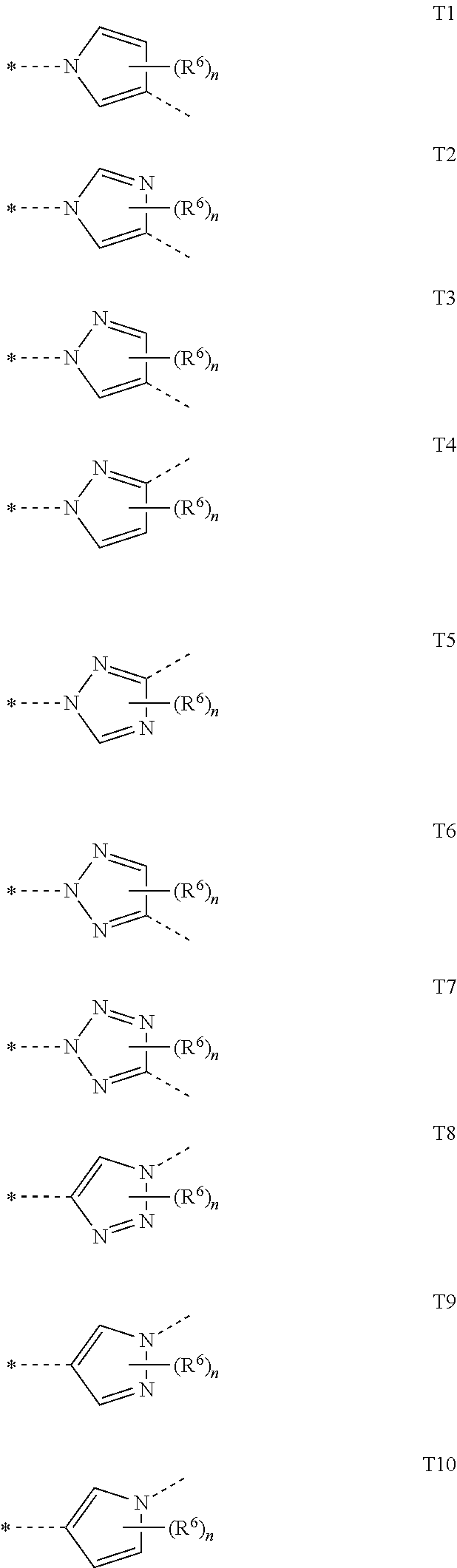
-
- where
- R6 is hydrogen, methyl, ethyl, 2-methylethyl, 2,2-dimethylethyl, fluorine, chlorine, bromine, iodine, nitro, trifluoromethyl, amino;
- W is oxygen;
- Q is hydrogen, methyl, ethyl, n-propyl, 1-methylethyl, 1,1-dimethylethyl, 1-methylpropyl, n-butyl, 2-methylpropyl, 2-methylbutyl, hydroxymethyl, 2-hydroxypropyl, cyanomethyl, 2-cyanoethyl, 2-fluoroethyl, 2,2-difluoroethyl, 2,2,2-trifluoroethyl, 1,1,2,2-tetrafluoroethyl, 1-trifluoromethylethyl, 2,2-difluoropropyl, 3,3,3-trifluoropropyl, 2,2-dimethyl-3-fluoropropyl, cyclopropyl, 1-cyanocyclopropyl, 1-chlorocyclopropyl, 1-methylcyclopropyl, 1-methoxycarbonylcyclopropyl, 1-(N-methylcarbamoyl)cyclopropyl, 1-(N-cyclopropylcarbamoyl)cyclopropyl, cyclopropylmethyl, cyclobutyl, cyclopentyl, cyclohexyl, 1-cyclopropylethyl, bis(cyclopropyl)methyl, 2,2-dimethylcyclopropylmethyl, 2-phenylcyclopropyl, 2,2-dichlorocyclopropyl, trans-2-chlorocyclopropyl, cis-2-chlorocyclopropyl, 2,2-difluorocyclopropyl, trans-2-fluorocyclopropyl, cis-2-fluorocyclopropyl, trans-4-hydroxycyclohexyl, 4-trifluoromethylcyclohexyl, prop-2-enyl, 2-methylprop-2-enyl, prop-2-ynyl, 1,1-dimethylbut-2-ynyl, 3-chloroprop-2-enyl, 3,3-dichloroprop-2-enyl, 3,3-dichloro-1,1-dimethylprop-2-enyl, oxetan-3-yl, thietan-3-yl, 1-oxidothietan-3-yl, 1,1-dioxidothietan-3-yl, isoxazol-3-ylmethyl, 3-methyloxetan-3-ylmethyl, benzyl, 2,6-difluorophenylmethyl, 3-fluorophenylmethyl, 2-fluorophenylmethyl, 2,5-difluorophenylmethyl, 1-phenylethyl, 4-chlorophenylethyl, 2-trifluoromethylphenylethyl, pyridin-2-ylethyl, pyridin-2-ylmethyl, 5-fluoropyridin-2-ylmethyl, (6-chloropyridin-3-yl)methyl, pyrimidin-2-ylmethyl, methoxy, 2-ethoxyethyl, 2-(methylsulphanyl)ethyl, 1-methyl-2-(ethylsulphanyl)ethyl, 2-methyl-1-(methylsulphanyl)propan-2-yl, methoxycarbonyl, methoxycarbonylmethyl, NH2, N-ethylamino, N-allylamino, N,N-dimethylamino, N,N-diethylamino, methylsulphonylamino; or
- Q is one of the following groups substituted by 0, 1, 2, 3 or 4 V substituents: phenyl, naphthyl, pyridazinyl, pyrazinyl, pyrimidinyl, triazinyl, pyridinyl, pyrazolyl, thiazolyl, isothiazolyl, oxazolyl, isoxazolyl, triazolyl, imidazolyl, furanyl, thiophenyl, pyrrolyl, oxadiazolyl, thiadiazolyl, where
- V is independently fluorine, chlorine, bromine, iodine, cyano, nitro, methyl, ethyl, difluoromethyl, chlorodifluoromethyl, dichlorofluoromethyl, trifluoromethyl, chloromethyl, bromomethyl, 1-fluoroethyl, 2-fluoroethyl, 2,2-difluoroethyl, 2,2,2-trifluoroethyl, 1,2,2,2-tetrafluoroethyl, 1-chloro-1,2,2,2-tetrafluoroethyl, 2,2,2-trichloroethyl, 2-chloro-2,2-difluoroethyl, 1,1-difluoroethyl, pentafluoroethyl, pentafluoro-tert-butyl, heptafluoro-n-propyl, heptafluoroisopropyl, nonafluoro-n-butyl, cyclopropyl, cyclobutyl, methoxy, ethoxy, n-propoxy, 1-methylethoxy, fluoromethoxy, difluoromethoxy, chlorodifluoromethoxy, dichlorofluoromethoxy, trifluoromethoxy, 2,2,2-trifluoroethoxy, 2-chloro-2,2-difluoroethoxy, pentafluoroethoxy, N-methoxyiminomethyl, 1-(N-methoxyimino)ethyl, methylsulphanyl, methylsulphonyl, methylsulphinyl, trifluoromethylsulphonyl, trifluoromethylsulphinyl, trifluoromethylsulphanyl, N,N-dimethylamino.
- Z1 is trifluoromethyl, 1-chlorocyclopropyl, 1-fluorocyclopropyl or pentafluoroethyl;
- Z2 is trifluoromethyl, nitro, methylsulphanyl, methylsulphinyl, methylsulphonyl, fluorine, chlorine, bromine, cyano or iodine;
- Z3 is methyl, ethyl, n-propyl or hydrogen;
- R1 is hydrogen, methyl, ethyl, n-propyl, isopropyl, n-butyl, i-butyl, s-butyl, t-butyl, prop-2-enyl, 2-methylprop-2-enyl, prop-2-ynyl, methoxymethyl, ethoxymethyl, propoxymethyl, methylcarbonyl, ethylcarbonyl, n-propylcarbonyl, isopropylcarbonyl, s-butylcarbonyl, t-butylcarbonyl, methoxycarbonyl, ethoxycarbonyl, n-propoxycarbonyl, isopropoxycarbonyl, s-butoxycarbonyl, t-butoxycarbonyl, cyanomethyl, 2-cyanoethyl, benzyl, 4-methoxybenzyl, pyrid-2-ylmethyl, pyrid-3-ylmethyl, pyrid-4-ylmethyl, 4-chloropyrid-3-ylmethyl, most preferably hydrogen;
- A1 is CH;
- A2 is nitrogen;
- A3 is CR4 and
- A4 is CR5;
- R4 is hydrogen, fluorine, chlorine, bromine, iodine or cyano;
- R5 is hydrogen, fluorine, chlorine, bromine, iodine, methyl or methoxy;
- T is one of the 5-membered heteroaromatic systems T1-T10 shown below, where the bond to the pyrazolyl head group is indicated by an asterisk,

-
- where
- R6 is hydrogen, methyl, ethyl, 2-methylethyl, 2,2-dimethylethyl, fluorine, chlorine, bromine, iodine, nitro, trifluoromethyl, amino;
- W is oxygen;
- Q is hydrogen, methyl, ethyl, n-propyl, 1-methylethyl, 1,1-dimethylethyl, 1-methylpropyl, n-butyl, 2-methylpropyl, 2-methylbutyl, hydroxymethyl, 2-hydroxypropyl, cyanomethyl, 2-cyanoethyl, 2-fluoroethyl, 2,2-difluoroethyl, 2,2,2-trifluoroethyl, 1,1,2,2-tetrafluoroethyl, 1-trifluoromethylethyl, 2,2-difluoropropyl, 3,3,3-trifluoropropyl, 2,2-dimethyl-3-fluoropropyl, cyclopropyl, 1-cyanocyclopropyl, 1-chlorocyclopropyl, 1-methylcyclopropyl, 1-methoxycarbonylcyclopropyl, 1-(N-methylcarbamoyl)cyclopropyl, 1-(N-cyclopropylcarbamoyl)cyclopropyl, cyclopropylmethyl, cyclobutyl, cyclopentyl, cyclohexyl, 1-cyclopropylethyl, bis(cyclopropyl)methyl, 2,2-dimethylcyclopropylmethyl, 2-phenylcyclopropyl, 2,2-dichlorocyclopropyl, trans-2-chlorocyclopropyl, cis-2-chlorocyclopropyl, 2,2-difluorocyclopropyl, trans-2-fluorocyclopropyl, cis-2-fluorocyclopropyl, trans-4-hydroxycyclohexyl, 4-trifluoromethylcyclohexyl, prop-2-enyl, 2-methylprop-2-enyl, prop-2-ynyl, 1,1-dimethylbut-2-ynyl, 3-chloroprop-2-enyl, 3,3-dichloroprop-2-enyl, 3,3-dichloro-1,1-dimethylprop-2-enyl, oxetan-3-yl, thietan-3-yl, 1-oxidothietan-3-yl, 1,1-dioxidothietan-3-yl, isoxazol-3-ylmethyl, 3-methyloxetan-3-ylmethyl, benzyl, 2,6-difluorophenylmethyl, 3-fluorophenylmethyl, 2-fluorophenylmethyl, 2,5-difluorophenylmethyl, 1-phenylethyl, 4-chlorophenylethyl, 2-trifluoromethylphenylethyl, pyridin-2-ylethyl, pyridin-2-ylmethyl, 5-fluoropyridin-2-ylmethyl, (6-chloropyridin-3-yl)methyl, pyrimidin-2-ylmethyl, methoxy, 2-ethoxyethyl, 2-(methylsulphanyl)ethyl, 1-methyl-2-(ethylsulphanyl)ethyl, 2-methyl-1-(methylsulphanyl)propan-2-yl, methoxycarbonyl, methoxycarbonylmethyl, NH2, N-ethylamino, N-allylamino, N,N-dimethylamino, N,N-diethylamino, methylsulphonylamino; or
- Q is one of the following groups substituted by 0, 1, 2, 3 or 4 V substituents: phenyl, naphthyl, pyridazinyl, pyrazinyl, pyrimidinyl, triazinyl, pyridinyl, pyrazolyl, thiazolyl, isothiazolyl, oxazolyl, isoxazolyl, triazolyl, imidazolyl, furanyl, thiophenyl, pyrrolyl, oxadiazolyl, thiadiazolyl, where
- V is independently fluorine, chlorine, bromine, iodine, cyano, nitro, methyl, ethyl, difluoromethyl, chlorodifluoromethyl, dichlorofluoromethyl, trifluoromethyl, chloromethyl, bromomethyl, 1-fluoroethyl, 2-fluoroethyl, 2,2-difluoroethyl, 2,2,2-trifluoroethyl, 1,2,2,2-tetrafluoroethyl, 1-chloro-1,2,2,2-tetrafluoroethyl, 2,2,2-trichloroethyl, 2-chloro-2,2-difluoroethyl, 1,1-difluoroethyl, pentafluoroethyl, pentafluoro-tert-butyl, heptafluoro-n-propyl, heptafluoroisopropyl, nonafluoro-n-butyl, cyclopropyl, cyclobutyl, methoxy, ethoxy, n-propoxy, 1-methylethoxy, fluoromethoxy, difluoromethoxy, chlorodifluoromethoxy, dichlorofluoromethoxy, trifluoromethoxy, 2,2,2-trifluoroethoxy, 2-chloro-2,2-difluoroethoxy, pentafluoroethoxy, N-methoxyiminomethyl, 1-(N-methoxyimino)ethyl, methylsulphanyl, methylsulphonyl, methylsulphinyl, trifluoromethylsulphonyl, trifluoromethylsulphinyl, trifluoromethylsulphanyl, N,N-dimethylamino.


in which the A1-A4, n, W, Q, R1 and Z1-Z3 radicals are each as defined according to any of aspects 1 to 6.

in which
Z1 is CF2CF3,
Z2 is CF3,
Z3 is CH3,
the R1, R6 radicals are each hydrogen (n=0),
A1, A2 are C—H,
A3 is C—H, C—Cl, C—F,
A4 is C—H, C—F, C—OMe,
W is oxygen and
Q is methyl, ethyl, cyclopropyl, 1-chlorocyclopropyl, 1-cyanocyclopropyl, 2,2,2-trifluoroethyl, 1,1,2,2-tetrafluoroethyl, phenyl, 4-fluorophenyl, 2-fluorophenyl, 3-fluorophenyl, 3,5-difluorophenyl, 2,6-difluorophenyl, 2-thiophenyl, 3-thiophenyl, 3-chloro-3-thiophenyl, 1-methyl-4-pyrazolyl, 4-pyridinyl, 3-chloro-2-pyridinyl, 2-chloro-4-pyridinyl, 3-fluoro-4-pyridinyl, 2,6-dichloro-4-pyridinyl.

in which
Z1 is CF2CF3,
Z2 is CF3,
Z3 is CH3,
the R1, R6 radicals are each hydrogen (n=0),
A1, A2 are C—H,
A3 is C—H, C—Cl, C—F,
A4 is C—H, C—F, C—OMe,
W is oxygen and
Q is methyl, ethyl, cyclopropyl, 1-chlorocyclopropyl, 1-cyanocyclopropyl, 2,2,2-trifluoroethyl, 1,1,2,2-tetrafluoroethyl, phenyl, 4-fluorophenyl, 2-fluorophenyl, 3-fluorophenyl, 3,5-difluorophenyl, 2,6-difluorophenyl, 2-thiophenyl, 3-thiophenyl, 3-chloro-3-thiophenyl, 1-methyl-4-pyrazolyl, 4-pyridinyl, 3-chloro-2-pyridinyl, 2-chloro-4-pyridinyl, 3-fluoro-4-pyridinyl, 2,6-dichloro-4-pyridinyl.
-
- Aspect 11 relates to the use of compounds of the general formulae (I), (Ia), (Ib), (Ic), (Id), (Ie), (If), (Ig), (Ih), (Ii) and (Ij) according to any of aspects 1 to 10 for control of insects, arachnids and nematodes.
- Aspect 12 relates to pharmaceutical compositions comprising at least one compound according to any of aspects 1 to 10.
- Aspect 13 relates to compounds according to any of aspects 1 to 10 as medicaments.
- Aspect 14 relates to the use of compounds according to any of aspects 1 to 10 for production of pharmaceutical compositions for control of parasites in animals
- Aspect 15 relates to processes for producing crop protection compositions comprising compounds according to any of aspects 1 to 10 and customary extenders and/or surfactants.
- Aspect 16 relates to methods for controlling pests, characterized in that a compound according to any of aspects 1 to 10 is allowed to act on the pests and/or their habitat.
- Aspect 17 relates to the use of compounds according to any of aspects 1 to 10 for protection of propagation material of plants.

-
- in which
- R1 is hydrogen or an optionally independently mono- to hepta-halogen-, -cyano-, -alkoxy- or -alkoxycarbonyl-substituted C1-C6-alkyl, C3-C6-alkenyl, C3-C6-alkynyl, C3-C7-cycloalkyl, C3-C7-cycloalkyl-C1-C3-alkyl, C1-C6-alkylcarbonyl, C1-C6-alkoxycarbonyl, aryl(C1-C3)-alkyl, heteroaryl(C1-C3)-alkyl, most preferably hydrogen;
- the following chemical moieties are as follows:
- A1 is CR2 or nitrogen,
- A2 is CR3 or nitrogen,
- A3 is CR4 or nitrogen, and
- A4 is CR5 or nitrogen,
- but not more than three of the chemical moieties A1 to A4 are simultaneously nitrogen;
- R2, R3, R4 and R5 are each independently hydrogen, halogen, cyano, nitro, or an optionally independently mono- to hepta-halogen-, -cyano-, -alkoxy- and -alkoxycarbonyl-substituted C1-C6-alkyl, C3-C6-cycloalkyl, C1-C6-alkoxy, N—C1-C6-alkoxyimino-C1-C3-alkyl, C1-C6-alkylsulphanyl, C1-C6-alkylsulphinyl, C1-C6-alkylsulphonyl, N—C1-C6-alkylamino or N,N-di-C1-C6-alkylamino;
- W is oxygen or sulphur;
- Q is hydrogen, amino or one of the following independently mono- to hepta-hydroxy-, -nitro-, -amino-, -halogen-, -alkoxy-, -cyano-, -hydroxycarbonyl-, -alkoxycarbonyl-, -alkylcarbamoyl-, -cycloalkylcarbamoyl-, -phenyl-substituted moieties: C1-C6-alkyl, C2-C6-alkenyl, C2-C6-alkynyl, C3-C6-cycloalkyl, C2-C5-heterocyclyl, C1-C4-alkoxy, C1-C6-alkyl-C3-C6-cycloalkyl, C3-C6-cycloalkyl-C1-C6-alkyl, C1-C6-hydroxyalkyl, aryl(C1-C3)-alkyl, heteroaryl(C1-C3)-alkyl, C1-C4-alkoxycarbonyl, N—C1-C4-alkylamino, N—C1-C4-alkylcarbonylamino, N,N-di-C1-C4-alkylamino, C1-C4-alkylsulphonylamino; or
- Q is hydrogen, amino or one of the moieties selected from C1-C6-alkyl, C1-C6-alkyloxy, C2-C6-alkenyl, C2-C6-alkynyl, C3-C6-cycloalkyl, 5- or 6-membered heterocyclyl, C1-C6-alkyl-C3-C6-cycloalkyl, C3-C6-cycloalkyl-C1-C6-alkyl, C6-C10-aryl-(C1-C3)-alkyl, 5- or 6-membered heteroaryl-(C1-C3)-alkyl, C1-C4-alkoxycarbonyl, each of which is optionally independently substituted by 1, 2, 3, 4, 5, 6 or 7 substituents selected from the group consisting of hydroxyl, nitro, amino, halogen, oxo, benzyloxy, C3-C6-cycloalkyl, C1-C6-alkoxy, cyano, hydroxycarbonyl, C1-C4-alkoxycarbonyl, C1-C6-alkylcarbamoyl, C3-C6-cycloalkylcarbamoyl, N,N-di-C1-C4-alkylamino, phenyl optionally substituted by 1, 2 or 3 substituents independently selected from the group of substituents consisting of halogen, C1-C6-alkoxy, C1-C6-haloalkoxy and C1-C6-alkyl, phenylthio optionally substituted by 1, 2 or 3 substituents independently selected from the group of substituents consisting of halogen, C1-C6-alkoxy, C1-C6-haloalkoxy and C1-C6-alkyl, 5- or 6-membered heteroaryl (e.g. pyrazolyl) optionally substituted by 1, 2 or 3 substituents independently selected from the group of substituents consisting of halogen, C1-C6-alkoxy, C1-C6-haloalkoxy and C1-C6-alkyl, or is an N—C1-C4-alkylamino, N—C1-C4-alkylcarbonylamino, N,N-di-C1-C4-alkylamino, C1-C4-alkylsulphonylamino moiety; or
- Q is an aryl substituted by 0, 1, 2, 3 or 4 V substituents or a 5- or 6-membered heteroaryl substituted by 0, 1, 2, 3 or 4 V substituents, or
- Q is a bicyclic heterocycle substituted by 0, 1, 2, 3 or 4 V substituents or a bicyclic carbocycle substituted by 0, 1, 2, 3 or 4 V substituents; where
- V is independently halogen, cyano, nitro or an optionally independently mono- to hepta-halogen, -cyano-, -alkoxy- or -alkoxycarbonyl-substituted C1-C6-alkyl, C1-C6-haloalkyl, C2-C4-alkenyl, C2-C4-alkynyl, C3-C6-cycloalkyl, C1-C6-alkoxy, C1-C6-haloalkoxy, N—C1-C6-alkoxyimino-C1-C3-alkyl, C1-C6-alkylsulphanyl, C1-C6-alkylsulphinyl, C1-C6-alkylsulphonyl, N,N-di-(C1-C6-alkyl)amino;
- R6 is independently halogen, cyano, nitro, amino or an optionally mono- to hepta-halogen-substituted C1-C6-alkyl, C1-C6-alkyloxy, C1-C6-alkylcarbonyl, C1-C6-alkylsulphanyl, C1-C6-alkylsulphinyl, C1-C6-alkylsulphonyl, and
- n has the values of 0-1;
- Z1 is an optionally independently mono- to hepta-halogen-, -cyano-, -alkoxy- and -alkoxycarbonyl-substituted C1-C6-alkyl, C3-C6-cycloalkyl, and
- Z2 is hydrogen, halogen, cyano, nitro, amino or an independently mono- to hepta-halogen-, -cyano-, -alkoxy- or -alkoxycarbonyl-substituted C1-C6-alkyl, C1-C6-alkylcarbonyl, C1-C6-alkylsulphanyl, C1-C6-alkylsulphinyl, C1-C6-alkylsulphonyl, and
- Z3 is hydrogen or an optionally independently mono- to hepta-halogen-, -cyano-, -alkoxy- and -alkoxycarbonyl-substituted C1-C6-alkyl, C3-C6-cycloalkyl, C3-C4-alkenyl, C3-C4-alkynyl, or an optionally independently mono- to penta-halogen-, -cyano-, -alkoxy- and -alkoxycarbonyl-substituted aryl or hetaryl.
-
- Z1 is an in each case optionally independently mono- to hepta-halogen- or -cyano-substituted C1-C6-alkyl or C3-C6-cycloalkyl;
- Z2 is an in each case optionally independently mono- to hepta-halogen- or -cyano-substituted C1-C6-alkyl or C3-C6-cycloalkyl;
- Z3 is hydrogen or C1-C6-alkyl,
more preferably in which - Z1 is an in each case optionally independently mono- to hepta-halogen-substituted C1-C6-alkyl;
- Z2 is an in each case optionally independently mono- to hepta-halogen-substituted C1-C6-alkyl;
- Z3 is C1-C6-alkyl,
even more preferably in which - Z1 is perfluorinated C1-C3-alkyl (e.g. C2F5);
- Z2 is perfluorinated C1-C3-alkyl (e.g. CF3);
- Z3 is C1-C4-alkyl (e.g. methyl).
-
- hydrogen, amino or one of the moieties selected from C1-C6-alkyl, C1-C6-alkyloxy, C2-C6-alkenyl, C2-C6-alkynyl, C3-C6-cycloalkyl, 5- or 6-membered heterocyclyl, C1-C6-alkyl-C3-C6-cycloalkyl, C3-C6-cycloalkyl-C1-C6-alkyl, C6-C10-aryl-(C1-C3)-alkyl, 5- or 6-membered heteroaryl-(C1-C3)-alkyl, C1-C4-alkoxycarbonyl, each of which is optionally independently substituted by 1, 2, 3, 4, 5, 6 or 7 substituents selected from the group consisting of hydroxy, nitro, amino, halogen, oxo, benzyloxy, C3-C6-cycloalkyl, C1-C6-alkoxy, C1-C6-haloalkoxy, cyano, hydroxycarbonyl, C1-C4-alkoxycarbonyl, C1-C6-alkylcarbamoyl, C3-C6-cycloalkylcarbamoyl, N,N-di-C1-C4-alkylamino, phenyl optionally substituted by 1, 2 or 3 substituents selected independently from the group of substituents consisting of halogen, C1-C6-alkoxy, C1-C6-haloalkoxy and C1-C6-alkyl, phenylthio optionally substituted by 1, 2 or 3 substituents selected independently from the group of substituents consisting of halogen, C1-C6-alkoxy, C1-C6-haloalkoxy and C1-C6-alkyl, phenyloxy optionally substituted by 1, 2 or 3 substituents selected independently from the group of substituents consisting of halogen, C1-C6-alkoxy, C1-C6-haloalkoxy and C1-C6-alkyl, 5- or 6-membered heteroaryl (e.g. pyrazolyl or thiophenyl) optionally substituted by 1, 2 or 3 substituents selected independently from the group of substituents consisting of halogen, C1-C6-alkoxy, C1-C6-haloalkoxy and C1-C6-alkyl, or is an N—C1-C4-alkylamino, N—C1-C4-alkylcarbonylamino, N,N-di-C1-C4-alkylamino, C1-C4-alkylsulphonylamino moiety; or
- Q is an aryl substituted by 0, 1, 2, 3 or 4 V substituents or a 5- or 6-membered heteroaryl substituted by 0, 1, 2, 3 or 4 V substituents, or
- Q is a bicyclic heterocycle substituted by 0, 1, 2, 3 or 4 V substituents or a bicyclic carbocycle substituted by 0, 1, 2, 3 or 4 V substituents; where
- V is independently halogen, cyano, nitro or an optionally independently mono- to hepta-halogen, -cyano-, -alkoxy- and -alkoxycarbonyl-substituted C1-C6-alkyl, C1-C6-haloalkyl, C2-C4-alkenyl, C2-C4-alkynyl, C3-C6-cycloalkyl, C1-C6-alkoxy, C1-C6-haloalkoxy, N—C1-C6-alkoxyimino-C1-C3-alkyl, C1-C6-alkylsulphanyl, C1-C6-alkylsulphinyl, C1-C6-alkylsulphonyl, N,N-di-(C1-C6-alkyl)amino.
-
- hydrogen;
- C1-C6-alkyl optionally substituted by 1, 2, 3 or 4 substituents selected independently from the group consisting of
- fluorine, chlorine, bromine, iodine, cyano, oxo, C1-C4-alkoxy, C1-C4-haloalkoxy, benzyloxy, N,N-di-C1-C4-alkylamino, C3-C6-cycloalkyl, phenylthio optionally substituted by 1, 2, 3 or 4 substituents selected independently from the group consisting of fluorine, chlorine, bromine, iodine, C1-C4-alkoxy, C1-C4-alkyl and C1-C4-haloalkyl, phenyloxy, optionally substituted by 1, 2, 3 or 4 substituents selected independently from the group consisting of fluorine, chlorine, bromine, iodine, C1-C4-alkoxy, C1-C4-alkyl and C1-C4-haloalkyl, phenyl optionally substituted by 1, 2, 3 or 4 substituents selected independently from the group consisting of fluorine, chlorine, bromine, iodine, C1-C4-alkoxy, and C1-C4-haloalkyl, pyrazolyl optionally substituted by 1, 2, 3 or 4 substituents selected independently from the group consisting of fluorine, chlorine, bromine, iodine, C1-C4-alkoxy, C1-C4-alkyl and C1-C4-haloalkyl, thiophenyl optionally substituted by 1, 2, 3 or 4 substituents selected independently from the group consisting of fluorine, chlorine, bromine, iodine, C1-C4-alkoxy, C1-C4-alkyl and C1-C4-haloalkyl;
- C3-C6-cycloalkyl optionally substituted by 1, 2, 3 or 4 substituents selected independently from the group consisting of
- C1-C4-alkoxy, fluorine, chlorine, bromine, iodine, cyano, C1-C4-alkyl, phenyl optionally substituted by 1, 2, 3 or 4 substituents selected independently from the group consisting of fluorine, chlorine, bromine, iodine, C1-C4-alkoxy, C1-C4-alkyl and C1-C4-haloalkyl; or
- is a phenyl, naphthyl, pyridazinyl, pyrazinyl, pyrimidinyl, triazinyl, pyridinyl, pyrazolyl, thiazolyl, isothiazolyl, oxazolyl, isoxazolyl, triazolyl, imidazolyl, furanyl, thiophenyl, pyrrolyl, oxadiazolyl, thiadiazolyl, benzothiophenyl, benzofuranyl, [1,2,4]triazolo[1,5-a]pyrimidinyl, 1,3-benzodioxolyl or tetralinyl, each of which is substituted by 0, 1, 2, 3 or 4 V substituents, where V is independently fluorine, chlorine, bromine, iodine, cyano, nitro, C1-C4-alkyl, C1-C4-haloalkyl, C3-C6-cycloalkyl, C1-C4-alkoxy, C1-C4-haloalkoxy, N,N-di-C1-C4-alkylamino.
-
- C1-C6-alkyl optionally substituted by 1, 2, 3 or 4 substituents selected independently from the group consisting of
- fluorine, chlorine, bromine, iodine, oxo, C1-C4-alkoxy, benzyloxy, N,N-di-C1-C4-alkylamino, C3-C6-cycloalkyl, phenylthio, phenyloxy, phenyl optionally substituted by 1, 2, 3 or 4 substituents independently selected from the group consisting of fluorine, chlorine, bromine, iodine, C1-C4-alkoxy, C1-C4-alkyl and C1-C4-haloalkyl, pyrazolyl and thiophenyl optionally substituted by 1, 2, 3 or 4 substituents independently selected from the group consisting of C1-C4-alkyl and C1-C4-haloalkyl;
- C3-C6-cycloalkyl optionally substituted by 1, 2, 3 or 4 substituents selected independently from the group consisting of
- C1-C4-alkoxy, fluorine, chlorine, bromine, iodine, cyano, C1-C4-alkyl, phenyl optionally substituted by 1, 2, 3 or 4 substituents selected independently from the group consisting of fluorine, chlorine, bromine, iodine and C1-C4-alkyl; or
- is a phenyl, pyrimidinyl, pyridinyl, pyrazolyl, oxazolyl, isoxazolyl, furanyl, thiophenyl, benzothiophenyl, benzofuranyl, [1,2,4]triazolo[1,5-a]pyrimidinyl, 1,3-benzodioxolyl or tetralinyl, each of which is substituted by 0, 1, 2, 3 or 4 V substituents, where V is independently fluorine, chlorine, cyano, nitro, C1-C4-alkyl, C1-C4-haloalkyl, C3-C6-cycloalkyl, C1-C4-alkoxy, C1-C4-haloalkoxy, N,N-di-C1-C4-alkylamino.
- C1-C6-alkyl optionally substituted by 1, 2, 3 or 4 substituents selected independently from the group consisting of
-
- C1-C4-alkyl optionally substituted by 1, 2, 3 or 4 substituents selected independently from the group consisting of
- fluorine, chlorine, bromine, iodine, oxo, C1-C4-alkoxy, benzyloxy, N,N-di-C1-C4-alkylamino, C3-C6-cycloalkyl, phenylthio, phenyloxy, phenyl optionally substituted by 1, 2 or 3 substituents independently selected from the group consisting of fluorine, chlorine, bromine, iodine, C1-C4-alkoxy, C1-C4-alkyl and C1-C4-haloalkyl, pyrazolyl and thiophenyl optionally substituted by 1 or 2 substituents independently selected from the group consisting of C1-C4-alkyl and C1-C4-haloalkyl;
- C3-C6-cycloalkyl optionally substituted by 1 or 2 substituents selected independently from the group consisting of
- C1-C4-alkoxy, fluorine, chlorine, bromine, iodine, cyano, C1-C4-alkyl, phenyl optionally substituted by 1 or 2 substituents selected independently from the group consisting of fluorine, chlorine, bromine, iodine and C1-C4-alkyl; or
- is a phenyl, pyrimidinyl, pyridinyl, pyrazolyl, oxazolyl, isoxazolyl, furanyl, thiophenyl, benzothiophenyl, benzofuranyl, [1,2,3]triazolo[1,5-a]pyrimidinyl, 1,3-benzodioxolyl or tetralinyl, each of which is substituted by 0, 1, 2 or 3 V substituents, where V is independently fluorine, chlorine, cyano, nitro, C1-C4-alkyl, C1-C4-haloalkyl, C3-C6-cycloalkyl, C1-C4-alkoxy, C1-C4-haloalkoxy, N,N-di-C1-C2-alkylamino.
- C1-C4-alkyl optionally substituted by 1, 2, 3 or 4 substituents selected independently from the group consisting of
-
- C1-C4-alkyl optionally substituted by 1, 2, 3 or 4 substituents selected independently from the group consisting of
- fluorine, oxo, C1-C4-alkoxy, benzyloxy, N,N-di-C1-C4-alkylamino, C3-C6-cycloalkyl, phenylthio, phenyloxy, phenyl optionally substituted by 1, 2 or 3 substituents independently selected from the group consisting of fluorine, chlorine, C1-C4-alkoxy, C1-C4-alkyl and C1-C4-haloalkyl, pyrazolyl and thiophenyl optionally substituted by 1 or 2 substituents independently selected from the group consisting of C1-C4-alkyl and C1-C4-haloalkyl;
- C3-C6-cycloalkyl optionally substituted by 1 or 2 substituents selected independently from the group consisting of
- C1-C4-alkoxy, chlorine, cyano, C1-C4-alkyl, phenyl optionally substituted by 1 or 2 substituents selected independently from the group consisting of chlorine and C1-C4-alkyl; or
- is a phenyl, pyrimidinyl, pyridinyl, pyrazolyl, oxazolyl, isoxazolyl, furanyl, thiophenyl, benzothiophenyl, benzofuranyl, [1,2,3]triazolo[1,5-a]pyrimidinyl, 1,3-benzodioxolyl or tetralinyl, each of which is substituted by 0, 1, 2 or 3 V substituents, where V is independently fluorine, chlorine, cyano, nitro, C1-C4-alkyl, C1-C4-haloalkyl, C3-C6-cycloalkyl, C1-C4-alkoxy, C1-C4-haloalkoxy, N,N-di-C1-C2-alkylamino.
- C1-C4-alkyl optionally substituted by 1, 2, 3 or 4 substituents selected independently from the group consisting of
-
- C1-C6-alkyl optionally substituted by 1, 2, 3 or 4 substituents selected independently from the group consisting of
- fluorine, oxo, methoxy, ethoxy, benzyloxy, N,N-dimethylamino, C3-C6-cycloalkyl, phenylthio, phenyloxy, phenyl optionally substituted by 1, 2 or 3 substituents independently selected from the group consisting of fluorine, chlorine, C1-C4-alkoxy, C1-C4-alkyl and C1-C4-haloalkyl, pyrazolyl and thiophenyl optionally substituted by 1 or 2 substituents independently selected from the group consisting of C1-C4-alkyl and C1-C4-haloalkyl;
- C3-C6-cycloalkyl optionally substituted by 1 or 2 substituents selected independently from the group consisting of
- C1-C4-alkoxy, chlorine, cyano, C1-C2-alkyl, phenyl optionally substituted by 1 or 2 substituents selected independently from the group consisting of chlorine and C1-C2-alkyl; or
- is a phenyl, pyrimidinyl, pyridinyl, pyrazolyl, oxazolyl, isoxazolyl, furanyl, thiophenyl, benzothiophenyl, benzofuranyl, [1,2,3]triazolo[1,5-a]pyrimidinyl, 1,3-benzodioxolyl or tetralinyl, each of which is substituted by 0, 1, 2 or 3 V substituents, where V is independently fluorine, chlorine, cyano, nitro, C1-C4-alkyl, C1-C2-haloalkyl, C3-C6-cycloalkyl, C1-C2-alkoxy, C1-C2-haloalkoxy, N,N-di-C1-C2-alkylamino.
- C1-C6-alkyl optionally substituted by 1, 2, 3 or 4 substituents selected independently from the group consisting of
-
- optionally independently mono- or di-fluorine-, -methyl-, -cyano-, -chlorine-substituted pyridinyl (e.g. 4-pyridinyl, 3-F-4-pyridinyl, 3-Cl-2-pyridinyl, 2-Cl-4-pyridinyl, 2,6-Cl2-4-pyridinyl, 2-Cl-3-pyridinyl, 2-Cl-6-Me-4-pyridinyl, 3-pyridinyl, 3-F-5-pyridinyl, 2-Me-4-pyridinyl, 2-F-4-pyridinyl, 2-CN-5-pyridinyl, 2-Cl-5-pyridinyl, 2-Cl-5-pyridinyl, 2-F-5-pyridinyl, 2-CN-5-pyridinyl),
- optionally mono-Cl—, -methoxy-, -methyl- or —CN-substituted C3-C6-cycloalkyl (e.g. cyclopropyl, 1-CN-cyclopropyl, 1-Cl-cyclopropyl, 4-methoxycyclohex-1-yl, 1-methylcyclohexyl, 1-methylcyclopropyl, cyclopentyl),
- optionally independently mono- or di- or tri-fluorine-, -methoxy-, -ethoxy-, -trifluoromethoxy-, -cyano-, -trifluoromethyl-, -dimethylamino-, -methyl-, -ethyl-, -propyl-substituted phenyl (e.g. phenyl, 2-F-phenyl, 3-F-phenyl, 3,5-F2-phenyl, 2,6-F2-phenyl, 4-F-phenyl, 3-methoxyphenyl, 3-CF3-4-F-phenyl, 2,6-bismethoxyphenyl, 4-(dimethylamino)phenyl, 2,4,6-trisisopropylphenyl, 3-CF3-phenyl, 4-Me-phenyl, 2,3-F2-phenyl, 2-ethoxyphenyl, 2-(trifluoromethoxy)phenyl, 3-cyanophenyl, 2,3-dimethylphenyl, 4-CN-phenyl, 3,4-dimethylphenyl, 3-Me, 4-F-phenyl, 3-F, 4-Me-phenyl, 3-MeO, 4-F-phenyl, 3-F, 4-MeO-phenyl, 4-Cl, 3-F-phenyl, 3-methoxy-4-Me-phenyl, 3-EtO-4-F-phenyl),
- optionally mono-methoxy- or -ethoxy-substituted C1-C6-alkyl or C1-C6-haloalkyl (e.g. CHF2CF2—, CF3CH2—, methyl, ethyl, propyl, 1,1,2,2-tetramethylethyl, (1,1-dimethyl)-2-F-ethyl, methoxymethyl, 1-methylpropyl, 2-methoxyethyl, (R)-1-F-ethyl, 2-Me-prop-1-yl, butyl, 2,2-dimethylprop-1-yl, 1,1-dimethyl-2-ethoxyethyl),
- optionally independently mono-, di- or tri-methyl-, -ethyl-, -propyl-, -butyl-, -nitro-substituted pyrazolyl (e.g. 1-methyl-4-pyrazolyl, 1-methyl-3-tBu-4-NO2-pyrazolyl),
- thiazolyl (e.g. 1-thiazolyl),
- optionally mono-chlorine-substituted thiophenyl (e.g. 3-thiophenyl, 2-thiophenyl, 3-Cl-2-thiophenyl),
- pyrimidinyl (e.g. pyrimidin-3-yl, pyrimidin-2-yl),
- optionally independently mono- or di-halomethyl-, -methyl-substituted [1,2,4]triazolo[1,5-a]pyrimidin-2-yl (e.g. 7-(difluoromethyl)-5-methyl-[1,2,4]triazolo[1,5-a]pyrimidin-2-yl),
- optionally independently mono- or di-chlorine-, -methyl-substituted benzothiophenyl (e.g. 3-Cl-benzothiophen-2-yl, 3-Cl-6-Me-benzothiophen-2-yl),
- optionally independently mono- or di-methyl-, -trifluoromethyl-substituted furanyl (e.g. 3-Me-2-benzofuranyl, 2-CF3-4-Me-furan-2-yl, 2-Me-3-furanyl),
- optionally mono- or di-methyl-, -trifluoromethyl-substituted thiophenyl (e.g. 5-Me-thiophen-2-yl),
- optionally mono-methyl-substituted isoxazolyl (e.g. 5-methylisoxazol-4-yl),
- optionally mono- or di-fluorine-substituted 1,3-benzodioxolyl (e.g. 2,2-difluoro-1,3-benzodioxol-5-yl or 1,3-benzodioxol-5-yl).

-
- optionally independently mono- or di-fluorine-, -methyl-, -cyano-, -chlorine-substituted pyridinyl (e.g. 4-pyridinyl, 3-F-4-pyridinyl, 3-Cl-2-pyridinyl, 2-Cl-4-pyridinyl, 2,6-Cl2-4-pyridinyl, 2-Cl-3-pyridinyl, 2-Cl-6-Me-4-pyridinyl, 3-pyridinyl, 3-F-5-pyridinyl, 2-Me-4-pyridinyl, 2-F-4-pyridinyl, 2-CN-5-pyridinyl, 2-Cl-5-pyridinyl, 2-Cl-5-pyridinyl, 2-F-5-pyridinyl, 2-CN-5-pyridinyl),
- optionally mono-Cl—, -methoxy-, -methyl- or —CN-substituted C3-C6-cycloalkyl (e.g. cyclopropyl, 1-CN-cyclopropyl, 1-Cl-cyclopropyl, 4-methoxycyclohex-1-yl, 1-methylcyclohexyl, 1-methylcyclopropyl, cyclopentyl),
- optionally independently mono- or di- or tri-fluorine-, -methoxy-, -ethoxy-, -trifluoromethoxy-, -cyano-, -trifluoromethyl-, -dimethylamino-, -methyl-, -ethyl-, -propyl-substituted phenyl (e.g. phenyl, 2-F-phenyl, 3-F-phenyl, 3,5-F2-phenyl, 2,6-F2-phenyl, 4-F-phenyl, 3-methoxyphenyl, 3-CF3-4-F-phenyl, 2,6-bismethoxyphenyl, 4-(dimethylamino)phenyl, 2,4,6-trisisopropylphenyl, 3-CF3-phenyl, 4-Me-phenyl, 2,3-F2-phenyl, 2-ethoxyphenyl, 2-(trifluoromethoxy)phenyl, 3-cyanophenyl, 2,3-dimethylphenyl, 4-CN-phenyl, 3,4-dimethylphenyl, 3-Me, 4-F-phenyl, 3-F, 4-Me-phenyl, 3-MeO, 4-F-phenyl, 3-F, 4-MeO-phenyl, 4-Cl, 3-F-phenyl, 3-methoxy-4-Me-phenyl, 3-EtO-4-F-phenyl),
- optionally mono-methoxy- or -ethoxy-substituted C1-C6-alkyl or C1-C6-haloalkyl (e.g. CHF2CF2—, CF3CH2—, methyl, ethyl, propyl, 1,1,2,2-tetramethylethyl, (1,1-dimethyl)-2-F-ethyl, methoxymethyl, 1-methylpropyl, 2-methoxyethyl, (R)-1-F-ethyl, 2-Me-prop-1-yl, butyl, 2,2-dimethylprop-1-yl, 1,1-dimethyl-2-ethoxyethyl),
- optionally independently mono-, di- or tri-methyl-, -ethyl-, -propyl-, -butyl-, -nitro-substituted pyrazolyl (e.g. 1-methyl-4-pyrazolyl, 1-methyl-3-tBu-4-NO2-pyrazolyl),
- thiazolyl (e.g. 1-thiazolyl),
- optionally mono-chlorine-substituted thiophenyl (e.g. 3-thiophenyl, 2-thiophenyl, 3-Cl-2-thiophenyl),
- pyrimidinyl (e.g. pyrimidin-3-yl, pyrimidin-2-yl),
- optionally independently mono- or di-halomethyl-, -methyl-substituted [1,2,4]triazolo[1,5-a]pyrimidin-2-yl (e.g. 7-(difluoromethyl)-5-methyl-[1,2,4]triazolo[1,5-a]pyrimidin-2-yl),
- optionally independently mono- or di-chlorine-, -methyl-substituted benzothiophenyl (e.g. 3-Cl-benzothiophen-2-yl, 3-Cl-6-Me-benzothiophen-2-yl),
- optionally independently mono- or di-methyl-, -trifluoromethyl-substituted furanyl (e.g. 3-Me-2-benzofuranyl, 2-CF3-4-Me-furan-2-yl, 2-Me-3-furanyl),
- optionally mono- or di-methyl-, -trifluoromethyl-substituted thiophenyl (e.g. 5-Me-thiophen-2-yl),
- optionally mono-methyl-substituted isoxazolyl (e.g. 5-methylisoxazol-4-yl),
- optionally mono- or di-fluorine-substituted 1,3-benzodioxolyl (e.g. 2,2-difluoro-1,3-benzodioxol-5-yl or 1,3-benzodioxol-5-yl).
1-(4-Me-Ph)-cyclohex-1-yl, 1-Ph-cycloprop-1-yl, 1-(4-Cl-Ph)-cyclobut-1-yl, 1-(4-Cl-Ph)-cyclopent-1-yl, 2-thiophenylmethyl, (Me)2NC(O)C(O)—.

from the class of the Chilopoda, for example, Geophilus spp., Scutigera spp.;
from the order or the class of the Collembola, for example, Onychiurus armatus.
from the class of the Diplopoda, for example, Blaniulus guttulatus;
from the class of the Insecta, for example from the order of the Blattodea, for example Blattella asahinai, Blattella germanica, Blatta orientalis, Leucophaea maderae, Panchlora spp., Parcoblatta spp., Periplaneta spp., Supella longipalpa;
from the order of the Coleoptera, for example, Acalymma vittatum, Acanthoscelides obtectus, Adoretus spp., Agelastica alni, Agriotes spp., Alphitobius diaperinus, Amphimallon solstitialis, Anobium punctatum, Anoplophora spp., Anthonomus spp., Anthrenus spp., Apion spp., Apogonia spp., Atomaria spp., Attagenus spp., Baris caerulescens, Bruchidius obtectus, Bruchus spp., Cassida spp., Cerotoma trifurcata, Ceutorrhynchus spp., Chaetocnema spp., Cleonus mendicus, Conoderus spp., Cosmopolites spp., Costelytra zealandica, Ctenicera spp., Curculio spp., Cryptolestes ferrugineus, Cryptorhynchus lapathi, Cylindrocopturus spp., Dermestes spp., Diabrotica spp., Dichocrocis spp., Dicladispa armigera, Diloboderus spp., Epilachna spp., Epitrix spp., Faustinus spp., Gibbium psylloides, Gnathocerus cornutus, Hellula undalis, Heteronychus arator, Heteronyx spp., Hylamorpha elegans, Hylotrupes bajulus, Hypera postica, Hypomeces squamosus, Hypothenemus spp., Lachnosterna consanguinea, Lasioderma serricorne, Latheticus oryzae, Lathridius spp., Lema spp., Leptinotarsa decemlineata, Leucoptera spp., Lissorhoptrus oryzophilus, Lixus spp., Luperomorpha xanthodera, Luperodes spp., Lyctus spp., Megascelis spp., Melanotus spp., Meligethes aeneus, Melolontha spp., Migdolus spp., Monochamus spp., Naupactus xanthographus, Necrobia spp., Niptus hololeucus, Oryctes rhinoceros, Oryzaephilus surinamensis, Oryzaphagus oryzae, Otiorrhynchus spp., Oxycetonia jucunda, Phaedon cochleariae, Phyllophaga spp., Phyllophaga helleri, Phyllotreta spp., Popillia japonica, Premnotrypes spp., Prostephanus truncatus, Psylliodes spp., Ptinus spp., Rhizobius ventralis, Rhizopertha dominica, Sitophilus spp., Sitophilus oryzae, Sphenophorus spp., Stegobium paniceum, Sternechus spp., Symphyletes spp., Tanymecus spp., Tenebrio molitor, Tenebrioides mauretanicus, Tribolium spp., Trogoderma spp., Tychius spp., Xylotrechus spp., Zabrus spp.;
from the order of the Diptera, for example, Aedes spp., Agromyza spp., Anastrepha spp., Anopheles spp., Asphondylia spp., Bactrocera spp., Bibio hortulanus, Calliphora erythrocephala, Calliphora vicina, Ceratitis capitata, Chironomus spp., Chrysomyia spp., Chrysops spp., Chrysozona pluvialis, Cochliomyia spp., Contarinia spp., Cordylobia anthropophaga, Cricotopus sylvestris, Culex spp., Culicoides spp., Culiseta spp., Cuterebra spp., Dacus oleae, Dasyneura spp., Delia spp., Dermatobia hominis, Drosophila spp., e.g. Drosophila suzukii, Echinocnemus spp., Fannia spp., Gasterophilus spp., Glossina spp., Haematopota spp., Hydrellia spp., Hydrellia griseola, Hylemya spp., Hippobosca spp., Hypoderma spp., Liriomyza spp., Lucilia spp., Lutzomyia spp., Mansonia spp., Musca spp., Oestrus spp.,
Oscinella frit, Paratanytarsus spp., Paralauterborniella subcincta, Pegomyia spp., Phlebotomus spp., Phorbia spp., Phormia spp., Piophila casei, Prodiplosis spp., Psila rosae, Rhagoletis spp., Sarcophaga spp., Simulium spp., Stomoxys spp., Tabanus spp., Tetanops spp., Tipula spp.;
from the order of the Heteroptera, for example, Anasa tristis, Antestiopsis spp., Boisea spp., Blissus spp., Calocoris spp., Campylomma livida, Cavelerius spp., Cimex spp., Collaria spp., Creontiades dilutus, Dasynus piperis, Dichelops furcatus, Diconocoris hewetti, Dysdercus spp., Euschistus spp., Eurygaster spp., Halyomorpha halys, Heliopeltis spp., Horcias nobilellus, Leptocorisa spp., Leptocorisa varicornis, Leptoglossus occidentalis, Leptoglossus phyllopus, Lygus spp., Macropes excavatus, Miridae, Monalonion atratum, Nezara spp., Oebalus spp., Pentomidae, Piesma quadrata, Piezodorus spp., Psallus spp., Pseudacysta persea, Rhodnius spp., Sahlbergella singularis, Scaptocoris castanea, Scotinophora spp., Stephanitis nashi, Tibraca spp., Triatoma spp.;
from the order of the homoptera, for example, Acizzia acaciaebaileyanae, Acizzia dodonaeae, Acizzia uncatoides, Acrida turrita, Acyrthosipon spp., Acrogonia spp., Aeneolamia spp., Agonoscena spp., Aleyrodes proletella, Aleurolobus barodensis, Aleurothrixus floccosus, Allocaridara malayensis, Amrasca spp., Anuraphis cardui, Aonidiella spp., Aphanostigma piri, Aphis spp., Arboridia apicalis, Arytainilla spp., Aspidiella spp., Aspidiotus spp., Atanus spp., Aulacorthum solani, Bemisia tabaci, Blastopsylla occidentalis, Boreioglycaspis melaleucae, Brachycaudus helichrysi, Brachycolus spp., Brevicoryne brassicae, Cacopsylla spp., Calligypona marginata, Carneocephala fulgida, Ceratovacuna lanigera, Cercopidae, Ceroplastes spp., Chaetosiphon fragaefolii, Chionaspis tegalensis, Chlorita onukii, Chondracris rosea, Chromaphis juglandicola, Chrysomphalus ficus, Cicadulina mbila, Coccomytilus halli, Coccus spp., Cryptomyzus ribis, Cryptoneossa spp., Ctenarytaina spp., Dalbulus spp., Dialeurodes citri, Diaphorina citri, Diaspis spp., Drosicha spp., Dysaphis spp., Dysmicoccus spp., Empoasca spp., Eriosoma spp., Erythroneura spp., Eucalyptolyma spp., Euphyllura spp., Euscelis bilobatus, Ferrisia spp., Geococcus coffeae, Glycaspis spp., Heteropsylla cubana, Heteropsylla spinulosa, Homalodisca coagulata, Hyalopterus arundinis, Icerya spp., Idiocerus spp., Idioscopus spp., Laodelphax striatellus, Lecanium spp., Lepidosaphes spp., Lipaphis erysimi, Macrosiphum spp., Macrosteles facifrons, Mahanarva spp., Melanaphis sacchari, Metcalfiella spp., Metopolophium dirhodum, Monellia costalis, Monelliopsis pecanis, Myzus spp., Nasonovia ribisnigri, Nephotettix spp., Nettigoniclla spectra, Nilaparvata lugens, Oncometopia spp., Orthezia praelonga, Oxya chinensis, Pachypsylla spp., Parabemisia myricae, Paratrioza spp., Parlatoria spp., Pemphigus spp., Peregrinus maidis, Phenacoccus spp., e.g. Phenacoccus madeirensis, Phloeomyzus passerinii, Phorodon humuli, Phylloxera spp., Pinnaspis aspidistrae, Planococcus spp., Prosopidopsylla flava, Protopulvinaria pyriformis, Pseudaulacaspis pentagona, Pseudococcus spp., e.g. Pseudococcus viburni, Psyllopsis spp., Psylla spp., Pteromalus spp., Pyrilla spp., Quadraspidiotus spp., Quesada gigas, Rastrococcus spp., Rhopalosiphum spp., Saissetia spp., Scaphoideus titanus, Schizaphis graminum, Selenaspidus articulatus, Sogata spp., Sogatella furcifera, Sogatodes spp., Stictocephala festina, Siphoninus phillyreae, Tenalaphara malayensis,
Tetragonocephela spp., Tinocallis caryaefoliae, Tomaspis spp., Toxoptera spp., Trialeurodes vaporariorum, Trioza spp., Typhlocyba spp., Unaspis spp., Viteus vitifolii, Zygina spp.;
from the order of the Hymenoptera, for example, Acromyrmex spp., Athalia spp., Atta spp., Diprion spp., Hoplocampa spp., Lasius spp., Monomorium pharaonis, Sirex spp., Solenopsis invicta, Tapinoma spp., Urocerus spp., Vespa spp., Xeris spp.;
from the order of the Isopoda, for example, Armadillidium vulgare, Oniscus asellus, Porcellio scaber;
from the order of the Isoptera, for example, Coptotermes spp., Cornitermes cumulans, Cryptotermes spp., Incisitermes spp., Microtermes obesi, Odontotermes spp., Reticulitermes spp.;
from the order of the Lepidoptera, for example, Achroia grisella, Acronicta major, Adoxophyes spp., Aedia leucomelas, Agrotis spp., Alabama spp., Amyelois transitella, Anarsia spp., Anticarsia spp., Argyroploce spp., Barathra brassicae, Borbo cinnara, Bucculatrix thurberiella, Bupalus piniarius, Busseola spp., Cacoecia spp., Caloptilia theivora, Capua reticulana, Carpocapsa pomonella, Carposina niponensis, Cheimatobia brumata, Chilo spp., Choristoneura spp., Clysia ambiguella, Cnaphalocerus spp., Cnaphalocrocis medinalis, Cnephasia spp., Conopomorpha spp., Conotrachelus spp., Copitarsia spp., Cydia spp., Dalaca noctuides, Diaphania spp., Diatraea saccharalis, Earias spp., Ecdytolopha aurantium, Elasmopalpus lignosellus, Eldana saccharina, Ephestia spp., Epinotia spp., Epiphyas postvittana, Etiella spp., Eulia spp., Eupoecilia ambiguella, Euproctis spp., Euxoa spp., Feltia spp., Galleria mellonella, Gracillaria spp., Grapholitha spp., Hedylepta spp., Helicoverpa spp., Heliothis spp., Hofmannophila pseudospretella, Homoeosoma spp., Homona spp., Hyponomeuta padella, Kakivoria flavofasciata, Laphygma spp., Laspeyresia molesta, Leucinodes orbonalis, Leucoptera spp., Lithocolletis spp., Lithophane antennata, Lobesia spp., Loxagrotis albicosta, Lymantria spp., Lyonetia spp., Malacosoma neustria, Maruca testulalis, Mamstra brassicae, Melanitis leda, Mocis spp., Monopis obviella, Mythimna separata, Nemapogon cloacellus, Nymphula spp., Oiketicus spp., Oria spp., Orthaga spp., Ostrinia spp., Oulema oryzae, Panolis flammea, Parnara spp., Pectinophora spp., Perileucoptera spp., Phthorimaea spp., Phyllocnistis citrella, Phyllonorycter spp., Pieris spp., Platynota stultana, Plodia interpunctella, Plusia spp., Plutella xylostella, Prays spp., Prodenia spp., Protoparce spp., Pseudaletia spp., Pseudaletia unipuncta, Pseudoplusia includens, Pyrausta nubilalis, Rachiplusia nu, Schoenobius spp., Scirpophaga spp., Scirpophaga innotata, Scotia segetum, Sesamia spp., Sesamia inferens, Sparganothis spp., Spodoptera spp., Spodoptera praefica, Stathmopoda spp., Stomopteryx subsecivella, Synanthedon spp., Tecia solanivora, Thermesia gemmatalis, Tinea cloacella, Tinea pellionella, Tineola bisselliella, Tortrix spp., Trichophaga tapetzella, Trichoplusia spp., Tryporyza incertulas, Tuta absoluta, Virachola spp.;
from the order of the Orthoptera or Saltatoria, for example, Acheta domesticus, Dichroplus spp., Gryllotalpa spp., Hieroglyphus spp., Locusta spp., Melanoplus spp., Schistocerca gregaria;
from the order of the Phthiraptera, for example, Damalinia spp., Haematopinus spp., Linognathus spp., Pediculus spp., Phylloera vastatrix, Phtirus pubis, Trichodectes spp.;
from the order of the Psocoptera, for example, Lepinotus spp., Liposcelis spp.;
from the order of the Siphonaptera, for example, Ceratophyllus spp., Ctenocephalides spp., Pulex irritans, Tunga penetrans, Xenopsylla cheopsis;
from the order of the Thysanoptera, for example, Anaphothrips obscurus, Baliothrips biformis, Drepanothrips reuteri, Enneothrips flavens, Frankliniella spp., Heliothrips spp., Hercinothrips femoralis, Rhipiphorothrips cruentatus, Scirtothrips spp., Taeniothrips cardamomi, Thrips spp.;
from the order of the Zygentoma (=Thysanura), for example, Ctenolepisma spp., Lepisma saccharina, Lepismodes inquilinus, Thermobia domestica;
from the class of the Symphyla, for example, Scutigerella spp.;
pests from the phylum of the Mollusca, especially from the class of the Bivalvia, for example Dreissena spp., and from the class of the Gastropoda, for example Arion spp., Biomphalaria spp., Bulinus spp., Deroceras spp., Galba spp., Lymnaea spp., Oncomelania spp., Pomacea spp., Succinea spp.
Formulations
- (1) Acetylcholinesterase (AChE) inhibitors, for example carbamates, e.g. alanycarb, aldicarb, bendiocarb, benfuracarb, butocarboxim, butoxycarboxim, carbaryl, carbofuran, carbosulfan, ethiofencarb, fenobucarb, formetanate, furathiocarb, isoprocarb, methiocarb, methomyl, metolcarb, oxamyl, pirimicarb, propoxur, thiodicarb, thiofanox, triazamate, trimethacarb, XMC and xylylcarb; or organophosphates, e.g. acephate, azamethiphos, azinphos-ethyl, azinphos-methyl, cadusafos, chlorethoxyfos, chlorfenvinphos, chlormephos, chlorpyrifos, chlorpyrifos-methyl, coumaphos, cyanophos, demeton-S-methyl, diazinon, dichlorvos/DDVP, dicrotophos, dimethoate, dimethylvinphos, disulfoton, EPN, ethion, ethoprophos, famphur, fenamiphos, fenitrothion, fenthion, fosthiazate, heptenophos, imicyafos, isofenphos, isopropyl O-(methoxyaminothiophosphoryl) salicylate, isoxathion, malathion, mecarbam, methamidophos, methidathion, mevinphos, monocrotophos, naled, omethoate, oxydemeton-methyl, parathion, parathion-methyl, phenthoate, phorate, phosalone, phosmet, phosphamidon, phoxim, pirimiphos-methyl, profenofos, propetamphos, prothiofos, pyraclofos, pyridaphenthion, quinalphos, sulfotep, tebupirimfos, temephos, terbufos, tetrachlorvinphos, thiometon, triazophos, triclorfon and vamidothion.
- (2) GABA-gated chloride channel antagonists, for example cyclodiene-organochlorines, e.g. chlordane and endosulfan or phenylpyrazoles (fiproles), e.g. ethiprole and fipronil.
- (3) Sodium channel modulators/voltage-gated sodium channel blockers, for example pyrethroids, e.g. acrinathrin, allethrin, d-cis-trans allethrin, d-trans allethrin, bifenthrin, bioallethrin, bioallethrin s-cyclopentenyl isomer, bioresmethrin, cycloprothrin, cyfluthrin, beta-cyfluthrin, cyhalothrin, lambda-cyhalothrin, gamma-cyhalothrin, cypermethrin, alpha-cypermethrin, beta-cypermethrin, theta-cypermethrin, zeta-cypermethrin, cyphenothrin [(1R)-trans isomer], deltamethrin, empenthrin [(EZ)-(1R) isomer], esfenvalerate, etofenprox, fenpropathrin, fenvalerate, flucythrinate, flumethrin, tau-fluvalinate, halfenprox, imiprothrin, kadethrin, momfluorothrin, permethrin, phenothrin [(1R)-trans isomer], prallethrin, pyrethrins (pyrethrum), resmethrin, silafluofen, tefluthrin, tetramethrin, tetramethrin [(1R) isomer)], tralomethrin and transfluthrin or DDT or methoxychlor.
- (4) Nicotinergic acetylcholine receptor (nAChR) agonists, for example neonicotinoids, e.g. acetamiprid, clothianidin, dinotefuran, imidacloprid, nitenpyram, thiacloprid and thiamethoxam or nicotine or sulfoxaflor or flupyradifurone.
- (5) Allosteric activators of the nicotinergic acetylcholine receptor (nAChR), for example spinosyns, e.g. spinetoram and spinosad.
- (6) Chloride channel activators, for example, avermectins/milbemycins, e.g. abamectin, emamectin benzoate, lepimectin and milbemectin.
- (7) Juvenile hormone imitators, for example, juvenile hormone analogues e.g. hydroprene, kinoprene and methoprene or fenoxycarb or pyriproxyfen.
- (8) Active ingredients with unknown or nonspecific mechanisms of action, for example alkyl halides, e.g. methyl bromide and other alkyl halides; or chloropicrine or sulphuryl fluoride or borax or tartar emetic.
- (9) Selective antifeedants, e.g. pymetrozine or flonicamid.
- (10) Mite growth inhibitors, e.g. clofentezine, hexythiazox and diflovidazin or etoxazole.
- (11) Microbial disruptors of the insect gut membrane, e.g. Bacillus thuringiensis subspecies israelensis, Bacillus sphaericus, Bacillus thuringiensis subspecies aizawai, Bacillus thuringiensis subspecies kurstaki, Bacillus thuringiensis subspecies tenebrionis, and BT plant proteins: Cry1Ab, Cry1Ac, Cry1Fa, Cry2Ab, mCry3A, Cry3Ab, Cry3Bb, Cry34/35Ab1.
- (12) Oxidative phosphorylation inhibitors, ATP disruptors, for example diafenthiuron or organotin compounds, e.g. azocyclotin, cyhexatin and fenbutatin oxide or propargite or tetradifon.
- (13) Oxidative phosphorylation decouplers that interrupt the H proton gradient, for example chlorfenapyr, DNOC and sulfluramid.
- (14) Nicotinergic acetylcholine receptor antagonists, for example bensultap, cartap hydrochloride, thiocyclam, and thiosultap-sodium.
- (15) Chitin biosynthesis inhibitors, type 0, for example bistrifluron, chlorfluazuron, diflubenzuron, flucycloxuron, flufenoxuron, hexaflumuron, lufenuron, novaluron, noviflumuron, teflubenzuron and triflumuron.
- (16) Chitin biosynthesis inhibitors, type 1, for example buprofezin.
- (17) Moulting inhibitors (especially for Diptera, i.e. dipterans), for example cyromazine.
- (18) Ecdysone receptor agonists, for example chromafenozide, halofenozide, methoxyfenozide and tebufenozide.
- (19) Octopaminergic agonists, for example amitraz.
- (20) Complex-III electron transport inhibitors, for example hydramethylnon; or acequinocyl; or fluacrypyrim.
- (21) Complex-I electron transport inhibitors, for example from the group of the METI acaricides, e.g. fenazaquin, fenpyroximate, pyrimidifen, pyridaben, tebufenpyrad and tolfenpyrad or rotenone (Derris).
- (22) Voltage-gated sodium channel blockers, for example indoxacarb or metaflumizone.
- (23) Inhibitors of acetyl-CoA carboxylase, for example tetronic and tetramic acid derivatives, e.g. spirodiclofen, spiromesifen and spirotetramat.
- (24) Complex-IV electron transport inhibitors, for example phosphines, e.g. aluminium phosphide, calcium phosphide, phosphine and zinc phosphide or cyanide.
- (25) Complex-II electron transport inhibitors, for example cyenopyrafen and cyflumetofen.
- (28) Ryanodine receptor effectors, for example diamides, e.g. chlorantraniliprole, cyantraniliprole and flubendiamide,
3) Inhibitors of the respiratory chain at complex III, for example (3.01) ametoctradin, (3.02) amisulbrom, (3.03) azoxystrobin, (3.04) cyazofamid, (3.05) coumethoxystrobin, (3.06) coumoxystrobin, (3.07) dimoxystrobin, (3.08) enoxastrobin, (3.09) famoxadone, (3.10) fenamidone, (3.11) flufenoxystrobin, (3.12) fluoxastrobin, (3.13) kresoxim-methyl, (3.14) metominostrobin, (3.15) orysastrobin, (3.16) picoxystrobin, (3.17) pyraclostrobin, (3.18) pyrametostrobin, (3.19) pyraoxystrobin, (3.20) pyribencarb, (3.21) triclopyricarb, (3.22) trifloxystrobin, (3.23) (2E)-2-(2-{[6-(3-chloro-2-methylphenoxy)-5-fluoropyrimidin-4-yl]oxy}phenyl)-2-(methoxyimino)-N-methylacetamide, (3.24) (2E)-2-(methoxyimino)-N-methyl-2-(2-{[({(1E)-1-[3-(trifluoromethyl)phenyl]ethylidene}amino)oxy]methyl}phenyl)acetamide, (3.25) (2E)-2-(methoxyimino)-N-methyl-2-{2-[(E)-({1-[3-(trifluoromethyl)phenyl]ethoxy}imino)methyl]phenyl}acetamide, (3.26) (2E)-2-{2-[({[(1E)-1-(3-{[(E)-1-fluoro-2-phenylvinyl]oxy}phenyl)ethylidene]amino}oxy)methyl]phenyl}-2-(methoxyimino)-N-methylacetamide, (3.27) fenaminostrobin, (3.28) 5-methoxy-2-methyl-4-(2-{[({(1E)-1-[3-(trifluoromethyl)phenyl]ethylidene}amino)oxy]methyl}phenyl)-2,4-dihydro-3H-1,2,4-triazol-3-one, (3.29) methyl (2E)-2-{2-[({cyclopropyl[(4-methoxyphenyl)imino]methyl}sulphanyl)methyl]phenyl}-3-methoxyacrylate, (3.30) N-(3-ethyl-3,5,5-trimethylcyclohexyl)-3-formamido-2-hydroxybenzamide, (3.31) 2-{2-[(2,5-dimethylphenoxy)methyl]phenyl}-2-methoxy-N-methylacetamide, (3.32) 2-{2-[(2,5-dimethylphenoxy)methyl]phenyl}-2-methoxy-N-methylacetamide, (3.33) (2E,3Z)-5-{[1-(4-chlorophenyl)-1H-pyrazol-3-yl]oxy}-2-(methoxyimino)-N,3-dimethylpent-3-enamide.
4) Inhibitors of mitosis and cell division, for example (4.01) benomyl, (4.02) carbendazim, (4.03) chlorfenazole, (4.04) diethofencarb, (4.05) ethaboxam, (4.06) fluopicolide, (4.07) fuberidazole, (4.08) pencycuron, (4.09) thiabendazole, (4.10) thiophanate-methyl, (4.11) thiophanate, (4.12) zoxamide, (4.13) 5-chloro-7-(4-methylpiperidin-1-yl)-6-(2,4,6-trifluorophenyl)[1,2,4]triazolo[1,5-a]pyrimidine, (4.14) 3-chloro-5-(6-chloropyridin-3-yl)-6-methyl-4-(2,4,6-trifluorophenyl)pyridazine.
5) Compounds capable of having multisite action, for example (5.01) bordeaux mixture, (5.02) captafol, (5.03) captan, (5.04) chlorothalonil, (5.05) copper hydroxide, (5.06) copper naphthenate, (5.07) copper oxide, (5.08) copper oxychloride, (5.09) copper(2+) sulphate, (5.10) dichlofluanid, (5.11) dithianon, (5.12) dodine, (5.13) dodine free base, (5.14) ferbam, (5.15) fluorofolpet, (5.16) folpet, (5.17) guazatine, (5.18) guazatine acetate, (5.19) iminoctadine, (5.20) iminoctadine albesilate, (5.21) iminoctadine triacetate, (5.22) mancopper, (5.23) mancozeb, (5.24) maneb, (5.25) metiram, (5.26) metiram zinc, (5.27) oxine-copper, (5.28) propamidine, (5.29) propineb, (5.30) sulphur and sulphur preparations including calcium polysulphide, (5.31) thiram, (5.32) tolylfluanid, (5.33) zineb, (5.34) ziram, (5.35) anilazine.
6) Compounds capable of inducing host defence, for example (6.01) acibenzolar-S-methyl, (6.02) isotianil, (6.03) probenazole, (6.04) tiadinil, (6.05) laminarin.
7) Inhibitors of the amino acid and/or protein biosynthesis, for example (7.01) andoprim, (7.02) blasticidin-S, (7.03) cyprodinil, (7.04) kasugamycin, (7.05) kasugamycin hydrochloride hydrate, (7.06) mepanipyrim, (7.07) pyrimethanil, (7.08) 3-(5-fluoro-3,3,4,4-tetramethyl-3,4-dihydroisoquinolin-1-yl)quinoline, (7.09) oxytetracycline, (7.10) streptomycin.
8) Inhibitors of ATP production, for example (8.01) fentin acetate, (8.02) fentin chloride, (8.03) fentin hydroxide, (8.04) silthiofam.
9) Inhibitors of cell wall synthesis, for example (9.01) benthiavalicarb, (9.02) dimethomorph, (9.03) flumorph, (9.04) iprovalicarb, (9.05) mandipropamid, (9.06) polyoxins, (9.07) polyoxorim, (9.08) validamycin A, (9.09) valifenalate, (9.10) polyoxin B, (9.11) (2E)-3-(4-tert-butylphenyl)-3-(2-chloropyridin-4-yl)-1-(morpholin-4-yl)prop-2-en-1-one, (9.12) (2Z)-3-(4-tert-butylphenyl)-3-(2-chloropyridin-4-yl)-1-(morpholin-4-yl)prop-2-en-1-one.
10) Inhibitors of lipid and membrane synthesis, for example (10.01) biphenyl, (10.02) chloroneb, (10.03) dicloran, (10.04) edifenphos, (10.05) etridiazole, (10.06) iodocarb, (10.07) iprobenfos, (10.08) isoprothiolane, (10.09) propamocarb, (10.10) propamocarb hydrochloride, (10.11) prothiocarb, (10.12) pyrazophos, (10.13) quintozene, (10.14) tecnazene, (10.15) tolclofos-methyl.
11) Inhibitors of melanin biosynthesis, for example (11.01) carpropamid, (11.02) diclocymet, (11.03) fenoxanil, (11.04) phthalide, (11.05) pyroquilon, (11.06) tricyclazole, (11.07) 2,2,2-trifluoroethyl {3-methyl-1-[(4-methylbenzoyl)amino]butan-2-yl}carbamate.
12) Inhibitors of nucleic acid synthesis, for example (12.01) benalaxyl, (12.02) benalaxyl-M (kiralaxyl), (12.03) bupirimate, (12.04) clozylacon, (12.05) dimethirimol, (12.06) ethirimol, (12.07) furalaxyl, (12.08) hymexazol, (12.09) metalaxyl, (12.10) metalaxyl-M (mefenoxam), (12.11) ofurace, (12.12) oxadixyl, (12.13) oxolinic acid, (12.14) octhilinone.
13) Inhibitors of signal transduction, for example (13.01) chlozolinate, (13.02) fenpiclonil, (13.03) fludioxonil, (13.04) iprodione, (13.05) procymidone, (13.06) quinoxyfen, (13.07) vinclozolin, (13.08) proquinazid.
14) Compounds capable of acting as uncouplers, for example (14.01) binapacryl, (14.02) dinocap, (14.03) ferimzone, (14.04) fluazinam, (14.05) meptyldinocap.
15) Further compounds, for example (15.001) benthiazole, (15.002) bethoxazin, (15.003) capsimycin, (15.004) carvone, (15.005) chinomethionat, (15.006) pyriofenone (chlazafenone), (15.007) cufraneb, (15.008) cyflufenamid, (15.009) cymoxanil, (15.010) cyprosulfamide, (15.011) dazomet, (15.012) debacarb, (15.013) dichlorophen, (15.014) diclomezine, (15.015) difenzoquat, (15.016) difenzoquat metilsulfate, (15.017) diphenylamine, (15.018) ecomate, (15.019) fenpyrazamine, (15.020) flumetover, (15.021) fluoroimide, (15.022) flusulfamide, (15.023) flutianil, (15.024) fosetyl-aluminium, (15.025) fosetyl-calcium, (15.026) fosetyl-sodium, (15.027) hexachlorobenzene, (15.028) irumamycin, (15.029) methasulfocarb, (15.030) methyl isothiocyanate, (15.031) metrafenone, (15.032) mildiomycin, (15.033) natamycin, (15.034) nickel dimethyldithiocarbamate, (15.035) nitrothal-isopropyl, (15.036) oxamocarb, (15.037) oxyfenthiin, (15.038) pentachlorophenol and salts, (15.039) phenothrin, (15.040) phosphorous acid and its salts, (15.041) propamocarb-fosetylate, (15.042) propanosine-sodium, (15.043) pyrimorph, (15.044) pyrrolnitrine, (15.045) tebufloquin, (15.046) tecloftalam, (15.047) tolnifanide, (15.048) triazoxide, (15.049) trichlamide, (15.050) zarilamid, (15.051) (3S,6S,7R,8R)-8-benzyl-3-[({3-[(isobutyryloxy)methoxy]-4-methoxypyridin-2-yl}carbonyl)amino]-6-methyl-4,9-dioxo-1,5-dioxonan-7-yl 2-methylpropanoate, (15.052) 1-(4-{4-[(5R)-5-(2,6-difluorophenyl)-4,5-dihydro-1,2-oxazol-3-yl]-1,3-thiazol-2-yl}piperidin-1-yl)-2-[5-methyl-3-(trifluoromethyl)-1H-pyrazol-1-yl]ethanone, (15.053) 1-(4-{4-[(5S)-5-(2,6-difluorophenyl)-4,5-dihydro-1,2-oxazol-3-yl]-1,3-thiazol-2-yl}piperidin-1-yl)-2-[5-methyl-3-(trifluoromethyl)-1H-pyrazol-1-yl]ethanone, (15.054) Oxathiapiprolin, (15.055) 1-(4-methoxyphenoxy)-3,3-dimethylbutan-2-yl 1H-imidazole-1-carboxylate, (15.056) 2,3,5,6-tetrachloro-4-(methylsulphonyl)pyridine, (15.057) 2,3-dibutyl-6-chlorothieno[2,3-d]pyrimidin-4(3H)-one, (15.058) 2,6-dimethyl-1H,5H-[1,4]dithiino[2,3-c:5,6-c′]dipyrrole-1,3,5,7(2H,6H)-tetrone, (15.059) 2-[5-methyl-3-(trifluoromethyl)-1H-pyrazol-1-yl]-1-(4-{4-[(5R)-5-phenyl-4,5-dihydro-1,2-oxazol-3-yl]-1,3-thiazol-2-yl}piperidin-1-yl)ethanone, (15.060) 2-[5-methyl-3-(trifluoromethyl)-1H-pyrazol-1-yl]-1-(4-{4-[(5S)-5-phenyl-4,5-dihydro-1,2-oxazol-3-yl]-1,3-thiazol-2-yl}piperidin-1-yl)ethanone, (15.061) 2-[5-methyl-3-(trifluoromethyl)-1H-pyrazol-1-yl]-1-{4-[4-(5-phenyl-4,5-dihydro-1,2-oxazol-3-yl)-1,3-thiazol-2-yl]piperidin-1-yl}ethanone, (15.062) 2-butoxy-6-iodo-3-propyl-4H-chromen-4-one, (15.063) 2-chloro-5-[2-chloro-1-(2,6-difluoro-4-methoxyphenyl)-4-methyl-1H-imidazol-5-yl]pyridine, (15.064) 2-phenylphenol and salts, (15.065) 3-(4,4,5-trifluoro-3,3-dimethyl-3,4-dihydroisoquinolin-1-yl)quinoline, (15.066) 3,4,5-trichloropyridine-2,6-dicarbonitrile, (15.067) 3-chloro-5-(4-chlorophenyl)-4-(2,6-difluorophenyl)-6-methylpyridazine, (15.068) 4-(4-chlorophenyl)-5-(2,6-difluorophenyl)-3,6-dimethylpyridazine, (15.069) 5-amino-1,3,4-thiadiazole-2-thiol, (15.070) 5-chloro-N′-phenyl-N′-(prop-2-yn-1-yl)thiophene-2-sulphonohydrazide, (15.071) 5-fluoro-2-[(4-fluorobenzyl)oxy]pyrimidin-4-amine, (15.072) 5-fluoro-2-[(4-methylbenzyl)oxy]pyrimidin-4-amine, (15.073) 5-methyl-6-octyl[1,2,4]triazolo[1,5-a]pyrimidin-7-amine, (15.074) ethyl (2Z)-3-amino-2-cyano-3-phenylacrylate, (15.075) N′-(4-{[3-(4-chlorobenzyl)-1,2,4-thiadiazol-5-yl]oxy}-2,5-dimethylphenyl)-N-ethyl-N-methylimidoformamide, (15.076) N-(4-chlorobenzyl)-3-[3-methoxy-4-(prop-2-yn-1-yloxy)phenyl]propanamide, (15.077) N-[(4-chlorophenyl)(cyano)methyl]-3-[3-methoxy-4-(prop-2-yn-1-yloxy)phenyl]propanamide, (15.078) N-[(5-bromo-3-chloropyridin-2-yl)methyl]-2,4-dichloronicotinamide, (15.079) N-[1-(5-bromo-3-chloropyridin-2-yl)ethyl]-2,4-dichloronicotinamide, (15.080) N-[1-(5-bromo-3-chloropyridin-2-yl)ethyl]-2-fluoro-4-iodonicotinamide, (15.081) N-{(E)-[(cyclopropylmethoxy)imino][6-(difluoromethoxy)-2,3-difluorophenyl]methyl}-2-phenylacetamide, (15.082) N—{(Z)-[(cyclopropylmethoxy)imino][6-(difluoromethoxy)-2,3-difluorophenyl]methyl}-2-phenylacetamide, (15.083) N′-{4-[(3-tert-butyl-4-cyano-1,2-thiazol-5-yl)oxy]-2-chloro-5-methylphenyl}-N-ethyl-N-methylimidoformamide, (15.084) N-methyl-2-(1-{[5-methyl-3-(trifluoromethyl)-1H-pyrazol-1-yl]acetyl}piperidin-4-yl)-N-(1,2,3,4-tetrahydronaphthalen-1-yl)-1,3-thiazole-4-carboxamide, (15.085) N-methyl-2-(1-{[5-methyl-3-(trifluoromethyl)-1H-pyrazol-1-yl]acetyl}piperidin-4-yl)-N-[(1R)-1,2,3,4-tetrahydronaphthalen-1-yl]-1,3-thiazole-4-carboxamide, (15.086) N-methyl-2-(1-{[5-methyl-3-(trifluoromethyl)-1H-pyrazol-1-yl]acetyl}piperidin-4-yl)-N-[(1S)-1,2,3,4-tetrahydronaphthalen-1-yl]-1,3-thiazole-4-carboxamide, (15.087) pentyl {6-[({[(1-methyl-1H-tetrazol-5-yl)(phenyl)methylene]amino}oxy)methyl]pyridin-2-yl}carbamate, (15.088) phenazine-1-carboxylic acid, (15.089) quinolin-8-ol, (15.090) quinolin-8-ol sulphate (2:1), (15.091) tert-butyl {6-[({[(1-methyl-1H-tetrazol-5-yl)(phenyl)methylene]amino}oxy)methyl]pyridin-2-yl}carbamate, (15.092) (5-bromo-2-methoxy-4-methylpyridin-3-yl)(2,3,4-trimethoxy-6-methylphenyl)methanone, (15.093) N-[2-(4-{[3-(4-chlorophenyl)prop-2-yn-1-yl]oxy}-3-methoxyphenyl)ethyl]-N2-(methylsulphonyl)valinamide, (15.094) 4-oxo-4-[(2-phenylethyl)amino]butanoic acid, (15.095) but-3-yn-1-yl {6-[({[(Z)-(1-methyl-1H-tetrazol-5-yl)(phenyl)methylene]amino}oxy)methyl]pyridin-2-yl}carbamate, (15.096) 4-amino-5-fluoropyrimidin-2-ol (tautomeric form: 4-amino-5-fluoropyrimidin-2(1H)-one), (15.097) propyl 3,4,5-trihydroxybenzoate, (15.098) [3-(4-chloro-2-fluorophenyl)-5-(2,4-difluorophenyl)-1,2-oxazol-4-yl](pyridin-3-yl)methanol, (15.099) (S)-[3-(4-chloro-2-fluorophenyl)-5-(2,4-difluorophenyl)-1,2-oxazol-4-yl](pyridin-3-yl)methanol, (15.100) (R)-[3-(4-chloro-2-fluorophenyl)-5-(2,4-difluorophenyl)-1,2-oxazol-4-yl](pyridin-3-yl)methanol, (15.101) 2-fluoro-6-(trifluoromethyl)-N-(1,1,3-trimethyl-2,3-dihydro-1H-inden-4-yl)benzamide, (15.102) 2-(6-benzylpyridin-2-yl)quinazoline, (15.103) 2-[6-(3-fluoro-4-methoxyphenyl)-5-methylpyridin-2-yl]quinazoline, (15.104) 3-(4,4-difluoro-3,3-dimethyl-3,4-dihydroisoquinolin-1-yl)quinoline, (15.105) abscisic acid, (15.106) N′-[5-bromo-6-(2,3-dihydro-1H-inden-2-yloxy)-2-methylpyridin-3-yl]-N-ethyl-N-methylimidoformamide, (15.107) N′-{5-bromo-6-[1-(3,5-difluorophenyl)ethoxy]-2-methylpyridin-3-yl}-N-ethyl-N-methylimidoformamide, (15.108) N′-{5-bromo-6-[(1R)-1-(3,5-difluorophenyl)ethoxy]-2-methylpyridin-3-yl}-N-ethyl-N-methylimidoformamide, (15.109) N′-{5-bromo-6-[(1S)-1-(3,5-difluorophenyl)ethoxy]-2-methylpyridin-3-yl}-N-ethyl-N-methylimidoformamide, (15.110) N′-{5-bromo-6-[(cis-4-isopropylcyclohexyl)oxy]-2-methylpyridin-3-yl}-N-ethyl-N-methylimidoformamide, (15.111) N′-{5-bromo-6-[(trans-4-isopropylcyclohexyl)oxy]-2-methylpyridin-3-yl}-N-ethyl-N-methylimidoformamide, (15.112) N-cyclopropyl-3-(difluoromethyl)-5-fluoro-N-(2-isopropylbenzyl)-1-methyl-1H-pyrazole-4-carboxamide, (15.113) N-cyclopropyl-N-(2-cyclopropylbenzyl)-3-(difluoromethyl)-5-fluoro-1-methyl-1H-pyrazole-4-carboxamide, (15.114) N-(2-tert-butylbenzyl)-N-cyclopropyl-3-(difluoromethyl)-5-fluoro-1-methyl-1H-pyrazole-4-carboxamide, (15.115) N-(5-chloro-2-ethylbenzyl)-N-cyclopropyl-3-(difluoromethyl)-5-fluoro-1-methyl-1H-pyrazole-4-carboxamide, (15.116) N-(5-chloro-2-isopropylbenzyl)-N-cyclopropyl-3-(difluoromethyl)-5-fluoro-1-methyl-1H-pyrazole-4-carboxamide, (15.117) N-cyclopropyl-3-(difluoromethyl)-N-(2-ethyl-5-fluorobenzyl)-5-fluoro-1-methyl-1H-pyrazole-4-carboxamide, (15.118) N-cyclopropyl-3-(difluoromethyl)-5-fluoro-N-(5-fluoro-2-isopropylbenzyl)-1-methyl-1H-pyrazole-4-carboxamide, (15.119) N-cyclopropyl-N-(2-cyclopropyl-5-fluorobenzyl)-3-(difluoromethyl)-5-fluoro-1-methyl-1H-pyrazole-4-carboxamide, (15.120) N-(2-cyclopentyl-5-fluorobenzyl)-N-cyclopropyl-3-(difluoromethyl)-5-fluoro-1-methyl-1H-pyrazole-4-carboxamide, (15.121) N-cyclopropyl-3-(difluoromethyl)-5-fluoro-N-(2-fluoro-6-isopropylbenzyl)-1-methyl-1H-pyrazole-4-carboxamide, (15.122) N-cyclopropyl-3-(difluoromethyl)-N-(2-ethyl-5-methylbenzyl)-5-fluoro-1-methyl-H-pyrazole-4-carboxamide, (15.123) N-cyclopropyl-3-(difluoromethyl)-5-fluoro-N-(2-isopropyl-5-methylbenzyl)-1-methyl-1H-pyrazole-4-carboxamide, (15.124) N-cyclopropyl-N-(2-cyclopropyl-5-methylbenzyl)-3-(difluoromethyl)-5-fluoro-1-methyl-H-pyrazole-4-carboxamide, (15.125) N-(2-tert-butyl-5-methylbenzyl)-N-cyclopropyl-3-(difluoromethyl)-5-fluoro-1-methyl-1H-pyrazole-4-carboxamide, (15.126) N-[5-chloro-2-(trifluoromethyl)benzyl]-N-cyclopropyl-3-(difluoromethyl)-5-fluoro-1-methyl-1H-pyrazole-4-carboxamide, (15.127) N-cyclopropyl-3-(difluoromethyl)-5-fluoro-1-methyl-N-[5-methyl-2-(trifluoromethyl)benzyl]-1H-pyrazole-4-carboxamide, (15.128) N-[2-chloro-6-(trifluoromethyl)benzyl]-N-cyclopropyl-3-(difluoromethyl)-5-fluoro-1-methyl-1H-pyrazole-4-carboxamide, (15.129) N-[3-chloro-2-fluoro-6-(trifluoromethyl)benzyl]-N-cyclopropyl-3-(difluoromethyl)-5-fluoro-1-methyl-1H-pyrazole-4-carboxamide, (15.130) N-cyclopropyl-3-(difluoromethyl)-N-(2-ethyl-4,5-dimethylbenzyl)-5-fluoro-1-methyl-1H-pyrazole-4-carboxamide, (15.131) N-cyclopropyl-3-(difluoromethyl)-5-fluoro-N-(2-isopropylbenzyl)-1-methyl-1H-pyrazole-4-carbothioamide, (15.132) N′-(2,5-dimethyl-4-phenoxyphenyl)-N-ethyl-N-methylimidoformamide, (15.133) N′-{4-[(4,5-dichloro-1,3-thiazol-2-yl)oxy]-2,5-dimethylphenyl}-N-ethyl-N-methylimidoformamide, (15.134) N-(4-chloro-2,6-difluorophenyl)-4-(2-chloro-4-fluorophenyl)-1,3-dimethyl-1H-pyrazol-5-amine, (15.135) 9-fluoro-2,2-dimethyl-5-(quinolin-3-yl)-2,3-dihydro-1,4-benzoxazepine, (15.136) 2-{2-fluoro-6-[(8-fluoro-2-methylquinolin-3-yl)oxy]phenyl}propan-2-ol, (15.137) 2-{2-[(7,8-difluoro-2-methylquinolin-3-yl)oxy]-6-fluorophenyl}propan-2-ol, (15.138) 4-(2-chloro-4-fluorophenyl)-N-(2-fluorophenyl)-1,3-dimethyl-1H-pyrazol-5-amine, (15.139) 4-(2-chloro-4-fluorophenyl)-N-(2,6-difluorophenyl)-1,3-dimethyl-1H-pyrazol-5-amine, (15.140) 4-(2-chloro-4-fluorophenyl)-N-(2-chloro-6-fluorophenyl)-1,3-dimethyl-1H-pyrazol-5-amine, (15.141) 4-(2-bromo-4-fluorophenyl)-N-(2-chloro-6-fluorophenyl)-1,3-dimethyl-1H-pyrazol-5-amine, (15.142) N-(2-bromo-6-fluorophenyl)-4-(2-chloro-4-fluorophenyl)-1,3-dimethyl-1H-pyrazol-5-amine, (15.143) 4-(2-bromo-4-fluorophenyl)-N-(2-bromophenyl)-1,3-dimethyl-1H-pyrazol-5-amine, (15.144) 4-(2-bromo-4-fluorophenyl)-N-(2-bromo-6-fluorophenyl)-1,3-dimethyl-1H-pyrazol-5-amine, (15.145) 4-(2-bromo-4-fluorophenyl)-N-(2-chlorophenyl)-1,3-dimethyl-1H-pyrazol-5-amine, (15.146) N-(2-bromophenyl)-4-(2-chloro-4-fluorophenyl)-1,3-dimethyl-1H-pyrazol-5-amine, (15.147) 4-(2-chloro-4-fluorophenyl)-N-(2-chlorophenyl)-1,3-dimethyl-1H-pyrazol-5-amine, (15.148) 4-(2-bromo-4-fluorophenyl)-N-(2,6-difluorophenyl)-1,3-dimethyl-1H-pyrazol-5-amine, (15.149) 4-(2-bromo-4-fluorophenyl)-N-(2-fluorophenyl)-1,3-dimethyl-1H-pyrazol-5-amine, (15.150) N′-(4-{3-[(difluoromethyl)sulphanyl]phenoxy}-2,5-dimethylphenyl)-N-ethyl-N-methylimidoformamide, (15.151) N′-(2,5-dimethyl-4-{3-[(1,1,2,2-tetrafluoroethyl)sulphanyl]phenoxy}phenyl)-N-ethyl-N-methylimidoformamide, (15.152) N′-(2,5-dimethyl-4-{3-[(2,2,2-trifluoroethyl)sulphanyl]phenoxy}phenyl)-N-ethyl-N-methylimidoformamide, (15.153) N′-(2,5-dimethyl-4-{3-[(2,2,3,3-tetrafluoropropyl)sulphanyl]phenoxy}phenyl)-N-ethyl-N-methylimidoformamide, (15.154) N′-(2,5-dimethyl-4-{3-[(pentafluoroethyl)sulphanyl]phenoxy}phenyl)-N-ethyl-N-methylimidoformamide, (15.155) N′-(4-{[3-(difluoromethoxy)phenyl]sulphanyl}-2,5-dimethylphenyl)-N-ethyl-N-methylimidoformamide, (15.156) N′-(2,5-dimethyl-4-{[3-(1,1,2,2-tetrafluoroethoxy)phenyl]sulphanyl}phenyl)-N-ethyl-N-methylimidoformamide, (15.157) N′-(2,5-dimethyl-4-{[3-(2,2,2-trifluoroethoxy)phenyl]sulphanyl}phenyl)-N-ethyl-N-methylimidoformamide, (15.158) N′-(2,5-dimethyl-4-{[3-(2,2,3,3-tetrafluoropropoxy)phenyl]sulphanyl}phenyl)-N-ethyl-N-methylimidoformamide, (15.159) N′-(2,5-dimethyl-4-{[3-(pentafluoroethoxy)phenyl]sulphanyl}phenyl)-N-ethyl-N-methylimidoformamide, (15.160) 2-[3,5-bis(difluoromethyl)-1H-pyrazol-1-yl]-1-[4-(4-{5-[2-(prop-2-yn-1-yloxy)phenyl]-4,5-dihydro-1,2-oxazol-3-yl}-1,3-thiazol-2-yl)piperidin-1-yl]ethanone, (15.161) 2-[3,5-bis(difluoromethyl)-1H-pyrazol-1-yl]-1-[4-(4-{5-[2-fluoro-6-(prop-2-yn-1-yloxy)phenyl]-4,5-dihydro-1,2-oxazol-3-yl}-1,3-thiazol-2-yl)piperidin-1-yl]ethanone, (15.162) 2-[3,5-bis(difluoromethyl)-1H-pyrazol-1-yl]-1-[4-(4-{5-[2-chloro-6-(prop-2-yn-1-yloxy)phenyl]-4,5-dihydro-1,2-oxazol-3-yl}-1,3-thiazol-2-yl)piperidin-1-yl]ethanone, (15.163) 2-{3-[2-(1-{[3,5-bis(difluoromethyl)-1H-pyrazol-1-yl]acetyl}piperidin-4-yl)-1,3-thiazol-4-yl]-4,5-dihydro-1,2-oxazol-5-yl}phenyl methanesulphonate, (15.164) 2-{3-[2-(1-{[3,5-bis(difluoromethyl)-1H-pyrazol-1-yl]acetyl}piperidin-4-yl)-1,3-thiazol-4-yl]-4,5-dihydro-1,2-oxazol-5-yl}-3-chlorophenyl methanesulphonate, (15.165) 2-[3,5-bis(difluoromethyl)-1H-pyrazol-1-yl]-1-[4-(4-{(5S)-5-[2-(prop-2-yn-1-yloxy)phenyl]-4,5-dihydro-1,2-oxazol-3-yl}-1,3-thiazol-2-yl)piperidin-1-yl]ethanone, (15.166) 2-[3,5-bis(difluoromethyl)-1H-pyrazol-1-yl]-1-[4-(4-{(5R)-5-[2-(prop-2-yn-1-yloxy)phenyl]-4,5-dihydro-1,2-oxazol-3-yl}-1,3-thiazol-2-yl)piperidin-1-yl]ethanone, (15.167) 2-[3,5-bis(difluoromethyl)-1H-pyrazol-1-yl]-1-[4-(4-{(5S)-5-[2-fluoro-6-(prop-2-yn-1-yloxy)phenyl]-4,5-dihydro-1,2-oxazol-3-yl}-1,3-thiazol-2-yl)piperidin-1-yl]ethanone, (15.168) 2-[3,5-bis(difluoromethyl)-1H-pyrazol-1-yl]-1-[4-(4-{(5R)-5-[2-fluoro-6-(prop-2-yn-1-yloxy)phenyl]-4,5-dihydro-1,2-oxazol-3-yl}-1,3-thiazol-2-yl)piperidin-1-yl]ethanone, (15.169) 2-[3,5-bis(difluoromethyl)-1H-pyrazol-1-yl]-1-[4-(4-{(5S)-5-[2-chloro-6-(prop-2-yn-1-yloxy)phenyl]-4,5-dihydro-1,2-oxazol-3-yl}-1,3-thiazol-2-yl)piperidin-1-yl]ethanone, (15.170) 2-[3,5-bis(difluoromethyl)-1H-pyrazol-1-yl]-1-[4-(4-{(5R)-5-[2-chloro-6-(prop-2-yn-1-yloxy)phenyl]-4,5-dihydro-1,2-oxazol-3-yl}-1,3-thiazol-2-yl)piperidin-1-yl]ethanone, (15.171) 2-{(5S)-3-[2-(1-{[3,5-bis(difluoromethyl)-1H-pyrazol-1-yl]acetyl}piperidin-4-yl)-1,3-thiazol-4-yl]-4,5-dihydro-1,2-oxazol-5-yl}phenyl methanesulphonate, (15.172) 2-{(5R)-3-[2-(1-{[3,5-bis(difluoromethyl)-1H-pyrazol-1-yl]acetyl}piperidin-4-yl)-1,3-thiazol-4-yl]-4,5-dihydro-1,2-oxazol-5-yl}phenyl methanesulphonate, (15.173) 2-{(5S)-3-[2-(1-{[3,5-bis(difluoromethyl)-1H-pyrazol-1-yl]acetyl}piperidin-4-yl)-1,3-thiazol-4-yl]-4,5-dihydro-1,2-oxazol-5-yl}-3-chlorophenyl methanesulphonate, (15.174) 2-{(5R)-3-[2-(1-{[3,5-bis(difluoromethyl)-1H-pyrazol-1-yl]acetyl}piperidin-4-yl)-1,3-thiazol-4-yl]-4,5-dihydro-1,2-oxazol-5-yl}-3-chlorophenyl methanesulphonate.
Biological Pesticides as Mixing Components
Safeners as Mixing Components
- 1) Mosquitoes
- Anopheles: malaria, filariasis;
- Culex: Japanese encephalitis, filariasis, other viral diseases, transmission of worms;
- Aedes: yellow fever, dengue fever, filariasis, other viral diseases;
- Simuliidae: transmission of worms, in particular Onchocerca volvulus;
- 2) Lice: skin infections, epidemic typhus;
- 3) Fleas: plague, endemic typhus;
- 4) Flies: sleeping sickness (trypanosomiasis); cholera, other bacterial diseases;
- 5) Mites: acariosis, epidemic typhus, rickettsialpox, tularaemia, Saint Louis encephalitis, tick-borne encephalitis (TBE), Crimean-Congo haemorrhagic fever, epidemic typhus, borreliosis;
- 6) Ticks: borellioses such as Borrelia duttoni, tick-borne encephalitis, Q fever (Coxiella burnetii), babesioses (Babesia canis canis).


of the substituted ethyl ether type (e.g. 1-ethoxyethyl ether (EE-OR), 1-(2-chloroethoxy)ethyl ether (CEE-OR), 1-[2-(trimethylsilyl)ethoxy]ethyl ether (SEE-OR), 1-methyl-1-methoxyethyl ether (MIP-OR), 1-methyl-1-benzyloxyethyl ether (MBE-OR), 1-methyl-1-benzyloxy-2-fluoroethyl ether (MIP-OR), 1-methyl-1-phenoxyethyl ether, 2,2-trichloroethyl ether, 1,1-dianisyl-2,2,2-trichloroethyl ether (DATE-OR), 1,1,1,3,3,3-hexafluoro-2-phenylisopropyl ether (HIP-OR), 2-trimethylsilylethyl ether, 2-(benzylthio)ethyl ether, 2-(phenylselenyl)ethyl ether), of an ether (e.g. tetrahydropyranyl ether (THP-OR), 3-bromotetrahydropyranyl ether (3-BrTHP-OR), tetrahydrothiopyranyl ether, 1-methoxycyclohexyl ether, 2- and 4-picolyl ether, 3-methyl-2-picolyl-N-oxido ether, 2-quinolinylmethyl ether (Qm-OR), 1-pyrenylmethyl ether, diphenylmethyl ether (DPM-OR), para,para′-dinitrobenzhydryl ether (DNB-OR), 5-dibenzosuberyl ether, triphenylmethyl ether (Tr-OR), alpha-naphthyldiphenylmethyl ether, para-methoxyphenyldiphenylmethyl ether (MMTrOR), di(para-methoxyphenyl)phenylmethyl ether (DMTr-OR), tri(para-methoxyphenyl)phenylmethyl ether (TMTr-OR), 4-(4′-bromophenacyloxy) phenyldiphenylmethyl ether, 4,4′,4″-tris(4,5-dichlorophthalimidophenyl)methyl ether (CPTr-OR), 4,4′,4″-tris(benzoyloxyphenyl)methyl ether (TBTr-OR), 4,4′-dimethoxy-3″-[N-(imidazolylmethyl)]trityl ether (IDTr-OR), 4,4′-dimethoxy-3″-[N-(imidazolylethyl)carbamoyl]trityl ether (IETr-OR), 1,1-bis(4-methoxyphenyl)-1′-pyrenylmethyl ether (Bmpm-OR), 9-anthryl ether, 9-(9-phenyl)xanthenyl ether (pixyl-OR), 9-(9-phenyl-10-oxo)anthryl (tritylone ether), 4-methoxytetrahydropyranyl ether (MTHP-OR), 4-methoxytetrahydrothiopyranyl ether, 4-methoxy-tetrahydrothiopyranyl S,S-dioxide, 1-[(2-chloro-4-methyl)phenyl]-4-methoxypiperidin-4-yl ether (CTMP-OR), 1-(2-fluorophenyl)-4-methoxypiperidin-4-yl ether (Fpmp-OR), 1,4-dioxan-2-yl ether, tetrahydrofuranyl ether, tetrahydrothiofuranyl ether, 2,3,3a,4,5,6,7,7a-octahydro-7,8,8-trimethyl-4,7-methanbenzofuran-2-yl ether (MBF-OR), t-butyl ether, allyl ether, propargyl ether, para-chlorophenyl ether, para-methoxyphenyl ether, para-nitrophenyl ether, para-2,4-dinitrophenyl ether (DNP-OR), 2,3,5,6-tetrafluoro-4-(trifluormethyl)phenyl ether, benzyl ether (Bn-OR));
of the substituted benzyl ether type (e.g. para-methoxybenzyl ether (MPM-OR), 3,4-dimethoxybenzyl ether (DMPM-OR), ortho-nitrobenzyl ether, para-nitrobenzyl ether, para-halobenzyl ether, 2,6-dichlorobenzyl ether, para-aminoacylbenzyl ether (PAB-OR), para-azidobenzyl ether (Azb-OR), 4-azido-3-chlorobenzyl ether, 2-trifluoromethylbenzyl ether, para-(methylsulphinyl)benzyl ether (Msib-OR));
of the silyl ether type (e.g. trimethylsilyl ether (TMS-OR), triethylsilyl ether (TES-OR), triisopropylsilyl ether (TIPS-OR), dimethylisopropylsilyl ether (IPDMS-OR), diethylisopropylsilyl ether (DEIPS-OR), dimethylhexylsilyl ether (TDS-OR), t-Butyldimethylsilyl ether (TBDMS-OR), t-butyldiphenylsilyl ether (TBDPS-OR), tribenzylsilyl ether, tri-para-xylylsilyl ether, triphenylsilyl ether (TPS-OR), diphenylmethylsilyl ether (DPMS-OR), di-t-butylmethylsilyl ether (DTBMS-OR), tris(trimethylsilyl)silyl ether (sisyl ether), di-t-butylmethylsilyl ether (DTBMS-OR), tris(trimethylsilyl)silyl ether (sisyl ether), (2-hydroxystyryl)dimethylsilyl ether (HSDMS-OR), (2-hydroxystyryl)diisopropylsilyl ether (HSDIS-OR), t-butylmethoxyphenylsilyl ether (TBMPS-OR), t-butoxydiphenylsilyl ether (DPTBOS-OR));
of the ester type (e.g. formate ester, benzoylformate ester, acetate ester (Ac-OR), chloroacetate ester, dichloroacetate ester, trichloroacetate ester, trifluoroacetate ester, (TFA-OR), methoxyacetate ester, triphenylmethoxyacetate ester, phenoxyacetate ester, para-chlorophenoxyacetate ester, phenylacetate ester, diphenylacetate ester (DPA-OR), nicotinate ester, 3-phenylpropionate ester, 4-pentoate ester, 4-oxopentoate ester (levulinate) (Lev-OR) 4,4-(ethylenedithio)pentanoate ester (LevS-OR), 5-[3-bis(4-methoxyphenyl)hydroxymethoxyphenoxy]levulinate ester, pivaloate ester (Pv-OR), 1-adamantanoate ester, crotonate ester, 4-methoxycrotonate ester, benzoate ester (Bz-OR), para-phenylbenzoate ester, 2,4,6-trimethylbenzoate ester (mesitoate), 4-(methylthiomethoxy)butyrate ester (MTMB-OR), 2-(methylthiomethoxymethyl)benzoate ester (MTMT-OR),
of the carbonate type (e.g. methyl carbonate, methoxymethyl carbonate, 9-fluorenylmethyl carbonate (Fmoc-OR), ethyl carbonate, 2,2,2-trichloroethyl carbonate (Troc-OR), 1,1-dimethyl-2,2,2-trichloroethyl carbonate (TCBOC-OR), 2-(trimethylsilyl)ethyl carbonate (TMS-OR), 2-(phenylsulphonyl)ethyl carbonate (Ps-OR), 2-(triphenylphosphonio)ethyl carbonate (Peoc-OR), t-butyl carbonate (Boc-OR), isobutyl carbonate, vinyl carbonate, allyl carbonate (Alloc-OR), para-nitrophenyl carbonate, benzyl carbonate (Z—OR), para-methoxybenzyl carbonate, 3,4-dimethoxybenzyl carbonate, ortho-nitrobenzyl carbonate, para-nitrobenzyl carbonate, 2-dansylethyl carbonate (Dnseoc-OR), 2-(4-nitrophenyl)ethyl carbonate (Npeoc-OR), 2-(2,4-dinitrophenyl)ethyl carbonate (Dnpeoc)), and
of the sulphate type (e.g. allylsulphonate (Als-OR), methanesulphonate (Ms-OR), benzylsulphonate, tosylate (Ts-OR), 2-[(4-nitrophenyl)ethyl]sulphonate (Npes-OR)).


| TABLE 1a |
| (Ic-1) |
 |
| Ex. No. | Z1 | Z2 | Z3 | R1 | R4 | R5 | Q |
| 1-001 | CF2CF3 | CF3 | CH3 | H | H | H | 4-pyridinyl |
| 1-002 | CF2CF3 | CF3 | CH3 | H | H | H | cyclopropyl |
| 1-003 | CF2CF3 | CF3 | CH3 | H | H | H | 4-F-phenyl |
| 1-004 | CF2CF3 | CF3 | CH3 | H | H | H | 3-F-4-pyridinyl |
| 1-005 | CF2CF3 | CF3 | CH3 | H | H | H | 3-Cl-2-pyridinyl |
| 1-006 | CF2CF3 | CF3 | CH3 | H | H | H | 2-Cl-4-pyridinyl |
| 1-007 | CF2CF3 | CF3 | CH3 | H | H | H | CF3CH2— |
| 1-008 | CF2CF3 | CF3 | CH3 | H | H | H | ethyl |
| 1-009 | CF2CF3 | CF3 | CH3 | H | H | H | CHF2CF2— |
| 1-010 | CF2CF3 | CF3 | CH3 | H | H | H | phenyl |
| 1-011 | CF2CF3 | CF3 | CH3 | H | H | H | 2,6-Cl2-4- |
| pyridinyl | |||||||
| 1-012 | CF2CF3 | CF3 | CH3 | H | H | H | 2-F-phenyl |
| 1-013 | CF2CF3 | CF3 | CH3 | H | H | H | 3-F-phenyl |
| 1-014 | CF2CF3 | CF3 | CH3 | H | H | H | 3,5-F2-phenyl |
| 1-015 | CF2CF3 | CF3 | CH3 | H | H | H | 2,6-F2-phenyl |
| 1-016 | CF2CF3 | CF3 | CH3 | H | H | H | 3-thiophenyl |
| 1-017 | CF2CF3 | CF3 | CH3 | H | H | H | 2-thiophenyl |
| 1-018 | CF2CF3 | CF3 | CH3 | H | H | H | 3-Cl-2-thiophenyl |
| 1-019 | CF2CF3 | CF3 | CH3 | H | H | H | 1-methyl-4- |
| pyrazolyl | |||||||
| 1-020 | CF2CF3 | CF3 | CH3 | H | H | F | 3-Cl-2-pyridinyl |
| 1-021 | CF2CF3 | CF3 | CH3 | H | Cl | H | 3-Cl-2-pyridinyl |
| 1-022 | CF2CF3 | CF3 | CH3 | H | Cl | H | 4-F-phenyl |
| 1-023 | CF2CF3 | CF3 | CH3 | H | Cl | H | phenyl |
| 1-024 | CF2CF3 | CF3 | CH3 | H | Cl | H | 4-pyridinyl |
| 1-025 | CF2CF3 | CF3 | CH3 | H | F | H | 4-pyridinyl |
| 1-026 | CF2CF3 | CF3 | CH3 | H | F | H | phenyl |
| 1-027 | CF2CF3 | CF3 | CH3 | H | F | H | 4-F-phenyl |
| 1-028 | CF2CF3 | CF3 | CH3 | H | H | H | 2-Cl-3-pyridinyl |
| 1-029 | CF2CF3 | CF3 | CH3 | H | H | H | 1-CN-cyclopropyl |
| 1-030 | CF2CF3 | CF3 | CH3 | H | H | H | 1-Cl-cyclopropyl |
| 1-031 | CF2CF3 | CF3 | CH3 | H | H | H | 1-oxazolyl |
| 1-032 | CF2CF3 | CF3 | CH3 | H | F | H | 1-Cl-cyclopropyl |
| 1-033 | CF2CF3 | CF3 | CH3 | H | F | H | CHF2CF2— |
| 1-034 | CF2CF3 | CF3 | CH3 | H | F | H | 4-pyrimidinyl |
| 1-035 | CF2CF3 | CF3 | CH3 | H | F | H | 1-Me-4-pyrazolyl |
| 1-036 | CF2CF3 | CF3 | CH3 | H | F | H | 2-pyrimidinyl |
| 1-037 | CF2CF3 | CF3 | CH3 | CH3 | F | H | 4-F-Phenyl |
| 1-038 | CF2CF3 | CF3 | CH3 | H | CH3 | H | 4-F-phenyl |
| 1-039 | CF2CF3 | CF3 | CH3 | H | F | F | 4-F-phenyl |
| 1-040 | CF2CF3 | CF3 | CH3 | H | CH3 | H | 4-pyridinyl |
| 1-041 | CF2CF3 | CF3 | CH3 | H | F | H | 3-thiophenyl |
| 1-042 | CF2CF3 | CF3 | CH3 | H | F | H | 3-MeO-phenyl |
| 1-043 | CF2CF3 | CF3 | CH3 | H | F | H | 2-Cl-6-Me-4- |
| pyridinyl | |||||||
| 1-044 | CF2CF3 | CF3 | CH3 | H | F | H | 1-Me-3-tBu-4- |
| NO2-5-pyrazolyl | |||||||
| 1-045 | CF2CF3 | CF3 | CH3 | H | F | H | 3-Cl- |
| benzothiophen-2- | |||||||
| yl | |||||||
| 1-046 | CF2CF3 | CF3 | CH3 | H | F | H | (1,1-dimethyl)-2- |
| fluoroethyl | |||||||
| 1-047 | CF2CF3 | CF3 | CH3 | H | F | H | cis/trans-4-MeO- |
| cyclohex-1-yl | |||||||
| 1-048 | CF2CF3 | CF3 | CH3 | H | F | H | MeOCH2— |
| 1-049 | CF2CF3 | CF3 | CH3 | H | F | H | 2-thiophenyl |
| 1-050 | CF2CF3 | CF3 | CH3 | H | F | H | 3-CF3-4-F-phenyl |
| 1-051 | CF2CF3 | CF3 | CH3 | H | F | H | 2,6-(MeO)2- |
| phenyl | |||||||
| 1-052 | CF2CF3 | CF3 | CH3 | H | F | H | (rac)-1- |
| methylpropyl | |||||||
| 1-053 | CF2CF3 | CF3 | CH3 | H | F | H | 1-Me-cyclohex-1- |
| yl | |||||||
| 1-054 | CF2CF3 | CF3 | CH3 | H | F | H | 4-(Me2N)-phenyl |
| 1-055 | CF2CF3 | CF3 | CH3 | H | F | H | cyclopropyl |
| 1-056 | CF2CF3 | CF3 | CH3 | H | F | H | 2,4,6-(iPr)3-phenyl |
| 1-057 | CF2CF3 | CF3 | CH3 | H | F | H | 3-CF3-phenyl |
| 1-058 | CF2CF3 | CF3 | CH3 | H | F | H | 1-Me-cyclopropyl |
| 1-059 | CF2CF3 | CF3 | CH3 | H | F | H | 3-Me-2- |
| benzofuranyl | |||||||
| 1-060 | CF2CF3 | CF3 | CH3 | H | F | H | 4-Me-phenyl |
| 1-061 | CF2CF3 | CF3 | CH3 | H | F | H | MeOCH2CH2— |
| 1-062 | CF2CF3 | CF3 | CH3 | H | F | H | 7- |
| (difluoromethyl)- | |||||||
| 5-methyl- | |||||||
| [1,2,4]triazolo[1,5- | |||||||
| a]pyrimidin-2-yl | |||||||
| 1-063 | CF2CF3 | CF3 | CH3 | H | F | H | 2-CF3-4-Me- |
| furan-2-yl | |||||||
| 1-064 | CF2CF3 | CF3 | CH3 | H | F | H | isopropyl |
| 1-065 | CF2CF3 | CF3 | CH3 | H | F | H | 1,1,2,2- |
| tetramethylethyl | |||||||
| 1-066 | CF2CF3 | CF3 | CH3 | H | F | H | (R)-1-F-ethyl |
| 1-067 | CF2CF3 | CF3 | CH3 | H | F | H | 2-Me-3-furanyl |
| 1-068 | CF2CF3 | CF3 | CH3 | H | F | H | 2-Me-prop-1-yl |
| 1-069 | CF2CF3 | CF3 | CH3 | H | F | H | 5-Me-thien-2-yl |
| 1-070 | CF2CF3 | CF3 | CH3 | H | F | H | 2,3-F2-phenyl |
| 1-071 | CF2CF3 | CF3 | CH3 | H | F | H | 2-F-phenyl |
| 1-072 | CF2CF3 | CF3 | CH3 | H | F | H | 2-EtO-phenyl |
| 1-073 | CF2CF3 | CF3 | CH3 | H | F | H | 3-F-phenyl |
| 1-074 | CF2CF3 | CF3 | CH3 | H | F | H | 2-CF3O-phenyl |
| 1-075 | CF2CF3 | CF3 | CH3 | H | F | H | 3-cyanophenyl |
| 1-076 | CF2CF3 | CF3 | CH3 | H | F | H | ethyl |
| 1-077 | CF2CF3 | CF3 | CH3 | H | F | H | cyclopentyl |
| 1-078 | CF2CF3 | CF3 | CH3 | H | F | H | t-butyl |
| 1-079 | CF2CF3 | CF3 | CH3 | H | F | H | 2,2-dimethylprop- |
| 1-yl | |||||||
| 1-080 | CF2CF3 | CF3 | CH3 | H | F | H | 2,3- |
| dimethylphenyl | |||||||
| 1-081 | CF2CF3 | CF3 | CH3 | H | F | H | 5-methylisoxazol- |
| 4-yl | |||||||
| 1-082 | CF2CF3 | CF3 | CH3 | H | F | H | 1,1-dimethyl-2- |
| ethoxyethyl | |||||||
| 1-083 | CF2CF3 | CF3 | CH3 | H | F | H | 3-Cl-6-Me- |
| benzothiophen-2- | |||||||
| yl | |||||||
| 1-084 | CF2CF3 | CF3 | CH3 | H | F | H | 2,2-difluoro-1,3- |
| benzodioxol-5-yl | |||||||
| 1-085 | CF2CF3 | CF3 | CH3 | H | F | H | 3-pyridinyl |
| 1-086 | CF2CF3 | CF3 | CH3 | H | F | H | 3-F-5-pyridinyl |
| 1-087 | CF2CF3 | CF3 | CH3 | H | F | H | 2-Me-4-pyridinyl |
| 1-088 | CF2CF3 | CF3 | CH3 | H | F | H | 4-CN-phenyl |
| 1-089 | CF2CF3 | CF3 | CH3 | H | F | H | 2-F-4-pyridinyl |
| 1-090 | CF2CF3 | CF3 | CH3 | H | F | H | 3,4- |
| dimethylphenyl | |||||||
| 1-091 | CF2CF3 | CF3 | CH3 | H | F | H | 3-Me, 4-F-phenyl |
| 1-092 | CF2CF3 | CF3 | CH3 | H | F | H | 3-F, 4-Me-phenyl |
| 1-093 | CF2CF3 | CF3 | CH3 | H | F | H | 1,3-benzodioxol- |
| 5-yl | |||||||
| 1-094 | CF2CF3 | CF3 | CH3 | H | F | H | 3-MeO, 4-F- |
| phenyl | |||||||
| 1-095 | CF2CF3 | CF3 | CH3 | H | F | H | 3-F, 4-MeO- |
| phenyl | |||||||
| 1-096 | CF2CF3 | CF3 | CH3 | H | F | H | 4-Cl, 3-F-phenyl |
| 1-097 | CF2CF3 | CF3 | CH3 | H | F | H | 3-MeO, |
| 4-Me—Ph | |||||||
| 1-098 | CF2CF3 | CF3 | CH3 | H | F | H | 2-CN-5-pyridinyl |
| 1-099 | CF2CF3 | CF3 | CH3 | H | F | H | 2-Cl-5-pyridinyl |
| 1-100 | CF2CF3 | CF3 | CH3 | H | F | H | 2-F-5-pyridinyl |
| 1-101 | CF2CF3 | CF3 | CH3 | H | F | H | 3-EtO, 4-F-phenyl |
| 1-102 | CF2CF3 | CF3 | CH3 | H | F | F | 2-CN-5-pyridinyl |
| 1-103 | CF2CF3 | CF3 | CH3 | CH3 | F | F | 2-CN-5-pyridinyl |
| 1-104 | CF2CF3 | CF3 | CH3 | H | H | F | 2-CN-5-pyridinyl |
| 1-105 | CF2CF3 | CF3 | CH3 | CH3 | H | F | 2-CN-5-pyridinyl |
| 1-106 | CF2CF3 | CF3 | CH3 | CH3 | F | H | 2-CN-5-pyridinyl |
| 1-128 | CF2CF3 | CF3 | CH3 | H | F | F | 2-thiophenyl |
| 1-129 | CF2CF3 | CF3 | CH3 | H | F | F | 3-MeO-4-F- |
| phenyl | |||||||
| 1-130 | CF2CF3 | CF3 | CH3 | H | F | F | 3-F-4-MeO- |
| phenyl | |||||||
| 1-131 | CF2CF3 | CF3 | CH3 | CH3 | H | F | 3-MeO-4-F- |
| phenyl | |||||||
| 1-132 | CF2CF3 | CF3 | CH3 | H | F | F | 2-F-5-pyridinyl |
| 1-133 | CF2CF3 | CF3 | CH3 | CH3 | F | F | 2-F-5-pyridinyl |
| 1-334 | CF2CF3 | CF3 | CH3 | H | H | F | 2-F-5-pyridinyl |
| TABLE 1b |
| (Ic-1) |
 |
| Ex. No. | Z1 | Z2 | Z3 | R1 | R4 | R5 | Q |
| 1-107 | CF2CF3 | CF3 | CH3 | H | F | H | phenylthiomethyl |
| 1-108 | CF2CF3 | CF3 | CH3 | H | F | H | (rac)-1- |
| phenylethyl | |||||||
| 1-109 | CF2CF3 | CF3 | CH3 | H | F | H | (rac)-phenyl- |
| cyclopentylmethyl | |||||||
| 1-110 | CF2CF3 | CF3 | CH3 | H | F | H | (rac)-tetralin |
| 1-111 | CF2CF3 | CF3 | CH3 | H | F | H | 1-(4-Me- |
| phenyl)cyclohex- | |||||||
| 1-yl | |||||||
| 1-112 | CF2CF3 | CF3 | CH3 | H | F | H | 3-CF3-4-Me- |
| pyrazol-1-yl- | |||||||
| methyl | |||||||
| 1-113 | CF2CF3 | CF3 | CH3 | H | F | H | 1- |
| phenylcycloprop- | |||||||
| 1-yl | |||||||
| 1-114 | CF2CF3 | CF3 | CH3 | H | F | H | benzyloxymethyl |
| 1-115 | CF2CF3 | CF3 | CH3 | H | F | H | 1-(4-Cl-phenyl)- |
| cyclobut-1-yl | |||||||
| 1-116 | CF2CF3 | CF3 | CH3 | H | F | H | 3-CF3-benzyl |
| 1-117 | CF2CF3 | CF3 | CH3 | H | F | H | 2-thiophenyl- |
| methyl | |||||||
| 1-118 | CF2CF3 | CF3 | CH3 | H | F | H | phenoxyethyl |
| 1-119 | CF2CF3 | CF3 | CH3 | H | F | H | 1-methyl-1-(3-Cl- |
| phenyl)ethyl | |||||||
| 1-120 | CF2CF3 | CF3 | CH3 | H | F | H | (rac)-1-(4-Cl- |
| phenyl)-2-methyl- | |||||||
| prop-1-yl | |||||||
| 1-121 | CF2CF3 | CF3 | CH3 | H | F | H | 3-F-benzyl |
| 1-122 | CF2CF3 | CF3 | CH3 | H | F | H | 1-(4-Cl-phenyl)- |
| cyclobut-1-yl | |||||||
| 1-123 | CF2CF3 | CF3 | CH3 | H | F | H | (rac)-1-phenoxy- |
| ethyl | |||||||
| 1-124 | CF2CF3 | CF3 | CH3 | H | F | H | (rac)-1-phenyl- |
| prop-1-yl | |||||||
| 1-125 | CF2CF3 | CF3 | CH3 | H | F | H | 2-phenylethyl |
| 1-126 | CF2CF3 | CF3 | CH3 | H | F | H | 2-Cl-4-F-benzyl |
| 1-127 | CF2CF3 | CF3 | CH3 | H | F | H | N′,N′- |
| dimethyloxalyl- | |||||||
| amide | |||||||
| TABLE 2 |
| (Ic-2) |
 |
| Ex. No. | Z1 | Z2 | Z3 | R1 | R4 | R5 | Q |
| 2-001 | CF2CF3 | CF3 | CH3 | H | Cl | H | 4-F-phenyl |
| 2-002 | CF2CF3 | CF3 | CH3 | H | Cl | H | 3-Cl-2-pyridinyl |
| 2-003 | CF2CF3 | CF3 | CH3 | H | CH3 | H | 4-F-phenyl |
| 2-004 | CF2CF3 | CF3 | CH3 | H | CH3 | H | 4-pyridinyl |
| 2-005 | CF2CF3 | CF3 | CH3 | H | F | H | 4-pyridinyl |
| 2-006 | CF2CF3 | CF3 | CH3 | H | Cl | H | 4-pyridinyl |
| 2-007 | CF2CF3 | CF3 | CH3 | H | Cl | H | 3-MeO, 4-F- |
| phenyl | |||||||
| 2-008 | CF2CF3 | CF3 | CH3 | H | Cl | H | 2-CN-5-pyridinyl |
| 2-009 | CF2CF3 | CF3 | CH3 | CH3 | Cl | H | 2-CN-5-pyridinyl |
| Ex. No. | NMR peak list |
| 1-049 | 1H-NMR (400 MHz, DMSO-d6) δ [ppm]: −0.008 (0.44), 0.008 (0.40), 3.826 (16.00), |
| 7.233 (2.29), 7.242 (2.50), 7.245 (2.50), 7.255 (2.42), 7.372 (1.56), 7.393 (2.08), | |
| 7.397 (1.83), 7.419 (1.85), 7.607 (0.95), 7.613 (1.10), 7.619 (1.15), 7.625 (1.14), | |
| 7.629 (1.04), 7.635 (1.04), 7.640 (0.93), 7.646 (0.90), 7.879 (3.45), 7.882 (3.96), | |
| 7.892 (2.69), 7.895 (3.80), 7.901 (1.79), 8.030 (2.52), 8.033 (2.68), 8.040 (2.60), | |
| 8.043 (2.47), 8.489 (6.71), 8.739 (6.14), 10.241 (4.28). | |
| 1-054 | 1H-NMR (500 MHz, CHLOROFORM-d) δ [ppm]: 0.000 (0.54), 3.059 (16.00), |
| 3.831 (6.12), 6.714 (1.78), 6.719 (0.58), 6.728 (0.63), 6.733 (1.80), 7.157 (0.86), | |
| 7.177 (1.11), 7.183 (0.54), 7.189 (0.57), 7.193 (0.55), 7.794 (1.94), 7.798 (0.61), | |
| 7.808 (0.63), 7.812 (1.84), 7.899 (1.75), 8.037 (0.56), 8.044 (0.55), 8.135 (2.18), | |
| 8.136 (2.05), 8.768 (0.60), 8.773 (0.62), 8.783 (0.61), 8.788 (0.58). | |
| 1-058 | 1H-NMR (400 MHz, DMSO-d6) δ [ppm]: −0.008 (1.75), 0.008 (1.51), 0.655 (1.51), |
| 0.665 (4.77), 0.672 (4.84), 0.681 (1.70), 1.085 (1.51), 1.093 (4.07), 1.101 (3.87), | |
| 1.110 (1.32), 1.412 (16.00), 2.366 (0.40), 2.710 (0.41), 3.814 (13.84), 7.293 (1.38), | |
| 7.314 (1.82), 7.318 (1.53), 7.339 (1.61), 7.536 (0.84), 7.542 (0.98), 7.547 (0.98), | |
| 7.553 (0.99), 7.557 (0.89), 7.563 (0.89), 7.569 (0.80), 7.575 (0.76), 7.751 (1.51), | |
| 7.757 (1.48), 7.769 (1.53), 7.775 (1.38), 8.450 (5.54), 8.452 (5.32), 8.702 (5.35), | |
| 9.137 (3.29). | |
| 1-066 | 1H-NMR (400 MHz, DMSO-d6) δ [ppm]: −0.008 (1.26), 0.008 (1.04), 1.507 (4.92), |
| 1.523 (5.24), 1.568 (5.05), 1.585 (5.05), 3.802 (1.86), 3.817 (16.00), 5.195 (0.44), | |
| 5.211 (1.73), 5.228 (1.38), 5.245 (0.42), 5.316 (0.42), 5.333 (1.34), 5.350 (1.31), | |
| 5.754 (1.89), 7.343 (1.46), 7.364 (2.04), 7.369 (1.68), 7.390 (1.75), 7.566 (0.98), | |
| 7.572 (1.11), 7.577 (1.14), 7.584 (1.20), 7.588 (1.05), 7.593 (1.00), 7.599 (0.90), | |
| 7.605 (0.83), 7.924 (1.68), 7.930 (1.72), 7.942 (1.74), 7.948 (1.64), 8.284 (0.62), | |
| 8.452 (6.34), 8.531 (0.59), 8.715 (6.07), 9.971 (3.13). | |
| 1-084 | 1H-NMR (400 MHz, DMSO-d6) δ [ppm]: −0.008 (2.04), 0.008 (1.90), 2.524 (0.51), |
| 3.826 (16.00), 7.378 (1.61), 7.399 (2.16), 7.403 (1.81), 7.425 (1.87), 7.595 (3.76), | |
| 7.616 (4.94), 7.620 (1.44), 7.626 (1.24), 7.632 (1.16), 7.636 (1.06), 7.641 (1.08), | |
| 7.647 (0.95), 7.653 (0.91), 7.890 (1.81), 7.895 (1.81), 7.908 (1.92), 7.913 (1.98), | |
| 7.918 (2.66), 7.922 (2.69), 7.939 (2.05), 7.943 (2.38), 7.993 (4.31), 7.998 (3.89), | |
| 8.480 (6.38), 8.481 (6.54), 8.732 (6.18), 10.290 (4.27). | |
| 1-025 | 1H-NMR (400 MHz, DMSO-d6) delta [ppm]: −0.149 (1.32), −0.008 (16.00), 0.008 |
| (10.39), 0.146 (1.32), 1.148 (0.82), 2.327 (1.73), 2.366 (2.14), 2.670 (1.83), 2.710 | |
| (2.24), 3.826 (10.29), 7.394 (0.92), 7.416 (1.43), 7.441 (1.12), 7.888 (3.16), 7.903 | |
| (3.16), 7.918 (1.22), 7.936 (1.22), 8.488 (3.97), 8.739 (3.67), 8.807 (3.36), 8.822 | |
| (3.36), 10.527 (2.75). | |
| 1-087 | 1H-NMR (400 MHz, DMSO-d6) δ [ppm]: −0.008 (2.82), 0.008 (2.63), 2.327 (0.43), |
| 2.366 (0.62), 2.523 (1.06), 2.584 (16.00), 2.670 (0.43), 2.710 (0.65), 3.285 (0.60), | |
| 3.826 (13.51), 7.387 (1.30), 7.409 (1.76), 7.413 (1.55), 7.434 (1.55), 7.629 (0.81), | |
| 7.634 (0.95), 7.640 (0.95), 7.646 (0.95), 7.650 (0.89), 7.656 (0.87), 7.661 (0.81), | |
| 7.667 (0.87), 7.678 (1.49), 7.680 (1.44), 7.693 (1.49), 7.764 (2.63), 7.766 (2.98), | |
| 7.899 (1.38), 7.905 (1.44), 7.917 (1.44), 7.923 (1.36), 8.482 (5.32), 8.484 (5.48), | |
| 8.656 (2.31), 8.667 (2.20), 8.735 (5.23), 10.458 (3.58). | |
| 1-088 | 1H-NMR (400 MHz, DMSO-d6) δ [ppm]: −0.008 (2.53), 0.008 (2.23), 3.825 (16.00), |
| 5.754 (1.02), 7.387 (1.48), 7.408 (2.02), 7.413 (1.78), 7.434 (1.74), 7.627 (0.95), | |
| 7.632 (1.09), 7.638 (1.13), 7.644 (1.11), 7.648 (1.02), 7.654 (1.01), 7.660 (0.91), | |
| 7.665 (0.86), 7.914 (1.69), 7.920 (1.73), 7.932 (1.76), 7.938 (1.62), 8.039 (4.08), | |
| 8.044 (1.66), 8.056 (2.11), 8.061 (6.58), 8.135 (6.02), 8.140 (2.08), 8.152 (1.73), | |
| 8.157 (3.86), 8.481 (6.11), 8.483 (6.43), 8.733 (6.06), 10.494 (4.24). | |
| 1-089 | 1H-NMR (400 MHz, DMSO-d6) δ [ppm]: −0.008 (3.67), 0.008 (2.13), 2.366 (0.64), |
| 2.670 (0.45), 2.711 (0.73), 3.826 (16.00), 7.404 (1.54), 7.425 (2.07), 7.430 (1.79), | |
| 7.451 (1.74), 7.645 (1.15), 7.651 (1.26), 7.657 (1.35), 7.662 (1.40), 7.666 (1.37), | |
| 7.673 (2.38), 7.678 (3.95), 7.684 (2.52), 7.854 (1.20), 7.859 (1.71), 7.871 (1.74), | |
| 7.928 (1.79), 7.934 (1.77), 7.946 (1.79), 7.952 (1.63), 8.475 (2.55), 8.477 (3.45), | |
| 8.481 (6.50), 8.483 (6.73), 8.490 (2.86), 8.736 (6.02), 10.616 (3.67). | |
| 1-090 | 1H-NMR (400 MHz, DMSO-d6) δ [ppm]: −0.008 (3.86), 0.008 (2.81), 1.235 (0.39), |
| 2.306 (12.07), 2.310 (16.00), 2.312 (14.43), 2.327 (0.82), 2.366 (0.85), 2.669 (0.52), | |
| 2.711 (0.85), 3.825 (12.34), 7.291 (1.90), 7.311 (2.06), 7.353 (1.24), 7.374 (1.67), | |
| 7.378 (1.44), 7.399 (1.41), 7.586 (0.82), 7.592 (0.92), 7.597 (0.92), 7.603 (0.92), | |
| 7.607 (0.88), 7.613 (0.82), 7.618 (0.75), 7.624 (0.69), 7.724 (1.28), 7.729 (1.47), | |
| 7.749 (1.34), 7.797 (2.39), 7.801 (2.45), 7.876 (1.37), 7.882 (1.37), 7.895 (1.37), | |
| 7.901 (1.28), 8.477 (4.38), 8.479 (5.01), 8.729 (4.65), 10.065 (3.24). | |
| 1-091 | 1H-NMR (400 MHz, DMSO-d6) δ [ppm]: −0.149 (0.72), −0.008 (6.34), 0.008 (5.67), |
| 0.146 (0.77), 2.321 (9.47), 2.327 (9.39), 2.367 (0.91), 2.710 (0.94), 3.826 (16.00), | |
| 7.292 (1.51), 7.315 (2.45), 7.338 (1.66), 7.364 (1.39), 7.385 (1.99), 7.410 (1.68), | |
| 7.599 (0.89), 7.638 (0.77), 7.874 (2.26), 7.881 (2.40), 7.893 (2.64), 7.898 (2.45), | |
| 7.953 (1.47), 7.972 (1.51), 8.479 (6.73), 8.728 (6.05), 10.183 (4.04). | |
| 1-092 | 1H-NMR (400 MHz, DMSO-d6) δ [ppm]: −0.008 (1.55), 0.008 (1.36), 2.325 (9.00), |
| 2.330 (8.62), 2.367 (0.78), 2.670 (0.45), 2.710 (0.78), 3.280 (0.52), 3.364 (0.65), | |
| 3.825 (16.00), 7.368 (1.43), 7.390 (2.01), 7.394 (1.81), 7.415 (1.75), 7.458 (1.04), | |
| 7.479 (2.20), 7.499 (1.10), 7.607 (0.84), 7.614 (1.10), 7.619 (1.10), 7.625 (1.10), | |
| 7.629 (1.04), 7.635 (0.97), 7.641 (0.91), 7.647 (0.84), 7.742 (1.55), 7.746 (1.88), | |
| 7.764 (2.07), 7.768 (4.08), 7.774 (1.55), 7.784 (2.14), 7.788 (1.55), 7.881 (1.75), | |
| 7.886 (1.81), 7.899 (1.81), 7.905 (1.68), 8.482 (6.67), 8.731 (6.02), 10.228 (4.02). | |
| 1-093 | 1H-NMR (400 MHz, DMSO-d6) δ [ppm]: −0.008 (2.08), 0.008 (2.13), 2.366 (0.66), |
| 2.710 (0.64), 3.287 (0.49), 3.824 (16.00), 6.143 (15.89), 7.061 (3.92), 7.081 (4.21), | |
| 7.351 (1.45), 7.373 (2.02), 7.377 (1.77), 7.398 (1.75), 7.526 (3.98), 7.531 (4.49), | |
| 7.586 (0.92), 7.592 (1.09), 7.598 (1.19), 7.603 (1.32), 7.607 (3.45), 7.612 (3.00), | |
| 7.619 (1.09), 7.628 (2.53), 7.632 (2.23), 7.864 (1.68), 7.870 (1.74), 7.882 (1.74), | |
| 7.888 (1.64), 8.477 (6.81), 8.726 (6.11), 10.027 (4.21). | |
| 1-094 | 1H-NMR (400 MHz, DMSO-d6) δ [ppm]: −0.008 (0.52), 0.008 (0.42), 2.074 (0.74), |
| 3.314 (15.90), 3.939 (16.00), 7.370 (1.25), 7.378 (1.11), 7.392 (1.58), 7.399 (2.48), | |
| 7.403 (1.28), 7.419 (1.55), 7.425 (1.29), 7.616 (0.73), 7.621 (1.33), 7.626 (1.41), | |
| 7.632 (1.36), 7.634 (1.16), 7.637 (1.46), 7.642 (1.21), 7.647 (1.16), 7.653 (1.03), | |
| 7.655 (0.99), 7.658 (0.74), 7.766 (1.21), 7.772 (1.16), 7.787 (1.24), 7.792 (1.14), | |
| 7.878 (1.12), 7.883 (1.12), 7.896 (1.15), 7.901 (1.08), 8.488 (4.32), 8.490 (4.24), | |
| 8.739 (4.10), 10.236 (2.82). | |
| 1-095 | 1H-NMR (400 MHz, DMSO-d6) δ [ppm]: −0.008 (2.20), 0.008 (1.66), 2.367 (0.53), |
| 2.524 (1.83), 2.710 (0.49), 3.825 (11.09), 3.937 (16.00), 7.316 (1.12), 7.337 (1.90), | |
| 7.359 (1.13), 7.363 (1.40), 7.384 (1.47), 7.388 (1.27), 7.410 (1.24), 7.599 (0.72), | |
| 7.605 (0.81), 7.611 (0.83), 7.617 (0.81), 7.621 (0.76), 7.626 (0.73), 7.632 (0.65), | |
| 7.638 (0.61), 7.840 (1.29), 7.846 (1.58), 7.872 (4.89), 7.877 (2.98), 7.890 (2.09), | |
| 7.896 (1.96), 7.899 (1.07), 8.480 (4.03), 8.481 (4.57), 8.730 (4.22), 10.140 (3.04). | |
| 1-096 | 1H-NMR (400 MHz, DMSO-d6) δ [ppm]: −0.008 (1.12), 0.008 (1.08), 3.826 (16.00), |
| 7.384 (1.49), 7.405 (2.04), 7.409 (1.79), 7.431 (1.75), 7.624 (0.94), 7.630 (1.11), | |
| 7.635 (1.14), 7.641 (1.12), 7.645 (1.04), 7.651 (1.02), 7.657 (0.92), 7.663 (0.88), | |
| 7.794 (1.35), 7.812 (1.84), 7.815 (2.57), 7.834 (2.38), 7.870 (2.38), 7.875 (2.36), | |
| 7.892 (2.61), 7.898 (2.24), 7.911 (1.76), 7.916 (1.64), 7.989 (1.95), 7.994 (1.81), | |
| 8.015 (1.92), 8.019 (1.80), 8.482 (6.69), 8.733 (6.04), 10.390 (4.26). | |
| 1-097 | 1H-NMR (400 MHz, DMSO-d6) δ [ppm]: −0.008 (1.89), 0.008 (1.76), 2.228 (10.19), |
| 3.827 (11.35), 3.881 (16.00), 7.293 (1.35), 7.296 (1.44), 7.314 (1.61), 7.316 (1.76), | |
| 7.366 (1.09), 7.387 (1.48), 7.392 (1.27), 7.413 (1.27), 7.527 (1.22), 7.531 (1.95), | |
| 7.540 (2.49), 7.545 (3.50), 7.601 (0.66), 7.607 (0.77), 7.613 (0.79), 7.619 (0.79), | |
| 7.623 (0.71), 7.629 (0.71), 7.634 (0.64), 7.640 (0.60), 7.878 (1.18), 7.883 (1.20), | |
| 7.896 (1.22), 7.902 (1.14), 8.487 (4.33), 8.489 (4.78), 8.739 (4.38), 10.130 (3.02). | |
| 1-098 | 1H-NMR (400 MHz, DMSO-d6) δ [ppm]: −0.008 (2.47), 0.008 (2.26), 3.825 (16.00), |
| 7.404 (1.42), 7.426 (1.96), 7.430 (1.71), 7.452 (1.67), 7.635 (0.94), 7.641 (1.12), | |
| 7.647 (1.14), 7.652 (1.14), 7.654 (1.00), 7.656 (1.05), 7.662 (1.00), 7.668 (0.91), | |
| 7.674 (0.84), 7.965 (1.64), 7.971 (1.69), 7.983 (1.69), 7.989 (1.60), 8.245 (2.42), | |
| 8.247 (2.56), 8.265 (2.90), 8.267 (2.94), 8.475 (6.00), 8.476 (6.28), 8.535 (1.92), | |
| 8.541 (1.92), 8.555 (1.64), 8.561 (1.67), 8.732 (6.07), 9.246 (2.42), 9.248 (2.81), | |
| 9.254 (2.53), 10.697 (2.37). | |
| 1-099 | 1H-NMR (400 MHz, DMSO-d6) δ [ppm]: −0.008 (0.91), 0.000 (16.00), 0.008 (0.63), |
| 1.989 (0.60), 3.826 (4.60), 7.393 (0.44), 7.415 (0.58), 7.419 (0.52), 7.440 (0.49), | |
| 7.726 (0.78), 7.728 (0.93), 7.747 (0.80), 7.749 (0.99), 7.936 (0.50), 7.942 (0.51), | |
| 7.954 (0.50), 7.960 (0.46), 8.367 (0.62), 8.373 (0.62), 8.387 (0.56), 8.394 (0.56), | |
| 8.479 (1.66), 8.480 (1.93), 8.734 (1.75), 8.980 (0.91), 8.987 (0.82), 10.519 (1.23). | |
| 1-100 | 1H-NMR (400 MHz, DMSO-d6) δ [ppm]: −0.008 (1.56), 0.008 (1.39), 3.287 (0.43), |
| 3.771 (1.39), 3.826 (16.00), 7.380 (1.69), 7.385 (1.71), 7.392 (1.72), 7.401 (1.86), | |
| 7.407 (1.89), 7.413 (2.21), 7.417 (1.86), 7.439 (1.82), 7.625 (0.99), 7.630 (1.10), | |
| 7.636 (1.17), 7.642 (1.15), 7.646 (1.05), 7.652 (1.02), 7.658 (0.92), 7.663 (0.88), | |
| 7.931 (1.65), 7.937 (1.69), 7.949 (1.71), 7.955 (1.61), 8.479 (6.19), 8.481 (6.45), | |
| 8.507 (0.95), 8.513 (1.01), 8.526 (1.40), 8.528 (1.47), 8.535 (1.45), 8.548 (0.92), | |
| 8.554 (0.93), 8.578 (0.43), 8.734 (6.14), 8.852 (2.56), 8.859 (2.50), 10.472 (4.29). | |
| 1-101 | 1H-NMR (400 MHz, DMSO-d6) δ [ppm]: −0.008 (2.59), 0.008 (1.57), 1.377 (5.35), |
| 1.394 (11.14), 1.412 (5.24), 3.826 (16.00), 4.181 (1.68), 4.199 (5.33), 4.216 (5.20), | |
| 4.234 (1.52), 5.754 (0.67), 7.363 (1.83), 7.374 (1.77), 7.384 (2.36), 7.391 (2.29), | |
| 7.395 (2.47), 7.399 (1.96), 7.412 (2.18), 7.421 (1.88), 7.608 (1.39), 7.611 (1.89), | |
| 7.613 (2.08), 7.618 (2.22), 7.624 (2.26), 7.629 (2.21), 7.633 (1.93), 7.639 (1.80), | |
| 7.645 (1.72), 7.650 (0.95), 7.749 (1.85), 7.755 (1.70), 7.770 (1.80), 7.775 (1.63), | |
| 7.872 (1.77), 7.878 (1.73), 7.890 (1.78), 7.896 (1.62), 8.486 (6.84), 8.736 (6.18), | |
| 10.216 (4.27). | |
| 1-106 | 1H-NMR (500 MHz, DICHLOROMETHANE-d2) δ [ppm]: 1.205 (0.41), 3.400 |
| (0.91), 3.402 (0.74), 3.477 (8.64), 3.788 (1.36), 3.832 (16.00), 3.846 (1.35), 7.073 | |
| (0.56), 7.093 (0.99), 7.111 (0.58), 7.416 (1.25), 7.432 (1.90), 7.441 (1.39), 7.449 | |
| (1.18), 7.459 (0.92), 7.463 (0.70), 7.584 (0.87), 7.601 (0.92), 7.848 (1.01), 7.855 | |
| (1.40), 7.875 (4.32), 7.890 (0.44), 8.063 (3.69), 8.622 (1.14). | |
| 1-127 | 1H-NMR (400 MHz, DMSO-d6) δ [ppm]: −0.008 (1.49), 0.008 (1.07), 2.524 (0.76), |
| 2.937 (12.88), 3.057 (16.00), 3.815 (10.31), 7.395 (0.71), 7.414 (2.03), 7.433 (1.83), | |
| 7.450 (1.07), 7.454 (1.92), 7.458 (1.22), 7.469 (0.58), 7.473 (0.84), 7.477 (0.45), | |
| 7.524 (0.99), 7.529 (1.31), 7.533 (0.90), 7.544 (0.71), 7.549 (0.94), 7.552 (0.63), | |
| 7.971 (1.43), 7.976 (2.27), 7.981 (1.29), 8.402 (4.14), 8.687 (3.86), 10.760 (2.12). | |
| 1-128 | 1H-NMR (400 MHz, CHLOROFORM-d) δ [ppm]: 0.000 (1.41), 3.797 (8.35), 3.836 |
| (12.86), 3.843 (16.00), 3.856 (3.05), 3.858 (2.78), 6.865 (1.32), 6.872 (1.95), 6.877 | |
| (2.99), 6.881 (1.58), 6.896 (3.91), 7.032 (0.59), 7.036 (0.57), 7.054 (1.24), 7.058 | |
| (1.21), 7.076 (0.68), 7.080 (0.66), 7.128 (1.23), 7.138 (1.66), 7.141 (1.54), 7.150 | |
| (1.36), 7.447 (0.52), 7.461 (0.64), 7.468 (0.90), 7.483 (0.89), 7.490 (0.59), 7.504 | |
| (0.50), 7.538 (1.99), 7.575 (1.70), 7.578 (1.58), 7.587 (1.70), 7.591 (1.47), 7.709 | |
| (2.45), 7.720 (1.83), 7.723 (1.71), 7.730 (1.82), 7.732 (1.60), 7.834 (2.81), 7.986 | |
| (2.38), 7.988 (2.65), 7.992 (2.50), 8.001 (2.17), 8.007 (1.97), 8.153 (4.22), 8.163 | |
| (3.69). | |
| 1-129 | 1H-NMR (400 MHz, DMSO-d6) δ [ppm]: −0.149 (0.63), −0.008 (6.67), 0.008 (6.56), |
| 0.146 (0.63), 1.147 (0.63), 2.328 (0.48), 2.665 (0.44), 2.670 (0.52), 3.771 (0.67), | |
| 3.800 (0.85), 3.814 (11.41), 3.937 (16.00), 5.754 (4.85), 7.339 (0.70), 7.359 (1.33), | |
| 7.362 (1.41), 7.387 (1.74), 7.408 (1.48), 7.415 (1.30), 7.436 (1.37), 7.630 (0.70), | |
| 7.635 (0.93), 7.646 (0.89), 7.651 (0.81), 7.656 (0.81), 7.667 (0.67), 7.765 (1.22), | |
| 7.771 (1.26), 7.787 (1.33), 7.792 (1.22), 7.849 (0.48), 7.863 (0.63), 7.870 (0.93), | |
| 7.885 (0.96), 7.892 (0.59), 7.906 (0.48), 8.531 (3.96), 8.737 (2.26), 8.742 (2.30), | |
| 10.272 (3.41). | |
| 1-130 | 1H-NMR (400 MHz, CHLOROFORM-d) δ [ppm]: 0.000 (1.19), 1.622 (1.64), 3.799 |
| (6.41), 3.844 (16.00), 3.856 (3.35), 3.961 (8.30), 6.866 (1.15), 6.875 (2.18), 6.878 | |
| (2.84), 6.898 (3.29), 7.012 (0.62), 7.033 (1.10), 7.043 (0.58), 7.047 (0.56), 7.049 | |
| (0.49), 7.055 (0.64), 7.065 (0.95), 7.069 (0.83), 7.087 (0.50), 7.091 (0.44), 7.464 | |
| (0.44), 7.471 (0.61), 7.484 (0.60), 7.492 (0.41), 7.533 (1.43), 7.668 (0.70), 7.674 | |
| (0.87), 7.698 (2.19), 7.703 (1.53), 7.709 (2.13), 7.717 (0.96), 7.723 (0.68), 7.725 | |
| (0.55), 7.836 (2.08), 7.986 (2.31), 7.988 (2.51), 7.991 (2.33), 8.005 (1.55), 8.008 | |
| (1.63), 8.010 (1.43), 8.153 (3.69), 8.167 (2.45). | |
| 1-132 | 1H-NMR (400 MHz, DMSO-d6) δ [ppm]: −0.008 (2.68), 0.008 (2.24), 3.286 (0.41), |
| 3.814 (16.00), 7.354 (0.96), 7.356 (0.92), 7.374 (1.74), 7.377 (1.99), 7.378 (1.93), | |
| 7.399 (2.65), 7.406 (1.80), 7.421 (1.70), 7.427 (1.70), 7.864 (0.67), 7.879 (0.84), | |
| 7.886 (1.35), 7.901 (1.30), 7.908 (0.84), 7.923 (0.66), 8.524 (1.09), 8.532 (6.02), | |
| 8.545 (1.61), 8.551 (1.52), 8.565 (0.88), 8.571 (0.88), 8.741 (3.12), 8.746 (3.05), | |
| 8.874 (2.62), 8.881 (2.61), 10.531 (4.56). | |
| 1-133 | 1H-NMR (500 MHz, DICHLOROMETHANE-d2) δ [ppm]: 0.000 (0.53), 3.398 |
| (0.43), 3.410 (16.00), 3.829 (15.10), 6.810 (1.17), 6.811 (1.23), 6.816 (1.24), 6.817 | |
| (1.19), 6.827 (1.23), 6.828 (1.30), 6.833 (1.26), 6.834 (1.17), 6.964 (0.43), 6.970 | |
| (0.75), 6.981 (0.69), 6.984 (0.98), 6.988 (1.23), 6.990 (0.81), 7.002 (0.94), 7.501 | |
| (0.66), 7.513 (0.87), 7.519 (1.05), 7.529 (0.95), 7.534 (0.91), 7.547 (0.62), 7.849 | |
| (0.70), 7.854 (0.76), 7.864 (1.05), 7.866 (1.14), 7.869 (1.14), 7.871 (1.07), 7.881 | |
| (0.71), 7.886 (0.68), 7.998 (2.52), 8.001 (2.50), 8.142 (3.92), 8.176 (1.98), 8.181 | |
| (1.88). | |
| 1-134 | 1H-NMR (400 MHz, DMSO-d6) δ [ppm]: −0.008 (0.92), 0.008 (0.86), 3.804 (0.47), |
| 3.821 (16.00), 7.311 (1.34), 7.331 (2.91), 7.351 (1.66), 7.376 (1.70), 7.382 (1.68), | |
| 7.397 (1.75), 7.404 (1.69), 7.563 (0.91), 7.567 (1.06), 7.582 (1.60), 7.584 (1.78), | |
| 7.586 (1.73), 7.601 (0.86), 7.603 (0.83), 7.605 (0.81), 7.736 (0.93), 7.741 (1.02), | |
| 7.757 (1.79), 7.773 (0.90), 7.775 (0.91), 7.778 (0.84), 8.504 (0.95), 8.510 (1.01), | |
| 8.524 (1.65), 8.530 (1.87), 8.537 (5.74), 8.545 (1.13), 8.551 (0.99), 8.749 (3.21), | |
| 8.755 (3.05), 8.849 (2.71), 8.856 (2.68), 10.470 (4.17). | |
| 2-003 | 1H-NMR (400 MHz, DMSO-d6) δ [ppm]: −0.149 (0.64), −0.008 (5.69), 0.008 (5.19), |
| 0.146 (0.67), 2.073 (2.68), 2.327 (0.74), 2.366 (1.31), 2.465 (16.00), 2.670 (0.74), | |
| 2.674 (0.53), 2.710 (1.31), 3.286 (0.71), 3.833 (15.26), 7.382 (2.65), 7.388 (0.88), | |
| 7.399 (1.13), 7.404 (5.55), 7.410 (1.20), 7.421 (0.88), 7.427 (2.93), 8.072 (3.89), | |
| 8.076 (5.33), 8.089 (3.11), 8.097 (3.00), 8.106 (1.13), 8.111 (2.65), 8.577 (5.72), | |
| 8.579 (6.53), 8.748 (3.64), 8.753 (3.57), 8.837 (5.93), 10.173 (4.06). | |
| 2-004 | 1H-NMR (400 MHz, DMSO-d6) δ [ppm]: −0.149 (0.41), −0.008 (3.40), 0.008 (3.32), |
| 0.146 (0.41), 2.366 (0.44), 2.476 (16.00), 2.710 (0.43), 3.834 (15.30), 7.906 (4.24), | |
| 7.910 (2.90), 7.917 (2.90), 7.921 (4.44), 8.103 (3.02), 8.108 (3.05), 8.583 (6.05), | |
| 8.774 (3.52), 8.780 (3.53), 8.821 (5.10), 8.825 (3.12), 8.832 (3.18), 8.836 (5.17), | |
| 8.843 (6.10), 10.439 (3.94). | |
| 2-005 | 1H-NMR (400 MHz, DMSO-d6) δ [ppm]: −0.149 (0.64), −0.008 (6.72), 0.008 (5.43), |
| 0.146 (0.55), 2.073 (0.42), 2.327 (0.82), 2.366 (1.18), 2.524 (4.01), 2.710 (0.67), | |
| 3.286 (1.88), 3.836 (16.00), 7.889 (5.94), 7.893 (3.94), 7.900 (3.85), 7.904 (6.14), | |
| 8.508 (2.06), 8.516 (7.67), 8.537 (2.13), 8.542 (1.57), 8.591 (6.58), 8.593 (6.41), | |
| 8.822 (6.10), 8.826 (3.99), 8.833 (3.68), 8.837 (5.87), 8.861 (6.20), 10.720 (3.64). | |
| 2-008 | 1H-NMR (400 MHz, DMSO-d6) δ [ppm]: −0.008 (2.25), 0.008 (2.02), 2.073 (3.44), |
| 3.286 (0.71), 3.836 (16.00), 8.273 (2.62), 8.275 (2.59), 8.293 (3.03), 8.295 (3.05), | |
| 8.439 (4.09), 8.445 (4.26), 8.557 (2.31), 8.562 (2.29), 8.577 (1.97), 8.583 (2.00), | |
| 8.635 (6.89), 8.775 (4.13), 8.781 (3.92), 8.917 (6.29), 9.267 (2.59), 9.269 (3.03), | |
| 9.273 (2.95), 9.275 (2.62), 10.839 (3.89). | |
LC-MS Data
Method M1:
| Retention time | |||||
| Ex. No. | Method | [min] | M + H | ||
| 1-025 | M1 | 1.12 | 549 | ||
| 1-042 | M3 | 1.26 | 578 | ||
| 1-043 | M3 | 1.3 | 597 | ||
| 1-044 | M3 | 1.32 | 653 | ||
| 1-045 | M3 | 1.41 | 638 | ||
| 1-046 | M3 | 1.25 | 546 | ||
| 1-047 | M3 | 1.24 | 584 | ||
| 1-048 | M3 | 1.21 | 516 | ||
| 1-049 | M1 | 1.22 | 554 | ||
| 1-050 | M3 | 1.33 | 634 | ||
| 1-051 | M3 | 1.24 | 608 | ||
| 1-052 | M3 | 1.26 | 528 | ||
| 1-053 | M3 | 1.33 | 568 | ||
| 1-054 | M1 | 1.31 | 591 | ||
| 1-055 | M3 | 1.22 | 512 | ||
| 1-056 | M3 | 1.4 | 674 | ||
| 1-057 | M3 | 1.31 | 616 | ||
| 1-058 | M1 | 1.27 | 525 | ||
| 1-059 | M3 | 1.38 | 602 | ||
| 1-060 | M3 | 1.29 | 562 | ||
| 1-061 | M3 | 1.22 | 530 | ||
| 1-062 | M3 | 1.25 | 654 | ||
| 1-063 | M3 | 1.3 | 620 | ||
| 1-064 | M3 | 1.23 | 514 | ||
| 1-065 | M3 | 1.31 | 556 | ||
| 1-066 | M3 | 1.25 | 518 | ||
| 1-067 | M3 | 1.26 | 552 | ||
| 1-068 | M3 | 1.26 | 528 | ||
| 1-069 | M3 | 1.28 | 568 | ||
| 1-070 | M3 | 1.32 | 584 | ||
| 1-071 | M3 | 1.3 | 566 | ||
| 1-072 | M3 | 1.38 | 592 | ||
| 1-073 | M3 | 1.27 | 566 | ||
| 1-074 | M3 | 1.31 | 632 | ||
| 1-075 | M3 | 1.25 | 573 | ||
| 1-076 | M3 | 1.21 | 500 | ||
| 1-077 | M3 | 1.28 | 540 | ||
| 1-078 | M3 | 1.27 | 528 | ||
| 1-079 | M3 | 1.29 | 542 | ||
| 1-080 | M3 | 1.3 | 576 | ||
| 1-081 | M3 | 1.22 | 553 | ||
| 1-082 | M3 | 1.35 | 572 | ||
| 1-083 | M3 | 1.43 | 652 | ||
| 1-084 | M1 | 1.31 | 627 | ||
| 1-087 | M1 | 1.12 | 563 | ||
| 1-088 | M1 | 1.2 | 573 | ||
| 1-089 | M2 | 1.51 | 567 | ||
| 1-090 | M1 | 1.36 | 576 | ||
| 1-091 | M1 | 1.3 | 580 | ||
| 1-092 | M1 | 1.3 | 580 | ||
| 1-093 | M1 | 1.22 | 592 | ||
| 1-094 | M1 | 1.32 | 596 | ||
| 1-095 | M1 | 1.28 | 596 | ||
| 1-096 | M1 | 1.34 | 600 | ||
| 1-097 | M1 | 1.38 | 592 | ||
| 1-098 | M1 | 1.23 | 574 | ||
| 1-099 | M1 | 1.28 | 583 | ||
| 1-100 | M1 | 1.24 | 567 | ||
| 1-101 | M1 | 1.33 | 619 | ||
| 1-106 | M1 | 1.23 | 588 | ||
| 1-107 | M3 | 1.28 | 594 | ||
| 1-108 | M3 | 1.29 | 576 | ||
| 1-109 | M3 | 1.35 | 630 | ||
| 1-110 | M3 | 1.32 | 602 | ||
| 1-111 | M3 | 1.38 | 644 | ||
| 1-112 | M3 | 1.27 | 634 | ||
| 1-113 | M3 | 1.35 | 588 | ||
| 1-114 | M3 | 1.31 | 592 | ||
| 1-115 | M3 | 1.35 | 636 | ||
| 1-116 | M3 | 1.3 | 630 | ||
| 1-117 | M3 | 1.26 | 568 | ||
| 1-118 | M3 | 1.29 | 578 | ||
| 1-119 | M3 | 1.34 | 624 | ||
| 1-120 | M3 | 1.35 | 638 | ||
| 1-121 | M3 | 1.27 | 580 | ||
| 1-122 | M3 | 1.37 | 650 | ||
| 1-123 | M3 | 1.31 | 591 | ||
| 1-124 | M3 | 1.31 | 590 | ||
| 1-125 | M3 | 1.29 | 576 | ||
| 1-126 | M3 | 1.29 | 614 | ||
| 1-127 | M1 | 1.14 | 525 | ||
| 1-128 | M1 | 1.22 | 572 | ||
| 1-129 | M1 | 1.25 | 614 | ||
| 1-130 | M1 | 1.234 | 614 | ||
| 1-132 | M1 | 1.22 | 585 | ||
| 1-133 | M4 | 4.09 | 599 | ||
| 1-134 | M1 | 1.23 | 567 | ||
| 2-003 | M1 | 1.13 | 563 | ||
| 2-004 | M1 | 0.98 | 546 | ||
| 2-005 | M1 | 1.08 | 550 | ||
| 2-006 | M1 | 1.09 | 565 | ||
| 2-007 | M1 | 1.25 | 613 | ||
| 2-008 | M1 | 1.21 | 591 | ||

| Ex. No. | Z1 | Z2 | Z3 | A2 | R4 | R5 | Y |
| INT-001 | CF2CF3 | CF3 | CH3 | CH | H | H | NO2 |
| INT-002 | CF2CF3 | CF3 | CH3 | CH | H | H | NH2 |
| INT-003 | CF2CF3 | CF3 | CH3 | CH | F | H | NO2 |
| INT-004 | CF2CF3 | CF3 | CH3 | CH | F | H | NH2 |
| INT-005 | CF2CF3 | CF3 | CH3 | CH | Cl | H | NO2 |
| INT-006 | CF2CF3 | CF3 | CH3 | CH | Cl | H | NH2 |
| INT-007 | CF2CF3 | CF3 | CH3 | CH | H | F | NO2 |
| INT-008 | CF2CF3 | CF3 | CH3 | CH | H | F | NH2 |
| INT-009 | CF2CF3 | CF3 | CH3 | CH | H | MeO | NO2 |
| INT-010 | CF2CF3 | CF3 | CH3 | CH | H | MeO | NH2 |
| INT-011 | CF2CF3 | CF3 | CH3 | N | H | H | NH2 |
| INT-012 | CF2CF3 | CF3 | CH3 | N | Cl | H | NH2 |
| INT-013 | CF2CF3 | CF3 | CH3 | CH | F | F | NO2 |
| INT-014 | CF2CF3 | CF3 | CH3 | CH | F | F | NH2 |
| INT-015 | CF2CF3 | CF3 | CH3 | N | F | H | NH2 |
| INT-016 | CF2CF3 | CF3 | CH3 | N | CH3 | H | NH2 |
Analytical Data for Intermediates
| Retention time | |||||
| Ex. No. | Method | [min] | M + H | ||
| INT-014 | M1 | 1.20 | 462 | ||
| INT-015 | M1 | 1.09 | 445 | ||
| INT-016 | M1 | 0.80 | 441 | ||
| Solvent: | 78 parts by weight of acetone | ||
| 1.5 parts by weight of dimethylformamide | |||
| Emulsifier: | alkylaryl polyglycol ether | ||
| Solvent: | 78.0 parts by weight of acetone | ||
| 1.5 parts by weight of dimethylformamide | |||
| Emulsifier: | alkylaryl polyglycol ether | ||
| Solvent: | 78.0 parts by weight of acetone | ||
| 1.5 parts by weight of dimethylformamide | |||
| Emulsifier: | alkylaryl polyglycol ether | ||
| Solvent: | 78.0 parts by weight of acetone | ||
| 1.5 parts by weight of dimethylformamide | |||
| Emulsifier: | alkylaryl polyglycol ether | ||
Claims (17)


Applications Claiming Priority (4)
| Application Number | Priority Date | Filing Date | Title |
|---|---|---|---|
| EP14150153 | 2014-01-03 | ||
| EP14150153 | 2014-01-03 | ||
| EP14150153.6 | 2014-01-03 | ||
| PCT/EP2014/079440 WO2015101622A1 (en) | 2014-01-03 | 2014-12-30 | Novel pyrazolyl-heteroarylamides as pesticides |
Publications (2)
| Publication Number | Publication Date |
|---|---|
| US20160326140A1 US20160326140A1 (en) | 2016-11-10 |
| US10273226B2 true US10273226B2 (en) | 2019-04-30 |
Family
ID=49883025
Family Applications (1)
| Application Number | Title | Priority Date | Filing Date |
|---|---|---|---|
| US15/109,630 Active US10273226B2 (en) | 2014-01-03 | 2014-12-30 | Pyrazolyl-heteroarylamides as pesticides |
Country Status (21)
| Country | Link |
|---|---|
| US (1) | US10273226B2 (en) |
| EP (1) | EP3089972B1 (en) |
| JP (1) | JP2017502964A (en) |
| KR (1) | KR20160104065A (en) |
| CN (1) | CN106061965A (en) |
| AR (1) | AR099023A1 (en) |
| AU (1) | AU2014375265B2 (en) |
| BR (1) | BR112016017527B1 (en) |
| CA (1) | CA2935646A1 (en) |
| CL (1) | CL2016001670A1 (en) |
| CR (1) | CR20160311A (en) |
| DO (1) | DOP2016000157A (en) |
| ES (1) | ES2683693T3 (en) |
| IL (1) | IL246549A0 (en) |
| MX (1) | MX2016008653A (en) |
| PH (1) | PH12016501319A1 (en) |
| RU (1) | RU2016131792A (en) |
| TW (1) | TW201540705A (en) |
| UY (1) | UY35940A (en) |
| WO (1) | WO2015101622A1 (en) |
| ZA (1) | ZA201605020B (en) |
Families Citing this family (29)
| Publication number | Priority date | Publication date | Assignee | Title |
|---|---|---|---|---|
| ES2928164T3 (en) | 2015-10-19 | 2022-11-15 | Incyte Corp | Heterocyclic compounds as immunomodulators |
| MD3377488T2 (en) | 2015-11-19 | 2023-02-28 | Incyte Corp | Heterocyclic compounds as immunomodulators |
| MA44075A (en) | 2015-12-17 | 2021-05-19 | Incyte Corp | N-PHENYL-PYRIDINE-2-CARBOXAMIDE DERIVATIVES AND THEIR USE AS MODULATORS OF PROTEIN / PROTEIN PD-1 / PD-L1 INTERACTIONS |
| MY199705A (en) | 2015-12-22 | 2023-11-20 | Incyte Corp | Heterocyclic compounds as immunomodulators |
| WO2017192961A1 (en) | 2016-05-06 | 2017-11-09 | Incyte Corporation | Heterocyclic compounds as immunomodulators |
| WO2017205464A1 (en) | 2016-05-26 | 2017-11-30 | Incyte Corporation | Heterocyclic compounds as immunomodulators |
| KR102685249B1 (en) | 2016-06-20 | 2024-07-17 | 인사이트 코포레이션 | Heterocyclic Compounds as Immunomodulators |
| MA45669A (en) | 2016-07-14 | 2019-05-22 | Incyte Corp | HETEROCYCLIC COMPOUNDS USED AS IMMUNOMODULATORS |
| WO2018044783A1 (en) | 2016-08-29 | 2018-03-08 | Incyte Corporation | Heterocyclic compounds as immunomodulators |
| SI3512833T1 (en) | 2016-09-15 | 2020-11-30 | Boehringer Ingelheim International Gmbh | Heteroaryl carboxamide compounds as inhibitors of ripk2 |
| WO2018081733A1 (en) * | 2016-10-31 | 2018-05-03 | The California Institute For Biomedical Research | Methods and compositions for preventing vector-borne disease transmission |
| EP3558989B1 (en) | 2016-12-22 | 2021-04-14 | Incyte Corporation | Triazolo[1,5-a]pyridine derivatives as immunomodulators |
| CA3047991A1 (en) | 2016-12-22 | 2018-06-28 | Incyte Corporation | Bicyclic heteroaromatic compounds as immunomodulators |
| PE20191532A1 (en) | 2016-12-22 | 2019-10-23 | Incyte Corp | HETEROCYCLIC COMPOUNDS AS IMMUNOMODULATORS |
| EP3558973B1 (en) | 2016-12-22 | 2021-09-15 | Incyte Corporation | Pyridine derivatives as immunomodulators |
| WO2018119224A1 (en) | 2016-12-22 | 2018-06-28 | Incyte Corporation | Tetrahydro imidazo[4,5-c]pyridine derivatives as pd-l1 internalization inducers |
| WO2018177993A1 (en) | 2017-03-31 | 2018-10-04 | Bayer Cropscience Aktiengesellschaft | Pyrazoles for controlling arthropods |
| CN109206397B (en) * | 2017-06-29 | 2022-06-07 | 沈阳中化农药化工研发有限公司 | Piperamic acid derivative and preparation and application thereof |
| RS64055B1 (en) | 2018-03-30 | 2023-04-28 | Incyte Corp | Heterocyclic compounds as immunomodulators |
| MD3790877T2 (en) | 2018-05-11 | 2023-08-31 | Incyte Corp | Tetrahydro-imidazo[4,5-c]pyridine derivatives as pd-l1 immunomodulators |
| BR112021024726A2 (en) | 2019-06-07 | 2022-01-18 | Elanco Tiergesundheit Ag | New bicyclic derivatives |
| JP7665593B2 (en) | 2019-08-09 | 2025-04-21 | インサイト・コーポレイション | Salts of PD-1/PD-L1 inhibitors |
| AR120109A1 (en) | 2019-09-30 | 2022-02-02 | Incyte Corp | PYRIDO[3,2-D]PYRIMIDINE COMPOUNDS AS IMMUNOMODULATORS |
| PE20230407A1 (en) | 2019-11-11 | 2023-03-07 | Incyte Corp | SALTS AND CRYSTALLINE FORMS OF A PD-1/PD-L1 INHIBITOR |
| PY2143082A (en) * | 2020-06-04 | 2022-02-23 | Syngenta Crop Protection Ag | FUNGICIDAL COMPOSITIONS |
| TW202233616A (en) | 2020-11-06 | 2022-09-01 | 美商英塞特公司 | Process for making a pd-1/pd-l1 inhibitor and salts and crystalline forms thereof |
| WO2022099018A1 (en) | 2020-11-06 | 2022-05-12 | Incyte Corporation | Process of preparing a pd-1/pd-l1 inhibitor |
| WO2022099075A1 (en) | 2020-11-06 | 2022-05-12 | Incyte Corporation | Crystalline form of a pd-1/pd-l1 inhibitor |
| JP2024500989A (en) * | 2020-12-28 | 2024-01-10 | セルジーン コーポレーション | Heterocyclic compounds and their use for parasitic diseases |
Citations (12)
| Publication number | Priority date | Publication date | Assignee | Title |
|---|---|---|---|---|
| WO2000007980A1 (en) | 1998-08-04 | 2000-02-17 | Astrazeneca Ab | Amide derivatives which are useful as cytokine inhibitors |
| WO2004035545A2 (en) | 2002-10-18 | 2004-04-29 | E.I. Du Pont De Nemours And Company | Azolecarboxamide herbicides |
| WO2004106324A1 (en) | 2003-05-27 | 2004-12-09 | E.I. Dupont De Nemours And Company | Azolecarboxamide herbicides |
| US20060069132A1 (en) | 2004-04-07 | 2006-03-30 | Armel Gregory R | Azolecarboxamide herbicides |
| WO2008029084A1 (en) | 2006-09-06 | 2008-03-13 | Syngenta Limited | Herbicidal compounds and compositions |
| EP1911751A1 (en) | 2005-06-21 | 2008-04-16 | Mitsui Chemicals, Inc. | Amide derivative and pesticide containing such compound |
| WO2010051926A2 (en) | 2008-11-05 | 2010-05-14 | Bayer Cropscience Aktiengesellschaft | New halogen-substituted bonds |
| WO2012069366A1 (en) | 2010-11-23 | 2012-05-31 | Syngenta Participations Ag | Insecticidal compounds |
| WO2012080376A1 (en) | 2010-12-17 | 2012-06-21 | Syngenta Participations Ag | Insecticidal compounds |
| WO2012107434A1 (en) | 2011-02-09 | 2012-08-16 | Syngenta Participations Ag | Insecticidal compounds |
| WO2014122083A1 (en) | 2013-02-06 | 2014-08-14 | Bayer Cropscience Ag | Halogen-substituted pyrazol derivatives as pest-control agents |
| WO2014135439A1 (en) | 2013-03-04 | 2014-09-12 | Bayer Cropscience Ag | Novel halogen-substituted compounds |
Family Cites Families (107)
| Publication number | Priority date | Publication date | Assignee | Title |
|---|---|---|---|---|
| US4272417A (en) | 1979-05-22 | 1981-06-09 | Cargill, Incorporated | Stable protective seed coating |
| US4245432A (en) | 1979-07-25 | 1981-01-20 | Eastman Kodak Company | Seed coatings |
| US4808430A (en) | 1987-02-27 | 1989-02-28 | Yazaki Corporation | Method of applying gel coating to plant seeds |
| NO176766C (en) | 1989-02-07 | 1995-05-24 | Meiji Seika Kaisha | Process for the preparation of a compound having anthelmintic activity |
| EP0539588A1 (en) | 1990-07-05 | 1993-05-05 | Nippon Soda Co., Ltd. | Amine derivative |
| US5876739A (en) | 1996-06-13 | 1999-03-02 | Novartis Ag | Insecticidal seed coating |
| US6503904B2 (en) | 1998-11-16 | 2003-01-07 | Syngenta Crop Protection, Inc. | Pesticidal composition for seed treatment |
| US6660690B2 (en) | 2000-10-06 | 2003-12-09 | Monsanto Technology, L.L.C. | Seed treatment with combinations of insecticides |
| US20020134012A1 (en) | 2001-03-21 | 2002-09-26 | Monsanto Technology, L.L.C. | Method of controlling the release of agricultural active ingredients from treated plant seeds |
| DE60322680D1 (en) | 2002-02-07 | 2008-09-18 | Univ Missouri | OPIOID RECEPTOR ACTIVES 4- (3-HYDROXYPHENYL) OR 4- (3-ALKOXYPHENYL) -1,2,4-TRIAZOL COMPOUNDS |
| JP4186484B2 (en) | 2002-03-12 | 2008-11-26 | 住友化学株式会社 | Pyrimidine compounds and uses thereof |
| GB0213715D0 (en) | 2002-06-14 | 2002-07-24 | Syngenta Ltd | Chemical compounds |
| TWI312272B (en) | 2003-05-12 | 2009-07-21 | Sumitomo Chemical Co | Pyrimidine compound and pests controlling composition containing the same |
| UA79404C2 (en) | 2003-10-02 | 2007-06-11 | Basf Ag | 2-cyanobenzenesulfonamide for controlling pests |
| EP1670757B1 (en) | 2003-10-08 | 2009-05-06 | Eli Lilly And Company | Pyrrole and pyrazole derivatives as potentiators of glutamate receptors |
| EP1682076A4 (en) | 2003-10-31 | 2008-02-06 | Fulcrum Pharmaceuticals Inc | Inhibitors of CORONAVIRUS PROTEASE AND METHOD OF APPLICATION THEREOF |
| NZ548793A (en) | 2004-01-28 | 2009-12-24 | Mitsui Chemicals Inc | Amide derivatives, process for preparation thereof and use thereof as insecticide |
| AU2005212068B2 (en) | 2004-02-18 | 2010-12-02 | Ishihara Sangyo Kaisha, Ltd. | Anthranilamides, process for the production thereof, and pest controllers containing the same |
| CN101768129B (en) | 2004-03-05 | 2012-05-23 | 日产化学工业株式会社 | Preparation intermediate of isoxazoline substituted benzamide compound |
| GB0414438D0 (en) | 2004-06-28 | 2004-07-28 | Syngenta Participations Ag | Chemical compounds |
| ES2361845T3 (en) | 2004-08-18 | 2011-06-22 | Pfizer, Inc. | RNA POLYMERASE INHIBITORS DEPENDING ON HEPATITIS C VIRUS RNA AND COMPOSITIONS AND TREATMENTS USING THE SAME. |
| CA2581725C (en) | 2004-10-20 | 2013-01-08 | Kumiai Chemical Industry Co., Ltd. | 3-triazolylphenyl sulfide derivative, and insecticide, miticide and nematicide containing it as an active ingredient |
| DE102005008021A1 (en) | 2005-02-22 | 2006-08-24 | Bayer Cropscience Ag | New spiroketal-substituted cyclic ketoenol compounds used for combating animal parasites, undesired plant growth and/or undesired microorganisms |
| JP5007788B2 (en) | 2005-05-16 | 2012-08-22 | 日産化学工業株式会社 | Dihydroazole-substituted benzamide compounds and pest control agents |
| TWI388282B (en) | 2005-06-01 | 2013-03-11 | Meiji Seika Pharma Co Ltd | Pest control agents |
| AU2006285613B2 (en) | 2005-09-02 | 2011-11-17 | Nissan Chemical Corporation | Isoxazoline-substituted benzamide compound and harmful organism-controlling agent |
| PT1937664E (en) | 2005-10-14 | 2011-07-07 | Sumitomo Chemical Co | Hydrazide compound and pesticidal use of the same |
| TW200803740A (en) | 2005-12-16 | 2008-01-16 | Du Pont | 5-aryl isoxazolines for controlling invertebrate pests |
| JP2009523701A (en) | 2005-12-28 | 2009-06-25 | 武田薬品工業株式会社 | Fused heterocyclic compounds and uses thereof |
| TW201309635A (en) | 2006-02-10 | 2013-03-01 | Dow Agrosciences Llc | Insecticidal N-substituted (6-haloalkylpyridin-3-yl)alkyl sulfoximines |
| SI1999114T1 (en) | 2006-03-22 | 2015-10-30 | F. Hoffmann-La Roche Ag | Pyrazoles as 11-beta-hsd-1 |
| DE102006015468A1 (en) | 2006-03-31 | 2007-10-04 | Bayer Cropscience Ag | New cyclic enamine ketone derivatives useful for controlling pests, especially insects |
| DE102006015467A1 (en) | 2006-03-31 | 2007-10-04 | Bayer Cropscience Ag | New cyclic enamine ketone derivatives useful for controlling pests, especially insects |
| DE102006015470A1 (en) | 2006-03-31 | 2007-10-04 | Bayer Cropscience Ag | New cyclic enamine ketone derivatives useful for controlling pests, especially insects |
| WO2007125984A1 (en) | 2006-04-28 | 2007-11-08 | Nihon Nohyaku Co., Ltd. | Isoxazoline derivative, pest-controlling agent, and use of the pest-controlling agent |
| DE602007006010D1 (en) | 2006-05-31 | 2010-06-02 | Galapagos Nv | TRIAZOLOPYRAZIN COMPOUNDS FOR THE TREATMENT OF DEGENERATIVE AND INFLAMMATORY DISEASES |
| TWI381811B (en) | 2006-06-23 | 2013-01-11 | Dow Agrosciences Llc | A method to control insects resistant to common insecticides |
| JP5164510B2 (en) | 2006-10-06 | 2013-03-21 | 日本曹達株式会社 | Nitrogen-containing heterocyclic compounds and pest control agents |
| JP5164525B2 (en) | 2006-11-01 | 2013-03-21 | 日本曹達株式会社 | Nitrogen-containing heterocyclic compounds and pest control agents |
| DE102006057036A1 (en) | 2006-12-04 | 2008-06-05 | Bayer Cropscience Ag | New biphenyl substituted spirocyclic ketoenol derivatives useful for the manufacture of herbicides and for combating parasites |
| BRPI0807371A2 (en) | 2007-03-01 | 2014-05-06 | Basf Se | PESTICIDATED MIXTURES, COMPOUND, METHODS TO PROTECT PLANT ATTACK OR INFESTATION PLANTS, AACIDIA OR NEMATOIDS, TO CONTROL INSERTS, ARACHNIDS OR NEMATOIDS, TO PROTECT SEEDS, TO PROTECT ANIMAL INFECTIONS OR INFECTED INFECTIONS PARASITES, SEED, USE OF A MIX, AND, PESTICIDE OR PARASITIC COMPOSITION |
| JP2010116389A (en) | 2008-10-17 | 2010-05-27 | Bayer Cropscience Ag | Insecticidal arylpyrrolidines |
| JP2008266230A (en) | 2007-04-23 | 2008-11-06 | Bayer Cropscience Ag | Insecticidal arylpyrrolidines |
| WO2008134969A1 (en) | 2007-04-30 | 2008-11-13 | Sinochem Corporation | Benzamide compounds and applications thereof |
| TWI430995B (en) | 2007-06-26 | 2014-03-21 | Du Pont | Naphthalene isoxazoline invertebrate pest control agents |
| TWI556741B (en) | 2007-08-17 | 2016-11-11 | 英特威特國際股份有限公司 | Isoxazoline compositions and their use as antiparasitics |
| GB0720126D0 (en) | 2007-10-15 | 2007-11-28 | Syngenta Participations Ag | Chemical compounds |
| BRPI0819112A2 (en) | 2007-11-09 | 2014-10-07 | Novartis Ag | DIHYDROQUINOLINONES AS ECTOPARASITICIDES |
| JPWO2009072621A1 (en) | 2007-12-07 | 2011-04-28 | 日産化学工業株式会社 | Substituted dihydroazole compounds and pest control agents |
| TWI411395B (en) | 2007-12-24 | 2013-10-11 | Syngenta Participations Ag | Insecticidal compounds |
| WO2009089508A1 (en) | 2008-01-11 | 2009-07-16 | The Regents Of The University Of California | Activators of executioner procaspases 3, 6 and 7 |
| TWI468407B (en) | 2008-02-06 | 2015-01-11 | Du Pont | Mesoionic pesticides |
| MX2010007952A (en) | 2008-02-07 | 2010-08-04 | Bayer Cropscience Ag | Insecticidal arylpyrrolines. |
| JP2009286773A (en) | 2008-03-14 | 2009-12-10 | Bayer Cropscience Ag | Insecticidal condensed-ring aryl compounds |
| EP2303890A4 (en) | 2008-06-19 | 2012-04-11 | Progenics Pharm Inc | Phosphatidylinositol 3 kinase inhibitors |
| JP2011525928A (en) | 2008-06-26 | 2011-09-29 | グラクソスミスクライン・リミテッド・ライアビリティ・カンパニー | Inhibitor of Akt activity |
| CN101337940B (en) | 2008-08-12 | 2012-05-02 | 国家农药创制工程技术研究中心 | Nitrogen heterocyclic ring dichloro allyl ether compound with insecticidal activity |
| PL3081552T3 (en) | 2008-08-13 | 2021-12-20 | Mitsui Chemicals Agro, Inc. | Pest control agent containing an amide derivative and use of the pest control agent |
| US20110190365A1 (en) | 2008-08-14 | 2011-08-04 | Bayer Crop Science Ag | Insecticidal 4-phenyl-1H-pyrazoles |
| US20110269804A1 (en) | 2008-08-22 | 2011-11-03 | Syngenta Crop Protection Llc | Insecticidal compounds |
| MX2011005221A (en) | 2008-11-21 | 2011-08-03 | Raqualia Pharma Inc | Novel pyrazole-3-carboxamide derivative having 5-ht2b receptor antagonist activity. |
| JP5747440B2 (en) | 2009-02-06 | 2015-07-15 | 住友化学株式会社 | Hydrazide compound and its use for pest control |
| TWI482771B (en) | 2009-05-04 | 2015-05-01 | Du Pont | Nematocidal sulfonamides |
| JP5745505B2 (en) | 2009-05-07 | 2015-07-08 | グリュネンタール・ゲゼルシャフト・ミト・ベシュレンクテル・ハフツング | Substituted phenylureas and substituted phenylamides as vanilloid receptor ligands |
| EP2248422A1 (en) | 2009-05-08 | 2010-11-10 | Novartis AG | Ectoparasiticidal compositions |
| EP2253617A1 (en) | 2009-05-20 | 2010-11-24 | Bayer CropScience AG | Halogenated compounds as pesticides |
| ME02432B (en) | 2009-12-17 | 2016-09-20 | Merial Inc | ANTIPARASITIC DIHYDROAZOL COMPOUNDS AND COMPOSITIONS THEREWITH |
| WO2011073444A2 (en) | 2009-12-18 | 2011-06-23 | Basf Se | Azoline compounds for combating invertebrate pests |
| NZ601203A (en) | 2010-01-29 | 2015-01-30 | Mitsui Chemicals Agro Inc | Composition for exterminating animal parasite and method for exterminating animal parasite |
| EP2531493B1 (en) | 2010-02-01 | 2015-07-22 | Basf Se | Substituted ketonic isoxazoline compounds and derivatives for combating animal pests |
| CN102741219A (en) | 2010-02-03 | 2012-10-17 | 先正达参股股份有限公司 | Insecticidal compounds |
| EA201201299A1 (en) | 2010-03-18 | 2013-05-30 | Зингента Партисипейшнс Аг | INSECTICIDE CONNECTIONS |
| MX2012012085A (en) | 2010-04-23 | 2012-11-29 | Bayer Ip Gmbh | Process for preparing 5-fluoro-1-alkyl-3-fluoroalkyl-1h-pyrazole- 4-carbonyl chlorides and fluorides. |
| MA34247B1 (en) | 2010-05-27 | 2013-05-02 | Du Pont | 4- [5- [3-CHLORO-5- (TRIFLUOROMETHYL) PHENYL] -4,5-DIHYDRO-5- (TRIFLUOROMETHYL) -3-ISOXAZOLYL] -N- [2-OXO-2 - [(2)) CRYSTALLINE FORM , 2,2-TRIFLUOROETHYL) AMINO] ETHYL] -1-NAPHTHALENECARBOXAMIDE |
| UY33403A (en) | 2010-06-17 | 2011-12-30 | Novartis Ag | ORGANIC COMPOUNDS WITH NEW ISOXAZOLINES, THEIR N-OXIDES, S-OXIDES AND SALTS |
| EP2585443B1 (en) | 2010-06-23 | 2015-02-18 | Basf Se | Process for producing imine compounds for combating invertebrate pests |
| ES2626601T3 (en) | 2010-06-28 | 2017-07-25 | Bayer Intellectual Property Gmbh | Heterocyclic compounds such as pesticides |
| WO2012003405A1 (en) | 2010-06-30 | 2012-01-05 | Ironwood Pharmaceuticals, Inc. | Sgc stimulators |
| JP2012017289A (en) | 2010-07-08 | 2012-01-26 | Bayer Cropscience Ag | Pesticidal pyrroline derivative |
| WO2012007426A1 (en) | 2010-07-13 | 2012-01-19 | Basf Se | Azoline substituted isoxazoline benzamide compounds for combating animal pests |
| CN103270036B (en) | 2010-08-05 | 2015-11-25 | 佐蒂斯有限责任公司 | As antiparasitic isoxazoline derivative |
| WO2012020484A1 (en) | 2010-08-11 | 2012-02-16 | アグロカネショウ株式会社 | 3-aminooxalyl aminobenzanilide derivative, and insecticide and miticide using same as active ingredient |
| WO2012020483A1 (en) | 2010-08-11 | 2012-02-16 | アグロカネショウ株式会社 | 3-aminooxalyl aminobenzamide derivative, and insecticide and miticide using same as active ingredient |
| PL2984930T3 (en) | 2010-08-31 | 2019-03-29 | Meiji Seika Pharma Co., Ltd. | Pest control agent |
| JP2012082186A (en) | 2010-09-15 | 2012-04-26 | Bayer Cropscience Ag | Insecticidal arylpyrrolidines |
| BR112013006686A2 (en) | 2010-09-24 | 2017-11-14 | Zoetis Llc | isoxazoline oximes as antiparasitic agents |
| AR083646A1 (en) | 2010-10-01 | 2013-03-13 | Basf Se | IMINA COMPOUNDS, VETERINARY AND AGRICULTURAL COMPOSITIONS THAT CONTAIN THEM AND THEIR USE IN THE CONTROL OF INVERTEBRATE PESTS |
| US20130184320A1 (en) | 2010-10-01 | 2013-07-18 | Basf Se | Imine Compounds |
| BR112013008063A2 (en) | 2010-10-05 | 2016-06-14 | Syngenta Participations Ag | pyrrolidin-yl-aryl carboxamides insecticides |
| HUE025078T2 (en) | 2010-10-29 | 2016-01-28 | Pfizer | N1/N2-LACTAM ACETYL-CoA CARBOXYLASE INHIBITORS |
| CA2816769A1 (en) | 2010-11-10 | 2012-05-18 | Gruenenthal Gmbh | Substituted heteroaromatic carboxamide and urea derivatives as vanilloid receptor ligands |
| JP2014501713A (en) | 2010-11-15 | 2014-01-23 | バイエル・インテレクチュアル・プロパティ・ゲゼルシャフト・ミット・ベシュレンクテル・ハフツング | Decahydro-1,4-methanonaphthalenecarboxamide |
| WO2012077221A1 (en) | 2010-12-10 | 2012-06-14 | アグロカネショウ株式会社 | 3-aminooxalylaminobenzamide derivative, and insecticidal and acaricidal agent containing same as active ingredient |
| CN102060818B (en) | 2011-01-07 | 2012-02-01 | 青岛科技大学 | Novel spirodiclofen compound and preparation method and application thereof |
| CN102057925B (en) | 2011-01-21 | 2013-04-10 | 陕西上格之路生物科学有限公司 | Insecticidal composition containing thiacloprid amide and biogenic insecticide |
| US20130324538A1 (en) | 2011-02-10 | 2013-12-05 | Noëlle Gauvry | Isoxazoline derivatives for controlling invertebrate pests |
| RU2013145304A (en) | 2011-03-10 | 2015-04-20 | Новартис Аг | Isoxazole derivatives |
| SI2683723T1 (en) | 2011-03-10 | 2016-07-29 | Zoetis Services Llc | Spirocyclic isoxazoline derivatives as antiparasitic agents |
| EP2688876A1 (en) | 2011-03-22 | 2014-01-29 | Zoetis Llc | Isoxazoline derivatives as antiparasitic agents |
| JP6030640B2 (en) | 2011-05-18 | 2016-11-24 | シンジェンタ パーティシペーションズ アーゲー | Insecticidal compounds based on arylthioacetamide derivatives |
| WO2012155352A1 (en) | 2011-05-19 | 2012-11-22 | Eli Lilly And Company | Dihydroisoxazole compounds, parasiticidal uses and formulations thereof |
| US20140171475A1 (en) | 2011-05-31 | 2014-06-19 | Sumitomo Chemical Company, Limited | Animal ectoparasite-controlling agent |
| UY34104A (en) | 2011-05-31 | 2013-01-03 | Syngenta Participations Ag | ? HETEROCYCLIC BENZAMID DERIVATIVE COMPOUNDS, PROCESSES AND INTERMEDIATES FOR PREPARATION, COMPOSITIONS AND METHODS FOR USE. |
| WO2012175474A1 (en) | 2011-06-20 | 2012-12-27 | Syngenta Participations Ag | 1,2,3 triazole pesticides |
| WO2013003168A1 (en) | 2011-06-27 | 2013-01-03 | Merial Limited | Novel insect-repellent coumarin derivatives, syntheses, and methods of use |
| ES2626360T3 (en) | 2012-03-30 | 2017-07-24 | Basf Se | N-substituted thiocarbonyl pyridinylidene compounds and their use to combat animal pests |
| JP2013256468A (en) * | 2012-06-13 | 2013-12-26 | Nissan Chem Ind Ltd | Parasite controlling agent for animal |
-
2014
- 2014-12-30 KR KR1020167021012A patent/KR20160104065A/en not_active Withdrawn
- 2014-12-30 MX MX2016008653A patent/MX2016008653A/en unknown
- 2014-12-30 CR CR20160311A patent/CR20160311A/en unknown
- 2014-12-30 TW TW103146182A patent/TW201540705A/en unknown
- 2014-12-30 BR BR112016017527-1A patent/BR112016017527B1/en active IP Right Grant
- 2014-12-30 US US15/109,630 patent/US10273226B2/en active Active
- 2014-12-30 WO PCT/EP2014/079440 patent/WO2015101622A1/en not_active Ceased
- 2014-12-30 EP EP14824853.7A patent/EP3089972B1/en active Active
- 2014-12-30 RU RU2016131792A patent/RU2016131792A/en not_active Application Discontinuation
- 2014-12-30 UY UY0001035940A patent/UY35940A/en not_active Application Discontinuation
- 2014-12-30 ES ES14824853.7T patent/ES2683693T3/en active Active
- 2014-12-30 JP JP2016544062A patent/JP2017502964A/en active Pending
- 2014-12-30 CA CA2935646A patent/CA2935646A1/en not_active Abandoned
- 2014-12-30 CN CN201480076689.4A patent/CN106061965A/en active Pending
- 2014-12-30 AU AU2014375265A patent/AU2014375265B2/en active Active
-
2015
- 2015-01-05 AR ARP150100005A patent/AR099023A1/en unknown
-
2016
- 2016-06-23 DO DO2016000157A patent/DOP2016000157A/en unknown
- 2016-06-29 CL CL2016001670A patent/CL2016001670A1/en unknown
- 2016-06-30 IL IL246549A patent/IL246549A0/en unknown
- 2016-07-01 PH PH12016501319A patent/PH12016501319A1/en unknown
- 2016-07-19 ZA ZA201605020A patent/ZA201605020B/en unknown
Patent Citations (13)
| Publication number | Priority date | Publication date | Assignee | Title |
|---|---|---|---|---|
| WO2000007980A1 (en) | 1998-08-04 | 2000-02-17 | Astrazeneca Ab | Amide derivatives which are useful as cytokine inhibitors |
| WO2004035545A2 (en) | 2002-10-18 | 2004-04-29 | E.I. Du Pont De Nemours And Company | Azolecarboxamide herbicides |
| WO2004106324A1 (en) | 2003-05-27 | 2004-12-09 | E.I. Dupont De Nemours And Company | Azolecarboxamide herbicides |
| US20060069132A1 (en) | 2004-04-07 | 2006-03-30 | Armel Gregory R | Azolecarboxamide herbicides |
| EP1911751A1 (en) | 2005-06-21 | 2008-04-16 | Mitsui Chemicals, Inc. | Amide derivative and pesticide containing such compound |
| WO2008029084A1 (en) | 2006-09-06 | 2008-03-13 | Syngenta Limited | Herbicidal compounds and compositions |
| WO2010051926A2 (en) | 2008-11-05 | 2010-05-14 | Bayer Cropscience Aktiengesellschaft | New halogen-substituted bonds |
| WO2012069366A1 (en) | 2010-11-23 | 2012-05-31 | Syngenta Participations Ag | Insecticidal compounds |
| WO2012080376A1 (en) | 2010-12-17 | 2012-06-21 | Syngenta Participations Ag | Insecticidal compounds |
| WO2012107434A1 (en) | 2011-02-09 | 2012-08-16 | Syngenta Participations Ag | Insecticidal compounds |
| WO2014122083A1 (en) | 2013-02-06 | 2014-08-14 | Bayer Cropscience Ag | Halogen-substituted pyrazol derivatives as pest-control agents |
| WO2014135439A1 (en) | 2013-03-04 | 2014-09-12 | Bayer Cropscience Ag | Novel halogen-substituted compounds |
| WO2014135437A1 (en) | 2013-03-04 | 2014-09-12 | Bayer Cropscience Ag | Novel halogen-substituted compounds |
Non-Patent Citations (7)
| Title |
|---|
| European Patent Office, International Search Report and Written Opinion for International Patent Application No. PCT/EP2014/079440, dated Mar. 9, 2015, 10 pages. |
| Parlow, "Synthesis of Pyrazolecarbonylaminopyridinecarboxamides as Herbicides,"J. Heterocycl. Chem., 35(6), 1998, pp. 1493-1499. |
| Parlow, et al., "Utility of Complementary Molecular Reactiveity and Molecular Recognition (CMR/R) Technology and Polymer-Supported Reagents in the Solution-Phase Synthesis of Heterocyclic Carboxamides," J. Org. Chem., 62(17), 1997, pp. 5908-5919. |
| Patani et al. (Chem. Rev., 1996, vol. 96, No. 8, p. 3147-3176). * |
| Wang et al. (Chinese Chemical Letters 26 (2015) 672-674). * |
| Wu et al. (Chinese Chemical Letters 28 (2017), p. 121-125). * |
| Ye et al. (Environmental Pollution 158 (2010), p. 2371-2383). * |
Also Published As
| Publication number | Publication date |
|---|---|
| ES2683693T3 (en) | 2018-09-27 |
| US20160326140A1 (en) | 2016-11-10 |
| RU2016131792A (en) | 2018-02-06 |
| TW201540705A (en) | 2015-11-01 |
| WO2015101622A1 (en) | 2015-07-09 |
| RU2016131792A3 (en) | 2018-08-16 |
| IL246549A0 (en) | 2016-08-31 |
| BR112016017527B1 (en) | 2021-01-05 |
| CA2935646A1 (en) | 2015-07-09 |
| PH12016501319A1 (en) | 2016-08-15 |
| EP3089972B1 (en) | 2018-05-16 |
| AU2014375265B2 (en) | 2018-11-01 |
| DOP2016000157A (en) | 2016-07-31 |
| UY35940A (en) | 2015-07-31 |
| CR20160311A (en) | 2016-08-16 |
| AU2014375265A1 (en) | 2016-07-21 |
| MX2016008653A (en) | 2016-09-26 |
| BR112016017527A2 (en) | 2018-05-08 |
| AR099023A1 (en) | 2016-06-22 |
| CN106061965A (en) | 2016-10-26 |
| EP3089972A1 (en) | 2016-11-09 |
| JP2017502964A (en) | 2017-01-26 |
| CL2016001670A1 (en) | 2017-05-26 |
| ZA201605020B (en) | 2019-10-30 |
| KR20160104065A (en) | 2016-09-02 |
Similar Documents
| Publication | Publication Date | Title |
|---|---|---|
| AU2014375265B2 (en) | Novel pyrazolyl-heteroarylamides as pesticides | |
| US9758485B2 (en) | Compounds for controlling arthropods | |
| US10836732B2 (en) | Compounds for combating arthropods | |
| NZ719646B2 (en) | Substituted benzamides for treating arthropodes | |
| OA18534A (en) | Substituted benzamides for treating arthropodes. | |
| HK1223099B (en) | Compounds for treating arthropodes | |
| HK1227029B (en) | Substituted benzamides for the treatment of arthropods | |
| CN106232579A (en) | As insecticide and acaricidal indole carboxamides and benzimidazole-carboxamide |
Legal Events
| Date | Code | Title | Description |
|---|---|---|---|
| AS | Assignment |
Owner name: BAYER ANIMAL HEALTH GMBH, GERMANY Free format text: ASSIGNMENT OF ASSIGNORS INTEREST;ASSIGNORS:SCHWARZ, HANS-GEORG, DR.;MAUE, MICHAEL, DR.;ILG, KERSTIN, DR.;AND OTHERS;SIGNING DATES FROM 20160620 TO 20160711;REEL/FRAME:039177/0134 |
|
| STPP | Information on status: patent application and granting procedure in general |
Free format text: PUBLICATIONS -- ISSUE FEE PAYMENT VERIFIED |
|
| STCF | Information on status: patent grant |
Free format text: PATENTED CASE |
|
| MAFP | Maintenance fee payment |
Free format text: PAYMENT OF MAINTENANCE FEE, 4TH YEAR, LARGE ENTITY (ORIGINAL EVENT CODE: M1551); ENTITY STATUS OF PATENT OWNER: LARGE ENTITY Year of fee payment: 4 |
|
| AS | Assignment |
Owner name: ELANCO ANIMAL HEALTH GMBH, GERMANY Free format text: CHANGE OF NAME;ASSIGNOR:BAYER ANIMAL HEALTH GMBH;REEL/FRAME:066525/0898 Effective date: 20230404 |