US10271652B2 - Blade based cabinet system - Google Patents
Blade based cabinet system Download PDFInfo
- Publication number
- US10271652B2 US10271652B2 US15/674,673 US201715674673A US10271652B2 US 10271652 B2 US10271652 B2 US 10271652B2 US 201715674673 A US201715674673 A US 201715674673A US 10271652 B2 US10271652 B2 US 10271652B2
- Authority
- US
- United States
- Prior art keywords
- mounting
- blade
- blade assemblies
- section
- pair
- Prior art date
- Legal status (The legal status is an assumption and is not a legal conclusion. Google has not performed a legal analysis and makes no representation as to the accuracy of the status listed.)
- Active
Links
- 230000000712 assembly Effects 0.000 claims abstract description 37
- 238000000429 assembly Methods 0.000 claims abstract description 37
- 238000000034 method Methods 0.000 claims abstract description 12
- 239000002421 finishing Substances 0.000 description 11
- 239000000463 material Substances 0.000 description 11
- 238000009434 installation Methods 0.000 description 5
- 229910052751 metal Inorganic materials 0.000 description 4
- 239000002184 metal Substances 0.000 description 4
- 229910052782 aluminium Inorganic materials 0.000 description 3
- XAGFODPZIPBFFR-UHFFFAOYSA-N aluminium Chemical compound [Al] XAGFODPZIPBFFR-UHFFFAOYSA-N 0.000 description 3
- 239000002023 wood Substances 0.000 description 3
- 230000008901 benefit Effects 0.000 description 2
- 238000009432 framing Methods 0.000 description 2
- 238000004806 packaging method and process Methods 0.000 description 2
- 239000004033 plastic Substances 0.000 description 2
- 229920003023 plastic Polymers 0.000 description 2
- 239000011347 resin Substances 0.000 description 2
- 229920005989 resin Polymers 0.000 description 2
- 229920000049 Carbon (fiber) Polymers 0.000 description 1
- VYZAMTAEIAYCRO-UHFFFAOYSA-N Chromium Chemical compound [Cr] VYZAMTAEIAYCRO-UHFFFAOYSA-N 0.000 description 1
- 229910000760 Hardened steel Inorganic materials 0.000 description 1
- 230000006978 adaptation Effects 0.000 description 1
- 239000000853 adhesive Substances 0.000 description 1
- 230000001070 adhesive effect Effects 0.000 description 1
- 239000004917 carbon fiber Substances 0.000 description 1
- 239000003086 colorant Substances 0.000 description 1
- 239000002131 composite material Substances 0.000 description 1
- 230000002708 enhancing effect Effects 0.000 description 1
- 239000003292 glue Substances 0.000 description 1
- 238000010329 laser etching Methods 0.000 description 1
- -1 laser etching Chemical compound 0.000 description 1
- 238000004519 manufacturing process Methods 0.000 description 1
- VNWKTOKETHGBQD-UHFFFAOYSA-N methane Chemical compound C VNWKTOKETHGBQD-UHFFFAOYSA-N 0.000 description 1
- 239000000203 mixture Substances 0.000 description 1
- 239000000843 powder Substances 0.000 description 1
- 238000007634 remodeling Methods 0.000 description 1
- 229910001220 stainless steel Inorganic materials 0.000 description 1
- 239000010935 stainless steel Substances 0.000 description 1
- 238000011282 treatment Methods 0.000 description 1
- 230000000007 visual effect Effects 0.000 description 1
Images




Classifications
-
- A—HUMAN NECESSITIES
- A47—FURNITURE; DOMESTIC ARTICLES OR APPLIANCES; COFFEE MILLS; SPICE MILLS; SUCTION CLEANERS IN GENERAL
- A47B—TABLES; DESKS; OFFICE FURNITURE; CABINETS; DRAWERS; GENERAL DETAILS OF FURNITURE
- A47B96/00—Details of cabinets, racks or shelf units not covered by a single one of groups A47B43/00 - A47B95/00; General details of furniture
- A47B96/06—Brackets or similar supporting means for cabinets, racks or shelves
- A47B96/067—Horizontal rails as suspension means in a cantilever arrangement
-
- A—HUMAN NECESSITIES
- A47—FURNITURE; DOMESTIC ARTICLES OR APPLIANCES; COFFEE MILLS; SPICE MILLS; SUCTION CLEANERS IN GENERAL
- A47B—TABLES; DESKS; OFFICE FURNITURE; CABINETS; DRAWERS; GENERAL DETAILS OF FURNITURE
- A47B47/00—Cabinets, racks or shelf units, characterised by features related to dismountability or building-up from elements
- A47B47/04—Cabinets, racks or shelf units, characterised by features related to dismountability or building-up from elements made mainly of wood or plastics
- A47B47/05—Cabinets, racks or shelf units, characterised by features related to dismountability or building-up from elements made mainly of wood or plastics with panels on a separate frame, e.g. a metal frame
-
- A—HUMAN NECESSITIES
- A47—FURNITURE; DOMESTIC ARTICLES OR APPLIANCES; COFFEE MILLS; SPICE MILLS; SUCTION CLEANERS IN GENERAL
- A47B—TABLES; DESKS; OFFICE FURNITURE; CABINETS; DRAWERS; GENERAL DETAILS OF FURNITURE
- A47B95/00—Fittings for furniture
- A47B95/008—Suspension fittings for cabinets to be hung on walls
-
- E—FIXED CONSTRUCTIONS
- E05—LOCKS; KEYS; WINDOW OR DOOR FITTINGS; SAFES
- E05D—HINGES OR SUSPENSION DEVICES FOR DOORS, WINDOWS OR WINGS
- E05D15/00—Suspension arrangements for wings
- E05D15/06—Suspension arrangements for wings for wings sliding horizontally more or less in their own plane
- E05D15/0604—Suspension arrangements for wings for wings sliding horizontally more or less in their own plane allowing an additional movement
-
- E—FIXED CONSTRUCTIONS
- E05—LOCKS; KEYS; WINDOW OR DOOR FITTINGS; SAFES
- E05D—HINGES OR SUSPENSION DEVICES FOR DOORS, WINDOWS OR WINGS
- E05D15/00—Suspension arrangements for wings
- E05D15/56—Suspension arrangements for wings with successive different movements
- E05D15/58—Suspension arrangements for wings with successive different movements with both swinging and sliding movements
-
- A—HUMAN NECESSITIES
- A47—FURNITURE; DOMESTIC ARTICLES OR APPLIANCES; COFFEE MILLS; SPICE MILLS; SUCTION CLEANERS IN GENERAL
- A47B—TABLES; DESKS; OFFICE FURNITURE; CABINETS; DRAWERS; GENERAL DETAILS OF FURNITURE
- A47B2210/00—General construction of drawers, guides and guide devices
- A47B2210/0002—Guide construction for drawers
- A47B2210/0051—Guide position
- A47B2210/0054—Adjustment of position of slides
-
- A—HUMAN NECESSITIES
- A47—FURNITURE; DOMESTIC ARTICLES OR APPLIANCES; COFFEE MILLS; SPICE MILLS; SUCTION CLEANERS IN GENERAL
- A47B—TABLES; DESKS; OFFICE FURNITURE; CABINETS; DRAWERS; GENERAL DETAILS OF FURNITURE
- A47B77/00—Kitchen cabinets
- A47B77/04—Provision for particular uses of compartments or other parts ; Compartments moving up and down, revolving parts
- A47B77/10—Provision for particular uses of compartments or other parts ; Compartments moving up and down, revolving parts with members movable outwards to a position of use, e.g. tables, ironing boards
-
- A—HUMAN NECESSITIES
- A47—FURNITURE; DOMESTIC ARTICLES OR APPLIANCES; COFFEE MILLS; SPICE MILLS; SUCTION CLEANERS IN GENERAL
- A47B—TABLES; DESKS; OFFICE FURNITURE; CABINETS; DRAWERS; GENERAL DETAILS OF FURNITURE
- A47B77/00—Kitchen cabinets
- A47B77/04—Provision for particular uses of compartments or other parts ; Compartments moving up and down, revolving parts
- A47B77/16—Provision for particular uses of compartments or other parts ; Compartments moving up and down, revolving parts by adaptation of compartments or drawers for receiving or holding foodstuffs; by provision of rotatable or extensible containers for foodstuffs
-
- A—HUMAN NECESSITIES
- A47—FURNITURE; DOMESTIC ARTICLES OR APPLIANCES; COFFEE MILLS; SPICE MILLS; SUCTION CLEANERS IN GENERAL
- A47B—TABLES; DESKS; OFFICE FURNITURE; CABINETS; DRAWERS; GENERAL DETAILS OF FURNITURE
- A47B96/00—Details of cabinets, racks or shelf units not covered by a single one of groups A47B43/00 - A47B95/00; General details of furniture
- A47B96/20—Furniture panels or like furniture elements
- A47B96/201—Edge features
-
- E—FIXED CONSTRUCTIONS
- E04—BUILDING
- E04B—GENERAL BUILDING CONSTRUCTIONS; WALLS, e.g. PARTITIONS; ROOFS; FLOORS; CEILINGS; INSULATION OR OTHER PROTECTION OF BUILDINGS
- E04B2/00—Walls, e.g. partitions, for buildings; Wall construction with regard to insulation; Connections specially adapted to walls
- E04B2/74—Removable non-load-bearing partitions; Partitions with a free upper edge
- E04B2002/7483—Details of furniture, e.g. tables or shelves, associated with the partitions
-
- E—FIXED CONSTRUCTIONS
- E05—LOCKS; KEYS; WINDOW OR DOOR FITTINGS; SAFES
- E05Y—INDEXING SCHEME ASSOCIATED WITH SUBCLASSES E05D AND E05F, RELATING TO CONSTRUCTION ELEMENTS, ELECTRIC CONTROL, POWER SUPPLY, POWER SIGNAL OR TRANSMISSION, USER INTERFACES, MOUNTING OR COUPLING, DETAILS, ACCESSORIES, AUXILIARY OPERATIONS NOT OTHERWISE PROVIDED FOR, APPLICATION THEREOF
- E05Y2900/00—Application of doors, windows, wings or fittings thereof
- E05Y2900/20—Application of doors, windows, wings or fittings thereof for furniture, e.g. cabinets
Definitions
- This disclosure is related generally to cabinets, and more particularly to a modular cabinetry system and method that allows cabinet components to be customized, built and installed on site using blade based components.
- Kitchen cabinetry and the like are fundamental fixtures found in almost every home. Although the aesthetics and craftsmanship may vary from product line to product line, almost all kitchen cabinets are installed in the same manner. Namely, a designer (or installer) evaluates the available space and generates a design layout according to standard sizes available from a given manufacturer. Cabinets are then ordered (or are custom built) and delivered to the site. Alternatively, cabinets are custom manufactured at great expense and time. A contractor installs the cabinets by mounting each cabinet to the wall or floor, and then they are finished with a countertop and/or any necessary customization to provide a finished look.
- cabinetry generally includes wall cabinets that are mounted to the wall or base cabinets that are mounted to the floor and/or adjacent wall. Larger kitchens may utilize dozens of individual cabinets, each of which must be manufactured off-site according to predetermined specifications, packaged and shipped in bulky containers. The contractor in turn is then tasked with moving, un-packaging and installing numerous bulky and heavy pieces of “furniture.” Between planning, manufacturing, shipping and installation, cabinetry can represent significant cost when installing or remodeling a kitchen.
- the present invention relates to a blade-based cabinet system and methodology for implementing the same.
- a cabinetry system comprising: a pair of mounting rails that are horizontally mountable to a wall; a set of blade assemblies, each having a substantially planar profile; and a mounting interface adapted to connect the set of blade assemblies to the pair of mounting rails, orthogonal to the wall to form a cabinet chassis.
- a cabinet unit comprising: horizontally attaching a pair of mounting rails to a wall; providing a set of blade assemblies, each having a substantially planar profile; and connecting the set of blade assemblies to the pair of mounting rails using a mounting interface to form a cabinet chassis such that the blade assemblies are positioned orthogonal to the wall.
- FIG. 1 depicts a pair of installed mounting rails in accordance with an embodiment of the present invention.
- FIG. 2 depicts a set of blade assemblies attached to the mounting rails of FIG. 1 in accordance with an embodiment of the present invention.
- FIG. 3 depicts a partially formed cabinet having a top and bottom surface attached to the blade assemblies of FIG. 2 in accordance with an embodiment of the present invention.
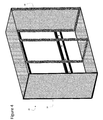
- FIG. 4 depicts a further formed cabinet system having sidewalls attached to the blade assemblies in accordance with an embodiment of the present invention.
- FIG. 5 depicts a finished cabinet having doors in accordance with an embodiment of the present invention.
- FIG. 6 an exploded view of an illustrative blade assembly in accordance with an embodiment of the present invention.
- FIG. 7 depicts an assembled blade assembly in accordance with an embodiment of the invention.
- FIG. 8 depicts a partially assembled cabinet system in accordance with an embodiment of the present invention.
- FIG. 9 depicts a mounting interface in accordance with an embodiment of the present invention.
- FIG. 10 depicts a further mounting interface in accordance with an embodiment of the present invention.
- FIG. 11 depicts a further mounting interface in accordance with an embodiment of the present invention.
- FIG. 12 depicts blade assembly with a shelving system in accordance with an embodiment of the present invention.
- FIG. 13 depicts an alternative mounting interface in accordance with an embodiment of the present invention.
- FIG. 14 depicts a further alternative mounting interface in accordance with an embodiment of the present invention.
- FIGS. 1-5 depict an illustrative method and associated components for building and installing a wall mounted blade based cabinet unit 10 ( FIG. 5 ), in this case comprising two side-by-side cabinets.
- the blade based system provides numerous advantages, including: the fact that the same basic components can be utilized to create any number of different customizable cabinet configurations; the blade based system greatly reduces shipping costs because the cabinets can be shipped in flat container and be assembled and installed on site; the finished product creates more storage volume and flexibility; and the system allows the builder/owner greater flexibility in selecting and installing the finished panels.
- FIG. 1 depicts a pair of mounting rails 12 A and 12 B that are horizontally mounting onto a wall or other surface.
- the length of mounting rails 12 A, 12 B may be precut or cut onsite to the width of the cabinet unit 10 being built (in this example, 72 inches for two 36 inch wall cabinets). Any number or type of cabinets may be incorporated into a single cabinet unit 10 , so it is envisioned that the mounting rails 12 A, 12 B could run as long as the entire length of a wall (for a very large cabinet unit) or as short as the width of a single cabinet.
- Mounting rails 12 A, 12 B may be attached to a wall or other surface in any manner, e.g., with wood screws 19 , bolts, nails or other known fasteners.
- the mounting rails 12 A, 12 B comprise a C-channel profile 15 , adapted to slidably receive a set of mounting inserts 14 .
- the mounting rail configurations/profiles could be utilized, e.g., I-beam, L-channel, etc.
- the mounting inserts 14 are position in the mounting rails 12 A, 12 B to receive and attach a set of blade assemblies (or blades) 16 , such as those shown in FIG. 2 , to form a chassis 11 .
- the mounting inserts 14 form part of a mounting interface adapted to connect the set of blades 16 to the mounting rails 12 A, 12 B, orthogonal to the wall, thereby forming the cabinet chassis.
- the number of mounting inserts 14 used will depend on the number of blades 16 that are to be attached to the mounting rails 12 A, 12 B. Generally, the number of blades 16 used will be one more than the number (N) of cabinets in the unit 10 , i.e., N+1.
- three blades 16 are used, including two outer blades that form the outer walls of the chassis and a central blade that divides two side-by-side cabinets. As shown in FIG. 2 , an upper and a lower mounting insert 14 is used to secure each blade 16 to the mounting rails 12 A, 12 B.
- each mounting rail 12 A, 12 B may include a series of markings that provide a measuring guide 18 (i.e., inches) to assist the installer in locating the blades 16 .
- a measuring guide 18 i.e., inches
- the installer can use the markings as a guide to properly locate adjacent blades 36 inches apart, etc.
- the measuring guide 18 may simply indicate where the blades are to be located for a given unit 10 .
- blades 16 may be fashioned out of sheet metal or other planar material, be implemented as open frames (as shown), comprise a continuous or partially continuous sheet of material, have various cutouts and features, comprise any material such as metal, composites, resins, wood, plastic, etc., be manufactured in different thicknesses, utilize tubular framing, comprise a mixture of materials, etc. It is however envisioned that for this illustrative embodiment/system, each of the blades 16 for a given cabinet size/type are substantially identical and interchangeable.
- blades may be utilized (e.g., the outer blades may be different from the central blades, blades may differ by cabinet type, size, etc.). Furthermore, the height and depth of the blades 16 may be easily customizable.
- mounting brackets 14 include threaded openings into which a bolt 20 or the like can be screwed, via an opening 22 in the associated blade 16 .
- Other mounting interfaces may for example include the use of straps, U-bolts, clips, brackets, snap-in systems, hooks, etc.
- the configuration of mounting rails 12 A, 12 B may likewise vary.
- mounting rails could utilize an H-shaped profile, an I-beam structure, an L-shaped profile, or any other shape or material.
- mounting rails 12 A, 12 B could be adapted to mount directly to the underlying wall studs and have a depth equal to a later applied sheetrock (e.g., thickness of 3 ⁇ 8′′, 1 ⁇ 2′′, etc.), tile or other wall material. In this manner, the blades 16 can be mounted flush to the sheetrock to provide a clean look.
- finishing surfaces can be attached to complete the cabinet unit 10 .
- a top panel 24 and bottom panel 26 running the entire width of the unit 10 are attached to an upper section and a lower section of the blades 16 , respectively.
- the cabinet unit 10 With the top surface 24 and bottom shelf 26 attached, the cabinet unit 10 becomes substantially rigid and stable.
- FIG. 4 depicts the cabinet unit 10 with side surfaces 28 and 30 attached.
- FIG. 5 shows a finished cabinet unit 10 , with two sets of doors 32 attached.
- finishing surfaces 24 , 26 , 28 , 30 , 32 may be utilized to connect finishing surfaces 24 , 26 , 28 , 30 , 32 to the blades 16 and each other, including bolts, screws, clips, hinges, glue, etc. Shelving, dividers, and other accoutrements may thereafter be added to finish the interior of the unit 10 .
- finishing surfaces 24 , 26 , 28 , 30 , 32 can be easily prefabricated for predefined sizes, styles and colors. As such, a builder/owner could try different samples in the actual space before committing to a final selection. This also gives the owner the ability to change the finishes if/when a new look is ever desired. Further, the use of this blade based system allows the builder to custom build finishing surfaces to accommodate unique styling or sizes, thus eliminating the need to special order entire cabinet systems. The builder can place adjacent blades 16 at any distance when assembling the chassis and custom build the necessary finishing surfaces to accommodate the size.
- FIGS. 1-5 describe a system for fabricating and installing a wall cabinet unit
- the same system may be utilized for base cabinet units.
- a single mounting rail 12 A may be utilized since the weight will largely be supported by the floor.
- three or more mounting rails could be used.
- FIG. 6 (exploded view) and FIG. 7 (assembled view) depict an illustrative blade assembly 40 that is assembled from several parts.
- blade assembly 40 is assembled from a front section 42 , a rear section 44 , a top section 46 and a bottom section 28 .
- the front and rear sections 42 , 44 have transverse holes 58 bored there through for receiving a bolt 50
- the top and bottom section 46 , 48 have threaded recesses 56 for receiving the bolt 50 .
- Blade assembly 40 can either be assembled on site, or be pre-assembled, e.g., at a factory.
- Each of the sections 42 , 44 , 46 , 48 may for example comprise precut aluminum or be fashioned from any other material.
- rear section 44 includes mounting notches 52 that can be used with a clamp to connect the blade assembly 40 to a mounting rail (not shown).
- mounting notches 52 are cut as rectangles on the inside edge of the rear section 44 .
- mounting notches 52 could be cut on the outer edge of the rear section 44 , and comprise a different shape (e.g., L-shaped, triangular, rounded, etc.).
- other features for forming a mounting interface to connect blade assembly 40 to a mounting rail could be used, e.g., a bored hole similar to transverse holes 58 for passing through a bolt, laterally drilled holes for receiving a U-bolt or clamp, snap-in features, hooks, etc.
- other features such as shelving notches 54 may be included for holding one or more shelves.
- FIG. 8 a partially assembled cabinet unit 60 is shown utilizing the blade assemblies 40 shown in FIGS. 6 and 7 .
- the mounting interface attaches blade assemblies 40 to mounting rails 12 A, 12 B with clamps 62 that mate with the mounting notches 52 ( FIGS. 6, 7 ).
- FIG. 9 shown a partial cutaway view of a mounting interface in which clamp 62 attaches blade assembly 40 to mounting rail 12 A.
- clamp 62 straddles (i.e., mates with) the mounting notch 52 of blade assembly 40 in the rear section 44 of blade assembly 40 .
- Bolts 64 are passed through holes in the clamp 62 , through the opening in the C-channel profile of mounting rail 12 A, and into a threaded section in the mounting bracket 14 that is seated in the C-channel. When the bolts 64 are tightened, the blade assembly 40 is pulled toward and securely fasted to mounting rail 12 A.
- FIG. 10 shows two styles of clamps 62 and 66 for holding blade assemblies 40 A, 40 B to mounting rail 12 A.
- Clamp 62 is essentially the same as described in FIG. 9 , which is suitable for a blade assembly 40 A positioned in a central portion of a cabinet chassis, whereas clamp 66 is designed for a blade assembly 40 B at an end of the chassis.
- Clamp 66 only includes a single hole/bolt configuration (blocked from view) and is cut to mount flush with the outside edges 68 of blade assembly 40 B and mounting rail 12 A. This thus allows a finishing side panel to be flush mounted to the outside edge 68 of blade assembly 40 B without interference from the clamp 66 , thus completely covering the side of chassis from view.
- Clamp 66 includes a hole/bolt configuration (on the blocked side) similar to that found on both sides of clamp 62 .
- FIG. 11 depicts a partial side view of a blade assembly 72 connected to mounting rail 12 A (shown in cross-section). Similar to other embodiments described herein, mounting rail 12 A is C-shaped and is mounted to wall 71 . However, in this embodiment, blade assembly 72 includes one or more notches 76 on an outer edge 78 of the rear section that faces the wall 71 . An H-shaped mounting insert 70 is utilized that partially mates with the notch 76 , and includes a threaded region 75 for receiving a bolt 74 that is slid and tightened through a bored passageway in the blade assembly 72 . When the bolt 74 is tightened, the blade assembly 72 , mounting insert 70 , and mounting rail 12 A are locked together.
- notch 76 allows the blade assembly 72 to rest on mounting insert 70 , thus enhancing the ease of installation while providing additional support.
- blade assembly 76 may include a different and/or larger notch configuration that allows the blade assembly 76 to mate and rest on the mounting rail 12 A itself, thus allowing blade assembly 76 to mount flush to the wall 71 .
- FIG. 12 depicts a partial side view (including a front 93 and bottom 95 section) of a blade assembly 82 that provides an illustrative embodiment for attaching panels or shelves 84 , 86 .
- a lower shelf (or finishing panel) 84 is attached to an underside of blade assembly 82 with a bolt 90 and nut 88 .
- Both the blade assembly 82 and shelf 84 include pre-drilled holes for receiving the bolt 90 and nut 88 (as well as a washer). Pre-drilled holes may include recessed or shaped regions to simplify attachment and reduce visual impact. Any number of predrilled holes may be utilized to secure shelf 84 , and a similar arrangement would be utilized on adjacent blade assemblies (not shown). A similar system may be utilized to attach a top panel (not shown).
- a peg 92 On the front section 93 of blade assembly 82 is a peg 92 that for example extends outwardly (i.e., in and out of the page) from both sides of the front section 93 .
- Shelf 86 may include a notch 94 to mate with the peg 92 to hold the shelf 86 in place. Any number of holes 80 may be bored through the front section 93 and rear section (not shown) to receive pegs 92 , and allow for installation/placement of a shelf 86 .
- a similar arrangement would be utilized on adjacent blade assemblies (not shown). It is understood that the embodiments shown in FIG. 12 for connecting shelves to a set of blade assemblies is but one of many possible attachment systems that may be employed, and should not be considered limiting. Such finishings may for example be attached with screws, bolts, hooks, adhesives, etc.
- FIGS. 13 and 14 depict alternative mounting interfaces.
- FIG. 13 provides a mounting rail 100 with an I-beam profile, in which the blade 108 is notched with a T-shaped cutout along the outer edge.
- the mounting rail 100 is mounted to the wall 104 using screws or like (not shown) as described herein.
- the blade itself 108 is slid onto the rail 100 from an end or entry point/break along the rail 100 and then fastened into position with a bolt 112 that is threaded through the blade 108 .
- FIG. 14 depicts a mounting rail 102 with an L or J-shaped profile.
- the blade 110 is notched to either slide or snap onto mounting rail 102 , and fasten into position with a bolt 114 that is threaded through the blade 110 .
- the mounting rail 102 is mounted to the wall 106 using screws or like (not shown) as described herein.
- the described blade based design allows for easy packaging, shipping, installation and customization of a kitchen (or other similar type) cabinet.
- the entire cabinet layout can be shipped using only flat components and be constructed on site.
- finishings including doors, hardware, shelving, side panels, wine racks, etc., can be installed to create a finished cabinet look. Finishings can be selected from predefined configurations or be custom built to the owner's specification.
- blade assemblies may be fabricated in any manner using any material that will provide suitable strength, e.g., aluminum, hardened steel, stainless steel, carbon fiber, wood, resin, plastics, anodized aluminum, laser etching, chrome and other metal treatments, etc.
- Blade assemblies may be fabricated from a generally planar material, use a framed cutout, a tubular structure, include a layered profile, have a U-shaped profile, an H-shaped profile, or any other arrangement.
- the assemblies may also be powder coated a predetermined color to protect and/or matches the finishings.
Landscapes
- Engineering & Computer Science (AREA)
- Mechanical Engineering (AREA)
- Life Sciences & Earth Sciences (AREA)
- Wood Science & Technology (AREA)
- Assembled Shelves (AREA)
- Connection Of Plates (AREA)
Abstract
A blade based cabinet system and method. A disclosed cabinetry system includes cabinetry system, comprising: a pair of mounting rails that are horizontally mountable to a wall; a set of blade assemblies, each having a substantially planar profile; and a mounting interface adapted to connect the set of blade assemblies to the pair of mounting rails, orthogonal to the wall to form a cabinet chassis.
Description
This application claims priority to provisional application Ser. No. 62/374,036, filed on Aug. 12, 2016 entitled MODULAR CABINETRY FRAMING SYSTEM, the contents of which is hereby incorporated by reference.
This disclosure is related generally to cabinets, and more particularly to a modular cabinetry system and method that allows cabinet components to be customized, built and installed on site using blade based components.
Kitchen cabinetry and the like are fundamental fixtures found in almost every home. Although the aesthetics and craftsmanship may vary from product line to product line, almost all kitchen cabinets are installed in the same manner. Namely, a designer (or installer) evaluates the available space and generates a design layout according to standard sizes available from a given manufacturer. Cabinets are then ordered (or are custom built) and delivered to the site. Alternatively, cabinets are custom manufactured at great expense and time. A contractor installs the cabinets by mounting each cabinet to the wall or floor, and then they are finished with a countertop and/or any necessary customization to provide a finished look.
While there may be some variation among products lines, cabinetry generally includes wall cabinets that are mounted to the wall or base cabinets that are mounted to the floor and/or adjacent wall. Larger kitchens may utilize dozens of individual cabinets, each of which must be manufactured off-site according to predetermined specifications, packaged and shipped in bulky containers. The contractor in turn is then tasked with moving, un-packaging and installing numerous bulky and heavy pieces of “furniture.” Between planning, manufacturing, shipping and installation, cabinetry can represent significant cost when installing or remodeling a kitchen.
Moreover, while quality of materials and craftsmanship may vary, the end-user, i.e., the homeowner, primary only sees the front face (and inside) of the cabinets. A large portion of the material, weight, structure, and craftsmanship is hidden once a cabinet is installed. Furthermore, because of the inherent structure of box-framed cabinets, there is often a significant amount of unusable space, especially when a series of adjacent cabinets are installed. Accordingly, much of the cost associated with kitchen cabinetry does not benefit the homeowner.
The present invention relates to a blade-based cabinet system and methodology for implementing the same.
In one embodiment, there is a cabinetry system, comprising: a pair of mounting rails that are horizontally mountable to a wall; a set of blade assemblies, each having a substantially planar profile; and a mounting interface adapted to connect the set of blade assemblies to the pair of mounting rails, orthogonal to the wall to form a cabinet chassis.
In a second embodiment, there is method of constructing a cabinet unit, comprising: horizontally attaching a pair of mounting rails to a wall; providing a set of blade assemblies, each having a substantially planar profile; and connecting the set of blade assemblies to the pair of mounting rails using a mounting interface to form a cabinet chassis such that the blade assemblies are positioned orthogonal to the wall.
The illustrative aspects of the present invention are designed to solve the problems herein described and other problems not discussed.
These and other features of this invention will be more readily understood from the following detailed description of the various aspects of the invention taken in conjunction with the accompanying drawings.
The drawings are merely schematic representations, not intended to portray specific parameters of the invention. The drawings are intended to depict only typical embodiments of the invention, and therefore should not be considered as limiting the scope of the invention. In the drawings, like numbering represents like elements.
Referring to figures, FIGS. 1-5 depict an illustrative method and associated components for building and installing a wall mounted blade based cabinet unit 10 (FIG. 5 ), in this case comprising two side-by-side cabinets. The blade based system provides numerous advantages, including: the fact that the same basic components can be utilized to create any number of different customizable cabinet configurations; the blade based system greatly reduces shipping costs because the cabinets can be shipped in flat container and be assembled and installed on site; the finished product creates more storage volume and flexibility; and the system allows the builder/owner greater flexibility in selecting and installing the finished panels.
The mounting inserts 14 are position in the mounting rails 12A, 12B to receive and attach a set of blade assemblies (or blades) 16, such as those shown in FIG. 2 , to form a chassis 11. In this embodiment, the mounting inserts 14 form part of a mounting interface adapted to connect the set of blades 16 to the mounting rails 12A, 12B, orthogonal to the wall, thereby forming the cabinet chassis. Accordingly, the number of mounting inserts 14 used will depend on the number of blades 16 that are to be attached to the mounting rails 12A, 12B. Generally, the number of blades 16 used will be one more than the number (N) of cabinets in the unit 10, i.e., N+1. In this example, three blades 16 are used, including two outer blades that form the outer walls of the chassis and a central blade that divides two side-by-side cabinets. As shown in FIG. 2 , an upper and a lower mounting insert 14 is used to secure each blade 16 to the mounting rails 12A, 12B.
As shown, each mounting rail 12A, 12B may include a series of markings that provide a measuring guide 18 (i.e., inches) to assist the installer in locating the blades 16. For example, if two 36 inch cabinets are planned, the installer can use the markings as a guide to properly locate adjacent blades 36 inches apart, etc. In another embodiment, the measuring guide 18 may simply indicate where the blades are to be located for a given unit 10.
Note that while each blade 16 has a generally rigid planar profile, the particular design and configuration of blades 16 may vary depending on the particular embodiment/system. For example, blades 16 may be fashioned out of sheet metal or other planar material, be implemented as open frames (as shown), comprise a continuous or partially continuous sheet of material, have various cutouts and features, comprise any material such as metal, composites, resins, wood, plastic, etc., be manufactured in different thicknesses, utilize tubular framing, comprise a mixture of materials, etc. It is however envisioned that for this illustrative embodiment/system, each of the blades 16 for a given cabinet size/type are substantially identical and interchangeable. However, in other embodiments/systems, different blades may be utilized (e.g., the outer blades may be different from the central blades, blades may differ by cabinet type, size, etc.). Furthermore, the height and depth of the blades 16 may be easily customizable.
Similarly, the particular mounting interface for attaching blades 16 to mounting rails 12A, 12B may vary, and a number of non-limiting illustrative embodiments are described herein. For example, in the depicted embodiment, mounting brackets 14 include threaded openings into which a bolt 20 or the like can be screwed, via an opening 22 in the associated blade 16. Other mounting interfaces may for example include the use of straps, U-bolts, clips, brackets, snap-in systems, hooks, etc. To accommodate different mounting interfaces, the configuration of mounting rails 12A, 12B may likewise vary. For example, rather than a C-channel profile fashioned from metal, mounting rails could utilize an H-shaped profile, an I-beam structure, an L-shaped profile, or any other shape or material. Further, mounting rails 12A, 12B could be adapted to mount directly to the underlying wall studs and have a depth equal to a later applied sheetrock (e.g., thickness of ⅜″, ½″, etc.), tile or other wall material. In this manner, the blades 16 can be mounted flush to the sheetrock to provide a clean look.
Once the chassis 11 is assembled on a wall (i.e., mounting rails 12A, 12B and blades 16 are installed) finishing surfaces can be attached to complete the cabinet unit 10. As shown in FIG. 3 , a top panel 24 and bottom panel 26 running the entire width of the unit 10 are attached to an upper section and a lower section of the blades 16, respectively. With the top surface 24 and bottom shelf 26 attached, the cabinet unit 10 becomes substantially rigid and stable. FIG. 4 depicts the cabinet unit 10 with side surfaces 28 and 30 attached. FIG. 5 shows a finished cabinet unit 10, with two sets of doors 32 attached. Any mechanism(s) may be utilized to connect finishing surfaces 24, 26, 28, 30, 32 to the blades 16 and each other, including bolts, screws, clips, hinges, glue, etc. Shelving, dividers, and other accoutrements may thereafter be added to finish the interior of the unit 10.
One of the features of this system is that the finishing surfaces 24, 26, 28, 30, 32 can be easily prefabricated for predefined sizes, styles and colors. As such, a builder/owner could try different samples in the actual space before committing to a final selection. This also gives the owner the ability to change the finishes if/when a new look is ever desired. Further, the use of this blade based system allows the builder to custom build finishing surfaces to accommodate unique styling or sizes, thus eliminating the need to special order entire cabinet systems. The builder can place adjacent blades 16 at any distance when assembling the chassis and custom build the necessary finishing surfaces to accommodate the size.
While the depicted embodiments in FIGS. 1-5 describe a system for fabricating and installing a wall cabinet unit, the same system may be utilized for base cabinet units. Note that in a base cabinet unit, a single mounting rail 12A may be utilized since the weight will largely be supported by the floor. For very large cabinets, three or more mounting rails could be used.
Referring now to FIG. 8 , a partially assembled cabinet unit 60 is shown utilizing the blade assemblies 40 shown in FIGS. 6 and 7 . In this embodiment, the mounting interface attaches blade assemblies 40 to mounting rails 12A, 12B with clamps 62 that mate with the mounting notches 52 (FIGS. 6, 7 ).
On the front section 93 of blade assembly 82 is a peg 92 that for example extends outwardly (i.e., in and out of the page) from both sides of the front section 93. Shelf 86 may include a notch 94 to mate with the peg 92 to hold the shelf 86 in place. Any number of holes 80 may be bored through the front section 93 and rear section (not shown) to receive pegs 92, and allow for installation/placement of a shelf 86. A similar arrangement would be utilized on adjacent blade assemblies (not shown). It is understood that the embodiments shown in FIG. 12 for connecting shelves to a set of blade assemblies is but one of many possible attachment systems that may be employed, and should not be considered limiting. Such finishings may for example be attached with screws, bolts, hooks, adhesives, etc.
The described blade based design allows for easy packaging, shipping, installation and customization of a kitchen (or other similar type) cabinet. In particular, using the described system, the entire cabinet layout can be shipped using only flat components and be constructed on site. Once the chassis is installed, finishings, including doors, hardware, shelving, side panels, wine racks, etc., can be installed to create a finished cabinet look. Finishings can be selected from predefined configurations or be custom built to the owner's specification.
As noted, blade assemblies may be fabricated in any manner using any material that will provide suitable strength, e.g., aluminum, hardened steel, stainless steel, carbon fiber, wood, resin, plastics, anodized aluminum, laser etching, chrome and other metal treatments, etc. Blade assemblies may be fabricated from a generally planar material, use a framed cutout, a tubular structure, include a layered profile, have a U-shaped profile, an H-shaped profile, or any other arrangement. The assemblies may also be powder coated a predetermined color to protect and/or matches the finishings.
Although specific embodiments have been illustrated and described herein, those of ordinary skill in the art appreciate that any arrangement which is calculated to achieve the same purpose may be substituted for the specific embodiments shown and that the invention has other applications in other environments. This application is intended to cover any adaptations or variations of the present invention. The following claims are in no way intended to limit the scope of the invention to the specific embodiments described herein.
Claims (16)
1. A cabinetry system, comprising:
at least one mounting rail horizontally mountable to a wall, wherein the at least one mounting rail has a substantially C-shaped profile;
a set of blade assemblies, each including an open frame having a substantially planar profile, wherein the open frame comprises a front section and a rear section, each section having an inner edge and an outer edge, and wherein the rear section further comprises a notch on the outer edge and a passageway between the inner edge and notch; and
a mounting insert having a substantially H-shaped profile, wherein the mounting insert slidably engages with the substantially C-shaped profile of the at least one mounting rail and partially mates with the notch, and wherein the mounting insert and the notch are configured to lock together via a fastener inserted into the passageway.
2. The cabinetry system of claim 1 , wherein the fastener comprises a bolt.
3. The cabinetry system of claim 2 , wherein the mounting insert includes a threaded region for receiving the bolt.
4. The cabinetry system of claim 1 , further comprising:
a top panel attachable to a top section of each of the blade assemblies; and
a bottom panel attachable to a bottom section of each of the blade assemblies.
5. The cabinetry system of claim 1 , wherein at least one mounting rail includes a measuring guide for locating blade assemblies.
6. The cabinetry system of claim 1 , wherein each blade assembly includes a top section and a bottom section bolted to a front section and a rear section.
7. A method of constructing a cabinet unit, comprising:
horizontally attaching a pair of mounting rails to a wall;
sliding a mounting insert into each of the pair of mounting rails, wherein the mounting inserts include a substantially H-shaped profile;
providing a set of blade assemblies, each having a substantially planar profile; and
attaching each of the blade assemblies to a pair of mounting inserts, wherein each of the blade assemblies is locked to the pair of mounting inserts and the mounting rails to form a cabinet chassis such that the blade assemblies are positioned orthogonal to the wall.
8. The method of claim 7 , wherein the set of blade assemblies further comprise a notch on an outer edge of each blade assembly, wherein the notch mates with the mounting insert or the mounting rail.
9. The method of claim 7 , wherein the mounting rails include at least one of a substantially C-shaped profile, I-beam profile or an L-shaped profile.
10. The method of claim 7 , further comprising:
attaching a top panel to a top section of each of the blade assemblies; and
attaching a bottom panel to a bottom section of each of the blade assemblies.
11. The method of claim 7 , wherein each blade assembly is assembled by bolting a top section and a bottom section bolted to a front section and a rear section.
12. The cabinet system of claim 7 , wherein a mounting insert is connected to a mounting clamp on both sides of the blade assembly.
13. The method of claim 7 , wherein the mounting insert further includes a threaded area aligned with a bored passageway in each blade assembly, wherein a bolt locks each of the blade assembly to the mounting rail.
14. A cabinetry system, comprising:
at least one mounting rail, having one side adapted to be horizontally mounted to a wall and a second side having a substantially male profile;
a set of blade assemblies, each of the blade assemblies having a substantially planar profile, a threaded region and a bolt that threadibly engages the mounting rail, and a cutout, wherein the cutout is shaped to mate and slidably engage the male profile of the mounting rail, to form a cabinet chassis.
15. The cabinetry system of claim 14 , wherein each blade assembly includes a top section and a bottom section bolted to a front section and a rear section.
16. A method of constructing a cabinet unit, comprising:
horizontally attaching a pair of mounting rails to a wall;
sliding a mounting insert into each of the pair of mounting rails;
providing a set of blade assemblies, each blade assembly having a substantially planar profile, and including a notch on an inner edge of each blade assembly and a mounting clamp that mates with the notch and is connectable to the mounting insert; and
attaching each of the blade assemblies to a pair of mounting inserts, wherein each of the blade assemblies is locked to the pair of mounting inserts and the mounting rails to form a cabinet chassis such that the blade assemblies are positioned orthogonal to the wall.
Priority Applications (2)
| Application Number | Priority Date | Filing Date | Title |
|---|---|---|---|
| US15/674,673 US10271652B2 (en) | 2016-08-12 | 2017-08-11 | Blade based cabinet system |
| US16/298,554 US10722030B2 (en) | 2016-08-12 | 2019-03-11 | Blade based cabinet system |
Applications Claiming Priority (2)
| Application Number | Priority Date | Filing Date | Title |
|---|---|---|---|
| US201662374036P | 2016-08-12 | 2016-08-12 | |
| US15/674,673 US10271652B2 (en) | 2016-08-12 | 2017-08-11 | Blade based cabinet system |
Related Child Applications (1)
| Application Number | Title | Priority Date | Filing Date |
|---|---|---|---|
| US16/298,554 Continuation US10722030B2 (en) | 2016-08-12 | 2019-03-11 | Blade based cabinet system |
Publications (2)
| Publication Number | Publication Date |
|---|---|
| US20180042378A1 US20180042378A1 (en) | 2018-02-15 |
| US10271652B2 true US10271652B2 (en) | 2019-04-30 |
Family
ID=61160553
Family Applications (2)
| Application Number | Title | Priority Date | Filing Date |
|---|---|---|---|
| US15/674,673 Active US10271652B2 (en) | 2016-08-12 | 2017-08-11 | Blade based cabinet system |
| US16/298,554 Active US10722030B2 (en) | 2016-08-12 | 2019-03-11 | Blade based cabinet system |
Family Applications After (1)
| Application Number | Title | Priority Date | Filing Date |
|---|---|---|---|
| US16/298,554 Active US10722030B2 (en) | 2016-08-12 | 2019-03-11 | Blade based cabinet system |
Country Status (3)
| Country | Link |
|---|---|
| US (2) | US10271652B2 (en) |
| CA (1) | CA3033643C (en) |
| WO (1) | WO2018031868A1 (en) |
Cited By (4)
| Publication number | Priority date | Publication date | Assignee | Title |
|---|---|---|---|---|
| US20190200761A1 (en) * | 2016-08-12 | 2019-07-04 | Chris Kilburn | Blade based cabinet system |
| USD914418S1 (en) * | 2019-02-15 | 2021-03-30 | Switch Blade Design Llc | Cabinet frame system |
| US20240016289A1 (en) * | 2022-07-15 | 2024-01-18 | Capsule Manufacturing Inc. | Modular millwork method and apparatus |
| US20250194800A1 (en) * | 2022-03-17 | 2025-06-19 | Inter Ikea Systems B.V. | Rail mounting system for furniture |
Families Citing this family (9)
| Publication number | Priority date | Publication date | Assignee | Title |
|---|---|---|---|---|
| US11470962B2 (en) * | 2016-08-24 | 2022-10-18 | Clairson, Inc. | Storage systems including back channels and walls mountable along the back channels |
| USD819379S1 (en) * | 2017-03-15 | 2018-06-05 | Cambro Manufacturing Company | Food container tray rack |
| US11253060B2 (en) * | 2018-10-31 | 2022-02-22 | American Woodmark Corporation | Modular enclosure system |
| DE102018130974A1 (en) * | 2018-12-05 | 2020-06-10 | ambigence GmbH & Co. KG | Furniture component and manufacturing method |
| CN112120442A (en) * | 2020-10-13 | 2020-12-25 | 金螳螂精装科技(苏州)有限公司 | Assembled window cabinet location installation component that wafts |
| DE202021103742U1 (en) * | 2021-07-13 | 2021-08-03 | Häfele SE & Co KG | Cabinet body modular construction system in endless construction as well as associated cabinet body |
| WO2023237907A1 (en) | 2022-06-07 | 2023-12-14 | Wolfram Steurer | Furniture system, composite panel, furniture system device, and installation method |
| CN218352879U (en) * | 2022-07-28 | 2023-01-20 | 台达电子工业股份有限公司 | Hanging structure |
| AT526689B1 (en) * | 2023-06-30 | 2024-06-15 | Blum Gmbh Julius | Arrangement of a furniture fitting and a furniture body and/or a movable furniture part |
Citations (19)
| Publication number | Priority date | Publication date | Assignee | Title |
|---|---|---|---|---|
| US1714909A (en) * | 1928-05-26 | 1929-05-28 | Illmer Louis | Composite cabinet |
| US3950049A (en) * | 1973-08-31 | 1976-04-13 | Drass Patrick E | Cabinet mounting structure |
| US4329003A (en) * | 1979-12-17 | 1982-05-11 | Interflow Systems Corporation | Cabinet-suspension system |
| US4457436A (en) * | 1981-11-02 | 1984-07-03 | Comerco, Inc. | J-Shaped wall rail system |
| US5050832A (en) * | 1990-05-18 | 1991-09-24 | Lee/Rowan Company | Modular storage unit mounting system |
| US5152593A (en) * | 1990-10-24 | 1992-10-06 | Georg Domenig | Cabinet assembly systems |
| US5718493A (en) * | 1995-04-04 | 1998-02-17 | Nikolai; Gerhard | Cabinet construction system |
| US5964438A (en) * | 1994-12-09 | 1999-10-12 | Camilleri; Charles | Wall-mounted storage unit system |
| US7228977B2 (en) * | 2003-06-16 | 2007-06-12 | Whirlpool Corporation | Workroom storage system |
| EP1570765B1 (en) | 2004-03-03 | 2008-05-14 | Whirlpool Corporation | Modular kitchen system |
| US20080224579A1 (en) * | 2005-04-19 | 2008-09-18 | Robert Juten | Modular storage system |
| US20090152217A1 (en) * | 2007-07-26 | 2009-06-18 | Rubbermaid, Inc. | Storage system |
| US20110147551A1 (en) * | 2009-12-23 | 2011-06-23 | Produits Forestiers Direct Inc. | Rail unit for mounting wall furniture |
| US20110169386A1 (en) * | 2010-01-08 | 2011-07-14 | Silver Street, Inc. | Wall mounting system for movably mounting modular institutional furniture and fixtures |
| US20110309731A1 (en) * | 2008-10-17 | 2011-12-22 | Inter IKEA Systems B.V. (NL) | Panel installation system |
| US20130180202A1 (en) * | 2012-01-18 | 2013-07-18 | Kimball International, Inc. | Wall rail system |
| US8684195B1 (en) * | 2012-12-28 | 2014-04-01 | Vincenzo Caruso | Wall mounted storage system |
| US20150351538A1 (en) * | 2014-06-09 | 2015-12-10 | Masterbrand Cabinets, Inc. | Storage system |
| US20170340142A1 (en) * | 2013-10-01 | 2017-11-30 | Spg International Llc | Shelving system |
Family Cites Families (4)
| Publication number | Priority date | Publication date | Assignee | Title |
|---|---|---|---|---|
| US5222611A (en) * | 1992-03-26 | 1993-06-29 | Wood Robert G | Wall-unit hanging system |
| IT1393831B1 (en) * | 2009-04-24 | 2012-05-11 | Leonardo Srl | ANTI-SLIP SYSTEM FOR WALL-MOUNTED FURNITURE |
| US10039383B2 (en) * | 2016-02-10 | 2018-08-07 | Robert Winikoff | Mounting assembly |
| CA3033643C (en) * | 2016-08-12 | 2019-09-24 | Switch Blade Design Llc | Blade based cabinet system |
-
2017
- 2017-08-11 CA CA3033643A patent/CA3033643C/en active Active
- 2017-08-11 WO PCT/US2017/046463 patent/WO2018031868A1/en not_active Ceased
- 2017-08-11 US US15/674,673 patent/US10271652B2/en active Active
-
2019
- 2019-03-11 US US16/298,554 patent/US10722030B2/en active Active
Patent Citations (19)
| Publication number | Priority date | Publication date | Assignee | Title |
|---|---|---|---|---|
| US1714909A (en) * | 1928-05-26 | 1929-05-28 | Illmer Louis | Composite cabinet |
| US3950049A (en) * | 1973-08-31 | 1976-04-13 | Drass Patrick E | Cabinet mounting structure |
| US4329003A (en) * | 1979-12-17 | 1982-05-11 | Interflow Systems Corporation | Cabinet-suspension system |
| US4457436A (en) * | 1981-11-02 | 1984-07-03 | Comerco, Inc. | J-Shaped wall rail system |
| US5050832A (en) * | 1990-05-18 | 1991-09-24 | Lee/Rowan Company | Modular storage unit mounting system |
| US5152593A (en) * | 1990-10-24 | 1992-10-06 | Georg Domenig | Cabinet assembly systems |
| US5964438A (en) * | 1994-12-09 | 1999-10-12 | Camilleri; Charles | Wall-mounted storage unit system |
| US5718493A (en) * | 1995-04-04 | 1998-02-17 | Nikolai; Gerhard | Cabinet construction system |
| US7228977B2 (en) * | 2003-06-16 | 2007-06-12 | Whirlpool Corporation | Workroom storage system |
| EP1570765B1 (en) | 2004-03-03 | 2008-05-14 | Whirlpool Corporation | Modular kitchen system |
| US20080224579A1 (en) * | 2005-04-19 | 2008-09-18 | Robert Juten | Modular storage system |
| US20090152217A1 (en) * | 2007-07-26 | 2009-06-18 | Rubbermaid, Inc. | Storage system |
| US20110309731A1 (en) * | 2008-10-17 | 2011-12-22 | Inter IKEA Systems B.V. (NL) | Panel installation system |
| US20110147551A1 (en) * | 2009-12-23 | 2011-06-23 | Produits Forestiers Direct Inc. | Rail unit for mounting wall furniture |
| US20110169386A1 (en) * | 2010-01-08 | 2011-07-14 | Silver Street, Inc. | Wall mounting system for movably mounting modular institutional furniture and fixtures |
| US20130180202A1 (en) * | 2012-01-18 | 2013-07-18 | Kimball International, Inc. | Wall rail system |
| US8684195B1 (en) * | 2012-12-28 | 2014-04-01 | Vincenzo Caruso | Wall mounted storage system |
| US20170340142A1 (en) * | 2013-10-01 | 2017-11-30 | Spg International Llc | Shelving system |
| US20150351538A1 (en) * | 2014-06-09 | 2015-12-10 | Masterbrand Cabinets, Inc. | Storage system |
Non-Patent Citations (1)
| Title |
|---|
| International Search Report and Written Opinion dated Nov. 2, 2017 for PCT/US17/46463 filed Aug. 11, 2017; pp. 12. |
Cited By (5)
| Publication number | Priority date | Publication date | Assignee | Title |
|---|---|---|---|---|
| US20190200761A1 (en) * | 2016-08-12 | 2019-07-04 | Chris Kilburn | Blade based cabinet system |
| US10722030B2 (en) * | 2016-08-12 | 2020-07-28 | Switch Blade Design Llc | Blade based cabinet system |
| USD914418S1 (en) * | 2019-02-15 | 2021-03-30 | Switch Blade Design Llc | Cabinet frame system |
| US20250194800A1 (en) * | 2022-03-17 | 2025-06-19 | Inter Ikea Systems B.V. | Rail mounting system for furniture |
| US20240016289A1 (en) * | 2022-07-15 | 2024-01-18 | Capsule Manufacturing Inc. | Modular millwork method and apparatus |
Also Published As
| Publication number | Publication date |
|---|---|
| WO2018031868A1 (en) | 2018-02-15 |
| US20190200761A1 (en) | 2019-07-04 |
| CA3033643A1 (en) | 2018-02-15 |
| US10722030B2 (en) | 2020-07-28 |
| US20180042378A1 (en) | 2018-02-15 |
| CA3033643C (en) | 2019-09-24 |
Similar Documents
| Publication | Publication Date | Title |
|---|---|---|
| US10722030B2 (en) | Blade based cabinet system | |
| US6079803A (en) | Closet organization system and method for installing same | |
| US4235493A (en) | Knockdown cabinet assembly | |
| US11067218B2 (en) | Mounting system for attaching accessory items to a wall | |
| US3178244A (en) | Modular enclosure | |
| US12193571B2 (en) | Floating fixture wall mount system and method of use | |
| US20130134849A1 (en) | Instrument storage cabinet system | |
| US20080224579A1 (en) | Modular storage system | |
| US10441078B1 (en) | Mounting system for a storage system | |
| CN1213954A (en) | storage device | |
| US20080067906A1 (en) | Modular components for building structures | |
| US20090294612A1 (en) | Bracket and method for supporting hanging components on a movable wall having horizontal mounting channels | |
| US8136305B2 (en) | Adjustable countertop mounting system | |
| WO2019215689A1 (en) | A kit for assembling a furniture article framework | |
| US9756943B2 (en) | Cabinet system with affixible facings | |
| US11253060B2 (en) | Modular enclosure system | |
| US8997425B2 (en) | Wall panel system and method | |
| US10687621B2 (en) | Spacer assembly | |
| US20210112976A1 (en) | Vanity assembly | |
| US20050258120A1 (en) | Connector for cabinet or shelf structure | |
| EP1053403A2 (en) | Adjustable shelving apparatus | |
| US20250230709A1 (en) | Modular pocket system | |
| EP2146601B1 (en) | Furniture system | |
| EP2915930B1 (en) | A room partitioning system | |
| GB2611558A (en) | Improved extrusion for joining adjacent panels |
Legal Events
| Date | Code | Title | Description |
|---|---|---|---|
| STPP | Information on status: patent application and granting procedure in general |
Free format text: PUBLICATIONS -- ISSUE FEE PAYMENT VERIFIED |
|
| STCF | Information on status: patent grant |
Free format text: PATENTED CASE |
|
| AS | Assignment |
Owner name: SWITCH BLADE DESIGN LLC, NEW YORK Free format text: ASSIGNMENT OF ASSIGNORS INTEREST;ASSIGNOR:KILBURN, CHRIS;REEL/FRAME:049140/0984 Effective date: 20190510 |
|
| MAFP | Maintenance fee payment |
Free format text: PAYMENT OF MAINTENANCE FEE, 4TH YR, SMALL ENTITY (ORIGINAL EVENT CODE: M2551); ENTITY STATUS OF PATENT OWNER: SMALL ENTITY Year of fee payment: 4 |