US10259174B2 - Multidirectional fiber-reinforced tape/film articles and the method of making the same - Google Patents
Multidirectional fiber-reinforced tape/film articles and the method of making the same Download PDFInfo
- Publication number
- US10259174B2 US10259174B2 US15/588,921 US201715588921A US10259174B2 US 10259174 B2 US10259174 B2 US 10259174B2 US 201715588921 A US201715588921 A US 201715588921A US 10259174 B2 US10259174 B2 US 10259174B2
- Authority
- US
- United States
- Prior art keywords
- polymeric
- tapes
- tape
- yarns
- yarn
- Prior art date
- Legal status (The legal status is an assumption and is not a legal conclusion. Google has not performed a legal analysis and makes no representation as to the accuracy of the status listed.)
- Active
Links
Images


Classifications
-
- B—PERFORMING OPERATIONS; TRANSPORTING
- B29—WORKING OF PLASTICS; WORKING OF SUBSTANCES IN A PLASTIC STATE IN GENERAL
- B29C—SHAPING OR JOINING OF PLASTICS; SHAPING OF MATERIAL IN A PLASTIC STATE, NOT OTHERWISE PROVIDED FOR; AFTER-TREATMENT OF THE SHAPED PRODUCTS, e.g. REPAIRING
- B29C70/00—Shaping composites, i.e. plastics material comprising reinforcements, fillers or preformed parts, e.g. inserts
- B29C70/04—Shaping composites, i.e. plastics material comprising reinforcements, fillers or preformed parts, e.g. inserts comprising reinforcements only, e.g. self-reinforcing plastics
- B29C70/28—Shaping operations therefor
- B29C70/30—Shaping by lay-up, i.e. applying fibres, tape or broadsheet on a mould, former or core; Shaping by spray-up, i.e. spraying of fibres on a mould, former or core
- B29C70/34—Shaping by lay-up, i.e. applying fibres, tape or broadsheet on a mould, former or core; Shaping by spray-up, i.e. spraying of fibres on a mould, former or core and shaping or impregnating by compression, i.e. combined with compressing after the lay-up operation
-
- B—PERFORMING OPERATIONS; TRANSPORTING
- B29—WORKING OF PLASTICS; WORKING OF SUBSTANCES IN A PLASTIC STATE IN GENERAL
- B29C—SHAPING OR JOINING OF PLASTICS; SHAPING OF MATERIAL IN A PLASTIC STATE, NOT OTHERWISE PROVIDED FOR; AFTER-TREATMENT OF THE SHAPED PRODUCTS, e.g. REPAIRING
- B29C43/00—Compression moulding, i.e. applying external pressure to flow the moulding material; Apparatus therefor
- B29C43/22—Compression moulding, i.e. applying external pressure to flow the moulding material; Apparatus therefor of articles of indefinite length
-
- B—PERFORMING OPERATIONS; TRANSPORTING
- B29—WORKING OF PLASTICS; WORKING OF SUBSTANCES IN A PLASTIC STATE IN GENERAL
- B29C—SHAPING OR JOINING OF PLASTICS; SHAPING OF MATERIAL IN A PLASTIC STATE, NOT OTHERWISE PROVIDED FOR; AFTER-TREATMENT OF THE SHAPED PRODUCTS, e.g. REPAIRING
- B29C55/00—Shaping by stretching, e.g. drawing through a die; Apparatus therefor
- B29C55/02—Shaping by stretching, e.g. drawing through a die; Apparatus therefor of plates or sheets
- B29C55/04—Shaping by stretching, e.g. drawing through a die; Apparatus therefor of plates or sheets uniaxial, e.g. oblique
- B29C55/06—Shaping by stretching, e.g. drawing through a die; Apparatus therefor of plates or sheets uniaxial, e.g. oblique parallel with the direction of feed
-
- B—PERFORMING OPERATIONS; TRANSPORTING
- B29—WORKING OF PLASTICS; WORKING OF SUBSTANCES IN A PLASTIC STATE IN GENERAL
- B29C—SHAPING OR JOINING OF PLASTICS; SHAPING OF MATERIAL IN A PLASTIC STATE, NOT OTHERWISE PROVIDED FOR; AFTER-TREATMENT OF THE SHAPED PRODUCTS, e.g. REPAIRING
- B29C55/00—Shaping by stretching, e.g. drawing through a die; Apparatus therefor
- B29C55/02—Shaping by stretching, e.g. drawing through a die; Apparatus therefor of plates or sheets
- B29C55/04—Shaping by stretching, e.g. drawing through a die; Apparatus therefor of plates or sheets uniaxial, e.g. oblique
- B29C55/06—Shaping by stretching, e.g. drawing through a die; Apparatus therefor of plates or sheets uniaxial, e.g. oblique parallel with the direction of feed
- B29C55/065—Shaping by stretching, e.g. drawing through a die; Apparatus therefor of plates or sheets uniaxial, e.g. oblique parallel with the direction of feed in several stretching steps
-
- B—PERFORMING OPERATIONS; TRANSPORTING
- B29—WORKING OF PLASTICS; WORKING OF SUBSTANCES IN A PLASTIC STATE IN GENERAL
- B29C—SHAPING OR JOINING OF PLASTICS; SHAPING OF MATERIAL IN A PLASTIC STATE, NOT OTHERWISE PROVIDED FOR; AFTER-TREATMENT OF THE SHAPED PRODUCTS, e.g. REPAIRING
- B29C70/00—Shaping composites, i.e. plastics material comprising reinforcements, fillers or preformed parts, e.g. inserts
- B29C70/04—Shaping composites, i.e. plastics material comprising reinforcements, fillers or preformed parts, e.g. inserts comprising reinforcements only, e.g. self-reinforcing plastics
-
- B—PERFORMING OPERATIONS; TRANSPORTING
- B29—WORKING OF PLASTICS; WORKING OF SUBSTANCES IN A PLASTIC STATE IN GENERAL
- B29C—SHAPING OR JOINING OF PLASTICS; SHAPING OF MATERIAL IN A PLASTIC STATE, NOT OTHERWISE PROVIDED FOR; AFTER-TREATMENT OF THE SHAPED PRODUCTS, e.g. REPAIRING
- B29C70/00—Shaping composites, i.e. plastics material comprising reinforcements, fillers or preformed parts, e.g. inserts
- B29C70/04—Shaping composites, i.e. plastics material comprising reinforcements, fillers or preformed parts, e.g. inserts comprising reinforcements only, e.g. self-reinforcing plastics
- B29C70/28—Shaping operations therefor
- B29C70/40—Shaping or impregnating by compression not applied
- B29C70/50—Shaping or impregnating by compression not applied for producing articles of indefinite length, e.g. prepregs, sheet moulding compounds [SMC] or cross moulding compounds [XMC]
-
- B—PERFORMING OPERATIONS; TRANSPORTING
- B32—LAYERED PRODUCTS
- B32B—LAYERED PRODUCTS, i.e. PRODUCTS BUILT-UP OF STRATA OF FLAT OR NON-FLAT, e.g. CELLULAR OR HONEYCOMB, FORM
- B32B5/00—Layered products characterised by the non- homogeneity or physical structure, i.e. comprising a fibrous, filamentary, particulate or foam layer; Layered products characterised by having a layer differing constitutionally or physically in different parts
- B32B5/02—Layered products characterised by the non- homogeneity or physical structure, i.e. comprising a fibrous, filamentary, particulate or foam layer; Layered products characterised by having a layer differing constitutionally or physically in different parts characterised by structural features of a fibrous or filamentary layer
- B32B5/12—Layered products characterised by the non- homogeneity or physical structure, i.e. comprising a fibrous, filamentary, particulate or foam layer; Layered products characterised by having a layer differing constitutionally or physically in different parts characterised by structural features of a fibrous or filamentary layer characterised by the relative arrangement of fibres or filaments of different layers, e.g. the fibres or filaments being parallel or perpendicular to each other
-
- D—TEXTILES; PAPER
- D02—YARNS; MECHANICAL FINISHING OF YARNS OR ROPES; WARPING OR BEAMING
- D02G—CRIMPING OR CURLING FIBRES, FILAMENTS, THREADS, OR YARNS; YARNS OR THREADS
- D02G3/00—Yarns or threads, e.g. fancy yarns; Processes or apparatus for the production thereof, not otherwise provided for
- D02G3/22—Yarns or threads characterised by constructional features, e.g. blending, filament/fibre
-
- D—TEXTILES; PAPER
- D02—YARNS; MECHANICAL FINISHING OF YARNS OR ROPES; WARPING OR BEAMING
- D02G—CRIMPING OR CURLING FIBRES, FILAMENTS, THREADS, OR YARNS; YARNS OR THREADS
- D02G3/00—Yarns or threads, e.g. fancy yarns; Processes or apparatus for the production thereof, not otherwise provided for
- D02G3/22—Yarns or threads characterised by constructional features, e.g. blending, filament/fibre
- D02G3/36—Cored or coated yarns or threads
-
- D—TEXTILES; PAPER
- D02—YARNS; MECHANICAL FINISHING OF YARNS OR ROPES; WARPING OR BEAMING
- D02G—CRIMPING OR CURLING FIBRES, FILAMENTS, THREADS, OR YARNS; YARNS OR THREADS
- D02G3/00—Yarns or threads, e.g. fancy yarns; Processes or apparatus for the production thereof, not otherwise provided for
- D02G3/44—Yarns or threads characterised by the purpose for which they are designed
-
- D—TEXTILES; PAPER
- D03—WEAVING
- D03D—WOVEN FABRICS; METHODS OF WEAVING; LOOMS
- D03D1/00—Woven fabrics designed to make specified articles
-
- F—MECHANICAL ENGINEERING; LIGHTING; HEATING; WEAPONS; BLASTING
- F41—WEAPONS
- F41H—ARMOUR; ARMOURED TURRETS; ARMOURED OR ARMED VEHICLES; MEANS OF ATTACK OR DEFENCE, e.g. CAMOUFLAGE, IN GENERAL
- F41H5/00—Armour; Armour plates
- F41H5/02—Plate construction
- F41H5/04—Plate construction composed of more than one layer
- F41H5/0442—Layered armour containing metal
- F41H5/0457—Metal layers in combination with additional layers made of fibres, fabrics or plastics
- F41H5/0464—Metal layers in combination with additional layers made of fibres, fabrics or plastics the additional layers being only fibre- or fabric-reinforced layers
-
- F—MECHANICAL ENGINEERING; LIGHTING; HEATING; WEAPONS; BLASTING
- F41—WEAPONS
- F41H—ARMOUR; ARMOURED TURRETS; ARMOURED OR ARMED VEHICLES; MEANS OF ATTACK OR DEFENCE, e.g. CAMOUFLAGE, IN GENERAL
- F41H5/00—Armour; Armour plates
- F41H5/02—Plate construction
- F41H5/04—Plate construction composed of more than one layer
- F41H5/0471—Layered armour containing fibre- or fabric-reinforced layers
- F41H5/0485—Layered armour containing fibre- or fabric-reinforced layers all the layers being only fibre- or fabric-reinforced layers
-
- B—PERFORMING OPERATIONS; TRANSPORTING
- B29—WORKING OF PLASTICS; WORKING OF SUBSTANCES IN A PLASTIC STATE IN GENERAL
- B29K—INDEXING SCHEME ASSOCIATED WITH SUBCLASSES B29B, B29C OR B29D, RELATING TO MOULDING MATERIALS OR TO MATERIALS FOR MOULDS, REINFORCEMENTS, FILLERS OR PREFORMED PARTS, e.g. INSERTS
- B29K2023/00—Use of polyalkenes or derivatives thereof as moulding material
- B29K2023/04—Polymers of ethylene
- B29K2023/06—PE, i.e. polyethylene
- B29K2023/0658—PE, i.e. polyethylene characterised by its molecular weight
- B29K2023/0683—UHMWPE, i.e. ultra high molecular weight polyethylene
-
- B—PERFORMING OPERATIONS; TRANSPORTING
- B29—WORKING OF PLASTICS; WORKING OF SUBSTANCES IN A PLASTIC STATE IN GENERAL
- B29K—INDEXING SCHEME ASSOCIATED WITH SUBCLASSES B29B, B29C OR B29D, RELATING TO MOULDING MATERIALS OR TO MATERIALS FOR MOULDS, REINFORCEMENTS, FILLERS OR PREFORMED PARTS, e.g. INSERTS
- B29K2995/00—Properties of moulding materials, reinforcements, fillers, preformed parts or moulds
- B29K2995/0037—Other properties
- B29K2995/0089—Impact strength or toughness
-
- B—PERFORMING OPERATIONS; TRANSPORTING
- B32—LAYERED PRODUCTS
- B32B—LAYERED PRODUCTS, i.e. PRODUCTS BUILT-UP OF STRATA OF FLAT OR NON-FLAT, e.g. CELLULAR OR HONEYCOMB, FORM
- B32B2262/00—Composition or structural features of fibres which form a fibrous or filamentary layer or are present as additives
- B32B2262/02—Synthetic macromolecular fibres
- B32B2262/0253—Polyolefin fibres
-
- B—PERFORMING OPERATIONS; TRANSPORTING
- B32—LAYERED PRODUCTS
- B32B—LAYERED PRODUCTS, i.e. PRODUCTS BUILT-UP OF STRATA OF FLAT OR NON-FLAT, e.g. CELLULAR OR HONEYCOMB, FORM
- B32B2571/00—Protective equipment
- B32B2571/02—Protective equipment defensive, e.g. armour plates or anti-ballistic clothing
-
- Y—GENERAL TAGGING OF NEW TECHNOLOGICAL DEVELOPMENTS; GENERAL TAGGING OF CROSS-SECTIONAL TECHNOLOGIES SPANNING OVER SEVERAL SECTIONS OF THE IPC; TECHNICAL SUBJECTS COVERED BY FORMER USPC CROSS-REFERENCE ART COLLECTIONS [XRACs] AND DIGESTS
- Y10—TECHNICAL SUBJECTS COVERED BY FORMER USPC
- Y10T—TECHNICAL SUBJECTS COVERED BY FORMER US CLASSIFICATION
- Y10T428/00—Stock material or miscellaneous articles
- Y10T428/24—Structurally defined web or sheet [e.g., overall dimension, etc.]
-
- Y—GENERAL TAGGING OF NEW TECHNOLOGICAL DEVELOPMENTS; GENERAL TAGGING OF CROSS-SECTIONAL TECHNOLOGIES SPANNING OVER SEVERAL SECTIONS OF THE IPC; TECHNICAL SUBJECTS COVERED BY FORMER USPC CROSS-REFERENCE ART COLLECTIONS [XRACs] AND DIGESTS
- Y10—TECHNICAL SUBJECTS COVERED BY FORMER USPC
- Y10T—TECHNICAL SUBJECTS COVERED BY FORMER US CLASSIFICATION
- Y10T428/00—Stock material or miscellaneous articles
- Y10T428/24—Structurally defined web or sheet [e.g., overall dimension, etc.]
- Y10T428/24058—Structurally defined web or sheet [e.g., overall dimension, etc.] including grain, strips, or filamentary elements in respective layers or components in angular relation
-
- Y—GENERAL TAGGING OF NEW TECHNOLOGICAL DEVELOPMENTS; GENERAL TAGGING OF CROSS-SECTIONAL TECHNOLOGIES SPANNING OVER SEVERAL SECTIONS OF THE IPC; TECHNICAL SUBJECTS COVERED BY FORMER USPC CROSS-REFERENCE ART COLLECTIONS [XRACs] AND DIGESTS
- Y10—TECHNICAL SUBJECTS COVERED BY FORMER USPC
- Y10T—TECHNICAL SUBJECTS COVERED BY FORMER US CLASSIFICATION
- Y10T428/00—Stock material or miscellaneous articles
- Y10T428/24—Structurally defined web or sheet [e.g., overall dimension, etc.]
- Y10T428/24058—Structurally defined web or sheet [e.g., overall dimension, etc.] including grain, strips, or filamentary elements in respective layers or components in angular relation
- Y10T428/24074—Strand or strand-portions
-
- Y—GENERAL TAGGING OF NEW TECHNOLOGICAL DEVELOPMENTS; GENERAL TAGGING OF CROSS-SECTIONAL TECHNOLOGIES SPANNING OVER SEVERAL SECTIONS OF THE IPC; TECHNICAL SUBJECTS COVERED BY FORMER USPC CROSS-REFERENCE ART COLLECTIONS [XRACs] AND DIGESTS
- Y10—TECHNICAL SUBJECTS COVERED BY FORMER USPC
- Y10T—TECHNICAL SUBJECTS COVERED BY FORMER US CLASSIFICATION
- Y10T428/00—Stock material or miscellaneous articles
- Y10T428/24—Structurally defined web or sheet [e.g., overall dimension, etc.]
- Y10T428/24058—Structurally defined web or sheet [e.g., overall dimension, etc.] including grain, strips, or filamentary elements in respective layers or components in angular relation
- Y10T428/24124—Fibers
-
- Y—GENERAL TAGGING OF NEW TECHNOLOGICAL DEVELOPMENTS; GENERAL TAGGING OF CROSS-SECTIONAL TECHNOLOGIES SPANNING OVER SEVERAL SECTIONS OF THE IPC; TECHNICAL SUBJECTS COVERED BY FORMER USPC CROSS-REFERENCE ART COLLECTIONS [XRACs] AND DIGESTS
- Y10—TECHNICAL SUBJECTS COVERED BY FORMER USPC
- Y10T—TECHNICAL SUBJECTS COVERED BY FORMER US CLASSIFICATION
- Y10T428/00—Stock material or miscellaneous articles
- Y10T428/24—Structurally defined web or sheet [e.g., overall dimension, etc.]
- Y10T428/24132—Structurally defined web or sheet [e.g., overall dimension, etc.] including grain, strips, or filamentary elements in different layers or components parallel
-
- Y—GENERAL TAGGING OF NEW TECHNOLOGICAL DEVELOPMENTS; GENERAL TAGGING OF CROSS-SECTIONAL TECHNOLOGIES SPANNING OVER SEVERAL SECTIONS OF THE IPC; TECHNICAL SUBJECTS COVERED BY FORMER USPC CROSS-REFERENCE ART COLLECTIONS [XRACs] AND DIGESTS
- Y10—TECHNICAL SUBJECTS COVERED BY FORMER USPC
- Y10T—TECHNICAL SUBJECTS COVERED BY FORMER US CLASSIFICATION
- Y10T428/00—Stock material or miscellaneous articles
- Y10T428/24—Structurally defined web or sheet [e.g., overall dimension, etc.]
- Y10T428/24479—Structurally defined web or sheet [e.g., overall dimension, etc.] including variation in thickness
-
- Y—GENERAL TAGGING OF NEW TECHNOLOGICAL DEVELOPMENTS; GENERAL TAGGING OF CROSS-SECTIONAL TECHNOLOGIES SPANNING OVER SEVERAL SECTIONS OF THE IPC; TECHNICAL SUBJECTS COVERED BY FORMER USPC CROSS-REFERENCE ART COLLECTIONS [XRACs] AND DIGESTS
- Y10—TECHNICAL SUBJECTS COVERED BY FORMER USPC
- Y10T—TECHNICAL SUBJECTS COVERED BY FORMER US CLASSIFICATION
- Y10T428/00—Stock material or miscellaneous articles
- Y10T428/24—Structurally defined web or sheet [e.g., overall dimension, etc.]
- Y10T428/24942—Structurally defined web or sheet [e.g., overall dimension, etc.] including components having same physical characteristic in differing degree
- Y10T428/2495—Thickness [relative or absolute]
-
- Y—GENERAL TAGGING OF NEW TECHNOLOGICAL DEVELOPMENTS; GENERAL TAGGING OF CROSS-SECTIONAL TECHNOLOGIES SPANNING OVER SEVERAL SECTIONS OF THE IPC; TECHNICAL SUBJECTS COVERED BY FORMER USPC CROSS-REFERENCE ART COLLECTIONS [XRACs] AND DIGESTS
- Y10—TECHNICAL SUBJECTS COVERED BY FORMER USPC
- Y10T—TECHNICAL SUBJECTS COVERED BY FORMER US CLASSIFICATION
- Y10T428/00—Stock material or miscellaneous articles
- Y10T428/29—Coated or structually defined flake, particle, cell, strand, strand portion, rod, filament, macroscopic fiber or mass thereof
- Y10T428/2913—Rod, strand, filament or fiber
-
- Y—GENERAL TAGGING OF NEW TECHNOLOGICAL DEVELOPMENTS; GENERAL TAGGING OF CROSS-SECTIONAL TECHNOLOGIES SPANNING OVER SEVERAL SECTIONS OF THE IPC; TECHNICAL SUBJECTS COVERED BY FORMER USPC CROSS-REFERENCE ART COLLECTIONS [XRACs] AND DIGESTS
- Y10—TECHNICAL SUBJECTS COVERED BY FORMER USPC
- Y10T—TECHNICAL SUBJECTS COVERED BY FORMER US CLASSIFICATION
- Y10T442/00—Fabric [woven, knitted, or nonwoven textile or cloth, etc.]
- Y10T442/20—Coated or impregnated woven, knit, or nonwoven fabric which is not [a] associated with another preformed layer or fiber layer or, [b] with respect to woven and knit, characterized, respectively, by a particular or differential weave or knit, wherein the coating or impregnation is neither a foamed material nor a free metal or alloy layer
- Y10T442/2615—Coating or impregnation is resistant to penetration by solid implements
- Y10T442/2623—Ballistic resistant
-
- Y—GENERAL TAGGING OF NEW TECHNOLOGICAL DEVELOPMENTS; GENERAL TAGGING OF CROSS-SECTIONAL TECHNOLOGIES SPANNING OVER SEVERAL SECTIONS OF THE IPC; TECHNICAL SUBJECTS COVERED BY FORMER USPC CROSS-REFERENCE ART COLLECTIONS [XRACs] AND DIGESTS
- Y10—TECHNICAL SUBJECTS COVERED BY FORMER USPC
- Y10T—TECHNICAL SUBJECTS COVERED BY FORMER US CLASSIFICATION
- Y10T442/00—Fabric [woven, knitted, or nonwoven textile or cloth, etc.]
- Y10T442/30—Woven fabric [i.e., woven strand or strip material]
- Y10T442/3033—Including a strip or ribbon
- Y10T442/3041—Woven fabric comprises strips or ribbons only
Definitions
- the invention relates to high tenacity, high elongation multi-filament polymeric tapes as well as ballistic resistant fabrics, composites and articles made therefrom.
- High performance thermoplastic fibers/yarns such as SPECTRA® polyethylene fibers/yarns or aramid fibers/yarns such as KEVLAR® and TWARON®, are known to be useful for the formation of articles having excellent ballistic resistance.
- Articles such as bullet resistant vests, helmets, vehicle panels and structural members of military equipment are typically made from fabrics comprising high strength fibers/yarns because of their very high strength to weight performance.
- the fibers/yarns may be formed into woven or knitted fabrics.
- the fibers/yarns may be encapsulated or embedded in a polymeric matrix material and formed into non-woven fabrics.
- a plurality of unidirectionally oriented fibers/yarns are arranged in a generally co-planar relationship and coated with a matrix material to bind the fibers/yarns together.
- multiple plies of such unidirectionally oriented fibers/yarns are merged into a multi-ply composite. See, for example, U.S. Pat. Nos.
- Composites fabricated from non-woven fabrics are known to stop projectiles better than woven fabric composites because the component fibers/yarns in non-woven fabrics are not crimped like the fibers/yarns in woven materials.
- Fiber/yarn crimping reduces the ability of the fibers/yarns to stay in tension and immediately absorb the energy of a projectile, compromising their effectiveness.
- projectile damage to non-woven fabrics is more localized compared to woven fabrics, allowing for enhanced multi-hit performance.
- non-woven composite technology remains imperfect.
- traditional non-woven composites are not ideal because a resin coating is generally necessary to keep the component fibers/yarns bound together. This resin is present in place of a greater quantity of high strength fibers/yarns, and the reduction in overall fiber/yarn content reduces the maximum achievable ballistic resistance efficiency on an equal weight basis relative to fabrics incorporating no resin coating.
- polyethylene filaments are subjected to a contact pressure at an elevated temperature to selectively melt a portion of the filaments and bind them together, followed by compression of the bound filaments to form a tape.
- a polyethylene powder is compressed at an elevated temperature to bond the powder particles into a continuous sheet that is further compressed and stretched.
- Polyethylene tapes so produced are commercially available under the trademark TENSYLON®, which is now available from
- TENSYLON® tapes E. I. du Pont de Nemours and Company of Wilmington, Del., which are described in U.S. Pat. No. 5,091,133.
- the highest reported ultimate tensile strength (UTS) for such TENSYLON® tapes is 19.5 g/d (1.67 GPa) with an ultimate elongation percentage (UE %) of 1.9%.
- Polyethylene tapes commercially available from Royal DSM N.V. of The Netherlands as described in their U.S. patent application publication no. 2008/0156345 have a reported UTS of 36.7 cn/dtex (41.58 g/denier) and a reported UE % of 3.2%.
- Polyethylene tapes commercially available from Teijin Fibers Ltd. of Japan under the trademark ENDUMAX® have a reported UTS ranging from 22-28.6 g/denier and a reported UE % ranging from 1.5% to 2%.
- the invention further provides a process for forming a layer comprising a plurality of polymeric tapes, the method comprising:
- each polymeric tape comprising a flattened multi-filament yarn, said yarn comprising a plurality of continuous polymeric filaments that are twisted together and bonded together with at least about 3 twists per inch of yarn length and less than about 15 twists per inch of yarn length, wherein the polymeric tape has an average cross-sectional aspect ratio of at least about 10:1; b) arranging said plurality of polymeric tapes into a side-by-side planar array such that only their edges are in contact with each other; c) optionally applying a polymeric binder material onto said array of tapes; and d) applying heat and/or pressure to said array of tapes under conditions sufficient to consolidate said array of tapes into a substantially planar, unitary layer.
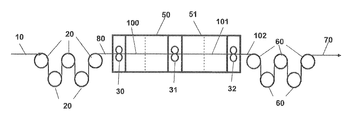
- FIG. 1 is a schematic representation of a first apparatus for producing polymeric tapes, illustrating a sequence of compression-stretching-compression-stretching-compression.
- FIG. 2 is a schematic representation of a second apparatus for producing polymeric tapes, illustrating a sequence of compression-compression-stretching.
- FIG. 3 is a schematic representation of a third apparatus for producing polymeric tapes, illustrating a sequence of stretching-compression-stretching.
- FIG. 5 is a schematic representation of a fifth apparatus for producing polymeric tapes, illustrating a sequence of stretching-compression-stretching-compression-stretching in a six zone oven.
- FIG. 6 is a schematic representation of a sixth apparatus for producing polymeric tapes, illustrating a sequence of stretching-two consecutive compressions-stretching in a four zone oven.
- FIG. 7 is a schematic representation of a seventh apparatus for producing polymeric tapes, illustrating a sequence of compression-stretching-stretching at increased tensile force-compression.
- FIG. 9 is a graphic representation illustrating the UTS*UE % data presented in Table 1.
- FIGS. 1-7 only one yarn end is shown for clarity, but several yarn ends may be simultaneously treated in parallel by a process of the invention to produce several polymeric tapes, or a single wide polymeric tape.
- the term “tape” refers to a narrow strip of fibrous material having a length greater than its width, wherein a “fibrous material” comprises one or more filaments.
- the cross-section of a polymeric tape of the invention may be rectangular, oval, polygonal, irregular, or of any shape satisfying the width, thickness and aspect ratio requirements outlined herein.
- the tapes are flat structures having a substantially rectangular cross-section with a thickness of about 0.5 mm or less, more preferably about 0.25 mm or less, still more preferably about 0.1 mm or less and still more preferably about 0.01 mm or less.
- the polymeric tapes have a thickness of up to about 3 mils (76.2 ⁇ m), more preferably from about 0.35 mil (8.89 ⁇ m) to about 3 mils (76.2 ⁇ m), and most preferably from about 0.35 mil to about 1.5 mils (38.1 ⁇ m). Thickness is measured at the thickest region of the cross-section.
- the polymeric tapes of the invention have widths of about 100 cm or less, more preferably about 50 cm or less and still more preferably about 25 cm or less.
- a tape typically has a width less than or equal to about 6 inches (15.24 cm), with a preferred width of from about 5 mm to about 50 mm, more preferably from about 5 mm to about 25.4 mm (1 inch), even more preferably from about 5 mm to about 20 mm, and most preferably from about 5 mm to about 10 mm.
- a polymeric tape of the invention has an average cross-sectional aspect ratio of at least about 20:1, more preferably at least about 50:1, still more preferably at least about 100:1, still more preferably at least about 250:1 and most preferably at least about 400:1.
- Each tape is formed from a plurality of multi-filament yarns wherein each yarn includes from 2 to about 1000 filaments, more preferably from 30 to 500 filaments, still more preferably from 100 to 500 filaments, still more preferably from about 100 filaments to about 250 filaments and most preferably from about 120 to about 240 filaments.
- Multifilament fibers are also often referred to in the art as bundles of fibers.
- a “fiber,” a “filament” and a “yarn” as defined herein are each defined as an elongate body the length dimension of which is much greater than the transverse dimensions of width and thickness.
- the cross-sections of fibers, filaments and yarns may vary and may be regular or irregular, including circular, flat or oblong cross-sections, with substantially circular cross-sections being most preferred.
- Fibers and yarns are distinguished from filaments in that fibers and yarns are formed from filaments.
- a fiber may be formed from just one filament or from multiple filaments.
- a fiber formed from just one filament is referred to either as a “single-filament” fiber or a “monofilament” fiber, and a fiber formed from a plurality of filaments is referred to as a “multi-filament” fiber.
- a “yarn” is defined as a single strand consisting of multiple filaments, analogous to a multi-filament fiber. Such a multi-filament strand is referred to herein as a “fiber/yarn”.
- the processes described herein convert high strength feed fibers/yarns, i.e. fibers/yarns having high ultimate tensile strength (high UTS (high tenacity)) and corresponding low ultimate elongation (UE %), into polymeric tapes having high UTS and comparatively higher UE % by compressing, consolidating, and flattening the twisted feed fiber/yarn, thereby forming a polymeric tape with substantial retention of fiber/yarn tensile strength.
- high UTS high tenacity
- UE % ultimate tensile strength
- a twisted feed fiber/yarn results in a tape composed of filaments that are not predominately parallel to the centerline of the tape, with the angle between the filaments and the tape centerline being determined partly by the amount of twist in the feed fiber/yarn, and partly by the tape forming process conditions. It has been discovered that increasing the angle between the filaments and the tape centerline is a useful way of increasing the ultimate elongation of the tape, without significantly reducing the ultimate tensile strength of the tape.
- the high strength fibers/yarns used as feeds for forming the polymeric tapes herein are preferably fibers/yarns that are suitable for the manufacture of ballistic resistant composites/fabrics.
- a “high strength” fiber/yarn is one which has a preferred tenacity of at least about 7 g/denier or more, a preferred tensile modulus of at least about 150 g/denier or more, a preferred an energy-to-break of at least about 8 J/g or more, each as measured by ASTM D2256.
- the term “denier” refers to the unit of linear density, equal to the mass in grams per 9000 meters of fiber/yarn.
- the feed fibers/yarns may be of any suitable denier.
- the feed fibers/yarns may have a denier of from about 50 to about 3000 denier, more preferably from about 200 to 3000 denier, still more preferably from about 1000 to 3000 denier.
- the feed fibers/yarns have a denier of from about 650 to about 2000 denier, more preferably from 800 to 2000 denier, and most preferably from about 800 to about 1500 denier.
- the selection is governed by considerations of ballistic effectiveness and cost. Finer fibers/yarns are more costly to manufacture and to weave, but can produce greater ballistic effectiveness per unit weight.
- Preferred fibers/yarns also have a preferred tensile modulus of about 300 g/denier or more, more preferably about 400 g/denier or more, more preferably about 500 g/denier or more, more preferably about 1,000 g/denier or more and most preferably about 1,500 g/denier or more.
- Preferred fibers/yarns also have a preferred energy-to-break of about 15 J/g or more, more preferably about 25 J/g or more, more preferably about 30 J/g or more and most preferably have an energy-to-break of about 40 J/g or more.
- High tensile strength, high tensile modulus fiber/yarn polymer types that are particularly suitable herein include polyolefin fibers/yarns, including high density and low density polyethylene.
- Particularly preferred are extended chain polyolefin fibers, such as highly oriented, high molecular weight polyethylene fibers/yarns, particularly ultra-high molecular weight polyethylene fibers/yarns, and polypropylene fibers/yarns, particularly ultra-high molecular weight polypropylene fibers/yarns.
- aramid fibers/yarns particularly para-aramid fibers/yarns, polyamide fibers/yarns, polyethylene terephthalate fibers/yarns, polyethylene naphthalate fibers/yarns, extended chain polyvinyl alcohol fibers/yarns, extended chain polyacrylonitrile fibers/yarns, polybenzoxazole (PBO) fibers/yarns, polybenzothiazole (PBT) fibers/yarns, liquid crystal copolyester fibers/yarns, glass fibers/yarns, and rigid rod fibers/yarns such as M5® fibers/yarns.
- PBO polybenzoxazole
- PBT polybenzothiazole
- the most preferred fiber/yarn types include polyethylene, particularly extended chain polyethylene fibers/yarns, aramid fibers/yarns, PBO fibers/yarns, liquid crystal copolyester fibers/yarns, polypropylene fibers/yarns, particularly highly oriented extended chain polypropylene fibers/yarns, polyvinyl alcohol fibers/yarns, polyacrylonitrile fibers/yarns and rigid rod fibers/yarns, particularly M5® fibers/yarns.
- ultra high molecular weight polyethylene fibers/yarns.
- Ultra high molecular weight polyethylene fibers/yarns are formed from extended chain polyethylenes having molecular weights of at least 300,000, preferably at least one million and more preferably between two million and five million.
- extended chain polyethylene fibers/yarns may be grown in solution spinning processes such as described in U.S. Pat. No. 4,137,394 or 4,356,138, which are incorporated herein by reference, or may be spun from a solution to form a gel structure, such as described in U.S. Pat. Nos.
- Particularly preferred fiber/yarn types are any of the polyethylene fibers/yarns sold under the trademark SPECTRA® from Honeywell International Inc, including SPECTRA® 900 fibers/yarns, SPECTRA® 1000 fibers/yarns and SPECTRA® 3000 fibers/yarns, all of which are commercially available from Honeywell International Inc. of Morristown, N.J.
- the most preferred UHMW PE fibers/yarns selected as a feed for a process of this invention have an intrinsic viscosity when measured in decalin at 135° C. by ASTM D1601-99 of from about 7 dl/g to about 40 dl/g, preferably from about 10 dl/g to about 40 dl/g, more preferably from about 12 dl/g to about 40 dl/g, and most preferably, from about 14 dl/g to 35 dl/g.
- the most preferred UHMW PE fibers/yarns selected as a feed for a process of this invention are highly oriented and have a c-axis orientation function of at least about 0.96, preferably at least about 0.97, more preferably at least about 0.98 and most preferably at least about 0.99.
- the c-axis orientation function is a description of the degree of alignment of the molecular chain direction with the filament direction.
- a polyethylene filament in which the molecular chain direction is perfectly aligned with the filament axis would have an orientation function of 1.
- C-axis orientation function (f c ) is measured by the wide angle x-ray diffraction method described in Correale, S. T. & Murthy, Journal of Applied Polymer Science, Vol. 101, 447-454 (2006) as applied to polyethylene.
- the most preferred UHMW PE fibers/yarns selected as a feed for a process of this invention have a tenacity from about 15 g/d to about 100 g/d, preferably from about 25 g/d to about 100 g/d, more preferably from about 30 g/d to about 100 g/d, yet more preferably from about 35 g/d to about 100 g/d, still more preferably from about 40 g/d to about 100 g/d and most preferably, from about 45 g/d to about 100 g/d.
- the polymeric tapes produced according to a process of the invention have a higher ultimate elongation at high UTS relative to other high UTS tapes. It is generally known that increases in fiber/yarn UTS are naturally met with a decrease in fiber/yarn UE %. In order to achieve a tape with a higher UE %, it is necessary that the feed fibers/yarns are first twisted prior to being compressed and flattened into a tape.
- twisting fibers/yarn Various methods of twisting fibers/yarn are known in the art, and any method may be utilized. Useful twisting methods are described, for example, in U.S. Pat. Nos. 2,961,010; 3,434,275; 4,123,893; 4,819,458 and 7,127,879, the disclosures of which are incorporated herein by reference.
- the fibers/yarns are twisted to have at least about 0.5 turns of twist per inch of fiber/yarn length up to about 15 twists per inch, more preferably from about 3 twists per inch to about 11 twists per inch of fiber/yarn length.
- the fibers/yarns are twisted to have at least 11 twists per inch of fiber/yarn length, more preferably from about 11 twists per inch to about 15 twists per inch of fiber/yarn length.
- the standard method for determining twist in twisted yarns is ASTM D1423-02.
- the feed fiber/yarn may be heat set by a process described in U.S. Pat. No. 4,819,458.
- the filaments of the twisted feed fiber/yarn may optionally be at least partially connected by fusion or by bonding. Fusion of the fiber/yarn filaments may be accomplished by various means, including the use of heat and tension, or through application of a solvent or plasticizing material prior to exposure to heat and tension as described in U.S. Pat. Nos. 5,540,990; 5,749,214; and 6,148,597, which are hereby incorporated by reference to the extent compatible herewith.
- Bonding may be accomplished, for example, by at least partially coating the filaments with a resin or other polymeric binder material having adhesive properties, such as a polystyrene-polyisoprene-polystyrene-block copolymer resin commercially available from Kraton Polymers of Houston, Tex. under the trademark KRATON® D1107. They may also be thermally bonded together without an adhesive coating. Thermal bonding conditions will depend on the fiber type. When the feed fibers/yarns are coated with a resin or other polymeric binder material having adhesive properties to bond the filaments, only a small amount of the resin/binder is needed.
- a resin or other polymeric binder material having adhesive properties such as a polystyrene-polyisoprene-polystyrene-block copolymer resin commercially available from Kraton Polymers of Houston, Tex. under the trademark KRATON® D1107. They may also be thermally bonded together without an adhesive coating. Thermal bonding conditions will depend
- the quantity of resin/binder applied is preferably no more than 5% by weight based on the total weight of the filaments plus the resin/binder, such that the filaments comprise at least 95% by weight of the coated fiber/yarn based on the total weight of the filaments plus the resin/binder, and the corresponding tape formed from the yarn will thereby also comprise at least 95% by weight of the component filaments.
- the fibers/yarns and tapes comprise at least about 96% filaments by weight, still more preferably 97% filaments by weight, still more preferably 98% filaments by weight, and still more preferably 99% filaments by weight.
- the fibers/yarns and tapes are resin-free, i.e. are not coated with a bonding resin/binder, and consist essentially of or consist only of filaments.
- the twisted and optionally fused feed fiber/yarn is then compressed, thereby consolidating the component filaments into a monolithic element and flattening said element into the form of a polymeric tape having a preferred average cross-sectional aspect ratio of at least about 10:1.
- One useful method for forming such a polymeric tape is described in U.S. patent application Ser. No. 12/539,185, which describes a process for the continuous production of polyethylene tape articles. Said process comprises placing a fiber/yarn under a longitudinal tensile force of at least about 0.25 kilogram-force (2.45 Newtons) and subjecting the fiber/yarn to at least one transverse compression step to flatten, consolidate and compress the fiber/yarn.
- This transverse compression step is preferably conducted at a temperature of from about 25° C. to about 137° C. while maintaining the longitudinal tensile force on the fiber/yarn, thereby forming a tape article having an average cross-sectional aspect ratio of at least about 10:1.
- This compression step may optionally be repeated one or more times, preferably at a temperature of from about 100° C. to about 160° C.
- the tape is stretched in at least one stage at a temperature in the range of from about 130° C. to about 160° C. at a stretch rate of from about 0.001 min ⁇ 1 to about 1 min ⁇ 1 .
- This stretching step may optionally be repeated one or more times.
- the longitudinal tensile force may optionally be increased or decreased, or may remain constant.
- the tape is cooled to a temperature less than about 70° C. under tension.
- aramid fibers/yarns may have different optimal processing conditions.
- aramid fibers/yarns cannot be fused together in the same way as UHMW PE fibers/yarns because aramid fibers/yarns do not melt and maintain strength.
- aramid fibers/yarns can be fused together by first dissolving the fiber surface, such as with sulfuric acid, followed by pressing the filaments together to form a tape.
- Fiber types with tape processing conditions similar to aramid fibers/yarns are M5® fibers/yarns, PBO, PBT and all other “liquid crystal” types of fibers/yarns.
- Fiber types with fusion and tape processing conditions similar to polyethylene fibers are those formed by melt or solution spinning of thermoplastic polymers, such as PET, nylon, polyvinyl acetate (PVA), polypropylene, etc.
- FIGS. 1, 2 and 7 A continuous process of the first embodiment (where the fibers/yarns are not stretched prior to compression) is illustrated schematically in FIGS. 1, 2 and 7 .
- FIGS. 3-6 A continuous process of the second embodiment (where the fibers/yarns are heated and stretched prior to compression) is illustrated schematically in FIGS. 3-6 .
- the figures illustrating a particular embodiment differ in the number and placement of process equipment, but illustrate the same steps.
- a selected multi-filament UHMW PE fiber/yarn 10 - 16 , respectively
- the restraining rolls are at temperature of from about 25° C. to about 137° C.
- the fiber/yarn leaving the restraining rolls ( 80 , 81 , 86 , respectively) is passed under tension directly into one or more means ( 30 , 33 , 39 ) for compressing, consolidating, and flattening the fiber/yarn, thereby forming a tape.
- the tape is subsequently heated and stretched at least once.
- the fiber/yarn leaving the restraining rolls ( 82 - 85 , respectively) is heated and stretched before being compressed. Heating of a yarn may be by any means, such as by infra-red radiation, contact with a heated surface, or contact with a heated fluid.
- the fiber/yarn is heated and stretched in a forced convection air oven ( 50 - 59 , 510 in FIGS. 1-7 ) having multiple temperature zones.
- a forced convection air oven 50 - 59 , 510 in FIGS. 1-7
- the fiber/yarn is preferably stretched at least once at temperatures of from about 100° C. to about 160° C. at a stretch rate of from about 0.01 min ⁇ 1 to about 5 min ⁇ 1 .
- the fiber/yarn is preferably stretched to a stretch ratio of from about 1.01:1 to about 20:1 at a temperature of about 135° C. to about 155° C.
- the stretch ratio is the maximum possible without rupturing the fiber/yarn, and this will vary as would be determined by one skilled in the art depending on the polymer type.
- each fiber/yarn or tape is under a longitudinal tensile force at both the outset and conclusion of compression in each means for compression ( 30 - 40 ).
- Longitudinal tensile force is regulated by regulating the speeds of successive driven means.
- the magnitude of the longitudinal tensile force on the fiber/yarn or tape at the outset of each compression step is substantially equal to the magnitude of the longitudinal tensile force on the fiber/yarn or tape at the conclusion of the same compression step.
- substantially equal means that the ratio of a lower to higher tensile force across a compression step is at least 0.75:1, preferably at least 0.80:1, more preferably at least 0.85:1, yet more preferably, at least 0.90:1, and most preferably, at least 0.95:1.
- Such substantially equal longitudinal tensile forces at the outset and conclusion of a compression step is a preferred feature of the process because equal tensile forces across a compression step assures zero tension at the midpoint of compression.
- substantially equal longitudinal tensile forces are not a mandatory processing condition.
- the longitudinal tensile force is at least 0.25 kilogram-force (abbreviated Kgf, equal to 2.45 Newtons, abbreviated N) on the fiber/yarn or tape at the inlet and at the outlet of a compression step.
- Kgf 0.25 kilogram-force
- the tensile force is at least 0.5 Kgf (4.9 N), more preferably at least 1 Kgf (9.8 N), yet more preferably at least 2 Kgf (19.6.2 N), and most preferably, at least 4 Kgf (39.2 N) at the outset and conclusion of a compression step.
- longitudinal tensile force is as high as possible without rupturing the fiber/yarn or tape and without causing slippage of the fiber/yarn or tape in a compression means.
- the illustrated compression means ( 30 - 40 ) in each of FIGS. 1-7 are counter-rotating, opposed rolls (nip rolls).
- Each nip roll of a unit preferably has the same surface speed, and presses upon the fiber/yarn or tape.
- Other suitable and well known compression means include nip roll stacks consisting of three or more rolls in a single unit that provide two or more compressions, pairs of moving belts that press from opposite sides against the fiber/yarn or tape, rolls where the fiber/yarn or tape makes a 180° turn under high tension and the like.
- the pressure applied by nip rolls and moving belts may be actuated by hydraulic cylinders or the pressure may result from fixing a gap between the rolls at a dimension smaller than the thickness of the incoming material. Still other compression means are possible and are contemplated.
- the means for compression may be vibrated.
- the vibration may be in a direction normal to the plane of the tape, or in the plane of the tape or in a direction inclined to both planes.
- the vibration may be of low frequency or of sonic or ultra-sonic frequencies.
- the vibration may be used as an aid in consolidation by imparting additional pulses of pressure or shear. It may also be used to produce periodic variations in thickness or width of the compressed tape useful for bonding in composite applications.
- the pressure exerted in a compression step in each embodiment is from about 20 to about 10,000 pounds per square inch (psi) (about 0.14 to about 69 MPa), preferably from about 50 to about 5000 psi (about 0.34 to about 34 MPa), and more preferably from about 50 to about 2500 psi (about 0.69 to about 17 MPa).
- the pressure is preferably increased at successive stages of compression.
- the compression means are preferably at a temperature of from about 25° C. to about 160° C., more preferably from about 50° C. to about 155° C., and most preferably from about 100° C. to about 150° C.
- the yarns are compressed/flattened into tapes at a temperature of from about 145° C. to about 155° C. and at a pressure of from about 2700 to about 3000 psi or greater.
- a now formed tape ( 100 ) is preferably heated and stretched at least once.
- Heating of the tape may be by any means, such as by infra-red radiation, contact with a heated surface, or contact with a heated fluid.
- the tape is heated and stretched in a forced convection air oven ( 50 , 51 ) having multiple temperature zones (demarcated by the dashed lines in the figures). Not shown in the figures are heaters and blowers that heat and circulate the air through the oven.
- stretching of the tape is at a temperature of from about 100° C. to about 160° C., and preferably from about 135° C. to about 150° C.
- the tape is stretched at a stretch rate of from about 0.001 min ⁇ 1 about 1 min ⁇ 1 .
- the tape is stretched at a stretch rate of from about 0.001 min ⁇ 1 to about 0.1 min ⁇ 1 .
- the tape is stretched to a stretch ratio of from about 1.01:1 to 20:1.
- the stretching force may be applied by any convenient means such as by passing the fiber/yarn/tape over and under a sufficient number of driven rolls ( 60 ), as illustrated in FIGS. 2, 3, 4 and 6 ; by compression means ( 31 , 32 , 40 ) as illustrated in FIGS. 1 and 7 ; by both compression means ( 36 , 37 , 40 ) and driven rolls ( 60 , 61 ) as in FIGS. 5 and 7 ; or by winding the fiber/yarn/tape multiple times around a driven godet and idler roll pair (not illustrated). Driven rolls applying the stretching force may be internal to the oven or outside of the oven.
- the longitudinal tensile force need not be the same throughout a continuous operation.
- a fiber/yarn or tape may be relaxed to lower longitudinal tensile force or permitted to shrink less than about 5% between successive compressions or stretches by tension isolation means.
- tension may be increased between successive compressions or stretches by tension isolation means.
- rolls ( 61 ) act as tension isolation means.
- the tensile force on tape ( 114 ) i.e. tape in a second oven
- tape ( 113 ) i.e. tape in a first oven
- the speed of restraining rolls ( 20 ) and driven rolls ( 60 ) are adjusted to maintain the tensile force constant across the compression means ( 39 and 40 ).
- the tape is cooled under tension prior to being conveyed to a winder.
- the length of the tape may diminish slightly due to thermal contraction, but tension should be sufficiently high during cooling to prevent shrinkage beyond thermal contraction.
- the tape is cooled on rolls ( 60 ) and the rolls are cooled by natural convection, forced air, or are internally water-cooled.
- the final stretched tape ( 70 - 76 ), cooled under tension to a temperature less than about 70° C., is wound up under tension (winder not shown) as a package or on a beam.
- a process of the invention produces a tape having a tensile strength of at least 75% of the strength of the fiber/yarn from which it is made, and more preferably the tape tenacity is substantially equal to the feeder fiber/yarn tenacity.
- a process of the invention produces a tape having a higher tensile strength than the yarn from which it is made.
- tape tensile strength is measured by ASTM D882-09 (at 10 inch (25.4 cm) gauge length and at an extension rate of 100%/min).
- the tape UTS will be about 3-5 g/d lower than the feed fiber/yarn.
- the tape UTS could be approximately 40 g/denier, or for a 35-37 g/denier UTS fiber/yarn, the tape UTS could be approximately 30-35 g/denier.
- the heating and compression steps that form the tape from the twisted fiber/yarn achieve the enhanced UE % of the resulting polymeric tape.
- the UE % of the inventive tapes can be defined in terms of its proportional relationship to the UTS.
- Polymeric tapes achieving these properties will be formed from fibers/yarns that have been twisted at least about 0.5 turns of twist per inch of fiber/yarn length up to about 15 twists per inch. Accordingly, the b value, i.e. the value where the line plotted in FIG. 8 would cross the y-axis, will range from 5 to 15.
- FIG. 9 is a bar graph illustrating the relationship between UTS and UE % for the inventive polymeric tapes from a different perspective, wherein the tapes have an ultimate tensile strength of at least 15 g/denier and wherein the product of the ultimate tensile strength (g/denier) of the tape and the ultimate elongation (%) of the tape (UTS*UE) is at least 150. More preferably, the UTS*UE value is at least about 160, still more preferably at least about 170, still more preferably at least about 180, still more preferably at least about 190, and most preferably the UTS*UE value is at least about 200.
- a tape having a UTS of 15 g/denier and a UE % of 10% will have a UTS*UE value of 150.
- a tape having a UTS of 40 g/denier and a UE % of 4.0% will have a UTS*UE value of 160.
- the UE % is controlled partially by the twist amount of the pre-compressed fiber/yarn, as well as the natural UE % of the polymeric feed fiber/yarn. The achievable twist amount depends to some degree on the fiber/yarn denier.
- tapes formed from untwisted SPECTRA® UHMW PE fibers/yarns identified in Comparative Examples 1-4 having tenacities ranging from 23.9 g/denier to 40.9 g/denier have ultimate elongations ranging from about 3.2 to about 9.
- the data plotted in FIG. 9 is outlined in Table 1, and additional examples are provided in the Examples section below.
- the polymeric tapes produced according to the processes of the invention may be fabricated into woven and/or non-woven fabric materials that have superior ballistic penetration resistance.
- articles that have superior ballistic penetration resistance describe those which exhibit excellent properties against deformable projectiles, such as bullets, and against penetration of fragments, such as shrapnel.
- a non-woven fabric is preferably formed by stacking one or more plies of randomly oriented polymeric tapes (e.g. a felt or a mat construction) or unidirectionally aligned, parallel polymeric tapes, and then consolidating the stack to form a tape layer.
- a “tape layer” as used herein may comprise a single-ply of non-woven tapes or a plurality of non-woven tape plies.
- a tape layer may also comprise a woven fabric or a plurality of consolidated woven fabrics.
- a “layer” describes a generally planar arrangement having both an outer top surface and an outer bottom surface.
- a single “ply” of unidirectionally oriented tapes comprises an arrangement of generally non-overlapping tapes that are aligned in a unidirectional, substantially parallel array, and is also known in the art as a “unitape”, “unidirectional tape”, “UD” or “UDT.”
- an “array” describes an orderly arrangement of tapes, which is exclusive of woven fabrics.
- a “parallel array” describes an orderly parallel arrangement of tapes where the tapes are arranged unidirectionally in a side-by-side, substantially parallel, planar relation to each other, most typically such that only their edges are in contact with each other.
- a UD or UDT layer/ply is a laminate formed by laminating (consolidating) these substantially parallel tapes together.
- the term “oriented” as used in the context of “oriented tapes” refers to the alignment of the tapes as opposed to stretching of the tapes.
- “consolidating” refers to combining a plurality of tape layers or plies into a single unitary structure, with or without the assistance of a polymeric binder material. Consolidation can occur via drying, cooling, heating, pressure or a combination thereof. Heat and/or pressure may not be necessary, as the tapes or tape layers/plies may just be glued together, as is the case in a wet lamination process.
- composite refers to combinations of tapes, optionally with a least one polymeric binder material. As stated above, this polymeric binder material may be an adhesive used to bond the yarn filaments together before or during the compression step.
- a “complex composite” refers to a consolidated combination of a plurality of tape layers.
- non-woven fabrics include all fabric structures that are not formed by weaving.
- non-woven fabrics may comprise a plurality of unitapes that are optionally at least partially coated with a polymeric binder material, stacked/overlapped and consolidated into a single-layer, monolithic element.
- Non-woven fabrics may also comprise felts or mats that comprise non-parallel, randomly oriented tapes that are optionally coated with a polymeric binder composition.
- a polymeric binder coating also commonly known in the art as a “polymeric matrix” material, is necessary to efficiently merge, i.e. consolidate, a plurality of non-woven plies/layers formed from yarns/fibers.
- a similar polymeric binder coating may be used when forming non-woven plies/layers from polymeric tapes.
- a binder/matrix coating is optional and not required. The flat structure of the tapes allows them to be merely hot-pressed together with sufficient bonding according to the consolidation conditions described herein.
- a stack of woven fabrics may be may be attached by other means as well, such as with a conventional adhesive layer or by stitching.
- the total weight of the binder/matrix coating in a composite preferably comprises from about 0% to about 10%, still more preferably from about 0% to about 5% by total weight of the component filaments plus the weight of the coating.
- ballistic resistant articles of the invention comprise from about 0% to about 2% by weight of a binder/matrix coating, or about 0% to about 1% by weight, or only about 1% to about 2% by weight.
- both woven and non-woven ballistic resistant articles fabricated from the polymeric tapes of the invention are entirely resin-free as described in commonly-owned U.S. patent application Ser. No. 61/570,071, which is incorporated herein by reference to the extent consistent herewith.
- Suitable polymeric binder materials include both low modulus materials and high modulus materials.
- Low modulus polymeric matrix binder materials generally have a tensile modulus of about 6,000 psi (41.4 MPa) or less according to ASTM D638 testing procedures and are typically employed for the fabrication of soft, flexible armor, such as ballistic resistant vests.
- High modulus materials generally have a higher initial tensile modulus than 6,000 psi and are typically employed for the fabrication of rigid, hard armor articles, such as helmets.
- a low modulus elastomeric material preferably has a tensile modulus of about 4,000 psi (27.6 MPa) or less, more preferably about 2400 psi (16.5 MPa) or less, still more preferably 1200 psi (8.23 MPa) or less, and most preferably is about 500 psi (3.45 MPa) or less.
- the glass transition temperature (Tg) of the low modulus elastomeric material is preferably less than about 0° C., more preferably the less than about ⁇ 40° C., and most preferably less than about ⁇ 50° C.
- a low modulus elastomeric material also has a preferred elongation to break of at least about 50%, more preferably at least about 100% and most preferably has an elongation to break of at least about 300%.
- Representative examples include polybutadiene, polyisoprene, natural rubber, ethylene-propylene copolymers, ethylene-propylene-diene terpolymers, polysulfide polymers, polyurethane elastomers, chlorosulfonated polyethylene, polychloroprene, plasticized polyvinylchloride, butadiene acrylonitrile elastomers, poly(isobutylene-co-isoprene), polyacrylates, polyesters, polyethers, fluoroelastomers, silicone elastomers, copolymers of ethylene, polyamides (useful with some filament types), acrylonitrile butadiene styrene, polycarbonates, and combinations thereof, as well as other low modulus polymers and copolymers curable below the melting point of the filaments forming the tapes. Also preferred are blends of different elastomeric materials, or blends of elastomeric materials with one or more thermoplastics.
- A is a block from a polyvinyl aromatic monomer
- B is a block from a conjugated diene elastomer.
- Many of these polymers are produced commercially by Kraton Polymers of Houston, Tex. and described in the bulletin “Kraton Thermoplastic Rubber”, SC-68-81.
- Particularly preferred low modulus polymeric binder polymers comprise styrenic block copolymers sold under the trademark KRATON® commercially produced by Kraton Polymers.
- a particularly preferred polymeric binder material comprises a polystyrene-polyisoprene-polystyrene-block copolymer sold under the trademark KRATON®.
- modified acrylic polymers modified with non-acrylic monomers are also suitable.
- acrylic copolymers and acrylic terpolymers incorporating suitable vinyl monomers such as: (a) olefins, including ethylene, propylene and isobutylene; (b) styrene, N-vinylpyrrolidone and vinylpyridine; (c) vinyl ethers, including vinyl methyl ether, vinyl ethyl ether and vinyl n-butyl ether; (d) vinyl esters of aliphatic carboxylic acids, including vinyl acetate, vinyl propionate, vinyl butyrate, vinyl laurate and vinyl decanoates; and (f) vinyl halides, including vinyl chloride, vinylidene chloride, ethylene dichloride and propenyl chloride.
- suitable vinyl monomers such as: (a) olefins, including ethylene, propylene and isobutylene; (b) styrene, N-vinylpyrrolidone and vinyl
- polar resins or polar polymer particularly polyurethanes within the range of both soft and rigid materials at a tensile modulus ranging from about 2,000 psi (13.79 MPa) to about 8,000 psi (55.16 MPa).
- Preferred polyurethanes are applied as aqueous polyurethane dispersions that are most preferably co-solvent free. Such includes aqueous anionic polyurethane dispersions, aqueous cationic polyurethane dispersions and aqueous nonionic polyurethane dispersions. Particularly preferred are aqueous anionic polyurethane dispersions, and most preferred are aqueous anionic, aliphatic polyurethane dispersions.
- Such includes aqueous anionic polyester-based polyurethane dispersions; aqueous aliphatic polyester-based polyurethane dispersions; and aqueous anionic, aliphatic polyester-based polyurethane dispersions, all of which are preferably cosolvent free dispersions.
- aqueous anionic polyether polyurethane dispersions aqueous aliphatic polyether-based polyurethane dispersions; and aqueous anionic, aliphatic polyether-based polyurethane dispersions, all of which are preferably cosolvent free dispersions.
- a particularly preferred rigid polymeric binder material for use in this invention is a thermosetting polymer, preferably soluble in carbon-carbon saturated solvents such as methyl ethyl ketone, and possessing a high tensile modulus when cured of at least about 1 ⁇ 10 6 psi (6895 MPa) as measured by ASTM D638.
- Particularly preferred rigid polymeric binder materials are those described in U.S. Pat. No. 6,642,159, the disclosure of which is incorporated herein by reference.
- the rigidity, impact and ballistic properties of the articles formed from the composites of the invention are affected by the tensile modulus of the polymeric binder polymer coating the tapes.
- the polymeric binder may also include fillers such as carbon black or silica, may be extended with oils, or may be vulcanized by sulfur, peroxide, metal oxide or radiation cure systems as is well known in the art.
- a polymeric matrix/binder may be applied either simultaneously or sequentially to a plurality of tapes, which may be arranged as a web or as an array, to thereby form a coated web/array.
- the matrix/binder may also be applied to an already woven fabric to form a coated woven fabric, or as another arrangement, to thereby coat the tape layers with the matrix/binder.
- the polymeric binder material may be applied onto the entire surface area of the individual tapes or only onto a partial surface area of the tapes, but most preferably the polymeric binder material is applied onto substantially all the surface area of each individual polymeric tape forming a tape layer of the invention.
- a plurality of tapes are arranged into at least one array, typically being arranged as a tape web comprising a plurality of tapes aligned in a substantially parallel, unidirectional array.
- the tapes may then be coated with a binder material if desired, and the coated tapes are then formed into non-woven tape plies, i.e. unitapes.
- a plurality of unitapes formed by any method are then overlapped atop each other and consolidated into single-layer, monolithic element, most preferably wherein the parallel tapes of each single-ply are positioned orthogonally to the parallel tapes of each adjacent single-ply, relative to the direction of the central longitudinal axis of the tapes in a tape ply.
- orthogonal 0°/90° tape orientations are preferred, adjacent plies can be aligned at virtually any angle between about 0° and about 90° with respect to the central longitudinal axis of another tape ply.
- a five ply non-woven structure may have plies oriented at a 0°/45°/90°/45°/0° or at other angles, such as rotations of adjacent plies/layers in 15° or 30° increments.
- Such rotated unidirectional alignments are described, for example, in U.S. Pat. Nos. 4,457,985; 4,748,064; 4,916,000; 4,403,012; 4,623,574; and 4,737,402, all of which are incorporated herein by reference to the extent not incompatible herewith.
- Non-woven tape layers or fabrics preferably include from 1 to about 6 adjoined tape plies, but may include as many as about 10 to about 20 plies as may be desired for various applications. The greater the number of plies translates into greater ballistic resistance, but also greater weight.
- Consolidation can occur via drying, cooling, heating, pressure or a combination thereof. Heat and/or pressure may not be necessary, as the tape layers may just be glued together, as is the case in a wet lamination process.
- consolidation is done by positioning the individual tape plies on one another under conditions of sufficient heat and pressure to cause the plies to combine into a unitary article. Consolidation may be done at temperatures ranging from about 50° C. to about 175° C., preferably from about 105° C.
- Consolidation may also be conducted by vacuum molding the material in a mold that is placed under a vacuum.
- Vacuum molding technology is well known in the art.
- a plurality of orthogonal tape webs are “glued” together with a small amount of binder polymer ( ⁇ 5% by weight) and run through a flat bed laminator to improve the uniformity and strength of the bond.
- the consolidation and polymer application/bonding steps may comprise two separate steps or a single consolidation/lamination step.
- Molding may alternately be conducted at higher pressures of from about 5,000 psi (34,470 kPa) to about 15,000 psi (103,410 kPa), more preferably from about 750 psi (5,171 kPa) to about 5,000 psi, and more preferably from about 1,000 psi to about 5,000 psi.
- the molding step may take from about 4 seconds to about 45 minutes.
- Preferred molding temperatures range from about 200° F. ( ⁇ 93° C.) to about 350° F. ( ⁇ 177° C.), more preferably at a temperature from about 200° F. to about 300° F. and most preferably at a temperature from about 200° F. to about 280° F.
- the pressure under which the tape layers and fabric composites of the invention are molded has a direct effect on the stiffness or flexibility of the resulting molded product. Particularly, the higher the pressure at which they are molded, the higher the stiffness, and vice-versa.
- the quantity, thickness and composition of the tape plies and polymeric binder coating type also directly affects the stiffness of the articles formed from the composites.
- molding is a batch process and consolidation is a generally continuous process. Further, molding typically involves the use of a mold, such as a shaped mold or a match-die mold when forming a flat panel, and does not necessarily result in a planar product. Normally consolidation is done in a flat-bed laminator, a calendar nip set or as a wet lamination to produce soft (flexible) body armor fabrics. Molding is typically reserved for the manufacture of hard armor, e.g. rigid plates. In either process, suitable temperatures, pressures and times are generally dependent on the type of polymeric binder coating materials, polymeric binder content, process used and fiber/yarn type used to fabricate the polymeric tapes.
- the tape layers or composites may also optionally comprise one or more thermoplastic polymer layers attached to one or both of the outer surfaces of the layer or composite.
- Suitable polymers for the thermoplastic polymer layer non-exclusively include polyolefins, polyamides, polyesters (particularly polyethylene terephthalate (PET) and PET copolymers), polyurethanes, vinyl polymers, ethylene vinyl alcohol copolymers, ethylene octane copolymers, acrylonitrile copolymers, acrylic polymers, vinyl polymers, polycarbonates, polystyrenes, fluoropolymers and the like, as well as co-polymers and mixtures thereof, including ethylene vinyl acetate (EVA) and ethylene acrylic acid.
- EVA ethylene vinyl acetate
- thermoplastic polymer layer may be bonded to the tape layer/composite surfaces using well known techniques, such as thermal lamination. Typically, laminating is done by positioning the individual layers on one another under conditions of sufficient heat and pressure to cause the layers to combine into a unitary structure.
- the total weight of the binder/matrix coating in a composite preferably comprises from about 0% to about 10% by weight, more preferably from about 0% to about 7%, and most preferably from about 0% to about 5% by weight of the filaments (which form the tapes) plus the weight of the coating.
- the thickness of the tape layers will correspond to the thickness of the individual tapes and the number of tape plies incorporated into the material.
- a preferred woven fabric will have a preferred thickness of from about 25 ⁇ m to about 600 ⁇ m per ply/layer, more preferably from about 50 ⁇ m to about 385 ⁇ m and most preferably from about 75 ⁇ m to about 255 ⁇ m per ply/layer.
- a preferred two-ply non-woven fabric will have a preferred thickness of from about 12 ⁇ m to about 600 ⁇ m, more preferably from about 50 ⁇ m to about 385 ⁇ m and most preferably from about 75 ⁇ m to about 255 ⁇ m.
- Articles of the invention may be formed from tape layers or composites that comprise only one type of tape or that comprise a hybrid structure including more than one type of tape.
- an article may be fabricated from at least two different polymeric tape types wherein a first tape type has a first number of twists per inch of yarn length and a second tape type has a second number of twists per inch of yarn length, wherein the first number of twists and the second number of twists per inch of yarn length are different.
- an article may be fabricated from at least two different polymeric tape types where each polymeric tape type has the same number of twists per inch of yarn length, but where the tapes comprise different filament polymer types, such as a combination of UHMW PE tapes and aramid tapes.
- an article may be fabricated from a combination of tapes that were thermally bonded together before compression, and tapes that were adhesively bonded together before compression.
- the fabrics of the invention may be used in various applications to form a variety of different ballistic resistant articles using well known techniques, including flexible, soft armor articles as well as rigid, hard armor articles.
- suitable techniques for forming ballistic resistant articles are described in, for example, U.S. Pat. Nos. 4,623,574, 4,650,710, 4,748,064, 5,552,208, 5,587,230, 6,642,159, 6,841,492 and 6,846,758, all of which are incorporated herein by reference to the extent not incompatible herewith.
- the composites are particularly useful for the formation of hard armor and shaped or unshaped sub-assembly intermediates formed in the process of fabricating hard armor articles.
- hard armor is meant an article, such as helmets, panels for military vehicles, or protective shields, which have sufficient mechanical strength so that it maintains structural rigidity when subjected to a significant amount of stress and is capable of being freestanding without collapsing.
- Such hard articles are preferably, but not exclusively, formed using a high tensile modulus binder material.
- a tape composite comprising a plurality of tape layers/plies is provided wherein a thermoplastic polymer is bonded to at least one outer surface of each tape layer/ply either before, during or after a consolidation step which consolidates the plurality of tape layers/plies, wherein the plurality of tape layers/plies are subsequently merged by another consolidation step which consolidates the plurality of tape layers into an armor article or sub-assembly of an armor article.
- a 1200 denier SPECTRA® 900 multi-filament UHMW PE yarn was twisted in the S-direction to form a twisted yarn having 7 turns per inch (TPI) (2.76 turns/cm). The tenacity of this S-twisted yarn was approximately 30-32 g/denier. This was repeated with a second 1200 denier SPECTRA® 900 multi-filament UHMW PE yarn, and the two S-twisted 7 TPI yarns were then cabled together in the Z-direction with 5 turns per inch (1.97 turns/cm) to form a 2400 denier cabled yarn. This cabled yarn was then simultaneously drawn and fused according to the techniques described in commonly-owned U.S. Pat. No.
- the heating and drawing step transforms the multi-filament cabled yarn into a fused monofilament-like yarn, where the “monofilament-like” means that the multiple filaments comprising the yarns are fused together at least to some degree, giving the yarn a monofilament or substantially monofilament appearance and feel.
- the resulting monofilament-like yarn had a denier of 1053, an ultimate elongation (UE %) of 4.05% and a tenacity (UTS) of 28.1 g/denier.
- the monofilament-like drawn/fused cabled yarn was then cold pressed, i.e. flattened between two rolls at room temperature (70-72° F.) (21-22° C.) according to the methods described in U.S. patent application Ser. No. 12/539,185, thereby forming a polymeric tape having a UTS of 22.5 g/d, a UE % of 7.3% and a denier of 1114.
- a 2400 denier SPECTRA® 900 multi-filament UHMW PE yarn (2 ⁇ 1200 denier SPECTRA® 900 multifilament UHMW PE yarns) was twisted into a 7 TPI twisted yarn.
- the two 1200 denier yarns forming the combined 2400 denier yarn of this example was not cabled.
- the 2400 denier yarn was then simultaneously drawn and fused in a 24 meter long oven as in Example 1, thereby forming a fused monofilament-like yarn.
- the UTS of the monofilament-like yarn was 29.7 g/d.
- the UE % was 4.09% and the denier was 1061.
- Example 1 was repeated thereby forming a polymeric tape having a UTS of 24.5 g/denier, a UE % of 6.32% and a denier of 1043.
- Example 2 was repeated thereby forming a polymeric tape having a UTS of 25.6 g/denier, a UE % of 6.39% and a denier of 1045.
- a 2400 denier SPECTRA® 900 multi-filament UHMW PE yarn (2 ⁇ 1200 denier SPECTRA® 900 multifilament UHMW PE yarns) is twisted into an 11 TPI (4.33 turns/cm) twisted yarn.
- the twisted yarn is then simultaneously drawn and fused in a 24 meter long oven as in Examples 1-4 at 155.5° C. with a draw ratio of 2.66, thereby forming a fused monofilament-like yarn.
- the monofilament-like yarn is then cold pressed and flattened at room temperature as in Examples 1-4, thereby forming a polymeric tape having a UTS of 22 g/d, a UE % of 10% and a denier of 1100.
- Example 5 is repeated except that the 2400 denier SPECTRA® 900 yarn is twisted into a 7 TPI twisted yarn, and the monofilament-like yarn formed therefrom is hot pressed/flattened into a tape at 150° C. rather than cold pressed/flattened into a tape at room temperature (21-22° C.).
- the resulting polymeric tape has a UTS of 24 g/d, a UE % of 11% and a denier of 1100.
- Comparative Examples 1-4 are compared to other known polymeric tapes having the properties outlined in Table 1 below.
- Comparative Examples 1-3 present the properties of tapes formed by drawing, fusing and flattening untwisted multifilament UHMW PE yarns that are analogous to the feeder yarns of inventive Examples 1-3 but without being twisted.
- Comparative Example 4 identifies the known properties of a tape formed according to U.S. Pat. No. 4,623,574.
- Comparative Example 5 identifies the known properties of polyethylene tapes commercially available from Teijin Fibers Ltd. under the trademark ENDUMAX® TA23.
- Comparative Example 6 identifies the known properties of polyethylene tapes commercially available from DuPont under the trademark TENSYLON® HT1900.
- Comparative Example 7 identifies the known properties of polyethylene tapes commercially available from DSM as described in their U.S. patent application publication no. 2008/0156345.
- FIG. 9 is a graphic representation illustrating the UTS*UE % data presented in Table 1 for inventive Examples 1-4 and Comparative Examples 1-7.
Landscapes
- Engineering & Computer Science (AREA)
- Mechanical Engineering (AREA)
- Textile Engineering (AREA)
- Chemical & Material Sciences (AREA)
- Composite Materials (AREA)
- Ceramic Engineering (AREA)
- General Engineering & Computer Science (AREA)
- Woven Fabrics (AREA)
- Yarns And Mechanical Finishing Of Yarns Or Ropes (AREA)
- Aiming, Guidance, Guns With A Light Source, Armor, Camouflage, And Targets (AREA)
Abstract
Description
b) arranging said plurality of polymeric tapes into a side-by-side planar array such that only their edges are in contact with each other;
c) optionally applying a polymeric binder material onto said array of tapes; and
d) applying heat and/or pressure to said array of tapes under conditions sufficient to consolidate said array of tapes into a substantially planar, unitary layer.
Stretch Rate=(V2−V1)/L,min−1
y=−0.04x+b
where y is the ultimate elongation (measured in %), wherein x is the ultimate tensile strength (measured in g/denier) of the tape, where b=5 or greater, and where x (UTS) is 15 g/denier or greater, more preferably x is 20 g/denier or greater, still more preferably x is 22 g/denier or greater, still more preferably where x is 25 g/denier or greater, still more preferably where x is 30 g/denier or greater, still more preferably where x is 35 g/denier or greater, still more preferably where x is 40 g/denier or greater, still more preferably where x is 45 g/denier or greater, still more preferably where x is 50 g/denier or greater, still more preferably where x is 55 g/denier or greater, still more preferably where x is 60 g/denier or greater, still more preferably where x is 65 g/denier or greater, still more preferably where x is 70 g/denier or greater, and still more preferably where x is 75 g/denier or greater. This relationship is illustrated in
| TABLE 1 | |||||
| UTS | |||||
| Example | (g/denier) | UE % | UTS* |
||
| 1 | 22.5 | 7.28 | 163.8 | ||
| 2 | 25.5 | 9.24 | 235.62 | ||
| 3 | 24.5 | 6.32 | 154.84 | ||
| 4 | 25.6 | 6.39 | 163.584 | ||
| Comp. 1 | 34.4 | 3.25 | 118 | ||
| Comp. 2 | 40.9 | 3.29 | 134.5 | ||
| Comp. 3 | 29 | 3.6 | 104.4 | ||
| Comp. 4 | 23.9 | 3.8 | 90.82 | ||
| Comp. 5 | 25.3 | 1.75 | 44.3 | ||
| Comp. 6 | 19.5 | 1.9 | 37.05 | ||
| Comp. 7 | 41.5 | 3.2 | 132.7 | ||
Claims (20)
Priority Applications (1)
| Application Number | Priority Date | Filing Date | Title |
|---|---|---|---|
| US15/588,921 US10259174B2 (en) | 2009-08-11 | 2017-05-08 | Multidirectional fiber-reinforced tape/film articles and the method of making the same |
Applications Claiming Priority (4)
| Application Number | Priority Date | Filing Date | Title |
|---|---|---|---|
| US12/539,185 US8236119B2 (en) | 2009-08-11 | 2009-08-11 | High strength ultra-high molecular weight polyethylene tape articles |
| US13/568,097 US8852714B2 (en) | 2009-08-11 | 2012-08-06 | Multidirectional fiber-reinforced tape/film articles and the method of making the same |
| US14/503,936 US9731454B2 (en) | 2009-08-11 | 2014-10-01 | Multidirectional fiber-reinforced tape/film articles and the method of making the same |
| US15/588,921 US10259174B2 (en) | 2009-08-11 | 2017-05-08 | Multidirectional fiber-reinforced tape/film articles and the method of making the same |
Related Parent Applications (1)
| Application Number | Title | Priority Date | Filing Date |
|---|---|---|---|
| US14/503,936 Division US9731454B2 (en) | 2009-08-11 | 2014-10-01 | Multidirectional fiber-reinforced tape/film articles and the method of making the same |
Publications (2)
| Publication Number | Publication Date |
|---|---|
| US20170297276A1 US20170297276A1 (en) | 2017-10-19 |
| US10259174B2 true US10259174B2 (en) | 2019-04-16 |
Family
ID=48903137
Family Applications (3)
| Application Number | Title | Priority Date | Filing Date |
|---|---|---|---|
| US13/568,097 Active 2029-08-28 US8852714B2 (en) | 2009-08-11 | 2012-08-06 | Multidirectional fiber-reinforced tape/film articles and the method of making the same |
| US14/503,936 Active 2030-08-17 US9731454B2 (en) | 2009-08-11 | 2014-10-01 | Multidirectional fiber-reinforced tape/film articles and the method of making the same |
| US15/588,921 Active US10259174B2 (en) | 2009-08-11 | 2017-05-08 | Multidirectional fiber-reinforced tape/film articles and the method of making the same |
Family Applications Before (2)
| Application Number | Title | Priority Date | Filing Date |
|---|---|---|---|
| US13/568,097 Active 2029-08-28 US8852714B2 (en) | 2009-08-11 | 2012-08-06 | Multidirectional fiber-reinforced tape/film articles and the method of making the same |
| US14/503,936 Active 2030-08-17 US9731454B2 (en) | 2009-08-11 | 2014-10-01 | Multidirectional fiber-reinforced tape/film articles and the method of making the same |
Country Status (1)
| Country | Link |
|---|---|
| US (3) | US8852714B2 (en) |
Families Citing this family (19)
| Publication number | Priority date | Publication date | Assignee | Title |
|---|---|---|---|---|
| US8697220B2 (en) | 2009-08-11 | 2014-04-15 | Honeywell International, Inc. | High strength tape articles from ultra-high molecular weight polyethylene |
| US9533480B2 (en) * | 2011-12-13 | 2017-01-03 | Honeywell International Inc. | Laminates made from ultra-high molecular weight polyethylene tape |
| ES2427982B1 (en) * | 2012-03-29 | 2014-09-10 | Jordi Galan Llongueras | Ultralight flat weave from 2 weft directions |
| EP2907243A1 (en) * | 2012-10-11 | 2015-08-19 | DSM IP Assets B.V. | Wireless power transfer system |
| CN105081490B (en) * | 2014-04-23 | 2017-09-12 | 北京富纳特创新科技有限公司 | Line cutting electrode silk and wire-electrode cutting device |
| US10259165B2 (en) | 2015-04-01 | 2019-04-16 | Aurizon Ultrasonics, LLC | Apparatus for fabricating an elastic nonwoven material |
| US10612189B2 (en) | 2015-04-24 | 2020-04-07 | Honeywell International Inc. | Composite fabrics combining high and low strength materials |
| CN105082683A (en) * | 2015-08-27 | 2015-11-25 | 浙江理工大学 | Preparation method of combined bulletproof composite material |
| US10272640B2 (en) | 2015-09-17 | 2019-04-30 | Honeywell International Inc. | Low porosity high strength UHMWPE fabrics |
| US20170297295A1 (en) | 2016-04-15 | 2017-10-19 | Honeywell International Inc. | Blister free composite materials molding |
| RU2625058C1 (en) * | 2016-08-26 | 2017-07-11 | Общество с ограниченной ответственностью "Мики" | Reinforced geogrid and method of its production |
| MX387594B (en) | 2016-09-30 | 2025-03-18 | Dukane Ias Llc | Apparatus for fabricating an elastic nonwoven material |
| JP7129434B2 (en) * | 2018-02-06 | 2022-09-01 | 株式会社クラレ | Fibrous tapes and composites containing said tapes |
| US11530513B2 (en) * | 2018-07-20 | 2022-12-20 | Honeywell International Inc. | Ballistic translation efficiency of high performance fibers |
| US11254066B2 (en) | 2019-03-22 | 2022-02-22 | Dukane Ias, Llc | Apparatus for fabricating an elastic nonwoven material |
| US20210246576A1 (en) * | 2020-02-10 | 2021-08-12 | Red Bank Technologies Llc | Stretched polymers, products containing stretched polymers and their method of manufacture |
| US20220388273A1 (en) * | 2021-06-04 | 2022-12-08 | Graham Williams | Self-reinforced polymer structures |
| US12331437B2 (en) * | 2021-12-21 | 2025-06-17 | CiloGear | Thermal runaway management system |
| WO2023137219A2 (en) * | 2022-01-14 | 2023-07-20 | Lifelabs Design, Inc. | Pe products for textile and method for manufacturing same |
Citations (29)
| Publication number | Priority date | Publication date | Assignee | Title |
|---|---|---|---|---|
| JPS6097835A (en) | 1983-11-04 | 1985-05-31 | Agency Of Ind Science & Technol | Monoaxially stretched crystalline high-molecular film or sheet with super coefficient of elasticity and manufacture thereof |
| JPS60141537A (en) | 1983-12-29 | 1985-07-26 | Mitsubishi Monsanto Chem Co | Manufacture of polyethylene film of superhigh molecular weight |
| GB2164897A (en) | 1984-09-28 | 1986-04-03 | Stamicarbon | Process for preparing polyethylene films having a high tensile strength and a high modulus |
| EP0277750A2 (en) | 1987-01-26 | 1988-08-10 | Mitsui Petrochemical Industries, Ltd. | Ultrahigh-molecular-weight polyolefin composition and process for production thereof |
| EP0483780A2 (en) | 1990-11-01 | 1992-05-06 | Nippon Oil Co. Ltd. | Split polyethylene stretched material and process for producing the same |
| US5578373A (en) | 1990-11-01 | 1996-11-26 | Nippon Oil Co., Ltd. | Split polyethylene stretched material and process for producing the same |
| US5579628A (en) | 1992-10-13 | 1996-12-03 | Alliedsignal Inc. | Entangled high strength yarn |
| US5628946A (en) | 1991-03-07 | 1997-05-13 | British Technology Group Limited | Process for producing polymeric materials |
| US5901632A (en) | 1997-06-10 | 1999-05-11 | Puget Sound Rope Corporation | Rope construction |
| US6277773B1 (en) | 1991-03-07 | 2001-08-21 | Btg International Limited | Polymeric materials |
| US20020037391A1 (en) | 1999-02-19 | 2002-03-28 | Alliedsignal | Flexible fabric from fibrous web and discontinuous domain matrix |
| CN1400342A (en) | 2001-07-30 | 2003-03-05 | 中国石油化工股份有限公司 | Production method of high strength polyethylene fibre and fibre |
| US20030082381A1 (en) | 2001-10-29 | 2003-05-01 | Yoz-Ami Corporation | Specific gravity-adjustable yarns with low elongation rate and excellent abrasion resistance |
| US20040267316A1 (en) | 2003-06-27 | 2004-12-30 | Linvatec Corporation | Liquid crystal polymer/polyester composite high strength suture |
| US6951685B1 (en) | 2001-11-27 | 2005-10-04 | Integrated Textile Systems, Inc. | Ultra high molecular weight polyethylene fibers |
| EP1627719A1 (en) | 2004-08-16 | 2006-02-22 | FMS Enterprises Migun Ltd. | Multilayered polyethylene material and ballistic resistant articles manufactured therefrom |
| US20060051564A1 (en) | 2002-11-01 | 2006-03-09 | Dsm Ip Assets B.V. | Process for the manufacture of a ballistic-resistant moulded article |
| WO2006074823A1 (en) | 2005-01-11 | 2006-07-20 | Dsm Ip Assets B.V. | Dental tape and process for its manufacturing |
| CN1995496A (en) | 2006-12-22 | 2007-07-11 | 中纺投资发展股份有限公司 | Super high molecular weight polyethylene gel method for continuous producing direct spinning fine denier filament |
| US7370395B2 (en) | 2005-12-20 | 2008-05-13 | Honeywell International Inc. | Heating apparatus and process for drawing polyolefin fibers |
| JP2008526406A (en) | 2005-01-11 | 2008-07-24 | ディーエスエム アイピー アセッツ ビー.ブイ. | Dental tape and manufacturing method thereof |
| EP2014445A1 (en) | 2007-07-09 | 2009-01-14 | Teijin Aramid B.V. | Polyethylene film with high tensile strength and high tensile energy to break |
| WO2009056286A1 (en) | 2007-11-01 | 2009-05-07 | Dsm Ip Assets B.V. | Material sheet and process for its preparation |
| WO2009077168A2 (en) | 2007-12-17 | 2009-06-25 | Dsm Ip Assets B.V. | Process for spinning uhmwpe, uhmwpe multifilament yarns produced thereof and products comprising said yarns |
| US20090280708A1 (en) | 2006-04-26 | 2009-11-12 | Roelof Marissen | Multilayered material sheet and process for its preparation |
| US20100003452A1 (en) | 2008-04-29 | 2010-01-07 | Dsm Ip Assets B.V. | Stack of first and second layers, a panel and ballistic resistant article comprising the stack or panel |
| US20110039058A1 (en) | 2009-08-11 | 2011-02-17 | Honeywell International Inc. | High strength ultra-high molecular weight polyethylene tape articles |
| US8022171B2 (en) | 2004-10-14 | 2011-09-20 | Dsm Ip Assets B.V. | Process for making a monofilament-like product |
| US20120121852A1 (en) | 2009-08-11 | 2012-05-17 | Honeywell International Inc. | High strength tape articles from ultra-high molecular weight polyethylene |
-
2012
- 2012-08-06 US US13/568,097 patent/US8852714B2/en active Active
-
2014
- 2014-10-01 US US14/503,936 patent/US9731454B2/en active Active
-
2017
- 2017-05-08 US US15/588,921 patent/US10259174B2/en active Active
Patent Citations (31)
| Publication number | Priority date | Publication date | Assignee | Title |
|---|---|---|---|---|
| JPS6097835A (en) | 1983-11-04 | 1985-05-31 | Agency Of Ind Science & Technol | Monoaxially stretched crystalline high-molecular film or sheet with super coefficient of elasticity and manufacture thereof |
| JPS60141537A (en) | 1983-12-29 | 1985-07-26 | Mitsubishi Monsanto Chem Co | Manufacture of polyethylene film of superhigh molecular weight |
| GB2164897A (en) | 1984-09-28 | 1986-04-03 | Stamicarbon | Process for preparing polyethylene films having a high tensile strength and a high modulus |
| EP0277750A2 (en) | 1987-01-26 | 1988-08-10 | Mitsui Petrochemical Industries, Ltd. | Ultrahigh-molecular-weight polyolefin composition and process for production thereof |
| EP0483780A2 (en) | 1990-11-01 | 1992-05-06 | Nippon Oil Co. Ltd. | Split polyethylene stretched material and process for producing the same |
| JPH05214657A (en) | 1990-11-01 | 1993-08-24 | Nippon Oil Co Ltd | Split polyethylene stretch material and method for producing the same |
| US5578373A (en) | 1990-11-01 | 1996-11-26 | Nippon Oil Co., Ltd. | Split polyethylene stretched material and process for producing the same |
| US5628946A (en) | 1991-03-07 | 1997-05-13 | British Technology Group Limited | Process for producing polymeric materials |
| US6277773B1 (en) | 1991-03-07 | 2001-08-21 | Btg International Limited | Polymeric materials |
| US5579628A (en) | 1992-10-13 | 1996-12-03 | Alliedsignal Inc. | Entangled high strength yarn |
| US5901632A (en) | 1997-06-10 | 1999-05-11 | Puget Sound Rope Corporation | Rope construction |
| US20020037391A1 (en) | 1999-02-19 | 2002-03-28 | Alliedsignal | Flexible fabric from fibrous web and discontinuous domain matrix |
| CN1400342A (en) | 2001-07-30 | 2003-03-05 | 中国石油化工股份有限公司 | Production method of high strength polyethylene fibre and fibre |
| US20030082381A1 (en) | 2001-10-29 | 2003-05-01 | Yoz-Ami Corporation | Specific gravity-adjustable yarns with low elongation rate and excellent abrasion resistance |
| US6951685B1 (en) | 2001-11-27 | 2005-10-04 | Integrated Textile Systems, Inc. | Ultra high molecular weight polyethylene fibers |
| US20060051564A1 (en) | 2002-11-01 | 2006-03-09 | Dsm Ip Assets B.V. | Process for the manufacture of a ballistic-resistant moulded article |
| US20040267316A1 (en) | 2003-06-27 | 2004-12-30 | Linvatec Corporation | Liquid crystal polymer/polyester composite high strength suture |
| EP1627719A1 (en) | 2004-08-16 | 2006-02-22 | FMS Enterprises Migun Ltd. | Multilayered polyethylene material and ballistic resistant articles manufactured therefrom |
| US8022171B2 (en) | 2004-10-14 | 2011-09-20 | Dsm Ip Assets B.V. | Process for making a monofilament-like product |
| WO2006074823A1 (en) | 2005-01-11 | 2006-07-20 | Dsm Ip Assets B.V. | Dental tape and process for its manufacturing |
| JP2008526406A (en) | 2005-01-11 | 2008-07-24 | ディーエスエム アイピー アセッツ ビー.ブイ. | Dental tape and manufacturing method thereof |
| US7370395B2 (en) | 2005-12-20 | 2008-05-13 | Honeywell International Inc. | Heating apparatus and process for drawing polyolefin fibers |
| US20090280708A1 (en) | 2006-04-26 | 2009-11-12 | Roelof Marissen | Multilayered material sheet and process for its preparation |
| CN1995496A (en) | 2006-12-22 | 2007-07-11 | 中纺投资发展股份有限公司 | Super high molecular weight polyethylene gel method for continuous producing direct spinning fine denier filament |
| EP2014445A1 (en) | 2007-07-09 | 2009-01-14 | Teijin Aramid B.V. | Polyethylene film with high tensile strength and high tensile energy to break |
| WO2009056286A1 (en) | 2007-11-01 | 2009-05-07 | Dsm Ip Assets B.V. | Material sheet and process for its preparation |
| WO2009077168A2 (en) | 2007-12-17 | 2009-06-25 | Dsm Ip Assets B.V. | Process for spinning uhmwpe, uhmwpe multifilament yarns produced thereof and products comprising said yarns |
| US20100003452A1 (en) | 2008-04-29 | 2010-01-07 | Dsm Ip Assets B.V. | Stack of first and second layers, a panel and ballistic resistant article comprising the stack or panel |
| US20110039058A1 (en) | 2009-08-11 | 2011-02-17 | Honeywell International Inc. | High strength ultra-high molecular weight polyethylene tape articles |
| US20120121852A1 (en) | 2009-08-11 | 2012-05-17 | Honeywell International Inc. | High strength tape articles from ultra-high molecular weight polyethylene |
| US20120258301A1 (en) | 2009-08-11 | 2012-10-11 | Honeywell International Inc. | High strength ultra-high molecular weight polyethylene tape articles |
Also Published As
| Publication number | Publication date |
|---|---|
| US9731454B2 (en) | 2017-08-15 |
| US8852714B2 (en) | 2014-10-07 |
| US20170297276A1 (en) | 2017-10-19 |
| US20130202844A1 (en) | 2013-08-08 |
| US20160368227A1 (en) | 2016-12-22 |
Similar Documents
| Publication | Publication Date | Title |
|---|---|---|
| US9731454B2 (en) | Multidirectional fiber-reinforced tape/film articles and the method of making the same | |
| EP2880208B1 (en) | Multidirectional fiber-reinforced tape/film articles and the method of making the same | |
| US10081158B2 (en) | Hybrid fiber unidirectional tape and composite laminates | |
| JP6945548B2 (en) | Blister-free composite material molding | |
| US9243354B2 (en) | Stab and ballistic resistant articles | |
| US10494746B2 (en) | Ballistic resistant thermoplastic sheet, process of making and its applications | |
| US11499802B2 (en) | Variable areal density cross-plied fiber-reinforced composite ballistic material | |
| EP2769011B1 (en) | High performance laminated tapes & related products for ballistic applications | |
| WO2017048790A1 (en) | Low porosity high strength uhmwpe fabrics | |
| KR102789880B1 (en) | Ballistic conversion efficiency of high-performance fibers |
Legal Events
| Date | Code | Title | Description |
|---|---|---|---|
| AS | Assignment |
Owner name: HONEYWELL INTERNATIONAL INC., NEW JERSEY Free format text: ASSIGNMENT OF ASSIGNORS INTEREST;ASSIGNORS:TAM, THOMAS;BOONE, MARK BENJAMIN;SIGNING DATES FROM 20170504 TO 20170505;REEL/FRAME:042272/0357 |
|
| STCF | Information on status: patent grant |
Free format text: PATENTED CASE |
|
| MAFP | Maintenance fee payment |
Free format text: PAYMENT OF MAINTENANCE FEE, 4TH YEAR, LARGE ENTITY (ORIGINAL EVENT CODE: M1551); ENTITY STATUS OF PATENT OWNER: LARGE ENTITY Year of fee payment: 4 |
|
| AS | Assignment |
Owner name: JPMORGAN CHASE BANK, N.A., AS ADMINISTRATIVE AGENT, NEW YORK Free format text: SECURITY INTEREST;ASSIGNOR:SOLSTICE ADVANCED MATERIALS US, INC.;REEL/FRAME:074569/0260 Effective date: 20251029 |
|
| AS | Assignment |
Owner name: SOLSTICE ADVANCED MATERIALS US, INC., NEW JERSEY Free format text: NUNC PRO TUNC ASSIGNMENT;ASSIGNOR:HONEYWELL INTERNATIONAL INC.;REEL/FRAME:074346/0835 Effective date: 20260324 |