US10249358B1 - Apparatuses and methods for configurable command and data input circuits for semiconductor memories - Google Patents
Apparatuses and methods for configurable command and data input circuits for semiconductor memories Download PDFInfo
- Publication number
- US10249358B1 US10249358B1 US16/190,504 US201816190504A US10249358B1 US 10249358 B1 US10249358 B1 US 10249358B1 US 201816190504 A US201816190504 A US 201816190504A US 10249358 B1 US10249358 B1 US 10249358B1
- Authority
- US
- United States
- Prior art keywords
- signal
- clock
- progress
- write
- read
- Prior art date
- Legal status (The legal status is an assumption and is not a legal conclusion. Google has not performed a legal analysis and makes no representation as to the accuracy of the status listed.)
- Active
Links
Images


Classifications
-
- G—PHYSICS
- G11—INFORMATION STORAGE
- G11C—STATIC STORES
- G11C11/00—Digital stores characterised by the use of particular electric or magnetic storage elements; Storage elements therefor
- G11C11/21—Digital stores characterised by the use of particular electric or magnetic storage elements; Storage elements therefor using electric elements
- G11C11/34—Digital stores characterised by the use of particular electric or magnetic storage elements; Storage elements therefor using electric elements using semiconductor devices
- G11C11/40—Digital stores characterised by the use of particular electric or magnetic storage elements; Storage elements therefor using electric elements using semiconductor devices using transistors
- G11C11/401—Digital stores characterised by the use of particular electric or magnetic storage elements; Storage elements therefor using electric elements using semiconductor devices using transistors forming cells needing refreshing or charge regeneration, i.e. dynamic cells
- G11C11/4063—Auxiliary circuits, e.g. for addressing, decoding, driving, writing, sensing or timing
- G11C11/407—Auxiliary circuits, e.g. for addressing, decoding, driving, writing, sensing or timing for memory cells of the field-effect type
- G11C11/4076—Timing circuits
-
- G—PHYSICS
- G11—INFORMATION STORAGE
- G11C—STATIC STORES
- G11C11/00—Digital stores characterised by the use of particular electric or magnetic storage elements; Storage elements therefor
- G11C11/21—Digital stores characterised by the use of particular electric or magnetic storage elements; Storage elements therefor using electric elements
- G11C11/34—Digital stores characterised by the use of particular electric or magnetic storage elements; Storage elements therefor using electric elements using semiconductor devices
- G11C11/40—Digital stores characterised by the use of particular electric or magnetic storage elements; Storage elements therefor using electric elements using semiconductor devices using transistors
- G11C11/401—Digital stores characterised by the use of particular electric or magnetic storage elements; Storage elements therefor using electric elements using semiconductor devices using transistors forming cells needing refreshing or charge regeneration, i.e. dynamic cells
- G11C11/4063—Auxiliary circuits, e.g. for addressing, decoding, driving, writing, sensing or timing
- G11C11/407—Auxiliary circuits, e.g. for addressing, decoding, driving, writing, sensing or timing for memory cells of the field-effect type
- G11C11/4074—Power supply or voltage generation circuits, e.g. bias voltage generators, substrate voltage generators, back-up power, power control circuits
-
- G—PHYSICS
- G11—INFORMATION STORAGE
- G11C—STATIC STORES
- G11C11/00—Digital stores characterised by the use of particular electric or magnetic storage elements; Storage elements therefor
- G11C11/21—Digital stores characterised by the use of particular electric or magnetic storage elements; Storage elements therefor using electric elements
- G11C11/34—Digital stores characterised by the use of particular electric or magnetic storage elements; Storage elements therefor using electric elements using semiconductor devices
- G11C11/40—Digital stores characterised by the use of particular electric or magnetic storage elements; Storage elements therefor using electric elements using semiconductor devices using transistors
- G11C11/401—Digital stores characterised by the use of particular electric or magnetic storage elements; Storage elements therefor using electric elements using semiconductor devices using transistors forming cells needing refreshing or charge regeneration, i.e. dynamic cells
- G11C11/4063—Auxiliary circuits, e.g. for addressing, decoding, driving, writing, sensing or timing
- G11C11/407—Auxiliary circuits, e.g. for addressing, decoding, driving, writing, sensing or timing for memory cells of the field-effect type
- G11C11/408—Address circuits
- G11C11/4085—Word line control circuits, e.g. word line drivers, - boosters, - pull-up, - pull-down, - precharge
-
- G—PHYSICS
- G11—INFORMATION STORAGE
- G11C—STATIC STORES
- G11C11/00—Digital stores characterised by the use of particular electric or magnetic storage elements; Storage elements therefor
- G11C11/21—Digital stores characterised by the use of particular electric or magnetic storage elements; Storage elements therefor using electric elements
- G11C11/34—Digital stores characterised by the use of particular electric or magnetic storage elements; Storage elements therefor using electric elements using semiconductor devices
- G11C11/40—Digital stores characterised by the use of particular electric or magnetic storage elements; Storage elements therefor using electric elements using semiconductor devices using transistors
- G11C11/401—Digital stores characterised by the use of particular electric or magnetic storage elements; Storage elements therefor using electric elements using semiconductor devices using transistors forming cells needing refreshing or charge regeneration, i.e. dynamic cells
- G11C11/4063—Auxiliary circuits, e.g. for addressing, decoding, driving, writing, sensing or timing
- G11C11/407—Auxiliary circuits, e.g. for addressing, decoding, driving, writing, sensing or timing for memory cells of the field-effect type
- G11C11/408—Address circuits
- G11C11/4087—Address decoders, e.g. bit - or word line decoders; Multiple line decoders
-
- G—PHYSICS
- G11—INFORMATION STORAGE
- G11C—STATIC STORES
- G11C11/00—Digital stores characterised by the use of particular electric or magnetic storage elements; Storage elements therefor
- G11C11/21—Digital stores characterised by the use of particular electric or magnetic storage elements; Storage elements therefor using electric elements
- G11C11/34—Digital stores characterised by the use of particular electric or magnetic storage elements; Storage elements therefor using electric elements using semiconductor devices
- G11C11/40—Digital stores characterised by the use of particular electric or magnetic storage elements; Storage elements therefor using electric elements using semiconductor devices using transistors
- G11C11/401—Digital stores characterised by the use of particular electric or magnetic storage elements; Storage elements therefor using electric elements using semiconductor devices using transistors forming cells needing refreshing or charge regeneration, i.e. dynamic cells
- G11C11/4063—Auxiliary circuits, e.g. for addressing, decoding, driving, writing, sensing or timing
- G11C11/407—Auxiliary circuits, e.g. for addressing, decoding, driving, writing, sensing or timing for memory cells of the field-effect type
- G11C11/409—Read-write [R-W] circuits
- G11C11/4091—Sense or sense/refresh amplifiers, or associated sense circuitry, e.g. for coupled bit-line precharging, equalising or isolating
-
- G—PHYSICS
- G11—INFORMATION STORAGE
- G11C—STATIC STORES
- G11C11/00—Digital stores characterised by the use of particular electric or magnetic storage elements; Storage elements therefor
- G11C11/21—Digital stores characterised by the use of particular electric or magnetic storage elements; Storage elements therefor using electric elements
- G11C11/34—Digital stores characterised by the use of particular electric or magnetic storage elements; Storage elements therefor using electric elements using semiconductor devices
- G11C11/40—Digital stores characterised by the use of particular electric or magnetic storage elements; Storage elements therefor using electric elements using semiconductor devices using transistors
- G11C11/401—Digital stores characterised by the use of particular electric or magnetic storage elements; Storage elements therefor using electric elements using semiconductor devices using transistors forming cells needing refreshing or charge regeneration, i.e. dynamic cells
- G11C11/4063—Auxiliary circuits, e.g. for addressing, decoding, driving, writing, sensing or timing
- G11C11/407—Auxiliary circuits, e.g. for addressing, decoding, driving, writing, sensing or timing for memory cells of the field-effect type
- G11C11/409—Read-write [R-W] circuits
- G11C11/4093—Input/output [I/O] data interface arrangements, e.g. data buffers
-
- G—PHYSICS
- G11—INFORMATION STORAGE
- G11C—STATIC STORES
- G11C11/00—Digital stores characterised by the use of particular electric or magnetic storage elements; Storage elements therefor
- G11C11/21—Digital stores characterised by the use of particular electric or magnetic storage elements; Storage elements therefor using electric elements
- G11C11/34—Digital stores characterised by the use of particular electric or magnetic storage elements; Storage elements therefor using electric elements using semiconductor devices
- G11C11/40—Digital stores characterised by the use of particular electric or magnetic storage elements; Storage elements therefor using electric elements using semiconductor devices using transistors
- G11C11/401—Digital stores characterised by the use of particular electric or magnetic storage elements; Storage elements therefor using electric elements using semiconductor devices using transistors forming cells needing refreshing or charge regeneration, i.e. dynamic cells
- G11C11/4063—Auxiliary circuits, e.g. for addressing, decoding, driving, writing, sensing or timing
- G11C11/407—Auxiliary circuits, e.g. for addressing, decoding, driving, writing, sensing or timing for memory cells of the field-effect type
- G11C11/409—Read-write [R-W] circuits
- G11C11/4094—Bit-line management or control circuits
-
- G—PHYSICS
- G11—INFORMATION STORAGE
- G11C—STATIC STORES
- G11C11/00—Digital stores characterised by the use of particular electric or magnetic storage elements; Storage elements therefor
- G11C11/21—Digital stores characterised by the use of particular electric or magnetic storage elements; Storage elements therefor using electric elements
- G11C11/34—Digital stores characterised by the use of particular electric or magnetic storage elements; Storage elements therefor using electric elements using semiconductor devices
- G11C11/40—Digital stores characterised by the use of particular electric or magnetic storage elements; Storage elements therefor using electric elements using semiconductor devices using transistors
- G11C11/401—Digital stores characterised by the use of particular electric or magnetic storage elements; Storage elements therefor using electric elements using semiconductor devices using transistors forming cells needing refreshing or charge regeneration, i.e. dynamic cells
- G11C11/4063—Auxiliary circuits, e.g. for addressing, decoding, driving, writing, sensing or timing
- G11C11/407—Auxiliary circuits, e.g. for addressing, decoding, driving, writing, sensing or timing for memory cells of the field-effect type
- G11C11/409—Read-write [R-W] circuits
- G11C11/4096—Input/output [I/O] data management or control circuits, e.g. reading or writing circuits, I/O drivers or bit-line switches
-
- G—PHYSICS
- G11—INFORMATION STORAGE
- G11C—STATIC STORES
- G11C7/00—Arrangements for writing information into, or reading information out from, a digital store
- G11C7/10—Input/output [I/O] data interface arrangements, e.g. I/O data control circuits, I/O data buffers
- G11C7/1051—Data output circuits, e.g. read-out amplifiers, data output buffers, data output registers, data output level conversion circuits
- G11C7/106—Data output latches
-
- G—PHYSICS
- G11—INFORMATION STORAGE
- G11C—STATIC STORES
- G11C7/00—Arrangements for writing information into, or reading information out from, a digital store
- G11C7/10—Input/output [I/O] data interface arrangements, e.g. I/O data control circuits, I/O data buffers
- G11C7/1051—Data output circuits, e.g. read-out amplifiers, data output buffers, data output registers, data output level conversion circuits
- G11C7/1066—Output synchronization
-
- G—PHYSICS
- G11—INFORMATION STORAGE
- G11C—STATIC STORES
- G11C7/00—Arrangements for writing information into, or reading information out from, a digital store
- G11C7/10—Input/output [I/O] data interface arrangements, e.g. I/O data control circuits, I/O data buffers
- G11C7/1078—Data input circuits, e.g. write amplifiers, data input buffers, data input registers, data input level conversion circuits
- G11C7/109—Control signal input circuits
-
- G—PHYSICS
- G11—INFORMATION STORAGE
- G11C—STATIC STORES
- G11C7/00—Arrangements for writing information into, or reading information out from, a digital store
- G11C7/10—Input/output [I/O] data interface arrangements, e.g. I/O data control circuits, I/O data buffers
- G11C7/1078—Data input circuits, e.g. write amplifiers, data input buffers, data input registers, data input level conversion circuits
- G11C7/1093—Input synchronization
-
- G—PHYSICS
- G11—INFORMATION STORAGE
- G11C—STATIC STORES
- G11C7/00—Arrangements for writing information into, or reading information out from, a digital store
- G11C7/22—Read-write [R-W] timing or clocking circuits; Read-write [R-W] control signal generators or management
- G11C7/222—Clock generating, synchronizing or distributing circuits within memory device
-
- G—PHYSICS
- G11—INFORMATION STORAGE
- G11C—STATIC STORES
- G11C7/00—Arrangements for writing information into, or reading information out from, a digital store
- G11C7/22—Read-write [R-W] timing or clocking circuits; Read-write [R-W] control signal generators or management
- G11C7/225—Clock input buffers
-
- G—PHYSICS
- G11—INFORMATION STORAGE
- G11C—STATIC STORES
- G11C8/00—Arrangements for selecting an address in a digital store
- G11C8/06—Address interface arrangements, e.g. address buffers
-
- G—PHYSICS
- G11—INFORMATION STORAGE
- G11C—STATIC STORES
- G11C2207/00—Indexing scheme relating to arrangements for writing information into, or reading information out from, a digital store
- G11C2207/22—Control and timing of internal memory operations
- G11C2207/2227—Standby or low power modes
-
- G—PHYSICS
- G11—INFORMATION STORAGE
- G11C—STATIC STORES
- G11C2207/00—Indexing scheme relating to arrangements for writing information into, or reading information out from, a digital store
- G11C2207/22—Control and timing of internal memory operations
- G11C2207/2272—Latency related aspects
-
- G—PHYSICS
- G11—INFORMATION STORAGE
- G11C—STATIC STORES
- G11C7/00—Arrangements for writing information into, or reading information out from, a digital store
- G11C7/10—Input/output [I/O] data interface arrangements, e.g. I/O data control circuits, I/O data buffers
- G11C7/1072—Input/output [I/O] data interface arrangements, e.g. I/O data control circuits, I/O data buffers for memories with random access ports synchronised on clock signal pulse trains, e.g. synchronous memories, self timed memories
-
- G—PHYSICS
- G11—INFORMATION STORAGE
- G11C—STATIC STORES
- G11C7/00—Arrangements for writing information into, or reading information out from, a digital store
- G11C7/22—Read-write [R-W] timing or clocking circuits; Read-write [R-W] control signal generators or management
Definitions
- High data reliability, high speed of memory access, lower power consumption and reduced scaling of chip size are features that are demanded from semiconductor memory.
- the reduced scaling of the chip size typically results in smaller feature sizes and lower power consumption for the various circuits of semiconductor memory.
- a memory array, supporting circuits for receiving signals and providing signals, and other circuits used in performing various memory operations may be designed for higher memory and circuit density and reduced power consumption.
- Lower power consumption is often achieved by using lower internal voltages.
- circuit performance when operating at higher speeds may suffer when lower internal voltages are used.
- operation of circuits at higher speeds e.g., higher clock frequencies
- circuits are often designed to balance lower power consumption and acceptable performance at higher speeds. It may be desirable to have circuits for semiconductor memories that may be configured to be operated for lower power consumption or for high speed performance.
- FIG. 1 is a block diagram of a semiconductor device according to an embodiment of the disclosure.
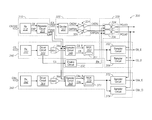
- FIG. 2 is a block diagram of an input signal block according to an embodiment of the disclosure.
- FIG. 3 is a block diagram of an input signal block according to an embodiment of the disclosure.
- FIG. 4 is a schematic diagram of a clock blocking circuit according to an embodiment of the invention.
- FIG. 5 is a timing diagram showing various signals during operation of the clock blocking circuit of FIG. 4 according to an embodiment of the disclosure.
- FIG. 6 is a block diagram of a data input block according to an embodiment of the disclosure.
- FIG. 7 is a schematic diagram of a driver circuit and data receiver circuit according to an embodiment of the disclosure.
- FIG. 8 is a schematic diagram of a sampler circuit according to an embodiment of the disclosure.
- FIG. 1 is a block diagram of a semiconductor device in accordance with the present disclosure.
- the semiconductor device 110 may be a DDR4 SDRAM integrated into a single semiconductor chip, for example.
- the semiconductor device 110 may be mounted on an external substrate 102 that is a memory module substrate, a mother board or the like.
- the external substrate 102 employs an external resistor RZQ that is connected to a calibration terminal ZQ 127 of the semiconductor device 110 .
- the external resistor RZQ is a reference impedance of a ZQ calibration circuit 138 .
- the external resistor RZQ may be coupled to a reference potential, for example, in different embodiments, VSS, VDDQ, VDD, or other potential that may be used as a reference potential.
- the semiconductor device 110 includes a memory cell array 111 .
- the memory cell array 111 includes a plurality of banks, each bank including a plurality of word lines WL, a plurality of bit lines BL, and a plurality of memory cells MC arranged at intersections of the plurality of word lines WL and the plurality of bit lines BL.
- the selection of the word line WL is performed by a row decoder 112 and the selection of the bit line BL is performed by a column decoder 113 .
- Sense amplifiers 118 are coupled to corresponding bit lines BL and connected to local I/O line pairs LIOT/B. Local IO line pairs LIOT/B are connected to main IO line pairs MIOT/B via transfer gates TG 119 which function as switches.
- the plurality of external terminals includes address terminals 121 , command terminals 122 , clock terminals 123 , data terminals 124 , power supply terminals 125 and 126 , and the calibration terminal ZQ 127 .
- An input signal block 141 may include the address terminals 121 , the command terminals 122 and the clock terminals 123 may include input buffers that will be later described in detail, according to one embodiment.
- the data terminals 124 may be coupled to output buffers for read operations of memories. Alternatively, the data terminals 124 may be coupled to input buffers for read/write access of the memories.
- FIG. 1 shows an example of dynamic random access memory (DRAM), however, any device having external terminals for signal input/output may be included as the external terminals of embodiments of the present disclosure.
- DRAM dynamic random access memory
- the terminals 122 are supplied with command signals and address signals, which are referred collectively in FIG. 1 as CA 0 -CAn.
- the command signals of the CA 0 -CAn signals may be provided to the terminals 122 at different times from the address signals of the CA 0 -CAn signals.
- the terminals 122 may first be supplied with the command signals of the CA 0 -CAn signals, and then after a command represented by the command signals is complete, the terminals 122 may be supplied with the address signals of the CA 0 -CAn signals.
- the address signals of the CA 0 -CAn signal represent a memory address associated with the command.
- the terminals 122 are further supplied with a select signal CS.
- the CS signal may be used to activate the semiconductor device for operation.
- the command/address signals CA 0 -CAn may include one or more separate signals.
- the command signals of the CA 0 -CAn signals and the CS signal input to the terminals 122 are input to a command decoder 134 via the command input circuit 133 as CAn_E/O and CS_E/O signals.
- the command decoder 134 decodes the CAn_E/O signals to generate various internal command signals.
- the internal commands may include a row command signal to select a word line and a column command signal, such as a read command or a write command, to select a bit line.
- a latency control circuit 140 receives internal command signals, for example, READ, WRITE, COMMON from the command decoder 134 and receives internal clock signals from the internal clock generator 136 .
- the latency control circuit adds delay to the internal command signals according to a programmed latency.
- the latency control circuit 140 also provides progress signals to the internal clock generator 136 that are indicative of operations in progress.
- Address signals of the CA 0 -CAn signals input to the terminals 122 are input to an address decoder 132 .
- the address decoder 132 receives the address signals and supplies a decoded row address signal XADD to the row decoder 112 , and a decoded column address signal YADD to the column decoder 113 .
- the address decoder 132 also receives the bank address signals and supplies bank address signals BADD to the row decoder 112 , and the column decoder 113 .
- read data is read from a memory cell MC in the memory cell array 111 designated by these row address and column address.
- the read data DQ is output externally from the data terminals 124 via a read/write amplifier 115 and an input/output circuit 117 .
- write data DQ is supplied to the data terminals 124 , the write data DQ is supplied via the input/output circuit 117 and the read/write amplifier 115 to the memory cell array 111 and written in the memory cell MC designated by the row address and the column address.
- the clock terminals 123 are supplied with external clock signals CK and /CK, respectively. These external clock signals CK and /CK are complementary to each other and are supplied to a clock input circuit 135 .
- the clock input circuit 135 receives the external clock signals CK and /CK and generates an internal clock signal ICLK.
- the internal clock signal ICLK is supplied to an internal clock generator 136 and thus a phase controlled internal clock signal LCLK is generated based on the received internal clock signal ICLK and a clock enable signal CKE from the command input circuit 133 .
- a DLL circuit can be used as the internal clock generator 136 .
- the phase controlled internal clock signal LCLK is supplied to the input/output circuit 117 and is used as a timing signal for determining an output timing of the read data DQ.
- the internal clock signal ICLK is also supplied to a timing generator 137 and thus various internal clock signals can be generated.
- the power supply terminals 125 are supplied with power supply potentials VDD and VSS. These power supply potentials VDD and VSS are supplied to an internal power supply circuit 139 .
- the internal power supply circuit 139 generates various internal potentials VPP, VOD, VARY, VPERI, and the like and a reference potential ZQVREF based on the power supply potentials VDD and VSS.
- the internal potential VPP is mainly used in the row decoder 112
- the internal potentials VOD and VARY are mainly used in the sense amplifiers 118 included in the memory cell array 111
- the internal potential VPERI is used in many other circuit blocks.
- the reference potential ZQVREF is used in the ZQ calibration circuit 138 .
- the power supply terminals 126 are supplied with power supply potentials VDDQ and VSSQ (or VSS). These power supply potentials VDDQ and VSSQ (or VSS) are supplied to an output buffer (not shown) included in the input/output circuit 117 .
- the power supply potentials VDDQ and VSSQ may be the same potentials as the power supply potentials VDD and VSS that are supplied to the power supply terminals 125 , respectively.
- the dedicated power supply potentials VDDQ and VSSQ (or VSS) may be used for the output buffer in the input/output circuit 117 so that power supply noise generated by the input/output circuit 117 does not propagate to the other circuit blocks.
- the calibration terminal ZQ is connected to the calibration circuit 138 .
- the calibration circuit 138 performs a calibration operation with reference to an impedance of an external resistance RZQ and the reference potential ZQVREF when activated.
- An impedance code ZQCODE obtained by the calibration operation is supplied to the input/output circuit 117 , and thus an impedance of an output buffer (not shown) included in the input/output circuit 117 is specified.
- FIG. 2 is a block diagram of an input signal block 200 according to an embodiment of the disclosure.
- portions of the input signal block 200 are included in the command input circuit 133 , the clock input circuit 135 , and the internal clock generator 136 .
- the input signal block 200 includes clock receiver circuit 210 that receives complementary clock signals CK and CKF from external terminals and provides complementary internal clock signals iCK and iCKF.
- the iCK and iCKF signals are provided to a clock divider circuit 220 .
- the clock divider circuit 220 receives the iCK and iCKF signals and provides complementary clock signals CKDIV and CKFDIV having a clock frequency that is less than the clock frequency of the CK and CKF signals.
- the clock frequency of the CKDIV and CKFDIV signals is one-half the clock frequency of the CK and CKF signals.
- a clock gating circuit 230 receives the CKDIV and CKFDIV signals from the clock divider circuit 220 .
- the clock gating circuit 230 further receives a select signal CS from an external terminal and provides clock signals PCLKR and PCLKF signals (referenced in FIG. 2 collectively as the PCLKR/F signal) that are based on the CKDIV and CKFDIV signals when activated by an active CS signal.
- An active CS signal (e.g., a high logic level) is provided to the external terminal to activate, for example, the semiconductor device 110 .
- an inactive CS signal is provided to the external terminal to deactivate, for example, the semiconductor device 110 .
- the clock gating circuit 230 When not activated, the clock gating circuit 230 provides low logic level PCLKR and PCLKF signals. As will be described in more detail below, the clock gating circuit 230 may provide inactive PCLKR and PCLKF signals when the CS signal is not active, and provide active PCLKR and PCLKF signals when the CS signal is active. In this manner, power consumption may be reduced compared to continually providing active PCLKR and PCLKF signals.
- the PCLKR and PCLKF signals are provided to a CS receiver circuit 240 , CA receivers 260 , and a clocking control circuit 250 .
- the CS receiver circuit 240 is also provided the CS signal from the external terminal and the iCK and iCKF signals from the receiver circuit 210 .
- the CS receiver circuit 240 samples the CS signal according to PCLKR and PCLKF signals and provides internal select signals CS_E and CS_O (referenced in FIG. 2 collectively as the CS_E/O signal).
- the logic level of the CS signal may be sampled by the CS receiver circuit 240 .
- the CS_E and CS_O signals have the logic level of the CS signal at the time sampled according to the PCLKR and PCLKF signals.
- the CS_E signal has the logic level of the CS signal when the PCLKR signal changes from a low clock level to a high clock level
- the CS_O signal has the logic level of the CS signal when the PCLKF changes from a low clock level to a high clock level.
- the CS_E and CS_O signals may be provided by the input signal block 200 to a command decoder 234 , for example, which may be implemented by the command decoder 134 .
- the CA receiver circuits 260 receive respective command/address CAn signals from external terminals and receive the iCK and iCKF signals from the receiver circuit 210 .
- the CA receiver circuits 260 sample the respective CAn signal to provide respective internal signals CAn_E and CAn_O (referenced in FIG. 2 collectively as the CAn_E/O signal).
- the reference “n” is used to generally reference any of the CAn signals, and any of the CAn_E and CAn_O signals, and to show correspondence between the signals.
- the CA 0 signal is provided to a respective CA receiver circuit 260 , which provides CA 0 _E and CA 0 _O signals;
- the CA 1 signal is provided to a respective CA receiver circuit 260 , which provides CA 1 _E and CA 1 _O signals, and so on for each of the signals of the CAn signals.
- FIG. 2 shows three CA receiver circuits 260 , there may be greater or fewer CA receiver circuits 260 without departing from the scope of the disclosure.
- the CAn_E/O signals are provided to command decoder 234 , which decodes the CAn_E/O signals and provides internal control signals to perform operations requested by the CAn signals.
- Examples of internal control signals provided by the command decoder 234 are represented by READ signals for performing read operations, WRITE signals for performing write operations, and COMMON signals for performing operations other than the read and write operations, for example, refresh operations, activation operations, precharge operations, as well as other operations.
- the CS receiver circuit 240 and the CA receiver circuits 260 may operate in a first mode to sample the CS signal and the CAn signals at a first clock frequency and may operate in a second mode to sample the CS signal and the CAn signals at a second clock frequency that is higher than the first clock frequency. Operating in the second (higher frequency) mode may provide benefits with regards to setup and hold margins for sampling the signals but at the cost of relatively higher power consumption compared to operating in the first (lower frequency) mode.
- the CS receiver circuit 240 and the CA receiver circuits 260 may be operated in the first or second modes depending on the desire for improved timing margins or lower power consumption.
- the clocking control circuit 250 also receives the PCLKR and PCLKF signals from the clock gating circuit 230 and provides clock signals PCLK_WT, PCLK_RD, and PCLK_COMMON.
- the PCLK_WT, PCLK_RD, and PCLK_COMMON signals are based on the PCLKR and PCLKF signals, and on the write in progress WIP and read in progress RIP signals provided by a latency control circuit 240 .
- the PCLK_WT, PCLK_RD, and PCLK_COMMON signals are provided to the latency control circuit 240 .
- the latency control circuit 240 may be the latency control circuit 140 of FIG. 1 .
- the RIP signal is active (e.g., a high logic level) when a read operation is in progress and the WIP signal is active (e.g., a high logic level) when a write operation is in progress.
- the clocking control circuit 250 may provide an inactive PCLK_WT signal when a read operation is in progress and/or provide an inactive PCLK_RD signal when a write operation is in progress.
- An active clock periodically clocks between high and low clock levels, and an inactivate clock signal maintains either the high or low clock levels.
- Providing inactive PCLK_WT and PCLK_RD signals may reduce power consumption compared to providing active PCLK_WT and PCLK_RD signals regardless of the access operation (e.g., read operation or write operation) in progress.
- FIG. 3 is a block diagram of an input signal block 300 according to an embodiment of the disclosure.
- the input signal block 300 may be used for the input signal block 200 of FIG. 200 in some embodiments of the disclosure.
- the input signal block 300 receives complementary clock signals CK and CKF, a select signal CS, and command/address signals CAn.
- the input signal block 300 may be operated in a first mode to sample the CS signal and the CAn signals at a first clock frequency and may be operated in a second mode to sample the CS signal and the CAn signals at a second clock frequency that is higher than the first clock frequency.
- operating at a higher frequency may provide benefits with regards to improved timing margin while operating at a lower frequency may provide benefits with regards to reduced power consumption.
- setup and hold margins for sampling the input signals may be better when operating in the second mode using the second clock frequency when compared to sampling at the first clock frequency
- operating in the second mode with the higher second clock frequency causes the circuits to consume more power.
- operating in the first mode and sampling at the slower first clock frequency but consuming less power may be acceptable.
- the mode of operation may be selected through a mode register, where information programmed in the mode register enables the modes of operation.
- the input signal block 300 includes clock receiver circuit 310 that receives complementary clock signals CK and CKF and provides internal clock signals iCK and iCKF.
- the clock receiver circuit 310 includes a receiver 312 that receives the CK and CKF signals and provides corresponding iCK and iCKF signals to repeater circuits 314 .
- the repeater circuits 314 drive the iCK and iCKF signals over signal lines to other circuits. For example, the iCK and iCKF signals are provided by the repeater circuits 314 to a clock divider circuit 320 .
- the repeater circuits 314 may also selectively provide the iCK and iCKF signals to a sampler circuit 348 of a CS receiver circuit 340 .
- the repeater circuits 314 may be controlled to provide or not provide the iCK and iCKF signals to the sampler circuit 348 .
- the repeater circuits 314 provide inactive iCK and iCKF signals that maintain a constant clock level. Providing the inactive iCK and iCKF signals may lower power consumption compared to continually providing active iCK and iCKF signals.
- the clock divider circuit 320 receives the iCK and iCKF signals and provides complementary clock signals CKDIV and CKFDIV having a clock frequency that is less than the clock frequency of the CK and CKF signals. In some embodiments, the clock frequency of the CKDIV and CKFDIV signals is one-half the clock frequency of the CK and CKF signals.
- the clock divider circuit 320 includes divider circuit 322 , and further includes inverter circuits 324 and inverter circuits 326 .
- the divider circuit 322 provides the CKDIV and DKFDIV signals having a reduced clock frequency (e.g., one-half of the clock frequency of the CK and CKF signals).
- the inverters 324 provide the CKDIV signal and the inverters 326 provide the CKFDIV signal to other circuits.
- the CKDIV and CKFDIV signals are provided to a clock gating circuit 330 .
- the clock gating circuit 330 includes an enable circuit 332 , and AND logic 334 and 336 .
- the enable circuit 332 receives the select signal CS and provides enable signal EN to the AND logic 334 and 336 .
- the enable circuit 332 provides an active EN signal (e.g., a logic high level) when an active CS signal (e.g., a logic high level) is received.
- an active EN signal is provided, the AND logic 334 provides the CKDIV signal as a PCLKR signal and the AND logic 336 provides the CKFDIV signal as a PCLKF signal.
- the PCLKR and PCLKF signals are complementary.
- the PCLKR and PCLKF signals may also be described as being 180 degrees out of phase with one another. Conversely, when the AND logic 334 and 336 receive an inactive EN signal, the AND logic 334 provides a low logic level PCLKR signal and the AND logic 336 provides a low logic level PCLKF signal.
- the PCLKR and PCLKF signals are provided to a CS receiver circuit 340 and to a CA receiver circuit 360 .
- the CS receiver circuit 340 includes a receiver 342 that receives the CS signal and provides the CS signal to driver circuit 344 .
- a trim circuit 346 receives the CS signal from the driver circuit 344 and adds a delay before providing the delayed CS signal to a sampler circuit 348 .
- the trim circuit 346 is used to match a propagation delay of the clock receiver circuit 310 .
- a propagation delay of the CS signal through the receiver 342 , the driver circuit 344 , and trim circuit 346 is matched to the propagation delay of the CK and CKF signals through the receiver 312 and repeater circuits 314 .
- the trim circuit 346 can be trimmed to provide the delay needed to match the propagation delay of the clock receiver circuit 310 .
- the sampler circuit 348 may receive the iCK and iCKF clock signals from the repeater circuits 314 of the clock receiver circuit 310 .
- the sampler circuit 348 may be controlled to sample the CS signal based on the iCK and iCKF signals and provide an output signal CS_S to a multiplexer circuit 350 .
- the CS_S signal has a logic level indicative of the value of the sampled CS signal.
- the sampler circuit 348 may also be controlled to provide the delayed CS signal from the trim circuit 346 to the multiplexer circuit 350 without sampling, in effect, bypassing the sampling operation of the sampler circuit 348 .
- the multiplexer circuit 350 provides either the CS_S signal or the (unsampled) delayed CS signal to sampler circuits 352 and 354 .
- the multiplexer circuit 350 includes a delay circuit 351 that adds delay to the (unsampled) delayed CS signal before being provided to the sampler circuits 352 and 354 .
- Delay may be added by the multiplexer circuit 350 when providing the (unsampled) delayed CS signal to the sampler circuits 352 and 354 in order to make up for a timing difference compared to providing the CS_S signal to the sampler circuits 352 and 354 .
- a timing difference may exist because of the delay of the sampler circuit 348 in sampling the delayed CS signal and providing the CS_S signal, which is not present when providing the (unsampled) delayed CS signal.
- the delay of the delay circuit 351 adds delay so that the total propagation delay from the output of the trim circuit 346 to the input of the sampler circuits 352 and 354 is the same for providing both the CS_S signal and the (unsampled) delayed CS signal to the sampler circuits 352 and 354 .
- the sampler circuit 352 samples the output of the multiplexer circuit 350 according to the PCLKR signal from the clock gating circuit 330 , and the sampler circuit 354 samples the output of the multiplexer circuit 350 according to the PCLKF signal. That is, when the respective clock signal becomes active, the logic level of the output of the multiplexer circuit 350 is sampled by the sampler circuit, and an output signal having the sampled logic level is provided by the sampler circuit.
- the sampler circuit 352 provides an internal signal CS_E and the sampler circuit 354 provides an internal signal CS_O.
- the CS_E and CS_O signals from the sampler circuits 352 and 354 may be provided, for example, to a command decoder circuit, such as command decoder circuit 234 of FIG.
- the CS receiver circuit may be operated in a first mode where the CS signal is sampled at the clock frequency of the PCLKR and PCLKF signals (e.g., the first clock frequency), or operated in a second mode where the CS signal is sampled at the clock frequency of the iCK and iCKF signals (e.g., the second clock frequency).
- the CS receiver circuit 340 may be operated in a first mode where the CS signal is sampled at the clock frequency of the PCLKR and PCLKF signals (e.g., a first clock frequency) or operated in a second mode where the CS signal is sampled at the clock frequency of the iCK and iCKF signals (e.g., a second clock frequency).
- the PCLKR and PCLKF signals have a lower clock frequency than the iCK and iCKF signals.
- the clock frequency of the PCLKR and PCLKF signals is one-half of the clock frequency of the iCK and iCKF signals.
- Sampling the CS signal at the higher clock frequency of the iCK and iCKF signals may improve setup and hold timing margins for sampling.
- the CS_S signal provided by the sampler 348 is then sampled again by the sampler circuits 352 and 354 at the lower clock frequency of the PCLKF and PCLKF signals.
- the CS_S signal may be more accurate due to the improved timing margins from sampling the CS signal at a higher clock frequency, and from sampling the CS signal earlier in the signal path of the CS receiver circuit 340 .
- the CS signal is subject to less variation in delay (e.g., caused by variations in voltage and/or temperature) by sampling the signal earlier in the signal path of the receiver circuit 340 .
- sampling at the higher clock frequency consumes greater power than sampling at a lower clock frequency.
- Sampling at the lower clock frequency may be acceptable where lower power consumption is desired.
- Operating the CS receiver circuit 340 to sample the CS signal at one of the two different clock frequencies allows flexibility to tailor the sampling of the CS signal for better timing margin or lower power consumption as needed.
- the CA receiver circuit 360 is similar to the CS receiver circuit 340 . That is, the CA receiver circuit 360 samples a CAn signal to provide internal signals CAn_E and CAn_O. While FIG. 3 shows one CA receiver circuit 360 , there may be additional CA receiver circuits 360 . One CA receiver circuit 360 is provided for each signal of the CA signals. The reference “n” is used to indicate that one of the CA signals is provided to a respective CA receiver circuit 360 . For example, the CA 0 signal is provided to a respective CA receiver circuit 360 , the CA 1 signal is provided to a respective CA receiver circuit 360 , and so on for each of the signals of the CA signals.
- the CA receiver circuit 360 includes a receiver 362 that receives the CAn signal and provides the CAn signal to driver circuit 364 .
- a trim circuit 366 receives the CAn signal from the driver circuit 364 and adds a delay before providing the delayed CAn signal to a sampler circuit 368 .
- the trim circuit 366 as with the trim circuit 346 previously described with reference to the CS receiver circuit 340 , is used to match a propagation delay of the receiver circuit 310 .
- the sampler circuit 368 may also receive the iCK and iCKF clock signals from the repeater circuits 314 .
- the sampler circuit 368 may be controlled to sample the CAn signal based on the iCK and iCKF signals and provide an output signal CAn_S to a multiplexer circuit 370 .
- the CAn_S signal has a logic level indicative of the value of the sampled CAn signal.
- the sampler circuit 368 may also be controlled to provide the delayed CAn signal from the trim circuit 366 to the multiplexer circuit 370 without sampling, in effect, bypassing the sampling operation of the sampler circuit 368 .
- the multiplexer circuit 370 provides either the CAn_S signal or the (unsampled) delayed CAn signal to sampler circuits 372 and 374 .
- the multiplexer circuit 370 includes a delay circuit 371 that adds delay to the (unsampled) delayed CAn signal before being provided to the sampler circuits 372 and 374 .
- Delay may be added by the multiplexer circuit 370 when providing the (unsampled) delayed CAn signal to the sampler circuits 372 and 374 in order to make up for a timing difference compared to providing the CAn_S signal to the sampler circuits 372 and 374 .
- a timing difference may exist because of the delay of the sampler circuit 368 in sampling the delayed CAn signal and providing the CAn_S signal, which is not present when providing the (unsampled) delayed CAn signal.
- the delay of the delay circuit 371 adds delay so that the total propagation delay from the output of the trim circuit 366 to the input of the sampler circuits 372 and 374 is the same for both providing the CAn_S signal and the (unsampled) delayed CAn signal to the sampler circuits 372 and 374 .
- the sampler circuit 372 samples the output of the multiplexer circuit 370 according to the PCLKR signal from the clock gating circuit 330 , and the sampler circuit 374 samples the output of the multiplexer circuit 370 according to the PCLKF signal. That is, when the respective clock signal becomes active, the logic level of the output of the multiplexer circuit 370 is sampled by the sampler circuit, and an output signal having the sampled logic level is provided by the sampler circuit.
- the sampler circuit 372 provides a CAn_E signal and the sampler circuit 374 provides a CAn_O signal.
- the CAn_E and CAn_O signals from the sampler circuits 372 and 374 may be provided, for example, to a command decoder circuit, such as command decoder circuit 234 of FIG. 2 .
- the CA receiver circuit 360 may be operated in a first mode where the CAn signal is sampled at the clock frequency of the PCLKR and PCLKF signals (e.g., a first clock frequency) or operated in a second mode where the CAn signal is sampled at the clock frequency of the iCK and iCKF signals (e.g., a second clock frequency).
- the CA receiver circuit 360 and the CS receiver circuit 340 are operated at the same clock frequency, that is, both the CS receiver circuit 340 and the CA receiver circuit 360 are operated to sample at the clock frequency of the iCK and iCKF signals or operated to sample at the clock frequency of the PCLKR and PCLKF signals.
- sampling at the higher clock frequency of the iCK and iCKF signals may improve setup and hold timing margins for sampling compared to sampling at the lower clock frequency of the PCLKR and PCLKF signals.
- the higher clock frequency sampling consumes more power. Consequently, the CA receiver circuit 360 may be operated to sample the CAn signals at the lower clock frequency of the PCLKR and PCLKF signals when lower power consumption is desired. Operating the CA receiver circuit 360 to sample the CAn signal at one of the two different clock frequencies allows flexibility to tailor the sampling of the CAn signal for better timing margin or lower power consumption as needed.
- the sampler circuits 348 , 352 , and 354 of the CS receiver circuit 340 and/or one or more of the sampler circuits 368 , 372 , and 374 of the CA receiver circuit 360 may be implemented with a D flip flop circuit clocked by differential clock signals.
- Such circuits are well known in the art, and in the interest of brevity, such circuits have not been described in detail herein.
- FIG. 4 is a schematic diagram of a clock blocking circuit 400 according to an embodiment of the invention.
- the clock blocking circuit 400 may be included in the clocking control circuit 250 of FIG. 2 in some embodiments of the disclosure.
- the clock blocking circuit 400 includes a write clock control logic circuit 410 and a read clock control logic circuit 420 .
- the write clock control logic circuit 410 receives a control signal RIP that is active while a read operation is in progress and further receives a control signal HighRL that disables the write clock control for high read latency operation.
- the RIP signal may be provided by latency control circuit, for example, by the latency control circuit 240 of FIG. 2 . A high read latency operation is indicated when the HighRL signal has a low logic level.
- the write clock control logic circuit 410 further receives a control signal RIPWIP that is active when both read and write operations are concurrently in progress.
- the RIPWIP signal is provided by AND logic 430 .
- the AND logic 430 includes a NAND logic circuit 432 and an inverter circuit 434 .
- the NAND logic circuit 432 receives the RIP signal and receives a control signal WIP that is active while a write operation is in progress.
- the write clock control logic circuit 410 includes NAND logic circuit 412 that receives the RIP signal and the HighRL signal and provides an output resulting from a NAND logic operation of the RIP and HighRL signals.
- the output of the NAND logic circuit 412 is provided to a delay circuit 414 that provides the output of the NAND logic circuit 412 with a delay to NOR logic circuit 416 .
- the NOR logic circuit 416 provides an output resulting from a NOR logic operation of the output of the delay circuit 414 and the RIPWIP signal.
- the write clock control logic circuit 410 further includes NAND logic circuit 418 that receives the RIP signal and an output from the NOR logic circuit 416 .
- the output RIPOUT of the NAND logic circuit 418 results from a NAND logic operation of the RIP signal and the output of the NOR logic circuit 416 .
- the read clock control logic circuit 420 receives the WIP signal and further receives the HighRL signal.
- the WIP signal may be provided by a latency control circuit, for example, the latency control circuit 240 of FIG. 2 .
- the read clock control logic circuit 420 further receives the RIPWIP signal from the AND logic 430 .
- the read clock control logic circuit 420 includes NAND logic circuit 422 that receives the WIP signal and the HighRL signal and provides an output resulting from a NAND logic operation of the WIP and HighRL signals.
- the output of the NAND logic circuit 422 is provided to a delay circuit 424 that provides the output of the NAND logic circuit 422 with a delay to NOR logic circuit 426 .
- the NOR logic circuit 426 provides an output resulting from a NOR logic operation of the output of the delay circuit 424 and the RIPWIP signal.
- the read clock control logic circuit 420 further includes NAND logic circuit 428 that receives the WIP signal and an output from the NOR logic circuit 426 .
- the output WIPOUT of the NAND logic circuit 428 results from a NAND logic operation of the WIP signal and the output of the NOR logic circuit 426 .
- the clock blocking circuit 400 further includes write clock logic 440 , common clock logic 450 , and read clock logic 460 .
- Each of the write, common, and read clock logic 440 , 450 , and 460 include respective NAND logic circuits 442 , 452 , and 462 , and include respective inverter circuits 444 , 454 , and 464 .
- a clock signal PCLK is provided to the write, common, and read clock logic 440 , 450 , and 460 .
- the PCLK signal may be provided by a clock gating circuit, for example, clock gating circuit 230 of FIG. 2 .
- the write and read clock logic 440 and 460 are also provided a respective control signal.
- the write clock logic 440 is provided the RIPOUT output from the write clock control logic 410 and the read clock logic 460 is provided the WIPOUT output from the read clock control logic 420 .
- the common clock logic 450 is also provided a high logic level signal, represented in FIG. 4 as an input coupled to a supply voltage.
- the write clock logic 440 provides a clock signal PCLK_WT that is used during write operations.
- the read clock logic 460 provides a clock signal PCLK_RD that is used during read operations.
- the common clock logic 450 provides a clock signal PCLK_COMMON that is used during operations other than read and write operations.
- FIG. 5 is a timing diagram showing various signals during operation of the clock blocking circuit 400 according to an embodiment of the disclosure. During the operation described with reference to FIGS. 4 and 5 , it is assumed that the HighRL signal is at a high logic level, indicating that a high read latency operation is not being performed.
- the clock signal PCLK is active to begin clocking between high and low clock levels.
- the PCLK signal active and the RIP signal and WIP signal not active (e.g., the RIP signal and the WIP signal are at a low logic level)
- the write, common, and read clock logic 440 , 450 , and 460 provide active PCLK_WT, PCLK_COMMON, and PCLK_RD signals, respectively.
- an active WIP signal is provided to indicate that a write operation is now in progress.
- the WIP signal becomes active during a write operation, and may be provided by a latency control circuit 240 of FIG. 2 .
- the write operation may be performed based on a write command.
- the WIP signal causes the read clock control logic circuit 420 to provide a low logic level WIPOUT output, which causes the read clock logic 460 to block the active PCLK signal from being provided as the PCLK_WT signal, and instead provide an inactive PCLK_WT signal at time T 2 .
- the resulting inactive PCLK_RD signal is at a low clock level.
- the delay between when the WIP signal becomes active (at time T 1 ) and when an inactive PCLK_RD signal is provided (at time T 2 ) is based on the delay of the delay circuit 424 .
- the longer the delay of the delay circuit 424 the longer the time between when the WIP signal becomes active and when an inactive PCLK_RD signal is provided (e.g., time between times T 1 and T 2 ), and conversely, the shorter the delay of the delay circuit 424 , the shorter the time between when the WIP signal becomes active and when an inactive PCLK_RD signal is provided.
- an active PCLK_WT signal continues to be provided.
- the active PCLK_WT signal may be used during the write operation that is in progress.
- the inactive PCLK_RD signal may be provided while a write operation is in progress because the PCLK_RD signal is not needed during the write operation. While the inactive PCLK_RD signal is provided, power consumption is reduced because circuits that would otherwise continue to operate due to an active PCLK_RD signal become inactive and consume little to no power during this time.
- the WIP signal changes to a low logic level, which indicates that the write operation is no longer in progress.
- the change of the WIP signal to a low logic level causes the read clock control logic circuit 420 to provide a high logic level WIPOUT output, which causes the read clock logic 460 to provide an active PCLK_RD signal at time T 3 .
- active PCLK_WT, PCLK_COMMON, and PCLK_RD signals are provided by the write, common, and read clock logic 440 , 450 , and 460 , respectively.
- an active RIP signal is provided to indicate that a read operation is in progress.
- the RIP signal becomes active during a read operation and may be provided by a latency control circuit 240 of FIG. 2 .
- the read operation may be performed based on a read command.
- the RIP signal causes the write clock control logic circuit 410 to provide a low logic level RIPOUT output, which causes the write clock logic 440 to block an active PCLK signal from being provided as the PCLK_WT, and instead provide an inactive PCLK_WT signal at time T 5 .
- the resulting inactive PCLK_WT signal is at a low clock level.
- the delay between when the RIP signal becomes active (at time T 4 ) and when an inactive PCLK_WT signal is provided (at time T 5 ) is based on the delay of the delay circuit 414 .
- the longer the delay of the delay circuit 414 the longer the time between when the RIP signal becomes active and when an inactive PCLK_WT signal is provided (e.g., time between times T 4 and T 5 ), and conversely, the shorter the delay of the delay circuit 414 , the shorter the time between when the RIP signal becomes active and when an inactive PCLK_WT signal is provided.
- an active PCLK_RD signal continues to be provided.
- the active PCLK_RD signal may be used during the read operation that is in progress.
- the inactive PCLK_WT signal may be provided while a read operation is in progress because the PCLK_WT signal is not needed during the read operation. While the inactive PCLK_WT signal is provided, power consumption is reduced because circuits that would otherwise continue to operate due to an active PCLK_WT signal become inactive and consume little to no power during this time.
- the RIP signal changes to a low logic level, which indicates that the read operation is no longer in progress.
- the change of the RIP signal to a low logic level causes the write control logic circuit 410 to provide a high logic level RIPOUT output, which causes the write clock logic 440 to provide an active PCLK_WT signal at time T 6 .
- active PCLK_WT, PCLK_COMMON, and PCLK_RD signals are provided by the write, common, and read clock logic 440 , 450 , and 460 , respectively.
- FIG. 6 is a block diagram of a data input block 600 according to an embodiment of the disclosure.
- the data input block 600 may be included in the input/output circuit 117 of the semiconductor device 110 in some embodiments of the disclosure.
- the data input block 600 includes data receiver circuits 605 ( 0 )- 605 ( 3 ) that receive data from respective data terminals DQ 0 -DQ 3 .
- the data receiver circuits 605 ( 0 )- 605 ( 3 ) sample the data from the respective data terminals DQ 0 -DQ 3 and provide respective internal data signals iDQn(E) and iDQn(O) when activated.
- the data receiver circuits 605 ( 0 )- 605 ( 3 ) compare a voltage of the data from the respective data terminal DQ 0 -DQ 3 to a data reference voltage VREFDQ and provide respective internal data signals iDQn(E) and iDQn(O) based on the comparison.
- the iDQn(E) and iDQn(O) signals have the logic level of the data provided at the data terminals DQ 0 -DQ 3 when sampled by the respective data receiver circuit 605 ( 0 )- 605 ( 3 ).
- the iDQn(E) and iDQn(O) signals may be provided to internal circuits that write the data to a memory array.
- Driver circuits 603 ( 0 )- 603 ( 3 ) provide driver signals iDQS and iDQSF to a respective data receiver circuit 605 ( 0 )- 605 ( 3 ) to activate the respective data receiver circuit.
- the driver circuits 603 ( 0 )- 603 ( 3 ) receive internal strobe signals divDQS and divDQSF, and enable signals EN and HVREF_EN, and provide iDQS and iDQSF signals to control activation of the data receiver circuits 605 ( 0 )- 605 ( 3 ) accordingly.
- the data input block 600 further includes strobe receiver circuits 610 and 620 .
- the strobe receiver circuit 610 receives a strobe signal DQS from a DQS terminal and the strobe receiver circuit 620 receives a strobe signal DQSF from a DQSF terminal.
- the DQS signal and the DQSF signal are complementary. For example, when the DQS signal has a high clock level the DQSF signal has a low clock level, and when the DQS signal has a low clock level the DQSF signal has a high clock level.
- the strobe receiver circuits 610 and 620 provide the DQS and DQSF signals to a divider and driver circuit 630 .
- the divider and driver circuit 630 provides internal strobe signals divDQS and divDQSF based on the DQS and DQSF signals, but having a lower clock frequency than the DQS and DQSF signals.
- the divDQS and divDQSF signals are provided by the divider and driver circuit 630 to the driver circuits 603 ( 0 )- 603 ( 3 ).
- the divider and driver circuit 630 provides divDQS and divDQSF signals having one-half the clock frequency of the DQS and DQSF signals.
- the driver circuits 603 ( 0 )- 603 ( 3 ) provide driver signals iDQS and iDQSF to selectively enable the data receiver circuits 605 ( 0 )- 605 ( 3 ) to operate with different voltage levels of the VREFDQ voltage.
- the data receiver circuits 605 ( 0 )- 605 ( 3 ) may be enabled to operate with a first voltage level of the VREFDQ voltage and may be also enabled to operate with a second voltage level of the VREFDQ voltage that is higher than the first voltage level.
- the embodiment of the data input block 600 of FIG. 6 is shown to receive four bits of data DQ 0 -DQ 3 . It will be appreciated that greater or fewer bits of data may be received in other embodiments of the data input blocks without departing from the scope of the disclosure.
- the embodiment of the data input block 600 of FIG. 6 is also shown to receive complementary strobe signals DQS and DQSF. It will be appreciated that greater or fewer strobe signals may be received in other embodiments of the data input blocks without departing from the scope of the disclosure.
- FIG. 7 is a schematic diagram of a driver circuit 703 and data receiver circuit 705 according to an embodiment of the disclosure.
- the driver circuit 703 may be used as the driver circuit 603 of the data block 600 of FIG. 6 in some embodiments of the disclosure.
- the data receiver circuit 705 may be used as the data receiver circuit 605 of the data block 600 of FIG. 6 in some embodiments of the disclosure.
- the driver circuit 703 includes driver logic circuits 710 and 730 .
- the driver logic circuit 710 provides driver signals iDQSF ⁇ 0 > and iDQSF ⁇ 1 > based on the internal strobe signals divDQSF, and enable signals EN and HVREF_EN.
- the driver logic circuit 710 includes AND logic 712 , and further includes AND logic 714 and 716 .
- Each of the AND logic 712 , 714 , and 716 include a NAND logic circuit and an inverter circuit.
- the AND logic 712 provides the internal strobe signal divDQSF as the driver signal iDQSF ⁇ 0 > when the EN signal is active (e.g., EN active when a high logic level).
- the AND logic 714 and 716 are coupled in series and provide the internal strobe signal divDQSF as the driver signal iDQSF ⁇ 1 > when both the EN signal is active and the HVREF_EN signal is active (e.g., HVREF_EN is active when a high logic level).
- the driver logic circuit 730 provides driver signals iDQS ⁇ 0 > and iDQS ⁇ 1 > based on the internal strobe signals divDQS, and enable signals EN and HVREF_EN.
- the driver logic circuit 730 includes AND logic 732 , and further includes AND logic 734 and 736 .
- Each of the AND logic 732 , 734 , and 736 include a NAND logic circuit and an inverter circuit.
- the AND logic 732 provides the internal strobe signal divDQS as the driver signal iDQS ⁇ 0 > when the EN signal is active.
- the AND logic 734 and 736 are coupled in series and provide the internal strobe signal divDQS as the driver signal iDQS ⁇ 1 > when both the EN signal is active and the HVREF_EN signal is active.
- the data receiver circuit 705 includes a sampler block 720 and a sampler block 740 .
- the sampler block 720 includes a sampler circuit 726 and power switches 722 and 724 .
- the sampler circuit 726 samples data provided on data terminal DQ by comparing a voltage of the data from the data terminal DQ to a data reference voltage VREFDQ.
- the sampler circuit 726 provides internal data signal iDQn(E) having a voltage representing the logic level of the data sampled.
- Activation of the sampler circuit 726 is controlled by the driver signals iDQS ⁇ 0 > and iDQSF ⁇ 0 >.
- the sampler circuit 726 may be activated when the iDQS ⁇ 0 > signal is a high logic level, and due the complementary nature, when the iDQSF ⁇ 0 > signal is a low logic level.
- Power is provided to the sampler circuit 726 through the power switches 722 and 724 .
- the power switch 722 provides power from a power supply VDD when activated by the iDQSF ⁇ 0 > signal and the power switch 724 provides power from the power supply VDD when activated by the iDQSF ⁇ 1 > signal.
- the power switch 722 is activated by a low logic level iDQSF ⁇ 0 > signal and the power switch 724 is activated by a low logic level iDQSF ⁇ 1 > signal.
- the power switch 722 may be activated for the sampler circuit 726 to operate with a first voltage level of the VREFDQ voltage.
- the power switch 724 may be activated in addition to the power switch 722 for the sampler circuit 726 to operate with a second voltage level of the VREFDQ voltage that is higher than the first voltage level. In this manner, the sampler circuit 726 may be selectively provided power to operate with different voltage levels of the VREFDQ voltage.
- the sampler block 740 is similar to the sampler block 720 .
- the sampler block 740 includes a sampler circuit 746 and power switches 742 and 744 .
- the sampler circuit 746 samples data provided on data terminal DQ by comparing a voltage of the data from the data terminal DQ to a data reference voltage VREFDQ, and provides internal data signal iDQn(O) having a voltage representing the logic level of the data sampled.
- Activation of the sampler circuit 746 is controlled by the driver signals iDQS ⁇ 0 > and iDQSF ⁇ 0 >.
- the sampler circuit 746 may be activated when the iDQSF ⁇ 0 > signal is a high logic level, and due the complementary nature, when the iDQS ⁇ 0 > signal is a low logic level.
- Power is provided to the sampler circuit 746 through the power switches 742 and 744 .
- the power switch 742 provides power from the power supply VDD when activated by the iDQS ⁇ 0 > signal and the power switch 744 provides power from the power supply VDD when activated by the iDQS ⁇ 1 > signal.
- the power switch 742 is activated by a low logic level DQS ⁇ 0 > signal and the power switch 744 is activated by a low logic level DQS ⁇ 1 > signal.
- the power switch 742 may be activated for the sampler circuit 746 to operate with the first voltage level of the VREFDQ voltage.
- the power switch 744 may be activated in addition to the power switch 742 for the sampler circuit 746 to operate with the second voltage level of the VREFDQ voltage. In this manner, the sampler circuit 746 may be selectively provided power to operate with different voltage levels of the VREFDQ voltage.
- the power switches 722 , 724 , 742 , and 744 are shown in FIG. 7 as p-channel field effect transistors. However, in other embodiments of the disclosure, the power switches 722 , 724 , 742 , and 744 may be a different type of transistor, for example, an n-channel field effect transistor, other type of transistor.
- the sampler circuits 726 and 746 are enabled for operation when the EN signal is active.
- the active EN signal causes the AND logic 712 to provide the divDQSF signal as the iDQSF ⁇ 0 > signal to the sampler blocks 720 and 740 , and also causes the AND logic 732 to provide the divDQS signal as the iDQS ⁇ 0 > signal to the sampler blocks 720 and 740 .
- the iDQS ⁇ 0 > and iDQSF ⁇ 0 > signals control activation of the sampler circuits 726 and 746 . Understanding that the iDQS ⁇ 0 > and iDQSF ⁇ 0 > signals are complementary because of the complementary nature of the divDQS and divDQSF signals, one sampler circuit 726 or 746 is activated at a time.
- the sampler circuit 726 is activated to sample data provided to the data terminal DQ, and provide corresponding internal data iDQn(E) having a voltage representing the logic level of the sampled data.
- the power switch 722 provides power to the sampler circuit 726 during this time due to the low logic level iDQSF ⁇ 0 > signal.
- the sampler circuit 746 is not activated.
- the sampler circuit 726 is not activated.
- the sampler circuit 746 is activated to sample data provided to the data terminal DQ, and provide corresponding internal data iDQn(O) having a voltage representing the logic level of the sampled data.
- the power switch 742 provides power to the sampler circuit 746 during this time due to the low logic level iDQS ⁇ 0 > signal.
- the sampler circuits 726 and 746 are alternately activated to sample data at the data terminal DQ and alternately provide the internal data iDQn(E) and iDQn(O). Due to the alternating activation of the sampler circuits 726 and 746 during one clock period of the divDQS and divDQSF signals each sampler circuit 726 and 746 samples data at the data terminal DQ and provides iDQn(E) and iDQn(O) data, respectively.
- the sampler circuits 726 and 746 may be selectively provided power to operate with different voltage levels of the VREFDQ voltage.
- the sampler circuits 726 and 746 operate with the first voltage level of the VREFDQ voltage when the EN signal is active.
- an active HVREF_EN signal may be provided (when the EN signal is also active).
- the active HVREF_EN causes the AND logic 714 and 716 to provide the divDQSF signal as the iDQSF ⁇ 1 > signal to the sampler circuit 720 , and also causes the AND logic 734 and 736 to provide the divDQS signal as the iDQS ⁇ 1 > signal to the sampler circuit 740 .
- the power switch 724 is activated (by a low logic level iDQSF ⁇ 1 > signal) to provide power from the power supply VDD to the sampler circuit 726 in addition to the power provided to the sampler circuit 726 by the activated power switch 722 (which is also activated by the low logic level divDQSF signal that causes a low logic level iDQSF ⁇ 0 > signal).
- the power switch 744 When the divDQS signal is a low logic level, the power switch 744 is activated (by a low logic level iDQS ⁇ 1 > signal) to provide power from the power supply VDD to the sampler circuit 746 in addition to the power provided to the sampler circuit 746 by the activated power switch 742 (which is also activated by the low logic level divDQS signal that causes a low logic level iDQS ⁇ 0 > signal).
- additional power is provided to the sampler circuits 726 and 746 .
- the additional power provided by the power switches 724 and 744 may improve performance of the sampler circuits 726 and 746 .
- using a relatively high VREFDQ voltage may cause circuits of the sampler circuits 726 and 746 to have slower response time (e.g., higher resistance, lower current, etc.) due to decreased voltage differences applied to the circuits, for example, decreased gate-source voltage for field-effect transistors.
- Providing the additional power, for example, through activation of power switches 724 and 744 may increase current drive through the circuits, thus, improving performance of the sampler circuits 726 and 746 .
- Providing additional power to the sampler circuits 726 and 746 may not be needed for sufficient performance of the sampler circuits 726 and 746 .
- power consumption is reduced compared to providing additional power to the sampler circuits 726 and 746 when used with the relatively high VREFDG voltage.
- FIG. 8 is a schematic diagram of a sampler block 800 according to an embodiment of the disclosure.
- the sampler block 800 may be used for the sampler block 720 and 740 of FIG. 7 in some embodiments of the disclosure.
- the sampler block 800 includes input transistors 808 and 810 and inverter circuits 822 and 824 .
- the input transistors 808 and 810 are coupled together and coupled to the inverter circuits 822 and 824 as a differential amplifier and a latch circuit.
- the sampler circuit 800 further includes precharge transistors 804 and 806 coupled between drains of the input transistors 808 and 810 and a reference voltage (e.g., ground).
- the precharge transistors 808 and 810 are activated to precharge output nodes 809 and 811 at drains of the input transistors 808 and 810 .
- Power switches 812 and 814 provide power to sources of the input transistors 808 and 810 .
- the sampler block 800 is activated when the iDQS ⁇ 0 > signal is at a high logic level (and the complementary signal iDQSF ⁇ 0 > is at a low logic level).
- the high logic level iDQS ⁇ 0 > signal activates the inverter circuits 822 and 824
- the low logic level iDQSF ⁇ 0 > activates the power switch 812 to provide power from the power supply VDD to the input transistors 808 and 810 .
- the sampler block 800 compares a voltage of data DQ provided to a gate of the input transistor 808 to a data reference voltage VREFDQ provided to a gate of the input transistor 810 .
- one of the input transistors will initially be activated to develop complementary voltages at the output nodes 809 and 811 , and eventually cause the inverter circuits 822 and 824 to latch the complementary voltages at the output nodes 809 and 811 .
- the output node 811 provides the internal data iDQn(E).
- the output node 809 provides the complement to the internal data iDQn(E).
- the power switch 814 may be activated by a low logic level iDQSF ⁇ 1 > signal to increase the power provided to the input transistors 808 and 810 .
- the iDQFS ⁇ 1 > signal may be provided, for example, a driver circuit such as driver logic circuit 710 of FIG. 7 .
- the power provided may be changed when operating with different voltage levels of the VREFDQ voltage.
- the power switch 812 is activated to provide power when the sampler circuit is operating with a first VREFDQ voltage.
- the power switch 814 may be also activated to provide greater power to the sampler block 800 when operating with a second VREFDQ voltage that is greater than the first VREFDQ voltage.
- the sampler block 800 may be activated with the power switch 812 to provide power when using a VREFDQ voltage in the range of 200-300 mV.
- the power switch 814 may be additionally activated to provide power when using a VREFDQ voltage in the range of 450-500 mV.
- the sampler block 800 is deactivated when the iDQS ⁇ 0 > signal is at a low logic level (and the complementary signal iDQSF ⁇ 0 > is at a high logic level).
- the precharge transistors 804 and 806 are activated by the high logic level iDQSF ⁇ 0 > signal to precharge the output nodes 809 and 811 to the reference voltage, such as ground.
- the power switch 814 may be activated in addition to the power switch 812 in some embodiments of the disclosure to increase the power provided. In other embodiments of the disclosure the power switch 814 is activated alternatively to the power switch 812 to increase the power provided.
- the power switches 812 and 814 may have the same transistor characteristics (e.g., transistor dimensions, process profile, threshold voltage, impedance, etc.). In such an embodiment of the disclosure, activation of the power switch 814 in addition to activation of the power switch 812 will increase the power provided.
- the power switches 812 and 814 may have different transistor characteristics. For example, the characteristics of the power switch 814 may provide greater power from the power supply VDD than the power switch 812 when activated. In such an embodiment of the disclosure, the power switch 814 may be activated instead of power switch 812 to increase power provided.
- the sampler block 800 may also be used as the sampler block 740 of FIG. 7 by changing the driver signals provided to the inverter circuits 822 and 824 , to the power switches 812 and 814 , and to the precharge transistors 804 and 806 .
- the iDQSF ⁇ 0 > signal is provided to the inverter circuits 822 and 824
- the iDQS ⁇ 0 > and iDQS ⁇ 1 > signals are provided to the power switches 812 and 814
- the iDQS ⁇ 0 > signal is also provided to the precharge transistors 804 and 806 when the sampler block 800 is used as the sampler block 740 .
- Embodiments of the disclosure may be implemented individually or in combination with one another to provide reconfigurable input circuitry.
- one or more of the input signal blocks 200 and 300 , the clock blocking circuit 400 , the data input block 600 , the driver circuit 703 , the data receiver circuit 705 , and/or the sampler block 800 may be implemented individually or in combination in different embodiments of the disclosure.
- the disclosure is not intended to be limited to any particular combination of the embodiments described herein.
Landscapes
- Engineering & Computer Science (AREA)
- Microelectronics & Electronic Packaging (AREA)
- Computer Hardware Design (AREA)
- Databases & Information Systems (AREA)
- Dram (AREA)
Abstract
Description
Claims (20)
Priority Applications (2)
| Application Number | Priority Date | Filing Date | Title |
|---|---|---|---|
| US16/190,504 US10249358B1 (en) | 2017-05-09 | 2018-11-14 | Apparatuses and methods for configurable command and data input circuits for semiconductor memories |
| US16/273,598 US10446218B2 (en) | 2017-05-09 | 2019-02-12 | Apparatuses and methods for configurable command and data input circuits forsemiconductor memories |
Applications Claiming Priority (2)
| Application Number | Priority Date | Filing Date | Title |
|---|---|---|---|
| US15/590,972 US10153030B2 (en) | 2017-05-09 | 2017-05-09 | Apparatuses and methods for configurable command and data input circuits for semiconductor memories |
| US16/190,504 US10249358B1 (en) | 2017-05-09 | 2018-11-14 | Apparatuses and methods for configurable command and data input circuits for semiconductor memories |
Related Parent Applications (1)
| Application Number | Title | Priority Date | Filing Date |
|---|---|---|---|
| US15/590,972 Division US10153030B2 (en) | 2017-05-09 | 2017-05-09 | Apparatuses and methods for configurable command and data input circuits for semiconductor memories |
Related Child Applications (1)
| Application Number | Title | Priority Date | Filing Date |
|---|---|---|---|
| US16/273,598 Division US10446218B2 (en) | 2017-05-09 | 2019-02-12 | Apparatuses and methods for configurable command and data input circuits forsemiconductor memories |
Publications (2)
| Publication Number | Publication Date |
|---|---|
| US20190080743A1 US20190080743A1 (en) | 2019-03-14 |
| US10249358B1 true US10249358B1 (en) | 2019-04-02 |
Family
ID=64096676
Family Applications (3)
| Application Number | Title | Priority Date | Filing Date |
|---|---|---|---|
| US15/590,972 Active US10153030B2 (en) | 2017-05-09 | 2017-05-09 | Apparatuses and methods for configurable command and data input circuits for semiconductor memories |
| US16/190,504 Active US10249358B1 (en) | 2017-05-09 | 2018-11-14 | Apparatuses and methods for configurable command and data input circuits for semiconductor memories |
| US16/273,598 Active US10446218B2 (en) | 2017-05-09 | 2019-02-12 | Apparatuses and methods for configurable command and data input circuits forsemiconductor memories |
Family Applications Before (1)
| Application Number | Title | Priority Date | Filing Date |
|---|---|---|---|
| US15/590,972 Active US10153030B2 (en) | 2017-05-09 | 2017-05-09 | Apparatuses and methods for configurable command and data input circuits for semiconductor memories |
Family Applications After (1)
| Application Number | Title | Priority Date | Filing Date |
|---|---|---|---|
| US16/273,598 Active US10446218B2 (en) | 2017-05-09 | 2019-02-12 | Apparatuses and methods for configurable command and data input circuits forsemiconductor memories |
Country Status (4)
| Country | Link |
|---|---|
| US (3) | US10153030B2 (en) |
| KR (3) | KR102287306B1 (en) |
| CN (1) | CN110603591B (en) |
| WO (1) | WO2018208385A1 (en) |
Cited By (1)
| Publication number | Priority date | Publication date | Assignee | Title |
|---|---|---|---|---|
| US10446218B2 (en) | 2017-05-09 | 2019-10-15 | Micron Technology, Inc. | Apparatuses and methods for configurable command and data input circuits forsemiconductor memories |
Families Citing this family (6)
| Publication number | Priority date | Publication date | Assignee | Title |
|---|---|---|---|---|
| US10867645B2 (en) * | 2018-04-05 | 2020-12-15 | Samsung Electronics Co., Ltd. | Memory device including plurality of latches and system on chip including the same |
| KR102642194B1 (en) | 2019-10-11 | 2024-03-05 | 삼성전자주식회사 | Voltage controller and memory device including the same |
| US11011221B1 (en) * | 2020-01-30 | 2021-05-18 | Micron Technology, Inc. | Apparatuses and methods for signal line buffer timing control |
| US11388032B1 (en) * | 2021-01-19 | 2022-07-12 | Micron Technology, Inc. | Apparatuses and methods for pre-emphasis control |
| KR20240020596A (en) | 2022-08-08 | 2024-02-15 | 삼성전자주식회사 | Nonvolatile memory device providing input/output compatibility and method for setting compatibility thereof |
| KR20250070437A (en) * | 2023-11-13 | 2025-05-20 | 에스케이하이닉스 주식회사 | Semiconductor devices related to generatioin of command |
Citations (6)
| Publication number | Priority date | Publication date | Assignee | Title |
|---|---|---|---|---|
| US20070086267A1 (en) | 2005-10-14 | 2007-04-19 | Micron Technology, Inc. | Clock generator having a delay locked loop and duty cycle correction circuit in a parallel configuration |
| US20070210841A1 (en) * | 2006-03-07 | 2007-09-13 | Hynix Semiconductor Inc. | DLL circuit of semiconductor memory apparatus and method of delaying and locking clock in semiconductor memory apparatus |
| US20150243342A1 (en) | 2006-11-20 | 2015-08-27 | Rambus Inc. | Memory Systems and Methods for Dynamically Phase Adjusting a Write Strobe and Data to Account for Receive-Clock Drift |
| US9384818B2 (en) | 2005-04-21 | 2016-07-05 | Violin Memory | Memory power management |
| US9384847B2 (en) | 2007-02-16 | 2016-07-05 | Conversant Intellectual Property Management Inc. | Clock mode determination in a memory system |
| US20170110173A1 (en) | 2015-10-19 | 2017-04-20 | Micron Technology, Inc. | Method and apparatus for decoding commands |
Family Cites Families (18)
| Publication number | Priority date | Publication date | Assignee | Title |
|---|---|---|---|---|
| US6922367B2 (en) * | 2003-07-09 | 2005-07-26 | Micron Technology, Inc. | Data strobe synchronization circuit and method for double data rate, multi-bit writes |
| US7284143B2 (en) * | 2003-12-29 | 2007-10-16 | Texas Instruments Incorporated | System and method for reducing clock skew |
| KR100598010B1 (en) * | 2004-08-06 | 2006-07-06 | 삼성전자주식회사 | Clock divider, system with clock divider, clock distribution method and data reading and writing method using clock distribution |
| KR100818720B1 (en) * | 2005-11-19 | 2008-04-01 | 삼성전자주식회사 | Latency control circuit of semiconductor memory device, method there-of and semiconductor memory device having the latency control circuit |
| US7478214B2 (en) | 2006-01-04 | 2009-01-13 | Intel Corporation | Clock-gated random access memory |
| KR100782495B1 (en) * | 2006-10-20 | 2007-12-05 | 삼성전자주식회사 | Semiconductor memory device and data writing and reading method thereof |
| TWI307101B (en) | 2006-11-02 | 2009-03-01 | Via Tech Inc | Memory device and related method for realizing two-port mrmory functions |
| KR101436042B1 (en) * | 2007-08-10 | 2014-08-29 | 삼성전자주식회사 | Apparatus and method for preventing glitches in clock switching circuits |
| KR20090074969A (en) * | 2008-01-03 | 2009-07-08 | 삼성전자주식회사 | Semiconductor memory device for controlling latency |
| JP2012104195A (en) * | 2010-11-11 | 2012-05-31 | Elpida Memory Inc | Semiconductor device and information processing system provided with the same |
| JP2013109438A (en) | 2011-11-18 | 2013-06-06 | Renesas Electronics Corp | Behavioral synthesis method, behavioral synthesis program and behavioral synthesis device |
| DE112011105901B4 (en) | 2011-11-30 | 2018-06-07 | Intel Corporation | Method and apparatus for energy saving for First In First Out (FIF0) memory |
| KR101992234B1 (en) * | 2012-05-22 | 2019-06-24 | 삼성전자주식회사 | Integrated circuit including clock control circuit for debugging circuit and system-on-chip including the same |
| US9362899B2 (en) | 2013-12-13 | 2016-06-07 | Taiwan Semiconductor Manufacturing Co., Ltd. | Clock regenerator |
| KR102223007B1 (en) * | 2014-07-28 | 2021-03-04 | 삼성전자주식회사 | Semiconductor memory device, method of refreshing the same and refresh counter of semiconductor memory device |
| CN104765577B (en) * | 2015-04-28 | 2017-08-15 | 杭州中天微系统有限公司 | A kind of adaptive high-speed memory system of frequency |
| US10169262B2 (en) * | 2015-07-14 | 2019-01-01 | Qualcomm Incorporated | Low-power clocking for a high-speed memory interface |
| US10153030B2 (en) | 2017-05-09 | 2018-12-11 | Micron Technology, Inc. | Apparatuses and methods for configurable command and data input circuits for semiconductor memories |
-
2017
- 2017-05-09 US US15/590,972 patent/US10153030B2/en active Active
-
2018
- 2018-03-30 CN CN201880030438.0A patent/CN110603591B/en active Active
- 2018-03-30 KR KR1020197036193A patent/KR102287306B1/en active Active
- 2018-03-30 KR KR1020217024488A patent/KR102393242B1/en active Active
- 2018-03-30 WO PCT/US2018/025468 patent/WO2018208385A1/en not_active Ceased
- 2018-03-30 KR KR1020227014265A patent/KR20220058970A/en not_active Ceased
- 2018-11-14 US US16/190,504 patent/US10249358B1/en active Active
-
2019
- 2019-02-12 US US16/273,598 patent/US10446218B2/en active Active
Patent Citations (6)
| Publication number | Priority date | Publication date | Assignee | Title |
|---|---|---|---|---|
| US9384818B2 (en) | 2005-04-21 | 2016-07-05 | Violin Memory | Memory power management |
| US20070086267A1 (en) | 2005-10-14 | 2007-04-19 | Micron Technology, Inc. | Clock generator having a delay locked loop and duty cycle correction circuit in a parallel configuration |
| US20070210841A1 (en) * | 2006-03-07 | 2007-09-13 | Hynix Semiconductor Inc. | DLL circuit of semiconductor memory apparatus and method of delaying and locking clock in semiconductor memory apparatus |
| US20150243342A1 (en) | 2006-11-20 | 2015-08-27 | Rambus Inc. | Memory Systems and Methods for Dynamically Phase Adjusting a Write Strobe and Data to Account for Receive-Clock Drift |
| US9384847B2 (en) | 2007-02-16 | 2016-07-05 | Conversant Intellectual Property Management Inc. | Clock mode determination in a memory system |
| US20170110173A1 (en) | 2015-10-19 | 2017-04-20 | Micron Technology, Inc. | Method and apparatus for decoding commands |
Non-Patent Citations (9)
| Title |
|---|
| "JEDEC Standard-Low Power Double Data Rate 4 (LPDDR4)", JEDEC Solid State Technology Association, JESD209-4, Aug. 2014, 196 pgs. |
| "JEDEC Standard-Low Power Double Data Rate 4 (LPDDR4)", JEDEC Solid State Technology Association, JESD209-4A (Revision of JESD209-4A, Aug. 2014), Nov. 2015, 272 pgs. |
| "JEDEC Standard—Low Power Double Data Rate 4 (LPDDR4)", JEDEC Solid State Technology Association, JESD209-4, Aug. 2014, 196 pgs. |
| "JEDEC Standard—Low Power Double Data Rate 4 (LPDDR4)", JEDEC Solid State Technology Association, JESD209-4A (Revision of JESD209-4A, Aug. 2014), Nov. 2015, 272 pgs. |
| International Search Report and Written Opinion dated Jul. 17, 2018 for PCT Application No. PCT/US2018/025468, 19 pages. |
| Lee, et al, "A 1.6 V 1.4 Gbpisipin Consumer DRAM With Self-Dynamic Voltage Scaling Technique in 44 nm CMOS Technology", IEEE Journal of Solid-State Circuits, vol. 47, No. 1, Jan. 2012, 10 pgs. |
| PCT Application No. PCT/US2018/025468 entitled ‘Apparatuses and Methods for Configurable Command and Data Input Circuits for Semiconductor Memories’ filed Mar. 30, 2018,. |
| PCT Application No. PCT/US2018/025468 entitled 'Apparatuses and Methods for Configurable Command and Data Input Circuits for Semiconductor Memories' filed Mar. 30, 2018,. |
| Song, et al, "A 1.1 V 2y-nm 4.35 Gb/s/pin 8 Gb LPDDR4 Mobile Device With Bandwidth Improvement Techniques", IEEE Journal of Solid-State Circuits, vol. 50, No. 8, Aug. 2015, 15 pages. |
Cited By (1)
| Publication number | Priority date | Publication date | Assignee | Title |
|---|---|---|---|---|
| US10446218B2 (en) | 2017-05-09 | 2019-10-15 | Micron Technology, Inc. | Apparatuses and methods for configurable command and data input circuits forsemiconductor memories |
Also Published As
| Publication number | Publication date |
|---|---|
| CN110603591A (en) | 2019-12-20 |
| US20190080743A1 (en) | 2019-03-14 |
| US10446218B2 (en) | 2019-10-15 |
| US10153030B2 (en) | 2018-12-11 |
| US20190172519A1 (en) | 2019-06-06 |
| US20180330775A1 (en) | 2018-11-15 |
| KR102393242B1 (en) | 2022-05-03 |
| KR20210099663A (en) | 2021-08-12 |
| KR20220058970A (en) | 2022-05-10 |
| KR102287306B1 (en) | 2021-08-09 |
| KR20190140084A (en) | 2019-12-18 |
| CN110603591B (en) | 2023-02-03 |
| WO2018208385A1 (en) | 2018-11-15 |
Similar Documents
| Publication | Publication Date | Title |
|---|---|---|
| US10249358B1 (en) | Apparatuses and methods for configurable command and data input circuits for semiconductor memories | |
| US10872648B2 (en) | Apparatuses and methods for reducing row address to column address delay | |
| US12183416B2 (en) | Apparatuses including temperature-based threshold voltage compensated sense amplifiers and methods for compensating same | |
| US11120847B2 (en) | Apparatuses and method for reducing row address to column address delay for a voltage threshold compensation sense amplifier | |
| US10902899B2 (en) | Apparatuses and method for reducing row address to column address delay | |
| US10985753B2 (en) | Apparatuses and methods for providing bias signals in a semiconductor device | |
| US10734060B2 (en) | Input buffer circuit | |
| US10373655B2 (en) | Apparatuses and methods for providing bias signals according to operation modes as supply voltages vary in a semiconductor device | |
| US10311941B1 (en) | Apparatuses and methods for input signal receiver circuits |
Legal Events
| Date | Code | Title | Description |
|---|---|---|---|
| AS | Assignment |
Owner name: MICRON TECHNOLOGY, INC., IDAHO Free format text: ASSIGNMENT OF ASSIGNORS INTEREST;ASSIGNORS:LEE, HYUN YOO;KIM, KANG YONG;PORTER, JOHN D.;REEL/FRAME:047498/0425 Effective date: 20170510 |
|
| FEPP | Fee payment procedure |
Free format text: ENTITY STATUS SET TO UNDISCOUNTED (ORIGINAL EVENT CODE: BIG.); ENTITY STATUS OF PATENT OWNER: LARGE ENTITY |
|
| AS | Assignment |
Owner name: MORGAN STANLEY SENIOR FUNDING, INC., AS COLLATERAL Free format text: SUPPLEMENT NO. 11 TO PATENT SECURITY AGREEMENT;ASSIGNOR:MICRON TECHNOLOGY, INC.;REEL/FRAME:048082/0860 Effective date: 20190115 Owner name: JPMORGAN CHASE BANK, N.A., AS COLLATERAL AGENT, IL Free format text: SUPPLEMENT NO. 2 TO PATENT SECURITY AGREEMENT;ASSIGNOR:MICRON TECHNOLOGY, INC.;REEL/FRAME:048082/0889 Effective date: 20190115 Owner name: MORGAN STANLEY SENIOR FUNDING, INC., AS COLLATERAL AGENT, MARYLAND Free format text: SUPPLEMENT NO. 11 TO PATENT SECURITY AGREEMENT;ASSIGNOR:MICRON TECHNOLOGY, INC.;REEL/FRAME:048082/0860 Effective date: 20190115 Owner name: JPMORGAN CHASE BANK, N.A., AS COLLATERAL AGENT, ILLINOIS Free format text: SUPPLEMENT NO. 2 TO PATENT SECURITY AGREEMENT;ASSIGNOR:MICRON TECHNOLOGY, INC.;REEL/FRAME:048082/0889 Effective date: 20190115 |
|
| STCF | Information on status: patent grant |
Free format text: PATENTED CASE |
|
| AS | Assignment |
Owner name: MICRON TECHNOLOGY, INC., IDAHO Free format text: RELEASE BY SECURED PARTY;ASSIGNOR:MORGAN STANLEY SENIOR FUNDING, INC., AS COLLATERAL AGENT;REEL/FRAME:050718/0764 Effective date: 20190731 |
|
| AS | Assignment |
Owner name: MICRON TECHNOLOGY, INC., IDAHO Free format text: RELEASE BY SECURED PARTY;ASSIGNOR:JPMORGAN CHASE BANK, N.A., AS COLLATERAL AGENT;REEL/FRAME:051026/0568 Effective date: 20190731 |
|
| MAFP | Maintenance fee payment |
Free format text: PAYMENT OF MAINTENANCE FEE, 4TH YEAR, LARGE ENTITY (ORIGINAL EVENT CODE: M1551); ENTITY STATUS OF PATENT OWNER: LARGE ENTITY Year of fee payment: 4 |