US10246469B2 - Biaryl kinase inhibitors - Google Patents
Biaryl kinase inhibitors Download PDFInfo
- Publication number
- US10246469B2 US10246469B2 US15/763,281 US201615763281A US10246469B2 US 10246469 B2 US10246469 B2 US 10246469B2 US 201615763281 A US201615763281 A US 201615763281A US 10246469 B2 US10246469 B2 US 10246469B2
- Authority
- US
- United States
- Prior art keywords
- pyridin
- oxy
- amine
- amino
- dimethylpentyl
- Prior art date
- Legal status (The legal status is an assumption and is not a legal conclusion. Google has not performed a legal analysis and makes no representation as to the accuracy of the status listed.)
- Active
Links
- 229940043355 kinase inhibitor Drugs 0.000 title description 2
- 239000003757 phosphotransferase inhibitor Substances 0.000 title description 2
- 125000005841 biaryl group Chemical group 0.000 title 1
- 239000000203 mixture Substances 0.000 claims abstract description 152
- 150000001875 compounds Chemical class 0.000 claims abstract description 69
- -1 biaryl compounds Chemical class 0.000 claims abstract description 38
- 102100038079 AP2-associated protein kinase 1 Human genes 0.000 claims abstract description 7
- 101710148635 AP2-associated protein kinase 1 Proteins 0.000 claims abstract description 7
- 238000000034 method Methods 0.000 claims description 338
- IJGRMHOSHXDMSA-UHFFFAOYSA-N nitrogen Substances N#N IJGRMHOSHXDMSA-UHFFFAOYSA-N 0.000 claims description 69
- 150000003839 salts Chemical class 0.000 claims description 43
- 229910052757 nitrogen Inorganic materials 0.000 claims description 32
- 239000001257 hydrogen Substances 0.000 claims description 15
- 229910052739 hydrogen Inorganic materials 0.000 claims description 15
- DIMDFUYZAOONSH-BVHINDKJSA-N 4-[4-[(2S)-2-amino-2,4-dimethylpentoxy]-3-chlorophenyl]-N-(oxan-3-yl)pyridin-2-amine Chemical compound N[C@](COC1=C(C=C(C=C1)C1=CC(=NC=C1)NC1COCCC1)Cl)(CC(C)C)C DIMDFUYZAOONSH-BVHINDKJSA-N 0.000 claims description 12
- 125000002496 methyl group Chemical group [H]C([H])([H])* 0.000 claims description 12
- 125000005843 halogen group Chemical group 0.000 claims description 11
- 230000000694 effects Effects 0.000 claims description 8
- 125000004435 hydrogen atom Chemical group [H]* 0.000 claims description 7
- 125000001028 difluoromethyl group Chemical group [H]C(F)(F)* 0.000 claims description 6
- 239000003937 drug carrier Substances 0.000 claims description 6
- RMVAVWKUAJOXDB-JOCHJYFZSA-N (2R)-1-[5-(2-cyclopropylpyrazolo[1,5-a]pyrimidin-7-yl)-3-methylpyridin-2-yl]oxy-2,4-dimethylpentan-2-amine Chemical compound C1(CC1)C1=NN2C(N=CC=C2C=2C=C(C(=NC=2)OC[C@@](CC(C)C)(N)C)C)=C1 RMVAVWKUAJOXDB-JOCHJYFZSA-N 0.000 claims description 5
- RWZWMJUGARVMDE-LJQANCHMSA-N C[C@](COC1=NC=C(C=C1C)C1=CC=NC=2N1N=CC=2)(CC(C)C)N Chemical compound C[C@](COC1=NC=C(C=C1C)C1=CC=NC=2N1N=CC=2)(CC(C)C)N RWZWMJUGARVMDE-LJQANCHMSA-N 0.000 claims description 5
- 230000002401 inhibitory effect Effects 0.000 claims description 5
- 125000002023 trifluoromethyl group Chemical group FC(F)(F)* 0.000 claims description 5
- MTVYVMWZXUVEKJ-GOSISDBHSA-N (2R)-1-(3-chloro-5-pyrazolo[1,5-a]pyrimidin-7-ylpyridin-2-yl)oxy-2,4-dimethylpentan-2-amine Chemical compound ClC=1C(=NC=C(C=1)C1=CC=NC=2N1N=CC=2)OC[C@@](CC(C)C)(N)C MTVYVMWZXUVEKJ-GOSISDBHSA-N 0.000 claims description 4
- MTVYVMWZXUVEKJ-SFHVURJKSA-N (2S)-1-(3-chloro-5-pyrazolo[1,5-a]pyrimidin-7-ylpyridin-2-yl)oxy-2,4-dimethylpentan-2-amine Chemical compound ClC=1C(=NC=C(C=1)C1=CC=NC=2N1N=CC=2)OC[C@](CC(C)C)(N)C MTVYVMWZXUVEKJ-SFHVURJKSA-N 0.000 claims description 4
- TWWRDFYLSWJKOB-IBGZPJMESA-N (2S)-1-(4-imidazo[1,2-b]pyridazin-8-ylphenoxy)-2,4-dimethylpentan-2-amine Chemical compound N=1C=CN2N=CC=C(C2=1)C1=CC=C(OC[C@](CC(C)C)(N)C)C=C1 TWWRDFYLSWJKOB-IBGZPJMESA-N 0.000 claims description 4
- ZNVJOUYPQVPULC-IBGZPJMESA-N (2S)-1-[2-chloro-4-(1H-pyrazolo[3,4-b]pyridin-4-yl)phenoxy]-2,4-dimethylpentan-2-amine Chemical compound ClC1=C(OC[C@](CC(C)C)(N)C)C=CC(=C1)C1=C2C(=NC=C1)NN=C2 ZNVJOUYPQVPULC-IBGZPJMESA-N 0.000 claims description 4
- CRAIJRBCVVXBGM-FQEVSTJZSA-N (2S)-1-[2-chloro-4-(2-methyl-1H-imidazo[4,5-b]pyridin-7-yl)phenoxy]-2,4-dimethylpentan-2-amine Chemical compound ClC1=C(OC[C@](CC(C)C)(N)C)C=CC(=C1)C1=C2C(=NC=C1)NC(=N2)C CRAIJRBCVVXBGM-FQEVSTJZSA-N 0.000 claims description 4
- YQVLFMSBAWJDQO-IBGZPJMESA-N (2S)-1-[2-chloro-4-(7H-pyrrolo[2,3-d]pyrimidin-4-yl)phenoxy]-2,4-dimethylpentan-2-amine Chemical compound ClC1=C(OC[C@](CC(C)C)(N)C)C=CC(=C1)C=1C2=C(N=CN=1)NC=C2 YQVLFMSBAWJDQO-IBGZPJMESA-N 0.000 claims description 4
- MNZRGDCNGYBNMW-IBGZPJMESA-N (2S)-1-[2-fluoro-4-(1H-pyrazolo[3,4-b]pyridin-4-yl)phenoxy]-2,4-dimethylpentan-2-amine Chemical compound FC1=C(OC[C@](CC(C)C)(N)C)C=CC(=C1)C1=C2C(=NC=C1)NN=C2 MNZRGDCNGYBNMW-IBGZPJMESA-N 0.000 claims description 4
- FEPDNETVHUTNKO-IBGZPJMESA-N (2S)-1-[2-fluoro-4-[2-(trifluoromethyl)pyrazolo[1,5-a]pyrimidin-7-yl]phenoxy]-2,4-dimethylpentan-2-amine Chemical compound FC1=C(OC[C@](CC(C)C)(N)C)C=CC(=C1)C1=CC=NC=2N1N=C(C=2)C(F)(F)F FEPDNETVHUTNKO-IBGZPJMESA-N 0.000 claims description 4
- CTSQZQWPLDEIPE-SFHVURJKSA-N (2S)-1-[4-(3,5-dimethyl-1H-pyrazol-4-yl)-2-fluorophenoxy]-2,4-dimethylpentan-2-amine Chemical compound CC1=NNC(=C1C1=CC(=C(OC[C@](CC(C)C)(N)C)C=C1)F)C CTSQZQWPLDEIPE-SFHVURJKSA-N 0.000 claims description 4
- VKVCEBPZCYNFNC-QFIPXVFZSA-N (2S)-1-[4-[2-(methoxymethyl)-1H-imidazo[4,5-b]pyridin-7-yl]-2-methylphenoxy]-2,4-dimethylpentan-2-amine Chemical compound COCC1=NC=2C(=NC=CC=2C2=CC(=C(OC[C@](CC(C)C)(N)C)C=C2)C)N1 VKVCEBPZCYNFNC-QFIPXVFZSA-N 0.000 claims description 4
- DNAVSXQDIBKRCV-IBGZPJMESA-N (2S)-1-[4-imidazo[1,2-b]pyridazin-8-yl-2-(trifluoromethyl)phenoxy]-2,4-dimethylpentan-2-amine Chemical compound N=1C=CN2N=CC=C(C2=1)C1=CC(=C(OC[C@](CC(C)C)(N)C)C=C1)C(F)(F)F DNAVSXQDIBKRCV-IBGZPJMESA-N 0.000 claims description 4
- RWZWMJUGARVMDE-IBGZPJMESA-N (2S)-2,4-dimethyl-1-(3-methyl-5-pyrazolo[1,5-a]pyrimidin-7-ylpyridin-2-yl)oxypentan-2-amine Chemical compound CC(C)C[C@](C)(N)COC1=NC=C(C=C1C)C1=CC=NC2=CC=NN12 RWZWMJUGARVMDE-IBGZPJMESA-N 0.000 claims description 4
- HVEDZNKVDAPADE-IBGZPJMESA-N (2S)-2,4-dimethyl-1-[4-(1H-pyrazolo[3,4-b]pyridin-4-yl)-2-(trifluoromethyl)phenoxy]pentan-2-amine Chemical compound N1N=CC=2C1=NC=CC=2C1=CC(=C(OC[C@](CC(C)C)(N)C)C=C1)C(F)(F)F HVEDZNKVDAPADE-IBGZPJMESA-N 0.000 claims description 4
- SOABFCCGKNWHQM-IBGZPJMESA-N (2S)-2,4-dimethyl-1-[4-(7H-pyrrolo[2,3-d]pyrimidin-4-yl)-2-(trifluoromethyl)phenoxy]pentan-2-amine Chemical compound N1=CN=C(C2=C1NC=C2)C1=CC(=C(OC[C@](CC(C)C)(N)C)C=C1)C(F)(F)F SOABFCCGKNWHQM-IBGZPJMESA-N 0.000 claims description 4
- FPLVYIFLTVDSGC-QHCPKHFHSA-N 2-[(2S)-2-amino-2,4-dimethylpentoxy]-5-(2,3-dimethylpyrido[2,3-b]pyrazin-8-yl)benzonitrile Chemical compound N[C@](COC1=C(C#N)C=C(C=C1)C1=CC=NC2=NC(=C(N=C21)C)C)(CC(C)C)C FPLVYIFLTVDSGC-QHCPKHFHSA-N 0.000 claims description 4
- ASAHQPUPYJVBKM-NRFANRHFSA-N 2-[(2S)-2-amino-2,4-dimethylpentoxy]-5-(2-methyl-1H-imidazo[4,5-b]pyridin-7-yl)benzonitrile Chemical compound N[C@](COC1=C(C#N)C=C(C=C1)C1=C2C(=NC=C1)NC(=N2)C)(CC(C)C)C ASAHQPUPYJVBKM-NRFANRHFSA-N 0.000 claims description 4
- RUIPMGHPUGLPRU-FQEVSTJZSA-N 2-[(2S)-2-amino-2,4-dimethylpentoxy]-5-(2-methyl-[1,3]thiazolo[5,4-d]pyrimidin-7-yl)benzonitrile Chemical compound N[C@](COC1=C(C#N)C=C(C=C1)C=1C2=C(N=CN=1)SC(=N2)C)(CC(C)C)C RUIPMGHPUGLPRU-FQEVSTJZSA-N 0.000 claims description 4
- JRWLSMMSYZEIRU-NRFANRHFSA-N 2-[(2S)-2-amino-2,4-dimethylpentoxy]-5-(2-oxo-1,3-dihydropyrrolo[2,3-b]pyridin-4-yl)benzonitrile Chemical compound N[C@](COC1=C(C#N)C=C(C=C1)C1=C2C(=NC=C1)NC(C2)=O)(CC(C)C)C JRWLSMMSYZEIRU-NRFANRHFSA-N 0.000 claims description 4
- YANXXVGEVGJNAA-FQEVSTJZSA-N 2-[(2S)-2-amino-2,4-dimethylpentoxy]-5-(6-chloroimidazo[1,2-b]pyridazin-8-yl)benzonitrile Chemical compound N[C@](COC1=C(C#N)C=C(C=C1)C=1C=2N(N=C(C=1)Cl)C=CN=2)(CC(C)C)C YANXXVGEVGJNAA-FQEVSTJZSA-N 0.000 claims description 4
- JQSLKCADISMDEC-NRFANRHFSA-N 2-[(2S)-2-amino-2,4-dimethylpentoxy]-5-(7-methylpyrrolo[2,3-d]pyrimidin-4-yl)benzonitrile Chemical compound N[C@](COC1=C(C#N)C=C(C=C1)C=1C2=C(N=CN=1)N(C=C2)C)(CC(C)C)C JQSLKCADISMDEC-NRFANRHFSA-N 0.000 claims description 4
- UOAWDTKALHSGKG-QFIPXVFZSA-N 4-[4-[(2S)-2-amino-2,4-dimethylpentoxy]-3-(trifluoromethyl)phenyl]-N-cyclopentylpyrimidin-2-amine Chemical compound N[C@](COC1=C(C=C(C=C1)C1=NC(=NC=C1)NC1CCCC1)C(F)(F)F)(CC(C)C)C UOAWDTKALHSGKG-QFIPXVFZSA-N 0.000 claims description 4
- QXXWZWIDMFEDHX-NRFANRHFSA-N 4-[4-[(2S)-2-amino-2,4-dimethylpentoxy]-3-methylphenyl]-N-cyclopropylpyrimidin-2-amine Chemical compound N[C@](COC1=C(C=C(C=C1)C1=NC(=NC=C1)NC1CC1)C)(CC(C)C)C QXXWZWIDMFEDHX-NRFANRHFSA-N 0.000 claims description 4
- BATBOQWDFOLLOD-NRFANRHFSA-N CC(C)C[C@](C)(N)COC1=C(C=C(C=C1)C1=CC=NC(NC2=NC(C)=CS2)=N1)C(F)(F)F Chemical compound CC(C)C[C@](C)(N)COC1=C(C=C(C=C1)C1=CC=NC(NC2=NC(C)=CS2)=N1)C(F)(F)F BATBOQWDFOLLOD-NRFANRHFSA-N 0.000 claims description 4
- IERQKPQGOYVWDO-NRFANRHFSA-N COCC1=NC=2C(=NC=CC=2C2=CC(=C(OC[C@](CC(C)C)(N)C)C=C2)C(F)(F)F)N1 Chemical compound COCC1=NC=2C(=NC=CC=2C2=CC(=C(OC[C@](CC(C)C)(N)C)C=C2)C(F)(F)F)N1 IERQKPQGOYVWDO-NRFANRHFSA-N 0.000 claims description 4
- VPOUOMJDGZDHEO-NRFANRHFSA-N C[C@@](COC1=C(C=C(C=C1)C1=C2C(=NC=C1)NC(=N2)C)C)(CC(C)C)N Chemical compound C[C@@](COC1=C(C=C(C=C1)C1=C2C(=NC=C1)NC(=N2)C)C)(CC(C)C)N VPOUOMJDGZDHEO-NRFANRHFSA-N 0.000 claims description 4
- YAJZBBJKFJJIBB-FQEVSTJZSA-N C[C@@](COC1=C(C=C(C=C1)C=1C2=C(N=CN=1)N(C=C2)C)C(F)(F)F)(CC(C)C)N Chemical compound C[C@@](COC1=C(C=C(C=C1)C=1C2=C(N=CN=1)N(C=C2)C)C(F)(F)F)(CC(C)C)N YAJZBBJKFJJIBB-FQEVSTJZSA-N 0.000 claims description 4
- WUSUZHBBFWHOSQ-IBGZPJMESA-N C[C@@](COC1=C(C=C(C=C1)C=1C2=C(N=CN=1)SC(=N2)C)C(F)(F)F)(CC(C)C)N Chemical compound C[C@@](COC1=C(C=C(C=C1)C=1C2=C(N=CN=1)SC(=N2)C)C(F)(F)F)(CC(C)C)N WUSUZHBBFWHOSQ-IBGZPJMESA-N 0.000 claims description 4
- HLAIMYHCRRKUPV-FQEVSTJZSA-N C[C@@](COC1=CC=C(C2=C1N=CS2)C1=CC(=NC=C1)C)(CC(C)C)N Chemical compound C[C@@](COC1=CC=C(C2=C1N=CS2)C1=CC(=NC=C1)C)(CC(C)C)N HLAIMYHCRRKUPV-FQEVSTJZSA-N 0.000 claims description 4
- OPSCAKXRVUQUBW-FQEVSTJZSA-N C[C@@](COC1=CC=C(C2=C1N=CS2)C1=CC=NC=2N1N=CC=2)(CC(C)C)N Chemical compound C[C@@](COC1=CC=C(C2=C1N=CS2)C1=CC=NC=2N1N=CC=2)(CC(C)C)N OPSCAKXRVUQUBW-FQEVSTJZSA-N 0.000 claims description 4
- IIXWSFXIMLIQBA-IBGZPJMESA-N FC(C1=NC(=CC=C1OC[C@](CC(C)C)(N)C)C1=CC=NC=2N1N=CC=2)F Chemical compound FC(C1=NC(=CC=C1OC[C@](CC(C)C)(N)C)C1=CC=NC=2N1N=CC=2)F IIXWSFXIMLIQBA-IBGZPJMESA-N 0.000 claims description 4
- MPUNKKMMMFSGDM-FQEVSTJZSA-N FC1=C(OC[C@](CC(C)C)(N)C)C=CC(=C1)C=1C2=C(N=CN=1)N(C=C2)C Chemical compound FC1=C(OC[C@](CC(C)C)(N)C)C=CC(=C1)C=1C2=C(N=CN=1)N(C=C2)C MPUNKKMMMFSGDM-FQEVSTJZSA-N 0.000 claims description 4
- BEOPJTOBBMWJQX-NRFANRHFSA-N N-[4-[4-[(2S)-2-amino-2,4-dimethylpentoxy]-3-(trifluoromethyl)phenyl]pyridin-2-yl]-1,3-thiazol-2-amine Chemical compound N[C@](COC1=C(C=C(C=C1)C1=CC(=NC=C1)NC=1SC=CN=1)C(F)(F)F)(CC(C)C)C BEOPJTOBBMWJQX-NRFANRHFSA-N 0.000 claims description 4
- ZYMHXKANRDDEHH-QFIPXVFZSA-N N-[4-[4-[(2S)-2-amino-2,4-dimethylpentoxy]-3-(trifluoromethyl)phenyl]pyridin-2-yl]-1,3-thiazole-2-carboxamide Chemical compound N[C@](COC1=C(C=C(C=C1)C1=CC(=NC=C1)NC(=O)C=1SC=CN=1)C(F)(F)F)(CC(C)C)C ZYMHXKANRDDEHH-QFIPXVFZSA-N 0.000 claims description 4
- IYRSDZQULYWTOV-FQEVSTJZSA-N N-[4-[4-[(2S)-2-amino-2,4-dimethylpentoxy]-3-(trifluoromethyl)phenyl]pyrimidin-2-yl]-1,3-thiazol-2-amine Chemical compound N[C@](COC1=C(C=C(C=C1)C1=NC(=NC=C1)NC=1SC=CN=1)C(F)(F)F)(CC(C)C)C IYRSDZQULYWTOV-FQEVSTJZSA-N 0.000 claims description 4
- JWXLDWHLPMIERC-NRFANRHFSA-N N-[4-[4-[(2S)-2-amino-2,4-dimethylpentoxy]-3-chlorophenyl]pyridin-2-yl]-1,3-thiazol-2-amine Chemical compound N[C@](COC1=C(C=C(C=C1)C1=CC(=NC=C1)NC=1SC=CN=1)Cl)(CC(C)C)C JWXLDWHLPMIERC-NRFANRHFSA-N 0.000 claims description 4
- JNJALSIAEBZAPK-QFIPXVFZSA-N N-[4-[4-[(2S)-2-amino-2,4-dimethylpentoxy]-3-chlorophenyl]pyridin-2-yl]-1,3-thiazole-2-carboxamide Chemical compound S1C(=NC=C1)C(=O)NC1=NC=CC(=C1)C1=CC(=C(C=C1)OC[C@@](CC(C)C)(C)N)Cl JNJALSIAEBZAPK-QFIPXVFZSA-N 0.000 claims description 4
- FOSTYRSDTXAEGJ-QFIPXVFZSA-N N-[4-[4-[(2S)-2-amino-2,4-dimethylpentoxy]-3-chlorophenyl]pyridin-2-yl]-4-methyl-1,3-thiazol-2-amine Chemical compound N[C@](COC1=C(C=C(C=C1)C1=CC(=NC=C1)NC=1SC=C(N=1)C)Cl)(CC(C)C)C FOSTYRSDTXAEGJ-QFIPXVFZSA-N 0.000 claims description 4
- NSJOJXGWOAKIOJ-QHCPKHFHSA-N N-[4-[4-[(2S)-2-amino-2,4-dimethylpentoxy]-3-cyanophenyl]pyridin-2-yl]-1,3-thiazole-2-carboxamide Chemical compound S1C(=NC=C1)C(=O)NC1=NC=CC(=C1)C1=CC(=C(C=C1)OC[C@@](CC(C)C)(C)N)C#N NSJOJXGWOAKIOJ-QHCPKHFHSA-N 0.000 claims description 4
- SXZOEFCKDPXDBV-NRFANRHFSA-N N-[4-[4-[(2S)-2-amino-2,4-dimethylpentoxy]-3-methylphenyl]pyrimidin-2-yl]-1,3-thiazol-2-amine Chemical compound N[C@](COC1=C(C=C(C=C1)C1=NC(=NC=C1)NC=1SC=CN=1)C)(CC(C)C)C SXZOEFCKDPXDBV-NRFANRHFSA-N 0.000 claims description 4
- MREMQICDGZOWNL-FQEVSTJZSA-N N[C@](COC1=C(C#N)C=C(C=C1)C=1C2=C(N=CN=1)NC=C2)(CC(C)C)C Chemical compound N[C@](COC1=C(C#N)C=C(C=C1)C=1C2=C(N=CN=1)NC=C2)(CC(C)C)C MREMQICDGZOWNL-FQEVSTJZSA-N 0.000 claims description 4
- CZMKTLACSYJQQH-IBGZPJMESA-N N[C@](COC1=C(C=C(C=C1)C1=C2C(=NC=C1)NC(=N2)N)C(F)(F)F)(CC(C)C)C Chemical compound N[C@](COC1=C(C=C(C=C1)C1=C2C(=NC=C1)NC(=N2)N)C(F)(F)F)(CC(C)C)C CZMKTLACSYJQQH-IBGZPJMESA-N 0.000 claims description 4
- UTESXEAYBGYSSU-FQEVSTJZSA-N N[C@](COC1=C(C=C(C=C1)C1=C2C(=NC=C1)NC(=N2)N)C)(CC(C)C)C Chemical compound N[C@](COC1=C(C=C(C=C1)C1=C2C(=NC=C1)NC(=N2)N)C)(CC(C)C)C UTESXEAYBGYSSU-FQEVSTJZSA-N 0.000 claims description 4
- HEKAUCFHFQQLII-NRFANRHFSA-N N[C@](COC1=CC=C(C2=C1N=CS2)C1=CC(=NC=C1)NC(OC)=O)(CC(C)C)C Chemical compound N[C@](COC1=CC=C(C2=C1N=CS2)C1=CC(=NC=C1)NC(OC)=O)(CC(C)C)C HEKAUCFHFQQLII-NRFANRHFSA-N 0.000 claims description 4
- 125000001559 cyclopropyl group Chemical group [H]C1([H])C([H])([H])C1([H])* 0.000 claims description 4
- 125000001495 ethyl group Chemical group [H]C([H])([H])C([H])([H])* 0.000 claims description 4
- 125000004216 fluoromethyl group Chemical group [H]C([H])(F)* 0.000 claims description 4
- 125000004029 hydroxymethyl group Chemical group [H]OC([H])([H])* 0.000 claims description 4
- 125000000876 trifluoromethoxy group Chemical group FC(F)(F)O* 0.000 claims description 4
- CKJNGEJAQQWVOA-FQEVSTJZSA-N (2S)-1-[2-(difluoromethyl)-4-pyrazolo[1,5-a]pyrimidin-7-ylphenoxy]-2,4-dimethylpentan-2-amine Chemical compound CC(C)C[C@](C)(N)COC1=C(C=C(C=C1)C1=CC=NC2=CC=NN12)C(F)F CKJNGEJAQQWVOA-FQEVSTJZSA-N 0.000 claims description 3
- WYGILAYOLFRBJV-QFIPXVFZSA-N 2-[(2S)-2-amino-2,4-dimethylpentoxy]-5-[2-[(4-methyl-1,3-thiazol-2-yl)amino]pyrimidin-4-yl]benzonitrile Chemical compound N[C@](COC1=C(C#N)C=C(C=C1)C1=NC(=NC=C1)NC=1SC=C(N=1)C)(CC(C)C)C WYGILAYOLFRBJV-QFIPXVFZSA-N 0.000 claims description 3
- QQOYZQIZNIXJRV-QHCPKHFHSA-N CC(C)C[C@](C)(N)COC1=C(C=C(C=C1)C1=CC(NC(=O)C2=CC=C(Br)O2)=NC=C1)C(F)(F)F Chemical compound CC(C)C[C@](C)(N)COC1=C(C=C(C=C1)C1=CC(NC(=O)C2=CC=C(Br)O2)=NC=C1)C(F)(F)F QQOYZQIZNIXJRV-QHCPKHFHSA-N 0.000 claims description 3
- IIYAYUOQRXDODK-VWLOTQADSA-N CC(C)C[C@](C)(N)COC1=C(C=C(C=C1)C1=CC(NC(=O)CC2CCCC2)=NC=C1)C(F)(F)F Chemical compound CC(C)C[C@](C)(N)COC1=C(C=C(C=C1)C1=CC(NC(=O)CC2CCCC2)=NC=C1)C(F)(F)F IIYAYUOQRXDODK-VWLOTQADSA-N 0.000 claims description 3
- XXCLRGMTBHJVJS-SANMLTNESA-N CC(C)C[C@](C)(N)COC1=C(C=C(C=C1)C1=CC(NC(=O)CC2CCCCC2)=NC=C1)C(F)(F)F Chemical compound CC(C)C[C@](C)(N)COC1=C(C=C(C=C1)C1=CC(NC(=O)CC2CCCCC2)=NC=C1)C(F)(F)F XXCLRGMTBHJVJS-SANMLTNESA-N 0.000 claims description 3
- PFSIVUKFTFWIAE-MHZLTWQESA-N CC(C)C[C@](C)(N)COC1=C(C=C(C=C1)C1=CC(NC(=O)CC2CCCCCC2)=NC=C1)C(F)(F)F Chemical compound CC(C)C[C@](C)(N)COC1=C(C=C(C=C1)C1=CC(NC(=O)CC2CCCCCC2)=NC=C1)C(F)(F)F PFSIVUKFTFWIAE-MHZLTWQESA-N 0.000 claims description 3
- YDWJEWBIQXJRAV-SANMLTNESA-N CC(C)C[C@](C)(N)COC1=C(C=C(C=C1)C1=CC(NC(=O)CCC2CCCC2)=NC=C1)C(F)(F)F Chemical compound CC(C)C[C@](C)(N)COC1=C(C=C(C=C1)C1=CC(NC(=O)CCC2CCCC2)=NC=C1)C(F)(F)F YDWJEWBIQXJRAV-SANMLTNESA-N 0.000 claims description 3
- UFJNFRAWIVQHJW-QFIPXVFZSA-N CC(C)C[C@](C)(N)COC1=C(C=C(C=C1)C1=CC(NC(=O)CNC(C)=O)=NC=C1)C(F)(F)F Chemical compound CC(C)C[C@](C)(N)COC1=C(C=C(C=C1)C1=CC(NC(=O)CNC(C)=O)=NC=C1)C(F)(F)F UFJNFRAWIVQHJW-QFIPXVFZSA-N 0.000 claims description 3
- DYTCUXLLGHXUHX-FQEVSTJZSA-N FCC1=C(OC[C@](CC(C)C)(N)C)C=CC(=C1)C1=CC=NC=2N1N=CC=2 Chemical compound FCC1=C(OC[C@](CC(C)C)(N)C)C=CC(=C1)C1=CC=NC=2N1N=CC=2 DYTCUXLLGHXUHX-FQEVSTJZSA-N 0.000 claims description 3
- JDHQAJFJZUSLHF-FQEVSTJZSA-N N[C@](COC1=C(C#N)C=C(C=C1)C=1C=2N(N=CC=1)C=CN=2)(CC(C)C)C Chemical compound N[C@](COC1=C(C#N)C=C(C=C1)C=1C=2N(N=CC=1)C=CN=2)(CC(C)C)C JDHQAJFJZUSLHF-FQEVSTJZSA-N 0.000 claims description 3
- BYQZLOVEGSGBTI-QFIPXVFZSA-N N[C@](COC1=C(C=C(C=C1)C1=CC(=NC=C1)NC(=O)C1CC1)C(F)(F)F)(CC(C)C)C Chemical compound N[C@](COC1=C(C=C(C=C1)C1=CC(=NC=C1)NC(=O)C1CC1)C(F)(F)F)(CC(C)C)C BYQZLOVEGSGBTI-QFIPXVFZSA-N 0.000 claims description 3
- NQSMVRUXUHXPMB-QHCPKHFHSA-N N[C@](COC1=C(C=C(C=C1)C1=CC(=NC=C1)NC(=O)C1CCC1)C(F)(F)F)(CC(C)C)C Chemical compound N[C@](COC1=C(C=C(C=C1)C1=CC(=NC=C1)NC(=O)C1CCC1)C(F)(F)F)(CC(C)C)C NQSMVRUXUHXPMB-QHCPKHFHSA-N 0.000 claims description 3
- FYTZYNNNYSAVLY-DEOSSOPVSA-N N[C@](COC1=C(C=C(C=C1)C1=CC(=NC=C1)NC(=O)C1CCCC1)C(F)(F)F)(CC(C)C)C Chemical compound N[C@](COC1=C(C=C(C=C1)C1=CC(=NC=C1)NC(=O)C1CCCC1)C(F)(F)F)(CC(C)C)C FYTZYNNNYSAVLY-DEOSSOPVSA-N 0.000 claims description 3
- OBGYVDGHJIFACE-AKRCKQFNSA-N N[C@](COC1=C(C=C(C=C1)C1=CC(=NC=C1)NC(=O)C1OCCC1)C(F)(F)F)(CC(C)C)C Chemical compound N[C@](COC1=C(C=C(C=C1)C1=CC(=NC=C1)NC(=O)C1OCCC1)C(F)(F)F)(CC(C)C)C OBGYVDGHJIFACE-AKRCKQFNSA-N 0.000 claims description 3
- CDUGVOSVPQNKAS-QHCPKHFHSA-N N[C@](COC1=C(C=C(C=C1)C1=CC(=NC=C1)NC(=O)C=1OC=CC=1)C(F)(F)F)(CC(C)C)C Chemical compound N[C@](COC1=C(C=C(C=C1)C1=CC(=NC=C1)NC(=O)C=1OC=CC=1)C(F)(F)F)(CC(C)C)C CDUGVOSVPQNKAS-QHCPKHFHSA-N 0.000 claims description 3
- UZZGDUVTJGQUSQ-QHCPKHFHSA-N N[C@](COC1=C(C=C(C=C1)C1=CC(=NC=C1)NC(=O)C=1SC=CC=1)C(F)(F)F)(CC(C)C)C Chemical compound N[C@](COC1=C(C=C(C=C1)C1=CC(=NC=C1)NC(=O)C=1SC=CC=1)C(F)(F)F)(CC(C)C)C UZZGDUVTJGQUSQ-QHCPKHFHSA-N 0.000 claims description 3
- QVGXLLKOCUKJST-UHFFFAOYSA-N atomic oxygen Chemical group [O] QVGXLLKOCUKJST-UHFFFAOYSA-N 0.000 claims description 3
- 125000003178 carboxy group Chemical group [H]OC(*)=O 0.000 claims description 3
- 229910052760 oxygen Inorganic materials 0.000 claims description 3
- 239000001301 oxygen Chemical group 0.000 claims description 3
- OSEZFPZDYWJITB-IBGZPJMESA-N CC(C)C[C@](C)(N)COC1=C(Cl)C=C(C=C1)C1=CC=NC2=CC(=NN12)C(F)(F)F Chemical compound CC(C)C[C@](C)(N)COC1=C(Cl)C=C(C=C1)C1=CC=NC2=CC(=NN12)C(F)(F)F OSEZFPZDYWJITB-IBGZPJMESA-N 0.000 claims description 2
- NINIDFKCEFEMDL-UHFFFAOYSA-N Sulfur Chemical group [S] NINIDFKCEFEMDL-UHFFFAOYSA-N 0.000 claims description 2
- 125000003118 aryl group Chemical group 0.000 claims description 2
- 125000004093 cyano group Chemical group *C#N 0.000 claims description 2
- 125000005842 heteroatom Chemical group 0.000 claims description 2
- 125000004184 methoxymethyl group Chemical group [H]C([H])([H])OC([H])([H])* 0.000 claims description 2
- 125000004170 methylsulfonyl group Chemical group [H]C([H])([H])S(*)(=O)=O 0.000 claims description 2
- QJGQUHMNIGDVPM-UHFFFAOYSA-N nitrogen group Chemical group [N] QJGQUHMNIGDVPM-UHFFFAOYSA-N 0.000 claims description 2
- 125000002924 primary amino group Chemical group [H]N([H])* 0.000 claims description 2
- 229910052717 sulfur Chemical group 0.000 claims description 2
- 239000011593 sulfur Chemical group 0.000 claims description 2
- ICSNLGPSRYBMBD-UHFFFAOYSA-N 2-aminopyridine Chemical compound NC1=CC=CC=N1 ICSNLGPSRYBMBD-UHFFFAOYSA-N 0.000 claims 3
- 125000001997 phenyl group Chemical group [H]C1=C([H])C([H])=C(*)C([H])=C1[H] 0.000 claims 3
- SXPPKWGLRCJBEG-LJQANCHMSA-N (2R)-2,4-dimethyl-1-[3-methyl-5-[2-(trifluoromethyl)imidazo[1,2-b]pyridazin-8-yl]pyridin-2-yl]oxypentan-2-amine Chemical compound C[C@](COC1=NC=C(C=C1C)C=1C=2N(N=CC=1)C=C(N=2)C(F)(F)F)(CC(C)C)N SXPPKWGLRCJBEG-LJQANCHMSA-N 0.000 claims 1
- SSBJTRFWSXHRNV-XUUOJJPQSA-N (2S)-1-(2,5-difluoro-4-pyrazolo[1,5-a]pyrimidin-7-ylphenoxy)-2,4-dimethylpentan-2-amine 1,1,1-trifluoro-4-methyl-2-[(2-methyl-6-pyrazolo[1,5-a]pyrimidin-7-ylpyridin-3-yl)oxymethyl]pentan-2-amine Chemical compound FC(C(CC(C)C)(N)COC=1C(=NC(=CC1)C1=CC=NC=2N1N=CC2)C)(F)F.FC2=C(OC[C@](CC(C)C)(N)C)C=C(C(=C2)C2=CC=NC=1N2N=CC1)F SSBJTRFWSXHRNV-XUUOJJPQSA-N 0.000 claims 1
- ANYGFLXRTSCXOQ-IBGZPJMESA-N (2S)-1-(2-chloro-4-imidazo[1,2-b]pyridazin-3-ylphenoxy)-2,4-dimethylpentan-2-amine Chemical compound ClC1=C(OC[C@](CC(C)C)(N)C)C=CC(=C1)C1=CN=C2N1N=CC=C2 ANYGFLXRTSCXOQ-IBGZPJMESA-N 0.000 claims 1
- FGXMWAMCHOWFJA-IBGZPJMESA-N (2S)-1-(2-chloro-4-pyrazolo[1,5-a]pyrimidin-7-ylphenoxy)-2,4-dimethylpentan-2-amine Chemical compound ClC1=C(OC[C@](CC(C)C)(N)C)C=CC(=C1)C1=CC=NC=2N1N=CC=2 FGXMWAMCHOWFJA-IBGZPJMESA-N 0.000 claims 1
- FJSLWMPTBQKJHB-FQEVSTJZSA-N (2S)-1-(4-imidazo[1,2-b]pyridazin-3-yl-2-methylphenoxy)-2,4-dimethylpentan-2-amine Chemical compound N=1C=C(N2N=CC=CC2=1)C1=CC(=C(OC[C@](CC(C)C)(N)C)C=C1)C FJSLWMPTBQKJHB-FQEVSTJZSA-N 0.000 claims 1
- JMNAAPWZVDJIPG-FQEVSTJZSA-N (2S)-1-[2-(difluoromethyl)-6-(2-methylimidazo[1,2-b]pyridazin-8-yl)pyridin-3-yl]oxy-2,4-dimethylpentan-2-amine Chemical compound CC(C)C[C@](C)(N)COC1=CC=C(N=C1C(F)F)C1=CC=NN2C=C(C)N=C12 JMNAAPWZVDJIPG-FQEVSTJZSA-N 0.000 claims 1
- GRDOMDXTCHEOSF-NRFANRHFSA-N (2S)-1-[2-chloro-4-(2,5-dimethylpyrazolo[1,5-a]pyrimidin-7-yl)phenoxy]-2,4-dimethylpentan-2-amine Chemical compound CC(C)C[C@](C)(N)COC1=C(Cl)C=C(C=C1)C1=CC(C)=NC2=CC(C)=NN12 GRDOMDXTCHEOSF-NRFANRHFSA-N 0.000 claims 1
- GERJDYOHZAGTPG-QFIPXVFZSA-N (2S)-1-[2-chloro-4-(2-cyclopropylpyrazolo[1,5-a]pyrimidin-7-yl)phenoxy]-2,4-dimethylpentan-2-amine Chemical compound ClC1=C(OC[C@](CC(C)C)(N)C)C=CC(=C1)C1=CC=NC=2N1N=C(C=2)C1CC1 GERJDYOHZAGTPG-QFIPXVFZSA-N 0.000 claims 1
- OHBXLPKLTNQFAG-FQEVSTJZSA-N (2S)-1-[2-fluoro-4-(1H-pyrrolo[3,2-b]pyridin-7-yl)phenoxy]-2,4-dimethylpentan-2-amine Chemical compound FC1=C(OC[C@](CC(C)C)(N)C)C=CC(=C1)C1=C2C(=NC=C1)C=CN2 OHBXLPKLTNQFAG-FQEVSTJZSA-N 0.000 claims 1
- MCNMBNDAUSHJAO-FQEVSTJZSA-N (2S)-1-[2-fluoro-4-(2-methylimidazo[1,2-b]pyridazin-8-yl)phenoxy]-2,4-dimethylpentan-2-amine Chemical compound FC1=C(OC[C@](CC(C)C)(N)C)C=CC(=C1)C=1C=2N(N=CC=1)C=C(N=2)C MCNMBNDAUSHJAO-FQEVSTJZSA-N 0.000 claims 1
- WJONEHJTOSHKEQ-QFIPXVFZSA-N (2S)-1-[4-(2-cyclopropylpyrazolo[1,5-a]pyrimidin-7-yl)-2-(trifluoromethyl)phenoxy]-2,4-dimethylpentan-2-amine Chemical compound C1(CC1)C1=NN2C(N=CC=C2C2=CC(=C(OC[C@](CC(C)C)(N)C)C=C2)C(F)(F)F)=C1 WJONEHJTOSHKEQ-QFIPXVFZSA-N 0.000 claims 1
- IWNMHGRHVCZHBV-NRFANRHFSA-N (2S)-1-[4-(6,7-difluoroquinazolin-4-yl)-2-(trifluoromethyl)phenoxy]-2,4-dimethylpentan-2-amine Chemical compound FC=1C=C2C(=NC=NC2=CC=1F)C1=CC(=C(OC[C@](CC(C)C)(N)C)C=C1)C(F)(F)F IWNMHGRHVCZHBV-NRFANRHFSA-N 0.000 claims 1
- IESWZJXLGRDUCU-QFIPXVFZSA-N (2S)-1-[4-(6-chloro-2-cyclopropylimidazo[1,2-b]pyridazin-8-yl)-2-(trifluoromethyl)phenoxy]-2,4-dimethylpentan-2-amine Chemical compound ClC=1C=C(C=2N(N=1)C=C(N=2)C1CC1)C1=CC(=C(OC[C@](CC(C)C)(N)C)C=C1)C(F)(F)F IESWZJXLGRDUCU-QFIPXVFZSA-N 0.000 claims 1
- QPZSFYVVDPHNAO-FQEVSTJZSA-N (2S)-1-[4-(6-chloro-2-methylimidazo[1,2-b]pyridazin-8-yl)-2-(trifluoromethyl)phenoxy]-2,4-dimethylpentan-2-amine Chemical compound ClC=1C=C(C=2N(N=1)C=C(N=2)C)C1=CC(=C(OC[C@](CC(C)C)(N)C)C=C1)C(F)(F)F QPZSFYVVDPHNAO-FQEVSTJZSA-N 0.000 claims 1
- BTWIQOATDPCMFG-FQEVSTJZSA-N (2S)-2,4-dimethyl-1-(2-methyl-4-pyrazolo[1,5-a]pyrimidin-7-ylphenoxy)pentan-2-amine Chemical compound CC(C)C[C@](C)(N)COC1=C(C)C=C(C=C1)C1=CC=NC2=CC=NN12 BTWIQOATDPCMFG-FQEVSTJZSA-N 0.000 claims 1
- UQSOEMDTCKSGQH-IBGZPJMESA-N (2S)-2,4-dimethyl-1-(2-methyl-6-pyrazolo[1,5-a]pyrimidin-7-ylpyridin-3-yl)oxypentan-2-amine Chemical compound CC(C)C[C@](C)(N)COC1=CC=C(N=C1C)C1=CC=NC2=CC=NN12 UQSOEMDTCKSGQH-IBGZPJMESA-N 0.000 claims 1
- WQXXHBWRQWTLGW-QFIPXVFZSA-N (2S)-2,4-dimethyl-1-[2-methyl-4-(1-methylpyrrolo[3,2-b]pyridin-7-yl)phenoxy]pentan-2-amine Chemical compound C[C@@](COC1=C(C=C(C=C1)C1=C2C(=NC=C1)C=CN2C)C)(CC(C)C)N WQXXHBWRQWTLGW-QFIPXVFZSA-N 0.000 claims 1
- ZWBXNHSDBLFMPD-FQEVSTJZSA-N (2S)-2,4-dimethyl-1-[2-methyl-4-[2-(trifluoromethyl)imidazo[1,2-b]pyridazin-8-yl]phenoxy]pentan-2-amine Chemical compound C[C@@](COC1=C(C=C(C=C1)C=1C=2N(N=CC=1)C=C(N=2)C(F)(F)F)C)(CC(C)C)N ZWBXNHSDBLFMPD-FQEVSTJZSA-N 0.000 claims 1
- BSJBZGWVXKFQGU-FQEVSTJZSA-N (2S)-2,4-dimethyl-1-[4-(1H-pyrrolo[3,2-b]pyridin-7-yl)-2-(trifluoromethyl)phenoxy]pentan-2-amine Chemical compound N1C=CC2=NC=CC(=C21)C1=CC(=C(OC[C@](CC(C)C)(N)C)C=C1)C(F)(F)F BSJBZGWVXKFQGU-FQEVSTJZSA-N 0.000 claims 1
- IBXFJMPAXJNQCV-FQEVSTJZSA-N (2S)-2,4-dimethyl-1-[4-(2-methylthieno[2,3-d]pyrimidin-4-yl)-2-(trifluoromethyl)phenoxy]pentan-2-amine Chemical compound C[C@@](COC1=C(C=C(C=C1)C=1C2=C(N=C(N=1)C)SC=C2)C(F)(F)F)(CC(C)C)N IBXFJMPAXJNQCV-FQEVSTJZSA-N 0.000 claims 1
- NMIHYGDPGMTIIF-IBGZPJMESA-N (2S)-2,4-dimethyl-1-[4-[2-(trifluoromethyl)imidazo[1,2-b]pyridazin-8-yl]phenoxy]pentan-2-amine Chemical compound C[C@@](COC1=CC=C(C=C1)C=1C=2N(N=CC=1)C=C(N=2)C(F)(F)F)(CC(C)C)N NMIHYGDPGMTIIF-IBGZPJMESA-N 0.000 claims 1
- UBDPSUOTKUCDID-QFIPXVFZSA-N 2-[(2S)-2-amino-2,4-dimethylpentoxy]-5-(1-methylpyrrolo[3,2-b]pyridin-7-yl)benzonitrile Chemical compound N[C@](COC1=C(C#N)C=C(C=C1)C1=C2C(=NC=C1)C=CN2C)(CC(C)C)C UBDPSUOTKUCDID-QFIPXVFZSA-N 0.000 claims 1
- HCJNGNVCUVTDCV-NRFANRHFSA-N 2-[(2S)-2-amino-2,4-dimethylpentoxy]-5-(1H-pyrrolo[3,2-b]pyridin-7-yl)benzonitrile Chemical compound N[C@](COC1=C(C#N)C=C(C=C1)C1=C2C(=NC=C1)C=CN2)(CC(C)C)C HCJNGNVCUVTDCV-NRFANRHFSA-N 0.000 claims 1
- YHZIXFGUUNVDLL-QFIPXVFZSA-N 2-[(2S)-2-amino-2,4-dimethylpentoxy]-5-(2,5-dimethylpyrazolo[1,5-a]pyrimidin-7-yl)benzonitrile Chemical compound CC(C)C[C@](C)(N)COC1=C(C=C(C=C1)C1=CC(C)=NC2=CC(C)=NN12)C#N YHZIXFGUUNVDLL-QFIPXVFZSA-N 0.000 claims 1
- GPHQKOCUIQONQZ-QHCPKHFHSA-N 2-[(2S)-2-amino-2,4-dimethylpentoxy]-5-(2-cyclopropylimidazo[1,2-b]pyridazin-8-yl)benzonitrile Chemical compound N[C@](COC1=C(C#N)C=C(C=C1)C=1C=2N(N=CC=1)C=C(N=2)C1CC1)(CC(C)C)C GPHQKOCUIQONQZ-QHCPKHFHSA-N 0.000 claims 1
- ILIXSERZCVATSL-QHCPKHFHSA-N 2-[(2S)-2-amino-2,4-dimethylpentoxy]-5-(6-chloro-2-cyclopropylimidazo[1,2-b]pyridazin-8-yl)benzonitrile Chemical compound N[C@](COC1=C(C#N)C=C(C=C1)C=1C=2N(N=C(C=1)Cl)C=C(N=2)C1CC1)(CC(C)C)C ILIXSERZCVATSL-QHCPKHFHSA-N 0.000 claims 1
- JZWAEYHVTWPSMD-DEOSSOPVSA-N 2-[(2S)-2-amino-2,4-dimethylpentoxy]-5-[2-(oxan-4-ylamino)pyridin-4-yl]benzonitrile Chemical compound N[C@](COC1=C(C#N)C=C(C=C1)C1=CC(=NC=C1)NC1CCOCC1)(CC(C)C)C JZWAEYHVTWPSMD-DEOSSOPVSA-N 0.000 claims 1
- ZLLROJJHMVRDSX-DEOSSOPVSA-N 2-[(2S)-2-amino-2,4-dimethylpentoxy]-5-[2-(piperidin-4-ylamino)pyridin-4-yl]benzonitrile Chemical compound N[C@](COC1=C(C#N)C=C(C=C1)C1=CC(=NC=C1)NC1CCNCC1)(CC(C)C)C ZLLROJJHMVRDSX-DEOSSOPVSA-N 0.000 claims 1
- WBHCPPPSDWCQAE-FQEVSTJZSA-N 2-[(2S)-2-amino-2,4-dimethylpentoxy]-5-[2-(trifluoromethyl)pyrazolo[1,5-a]pyrimidin-7-yl]benzonitrile Chemical compound N[C@](COC1=C(C#N)C=C(C=C1)C1=CC=NC=2N1N=C(C=2)C(F)(F)F)(CC(C)C)C WBHCPPPSDWCQAE-FQEVSTJZSA-N 0.000 claims 1
- AHUXSAXVOHWVRG-FQEVSTJZSA-N 2-[(2S)-2-amino-2,4-dimethylpentoxy]-5-pyrazolo[1,5-a]pyrimidin-7-ylbenzonitrile Chemical compound CC(C)C[C@](C)(N)COc1ccc(cc1C#N)-c1ccnc2ccnn12 AHUXSAXVOHWVRG-FQEVSTJZSA-N 0.000 claims 1
- FAAGYGRVBQPYHN-FQEVSTJZSA-N 3-[5-[(2S)-2-amino-2,4-dimethylpentoxy]-6-methylpyridin-2-yl]pyrazolo[1,5-a]pyrimidine-6-carbonitrile Chemical compound N[C@](COC=1C=CC(=NC=1C)C=1C=NN2C=1N=CC(=C2)C#N)(CC(C)C)C FAAGYGRVBQPYHN-FQEVSTJZSA-N 0.000 claims 1
- 125000003349 3-pyridyl group Chemical group N1=C([H])C([*])=C([H])C([H])=C1[H] 0.000 claims 1
- DIECAGTXQIZVMK-BDQAORGHSA-N 4-[4-[(2S)-2-amino-2,4-dimethylpentoxy]-3-(trifluoromethyl)phenyl]-1,3-dihydropyrrolo[2,3-b]pyridin-2-one 2-methyl-1-[2-methyl-6-(2-methylpyrimidin-4-yl)pyridin-3-yl]oxypropan-2-amine Chemical compound CC(COC=1C(=NC(=CC1)C1=NC(=NC=C1)C)C)(C)N.N[C@](COC1=C(C=C(C=C1)C1=C2C(=NC=C1)NC(C2)=O)C(F)(F)F)(CC(C)C)C DIECAGTXQIZVMK-BDQAORGHSA-N 0.000 claims 1
- BHILJKGZIUSSKK-FQEVSTJZSA-N 4-[4-[(2S)-2-amino-2,4-dimethylpentoxy]-3-(trifluoromethyl)phenyl]-6,7-dihydropyrrolo[3,4-b]pyridin-5-one Chemical compound N[C@](COC1=C(C=C(C=C1)C1=C2C(=NC=C1)CNC2=O)C(F)(F)F)(CC(C)C)C BHILJKGZIUSSKK-FQEVSTJZSA-N 0.000 claims 1
- ZWLJGWRNTHRQNH-QFIPXVFZSA-N 4-[4-[(2S)-2-amino-2,4-dimethylpentoxy]-3-(trifluoromethyl)phenyl]-6-ethyl-7H-pyrrolo[3,4-b]pyridin-5-one Chemical compound CCN1Cc2nccc(c2C1=O)-c1ccc(OC[C@@](C)(N)CC(C)C)c(c1)C(F)(F)F ZWLJGWRNTHRQNH-QFIPXVFZSA-N 0.000 claims 1
- KGLLARFLEZASQB-NRFANRHFSA-N 4-[4-[(2S)-2-amino-2,4-dimethylpentoxy]-3-(trifluoromethyl)phenyl]-6-methyl-7H-pyrrolo[3,4-b]pyridin-5-one Chemical compound CC(C)C[C@](C)(N)COc1ccc(cc1C(F)(F)F)-c1ccnc2CN(C)C(=O)c12 KGLLARFLEZASQB-NRFANRHFSA-N 0.000 claims 1
- YJBWEBYOOJGRQD-QHCPKHFHSA-N 4-[4-[(2S)-2-amino-2,4-dimethylpentoxy]-3-(trifluoromethyl)phenyl]-N-(furan-2-ylmethyl)pyridin-2-amine Chemical compound CC(C)C[C@](C)(N)COC1=C(C=C(C=C1)C1=CC(NCC2=CC=CO2)=NC=C1)C(F)(F)F YJBWEBYOOJGRQD-QHCPKHFHSA-N 0.000 claims 1
- YXCBVRUQXCVWQT-QHCPKHFHSA-N 4-[4-[(2S)-2-amino-2,4-dimethylpentoxy]-3-(trifluoromethyl)phenyl]-N-piperidin-4-ylpyridin-2-amine Chemical compound CC(C)C[C@](C)(N)COc1ccc(cc1C(F)(F)F)-c1ccnc(NC2CCNCC2)c1 YXCBVRUQXCVWQT-QHCPKHFHSA-N 0.000 claims 1
- CDZKLOWVUNNIDX-FQEVSTJZSA-N 4-[4-[(2S)-2-amino-2,4-dimethylpentoxy]-3-chlorophenyl]-6,7-dihydropyrrolo[3,4-b]pyridin-5-one Chemical compound N[C@](COC1=C(C=C(C=C1)C1=C2C(=NC=C1)CNC2=O)Cl)(CC(C)C)C CDZKLOWVUNNIDX-FQEVSTJZSA-N 0.000 claims 1
- YIKFQSFRSDDCPB-NRFANRHFSA-N 4-[4-[(2S)-2-amino-2,4-dimethylpentoxy]-3-chlorophenyl]-6-methyl-7H-pyrrolo[3,4-b]pyridin-5-one Chemical compound N[C@](COC1=C(C=C(C=C1)C1=C2C(=NC=C1)CN(C2=O)C)Cl)(CC(C)C)C YIKFQSFRSDDCPB-NRFANRHFSA-N 0.000 claims 1
- BVFUAKDITMCLIB-QFIPXVFZSA-N 4-[4-[(2S)-2-amino-2,4-dimethylpentoxy]-3-fluorophenyl]-6-ethyl-7H-pyrrolo[3,4-b]pyridin-5-one Chemical compound N[C@](COC1=C(C=C(C=C1)C1=C2C(=NC=C1)CN(C2=O)CC)F)(CC(C)C)C BVFUAKDITMCLIB-QFIPXVFZSA-N 0.000 claims 1
- NLRFTFMASHSWIC-NRFANRHFSA-N 4-[4-[(2S)-2-amino-2,4-dimethylpentoxy]-3-fluorophenyl]-6-methyl-7H-pyrrolo[3,4-b]pyridin-5-one Chemical compound N[C@](COC1=C(C=C(C=C1)C1=C2C(=NC=C1)CN(C2=O)C)F)(CC(C)C)C NLRFTFMASHSWIC-NRFANRHFSA-N 0.000 claims 1
- WINSTJDVHKZPDA-NRFANRHFSA-N 4-[4-[(2S)-2-amino-2,4-dimethylpentoxy]-3-methylphenyl]-6,7-dihydropyrrolo[3,4-b]pyridin-5-one Chemical compound N[C@](COC1=C(C=C(C=C1)C1=C2C(=NC=C1)CNC2=O)C)(CC(C)C)C WINSTJDVHKZPDA-NRFANRHFSA-N 0.000 claims 1
- NAJVOQLWMWYBND-QFIPXVFZSA-N 4-[4-[(2S)-2-amino-2,4-dimethylpentoxy]-3-methylphenyl]-6-methyl-7H-pyrrolo[3,4-b]pyridin-5-one Chemical compound N[C@](COC1=C(C=C(C=C1)C1=C2C(=NC=C1)CN(C2=O)C)C)(CC(C)C)C NAJVOQLWMWYBND-QFIPXVFZSA-N 0.000 claims 1
- CBKXQMXUADIAMG-IBGZPJMESA-N 5-[(2S)-2-amino-2,4-dimethylpentoxy]-2-pyrazolo[1,5-a]pyrimidin-7-ylpyridine-4-carbonitrile Chemical compound N[C@](COC1=CN=C(C=C1C#N)C1=CC=NC=2N1N=CC=2)(CC(C)C)C CBKXQMXUADIAMG-IBGZPJMESA-N 0.000 claims 1
- FVDGIMPVTAVESR-MRNPHLECSA-N 6-[4-[(2S)-2-amino-2,4-dimethylpentoxy]-3-(trifluoromethyl)phenyl]-N-(oxolan-3-yl)pyrimidin-4-amine Chemical compound N[C@](COC1=C(C=C(C=C1)C1=CC(=NC=N1)NC1COCC1)C(F)(F)F)(CC(C)C)C FVDGIMPVTAVESR-MRNPHLECSA-N 0.000 claims 1
- UXADIGOUBCFVBA-MBABXSBOSA-N 6-[6-[(2S)-2-amino-2,4-dimethylpentoxy]-5-chloropyridin-3-yl]-N-(oxolan-3-yl)pyrimidin-4-amine Chemical compound N[C@](COC1=C(C=C(C=N1)C1=CC(=NC=N1)NC1COCC1)Cl)(CC(C)C)C UXADIGOUBCFVBA-MBABXSBOSA-N 0.000 claims 1
- GQLXYLXNDJFOMI-IBGZPJMESA-N 7-[4-[(2S)-2-amino-2,4-dimethylpentoxy]-2-fluorophenyl]pyrazolo[1,5-a]pyrimidin-5-amine Chemical compound N[C@](COC1=CC(=C(C=C1)C1=CC(=NC=2N1N=CC=2)N)F)(CC(C)C)C GQLXYLXNDJFOMI-IBGZPJMESA-N 0.000 claims 1
- AOCYPVVWHBGTJP-NRFANRHFSA-N C(C)(=O)NC1=NC=2N(C(=C1)C1=CC(=C(C=C1)OC[C@@](CC(C)C)(C)N)F)N=CC=2 Chemical compound C(C)(=O)NC1=NC=2N(C(=C1)C1=CC(=C(C=C1)OC[C@@](CC(C)C)(C)N)F)N=CC=2 AOCYPVVWHBGTJP-NRFANRHFSA-N 0.000 claims 1
- VNDZTXSSXYSZED-RANJIIOLSA-N C1(CC1)C=1N=C2N(N=CC=C2C2=CC(=C(OC[C@](CC(C)C)(N)C)C=C2)F)C1.N[C@](COC1=C(C#N)C=C(C=C1)C=1C=2N(N=CC1)C=C(N2)C)(CC(C)C)C Chemical compound C1(CC1)C=1N=C2N(N=CC=C2C2=CC(=C(OC[C@](CC(C)C)(N)C)C=C2)F)C1.N[C@](COC1=C(C#N)C=C(C=C1)C=1C=2N(N=CC1)C=C(N2)C)(CC(C)C)C VNDZTXSSXYSZED-RANJIIOLSA-N 0.000 claims 1
- STIBTNSZQHPXMJ-VWLOTQADSA-N CC(C)C[C@](C)(N)COC1=C(C=C(C=C1)C1=CC(NC(=O)C2=NNC(=C2)C(C)C)=NC=C1)C(F)(F)F Chemical compound CC(C)C[C@](C)(N)COC1=C(C=C(C=C1)C1=CC(NC(=O)C2=NNC(=C2)C(C)C)=NC=C1)C(F)(F)F STIBTNSZQHPXMJ-VWLOTQADSA-N 0.000 claims 1
- XTEBSQGAAUIYIS-DEOSSOPVSA-N CC(C)C[C@](C)(N)COC1=C(C=C(C=C1)C1=CC(NCC2=CC=CN=C2)=NC=C1)C(F)(F)F Chemical compound CC(C)C[C@](C)(N)COC1=C(C=C(C=C1)C1=CC(NCC2=CC=CN=C2)=NC=C1)C(F)(F)F XTEBSQGAAUIYIS-DEOSSOPVSA-N 0.000 claims 1
- OQVVFQSBIDJYOW-IBGZPJMESA-N CC(C)C[C@](C)(N)COC1=C(F)C=C(C=C1)C1=CC(N)=NC2=CC=NN12 Chemical compound CC(C)C[C@](C)(N)COC1=C(F)C=C(C=C1)C1=CC(N)=NC2=CC=NN12 OQVVFQSBIDJYOW-IBGZPJMESA-N 0.000 claims 1
- VJDMDHPNYMVNHM-JPPJYZLVSA-N CC(C)C[C@](C)(N)COc1ccc(cc1C)-c1cnn2ccccc12.CC(C)C[C@](C)(N)COc1ccc(cc1Cl)-c1ccnc(NC2CCC(F)C2)c1 Chemical compound CC(C)C[C@](C)(N)COc1ccc(cc1C)-c1cnn2ccccc12.CC(C)C[C@](C)(N)COc1ccc(cc1Cl)-c1ccnc(NC2CCC(F)C2)c1 VJDMDHPNYMVNHM-JPPJYZLVSA-N 0.000 claims 1
- VMCREAGDHNFBPX-XUUOJJPQSA-N CC(C)C[C@](C)(N)COc1ccc(nc1CF)-c1ccnc2ccnn12.CC(C)CC(N)(CO)COc1cnc(cc1C(F)F)-c1ccnc(c1)C(F)F Chemical compound CC(C)C[C@](C)(N)COc1ccc(nc1CF)-c1ccnc2ccnn12.CC(C)CC(N)(CO)COc1cnc(cc1C(F)F)-c1ccnc(c1)C(F)F VMCREAGDHNFBPX-XUUOJJPQSA-N 0.000 claims 1
- BWGZCVWNEHNVJT-CKKPJHHFSA-N CC(C)C[C@](C)(N)COc1nc(sc1C)-c1ccncc1.CC(C)C[C@](C)(N)COc1ccc(cc1C(F)(F)F)-c1cc(NC2CCCOC2)ncn1 Chemical compound CC(C)C[C@](C)(N)COc1nc(sc1C)-c1ccncc1.CC(C)C[C@](C)(N)COc1ccc(cc1C(F)(F)F)-c1cc(NC2CCCOC2)ncn1 BWGZCVWNEHNVJT-CKKPJHHFSA-N 0.000 claims 1
- YPHQAWPEMCIZHU-ICZAGBKOSA-N CC(COC1=C(C=C(C=C1)C1=C2C(=NC=C1)NC(=N2)C)C(F)(F)F)(CC(C)C)N.FC2=C(OC[C@](CC(C)C)(N)C)C=CC(=C2)C2=C1C(=NC=C2)N(N=C1)C Chemical compound CC(COC1=C(C=C(C=C1)C1=C2C(=NC=C1)NC(=N2)C)C(F)(F)F)(CC(C)C)N.FC2=C(OC[C@](CC(C)C)(N)C)C=CC(=C2)C2=C1C(=NC=C2)N(N=C1)C YPHQAWPEMCIZHU-ICZAGBKOSA-N 0.000 claims 1
- JWFULBKDQAEOLG-HNMLADDTSA-N CC=1C(=NC=C(C1)C1=NC(=NC=C1)C)OCC1(CCC1)N.N[C@](COC1=C(C=C(C=C1)C1=CC(=NC=C1)NC1COCC1)C)(CC(C)C)C Chemical compound CC=1C(=NC=C(C1)C1=NC(=NC=C1)C)OCC1(CCC1)N.N[C@](COC1=C(C=C(C=C1)C1=CC(=NC=C1)NC1COCC1)C)(CC(C)C)C JWFULBKDQAEOLG-HNMLADDTSA-N 0.000 claims 1
- CDRDROXBRWHUNY-IBGZPJMESA-N C[C@@](COC1=C(C=C(C=C1)C1=CC=NC=2N1N=CC=2)C(F)(F)F)(CC(C)C)N Chemical compound C[C@@](COC1=C(C=C(C=C1)C1=CC=NC=2N1N=CC=2)C(F)(F)F)(CC(C)C)N CDRDROXBRWHUNY-IBGZPJMESA-N 0.000 claims 1
- KGTXKCSZUJPTDB-FQEVSTJZSA-N C[C@@](COC1=C(C=C(C=C1)C=1C=2N(N=CC=1)C=C(N=2)C)C(F)(F)F)(CC(C)C)N Chemical compound C[C@@](COC1=C(C=C(C=C1)C=1C=2N(N=CC=1)C=C(N=2)C)C(F)(F)F)(CC(C)C)N KGTXKCSZUJPTDB-FQEVSTJZSA-N 0.000 claims 1
- NDOVKNBLSOTJSB-IBGZPJMESA-N C[C@@](COC1=C(C=C(C=C1)C=1C=NN2C=1N=CC=C2)C(F)(F)F)(CC(C)C)N Chemical compound C[C@@](COC1=C(C=C(C=C1)C=1C=NN2C=1N=CC=C2)C(F)(F)F)(CC(C)C)N NDOVKNBLSOTJSB-IBGZPJMESA-N 0.000 claims 1
- WETHQDJPWSHZNE-FQEVSTJZSA-N C[C@@](COC=1C(=NC(=CC=1)C=1C=2N(N=CC=1)C=C(N=2)C)C)(CC(C)C)N Chemical compound C[C@@](COC=1C(=NC(=CC=1)C=1C=2N(N=CC=1)C=C(N=2)C)C)(CC(C)C)N WETHQDJPWSHZNE-FQEVSTJZSA-N 0.000 claims 1
- JYZRESSFRSAMDN-IBGZPJMESA-N FC1=C(OC[C@](CC(C)C)(N)C)C=CC(=C1)C1=CC=NC=2N1N=CC=2 Chemical compound FC1=C(OC[C@](CC(C)C)(N)C)C=CC(=C1)C1=CC=NC=2N1N=CC=2 JYZRESSFRSAMDN-IBGZPJMESA-N 0.000 claims 1
- YNTLLTJBHMDFGR-QHCPKHFHSA-N N-[4-[4-[(2S)-2-amino-2,4-dimethylpentoxy]-3-(trifluoromethyl)phenyl]pyridin-2-yl]-5-methyl-1,2-oxazole-3-carboxamide Chemical compound CC(C)C[C@](C)(N)COC1=C(C=C(C=C1)C1=CC(NC(=O)C2=NOC(C)=C2)=NC=C1)C(F)(F)F YNTLLTJBHMDFGR-QHCPKHFHSA-N 0.000 claims 1
- RGLNCKIQFDJMAX-QFIPXVFZSA-N N[C@](COC1=C(C#N)C=C(C=C1)C1=C2C(=NC=C1)CN(C2=O)C)(CC(C)C)C Chemical compound N[C@](COC1=C(C#N)C=C(C=C1)C1=C2C(=NC=C1)CN(C2=O)C)(CC(C)C)C RGLNCKIQFDJMAX-QFIPXVFZSA-N 0.000 claims 1
- NQVKAEODJLIJMI-NRFANRHFSA-N N[C@](COC1=C(C#N)C=C(C=C1)C1=C2C(=NC=C1)CNC2=O)(CC(C)C)C Chemical compound N[C@](COC1=C(C#N)C=C(C=C1)C1=C2C(=NC=C1)CNC2=O)(CC(C)C)C NQVKAEODJLIJMI-NRFANRHFSA-N 0.000 claims 1
- OPLOQSVZHDOSIV-UHUPAWRPSA-N N[C@](COC1=C(C#N)C=C(C=C1)C1=C2C(=NC=C1)NC(=N2)N)(CC(C)C)C.FC2=C(OC[C@](CC(C)C)(N)C)C=CC(=C2)C2=CC=NC1=NC=CN=C12 Chemical compound N[C@](COC1=C(C#N)C=C(C=C1)C1=C2C(=NC=C1)NC(=N2)N)(CC(C)C)C.FC2=C(OC[C@](CC(C)C)(N)C)C=CC(=C2)C2=CC=NC1=NC=CN=C12 OPLOQSVZHDOSIV-UHUPAWRPSA-N 0.000 claims 1
- HMGNANDLVSTOPQ-FQEVSTJZSA-N N[C@](COC1=C(C=C(C=C1)C1=C2C(=NC=C1)CNC2=O)F)(CC(C)C)C Chemical compound N[C@](COC1=C(C=C(C=C1)C1=C2C(=NC=C1)CNC2=O)F)(CC(C)C)C HMGNANDLVSTOPQ-FQEVSTJZSA-N 0.000 claims 1
- LVKUAPOWCWJBKX-NRFANRHFSA-N N[C@](COC1=C(C=C(C=C1)C1=CC(=NC=C1)NC(=O)C1=CN=NN1)C(F)(F)F)(CC(C)C)C Chemical compound N[C@](COC1=C(C=C(C=C1)C1=CC(=NC=C1)NC(=O)C1=CN=NN1)C(F)(F)F)(CC(C)C)C LVKUAPOWCWJBKX-NRFANRHFSA-N 0.000 claims 1
- SZBOBRBIJXJDGF-QHCPKHFHSA-N N[C@](COC1=C(C=C(C=C1)C1=CC(=NC=C1)NC(=O)C1=NC=CN=C1)C(F)(F)F)(CC(C)C)C Chemical compound N[C@](COC1=C(C=C(C=C1)C1=CC(=NC=C1)NC(=O)C1=NC=CN=C1)C(F)(F)F)(CC(C)C)C SZBOBRBIJXJDGF-QHCPKHFHSA-N 0.000 claims 1
- DIJQLFDFNYEUFW-QHCPKHFHSA-N N[C@](COC1=C(C=C(C=C1)C1=CC(=NC=C1)NC(=O)C1=NNC(CC1)=O)C(F)(F)F)(CC(C)C)C Chemical compound N[C@](COC1=C(C=C(C=C1)C1=CC(=NC=C1)NC(=O)C1=NNC(CC1)=O)C(F)(F)F)(CC(C)C)C DIJQLFDFNYEUFW-QHCPKHFHSA-N 0.000 claims 1
- KQCTXBYADPSSNG-VWLOTQADSA-N N[C@](COC1=C(C=C(C=C1)C1=CC(=NC=C1)NC(C1=C(N=CC=C1)C)=O)C(F)(F)F)(CC(C)C)C Chemical compound N[C@](COC1=C(C=C(C=C1)C1=CC(=NC=C1)NC(C1=C(N=CC=C1)C)=O)C(F)(F)F)(CC(C)C)C KQCTXBYADPSSNG-VWLOTQADSA-N 0.000 claims 1
- HQYXPHDJALHZOC-VWLOTQADSA-N N[C@](COC1=C(C=C(C=C1)C1=CC(=NC=C1)NC1=CC2=C(OCO2)C=C1)C(F)(F)F)(CC(C)C)C Chemical compound N[C@](COC1=C(C=C(C=C1)C1=CC(=NC=C1)NC1=CC2=C(OCO2)C=C1)C(F)(F)F)(CC(C)C)C HQYXPHDJALHZOC-VWLOTQADSA-N 0.000 claims 1
- XGGZNJCPNXTOQS-JRLSRUKMSA-N N[C@](COC1=C(C=C(C=C1)C1=CC(=NC=C1)NC1COCC1)Cl)(CC(C)C)C.C[C@@](COC1=CC=C(C2=C1N=CS2)C2=NC(=NC=C2)C)(CC(C)C)N Chemical compound N[C@](COC1=C(C=C(C=C1)C1=CC(=NC=C1)NC1COCC1)Cl)(CC(C)C)C.C[C@@](COC1=CC=C(C2=C1N=CS2)C2=NC(=NC=C2)C)(CC(C)C)N XGGZNJCPNXTOQS-JRLSRUKMSA-N 0.000 claims 1
- XHPGNKKCONUHAQ-KRWDZBQOSA-N N[C@](COC1=C(C=C(C=C1)C1=CC(NC=N1)=O)Cl)(CC(C)C)C Chemical compound N[C@](COC1=C(C=C(C=C1)C1=CC(NC=N1)=O)Cl)(CC(C)C)C XHPGNKKCONUHAQ-KRWDZBQOSA-N 0.000 claims 1
- 208000002193 Pain Diseases 0.000 abstract description 10
- 201000000980 schizophrenia Diseases 0.000 abstract description 8
- 208000018737 Parkinson disease Diseases 0.000 abstract description 4
- 208000024827 Alzheimer disease Diseases 0.000 abstract description 3
- XEKOWRVHYACXOJ-UHFFFAOYSA-N Ethyl acetate Chemical compound CCOC(C)=O XEKOWRVHYACXOJ-UHFFFAOYSA-N 0.000 description 697
- 238000004895 liquid chromatography mass spectrometry Methods 0.000 description 530
- 239000011541 reaction mixture Substances 0.000 description 326
- 239000000243 solution Substances 0.000 description 307
- 230000014759 maintenance of location Effects 0.000 description 261
- 235000019439 ethyl acetate Nutrition 0.000 description 254
- 230000002829 reductive effect Effects 0.000 description 241
- YMWUJEATGCHHMB-UHFFFAOYSA-N Dichloromethane Chemical compound ClCCl YMWUJEATGCHHMB-UHFFFAOYSA-N 0.000 description 226
- XLYOFNOQVPJJNP-UHFFFAOYSA-N water Substances O XLYOFNOQVPJJNP-UHFFFAOYSA-N 0.000 description 220
- 239000007787 solid Substances 0.000 description 217
- OKKJLVBELUTLKV-UHFFFAOYSA-N Methanol Chemical compound OC OKKJLVBELUTLKV-UHFFFAOYSA-N 0.000 description 159
- VLKZOEOYAKHREP-UHFFFAOYSA-N n-Hexane Chemical class CCCCCC VLKZOEOYAKHREP-UHFFFAOYSA-N 0.000 description 133
- PMZURENOXWZQFD-UHFFFAOYSA-L Sodium Sulfate Chemical compound [Na+].[Na+].[O-]S([O-])(=O)=O PMZURENOXWZQFD-UHFFFAOYSA-L 0.000 description 107
- 229910052938 sodium sulfate Inorganic materials 0.000 description 107
- 238000005160 1H NMR spectroscopy Methods 0.000 description 102
- RYHBNJHYFVUHQT-UHFFFAOYSA-N 1,4-Dioxane Chemical compound C1COCCO1 RYHBNJHYFVUHQT-UHFFFAOYSA-N 0.000 description 85
- RTZKZFJDLAIYFH-UHFFFAOYSA-N Diethyl ether Chemical compound CCOCC RTZKZFJDLAIYFH-UHFFFAOYSA-N 0.000 description 85
- 239000012267 brine Substances 0.000 description 84
- HPALAKNZSZLMCH-UHFFFAOYSA-M sodium;chloride;hydrate Chemical compound O.[Na+].[Cl-] HPALAKNZSZLMCH-UHFFFAOYSA-M 0.000 description 84
- 239000007832 Na2SO4 Substances 0.000 description 73
- XKRFYHLGVUSROY-UHFFFAOYSA-N Argon Chemical compound [Ar] XKRFYHLGVUSROY-UHFFFAOYSA-N 0.000 description 68
- 239000010410 layer Substances 0.000 description 67
- ZMXDDKWLCZADIW-UHFFFAOYSA-N N,N-Dimethylformamide Chemical compound CN(C)C=O ZMXDDKWLCZADIW-UHFFFAOYSA-N 0.000 description 66
- WYURNTSHIVDZCO-UHFFFAOYSA-N Tetrahydrofuran Chemical compound C1CCOC1 WYURNTSHIVDZCO-UHFFFAOYSA-N 0.000 description 66
- 239000012299 nitrogen atmosphere Substances 0.000 description 65
- OKKJLVBELUTLKV-MZCSYVLQSA-N Deuterated methanol Chemical compound [2H]OC([2H])([2H])[2H] OKKJLVBELUTLKV-MZCSYVLQSA-N 0.000 description 63
- VYPSYNLAJGMNEJ-UHFFFAOYSA-N Silicium dioxide Chemical compound O=[Si]=O VYPSYNLAJGMNEJ-UHFFFAOYSA-N 0.000 description 62
- 239000012044 organic layer Substances 0.000 description 62
- 239000005909 Kieselgur Substances 0.000 description 58
- 238000010898 silica gel chromatography Methods 0.000 description 56
- 239000013058 crude material Substances 0.000 description 49
- WEVYAHXRMPXWCK-UHFFFAOYSA-N Acetonitrile Chemical compound CC#N WEVYAHXRMPXWCK-UHFFFAOYSA-N 0.000 description 48
- FJDQFPXHSGXQBY-UHFFFAOYSA-L caesium carbonate Chemical compound [Cs+].[Cs+].[O-]C([O-])=O FJDQFPXHSGXQBY-UHFFFAOYSA-L 0.000 description 48
- 238000000746 purification Methods 0.000 description 47
- IAZDPXIOMUYVGZ-WFGJKAKNSA-N Dimethyl sulfoxide Chemical compound [2H]C([2H])([2H])S(=O)C([2H])([2H])[2H] IAZDPXIOMUYVGZ-WFGJKAKNSA-N 0.000 description 36
- 229910052786 argon Inorganic materials 0.000 description 34
- 229910000024 caesium carbonate Inorganic materials 0.000 description 34
- 208000037265 diseases, disorders, signs and symptoms Diseases 0.000 description 34
- 235000011152 sodium sulphate Nutrition 0.000 description 34
- LFQSCWFLJHTTHZ-UHFFFAOYSA-N Ethanol Chemical compound CCO LFQSCWFLJHTTHZ-UHFFFAOYSA-N 0.000 description 33
- VEXZGXHMUGYJMC-UHFFFAOYSA-N Hydrochloric acid Chemical compound Cl VEXZGXHMUGYJMC-UHFFFAOYSA-N 0.000 description 32
- 239000000284 extract Substances 0.000 description 32
- LWIHDJKSTIGBAC-UHFFFAOYSA-K tripotassium phosphate Chemical compound [K+].[K+].[K+].[O-]P([O-])([O-])=O LWIHDJKSTIGBAC-UHFFFAOYSA-K 0.000 description 32
- 239000000706 filtrate Substances 0.000 description 31
- IXCSERBJSXMMFS-UHFFFAOYSA-N hydrogen chloride Substances Cl.Cl IXCSERBJSXMMFS-UHFFFAOYSA-N 0.000 description 31
- 229910000041 hydrogen chloride Inorganic materials 0.000 description 31
- 238000003756 stirring Methods 0.000 description 31
- KZPYGQFFRCFCPP-UHFFFAOYSA-N 1,1'-bis(diphenylphosphino)ferrocene Chemical compound [Fe+2].C1=CC=C[C-]1P(C=1C=CC=CC=1)C1=CC=CC=C1.C1=CC=C[C-]1P(C=1C=CC=CC=1)C1=CC=CC=C1 KZPYGQFFRCFCPP-UHFFFAOYSA-N 0.000 description 27
- 239000000047 product Substances 0.000 description 27
- BWHMMNNQKKPAPP-UHFFFAOYSA-L potassium carbonate Chemical compound [K+].[K+].[O-]C([O-])=O BWHMMNNQKKPAPP-UHFFFAOYSA-L 0.000 description 26
- 239000012043 crude product Substances 0.000 description 25
- QTBSBXVTEAMEQO-UHFFFAOYSA-N Acetic acid Chemical compound CC(O)=O QTBSBXVTEAMEQO-UHFFFAOYSA-N 0.000 description 24
- 229910002666 PdCl2 Inorganic materials 0.000 description 24
- PIBWKRNGBLPSSY-UHFFFAOYSA-L palladium(II) chloride Chemical compound Cl[Pd]Cl PIBWKRNGBLPSSY-UHFFFAOYSA-L 0.000 description 24
- 239000012071 phase Substances 0.000 description 24
- 238000002953 preparative HPLC Methods 0.000 description 23
- 201000010099 disease Diseases 0.000 description 22
- HEMHJVSKTPXQMS-UHFFFAOYSA-M Sodium hydroxide Chemical compound [OH-].[Na+] HEMHJVSKTPXQMS-UHFFFAOYSA-M 0.000 description 21
- HEDRZPFGACZZDS-MICDWDOJSA-N Trichloro(2H)methane Chemical compound [2H]C(Cl)(Cl)Cl HEDRZPFGACZZDS-MICDWDOJSA-N 0.000 description 21
- 239000003921 oil Substances 0.000 description 21
- 235000019198 oils Nutrition 0.000 description 20
- UGOMMVLRQDMAQQ-UHFFFAOYSA-N xphos Chemical compound CC(C)C1=CC(C(C)C)=CC(C(C)C)=C1C1=CC=CC=C1P(C1CCCCC1)C1CCCCC1 UGOMMVLRQDMAQQ-UHFFFAOYSA-N 0.000 description 20
- 239000012041 precatalyst Substances 0.000 description 19
- SCVFZCLFOSHCOH-UHFFFAOYSA-M potassium acetate Chemical compound [K+].CC([O-])=O SCVFZCLFOSHCOH-UHFFFAOYSA-M 0.000 description 18
- USFZMSVCRYTOJT-UHFFFAOYSA-N Ammonium acetate Chemical compound N.CC(O)=O USFZMSVCRYTOJT-UHFFFAOYSA-N 0.000 description 17
- NFHFRUOZVGFOOS-UHFFFAOYSA-N palladium;triphenylphosphane Chemical compound [Pd].C1=CC=CC=C1P(C=1C=CC=CC=1)C1=CC=CC=C1.C1=CC=CC=C1P(C=1C=CC=CC=1)C1=CC=CC=C1.C1=CC=CC=C1P(C=1C=CC=CC=1)C1=CC=CC=C1.C1=CC=CC=C1P(C=1C=CC=CC=1)C1=CC=CC=C1 NFHFRUOZVGFOOS-UHFFFAOYSA-N 0.000 description 17
- 238000007792 addition Methods 0.000 description 16
- NLXLAEXVIDQMFP-UHFFFAOYSA-N Ammonia chloride Chemical compound [NH4+].[Cl-] NLXLAEXVIDQMFP-UHFFFAOYSA-N 0.000 description 15
- PTHYXHFJBQIEOE-DEOSSOPVSA-N CC(C)C[C@@](C)(COC1=C(C=C(C=C1)B1OC(C)(C)C(C)(C)O1)C(F)(F)F)NC(=O)OC(C)(C)C Chemical compound CC(C)C[C@@](C)(COC1=C(C=C(C=C1)B1OC(C)(C)C(C)(C)O1)C(F)(F)F)NC(=O)OC(C)(C)C PTHYXHFJBQIEOE-DEOSSOPVSA-N 0.000 description 14
- UIIMBOGNXHQVGW-UHFFFAOYSA-M Sodium bicarbonate Chemical compound [Na+].OC([O-])=O UIIMBOGNXHQVGW-UHFFFAOYSA-M 0.000 description 14
- 238000006243 chemical reaction Methods 0.000 description 14
- 239000008194 pharmaceutical composition Substances 0.000 description 14
- 238000003828 vacuum filtration Methods 0.000 description 14
- CXNIUSPIQKWYAI-UHFFFAOYSA-N xantphos Chemical compound C=12OC3=C(P(C=4C=CC=CC=4)C=4C=CC=CC=4)C=CC=C3C(C)(C)C2=CC=CC=1P(C=1C=CC=CC=1)C1=CC=CC=C1 CXNIUSPIQKWYAI-UHFFFAOYSA-N 0.000 description 14
- VDWHUTJUOZXVQW-UHFFFAOYSA-N 4-bromopyridine-2,3-diamine Chemical compound NC1=NC=CC(Br)=C1N VDWHUTJUOZXVQW-UHFFFAOYSA-N 0.000 description 13
- GGXZJYANHYTNSH-WNWQKLGWSA-N ClC1=C(OC[C@@](CC(C)C)(C)NC(OC(C)(C)C)=O)C=CC(=C1)C1=CC(=NC=C1)NC1COCCC1 Chemical compound ClC1=C(OC[C@@](CC(C)C)(C)NC(OC(C)(C)C)=O)C=CC(=C1)C1=CC(=NC=C1)NC1COCCC1 GGXZJYANHYTNSH-WNWQKLGWSA-N 0.000 description 13
- 238000011282 treatment Methods 0.000 description 13
- JZIYBRWKMGEKFO-UHFFFAOYSA-N 7-bromo-2-methyl-1h-imidazo[4,5-b]pyridine Chemical compound C1=CC(Br)=C2NC(C)=NC2=N1 JZIYBRWKMGEKFO-UHFFFAOYSA-N 0.000 description 12
- CSCPPACGZOOCGX-UHFFFAOYSA-N Acetone Chemical compound CC(C)=O CSCPPACGZOOCGX-UHFFFAOYSA-N 0.000 description 12
- QMZGHZOFPCTDQS-LBPRGKRZSA-N CC(C)C[C@@]1(C)COS(=O)(=O)N1C(=O)OC(C)(C)C Chemical compound CC(C)C[C@@]1(C)COS(=O)(=O)N1C(=O)OC(C)(C)C QMZGHZOFPCTDQS-LBPRGKRZSA-N 0.000 description 12
- 125000001246 bromo group Chemical group Br* 0.000 description 12
- 208000035475 disorder Diseases 0.000 description 12
- 229910000027 potassium carbonate Inorganic materials 0.000 description 12
- 239000000843 powder Substances 0.000 description 12
- YLQBMQCUIZJEEH-UHFFFAOYSA-N tetrahydrofuran Natural products C=1C=COC=1 YLQBMQCUIZJEEH-UHFFFAOYSA-N 0.000 description 12
- ISCZOKBHGYCADT-VWLOTQADSA-N C(#N)C1=C(OC[C@@](CC(C)C)(C)NC(OC(C)(C)C)=O)C=CC(=C1)B1OC(C(O1)(C)C)(C)C Chemical compound C(#N)C1=C(OC[C@@](CC(C)C)(C)NC(OC(C)(C)C)=O)C=CC(=C1)B1OC(C(O1)(C)C)(C)C ISCZOKBHGYCADT-VWLOTQADSA-N 0.000 description 11
- 239000003795 chemical substances by application Substances 0.000 description 11
- 239000012230 colorless oil Substances 0.000 description 11
- 238000009472 formulation Methods 0.000 description 11
- IAZDPXIOMUYVGZ-UHFFFAOYSA-N Dimethylsulphoxide Chemical compound CS(C)=O IAZDPXIOMUYVGZ-UHFFFAOYSA-N 0.000 description 10
- KDLHZDBZIXYQEI-UHFFFAOYSA-N Palladium Chemical compound [Pd] KDLHZDBZIXYQEI-UHFFFAOYSA-N 0.000 description 10
- 125000000999 tert-butyl group Chemical group [H]C([H])([H])C(*)(C([H])([H])[H])C([H])([H])[H] 0.000 description 10
- GMYPQVTZBYPWLT-DEOSSOPVSA-N CC(C)C[C@@](C)(COC1=C(Cl)C=C(C=C1)B1OC(C)(C)C(C)(C)O1)NC(=O)OC(C)(C)C Chemical compound CC(C)C[C@@](C)(COC1=C(Cl)C=C(C=C1)B1OC(C)(C)C(C)(C)O1)NC(=O)OC(C)(C)C GMYPQVTZBYPWLT-DEOSSOPVSA-N 0.000 description 9
- CURLTUGMZLYLDI-UHFFFAOYSA-N Carbon dioxide Chemical compound O=C=O CURLTUGMZLYLDI-UHFFFAOYSA-N 0.000 description 9
- KFZMGEQAYNKOFK-UHFFFAOYSA-N Isopropanol Chemical compound CC(C)O KFZMGEQAYNKOFK-UHFFFAOYSA-N 0.000 description 9
- 239000004480 active ingredient Substances 0.000 description 9
- 229910001873 dinitrogen Inorganic materials 0.000 description 9
- ZPWVASYFFYYZEW-UHFFFAOYSA-L dipotassium hydrogen phosphate Chemical compound [K+].[K+].OP([O-])([O-])=O ZPWVASYFFYYZEW-UHFFFAOYSA-L 0.000 description 9
- 239000007788 liquid Substances 0.000 description 9
- 239000000463 material Substances 0.000 description 9
- 235000011056 potassium acetate Nutrition 0.000 description 9
- 238000012746 preparative thin layer chromatography Methods 0.000 description 9
- 239000000725 suspension Substances 0.000 description 9
- 230000001225 therapeutic effect Effects 0.000 description 9
- 229910000404 tripotassium phosphate Inorganic materials 0.000 description 9
- 235000019798 tripotassium phosphate Nutrition 0.000 description 9
- CCDDSQWYJJNCGY-UHFFFAOYSA-N 4-bromo-2-nitropyridin-3-amine Chemical compound NC1=C(Br)C=CN=C1[N+]([O-])=O CCDDSQWYJJNCGY-UHFFFAOYSA-N 0.000 description 8
- PEHWWSPOLYSDBW-UHFFFAOYSA-N 4-iodo-1h-pyrazolo[3,4-b]pyridine Chemical compound IC1=CC=NC2=C1C=NN2 PEHWWSPOLYSDBW-UHFFFAOYSA-N 0.000 description 8
- JUJWROOIHBZHMG-UHFFFAOYSA-N Pyridine Chemical compound C1=CC=NC=C1 JUJWROOIHBZHMG-UHFFFAOYSA-N 0.000 description 8
- ZMANZCXQSJIPKH-UHFFFAOYSA-N Triethylamine Chemical compound CCN(CC)CC ZMANZCXQSJIPKH-UHFFFAOYSA-N 0.000 description 8
- 230000015572 biosynthetic process Effects 0.000 description 8
- ILAHWRKJUDSMFH-UHFFFAOYSA-N boron tribromide Chemical compound BrB(Br)Br ILAHWRKJUDSMFH-UHFFFAOYSA-N 0.000 description 8
- 235000011089 carbon dioxide Nutrition 0.000 description 8
- OAYLNYINCPYISS-UHFFFAOYSA-N ethyl acetate;hexane Chemical compound CCCCCC.CCOC(C)=O OAYLNYINCPYISS-UHFFFAOYSA-N 0.000 description 8
- OKKJLVBELUTLKV-VMNATFBRSA-N methanol-d1 Chemical compound [2H]OC OKKJLVBELUTLKV-VMNATFBRSA-N 0.000 description 8
- LPNYRYFBWFDTMA-UHFFFAOYSA-N potassium tert-butoxide Chemical compound [K+].CC(C)(C)[O-] LPNYRYFBWFDTMA-UHFFFAOYSA-N 0.000 description 8
- 239000002904 solvent Substances 0.000 description 8
- CYPYTURSJDMMMP-WVCUSYJESA-N (1e,4e)-1,5-diphenylpenta-1,4-dien-3-one;palladium Chemical compound [Pd].[Pd].C=1C=CC=CC=1\C=C\C(=O)\C=C\C1=CC=CC=C1.C=1C=CC=CC=1\C=C\C(=O)\C=C\C1=CC=CC=C1.C=1C=CC=CC=1\C=C\C(=O)\C=C\C1=CC=CC=C1 CYPYTURSJDMMMP-WVCUSYJESA-N 0.000 description 7
- YCZQHXPIKQHABJ-UHFFFAOYSA-N 7-chloropyrazolo[1,5-a]pyrimidine Chemical compound ClC1=CC=NC2=CC=NN12 YCZQHXPIKQHABJ-UHFFFAOYSA-N 0.000 description 7
- UGKLOZCDMSJEDQ-DEOSSOPVSA-N CC(C)C[C@@](C)(COC1=C(F)C=C(C=C1)B1OC(C)(C)C(C)(C)O1)NC(=O)OC(C)(C)C Chemical compound CC(C)C[C@@](C)(COC1=C(F)C=C(C=C1)B1OC(C)(C)C(C)(C)O1)NC(=O)OC(C)(C)C UGKLOZCDMSJEDQ-DEOSSOPVSA-N 0.000 description 7
- 235000019270 ammonium chloride Nutrition 0.000 description 7
- 210000004027 cell Anatomy 0.000 description 7
- CSJLBAMHHLJAAS-UHFFFAOYSA-N diethylaminosulfur trifluoride Chemical compound CCN(CC)S(F)(F)F CSJLBAMHHLJAAS-UHFFFAOYSA-N 0.000 description 7
- 229910000160 potassium phosphate Inorganic materials 0.000 description 7
- 235000011009 potassium phosphates Nutrition 0.000 description 7
- RIOQSEWOXXDEQQ-UHFFFAOYSA-N triphenylphosphine Chemical compound C1=CC=CC=C1P(C=1C=CC=CC=1)C1=CC=CC=C1 RIOQSEWOXXDEQQ-UHFFFAOYSA-N 0.000 description 7
- 239000003643 water by type Substances 0.000 description 7
- IOVUVYRNCFMGLG-UHFFFAOYSA-N 7-(5-chloro-6-fluoropyridin-3-yl)pyrazolo[1,5-a]pyrimidine Chemical compound FC1=C(Cl)C=C(C=N1)C1=CC=NC2=CC=NN12 IOVUVYRNCFMGLG-UHFFFAOYSA-N 0.000 description 6
- ICPWOKZTKXANJV-UHFFFAOYSA-N 7-bromo-2-(methoxymethyl)-1H-imidazo[4,5-b]pyridine Chemical compound BrC1=C2C(=NC=C1)NC(=N2)COC ICPWOKZTKXANJV-UHFFFAOYSA-N 0.000 description 6
- HEDRZPFGACZZDS-UHFFFAOYSA-N Chloroform Chemical compound ClC(Cl)Cl HEDRZPFGACZZDS-UHFFFAOYSA-N 0.000 description 6
- SIXBRCXJZGNIAL-UHFFFAOYSA-N N-(4-bromo-2-nitropyridin-3-yl)-2-methoxyacetamide Chemical compound BrC1=C(C(=NC=C1)[N+](=O)[O-])NC(COC)=O SIXBRCXJZGNIAL-UHFFFAOYSA-N 0.000 description 6
- 239000002253 acid Substances 0.000 description 6
- IPWKHHSGDUIRAH-UHFFFAOYSA-N bis(pinacolato)diboron Chemical compound O1C(C)(C)C(C)(C)OB1B1OC(C)(C)C(C)(C)O1 IPWKHHSGDUIRAH-UHFFFAOYSA-N 0.000 description 6
- 239000003153 chemical reaction reagent Substances 0.000 description 6
- 239000003814 drug Substances 0.000 description 6
- 150000002431 hydrogen Chemical group 0.000 description 6
- 239000003112 inhibitor Substances 0.000 description 6
- 229910000030 sodium bicarbonate Inorganic materials 0.000 description 6
- DNIRJDYWERBNQJ-UHFFFAOYSA-N 7-(6-fluoro-5-methylpyridin-3-yl)pyrazolo[1,5-a]pyrimidine Chemical compound CC1=C(F)N=CC(=C1)C1=CC=NC2=CC=NN12 DNIRJDYWERBNQJ-UHFFFAOYSA-N 0.000 description 5
- GKLKQBBHKQLPMW-VWLOTQADSA-N CC(C)C[C@@](C)(COC1=C(C)C=C(C=C1)B1OC(C)(C)C(C)(C)O1)NC(=O)OC(C)(C)C Chemical compound CC(C)C[C@@](C)(COC1=C(C)C=C(C=C1)B1OC(C)(C)C(C)(C)O1)NC(=O)OC(C)(C)C GKLKQBBHKQLPMW-VWLOTQADSA-N 0.000 description 5
- BDAGIHXWWSANSR-UHFFFAOYSA-N Formic acid Chemical compound OC=O BDAGIHXWWSANSR-UHFFFAOYSA-N 0.000 description 5
- UFHFLCQGNIYNRP-UHFFFAOYSA-N Hydrogen Chemical compound [H][H] UFHFLCQGNIYNRP-UHFFFAOYSA-N 0.000 description 5
- UFXHPJFITVSVKZ-UHFFFAOYSA-N N-(2-amino-4-bromopyridin-3-yl)-2-methoxyacetamide Chemical compound NC1=NC=CC(=C1NC(COC)=O)Br UFXHPJFITVSVKZ-UHFFFAOYSA-N 0.000 description 5
- ZCJZCEPIPZGINZ-UHFFFAOYSA-N N-(4-chloropyridin-2-yl)-1,3-thiazole-2-carboxamide Chemical compound ClC1=CC(=NC=C1)NC(=O)C=1SC=CN=1 ZCJZCEPIPZGINZ-UHFFFAOYSA-N 0.000 description 5
- 230000008901 benefit Effects 0.000 description 5
- 238000005755 formation reaction Methods 0.000 description 5
- 230000008569 process Effects 0.000 description 5
- 238000004007 reversed phase HPLC Methods 0.000 description 5
- 238000003786 synthesis reaction Methods 0.000 description 5
- 238000002560 therapeutic procedure Methods 0.000 description 5
- 238000004809 thin layer chromatography Methods 0.000 description 5
- YEMAIZYKPDFKNU-ZETCQYMHSA-N (2s)-2-amino-2,4-dimethylpentan-1-ol Chemical compound CC(C)C[C@](C)(N)CO YEMAIZYKPDFKNU-ZETCQYMHSA-N 0.000 description 4
- HZNVUJQVZSTENZ-UHFFFAOYSA-N 2,3-dichloro-5,6-dicyano-1,4-benzoquinone Chemical compound ClC1=C(Cl)C(=O)C(C#N)=C(C#N)C1=O HZNVUJQVZSTENZ-UHFFFAOYSA-N 0.000 description 4
- VHYFNPMBLIVWCW-UHFFFAOYSA-N 4-Dimethylaminopyridine Chemical compound CN(C)C1=CC=NC=C1 VHYFNPMBLIVWCW-UHFFFAOYSA-N 0.000 description 4
- DHNBGVDKUJUKJR-UHFFFAOYSA-N 7-chloro-2-methyl-[1,3]thiazolo[5,4-d]pyrimidine Chemical compound N1=CN=C2SC(C)=NC2=C1Cl DHNBGVDKUJUKJR-UHFFFAOYSA-N 0.000 description 4
- 229910015845 BBr3 Inorganic materials 0.000 description 4
- WKBMDESCGNLJAB-IBGZPJMESA-N BrC1=CC(=C(OC[C@@](CC(C)C)(C)NC(OC(C)(C)C)=O)C=C1)C Chemical compound BrC1=CC(=C(OC[C@@](CC(C)C)(C)NC(OC(C)(C)C)=O)C=C1)C WKBMDESCGNLJAB-IBGZPJMESA-N 0.000 description 4
- YBIVTEKYCUSQHU-SFHVURJKSA-N BrC1=CC(=C(OC[C@@](CC(C)C)(C)NC(OC(C)(C)C)=O)C=C1)F Chemical compound BrC1=CC(=C(OC[C@@](CC(C)C)(C)NC(OC(C)(C)C)=O)C=C1)F YBIVTEKYCUSQHU-SFHVURJKSA-N 0.000 description 4
- JKZVBCLEGUPOIN-IBGZPJMESA-N BrC1=CC=C(C=2N=CSC=21)OC[C@@](CC(C)C)(C)NC(OC(C)(C)C)=O Chemical compound BrC1=CC=C(C=2N=CSC=21)OC[C@@](CC(C)C)(C)NC(OC(C)(C)C)=O JKZVBCLEGUPOIN-IBGZPJMESA-N 0.000 description 4
- QSHKRSIIYRYDIU-UHFFFAOYSA-N BrC1=CC=NC2=NC(=C(N=C21)C)C Chemical compound BrC1=CC=NC2=NC(=C(N=C21)C)C QSHKRSIIYRYDIU-UHFFFAOYSA-N 0.000 description 4
- XEEYBQQBJWHFJM-UHFFFAOYSA-N Iron Chemical compound [Fe] XEEYBQQBJWHFJM-UHFFFAOYSA-N 0.000 description 4
- JGFZNNIVVJXRND-UHFFFAOYSA-N N,N-Diisopropylethylamine (DIPEA) Chemical compound CCN(C(C)C)C(C)C JGFZNNIVVJXRND-UHFFFAOYSA-N 0.000 description 4
- PCLIMKBDDGJMGD-UHFFFAOYSA-N N-bromosuccinimide Chemical compound BrN1C(=O)CCC1=O PCLIMKBDDGJMGD-UHFFFAOYSA-N 0.000 description 4
- 102000048238 Neuregulin-1 Human genes 0.000 description 4
- 108090000556 Neuregulin-1 Proteins 0.000 description 4
- 229920002472 Starch Polymers 0.000 description 4
- VVCABGRFSFXBQM-UHFFFAOYSA-N [4-(3-chloro-4-methoxyphenyl)pyridin-2-yl]thiourea Chemical compound COC1=C(Cl)C=C(C=C1)C1=CC(NC(N)=S)=NC=C1 VVCABGRFSFXBQM-UHFFFAOYSA-N 0.000 description 4
- 150000007513 acids Chemical class 0.000 description 4
- 239000000556 agonist Substances 0.000 description 4
- 125000001584 benzyloxycarbonyl group Chemical group C(=O)(OCC1=CC=CC=C1)* 0.000 description 4
- 239000011230 binding agent Substances 0.000 description 4
- 239000002775 capsule Substances 0.000 description 4
- 238000000576 coating method Methods 0.000 description 4
- 239000003085 diluting agent Substances 0.000 description 4
- 239000008187 granular material Substances 0.000 description 4
- IKDUDTNKRLTJSI-UHFFFAOYSA-N hydrazine hydrate Chemical compound O.NN IKDUDTNKRLTJSI-UHFFFAOYSA-N 0.000 description 4
- 239000003018 immunosuppressive agent Substances 0.000 description 4
- 238000002347 injection Methods 0.000 description 4
- 239000007924 injection Substances 0.000 description 4
- 239000000543 intermediate Substances 0.000 description 4
- ZCSHNCUQKCANBX-UHFFFAOYSA-N lithium diisopropylamide Chemical compound [Li+].CC(C)[N-]C(C)C ZCSHNCUQKCANBX-UHFFFAOYSA-N 0.000 description 4
- 239000000314 lubricant Substances 0.000 description 4
- 238000007726 management method Methods 0.000 description 4
- 208000004296 neuralgia Diseases 0.000 description 4
- 208000021722 neuropathic pain Diseases 0.000 description 4
- 239000000546 pharmaceutical excipient Substances 0.000 description 4
- XHXFXVLFKHQFAL-UHFFFAOYSA-N phosphoryl trichloride Chemical compound ClP(Cl)(Cl)=O XHXFXVLFKHQFAL-UHFFFAOYSA-N 0.000 description 4
- UMJSCPRVCHMLSP-UHFFFAOYSA-N pyridine Natural products COC1=CC=CN=C1 UMJSCPRVCHMLSP-UHFFFAOYSA-N 0.000 description 4
- 238000000926 separation method Methods 0.000 description 4
- ITWVTNYFGKFDGE-BJILWQEISA-M sodium;(e)-3-ethoxy-3-oxoprop-1-en-1-olate Chemical compound [Na+].CCOC(=O)\C=C\[O-] ITWVTNYFGKFDGE-BJILWQEISA-M 0.000 description 4
- 239000008107 starch Substances 0.000 description 4
- 235000019698 starch Nutrition 0.000 description 4
- 238000004808 supercritical fluid chromatography Methods 0.000 description 4
- 208000024891 symptom Diseases 0.000 description 4
- XSYPLSFPYXCUDS-VWLOTQADSA-N tert-butyl N-[(2S)-1-[4-(6-chloroimidazo[1,2-b]pyridazin-8-yl)-2-cyanophenoxy]-2,4-dimethylpentan-2-yl]carbamate Chemical compound ClC=1C=C(C=2N(N=1)C=CN=2)C1=CC(=C(OC[C@@](CC(C)C)(C)NC(OC(C)(C)C)=O)C=C1)C#N XSYPLSFPYXCUDS-VWLOTQADSA-N 0.000 description 4
- NJYNGBOJRLITFK-FQEVSTJZSA-N (2S)-1-(2-fluoro-4-pyrido[2,3-b]pyrazin-8-ylphenoxy)-2,4-dimethylpentan-2-amine Chemical compound FC1=C(OC[C@](CC(C)C)(N)C)C=CC(=C1)C1=CC=NC2=NC=CN=C21 NJYNGBOJRLITFK-FQEVSTJZSA-N 0.000 description 3
- WLERMVGQYROBCE-INIZCTEOSA-N (2S)-2,4-dimethyl-1-[(5-methyl-2-pyridin-4-yl-1,3-thiazol-4-yl)oxy]pentan-2-amine Chemical compound C[C@@](COC=1N=C(SC=1C)C1=CC=NC=C1)(CC(C)C)N WLERMVGQYROBCE-INIZCTEOSA-N 0.000 description 3
- YEMAIZYKPDFKNU-SSDOTTSWSA-N (2r)-2-amino-2,4-dimethylpentan-1-ol Chemical compound CC(C)C[C@@](C)(N)CO YEMAIZYKPDFKNU-SSDOTTSWSA-N 0.000 description 3
- GITGDWOEWYXUGJ-UHFFFAOYSA-N (5-bromo-2-methoxyphenyl)thiourea Chemical compound COC1=CC=C(Br)C=C1NC(N)=S GITGDWOEWYXUGJ-UHFFFAOYSA-N 0.000 description 3
- SXIOKAVUZIHCDD-UHFFFAOYSA-N (6-bromo-3-fluoropyridin-2-yl)methanol Chemical compound OCC1=NC(Br)=CC=C1F SXIOKAVUZIHCDD-UHFFFAOYSA-N 0.000 description 3
- XCWIMBMPJGQNHG-UHFFFAOYSA-N (6-fluoro-5-methylpyridin-3-yl)boronic acid Chemical compound CC1=CC(B(O)O)=CN=C1F XCWIMBMPJGQNHG-UHFFFAOYSA-N 0.000 description 3
- TWOWABBZIUZTDH-FQEVSTJZSA-N 2-[(2S)-2-amino-2,4-dimethylpentoxy]-5-(2-amino-1H-imidazo[4,5-b]pyridin-7-yl)benzonitrile Chemical compound N[C@](COC1=C(C#N)C=C(C=C1)C1=C2C(=NC=C1)NC(=N2)N)(CC(C)C)C TWOWABBZIUZTDH-FQEVSTJZSA-N 0.000 description 3
- KIUOWEDXMYDCDL-UHFFFAOYSA-N 2-amino-2-[[4-(difluoromethyl)-6-[2-(difluoromethyl)pyridin-4-yl]pyridin-3-yl]oxymethyl]-4-methylpentan-1-ol Chemical compound CC(C)CC(N)(CO)COC1=CN=C(C=C1C(F)F)C1=CC(=NC=C1)C(F)F KIUOWEDXMYDCDL-UHFFFAOYSA-N 0.000 description 3
- YKWFMEPCMWQOMY-UHFFFAOYSA-N 3,3-dibromo-4-chloro-1h-pyrrolo[2,3-b]pyridin-2-one Chemical compound ClC1=CC=NC2=C1C(Br)(Br)C(=O)N2 YKWFMEPCMWQOMY-UHFFFAOYSA-N 0.000 description 3
- ZNBUXTFASGDVCL-UHFFFAOYSA-N 3-o-tert-butyl 4-o-methyl 2,2-dimethyl-1,3-oxazolidine-3,4-dicarboxylate Chemical compound COC(=O)C1COC(C)(C)N1C(=O)OC(C)(C)C ZNBUXTFASGDVCL-UHFFFAOYSA-N 0.000 description 3
- KDOONIVBJUYRAQ-UHFFFAOYSA-N 4-(3-chloro-4-methoxyphenyl)pyridin-2-amine Chemical compound C1=C(Cl)C(OC)=CC=C1C1=CC=NC(N)=C1 KDOONIVBJUYRAQ-UHFFFAOYSA-N 0.000 description 3
- BTBWOOUYYNPDOC-UHFFFAOYSA-N 4-(5-fluoro-6-methylpyridin-2-yl)-2-methylpyrimidine Chemical compound FC=1C=CC(=NC=1C)C1=NC(=NC=C1)C BTBWOOUYYNPDOC-UHFFFAOYSA-N 0.000 description 3
- ZIBFXFQSNBJTIW-XWEVFREBSA-N 4-[4-[(2S)-2-amino-2,4-dimethylpentoxy]-3-chlorophenyl]-N-(3-fluorocyclopentyl)pyridin-2-amine Chemical compound N[C@](COC1=C(C=C(C=C1)C1=CC(=NC=C1)NC1CC(CC1)F)Cl)(CC(C)C)C ZIBFXFQSNBJTIW-XWEVFREBSA-N 0.000 description 3
- MOQSCKLXMGSQQL-UHFFFAOYSA-N 4-[4-methoxy-3-(trifluoromethyl)phenyl]pyridin-2-amine Chemical compound COC1=C(C=C(C=C1)C1=CC(=NC=C1)N)C(F)(F)F MOQSCKLXMGSQQL-UHFFFAOYSA-N 0.000 description 3
- MUJHLWISGAWFPZ-UHFFFAOYSA-N 4-chloro-1,3-dihydropyrrolo[2,3-b]pyridin-2-one Chemical compound ClC1=CC=NC2=C1CC(=O)N2 MUJHLWISGAWFPZ-UHFFFAOYSA-N 0.000 description 3
- GNJKJKBURMCLOR-UHFFFAOYSA-N 4-chloro-2-fluoropyridine Chemical compound FC1=CC(Cl)=CC=N1 GNJKJKBURMCLOR-UHFFFAOYSA-N 0.000 description 3
- BJGDLOLPALCTJQ-UHFFFAOYSA-N 4-chloro-7-methylpyrrolo[2,3-d]pyrimidine Chemical compound N1=CN=C2N(C)C=CC2=C1Cl BJGDLOLPALCTJQ-UHFFFAOYSA-N 0.000 description 3
- BPTCCCTWWAUJRK-UHFFFAOYSA-N 4-chloro-7h-pyrrolo[2,3-d]pyrimidine Chemical compound ClC1=NC=NC2=C1C=CN2 BPTCCCTWWAUJRK-UHFFFAOYSA-N 0.000 description 3
- HFGQOFPOIRSDDA-UHFFFAOYSA-N 4-chloro-N-(3-fluorocyclopentyl)pyridin-2-amine Chemical compound ClC1=CC(=NC=C1)NC1CC(CC1)F HFGQOFPOIRSDDA-UHFFFAOYSA-N 0.000 description 3
- BTLZEAXNPHZCFK-UHFFFAOYSA-N 4-chloro-N-(oxan-3-yl)pyridin-2-amine Chemical compound ClC1=CC(=NC=C1)NC1COCCC1 BTLZEAXNPHZCFK-UHFFFAOYSA-N 0.000 description 3
- RQMWVVBHJMUJNZ-UHFFFAOYSA-N 4-chloropyridin-2-amine Chemical compound NC1=CC(Cl)=CC=N1 RQMWVVBHJMUJNZ-UHFFFAOYSA-N 0.000 description 3
- GPBHMJMFGDCJRP-UHFFFAOYSA-N 4-iodo-1-methylpyrazolo[3,4-b]pyridine Chemical compound C1=CN=C2N(C)N=CC2=C1I GPBHMJMFGDCJRP-UHFFFAOYSA-N 0.000 description 3
- OUQMXTJYCAJLGO-UHFFFAOYSA-N 4-methyl-1,3-thiazol-2-amine Chemical compound CC1=CSC(N)=N1 OUQMXTJYCAJLGO-UHFFFAOYSA-N 0.000 description 3
- INUFZHHAKHUNOO-UHFFFAOYSA-N 4-methyl-5h-oxathiazole 2,2-dioxide Chemical compound CC1=NS(=O)(=O)OC1 INUFZHHAKHUNOO-UHFFFAOYSA-N 0.000 description 3
- VEHPZWYCFFRGFK-UHFFFAOYSA-N 5-amino-6-chloro-1h-pyrimidine-4-thione Chemical compound NC1=C(Cl)NC=NC1=S VEHPZWYCFFRGFK-UHFFFAOYSA-N 0.000 description 3
- LWRUNBCEDVSVEH-UGNFMNBCSA-N 6-[4-[(2S)-2-amino-2,4-dimethylpentoxy]-3-(trifluoromethyl)phenyl]-N-(oxan-3-yl)pyrimidin-4-amine Chemical compound N[C@](COC1=C(C=C(C=C1)C1=CC(=NC=N1)NC1COCCC1)C(F)(F)F)(CC(C)C)C LWRUNBCEDVSVEH-UGNFMNBCSA-N 0.000 description 3
- BGZBKBKWFITDFE-UHFFFAOYSA-N 6-chloro-n-(oxan-3-yl)pyrimidin-4-amine Chemical compound C1=NC(Cl)=CC(NC2COCCC2)=N1 BGZBKBKWFITDFE-UHFFFAOYSA-N 0.000 description 3
- XVRJVGAOVBTZFH-UHFFFAOYSA-N 7-[6-(difluoromethyl)-5-fluoropyridin-2-yl]pyrazolo[1,5-a]pyrimidine Chemical compound FC(C1=C(C=CC(=N1)C1=CC=NC=2N1N=CC=2)F)F XVRJVGAOVBTZFH-UHFFFAOYSA-N 0.000 description 3
- KRINBKYPPQSAOV-UHFFFAOYSA-N 7-bromo-1,3-benzothiazol-4-ol Chemical compound BrC=1C=CC(=C2N=CSC2=1)O KRINBKYPPQSAOV-UHFFFAOYSA-N 0.000 description 3
- FUTJCKPBRSQTAW-UHFFFAOYSA-N 7-bromo-4-methoxy-1,3-benzothiazol-2-amine Chemical compound COC1=CC=C(Br)C2=C1N=C(N)S2 FUTJCKPBRSQTAW-UHFFFAOYSA-N 0.000 description 3
- NKZURYCRNFASQK-UHFFFAOYSA-N 7-bromo-4-methoxy-1,3-benzothiazole Chemical compound BrC1=CC=C(C=2N=CSC=21)OC NKZURYCRNFASQK-UHFFFAOYSA-N 0.000 description 3
- LPMADEPYNIGCBU-UHFFFAOYSA-N 7-chloro-2-(trifluoromethyl)pyrazolo[1,5-a]pyrimidine Chemical compound N1=CC=C(Cl)N2N=C(C(F)(F)F)C=C21 LPMADEPYNIGCBU-UHFFFAOYSA-N 0.000 description 3
- VVEGFNMVSVCDCZ-UHFFFAOYSA-N 7-chloro-2-cyclopropylpyrazolo[1,5-a]pyrimidine Chemical compound N=1N2C(Cl)=CC=NC2=CC=1C1CC1 VVEGFNMVSVCDCZ-UHFFFAOYSA-N 0.000 description 3
- HBAQYPYDRFILMT-UHFFFAOYSA-N 8-[3-(1-cyclopropylpyrazol-4-yl)-1H-pyrazolo[4,3-d]pyrimidin-5-yl]-3-methyl-3,8-diazabicyclo[3.2.1]octan-2-one Chemical class C1(CC1)N1N=CC(=C1)C1=NNC2=C1N=C(N=C2)N1C2C(N(CC1CC2)C)=O HBAQYPYDRFILMT-UHFFFAOYSA-N 0.000 description 3
- LZEJQXOCRMRVNP-UHFFFAOYSA-N 8-bromo-6-chloroimidazo[1,2-b]pyridazine Chemical compound N1=C(Cl)C=C(Br)C2=NC=CN21 LZEJQXOCRMRVNP-UHFFFAOYSA-N 0.000 description 3
- KZZXXBDSALWCPY-SFHVURJKSA-N BrC1=CC(=C(OC[C@@](CC(C)C)(C)NC(OC(C)(C)C)=O)C=C1)C(F)(F)F Chemical compound BrC1=CC(=C(OC[C@@](CC(C)C)(C)NC(OC(C)(C)C)=O)C=C1)C(F)(F)F KZZXXBDSALWCPY-SFHVURJKSA-N 0.000 description 3
- HBXDMQKYUSHPBX-SFHVURJKSA-N BrC1=CC(=C(OC[C@@](CC(C)C)(C)NC(OC(C)(C)C)=O)C=C1)Cl Chemical compound BrC1=CC(=C(OC[C@@](CC(C)C)(C)NC(OC(C)(C)C)=O)C=C1)Cl HBXDMQKYUSHPBX-SFHVURJKSA-N 0.000 description 3
- UIDOBGOJLVDHRJ-UHFFFAOYSA-N BrC1=CC=C(C(=N1)C(F)F)F Chemical compound BrC1=CC=C(C(=N1)C(F)F)F UIDOBGOJLVDHRJ-UHFFFAOYSA-N 0.000 description 3
- PEZAYGGHTUKZJJ-UHFFFAOYSA-N BrC1=CC=C(C(=N1)CF)F Chemical compound BrC1=CC=C(C(=N1)CF)F PEZAYGGHTUKZJJ-UHFFFAOYSA-N 0.000 description 3
- PDGVVLKCBKVENP-NRFANRHFSA-N BrC1=CC=C(OC[C@@](CC(=C)C)(C)NC(OCC2=CC=CC=C2)=O)C=C1 Chemical compound BrC1=CC=C(OC[C@@](CC(=C)C)(C)NC(OCC2=CC=CC=C2)=O)C=C1 PDGVVLKCBKVENP-NRFANRHFSA-N 0.000 description 3
- FERIUCNNQQJTOY-UHFFFAOYSA-N Butyric acid Natural products CCCC(O)=O FERIUCNNQQJTOY-UHFFFAOYSA-N 0.000 description 3
- LRDDFLVKEXASNA-DEOSSOPVSA-N C(#N)C1=C(OC[C@@](CC(C)C)(C)NC(OC(C)(C)C)=O)C=CC(=C1)C1=C(C(=NC=C1)N)N Chemical compound C(#N)C1=C(OC[C@@](CC(C)C)(C)NC(OC(C)(C)C)=O)C=CC(=C1)C1=C(C(=NC=C1)N)N LRDDFLVKEXASNA-DEOSSOPVSA-N 0.000 description 3
- GWJYAYQGUQNWSX-SANMLTNESA-N C(#N)C1=C(OC[C@@](CC(C)C)(C)NC(OC(C)(C)C)=O)C=CC(=C1)C1=C2C(=NC=C1)NC(=N2)C Chemical compound C(#N)C1=C(OC[C@@](CC(C)C)(C)NC(OC(C)(C)C)=O)C=CC(=C1)C1=C2C(=NC=C1)NC(=N2)C GWJYAYQGUQNWSX-SANMLTNESA-N 0.000 description 3
- FIDZCVYLWANYAS-SANMLTNESA-N C(#N)C1=C(OC[C@@](CC(C)C)(C)NC(OC(C)(C)C)=O)C=CC(=C1)C1=C2C(=NC=C1)NC(C2)=O Chemical compound C(#N)C1=C(OC[C@@](CC(C)C)(C)NC(OC(C)(C)C)=O)C=CC(=C1)C1=C2C(=NC=C1)NC(C2)=O FIDZCVYLWANYAS-SANMLTNESA-N 0.000 description 3
- AHCOPHRZWLSRKO-NDEPHWFRSA-N C(#N)C1=C(OC[C@@](CC(C)C)(C)NC(OC(C)(C)C)=O)C=CC(=C1)C1=CC(=NC=C1)NC(=O)C=1SC=CN=1 Chemical compound C(#N)C1=C(OC[C@@](CC(C)C)(C)NC(OC(C)(C)C)=O)C=CC(=C1)C1=CC(=NC=C1)NC(=O)C=1SC=CN=1 AHCOPHRZWLSRKO-NDEPHWFRSA-N 0.000 description 3
- GDYOZDOYTWJKQZ-NDEPHWFRSA-N C(#N)C1=C(OC[C@@](CC(C)C)(C)NC(OC(C)(C)C)=O)C=CC(=C1)C1=CC=NC2=NC(=C(N=C21)C)C Chemical compound C(#N)C1=C(OC[C@@](CC(C)C)(C)NC(OC(C)(C)C)=O)C=CC(=C1)C1=CC=NC2=NC(=C(N=C21)C)C GDYOZDOYTWJKQZ-NDEPHWFRSA-N 0.000 description 3
- JCBXACORHAFMRM-MHZLTWQESA-N C(#N)C1=C(OC[C@@](CC(C)C)(C)NC(OC(C)(C)C)=O)C=CC(=C1)C1=NC(=NC=C1)NC=1SC=C(N=1)C Chemical compound C(#N)C1=C(OC[C@@](CC(C)C)(C)NC(OC(C)(C)C)=O)C=CC(=C1)C1=NC(=NC=C1)NC=1SC=C(N=1)C JCBXACORHAFMRM-MHZLTWQESA-N 0.000 description 3
- RVLYFNLAACNNNT-SANMLTNESA-N C(#N)C1=C(OC[C@@](CC(C)C)(C)NC(OC(C)(C)C)=O)C=CC(=C1)C=1C2=C(N=CN=1)N(C=C2)C Chemical compound C(#N)C1=C(OC[C@@](CC(C)C)(C)NC(OC(C)(C)C)=O)C=CC(=C1)C=1C2=C(N=CN=1)N(C=C2)C RVLYFNLAACNNNT-SANMLTNESA-N 0.000 description 3
- GMQZDWWFFKKKDO-VWLOTQADSA-N C(#N)C1=C(OC[C@@](CC(C)C)(C)NC(OC(C)(C)C)=O)C=CC(=C1)C=1C2=C(N=CN=1)NC=C2 Chemical compound C(#N)C1=C(OC[C@@](CC(C)C)(C)NC(OC(C)(C)C)=O)C=CC(=C1)C=1C2=C(N=CN=1)NC=C2 GMQZDWWFFKKKDO-VWLOTQADSA-N 0.000 description 3
- KWZQICPWQHAFOG-VWLOTQADSA-N C(#N)C1=C(OC[C@@](CC(C)C)(C)NC(OC(C)(C)C)=O)C=CC(=C1)C=1C2=C(N=CN=1)SC(=N2)C Chemical compound C(#N)C1=C(OC[C@@](CC(C)C)(C)NC(OC(C)(C)C)=O)C=CC(=C1)C=1C2=C(N=CN=1)SC(=N2)C KWZQICPWQHAFOG-VWLOTQADSA-N 0.000 description 3
- AQMHZWUALTVHIA-SANMLTNESA-N C(=O)(OC(C)(C)C)N[C@](COC1=CC=C(C2=C1N=CS2)C1=CC(=NC=C1)NC(OC)=O)(CC(C)C)C Chemical compound C(=O)(OC(C)(C)C)N[C@](COC1=CC=C(C2=C1N=CS2)C1=CC(=NC=C1)NC(OC)=O)(CC(C)C)C AQMHZWUALTVHIA-SANMLTNESA-N 0.000 description 3
- WYKNNCWZILFDCA-MHZLTWQESA-N C1(CCCC1)NC1=NC=CC(=N1)C1=CC(=C(OC[C@@](CC(C)C)(C)NC(OC(C)(C)C)=O)C=C1)C(F)(F)F Chemical compound C1(CCCC1)NC1=NC=CC(=N1)C1=CC(=C(OC[C@@](CC(C)C)(C)NC(OC(C)(C)C)=O)C=C1)C(F)(F)F WYKNNCWZILFDCA-MHZLTWQESA-N 0.000 description 3
- BPIBFISELREYQL-UHFFFAOYSA-N CC(=C)CC1(C)COS(=O)(=O)N1 Chemical compound CC(=C)CC1(C)COS(=O)(=O)N1 BPIBFISELREYQL-UHFFFAOYSA-N 0.000 description 3
- LOZSHGFTPWAHGT-MHZLTWQESA-N CC(=C)C[C@@](C)(COC1=CC=C(C=C1)B1OC(C)(C)C(C)(C)O1)NC(=O)OCC1=CC=CC=C1 Chemical compound CC(=C)C[C@@](C)(COC1=CC=C(C=C1)B1OC(C)(C)C(C)(C)O1)NC(=O)OCC1=CC=CC=C1 LOZSHGFTPWAHGT-MHZLTWQESA-N 0.000 description 3
- KQWFRDCGXHGZCO-HNNXBMFYSA-N CC(=C)C[C@@]1(C)COS(=O)(=O)N1C(=O)OCC1=CC=CC=C1 Chemical compound CC(=C)C[C@@]1(C)COS(=O)(=O)N1C(=O)OCC1=CC=CC=C1 KQWFRDCGXHGZCO-HNNXBMFYSA-N 0.000 description 3
- HFEOVNZXIOHRIL-VWLOTQADSA-N CC(C)C[C@@](C)(COC1=C2N=CSC2=C(C=C1)C1=CC=NC2=CC=NN12)NC(=O)OC(C)(C)C Chemical compound CC(C)C[C@@](C)(COC1=C2N=CSC2=C(C=C1)C1=CC=NC2=CC=NN12)NC(=O)OC(C)(C)C HFEOVNZXIOHRIL-VWLOTQADSA-N 0.000 description 3
- XQZNLGHFKDMHNI-ZETCQYMHSA-N CC(C)C[C@@]1(C)COS(=O)(=O)N1 Chemical compound CC(C)C[C@@]1(C)COS(=O)(=O)N1 XQZNLGHFKDMHNI-ZETCQYMHSA-N 0.000 description 3
- YPFNZAPCWNCOAT-IBGZPJMESA-N CC(C)C[C@](C)(N)COC1=CC=C(N=C1CF)C1=CC=NC2=CC=NN12 Chemical compound CC(C)C[C@](C)(N)COC1=CC=C(N=C1CF)C1=CC=NC2=CC=NN12 YPFNZAPCWNCOAT-IBGZPJMESA-N 0.000 description 3
- CIIWNDQSCYISIB-QHCPKHFHSA-N CC1=NNC(=C1C1=CC(=C(OC[C@@](CC(C)C)(C)NC(OC(C)(C)C)=O)C=C1)F)C Chemical compound CC1=NNC(=C1C1=CC(=C(OC[C@@](CC(C)C)(C)NC(OC(C)(C)C)=O)C=C1)F)C CIIWNDQSCYISIB-QHCPKHFHSA-N 0.000 description 3
- QIWLYCNQGUZBAI-SANMLTNESA-N COCC1=NC=2C(=NC=CC=2C2=CC(=C(OC[C@@](CC(C)C)(C)NC(OC(C)(C)C)=O)C=C2)C(F)(F)F)N1 Chemical compound COCC1=NC=2C(=NC=CC=2C2=CC(=C(OC[C@@](CC(C)C)(C)NC(OC(C)(C)C)=O)C=C2)C(F)(F)F)N1 QIWLYCNQGUZBAI-SANMLTNESA-N 0.000 description 3
- APBPVWZCIUVRFA-SANMLTNESA-N C[C@@](COC1=C(C=C(C=C1)C1=C2C(=NC=C1)NC(=N2)C)C)(CC(C)C)NC(OC(C)(C)C)=O Chemical compound C[C@@](COC1=C(C=C(C=C1)C1=C2C(=NC=C1)NC(=N2)C)C)(CC(C)C)NC(OC(C)(C)C)=O APBPVWZCIUVRFA-SANMLTNESA-N 0.000 description 3
- HSPVNHJGMQCFKB-VWLOTQADSA-N C[C@@](COC1=C(C=C(C=C1)C1=C2C(=NC=C1)NC(C2)=O)C(F)(F)F)(CC(C)C)NC(OC(C)(C)C)=O Chemical compound C[C@@](COC1=C(C=C(C=C1)C1=C2C(=NC=C1)NC(C2)=O)C(F)(F)F)(CC(C)C)NC(OC(C)(C)C)=O HSPVNHJGMQCFKB-VWLOTQADSA-N 0.000 description 3
- SYGFGCHBVHQDKE-MHZLTWQESA-N C[C@@](COC1=C(C=C(C=C1)C1=CC(=NC=C1)NC(=O)C=1SC=CN=1)C(F)(F)F)(CC(C)C)NC(OC(C)(C)C)=O Chemical compound C[C@@](COC1=C(C=C(C=C1)C1=CC(=NC=C1)NC(=O)C=1SC=CN=1)C(F)(F)F)(CC(C)C)NC(OC(C)(C)C)=O SYGFGCHBVHQDKE-MHZLTWQESA-N 0.000 description 3
- KEHHBINJAWDWBE-SANMLTNESA-N C[C@@](COC1=C(C=C(C=C1)C1=CC(=NC=C1)NC=1SC=CN=1)C(F)(F)F)(CC(C)C)NC(OC(C)(C)C)=O Chemical compound C[C@@](COC1=C(C=C(C=C1)C1=CC(=NC=C1)NC=1SC=CN=1)C(F)(F)F)(CC(C)C)NC(OC(C)(C)C)=O KEHHBINJAWDWBE-SANMLTNESA-N 0.000 description 3
- UNVSZHYOCGAXPF-SANMLTNESA-N C[C@@](COC1=C(C=C(C=C1)C1=NC(=NC=C1)NC=1SC=C(N=1)C)C(F)(F)F)(CC(C)C)NC(OC(C)(C)C)=O Chemical compound C[C@@](COC1=C(C=C(C=C1)C1=NC(=NC=C1)NC=1SC=C(N=1)C)C(F)(F)F)(CC(C)C)NC(OC(C)(C)C)=O UNVSZHYOCGAXPF-SANMLTNESA-N 0.000 description 3
- XBXYMCKXCDWNFI-MHZLTWQESA-N C[C@@](COC1=C(C=C(C=C1)C1=NC(=NC=C1)NC=1SC=C(N=1)C)C)(CC(C)C)NC(OC(C)(C)C)=O Chemical compound C[C@@](COC1=C(C=C(C=C1)C1=NC(=NC=C1)NC=1SC=C(N=1)C)C)(CC(C)C)NC(OC(C)(C)C)=O XBXYMCKXCDWNFI-MHZLTWQESA-N 0.000 description 3
- PMAHIXOMTIWXAS-VWLOTQADSA-N C[C@@](COC1=C(C=C(C=C1)C1=NC(=NC=C1)NC=1SC=CN=1)C(F)(F)F)(CC(C)C)NC(OC(C)(C)C)=O Chemical compound C[C@@](COC1=C(C=C(C=C1)C1=NC(=NC=C1)NC=1SC=CN=1)C(F)(F)F)(CC(C)C)NC(OC(C)(C)C)=O PMAHIXOMTIWXAS-VWLOTQADSA-N 0.000 description 3
- LIEMYPPWXNKTAK-SANMLTNESA-N C[C@@](COC1=C(C=C(C=C1)C1=NC(=NC=C1)NC=1SC=CN=1)C)(CC(C)C)NC(OC(C)(C)C)=O Chemical compound C[C@@](COC1=C(C=C(C=C1)C1=NC(=NC=C1)NC=1SC=CN=1)C)(CC(C)C)NC(OC(C)(C)C)=O LIEMYPPWXNKTAK-SANMLTNESA-N 0.000 description 3
- WMUSWZMYYOESGS-OHMHCFLMSA-N C[C@@](COC1=C(C=C(C=C1)C1=NC=NC(=C1)NC1COCCC1)C(F)(F)F)(CC(C)C)NC(OC(C)(C)C)=O Chemical compound C[C@@](COC1=C(C=C(C=C1)C1=NC=NC(=C1)NC1COCCC1)C(F)(F)F)(CC(C)C)NC(OC(C)(C)C)=O WMUSWZMYYOESGS-OHMHCFLMSA-N 0.000 description 3
- VVBHCNYBUZPLEH-VWLOTQADSA-N C[C@@](COC1=C(C=C(C=C1)C=1C2=C(N=CN=1)N(C=C2)C)C(F)(F)F)(CC(C)C)NC(OC(C)(C)C)=O Chemical compound C[C@@](COC1=C(C=C(C=C1)C=1C2=C(N=CN=1)N(C=C2)C)C(F)(F)F)(CC(C)C)NC(OC(C)(C)C)=O VVBHCNYBUZPLEH-VWLOTQADSA-N 0.000 description 3
- FKUKFIIIUKQXCO-DEOSSOPVSA-N C[C@@](COC1=C(C=C(C=C1)C=1C2=C(N=CN=1)SC(=N2)C)C(F)(F)F)(CC(C)C)NC(OC(C)(C)C)=O Chemical compound C[C@@](COC1=C(C=C(C=C1)C=1C2=C(N=CN=1)SC(=N2)C)C(F)(F)F)(CC(C)C)NC(OC(C)(C)C)=O FKUKFIIIUKQXCO-DEOSSOPVSA-N 0.000 description 3
- SMMHSDZFNHWRIS-VWLOTQADSA-N C[C@@](COC1=CC=C(C2=C1N=CS2)C1=CC(=NC=C1)C)(CC(C)C)NC(OC(C)(C)C)=O Chemical compound C[C@@](COC1=CC=C(C2=C1N=CS2)C1=CC(=NC=C1)C)(CC(C)C)NC(OC(C)(C)C)=O SMMHSDZFNHWRIS-VWLOTQADSA-N 0.000 description 3
- HBPNKPCTPIKUPC-IBGZPJMESA-N C[C@@](COC1=CC=C(C2=C1N=CS2)C1=NC(=NC=C1)C)(CC(C)C)N Chemical compound C[C@@](COC1=CC=C(C2=C1N=CS2)C1=NC(=NC=C1)C)(CC(C)C)N HBPNKPCTPIKUPC-IBGZPJMESA-N 0.000 description 3
- WEJFGHXJVSLOES-DEOSSOPVSA-N C[C@@](COC1=CC=C(C2=C1N=CS2)C1=NC(=NC=C1)C)(CC(C)C)NC(OC(C)(C)C)=O Chemical compound C[C@@](COC1=CC=C(C2=C1N=CS2)C1=NC(=NC=C1)C)(CC(C)C)NC(OC(C)(C)C)=O WEJFGHXJVSLOES-DEOSSOPVSA-N 0.000 description 3
- RJABGGXXMUBENM-UHFFFAOYSA-N ClC1=C(C=CC(=C1)C1=CC(=NC=C1)NC=1SC=C(N=1)C)O Chemical compound ClC1=C(C=CC(=C1)C1=CC(=NC=C1)NC=1SC=C(N=1)C)O RJABGGXXMUBENM-UHFFFAOYSA-N 0.000 description 3
- HTCYSXZJKUMKQU-VWLOTQADSA-N ClC1=C(OC[C@@](CC(C)C)(C)NC(OC(C)(C)C)=O)C=CC(=C1)C1=C2C(=NC=C1)NC(=N2)C Chemical compound ClC1=C(OC[C@@](CC(C)C)(C)NC(OC(C)(C)C)=O)C=CC(=C1)C1=C2C(=NC=C1)NC(=N2)C HTCYSXZJKUMKQU-VWLOTQADSA-N 0.000 description 3
- PYOZQUNVWIEUEO-MHZLTWQESA-N ClC1=C(OC[C@@](CC(C)C)(C)NC(OC(C)(C)C)=O)C=CC(=C1)C1=CC(=NC=C1)NC(=O)C=1SC=CN=1 Chemical compound ClC1=C(OC[C@@](CC(C)C)(C)NC(OC(C)(C)C)=O)C=CC(=C1)C1=CC(=NC=C1)NC(=O)C=1SC=CN=1 PYOZQUNVWIEUEO-MHZLTWQESA-N 0.000 description 3
- GOYYEJHPGFCMJS-HVKFLMNHSA-N ClC1=C(OC[C@@](CC(C)C)(C)NC(OC(C)(C)C)=O)C=CC(=C1)C1=CC(=NC=C1)NC1CC(CC1)F Chemical compound ClC1=C(OC[C@@](CC(C)C)(C)NC(OC(C)(C)C)=O)C=CC(=C1)C1=CC(=NC=C1)NC1CC(CC1)F GOYYEJHPGFCMJS-HVKFLMNHSA-N 0.000 description 3
- GMZSGCFWBGBTNO-YQAGWJQESA-N ClC1=C(OC[C@@](CC(C)C)(C)NC(OC(C)(C)C)=O)C=CC(=C1)C1=CC(=NC=C1)NC1COCC1 Chemical compound ClC1=C(OC[C@@](CC(C)C)(C)NC(OC(C)(C)C)=O)C=CC(=C1)C1=CC(=NC=C1)NC1COCC1 GMZSGCFWBGBTNO-YQAGWJQESA-N 0.000 description 3
- XVFKTCXHOKTLMC-MHZLTWQESA-N ClC1=C(OC[C@@](CC(C)C)(C)NC(OC(C)(C)C)=O)C=CC(=C1)C1=CC(=NC=C1)NC=1SC=C(N=1)C Chemical compound ClC1=C(OC[C@@](CC(C)C)(C)NC(OC(C)(C)C)=O)C=CC(=C1)C1=CC(=NC=C1)NC=1SC=C(N=1)C XVFKTCXHOKTLMC-MHZLTWQESA-N 0.000 description 3
- SYMVRIAHXBISFV-DEOSSOPVSA-N ClC1=C(OC[C@@](CC(C)C)(C)NC(OC(C)(C)C)=O)C=CC(=C1)C=1C2=C(N=CN=1)NC=C2 Chemical compound ClC1=C(OC[C@@](CC(C)C)(C)NC(OC(C)(C)C)=O)C=CC(=C1)C=1C2=C(N=CN=1)NC=C2 SYMVRIAHXBISFV-DEOSSOPVSA-N 0.000 description 3
- UGJISGAKGDCRKG-QHCPKHFHSA-N ClC1=NC=CC(=N1)C1=CC(=C(OC[C@@](CC(C)C)(C)NC(OC(C)(C)C)=O)C=C1)C Chemical compound ClC1=NC=CC(=N1)C1=CC(=C(OC[C@@](CC(C)C)(C)NC(OC(C)(C)C)=O)C=C1)C UGJISGAKGDCRKG-QHCPKHFHSA-N 0.000 description 3
- DCPBIRRYZYKVLY-QFIPXVFZSA-N ClC1=NC=CC(=N1)C1=CC(=C(OC[C@@](CC(C)C)(C)NC(OC(C)(C)C)=O)C=C1)C(F)(F)F Chemical compound ClC1=NC=CC(=N1)C1=CC(=C(OC[C@@](CC(C)C)(C)NC(OC(C)(C)C)=O)C=C1)C(F)(F)F DCPBIRRYZYKVLY-QFIPXVFZSA-N 0.000 description 3
- ZRQNNTDQGBPCTH-DEOSSOPVSA-N ClC=1C=C(C=2N(N=1)C=CN=2)C1=CC(=C(OC[C@@](CC(C)C)(C)NC(OC(C)(C)C)=O)C=C1)C(F)(F)F Chemical compound ClC=1C=C(C=2N(N=1)C=CN=2)C1=CC(=C(OC[C@@](CC(C)C)(C)NC(OC(C)(C)C)=O)C=C1)C(F)(F)F ZRQNNTDQGBPCTH-DEOSSOPVSA-N 0.000 description 3
- XQCSVBRWSNVDSG-MHZLTWQESA-N ClC=1C=C(C=2N(N=1)C=CN=2)C1=CC=C(OC[C@@](CC(=C)C)(C)NC(OCC2=CC=CC=C2)=O)C=C1 Chemical compound ClC=1C=C(C=2N(N=1)C=CN=2)C1=CC=C(OC[C@@](CC(=C)C)(C)NC(OCC2=CC=CC=C2)=O)C=C1 XQCSVBRWSNVDSG-MHZLTWQESA-N 0.000 description 3
- 229910020323 ClF3 Inorganic materials 0.000 description 3
- ATVRWXYPESFZCH-DEOSSOPVSA-N FC1=C(OC[C@@](CC(C)C)(C)NC(OC(C)(C)C)=O)C=CC(=C1)C1=C2C(=NC=C1)NN=C2 Chemical compound FC1=C(OC[C@@](CC(C)C)(C)NC(OC(C)(C)C)=O)C=CC(=C1)C1=C2C(=NC=C1)NN=C2 ATVRWXYPESFZCH-DEOSSOPVSA-N 0.000 description 3
- XKKMLFVDIGZCDM-VWLOTQADSA-N FC1=C(OC[C@@](CC(C)C)(C)NC(OC(C)(C)C)=O)C=CC(=C1)C1=CC=NC2=NC=CN=C21 Chemical compound FC1=C(OC[C@@](CC(C)C)(C)NC(OC(C)(C)C)=O)C=CC(=C1)C1=CC=NC2=NC=CN=C21 XKKMLFVDIGZCDM-VWLOTQADSA-N 0.000 description 3
- RHAWWTNUOKVOCD-DEOSSOPVSA-N FC1=C(OC[C@@](CC(C)C)(C)NC(OC(C)(C)C)=O)C=CC(=C1)C1=CC=NC=2N1N=C(C=2)C(F)(F)F Chemical compound FC1=C(OC[C@@](CC(C)C)(C)NC(OC(C)(C)C)=O)C=CC(=C1)C1=CC=NC=2N1N=C(C=2)C(F)(F)F RHAWWTNUOKVOCD-DEOSSOPVSA-N 0.000 description 3
- PEDCQBHIVMGVHV-UHFFFAOYSA-N Glycerine Chemical compound OCC(O)CO PEDCQBHIVMGVHV-UHFFFAOYSA-N 0.000 description 3
- LRHPLDYGYMQRHN-UHFFFAOYSA-N N-Butanol Chemical compound CCCCO LRHPLDYGYMQRHN-UHFFFAOYSA-N 0.000 description 3
- SJRJJKPEHAURKC-UHFFFAOYSA-N N-Methylmorpholine Chemical compound CN1CCOCC1 SJRJJKPEHAURKC-UHFFFAOYSA-N 0.000 description 3
- RMMXGSSVDVAFMX-UHFFFAOYSA-N N-[4-(3-chloro-4-methoxyphenyl)pyridin-2-yl]-1,3-thiazol-2-amine Chemical compound ClC=1C=C(C=CC=1OC)C1=CC(=NC=C1)NC=1SC=CN=1 RMMXGSSVDVAFMX-UHFFFAOYSA-N 0.000 description 3
- BGUZNQIWTOBXCJ-UHFFFAOYSA-N N-[4-(3-chloro-4-methoxyphenyl)pyridin-2-yl]-4-methyl-1,3-thiazol-2-amine Chemical compound ClC=1C=C(C=CC=1OC)C1=CC(=NC=C1)NC=1SC=C(N=1)C BGUZNQIWTOBXCJ-UHFFFAOYSA-N 0.000 description 3
- QKYWKEZQFWHFCJ-QFIPXVFZSA-N N-[4-[4-[(2S)-2-amino-2,4-dimethylpentoxy]-3-methylphenyl]pyrimidin-2-yl]-4-methyl-1,3-thiazol-2-amine Chemical compound N[C@](COC1=C(C=C(C=C1)C1=NC(=NC=C1)NC=1SC=C(N=1)C)C)(CC(C)C)C QKYWKEZQFWHFCJ-QFIPXVFZSA-N 0.000 description 3
- YFBPABVOQCTGRW-UHFFFAOYSA-N N-[4-[4-methoxy-3-(trifluoromethyl)phenyl]pyridin-2-yl]-1,3-thiazol-2-amine Chemical compound COC1=C(C=C(C=C1)C1=CC(=NC=C1)NC=1SC=CN=1)C(F)(F)F YFBPABVOQCTGRW-UHFFFAOYSA-N 0.000 description 3
- SSVNGXXHWYCACA-UHFFFAOYSA-N N-[[4-(3-chloro-4-methoxyphenyl)pyridin-2-yl]carbamothioyl]benzamide Chemical compound ClC=1C=C(C=CC=1OC)C1=CC(=NC=C1)NC(=S)NC(C1=CC=CC=C1)=O SSVNGXXHWYCACA-UHFFFAOYSA-N 0.000 description 3
- KTBUZTUJZPRSOF-UHFFFAOYSA-N N-[[4-[4-methoxy-3-(trifluoromethyl)phenyl]pyridin-2-yl]carbamothioyl]benzamide Chemical compound COC1=C(C=C(C=C1)C1=CC(=NC=C1)NC(=S)NC(C1=CC=CC=C1)=O)C(F)(F)F KTBUZTUJZPRSOF-UHFFFAOYSA-N 0.000 description 3
- AYSBVCYBJSVFDF-UHFFFAOYSA-N N1C=CC(=O)N2N=C(C(F)(F)F)C=C21 Chemical compound N1C=CC(=O)N2N=C(C(F)(F)F)C=C21 AYSBVCYBJSVFDF-UHFFFAOYSA-N 0.000 description 3
- RUNRYRDZDLEZQL-DEOSSOPVSA-N N1N=CC=2C1=NC=CC=2C1=CC(=C(OC[C@@](CC(C)C)(C)NC(OC(C)(C)C)=O)C=C1)C(F)(F)F Chemical compound N1N=CC=2C1=NC=CC=2C1=CC(=C(OC[C@@](CC(C)C)(C)NC(OC(C)(C)C)=O)C=C1)C(F)(F)F RUNRYRDZDLEZQL-DEOSSOPVSA-N 0.000 description 3
- GFGXHQUPDSTNPR-VWLOTQADSA-N NC1=NC=2C(=NC=CC=2C2=CC(=C(OC[C@@](CC(C)C)(C)NC(OC(C)(C)C)=O)C=C2)C#N)N1 Chemical compound NC1=NC=2C(=NC=CC=2C2=CC(=C(OC[C@@](CC(C)C)(C)NC(OC(C)(C)C)=O)C=C2)C#N)N1 GFGXHQUPDSTNPR-VWLOTQADSA-N 0.000 description 3
- TVYWHFYQMIFDBF-VWLOTQADSA-N NC1=NC=2C(=NC=CC=2C2=CC(=C(OC[C@@](CC(C)C)(C)NC(OC(C)(C)C)=O)C=C2)C)N1 Chemical compound NC1=NC=2C(=NC=CC=2C2=CC(=C(OC[C@@](CC(C)C)(C)NC(OC(C)(C)C)=O)C=C2)C)N1 TVYWHFYQMIFDBF-VWLOTQADSA-N 0.000 description 3
- DTZNAUMQBDHXEP-FQEVSTJZSA-N N[C@](COC1=C(C=C(C=C1)C1=C2C(=NC=C1)NC(C2)=O)C(F)(F)F)(CC(C)C)C Chemical compound N[C@](COC1=C(C=C(C=C1)C1=C2C(=NC=C1)NC(C2)=O)C(F)(F)F)(CC(C)C)C DTZNAUMQBDHXEP-FQEVSTJZSA-N 0.000 description 3
- BBUGQNWRVBQADR-UHFFFAOYSA-N S1C(=NC=C1)NC1=NC=CC(=C1)C1=CC(=C(C=C1)O)C(F)(F)F Chemical compound S1C(=NC=C1)NC1=NC=CC(=C1)C1=CC(=C(C=C1)O)C(F)(F)F BBUGQNWRVBQADR-UHFFFAOYSA-N 0.000 description 3
- CDBYLPFSWZWCQE-UHFFFAOYSA-L Sodium Carbonate Chemical compound [Na+].[Na+].[O-]C([O-])=O CDBYLPFSWZWCQE-UHFFFAOYSA-L 0.000 description 3
- YXFVVABEGXRONW-UHFFFAOYSA-N Toluene Chemical compound CC1=CC=CC=C1 YXFVVABEGXRONW-UHFFFAOYSA-N 0.000 description 3
- PNRZIRAJNBYBRN-UHFFFAOYSA-N [2-(difluoromethyl)pyridin-4-yl]boronic acid Chemical compound OB(O)C1=CC=NC(C(F)F)=C1 PNRZIRAJNBYBRN-UHFFFAOYSA-N 0.000 description 3
- SCCDUQXHUZEPNG-UHFFFAOYSA-N [4-[4-methoxy-3-(trifluoromethyl)phenyl]pyridin-2-yl]thiourea Chemical compound COC1=C(C=C(C=C1)C1=CC(NC(N)=S)=NC=C1)C(F)(F)F SCCDUQXHUZEPNG-UHFFFAOYSA-N 0.000 description 3
- 239000003472 antidiabetic agent Substances 0.000 description 3
- JFDZBHWFFUWGJE-UHFFFAOYSA-N benzonitrile Chemical compound N#CC1=CC=CC=C1 JFDZBHWFFUWGJE-UHFFFAOYSA-N 0.000 description 3
- GDTBXPJZTBHREO-UHFFFAOYSA-N bromine Substances BrBr GDTBXPJZTBHREO-UHFFFAOYSA-N 0.000 description 3
- 239000011248 coating agent Substances 0.000 description 3
- ATDGTVJJHBUTRL-UHFFFAOYSA-N cyanogen bromide Chemical compound BrC#N ATDGTVJJHBUTRL-UHFFFAOYSA-N 0.000 description 3
- HPNMFZURTQLUMO-UHFFFAOYSA-N diethylamine Chemical compound CCNCC HPNMFZURTQLUMO-UHFFFAOYSA-N 0.000 description 3
- 239000002552 dosage form Substances 0.000 description 3
- 239000000839 emulsion Substances 0.000 description 3
- 235000019253 formic acid Nutrition 0.000 description 3
- 230000014509 gene expression Effects 0.000 description 3
- 229960003444 immunosuppressant agent Drugs 0.000 description 3
- 239000004615 ingredient Substances 0.000 description 3
- 238000011813 knockout mouse model Methods 0.000 description 3
- MZRVEZGGRBJDDB-UHFFFAOYSA-N n-Butyllithium Substances [Li]CCCC MZRVEZGGRBJDDB-UHFFFAOYSA-N 0.000 description 3
- 231100000252 nontoxic Toxicity 0.000 description 3
- 230000003000 nontoxic effect Effects 0.000 description 3
- 229920000642 polymer Polymers 0.000 description 3
- 230000000069 prophylactic effect Effects 0.000 description 3
- 102000005962 receptors Human genes 0.000 description 3
- 108020003175 receptors Proteins 0.000 description 3
- 239000000741 silica gel Substances 0.000 description 3
- 229910002027 silica gel Inorganic materials 0.000 description 3
- 229960001866 silicon dioxide Drugs 0.000 description 3
- 235000017557 sodium bicarbonate Nutrition 0.000 description 3
- 239000007858 starting material Substances 0.000 description 3
- 239000000126 substance Substances 0.000 description 3
- 239000006188 syrup Substances 0.000 description 3
- 235000020357 syrup Nutrition 0.000 description 3
- NEPOENOUJYBRSZ-UHFFFAOYSA-N tert-butyl 4-[[4-(difluoromethyl)-6-[2-(difluoromethyl)pyridin-4-yl]pyridin-3-yl]oxymethyl]-2,2-dimethyl-4-(2-methylpropyl)-1,3-oxazolidine-3-carboxylate Chemical compound FC(C1=NC=CC(=C1)C1=NC=C(C(=C1)C(F)F)OCC1(N(C(OC1)(C)C)C(=O)OC(C)(C)C)CC(C)C)F NEPOENOUJYBRSZ-UHFFFAOYSA-N 0.000 description 3
- HRZAWQIMWDJXGX-DEOSSOPVSA-N tert-butyl N-[(2S)-1-[2-chloro-4-(1H-pyrazolo[3,4-b]pyridin-4-yl)phenoxy]-2,4-dimethylpentan-2-yl]carbamate Chemical compound ClC1=C(OC[C@@](CC(C)C)(C)NC(OC(C)(C)C)=O)C=CC(=C1)C1=C2C(=NC=C1)NN=C2 HRZAWQIMWDJXGX-DEOSSOPVSA-N 0.000 description 3
- SJRCTMNRDIJUAE-VWLOTQADSA-N tert-butyl N-[(2S)-1-[2-fluoro-4-(1-methylpyrazolo[3,4-b]pyridin-4-yl)phenoxy]-2,4-dimethylpentan-2-yl]carbamate Chemical compound FC1=C(OC[C@@](CC(C)C)(C)NC(OC(C)(C)C)=O)C=CC(=C1)C1=C2C(=NC=C1)N(N=C2)C SJRCTMNRDIJUAE-VWLOTQADSA-N 0.000 description 3
- AVWZLXNCZAPEKX-DEOSSOPVSA-N tert-butyl N-[(2S)-1-[4-(2-amino-1H-imidazo[4,5-b]pyridin-7-yl)-2-(trifluoromethyl)phenoxy]-2,4-dimethylpentan-2-yl]carbamate Chemical compound NC1=NC=2C(=NC=CC=2C2=CC(=C(OC[C@@](CC(C)C)(C)NC(OC(C)(C)C)=O)C=C2)C(F)(F)F)N1 AVWZLXNCZAPEKX-DEOSSOPVSA-N 0.000 description 3
- XQZHEYQFHMNNAV-MHZLTWQESA-N tert-butyl N-[(2S)-1-[4-[2-(methoxymethyl)-1H-imidazo[4,5-b]pyridin-7-yl]-2-methylphenoxy]-2,4-dimethylpentan-2-yl]carbamate Chemical compound COCC1=NC=2C(=NC=CC=2C2=CC(=C(OC[C@@](CC(C)C)(C)NC(OC(C)(C)C)=O)C=C2)C)N1 XQZHEYQFHMNNAV-MHZLTWQESA-N 0.000 description 3
- PVSUMXAGXVSZGG-VWLOTQADSA-N tert-butyl N-[(2S)-2,4-dimethyl-1-[4-(2-methyl-1H-imidazo[4,5-b]pyridin-7-yl)-2-(trifluoromethyl)phenoxy]pentan-2-yl]carbamate Chemical compound C[C@@](COC1=C(C=C(C=C1)C1=C2C(=NC=C1)NC(=N2)C)C(F)(F)F)(CC(C)C)NC(OC(C)(C)C)=O PVSUMXAGXVSZGG-VWLOTQADSA-N 0.000 description 3
- 229940124597 therapeutic agent Drugs 0.000 description 3
- CFOAUYCPAUGDFF-UHFFFAOYSA-N tosmic Chemical compound CC1=CC=C(S(=O)(=O)C[N+]#[C-])C=C1 CFOAUYCPAUGDFF-UHFFFAOYSA-N 0.000 description 3
- CCRMAATUKBYMPA-UHFFFAOYSA-N trimethyltin Chemical compound C[Sn](C)C.C[Sn](C)C CCRMAATUKBYMPA-UHFFFAOYSA-N 0.000 description 3
- UTNYUBVFTFRKNV-FQEVSTJZSA-N (2S)-1-[2-fluoro-4-(1-methylpyrazolo[3,4-b]pyridin-4-yl)phenoxy]-2,4-dimethylpentan-2-amine Chemical compound FC1=C(OC[C@](CC(C)C)(N)C)C=CC(=C1)C1=C2C(=NC=C1)N(N=C2)C UTNYUBVFTFRKNV-FQEVSTJZSA-N 0.000 description 2
- YYFMQBOVWLWZQO-UHFFFAOYSA-N (5-chloro-6-fluoropyridin-3-yl)boronic acid Chemical compound OB(O)C1=CN=C(F)C(Cl)=C1 YYFMQBOVWLWZQO-UHFFFAOYSA-N 0.000 description 2
- RAIPHJJURHTUIC-UHFFFAOYSA-N 1,3-thiazol-2-amine Chemical compound NC1=NC=CS1 RAIPHJJURHTUIC-UHFFFAOYSA-N 0.000 description 2
- RNGRHWGXQHPBJQ-UHFFFAOYSA-N 1-[[3-methyl-5-(2-methylpyrimidin-4-yl)pyridin-2-yl]oxymethyl]cyclobutan-1-amine Chemical compound CC1=CC(=CN=C1OCC1(N)CCC1)C1=CC=NC(C)=N1 RNGRHWGXQHPBJQ-UHFFFAOYSA-N 0.000 description 2
- PAMIQIKDUOTOBW-UHFFFAOYSA-N 1-methylpiperidine Chemical compound CN1CCCCC1 PAMIQIKDUOTOBW-UHFFFAOYSA-N 0.000 description 2
- HZAXFHJVJLSVMW-UHFFFAOYSA-N 2-Aminoethan-1-ol Chemical compound NCCO HZAXFHJVJLSVMW-UHFFFAOYSA-N 0.000 description 2
- QSKPIOLLBIHNAC-UHFFFAOYSA-N 2-chloro-acetaldehyde Chemical compound ClCC=O QSKPIOLLBIHNAC-UHFFFAOYSA-N 0.000 description 2
- VONGIOGTLFSXDE-UHFFFAOYSA-N 2-fluoro-4-iodopyridine-3-carbaldehyde Chemical compound FC1=NC=CC(I)=C1C=O VONGIOGTLFSXDE-UHFFFAOYSA-N 0.000 description 2
- JJKWHOSQTYYFAE-UHFFFAOYSA-N 2-methoxyacetyl chloride Chemical compound COCC(Cl)=O JJKWHOSQTYYFAE-UHFFFAOYSA-N 0.000 description 2
- FNPSSHVMYKYWPA-UHFFFAOYSA-N 2-methyl-1-[2-methyl-6-(2-methylpyrimidin-4-yl)pyridin-3-yl]oxypropan-2-amine Chemical compound CC(COC=1C(=NC(=CC=1)C1=NC(=NC=C1)C)C)(C)N FNPSSHVMYKYWPA-UHFFFAOYSA-N 0.000 description 2
- GZBKVUGZEAJYHH-UHFFFAOYSA-N 2-nitropyridin-3-amine Chemical compound NC1=CC=CN=C1[N+]([O-])=O GZBKVUGZEAJYHH-UHFFFAOYSA-N 0.000 description 2
- MGADZUXDNSDTHW-UHFFFAOYSA-N 2H-pyran Chemical compound C1OC=CC=C1 MGADZUXDNSDTHW-UHFFFAOYSA-N 0.000 description 2
- OSWFIVFLDKOXQC-UHFFFAOYSA-N 4-(3-methoxyphenyl)aniline Chemical compound COC1=CC=CC(C=2C=CC(N)=CC=2)=C1 OSWFIVFLDKOXQC-UHFFFAOYSA-N 0.000 description 2
- UUNJBHIIEHLQSQ-UHFFFAOYSA-N 4-(difluoromethyl)-2-[2-(difluoromethyl)pyridin-4-yl]-5-fluoropyridine Chemical compound FC(C1=NC=CC(=C1)C1=NC=C(C(=C1)C(F)F)F)F UUNJBHIIEHLQSQ-UHFFFAOYSA-N 0.000 description 2
- MNCOHCKHHDALSY-YSYXNDDBSA-N 4-[4-[(2S)-2-amino-2,4-dimethylpentoxy]-3-chlorophenyl]-N-(oxolan-3-yl)pyridin-2-amine Chemical compound N[C@](COC1=C(C=C(C=C1)C1=CC(=NC=C1)NC1COCC1)Cl)(CC(C)C)C MNCOHCKHHDALSY-YSYXNDDBSA-N 0.000 description 2
- WDTVJRYCMIZPMX-UHFFFAOYSA-N 4-chloro-2-methylpyrimidine Chemical compound CC1=NC=CC(Cl)=N1 WDTVJRYCMIZPMX-UHFFFAOYSA-N 0.000 description 2
- OMTWWAGANWGEMF-UHFFFAOYSA-N 4-chloro-N-(oxolan-3-yl)pyridin-2-amine Chemical compound ClC1=CC(=NC=C1)NC1COCC1 OMTWWAGANWGEMF-UHFFFAOYSA-N 0.000 description 2
- 229960000549 4-dimethylaminophenol Drugs 0.000 description 2
- BFBRCFKSFRYJGE-UHFFFAOYSA-N 6-bromo-3-fluoropyridine-2-carbaldehyde Chemical compound FC1=CC=C(Br)N=C1C=O BFBRCFKSFRYJGE-UHFFFAOYSA-N 0.000 description 2
- NPGUIBVWUTUIEZ-UHFFFAOYSA-N 7-[5-fluoro-6-(fluoromethyl)pyridin-2-yl]pyrazolo[1,5-a]pyrimidine Chemical compound FCC1=C(F)C=CC(=N1)C1=CC=NC2=CC=NN12 NPGUIBVWUTUIEZ-UHFFFAOYSA-N 0.000 description 2
- LXEIRRRISIEDID-UHFFFAOYSA-N 8-bromopyrido[2,3-b]pyrazine Chemical compound C1=CN=C2C(Br)=CC=NC2=N1 LXEIRRRISIEDID-UHFFFAOYSA-N 0.000 description 2
- QTBSBXVTEAMEQO-UHFFFAOYSA-M Acetate Chemical compound CC([O-])=O QTBSBXVTEAMEQO-UHFFFAOYSA-M 0.000 description 2
- 229920001817 Agar Polymers 0.000 description 2
- QGZKDVFQNNGYKY-UHFFFAOYSA-N Ammonia Chemical compound N QGZKDVFQNNGYKY-UHFFFAOYSA-N 0.000 description 2
- BVKZGUZCCUSVTD-UHFFFAOYSA-M Bicarbonate Chemical compound OC([O-])=O BVKZGUZCCUSVTD-UHFFFAOYSA-M 0.000 description 2
- 229940123208 Biguanide Drugs 0.000 description 2
- 208000020925 Bipolar disease Diseases 0.000 description 2
- 229910014263 BrF3 Inorganic materials 0.000 description 2
- RUGUKJMAEBLPRY-UHFFFAOYSA-N C1(CC1)C1=NN2C(NC=CC2=O)=C1 Chemical compound C1(CC1)C1=NN2C(NC=CC2=O)=C1 RUGUKJMAEBLPRY-UHFFFAOYSA-N 0.000 description 2
- CLYARLIEQIIPJP-SANMLTNESA-N C1(CC1)NC1=NC=CC(=N1)C1=CC(=C(OC[C@@](CC(C)C)(C)NC(OC(C)(C)C)=O)C=C1)C Chemical compound C1(CC1)NC1=NC=CC(=N1)C1=CC(=C(OC[C@@](CC(C)C)(C)NC(OC(C)(C)C)=O)C=C1)C CLYARLIEQIIPJP-SANMLTNESA-N 0.000 description 2
- KQWFRDCGXHGZCO-UHFFFAOYSA-N CC(=C)CC1(C)COS(=O)(=O)N1C(=O)OCC1=CC=CC=C1 Chemical compound CC(=C)CC1(C)COS(=O)(=O)N1C(=O)OCC1=CC=CC=C1 KQWFRDCGXHGZCO-UHFFFAOYSA-N 0.000 description 2
- UGTWTTIBHSTNQO-NRFANRHFSA-N CC(C)C[C@](C)(N)COC1=C(C)C=C(C=C1)C1=C2C=CC=CN2N=C1 Chemical compound CC(C)C[C@](C)(N)COC1=C(C)C=C(C=C1)C1=C2C=CC=CN2N=C1 UGTWTTIBHSTNQO-NRFANRHFSA-N 0.000 description 2
- BVZGXYMPJYWYDC-FQEVSTJZSA-N CC(C)C[C@](C)(N)COC1=C(Cl)C=C(C=C1)C1=C2C=CC=CN2N=C1 Chemical compound CC(C)C[C@](C)(N)COC1=C(Cl)C=C(C=C1)C1=C2C=CC=CN2N=C1 BVZGXYMPJYWYDC-FQEVSTJZSA-N 0.000 description 2
- LMYNCFXKKBLVCS-UHFFFAOYSA-N CC1=C(F)N=CC(=C1)C1=CC=NC2=CC(=NN12)C1CC1 Chemical compound CC1=C(F)N=CC(=C1)C1=CC=NC2=CC(=NN12)C1CC1 LMYNCFXKKBLVCS-UHFFFAOYSA-N 0.000 description 2
- FRZMWPJJBSLGTP-FQEVSTJZSA-N C[C@@](COC1=C(C=C(C=C1)C1=C2C(=NC=C1)NC(=N2)C)C(F)(F)F)(CC(C)C)N Chemical compound C[C@@](COC1=C(C=C(C=C1)C1=C2C(=NC=C1)NC(=N2)C)C(F)(F)F)(CC(C)C)N FRZMWPJJBSLGTP-FQEVSTJZSA-N 0.000 description 2
- DVLSIZTYKCPSJB-VWLOTQADSA-N C[C@@](COC1=CC=C(C2=C1N=CS2)B1OC(C(O1)(C)C)(C)C)(CC(C)C)NC(OC(C)(C)C)=O Chemical compound C[C@@](COC1=CC=C(C2=C1N=CS2)B1OC(C(O1)(C)C)(C)C)(CC(C)C)NC(OC(C)(C)C)=O DVLSIZTYKCPSJB-VWLOTQADSA-N 0.000 description 2
- VTYYLEPIZMXCLO-UHFFFAOYSA-L Calcium carbonate Chemical compound [Ca+2].[O-]C([O-])=O VTYYLEPIZMXCLO-UHFFFAOYSA-L 0.000 description 2
- KXDHJXZQYSOELW-UHFFFAOYSA-M Carbamate Chemical compound NC([O-])=O KXDHJXZQYSOELW-UHFFFAOYSA-M 0.000 description 2
- 229920002134 Carboxymethyl cellulose Polymers 0.000 description 2
- XJUZRXYOEPSWMB-UHFFFAOYSA-N Chloromethyl methyl ether Chemical compound COCCl XJUZRXYOEPSWMB-UHFFFAOYSA-N 0.000 description 2
- FRRVKECHSOSUEO-UHFFFAOYSA-N ClC1=C(C=CC(=C1)C1=CC(=NC=C1)NC=1SC=CN=1)O Chemical compound ClC1=C(C=CC(=C1)C1=CC(=NC=C1)NC=1SC=CN=1)O FRRVKECHSOSUEO-UHFFFAOYSA-N 0.000 description 2
- PKDKEFJLIOHCFI-SANMLTNESA-N ClC1=C(OC[C@@](CC(C)C)(C)NC(OC(C)(C)C)=O)C=CC(=C1)C1=CC(=NC=C1)NC=1SC=CN=1 Chemical compound ClC1=C(OC[C@@](CC(C)C)(C)NC(OC(C)(C)C)=O)C=CC(=C1)C1=CC(=NC=C1)NC=1SC=CN=1 PKDKEFJLIOHCFI-SANMLTNESA-N 0.000 description 2
- ROSDSFDQCJNGOL-UHFFFAOYSA-N Dimethylamine Chemical compound CNC ROSDSFDQCJNGOL-UHFFFAOYSA-N 0.000 description 2
- 102000016622 Dipeptidyl Peptidase 4 Human genes 0.000 description 2
- QUSNBJAOOMFDIB-UHFFFAOYSA-N Ethylamine Chemical compound CCN QUSNBJAOOMFDIB-UHFFFAOYSA-N 0.000 description 2
- UUSZDSZDEWWWIO-VWLOTQADSA-N FC1=C(OC[C@@](CC(C)C)(C)NC(OC(C)(C)C)=O)C=CC(=C1)C=1C2=C(N=CN=1)N(C=C2)C Chemical compound FC1=C(OC[C@@](CC(C)C)(C)NC(OC(C)(C)C)=O)C=CC(=C1)C=1C2=C(N=CN=1)N(C=C2)C UUSZDSZDEWWWIO-VWLOTQADSA-N 0.000 description 2
- WSFSSNUMVMOOMR-UHFFFAOYSA-N Formaldehyde Chemical compound O=C WSFSSNUMVMOOMR-UHFFFAOYSA-N 0.000 description 2
- UGJMXCAKCUNAIE-UHFFFAOYSA-N Gabapentin Chemical compound OC(=O)CC1(CN)CCCCC1 UGJMXCAKCUNAIE-UHFFFAOYSA-N 0.000 description 2
- 108010010803 Gelatin Proteins 0.000 description 2
- 101000930822 Giardia intestinalis Dipeptidyl-peptidase 4 Proteins 0.000 description 2
- FBOZXECLQNJBKD-ZDUSSCGKSA-N L-methotrexate Chemical compound C=1N=C2N=C(N)N=C(N)C2=NC=1CN(C)C1=CC=C(C(=O)N[C@@H](CCC(O)=O)C(O)=O)C=C1 FBOZXECLQNJBKD-ZDUSSCGKSA-N 0.000 description 2
- TWRXJAOTZQYOKJ-UHFFFAOYSA-L Magnesium chloride Chemical compound [Mg+2].[Cl-].[Cl-] TWRXJAOTZQYOKJ-UHFFFAOYSA-L 0.000 description 2
- BZLVMXJERCGZMT-UHFFFAOYSA-N Methyl tert-butyl ether Chemical compound COC(C)(C)C BZLVMXJERCGZMT-UHFFFAOYSA-N 0.000 description 2
- BAVYZALUXZFZLV-UHFFFAOYSA-N Methylamine Chemical compound NC BAVYZALUXZFZLV-UHFFFAOYSA-N 0.000 description 2
- JLTDJTHDQAWBAV-UHFFFAOYSA-N N,N-dimethylaniline Chemical compound CN(C)C1=CC=CC=C1 JLTDJTHDQAWBAV-UHFFFAOYSA-N 0.000 description 2
- AHVYPIQETPWLSZ-UHFFFAOYSA-N N-methyl-pyrrolidine Natural products CN1CC=CC1 AHVYPIQETPWLSZ-UHFFFAOYSA-N 0.000 description 2
- LCZGPERASOPBSB-DEOSSOPVSA-N N1=CN=C(C2=C1NC=C2)C1=CC(=C(OC[C@@](CC(C)C)(C)NC(OC(C)(C)C)=O)C=C1)C(F)(F)F Chemical compound N1=CN=C(C2=C1NC=C2)C1=CC(=C(OC[C@@](CC(C)C)(C)NC(OC(C)(C)C)=O)C=C1)C(F)(F)F LCZGPERASOPBSB-DEOSSOPVSA-N 0.000 description 2
- FQACKCIXQBDBGD-DEOSSOPVSA-N NC1=NC=CC(=C1N)C1=CC(=C(OC[C@@](CC(C)C)(C)NC(OC(C)(C)C)=O)C=C1)C Chemical compound NC1=NC=CC(=C1N)C1=CC(=C(OC[C@@](CC(C)C)(C)NC(OC(C)(C)C)=O)C=C1)C FQACKCIXQBDBGD-DEOSSOPVSA-N 0.000 description 2
- DTGBDUJYYSWDIQ-QHCPKHFHSA-N NC1=NC=CC(=C1N)C1=CC(=C(OC[C@@](CC(C)C)(C)NC(OC(C)(C)C)=O)C=C1)C(F)(F)F Chemical compound NC1=NC=CC(=C1N)C1=CC(=C(OC[C@@](CC(C)C)(C)NC(OC(C)(C)C)=O)C=C1)C(F)(F)F DTGBDUJYYSWDIQ-QHCPKHFHSA-N 0.000 description 2
- NCCLZZQCKKSLKJ-AKRCKQFNSA-N N[C@](COC1=C(C=C(C=C1)C1=CC(=NC=C1)NC1COCC1)C)(CC(C)C)C Chemical compound N[C@](COC1=C(C=C(C=C1)C1=CC(=NC=C1)NC1COCC1)C)(CC(C)C)C NCCLZZQCKKSLKJ-AKRCKQFNSA-N 0.000 description 2
- 229910019213 POCl3 Inorganic materials 0.000 description 2
- 108010016731 PPAR gamma Proteins 0.000 description 2
- 108091000080 Phosphotransferase Proteins 0.000 description 2
- GLUUGHFHXGJENI-UHFFFAOYSA-N Piperazine Chemical compound C1CNCCN1 GLUUGHFHXGJENI-UHFFFAOYSA-N 0.000 description 2
- NQRYJNQNLNOLGT-UHFFFAOYSA-N Piperidine Chemical compound C1CCNCC1 NQRYJNQNLNOLGT-UHFFFAOYSA-N 0.000 description 2
- 239000002202 Polyethylene glycol Substances 0.000 description 2
- XBDQKXXYIPTUBI-UHFFFAOYSA-M Propionate Chemical compound CCC([O-])=O XBDQKXXYIPTUBI-UHFFFAOYSA-M 0.000 description 2
- YASAKCUCGLMORW-UHFFFAOYSA-N Rosiglitazone Chemical compound C=1C=CC=NC=1N(C)CCOC(C=C1)=CC=C1CC1SC(=O)NC1=O YASAKCUCGLMORW-UHFFFAOYSA-N 0.000 description 2
- FAPWRFPIFSIZLT-UHFFFAOYSA-M Sodium chloride Chemical compound [Na+].[Cl-] FAPWRFPIFSIZLT-UHFFFAOYSA-M 0.000 description 2
- 238000006069 Suzuki reaction reaction Methods 0.000 description 2
- DKGAVHZHDRPRBM-UHFFFAOYSA-N Tert-Butanol Chemical compound CC(C)(C)O DKGAVHZHDRPRBM-UHFFFAOYSA-N 0.000 description 2
- DTQVDTLACAAQTR-UHFFFAOYSA-N Trifluoroacetic acid Chemical compound OC(=O)C(F)(F)F DTQVDTLACAAQTR-UHFFFAOYSA-N 0.000 description 2
- 230000001154 acute effect Effects 0.000 description 2
- 239000000443 aerosol Substances 0.000 description 2
- 235000010419 agar Nutrition 0.000 description 2
- 208000026935 allergic disease Diseases 0.000 description 2
- 150000001414 amino alcohols Chemical class 0.000 description 2
- 229940125708 antidiabetic agent Drugs 0.000 description 2
- 239000003524 antilipemic agent Substances 0.000 description 2
- 125000004429 atom Chemical group 0.000 description 2
- CPEKAXYCDKETEN-UHFFFAOYSA-N benzoyl isothiocyanate Chemical compound S=C=NC(=O)C1=CC=CC=C1 CPEKAXYCDKETEN-UHFFFAOYSA-N 0.000 description 2
- 230000037396 body weight Effects 0.000 description 2
- 210000004556 brain Anatomy 0.000 description 2
- 229910052794 bromium Inorganic materials 0.000 description 2
- YKPUWZUDDOIDPM-SOFGYWHQSA-N capsaicin Chemical compound COC1=CC(CNC(=O)CCCC\C=C\C(C)C)=CC=C1O YKPUWZUDDOIDPM-SOFGYWHQSA-N 0.000 description 2
- 125000004432 carbon atom Chemical group C* 0.000 description 2
- 239000001768 carboxy methyl cellulose Substances 0.000 description 2
- 235000010948 carboxy methyl cellulose Nutrition 0.000 description 2
- 239000008112 carboxymethyl-cellulose Substances 0.000 description 2
- 150000001768 cations Chemical class 0.000 description 2
- HVYWMOMLDIMFJA-DPAQBDIFSA-N cholesterol Chemical compound C1C=C2C[C@@H](O)CC[C@]2(C)[C@@H]2[C@@H]1[C@@H]1CC[C@H]([C@H](C)CCCC(C)C)[C@@]1(C)CC2 HVYWMOMLDIMFJA-DPAQBDIFSA-N 0.000 description 2
- OROGSEYTTFOCAN-DNJOTXNNSA-N codeine Chemical compound C([C@H]1[C@H](N(CC[C@@]112)C)C3)=C[C@H](O)[C@@H]1OC1=C2C3=CC=C1OC OROGSEYTTFOCAN-DNJOTXNNSA-N 0.000 description 2
- 239000003086 colorant Substances 0.000 description 2
- 239000006184 cosolvent Substances 0.000 description 2
- 239000006071 cream Substances 0.000 description 2
- 230000002939 deleterious effect Effects 0.000 description 2
- 238000011161 development Methods 0.000 description 2
- 229940079593 drug Drugs 0.000 description 2
- 238000011049 filling Methods 0.000 description 2
- 239000012467 final product Substances 0.000 description 2
- 239000000796 flavoring agent Substances 0.000 description 2
- 229910052731 fluorine Inorganic materials 0.000 description 2
- 239000006260 foam Substances 0.000 description 2
- 235000013355 food flavoring agent Nutrition 0.000 description 2
- 239000000499 gel Substances 0.000 description 2
- 239000008273 gelatin Substances 0.000 description 2
- 229920000159 gelatin Polymers 0.000 description 2
- 235000019322 gelatine Nutrition 0.000 description 2
- 235000011852 gelatine desserts Nutrition 0.000 description 2
- 229960004580 glibenclamide Drugs 0.000 description 2
- 239000003862 glucocorticoid Substances 0.000 description 2
- ZNNLBTZKUZBEKO-UHFFFAOYSA-N glyburide Chemical compound COC1=CC=C(Cl)C=C1C(=O)NCCC1=CC=C(S(=O)(=O)NC(=O)NC2CCCCC2)C=C1 ZNNLBTZKUZBEKO-UHFFFAOYSA-N 0.000 description 2
- 238000004128 high performance liquid chromatography Methods 0.000 description 2
- JYGXADMDTFJGBT-VWUMJDOOSA-N hydrocortisone Chemical compound O=C1CC[C@]2(C)[C@H]3[C@@H](O)C[C@](C)([C@@](CC4)(O)C(=O)CO)[C@@H]4[C@@H]3CCC2=C1 JYGXADMDTFJGBT-VWUMJDOOSA-N 0.000 description 2
- XLSMFKSTNGKWQX-UHFFFAOYSA-N hydroxyacetone Chemical compound CC(=O)CO XLSMFKSTNGKWQX-UHFFFAOYSA-N 0.000 description 2
- 238000000338 in vitro Methods 0.000 description 2
- 238000001727 in vivo Methods 0.000 description 2
- 238000001802 infusion Methods 0.000 description 2
- 229910052742 iron Inorganic materials 0.000 description 2
- 230000007794 irritation Effects 0.000 description 2
- NNPPMTNAJDCUHE-UHFFFAOYSA-N isobutane Chemical compound CC(C)C NNPPMTNAJDCUHE-UHFFFAOYSA-N 0.000 description 2
- 238000002955 isolation Methods 0.000 description 2
- 239000002502 liposome Substances 0.000 description 2
- 238000004811 liquid chromatography Methods 0.000 description 2
- HQKMJHAJHXVSDF-UHFFFAOYSA-L magnesium stearate Chemical compound [Mg+2].CCCCCCCCCCCCCCCCCC([O-])=O.CCCCCCCCCCCCCCCCCC([O-])=O HQKMJHAJHXVSDF-UHFFFAOYSA-L 0.000 description 2
- 229960000485 methotrexate Drugs 0.000 description 2
- OSWPMRLSEDHDFF-UHFFFAOYSA-N methyl salicylate Chemical compound COC(=O)C1=CC=CC=C1O OSWPMRLSEDHDFF-UHFFFAOYSA-N 0.000 description 2
- HPNSFSBZBAHARI-UHFFFAOYSA-N micophenolic acid Natural products OC1=C(CC=C(C)CCC(O)=O)C(OC)=C(C)C2=C1C(=O)OC2 HPNSFSBZBAHARI-UHFFFAOYSA-N 0.000 description 2
- 238000002156 mixing Methods 0.000 description 2
- BQJCRHHNABKAKU-KBQPJGBKSA-N morphine Chemical compound O([C@H]1[C@H](C=C[C@H]23)O)C4=C5[C@@]12CCN(C)[C@@H]3CC5=CC=C4O BQJCRHHNABKAKU-KBQPJGBKSA-N 0.000 description 2
- HPNSFSBZBAHARI-RUDMXATFSA-N mycophenolic acid Chemical compound OC1=C(C\C=C(/C)CCC(O)=O)C(OC)=C(C)C2=C1C(=O)OC2 HPNSFSBZBAHARI-RUDMXATFSA-N 0.000 description 2
- NNKPHNTWNILINE-UHFFFAOYSA-N n-cyclopropyl-3-fluoro-4-methyl-5-[3-[[1-[2-[2-(methylamino)ethoxy]phenyl]cyclopropyl]amino]-2-oxopyrazin-1-yl]benzamide Chemical compound CNCCOC1=CC=CC=C1C1(NC=2C(N(C=3C(=C(F)C=C(C=3)C(=O)NC3CC3)C)C=CN=2)=O)CC1 NNKPHNTWNILINE-UHFFFAOYSA-N 0.000 description 2
- 239000000041 non-steroidal anti-inflammatory agent Substances 0.000 description 2
- 229940021182 non-steroidal anti-inflammatory drug Drugs 0.000 description 2
- QIQXTHQIDYTFRH-UHFFFAOYSA-N octadecanoic acid Chemical compound CCCCCCCCCCCCCCCCCC(O)=O QIQXTHQIDYTFRH-UHFFFAOYSA-N 0.000 description 2
- WUUOEJJGRCQGBQ-UHFFFAOYSA-N oxan-3-amine Chemical compound NC1CCCOC1 WUUOEJJGRCQGBQ-UHFFFAOYSA-N 0.000 description 2
- LXNAVEXFUKBNMK-UHFFFAOYSA-N palladium(II) acetate Substances [Pd].CC(O)=O.CC(O)=O LXNAVEXFUKBNMK-UHFFFAOYSA-N 0.000 description 2
- YJVFFLUZDVXJQI-UHFFFAOYSA-L palladium(ii) acetate Chemical compound [Pd+2].CC([O-])=O.CC([O-])=O YJVFFLUZDVXJQI-UHFFFAOYSA-L 0.000 description 2
- 239000006072 paste Substances 0.000 description 2
- 230000026731 phosphorylation Effects 0.000 description 2
- 238000006366 phosphorylation reaction Methods 0.000 description 2
- 102000020233 phosphotransferase Human genes 0.000 description 2
- HYAFETHFCAUJAY-UHFFFAOYSA-N pioglitazone Chemical compound N1=CC(CC)=CC=C1CCOC(C=C1)=CC=C1CC1C(=O)NC(=O)S1 HYAFETHFCAUJAY-UHFFFAOYSA-N 0.000 description 2
- 229920001223 polyethylene glycol Polymers 0.000 description 2
- 239000001267 polyvinylpyrrolidone Substances 0.000 description 2
- 235000013855 polyvinylpyrrolidone Nutrition 0.000 description 2
- 229920000036 polyvinylpyrrolidone Polymers 0.000 description 2
- IUBQJLUDMLPAGT-UHFFFAOYSA-N potassium bis(trimethylsilyl)amide Chemical compound C[Si](C)(C)N([K])[Si](C)(C)C IUBQJLUDMLPAGT-UHFFFAOYSA-N 0.000 description 2
- 238000002360 preparation method Methods 0.000 description 2
- 239000003755 preservative agent Substances 0.000 description 2
- 108090000623 proteins and genes Proteins 0.000 description 2
- 238000011160 research Methods 0.000 description 2
- WVYADZUPLLSGPU-UHFFFAOYSA-N salsalate Chemical compound OC(=O)C1=CC=CC=C1OC(=O)C1=CC=CC=C1O WVYADZUPLLSGPU-UHFFFAOYSA-N 0.000 description 2
- 229920006395 saturated elastomer Polymers 0.000 description 2
- 239000012047 saturated solution Substances 0.000 description 2
- QZAYGJVTTNCVMB-UHFFFAOYSA-N serotonin Chemical compound C1=C(O)C=C2C(CCN)=CNC2=C1 QZAYGJVTTNCVMB-UHFFFAOYSA-N 0.000 description 2
- 238000009097 single-agent therapy Methods 0.000 description 2
- 238000009491 slugging Methods 0.000 description 2
- 239000011734 sodium Substances 0.000 description 2
- 239000007921 spray Substances 0.000 description 2
- 125000001424 substituent group Chemical group 0.000 description 2
- 235000000346 sugar Nutrition 0.000 description 2
- QAHVHSLSRLSVGS-UHFFFAOYSA-N sulfamoyl chloride Chemical compound NS(Cl)(=O)=O QAHVHSLSRLSVGS-UHFFFAOYSA-N 0.000 description 2
- 238000010189 synthetic method Methods 0.000 description 2
- 229940037128 systemic glucocorticoids Drugs 0.000 description 2
- 239000000454 talc Substances 0.000 description 2
- 229910052623 talc Inorganic materials 0.000 description 2
- 235000012222 talc Nutrition 0.000 description 2
- DYHSDKLCOJIUFX-UHFFFAOYSA-N tert-butoxycarbonyl anhydride Chemical compound CC(C)(C)OC(=O)OC(=O)OC(C)(C)C DYHSDKLCOJIUFX-UHFFFAOYSA-N 0.000 description 2
- KHIQCXVMQUOFCT-IBGZPJMESA-N tert-butyl N-[(2S)-1-(4-bromo-2-formylphenoxy)-2,4-dimethylpentan-2-yl]carbamate Chemical compound BrC1=CC(=C(OC[C@@](CC(C)C)(C)NC(OC(C)(C)C)=O)C=C1)C=O KHIQCXVMQUOFCT-IBGZPJMESA-N 0.000 description 2
- RUPAXCPQAAOIPB-UHFFFAOYSA-N tert-butyl formate Chemical compound CC(C)(C)OC=O RUPAXCPQAAOIPB-UHFFFAOYSA-N 0.000 description 2
- CZDYPVPMEAXLPK-UHFFFAOYSA-N tetramethylsilane Chemical compound C[Si](C)(C)C CZDYPVPMEAXLPK-UHFFFAOYSA-N 0.000 description 2
- 210000001519 tissue Anatomy 0.000 description 2
- 231100000419 toxicity Toxicity 0.000 description 2
- 230000001988 toxicity Effects 0.000 description 2
- VZCYOOQTPOCHFL-UHFFFAOYSA-N trans-butenedioic acid Natural products OC(=O)C=CC(O)=O VZCYOOQTPOCHFL-UHFFFAOYSA-N 0.000 description 2
- GETQZCLCWQTVFV-UHFFFAOYSA-N trimethylamine Chemical compound CN(C)C GETQZCLCWQTVFV-UHFFFAOYSA-N 0.000 description 2
- 238000004704 ultra performance liquid chromatography Methods 0.000 description 2
- 239000002691 unilamellar liposome Substances 0.000 description 2
- 239000001993 wax Substances 0.000 description 2
- LSPHULWDVZXLIL-UHFFFAOYSA-N (+/-)-Camphoric acid Chemical compound CC1(C)C(C(O)=O)CCC1(C)C(O)=O LSPHULWDVZXLIL-UHFFFAOYSA-N 0.000 description 1
- SFLSHLFXELFNJZ-QMMMGPOBSA-N (-)-norepinephrine Chemical compound NC[C@H](O)C1=CC=C(O)C(O)=C1 SFLSHLFXELFNJZ-QMMMGPOBSA-N 0.000 description 1
- UFYBTLOLWSABAU-UHFFFAOYSA-N (2-methylpyridin-4-yl)boronic acid Chemical compound CC1=CC(B(O)O)=CC=N1 UFYBTLOLWSABAU-UHFFFAOYSA-N 0.000 description 1
- XUFXOAAUWZOOIT-SXARVLRPSA-N (2R,3R,4R,5S,6R)-5-[[(2R,3R,4R,5S,6R)-5-[[(2R,3R,4S,5S,6R)-3,4-dihydroxy-6-methyl-5-[[(1S,4R,5S,6S)-4,5,6-trihydroxy-3-(hydroxymethyl)-1-cyclohex-2-enyl]amino]-2-oxanyl]oxy]-3,4-dihydroxy-6-(hydroxymethyl)-2-oxanyl]oxy]-6-(hydroxymethyl)oxane-2,3,4-triol Chemical compound O([C@H]1O[C@H](CO)[C@H]([C@@H]([C@H]1O)O)O[C@H]1O[C@@H]([C@H]([C@H](O)[C@H]1O)N[C@@H]1[C@@H]([C@@H](O)[C@H](O)C(CO)=C1)O)C)[C@@H]1[C@@H](CO)O[C@@H](O)[C@H](O)[C@H]1O XUFXOAAUWZOOIT-SXARVLRPSA-N 0.000 description 1
- DOMQFIFVDIAOOT-ROUUACIJSA-N (2S,3R)-N-[4-(2,6-dimethoxyphenyl)-5-(5-methylpyridin-3-yl)-1,2,4-triazol-3-yl]-3-(5-methylpyrimidin-2-yl)butane-2-sulfonamide Chemical compound COC1=C(C(=CC=C1)OC)N1C(=NN=C1C=1C=NC=C(C=1)C)NS(=O)(=O)[C@@H](C)[C@H](C)C1=NC=C(C=N1)C DOMQFIFVDIAOOT-ROUUACIJSA-N 0.000 description 1
- RDJGLLICXDHJDY-NSHDSACASA-N (2s)-2-(3-phenoxyphenyl)propanoic acid Chemical compound OC(=O)[C@@H](C)C1=CC=CC(OC=2C=CC=CC=2)=C1 RDJGLLICXDHJDY-NSHDSACASA-N 0.000 description 1
- GUHPRPJDBZHYCJ-SECBINFHSA-N (2s)-2-(5-benzoylthiophen-2-yl)propanoic acid Chemical compound S1C([C@H](C(O)=O)C)=CC=C1C(=O)C1=CC=CC=C1 GUHPRPJDBZHYCJ-SECBINFHSA-N 0.000 description 1
- MDKGKXOCJGEUJW-VIFPVBQESA-N (2s)-2-[4-(thiophene-2-carbonyl)phenyl]propanoic acid Chemical compound C1=CC([C@@H](C(O)=O)C)=CC=C1C(=O)C1=CC=CS1 MDKGKXOCJGEUJW-VIFPVBQESA-N 0.000 description 1
- QKDRXGFQVGOQKS-CRSSMBPESA-N (2s,3r,4r,5s,6r)-2-[4-chloro-3-[(4-ethoxyphenyl)methyl]phenyl]-6-methylsulfanyloxane-3,4,5-triol Chemical compound C1=CC(OCC)=CC=C1CC1=CC([C@H]2[C@@H]([C@@H](O)[C@H](O)[C@@H](SC)O2)O)=CC=C1Cl QKDRXGFQVGOQKS-CRSSMBPESA-N 0.000 description 1
- VUTJHOWRPUPHIG-UHFFFAOYSA-N (3-chloro-4-methoxyphenyl)boronic acid Chemical compound COC1=CC=C(B(O)O)C=C1Cl VUTJHOWRPUPHIG-UHFFFAOYSA-N 0.000 description 1
- HMLGSIZOMSVISS-ONJSNURVSA-N (7r)-7-[[(2z)-2-(2-amino-1,3-thiazol-4-yl)-2-(2,2-dimethylpropanoyloxymethoxyimino)acetyl]amino]-3-ethenyl-8-oxo-5-thia-1-azabicyclo[4.2.0]oct-2-ene-2-carboxylic acid Chemical compound N([C@@H]1C(N2C(=C(C=C)CSC21)C(O)=O)=O)C(=O)\C(=N/OCOC(=O)C(C)(C)C)C1=CSC(N)=N1 HMLGSIZOMSVISS-ONJSNURVSA-N 0.000 description 1
- 125000004169 (C1-C6) alkyl group Chemical group 0.000 description 1
- ZEUITGRIYCTCEM-KRWDZBQOSA-N (S)-duloxetine Chemical compound C1([C@@H](OC=2C3=CC=CC=C3C=CC=2)CCNC)=CC=CS1 ZEUITGRIYCTCEM-KRWDZBQOSA-N 0.000 description 1
- NDQXKKFRNOPRDW-UHFFFAOYSA-N 1,1,1-triethoxyethane Chemical compound CCOC(C)(OCC)OCC NDQXKKFRNOPRDW-UHFFFAOYSA-N 0.000 description 1
- ZGTFNNUASMWGTM-UHFFFAOYSA-N 1,3-thiazole-2-carbaldehyde Chemical compound O=CC1=NC=CS1 ZGTFNNUASMWGTM-UHFFFAOYSA-N 0.000 description 1
- BOVGTQGAOIONJV-BETUJISGSA-N 1-[(3ar,6as)-3,3a,4,5,6,6a-hexahydro-1h-cyclopenta[c]pyrrol-2-yl]-3-(4-methylphenyl)sulfonylurea Chemical compound C1=CC(C)=CC=C1S(=O)(=O)NC(=O)NN1C[C@H]2CCC[C@H]2C1 BOVGTQGAOIONJV-BETUJISGSA-N 0.000 description 1
- IXPNQXFRVYWDDI-UHFFFAOYSA-N 1-methyl-2,4-dioxo-1,3-diazinane-5-carboximidamide Chemical compound CN1CC(C(N)=N)C(=O)NC1=O IXPNQXFRVYWDDI-UHFFFAOYSA-N 0.000 description 1
- AVFZOVWCLRSYKC-UHFFFAOYSA-N 1-methylpyrrolidine Chemical compound CN1CCCC1 AVFZOVWCLRSYKC-UHFFFAOYSA-N 0.000 description 1
- FUFLCEKSBBHCMO-UHFFFAOYSA-N 11-dehydrocorticosterone Natural products O=C1CCC2(C)C3C(=O)CC(C)(C(CC4)C(=O)CO)C4C3CCC2=C1 FUFLCEKSBBHCMO-UHFFFAOYSA-N 0.000 description 1
- ZESRJSPZRDMNHY-YFWFAHHUSA-N 11-deoxycorticosterone Chemical compound O=C1CC[C@]2(C)[C@H]3CC[C@](C)([C@H](CC4)C(=O)CO)[C@@H]4[C@@H]3CCC2=C1 ZESRJSPZRDMNHY-YFWFAHHUSA-N 0.000 description 1
- 238000004293 19F NMR spectroscopy Methods 0.000 description 1
- HEWZVZIVELJPQZ-UHFFFAOYSA-N 2,2-dimethoxypropane Chemical compound COC(C)(C)OC HEWZVZIVELJPQZ-UHFFFAOYSA-N 0.000 description 1
- LXFQSRIDYRFTJW-UHFFFAOYSA-M 2,4,6-trimethylbenzenesulfonate Chemical compound CC1=CC(C)=C(S([O-])(=O)=O)C(C)=C1 LXFQSRIDYRFTJW-UHFFFAOYSA-M 0.000 description 1
- GYOVBMLJVOOBQA-UHFFFAOYSA-N 2,4-dimethyl-2-[(2-methylpropan-2-yl)oxycarbonylamino]pentanoic acid Chemical compound CC(C)CC(C)(C(O)=O)NC(=O)OC(C)(C)C GYOVBMLJVOOBQA-UHFFFAOYSA-N 0.000 description 1
- OZAIFHULBGXAKX-UHFFFAOYSA-N 2-(2-cyanopropan-2-yldiazenyl)-2-methylpropanenitrile Chemical compound N#CC(C)(C)N=NC(C)(C)C#N OZAIFHULBGXAKX-UHFFFAOYSA-N 0.000 description 1
- 229940080296 2-naphthalenesulfonate Drugs 0.000 description 1
- GNUDAJTUCJEBEI-UHFFFAOYSA-N 3,5-dimethyl-4-(4,4,5,5-tetramethyl-1,3,2-dioxaborolan-2-yl)-1h-pyrazole Chemical compound CC1=NNC(C)=C1B1OC(C)(C)C(C)(C)O1 GNUDAJTUCJEBEI-UHFFFAOYSA-N 0.000 description 1
- USEGQJLHQSTGHW-UHFFFAOYSA-N 3-bromo-2-methylprop-1-ene Chemical compound CC(=C)CBr USEGQJLHQSTGHW-UHFFFAOYSA-N 0.000 description 1
- YEPOLBBUNYSRBS-UHFFFAOYSA-N 3-fluorocyclopentan-1-amine Chemical compound NC1CCC(F)C1 YEPOLBBUNYSRBS-UHFFFAOYSA-N 0.000 description 1
- FPGGLMIYNLQOID-UHFFFAOYSA-N 3h-pyridin-2-one Chemical compound O=C1CC=CC=N1 FPGGLMIYNLQOID-UHFFFAOYSA-N 0.000 description 1
- NIGDWBHWHVHOAD-UHFFFAOYSA-N 4,6-dichloropyrimidin-5-amine Chemical compound NC1=C(Cl)N=CN=C1Cl NIGDWBHWHVHOAD-UHFFFAOYSA-N 0.000 description 1
- XJPZKYIHCLDXST-UHFFFAOYSA-N 4,6-dichloropyrimidine Chemical compound ClC1=CC(Cl)=NC=N1 XJPZKYIHCLDXST-UHFFFAOYSA-N 0.000 description 1
- SWLAMJPTOQZTAE-UHFFFAOYSA-N 4-[2-[(5-chloro-2-methoxybenzoyl)amino]ethyl]benzoic acid Chemical class COC1=CC=C(Cl)C=C1C(=O)NCCC1=CC=C(C(O)=O)C=C1 SWLAMJPTOQZTAE-UHFFFAOYSA-N 0.000 description 1
- TVZGACDUOSZQKY-LBPRGKRZSA-N 4-aminofolic acid Chemical compound C1=NC2=NC(N)=NC(N)=C2N=C1CNC1=CC=C(C(=O)N[C@@H](CCC(O)=O)C(O)=O)C=C1 TVZGACDUOSZQKY-LBPRGKRZSA-N 0.000 description 1
- MNMLGZMORMDPJI-UHFFFAOYSA-N 4-bromo-2-(difluoromethyl)pyridine Chemical compound FC(F)C1=CC(Br)=CC=N1 MNMLGZMORMDPJI-UHFFFAOYSA-N 0.000 description 1
- PDPGERGWEOJVDC-UHFFFAOYSA-N 4-bromo-2-(trifluoromethyl)phenol Chemical compound OC1=CC=C(Br)C=C1C(F)(F)F PDPGERGWEOJVDC-UHFFFAOYSA-N 0.000 description 1
- VIBJPUXLAKVICD-UHFFFAOYSA-N 4-bromo-2-chlorophenol Chemical compound OC1=CC=C(Br)C=C1Cl VIBJPUXLAKVICD-UHFFFAOYSA-N 0.000 description 1
- RYVOZMPTISNBDB-UHFFFAOYSA-N 4-bromo-2-fluorophenol Chemical compound OC1=CC=C(Br)C=C1F RYVOZMPTISNBDB-UHFFFAOYSA-N 0.000 description 1
- IWJGMJHAIUBWKT-UHFFFAOYSA-N 4-bromo-2-methylphenol Chemical compound CC1=CC(Br)=CC=C1O IWJGMJHAIUBWKT-UHFFFAOYSA-N 0.000 description 1
- GZFGOTFRPZRKDS-UHFFFAOYSA-N 4-bromophenol Chemical compound OC1=CC=C(Br)C=C1 GZFGOTFRPZRKDS-UHFFFAOYSA-N 0.000 description 1
- HNTZVGMWXCFCTA-UHFFFAOYSA-N 4-chloro-1h-pyrrolo[2,3-b]pyridine Chemical compound ClC1=CC=NC2=C1C=CN2 HNTZVGMWXCFCTA-UHFFFAOYSA-N 0.000 description 1
- IYZZTRHKWXUPDQ-UHFFFAOYSA-N 4-chloro-2-(difluoromethyl)pyridine Chemical compound FC(F)C1=CC(Cl)=CC=N1 IYZZTRHKWXUPDQ-UHFFFAOYSA-N 0.000 description 1
- AJFTUASSLBBTNE-UHFFFAOYSA-N 4-ethoxy-5-methyl-2-pyridin-4-yl-1,3-thiazole Chemical compound C(C)OC=1N=C(SC=1C)C1=CC=NC=C1 AJFTUASSLBBTNE-UHFFFAOYSA-N 0.000 description 1
- PJJGZPJJTHBVMX-UHFFFAOYSA-N 5,7-Dihydroxyisoflavone Chemical compound C=1C(O)=CC(O)=C(C2=O)C=1OC=C2C1=CC=CC=C1 PJJGZPJJTHBVMX-UHFFFAOYSA-N 0.000 description 1
- WVORIWCOSAWJJE-UHFFFAOYSA-N 5-(trifluoromethyl)-1h-pyrazol-3-amine Chemical compound NC1=CC(C(F)(F)F)=NN1 WVORIWCOSAWJJE-UHFFFAOYSA-N 0.000 description 1
- MKKSTJKBKNCMRV-UHFFFAOYSA-N 5-bromo-2-hydroxybenzaldehyde Chemical compound OC1=CC=C(Br)C=C1C=O MKKSTJKBKNCMRV-UHFFFAOYSA-N 0.000 description 1
- OPGNSNDTPPIYPG-UHFFFAOYSA-N 5-bromo-2-methoxyaniline Chemical compound COC1=CC=C(Br)C=C1N OPGNSNDTPPIYPG-UHFFFAOYSA-N 0.000 description 1
- HCEQQASHRRPQFE-UHFFFAOYSA-N 5-chloro-n-[2-[4-(cyclohexylcarbamoylsulfamoyl)phenyl]ethyl]-2-methoxybenzamide;3-(diaminomethylidene)-1,1-dimethylguanidine;hydrochloride Chemical compound Cl.CN(C)C(=N)N=C(N)N.COC1=CC=C(Cl)C=C1C(=O)NCCC1=CC=C(S(=O)(=O)NC(=O)NC2CCCCC2)C=C1 HCEQQASHRRPQFE-UHFFFAOYSA-N 0.000 description 1
- MXVAGCQKBDMKPG-UHFFFAOYSA-N 5-cyclopropyl-1h-pyrazol-3-amine Chemical compound N1C(N)=CC(C2CC2)=N1 MXVAGCQKBDMKPG-UHFFFAOYSA-N 0.000 description 1
- BFQONZCQHGIKIY-UHFFFAOYSA-N 6-bromo-3-fluoro-2-methylpyridine Chemical compound CC1=NC(Br)=CC=C1F BFQONZCQHGIKIY-UHFFFAOYSA-N 0.000 description 1
- FHVDTGUDJYJELY-UHFFFAOYSA-N 6-{[2-carboxy-4,5-dihydroxy-6-(phosphanyloxy)oxan-3-yl]oxy}-4,5-dihydroxy-3-phosphanyloxane-2-carboxylic acid Chemical compound O1C(C(O)=O)C(P)C(O)C(O)C1OC1C(C(O)=O)OC(OP)C(O)C1O FHVDTGUDJYJELY-UHFFFAOYSA-N 0.000 description 1
- VHRSUDSXCMQTMA-PJHHCJLFSA-N 6alpha-methylprednisolone Chemical compound C([C@@]12C)=CC(=O)C=C1[C@@H](C)C[C@@H]1[C@@H]2[C@@H](O)C[C@]2(C)[C@@](O)(C(=O)CO)CC[C@H]21 VHRSUDSXCMQTMA-PJHHCJLFSA-N 0.000 description 1
- OZAIFHULBGXAKX-VAWYXSNFSA-N AIBN Substances N#CC(C)(C)\N=N\C(C)(C)C#N OZAIFHULBGXAKX-VAWYXSNFSA-N 0.000 description 1
- 101150095401 AURKA gene Proteins 0.000 description 1
- PQSUYGKTWSAVDQ-ZVIOFETBSA-N Aldosterone Chemical compound C([C@@]1([C@@H](C(=O)CO)CC[C@H]1[C@@H]1CC2)C=O)[C@H](O)[C@@H]1[C@]1(C)C2=CC(=O)CC1 PQSUYGKTWSAVDQ-ZVIOFETBSA-N 0.000 description 1
- PQSUYGKTWSAVDQ-UHFFFAOYSA-N Aldosterone Natural products C1CC2C3CCC(C(=O)CO)C3(C=O)CC(O)C2C2(C)C1=CC(=O)CC2 PQSUYGKTWSAVDQ-UHFFFAOYSA-N 0.000 description 1
- 239000005995 Aluminium silicate Substances 0.000 description 1
- QGZKDVFQNNGYKY-UHFFFAOYSA-O Ammonium Chemical compound [NH4+] QGZKDVFQNNGYKY-UHFFFAOYSA-O 0.000 description 1
- 239000005695 Ammonium acetate Substances 0.000 description 1
- BSYNRYMUTXBXSQ-UHFFFAOYSA-N Aspirin Chemical compound CC(=O)OC1=CC=CC=C1C(O)=O BSYNRYMUTXBXSQ-UHFFFAOYSA-N 0.000 description 1
- 241000416162 Astragalus gummifer Species 0.000 description 1
- 102100022005 B-lymphocyte antigen CD20 Human genes 0.000 description 1
- GUBGYTABKSRVRQ-DCSYEGIMSA-N Beta-Lactose Chemical compound OC[C@H]1O[C@@H](O[C@H]2[C@H](O)[C@@H](O)[C@H](O)O[C@@H]2CO)[C@H](O)[C@@H](O)[C@H]1O GUBGYTABKSRVRQ-DCSYEGIMSA-N 0.000 description 1
- XNCOSPRUTUOJCJ-UHFFFAOYSA-N Biguanide Chemical compound NC(N)=NC(N)=N XNCOSPRUTUOJCJ-UHFFFAOYSA-N 0.000 description 1
- MNIPYSSQXLZQLJ-UHFFFAOYSA-N Biofenac Chemical compound OC(=O)COC(=O)CC1=CC=CC=C1NC1=C(Cl)C=CC=C1Cl MNIPYSSQXLZQLJ-UHFFFAOYSA-N 0.000 description 1
- KZMGYPLQYOPHEL-UHFFFAOYSA-N Boron trifluoride etherate Chemical compound FB(F)F.CCOCC KZMGYPLQYOPHEL-UHFFFAOYSA-N 0.000 description 1
- VGYQVXAANOYVQY-UHFFFAOYSA-N BrC1=NC=C(C(=C1)C(F)F)F Chemical compound BrC1=NC=C(C(=C1)C(F)F)F VGYQVXAANOYVQY-UHFFFAOYSA-N 0.000 description 1
- WKBOTKDWSSQWDR-UHFFFAOYSA-N Bromine atom Chemical compound [Br] WKBOTKDWSSQWDR-UHFFFAOYSA-N 0.000 description 1
- FERIUCNNQQJTOY-UHFFFAOYSA-M Butyrate Chemical compound CCCC([O-])=O FERIUCNNQQJTOY-UHFFFAOYSA-M 0.000 description 1
- FRZMWPJJBSLGTP-UHFFFAOYSA-N CC(COC1=C(C=C(C=C1)C1=C2C(=NC=C1)NC(=N2)C)C(F)(F)F)(CC(C)C)N Chemical compound CC(COC1=C(C=C(C=C1)C1=C2C(=NC=C1)NC(=N2)C)C(F)(F)F)(CC(C)C)N FRZMWPJJBSLGTP-UHFFFAOYSA-N 0.000 description 1
- WYEUYDXNQNRSJR-UHFFFAOYSA-N CC(COC=1C(=NC=CC=1C1=NC(=NC=C1)C)C)(C)N Chemical compound CC(COC=1C(=NC=CC=1C1=NC(=NC=C1)C)C)(C)N WYEUYDXNQNRSJR-UHFFFAOYSA-N 0.000 description 1
- KTHRMAQTPOFGKQ-VWLOTQADSA-N C[C@@](COC1=C(C=C(C=C1)C=1C=NN2C=1N=CC=C2)C)(CC(C)C)NC(OC(C)(C)C)=O Chemical compound C[C@@](COC1=C(C=C(C=C1)C=1C=NN2C=1N=CC=C2)C)(CC(C)C)NC(OC(C)(C)C)=O KTHRMAQTPOFGKQ-VWLOTQADSA-N 0.000 description 1
- QAFZFEZZPWPIPC-NRFANRHFSA-N C[C@@](COC=1N=C(SC=1C)C1=CC=NC=C1)(CC(C)C)NC(OC(C)(C)C)=O Chemical compound C[C@@](COC=1N=C(SC=1C)C1=CC=NC=C1)(CC(C)C)NC(OC(C)(C)C)=O QAFZFEZZPWPIPC-NRFANRHFSA-N 0.000 description 1
- OYPRJOBELJOOCE-UHFFFAOYSA-N Calcium Chemical compound [Ca] OYPRJOBELJOOCE-UHFFFAOYSA-N 0.000 description 1
- OKTJSMMVPCPJKN-UHFFFAOYSA-N Carbon Chemical compound [C] OKTJSMMVPCPJKN-UHFFFAOYSA-N 0.000 description 1
- BVKZGUZCCUSVTD-UHFFFAOYSA-L Carbonate Chemical compound [O-]C([O-])=O BVKZGUZCCUSVTD-UHFFFAOYSA-L 0.000 description 1
- RKWGIWYCVPQPMF-UHFFFAOYSA-N Chloropropamide Chemical compound CCCNC(=O)NS(=O)(=O)C1=CC=C(Cl)C=C1 RKWGIWYCVPQPMF-UHFFFAOYSA-N 0.000 description 1
- KRKNYBCHXYNGOX-UHFFFAOYSA-K Citrate Chemical compound [O-]C(=O)CC(O)(CC([O-])=O)C([O-])=O KRKNYBCHXYNGOX-UHFFFAOYSA-K 0.000 description 1
- DTXOJNWBBBRPKA-DEOSSOPVSA-N ClC1=C(OC[C@@](CC(C)C)(C)NC(OC(C)(C)C)=O)C=CC(=C1)C=1C=NN2C=1N=CC=C2 Chemical compound ClC1=C(OC[C@@](CC(C)C)(C)NC(OC(C)(C)C)=O)C=CC(=C1)C=1C=NN2C=1N=CC=C2 DTXOJNWBBBRPKA-DEOSSOPVSA-N 0.000 description 1
- OJAKVICODSDBNP-QHCPKHFHSA-N ClC1=NC=CC(=N1)C1=CC(=C(OC[C@@](CC(C)C)(C)NC(OC(C)(C)C)=O)C=C1)C#N Chemical compound ClC1=NC=CC(=N1)C1=CC(=C(OC[C@@](CC(C)C)(C)NC(OC(C)(C)C)=O)C=C1)C#N OJAKVICODSDBNP-QHCPKHFHSA-N 0.000 description 1
- 229910021595 Copper(I) iodide Inorganic materials 0.000 description 1
- MFYSYFVPBJMHGN-ZPOLXVRWSA-N Cortisone Chemical compound O=C1CC[C@]2(C)[C@H]3C(=O)C[C@](C)([C@@](CC4)(O)C(=O)CO)[C@@H]4[C@@H]3CCC2=C1 MFYSYFVPBJMHGN-ZPOLXVRWSA-N 0.000 description 1
- MFYSYFVPBJMHGN-UHFFFAOYSA-N Cortisone Natural products O=C1CCC2(C)C3C(=O)CC(C)(C(CC4)(O)C(=O)CO)C4C3CCC2=C1 MFYSYFVPBJMHGN-UHFFFAOYSA-N 0.000 description 1
- HTJDQJBWANPRPF-UHFFFAOYSA-N Cyclopropylamine Chemical compound NC1CC1 HTJDQJBWANPRPF-UHFFFAOYSA-N 0.000 description 1
- 229930105110 Cyclosporin A Natural products 0.000 description 1
- PMATZTZNYRCHOR-CGLBZJNRSA-N Cyclosporin A Chemical compound CC[C@@H]1NC(=O)[C@H]([C@H](O)[C@H](C)C\C=C\C)N(C)C(=O)[C@H](C(C)C)N(C)C(=O)[C@H](CC(C)C)N(C)C(=O)[C@H](CC(C)C)N(C)C(=O)[C@@H](C)NC(=O)[C@H](C)NC(=O)[C@H](CC(C)C)N(C)C(=O)[C@H](C(C)C)NC(=O)[C@H](CC(C)C)N(C)C(=O)CN(C)C1=O PMATZTZNYRCHOR-CGLBZJNRSA-N 0.000 description 1
- 108010036949 Cyclosporine Proteins 0.000 description 1
- FBPFZTCFMRRESA-FSIIMWSLSA-N D-Glucitol Natural products OC[C@H](O)[C@H](O)[C@@H](O)[C@H](O)CO FBPFZTCFMRRESA-FSIIMWSLSA-N 0.000 description 1
- FBPFZTCFMRRESA-KVTDHHQDSA-N D-Mannitol Chemical compound OC[C@@H](O)[C@@H](O)[C@H](O)[C@H](O)CO FBPFZTCFMRRESA-KVTDHHQDSA-N 0.000 description 1
- VVNCNSJFMMFHPL-VKHMYHEASA-N D-penicillamine Chemical compound CC(C)(S)[C@@H](N)C(O)=O VVNCNSJFMMFHPL-VKHMYHEASA-N 0.000 description 1
- JVHXJTBJCFBINQ-ADAARDCZSA-N Dapagliflozin Chemical compound C1=CC(OCC)=CC=C1CC1=CC([C@H]2[C@@H]([C@@H](O)[C@H](O)[C@@H](CO)O2)O)=CC=C1Cl JVHXJTBJCFBINQ-ADAARDCZSA-N 0.000 description 1
- YZCKVEUIGOORGS-OUBTZVSYSA-N Deuterium Chemical compound [2H] YZCKVEUIGOORGS-OUBTZVSYSA-N 0.000 description 1
- FEWJPZIEWOKRBE-JCYAYHJZSA-N Dextrotartaric acid Chemical compound OC(=O)[C@H](O)[C@@H](O)C(O)=O FEWJPZIEWOKRBE-JCYAYHJZSA-N 0.000 description 1
- 208000032131 Diabetic Neuropathies Diseases 0.000 description 1
- QSJXEFYPDANLFS-UHFFFAOYSA-N Diacetyl Chemical group CC(=O)C(C)=O QSJXEFYPDANLFS-UHFFFAOYSA-N 0.000 description 1
- BWLUMTFWVZZZND-UHFFFAOYSA-N Dibenzylamine Chemical compound C=1C=CC=CC=1CNCC1=CC=CC=C1 BWLUMTFWVZZZND-UHFFFAOYSA-N 0.000 description 1
- 235000019739 Dicalciumphosphate Nutrition 0.000 description 1
- XBPCUCUWBYBCDP-UHFFFAOYSA-N Dicyclohexylamine Chemical compound C1CCCCC1NC1CCCCC1 XBPCUCUWBYBCDP-UHFFFAOYSA-N 0.000 description 1
- 101100224482 Drosophila melanogaster PolE1 gene Proteins 0.000 description 1
- 241000792859 Enema Species 0.000 description 1
- 108010008165 Etanercept Proteins 0.000 description 1
- PIICEJLVQHRZGT-UHFFFAOYSA-N Ethylenediamine Chemical compound NCCN PIICEJLVQHRZGT-UHFFFAOYSA-N 0.000 description 1
- 102000030914 Fatty Acid-Binding Human genes 0.000 description 1
- 208000001640 Fibromyalgia Diseases 0.000 description 1
- YCKRFDGAMUMZLT-UHFFFAOYSA-N Fluorine atom Chemical compound [F] YCKRFDGAMUMZLT-UHFFFAOYSA-N 0.000 description 1
- BDAGIHXWWSANSR-UHFFFAOYSA-M Formate Chemical compound [O-]C=O BDAGIHXWWSANSR-UHFFFAOYSA-M 0.000 description 1
- VZCYOOQTPOCHFL-OWOJBTEDSA-N Fumaric acid Chemical compound OC(=O)\C=C\C(O)=O VZCYOOQTPOCHFL-OWOJBTEDSA-N 0.000 description 1
- 241000237858 Gastropoda Species 0.000 description 1
- 241000206672 Gelidium Species 0.000 description 1
- 102000007446 Glucagon-Like Peptide-1 Receptor Human genes 0.000 description 1
- 108010086246 Glucagon-Like Peptide-1 Receptor Proteins 0.000 description 1
- FAEKWTJYAYMJKF-QHCPKHFHSA-N GlucoNorm Chemical compound C1=C(C(O)=O)C(OCC)=CC(CC(=O)N[C@@H](CC(C)C)C=2C(=CC=CC=2)N2CCCCC2)=C1 FAEKWTJYAYMJKF-QHCPKHFHSA-N 0.000 description 1
- WQZGKKKJIJFFOK-GASJEMHNSA-N Glucose Natural products OC[C@H]1OC(O)[C@H](O)[C@@H](O)[C@@H]1O WQZGKKKJIJFFOK-GASJEMHNSA-N 0.000 description 1
- 102000004366 Glucosidases Human genes 0.000 description 1
- 108010056771 Glucosidases Proteins 0.000 description 1
- 102000007390 Glycogen Phosphorylase Human genes 0.000 description 1
- 108010046163 Glycogen Phosphorylase Proteins 0.000 description 1
- 239000007821 HATU Substances 0.000 description 1
- 208000031886 HIV Infections Diseases 0.000 description 1
- 208000037357 HIV infectious disease Diseases 0.000 description 1
- 208000007514 Herpes zoster Diseases 0.000 description 1
- 101000897405 Homo sapiens B-lymphocyte antigen CD20 Proteins 0.000 description 1
- 101001059454 Homo sapiens Serine/threonine-protein kinase MARK2 Proteins 0.000 description 1
- CPELXLSAUQHCOX-UHFFFAOYSA-N Hydrogen bromide Chemical compound Br CPELXLSAUQHCOX-UHFFFAOYSA-N 0.000 description 1
- HEFNNWSXXWATRW-UHFFFAOYSA-N Ibuprofen Chemical compound CC(C)CC1=CC=C(C(C)C(O)=O)C=C1 HEFNNWSXXWATRW-UHFFFAOYSA-N 0.000 description 1
- DGAQECJNVWCQMB-PUAWFVPOSA-M Ilexoside XXIX Chemical compound C[C@@H]1CC[C@@]2(CC[C@@]3(C(=CC[C@H]4[C@]3(CC[C@@H]5[C@@]4(CC[C@@H](C5(C)C)OS(=O)(=O)[O-])C)C)[C@@H]2[C@]1(C)O)C)C(=O)O[C@H]6[C@@H]([C@H]([C@@H]([C@H](O6)CO)O)O)O.[Na+] DGAQECJNVWCQMB-PUAWFVPOSA-M 0.000 description 1
- 206010065390 Inflammatory pain Diseases 0.000 description 1
- 102000004877 Insulin Human genes 0.000 description 1
- 108090001061 Insulin Proteins 0.000 description 1
- 229940122199 Insulin secretagogue Drugs 0.000 description 1
- 229940122355 Insulin sensitizer Drugs 0.000 description 1
- 102000000589 Interleukin-1 Human genes 0.000 description 1
- 108010002352 Interleukin-1 Proteins 0.000 description 1
- 102000051628 Interleukin-1 receptor antagonist Human genes 0.000 description 1
- 108700021006 Interleukin-1 receptor antagonist Proteins 0.000 description 1
- UETNIIAIRMUTSM-UHFFFAOYSA-N Jacareubin Natural products CC1(C)OC2=CC3Oc4c(O)c(O)ccc4C(=O)C3C(=C2C=C1)O UETNIIAIRMUTSM-UHFFFAOYSA-N 0.000 description 1
- CKLJMWTZIZZHCS-REOHCLBHSA-N L-aspartic acid Chemical compound OC(=O)[C@@H](N)CC(O)=O CKLJMWTZIZZHCS-REOHCLBHSA-N 0.000 description 1
- WHUUTDBJXJRKMK-VKHMYHEASA-N L-glutamic acid Chemical compound OC(=O)[C@@H](N)CCC(O)=O WHUUTDBJXJRKMK-VKHMYHEASA-N 0.000 description 1
- OUYCCCASQSFEME-QMMMGPOBSA-N L-tyrosine Chemical compound OC(=O)[C@@H](N)CC1=CC=C(O)C=C1 OUYCCCASQSFEME-QMMMGPOBSA-N 0.000 description 1
- JVTAAEKCZFNVCJ-UHFFFAOYSA-M Lactate Chemical compound CC(O)C([O-])=O JVTAAEKCZFNVCJ-UHFFFAOYSA-M 0.000 description 1
- 240000007472 Leucaena leucocephala Species 0.000 description 1
- 235000010643 Leucaena leucocephala Nutrition 0.000 description 1
- NNJVILVZKWQKPM-UHFFFAOYSA-N Lidocaine Chemical compound CCN(CC)CC(=O)NC1=C(C)C=CC=C1C NNJVILVZKWQKPM-UHFFFAOYSA-N 0.000 description 1
- WHXSMMKQMYFTQS-UHFFFAOYSA-N Lithium Chemical compound [Li] WHXSMMKQMYFTQS-UHFFFAOYSA-N 0.000 description 1
- FYYHWMGAXLPEAU-UHFFFAOYSA-N Magnesium Chemical compound [Mg] FYYHWMGAXLPEAU-UHFFFAOYSA-N 0.000 description 1
- MQHWFIOJQSCFNM-UHFFFAOYSA-L Magnesium salicylate Chemical compound [Mg+2].OC1=CC=CC=C1C([O-])=O.OC1=CC=CC=C1C([O-])=O MQHWFIOJQSCFNM-UHFFFAOYSA-L 0.000 description 1
- 241000124008 Mammalia Species 0.000 description 1
- 229930195725 Mannitol Natural products 0.000 description 1
- SBDNJUWAMKYJOX-UHFFFAOYSA-N Meclofenamic Acid Chemical compound CC1=CC=C(Cl)C(NC=2C(=CC=CC=2)C(O)=O)=C1Cl SBDNJUWAMKYJOX-UHFFFAOYSA-N 0.000 description 1
- ZRVUJXDFFKFLMG-UHFFFAOYSA-N Meloxicam Chemical compound OC=1C2=CC=CC=C2S(=O)(=O)N(C)C=1C(=O)NC1=NC=C(C)S1 ZRVUJXDFFKFLMG-UHFFFAOYSA-N 0.000 description 1
- 241001465754 Metazoa Species 0.000 description 1
- AFVFQIVMOAPDHO-UHFFFAOYSA-N Methanesulfonic acid Chemical compound CS(O)(=O)=O AFVFQIVMOAPDHO-UHFFFAOYSA-N 0.000 description 1
- IBAQFPQHRJAVAV-ULAWRXDQSA-N Miglitol Chemical compound OCCN1C[C@H](O)[C@@H](O)[C@H](O)[C@H]1CO IBAQFPQHRJAVAV-ULAWRXDQSA-N 0.000 description 1
- 238000006751 Mitsunobu reaction Methods 0.000 description 1
- 229920000715 Mucilage Polymers 0.000 description 1
- RTGDFNSFWBGLEC-UHFFFAOYSA-N Mycophenolate mofetil Chemical compound COC1=C(C)C=2COC(=O)C=2C(O)=C1CC=C(C)CCC(=O)OCCN1CCOCC1 RTGDFNSFWBGLEC-UHFFFAOYSA-N 0.000 description 1
- FEYNFHSRETUBEM-UHFFFAOYSA-N N-[3-(1,1-difluoroethyl)phenyl]-1-(4-methoxyphenyl)-3-methyl-5-oxo-4H-pyrazole-4-carboxamide Chemical compound COc1ccc(cc1)N1N=C(C)C(C(=O)Nc2cccc(c2)C(C)(F)F)C1=O FEYNFHSRETUBEM-UHFFFAOYSA-N 0.000 description 1
- QAHQYVALDGDEFR-UHFFFAOYSA-N N=1N2C(O)=CC=NC2=CC=1C1CC1 Chemical compound N=1N2C(O)=CC=NC2=CC=1C1CC1 QAHQYVALDGDEFR-UHFFFAOYSA-N 0.000 description 1
- ISFHPNHSGNEPIB-QHCPKHFHSA-N NC1=NC=CC(=C1)C1=CC(=C(OC[C@@](CC(C)C)(C)NC(OC(C)(C)C)=O)C=C1)C(F)(F)F Chemical compound NC1=NC=CC(=C1)C1=CC(=C(OC[C@@](CC(C)C)(C)NC(OC(C)(C)C)=O)C=C1)C(F)(F)F ISFHPNHSGNEPIB-QHCPKHFHSA-N 0.000 description 1
- 238000005481 NMR spectroscopy Methods 0.000 description 1
- BLXXJMDCKKHMKV-UHFFFAOYSA-N Nabumetone Chemical compound C1=C(CCC(C)=O)C=CC2=CC(OC)=CC=C21 BLXXJMDCKKHMKV-UHFFFAOYSA-N 0.000 description 1
- CMWTZPSULFXXJA-UHFFFAOYSA-N Naproxen Natural products C1=C(C(C)C(O)=O)C=CC2=CC(OC)=CC=C21 CMWTZPSULFXXJA-UHFFFAOYSA-N 0.000 description 1
- 206010028980 Neoplasm Diseases 0.000 description 1
- PVNIIMVLHYAWGP-UHFFFAOYSA-N Niacin Chemical compound OC(=O)C1=CC=CN=C1 PVNIIMVLHYAWGP-UHFFFAOYSA-N 0.000 description 1
- REYJJPSVUYRZGE-UHFFFAOYSA-N Octadecylamine Chemical compound CCCCCCCCCCCCCCCCCCN REYJJPSVUYRZGE-UHFFFAOYSA-N 0.000 description 1
- MUBZPKHOEPUJKR-UHFFFAOYSA-N Oxalic acid Chemical compound OC(=O)C(O)=O MUBZPKHOEPUJKR-UHFFFAOYSA-N 0.000 description 1
- BRUQQQPBMZOVGD-XFKAJCMBSA-N Oxycodone Chemical compound O=C([C@@H]1O2)CC[C@@]3(O)[C@H]4CC5=CC=C(OC)C2=C5[C@@]13CCN4C BRUQQQPBMZOVGD-XFKAJCMBSA-N 0.000 description 1
- 229910019142 PO4 Inorganic materials 0.000 description 1
- 108010028924 PPAR alpha Proteins 0.000 description 1
- 102000023984 PPAR alpha Human genes 0.000 description 1
- 102000000536 PPAR gamma Human genes 0.000 description 1
- 102100038831 Peroxisome proliferator-activated receptor alpha Human genes 0.000 description 1
- 102100038825 Peroxisome proliferator-activated receptor gamma Human genes 0.000 description 1
- 229920003171 Poly (ethylene oxide) Polymers 0.000 description 1
- 229920001710 Polyorthoester Polymers 0.000 description 1
- ZLMJMSJWJFRBEC-UHFFFAOYSA-N Potassium Chemical compound [K] ZLMJMSJWJFRBEC-UHFFFAOYSA-N 0.000 description 1
- CZPWVGJYEJSRLH-UHFFFAOYSA-N Pyrimidine Chemical compound C1=CN=CN=C1 CZPWVGJYEJSRLH-UHFFFAOYSA-N 0.000 description 1
- 238000012228 RNA interference-mediated gene silencing Methods 0.000 description 1
- 102100028904 Serine/threonine-protein kinase MARK2 Human genes 0.000 description 1
- 229920001800 Shellac Polymers 0.000 description 1
- BCKXLBQYZLBQEK-KVVVOXFISA-M Sodium oleate Chemical compound [Na+].CCCCCCCC\C=C/CCCCCCCC([O-])=O BCKXLBQYZLBQEK-KVVVOXFISA-M 0.000 description 1
- 229940123518 Sodium/glucose cotransporter 2 inhibitor Drugs 0.000 description 1
- 235000021355 Stearic acid Nutrition 0.000 description 1
- 229940100389 Sulfonylurea Drugs 0.000 description 1
- 230000006044 T cell activation Effects 0.000 description 1
- QJJXYPPXXYFBGM-LFZNUXCKSA-N Tacrolimus Chemical compound C1C[C@@H](O)[C@H](OC)C[C@@H]1\C=C(/C)[C@@H]1[C@H](C)[C@@H](O)CC(=O)[C@H](CC=C)/C=C(C)/C[C@H](C)C[C@H](OC)[C@H]([C@H](C[C@H]2C)OC)O[C@@]2(O)C(=O)C(=O)N2CCCC[C@H]2C(=O)O1 QJJXYPPXXYFBGM-LFZNUXCKSA-N 0.000 description 1
- 239000004809 Teflon Substances 0.000 description 1
- 229920006362 Teflon® Polymers 0.000 description 1
- 229940123464 Thiazolidinedione Drugs 0.000 description 1
- 229910021626 Tin(II) chloride Inorganic materials 0.000 description 1
- 229910021627 Tin(IV) chloride Inorganic materials 0.000 description 1
- 229920001615 Tragacanth Polymers 0.000 description 1
- DTQVDTLACAAQTR-UHFFFAOYSA-M Trifluoroacetate Chemical compound [O-]C(=O)C(F)(F)F DTQVDTLACAAQTR-UHFFFAOYSA-M 0.000 description 1
- OKJPEAGHQZHRQV-UHFFFAOYSA-N Triiodomethane Natural products IC(I)I OKJPEAGHQZHRQV-UHFFFAOYSA-N 0.000 description 1
- YZCKVEUIGOORGS-NJFSPNSNSA-N Tritium Chemical compound [3H] YZCKVEUIGOORGS-NJFSPNSNSA-N 0.000 description 1
- 240000008042 Zea mays Species 0.000 description 1
- 235000005824 Zea mays ssp. parviglumis Nutrition 0.000 description 1
- 235000002017 Zea mays subsp mays Nutrition 0.000 description 1
- HCHKCACWOHOZIP-UHFFFAOYSA-N Zinc Chemical compound [Zn] HCHKCACWOHOZIP-UHFFFAOYSA-N 0.000 description 1
- BUSMBMGODABSIN-UHFFFAOYSA-N [4-methoxy-3-(trifluoromethyl)phenyl]boronic acid Chemical compound COC1=CC=C(B(O)O)C=C1C(F)(F)F BUSMBMGODABSIN-UHFFFAOYSA-N 0.000 description 1
- 101150118144 aak-1 gene Proteins 0.000 description 1
- 229960003697 abatacept Drugs 0.000 description 1
- 238000010521 absorption reaction Methods 0.000 description 1
- 229960002632 acarbose Drugs 0.000 description 1
- XUFXOAAUWZOOIT-UHFFFAOYSA-N acarviostatin I01 Natural products OC1C(O)C(NC2C(C(O)C(O)C(CO)=C2)O)C(C)OC1OC(C(C1O)O)C(CO)OC1OC1C(CO)OC(O)C(O)C1O XUFXOAAUWZOOIT-UHFFFAOYSA-N 0.000 description 1
- 238000009825 accumulation Methods 0.000 description 1
- 229960004420 aceclofenac Drugs 0.000 description 1
- 229960004892 acemetacin Drugs 0.000 description 1
- FSQKKOOTNAMONP-UHFFFAOYSA-N acemetacin Chemical compound CC1=C(CC(=O)OCC(O)=O)C2=CC(OC)=CC=C2N1C(=O)C1=CC=C(Cl)C=C1 FSQKKOOTNAMONP-UHFFFAOYSA-N 0.000 description 1
- 125000002777 acetyl group Chemical group [H]C([H])([H])C(*)=O 0.000 description 1
- 229960001138 acetylsalicylic acid Drugs 0.000 description 1
- 229960002964 adalimumab Drugs 0.000 description 1
- 239000000853 adhesive Substances 0.000 description 1
- WNLRTRBMVRJNCN-UHFFFAOYSA-L adipate(2-) Chemical compound [O-]C(=O)CCCCC([O-])=O WNLRTRBMVRJNCN-UHFFFAOYSA-L 0.000 description 1
- 239000008272 agar Substances 0.000 description 1
- 229960002478 aldosterone Drugs 0.000 description 1
- 229940072056 alginate Drugs 0.000 description 1
- 235000010443 alginic acid Nutrition 0.000 description 1
- 229920000615 alginic acid Polymers 0.000 description 1
- 125000000217 alkyl group Chemical group 0.000 description 1
- 230000029936 alkylation Effects 0.000 description 1
- 238000005804 alkylation reaction Methods 0.000 description 1
- AWUCVROLDVIAJX-UHFFFAOYSA-N alpha-glycerophosphate Natural products OCC(O)COP(O)(O)=O AWUCVROLDVIAJX-UHFFFAOYSA-N 0.000 description 1
- 229910052782 aluminium Inorganic materials 0.000 description 1
- XAGFODPZIPBFFR-UHFFFAOYSA-N aluminium Chemical compound [Al] XAGFODPZIPBFFR-UHFFFAOYSA-N 0.000 description 1
- 235000012211 aluminium silicate Nutrition 0.000 description 1
- 150000001412 amines Chemical class 0.000 description 1
- CBTVGIZVANVGBH-UHFFFAOYSA-N aminomethyl propanol Chemical compound CC(C)(N)CO CBTVGIZVANVGBH-UHFFFAOYSA-N 0.000 description 1
- 229960003896 aminopterin Drugs 0.000 description 1
- 229910021529 ammonia Inorganic materials 0.000 description 1
- 229940043376 ammonium acetate Drugs 0.000 description 1
- 235000019257 ammonium acetate Nutrition 0.000 description 1
- 229960004238 anakinra Drugs 0.000 description 1
- 229940121363 anti-inflammatory agent Drugs 0.000 description 1
- 239000002260 anti-inflammatory agent Substances 0.000 description 1
- 229940124599 anti-inflammatory drug Drugs 0.000 description 1
- 239000000883 anti-obesity agent Substances 0.000 description 1
- 239000002220 antihypertensive agent Substances 0.000 description 1
- 229940030600 antihypertensive agent Drugs 0.000 description 1
- 229940111133 antiinflammatory and antirheumatic drug oxicams Drugs 0.000 description 1
- 229940125710 antiobesity agent Drugs 0.000 description 1
- 239000003963 antioxidant agent Substances 0.000 description 1
- 235000006708 antioxidants Nutrition 0.000 description 1
- 239000002830 appetite depressant Substances 0.000 description 1
- 239000007864 aqueous solution Substances 0.000 description 1
- 239000008122 artificial sweetener Substances 0.000 description 1
- 235000021311 artificial sweeteners Nutrition 0.000 description 1
- 229940009098 aspartate Drugs 0.000 description 1
- 229960001671 azapropazone Drugs 0.000 description 1
- WOIIIUDZSOLAIW-NSHDSACASA-N azapropazone Chemical compound C1=C(C)C=C2N3C(=O)[C@H](CC=C)C(=O)N3C(N(C)C)=NC2=C1 WOIIIUDZSOLAIW-NSHDSACASA-N 0.000 description 1
- 229960002170 azathioprine Drugs 0.000 description 1
- LMEKQMALGUDUQG-UHFFFAOYSA-N azathioprine Chemical compound CN1C=NC([N+]([O-])=O)=C1SC1=NC=NC2=C1NC=N2 LMEKQMALGUDUQG-UHFFFAOYSA-N 0.000 description 1
- 229960004495 beclometasone Drugs 0.000 description 1
- NBMKJKDGKREAPL-DVTGEIKXSA-N beclomethasone Chemical compound C1CC2=CC(=O)C=C[C@]2(C)[C@]2(Cl)[C@@H]1[C@@H]1C[C@H](C)[C@@](C(=O)CO)(O)[C@@]1(C)C[C@@H]2O NBMKJKDGKREAPL-DVTGEIKXSA-N 0.000 description 1
- 230000003542 behavioural effect Effects 0.000 description 1
- FEJKLNWAOXSSNR-UHFFFAOYSA-N benorilate Chemical compound C1=CC(NC(=O)C)=CC=C1OC(=O)C1=CC=CC=C1OC(C)=O FEJKLNWAOXSSNR-UHFFFAOYSA-N 0.000 description 1
- 229960004277 benorilate Drugs 0.000 description 1
- JUHORIMYRDESRB-UHFFFAOYSA-N benzathine Chemical compound C=1C=CC=CC=1CNCCNCC1=CC=CC=C1 JUHORIMYRDESRB-UHFFFAOYSA-N 0.000 description 1
- 229940077388 benzenesulfonate Drugs 0.000 description 1
- SRSXLGNVWSONIS-UHFFFAOYSA-M benzenesulfonate Chemical compound [O-]S(=O)(=O)C1=CC=CC=C1 SRSXLGNVWSONIS-UHFFFAOYSA-M 0.000 description 1
- 229940050390 benzoate Drugs 0.000 description 1
- WPYMKLBDIGXBTP-UHFFFAOYSA-N benzoic acid Chemical compound OC(=O)C1=CC=CC=C1 WPYMKLBDIGXBTP-UHFFFAOYSA-N 0.000 description 1
- HSDAJNMJOMSNEV-UHFFFAOYSA-N benzyl chloroformate Chemical compound ClC(=O)OCC1=CC=CC=C1 HSDAJNMJOMSNEV-UHFFFAOYSA-N 0.000 description 1
- WQZGKKKJIJFFOK-VFUOTHLCSA-N beta-D-glucose Chemical compound OC[C@H]1O[C@@H](O)[C@H](O)[C@@H](O)[C@@H]1O WQZGKKKJIJFFOK-VFUOTHLCSA-N 0.000 description 1
- 229960002537 betamethasone Drugs 0.000 description 1
- UREBDLICKHMUKA-DVTGEIKXSA-N betamethasone Chemical compound C1CC2=CC(=O)C=C[C@]2(C)[C@]2(F)[C@@H]1[C@@H]1C[C@H](C)[C@@](C(=O)CO)(O)[C@@]1(C)C[C@@H]2O UREBDLICKHMUKA-DVTGEIKXSA-N 0.000 description 1
- 150000004283 biguanides Chemical class 0.000 description 1
- 229920002988 biodegradable polymer Polymers 0.000 description 1
- 239000004621 biodegradable polymer Substances 0.000 description 1
- 230000004071 biological effect Effects 0.000 description 1
- 229920001400 block copolymer Polymers 0.000 description 1
- 239000008280 blood Substances 0.000 description 1
- 210000004369 blood Anatomy 0.000 description 1
- 125000005621 boronate group Chemical group 0.000 description 1
- 125000005620 boronic acid group Chemical class 0.000 description 1
- 229960003655 bromfenac Drugs 0.000 description 1
- ZBPLOVFIXSTCRZ-UHFFFAOYSA-N bromfenac Chemical compound NC1=C(CC(O)=O)C=CC=C1C(=O)C1=CC=C(Br)C=C1 ZBPLOVFIXSTCRZ-UHFFFAOYSA-N 0.000 description 1
- 239000000872 buffer Substances 0.000 description 1
- 244000309464 bull Species 0.000 description 1
- 239000011575 calcium Substances 0.000 description 1
- 229910052791 calcium Inorganic materials 0.000 description 1
- 229910000019 calcium carbonate Inorganic materials 0.000 description 1
- 239000001506 calcium phosphate Substances 0.000 description 1
- CJZGTCYPCWQAJB-UHFFFAOYSA-L calcium stearate Chemical compound [Ca+2].CCCCCCCCCCCCCCCCCC([O-])=O.CCCCCCCCCCCCCCCCCC([O-])=O CJZGTCYPCWQAJB-UHFFFAOYSA-L 0.000 description 1
- 239000008116 calcium stearate Substances 0.000 description 1
- 235000013539 calcium stearate Nutrition 0.000 description 1
- MIOPJNTWMNEORI-UHFFFAOYSA-N camphorsulfonic acid Chemical compound C1CC2(CS(O)(=O)=O)C(=O)CC1C2(C)C MIOPJNTWMNEORI-UHFFFAOYSA-N 0.000 description 1
- 229960001713 canagliflozin Drugs 0.000 description 1
- VHOFTEAWFCUTOS-TUGBYPPCSA-N canagliflozin hydrate Chemical compound O.CC1=CC=C([C@H]2[C@@H]([C@@H](O)[C@H](O)[C@@H](CO)O2)O)C=C1CC(S1)=CC=C1C1=CC=C(F)C=C1.CC1=CC=C([C@H]2[C@@H]([C@@H](O)[C@H](O)[C@@H](CO)O2)O)C=C1CC(S1)=CC=C1C1=CC=C(F)C=C1 VHOFTEAWFCUTOS-TUGBYPPCSA-N 0.000 description 1
- 201000011510 cancer Diseases 0.000 description 1
- 235000017663 capsaicin Nutrition 0.000 description 1
- 229960002504 capsaicin Drugs 0.000 description 1
- FFGPTBGBLSHEPO-UHFFFAOYSA-N carbamazepine Chemical compound C1=CC2=CC=CC=C2N(C(=O)N)C2=CC=CC=C21 FFGPTBGBLSHEPO-UHFFFAOYSA-N 0.000 description 1
- 229960000623 carbamazepine Drugs 0.000 description 1
- 150000001720 carbohydrates Chemical class 0.000 description 1
- 235000014633 carbohydrates Nutrition 0.000 description 1
- 229910052799 carbon Inorganic materials 0.000 description 1
- 229940105329 carboxymethylcellulose Drugs 0.000 description 1
- 229960003184 carprofen Drugs 0.000 description 1
- IVUMCTKHWDRRMH-UHFFFAOYSA-N carprofen Chemical compound C1=CC(Cl)=C[C]2C3=CC=C(C(C(O)=O)C)C=C3N=C21 IVUMCTKHWDRRMH-UHFFFAOYSA-N 0.000 description 1
- 239000000969 carrier Substances 0.000 description 1
- 239000012876 carrier material Substances 0.000 description 1
- 229960000590 celecoxib Drugs 0.000 description 1
- RZEKVGVHFLEQIL-UHFFFAOYSA-N celecoxib Chemical compound C1=CC(C)=CC=C1C1=CC(C(F)(F)F)=NN1C1=CC=C(S(N)(=O)=O)C=C1 RZEKVGVHFLEQIL-UHFFFAOYSA-N 0.000 description 1
- 210000000170 cell membrane Anatomy 0.000 description 1
- 229940107810 cellcept Drugs 0.000 description 1
- 229960003115 certolizumab pegol Drugs 0.000 description 1
- 229910052801 chlorine Inorganic materials 0.000 description 1
- BULLHNJGPPOUOX-UHFFFAOYSA-N chloroacetone Chemical compound CC(=O)CCl BULLHNJGPPOUOX-UHFFFAOYSA-N 0.000 description 1
- 229940061627 chloromethyl methyl ether Drugs 0.000 description 1
- WRJWRGBVPUUDLA-UHFFFAOYSA-N chlorosulfonyl isocyanate Chemical compound ClS(=O)(=O)N=C=O WRJWRGBVPUUDLA-UHFFFAOYSA-N 0.000 description 1
- 229960001761 chlorpropamide Drugs 0.000 description 1
- 235000012000 cholesterol Nutrition 0.000 description 1
- 238000004587 chromatography analysis Methods 0.000 description 1
- 230000001684 chronic effect Effects 0.000 description 1
- 229960001265 ciclosporin Drugs 0.000 description 1
- 229940001468 citrate Drugs 0.000 description 1
- KRKNYBCHXYNGOX-UHFFFAOYSA-N citric acid Chemical class OC(=O)CC(O)(C(O)=O)CC(O)=O KRKNYBCHXYNGOX-UHFFFAOYSA-N 0.000 description 1
- 229960004126 codeine Drugs 0.000 description 1
- 230000007278 cognition impairment Effects 0.000 description 1
- 239000008119 colloidal silica Substances 0.000 description 1
- 238000013270 controlled release Methods 0.000 description 1
- 238000007796 conventional method Methods 0.000 description 1
- 238000001816 cooling Methods 0.000 description 1
- 229920001577 copolymer Polymers 0.000 description 1
- LSXDOTMGLUJQCM-UHFFFAOYSA-M copper(i) iodide Chemical compound I[Cu] LSXDOTMGLUJQCM-UHFFFAOYSA-M 0.000 description 1
- 235000005822 corn Nutrition 0.000 description 1
- 229960004544 cortisone Drugs 0.000 description 1
- 229940111134 coxibs Drugs 0.000 description 1
- 238000003350 crude synaptosomal preparation Methods 0.000 description 1
- 210000004748 cultured cell Anatomy 0.000 description 1
- 239000003255 cyclooxygenase 2 inhibitor Substances 0.000 description 1
- KFGVRWGDTLZAAO-UHFFFAOYSA-N cyclopenta-1,3-diene dicyclohexyl(cyclopenta-1,3-dien-1-yl)phosphane iron(2+) Chemical compound [Fe++].c1cc[cH-]c1.C1CCC(CC1)P(C1CCCCC1)c1ccc[cH-]1 KFGVRWGDTLZAAO-UHFFFAOYSA-N 0.000 description 1
- NISGSNTVMOOSJQ-UHFFFAOYSA-N cyclopentanamine Chemical compound NC1CCCC1 NISGSNTVMOOSJQ-UHFFFAOYSA-N 0.000 description 1
- YMGUBTXCNDTFJI-UHFFFAOYSA-N cyclopropanecarboxylic acid Chemical compound OC(=O)C1CC1 YMGUBTXCNDTFJI-UHFFFAOYSA-N 0.000 description 1
- 229960003834 dapagliflozin Drugs 0.000 description 1
- ZESRJSPZRDMNHY-UHFFFAOYSA-N de-oxy corticosterone Natural products O=C1CCC2(C)C3CCC(C)(C(CC4)C(=O)CO)C4C3CCC2=C1 ZESRJSPZRDMNHY-UHFFFAOYSA-N 0.000 description 1
- 229940119740 deoxycorticosterone Drugs 0.000 description 1
- 229910052805 deuterium Inorganic materials 0.000 description 1
- 229960003957 dexamethasone Drugs 0.000 description 1
- UREBDLICKHMUKA-CXSFZGCWSA-N dexamethasone Chemical compound C1CC2=CC(=O)C=C[C@]2(C)[C@]2(F)[C@@H]1[C@@H]1C[C@@H](C)[C@@](C(=O)CO)(O)[C@@]1(C)C[C@@H]2O UREBDLICKHMUKA-CXSFZGCWSA-N 0.000 description 1
- 206010012601 diabetes mellitus Diseases 0.000 description 1
- NEFBYIFKOOEVPA-UHFFFAOYSA-K dicalcium phosphate Chemical compound [Ca+2].[Ca+2].[O-]P([O-])([O-])=O NEFBYIFKOOEVPA-UHFFFAOYSA-K 0.000 description 1
- 229940038472 dicalcium phosphate Drugs 0.000 description 1
- 229910000390 dicalcium phosphate Inorganic materials 0.000 description 1
- 229960001259 diclofenac Drugs 0.000 description 1
- DCOPUUMXTXDBNB-UHFFFAOYSA-N diclofenac Chemical compound OC(=O)CC1=CC=CC=C1NC1=C(Cl)C=CC=C1Cl DCOPUUMXTXDBNB-UHFFFAOYSA-N 0.000 description 1
- ZBCBWPMODOFKDW-UHFFFAOYSA-N diethanolamine Chemical compound OCCNCCO ZBCBWPMODOFKDW-UHFFFAOYSA-N 0.000 description 1
- HUPFGZXOMWLGNK-UHFFFAOYSA-N diflunisal Chemical compound C1=C(O)C(C(=O)O)=CC(C=2C(=CC(F)=CC=2)F)=C1 HUPFGZXOMWLGNK-UHFFFAOYSA-N 0.000 description 1
- 229960000616 diflunisal Drugs 0.000 description 1
- 229940120889 dipyrone Drugs 0.000 description 1
- 239000007884 disintegrant Substances 0.000 description 1
- 239000002270 dispersing agent Substances 0.000 description 1
- 239000000221 dopamine uptake inhibitor Substances 0.000 description 1
- 230000009977 dual effect Effects 0.000 description 1
- 229960002866 duloxetine Drugs 0.000 description 1
- 239000003995 emulsifying agent Substances 0.000 description 1
- 230000002121 endocytic effect Effects 0.000 description 1
- 230000012202 endocytosis Effects 0.000 description 1
- 239000007920 enema Substances 0.000 description 1
- 229940079360 enema for constipation Drugs 0.000 description 1
- 210000002615 epidermis Anatomy 0.000 description 1
- 229960000403 etanercept Drugs 0.000 description 1
- 229960005293 etodolac Drugs 0.000 description 1
- XFBVBWWRPKNWHW-UHFFFAOYSA-N etodolac Chemical compound C1COC(CC)(CC(O)=O)C2=N[C]3C(CC)=CC=CC3=C21 XFBVBWWRPKNWHW-UHFFFAOYSA-N 0.000 description 1
- 229960004945 etoricoxib Drugs 0.000 description 1
- MNJVRJDLRVPLFE-UHFFFAOYSA-N etoricoxib Chemical compound C1=NC(C)=CC=C1C1=NC=C(Cl)C=C1C1=CC=C(S(C)(=O)=O)C=C1 MNJVRJDLRVPLFE-UHFFFAOYSA-N 0.000 description 1
- 230000029142 excretion Effects 0.000 description 1
- 238000002474 experimental method Methods 0.000 description 1
- 108091022862 fatty acid binding Proteins 0.000 description 1
- 229960001395 fenbufen Drugs 0.000 description 1
- ZPAKPRAICRBAOD-UHFFFAOYSA-N fenbufen Chemical compound C1=CC(C(=O)CCC(=O)O)=CC=C1C1=CC=CC=C1 ZPAKPRAICRBAOD-UHFFFAOYSA-N 0.000 description 1
- 229960001419 fenoprofen Drugs 0.000 description 1
- 239000010419 fine particle Substances 0.000 description 1
- 239000012530 fluid Substances 0.000 description 1
- 239000011737 fluorine Substances 0.000 description 1
- 229960002390 flurbiprofen Drugs 0.000 description 1
- SYTBZMRGLBWNTM-UHFFFAOYSA-N flurbiprofen Chemical compound FC1=CC(C(C(O)=O)C)=CC=C1C1=CC=CC=C1 SYTBZMRGLBWNTM-UHFFFAOYSA-N 0.000 description 1
- 235000003599 food sweetener Nutrition 0.000 description 1
- WBJINCZRORDGAQ-UHFFFAOYSA-N formic acid ethyl ester Natural products CCOC=O WBJINCZRORDGAQ-UHFFFAOYSA-N 0.000 description 1
- 229960002870 gabapentin Drugs 0.000 description 1
- 239000011521 glass Substances 0.000 description 1
- 229960000346 gliclazide Drugs 0.000 description 1
- 229960004346 glimepiride Drugs 0.000 description 1
- WIGIZIANZCJQQY-RUCARUNLSA-N glimepiride Chemical compound O=C1C(CC)=C(C)CN1C(=O)NCCC1=CC=C(S(=O)(=O)NC(=O)N[C@@H]2CC[C@@H](C)CC2)C=C1 WIGIZIANZCJQQY-RUCARUNLSA-N 0.000 description 1
- 229960001381 glipizide Drugs 0.000 description 1
- ZJJXGWJIGJFDTL-UHFFFAOYSA-N glipizide Chemical compound C1=NC(C)=CN=C1C(=O)NCCC1=CC=C(S(=O)(=O)NC(=O)NC2CCCCC2)C=C1 ZJJXGWJIGJFDTL-UHFFFAOYSA-N 0.000 description 1
- 239000008103 glucose Substances 0.000 description 1
- 229940112611 glucovance Drugs 0.000 description 1
- 229930195712 glutamate Natural products 0.000 description 1
- LEQAOMBKQFMDFZ-UHFFFAOYSA-N glyoxal Chemical compound O=CC=O LEQAOMBKQFMDFZ-UHFFFAOYSA-N 0.000 description 1
- 150000002343 gold Chemical class 0.000 description 1
- 229910052736 halogen Inorganic materials 0.000 description 1
- 150000002367 halogens Chemical class 0.000 description 1
- MNWFXJYAOYHMED-UHFFFAOYSA-N heptanoic acid Chemical compound CCCCCCC(O)=O MNWFXJYAOYHMED-UHFFFAOYSA-N 0.000 description 1
- FUZZWVXGSFPDMH-UHFFFAOYSA-N hexanoic acid Chemical compound CCCCCC(O)=O FUZZWVXGSFPDMH-UHFFFAOYSA-N 0.000 description 1
- 208000033519 human immunodeficiency virus infectious disease Diseases 0.000 description 1
- OROGSEYTTFOCAN-UHFFFAOYSA-N hydrocodone Natural products C1C(N(CCC234)C)C2C=CC(O)C3OC2=C4C1=CC=C2OC OROGSEYTTFOCAN-UHFFFAOYSA-N 0.000 description 1
- 229960000890 hydrocortisone Drugs 0.000 description 1
- 239000000017 hydrogel Substances 0.000 description 1
- XMBWDFGMSWQBCA-UHFFFAOYSA-N hydrogen iodide Chemical compound I XMBWDFGMSWQBCA-UHFFFAOYSA-N 0.000 description 1
- QAOWNCQODCNURD-UHFFFAOYSA-M hydrogensulfate Chemical compound OS([O-])(=O)=O QAOWNCQODCNURD-UHFFFAOYSA-M 0.000 description 1
- XLYOFNOQVPJJNP-UHFFFAOYSA-M hydroxide Chemical compound [OH-] XLYOFNOQVPJJNP-UHFFFAOYSA-M 0.000 description 1
- XXSMGPRMXLTPCZ-UHFFFAOYSA-N hydroxychloroquine Chemical compound ClC1=CC=C2C(NC(C)CCCN(CCO)CC)=CC=NC2=C1 XXSMGPRMXLTPCZ-UHFFFAOYSA-N 0.000 description 1
- 229960004171 hydroxychloroquine Drugs 0.000 description 1
- 230000000055 hyoplipidemic effect Effects 0.000 description 1
- SKOWZLGOFVSKLB-UHFFFAOYSA-N hypodiboric acid Chemical compound OB(O)B(O)O SKOWZLGOFVSKLB-UHFFFAOYSA-N 0.000 description 1
- 229960001680 ibuprofen Drugs 0.000 description 1
- 239000005457 ice water Substances 0.000 description 1
- 230000001861 immunosuppressant effect Effects 0.000 description 1
- 229940125721 immunosuppressive agent Drugs 0.000 description 1
- 239000012535 impurity Substances 0.000 description 1
- 229960000905 indomethacin Drugs 0.000 description 1
- CGIGDMFJXJATDK-UHFFFAOYSA-N indomethacin Chemical compound CC1=C(CC(O)=O)C2=CC(OC)=CC=C2N1C(=O)C1=CC=C(Cl)C=C1 CGIGDMFJXJATDK-UHFFFAOYSA-N 0.000 description 1
- 208000015181 infectious disease Diseases 0.000 description 1
- 229960000598 infliximab Drugs 0.000 description 1
- 230000005764 inhibitory process Effects 0.000 description 1
- 239000002348 inosinate dehydrogenase inhibitor Substances 0.000 description 1
- 239000004026 insulin derivative Substances 0.000 description 1
- 238000007918 intramuscular administration Methods 0.000 description 1
- 238000007919 intrasynovial administration Methods 0.000 description 1
- 238000007913 intrathecal administration Methods 0.000 description 1
- 238000001990 intravenous administration Methods 0.000 description 1
- INQOMBQAUSQDDS-UHFFFAOYSA-N iodomethane Chemical compound IC INQOMBQAUSQDDS-UHFFFAOYSA-N 0.000 description 1
- SUMDYPCJJOFFON-UHFFFAOYSA-N isethionic acid Chemical compound OCCS(O)(=O)=O SUMDYPCJJOFFON-UHFFFAOYSA-N 0.000 description 1
- NLYAJNPCOHFWQQ-UHFFFAOYSA-N kaolin Chemical compound O.O.O=[Al]O[Si](=O)O[Si](=O)O[Al]=O NLYAJNPCOHFWQQ-UHFFFAOYSA-N 0.000 description 1
- DKYWVDODHFEZIM-UHFFFAOYSA-N ketoprofen Chemical compound OC(=O)C(C)C1=CC=CC(C(=O)C=2C=CC=CC=2)=C1 DKYWVDODHFEZIM-UHFFFAOYSA-N 0.000 description 1
- 229960000991 ketoprofen Drugs 0.000 description 1
- 229960004752 ketorolac Drugs 0.000 description 1
- OZWKMVRBQXNZKK-UHFFFAOYSA-N ketorolac Chemical compound OC(=O)C1CCN2C1=CC=C2C(=O)C1=CC=CC=C1 OZWKMVRBQXNZKK-UHFFFAOYSA-N 0.000 description 1
- VHOGYURTWQBHIL-UHFFFAOYSA-N leflunomide Chemical compound O1N=CC(C(=O)NC=2C=CC(=CC=2)C(F)(F)F)=C1C VHOGYURTWQBHIL-UHFFFAOYSA-N 0.000 description 1
- 229960000681 leflunomide Drugs 0.000 description 1
- 229960004194 lidocaine Drugs 0.000 description 1
- 229910052744 lithium Inorganic materials 0.000 description 1
- 239000012280 lithium aluminium hydride Substances 0.000 description 1
- YNESATAKKCNGOF-UHFFFAOYSA-N lithium bis(trimethylsilyl)amide Chemical compound [Li+].C[Si](C)(C)[N-][Si](C)(C)C YNESATAKKCNGOF-UHFFFAOYSA-N 0.000 description 1
- DLEDOFVPSDKWEF-UHFFFAOYSA-N lithium butane Chemical compound [Li+].CCC[CH2-] DLEDOFVPSDKWEF-UHFFFAOYSA-N 0.000 description 1
- 239000006210 lotion Substances 0.000 description 1
- 229960002373 loxoprofen Drugs 0.000 description 1
- BAZQYVYVKYOAGO-UHFFFAOYSA-M loxoprofen sodium hydrate Chemical compound O.O.[Na+].C1=CC(C(C([O-])=O)C)=CC=C1CC1C(=O)CCC1 BAZQYVYVKYOAGO-UHFFFAOYSA-M 0.000 description 1
- 229960000994 lumiracoxib Drugs 0.000 description 1
- KHPKQFYUPIUARC-UHFFFAOYSA-N lumiracoxib Chemical compound OC(=O)CC1=CC(C)=CC=C1NC1=C(F)C=CC=C1Cl KHPKQFYUPIUARC-UHFFFAOYSA-N 0.000 description 1
- 229910052749 magnesium Inorganic materials 0.000 description 1
- 239000011777 magnesium Substances 0.000 description 1
- 229910001629 magnesium chloride Inorganic materials 0.000 description 1
- 229940072082 magnesium salicylate Drugs 0.000 description 1
- 235000019359 magnesium stearate Nutrition 0.000 description 1
- VZCYOOQTPOCHFL-UPHRSURJSA-N maleic acid Chemical compound OC(=O)\C=C/C(O)=O VZCYOOQTPOCHFL-UPHRSURJSA-N 0.000 description 1
- 239000000594 mannitol Substances 0.000 description 1
- 235000010355 mannitol Nutrition 0.000 description 1
- 238000001819 mass spectrum Methods 0.000 description 1
- 238000010907 mechanical stirring Methods 0.000 description 1
- 229960003803 meclofenamic acid Drugs 0.000 description 1
- 230000001404 mediated effect Effects 0.000 description 1
- 229960003464 mefenamic acid Drugs 0.000 description 1
- 229950004994 meglitinide Drugs 0.000 description 1
- 229960001929 meloxicam Drugs 0.000 description 1
- 239000001525 mentha piperita l. herb oil Substances 0.000 description 1
- 108020004999 messenger RNA Proteins 0.000 description 1
- 230000004060 metabolic process Effects 0.000 description 1
- 229910052751 metal Inorganic materials 0.000 description 1
- 239000002184 metal Substances 0.000 description 1
- LVWZTYCIRDMTEY-UHFFFAOYSA-N metamizole Chemical compound O=C1C(N(CS(O)(=O)=O)C)=C(C)N(C)N1C1=CC=CC=C1 LVWZTYCIRDMTEY-UHFFFAOYSA-N 0.000 description 1
- XZWYZXLIPXDOLR-UHFFFAOYSA-N metformin Chemical compound CN(C)C(=N)NC(N)=N XZWYZXLIPXDOLR-UHFFFAOYSA-N 0.000 description 1
- 229960003105 metformin Drugs 0.000 description 1
- 125000005394 methallyl group Chemical group 0.000 description 1
- SANNKFASHWONFD-UHFFFAOYSA-N methyl 3-hydroxy-2-[(2-methylpropan-2-yl)oxycarbonylamino]propanoate Chemical compound COC(=O)C(CO)NC(=O)OC(C)(C)C SANNKFASHWONFD-UHFFFAOYSA-N 0.000 description 1
- 229920000609 methyl cellulose Polymers 0.000 description 1
- ZPELTWPNGKKNPZ-UHFFFAOYSA-N methyl n-[4-(4,4,5,5-tetramethyl-1,3,2-dioxaborolan-2-yl)pyridin-2-yl]carbamate Chemical compound C1=NC(NC(=O)OC)=CC(B2OC(C)(C)C(C)(C)O2)=C1 ZPELTWPNGKKNPZ-UHFFFAOYSA-N 0.000 description 1
- 229960001047 methyl salicylate Drugs 0.000 description 1
- 239000001923 methylcellulose Substances 0.000 description 1
- 235000010981 methylcellulose Nutrition 0.000 description 1
- 229960004584 methylprednisolone Drugs 0.000 description 1
- 229960001110 miglitol Drugs 0.000 description 1
- 239000002480 mineral oil Substances 0.000 description 1
- 235000010446 mineral oil Nutrition 0.000 description 1
- 150000007522 mineralic acids Chemical class 0.000 description 1
- DYKFCLLONBREIL-KVUCHLLUSA-N minocycline Chemical compound C([C@H]1C2)C3=C(N(C)C)C=CC(O)=C3C(=O)C1=C(O)[C@@]1(O)[C@@H]2[C@H](N(C)C)C(O)=C(C(N)=O)C1=O DYKFCLLONBREIL-KVUCHLLUSA-N 0.000 description 1
- 229960004023 minocycline Drugs 0.000 description 1
- 230000004048 modification Effects 0.000 description 1
- 238000012986 modification Methods 0.000 description 1
- 229960005181 morphine Drugs 0.000 description 1
- 230000004660 morphological change Effects 0.000 description 1
- 238000010172 mouse model Methods 0.000 description 1
- RTGDFNSFWBGLEC-SYZQJQIISA-N mycophenolate mofetil Chemical compound COC1=C(C)C=2COC(=O)C=2C(O)=C1C\C=C(/C)CCC(=O)OCCN1CCOCC1 RTGDFNSFWBGLEC-SYZQJQIISA-N 0.000 description 1
- 229960004866 mycophenolate mofetil Drugs 0.000 description 1
- 229960000951 mycophenolic acid Drugs 0.000 description 1
- 229940083410 myfortic Drugs 0.000 description 1
- UQEIFYRRSNJVDO-UHFFFAOYSA-N n,n-dibenzyl-2-phenylethanamine Chemical compound C=1C=CC=CC=1CN(CC=1C=CC=CC=1)CCC1=CC=CC=C1 UQEIFYRRSNJVDO-UHFFFAOYSA-N 0.000 description 1
- PSHKMPUSSFXUIA-UHFFFAOYSA-N n,n-dimethylpyridin-2-amine Chemical compound CN(C)C1=CC=CC=N1 PSHKMPUSSFXUIA-UHFFFAOYSA-N 0.000 description 1
- FMASTMURQSHELY-UHFFFAOYSA-N n-(4-fluoro-2-methylphenyl)-3-methyl-n-[(2-methyl-1h-indol-4-yl)methyl]pyridine-4-carboxamide Chemical compound C1=CC=C2NC(C)=CC2=C1CN(C=1C(=CC(F)=CC=1)C)C(=O)C1=CC=NC=C1C FMASTMURQSHELY-UHFFFAOYSA-N 0.000 description 1
- DOWVMJFBDGWVML-UHFFFAOYSA-N n-cyclohexyl-n-methyl-4-(1-oxidopyridin-1-ium-3-yl)imidazole-1-carboxamide Chemical compound C1=NC(C=2C=[N+]([O-])C=CC=2)=CN1C(=O)N(C)C1CCCCC1 DOWVMJFBDGWVML-UHFFFAOYSA-N 0.000 description 1
- 229960004270 nabumetone Drugs 0.000 description 1
- KVBGVZZKJNLNJU-UHFFFAOYSA-M naphthalene-2-sulfonate Chemical compound C1=CC=CC2=CC(S(=O)(=O)[O-])=CC=C21 KVBGVZZKJNLNJU-UHFFFAOYSA-M 0.000 description 1
- 229960002009 naproxen Drugs 0.000 description 1
- CMWTZPSULFXXJA-VIFPVBQESA-N naproxen Chemical compound C1=C([C@H](C)C(O)=O)C=CC2=CC(OC)=CC=C21 CMWTZPSULFXXJA-VIFPVBQESA-N 0.000 description 1
- 239000007923 nasal drop Substances 0.000 description 1
- 229940100662 nasal drops Drugs 0.000 description 1
- 229940097496 nasal spray Drugs 0.000 description 1
- 239000007922 nasal spray Substances 0.000 description 1
- 235000021096 natural sweeteners Nutrition 0.000 description 1
- 230000014511 neuron projection development Effects 0.000 description 1
- 230000002981 neuropathic effect Effects 0.000 description 1
- 235000001968 nicotinic acid Nutrition 0.000 description 1
- 239000011664 nicotinic acid Substances 0.000 description 1
- 229960000965 nimesulide Drugs 0.000 description 1
- HYWYRSMBCFDLJT-UHFFFAOYSA-N nimesulide Chemical compound CS(=O)(=O)NC1=CC=C([N+]([O-])=O)C=C1OC1=CC=CC=C1 HYWYRSMBCFDLJT-UHFFFAOYSA-N 0.000 description 1
- 125000004433 nitrogen atom Chemical group N* 0.000 description 1
- 239000002767 noradrenalin uptake inhibitor Substances 0.000 description 1
- 229960002748 norepinephrine Drugs 0.000 description 1
- SFLSHLFXELFNJZ-UHFFFAOYSA-N norepinephrine Natural products NCC(O)C1=CC=C(O)C(O)=C1 SFLSHLFXELFNJZ-UHFFFAOYSA-N 0.000 description 1
- 239000002773 nucleotide Substances 0.000 description 1
- 125000003729 nucleotide group Chemical group 0.000 description 1
- OQCDKBAXFALNLD-UHFFFAOYSA-N octadecanoic acid Natural products CCCCCCCC(C)CCCCCCCCC(O)=O OQCDKBAXFALNLD-UHFFFAOYSA-N 0.000 description 1
- 239000002674 ointment Substances 0.000 description 1
- 229940127240 opiate Drugs 0.000 description 1
- 150000007524 organic acids Chemical class 0.000 description 1
- 235000005985 organic acids Nutrition 0.000 description 1
- 239000012074 organic phase Substances 0.000 description 1
- 229940046781 other immunosuppressants in atc Drugs 0.000 description 1
- 229960002739 oxaprozin Drugs 0.000 description 1
- OFPXSFXSNFPTHF-UHFFFAOYSA-N oxaprozin Chemical compound O1C(CCC(=O)O)=NC(C=2C=CC=CC=2)=C1C1=CC=CC=C1 OFPXSFXSNFPTHF-UHFFFAOYSA-N 0.000 description 1
- MIPHRQMEIYLZFZ-UHFFFAOYSA-N oxolan-3-amine Chemical compound NC1CCOC1 MIPHRQMEIYLZFZ-UHFFFAOYSA-N 0.000 description 1
- 229940105606 oxycontin Drugs 0.000 description 1
- 229960000649 oxyphenbutazone Drugs 0.000 description 1
- HFHZKZSRXITVMK-UHFFFAOYSA-N oxyphenbutazone Chemical compound O=C1C(CCCC)C(=O)N(C=2C=CC=CC=2)N1C1=CC=C(O)C=C1 HFHZKZSRXITVMK-UHFFFAOYSA-N 0.000 description 1
- UQPUONNXJVWHRM-UHFFFAOYSA-N palladium;triphenylphosphane Chemical compound [Pd].C1=CC=CC=C1P(C=1C=CC=CC=1)C1=CC=CC=C1 UQPUONNXJVWHRM-UHFFFAOYSA-N 0.000 description 1
- 239000012188 paraffin wax Substances 0.000 description 1
- 229960004662 parecoxib Drugs 0.000 description 1
- TZRHLKRLEZJVIJ-UHFFFAOYSA-N parecoxib Chemical compound C1=CC(S(=O)(=O)NC(=O)CC)=CC=C1C1=C(C)ON=C1C1=CC=CC=C1 TZRHLKRLEZJVIJ-UHFFFAOYSA-N 0.000 description 1
- 238000007911 parenteral administration Methods 0.000 description 1
- 239000002245 particle Substances 0.000 description 1
- 239000011236 particulate material Substances 0.000 description 1
- 229960001639 penicillamine Drugs 0.000 description 1
- 235000019477 peppermint oil Nutrition 0.000 description 1
- 208000033808 peripheral neuropathy Diseases 0.000 description 1
- 108091008725 peroxisome proliferator-activated receptors alpha Proteins 0.000 description 1
- JRKICGRDRMAZLK-UHFFFAOYSA-L peroxydisulfate Chemical compound [O-]S(=O)(=O)OOS([O-])(=O)=O JRKICGRDRMAZLK-UHFFFAOYSA-L 0.000 description 1
- 239000008177 pharmaceutical agent Substances 0.000 description 1
- 230000000144 pharmacologic effect Effects 0.000 description 1
- ICFJFFQQTFMIBG-UHFFFAOYSA-N phenformin Chemical compound NC(=N)NC(=N)NCCC1=CC=CC=C1 ICFJFFQQTFMIBG-UHFFFAOYSA-N 0.000 description 1
- 229960003243 phenformin Drugs 0.000 description 1
- 229960002895 phenylbutazone Drugs 0.000 description 1
- VYMDGNCVAMGZFE-UHFFFAOYSA-N phenylbutazonum Chemical compound O=C1C(CCCC)C(=O)N(C=2C=CC=CC=2)N1C1=CC=CC=C1 VYMDGNCVAMGZFE-UHFFFAOYSA-N 0.000 description 1
- UYWQUFXKFGHYNT-UHFFFAOYSA-N phenylmethyl ester of formic acid Natural products O=COCC1=CC=CC=C1 UYWQUFXKFGHYNT-UHFFFAOYSA-N 0.000 description 1
- NBIIXXVUZAFLBC-UHFFFAOYSA-K phosphate Chemical compound [O-]P([O-])([O-])=O NBIIXXVUZAFLBC-UHFFFAOYSA-K 0.000 description 1
- 239000010452 phosphate Substances 0.000 description 1
- 235000011007 phosphoric acid Nutrition 0.000 description 1
- 150000003016 phosphoric acids Chemical class 0.000 description 1
- 229940075930 picrate Drugs 0.000 description 1
- OXNIZHLAWKMVMX-UHFFFAOYSA-M picrate anion Chemical compound [O-]C1=C([N+]([O-])=O)C=C([N+]([O-])=O)C=C1[N+]([O-])=O OXNIZHLAWKMVMX-UHFFFAOYSA-M 0.000 description 1
- 229960005095 pioglitazone Drugs 0.000 description 1
- 229960002702 piroxicam Drugs 0.000 description 1
- QYSPLQLAKJAUJT-UHFFFAOYSA-N piroxicam Chemical compound OC=1C2=CC=CC=C2S(=O)(=O)N(C)C=1C(=O)NC1=CC=CC=N1 QYSPLQLAKJAUJT-UHFFFAOYSA-N 0.000 description 1
- 229950010765 pivalate Drugs 0.000 description 1
- IUGYQRQAERSCNH-UHFFFAOYSA-N pivalic acid Chemical compound CC(C)(C)C(O)=O IUGYQRQAERSCNH-UHFFFAOYSA-N 0.000 description 1
- 101150062613 pkn1 gene Proteins 0.000 description 1
- 229920000747 poly(lactic acid) Polymers 0.000 description 1
- 229920002721 polycyanoacrylate Polymers 0.000 description 1
- 239000004626 polylactic acid Substances 0.000 description 1
- 229920006324 polyoxymethylene Polymers 0.000 description 1
- 239000011591 potassium Substances 0.000 description 1
- 229910052700 potassium Inorganic materials 0.000 description 1
- ZNNZYHKDIALBAK-UHFFFAOYSA-M potassium thiocyanate Chemical compound [K+].[S-]C#N ZNNZYHKDIALBAK-UHFFFAOYSA-M 0.000 description 1
- 229940116357 potassium thiocyanate Drugs 0.000 description 1
- 229960005205 prednisolone Drugs 0.000 description 1
- OIGNJSKKLXVSLS-VWUMJDOOSA-N prednisolone Chemical compound O=C1C=C[C@]2(C)[C@H]3[C@@H](O)C[C@](C)([C@@](CC4)(O)C(=O)CO)[C@@H]4[C@@H]3CCC2=C1 OIGNJSKKLXVSLS-VWUMJDOOSA-N 0.000 description 1
- 229960004618 prednisone Drugs 0.000 description 1
- XOFYZVNMUHMLCC-ZPOLXVRWSA-N prednisone Chemical compound O=C1C=C[C@]2(C)[C@H]3C(=O)C[C@](C)([C@@](CC4)(O)C(=O)CO)[C@@H]4[C@@H]3CCC2=C1 XOFYZVNMUHMLCC-ZPOLXVRWSA-N 0.000 description 1
- AYXYPKUFHZROOJ-ZETCQYMHSA-N pregabalin Chemical compound CC(C)C[C@H](CN)CC(O)=O AYXYPKUFHZROOJ-ZETCQYMHSA-N 0.000 description 1
- 229960001233 pregabalin Drugs 0.000 description 1
- GCYXWQUSHADNBF-AAEALURTSA-N preproglucagon 78-108 Chemical compound C([C@@H](C(=O)N[C@@H]([C@@H](C)CC)C(=O)N[C@@H](C)C(=O)N[C@@H](CC=1C2=CC=CC=C2NC=1)C(=O)N[C@@H](CC(C)C)C(=O)N[C@@H](C(C)C)C(=O)N[C@@H](CCCCN)C(=O)NCC(=O)N[C@@H](CCCNC(N)=N)C(=O)NCC(O)=O)NC(=O)[C@H](CCC(O)=O)NC(=O)[C@H](CCCCN)NC(=O)[C@H](C)NC(=O)[C@H](C)NC(=O)[C@H](CCC(N)=O)NC(=O)CNC(=O)[C@H](CCC(O)=O)NC(=O)[C@H](CC(C)C)NC(=O)[C@H](CC=1C=CC(O)=CC=1)NC(=O)[C@H](CO)NC(=O)[C@H](CO)NC(=O)[C@@H](NC(=O)[C@H](CC(O)=O)NC(=O)[C@H](CO)NC(=O)[C@@H](NC(=O)[C@H](CC=1C=CC=CC=1)NC(=O)[C@@H](NC(=O)CNC(=O)[C@H](CCC(O)=O)NC(=O)[C@H](C)NC(=O)[C@@H](N)CC=1N=CNC=1)[C@@H](C)O)[C@@H](C)O)C(C)C)C1=CC=CC=C1 GCYXWQUSHADNBF-AAEALURTSA-N 0.000 description 1
- 230000002335 preservative effect Effects 0.000 description 1
- 238000003825 pressing Methods 0.000 description 1
- 230000002265 prevention Effects 0.000 description 1
- 150000003141 primary amines Chemical class 0.000 description 1
- MFDFERRIHVXMIY-UHFFFAOYSA-N procaine Chemical compound CCN(CC)CCOC(=O)C1=CC=C(N)C=C1 MFDFERRIHVXMIY-UHFFFAOYSA-N 0.000 description 1
- 229960004919 procaine Drugs 0.000 description 1
- 230000002035 prolonged effect Effects 0.000 description 1
- VVWRJUBEIPHGQF-MDZDMXLPSA-N propan-2-yl (ne)-n-propan-2-yloxycarbonyliminocarbamate Chemical compound CC(C)OC(=O)\N=N\C(=O)OC(C)C VVWRJUBEIPHGQF-MDZDMXLPSA-N 0.000 description 1
- VVWRJUBEIPHGQF-UHFFFAOYSA-N propan-2-yl n-propan-2-yloxycarbonyliminocarbamate Chemical compound CC(C)OC(=O)N=NC(=O)OC(C)C VVWRJUBEIPHGQF-UHFFFAOYSA-N 0.000 description 1
- 239000011253 protective coating Substances 0.000 description 1
- 238000000425 proton nuclear magnetic resonance spectrum Methods 0.000 description 1
- 150000003218 pyrazolidines Chemical class 0.000 description 1
- JQRYUMGHOUYJFW-UHFFFAOYSA-N pyridine;trihydrobromide Chemical compound [Br-].[Br-].[Br-].C1=CC=[NH+]C=C1.C1=CC=[NH+]C=C1.C1=CC=[NH+]C=C1 JQRYUMGHOUYJFW-UHFFFAOYSA-N 0.000 description 1
- 125000004527 pyrimidin-4-yl group Chemical group N1=CN=C(C=C1)* 0.000 description 1
- ZAHRKKWIAAJSAO-UHFFFAOYSA-N rapamycin Natural products COCC(O)C(=C/C(C)C(=O)CC(OC(=O)C1CCCCN1C(=O)C(=O)C2(O)OC(CC(OC)C(=CC=CC=CC(C)CC(C)C(=O)C)C)CCC2C)C(C)CC3CCC(O)C(C3)OC)C ZAHRKKWIAAJSAO-UHFFFAOYSA-N 0.000 description 1
- 230000010837 receptor-mediated endocytosis Effects 0.000 description 1
- 238000001953 recrystallisation Methods 0.000 description 1
- 238000004064 recycling Methods 0.000 description 1
- 230000009467 reduction Effects 0.000 description 1
- 238000010992 reflux Methods 0.000 description 1
- 229960002354 repaglinide Drugs 0.000 description 1
- 230000004044 response Effects 0.000 description 1
- 230000002441 reversible effect Effects 0.000 description 1
- 229960004641 rituximab Drugs 0.000 description 1
- 229960000371 rofecoxib Drugs 0.000 description 1
- RZJQGNCSTQAWON-UHFFFAOYSA-N rofecoxib Chemical compound C1=CC(S(=O)(=O)C)=CC=C1C1=C(C=2C=CC=CC=2)C(=O)OC1 RZJQGNCSTQAWON-UHFFFAOYSA-N 0.000 description 1
- 229960004586 rosiglitazone Drugs 0.000 description 1
- 235000019204 saccharin Nutrition 0.000 description 1
- CVHZOJJKTDOEJC-UHFFFAOYSA-N saccharin Chemical compound C1=CC=C2C(=O)NS(=O)(=O)C2=C1 CVHZOJJKTDOEJC-UHFFFAOYSA-N 0.000 description 1
- 229940081974 saccharin Drugs 0.000 description 1
- 239000000901 saccharin and its Na,K and Ca salt Substances 0.000 description 1
- 150000003902 salicylic acid esters Chemical class 0.000 description 1
- 229960000953 salsalate Drugs 0.000 description 1
- 238000007789 sealing Methods 0.000 description 1
- 150000003335 secondary amines Chemical class 0.000 description 1
- 229940076279 serotonin Drugs 0.000 description 1
- 239000004208 shellac Substances 0.000 description 1
- 229940113147 shellac Drugs 0.000 description 1
- ZLGIYFNHBLSMPS-ATJNOEHPSA-N shellac Chemical compound OCCCCCC(O)C(O)CCCCCCCC(O)=O.C1C23[C@H](C(O)=O)CCC2[C@](C)(CO)[C@@H]1C(C(O)=O)=C[C@@H]3O ZLGIYFNHBLSMPS-ATJNOEHPSA-N 0.000 description 1
- 235000013874 shellac Nutrition 0.000 description 1
- 230000011664 signaling Effects 0.000 description 1
- QFJCIRLUMZQUOT-HPLJOQBZSA-N sirolimus Chemical compound C1C[C@@H](O)[C@H](OC)C[C@@H]1C[C@@H](C)[C@H]1OC(=O)[C@@H]2CCCCN2C(=O)C(=O)[C@](O)(O2)[C@H](C)CC[C@H]2C[C@H](OC)/C(C)=C/C=C/C=C/[C@@H](C)C[C@@H](C)C(=O)[C@H](OC)[C@H](O)/C(C)=C/[C@@H](C)C(=O)C1 QFJCIRLUMZQUOT-HPLJOQBZSA-N 0.000 description 1
- 229960002930 sirolimus Drugs 0.000 description 1
- 239000002002 slurry Substances 0.000 description 1
- AWUCVROLDVIAJX-GSVOUGTGSA-N sn-glycerol 3-phosphate Chemical compound OC[C@@H](O)COP(O)(O)=O AWUCVROLDVIAJX-GSVOUGTGSA-N 0.000 description 1
- 229910052708 sodium Inorganic materials 0.000 description 1
- 235000015424 sodium Nutrition 0.000 description 1
- 235000010413 sodium alginate Nutrition 0.000 description 1
- 239000000661 sodium alginate Substances 0.000 description 1
- 229940005550 sodium alginate Drugs 0.000 description 1
- 239000012279 sodium borohydride Substances 0.000 description 1
- 229910000033 sodium borohydride Inorganic materials 0.000 description 1
- 229910000029 sodium carbonate Inorganic materials 0.000 description 1
- 239000011780 sodium chloride Substances 0.000 description 1
- ZNKXTIAQRUWLRL-UHFFFAOYSA-M sodium;sulfane;hydroxide Chemical compound O.[Na+].[SH-] ZNKXTIAQRUWLRL-UHFFFAOYSA-M 0.000 description 1
- 239000000600 sorbitol Substances 0.000 description 1
- 235000011150 stannous chloride Nutrition 0.000 description 1
- 239000008117 stearic acid Substances 0.000 description 1
- 239000012258 stirred mixture Substances 0.000 description 1
- 238000007920 subcutaneous administration Methods 0.000 description 1
- 239000000758 substrate Substances 0.000 description 1
- 229940086735 succinate Drugs 0.000 description 1
- KDYFGRWQOYBRFD-UHFFFAOYSA-L succinate(2-) Chemical compound [O-]C(=O)CCC([O-])=O KDYFGRWQOYBRFD-UHFFFAOYSA-L 0.000 description 1
- 150000008163 sugars Chemical class 0.000 description 1
- 229960001940 sulfasalazine Drugs 0.000 description 1
- NCEXYHBECQHGNR-QZQOTICOSA-N sulfasalazine Chemical compound C1=C(O)C(C(=O)O)=CC(\N=N\C=2C=CC(=CC=2)S(=O)(=O)NC=2N=CC=CC=2)=C1 NCEXYHBECQHGNR-QZQOTICOSA-N 0.000 description 1
- NCEXYHBECQHGNR-UHFFFAOYSA-N sulfasalazine Natural products C1=C(O)C(C(=O)O)=CC(N=NC=2C=CC(=CC=2)S(=O)(=O)NC=2N=CC=CC=2)=C1 NCEXYHBECQHGNR-UHFFFAOYSA-N 0.000 description 1
- 229960000894 sulindac Drugs 0.000 description 1
- MLKXDPUZXIRXEP-MFOYZWKCSA-N sulindac Chemical compound CC1=C(CC(O)=O)C2=CC(F)=CC=C2\C1=C/C1=CC=C(S(C)=O)C=C1 MLKXDPUZXIRXEP-MFOYZWKCSA-N 0.000 description 1
- 239000000829 suppository Substances 0.000 description 1
- 229960004492 suprofen Drugs 0.000 description 1
- 239000000375 suspending agent Substances 0.000 description 1
- 239000003765 sweetening agent Substances 0.000 description 1
- 210000002504 synaptic vesicle Anatomy 0.000 description 1
- 239000003826 tablet Substances 0.000 description 1
- 229940095064 tartrate Drugs 0.000 description 1
- 229960002871 tenoxicam Drugs 0.000 description 1
- WZWYJBNHTWCXIM-UHFFFAOYSA-N tenoxicam Chemical compound O=C1C=2SC=CC=2S(=O)(=O)N(C)C1=C(O)NC1=CC=CC=N1 WZWYJBNHTWCXIM-UHFFFAOYSA-N 0.000 description 1
- FEFYIRXZOKLABI-IBGZPJMESA-N tert-butyl N-[(2S)-1-(4-bromo-2-cyanophenoxy)-2,4-dimethylpentan-2-yl]carbamate Chemical compound BrC1=CC(=C(OC[C@@](CC(C)C)(C)NC(OC(C)(C)C)=O)C=C1)C#N FEFYIRXZOKLABI-IBGZPJMESA-N 0.000 description 1
- IOGXOCVLYRDXLW-UHFFFAOYSA-N tert-butyl nitrite Chemical compound CC(C)(C)ON=O IOGXOCVLYRDXLW-UHFFFAOYSA-N 0.000 description 1
- 239000012414 tert-butyl nitrite Substances 0.000 description 1
- 125000005931 tert-butyloxycarbonyl group Chemical group [H]C([H])([H])C(OC(*)=O)(C([H])([H])[H])C([H])([H])[H] 0.000 description 1
- 150000003512 tertiary amines Chemical class 0.000 description 1
- CBXCPBUEXACCNR-UHFFFAOYSA-N tetraethylammonium Chemical compound CC[N+](CC)(CC)CC CBXCPBUEXACCNR-UHFFFAOYSA-N 0.000 description 1
- QEMXHQIAXOOASZ-UHFFFAOYSA-N tetramethylammonium Chemical compound C[N+](C)(C)C QEMXHQIAXOOASZ-UHFFFAOYSA-N 0.000 description 1
- 150000001467 thiazolidinediones Chemical class 0.000 description 1
- 239000002562 thickening agent Substances 0.000 description 1
- 229960001312 tiaprofenic acid Drugs 0.000 description 1
- AXZWODMDQAVCJE-UHFFFAOYSA-L tin(II) chloride (anhydrous) Chemical compound [Cl-].[Cl-].[Sn+2] AXZWODMDQAVCJE-UHFFFAOYSA-L 0.000 description 1
- HPGGPRDJHPYFRM-UHFFFAOYSA-J tin(iv) chloride Chemical compound Cl[Sn](Cl)(Cl)Cl HPGGPRDJHPYFRM-UHFFFAOYSA-J 0.000 description 1
- 229960001017 tolmetin Drugs 0.000 description 1
- UPSPUYADGBWSHF-UHFFFAOYSA-N tolmetin Chemical compound C1=CC(C)=CC=C1C(=O)C1=CC=C(CC(O)=O)N1C UPSPUYADGBWSHF-UHFFFAOYSA-N 0.000 description 1
- JOXIMZWYDAKGHI-UHFFFAOYSA-M toluene-4-sulfonate Chemical compound CC1=CC=C(S([O-])(=O)=O)C=C1 JOXIMZWYDAKGHI-UHFFFAOYSA-M 0.000 description 1
- 230000001256 tonic effect Effects 0.000 description 1
- 238000011200 topical administration Methods 0.000 description 1
- 230000000699 topical effect Effects 0.000 description 1
- 235000010487 tragacanth Nutrition 0.000 description 1
- 239000000196 tragacanth Substances 0.000 description 1
- 229940116362 tragacanth Drugs 0.000 description 1
- 238000012546 transfer Methods 0.000 description 1
- 230000009466 transformation Effects 0.000 description 1
- 229960005294 triamcinolone Drugs 0.000 description 1
- GFNANZIMVAIWHM-OBYCQNJPSA-N triamcinolone Chemical compound O=C1C=C[C@]2(C)[C@@]3(F)[C@@H](O)C[C@](C)([C@@]([C@H](O)C4)(O)C(=O)CO)[C@@H]4[C@@H]3CCC2=C1 GFNANZIMVAIWHM-OBYCQNJPSA-N 0.000 description 1
- IMFACGCPASFAPR-UHFFFAOYSA-N tributylamine Chemical compound CCCCN(CCCC)CCCC IMFACGCPASFAPR-UHFFFAOYSA-N 0.000 description 1
- 229940066528 trichloroacetate Drugs 0.000 description 1
- YNJBWRMUSHSURL-UHFFFAOYSA-N trichloroacetic acid Chemical compound OC(=O)C(Cl)(Cl)Cl YNJBWRMUSHSURL-UHFFFAOYSA-N 0.000 description 1
- PQDJYEQOELDLCP-UHFFFAOYSA-N trimethylsilane Chemical compound C[SiH](C)C PQDJYEQOELDLCP-UHFFFAOYSA-N 0.000 description 1
- FQCQGOZEWWPOKI-UHFFFAOYSA-K trisalicylate-choline Chemical compound [Mg+2].C[N+](C)(C)CCO.OC1=CC=CC=C1C([O-])=O.OC1=CC=CC=C1C([O-])=O.OC1=CC=CC=C1C([O-])=O FQCQGOZEWWPOKI-UHFFFAOYSA-K 0.000 description 1
- 229910052722 tritium Inorganic materials 0.000 description 1
- GXPHKUHSUJUWKP-UHFFFAOYSA-N troglitazone Chemical compound C1CC=2C(C)=C(O)C(C)=C(C)C=2OC1(C)COC(C=C1)=CC=C1CC1SC(=O)NC1=O GXPHKUHSUJUWKP-UHFFFAOYSA-N 0.000 description 1
- 229960001641 troglitazone Drugs 0.000 description 1
- GXPHKUHSUJUWKP-NTKDMRAZSA-N troglitazone Natural products C([C@@]1(OC=2C(C)=C(C(=C(C)C=2CC1)O)C)C)OC(C=C1)=CC=C1C[C@H]1SC(=O)NC1=O GXPHKUHSUJUWKP-NTKDMRAZSA-N 0.000 description 1
- OUYCCCASQSFEME-UHFFFAOYSA-N tyrosine Natural products OC(=O)C(N)CC1=CC=C(O)C=C1 OUYCCCASQSFEME-UHFFFAOYSA-N 0.000 description 1
- ZDPHROOEEOARMN-UHFFFAOYSA-N undecanoic acid Chemical compound CCCCCCCCCCC(O)=O ZDPHROOEEOARMN-UHFFFAOYSA-N 0.000 description 1
- 229960002004 valdecoxib Drugs 0.000 description 1
- LNPDTQAFDNKSHK-UHFFFAOYSA-N valdecoxib Chemical compound CC=1ON=C(C=2C=CC=CC=2)C=1C1=CC=C(S(N)(=O)=O)C=C1 LNPDTQAFDNKSHK-UHFFFAOYSA-N 0.000 description 1
- 239000003981 vehicle Substances 0.000 description 1
- 239000008215 water for injection Substances 0.000 description 1
- 238000009736 wetting Methods 0.000 description 1
- 238000010626 work up procedure Methods 0.000 description 1
- 239000000230 xanthan gum Substances 0.000 description 1
- 235000010493 xanthan gum Nutrition 0.000 description 1
- 229920001285 xanthan gum Polymers 0.000 description 1
- 229940082509 xanthan gum Drugs 0.000 description 1
- 229930195724 β-lactose Natural products 0.000 description 1
- PAPBSGBWRJIAAV-UHFFFAOYSA-N ε-Caprolactone Chemical compound O=C1CCCCCO1 PAPBSGBWRJIAAV-UHFFFAOYSA-N 0.000 description 1
Images

Classifications
-
- C—CHEMISTRY; METALLURGY
- C07—ORGANIC CHEMISTRY
- C07D—HETEROCYCLIC COMPOUNDS
- C07D401/00—Heterocyclic compounds containing two or more hetero rings, having nitrogen atoms as the only ring hetero atoms, at least one ring being a six-membered ring with only one nitrogen atom
- C07D401/02—Heterocyclic compounds containing two or more hetero rings, having nitrogen atoms as the only ring hetero atoms, at least one ring being a six-membered ring with only one nitrogen atom containing two hetero rings
- C07D401/04—Heterocyclic compounds containing two or more hetero rings, having nitrogen atoms as the only ring hetero atoms, at least one ring being a six-membered ring with only one nitrogen atom containing two hetero rings directly linked by a ring-member-to-ring-member bond
-
- C—CHEMISTRY; METALLURGY
- C07—ORGANIC CHEMISTRY
- C07D—HETEROCYCLIC COMPOUNDS
- C07D513/00—Heterocyclic compounds containing in the condensed system at least one hetero ring having nitrogen and sulfur atoms as the only ring hetero atoms, not provided for in groups C07D463/00, C07D477/00 or C07D499/00 - C07D507/00
- C07D513/02—Heterocyclic compounds containing in the condensed system at least one hetero ring having nitrogen and sulfur atoms as the only ring hetero atoms, not provided for in groups C07D463/00, C07D477/00 or C07D499/00 - C07D507/00 in which the condensed system contains two hetero rings
- C07D513/04—Ortho-condensed systems
-
- A—HUMAN NECESSITIES
- A61—MEDICAL OR VETERINARY SCIENCE; HYGIENE
- A61K—PREPARATIONS FOR MEDICAL, DENTAL OR TOILETRY PURPOSES
- A61K31/00—Medicinal preparations containing organic active ingredients
- A61K31/33—Heterocyclic compounds
- A61K31/395—Heterocyclic compounds having nitrogen as a ring hetero atom, e.g. guanethidine or rifamycins
- A61K31/435—Heterocyclic compounds having nitrogen as a ring hetero atom, e.g. guanethidine or rifamycins having six-membered rings with one nitrogen as the only ring hetero atom
- A61K31/4353—Heterocyclic compounds having nitrogen as a ring hetero atom, e.g. guanethidine or rifamycins having six-membered rings with one nitrogen as the only ring hetero atom ortho- or peri-condensed with heterocyclic ring systems
- A61K31/437—Heterocyclic compounds having nitrogen as a ring hetero atom, e.g. guanethidine or rifamycins having six-membered rings with one nitrogen as the only ring hetero atom ortho- or peri-condensed with heterocyclic ring systems the heterocyclic ring system containing a five-membered ring having nitrogen as a ring hetero atom, e.g. indolizine, beta-carboline
-
- A—HUMAN NECESSITIES
- A61—MEDICAL OR VETERINARY SCIENCE; HYGIENE
- A61K—PREPARATIONS FOR MEDICAL, DENTAL OR TOILETRY PURPOSES
- A61K31/00—Medicinal preparations containing organic active ingredients
- A61K31/33—Heterocyclic compounds
- A61K31/395—Heterocyclic compounds having nitrogen as a ring hetero atom, e.g. guanethidine or rifamycins
- A61K31/435—Heterocyclic compounds having nitrogen as a ring hetero atom, e.g. guanethidine or rifamycins having six-membered rings with one nitrogen as the only ring hetero atom
- A61K31/44—Non condensed pyridines; Hydrogenated derivatives thereof
-
- A—HUMAN NECESSITIES
- A61—MEDICAL OR VETERINARY SCIENCE; HYGIENE
- A61K—PREPARATIONS FOR MEDICAL, DENTAL OR TOILETRY PURPOSES
- A61K31/00—Medicinal preparations containing organic active ingredients
- A61K31/33—Heterocyclic compounds
- A61K31/395—Heterocyclic compounds having nitrogen as a ring hetero atom, e.g. guanethidine or rifamycins
- A61K31/435—Heterocyclic compounds having nitrogen as a ring hetero atom, e.g. guanethidine or rifamycins having six-membered rings with one nitrogen as the only ring hetero atom
- A61K31/44—Non condensed pyridines; Hydrogenated derivatives thereof
- A61K31/4418—Non condensed pyridines; Hydrogenated derivatives thereof having a carbocyclic group directly attached to the heterocyclic ring, e.g. cyproheptadine
-
- A—HUMAN NECESSITIES
- A61—MEDICAL OR VETERINARY SCIENCE; HYGIENE
- A61K—PREPARATIONS FOR MEDICAL, DENTAL OR TOILETRY PURPOSES
- A61K31/00—Medicinal preparations containing organic active ingredients
- A61K31/33—Heterocyclic compounds
- A61K31/395—Heterocyclic compounds having nitrogen as a ring hetero atom, e.g. guanethidine or rifamycins
- A61K31/435—Heterocyclic compounds having nitrogen as a ring hetero atom, e.g. guanethidine or rifamycins having six-membered rings with one nitrogen as the only ring hetero atom
- A61K31/44—Non condensed pyridines; Hydrogenated derivatives thereof
- A61K31/4427—Non condensed pyridines; Hydrogenated derivatives thereof containing further heterocyclic ring systems
-
- A—HUMAN NECESSITIES
- A61—MEDICAL OR VETERINARY SCIENCE; HYGIENE
- A61K—PREPARATIONS FOR MEDICAL, DENTAL OR TOILETRY PURPOSES
- A61K31/00—Medicinal preparations containing organic active ingredients
- A61K31/33—Heterocyclic compounds
- A61K31/395—Heterocyclic compounds having nitrogen as a ring hetero atom, e.g. guanethidine or rifamycins
- A61K31/435—Heterocyclic compounds having nitrogen as a ring hetero atom, e.g. guanethidine or rifamycins having six-membered rings with one nitrogen as the only ring hetero atom
- A61K31/44—Non condensed pyridines; Hydrogenated derivatives thereof
- A61K31/4427—Non condensed pyridines; Hydrogenated derivatives thereof containing further heterocyclic ring systems
- A61K31/444—Non condensed pyridines; Hydrogenated derivatives thereof containing further heterocyclic ring systems containing a six-membered ring with nitrogen as a ring heteroatom, e.g. amrinone
-
- A—HUMAN NECESSITIES
- A61—MEDICAL OR VETERINARY SCIENCE; HYGIENE
- A61K—PREPARATIONS FOR MEDICAL, DENTAL OR TOILETRY PURPOSES
- A61K31/00—Medicinal preparations containing organic active ingredients
- A61K31/33—Heterocyclic compounds
- A61K31/395—Heterocyclic compounds having nitrogen as a ring hetero atom, e.g. guanethidine or rifamycins
- A61K31/495—Heterocyclic compounds having nitrogen as a ring hetero atom, e.g. guanethidine or rifamycins having six-membered rings with two or more nitrogen atoms as the only ring heteroatoms, e.g. piperazine or tetrazines
- A61K31/50—Pyridazines; Hydrogenated pyridazines
-
- A—HUMAN NECESSITIES
- A61—MEDICAL OR VETERINARY SCIENCE; HYGIENE
- A61K—PREPARATIONS FOR MEDICAL, DENTAL OR TOILETRY PURPOSES
- A61K31/00—Medicinal preparations containing organic active ingredients
- A61K31/33—Heterocyclic compounds
- A61K31/395—Heterocyclic compounds having nitrogen as a ring hetero atom, e.g. guanethidine or rifamycins
- A61K31/495—Heterocyclic compounds having nitrogen as a ring hetero atom, e.g. guanethidine or rifamycins having six-membered rings with two or more nitrogen atoms as the only ring heteroatoms, e.g. piperazine or tetrazines
- A61K31/505—Pyrimidines; Hydrogenated pyrimidines, e.g. trimethoprim
-
- A—HUMAN NECESSITIES
- A61—MEDICAL OR VETERINARY SCIENCE; HYGIENE
- A61K—PREPARATIONS FOR MEDICAL, DENTAL OR TOILETRY PURPOSES
- A61K31/00—Medicinal preparations containing organic active ingredients
- A61K31/33—Heterocyclic compounds
- A61K31/395—Heterocyclic compounds having nitrogen as a ring hetero atom, e.g. guanethidine or rifamycins
- A61K31/495—Heterocyclic compounds having nitrogen as a ring hetero atom, e.g. guanethidine or rifamycins having six-membered rings with two or more nitrogen atoms as the only ring heteroatoms, e.g. piperazine or tetrazines
- A61K31/505—Pyrimidines; Hydrogenated pyrimidines, e.g. trimethoprim
- A61K31/506—Pyrimidines; Hydrogenated pyrimidines, e.g. trimethoprim not condensed and containing further heterocyclic rings
-
- A—HUMAN NECESSITIES
- A61—MEDICAL OR VETERINARY SCIENCE; HYGIENE
- A61K—PREPARATIONS FOR MEDICAL, DENTAL OR TOILETRY PURPOSES
- A61K31/00—Medicinal preparations containing organic active ingredients
- A61K31/33—Heterocyclic compounds
- A61K31/395—Heterocyclic compounds having nitrogen as a ring hetero atom, e.g. guanethidine or rifamycins
- A61K31/495—Heterocyclic compounds having nitrogen as a ring hetero atom, e.g. guanethidine or rifamycins having six-membered rings with two or more nitrogen atoms as the only ring heteroatoms, e.g. piperazine or tetrazines
- A61K31/505—Pyrimidines; Hydrogenated pyrimidines, e.g. trimethoprim
- A61K31/506—Pyrimidines; Hydrogenated pyrimidines, e.g. trimethoprim not condensed and containing further heterocyclic rings
- A61K31/51—Thiamines, e.g. vitamin B1
-
- A—HUMAN NECESSITIES
- A61—MEDICAL OR VETERINARY SCIENCE; HYGIENE
- A61P—SPECIFIC THERAPEUTIC ACTIVITY OF CHEMICAL COMPOUNDS OR MEDICINAL PREPARATIONS
- A61P25/00—Drugs for disorders of the nervous system
-
- A—HUMAN NECESSITIES
- A61—MEDICAL OR VETERINARY SCIENCE; HYGIENE
- A61P—SPECIFIC THERAPEUTIC ACTIVITY OF CHEMICAL COMPOUNDS OR MEDICINAL PREPARATIONS
- A61P25/00—Drugs for disorders of the nervous system
- A61P25/14—Drugs for disorders of the nervous system for treating abnormal movements, e.g. chorea, dyskinesia
- A61P25/16—Anti-Parkinson drugs
-
- A—HUMAN NECESSITIES
- A61—MEDICAL OR VETERINARY SCIENCE; HYGIENE
- A61P—SPECIFIC THERAPEUTIC ACTIVITY OF CHEMICAL COMPOUNDS OR MEDICINAL PREPARATIONS
- A61P25/00—Drugs for disorders of the nervous system
- A61P25/18—Antipsychotics, i.e. neuroleptics; Drugs for mania or schizophrenia
-
- A—HUMAN NECESSITIES
- A61—MEDICAL OR VETERINARY SCIENCE; HYGIENE
- A61P—SPECIFIC THERAPEUTIC ACTIVITY OF CHEMICAL COMPOUNDS OR MEDICINAL PREPARATIONS
- A61P25/00—Drugs for disorders of the nervous system
- A61P25/28—Drugs for disorders of the nervous system for treating neurodegenerative disorders of the central nervous system, e.g. nootropic agents, cognition enhancers, drugs for treating Alzheimer's disease or other forms of dementia
-
- C—CHEMISTRY; METALLURGY
- C07—ORGANIC CHEMISTRY
- C07D—HETEROCYCLIC COMPOUNDS
- C07D213/00—Heterocyclic compounds containing six-membered rings, not condensed with other rings, with one nitrogen atom as the only ring hetero atom and three or more double bonds between ring members or between ring members and non-ring members
- C07D213/02—Heterocyclic compounds containing six-membered rings, not condensed with other rings, with one nitrogen atom as the only ring hetero atom and three or more double bonds between ring members or between ring members and non-ring members having three double bonds between ring members or between ring members and non-ring members
- C07D213/04—Heterocyclic compounds containing six-membered rings, not condensed with other rings, with one nitrogen atom as the only ring hetero atom and three or more double bonds between ring members or between ring members and non-ring members having three double bonds between ring members or between ring members and non-ring members having no bond between the ring nitrogen atom and a non-ring member or having only hydrogen or carbon atoms directly attached to the ring nitrogen atom
- C07D213/60—Heterocyclic compounds containing six-membered rings, not condensed with other rings, with one nitrogen atom as the only ring hetero atom and three or more double bonds between ring members or between ring members and non-ring members having three double bonds between ring members or between ring members and non-ring members having no bond between the ring nitrogen atom and a non-ring member or having only hydrogen or carbon atoms directly attached to the ring nitrogen atom with hetero atoms or with carbon atoms having three bonds to hetero atoms with at the most one bond to halogen, e.g. ester or nitrile radicals, directly attached to ring carbon atoms
- C07D213/62—Oxygen or sulfur atoms
- C07D213/63—One oxygen atom
- C07D213/65—One oxygen atom attached in position 3 or 5
-
- C—CHEMISTRY; METALLURGY
- C07—ORGANIC CHEMISTRY
- C07D—HETEROCYCLIC COMPOUNDS
- C07D213/00—Heterocyclic compounds containing six-membered rings, not condensed with other rings, with one nitrogen atom as the only ring hetero atom and three or more double bonds between ring members or between ring members and non-ring members
- C07D213/02—Heterocyclic compounds containing six-membered rings, not condensed with other rings, with one nitrogen atom as the only ring hetero atom and three or more double bonds between ring members or between ring members and non-ring members having three double bonds between ring members or between ring members and non-ring members
- C07D213/04—Heterocyclic compounds containing six-membered rings, not condensed with other rings, with one nitrogen atom as the only ring hetero atom and three or more double bonds between ring members or between ring members and non-ring members having three double bonds between ring members or between ring members and non-ring members having no bond between the ring nitrogen atom and a non-ring member or having only hydrogen or carbon atoms directly attached to the ring nitrogen atom
- C07D213/60—Heterocyclic compounds containing six-membered rings, not condensed with other rings, with one nitrogen atom as the only ring hetero atom and three or more double bonds between ring members or between ring members and non-ring members having three double bonds between ring members or between ring members and non-ring members having no bond between the ring nitrogen atom and a non-ring member or having only hydrogen or carbon atoms directly attached to the ring nitrogen atom with hetero atoms or with carbon atoms having three bonds to hetero atoms with at the most one bond to halogen, e.g. ester or nitrile radicals, directly attached to ring carbon atoms
- C07D213/72—Nitrogen atoms
- C07D213/74—Amino or imino radicals substituted by hydrocarbon or substituted hydrocarbon radicals
-
- C—CHEMISTRY; METALLURGY
- C07—ORGANIC CHEMISTRY
- C07D—HETEROCYCLIC COMPOUNDS
- C07D213/00—Heterocyclic compounds containing six-membered rings, not condensed with other rings, with one nitrogen atom as the only ring hetero atom and three or more double bonds between ring members or between ring members and non-ring members
- C07D213/02—Heterocyclic compounds containing six-membered rings, not condensed with other rings, with one nitrogen atom as the only ring hetero atom and three or more double bonds between ring members or between ring members and non-ring members having three double bonds between ring members or between ring members and non-ring members
- C07D213/04—Heterocyclic compounds containing six-membered rings, not condensed with other rings, with one nitrogen atom as the only ring hetero atom and three or more double bonds between ring members or between ring members and non-ring members having three double bonds between ring members or between ring members and non-ring members having no bond between the ring nitrogen atom and a non-ring member or having only hydrogen or carbon atoms directly attached to the ring nitrogen atom
- C07D213/60—Heterocyclic compounds containing six-membered rings, not condensed with other rings, with one nitrogen atom as the only ring hetero atom and three or more double bonds between ring members or between ring members and non-ring members having three double bonds between ring members or between ring members and non-ring members having no bond between the ring nitrogen atom and a non-ring member or having only hydrogen or carbon atoms directly attached to the ring nitrogen atom with hetero atoms or with carbon atoms having three bonds to hetero atoms with at the most one bond to halogen, e.g. ester or nitrile radicals, directly attached to ring carbon atoms
- C07D213/72—Nitrogen atoms
- C07D213/75—Amino or imino radicals, acylated by carboxylic or carbonic acids, or by sulfur or nitrogen analogues thereof, e.g. carbamates
-
- C—CHEMISTRY; METALLURGY
- C07—ORGANIC CHEMISTRY
- C07D—HETEROCYCLIC COMPOUNDS
- C07D231/00—Heterocyclic compounds containing 1,2-diazole or hydrogenated 1,2-diazole rings
- C07D231/02—Heterocyclic compounds containing 1,2-diazole or hydrogenated 1,2-diazole rings not condensed with other rings
- C07D231/10—Heterocyclic compounds containing 1,2-diazole or hydrogenated 1,2-diazole rings not condensed with other rings having two or three double bonds between ring members or between ring members and non-ring members
- C07D231/12—Heterocyclic compounds containing 1,2-diazole or hydrogenated 1,2-diazole rings not condensed with other rings having two or three double bonds between ring members or between ring members and non-ring members with only hydrogen atoms, hydrocarbon or substituted hydrocarbon radicals, directly attached to ring carbon atoms
-
- C—CHEMISTRY; METALLURGY
- C07—ORGANIC CHEMISTRY
- C07D—HETEROCYCLIC COMPOUNDS
- C07D237/00—Heterocyclic compounds containing 1,2-diazine or hydrogenated 1,2-diazine rings
- C07D237/02—Heterocyclic compounds containing 1,2-diazine or hydrogenated 1,2-diazine rings not condensed with other rings
- C07D237/06—Heterocyclic compounds containing 1,2-diazine or hydrogenated 1,2-diazine rings not condensed with other rings having three double bonds between ring members or between ring members and non-ring members
- C07D237/08—Heterocyclic compounds containing 1,2-diazine or hydrogenated 1,2-diazine rings not condensed with other rings having three double bonds between ring members or between ring members and non-ring members with only hydrogen atoms, hydrocarbon or substituted hydrocarbon radicals, directly attached to ring carbon atoms
-
- C—CHEMISTRY; METALLURGY
- C07—ORGANIC CHEMISTRY
- C07D—HETEROCYCLIC COMPOUNDS
- C07D239/00—Heterocyclic compounds containing 1,3-diazine or hydrogenated 1,3-diazine rings
- C07D239/02—Heterocyclic compounds containing 1,3-diazine or hydrogenated 1,3-diazine rings not condensed with other rings
- C07D239/24—Heterocyclic compounds containing 1,3-diazine or hydrogenated 1,3-diazine rings not condensed with other rings having three or more double bonds between ring members or between ring members and non-ring members
- C07D239/26—Heterocyclic compounds containing 1,3-diazine or hydrogenated 1,3-diazine rings not condensed with other rings having three or more double bonds between ring members or between ring members and non-ring members with only hydrogen atoms, hydrocarbon or substituted hydrocarbon radicals, directly attached to ring carbon atoms
-
- C—CHEMISTRY; METALLURGY
- C07—ORGANIC CHEMISTRY
- C07D—HETEROCYCLIC COMPOUNDS
- C07D239/00—Heterocyclic compounds containing 1,3-diazine or hydrogenated 1,3-diazine rings
- C07D239/02—Heterocyclic compounds containing 1,3-diazine or hydrogenated 1,3-diazine rings not condensed with other rings
- C07D239/24—Heterocyclic compounds containing 1,3-diazine or hydrogenated 1,3-diazine rings not condensed with other rings having three or more double bonds between ring members or between ring members and non-ring members
- C07D239/28—Heterocyclic compounds containing 1,3-diazine or hydrogenated 1,3-diazine rings not condensed with other rings having three or more double bonds between ring members or between ring members and non-ring members with hetero atoms or with carbon atoms having three bonds to hetero atoms with at the most one bond to halogen, directly attached to ring carbon atoms
- C07D239/32—One oxygen, sulfur or nitrogen atom
- C07D239/34—One oxygen atom
- C07D239/36—One oxygen atom as doubly bound oxygen atom or as unsubstituted hydroxy radical
-
- C—CHEMISTRY; METALLURGY
- C07—ORGANIC CHEMISTRY
- C07D—HETEROCYCLIC COMPOUNDS
- C07D239/00—Heterocyclic compounds containing 1,3-diazine or hydrogenated 1,3-diazine rings
- C07D239/02—Heterocyclic compounds containing 1,3-diazine or hydrogenated 1,3-diazine rings not condensed with other rings
- C07D239/24—Heterocyclic compounds containing 1,3-diazine or hydrogenated 1,3-diazine rings not condensed with other rings having three or more double bonds between ring members or between ring members and non-ring members
- C07D239/28—Heterocyclic compounds containing 1,3-diazine or hydrogenated 1,3-diazine rings not condensed with other rings having three or more double bonds between ring members or between ring members and non-ring members with hetero atoms or with carbon atoms having three bonds to hetero atoms with at the most one bond to halogen, directly attached to ring carbon atoms
- C07D239/32—One oxygen, sulfur or nitrogen atom
- C07D239/42—One nitrogen atom
-
- C—CHEMISTRY; METALLURGY
- C07—ORGANIC CHEMISTRY
- C07D—HETEROCYCLIC COMPOUNDS
- C07D239/00—Heterocyclic compounds containing 1,3-diazine or hydrogenated 1,3-diazine rings
- C07D239/70—Heterocyclic compounds containing 1,3-diazine or hydrogenated 1,3-diazine rings condensed with carbocyclic rings or ring systems
- C07D239/72—Quinazolines; Hydrogenated quinazolines
-
- C—CHEMISTRY; METALLURGY
- C07—ORGANIC CHEMISTRY
- C07D—HETEROCYCLIC COMPOUNDS
- C07D401/00—Heterocyclic compounds containing two or more hetero rings, having nitrogen atoms as the only ring hetero atoms, at least one ring being a six-membered ring with only one nitrogen atom
- C07D401/02—Heterocyclic compounds containing two or more hetero rings, having nitrogen atoms as the only ring hetero atoms, at least one ring being a six-membered ring with only one nitrogen atom containing two hetero rings
- C07D401/12—Heterocyclic compounds containing two or more hetero rings, having nitrogen atoms as the only ring hetero atoms, at least one ring being a six-membered ring with only one nitrogen atom containing two hetero rings linked by a chain containing hetero atoms as chain links
-
- C—CHEMISTRY; METALLURGY
- C07—ORGANIC CHEMISTRY
- C07D—HETEROCYCLIC COMPOUNDS
- C07D401/00—Heterocyclic compounds containing two or more hetero rings, having nitrogen atoms as the only ring hetero atoms, at least one ring being a six-membered ring with only one nitrogen atom
- C07D401/14—Heterocyclic compounds containing two or more hetero rings, having nitrogen atoms as the only ring hetero atoms, at least one ring being a six-membered ring with only one nitrogen atom containing three or more hetero rings
-
- C—CHEMISTRY; METALLURGY
- C07—ORGANIC CHEMISTRY
- C07D—HETEROCYCLIC COMPOUNDS
- C07D403/00—Heterocyclic compounds containing two or more hetero rings, having nitrogen atoms as the only ring hetero atoms, not provided for by group C07D401/00
- C07D403/02—Heterocyclic compounds containing two or more hetero rings, having nitrogen atoms as the only ring hetero atoms, not provided for by group C07D401/00 containing two hetero rings
- C07D403/04—Heterocyclic compounds containing two or more hetero rings, having nitrogen atoms as the only ring hetero atoms, not provided for by group C07D401/00 containing two hetero rings directly linked by a ring-member-to-ring-member bond
-
- C—CHEMISTRY; METALLURGY
- C07—ORGANIC CHEMISTRY
- C07D—HETEROCYCLIC COMPOUNDS
- C07D403/00—Heterocyclic compounds containing two or more hetero rings, having nitrogen atoms as the only ring hetero atoms, not provided for by group C07D401/00
- C07D403/14—Heterocyclic compounds containing two or more hetero rings, having nitrogen atoms as the only ring hetero atoms, not provided for by group C07D401/00 containing three or more hetero rings
-
- C—CHEMISTRY; METALLURGY
- C07—ORGANIC CHEMISTRY
- C07D—HETEROCYCLIC COMPOUNDS
- C07D405/00—Heterocyclic compounds containing both one or more hetero rings having oxygen atoms as the only ring hetero atoms, and one or more rings having nitrogen as the only ring hetero atom
- C07D405/02—Heterocyclic compounds containing both one or more hetero rings having oxygen atoms as the only ring hetero atoms, and one or more rings having nitrogen as the only ring hetero atom containing two hetero rings
- C07D405/12—Heterocyclic compounds containing both one or more hetero rings having oxygen atoms as the only ring hetero atoms, and one or more rings having nitrogen as the only ring hetero atom containing two hetero rings linked by a chain containing hetero atoms as chain links
-
- C—CHEMISTRY; METALLURGY
- C07—ORGANIC CHEMISTRY
- C07D—HETEROCYCLIC COMPOUNDS
- C07D409/00—Heterocyclic compounds containing two or more hetero rings, at least one ring having sulfur atoms as the only ring hetero atoms
- C07D409/02—Heterocyclic compounds containing two or more hetero rings, at least one ring having sulfur atoms as the only ring hetero atoms containing two hetero rings
- C07D409/12—Heterocyclic compounds containing two or more hetero rings, at least one ring having sulfur atoms as the only ring hetero atoms containing two hetero rings linked by a chain containing hetero atoms as chain links
-
- C—CHEMISTRY; METALLURGY
- C07—ORGANIC CHEMISTRY
- C07D—HETEROCYCLIC COMPOUNDS
- C07D413/00—Heterocyclic compounds containing two or more hetero rings, at least one ring having nitrogen and oxygen atoms as the only ring hetero atoms
- C07D413/02—Heterocyclic compounds containing two or more hetero rings, at least one ring having nitrogen and oxygen atoms as the only ring hetero atoms containing two hetero rings
- C07D413/12—Heterocyclic compounds containing two or more hetero rings, at least one ring having nitrogen and oxygen atoms as the only ring hetero atoms containing two hetero rings linked by a chain containing hetero atoms as chain links
-
- C—CHEMISTRY; METALLURGY
- C07—ORGANIC CHEMISTRY
- C07D—HETEROCYCLIC COMPOUNDS
- C07D417/00—Heterocyclic compounds containing two or more hetero rings, at least one ring having nitrogen and sulfur atoms as the only ring hetero atoms, not provided for by group C07D415/00
- C07D417/02—Heterocyclic compounds containing two or more hetero rings, at least one ring having nitrogen and sulfur atoms as the only ring hetero atoms, not provided for by group C07D415/00 containing two hetero rings
- C07D417/04—Heterocyclic compounds containing two or more hetero rings, at least one ring having nitrogen and sulfur atoms as the only ring hetero atoms, not provided for by group C07D415/00 containing two hetero rings directly linked by a ring-member-to-ring-member bond
-
- C—CHEMISTRY; METALLURGY
- C07—ORGANIC CHEMISTRY
- C07D—HETEROCYCLIC COMPOUNDS
- C07D417/00—Heterocyclic compounds containing two or more hetero rings, at least one ring having nitrogen and sulfur atoms as the only ring hetero atoms, not provided for by group C07D415/00
- C07D417/02—Heterocyclic compounds containing two or more hetero rings, at least one ring having nitrogen and sulfur atoms as the only ring hetero atoms, not provided for by group C07D415/00 containing two hetero rings
- C07D417/12—Heterocyclic compounds containing two or more hetero rings, at least one ring having nitrogen and sulfur atoms as the only ring hetero atoms, not provided for by group C07D415/00 containing two hetero rings linked by a chain containing hetero atoms as chain links
-
- C—CHEMISTRY; METALLURGY
- C07—ORGANIC CHEMISTRY
- C07D—HETEROCYCLIC COMPOUNDS
- C07D471/00—Heterocyclic compounds containing nitrogen atoms as the only ring hetero atoms in the condensed system, at least one ring being a six-membered ring with one nitrogen atom, not provided for by groups C07D451/00 - C07D463/00
- C07D471/02—Heterocyclic compounds containing nitrogen atoms as the only ring hetero atoms in the condensed system, at least one ring being a six-membered ring with one nitrogen atom, not provided for by groups C07D451/00 - C07D463/00 in which the condensed system contains two hetero rings
- C07D471/04—Ortho-condensed systems
-
- C—CHEMISTRY; METALLURGY
- C07—ORGANIC CHEMISTRY
- C07D—HETEROCYCLIC COMPOUNDS
- C07D487/00—Heterocyclic compounds containing nitrogen atoms as the only ring hetero atoms in the condensed system, not provided for by groups C07D451/00 - C07D477/00
- C07D487/02—Heterocyclic compounds containing nitrogen atoms as the only ring hetero atoms in the condensed system, not provided for by groups C07D451/00 - C07D477/00 in which the condensed system contains two hetero rings
- C07D487/04—Ortho-condensed systems
-
- C—CHEMISTRY; METALLURGY
- C07—ORGANIC CHEMISTRY
- C07D—HETEROCYCLIC COMPOUNDS
- C07D495/00—Heterocyclic compounds containing in the condensed system at least one hetero ring having sulfur atoms as the only ring hetero atoms
- C07D495/02—Heterocyclic compounds containing in the condensed system at least one hetero ring having sulfur atoms as the only ring hetero atoms in which the condensed system contains two hetero rings
- C07D495/04—Ortho-condensed systems
Definitions
- the present disclosure is generally directed to compounds which can inhibit adaptor associated kinase 1 (AAK1), compositions comprising such compounds, and methods for inhibiting AAK1.
- AAK1 adaptor associated kinase 1
- Adaptor associated kinase 1 is a member of the Ark1/Prk1 family of serine/threonine kinases.
- AAK1 mRNA exists in two splice forms termed short and long. The long form predominates and is highly expressed in brain and heart (Henderson and Conner, Mol. Biol. Cell. 2007, 18, 2698-2706).
- AAK1 is enriched in synaptosomal preparations and is co-localized with endocytic structures in cultured cells.
- AAK1 modulates clatherin coated endocytosis, a process that is important in synaptic vesicle recycling and receptor-mediated endocytosis.
- AAK1 associates with the AP2 complex, a hetero-tetramer which links receptor cargo to the clatherin coat.
- the binding of clatherin to AAK1 stimulates AAK1 kinase activity (Conner et. al., Traffic 2003, 4, 885-890; Jackson et. al., J. Cell. Biol. 2003, 163, 231-236).
- AAK1 phosphorylates the mu-2 subunit of AP-2, which promotes the binding of mu-2 to tyrosine containing sorting motifs on cargo receptors (Ricotta et. al., J. Cell Bio. 2002, 156, 791-795; Conner and Schmid, J. Cell Bio. 2002, 156, 921-929).
- Mu2 phosphorylation is not required for receptor uptake, but phosphorylation enhances the efficiency of internalization (Motely et. al., Mol. Biol. Cell. 2006, 17, 5298-5308).
- AAK1 has been identified as an inhibitor of Neuregulin-1/ErbB4 signaling in PC12 cells. Loss of AAK1 expression through RNA interference mediated gene silencing or treatment with the kinase inhibitor K252a (which inhibits AAK1 kinase activity) results in the potentiation of Neuregulin-1 induced neurite outgrowth. These treatments result in increased expression of ErbB4 and accumulation of ErbB4 in or near the plasma membrane (Kuai et. al., Chemistry and Biology 2011, 18, 891-906). NRG1 and ErbB4 are putative schizophrenia susceptibility genes (Buonanno, Brain Res. Bull. 2010, 83, 122-131).
- A is selected from
- R 1 is selected from hydrogen, amino, —CO 2 H, cyclopropyl, difluoromethyl, ethyl, halo, hydroxymethyl, methoxy, methoxymethyl, methyl, —NHC(O)CH 3 , —NHCO 2 CH 3 , trifluoromethoxy, trifluromethyl,
- R a is selected from hydrogen, halo and methyl
- R 2 is selected from hydrogen, cyano, —CH 2 OH, halo, and methyl
- R 3 is selected from hydrogen, cyano, cyclopropyl, difluoromethyl, fluoromethyl, halo, hydroxymethyl, methoxy, methyl, methylsulfonyl, trifluoromethoxy, trifluoromethyl, —CH 2 N(CH 3 ) 2 , and a five-membered aromatic ring containing one, two, or three heteroatoms selected from nitrogen, oxygen, and sulfur;
- R 4 is selected from hydrogen, halo, and methyl
- R 5 is selected from
- R 6 is selected from hydrogen, ethyl, fluoromethyl, difluoromethyl, methyl, and trifluoromethyl;
- R 1 is selected from
- R 5 is selected from
- the present disclosure provides a compound of formula (I), or a pharmaceutically acceptable salt thereof, wherein A is selected from
- B is selected from
- the present disclosure provides a compound of formula (I), or a pharmaceutically acceptable salt thereof, wherein A is selected from
- composition comprising a pharmaceutically acceptable amount of a compound of formula (I), or a pharmaceutically acceptable salt thereof, and a pharmaceutically acceptable carrier.
- the present disclosure provides a method of inhibiting adaptor associated kinase 1 (AAK1) activity, comprising contacting AAK1 with a compound of formula (I), or a pharmaceutically acceptable salt thereof.
- AAK1 adaptor associated kinase 1
- the present disclosure provides a method for treating or managing a disease or a disorder mediated by AAK1 activity, the method comprising administering to a patient in need thereof a therapeutically effective amount of a compound of formula (I), or a pharmaceutically acceptable salt thereof.
- the disease or disorder is selected from Alzheimer's disease, bipolar disorder, pain, Parkinson's disease, and schizophrenia.
- the pain is neuropathic pain.
- the neuropathic pain is fibromyalgia or peripheral neuropathy.
- FIG. 1 shows results obtained from a formalin pain model using AAK1 homozygous ( ⁇ / ⁇ ) knockout mice and their wild-type (+/+) littermates.
- the AAK1 homozygous ( ⁇ / ⁇ ) knockout mice show a clear reduction in both acute and tonic pain response as compared to their wild-type (+/+) littermates.
- This disclosure is based, in part, on the discovery that AAK1 knockout mice exhibit a high resistance to pain. That discovery prompted research that ultimately led to the discovery of AAK1 inhibitors, compositions comprising them, and methods of their use.
- C 1-6 alkyl denotes an alkyl group containing one to six carbon atoms. Where these designations exist they supercede all other definitions contained herein.
- halo refers to Br, Cl, F, and/or I.
- Asymmetric centers may exist in the compounds of the present disclosure. It should be understood that the disclosure encompasses all stereochemical isomeric forms, or mixtures thereof, which possess the ability to inhibit AAK1. Individual stereoisomers of compounds can be prepared synthetically from commercially available starting materials which contain chiral centers or by preparation of mixtures of enantiomeric products followed by separation such as conversion to a mixture of diastereomers followed by separation or recrystallization, chromatographic techniques, or direct separation of enantiomers on chiral chromatographic columns. Starting compounds of particular stereochemistry are either commercially available or can be made and resolved by techniques known in the art.
- Certain compounds of the present disclosure may also exist in different stable conformational forms which may be separable. Torsional asymmetry due to restricted rotation about an asymmetric single bond, for Example because of steric hindrance or ring strain, may permit separation of different conformers.
- the present disclosure includes each conformational isomer of these compounds and mixtures thereof.
- isotopes include those atoms having the same atomic number but different mass numbers.
- isotopes of hydrogen include deuterium and tritium.
- isotopes of carbon include 13 C and 14 C.
- Isotopically-labeled compounds of the disclosure can generally be prepared by conventional techniques known to those skilled in the art or by processes analogous to those described herein, using an appropriate isotopically-labeled reagent in place of the non-labeled reagent otherwise employed. Such compounds may have a variety of potential uses, for Example as standards and reagents in determining biological activity. In the case of stable isotopes, such compounds may have the potential to favorably modify biological, pharmacological, or pharmacokinetic properties.
- the compounds of the present disclosure can exist as pharmaceutically acceptable salts.
- pharmaceutically acceptable salt represents salts or zwitterionic forms of the compounds of the present disclosure which are water or oil-soluble or dispersible, which are, within the scope of sound medical judgment, suitable for use in contact with the tissues of patients without excessive toxicity, irritation, allergic response, or other problem or complication commensurate with a reasonable benefit/risk ratio, and are effective for their intended use.
- the salts can be prepared during the final isolation and purification of the compounds or separately by reacting a suitable nitrogen atom with a suitable acid.
- Representative acid addition salts include acetate, adipate, alginate, citrate, aspartate, benzoate, benzenesulfonate, bisulfate, butyrate, camphorate, camphorsulfonate; digluconate, dihydrobromide, diydrochloride, dihydroiodide, glycerophosphate, hemisulfate, heptanoate, hexanoate, formate, fumarate, hydrochloride, hydrobromide, hydroiodide, 2-hydroxyethanesulfonate, lactate, maleate, mesitylenesulfonate, methanesulfonate, naphthylenesulfonate, nicotinate, 2-naphthalenesulfonate, oxalate, palmoate, pectinate, persulfate, 3-phenylproprionate, picrate, pivalate, propionate, succinate, tartrate, trichlor
- Basic addition salts can be prepared during the final isolation and purification of the compounds by reacting a carboxy group with a suitable base such as the hydroxide, carbonate, or bicarbonate of a metal cation or with ammonia or an organic primary, secondary, or tertiary amine.
- a suitable base such as the hydroxide, carbonate, or bicarbonate of a metal cation or with ammonia or an organic primary, secondary, or tertiary amine.
- the cations of pharmaceutically acceptable salts include lithium, sodium, potassium, calcium, magnesium, and aluminum, as well as nontoxic quaternary amine cations such as ammonium, tetramethylammonium, tetraethylammonium, methylamine, dimethylamine, trimethylamine, triethylamine, diethylamine, ethylamine, tributylamine, pyridine, N,N-dimethylaniline, N-methylpiperidine, N-methylmorpholine, dicyclohexylamine, procaine, dibenzylamine, N,N-dibenzylphenethylamine, and N,N′-dibenzylethylenediamine.
- Other representative organic amines useful for the formation of base addition salts include ethylenediamine, ethanolamine, diethanolamine, piperidine, and piperazine.
- One embodiment of this disclosure encompasses methods of inhibiting adaptor associated kinase 1 (AAK1), both in vitro and in vivo, which comprise contacting AAK1 with a compound of formula I or a pharmaceutically acceptable salt thereof.
- AAK1 adaptor associated kinase 1
- compositions which include therapeutically effective amounts of compounds of formula (I) or pharmaceutically acceptable salts thereof, and one or more pharmaceutically acceptable carriers, diluents, or excipients.
- a “therapeutically effective amount” of a compound is an amount sufficient to provide a therapeutic benefit in the treatment or management of a disease or condition, or to delay or minimize one or more symptoms associated with the disease or condition.
- the term “therapeutically effective amount” can encompass an amount that improves overall therapy, reduces or avoids symptoms or causes of a disease or condition, or enhances the therapeutic efficacy of another therapeutic agent.
- terapéuticaally effective amount refers to an amount of a compound or compounds sufficient to provide a therapeutic benefit in the treatment or management of a disease or condition, or to delay or minimize one or more symptoms associated with the disease or condition.
- a “therapeutically effective amount” of a compound means an amount of therapeutic agent, alone or in combination with other therapies, that provides a therapeutic benefit in the treatment or management of the disease or condition.
- therapeutically effective amount can encompass an amount that improves overall therapy, reduces or avoids symptoms or causes of a disease or condition, or enhances the therapeutic efficacy of another therapeutic agent. When applied to an individual active ingredient, administered alone, the term refers to that ingredient alone.
- the term refers to combined amounts of the active ingredients that result in the therapeutic effect, whether administered in combination, serially, or simultaneously.
- the compounds of formula (I) and pharmaceutically acceptable salts thereof are as described above.
- the carrier(s), diluent(s), or excipient(s) must be acceptable in the sense of being compatible with the other ingredients of the formulation and not deleterious to the recipient thereof.
- a process for the preparation of a pharmaceutical formulation including admixing a compound of formula (I), or a pharmaceutically acceptable salt thereof, with one or more pharmaceutically acceptable carriers, diluents, or excipients.
- pharmaceutically acceptable refers to those compounds, materials, compositions, and/or dosage forms which are, within the scope of sound medical judgment, suitable for use in contact with the tissues of patients without excessive toxicity, irritation, allergic response, or other problem or complication commensurate with a reasonable benefit/risk ratio, and are effective for their intended use.
- compositions may be presented in unit dose forms containing a predetermined amount of active ingredient per unit dose. Dosage levels of between about 0.01 and about 250 milligram per kilogram (“mg/kg”) body weight per day, preferably between about 0.05 and about 100 mg/kg body weight per day of the compounds of the present disclosure are typical in a monotherapy for the prevention and treatment of disease. Typically, the pharmaceutical compositions of this disclosure will be administered from about 1 to about 5 times per day or alternatively, as a continuous infusion. Such administration can be used as a chronic or acute therapy.
- mg/kg milligram per kilogram
- the amount of active ingredient that may be combined with the carrier materials to produce a single dosage form will vary depending on the condition being treated, the severity of the condition, the time of administration, the route of administration, the rate of excretion of the compound employed, the duration of treatment, and the age, gender, weight, and condition of the patient.
- Preferred unit dosage formulations are those containing a daily dose or sub-dose, as herein above recited, or an appropriate fraction thereof, of an active ingredient. Treatment may be initiated with small dosages substantially less than the optimum dose of the compound. Thereafter, the dosage is increased by small increments until the optimum effect under the circumstances is reached.
- the compound is most desirably administered at a concentration level that will generally afford effective results without causing any harmful or deleterious side effects.
- compositions of this disclosure comprise a combination of a compound of the present disclosure and one or more additional therapeutic or prophylactic agent
- both the compound and the additional agent are usually present at dosage levels of between about 10 to 150%, and more preferably between about 10 and 80% of the dosage normally administered in a monotherapy regimen.
- Compounds of the disclosure may be administered in combination with one or more additional therapeutic or prophylactic agents.
- additional agents include immunosuppressive agents, anti-inflammatory agents, and/or other agents used in the treatment of pain.
- Immunosuppressants suitable for use in the methods and compositions of this disclosure include those known in the art. Examples include aminopterin, azathioprine, cyclosporin A, D-penicillamine, gold salts, hydroxychloroquine, leflunomide, methotrexate, minocycline, rapamycin, sulfasalazine, tacrolimus (FK506), and pharmaceutically acceptable salts thereof. A particular immunosuppressant is methotrexate.
- immunosuppressants include anti-TNF antibodies, such as adalimumab, certolizumab pegol, etanercept, and infliximab. Others include interleukin-1 blockers, such as anakinra. Others include anti-B cell (CD20) antibodies, such as rituximab. Others include T cell activation blockers, such as abatacept.
- anti-TNF antibodies such as adalimumab, certolizumab pegol, etanercept, and infliximab.
- Others include interleukin-1 blockers, such as anakinra.
- Others include anti-B cell (CD20) antibodies, such as rituximab.
- Others include T cell activation blockers, such as abatacept.
- immunosuppressants include inosine monophosphate dehydrogenase inhibitors, such as mycophenolate mofetil (CellCept®) and mycophenolic acid (Myfortic®).
- Anti-inflammatory drugs suitable for use in the methods and compositions of this disclosure include those known in the art.
- Examples include glucocorticoids and NSAIDs.
- glucocorticoids include aldosterone, beclometasone, betamethasone, cortisone, deoxycorticosterone, dexamethasone, fludrocortisones, hydrocortisone, methylprednisolone, prednisolone, prednisone, triamcinolone, and pharmaceutically acceptable salts thereof.
- NSAID examples include salicylates (e.g., aspirin, amoxiprin, benorilate, choline magnesium salicylate, diflunisal, bromamine, methyl salicylate, magnesium salicylate, salicyl salicylate, and pharmaceutically acceptable salts thereof), arylalkanoic acids (e.g., diclofenac, aceclofenac, acemetacin, bromfenac, etodolac, indometacin, nabumetone, sulindac, tolmetin, and pharmaceutically acceptable salts thereof), arylpropionic acids (e.g., ibuprofen, carprofen, fenbufen, fenoprofen, flurbiprofen, ketoprofen, ketorolac, loxoprofen, naproxen, oxaprozin, tiaprofenic acid, suprofen, and pharmaceutically acceptable salts thereof), arylanthran
- agents used in the treatment of pain include, but are not limited to, agents such as pregabalin, lidocaine, duloxetine, gabapentin, carbamazepine, capsaicin, and other serotonin/norepinephrine/dopamine reuptake inhibitors, and opiates (such as oxycontin, morphine, and codeine).
- compounds of the disclosure may be administered in combination with one or more additional therapeutic or prophylactic agents directed at the underlying disease or condition.
- additional therapeutic or prophylactic agents directed at the underlying disease or condition.
- compounds of the disclosure when used to treat diabetic neuropathy, may be administered in combination with one or more anti-diabetic agents, anti-hyperglycemic agents, hypolipidemic/lipid lowering agents, anti-obesity agents, anti-hypertensive agents and appetite suppressants.
- anti-diabetic agents examples include biguanides (e.g., metformin, phenformin), glucosidase inhibitors (e.g., acarbose, miglitol), insulins (including insulin secretagogues and insulin sensitizers), meglitinides (e.g., repaglinide), sulfonylureas (e.g., glimepiride, glyburide, gliclazide, chlorpropamide, and glipizide), biguanide/glyburide combinations (e.g., Glucovance), thiazolidinediones (e.g., troglitazone, rosiglitazone, and pioglitazone), PPAR-alpha agonists, PPAR-gamma agonists, PPAR alpha/gamma dual agonists, glycogen phosphorylase inhibitors, inhibitors of fatty acid binding protein (aP2), glucagon
- compositions may be adapted for administration by any appropriate route, for Example by the oral (including buccal or sublingual), rectal, nasal, topical (including buccal, sublingual, or transdermal), vaginal, or parenteral (including subcutaneous, intracutaneous, intramuscular, intra-articular, intrasynovial, intrasternal, intrathecal, intralesional, intravenous, or intradermal injections or infusions) route.
- Such formulations may be prepared by any method known in the art of pharmacy, for Example by bringing into association the active ingredient with the carrier(s) or excipient(s). Oral administration or administration by injection are preferred.
- compositions adapted for oral administration may be presented as discrete units such as capsules or tablets; powders or granules; solutions or suspensions in aqueous or non-aqueous liquids; edible foams or whips; or oil-in-water liquid emulsions or water-in-oil emulsions.
- the active drug component can be combined with an oral, non-toxic pharmaceutically acceptable inert carrier such as ethanol, glycerol, water, and the like.
- an oral, non-toxic pharmaceutically acceptable inert carrier such as ethanol, glycerol, water, and the like.
- Powders are prepared by comminuting the compound to a suitable fine size and mixing with a similarly comminuted pharmaceutical carrier such as an edible carbohydrate, as, for Example, starch or mannitol. Flavoring, preservative, dispersing, and coloring agent can also be present.
- Capsules are made by preparing a powder mixture, as described above, and filling formed gelatin sheaths.
- Glidants and lubricants such as colloidal silica, talc, magnesium stearate, calcium stearate, or solid polyethylene glycol can be added to the powder mixture before the filling operation.
- a disintegrating or solubilizing agent such as agar-agar, calcium carbonate, or sodium carbonate can also be added to improve the availability of the medicament when the capsule is ingested.
- suitable binders include starch, gelatin, natural sugars such as glucose or beta-lactose, corn sweeteners, natural and synthetic gums such as acacia, tragacanth or sodium alginate, carboxymethylcellulose, polyethylene glycol, and the like.
- Lubricants used in these dosage forms include sodium oleate, sodium chloride, and the like.
- Disintegrators include, without limitation, starch, methyl cellulose, agar, betonite, xanthan gum, and the like.
- Tablets are formulated, for Example, by preparing a powder mixture, granulating or slugging, adding a lubricant and disintegrant, and pressing into tablets.
- a powder mixture is prepared by mixing the compound, suitable comminuted, with a diluent or base as described above, and optionally, with a binder such as carboxymethylcellulose, an aliginate, gelating, or polyvinyl pyrrolidone, a solution retardant such as paraffin, a resorption accelerator such as a quaternary salt and/or and absorption agent such as betonite, kaolin, or dicalcium phosphate.
- a binder such as carboxymethylcellulose, an aliginate, gelating, or polyvinyl pyrrolidone
- a solution retardant such as paraffin
- a resorption accelerator such as a quaternary salt and/or
- absorption agent such as betonite, kaolin, or dicalcium phosphate.
- the powder mixture can be granulated by wetting with a binder such as syrup, starch paste, acadia mucilage, or solutions of cellulosic or polymeric materials and forcing through a screen.
- a binder such as syrup, starch paste, acadia mucilage, or solutions of cellulosic or polymeric materials and forcing through a screen.
- the powder mixture can be run through the tablet machine and the result is imperfectly formed slugs broken into granules.
- the granules can be lubricated to prevent sticking to the tablet forming dies by means of the addition of stearic acid, a stearate salt, talc, or mineral oil.
- the lubricated mixture is then compressed into tablets.
- the compounds of the present disclosure can also be combined with a free flowing inert carrier and compressed into tablets directly without going through the granulating or slugging steps.
- a clear or opaque protective coating consisting of a sealing coat of shellac,
- Oral fluids such as solution, syrups, and elixirs can be prepared in dosage unit form so that a given quantity contains a predetermined amount of the compound.
- Syrups can be prepared by dissolving the compound in a suitably flavored aqueous solution, while elixirs are prepared through the use of a non-toxic vehicle.
- Solubilizers and emulsifiers such as ethoxylated isostearyl alcohols and polyoxyethylene sorbitol ethers, preservatives, flavor additive such as peppermint oil or natural sweeteners, or saccharin or other artificial sweeteners, and the like can also be added.
- dosage unit formulations for oral administration can be microencapsulated.
- the formulation can also be prepared to prolong or sustain the release as for Example by coating or embedding particulate material in polymers, wax, or the like.
- the compounds of formula (I), and pharmaceutically acceptable salts thereof, can also be administered in the form of liposome delivery systems, such as small unilamellar vesicles, large unilamellar vesicles, and multilamellar vesicles.
- liposomes can be formed from a variety of phopholipids, such as cholesterol, stearylamine, or phophatidylcholines.
- the compounds of formula (I) and pharmaceutically acceptable salts thereof may also be delivered by the use of monoclonal antibodies as individual carriers to which the compound molecules are coupled.
- the compounds may also be coupled with soluble polymers as targetable drug carriers.
- Such polymers can include polyvinylpyrrolidone, pyran copolymer, polyhydroxypropylmethacrylamidephenol, polyhydroxyethylaspartamidephenol, or polyethyleneoxidepolylysine substituted with palitoyl residues.
- the compounds may be coupled to a class of biodegradable polymers useful in achieving controlled release of a drug, for Example, polylactic acid, polepsilon caprolactone, polyhydroxy butyric acid, polyorthoesters, polyacetals, polydihydropyrans, polycyanoacrylates, and cross-linked or amphipathic block copolymers of hydrogels.
- biodegradable polymers useful in achieving controlled release of a drug, for Example, polylactic acid, polepsilon caprolactone, polyhydroxy butyric acid, polyorthoesters, polyacetals, polydihydropyrans, polycyanoacrylates, and cross-linked or amphipathic block copolymers of hydrogels.
- compositions adapted for transdermal administration may be presented as discrete patches intended to remain in intimate contact with the epidermis of the recipient for a prolonged period of time.
- the active ingredient may be delivered from the patch by iontophoresis as generally described in Pharmaceutical Research 1986, 3(6), 318.
- compositions adapted for topical administration may be formulated as ointments, creams, suspensions, lotions, powders, solutions, pastes, gels, sprays, aerosols, or oils.
- compositions adapted for rectal administration may be presented as suppositories or as enemas.
- compositions adapted for nasal administration wherein the carrier is a solid include a course powder having a particle size for Example in the range 20 to 500 microns which is administered in the manner in which snuff is taken, i.e., by rapid inhalation through the nasal passage from a container of the powder held close up to the nose.
- suitable formulations wherein the carrier is a liquid, for administration as a nasal spray or nasal drops, include aqueous or oil solutions of the active ingredient.
- Fine particle dusts or mists which may be generated by means of various types of metered, dose pressurized aerosols, nebulizers, or insufflators.
- compositions adapted for vaginal administration may be presented as pessaries, tampons, creams, gels, pastes, foams, or spray formulations.
- compositions adapted for parenteral administration include aqueous and non-aqueous sterile injection solutions which may contain anti-oxidants, buffers, bacteriostats, and soutes which render the formulation isotonic with the blood of the intended recipient; and aqueous and non-aqueous sterile suspensions which may include suspending agents and thickening agents.
- the formulations may be presented in unit-dose or multi-dose containers, for Example sealed ampoules and vials, and may be stored in a freeze-dried (lyophilized) condition requiring only the addition of the sterile liquid carrier, for Example water for injections, immediately prior to use.
- Extemporaneous injection solutions and suspensions may be prepared from sterile powders, granules, and tablets.
- formulations may include other agents conventional in the art having regard to the type of formulation in question, for Example those suitable for oral administration may include flavoring agents.
- patient includes both human and other mammals.
- the terms “manage,” “managing”, and “management” encompass preventing the recurrence of the specified disease or disorder in a patient who has already suffered from the disease or disorder, and/or lengthening the time that a patient who has suffered from the disease or disorder remains in remission.
- the terms encompass modulating the threshold, development and/or duration of the disease or disorder, or changing the way that a patient responds to the disease or disorder.
- treating refers to: (i) preventing a disease, disorder or condition from occurring in a patient that may be predisposed to the disease, disorder, and/or condition but has not yet been diagnosed as having it; (ii) inhibiting the disease, disorder, or condition, i.e., arresting its development; and (iii) relieving the disease, disorder, or condition, i.e., causing regression of the disease, disorder, and/or condition.
- This disclosure is intended to encompass compounds having Formula (I) when prepared by synthetic processes or by metabolic processes including those occurring in the human or animal body (in vivo) or processes occurring in vitro.
- the compounds of the present disclosure may be prepared using the reactions and techniques described in this section as well as other synthetic methods known to those of ordinary skill in the art.
- the reactions are performed in solvents appropriate to the reagents and materials employed and suitable for the transformation being affected.
- all proposed reaction conditions including choice of solvents, reaction temperature, duration of the experiment and workup procedures, are chosen to be the conditions standard for that reaction, which should be readily recognized by one skilled in the art.
- the functionality present on various portions of the molecule must be compatible with the reagents and reactions proposed. Such restrictions to the substituents which are compatible with the reaction conditions will be readily apparent to one skilled in the art and alternate methods must then be used.
- Step 1 Sulfamoyl chloride formation: To a 1000 mL 4 neck round-bottomed flask equipped with a mechanical stirring and an addition funnel, was charged DCM (400 mL) and chlorosulfonyl isocyanate (124 mL, 1430 mmol). Under N2, this solution was cooled to 0° C. Then formic acid (53.9 mL, 1430 mmol) was added to DCM (100 mL) and this solution was transferred to the addition funnel and the solution was added slowly to the vigorously stirring reaction mixture. Gradually a thick slurry formed. A slow exotherm was observed so additional dry ice was added to acetone bath. Once temperature was stabilized, addition of the formic acid was continued. Addition was done in ⁇ 25 min. The mixture was allowed to gradually warm to room temperature and was stirred overnight.
- Step 2 To a separate 5 L 4 neck reaction flask was charged hydroxyacetone (72.5 mL, 953 mmol), pyridine (116 mL, 1430 mmol), and DCM (2000 mL). This solution was cooled to ⁇ 5° C. under N 2 . The sulfamoyl chloride solution was added slowly via Teflon tube over 10 min. After the addition, the reaction was stirred for 15 min then the ice bath was removed and the reaction mixture allowed to warm to room temperature. As the reaction progressed, a gummy material formed. The material was purified via silica gel chromatography (300 g silica gel eluting with DCM).
- racemic compounds was separated by chiral super critical fluid chromatography (Column: OJ-H (3 ⁇ 25 cm, 5 ⁇ m); Mobile Phase: CO 2 /MeOH (90/10)) to give the two enantiomers.
- Part A 8-bromo-2,3-dimethylpyrido[2,3-b]pyrazine
- Part B (S)-tert-butyl (1-(2-cyano-4-(4,4,5,5-tetramethyl-1,3,2-dioxaborolan-2-yl)phenoxy)-2,4-dimethylpentan-2-yl)carbamate
- Part D (S)-1-(2-fluoro-4-(pyrido[2,3-b]pyrazin-8-yl)phenoxy)-2,4-dimethylpentan-2-amine
- Part A 4-bromopyridine-2,3-diamine
- Part B (S)-tert-butyl (1-(4-bromo-2-formylphenoxy)-2,4-dimethylpentan-2-yl)carbamate
- Part B (S)-tert-butyl (2,4-dimethyl-1-(4-(4,4,5,5-tetramethyl-1,3,2-dioxaborolan-2-yl)-2-(trifluoromethyl)phenoxy)pentan-2-yl)carbamate
- the reaction mixture was heated at 95° C. for 2 h. The reaction mixture was allowed to cool to room temperature and concentrated under reduced pressure. Water (20 mL) was added and the solution extracted with EtOAc (2 ⁇ 20 mL). The combined organic extracts were washed with water (50 mL) and brine (20 mL). The organic layer was dried over sodium sulfate, filtered, and concentrated under reduced pressure.
- Part E (S)-7-(4-((2-amino-2,4-dimethylpentyl)oxy)-3-(trifluoromethyl)phenyl)-3H-imidazo[4,5-b]pyridin-2-amine
- Part A 4-(4-methoxy-3-(trifluoromethyl)phenyl)pyridin-2-amine
- Part E 4-(2-(thiazol-2-ylamino)pyridin-4-yl)-2-(trifluoromethyl)phenol
- Part F (S)-tert-butyl (2,4-dimethyl-1-(4-(2-(thiazol-2-ylamino)pyridin-4-yl)-2-(trifluoromethyl)phenoxy)pentan-2-yl)carbamate
- Part A 4-(3-chloro-4-methoxyphenyl)pyridin-2-amine
- Part F (S)-tert-butyl (1-(2-chloro-4-(2-(thiazol-2-ylamino)pyridin-4-yl)phenoxy)-2,4-dimethylpentan-2-yl) carbamate
- Part B (S)-Tert-butyl (2,4-dimethyl-1-(4-(2-(thiazole-2-carboxamido)pyridin-4-yl)-2-(trifluoromethyl)phenoxy)pentan-2-yl)carbamate
- XPhos 2 nd generation precatalyst 24.62 mg, 0.031 mmol was added in one portion and the reaction mixture was heated at 85° C. for 2 h. The solution was concentrated under reduced pressure. Water (50 mL) was added and the solution was extracted with EtOAc (2 ⁇ 50 mL). The combined organic extracts were washed with water (50 mL) and brine (50 mL), dried over sodium sulfate, filtered, and concentrated under reduced pressure.
- Part B (S)—N-(4-(4-((2-amino-2,4-dimethylpentyl)oxy)-3-cyanophenyl)pyridin-2-yl) thiazole-2-carboxamide
- Part D (S)—N-(4-(4-((2-amino-2,4-dimethylpentyl)oxy)-3-chlorophenyl)pyridin-2-yl)-4-methylthiazol-2-amine
- Part B (R)-2,4-dimethyl-1-((3-methyl-5-(pyrazolo[1,5-a]pyrimidin-7-yl)pyridin-2-yl)oxy)pentan-2-amine
- Part B (R)-1-((3-chloro-5-(pyrazolo[1,5-a]pyrimidin-7-yl)pyridin-2-yl)oxy)-2,4-dimethylpentan-2-amine
- Part D 2-cyclopropyl-7-(6-fluoro-5-methylpyridin-3-yl)pyrazolo[1,5-a]pyrimidine
- Part E (R)-1-((5-(2-cyclopropylpyrazolo[1,5-a]pyrimidin-7-yl)-3-methylpyridin-2-yl)oxy)-2,4-dimethylpentan-2-amine
- the reaction mixture was allowed to cool to room temperature. Water (50 mL) was added and the solution was extracted with EtOAc (2 ⁇ 50 mL). The combined organic extracts were washed with water (100 mL) and brine (100 mL). The organic layer was dried over sodium sulfate, filtered, and concentrated under reduced pressure.
- PdCl 2 (dppf)-CH 2 Cl 2 adduct (2.431 mg, 2.98 ⁇ mol) was added in one portion and the reaction mixture was heated at 85° C. for 10 h. The reaction mixture was allowed to cool to room temperature and concentrated under reduced pressure. Water (50 mL) was added and the solution was extracted with EtOAc (2 ⁇ 50 mL). The combined organic extracts were washed with water (100 mL) and brine (100 mL), dried over sodium sulfate, filtered, and concentrated under reduced pressure.
- Part B (S)-methyl (4-(4-((2-amino-2,4-dimethylpentyl)oxy)benzo[d]thiazol-7-yl)pyridin-2-yl)carbamate
- Part B 7-chloro-2-methylthiazolo[5,4-d]pyrimidine
- PdCl 2 (dppf)-CH 2 Cl 2 adduct (8.80 mg, 10.77 ⁇ mol) was added to the reaction mixture and reaction mixture was heated at 85° C. for 12 h. The reaction mixture was concentrated and to the residue was added water (50 mL) and the solution was extracted with ethyl acetate (2 ⁇ 30 mL). The organic layer was separated, washed with water (50 mL) and brine (50 mL), dried over Na 2 SO 4 , filtered, and concentrated under reduced pressure. The crude product was purified by Preparative TLC using 30% ethyl acetate in hexanes.
- Part D (S)-2,4-dimethyl-1-(4-(2-methylthiazolo[5,4-d]pyrimidin-7-yl)-2-(trifluoromethyl)phenoxy)pentan-2-amine
- PdCl 2 (dppf)-CH 2 Cl 2 adduct (8.80 mg, 10.77 ⁇ mol) was added to the reaction mixture and reaction mixture was heated at 85° C. for 12 h. The reaction mixture was concentrated and to the residue was added water (50 mL) and the solution was extracted with ethyl acetate (2 ⁇ 50 mL). The organic layer was separated, washed with water (30 mL) and brine (30 mL), dried over Na 2 SO 4 , and concentrated under reduced pressure. The crude product was purified by preparative TLC using 30% ethyl acetate in hexanes.
- Part B (S)-2-((2-amino-2,4-dimethylpentyl)oxy)-5-(2-methylthiazolo[5,4-d]pyrimidin-7-yl)benzonitrile
- Part B (S)-1-((3-chloro-5-(pyrazolo[1,5-a]pyrimidin-7-yl)pyridin-2-yl)oxy)-2,4-dimethylpentan-2-amine
- Part B (S)-2,4-dimethyl-1-((3-methyl-5-(pyrazolo[1,5-a]pyrimidin-7-yl)pyridin-2-yl)oxy)pentan-2-amine
- Part B 6-bromo-3-fluoro-2-(fluoromethyl)pyridine
- Part D (S)-1-((2-(fluoromethyl)-6-(pyrazolo[1,5-a]pyrimidin-7-yl)pyridin-3-yl)oxy)-2,4-dimethylpentan-2-amine
- Part B 3-tert-butyl 4-methyl 2,2-dimethyl-4-(2-methylallyl)oxazolidine-3,4-dicarboxylate
- reaction mixture was quenched with saturated aqueous ammonium chloride and extracted with ethyl acetate (2 ⁇ 50 mL).
- the ethyl acetate layer was washed with water (100 mL) and brine (100 mL), dried over Na 2 SO 4 , filtered, and concentrated under reduced pressure to afford crude product which was purified by silica gel chromatography (ethyl acetate in hexanes) to afford 3-tert-butyl 4-methyl 2,2-dimethyl-4-(2-methylallyl)oxazolidine-3,4-dicarboxylate (400 mg, 1.276 mmol, 38% yield) as colorless oil.
- hypodiboric acid (576 mg, 6.42 mmol), potassium acetate (1260 mg, 12.84 mmol), and 2-(dicyclohexylphosphino)-2′,4′,6′-triisopropylbiphenyl (204 mg, 0.428 mmol) in ethanol (20 ml) was purged with nitrogen for 5 min.
- XPhos 2 nd generation precatalyst (168 mg, 0.214 mmol) was added under nitrogen atmosphere to give a suspension and the reaction mixture was purged under nitrogen for 5 min.
- 4-Chloro-2-(difluoromethyl)pyridine 700 mg, 4.28 mmol was added and the reaction mixture was heated at 80° C. for 3 h.
- Part E 4-bromo-2-(difluoromethyl)pyridine
- Part F Tert-butyl 4-(((2′,4-bis(difluoromethyl)-[2,4′-bipyridin]-5-yl)oxy)methyl)-2,2-dimethyl-4-(2-methylallyl)oxazolidine-3-carboxylate
- Part G Tert-butyl 4-(((2′,4-bis(difluoromethyl)-[2,4′-bipyridin]-5-yl)oxy)methyl)-4-isobutyl-2,2-dimethyloxazolidine-3-carboxylate
- Part B (S)-benzyl (2,4-dimethyl-1-(4-(4,4,5,5-tetramethyl-1,3,2-dioxaborolan-2-yl)phenoxy)pent-4-en-2-yl)carbamate
- Tetrakis(triphenylphosphine)palladium (0) (triphenylphosphine)palladium(0) (0.012 g, 10.75 ⁇ mol) was added to the reaction mixture under argon and the mixture was heated to 100° C. overnight.
- the reaction mixture was diluted with water (20 mL) and extracted with ethyl acetate (2 ⁇ 30 mL). The ethyl acetate layer was washed with water (20 mL), brine, dried over Na 2 SO 4 , filtered, and concentrated under reduced pressure.
- Part B (S)-tert-butyl (1-(2-chloro-4-(2-methyl-3H-imidazo[4,5-b]pyridin-7-yl)phenoxy)-2,4-dimethylpentan-2-yl)carbamate
- PdCl 2 (dppf)-CH 2 Cl 2 adduct (0.019 g, 0.024 mmol) was added to the reaction mixture under argon and the mixture was heated to 100° C. overnight.
- the reaction mixture was extracted with ethyl acetate (2 ⁇ 30 mL). The ethyl acetate layer was washed with water (20 mL) and brine (20 mL), dried over Na 2 SO 4 , filtered, and concentrated under reduced pressure.
- Tetrakis(triphenylphosphine)palladium (0) (7.46 mg, 6.45 ⁇ mol) was added to the reaction mixture under argon and the mixture was heated to 100° C. overnight.
- the reaction mixture was diluted with water (20 mL) and extracted with ethyl acetate (2 ⁇ 30 mL). The ethyl acetate layer was washed with brine, dried over Na 2 SO 4 , filtered, and concentrated under reduced pressure.
- Part B (S)-1-(4-(imidazo[1,2-b]pyridazin-8-yl)-2-(trifluoromethyl)phenoxy)-2,4-dimethylpentan-2-amine
- Part B (S)-tert-butyl (1-(2-chloro-4-(1H-pyrazolo[3,4-b]pyridin-4-yl)phenoxy)-2,4-dimethylpentan-2-yl)carbamate
- PdCl 2 (dppf)-CH 2 Cl 2 adduct (10.00 mg, 0.012 mmol) was added to the reaction mixture under argon and heated to 60° C. for 3 h.
- the reaction mixture was diluted with ethyl acetate and the organic layer was separated.
- the aqueous layer was extracted with ethyl acetate (2 ⁇ 5 mL).
- the ethyl acetate layer was washed with brine, dried over Na 2 SO 4 , filtered, and concentrated under reduced pressure.
- the crude product was purified by Prep TLC using 40% ethyl acetate in hexane.
- Tetrakis(triphenylphosphine)palladium(0) (9.94 mg, 8.60 ⁇ mol) was added to the reaction mixture under argon and the mixture was heated to 100° C. overnight.
- the reaction mixture was diluted with water (20 mL) and extracted with ethyl acetate (2 ⁇ 30 mL). The ethyl acetate layer was washed with brine, dried over Na 2 SO 4 , filtered, and concentrated under reduced pressure.
- Part B (S)-2-((2-amino-2,4-dimethylpentyl)oxy)-5-(6-chloroimidazo[1,2-b]pyridazin-8-yl)benzonitrile
- the reaction mixture was purged with argon for 10 min and PdCl 2 (dppf)-CH 2 Cl 2 adduct (10.00 mg, 0.012 mmol) was added.
- the reaction mixture was again purged with argon for 10 min and heated for 3 h at 60° C.
- the reaction mixture was diluted with ethyl acetate and the organic layer was separated.
- the aqueous layer was extracted with ethyl acetate (2 ⁇ 5 mL).
- the ethyl acetate layer was washed with water, brine, dried over Na 2 SO 4 , filtered, and concentrated under reduced pressure.
- the crude product was purified by Preparative TLC using 40% EtOAc in hexane.
- Part B (S)-1-(2-fluoro-4-(1H-pyrazolo[3,4-b]pyridin-4-yl)phenoxy)-2,4-dimethylpentan-2-amine
- Part B (S)-tert-butyl (1-(2-fluoro-4-(1-methyl-1H-pyrazolo[3,4-b]pyridin-4-yl)phenoxy)-2,4-dimethylpentan-2-yl)carbamate
- reaction mixture was purged with argon for 10 min and PdCl 2 (dppf)-CH 2 Cl 2 adduct (9.33 mg, 0.011 mmol) was added.
- the reaction mixture was again purged with argon for 10 min and heated for 3 h at 60° C.
- the reaction mixture was filtered through diatomaceous earth and the diatomaceous earth bed was washed with ethyl acetate (2 ⁇ 5 mL).
- the reaction mixture was purified by Preparative TLC by (30% ethyl acetate in hexanes).
- the reaction mixture was again purged with argon for 10 min and heated for 19 h at 60° C.
- the reaction mixture was cooled to room temperature and was diluted with ethyl acetate (10 mL)
- the organic layer was separated the aqueous layer was extracted with ethyl acetate (2 ⁇ 4 mL).
- the combined organic layers were washed with brine, dried over Na 2 SO 4 , filtered, and concentrated under reduced pressure.
- the residue was purified by Preparative TLC using 3% methanol in dichloromethane.
- Part B (S)-tert-butyl (1-(4-(1H-pyrazolo[3,4-b]pyridin-4-yl)-2-(trifluoromethyl)phenoxy)-2,4-dimethylpentan-2-yl)carbamate
- reaction mixture was purged with argon for 10 min and PdCl 2 (dppf)-CH 2 Cl 2 adduct (9.98 mg, 0.012 mmol) was added.
- the reaction mixture was again purged with argon for 10 min and heated for 4 h at 60° C.
- the reaction mixture was diluted with ethyl acetate (10 mL) and the aqueous layer was washed with ethyl acetate (2 ⁇ 8 mL). The ethyl acetate layer was washed with brine, dried over Na 2 SO 4 , filtered, and concentrated under reduced pressure.
- the reaction mixture was purified by Preparative TLC by 70% ethyl acetate in hexanes.
- the reaction mixture was purged with argon for 30 min and PdCl 2 (dppf)-CH 2 Cl 2 adduct (0.012 g, 0.014 mmol) was added.
- the reaction mixture was again purged with argon for 10 min and heated for 16 h at 100° C.
- the reaction mixture was diluted with ethyl acetate (10 mL) and the organic layer was separated.
- the aqueous layer was again extracted with ethyl acetate (2 ⁇ 8 mL).
- the combined ethyl acetate layers were washed with brine, dried over Na 2 SO 4 , filtered, and concentrated under reduced pressure.
- Part B 4-bromopyridine-2,3-diamine
- the reaction mixture was purged with argon for 30 min and PdCl 2 (dppf)-CH 2 Cl 2 adduct (0.011 g, 0.014 mmol) was added.
- the reaction mixture was again purged with argon for 10 min and heated for 3 h at 100° C.
- the reaction mixture was diluted with ethyl acetate (8 mL) and the organic layer was separated.
- the aqueous layer was again extracted with ethyl acetate (2 ⁇ 5 mL).
- the ethyl acetate layer was washed with brine, dried over Na 2 SO 4 , filtered, and concentrated under reduced pressure.
- the reaction mixture was purged with argon for 30 min and PdCl 2 (dppf)-CH 2 Cl 2 adduct (8.10 mg, 9.92 ⁇ mol) was added.
- the reaction mixture was again purged with argon for 10 min and heated for 16 h at 100° C.
- the reaction mixture was diluted with ethyl acetate (8 mL) and the organic layer was separated.
- the aqueous layer was again extracted with ethyl acetate (2 ⁇ 5 mL).
- the combined ethyl acetate layers were washed with brine, dried over Na 2 SO 4 , filtered, and concentrated under reduced pressure.
- the crude product was purified by Prep TLC (70% ethyl acetate in hexanes).
- Part F (S)-1-(4-(2-(methoxymethyl)-3H-imidazo[4,5-b]pyridin-7-yl)-2-(trifluoromethyl)phenoxy)-2,4-dimethylpentan-2-amine
- reaction mixture was purged with argon for 30 min and PdCl 2 (dppf)-CH 2 Cl 2 adduct (9.72 mg, 0.012 mmol) was added.
- the reaction mixture was again purged with argon for 10 min and heated for 16 h at 100° C.
- the reaction mixture was diluted with ethyl acetate (8 mL)
- the organic layer was separated and the aqueous layer was washed with ethyl acetate (2 ⁇ 5 mL).
- the combined ethyl acetate layers were washed with brine, dried over Na 2 SO 4 , filtered, and concentrated under reduced pressure.
- the reaction mixture was purified by Preparative TLC using 70% ethyl acetate in hexanes.
- Part E (S)-1-(4-(2-(methoxymethyl)-3H-imidazo[4,5-b]pyridin-7-yl)-2-methylphenoxy)-2,4-dimethylpentan-2-amine
- Part A 4-Chloro-N-(3-fluorocyclopentyl)pyridin-2-amine
- Part B tert-butyl ((2S)-1-(2-chloro-4-(2-((3-fluorocyclopentyl)amino)pyridin-4-yl)phenoxy)-2,4-dimethylpentan-2-yl)carbamate
- XPhos 2 nd generation precatalyst (9.24 mg, 0.012 mmol) was added and the mixture purged for a further 5 min with nitrogen. The reaction mixture was then stirred at 80° C. for 12 h. The reaction mixture was cooled to room temperature and diluted with THF (20 mL) and filtered through diatomaceous earth. The diatomaceous earth bed was washed with excess of THF. The filtrate was concentrated under reduced pressure.
- Part C 4-(4-(((S)-2-amino-2,4-dimethylpentyl)oxy)-3-chlorophenyl)-N-(3-fluorocyclopentyl)pyridin-2-amine
- Part B 7-chloro-2-(trifluoromethyl)pyrazolo[1,5-a]pyrimidine
- XPhos 2 nd generation precatalyst (8.95 mg, 0.011 mmol) was added, purged for a further 5 min then reaction mixture was stirred at 65° C. for 14h. The reaction mixture was cooled to room temperature and diluted with THF (10 mL) then filtered through diatomaceous earth. The diatomaceous earth bed was washed with 20 mL of THF. The filtrate was concentrated under reduced pressure.
- Part D (S)-1-(2-fluoro-4-(2-(trifluoromethyl)pyrazolo[1,5-a]pyrimidin-7-yl)phenoxy)-2,4-dimethylpentan-2-amine
- Part A 4-chloro-N-(tetrahydro-2H-pyran-3-yl)pyridin-2-amine
- Part B tert-butyl ((2S)-1-(2-chloro-4-(2-((tetrahydro-2H-pyran-3-yl)amino)pyridin-4-yl)phenoxy)-2,4-dimethylpentan-2-yl)carbamate
- XPhos 2 nd generation precatalyst (0.026 g, 0.032 mmol) was added and the mixture purged for a further 5 min then stirred at 80° C. for 12 h.
- the reaction mixture was cooled to room temperature and diluted with ethyl acetate (20 mL) and filtered through diatomaceous earth. The diatomaceous earth bed was washed with 15 mL of ethyl acetate. The filtrate was concentrated under reduced pressure. The crude was purified via reverse phase HPLC.
- Part C 4-(4-(((S)-2-amino-2,4-dimethylpentyl)oxy)-3-chlorophenyl)-N-(tetrahydro-2H-pyran-3-yl)pyridin-2-amine
- Racemic tert-butyl ((2S)-1-(2-chloro-4-(2-((tetrahydro-2H-pyran-3-yl)amino)pyridin-4-yl)phenoxy)-2,4-dimethylpentan-2-yl)carbamate (prepared in Example 338, Parts A and B) (40 mg, 0.077 mmol) was resolved into the two diastereomers by chiral SFC (Method: Column/dimensions: Luxcellulose-4 (250 ⁇ 21.5) mm, 5u, % CO2: 70%, % Co solvent: 30% (0.25% DEA in Methanol, Total Flow: 60 g/min, Back Pressure: 100 bar, Temperature: 25° C., UV: 257 nm).
- Part B 4-(4-(((S)-2-amino-2,4-dimethylpentyl)oxy)-3-chlorophenyl)-N-(tetrahydro-2H-pyran-3-yl)pyridin-2-amine
- Racemic tert-butyl ((2S)-1-(2-chloro-4-(2-((tetrahydro-2H-pyran-3-yl)amino)pyridin-4-yl)phenoxy)-2,4-dimethylpentan-2-yl)carbamate (prepared in Example 338, Parts A and B) (40 mg, 0.077 mmol) was resolved into the two diastereomers by chiral SFC (Method: Column/dimensions: Luxcellulose-4 (250 ⁇ 21.5) mm, 5u, % CO2: 70%, % Co solvent: 30% (0.25% DEA in Methanol, Total Flow: 60 g/min, Back Pressure: 100 bar, Temperature: 25° C., UV: 257 nm).
- Part B 4-(4-(((S)-2-amino-2,4-dimethylpentyl)oxy)-3-chlorophenyl)-N-(tetrahydro-2H-pyran-3-yl)pyridin-2-amine
Landscapes
- Chemical & Material Sciences (AREA)
- Organic Chemistry (AREA)
- Health & Medical Sciences (AREA)
- Medicinal Chemistry (AREA)
- Pharmacology & Pharmacy (AREA)
- Life Sciences & Earth Sciences (AREA)
- Animal Behavior & Ethology (AREA)
- General Health & Medical Sciences (AREA)
- Public Health (AREA)
- Veterinary Medicine (AREA)
- Bioinformatics & Cheminformatics (AREA)
- Engineering & Computer Science (AREA)
- Neurology (AREA)
- Biomedical Technology (AREA)
- Neurosurgery (AREA)
- Epidemiology (AREA)
- Nuclear Medicine, Radiotherapy & Molecular Imaging (AREA)
- Chemical Kinetics & Catalysis (AREA)
- General Chemical & Material Sciences (AREA)
- Psychiatry (AREA)
- Hospice & Palliative Care (AREA)
- Psychology (AREA)
- Pharmaceuticals Containing Other Organic And Inorganic Compounds (AREA)
- Nitrogen Condensed Heterocyclic Rings (AREA)
- Plural Heterocyclic Compounds (AREA)
- Heterocyclic Carbon Compounds Containing A Hetero Ring Having Oxygen Or Sulfur (AREA)
- Nitrogen And Oxygen Or Sulfur-Condensed Heterocyclic Ring Systems (AREA)
- Pyridine Compounds (AREA)
- Acyclic And Carbocyclic Compounds In Medicinal Compositions (AREA)
Abstract
The present disclosure is directed to biaryl compounds of formula (I) which can inhibit AAK1 (adaptor associated kinase 1), compositions comprising such compounds and their use for treating e.g. pain, Alzheimer's disease, Parkinson's disease and schizophrenia.

Description
This application claims the priority of Indian Provisional Application Serial 3169/DEL/15 filed Oct. 1, 2015 which is herein incorporated by reference in its entirety.
The present disclosure is generally directed to compounds which can inhibit adaptor associated kinase 1 (AAK1), compositions comprising such compounds, and methods for inhibiting AAK1.
Adaptor associated kinase 1 (AAK1) is a member of the Ark1/Prk1 family of serine/threonine kinases. AAK1 mRNA exists in two splice forms termed short and long. The long form predominates and is highly expressed in brain and heart (Henderson and Conner, Mol. Biol. Cell. 2007, 18, 2698-2706). AAK1 is enriched in synaptosomal preparations and is co-localized with endocytic structures in cultured cells. AAK1 modulates clatherin coated endocytosis, a process that is important in synaptic vesicle recycling and receptor-mediated endocytosis. AAK1 associates with the AP2 complex, a hetero-tetramer which links receptor cargo to the clatherin coat. The binding of clatherin to AAK1 stimulates AAK1 kinase activity (Conner et. al., Traffic 2003, 4, 885-890; Jackson et. al., J. Cell. Biol. 2003, 163, 231-236). AAK1 phosphorylates the mu-2 subunit of AP-2, which promotes the binding of mu-2 to tyrosine containing sorting motifs on cargo receptors (Ricotta et. al., J. Cell Bio. 2002, 156, 791-795; Conner and Schmid, J. Cell Bio. 2002, 156, 921-929). Mu2 phosphorylation is not required for receptor uptake, but phosphorylation enhances the efficiency of internalization (Motely et. al., Mol. Biol. Cell. 2006, 17, 5298-5308).
AAK1 has been identified as an inhibitor of Neuregulin-1/ErbB4 signaling in PC12 cells. Loss of AAK1 expression through RNA interference mediated gene silencing or treatment with the kinase inhibitor K252a (which inhibits AAK1 kinase activity) results in the potentiation of Neuregulin-1 induced neurite outgrowth. These treatments result in increased expression of ErbB4 and accumulation of ErbB4 in or near the plasma membrane (Kuai et. al., Chemistry and Biology 2011, 18, 891-906). NRG1 and ErbB4 are putative schizophrenia susceptibility genes (Buonanno, Brain Res. Bull. 2010, 83, 122-131). SNPs in both genes have been associated with multiple schizophrenia endophenotypes (Greenwood et. al., Am. J. Psychiatry 2011, 168, 930-946). Neuregulin 1 and ErbB4 KO mouse models have shown schizophrenia relevant morphological changes and behavioral phenotypes (Jaaro-Peled et. al., Schizophrenia Bulletin 2010, 36, 301-313; Wen et. al., Proc. Natl. Acad. Sci. USA. 2010, 107, 1211-1216). In addition, a single nucleotide polymorphism in an intron of the AAK1 gene has been associated with the age of onset of Parkinson's disease (Latourelle et. al., BMC Med. Genet. 2009, 10, 98). These results suggest that inhibition of AAK1 activity may have utility in the treatment of schizophrenia, cognitive deficits in schizophrenia, Parkinson's disease, neuropathic pain, bipolar disorder, and Alzheimer's disease.
In its first aspect the present disclosure provides a compound of formula (I)

or a pharmaceutically acceptable salt thereof, wherein:
A is selected from


wherein “

B is selected from

wherein “*” indicates the pint of attachment to R5 and “**” indicates the point of attachment to ring A;
R1 is selected from hydrogen, amino, —CO2H, cyclopropyl, difluoromethyl, ethyl, halo, hydroxymethyl, methoxy, methoxymethyl, methyl, —NHC(O)CH3, —NHCO2CH3, trifluoromethoxy, trifluromethyl,


wherein Ra is selected from hydrogen, halo and methyl;
R2 is selected from hydrogen, cyano, —CH2OH, halo, and methyl; R3 is selected from hydrogen, cyano, cyclopropyl, difluoromethyl, fluoromethyl, halo, hydroxymethyl, methoxy, methyl, methylsulfonyl, trifluoromethoxy, trifluoromethyl, —CH2N(CH3)2, and a five-membered aromatic ring containing one, two, or three heteroatoms selected from nitrogen, oxygen, and sulfur;
R4 is selected from hydrogen, halo, and methyl;
R5 is selected from

R6 is selected from hydrogen, ethyl, fluoromethyl, difluoromethyl, methyl, and trifluoromethyl;
provided that when A is

then B is

R1 is selected from
cyclopropyl, methoxymethyl,


R5 is selected from

In a first embodiment of a first aspect the present disclosure provides a compound of formula (I), or a pharmaceutically acceptable salt thereof, wherein A is selected from

In a second embodiment of the first aspect, B is selected from

In a third embodiment of the first aspect the present disclosure provides a compound of formula (I), or a pharmaceutically acceptable salt thereof, wherein A is selected from

In a fourth embodiment B is selected from

In a second aspect the present disclosure provides a composition comprising a pharmaceutically acceptable amount of a compound of formula (I), or a pharmaceutically acceptable salt thereof, and a pharmaceutically acceptable carrier.
In a third aspect the present disclosure provides a method of inhibiting adaptor associated kinase 1 (AAK1) activity, comprising contacting AAK1 with a compound of formula (I), or a pharmaceutically acceptable salt thereof.
In a fourth aspect the present disclosure provides a method for treating or managing a disease or a disorder mediated by AAK1 activity, the method comprising administering to a patient in need thereof a therapeutically effective amount of a compound of formula (I), or a pharmaceutically acceptable salt thereof. In a first embodiment of the fourth aspect the disease or disorder is selected from Alzheimer's disease, bipolar disorder, pain, Parkinson's disease, and schizophrenia. In a second embodiment the pain is neuropathic pain. In a third embodiment the neuropathic pain is fibromyalgia or peripheral neuropathy.
Other aspects of the present disclosure may include suitable combinations of embodiments disclosed herein.
Yet other aspects and embodiments may be found in the description provided herein.
Aspects of the disclosure are illustrated in FIG. 1 , which shows results obtained from a formalin pain model using AAK1 homozygous (−/−) knockout mice and their wild-type (+/+) littermates. The AAK1 homozygous (−/−) knockout mice show a clear reduction in both acute and tonic pain response as compared to their wild-type (+/+) littermates.
This disclosure is based, in part, on the discovery that AAK1 knockout mice exhibit a high resistance to pain. That discovery prompted research that ultimately led to the discovery of AAK1 inhibitors, compositions comprising them, and methods of their use.
The description of the present disclosure herein should be construed in congruity with the laws and principals of chemical bonding. In some instances it may be necessary to remove a hydrogen atom in order to accommodate a substituent at any given location.
It should be understood that the compounds encompassed by the present disclosure are those that are suitably stable for use as pharmaceutical agent.
As used in the present specification, the following terms have the meanings indicated:
All patents, patent applications, and literature references cited in the specification are herein incorporated by reference in their entirety. In the case of inconsistencies, the present disclosure, including definitions, will prevail.
As used herein, the singular forms “a”, “an”, and “the” include plural reference unless the context clearly dictates otherwise.
In some instances, the number of carbon atoms in any particular group is denoted before the recitation of the group. For Example, the term “C1-6 alkyl” denotes an alkyl group containing one to six carbon atoms. Where these designations exist they supercede all other definitions contained herein.
The term “halo,” as used herein, refers to Br, Cl, F, and/or I.
Asymmetric centers may exist in the compounds of the present disclosure. It should be understood that the disclosure encompasses all stereochemical isomeric forms, or mixtures thereof, which possess the ability to inhibit AAK1. Individual stereoisomers of compounds can be prepared synthetically from commercially available starting materials which contain chiral centers or by preparation of mixtures of enantiomeric products followed by separation such as conversion to a mixture of diastereomers followed by separation or recrystallization, chromatographic techniques, or direct separation of enantiomers on chiral chromatographic columns. Starting compounds of particular stereochemistry are either commercially available or can be made and resolved by techniques known in the art.
Certain compounds of the present disclosure may also exist in different stable conformational forms which may be separable. Torsional asymmetry due to restricted rotation about an asymmetric single bond, for Example because of steric hindrance or ring strain, may permit separation of different conformers. The present disclosure includes each conformational isomer of these compounds and mixtures thereof.
The term “compounds of the present disclosure”, and equivalent expressions, are meant to embrace compounds of formula (I), and pharmaceutically acceptable enantiomers, diastereomers, and salts thereof. Similarly, references to intermediates are meant to embrace their salts where the context so permits.
The present disclosure is intended to include all isotopes of atoms occurring in the present compounds. Isotopes include those atoms having the same atomic number but different mass numbers. By way of general Example and without limitation, isotopes of hydrogen include deuterium and tritium. Isotopes of carbon include 13C and 14C. Isotopically-labeled compounds of the disclosure can generally be prepared by conventional techniques known to those skilled in the art or by processes analogous to those described herein, using an appropriate isotopically-labeled reagent in place of the non-labeled reagent otherwise employed. Such compounds may have a variety of potential uses, for Example as standards and reagents in determining biological activity. In the case of stable isotopes, such compounds may have the potential to favorably modify biological, pharmacological, or pharmacokinetic properties.
The compounds of the present disclosure can exist as pharmaceutically acceptable salts. The term “pharmaceutically acceptable salt,” as used herein, represents salts or zwitterionic forms of the compounds of the present disclosure which are water or oil-soluble or dispersible, which are, within the scope of sound medical judgment, suitable for use in contact with the tissues of patients without excessive toxicity, irritation, allergic response, or other problem or complication commensurate with a reasonable benefit/risk ratio, and are effective for their intended use. The salts can be prepared during the final isolation and purification of the compounds or separately by reacting a suitable nitrogen atom with a suitable acid. Representative acid addition salts include acetate, adipate, alginate, citrate, aspartate, benzoate, benzenesulfonate, bisulfate, butyrate, camphorate, camphorsulfonate; digluconate, dihydrobromide, diydrochloride, dihydroiodide, glycerophosphate, hemisulfate, heptanoate, hexanoate, formate, fumarate, hydrochloride, hydrobromide, hydroiodide, 2-hydroxyethanesulfonate, lactate, maleate, mesitylenesulfonate, methanesulfonate, naphthylenesulfonate, nicotinate, 2-naphthalenesulfonate, oxalate, palmoate, pectinate, persulfate, 3-phenylproprionate, picrate, pivalate, propionate, succinate, tartrate, trichloroacetate, trifluoroacetate, phosphate, glutamate, bicarbonate, para-toluenesulfonate, and undecanoate. Examples of acids which can be employed to form pharmaceutically acceptable addition salts include inorganic acids such as hydrochloric, hydrobromic, sulfuric, and phosphoric, and organic acids such as oxalic, maleic, succinic, and citric.
Basic addition salts can be prepared during the final isolation and purification of the compounds by reacting a carboxy group with a suitable base such as the hydroxide, carbonate, or bicarbonate of a metal cation or with ammonia or an organic primary, secondary, or tertiary amine. The cations of pharmaceutically acceptable salts include lithium, sodium, potassium, calcium, magnesium, and aluminum, as well as nontoxic quaternary amine cations such as ammonium, tetramethylammonium, tetraethylammonium, methylamine, dimethylamine, trimethylamine, triethylamine, diethylamine, ethylamine, tributylamine, pyridine, N,N-dimethylaniline, N-methylpiperidine, N-methylmorpholine, dicyclohexylamine, procaine, dibenzylamine, N,N-dibenzylphenethylamine, and N,N′-dibenzylethylenediamine. Other representative organic amines useful for the formation of base addition salts include ethylenediamine, ethanolamine, diethanolamine, piperidine, and piperazine.
One embodiment of this disclosure encompasses methods of inhibiting adaptor associated kinase 1 (AAK1), both in vitro and in vivo, which comprise contacting AAK1 with a compound of formula I or a pharmaceutically acceptable salt thereof.
When it is possible that, for use in therapy, therapeutically effective amounts of a compound of formula (I), as well as pharmaceutically acceptable salts thereof, may be administered as the raw chemical, it is possible to present the active ingredient as a pharmaceutical composition. Accordingly, the disclosure further provides pharmaceutical compositions, which include therapeutically effective amounts of compounds of formula (I) or pharmaceutically acceptable salts thereof, and one or more pharmaceutically acceptable carriers, diluents, or excipients. Unless otherwise indicated, a “therapeutically effective amount” of a compound is an amount sufficient to provide a therapeutic benefit in the treatment or management of a disease or condition, or to delay or minimize one or more symptoms associated with the disease or condition. The term “therapeutically effective amount” can encompass an amount that improves overall therapy, reduces or avoids symptoms or causes of a disease or condition, or enhances the therapeutic efficacy of another therapeutic agent.
The term “therapeutically effective amount,” as used herein, refers to an amount of a compound or compounds sufficient to provide a therapeutic benefit in the treatment or management of a disease or condition, or to delay or minimize one or more symptoms associated with the disease or condition. A “therapeutically effective amount” of a compound means an amount of therapeutic agent, alone or in combination with other therapies, that provides a therapeutic benefit in the treatment or management of the disease or condition. The term “therapeutically effective amount” can encompass an amount that improves overall therapy, reduces or avoids symptoms or causes of a disease or condition, or enhances the therapeutic efficacy of another therapeutic agent. When applied to an individual active ingredient, administered alone, the term refers to that ingredient alone. When applied to a combination, the term refers to combined amounts of the active ingredients that result in the therapeutic effect, whether administered in combination, serially, or simultaneously. The compounds of formula (I) and pharmaceutically acceptable salts thereof, are as described above. The carrier(s), diluent(s), or excipient(s) must be acceptable in the sense of being compatible with the other ingredients of the formulation and not deleterious to the recipient thereof. In accordance with another aspect of the present disclosure there is also provided a process for the preparation of a pharmaceutical formulation including admixing a compound of formula (I), or a pharmaceutically acceptable salt thereof, with one or more pharmaceutically acceptable carriers, diluents, or excipients. The term “pharmaceutically acceptable,” as used herein, refers to those compounds, materials, compositions, and/or dosage forms which are, within the scope of sound medical judgment, suitable for use in contact with the tissues of patients without excessive toxicity, irritation, allergic response, or other problem or complication commensurate with a reasonable benefit/risk ratio, and are effective for their intended use.
Pharmaceutical formulations may be presented in unit dose forms containing a predetermined amount of active ingredient per unit dose. Dosage levels of between about 0.01 and about 250 milligram per kilogram (“mg/kg”) body weight per day, preferably between about 0.05 and about 100 mg/kg body weight per day of the compounds of the present disclosure are typical in a monotherapy for the prevention and treatment of disease. Typically, the pharmaceutical compositions of this disclosure will be administered from about 1 to about 5 times per day or alternatively, as a continuous infusion. Such administration can be used as a chronic or acute therapy. The amount of active ingredient that may be combined with the carrier materials to produce a single dosage form will vary depending on the condition being treated, the severity of the condition, the time of administration, the route of administration, the rate of excretion of the compound employed, the duration of treatment, and the age, gender, weight, and condition of the patient. Preferred unit dosage formulations are those containing a daily dose or sub-dose, as herein above recited, or an appropriate fraction thereof, of an active ingredient. Treatment may be initiated with small dosages substantially less than the optimum dose of the compound. Thereafter, the dosage is increased by small increments until the optimum effect under the circumstances is reached. In general, the compound is most desirably administered at a concentration level that will generally afford effective results without causing any harmful or deleterious side effects.
When the compositions of this disclosure comprise a combination of a compound of the present disclosure and one or more additional therapeutic or prophylactic agent, both the compound and the additional agent are usually present at dosage levels of between about 10 to 150%, and more preferably between about 10 and 80% of the dosage normally administered in a monotherapy regimen.
Compounds of the disclosure may be administered in combination with one or more additional therapeutic or prophylactic agents. For Example, when used for the treatment of pain, possible additional agents include immunosuppressive agents, anti-inflammatory agents, and/or other agents used in the treatment of pain.
Immunosuppressants suitable for use in the methods and compositions of this disclosure include those known in the art. Examples include aminopterin, azathioprine, cyclosporin A, D-penicillamine, gold salts, hydroxychloroquine, leflunomide, methotrexate, minocycline, rapamycin, sulfasalazine, tacrolimus (FK506), and pharmaceutically acceptable salts thereof. A particular immunosuppressant is methotrexate.
Additional Examples of immunosuppressants include anti-TNF antibodies, such as adalimumab, certolizumab pegol, etanercept, and infliximab. Others include interleukin-1 blockers, such as anakinra. Others include anti-B cell (CD20) antibodies, such as rituximab. Others include T cell activation blockers, such as abatacept.
Other immunosuppressants include inosine monophosphate dehydrogenase inhibitors, such as mycophenolate mofetil (CellCept®) and mycophenolic acid (Myfortic®).
Anti-inflammatory drugs suitable for use in the methods and compositions of this disclosure include those known in the art. Examples include glucocorticoids and NSAIDs. Examples of glucocorticoids include aldosterone, beclometasone, betamethasone, cortisone, deoxycorticosterone, dexamethasone, fludrocortisones, hydrocortisone, methylprednisolone, prednisolone, prednisone, triamcinolone, and pharmaceutically acceptable salts thereof.
Examples of NSAID include salicylates (e.g., aspirin, amoxiprin, benorilate, choline magnesium salicylate, diflunisal, faislamine, methyl salicylate, magnesium salicylate, salicyl salicylate, and pharmaceutically acceptable salts thereof), arylalkanoic acids (e.g., diclofenac, aceclofenac, acemetacin, bromfenac, etodolac, indometacin, nabumetone, sulindac, tolmetin, and pharmaceutically acceptable salts thereof), arylpropionic acids (e.g., ibuprofen, carprofen, fenbufen, fenoprofen, flurbiprofen, ketoprofen, ketorolac, loxoprofen, naproxen, oxaprozin, tiaprofenic acid, suprofen, and pharmaceutically acceptable salts thereof), arylanthranilic acids (e.g., meclofenamic acid, mefenamic acid, and pharmaceutically acceptable salts thereof), pyrazolidine derivatives (e.g., azapropazone, metamizole, oxyphenbutazone, phenylbutazone, sulfinprazone, and pharmaceutically acceptable salts thereof), oxicams (e.g., lomoxicam, meloxicam, piroxicam, tenoxicam, and pharmaceutically acceptable salts thereof), COX-2 inhibitors (e.g., celecoxib, etoricoxib, lumiracoxib, parecoxib, rofecoxib, valdecoxib, and pharmaceutically acceptable salts thereof), and sulphonanilides (e.g., nimesulide and pharmaceutically acceptable salts thereof).
Other agents used in the treatment of pain (including but not limited to neuropathic and inflammatory pain) include, but are not limited to, agents such as pregabalin, lidocaine, duloxetine, gabapentin, carbamazepine, capsaicin, and other serotonin/norepinephrine/dopamine reuptake inhibitors, and opiates (such as oxycontin, morphine, and codeine).
In the treatment of pain caused by a known disease or condition, such as diabetes, infection (e.g., herpes zoster or HIV infection), or cancer, compounds of the disclosure may be administered in combination with one or more additional therapeutic or prophylactic agents directed at the underlying disease or condition. For Example, when used to treat diabetic neuropathy, compounds of the disclosure may be administered in combination with one or more anti-diabetic agents, anti-hyperglycemic agents, hypolipidemic/lipid lowering agents, anti-obesity agents, anti-hypertensive agents and appetite suppressants. Examples of anti-diabetic agents include biguanides (e.g., metformin, phenformin), glucosidase inhibitors (e.g., acarbose, miglitol), insulins (including insulin secretagogues and insulin sensitizers), meglitinides (e.g., repaglinide), sulfonylureas (e.g., glimepiride, glyburide, gliclazide, chlorpropamide, and glipizide), biguanide/glyburide combinations (e.g., Glucovance), thiazolidinediones (e.g., troglitazone, rosiglitazone, and pioglitazone), PPAR-alpha agonists, PPAR-gamma agonists, PPAR alpha/gamma dual agonists, glycogen phosphorylase inhibitors, inhibitors of fatty acid binding protein (aP2), glucagon-like peptide-1 (GLP-1) or other agonists of the GLP-1 receptor, dipeptidyl peptidase IV (DPP4) inhibitors, and sodium-glucose co-transporter 2 (SGLT2) inhibitors (e.g., dapagliflozin, canagliflozin, and LX-4211).
Pharmaceutical formulations may be adapted for administration by any appropriate route, for Example by the oral (including buccal or sublingual), rectal, nasal, topical (including buccal, sublingual, or transdermal), vaginal, or parenteral (including subcutaneous, intracutaneous, intramuscular, intra-articular, intrasynovial, intrasternal, intrathecal, intralesional, intravenous, or intradermal injections or infusions) route. Such formulations may be prepared by any method known in the art of pharmacy, for Example by bringing into association the active ingredient with the carrier(s) or excipient(s). Oral administration or administration by injection are preferred.
Pharmaceutical formulations adapted for oral administration may be presented as discrete units such as capsules or tablets; powders or granules; solutions or suspensions in aqueous or non-aqueous liquids; edible foams or whips; or oil-in-water liquid emulsions or water-in-oil emulsions.
For instance, for oral administration in the form of a tablet or capsule, the active drug component can be combined with an oral, non-toxic pharmaceutically acceptable inert carrier such as ethanol, glycerol, water, and the like. Powders are prepared by comminuting the compound to a suitable fine size and mixing with a similarly comminuted pharmaceutical carrier such as an edible carbohydrate, as, for Example, starch or mannitol. Flavoring, preservative, dispersing, and coloring agent can also be present.
Capsules are made by preparing a powder mixture, as described above, and filling formed gelatin sheaths. Glidants and lubricants such as colloidal silica, talc, magnesium stearate, calcium stearate, or solid polyethylene glycol can be added to the powder mixture before the filling operation. A disintegrating or solubilizing agent such as agar-agar, calcium carbonate, or sodium carbonate can also be added to improve the availability of the medicament when the capsule is ingested.
Moreover, when desired or necessary, suitable binders, lubricants, disintegrating agents, and coloring agents can also be incorporated into the mixture. Suitable binders include starch, gelatin, natural sugars such as glucose or beta-lactose, corn sweeteners, natural and synthetic gums such as acacia, tragacanth or sodium alginate, carboxymethylcellulose, polyethylene glycol, and the like. Lubricants used in these dosage forms include sodium oleate, sodium chloride, and the like. Disintegrators include, without limitation, starch, methyl cellulose, agar, betonite, xanthan gum, and the like. Tablets are formulated, for Example, by preparing a powder mixture, granulating or slugging, adding a lubricant and disintegrant, and pressing into tablets. A powder mixture is prepared by mixing the compound, suitable comminuted, with a diluent or base as described above, and optionally, with a binder such as carboxymethylcellulose, an aliginate, gelating, or polyvinyl pyrrolidone, a solution retardant such as paraffin, a resorption accelerator such as a quaternary salt and/or and absorption agent such as betonite, kaolin, or dicalcium phosphate. The powder mixture can be granulated by wetting with a binder such as syrup, starch paste, acadia mucilage, or solutions of cellulosic or polymeric materials and forcing through a screen. As an alternative to granulating, the powder mixture can be run through the tablet machine and the result is imperfectly formed slugs broken into granules. The granules can be lubricated to prevent sticking to the tablet forming dies by means of the addition of stearic acid, a stearate salt, talc, or mineral oil. The lubricated mixture is then compressed into tablets. The compounds of the present disclosure can also be combined with a free flowing inert carrier and compressed into tablets directly without going through the granulating or slugging steps. A clear or opaque protective coating consisting of a sealing coat of shellac, a coating of sugar or polymeric material, and a polish coating of wax can be provided. Dyestuffs can be added to these coatings to distinguish different unit dosages.
Oral fluids such as solution, syrups, and elixirs can be prepared in dosage unit form so that a given quantity contains a predetermined amount of the compound. Syrups can be prepared by dissolving the compound in a suitably flavored aqueous solution, while elixirs are prepared through the use of a non-toxic vehicle. Solubilizers and emulsifiers such as ethoxylated isostearyl alcohols and polyoxyethylene sorbitol ethers, preservatives, flavor additive such as peppermint oil or natural sweeteners, or saccharin or other artificial sweeteners, and the like can also be added.
Where appropriate, dosage unit formulations for oral administration can be microencapsulated. The formulation can also be prepared to prolong or sustain the release as for Example by coating or embedding particulate material in polymers, wax, or the like.
The compounds of formula (I), and pharmaceutically acceptable salts thereof, can also be administered in the form of liposome delivery systems, such as small unilamellar vesicles, large unilamellar vesicles, and multilamellar vesicles. Liposomes can be formed from a variety of phopholipids, such as cholesterol, stearylamine, or phophatidylcholines.
The compounds of formula (I) and pharmaceutically acceptable salts thereof may also be delivered by the use of monoclonal antibodies as individual carriers to which the compound molecules are coupled. The compounds may also be coupled with soluble polymers as targetable drug carriers. Such polymers can include polyvinylpyrrolidone, pyran copolymer, polyhydroxypropylmethacrylamidephenol, polyhydroxyethylaspartamidephenol, or polyethyleneoxidepolylysine substituted with palitoyl residues. Furthermore, the compounds may be coupled to a class of biodegradable polymers useful in achieving controlled release of a drug, for Example, polylactic acid, polepsilon caprolactone, polyhydroxy butyric acid, polyorthoesters, polyacetals, polydihydropyrans, polycyanoacrylates, and cross-linked or amphipathic block copolymers of hydrogels.
Pharmaceutical formulations adapted for transdermal administration may be presented as discrete patches intended to remain in intimate contact with the epidermis of the recipient for a prolonged period of time. For Example, the active ingredient may be delivered from the patch by iontophoresis as generally described in Pharmaceutical Research 1986, 3(6), 318.
Pharmaceutical formulations adapted for topical administration may be formulated as ointments, creams, suspensions, lotions, powders, solutions, pastes, gels, sprays, aerosols, or oils.
Pharmaceutical formulations adapted for rectal administration may be presented as suppositories or as enemas.
Pharmaceutical formulations adapted for nasal administration wherein the carrier is a solid include a course powder having a particle size for Example in the range 20 to 500 microns which is administered in the manner in which snuff is taken, i.e., by rapid inhalation through the nasal passage from a container of the powder held close up to the nose. Suitable formulations wherein the carrier is a liquid, for administration as a nasal spray or nasal drops, include aqueous or oil solutions of the active ingredient.
Pharmaceutical formulations adapted for administration by inhalation include fine particle dusts or mists, which may be generated by means of various types of metered, dose pressurized aerosols, nebulizers, or insufflators.
Pharmaceutical formulations adapted for vaginal administration may be presented as pessaries, tampons, creams, gels, pastes, foams, or spray formulations.
Pharmaceutical formulations adapted for parenteral administration include aqueous and non-aqueous sterile injection solutions which may contain anti-oxidants, buffers, bacteriostats, and soutes which render the formulation isotonic with the blood of the intended recipient; and aqueous and non-aqueous sterile suspensions which may include suspending agents and thickening agents. The formulations may be presented in unit-dose or multi-dose containers, for Example sealed ampoules and vials, and may be stored in a freeze-dried (lyophilized) condition requiring only the addition of the sterile liquid carrier, for Example water for injections, immediately prior to use. Extemporaneous injection solutions and suspensions may be prepared from sterile powders, granules, and tablets.
It should be understood that in addition to the ingredients particularly mentioned above, the formulations may include other agents conventional in the art having regard to the type of formulation in question, for Example those suitable for oral administration may include flavoring agents.
The term “patient” includes both human and other mammals.
Unless otherwise indicated, the terms “manage,” “managing”, and “management” encompass preventing the recurrence of the specified disease or disorder in a patient who has already suffered from the disease or disorder, and/or lengthening the time that a patient who has suffered from the disease or disorder remains in remission. The terms encompass modulating the threshold, development and/or duration of the disease or disorder, or changing the way that a patient responds to the disease or disorder.
The term “treating” refers to: (i) preventing a disease, disorder or condition from occurring in a patient that may be predisposed to the disease, disorder, and/or condition but has not yet been diagnosed as having it; (ii) inhibiting the disease, disorder, or condition, i.e., arresting its development; and (iii) relieving the disease, disorder, or condition, i.e., causing regression of the disease, disorder, and/or condition.
This disclosure is intended to encompass compounds having Formula (I) when prepared by synthetic processes or by metabolic processes including those occurring in the human or animal body (in vivo) or processes occurring in vitro.
The present disclosure will now be described in connection with certain embodiments which are not intended to limit its scope. On the contrary, the present disclosure covers all alternatives, modifications, and equivalents as can be included within the scope of the claims. Thus, the following Examples, which include specific embodiments, will illustrate one practice of the present disclosure, it being understood that the Examples are for the purposes of illustration of certain embodiments and are presented to provide what is believed to be the most useful and readily understood description of its procedures and conceptual aspects.
The abbreviations used in the present application, including particularly in the illustrative schemes and Examples which follow, are well-known to those skilled in the art. Some of the abbreviations that may be used are as follows: MeOH for methanol; min for minutes, EtOAc or ETOAC for ethyl acetate; h or hr or hrs for hours; Ph3P for triphenylphosphine, DIAD for diisopropyl azodicarboxylate; RT or rt or r.t. for room temperature or retention time (context will dictate); tR for retention time; EtOH for ethanol; DMSO for dimethylsulfoxide; THF for tetrahydrofuran; dppf for diphenylphosphinoferrocene; TFA for trifluoracetic acid; NMP for N-methylpyrrolidine; CBz or Cbz for benzyloxycarbonyl; DCM for dichloromethane; IPA for isopropyl alcohol; DMAP for N,N-dimethylaminopyridine; BOC or Boc for tert-butoxycarbonyl; (BOC)2O for di-tert-butyl dicarbonate; DMF for N,N-dimethylformamide; OAc for acetate; Cbz for carbobenzyloxy; TMS for trimethylsilane; LDA for lithium diisopropylamide; MOM-Cl for chloromethyl methyl ether; KHMDS for potassium hexamethyldisilazide; KOtBu for potassium tert-butoxide; DAST for diethylaminosulfur trifloride; BuOH for n-butanol; n-BuLi for n-butyllithium; NBS for N-bromosuccinimide; LAH for lithium aluminum hydride; DMF for N,N-dimethylformamide; dppf for 1,1′-bis(diphenylphosphino)ferrocene; TosMIC or TOSMIC for tosylmethyl isocyanide; TEA for triethylamine; PMB for p-methoxybenzyl; Ac for acetyl; DDQ for 2,3-dichloro-5,6-dicyano-1,4-benzoquinone; and AIBN for 2,2′-azoisobutyronitrile.
The compounds of the present disclosure may be prepared using the reactions and techniques described in this section as well as other synthetic methods known to those of ordinary skill in the art. The reactions are performed in solvents appropriate to the reagents and materials employed and suitable for the transformation being affected. Also, in the description of the synthetic methods described below, it is to be understood that all proposed reaction conditions, including choice of solvents, reaction temperature, duration of the experiment and workup procedures, are chosen to be the conditions standard for that reaction, which should be readily recognized by one skilled in the art. It is understood by one skilled in the art of organic synthesis that the functionality present on various portions of the molecule must be compatible with the reagents and reactions proposed. Such restrictions to the substituents which are compatible with the reaction conditions will be readily apparent to one skilled in the art and alternate methods must then be used.
Compounds of Formula Ia can be synthesized following General Scheme I. The two key reactions, Suzuki coupling and ether formation, could alternate as shown depending on the commercially available starting materials. The Suzuki coupling substrates, boronic acids/boronates, were either commercially available or prepared from corresponding halogen intermediates (Cl/Br/I) with various standard literature conditions. The ether formation can be achieved by SNAR when a fluorine intermediate (Formula IV) is available, by Mitsunobu reaction or alkylation with suitable amino alcohol when an OH is available (Formula III/V), and by Buchwald's Pd-catalyzed ether formation reaction when a Cl intermediate (Formula III/V) is available. In cases where R5 is bigger than H, an activated form of the amino alcohol (Formula VII) was used as the OH-alkylating reagent. Sometimes NH2 and OH were protected and deprotected during the reaction sequence.

In the following Examples, proton NMR spectra were recorded on either a Bruker 400 or 500 MHz NMR spectrometer. Chemical shifts are reported in 6 values relative to tetramethylsilane. Liquid chromatography (LC)/mass spectra were run on a Shimadzu LC coupled to a Waters Micromass ZQ using at least one of the following methods.
Prep LC/MS methods:
Method A:
Waters Xbridge C18, 19×150 mm, 5 μm; Guard Column:Waters XBridge C18, 19×10 mm, 5 μm; Mobile Phase A=5:95 Acetonitrile:water with 10 mM NH4OAc; Mobile Phase B=95:5 Acetonitrile:water with 10 mM NH4OAc; Gradient: 10-35% B over 25 min, followed by a 10 min hold at 35% B and 5 min hold at 100% B; Flow: 15 mL/min.
Method B:
Waters Xbridge C18, 19×150 mm, 5 m; Guard Column: Waters XBridge C18, 19×10 mm, 5 m; Mobile Phase A=5:95 Acetonitrile:water with 10 mM NH4OAc; Mobile Phase B=95:5 Acetonitrile:water with 10 mM NH4OAc; Gradient: 10-40% B over 25 min, followed by a 10 min hold at 40% B and 5 min hold at 100% B; Flow: 15 mL/min.
Method C:
Waters Xbridge C18, 19×150 mm, 5 m; Guard Column: Waters XBridge C18, 19×10 mm, 5 m; Mobile Phase A=5:95 Methanol:water with 10 mM NH4OAc; Mobile Phase B=95:5 Methanol:water with 10 mM NH4OAc; Gradient: 10-40% B over 25 min, followed by a 10 min hold at 40% B and 5 min hold at 100% B; Flow: 15 mL/min.
Analytical LC/MS Methods:
Method A1:
Ascentis Express C18 column (50×2.1 mm-2.7 μm); mobile phase: A=10 mM NH4OAc in Water/ACN (98:2), B=10 mM NH4OAc in Water/ACN (2:98); Run: 0-100% B for 1.7 min, then 100% B over 1.3 min, then 100-0% B over 0.2 min; flow rate=1 mL/min; λ=254 nm.
Method A2:
Method B:
Waters Xbridge C18, 19×150 mm, 5 m; Guard Column: Waters XBridge C18, 19×10 mm, 5 m; Mobile Phase A=5:95 Acetonitrile:water with 10 mM NH4OAc; Mobile Phase B=95:5 Acetonitrile:water with 10 mM NH4OAc; Gradient: 10-40% B over 25 min, followed by a 10 min hold at 40% B and 5 min hold at 100% B; Flow: 15 mL/min.
Method C:
Waters Xbridge C18, 19×150 mm, 5 m; Guard Column: Waters XBridge C18, 19×10 mm, 5 m; Mobile Phase A=5:95 Methanol:water with 10 mM NH4OAc; Mobile Phase B=95:5 Methanol:water with 10 mM NH4OAc; Gradient: 10-40% B over 25 min, followed by a 10 min hold at 40% B and 5 min hold at 100% B; Flow: 15 mL/min.
Analytical LC/MS Methods:
Method A1:
Ascentis Express C18 column (50×2.1 mm-2.7 μm); mobile phase: A=10 mM NH4OAc in Water/ACN (98:2), B=10 mM NH4OAc in Water/ACN (2:98); Run: 0-100% B for 1.7 min, then 100% B over 1.3 min, then 100-0% B over 0.2 min; flow rate=1 mL/min; λ=254 nm.
Method A2:
Phenomenex C18 2×30 mm (3 μm), A=10% MeOH−90% H20-0.1% TFA, B=90% MeOH−10% H20-0.1% TFA; Gradient=0-100% B over 2 min, then hold at 100% B for 1 min; Flow rate=1.0 mL/min
Method B:
Column-ACQUITY UPLC BEH C18 (2.1×50 mm), 1.7 μm; Mobile phase A=0.1% TFA in water; Mobile phase B=Acetonitrile; Gradient=% B: 0-98% B over 1.6 min, then hold at 98% B for 0.65 min; Flow=1 mL/min.
Method C:
Column-ACQUITY UPLC BEH C18 (2.1×50 mm), 1.7 μm; Mobile phase A=0.1% NH4OAc in water; Mobile phase B=Acetonitrile; Gradient=% B: 5-95% B over 1.1 min, then hold at 95% B for 1.4 min; Flow=1 mL/min.
Method C1:
Ascentis Express C18 column (50×4.6 mm-2.7 μm); mobile phase: A=5% ACN, 95% Water, 10 mM NH4OAc, B=95% ACN, 5% Water, 10 mM NH4OAc; Run: 0-100% B over 4 min; flow rate=4 mL/min; oven temp=50° C.; X=254 nm.
Method D:
Ascentis Express C18 column (50×2.1 mm-2.7 μm); mobile phase: A=10 mM NH4OAc in Water, B=ACN; Run: 0-100% B for 1.7 min, then 100% B over 2.3 min; flow rate=1 mL/min.
Method E:
Ascentis Express C18 column (50×2.1 mm-2.7 μm); mobile phase: A=95% Water: 5% Acetonitrile; 0.1% TFA, B=5% Water:95% Acetonitrile; 0.1% TFA; Run: 0-100% B over 3 min, then 100% B over 1.2 min; flow rate=1.1 mL/min; oven temp=50° C.
Method F:
Ascentis Express C18 column (50×2.1 mm-2.7 μm); mobile phase: A=0.1% HCOOH in water; Acetonitrile; Run: 0-100% B over 1.7 min, then 100% B over 2.3 min; flow rate=1.0 mL/min.
Method G:
Column-Kinetex XB-C18 (75λ3 mm-2.6 μm); mobile phase: A=10 mM NH4OAc in Water/ACN (98:2), B=10 mM NH4OAc in Water/ACN (2:98); Run: 20-100% B over 4.0 min, then 100% B over 0.6 min, then 100-20% B over 0.1 min; flow rate=1 mL/min.
Method H:
Ascentis Express C18 column (50×2.1 mm-2.7 μm); mobile phase: A=95% Water: 5% Acetonitrile; 10 mM NH4OAc, B=5% Water:95% Acetonitrile; 10 mM NH4OAc; Run: 0-100% B over 3 min, then 100% B over 1.2 min; flow rate=1.1 mL/min; oven temp=50° C.
Method I:
Ascentis Express C18 column (50×2.1 mm-2.7 μm); mobile phase: A=95% Water: 5% Acetonitrile; 0.1% TFA, B=5% Water:95% Acetonitrile; 0.1% TFA; Run: 0-100% B over 3 min, then 100% B over 1.2 min; flow rate=1.1 mL/min; oven temp=50° C.
Method J:
Ascentis Express C18 column (50×4.6 mm-2.7 μm); mobile phase: A=95% Water: 5% Acetonitrile; 0.1% TFA, B=5% Water:95% Acetonitrile; 0.1% TFA; Run: 0-100% B over 4.0 min, then 100% B over 1.1 min; flow rate=4.0 mL/min; oven temp=50° C.

Step 1 Sulfamoyl chloride formation: To a 1000 mL 4 neck round-bottomed flask equipped with a mechanical stirring and an addition funnel, was charged DCM (400 mL) and chlorosulfonyl isocyanate (124 mL, 1430 mmol). Under N2, this solution was cooled to 0° C. Then formic acid (53.9 mL, 1430 mmol) was added to DCM (100 mL) and this solution was transferred to the addition funnel and the solution was added slowly to the vigorously stirring reaction mixture. Gradually a thick slurry formed. A slow exotherm was observed so additional dry ice was added to acetone bath. Once temperature was stabilized, addition of the formic acid was continued. Addition was done in ˜25 min. The mixture was allowed to gradually warm to room temperature and was stirred overnight.
Step 2: To a separate 5 L 4 neck reaction flask was charged hydroxyacetone (72.5 mL, 953 mmol), pyridine (116 mL, 1430 mmol), and DCM (2000 mL). This solution was cooled to −5° C. under N2. The sulfamoyl chloride solution was added slowly via Teflon tube over 10 min. After the addition, the reaction was stirred for 15 min then the ice bath was removed and the reaction mixture allowed to warm to room temperature. As the reaction progressed, a gummy material formed. The material was purified via silica gel chromatography (300 g silica gel eluting with DCM). Obtained 4-methyl-5H-1,2,3-oxathiazole 2,2-dioxide (72.4 g, 536 mmol, 56% yield) as a colorless solid. 1H NMR (400 MHz, CHLOROFORM-d) δ 5.09 (s, 2H), 2.44 (s, 3H); LCMS (ESI) m/e 136.0 [(M+H)+, calcd for C3H6NO3S 136.0].

A suspension of 4-methyl-5H-1,2,3-oxathiazole 2,2-dioxide (0.541 g, 4 mmol) in methyl tert-butyl ether (30 mL) was cooled below 0° C. with an ice/IPA bath. To the cooled solution was added a solution of (2-methylallyl)magnesium chloride, 0.5 M in THF (9.60 mL, 4.80 mmol). The reaction mixture was allowed to warm to rt overnight. It was then quenched with a saturated solution of NH4Cl (50 mL) and EtOAc (20 mL) was added. The organic phase was separated, washed with brine (50 mL), dried over Na2SO4, filtered and concentrated under reduced pressure to give 2-(tert-butoxycarbonylamino)-2,4-dimethylpentanoic acid 4-methyl-4-(2-methylallyl)-1,2,3-oxathiazolidine 2,2-dioxide (0.567 g, 2.96 mmol, 74% yield). 1H NMR (400 MHz, CHLOROFORM-d) δ 5.06 (quin, J=1.5 Hz, 1H), 4.87 (dd, J=1.7, 0.8 Hz, 1H), 4.50 (br. s., 1H), 4.40 (d, J=8.6 Hz, 1H), 4.29 (d, J=8.7 Hz, 1H), 2.56 (d, J=13.8 Hz, 1H), 2.40-2.30 (m, 1H), 1.86 (br. s, 3H), 1.49 (s, 3H); LCMS (ESI) m/e 192.1 [(M+H)+, calcd for C7H14NO3S 192.1].

To a N2 flushed, 100 mL round-bottomed flask was added a solution of 4-methyl-4-(2-methylallyl)-1,2,3-oxathiazolidine 2,2-dioxide (0.55 g, 2.88 mmol) in THF (10 mL). A solution of potassium tert-butoxide (4.31 mL, 4.31 mmol) in THF was added The temperature rose to 27° C. and the solution became a suspension. The mixture was stirred at room temperature for 1 h. Benzyl carbonochloridate (1.026 mL, 7.19 mmol) was added slowly. The reaction mixture was stirred at room temperature for 2 h. The reaction mixture was then quenched with water (50 mL) and extracted with EtOAc (2×70 mL). The organic extracts were washed with brine (50 mL), dried over Na2SO4, filtered and concentrated under reduced pressure. The residue was purified by silica gel chromatography (ethyl acetate/hexanes) to give benzyl 4-methyl-4-(2-methylallyl)-1,2,3-oxathiazolidine-3-carboxylate 2,2-dioxide (0.66 g, 2.028 mmol, 71% yield). 1H NMR (400 MHz, CHLOROFORM-d) δ 7.58-7.32 (m, 5H), 5.43-5.25 (m, 2H), 5.01 (t, J=1.5 Hz, 1H), 4.81 (d, J=0.9 Hz, 1H), 4.63 (d, J=9.5 Hz, 1H), 4.21 (d, J=9.5 Hz, 1H), 2.87 (d, J=14.1 Hz, 1H), 2.56 (d, J=14.1 Hz, 1H), 1.78 (br. s, 3H), 1.64 (s, 3H); LCMS (ESI) m/e 326.1 [(M+H)+, calcd for C15H20NO5S 326.1].
The racemic compounds was separated by chiral super critical fluid chromatography (Column: OJ-H (3×25 cm, 5 μm); Mobile Phase: CO2/MeOH (90/10)) to give the two enantiomers.
Analytical super critical fluid chromatography conditions: Column: OJ-H (0.46×25 cm, 5 μm); BPR pressure: 100 bars; Temperature: 35° C.; Flow rate: 3.0 mL/min; Mobile Phase: C02/MeOH (90/10); Detector Wavelength: UV 200-400 nm
Enantiomer 1: (S)-benzyl 4-methyl-4-(2-methylallyl)-1,2,3-oxathiazolidine-3-carboxylate 2,2-dioxide HPLC retention time=2.53 min.
Enantiomer 2: (R)-benzyl 4-methyl-4-(2-methylallyl)-1,2,3-oxathiazolidine-3-carboxylate 2,2-dioxide HPLC retention time=2.97 min.

To a stirred solution of (S)-benzyl 4-methyl-4-(2-methylallyl)-1,2,3-oxathiazolidine-3-carboxylate 2,2-dioxide (800 mg, 2.459 mmol) in MeOH (20 mL) was added Pd/C (262 mg, 0.246 mmol) under a nitrogen atmosphere. The reaction mixture was stirred under 1 atm hydrogen pressure for 16 h. The reaction mixture was passed through diatomaceous earth pad and the diatomaceous earth pad was washed with EtOAc (15 mL). The organic layer was evaporated under reduced pressure to afford (S)-4-isobutyl-4-methyl-1,2,3-oxathiazolidine 2,2-dioxide (462 mg, 2.39 mmol, 97% yield, 95% purity) as colorless oil. The material was carried forward without further purification. 1H NMR (400 MHz, DMSO-d6) δ ppm 7.69 (br, 1H) 4.33 (d, J=8.03 Hz, 1H) 4.17-4.26 (m, 1H) 1.68-1.81 (m, 1H) 1.53-1.63 (m, 1H) 1.43-1.51 (m, 1H) 1.34 (s, 3H) 0.81-1.00 (m, 6H).

To a stirred solution of (S)-4-isobutyl-4-methyl-1,2,3-oxathiazolidine 2,2-dioxide (7 g, 15.21 mmol) in DCM (70 mL) cooled to 0° C. was added DMAP (1.858 g, 15.21 mmol) and (BOC)2O (5.30 mL, 22.82 mmol) The reaction mixture was stirred at rt for 12 h. The reaction mixture was transfers to a separating funnel containing water (20 ml) and was extracted with DCM (2×60 ml). The combined organic layers were washed with brine (50 mL), dried over (Na2SO4), and concentrated under reduced pressure. The residue was purified via silica gel chromatography (30% ethyl acetate in pet ether) to afford (S)-tert-butyl 4-isobutyl-4-methyl-1,2,3-oxathiazolidine-3-carboxylate 2,2-dioxide (4.4 g, 14.70 mmol, 97% yield) as a colorless oil. 1H NMR (400 MHz, CHLOROFORM-d) δ 4.45 (d, J=9.0 Hz, 1H), 4.20 (d, J=9.0 Hz, 1H), 2.07-1.98 (m, J=8.0 Hz, 1H), 1.83-1.69 (m, 2H), 1.59 (s, 3H), 1.56 (s, 9H), 0.99 (dd, J=8.0, 6.5 Hz, 6H).

A solution of 4-bromo-2-fluorophenol (0.651 g, 3.41 mmol) in DMF (15 mL) was treated with Cs2CO3 (2.22 g, 6.82 mmol). The mixture was stirred for 40 min at RT. (S)-tert-butyl 4-isobutyl-4-methyl-1,2,3-oxathiazolidine-3-carboxylate 2,2-dioxide (1 g, 3.41 mmol) was added to the solution and the mixture was heated at 80° C. overnight. It was concentrated, diluted with brine and ethyl acetate. The organic layer was separated, dried over Na2SO4, filtered, and concentrated to afford an oil. The crude product was purified by silica-gel chromatography (5-20% EtOAc-hexane) to afford (S)-tert-butyl (1-(4-bromo-2-fluorophenoxy)-2,4-dimethylpentan-2-yl)carbamate (1.13 g, 94% yield) as a colorless oil. LCMS (ESI) m/e 304.0 [(M+H-Boc)+, calcd for C18H28BrFNO3 404.1]; LC/MS retention time (method D): tR=2.81 min. De-Boc mass was detected by LCMS. 1H NMR (300 MHz, CDCl3): δ 7.11-7.28 (m, 2H), 6.84-6.93 (m, 1H), 3.96-4.18 (m, 2H), 1.75-1.85 (m, 2H), 1.49-1.55 (m, 1H), 1.39 (s, 3H), 1.31-1.38 (m, 9H), 0.91-1.01 (m, 6H) ppm.

A solution of 3,5-dimethyl-4-(4,4,5,5-tetramethyl-1,3,2-dioxaborolan-2-yl)-1H-pyrazole (100 mg, 0.450 mmol), (S)-tert-butyl (1-(4-bromo-2-fluorophenoxy)-2,4-dimethylpentan-2-yl)carbamate (182 mg, 0.450 mmol), and XPhos 2nd generation precatalyst (333 mg, 0.450 mmol) in tetrahydrofuran (8 mL) was purged with argon for 5 min. A solution of cesium carbonate (293 mg, 0.901 mmol) in water (1 mL) was added and the reaction mixture was stirred at 70° C. for 14 h. The reaction mixture was allowed to cool to room temperature. Water (15 mL) was added and the solution extracted with EtOAc (2×20 mL). The combined organic extracts were washed with brine (25 mL). The organic layer was dried over sodium sulfate, filtered, and concentrated under reduced pressure. The residue was purified by prep. TLC (30% EtOAc in hexanes). The fractions containing product were collected and stirred in DCM (25 mL), passed through diatomaceous earth pad and the diatomaceous earth pad was washed with DCM (20 mL). The combined filtrate was collected and concentrated under reduced pressure to afford (S)-tert-butyl (1-(4-(3,5-dimethyl-1H-pyrazol-4-yl)-2-fluorophenoxy)-2,4-dimethylpentan-2-yl)carbamate (100 mg, 0.231 mmol, 51% yield) as a white solid. LCMS (ESI) m/e 420.2 [(M+H)+, calcd for C23H35FN3O3, 420.3]; LC/MS retention time (method A1) tR=2.59 min.

To a stirred solution of (S)-tert-butyl (1-(4-(3,5-dimethyl-1H-pyrazol-4-yl)-2-fluorophenoxy)-2,4-dimethylpentan-2-yl)carbamate (100 mg, 0.231 mmol) in DCM (2 mL) cooled to 0° C. was added TFA (0.3 mL, 3.89 mmol) dropwise under a nitrogen atmosphere. The reaction mixture was allowed to warm to room temperature and stirred for 3 h. The solution was concentrated under reduced pressure, residue obtained as yellow oil was purified via preparative LC/MS (method A). Obtained (S)-1-(4-(3,5-dimethyl-1H-pyrazol-4-yl)-2-fluorophenoxy)-2,4-dimethylpentan-2-amine (27 mg, 0.084 mmol, 36% yield) as a pale yellow solid.
1H NMR (300 MHz, METHANOL-d4) δ 7.24 (s, 1H), 7.09 (s, 2H), 4.12 (d, J=15.1 Hz, 2H), 2.24 (s, 6H), 1.91-1.76 (m, 2H), 1.73-1.59 (m, 1H), 1.47 (s, 3H), 1.06 (dd, J=6.6, 7.4 Hz, 6H) ppm. 19F NMR (300 MHz, METHANOL-d4) δ−135.4. LCMS (ESI) m/e 320.2 [(M+H)+, calcd for C18H27FN3O, 320.2]; LC/MS retention time (method H) tR=1.06 min. LCMS (ESI) m/e 320.0 [(M+H)+, calcd for C18H27FN3O, 320.2]; LC/MS retention time (Method E) tR=0.84 min.

To a stirred solution of biacetyl (68.7 mg, 0.798 mmol) and 4-bromopyridine-2,3-diamine (150 mg, 0.798 mmol) in ethanol (4 mL) was added acetic acid (0.2 mL) under a nitrogen atmosphere. The reaction mixture was heated at 95° C. for 2 h. The reaction mixture was allowed to cool to room temperature and concentrated under reduced pressure. Water (10 mL) was added and the solution extracted with EtOAc (2×10 mL). The combined organic extracts were dried over sodium sulfate, filtered, and concentrated under reduced pressure to afford 8-bromo-2,3-dimethylpyrido[2,3-b]pyrazine (125 mg, 0.525 mmol, 66% yield) as a brown solid. The product was carried forward without further purification. 1H NMR (400 MHz, CDCl3): δ 8.16 (d, J=11.20 Hz, 1H), 7.74 (d, J=11.60 Hz, 1H), 2.80 (s, 3H), 2.76 (s, 3H) ppm.

(S)-tert-butyl (1-(4-bromo-2-cyanophenoxy)-2,4-dimethylpentan-2-yl)carbamate (0.57 g, 1.386 mmol), 4,4,4′,4′,5,5,5′,5′-octamethyl-2,2′-bi(1,3,2-dioxaborolane) (0.422 g, 1.663 mmol), PdCl2(dppf) (0.051 g, 0.069 mmol), potassium acetate (0.408 g, 4.16 mmol), and dioxane (5 mL) were charged to a pressure rated vial. The vial was purged of oxygen and the mixture stirred under nitrogen at 80° C. overnight. The mixture was cooled to ambient temperature, vacuum filtered, and concentrated under reduced pressure. Obtained (S)-tert-butyl (1-(2-cyano-4-(4,4,5,5-tetramethyl-1,3,2-dioxaborolan-2-yl)phenoxy)-2,4-dimethylpentan-2-yl)carbamate (600 mg, 1.30 mmol, 100% crude yield) as a brown oil that was used without further purification. LCMS (ESI) m/e 481.1 [(M+Na)+, calcd C25H39BN2NaO5, 481.3]; LC/MS retention time (method A2): tR=2.49 min.

A stirred solution of 8-bromo-2,3-dimethylpyrido[2,3-b]pyrazine (75 mg, 0.315 mmol), (S)-tert-butyl (1-(2-cyano-4-(4,4,5,5-tetramethyl-1,3,2-dioxaborolan-2-yl)phenoxy)-2,4-dimethylpentan-2-yl)carbamate (142 mg, 0.315 mmol) and XPhos 2nd generation precatalyst (12.39 mg, 0.016 mmol) in tetrahydrofuran (8 mL) was purged with nitrogen for 2 min. To this mixture was added a solution of cesium carbonate (205 mg, 0.630 mmol) in water (0.5 mL) and the reaction mixture was stirred at 75° C. under a nitrogen atmosphere for 14 h. Water (30 mL) was added and the solution was extracted with EtOAc (2×15 mL). The combined organic extracts were washed with brine (20 mL). The organic layer was dried over sodium sulfate, filtered, and concentrated under reduced pressure. The residue was purified via prep. TLC (mobile phase of 50% EtOAc in hexanes). Fractions containing the product were collected and stirred in DCM (25 mL), passed through diatomaceous earth pad and the diatomaceous earth pad was washed with DCM (20 mL). The filtrate was collected and concentrated under reduced pressure to afford ((S)-tert-butyl (1-(2-cyano-4-(2,3-dimethylpyrido[2,3-b]pyrazin-8-yl)phenoxy)-2,4-dimethylpentan-2-yl)carbamate (106 mg, 0.149 mmol, 47% yield) as a pale brown solid. LCMS (ESI) m/e 490.2 [(M+H)+, calcd for C28H36N5O3, 490.3]; LC/MS retention time (Method F) tR=2.38 min

To a stirred solution of (S)-tert-butyl (1-(2-cyano-4-(2,3-dimethylpyrido[2,3-b]pyrazin-8-yl)phenoxy)-2,4-dimethylpentan-2-yl)carbamate (100 mg, 0.141 mmol) in DCM (5 mL) cooled to 0° C. was added TFA (0.25 mL, 3.24 mmol) dropwise under a nitrogen atmosphere. The reaction mixture was stirred at room temperature for 2 h. The solution was concentrated under reduced pressure to afford a brown oil. The crude material was purified via preparative HPLC using method-B to afford (S)-2-((2-amino-2,4-dimethylpentyl)oxy)-5-(2,3-dimethylpyrido[2,3-b]pyrazin-8-yl)benzonitrile (22 mg, 39%) as a pale yellow solid. 1H NMR (400 MHz, METHANOL-d4) δ 8.71-8.60 (m, 2H), 8.56-8.46 (m, 1H), 8.40-8.32 (m, 1H), 7.49 (d, J=9.0 Hz, 1H), 4.36 (d, J=4.0 Hz, 2H), 2.86 (s, 3H), 2.83 (s, 3H), 2.02-1.86 (m, 2H), 1.80-1.71 (m, 1H), 1.58 (s, 3H), 1.10 (m, 6H). LCMS (ESI) m/e 390.0 [(M+H)+, Calcd for C23H27N5O, 390.2]; LC/MS retention time (Method E) tR=1.15 min.

To a stirred solution of 4-bromopyridine-2,3-diamine (100 mg, 0.532 mmol) and oxalaldehyde (30.9 mg, 0.532 mmol) in EtOH (4 mL) was added acetic acid (0.4 mL) under a nitrogen atmosphere. The reaction mixture was heated at 95° C. for 2 h. The reaction mixture was allowed to cool to room temperature, concentrated under reduced pressure and diluted with water (10 mL). The solution was extracted with EtOAc (2×10 mL). The combined organic extracts were dried over sodium sulfate, filtered, and concentrated under reduced pressure to afford 8-bromo-2,3-dimethylpyrido[2,3-b]pyrazine (125 mg, 0.525 mmol, 66% yield) as a brown solid in good purity based on 1H NMR. The product was carried forward without further purification. 1H NMR (300 MHz, CDCl3): δ 9.08 (d, J=1.8 Hz, 1H), 8.98 (d, J=1.8 Hz, 1H), 8.32 (d, J=8.7 Hz, 1H), 7.89 (d, J=8.7 Hz, 1H) ppm.

A mixture of (S)-tert-butyl (1-(4-bromo-2-fluorophenoxy)-2,4-dimethylpentan-2-yl)carbamate (1.751 g, 4.33 mmol), 4,4,4′,4′,5,5,5′,5′-octamethyl-2,2′-bi(1,3,2-dioxaborolane) (1.1 g, 4.33 mmol), and potassium acetate (0.850 g, 8.66 mmol) in 1,4-dioxane (20 mL) was heated at 90° C. overnight. The reaction mixture was cooled to room temperature and concentrated under reduced pressure. The residue was diluted with water and ethyl acetate. The ethyl acetate layer was collected, dried over Na2SO4, filtered, and concentrated under reduced pressure to afford a yellowish semi-solid. The residue was purified by silica gel chromatography (5-10% EtOAc-hexane) to obtain (S)-tert-butyl (1-(2-fluoro-4-(4,4,5,5-tetramethyl-1,3,2-dioxaborolan-2-yl)phenoxy)-2,4-dimethylpentan-2-yl)carbamate as colorless oil (1.7 g, 3.77 mmol, 87% yield). LCMS (ESI) m/e 352.2 [(M+H-Boc)+, calcd for C24H40BFNO5 452.2]; LC/MS retention time (method B): tR=1.33 min. De-Boc mass was detected by LCMS. 1H NMR (400 MHz, CDCl3): δ 7.45-7.49 (m, 2H), 6.94-6.98 (m, 1H), 4.60 (bs, NH, 1H), 4.16 (m, 1H), 4.00 (m, 1H), 1.82 (m, 2H), 1.60 (m, 1H), 1.59 (s, 3H), 1.39 (s, 9H), 1.24 (s, 12H), 0.92-0.99 (m, 6H) ppm.

A stirred solution of 8-bromopyrido[2,3-b]pyrazine (75 mg, 0.357 mmol), (S)-tert-butyl (1-(2-fluoro-4-(4,4,5,5-tetramethyl-1,3,2-dioxaborolan-2-yl)phenoxy)-2,4-dimethylpentan-2-yl)carbamate (161 mg, 0.357 mmol) and XPhos 2nd generation precatalyst (14.05 mg, 0.018 mmol) in tetrahydrofuran (8 mL) was purged with nitrogen for 2 min. To this mixture, a solution of cesium carbonate (233 mg, 0.714 mmol) in water (0.5 mL) was added and the reaction mixture was stirred at 75° C. under a nitrogen atmosphere for 14 h. Water (30 mL) was added and the solution was extracted with EtOAc (2×15 mL). The combined organic extracts were washed with brine (20 mL). The organic layer was dried over sodium sulfate, filtered, and concentrated under reduced pressure. The residue was purified by prep. TLC (mobile phase of 50% EtOAc in hexanes). Fractions containing the product were collected and stirred in DCM (25 mL), passed through diatomaceous earth pad, and the diatomaceous earth pad was washed with DCM (20 mL). The filtrate was collected and concentrated under reduced pressure to afford (S)-tert-butyl (1-(2-fluoro-4-(pyrido[2,3-b]pyrazin-8-yl)phenoxy)-2,4-dimethylpentan-2-yl)carbamate (110 mg, 0.145 mmol, 41% yield) as a yellow solid. LCMS (ESI) m/e 455.2 [(M+H), calc for C25H32FN4O3, 455.2]; LC/MS retention time (Method A1): tR=2.40 min.

To a stirred solution of (S)-tert-butyl (1-(2-fluoro-4-(pyrido[2,3-b]pyrazin-8-yl)phenoxy)-2,4-dimethylpentan-2-yl)carbamate (100 mg, 0.220 mmol) in DCM (5 mL) cooled to 0° C. was added TFA (1 mL, 12.98 mmol) dropwise under a nitrogen atmosphere. The reaction mixture was allowed to warm to room temperature and stirred for 3 h. The solution was concentrated under reduced pressure to afford a brown oil which was purified via preparative HPLC using method-A. The purification afforded (S)-1-(2-fluoro-4-(pyrido[2,3-b]pyrazin-8-yl)phenoxy)-2,4-dimethylpentan-2-amine (2.7 mg, 7.08 μmol, 3% yield) as a pale yellow solid. 1H NMR (400 MHz, METHANOL-d4) δ 9.10 (d, J=1.5 Hz, 1H), 9.00 (d, J=2.0 Hz, 1H), 8.66-8.56 (m, 1H), 8.45 (d, J=8.5 Hz, 1H), 8.22 (dd, J=2.5, 12.5 Hz, 1H), 8.15-8.12 (m, 1H), 7.35 (t, J=8.5 Hz, 1H), 4.04-3.90 (m, 2H), 1.91-1.82 (m, 2H), 1.60 (d, J=5.5 Hz, 1H), 1.34 (s, 3H), 1.04 (m, 6H). LCMS (ESI) m/e 355.0 [(M+H)+, Calcd for C20H24FN4O, 355.1; LC/MS retention time (method H) tR=1.09 min.

To a stirred solution of 4-bromo-2-nitropyridin-3-amine (1 g, 4.59 mmol) in a mixture of EtOH (20 mL) and water (5 mL) was added tin(IV) chloride (3.00 g, 11.52 mmol) over a period of 1 min. The reaction mixture was heated to 90° C. and stirred for 2 h. The reaction mixture was allowed to cool to room temperature, then poured into saturated aq. sodium bicarbonate solution (50 mL) and extracted with DCM (2×100 mL). The combined organic extracts were washed with water (100 mL), brine (100 mL), organic layer was dried over sodium sulfate, filtered, and concentrated under reduced pressure to afford 4-bromopyridine-2,3-diamine (460 mg, 2.446 mmol, 53% yield) as a pale brown solid. The compound was taken to the next step without further purification. LCMS (ESI) m/e 187.9 [(M+H)+, calcd for C5H7BrN3, 187.9]; LC/MS retention time (Method C) tR=0.52 min.

To a 20 mL vial was added 5-bromo-2-hydroxybenzaldehyde (81 mg, 0.403 mmol), (S)-tert-butyl 4-isobutyl-4-methyl-1,2,3-oxathiazolidine-3-carboxylate 2,2-dioxide (prepared as described in Example 251, Parts A-E) (107.4 mg, 0.366 mmol), and K2CO3 (152 mg, 1.098 mmol) in DMF (1.2 mL) to give a white suspension. The vial was sealed and the mixture was heated at 80° C. for 17 h. The reaction mixture was cooled to rt and partitioned between water and EtOAc. The layers were separated. The organic layer was washed with water, brine, dried (Na2SO4) and concentrated under reduced pressure. The crude residue was purified by silica gel chromatography (up to 40% EtOAc/hexanes) to afford (S)-tert-butyl (1-(4-bromo-2-formylphenoxy)-2,4-dimethylpentan-2-yl)carbamate (115 mg, 0.278 mmol, 76%) as a colorless oil. 1H NMR (400 MHz, Chloroform-d) δ 10.43 (s, 1H), 7.89 (d, J=2.6 Hz, 1H), 7.59 (dd, J=8.9, 2.6 Hz, 1H), 6.93 (d, J=8.8 Hz, 1H), 4.58 (s, 1H), 4.29 (d, J=8.8 Hz, 1H), 4.09 (d, J=8.8 Hz, 1H), 1.94-1.74 (m, 2H), 1.48 (dd, J=13.9, 4.8 Hz, 1H), 1.39 (s, 3H), 1.37 (s, 9H), 0.98 (dd, J=6.6, 4.8 Hz, 6H); (ESI) m/e 314.0, 316.0 Br pattern [(M-Boc+H)+, calcd C14H21BrNO2, 414.1]; LC/MS retention time (method A2): tR=2.39 min.

To a stirred solution of (S)-tert-butyl (1-(2-cyano-4-(4,4,5,5-tetramethyl-1,3,2-dioxaborolan-2-yl)phenoxy)-2,4-dimethylpentan-2-yl)carbamate (100 mg, 0.218 mmol), 4-bromopyridine-2,3-diamine (41.0 mg, 0.218 mmol) and cesium carbonate (142 mg, 0.436 mmol) in a mixture of 1,4-dioxane (5 mL) and water (0.5 mL) was added XPhos 2nd generation precatalyst (17.16 mg, 0.022 mmol) under a nitrogen atmosphere. The reaction mixture was heated at 95° C. for 2 h. The solution was concentrated under reduced pressure, water (20 mL) was added and the solution extracted with EtOAc (2×20 mL). The combined organic extracts were washed with water (50 mL) and brine (20 mL) The organic layer was dried over sodium sulfate, filtered, and concentrated under reduced pressure. The residue was purified by silica gel chromatography (EtOAc in hexanes) to afford (S)-tert-butyl (1-(2-cyano-4-(2,3-diaminopyridin-4-yl)phenoxy)-2,4-dimethylpentan-2-yl)carbamate (92 mg, 0.180 mmol, 83% yield). The product was carried forward without further purification. LCMS (ESI) m/e 384.2 [(M+H)+, calcd for C24H34N5O3, 440.3]; LC/MS retention time (method B) tR=0.91 min.

To a stirred solution of (S)-tert-butyl (1-(2-cyano-4-(2,3-diaminopyridin-4-yl)phenoxy)-2,4-dimethylpentan-2-yl)carbamate (90 mg, 0.176 mmol) in a mixture of methanol (10 mL) and water (1 mL) was added cyanic bromide (24.25 mg, 0.229 mmol) under nitrogen atmosphere and the reaction mixture was allowed to stirred at room temperature for 12 h. The solution was concentrated under reduced pressure. Water (15 mL) was added and the solution was extracted with EtOAc (2×25 mL). The combined organic extracts were washed with water (20 mL), organic layer was dried over sodium sulfate, filtered, and concentrated under reduced pressure to afford (S)-tert-butyl (1-(4-(2-amino-3H-imidazo[4,5-b]pyridin-7-yl)-2-cyanophenoxy)-2,4-dimethylpentan-2-yl)carbamate (83 mg, 0.168 mmol, 95% yield) as a pale brown solid. The product was carried forward without further purification. LCMS (ESI) m/e 465.3 [(M+H)+ calcd for C25H33N6O3, 465.3]; LC/MS retention time (method B) tR=0.93 min.

To a stirred solution of (S)-tert-butyl (1-(4-(2-amino-3H-imidazo[4,5-b]pyridin-7-yl)-2-cyanophenoxy)-2,4-dimethylpentan-2-yl)carbamate (82 mg, 0.166 mmol) in CH2Cl2 (6 mL) cooled to 0° C. was added TFA (0.3 mL, 3.89 mmol). The reaction mixture was allowed to stir at room temperature for 3 h. The solution was concentrated under reduced pressure. The residue was purified via preparative LC/MS (method-A) to afford (S)-2-((2-amino-2,4-dimethylpentyl)oxy)-5-(2-amino-3H-imidazo[4,5-b]pyridin-7-yl)benzonitrile (19 mg, 0.052 mmol, 31% yield) as a pale yellow solid. 1H NMR (400 MHz, METHANOL-d4) δ 8.37-8.20 (m, 2H), 7.70-7.43 (m, 2H), 7.31 (d, J=9.0 Hz, 1H), 4.16 (d, J=3.5 Hz, 2H), 1.93-1.77 (m, 2H), 1.70-1.62 (m, 1H), 1.44 (s, 3H), 1.06 (m, 6H). LCMS (ESI) m/e 365.0 [(M+H)+, calcd for C20H25N6O, 365.2]; LC/MS retention time (method H) tR=0.95 min. LCMS (ESI) m/e 365.0 [(M+H)+, calcd for C20H25N6O, 365.2]; LC/MS retention time (Method E) tR=0.78 min.

To a mixture of 4-bromo-2-(trifluoromethyl) phenol (4 g, 16.60 mmol) in DMF (50 mL) cooled at 0° C., was added K2CO3 (6.88 g, 49.8 mmol) in portions followed by slow addition of (S)-tert-butyl 4-isobutyl-4-methyl-1,2,3-oxathiazolidine-3-carboxylate 2,2-dioxide (prepared as described in Example 251, Parts A-E) (5.36 g, 18.26 mmol) in 10 mL DMF. The reaction mixture was slowly allowed to warm to room temperature then stirred at 80° C. for 12 h. The reaction mixture was cooled to 0° C. and quenched with aqueous ammonium chloride (100 mL). The reaction mixture was extracted with ethyl acetate (2×100 mL). The organic layer was washed with water (2×50 mL), brine (50 mL), dried over Na2SO4, and concentrated to afford crude (S)-tert-butyl (1-(4-bromo-2-(trifluoromethyl)phenoxy)-2,4-dimethylpentan-2-yl)carbamate (6.5 g, 13.16 mmol, 79% yield) as a colorless oil which was carried forward without further purification. 1H NMR (400 MHz, DMSO-d6): δ 7.74-7.81 (m, 2H), 7.19 (d, J=8.80 Hz, 1H), 6.52 (s, 1H), 4.02-4.24 (m, 2H), 1.69-1.80 (m, 2H), 1.41-1.50 (m, 1H), 1.40 (s, 9H), 1.25 (s, 3H), 0.83-0.96 (m, 6H) ppm.

A solution of (S)-tert-butyl (1-(4-bromo-2-(trifluoromethyl)phenoxy)-2,4-dimethylpentan-2-yl)carbamate (6.5 g, 14.31 mmol), bis(pinacolato)diboron (7.27 g, 28.6 mmol), potassium acetate (4.21 g, 42.9 mmol) in 1,4-dioxane (100 mL) was purged with argon for 5 min. PdCl2 (dppf)-CH2Cl2 adduct (1.168 g, 1.431 mmol) was added to the reaction mixture under argon and was heated at 84° C. for 14 h. The reaction mixture was filtered through diatomaceous earth and the diatomaceous earth bed was washed with ethyl acetate (200 mL). The organic layer was washed with water (100 mL). The aqueous layer was re-extracted with ethyl acetate (2×100 mL). The organic layer was collected, washed with brine, dried over Na2SO4, and concentrated which afforded crude (S)-tert-butyl (2,4-dimethyl-1-(4-(4,4,5,5-tetramethyl-1,3,2-dioxaborolan-2-yl)-2-(trifluoromethyl)phenoxy)pentan-2-yl)carbamate. The crude product was dissolved in 50 mL of DCM, adsorbed on silica gel (60-120), purified silica gel chromatography (0-15% of ethyl acetate/hexane) to give (S)-tert-butyl (2,4-dimethyl-1-(4-(4,4,5,5-tetramethyl-1,3,2-dioxaborolan-2-yl)-2-(trifluoromethyl)phenoxy)pentan-2-yl)carbamate (6.01 g, 11.99 mmol, 84% yield) as a off-white semi-solid. 1H NMR (400 MHz, DMSO-d6): δ 7.87-7.90 (m, 1H), 7.80 (s, 1H), 7.21 (d, J=8.40 Hz, 1H), 6.53 (s, 1H), 4.07-4.25 (m, 2H), 1.70-1.79 (m, 2H), 1.45-1.50 (m, 1H), 1.26-1.35 (m, 9H), 1.08-1.20 (m, 12H), 0.82-0.91 (m, 6H) ppm.

To a stirred solution of (S)-tert-butyl (2,4-dimethyl-1-(4-(4,4,5,5-tetramethyl-1,3,2-dioxaborolan-2-yl)-2-(trifluoromethyl)phenoxy)pentan-2-yl)carbamate (100 mg, 0.199 mmol), 4-bromopyridine-2,3-diamine (37.5 mg, 0.199 mmol) and cesium carbonate (130 mg, 0.399 mmol) in a mixture of 1,4-dioxane (5 mL) and water (0.5 mL) was added XPhos 2nd generation precatalyst (15.69 mg, 0.020 mmol) under a nitrogen atmosphere. The reaction mixture was heated at 95° C. for 2 h. The reaction mixture was allowed to cool to room temperature and concentrated under reduced pressure. Water (20 mL) was added and the solution extracted with EtOAc (2×20 mL). The combined organic extracts were washed with water (50 mL) and brine (20 mL). The organic layer was dried over sodium sulfate, filtered, and concentrated under reduced pressure. The residue was purified by silica gel chromatography (EtOAc in hexanes) to afford (S)-tert-butyl (1-(4-(2,3-diaminopyridin-4-yl)-2-(trifluoromethyl)phenoxy)-2,4-dimethylpentan-2-yl)carbamate (71 mg, 0.068 mmol, 34% yield) as a brown oil. LCMS (ESI) m/e 483.2 [(M+H)+, calcd for C24H34F3N4O3, 483.2]; LC/MS retention time (method B) tR=0.97 min.

To a stirred solution of (S)-tert-butyl (1-(4-(2,3-diaminopyridin-4-yl)-2-(trifluoromethyl)phenoxy)-2,4-dimethylpentan-2-yl)carbamate (70 mg, 0.145 mmol) in a mixture of MeOH (4 mL) and water (0.5 mL) was added cyanic bromide (23.05 mg, 0.218 mmol) under a nitrogen atmosphere. The reaction mixture was allowed to stir at room temperature for 12 h. The solution was concentrated under reduced pressure. The brown solid obtained was washed with diethyl ether (2×8 mL). the solid was collected by vacuum filtration and dried under vacuum at room temperature to afford (S)-tert-butyl (1-(4-(2-amino-3H-imidazo[4,5-b]pyridin-7-yl)-2-(trifluoromethyl)phenoxy)-2,4-dimethylpentan-2-yl)carbamate (83 mg, 0.082 mmol, 56% yield) as a brown solid. The product was carried forward without further purification. LCMS (ESI) m/e 508.2 [(M+H)+, calcd for C25H33F3N5O3, 508.2]; LC/MS retention time (Method F) tR=2.06 min.

To a stirred solution of (S)-tert-butyl (1-(4-(2-amino-3H-imidazo[4,5-b]pyridin-7-yl)-2-(trifluoromethyl)phenoxy)-2,4-dimethylpentan-2-yl)carbamate (80 mg, 0.079 mmol) in DCM (3 mL) cooled to 0° C. was added TFA (0.25 mL, 3.24 mmol) dropwise under a nitrogen atmosphere. The reaction mixture was allowed to warm to room temperature and stirred for 2 h. The solution was concentrated under reduced pressure. The crude material was purified via preparative LC/MS using method-A to afford (S)-7-(4-((2-amino-2,4-dimethylpentyl)oxy)-3-(trifluoromethyl)phenyl)-3H-imidazo[4,5-b]pyridin-2-amine (5.9 mg, 0.014 mmol, 18% yield) as a pale yellow solid. 1H NMR (400 MHz, METHANOL-d4) δ 8.32 (d, J=2.0 Hz, 1H), 8.27-8.18 (m, 1H), 7.59-7.45 (m, 2H), 7.33 (d, J=9.0 Hz, 1H), 4.30-4.13 (m, 2H), 1.98-1.81 (m, 2H), 1.71 (d, J=8.5 Hz, 1H), 1.51 (s, 3H), 1.06 (m, 6H) ppm. LCMS (ESI) m/e 408.2 [(M+H)+, calcd for C20H25F3N5O, 408.2]; LC/MS retention time (method H) tR=1.23 min. LCMS (ESI) m/e 408.0 [(M+H)+, calcd for C20H25F3N5O, 408.2]; LC/MS retention time (method I) tR=0.91 min.

A stirred solution of 4-chloropyridin-2-amine (100 mg, 0.778 mmol) and (4-methoxy-3-(trifluoromethyl)phenyl)boronic acid (171 mg, 0.778 mmol) in a mixture of 1,4-dioxane (5 mL) and water (0.5 mL) was purged with nitrogen for 2 min. To this mixture, XPhos 2nd generation precatalyst (61.2 mg, 0.078 mmol) under a nitrogen atmosphere was added and the reaction mixture was heated at 95° C. for 2 h. The reaction mixture was allowed to cool to room temperature Water (15 mL) was added and the solution was extracted with EtOAc (2×20 mL). The combined organic extracts were washed with brine (20 mL). The organic layer was dried over sodium sulfate, filtered, and concentrated under reduced pressure. The residue was purified by silica gel chromatography (EtOAc in hexanes) to afford 4-(4-methoxy-3-(trifluoromethyl)phenyl)pyridin-2-amine (145 mg, 0.492 mmol, 63% yield) as a yellow solid. LCMS (ESI) m/e 269.1 [(M+H)+, calcd for C13H12F3N2O, 269.0]; LC/MS retention time tR=0.70 min.

To a stirred solution of 4-(4-methoxy-3-(trifluoromethyl)phenyl)pyridin-2-amine (140 mg, 0.522 mmol) in acetone (30 mL) was added benzoyl isothiocyanate (94 mg, 0.574 mmol) dropwise at room temperature under a nitrogen atmosphere. The reaction mixture was heated at 65° C. for 2 h. The reaction mixture was allowed to cool to room temperature and poured in 50 g of ice. The solid obtained was collected by vacuum filtration. The solid was washed with water (2×50 mL) then dried under vacuum at room temperature to afford N-((4-(4-methoxy-3-(trifluoromethyl)phenyl)pyridin-2-yl)carbamothioyl)benzamide (220 mg, 0.408 mmol, 78% yield) as a yellow solid. The product was carried forward without further purification. LCMS (ESI) m/e 430.0 [(M−H)−, Calcd for C21H15F3N3O2S, 430.1]; LC/MS retention time (method A1) tR=3.20 min.

To a stirred solution of N-((4-(4-methoxy-3-(trifluoromethyl)phenyl)pyridin-2-yl)carbamothioyl)benzamide (210 mg, 0.487 mmol) in methanol (25 mL) was added a solution of sodium hydroxide (78 mg, 1.947 mmol) in water (5 mL) at room temperature and the reaction mixture was heated to 65° C. for 2 h. The reaction mixture was poured in 40 g of ice and the pH of the mixture was adjusted to pH 7 with (1.5 N aq. HCl solution). The solid obtained was collected by vacuum filtration and dried under vacuum to afford 1-(4-(4-methoxy-3-(trifluoromethyl)phenyl)pyridin-2-yl)thiourea (169 mg, 0.454 mmol, 93% yield) as a pale brown solid. The product was carried forward without further purification. LCMS (ESI) m/e 328.0 [(M+H)+ Calcd for C14H13F3N3OS, 328.1]; LC/MS retention time (Method F) tR=2.18 min.

To a stirred solution of 1-(4-(4-methoxy-3-(trifluoromethyl)phenyl)pyridin-2-yl)thiourea (167 mg, 0.449 mmol) in EtOH (20 mL) was added chloroacetaldehyde (50% solution in water) (1.5 mL, 0.449 mmol) dropwise under a nitrogen atmosphere. The reaction mixture was heated at 85° C. for 4 h. The reaction mixture was allowed to cool to room temperature and concentrated under reduced pressure. The mixture was added to 20 g of ice and the solid obtained was collected by vacuum filtration. The solid was washed with water (2×10 mL) then dried under vacuum to afford N-(4-(4-methoxy-3-(trifluoromethyl)phenyl)pyridin-2-yl)thiazol-2-amine (162 mg, 0.424 mmol, 94% yield) as an off white solid. The product was used as is to the next step without further purification. LCMS (ESI) m/e 352.0 [(M+H), calcd for C16H13F3N3OS, 352.1]; LC/MS retention time (method B) tR=0.84 min.

To a stirred solution of N-(4-(4-methoxy-3-(trifluoromethyl)phenyl)pyridin-2-yl)thiazol-2-amine (160 mg, 0.419 mmol) in dichloromethane (6 mL) cooled to 0° C. was added BBr3 (1M in DCM)) (1.2 mL, 1.200 mmol) dropwise under a nitrogen atmosphere. The reaction mixture was allowed to warm to room temperature and stirred for 2 h. The reaction mixture was cooled to 0° C. and dry MeOH (15 mL) was slowly added. The reaction mixture was then stirred for 10 min. The solution was concentrated under reduced pressure to afford 4-(2-(thiazol-2-ylamino)pyridin-4-yl)-2-(trifluoromethyl)phenol (125 mg, 0.274 mmol, 66% yield) as a pale yellow solid. The product was carried forward without further purification. LCMS (ESI) m/e 338.0 [(M+H)+ calcd for C15H11F3N3OS, 338.1]; LC/MS retention time (Method F) tR=1.99 min.

To a stirred solution of 4-(2-(thiazol-2-ylamino)pyridin-4-yl)-2-(trifluoromethyl)phenol (120 mg, 0.356 mmol) and potassium carbonate (49.2 mg, 0.356 mmol) in DMF (10 mL) was stirred under a nitrogen atmosphere for 15 min. A solution of (S)-tert-butyl 4-isobutyl-4-methyl-1,2,3-oxathiazolidine-3-carboxylate 2,2-dioxide (prepared as described in Example 251, Parts A-E) (104 mg, 0.356 mmol) in DMF (1 mL) was added and the reaction mixture was heated at 80° C. for 14 h. The solution was concentrated under reduced pressure. Water (50 mL) was added and the solution extracted with EtOAc (2×50 mL). The combined organic extracts were washed with water (50 mL) and brine (50 mL). The organic layer was dried over sodium sulfate, filtered, and concentrated under reduced pressure to afford (S)-tert-butyl (2,4-dimethyl-1-(4-(2-(thiazol-2-ylamino)pyridin-4-yl)-2-(trifluoromethyl)phenoxy)pentan-2-yl)carbamate (110 mg, 0.086 mmol, 24% yield) as a brown solid. The product was carried forward without further purification. LC/MS method L, LCMS (ESI) m/e 551.2 [(M+H)+, calcd for C27H34F3N4O3S, 551.2]; LC/MS retention time tR=2.72 min.

A stirred solution of (S)-tert-butyl (2,4-dimethyl-1-(4-(2-(thiazol-2-ylamino)pyridin-4-yl)-2-(trifluoromethyl)phenoxy)pentan-2-yl)carbamate (108 mg, 0.196 mmol) in dichloromethane (3 mL) was cooled to 0° C. under a nitrogen atmosphere was added TFA (0.15 mL, 1.96 mmol) and the reaction mixture was allowed to warm to room temperature and stirred for 2 h. The solution was concentrated under reduced pressure. The crude material was purified via preparative LC/MS using method-A to afford (S)—N-(4-(4-((2-amino-2,4-dimethylpentyl)oxy)-3-(trifluoromethyl)phenyl)pyridin-2-yl)thiazol-2-amine (54.8 mg, 0.114 mmol, 58% yield) as a pale yellow solid. 1H NMR (400 MHz, METHANOL-d4) δ=8.38 (d, J=5.5 Hz, 1H), 8.04-7.93 (m, 2H), 7.41-7.31 (m, 2H), 7.29 (d, J=1.0 Hz, 1H), 7.22 (dd, J=1.5, 5.5 Hz, 1H), 6.97-6.93 (m, 1H), 4.08-3.98 (m, 2H), 1.96-1.79 (m, 1H), 1.70-1.53 (m, 2H), 1.32 (s, 3H), 1.02 (m, 6H). LCMS (ESI) m/e 451.0 [(M+H)+, calcd for C22H26F3N4OS, 451.2]; wavelength 220 nm, LC/MS retention time (method H) tR=2.04 min. LCMS (ESI) m/e 451.0 [(M+H)+, calcd for C22H26F3N4OS, 451.2]; wavelength 220 nm, LC/MS retention time (method I) tR=1.18 min.

A stirred solution of 4-chloropyridin-2-amine (1 g, 7.78 mmol) and (3-chloro-4-methoxyphenyl)boronic acid (1.450 g, 7.78 mmol) in a mixture of 1,4-dioxane (15 mL) and water (3 mL) was purged with nitrogen for 2 min. To this mixture, XPhos 2nd generation precatalyst (0.612 g, 0.778 mmol) was added under a nitrogen atmosphere. The reaction mixture was heated at 95° C. for 2 h. The reaction mixture was allowed to cool to room temperature. Water (100 mL) was added and the solution was extracted with EtOAc (2×120 mL). The combined organic extracts were washed with brine (120 mL). The organic layer was dried over sodium sulfate, filtered, and concentrated under reduced pressure. The residue obtained was purified by silica gel chromatography (EtOAc in hexanes) to afford 4-(3-chloro-4-methoxyphenyl)pyridin-2-amine (1.62 g, 4.62 mmol, 59% yield) as a yellow solid. LCMS (ESI) m/e 235.0 [(M+H)+, calcd for C12H12ClN2O 235.1]; LC/MS retention time (method A1) tR=2.70 min.

To a stirred solution of 4-(3-chloro-4-methoxyphenyl)pyridin-2-amine (1.5 g, 6.39 mmol) in acetone (30 mL) was added benzoyl isothiocyanate (1.147 g, 7.03 mmol) dropwise at room temperature under a nitrogen atmosphere. The reaction mixture was heated at 65° C. for 12 h. The reaction mixture was allowed to cool to room temperature and poured in 50 g of ice. The solid was collected by vacuum filtration and washed with water (2×50 mL), then dried under vacuum at room temperature to afford N-((4-(3-chloro-4-methoxyphenyl)pyridin-2-yl)carbamothioyl)benzamide (2.1 g, 2.217 mmol, 35% yield) as a yellow solid. The product was carried forward without further purification. LCMS (ESI) m/e 398.0 [(M+H)+, calcd for C20H17ClN3O2S, 398.1]; LC/MS retention time (Method F) tR=2.47 min.

To a stirred solution of N-((4-(3-chloro-4-methoxyphenyl)pyridin-2-yl)carbamothioyl)benzamide (2 g, 5.03 mmol) in methanol (25 mL) was added a solution of sodium hydroxide (0.804 g, 20.11 mmol) in water (5 mL) at room temperature. The reaction mixture was heated at 65° C. for 2 h. The reaction mixture was poured in 40 g of ice and the pH of the mixture was adjusted to pH 7 with (1.5 N aq. HCl solution). The solid obtained was collected by vacuum filtration and dried under vacuum to afford 1-(4-(3-chloro-4-methoxyphenyl)pyridin-2-yl)thiourea (700 mg, 1.692 mmol, 34% yield) as a pale brown solid. The product was carried forward without further purification. LCMS (ESI) m/e 294.0 [(M+H) calcd for C13H13ClN3OS, 294.0]; LC/MS retention time (method B) tR=0.87 min.

To a stirred solution of 1-(4-(3-chloro-4-methoxyphenyl)pyridin-2-yl)thiourea (400 mg, 1.362 mmol) in EtOH (20 mL) was added chloroacetaldehyde (50% in water) (1.5 mL, 1.362 mmol) dropwise under a nitrogen atmosphere. The reaction mixture was heated at 85° C. for 4 h. The reaction mixture was allowed to cool to room temperature then concentrated under reduced pressure. To this residue 20 g of ice was added and the solid obtained was collected by vacuum filtration. The solid was washed with water (2×10 mL) and dried under vacuum for afford N-(4-(3-chloro-4-methoxyphenyl)pyridin-2-yl)thiazol-2-amine (210 mg, 0.476 mmol, 35% yield) as an off white solid. The product was used as is for the next step without further purification. LCMS (ESI) m/e 318.0 [(M+H)+, calcd for C15H13ClN3OS, 318.0]; LC/MS retention time (method B) tR=0.79 min.

To a stirred solution of N-(4-(3-chloro-4-methoxyphenyl)pyridin-2-yl)thiazol-2-amine (200 mg, 0.453 mmol) in DCM (10 mL) cooled to −10° C. was added BBr3 (1 mL, 10.58 mmol) dropwise under a nitrogen atmosphere. The reaction mixture was allowed to warm to room temperature and stirred for 10 h. The reaction mixture was cooled to −10° C., and dry MeOH (25 mL) was added dropwise and the solution stirred for 10 min. The solution was concentrated under reduced pressure. The yellow solid was used as is in the next step without further purification. LCMS (ESI) m/e 304.0 [(M+H)+, calcd for C14H11ClN3OS, 304.0]; LC/MS retention time (method B) tR=0.68 min.

A solution of 2-chloro-4-(2-(thiazol-2-ylamino)pyridin-4-yl)phenol (120 mg, 0.261 mmol) and potassium carbonate (36.0 mg, 0.261 mmol) in DMF (10 mL) was stirred under a nitrogen atmosphere for 15 min. To this mixture, a solution of (S)-tert-butyl 4-isobutyl-4-methyl-1,2,3-oxathiazolidine-3-carboxylate 2,2-dioxide (prepared as described in Example 251, Parts A-E) (76 mg, 0.261 mmol) in (1 mL of DMF) was added and the reaction mixture was heated at 80° C. for 14 h. The solution was concentrated under reduced pressure. Water (50 mL) was added and the solution was extracted with EtOAc (2×50 mL). The combined organic extracts were washed with water (50 mL), brine (50 mL), dried over sodium sulfate, filtered, and concentrated under reduced pressure. The residue was purified by silica gel chromatography (EtOAc in hexanes) to afford (S)-tert-butyl (1-(2-chloro-4-(2-(thiazol-2-ylamino)pyridin-4-yl)phenoxy)-2,4-dimethylpentan-2-yl)carbamate (60 mg, 0.078 mmol, 30% yield) as colorless oil. The product was carried forward without further purification. LCMS (ESI) m/e 517.3 [(M+H)+, calcd for C26H34ClN4O3S, 517.2]; LC/MS retention time (method B) tR=1.09 min.

To a stirred solution of (S)-tert-butyl (1-(2-chloro-4-(2-(thiazol-2-ylamino)pyridin-4-yl)phenoxy)-2,4-dimethylpentan-2-yl)carbamate (55 mg, 0.071 mmol) in DCM cooled to 0° C. was added TFA (0.2 mL, 2.60 mmol) dropwise under a nitrogen atmosphere. The reaction mixture was allowed to warm to room temperature and stirred for 2 h. The solution was concentrated under reduced pressure. The crude material was purified via preparative LC/MS using method-A to afford (S)—N-(4-(4-((2-amino-2,4-dimethylpentyl)oxy)-3-chlorophenyl)pyridin-2-yl)thiazol-2-amine (7.2 mg, 0.017 mmol, 24% yield) as a pale yellow solid. 1H NMR (400 MHz, METHANOL-d4) δ=8.39-8.31 (m, 1H), 7.86-7.77 (m, 1H), 7.73-7.67 (m, 1H), 7.37 (s, 1H), 7.28-7.23 (m, 2H), 7.21-7.17 (m, 1H), 6.95 (s, 1H), 4.07-3.98 (m, 2H), 1.91-1.82 (m, 1H), 1.78-1.68 (m, 1H), 1.65-1.56 (m, 1H), 1.37 (s, 3H), 1.03 (m, 6H) ppm. LCMS (ESI) m/e 417.0 [(M+H)+, calcd for C21H26ClN4OS 417.1]; LC/MS retention time (method H) tR=1.84 min. LCMS (ESI) m/e 417.0 [(M+H)+, calcd for C21H26ClN4OS 417.1]; LC/MS retention time (method I) tR=1.12 min.

A solution of 4-chloropyridin-2-amine (200 mg, 1.556 mmol), thiazole-2-carbaldehyde (197 mg, 1.742 mmol) and copper(I) iodide (89 mg, 0.467 mmol) in DMF (3 mL) was heated at 80° C. for 24 h. The reaction mixture was allowed to cool to room temperature. Water (30 mL) was added and the solution was extracted with EtOAc (2×30 mL). The combined organic extracts were washed with brine (20 mL), dried over sodium sulfate, filtered, and concentrated under reduced pressure. The residue was washed with diethyl ether and the solid was collected by vacuum filteration and dried under vacuum at room temperature to afford N-(4-chloropyridin-2-yl)thiazole-2-carboxamide (240 mg, 0.861 mmol, 55% yield) as a pale brown solid. LCMS (ESI) m/e 240.0 [(M+H)+, calcd for C9H7ClN3OS, 239.9]; LC/MS retention time (Method F) tR=2.15 min.

To a stirred solution of (S)-tert-butyl (2,4-dimethyl-1-(4-(4,4,5,5-tetramethyl-1,3,2-dioxaborolan-2-yl)-2-(trifluoromethyl)phenoxy)pentan-2-yl)carbamate (105 mg, 0.209 mmol) (prepared as described in Example 255, Part B), N-(4-chloropyridin-2-yl)thiazole-2-carboxamide (50 mg, 0.209 mmol), cesium carbonate (136 mg, 0.417 mmol) in a mixture of 1,4-dioxane (5 mL) and water (0.5 mL) was bubbled nitrogen gas. Added XPhos 2nd generation precatalyst (24.62 mg, 0.031 mmol) in one portion and the reaction mixture was heated at 85° C. for 2 h. The solution was concentrated under reduced pressure. Water (30 mL) was added and the solution was extracted with EtOAc (2×50 mL). The combined organic extracts were washed with water (50 mL), brine (50 mL), dried over sodium sulfate, filtered, and concentrated under reduced pressure. The residue was purified by silica gel chromatography (EtOAc in hexanes) to afford (S)-tert-butyl (2,4-dimethyl-1-(4-(2-(thiazole-2-carboxamido)pyridin-4-yl)-2-(trifluoromethyl)phenoxy)pentan-2-yl)carbamate (62 mg, 0.064 mmol, 31% yield) as yellow oil. LCMS (ESI) m/e 579.2 [(M+H)+, calcd for C28H34F3N4O4S, 579.2]; LC/MS retention time (method B) tR=1.22 min.

To a stirred solution of (S)-tert-butyl (2,4-dimethyl-1-(4-(2-(thiazole-2-carboxamido)pyridin-4-yl)-2-(trifluoromethyl)phenoxy)pentan-2-yl)carbamate (60 mg, 0.062 mmol) in DCM (3 mL) was added TFA (0.21 mL, 2.73 mmol) dropwise under a nitrogen atmosphere. The reaction mixture was stirred at room temperature for 4 h. The solution was concentrated under reduced pressure. The residue was purified via preparative LC/MS using method-A to afford (S)—N-(4-(4-((2-amino-2,4-dimethylpentyl)oxy)-3-(trifluoromethyl)phenyl)pyridin-2-yl)thiazole-2-carboxamide (7.4 mg, 0.015 mmol, 24% yield) as a pale yellow solid. 1H NMR (400 MHz, METHANOL-d4) δ 8.55 (s, 1H), 8.44 (d, J=6.0 Hz, 1H), 8.03-8.06 (m, 3H), 7.99 (d, J=3.2 Hz, 1H), 7.5 (d, J=1.6 Hz, 1H), 7.44 (d, J=8.5 Hz, 1H), 4.26-4.15 (m, 2H), 1.94-1.77 (m, 2H), 1.74-1.63 (m, 1H), 1.48 (s, 3H), 1.05 (m, 6H) ppm. LCMS (ESI) m/e 479.0 [(M+H)+, calcd for C23H26F3N4O2S, 479.2]; LC/MS retention time (method H) tR=2.06 min. LCMS (ESI) m/e 479.0 [(M+H)+, calcd for C23H26F3N4O2S, 479.2]; LC/MS retention time (method I) tR=1.45 min.

A mixture of 4-bromo-2-methylphenol (0.2 g, 1.069 mmol), K2CO3 (0.443 g, 3.21 mmol) and (S)-tert-butyl 4-isobutyl-4-methyl-1,2,3-oxathiazolidine-3-carboxylate 2,2-dioxide (prepared as described in Example 251, Parts A-E) (0.376 g, 1.283 mmol) in DMF (5 mL) was heated at 80° C. overnight. The reaction mixture was cooled to 0° C. and quenched with aqueous ammonium chloride (50 mL). The reaction mixture was extracted with ethyl acetate (2×50 mL). The organic layer was washed with water (2×50 mL), brine (50 mL), dried over Na2SO4, and concentrated to afford (S)-tert-butyl (1-(4-bromo-2-methylphenoxy)-2,4-dimethylpentan-2-yl)carbamate (0.3 g, 0.749 mmol, 70% yield). The material was carried forward without further purification. LCMS (ESI) m/e 346.0 [(M+H-tBu)+, calcd for C19H31BrNO3 400.1]; LC/MS retention time (method D): tR=3.27 min.

A mixture of (S)-tert-butyl (1-(4-bromo-2-methylphenoxy)-2,4-dimethylpentan-2-yl)carbamate (0.3 g, 0.749 mmol), bis(pinacolato)diboron (0.209 g, 0.824 mmol), potassium acetate (0.221 g, 2.248 mmol) and PdCl2 (dppf)-CH2Cl2 adduct (0.031 g, 0.037 mmol) in 1,4-dioxane (25 mL) was heated at 90° C. overnight. The reaction mixture was filtered through diatomaceous earth and the diatomaceous earth bed was washed with ethyl acetate (100 mL). The organic layer was washed with water (50 mL). The aqueous layer was re-extracted with ethyl acetate (2×50 mL). The organic layer was collected, washed with brine, dried over Na2SO4, and concentrated under reduced pressure to afford crude (S)-tert-butyl (2,4-dimethyl-1-(2-methyl-4-(4,4,5,5-tetramethyl-1,3,2-dioxaborolan-2-yl)phenoxy)pentan-2-yl)carbamate (0.2 g, 0.447 mmol, 60% yield). 1H NMR (400 MHz, CDCl3): δ 7.61 (t, J=14.40 Hz, 2H), 6.81 (d, J=10.80 Hz, 1H), 4.61 (bs, 1H), 4.08 (d, J=11.60 Hz, 1H), 3.94 (d, J=11.60 Hz, 1H), 2.24 (s, 3H), 1.76-1.84 (m, 2H), 1.61-1.66 (m, 1H), 1.51 (s, 3H), 1.33-1.43 (m, 12H), 0.95-0.98 (m, 6H) ppm.

To a stirred solution of (S)-tert-butyl (2,4-dimethyl-1-(2-methyl-4-(4,4,5,5-tetramethyl-1,3,2-dioxaborolan-2-yl)phenoxy)pentan-2-yl)carbamate (150 mg, 0.335 mmol), 4-bromopyridine-2,3-diamine (63.0 mg, 0.335 mmol) and cesium carbonate (218 mg, 0.671 mmol) in a mixture of 1,4-dioxane (5 mL) and water (0.5 mL) was added XPhos 2nd generation precatalyst (26.4 mg, 0.034 mmol) under a nitrogen atmosphere. The reaction mixture was heated at 95° C. for 2 h. The reaction mixture was allowed to cool to room temperature and concentrated under reduced pressure. Water (20 mL) was added and the solution was extracted with EtOAc (2×20 mL). The combined organic extracts were washed with water (50 mL), brine (20 mL), dried over sodium sulfate, filtered, and concentrated under reduced pressure. The residue obtained was purified by silica gel chromatography (EtOAc in hexanes) to afford (S)-tert-butyl (1-(4-bromo-2-methylphenoxy)-2,4-dimethylpentan-2-yl)carbamate (0.3 g, 0.749 mmol, 70% yield) as a pale yellow semi-solid. LCMS (ESI) m/e 429.2 [(M+H)+, calcd for C24H37N4O3; 429.2]; LC/MS retention time (method A2) tR=2.11 min.

To a stirred solution of (S)-tert-butyl (1-(4-(2,3-diaminopyridin-4-yl)-2-methylphenoxy)-2,4-dimethylpentan-2-yl)carbamate (70 mg, 0.101 mmol) in a mixture of MeOH (4 mL) and water (0.5 mL) was added cyanic bromide (16.09 mg, 0.152 mmol) under a nitrogen atmosphere. The reaction mixture was allowed to stir at room temperature for 12h. The solution was concentrated under reduced pressure. The brown solid obtained was washed with diethyl ether (2×8 mL), collected by vacuum filtration, and dried under vacuum at room temperature to afford (S)-tert-butyl (1-(4-(2-amino-3H-imidazo[4,5-b]pyridin-7-yl)-2-methylphenoxy)-2,4-dimethylpentan-2-yl)carbamate (58 mg, 0.081 mmol, 80% yield) as a brown solid. The product was carried forward without further purification. LCMS (ESI) m/e 454.4 [(M+H)+, calcd for C25H36N5O3; 454.2] LC/MS retention time (method B) tR=0.97 min.
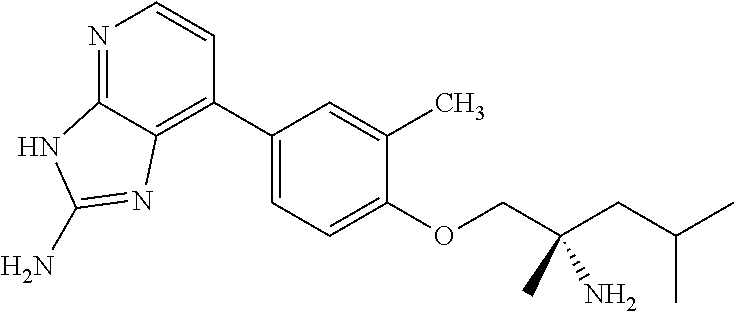
To a stirred solution of (S)-tert-butyl (1-(4-(2-amino-3H-imidazo[4,5-b]pyridin-7-yl)-2-methylphenoxy)-2,4-dimethylpentan-2-yl)carbamate (55 mg, 0.076 mmol) in dichloromethane (3 mL) was cooled to 0° C. was added TFA (0.25 mL, 3.24 mmol) dropwise under a nitrogen atmosphere. The reaction mixture was allowed to warm to room temperature and was stirred for 2h. The solution was concentrated under reduced pressure. The crude material was purified via preparative LC/MS using method-C to afford (S)-7-(4-((2-amino-2,4-dimethylpentyl)oxy)-3-methylphenyl)-3H-imidazo[4,5-b]pyridin-2-amine (6.9 mg, 0.019 mmol, 25% yield) as a pale yellow solid. 1H NMR (400 MHz, METHANOL-d4) δ 7.87-7.71 (m, 2H), 7.58-7.47 (m, 1H), 7.45-7.36 (m, 1H), 7.04 (d, J=8.5 Hz, 1H), 4.19-3.99 (m, 2H), 2.40 (s, 3H), 1.89 (d, J=11.0 Hz, 2H), 1.70 (d, J=9.0 Hz, 1H), 1.51 (s, 3H), 1.07 (m, 6H) ppm. LCMS (ESI) m/e 354.0 [(M+H)+, Calcd for C20H28N5O, 354.2]; LC/MS retention time (method H) tR=0.99 min. LCMS (ESI) m/e 354.0 [(M+H)+, Calcd for C20H28N5O, 354.2]; LC/MS retention time (method I) tR=0.85 min.

A mixture of 4-bromo-2-chlorophenol (1.2 g, 5.78 mmol), K2CO3 (2.398 g, 17.35 mmol) and (S)-tert-butyl 4-isobutyl-4-methyl-1,2,3-oxathiazolidine-3-carboxylate 2,2-dioxide (prepared as described in Example 251, Parts A-E) (2.036 g, 6.94 mmol) in DMF (20 mL) was heated at 80° C. overnight. The reaction mixture was cooled to 0° C. and quenched with aqueous ammonium chloride (50 mL). The reaction mixture was extracted with ethyl acetate (2×50 mL). The organic layer was washed with water (2×50 mL), brine (50 mL), dried over Na2SO4, and concentrated to afford (S)-tert-butyl (1-(4-bromo-2-chlorophenoxy)-2,4-dimethylpentan-2-yl)carbamate (1.5 g, 3.45 mmol, 60% yield) as a pale yellowish semi-solid. LCMS (ESI) m/e=366.0 [(M+H-tBu)+, calcd for C18H28BrClNO3 420.1]; LC/MS retention time (method A2): tR=2.51 min.

A mixture of (S)-tert-butyl (1-(4-bromo-2-chlorophenoxy)-2,4-dimethylpentan-2-yl)carbamate (1.2 g, 2.85 mmol), bis(pinacolato)diboron (0.797 g, 3.14 mmol), potassium acetate (0.840 g, 8.56 mmol and PdCl2 (dppf)-CH2Cl12 adduct (0.116 g, 0.143 mmol) in 1,4-dioxane (20 mL) was heated at 90° C. overnight. The reaction mixture was filtered through diatomaceous earth and the diatomaceous earth bed was washed with ethyl acetate (100 mL). The organic layer was washed with water (50 mL). The aqueous layer was re-extracted with ethyl acetate (2×50 mL).
The organic layer was collected, washed with brine, dried over Na2SO4, and concentrated under reduced pressure to afford (S)-tert-butyl (1-(2-chloro-4-(4,4,5,5-tetramethyl-1,3,2-dioxaborolan-2-yl)phenoxy)-2,4-dimethylpentan-2-yl)carbamate (1.2 g, 2.57 mmol, 90% yield) as colorless liquid. 1H NMR (400 MHz, CDCl3): δ 7.78 (d, J=1.60 Hz, 1H), 7.61-7.63 (m, 1H), 6.91 (d, J=8.00 Hz, 1H), 4.10-4.19 (m, 1H), 4.63 (s, 1H), 4.02 (d, J=8.80 Hz, 1H), 1.79-1.87 (m, 2H), 1.57-1.62 (m, 1H), 1.51 (s, 3H), 1.33-1.41 (m, 12H), 0.96-0.98 (m, 6H) ppm.

A stirred solution of (S)-tert-butyl (1-(2-chloro-4-(4,4,5,5-tetramethyl-1,3,2-dioxaborolan-2-yl)phenoxy)-2,4-dimethylpentan-2-yl)carbamate (98 mg, 0.209 mmol), N-(4-chloropyridin-2-yl)thiazole-2-carboxamide (50 mg, 0.209 mmol), cesium carbonate (136 mg, 0.417 mmol) in a mixture of 1,4-dioxane (5 mL) and water (0.5 mL) was purged with nitrogen gas for 10 min. XPhos 2nd generation precatalyst (24.62 mg, 0.031 mmol) was added in one portion and the reaction mixture was heated at 85° C. for 2 h. The solution was concentrated under reduced pressure. Water (50 mL) was added and the solution was extracted with EtOAc (2×50 mL). The combined organic extracts were washed with water (50 mL) and brine (50 mL), dried over sodium sulfate, filtered, and concentrated under reduced pressure. The residue was purified by silica gel chromatography (EtOAc in hexanes) to afford (S)-tert-butyl (1-(2-chloro-4-(2-(thiazole-2-carboxamido)pyridin-4-yl)phenoxy)-2,4-dimethylpentan-2-yl)carbamate (80 mg, 0.076 mmol, 37% yield) as a pale brown oil. The product was carried forward without further purification. LCMS (ESI) m/e 545.2 [(M+H)+, calcd for C27H34ClN4O4S, 545.2]; LC/MS retention time (Method F) tR=2.89 min.

To a stirred solution of (S)-tert-butyl (1-(2-chloro-4-(2-(thiazole-2-carboxamido)pyridin-4-yl)phenoxy)-2,4-dimethylpentan-2-yl)carbamate (78 mg, 0.074 mmol) in DCM (2 mL) cooled to 0° C. was added TFA (0.2 mL, 2.60 mmol) dropwise under a nitrogen atmosphere. The reaction mixture was allowed to warm to room temperature and stirred for 3 h. The solution was concentrated under reduced pressure. The crude material was purified via preparative LC/MS using method-A to afford (S)—N-(4-(4-((2-amino-2,4-dimethylpentyl)oxy)-3-chlorophenyl)pyridin-2-yl)thiazole-2-carboxamide (7 mg, 0.015 mmol, 20% yield) as a pale yellow solid. LCMS (ESI) m/e 445.0 [(M+H)+, calcd for C22H26ClN4O2S, 445.1]; LC/MS retention time (method H) tR=1.85 min. LCMS (ESI) m/e 445.0 [(M+H)+, calcd for C22H26ClN4O2S, 445.1]; LC/MS retention time (method I) tR=1.36 min. 1H NMR (400 MHz, METHANOL-d4) δ=8.54 (d, J=1.0 Hz, 1H), 8.42 (d, J=5.0 Hz, 1H), 8.08 (d, J=3.0 Hz, 1H), 8.00 (d, J=3.0 Hz, 1H), 7.88 (d, J=2.5 Hz, 1H), 7.76 (dd, J=2.0, 8.5 Hz, 1H), 7.48 (dd, J=1.8, 5.3 Hz, 1H), 7.30 (d, J=8.5 Hz, 1H), 3.8 (m, 2H), 1.7-1.9 (m, 2H), 1.5-1.6 (m, 1H), 1.31 (s, 3H), 0.90-0.95 (m, 6H) ppm.


To a stirred solution of (S)-tert-butyl (1-(2-cyano-4-(4,4,5,5-tetramethyl-1,3,2-dioxaborolan-2-yl)phenoxy)-2,4-dimethylpentan-2-yl)carbamate (96 mg, 0.209 mmol) (prepared as in Example 254, Part B-G), N-(4-chloropyridin-2-yl)thiazole-2-carboxamide (50 mg, 0.209 mmol), cesium carbonate (136 mg, 0.417 mmol) in a mixture of 1,4-dioxane (5 mL) and water (0.5 mL) was bubbled nitrogen gas for 5 min. To this mixture was added XPhos 2nd generation precatalyst (24.62 mg, 0.031 mmol) in one portion and the reaction mixture was heated to 85° C. and stirred for 2 h. The reaction mixture was allowed to cool to room temperature, then concentrated under reduced pressure. Water (50 mL) was added and the solution was extracted with EtOAc (2×50 mL). The combined organic extracts were washed with water (50 mL) and brine (50 mL), dried over sodium sulfate, filtered, and concentrated under reduced pressure. The residue was purified by silica gel chromatography (EtOAc in hexanes) to afford (S)-tert-butyl (1-(2-cyano-4-(2-(thiazole-2-carboxamido)pyridin-4-yl)phenoxy)-2,4-dimethylpentan-2-yl)carbamate (57 mg, 0.095 mmol, 45% yield) as a pale brown oil in 89% purity based on UV from LCMS. LCMS (ESI) m/e 536.2 [(M+H)+ calcd for C28H34N5O4S, 536.2]; LC/MS retention time (Method F) tR=2.63 min.

To a stirred solution of (S)-tert-butyl (1-(2-cyano-4-(2-(thiazole-2-carboxamido)pyridin-4-yl)phenoxy)-2,4-dimethylpentan-2-yl)carbamate (55 mg, 0.091 mmol) in DCM (2 mL) cooled to 0° C. was added TFA (0.2 mL, 2.60 mmol) dropwise under a nitrogen atmosphere. The reaction mixture was allowed to warm to room temperature and stirred for 3 h. The solution was concentrated under reduced pressure. The crude material was purified via preparative LC/MS using method-A to afford (S)—N-(4-(4-((2-amino-2,4-dimethylpentyl)oxy)-3-cyanophenyl)pyridin-2-yl)thiazole-2-carboxamide (13 mg, 0.029 mmol, 32% yield) as a pale yellow solid. 1H NMR (400 MHz, METHANOL-d4) δ 8.54 (d, J=1.0 Hz, 1H), 8.44 (d, J=5.5 Hz, 1H), 8.13 (d, J=2.0 Hz, 1H), 8.11-8.06 (m, 2H), 8.00 (d, J=3.0 Hz, 1H), 7.50 (dd, J=1.8, 5.3 Hz, 1H), 7.38 (d, J=8.5 Hz, 1H), 4.08 (d, J=2.0 Hz, 2H), 1.88 (s, 1H), 1.71-1.52 (m, 2H), 1.35 (s, 3H), 1.03 (m, 6H) ppm. LCMS (ESI) m/e 436.0 [(M+H)+, calcd for C23H26N5O2S, 436.2]; LC/MS retention time (method H) tR=1.62 min. LCMS (ESI) m/e 436.0 [(M+H)+, calcd for C23H26N5O2S, 436.2]; LC/MS retention time (method I) tR=1.26 min.

To a stirred solution of 1-(4-(3-chloro-4-methoxyphenyl)pyridin-2-yl)thiourea (400 mg, 0.967 mmol) (prepared as described in Example 257, Part C) in EtOH (20 mL) was added 1-chloropropan-2-one (1.5 mL, 0.967 mmol) dropwise under a nitrogen atmosphere. The reaction mixture was heated at 85° C. for 4 h. The reaction mixture was allowed to cool to room temperature then concentrated under reduced pressure. To the residue 20 g of ice was added and the solid was collected by vacuum filtration. The solid was washed with water (2×10 mL) and dried under vacuum to afford N-(4-(3-chloro-4-methoxyphenyl)pyridin-2-yl)-4-methylthiazol-2-amine (130 mg, 0.157 mmol, 16% yield) as an off white solid. The product was carried forward without further purification. LCMS (ESI) m/e 332.0 [(M+H), calcd for C16H15ClN3OS, 332.0]; LC/MS retention time (method B) tR=0.84 min.

To a stirred solution of N-(4-(3-chloro-4-methoxyphenyl)pyridin-2-yl)-4-methylthiazol-2-amine (125 mg, 0.151 mmol) in DCM (10 mL) cooled to −10° C. was added BBr3 (1.00 mL, 10.58 mmol) dropwise under a nitrogen atmosphere. The reaction mixture was allowed to warm to room temperature and stirred for 2 h. The reaction mixture was cooled to 0° C., and dry MeOH (20 mL) was added dropwise and the reaction mixture was stirred for 15 min. The solution was concentrated under reduced pressure. The residue was washed with diethyl ether (15 mL) and the solid obtained was collected by vacuum filtration and dried under vacuum to afford 2-chloro-4-(2-((4-methylthiazol-2-yl)amino)pyridin-4-yl)phenol (62 mg, 0.137 mmol, 91% yield). The product was carried forward without further purification. LCMS (ESI) m/e 318.0 [(M+H)+, calcd for C15H13ClN3OS, 318.0]; LC/MS retention time (Method F) tR=2.02 min.

A stirred solution of 2-chloro-4-(2-((4-methylthiazol-2-yl)amino)pyridin-4-yl)phenol (102 mg, 0.321 mmol) and potassium carbonate (444 mg, 3.21 mmol) in DMF (10 mL) was stirred under a nitrogen atmosphere for 15 min. To this mixture was added a solution of (S)-tert-butyl 4-isobutyl-4-methyl-1,2,3-oxathiazolidine-3-carboxylate 2,2-dioxide (prepared as described in Example 251, Parts A-E) (122 mg, 0.417 mmol) in (1 mL of DMF) and the reaction mixture was heated at 80° C. for 14 h. The solution was concentrated under reduced pressure. Water (50 mL) was added and the solution was extracted with EtOAc (2×50 mL). The combined organic extracts were washed with water (50 mL) and brine (50 mL). The organic layer was dried over sodium sulfate, filtered, and concentrated under reduced pressure. The residue was purified by silica gel chromatography (EtOAc in hexanes) to afford (S)-tert-butyl (1-(2-chloro-4-(2-((4-methylthiazol-2-yl)amino)pyridin-4-yl)phenoxy)-2,4-dimethylpentan-2-yl)carbamate (92 mg, 0.071 mmol, 22% yield) as colorless oil. LCMS (ESI) m/e 531.2 [(M+H)+, calcd for C27H36ClN4O3S, 531.2]; LC/MS retention time (Method F) tR=2.73 min.

To a stirred solution of (S)-tert-butyl (1-(2-chloro-4-(2-((4-methylthiazol-2-yl)amino)pyridin-4-yl)phenoxy)-2,4-dimethylpentan-2-yl)carbamate (90 mg, 0.069 mmol) in DCM (4 mL) cooled to 0° C. was added TFA (0.36 mL, 4.67 mmol) dropwise under a nitrogen atmosphere. The reaction mixture was allowed to warm to room temperature and stirred for 3 h. The solution was concentrated under reduced pressure. The crude material was purified via preparative LC/MS using method-B to afford (S)—N-(4-(4-((2-amino-2,4-dimethylpentyl)oxy)-3-chlorophenyl)pyridin-2-yl)-4-methylthiazol-2-amine (1.1 mg, 2.53 μmol, 4% yield) as a pale yellow solid. 1H NMR (400 MHz, DMSO-d6) δ 8.40-8.28 (m, 1H), 7.84-7.77 (m, 1H), 7.72-7.62 (m, 1H), 7.40 (s, 1H), 7.31 (s, 2H), 7.26-7.22 (m, 1H), 7.02 (s, 1H), 3.89-3.85 (m, 2H), 3.34-3.30 (m, 2H), 3.14-3.12 (m, 3H), 1.48-1.42 (m, 2H), 1.27-1.23 (m, 1H), 1.18 (s, 3H), 0.94 (m, 6H). LCMS (ESI) m/e 431.0 [(M+H)+, calcd for C22H28ClN4OS, 431.2]; LC/MS retention time (method H) tR=1.89 min. LCMS (ESI) m/e 431.0 [(M+H)+, calcd for C22H28ClN4OS, 431.2]; LC/MS retention time (method I) tR=1.20 min.

A stirred solution of 7-chloropyrazolo[1,5-a]pyrimidine (50 mg, 0.326 mmol), (6-fluoro-5-methylpyridin-3-yl)boronic acid (50.4 mg, 0.326 mmol), and cesium carbonate (212 mg, 0.651 mmol) in a mixture of 1,4-dioxane (5 mL) and water (0.5 mL) was purged with nitrogen. XPhos 2nd generation precatalyst (38.4 mg, 0.049 mmol) was added in one portion and the reaction mixture was heated to 85° C. and stirred for 2 h. The solution was concentrated under reduced pressure. Water (50 mL) was added and the solution was extracted with EtOAc (2×50 mL). The combined organic extracts were washed with water (50 mL) and brine (50 mL), dried over sodium sulfate, filtered, and concentrated under reduced pressure. The residue was purified by silica gel chromatography (EtOAc in hexanes) to afford 7-(6-fluoro-5-methylpyridin-3-yl)pyrazolo[1,5-a]pyrimidine (38 mg, 0.165 mmol, 51% yield). LCMS (ESI) m/e 229.2 [(M+H)+, calcd for C12H10FN4, 229.1]; LC/MS retention time (method D) tR=1.86 min.

To a stirred solution of (R)-2,4-dimethyl-1-((3-methyl-5-(pyrazolo[1,5-a]pyrimidin-7-yl)pyridin-2-yl)oxy)pentan-2-amine (5 mg, 0.013 mmol) and (R)-2-amino-2,4-dimethylpentan-1-ol (27.4 mg, 0.209 mmol) in DMF (2 mL) was added cesium carbonate (52.3 mg, 0.160 mmol) under a nitrogen atmosphere. The reaction mixture was heated at 85° C. for 6 h. The reaction mixture was passed through diatomaceous earth and the diatomaceous earth pad was washed with MeOH (5 mL). The filtrate was concentrated under reduced pressure. The crude material was purified via preparative LC/MS using method-A to afford (R)-2,4-dimethyl-1-((3-methyl-5-(pyrazolo[1,5-a]pyrimidin-7-yl)pyridin-2-yl)oxy)pentan-2-amine (5 mg, 0.013 mmol, 8% yield) as a pale yellow solid. 1H NMR (400 MHz, METHANOL-d4) δ 8.82 (d, J=1.5 Hz, 1H), 8.57 (d, J=4.5 Hz, 1H), 8.37 (dd, J=1.0, 2.5 Hz, 1H), 8.24 (d, J=2.5 Hz, 1H), 7.19 (d, J=4.5 Hz, 1H), 6.81 (d, J=2.5 Hz, 1H), 4.49 (s, 2H), 2.42 (s, 3H), 1.93-1.78 (m, 2H), 1.67 (dd, J=5.5, 14.1 Hz, 1H), 1.46 (s, 3H), 1.07 (m, 6H). LCMS (ESI) m/e 340.2 [(M+H)+, calcd for C19H26N5O, 340.2]; LC/MS retention time (method J) tR=1.68 min. LCMS (ESI) m/e 340.2 [(M+H)+, calcd for C19H26N5O, 340.2]; LC/MS retention time (method H) tR=1.86 min.

A stirred solution of 7-chloropyrazolo[1,5-a]pyrimidine (100 mg, 0.651 mmol), (5-chloro-6-fluoropyridin-3-yl)boronic acid (114 mg, 0.651 mmol), and cesium carbonate (424 mg, 1.302 mmol) in a mixture of 1,4-dioxane (5 mL) and water (0.5 mL) was purged with nitrogen. PdCl2(dppf)-CH2Cl2 adduct (80 mg, 0.098 mmol) was added in one portion and the reaction mixture was heated to 85° C. and stirred for 2 h. The solution cooled to room temperature and was concentrated under reduced pressure. Water (50 mL) was added and the solution was extracted with EtOAc (2×50 mL). The combined organic extracts were washed with water (50 mL) and brine (50 mL), dried over sodium sulfate, filtered, and concentrated under reduced pressure. The residue was purified by silica gel chromatography (EtOAc in hexanes) to afford 7-(5-chloro-6-fluoropyridin-3-yl)pyrazolo[1,5-a]pyrimidine (56 mg, 0.122 mmol, 19% yield). LCMS (ESI) m/e 249.0 [(M+H)+, calcd for C11H7ClFN4, 249.0]; LC/MS retention time (method B) tR=0.95 min.

Part B: (R)-1-((3-chloro-5-(pyrazolo[1,5-a]pyrimidin-7-yl)pyridin-2-yl)oxy)-2,4-dimethylpentan-2-amine
To a stirred solution of (R)-2-amino-2,4-dimethylpentan-1-ol (15.39 mg, 0.117 mmol) and 7-(5-chloro-6-fluoropyridin-3-yl)pyrazolo[1,5-a]pyrimidine (54 mg, 0.117 mmol) in DMF (5 mL) was added cesium carbonate (38.2 mg, 0.117 mmol) under a nitrogen atmosphere. The reaction mixture was heated at 80° C. and stirred for 12 h. The solution was concentrated under reduced pressure. The crude material was purified via preparative LC/MS using method-A to afford (R)-1-((3-chloro-5-(pyrazolo[1,5-a]pyrimidin-7-yl)pyridin-2-yl)oxy)-2,4-dimethylpentan-2-amine (2 mg, 5.28 μmol, 5% yield) as a pale yellow solid. 1H NMR (400 MHz, METHANOL-d4) δ=8.98-8.86 (m, 1H), 8.79-8.72 (m, 1H), 8.60 (d, J=4.5 Hz, 1H), 8.25 (d, J=2.5 Hz, 1H), 7.24 (d, J=4.5 Hz, 1H), 6.83 (d, J=2.5 Hz, 1H), 4.68-4.58 (m, 2H), 1.99-1.85 (m, 2H), 1.72 (d, J=9.0 Hz, 1H), 1.54 (s, 3H), 1.08 (m, 6H) ppm. LCMS (ESI) m/e 360.2, [(M+H)+, calcd for C18H23ClN5O, 360.1]; LC/MS retention time (method I) tR=1.12 min. LCMS (ESI) m/e 360.2 [(M+H)+, calcd for C18H23ClN5O, 360.1]; LC/MS retention time (method H) tR=1.50 min.

Ethyl acetate (5 g, 56.8 mmol) was added to a solution of NaH (60%) (3.40 g, 142 mmol) in THF (50 mL) at room temperature. The internal temperature of the reaction mixture was adjusted to 40° C. and ethyl formate (8.41 g, 114 mmol) was added dropwise to maintain the internal temperature between 40-42° C. The reaction mixture was stirred at room temperature for 16 h. The reaction mixture was filtered under argon and the white solid obtained was washed with hexane. The resulting white solid was dried to afford sodium (E)-3-ethoxy-3-oxoprop-1-en-1-olate (4.8 g, 34.8 mmol, 61% yield). The product was taken to next step without further purification. 1H NMR (400 MHz, DMSO-d6): δ 8.06 (d, J=5.60 Hz, 1H), 4.06 (d, J=5.60 Hz, 1H), 3.76-3.88 (m, 2H), 1.03-1.12 (m, 3H) ppm.

To a solution of 5-cyclopropyl-1H-pyrazol-3-amine (1 g, 8.12 mmol) in ethanol (10 mL) was added sodium (E)-3-ethoxy-3-oxoprop-1-en-1-olate (1.121 g, 8.12 mmol) portionwise and the mixture stirred for 5 min. The reaction mixture was heated at 88° C. for 14 h. The reaction mixture was concentrated under reduced pressure. Dichloromethane was added to the residue and the mixture stirred for 20 min. An off-white solid formed and was collected by vacuum filtration and dried to afford 2-cyclopropylpyrazolo [1,5-a]pyrimidin-7(4H)-one (0.8 g, 4.57 mmol, 56% yield) which was carried forward without further purification. LCMS (ESI) m/e 176.2 [(M+H)+, calcd for C9H10N3O 176.1]; LC/MS retention time (method A1): tR=1.43 min.

2-Cyclopropylpyrazolo [1,5-a]pyrimidin-7-ol (0.5 g, 2.85 mmol) was cooled to 0° C. in a 100 mL round bottom flask. POCl3 (1.330 mL, 14.27 mmol) was added dropwise followed by slow addition of DIPEA (0.748 mL, 4.28 mmol) to the reaction mixture and stirred for 5 min at 0° C. The reaction mixture was allowed to warm to room temperature and heated at 105° C. for 12 h. The reaction mixture was concentrated under reduced pressure. The brown residue obtained was diluted with ice-water and basified with saturated sodium carbonate solution and extracted with ethyl acetate (3×25 mL). The ethyl acetate layer was dried over Na2SO4, filtered, and concentrated to afford the crude 7-chloro-2-cyclopropylpyrazolo [1,5-a]pyrimidine (crude yield) (0.48 g, 2.479 mmol, 87% yield) as a brown solid which was carried forward without further purification. LCMS (ESI) m/e 194.2 [(M+H)+, calcd for C9H9ClN3 194.0]; LC/MS retention time (method A1): tR=1.95 min.

To a stirred solution of 7-chloro-2-cyclopropylpyrazolo[1,5-a]pyrimidine (100 mg, 0.516 mmol), (6-fluoro-5-methylpyridin-3-yl)boronic acid (80 mg, 0.516 mmol), and cesium carbonate (337 mg, 1.033 mmol) in a mixture of 1,4-dioxane (5 mL) and water (0.5 mL) was purged with nitrogen. XPhos 2nd generation precatalyst (61.0 mg, 0.077 mmol) was added in one portion and the reaction mixture was heated to 85° C. and stirred for 2 h. The reaction mixture was allowed to cool to room temperature. Water (50 mL) was added and the solution was extracted with EtOAc (2×50 mL). The combined organic extracts were washed with water (50 mL) and brine (50 mL), dried over sodium sulfate, filtered, and concentrated under reduced pressure. The residue was purified by silica gel chromatography (EtOAc in hexanes) to afford 2-cyclopropyl-7-(6-fluoro-5-methylpyridin-3-yl)pyrazolo[1,5-a]pyrimidine (52 mg, 0.081 mmol, 16% yield). The product was carried forward without further purification. LCMS (ESI) m/e 269.2 [(M+H)+, calcd for C15H14FN4, 269.1]; LC/MS retention time (method H) tR=2.31 min.

To a stirred solution of (R)-1-((5-(2-cyclopropylpyrazolo[1,5-a]pyrimidin-7-yl)-3-methylpyridin-2-yl)oxy)-2,4-dimethylpentan-2-amine (3 mg, 7.67 μmol) and (R)-2-amino-2,4-dimethylpentan-1-ol (22.25 mg, 0.170 mmol) in THF (2 mL) was added potassium tert-butoxide (1M in THF) (0.130 mL, 0.130 mmol) under a nitrogen atmosphere. The reaction mixture was stirred at rt for 12 h. The solution was concentrated under reduced pressure. Water (50 mL) was added and the solution was extracted with EtOAc (2×50 mL). The combined organic extracts were washed with water (30 mL) and brine (30 mL), dried over sodium sulfate, filtered, and concentrated under reduced pressure. The crude material was purified via preparative LC/MS using method-A to afford (R)-1-((5-(2-cyclopropylpyrazolo[1,5-a]pyrimidin-7-yl)-3-methylpyridin-2-yl)oxy)-2,4-dimethylpentan-2-amine (3 mg, 7.67 μmol, 6% yield) as a pale yellow solid. 1H NMR (400 MHz, METHANOL-d4) δ 8.86 (d, J=3.0 Hz, 1H), 8.45 (d, J=4.5 Hz, 1H), 8.38-8.32 (m, 1H), 7.07 (d, J=4.5 Hz, 1H), 6.46 (s, 1H), 4.50 (s, 2H), 2.42 (s, 3H), 2.22-2.11 (m, 1H), 1.93-1.79 (m, 2H), 1.67 (dd, J=5.5, 14.1 Hz, 1H), 1.47 (s, 3H), 1.13-1.04 (m, 8H), 0.97-0.92 (m, 2H) ppm. LCMS (ESI) m/e 380.2 [(M+H)+, calcd for C22H30N5O, 380.2]; LC/MS retention time (method I) tR=1.98 min. LCMS (ESI) m/e 380.2 [(M+H)+, calcd for C22H30N5O, 380.2]; LC/MS retention time (method H) tR=2.30 min.

To a stirred solution of 5-bromo-2-methoxyaniline (1 g, 4.95 mmol) in conc. HCl (5 mL) and water (20 mL) was added potassium thiocyanate (0.481 g, 4.95 mmol) and the reaction mixture was heated at 100° C. for 24 h. The reaction mixture was allowed to cool to room temperature. Water (150 mL) was added and the solution was extracted with CHCl3 (3×80 mL). The combined organic extracts were washed with brine (150 mL), dried over sodium sulfate, filtered, and concentrated under reduced pressure. The residue was purified by silica gel chromatography (EtOAc in hexanes) to afford 1-(5-bromo-2-methoxyphenyl)thiourea (960 mg, 2.94 mmol, 59% yield) as a white solid. LCMS (ESI) m/e 261.0 [(M+2H)+, calcd for C8H10BrN2OS, 260.9]; LC/MS retention time (method A1) tR=2.09 min.

To a stirred solution of 1-(5-bromo-2-methoxyphenyl)thiourea (960 mg, 2.94 mmol) in CHCl3 (25 mL) cooled to 0° C. was added bromine (0.303 mL, 5.88 mmol) dropwise over a period of 3 min under a nitrogen atmosphere. The reaction mixture was stirred at ambient temperature for 30 min, then heated to reflux at 70° C. for 1 h. The reaction mixture was allowed to cool to room temperature. The solid obtained was collected by vacuum filtration. The solid was dried under vacuum at room temperature to afford 7-bromo-4-methoxybenzo[d]thiazol-2-amine (940 mg, 2.79 mmol, 95% yield) as a pale yellow solid. The product was carried forward without further purification. LCMS (ESI) m/e 259.0 [(M+H)+, calcd for C8H8BrN2OS, 258.9]; LC/MS retention time (method A1) tR=1.78 min.

To a stirred solution of 7-bromo-4-methoxybenzo[d]thiazol-2-amine (100 mg, 0.386 mmol) in tetrahydrofuran (6 mL) was added tert-butyl nitrite (0.25 mL, 2.085 mmol) dropwise under a nitrogen atmosphere. The reaction mixture was heated at 55° C. for 14 h. The reaction mixture was allowed to cool to room temperature. Water 10 mL was added and the solution extracted with EtOAc (2×15 mL). The combined organic extracts were washed with brine (10 mL), dried over sodium sulfate, filtered, and concentrated under reduced pressure. The residue was purified by silica gel chromatography (EtOAc in hexanes) to afford 7-bromo-4-methoxybenzo[d]thiazole (89 mg, 0.350 mmol, 91% yield) as an off-white solid. 1H NMR (400 MHz, METHANOL-d4) δ 9.22 (s, 1H), 7.61 (d, J=8.40 Hz, 1H), 7.07 (d, J=8.40 Hz, 1H), 4.06 (s, 3H) ppm. LCMS (ESI) m/e 244.0 [(M+H)+, calcd for C8H7BrNOS, 244.0]; LC/MS retention time (method A1) tR=2.17 min.

To a stirred solution of 7-bromo-4-methoxybenzo[d]thiazole (80 mg, 0.315 mmol) in DCM (5 mL) cooled to 0° C. was added BBr3 1M in DCM (0.629 mL, 0.629 mmol) dropwise under nitrogen atmosphere. The reaction mixture was allowed to warm to room temperature and stirred for 50 min. The reaction mixture was cooled to 0° C., quenched slowly with dry MeOH (15 mL) then stirred for 10 min. the solution was concentrated under reduced pressure. Obtained 7-bromobenzo[d]thiazol-4-ol (78 mg, 0.312 mmol, 99% yield) as a brown solid. The solid was used as is to the next step without further purification. LCMS (ESI) m/e 229.8 [(M+H)+, Calcd for C7H5BrNOS, 229.9]; LC/MS retention time (method A1) tR=2.09 min.

To a stirred solution of 7-bromobenzo[d]thiazol-4-ol (75 mg, 0.300 mmol) in DMF (5 mL) was added potassium carbonate (166 mg, 1.200 mmol) and the reaction mixture was stirred at room temperature for 10 min. A solution of (S)-tert-butyl 4-isobutyl-4-methyl-1,2,3-oxathiazolidine-3-carboxylate 2,2-dioxide (prepared as described in Example 251, Parts A-E) (88 mg, 0.300 mmol) in 0.5 mL of DMF was added. The reaction mixture was heated at 80° C. and stirred for 14 h. The reaction mixture was allowed to cool to room temperature, then was concentrated under reduced pressure. Water (15 mL) was added and the solution was extracted with EtOAc (2×15 mL). The combined organic extracts were washed with water (10 mL) and brine (10 mL), dried over sodium sulfate, filtered, and concentrated under reduced pressure. Obtained (S)-tert-butyl (1-((7-bromobenzo[d]thiazol-4-yl)oxy)-2,4-dimethylpentan-2-yl)carbamate (105 mg, 0.156 mmol, 52% yield). The material was used as is in the next step without further purification. LCMS (ESI) m/e 443.0 [(M+H)+, calcd for C19H28BrN2O3S, 443.1]; LC/MS retention time (method A1) tR=2.56 min.

A stirred solution of (S)-tert-butyl (1-((7-bromobenzo[d]thiazol-4-yl)oxy)-2,4-dimethylpentan-2-yl)carbamate (40 mg, 0.060 mmol), (2-methylpyridin-4-yl)boronic acid (8.15 mg, 0.060 mmol) and cesium carbonate (38.8 mg, 0.119 mmol) in a mixture of 1,4-dioxane (10 mL) and water (2 mL) was purged argon for 2 min. PdCl2(dppf)-CH2Cl2 adduct (2.431 mg, 2.98 μmol) was added in one portion and the reaction mixture was heated at 85° C. for 12 h.
The reaction mixture was allowed to cool to room temperature. Water (50 mL) was added and the solution was extracted with EtOAc (2×50 mL). The combined organic extracts were washed with water (100 mL) and brine (100 mL). The organic layer was dried over sodium sulfate, filtered, and concentrated under reduced pressure. The residue obtained was purified by silica gel chromatography (EtOAc in hexanes) to afford (S)-tert-butyl (2,4-dimethyl-1-((7-(2-methylpyridin-4-yl)benzo[d]thiazol-4-yl)oxy)pentan-2-yl)carbamate (26 mg, 0.055 mmol, 93% yield) in 97% purity based on UV from LCMS. LCMS (ESI) m/e 456.2 [(M+H)+, calcd for C25H34N3O3S, 456.2]; LC/MS retention time (method A1) tR=2.58 min.

To a stirred solution of (S)-tert-butyl (2,4-dimethyl-1-((7-(2-methylpyridin-4-yl)benzo[d]thiazol-4-yl)oxy)pentan-2-yl)carbamate (25 mg, 0.053 mmol) in DCM (5 mL) was added TFA (4.10 μl, 0.053 mmol) dropwise under a nitrogen atmosphere at room temperature. The reaction mixture was stirred at room temperature for 12 h. The solution was concentrated under reduced pressure. The crude material was purified via preparative LC/MS using method-B to afford (S)-2,4-dimethyl-1-((7-(2-methylpyridin-4-yl)benzo[d]thiazol-4-yl)oxy)pentan-2-amine (5 mg, 8.48 μmol, 16% yield) as a pale yellow solid. 1H NMR (400 MHz, METHANOL-d4) δ 9.52 (s, 1H), 8.76 (d, J=6.0 Hz, 1H), 8.19-8.07 (m, 2H), 7.95 (d, J=8.5 Hz, 1H), 7.43 (d, J=8.5 Hz, 1H), 4.54-4.36 (m, 2H), 2.85 (s, 3H), 2.00-1.88 (m, 2H), 1.79 (d, J=9.0 Hz, 1H), 1.59 (s, 3H), 1.14-0.97 (m, 6H) ppm. LCMS (ESI) m/e 356.2 [(M+H)+, calcd for C20H26N30S, 356.2]; LC/MS retention time (method H) tR=1.89 min. LCMS (ESI) m/e 356.2 [(M+H)+, calcd for C20H26N30S, 356.2]; LC/MS retention time (method I) tR=1.35 min.

To a stirred solution of (S)-tert-butyl (1-((7-bromobenzo[d]thiazol-4-yl)oxy)-2,4-dimethylpentan-2-yl)carbamate (40 mg, 0.060 mmol) (prepared as described in Example 267, Parts A-E), methyl (4-(4,4,5,5-tetramethyl-1,3,2-dioxaborolan-2-yl)pyridin-2-yl)carbamate (16.56 mg, 0.060 mmol) and cesium carbonate (38.8 mg, 0.119 mmol) in a mixture of 1,4-dioxane (10 mL) and water (2 mL) was purged argon for 2 min. PdCl2(dppf)-CH2Cl2 adduct (2.431 mg, 2.98 μmol) was added in one portion and the reaction mixture was heated at 85° C. for 10 h. The reaction mixture was allowed to cool to room temperature and concentrated under reduced pressure. Water (50 mL) was added and the solution was extracted with EtOAc (2×50 mL). The combined organic extracts were washed with water (100 mL) and brine (100 mL), dried over sodium sulfate, filtered, and concentrated under reduced pressure. The residue was purified by silica gel chromatography (EtOAc in hexanes) to afford (S)-methyl (4-(4-((2-(Boc-amino)-2,4-dimethylpentyl)oxy)benzo[d]thiazol-7-yl)pyridin-2-yl)carbamate (96 mg, 0.039 mmol, 66% yield). The product was carried forward without further purification. LCMS (ESI) m/e 515.2 [(M+H)+, calcd for C26H35N4O5S, 515.2]; LC/MS retention time (method A1) tR=2.57 min.

To a stirred solution of (S)-methyl (4-(4-((2-(Boc-amino)-2,4-dimethylpentyl)oxy)benzo[d]thiazol-7-yl)pyridin-2-yl)carbamate (96 mg, 0.039 mmol) in DCM (2 mL) was added TFA (0.15 mL, 1.947 mmol) dropwise under a nitrogen atmosphere. The reaction mixture was allowed to stir at ambient temperature for 3 h. The solution was concentrated under reduced pressure. The residue was purified via preparative LC/MS using method-B to afford (S)-methyl (4-(4-((2-amino-2,4-dimethylpentyl)oxy)benzo[d]thiazol-7-yl)pyridin-2-yl)carbamate (7 mg, 10.57 μmol, 28% yield) as a pale yellow solid. 1H NMR (400 MHz, METHANOL-d4) δ 9.44 (s, 1H), 8.39 (d, J=5.5 Hz, 1H), 8.29 (d, J=1.0 Hz, 1H), 7.78 (d, J=8.5 Hz, 1H), 7.43 (dd, J=1.8, 5.3 Hz, 1H), 7.35 (d, J=8.0 Hz, 1H), 4.45 (d, J=10.0 Hz, 1H), 4.31 (d, J=10.5 Hz, 1H), 3.83 (s, 3H), 1.91 (s, 2H), 1.83-1.73 (m, 1H), 1.58 (s, 3H), 1.15-0.98 (m, 6H) ppm. LCMS (ESI) me 415.2 [M+H)+, calcd for C21H27N4O3S, 415.2]; LC/MS retention time (method H) tR=1.87 min. LCMS (ESI) m/e 415.2 [M+H)+, calcd for C21H27N4O3S, 415.2]; LC/MS retention time (method I) tR=1.60 min.

To a solution of 4,6-dichloropyrimidin-5-amine (250 mg, 1.524 mmol) in methanol (15 mL) was added sodium hydrosulfide hydrate (113 mg, 1.524 mmol) under a nitrogen atmosphere. The reaction mixture was heated to 75° C. for 1 h. The reaction mixture was concentrated under reduced pressure and 10% aqueous sodium hydroxide solution was added. The pH was adjusted to pH 5 by adding acetic acid. The solution was extracted with ethyl acetate (2×50 mL). The ethyl acetate layer was dried over Na2SO4, filtered, and concentrated under reduced pressure to afford 5-amino-6-chloropyrimidine-4-thiol (270 mg, 1.186 mmol, 78% yield) as a pale brown solid which was taken to next step without further purification. LCMS (ESI) m/e 162.4 [(M+H)+, calcd for C4H5ClN3S 162.0]; LC/MS retention time (method B): tR=0.55 min.

A mixture of 5-amino-6-chloropyrimidine-4-thiol (200 mg, 1.238 mmol) and triethylorthoacetate (5 mL, 27.1 mmol) was stirred at 130° C. for 3 h. The reaction mixture was allowed to cool to room temperature and concentrated under reduced pressure. The residue was purified by silica gel column chromatography eluting pet ether/ethyl acetate (0-25%) to afford 7-chloro-2-methylthiazolo[5,4-d]pyrimidine (65 mg, 0.350 mmol, 28% yield) as a brown solid. LCMS (ESI) m/e 186.4 [(M+H)+, calcd for C6H5ClN3S 185.98]; LC/MS retention time (method B): tR=0.72 min.

A solution 7-chloro-2-methylthiazolo[5,4-d]pyrimidine (40 mg, 0.215 mmol), (S)-tert-butyl (2,4-dimethyl-1-(4-(4,4,5,5-tetramethyl-1,3,2-dioxaborolan-2-yl)-2-(trifluoromethyl)phenoxy)pentan-2-yl)carbamate (prepared as described in Example 255, Parts A and B) (108 mg, 0.215 mmol), cesium carbonate (140 mg, 0.431 mmol) in 1,4-dioxane (4 mL) and water (1 mL) was purged with nitrogen gas for 5 min. PdCl2(dppf)-CH2Cl2 adduct (8.80 mg, 10.77 μmol) was added to the reaction mixture and reaction mixture was heated at 85° C. for 12 h. The reaction mixture was concentrated and to the residue was added water (50 mL) and the solution was extracted with ethyl acetate (2×30 mL). The organic layer was separated, washed with water (50 mL) and brine (50 mL), dried over Na2SO4, filtered, and concentrated under reduced pressure. The crude product was purified by Preparative TLC using 30% ethyl acetate in hexanes. The required spot was collected, dissolved in dichloromethane (25 mL), filtered and concentrated under reduced pressure to afford (S)-tert-butyl (2,4-dimethyl-1-(4-(2-methylthiazolo[5,4-d]pyrimidin-7-yl)-2-(trifluoromethyl)phenoxy)pentan-2-yl)carbamate (56 mg, 0.049 mmol, 23% yield) as yellow oil. LCMS (ESI) m/e 525.6 [(M+H)+, calcd for C25H32F3N4O3S 525.2]; LC/MS retention time (method B): tR=1.42 min.

To a solution of (S)-tert-butyl (2,4-dimethyl-1-(4-(2-methylthiazolo[5,4-d]pyrimidin-7-yl)-2-(trifluoromethyl)phenoxy)pentan-2-yl)carbamate (50 mg, 0.044 mmol) in dichloromethane (2 mL), was added TFA (0.3 mL, 3.89 mmol). The reaction mixture was allowed to stir for 2 h at room temperature, then concentrated under reduced pressure. The crude material was purified by prep LC/MS (method A) to afford (S)-2,4-dimethyl-1-(4-(2-methylthiazolo[5,4-d]pyrimidin-7-yl)-2-(trifluoromethyl)phenoxy)pentan-2-amine (5 mg. 0.012 mmol, 26% yield) as a pale yellow solid. LCMS (ESI) m/e 425.2 [(M+H)+, calcd for C20H24F3N4OS 425.2]; LC/MS retention time (method H): tR=2.96 min; LC/MS retention time (method I): tR=2.29 min. 1H NMR (400 MHz, Methanol-d4): δ 9.18 (d, J=2.01 Hz, 1H), 9.11-9.16 (m, 1H), 9.06 (s, 1H), 7.41 (d, J=8.53 Hz, 1H), 4.10 (d, J=6.02 Hz, 2H), 2.98 (s, 3H), 1.83-1.91 (m, 1H), 1.64 (m, 2H), 1.35 (s, 3H), 1.03 (m 6H) ppm.

A solution 7-chloro-2-methylthiazolo[5,4-d]pyrimidine (prepared as described in Example 270) (40 mg, 0.215 mmol), (S)-tert-butyl (1-(2-cyano-4-(4,4,5,5-tetramethyl-1,3,2-dioxaborolan-2-yl)phenoxy)-2,4-dimethylpentan-2-yl)carbamate (prepared as in Example 254, Part B-G) (99 mg, 0.215 mmol), cesium carbonate (140 mg, 0.431 mmol) in 1,4-dioxane (4 mL) and water (1 mL) was purged with nitrogen gas for 5 min. PdCl2(dppf)-CH2Cl2 adduct (8.80 mg, 10.77 μmol) was added to the reaction mixture and reaction mixture was heated at 85° C. for 12 h. The reaction mixture was concentrated and to the residue was added water (50 mL) and the solution was extracted with ethyl acetate (2×50 mL). The organic layer was separated, washed with water (30 mL) and brine (30 mL), dried over Na2SO4, and concentrated under reduced pressure. The crude product was purified by preparative TLC using 30% ethyl acetate in hexanes. The required spot was collected, dissolved in dichloromethane (25 mL), filtered and concentrated under reduced pressure to afford (S)-tert-butyl (1-(2-cyano-4-(2-methylthiazolo[5,4-d]pyrimidin-7-yl)phenoxy)-2,4-dimethylpentan-2-yl)carbamate (82 mg, 0.095 mmol, 44% yield) as colorless oil. LCMS (ESI) m/e 482.6 [(M+H)+, calcd for C25H32N5O3S 482.2]; LC/MS retention time (method B): tR=1.33 min.

To a solution of (S)-tert-butyl (1-(2-cyano-4-(2-methylthiazolo[5,4-d]pyrimidin-7-yl)phenoxy)-2,4-dimethylpentan-2-yl)carbamate (80 mg, 0.086 mmol) in dichloromethane (5 mL) was added TFA (6.65 μl, 0.086 mmol). The reaction mixture was allowed to stir for 3 h at room temperature and then was concentrated under reduced pressure. The crude material was purified by prep LC/MS (method B) which afforded (S)-2-((2-amino-2,4-dimethylpentyl)oxy)-5-(2-methylthiazolo[5,4-d]pyrimidin-7-yl)benzonitrile (15 mg, 0.038 mmol, 44% yield) as a pale yellow solid. LCMS (ESI) m/e 382.2 [(M+H)+, calcd for C20H24N5OS 382.2]; LC/MS retention time (method H): tR=2.56 min; LC/MS retention time (method I): tR=2.17 min. 1H NMR (400 MHz, Methanol-d4): δ 9.20 (d, J=2.01 Hz, 1H), 9.14 (dd, J=9.04, 2.01 Hz, 1H), 9.08 (s, 1H), 7.49 (d, J=9.04 Hz, 1H), 4.38 (d, J=2.01 Hz, 2H), 2.99 (s, 3H), 1.96-1.86 (m, 2H), 1.77 (d, J=5.02 Hz, 1H), 1.58 (s, 3H), 1.09 (m, 6H) ppm.

A solution 7-chloropyrazolo[1,5-a]pyrimidine (65 mg, 0.423 mmol), (5-chloro-6-fluoropyridin-3-yl)boronic acid (74.2 mg, 0.423 mmol), cesium carbonate (276 mg, 0.847 mmol) in a mixture in 1,4-dioxane (5 mL) and water (0.5 mL) was purged with nitrogen gas for 5 min. PdCl2(dppf)-CH2Cl2 adduct (17.28 mg, 0.021 mmol) was added to the reaction mixture and reaction mixture was heated at 85° C. for 90 min. The reaction mixture was concentrated and to the residue was added water (15 mL) and the solution was extracted with ethyl acetate (2×15 mL). The organic layer was separated, washed with water (20 mL) and brine (20 mL), dried over Na2SO4, and concentrated under reduced pressure to afford crude 7-(5-chloro-6-fluoropyridin-3-yl)pyrazolo[1,5-a]pyrimidine (95 mg, 0.191 mmol, 45% yield) as a pale yellow solid which was taken to next step without any further purification. LCMS (ESI) m/e 249.5 [(M+H)+, calcd for C11H7ClFN4 249.0]; LC/MS retention time (method B): tR=0.89 min.

To a solution of 7-(5-chloro-6-fluoropyridin-3-yl)pyrazolo[1,5-a]pyrimidine (40 mg, 0.161 mmol) and (S)-2-amino-2,4-dimethylpentan-1-ol (21.11 mg, 0.161 mmol) in tetrahydrofuran (3 mL) was added potassium tert-butoxide (1M in THF) (0.161 mL, 0.161 mmol) under a nitrogen atmosphere. The reaction mixture was allowed to stir for 2 h at room temperature, then concentrated under reduced pressure. The crude material was purified by prep LC/MS (method A) which afforded (S)-1-((3-chloro-5-(pyrazolo[1,5-a]pyrimidin-7-yl)pyridin-2-yl)oxy)-2,4-dimethylpentan-2-amine, TFA (10 mg, 0.021 mmol, 13% yield) as a pale yellow solid. LCMS (ESI) m/e 360.2 [(M+H)+, calcd for C18H23ClN5O TFA 360.2]; LC/MS retention time (method H): tR=2.14 min; LC/MS retention time (method I): tR=1.94 min. 1H NMR (400 MHz, Methanol-d4): δ 8.87-8.94 (m, 1H), 8.75 (d, J=2.51 Hz, 1H), 8.59 (d, J=4.52 Hz, 1H), 8.25 (d, J=2.51 Hz, 1H), 7.24 (d, J=4.52 Hz, 1H), 6.83 (d, J=2.01 Hz, 1H), 4.64 (d, J=4.02 Hz, 2H), 1.89-1.96 (m, 2H), 1.73 (d, J=8.53 Hz, 1H), 1.55 (s, 3H), 1.08 (m, 6H) ppm.

A stirred solution of 7-chloropyrazolo[1,5-a]pyrimidine (65 mg, 0.423 mmol), (6-fluoro-5-methylpyridin-3-yl)boronic acid (65.6 mg, 0.423 mmol), cesium carbonate (276 mg, 0.847 mmol) in a mixture of 1,4-dioxane (5 mL) and water (0.5 mL) was purged with nitrogen for 5 min. PdCl2(dppf)-CH2Cl2 adduct (17.28 mg, 0.021 mmol) was added in one portion and the reaction mixture was heated at 85° C. and stirred for 2 h. The reaction mixture was allowed to cool to room temperature. Water (50 mL) was added and the solution was extracted with EtOAc (2×30 mL). The combined organic extracts were washed with water (70 mL) and brine (50 mL). The organic layer was dried over sodium sulfate, filtered, and concentrated under reduced pressure. The residue was purified by silica gel chromatography (EtOAc in hexanes) to afford 7-(6-fluoro-5-methylpyridin-3-yl)pyrazolo [1,5-a]pyrimidine (79 mg, 0.211 mmol, 50% yield). LCMS (ESI) m/e 229.2 [(M+H)+, calcd for C12H10FN4, 229.0]; LC/MS retention time (method A1) tR=1.70 min.

To a stirred solution of 7-(6-fluoro-5-methylpyridin-3-yl)pyrazolo[1,5-a]pyrimidine (40 mg, 0.107 mmol) and (S)-2-amino-2,4-dimethylpentan-1-ol (14.03 mg, 0.107 mmol) in tetrahydrofuran (3 mL) was added potassium tert-butoxide (1M in THF) (0.267 mL, 0.267 mmol) under a nitrogen atmosphere at ambient temperature. The reaction mixture was allowed to stir for 2 h. MeOH (2 mL) was added to the reaction mixture and the reaction mixture was filtered. The filtrate was concentrated under reduced pressure and purified via preparative LC/MS using method-A to afford (S)-2,4-dimethyl-1-((3-methyl-5-(pyrazolo[1,5-a]pyrimidin-7-yl)pyridin-2-yl)oxy)pentan-2-amine (25 mg, 0.072 mmol, 68% yield) as a pale yellow solid. 1H NMR (400 MHz, METHANOL-d4) δ 8.73-8.95 (m, 1H), 8.53-8.66 (m, 1H), 8.31-8.46 (m, 1H), 8.18-8.30 (m, 1H), 7.12-7.27 (m, 1H), 6.67-6.87 (m, 1H), 4.51-4.66 (m, 2H), 2.51 (s, 3H), 1.82-2.03 (m, 2H), 1.61-1.77 (m, 1H), 1.54 (s, 3H), 0.94 (m, 6H) ppm. LCMS (ESI) m/e 340.2 [(M+H)+, calcd for C19H26N5O, 340.2]; LC/MS retention time (method H) tR=2.15 min. LCMS (ESI) m/e 340.2 [(M+H)+, calcd for C19H26N5O, 340.2]; LC/MS retention time (method I): tR=1.97 min.

A solution of 6-bromo-3-fluoropicolinaldehyde (250 mg, 1.226 mmol) in methanol (3 mL) and tetrahydrofuran (5 mL) was cooled to 0° C. then sodium borohydride (46.4 mg, 1.226 mmol) was added in two portions. The reaction mixture was stirred for 30 min. The reaction mixture was concentrated under reduced pressure. Water (15 mL) was added to the reaction mixture and the solution was extracted with ethyl acetate (2×15 mL). The combined organic extracts were washed with water (30 mL) and brine (30 mL), dried over Na2SO4, filtered, and concentrated under reduced pressure to afford crude (6-bromo-3-fluoropyridin-2-yl)methanol (236 mg, 1.100 mmol, 90% yield). LCMS (ESI) m/e 206.0 (bromo pattern) [(M+H)+, calcd for C6H6BrFNO 205.9]; LC/MS retention time (Method G) tR=1.17 min.

A solution of (6-bromo-3-fluoropyridin-2-yl)methanol (230 mg, 1.072 mmol) in dichloromethane (8 mL) was cooled to −20° C. and DAST (0.142 mL, 1.072 mmol) was added under a nitrogen atmosphere. The reaction mixture was allowed to stir at room temperature for 12 h. The reaction mixture was cooled to 0° C., quenched with 10% aqueous sodium bicarbonate solution (15 mL) and extracted with ethyl acetate (2×15 mL). The organic layer was washed with water (20 mL) and brine (20 mL), dried over Na2SO4, filtered, and concentrated under reduced pressure to afford crude 6-bromo-3-fluoro-2-(fluoromethyl)pyridine (170 mg, 0.662 mmol, 62% yield) as brown oil. The product was taken to next step without further purification. LCMS (ESI) m/e 208.0, 210.0 (bromo pattern) [(M+H)+, calcd for C6H5BrF2N 208.0]; LC/MS retention time (method B): tR=0.81 min.

A solution 7-chloropyrazolo[1,5-a]pyrimidine (75 mg, 0.488 mmol), 6-bromo-3-fluoro-2-(fluoromethyl)pyridine (102 mg, 0.488 mmol), tetrakis(triphenylphosphine)palladium (0) (28.2 mg, 0.024 mmol) and hexamethylditin (0.101 mL, 0.488 mmol) in 1,4-dioxane (2 mL) was purged with nitrogen gas for 2 min and irradiated at 130° C. in a microwave for 90 min. The reaction mixture was concentrated under reduced pressure. Water (10 mL) was added and the solution was extracted with ethyl acetate (2×10 mL). The organic layer was separated, washed with water (10 mL) and brine (10 mL), dried over Na2SO4, filtered, and concentrated under reduced pressure. The residue was purified by silica gel column chromatography (ethyl acetate in hexanes) to afford 7-(5-fluoro-6-(fluoromethyl)pyridin-2-yl)pyrazolo [1,5-a]pyrimidine (72 mg, 0.120 mmol, 25% yield) as a yellow solid. LCMS (ESI) m/e 247.0 [(M+H)+, calcd for C12H9F2N4 247.1]; LC/MS retention time (Method C): tR=0.79 min.

To a solution of (S)-2-amino-2,4-dimethylpentan-1-ol (27.7 mg, 0.211 mmol) and 7-(5-fluoro-6-(fluoromethyl)pyridin-2-yl)pyrazolo[1,5-a]pyrimidine (52 mg, 0.211 mmol) in tetrahydrofuran (5 mL) was added potassium tert-butoxide (0.317 mL, 0.317 mmol) under a nitrogen atmosphere. The reaction mixture was allowed to stir for 12 h at room temperature then was concentrated under reduced pressure. The crude material was purified by prep LC/MS (method B) which afforded (S)-1-((2-(fluoromethyl)-6-(pyrazolo[1,5-a]pyrimidin-7-yl)pyridin-3-yl)oxy)-2,4-dimethylpentan-2-amine (6 mg, 0.017 mmol, 8% yield) as a pale yellow solid. LCMS (ESI) m/e 358.3 [(M+H)+, calcd for C19H25FN5O 358.2]; LC/MS retention time (method H): tR=1.26 min; LC/MS retention time (method I): tR=1.08 min. 1H NMR (400 MHz, Methanol-d4): δ 9.29-9.35 (m, 1H), 8.63-8.67 (m, 1H), 8.25-8.34 (m, 1H), 7.82-7.87 (m, 1H), 7.76-7.82 (m, 1H), 6.83-6.88 (m, 1H), 5.59-5.87 (m, 2H), 4.34-4.41 (m, 1H), 4.24-4.32 (m, 1H), 1.85-1.99 (m, 2H), 1.69-1.78 (m, 1H) 1.57 (s, 3H) 1.10 (m, 6H) ppm.

To a solution of methyl 2-((tert-butoxycarbonyl)amino)-3-hydroxypropanoate (2 g, 9.12 mmol) in acetone (50 mL) and 2,2-dimethoxypropane (10 mL, 9.12 mmol) was added BF3.OEt2 (0.2 mL, 1.578 mmol) at room temperature under a nitrogen atmosphere. The reaction mixture was stirred for 2 h. The reaction mixture was concentrated under reduced pressure. Water (150 mL) was added to the residue and the solution was extracted with ethyl acetate (2×100 mL). The ethyl acetate layer was washed with water (100 mL) and brine (100 mL), dried over Na2SO4, filtered, and concentrated under reduced pressure. The residue was purified by silica gel chromatography (ethyl acetate in hexanes) to afford 3-tert-butyl 4-methyl 2,2-dimethyloxazolidine-3,4-dicarboxylate (1.92 g, 7.40 mmol, 81% yield) as yellow oil. 1H NMR (400 MHz, CDCl3): δ 4.50-4.35 (m, 1H), 4.20-4.10 (m, 1H), 4.10-4.00 (m, 1H), 3.76 (s, 3H), 1.62 (s, 3H), 1.52 (s, 3H), 1.44 (s, 9H) ppm.

A solution of LHMDS (1M in THF) (5.37 mL, 5.37 mmol) in THF (5 mL) was cooled to −80° C. and 3-tert-butyl 4-methyl 2,2-dimethyloxazolidine-3,4-dicarboxylate (0.87 g, 3.36 mmol) in THF (4 mL) was added. The reaction mixture was stirred for 30 min at room temperature. The reaction mixture was cooled to at −80° C. and 3-bromo-2-methylprop-1-ene (1.409 g, 10.43 mmol) was added under a nitrogen atmosphere. The reaction was stirred at −80° C. for 2 h and at room temperature for 14 h. The reaction mixture was quenched with saturated aqueous ammonium chloride and extracted with ethyl acetate (2×50 mL). The ethyl acetate layer was washed with water (100 mL) and brine (100 mL), dried over Na2SO4, filtered, and concentrated under reduced pressure to afford crude product which was purified by silica gel chromatography (ethyl acetate in hexanes) to afford 3-tert-butyl 4-methyl 2,2-dimethyl-4-(2-methylallyl)oxazolidine-3,4-dicarboxylate (400 mg, 1.276 mmol, 38% yield) as colorless oil. 1H NMR (300 MHz, CDCl3): δ 5.00 (m, 1H), 4.78 (m, 1H), 4.15-4.10 (m, 2H), 3.76 (s, 3H), 3.19-2.93 (dd, J=14.1 Hz, 1H), 2.56 (m, 1H), 1.83 (m, 3H), 1.62 (s, 3H), 1.57 (s, 3H), 1.44 (s, 9H) ppm.

A solution of 3-tert-butyl 4-methyl 2,2-dimethyl-4-(2-methylallyl)oxazolidine-3,4-dicarboxylate (560 mg, 1.787 mmol) in tetrahydrofuran (15 mL) was cooled to 0° C. then LAH (1M in THF) (2.5 mL, 2.500 mmol) was added dropwise under a nitrogen atmosphere. The reaction mixture was stirred at 0° C. for 20 min. The reaction mixture was quenched carefully by dropwise addition of water (25 mL) and extracted with ethyl acetate (2×50 mL). The ethyl acetate layer was washed with water (100 mL) and brine (100 mL), dried over Na2SO4, filtered, and concentrated under reduced pressure to afford crude tert-butyl 4-(hydroxymethyl)-2,2-dimethyl-4-(2-methylallyl)oxazolidine-3-carboxylate (320 mg, 1.121 mmol, 63% yield) as colorless oil. 1H NMR (400 MHz, DMSO-d6): δ 4.95-4.85 (m, 2H), 4.75-4.65 (d, J=11.6 Hz, 1H), 3.97-3.90 (m, 1H), 3.85-3.75 (m, 1H), 3.60-3.40 (m, 2H), 2.22-2.10 (m, 1H), 1.80-1.70 (d, J=6.8 Hz, 3H), 1.45-1.35 (s, 15H) ppm.

A solution of hypodiboric acid (576 mg, 6.42 mmol), potassium acetate (1260 mg, 12.84 mmol), and 2-(dicyclohexylphosphino)-2′,4′,6′-triisopropylbiphenyl (204 mg, 0.428 mmol) in ethanol (20 ml) was purged with nitrogen for 5 min. XPhos 2nd generation precatalyst (168 mg, 0.214 mmol) was added under nitrogen atmosphere to give a suspension and the reaction mixture was purged under nitrogen for 5 min. 4-Chloro-2-(difluoromethyl)pyridine (700 mg, 4.28 mmol) was added and the reaction mixture was heated at 80° C. for 3 h. The reaction mixture was passed through diatomaceous earth and the diatomaceous earth pad was washed with EtOAc (50 mL). The filtrate was evaporated to dryness under reduced pressure. Obtained (2-(difluoromethyl)pyridin-4-yl)boronic acid (740 mg, 4.28 mmol, quantitative crude yield). Carried on without further purification. LCMS (ESI) m/e 174.0 [(M+H)+, calcd for C6H7BF2NO2 174.0]; LC/MS retention time (Method C): tR=0.43 min.

A solution of (2-(difluoromethyl)pyridin-4-yl)boronic acid (4.59 g, 26.5 mmol), 2-bromo-4-(difluoromethyl)-5-fluoropyridine (3 g, 13.27 mmol), tripotassium phosphate (2 M in water) (19.91 mL, 39.8 mmol) and XPhos 2nd generation precatalyst (0.313 g, 0.398 mmol) in THF (12 mL) was purged with nitrogen for 5 minutes. The solution was then heated at 80° C. for 14 h. The reaction mixture was allowed to cool to room temperature, diluted with EtOAc (100 mL) and stirred for 10 min. The reaction mixture was passed through diatomaceous earth and the diatomaceous earth pad was washed with EtOAc (50 mL). The filtrate was evaporated to dryness under reduced pressure. The residue was dissolved in EtOAc (200 mL) and washed with water (120 mL) and brine (200 mL). The organic layer was dried over sodium sulfate, filtered, and concentrated under reduced pressure. The residue was purified by silica gel chromatography (EtOAc in hexanes) to afford 2′,4-bis(difluoromethyl)-5-fluoro-2,4′-bipyridine (2.5 g, 7.39 mmol, 55.6% yield) as pale brown solid. LCMS (ESI) m/e 275.0 [(M+H)+, calcd for C12H7F5N2 275.2]; LC/MS retention time (method B): tR=1.59 min.

To a solution of 2′,4-bis(difluoromethyl)-5-fluoro-2,4′-bipyridine (45 mg, 0.164 mmol) and tert-butyl 4-(hydroxymethyl)-2,2-dimethyl-4-(2-methylallyl)oxazolidine-3-carboxylate (46.8 mg, 0.164 mmol) in tetrahydrofuran was added potassium tert-butoxide (1 M in THF) (0.7 mL, 0.700 mmol) under a nitrogen atmosphere. The reaction mixture was stirred for 1 h. The reaction mixture was concentrated under reduced pressure. Water (10 mL) was added and extracted with ethyl acetate (2×15 mL). The ethyl acetate layer was washed with water (20 mL) and brine (20 mL), dried over Na2SO4, filtered, and concentrated under reduced pressure to afford crude product tert-butyl 4-(((2′,4-bis(difluoromethyl)-[2,4′-bipyridin]-5-yl)oxy)methyl)-2,2-dimethyl-4-(2-methylallyl)oxazolidine-3-carboxylate (75 mg, 0.093 mmol, 57% yield) as yellow oil which was taken to next step without purification. LCMS (ESI) m/e 540.2 [(M+H)+, calcd for C27H34F4N3O4 540.2]; LC/MS retention time (Method G): tR=4.09 min.

To a solution of tert-butyl 4-(((2′,4-bis(difluoromethyl)-[2,4′-bipyridin]-5-yl)oxy)methyl)-2,2-dimethyl-4-(2-methylallyl)oxazolidine-3-carboxylate (62 mg, 0.077 mmol) in methanol (5 mL) was added palladium on carbon (15 mg, 0.014 mmol) under a nitrogen atmosphere. The reaction mixture was stirred under 1 atm of hydrogen gas for 18 h. The reaction mixture was filtered through diatomaceous earth and the diatomaceous earth bed was washed with methanol (15 mL). The filtrate was concentrated under reduced pressure to afford tert-butyl 4-(((2′,4-bis(difluoromethyl)-[2,4′-bipyridin]-5-yl)oxy)methyl)-4-isobutyl-2,2-dimethyloxazolidine-3-carboxylate (73 mg, 0.047 mmol, 61% yield). LCMS (ESI) m/e 542.3 [(M+H)+, calcd for C27H36F4N3O4 542.3]; LC/MS retention time (method B): tR=1.24 min.

A solution of tert-butyl 4-(((2′,4-bis(difluoromethyl)-[2,4′-bipyridin]-5-yl)oxy)methyl)-4-isobutyl-2,2-dimethyloxazolidine-3-carboxylate (72 mg, 0.047 mmol) in 1,4-dioxane (4 mL) and 6N HCl (4 mL) was heated at 90° C. for 2 h. The reaction mixture was cooled to room temperature then was concentrated under reduced pressure. The crude material was purified by prep LC/MS (method A) to afford 2-amino-2-(((2′,4-bis(difluoromethyl)-[2,4′-bipyridin]-5-yl)oxy)methyl)-4-methylpentan-1-ol (1.5 mg, 3.62 μmol, 8% yield) as a pale yellow solid. LCMS (ESI) m/e 402.2 [(M+H)+, calcd for C19H24F4N3O2 402.2]; LC/MS retention time (method H): tR=1.47 min; LC/MS retention time (method I): tR=1.16 min. 1H NMR (400 MHz, Methanol-d4): δ 8.75 (d, J=5.5 Hz, 1H), 8.70 (s, 1H), 8.37 (s, 1H), 8.23 (s, 1H), 8.21-8.16 (m, 1H), 7.33-6.67 (m, 2H), 4.28 (d, J=1.0 Hz, 2H), 3.71 (d, J=11.0 Hz, 1H), 3.58 (d, J=11.0 Hz, 1H), 1.91 (s, 1H), 1.59 (t, J=5.8 Hz, 2H), 1.02 (t, J=6.5 Hz, 6H) ppm.

A mixture of 4-bromophenol (0.3 g, 1.734 mmol), (S)-benzyl 4-methyl-4-(2-methylallyl)-1,2,3-oxathiazolidine-3-carboxylate 2,2-dioxide (0.733 g, 2.254 mmol), K2CO3 (0.599 g, 4.34 mmol) in DMF (6.94 mL) was heated at 80° C. overnight under nitrogen. The reaction mixture was extracted with ethyl acetate (2×100 mL), washed with water (75 mL), brine (75 mL), dried over Na2SO4, and concentrated under reduced pressure. The residue was purified by silica gel chromatography (0-20% of ethyl acetate/hexane) to afford (S)-benzyl (1-(4-bromophenoxy)-2,4-dimethylpent-4-en-2-yl)carbamate (0.8 g, 1.683 mmol, 97% yield). LCMS (ESI) m/e 418.3; 420.3 (bromo pattern) [(M+H)+, calcd for C21H26BrNO3 418.1]; LC/MS retention time (method B): tR=1.22 min.

A solution of (S)-benzyl (1-(4-bromophenoxy)-2,4-dimethylpent-4-en-2-yl)carbamate (0.2 g, 0.478 mmol), bis(pinacolato)diboron (0.182 g, 0.717 mmol), and potassium acetate (0.141 g, 1.434 mmol) in 1,4-dioxane (2.39 mL) was purged with argon for 5 min. PdCl2(dppf)-CH2Cl2 adduct (0.039 g, 0.048 mmol) was added to the reaction mixture was heated under argon at 80° C. overnight. The reaction mixture was extracted with ethyl acetate (2×50 mL). The ethyl acetate layer was washed with water (20 mL) and brine (20 mL), dried over Na2SO4, filtered, and concentrated under reduced pressure. The residue was purified by silica gel chromatography (0-15% of ethyl acetate/hexane) to afford (S)-benzyl (2,4-dimethyl-1-(4-(4,4,5,5-tetramethyl-1,3,2-dioxaborolan-2-yl)phenoxy)pent-4-en-2-yl)carbamate (0.13 g, 0.263 mmol, 55% yield) as gummy liquid. LCMS (ESI) m/e 466.2 [(M+H)+, calcd for C27H37BNO5 466.3]; LC/MS retention time (Method F): tR=2.55 min.

A solution of 8-bromo-6-chloroimidazo[1,2-b]pyridazine (0.05 g, 0.215 mmol), (S)-benzyl (2,4-dimethyl-1-(4-(4,4,5,5-tetramethyl-1,3,2-dioxaborolan-2-yl)phenoxy)pent-4-en-2-yl)carbamate (0.110 g, 0.237 mmol), and potassium phosphate tribasic (2M in water) (0.323 mL, 0.645 mmol) in 1,4-dioxane (1.075 mL) was purged with argon for 5 min. Tetrakis(triphenylphosphine)palladium (0) (triphenylphosphine)palladium(0) (0.012 g, 10.75 μmol) was added to the reaction mixture under argon and the mixture was heated to 100° C. overnight. The reaction mixture was diluted with water (20 mL) and extracted with ethyl acetate (2×30 mL). The ethyl acetate layer was washed with water (20 mL), brine, dried over Na2SO4, filtered, and concentrated under reduced pressure. The residue was purified by silica gel chromatography (0-60% of ethyl acetate/hexane) to afford (S)-benzyl (1-(4-(6-chloroimidazo[1,2-b]pyridazin-8-yl)phenoxy)-2,4-dimethylpent-4-en-2-yl)carbamate (0.05 g, 0.092 mmol, 43% yield) as a gummy liquid. LCMS (ESI) m/e 491.2 [(M+H)+, calcd for C27H28ClN4O3 491.2]; LC/MS retention time (method A1): tR=2.88 min.

To a solution of (S)-benzyl (1-(4-(6-chloroimidazo[1,2-b]pyridazin-8-yl)phenoxy)-2,4-dimethylpent-4-en-2-yl)carbamate (0.055 g, 0.100 mmol) in ethyl acetate (2 mL) was added palladium on carbon (0.027 g, 0.025 mmol). The reaction mixture was stirred under hydrogen at 1 atm overnight at room temperature. The reaction mixture was filtered through diatomaceous earth and the diatomaceous earth pad was washed with methanol (50 mL). The filtrate was concentrated under reduced pressure to give (S)-1-(4-(imidazo[1,2-b]pyridazin-8-yl)phenoxy)-2,4-dimethylpentan-2-amine (0.024 g, 0.070 mmol, 70% yield) as brown gummy liquid. LCMS (ESI) m/e 325.2 [(M+H)+, calcd for C19H25N4O 325.2]; LC/MS retention time (Method A1): tR=1.80 min. 1H NMR (400 MHz, Methanol-d4): δ 8.48 (d, J=4.8 Hz, 1H), 8.22-8.19 (m, 1H), 8.18-8.13 (m, 2H), 7.80 (d, J=1.3 Hz, 1H), 7.34 (d, J=4.8 Hz, 1H), 7.26-7.22 (m, 2H), 4.22 (d, J=10.3 Hz, 1H), 4.13 (d, J=10.3 Hz, 1H), 1.94-1.81 (m, 2H), 1.75-1.66 (m, 1H), 1.52 (s, 3H), 1.09 (d, J=6.5 Hz, 3H), 1.05 (d, J=6.3 Hz, 3H) ppm.

A mixture of 4-bromopyridine-2,3-diamine (0.15 g, 0.798 mmol), AcOH (0.069 mL, 1.197 mmol), and PPA (0.340 mL, 0.798 mmol) was heated at 150° C. for 2 h. The reaction mixture was diluted with water and the pH was adjusted to 13 with aqueous NaOH (10%). The solution was extracted with ethyl acetate (2×100 mL). The ethyl acetate layers were washed with water, brine, dried over Na2SO4, filtered, and concentrated under reduced pressure to afford 7-bromo-2-methyl-3H-imidazo[4,5-b]pyridine (0.130 g, 0.460 mmol, 58% yield). LCMS (ESI) m/e 212.0 [(M+H)+, calcd for C7H7BrN3 212.0]; LC/MS retention time (method B): tR=0.49 min.

A solution of 7-bromo-2-methyl-3H-imidazo[4,5-b]pyridine (0.1 g, 0.472 mmol), (S)-tert-butyl (1-(2-chloro-4-(4,4,5,5-tetramethyl-1,3,2-dioxaborolan-2-yl)phenoxy)-2,4-dimethylpentan-2-yl)carbamate (prepared as described in Example 260, Part A and B) (0.265 g, 0.566 mmol), and K2CO3 (0.196 g, 1.415 mmol) in 1,4-dioxane (4 mL) and water (1 mL) was purged with argon for 5 min. PdCl2(dppf)-CH2Cl2 adduct (0.019 g, 0.024 mmol) was added to the reaction mixture under argon and the mixture was heated to 100° C. overnight. The reaction mixture was extracted with ethyl acetate (2×30 mL). The ethyl acetate layer was washed with water (20 mL) and brine (20 mL), dried over Na2SO4, filtered, and concentrated under reduced pressure. The crude product which was purified by silica gel chromatography (0-10% of CHCl3/MeOH) to afford (S)-tert-butyl (1-(2-chloro-4-(2-methyl-3H-imidazo[4,5-b]pyridin-7-yl)phenoxy)-2,4-dimethylpentan-2-yl)carbamate (0.08 g, 0.169 mmol, 36% yield) as a brown solid. LCMS (ESI) m/e 473.2 [(M+H)+, calcd for C25H34ClN4O3 473.2]; LC/MS retention time (method B): tR=0.98 min.

To a solution of (S)-tert-butyl (1-(2-chloro-4-(2-methyl-3H-imidazo[4,5-b]pyridin-7-yl)phenoxy)-2,4-dimethylpentan-2-yl)carbamate (0.05 g, 0.106 mmol) in dichloromethane (0.5 mL) cooled to 0° C. was added 4N HCl in 1,4-dioxane (0.661 mL, 2.64 mmol) under nitrogen. The reaction mixture was stirred at room temperature for 1 h, then was concentrated under reduced pressure. The crude material was purified by preparative LC/MS (method A) to afford (S)-1-(2-chloro-4-(2-methyl-3H-imidazo [4,5-b]pyridin-7-yl)phenoxy)-2,4-dimethylpentan-2-amine, 2 TFA (0.017 g, 0.029 mmol, 27% yield) as a pale yellow solid. LCMS (ESI) m/e 373.0 [(M+H)+, calcd for C20H26ClN4O 373.2]; LC/MS retention time (method H): tR=0.83 min; LC/MS retention time (method I): tR=0.92 min. 1H NMR (400 MHz, Methanol-d4): δ 8.19 (d, J=2.2 Hz, 1H), 8.02 (dd, J=2.3, 8.6 Hz, 1H), 7.94 (d, J=8.3 Hz, 1H), 7.73 (d, J=8.4 Hz, 1H), 7.27 (d, J=8.7 Hz, 1H), 4.23 (d, J=10.2 Hz, 1H), 4.17 (d, J=10.2 Hz, 1H), 2.65 (s, 3H), 1.97-1.85 (m, 2H), 1.77-1.68 (m, 1H), 1.53 (s, 3H), 1.09 (d, J=6.5 Hz, 3H), 1.06 (d, J=6.5 Hz, 3H) ppm.

A solution of 8-bromo-6-chloroimidazo[1,2-b]pyridazine (0.03 g, 0.129 mmol), (S)-tert-butyl (2,4-dimethyl-1-(4-(4,4,5,5-tetramethyl-1,3,2-dioxaborolan-2-yl)-2-(trifluoromethyl)phenoxy)pentan-2-yl)carbamate (prepared as described in Example 255, Parts A and B) (0.065 g, 0.129 mmol), and potassium phosphate tribasic (2m in water) (0.194 mL, 0.387 mmol) in 1,4-dioxane (0.645 mL) was purged with argon for 10 min. Tetrakis(triphenylphosphine)palladium (0) (7.46 mg, 6.45 μmol) was added to the reaction mixture under argon and the mixture was heated to 100° C. overnight. The reaction mixture was diluted with water (20 mL) and extracted with ethyl acetate (2×30 mL). The ethyl acetate layer was washed with brine, dried over Na2SO4, filtered, and concentrated under reduced pressure. The crude product was purified by silica gel chromatography (0-20% of ethyl acetate/hexane) to give (S)-tert-butyl (1-(4-(6-chloroimidazo[1,2-b]pyridazin-8-yl)-2-(trifluoromethyl)phenoxy)-2,4-dimethylpentan-2-yl)carbamate (0.042 g, 0.073 mmol, 57% yield). LCMS (ESI) m/e 527.2 [(M+H)+, calcd for C25H31ClF3N4O3 527.2]; LC/MS retention time (method A2): tR=1.28 min.

To a solution of (S)-tert-butyl (1-(4-(6-chloroimidazo[1,2-b]pyridazin-8-yl)-2-(trifluoromethyl)phenoxy)-2,4-dimethylpentan-2-yl)carbamate (0.04 g, 0.076 mmol) in methanol (3 mL) was added palladium on carbon (0.020 g, 0.019 mmol). The reaction mixture was hydrogenated under 1 atm H2 for 1 h. The reaction mixture was filtered through diatomaceous earth and the diatomaceous earth bed was washed with methanol (20 mL). The filtrate concentrated under reduced pressure. The crude product was dissolved in dichloromethane (2 mL), cooled to 0° C. and TFA (0.088 mL, 1.139 mmol) was added under nitrogen. The reaction mixture was stirred at room temperature for 1 h. The solvent was removed under reduced pressure and the crude compound was purified by RP-HPLC (TFA in water and acetonitrile) to afford (S)-1-(4-(imidazo[1,2-b]pyridazin-8-yl)-2-(trifluoromethyl)phenoxy)-2,4-dimethylpentan-2-amine, TFA (0.030 g, 0.055 mmol, 72% yield) as an off-white solid. LCMS (ESI) m/e 393.2 [(M+H)+, calcd for C20H24F3N4O, 393.2]; LC/MS retention time (Method A1): tR=2.02 min. 1H NMR (400 MHz, Methanol-d4): δ 8.57 (d, J=4.8 Hz, 1H), 8.50 (d, J=2.0 Hz, 1H), 8.42 (dd, J=2.2, 8.8 Hz, 1H), 8.28 (d, J=1.4 Hz, 1H), 7.88 (d, J=1.4 Hz, 1H), 7.49 (d, J=8.8 Hz, 1H), 7.47 (d, J=4.8 Hz, 1H), 4.35 (d, J=10.2 Hz, 1H), 4.29 (d, J=10.2 Hz, 1H), 1.95-1.85 (m, 2H), 1.79-1.70 (m, 1H), 1.56 (s, 3H), 1.09 (d, J=6.5 Hz, 3H), 1.05 (d, J=6.4 Hz, 3H) ppm.

To a solution of 2-fluoro-4-iodonicotinaldehyde (0.2 g, 0.797 mmol) in 2-propanol (2 mL) was added hydrazine monohydrate (0.2 mL, 6.37 mmol) and the reaction mixture was heated to 60° C. for 3 h. The reaction mixture was concentrated under reduced pressure. To the residue was added water and ethyl acetate (8 mL). The ethyl acetate layer was separated. The aqueous layer was washed ethyl acetate (2×6 mL). The combined The ethyl acetate layer was washed with brine, dried over Na2SO4, filtered, and concentrated under reduced pressure to afford 4-iodo-1H-pyrazolo[3,4-b]pyridine (0.150 g, 0.612 mmol, 77% yield) as a off white solid which was taken to next step without purification. LCMS (ESI) m/e 246.0 [(M+H)+, calcd for C6H5IN3 246.0]; LC/MS retention time (method A2): tR=1.65 min.

A solution of 4-iodo-1H-pyrazolo[3,4-b]pyridine (0.030 g, 0.122 mmol), (S)-tert-butyl (1-(2-chloro-4-(4,4,5,5-tetramethyl-1,3,2-dioxaborolan-2-yl)phenoxy)-2,4-dimethylpentan-2-yl)carbamate (prepared as described in Example 260, Part A and B) (0.057 g, 0.122 mmol) and potassium phosphate, dibasic (0.043 g, 0.245 mmol) in 1,4-dioxane (6 mL) and water (2 mL) was purged with argon for 10 min. PdCl2(dppf)-CH2Cl2 adduct (10.00 mg, 0.012 mmol) was added to the reaction mixture under argon and heated to 60° C. for 3 h. The reaction mixture was diluted with ethyl acetate and the organic layer was separated. The aqueous layer was extracted with ethyl acetate (2×5 mL). The ethyl acetate layer was washed with brine, dried over Na2SO4, filtered, and concentrated under reduced pressure. The crude product was purified by Prep TLC using 40% ethyl acetate in hexane. The required spot was collected, dissolved in 10% methanol in dichloromethane (20 mL), filtered and concentrated under reduced pressure to afford (S)-tert-butyl (1-(2-chloro-4-(1H-pyrazolo[3,4-b]pyridin-4-yl)phenoxy)-2,4-dimethylpentan-2-yl)carbamate (0.032 g, 0.063 mmol, 52% yield) as a pale yellow solid. LCMS (ESI) m/e 459.2 [(M+H)+, calcd for C24H32ClN4O3 459.2]; LC/MS retention time (method A2): tR=2.16 min.

To a solution of (S)-tert-butyl (1-(2-chloro-4-(1H-pyrazolo[3,4-b]pyridin-4-yl)phenoxy)-2,4-dimethylpentan-2-yl)carbamate (0.032 g, 0.063 mmol) in dichloromethane (0.5 mL) cooled to 0° C. was added HCl in 1,4-dioxane (4M) (0.016 mL, 0.063 mmol) and the mixture stirred at 0° C. for 10 min. The reaction mixture was warmed to room temperature and stirred for 3 h. The mixture was concentrated under reduced pressure and to the residue diethyl ether (5 mL) was added and stirred for 30 min. The solvent was separated and the solid was dried under high vacuum to afford (S)-1-(2-chloro-4-(1H-pyrazolo[3,4-b]pyridin-4-yl)phenoxy)-2,4-dimethylpentan-2-amine, 0.5 HCl (0.023 g, 0.059 mmol, 93% yield) as a pale yellow solid. LCMS (ESI) m/e 359.2 [(M+H)+, calcd for C19H24ClN4O, 359.2]; LC/MS retention time (Method A1): tR=1.91 min. 1H NMR (400 MHz, Methanol-d4): δ 8.67 (d, J=5.2 Hz, 1H), 8.55 (s, 1H), 8.04 (d, J=2.4 Hz, 1H), 7.92 (dd, J=8.4, 2.0 Hz, 1H), 7.51 (d, J=8.6 Hz, 1H), 7.42 (d, J=8.4 Hz, 1H), 4.31-4.23 (m, 2H), 1.98-1.85 (m, 2H), 1.75-1.70 (m, 1H), 1.55 (s, 3H), 1.08-1.03 (m, 6H) ppm.

A solution of 8-bromo-6-chloroimidazo[1,2-b]pyridazine (0.04 g, 0.172 mmol), (S)-tert-butyl (1-(2-cyano-4-(4,4,5,5-tetramethyl-1,3,2-dioxaborolan-2-yl)phenoxy)-2,4-dimethylpentan-2-yl)carbamate (prepared as described in Example 285) (0.079 g, 0.172 mmol), and potassium phosphate tribasic (2M in water) (0.258 mL, 0.516 mmol) in 1,4-dioxane (0.860 mL) was purged with argon for 5 min. Tetrakis(triphenylphosphine)palladium(0) (9.94 mg, 8.60 μmol) was added to the reaction mixture under argon and the mixture was heated to 100° C. overnight. The reaction mixture was diluted with water (20 mL) and extracted with ethyl acetate (2×30 mL). The ethyl acetate layer was washed with brine, dried over Na2SO4, filtered, and concentrated under reduced pressure. The crude product was purified by silica gel chromatography (0-20% of ethyl acetate/hexane) to give (S)-tert-butyl (1-(4-(6-chloroimidazo[1,2-b]pyridazin-8-yl)-2-cyanophenoxy)-2,4-dimethylpentan-2-yl)carbamate (0.055 g, 0.091 mmol, 53% yield) as a yellow solid. LCMS (ESI) m/e 484.2 [(M+H)+, calcd for C25H31ClN5O3 484.2]; LC/MS retention time (method B): tR=1.18 min.

To a solution of (S)-tert-butyl (1-(4-(6-chloroimidazo[1,2-b]pyridazin-8-yl)-2-cyanophenoxy)-2,4-dimethylpentan-2-yl)carbamate (0.015 g, 0.031 mmol) in dichloromethane (1 mL) cooled to 0° C. was added TFA (0.048 mL, 0.620 mmol). The reaction mixture was allowed to stir for 2 h at room temperature. The mixture was concentrated under reduced pressure. Toluene (3 mL) was added and the mixture concentrated under reduced pressure (repeated 2 more times). The crude material was purified by prep LC/MS (method A) to afford (S)-2-((2-amino-2,4-dimethylpentyl)oxy)-5-(6-chloroimidazo[1,2-b]pyridazin-8-yl)benzonitrile (7.8 mg, 0.020 mmol, 66% yield) as a pale yellow solid. LCMS (ESI) m/e 384.0 [(M+H)+, calcd for C20H23ClN5O 384.2]; LC/MS retention time (method H): tR=1.63 min; LC/MS retention time (method I): tR=1.29 min. 1H NMR (400 MHz, Methanol-d4): δ 8.66 (d, J=2.3 Hz, 1H), 8.58-8.49 (m, 1H), 8.22 (d, J=1.3 Hz, 1H), 7.87 (d, J=1.3 Hz, 1H), 7.58-7.53 (m, 1H), 7.45 (d, J=8.9 Hz, 1H), 4.27-4.19 (m, 2H), 1.94-1.78 (m, 2H), 1.71-1.63 (m, 1H), 1.45 (s, 3H), 1.10-1.02 (m, 6H) ppm.

To a stirred solution of (S)-tert-butyl (1-(4-(6-chloroimidazo[1,2-b]pyridazin-8-yl)-2-cyanophenoxy)-2,4-dimethylpentan-2-yl)carbamate (prepared as described in Example 286) (0.035 g, 0.072 mmol) in methanol (6 mL) was added palladium on carbon (0.019 g, 0.018 mmol). The mixture was stirred under 1 atm hydrogen gas for 1 h. The reaction mixture was filtered through diatomaceous earth and the diatomaceous earth bed was washed with methanol (25 mL). The filtrate was concentrated under reduced pressure. The crude product was dissolved in dichloromethane (3 mL) and cooled to 0° C. TFA (0.111 mL, 1.446 mmol) was added at 0° C. The reaction mixture was allowed to stir for 4 h at room temperature. The mixture was concentrated under reduced pressure. The crude material was purified by prep LC/MS (method A) to afford (S)-2-((2-amino-2,4-dimethylpentyl)oxy)-5-(imidazo[1,2-b]pyridazin-8-yl)benzonitrile (13 mg, 0.037 mmol, 51% yield) as a pale yellow gummy liquid. LCMS (ESI) m/e 350.2 [(M+H)+, calcd for C20H24N5O 350.2]; LC/MS retention time (Method F): tR=1.70 min. 1H NMR (400 MHz, Methanol-d4): δ 8.57 (d, J=2.3 Hz, 1H), 8.52 (d, J=4.8 Hz, 1H), 8.46 (dd, J=2.4, 8.9 Hz, 1H), 8.23 (d, J=1.3 Hz, 1H), 7.83 (d, J=1.3 Hz, 1H), 7.43-7.39 (m, 2H), 4.13-4.07 (m, 2H), 1.92-1.84 (m, 1H), 1.73-1.57 (m, 2H), 1.35 (s, 3H), 1.06-1.01 (m, 6H) ppm.

To a solution of 4-iodo-1H-pyrazolo[3,4-b]pyridine (prepared as described in Example 284) (0.030 g, 0.122 mmol) in 1,4-dioxane (6 mL) and water (2 mL) was added (S)-tert-butyl (1-(2-fluoro-4-(4,4,5,5-tetramethyl-1,3,2-dioxaborolan-2-yl)phenoxy)-2,4-dimethylpentan-2-yl)carbamate (prepared as in Example 253, Part B) (0.055 g, 0.122 mmol) and potassium phosphate, dibasic (0.043 g, 0.245 mmol). The reaction mixture was purged with argon for 10 min and PdCl2(dppf)-CH2Cl2 adduct (10.00 mg, 0.012 mmol) was added. The reaction mixture was again purged with argon for 10 min and heated for 3 h at 60° C. The reaction mixture was diluted with ethyl acetate and the organic layer was separated. The aqueous layer was extracted with ethyl acetate (2×5 mL). The ethyl acetate layer was washed with water, brine, dried over Na2SO4, filtered, and concentrated under reduced pressure. The crude product was purified by Preparative TLC using 40% EtOAc in hexane. The required spot was collected, dissolved in 10% MeOH in DCM (20 mL), filtered and concentrated under reduced pressure to afford (S)-tert-butyl (1-(2-fluoro-4-(1H-pyrazolo[3,4-b]pyridin-4-yl)phenoxy)-2,4-dimethylpentan-2-yl)carbamate (0.038 g, 0.086 mmol, 70% yield) as a pale yellow solid. LCMS (ESI) m/e 443.2 [(M+H)+, calcd for C24H32FN4O3 443.2]; LC/MS retention time (method D): tR=2.13 min.

A solution of (S)-tert-butyl (1-(2-fluoro-4-(1H-pyrazolo[3,4-b]pyridin-4-yl)phenoxy)-2,4-dimethylpentan-2-yl)carbamate (0.038 g, 0.086 mmol) in dichloromethane (0.5 mL) was cooled to 0° C. and HCl in 1,4-dioxane (4M) (0.5 mL, 2.00 mmol) was added. The reaction mixture was stirred at room temperature for 3 h. The reaction mixture was concentrated under reduced pressure. To the residue was added diethyl ether (5 mL) and the mixture stirred for 30 min. The solid formed was collected by vacuum filtration and dried under high vacuum to afford (S)-1-(2-fluoro-4-(1H-pyrazolo[3,4-b]pyridin-4-yl)phenoxy)-2,4-dimethylpentan-2-amine, 1.2 HCl (0.031 g, 0.076 mmol, 88% yield) as a colorless solid. LCMS (ESI) m/e 343.2 [(M+H)+, calcd for C19H24FN4O 343.2]; LC/MS retention time (method H): tR=1.84 min. 1H NMR (400 MHz, METHANOL-d4): δ 8.66 (d, J=5.2 Hz, 1H), 8.51 (s, 1H), 7.81-7.76 (m, 2H), 7.49-7.42 (m, 2H), 4.31-4.20 (m, 2H), 1.91-1.84 (m, 2H), 1.74-1.70 (m, 1H), 1.52 (s, 3H) 1.08-1.04 (m, 6H) ppm.

A solution of 4-iodo-1H-pyrazolo[3,4-b]pyridine, prepared as described in Example 284 (0.050 g, 0.204 mmol) in DMF (0.5 mL) was cooled to 0° C. and NaH (8.16 mg, 0.204 mmol) was added. The reaction mixture was stirred for 30 min at 0° C. and iodomethane (0.029 g, 0.204 mmol) was added. The reaction mixture was stirred for 10 min at 0° C. and at room temperature for 1 h. The reaction mixture was quenched with ice and diluted with ethyl acetate (5 mL). The organic layer was separated. The aqueous layer was again extracted with ethyl acetate (2×5 mL). The ethyl acetate layer was washed with brine, dried over Na2SO4, filtered, and concentrated under reduced pressure. The crude material was purified via silica gel chromatography (30% ethyl acetate in hexanes) to afford 4-iodo-1-methyl-1H-pyrazolo[3,4-b]pyridine (0.030 g, 0.114 mmol, 56% yield) as a brown solid. LCMS (ESI) m/e 259.9 [(M+H)+, calcd for C7H7IN3 259.9]; LC/MS retention time (Method C): tR=0.87 min.

To a solution of 4-iodo-1-methyl-1H-pyrazolo[3,4-b]pyridine (0.030 g, 0.114 mmol) in 1,4-dioxane (6 mL) and water (2 mL) was added (S)-tert-butyl (1-(2-fluoro-4-(4,4,5,5-tetramethyl-1,3,2-dioxaborolan-2-yl)phenoxy)-2,4-dimethylpentan-2-yl)carbamate (prepared as described in Example 285) (0.052 g, 0.114 mmol) and potassium phosphate, dibasic (0.040 g, 0.229 mmol). The reaction mixture was purged with argon for 10 min and PdCl2(dppf)-CH2Cl2 adduct (9.33 mg, 0.011 mmol) was added. The reaction mixture was again purged with argon for 10 min and heated for 3 h at 60° C. The reaction mixture was filtered through diatomaceous earth and the diatomaceous earth bed was washed with ethyl acetate (2×5 mL). The reaction mixture was purified by Preparative TLC by (30% ethyl acetate in hexanes). The required spot was collected, dissolved in 10% Methanol in DCM (20 mL), filtered and concentrated under reduced pressure to afford (S)-tert-butyl (1-(2-fluoro-4-(1-methyl-1H-pyrazolo[3,4-b]pyridin-4-yl)phenoxy)-2,4-dimethylpentan-2-yl)carbamate (0.042 g, 0.090 mmol, 79% yield) as an off-white solid. LCMS (ESI) m/e 457.2 [(M+H)+, calcd for C25H34FN4O3 457.2]; LC/MS retention time (method A2): tR=2.31 min.

To a solution (S)-tert-butyl (1-(2-fluoro-4-(1-methyl-1H-pyrazolo[3,4-b]pyridin-4-yl)phenoxy)-2,4-dimethylpentan-2-yl)carbamate (0.040 g, 0.086 mmol) in DCM (0.5 mL) at 0° C. was added HCl in 1,4-dioxane (0.6 mL, 19.75 mmol). The reaction mixture was allowed to stir for 1.5 h at room temperature, then was concentrated under reduced pressure. The solid was washed with diethyl ether (5 mL) and lyophilized over 16 h. The crude material was purified by prep LC/MS (method B) to afford (S)-1-(2-fluoro-4-(1-methyl-1H-pyrazolo[3,4-b]pyridin-4-yl)phenoxy)-2,4-dimethylpentan-2-amine (0.0202 g, 0.057 mmol, 66% yield) as a pale yellow solid. LCMS (ESI) m/e 357.2 [(M+H)+, calcd for C20H26FN4O 357.2]; LC/MS retention time (method H): tR=1.16 min; LC/MS retention time (method I): tR=0.99 min. 1H NMR (400 MHz, METHANOL-d4): δ 8.59 (m, 1H), 8.25 (s, 1H), 7.73-7.68 (m, 2H), 7.42-7.35 (m, 2H), 4.29-4.26 (m, 1H), 4.20-4.24 (m, 1H), 4.18 (s, 3H), 1.86-1.94 (m, 2H), 1.69-1.77 (m, 1H), 1.54 (s, 3H) 1.05 (m, 6H) ppm.

A solution of 4-bromopyridine-2,3-diamine (0.2 g, 1.064 mmol), PPA (0.680 mL, 1.064 mmol) and AcOH (0.061 mL, 1.064 mmol) was heated at 150° C. for 3 h. The reaction mixture was quenched with 10% NaOH solution (18 mL) to maintain pH-14 and extracted with ethyl acetate (15 mL). The ethyl acetate layer was washed with sat K2CO3 solution (5 mL), brine, dried over Na2SO4, filtered, and concentrated under reduced pressure to afford 7-bromo-2-methyl-3H-imidazo[4,5-b]pyridine (0.170 g, 0.801 mmol, 75% yield) as a pale yellow solid. LCMS (ESI) m/e 212.0 (bromo pattern) [(M+H)+, calcd for C7H7BrN3 212.0]; LC/MS retention time (method A2): tR=1.35 min.

A solution of 7-bromo-2-methyl-3H-imidazo[4,5-b]pyridine (0.030 g, 0.141 mmol), (S)-tert-butyl(2,4-dimethyl-1-(4-(4,4,5,5-tetramethyl-1,3,2-dioxaborolan-2-yl)-2-(trifluoromethyl)phenoxy)pentan-2-yl)carbamate (prepared as described in Example 290) (0.071 g, 0.141 mmol) and potassium phosphate, dibasic (0.049 g, 0.283 mmol) in 1,4-dioxane (6 mL) and water (2 mL) was purged with argon for 20 min and PdCl2(dppf)-CH2Cl2 adduct (0.012 g, 0.014 mmol) was added. The reaction mixture was again purged with argon for 10 min and heated for 19 h at 60° C. The reaction mixture was cooled to room temperature and was diluted with ethyl acetate (10 mL) The organic layer was separated the aqueous layer was extracted with ethyl acetate (2×4 mL). The combined organic layers were washed with brine, dried over Na2SO4, filtered, and concentrated under reduced pressure. The residue was purified by Preparative TLC using 3% methanol in dichloromethane. The required spot was collected, dissolved 15% methanol in dichloromethane (30 mL), filtered and concentrated under reduced pressure to afford (S)-tert-butyl (2,4-dimethyl-1-(4-(2-methyl-3H-imidazo[4,5-b]pyridin-7-yl)-2-(trifluoromethyl)phenoxy)pentan-2-yl)carbamate (0.035 g, 0.039 mmol, 27% yield) as a yellow solid. LCMS (ESI) m/e 507.2 [(M+H)+, calcd for C26H34F3N4O3 507.2]; LC/MS retention time (method B): tR=1.01 min.

To a solution (S)-tert-butyl (2,4-dimethyl-1-(4-(2-methyl-3H-imidazo[4,5-b]pyridin-7-yl)-2-(trifluoromethyl)phenoxy)pentan-2-yl)carbamate (0.030 g, 0.033 mmol) in dichloromethane (0.5 mL) at 0° C. was added HCl in 1,4-dioxane (4M) (0.5 mL, 2.000 mmol) and the reaction mixture was allowed to stir at 0° C. for 10 min. The reaction mixture was allowed to stir for 1 h at room temperature, then was concentrated under reduced pressure. The crude material was purified by prep LC/MS (method B) to afford (S)-2,4-dimethyl-1-(4-(2-methyl-3H-imidazo[4,5-b]pyridin-7-yl)-2-(trifluoromethyl)phenoxy)pentan-2-amine (0.0045 g, 10.98 μmol, 33% yield) as a pale yellow solid. LCMS (ESI) m/e 407.0 [(M+H)+, calcd for C21H26F3N4O 407.2]; LC/MS retention time (method H): tR=1.37 min; LC/MS retention time (method I): tR=0.93 min. 1H NMR (400 MHz, MeOD): δ 8.44 (d, J=2.00 Hz, 1H), 8.36 (m, 1H), 8.07 (d, J=8.80 Hz, 1H), 7.92 (d, J=8.40 Hz, 1H), 7.39 (d, J=8.40 Hz, 1H), 4.26 (m, 2H), 2.75 (s, 3H), 1.86-1.90 (m, 2H), 1.71-1.75 (m, 1H), 1.53 (s, 3H), 1.06 (d, J=6.40 Hz, 3H), 1.02 (d, J=6.00 Hz, 3H) ppm.


To a solution of 2-fluoro-4-iodonicotinaldehyde (0.2 g, 0.797 mmol) in 2-propanol (2 mL), hydrazine monohydrate (0.2 mL, 6.37 mmol) was added and the reaction mixture was heated at 60° C. for 3 h. The reaction mixture was concentrated under reduced pressure and the residue was diluted with ethyl acetate (8 mL) and water. The ethyl acetate layer was separated and the aqueous layer was again extracted with ethyl acetate (2×6 mL). The ethyl acetate layer was washed with brine, dried over Na2SO4, filtered, and concentrated under reduced pressure to afford 4-iodo-1H-pyrazolo[3,4-b]pyridine (0.117 g, 0.478 mmol, 60% yield) as an off-white solid. LCMS (ESI) m/e 246.0 [(M+H)+, calcd for C6H5IN3 246.0]; LC/MS retention time (Method A1): tR=1.56 min.

To a solution of 4-iodo-1H-pyrazolo[3,4-b]pyridine (0.030 g, 0.122 mmol) in 1,4-dioxane (6 mL) and water (2 mL), (S)-tert-butyl (2,4-dimethyl-1-(4-(4,4,5,5-tetramethyl-1,3,2-dioxaborolan-2-yl)-2-(trifluoromethyl)phenoxy)pentan-2-yl)carbamate (prepared as described in Example 255, Parts A and B) (0.061 g, 0.122 mmol) and potassium phosphate, dibasic (0.043 g, 0.244 mmol) was added. The reaction mixture was purged with argon for 10 min and PdCl2(dppf)-CH2Cl2 adduct (9.98 mg, 0.012 mmol) was added. The reaction mixture was again purged with argon for 10 min and heated for 4 h at 60° C. The reaction mixture was diluted with ethyl acetate (10 mL) and the aqueous layer was washed with ethyl acetate (2×8 mL). The ethyl acetate layer was washed with brine, dried over Na2SO4, filtered, and concentrated under reduced pressure. The reaction mixture was purified by Preparative TLC by 70% ethyl acetate in hexanes. The required spot was collected, dissolved 15% MeOH in DCM (20 mL), filtered and concentrated under reduced pressure to afford (S)-tert-butyl (1-(4-(1H-pyrazolo[3,4-b]pyridin-4-yl)-2-(trifluoromethyl)phenoxy)-2,4-dimethylpentan-2-yl)carbamate (0.031 g, 0.058 mmol, 47% yield) as an off-white solid. LCMS (ESI) m/e 493.2 [(M+H)+, calcd for C25H32F3N4O3 493.2]; LC/MS retention time (method B): tR=1.11 min.

To a solution (S)-tert-butyl (1-(4-(1H-pyrazolo[3,4-b]pyridin-4-yl)-2-(trifluoromethyl)phenoxy)-2,4-dimethylpentan-2-yl)carbamate (0.030 g, 0.056 mmol) in DCM (0.5 mL) at 0° C. was added HCl in 1,4-dioxane (0.5 μL, 0.016 mmol) and the reaction mixture was allowed to stir at 0° C. for 10 min. The reaction mixture was allowed to stir for 1 h at room temperature, then was concentrated under reduced pressure. The crude material was purified by prep LC/MS (method A) to afford (S)-1-(4-(1H-pyrazolo[3,4-b]pyridin-4-yl)-2-(trifluoromethyl)phenoxy)-2,4-dimethylpentan-2-amine (0.0055 g, 0.013 mmol, 24% yield). LCMS (ESI) m/e 393.0 [(M+H)+, calcd for C20H24F3N4O 393.2]; LC/MS retention time (method H): tR=1.43 min; LC/MS retention time (method I): tR=1.06 min. 1H NMR (400 MHz, MeOD): δ 8.58 (d, J=4.80 Hz, 1H), 8.27 (s, 1H), 8.13 (m, 1H), 8.07 (d, J=2.00 Hz, 1H), 7.42 (d, J=8.80 Hz, 1H), 7.38 (d, J=4.80 Hz, 1H), 4.04 (m, 2H), 1.81-1.91 (m, 1H), 1.54-1.66 (m, 2H), 1.31 (s, 3H), 1.01 (m, 6H) ppm.

A solution of 4-bromopyridine-2,3-diamine (0.2 g, 1.064 mmol), PPA (0.680 mL, 1.064 mmol) and AcOH (0.061 mL, 1.064 mmol) was heated at 150° C. for 3 h. The reaction mixture was quenched with 10% NaOH solution (18 mL) to maintain pH-14 and extracted with ethyl acetate (15 mL). The ethyl acetate layer was washed with saturated K2CO3 solution (5 mL), brine, dried over Na2SO4, filtered, and concentrated under reduced pressure to afford 7-bromo-2-methyl-3H-imidazo[4,5-b]pyridine (0.170 g, 0.801 mmol, 75% yield) as a pale yellow solid. LCMS (ESI) m/e 212.0 (bromo pattern) [(M+H)+, calcd for C7H7BrN3 212.0]; LC/MS retention time (method A2): tR=1.35 min.

To a solution of 7-bromo-2-methyl-3H-imidazo[4,5-b]pyridine (0.030 g, 0.141 mmol) in 1,4-dioxane (6 mL) and water (2 mL) was added (S)-tert-butyl (1-(2-cyano-4-(4,4,5,5-tetramethyl-1,3,2-dioxaborolan-2-yl)phenoxy)-2,4-dimethylpentan-2-yl)carbamate (prepared as described in Example 285) (0.065 g, 0.141 mmol) and potassium phosphate, dibasic (0.049 g, 0.283 mmol). The reaction mixture was purged with argon for 30 min and PdCl2(dppf)-CH2Cl2 adduct (0.012 g, 0.014 mmol) was added. The reaction mixture was again purged with argon for 10 min and heated for 16 h at 100° C. The reaction mixture was diluted with ethyl acetate (10 mL) and the organic layer was separated. The aqueous layer was again extracted with ethyl acetate (2×8 mL). The combined ethyl acetate layers were washed with brine, dried over Na2SO4, filtered, and concentrated under reduced pressure. The crude product was purified by Preparative TLC by (70% ethyl acetate in hexanes). The required spot was collected, dissolved in 15% Methanol in dichloromethane (20 mL), filtered, and concentrated under reduced pressure to afford the (S)-tert-butyl (1-(2-cyano-4-(2-methyl-3H-imidazo[4,5-b]pyridin-7-yl)phenoxy)-2,4-dimethylpentan-2-yl)carbamate (0.040 g, 0.081 mmol, 57% yield) as a pale yellow solid. LCMS (ESI) m/e 464.3 [(M+H)+, calcd for C26H34N5O3 464.3]; LC/MS retention time (method B): tR=0.95 min.

To a solution of (S)-tert-butyl (1-(2-cyano-4-(2-methyl-3H-imidazo[4,5-b]pyridin-7-yl)phenoxy)-2,4-dimethylpentan-2-yl)carbamate (0.040 g, 0.081 mmol) in DCM (1 mL) at 0° C. was added HCl in 1,4-dioxane (0.8 mL, 3.20 mmol). The reaction mixture was allowed to stir for 1 h at room temperature, then concentrated under reduced pressure. The solid residue was washed with diethyl ether (5 mL) and dried under vacuum to afford (S)-2-((2-amino-2,4-dimethylpentyl)oxy)-5-(2-methyl-3H-imidazo[4,5-b]pyridin-7-yl)benzonitrile, 1.5 HCl (0.032 g, 0.074 mmol, 91% yield) as a brown solid. LCMS (ESI) m/e 364.2 [(M+H)+, calcd for C21H26N5O 364.2]; LC/MS retention time (Method A1): tR=2.28 min. 1H NMR (300 MHz, MeOD): δ 8.51-8.45 (m, 2H), 8.20 (d, J=8.7 Hz, 1H), 8.08 (d, J=8.7 Hz, 1H), 7.43 (d, J=8.7 Hz, 1H), 4.32 (m, 2H), 2.87 (s, 3H), 1.87-1.99 (m, 2H), 1.70-1.76 (m, 1H), 1.29 (s, 3H), 1.05 (m, 6H) ppm.

To a solution of 2-nitropyridin-3-amine (4 g, 28.8 mmol) in AcOH (40 mL) was added potassium acetate (2.82 g, 28.8 mmol) and the mixture stirred for 1 h at room temperature. Br2 (1.481 mL, 28.8 mmol) was added slowly to the reaction mixture and the mixture stirred at room temperature for 16 h. The solid formed was collected by vacuum filtration, washed with diethyl ether (2×10 mL) and dried under high vacuum to afford 4-bromo-2-nitropyridin-3-amine (6 g, 27.5 mmol, 96% yield) as a yellow solid. LCMS (ESI) m/e 218.0 [(M+H)+, calcd for C5H5BrN3O2 218.0]; LC/MS retention time (method B): tR=0.61 min.

To a solution of 4-bromo-2-nitropyridin-3-amine (2 g, 9.16 mmol) in ethanol (60 mL) and water (25 mL) was added tin (II) chloride (8.69 g, 45.8 mmol) and the reaction mixture was heated at 80° C. for 4.5 h. The reaction mixture was concentrated under reduced pressure, diluted with ethyl acetate (25 mL) and filtered through diatomaceous earth to remove the emulsion. The ethyl acetate layer was separated and the aqueous layer was again extracted with ethyl acetate (2×15 mL). The combined organic extracts were washed with brine, dried over Na2SO4, filtered, and concentrated under reduced pressure. The residue was washed with n-hexane(15 mL) to remove the color impurities to afford 4-bromopyridine-2,3-diamine (0.9 g, 4.44 mmol, 49% yield) as a black solid. LCMS (ESI) m/e 188.0 (bromo pattern) [(M+H)+, calcd for C5H7BrN3 188.0]; LC/MS retention time (Method A1): tR=1.90 min.

A mixture of 4-bromopyridine-2,3-diamine (0.9 g, 4.44 mmol), PPA (0.680 mL, 4.44 mmol) in AcOH (0.254 mL, 4.44 mmol) was heated at 150° C. for 3 h. At room temperature the reaction mixture was basified with 10% NaOH solution(20 mL) and extracted with ethyl acetate. The ethyl acetate layer was washed with saturated K2CO3(10 mL) solution, brine, dried over Na2SO4, filtered, and concentrated under reduced pressure to afford a solid. The solid was washed with n-hexane(15 mL) and dried the solid under high vacuum to afford 7-bromo-2-methyl-3H-imidazo[4,5-b]pyridine (0.540 g, 2.53 mmol, 57% yield) as a pale yellow color solid. LCMS (ESI) m/e 212.0 (bromo pattern) [(M+H)+, calcd for C7H7BrN3 212.0]; LC/MS retention time (Method A1): tR=2.07 min.

To a solution of 7-bromo-2-methyl-3H-imidazo[4,5-b]pyridine (0.030 g, 0.140 mmol) in 1,4-dioxane (6 mL) and water(2 mL) was added (S)-tert-butyl(2,4-dimethyl-1-(2-methyl-4-(4,4,5,5-tetramethyl-1,3,2-dioxaborolan-2-yl)phenoxy)pentan-2-yl)carbamate (prepared as described in Example 285) (0.069 g, 0.154 mmol) and potassium phosphate, dibasic (0.073 g, 0.421 mmol). The reaction mixture was purged with argon for 30 min and PdCl2(dppf)-CH2Cl2 adduct (0.011 g, 0.014 mmol) was added. The reaction mixture was again purged with argon for 10 min and heated for 3 h at 100° C. The reaction mixture was diluted with ethyl acetate (8 mL) and the organic layer was separated. The aqueous layer was again extracted with ethyl acetate (2×5 mL). The ethyl acetate layer was washed with brine, dried over Na2SO4, filtered, and concentrated under reduced pressure. The crude product was purified by Preparative TLC by (70% ethyl acetate in hexanes). The required spot was collected, dissolved in 15% methanol in dichloromethane (30 mL), filtered and concentrated under reduced pressure. The residue was washed with diethyl ether (4 mL) and dried under high vacuum to afford (S)-tert-butyl (2,4-dimethyl-1-(2-methyl-4-(2-methyl-3H-imidazo[4,5-b]pyridin-7-yl)phenoxy)pentan-2-yl)carbamate (0.040 g, 0.066 mmol, 47% yield) as a colorless solid. LCMS (ESI) m/e 453.3 [(M+H)+, calcd for C26H37N4O3 453.3]; LC/MS retention time (method B): tR=0.98 min.

To a solution of (S)-tert-butyl (2,4-dimethyl-1-(2-methyl-4-(2-methyl-3H-imidazo[4,5-b]pyridin-7-yl)phenoxy)pentan-2-yl)carbamate (0.040 g, 0.066 mmol) in dichloromethane (0.8 mL) at 0° C. was added HCl in 1,4-dioxane (0.8 mL, 3.20 mmol) and stirred at 0° C. for 5 min. The reaction mixture was allowed to stir for 1 h at room temperature, then was concentrated under reduced pressure. The crude material was purified by prep LC/MS (method B) to afford (S)-2,4-dimethyl-1-(2-methyl-4-(2-methyl-3H-imidazo[4,5-b]pyridin-7-yl)phenoxy)pentan-2-amine, 2 TFA (0.015 g, 0.028 mmol, 42% yield) as a pale yellow solid. LCMS (ESI) m/e 353.2 [(M+H)+, calcd for C21H29N4O 353.2]; LC/MS retention time (method H): tR=1.08 min; LC/MS retention time (method I): tR=0.83 min. 1H NMR (400 MHz, MeOD): δ 8.09 (d, J=8.40 Hz, 1H), 7.91-7.96 (m, 3H), 7.10 (d, J=8.40 Hz, 1H), 4.18 (m, J=10.40 Hz, 1H), 4.11 (d, J=10.40 Hz, 1H), 2.80 (s, 3H), 2.41 (s, 3H), 1.86-1.94 (m, 2H), 1.68-1.73 (m, 1H), 1.53 (s, 3H), 1.07 (d, J=6.40 Hz, 3H), 1.03 (d, J=6.40 Hz, 3H) ppm.

To a solution of 2-nitropyridin-3-amine (4 g, 28.8 mmol) in AcOH (40 mL) was added potassium acetate (2.82 g, 28.8 mmol) and stirred for 1 h at room temperature. Br2 (1.481 mL, 28.8 mmol) was added slowly to the reaction mixture and stirred at room temperature for 16 h. The solid formed was filtered, washed with diethyl ether (2×10 mL) and dried under high vacuum to afford 4-bromo-2-nitropyridin-3-amine (6 g, 27.5 mmol, 96% yield) as a yellow solid. LCMS (ESI) m/e 217.9 [(M+H)+, calcd for C5H5BrN3O2 217.9]; LC/MS retention time (method B): tR=0.67 min.

A solution of 4-bromo-2-nitropyridin-3-amine (0.550 g, 2.52 mmol) in Pyridine (1 mL) was cooled to 0° C. 2-methoxyacetyl chloride (0.410 g, 3.78 mmol) was added to the reaction mixture and the mixture stirred for 15 min at 0° C. The reaction mixture was stirred at room temperature for 6 h. The reaction mixture was concentrated under reduced pressure. The residue was diluted with water (10 mL) and ethyl acetate (1 mL). The organic layer was separated. The aqueous layer was extracted with ethyl acetate (2×8 mL). The combined ethyl acetate layers were washed with brine, dried over Na2SO4, filtered, and concentrated under reduced pressure. The crude product was purified via silica gel chromatography (100% ethyl acetate in hexane) to N-(4-bromo-2-nitropyridin-3-yl)-2-methoxyacetamide (0.3 g, 1.013 mmol, 40% yield) as a yellow color solid. LCMS (ESI) m/e 290.0 (bromo pattern) [(M+H)+, calcd for C8H9BrN3O4 290.0]; LC/MS retention time (Method A1): tR=2.35 min.

To a solution of N-(4-bromo-2-nitropyridin-3-yl)-2-methoxyacetamide (0.050 g, 0.169 mmol) in methanol (1.5 mL), water (0.5 mL) mixture, iron (0.075 g, 1.350 mmol) was added followed by ammonium chloride (0.090 g, 1.688 mmol) and the reaction mixture was stirred at 80° C. for 4 h. The reaction mixture was filtered through diatomaceous earth and the diatomaceous earth bed was washed with 10% methanol in dichloromethane (10 mL). The filtrate was concentrated under reduced pressure and water (10 mL) was added to the residue. The compound was extracted with ethyl acetate (2×8 mL). The ethyl acetate layer was washed with brine, dried over Na2SO4, filtered, and concentrated under reduced pressure. The solid obtained was washed with diethyl ether (5 mL) to afford N-(2-amino-4-bromopyridin-3-yl)-2-methoxyacetamide (0.030 g, 0.115 mmol, 68% yield) as a brown solid LCMS (ESI) m/e 260.0 (bromo pattern) [(M+H)+, calcd for C8H11BrN3O2 260.0]; LC/MS retention time (Method A1): tR=1.49 min.

A mixture of N-(2-amino-4-bromopyridin-3-yl)-2-methoxyacetamide (0.165 g, 0.621 mmol) CsF (0.9 g, 5.92 mmol) and N,N-dimethylformamide (15 mL) was taken in a sealed tube and heated at 130° C. for 16 h. The reaction mixture was quenched with chilled water (15 mL) and extracted with ethyl acetate (15 mL). The organic layer was separated and the aqueous layer was again extracted with ethyl acetate (2×10 mL). The combined ethyl acetate layers were washed with water (20 mL), brine, dried over Na2SO4, filtered, and concentrated under reduced pressure. The solid was washed with hexane (2×5 mL) to afford 7-bromo-2-(methoxymethyl)-3H-imidazo[4,5-b]pyridine (0.1 g, 0.397 mmol, 64% yield) as a brown solid. LCMS (ESI) m/e 242.0 [(M+H)+, calcd for C8H9BrN3O 242.0]; LC/MS retention time (method B): tR=0.52 min.

To a solution of 7-bromo-2-(methoxymethyl)-3H-imidazo[4,5-b]pyridine (0.025 g, 0.099 mmol) in 1,4-dioxane (6 mL) and water (2 mL) was added (S)-tert-butyl (2,4-dimethyl-1-(4-(4,4,5,5-tetramethyl-1,3,2-dioxaborolan-2-yl)-2-(trifluoromethyl)phenoxy)pentan-2-yl)carbamate (prepared as described in Example 255, Parts A and B) (0.055 g, 0.109 mmol) and potassium phosphate, dibasic (0.052 g, 0.298 mmol). The reaction mixture was purged with argon for 30 min and PdCl2(dppf)-CH2Cl2 adduct (8.10 mg, 9.92 μmol) was added. The reaction mixture was again purged with argon for 10 min and heated for 16 h at 100° C. The reaction mixture was diluted with ethyl acetate (8 mL) and the organic layer was separated. The aqueous layer was again extracted with ethyl acetate (2×5 mL). The combined ethyl acetate layers were washed with brine, dried over Na2SO4, filtered, and concentrated under reduced pressure. The crude product was purified by Prep TLC (70% ethyl acetate in hexanes). The required spot was collected, dissolved in 15% methanol in dichloromethane (30 mL), filtered and concentrated under reduced pressure. The residue was washed with diethyl ether (4 mL) and dried under high vacuum to afford (S)-tert-butyl (1-(4-(2-(methoxymethyl)-3H-imidazo[4,5-b]pyridin-7-yl)-2-(trifluoromethyl)phenoxy)-2,4-dimethylpentan-2-yl)carbamate (0.030 g, 0.056 mmol, 56% yield) as an off-white solid. LCMS (ESI) m/e 537.3 [(M+H)+, calcd for C27H36F3N4O4 537.3]; LC/MS retention time (method B): tR=1.05 min.

To a solution of (S)-tert-butyl (1-(4-(2-(methoxymethyl)-3H-imidazo[4,5-b]pyridin-7-yl)-2-(trifluoromethyl)phenoxy)-2,4-dimethylpentan-2-yl)carbamate (0.030 g, 0.056 mmol) in dichloromethane (1 mL) at 0° C. was added TFA (0.6 mL, 7.79 mmol). The reaction mixture was allowed to stir for 2 h at room temperature, then was concentrated under reduced pressure. To the residue was added water (2 mL). The solution was cooled to 0° C. then basified with saturated NaHCO3 solution (8 mL) and extracted with ethyl acetate (2×6 mL). The ethyl acetate layer was washed with water, brine, dried over Na2SO4, filtered, and concentrated under reduced pressure to afford the crude product. The crude product was washed with diethyl ether (2 mL) to afford (S)-1-(4-(2-(methoxymethyl)-3H-imidazo[4,5-b]pyridin-7-yl)-2-(trifluoromethyl)phenoxy)-2,4-dimethylpentan-2-amine (0.020 g, 0.046 mmol, 82% yield) as an off-white solid. LCMS (ESI) m/e 437.2 [(M+H)+, calcd for C22H28F3N4O2 437.2]; LC/MS retention time (Method A1): tR=2.13 min. 1H NMR (400 MHz, METHANOL-d4): δ 8.40 (d, J=2.01 Hz, 1H), 8.30 (dd, J=8.78, 2.26 Hz, 1H) 8.03 (d, J=8.53 Hz, 1H), 7.81 (d, J=8.53 Hz, 1H), 7.29 (d, J=8.53 Hz, 1H), 4.76 (s, 2H), 3.94-4.01 (m, 2H), 3.53 (s, 3H), 1.85 (dt, J=12.80, 6.15 Hz, 1H), 1.51-1.63 (m, 2H), 1.28 (s, 3H), 1.01 (m, 6H) ppm.

A solution of 4-bromo-2-nitropyridin-3-amine (0.550 g, 2.52 mmol) in pyridine (1 mL) was cooled to 0° C. and 2-methoxyacetyl chloride (0.410 g, 3.78 mmol) was added. The reaction mixture was stirred for 15 min at 0° C. and at room temperature for 6 h. The reaction mixture was concentrated by high vacuum and the residue was diluted with water (10 mL) and ethyl acetate (1 mL). The organic layer was separated and the aqueous layer was again extracted with ethyl acetate (2×8 mL). The ethyl acetate layer was washed with brine, dried over Na2SO4, filtered, and concentrated under reduced pressure. The crude product was purified via silica gel chromatography (100% ethyl acetate in hexane) to afford N-(4-bromo-2-nitropyridin-3-yl)-2-methoxyacetamide (0.3 g, 1.013 mmol, 40% yield) as a yellow solid. LCMS (ESI) m/e 290.0 (bromo pattern) [(M+H)+, calcd for C8H9BrN3O4 290.0]; LC/MS retention time (Method A1): tR=2.35 min.

To a solution of N-(4-bromo-2-nitropyridin-3-yl)-2-methoxyacetamide (0.050 g, 0.169 mmol) in methanol (1.5 mL) water (0.5 mL) mixture was added iron (0.075 g, 1.350 mmol) followed by ammonium chloride (0.090 g, 1.688 mmol) and the reaction mixture was stirred at 80° C. for 4 h. The reaction mixture was filtered through diatomaceous earth and the diatomaceous earth bed was washed with 10% methanol in dichloromethane (10 mL). The filtrate was concentrated under reduced pressure and water (10 mL) was added to the residue. The compound was extracted with ethyl acetate (2×8 mL). The ethyl acetate layer was washed with brine, dried over Na2SO4, filtered, and concentrated under reduced pressure. The solid obtained was washed with diethyl ether (5 mL) to afford N-(2-amino-4-bromopyridin-3-yl)-2-methoxyacetamide (0.030 g, 0.115 mmol, 68% yield) as a brown solid. LCMS (ESI) m/e 260.0 (bromo pattern) [(M+H)+, calcd for C8H11BrN3O2 260.0]; LC/MS retention time (Method A1): tR=1.49 min.

A mixture of N-(2-amino-4-bromopyridin-3-yl)-2-methoxyacetamide (0.165 g, 0.621 mmol), CsF (0.9 g, 5.92 mmol) and N,N-dimethylformamide (15 mL) was taken in a sealed tube and heated at 130° C. for 16 h. The reaction mixture was quenched with chilled water (15 mL) and then diluted with ethyl acetate (15 mL). Then organic layer was separated and the aqueous layer was washed with ethyl acetate (2×10 mL). The ethyl acetate layer was washed with water (20 mL), brine, dried over Na2SO4, filtered, and concentrated under reduced pressure. The solid was washed with hexane (2×5 mL) to afford 7-bromo-2-(methoxymethyl)-3H-imidazo[4,5-b]pyridine (0.1 g, 0.397 mmol, 64% yield) as a brown solid. LCMS (ESI) m/e 242.0 (bromo pattern) [(M+H)+, calcd for C8H9BrN3O 242.0]; LC/MS retention time (method B): tR=0.52 min.

To a solution of 7-bromo-2-(methoxymethyl)-3H-imidazo[4,5-b]pyridine (0.030 g, 0.119 mmol) in 1,4-dioxane (6 mL) water (2 mL) mixture was added (S)-tert-butyl (2,4-dimethyl-1-(2-methyl-4-(4,4,5,5-tetramethyl-1,3,2-dioxaborolan-2-yl)phenoxy)pentan-2-yl)carbamate (prepared as described in Example 259, Part A and B) (0.059 g, 0.131 mmol) and potassium phosphate, dibasic (0.062 g, 0.357 mmol). The reaction mixture was purged with argon for 30 min and PdCl2(dppf)-CH2Cl2 adduct (9.72 mg, 0.012 mmol) was added. The reaction mixture was again purged with argon for 10 min and heated for 16 h at 100° C. The reaction mixture was diluted with ethyl acetate (8 mL) The organic layer was separated and the aqueous layer was washed with ethyl acetate (2×5 mL). The combined ethyl acetate layers were washed with brine, dried over Na2SO4, filtered, and concentrated under reduced pressure. The reaction mixture was purified by Preparative TLC using 70% ethyl acetate in hexanes. The required spot was collected, dissolved 15% methanol in dichloromethane (30 mL), filtered and concentrated under reduced pressure to afford (S)-tert-butyl (1-(4-(2-(methoxymethyl)-3H-imidazo[4,5-b]pyridin-7-yl)-2-methylphenoxy)-2,4-dimethylpentan-2-yl)carbamate (0.035 g, 0.056 mmol, 47% yield) as an off white-solid. LCMS (ESI) m/e 483.3 [(M+H)+, calcd for C27H39N4O4 483.3]; LC/MS retention time (method B): tR=1.00 min.

To a solution (S)-tert-butyl (1-(4-(2-(methoxymethyl)-3H-imidazo[4,5-b]pyridin-7-yl)-2-methylphenoxy)-2,4-dimethylpentan-2-yl)carbamate (0.030 g, 0.048 mmol) in dichloromethane (1 mL) at 0° C. was added TFA (0.6 mL, 7.79 mmol) and the reaction mixture was allowed to stir for 2 h at room temperature, then was concentrated under reduced pressure. The crude material was purified by prep LC/MS (method A) to afford (S)-1-(4-(2-(methoxymethyl)-3H-imidazo[4,5-b]pyridin-7-yl)-2-methylphenoxy)-2,4-dimethylpentan-2-amine (0.0055 g, 0.014 mmol, 29% yield) as a pale yellow solid. LCMS (ESI) m/e 383.2 [(M+H)+, calcd for C22H31N4O2 383.2]; LC/MS retention time (method H): tR=1.11 min; LC/MS retention time (method I): tR=1.00 min. 1H NMR (400 MHz, MeOD): δ 7.97 (d, J=8.40 Hz, 1H), 7.89 (d, J=4.40 Hz, 1H), 7.86 (d, J=2.00 Hz, 1H), 7.72 (d, J=8.40 Hz, 1H), 7.04 (d, J=8.40 Hz, 1H), 4.74 (s, 2H), 4.04 (d, J=10.00 Hz, 1H), 3.99 (d, J 9.60 Hz, 1H), 3.51 (s, 3H), 2.38 (s, 3H), 1.82-1.86 (m, 2H), 1.61-1.66 (m, 1H), 1.43 (s, 3H), 1.05 (d, J=6.40 Hz, 3H), 1.01 (d, J=6.40 Hz, 3H) ppm.


To a solution of 4-chloro-1H-pyrrolo[2,3-b]pyridine (1 g, 6.55 mmol) in t-BuOH (60 mL) was added pyridinium tribromide (5.24 g, 16.38 mmol) portionwise. The reaction mixture was stirred at room temperature overnight. The reaction mixture was concentrated, diluted with water and ethyl acetate. The organic layer was separated, dried over Na2SO4, filtered, and concentrated to afford 3,3-dibromo-4-chloro-1H-pyrrolo[2,3-b]pyridin-2(3H)-one (2.1 g, 5.79 mmol, 88% yield) as an off-white solid which was carried forward without further purification. LCMS (ESI) m/e 324.8 Br pattern [(M+H)+, calcd for C7H4Br2ClN20, 324.8]; LC/MS retention time (method B): tR=0.82 min.

To a solution of 3,3-dibromo-4-chloro-1H-pyrrolo[2,3-b]pyridin-2(3H)-one (350 mg, 1.072 mmol) in MeOH (5 mL) was added acetic acid (5 mL) then zinc dust (351 mg, 5.36 mmol) in portions. The mixture was stirred at room temperature for 1 h. The reaction mixture was diluted with ethyl acetate (50 mL), filtered through diatomaceous earth and the filtrate neutralized with 10% aq. NaHCO3 solution. The organic layer was separated out, dried over Na2SO4, filtered, and concentrated to afford a brownish solid. The solid was washed with hexane (2×20 mL) to afford 4-chloro-1H-pyrrolo[2,3-b]pyridin-2(3H)-one (164 mg, 0.973 mmol, 91% yield) as an off white solid. LCMS (ESI) m/e 168.9 [(M+H)+, calcd for C7H6ClN20, 169.0]; LC/MS retention time (method B): tR=0.58 min.

A solution of 4-chloro-1H-pyrrolo[2,3-b]pyridin-2(3H)-one (0.05 g, 0.297 mmol), (S)-tert-butyl (1-(2-cyano-4-(4,4,5,5-tetramethyl-1,3,2-dioxaborolan-2-yl)phenoxy)-2,4-dimethylpentan-2-yl)carbamate (prepared as in Example 254, Part B-G) (0.136 g, 0.297 mmol), PdCl2(dppf) (10.85 mg, 0.015 mmol) and Cs2CO3 (0.290 g, 0.890 mmol) were taken in 1,4-dioxane (2 mL) and water (0.4 mL) heated at 90° C. overnight. The reaction mixture was concentrated, diluted with brine and ethyl acetate. The organic layer was separated, dried over Na2SO4, filtered, and concentrated. The brown solid was washed with hexane and dried under vacuum to afford (S)-tert-butyl (1-(2-cyano-4-(2-oxo-2,3-dihydro-1H-pyrrolo[2,3-b]pyridin-4-yl)phenoxy)-2,4-dimethylpentan-2-yl)carbamate (120 mg, 0.258 mmol, 87% yield) as a pale solid. LCMS (ESI) m/e 465.2 [(M+H)+, calcd for C26H33N4O4 465.2]; LC/MS retention time (method B): tR=1.00 min.

To a solution of (S)-tert-butyl (1-(2-cyano-4-(2-oxo-2,3-dihydro-1H-pyrrolo[2,3-b]pyridin-4-yl)phenoxy)-2,4-dimethylpentan-2-yl)carbamate (0.12 g, 0.258 mmol) in dichloromethane (2 mL) was added hydrogen chloride in 1,4-dioxane (0.646 mL, 2.58 mmol) and the mixture stirred at room temperature for 3 h. The reaction mixture was concentrated, neutralized with 10% aq. NaHCO3 solution and diluted with ethyl acetate. The organic layer was separated, dried over Na2SO4, filtered, and concentrated under reduced pressure. The crude material was purified by prep LC/MS (method A) to afford (S)-2-((2-amino-2,4-dimethylpentyl)oxy)-5-(2-oxo-2,3-dihydro-1H-pyrrolo[2,3-b]pyridin-4-yl)benzonitrile (6 mg, 0.015 mmol, 6% yield) as a pale yellow solid. LCMS (ESI) m/e 365.0 [(M+H)+, calcd for C21H25N4O2 365.2]; LC/MS retention time (method H): tR=1.00 min; LC/MS retention time (method I): tR=0.97 min. 1H NMR (400 MHz, methanol-d4): δ 8.14-8.16 (d, J=5.6 Hz, 1H), 8.02 (s, 1H), 7.94-7.97 (m, 1H), 7.39-7.42 (d, J=8.8 Hz, 1H), 7.11-7.12 (d, J 5.6 Hz, 1H), 4.29-4.33 (m, 2H), 3.3 (s, 2H), 1.88-1.98 (m, 2H), 1.69-1.74 (m, 1H), 1.54 (s, 3H), 1.01-1.09 (m, 6H) ppm.

A solution of 4-chloro-1H-pyrrolo[2,3-b]pyridin-2(3H)-one (0.05 g, 0.297 mmol), (S)-tert-butyl (2,4-dimethyl-1-(4-(4,4,5,5-tetramethyl-1,3,2-dioxaborolan-2-yl)-2-(trifluoromethyl)phenoxy)pentan-2-yl)carbamate (prepared as described in Example 255, Parts A and B) (0.178 g, 0.356 mmol), Cs2CO3 (0.193 g, 0.593 mmol) and PdCl2(dppf) (10.85 mg, 0.015 mmol) in 1,4-dioxane (3 mL) and water (0.5 mL) mixture was heated at 80° C. overnight. The reaction mixture was concentrated, diluted with brine and ethyl acetate. The organic layer was separated, dried over Na2SO4, filtered, and concentrated to afford a brown solid which was dissolved in ethyl acetate, passed through pad of silica-gel and the filtrate concentrated to afford (S)-tert-butyl (2,4-dimethyl-1-(4-(2-oxo-2,3-dihydro-1H-pyrrolo[2,3-b]pyridin-4-yl)-2-(trifluoromethyl)phenoxy)pentan-2-yl)carbamate (120 mg, 0.236 mmol, 79% yield) as an off-white solid. LCMS (ESI) m/e 508.2 [(M+H)+, calcd for C26H33F3N3O4 508.2]; LC/MS retention time (method B): tR=1.17 min.

To a solution of (S)-tert-butyl (2,4-dimethyl-1-(4-(2-oxo-2,3-dihydro-1H-pyrrolo[2,3-b]pyridin-4-yl)-2-(trifluoromethyl)phenoxy)pentan-2-yl)carbamate (0.12 g, 0.236 mmol) in dichloromethane (3 mL) at 0° C. was added hydrogen chloride in 1,4-dioxane (0.591 mL, 2.364 mmol). The mixture was stirred at room temperature overnight, then was concentrated under reduced pressure, diluted with aq. NaHCO3 solution and ethyl acetate. The organic layer was separated, dried over Na2SO4, filtered, and concentrated which afforded off-white solid as crude product. The crude material was purified by prep LC/MS (method A) to afford (S)-4-(4-((2-amino-2,4-dimethylpentyl)oxy)-3-(trifluoromethyl)phenyl)-1H-pyrrolo[2,3-b]pyridin-2(3H)-one (6 mg, 0.014 mmol, 6% yield) as a pale yellow solid. LCMS (ESI) m/e 408.0 [(M+H)+, calcd for C21H25F3N3O2 408.2]; LC/MS retention time (method H): tR=1.38 min; LC/MS retention time (method I): tR=1.05 min. 1H NMR (400 MHz, methanol-d4): δ 8.17-8.18 (d, J=5.6 Hz, 1H), 7.92-7.96 (m, 2H), 7.42-7.44 (d, J=8.0 Hz, 1H), 7.14-7.16 (d, J=5.6 Hz, 1H), 4.22-4.31 (m, 2H), 3.3 (s, 2H), 1.87-1.92 (m, 2H), 1.71-1.76 (m, 1H), 1.54 (s, 3H), 1.02-1.08 (m, 6H) ppm.

In a microwave tube 4-chloro-2-methylpyrimidine (50 mg, 0.389 mmol), 6-bromo-3-fluoro-2-methylpyridine (73.9 mg, 0.389 mmol), 1,1,1,2,2,2-hexamethyldistannane (127 mg, 0.389 mmol) and Pd(Ph3P)4 (22.47 mg, 0.019 mmol) were taken in DMF (4 mL). The reaction mixture was purged with nitrogen and heated at 160° C. under microwave for 1 h. The reaction mixture was concentrated, diluted with brine and ethyl acetate. The organic layer was separated, dried over Na2SO4, filtered, and concentrated which afforded brownish oil. The crude product was purified by silica gel chromatography (20-40% ethyl acetate-hexane) to afford 4-(5-fluoro-6-methylpyridin-2-yl)-2-methylpyrimidine (72 mg, 0.354 mmol, 91% yield). LCMS (ESI) m/e 204.5 [(M+H)+, calcd for C11H11FN3 204.1]; LC/MS retention time (method B): tR=0.75 min.

To a solution of 2-amino-2-methylpropan-1-ol (8.77 mg, 0.098 mmol) in tetrahydrofuran (2 mL) was added NaH (2.362 mg, 0.098 mmol). The mixture was stirred for 10 min and then 4-(5-fluoro-6-methylpyridin-2-yl)-2-methylpyrimidine (20 mg, 0.098 mmol) were added to the solution. The reaction mixture was stirred overnight at room temperature. The reaction mixture was quenched with water, diluted with brine and ethyl acetate. The organic layer was separated, dried over anhydrous Na2SO4, and concentrated under reduced pressure. The crude material was purified by prep LC/MS (method A) to afford 2-methyl-1-((2-methyl-6-(2-methylpyrimidin-4-yl)pyridin-3-yl)oxy)propan-2-amine (11 mg, 0.040 mmol, 41% yield) as a pale yellow solid. LCMS (ESI) m/e 273.3 [(M+H)+, calcd for C15H21N4O 273.2]; LC/MS retention time (method H): tR=0.76 min; LC/MS retention time (method I): tR=0.56 min. 1H NMR (400 MHz, methanol-d4): δ 8.74 (d, J=5.2 Hz, 1H), 8.28 (d, J=8.8 Hz, 1H), 8.05 (d, J=5.2 Hz, 1H), 7.47 (d, J=8.4 Hz, 1H), 3.82 (s, 2H), 2.67 (s, 3H), 2.50 (s, 3H), 1.19 (s, 6H) ppm.

A solution of 6-bromo-3-fluoropicolinaldehyde (2 g, 9.80 mmol) in DCM (10 mL) was cooled to 0° C. DAST (1.295 mL, 9.80 mmol) was added dropwise and the mixture stirred for 5 min at 0° C. The reaction mixture was warmed to room temperature and stirred for 12 h. The reaction mixture was diluted with DCM (50 mL) and washed with saturated sodium bicarbonate solution (20 mL), water (2×20 mL), brine (1×20 mL), dried over Na2SO4, filtered, and concentrated under reduced pressure to afford crude 6-bromo-2-(difluoromethyl)-3-fluoropyridine (1.2 g, 5.31 mmol, 54% yield) as a light yellow solid which was carried forward without further purification. LCMS (ESI) m/e 225.9 [(M+H)+, calcd for C6H4BrF3N 225.9]; LC/MS retention time (Method A1): tR=2.73 min.

A solution of 7-chloropyrazolo[1,5-a]pyrimidine (0.1 g, 0.651 mmol), 6-bromo-2-(difluoromethyl)-3-fluoropyridine (0.162 g, 0.716 mmol) and 1,1,1,2,2,2-hexamethyldistannane (0.235 g, 0.716 mmol) in 1,4-dioxane (2 mL) was purged with nitrogen gas for 10 min. Pd(Ph3P)4 (0.075 g, 0.065 mmol) was added to the reaction mixture and the solution was purged with nitrogen gas for another 10 min. The reaction mixture was heated at 150° C. for 1.5 h. The reaction mixture was cooled to room temperature and concentrated under reduced pressure. The residue was purified by silica-gel chromatography (pet ether/ethyl acetate (0-40%)) to afford 7-(6-(difluoromethyl)-5-fluoropyridin-2-yl) pyrazolo [1,5-a]pyrimidine (40 mg, 0.151 mmol, 23% yield) as a yellow solid. LCMS (ESI) m/e 265.0 [(M+H)+, calcd for C12H8F3N4 265.1]; LC/MS retention time (Method A1): tR=2.08 min.

A solution of (S)-2-amino-2,4-dimethylpentan-1-ol (0.016 g, 0.125 mmol) in DMF (4 mL) was cooled to 0° C. NaH (3.00 mg, 0.125 mmol) was added followed by slow addition of 7-(6-(difluoromethyl)-5-fluoropyridin-2-yl)pyrazolo[1,5-a]pyrimidine (0.033 g, 0.125 mmol) and stirred for 5 min at 0° C. The reaction mixture was heated at 60° C. for 2 h. The reaction mixture was quenched with water (20 mL) and extracted with ethyl acetate (20 mL) and the organic layer was separated out. The ethyl acetate layer was dried over Na2SO4, and concentrated under reduced pressure. The crude material was purified by prep LC/MS (method C) to afford (S)-1-((2-(difluoromethyl)-6-(pyrazolo[1,5-a]pyrimidin-7-yl)pyridin-3-yl)oxy)-2,4-dimethylpentan-2-amine (4 mg. 10.23 μmol, 8% yield) as a pale yellow solid. LCMS (ESI) m/e 376.2 [(M+H)+, calcd for C19H24F2N5O 376.2]; LC/MS retention time (method H): tR=2.21 min; LC/MS retention time (method I): tR=1.77 min. 1H NMR (400 MHz, DMSO-d6: δ 9.31 (d, J=8.80 Hz, 1H), 8.72 (d, J=4.40 Hz, 1H), 8.40 (d, J=2.40 Hz, 1H), 7.94 (d, J=8.80 Hz, 1H), 7.76 (d, J=4.40 Hz, 1H), 7.20-7.47 (m, 1H), 6.92 (d, J=2.80 Hz, 1H), 4.01 (s, 2H), 1.80-1.85 (m, 1H), 1.41-1.52 (m, 2H), 1.20 (s, 3H), 0.92-0.97 (m, 6H) ppm.

Prepared as described in Example 282 using (S)-tert-butyl (1-(2-chloro-4-(pyrazolo[1,5-a]pyrimidin-3-yl)phenoxy)-2,4-dimethylpentan-2-yl)carbamate (0.04 g, 0.031 mmol) in the final step to afford crude product. The crude material was purified by prep HPLC (method B) to afford (S)-1-(2-chloro-4-(pyrazolo[1,5-a]pyridin-3-yl)phenoxy)-2,4-dimethylpentan-2-amine, TFA (11 mg, 0.031 mmol, 89% yield) as a pale yellow solid. LCMS (ESI) m/e 359.1 [(M+H)+, calcd for C19H24ClN4O, 359.1]; LC/MS retention time (method D); tR=2.14 min. LC/MS retention time (Method E); tR=1.84 min. 1H NMR (400 MHz, METHANOL-d4): δ 8.95 (dd, J=1.60, 7.20 Hz, 1H), 8.65 (dd, J=1.60, 4.00 Hz, 1H), 8.56 (s, 1H), 8.29 (d, J=2.40 Hz, 1H), 8.04 (dd, J=2.40, 8.60 Hz, 1H), 7.25 (d, J=8.80 Hz, 1H), 7.07 (dd, J=4.00, 7.20 Hz, 1H), 4.21 (d, J=10.00 Hz, 1H), 4.15 (d, J=10.00 Hz, 1H), 1.89-1.98 (m, 2H), 1.70-1.75 (m, 1H), 1.55 (s, 3H), 1.06-1.10 (m, 6H) ppm.

Prepared as described in Example 282 using (S)-tert-butyl (2,4-dimethyl-1-(2-methyl-4-(pyrazolo[1,5-a]pyrimidin-3-yl)phenoxy)pentan-2-yl)carbamate (0.04 g, 0.082 mmol) to afford crude product. The crude material was purified by prep HPLC (method B) to afford (S)-2,4-dimethyl-1-(2-methyl-4-(pyrazolo[1,5-a]pyridin-3-yl)phenoxy)pentan-2-amine 2. TFA (17 mg, 0.082 mmol, 37% yield) as a pale yellow solid. LCMS (ESI) m/e 339.2 [(M+H)+, calcd for C20H27N4O, 339.2]; LC/MS retention time (method D); tR=1.96. LC/MS retention time (Method E); tR=1.99 min. 1H NMR (400 MHz, METHANOL-d4): δ 8.92 (dd, J=1.60, 7.20 Hz, 1H), 8.60 (dd, J=1.60, 4.00 Hz, 1H), 8.50 (s, 1H), 7.90-7.90 (m, 2H), 7.02-7.07 (m, 2H), 4.15 (d, J=10.40 Hz, 1H), 4.09 (d, J=10.00 Hz, 1H), 2.41 (s, 3H), 1.87-1.96 (m, 2H), 1.70-1.75 (m, 1H), 1.54 (s, 3H), 1.04-1.10 (m, 6H) ppm.

The solution of 3-fluorocyclopentanamine, TFA (Synthesis described in Patent: WO2009/63244 A1, 2009) (0.066 g, 0.304 mmol) in DMSO (1 mL) cooled to 0° C. under a nitrogen atmosphere was stirred at 0° C. for 5 min. To this solution, Cs2CO3 (0.198 g, 0.608 mmol) was added and stirred for 5 min. 4-Chloro-2-fluoropyridine (0.05 g, 0.304 mmol) was added and the mixture heated at 90° C. for 14 h. The reaction mixture was cooled to room temperature and diluted with water (20 mL) and extracted with ethyl acetate (3×10 mL). The combined organic layers were washed with water (2×10 mL). The organic layers were dried over sodium sulfate and concentrated under reduced pressure. The residue was purified via silica gel chromatography (ethyl acetate and pet ether) to afford 4-chloro-N-(3-fluorocyclopentyl)pyridin-2-amine (0.02 g, 0.078 mmol, 26% yield) as a yellow oil. LCMS (ESI) m/e 215.2 [(M+H)+, calcd for C10H13ClFN2, 215.0]; LC/MS retention time (method A1); tR=1.91 min.

A mixture of (S)-tert-butyl (1-(2-chloro-4-(4,4,5,5-tetramethyl-1,3,2-dioxaborolan-2-yl)phenoxy)-2,4-dimethylpentan-2-yl)carbamate (prepared as described in 285) (0.037 g, 0.078 mmol), 4-chloro-N-(3-fluorocyclopentyl)pyridin-2-amine (0.02 g, 0.078 mmol), and tripotassium phosphate (2M Solution) (0.4 mL, 0.800 mmol) in THF (2 mL) was purged with nitrogen for 15 min. XPhos 2nd generation precatalyst (9.24 mg, 0.012 mmol) was added and the mixture purged for a further 5 min with nitrogen. The reaction mixture was then stirred at 80° C. for 12 h. The reaction mixture was cooled to room temperature and diluted with THF (20 mL) and filtered through diatomaceous earth. The diatomaceous earth bed was washed with excess of THF. The filtrate was concentrated under reduced pressure. The residue was purified via silica gel chromatography (ethyl acetate and pet ether) to afford tert-butyl ((2S)-1-(2-chloro-4-(2-((3-fluorocyclopentyl)amino)pyridin-4-yl)phenoxy)-2,4-dimethylpentan-2-yl)carbamate (0.013 g, 0.015 mmol, 19% yield) as a yellow oil. LCMS (ESI) m/e 520.2 [(M+H)+, calcd for C28H40ClFN3O3, 520.2]; LC/MS retention time (method D); tR=3.14.

To a solution of tert-butyl ((2S)-1-(2-chloro-4-(2-((3-fluorocyclopentyl)amino)pyridin-4-yl)phenoxy)-2,4-dimethylpentan-2-yl)carbamate (0.013 g, 0.015 mmol) in DCM (0.8 mL) cooled to 0° C. under nitrogen atmosphere was added TFA (2.5 mL, 32.4 mmol) dropwise over a period of 1 min. The mixture was warmed to room temperature and stirred for 2.5 h. The reaction mixture was concentrated under reduced pressure at lower temperature (28° C.). The residue was washed with diethyl ether (2×10 mL) then purified by prep HPLC (method B) to afford 4-(4-(((S)-2-amino-2,4-dimethylpentyl)oxy)-3-chlorophenyl)-N-(3-fluorocyclopentyl)pyridin-2-amine (1 mg, 1.073 μmol, 7% yield) as a pale yellow solid. LCMS (ESI) m/e 420.2 [(M+H)+, calcd for C23H30ClFN3, 420.2]; LC/MS retention time (method D); tR=2.49. LC/MS retention time (Method E); tR=1.59 min. 1H NMR (400 MHz, METHANOL-d4): δ 7.77-7.81 (m, 2H), 7.66 (dd, J=2.40, 8.40 Hz, 1H), 7.23 (d, J=8.40 Hz, 1H), 7.03-7.05 (m, 2H), 5.09-5.25 (m, 1H), 4.24-4.27 (m, 1H), 4.15 (d, J=10.40 Hz, 1H), 4.10 (d, J=10.40 Hz, 1H), 2.25-2.41 (m, 2H), 1.75-2.00 (m, 5H), 1.58-1.63 (m, 2H), 1.43 (s, 3H), 0.78-0.97 (m, 6H) ppm.


To a stirred solution of 5-(trifluoromethyl)-1H-pyrazol-3-amine (1.5 g, 9.93 mmol) in ethanol (20 mL) was added sodium (E)-3-ethoxy-3-oxoprop-1-en-1-olate (prepared as described in Example 266) (1.508 g, 10.92 mmol) in portions and the mixture stirred for 5 min. The reaction mixture was heated at 90° C. for 14 h. The reaction mixture was allowed to cool to room temperature and concentrated under reduced pressure. The reaction mixture was acidified with saturated citric acid solution (40 mL). The solid that formed was filtered through a sintered glass funnel and was washed with hexanes and water, then dried under vacuum for 2 h to afford 2-(trifluoromethyl)pyrazolo[1,5-a]pyrimidin-7(4H)-one (1 g, 4.58 mmol, 43% yield). LCMS (ESI) m/e 204.0 [(M+H)+, calcd for C7H5F3N3O, 204.1]; LC/MS retention time (Method A1); tR=1.45 min.

A suspension of 2-(trifluoromethyl)pyrazolo[1,5-a]pyrimidin-7(4H)-one (1 g, 4.58 mmol) in POCl3 (12 mL, 129 mmol) was heated to 108° C. for 16 h. The reaction mixture was then cooled to room temperature and was concentrated under reduced pressure. The residue was added to stirred mixture of ice cold saturated solution of sodium bicarbonate (60 mL) and ethyl acetate (100 mL), keeping the temperature at 0° C. for 20 min. The aqueous layer was extracted with ethyl acetate (5×100 mL). The combined organic layers washed with brine solution (100 mL), dried over sodium sulfate, and concentrated under reduced pressure to afford 7-chloro-2-(trifluoromethyl) pyrazolo[1,5-a]pyrimidine (0.8 g, 3.03 mmol, 66% yield) as a brown solid. The crude product was used as is for the next step without further purification. LCMS (ESI) m/e 222.0 [(M+H)+, calcd for C7H4ClF3N3, 222.0]; LC/MS retention time (method A2); tR=4.35 min.

A mixture of 7-chloro-2-(trifluoromethyl)pyrazolo[1,5-a]pyrimidine (0.02 g, 0.076 mmol), (S)-tert-butyl (1-(2-fluoro-4-(4,4,5,5-tetramethyl-1,3,2-dioxaborolan-2-yl)phenoxy)-2,4-dimethylpentan-2-yl)carbamate (prepared as in Example 253, Part B) (0.034 g, 0.076 mmol), and Cs2CO3 (0.049 g, 0.152 mmol) in THF (2 mL) and water (0.667 mL) was purged with nitrogen for 15 min. XPhos 2nd generation precatalyst (8.95 mg, 0.011 mmol) was added, purged for a further 5 min then reaction mixture was stirred at 65° C. for 14h. The reaction mixture was cooled to room temperature and diluted with THF (10 mL) then filtered through diatomaceous earth. The diatomaceous earth bed was washed with 20 mL of THF. The filtrate was concentrated under reduced pressure. The crude was purified through silica gel chromatography (ethyl acetate and pet ether) to afford (S)-tert-butyl (1-(2-fluoro-4-(2-(trifluoromethyl)pyrazolo[1,5-a]pyrimidin-7-yl)phenoxy)-2,4-dimethylpentan-2-yl)carbamate (0.02 g, 0.021 mmol, 27% yield) as yellow semi-solid. LCMS (ESI) m/e 511.2 [(M+H)+, calcd for C25H31F4N4O3, 511.2]; LC/MS retention time (method H); tR=2.78 min.

A solution of (S)-tert-butyl (1-(2-fluoro-4-(2-(trifluoromethyl)pyrazolo[1,5-a]pyrimidin-7-yl)phenoxy)-2,4-dimethylpentan-2-yl)carbamate (0.02 g, 0.021 mmol) in MeOH (1.5 mL) cooled to 0° C. under nitrogen atmosphere was added TFA (1.5 mL, 19.47 mmol) dropwise over a period of 1 min. The mixture was then warmed to room temperature and allowed to stir for 4 h. The reaction mixture was concentrated under reduced pressure at lower temperature (28° C.). The crude material was purified by prep HPLC (method B) to afford (S)-1-(2-fluoro-4-(2-(trifluoromethyl)pyrazolo[1,5-a]pyrimidin-7-yl)phenoxy)-2,4-dimethylpentan-2-amine, TFA (1 mg, 0.021 mmol, 8% yield) as a pale yellow solid. LCMS (ESI) m/e 411.2 [(M+H)+, calcd for C20H23F4N4O, 411.1]; LC/MS retention time (method D); tR=2.56. LC/MS retention time (Method E); tR=2.11 min. 1H NMR (400 MHz, METHANOL-d4): δ 8.71 (d, J=4.40 Hz, 1H), 8.14 (dd, J=2.40, 12.40 Hz, 1H), 8.04-8.07 (m, 1H), 7.44 (t, J=8.80 Hz, 1H), 7.39 (d, J=4.40 Hz, 1H), δ 7.14 (s, 1H), 4.25 (d, J=10.40 Hz, 1H), 4.33 (d, J=10.40 Hz, 1H), 1.87-1.93 (m, 2H), 1.70-1.76 (m, 1H), 1.70 (s, 3H), 1.05-1.10 (m, 6H) ppm.

Prepared as described in Example 282 to afford (S)-1-(2-chloro-4-(2-(trifluoromethyl)pyrazolo[1,5-a]pyrimidin-7-yl)phenoxy)-2,4-dimethylpentan-2-amine, TFA (1 mg, 0.039 mmol, 4% yield) as a pale yellow solid. LCMS (ESI) m/e 427.0 [(M+H)+, calcd for C20H23ClF3N4O, 427.1]; LC/MS retention time (method D); tR=2.75 min. LC/MS retention time (Method E); tR=2.19 min. 1H NMR (400 MHz, METHANOL-d4): δ 8.59 (d, J=4.80 Hz, 1H), 8.22 (d, J=2.40 Hz, 1H), 8.09 (dd, J=2.00, 8.60 Hz, 1H), 7.26-7.26 (m, 2H), 7.02 (s, 1H), 4.07-4.09 (m, 2H), 1.75-1.80 (m, 2H), 1.57-1.60 (m, 1H), 1.38 (s, 3H), 0.88-0.95 (m, 6H) ppm.

To a stirred solution of 4-chloro-2-fluoropyridine (1 g, 6.08 mmol) in DMSO (10 mL) cooled to 0° C. under a nitrogen atmosphere was added Cs2CO3 (3.96 g, 12.16 mmol). The mixture was stirred for 5 min. Tetrahydro-2H-pyran-3-amine (0.677 g, 6.69 mmol) was added and the mixture heated to 90° C. for 14 h. Water was added and the solution was extracted with ethyl acetate (5×50 mL). The combined organic layers were washed with water (2×50 mL). The organic layers were dried over sodium sulfate and concentrated under reduced pressure. The crude material was purified via silica gel chromatography (ethyl acetate and pet ether) to afford 4-chloro-N-(tetrahydro-2H-pyran-3-yl)pyridin-2-amine (0.58 g, 2.509 mmol, 41% yield) as a yellow oil. LCMS (ESI) m/e 213.2 [(M+H)+, calcd for C10H14ClN2O, 213.0]; LC/MS retention time (method D); tR=1.79 min.

A mixture of (S)-tert-butyl (1-(2-chloro-4-(4,4,5,5-tetramethyl-1,3,2-dioxaborolan-2-yl)phenoxy)-2,4-dimethylpentan-2-yl)carbamate (prepared as described in Example 285) (0.121 g, 0.260 mmol), 4-chloro-N-(tetrahydro-2H-pyran-3-yl)pyridin-2-amine (0.05 g, 0.216 mmol), and tripotassium phosphate (2M Solution) (0.324 mL, 0.649 mmol) in 1,4-dioxane (2 mL) was purged with nitrogen for 15 min. XPhos 2nd generation precatalyst (0.026 g, 0.032 mmol) was added and the mixture purged for a further 5 min then stirred at 80° C. for 12 h. The reaction mixture was cooled to room temperature and diluted with ethyl acetate (20 mL) and filtered through diatomaceous earth. The diatomaceous earth bed was washed with 15 mL of ethyl acetate. The filtrate was concentrated under reduced pressure. The crude was purified via reverse phase HPLC. The desired fractions were concentrated under reduced pressure to afford racemic tert-butyl ((2S)-1-(2-chloro-4-(2-((tetrahydro-2H-pyran-3-yl)amino)pyridin-4-yl)phenoxy)-2,4-dimethylpentan-2-yl)carbamate (55 mg, 0.106 mmol, 49% yield) as a pale yellow solid. LCMS (ESI) m/e 518.2 [(M+H)+, calcd for C28H41ClN3O4, 518.2]; LC/MS retention time (method H); tR=2.28 min.

A solution of tert-butyl ((2S)-1-(2-chloro-4-(2-((tetrahydro-2H-pyran-3-yl)amino)pyridin-4-yl)phenoxy)-2,4-dimethylpentan-2-yl)carbamate (0.01 g, 0.019 mmol) in methanol (0.5 mL) was cooled to 0° C. under a nitrogen atmosphere. The solution was stirred at 0° C. for 10 min. TFA (1.5 mL, 19.47 mmol) was added dropwise over a period of 1 min and the mixture was warmed to room temperature and allowed to stir for 2 h. The reaction mixture was concentrated under reduced pressure at lower temperature (28° C.). The residue was washed with diethyl ether (2×10 mL) and dried under vacuum for 10 min. Water was added to the reaction mixture was frozen in a −78° C. dry ice bath then lyophilized to afford 4-(4-(((S)-2-amino-2,4-dimethylpentyl)oxy)-3-chlorophenyl)-N-(tetrahydro-2H-pyran-3-yl)pyridin-2-amine, TFA (0.009 g, 0.016 mmol, 85% yield) as a pale yellow solid and as a mixture of diastereomers. LCMS (ESI) m/e 418.2 [(M+H)+, calcd for C23H33ClN3O2, 418.2]; LC/MS retention time (method A1); tR=1.84 min. 1H NMR (400 MHz, METHANOL-d4) δ 7.93 (d, J=2.51 Hz, 1H), 7.87 (d, J=7.03 Hz, 1H), 7.76-7.80 (m, 1H), 7.34 (d, J=8.53 Hz, 1H), 7.26 (d, J=1.00 Hz, 1H), 7.20 (dd, J=6.78, 1.76 Hz, 1H), 4.19-4.28 (m, 2H), 3.75-3.97 (m, 3H), 3.61-3.68 (m, 1H), 3.47-3.54 (m, 1H), 2.1-2.2 (m, 1H), 1.66-1.96 (m, 6H), 1.53 (s, 3H), 1.00-1.06 (m, 6H) ppm.

Racemic tert-butyl ((2S)-1-(2-chloro-4-(2-((tetrahydro-2H-pyran-3-yl)amino)pyridin-4-yl)phenoxy)-2,4-dimethylpentan-2-yl)carbamate (prepared in Example 338, Parts A and B) (40 mg, 0.077 mmol) was resolved into the two diastereomers by chiral SFC (Method: Column/dimensions: Luxcellulose-4 (250×21.5) mm, 5u, % CO2: 70%, % Co solvent: 30% (0.25% DEA in Methanol, Total Flow: 60 g/min, Back Pressure: 100 bar, Temperature: 25° C., UV: 257 nm).
Isomer 1 was concentrated under reduced pressure to afford tert-butyl ((2S)-1-(2-chloro-4-(2-((tetrahydro-2H-pyran-3-yl)amino)pyridin-4-yl)phenoxy)-2,4-dimethylpentan-2-yl)carbamate (0.015 g, 0.029 mmol, 14% yield) as a yellow semi-solid. LCMS (ESI) m/e 518.2 [(M+H)+, calcd for C28H41ClN3O4, 518.2]; LC/MS retention time (method H); tR=2.28 min.
Isomer 2 was concentrated under reduced pressure to afford tert-butyl ((2S)-1-(2-chloro-4-(2-((tetrahydro-2H-pyran-3-yl)amino)pyridin-4-yl)phenoxy)-2,4-dimethylpentan-2-yl)carbamate (0.012 g, 0.023 mmol, 10% yield) as a yellow semi-solid. LCMS (ESI) m/e 518.2 [(M+H)+, calcd for C28H41ClN3O4, 518.2]; LC/MS retention time (method H); tR=2.29 min.

A solution of tert-butyl ((2S)-1-(2-chloro-4-(2-((tetrahydro-2H-pyran-3-yl)amino)pyridin-4-yl)phenoxy)-2,4-dimethylpentan-2-yl)carbamate, isomer 1 (0.015 g, 0.028 mmol) in methanol (0.5 mL) was cooled to 0° C. under a nitrogen atmosphere. The solution was stirred at 0° C. for 10 min. TFA (1.5 mL, 19.47 mmol) was added dropwise over a period of 1 min and the mixture was warmed to room temperature and allowed to stir for 2 h. The reaction mixture was concentrated under reduced pressure at lower temperature (28° C.). The residue was washed with diethyl ether (2×10 mL) and dried under vacuum for 10 min. Water was added to the reaction mixture was frozen in a −78° C. dry ice bath then lyophilized to afford 4-(4-(((S)-2-amino-2,4-dimethylpentyl)oxy)-3-chlorophenyl)-N-(tetrahydro-2H-pyran-3-yl)pyridin-2-amine, TFA (0.012 g, 0.012 mmol, 79% yield) as a pale yellow solid and as a single diastereomer. The absolute stereochemistry of pyran linkage is unassigned. LCMS (ESI) m/e 418.2 [(M+H)+, calcd for C23H33ClN3O2 418.2]; LC/MS retention time (method H): tR=2.53 min; LC/MS retention time (method I): tR=1.81 min. 1H NMR (400 MHz, METHANOL-d4) δ=7.92 (d, J=2.5 Hz, 1H), 7.88 (d, J=7.0 Hz, 1H), 7.77 (dd, J=8.5, 2.5 Hz, 1H), 7.34 (d, J=9.0 Hz, 1H), 7.23 (d, J=1.5 Hz, 1H), 7.18 (dd, J=6.8, 1.8 Hz, 1H), 4.28-4.19 (m, 2H), 3.98-3.93 (m, 1H), 3.89-3.76 (m, 2H), 3.76-3.60 (m, 1H), 3.53-3.42 (m, 1H), 2.13 (dd, J=12.5, 3.5 Hz, 1H), 1.97-1.82 (m, 3H), 1.79-1.67 (m, 3H), 1.53 (s, 3H), 1.07-1.01 (m, 6H) ppm.

Racemic tert-butyl ((2S)-1-(2-chloro-4-(2-((tetrahydro-2H-pyran-3-yl)amino)pyridin-4-yl)phenoxy)-2,4-dimethylpentan-2-yl)carbamate (prepared in Example 338, Parts A and B) (40 mg, 0.077 mmol) was resolved into the two diastereomers by chiral SFC (Method: Column/dimensions: Luxcellulose-4 (250×21.5) mm, 5u, % CO2: 70%, % Co solvent: 30% (0.25% DEA in Methanol, Total Flow: 60 g/min, Back Pressure: 100 bar, Temperature: 25° C., UV: 257 nm).
Isomer 1 was concentrated under reduced pressure to afford tert-butyl ((2S)-1-(2-chloro-4-(2-((tetrahydro-2H-pyran-3-yl)amino)pyridin-4-yl)phenoxy)-2,4-dimethylpentan-2-yl)carbamate (0.015 g, 0.029 mmol, 14% yield) as a yellow semi-solid. LCMS (ESI) m/e 518.2 [(M+H)+, calcd for C28H41ClN3O4, 518.2]; LC/MS retention time (method H); tR=2.28 min.
Isomer 2 was concentrated under reduced pressure to afford tert-butyl ((2S)-1-(2-chloro-4-(2-((tetrahydro-2H-pyran-3-yl)amino)pyridin-4-yl)phenoxy)-2,4-dimethylpentan-2-yl)carbamate (0.012 g, 0.023 mmol, 10% yield) as a yellow semi-solid. LCMS (ESI) m/e 518.2 [(M+H)+, calcd for C28H41ClN3O4, 518.2]; LC/MS retention time (method H); tR=2.29 min.

A solution of tert-butyl ((2S)-1-(2-chloro-4-(2-((tetrahydro-2H-pyran-3-yl)amino)pyridin-4-yl)phenoxy)-2,4-dimethylpentan-2-yl)carbamate, isomer 2 (0.01 g, 0.019 mmol) (0.012 g, 0.023 mmol) in methanol (0.5 mL) was cooled to 0° C. under a nitrogen atmosphere. The solution was stirred at 0° C. for 10 min. TFA (1.5 mL, 19.47 mmol) was added dropwise over a period of 1 min and the mixture was warmed to room temperature and allowed to stir for 2 h. The reaction mixture was concentrated under reduced pressure at lower temperature (28° C.). The residue was washed with diethyl ether (2×10 mL) and dried under vacuum for 10 min. Water was added to the reaction mixture was frozen in a −78° C. dry ice bath then lyophilized to afford 4-(4-(((S)-2-amino-2,4-dimethylpentyl)oxy)-3-chlorophenyl)-N-(tetrahydro-2H-pyran-3-yl)pyridin-2-amine, TFA (0.007 g, 0.013 mmol, 57% yield) as a pale yellow solid and as a single diastereomer. The absolute stereochemistry of pyran linkage is unassigned. LCMS (ESI) m/e 418.2 [(M+H)+, calcd for C23H33ClN3O2 418.2]; LC/MS retention time (method H): tR=2.55 min; LC/MS retention time (method I): tR=1.80 min. 1H NMR (400 MHz, METHANOL-d4) δ=7.93 (d, J=2.0 Hz, 1H), 7.88 (d, J=7.5 Hz, 1H), 7.78 (dd, J=8.5, 2.5 Hz, 1H), 7.36-7.33 (m, 1H), 7.25 (d, J=1.0 Hz, 1H), 7.19 (dd, J=6.8, 1.8 Hz, 1H), 4.28-4.20 (m, 2H), 4.00-3.93 (m, 1H), 3.89-3.84 (m, 1H), 3.82-3.68 (m, 1H), 3.67-3.57 (m, 1H), 3.54-3.40 (m, 1H), 2.17-2.09 (m, 1H), 1.98-1.80 (m, 3H), 1.79-1.64 (m, 3H), 1.53 (s, 3H), 1.07-1.04 (m, 6H) ppm.

A mixture of 7-chloropyrazolo[1,5-a]pyrimidine (0.02 g, 0.130 mmol), (S)-tert-butyl (2,4-dimethyl-1-((7-(4,4,5,5-tetramethyl-1,3,2-dioxaborolan-2-yl)benzo[d]thiazol-4-yl)oxy)pentan-2-yl)carbamate (prepared as described in Example 267) (0.077 g, 0.156 mmol), triphenylphosphine (6.83 mg, 0.026 mmol), and tripotassium phosphate (0.055 g, 0.260 mmol) in 1,4-dioxane (2 mL) and water (4.69 μL, 0.260 mmol) was purged with nitrogen for 15 min. Palladium(II) acetate (2.92 mg, 0.013 mmol) was added and the mixture was purged for a further 5 min, then the reaction mixture was heated to 100° C. for 45 min. The reaction mixture was cooled to room temperature and diluted with 1,4-dioxane (10 mL) and filtered through diatomaceous earth. The diatomaceous earth bed was washed with 15 mL of ethyl acetate. The filtrate was concentrated under reduced pressure. The crude was purified via reverse phase HPLC. The desired fractions were concentrated under reduced pressure to afford (S)-tert-butyl (2,4-dimethyl-1-((7-(pyrazolo[1,5-a]pyrimidin-7-yl)benzo[d]thiazol-4-yl)oxy)pentan-2-yl)carbamate (0.025 g, 0.051 mmol, 31% yield) as a yellow semi-solid. LCMS (ESI) m/e 482.2 [(M+H)+, calcd for C25H32N5O3S, 482.2]; LC/MS retention time (Method A1); tR=2.81 min.

To a solution of (S)-tert-butyl (2,4-dimethyl-1-((7-(pyrazolo[1,5-a]pyrimidin-7-yl)benzo[d]thiazol-4-yl)oxy)pentan-2-yl)carbamate (0.025 g, 0.051 mmol) in MeOH (0.5 mL) cooled to 0° C. under a nitrogen atmosphere was added TFA (1.5 mL, 19.47 mmol) dropwise over a period of 1 min. The reaction mixture was warmed to room temperature and allowed to stir for 2 h. The reaction mixture was concentrated under reduced pressure at lower temperature (28° C.). The residue was washed with diethyl ether (2×10 mL) and dried under vacuum for 10 min. Water was added to the reaction mixture and it was frozen in a −78° C. dry ice bath then lyophilized to afford (S)-2,4-dimethyl-1-((7-(pyrazolo[1,5-a]pyrimidin-7-yl)benzo[d]thiazol-4-yl)oxy)pentan-2-amine, TFA (17.24 mg, 0.038 mmol, 75% yield) as a pale yellow solid. LCMS (ESI) m/e 382.2 [(M+H)+, calcd for C20H24N5OS, 382.1]; LC/MS retention time (method A1); tR=1.73 min. 1H NMR (400 MHz, METHANOL-d4): δ 9.42 (s, 1H), 8.65 (d, J=4.52 Hz, 1H), 8.21 (d, J=2.51 Hz, 1H), 8.10 (d, J=8.03 Hz, 1H), 7.39 (d, J=8.03 Hz, 1H), 7.27 (d, J=4.02 Hz, 1H), 6.87 (d, J=2.51 Hz, 1H), 4.49 (d, J=10.04 Hz, 1H), 4.36 (d, J=10.54 Hz, 1H), 1.89-1.96 (m, 2H), 1.75-1.82 (m, 1H), 1.58 (s, 3H), 1.01-1.11 (m, 6H) ppm.


A mixture of 4-chloro-2-methylpyrimidine (0.018 g, 0.140 mmol), (S)-tert-butyl (2,4-dimethyl-1-((7-(4,4,5,5-tetramethyl-1,3,2-dioxaborolan-2-yl)benzo[d]thiazol-4-yl)oxy)pentan-2-yl)carbamate (0.069 g, 0.140 mmol) (prepared as described in Example 267), triphenylphosphine (7.34 mg, 0.028 mmol), and tripotassium phosphate (0.059 g, 0.280 mmol) in 1,4-dioxane (1.5 mL) and water (5.04 μL, 0.280 mmol) was purged with nitrogen for 15 min. Palladium(II) acetate (3.14 mg, 0.014 mmol) was added and the mixture purged for a further 5 min. The reaction mixture was heated at 100° C. for 45 min. The reaction mixture was cooled to room temperature and diluted with 1,4-dioxane (10 mL) and filtered through diatomaceous earth. The diatomaceous earth bed was washed with 15 mL of ethyl acetate. The filtrate was concentrated under reduced pressure. The crude purified through reverse phase HPLC (10 mM ammonium acetate). The desired fractions were concentrated under reduced pressure to afford (S)-tert-butyl (2,4-dimethyl-1-((7-(2-methylpyrimidin-4-yl)benzo [d]thiazol-4-yl)oxy)pentan-2-yl)carbamate (0.024 g, 0.050 mmol, 35% yield) as a yellow semi-solid. LCMS (ESI) m/e 457.2 [(M+H)+, calcd for C24H33N4O3S, 457.2]; LC/MS retention time (Method A1); tR=2.89.

To a solution of (S)-tert-butyl (2,4-dimethyl-1-((7-(2-methylpyrimidin-4-yl)benzo[d]thiazol-4-yl)oxy)pentan-2-yl)carbamate (0.024 g, 0.050 mmol) in MeOH (0.5 mL) cooled to 0° C. under a nitrogen atmosphere was added TFA (1.5 mL, 19.47 mmol) dropwise over a period of 1 min and warmed to room temperature. The reaction mixture was allowed to stir for 2 h. Solvent was concentrated under reduced pressure at lower temperature (28° C.). The residue was washed with diethyl ether (2×15 mL) and dried under vacuum for 10 min. Water was added to the reaction mixture was frozen in a −78° C. dry ice bath then lyophilized to afford (S)-2,4-dimethyl-1-((7-(2-methylpyrimidin-4-yl)benzo[d]thiazol-4-yl)oxy)pentan-2-amine, TFA (0.023 g, 0.045 mmol, 91% yield) as a pale yellow solid. LCMS (ESI) m/e 357.2 [(M+H)+, calcd for C19H25N4OS, 357.0]; LC/MS retention time (method H); tR=2.02 min. 1H NMR (400 MHz, METHANOL-d4): δ 9.45 (s, 1H), 8.74 (d, J=5.52 Hz, 1H), 8.42 (d, J=8.53 Hz, 1H), 8.06 (d, J=5.52 Hz, 1H), 7.35 (d, J=8.53 Hz, 1H), 4.47 (d, J=10.04 Hz, 1H), 4.34 (d, J=10.54 Hz, 1H), 2.86 (s, 3H), 1.86-1.96 (m, 2H), 1.72-1.81 (m, 1H), 1.57 (s, 3H), 0.98-1.11 (m, 6H) ppm.

To a stirred solution of 4-chloro-2-fluoropyridine (0.094 g, 0.574 mmol) in DMSO (2 mL) cooled to 0° C. under a nitrogen atmosphere was added Cs2CO3 (0.374 g, 1.148 mmol) and the mixture was stirred for 5 min. Tetrahydrofuran-3-amine (0.05 g, 0.574 mmol) was added and the mixture heated to 90° C. for 14 h. Water was added and the solution was extracted with ethyl acetate (2×20 mL). The combined organic layers were washed with water (2×20 mL). The organic layers were dried over sodium sulfate and concentrated under reduced pressure. The residue was purified via silica gel chromatography (ethyl acetate and pet ether) to afford 4-chloro-N-(tetrahydrofuran-3-yl)pyridin-2-amine (0.05 g, 0.209 mmol, 36% yield) as a yellow oil. LCMS (ESI) m/e 199.2 [(M+H)+, calcd for C9H12ClN2O, 199.0]; LC/MS retention time (method A1); tR=1.73 min.

A mixture of (S)-tert-butyl (1-(2-chloro-4-(4,4,5,5-tetramethyl-1,3,2-dioxaborolan-2-yl)phenoxy)-2,4-dimethylpentan-2-yl)carbamate (prepared as described in Example 260, Part A and B) (0.113 g, 0.242 mmol), 4-chloro-N-(tetrahydrofuran-3-yl)pyridin-2-amine (0.04 g, 0.201 mmol), and tripotassium phosphate (2M Solution) (0.302 mL, 0.604 mmol) in 1,4-dioxane (2 mL) was purged with nitrogen for 15 min. XPhos 2nd generation precatalyst (0.024 g, 0.030 mmol) was added and the mixture was purged for a further 5 min then stirred at 80° C. for 12 h. The reaction mixture was cooled to room temperature and diluted with ethyl acetate (20 mL) and filtered through diatomaceous earth. The diatomaceous earth bed was washed with 10 mL of ethyl acetate. The filtrate was concentrated under reduced pressure. The residue was purified via reverse phase HPLC (Method B) to afford tert-butyl ((2S)-1-(2-chloro-4-(2-((tetrahydrofuran-3-yl)amino)pyridin-4-yl)phenoxy)-2,4-dimethylpentan-2-yl)carbamate (30 mg, 0.060 mmol, 29% yield) as a yellow semi-solid. LCMS (ESI) m/e 504.6 [(M+H)+, calcd for C27H39ClN3O4, 504.2]; LC/MS retention time (method D); tR=1.11 min.

To a solution of tert-butyl ((2S)-1-(2-chloro-4-(2-((tetrahydrofuran-3-yl)amino)pyridin-4-yl)phenoxy)-2,4-dimethylpentan-2-yl)carbamate (0.03 g, 0.060 mmol) in MeOH (0.5 mL) cooled to 0° C. under a nitrogen atmosphere was added TFA (1.5 mL, 19.47 mmol) dropwise over a period of 1 min and the mixture was warmed to room temperature and allowed to stir for 2 h. The reaction mixture was concentrated under reduced pressure at lower temperature (28° C.). The crude material was purified by prep HPLC (method A) to afford LCMS (ESI) m/e 404.3 [(M+H)+, calcd for C22H31ClN3O2, 404.2]; LC/MS retention time (method D); tR=1.51 min. LC/MS retention time (Method E); tR=0.83 min. 1H NMR (400 MHz, METHANOL-d4): δ 7.89-7.95 (m, 2H), 7.78 (dd, J=8.78, 2.26 Hz, 1H), 7.32-7.37 (m, 1H), 7.20-7.24 (m, 2H), 4.39-4.41 (m, 1H), 4.19-4.28 (m, 2H), 3.83-4.06 (m, 4H), 2.38-2.48 (m, 1H), 2.03-2.04 (m, 1H), 1.81-1.97 (m, 2H), 1.68-1.75 (m, 1H), 1.53 (s, 3H), 1.00-1.14 (m, 6H) ppm.

Prepared as described in Example 345 to afford 4-(4-(((S)-2-amino-2,4-dimethylpentyl)oxy)-3-methylphenyl)-N-(tetrahydrofuran-3-yl)pyridin-2-amine, TFA as a pale yellow solid. LCMS (ESI) m/e 384.2 [(M+H)+, calcd for C23H34N3O2, 384.2]; LC/MS retention time (method D); tR=2.27 min. LC/MS retention time (Method E); tR=1.77 min. 1H NMR (400 MHz, METHANOL-d4): δ 7.87 (d, J=7.03 Hz, 1H), 7.64-7.69 (m, 2H), 7.12-7.23 (m, 3H), 4.3-4.39 (m, 1H), 4.10-4.21 (m, 2H), 3.68-4.06 (m, 4H), 2.33-2.48 (m, 4H), 1.97-2.06 (m, 1H), 1.80-1.93 (m, 2H), 1.67-1.73 (m, 1H), 1.52 (s, 3H), 0.98-1.08 (m, 6H) ppm.

Prepared as described in Example 263. 1-(((3-methyl-5-(2-methylpyrimidin-4-yl)pyridin-2-yl)oxy)methyl)cyclobutanamine, TFA (0.018 g, 0.045 mmol, 51% yield) as a pale yellow solid. LCMS (ESI) m/e 285.2 [(M+H)+, calcd for C16H21N4O 285.2]; LC/MS retention time (method H): tR=0.92 min; LC/MS retention time (method I): tR=0.70 min. 1H NMR (400 MHz, MeOD): δ 8.84 (d, J=2.51 Hz, 1H), 8.69 (d, J=5.52 Hz, 1H), 8.33-8.37 (m, 1H), 7.84 (d, J=5.52 Hz, 1H), 4.72 (s, 2H), 2.76 (s, 3H), 2.33-2.44 (m, 7H), 2.05-2.15 (m, 2H) ppm.

Prepared as described in Example 351. The crude final product was purified by prep HPLC (method B) to afford (S)-1-(2-(difluoromethyl)-4-(pyrazolo[1,5-a]pyrimidin-7-yl)phenoxy)-2,4-dimethylpentan-2-amine, TFA (0.028 g, 0.056 mmol, 30% yield for the final two steps) as a pale yellow solid. LCMS (ESI) m/e 375.3 [(M+H)+, calcd for C20H25F2N4O 375.2]; LC/MS retention time (method H): tR=1.46 min; LC/MS retention time (method I): tR=1.20 min. 1H NMR (400 MHz, MeOD): δ 8.56 (d, J=4.52 Hz, 1H) 8.42 (d, J=1.00 Hz, 1H) 8.34 (dd, J=8.53, 2.51 Hz, 1H) 8.22 (d, J=2.51 Hz, 1H) 7.12-7.42 (m, 3H) 6.79 (d, J=2.01 Hz, 1H) 4.33 (d, J=10.1 Hz 1H) 4.25 (d, J=10 Hz, 1H) 1.80-1.92 (m, 2H) 1.66-1.74 (m, 1H) 1.53 (s, 3H) 0.99-1.10 (m, 6H) ppm.

Prepared as described in Example 290. The crude final product was purified by prep HPLC (method B) to afford (S)-1-(2-(fluoromethyl)-4-(pyrazolo[1,5-a]pyrimidin-7-yl)phenoxy)-2,4-dimethylpentan-2-amine, TFA (0.001 g, 0.0002 mmol, 2% yield for the final two steps) as a pale yellow solid. LCMS (ESI) m/e 357.3 [(M+H)+, calcd for C20H26FN4O 357.2]; LC/MS retention time (method H): tR=1.26 min; LC/MS retention time (method I): tR=1.29 min. 1H NMR (400 MHz, MeOD): δ 8.57 (d, J=4.52 Hz, 1H) 8.21-8.29 (m, 3H) 7.32 (d, J=9.54 Hz, 1H) 7.16 (d, J=4.52 Hz, 1H) 6.80 (d, J=2.51 Hz, 1H) 5.67-5.77 (m, 1H) 5.55-5.65 (m, 1H) 4.30 (d, J=10.2 Hz, 1H) 4.22 (d, J=10.1 Hz, 1H) 1.82-1.96 (m, 2H) 1.68-1.77 (m, 1H) 1.55 (s, 3H) 1.01-1.12 (m, 6H) ppm.

A solution of ethyl 5-methyl-2-(pyridin-4-yl) thiazol-4-ol (0.08 g, 0.416 mmol) in DMF (5 mL) was cooled to 0° C. K2CO3 (0.173 g, 1.248 mmol) was added in portions to the reaction mixture followed by slow addition of (S)-tert-butyl 4-isobutyl-4-methyl-1,2,3-oxathiazolidine-3-carboxylate 2,2-dioxide (prepared as described in Example 251, Parts A-E) (0.147 g, 0.499 mmol) in 1 mL DMF at 0° C. The reaction mixture was slowly allowed to warm to room temperature and heated at 88° C. for 12 h. The reaction mixture was cooled to 0° C. and quenched with aqueous ammonium chloride solution (10 mL). The reaction mixture was extracted with ethyl acetate (2×20 mL). The organic layer was washed with water (2×20 mL) and brine(10 mL), dried over Na2SO4, filtered, and concentrated under reduced pressure to afford (S)-tert-butyl (2,4-dimethyl-1-((5-methyl-2-(pyridin-4-yl) thiazol-4-yl) oxy) pentan-2-yl) carbamate (0.11 g, 0.271 mmol, 65% yield) as a brown color semi-solid. The brown solid was carried forward without further purification. LCMS (ESI) m/e 406.2 [(M+H)+, calcd for C21H32N3O3S 406.2]; LC/MS retention time (Method A1): tR=1.55 min.

To a solution of (S)-tert-butyl (2,4-dimethyl-1-((5-methyl-2-(pyridin-4-yl)thiazol-4-yl)oxy)pentan-2-yl)carbamate (0.11 g, 0.271 mmol) in dichloromethane (2 mL) at 0° C. was added TFA (0.418 mL, 5.42 mmol). The reaction mixture was allowed to stir for 4 h at room temperature, then was concentrated under reduced pressure. The residue was purified by preparative LC/MS (method B) to afford (S)-2,4-dimethyl-1-(5-methyl-2-(pyridin-4-yl)thiazol-4-yloxy)pentan-2-amine (76 mg, 0.178 mmol, 66% yield) as a pale yellow solid. LCMS (ESI) m/e 306.0 [(M+H)+, calcd for C16H24N30S 306.2]; LC/MS retention time (method H): tR=1.21 min; LC/MS retention time (method I): tR=0.70 min. 1H NMR (400 MHz, Methanol-d4): δ 8.72-8.74 (m, 2H), 8.18-8.19 (m, 2H), 4.44-4.54 (m, 2H), 2.47 (s, 3H), 1.83-1.91 (m, 2H), 1.66-1.71 (m, 1H), 1.50 (s, 3H), 1.03-1.08 (m, 6H) ppm.

To a stirred solution of 4,6-dichloropyrimidine (0.35 g, 2.349 mmol) in DMF (10 mL) at 0° C. was added NaH (0.282 g, 7.05 mmol). It was stirred for 5 min and tetrahydro-2H-pyran-3-amine (0.238 g, 2.349 mmol) was added. The mixture was then stirred at RT overnight. The mixture was diluted with water (10 mL) and extracted with ethyl acetate (2×50 mL). The EtOAc layer was collected, dried over Na2SO4, filtered, and concentrated under reduced pressure to afford 6-chloro-N-(tetrahydro-2H-pyran-3-yl)pyrimidin-4-amine (0.22 g, 0.634 mmol, 27% yield) as a gummy residue which was carried forward without further purification. LCMS (ESI) m/e 214.0 [(M+H)+, calcd for C9H13ClN3O 214.1]; LC/MS retention time (Method A1): tR=1.64 min.

A mixture of 6-chloro-N-(tetrahydro-2H-pyran-3-yl)pyrimidin-4-amine (0.05 g, 0.143 mmol), (S)-tert-butyl (2,4-dimethyl-1-(4-(4,4,5,5-tetramethyl-1,3,2-dioxaborolan-2-yl)-2-(trifluoromethyl)phenoxy)pentan-2-yl)carbamate (prepared as described in Example 255, Parts A and B) (0.072 g, 0.143 mmol), Pd(Ph3P)4 (0.016 g, 0.014 mmol), and potassium phosphate (0.214 mL, 0.428 mmol) in 1,4-dioxane (5 mL) was heated at 100° C. for 3 h. After cooling, the reaction mixture was concentrated, diluted with water and extracted with ethyl acetate. The ethyl acetate layer was collected, dried over Na2SO4, filtered, and concentrated under reduced pressure to afford tert-butyl ((2S)-2,4-dimethyl-1-(4-(6-((tetrahydro-2H-pyran-3-yl)amino)pyrimidin-4-yl)-2-(trifluoromethyl)phenoxy)pentan-2-yl)carbamate (0.05 g, 0.053 mmol, 37% yield) as a yellowish semi-solid which was carried forward without further purification. LCMS (ESI) m/e 553.2 [(M+H)+, calcd for C28H40F3N4O4 553.3]; LC/MS retention time (Method A1): tR=2.77 min.

To a solution of tert-butyl ((2S)-2,4-dimethyl-1-(4-(6-((tetrahydro-2H-pyran-3-yl)amino)pyrimidin-4-yl)-2-(trifluoromethyl)phenoxy)pentan-2-yl)carbamate (0.1 g, 0.181 mmol) in MeOH (2 mL) at 0° C. was added 4N HCl in 1,4-dioxane (0.452 mL, 1.810 mmol) and stirred at RT for 2 h. The reaction mixture was concentrated under reduced pressure. The residue was purified by preparative LC/MS (method B) to afford 6-(4-(((S)-2-amino-2,4-dimethylpentyl)oxy)-3-(trifluoromethyl)phenyl)-N-(tetrahydro-2H-pyran-3-yl)pyrimidin-4-amine (0.01 g, 0.021 mmol, 12% yield) as a yellow solid. LCMS (ESI) m/e 453.2 [(M+H)+, calcd for C23H32F3N4O2 453.2]; LC/MS retention time (Method E): tR=1.54 min; LCMS retention time (method F): tR=2.40 min; 1H NMR (400 MHz, METHANOL-d4): δ 8.66 (s, 1H) 8.19 (bs, 2H), 7.52 (d, J=9.04 Hz, 1H), 6.97-7.07 (m, 1H), 4.23-4.38 (m, 3H), 3.96 (dd, J=11.04, 2.51 Hz, 1H), 3.74-3.86 (m, 1H), 3.57-3.69 (m, 1H), 3.43-3.52 (m, 1H), 2.05 (s, 1H), 1.64-1.94 (m, 6H), 1.54 (s, 3H), 1.04 (m, 6H) ppm.

A mixture of (S)-tert-butyl (1-(2-chloro-4-(4,4,5,5-tetramethyl-1,3,2-dioxaborolan-2-yl)phenoxy)-2,4-dimethylpentan-2-yl)carbamate (prepared as described in Example 260, Part A and B) (168 mg, 0.358 mmol), 4-chloro-7H-pyrrolo[2,3-d]pyrimidine (50 mg, 0.326 mmol), Pd(Ph3P)4 (18.81 mg, 0.016 mmol) and 2M aq. solution of potassium phosphate (0.488 mL, 0.977 mmol) in 1,4-dioxane (4 mL) was purged with nitrogen and heated at 100° C. for 12 h. The reaction mixture was diluted with ethyl acetate (25 mL) and filtered through diatomaceous earth. The filtrate was concentrated under reduced pressure to afford a brown residue. The residue was purified by silica gel chromatography (15% ethyl acetate-hexane) to afford (S)-tert-butyl (1-(2-chloro-4-(7H-pyrrolo[2,3-d]pyrimidin-4-yl)phenoxy)-2,4-dimethylpentan-2-yl)carbamate (75 mg, 0.042 mmol, 13% yield) as a blackish gummy solid. LCMS (ESI) m/e 459.2 [(M+H)+, calcd for C24H32ClN4O3 459.2]; LC/MS retention time (method B): tR=0.98 min.

To a stirred solution of (S)-tert-butyl (1-(2-chloro-4-(7H-pyrrolo[2,3-d]pyrimidin-4-yl)phenoxy)-2,4-dimethylpentan-2-yl)carbamate (60 mg, 0.131 mmol) in DCM (2 mL) at 0° C. was added 4N HCl in 1,4-dioxane (2 mL, 65.8 mmol) and stirred the mixture was stirred for 30 min. The reaction mixture was concentrated under reduced pressure. The crude material was purified by prep HPLC (method B) to afford to afford (S)-1-(2-chloro-4-(7H-pyrrolo[2,3-d]pyrimidin-4-yl)phenoxy)-2,4-dimethylpentan-2-amine (13.7 mg, 0.038 mmol, 29% yield) as a pale-yellow solid. LCMS (ESI) m/e 359.0 [(M+H)+, calcd for C19H24ClN4O 359.2]; LC/MS retention time (method D): tR=1.25 min. 1H NMR (400 MHz, METHANOL-d4): δ 8.79 (s, 1H), 8.21 (d, J=2.20 Hz, 1H), 8.11 (dd, J=8.60, 2.20 Hz, 1H), 7.58 (d, J=3.64 Hz, 1H), 7.35 (d, J=8.66 Hz, 1H), 6.89 (d, J=3.64 Hz, 1H), 4.10-4.19 (m, 2H), 1.79-1.92 (m, 2H), 1.64-1.71 (m, 1H), 1.45 (s, 3H), δ 1.03-1.08 (m, 6H) ppm.


A mixture of (S)-tert-butyl (1-(2-cyano-4-(4,4,5,5-tetramethyl-1,3,2-dioxaborolan-2-yl)phenoxy)-2,4-dimethylpentan-2-yl)carbamate (prepared as in Example 254, Part B-G) (90 mg, 0.195 mmol), 4-chloro-7H-pyrrolo[2,3-d]pyrimidine (30 mg, 0.195 mmol), Pd(Ph3P)4 (11.29 mg, 9.77 μmol) and 2M aq. potassium phosphate (0.293 mL, 0.586 mmol) in 1,4-dioxane (4 mL) was purged with nitrogen and heated at 100° C. for 12h. The reaction mixture was diluted with ethyl acetate (25 mL) and filtered through diatomaceous earth. The filtrate was concentrated under reduced pressure to afford a brown residue. The residue was purified by silica gel chromatography (15% ethyl acetate-hexane) to afford (S)-tert-butyl (1-(2-cyano-4-(7H-pyrrolo[2,3-d]pyrimidin-4-yl)phenoxy)-2,4-dimethylpentan-2-yl)carbamate (45 mg, 0.047 mmol, 24% yield) as brown gummy solid. LCMS (ESI) m/e 450.2 [(M+H)+, calcd for C25H32N5O3 450.2]; LC/MS retention time (method B): tR=0.94 min.

To a stirred solution of (S)-tert-butyl (1-(2-cyano-4-(7H-pyrrolo[2,3-d]pyrimidin-4-yl)phenoxy)-2,4-dimethylpentan-2-yl)carbamate (40 mg, 0.089 mmol) in DCM (2 mL) at 0° C., 4N HCl in 1,4-dioxane (2 mL, 65.8 mmol) was added and stirred for 30 min. The reaction mixture was concentrated under reduced pressure. The crude material was purified by prep HPLC (method B) to afford to afford (S)-2-((2-amino-2,4-dimethylpentyl)oxy)-5-(7H-pyrrolo [2,3-d]pyrimidin-4-yl)benzonitrile (5.8 mg, 0.017 mmol, 19% yield) as a pale yellow solid. LCMS (ESI) m/e 350.0 [(M+H)+, calcd for C20H24N5O 350.2]; LC/MS retention time (method D): tR=1.11 min. 1H NMR (400 MHz, METHANOL-d4): δ 8.82 (s, 1H), 8.42-8.49 (m, 2H), 7.60 (d, J=3.58 Hz, 1H), 7.45 (d, J=9.60 Hz, 1H), 6.92 (d, J=3.64 Hz, 1H), 4.17 (d, J=2.26 Hz, 2H), 1.86-1.98 (m, 1H), 1.72-1.80 (m, 1H), 1.61-1.69 (m, 1H), 1.41 (s, 3H), 1.07-1.09 (m, 6H) ppm.

A mixture of (S)-tert-butyl (2,4-dimethyl-1-(4-(4,4,5,5-tetramethyl-1,3,2-dioxaborolan-2-yl)-2-(trifluoromethyl)phenoxy)pentan-2-yl)carbamate (prepared as described in Example 255, Parts A and B) (126 mg, 0.251 mmol), 4-chloro-7H-pyrrolo[2,3-d]pyrimidine (35 mg, 0.228 mmol), Pd(Ph3P)4 (13.17 mg, 0.011 mmol) and 2M aq. potassium phosphate (0.342 mL, 0.684 mmol) in 1,4-dioxane (4 mL) was purged with nitrogen and heated at 100° C. and stirred for 12 h. The reaction mixture was diluted with ethyl acetate (25 mL) and filtered through diatomaceous earth. The filtrate was concentrated under reduced pressure to afford a blackish residue. The residue was purified by silica gel chromatography (10% ethyl acetate-hexane) to afford (S)-tert-butyl (1-(4-(7H-pyrrolo[2,3-d]pyrimidin-4-yl)-2-(trifluoromethyl)phenoxy)-2,4-dimethylpentan-2-yl)carbamate (80 mg, 0.071 mmol, 31% yield) as a black gummy solid. LCMS (ESI) m/e 493.3 [(M+H)+, calcd for C25H32F3N4O3 493.2]; LC/MS retention time (method B): tR=1.02 min.

To a stirred solution of (S)-tert-butyl (1-(4-(7H-pyrrolo[2,3-d]pyrimidin-4-yl)-2-(trifluoromethyl)phenoxy)-2,4-dimethylpentan-2-yl)carbamate (80 mg, 0.162 mmol) in DCM (4 mL) at 0° C. was added 4N HCl in 1,4-dioxane (2 mL, 8.00 mmol). The solution was stirred for 30 min. The reaction mixture was concentrated under reduced pressure. The crude material was purified by prep HPLC (method B) to afford (S)-1-(4-(7H-pyrrolo[2,3-d]pyrimidin-4-yl)-2-(trifluoromethyl)phenoxy)-2,4-dimethylpentan-2-amine (41.8 mg, 0.102 mmol, 63% yield) as a pale yellow solid. LCMS (ESI) m/e 393.0 [(M+H)+, calcd for C20H24F3N4O 393.2]; LC/MS retention time (method D): tR=1.40 min. 1H NMR (400 MHz, METHANOL-d4): δ 8.81 (s, 1H), 8.38-8.44 (m, 2H), 7.59 (d, J=3.64 Hz, 1H), 7.44 (d, J=8.41 Hz, 1H), 6.89 (d, J=3.64 Hz, 1H), 4.05-4.13 (m, 2H), 1.81-1.91 (m, 1H), 1.55-1.71 (m, 2H), 1.35 (s, 3H), 1.03 (m, 6H) ppm.


A mixture of (S)-tert-butyl (1-(2-cyano-4-(4,4,5,5-tetramethyl-1,3,2-dioxaborolan-2-yl)phenoxy)-2,4-dimethylpentan-2-yl)carbamate (prepared as in Example 254, Part B-G) (120 mg, 0.263 mmol), 4-chloro-7-methyl-7H-pyrrolo[2,3-d]pyrimidine (synthesis previously described J. Med. Chem., 2012, 55, 7193) (40 mg, 0.239 mmol), Pd(Ph3P)4 (13.79 mg, 0.012 mmol) and 2M aq. potassium phosphate (0.358 mL, 0.716 mmol) in 1,4-dioxane (4 mL) was purged with nitrogen and heated at 100° C. for 12 h. The reaction mixture was diluted with ethyl acetate (25 mL) and filtered through diatomaceous earth. The filtrate was concentrated under reduced pressure to afford a blackish residue. The residue was purified by silica gel chromatography (10% ethyl acetate-hexane) to afford (S)-tert-butyl (1-(2-cyano-4-(7-methyl-7H-pyrrolo[2,3-d]pyrimidin-4-yl)phenoxy)-2,4-dimethylpentan-2-yl)carbamate (85 mg, 0.145 mmol, 61% yield) as a brown gummy solid. LCMS (ESI) m/e 464.2 [(M+H)+, calcd for C26H34N5O3 464.3]; LC/MS retention time (Method C): tR=1.14 min.

To a stirred solution of (S)-tert-butyl (1-(2-cyano-4-(7-methyl-7H-pyrrolo[2,3-d]pyrimidin-4-yl)phenoxy)-2,4-dimethylpentan-2-yl)carbamate (85 mg, 0.145 mmol) in DCM (3 mL) at 0° C. was added 4N HCl in 1,4-dioxane (4 mL, 132 mmol) and the mixture stirred for 30 min. The reaction mixture was concentrated under reduced pressure. The crude material was purified by prep HPLC (method B) to afford (S)-2-((2-amino-2,4-dimethylpentyl)oxy)-5-(7-methyl-7H-pyrrolo[2,3-d]pyrimidin-4-yl)benzonitrile (20 mg, 0.053 mmol, 36% yield) as a pale yellow solid. LCMS (ESI) m/e 364.2 [(M+H)+, calcd for C21H26N5O 364.3]; LC/MS retention time (method D): tR=1.25 min. 1H NMR (400 MHz, METHANOL-d4): δ 8.86 (s, 1H), 8.41-8.46 (m, 2H), 7.59 (d, J=3.64 Hz, 1H), 7.44 (d, J=9.54 Hz, 1H), 6.92 (d, J=3.64 Hz, 1H), 4.15 (d, J=2.45 Hz, 2H), 3.95 (s, 3H), 1.85-1.96 (m, 1H), 1.71-1.79 (m, 1H), 1.60-1.67 (m, 1H), 1.39 (s, 3H), 1.02-1.07 (m, 6H), ppm.

A mixture of (S)-tert-butyl (1-(2-fluoro-4-(4,4,5,5-tetramethyl-1,3,2-dioxaborolan-2-yl)phenoxy)-2,4-dimethylpentan-2-yl)carbamate (prepared as in Example 253, Part B) (119 mg, 0.263 mmol), 4-chloro-7-methyl-7H-pyrrolo[2,3-d]pyrimidine (40 mg, 0.239 mmol) (synthesis previously described J. Med. Chem., 2012, 55, 7193), Pd(Ph3P)4 (13.79 mg, 0.012 mmol) and 2M aq. potassium phosphate (0.358 mL, 0.716 mmol) in 1,4-dioxane (4 mL) was purged with nitrogen and heated at 100° C. for 12h. The reaction mixture was diluted with ethyl acetate (25 mL) and filtered through diatomaceous earth. The filtrate was concentrated under reduced pressure to afford a blackish residue. The residue was purified by silica gel chromatography (10% ethyl acetate-hexane) to afford (S)-tert-butyl (1-(2-fluoro-4-(7-methyl-7H-pyrrolo[2,3-d]pyrimidin-4-yl)phenoxy)-2,4-dimethylpentan-2 yl)carbamate (80 mg, 0.116 mmol, 49% yield) as a brown gummy solid. LCMS (ESI) m/e 457.2 [(M+H)+, calcd for C25H34FN4O3 457.2]; LC/MS retention time (Method C): tR=1.18 min.

To a stirred solution of (S)-tert-butyl (1-(2-fluoro-4-(7-methyl-7H-pyrrolo[2,3-d]pyrimidin-4-yl)phenoxy)-2,4-dimethylpentan-2-yl)carbamate (80 mg, 0.175 mmol) in DCM (3 mL) at 0° C. was added 4N HCl in 1,4-dioxane (4 mL, 132 mmol) and the solution stirred for 1 h. The reaction mixture was concentrated under reduced pressure. The crude material was purified by prep HPLC (method B) to afford (S)-1-(2-fluoro-4-(7-methyl-7H-pyrrolo[2,3-d]pyrimidin-4-yl)phenoxy)-2,4-dimethylpentan-2-amine (6.5 mg, 0.018 mmol, 10% yield) as a pale yellow solid. LCMS (ESI) m/e 357.0 [(M+H)+, calcd for C20H26FN4O 357.2]; LC/MS retention time (Method E): tR=0.83 min. 1H NMR (400 MHz, METHANOL-d4): δ 8.84 (s, 1H), 7.92-8.00 (m, 2H), 7.57 (d, J=3.64 Hz, 1H), 7.40 (t, J=8.63 Hz, 1H), 6.91 (d, J=3.64 Hz, 1H), 4.13-4.25 (m, 2H), 3.94 (s, 3H), 1.79-1.92 (m, 2H), 1.65-1.72 (m, 1H), 1.47 (s, 3H), 1.05-1.09 (m, 6H) ppm.

A mixture of (S)-tert-butyl (2,4-dimethyl-1-(4-(4,4,5,5-tetramethyl-1,3,2-dioxaborolan-2-yl)-2-(trifluoromethyl)phenoxy)pentan-2-yl)carbamate (prepared as described in Example 255, Parts A and B) (99 mg, 0.197 mmol), 4-chloro-7-methyl-7H-pyrrolo[2,3-d]pyrimidine (synthesis previously described J. Med. Chem., 2012, 55, 7193) (30 mg, 0.179 mmol), Pd(Ph3P)4 (10.34 mg, 8.95 μmol) and 2M aq. solution of potassium phosphate (0.269 mL, 0.537 mmol) in 1,4-dioxane (4 mL) was purged with nitrogen and heated at 100° C. for 12h. The reaction mixture was diluted with ethyl acetate (25 mL) and filtered through diatomaceous earth. The filtrate was concentrated under reduced pressure to obtain crude residue. The residue was purified by silica gel chromatography (5-10% ethyl acetate in hexanes) to afford (S)-tert-butyl (2,4-dimethyl-1-(4-(7-methyl-7H-pyrrolo[2,3-d]pyrimidin-4-yl)-2 (trifluoromethyl)phenoxy)pentan-2-yl)carbamate (80 mg, 0.115 mmol, 64% yield) as a brown gummy solid. LCMS (ESI) m/e 507.3 [(M+H)+, calcd for C26H33F3N4O3 507.2]; LC/MS retention time (method B): tR=1.06 min.

To a stirred solution of (S)-tert-butyl (2,4-dimethyl-1-(4-(7-methyl-7H-pyrrolo[2,3-d]pyrimidin-4-yl)-2-(trifluoromethyl)phenoxy)pentan-2-yl)carbamate (80 mg, 0.111 mmol) in DCM (3 mL) at 0° C. was added 4M HCl in 1,4-dioxane (4 mL, 132 mmol) and the solution stirred for 2 h. The reaction mixture was concentrated under reduced pressure. The crude material was purified by prep HPLC (method B) to afford (S)-2,4-dimethyl-1-(4-(7-methyl-7H-pyrrolo[2,3-d]pyrimidin-4-yl)-2-(trifluoromethyl)phenoxy)pentan-2-amine (13.2 mg, 0.032 mmol, 29% yield) as a pale yellow solid. LCMS (ESI) m/e 407.2 [(M+H)+, calcd for C21H26F3N4O 407.2]; LC/MS retention time (method D): tR=1.70 min. 1H NMR (400 MHz, METHANOL-d4): δ 8.86 (s, 1H), 8.37-8.45 (m, 2H), 7.58 (d, J=3.70 Hz, 1H), 7.44 (d, J=8.47 Hz, 1H), 6.89 (d, J=3.64 Hz, 1H), 4.07-4.22 (m, 2H), 3.95 (s, 3H), 1.83-1.93 (m, 1H), 1.57-1.75 (m, 2H), 1.38 (s, 3H), 1.03 (m, 6H) ppm.

To a stirred solution of (S)-tert-butyl (1-(4-(2-chloropyrimidin-4-yl)-2-methylphenoxy)-2,4-dimethylpentan-2-yl)carbamate (prepared as described in Example 367) (30 mg, 0.069 mmol) in 1,4-dioxane (2 mL), thiazol-2-amine (9.00 mg, 0.090 mmol), XANTPHOS (16.00 mg, 0.028 mmol), Cs2CO3 (45.0 mg, 0.138 mmol) and Pd2dba3 (12.66 mg, 0.014 mmol) were added. The mixture was heated to 90° C. for 12 h. The reaction mixture was cooled to room temperature, concentrated, diluted with water and extracted with ethyl acetate. The ethyl acetate layer was collected, dried over Na2SO4, filtered, and concentrated under reduced pressure to afford (S)-tert-butyl (2,4-dimethyl-1-(2-methyl-4-(2-(thiazol-2-ylamino)pyrimidin-4-yl)phenoxy)pentan-2-yl)carbamate (30 mg, 0.039 mmol, 57% yield) as a brown semi-solid. LCMS (ESI) m/e 498.3 [(M+H)+, calcd for C26H36N5O3S 498.2]; LC/MS retention time (method B): tR=1.05 min.

To a stirred solution of (S)-tert-butyl (2,4-dimethyl-1-(2-methyl-4-(2-(thiazol-2-ylamino)pyrimidin-4-yl)phenoxy)pentan-2-yl)carbamate (30 mg, 0.039 mmol) in DCM (2 mL) at 0° C. was added 4N HCl in 1,4-dioxane (5 mL, 20.00 mmol) and the solution stirred for 1 h. The reaction mixture was concentrated under reduced pressure. The crude material was purified by prep HPLC (method B) to afford (S)—N-(4-(4-((2-amino-2,4-dimethylpentyl)oxy)-3-methylphenyl)pyrimidin-2-yl)thiazol-2-amine (6.3 mg, 0.015 mmol, 39% yield) as a pale yellow solid. LCMS (ESI) m/e 398.0 [(M+H)+, calcd for C21H28N5OS 398.2]; LC/MS retention time (method D): tR=1.07 min. 1H NMR (400 MHz, METHANOL-d4): δ 8.56 (d, J=5.77 Hz, 1H), 8.26 (dd, J=8.53, 2.07 Hz, 2H), 7.55 (d, J=5.77 Hz, 1H), 7.49 (d, J=4.02 Hz, 1H), 7.15-7.23 (m, 2H), 4.16-4.27 (m, 2H), 2.46 (s, 3H), 1.85-1.98 (m, 2H), 1.69-1.79 (m, 1H), 1.56 (s, 3H), 1.06-1.09 (m, 6H) ppm.

To a stirred solution of (S)-tert-butyl (1-(4-(2-chloropyrimidin-4-yl)-2-methylphenoxy)-2,4-dimethylpentan-2-yl)carbamate (prepared as described in Example 367) (20 mg, 0.046 mmol) in 1,4-dioxane (2 mL), cyclopropanamine (5.26 mg, 0.092 mmol), XANTPHOS (10.67 mg, 0.018 mmol), Cs2CO3 (30.0 mg, 0.092 mmol) and Pd2dba3 (8.44 mg, 9.22 μmol) were added. The mixture was heated at 90° C. for 12 h. The reaction mixture was cooled to room temperature, concentrated, diluted with water and extracted with ethyl acetate. The ethyl acetate layer was collected, dried over Na2SO4, filtered, and concentrated under reduced pressure to afford (S)-tert-butyl (1-(4-(2-(cyclopropylamino)pyrimidin-4-yl)-2-methylphenoxy)-2,4-dimethylpentan-2-yl)carbamate (10 mg, 0.016 mmol, 35% yield) as a brown semi-solid. LCMS (ESI) m/e 455.3 [(M+H)+, calcd for C26H39N4O3 455.3]; LC/MS retention time (method B): tR=1.01 min.

To a stirred solution of (S)-tert-butyl (1-(4-(2-(cyclopropylamino)pyrimidin-4-yl)-2-methylphenoxy)-2,4-dimethylpentan-2-yl)carbamate (10 mg, 0.022 mmol) in DCM (2 mL) at 0° C., 4N HCl in 1,4-dioxane (2 mL, 8.00 mmol) was added and stirred for 1 h at RT. The reaction mixture was concentrated under reduced pressure. The crude material was purified by prep HPLC (method B) to afford (S)-4-(4-((2-amino-2,4-dimethylpentyl)oxy)-3-methylphenyl)-N-cyclopropylpyrimidin-2-amine (3 mg, 8.38 μmol, 38% yield) as a pale yellow solid. LCMS (ESI) m/e 355.2 [(M+H)+, calcd for C21H31N4O 355.2]; LC/MS retention time (method D): tR=1.55 min. 1H NMR (400 MHz, METHANOL-d4): δ 8.28 (d, J=5.40 Hz, 1H), 7.96-8.01 (m, 2H), 7.05-7.13 (m, 2H), 4.06-4.15 (m, 2H), 2.77 (s, 1H), 2.39 (s, 3H), 1.84-1.91 (m, 2H), 1.66-1.72 (m, 1H), 1.49 (s, 3H), 1.06-1.09 (m, 6H), 0.84-0.86 (m, 2H), 0.55-0.60 (m, 2H) ppm.

To a stirred solution of (S)-tert-butyl (1-(4-(2-chloropyrimidin-4-yl)-2(trifluoromethyl)phenoxy)-2,4-dimethylpentan-2-yl)carbamate (prepared as described in Example 367) (35 mg, 0.072 mmol) in 1,4-dioxane (3 mL), thiazol-2-amine (9.34 mg, 0.093 mmol), XANTPHOS (16.60 mg, 0.029 mmol), Cs2CO3 (46.7 mg, 0.143 mmol) and Pd2dba3 (13.14 mg, 0.014 mmol) were added and heated at 90° C. for 12 h. The reaction mixture was cooled to room temperature, concentrated, diluted with water and extracted with ethyl acetate. The ethyl acetate layer was collected, dried over Na2SO4, filtered, and concentrated under reduced pressure to afford (S)-tert-butyl (2,4-dimethyl-1-(4-(2-(thiazol-2-ylamino)pyrimidin-4-yl)-2-(trifluoromethyl)phenoxy)pentan-2-yl)carbamate (60 mg, 0.049 mmol, 68% yield) as a brown semi-solid. LCMS (ESI) m/e 552.2 [(M+H)+, calcd for C26H33F3N5O3S 552.2]; LC/MS retention time (method B): tR=1.19 min.

To a stirred solution of (S)-tert-butyl (2,4-dimethyl-1-(4-(2-(thiazol-2-ylamino)pyrimidin-4-yl)-2-(trifluoromethyl)phenoxy)pentan-2-yl)carbamate (60 mg, 0.109 mmol) in DCM (4 mL) at 0° C., 4N HCl in 1,4-dioxane (5 mL, 20.00 mmol) was added and stirring was continued for 1 h at RT. The reaction mixture was concentrated under reduced pressure. The crude material was purified by prep HPLC (method B) to afford (S)—N-(4-(4-((2-amino-2,4-dimethylpentyl)oxy)-3-(trifluoromethyl)phenyl)pyrimidin-2-yl)thiazol-2-amine (12 mg, 0.026 mmol, 24% yield) as a pale yellow solid. LCMS (ESI) m/e 452.2 [(M+H)+, calcd for C21H25F3N5OS 452.2]; LC/MS retention time (method D): tR=2.56 min. 1H NMR (400 MHz, METHANOL-d4): δ 8.68 (d, J=2.07 Hz, 1H), 8.64 (d, J=5.33 Hz, 1H), 8.52 (dd, J=8.72, 2.20 Hz, 1H), 7.52 (d, J=5.33 Hz, 1H), 7.46 (d, J=3.70 Hz, 1H), 7.37 (d, J=8.78 Hz, 1H), 7.09 (d, J=3.64 Hz, 1H), 4.02-4.10 (m, 2H), 1.79-1.91 (m, 1H), 1.55-1.67 (m, 2H), 1.32 (s, 3H), 1.02 (m, 6H) ppm.

To a stirred solution of (S)-tert-butyl (1-(4-(2-chloropyrimidin-4-yl)-2(trifluoromethyl)phenoxy)-2,4-dimethylpentan-2-yl)carbamate (prepared as described in Example 367) (50 mg, 0.102 mmol) in 1,4-dioxane (3 mL), 4-methylthiazol-2-amine (12.87 mg, 0.113 mmol), XANTPHOS (23.72 mg, 0.041 mmol), Cs2CO3 (66.8 mg, 0.205 mmol) and Pd2dba3 (18.77 mg, 0.020 mmol) were added and the mixture heated at 90° C. for 16 h. The reaction mixture was diluted with ethyl acetate (25 mL) and filtered through diatomaceous earth. The filtrate was concentrated under reduced pressure to afford a brown residue. The residue was purified by silica gel chromatography (20% ethyl acetate in hexanes) to afford (S)-tert-butyl (2,4-dimethyl-1-(4-(2-((4-methylthiazol-2-yl)amino)pyrimidin-4-yl)-2-(trifluoromethyl)phenoxy)pentan-2-yl)carbamate (25 mg, 0.044 mmol, 43% yield) as a yellow semi-solid. LCMS (ESI) m/e 566.2 [(M+H)+, calcd for C27H35F3N5O3S 566.2]; LC/MS retention time (Method C): tR=1.32 min.

To a stirred solution of (S)-tert-butyl (2,4-dimethyl-1-(4-(2-((4-methylthiazol-2-yl)amino)pyrimidin-4-yl)-2-(trifluoromethyl)phenoxy)pentan-2-yl)carbamate (25 mg, 0.044 mmol) in DCM (2 mL) at 0° C., 4N HCl in 1,4-dioxane (5 mL, 20.00 mmol) was added and stirred for 1 h. The mixture was then was cooled to 0° C., diluted with water (10 mL) and extracted with ethyl acetate (2×20 mL). The EtOAc layer was collected, dried over Na2SO4, filtered, and concentrated under reduced pressure. The crude material was purified by prep HPLC (method B) to afford (S)—N-(4-(4-((2-amino-2,4-dimethylpentyl)oxy)-3-(trifluoromethyl)phenyl)pyrimidin-2-yl)-4-methylthiazol-2-amine (11 mg, 0.022 mmol, 49% yield) as a pale yellow solid. LCMS (ESI) m/e 466.2 [(M+H)+, calcd for C22H27F3N5OS 466.2]; LC/MS retention time (Method C1): tR=2.77 min. 1H NMR (400 MHz, METHANOL-d4): δ 8.69 (d, J=2.13 Hz, 1H), 8.63 (d, J=5.33 Hz, 1H), 8.52 (dd, J=8.82, 2.35 Hz, 1H), 7.52 (d, J=5.33 Hz, 1H), 7.38 (d, J=8.78 Hz, 1H), 6.64 (d, J=1.07 Hz, 1H), 3.98-4.12 (m, 2H), 2.35 (d, J=1.00 Hz, 3H), 1.81-1.91 (m, 1H), 1.54-1.70 (m, 2H), 1.33 (s, 3H), 1.02 (m, 6H) ppm.

To a stirred solution of (S)-tert-butyl (1-(4-(2-chloropyrimidin-4-yl)-2(trifluoromethyl)phenoxy)-2,4-dimethylpentan-2-yl)carbamate (prepared as described in Example 367) (50 mg, 0.102 mmol) in 1,4-dioxane (3 mL), cyclopentanamine (9.60 mg, 0.113 mmol), XANTPHOS (23.72 mg, 0.041 mmol), Cs2CO3 (66.8 mg, 0.205 mmol) and Pd2dba3 (18.77 mg, 0.020 mmol) were added and heated at 90° C. for 16 h. The reaction mixture was diluted with ethyl acetate (25 mL) and filtered through diatomaceous earth. The filtrate was concentrated under reduced pressure to afford brown residue. The residue was purified by silica gel chromatography (7% ethyl acetate in hexanes) to afford (S)-tert-butyl (1-(4-(2-(cyclopentylamino)pyrimidin-4-yl)-2-(trifluoromethyl)phenoxy)-2,4-dimethylpentan-2-yl)carbamate (10 mg, 0.018 mmol, 18% yield) as a yellow semi-solid. LCMS (ESI) m/e 537.3 [(M+H)+, calcd for C28H40F3N4O3 537.3]; LC/MS retention time (Method C): tR=1.45 min.

To a stirred solution of (S)-tert-butyl (1-(4-(2-(cyclopentylamino)pyrimidin-4-yl)-2-(trifluoromethyl)phenoxy)-2,4-dimethylpentan-2-yl)carbamate (10 mg, 0.019 mmol) in DCM (2 mL) at 0° C., 4N HCl in 1,4-dioxane (5 mL, 20.00 mmol) was added and stirred for 1 h. The mixture was then was cooled to 0° C., diluted with water (10 mL) and extracted with ethyl acetate (2×50 mL). The EtOAc layer was collected, dried over Na2SO4, filtered, and concentrated under reduced pressure. The crude material was purified by prep HPLC (method B) to afford (S)-4-(4-((2-amino-2,4-dimethylpentyl)oxy)-3-(trifluoromethyl)phenyl)-N-cyclopentylpyrimidin-2-amine (4 mg, 8.89 mmol, 48% yield) as a pale yellow solid. LCMS (ESI) m/e 437.2 [(M+H)+, calcd for C23H32F3N4O 437.2]; LC/MS retention time (method D): tR=3.14 min. 1H NMR (400 MHz, METHANOL-d4): δ8.45 (d, J=2.01 Hz, 1H), 8.33-8.38 (m, 1H), 8.29 (d, J=5.27 Hz, 1H), 7.34 (d, J=8.78 Hz, 1H), 7.10 (d, J=5.40 Hz, 1H), 4.29-4.38 (m, 1H), 4.14 (q, J=9.58 Hz, 2H), 2.04-2.14 (m, 2H), 1.54-1.89 (m, 9H), 1.41 (s, 3H), 1.03-1.05 (m, 6H) ppm.

To a stirred solution of (S)-tert-butyl (1-(4-(2-chloropyrimidin-4-yl)-2-cyanophenoxy)-2,4-dimethylpentan-2-yl)carbamate (prepared as described in Example 367) (50 mg, 0.112 mmol) in 1,4-dioxane (3 mL) was added 4-methylthiazol-2-amine (14.11 mg, 0.124 mmol), XANTPHOS (13.00 mg, 0.022 mmol), Cs2CO3 (73.2 mg, 0.225 mmol) and Pd2dba3 (10.29 mg, 0.011 mmol). The mixture was heated at 90° C. for 12 h. The reaction mixture was cooled to room temperature and diluted with ethyl acetate (25 mL) then filtered through diatomaceous earth. The filtrate was concentrated under reduced pressure to afford brown residue. The residue was purified by silica gel chromatography (5% ethyl acetate in hexanes) to afford (S)-tert-butyl (1-(2-cyano-4-(2-((4-methylthiazol-2-yl)amino)pyrimidin-4-yl)phenoxy)-2,4-dimethylpentan-2-yl)carbamate (25 mg, 0.040 mmol, 36% yield) as a brown semi-solid. LCMS (ESI) m/e 523.6 [(M+H)+, calcd for C27H35N6O3S 523.2]; LC/MS retention time (method B): tR=1.09 min.

To a stirred solution of (S)-tert-butyl (1-(2-cyano-4-(2-((4-methylthiazol-2-yl)amino)pyrimidin-4-yl)phenoxy)-2,4-dimethylpentan-2-yl)carbamate (25 mg, 0.048 mmol) in DCM at 0° C. was added 4N HCl in 1,4-dioxane (2 mL, 8.00 mmol) and the mixture stirred for 1 h. The mixture was diluted with water (10 mL) and extracted with ethyl acetate (2×50 mL). The EtOAc layer was collected, dried over Na2SO4, filtered, and concentrated under reduced pressure. The crude material was purified by prep HPLC (method A) to afford (S)-2-((2-amino-2,4-dimethylpentyl)oxy)-5-(2-((4-methylthiazol-2-yl)amino)pyrimidin-4 yl)benzonitrile (10 mg, 0.023 mmol, 48% yield) as a pale yellow solid. LCMS (ESI) m/e 423.2 [(M+H)+, calcd for C22H27N6OS 423.2]; LC/MS retention time (method D): tR=2.46 min. 1H NMR (400 MHz, METHANOL-d4): δ 8.57-8.67 (m, 3H), 7.51 (d, J=5.27 Hz, 1H), 7.40 (d, J=8.85 Hz, 1H), 6.65 (d, J=1.13 Hz, 1H), 4.10 (d, J=1.95 Hz, 2H), 2.35 (s, 3H), 1.84-1.97 (m, 1H), 1.66-1.72 (m, 1H), 1.58-1.65 (m, 1H), 1.35 (s, 3H), 1.02-1.06 (m, 6H) ppm.

To a stirred solution of (S)-tert-butyl (1-(4-(2-chloropyrimidin-4-yl)-2-methylphenoxy)-2,4-dimethylpentan-2-yl)carbamate (prepared as described in Example 367) (50 mg, 0.115 mmol) in 1,4-dioxane (3 mL) was added 4-methylthiazol-2-amine (14.47 mg, 0.127 mmol), XANTPHOS (13.33 mg, 0.023 mmol), Cs2CO3 (75 mg, 0.230 mmol) and Pd2dba3 (10.55 mg, 0.012 mmol) and the mixture was heated at 90° C. for 12 h. The reaction mixture was diluted with ethyl acetate (25 mL) and filtered through diatomaceous earth. The filtrate was concentrated under reduced pressure to afford a brown residue. The residue was purified by silica gel chromatography (25% ethyl acetate in hexanes) to afford (S)-tert-butyl (2,4-dimethyl-1-(2-methyl-4-(2-((4-methylthiazol-2-yl)amino)pyrimidin-4-yl)phenoxy)pentan-2-yl)carbamate (25 mg, 0.039 mmol, 34% yield) as a brown semi-solid. LCMS (ESI) m/e 512.6 [(M+H)+, calcd for C27H38N5O3S 512.3]; LC/MS retention time (method B): tR=1.15 min.

To a stirred solution of (S)-tert-butyl (2,4-dimethyl-1-(2-methyl-4-(2-((4-methylthiazol-2-yl)amino)pyrimidin-4-yl)phenoxy)pentan-2-yl)carbamate (25 mg, 0.049 mmol) in DCM at 0° C. was added 4N HCl in 1,4-dioxane (2 mL, 8.00 mmol) and the mixture stirred for 1 h. The mixture was diluted with water (10 mL) and extracted with ethyl acetate (2×25 mL). The EtOAc layer was collected, dried over Na2SO4, filtered, and concentrated under reduced pressure. The crude material was purified by prep HPLC (method A) to afford (S)—N-(4-(4-((2-amino-2,4-dimethylpentyl)oxy)-3-methylphenyl)pyrimidin-2-yl)-4-methylthiazol-2-amine (4 mg, 0.0943 mmol, 19% yield) as a pale yellow solid. LCMS (ESI) m/e 412.2 [(M+H)+, calcd for C22H30N5OS 412.2]; LC/MS retention time (method D): tR=2.38 min. 1H NMR (400 MHz, METHANOL-d4): δ 8.53-8.58 (m, 1H), 8.12-8.22 (m, 2H), 7.37-7.49 (m, 1H), 7.06-7.14 (m, 1H), 6.61-6.66 (m, 1H), 3.95-3.99 (m, 2H), 2.40 (s, 3H), 2.35 (s, 3H), 1.82-1.95 (m, 1H), 1.53-1.76 (m, 2H), 1.35 (s, 3H), 1.01-1.05 (m, 6H) ppm.

To a flask containing (S)-tert-butyl (1-(4-(2-aminopyridin-4-yl)-2-(trifluoromethyl)phenoxy)-2,4-dimethylpentan-2-yl)carbamate (20 mg, 0.043 mmol) (prepared as described in Example 290) was added cyclopropanecarboxylic acid (0.051 mmol, 1.2 equiv.), HATU (24.40 mg, 0.064 mmol), DIPEA (0.022 mL, 0.128 mmol) and DMF (1 mL). The reaction mixture was heated at 60° C. overnight. The reaction mixture was cooled to room temperature and concentrated under reduced pressure. To the residue at 0° C. was added 30% TFA in DCM (1 mL) and the mixture stirred for 30 min. The solvent was removed and the crude material was purified by reverse phase prep HPLC (Method E) to afford (S)—N-(4-(4-((2-amino-2,4-dimethylpentyl)oxy)-3-(trifluoromethyl)phenyl)pyridin-2-yl)cyclopropanecarboxamide (13.4 mg, 0.030 mmol, 72% yield) as a pale yellow solid. LCMS (ESI) m/e 436.2 [(M+H)+, calcd for C23H29F3N3O2 436.2]; LC/MS retention time (method H): tR=2.54 min. 1H NMR (400 MHz, DMSO-d6) δ 10.93 (s, 1H), 8.40-8.37 (m, 2H), 8.06-8.01 (m, 1H), 7.93 (d, J=2.3 Hz, 1H), 7.49-7.45 (m, 2H), 4.20 (s, 2H), 2.08-2.00 (m, 1H), 1.87-1.77 (m, 1H), 1.76-1.69 (m, 1H), 1.63-1.57 (m, 1H), 1.38 (s, 3H), 0.95-0.91 (m, 6H), 0.86-0.81 (m, 4H) ppm.

Prepared as described in Example 389 to afford (S)—N-(4-(4-((2-amino-2,4-dimethylpentyl)oxy)-3-(trifluoromethyl)phenyl)pyridin-2-yl)cyclobutanecarboxamide (18 mg, 0.040 mmol, 93% yield for two steps) as a pale yellow solid. LCMS (ESI) m/e 450.2 [(M+H)+, calcd for C24H31F3N3O2 450.2]; LC/MS retention time (method H): tR=2.73 min. 1H NMR (400 MHz, DMSO-d6) δ 10.45 (s, 1H), 8.43 (s, 1H), 8.37 (d, J=5.3 Hz, 1H), 8.09-7.99 (m, 1H), 7.95 (d, J=2.0 Hz, 1H), 7.51-7.45 (m, 2H), 4.21 (s, 2H), 3.40 (dt, J=16.9, 8.3 Hz, 1H), 2.28-2.18 (m, 2H), 2.16-2.07 (m, 2H), 1.98-1.90 (m, 1H), 1.82 (dt, J=12.2, 6.0 Hz, 2H), 1.76-1.70 (m, 1H), 1.64-1.57 (m, 1H), 1.38 (s, 3H), 0.95-0.92 (m, 6H) ppm.

Prepared as described in Example 389 to afford (S)—N-(4-(4-((2-amino-2,4-dimethylpentyl)oxy)-3-(trifluoromethyl)phenyl)pyridin-2-yl)cyclopentanecarboxamide (3.5 mg, 7.55 μmol, 18% yield for two steps) as a pale yellow solid. LCMS (ESI) m/e 464.2 [(M+H)+, calcd for C25H33F3N3O2 464.2]; LC/MS retention time (method H): tR=2.90 min. 1H NMR (400 MHz, DMSO-d6) δ 10.52 (s, 1H), 8.41 (d, J=1.0 Hz, 1H), 8.36 (dd, J=5.3, 1 Hz, 1H), 8.00 (dd, J=8.5, 2.3 Hz, 1H), 7.90 (d, J=2.3 Hz, 1H), 7.44 (dd, J=5.3, 1.8 Hz, 1H), 7.38 (d, J=8.5 Hz, 1H), 3.92-3.85 (m, 2H), 2.97 (quin, J=7.8 Hz, 1H), 1.90-1.62 (m, 7H), 1.59-1.52 (m, 2H), 1.43-1.39 (m, 2H), 1.14 (s, 3H), 0.94-0.90 (m, 6H) ppm.

Prepared as described in Example 389 to afford (S)—N-(4-(4-((2-amino-2,4-dimethylpentyl)oxy)-3-(trifluoromethyl)phenyl)pyridin-2-yl)-2-cyclopentylacetamide (3.3 mg, 6.91 μmol, 16% yield for two steps) as a pale yellow solid. LCMS (ESI) m/e 478.2 [(M+H)+, calcd for C26H35F3N3O2 478.2]; LC/MS retention time (method H): tR=3.08 min. 1H NMR (400 MHz, DMSO-d6) δ 10.50 (s, 1H), 8.40-8.34 (m, 2H), 7.99 (dd, J=8.8, 2.3 Hz, 1H), 7.89 (d, J=2.0 Hz, 1H), 7.45-7.37 (m, 2H), 3.93-3.86 (m, 2H), 2.42 (d, J=7.3 Hz, 2H), 2.24 (dt, J=15.2, 7.7 Hz, 1H), 1.84-1.71 (m, 3H), 1.65-1.39 (m, 6H), 1.24-1.13 (m, 5H), 0.92-0.90 (dd, J=6.5, 2.5 Hz, 6H) ppm.

Prepared as described in Example 389 to afford (S)—N-(4-(4-((2-amino-2,4-dimethylpentyl)oxy)-3-(trifluoromethyl)phenyl)pyridin-2-yl)-3-cyclopentylpropanamide (6.7 mg, 0.014 mmol, 32% yield for two steps) as a pale yellow solid. LCMS (ESI) m/e 492.2 [(M+H)+, calcd for C27H37F3N3O2 492.3]; LC/MS retention time (method H): tR=3.23 min. 1H NMR (400 MHz, DMSO-d6) δ 10.55 (s, 1H), 8.40 (s, 1H), 8.36 (d, J=6.0 Hz, 1H), 8.00 (dd, J=8.8, 2.3 Hz, 1H), 7.90 (d, J=2.5 Hz, 1H), 7.46-7.43 (m, 1H), 7.40 (d, J=9.0 Hz, 1H), 3.94-3.87 (m, 2H), 2.46-2.40 (m, 2H), 1.85-1.70 (m, 4H), 1.60 (d, J=4.0 Hz, 4H), 1.53-1.45 (m, 2H), 1.44-1.39 (m, 2H), 1.15 (s, 3H), 1.10 (dd, J=11.8, 6.8 Hz, 2H), 0.94-0.89 (m, 6H) ppm.

Prepared as described in Example 389 to afford (S)—N-(4-(4-((2-amino-2,4-dimethylpentyl)oxy)-3-(trifluoromethyl)phenyl)pyridin-2-yl)-2-cyclohexylacetamide (7.6 mg, 0.015 mmol, 36% yield for two steps) as a pale yellow solid. LCMS (ESI) m/e 492.2 [(M+H)+, calcd for C27H37F3N3O2 492.3]; LC/MS retention time (method H): tR=3.13 min. 1H NMR (400 MHz, DMSO-d6) δ 10.52 (s, 1H), 8.41 (d, J=1.0 Hz, 1H), 8.36 (d, J=6.0 Hz, 1H), 8.01 (d, J=2.5 Hz, 1H), 7.90 (d, J=2.5 Hz, 1H), 7.46-7.43 (m, 1H), 7.39 (d, J=9.0 Hz, 1H), 3.94-3.86 (m, 2H), 2.31 (d, J=7.0 Hz, 2H), 1.86-1.75 (m, 2H), 1.74-1.58 (m, 5H), 1.42 (dd, J=5.5, 2.0 Hz, 2H), 1.28-1.17 (m, 3H), 1.15 (s, 3H), 1.04-0.95 (m, 2H), 0.94-0.89 (m, 6H) ppm.

Prepared as described in Example 389 to afford N-(4-(4-(((S)-2-amino-2,4-dimethylpentyl)oxy)-3-(trifluoromethyl)phenyl)pyridin-2-yl)tetrahydrofuran-2-carboxamide (8.0 mg, 0.017 mmol, 40% yield for two steps) as a pale yellow solid.
LCMS (ESI) m/e 466.3 [(M+H)+, calcd for C24H31F3N3O3 466.22]; LC/MS retention time (method H): tR=1.87 min. 1H NMR (400 MHz, DMSO-d6) δ 9.88 (s, 1H), 8.42-8.35 (m, 2H), 8.01 (dd, J=8.5, 2.0 Hz, 1H), 7.92 (d, J=2.5 Hz, 1H), 7.54-7.49 (m, 1H), 7.39 (d, J=9.0 Hz, 1H), 4.52 (dd, J=8.5, 5.5 Hz, 1H), 4.00 (dt, J=8.0, 6.8 Hz, 1H), 3.91-3.82 (m, 3H), 2.28-2.17 (m, 1H), 2.06-1.96 (m, 1H), 1.95-1.74 (m, 3H), 1.40 (d, J=5.5 Hz, 2H), 1.13 (s, 3H), 0.93-0.91 (m, 6H) ppm.

Prepared as described in Example 389 to afford (S)—N-(4-(4-((2-amino-2,4-dimethylpentyl)oxy)-3-(trifluoromethyl)phenyl)pyridin-2-yl)-2-cycloheptylacetamide (2.7 mg, 5.34 μmol, 12% yield for two steps) as a pale yellow solid. LCMS (ESI) m/e 506.2 [(M+H)+, calcd for C28H39F3N3O2 506.29]; LC/MS retention time (method H): tR=3.31 min. 1H NMR (400 MHz, DMSO-d6) δ 10.50 (s, 1H), 8.40 (s, 1H), 8.35 (d, J=5.3 Hz, 1H), 7.98 (dd, J=8.9, 2.4 Hz, 1H), 7.89 (d, J=2.3 Hz, 1H), 7.43 (dd, J=5.3, 1.5 Hz, 1H), 7.37 (d, J=8.8 Hz, 1H), 3.88-3.81 (m, 2H), 2.34 (d, J=7.3 Hz, 2H), 2.05-1.94 (m, 1H), 1.87-1.75 (m, 1H), 1.74-1.65 (m, 2H), 1.64-1.35 (m, 10H), 1.28-1.13 (m, 2H), 1.11 (s, 3H), 0.92-0.90 (m, 6H) ppm.

Prepared as described in Example 389 to afford (S)—N-(4-(4-((2-amino-2,4-dimethylpentyl)oxy)-3-(trifluoromethyl)phenyl)pyridin-2-yl)furan-2-carboxamide (10.4 mg, 0.023 mmol, 52% yield for two steps) as a pale yellow solid. LCMS (ESI) m/e 462.2 [(M+H)+, calcd for C24H27F3N3O3 462.2]; LC/MS retention time (method H): tR=2.67 min. 1H NMR (400 MHz, DMSO-d6) δ 10.69 (br. s., 1H), 8.47-8.41 (m, 2H), 8.04 (dd, J=8.8, 2.3 Hz, 1H), 8.01-7.94 (m, 2H), 7.64 (d, J=3.5 Hz, 1H), 7.53 (dd, J=5.3, 1.8 Hz, 1H), 7.42 (d, J=8.5 Hz, 1H), 6.75-6.70 (m, 1H), 3.94-3.86 (m, 2H), 1.87-1.75 (m, 1H), 1.47-1.36 (m, 2H), 1.15 (s, 3H), 0.93-0.91 (m, 6H) ppm.

Prepared as described in Example 389 to afford (S)—N-(4-(4-((2-amino-2,4-dimethylpentyl)oxy)-3-(trifluoromethyl)phenyl)pyridin-2-yl)-5-bromofuran-2-carboxamide (2.5 mg, 4.63 μmol, 11% yield for two steps) as a pale yellow solid. LCMS (ESI) m/e 540.0 [(M+H)+, calcd for C24H26BrF3N3O3 540.1]; LC/MS retention time (method H): tR=2.95 min. 1H NMR (400 MHz, DMSO-d6) δ 10.86 (br. s., 1H), 8.45 (s, 1H), 8.39 (s, 1H), 8.05 (dd, J=8.8, 2.3 Hz, 1H), 7.96 (d, J=2.0 Hz, 1H), 7.68 (d, J=4.0 Hz, 1H), 7.55 (dd, J=5.0, 1.5 Hz, 1H), 7.44 (d, J=8.5 Hz, 1H), 6.86 (d, J=3.5 Hz, 1H), 4.01-3.93 (m, 2H), 1.81 (dt, J=12.8, 6.1 Hz, 1H), 1.54-1.40 (m, 2H), 1.20 (s, 3H), 0.94-0.91 (dd, J=6.8, 3.8 Hz, 4H) ppm.

Prepared as described in Example 389 to afford (S)-2-acetamido-N-(4-(4-((2-amino-2,4-dimethylpentyl)oxy)-3-(trifluoromethyl)phenyl)pyridin-2-yl)acetamide (7.7 mg, 0.017 mmol, 38% yield for two steps) as a pale yellow solid. LCMS (ESI) m/e 467.2 [(M+H)+, calcd for C23H30F3N4O3 467.2]; LC/MS retention time (method H): tR=2.03 min. 1H NMR (400 MHz, DMSO-d6) δ 10.59 (s, 1H), 8.42-8.33 (m, 2H), 8.20 (t, J=5.8 Hz, 1H), 8.01 (dd, J=8.8, 2.3 Hz, 1H), 7.91 (d, J=2.0 Hz, 1H), 7.47 (dd, J=5.3, 1.8 Hz, 1H), 7.40 (d, J=8.5 Hz, 1H), 4.00-3.88 (m, 4H), 1.92-1.86 (m, 3H), 1.86-1.72 (m, 1H), 1.51-1.38 (m, 2H), 1.17 (s, 3H), 0.92-0.90 (m, 6H) ppm.

Prepared as described in Example 389 to afford (S)—N-(4-(4-((2-amino-2,4-dimethylpentyl)oxy)-3-(trifluoromethyl)phenyl)pyridin-2-yl)thiophene-2-carboxamide (5.6 mg, 0.012 mmol, 27% yield for two steps) as a pale yellow solid. LCMS (ESI) m/e 478.0 [(M+H)+, calcd for C24H27F3N3O2S 478.1]; LC/MS retention time (method H): tR=2.77 min. 1H NMR (400 MHz, DMSO-d6) δ 11.03 (s, 1H), 8.47-8.43 (m, 2H), 8.28 (dd, J=3.8, 1.0 Hz, 1H), 8.05 (dd, J=8.8, 2.3 Hz, 1H), 7.96 (d, J=2.3 Hz, 1H), 7.91 (dd, J=4.9, 1.1 Hz, 1H), 7.54 (dd, J=5.3, 1.8 Hz, 1H), 7.42 (d, J=8.8 Hz, 1H), 7.23 (dd, J=4.9, 3.9 Hz, 1H), 3.98-3.91 (m, 2H), 1.86-1.75 (m, 1H), 1.51-1.40 (m, 2H), 1.18 (s, 3H), 0.95-0.89 (m, 6H) ppm.

Prepared as described in Example 389 to afford (S)—N-(4-(4-((2-amino-2,4-dimethylpentyl)oxy)-3-(trifluoromethyl)phenyl)pyridin-2-yl)pyrazine-2-carboxamide (8.7 mg, 0.018 mmol, 43% yield for two steps) as a pale yellow solid. LCMS (ESI) m/e 474.2 [(M+H)+, calcd for C24H27F3N5O2 474.2]; LC/MS retention time (method H): tR=2.65 min. 1H NMR (400 MHz, DMSO-d6) δ 10.45 (br. s., 1H), 9.38 (d, J=1.5 Hz, 1H), 9.00 (d, J=2.5 Hz, 1H), 8.87 (dd, J=2.5, 1.5 Hz, 1H), 8.55 (d, J=1.0 Hz, 1H), 8.48 (d, J=5.5 Hz, 1H), 8.09 (dd, J=8.8, 2.3 Hz, 1H), 8.00 (d, J=2.5 Hz, 1H), 7.65-7.60 (m, 1H), 7.44 (d, J=8.5 Hz, 1H), 3.98-3.89 (m, 2H), 1.81 (tt, J=12.4, 6.1 Hz, 1H), 1.50-1.39 (m, 2H), 1.17 (s, 3H), 0.95-0.90 (m, 6H) ppm.

Prepared as described in Example 389 to afford (S)—N-(4-(4-((2-amino-2,4-dimethylpentyl)oxy)-3-(trifluoromethyl)phenyl)pyridin-2-yl)-2-methylnicotinamide (9.0 mg, 0.018 mmol, 43% yield for two steps) as a pale yellow solid. LCMS (ESI) m/e 487.2 [(M+H)+, calcd for C26H30F3N4O2 487.2]; LC/MS retention time (method H): tR=2.39 min. 1H NMR (400 MHz, DMSO-d6) δ 11.10 (s, 1H), 8.55 (dd, J=5.0, 1.5 Hz, 1H), 8.48 (s, 1H), 8.43 (d, J=5.0 Hz, 1H), 8.06 (dd, J=8.5, 2.5 Hz, 1H), 7.96 (d, J=2.0 Hz, 1H), 7.88 (dd, J=7.8, 1.8 Hz, 1H), 7.57-7.53 (m, 1H), 7.43 (d, J=9.0 Hz, 1H), 7.33 (dd, J=8.0, 4.5 Hz, 1H), 3.97-3.90 (m, 2H), 2.59 (s, 3H), 1.85-1.76 (m, 1H), 1.47-1.42 (m, 2H), 1.17 (s, 3H), 0.93-0.91 (m, 6H) ppm.

Prepared as described in Example 389 to afford (S)—N-(4-(4-((2-amino-2,4-dimethylpentyl)oxy)-3-(trifluoromethyl)phenyl)pyridin-2-yl)-1H-1,2,3-triazole-5-carboxamide (4.7 mg, 10.16 μmol, 24% yield for two steps) as a pale yellow solid. LCMS (ESI) m/e 463.3 [(M+H)+, calcd for C22H26F3N6O2 463.2]; LC/MS retention time (method H): tR=1.44 min. 1H NMR (400 MHz, DMSO-d6) δ 10.14 (br. s., 1H), 8.50-8.47 (m, 2H), 8.45-8.42 (m, 1H), 8.07 (dd, J=8.5, 2.0 Hz, 1H), 7.98 (d, J=2.5 Hz, 1H), 7.54 (dd, J=5.3, 1.8 Hz, 1H), 7.45 (d, J=9.0 Hz, 1H), 4.02-3.95 (m, 2H), 1.86-1.77 (m, 1H), 1.54-1.42 (m, 2H), 1.21 (s, 3H), 0.95-0.92 (m, 6H) ppm.

Prepared as described in Example 389 to afford (S)—N-(4-(4-((2-amino-2,4-dimethylpentyl)oxy)-3-(trifluoromethyl)phenyl)pyridin-2-yl)-6-oxo-1,4,5,6-tetrahydropyridazine-3-carboxamide (4.9 mg, 9.97 μmol, 23% yield for two steps) as a pale yellow solid. LCMS (ESI) m/e 492.3 [(M+H)+, calcd for C24H29F3N5O3 492.2]; LC/MS retention time (method H): tR=1.58 min. 1H NMR (400 MHz, DMSO-d6) δ 11.38 (s, 1H), 9.66 (s, 1H), 8.43 (d, J=5.0 Hz, 1H), 8.39 (s, 1H), 8.10 (dd, J=8.8, 2.3 Hz, 1H), 8.05-7.97 (m, 1H), 7.57 (dd, J=5.3, 1.8 Hz, 1H), 7.51 (d, J=9.0 Hz, 1H), 4.22 (s, 2H), 2.86 (t, J=8.5 Hz, 2H), 2.50 (t, J=8.5 Hz, 2H), 1.85-1.80 (m, 1H), 1.77-1.70 (m, 1H), 1.63-1.58 (m, 1H), 1.39 (s, 3H), 0.96-0.92 (m, 6H) ppm.

Prepared as described in Example 389 to afford (S)—N-(4-(4-((2-amino-2,4-dimethylpentyl)oxy)-3-(trifluoromethyl)phenyl)pyridin-2-yl)-5-methylisoxazole-3-carboxamide (8.3 mg, 0.017 mmol, 41% yield for two steps) as a pale yellow solid.
LCMS (ESI) m/e 477.2 [(M+H)+, calcd for C24H28F3N4O3 477.2]; LC/MS retention time (method H): tR=2.82 min. 1H NMR (400 MHz, DMSO-d6) δ 11.12-10.00 (m, 1H), 8.47-8.44 (m, 1H), 8.36 (d, J=1.0 Hz, 1H), 8.05 (dd, J=8.5, 2.5 Hz, 1H), 7.96 (d, J=2.5 Hz, 1H), 7.58 (dd, J=5.3, 1.8 Hz, 1H), 7.41 (d, J=8.5 Hz, 1H), 6.76 (d, J=1.0 Hz, 1H), 3.96-3.86 (m, 2H), 2.50 (s, 3H), 1.79 (tt, J=12.6, 6.2 Hz, 1H), 1.47-1.36 (m, 2H), 1.15 (s, 3H), 0.92-0.89 (m, 6H) ppm.

Prepared as described in Example 389 to afford (S)—N-(4-(4-((2-amino-2,4-dimethylpentyl)oxy)-3-(trifluoromethyl)phenyl)pyridin-2-yl)-5-isopropyl-1H-pyrazole-3-carboxamide (4.5 mg, 8.94 μmol, 21% yield for two steps) as a pale yellow solid. LCMS (ESI) m/e 504.2 [(M+H)+, calcd for C26H33F3N5O2 504.2]; LC/MS retention time (method H): tR=2.76 min. 1H NMR (400 MHz, DMSO-d6) δ 13.30 (br. s., 1H), 9.60 (br. s., 1H), 8.47 (d, J=1.0 Hz, 1H), 8.41 (d, J=5.5 Hz, 1H), 8.05 (dd, J=8.8, 2.3 Hz, 1H), 7.95 (d, J=2.5 Hz, 1H), 7.54-7.51 (m, 1H), 7.42 (d, J=8.5 Hz, 1H), 6.63 (br. s., 1H), 3.96-3.87 (m, 2H), 3.07-2.97 (m, 1H), 1.84-1.76 (m, 1H), 1.43-1.41 (m, 2H), 1.26 (d, J=7.0 Hz, 6H), 1.15 (s, 3H), 0.94-0.91 (m, 6H) ppm.

To a vial was added zinc chloride (5.83 mg, 0.043 mmol), sodium cyanoborohydride (8.06 mg, 0.128 mmol) and methanol (1 mL). The reaction mixture was stirred at RT for 1 h and to this solution was added (S)-tert-butyl (1-(4-(2-aminopyridin-4-yl)-2-(trifluoromethyl)phenoxy)-2,4-dimethylpentan-2-yl)carbamate (prepared as described in Example 290) (20 mg, 0.043 mmol) and nicotinaldehyde (5.0 mg, 0.047 mmol). The reaction mixture was stirred at 60° C. overnight. The reaction mixture was cooled to room temperature and concentrated under reduced pressure. The crude product was used for the next step without further purification.
To the crude intermediate cooled to at 0° C. was added 30% TFA in DCM (1 mL) and the mixture was stirred for 30 min. The solvent was removed under reduced pressure and the crude material was purified by reverse phase prep HPLC (Method E) to afford (S)-4-(4-((2-amino-2,4-dimethylpentyl)oxy)-3-(trifluoromethyl)phenyl)-N-(pyridin-3-ylmethyl)pyridin-2-amine as a pale yellow solid. LCMS (ESI) m/e 459.3 [(M+H)+, calcd for C25H30F3N4O 459.23]; LC/MS retention time (method H): tR=1.70 min. 1H NMR (400 MHz, DMSO-d6) δ 8.05 (d, J=5.0 Hz, 1H), 7.93 (dd, J=8.8, 2.3 Hz, 1H), 7.84 (d, J=2.0 Hz, 1H), 7.57-7.55 (m, 1H), 7.37 (d, J=8.5 Hz, 1H), 6.97 (t, J=6.0 Hz, 1H), 6.85 (dd, J=5.3, 1.8 Hz, 1H), 6.81 (s, 1H), 6.39-6.37 (m, 1H), 6.28-6.25 (m, 1H), 4.51 (d, J=6.0 Hz, 2H), 4.00-3.93 (m, 2H), 1.80 (dt, J=12.8, 6.1 Hz, 1H), 1.54-1.41 (m, 2H), 1.20 (s, 3H), 0.93-0.90 (m, 6H) ppm.

Prepared as described in Example 412 to afford (S)-4-(4-((2-amino-2,4-dimethylpentyl)oxy)-3-(trifluoromethyl)phenyl)-N-(furan-2-ylmethyl)pyridin-2-amine (4.7 mg, 10.50 μmol, 24% yield for two steps) as a pale yellow solid. LCMS (ESI) m/e 448.2 [(M+H)+, calcd for C24H29F3N3O2 448.2]; LC/MS retention time (method H): tR=2.76 min. 1H NMR (400 MHz, DMSO-d6) δ 8.57 (d, J=2.0 Hz, 1H), 8.43 (dd, J=4.5, 1.5 Hz, 1H), 8.03 (d, J=5.5 Hz, 1H), 7.93 (dd, J=8.8, 2.3 Hz, 1H), 7.83 (d, J=2.5 Hz, 1H), 7.76-7.71 (m, 1H), 7.21-7.16 (m, 1H), 6.84 (dd, J=5.5, 1.5 Hz, 1H), 6.80 (s, 1H), 4.55 (d, J=6.0 Hz, 2H), 3.96-3.89 (m, 2H), 1.83-1.75 (m, 1H), 1.51-1.39 (m, 2H), 1.18 (s, 3H), 0.92-0.90 (m, 6H) ppm.

To a microwave vial was added (S)-tert-butyl (1-(4-(2-aminopyridin-4-yl)-2-(trifluoromethyl)phenoxy)-2,4-dimethylpentan-2-yl)carbamate (20 mg, 0.043 mmol), 5-bromobenzo[d][1,3]dioxole (0.043 mmol, 1 eq), cesium carbonate (27.9 mg, 0.086 mmol), XANTPHOS (12.38 mg, 0.021 mmol) and 1,4-dioxane (1 mL). The reaction mixture was purged with nitrogen and Pd2(dba)3 (19.59 mg, 0.021 mmol) was added. Then reaction mixture was irradiated in a microwave at 100° C. for 1 h. The reaction mixture was cooled to room temperature and concentrated under reduced pressure. The crude product was used for the next step without further purification. To the crude intermediate at 0° C. was added 30% TFA in DCM (1 mL) and the mixture was stirred for 30 min. The solvent was removed and the crude material was purified by reverse phase prep HPLC (Method E) to afford (S)-4-(4-((2-amino-2,4-dimethylpentyl)oxy)-3-(trifluoromethyl)phenyl)-N-(benzo[d][1,3]dioxol-5-yl)pyridin-2-amine as a pale yellow solid. LCMS (ESI) m/e 488.2 [(M+H)+, calcd for C26H29F3N3O3 488.2]; LC/MS retention time (method H): tR=2.88 min. 1H NMR (400 MHz, DMSO-d6) δ=9.25 (br. s., 1H), 8.16 (d, J=5.5 Hz, 1H), 8.07-8.02 (m, 1H), 7.95 (d, J=2.0 Hz, 1H), 7.51-7.41 (m, 2H), 7.24-7.06 (m, 2H), 7.02-6.96 (m, 1H), 6.88 (d, J=8.5 Hz, 1H), 5.99 (s, 2H), 4.21 (s, 2H), 1.86-1.80 (m, 1H), 1.76-1.69 (m, 1H), 1.65-1.57 (m, 1H), 1.39 (s, 3H), 0.98-0.90 (m, 6H) ppm.

To a solution of methyl 4-chloro-2-methylnicotinate (0.5 g, 2.69 mmol) in CCl4 (10 mL) was added NBS (0.623 g, 3.50 mmol) followed by AIBN (0.044 g, 0.269 mmol). The reaction mixture was heated at 90° C. for 16 h. The reaction mixture was cooled to room temperature and concentrated under reduced pressure. The residue was purified by silica gel chromatography (10% ethyl acetate in pet ether) to afford methyl 2-(bromomethyl)-4-chloronicotinate (0.3 g, 1.090 mmol, 40% yield) as wine red oil. LCMS (ESI) m/e 264.0 (bromo pattern) [(M+H)+, calcd for C8H8BrClNO2 264.0]; LC/MS retention time (Method A1): tR=2.13 min.

A solution of methyl 2-(bromomethyl)-4-chloronicotinate (0.075 g, 0.284 mmol) in 2M methylamine in THF (0.709 mL, 1.418 mmol) was heated at 70° C. for 30 min in a pressure tube. The mixture was cooled to room temperature, concentrated under reduced pressure, diluted with water (20 mL) and extracted with dichloromethane (80 mL). The organic layer was separated, dried over Na2SO4, filtered, and concentrated under reduced pressure to afford 4-chloro-6-methyl-6,7-dihydro-5H-pyrrolo[3,4-b]pyridin-5-one (0.03 g, 0.164 mmol, 58% yield) as a pale yellow solid. LCMS (ESI) m/e 183.0 [(M+H)+, calcd for C8H8ClN2O 183.0]; LC/MS retention time (Method F): tR=1.43 min.

A mixture of 4-chloro-6-methyl-6,7-dihydro-5H-pyrrolo[3,4-b]pyridin-5-one (0.03 g, 0.164 mmol), (S)-tert-butyl (1-(2-fluoro-4-(4,4,5,5-tetramethyl-1,3,2-dioxaborolan-2-yl)phenoxy)-2,4-dimethylpentan-2-yl)carbamate (prepared as in Example 253, Part B) (0.074 g, 0.164 mmol), PdCl2(dppf)-CH2Cl2 adduct (0.013 g, 0.016 mmol) and potassium phosphate, dibasic (0.057 g, 0.329 mmol) in 1,4-dioxane (6 mL)-water (2 mL) was heated at 100° C. for 3 h. The solution cooled to room temperature and was concentrated under reduced pressure. Water (20 mL) was added and the solution was extracted with EtOAc (2×20 mL). The combined organic extracts were washed with water (20 mL) and brine (20 mL), dried over sodium sulfate, filtered, and concentrated under reduced pressure. The residue was purified by silica gel chromatography (EtOAc in hexanes) to afford (S)-tert-butyl (1-(2-fluoro-4-(6-methyl-5-oxo-6,7-dihydro-5H-pyrrolo[3,4-b]pyridin-4-yl)phenoxy)-2,4-dimethylpentan-2-yl)carbamate (0.015 g, 0.024 mmol, 15% yield) as a gummy liquid. LCMS (ESI) m/e 472.2 [(M+H)+, calcd for C26H35FN3O4 472.2]; LC/MS retention time (Method F): tR=2.29 min.

To a stirred solution of (S)-tert-butyl (1-(2-fluoro-4-(6-methyl-5-oxo-6,7-dihydro-5H-pyrrolo [3,4-b]pyridin-4-yl)phenoxy)-2,4-dimethylpentan-2-yl)carbamate (0.012 g, 0.025 mmol) in DCM (3 mL) at 0° C. was added 4N HCl in 1,4-dioxane (0.127 mL, 0.509 mmol) and the mixture stirred for 2 h at RT. The reaction mixture was concentrated under reduced pressure and was purified by prep HPLC (method B) to afford (S)-4-(4-((2-amino-2,4-dimethylpentyl)oxy)-3-fluorophenyl)-6-methyl-6,7-dihydro-5H-pyrrolo[3,4-b]pyridin-5-one (0.007 g, 0.019 mmol, 74% yield) as a yellow solid. LCMS (ESI) m/e 372.0 [(M+H)+, calcd for C21H27FN3O2 372.2]; LC/MS retention time (Method E): tR=0.95 min; LCMS retention time (method F): tR=1.13 min. 1H NMR (400 MHz, METHANOL-d4): δ 8.72 (d, J=5.52 Hz, 1H), 7.62 (dd, J=12.30, 2.26 Hz, 1H), 7.48-7.56 (m, 2H), 7.31 (t, J=8.53 Hz, 1H), 4.58 (s, 2H), 4.15-4.31 (m, 2H), 3.23 (s, 3H), 1.83-1.95 (m, 2H), 1.72 (d, J=9.04 Hz, 1H), 1.53 (s, 3H), 1.02-1.14 (m, 6H) ppm.

Prepared in a similar fashion as described in Example 413 using (S)-tert-butyl (1-(2-cyano-4-(6-methyl-5-oxo-6,7-dihydro-5H-pyrrolo[3,4-b]pyridin-4-yl)phenoxy)-2,4-dimethylpentan-2-yl)carbamate (0.05 g, 0.042 mmol) in the final step to afford (S)-2-((2-amino-2,4-dimethylpentyl)oxy)-5-(6-methyl-5-oxo-6,7-dihydro-5H-pyrrolo[3,4-b]pyridin-4-yl)benzonitrile (0.005 g, 0.013 mmol, 30% yield) as a yellow solid. LCMS (ESI) m/e 379.0 [(M+H)+, calcd for C22H27N4O2 379.2]; LC/MS retention time (Method E): tR=0.96 min; LCMS retention time (method F): tR=1.12 min. 1H NMR (400 MHz, METHANOL-d4): δ 8.75 (d, J=5.52 Hz, 1H), 8.11 (d, J=2.51 Hz, 1H), 8.00-8.06 (m, 1H), 7.52 (d, J=5.02 Hz, 1H), 7.39 (d, J=8.53 Hz, 1H), 4.59 (s, 2H), 4.33 (d, J=2.51 Hz, 2H), 3.23 (s, 3H), 1.85-2.02 (m, 2H), 1.74 (m, 1H), 1.57 (s, 3H), 1.09 (m, 6H) ppm.

Prepared in a similar fashion as described in Example 413 using (S)-tert-butyl (1-(2-cyano-4-(5-oxo-6,7-dihydro-5H-pyrrolo[3,4-b]pyridin-4-yl)phenoxy)-2,4-dimethylpentan-2-yl)carbamate (0.05 g, 0.108 mmol) in the final step to afford (S)-2-((2-amino-2,4-dimethylpentyl)oxy)-5-(5-oxo-6,7-dihydro-5H-pyrrolo[3,4-b]pyridin-4-yl)benzonitrile (0.03 g, 0.082 mmol, 76% yield) as a yellow solid. LCMS (ESI) m/e 365.0 [(M+H)+, calcd for C21H25N4O2 365.2]; LC/MS retention time (Method E): tR=0.89 min; LCMS retention time (method F): tR=0.99 min. 1H NMR (400 MHz, METHANOL-d4): δ 8.79 (d, J=5.52 Hz, 1H), 8.01-8.14 (m, 2H), 7.53 (d, J=5.02 Hz, 1H), 7.39 (d, J=9.04 Hz, 1H), 4.55 (s, 2H), 4.28-4.37 (m, 2H), 3.23 (s, 3H), 1.85-2.03 (m, 2H), 1.71-1.79 (m, 1H), 1.57 (s, 3H), 1.09 (m, 6H) ppm.

Prepared in a similar fashion as described in Example 413 using (S)-tert-butyl (1-(2-fluoro-4-(5-oxo-6,7-dihydro-5H-pyrrolo[3,4-b]pyridin-4-yl)phenoxy)-2,4-dimethylpentan-2-yl)carbamate (prepared as described in Example 285) (0.05 g, 0.109 mmol) in the final step to afford (S)-4-(4-((2-amino-2,4-dimethylpentyl)oxy)-3-fluorophenyl)-6,7-dihydro-5H-pyrrolo[3,4-b]pyridin-5-one (0.025 g, 0.068 mmol, 63% yield) as a yellow solid. LCMS (ESI) m/e 358.0 [(M+H)+, calcd for C20H25FN3O2 358.2]; LC/MS retention time (Method E): tR=0.90 min; LCMS retention time (method F): tR=1.01 min. 1H NMR (400 MHz, METHANOL-d4): δ 8.74 (d, J=5.02 Hz, 1H), 7.58-7.65 (m, 1H), 7.47-7.55 (m, 2H), 7.26 (t, J=8.53 Hz, 1H), 4.52 (s, 2H), 3.99-4.12 (m, 2H), 1.82-1.94 (m, 1H), 1.68-1.77 (m, 1H), 1.55-1.64 (m, 1H), 1.37 (s, 3H), 1.04 (m, 6H) ppm.

A mixture of 4-chloro-6,7-dihydro-5H-pyrrolo[3,4-b]pyridin-5-one (0.05 g, 0.297 mmol), (S)-tert-butyl (1-(2-chloro-4-(4,4,5,5-tetramethyl-1,3,2-dioxaborolan-2-yl)phenoxy)-2,4-dimethylpentan-2-yl)carbamate (prepared as described in Example 260, Part A and B) (0.139 g, 0.297 mmol), Pd(Ph3P)4 (0.034 g, 0.030 mmol), KBr (0.046 g, 0.386 mmol) and potassium phosphate (0.445 mL, 0.890 mmol) in 1,4-dioxane (5 mL) was heated at 100° C. for 3 h. The reaction mixture was cooled to room temperature, concentrated under reduced pressure, diluted with brine and extracted with ethyl acetate (20 mL). The organic layer was separated, dried over Na2SO4, filtered, and concentrated to afford (S)-tert-butyl (1-(2-chloro-4-(5-oxo-6,7-dihydro-5H-pyrrolo[3,4-b]pyridin-4-yl)phenoxy)-2,4-dimethylpentan-2-yl)carbamate (0.06 g, 0.124 mmol, 42% yield) as a yellowish semi-solid. LCMS (ESI) m/e 474.2 [(M+H)+, calcd for C25H32ClN3O4 474.2]; LC/MS retention time (Method F): tR=2.30 min.

A stirred solution of (S)-tert-butyl (1-(2-chloro-4-(5-oxo-6,7-dihydro-5H-pyrrolo[3,4-b]pyridin-4-yl)phenoxy)-2,4-dimethylpentan-2-yl)carbamate (0.05 g, 0.105 mmol) in DCM (3 mL) at 0° C. was treated with 4N HCl in 1,4-dioxane (0.527 mL, 2.110 mmol) and the mixture stirred for 2 h at RT. The reaction mixture was concentrated under reduced pressure and was purified by prep HPLC (method B) to afford (S)-4-(4-((2-amino-2,4-dimethylpentyl)oxy)-3-chlorophenyl)-6,7-dihydro-5H-pyrrolo[3,4-b]pyridin-5-one (28 mg, 0.073 mmol, 69% yield) as a yellow solid. LCMS (ESI) m/e 374.0 [(M+H)+, calcd for C20H25ClN3O2 374.2]; LCMS retention time (method F): tR=1.13 min. 1H NMR (400 MHz, METHANOL-d4): δ 8.74 (d, J=5.02 Hz, 1H), 7.84 (d, J=2.01 Hz, 1H), 7.67 (dd, J=8.53, 2.01 Hz, 1H), 7.50 (d, J=5.02 Hz, 1H), 7.22 (d, J=8.53 Hz, 1H), 4.53 (s, 2H), 4.01-4.12 (m, 2H), 1.82-1.95 (m, 1H), 1.71-1.81 (m, 1H), 1.58-1.66 (m, 1H), 1.40 (s, 3H), 1.04 (m, 6H) ppm.

Methyl 2-(bromomethyl)-4-chloronicotinate (0.5 g, 1.890 mmol) was treated with 2M ethylamine in THF (4.73 mL, 9.45 mmol) and heated at 70° C. for 30 min in a sealed-tube. The reaction mixture was cooled to room temperature then diluted with water (150 mL) and extracted with dichloromethane (280 mL). The organic layer was separated and washed with brine, dried over sodium sulfate, filtered and concentrated under reduced pressure to afford 4-chloro-6-ethyl-6,7-dihydro-5H-pyrrolo[3,4-b]pyridin-5-one (0.35 g, 1.304 mmol, 69% yield) as yellow semi-solid. LCMS (ESI) m/e 197.0 [(M+H)+, calcd for C9H10ClN2O 197.0]; LC/MS retention time (Method F): tR=1.56 min.

A mixture of 4-chloro-6-ethyl-6,7-dihydro-5H-pyrrolo[3,4-b]pyridin-5-one (0.05 g, 0.186 mmol), (S)-tert-butyl (2,4-dimethyl-1-(4-(4,4,5,5-tetramethyl-1,3,2-dioxaborolan-2-yl)-2-(trifluoromethyl)phenoxy)pentan-2-yl)carbamate (prepared as described in Example 255, Parts A and B) (0.093 g, 0.186 mmol), Pd(Ph3P)4 (0.022 g, 0.019 mmol), KBr (0.029 g, 0.242 mmol) and potassium phosphate (0.279 mL, 0.559 mmol) in 1,4-dioxane (5 mL) was heated at 100° C. for 3 h. The reaction mixture was cooled to room temperature, concentrated under reduced pressure, diluted with brine and extracted with ethyl acetate (20 mL). The organic layer was separated, dried over Na2SO4, filtered, and concentrated to afford (S)-tert-butyl (1-(4-(6-ethyl-5-oxo-6,7-dihydro-5H-pyrrolo[3,4-b]pyridin-4-yl)-2-(trifluoromethyl)phenoxy)-2,4-dimethylpentan-2-yl)carbamate (0.22 g, 0.166 mmol, 89% yield) as a pale semi-solid. LCMS (ESI) m/e 480.2 [(M+H-tBu)+, calcd for C28H37F3N3O4 536.2]; LC/MS retention time (Method A1): tR=2.66 min.

A stirred solution of (S)-tert-butyl (1-(4-(6-ethyl-5-oxo-6,7-dihydro-5H-pyrrolo[3,4-b]pyridin-4-yl)-2-(trifluoromethyl)phenoxy)-2,4-dimethylpentan-2-yl)carbamate (0.22 g, 0.166 mmol) in DCM (5 mL) at 0° C. was treated with 4M HCl in 1,4-dioxane (0.829 mL, 3.32 mmol) and the mixture stirred for 2 h at RT. The reaction mixture was concentrated under reduced pressure and was purified by prep HPLC (method B) to afford (S)-4-(4-((2-amino-2,4-dimethylpentyl)oxy)-3-(trifluoromethyl)phenyl)-6-ethyl-6,7-dihydro-5H-pyrrolo[3,4-b]pyridin-5-one (0.07 g, 0.159 mmol, 96% yield) as a yellow solid. LCMS (ESI) m/e 436.0 [(M+H)+, calcd for C23H29F3N3O2 436.2]; LC/MS retention time (Method E): tR=1.36 min; LCMS retention time (method F): tR=1.48 min. 1H NMR (400 MHz, METHANOL-d4): 6=8.75 (d, J=5.5 Hz, 1H), 8.05 (d, J=2.5 Hz, 1H), 7.99 (dd, J=8.5, 2.5 Hz, 1H), 7.52 (d, J=5.0 Hz, 1H), 7.39 (d, J=9.0 Hz, 1H), 4.34-4.22 (m, 2H), 3.71 (q, J=7.5 Hz, 2H), 3.3 (s, 2H), 1.94-1.84 (m, 2H), 1.77-1.70 (m, 1H), 1.55 (s, 3H), 1.34-1.30 (m, 3H), 1.11-1.01 (m, 6H) ppm.

A mixture of 4-chloro-6-ethyl-6,7-dihydro-5H-pyrrolo[3,4-b]pyridin-5-one (prepared as described in Example 418) (0.05 g, 0.186 mmol), (S)-tert-butyl (1-(2-fluoro-4-(4,4,5,5-tetramethyl-1,3,2-dioxaborolan-2-yl)phenoxy)-2,4-dimethylpentan-2-yl)carbamate (prepared as in Example 253, Part B) (0.084 g, 0.186 mmol), Pd(Ph3P)4 (0.022 g, 0.019 mmol), KBr (0.029 g, 0.242 mmol) and potassium phosphate (0.279 mL, 0.559 mmol) in 1,4-dioxane (5 mL) was heated at 100° C. for 3 h. The reaction mixture was cooled to room temperature, concentrated under reduced pressure, diluted with brine and extracted with ethyl acetate (20 mL). The organic layer was separated, dried over Na2SO4, filtered, and concentrated to afford (S)-tert-butyl (1-(4-(6-ethyl-5-oxo-6,7-dihydro-5H-pyrrolo[3,4-b]pyridin-4-yl)-2-fluorophenoxy)-2,4-dimethylpentan-2-yl)carbamate (0.16 g, 0.113 mmol, 61% yield) as a pale semi-solid. LCMS (ESI) m/e 486.2 [(M+H)+, calcd for C27H37FN3O4 486.3]; LC/MS retention time (Method A1): tR=2.58 min.

A stirred solution of (S)-tert-butyl (1-(4-(6-ethyl-5-oxo-6,7-dihydro-5H-pyrrolo[3,4-b]pyridin-4-yl)-2-fluorophenoxy)-2,4-dimethylpentan-2-yl)carbamate (0.16 g, 0.113 mmol) in DCM (5 mL) at 0° C. was treated with 4M HCl in 1,4-dioxane (0.564 mL, 2.257 mmol) and the mixture stirred for 2 h at RT. The reaction mixture was concentrated under reduced pressure and was purified by prep HPLC (method B) to afford (S)-4-(4-((2-amino-2,4-dimethylpentyl)oxy)-3-fluorophenyl)-6-ethyl-6,7-dihydro-5H-pyrrolo[3,4-b]pyridin-5-one (0.025 g, 0.065 mmol, 58% yield) as a yellow solid. LCMS (ESI) m/e 386.0 [(M+H)+, calcd for C22H29FN3O2 386.2]; LC/MS retention time (Method E): tR=1.21 min; LCMS retention time (method F): tR=1.13 min. 1H NMR (400 MHz, CD3OD): δ 8.69 (d, J=5.60 Hz, 1H), 7.47-7.65 (m, 3H), 7.26 (m, 1H), 4.57 (s, 2H), 4.06-4.16 (m, 2H), 3.62-3.72 (m, 2H), 1.75-1.88 (m, 2H), 1.61-1.66 (m, 1H), 1.42 (s, 3H), 1.28-1.31 (m, 3H), 1.01-1.06 (m, 6H) ppm.

To a solution of 1H-pyrrolo[3,2-b]pyridine (0.85 g, 7.20 mmol) in DCM (20 mL) at 0° C., was added m-CPBA (2.71 g, 8.63 mmol) and the mixture was stirred overnight at RT. The solution was warmed to room temperature and concentrated under reduced pressure. The residue was purified by silica gel chromatography (10% methanol in dichloromethane) to afford 1H-pyrrolo[3,2-b]pyridine 4-oxide (0.85 g, 6.34 mmol, 88% yield) as a yellow solid, 1H NMR (300 MHz, DMSO-d6): δ 11.79 (bs, 1H), 8.03 (dd, J=6.04, 0.76 Hz, 1H), 7.55-7.62 (m, 1H), 7.45 (d, J=7.93 Hz, 1H), 7.08 (dd, J=8.31, 6.04 Hz, 1H), 6.63-6.69 (m, 1H), ppm.

A solution of 1H-pyrrolo[3,2-b]pyridine 4-oxide (0.85 g, 6.34 mmol) in POCl3 (11.81 mL, 127 mmol) was heated at reflux for 6 h. The reaction mixture was concentrated under reduced pressure, quenched with saturated aqueous sodium bicarbonate and extracted with dichloromethane (50 mL). The organic layer was separated, dried over sodium sulfate and concentrated under reduced pressure to afford 7-chloro-1H-pyrrolo[3,2-b]pyridine (0.85 g, 4.90 mmol, 77% yield) as a yellow solid. LCMS (ESI) m/e 153.2 [(M+H)+, calcd for C7H6ClN2 153.0]; LC/MS retention time (Method A1): tR=1.80 min.

A mixture of 7-chloro-1H-pyrrolo[3,2-b]pyridine (0.05 g, 0.328 mmol), (S)-tert-butyl (1-(2-fluoro-4-(4,4,5,5-tetramethyl-1,3,2-dioxaborolan-2-yl)phenoxy)-2,4-dimethylpentan-2-yl)carbamate (prepared as in Example 253, Part B) (0.148 g, 0.328 mmol), Pd(Ph3P)4 (0.019 g, 0.016 mmol), KBr (0.051 g, 0.426 mmol) and potassium phosphate (0.492 mL, 0.983 mmol) in 1,4-dioxane (5 mL) was heated at 100° C. for 3 h. The reaction mixture was cooled to room temperature, concentrated under reduced pressure, diluted with brine and extracted with ethyl acetate (20 mL). The organic layer was separated, dried over Na2SO4, filtered, and concentrated to afford (S)-tert-butyl (1-(2-fluoro-4-(1H-pyrrolo[3,2-b]pyridin-7-yl)phenoxy)-2,4-dimethylpentan-2-yl)carbamate (0.25 g, 0.125 mmol, 38% yield) as a brownish semi-solid. LCMS (ESI) m/e 440.2 [(M−H)−, calcd for C25H31FN3O3 440.2]; LC/MS retention time (Method A1): tR=1.79 min.

A solution of (S)-tert-butyl (1-(2-fluoro-4-(1H-pyrrolo[3,2-b]pyridin-7-yl)phenoxy)-2,4-dimethylpentan-2-yl)carbamate (0.25 g, 0.136 mmol) in DCM (5 mL) at 0° C., was treated with 4M HCl in 1,4-dioxane (0.679 mL, 2.72 mmol) and the mixture stirred for 2 h at RT. The reaction mixture was concentrated under reduced pressure and was purified by prep HPLC (method B) to afford (S)-1-(2-fluoro-4-(1H-pyrrolo[3,2-b]pyridin-7-yl)phenoxy)-2,4-dimethylpentan-2-amine (0.01 g, 0.029 mmol, 21% yield) as a yellow solid. LCMS (ESI) m/e 342.0 [(M+H)+, calcd for C20H25FN3O 342.2]; LC/MS retention time (Method E): tR=075; LCMS retention time (method F): tR=1.17 min. 1H NMR (400 MHz, DMSO-d6): δ 11.38 (bs, 1H), 8.37 (d, J=4.52 Hz, 1H), 7.57-7.69 (m, 2H), 7.49-7.55 (m, 1H), 7.35 (t, J=8.78 Hz, 1H), 7.16 (d, J=5.02 Hz, 1H), 6.61-6.68 (m, 1H), 3.88 (s, 2H), 1.84 (s, 1H), 1.45 (m, 2H), 1.18 (s, 3H), 0.89-1.02 (m, 6H) ppm.

A mixture of 7-chloro-1H-pyrrolo[3,2-b]pyridine (prepared as described in Example 420) (0.05 g, 0.328 mmol), (S)-tert-butyl (1-(2-cyano-4-(4,4,5,5-tetramethyl-1,3,2-dioxaborolan-2-yl)phenoxy)-2,4-dimethylpentan-2-yl)carbamate (prepared as in Example 254, Part B-G) (0.150 g, 0.328 mmol), Pd(Ph3P)4 (0.038 g, 0.033 mmol), KBr (0.051 g, 0.426 mmol) and potassium phosphate (0.492 mL, 0.983 mmol) in 1,4-dioxane (5 mL) was heated at 100° C. for 3 h. The reaction mixture was cooled to room temperature, concentrated under reduced pressure, diluted with brine and extracted with ethyl acetate (20 mL). The organic layer was separated, dried over Na2SO4, filtered, and concentrated to afford (S)-tert-butyl (1-(2-cyano-4-(1H-pyrrolo[3,2-b]pyridin-7-yl)phenoxy)-2,4-dimethylpentan-2-yl)carbamate (0.25 g, 0.128 mmol, 39% yield) as a brownish semi-solid. LCMS (ESI) m/e 449.2 [(M+H)+, calcd for C26H33N4O3 449.2]; LC/MS retention time (Method A1): tR=2.49 min.

A stirred solution of (S)-tert-butyl (1-(2-cyano-4-(1H-pyrrolo[3,2-b]pyridin-7-yl)phenoxy)-2,4-dimethylpentan-2-yl)carbamate (0.25 g, 0.557 mmol) in DCM (5 mL) at 0° C., was treated with 4N HCl in 1,4-dioxane (2.79 mL, 11.15 mmol) and the mixture stirred for 2 h at RT. The reaction mixture was concentrated under reduced pressure and was purified by prep HPLC (method A) to afford (S)-2-((2-amino-2,4-dimethylpentyl)oxy)-5-(1H-pyrrolo[3,2-b]pyridin-7-yl)benzonitrile (0.01 g, 0.027 mmol, 5% yield) as a yellow solid. LCMS (ESI) m/e 349.0 [(M+H)+, calcd for C21H25N4O 349.2]; LC/MS retention time (Method E): tR=0.73 min; LCMS retention time (method F): tR=1.17 min. 1H NMR (400 MHz, DMSO-d6): δ 11.46 (bs, 1H), 8.40 (d, J=5.02 Hz, 1H), 8.11 (d, J=2.01 Hz, 1H), 8.01 (dd, J=8.78, 2.26 Hz, 1H), 7.69 (t, J=3.26 Hz, 1H), 7.44 (d, J=8.53 Hz, 1H), 7.19 (d, J=5.02 Hz, 1H), 6.67 (dd, J=3.26, 1.76 Hz, 1H), 4.01 (bs, 2H), 1.78-1.93 (m, 1H), 1.50 (m, 2H), 1.23 (s, 3H), 1.01-0.96 (m, 6H) ppm.

To a solution of 7-chloro-1H-pyrrolo[3,2-b]pyridine (prepared as described in Example 420) (0.3 g, 1.612 mmol) in DMF (5 mL) at 0° C. was added NaH (0.129 g, 3.22 mmol). The mixture was stirred for 30 min at RT and then methyl iodide (0.302 mL, 4.84 mmol) was added and mixture was stirred overnight. The mixture was quenched with water (20 mL) and extracted with ethyl acetate (30 mL). The organic layer separated, dried over Na2SO4, filtered, and concentrated under reduced pressure to afford 7-chloro-1-methyl-1H-pyrrolo[3,2-b]pyridine (0.16 g, 0.463 mmol, 29% yield) as a brownish semi-solid. LCMS (ESI) m/e 167.0 [(M+H)+, calcd for C8H8ClN2 167.0]; LC/MS retention time (Method A1): tR=2.65 min.

A mixture of 7-chloro-1-methyl-1H-pyrrolo[3,2-b]pyridine (0.06 g, 0.174 mmol), (S)-tert-butyl (1-(2-cyano-4-(4,4,5,5-tetramethyl-1,3,2-dioxaborolan-2-yl)phenoxy)-2,4-dimethylpentan-2-yl)carbamate (prepared as in Example 254, Part B-G) (0.08 g, 0.176 mmol), KBr (0.027 g, 0.226 mmol), Pd(Ph3P)4 (0.020 g, 0.017 mmol), and potassium phosphate (0.261 mL, 0.521 mmol) in 1,4-dioxane (5 mL) was heated at 100° C. overnight. The reaction mixture was cooled to room temperature, concentrated under reduced pressure, diluted with brine and extracted with ethyl acetate (30 mL). The organic layer was separated, dried over Na2SO4, filtered, and concentrated to afford (S)-tert-butyl (1-(2-cyano-4-(1-methyl-1H-pyrrolo[3,2-b]pyridin-7-yl)phenoxy)-2,4-dimethylpentan-2-yl)carbamate (0.02 g, 0.031 mmol, 18% yield) as a brownish semi-solid. LCMS (ESI) m/e 463.2 [(M+H)+, calcd for C27H35N4O3 463.2]; LC/MS retention time (Method F): tR=2.21 min.

A solution of (S)-tert-butyl (1-(2-cyano-4-(1-methyl-1H-pyrrolo[3,2-b]pyridin-7-yl)phenoxy)-2,4-dimethylpentan-2-yl)carbamate (0.03 g, 0.065 mmol) in DCM (5 mL) at 0° C. was treated with 4N HCl in 1,4-dioxane (0.324 mL, 1.297 mmol) and the mixture stirred for 2 h at RT. The reaction mixture was concentrated under reduced pressure and was purified by prep HPLC (method A) to afford (S)-2-((2-amino-2,4-dimethylpentyl)oxy)-5-(1-methyl-1H-pyrrolo[3,2-b]pyridin-7-yl)benzonitrile (0.005 g, 0.014 mmol, 21% yield) as a yellow solid. LCMS (ESI) m/e 363.0 [(M+H)+, calcd for C22H27N4O 363.2]; LC/MS retention time (Method E): tR=0.82 min; LCMS retention time (method F): tR=1.44 min. 1H NMR (400 MHz, METHANOL-d4): δ 8.27-8.33 (m, 2H), 7.98 (dd, J=8.53, 1.00 Hz, 1H), 7.68 (d, J=8.53 Hz, 1H), 7.58 (d, J=3.51 Hz, 1H), 7.40 (d, J=9.04 Hz, 1H), 6.66-6.71 (m, 1H), 4.29 (d, J=4.52 Hz, 2H), 3.92 (s, 3H), 1.93 (s, 2H), 1.73 (d, J=8.53 Hz, 1H), 1.50-1.59 (m, 3H), 1.09 (m, 6.53 Hz, 6H) ppm.


A mixture of 7-chloro-1H-pyrrolo[3,2-b]pyridine (prepared as described in Example 420) (0.03 g, 0.197 mmol, (S)-tert-butyl(2,4-dimethyl-1-(4-(4,4,5,5-tetramethyl-1,3,2-dioxaborolan-2-yl)-2-(trifluoromethyl)phenoxy)pentan-2-yl)carbamate (0.337 g, 0.671 mmol), KBr (0.02 g, 0.197 mmol), Pd(Ph3P)4 (0.023 g, 0.020 mmol) and potassium phosphate (0.295 mL, 0.590 mmol) in 1,4-dioxane (5 mL) was heated at 100° C. overnight. The reaction mixture was cooled to room temperature, concentrated under reduced pressure, diluted with brine and extracted with ethyl acetate (20 mL). The organic layer was separated, dried over Na2SO4, filtered, and concentrated under reduced pressure to afford (S)-tert-butyl (1-(4-(1H-pyrrolo[3,2-b]pyridin-7-yl)-2-(trifluoromethyl)phenoxy)-2,4-dimethylpentan-2-yl)carbamate (0.03 g, 0.059 mmol, 30% yield) as a brown semi-solid. LCMS (ESI) m/e 492.2 [(M+H)+, calcd for C26H33F3N3O3 492.2]; LC/MS retention time (Method F): tR=2.10 min.

A solution of (S)-tert-butyl (1-(4-(1H-pyrrolo[3,2-b]pyridin-7-yl)-2-(trifluoromethyl)phenoxy)-2,4-dimethylpentan-2-yl)carbamate (0.03 g, 0.061 mmol) in DCM (5 mL) at 0° C., was treated with 4N HCl in 1,4-dioxane (0.305 mL, 1.221 mmol) and the mixture stirred for 2 h at RT. The reaction mixture was concentrated under reduced pressure and was purified by prep HPLC (method A) to afford (S)-1-(4-(1H-pyrrolo[3,2-b]pyridin-7-yl)-2-(trifluoromethyl)phenoxy)-2,4-dimethylpentan-2-amine (0.005 g, 0.013 mmol, 21% yield) as a yellow solid. LCMS (ESI) m/e 392.0 [(M+H)+, calcd for C21H25F3N3O 392.2]; LC/MS retention time (Method E): tR=0.89 min; LCMS retention time (method F): tR=1.55 min. 1H NMR (400 MHz, METHANOL-d4): δ 8.42 (d, J=5.02 Hz, 1H), 8.01-8.07 (m, 2H), 7.69 (d, J=3.51 Hz, 1H), 7.50 (d, J=9.04 Hz, 1H), 7.28 (d, J=5.02 Hz, 1H), 6.75 (d, J=3.51 Hz, 1H), 4.25-4.35 (m, 2H), 1.87-1.97 (m, 2H), 1.75 (d, J=8.53 Hz, 1H), 1.56 (s, 3H), 1.07 (m, 6H) ppm.

A mixture of 4-chloro-6,7-dihydro-5H-pyrrolo[3,4-b]pyridin-5-one (prepared as described in Example 415) (0.03 g, 0.178 mmol), (S)-tert-butyl(2,4-dimethyl-1-(4-(4,4,5,5-tetramethyl-1,3,2-dioxaborolan-2-yl)-2-(trifluoromethyl)phenoxy)pentan-2-yl)carbamate (prepared as described in Example 290) (0.034 g, 0.178 mmol), KBr (0.028 g, 0.231 mmol), Pd(Ph3P)4 (0.021 g, 0.018 mmol) and potassium phosphate, dibasic (0.267 mL, 0.534 mmol) in 1,4-dioxane (3 mL) was heated at 100° C. for 3 h.
The reaction mixture was cooled to room temperature, concentrated under reduced pressure, diluted with brine and extracted with ethyl acetate (15 mL). The organic layer was separated, dried over Na2SO4, filtered, and concentrated under reduced pressure to afford (S)-tert-butyl(2,4-dimethyl-1-(4-(5-oxo-6,7-dihydro-5H-pyrrolo[3,4-b]pyridin-4-yl)-2-(trifluoromethyl)phenoxy)pentan-2-yl)carbamate (0.03 g, 0.057 mmol, 32% yield) as a brownish semi-solid. LCMS (ESI) m/e 508.2 [(M+H)+, calcd for C26H33F3N3O4 508.2]; LC/MS retention time (Method F): tR=2.40 min.

A solution of (S)-tert-butyl (2,4-dimethyl-1-(4-(5-oxo-6,7-dihydro-5H-pyrrolo[3,4-b]pyridin-4-yl)-2-(trifluoromethyl)phenoxy)pentan-2-yl)carbamate (0.025 g, 0.049 mmol) in DCM (5 mL) at 0° C., was treated with 4N HCl in 1,4-dioxane (0.246 mL, 0.985 mmol) and stirred for 4 h. The reaction mixture was concentrated under reduced pressure and was purified by prep HPLC (method A) to afford (S)-4-(4-((2-amino-2,4-dimethylpentyl)oxy)-3-(trifluoromethyl)phenyl)-6,7-dihydro-5H-pyrrolo[3,4-b]pyridin-5-one (0.005 g, 0.012 mmol, 24% yield) as a yellow solid. LCMS (ESI) m/e 408.0 [(M+H)+, calcd for C21H24F3N3O2 408.2]; LC/MS retention time (Method E): tR=1.07 min; LCMS retention time (method F): tR=1.30 min. 1H NMR (400 MHz, METHANOL-d4): δ 8.77 (d, J=5.02 Hz, 1H) 8.04 (d, J=2.51 Hz, 1H), 7.97 (dd, J=8.53, 2.51 Hz, 1H), 7.53 (d, J=5.02 Hz, 1H), 7.33 (d, J=9.04 Hz, 1H), 4.52-4.61 (m, 2H), 4.01-4.13 (m, 2H), 1.94 (s, 1H), 1.81-1.90 (m, 1H), 1.56-1.74 (m, 2H), 1.36 (s, 3H), 1.03 (m, 6H) ppm.


A solution of 4-chloro-6-methyl-6,7-dihydro-5H-pyrrolo[3,4-b]pyridin-5-one (prepared as described in Example 413) (0.04 g, 0.219 mmol), (S)-tert-butyl(2,4-dimethyl-1-(4-(4,4,5,5-tetramethyl-1,3,2-dioxaborolan-2-yl)-2-(trifluoromethyl)phenoxy)pentan-2-yl)carbamate (prepared as described in Example 290) (0.045 g, 0.219 mmol), KBr (0.034 g, 0.285 mmol), Pd(Ph3P)4 (0.025 g, 0.022 mmol) and potassium phosphate (0.329 mL, 0.657 mmol) in 1,4-dioxane (4 mL) was heated at 100° C. overnight. The reaction mixture was cooled to room temperature, concentrated under reduced pressure, diluted with brine and extracted with ethyl acetate (20 mL). The organic layer was separated, dried over Na2SO4, filtered, and concentrated under reduced pressure to afford (S)-tert-butyl (2,4-dimethyl-1-(4-(6-methyl-5-oxo-6,7-dihydro-5H-pyrrolo[3,4-b]pyridin-4-yl)-2-(trifluoromethyl)phenoxy)pentan-2-yl)carbamate (0.03 g, 0.055 mmol, 25% yield) as a brownish semi-solid. LCMS (ESI) m/e 522.2 [(M+H)+, calcd for C27H35F3N3O4 522.2]; LC/MS retention time (Method F): tR=2.49 min.

A solution of (S)-tert-butyl (2,4-dimethyl-1-(4-(6-methyl-5-oxo-6,7-dihydro-5H-pyrrolo[3,4-b]pyridin-4-yl)-2-(trifluoromethyl)phenoxy)pentan-2-yl)carbamate (0.025 g, 0.048 mmol) in DCM (5 mL) at 0° C. was treated with 4N HCl in 1,4-dioxane (0.240 mL, 0.959 mmol) and stirred for 4 h. The reaction mixture was concentrated under reduced pressure and was purified by prep HPLC (method A) to afford (S)-4-(4-((2-amino-2,4-dimethylpentyl)oxy)-3-(trifluoromethyl)phenyl)-6-methyl-6,7-dihydro-5H-pyrrolo[3,4-b]pyridin-5-one (0.005 g, 0.012 mmol, 24% yield) as a yellow solid. LCMS (ESI) m/e 422.0 [(M+H)+, calcd for C22H27F3N3O2 422.2]; LC/MS retention time (method D): tR=1.43 min. 1H NMR (400 MHz, METHANOL-d4): δ 8.74 (d, J=5.52 Hz, 1H), 8.04 (d, J=2.01 Hz, 1H), 7.97 (dd, J=8.78, 2.26 Hz, 1H), 7.52 (d, J=5.02 Hz, 1H), 7.35 (d, J=8.53 Hz, 1H), 4.58 (s, 2H), 4.15 (q, J=9.54 Hz, 2H), 3.23 (s, 3H), 1.88 (s, 1H), 1.76 (d, J=5.52 Hz, H), 1.67 (d, J=5.52 Hz, 1H), 1.43 (s, 3H), 1.04 (m, 6H) ppm.

A mixture of 7-chloro-1-methyl-1H-pyrrolo[3,2-b]pyridine (prepared as described in Example 423) (0.06 g, 0.174 mmol), (S)-tert-butyl (2,4-dimethyl-1-(2-methyl-4-(4,4,5,5-tetramethyl-1,3,2-dioxaborolan-2-yl)phenoxy)pentan-2-yl)carbamate (prepared as described in Example 259, Part A and B) (80 mg, 0.176 mmol), KBr (0.027 g, 0.226 mmol), Pd(Ph3P)4 (0.020 g, 0.017 mmol) and potassium phosphate (0.261 mL, 0.521 mmol)) in 1,4-dioxane (5 mL) was heated at 100° C. overnight. The reaction mixture was cooled to room temperature, concentrated under reduced pressure, diluted with brine and extracted with ethyl acetate (20 mL). The organic layer was separated, dried over Na2SO4, filtered, and concentrated under reduced pressure to afford (S)-tert-butyl (2,4-dimethyl-1-(2-methyl-4-(1-methyl-1H-pyrrolo[3,2-b]pyridin-7-yl)phenoxy)pentan-2-yl)carbamate (0.025 g, 0.046 mmol, 26% yield) as a brownish semi-solid. LCMS (ESI) m/e 452.2 [(M+H)+, calcd for C27H38N3O3 452.3]; LC/MS retention time (Method F): tR=2.13 min.

A solution of (S)-tert-butyl (2,4-dimethyl-1-(2-methyl-4-(1-methyl-1H-pyrrolo[3,2-b]pyridin-7-yl)phenoxy)pentan-2-yl)carbamate (0.03 g, 0.066 mmol) in DCM (5 mL) at 0° C. was treated with 4N HCl in 1,4-dioxane (0.332 mL, 1.329 mmol) and stirred for 3 h. The reaction mixture was concentrated under reduced pressure and was purified by prep HPLC (method B) to afford (S)-2,4-dimethyl-1-(2-methyl-4-(1-methyl-1H-pyrrolo[3,2-b]pyridin-7-yl)phenoxy)pentan-2-amine (0.005 g, 0.014 mmol, 21% yield) as a yellow solid. LCMS (ESI) m/e 352.2 [(M+H)+, calcd for C22H30N3O 352.2]; LC/MS retention time (Method E): tR=0.90 min; LCMS retention time (method F): tR=1.46 min. 1H NMR (400 MHz, DMSO-d6): δ 7.89 (d, J 8.8 Hz, 1H), 7.76-7.72 (m, 2H), 7.57 (d, J=8.8 Hz, 1H), 7.50 (d, J=3.2 Hz, 1H), 7.06 (d, J=8.8 Hz, 1H), 6.62 (m, 1H), 4.02-4.12 (m, 2H), 3.90 (bs, 3H), 2.37 (s, 3H), 1.73-1.87 (m, 2H), 1.57-1.66 (m, 1H), 1.40 (s, 3H), 0.96 (m, 6H) ppm.

A mixture of 4-chloro-6,7-dihydro-5H-pyrrolo[3,4-b]pyridin-5-one (prepared as described in Example 415) (0.03 g, 0.178 mmol), (S)-tert-butyl (2,4-dimethyl-1-(2-methyl-4-(4,4,5,5-tetramethyl-1,3,2-dioxaborolan-2-yl)phenoxy)pentan-2-yl)carbamate (prepared as described in Example 259, Part A and B) (80 mg, 0.178 mmol), KBr (0.028 g, 0.231 mmol), Pd(Ph3P)4 (0.021 g, 0.018 mmol) and potassium phosphate (0.267 mL, 0.534 mmol) in 1,4-dioxane (3 mL) was heated at 100° C. for 3 h. The reaction mixture was cooled to room temperature, concentrated under reduced pressure, diluted with brine and extracted with ethyl acetate (20 mL). The organic layer was separated, dried over Na2SO4, filtered, and concentrated under reduced pressure to afford (S)-tert-butyl (2,4-dimethyl-1-(2-methyl-4-(5-oxo-6,7-dihydro-5H-pyrrolo[3,4-b]pyridin-4-yl)phenoxy)pentan-2-yl)carbamate (0.025 g, 0.037 mmol, 21% yield) as a brownish semi-solid. LCMS (ESI) m/e 454.2 [(M+H)+, calcd for C26H36N3O4, 454.2]; LC/MS retention time (Method F): tR=2.34 min.

A solution of (S)-tert-butyl (2,4-dimethyl-1-(2-methyl-4-(5-oxo-6,7-dihydro-5H-pyrrolo[3,4-b]pyridin-4-yl)phenoxy)pentan-2-yl)carbamate (0.025 g, 0.055 mmol) in DCM (5 mL) at 0° C. was treated with 4N HCl in 1,4-dioxane (0.276 mL, 1.102 mmol) and stirred for 3 h. The reaction mixture was concentrated under reduced pressure and was purified by prep HPLC (method A) to afford (S)-4-(4-((2-amino-2,4-dimethylpentyl)oxy)-3-methylphenyl)-6,7-dihydro-5H-pyrrolo[3,4-b]pyridin-5-one (0.005 g, 0.014 mmol, 25% yield) as a yellow solid. LCMS (ESI) m/e 354.0 [(M+H)+, calcd for C21H28N3O2 354.2]; LC/MS retention time (Method E): tR=0.97 min; LCMS retention time (method F): tR=1.06 min. 1H NMR (400 MHz, METHANOL-d4): δ 8.70 (d, J=5.52 Hz, 1H), 7.55-7.60 (m, 2H), 7.48 (d, J=5.02 Hz, 1H), 7.05 (d, J=9.04 Hz, 1H), 4.51 (s, 2H), 4.03 (q, J=9.54 Hz, 2H), 2.38 (s, 3H), 1.74-1.91 (m, 1H), 1.64 (dd, J=14.06, 5.52 Hz, 2H), 1.42 (s, 3H), 1.04 (m, 6H) ppm.


A mixture of 4-chloro-6-methyl-6,7-dihydro-5H-pyrrolo[3,4-b]pyridin-5-one (prepared as described in Example 413) (0.03 g, 0.164 mmol), (S)-tert-butyl (1-(2-chloro-4-(4,4,5,5-tetramethyl-1,3,2-dioxaborolan-2-yl)phenoxy)-2,4-dimethylpentan-2-yl)carbamate (prepared as described in Example 285) (0.121 g, 0.260 mmol), Pd(Ph3P)4 (0.019 g, 0.016 mmol), KBr (0.020 g, 0.164 mmol) and potassium phosphate, dibasic (0.029 g, 0.164 mmol) in 1,4-1,4-dioxane (5 mL) was heated at 100° C. for 3 h. The reaction mixture was cooled to room temperature, concentrated under reduced pressure, diluted with brine and extracted with ethyl acetate (20 mL). The organic layer was separated, dried over Na2SO4, filtered, and concentrated under reduced pressure to afford (S)-tert-butyl (1-(2-chloro-4-(6-methyl-5-oxo-6,7-dihydro-5H-pyrrolo[3,4-b]pyridin-4-yl)phenoxy)-2,4-dimethylpentan-2-yl)carbamate (0.06 g, 0.074 mmol, 45% yield) as a brownish semi-solid. LCMS (ESI) m/e 488.2 [(M+H)+, calcd for C26H35ClN3O4 488.2]; LC/MS retention time (Method A1): tR=2.87 min.

A solution of (S)-tert-butyl (1-(2-chloro-4-(6-methyl-5-oxo-6,7-dihydro-5H-pyrrolo[3,4-b]pyridin-4-yl)phenoxy)-2,4-dimethylpentan-2-yl)carbamate (0.05 g, 0.102 mmol) in DCM (5 mL) at 0° C. was treated with 4N HCl in 1,4-dioxane (0.512 mL, 2.049 mmol) and stirred for 4 h. The reaction mixture was concentrated under reduced pressure and was purified by prep HPLC (method A) to afford (S)-4-(4-((2-amino-2,4-dimethylpentyl)oxy)-3-chlorophenyl)-6-methyl-6,7-dihydro-5H-pyrrolo[3,4-b]pyridin-5-one (0.03 g, 0.077 mmol, 75% yield) as a yellow solid. LCMS (ESI) m/e 388.0 [(M+H)+, calcd for C21H27ClN3O2 388.2]; LC/MS retention time (Method E): tR=1.14; LCMS retention time (method F): tR=1.20 min. 1H NMR (400 MHz, METHANOL-d4): δ 8.71 (d, J=5.52 Hz, 1H), 7.84 (d, J=2.01 Hz, 1H), 7.66 (dd, J=8.53, 2.51 Hz, 1H), 7.49 (d, J=5.52 Hz, 1H), 7.24 (d, J=8.53 Hz, 1H), 4.57 (s, 2H), 4.05-4.21 (m, 2H), 3.22 (s, 3H), 1.76-1.91 (m, 2H), 1.58-1.73 (m, 1H), 1.43 (s, 3H), 1.05 (m, 6H) ppm.

A mixture of 4-chloro-6-methyl-6,7-dihydro-5H-pyrrolo[3,4-b]pyridin-5-one (prepared as described in Example 413) (0.03 g, 0.164 mmol), (S)-tert-butyl (2,4-dimethyl-1-(2-methyl-4-(4,4,5,5-tetramethyl-1,3,2-dioxaborolan-2-yl)phenoxy)pentan-2-yl)carbamate (prepared as described in Example 259, Part A and B) (80 mg, 0.176 mmol), KBr (0.025 g, 0.214 mmol), Pd(Ph3P)4 (0.019 g, 0.016 mmol) and potassium phosphate (0.246 mL, 0.493 mmol) in 1,4-dioxane (5 mL) was heated at 100° C. for 3 h. The reaction mixture was cooled to room temperature, concentrated under reduced pressure, diluted with brine and extracted with ethyl acetate (20 mL). The organic layer was separated, dried over Na2SO4, filtered, and concentrated under reduced pressure to afford (S)-tert-butyl (2,4-dimethyl-1-(2-methyl-4-(6-methyl-5-oxo-6,7-dihydro-5H-pyrrolo [3,4-b]pyridin-4-yl)phenoxy)pentan-2-yl)carbamate (0.06 g, 0.054 mmol, 33% yield) as a brown semi-solid. LCMS (ESI) m/e 412.2 (M+H-tBu)+, calcd for C27H38N3O4 468.3]; LC/MS retention time (Method A1): tR=2.73 min.

A solution of (S)-tert-butyl (2,4-dimethyl-1-(2-methyl-4-(6-methyl-5-oxo-6,7-dihydro-5H-pyrrolo[3,4-b]pyridin-4-yl)phenoxy)pentan-2-yl)carbamate (0.05 g, 0.107 mmol) in DCM (5 mL) at 0° C., was treated with 4N HCl in 1,4-dioxane (0.535 mL, 2.139 mmol) and the mixture stirred for 4 h. The reaction mixture was concentrated under reduced pressure and was purified by prep HPLC (method A) to afford (S)-4-(4-((2-amino-2,4-dimethylpentyl)oxy)-3-methylphenyl)-6-methyl-6,7-dihydro-5H-pyrrolo[3,4-b]pyridin-5-one (0.025 g, 0.067 mmol, 62% yield) as a yellow solid. LCMS (ESI) m/e 368.0 [(M+H)+, calcd for C22H30N3O2 368.2]; LC/MS retention time (Method E): tR=1.13 min; LCMS retention time (method F): tR=1.13 min. 1H NMR (400 MHz, METHANOL-d4): δ 8.67 (d, J=5.02 Hz, 1H) 7.53-7.58 (m, 2H), 7.47 (d, J=5.02 Hz, 1H), 7.07 (d, J=9.04 Hz, 1H), 4.56 (s, 2H), 4.01-4.14 (m, 2H), 3.22 (s, 3H), 2.39 (s, 3H), 1.81-1.91 (m, 2H), 1.61-1.76 (m, 1H), 1.47 (s, 3H), 1.05 (m, 6H) ppm.

To a stirred solution of 4,6-dichloropyrimidine (0.3 g, 2.014 mmol) in DMF (10 mL) at 0° C., was added NaH (0.242 g, 6.04 mmol). After stirred for 5 min, tetrahydrofuran-3-amine (0.175 g, 2.014 mmol) was added and stirred overnight at to RT The reaction mixture was cooled to room temperature and concentrated under reduced pressure. The residue was diluted with water (50 mL) and extracted with DCM (80 mL). The organic layer was washed with brine (40 mL), dried over sodium sulfate, filtered and concentrated under reduced pressure to afford 6-chloro-N-(tetrahydrofuran-3-yl)pyrimidin-4-amine (0.3 g, 0.872 mmol, 43% yield) as a yellowish semi-solid. LCMS (ESI) m/e 200.4 [(M+H)+, calcd for C8H11ClN3O, 200.1]; LC/MS retention time (method B): tR=0.60 min.

A mixture of 6-chloro-N-(tetrahydrofuran-3-yl)pyrimidin-4-amine (0.05 g, 0.140 mmol), (S)-tert-butyl (2,4-dimethyl-1-(4-(4,4,5,5-tetramethyl-1,3,2-dioxaborolan-2-yl)-2-(trifluoromethyl)phenoxy)pentan-2-yl)carbamate (prepared as described in Example 255, Parts A and B) (0.070 g, 0.140 mmol), PdCl2(dppf)-CH2Cl2-adduct (0.011 g, 0.014 mmol), and Cs2CO3 (0.137 g, 0.421 mmol)) in 1,4-dioxane (2 mL) was heated at 80° C. overnight. The reaction mixture was cooled to room temperature then filtered through diatomaceous earth, washing the diatomaceous earth bed with ethyl acetate (100 mL). The filtrate was concentrated under reduced pressure and the residue was purified by silica gel chromatography (20% ethyl acetate in hexane) to afford tert-butyl ((2S)-2,4-dimethyl-1-(4-(6-((tetrahydrofuran-3-yl)amino)pyrimidin-4-yl)-2-(trifluoromethyl)phenoxy)pentan-2-yl)carbamate (0.12 g, 0.118 mmol, 84% yield) as a yellowish semi-solid. LCMS (ESI) m/e 539.2 [(M+H)+, calcd for C27H38F3N4O4 539.3]; LC/MS retention time (Method A1): tR=3.05 min.

To a stirred solution of tert-butyl ((2S)-2,4-dimethyl-1-(4-(6-((tetrahydrofuran-3-yl)amino)pyrimidin-4-yl)-2-(trifluoromethyl)phenoxy)pentan-2-yl)carbamate (0.12 g, 0.223 mmol) in DCM (2 mL) at 0° C. was added TFA (0.172 mL, 2.228 mmol) and the reaction mixture was allowed to stir for 2 h at room temperature The reaction mixture was diluted with saturated aqueous sodium bicarbonate (20 mL) and extracted with ethyl acetate (30 mL). The organic layer was separated, dried over anhydrous sodium sulfate, and concentrated under reduced pressure. The residue was purified by preparative LC/MS (Method A) to afford 6-(4-(((S)-2-amino-2,4-dimethylpentyl)oxy)-3-(trifluoromethyl)phenyl)-N-(tetrahydrofuran-3-yl)pyrimidin-4-amine (0.008 g, 0.017 mmol, 7% yield) as a yellow solid. LCMS (ESI) m/e 439.2 [(M+H)+, calcd for C22H30F3N4O2 439.2]; LC/MS retention time (Method E): tR=1.78 min; LCMS retention time (method F): tR=2.39 min. 1H NMR (400 MHz, METHANOL-d4): δ 8.50 (d, J=1.00 Hz, 1H), 8.24 (d, J=2.01 Hz, 1H), 8.18 (dd, J=8.78, 2.26 Hz, 1H), 7.33 (d, J=9.04 Hz, 1H), 6.91 (d, J=1.51 Hz, 1H), 4.58 (bs, 2H), 3.96-4.11 (m, 4H), 3.88 (td, J=8.53, 5.52 Hz, 1H), 3.73 (dd, J=9.04, 3.51 Hz, 1H), 2.30-2.40 (m, 1H), 1.95-2.01 (m, 1H), 1.79-1.91 (m, 1H), 1.54-1.73 (m, 1H), 1.34 (s, 3H), 0.97-1.07 (m, 6H) ppm.

A mixture of (5-chloro-6-fluoropyridin-3-yl)boronic acid (0.035 g, 0.200 mmol), 6-chloro-N-(tetrahydrofuran-3-yl)pyrimidin-4-amine (0.04 g, 0.200 mmol), PdCl2(dppf)-CH2Cl2-adduct (0.016 g, 0.020 mmol), and Cs2CO3 (0.196 g, 0.601 mmol) in 1,4-dioxane (3 mL) was heated at 80° C. for 3 h. The reaction mixture was cooled to room temperature and concentrated under reduced pressure. The residue was diluted with water (50 mL) and extracted with DCM (80 mL). The organic layer was washed with brine (40 mL), dried over sodium sulfate, filtered and concentrated under reduced pressure to afford 6-(5-chloro-6-fluoropyridin-3-yl)-N-(tetrahydrofuran-3-yl)pyrimidin-4-amine (0.07 g, 0.088 mmol, 44% yield) as a yellowish semi-solid. LCMS (ESI) m/e 293.0 [(M−H)−, calcd for C13H13ClFN4O 293.1]; LC/MS retention time (method D): tR=2.24 min.

A mixture of 6-(5-chloro-6-fluoropyridin-3-yl)-N-(tetrahydrofuran-3-yl)pyrimidin-4-amine (0.04 g, 0.136 mmol), (S)-2-amino-2,4-dimethylpentan-1-ol (0.018 g, 0.136 mmol), and NaH (15 mg, 0.625 mmol) in tetrahydrofuran (3 mL) was stirred at RT overnight. The reaction mixture was cooled to room temperature and filtered through diatomaceous earth. The diatomaceous earth bed was washed with ethyl acetate (100 mL). The filtrate was concentrated under reduced pressure and purified by preparative LC/MS (Method A) to afford 6-(6-(((S)-2-amino-2,4-dimethylpentyl)oxy)-5-chloropyridin-3-yl)-N-(tetrahydrofuran-3-yl)pyrimidin-4-amine (0.005 g, 0.012 mmol, 8% yield) as a yellow solid. LCMS (ESI) m/e 406.2 [(M+H)+, calcd for C20H29ClN5O2 406.2]; LC/MS retention time (Method E): tR=1.68 min; LCMS retention time (method F): tR=2.14 min. 1H NMR (400 MHz, METHANOL-d4): δ 8.68 (d, J=2.01 Hz, 1H), 8.51 (d, J=1.00 Hz, 1H), 8.38 (d, J=2.01 Hz, 1H), 6.90 (d, J=1.00 Hz, 1H), 4.48 (s, 2H), 3.97-4.03 (m, 2H), 3.84-3.94 (m, 1H), 3.73 (dd, J=9.04, 3.51 Hz, 1H), 2.29-2.42 (m, 1H), 1.85-2.00 (m, 3H), 1.76-1.82 (m, 1H), 1.59-1.70 (m, 1H), 1.44 (s, 3H), 1.05 (m, 6H) ppm.

To a solution of 6-chloropyridazin-3-amine (5.0 g, 38.6 mmol) in MeOH (200 mL) sodium bicarbonate (6.48 g, 77 mmol) was added and stirred at room temperature for 10 min. Bromine (1.988 mL, 38.6 mmol) was added dropwise to the reaction mixture and the reaction mixture was stirred at room temperature for 16 h. The reaction mixture was concentrated under reduced pressure at 30° C. To the residue was added water (150 mL) and the mixture stirred for 10 min. The brown solid that precipitated out was collected by vacuum filtration and dried under vacuum overnight to afford 4-bromo-6-chloropyridazin-3-amine (3.75 g, 13.85 mmol, 36% yield). LCMS (ESI) m/e 208.4; 210.4 (bromo pattern) [(M+H)+, calcd for C4H4BrClN3 208.0]; LC/MS retention time (method B): tR=0.58 min.

To 4-bromo-6-chloropyridazin-3-amine (2.5 g, 11.99 mmol) in a sealed tube was added 1-chloropropan-2-one (7.77 g, 84 mmol) and the reaction mixture was heated to 90° C. for 16 h. The reaction mixture was cooled to room temperature and ether (100 mL) was added. The solid that precipitated was collected by vacuum filtration and dried under vacuum. Water (10 mL) was added to the solid and saturated aqueous sodium bicarbonate solution was added to adjust the pH of the solution to 9. A pale brown solid precipitated which was collected by vacuum filtration and dried under vacuum overnight to afford 6,8-dichloro-2-methylimidazo[1,2-b]pyridazine (1.0 g, 4.21 mmol, 35% yield). LCMS (ESI) m/e 201.9 [(M+H)+, calcd for C7H6C12N3 201.9]; LC/MS retention time (Method C): tR=0.75 min.

A solution of 6,8-dichloro-2-methylimidazo[1,2-b]pyridazine (0.3 g, 1.485 mmol), (S)-tert-butyl (1-((6-iodo-2-methylpyridin-3-yl)oxy)-2,4-dimethylpentan-2-yl)carbamate (prepared in similar fashion as described for 343) (0.666 g, 1.485 mmol), and hexamethylditin (0.308 mL, 1.485 mmol) in 1,4-dioxane (10 mL) was flushed with nitrogen for 5 min. Pd(Ph3P)4 (0.086 g, 0.074 mmol) was added and the solution again flushed for a further 5 min with nitrogen. The reaction mixture was heated in a microwave at 150° C. for 90 min. The reaction mixture was then filtered through diatomaceous earth and the diatomaceous earth bed was washed with ethyl acetate (100 mL). The filtrate was concentrated under reduced pressure and the crude product was purified by silica gel chromatography (60% ethyl acetate in hexane) to afford (S)-tert-butyl (1-((6-(6-chloro-2-methylimidazo[1,2-b]pyridazin-8-yl)-2-methylpyridin-3-yl)oxy)-2,4-dimethylpentan-2-yl)carbamate (0.28 g, 0.252 mmol, 17% yield). LCMS (ESI) m/e 488.7 [(M+H)+, calcd for C25H35ClN5O3 488.2]; LC/MS retention time (method B): tR=1.04 min.

To a solution of (S)-tert-butyl (1-((6-(6-chloro-2-methylimidazo[1,2-b]pyridazin-8-yl)-2-methylpyridin-3-yl)oxy)-2,4-dimethylpentan-2-yl)carbamate (0.28 g, 0.255 mmol) in methanol (5 mL) was added palladium on carbon (0.043 g, 0.041 mmol) and the mixture was stirred at room temperature overnight under 1 atm H2. The reaction mixture filtered through diatomaceous earth and the diatomaceous earth bed was washed with methanol (10 mL). The filtrate was concentrated under reduced pressure to afford (S)-tert-butyl (2,4-dimethyl-1-((2-methyl-6-(2-methylimidazo[1,2-b]pyridazin-8-yl)pyridin-3-yl)oxy)pentan-2-yl)carbamate (0.25 g, 0.228 mmol, 89% yield). LCMS (ESI) m/e 454.2 [(M+H)+, calcd for C25H36N5O3 454.2]; LC/MS retention time (Method G): tR=1.62 min.

A solution of (S)-tert-butyl (2,4-dimethyl-1-((2-methyl-6-(2-methylimidazo[1,2-b]pyridazin-8-yl)pyridin-3-yl)oxy)pentan-2-yl)carbamate (0.25 g, 0.243 mmol) in MeOH (2 mL) was cooled to 0° C., 4M HCl in 1,4-dioxane (0.606 mL, 2.425 mmol) was added and stirred at room temperature. The reaction mixture diluted with saturated sodium bicarbonate solution (20 mL), extracted with ethyl acetate (30 mL), dried over anhydrous Na2SO4, and concentrated under reduced pressure. The crude material was purified by prep LC/MS (method A) to afford (S)-2,4-dimethyl-1-((2-methyl-6-(2-methylimidazo[1,2-b]pyridazin-8-yl)pyridin-3-yl)oxy)pentan-2-amine (0.038 g, 0.107 mmol, 44% yield) as a pale yellow solid. LCMS (ESI) m/e 354.3 [(M+H)+, calcd for C20H28N5O 354.2]; LC/MS retention time (method H): tR=1.48 min; LC/MS retention time (method I): tR=0.79 min. 1H NMR (400 MHz, methanol-d4): δ 8.70 (d, J=8.40 Hz, 1H), 8.42 (d, J=4.80 Hz, 1H), 7.94 (s, 1H), 7.79 (d, J=4.80 Hz, 1H), 7.47 (d, J=8.40 Hz, 1H), 4.04 (d, J 26.40 Hz, 2H), 2.61 (s, 3H), 2.51 (s, 3H), 1.83-1.90 (m, 1H), 1.71-1.76 (m, 1H), 1.60-1.64 (m, 1H), 1.39 (s, 3H), 1.02-1.04 (m, 6H) ppm.

A solution of 6,8-dichloro-2-methylimidazo[1,2-b]pyridazine (prepared as described in Example 452) (0.12 g, 0.594 mmol), 6-bromo-2-(difluoromethyl)-3-fluoropyridine (prepared as described in Example 322) (0.134 g, 0.594 mmol), and hexamethylditin (0.123 mL, 0.594 mmol) in 1,4-dioxane (5 mL) was flushed with nitrogen for 5 min. Pd(Ph3P)4 (0.034 g, 0.030 mmol) was added and the reaction mixture was heated in a microwave at 150° C. for 90 min. The reaction mixture was then filtered through diatomaceous earth and the diatomaceous earth bed and washed with ethyl acetate (100 mL). The filtrate was concentrated under reduced pressure and the crude product was purified by silica gel chromatography (60% ethyl acetate in hexane) to afford 6-chloro-8-(6-(difluoromethyl)-5-fluoropyridin-2-yl)-2-methylimidazo[1,2-b]pyridazine (0.04 g, 0.125 mmol, 21% yield) as a brown solid. LCMS (ESI) m/e 313.0 [(M+H)+, calcd for C13H9ClF3N4 313.0]; LC/MS retention time (Method C): tR=1.09 min.

To a solution of 6-chloro-8-(6-(difluoromethyl)-5-fluoropyridin-2-yl)-2-methylimidazo[1,2-b]pyridazine (0.04 g, 0.128 mmol) in MeOH (5 mL) was added palladium on carbon (0.022 g, 0.020 mmol). The mixture was then stirred at room temperature overnight under 1 atm H2. The reaction mixture was filtered through diatomaceous earth and the diatomaceous earth bed was washed with methanol (20 mL) The filtrate was concentrated under reduced pressure to afford 8-(6-(difluoromethyl)-5-fluoropyridin-2-yl)-2-methylimidazo[1,2-b]pyridazine (0.03 g, 0.075 mmol, 58% yield) as a brown solid. LCMS (ESI) m/e 279.2 [(M+H)+, calcd for C13H10F3N4 279.1]; LC/MS retention time (Method G): tR=2.51 min.

A solution of 8-(6-(difluoromethyl)-5-fluoropyridin-2-yl)-2-methylimidazo[1,2-b]pyridazine (0.03 g, 0.075 mmol), (S)-2-amino-2,4-dimethylpentan-1-ol (9.79 mg, 0.075 mmol), and NaH (5.97 mg, 0.149 mmol) in DMF (3 mL) was stirred at room temperature overnight. The reaction mixture was then filtered through diatomaceous earth and the diatomaceous earth bed and washed with ethyl acetate (20 mL). The filtrate was concentrated under reduced pressure. The crude material was purified by prep LC/MS (method B) to afford (S)-1-((2-(difluoromethyl)-6-(2-methylimidazo[1,2-b]pyridazin-8-yl)pyridin-3-yl)oxy)-2,4-dimethylpentan-2-amine (0.008 g, 0.020 mmol, 27% yield) as a pale yellow solid. LCMS (ESI) m/e 390.3 [(M+H)+, calcd for C20H26F2N5O 390.2]; LC/MS retention time (method H): tR=1.65 min; LC/MS retention time (method I): tR=0.84 min. 1H NMR (400 MHz, CD3OD)-d4: δ 9.17 (d, J=8.00 Hz, 1H), 8.47 (d, J=4.80 Hz, 1H), 7.93-7.98 (m, 2H), 7.77 (d, J=9.20 Hz, 1H), 7.07 (t, J=108.00 Hz, 1H), 4.07-4.18 (m, 2H), 2.53 (s, 3H), 1.82-1.88 (m, 1H), 1.67-1.72 (m, 1H), 1.57-1.62 (m, 1H), 1.40 (s, 3H), 0.99-1.04 (m, 6H) ppm.

A solution of 5,7-dichloropyrazolo[1,5-a]pyrimidine (0.5 g, 2.66 mmol), (2-fluoro-4-methoxyphenyl)boronic acid (0.452 g, 2.66 mmol), and Cs2CO3 (1.733 g, 5.32 mmol) in 1,4-dioxane (10 mL) and water (1 mL) was purged with nitrogen gas for 30 min. PdCl2(dppf)-CH2Cl2 adduct (0.217 g, 0.266 mmol) was added to the reaction mixture and the solution was purged with nitrogen gas again for 10 min. The reaction mixture was heated at 80° C. for 6 h. The reaction mixture was concentrated and the residue obtained was dissolved in ethyl acetate (50 mL) and water (30 mL). The biphasic mixture was filtered through diatomaceous earth. The diatomaceous earth was washed with ethyl acetate (50 mL). The organic layer was separated, dried over Na2SO4, filtered, and concentrated under reduced pressure to afford crude product as a brown solid which was purified by silica gel-column chromatography (EtOAc in pet ether) to afford 5-chloro-7-(2-fluoro-4-methoxyphenyl) pyrazolo [1,5-a]pyrimidine (0.52 g, 1.873 mmol, 70% yield) as a off-white color solid. LCMS (ESI) m/e 278.0 [(M+H)+, calcd for C13H10ClFN3O 278.0]; LC/MS retention time (Method C): tR=1.05 min.

A solution of 5-chloro-7-(2-fluoro-4-methoxyphenyl)pyrazolo[1,5-a]pyrimidine (0.3 g, 1.080 mmol), acetamide (0.077 g, 1.296 mmol), and Cs2CO3 (0.704 g, 2.161 mmol) in 1,4-dioxane (10 mL) and water (1 mL) was purged with nitrogen gas for 30 min. PdOAc2 (0.012 g, 0.054 mmol) was added to the reaction mixture and the solution was purged with nitrogen gas again for 10 min. The reaction mixture was heated at 100° C. for 4 h. The reaction mixture was concentrated and the residue obtained was dissolved in ethyl acetate (25 mL) and water (20 mL). The biphasic mixture was filtered through diatomaceous earth. The diatomaceous earth was washed with ethyl acetate (50 mL). The organic layer was separated, dried over Na2SO4, filtered, and concentrated under reduced pressure to afford crude product as a brown solid which was purified by silica gel-column chromatography (EtOAc in petroleum ether) to afford N-(7-(2-fluoro-4-methoxyphenyl) pyrazolo [1,5-a]pyrimidin-5-yl) acetamide (0.22 g, 0.667 mmol, 62% yield) as an off-white color solid. LCMS (ESI) m/e 301.2 [(M+H)+, calcd for C15H14FN4O2 301.1]; LC/MS retention time (Method A1): tR=2.21 min.

HBr in AcOH (34%) (5 mL, 92 mmol) was added to a round bottomed flask containing of N-(7-(2-fluoro-4-methoxyphenyl) pyrazolo [1,5-a]pyrimidin-5-yl) acetamide (0.15 g, 0.500 mmol) at 0° C. The reaction mixture was heated at 105° C. for 12 h. The reaction mixture was concentrated under reduced pressure. The residue was reconstituted with ethyl acetate/pet ether (5:5 mL), filtered and dried to afford 4-(5-aminopyrazolo[1,5-a]pyrimidin-7-yl)-3-fluorophenol (0.13 g, 0.335 mmol, 67% yield) as an off-white solid which was carried forward without further purification. LCMS (ESI) m/e 245.0 [(M+H)+, calcd for C12H10FN4O 245.1]; LC/MS retention time (method B): tR=0.50 min.

A solution of ethyl 4-(5-aminopyrazolo [1,5-a]pyrimidin-7-yl)-3-fluorophenol (0.13 g, 0.532 mmol) in DMF (5 mL) was cooled to 0° C. K2CO3 (0.221 g, 1.597 mmol) was added in portions to the reaction mixture followed by slow addition of (S)-tert-butyl 4-isobutyl-4-methyl-1,2,3-oxathiazolidine-3-carboxylate 2,2-dioxide (prepared as described in Example 251, Parts A-E) (0.187 g, 0.639 mmol) in 1 mL DMF at 0° C. The reaction mixture was then heated at 88° C. for 12 h. The reaction mixture was cooled to 0° C. and quenched with aqueous ammonium chloride solution (10 mL). The reaction mixture was extracted with ethyl acetate (2×20 mL). The ethyl acetate layer was washed with water (2×20 mL), brine (10 mL), dried over Na2SO4, filtered, and concentrated under reduced pressure to afford (S)-tert-butyl (1-(4-(5-aminopyrazolo[1,5-a]pyrimidin-7-yl)-3-fluorophenoxy)-2,4-dimethylpentan-2-yl)carbamate (80 mg, 0.175 mmol, 33% yield) as a brown color semi-solid which was taken for next step without purification. LCMS (ESI) m/e 458.2 [(M+H)+, calcd for C24H33FN5O3 458.2]; LC/MS retention time (method B): tR=2.42 min.

To a solution of (S)-tert-butyl (1-(4-(5-aminopyrazolo[1,5-a]pyrimidin-7-yl)-3-fluorophenoxy)-2,4-dimethylpentan-2-yl)carbamate (20 mg, 0.044 mmol) in DCM (2 mL) at 0° C. was added TFA (0.067 mL, 0.874 mmol) and the solution stirred for 5 min at 0° C. The reaction mixture was allowed to stir for 4 h at room temperature, then was concentrated under reduced pressure. The crude material was purified by prep LC/MS (method A) to afford (S)-7-(4-((2-amino-2,4-dimethylpentyl)oxy)-2-fluorophenyl)pyrazolo[1,5-a]pyrimidin-5-amine (8 mg. 0.022 mmol, 50% yield) as a pale yellow solid. LCMS (ESI) m/e 358.4 [(M+H)+, calcd for C19H25FN5O 358.2]; LC/MS retention time (method H): tR=1.00 min; LC/MS retention time (method I): tR=0.78 min. 1H NMR (400 MHz, Methanol-d4): δ 7.80 (d, J=2.40 Hz, 1H), 7.68 (t, J=16.80 Hz, 1H), 7.02-7.07 (m, 2H), 6.34 (s, 1H), 6.10 (d, J=2.40 Hz, 1H), 4.08-4.19 (m, 2H), 1.79-1.89 (m, 2H), 1.65-1.70 (m, 1H), 1.48 (s, 3H), 1.04-1.09 (m, 6H) ppm.


A solution of 7-chloropyrazolo[1,5-a]pyrimidine (0.05 g, 0.326 mmol), (S)-tert-butyl (1-(2-chloro-4-(4,4,5,5-tetramethyl-1,3,2-dioxaborolan-2-yl)phenoxy)-2,4-dimethylpentan-2-yl)carbamate (prepared as described in Example 260, Part A and B) (0.152 g, 0.326 mmol), Cs2CO3 (0.212 g, 0.651 mmol), and KBr (0.039 g, 0.326 mmol) in 1,4-dioxane (10 mL) and water (1 mL) was purged with nitrogen gas for 30 min. PdCl2 (dppf)-CH2Cl2 adduct (0.027 g, 0.033 mmol) was added to the reaction mixture and the solution was purged with nitrogen gas again for 10 min. The reaction mixture was heated at 80° C. for 12 h. The reaction mixture was concentrated and the residue obtained was dissolved in ethyl acetate (30 mL) and water (30 mL). The biphasic mixture was filtered through diatomaceous earth. The diatomaceous earth was washed with ethyl acetate (50 mL). The organic layer was separated, dried over Na2SO4, filtered, and concentrated under reduced pressure to afford crude product as a brown solid which was purified by silica-gel column chromatography (pet ether/ethyl acetate) to afford (S)-tert-butyl (1-(2-chloro-4-(pyrazolo[1,5-a]pyrimidin-7-yl)phenoxy)-2,4-dimethylpentan-2-yl)carbamate (0.08 g, 0.174 mmol, 54% yield) as an off-white solid. LCMS (ESI) m/e 459.2 [(M+H)+, calcd for C24H32ClN4O3 459.2]; LC/MS retention time (Method A1): tR=3.28 min.

To a solution of (S)-tert-butyl (1-(2-chloro-4-(pyrazolo[1,5-a]pyrimidin-7-yl)phenoxy)-2,4-dimethylpentan-2-yl)carbamate (0.08 g, 0.174 mmol) in DCM (2 mL) at 0° C. was added TFA (0.269 mL, 3.49 mmol) and the mixture stirred for 5 min at 0° C. The reaction mixture was allowed to stir for 4 h at room temperature, then was concentrated under reduced pressure. The crude material was purified by prep LC/MS (method C) to afford (S)-1-(2-chloro-4-(pyrazolo[1,5-a]pyrimidin-7-yl)phenoxy)-2,4-dimethylpentan-2-amine, TFA (73.1 mg. 0.153 mmol, 88% yield) as a pale yellow solid. LCMS (ESI) m/e 359.0 [(M+H)+, calcd for C19H24ClN4O 359.2]; LC/MS retention time (method I): tR=1.22 min. 1H NMR (400 MHz, DMSO-d6): δ 8.59 (d, J=4.40 Hz, 1H), 8.40 (d, J=2.40 Hz, 1H), 8.30 (d, J=2.40 Hz, 1H), 8.15-8.18 (m, 1H), 7.30-7.37 (m, 2H), 6.83 (d, J=2.40 Hz, 1H), 3.89-3.92 (m, 2H), 1.79-1.86 (m, 1H), 1.41-1.50 (m, 2H), 1.18 (s, 3H), 0.92-0.95 (m, 6H) ppm.

A solution of ethyl 3-ethoxy-3-iminopropanoate hydrochloride (5 g, 25.6 mmol) in ethanol (50 mL) cooled at 0° C. was added TEA (3.56 mL, 25.6 mmol) dropwise and the reaction mixture was stirred at room temperature for 30 min. 1H-pyrazol-5-amine (2.336 g, 28.1 mmol) in ethanol (10 mL) was added dropwise to the reaction mixture and the mixture was heated 80° C. for 16 h. The reaction mixture was cooled to room temperature and the white colored precipitate that formed was collected by vacuum filtration, washed with an excess of cold ethanol (10 mL), and dried to give 5-aminopyrazolo[1,5-a]pyrimidin-7(4H)-one (2 g, 13.32 mmol, 52% yield) as an off-white solid which was carried forward without further purification. LCMS (ESI) m/e 149.0 [(M−H)−, calcd for C6H5N4O 149.1]; LC/MS retention time (Method A1): tR=0.21 min.

To 5-aminopyrazolo [1,5-a]pyrimidin-7(4H)-one (2 g, 13.32 mmol) cooled at 0° C. was added POCl3 (1.242 mL, 13.32 mmol) dropwise. The reaction mixture and stirred for 5 min at 0° C. then at 105° C. for 12 h. The reaction mixture was concentrated under reduced pressure to afford white colored residue. The residue was basified with 10% aqueous sodium hydroxide solution (pH˜12) and extracted with ethyl acetate (3×25 mL). The ethyl acetate layer was dried over Na2SO4, filtered, and concentrated under reduced pressure to afford 7-chloropyrazolo[1,5-a]pyrimidin-5-amine (1.5 g, 8.90 mmol, 67% yield) as an off-white solid. LCMS (ESI) m/e 167.0 [(M−H)−, calcd for C6H5ClN4 167.0]; LC/MS retention time (method A2): tR=0.26 min.

A solution of 7-chloropyrazolo[1,5-a]pyrimidin-5-amine (0.6 g, 3.56 mmol) in DCM (10 mL) was cooled to 0° C. DIPEA (0.622 mL, 3.56 mmol) was added followed by slow addition of AcCl (0.253 mL, 3.56 mmol) and the mixture stirred for 10 min at 0° C. The reaction mixture stirred at room temperature for 12 h. The reaction mixture was concentrated under reduced pressure to afford a brown colored residue. The residue was washed with ethyl acetate/petroleum ether (5 mL/15 mL) then dried to afford N-(7-chloropyrazolo[1,5-a]pyrimidin-5-yl)acetamide (0.7 g, 3.10 mmol, 87% yield) as a brown color semi-solid which was used for next step without purification. 1H NMR (400 MHz, DMSO-d6): δ 11.94 (s, 1H), 8.31 (s, 1H), 7.88 (d, J=2.40 Hz, 1H), 6.98 (d, J=2.40 Hz, 1H), 2.49 (s, 3H) ppm.

A solution of N-(7-chloropyrazolo[1,5-a]pyrimidin-5-yl)acetamide (0.4 g, 1.899 mmol), (3-fluoro-4-methoxyphenyl)boronic acid (0.323 g, 1.899 mmol), and Cs2CO3 (1.238 g, 3.80 mmol) in 1,4-dioxane (10 mL) and water (3 mL) was purged with nitrogen gas for 30 min. PdCl2(dppf)-CH2Cl2 adduct (0.155 g, 0.190 mmol) was added to the reaction mixture and the solution was purged with nitrogen gas again for 10 min. The reaction mixture was heated at 80° C. for 6 h. The reaction mixture was concentrated and the residue obtained was dissolved in ethyl acetate (50 mL) and water (40 mL). The biphasic mixture was filtered through diatomaceous earth. The diatomaceous earth was washed with ethyl acetate (50 mL). The organic layer was separated, dried over Na2SO4, filtered, and concentrated under reduced pressure. The residue was purified by silica gel chromatography (EtOAc in pet ether) to afford two products N-(7-(3-fluoro-4-methoxyphenyl)pyrazolo[1,5-a]pyrimidin-5-yl)acetamide (0.28 g, 0.932 mmol, 49% yield) as a light yellow solid LCMS (ESI) m/e 301.2 [(M+H)+, calcd for C15H14FN4O2 301.1]; LC/MS retention time (Method A1): tR=2.02 min and 7-(3-fluoro-4-methoxyphenyl)pyrazolo[1,5-a]pyrimidin-5-amine (0.12 g, 0.465 mmol, 24% yield) as a brown solid. LCMS (ESI) m/e 259.2 [(M+H)+, calcd for C13H12FN4O 259.1]; LC/MS retention time (Method A1): tR=1.90 min.

To a solution of N-(7-(3-fluoro-4-methoxyphenyl) pyrazolo [1,5-a]pyrimidin-5-yl) acetamide (0.28 g, 0.932 mmol) cooled to 0° C. was added HBr in AcOH (34%) (5 mL, 92 mmol). The reaction mixture was heated at 105° C. for 12 h. The reaction mixture was concentrated under reduced pressure. The residue was reconstituted with ethyl acetate/pet ether(5:5 mL), filtered and dried to afford 4-(5-aminopyrazolo[1,5-a]pyrimidin-7-yl)-2-fluorophenol (0.34 g, 0.390 mmol, 42% yield) as an off-white solid which was carried forward without further purification. LCMS (ESI) m/e 245.2 [(M+H)+, calcd for C12H10FN4O 245.1]; LC/MS retention time (Method A1): tR=1.69 min.

A solution of ethyl 4-(5-aminopyrazolo [1,5-a]pyrimidin-7-yl)-2-fluorophenol (0.34 g, 0.418 mmol) in DMF (5 mL) was cooled to 0° C. K2CO3 (0.173 g, 1.253 mmol) was added in portions followed by slow addition of (S)-tert-butyl 4-isobutyl-4-methyl-1,2,3-oxathiazolidine-3-carboxylate 2,2-dioxide (prepared as described in Example 251, Parts A-E) (0.147 g, 0.501 mmol) in 1 mL DMF. The reaction mixture was heated at 88° C. for 12 h. The reaction mixture was cooled to 0° C. and quenched with aqueous ammonium chloride solution (10 mL). The reaction mixture extracted with ethyl acetate (2×20 mL). The ethyl acetate layer was washed with water (2×20 mL) and brine(10 mL), dried over Na2SO4, filtered, and concentrated under reduced pressure to afford (S)-tert-butyl (1-(4-(5-aminopyrazolo[1,5-a]pyrimidin-7-yl)-2-fluorophenoxy)-2,4-dimethylpentan-2-yl)carbamate (0.092 g, 0.201 mmol, 48% yield) as a brown color semi-solid. The residue was taken for next step without further purification. LCMS (ESI) m/e 458.0 [(M+H)+, calcd for C24H33FN5O3 458.2]; LC/MS retention time (Method A1): tR=2.09 min.

To a solution of (S)-tert-butyl (1-(4-(5-aminopyrazolo[1,5-a]pyrimidin-7-yl)-2-fluorophenoxy)-2,4-dimethylpentan-2-yl)carbamate (20 mg, 0.044 mmol) in DCM (2 mL) at 0° C. was added TFA (0.067 mL, 0.874 mmol) and the mixture stirred for 5 min at 0° C. The reaction mixture was allowed to stir for 4 h at room temperature, then was concentrated under reduced pressure. The crude material was purified by prep LC/MS (method A) to afford (S)-7-(4-((2-amino-2,4-dimethylpentyl)oxy)-3-fluorophenyl)pyrazolo[1,5-a]pyrimidin-5-amine (2.75 mg. 7.69 μmol, 18% yield) as a pale yellow solid. LCMS (ESI) m/e 358.2 [(M+H)+, calcd for C19H25FN5O 358.2]; LC/MS retention time (method H): tR=1.05 min. 1H NMR (400 MHz, Methanol-d4): δ 7.85-7.89 (m, 2H), 7.74-7.77 (m, 1H), 7.36 (t, J=17.20 Hz, 1H), 6.39 (s, 1H), 6.11 (s, 1H), 4.16-4.25 (m, 2H), 1.82-1.87 (m, 2H), 1.68-1.71 (m, 1H), 1.49 (s, 3H), 1.04-1.09 (m, 6H) ppm.


To a solution of 5-methyl-1H-pyrazol-3-amine (10 g, 103 mmol) in 1,4-dioxane (100 mL) was added ethyl 3-oxobutanoate (16.08 g, 124 mmol) dropwise followed by slow addition of AcOH (5.89 mL, 103 mmol). The reaction mixture was heated at 80° C. for 14 h. The reaction mixture was concentrated under reduced pressure. The residue was mixed with ice-water. A solid formed that was collected by vacuum filtration to afford 2,5-dimethylpyrazolo [1,5-a]pyrimidin-7-ol (7.5 g, 45.5 mmol, 44% yield) as an off-white color solid. LCMS (ESI) m/e 164.2 [(M+H)+, calcd for C8H10N3O 164.1]; LC/MS retention time (Method A1): tR=0.58 min.

2,5-Dimethylpyrazolo[1,5-a]pyrimidin-7-ol (3 g, 18.38 mmol) was taken in a 100 mL round bottom and cooled to 0° C. POCl3 (10 mL, 107 mmol) was added dropwise and the reaction mixture stirred for 5 min at 0° C. The reaction mixture was heated at 105° C. for 12 h. The reaction mixture was concentrated under reduced pressure to afford a white colored residue. The residue was basified with 10% aqueous sodium hydroxide solution (pH˜12) and extracted with ethyl acetate (3×25 mL). The ethyl acetate layer was dried over Na2SO4, filtered, and concentrated under reduced pressure to afford 7-chloro-2,5-dimethylpyrazolo [1,5-a]pyrimidine (1.8 g, 9.91 mmol, 54% yield) as an off-white solid. LCMS (ESI) m/e 182.2 [(M+H)+, calcd for C8H9ClN3 182.0]; LC/MS retention time (Method A1): tR=1.77 min.

A solution of 7-chloro-2,5-dimethylpyrazolo[1,5-a]pyrimidine (0.04 g, 0.220 mmol), (S)-tert-butyl (1-(2-chloro-4-(4,4,5,5-tetramethyl-1,3,2-dioxaborolan-2-yl)phenoxy)-2,4-dimethylpentan-2-yl)carbamate (prepared as described in Example 260, Part A and B) (0.103 g, 0.220 mmol), potassium phosphate, tribasic (0.038 g, 0.220 mmol), and KBr (0.026 g, 0.220 mmol) in 1,4-dioxane (5 mL) was purged with nitrogen gas for 30 min. PdCl2(dppf)-CH2Cl2 adduct (0.018 g, 0.022 mmol) was added to the reaction mixture and the solution was purged with nitrogen gas again for 10 min. The reaction mixture was heated at 100° C. for 6 h. The reaction mixture was concentrated and the residue obtained was dissolved in ethyl acetate (25 mL) and water (20 mL). The biphasic mixture was filtered through diatomaceous earth. The diatomaceous earth was washed with ethyl acetate (30 mL). The organic layer was separated, dried over Na2SO4, filtered, and concentrated under reduced pressure to afford (S)-tert-butyl (1-(2-chloro-4-(2,5-dimethylpyrazolo[1,5-a]pyrimidin-7-yl)phenoxy)-2,4-dimethylpentan-2-yl)carbamate (crude yield) (0.064 g, 0.131 mmol, 60% yield) as a brown solid which was used for next step without further purification. LCMS (ESI) m/e 487.2 [(M+2H)+, calcd for C26H36ClN4O3 487.2]; LC/MS retention time (Method A1): tR=2.91 min.

To a solution of (S)-tert-butyl (1-(2-chloro-4-(2,5-dimethylpyrazolo[1,5-a]pyrimidin-7-yl)phenoxy)-2,4-dimethylpentan-2-yl)carbamate (0.084 g, 0.172 mmol) in DCM (2 mL) at 0° C. was added TFA (0.266 mL, 3.45 mmol) and the mixture stirred for 5 min at 0° C. The reaction mixture was allowed to stir for 4 h at room temperature, then was concentrated under reduced pressure. The crude material was purified by prep LC/MS (method A) to afford (S)-1-(2-chloro-4-(2,5-dimethylpyrazolo[1,5-a]pyrimidin-7-yl)phenoxy)-2,4-dimethylpentan-2-amine (52.5 mg. 0.134 mmol, 78% yield) as a pale yellow solid. LCMS (ESI) m/e 387.0 [(M+2H)+, calcd for C21H28ClN4O 387.2]; LC/MS retention time (method H): tR=1.68 min; LC/MS retention time (method I)): tR=1.29 min. 1H NMR (400 MHz, Methanol-d4): δ 8.27 (d, J=2.00 Hz, 1H), 8.07-8.09 (m, 1H), 7.35 (d, J=8.80 Hz, 1H), 6.97 (s, 1H), 6.44 (s, 1H), 4.16-4.22 (m, 2H), 2.62 (s, 3H), 2.49 (s, 3H), 1.85-1.90 (m, 2H), 1.67-1.72 (m, 1H), 1.48 (s, 3H), 1.04-1.08 (m, 6H) ppm.

A solution of 7-chloropyrazolo[1,5-a]pyrimidine (0.04 g, 0.260 mmol), (S)-tert-butyl (1-(2-cyano-4-(4,4,5,5-tetramethyl-1,3,2-dioxaborolan-2-yl)phenoxy)-2,4-dimethylpentan-2-yl)carbamate (prepared as in Example 254, Part B-G) (0.119 g, 0.260 mmol), KBr (0.031 g, 0.260 mmol), and potassium phosphate, tribasic (0.045 g, 0.260 mmol) in 1,4-dioxane (5 mL) was purged with nitrogen gas for 30 min. PdCl2(dppf)-CH2Cl2 adduct (0.021 g, 0.026 mmol) was added to the reaction mixture and the solution was purged with nitrogen gas again for 10 min. The reaction mixture was heated at 100° C. for 12 h. The reaction mixture was concentrated and the residue obtained was dissolved in ethyl acetate (30 mL) and water (30 mL). The biphasic mixture was filtered through diatomaceous earth. The diatomaceous earth was washed with ethyl acetate (25 mL). The organic layer was separated, dried over Na2SO4, filtered, and concentrated under reduced pressure to afford (S)-tert-butyl (1-(2-cyano-4-(pyrazolo[1,5-a]pyrimidin-7-yl)phenoxy)-2,4-dimethylpentan-2-yl)carbamate (crude yield) (62 mg, 0.138 mmol, 53% yield) as a brown solid which was carried forward without further purification. LCMS (ESI) m/e 451.2 [(M+H)+, calcd for C25H32N5O3 450.2]; LC/MS retention time (method B): tR=1.09 min.

To a solution of (S)-tert-butyl (1-(2-cyano-4-(pyrazolo[1,5-a]pyrimidin-7-yl)phenoxy)-2,4-dimethylpentan-2-yl)carbamate (prepared as described in Example 285) (0.06 g, 0.133 mmol) in DCM (2 mL) at 0° C. was added TFA (0.206 mL, 2.67 mmol) and the mixture stirred for 5 min at 0° C. The reaction mixture was allowed to stir for 4 h at room temperature, then was concentrated under reduced pressure. The crude material was purified by prep LC/MS (method B) to afford (S)-2-((2-amino-2,4-dimethylpentyl)oxy)-5-(pyrazolo[1,5-a]pyrimidin-7-yl)benzonitrile (41.5 mg. 0.119 mmol, 89% yield) as a pale yellow solid. LCMS (ESI) m/e 350.0 [(M+H)+, calcd for C20H24N5O 350.2]; LC/MS retention time (method H): tR=1.28 min; LC/MS retention time (method I): tR=1.05 min. 1H NMR (400 MHz, Methanol-d4: δ 8.59-8.63 (m, 2H), 8.49-8.51 (m, 1H), 8.25-8.28 (m, 1H), 7.50 (d, J=8.80 Hz, 1H), 7.22 (d, J=4.40 Hz, 1H), 6.82-6.85 (m, 1H), 4.35-4.47 (m, 2H), 1.88-1.98 (m, 2H), 1.73-1.77 (m, 1H), 1.56 (s, 3H), 1.06-1.11 (m, 6H) ppm.

A solution of 7-chloropyrazolo[1,5-a]pyrimidine (0.04 g, 0.260 mmol), (S)-tert-butyl (1-(2-fluoro-4-(4,4,5,5-tetramethyl-1,3,2-dioxaborolan-2-yl)phenoxy)-2,4-dimethylpentan-2-yl)carbamate (prepared as in Example 253, Part B) (0.118 g, 0.260 mmol), KBr (0.031 g, 0.260 mmol), and potassium phosphate, tribasic (0.045 g, 0.260 mmol) in 1,4-dioxane (5 mL) was purged with nitrogen gas for 10 min. PdCl2 (dppf)-CH2Cl2 adduct (0.021 g, 0.026 mmol) was added to the reaction mixture and the solution was purged with nitrogen gas again for 10 min. The reaction mixture was heated at 88° C. for 12 h. The reaction mixture was concentrated then dissolved in ethyl acetate (30 mL) and water (30 mL). The biphasic mixture was filtered through diatomaceous earth. The diatomaceous earth was washed with ethyl acetate (30 mL). The organic layer was separated, dried over Na2SO4, filtered, and concentrated under reduced pressure to afford the crude product (S)-tert-butyl (1-(2-fluoro-4-(pyrazolo[1,5-a]pyrimidin-7-yl)phenoxy)-2,4-dimethylpentan-2-yl)carbamate (62 mg, 0.098 mmol, 38% yield) as an off-white solid which was carried forward without further purification. LCMS (ESI) m/e 443.2 [(M+H)+, calcd for C24H32FN4O3 443.2]; LC/MS retention time (Method A1): tR=2.33 min.

To a solution (S)-tert-butyl (1-(2-fluoro-4-(pyrazolo[1,5-a]pyrimidin-7-yl)phenoxy)-2,4-dimethylpentan-2-yl)carbamate (50 mg, 0.113 mmol) in DCM (2 mL) at 0° C. was added TFA (0.174 mL, 2.260 mmol) and the mixture stirred for 5 min at 0° C. The reaction mixture was allowed to stir for 4 h at room temperature, then was concentrated under reduced pressure. The crude material was purified by preparative LC/MS (method A) to afford (S)-1-(2-fluoro-4-(pyrazolo [1,5-a]pyrimidin-7-yl) phenoxy)-2,4-dimethylpentan-2-amine (15.3 mg, 0.044, 39% yield) as a pale yellow solid. LCMS (ESI) m/e 343.0 [(M+H)+, calcd for C19H24FN4O 343.2]; LC/MS retention time (method H): tR=1.29 min; LC/MS retention time (method I): tR=1.09 min. 1H NMR (400 MHz, Methanol)-d4: δ 8.55 (d, J=4.40 Hz, 1H), 8.22 (d, J=2.40 Hz, 1H), 8.11-8.15 (m, 1H), 7.97-8.00 (m, 1H), 7.38 (t, J=17.60 Hz, 1H), 7.16 (d, J=4.80 Hz, 1H), 6.79 (d, J=2.40 Hz, 1H), 4.15-4.25 (m, 2H), 1.80-1.89 (m, 2H), 1.65-1.69 (m, 1H), 1.46 (s, 3H), 1.02-1.07 (m, 6H) ppm.


A solution of ethyl 3-ethoxy-3-iminopropanoate hydrochloride (5 g, 25.6 mmol) in ethanol (50 mL) was to at 0° C. TEA (3.56 mL, 25.6 mmol) was added dropwise and the reaction mixture was stirred at room temperature for 30 min. 1H-pyrazol-5-amine (2.336 g, 28.1 mmol) in ethanol (10 mL) was added dropwise to the reaction mixture and was the mixture heated to reflux for 16 h. The reaction mixture was allowed to cool to room temperature and the white colored precipitate formed was collected by vacuum filtration. The white solid was washed with an excess of cold ethanol (10 mL) and dried to give 5-aminopyrazolo [1,5-a]pyrimidin-7(4H)-one (2 g, 13.32 mmol, 52% yield) as an off-white solid which was carried forward without further purification. LCMS (ESI) m/e 149.0 [(M−H)−, calcd for C6H5N4O 149.1]; LC/MS retention time (Method A1): tR=0.21 min.

5-Aminopyrazolo [1,5-a]pyrimidin-7(4H)-one (2 g, 13.32 mmol) was taken in a 100 mL round bottom flask and cooled to 0° C. POCl3 (1.242 mL, 13.32 mmol) was added dropwise and the reaction mixture was stirred for 5 min at 0° C., then heated at 105° C. for 12 h. The reaction mixture was concentrated under reduced pressure to afford a white colored residue. The residue was basified with 10% aqueous sodium hydroxide solution (pH˜12) and extracted with ethyl acetate (3×25 mL). The ethyl acetate layer was dried over Na2SO4, filtered, and concentrated under reduced pressure to afford 7-chloropyrazolo[1,5-a]pyrimidin-5-amine (1.5 g, 8.90 mmol, 67% yield) as an off-white solid. LCMS (ESI) m/e 167.0 [(M−H)−, calcd for C6H5ClN4 167.0]; LC/MS retention time (method A2): tR=0.6 min.

A solution of 7-chloropyrazolo[1,5-a]pyrimidin-5-amine (0.6 g, 3.56 mmol) in DCM (10 mL) was cooled to 0° C. DIPEA (0.622 mL, 3.56 mmol) was added followed by slow addition of AcCl (0.253 mL, 3.56 mmol) and the mixture stirred for 10 min at 0° C., then at room temperature for 12 h. The reaction mixture was concentrated under reduced pressure to afford a brown colored residue. The solid residue was washed with ethyl acetate/petroleum ether (5 mL/15 mL), dried to afford N-(7-chloropyrazolo[1,5-a]pyrimidin-5-yl)acetamide (0.7 g, 3.10 mmol, 87% yield) as a brown color semi-solid which carried forward without further purification. 400 MHz, DMSO-d6: δ 11.94 (s, 1H), 8.31 (s, 1H), 7.88 (d, J=2.40 Hz, 1H), 6.98 (d, J=2.40 Hz, 1H), 2.49 (s, 3H) ppm.

A solution of N-(7-chloropyrazolo[1,5-a]pyrimidin-5-yl)acetamide (0.4 g, 1.899 mmol), (3-fluoro-4-methoxyphenyl)boronic acid (0.323 g, 1.899 mmol), and Cs2CO3 (1.238 g, 3.80 mmol) in 1,4-dioxane (10 mL) and water (3 mL) was purged with nitrogen gas for 30 min. PdCl2(dppf)-CH2Cl2 adduct (0.155 g, 0.190 mmol) was added to the reaction mixture and the solution was purged with nitrogen gas again for 10 min. The reaction mixture was heated at 80° C. for 6 h. The reaction mixture was concentrated and the residue obtained was dissolved in ethyl acetate (50 mL) and water (40 mL). The biphasic mixture was filtered through diatomaceous earth. The diatomaceous earth was washed with ethyl acetate (50 mL). The organic layer was separated, dried over Na2SO4, filtered, and concentrated under reduced pressure. The residue was purified by silica gel chromatography (EtOAc in pet ether) to afford two products N-(7-(3-fluoro-4-methoxyphenyl)pyrazolo[1,5-a]pyrimidin-5-yl)acetamide (0.28 g, 0.932 mmol, 49% yield) as a light yellow solid LCMS (ESI) m/e 301.2 [(M+H)+, calcd for C15H14FN4O2 301.1]; LC/MS retention time (Method A1): tR=2.02 min and 7-(3-fluoro-4-methoxyphenyl)pyrazolo[1,5-a]pyrimidin-5-amine (0.12 g, 0.465 mmol, 24% yield) as a brown solid. LCMS (ESI) m/e 259.2 [(M+H)+, calcd for C13H12FN4O 259.1]; LC/MS retention time (Method A1): tR=1.90 min.
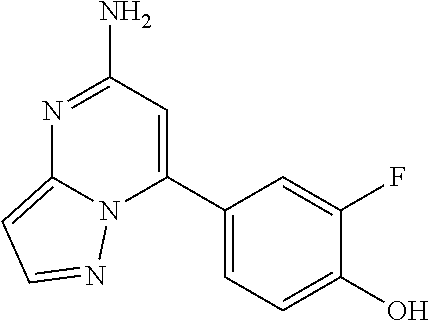
N-(7-(3-fluoro-4-methoxyphenyl) pyrazolo [1,5-a]pyrimidin-5-yl) acetamide (0.28 g, 0.932 mmol) was taken in a 100 mL round bottom flask, cooled to 0° C. and HBr in AcOH (34%) (5 mL, 92 mmol) was added. The reaction mixture was heated at 105° C. for 12 h. The reaction mixture was concentrated under reduced pressure. The residue was reconstituted with ethyl acetate/pet ether (5 mL/5 mL), filtered and dried to afford 4-(5-aminopyrazolo[1,5-a]pyrimidin-7-yl)-2-fluorophenol (0.34 g, 0.390 mmol, 42% yield) as an off-white solid which was taken forward without further purification. LCMS (ESI) m/e 245.2 [(M+H)+, calcd for C12H10FN4O 245.1]; LC/MS retention time (Method A1): tR=1.69 min.

A solution of ethyl 4-(5-aminopyrazolo [1,5-a]pyrimidin-7-yl)-2-fluorophenol (0.34 g, 0.418 mmol) in DMF (5 mL) was cooled to 0° C. K2CO3 (0.173 g, 1.253 mmol) was added in portions followed by slow addition of a solution of (S)-tert-butyl 4-isobutyl-4-methyl-1,2,3-oxathiazolidine-3-carboxylate 2,2-dioxide (prepared as described in Example 251, Parts A-E) (0.147 g, 0.501 mmol) in 1 mL DMF. The reaction mixture was heated at 88° C. for 12 h. The reaction mixture was cooled to 0° C. and quenched with aqueous ammonium chloride solution (10 mL). The reaction mixture extracted with ethyl acetate (2×20 mL). The ethyl acetate layer was washed with water (2×20 mL) and brine (10 mL), dried over Na2SO4, filtered, and concentrated under reduced pressure to afford (S)-tert-butyl (1-(4-(5-aminopyrazolo[1,5-a]pyrimidin-7-yl)-2-fluorophenoxy)-2,4-dimethylpentan-2-yl)carbamate (0.092 g, 0.201 mmol, 48% yield) as a brown color semi-solid. The residue was taken forward without further purification. LCMS (ESI) m/e 458.0 [(M+H)+, calcd for C24H33FN5O3 458.2]; LC/MS retention time (Method A1): tR=2.09 min.

A solution of (S)-tert-butyl (1-(4-(5-aminopyrazolo [1,5-a]pyrimidin-7-yl)-2-fluorophenoxy)-2,4-dimethylpentan-2-yl) carbamate (0.05 g, 0.109 mmol) in pyridine (2 mL) was cooled to 0° C. and AcCl (7.77 μl, 0.109 mmol) was added dropwise. The reaction mixture was allowed to stir at 0° C. for 10 min then at room temperature for 4 h. The reaction mixture was concentrated under reduced pressure to afford a brown colored residue. The residue was dissolved in ethyl acetate (20 mL) and water (20 mL). The ethyl acetate layer was separated, dried over Na2SO4, filtered, and concentrated under reduced pressure to afford (S)-tert-butyl (1-(4-(5-acetamidopyrazolo[1,5-a]pyrimidin-7-yl)-2-fluorophenoxy)-2,4-dimethylpentan-2-yl)carbamate (0.06 g, 0.055 mmol, 510% yield) as an off-white solid which was carried forward without further purification. LCMS (ESI) m/e 500.2 [(M+H)+, calcd for C26H35FN5O4 500.2]; LC/MS retention time (Method A1): tR=2.54 min.

To a solution of (S)-tert-butyl (1-(4-(5-acetamidopyrazolo[1,5-a]pyrimidin-7-yl)-2-fluorophenoxy)-2,4-dimethylpentan-2-yl)carbamate (52 mg, 0.048 mmol) in DCM (2 mL) at 0° C. was added TFA (0.074 mL, 0.958 mmol) and the mixture stirred for 5 min at 0° C. The reaction mixture was allowed to stir for 4 h at room temperature, then was concentrated under reduced pressure. The crude material was purified by prep LC/MS (method A) to afford (S)—N-(7-(4-((2-amino-2,4-dimethylpentyl) oxy)-3-fluorophenyl) pyrazolo [1,5-a]pyrimidin-5-yl) acetamide (2 mg. 5.01 μmol, 10% yield) as a pale yellow solid. LCMS (ESI) m/e 400.0 [(M+H)+, calcd for C21H27FN5O2 400.2]; LC/MS retention time (method H): tR=1.14 min; LC/MS retention time (method I): tR=1.11 min. 1H NMR (400 MHz, Methanol-d4): δ 8.09 (d, J=2.40 Hz, 1H), 8.02-8.05 (m, 1H), 7.98 (s, 1H), 7.85-7.89 (m, 1H), 7.38 (t, J=17.20 Hz, 1H), 6.50 (d, J=2.00 Hz, 1H), 4.14-4.24 (m, 2H), 2.23 (s, 3H), 1.79-1.88 (m, 2H), 1.64-1.69 (m, 1H), 1.46 (s, 3H), 1.02-1.07 (m, 6H) ppm.

To a solution of 5-methyl-1H-pyrazol-3-amine (10 g, 103 mmol) in 1,4-dioxane (100 mL) was added ethyl 3-oxobutanoate (16.08 g, 124 mmol) dropwise followed by slow addition of AcOH (5.89 mL, 103 mmol). The reaction mixture was heated at 80° C. for 14 h. The reaction mixture was cooled to room temperature and concentrated under reduced pressure. The residue was mixed with ice-water to afford an off-white colored solid which was collected by vacuum filtration and dried to give 2,5-dimethylpyrazolo [1,5-a]pyrimidin-7-ol (7.5 g, 45.5 mmol, 44% yield). LCMS (ESI) m/e 164.2 [(M+H)+, calcd for C8H10N3O 164.1]; LC/MS retention time (Method A1): tR=0.58 min.

2,5-Dimethylpyrazolo[1,5-a]pyrimidin-7-ol (3 g, 18.38 mmol) was taken in a 100 mL round bottom and cooled to 0° C. POCl3 (10 mL, 107 mmol) was added dropwise and the reaction mixture stirred for 5 min at 0° C. The reaction mixture was heated at 105° C. for 12 h. The reaction mixture was concentrated under reduced pressure to afford a white colored residue. The residue was basified with 10% aqueous sodium hydroxide solution (pH˜12) and extracted with ethyl acetate (3×25 mL). The ethyl acetate layer was dried over Na2SO4, filtered, and concentrated under reduced pressure to afford 7-chloro-2,5-dimethylpyrazolo [1,5-a]pyrimidine (1.8 g, 9.91 mmol, 54% yield) as an off-white solid. LCMS (ESI) m/e 182.2 [(M+H)+, calcd for C8H9ClN3 182.0]; LC/MS retention time (Method A1): tR=1.77 min.

A solution of 7-chloro-2,5-dimethylpyrazolo[1,5-a]pyrimidine (0.04 g, 0.220 mmol), (S)-tert-butyl (1-(2-cyano-4-(4,4,5,5-tetramethyl-1,3,2-dioxaborolan-2-yl)phenoxy)-2,4-dimethylpentan-2-yl)carbamate (prepared as in Example 254, Part B-G) (0.101 g, 0.220 mmol), potassium phosphate, tribasic (0.038 g, 0.220 mmol), and KBr (0.026 g, 0.220 mmol) in 1,4-dioxane (5 mL) was purged with nitrogen gas for 30 min. PdCl2(dppf)-CH2Cl2 adduct (0.018 g, 0.022 mmol) was added to the reaction mixture and the solution was purged with nitrogen gas again for 10 min. The reaction mixture was heated at 100° C. for 6 h. The reaction mixture was concentrated and the residue obtained was dissolved in ethyl acetate (20 mL) and water (20 mL). The biphasic mixture was filtered through diatomaceous earth. The diatomaceous earth was washed with ethyl acetate (30 mL). The ethyl acetate layer was separated, dried over Na2SO4, filtered, and concentrated under reduced pressure to afford a brown solid which was purified by silica gel chromatography (EtOAc in pet ether) to afford (S)-tert-butyl (1-(2-cyano-4-(2,5-dimethylpyrazolo[1,5-a]pyrimidin-7-yl)phenoxy)-2,4-dimethylpentan-2-yl)carbamate (52 mg, 0.109 mmol, 49% yield). LCMS (ESI) m/e 478.2 [(M+H)+, calcd for C27H36N5O3 478.2]; LC/MS retention time (Method A1): tR=2.66 min.

To a solution of (S)-tert-butyl (1-(2-cyano-4-(2,5-dimethylpyrazolo[1,5-a]pyrimidin-7-yl)phenoxy)-2,4-dimethylpentan-2-yl)carbamate (52 mg, 0.109 mmol) in DCM (2 mL) at 0° C. was added TFA (0.168 mL, 2.178 mmol) and the mixture stirred for 5 min at 0° C. The reaction mixture was allowed to stir for 4 h at room temperature, then was concentrated under reduced pressure. The crude material was purified by prep LC/MS (method A) to afford (S)-2-((2-amino-2,4-dimethylpentyl)oxy)-5-(2,5-dimethylpyrazolo[1,5-a]pyrimidin-7-yl)benzonitrile (12.3 mg. 0.032 mmol, 30% yield) as a pale yellow solid. LCMS (ESI) m/e 378.0 [(M+H)+, calcd for C22H28N5O 378.0]; LC/MS retention time (method H): tR=1.38 min; LC/MS retention time (method I)): tR=1.31 min. 1H NMR (400 MHz, Methanol-d4): δ 8.52 (d, J=2.00 Hz, 1H), 8.40-8.43 (m, 1H), 7.44 (d, J=9.20 Hz, 1H), 7.02 (s, 1H), 6.45 (s, 1H), 4.16-4.22 (m, 2H), 2.63 (s, 3H), 2.50 (s, 3H), 1.76-1.89 (m, 2H), 1.63-1.68 (m, 1H), 1.42 (s, 3H), 1.04-1.07 (m, 6H) ppm.

A mixture of 2-bromo-4-chloropyridine (0.05 g, 0.260 mmol), tert-butyl 4-aminopiperidine-1-carboxylate (0.062 g, 0.312 mmol), tert-butyl 4-aminopiperidine-1-carboxylate (0.062 g, 0.312 mmol), Cs2CO3 (0.169 g, 0.520 mmol), and BINAP (0.162 g, 0.260 mmol) in toluene (5 mL) was solution was purged with nitrogen gas for 30 min. PdOAc2 (0.058 g, 0.260 mmol) was added to the reaction mixture and again the solution was purged with nitrogen gas for 10 min the mixture was heated at 80° C. for 12 h. The reaction mixture was concentrated, dissolved in ethyl acetate (25 mL) and water (20 mL) and biphasic mixture was filtered through diatomaceous earth. The diatomaceous earth was washed with ethyl acetate (50 mL). The ethyl acetate layer was separated and dried over Na2SO4, filtered, and concentrated under reduced pressure. The residue was purified by silica gel chromatography (0-20% EtOAc in pet ether) to afford, tert-butyl 4-((4-chloropyridin-2-yl) amino) piperidine-1-carboxylate (32 mg, 0.103 mmol, 40% yield) as an off-white solid. LCMS (ESI) m/e 312.2 [(M+H)+, calcd for C15H22ClN3O2 312.1]; LC/MS retention time (Method A1): tR=2.63 min.

A mixture of tert-butyl 4-((4-chloropyridin-2-yl)amino)piperidine-1-carboxylate (0.05 g, 0.160 mmol), (S)-tert-butyl (1-(2-cyano-4-(4,4,5,5-tetramethyl-1,3,2-dioxaborolan-2-yl)phenoxy)-2,4-dimethylpentan-2-yl)carbamate (prepared as in Example 254, Part B-G) (0.088 g, 0.192 mmol), and potassium phosphate tribasic (0.085 g, 0.401 mmol) in THF (5 mL) and water (0.5 mL) was purged with nitrogen gas for 30 min. XPhos 2nd generation precatalyst (7.43 mg, 0.024 mmol) was added to the reaction mixture and the solution was again purged with nitrogen gas for another 10 min. The reaction mixture was heated at 70° C. for 2 h. The reaction mixture was concentrated and the residue dissolved in ethyl acetate (30 mL) and water (30 mL). The biphasic mixture was filtered through diatomaceous earth. The diatomaceous earth was washed with ethyl acetate (50 mL). The ethyl acetate layer was separated and dried over Na2SO4, filtered, and concentrated under reduced pressure to afford (S)-tert-butyl 4-((4-(4-((2-((tert-butoxycarbonyl)amino)-2,4-dimethylpentyl)oxy)-3-cyanophenyl)pyridin-2-yl)amino)piperidine-1-carboxylate (80 mg, 0.026 mmol, 16% yield) as a brown solid which was carried forward without further purification. LCMS (ESI) m/e 608.4 [(M+H)+, calcd for C34H50N5O5 608.4]; LC/MS retention time (method B): tR=3.51 min.

To a solution of (S)-tert-butyl4-((4-(4-((2-((tert-butoxycarbonyl)amino)-2,4-dimethylpentyl)oxy)-3-cyanophenyl)pyridin-2-yl)amino)piperidine-1-carboxylate (60 mg, 0.099 mmol) in DCM (2 mL) at 0° C. was added TFA (0.152 mL, 1.974 mmol) and the mixture stirred for 5 min at 0° C. The reaction mixture was allowed to stir for 4 h at room temperature, then was concentrated under reduced pressure. The crude material was purified by prep LC/MS (method A) to afford (S)-2-(2-amino-2,4-dimethylpentyloxy)-5-(2-(piperidin-4-ylamino) pyridin-4-yl) benzonitrile (17 mg, 0.023 mmol, 23% yield) a pale yellow solid. LCMS (ESI) m/e 408.2 [(M+H)+, calcd for C24H34N5O 408.3]; LC/MS retention time (method H): tR=0.95 min; LC/MS retention time (method I): tR=0.66 min. 1H NMR (400 MHz, Methanol-d4): δ 8.02-8.05 (m, 2H), 7.96-7.99 (m, 1H), 7.37 (d, J=8.80 Hz, 1H), 6.85-6.87 (m, 1H), 6.78 (s, 1H), 4.25-4.30 (m, 2H), 3.45-3.51 (m, 2H), 3.13-3.20 (m, 2H), 2.24-2.29 (m, 2H), 1.86-1.99 (m, 3H), 1.69-1.78 (m, 3H), 1.53 (s, 3H), 1.03-1.08 (m, 6H) ppm.

A solution of 7-chloropyrazolo[1,5-a]pyrimidine (0.15 g, 0.977 mmol), (S)-tert-butyl (2,4-dimethyl-1-(4-(4,4,5,5-tetramethyl-1,3,2-dioxaborolan-2-yl)-2-(trifluoromethyl)phenoxy)pentan-2-yl)carbamate (prepared as described in Example 255, Parts A and B) (0.588 g, 1.172 mmol), Cs2CO3 (0.955 g, 2.93 mmol), and KBr (0.116 g, 0.977 mmol) in 1,4-dioxane (5 mL) was purged with nitrogen gas for 30 min. PdCl2(dppf)-CH2Cl2 adduct (0.080 g, 0.098 mmol) was added to the reaction mixture and the solution was purged with nitrogen gas again for 10 min. The reaction mixture was heated at 80° C. for 12 h. The reaction mixture was concentrated and the residue obtained was dissolved in ethyl acetate (50 mL) and water (40 mL). The biphasic mixture was filtered through diatomaceous earth and the diatomaceous earth was washed with ethyl acetate (50 mL). The ethyl acetate layer was separated, dried over Na2SO4, filtered, and concentrated under reduced pressure to afford a brown solid which was purified by silica gel column chromatography (0-30% ethyl acetate in pet ether) to afford (S)-tert-butyl (2,4-dimethyl-1-(4-(pyrazolo[1,5-a]pyrimidin-7-yl)-2-(trifluoromethyl)phenoxy)pentan-2-yl)carbamate (0.13 g, 0.264 mmol, 27% yield) as a off-white semi-solid. LCMS (ESI) m/e 493.2 [(M+H)+, calcd for C25H32F3N4O3 493.2]; LC/MS retention time (method B): tR=1.27 min.

To a solution of (S)-tert-butyl (2,4-dimethyl-1-(4-(pyrazolo[1,5-a]pyrimidin-7-yl)-2-(trifluoromethyl)phenoxy)pentan-2-yl)carbamate (0.06 g, 0.122 mmol) in DCM (2 mL) at 0° C. was added TFA (0.188 mL, 2.436 mmol) and the mixture stirred for 5 min at 0° C. The reaction mixture was allowed to stir for 4 h at room temperature, then was concentrated under reduced pressure. The crude material was purified by prep LC/MS (method A) to afford (S)-2,4-dimethyl-1-(4-(pyrazolo[1,5-a]pyrimidin-7-yl)-2-(trifluoromethyl)phenoxy)pentan-2-amine, TFA (9 mg. 0.018 mmol, 15% yield) as a pale yellow solid. LCMS (ESI) m/e 393.0 [(M+H)+, calcd for C20H24F3N4O 393.2]; LC/MS retention time (method H): tR=1.67 min; LC/MS retention time (method I): tR=1.27 min. 1H NMR (400 MHz, DMSO-d6): δ 8.54-8.57 (m, 2H), 8.40-8.42 (m, 1H), 8.23 (d, J=2.40 Hz, 1H), 7.43 (d, J=9.20 Hz, 1H), 7.19 (d, J=4.40 Hz, 1H), 6.79 (d, J=2.40 Hz, 1H), 4.10-4.17 (m, 2H), 1.82-1.88 (m, 1H), 1.58-1.76 (m, 2H), 1.38 (s, 3H), 0.99-1.03 (m, 6H) ppm.

A mixture of 2-bromo-4-chloropyridine (0.5 g, 2.60 mmol), tetrahydro-2H-pyran-4-amine (0.315 g, 3.12 mmol), Cs2CO3 (1.693 g, 5.20 mmol), and BINAP (1.618 g, 2.60 mmol) in toluene (30 mL) was purged with nitrogen gas for 30 min and PdOAc2 (0.583 g, 2.60 mmol) was added. The reaction mixture was again purged with nitrogen gas for another 10 min and heated at 80° C. for 12 h. The reaction mixture was cooled to room temperature and was concentrated under reduced pressure. The residue was diluted with water (25 mL) and ethyl acetate (20 mL). The biphasic mixture was filtered through diatomaceous earth. The diatomaceous earth was washed with ethyl acetate (50 mL). The ethyl acetate layer was separated, dried over Na2SO4, filtered, and concentrated under reduced pressure. The residue was purified by silica gel chromatography (0-30% ethyl acetate in pet ether) to afford 4-chloro-N-(tetrahydro-2H-pyran-4-yl) pyridin-2-amine (150 mg, 0.705 mmol, 27% yield) as colorless oil. LCMS (ESI) m/e 213.2 [(M+H)+, calcd for C10H14ClN2O 213.1]; LC/MS retention time (Method A1): tR=2.48 min.

A solution of 4-chloro-N-(tetrahydro-2H-pyran-4-yl)pyridin-2-amine (0.04 g, 0.188 mmol), (S)-tert-butyl (1-(2-cyano-4-(4,4,5,5-tetramethyl-1,3,2-dioxaborolan-2-yl)phenoxy)-2,4-dimethylpentan-2-yl)carbamate (prepared as in Example 254, Part B-G) (0.103 g, 0.226 mmol), and potassium phosphate, tribasic (0.033 g, 0.188 mmol) in THF (5 mL) and water (3 mL) was purged with nitrogen for 5 min. XPhos 2nd generation precatalyst (8.72 mg, 0.028 mmol) was added to the reaction mixture under nitrogen. The reaction mixture was again purged with nitrogen gas for 10 min and was heated at 70° C. for 12 h. The reaction mixture was concentrated and the residue obtained was diluted with water (30 mL) and ethyl acetate (30 mL). The biphasic layer was filtered through diatomaceous earth and the diatomaceous earth bed was washed with ethyl acetate (50 mL). The organic layer was separated, dried over Na2SO4, filtered, and concentrated to afford (S)-tert-butyl (1-(2-cyano-4-(2-((tetrahydro-2H-pyran-4-yl)amino)pyridin-4-yl)phenoxy)-2,4-dimethylpentan-2-yl)carbamate (60 mg, 0.118 mmol, 63% yield) as a brown solid which was carried forward without further purification. LCMS (ESI) m/e 509.2 [(M+H)+, calcd for C29H41N4O4 509.3]; LC/MS retention time (Method C): tR=1.28 min.

To a solution of (S)-tert-butyl (1-(2-cyano-4-(2-((tetrahydro-2H-pyran-4-yl)amino)pyridin-4-yl)phenoxy)-2,4-dimethylpentan-2-yl)carbamate (60 mg, 0.118 mmol) in dichloromethane (2 mL) at 0° C. was added TFA (0.182 mL, 2.359 mmol) and the mixture stirred for 5 min at 0° C. The reaction mixture was allowed to stir for 4 h at room temperature, then was concentrated under reduced pressure. The crude material was purified by prep LC/MS (method A) to afford (S)-2-(2-amino-2,4-dimethylpentyloxy)-5-(2-(tetrahydro-2H-pyran-4-ylamino)pyridine-4yl)benzonitrile (64.1 mg, 0.099 mmol, 84% yield) as a pale yellow solid. LCMS (ESI) m/e 409.2 [(M+H)+, calcd for C24H33N4O2 409.2]; LC/MS retention time (method H): tR=1.35 min; LC/MS retention time (method I): tR=0.82 min. 1H NMR (400 MHz, DMSO-d6): δ 8.19 (d, J=2.40 Hz, 1H), 8.09-8.11 (m, 1H), 7.92 (d, J=6.40 Hz, 1H), 7.45 (d, J=8.80 Hz, 1H), 7.16-7.20 (m, 2H), 4.33 (s, 2H), 3.98-4.03 (m, 2H), 3.90-3.96 (m, 1H), 3.54-3.60 (m, 2H), 1.86-2.04 (m, 4H), 1.65-1.75 (m, 3H), 1.54 (s, 3H), 1.03-1.08 (m, 6H) ppm.

A mixture of 2-bromo-4-chloropyridine (0.05 g, 0.260 mmol), tert-butyl 4-aminopiperidine-1-carboxylate (0.062 g, 0.312 mmol), tert-butyl 4-aminopiperidine-1-carboxylate (0.062 g, 0.312 mmol), Cs2CO3 (0.169 g, 0.520 mmol), and BINAP (0.162 g, 0.260 mmol) in toluene (5 mL) was purged with nitrogen gas for 30 min. PdOAc2 (0.058 g, 0.260 mmol) was added to the reaction mixture and again the solution was purged with nitrogen gas for another 10 min. The reaction mixture was heated at 80° C. for 12 h. The reaction mixture was cooled to room temperature and was concentrated under reduced pressure. The residue was diluted with water (20 mL) and ethyl acetate (25 mL). The biphasic mixture was filtered through diatomaceous earth. The diatomaceous earth was washed with ethyl acetate (50 mL). The ethyl acetate layer was separated, dried over Na2SO4, filtered, and concentrated under reduced pressure to get a brown residue which was purified by silica gel column chromatography (0-30% petroleum ether/ethyl acetate) to afford tert-butyl 4-((4-chloropyridin-2-yl) amino) piperidine-1-carboxylate (32 mg, 0.103 mmol, 40% yield) as an off-white solid. LCMS (ESI) m/e 312.2 [(M+H)+, calcd for C15H23ClN3O2 312.1]; LC/MS retention time (Method A1): tR=2.63 min.

A solution of tert-butyl 4-(4-chloropyridin-2-ylamino)piperidine-1-carboxylate (0.035 g, 0.112 mmol), (S)-tert-butyl (2,4-dimethyl-1-(4-(4,4,5,5-tetramethyl-1,3,2-dioxaborolan-2-yl)-2-(trifluoromethyl)phenoxy)pentan-2-yl)carbamate (prepared as described in Example 255, Parts A and B) (0.067 g, 0.134 mmol), and potassium phosphate, tribasic (0.112 mL, 0.559 mmol) in THF (5 mL) was purged with nitrogen gas for 30 min. XPhos 2nd generation precatalyst (15 mg, 0.049 mmol) was added to the reaction mixture and again the solution was purged with nitrogen gas for another 10 min. The reaction mixture was heated at 70° C. for 12 h. The reaction mixture was cooled to room temperature and was concentrated under reduced pressure. The residue was diluted with water (20 mL) and ethyl acetate (20 mL). The biphasic mixture was filtered through diatomaceous earth. The diatomaceous earth was washed with ethyl acetate (50 mL). The ethyl acetate layer was separated, dried over Na2SO4, filtered, and concentrated under reduced pressure to afford the crude product (S)-tert-butyl 4-((4-(4-((2-((tert-butoxycarbonyl)amino)-2,4-dimethylpentyl)oxy)-3-(trifluoromethyl)phenyl)pyridin-2-yl)amino)piperidine-1-carboxylate (60 mg, 0.092 mmol, 82% yield) as a brown solid which was carried forward without further purification. LCMS (ESI) m/e 651.4 [(M+H)+, calcd for C34H50F3N4O5 651.4]; LC/MS retention time (Method C): tR=1.42 min.

To a solution of (S)-tert-butyl 4-((4-(4-((2-((tert-butoxycarbonyl)amino)-2,4-dimethylpentyl)oxy)-3-(trifluoromethyl)phenyl)pyridin-2-yl)amino)piperidine-1-carboxylate (30 mg, 0.046 mmol) in dichloromethane (2 mL) at 0° C. was added TFA (0.071 mL, 0.922 mmol) and the mixture stirred for 5 min at 0° C. The reaction mixture was allowed to stir for 4 h at room temperature, then was concentrated under reduced pressure. The crude material was purified by preparative LC/MS (method B) to afford (S)-4-(4-(2-amino-2,4-dimethylpentyloxy)-3-(trifluoromethyl)phenyl)-N-(piperidin-4-yl)pyridin-2-amine (1.5 mg, 1.94 umol), 4% yield) as a pale yellow solid. LCMS (ESI) m/e 451.2 [(M+H)+, calcd for C24H34F3N4O 451.2]; LC/MS retention time (method H): tR=1.21 min; LC/MS retention time (method I): tR=0.93 min. 1H NMR (400 MHz, Methanol-d4): δ 8.02-8.08 (m, 3H), 7.47 (d, J=8.80 Hz, 1H), 7.14-7.18 (m, 2H), 4.26-4.34 (m, 2H), 4.09-4.13 (m, 1H), 3.50-3.56 (m, 2H), 3.15-3.24 (m, 2H), 2.30-2.34 (m, 2H), 1.85-1.93 (m, 4H), 1.72-1.77 (m, 1H), 1.55 (s, 3H), 1.03-1.08 (m, 6H) ppm.

A mixture of 4-chloro-6,7-difluoroquinazoline (0.04 g, 0.199 mmol), (S)-tert-butyl (2,4-dimethyl-1-(4-(4,4,5,5-tetramethyl-1,3,2-dioxaborolan-2-yl)-2-(trifluoromethyl)phenoxy)pentan-2-yl)carbamate (prepared as described in Example 255, Parts A and B) (0.120 g, 0.239 mmol), potassium phosphate, tribasic (0.127 g, 0.598 mmol), and 2-dicyclohexylphosphino-2′,6′-dimethoxybiphenyl (0.041 g, 0.100 mmol) in toluene (4 mL) was purged with nitrogen gas for 30 min and Pd2(dba)3 (0.046 g, 0.050 mmol) was added. The reaction mixture was again purged with nitrogen gas for 10 min and heated in a microwave at 110° C. for 1.5 h. The reaction mixture was cooled to room temperature and was concentrated under reduced pressure. The residue was diluted with water (20 mL) and ethyl acetate (20 mL). The biphasic mixture was filtered through diatomaceous earth. The diatomaceous earth was washed with ethyl acetate (50 mL). The ethyl acetate layer was separated, dried over Na2SO4, filtered, and concentrated under reduced pressure to afford (S)-tert-butyl 1-(4-(6,7-difluoroquinazolin-4-yl)-2-(trifluoromethyl)phenoxy)-2,4-dimethylpentan-2-ylcarbamate (52 mg, 0.096 mmol, 48% yield) as a brown solid. The solid was carried forward without further purification. LCMS (ESI) m/e 540.2 [(M+H)+, calcd for C27H31F5N3O3 540.2]; LC/MS retention time (Method A1): tR=3.11 min.

To a solution of (S)-tert-butyl (1-(4-(6,7-difluoroquinazolin-4-yl)-2-(trifluoromethyl)phenoxy)-2,4-dimethylpentan-2-yl)carbamate (52 mg, 0.096 mmol) in dichloromethane (2 mL) at 0° C. was added TFA (0.149 mL, 1.928 mmol) and the mixture stirred for 5 min at 0° C. The reaction mixture was allowed to stir for 4 h at room temperature, then was concentrated under reduced pressure. The crude material was purified by prep LC/MS (method C) to afford (S)-1-(4-(6,7-difluoroquinazolin-4-yl)-2-(trifluoromethyl)phenoxy)-2,4-dimethylpentan-2-amine (1.5 mg, 0.003 mmol, 3% yield) as a pale yellow solid. LCMS (ESI) m/e 440.0 [(M+H)+, calcd for C22H23F5N3O 440.2]; LC/MS retention time (method H): tR=2.02 min; LC/MS retention time (method I): tR=1.46 min. 1H NMR (400 MHz, Methanol-d4): δ 9.29 (s, 1H), 8.08-8.14 (m, 2H), 7.96-8.01 (m, 2H), 7.49 (d, J=8.80 Hz, 1H), 4.18-4.25 (m, 2H), 1.76-1.89 (m, 2H), 1.64-1.69 (m, 1H), 1.45 (s, 3H), 1.05-1.08 (m, 6H) ppm.

A solution of 7-chloropyrazolo[1,5-a]pyrimidine (0.05 g, 0.326 mmol), (S)-tert-butyl (2,4-dimethyl-1-(2-methyl-4-(4,4,5,5-tetramethyl-1,3,2-dioxaborolan-2-yl)phenoxy)pentan-2-yl)carbamate (prepared as described in Example 259, Part A and B) (0.146 g, 0.326 mmol), Cs2CO3 (0.212 g, 0.651 mmol), and KBr (0.039 g, 0.326 mmol) in 1,4-dioxane (10 mL) was purged with nitrogen gas for 30 min. PdCl2 (dppf)-CH2Cl2 adduct (0.027 g, 0.033 mmol) was added to the reaction mixture and the solution was purged with nitrogen gas again for 10 min. The reaction mixture was heated at 80° C. for 12 h. The reaction mixture was concentrated and the residue obtained was dissolved in ethyl acetate (30 mL) and water (30 mL). The biphasic mixture was filtered through diatomaceous earth. The diatomaceous earth was washed with ethyl acetate (50 mL). The ethyl acetate layer was separated, dried over Na2SO4, filtered, and concentrated under reduced pressure to afford a brown solid which was purified by silica-gel column chromatography (0-40% EtOAc in pet ether) to afford (S)-tert-butyl (2,4-dimethyl-1-(2-methyl-4-(pyrazolo[1,5-a]pyrimidin-7-yl)phenoxy)pentan-2-yl)carbamate (40 mg, 0.091 mmol, 28% yield) as a light yellow semi-solid. LCMS (ESI) m/e 439.4 [(M+H)+, calcd for C25H35N4O3 439.3]; LC/MS retention time (Method A1): tR=2.60 min.

To a solution of (S)-tert-butyl (2,4-dimethyl-1-(2-methyl-4-(pyrazolo[1,5-a]pyrimidin-7-yl)phenoxy)pentan-2-yl)carbamate (35 mg, 0.080 mmol) in DCM (2 mL) at 0° C. was added TFA (0.123 mL, 1.596 mmol) and the mixture stirred for 5 min at 0° C. The reaction mixture was allowed to stir for 4 h at room temperature, then was concentrated under reduced pressure. The crude material was purified by prep LC/MS (method C) to afford (S)-2,4-dimethyl-1-(2-methyl-4-(pyrazolo[1,5-a]pyrimidin-7-yl)phenoxy)pentan-2-amine, TFA (11 mg. 0.024 mmol, 30% yield) as a pale yellow solid. LCMS (ESI) m/e 339.2 [(M+H)+, calcd for C20H27N4O 339.2]; LC/MS retention time (method H): tR=2.03 min. 1H NMR (400 MHz, Methanol-d4): δ 8.52 (d, J=4.40 Hz, 1H), 8.19 (d, J=2.40 Hz, 1H), 7.99-8.04 (m, 2H), 7.09-7.16 (m, 2H), 6.76 (d, J=2.40 Hz, 1H), 4.02-4.09 (m, 2H), 2.40 (s, 3H), 1.75-1.88 (m, 2H), 1.61-1.66 (m, 1H), 1.42 (s, 3H), 1.00-1.05 (m, 6H) ppm.

To a solution of pyrazolo[1,5-a]pyrimidine (1 g, 8.39 mmol) in acetonitrile (5 mL) was added NBS (1.494 g, 8.39 mmol) and the reaction mixture stirred at room temperature for 8 h. The reaction mixture was concentrated under reduced pressure and the residue purified by silica gel chromatography (0-30% petroleum ether/EtOAc) to afford 3-bromopyrazolo[1,5-a]pyrimidine (1.2 g, 6.06 mmol, 72% yield) as a brown solid. LCMS (ESI) m/e 198.0 [(M+H)+, calcd for C6H5BrN3 198.0]; LC/MS retention time (method A2): tR=1.43 min.

A solution of 3-bromopyrazolo[1,5-a]pyrimidine (0.04 g, 0.202 mmol), (S)-tert-butyl (2,4-dimethyl-1-(4-(4,4,5,5-tetramethyl-1,3,2-dioxaborolan-2-yl)-2-(trifluoromethyl)phenoxy)pentan-2-yl)carbamate (prepared as described in Example 255, Parts A and B) (0.122 g, 0.242 mmol), and potassium phosphate tribasic (0.106 g, 0.606 mmol) in THF (5 mL) and water (0.5 mL) was purged with nitrogen gas for 30 min. XPhos 2nd generation precatalyst (9.37 mg, 0.030 mmol) was added to the reaction mixture and the solution was purged with nitrogen gas again for 10 min. The reaction mixture was heated at 80° C. for 12 h. The reaction mixture was concentrated and the residue obtained was dissolved in ethyl acetate (30 mL) and water (30 mL). The biphasic mixture was filtered through diatomaceous earth and the diatomaceous earth was washed with ethyl acetate (50 mL). The ethyl acetate layer was separated, dried over Na2SO4, filtered, and concentrated under reduced pressure to afford (S)-tert-butyl (2,4-dimethyl-1-(4-(pyrazolo[1,5-a]pyrimidin-3-yl)-2-(trifluoromethyl)phenoxy)pentan-2-yl)carbamate (50 mg, 0.102 mmol, 50% yield) as a brown solid which was carried forward without further purification. LCMS (ESI) m/e 493.3 [(M+H)+, calcd for C25H32F3N4O3 493.2]; LC/MS retention time (Method A1): tR=1.83 min.

To a solution of (S)-tert-butyl (2,4-dimethyl-1-(4-(pyrazolo[1,5-a]pyrimidin-3-yl)-2-(trifluoromethyl)phenoxy)pentan-2-yl)carbamate (40 mg, 0.081 mmol) in DCM (2 mL) at 0° C. was added TFA (6.26 μl, 0.081 mmol) and the mixture stirred for 5 min at 0° C. The reaction mixture was allowed to stir for 4 h at room temperature, then was concentrated under reduced pressure. The crude material was purified by prep LC/MS (method B) to afford (S)-2,4-dimethyl-1-(4-(pyrazolo[1,5-a]pyrimidin-3-yl)-2-(trifluoromethyl)phenoxy)pentan-2-amine (10 mg. 0.024 mmol, 30% yield) as a pale yellow solid. LCMS (ESI) m/e 393.2 [(M+H)+, calcd for C20H24F3N4O 393.2]; LC/MS retention time (method H): tR=1.63 min. 1H NMR (400 MHz, Methanol-d4): δ 8.95-8.98 (m, 1H), 8.67-8.68 (m, 1H), 8.62 (s, 1H), 8.51 (d, J=2.00 Hz, 1H), 8.33-8.36 (m, 1H), 7.36 (d, J=8.80 Hz, 1H), 7.07-7.10 (m, 1H), 4.19-4.28 (m, 2H), 1.88-1.93 (m, 2H), 1.70-1.76 (m, 1H), 1.55 (s, 3H), 1.04-1.09 (m, 6H) ppm.

To a solution of 4-chloro-2-fluoropyridine (0.5 g, 3.80 mmol), tetrahydro-2H-pyran-3-amine (0.461 g, 4.56 mmol) in DMSO (5 mL) was added Cs2CO3 (2.477 g, 7.60 mmol) and the reaction mixture was heated in a microwave at 90° C. for 2 h. The reaction mixture was allowed to cool to 0° C. and quenched with ice-water then extracted with ethyl acetate (30 mL). The aqueous layer was again extracted with ethyl acetate (2×30 mL). The combined organic layers were washed with water (20 mL) and brine (20 mL), dried over Na2SO4, and concentrated under reduced pressure. The residue was purified by silica gel chromatography (0-30% ethyl acetate in pet ether) to afford 4-chloro-N-(tetrahydro-2H-pyran-3-yl)pyridin-2-amine (0.35, 1.646 mmol, 43% yield) as a light yellow oil. 1H NMR (400 MHz, DMSO-d6): δ 7.92 (d, J=7.20 Hz, 1H), 6.74 (d, J=9.60 Hz, 1H), 6.52-6.56 (m, 2H), 3.81-3.88 (m, 2H), 3.66-3.73 (m, 1H), 3.31-3.39 (m, 1H), 3.08-3.15 (m, 1H), 1.85-1.95 (m, 1H), 1.67-1.74 (m, 1H), 1.45-1.60 (m, 2H) ppm.

A mixture of 4-chloro-N-(tetrahydro-2H-pyran-3-yl)pyridin-2-amine (0.04 g, 0.188 mmol), (S)-tert-butyl (2,4-dimethyl-1-(4-(4,4,5,5-tetramethyl-1,3,2-dioxaborolan-2-yl)-2-(trifluoromethyl)phenoxy)pentan-2-yl) (prepared as described in Example 255, Parts A and B) (0.113 g, 0.226 mmol), and potassium phosphate, tribasic (0.033 g, 0.188 mmol) in 1,4-dioxane (8 mL) and water (2 mL) was purged with nitrogen gas for 30 min. XPhos 2nd generation precatalyst (8.72 mg, 0.028 mmol) was added to the reaction mixture and again the solution was purged with nitrogen gas for 10 min and heated at 100° C. for 2 h. The reaction mixture was concentrated under reduced pressure and the residue was dissolved in ethyl acetate (30 mL) and water (30 mL). The biphasic mixture was filtered through diatomaceous earth. The diatomaceous earth was washed with ethyl acetate (50 mL). The ethyl acetate layer was separated and dried over Na2SO4, filtered, and concentrated under reduced pressure to afford tert-butyl ((2S)-2,4-dimethyl-1-(4-(2-((tetrahydro-2H-pyran-3-yl)amino)pyridin-4-yl)-2-(trifluoromethyl)phenoxy)pentan-2-yl)carbamate (68 mg, 0.123 mmol, 66% yield) as a brown solid which was carried forward without further purification. LCMS (ESI) m/e 552.2 [(M+H)+, calcd for C29H41F3N3O4 552.3]; LC/MS retention time (Method A1): tR=2.86 min.

To a solution of tert-butyl((2S)-2,4-dimethyl-1-(4-(2-((tetrahydro-2H-pyran-3-yl)amino)pyridin-4-yl)-2-(trifluoromethyl)phenoxy)pentan-2-yl)carbamate (50 mg, 0.091 mmol) in DCM (2 mL) at 0° C. was added TFA (0.140 mL, 1.813 mmol) and the mixture stirred for 5 min at 0° C. The reaction mixture was allowed to stir for 4 h at room temperature, then was concentrated under reduced pressure. The crude material was purified by prep LC/MS (method C) to afford 4-(4-((S)-2-amino-2,4-dimethylpentyloxy)-3-(trifluoromethyl)phenyl)-N-(tetrahydro-2H-pyran-3-yl)pyridin-2-amine (20 mg, 0.044 mmol, 48% yield) as a pale yellow solid. LCMS (ESI) m/e 452.2 [(M+H)+, calcd for C24H33F3N3O2 452.2]; LC/MS retention time (method H): tR=1.87 min. 1H NMR (400 MHz, Methanol-d4): δ 7.87-7.99 (m, 3H), 7.31 (d, J=8.40 Hz, 1H), 6.77-6.82 (m, 2H), 3.92-4.12 (m, 4H), 3.77-3.81 (m, 1H), 3.51-3.54 (m, 1H), 1.98-2.07 (m, 3H), 1.58-1.85 (m, 5H), 1.38 (s, 3H), 0.98-1.03 (m, 6H) ppm.

Racemic 4-(4-(((S)-2-amino-2,4-dimethylpentyl)oxy)-3-(trifluoromethyl)phenyl)-N-(tetrahydro-2H-pyran-3-yl)pyridin-2-amine (12 mg. 0.026 mmol) prepared in Example 475 was resolved by Chiral HPLC (Method A) to afford two diastereomers. The absolute stereochemistry of the pyran linkage was not determined.
Diastereomer: 1
Part B: 4-(4-(((S)-2-amino-2,4-dimethylpentyl)oxy)-3-(trifluoromethyl)phenyl)-N-(tetrahydro-2H-pyran-3-yl)pyridin-2-amine (1 mg. 2.148 μmol, 8% yield) as a pale yellow solid. LCMS (ESI) m/e 452.2 [(M+H)+, calcd for C24H33F3N3O2 452.2]; LC/MS retention time (method A1): tR=1.95 min. HPLC purity: 98%; HPLC retention time (method A): tR=5.49 min. 1H NMR (400 MHz, Methanol-d4): δ 7.90-8.00 (m, 1H), 7.86-7.90 (m, 2H), 7.30 (d, J=8.40 Hz, 1H), 6.76-6.82 (m, 2H), 3.94-4.07 (m, 4H), 3.48-3.81 (m, 2H), 2.03-2.11 (m, 1H), 1.80-1.85 (m, 2H), 1.55-1.69 (m, 5H), 1.34 (s, 3H), 0.88-0.99 (m, 6H) ppm.
Diastereomer: 2
4-(4-(((S)-2-amino-2,4-dimethylpentyl)oxy)-3-(trifluoromethyl)phenyl)-N-(tetrahydro-2H-pyran-3-yl)pyridin-2-amine (4 mg. 8.59 mmol, 33% yield) as a pale yellow solid. LCMS (ESI) m/e 452.2 [(M+H)+, calcd for C24H33F3N3O2 452.2]; LC/MS retention time (method A1): tR=1.95 min. HPLC purity: 98%; HPLC retention time (method A): tR=5.49 min. 1H NMR (400 MHz, Methanol-d4): δ 7.96-8.00 (m, 1H), 7.85-7.89 (m, 1H), 7.28 (d, J=8.00 Hz, 1H), 6.96 (s, 1H), 6.76-6.81 (m, 2H), 3.94-4.05 (m, 4H), 3.47-3.81 (m, 2H), 2.01-2.09 (m, 1H), 1.76-1.85 (m, 2H), 1.55-1.75 (m, 5H), 1.41 (s, 3H), 0.92-1.01 (m, 6H) ppm.

A solution of 3-(4,4,5,5-tetramethyl-1,3,2-dioxaborolan-2-yl)pyrazolo[1,5-a]pyrimidine-6-carbonitrile (0.04 g, 0.148 mmol), (S)-tert-butyl (1-((6-iodo-2-methylpyridin-3-yl)oxy)-2,4-dimethylpentan-2-yl)carbamate (prepared as described in Example 343) (0.080 g, 0.178 mmol), and Cs2CO3 (0.04 g, 0.148 mmol) in 1,4-dioxane (5 mL) and water (0.5 mL) was purged with nitrogen gas for 30 min. PdCl2 (dppf)-CH2Cl2 adduct (0.121 g, 0.148 mmol) was added to the reaction mixture and the solution was purged with nitrogen gas again for 10 min. The reaction mixture was heated at 100° C. for 12 h. The reaction mixture was concentrated and the residue obtained was dissolved in ethyl acetate (30 mL) and water (30 mL). The biphasic mixture was filtered through diatomaceous earth and the diatomaceous earth was washed with ethyl acetate (50 mL). The ethyl acetate layer was separated, dried over Na2SO4, filtered, and concentrated under reduced pressure to afford as a brown solid which was purified by silica gel chromatography (0-30% ethyl acetate in pet ether) to afford (S)-tert-butyl (1-((6-(6-cyanopyrazolo[1,5-a]pyrimidin-3-yl)-2-methylpyridin-3-yl)oxy)-2,4-dimethylpentan-2-yl)carbamate (10 mg, 0.022 mmol, 15% yield) as a light yellow solid. LCMS (ESI) m/e 465.2 [(M+H)+, calcd for C25H33N6O3 465.2]; LC/MS retention time (Method A1): tR=2.70 min.

To a solution of (S)-tert-butyl (1-((6-(6-cyanopyrazolo[1,5-a]pyrimidin-3-yl)-2-methylpyridin-3-yl)oxy)-2,4-dimethylpentan-2-yl)carbamate (40 mg, 0.086 mmol) in DCM (2 mL) at 0° C. was added TFA (6.63 μl, 0.086 mmol) and the mixture stirred for 5 min at 0° C. The reaction mixture was allowed to stir for 4 h at room temperature, then was concentrated under reduced pressure. The crude material was purified by prep LC/MS (method A) to afford (S)-3-(5-((2-amino-2,4-dimethylpentyl)oxy)-6-methylpyridin-2-yl)pyrazolo[1,5-a]pyrimidine-6-carbonitrile (1 mg. 2.74 μmol, 3% yield) as a pale yellow solid. LCMS (ESI) m/e 365.2 [(M+H)+, calcd for C20H25N6O 365.2]; LC/MS retention time (method H): tR=1.27 min; LC/MS retention time (method I): tR=0.80 min. 1H NMR (400 MHz, Methanol-d4): δ 9.67 (d, J=2.40 Hz, 1H), 8.95 (s, 1H), 8.79 (s, 1H), 8.31 (d, J=8.40 Hz, 1H), 7.48 (d, J=8.40 Hz, 1H), 4.03-4.11 (m, 2H), 2.61 (s, 3H), 1.79-1.90 (m, 2H), 1.65-1.70 (m, 1H), 1.46 (s, 3H), 1.03-1.08 (m, 6H) ppm.

A solution of 4-chloro-2-methylthieno [2,3-d]pyrimidine (0.03 g, 0.162 mmol), (S)-tert-butyl (2,4-dimethyl-1-(4-(4,4,5,5-tetramethyl-1,3,2-dioxaborolan-2-yl)-2-(trifluoromethyl)phenoxy)pentan-2-yl)carbamate (prepared as described in Example 255, Parts A and B) (0.090 g, 0.179 mmol), Cs2CO3 (0.159 g, 0.487 mmol), and KBr (0.019 g, 0.162 mmol) in 1,4-dioxane (10 mL) was purged with nitrogen gas for 30 min. PdCl2 (dppf)-CH2Cl2 adduct (0.013 g, 0.016 mmol) was added to the reaction mixture and the solution was purged with nitrogen gas again for 10 min. The reaction mixture was heated at 80° C. for 12 h. The reaction mixture was concentrated and the residue obtained was dissolved in ethyl acetate (20 mL) and water (20 mL). The biphasic mixture was filtered through diatomaceous earth (Diatomaceous Earth®) and the bed was washed with ethyl acetate (25 mL). The ethyl acetate layer was separated, dried over Na2SO4, filtered, and concentrated under reduced pressure to afford (S)-tert-butyl (2,4-dimethyl-1-(4-(2-methylthieno[2,3-d]pyrimidin-4-yl)-2-(trifluoromethyl)phenoxy)pentan-2-yl)carbamate (crude yield) (0.06 g, 0.115 mmol, 71% yield) as a brown solid which was carried forward without further purification. LCMS (ESI) m/e 524.2 [(M+H)+, calcd for C26H33F3N3O3S 524.2]; LC/MS retention time (Method C): tR=1.60 min.

To a solution of (S)-tert-butyl (2,4-dimethyl-1-(4-(2-methylthieno[2,3-d]pyrimidin-4-yl)-2-(trifluoromethyl)phenoxy)pentan-2-yl)carbamate (0.03 g, 0.057 mmol) in DCM (2 mL) at 0° C. was added TFA (0.088 mL, 1.146 mmol) and the mixture stirred for 5 min at 0° C. The reaction mixture was allowed to stir for 4 h at room temperature, then was concentrated under reduced pressure. The crude material was purified by prep LC/MS (method C) to afford (S)-2,4-dimethyl-1-(4-(2-methylthieno[2,3-d]pyrimidin-4-yl)-2-(trifluoromethyl)phenoxy)pentan-2-amine (6 mg. 0.014 mmol, 24% yield) as a pale yellow solid. LCMS (ESI) m/e 424.2 [(M+H)+, calcd for C21H25F3N30S 424.2]; LC/MS retention time (method H): tR=2.83 min; LC/MS retention time (method I): tR=2.08 min. 1H NMR (400 MHz, Methanol-d4: δ 8.26-8.29 (m, 2H), 7.80 (d, J=6.00 Hz, 1H), 7.63 (d, J=6.00 Hz, 1H), 7.46 (d, J=8.00 Hz, 1H), 4.14-4.21 (m, 2H), 2.86 (s, 3H), 1.85-1.91 (m, 1H), 1.62-1.78 (m, 2H), 1.42 (s, 3H), 1.02-1.06 (m, 6H) ppm.

A solution of 7-chloro-2-cyclopropylpyrazolo[1,5-a]pyrimidine (prepared as described in Example 266, Parts A-C) (40 mg, 0.207 mmol), (S)-tert-butyl (1-(2-chloro-4-(4,4,5,5-tetramethyl-1,3,2-dioxaborolan-2-yl)phenoxy)-2,4-dimethylpentan-2-yl)carbamate (prepared as described in Example 260, Part A and B) (97 mg, 0.207 mmol), Cs2CO3 (135 mg, 0.413 mmol), and KBr (24.58 mg, 0.207 mmol) in 1,4-dioxane (10 mL) was purged with nitrogen gas for 30 min. PdCl2 (dppf)-CH2Cl2 adduct (16.87 mg, 0.021 mmol) was added to the reaction mixture and the solution was purged with nitrogen gas again for 10 min. The reaction mixture was heated at 100° C. for 12 h. The reaction mixture was concentrated and the residue obtained was dissolved in ethyl acetate (30 mL) and water (30 mL). The biphasic mixture was filtered through diatomaceous earth (Diatomaceous Earth®) and the bed was washed with ethyl acetate (50 mL). The ethyl acetate layer was separated, dried over Na2SO4, filtered, and concentrated under reduced pressure to afford (S)-tert-butyl (1-(2-chloro-4-(2-cyclopropylpyrazolo[1,5-a]pyrimidin-7-yl)phenoxy)-2,4-dimethylpentan-2-yl)carbamate (60 mg, 0.064 mmol, 31% yield) as a brown solid which was carried forward without further purification. LCMS (ESI) m/e 499.2 [(M+H)+, calcd for C27H36ClN4O3 499.2]; LC/MS retention time (Method A1): tR=2.85 min.

To a solution of (S)-tert-butyl (1-(2-chloro-4-(2-cyclopropylpyrazolo[1,5-a]pyrimidin-7-yl)phenoxy)-2,4-dimethylpentan-2-yl)carbamate (0.05 g, 0.100 mmol) in DCM (2 mL) at 0° C. was added TFA (0.154 mL, 2.004 mmol) and the mixture stirred for 5 min at 0° C. The reaction mixture was allowed to stir for 4 h at room temperature, then was concentrated under reduced pressure. The crude material was purified by prep LC/MS (method C) which afforded (S)-1-(2-chloro-4-(2-cyclopropylpyrazolo[1,5-4]pyrimidin-7-yl)phenoxy)-2,4-dimethylpentan-2-amine, TFA (21 mg. 0.040 mmol, 40% yield) as a pale yellow solid. LCMS (ESI) m/e 399.2 [(M+H)+, calcd for C22H28ClN4O. TFA 399.2]; LC/MS retention time (method H): tR=2.62 min; LC/MS retention time (method I): tR=2.07 min. 1H NMR (400 MHz, Methanol-d4): δ 8.45 (d, J=4.80 Hz, 1H), 8.35 (d, J=2.40 Hz, 1H), 8.14-8.16 (m, 1H), 7.34 (d, J=8.80 Hz, 1H), 7.05 (d, J=4.40 Hz, 1H), 6.45 (s, 1H), 4.05-4.15 (m, 2H), 2.15-2.20 (m, 1H), 1.79-1.93 (m, 2H), 1.64-1.69 (m, 1H), 1.44 (s, 3H), 1.03-1.11 (m, 8H), 0.94-0.95 (m, 2H) ppm.

A solution of 7-chloro-2-cyclopropylpyrazolo[1,5-a]pyrimidine (prepared as described in Example 266, Parts A-C) (40 mg, 0.207 mmol), (S)-tert-butyl (2,4-dimethyl-1-(4-(4,4,5,5-tetramethyl-1,3,2-dioxaborolan-2-yl)-2-(trifluoromethyl)phenoxy)pentan-2-yl) (prepared as described in Example 255, Parts A and B) (104 mg, 0.207 mmol), Cs2CO3 (135 mg, 0.413 mmol), and KBr (24.58 mg, 0.207 mmol) in 1,4-dioxane (10 mL) was purged with nitrogen gas for 30 min. PdCl2 (dppf)-CH2Cl2 adduct (16.87 mg, 0.021 mmol) was added to the reaction mixture and the solution was purged with nitrogen gas again for 10 min. The reaction mixture was heated at 100° C. for 12 h. The reaction mixture was concentrated and the residue obtained was dissolved in ethyl acetate (30 mL) and water (30 mL). The biphasic mixture was filtered through diatomaceous earth (Diatomaceous Earth®) and the bed was washed with ethyl acetate (50 mL). The ethyl acetate layer was separated, dried over Na2SO4, filtered, and concentrated under reduced pressure to afford ((S)-tert-butyl (1-(4-(2-cyclopropylpyrazolo[1,5-a]pyrimidin-7-yl)-2-(trifluoromethyl)phenoxy)-2,4-dimethylpentan-2-yl)carbamate (80 mg, 0.033 mmol, 16% yield) as a brown solid which was carried forward without further purification. LCMS (ESI) m/e 533.2 [(M+H)+, calcd for C28H36F3N4O3 533.3]; LC/MS retention time (Method A1): tR=3.23 min.

To a solution of (S)-tert-butyl (1-(4-(2-cyclopropylpyrazolo[1,5-a]pyrimidin-7-yl)-2-(trifluoromethyl)phenoxy)-2,4-dimethylpentan-2-yl)carbamate (80 mg, 0.033 mmol) in DCM (2 mL) at 0° C. was added TFA (0.051 mL, 0.661 mmol) and the mixture stirred for 5 min at 0° C. The reaction mixture was allowed to stir for 4 h at room temperature, then was concentrated under reduced pressure. The crude material was purified by prep LC/MS (method A) which afforded (S)-1-(4-(2-cyclopropylpyrazolo[1,5-a]pyrimidin-7-yl)-2-(trifluoromethyl)phenoxy)-2,4-dimethylpentan-2-amine (3 mg. 6.94 μmol, 21% yield) as a pale yellow solid. LCMS (ESI) m/e 433.3 [(M+H)+, calcd for C23H28F3N4O 433.3]; LC/MS retention time (method H): tR=2.08 min; LC/MS retention time (method I): tR=1.47 min. 1H NMR (400 MHz, Methanol-d4: δ 8.59 (d, J=2.00 Hz, 1H), 8.39-8.45 (m, 2H), 7.41 (d, J=8.80 Hz, 1H), 7.08 (d, J=4.80 Hz, 1H), 6.46 (s, 1H), 4.06-4.12 (m, 2H), 2.11-2.17 (m, 1H), 1.81-1.88 (m, 1H), 1.56-1.69 (m, 2H), 1.34 (s, 3H), 0.98-1.10 (m, 8H), 0.90-0.95 (m, 2H) ppm.

A solution of 7-chloro-2-(trifluoromethyl)pyrazolo[1,5-a]pyrimidine (25 mg, 0.113 mmol), (S)-tert-butyl (1-(2-cyano-4-(4,4,5,5-tetramethyl-1,3,2-dioxaborolan-2-yl)phenoxy)-2,4-dimethylpentan-2-yl)carbamate (prepared as in Example 254, Part B-G) (56.9 mg, 0.124 mmol), and potassium phosphate, tribasic (71.9 mg, 0.338 mmol in 1,4-dioxane (10 mL) was purged with nitrogen gas for 30 min. (2-Dicyclohexylphosphino-2′,4′,6′-triisopropyl-1,1′-biphenyl)[2-(2-aminoethyl) phenyl]palladium(II) chloride (16.67 mg, 0.023 mmol) was added to the reaction mixture and the solution was purged with nitrogen gas again for 10 min. The reaction mixture was heated at 80° C. for 4 h. The reaction mixture was concentrated and the residue obtained was dissolved in ethyl acetate (30 mL) and water (30 mL). The biphasic mixture was filtered through diatomaceous earth (Diatomaceous Earth®) and the bed was washed with ethyl acetate (50 mL). The ethyl acetate layer was separated, dried over Na2SO4, filtered, and concentrated under reduced pressure to afford (S)-tert-butyl (1-(2-cyano-4-(2-(trifluoromethyl)pyrazolo[1,5-a]pyrimidin-7-yl)phenoxy)-2,4-dimethylpentan-2-yl)carbamate (crude yield) (40 mg, 0.077 mmol, 69% yield) as a brown solid which was carried forward without further purification. 1H NMR (400 MHz, DMSO-d6): δ 8.80 (d, J=2.80 Hz, 1H), 8.43-8.50 (m, 2H), 7.17-7.56 (m, 3H), 6.94 (s, 1H), 4.03-4.18 (m, 2H), 1.56-1.83 (m, 2H), 1.46-1.53 (m, 1H), 1.43 (s, 3H), 1.28-1.35 (m, 9H), 0.89-0.96 (m, 6H) ppm.

To a solution of (S)-tert-butyl (1-(2-cyano-4-(2-(trifluoromethyl)pyrazolo[1,5-a]pyrimidin-7-yl)phenoxy)-2,4-dimethylpentan-2-yl)carbamate (0.04 g, 0.077 mmol) in DCM (2 mL) at 0° C. was added TFA (0.119 mL, 1.546 mmol) and the mixture stirred for 5 min at 0° C. The reaction mixture was allowed to stir for 4 h at room temperature, then was concentrated under reduced pressure. The crude material was purified by prep LC/MS (method B) which afforded (S)-2-((2-amino-2,4-dimethylpentyl)oxy)-5-(2-(trifluoromethyl)pyrazolo[1,5-a]pyrimidin-7-yl)benzonitrile, 2 TFA (9 mg. 0.015 mmol, 19% yield) as a pale yellow solid. LCMS (ESI) m/e 418.2 [(M+H)+, calcd for C21H23F3N5O 418.2]; LC/MS retention time (method H): tR=1.78 min; LC/MS retention time (method I): tR=1.37 min. 1H NMR (400 MHz, Methanol): δ 8.74 (d, J=4.40 Hz, 1H), 8.52-8.56 (m, 2H), 7.53 (d, J=8.80 Hz, 1H), 7.42 (d, J=4.40 Hz, 1H), 7.16 (s, 1H), 4.36-4.42 (m, 2H), 1.90-2.01 (m, 2H), 1.73-1.78 (m, 1H), 1.58 (s, 3H), 1.07-1.11 (m, 6H) ppm.

2-Bromo-5-fluoroisonicotinaldehyde (2 g, 9.80 mmol) and hydroxylamine hydrochloride (1.022 g, 14.71 mmol) were dissolved in methanol (20 mL) and water (20 mL). The reaction mixture was heated at 60° C. for 5 h. The reaction mixture was concentrated under reduced pressure. The residue was diluted with saturated aqueous sodium bicarbonate and the solution was extracted with ethyl acetate. The ethyl acetate layer was dried over magnesium sulfate and concentrated under reduced pressure to obtain 2-bromo-5-fluoroisonicotinaldehyde oxime (1.8 g, 8.22 mmol, 84% yield) as an off-white solid which was carried forward without further purification. LCMS (ESI) m/e 219.0 [(M+H)+, calcd for C6H5BrFN2O 219.0]; LC/MS retention time (method A1): tR=1.63 min.

2-Bromo-5-fluoroisonicotinaldehyde oxime (1 g, 4.57 mmol) in chloroform (20 mL) was cooled to 0° C. POCl3 (2.128 mL, 22.83 mmol) was added dropwise and the reaction mixture stirred for 5 min at 0° C. The reaction mixture was heated at 65° C. for 12 h. The reaction mixture was concentrated under reduced pressure to afford a brown colored residue. The residue was diluted with ice-water, basified with saturated aqueous sodium carbonate and extracted with ethyl acetate (3×25 mL). The ethyl acetate layer was dried over Na2SO4 and evaporated to afford 2-bromo-5-fluoroisonicotinonitrile (0.8 g, 3.98 mmol, 87% yield) as a brown solid that was taken for next step without further purification. 1 H NMR 400 MHz, DMSO-d6: δ 8.81 (d, J=4.40 Hz, 1H), 8.41-8.43 (m, 1H) ppm.

A solution of 7-chloropyrazolo[1,5-a]pyrimidine (0.05 g, 0.326 mmol), 2-bromo-5-fluoroisonicotinonitrile (0.065 g, 0.326 mmol) and 1,1,1,2,2,2-hexamethyldistannane (0.107 g, 0.326 mmol) in 1,4-dioxane (2 mL) was purged with nitrogen gas for 10 min. Pd(Ph3P)4 (0.038 g, 0.033 mmol) was added and the solution was purged with nitrogen gas again for 10 min. The reaction mixture was heated in a microwave at 150° C. for 2 h. The reaction mixture was concentrated and the residue obtained was dissolved in ethyl acetate (20 mL) and water (20 mL). The biphasic mixture was filtered through diatomaceous earth (Diatomaceous Earth®) and the bed was washed with ethyl acetate (25 mL). The ethyl acetate layer was separated, dried over Na2SO4, filtered, and concentrated under reduced pressure to afford a brown colored solid. The solid was purified by silica gel chromatography (0-40% EtOAc in pet ether) to afford 5-fluoro-2-(pyrazolo[1,5-a]pyrimidin-7-yl)isonicotinonitrile (30 mg, 0.125 mmol, 39% yield) as a light yellow solid. LCMS (ESI) m/e 240.0 [(M+H)+, calcd for C12H7FN5 240.1]; LC/MS retention time (Method A1): tR=1.97 min.

A solution of (S)-2-amino-2,4-dimethylpentan-1-ol (0.016 g, 0.125 mmol) in DMF (4 mL) was cooled to 0° C. and 5-fluoro-2-(pyrazolo[1,5-a]pyrimidin-7-yl)isonicotinonitrile (0.030 g, 0.125 mmol) was added followed by portionwise addition of NaH (9.03 mg, 0.376 mmol) and the mixture stirred for 5 min at 0° C. The reaction mixture was stirred at 25° C. for 4 h. The reaction mixture was cooled to 0° C., quenched with water (20 mL) and extracted with ethyl acetate (20 mL). The ethyl acetate layer was separated out, dried over Na2SO4, filtered, and concentrated under reduced pressure. The crude material was purified by prep LC/MS (method A) which afforded (S)-5-((2-amino-2,4-dimethylpentyl)oxy)-2-(pyrazolo[1,5-a]pyrimidin-7-yl)isonicotinonitrile (5 mg. 0.014 mmol, 95% yield) as a pale yellow solid. LCMS (ESI) m/e 351.2 [(M+H)+, calcd for C19H23N6O 351.2]; LC/MS retention time (method H): tR=2.50 min; LC/MS retention time (method I): tR=2.50 min. 1H NMR (400 MHz, Methanol-d4): δ 9.46 (s, 1H), 8.77 (s, 1H), 8.58 (d, J=4.80 Hz, 1H), 8.31 (d, J=2.40 Hz, 1H), 7.82 (d, J=4.40 Hz, 1H), 6.79 (d, J=2.40 Hz, 1H), 3.58-3.82 (m, 2H), 1.85-1.92 (m, 2H), 1.77-1.82 (m, 1H), 1.52 (s, 3H), 0.98-1.02 (m, 6H) ppm.

A solution of 7-chloropyrazolo[1,5-a]pyrimidine (0.1 g, 0.651 mmol), 5-bromo-2-fluoronicotinonitrile (prepared as described in Example 487) (0.131 g, 0.651 mmol) and 1,1,1,2,2,2-hexamethyldistannane (0.213 g, 0.651 mmol) in 1,4-dioxane (2 mL) was purged with nitrogen gas for 10 min. Pd (Ph3P)4 (0.075 g, 0.065 mmol) was added to the reaction mixture and the solution was purged with nitrogen gas again for 10 min. The reaction mixture was heated in a microwave at 150° C. for 2 h. The reaction mixture was concentrated and the residue obtained was dissolved in ethyl acetate (20 mL) and water (20 mL). The biphasic mixture was filtered through diatomaceous earth (Diatomaceous Earth®) and the bed was washed with ethyl acetate (25 mL). The ethyl acetate layer was separated, dried over Na2SO4, filtered, and concentrated under reduced pressure to afford a brown colored solid. The solid was purified by silica gel chromatography (0-40% EtOAc in pet ether) to afford 2-fluoro-5-(pyrazolo[1,5-a]pyrimidin-7-yl)nicotinonitrile (0.032 g, 0.134 mmol, 21% yield) as a light-yellow color solid. LCMS (ESI) m/e 239.0 [(M)+, calcd for C12H6FN5 239.1]; LC/MS retention time (Method A1): tR=2.33 min.

A solution of (S)-2-amino-2,4-dimethylpentan-1-ol (0.019 g, 0.145 mmol) in DMF (4 mL) was cooled to 0° C. NaH (3.47 mg, 0.145 mmol) was added followed by slow addition of 7-(5-fluoro-6-methylpyridin-2-yl)pyrazolo[1,5-a]pyrimidine (0.033 g, 0.145 mmol) and the mixture stirred for 5 min at 0° C. The reaction mixture was allowed to warm to room temperature and stirred at 60° C. for 4 h. The reaction mixture was cooled to room temperature, quenched with water (20 mL), and extracted with ethyl acetate (20 mL). The ethyl acetate layer was separated out, dried over Na2SO4, and concentrated under reduced pressure. The crude material was purified by prep LC/MS (method A) to afford (S)-2,4-dimethyl-1-((2-methyl-6-(pyrazolo [1,5-a]pyrimidin-7-yl)pyridin-3-yl)oxy)pentan-2-amine (23 mg. 0.068 mmol, 47% yield) as a pale yellow solid. LCMS (ESI) m/e 340.2 [(M+H)+, calcd for C19H26N5O 340.2]; LC/MS retention time (method H): tR=1.99 min; LC/MS retention time (method I): tR=1.66 min. 1H NMR (400 MHz, Methanol-d4: δ 9.03 (d, J 8.40 Hz, 1H), 8.61 (d, J=4.40 Hz, 1H), 8.27 (d, J=2.40 Hz, 1H), 7.76 (d, J=4.40 Hz, 1H), 7.55 (d, J=8.80 Hz, 1H), 6.81 (d, J=2.40 Hz, 1H), 4.12-4.20 (m, 2H), 2.65 (s, 3H), 1.80-1.90 (m, 2H), 1.66-1.70 (m, 1H), 1.47 (s, 3H), 1.02-1.07 (m, 6H) ppm.

A solution of 7-chloropyrazolo[1,5-a]pyrimidine (25 mg, 0.163 mmol), (S)-tert-butyl (1-(2,5-difluoro-4-(4,4,5,5-tetramethyl-1,3,2-dioxaborolan-2-yl)phenoxy)-2,4-dimethylpentan-2-yl)carbamate (prepared as described in Example 285) (76 mg, 0.163 mmol), Cs2CO3 (106 mg, 0.326 mmol), and KBr (19.37 mg, 0.163 mmol) in 1,4-dioxane (10 mL) was purged with nitrogen gas for 30 min. PdCl2 (dppf)-CH2Cl2 adduct (13.29 mg, 0.016 mmol) was added to the reaction mixture and the solution was purged with nitrogen gas again for 10 min. The reaction mixture was heated in a microwave at 88° C. for 2 h. The reaction mixture was concentrated and the residue obtained was dissolved in ethyl acetate (30 mL) and water (30 mL). The biphasic mixture was filtered through diatomaceous earth (Diatomaceous Earth®) and the bed was washed with ethyl acetate (50 mL). The ethyl acetate layer was separated, dried over Na2SO4, filtered, and concentrated under reduced pressure to afford (S)-tert-butyl (1-(2,5-difluoro-4-(pyrazolo [1,5-a]pyrimidin-7-yl)phenoxy)-2,4-dimethylpentan-2-yl)carbamate (40 mg, 0.087 mmol, 53% yield) as a brown solid which was carried forward without further purification. LCMS (ESI) m/e 461.2 [(M+H)+, calcd for C24H31F2N4O3 461.2]; LC/MS retention time (Method A1): tR=2.73 min.

To a solution of (S)-tert-butyl (1-(2,5-difluoro-4-(pyrazolo[1,5-a]pyrimidin-7-yl)phenoxy)-2,4-dimethylpentan-2-yl)carbamate (0.04 g, 0.087 mmol) in DCM (2 mL) at 0° C. was added TFA (0.134 mL, 1.737 mmol) and the mixture stirred for 5 min at 0° C. The reaction mixture was allowed to stir for 4 h at room temperature, then was concentrated under reduced pressure. The crude material was purified by prep LC/MS (method A) to afford ((S)-1-(2,5-difluoro-4-(pyrazolo[1,5-a]pyrimidin-7-yl)phenoxy)-2,4-dimethylpentan-2-amine, TFA (7 mg. 0.015 mmol, 17% yield) as a pale yellow solid. LCMS (ESI) m/e 361.2 [(M+H)+, calcd for C19H23F2N4O 361.2]; LC/MS retention time (method H): tR=2.04 min; LC/MS retention time (method I): tR=1.71 min. 1H NMR (400 MHz, Methanol-d4): δ 8.59 (d, J=4.40 Hz, 1H), 8.20 (d, J=2.40 Hz, 1H), 7.76-7.81 (m, 1H), 7.27-7.32 (m, 1H), 7.11-7.13 (m, 1H), 6.83 (d, J=2.40 Hz, 1H), 4.15-4.25 (m, 2H), 1.79-1.92 (m, 2H), 1.65-1.70 (m, 1H), 1.47 (s, 3H), 1.04-1.08 (m, 6H)

A solution of 7-chloropyrazolo[1,5-a]pyrimidine (0.1 g, 0.651 mmol), 6-bromo-3-fluoro-2-methylpyridine (0.124 g, 0.651 mmol) and 1,1,1,2,2,2-hexamethyldistannane (0.213 g, 0.651 mmol) in 1,4-dioxane (2 mL) was purged with nitrogen gas for 10 min. Pd(Ph3P)4 (0.075 g, 0.065 mmol) was added to the reaction mixture and the solution was purged with nitrogen gas again for 10 min. The reaction mixture was heated in a microwave at 150° C. for 2 h. The reaction mixture was concentrated and the residue obtained was dissolved in ethyl acetate (20 mL) and water (20 mL). The biphasic mixture was filtered through diatomaceous earth (Diatomaceous Earth®) and the bed was washed with ethyl acetate (25 mL). The ethyl acetate layer was separated, dried over Na2SO4, filtered, and concentrated under reduced pressure to afford a brown colored solid. The solid was purified by silica gel chromatography (0-40% EtOAc in pet ether) to afford 7-(5-fluoro-6-methylpyridin-3-yl)pyrazolo[1,5-a]pyrimidine (0.06 g, 0.263 mmol, 40% yield) as a light yellow solid. LCMS (ESI) m/e 228.22 [(M+H)+, calcd for C12H9FN4 229.2]; LC/MS retention time (Method A1): tR=2.20 min.

A solution of 4-methyl-N-(1,1,1-trifluoro-2-(hydroxymethyl)-4-methylpentan-2-yl)benzenesulfonamide (53.5 mg, 0.158 mmol) (prepared as described in Example 273) (53.5 mg, 0.158 mmol in DMF (4 mL) was cooled to 0° C. NaH (3.15 mg, 0.131 mmol) was added followed by slow addition of 7-(5-fluoro-6-methylpyridin-2-yl)pyrazolo[1,5-a]pyrimidine (30 mg, 0.131 mmol) and the mixture stirred for 5 min at 0° C. The reaction mixture was heated at 80° C. for 4 h. The reaction mixture was cooled to 0° C., quenched with water (20 mL), and extracted with ethyl acetate (20 mL). The ethyl acetate layer was separated out, dried over Na2SO4, filtered, and concentrated under reduced pressure to afford 4-methyl-N-(1,1,1-trifluoro-4-methyl-2-(((2-methyl-6-(pyrazolo[1,5-a]pyrimidin-7-yl)pyridin-3-yl)oxy)methyl)pentan-2-yl)benzenesulfonamide (45 mg, 0.082 mmol, 63% yield) as an off-white semi-solid which was carried to next step without further purification. LCMS (ESI) m/e 547.59 [(M+H)+, calcd for C26H28F3N5O3S 548.2]; LC/MS retention time (Method A1): tR=1.22 min.

4-Methyl-N-(1,1,1-trifluoro-4-methyl-2-(((2-methyl-6-(pyrazolo[1,5-a]pyrimidin-7-yl)pyridin-3-yl)oxy)methyl)pentan-2-yl)benzenesulfonamide (45 mg, 0.082 mmol) was cooled to 0° C. and sulfuric acid (2 mL, 37.5 mmol) was added dropwise then the mixture was stirred for 2 h at 0° C. The reaction mixture was basified with cold saturated aqueous sodium bicarbonate solution (pH-8-9). The reaction mixture was extracted with ethyl acetate(3×20 mL). The ethyl acetate layer was dried over Na2SO4, and concentrated under reduced pressure. The crude material was purified by prep LC/MS (method A) to afford 1,1,1-trifluoro-4-methyl-2-(((2-methyl-6-(pyrazolo[1,5-a]pyrimidin-7-yl)pyridin-3-yl)oxy)methyl)pentan-2-amine (11 mg. 0.028 mmol, 95% yield) as a pale yellow solid. LCMS (ESI) m/e 393.40 [(M+H)+, calcd for C19H22F3N5O 394.3]; LC/MS retention time (method H): tR=2.04 min; LC/MS retention time (method I): tR=1.45 min. 1H NMR (400 MHz, Methanol-d4): δ 9.03 (d, J=8.80 Hz, 1H), 8.60 (d, J=4.40 Hz, 1H), 8.26 (d, J=2.40 Hz, 1H), 7.76 (d, J=4.40 Hz, 1H), 7.54 (d, J=8.80 Hz, 1H), 6.80 (d, J=2.40 Hz, 1H), 4.25-4.31 (m, 2H), 2.59-0.00 (m, 3H), 1.98-2.04 (m, 1H), 1.71-1.92 (m, 2H), 1.01-1.09 (m, 6H) ppm.

Prepared in a similar fashion as described in Example 452 to give (S)-2-((2-amino-2,4-dimethylpentyl)oxy)-5-(2-methylimidazo[1,2-b]pyridazin-8-yl)benzonitrile (16.6 mg, 0.045 mmol, 64% yield) as a pale yellow solid. LCMS (ESI) m/e 364.2 [(M+H)+, calcd for C21H26N5O, 364.2]; LC/MS retention time (method D): tR=1.34 min; LC/MS retention time (Method E): tR=1.01 min. 1H NMR (400 MHz, METHANOL-d4): δ 8.50 (d, J=2.00 Hz, 1H), 8.37-8.41 (m, 2H), 7.97 (d, J=0.80 Hz, 1H), 7.37 (d, J=9.20 Hz, 1H), 7.31 (d, J=4.80 Hz, 1H), 4.05-4.10 (m, 2H), 2.50 (s, 3H), 1.83-1.90 (m, 1H), 1.56-1.70 (m, 2H), 1.33 (s, 3H), 1.00-1.03 (m, 6H) ppm.

Prepared in a similar fashion as described in Example 452 to give (S)-1-(4-(2-cyclopropylimidazo[1,2-b]pyridazin-8-yl)-2-fluorophenoxy)-2,4-dimethylpentan-2-amine (37 mg, 0.091 mmol, 88% yield) as a pale yellow solid. LCMS (ESI) m/e 383.2 [(M+H)+, calcd for C22H28FN4O, 383.2]; LC/MS retention time (method D): tR=1.65 min; LC/MS retention time (Method E): tR=1.20 min. 1H NMR (400 MHz, METHANOL-d4): δ 8.37 (d, J=5.20 Hz, 1H), 8.11-8.15 (m, 1H), 8.00-8.03 (m, 1H), 7.93 (s, 1H), 7.29-7.34 (m, 2H), 4.03-4.10 (m, 2H), 2.14-2.21 (m, 1H), 1.86-1.88 (m, 1H), 1.58-1.70 (m, 2H), 1.37 (s, 3H), 1.02-1.08 (m, 8H), 0.95-0.98 (m, 2H) ppm.

Prepared in a similar fashion as described in Example 452 to give (S)-2-((2-amino-2,4-dimethylpentyl)oxy)-5-(6-chloro-2-cyclopropylimidazo[1,2-b]pyridazin-8-yl)benzonitrile (11 mg, 0.026 mmol, 67% yield) as a pale yellow solid. LCMS (ESI) m/e 424.0 [(M+H)+, calcd for C23H27ClN5O, 424.2] LC/MS retention time (method D): tR=2.00 min; LC/MS retention time (Method E): tR=1.59 min. 1H NMR (400 MHz; DMSO-d6): δ 8.80-8.84 (m, 2H), 8.21 (s, 1H), 7.75 (s, 1H), 7.46 (d, J 8.80 Hz, 1H), 3.98-3.99 (m, 2H), 2.09-2.15 (m, 1H), 1.80-1.84 (m, 1H), 1.40-1.50 (m, 2H), 1.17 (s, 3H), 0.99-1.06 (m, 2H), 0.88-0.95 (m, 8H) ppm.

Prepared in a similar fashion as described in Example 452 to give (S)-1-(4-(6-chloro-2-methylimidazo[1,2-b]pyridazin-8-yl)-2-(trifluoromethyl)phenoxy)-2,4-dimethylpentan-2-amine (14 mg, 0.031 mmol, 57% yield) as a pale yellow solid. LCMS (ESI) m/e 441.0 [(M+H)+, calcd for C21H25ClF3N4O, 441.2]; LC/MS retention time (method D): tR=2.15 min; LC/MS retention time (Method E): tR=1.49 min. 1H NMR (400 MHz, METHANOL-d4): δ 8.55 (d, J=2.00 Hz, 1H), 8.42-8.44 (m, 1H), 7.99 (s, 1H), 7.44-7.46 (m, 2H), 4.20-4.27 (m, 2H), 2.52 (s, 3H), 1.82-1.89 (m, 2H), 1.68-1.72 (m, 1H), 1.49 (s, 3H), 1.03-1.08 (m, 6H) ppm

Prepared in a similar fashion as described in Example 452 to give (S)-1-(4-(6-chloro-2-cyclopropylimidazo[1,2-b]pyridazin-8-yl)-2-(trifluoromethyl)phenoxy)-2,4-dimethylpentan-2-amine (6.1 mg, 0.013 mmol, 29% yield) as a pale yellow solid. LCMS (ESI) m/e 467.0 [(M+H)+, calcd for C23H27ClF3N4O, 467.2]; LC/MS retention time (method D): tR=2.44 min; LC/MS retention time (Method E): tR=1.75 min. 1H NMR (400 MHz; DMSO-d6): δ 8.94 (d, J=2.00 Hz, 1H), 8.69-8.72 (m, 1H), 8.23 (s, 1H), 7.77 (s, 1H), 7.50-7.52 (m, 1H), 4.18 (s, 2H), 2.09-2.15 (m, 1H), 1.81-1.84 (m, 1H), 1.57-1.65 (m, 2H), 1.33 (s, 3H), 1.02-1.04 (m, 2H), 0.96-1.02 (m, 8H) ppm.

To a solution of (S)-tert-butyl (1-(2-fluoro-4-(2-methylimidazo[1,2-b]pyridazin-8-yl)phenoxy)-2,4-dimethylpentan-2-yl)carbamate (prepared in a similar fashion as described in Example 452) (40 mg, 0.088 mmol) in DCM (1 mL) at 0° C. was added 4N HCl in 1,4-dioxane (0.219 mL, 0.876 mmol). The mixture was warmed to room temperature and stirred for 5 h. The reaction mixture diluted with saturated sodium bicarbonate solution (20 mL) and extracted with ethyl acetate (30 mL). The organic layer was dried over anhydrous Na2SO4, concentrated under reduced pressure. The crude material was purified by prep LC/MS (method C) to afford (S)-1-(2-fluoro-4-(2-methylimidazo [1,2-b]pyridazin-8-yl)phenoxy)-2,4-dimethylpentan-2-amine (3.8 mg, 9.81 μmol, 11% yield) as a pale yellow solid. LCMS (ESI) m/e 357.2 [(M+H)+, calcd for C20H26FN4O, 357.2]; LC/MS retention time (method D): tR=1.43 min; LC/MS retention time (Method E): tR=0.78 min. 1H NMR (400 MHz, METHANOL-d4): δ 8.40 (d, J=5.20 Hz, 1H), 8.02-8.06 (m, 1H), 7.92-7.97 (m, 2H), 7.29-7.34 (m, 2H), 4.00-4.07 (m, 2H), 2.51 (s, 3H), 1.86-1.92 (m, 1H), 1.66-1.71 (m, 2H), 1.34 (s, 3H), 1.01-1.05 (m, 6H) ppm.

Prepared in a similar fashion as described in Example 452 to give (S)-2,4-dimethyl-1-(4-(2-methylimidazo [1,2-b]pyridazin-8-yl)-2-(trifluoromethyl)phenoxy)pentan-2-amine (11.2 mg, 0.027 mmol, 35% yield) as a pale yellow solid. LCMS (ESI) m/e 407.2 [(M+H)+, calcd for C21H26F3N4O, 407.2]; LC/MS retention time (method D): tR=1.78 min; LC/MS retention time (Method E): tR=0.97 min. 1H NMR (400 MHz, METHANOL-d4): δ 8.34-8.43 (m, 3H), 7.96 (d, J=0.80 Hz, 1H), 7.38 (d, J=8.80 Hz, 1H), 7.30 (d, J=4.80 Hz, 1H), 4.04-4.10 (m, 2H), 2.49 (d, J=0.80 Hz, 3H), 1.81-1.86 (m, 1H), 1.55-1.69 (m, 2H), 1.34 (s, 3H), 0.98-1.02 (m, 6H) ppm.

Prepared in a similar fashion as described in Example 452 to give (S)-2-((2-amino-2,4-dimethylpentyl)oxy)-5-(2-cyclopropylimidazo[1,2-b]pyridazin-8-yl)benzonitrile (4.9 mg, 0.012 mmol, 25% yield) as a pale yellow solid. LCMS (ESI) m/e 390.2 [(M+H)+, calcd for C23H28N5O, 390.2]; LC/MS retention time (method D): tR=1.70 min; LC/MS retention time (Method E): tR=1.08 min. 1H NMR (400 MHz, METHANOL-d4): δ 8.61 (d, J=2.5 Hz, 1H), 8.53-8.49 (m, 1H), 8.40 (d, J=4.5 Hz, 1H), 7.95 (s, 1H), 7.41 (d, J=9.0 Hz, 1H), 7.34 (d, J=4.5 Hz, 1H), 4.15 (d, J=2.5 Hz, 2H), 2.19-2.11 (m, 1H), 1.93-1.86 (m, 1H), 1.79-1.73 (m, 1H), 1.67-1.61 (m, 1H), 1.40 (s, 3H), 1.09-1.02 (m, 8H), 0.98-0.94 (m, 2H) ppm.

A mixture of 4-bromo-6-chloropyridazin-3-amine (1 g, 4.80 mmol) and 3-bromo-1,1,1-trifluoropropan-2-one (2.75 g, 14.39 mmol) was heated at 90° C. for 16 h in a pressure tube. The reaction mixture was cooled to room temperature and concentrated under reduced pressure. The residue was purified by silica gel chromatography (0-20% EtOAc in pet ether) to afford 8-bromo-6-chloro-2-(trifluoromethyl)imidazo[1,2-b]pyridazine (600 mg, 1.917 mmol, 40% yield) as a pale yellow solid. LCMS (ESI) m/e 300.0 (bromo pattern) [(M+H)+, calcd for C7H3BrClF3N3, 300.0]; LC/MS retention time (method A2): tR=2.05 min.

To a stirred solution of 8-bromo-6-chloro-2-(trifluoromethyl)imidazo[1,2-b]pyridazine (50 mg, 0.166 mmol) and (S)-tert-butyl (2,4-dimethyl-1-(2-methyl-4-(4,4,5,5-tetramethyl-1,3,2-dioxaborolan-2-yl)phenoxy)pentan-2-yl)carbamate (74.5 mg, 0.166 mmol) in 1,4-dioxane (1 mL) was added tripotassium phosphate 3M in water (0.166 mL, 0.499 mmol). The mixture was purged with argon for 5 min and Pd(Ph3P)4 (19.23 mg, 0.017 mmol) was added. The reaction mixture was heated to 100° C. for 16 h. The reaction mixture was cooled to room temperature and diluted with ethyl acetate (10 mL). The mixture was filtered through diatomaceous earth (Diatomaceous Earth®), washing the bed with ethyl acetate (10 mL) and the filtrate was concentrated under reduced pressure. The residue was purified via silica gel chromatography (0-20% EtOAc in pet ether) to afford (S)-tert-butyl (1-(4-(6-chloro-2-(trifluoromethyl)imidazo[1,2-b]pyridazin-8-yl)-2-methylphenoxy)-2,4-dimethylpentan-2-yl)carbamate (50 mg, 0.091 mmol, 55% yield) as a yellow semi-solid. LCMS (ESI) m/e 541.2 [(M+H)+, calcd for C26H33ClF3N4O3, 541.2]; LC/MS retention time (Method C): tR=1.71 min.

To a stirred solution of (S)-tert-butyl (1-(4-(6-chloro-2-(trifluoromethyl)imidazo[1,2-b]pyridazin-8-yl)-2-methylphenoxy)-2,4-dimethylpentan-2-yl)carbamate (50 mg, 0.092 mmol) in MeOH (2 mL) was added ammonium formate (23.31 mg, 0.370 mmol) followed by palladium on carbon (19.67 mg, 0.018 mmol). The reaction mixture was heated to 70° C. for 8 h under 1 atm H2 gas. The reaction mixture was cooled to room temperature and filtered through diatomaceous earth (Diatomaceous Earth®), washing with bed with ethyl acetate (20 mL). The filtrate was concentrated under reduced pressure and the residue was dissolved in ethyl acetate (25 mL). The ethyl acetate layer was washed with water (10 mL). The organic layer was separated, dried over sodium sulfate and concentrated under reduced pressure to afford (S)-tert-butyl (2,4-dimethyl-1-(2-methyl-4-(2-(trifluoromethyl)imidazo[1,2-b]pyridazin-8-yl)phenoxy)pentan-2-yl)carbamate (40 mg, 0.060 mmol, 65% yield) as yellow semi-solid. LCMS (ESI) m/e 507.3 [(M+H)+, calcd for C26H34F3N4O3, 507.3]; LC/MS retention time (method B): tR=1.34 min.

To a solution of (S)-tert-butyl (2,4-dimethyl-1-(2-methyl-4-(2-(trifluoromethyl)imidazo[1,2-b]pyridazin-8-yl)phenoxy)pentan-2-yl)carbamate (35 mg, 0.053 mmol) in MeOH (1 mL) at 0° C. was added HCl 4M in 1,4-dioxane (0.263 mL, 1.050 mmol). The mixture was warmed to room temperature and stirred for 6 h. The reaction mixture diluted with saturated sodium bicarbonate solution (20 mL) and extracted with ethyl acetate (30 mL). The organic layer was dried over anhydrous Na2SO4, concentrated under reduced pressure. The crude material was purified by prep LC/MS (Method A) to afford (S)-2,4-dimethyl-1-(2-methyl-4-(2-(trifluoromethyl)imidazo[1,2-b]pyridazin-8-yl)phenoxy)pentan-2-amine (14.2 mg, 0.034 mmol, 64% yield) as a pale yellow solid. LCMS (ESI) m/e 407.0 [(M+H)+, calcd for C21H26F3N4O, 407.2]; LC/MS retention time (method D): tR=1.85 min; LC/MS retention time (Method E): tR=1.58 min. 1H NMR (400 MHz, METHANOL-d4): δ 8.57 (d, J=0.80 Hz, 1H), 8.52 (d, J=4.80 Hz, 1H), 8.18-8.21 (m, 1H), 8.07 (d, J=2.00 Hz, 1H), 7.47 (d, J=5.20 Hz, 1H), 7.10 (d, J=8.40 Hz, 1H), 3.92-3.98 (m, 2H), 2.38 (s, 3H), 1.81-1.90 (m, 1H), 1.65-1.70 (m, 1H), 1.55-1.60 (m, 1H), 1.33 (s, 3H), 1.01-1.02 (m, 6H) ppm.

Prepared in a similar fashion as described in Example 500 to afford (S)-2,4-dimethyl-1-(4-(2-(trifluoromethyl)imidazo[1,2-b]pyridazin-8-yl)phenoxy)pentan-2-amine (23.5 mg, 0.059 mmol, 96% yield) as a pale yellow solid. LCMS (ESI) m/e 393.0 [(M+H)+, calcd for C20H24F3N4O, 393.1]; LC/MS retention time (method D): tR=1.71 min; LC/MS retention time (Method E): tR=1.44 min. 1H NMR (400 MHz, METHANOL-d4): δ 8.54-8.59 (m, 2H), 8.30-8.32 (m, 2H), 7.50 (d, J=4.80 Hz, 1H), 7.20-7.22 (m, 2H), 4.02-4.12 (m, 2H), 1.70-1.90 (m, 2H), 1.60-1.65 (m, 1H), 1.41 (s, 3H), 1.00-1.05 (m, 6H) ppm.

Prepared in a similar fashion as described in Example 473 to give (S)-1-(4-(imidazo[1,2-b]pyridazin-3-yl)-2-methylphenoxy)-2,4-dimethylpentan-2-amine (3 mg, 8.78 μmol, 10% yield) as a pale yellow solid. LCMS (ESI) m/e 339.3[(M+H)+, calcd for C20H27N4O, 339.2]; LC/MS retention time (method D): tR=1.36 min; LC/MS retention time (Method E): tR=0.95 min. 1H NMR (400 MHz, METHANOL-d4): δ 8.56-8.57 (m, 1H), 8.09 (d, J=1.60 Hz, 1H), 8.06 (d, J=1.60 Hz, 1H), 8.03 (s, 1H), 7.99 (d, J=2.00 Hz, 1H), 7.26-7.30 (m, 1H), 7.09 (d, J=8.80 Hz, 1H), 3.98-4.05 (m, 2H), 2.39 (s, 3H), 1.76-1.93 (m, 2H), 1.62-1.67 (m, 1H), 1.42 (s, 3H), 1.02-1.07 (m, 6H) ppm.

Prepared in a similar fashion as described in Example 473 to give (S)-1-(2-chloro-4-(imidazo[1,2-b]pyridazin-3-yl)phenoxy)-2,4-dimethylpentan-2-amine (6 mg, 0.016 mmol, 21% yield) as a pale yellow solid. LCMS (ESI) m/e 359.2 [(M+H)+, calcd for C19H24ClN4O, 359.1]; LC/MS retention time (method D): tR=2.02 min; LC/MS retention time (Method E): tR=1.42 min. 1H NMR (400 MHz, METHANOL-d4): δ 8.58-8.59 (m, 1H), 8.28 (d, J=2.00 Hz, 1H), 8.03-8.10 (m, 3H), 7.28-7.31 (m, 1H), 7.24 (d, J=8.80 Hz, 1H), 4.00-4.06 (m, 2H), 1.83-1.91 (m, 1H), 1.71-1.76 (m, 1H), 1.58-1.63 (m, 1H), 1.37 (s, 3H), 1.00-1.03 (m, 6H) ppm.

Prepared in a similar fashion as described in Example 500 to afford (R)-2,4-dimethyl-1-((3-methyl-5-(2-(trifluoromethyl)imidazo[1,2-b]pyridazin-8-yl)pyridin-2-yl)oxy)pentan-2-amine (11 mg, 0.026 mmol, 17% yield) as a pale yellow solid. LCMS (ESI) m/e 408.2 [(M+H)+, calcd for C20H25F3N5O, 408.2]; LC/MS retention time (method D): tR=2.51 min; LC/MS retention time (Method E): tR=2.16 min. 1H NMR (400 MHz, METHANOL-d4): δ 9.00-9.01 (m, 1H), 8.63 (d, J=1.20 Hz, 1H), 8.58 (d, J=4.80 Hz, 1H), 8.39-8.40 (m, 1H), 8.55 (d, J=4.80 Hz, 1H), 4.47 (s, 2H), 2.40 (s, 3H), 1.86-1.91 (m, 1H), 1.77-1.82 (m, 1H), 1.62-1.67 (m, 1H), 1.45 (s, 3H), 1.02-1.07 (m, 6H) ppm.

A solution of 4,6-dichloropyrimidine (2 g, 13.42 mmol) in a mixture of 4N HCl (10.49 mL, 121 mmol)-1,4-dioxane (10 mL)-water (10 mL) was heated to 70° C. for 6 h. The reaction mixture was cooled to room temperature and concentrated under reduced pressure to afford a pink solid. Ethanol (25 mL) was added to the solid and the mixture was heated at 50° C. until the solid dissolved. The resulting pink solution was left overnight at room temperature and the precipitation formed was filtered and dried under vacuum to afford 6-chloropyrimidin-4(3H)-one (1 g, 7.51 mmol, 56% yield) as an off-white solid. LCMS (ESI) m/e 130.8 [(M+H)+, calcd for C4H4ClN2O, 130.9]; LC/MS retention time (Method C): tR=0.51 min.

A mixture of 6-chloropyrimidin-4(3H)-one (25 mg, 0.192 mmol), (S)-tert-butyl (1-(2-chloro-4-(4,4,5,5-tetramethyl-1,3,2-dioxaborolan-2-yl)phenoxy)-2,4-dimethylpentan-2-yl)carbamate (prepared as described in Example 260, Part A and B) (90 mg, 0.192 mmol), K2CO3 (79 mg, 0.575 mmol) and Pd(Ph3P)4 (11.07 mg, 9.58 μmol) in 1,4-dioxane (1 mL)-water (0.1 mL) was heated at 100° C. for 16 h. The reaction mixture was cooled to RT and acidified with 1.5N HCl until the pH reached 4. The solution was extracted with ethyl acetate and the layers were separated. The organic layer was dried over sodium sulfate and concentrated under reduced pressure to afford (S)-tert-butyl (1-(2-chloro-4-(6-oxo-1,6-dihydropyrimidin-4-yl)phenoxy)-2,4-dimethylpentan-2-yl)carbamate (120 mg, 0.066 mmol, 35% yield) as a yellow solid which was carried forward without further purification. LCMS (ESI) m/e 436.2 [(M+H)+, calcd for C22H31ClN3O4, 436.2]; LC/MS retention time(method E): tR=1.13 min.

To a stirred solution of (S)-tert-butyl (1-(2-chloro-4-(6-oxo-1,6-dihydropyrimidin-4-yl)phenoxy)-2,4-dimethylpentan-2-yl)carbamate (30 mg, 0.069 mmol) in MeOH (1 mL) was added HCl 1 M in 1,4-dioxane (0.172 mL, 0.688 mmol) and the reaction mixture was stirred at RT for 8 h. The mixture was concentrated under reduced pressure. The crude material was purified by prep LC/MS (method C) to afford (S)-6-(4-((2-amino-2,4-dimethylpentyl)oxy)-3-chlorophenyl)pyrimidin-4(3H)-one (2 mg, 5.42 μmol, 8% yield) as a pale yellow solid. LCMS (ESI) m/e 336.2 [(M+H)+, calcd for C17H23ClN3O2, 336.1]; LC/MS retention time (method D): tR=1.66 min: LC/MS retention time (Method E): tR=1.47 min. 1H NMR (400 MHz, METHANOL-d4): δ 7.25 (d, J=0.80 Hz, 1H), 8.16 (d, J=2.40 Hz, 1H), 7.98-8.01 (m, 1H), 7.26 (d, J=8.40 Hz, 1H), 7.85 (d, J=3.20 Hz, 1H), 4.17-4.25 (m, 2H), 1.85-1.95 (m, 2H), 1.68-1.73 (m, 1H), 1.52 (s, 3H), 1.01-1.07 (m, 6H) ppm.
Methods
AAK1 Kinase Assay
The assays were performed in U-bottom 384-well plates. The final assay volume was 30 μl prepared from 15 μl additions of enzyme and substrates (fluoresceinated peptide (5-FAM)-Aha-KEEQSQITSQVTGQIGWR-NH2 and ATP) and test compounds in assay buffer (10 mM Tris-HCL pH 7.4, 10 mM MgCl2, 0.01% Tween-20 and 1.0 mM DTT). The reactions were initiated by the combination of bacterially expressed, GST-Xa-hAAK1 with substrates and test compounds. The reactions were incubated at room temperature for 3 hours and terminated by adding 60 μl of 35 mM EDTA buffer to each sample. The reactions were analyzed on the Caliper LabChip 3000 (Caliper, Hopkinton, Mass.) by electrophoretic separation of the fluorescent substrate and phosphorylated product. Inhibition data were calculated by comparison to EDTA quenched control reactions for 100% inhibition and vehicle-only reactions for 0% inhibition. The final concentration of reagents in the assays are ATP, 22 μM; (5-FAM)-Aha-KEEQSQITSQVTGQIGWR-NH2, 1.5 μM; GST-Xa-hAAK1, 3.5 nM; and DMSO, 1.6%. Dose response curves were generated to determine the concentration required inhibiting 50% of kinase activity (IC50). Compounds were dissolved at 10 mM in dimethylsulfoxide (DMSO) and evaluated at eleven concentrations. IC50 values were derived by non-linear regression analysis. Results are shown in Table 1.
| TABLE 1 | |||
| AAK1 IC50 | |||
| Example | (nM) | ||
| 251 | 310 | ||
| 252 | 285 | ||
| 253 | 537 | ||
| 254 | 22 | ||
| 255 | 42 | ||
| 256 | 0.82 | ||
| 257 | 0.45 | ||
| 258 | 0.47 | ||
| 259 | 229 | ||
| 260 | 0.48 | ||
| 261 | 0.36 | ||
| 262 | 1.9 | ||
| 264 | 79 | ||
| 265 | 55 | ||
| 266 | 265 | ||
| 267 | 362 | ||
| 269 | 3.4 | ||
| 270 | 8.4 | ||
| 271 | 4.1 | ||
| 272 | 0.8 | ||
| 275 | 2.2 | ||
| 276 | 0.9 | ||
| 277 | 1.8 | ||
| 281 | 3.4 | ||
| 282 | 36 | ||
| 283 | 0.4 | ||
| 284 | 0.6 | ||
| 286 | 47 | ||
| 287 | 0.5 | ||
| 288 | 0.9 | ||
| 289 | 58 | ||
| 291 | 34 | ||
| 292 | 0.4 | ||
| 293 | 14 | ||
| 294 | 120 | ||
| 295 | 22 | ||
| 296 | 132 | ||
| 302 | 5.3 | ||
| 303 | 0.6 | ||
| 321 | 162 | ||
| 322 | 0.4 | ||
| 332 | 94 | ||
| 333 | 99 | ||
| 334 | 15 | ||
| 335 | 262 | ||
| 336 | 15 | ||
| 338 | 35 | ||
| 339 | 17 | ||
| 340 | 110 | ||
| 341 | 212 | ||
| 342 | 39 | ||
| 345 | 5.2 | ||
| 346 | 23 | ||
| 347 | 964 | ||
| 351 | 0.40 | ||
| 353 | 0.20 | ||
| 358 | 385 | ||
| 361 | 1.7 | ||
| 362 | 1.0 | ||
| 363 | 0.40 | ||
| 364 | 24 | ||
| 365 | 98 | ||
| 366 | 60 | ||
| 368 | 0.30 | ||
| 369 | 1.7 | ||
| 371 | 0.20 | ||
| 376 | 0.8 | ||
| 377 | 7.4 | ||
| 380 | 1.0 | ||
| 381 | 1.5 | ||
| 389 | 0.3 | ||
| 390 | 0.5 | ||
| 391 | 0.5 | ||
| 392 | 0.7 | ||
| 393 | 7.3 | ||
| 394 | 2.0 | ||
| 395 | 0.7 | ||
| 396 | 1.6 | ||
| 397 | 0.7 | ||
| 398 | 1.0 | ||
| 399 | 5.9 | ||
| 400 | 0.3 | ||
| 401 | 0.6 | ||
| 402 | 0.5 | ||
| 403 | 0.5 | ||
| 404 | 0.7 | ||
| 405 | 2.0 | ||
| 406 | 0.3 | ||
| 407 | 0.8 | ||
| 408 | 0.5 | ||
| 409 | 0.7 | ||
| 410 | 3.6 | ||
| 411 | 1.1 | ||
| 412 | 6.4 | ||
| 413 | 765 | ||
| 414 | 47 | ||
| 415 | 3.1 | ||
| 416 | 94 | ||
| 417 | 3.6 | ||
| 418 | 29 | ||
| 419 | 1138 | ||
| 420 | 1.1 | ||
| 421 | 0.5 | ||
| 423 | 862 | ||
| 424 | 1.2 | ||
| 425 | 1.4 | ||
| 426 | 7.2 | ||
| 427 | 1738 | ||
| 428 | 13 | ||
| 429 | 36 | ||
| 430 | 67 | ||
| 448 | 399 | ||
| 449 | 352 | ||
| 452 | 11 | ||
| 453 | 0.4 | ||
| 455 | 391 | ||
| 456 | 1.0 | ||
| 457 | 160 | ||
| 459 | 1271 | ||
| 460 | 0.6 | ||
| 461 | 2.9 | ||
| 463 | 184 | ||
| 464 | 495 | ||
| 466 | 64 | ||
| 467 | 0.4 | ||
| 468 | 54 | ||
| 470 | 138 | ||
| 471 | 6.3 | ||
| 472 | 0.5 | ||
| 473 | 112 | ||
| 475 | 15 | ||
| 476 | 125 | ||
| 477 | 50 | ||
| 478 | 11 | ||
| 481 | 52 | ||
| 482 | 1.4 | ||
| 483 | 2.7 | ||
| 485 | 4.5 | ||
| 486 | 1370 | ||
| 488 | 4.0 | ||
| 489 | 278 | ||
| 490 | 37 | ||
| 492 | 1.8 | ||
| 493 | 15 | ||
| 494 | 222 | ||
| 495 | 66 | ||
| 496 | 297 | ||
| 497 | 11 | ||
| 498 | 0.5 | ||
| 499 | 1.2 | ||
| 500 | 30 | ||
| 501 | 69 | ||
| 502 | 144 | ||
| 503 | 62 | ||
| 504 | 606 | ||
| 509 | 6.1 | ||
AAK1 Knockout Mice
Mice homozygous (−/−) for the disruption of the AAK1 gene were prepared by two methods; gene trapping and homologous recombination.
Gene trapping is a method of random insertional mutagenesis that uses a fragment of DNA coding for a reporter or selectable marker gene as a mutagen. Gene trap vectors have been designed to integrate into introns or genes in a manner that allows the cellular splicing machinery to splice vector encoded exons to cellular mRNAs. Commonly, gene trap vectors contain selectable marker sequences that are preceded by strong splice acceptor sequences and are not preceded by a promoter. Thus, when such vectors integrate into a gene, the cellular splicing machinery splices exons from the trapped gene onto the 5′ end of the selectable marker sequence. Typically, such selectable marker genes can only be expressed if the vector encoding the gene has integrated into an intron. The resulting gene trap events are subsequently identified by selecting for cells that can survive selective culture.
Embryonic stem cells (Lex-1 cells from derived murine strain A129), were mutated by a process involving the insertion of at least a portion of a genetically engineered vector sequence into the gene of interest, the mutated embryonic stem cells were microinjected into blastocysts which were subsequently introduced into pseudopregnant female hosts and carried to term using established methods. See, e.g., “Mouse Mutagenesis”, 1998, Zambrowicz et al., eds., Lexicon Press, The Woodlands, Tex. The resulting chimeric animals were subsequently bred to produce offspring capable of germline transmission of an allele containing the engineered mutation in the gene of interest.
AAK1-gene disrupted mice were also made by homologous recombination. In this case, the second coding exon of the murine AAK1 gene (see GenBank Accession Number NM_177762) was removed by methods known in the art. See, e.g., U.S. Pat. Nos. 5,487,992, 5,627,059, and 5,789,215.
Mice homozygous (−/−) for the disruption of the AAK1 gene were studied in conjunction with mice heterozygous (+/−) for the disruption of the AAK1 gene, and wild-type (+/+) litter mates. During this analysis, the mice were subject to a medical work-up using an integrated suite of medical diagnostic procedures designed to assess the function of the major organ systems in a mammalian subject. Homozygous (−/−) “knockout” mice were studied in conjunction with their heterozygous (+/−) and wild-type (+/+) litter mates. Disruption of the AAK1 gene was confirmed by Southern analysis. Expression of the murine homolog of AAK1 was detected by RT-PCR in murine brain; spinal cord; eye; thymus; spleen; lung; kidney; liver; skeletal muscle; bone; stomach, small intestine and colon; heart; adipose; asthmatic lung; LPS liver; blood; banded heart; aortic tree; prostate; and mammary gland (5 week virgin, mature virgin, 12 DPC, 3 day post-partum (lactating), 3 day post-weaning (early involution), and 7 day post-weaning (late involution)).
AAK1 homozygous (−/−) and their wild-type (+/+) littermates were tested using the formalin paw test in order to assess their acute and tonic nociceptive responses. For these tests, Automatic Nociception Analyzers (purchased from the Ozaki lab at University of California, San Diego) were used. A metal band was placed around the left hind paw of each mouse 30 minutes prior to testing. After the 30-minute acclimation period, 20 μl of 5% formalin is subcutaneously injected in the dorsal surface of the left hind paw. Mice were individually housed in cylindrical chambers for 45 minutes. Fresh 5% formalin solution was prepared by diluting formaldehyde (Formalde-fresh 20%, Fisher Scientific, Fair Lawn, N.J.) with distilled water. Investigatory compounds were administered 30 minutes prior to formalin injection.
A computer recorded flinches per minute, total flinches for phase I (acute phase=first 8 minutes), and total flinches for phase II (tonic phase=time between minutes 20-40) through an electromagnetic field. See Yaksh T L, Ozaki G, McCumber D, Rathbun M, Svensson C, Malkmus S, Yaksh M C. An automated flinch detecting system for use in the formalin nociceptive bioassay. J Appl Physiol., 2001; 90:2386-402. As shown in FIG. 1 , phase 1 and phase 2 data were obtained using homozygous (−/−) mice females (n=16), wild-type females (n=15), homozygous (−/−) mice males (n=9), and wild-type males (n=18). In all groups and in both phases, the AAK1 homozygous (−/−) mice exhibited significantly less recorded paw flinching than their wild-type (+/+) littermates.
It will be evident to one skilled in the art that the present disclosure is not limited to the foregoing illustrative Examples, and that it can be embodied in other specific forms without departing from the essential attributes thereof. It is therefore desired that the Examples be considered in all respects as illustrative and not restrictive, reference being made to the appended claims, rather than to the foregoing Examples, and all changes which come within the meaning and range of equivalency of the claims are therefore intended to be embraced therein.
Claims (8)
1. A compound of formula (I)

or a pharmaceutically acceptable salt thereof, wherein:
A is selected from


wherein “ ” denotes the point of attachment to B;
B is selected from

wherein “*” indicates the point of attachment to R5 and “**” indicates the point of attachment to ring A;
R1 is selected from hydrogen, amino, —CO2H, cyclopropyl, difluoromethyl, ethyl, halo, hydroxymethyl, methoxy, methoxymethyl, methyl, —NHC(O)CH3, —NHCO2CH3, trifluoromethoxy, trifluoromethyl,


wherein Ra is selected from hydrogen, halo and methyl;
R2 is selected from hydrogen, cyano, —CH2OH, halo, and methyl;
R3 is selected from hydrogen, cyano, cyclopropyl, difluoromethyl, fluoromethyl, halo, hydroxymethyl, methoxy, methyl, methylsulfonyl, trifluoromethoxy, trifluoromethyl, —CH2N(CH3)2, and a five-membered aromatic ring containing one, two, or three heteroatoms selected from nitrogen, oxygen, and sulfur;
R4 is selected from hydrogen, halo, and methyl;
R5 is selected from

R6 is selected from hydrogen, ethyl, fluoromethyl, difluoromethyl, methyl, and trifluoromethyl;
provided that when A is

then B is

R1 is selected from
cyclopropyl, methoxymethyl,


R5 is selected from

2. A compound of claim 1 , or a pharmaceutically acceptable salt thereof, wherein A is selected from

3. A compound of claim 2 , or a pharmaceutically acceptable salt thereof, wherein B is selected from

4. A compound of claim 1 , or a pharmaceutically acceptable salt thereof, wherein A is selected from

5. A compound of claim 3 , or a pharmaceutically acceptable salt thereof, wherein B is selected from

6. A compound selected from
(S)-1-(4-(3,5-dimethyl-1H-pyrazol-4-yl)-2-fluorophenoxy)-2,4-dimethylpentan-2-amine;
(S)-2-((2-amino-2,4-dimethylpentyl)oxy)-5-(2,3-dimethylpyrido[2,3-b]pyrazin-8-yl)benzonitrile;
(S)-1-(2-fluoro-4-(pyrido[2,3-b]pyrazin-8-yl)phenoxy)-2,4-dimethylpentan-2-amine
(S)-2-((2-amino-2,4-dimethylpentyl)oxy)-5-(2-amino-3H-imidazo [4,5-b]pyridin-7-yl)benzonitrile;
(S)-7-(4-((2-amino-2,4-dimethylpentyl)oxy)-3-(trifluoromethyl)phenyl)-3H-imidazo[4,5-b]pyridin-2-amine;
(S)—N-(4-(4-((2-amino-2,4-dimethylpentyl)oxy)-3-(trifluoromethyl)phenyl)pyridin-2-yl)thiazol-2-amine;
(S)—N-(4-(4-((2-amino-2,4-dimethylpentyl)oxy)-3-chlorophenyl)pyridin-2-yl)thiazol-2-amine;
(S)—N-(4-(4-((2-amino-2,4-dimethylpentyl)oxy)-3-(trifluoromethyl)phenyl)pyridin-2-yl)thiazole-2-carboxamide;
(S)-7-(4-((2-amino-2,4-dimethylpentyl)oxy)-3-methylphenyl)-3H-imidazo [4,5-b]pyridin-2-amine;
(S)—N-(4-(4-((2-amino-2,4-dimethylpentyl)oxy)-3-chlorophenyl)pyridin-2-yl)thiazole-2-carboxamide;
(S)—N-(4-(4-((2-amino-2,4-dimethylpentyl)oxy)-3-cyanophenyl)pyridin-2-yl)thiazole-2-carboxamide;
(S)—N-(4-(4-((2-amino-2,4-dimethylpentyl)oxy)-3-chlorophenyl)pyridin-2-yl)-4-methylthiazol-2-amine;
(R)-2,4-dimethyl-1-((3-methyl-5-(pyrazolo[1,5-a]pyrimidin-7-yl)pyridin-2-yl)oxy)pentan-2-amine;
(R)-1-((3-chloro-5-(pyrazolo[1,5-a]pyrimidin-7-yl)pyridin-2-yl)oxy)-2,4-dimethylpentan-2-amine;
(R)-1-((5-(2-cyclopropylpyrazolo[1,5-a]pyrimidin-7-yl)-3-methylpyridin-2-yl)oxy)-2,4-dimethylpentan-2-amine;
(S)-2,4-dimethyl-1-((7-(2-methylpyridin-4-yl)benzo[d]thiazol-4-yl)oxy)pentan-2-amine;
(S)-methyl (4-(4-((2-amino-2,4-dimethylpentyl)oxy)benzo [d]thiazol-7-yl)pyridin-2-yl)carbamate;
(S)-2,4-dimethyl-1-(4-(2-methylthiazolo [5,4-d]pyrimidin-7-yl)-2-(trifluoromethyl)phenoxy)pentan-2-amine;
(S)-2-((2-amino-2,4-dimethylpentyl)oxy)-5-(2-methylthiazolo[5,4-d]pyrimidin-7-yl)benzonitrile;
(S)-1-((3-chloro-5-(pyrazolo[1,5-a]pyrimidin-7-yl)pyridin-2-yl)oxy)-2,4-dimethylpentan-2-amine;
(S)-2,4-dimethyl-1-((3-methyl-5-(pyrazolo[1,5-a]pyrimidin-7-yl)pyridin-2-yl)oxy)pentan-2-amine;
(S)-1-((2-(fluoromethyl)-6-(pyrazolo[1,5-a]pyrimidin-7-yl)pyridin-3-yl)oxy)-2,4-dimethylpentan-2-amine
2-amino-2-(((2′,4-bis(difluoromethyl)-[2,4′-bipyridin]-5-yl)oxy)methyl)-4-methylpentan-1-ol;
(S)-1-(4-(imidazo[1,2-b]pyridazin-8-yl)phenoxy)-2,4-dimethylpentan-2-amine;
(S)-1-(2-chloro-4-(2-methyl-3H-imidazo[4,5-b]pyridin-7-yl)phenoxy)-2,4-dimethylpentan-2-amine;
(S)-1-(4-(imidazo[1,2-b]pyridazin-8-yl)-2-(trifluoromethyl)phenoxy)-2,4-dimethylpentan-2-amine;
(S)-1-(2-chloro-4-(1H-pyrazolo[3,4-b]pyridin-4-yl)phenoxy)-2,4-dimethylpentan-2-amine;
(S)-2-((2-amino-2,4-dimethylpentyl)oxy)-5-(6-chloroimidazo[1,2-b]pyridazin-8-yl)benzonitrile;
(S)-2-((2-amino-2,4-dimethylpentyl)oxy)-5-(imidazo[1,2-b]pyridazin-8-yl)benzonitrile;
(S)-1-(2-fluoro-4-(1H-pyrazolo[3,4-b]pyridin-4-yl)phenoxy)-2,4-dimethylpentan-2-amine;
(S)-1-(2-fluoro-4-(1-methyl-1H-pyrazolo[3,4-b]pyridin-4-yl)phenoxy)-2,4-dimethylpentan-2-amine
2,4-dimethyl-1-(4-(2-methyl-3H-imidazo[4,5-b]pyridin-7-yl)-2-(trifluoromethyl)phenoxy)pentan-2-amine;
(S)-1-(4-(1H-pyrazolo[3,4-b]pyridin-4-yl)-2-(trifluoromethyl)phenoxy)-2,4-dimethylpentan-2-amine;
(S)-2-((2-amino-2,4-dimethylpentyl)oxy)-5-(2-methyl-3H-imidazo [4,5-b]pyridin-7-yl)benzonitrile;
(S)-2,4-dimethyl-1-(2-methyl-4-(2-methyl-3H-imidazo[4,5-b]pyridin-7-yl)phenoxy)pentan-2-amine;
(S)-1-(4-(2-(methoxymethyl)-3H-imidazo [4,5-b]pyridin-7-yl)-2-(trifluoromethyl)phenoxy)-2,4-dimethylpentan-2-amine;
(S)-1-(4-(2-(methoxymethyl)-3H-imidazo[4,5-b]pyridin-7-yl)-2-methylphenoxy)-2,4-dimethylpentan-2-amine;
(S)-2-((2-amino-2,4-dimethylpentyl)oxy)-5-(2-oxo-2,3-dihydro-1H-pyrrolo [2,3-b]pyridin-4-yl)benzonitrile;
(S)-4-(4-((2-amino-2,4-dimethylpentyl)oxy)-3-(trifluoromethyl)phenyl)-1H-pyrrolo[2,3-b]pyridin-2(3H)-one
2-methyl-1-((2-methyl-6-(2-methylpyrimidin-4-yl)pyridin-3-yl)oxy)propan-2-amine;
(S)-1-((2-(difluoromethyl)-6-(pyrazolo[1,5-a]pyrimidin-7-yl)pyridin-3-yl)oxy)-2,4-dimethylpentan-2-amine;
(S)-1-(2-chloro-4-(pyrazolo [,5-a]pyridin-3-yl)phenoxy)-2,4-dimethylpentan-2-amine (S)-2,4-dimethyl-1-(2-methyl-4-(pyrazolo[1,5-a]pyridin-3-yl)phenoxy)pentan-2-amine 4-(4-(((S)-2-amino-2,4-dimethylpentyl)oxy)-3-chlorophenyl)-N-(3-fluorocyclopentyl)pyridin-2-amine;
(S)-1-(2-fluoro-4-(2-(trifluoromethyl) pyrazolo[1,5-a]pyrimidin-7-yl)phenoxy)-2,4-dimethylpentan-2-amine;
(S)-1-(2-chloro-4-(2-(trifluoromethyl)pyrazolo[1,5-a]pyrimidin-7-yl)phenoxy)-2,4-dimethylpentan-2-amine
4-(4-(((S)-2-amino-2,4-dimethylpentyl)oxy)-3-chlorophenyl)-N-(tetrahydro-2H-pyran-3-yl)pyridin-2-amine
4-(4-(((S)-2-amino-2,4-dimethylpentyl)oxy)-3-chlorophenyl)-N-(tetrahydro-2H-pyran-3-yl)pyridin-2-amine
4-(4-(((S)-2-amino-2,4-dimethylpentyl)oxy)-3-chlorophenyl)-N-(tetrahydro-2H-pyran-3-yl)pyridin-2-amine;
(S)-2,4-dimethyl-1-((7-(pyrazolo[1,5-a]pyrimidin-7-yl)benzo [d]thiazol-4-yl)oxy)pentan-2-amine;
(S)-2,4-dimethyl-1-((7-(2-methylpyrimidin-4-yl)benzo [d]thiazol-4-yl)oxy)pentan-2-amine
4-(4-(((S)-2-amino-2,4-dimethylpentyl)oxy)-3-chlorophenyl)-N-(tetrahydrofuran-3-yl)pyridin-2-amine
4-(4-(((S)-2-amino-2,4-dimethylpentyl)oxy)-3-methylphenyl)-N-(tetrahydrofuran-3-yl)pyridin-2-amine
1-(((3-methyl-5-(2-methylpyrimidin-4-yl)pyridin-2-yl)oxy)methyl)cyclobutanamine;
(S)-1-(2-(difluoromethyl)-4-(pyrazolo[1,5-a]pyrimidin-7-yl)phenoxy)-2,4-dimethylpentan-2-amine;
(S)-1-(2-(fluoromethyl)-4-(pyrazolo[1,5-a]pyrimidin-7-yl)phenoxy)-2,4-dimethylpentan-2amine;
(S)-2,4-dimethyl-1-(5-methyl-2-(pyridin-4-yl)thiazol-4-yloxy)pentan-2-amine
6-(4-(((S)-2-amino-2,4-dimethylpentyl)oxy)-3-(trifluoromethyl)phenyl)-N-(tetrahydro-2H-pyran-3-yl)pyrimidin-4-amine;
(S)-1-(2-chloro-4-(7H-pyrrolo [2,3-d]pyrimidin-4-yl)phenoxy)-2,4-dimethylpentan-2-amine;
(S)-2-((2-amino-2,4-dimethylpentyl)oxy)-5-(7H-pyrrolo [2,3-d]pyrimidin-4-yl)benzonitrile;
(S)-1-(4-(7H-pyrrolo [2,3-d]pyrimidin-4-yl)-2-(trifluoromethyl)phenoxy)-2,4-dimethylpentan-2-amine;
(S)-2-((2-amino-2,4-dimethylpentyl)oxy)-5-(7-methyl-7H-pyrrolo [2,3-d]pyrimidin-4-yl)benzonitrile;
(S)-1-(2-fluoro-4-(7-methyl-7H-pyrrolo [2,3-d]pyrimidin-4-yl)phenoxy)-2,4-dimethylpentan-2-amine;
(S)-2,4-dimethyl-1-(4-(7-methyl-7H-pyrrolo [2,3-d]pyrimidin-4-yl)-2-(trifluoromethyl)phenoxy)pentan-2-amine;
(S)—N-(4-(4-((2-amino-2,4-dimethylpentyl)oxy)-3-methylphenyl)pyrimidin-2-yl)thiazol-2-amine;
(S)-4-(4-((2-amino-2,4-dimethylpentyl)oxy)-3-methylphenyl)-N-cyclopropylpyrimidin-2-amine;
(S)—N-(4-(4-((2-amino-2,4-dimethylpentyl)oxy)-3-(trifluoromethyl)phenyl)pyrimidin-2-yl)thiazol-2-amine;
(S)—N-(4-(4-((2-amino-2,4-dimethylpentyl)oxy)-3-(trifluoromethyl)phenyl)pyrimidin-2-yl)-4-methylthiazol-2-amine;
(S)-4-(4-((2-amino-2,4-dimethylpentyl)oxy)-3-(trifluoromethyl)phenyl)-N-cyclopentylpyrimidin-2-amine;
(S)-2-((2-amino-2,4-dimethylpentyl)oxy)-5-(2-((4-methylthiazol-2-yl)amino)pyrimidin-4-yl)benzonitrile;
(S)—N-(4-(4-((2-amino-2,4-dimethylpentyl)oxy)-3-methylphenyl)pyrimidin-2-yl)-4-methylthiazol-2-
(S)—N-(4-(4-((2-amino-2,4-dimethylpentyl)oxy)-3-(trifluoromethyl)phenyl)pyridin-2-yl)cyclopropanecarboxamide;
(S)—N-(4-(4-((2-amino-2,4-dimethylpentyl)oxy)-3-(trifluoromethyl)phenyl)pyridin-2-yl)cyclobutanecarboxamide
(S)—N-(4-(4-((2-amino-2,4-dimethylpentyl)oxy)-3-(trifluoromethyl)phenyl)pyridin-2-yl)cyclopentanecarboxamide
(S)—N-(4-(4-((2-amino-2,4-dimethylpentyl)oxy)-3-(trifluoromethyl)phenyl)pyridin-2-yl)-2-cyclopentylacetamide;
(S)—N-(4-(4-((2-amino-2,4-dimethylpentyl)oxy)-3-(trifluoromethyl)phenyl)pyridin-2-yl)-3-cyclopentylpropanamide;
(S)—N-(4-(4-((2-amino-2,4-dimethylpentyl)oxy)-3-(trifluoromethyl)phenyl)pyridin-2-yl)-2-cyclohexylacetamide
N-(4-(4-(((S)-2-amino-2,4-dimethylpentyl)oxy)-3-(trifluoromethyl)phenyl)pyridin-2-yl)tetrahydrofuran-2-carboxamide;
(S)—N-(4-(4-((2-amino-2,4-dimethylpentyl)oxy)-3-(trifluoromethyl)phenyl)pyridin-2-yl)-2-cycloheptylacetamide
(S)—N-(4-(4-((2-amino-2,4-dimethylpentyl)oxy)-3-(trifluoromethyl)phenyl)pyridin-2-yl)furan-2-carboxamide
(S)—N-(4-(4-((2-amino-2,4-dimethylpentyl)oxy)-3-(trifluoromethyl)phenyl)pyridin-2-yl)-5-bromofuran-2-carboxamide;
(S)-2-acetamido-N-(4-(4-((2-amino-2,4-dimethylpentyl)oxy)-3-(trifluoromethyl)phenyl)pyridin-2-yl)acetamide;
(S)—N-(4-(4-((2-amino-2,4-dimethylpentyl)oxy)-3-(trifluoromethyl)phenyl)pyridin-2-yl)thiophene-2-carboxamide;
(S)—N-(4-(4-((2-amino-2,4-dimethylpentyl)oxy)-3-(trifluoromethyl)phenyl)pyridin-2-yl)pyrazine-2-carboxamide;
(S)—N-(4-(4-((2-amino-2,4-dimethylpentyl)oxy)-3-(trifluoromethyl)phenyl)pyridin-2-yl)-2-methylnicotinamide;
(S)—N-(4-(4-((2-amino-2,4-dimethylpentyl)oxy)-3-(trifluoromethyl)phenyl)pyridin-2-yl)-1H-1,2,3-triazole-5-carboxamide
(S)—N-(4-(4-((2-amino-2,4-dimethylpentyl)oxy)-3-(trifluoromethyl)phenyl)pyridin-2-yl)-6-oxo-1,4,5,6-tetrahydropyridazine-3-carboxamide
(S)—N-(4-(4-((2-amino-2,4-dimethylpentyl)oxy)-3-(trifluoromethyl)phenyl)pyridin-2-yl)-5-methylisoxazole-3-carboxamide
(S)—N-(4-(4-((2-amino-2,4-dimethylpentyl)oxy)-3-(trifluoromethyl)phenyl)pyridin-2-yl)-5-isopropyl-1H-pyrazole-3-carboxamide
(S)-4-(4-((2-amino-2,4-dimethylpentyl)oxy)-3-(trifluoromethyl)phenyl)-N-(pyridin-3-ylmethyl)pyridin-2-amine;
(S)-4-(4-((2-amino-2,4-dimethylpentyl)oxy)-3-(trifluoromethyl)phenyl)-N-(furan-2-ylmethyl)pyridin-2-amine;
(S)-4-(4-((2-amino-2,4-dimethylpentyl)oxy)-3-(trifluoromethyl)phenyl)-N-(benzo[d][1,3]dioxol-5-yl)pyridin-2-amine;
(S)-4-(4-((2-amino-2,4-dimethylpentyl)oxy)-3-fluorophenyl)-6-methyl-6,7-dihydro-5H-pyrrolo [3,4-b]pyridin-5-one;
(S)-2-((2-amino-2,4-dimethylpentyl)oxy)-5-(6-methyl-5-oxo-6,7-dihydro-5H-pyrrolo[3,4-b]pyridin-4-yl)benzonitrile;
(S)-2-((2-amino-2,4-dimethylpentyl)oxy)-5-(5-oxo-6,7-dihydro-5H-pyrrolo[3,4-b]pyridin-4-yl)benzonitrile;
(S)-4-(4-((2-amino-2,4-dimethylpentyl)oxy)-3-fluorophenyl)-6,7-dihydro-5H-pyrrolo [3,4-b]pyridin-5-one;
(S)-4-(4-((2-amino-2,4-dimethylpentyl)oxy)-3-chlorophenyl)-6,7-dihydro-5H-pyrrolo [3,4-b]pyridin-5-one;
(S)-4-(4-((2-amino-2,4-dimethylpentyl)oxy)-3-(trifluoromethyl)phenyl)-6-ethyl-6,7-dihydro-5H-pyrrolo [3,4-b]pyridin-5-one;
(S)-4-(4-((2-amino-2,4-dimethylpentyl)oxy)-3-fluorophenyl)-6-ethyl-6,7-dihydro-5H-pyrrolo [3,4-b]pyridin-5-one;
(S)-1-(2-fluoro-4-(1H-pyrrolo[3,2-b]pyridin-7-yl)phenoxy)-2,4-dimethylpentan-2-amine;
(S)-2-((2-amino-2,4-dimethylpentyl)oxy)-5-(1H-pyrrolo[3,2-b]pyridin-7-yl)benzonitrile;
(S)-2-((2-amino-2,4-dimethylpentyl)oxy)-5-(1-methyl-1H-pyrrolo[3,2-b]pyridin-7-yl)benzonitrile;
(S)-1-(4-(1H-pyrrolo[3,2-b]pyridin-7-yl)-2-(trifluoromethyl)phenoxy)-2,4-dimethylpentan-2-amine;
(S)-4-(4-((2-amino-2,4-dimethylpentyl)oxy)-3-(trifluoromethyl)phenyl)-6,7-dihydro-5H-pyrrolo [3,4-b]pyridin-5-one;
(S)-4-(4-((2-amino-2,4-dimethylpentyl)oxy)-3-(trifluoromethyl)phenyl)-6-methyl-6,7-dihydro-5H-pyrrolo [3,4-b]pyridin-5-one;
(S)-2,4-dimethyl-1-(2-methyl-4-(1-methyl-1H-pyrrolo[3,2-b]pyridin-7-yl)phenoxy)pentan-2-amine;
(S)-4-(4-((2-amino-2,4-dimethylpentyl)oxy)-3-methylphenyl)-6,7-dihydro-5H-pyrrolo [3,4-b]pyridin-5-one;
(S)-4-(4-((2-amino-2,4-dimethylpentyl)oxy)-3-chlorophenyl)-6-methyl-6,7-dihydro-5H-pyrrolo [3,4-b]pyridin-5-one;
(S)-4-(4-((2-amino-2,4-dimethylpentyl)oxy)-3-methylphenyl)-6-methyl-6,7-dihydro-5H-pyrrolo[3,4-b]pyridin-5-one
6-(4-(((S)-2-amino-2,4-dimethylpentyl)oxy)-3-(trifluoromethyl)phenyl)-N-(tetrahydrofuran-3-yl)pyrimidin-4-amine
6-(6-(((S)-2-amino-2,4-dimethylpentyl)oxy)-5-chloropyridin-3-yl)-N-(tetrahydrofuran-3-yl)pyrimidin-4-amine;
(S)-2,4-dimethyl-1-((2-methyl-6-(2-methylimidazo [1,2-b]pyridazin-8-yl)pyridin-3-yl)oxy)pentan-2-amine;
(S)-1-((2-(difluoromethyl)-6-(2-methylimidazo[1,2-b]pyridazin-8-yl)pyridin-3-yl)oxy)-2,4-dimethylpentan-2-amine;
(S)-7-(4-((2-amino-2,4-dimethylpentyl)oxy)-2-fluorophenyl)pyrazolo[1,5-a]pyrimidin-5-amine;
(S)-1-(2-chloro-4-(pyrazolo [1,5-a]pyrimidin-7-yl)phenoxy)-2,4-dimethylpentan-2-amine;
(S)-7-(4-((2-amino-2,4-dimethylpentyl) oxy)-3-fluorophenyl)pyrazolo[1,5-a]pyrimidin-5-amine;
(S)-1-(2-chloro-4-(2,5-dimethylpyrazolo[1,5-a]pyrimidin-7-yl)phenoxy)-2,4-dimethylpentan-2-amine;
(S)-2-((2-amino-2,4-dimethylpentyl)oxy)-5-(pyrazolo[1,5-a]pyrimidin-7-yl)benzonitrile;
(S)-1-(2-fluoro-4-(pyrazolo [1,5-a]pyrimidin-7-yl)phenoxy)-2,4-dimethylpentan-2-amine;
(S)—N-(7-(4-((2-amino-2,4-dimethylpentyl) oxy)-3-fluorophenyl) pyrazolo [1,5-a]pyrimidin-5-yl) acetamide;
(S)-2-((2-amino-2,4-dimethylpentyl)oxy)-5-(2,5-dimethylpyrazolo[1,5-a]pyrimidin-7-yl)benzonitrile;
(S)-2-(2-amino-2,4-dimethylpentyloxy)-5-(2-(piperidin-4-ylamino) pyridin-4-yl) benzonitrile;
(S)-2,4-dimethyl-1-(4-(pyrazolo[1,5-a]pyrimidin-7-yl)-2-(trifluoromethyl)phenoxy)pentan-2-amine;
(S)-2-(2-amino-2,4-dimethylpentyloxy)-5-(2-(tetrahydro-2H-pyran-4-ylamino)pyridin-4yl)benzonitrile;
(S)-4-(4-(2-amino-2,4-dimethylpentyloxy)-3-(trifluoromethyl)phenyl)-N-(piperidin-4-yl)pyridin-2-amine;
(S)-1-(4-(6,7-difluoroquinazolin-4-yl)-2-(trifluoromethyl)phenoxy)-2,4-dimethylpentan-2-amine;
(S)-2,4-dimethyl-1-(2-methyl-4-(pyrazolo [1,5-a]pyrimidin-7-yl)phenoxy)pentan-2-amine;
(S)-2,4-dimethyl-1-(4-(pyrazolo[1,5-a]pyrimidin-3-yl)-2-(trifluoromethyl)phenoxy)pentan-2-amine
4-(4-((5)-2-amino-2,4-dimethylpentyloxy)-3-(trifluoromethyl)phenyl)-N-(tetrahydro-2H-pyran-3-yl)pyridin-2-amine
4-(4-(((5)-2-amino-2,4-dimethylpentyl)oxy)-3-(trifluoromethyl)phenyl)-N-(tetrahydro-2H-pyran-3-yl)pyridin-2-amine
4-(4-(((5)-2-amino-2,4-dimethylpentyl)oxy)-3-(trifluoromethyl)phenyl)-N-(tetrahydro-2H-pyran-3-yl)pyridin-2-amine;
(S)-3-(5-((2-amino-2,4-dimethylpentyl)oxy)-6-methylpyridin-2-yl)pyrazolo [1,5-a]pyrimidine-6-carbonitrile;
(S)-2,4-dimethyl-1-(4-(2-methylthieno [2,3-d]pyrimidin-4-yl)-2-(trifluoromethyl)phenoxy)pentan-2-amine;
(S)-1-(2-chloro-4-(2-cyclopropylpyrazolo [1,5-a]pyrimidin-7-yl)phenoxy)-2,4-dimethylpentan-2-amine;
(S)-1-(4-(2-Cyclopropylpyrazolo [1,5-a]pyrimidin-7-yl)-2-(trifluoromethyl)phenoxy)-2,4-dimethylpentan-2-amine;
(S)-2-((2-amino-2,4-dimethylpentyl)oxy)-5-(2-(trifluoromethyl)pyrazolo [1,5-a]pyrimidin-7-yl)benzonitrile;
(S)-5-((2-amino-2,4-dimethylpentyl)oxy)-2-(pyrazolo [1,5-a]pyrimidin-7-yl)isonicotinonitrile;
(S)-2,4-dimethyl-1-((2-methyl-6-(pyrazolo [1,5-a]pyrimidin-7-yl)pyridin-3-yl)oxy)pentan-2-amine;
(S)-1-(2,5-difluoro-4-(pyrazolo[1,5-a]pyrimidin-7-yl)phenoxy)-2,4-dimethylpentan-2-amine
1,1,1-trifluoro-4-methyl-2-(((2-methyl-6-(pyrazolo [1,5-a]pyrimidin-7-yl)pyridin-3-yl)oxy)methyl)pentan-2-amine;
(S)-2-((2-amino-2,4-dimethylpentyl)oxy)-5-(2-methylimidazo [1,2-b]pyridazin-8-yl)benzonitrile
(S)-1-(4-(2-cyclopropylimidazo [1,2-b]pyridazin-8-yl)-2-fluorophenoxy)-2,4-dimethylpentan-2-amine;
(S)-2-((2-amino-2,4-dimethylpentyl)oxy)-5-(6-chloro-2-cyclopropylimidazo[1,2-b]pyridazin-8-yl)benzonitrile;
(S)-1-(4-(6-chloro-2-methylimidazo [1,2-b]pyridazin-8-yl)-2-(trifluoromethyl)phenoxy)-2,4-dimethylpentan-2-amine;
(S)-1-(4-(6-chloro-2-cyclopropylimidazo [1,2-b]pyridazin-8-yl)-2-(trifluoromethyl)phenoxy)-2,4-dimethylpentan-2-amine;
(S)-1-(2-fluoro-4-(2-methylimidazo[1,2-b]pyridazin-8-yl)phenoxy)-2,4-dimethylpentan-2-amine;
(S)-2,4-dimethyl-1-(4-(2-methylimidazo [1,2-b]pyridazin-8-yl)-2-(trifluoromethyl)phenoxy)pentan-2-amine;
(S)-2-((2-amino-2,4-dimethylpentyl)oxy)-5-(2-cyclopropylimidazo[1,2-b]pyridazin-8-yl)benzonitrile;
(S)-2,4-dimethyl-1-(2-methyl-4-(2-(trifluoromethyl)imidazo [1,2-b]pyridazin-8-yl)phenoxy)pentan-2-amine;
(S)-2,4-dimethyl-1-(4-(2-(trifluoromethyl)imidazo [1,2-b]pyridazin-8-yl)phenoxy)pentan-2-amine;
(S)-1-(4-(imidazo[1,2-b]pyridazin-3-yl)-2-methylphenoxy)-2,4-dimethylpentan-2-amine;
(S)-1-(2-chloro-4-(imidazo [1,2-b]pyridazin-3-yl)phenoxy)-2,4-dimethylpentan-2-amine;
(R)-2,4-dimethyl-1-((3-methyl-5-(2-(trifluoromethyl)imidazo[1,2-b]pyridazin-8-yl)pyridin-2-yl)oxy)pentan-2-amine; and
(S)-6-(4-((2-amino-2,4-dimethylpentyl)oxy)-3-chlorophenyl)pyrimidin-4(3H)-one;
or a pharmaceutically acceptable salt thereof.
7. A composition comprising a pharmaceutically acceptable amount of a compound of claim 1 , or a pharmaceutically acceptable salt thereof, and a pharmaceutically acceptable carrier.
8. A method of inhibiting adaptor associated kinase 1 (AAK1) activity, comprising contacting AAK1 with a compound of claim 1 , or a pharmaceutically acceptable salt thereof.
Applications Claiming Priority (3)
| Application Number | Priority Date | Filing Date | Title |
|---|---|---|---|
| IN3169DE2015 | 2015-10-01 | ||
| IN3169/DEL/2015 | 2015-10-01 | ||
| PCT/US2016/054464 WO2017059080A1 (en) | 2015-10-01 | 2016-09-29 | Biaryl kinase inhibitors |
Publications (2)
| Publication Number | Publication Date |
|---|---|
| US20190040080A1 US20190040080A1 (en) | 2019-02-07 |
| US10246469B2 true US10246469B2 (en) | 2019-04-02 |
Family
ID=57137279
Family Applications (1)
| Application Number | Title | Priority Date | Filing Date |
|---|---|---|---|
| US15/763,281 Active US10246469B2 (en) | 2015-10-01 | 2016-09-29 | Biaryl kinase inhibitors |
Country Status (7)
| Country | Link |
|---|---|
| US (1) | US10246469B2 (en) |
| EP (1) | EP3356330B1 (en) |
| JP (1) | JP6864674B2 (en) |
| KR (1) | KR102707968B1 (en) |
| CN (1) | CN108290843B (en) |
| ES (1) | ES2767776T3 (en) |
| WO (1) | WO2017059080A1 (en) |
Cited By (1)
| Publication number | Priority date | Publication date | Assignee | Title |
|---|---|---|---|---|
| WO2023200892A1 (en) * | 2022-04-15 | 2023-10-19 | Lexicon Pharmaceuticals, Inc. | Compounds and methods for treating spasticity |
Families Citing this family (17)
| Publication number | Priority date | Publication date | Assignee | Title |
|---|---|---|---|---|
| CA2944466C (en) | 2014-04-02 | 2020-06-09 | Bristol-Myers Squibb Company | Biaryl kinase inhibitors |
| CN108368084B (en) | 2015-10-01 | 2020-10-16 | 百时美施贵宝公司 | Biaryl kinase inhibitors |
| EP3356330B1 (en) | 2015-10-01 | 2019-11-20 | Bristol-Myers Squibb Company | Biaryl kinase inhibitors |
| IL282254B2 (en) | 2018-10-30 | 2025-08-01 | Kronos Bio Inc | Compounds, compositions, and methods for modulating CDK9 activity |
| EP3969124A1 (en) * | 2019-05-15 | 2022-03-23 | Biogen MA Inc. | Inhibiting agents for bruton's tyrosine kinase |
| WO2023284838A1 (en) * | 2021-07-15 | 2023-01-19 | 四川海思科制药有限公司 | Aak1 inhibitor and use thereof |
| CN115872927A (en) * | 2021-09-30 | 2023-03-31 | 武汉人福创新药物研发中心有限公司 | AAK1 inhibitors and uses thereof |
| CN115894353B (en) * | 2022-10-18 | 2025-08-29 | 山西永津集团有限公司 | A method for synthesizing 2,3-diamino-4-bromopyridine |
| WO2024099430A1 (en) * | 2022-11-10 | 2024-05-16 | 西藏海思科制药有限公司 | Pharmaceutical composition comprising aak1 inhibitor |
| CN120344529A (en) * | 2022-12-13 | 2025-07-18 | 上海海雁医药科技有限公司 | Heterocyclic substituted pentahedral and hexacyclic heteroaryl derivatives, pharmaceutical compositions thereof, and application and preparation methods thereof |
| CN120641406A (en) * | 2023-01-16 | 2025-09-12 | 上海海雁医药科技有限公司 | Heterocyclic substituted nitrogen-containing heterocyclic derivatives, pharmaceutical compositions thereof, and applications and preparation methods |
| AU2024253688A1 (en) | 2023-04-07 | 2025-10-23 | Alicorn Pharmaceutical Co., Ltd. | Nitrogen-containing heterocyclic compound as aak1 inhibitor |
| CN118772152B (en) * | 2023-04-07 | 2026-01-02 | 艾立康药业股份有限公司 | Nitrogen heterocyclic compounds as AAK1 inhibitors |
| CN116396241A (en) * | 2023-04-12 | 2023-07-07 | 南京优氟医药科技有限公司 | A preparation method of tert-butyl (R)-4-ethyl-2,2-dioxide-1,2,3-oxathiazolidine-3-carboxylic acid |
| WO2025092928A1 (en) * | 2023-11-02 | 2025-05-08 | 西藏海思科制药有限公司 | Compound capable of inhibiting connexin-associated kinase 1, preparation, and use thereof |
| WO2025225608A1 (en) * | 2024-04-23 | 2025-10-30 | Otsuka Pharmaceutical Co., Ltd. | Tetrahydropyrazolopyridine derivative |
| WO2025230262A1 (en) * | 2024-04-29 | 2025-11-06 | 심플렉스 주식회사 | Novel heteroaryl derivatives and use thereof in inhibiting aak1 |
Citations (14)
| Publication number | Priority date | Publication date | Assignee | Title |
|---|---|---|---|---|
| WO2004041810A1 (en) | 2002-11-05 | 2004-05-21 | Vertex Pharmaceuticals Incorporated | Compounds useful as inhibitors of jak and other protein kinases |
| WO2013134336A2 (en) | 2012-03-09 | 2013-09-12 | Lexicon Pharmaceuticals, Inc. | Inhibition of adaptor associated kinase 1 for the treatment of pain |
| WO2013134036A1 (en) | 2012-03-09 | 2013-09-12 | Bristol-Myers Squibb Company | Aryl ether-base kinase inhibitors |
| WO2014022167A1 (en) | 2012-07-31 | 2014-02-06 | Bristol-Myers Squibb Company | Aryl lactam kinase inhibitors |
| WO2014130258A1 (en) | 2013-02-22 | 2014-08-28 | Bristol-Myers Squibb Company | 5h-chromeno[3,4-c]pyridines as inhibitors of adaptor associated kinase 1 (aak1) |
| WO2015006100A1 (en) | 2013-07-08 | 2015-01-15 | Bristol-Myers Squibb Company | Aryl amide kinase inhibitors |
| WO2015038112A1 (en) | 2013-09-11 | 2015-03-19 | Bristol-Myers Squibb Company | Aryl ether-base kinase inhibitors |
| WO2015116060A1 (en) | 2014-01-29 | 2015-08-06 | Bristol-Myers Squibb Company | Aryl lactam kinase inhibitors |
| WO2015116492A1 (en) | 2014-01-31 | 2015-08-06 | Bristol-Myers Squibb Company | Quinoline-based kinase inhibitors |
| WO2015153720A1 (en) | 2014-04-02 | 2015-10-08 | Bristol-Myers Squibb Company | Biaryl kinase inhibitors |
| WO2016053794A1 (en) | 2014-09-30 | 2016-04-07 | Bristol-Myers Squibb Company | Quinazoline-based kinase inhibitors |
| WO2016164295A2 (en) | 2015-04-10 | 2016-10-13 | Bristol-Myers Squibb Company | Fused pyridines as kinase inhibitors |
| WO2017059085A1 (en) | 2015-10-01 | 2017-04-06 | Bristol-Myers Squibb Company | Biaryl kinase inhibitors |
| WO2017059080A1 (en) | 2015-10-01 | 2017-04-06 | Bristol-Myers Squibb Company | Biaryl kinase inhibitors |
Family Cites Families (6)
| Publication number | Priority date | Publication date | Assignee | Title |
|---|---|---|---|---|
| US5464764A (en) | 1989-08-22 | 1995-11-07 | University Of Utah Research Foundation | Positive-negative selection methods and vectors |
| WO1993004169A1 (en) | 1991-08-20 | 1993-03-04 | Genpharm International, Inc. | Gene targeting in animal cells using isogenic dna constructs |
| MX2008013203A (en) * | 2006-04-12 | 2008-10-22 | Wyeth Corp | Anilino-pyrimidine phenyl and benzothiophene analogs. |
| WO2009063244A1 (en) | 2007-11-15 | 2009-05-22 | Istituto Di Ricerche Di Biologia Molecolare P. Angeletti S.P.A. | Pyridazinone derivatives as parp inhibitors |
| CN112244015B (en) * | 2012-02-29 | 2022-05-17 | 株式会社Mmag | Pest control compositions comprising novel iminopyridine derivatives |
| US10206397B2 (en) * | 2013-09-19 | 2019-02-19 | Basf Se | N-acylimino heterocyclic compounds |
-
2016
- 2016-09-29 EP EP16781938.2A patent/EP3356330B1/en active Active
- 2016-09-29 ES ES16781938T patent/ES2767776T3/en active Active
- 2016-09-29 WO PCT/US2016/054464 patent/WO2017059080A1/en not_active Ceased
- 2016-09-29 US US15/763,281 patent/US10246469B2/en active Active
- 2016-09-29 KR KR1020187011873A patent/KR102707968B1/en active Active
- 2016-09-29 CN CN201680070096.6A patent/CN108290843B/en active Active
- 2016-09-29 JP JP2018516728A patent/JP6864674B2/en active Active
Patent Citations (15)
| Publication number | Priority date | Publication date | Assignee | Title |
|---|---|---|---|---|
| WO2004041810A1 (en) | 2002-11-05 | 2004-05-21 | Vertex Pharmaceuticals Incorporated | Compounds useful as inhibitors of jak and other protein kinases |
| WO2013134336A2 (en) | 2012-03-09 | 2013-09-12 | Lexicon Pharmaceuticals, Inc. | Inhibition of adaptor associated kinase 1 for the treatment of pain |
| WO2013134036A1 (en) | 2012-03-09 | 2013-09-12 | Bristol-Myers Squibb Company | Aryl ether-base kinase inhibitors |
| WO2014022167A1 (en) | 2012-07-31 | 2014-02-06 | Bristol-Myers Squibb Company | Aryl lactam kinase inhibitors |
| WO2014130258A1 (en) | 2013-02-22 | 2014-08-28 | Bristol-Myers Squibb Company | 5h-chromeno[3,4-c]pyridines as inhibitors of adaptor associated kinase 1 (aak1) |
| WO2015006100A1 (en) | 2013-07-08 | 2015-01-15 | Bristol-Myers Squibb Company | Aryl amide kinase inhibitors |
| WO2015038112A1 (en) | 2013-09-11 | 2015-03-19 | Bristol-Myers Squibb Company | Aryl ether-base kinase inhibitors |
| WO2015116060A1 (en) | 2014-01-29 | 2015-08-06 | Bristol-Myers Squibb Company | Aryl lactam kinase inhibitors |
| WO2015116492A1 (en) | 2014-01-31 | 2015-08-06 | Bristol-Myers Squibb Company | Quinoline-based kinase inhibitors |
| WO2015153720A1 (en) | 2014-04-02 | 2015-10-08 | Bristol-Myers Squibb Company | Biaryl kinase inhibitors |
| US9902722B2 (en) * | 2014-04-02 | 2018-02-27 | Bristol-Myers Squibb Company | Biaryl kinase inhibitors |
| WO2016053794A1 (en) | 2014-09-30 | 2016-04-07 | Bristol-Myers Squibb Company | Quinazoline-based kinase inhibitors |
| WO2016164295A2 (en) | 2015-04-10 | 2016-10-13 | Bristol-Myers Squibb Company | Fused pyridines as kinase inhibitors |
| WO2017059085A1 (en) | 2015-10-01 | 2017-04-06 | Bristol-Myers Squibb Company | Biaryl kinase inhibitors |
| WO2017059080A1 (en) | 2015-10-01 | 2017-04-06 | Bristol-Myers Squibb Company | Biaryl kinase inhibitors |
Non-Patent Citations (18)
| Title |
|---|
| Buonanno, A., "The neuregulin signaling pathway and schizophrenia: From genes to synapses and neural circuits", Brain Research Bulletin, vol. 83, pp. 122-131 (2010). |
| Cecil Textbook of Medicine, edited by Bennet, J.C., and Plum F., 20th edition,vol. 1, 1004-1010, 1996. * |
| Cohen et al., Current Opinion in Chemical Biology, 3,459-465, 1999. * |
| Conner, S.D. et al., "AAK-1 Mediated μ2 Phosphorylation is Stimulated by Assembled Clathrin", Traffic, vol. 4, pp. 885-890 (2003). |
| Conner, S.D. et al., "Identification of an adaptor-associated kinase, AAK1, as a regulator of clathrin-mediated endocytosis", The Journal of Cell Biology, vol. 156, No. 5, pp. 921-929 (2002). |
| Dermeret al., Bio/Technology, 1994, 12:320. * |
| Freshney et al.,Culture of Animal Cells, A Manual of Basic Technique, Alan R. Liss, Inc., 1983, New York, p. 4. * |
| Greenwood, T.A. et al., "Analysis of 94 Candidate Genes and 12 Endophenotypes for Schizophrenia", Am. J. Psychiatry, vol. 168, No. 9, pp. 930-946 (2011). |
| Henderson, D.M. et al., "A Novel AAK1 Splice Variant Functions at Multiple Steps of the Endocytic Pathway", Molecular Biology of the Cell, vol. 18, pp. 2698-2706 (2007). |
| Jaaro-Peled, H. et al., "Review of Pathological Hallmarks of Schizophrenia: Comparison of Genetic Models with Patients and Nongenetic Models", Schizophrenia Bulletin, vol. 36, No. 2, pp. 301-313 (2010). |
| Jackson, A.P. et al., "Clathrin promotes incorporation of cargo into coated pits by activation of the AP2 adaptor μ2 kinase", The Journal of Cell Biology, vol. 163, No. 2, pp. 231-236 (2003). |
| Kostich et al. J Pharmacol Exp Ther 358:371-386, Sep. 2016. * |
| Kostich, W. et al., "Inhibition of AAK1 Kinase as a Novel Therapeutic Approach to Treat Neuropathic Pain," The Journal of Pharmacology and Experimental Therapeutics, 358, pp. 371-386, (Sep. 2016). |
| Kuai, L. et al., "AAK1 Identified as an Inhibitor of Neuregulin-1/ErbB4-Dependent Neurotrophic Factor Signaling Using Integrative Chemical Genomics and Proteomics", Chemistry & Biology, vol. 18, pp. 891-906 (2011). |
| Latourelle, J.C. et al., "Genomewide association study for onset age in Parkinson disease", BMC Medical Genetics, 10:98 (2009). |
| Motley, A.M. et al., Functional Analysis of AP-2 α and μ2 Subunits, Molecular Biology of the Cell, vol. 17, pp. 5298-5308 (2006). |
| Ricotta, D. et al., "Phosphorylation of the AP2 μ subunit by AAK1 mediates high affinity binding to membrane protein sorting signals", The Journal of Cell Biology, vol. 156, No. 5, pp. 791-795 (2002). |
| Wen, L. et al., "Neuregulin 1 regulates pyramidal neuron activity via ErbB4 in parvalbumin-positive interneurons", Proc. Natl. Acad. Sci. USA, vol. 107, No. 3, pp. 1211-1216 (2010). |
Cited By (1)
| Publication number | Priority date | Publication date | Assignee | Title |
|---|---|---|---|---|
| WO2023200892A1 (en) * | 2022-04-15 | 2023-10-19 | Lexicon Pharmaceuticals, Inc. | Compounds and methods for treating spasticity |
Also Published As
| Publication number | Publication date |
|---|---|
| JP2018529731A (en) | 2018-10-11 |
| JP6864674B2 (en) | 2021-04-28 |
| US20190040080A1 (en) | 2019-02-07 |
| WO2017059080A1 (en) | 2017-04-06 |
| CN108290843A (en) | 2018-07-17 |
| EP3356330B1 (en) | 2019-11-20 |
| KR102707968B1 (en) | 2024-09-20 |
| ES2767776T3 (en) | 2020-06-18 |
| KR20180056764A (en) | 2018-05-29 |
| CN108290843B (en) | 2021-08-24 |
| EP3356330A1 (en) | 2018-08-08 |
Similar Documents
| Publication | Publication Date | Title |
|---|---|---|
| KR102707968B1 (en) | Biaryl kinase inhibitor | |
| US12065437B2 (en) | Biaryl kinase inhibitors | |
| US10544120B2 (en) | Biaryl kinase inhibitors | |
| US20170129896A1 (en) | PYRAZOLO[1,5-a]PYRIMIDINE-BASED COMPOUNDS, COMPOSITIONS COMPRISING THEM, AND METHODS OF THEIR USE | |
| US8969564B2 (en) | Aryl ether-base kinase inhibitors | |
| US8901305B2 (en) | Aryl lactam kinase inhibitors | |
| EP3035921A1 (en) | Imidazopyridazine kinase inhibitors useful to treating a disease or disorder mediated by aak1, such as alzheimer's disease, bipolar disorder, pain, schizophrenia | |
| US20160333006A1 (en) | Aryl lacta kinase inhibitors | |
| US10174044B2 (en) | Fused pyridines as kinase inhibitors |
Legal Events
| Date | Code | Title | Description |
|---|---|---|---|
| FEPP | Fee payment procedure |
Free format text: ENTITY STATUS SET TO UNDISCOUNTED (ORIGINAL EVENT CODE: BIG.); ENTITY STATUS OF PATENT OWNER: LARGE ENTITY |
|
| STCF | Information on status: patent grant |
Free format text: PATENTED CASE |
|
| MAFP | Maintenance fee payment |
Free format text: PAYMENT OF MAINTENANCE FEE, 4TH YEAR, LARGE ENTITY (ORIGINAL EVENT CODE: M1551); ENTITY STATUS OF PATENT OWNER: LARGE ENTITY Year of fee payment: 4 |