US10246454B2 - Substituted 3,4-dihydro-2H-pyrido[1,2-a]pyrazine-1,6-diones as gamma secretase modulators - Google Patents
Substituted 3,4-dihydro-2H-pyrido[1,2-a]pyrazine-1,6-diones as gamma secretase modulators Download PDFInfo
- Publication number
- US10246454B2 US10246454B2 US14/761,801 US201414761801A US10246454B2 US 10246454 B2 US10246454 B2 US 10246454B2 US 201414761801 A US201414761801 A US 201414761801A US 10246454 B2 US10246454 B2 US 10246454B2
- Authority
- US
- United States
- Prior art keywords
- methyl
- mmol
- dihydro
- group
- preparation
- Prior art date
- Legal status (The legal status is an assumption and is not a legal conclusion. Google has not performed a legal analysis and makes no representation as to the accuracy of the status listed.)
- Active
Links
- VHNYOQKVZQVBLC-RTCGXNAVSA-N (4r,7e,9as)-7-[[3-methoxy-4-(4-methylimidazol-1-yl)phenyl]methylidene]-4-(3,4,5-trifluorophenyl)-1,3,4,8,9,9a-hexahydropyrido[2,1-c][1,4]oxazin-6-one Chemical compound C1([C@@H]2COC[C@@H]3CC\C(C(N32)=O)=C/C=2C=C(C(=CC=2)N2C=C(C)N=C2)OC)=CC(F)=C(F)C(F)=C1 VHNYOQKVZQVBLC-RTCGXNAVSA-N 0.000 title abstract description 11
- 229940124648 γ-Secretase Modulator Drugs 0.000 title abstract description 11
- VPJBNJDBLCIKHW-UHFFFAOYSA-N 3,4-dihydro-2h-pyrido[1,2-a]pyrazine-1,6-dione Chemical class O=C1NCCN2C1=CC=CC2=O VPJBNJDBLCIKHW-UHFFFAOYSA-N 0.000 title 1
- 150000001875 compounds Chemical class 0.000 claims abstract description 231
- 238000000034 method Methods 0.000 claims abstract description 114
- 239000008194 pharmaceutical composition Substances 0.000 claims abstract description 17
- 239000004480 active ingredient Substances 0.000 claims abstract description 9
- -1 4,5,6,7-tetrahydrobenzo[b]thienyl Chemical group 0.000 claims description 336
- 125000004435 hydrogen atom Chemical group [H]* 0.000 claims description 110
- 125000004178 (C1-C4) alkyl group Chemical group 0.000 claims description 104
- 239000001257 hydrogen Substances 0.000 claims description 103
- 229910052739 hydrogen Inorganic materials 0.000 claims description 103
- 150000003839 salts Chemical class 0.000 claims description 98
- 125000001424 substituent group Chemical group 0.000 claims description 86
- 125000000325 methylidene group Chemical group [H]C([H])=* 0.000 claims description 85
- 125000001997 phenyl group Chemical group [H]C1=C([H])C([H])=C(*)C([H])=C1[H] 0.000 claims description 64
- 125000004122 cyclic group Chemical group 0.000 claims description 55
- 208000024827 Alzheimer disease Diseases 0.000 claims description 45
- 125000003386 piperidinyl group Chemical group 0.000 claims description 32
- 230000000694 effects Effects 0.000 claims description 31
- 102000002659 Amyloid Precursor Protein Secretases Human genes 0.000 claims description 24
- 108010043324 Amyloid Precursor Protein Secretases Proteins 0.000 claims description 24
- 208000037265 diseases, disorders, signs and symptoms Diseases 0.000 claims description 22
- 201000010099 disease Diseases 0.000 claims description 20
- 206010012289 Dementia Diseases 0.000 claims description 19
- 208000027626 Neurocognitive disease Diseases 0.000 claims description 18
- 125000000719 pyrrolidinyl group Chemical group 0.000 claims description 18
- 125000003226 pyrazolyl group Chemical group 0.000 claims description 17
- 125000000499 benzofuranyl group Chemical group O1C(=CC2=C1C=CC=C2)* 0.000 claims description 13
- 125000003453 indazolyl group Chemical group N1N=C(C2=C1C=CC=C2)* 0.000 claims description 13
- 208000030886 Traumatic Brain injury Diseases 0.000 claims description 12
- 125000001544 thienyl group Chemical group 0.000 claims description 12
- 230000009529 traumatic brain injury Effects 0.000 claims description 12
- 125000004605 1,2,3,4-tetrahydroisoquinolinyl group Chemical group C1(NCCC2=CC=CC=C12)* 0.000 claims description 11
- 108010090849 Amyloid beta-Peptides Proteins 0.000 claims description 11
- 102000013455 Amyloid beta-Peptides Human genes 0.000 claims description 11
- 125000004432 carbon atom Chemical group C* 0.000 claims description 11
- 125000000335 thiazolyl group Chemical group 0.000 claims description 11
- 201000002832 Lewy body dementia Diseases 0.000 claims description 10
- 208000018737 Parkinson disease Diseases 0.000 claims description 10
- 229910052799 carbon Inorganic materials 0.000 claims description 10
- 208000005145 Cerebral amyloid angiopathy Diseases 0.000 claims description 7
- 201000010374 Down Syndrome Diseases 0.000 claims description 7
- 208000005314 Multi-Infarct Dementia Diseases 0.000 claims description 7
- 201000004810 Vascular dementia Diseases 0.000 claims description 7
- 208000010877 cognitive disease Diseases 0.000 claims description 7
- 208000017004 dementia pugilistica Diseases 0.000 claims description 7
- 208000027061 mild cognitive impairment Diseases 0.000 claims description 7
- 206010067889 Dementia with Lewy bodies Diseases 0.000 claims description 6
- 206010039966 Senile dementia Diseases 0.000 claims description 6
- 206010044688 Trisomy 21 Diseases 0.000 claims description 6
- 239000003937 drug carrier Substances 0.000 claims description 6
- 230000002792 vascular Effects 0.000 claims description 5
- 208000009829 Lewy Body Disease Diseases 0.000 claims description 4
- 125000001475 halogen functional group Chemical group 0.000 claims 4
- 125000006272 (C3-C7) cycloalkyl group Chemical group 0.000 claims 1
- 239000003814 drug Substances 0.000 abstract description 18
- 230000008569 process Effects 0.000 abstract description 7
- HIGOCZJARKJCGG-UHFFFAOYSA-N 3,4-dihydro-1h-pyrido[2,3-b]pyrazin-2-one Chemical class C1=CC=C2NC(=O)CNC2=N1 HIGOCZJARKJCGG-UHFFFAOYSA-N 0.000 abstract description 2
- 239000000543 intermediate Substances 0.000 description 749
- YMWUJEATGCHHMB-UHFFFAOYSA-N Dichloromethane Chemical compound ClCCl YMWUJEATGCHHMB-UHFFFAOYSA-N 0.000 description 297
- XEKOWRVHYACXOJ-UHFFFAOYSA-N Ethyl acetate Chemical compound CCOC(C)=O XEKOWRVHYACXOJ-UHFFFAOYSA-N 0.000 description 217
- OKKJLVBELUTLKV-UHFFFAOYSA-N Methanol Chemical compound OC OKKJLVBELUTLKV-UHFFFAOYSA-N 0.000 description 216
- 238000002360 preparation method Methods 0.000 description 198
- 239000000203 mixture Substances 0.000 description 180
- CSNNHWWHGAXBCP-UHFFFAOYSA-L Magnesium sulfate Chemical compound [Mg+2].[O-][S+2]([O-])([O-])[O-] CSNNHWWHGAXBCP-UHFFFAOYSA-L 0.000 description 178
- VYPSYNLAJGMNEJ-UHFFFAOYSA-N Silicium dioxide Chemical compound O=[Si]=O VYPSYNLAJGMNEJ-UHFFFAOYSA-N 0.000 description 149
- 125000002496 methyl group Chemical group [H]C([H])([H])* 0.000 description 145
- 239000002904 solvent Substances 0.000 description 119
- WYURNTSHIVDZCO-UHFFFAOYSA-N Tetrahydrofuran Chemical compound C1CCOC1 WYURNTSHIVDZCO-UHFFFAOYSA-N 0.000 description 115
- 235000019439 ethyl acetate Nutrition 0.000 description 108
- ZMXDDKWLCZADIW-UHFFFAOYSA-N N,N-Dimethylformamide Chemical compound CN(C)C=O ZMXDDKWLCZADIW-UHFFFAOYSA-N 0.000 description 102
- XLYOFNOQVPJJNP-UHFFFAOYSA-N water Substances O XLYOFNOQVPJJNP-UHFFFAOYSA-N 0.000 description 100
- 239000000243 solution Substances 0.000 description 98
- 238000006243 chemical reaction Methods 0.000 description 97
- 229910052943 magnesium sulfate Inorganic materials 0.000 description 89
- 239000012453 solvate Substances 0.000 description 81
- 125000005843 halogen group Chemical group 0.000 description 74
- 230000015572 biosynthetic process Effects 0.000 description 71
- 239000012044 organic layer Substances 0.000 description 71
- IMNFDUFMRHMDMM-UHFFFAOYSA-N N-Heptane Chemical class CCCCCCC IMNFDUFMRHMDMM-UHFFFAOYSA-N 0.000 description 70
- UIIMBOGNXHQVGW-UHFFFAOYSA-M Sodium bicarbonate Chemical compound [Na+].OC([O-])=O UIIMBOGNXHQVGW-UHFFFAOYSA-M 0.000 description 70
- 239000000377 silicon dioxide Substances 0.000 description 70
- 238000003786 synthesis reaction Methods 0.000 description 70
- 238000003818 flash chromatography Methods 0.000 description 66
- 239000011541 reaction mixture Substances 0.000 description 60
- YXFVVABEGXRONW-UHFFFAOYSA-N Toluene Chemical compound CC1=CC=CC=C1 YXFVVABEGXRONW-UHFFFAOYSA-N 0.000 description 57
- YLQBMQCUIZJEEH-UHFFFAOYSA-N tetrahydrofuran Natural products C=1C=COC=1 YLQBMQCUIZJEEH-UHFFFAOYSA-N 0.000 description 57
- 239000008279 sol Substances 0.000 description 56
- 239000002585 base Substances 0.000 description 48
- IAZDPXIOMUYVGZ-WFGJKAKNSA-N Dimethyl sulfoxide Chemical compound [2H]C([2H])([2H])S(=O)C([2H])([2H])[2H] IAZDPXIOMUYVGZ-WFGJKAKNSA-N 0.000 description 47
- 239000002253 acid Substances 0.000 description 45
- 239000007787 solid Substances 0.000 description 41
- VLKZOEOYAKHREP-UHFFFAOYSA-N n-Hexane Chemical class CCCCCC VLKZOEOYAKHREP-UHFFFAOYSA-N 0.000 description 38
- HEMHJVSKTPXQMS-UHFFFAOYSA-M Sodium hydroxide Chemical compound [OH-].[Na+] HEMHJVSKTPXQMS-UHFFFAOYSA-M 0.000 description 36
- HEDRZPFGACZZDS-MICDWDOJSA-N Trichloro(2H)methane Chemical compound [2H]C(Cl)(Cl)Cl HEDRZPFGACZZDS-MICDWDOJSA-N 0.000 description 36
- 108010064539 amyloid beta-protein (1-42) Proteins 0.000 description 36
- 229910000030 sodium bicarbonate Inorganic materials 0.000 description 35
- QTBSBXVTEAMEQO-UHFFFAOYSA-N Acetic acid Chemical compound CC(O)=O QTBSBXVTEAMEQO-UHFFFAOYSA-N 0.000 description 33
- KDLHZDBZIXYQEI-UHFFFAOYSA-N Palladium on carbon Substances [Pd] KDLHZDBZIXYQEI-UHFFFAOYSA-N 0.000 description 32
- 125000001495 ethyl group Chemical group [H]C([H])([H])C([H])([H])* 0.000 description 29
- 238000003756 stirring Methods 0.000 description 29
- WEVYAHXRMPXWCK-UHFFFAOYSA-N Acetonitrile Chemical compound CC#N WEVYAHXRMPXWCK-UHFFFAOYSA-N 0.000 description 28
- 239000012071 phase Substances 0.000 description 28
- 239000000047 product Substances 0.000 description 28
- 239000012267 brine Substances 0.000 description 27
- HPALAKNZSZLMCH-UHFFFAOYSA-M sodium;chloride;hydrate Chemical compound O.[Na+].[Cl-] HPALAKNZSZLMCH-UHFFFAOYSA-M 0.000 description 27
- JGFZNNIVVJXRND-UHFFFAOYSA-N N,N-Diisopropylethylamine (DIPEA) Chemical compound CCN(C(C)C)C(C)C JGFZNNIVVJXRND-UHFFFAOYSA-N 0.000 description 26
- 239000013058 crude material Substances 0.000 description 26
- VEXZGXHMUGYJMC-UHFFFAOYSA-N Hydrochloric acid Chemical compound Cl VEXZGXHMUGYJMC-UHFFFAOYSA-N 0.000 description 25
- 239000003921 oil Substances 0.000 description 25
- 235000019198 oils Nutrition 0.000 description 25
- LFQSCWFLJHTTHZ-UHFFFAOYSA-N Ethanol Chemical compound CCO LFQSCWFLJHTTHZ-UHFFFAOYSA-N 0.000 description 23
- 239000003795 chemical substances by application Substances 0.000 description 22
- BWHMMNNQKKPAPP-UHFFFAOYSA-L potassium carbonate Chemical compound [K+].[K+].[O-]C([O-])=O BWHMMNNQKKPAPP-UHFFFAOYSA-L 0.000 description 20
- ZMANZCXQSJIPKH-UHFFFAOYSA-N Triethylamine Chemical compound CCN(CC)CC ZMANZCXQSJIPKH-UHFFFAOYSA-N 0.000 description 19
- 239000012043 crude product Substances 0.000 description 19
- 125000000816 ethylene group Chemical group [H]C([H])([*:1])C([H])([H])[*:2] 0.000 description 19
- 239000010410 layer Substances 0.000 description 19
- IJGRMHOSHXDMSA-UHFFFAOYSA-N Atomic nitrogen Chemical compound N#N IJGRMHOSHXDMSA-UHFFFAOYSA-N 0.000 description 18
- 238000010438 heat treatment Methods 0.000 description 18
- 238000010992 reflux Methods 0.000 description 17
- 229910000104 sodium hydride Inorganic materials 0.000 description 17
- NLXLAEXVIDQMFP-UHFFFAOYSA-N Ammonia chloride Chemical compound [NH4+].[Cl-] NLXLAEXVIDQMFP-UHFFFAOYSA-N 0.000 description 16
- 229910052794 bromium Inorganic materials 0.000 description 16
- 239000012299 nitrogen atmosphere Substances 0.000 description 16
- 150000003840 hydrochlorides Chemical class 0.000 description 15
- CURLTUGMZLYLDI-UHFFFAOYSA-N Carbon dioxide Chemical compound O=C=O CURLTUGMZLYLDI-UHFFFAOYSA-N 0.000 description 14
- 125000002887 hydroxy group Chemical group [H]O* 0.000 description 14
- 241001465754 Metazoa Species 0.000 description 13
- 239000000460 chlorine Substances 0.000 description 13
- 238000000746 purification Methods 0.000 description 13
- 239000003643 water by type Substances 0.000 description 13
- HBAQYPYDRFILMT-UHFFFAOYSA-N 8-[3-(1-cyclopropylpyrazol-4-yl)-1H-pyrazolo[4,3-d]pyrimidin-5-yl]-3-methyl-3,8-diazabicyclo[3.2.1]octan-2-one Chemical class C1(CC1)N1N=CC(=C1)C1=NNC2=C1N=C(N=C2)N1C2C(N(CC1CC2)C)=O HBAQYPYDRFILMT-UHFFFAOYSA-N 0.000 description 12
- RTZKZFJDLAIYFH-UHFFFAOYSA-N Diethyl ether Chemical compound CCOCC RTZKZFJDLAIYFH-UHFFFAOYSA-N 0.000 description 12
- CDBYLPFSWZWCQE-UHFFFAOYSA-L Sodium Carbonate Chemical compound [Na+].[Na+].[O-]C([O-])=O CDBYLPFSWZWCQE-UHFFFAOYSA-L 0.000 description 12
- QAOWNCQODCNURD-UHFFFAOYSA-N Sulfuric acid Chemical compound OS(O)(=O)=O QAOWNCQODCNURD-UHFFFAOYSA-N 0.000 description 12
- 229910052801 chlorine Inorganic materials 0.000 description 12
- 238000002474 experimental method Methods 0.000 description 12
- 230000005526 G1 to G0 transition Effects 0.000 description 11
- KFZMGEQAYNKOFK-UHFFFAOYSA-N Isopropanol Chemical compound CC(C)O KFZMGEQAYNKOFK-UHFFFAOYSA-N 0.000 description 11
- 210000004556 brain Anatomy 0.000 description 11
- 229910002092 carbon dioxide Inorganic materials 0.000 description 11
- 238000010511 deprotection reaction Methods 0.000 description 11
- 230000001965 increasing effect Effects 0.000 description 11
- 125000006239 protecting group Chemical group 0.000 description 11
- LWIHDJKSTIGBAC-UHFFFAOYSA-K tripotassium phosphate Chemical compound [K+].[K+].[K+].[O-]P([O-])([O-])=O LWIHDJKSTIGBAC-UHFFFAOYSA-K 0.000 description 11
- CXNIUSPIQKWYAI-UHFFFAOYSA-N xantphos Chemical compound C=12OC3=C(P(C=4C=CC=CC=4)C=4C=CC=CC=4)C=CC=C3C(C)(C)C2=CC=CC=1P(C=1C=CC=CC=1)C1=CC=CC=C1 CXNIUSPIQKWYAI-UHFFFAOYSA-N 0.000 description 11
- WKBOTKDWSSQWDR-UHFFFAOYSA-N Bromine atom Chemical group [Br] WKBOTKDWSSQWDR-UHFFFAOYSA-N 0.000 description 10
- 239000008346 aqueous phase Substances 0.000 description 10
- GDTBXPJZTBHREO-UHFFFAOYSA-N bromine Chemical group BrBr GDTBXPJZTBHREO-UHFFFAOYSA-N 0.000 description 10
- FJDQFPXHSGXQBY-UHFFFAOYSA-L caesium carbonate Chemical compound [Cs+].[Cs+].[O-]C([O-])=O FJDQFPXHSGXQBY-UHFFFAOYSA-L 0.000 description 10
- 239000003054 catalyst Substances 0.000 description 10
- 210000004027 cell Anatomy 0.000 description 10
- JJWLVOIRVHMVIS-UHFFFAOYSA-N isopropylamine Chemical compound CC(C)N JJWLVOIRVHMVIS-UHFFFAOYSA-N 0.000 description 10
- 238000004519 manufacturing process Methods 0.000 description 10
- 229910052757 nitrogen Chemical group 0.000 description 10
- XHXFXVLFKHQFAL-UHFFFAOYSA-N phosphoryl trichloride Chemical compound ClP(Cl)(Cl)=O XHXFXVLFKHQFAL-UHFFFAOYSA-N 0.000 description 10
- 229910000027 potassium carbonate Inorganic materials 0.000 description 10
- 230000002265 prevention Effects 0.000 description 10
- ITMCEJHCFYSIIV-UHFFFAOYSA-N triflic acid Chemical compound OS(=O)(=O)C(F)(F)F ITMCEJHCFYSIIV-UHFFFAOYSA-N 0.000 description 10
- WFDIJRYMOXRFFG-UHFFFAOYSA-N Acetic anhydride Chemical compound CC(=O)OC(C)=O WFDIJRYMOXRFFG-UHFFFAOYSA-N 0.000 description 9
- USFZMSVCRYTOJT-UHFFFAOYSA-N Ammonium acetate Chemical compound N.CC(O)=O USFZMSVCRYTOJT-UHFFFAOYSA-N 0.000 description 9
- LFZAGIJXANFPFN-UHFFFAOYSA-N N-[3-[4-(3-methyl-5-propan-2-yl-1,2,4-triazol-4-yl)piperidin-1-yl]-1-thiophen-2-ylpropyl]acetamide Chemical compound C(C)(C)C1=NN=C(N1C1CCN(CC1)CCC(C=1SC=CC=1)NC(C)=O)C LFZAGIJXANFPFN-UHFFFAOYSA-N 0.000 description 9
- 150000002148 esters Chemical class 0.000 description 9
- RAXXELZNTBOGNW-UHFFFAOYSA-N imidazole Natural products C1=CNC=N1 RAXXELZNTBOGNW-UHFFFAOYSA-N 0.000 description 9
- 125000002883 imidazolyl group Chemical group 0.000 description 9
- 238000004808 supercritical fluid chromatography Methods 0.000 description 9
- RYHBNJHYFVUHQT-UHFFFAOYSA-N 1,4-Dioxane Chemical compound C1COCCO1 RYHBNJHYFVUHQT-UHFFFAOYSA-N 0.000 description 8
- XKRFYHLGVUSROY-UHFFFAOYSA-N Argon Chemical compound [Ar] XKRFYHLGVUSROY-UHFFFAOYSA-N 0.000 description 8
- 229920000858 Cyclodextrin Polymers 0.000 description 8
- ZAFNJMIOTHYJRJ-UHFFFAOYSA-N Diisopropyl ether Chemical compound CC(C)OC(C)C ZAFNJMIOTHYJRJ-UHFFFAOYSA-N 0.000 description 8
- 241000282412 Homo Species 0.000 description 8
- UFHFLCQGNIYNRP-UHFFFAOYSA-N Hydrogen Chemical compound [H][H] UFHFLCQGNIYNRP-UHFFFAOYSA-N 0.000 description 8
- AFVFQIVMOAPDHO-UHFFFAOYSA-N Methanesulfonic acid Chemical compound CS(O)(=O)=O AFVFQIVMOAPDHO-UHFFFAOYSA-N 0.000 description 8
- MZRVEZGGRBJDDB-UHFFFAOYSA-N N-Butyllithium Chemical compound [Li]CCCC MZRVEZGGRBJDDB-UHFFFAOYSA-N 0.000 description 8
- 108010064397 amyloid beta-protein (1-40) Proteins 0.000 description 8
- 239000012298 atmosphere Substances 0.000 description 8
- 239000011324 bead Substances 0.000 description 8
- ILAHWRKJUDSMFH-UHFFFAOYSA-N boron tribromide Chemical compound BrB(Br)Br ILAHWRKJUDSMFH-UHFFFAOYSA-N 0.000 description 8
- AMXOYNBUYSYVKV-UHFFFAOYSA-M lithium bromide Chemical compound [Li+].[Br-] AMXOYNBUYSYVKV-UHFFFAOYSA-M 0.000 description 8
- 125000000587 piperidin-1-yl group Chemical group [H]C1([H])N(*)C([H])([H])C([H])([H])C([H])([H])C1([H])[H] 0.000 description 8
- 238000012545 processing Methods 0.000 description 8
- 239000012279 sodium borohydride Substances 0.000 description 8
- 229910000033 sodium borohydride Inorganic materials 0.000 description 8
- 239000000126 substance Substances 0.000 description 8
- 230000001225 therapeutic effect Effects 0.000 description 8
- FYSNRJHAOHDILO-UHFFFAOYSA-N thionyl chloride Chemical compound ClS(Cl)=O FYSNRJHAOHDILO-UHFFFAOYSA-N 0.000 description 8
- QGZKDVFQNNGYKY-UHFFFAOYSA-N Ammonia Chemical compound N QGZKDVFQNNGYKY-UHFFFAOYSA-N 0.000 description 7
- 125000005466 alkylenyl group Chemical group 0.000 description 7
- 230000000875 corresponding effect Effects 0.000 description 7
- 108010037444 diisopropylglutathione ester Proteins 0.000 description 7
- 239000005457 ice water Substances 0.000 description 7
- 125000002757 morpholinyl group Chemical group 0.000 description 7
- NLKNQRATVPKPDG-UHFFFAOYSA-M potassium iodide Substances [K+].[I-] NLKNQRATVPKPDG-UHFFFAOYSA-M 0.000 description 7
- 108090000765 processed proteins & peptides Proteins 0.000 description 7
- 150000003254 radicals Chemical class 0.000 description 7
- 239000007858 starting material Substances 0.000 description 7
- 239000006228 supernatant Substances 0.000 description 7
- 239000000725 suspension Substances 0.000 description 7
- 239000003826 tablet Substances 0.000 description 7
- FPGGTKZVZWFYPV-UHFFFAOYSA-M tetrabutylammonium fluoride Chemical compound [F-].CCCC[N+](CCCC)(CCCC)CCCC FPGGTKZVZWFYPV-UHFFFAOYSA-M 0.000 description 7
- 125000002023 trifluoromethyl group Chemical group FC(F)(F)* 0.000 description 7
- 229910000404 tripotassium phosphate Inorganic materials 0.000 description 7
- 125000004607 1,2,3,4-tetrahydroquinolinyl group Chemical group N1(CCCC2=CC=CC=C12)* 0.000 description 6
- 125000001376 1,2,4-triazolyl group Chemical group N1N=C(N=C1)* 0.000 description 6
- HZNVUJQVZSTENZ-UHFFFAOYSA-N 2,3-dichloro-5,6-dicyano-1,4-benzoquinone Chemical compound ClC1=C(Cl)C(=O)C(C#N)=C(C#N)C1=O HZNVUJQVZSTENZ-UHFFFAOYSA-N 0.000 description 6
- 241000124008 Mammalia Species 0.000 description 6
- PCLIMKBDDGJMGD-UHFFFAOYSA-N N-bromosuccinimide Chemical compound BrN1C(=O)CCC1=O PCLIMKBDDGJMGD-UHFFFAOYSA-N 0.000 description 6
- 102000015499 Presenilins Human genes 0.000 description 6
- 108010050254 Presenilins Proteins 0.000 description 6
- JUJWROOIHBZHMG-UHFFFAOYSA-N Pyridine Chemical compound C1=CC=NC=C1 JUJWROOIHBZHMG-UHFFFAOYSA-N 0.000 description 6
- FAPWRFPIFSIZLT-UHFFFAOYSA-M Sodium chloride Chemical compound [Na+].[Cl-] FAPWRFPIFSIZLT-UHFFFAOYSA-M 0.000 description 6
- 238000003556 assay Methods 0.000 description 6
- 210000004369 blood Anatomy 0.000 description 6
- 239000008280 blood Substances 0.000 description 6
- 229910000024 caesium carbonate Inorganic materials 0.000 description 6
- 239000002775 capsule Substances 0.000 description 6
- 125000004093 cyano group Chemical group *C#N 0.000 description 6
- HPNMFZURTQLUMO-UHFFFAOYSA-N diethylamine Chemical compound CCNCC HPNMFZURTQLUMO-UHFFFAOYSA-N 0.000 description 6
- UAOMVDZJSHZZME-UHFFFAOYSA-N diisopropylamine Chemical compound CC(C)NC(C)C UAOMVDZJSHZZME-UHFFFAOYSA-N 0.000 description 6
- 125000000219 ethylidene group Chemical group [H]C(=[*])C([H])([H])[H] 0.000 description 6
- 238000007306 functionalization reaction Methods 0.000 description 6
- 125000002541 furyl group Chemical group 0.000 description 6
- 238000001727 in vivo Methods 0.000 description 6
- 239000012442 inert solvent Substances 0.000 description 6
- 125000001786 isothiazolyl group Chemical group 0.000 description 6
- 125000000842 isoxazolyl group Chemical group 0.000 description 6
- ZCSHNCUQKCANBX-UHFFFAOYSA-N lithium diisopropylamide Chemical compound [Li+].CC(C)[N-]C(C)C ZCSHNCUQKCANBX-UHFFFAOYSA-N 0.000 description 6
- 230000014759 maintenance of location Effects 0.000 description 6
- BDAGIHXWWSANSR-UHFFFAOYSA-N methanoic acid Natural products OC=O BDAGIHXWWSANSR-UHFFFAOYSA-N 0.000 description 6
- 239000012074 organic phase Substances 0.000 description 6
- 108090000623 proteins and genes Proteins 0.000 description 6
- 125000000168 pyrrolyl group Chemical group 0.000 description 6
- 229910000029 sodium carbonate Inorganic materials 0.000 description 6
- 238000012360 testing method Methods 0.000 description 6
- JOXIMZWYDAKGHI-UHFFFAOYSA-N toluene-4-sulfonic acid Chemical compound CC1=CC=C(S(O)(=O)=O)C=C1 JOXIMZWYDAKGHI-UHFFFAOYSA-N 0.000 description 6
- 230000009261 transgenic effect Effects 0.000 description 6
- 125000000175 2-thienyl group Chemical group S1C([*])=C([H])C([H])=C1[H] 0.000 description 5
- 125000004575 3-pyrrolidinyl group Chemical group [H]N1C([H])([H])C([H])([H])C([H])(*)C1([H])[H] 0.000 description 5
- 125000001541 3-thienyl group Chemical group S1C([H])=C([*])C([H])=C1[H] 0.000 description 5
- 125000004172 4-methoxyphenyl group Chemical group [H]C1=C([H])C(OC([H])([H])[H])=C([H])C([H])=C1* 0.000 description 5
- AVXURJPOCDRRFD-UHFFFAOYSA-N Hydroxylamine Chemical compound ON AVXURJPOCDRRFD-UHFFFAOYSA-N 0.000 description 5
- WMFOQBRAJBCJND-UHFFFAOYSA-M Lithium hydroxide Chemical compound [Li+].[OH-] WMFOQBRAJBCJND-UHFFFAOYSA-M 0.000 description 5
- PMZURENOXWZQFD-UHFFFAOYSA-L Sodium Sulfate Chemical compound [Na+].[Na+].[O-]S([O-])(=O)=O PMZURENOXWZQFD-UHFFFAOYSA-L 0.000 description 5
- 150000007513 acids Chemical class 0.000 description 5
- 230000010933 acylation Effects 0.000 description 5
- 238000005917 acylation reaction Methods 0.000 description 5
- 229910052786 argon Inorganic materials 0.000 description 5
- 229960004853 betadex Drugs 0.000 description 5
- 238000006264 debenzylation reaction Methods 0.000 description 5
- 239000012039 electrophile Substances 0.000 description 5
- 238000005516 engineering process Methods 0.000 description 5
- 238000001914 filtration Methods 0.000 description 5
- 125000000623 heterocyclic group Chemical group 0.000 description 5
- 125000002962 imidazol-1-yl group Chemical group [*]N1C([H])=NC([H])=C1[H] 0.000 description 5
- 125000004245 indazol-3-yl group Chemical group [H]N1N=C(*)C2=C([H])C([H])=C([H])C([H])=C12 0.000 description 5
- 230000005764 inhibitory process Effects 0.000 description 5
- 239000003446 ligand Substances 0.000 description 5
- 239000007788 liquid Substances 0.000 description 5
- 230000035772 mutation Effects 0.000 description 5
- 229910000069 nitrogen hydride Inorganic materials 0.000 description 5
- 239000002243 precursor Substances 0.000 description 5
- 238000002953 preparative HPLC Methods 0.000 description 5
- VVWRJUBEIPHGQF-MDZDMXLPSA-N propan-2-yl (ne)-n-propan-2-yloxycarbonyliminocarbamate Chemical compound CC(C)OC(=O)\N=N\C(=O)OC(C)C VVWRJUBEIPHGQF-MDZDMXLPSA-N 0.000 description 5
- 238000010561 standard procedure Methods 0.000 description 5
- 229940124597 therapeutic agent Drugs 0.000 description 5
- DTQVDTLACAAQTR-UHFFFAOYSA-N trifluoroacetic acid Substances OC(=O)C(F)(F)F DTQVDTLACAAQTR-UHFFFAOYSA-N 0.000 description 5
- 238000004704 ultra performance liquid chromatography Methods 0.000 description 5
- CYPYTURSJDMMMP-WVCUSYJESA-N (1e,4e)-1,5-diphenylpenta-1,4-dien-3-one;palladium Chemical compound [Pd].[Pd].C=1C=CC=CC=1\C=C\C(=O)\C=C\C1=CC=CC=C1.C=1C=CC=CC=1\C=C\C(=O)\C=C\C1=CC=CC=C1.C=1C=CC=CC=1\C=C\C(=O)\C=C\C1=CC=CC=C1 CYPYTURSJDMMMP-WVCUSYJESA-N 0.000 description 4
- BHKKSKOHRFHHIN-MRVPVSSYSA-N 1-[[2-[(1R)-1-aminoethyl]-4-chlorophenyl]methyl]-2-sulfanylidene-5H-pyrrolo[3,2-d]pyrimidin-4-one Chemical compound N[C@H](C)C1=C(CN2C(NC(C3=C2C=CN3)=O)=S)C=CC(=C1)Cl BHKKSKOHRFHHIN-MRVPVSSYSA-N 0.000 description 4
- 125000003349 3-pyridyl group Chemical group N1=C([H])C([*])=C([H])C([H])=C1[H] 0.000 description 4
- XLSZMDLNRCVEIJ-UHFFFAOYSA-N 4-methylimidazole Chemical compound CC1=CNC=N1 XLSZMDLNRCVEIJ-UHFFFAOYSA-N 0.000 description 4
- KDDQRKBRJSGMQE-UHFFFAOYSA-N 4-thiazolyl Chemical group [C]1=CSC=N1 KDDQRKBRJSGMQE-UHFFFAOYSA-N 0.000 description 4
- USVZHTBPMMSRHY-UHFFFAOYSA-N 8-[(6-bromo-1,3-benzodioxol-5-yl)sulfanyl]-9-[2-(2-chlorophenyl)ethyl]purin-6-amine Chemical compound C=1C=2OCOC=2C=C(Br)C=1SC1=NC=2C(N)=NC=NC=2N1CCC1=CC=CC=C1Cl USVZHTBPMMSRHY-UHFFFAOYSA-N 0.000 description 4
- DLFVBJFMPXGRIB-UHFFFAOYSA-N Acetamide Chemical compound CC(N)=O DLFVBJFMPXGRIB-UHFFFAOYSA-N 0.000 description 4
- OKTJSMMVPCPJKN-UHFFFAOYSA-N Carbon Chemical compound [C] OKTJSMMVPCPJKN-UHFFFAOYSA-N 0.000 description 4
- ZAMOUSCENKQFHK-UHFFFAOYSA-N Chlorine atom Chemical group [Cl] ZAMOUSCENKQFHK-UHFFFAOYSA-N 0.000 description 4
- HEDRZPFGACZZDS-UHFFFAOYSA-N Chloroform Chemical compound ClC(Cl)Cl HEDRZPFGACZZDS-UHFFFAOYSA-N 0.000 description 4
- RYGMFSIKBFXOCR-UHFFFAOYSA-N Copper Chemical compound [Cu] RYGMFSIKBFXOCR-UHFFFAOYSA-N 0.000 description 4
- WQZGKKKJIJFFOK-GASJEMHNSA-N Glucose Natural products OC[C@H]1OC(O)[C@H](O)[C@@H](O)[C@@H]1O WQZGKKKJIJFFOK-GASJEMHNSA-N 0.000 description 4
- 241000699666 Mus <mouse, genus> Species 0.000 description 4
- JRNVZBWKYDBUCA-UHFFFAOYSA-N N-chlorosuccinimide Chemical compound ClN1C(=O)CCC1=O JRNVZBWKYDBUCA-UHFFFAOYSA-N 0.000 description 4
- 102000005650 Notch Receptors Human genes 0.000 description 4
- 108010070047 Notch Receptors Proteins 0.000 description 4
- 229910019213 POCl3 Inorganic materials 0.000 description 4
- 241000700159 Rattus Species 0.000 description 4
- YTPLMLYBLZKORZ-UHFFFAOYSA-N Thiophene Chemical compound C=1C=CSC=1 YTPLMLYBLZKORZ-UHFFFAOYSA-N 0.000 description 4
- 239000000654 additive Substances 0.000 description 4
- 238000004458 analytical method Methods 0.000 description 4
- 125000003118 aryl group Chemical group 0.000 description 4
- WQZGKKKJIJFFOK-VFUOTHLCSA-N beta-D-glucose Chemical compound OC[C@H]1O[C@@H](O)[C@H](O)[C@@H](O)[C@@H]1O WQZGKKKJIJFFOK-VFUOTHLCSA-N 0.000 description 4
- WHGYBXFWUBPSRW-FOUAGVGXSA-N beta-cyclodextrin Chemical compound OC[C@H]([C@H]([C@@H]([C@H]1O)O)O[C@H]2O[C@@H]([C@@H](O[C@H]3O[C@H](CO)[C@H]([C@@H]([C@H]3O)O)O[C@H]3O[C@H](CO)[C@H]([C@@H]([C@H]3O)O)O[C@H]3O[C@H](CO)[C@H]([C@@H]([C@H]3O)O)O[C@H]3O[C@H](CO)[C@H]([C@@H]([C@H]3O)O)O3)[C@H](O)[C@H]2O)CO)O[C@@H]1O[C@H]1[C@H](O)[C@@H](O)[C@@H]3O[C@@H]1CO WHGYBXFWUBPSRW-FOUAGVGXSA-N 0.000 description 4
- 229910052796 boron Inorganic materials 0.000 description 4
- 210000001175 cerebrospinal fluid Anatomy 0.000 description 4
- 239000003638 chemical reducing agent Substances 0.000 description 4
- 229910052802 copper Inorganic materials 0.000 description 4
- 239000010949 copper Substances 0.000 description 4
- ORTQZVOHEJQUHG-UHFFFAOYSA-L copper(II) chloride Chemical compound Cl[Cu]Cl ORTQZVOHEJQUHG-UHFFFAOYSA-L 0.000 description 4
- 230000008878 coupling Effects 0.000 description 4
- 238000010168 coupling process Methods 0.000 description 4
- 238000005859 coupling reaction Methods 0.000 description 4
- 238000007872 degassing Methods 0.000 description 4
- LOKCTEFSRHRXRJ-UHFFFAOYSA-I dipotassium trisodium dihydrogen phosphate hydrogen phosphate dichloride Chemical compound P(=O)(O)(O)[O-].[K+].P(=O)(O)([O-])[O-].[Na+].[Na+].[Cl-].[K+].[Cl-].[Na+] LOKCTEFSRHRXRJ-UHFFFAOYSA-I 0.000 description 4
- 239000002552 dosage form Substances 0.000 description 4
- 229910052731 fluorine Inorganic materials 0.000 description 4
- 235000019253 formic acid Nutrition 0.000 description 4
- 238000009472 formulation Methods 0.000 description 4
- 125000000524 functional group Chemical group 0.000 description 4
- 239000008103 glucose Substances 0.000 description 4
- VKYKSIONXSXAKP-UHFFFAOYSA-N hexamethylenetetramine Chemical compound C1N(C2)CN3CN1CN2C3 VKYKSIONXSXAKP-UHFFFAOYSA-N 0.000 description 4
- UEXQBEVWFZKHNB-UHFFFAOYSA-N intermediate 29 Natural products C1=CC(N)=CC=C1NC1=NC=CC=N1 UEXQBEVWFZKHNB-UHFFFAOYSA-N 0.000 description 4
- 239000012280 lithium aluminium hydride Substances 0.000 description 4
- 238000005259 measurement Methods 0.000 description 4
- 230000008018 melting Effects 0.000 description 4
- 238000002844 melting Methods 0.000 description 4
- QARBMVPHQWIHKH-UHFFFAOYSA-N methanesulfonyl chloride Chemical compound CS(Cl)(=O)=O QARBMVPHQWIHKH-UHFFFAOYSA-N 0.000 description 4
- 229940021182 non-steroidal anti-inflammatory drug Drugs 0.000 description 4
- 238000005897 peptide coupling reaction Methods 0.000 description 4
- 239000002953 phosphate buffered saline Substances 0.000 description 4
- 210000002381 plasma Anatomy 0.000 description 4
- 102000004196 processed proteins & peptides Human genes 0.000 description 4
- 235000018102 proteins Nutrition 0.000 description 4
- 102000004169 proteins and genes Human genes 0.000 description 4
- 230000002829 reductive effect Effects 0.000 description 4
- 229930195734 saturated hydrocarbon Natural products 0.000 description 4
- LPXPTNMVRIOKMN-UHFFFAOYSA-M sodium nitrite Chemical compound [Na+].[O-]N=O LPXPTNMVRIOKMN-UHFFFAOYSA-M 0.000 description 4
- 229910052938 sodium sulfate Inorganic materials 0.000 description 4
- GEHJYWRUCIMESM-UHFFFAOYSA-L sodium sulfite Chemical compound [Na+].[Na+].[O-]S([O-])=O GEHJYWRUCIMESM-UHFFFAOYSA-L 0.000 description 4
- UCSJYZPVAKXKNQ-HZYVHMACSA-N streptomycin Chemical compound CN[C@H]1[C@H](O)[C@@H](O)[C@H](CO)O[C@H]1O[C@@H]1[C@](C=O)(O)[C@H](C)O[C@H]1O[C@@H]1[C@@H](NC(N)=N)[C@H](O)[C@@H](NC(N)=N)[C@H](O)[C@H]1O UCSJYZPVAKXKNQ-HZYVHMACSA-N 0.000 description 4
- AYEKOFBPNLCAJY-UHFFFAOYSA-O thiamine pyrophosphate Chemical compound CC1=C(CCOP(O)(=O)OP(O)(O)=O)SC=[N+]1CC1=CN=C(C)N=C1N AYEKOFBPNLCAJY-UHFFFAOYSA-O 0.000 description 4
- 238000004809 thin layer chromatography Methods 0.000 description 4
- SZUVGFMDDVSKSI-WIFOCOSTSA-N (1s,2s,3s,5r)-1-(carboxymethyl)-3,5-bis[(4-phenoxyphenyl)methyl-propylcarbamoyl]cyclopentane-1,2-dicarboxylic acid Chemical compound O=C([C@@H]1[C@@H]([C@](CC(O)=O)([C@H](C(=O)N(CCC)CC=2C=CC(OC=3C=CC=CC=3)=CC=2)C1)C(O)=O)C(O)=O)N(CCC)CC(C=C1)=CC=C1OC1=CC=CC=C1 SZUVGFMDDVSKSI-WIFOCOSTSA-N 0.000 description 3
- 125000004206 2,2,2-trifluoroethyl group Chemical group [H]C([H])(*)C(F)(F)F 0.000 description 3
- NPRYCHLHHVWLQZ-TURQNECASA-N 2-amino-9-[(2R,3S,4S,5R)-4-fluoro-3-hydroxy-5-(hydroxymethyl)oxolan-2-yl]-7-prop-2-ynylpurin-8-one Chemical compound NC1=NC=C2N(C(N(C2=N1)[C@@H]1O[C@@H]([C@H]([C@H]1O)F)CO)=O)CC#C NPRYCHLHHVWLQZ-TURQNECASA-N 0.000 description 3
- JOHFJTBDUSVGQB-UHFFFAOYSA-N 3-(trifluoromethyl)piperidine Chemical compound FC(F)(F)C1CCCNC1 JOHFJTBDUSVGQB-UHFFFAOYSA-N 0.000 description 3
- ZKMUKBBWORLNLA-UHFFFAOYSA-N 4-chloro-2-fluorophenol Chemical compound OC1=CC=C(Cl)C=C1F ZKMUKBBWORLNLA-UHFFFAOYSA-N 0.000 description 3
- XLHYAEBESNFTCA-UHFFFAOYSA-N 4-chloro-3-fluorophenol Chemical compound OC1=CC=C(Cl)C(F)=C1 XLHYAEBESNFTCA-UHFFFAOYSA-N 0.000 description 3
- WVDDGKGOMKODPV-UHFFFAOYSA-N Benzyl alcohol Chemical compound OCC1=CC=CC=C1 WVDDGKGOMKODPV-UHFFFAOYSA-N 0.000 description 3
- OJRUSAPKCPIVBY-KQYNXXCUSA-N C1=NC2=C(N=C(N=C2N1[C@H]3[C@@H]([C@@H]([C@H](O3)COP(=O)(CP(=O)(O)O)O)O)O)I)N Chemical compound C1=NC2=C(N=C(N=C2N1[C@H]3[C@@H]([C@@H]([C@H](O3)COP(=O)(CP(=O)(O)O)O)O)O)I)N OJRUSAPKCPIVBY-KQYNXXCUSA-N 0.000 description 3
- IAZDPXIOMUYVGZ-UHFFFAOYSA-N Dimethylsulphoxide Chemical compound CS(C)=O IAZDPXIOMUYVGZ-UHFFFAOYSA-N 0.000 description 3
- LYCAIKOWRPUZTN-UHFFFAOYSA-N Ethylene glycol Chemical compound OCCO LYCAIKOWRPUZTN-UHFFFAOYSA-N 0.000 description 3
- 239000001116 FEMA 4028 Substances 0.000 description 3
- 229910010084 LiAlH4 Inorganic materials 0.000 description 3
- 238000005481 NMR spectroscopy Methods 0.000 description 3
- 239000007832 Na2SO4 Substances 0.000 description 3
- RWRDLPDLKQPQOW-UHFFFAOYSA-N Pyrrolidine Chemical compound C1CCNC1 RWRDLPDLKQPQOW-UHFFFAOYSA-N 0.000 description 3
- 125000003158 alcohol group Chemical group 0.000 description 3
- 150000001298 alcohols Chemical class 0.000 description 3
- 150000001412 amines Chemical class 0.000 description 3
- 125000004429 atom Chemical group 0.000 description 3
- 125000001797 benzyl group Chemical group [H]C1=C([H])C([H])=C(C([H])=C1[H])C([H])([H])* 0.000 description 3
- 230000037396 body weight Effects 0.000 description 3
- 239000000872 buffer Substances 0.000 description 3
- 150000001721 carbon Chemical group 0.000 description 3
- 239000003153 chemical reaction reagent Substances 0.000 description 3
- 239000012230 colorless oil Substances 0.000 description 3
- 229940126543 compound 14 Drugs 0.000 description 3
- 229940125758 compound 15 Drugs 0.000 description 3
- 229940125810 compound 20 Drugs 0.000 description 3
- 238000001816 cooling Methods 0.000 description 3
- RCRYEYMHBHPZQD-UHFFFAOYSA-N ditert-butyl-[2,3,4,5-tetramethyl-6-[2,4,6-tri(propan-2-yl)phenyl]phenyl]phosphane Chemical group CC(C)C1=CC(C(C)C)=CC(C(C)C)=C1C1=C(C)C(C)=C(C)C(C)=C1P(C(C)(C)C)C(C)(C)C RCRYEYMHBHPZQD-UHFFFAOYSA-N 0.000 description 3
- 229940079593 drug Drugs 0.000 description 3
- 239000000706 filtrate Substances 0.000 description 3
- 125000001153 fluoro group Chemical group F* 0.000 description 3
- JAXFJECJQZDFJS-XHEPKHHKSA-N gtpl8555 Chemical compound OC(=O)C[C@H](N)C(=O)N[C@@H](CCC(O)=O)C(=O)N[C@@H](C(C)C)C(=O)N[C@@H](C(C)C)C(=O)N1CCC[C@@H]1C(=O)N[C@H](B1O[C@@]2(C)[C@H]3C[C@H](C3(C)C)C[C@H]2O1)CCC1=CC=C(F)C=C1 JAXFJECJQZDFJS-XHEPKHHKSA-N 0.000 description 3
- 239000000833 heterodimer Substances 0.000 description 3
- 238000004128 high performance liquid chromatography Methods 0.000 description 3
- 238000005984 hydrogenation reaction Methods 0.000 description 3
- 239000011261 inert gas Substances 0.000 description 3
- 239000004615 ingredient Substances 0.000 description 3
- 238000002347 injection Methods 0.000 description 3
- 239000007924 injection Substances 0.000 description 3
- 150000002500 ions Chemical class 0.000 description 3
- 238000004811 liquid chromatography Methods 0.000 description 3
- 238000004895 liquid chromatography mass spectrometry Methods 0.000 description 3
- 229910052751 metal Inorganic materials 0.000 description 3
- 239000002184 metal Substances 0.000 description 3
- PSHKMPUSSFXUIA-UHFFFAOYSA-N n,n-dimethylpyridin-2-amine Chemical compound CN(C)C1=CC=CC=N1 PSHKMPUSSFXUIA-UHFFFAOYSA-N 0.000 description 3
- 229910052763 palladium Inorganic materials 0.000 description 3
- 239000012026 peptide coupling reagents Substances 0.000 description 3
- 239000002244 precipitate Substances 0.000 description 3
- 125000004289 pyrazol-3-yl group Chemical group [H]N1N=C(*)C([H])=C1[H] 0.000 description 3
- 125000004497 pyrazol-5-yl group Chemical group N1N=CC=C1* 0.000 description 3
- UMJSCPRVCHMLSP-UHFFFAOYSA-N pyridine Natural products COC1=CC=CN=C1 UMJSCPRVCHMLSP-UHFFFAOYSA-N 0.000 description 3
- 102000005962 receptors Human genes 0.000 description 3
- 238000006268 reductive amination reaction Methods 0.000 description 3
- 229920006395 saturated elastomer Polymers 0.000 description 3
- 238000012216 screening Methods 0.000 description 3
- 210000002966 serum Anatomy 0.000 description 3
- 239000000741 silica gel Substances 0.000 description 3
- 229910002027 silica gel Inorganic materials 0.000 description 3
- 239000002002 slurry Substances 0.000 description 3
- 239000011780 sodium chloride Substances 0.000 description 3
- 241000894007 species Species 0.000 description 3
- 239000000758 substrate Substances 0.000 description 3
- 208000024891 symptom Diseases 0.000 description 3
- 125000000999 tert-butyl group Chemical group [H]C([H])([H])C(*)(C([H])([H])[H])C([H])([H])[H] 0.000 description 3
- IOGXOCVLYRDXLW-UHFFFAOYSA-N tert-butyl nitrite Chemical compound CC(C)(C)ON=O IOGXOCVLYRDXLW-UHFFFAOYSA-N 0.000 description 3
- 239000012414 tert-butyl nitrite Substances 0.000 description 3
- IMNIMPAHZVJRPE-UHFFFAOYSA-N triethylenediamine Chemical compound C1CN2CCN1CC2 IMNIMPAHZVJRPE-UHFFFAOYSA-N 0.000 description 3
- 125000000876 trifluoromethoxy group Chemical group FC(F)(F)O* 0.000 description 3
- RIOQSEWOXXDEQQ-UHFFFAOYSA-N triphenylphosphine Chemical compound C1=CC=CC=C1P(C=1C=CC=CC=1)C1=CC=CC=C1 RIOQSEWOXXDEQQ-UHFFFAOYSA-N 0.000 description 3
- UGOMMVLRQDMAQQ-UHFFFAOYSA-N xphos Chemical compound CC(C)C1=CC(C(C)C)=CC(C(C)C)=C1C1=CC=CC=C1P(C1CCCCC1)C1CCCCC1 UGOMMVLRQDMAQQ-UHFFFAOYSA-N 0.000 description 3
- AOSZTAHDEDLTLQ-AZKQZHLXSA-N (1S,2S,4R,8S,9S,11S,12R,13S,19S)-6-[(3-chlorophenyl)methyl]-12,19-difluoro-11-hydroxy-8-(2-hydroxyacetyl)-9,13-dimethyl-6-azapentacyclo[10.8.0.02,9.04,8.013,18]icosa-14,17-dien-16-one Chemical compound C([C@@H]1C[C@H]2[C@H]3[C@]([C@]4(C=CC(=O)C=C4[C@@H](F)C3)C)(F)[C@@H](O)C[C@@]2([C@@]1(C1)C(=O)CO)C)N1CC1=CC=CC(Cl)=C1 AOSZTAHDEDLTLQ-AZKQZHLXSA-N 0.000 description 2
- VIJSPAIQWVPKQZ-BLECARSGSA-N (2s)-2-[[(2s)-2-[[(2s)-2-[[(2s)-2-[[(2s)-2-[[(2s)-2-acetamido-5-(diaminomethylideneamino)pentanoyl]amino]-4-methylpentanoyl]amino]-4,4-dimethylpentanoyl]amino]-4-methylpentanoyl]amino]propanoyl]amino]-5-(diaminomethylideneamino)pentanoic acid Chemical compound NC(=N)NCCC[C@@H](C(O)=O)NC(=O)[C@H](C)NC(=O)[C@H](CC(C)C)NC(=O)[C@H](CC(C)(C)C)NC(=O)[C@H](CC(C)C)NC(=O)[C@H](CCCNC(N)=N)NC(C)=O VIJSPAIQWVPKQZ-BLECARSGSA-N 0.000 description 2
- WWTBZEKOSBFBEM-SPWPXUSOSA-N (2s)-2-[[2-benzyl-3-[hydroxy-[(1r)-2-phenyl-1-(phenylmethoxycarbonylamino)ethyl]phosphoryl]propanoyl]amino]-3-(1h-indol-3-yl)propanoic acid Chemical compound N([C@@H](CC=1C2=CC=CC=C2NC=1)C(=O)O)C(=O)C(CP(O)(=O)[C@H](CC=1C=CC=CC=1)NC(=O)OCC=1C=CC=CC=1)CC1=CC=CC=C1 WWTBZEKOSBFBEM-SPWPXUSOSA-N 0.000 description 2
- WSLDOOZREJYCGB-UHFFFAOYSA-N 1,2-Dichloroethane Chemical compound ClCCCl WSLDOOZREJYCGB-UHFFFAOYSA-N 0.000 description 2
- DRBLTQNCQJXSNU-UHFFFAOYSA-N 1-benzothiophene-3-carboxylic acid Chemical compound C1=CC=C2C(C(=O)O)=CSC2=C1 DRBLTQNCQJXSNU-UHFFFAOYSA-N 0.000 description 2
- IBYHHJPAARCAIE-UHFFFAOYSA-N 1-bromo-2-chloroethane Chemical compound ClCCBr IBYHHJPAARCAIE-UHFFFAOYSA-N 0.000 description 2
- JRHPOFJADXHYBR-UHFFFAOYSA-N 1-n,2-n-dimethylcyclohexane-1,2-diamine Chemical compound CNC1CCCCC1NC JRHPOFJADXHYBR-UHFFFAOYSA-N 0.000 description 2
- 238000005160 1H NMR spectroscopy Methods 0.000 description 2
- WQUZBERVMUEJTD-UHFFFAOYSA-N 2-hydroxy-5-(trifluoromethoxy)benzaldehyde Chemical compound OC1=CC=C(OC(F)(F)F)C=C1C=O WQUZBERVMUEJTD-UHFFFAOYSA-N 0.000 description 2
- YHADNJOEQWBXAR-UHFFFAOYSA-N 3-(trifluoromethyl)cyclohexan-1-one Chemical compound FC(F)(F)C1CCCC(=O)C1 YHADNJOEQWBXAR-UHFFFAOYSA-N 0.000 description 2
- FERUKOYRUMESOP-UHFFFAOYSA-N 3-cyclopropyloxy-5-(trifluoromethyl)benzoic acid Chemical compound FC(F)(F)C1=CC(C(=O)O)=CC(OC2CC2)=C1 FERUKOYRUMESOP-UHFFFAOYSA-N 0.000 description 2
- XTLJKHBPNDOAGE-UHFFFAOYSA-N 3-fluoro-4-(trifluoromethyl)phenol Chemical compound OC1=CC=C(C(F)(F)F)C(F)=C1 XTLJKHBPNDOAGE-UHFFFAOYSA-N 0.000 description 2
- OSWFIVFLDKOXQC-UHFFFAOYSA-N 4-(3-methoxyphenyl)aniline Chemical compound COC1=CC=CC(C=2C=CC(N)=CC=2)=C1 OSWFIVFLDKOXQC-UHFFFAOYSA-N 0.000 description 2
- NZAQRZWBQUIBSF-UHFFFAOYSA-N 4-(4-sulfobutoxy)butane-1-sulfonic acid Chemical compound OS(=O)(=O)CCCCOCCCCS(O)(=O)=O NZAQRZWBQUIBSF-UHFFFAOYSA-N 0.000 description 2
- BAYGVMXZJBFEMB-UHFFFAOYSA-N 4-(trifluoromethyl)phenol Chemical compound OC1=CC=C(C(F)(F)F)C=C1 BAYGVMXZJBFEMB-UHFFFAOYSA-N 0.000 description 2
- VHYFNPMBLIVWCW-UHFFFAOYSA-N 4-Dimethylaminopyridine Chemical compound CN(C)C1=CC=NC=C1 VHYFNPMBLIVWCW-UHFFFAOYSA-N 0.000 description 2
- DHPCRFYUUWAGAH-UHFFFAOYSA-N 4-fluoro-3-(trifluoromethyl)phenol Chemical compound OC1=CC=C(F)C(C(F)(F)F)=C1 DHPCRFYUUWAGAH-UHFFFAOYSA-N 0.000 description 2
- YYROPELSRYBVMQ-UHFFFAOYSA-N 4-toluenesulfonyl chloride Chemical compound CC1=CC=C(S(Cl)(=O)=O)C=C1 YYROPELSRYBVMQ-UHFFFAOYSA-N 0.000 description 2
- VCQAXRMOPNGIIB-UHFFFAOYSA-N 6-phenylmethoxypyridine-2-carboxylic acid Chemical compound OC(=O)C1=CC=CC(OCC=2C=CC=CC=2)=N1 VCQAXRMOPNGIIB-UHFFFAOYSA-N 0.000 description 2
- 239000005695 Ammonium acetate Substances 0.000 description 2
- 208000037259 Amyloid Plaque Diseases 0.000 description 2
- 102100029470 Apolipoprotein E Human genes 0.000 description 2
- 101710095339 Apolipoprotein E Proteins 0.000 description 2
- KCBAMQOKOLXLOX-BSZYMOERSA-N CC1=C(SC=N1)C2=CC=C(C=C2)[C@H](C)NC(=O)[C@@H]3C[C@H](CN3C(=O)[C@H](C(C)(C)C)NC(=O)CCCCCCCCCCNCCCONC(=O)C4=C(C(=C(C=C4)F)F)NC5=C(C=C(C=C5)I)F)O Chemical compound CC1=C(SC=N1)C2=CC=C(C=C2)[C@H](C)NC(=O)[C@@H]3C[C@H](CN3C(=O)[C@H](C(C)(C)C)NC(=O)CCCCCCCCCCNCCCONC(=O)C4=C(C(=C(C=C4)F)F)NC5=C(C=C(C=C5)I)F)O KCBAMQOKOLXLOX-BSZYMOERSA-N 0.000 description 2
- 241000700199 Cavia porcellus Species 0.000 description 2
- 229940126657 Compound 17 Drugs 0.000 description 2
- 229910021592 Copper(II) chloride Inorganic materials 0.000 description 2
- BUDQDWGNQVEFAC-UHFFFAOYSA-N Dihydropyran Chemical compound C1COC=CC1 BUDQDWGNQVEFAC-UHFFFAOYSA-N 0.000 description 2
- ROSDSFDQCJNGOL-UHFFFAOYSA-N Dimethylamine Chemical compound CNC ROSDSFDQCJNGOL-UHFFFAOYSA-N 0.000 description 2
- 239000006144 Dulbecco’s modified Eagle's medium Substances 0.000 description 2
- KCXVZYZYPLLWCC-UHFFFAOYSA-N EDTA Chemical compound OC(=O)CN(CC(O)=O)CCN(CC(O)=O)CC(O)=O KCXVZYZYPLLWCC-UHFFFAOYSA-N 0.000 description 2
- QUSNBJAOOMFDIB-UHFFFAOYSA-N Ethylamine Chemical compound CCN QUSNBJAOOMFDIB-UHFFFAOYSA-N 0.000 description 2
- 206010015719 Exsanguination Diseases 0.000 description 2
- 208000034826 Genetic Predisposition to Disease Diseases 0.000 description 2
- WTDHULULXKLSOZ-UHFFFAOYSA-N Hydroxylamine hydrochloride Chemical compound Cl.ON WTDHULULXKLSOZ-UHFFFAOYSA-N 0.000 description 2
- ONIBWKKTOPOVIA-BYPYZUCNSA-N L-Proline Chemical compound OC(=O)[C@@H]1CCCN1 ONIBWKKTOPOVIA-BYPYZUCNSA-N 0.000 description 2
- 229930182821 L-proline Natural products 0.000 description 2
- 239000002841 Lewis acid Substances 0.000 description 2
- WHXSMMKQMYFTQS-UHFFFAOYSA-N Lithium Chemical compound [Li] WHXSMMKQMYFTQS-UHFFFAOYSA-N 0.000 description 2
- 239000012448 Lithium borohydride Substances 0.000 description 2
- BAVYZALUXZFZLV-UHFFFAOYSA-N Methylamine Chemical compound NC BAVYZALUXZFZLV-UHFFFAOYSA-N 0.000 description 2
- YNAVUWVOSKDBBP-UHFFFAOYSA-N Morpholine Chemical compound C1COCCN1 YNAVUWVOSKDBBP-UHFFFAOYSA-N 0.000 description 2
- 241000699670 Mus sp. Species 0.000 description 2
- FXHOOIRPVKKKFG-UHFFFAOYSA-N N,N-Dimethylacetamide Chemical compound CN(C)C(C)=O FXHOOIRPVKKKFG-UHFFFAOYSA-N 0.000 description 2
- OPFJDXRVMFKJJO-ZHHKINOHSA-N N-{[3-(2-benzamido-4-methyl-1,3-thiazol-5-yl)-pyrazol-5-yl]carbonyl}-G-dR-G-dD-dD-dD-NH2 Chemical compound S1C(C=2NN=C(C=2)C(=O)NCC(=O)N[C@H](CCCN=C(N)N)C(=O)NCC(=O)N[C@H](CC(O)=O)C(=O)N[C@H](CC(O)=O)C(=O)N[C@H](CC(O)=O)C(N)=O)=C(C)N=C1NC(=O)C1=CC=CC=C1 OPFJDXRVMFKJJO-ZHHKINOHSA-N 0.000 description 2
- 235000019502 Orange oil Nutrition 0.000 description 2
- 229910019142 PO4 Inorganic materials 0.000 description 2
- 229930182555 Penicillin Natural products 0.000 description 2
- JGSARLDLIJGVTE-MBNYWOFBSA-N Penicillin G Chemical compound N([C@H]1[C@H]2SC([C@@H](N2C1=O)C(O)=O)(C)C)C(=O)CC1=CC=CC=C1 JGSARLDLIJGVTE-MBNYWOFBSA-N 0.000 description 2
- OFBQJSOFQDEBGM-UHFFFAOYSA-N Pentane Chemical compound CCCCC OFBQJSOFQDEBGM-UHFFFAOYSA-N 0.000 description 2
- XYFCBTPGUUZFHI-UHFFFAOYSA-N Phosphine Chemical compound P XYFCBTPGUUZFHI-UHFFFAOYSA-N 0.000 description 2
- NQRYJNQNLNOLGT-UHFFFAOYSA-N Piperidine Chemical compound C1CCNCC1 NQRYJNQNLNOLGT-UHFFFAOYSA-N 0.000 description 2
- 102000004005 Prostaglandin-endoperoxide synthases Human genes 0.000 description 2
- 108090000459 Prostaglandin-endoperoxide synthases Proteins 0.000 description 2
- SMWDFEZZVXVKRB-UHFFFAOYSA-N Quinoline Chemical compound N1=CC=CC2=CC=CC=C21 SMWDFEZZVXVKRB-UHFFFAOYSA-N 0.000 description 2
- 241000283984 Rodentia Species 0.000 description 2
- KEAYESYHFKHZAL-UHFFFAOYSA-N Sodium Chemical compound [Na] KEAYESYHFKHZAL-UHFFFAOYSA-N 0.000 description 2
- WQDUMFSSJAZKTM-UHFFFAOYSA-N Sodium methoxide Chemical compound [Na+].[O-]C WQDUMFSSJAZKTM-UHFFFAOYSA-N 0.000 description 2
- NINIDFKCEFEMDL-UHFFFAOYSA-N Sulfur Chemical compound [S] NINIDFKCEFEMDL-UHFFFAOYSA-N 0.000 description 2
- LNUFLCYMSVYYNW-ZPJMAFJPSA-N [(2r,3r,4s,5r,6r)-2-[(2r,3r,4s,5r,6r)-6-[(2r,3r,4s,5r,6r)-6-[(2r,3r,4s,5r,6r)-6-[[(3s,5s,8r,9s,10s,13r,14s,17r)-10,13-dimethyl-17-[(2r)-6-methylheptan-2-yl]-2,3,4,5,6,7,8,9,11,12,14,15,16,17-tetradecahydro-1h-cyclopenta[a]phenanthren-3-yl]oxy]-4,5-disulfo Chemical compound O([C@@H]1[C@@H](COS(O)(=O)=O)O[C@@H]([C@@H]([C@H]1OS(O)(=O)=O)OS(O)(=O)=O)O[C@@H]1[C@@H](COS(O)(=O)=O)O[C@@H]([C@@H]([C@H]1OS(O)(=O)=O)OS(O)(=O)=O)O[C@@H]1[C@@H](COS(O)(=O)=O)O[C@H]([C@@H]([C@H]1OS(O)(=O)=O)OS(O)(=O)=O)O[C@@H]1C[C@@H]2CC[C@H]3[C@@H]4CC[C@@H]([C@]4(CC[C@@H]3[C@@]2(C)CC1)C)[C@H](C)CCCC(C)C)[C@H]1O[C@H](COS(O)(=O)=O)[C@@H](OS(O)(=O)=O)[C@H](OS(O)(=O)=O)[C@H]1OS(O)(=O)=O LNUFLCYMSVYYNW-ZPJMAFJPSA-N 0.000 description 2
- PDRJYGJBOYHPJC-UHFFFAOYSA-N [5-(trifluoromethyl)pyridin-2-yl]hydrazine Chemical compound NNC1=CC=C(C(F)(F)F)C=N1 PDRJYGJBOYHPJC-UHFFFAOYSA-N 0.000 description 2
- 125000002777 acetyl group Chemical group [H]C([H])([H])C(*)=O 0.000 description 2
- 230000002378 acidificating effect Effects 0.000 description 2
- 230000001154 acute effect Effects 0.000 description 2
- 125000000217 alkyl group Chemical group 0.000 description 2
- 150000001408 amides Chemical class 0.000 description 2
- 150000001413 amino acids Chemical class 0.000 description 2
- 235000019257 ammonium acetate Nutrition 0.000 description 2
- 229940043376 ammonium acetate Drugs 0.000 description 2
- DZHSAHHDTRWUTF-SIQRNXPUSA-N amyloid-beta polypeptide 42 Chemical compound C([C@@H](C(=O)N[C@@H](C)C(=O)N[C@@H](CCC(O)=O)C(=O)N[C@@H](CC(O)=O)C(=O)N[C@H](C(=O)NCC(=O)N[C@@H](CO)C(=O)N[C@@H](CC(N)=O)C(=O)N[C@@H](CCCCN)C(=O)NCC(=O)N[C@@H](C)C(=O)N[C@H](C(=O)N[C@@H]([C@@H](C)CC)C(=O)NCC(=O)N[C@@H](CC(C)C)C(=O)N[C@@H](CCSC)C(=O)N[C@@H](C(C)C)C(=O)NCC(=O)NCC(=O)N[C@@H](C(C)C)C(=O)N[C@@H](C(C)C)C(=O)N[C@@H]([C@@H](C)CC)C(=O)N[C@@H](C)C(O)=O)[C@@H](C)CC)C(C)C)NC(=O)[C@H](CC=1C=CC=CC=1)NC(=O)[C@@H](NC(=O)[C@H](CC(C)C)NC(=O)[C@H](CCCCN)NC(=O)[C@H](CCC(N)=O)NC(=O)[C@H](CC=1N=CNC=1)NC(=O)[C@H](CC=1N=CNC=1)NC(=O)[C@@H](NC(=O)[C@H](CCC(O)=O)NC(=O)[C@H](CC=1C=CC(O)=CC=1)NC(=O)CNC(=O)[C@H](CO)NC(=O)[C@H](CC(O)=O)NC(=O)[C@H](CC=1N=CNC=1)NC(=O)[C@H](CCCNC(N)=N)NC(=O)[C@H](CC=1C=CC=CC=1)NC(=O)[C@H](CCC(O)=O)NC(=O)[C@H](C)NC(=O)[C@@H](N)CC(O)=O)C(C)C)C(C)C)C1=CC=CC=C1 DZHSAHHDTRWUTF-SIQRNXPUSA-N 0.000 description 2
- 238000010171 animal model Methods 0.000 description 2
- RDOXTESZEPMUJZ-UHFFFAOYSA-N anisole Chemical compound COC1=CC=CC=C1 RDOXTESZEPMUJZ-UHFFFAOYSA-N 0.000 description 2
- 238000013459 approach Methods 0.000 description 2
- QVGXLLKOCUKJST-UHFFFAOYSA-N atomic oxygen Chemical compound [O] QVGXLLKOCUKJST-UHFFFAOYSA-N 0.000 description 2
- 230000008901 benefit Effects 0.000 description 2
- HTZCNXWZYVXIMZ-UHFFFAOYSA-M benzyl(triethyl)azanium;chloride Chemical compound [Cl-].CC[N+](CC)(CC)CC1=CC=CC=C1 HTZCNXWZYVXIMZ-UHFFFAOYSA-M 0.000 description 2
- 235000011175 beta-cyclodextrine Nutrition 0.000 description 2
- 238000010256 biochemical assay Methods 0.000 description 2
- SIPUZPBQZHNSDW-UHFFFAOYSA-N bis(2-methylpropyl)aluminum Chemical compound CC(C)C[Al]CC(C)C SIPUZPBQZHNSDW-UHFFFAOYSA-N 0.000 description 2
- MCQRPQCQMGVWIQ-UHFFFAOYSA-N boron;methylsulfanylmethane Chemical compound [B].CSC MCQRPQCQMGVWIQ-UHFFFAOYSA-N 0.000 description 2
- 230000031709 bromination Effects 0.000 description 2
- 238000005893 bromination reaction Methods 0.000 description 2
- XJHCXCQVJFPJIK-UHFFFAOYSA-M caesium fluoride Chemical compound [F-].[Cs+] XJHCXCQVJFPJIK-UHFFFAOYSA-M 0.000 description 2
- 235000011089 carbon dioxide Nutrition 0.000 description 2
- 125000002915 carbonyl group Chemical group [*:2]C([*:1])=O 0.000 description 2
- 125000003178 carboxy group Chemical group [H]OC(*)=O 0.000 description 2
- 239000000969 carrier Substances 0.000 description 2
- 230000003197 catalytic effect Effects 0.000 description 2
- 210000001638 cerebellum Anatomy 0.000 description 2
- 239000012320 chlorinating reagent Substances 0.000 description 2
- IJOOHPMOJXWVHK-UHFFFAOYSA-N chlorotrimethylsilane Chemical compound C[Si](C)(C)Cl IJOOHPMOJXWVHK-UHFFFAOYSA-N 0.000 description 2
- 238000003776 cleavage reaction Methods 0.000 description 2
- 238000004440 column chromatography Methods 0.000 description 2
- 229940125904 compound 1 Drugs 0.000 description 2
- 229940126086 compound 21 Drugs 0.000 description 2
- 229940126208 compound 22 Drugs 0.000 description 2
- 229940125833 compound 23 Drugs 0.000 description 2
- 229940125898 compound 5 Drugs 0.000 description 2
- OPQARKPSCNTWTJ-UHFFFAOYSA-L copper(ii) acetate Chemical compound [Cu+2].CC([O-])=O.CC([O-])=O OPQARKPSCNTWTJ-UHFFFAOYSA-L 0.000 description 2
- 230000002596 correlated effect Effects 0.000 description 2
- 125000001511 cyclopentyl group Chemical group [H]C1([H])C([H])([H])C([H])([H])C([H])(*)C1([H])[H] 0.000 description 2
- 125000001559 cyclopropyl group Chemical group [H]C1([H])C([H])([H])C1([H])* 0.000 description 2
- 230000003247 decreasing effect Effects 0.000 description 2
- 230000002939 deleterious effect Effects 0.000 description 2
- NKLCNNUWBJBICK-UHFFFAOYSA-N dess–martin periodinane Chemical compound C1=CC=C2I(OC(=O)C)(OC(C)=O)(OC(C)=O)OC(=O)C2=C1 NKLCNNUWBJBICK-UHFFFAOYSA-N 0.000 description 2
- 239000012973 diazabicyclooctane Substances 0.000 description 2
- JQVDAXLFBXTEQA-UHFFFAOYSA-N dibutylamine Chemical compound CCCCNCCCC JQVDAXLFBXTEQA-UHFFFAOYSA-N 0.000 description 2
- 229940043279 diisopropylamine Drugs 0.000 description 2
- 239000003085 diluting agent Substances 0.000 description 2
- 238000010790 dilution Methods 0.000 description 2
- 239000012895 dilution Substances 0.000 description 2
- 208000035475 disorder Diseases 0.000 description 2
- 238000001378 electrochemiluminescence detection Methods 0.000 description 2
- 239000003797 essential amino acid Substances 0.000 description 2
- 235000020776 essential amino acid Nutrition 0.000 description 2
- ZIUSEGSNTOUIPT-UHFFFAOYSA-N ethyl 2-cyanoacetate Chemical compound CCOC(=O)CC#N ZIUSEGSNTOUIPT-UHFFFAOYSA-N 0.000 description 2
- 125000004494 ethyl ester group Chemical group 0.000 description 2
- 238000000105 evaporative light scattering detection Methods 0.000 description 2
- 239000000284 extract Substances 0.000 description 2
- 239000006260 foam Substances 0.000 description 2
- 239000012634 fragment Substances 0.000 description 2
- 239000012458 free base Substances 0.000 description 2
- 239000007789 gas Substances 0.000 description 2
- 239000004312 hexamethylene tetramine Substances 0.000 description 2
- 235000010299 hexamethylene tetramine Nutrition 0.000 description 2
- 238000000265 homogenisation Methods 0.000 description 2
- 150000004677 hydrates Chemical class 0.000 description 2
- 229940079865 intestinal antiinfectives imidazole derivative Drugs 0.000 description 2
- INQOMBQAUSQDDS-UHFFFAOYSA-N iodomethane Chemical compound IC INQOMBQAUSQDDS-UHFFFAOYSA-N 0.000 description 2
- AWJUIBRHMBBTKR-UHFFFAOYSA-N isoquinoline Chemical compound C1=NC=CC2=CC=CC=C21 AWJUIBRHMBBTKR-UHFFFAOYSA-N 0.000 description 2
- 230000000155 isotopic effect Effects 0.000 description 2
- 150000007517 lewis acids Chemical class 0.000 description 2
- 229910052744 lithium Inorganic materials 0.000 description 2
- NXPHGHWWQRMDIA-UHFFFAOYSA-M magnesium;carbanide;bromide Chemical compound [CH3-].[Mg+2].[Br-] NXPHGHWWQRMDIA-UHFFFAOYSA-M 0.000 description 2
- NUJOXMJBOLGQSY-UHFFFAOYSA-N manganese dioxide Chemical compound O=[Mn]=O NUJOXMJBOLGQSY-UHFFFAOYSA-N 0.000 description 2
- 238000004949 mass spectrometry Methods 0.000 description 2
- 229940098779 methanesulfonic acid Drugs 0.000 description 2
- 125000000956 methoxy group Chemical group [H]C([H])([H])O* 0.000 description 2
- VWCNPBJEYCPANM-UHFFFAOYSA-N methyl 6-bromo-3,4-dihydro-2h-chromene-2-carboxylate Chemical compound BrC1=CC=C2OC(C(=O)OC)CCC2=C1 VWCNPBJEYCPANM-UHFFFAOYSA-N 0.000 description 2
- 102000046701 nicastrin Human genes 0.000 description 2
- 108700022821 nicastrin Proteins 0.000 description 2
- 231100000252 nontoxic Toxicity 0.000 description 2
- 230000003000 nontoxic effect Effects 0.000 description 2
- 230000003287 optical effect Effects 0.000 description 2
- 239000010502 orange oil Substances 0.000 description 2
- 150000007530 organic bases Chemical class 0.000 description 2
- 239000001301 oxygen Substances 0.000 description 2
- 229910052760 oxygen Inorganic materials 0.000 description 2
- ZRSNZINYAWTAHE-UHFFFAOYSA-N p-methoxybenzaldehyde Chemical compound COC1=CC=C(C=O)C=C1 ZRSNZINYAWTAHE-UHFFFAOYSA-N 0.000 description 2
- 229940049954 penicillin Drugs 0.000 description 2
- 239000010452 phosphate Substances 0.000 description 2
- 239000006187 pill Substances 0.000 description 2
- SCVFZCLFOSHCOH-UHFFFAOYSA-M potassium acetate Chemical compound [K+].CC([O-])=O SCVFZCLFOSHCOH-UHFFFAOYSA-M 0.000 description 2
- 229910000160 potassium phosphate Inorganic materials 0.000 description 2
- 235000011009 potassium phosphates Nutrition 0.000 description 2
- LJCNRYVRMXRIQR-OLXYHTOASA-L potassium sodium L-tartrate Chemical compound [Na+].[K+].[O-]C(=O)[C@H](O)[C@@H](O)C([O-])=O LJCNRYVRMXRIQR-OLXYHTOASA-L 0.000 description 2
- 239000000843 powder Substances 0.000 description 2
- 229960002429 proline Drugs 0.000 description 2
- VVWRJUBEIPHGQF-UHFFFAOYSA-N propan-2-yl n-propan-2-yloxycarbonyliminocarbamate Chemical compound CC(C)OC(=O)N=NC(=O)OC(C)C VVWRJUBEIPHGQF-UHFFFAOYSA-N 0.000 description 2
- WGYKZJWCGVVSQN-UHFFFAOYSA-N propylamine Chemical compound CCCN WGYKZJWCGVVSQN-UHFFFAOYSA-N 0.000 description 2
- 230000002797 proteolythic effect Effects 0.000 description 2
- 238000004445 quantitative analysis Methods 0.000 description 2
- 230000002285 radioactive effect Effects 0.000 description 2
- 238000011160 research Methods 0.000 description 2
- 210000001202 rhombencephalon Anatomy 0.000 description 2
- HFHDHCJBZVLPGP-UHFFFAOYSA-N schardinger α-dextrin Chemical compound O1C(C(C2O)O)C(CO)OC2OC(C(C2O)O)C(CO)OC2OC(C(C2O)O)C(CO)OC2OC(C(O)C2O)C(CO)OC2OC(C(C2O)O)C(CO)OC2OC2C(O)C(O)C1OC2CO HFHDHCJBZVLPGP-UHFFFAOYSA-N 0.000 description 2
- 230000007017 scission Effects 0.000 description 2
- 238000007086 side reaction Methods 0.000 description 2
- 239000012312 sodium hydride Substances 0.000 description 2
- 235000010288 sodium nitrite Nutrition 0.000 description 2
- 235000011006 sodium potassium tartrate Nutrition 0.000 description 2
- 229960005322 streptomycin Drugs 0.000 description 2
- 238000006467 substitution reaction Methods 0.000 description 2
- KDYFGRWQOYBRFD-UHFFFAOYSA-N succinic acid Chemical compound OC(=O)CCC(O)=O KDYFGRWQOYBRFD-UHFFFAOYSA-N 0.000 description 2
- 230000008685 targeting Effects 0.000 description 2
- BCNZYOJHNLTNEZ-UHFFFAOYSA-N tert-butyldimethylsilyl chloride Chemical compound CC(C)(C)[Si](C)(C)Cl BCNZYOJHNLTNEZ-UHFFFAOYSA-N 0.000 description 2
- VZGDMQKNWNREIO-UHFFFAOYSA-N tetrachloromethane Chemical compound ClC(Cl)(Cl)Cl VZGDMQKNWNREIO-UHFFFAOYSA-N 0.000 description 2
- 229930192474 thiophene Natural products 0.000 description 2
- GETQZCLCWQTVFV-UHFFFAOYSA-N trimethylamine Chemical compound CN(C)C GETQZCLCWQTVFV-UHFFFAOYSA-N 0.000 description 2
- LEIMLDGFXIOXMT-UHFFFAOYSA-N trimethylsilyl cyanide Chemical compound C[Si](C)(C)C#N LEIMLDGFXIOXMT-UHFFFAOYSA-N 0.000 description 2
- 238000001665 trituration Methods 0.000 description 2
- 239000003981 vehicle Substances 0.000 description 2
- 239000003039 volatile agent Substances 0.000 description 2
- 238000005406 washing Methods 0.000 description 2
- UAYWVJHJZHQCIE-UHFFFAOYSA-L zinc iodide Chemical compound I[Zn]I UAYWVJHJZHQCIE-UHFFFAOYSA-L 0.000 description 2
- MNKCGUKVRJZKEQ-MIXQCLKLSA-N (1z,5z)-cycloocta-1,5-diene;iridium;methanol Chemical compound [Ir].[Ir].OC.OC.C\1C\C=C/CC\C=C/1.C\1C\C=C/CC\C=C/1 MNKCGUKVRJZKEQ-MIXQCLKLSA-N 0.000 description 1
- BKMMTJMQCTUHRP-GSVOUGTGSA-N (2r)-2-aminopropan-1-ol Chemical compound C[C@@H](N)CO BKMMTJMQCTUHRP-GSVOUGTGSA-N 0.000 description 1
- IUSARDYWEPUTPN-OZBXUNDUSA-N (2r)-n-[(2s,3r)-4-[[(4s)-6-(2,2-dimethylpropyl)spiro[3,4-dihydropyrano[2,3-b]pyridine-2,1'-cyclobutane]-4-yl]amino]-3-hydroxy-1-[3-(1,3-thiazol-2-yl)phenyl]butan-2-yl]-2-methoxypropanamide Chemical compound C([C@H](NC(=O)[C@@H](C)OC)[C@H](O)CN[C@@H]1C2=CC(CC(C)(C)C)=CN=C2OC2(CCC2)C1)C(C=1)=CC=CC=1C1=NC=CS1 IUSARDYWEPUTPN-OZBXUNDUSA-N 0.000 description 1
- STBLNCCBQMHSRC-BATDWUPUSA-N (2s)-n-[(3s,4s)-5-acetyl-7-cyano-4-methyl-1-[(2-methylnaphthalen-1-yl)methyl]-2-oxo-3,4-dihydro-1,5-benzodiazepin-3-yl]-2-(methylamino)propanamide Chemical compound O=C1[C@@H](NC(=O)[C@H](C)NC)[C@H](C)N(C(C)=O)C2=CC(C#N)=CC=C2N1CC1=C(C)C=CC2=CC=CC=C12 STBLNCCBQMHSRC-BATDWUPUSA-N 0.000 description 1
- SBTVLCPCSXMWIQ-UHFFFAOYSA-N (3,5-dimethylphenyl) carbamate Chemical compound CC1=CC(C)=CC(OC(N)=O)=C1 SBTVLCPCSXMWIQ-UHFFFAOYSA-N 0.000 description 1
- HUYJVURTDQSSGQ-CQSZACIVSA-N (3R)-2-(1,2-benzothiazol-3-ylmethyl)-3-methyl-7-(4-methylimidazol-1-yl)-3,4-dihydropyrido[1,2-a]pyrazine-1,6-dione Chemical compound S1N=C(C2=C1C=CC=C2)CN2C(C=1N(C[C@H]2C)C(C(=CC1)N1C=NC(=C1)C)=O)=O HUYJVURTDQSSGQ-CQSZACIVSA-N 0.000 description 1
- LDJRICJBEWFSSZ-MRXNPFEDSA-N (3R)-2-[(2,2-dimethyl-3H-1-benzofuran-7-yl)methyl]-3-methyl-7-(4-methylimidazol-1-yl)-3,4-dihydropyrido[1,2-a]pyrazine-1,6-dione Chemical compound CC1(OC2=C(C1)C=CC=C2CN2C(C=1N(C[C@H]2C)C(C(=CC1)N1C=NC(=C1)C)=O)=O)C LDJRICJBEWFSSZ-MRXNPFEDSA-N 0.000 description 1
- UIJMUESYGNIVRF-CQSZACIVSA-N (3R)-2-[(5-bromo-1-benzofuran-2-yl)methyl]-3-methyl-7-(4-methylimidazol-1-yl)-3,4-dihydropyrido[1,2-a]pyrazine-1,6-dione Chemical compound BrC=1C=CC2=C(C=C(O2)CN2C(C=3N(C[C@H]2C)C(C(=CC=3)N2C=NC(=C2)C)=O)=O)C=1 UIJMUESYGNIVRF-CQSZACIVSA-N 0.000 description 1
- AQWAPNRIUJORTR-CYBMUJFWSA-N (3R)-2-[(5-chloro-1,2-benzoxazol-3-yl)methyl]-3-methyl-7-(4-methylimidazol-1-yl)-3,4-dihydropyrido[1,2-a]pyrazine-1,6-dione Chemical compound ClC=1C=CC2=C(C(=NO2)CN2C(C=3N(C[C@H]2C)C(C(=CC3)N3C=NC(=C3)C)=O)=O)C1 AQWAPNRIUJORTR-CYBMUJFWSA-N 0.000 description 1
- BFCSHFUJYLNWGN-CQSZACIVSA-N (3R)-2-[(5-chloro-1-benzofuran-3-yl)methyl]-3-methyl-7-(4-methylimidazol-1-yl)-3,4-dihydropyrido[1,2-a]pyrazine-1,6-dione Chemical compound ClC=1C=CC2=C(C(=CO2)CN2C(C=3N(C[C@H]2C)C(C(=CC=3)N2C=NC(=C2)C)=O)=O)C=1 BFCSHFUJYLNWGN-CQSZACIVSA-N 0.000 description 1
- YALINAQDSUNJRX-GFCCVEGCSA-N (3R)-2-[(5-chloro-6,7-difluoro-1-benzofuran-3-yl)methyl]-3-methyl-7-(4-methylimidazol-1-yl)-3,4-dihydropyrido[1,2-a]pyrazine-1,6-dione Chemical compound ClC=1C(=C(C2=C(C(=CO2)CN2C(C=3N(C[C@H]2C)C(C(=CC3)N3C=NC(=C3)C)=O)=O)C1)F)F YALINAQDSUNJRX-GFCCVEGCSA-N 0.000 description 1
- HUVHGIKEDPZXSH-CYBMUJFWSA-N (3R)-2-[(5-chloro-6-fluoro-1-benzofuran-3-yl)methyl]-3-methyl-7-(4-methylimidazol-1-yl)-3,4-dihydropyrido[1,2-a]pyrazine-1,6-dione Chemical compound ClC=1C(=CC2=C(C(=CO2)CN2C(C=3N(C[C@H]2C)C(C(=CC3)N3C=NC(=C3)C)=O)=O)C1)F HUVHGIKEDPZXSH-CYBMUJFWSA-N 0.000 description 1
- NOWPBNGRVBGMPI-CYBMUJFWSA-N (3R)-2-[(5-chloro-7-fluoro-1-benzofuran-3-yl)methyl]-3-methyl-7-(4-methylimidazol-1-yl)-3,4-dihydropyrido[1,2-a]pyrazine-1,6-dione Chemical compound ClC=1C=C(C2=C(C(=CO2)CN2C(C=3N(C[C@H]2C)C(C(=CC3)N3C=NC(=C3)C)=O)=O)C1)F NOWPBNGRVBGMPI-CYBMUJFWSA-N 0.000 description 1
- CSCAMOSGIKQMCD-NNJIEVJOSA-N (3R)-2-[(6-bromo-3,4-dihydro-2H-chromen-2-yl)methyl]-3-methyl-7-(4-methylimidazol-1-yl)-3,4-dihydropyrido[1,2-a]pyrazine-1,6-dione Chemical compound BrC=1C=C2CCC(OC2=CC1)CN1C(C=2N(C[C@H]1C)C(C(=CC2)N2C=NC(=C2)C)=O)=O CSCAMOSGIKQMCD-NNJIEVJOSA-N 0.000 description 1
- XNDYDHVDMGRDHO-AAFJCEBUSA-N (3R)-2-[(6-chloro-3,4-dihydro-2H-chromen-4-yl)methyl]-3-methyl-7-(4-methylimidazol-1-yl)-3,4-dihydropyrido[1,2-a]pyrazine-1,6-dione Chemical compound ClC=1C=C2C(CCOC2=CC1)CN1C(C=2N(C[C@H]1C)C(C(=CC2)N2C=NC(=C2)C)=O)=O XNDYDHVDMGRDHO-AAFJCEBUSA-N 0.000 description 1
- VRVOUYPZNCCWOA-CQSZACIVSA-N (3R)-2-[(7-bromo-1-benzofuran-3-yl)methyl]-3-methyl-7-(4-methylimidazol-1-yl)-3,4-dihydropyrido[1,2-a]pyrazine-1,6-dione Chemical compound BrC1=CC=CC=2C(=COC=21)CN1C(C=2N(C[C@H]1C)C(C(=CC=2)N1C=NC(=C1)C)=O)=O VRVOUYPZNCCWOA-CQSZACIVSA-N 0.000 description 1
- UBUBPPDYAGDLOX-KWCCSABGSA-N (3R)-2-[[2-chloro-5-(trifluoromethyl)-4,5,6,7-tetrahydro-1-benzothiophen-3-yl]methyl]-3-methyl-7-(4-methylimidazol-1-yl)-3,4-dihydropyrido[1,2-a]pyrazine-1,6-dione Chemical compound ClC=1SC2=C(C=1CN1C(C=3N(C[C@H]1C)C(C(=CC=3)N1C=NC(=C1)C)=O)=O)CC(CC2)C(F)(F)F UBUBPPDYAGDLOX-KWCCSABGSA-N 0.000 description 1
- NIRCDQWIGPOBET-NRSPTQNISA-N (3R)-2-[[3-[(1R,5S)-3-azabicyclo[3.1.0]hexan-3-yl]-4-methylphenyl]methyl]-3-methyl-7-(4-methylimidazol-1-yl)-3,4-dihydropyrido[1,2-a]pyrazine-1,6-dione Chemical compound C[C@@H]1Cn2c(ccc(-n3cnc(C)c3)c2=O)C(=O)N1Cc1ccc(C)c(c1)N1C[C@@H]2C[C@@H]2C1 NIRCDQWIGPOBET-NRSPTQNISA-N 0.000 description 1
- RESGQSOQRHGGAF-CYBMUJFWSA-N (3R)-2-[[5-chloro-7-(trifluoromethyl)-1-benzofuran-3-yl]methyl]-3-methyl-7-(4-methylimidazol-1-yl)-3,4-dihydropyrido[1,2-a]pyrazine-1,6-dione Chemical compound ClC=1C=C(C2=C(C(=CO2)CN2C(C=3N(C[C@H]2C)C(C(=CC3)N3C=NC(=C3)C)=O)=O)C1)C(F)(F)F RESGQSOQRHGGAF-CYBMUJFWSA-N 0.000 description 1
- GMJBMXRRXIRVDB-CYBMUJFWSA-N (3R)-2-[[5-fluoro-6-(trifluoromethyl)-1-benzofuran-3-yl]methyl]-3-methyl-7-(4-methylimidazol-1-yl)-3,4-dihydropyrido[1,2-a]pyrazine-1,6-dione Chemical compound FC=1C(=CC2=C(C(=CO2)CN2C(C=3N(C[C@H]2C)C(C(=CC3)N3C=NC(=C3)C)=O)=O)C1)C(F)(F)F GMJBMXRRXIRVDB-CYBMUJFWSA-N 0.000 description 1
- CKUOHAICNDVPGP-CYBMUJFWSA-N (3R)-2-[[6-fluoro-5-(trifluoromethyl)-1-benzofuran-3-yl]methyl]-3-methyl-7-(4-methylimidazol-1-yl)-3,4-dihydropyrido[1,2-a]pyrazine-1,6-dione Chemical compound FC1=CC2=C(C(=CO2)CN2C(C=3N(C[C@H]2C)C(C(=CC3)N3C=NC(=C3)C)=O)=O)C=C1C(F)(F)F CKUOHAICNDVPGP-CYBMUJFWSA-N 0.000 description 1
- NQDYUIYLJWHNBP-CABCVRRESA-N (3R)-3-methyl-7-(4-methylimidazol-1-yl)-2-[(1S)-1-[6-(trifluoromethyl)-1-benzofuran-3-yl]ethyl]-3,4-dihydropyrido[1,2-a]pyrazine-1,6-dione Chemical compound C[C@H]1N(C(C=2N(C1)C(C(=CC=2)N1C=NC(=C1)C)=O)=O)[C@@H](C)C1=COC2=C1C=CC(=C2)C(F)(F)F NQDYUIYLJWHNBP-CABCVRRESA-N 0.000 description 1
- HBACRQGGGDRSFS-AAFJCEBUSA-N (3R)-3-methyl-7-(4-methylimidazol-1-yl)-2-[2-[3-(trifluoromethyl)piperidin-1-yl]ethyl]-3,4-dihydropyrido[1,2-a]pyrazine-1,6-dione Chemical compound C[C@H]1N(C(C=2N(C1)C(C(=CC2)N2C=NC(=C2)C)=O)=O)CCN2CC(CCC2)C(F)(F)F HBACRQGGGDRSFS-AAFJCEBUSA-N 0.000 description 1
- GXQWILVVLPSTNC-AAFJCEBUSA-N (3R)-3-methyl-7-(4-methylimidazol-1-yl)-2-[[2-[3-(trifluoromethyl)piperidin-1-yl]-1,3-thiazol-4-yl]methyl]-3,4-dihydropyrido[1,2-a]pyrazine-1,6-dione Chemical compound C[C@@H]1Cn2c(ccc(-n3cnc(C)c3)c2=O)C(=O)N1Cc1csc(n1)N1CCCC(C1)C(F)(F)F GXQWILVVLPSTNC-AAFJCEBUSA-N 0.000 description 1
- NXICCDSSLMNHHM-CQSZACIVSA-N (3R)-3-methyl-7-(4-methylimidazol-1-yl)-2-[[5-(trifluoromethoxy)-1-benzofuran-3-yl]methyl]-3,4-dihydropyrido[1,2-a]pyrazine-1,6-dione Chemical compound C[C@H]1N(C(C=2N(C1)C(C(=CC2)N2C=NC(=C2)C)=O)=O)CC2=COC1=C2C=C(C=C1)OC(F)(F)F NXICCDSSLMNHHM-CQSZACIVSA-N 0.000 description 1
- KCENLIDZSMVFAD-CYBMUJFWSA-N (3R)-3-methyl-7-(4-methylimidazol-1-yl)-2-[[5-(trifluoromethyl)-1,2-benzoxazol-3-yl]methyl]-3,4-dihydropyrido[1,2-a]pyrazine-1,6-dione Chemical compound C[C@H]1N(C(C=2N(C1)C(C(=CC2)N2C=NC(=C2)C)=O)=O)CC2=NOC1=C2C=C(C=C1)C(F)(F)F KCENLIDZSMVFAD-CYBMUJFWSA-N 0.000 description 1
- JHVPDINLEGENHD-CQSZACIVSA-N (3R)-3-methyl-7-(4-methylimidazol-1-yl)-2-[[5-(trifluoromethyl)-1-benzofuran-3-yl]methyl]-3,4-dihydropyrido[1,2-a]pyrazine-1,6-dione Chemical compound C[C@H]1N(C(C=2N(C1)C(C(=CC2)N2C=NC(=C2)C)=O)=O)CC2=COC1=C2C=C(C=C1)C(F)(F)F JHVPDINLEGENHD-CQSZACIVSA-N 0.000 description 1
- IINOXVVYQKFDIY-IURRXHLWSA-N (3R)-3-methyl-7-(4-methylimidazol-1-yl)-2-[[5-(trifluoromethyl)-4,5,6,7-tetrahydro-1-benzothiophen-2-yl]methyl]-3,4-dihydropyrido[1,2-a]pyrazine-1,6-dione Chemical compound C[C@H]1N(C(C=2N(C1)C(C(=CC2)N2C=NC(=C2)C)=O)=O)CC=2SC1=C(C2)CC(CC1)C(F)(F)F IINOXVVYQKFDIY-IURRXHLWSA-N 0.000 description 1
- MFSHYYJOMNDVKW-CQSZACIVSA-N (3R)-3-methyl-7-(4-methylimidazol-1-yl)-2-[[5-methyl-1-(2,2,2-trifluoroethyl)pyrazol-3-yl]methyl]-3,4-dihydropyrido[1,2-a]pyrazine-1,6-dione Chemical compound C[C@@H]1Cn2c(ccc(-n3cnc(C)c3)c2=O)C(=O)N1Cc1cc(C)n(CC(F)(F)F)n1 MFSHYYJOMNDVKW-CQSZACIVSA-N 0.000 description 1
- ZBXGKUMTAFDHAC-OAHLLOKOSA-N (3R)-3-methyl-7-(4-methylimidazol-1-yl)-2-[[5-propan-2-yl-1-(2,2,2-trifluoroethyl)pyrazol-3-yl]methyl]-3,4-dihydropyrido[1,2-a]pyrazine-1,6-dione Chemical compound CC(C)c1cc(CN2[C@H](C)Cn3c(ccc(-n4cnc(C)c4)c3=O)C2=O)nn1CC(F)(F)F ZBXGKUMTAFDHAC-OAHLLOKOSA-N 0.000 description 1
- GRVDRTNQPCRYNU-OAHLLOKOSA-N (3R)-3-methyl-7-(4-methylimidazol-1-yl)-2-[[5-propan-2-yl-2-(2,2,2-trifluoroethyl)pyrazol-3-yl]methyl]-3,4-dihydropyrido[1,2-a]pyrazine-1,6-dione Chemical compound CC(C)c1cc(CN2[C@H](C)Cn3c(ccc(-n4cnc(C)c4)c3=O)C2=O)n(CC(F)(F)F)n1 GRVDRTNQPCRYNU-OAHLLOKOSA-N 0.000 description 1
- CNDPUJZZUSIENW-CQSZACIVSA-N (3R)-3-methyl-7-(4-methylimidazol-1-yl)-2-[[6-(trifluoromethyl)-1-benzofuran-3-yl]methyl]-3,4-dihydropyrido[1,2-a]pyrazine-1,6-dione Chemical compound C[C@H]1N(C(C=2N(C1)C(C(=CC2)N2C=NC(=C2)C)=O)=O)CC2=COC1=C2C=CC(=C1)C(F)(F)F CNDPUJZZUSIENW-CQSZACIVSA-N 0.000 description 1
- PSZUACBCHLFUHH-IURRXHLWSA-N (3R)-3-methyl-7-(4-methylimidazol-1-yl)-2-[[6-(trifluoromethyl)-4,5,6,7-tetrahydro-1-benzothiophen-3-yl]methyl]-3,4-dihydropyrido[1,2-a]pyrazine-1,6-dione Chemical compound C[C@H]1N(C(C=2N(C1)C(C(=CC2)N2C=NC(=C2)C)=O)=O)CC2=CSC1=C2CCC(C1)C(F)(F)F PSZUACBCHLFUHH-IURRXHLWSA-N 0.000 description 1
- PRCZSHKBXOREQN-KWCCSABGSA-N (3R)-3-methyl-7-(4-methylimidazol-1-yl)-2-[[6-(trifluoromethyl)-5,6,7,8-tetrahydro-[1,2,4]triazolo[4,3-a]pyridin-3-yl]methyl]-3,4-dihydropyrido[1,2-a]pyrazine-1,6-dione Chemical compound C[C@H]1N(C(C=2N(C1)C(C(=CC2)N2C=NC(=C2)C)=O)=O)CC2=NN=C1N2CC(CC1)C(F)(F)F PRCZSHKBXOREQN-KWCCSABGSA-N 0.000 description 1
- VGHLJMLJSISCPK-CQSZACIVSA-N (3R)-3-methyl-7-(4-methylimidazol-1-yl)-2-[[7-(trifluoromethyl)-1-benzofuran-3-yl]methyl]-3,4-dihydropyrido[1,2-a]pyrazine-1,6-dione Chemical compound C[C@H]1N(C(C=2N(C1)C(C(=CC2)N2C=NC(=C2)C)=O)=O)CC2=COC1=C2C=CC=C1C(F)(F)F VGHLJMLJSISCPK-CQSZACIVSA-N 0.000 description 1
- YLCYYDIILNOCMQ-QGZVFWFLSA-N (3r)-2-[(2,2-dimethyl-3,4-dihydrochromen-6-yl)methyl]-3-methyl-7-(4-methylimidazol-1-yl)-3,4-dihydropyrido[1,2-a]pyrazine-1,6-dione Chemical compound C([C@H](N(C1=O)CC=2C=C3CCC(C)(C)OC3=CC=2)C)N(C2=O)C1=CC=C2N1C=NC(C)=C1 YLCYYDIILNOCMQ-QGZVFWFLSA-N 0.000 description 1
- AUULWXXWOQXIGV-GOSISDBHSA-N (3r)-2-[(3-cyclopentyloxy-4-methoxyphenyl)methyl]-3-methyl-7-(4-methylimidazol-1-yl)-3,4-dihydropyrido[1,2-a]pyrazine-1,6-dione Chemical compound C([C@@H](C)N(C1=O)CC2=CC=C(C(=C2)OC2CCCC2)OC)N(C2=O)C1=CC=C2N1C=NC(C)=C1 AUULWXXWOQXIGV-GOSISDBHSA-N 0.000 description 1
- RBZFLCOATYKHQZ-GFCCVEGCSA-N (3r)-2-[(4-bromothiophen-2-yl)methyl]-3-methyl-7-(4-methylimidazol-1-yl)-3,4-dihydropyrido[1,2-a]pyrazine-1,6-dione Chemical compound C([C@H](N(C1=O)CC=2SC=C(Br)C=2)C)N(C2=O)C1=CC=C2N1C=NC(C)=C1 RBZFLCOATYKHQZ-GFCCVEGCSA-N 0.000 description 1
- AAGMCJUIDDTPOY-CYBMUJFWSA-N (3r)-2-[(5,6-dichloro-1-benzofuran-3-yl)methyl]-3-methyl-7-(4-methylimidazol-1-yl)-3,4-dihydropyrido[1,2-a]pyrazine-1,6-dione Chemical compound C([C@H](N(C1=O)CC=2C3=CC(Cl)=C(Cl)C=C3OC=2)C)N(C2=O)C1=CC=C2N1C=NC(C)=C1 AAGMCJUIDDTPOY-CYBMUJFWSA-N 0.000 description 1
- CHGASGRHUSUDTP-CYBMUJFWSA-N (3r)-2-[(5,7-dichloro-1-benzofuran-3-yl)methyl]-3-methyl-7-(4-methylimidazol-1-yl)-3,4-dihydropyrido[1,2-a]pyrazine-1,6-dione Chemical compound C([C@H](N(C1=O)CC=2C3=CC(Cl)=CC(Cl)=C3OC=2)C)N(C2=O)C1=CC=C2N1C=NC(C)=C1 CHGASGRHUSUDTP-CYBMUJFWSA-N 0.000 description 1
- ZHHUCXLUDCBTPZ-CYBMUJFWSA-N (3r)-2-[(5-bromo-1,2-benzothiazol-3-yl)methyl]-3-methyl-7-(4-methylimidazol-1-yl)-3,4-dihydropyrido[1,2-a]pyrazine-1,6-dione Chemical compound C([C@H](N(C1=O)CC=2C3=CC(Br)=CC=C3SN=2)C)N(C2=O)C1=CC=C2N1C=NC(C)=C1 ZHHUCXLUDCBTPZ-CYBMUJFWSA-N 0.000 description 1
- QEBCXANPESMNPL-CQSZACIVSA-N (3r)-2-[(5-bromo-2,3-dihydro-1-benzofuran-7-yl)methyl]-3-methyl-7-(4-methylimidazol-1-yl)-3,4-dihydropyrido[1,2-a]pyrazine-1,6-dione Chemical compound C([C@H](N(C1=O)CC=2C=3OCCC=3C=C(Br)C=2)C)N(C2=O)C1=CC=C2N1C=NC(C)=C1 QEBCXANPESMNPL-CQSZACIVSA-N 0.000 description 1
- ZQMCUYMUZJHKBX-CQSZACIVSA-N (3r)-2-[(5-chloro-1-methylindazol-3-yl)methyl]-3-methyl-7-(4-methylimidazol-1-yl)-3,4-dihydropyrido[1,2-a]pyrazine-1,6-dione Chemical compound C([C@H](N(C1=O)CC=2C3=CC(Cl)=CC=C3N(C)N=2)C)N(C2=O)C1=CC=C2N1C=NC(C)=C1 ZQMCUYMUZJHKBX-CQSZACIVSA-N 0.000 description 1
- VGACDTSOJVKKAN-YAOANENCSA-N (3r)-2-[(6-bromo-2-methyl-3,4-dihydrochromen-2-yl)methyl]-3-methyl-7-(4-methylimidazol-1-yl)-3,4-dihydropyrido[1,2-a]pyrazine-1,6-dione Chemical compound C([C@H](N(C1=O)CC2(C)OC3=CC=C(Br)C=C3CC2)C)N(C2=O)C1=CC=C2N1C=NC(C)=C1 VGACDTSOJVKKAN-YAOANENCSA-N 0.000 description 1
- ZKVSJXQFEITLBN-CYBMUJFWSA-N (3r)-2-[(7-bromo-1,2-benzothiazol-3-yl)methyl]-3-methyl-7-(4-methylimidazol-1-yl)-3,4-dihydropyrido[1,2-a]pyrazine-1,6-dione Chemical compound C([C@H](N(C1=O)CC=2C3=CC=CC(Br)=C3SN=2)C)N(C2=O)C1=CC=C2N1C=NC(C)=C1 ZKVSJXQFEITLBN-CYBMUJFWSA-N 0.000 description 1
- GVBCJTDOTPSSDZ-QGZVFWFLSA-N (3r)-2-[2-(3,4-dihydro-1h-isoquinolin-2-yl)-2-oxoethyl]-3-methyl-7-(4-methylimidazol-1-yl)-3,4-dihydropyrido[1,2-a]pyrazine-1,6-dione Chemical compound C([C@H](N(C1=O)CC(=O)N2CC3=CC=CC=C3CC2)C)N(C2=O)C1=CC=C2N1C=NC(C)=C1 GVBCJTDOTPSSDZ-QGZVFWFLSA-N 0.000 description 1
- GMBQXSIQEKGFLH-MRXNPFEDSA-N (3r)-2-[2-[3-cyclopropyloxy-5-(trifluoromethyl)phenyl]ethyl]-3-methyl-7-(4-methylimidazol-1-yl)-3,4-dihydropyrido[1,2-a]pyrazine-1,6-dione Chemical compound C([C@H](N(C1=O)CCC=2C=C(C=C(OC3CC3)C=2)C(F)(F)F)C)N(C2=O)C1=CC=C2N1C=NC(C)=C1 GMBQXSIQEKGFLH-MRXNPFEDSA-N 0.000 description 1
- RVQBRJAGKZPCPP-GKOGFXNCSA-N (3r)-2-[5,7-bis(trifluoromethyl)-2,3-dihydro-1-benzofuran-3-yl]-3-methyl-7-(4-methylimidazol-1-yl)-3,4-dihydropyrido[1,2-a]pyrazine-1,6-dione Chemical compound C([C@H](N(C1=O)C2C3=C(C(=CC(=C3)C(F)(F)F)C(F)(F)F)OC2)C)N(C2=O)C1=CC=C2N1C=NC(C)=C1 RVQBRJAGKZPCPP-GKOGFXNCSA-N 0.000 description 1
- CTDWNDGWLOJREY-QGZVFWFLSA-N (3r)-2-[[1-[3-cyclopropyloxy-5-(trifluoromethyl)phenyl]cyclopropyl]methyl]-3-methyl-7-(4-methylimidazol-1-yl)-3,4-dihydropyrido[1,2-a]pyrazine-1,6-dione Chemical compound C([C@H](N(C1=O)CC2(CC2)C=2C=C(C=C(OC3CC3)C=2)C(F)(F)F)C)N(C2=O)C1=CC=C2N1C=NC(C)=C1 CTDWNDGWLOJREY-QGZVFWFLSA-N 0.000 description 1
- VWFARNPTKITQNQ-OAHLLOKOSA-N (3r)-2-[[3-cyclopropyloxy-5-(trifluoromethyl)phenyl]methyl]-3-methyl-7-(4-methylimidazol-1-yl)-3,4-dihydropyrido[1,2-a]pyrazine-1,6-dione Chemical compound C([C@H](N(C1=O)CC=2C=C(C=C(OC3CC3)C=2)C(F)(F)F)C)N(C2=O)C1=CC=C2N1C=NC(C)=C1 VWFARNPTKITQNQ-OAHLLOKOSA-N 0.000 description 1
- WJCMQCPBVWCUPO-LJQANCHMSA-N (3r)-3-methyl-7-(4-methylimidazol-1-yl)-2-[(3-phenoxyphenyl)methyl]-3,4-dihydropyrido[1,2-a]pyrazine-1,6-dione Chemical compound C([C@H](N(C1=O)CC=2C=C(OC=3C=CC=CC=3)C=CC=2)C)N(C2=O)C1=CC=C2N1C=NC(C)=C1 WJCMQCPBVWCUPO-LJQANCHMSA-N 0.000 description 1
- LLCKWNNJYZAOPA-QGZVFWFLSA-N (3r)-3-methyl-7-(4-methylimidazol-1-yl)-2-[(4-propan-2-yloxy-2,3-dihydro-1-benzofuran-7-yl)methyl]-3,4-dihydropyrido[1,2-a]pyrazine-1,6-dione Chemical compound C([C@@H](C)N(C1=O)CC2=CC=C(C=3CCOC=32)OC(C)C)N(C2=O)C1=CC=C2N1C=NC(C)=C1 LLCKWNNJYZAOPA-QGZVFWFLSA-N 0.000 description 1
- VNWKKFYZHBQLRW-CQSZACIVSA-N (3r)-3-methyl-7-(4-methylimidazol-1-yl)-2-[2-[5-(2,2,2-trifluoroethyl)thiophen-3-yl]ethyl]-3,4-dihydropyrido[1,2-a]pyrazine-1,6-dione Chemical compound C([C@H](N(C1=O)CCC=2C=C(CC(F)(F)F)SC=2)C)N(C2=O)C1=CC=C2N1C=NC(C)=C1 VNWKKFYZHBQLRW-CQSZACIVSA-N 0.000 description 1
- KDTFDEQCFVANCL-GICMACPYSA-N (3r)-3-methyl-7-(4-methylimidazol-1-yl)-2-[2-oxo-2-[3-(trifluoromethyl)piperidin-1-yl]ethyl]-3,4-dihydropyrido[1,2-a]pyrazine-1,6-dione Chemical compound C([C@H](N(C1=O)CC(=O)N2CC(CCC2)C(F)(F)F)C)N(C2=O)C1=CC=C2N1C=NC(C)=C1 KDTFDEQCFVANCL-GICMACPYSA-N 0.000 description 1
- IRKUVVWKRSKWEO-CYBMUJFWSA-N (3r)-3-methyl-7-(4-methylimidazol-1-yl)-2-[[5-(2,2,2-trifluoroethyl)thiophen-3-yl]methyl]-3,4-dihydropyrido[1,2-a]pyrazine-1,6-dione Chemical compound C([C@H](N(C1=O)CC=2C=C(CC(F)(F)F)SC=2)C)N(C2=O)C1=CC=C2N1C=NC(C)=C1 IRKUVVWKRSKWEO-CYBMUJFWSA-N 0.000 description 1
- TXWFYTWWOKNKML-CQSZACIVSA-N (3r)-3-methyl-7-(4-methylimidazol-1-yl)-2-[[5-(trifluoromethyl)-1-benzofuran-2-yl]methyl]-3,4-dihydropyrido[1,2-a]pyrazine-1,6-dione Chemical compound C([C@H](N(C1=O)CC=2OC3=CC=C(C=C3C=2)C(F)(F)F)C)N(C2=O)C1=CC=C2N1C=NC(C)=C1 TXWFYTWWOKNKML-CQSZACIVSA-N 0.000 description 1
- IWUXCCCYMUDYNL-IURRXHLWSA-N (3r)-3-methyl-7-(4-methylimidazol-1-yl)-2-[[5-(trifluoromethyl)-4,5,6,7-tetrahydro-1-benzothiophen-3-yl]methyl]-3,4-dihydropyrido[1,2-a]pyrazine-1,6-dione Chemical compound C([C@H](N(C1=O)CC=2C=3CC(CCC=3SC=2)C(F)(F)F)C)N(C2=O)C1=CC=C2N1C=NC(C)=C1 IWUXCCCYMUDYNL-IURRXHLWSA-N 0.000 description 1
- OSYLAPBXFABURH-IURRXHLWSA-N (3r)-3-methyl-7-(4-methylimidazol-1-yl)-2-[[5-(trifluoromethyl)-4,5,6,7-tetrahydropyrazolo[1,5-a]pyridin-3-yl]methyl]-3,4-dihydropyrido[1,2-a]pyrazine-1,6-dione Chemical compound C([C@H](N(C1=O)CC2=C3CC(CCN3N=C2)C(F)(F)F)C)N(C2=O)C1=CC=C2N1C=NC(C)=C1 OSYLAPBXFABURH-IURRXHLWSA-N 0.000 description 1
- YODFUUPTAWSJIF-CQSZACIVSA-N (3r)-3-methyl-7-(4-methylimidazol-1-yl)-2-[[5-(trifluoromethyl)pyrazolo[1,5-a]pyridin-3-yl]methyl]-3,4-dihydropyrido[1,2-a]pyrazine-1,6-dione Chemical compound C([C@H](N(C1=O)CC2=C3C=C(C=CN3N=C2)C(F)(F)F)C)N(C2=O)C1=CC=C2N1C=NC(C)=C1 YODFUUPTAWSJIF-CQSZACIVSA-N 0.000 description 1
- YKERTUDCYWCBCY-GFCCVEGCSA-N (3r)-3-methyl-7-(4-methylimidazol-1-yl)-2-[[5-(trifluoromethyl)thiophen-3-yl]methyl]-3,4-dihydropyrido[1,2-a]pyrazine-1,6-dione Chemical compound C([C@H](N(C1=O)CC=2C=C(SC=2)C(F)(F)F)C)N(C2=O)C1=CC=C2N1C=NC(C)=C1 YKERTUDCYWCBCY-GFCCVEGCSA-N 0.000 description 1
- CEDUCTUWWGICMP-CYBMUJFWSA-N (3r)-3-methyl-7-(4-methylimidazol-1-yl)-2-[[6-(trifluoromethyl)-[1,2,4]triazolo[4,3-a]pyridin-3-yl]methyl]-3,4-dihydropyrido[1,2-a]pyrazine-1,6-dione Chemical compound C([C@H](N(C1=O)CC=2N3C=C(C=CC3=NN=2)C(F)(F)F)C)N(C2=O)C1=CC=C2N1C=NC(C)=C1 CEDUCTUWWGICMP-CYBMUJFWSA-N 0.000 description 1
- MPDDTAJMJCESGV-CTUHWIOQSA-M (3r,5r)-7-[2-(4-fluorophenyl)-5-[methyl-[(1r)-1-phenylethyl]carbamoyl]-4-propan-2-ylpyrazol-3-yl]-3,5-dihydroxyheptanoate Chemical compound C1([C@@H](C)N(C)C(=O)C2=NN(C(CC[C@@H](O)C[C@@H](O)CC([O-])=O)=C2C(C)C)C=2C=CC(F)=CC=2)=CC=CC=C1 MPDDTAJMJCESGV-CTUHWIOQSA-M 0.000 description 1
- YQOLEILXOBUDMU-KRWDZBQOSA-N (4R)-5-[(6-bromo-3-methyl-2-pyrrolidin-1-ylquinoline-4-carbonyl)amino]-4-(2-chlorophenyl)pentanoic acid Chemical compound CC1=C(C2=C(C=CC(=C2)Br)N=C1N3CCCC3)C(=O)NC[C@H](CCC(=O)O)C4=CC=CC=C4Cl YQOLEILXOBUDMU-KRWDZBQOSA-N 0.000 description 1
- SYTBZMRGLBWNTM-SNVBAGLBSA-N (R)-flurbiprofen Chemical compound FC1=CC([C@H](C(O)=O)C)=CC=C1C1=CC=CC=C1 SYTBZMRGLBWNTM-SNVBAGLBSA-N 0.000 description 1
- DYLIWHYUXAJDOJ-OWOJBTEDSA-N (e)-4-(6-aminopurin-9-yl)but-2-en-1-ol Chemical compound NC1=NC=NC2=C1N=CN2C\C=C\CO DYLIWHYUXAJDOJ-OWOJBTEDSA-N 0.000 description 1
- ZYZCALPXKGUGJI-DDVDASKDSA-M (e,3r,5s)-7-[3-(4-fluorophenyl)-2-phenyl-5-propan-2-ylimidazol-4-yl]-3,5-dihydroxyhept-6-enoate Chemical compound C=1C=C(F)C=CC=1N1C(\C=C\[C@@H](O)C[C@@H](O)CC([O-])=O)=C(C(C)C)N=C1C1=CC=CC=C1 ZYZCALPXKGUGJI-DDVDASKDSA-M 0.000 description 1
- RKOUFQLNMRAACI-UHFFFAOYSA-N 1,1,1-trifluoro-2-iodoethane Chemical compound FC(F)(F)CI RKOUFQLNMRAACI-UHFFFAOYSA-N 0.000 description 1
- KTORKRBAIRTBCP-UHFFFAOYSA-N 1,2-benzothiazole-3-carboxylic acid Chemical compound C1=CC=C2C(C(=O)O)=NSC2=C1 KTORKRBAIRTBCP-UHFFFAOYSA-N 0.000 description 1
- VYXHVRARDIDEHS-UHFFFAOYSA-N 1,5-cyclooctadiene Chemical compound C1CC=CCCC=C1 VYXHVRARDIDEHS-UHFFFAOYSA-N 0.000 description 1
- 239000004912 1,5-cyclooctadiene Substances 0.000 description 1
- QUYVTGFWFHQVRO-UHFFFAOYSA-N 1-(chloromethyl)-3-phenoxybenzene Chemical compound ClCC1=CC=CC(OC=2C=CC=CC=2)=C1 QUYVTGFWFHQVRO-UHFFFAOYSA-N 0.000 description 1
- VYGKCQRLZNCDJE-UHFFFAOYSA-N 1-(chloromethyl)-3-phenylmethoxy-5-(trifluoromethyl)benzene Chemical compound FC(F)(F)C1=CC(CCl)=CC(OCC=2C=CC=CC=2)=C1 VYGKCQRLZNCDJE-UHFFFAOYSA-N 0.000 description 1
- PVOAHINGSUIXLS-UHFFFAOYSA-N 1-Methylpiperazine Chemical compound CN1CCNCC1 PVOAHINGSUIXLS-UHFFFAOYSA-N 0.000 description 1
- BUSQQCHYIYPNTO-UHFFFAOYSA-N 1-[3-chloro-4-(trifluoromethoxy)phenyl]ethanone Chemical compound CC(=O)C1=CC=C(OC(F)(F)F)C(Cl)=C1 BUSQQCHYIYPNTO-UHFFFAOYSA-N 0.000 description 1
- LHYDYTSJUGPFLA-UHFFFAOYSA-N 1-[tert-butyl(dimethyl)silyl]oxypropan-2-one Chemical compound CC(=O)CO[Si](C)(C)C(C)(C)C LHYDYTSJUGPFLA-UHFFFAOYSA-N 0.000 description 1
- CCXQVBSQUQCEEO-UHFFFAOYSA-N 1-bromobutan-2-one Chemical compound CCC(=O)CBr CCXQVBSQUQCEEO-UHFFFAOYSA-N 0.000 description 1
- BQYPFVNBCSJOTG-UHFFFAOYSA-N 1-prop-2-enoxy-3-(trifluoromethyl)benzene Chemical compound FC(F)(F)C1=CC=CC(OCC=C)=C1 BQYPFVNBCSJOTG-UHFFFAOYSA-N 0.000 description 1
- 125000004214 1-pyrrolidinyl group Chemical group [H]C1([H])N(*)C([H])([H])C([H])([H])C1([H])[H] 0.000 description 1
- VFTFKUDGYRBSAL-UHFFFAOYSA-N 15-crown-5 Chemical compound C1COCCOCCOCCOCCO1 VFTFKUDGYRBSAL-UHFFFAOYSA-N 0.000 description 1
- XEZNGIUYQVAUSS-UHFFFAOYSA-N 18-crown-6 Chemical compound C1COCCOCCOCCOCCOCCO1 XEZNGIUYQVAUSS-UHFFFAOYSA-N 0.000 description 1
- 125000005955 1H-indazolyl group Chemical group 0.000 description 1
- RTMMSCJWQYWMNK-UHFFFAOYSA-N 2,2,2-trifluoroethyl trifluoromethanesulfonate Chemical compound FC(F)(F)COS(=O)(=O)C(F)(F)F RTMMSCJWQYWMNK-UHFFFAOYSA-N 0.000 description 1
- WYZLYWUZERABRL-UHFFFAOYSA-N 2,4-dibromobutanoyl chloride Chemical compound ClC(=O)C(Br)CCBr WYZLYWUZERABRL-UHFFFAOYSA-N 0.000 description 1
- WGFNXGPBPIJYLI-UHFFFAOYSA-N 2,6-difluoro-3-[(3-fluorophenyl)sulfonylamino]-n-(3-methoxy-1h-pyrazolo[3,4-b]pyridin-5-yl)benzamide Chemical compound C1=C2C(OC)=NNC2=NC=C1NC(=O)C(C=1F)=C(F)C=CC=1NS(=O)(=O)C1=CC=CC(F)=C1 WGFNXGPBPIJYLI-UHFFFAOYSA-N 0.000 description 1
- GCUOLJOTJRUDIZ-UHFFFAOYSA-N 2-(2-bromoethoxy)oxane Chemical compound BrCCOC1CCCCO1 GCUOLJOTJRUDIZ-UHFFFAOYSA-N 0.000 description 1
- OZAIFHULBGXAKX-UHFFFAOYSA-N 2-(2-cyanopropan-2-yldiazenyl)-2-methylpropanenitrile Chemical compound N#CC(C)(C)N=NC(C)(C)C#N OZAIFHULBGXAKX-UHFFFAOYSA-N 0.000 description 1
- XNIOWJUQPMKCIJ-UHFFFAOYSA-N 2-(benzylamino)ethanol Chemical compound OCCNCC1=CC=CC=C1 XNIOWJUQPMKCIJ-UHFFFAOYSA-N 0.000 description 1
- XMLFPUBZFSJWCN-UHFFFAOYSA-N 2-Hydroxy-4-trifluoromethyl benzoic acid Chemical compound OC(=O)C1=CC=C(C(F)(F)F)C=C1O XMLFPUBZFSJWCN-UHFFFAOYSA-N 0.000 description 1
- IUVCFHHAEHNCFT-INIZCTEOSA-N 2-[(1s)-1-[4-amino-3-(3-fluoro-4-propan-2-yloxyphenyl)pyrazolo[3,4-d]pyrimidin-1-yl]ethyl]-6-fluoro-3-(3-fluorophenyl)chromen-4-one Chemical compound C1=C(F)C(OC(C)C)=CC=C1C(C1=C(N)N=CN=C11)=NN1[C@@H](C)C1=C(C=2C=C(F)C=CC=2)C(=O)C2=CC(F)=CC=C2O1 IUVCFHHAEHNCFT-INIZCTEOSA-N 0.000 description 1
- YTHBSUOCGNFYIB-UHFFFAOYSA-N 2-[(5,6-dichloro-1-benzofuran-3-yl)methyl]-7-(4-methylimidazol-1-yl)-3,4-dihydropyrido[1,2-a]pyrazine-1,6-dione Chemical compound ClC=1C(=CC2=C(C(=CO2)CN2C(C=3N(CC2)C(C(=CC3)N3C=NC(=C3)C)=O)=O)C1)Cl YTHBSUOCGNFYIB-UHFFFAOYSA-N 0.000 description 1
- AKUNRMFFNIZDDP-UHFFFAOYSA-N 2-[(5-chloro-3-methyl-2H-1-benzofuran-3-yl)methyl]-7-(4-methylimidazol-1-yl)-3,4-dihydropyrido[1,2-a]pyrazine-1,6-dione Chemical compound ClC=1C=CC2=C(C(CO2)(C)CN2C(C=3N(CC2)C(C(=CC3)N3C=NC(=C3)C)=O)=O)C1 AKUNRMFFNIZDDP-UHFFFAOYSA-N 0.000 description 1
- QKONPYJWLUCIFV-UHFFFAOYSA-N 2-[(5-chloro-7-fluoro-1-benzofuran-3-yl)methyl]-7-(4-methylimidazol-1-yl)-3,4-dihydropyrido[1,2-a]pyrazine-1,6-dione Chemical compound ClC=1C=C(C2=C(C(=CO2)CN2C(C=3N(CC2)C(C(=CC3)N3C=NC(=C3)C)=O)=O)C1)F QKONPYJWLUCIFV-UHFFFAOYSA-N 0.000 description 1
- VGACDTSOJVKKAN-UHFFFAOYSA-N 2-[(6-bromo-2-methyl-3,4-dihydrochromen-2-yl)methyl]-3-methyl-7-(4-methylimidazol-1-yl)-3,4-dihydropyrido[1,2-a]pyrazine-1,6-dione Chemical compound BrC=1C=CC2=C(CCC(O2)(C)CN2C(C=3N(CC2C)C(C(=CC3)N3C=NC(=C3)C)=O)=O)C1 VGACDTSOJVKKAN-UHFFFAOYSA-N 0.000 description 1
- NIVYGLUYIKZPRR-UHFFFAOYSA-N 2-[1-(5-chloro-6-fluoro-1-benzofuran-3-yl)ethyl]-7-(4-methylimidazol-1-yl)-3,4-dihydropyrido[1,2-a]pyrazine-1,6-dione Chemical compound ClC=1C(=CC2=C(C(=CO2)C(C)N2C(C=3N(CC2)C(C(=CC3)N3C=NC(=C3)C)=O)=O)C1)F NIVYGLUYIKZPRR-UHFFFAOYSA-N 0.000 description 1
- ZUXKBUBHKRMYJB-UHFFFAOYSA-N 2-[1-[3-cyclopropyloxy-5-(trifluoromethyl)phenyl]ethyl]-3-methyl-7-(4-methylimidazol-1-yl)-3,4-dihydropyrido[1,2-a]pyrazine-1,6-dione Chemical compound C1(CC1)OC=1C=C(C=C(C=1)C(F)(F)F)C(C)N1C(C=2N(CC1C)C(C(=CC=2)N1C=NC(=C1)C)=O)=O ZUXKBUBHKRMYJB-UHFFFAOYSA-N 0.000 description 1
- HWHRUQOXQXSTAO-UHFFFAOYSA-N 2-[1-[3-hydroxy-4-(trifluoromethoxy)phenyl]ethyl]-3-methyl-7-(4-methylimidazol-1-yl)-3,4-dihydropyrido[1,2-a]pyrazine-1,6-dione Chemical compound OC=1C=C(C=CC1OC(F)(F)F)C(C)N1C(C=2N(CC1C)C(C(=CC2)N2C=NC(=C2)C)=O)=O HWHRUQOXQXSTAO-UHFFFAOYSA-N 0.000 description 1
- LGCBRNOQEILBNR-UHFFFAOYSA-N 2-[1-[3-hydroxy-5-(trifluoromethyl)phenyl]ethyl]-3-methyl-7-(4-methylimidazol-1-yl)-3,4-dihydropyrido[1,2-a]pyrazine-1,6-dione Chemical compound C=1C(O)=CC(C(F)(F)F)=CC=1C(C)N(C1=O)C(C)CN(C2=O)C1=CC=C2N1C=NC(C)=C1 LGCBRNOQEILBNR-UHFFFAOYSA-N 0.000 description 1
- JKMHFZQWWAIEOD-UHFFFAOYSA-N 2-[4-(2-hydroxyethyl)piperazin-1-yl]ethanesulfonic acid Chemical compound OCC[NH+]1CCN(CCS([O-])(=O)=O)CC1 JKMHFZQWWAIEOD-UHFFFAOYSA-N 0.000 description 1
- RVQBRJAGKZPCPP-UHFFFAOYSA-N 2-[5,7-bis(trifluoromethyl)-2,3-dihydro-1-benzofuran-3-yl]-3-methyl-7-(4-methylimidazol-1-yl)-3,4-dihydropyrido[1,2-a]pyrazine-1,6-dione Chemical compound O=C1N(C2C3=C(C(=CC(=C3)C(F)(F)F)C(F)(F)F)OC2)C(C)CN(C2=O)C1=CC=C2N1C=NC(C)=C1 RVQBRJAGKZPCPP-UHFFFAOYSA-N 0.000 description 1
- NIRCDQWIGPOBET-UHFFFAOYSA-N 2-[[3-(3-azabicyclo[3.1.0]hexan-3-yl)-4-methylphenyl]methyl]-3-methyl-7-(4-methylimidazol-1-yl)-3,4-dihydropyrido[1,2-a]pyrazine-1,6-dione Chemical compound O=C1N(CC=2C=C(C(C)=CC=2)N2CC3CC3C2)C(C)CN(C2=O)C1=CC=C2N1C=NC(C)=C1 NIRCDQWIGPOBET-UHFFFAOYSA-N 0.000 description 1
- FMKGJQHNYMWDFJ-CVEARBPZSA-N 2-[[4-(2,2-difluoropropoxy)pyrimidin-5-yl]methylamino]-4-[[(1R,4S)-4-hydroxy-3,3-dimethylcyclohexyl]amino]pyrimidine-5-carbonitrile Chemical compound FC(COC1=NC=NC=C1CNC1=NC=C(C(=N1)N[C@H]1CC([C@H](CC1)O)(C)C)C#N)(C)F FMKGJQHNYMWDFJ-CVEARBPZSA-N 0.000 description 1
- MEBFFOKESLAUSJ-UHFFFAOYSA-N 2-[tert-butyl(dimethyl)silyl]oxyacetaldehyde Chemical compound CC(C)(C)[Si](C)(C)OCC=O MEBFFOKESLAUSJ-UHFFFAOYSA-N 0.000 description 1
- VVCMGAUPZIKYTH-VGHSCWAPSA-N 2-acetyloxybenzoic acid;[(2s,3r)-4-(dimethylamino)-3-methyl-1,2-diphenylbutan-2-yl] propanoate;1,3,7-trimethylpurine-2,6-dione Chemical compound CC(=O)OC1=CC=CC=C1C(O)=O.CN1C(=O)N(C)C(=O)C2=C1N=CN2C.C([C@](OC(=O)CC)([C@H](C)CN(C)C)C=1C=CC=CC=1)C1=CC=CC=C1 VVCMGAUPZIKYTH-VGHSCWAPSA-N 0.000 description 1
- QKNYBSVHEMOAJP-UHFFFAOYSA-N 2-amino-2-(hydroxymethyl)propane-1,3-diol;hydron;chloride Chemical compound Cl.OCC(N)(CO)CO QKNYBSVHEMOAJP-UHFFFAOYSA-N 0.000 description 1
- YUDXSJJGCIIQCW-UHFFFAOYSA-N 2-bromo-1-iodo-3,5-bis(trifluoromethyl)benzene Chemical compound FC(F)(F)C1=CC(I)=C(Br)C(C(F)(F)F)=C1 YUDXSJJGCIIQCW-UHFFFAOYSA-N 0.000 description 1
- TWWUWLMGYSLODU-UHFFFAOYSA-N 2-bromo-1-methyl-4-(trifluoromethyl)benzene Chemical compound CC1=CC=C(C(F)(F)F)C=C1Br TWWUWLMGYSLODU-UHFFFAOYSA-N 0.000 description 1
- SJFAAIBDKRBLMN-UHFFFAOYSA-N 2-bromo-3-chlorophenol Chemical compound OC1=CC=CC(Cl)=C1Br SJFAAIBDKRBLMN-UHFFFAOYSA-N 0.000 description 1
- LSTRKXWIZZZYAS-UHFFFAOYSA-N 2-bromoacetyl bromide Chemical compound BrCC(Br)=O LSTRKXWIZZZYAS-UHFFFAOYSA-N 0.000 description 1
- IDLNLGMUINCSGS-UHFFFAOYSA-N 2-fluoro-5-(trifluoromethyl)benzaldehyde Chemical compound FC1=CC=C(C(F)(F)F)C=C1C=O IDLNLGMUINCSGS-UHFFFAOYSA-N 0.000 description 1
- YYPNNBPPDFTQFX-UHFFFAOYSA-N 2-thiophen-3-ylethanol Chemical compound OCCC=1C=CSC=1 YYPNNBPPDFTQFX-UHFFFAOYSA-N 0.000 description 1
- WDNBURPWRNALGP-UHFFFAOYSA-N 3,4-Dichlorophenol Chemical compound OC1=CC=C(Cl)C(Cl)=C1 WDNBURPWRNALGP-UHFFFAOYSA-N 0.000 description 1
- FABVMBDCVAJXMB-UHFFFAOYSA-N 3,5-dichloro-2-hydroxybenzaldehyde Chemical compound OC1=C(Cl)C=C(Cl)C=C1C=O FABVMBDCVAJXMB-UHFFFAOYSA-N 0.000 description 1
- VCZRVOPJPAECDF-UHFFFAOYSA-N 3-(bromomethyl)-5-chloro-1,2-benzoxazole Chemical compound ClC1=CC=C2ON=C(CBr)C2=C1 VCZRVOPJPAECDF-UHFFFAOYSA-N 0.000 description 1
- VIUDTWATMPPKEL-UHFFFAOYSA-N 3-(trifluoromethyl)aniline Chemical compound NC1=CC=CC(C(F)(F)F)=C1 VIUDTWATMPPKEL-UHFFFAOYSA-N 0.000 description 1
- OHXAOPZTJOUYKM-UHFFFAOYSA-N 3-Chloro-2-methylpropene Chemical compound CC(=C)CCl OHXAOPZTJOUYKM-UHFFFAOYSA-N 0.000 description 1
- WJXYUEOVOQGJGV-UHFFFAOYSA-N 3-azabicyclo[3.1.0]hexane;hydrochloride Chemical compound Cl.C1NCC2CC21 WJXYUEOVOQGJGV-UHFFFAOYSA-N 0.000 description 1
- BMYNFMYTOJXKLE-UHFFFAOYSA-N 3-azaniumyl-2-hydroxypropanoate Chemical compound NCC(O)C(O)=O BMYNFMYTOJXKLE-UHFFFAOYSA-N 0.000 description 1
- STBGLXMINLWCNL-UHFFFAOYSA-N 3-bromo-2-hydroxybenzaldehyde Chemical compound OC1=C(Br)C=CC=C1C=O STBGLXMINLWCNL-UHFFFAOYSA-N 0.000 description 1
- NHQDETIJWKXCTC-UHFFFAOYSA-N 3-chloroperbenzoic acid Chemical compound OOC(=O)C1=CC=CC(Cl)=C1 NHQDETIJWKXCTC-UHFFFAOYSA-N 0.000 description 1
- HBACRQGGGDRSFS-UHFFFAOYSA-N 3-methyl-7-(4-methylimidazol-1-yl)-2-[2-[3-(trifluoromethyl)piperidin-1-yl]ethyl]-3,4-dihydropyrido[1,2-a]pyrazine-1,6-dione Chemical compound O=C1N(CCN2CC(CCC2)C(F)(F)F)C(C)CN(C2=O)C1=CC=C2N1C=NC(C)=C1 HBACRQGGGDRSFS-UHFFFAOYSA-N 0.000 description 1
- JHXXGBQUFLDTPL-UHFFFAOYSA-N 3-methyl-7-(4-methylimidazol-1-yl)-2-[2-oxo-1-[3-(trifluoromethyl)phenyl]pyrrolidin-3-yl]-3,4-dihydropyrido[1,2-a]pyrazine-1,6-dione Chemical compound O=C1N(C2C(N(CC2)C=2C=C(C=CC=2)C(F)(F)F)=O)C(C)CN(C2=O)C1=CC=C2N1C=NC(C)=C1 JHXXGBQUFLDTPL-UHFFFAOYSA-N 0.000 description 1
- OZDCJJFUHXRTPG-UHFFFAOYSA-N 3-methyl-7-(4-methylimidazol-1-yl)-2-[[1-methyl-6-(trifluoromethyl)-3H-2-benzofuran-1-yl]methyl]-3,4-dihydropyrido[1,2-a]pyrazine-1,6-dione Chemical compound CC1(OCC2=CC=C(C=C12)C(F)(F)F)CN1C(C=2N(CC1C)C(C(=CC2)N2C=NC(=C2)C)=O)=O OZDCJJFUHXRTPG-UHFFFAOYSA-N 0.000 description 1
- GXQWILVVLPSTNC-UHFFFAOYSA-N 3-methyl-7-(4-methylimidazol-1-yl)-2-[[2-[3-(trifluoromethyl)piperidin-1-yl]-1,3-thiazol-4-yl]methyl]-3,4-dihydropyrido[1,2-a]pyrazine-1,6-dione Chemical compound O=C1N(CC=2N=C(SC=2)N2CC(CCC2)C(F)(F)F)C(C)CN(C2=O)C1=CC=C2N1C=NC(C)=C1 GXQWILVVLPSTNC-UHFFFAOYSA-N 0.000 description 1
- IINOXVVYQKFDIY-UHFFFAOYSA-N 3-methyl-7-(4-methylimidazol-1-yl)-2-[[5-(trifluoromethyl)-4,5,6,7-tetrahydro-1-benzothiophen-2-yl]methyl]-3,4-dihydropyrido[1,2-a]pyrazine-1,6-dione Chemical compound O=C1N(CC=2SC=3CCC(CC=3C=2)C(F)(F)F)C(C)CN(C2=O)C1=CC=C2N1C=NC(C)=C1 IINOXVVYQKFDIY-UHFFFAOYSA-N 0.000 description 1
- IWUXCCCYMUDYNL-UHFFFAOYSA-N 3-methyl-7-(4-methylimidazol-1-yl)-2-[[5-(trifluoromethyl)-4,5,6,7-tetrahydro-1-benzothiophen-3-yl]methyl]-3,4-dihydropyrido[1,2-a]pyrazine-1,6-dione Chemical compound O=C1N(CC=2C=3CC(CCC=3SC=2)C(F)(F)F)C(C)CN(C2=O)C1=CC=C2N1C=NC(C)=C1 IWUXCCCYMUDYNL-UHFFFAOYSA-N 0.000 description 1
- OSYLAPBXFABURH-UHFFFAOYSA-N 3-methyl-7-(4-methylimidazol-1-yl)-2-[[5-(trifluoromethyl)-4,5,6,7-tetrahydropyrazolo[1,5-a]pyridin-3-yl]methyl]-3,4-dihydropyrido[1,2-a]pyrazine-1,6-dione Chemical compound O=C1N(CC2=C3CC(CCN3N=C2)C(F)(F)F)C(C)CN(C2=O)C1=CC=C2N1C=NC(C)=C1 OSYLAPBXFABURH-UHFFFAOYSA-N 0.000 description 1
- PSZUACBCHLFUHH-UHFFFAOYSA-N 3-methyl-7-(4-methylimidazol-1-yl)-2-[[6-(trifluoromethyl)-4,5,6,7-tetrahydro-1-benzothiophen-3-yl]methyl]-3,4-dihydropyrido[1,2-a]pyrazine-1,6-dione Chemical compound O=C1N(CC=2C=3CCC(CC=3SC=2)C(F)(F)F)C(C)CN(C2=O)C1=CC=C2N1C=NC(C)=C1 PSZUACBCHLFUHH-UHFFFAOYSA-N 0.000 description 1
- PRCZSHKBXOREQN-UHFFFAOYSA-N 3-methyl-7-(4-methylimidazol-1-yl)-2-[[6-(trifluoromethyl)-5,6,7,8-tetrahydro-[1,2,4]triazolo[4,3-a]pyridin-3-yl]methyl]-3,4-dihydropyrido[1,2-a]pyrazine-1,6-dione Chemical compound CC1N(C(C=2N(C1)C(C(=CC2)N2C=NC(=C2)C)=O)=O)CC2=NN=C1N2CC(CC1)C(F)(F)F PRCZSHKBXOREQN-UHFFFAOYSA-N 0.000 description 1
- LZPWAYBEOJRFAX-UHFFFAOYSA-N 4,4,5,5-tetramethyl-1,3,2$l^{2}-dioxaborolane Chemical compound CC1(C)O[B]OC1(C)C LZPWAYBEOJRFAX-UHFFFAOYSA-N 0.000 description 1
- IPQDZFUZVJKAKZ-UHFFFAOYSA-N 4-(trifluoromethyl)cyclohexan-1-one Chemical compound FC(F)(F)C1CCC(=O)CC1 IPQDZFUZVJKAKZ-UHFFFAOYSA-N 0.000 description 1
- IIYVNMXPYWIJBL-UHFFFAOYSA-N 4-(trifluoromethyl)pyridine Chemical compound FC(F)(F)C1=CC=NC=C1 IIYVNMXPYWIJBL-UHFFFAOYSA-N 0.000 description 1
- PDPGERGWEOJVDC-UHFFFAOYSA-N 4-bromo-2-(trifluoromethyl)phenol Chemical compound OC1=CC=C(Br)C=C1C(F)(F)F PDPGERGWEOJVDC-UHFFFAOYSA-N 0.000 description 1
- PFLGDQIWYTWKCM-UHFFFAOYSA-N 4-chloro-1-fluoro-2-(trifluoromethyl)benzene Chemical compound FC1=CC=C(Cl)C=C1C(F)(F)F PFLGDQIWYTWKCM-UHFFFAOYSA-N 0.000 description 1
- LUEYUHCBBXWTQT-UHFFFAOYSA-N 4-phenyl-2h-triazole Chemical class C1=NNN=C1C1=CC=CC=C1 LUEYUHCBBXWTQT-UHFFFAOYSA-N 0.000 description 1
- TXNLQUKVUJITMX-UHFFFAOYSA-N 4-tert-butyl-2-(4-tert-butylpyridin-2-yl)pyridine Chemical group CC(C)(C)C1=CC=NC(C=2N=CC=C(C=2)C(C)(C)C)=C1 TXNLQUKVUJITMX-UHFFFAOYSA-N 0.000 description 1
- WHAJIAULUPQHHZ-UHFFFAOYSA-N 5-chloro-1h-indazole-3-carboxylic acid Chemical compound C1=C(Cl)C=C2C(C(=O)O)=NNC2=C1 WHAJIAULUPQHHZ-UHFFFAOYSA-N 0.000 description 1
- XFJBGINZIMNZBW-CRAIPNDOSA-N 5-chloro-2-[4-[(1r,2s)-2-[2-(5-methylsulfonylpyridin-2-yl)oxyethyl]cyclopropyl]piperidin-1-yl]pyrimidine Chemical compound N1=CC(S(=O)(=O)C)=CC=C1OCC[C@H]1[C@@H](C2CCN(CC2)C=2N=CC(Cl)=CN=2)C1 XFJBGINZIMNZBW-CRAIPNDOSA-N 0.000 description 1
- LLTDYHFVIVSQPJ-UHFFFAOYSA-N 6-chloro-2,3-dihydrochromen-4-one Chemical compound O1CCC(=O)C2=CC(Cl)=CC=C21 LLTDYHFVIVSQPJ-UHFFFAOYSA-N 0.000 description 1
- MIIJEPOMFAHEHU-UHFFFAOYSA-N 7-(4-methylimidazol-1-yl)-2-[[4-(trifluoromethyl)-2,3-dihydro-1-benzofuran-2-yl]methyl]-3,4-dihydropyrido[1,2-a]pyrazine-1,6-dione Chemical compound C1=NC(C)=CN1C(C1=O)=CC=C2N1CCN(CC1OC3=C(C(=CC=C3)C(F)(F)F)C1)C2=O MIIJEPOMFAHEHU-UHFFFAOYSA-N 0.000 description 1
- MTKCDNWBFFBJLT-UHFFFAOYSA-N 7-(4-methylimidazol-1-yl)-2-[[5-(trifluoromethoxy)-1-benzofuran-3-yl]methyl]-3,4-dihydropyrido[1,2-a]pyrazine-1,6-dione Chemical compound CC=1N=CN(C1)C1=CC=C2N(CCN(C2=O)CC2=COC3=C2C=C(C=C3)OC(F)(F)F)C1=O MTKCDNWBFFBJLT-UHFFFAOYSA-N 0.000 description 1
- DBTVMYRLXDLWRB-UHFFFAOYSA-N 7-(4-methylimidazol-1-yl)-2-[[5-(trifluoromethyl)-1-benzofuran-3-yl]methyl]-3,4-dihydropyrido[1,2-a]pyrazine-1,6-dione Chemical compound C1=NC(C)=CN1C(C1=O)=CC=C2N1CCN(CC=1C3=CC(=CC=C3OC=1)C(F)(F)F)C2=O DBTVMYRLXDLWRB-UHFFFAOYSA-N 0.000 description 1
- 108700028369 Alleles Proteins 0.000 description 1
- 102100033312 Alpha-2-macroglobulin Human genes 0.000 description 1
- 229920001450 Alpha-Cyclodextrin Polymers 0.000 description 1
- 239000005995 Aluminium silicate Substances 0.000 description 1
- ATRRKUHOCOJYRX-UHFFFAOYSA-N Ammonium bicarbonate Chemical compound [NH4+].OC([O-])=O ATRRKUHOCOJYRX-UHFFFAOYSA-N 0.000 description 1
- 229910000013 Ammonium bicarbonate Inorganic materials 0.000 description 1
- 208000000044 Amnesia Diseases 0.000 description 1
- 101800001718 Amyloid-beta protein Proteins 0.000 description 1
- 102400000573 Amyloid-beta protein 40 Human genes 0.000 description 1
- 102400000574 Amyloid-beta protein 42 Human genes 0.000 description 1
- 102000009091 Amyloidogenic Proteins Human genes 0.000 description 1
- 108010048112 Amyloidogenic Proteins Proteins 0.000 description 1
- 229920000856 Amylose Polymers 0.000 description 1
- 239000004475 Arginine Substances 0.000 description 1
- 229910015845 BBr3 Inorganic materials 0.000 description 1
- KZMGYPLQYOPHEL-UHFFFAOYSA-N Boron trifluoride etherate Chemical compound FB(F)F.CCOCC KZMGYPLQYOPHEL-UHFFFAOYSA-N 0.000 description 1
- COVZYZSDYWQREU-UHFFFAOYSA-N Busulfan Chemical compound CS(=O)(=O)OCCCCOS(C)(=O)=O COVZYZSDYWQREU-UHFFFAOYSA-N 0.000 description 1
- 208000024172 Cardiovascular disease Diseases 0.000 description 1
- VGCXGMAHQTYDJK-UHFFFAOYSA-N Chloroacetyl chloride Chemical compound ClCC(Cl)=O VGCXGMAHQTYDJK-UHFFFAOYSA-N 0.000 description 1
- 240000004307 Citrus medica Species 0.000 description 1
- 229910021589 Copper(I) bromide Inorganic materials 0.000 description 1
- 229910021591 Copper(I) chloride Inorganic materials 0.000 description 1
- MYMOFIZGZYHOMD-UHFFFAOYSA-N Dioxygen Chemical compound O=O MYMOFIZGZYHOMD-UHFFFAOYSA-N 0.000 description 1
- 101100166531 Drosophila melanogaster CycC gene Proteins 0.000 description 1
- 102000004190 Enzymes Human genes 0.000 description 1
- 108090000790 Enzymes Proteins 0.000 description 1
- KRHYYFGTRYWZRS-UHFFFAOYSA-M Fluoride anion Chemical compound [F-] KRHYYFGTRYWZRS-UHFFFAOYSA-M 0.000 description 1
- 208000010412 Glaucoma Diseases 0.000 description 1
- 206010019196 Head injury Diseases 0.000 description 1
- CPELXLSAUQHCOX-UHFFFAOYSA-N Hydrogen bromide Chemical compound Br CPELXLSAUQHCOX-UHFFFAOYSA-N 0.000 description 1
- DGAQECJNVWCQMB-PUAWFVPOSA-M Ilexoside XXIX Chemical compound C[C@@H]1CC[C@@]2(CC[C@@]3(C(=CC[C@H]4[C@]3(CC[C@@H]5[C@@]4(CC[C@@H](C5(C)C)OS(=O)(=O)[O-])C)C)[C@@H]2[C@]1(C)O)C)C(=O)O[C@H]6[C@@H]([C@H]([C@@H]([C@H](O6)CO)O)O)O.[Na+] DGAQECJNVWCQMB-PUAWFVPOSA-M 0.000 description 1
- 206010061216 Infarction Diseases 0.000 description 1
- 239000005909 Kieselgur Substances 0.000 description 1
- KDXKERNSBIXSRK-UHFFFAOYSA-N Lysine Natural products NCCCCC(N)C(O)=O KDXKERNSBIXSRK-UHFFFAOYSA-N 0.000 description 1
- 239000004472 Lysine Substances 0.000 description 1
- FYYHWMGAXLPEAU-UHFFFAOYSA-N Magnesium Chemical compound [Mg] FYYHWMGAXLPEAU-UHFFFAOYSA-N 0.000 description 1
- KWYHDKDOAIKMQN-UHFFFAOYSA-N N,N,N',N'-tetramethylethylenediamine Chemical compound CN(C)CCN(C)C KWYHDKDOAIKMQN-UHFFFAOYSA-N 0.000 description 1
- PHSPJQZRQAJPPF-UHFFFAOYSA-N N-alpha-Methylhistamine Chemical compound CNCCC1=CN=CN1 PHSPJQZRQAJPPF-UHFFFAOYSA-N 0.000 description 1
- MBBZMMPHUWSWHV-BDVNFPICSA-N N-methylglucamine Chemical compound CNC[C@H](O)[C@@H](O)[C@H](O)[C@H](O)CO MBBZMMPHUWSWHV-BDVNFPICSA-N 0.000 description 1
- 206010029260 Neuroblastoma Diseases 0.000 description 1
- GRYLNZFGIOXLOG-UHFFFAOYSA-N Nitric acid Chemical compound O[N+]([O-])=O GRYLNZFGIOXLOG-UHFFFAOYSA-N 0.000 description 1
- 235000019483 Peanut oil Nutrition 0.000 description 1
- 101000579647 Penaeus vannamei Penaeidin-2a Proteins 0.000 description 1
- ZLMJMSJWJFRBEC-UHFFFAOYSA-N Potassium Chemical compound [K] ZLMJMSJWJFRBEC-UHFFFAOYSA-N 0.000 description 1
- 108010015078 Pregnancy-Associated alpha 2-Macroglobulins Proteins 0.000 description 1
- 108010029485 Protein Isoforms Proteins 0.000 description 1
- 102000001708 Protein Isoforms Human genes 0.000 description 1
- VMHLLURERBWHNL-UHFFFAOYSA-M Sodium acetate Chemical compound [Na+].CC([O-])=O VMHLLURERBWHNL-UHFFFAOYSA-M 0.000 description 1
- 229920002472 Starch Polymers 0.000 description 1
- 108010090804 Streptavidin Proteins 0.000 description 1
- 239000005864 Sulphur Substances 0.000 description 1
- XTXRWKRVRITETP-UHFFFAOYSA-N Vinyl acetate Chemical compound CC(=O)OC=C XTXRWKRVRITETP-UHFFFAOYSA-N 0.000 description 1
- HCHKCACWOHOZIP-UHFFFAOYSA-N Zinc Chemical compound [Zn] HCHKCACWOHOZIP-UHFFFAOYSA-N 0.000 description 1
- PSLUFJFHTBIXMW-WYEYVKMPSA-N [(3r,4ar,5s,6s,6as,10s,10ar,10bs)-3-ethenyl-10,10b-dihydroxy-3,4a,7,7,10a-pentamethyl-1-oxo-6-(2-pyridin-2-ylethylcarbamoyloxy)-5,6,6a,8,9,10-hexahydro-2h-benzo[f]chromen-5-yl] acetate Chemical compound O([C@@H]1[C@@H]([C@]2(O[C@](C)(CC(=O)[C@]2(O)[C@@]2(C)[C@@H](O)CCC(C)(C)[C@@H]21)C=C)C)OC(=O)C)C(=O)NCCC1=CC=CC=N1 PSLUFJFHTBIXMW-WYEYVKMPSA-N 0.000 description 1
- DGEZNRSVGBDHLK-UHFFFAOYSA-N [1,10]phenanthroline Chemical compound C1=CN=C2C3=NC=CC=C3C=CC2=C1 DGEZNRSVGBDHLK-UHFFFAOYSA-N 0.000 description 1
- VWTWFVGJTCBJIV-UHFFFAOYSA-N [5-(trifluoromethyl)-2-benzofuran-1-yl]methanol Chemical compound C1=C(C(F)(F)F)C=CC2=C(CO)OC=C21 VWTWFVGJTCBJIV-UHFFFAOYSA-N 0.000 description 1
- 238000005903 acid hydrolysis reaction Methods 0.000 description 1
- 230000009471 action Effects 0.000 description 1
- 230000000996 additive effect Effects 0.000 description 1
- 150000001299 aldehydes Chemical class 0.000 description 1
- 239000003513 alkali Substances 0.000 description 1
- 150000001350 alkyl halides Chemical class 0.000 description 1
- 150000001351 alkyl iodides Chemical class 0.000 description 1
- 150000001370 alpha-amino acid derivatives Chemical class 0.000 description 1
- 235000008206 alpha-amino acids Nutrition 0.000 description 1
- 235000012211 aluminium silicate Nutrition 0.000 description 1
- 230000007792 alzheimer disease pathology Effects 0.000 description 1
- CHKQALUEEULCPZ-UHFFFAOYSA-N amino 2,4,6-trimethylbenzenesulfonate Chemical compound CC1=CC(C)=C(S(=O)(=O)ON)C(C)=C1 CHKQALUEEULCPZ-UHFFFAOYSA-N 0.000 description 1
- 229940024606 amino acid Drugs 0.000 description 1
- 235000001014 amino acid Nutrition 0.000 description 1
- 125000003277 amino group Chemical group 0.000 description 1
- 229910021529 ammonia Inorganic materials 0.000 description 1
- 235000012538 ammonium bicarbonate Nutrition 0.000 description 1
- 239000001099 ammonium carbonate Substances 0.000 description 1
- 235000019270 ammonium chloride Nutrition 0.000 description 1
- 150000003863 ammonium salts Chemical class 0.000 description 1
- FEWOUVRMGWFWIH-ILZZQXMPSA-N amyloid-beta polypeptide 40 Chemical compound C([C@@H](C(=O)N[C@@H](C)C(=O)N[C@@H](CCC(O)=O)C(=O)N[C@@H](CC(O)=O)C(=O)N[C@H](C(=O)NCC(=O)N[C@@H](CO)C(=O)N[C@@H](CC(N)=O)C(=O)N[C@@H](CCCCN)C(=O)NCC(=O)N[C@@H](C)C(=O)N[C@H](C(=O)N[C@@H]([C@@H](C)CC)C(=O)NCC(=O)N[C@@H](CC(C)C)C(=O)N[C@@H](CCSC)C(=O)N[C@@H](C(C)C)C(=O)NCC(=O)NCC(=O)N[C@@H](C(C)C)C(=O)N[C@@H](C(C)C)C(O)=O)[C@@H](C)CC)C(C)C)NC(=O)[C@H](CC=1C=CC=CC=1)NC(=O)[C@@H](NC(=O)[C@H](CC(C)C)NC(=O)[C@H](CCCCN)NC(=O)[C@H](CCC(N)=O)NC(=O)[C@H](CC=1N=CNC=1)NC(=O)[C@H](CC=1N=CNC=1)NC(=O)[C@@H](NC(=O)[C@H](CCC(O)=O)NC(=O)[C@H](CC=1C=CC(O)=CC=1)NC(=O)CNC(=O)[C@H](CO)NC(=O)[C@H](CC(O)=O)NC(=O)[C@H](CC=1N=CNC=1)NC(=O)[C@H](CCCNC(N)=N)NC(=O)[C@H](CC=1C=CC=CC=1)NC(=O)[C@H](CCC(O)=O)NC(=O)[C@H](C)NC(=O)[C@@H](N)CC(O)=O)C(C)C)C(C)C)C1=CC=CC=C1 FEWOUVRMGWFWIH-ILZZQXMPSA-N 0.000 description 1
- 230000003941 amyloidogenesis Effects 0.000 description 1
- 230000003942 amyloidogenic effect Effects 0.000 description 1
- 239000000427 antigen Substances 0.000 description 1
- 108091007433 antigens Proteins 0.000 description 1
- 102000036639 antigens Human genes 0.000 description 1
- 101150089041 aph-1 gene Proteins 0.000 description 1
- 239000007900 aqueous suspension Substances 0.000 description 1
- ODKSFYDXXFIFQN-UHFFFAOYSA-N arginine Natural products OC(=O)C(N)CCCNC(N)=N ODKSFYDXXFIFQN-UHFFFAOYSA-N 0.000 description 1
- 150000004982 aromatic amines Chemical class 0.000 description 1
- 150000001502 aryl halides Chemical class 0.000 description 1
- CKLJMWTZIZZHCS-REOHCLBHSA-L aspartate group Chemical class N[C@@H](CC(=O)[O-])C(=O)[O-] CKLJMWTZIZZHCS-REOHCLBHSA-L 0.000 description 1
- 230000003542 behavioural effect Effects 0.000 description 1
- JUHORIMYRDESRB-UHFFFAOYSA-N benzathine Chemical compound C=1C=CC=CC=1CNCCNCC1=CC=CC=C1 JUHORIMYRDESRB-UHFFFAOYSA-N 0.000 description 1
- 235000019445 benzyl alcohol Nutrition 0.000 description 1
- 238000005574 benzylation reaction Methods 0.000 description 1
- 125000002618 bicyclic heterocycle group Chemical group 0.000 description 1
- 239000011230 binding agent Substances 0.000 description 1
- 125000000484 butyl group Chemical group [H]C([*])([H])C([H])([H])C([H])([H])C([H])([H])[H] 0.000 description 1
- 150000003940 butylamines Chemical class 0.000 description 1
- 239000006227 byproduct Substances 0.000 description 1
- 159000000007 calcium salts Chemical class 0.000 description 1
- 239000001569 carbon dioxide Substances 0.000 description 1
- SKOLWUPSYHWYAM-UHFFFAOYSA-N carbonodithioic O,S-acid Chemical compound SC(S)=O SKOLWUPSYHWYAM-UHFFFAOYSA-N 0.000 description 1
- 150000001728 carbonyl compounds Chemical class 0.000 description 1
- 201000011529 cardiovascular cancer Diseases 0.000 description 1
- 210000003169 central nervous system Anatomy 0.000 description 1
- 210000003710 cerebral cortex Anatomy 0.000 description 1
- 150000001793 charged compounds Chemical class 0.000 description 1
- KXZJHVJKXJLBKO-UHFFFAOYSA-N chembl1408157 Chemical compound N=1C2=CC=CC=C2C(C(=O)O)=CC=1C1=CC=C(O)C=C1 KXZJHVJKXJLBKO-UHFFFAOYSA-N 0.000 description 1
- 238000012822 chemical development Methods 0.000 description 1
- 238000001311 chemical methods and process Methods 0.000 description 1
- 239000007795 chemical reaction product Substances 0.000 description 1
- 125000001309 chloro group Chemical group Cl* 0.000 description 1
- BULLHNJGPPOUOX-UHFFFAOYSA-N chloroacetone Chemical compound CC(=O)CCl BULLHNJGPPOUOX-UHFFFAOYSA-N 0.000 description 1
- 238000004587 chromatography analysis Methods 0.000 description 1
- 230000019771 cognition Effects 0.000 description 1
- 238000002648 combination therapy Methods 0.000 description 1
- 229940125782 compound 2 Drugs 0.000 description 1
- 229940126214 compound 3 Drugs 0.000 description 1
- 229940125878 compound 36 Drugs 0.000 description 1
- 229940125807 compound 37 Drugs 0.000 description 1
- 229940125844 compound 46 Drugs 0.000 description 1
- 229940127113 compound 57 Drugs 0.000 description 1
- OXBLHERUFWYNTN-UHFFFAOYSA-M copper(I) chloride Chemical compound [Cu]Cl OXBLHERUFWYNTN-UHFFFAOYSA-M 0.000 description 1
- NKNDPYCGAZPOFS-UHFFFAOYSA-M copper(i) bromide Chemical compound Br[Cu] NKNDPYCGAZPOFS-UHFFFAOYSA-M 0.000 description 1
- 235000005687 corn oil Nutrition 0.000 description 1
- 239000002285 corn oil Substances 0.000 description 1
- 235000012343 cottonseed oil Nutrition 0.000 description 1
- 239000002385 cottonseed oil Substances 0.000 description 1
- 239000007822 coupling agent Substances 0.000 description 1
- 239000007819 coupling partner Substances 0.000 description 1
- 238000002425 crystallisation Methods 0.000 description 1
- 230000008025 crystallization Effects 0.000 description 1
- 125000000753 cycloalkyl group Chemical group 0.000 description 1
- 125000001995 cyclobutyl group Chemical group [H]C1([H])C([H])([H])C([H])(*)C1([H])[H] 0.000 description 1
- 229940097362 cyclodextrins Drugs 0.000 description 1
- 125000000582 cycloheptyl group Chemical group [H]C1([H])C([H])([H])C([H])([H])C([H])([H])C([H])(*)C([H])([H])C1([H])[H] 0.000 description 1
- 125000000113 cyclohexyl group Chemical group [H]C1([H])C([H])([H])C([H])([H])C([H])(*)C([H])([H])C1([H])[H] 0.000 description 1
- 238000013480 data collection Methods 0.000 description 1
- 230000008021 deposition Effects 0.000 description 1
- 238000001514 detection method Methods 0.000 description 1
- 230000018109 developmental process Effects 0.000 description 1
- WGLUMOCWFMKWIL-UHFFFAOYSA-N dichloromethane;methanol Chemical compound OC.ClCCl WGLUMOCWFMKWIL-UHFFFAOYSA-N 0.000 description 1
- ZBCBWPMODOFKDW-UHFFFAOYSA-N diethanolamine Chemical compound OCCNCCO ZBCBWPMODOFKDW-UHFFFAOYSA-N 0.000 description 1
- HQWPLXHWEZZGKY-UHFFFAOYSA-N diethylzinc Chemical compound CC[Zn]CC HQWPLXHWEZZGKY-UHFFFAOYSA-N 0.000 description 1
- NZZFYRREKKOMAT-UHFFFAOYSA-N diiodomethane Chemical compound ICI NZZFYRREKKOMAT-UHFFFAOYSA-N 0.000 description 1
- VAYGXNSJCAHWJZ-UHFFFAOYSA-N dimethyl sulfate Chemical compound COS(=O)(=O)OC VAYGXNSJCAHWJZ-UHFFFAOYSA-N 0.000 description 1
- WEHWNAOGRSTTBQ-UHFFFAOYSA-N dipropylamine Chemical compound CCCNCCC WEHWNAOGRSTTBQ-UHFFFAOYSA-N 0.000 description 1
- 229940042399 direct acting antivirals protease inhibitors Drugs 0.000 description 1
- 231100000676 disease causative agent Toxicity 0.000 description 1
- 230000006806 disease prevention Effects 0.000 description 1
- 231100000673 dose–response relationship Toxicity 0.000 description 1
- 238000007876 drug discovery Methods 0.000 description 1
- 230000009977 dual effect Effects 0.000 description 1
- 230000008030 elimination Effects 0.000 description 1
- 238000003379 elimination reaction Methods 0.000 description 1
- 239000000839 emulsion Substances 0.000 description 1
- 231100000317 environmental toxin Toxicity 0.000 description 1
- 125000001301 ethoxy group Chemical group [H]C([H])([H])C([H])([H])O* 0.000 description 1
- CNHISCQPKKGDPO-UHFFFAOYSA-N ethyl 2-bromo-1,3-thiazole-4-carboxylate Chemical compound CCOC(=O)C1=CSC(Br)=N1 CNHISCQPKKGDPO-UHFFFAOYSA-N 0.000 description 1
- BOTXQJAHRCGJEG-UHFFFAOYSA-N ethyl 5-methyl-1h-pyrazole-3-carboxylate Chemical compound CCOC(=O)C=1C=C(C)NN=1 BOTXQJAHRCGJEG-UHFFFAOYSA-N 0.000 description 1
- ILTUMWMASHHTOQ-UHFFFAOYSA-N ethyl 5-propan-2-yl-1h-pyrazole-3-carboxylate Chemical compound CCOC(=O)C=1C=C(C(C)C)NN=1 ILTUMWMASHHTOQ-UHFFFAOYSA-N 0.000 description 1
- YVPJCJLMRRTDMQ-UHFFFAOYSA-N ethyl diazoacetate Chemical compound CCOC(=O)C=[N+]=[N-] YVPJCJLMRRTDMQ-UHFFFAOYSA-N 0.000 description 1
- PQVSTLUFSYVLTO-UHFFFAOYSA-N ethyl n-ethoxycarbonylcarbamate Chemical compound CCOC(=O)NC(=O)OCC PQVSTLUFSYVLTO-UHFFFAOYSA-N 0.000 description 1
- XWRLQRLQUKZEEU-UHFFFAOYSA-N ethyl(hydroxy)silicon Chemical class CC[Si]O XWRLQRLQUKZEEU-UHFFFAOYSA-N 0.000 description 1
- 238000001704 evaporation Methods 0.000 description 1
- 230000008020 evaporation Effects 0.000 description 1
- 230000005284 excitation Effects 0.000 description 1
- 238000000605 extraction Methods 0.000 description 1
- 239000012467 final product Substances 0.000 description 1
- 230000022244 formylation Effects 0.000 description 1
- 238000006170 formylation reaction Methods 0.000 description 1
- 230000006870 function Effects 0.000 description 1
- 239000003540 gamma secretase inhibitor Substances 0.000 description 1
- 230000002496 gastric effect Effects 0.000 description 1
- 238000012252 genetic analysis Methods 0.000 description 1
- ZDXPYRJPNDTMRX-UHFFFAOYSA-N glutamine Natural products OC(=O)C(N)CCC(N)=O ZDXPYRJPNDTMRX-UHFFFAOYSA-N 0.000 description 1
- 150000002314 glycerols Chemical class 0.000 description 1
- 150000002334 glycols Chemical class 0.000 description 1
- 229910052736 halogen Inorganic materials 0.000 description 1
- 238000005658 halogenation reaction Methods 0.000 description 1
- 150000002367 halogens Chemical class 0.000 description 1
- XGIHQYAWBCFNPY-AZOCGYLKSA-N hydrabamine Chemical class C([C@@H]12)CC3=CC(C(C)C)=CC=C3[C@@]2(C)CCC[C@@]1(C)CNCCNC[C@@]1(C)[C@@H]2CCC3=CC(C(C)C)=CC=C3[C@@]2(C)CCC1 XGIHQYAWBCFNPY-AZOCGYLKSA-N 0.000 description 1
- USZLCYNVCCDPLQ-UHFFFAOYSA-N hydron;n-methoxymethanamine;chloride Chemical compound Cl.CNOC USZLCYNVCCDPLQ-UHFFFAOYSA-N 0.000 description 1
- XLYOFNOQVPJJNP-UHFFFAOYSA-M hydroxide Chemical compound [OH-] XLYOFNOQVPJJNP-UHFFFAOYSA-M 0.000 description 1
- 125000002768 hydroxyalkyl group Chemical group 0.000 description 1
- 150000002460 imidazoles Chemical class 0.000 description 1
- 238000003018 immunoassay Methods 0.000 description 1
- 238000000338 in vitro Methods 0.000 description 1
- 238000011065 in-situ storage Methods 0.000 description 1
- 238000011534 incubation Methods 0.000 description 1
- 230000007574 infarction Effects 0.000 description 1
- 239000003112 inhibitor Substances 0.000 description 1
- 150000007529 inorganic bases Chemical class 0.000 description 1
- 230000003834 intracellular effect Effects 0.000 description 1
- 238000003402 intramolecular cyclocondensation reaction Methods 0.000 description 1
- 229910052740 iodine Inorganic materials 0.000 description 1
- 150000002496 iodine Chemical class 0.000 description 1
- PNDPGZBMCMUPRI-UHFFFAOYSA-N iodine Chemical compound II PNDPGZBMCMUPRI-UHFFFAOYSA-N 0.000 description 1
- 125000000959 isobutyl group Chemical group [H]C([H])([H])C([H])(C([H])([H])[H])C([H])([H])* 0.000 description 1
- LRDFRRGEGBBSRN-UHFFFAOYSA-N isobutyronitrile Chemical compound CC(C)C#N LRDFRRGEGBBSRN-UHFFFAOYSA-N 0.000 description 1
- 238000002955 isolation Methods 0.000 description 1
- 125000001449 isopropyl group Chemical group [H]C([H])([H])C([H])(*)C([H])([H])[H] 0.000 description 1
- NLYAJNPCOHFWQQ-UHFFFAOYSA-N kaolin Chemical compound O.O.O=[Al]O[Si](=O)O[Si](=O)O[Al]=O NLYAJNPCOHFWQQ-UHFFFAOYSA-N 0.000 description 1
- 150000002576 ketones Chemical class 0.000 description 1
- 230000003902 lesion Effects 0.000 description 1
- 230000002197 limbic effect Effects 0.000 description 1
- 238000012417 linear regression Methods 0.000 description 1
- 229940040692 lithium hydroxide monohydrate Drugs 0.000 description 1
- GLXDVVHUTZTUQK-UHFFFAOYSA-M lithium hydroxide monohydrate Substances [Li+].O.[OH-] GLXDVVHUTZTUQK-UHFFFAOYSA-M 0.000 description 1
- UBJFKNSINUCEAL-UHFFFAOYSA-N lithium;2-methylpropane Chemical compound [Li+].C[C-](C)C UBJFKNSINUCEAL-UHFFFAOYSA-N 0.000 description 1
- 150000004668 long chain fatty acids Chemical class 0.000 description 1
- 231100000863 loss of memory Toxicity 0.000 description 1
- 239000000314 lubricant Substances 0.000 description 1
- 230000002934 lysing effect Effects 0.000 description 1
- 239000011777 magnesium Substances 0.000 description 1
- 229910052749 magnesium Inorganic materials 0.000 description 1
- 235000019341 magnesium sulphate Nutrition 0.000 description 1
- CCERQOYLJJULMD-UHFFFAOYSA-M magnesium;carbanide;chloride Chemical compound [CH3-].[Mg+2].[Cl-] CCERQOYLJJULMD-UHFFFAOYSA-M 0.000 description 1
- 239000011159 matrix material Substances 0.000 description 1
- 230000007246 mechanism Effects 0.000 description 1
- 230000001404 mediated effect Effects 0.000 description 1
- 239000012528 membrane Substances 0.000 description 1
- 230000002503 metabolic effect Effects 0.000 description 1
- LVWZTYCIRDMTEY-UHFFFAOYSA-N metamizole Chemical compound O=C1C(N(CS(O)(=O)=O)C)=C(C)N(C)N1C1=CC=CC=C1 LVWZTYCIRDMTEY-UHFFFAOYSA-N 0.000 description 1
- UZKWTJUDCOPSNM-UHFFFAOYSA-N methoxybenzene Substances CCCCOC=C UZKWTJUDCOPSNM-UHFFFAOYSA-N 0.000 description 1
- DZRDKTQUGLMVKC-UHFFFAOYSA-N methyl 2-[3-hydroxy-5-(trifluoromethyl)phenyl]acetate Chemical compound COC(=O)CC1=CC(O)=CC(C(F)(F)F)=C1 DZRDKTQUGLMVKC-UHFFFAOYSA-N 0.000 description 1
- ZXUQEPZWVQIOJE-UHFFFAOYSA-N methyl 2-chloro-2-oxoacetate Chemical compound COC(=O)C(Cl)=O ZXUQEPZWVQIOJE-UHFFFAOYSA-N 0.000 description 1
- MASRAGFWFYHMFI-UHFFFAOYSA-N methyl 3-bromo-4-methylbenzoate Chemical compound COC(=O)C1=CC=C(C)C(Br)=C1 MASRAGFWFYHMFI-UHFFFAOYSA-N 0.000 description 1
- VIKJMUYUUPEQNN-UHFFFAOYSA-N methyl 4-amino-5-chloro-2,3-dihydro-1-benzofuran-7-carboxylate Chemical compound COC(=O)C1=CC(Cl)=C(N)C2=C1OCC2 VIKJMUYUUPEQNN-UHFFFAOYSA-N 0.000 description 1
- OZVOYEXCBCAMNC-UHFFFAOYSA-N methyl 5-bromo-6-oxo-1h-pyridine-2-carboxylate Chemical compound COC(=O)C1=CC=C(Br)C(=O)N1 OZVOYEXCBCAMNC-UHFFFAOYSA-N 0.000 description 1
- GJLWQAUHCDNAEK-UHFFFAOYSA-N methyl 6-oxo-1h-pyridine-2-carboxylate Chemical compound COC(=O)C1=CC=CC(O)=N1 GJLWQAUHCDNAEK-UHFFFAOYSA-N 0.000 description 1
- IMAKHNTVDGLIRY-UHFFFAOYSA-N methyl prop-2-ynoate Chemical compound COC(=O)C#C IMAKHNTVDGLIRY-UHFFFAOYSA-N 0.000 description 1
- ZTRAEMILTFNZSM-UHFFFAOYSA-N methyl thiophene-3-carboxylate Chemical compound COC(=O)C=1C=CSC=1 ZTRAEMILTFNZSM-UHFFFAOYSA-N 0.000 description 1
- 125000001570 methylene group Chemical group [H]C([H])([*:1])[*:2] 0.000 description 1
- GRVDJDISBSALJP-UHFFFAOYSA-N methyloxidanyl Chemical group [O]C GRVDJDISBSALJP-UHFFFAOYSA-N 0.000 description 1
- 239000002480 mineral oil Substances 0.000 description 1
- 235000010446 mineral oil Nutrition 0.000 description 1
- 150000007522 mineralic acids Chemical class 0.000 description 1
- 230000004048 modification Effects 0.000 description 1
- 238000012986 modification Methods 0.000 description 1
- 239000003607 modifier Substances 0.000 description 1
- 230000009456 molecular mechanism Effects 0.000 description 1
- 239000002808 molecular sieve Substances 0.000 description 1
- 125000005322 morpholin-1-yl group Chemical group 0.000 description 1
- RLKHFSNWQCZBDC-UHFFFAOYSA-N n-(benzenesulfonyl)-n-fluorobenzenesulfonamide Chemical compound C=1C=CC=CC=1S(=O)(=O)N(F)S(=O)(=O)C1=CC=CC=C1 RLKHFSNWQCZBDC-UHFFFAOYSA-N 0.000 description 1
- 125000004108 n-butyl group Chemical group [H]C([H])([H])C([H])([H])C([H])([H])C([H])([H])* 0.000 description 1
- 125000004123 n-propyl group Chemical group [H]C([H])([H])C([H])([H])C([H])([H])* 0.000 description 1
- IOMMMLWIABWRKL-WUTDNEBXSA-N nazartinib Chemical compound C1N(C(=O)/C=C/CN(C)C)CCCC[C@H]1N1C2=C(Cl)C=CC=C2N=C1NC(=O)C1=CC=NC(C)=C1 IOMMMLWIABWRKL-WUTDNEBXSA-N 0.000 description 1
- 208000015122 neurodegenerative disease Diseases 0.000 description 1
- 210000002682 neurofibrillary tangle Anatomy 0.000 description 1
- 230000002981 neuropathic effect Effects 0.000 description 1
- 231100000189 neurotoxic Toxicity 0.000 description 1
- 230000002887 neurotoxic effect Effects 0.000 description 1
- 230000007935 neutral effect Effects 0.000 description 1
- 229910017604 nitric acid Inorganic materials 0.000 description 1
- 125000004433 nitrogen atom Chemical group N* 0.000 description 1
- QJGQUHMNIGDVPM-UHFFFAOYSA-N nitrogen group Chemical group [N] QJGQUHMNIGDVPM-UHFFFAOYSA-N 0.000 description 1
- 239000000041 non-steroidal anti-inflammatory agent Substances 0.000 description 1
- 239000012038 nucleophile Substances 0.000 description 1
- 238000010534 nucleophilic substitution reaction Methods 0.000 description 1
- 235000015097 nutrients Nutrition 0.000 description 1
- 239000002674 ointment Substances 0.000 description 1
- 239000006186 oral dosage form Substances 0.000 description 1
- 150000007524 organic acids Chemical class 0.000 description 1
- 235000005985 organic acids Nutrition 0.000 description 1
- 125000001181 organosilyl group Chemical group [SiH3]* 0.000 description 1
- 230000008506 pathogenesis Effects 0.000 description 1
- 230000001575 pathological effect Effects 0.000 description 1
- 230000007170 pathology Effects 0.000 description 1
- 230000037361 pathway Effects 0.000 description 1
- 239000000312 peanut oil Substances 0.000 description 1
- 230000035515 penetration Effects 0.000 description 1
- 239000003961 penetration enhancing agent Substances 0.000 description 1
- 235000019371 penicillin G benzathine Nutrition 0.000 description 1
- 239000000137 peptide hydrolase inhibitor Substances 0.000 description 1
- 238000010647 peptide synthesis reaction Methods 0.000 description 1
- 150000004841 phenylimidazoles Chemical class 0.000 description 1
- 229910000073 phosphorus hydride Inorganic materials 0.000 description 1
- 125000004482 piperidin-4-yl group Chemical group N1CCC(CC1)* 0.000 description 1
- 239000000902 placebo Substances 0.000 description 1
- 229940068196 placebo Drugs 0.000 description 1
- 239000002798 polar solvent Substances 0.000 description 1
- 125000003367 polycyclic group Chemical group 0.000 description 1
- 239000011591 potassium Substances 0.000 description 1
- 229910052700 potassium Inorganic materials 0.000 description 1
- 235000011056 potassium acetate Nutrition 0.000 description 1
- 230000003389 potentiating effect Effects 0.000 description 1
- 230000000750 progressive effect Effects 0.000 description 1
- 230000002035 prolonged effect Effects 0.000 description 1
- 229940018489 pronto Drugs 0.000 description 1
- 230000000069 prophylactic effect Effects 0.000 description 1
- 238000000425 proton nuclear magnetic resonance spectrum Methods 0.000 description 1
- 208000020016 psychiatric disease Diseases 0.000 description 1
- SBYHFKPVCBCYGV-UHFFFAOYSA-N quinuclidine Chemical compound C1CC2CCN1CC2 SBYHFKPVCBCYGV-UHFFFAOYSA-N 0.000 description 1
- 239000012429 reaction media Substances 0.000 description 1
- 230000035484 reaction time Effects 0.000 description 1
- 230000009467 reduction Effects 0.000 description 1
- 238000006722 reduction reaction Methods 0.000 description 1
- 238000006798 ring closing metathesis reaction Methods 0.000 description 1
- 238000007363 ring formation reaction Methods 0.000 description 1
- 238000007127 saponification reaction Methods 0.000 description 1
- 230000003248 secreting effect Effects 0.000 description 1
- 230000028327 secretion Effects 0.000 description 1
- 239000008159 sesame oil Substances 0.000 description 1
- 235000011803 sesame oil Nutrition 0.000 description 1
- 108091006024 signal transducing proteins Proteins 0.000 description 1
- 102000034285 signal transducing proteins Human genes 0.000 description 1
- 238000006884 silylation reaction Methods 0.000 description 1
- 239000011734 sodium Substances 0.000 description 1
- 229910052708 sodium Inorganic materials 0.000 description 1
- 239000001632 sodium acetate Substances 0.000 description 1
- 235000017281 sodium acetate Nutrition 0.000 description 1
- URGAHOPLAPQHLN-UHFFFAOYSA-N sodium aluminosilicate Chemical compound [Na+].[Al+3].[O-][Si]([O-])=O.[O-][Si]([O-])=O URGAHOPLAPQHLN-UHFFFAOYSA-N 0.000 description 1
- 235000017557 sodium bicarbonate Nutrition 0.000 description 1
- BEOOHQFXGBMRKU-UHFFFAOYSA-N sodium cyanoborohydride Chemical compound [Na+].[B-]C#N BEOOHQFXGBMRKU-UHFFFAOYSA-N 0.000 description 1
- 235000011152 sodium sulphate Nutrition 0.000 description 1
- 235000010265 sodium sulphite Nutrition 0.000 description 1
- AKHNMLFCWUSKQB-UHFFFAOYSA-L sodium thiosulfate Chemical compound [Na+].[Na+].[O-]S([O-])(=O)=S AKHNMLFCWUSKQB-UHFFFAOYSA-L 0.000 description 1
- 239000012321 sodium triacetoxyborohydride Substances 0.000 description 1
- 239000003549 soybean oil Substances 0.000 description 1
- 235000012424 soybean oil Nutrition 0.000 description 1
- 238000011895 specific detection Methods 0.000 description 1
- 239000004544 spot-on Substances 0.000 description 1
- 235000019698 starch Nutrition 0.000 description 1
- 230000000707 stereoselective effect Effects 0.000 description 1
- 239000008223 sterile water Substances 0.000 description 1
- 230000000638 stimulation Effects 0.000 description 1
- 229960005137 succinic acid Drugs 0.000 description 1
- 235000000346 sugar Nutrition 0.000 description 1
- 150000008163 sugars Chemical class 0.000 description 1
- 229910052717 sulfur Inorganic materials 0.000 description 1
- 239000011593 sulfur Substances 0.000 description 1
- 239000000829 suppository Substances 0.000 description 1
- 239000000375 suspending agent Substances 0.000 description 1
- 239000006188 syrup Substances 0.000 description 1
- 235000020357 syrup Nutrition 0.000 description 1
- 238000007910 systemic administration Methods 0.000 description 1
- 229940042055 systemic antimycotics triazole derivative Drugs 0.000 description 1
- 230000009885 systemic effect Effects 0.000 description 1
- 102000013498 tau Proteins Human genes 0.000 description 1
- 108010026424 tau Proteins Proteins 0.000 description 1
- 125000001981 tert-butyldimethylsilyl group Chemical group [H]C([H])([H])[Si]([H])(C([H])([H])[H])[*]C(C([H])([H])[H])(C([H])([H])[H])C([H])([H])[H] 0.000 description 1
- 150000003510 tertiary aliphatic amines Chemical class 0.000 description 1
- DPKBAXPHAYBPRL-UHFFFAOYSA-M tetrabutylazanium;iodide Chemical compound [I-].CCCC[N+](CCCC)(CCCC)CCCC DPKBAXPHAYBPRL-UHFFFAOYSA-M 0.000 description 1
- CZDYPVPMEAXLPK-UHFFFAOYSA-N tetramethylsilane Chemical compound C[Si](C)(C)C CZDYPVPMEAXLPK-UHFFFAOYSA-N 0.000 description 1
- 238000002560 therapeutic procedure Methods 0.000 description 1
- 150000003573 thiols Chemical class 0.000 description 1
- GZNAASVAJNXPPW-UHFFFAOYSA-M tin(4+) chloride dihydrate Chemical compound O.O.[Cl-].[Sn+4] GZNAASVAJNXPPW-UHFFFAOYSA-M 0.000 description 1
- FWPIDFUJEMBDLS-UHFFFAOYSA-L tin(II) chloride dihydrate Substances O.O.Cl[Sn]Cl FWPIDFUJEMBDLS-UHFFFAOYSA-L 0.000 description 1
- 210000001519 tissue Anatomy 0.000 description 1
- 238000011200 topical administration Methods 0.000 description 1
- 231100000419 toxicity Toxicity 0.000 description 1
- 230000001988 toxicity Effects 0.000 description 1
- 238000012546 transfer Methods 0.000 description 1
- ODLHGICHYURWBS-LKONHMLTSA-N trappsol cyclo Chemical compound CC(O)COC[C@H]([C@H]([C@@H]([C@H]1O)O)O[C@H]2O[C@@H]([C@@H](O[C@H]3O[C@H](COCC(C)O)[C@H]([C@@H]([C@H]3O)O)O[C@H]3O[C@H](COCC(C)O)[C@H]([C@@H]([C@H]3O)O)O[C@H]3O[C@H](COCC(C)O)[C@H]([C@@H]([C@H]3O)O)O[C@H]3O[C@H](COCC(C)O)[C@H]([C@@H]([C@H]3O)O)O3)[C@H](O)[C@H]2O)COCC(O)C)O[C@@H]1O[C@H]1[C@H](O)[C@@H](O)[C@@H]3O[C@@H]1COCC(C)O ODLHGICHYURWBS-LKONHMLTSA-N 0.000 description 1
- 150000003852 triazoles Chemical class 0.000 description 1
- MWKJTNBSKNUMFN-UHFFFAOYSA-N trifluoromethyltrimethylsilane Chemical compound C[Si](C)(C)C(F)(F)F MWKJTNBSKNUMFN-UHFFFAOYSA-N 0.000 description 1
- WRECIMRULFAWHA-UHFFFAOYSA-N trimethyl borate Chemical compound COB(OC)OC WRECIMRULFAWHA-UHFFFAOYSA-N 0.000 description 1
- YFTHZRPMJXBUME-UHFFFAOYSA-N tripropylamine Chemical compound CCCN(CCC)CCC YFTHZRPMJXBUME-UHFFFAOYSA-N 0.000 description 1
- 235000012431 wafers Nutrition 0.000 description 1
- 239000000080 wetting agent Substances 0.000 description 1
- 229910052725 zinc Inorganic materials 0.000 description 1
- 239000011701 zinc Substances 0.000 description 1
Classifications
-
- C—CHEMISTRY; METALLURGY
- C07—ORGANIC CHEMISTRY
- C07D—HETEROCYCLIC COMPOUNDS
- C07D471/00—Heterocyclic compounds containing nitrogen atoms as the only ring hetero atoms in the condensed system, at least one ring being a six-membered ring with one nitrogen atom, not provided for by groups C07D451/00 - C07D463/00
- C07D471/02—Heterocyclic compounds containing nitrogen atoms as the only ring hetero atoms in the condensed system, at least one ring being a six-membered ring with one nitrogen atom, not provided for by groups C07D451/00 - C07D463/00 in which the condensed system contains two hetero rings
- C07D471/04—Ortho-condensed systems
-
- A—HUMAN NECESSITIES
- A61—MEDICAL OR VETERINARY SCIENCE; HYGIENE
- A61P—SPECIFIC THERAPEUTIC ACTIVITY OF CHEMICAL COMPOUNDS OR MEDICINAL PREPARATIONS
- A61P25/00—Drugs for disorders of the nervous system
-
- A—HUMAN NECESSITIES
- A61—MEDICAL OR VETERINARY SCIENCE; HYGIENE
- A61P—SPECIFIC THERAPEUTIC ACTIVITY OF CHEMICAL COMPOUNDS OR MEDICINAL PREPARATIONS
- A61P25/00—Drugs for disorders of the nervous system
- A61P25/14—Drugs for disorders of the nervous system for treating abnormal movements, e.g. chorea, dyskinesia
- A61P25/16—Anti-Parkinson drugs
-
- A—HUMAN NECESSITIES
- A61—MEDICAL OR VETERINARY SCIENCE; HYGIENE
- A61P—SPECIFIC THERAPEUTIC ACTIVITY OF CHEMICAL COMPOUNDS OR MEDICINAL PREPARATIONS
- A61P25/00—Drugs for disorders of the nervous system
- A61P25/28—Drugs for disorders of the nervous system for treating neurodegenerative disorders of the central nervous system, e.g. nootropic agents, cognition enhancers, drugs for treating Alzheimer's disease or other forms of dementia
-
- A—HUMAN NECESSITIES
- A61—MEDICAL OR VETERINARY SCIENCE; HYGIENE
- A61P—SPECIFIC THERAPEUTIC ACTIVITY OF CHEMICAL COMPOUNDS OR MEDICINAL PREPARATIONS
- A61P43/00—Drugs for specific purposes, not provided for in groups A61P1/00-A61P41/00
Definitions
- the present invention is concerned with novel substituted pyrido-piperazinone derivatives useful as gamma secretase modulators.
- the invention further relates to processes for preparing such novel compounds, pharmaceutical compositions comprising said compounds as an active ingredient as well as the use of said compounds as a medicament.
- AD Alzheimer's Disease
- AD Alzheimer's disease
- specific neuropathological lesions in the limbic and cerebral cortices include intracellular neurofibrillary tangles consisting of hyperphosphorylated tau protein and the extracellular deposition of fibrillar aggregates of amyloid beta peptides (amyloid plaques).
- amyloid beta A-beta, Abeta or A ⁇
- a variant thereof, which is the A ⁇ 1-42-peptide (Abeta-42) is believed to be the major causative agent for amyloid formation.
- Another variant is the A ⁇ 1-40-peptide (Abeta-40).
- AB is the proteolytic product of a precursor protein, beta amyloid precursor protein (beta-APP or APP).
- AD ⁇ -amyloid precursor protein
- P-APP or APP ⁇ -amyloid precursor protein
- presenilin proteins 1 and 2 ⁇ -amyloid precursor protein 1 and 2.
- late onset forms of AD have been correlated with a specific allele of the apolipoprotein E (ApoE) gene, and, more recently, the finding of a mutation in alpha2-macroglobulin, which may be linked to at least 30% of the AD population.
- ApoE apolipoprotein E
- a ⁇ peptides The release of A ⁇ peptides is modulated by at least two proteolytic activities referred to as ⁇ - and ⁇ -secretase cleavage at the N-terminus (Met-Asp bond) and the C-terminus (residues 37-42) of the A ⁇ peptide, respectively.
- ⁇ -secretase cleaves first, leading to the secretion of s-APP ⁇ (s ⁇ ) and the retention of a 11 kDa membrane-bound carboxy terminal fragment (CTF). The latter is believed to give rise to A ⁇ peptides following cleavage by ⁇ -secretase.
- a ⁇ 42 The amount of the longer isoform, A ⁇ 42, is selectively increased in patients carrying certain mutations in the region of a particular gene coding in a particular protein (presenilin), and these mutations have been correlated with early-onset familial AD. Therefore, A ⁇ 42 is believed by many researchers to be the main culprit of the pathogenesis of AD.
- the gamma ( ⁇ )-secretase activity resides within a multiprotein complex containing at least four components: the presenilin (PS) heterodimer, nicastrin, aph-1 and pen-2.
- PS presenilin
- the PS heterodimer consists of the amino- and carboxyterminal PS fragments generated by endoproteolysis of the precursor protein. The two aspartates of the catalytic site are at the interface of this heterodimer.
- nicastrin serves as a gamma-secretase-substrate receptor.
- the functions of the other members of gamma-secretase are unknown, but they are all required for activity (Steiner, 2004. Curr. Alzheimer Research 1(3): 175-181).
- NSAIDs Non-Steroidal Anti-Inflammatory Drugs
- WO-2010/100606 discloses phenyl imidazoles and phenyl triazoles for use as gamma-secretase modulators.
- US20090062529 relates to polycyclic compounds effective as therapeutic or prophylactic agents for a disease caused by A ⁇ .
- WO-2010/070008 is concerned with novel substituted bicyclic imidazole derivatives useful as ⁇ -secretase modulators.
- WO-2010/089292 is concerned with novel substituted bicyclic heterocyclic compounds useful as ⁇ -secretase modulators.
- WO-2011/006903 is concerned with novel substituted triazole and imidazole derivatives useful as ⁇ -secretase modulators.
- WO-2012/131539 relates to novel bicyclic pyridinones useful as brain-penetrable ⁇ -secretase modulators.
- the compounds of the present invention or part of the compounds of the present invention may have improved metabolic stability properties, improved central brain availability, improved solubilities, or reduced CYP inhibition compared with the compounds disclosed in the prior art. It is accordingly an object of the present invention to provide such novel compounds.
- the compounds of the present invention are useful as ⁇ -secretase modulators.
- the compounds according to the invention and the pharmaceutically acceptable compositions thereof, may be useful in the treatment or prevention of AD.
- the present invention concerns novel compounds of Formula (I):
- the present invention also concerns methods for the preparation of compounds of the present invention and pharmaceutical compositions comprising them.
- the compounds of the present invention were found to modulate the ⁇ -secretase activity in vitro and in vivo, and therefore may be useful in the treatment or prevention of AD, traumatic brain injury (TBI), dementia pugilistica, mild cognitive impairment (MCI), senility, dementia, dementia with Lewy bodies, cerebral amyloid angiopathy, multi-infarct dementia, Down's syndrome, dementia associated with Parkinson's disease and dementia associated with beta-amyloid; preferably AD and other disorders with Beta-amyloid pathology (e.g. glaucoma).
- TBI traumatic brain injury
- MCI mild cognitive impairment
- senility dementia
- dementia with Lewy bodies dementia with Lewy bodies
- cerebral amyloid angiopathy multi-infarct dementia
- Down's syndrome dementia associated with Parkinson's disease and dementia associated with beta-amyloid
- Beta-amyloid pathology e.g. glaucoma
- the compounds of Formula (I) and the pharmaceutically acceptable addition salts, and the solvates thereof may be suitable in the treatment or prevention of AD, cerebral amyloid angiopathy, multi-infarct dementia, dementia pugilistica and Down syndrome.
- the present invention also concerns the use of compounds according to the general Formula (I), and the pharmaceutically acceptable acid or base addition salts and the solvates thereof, for the manufacture of a medicament for the modulation of ⁇ -secretase activity.
- substituted is used in the present invention, it is meant, unless otherwise is indicated or is clear from the context, to indicate that one or more hydrogens, in particular from 1 to 3 hydrogens, preferably 1 or 2 hydrogens, more preferably 1 hydrogen, on the atom or radical indicated in the expression using “substituted” are replaced with a selection from the indicated group, provided that the normal valency is not exceeded, and that the substitution results in a chemically stable compound, i.e. a compound that is sufficiently robust to survive isolation to a useful degree of purity from a reaction mixture, and formulation into a therapeutic agent.
- halo as a group or part of a group is generic for fluoro, chloro, bromo, iodo unless otherwise is indicated or is clear from the context.
- C 1-4 alkyl refers to a hydrocarbyl radical of Formula C n H 2n+1 wherein n is a number ranging from 1 to 4.
- C 1-4 alkyl groups comprise from 1 to 4 carbon atoms, preferably from 1 to 3 carbon atoms, more preferably 1 to 2 carbon atoms.
- C 1-4 alkyl groups may be linear or branched and may be substituted as indicated herein. When a subscript is used herein following a carbon atom, the subscript refers to the number of carbon atoms that the named group may contain.
- C 1-4 alkyl includes all linear, or branched alkyl groups with between 1 and 4 carbon atoms, and thus includes such as for example methyl, ethyl, n-propyl, i-propyl, 2-methyl-ethyl, butyl and its isomers (e.g. n-butyl, isobutyl and tert-butyl), and the like.
- cycloC 3-7 alkyl alone or in combination, refers to a cyclic saturated hydrocarbon radical having from 3 to 7 carbon atoms.
- suitable cycloC 3-7 alkyl include cyclopropyl, cyclobutyl, cyclopentyl, cyclohexyl and cycloheptyl.
- C 1-4 alkyloxy refers to a radical having the Formula OR b wherein R b is C 1-4 alkyl.
- suitable C 1-4 alkyloxy include methyloxy (also methoxy), ethyloxy (also ethoxy), propyloxy, isopropyloxy, butyloxy, isobutyloxy, sec-butyloxy and tert-butyloxy.
- C 1-6 alkanediyl as a group or part of a group defines bivalent straight or branched chained saturated hydrocarbon radicals having from 1 to 6 carbon atoms such as, for example, methylene or methanediyl, ethan-1,2-diyl, ethan-1,1-diyl or ethylidene, propan-1,3-diyl, propan-1,2-diyl, butan-1,4-diyl, pentan-1,5-diyl, pentan-1,1-diyl, hexan-1,6-diyl, 2-methylbutan-1,4-diyl, 3-methylpentan-1,5-diyl and the like.
- C 2-6 alkanediyl as a group or part of a group defines bivalent straight or branched chained saturated hydrocarbon radicals having from 2 to 6 carbon atoms such as, for example, ethan-1,2-diyl, ethan-1,1-diyl or ethylidene, propan-1,3-diyl, propan-1,2-diyl, butan-1,4-diyl, pentan-1,5-diyl, pentan-1,1-diyl, hexan-1,6-diyl, 2-methylbutan-1,4-diyl, 3-methylpentan-1,5-diyl and the like; in particular “C 2-6 alkanediyl” as a group or part of a group defines ethan-1,2-diyl.
- C 1-2 alkanediyl as a group or part of a group defines bivalent straight or branched chained saturated hydrocarbon radicals having from 1 to 2 carbon atoms.
- 3,4-dihydro-1-benzopyranyl is equivalent to 3,4-dihydro-2H-1-benzopyranyl
- indazolyl is equivalent to 1H-indazolyl
- 3,4-dihydro-2-benzothiopyranyl is equivalent to 3,4-dihydro-1H-2-benzothiopyranyl
- 3,4-dihydro-2-benzopyranyl is equivalent to 3,4-dihydro-1H-2-benzopyranyl
- 3,4,5,6-tetrahydropyranyl is equivalent to tetrahydro-2H-pyranyl
- 3,4,5,6-tetrahydrothiopyranyl is equivalent to tetrahydro-2H-thiopyranyl.
- variable ‘L’ represents —C( ⁇ O)—C 1-6 alkanediyl-, it is intended that the carbonyl group is attached to ‘R 1 ’ and C 1-6 alkanediyl is attached to the remainder of the molecule. This is illustrated by formula (I′):
- compound of Formula (I) is meant to include the stereoisomers thereof and the tautomeric forms thereof.
- stereoisomers “stereoisomeric forms” or “stereochemically isomeric forms” hereinbefore or hereinafter are used interchangeably.
- the invention includes all stereoisomers of the compounds of the invention either as a pure stereoisomer or as a mixture of two or more stereoisomers.
- Enantiomers are stereoisomers that are non-superimposable mirror images of each other.
- a 1:1 mixture of a pair of enantiomers is a racemate or racemic mixture.
- Diastereomers are stereoisomers that are not enantiomers, i.e. they are not related as mirror images. If a compound contains a double bond, the substituents may be in the E or the Z configuration. Substituents on bivalent cyclic (partially) saturated radicals may have either the cis- or trans-configuration; for example if a compound contains a disubstituted cycloalkyl group, the substituents may be in the cis or trans configuration. Therefore, the invention includes enantiomers, diastereomers, racemates, E isomers, Z isomers, cis isomers, trans isomers and mixtures thereof, whenever chemically possible.
- the absolute configuration is specified according to the Cahn-Ingold-Prelog system.
- the configuration at an asymmetric atom is specified by either R or S.
- Resolved stereoisomers whose absolute configuration is not known can be designated by (+) or ( ⁇ ) depending on the direction in which they rotate plane polarized light.
- resolved enantiomers whose absolute configuration is not known can be designated by (+) or ( ⁇ ) depending on the direction in which they rotate plane polarized light.
- stereoisomer is substantially free, i.e. associated with less than 50%, preferably less than 20%, more preferably less than 10%, even more preferably less than 5%, in particular less than 2% and most preferably less than 1%, of the other stereoisomers.
- a compound of Formula (I) is for instance specified as (R)
- a compound of Formula (I) is for instance specified as E
- Z Z isomer
- a compound of Formula (I) is for instance specified as cis, this means that the compound is substantially free of the trans isomer.
- salts of the compounds of Formula (I) and solvates thereof are those wherein the counterion is pharmaceutically acceptable.
- salts of acids and bases which are non-pharmaceutically acceptable may also find use, for example, in the preparation or purification of a pharmaceutically acceptable compound. All salts, whether pharmaceutically acceptable or not are included within the ambit of the present invention.
- the pharmaceutically acceptable acid and base addition salts as mentioned hereinabove or hereinafter are meant to comprise the therapeutically active non-toxic acid and base addition salt forms which the compounds of Formula (I) and solvates thereof, are able to form.
- the pharmaceutically acceptable acid addition salts can conveniently be obtained by treating the base form with such appropriate acid.
- Appropriate acids comprise, for example, inorganic acids such as hydrohalic acids, e.g. hydrochloric or hydrobromic acid, sulfuric, nitric, phosphoric and the like acids; or organic acids such as, for example, acetic, propanoic, hydroxyacetic, lactic, pyruvic, oxalic (i.e. ethanedioic), malonic, succinic (i.e.
- salt forms can be converted by treatment with an appropriate base into the free base form.
- the compounds of Formula (I) and solvates thereof containing an acidic proton may also be converted into their non-toxic metal or amine addition salt forms by treatment with appropriate organic and inorganic bases.
- Appropriate base salt forms comprise, for example, the ammonium salts, the alkali and earth alkaline metal salts, e.g. the lithium, sodium, potassium, magnesium, calcium salts and the like, salts with organic bases, e.g.
- primary, secondary and tertiary aliphatic and aromatic amines such as methylamine, ethylamine, propylamine, isopropylamine, the four butylamine isomers, dimethylamine, diethylamine, diethanolamine, dipropylamine, diisopropylamine, di-n-butylamine, pyrrolidine, piperidine, morpholine, trimethylamine, triethylamine, tripropylamine, quinuclidine, pyridine, quinoline and isoquinoline; the benzathine, N-methyl-D-glucamine, hydrabamine salts, and salts with amino acids such as, for example, arginine, lysine and the like.
- the salt form can be converted by treatment with acid into the free acid form.
- solvate comprises the hydrates and solvent addition forms which the compounds of Formula (I) are able to form, as well as the pharmaceutically acceptable salts thereof. Examples of such forms are e.g. hydrates, alcoholates and the like.
- the compounds of the invention as prepared in the processes described below may be synthesized in the form of mixtures of enantiomers, in particular racemic mixtures of enantiomers, that can be separated from one another following art-known resolution procedures.
- An manner of separating the enantiomeric forms of the compounds of Formula (I) and the pharmaceutically acceptable addition salts, and the solvates thereof involves liquid chromatography using a chiral stationary phase.
- Said pure stereochemically isomeric forms may also be derived from the corresponding pure stereochemically isomeric forms of the appropriate starting materials, provided that the reaction occurs stereospecifically.
- Radiolabelled compounds of Formula (I) may comprise a radioactive isotope selected from the group of 3 H, 11 C, 18 F, 122 I, 123 I, 125 I, 131 I, 75 Br, 76 Br, 77 Br and 82 Br.
- the radioactive isotope is selected from the group of 3 H, 11 C and 18 F.
- a compound means 1 compound or more than 1 compound.
- the present invention concerns novel compounds of Formula (I):
- the present invention concerns novel compounds of Formula (I), tautomers and stereoisomeric forms thereof, wherein:
- the present invention concerns novel compounds of Formula (I), tautomers and stereoisomeric forms thereof, wherein:
- the present invention concerns novel compounds of Formula (I), tautomers and stereoisomeric forms thereof, wherein:
- the present invention concerns novel compounds of Formula (I), tautomers and stereoisomeric forms thereof, wherein:
- the present invention concerns novel compounds of Formula (I), tautomers and stereoisomneric forms thereof, wherein:
- the present invention concerns novel compounds of Formula (I), tautomers and stereoisomeric forms thereof, wherein:
- the present invention concerns novel compounds of Formula (I), tautomers and stereoisomeric forms thereof, wherein:
- the present invention concerns novel compounds of Formula (I) and the pharmaceutically acceptable addition salts, and the solvates thereof, or any subgroup thereof as mentioned in any of the other embodiments, wherein one or more of the following restrictions apply:
- the present invention relates to those compounds of formula (I) and the pharmaceutically acceptable addition salts, and the solvates thereof, or any subgroup thereof as mentioned in any of the other embodiments, wherein R 1 is Ar 1 .
- the present invention relates to those compounds of formula (I) and the pharmaceutically acceptable addition salts, and the solvates thereof, or any subgroup thereof as mentioned in any of the other embodiments, wherein R 1 is Ar 2 .
- the present invention relates to those compounds of formula (I) and the pharmaceutically acceptable addition salts, and the solvates thereof, or any subgroup thereof as mentioned in any of the other embodiments, wherein R 2 is hydrogen, phenyl, cycloC 3-7 alkyl, 3,4,5,6-tetrahydropyranyl, 3,4,5,6-tetrahydrothiopyranyl, piperidinyl, or C 1-4 alkyl optionally substituted with one or more substituents each independently selected from the group consisting of hydroxyl, C 1-4 alkyloxy and NR 7 R 8 .
- the present invention relates to those compounds of formula (I) and the pharmaceutically acceptable addition salts, and the solvates thereof, or any subgroup thereof as mentioned in any of the other embodiments, wherein R 2 is hydrogen or C 1-4 alkyl.
- the present invention relates to those compounds of formula (I) and the pharmaceutically acceptable addition salts, and the solvates thereof, or any subgroup thereof as mentioned in any of the other embodiments, wherein R 2 is hydrogen.
- the present invention relates to those compounds of formula (I) and the pharmaceutically acceptable addition salts, and the solvates thereof, or any subgroup thereof as mentioned in any of the other embodiments, wherein R 2 is C 1-4 alkyl; in particular methyl.
- the present invention relates to those compounds of formula (I), or any subgroup thereof as mentioned in any of the other embodiments, wherein R 2 is hydrogen, phenyl, cycloC 3-7 alkyl, or C 1-4 alkyl optionally substituted with one or more substituents each independently selected from the group consisting of hydroxyl, C 1-4 alkyloxy and NR 7 R 8 .
- the present invention relates to those compounds of formula (I) and the pharmaceutically acceptable addition salts, and the solvates thereof, or any subgroup thereof as mentioned in any of the other embodiments, wherein R 2 is phenyl, cycloC 3-7 alkyl, 3,4,5,6-tetrahydropyranyl, 3,4,5,6-tetrahydrothiopyranyl, piperidinyl, or C 1-4 alkyl optionally substituted with one or more substituents each independently selected from the group consisting of halo, hydroxyl, C 1-4 alkyloxy and NR 7 R 8 .
- the present invention relates to those compounds of formula (I) and the pharmaceutically acceptable addition salts, and the solvates thereof, or any subgroup thereof as mentioned in any of the other embodiments, wherein R 2 is hydrogen or C 1-4 alkyl optionally substituted with one or more substituents each independently selected from the group consisting of hydroxyl, C 1-4 alkyloxy and NR 7 R 8 methyl; in particular hydrogen or C 1-4 alkyl; more in particular hydrogen or methyl; even more in particular methyl.
- the present invention relates to those compounds of formula (I) and the pharmaceutically acceptable addition salts, and the solvates thereof, or any subgroup thereof as mentioned in any of the other embodiments, wherein R 2 is C 1-4 alkyl optionally substituted with one or more substituents each independently selected from the group consisting of halo, hydroxyl, C 1-4 alkyloxy and NR 7 R 8 .
- the present invention relates to those compounds of formula (I) and the pharmaceutically acceptable addition salts, and the solvates thereof, or any subgroup thereof as mentioned in any of the other embodiments, wherein R 2 is phenyl, cycloC 3-7 alkyl, 3,4,5,6-tetrahydropyranyl, 3,4,5,6-tetrahydrothiopyranyl, piperidinyl, or C 1-4 alkyl optionally substituted with one or more substituents each independently selected from the group consisting of halo, hydroxyl, C 1-4 alkyloxy and NR 7 R 8 .
- the present invention relates to those compounds of formula (I) and the pharmaceutically acceptable addition salts, and the solvates thereof, or any subgroup thereof as mentioned in any of the other embodiments, wherein R 0 is a ring system selected from the group consisting of piperidinyl, morpholinyl, cycloC 3-7 alkyl, pyrazolyl and pyrrolidinyl; wherein said ring system is optionally substituted with one or more C 1-4 alkyl groups optionally substituted with one or more halo atoms.
- the present invention relates to those compounds of formula (I) and the pharmaceutically acceptable addition salts, and the solvates thereof, or any subgroup thereof as mentioned in any of the other embodiments, wherein R 3 is hydrogen or halo; in particular hydrogen.
- the present invention relates to those compounds of formula (I) and the pharmaceutically acceptable addition salts, and the solvates thereof, or any subgroup thereof as mentioned in any of the other embodiments, wherein R 8 is C 1-4 alkyl.
- the present invention relates to those compounds of formula (I) and the pharmaceutically acceptable addition salts, and the solvates thereof, or any subgroup thereof as mentioned in any of the other embodiments, wherein Z is methylene or 1,2-ethanediyl, wherein methylene is optionally substituted with one or two C 1-4 alkyl substituents.
- the present invention relates to those compounds of formula (I) and the pharmaceutically acceptable addition salts, and the solvates thereof, or any subgroup thereof as mentioned in any of the other embodiments, wherein L is C 1-6 alkanediyl; in particular L is methylene, ethylidene or 1,2-ethanediyl; more in particular L is ethylidene.
- the present invention relates to those compounds of formula (I) and the pharmaceutically acceptable addition salts, and the solvates thereof, or any subgroup thereof as mentioned in any of the other embodiments, wherein L is methylene.
- the present invention relates to those compounds of formula (I) and the pharmaceutically acceptable addition salts, and the solvates thereof, or any subgroup thereof as mentioned in any of the other embodiments, wherein R 2 is methyl and L is ethylidene or methylene; in particular wherein R 2 is methyl and L is ethylidene.
- the present invention relates to those compounds of formula (I) and the pharmaceutically acceptable addition salts, and the solvates thereof, or any subgroup thereof as mentioned in any of the other embodiments, wherein R 2 is C 1-4 alkyl and L is C 1-6 alkanediyl.
- the present invention relates to those compounds of formula (I) and the pharmaceutically acceptable addition salts, and the solvates thereof, or any subgroup thereof as mentioned in any of the other embodiments, wherein R 3 is hydrogen; R 4 is methyl; R 5 is hydrogen; X is CH.
- the present invention relates to those compounds of formula (I) and the pharmaceutically acceptable addition salts, and the solvates thereof, or any subgroup thereof as mentioned in any of the other embodiments, wherein L is —C( ⁇ O)—C 1-6 alkanediyl-, C 1-6 alkanediyl optionally substituted with one or more substituents selected from the group consisting of 3,4,5,6-tetrahydropyranyl, phenyl and C 1-4 alkyloxyC 1-4 alkyl, or C 1-6 alkanediyl wherein two geminal hydrogen atoms are replaced by C 2-6 alkanediyl; in particular L is C 1-6 alkanediyl optionally substituted with one or more substituents selected from the group consisting of 3,4,5,6-tetrahydropyranyl, phenyl and C 1-4 alkyloxyC 1-4 alkyl, or C 1-6 alkanediyl wherein two geminal hydrogen atoms are replaced by
- An interesting group of compounds relates to those compounds of formula (I) and the pharmaceutically acceptable addition salts, and the solvates thereof, or any subgroups thereof, wherein the carbon atom substituted with R 2 has the R configuration.
- the present invention relates to those compounds of formula (I) and the pharmaceutically acceptable addition salts, and the solvates thereof, or any subgroup thereof as mentioned in any of the other embodiments, wherein Ar 1 is a ring system selected from the group consisting of imidazolyl, thienyl, thiazolyl, pyrrolidinyl, piperidinyl, pyrazolyl, 4,5,6,7-tetrahydro-benzo[b]thienyl, 1,2-benzisoxazolyl, benzofuranyl, 2,3-dihydrobenzofuranyl, 1,3-dihydro-isobenzofuranyl, 5,6,7,8-tetrahydro-1,2,4-triazolo[4,3-a]pyridinyl, 4,5,6,7-tetrahydro-pyrazolo-[1,5-a]pyridinyl, 1,2,4-triazolo[4,3-a]pyridinyl, pyrazol
- the present invention relates to those compounds of formula (I) and the pharmaceutically acceptable addition salts, and the solvates thereof, or any subgroup thereof as mentioned in any of the other embodiments, wherein Ar 1 is a ring system selected from the group consisting of imidazol-1-yl, 2-thienyl, 3-thienyl, 4-thiazolyl, 3-pyrrolidinyl, 1-piperidinyl, pyrazol-3-yl, pyrazol-5-yl, 4,5,6,7-tetrahydro-benzo[b]thien-3-yl, 4,5,6,7-tetrahydro-benzo[b]thien-2-yl, 1,2-benzisoxazol-3-yl, 2-benzofuranyl, 3-benzofuranyl, 2,3-dihydro-3-benzofuranyl, 2,3-dihydro-7-benzofutranyl, 2,3-dihydro-2-benzofuranyl, 1,3-dihydro-1-
- the present invention relates to those compounds of formula (I) and the pharmaceutically acceptable addition salts, and the solvates thereof, or any subgroup thereof as mentioned in any of the other embodiments, wherein Ar 1 is a ring system selected from the group consisting of imidazol-1-yl, 2-thienyl, 3-thienyl, 4-thiazolyl, 3-pyrrolidinyl, 1-piperidinyl, pyrazol-3-yl, pyrazol-5-yl, 4,5,6,7-tetrahydro-benzo[b]thien-3-yl, 4,5,6,7-tetrahydro-benzo[b]thien-2-yl, 1,2-benzisoxazol-3-yl, 2-benzofuranyl, 2,3-dihydro-3-benzofuranyl, 2,3-dihydro-7-benzofuranyl, 2,3-dihydro-2-benzofuranyl, 1,3-dihydro-1-isobenzofuranyl,
- the present invention relates to those compounds of formula (I) and the pharmaceutically acceptable addition salts, and the solvates thereof, or any subgroup thereof as mentioned in any of the other embodiments, wherein Ar 1 is a ring system selected from the group consisting of imidazolyl, thienyl, thiazolyl, pyrrolidinyl, piperidinyl, 4,5,6,7-tetrahydro-benzo[b]thienyl, benzofuranyl, 2,3-dihydrobenzofuranyl, 1,3-dihydro-isobenzofuranyl, 5,6,7,8-tetrahydro-1,2,4-triazolo[4,3-a]pyridinyl, 4,5,6,7-tetrahydro-pyrazolo[1,5-a]pyridinyl, 1,2,4-triazolo[4,3-a]pyridinyl, pyrazolo[1,5-a]pyridinyl, 3,4-d
- the present invention relates to those compounds of formula (I) and the pharmaceutically acceptable addition salts, and the solvates thereof, or any subgroup thereof as mentioned in any of the other embodiments, wherein Ar 1 is a ring system selected from the group consisting of imidazol-1-yl, 2-thienyl, 3-thienyl, 4-thiazolyl, 3-pyrrolidinyl, 1-piperidinyl, 4,5,6,7-tetrahydro-benzo[b]thien-3-yl, 4,5,6,7-tetrahydro-benzo[b]thien-2-yl, 2-benzofuranyl, 3-benzofuranyl, 2,3-dihydro-3-benzofuranyl, 2,3-dihydro-7-benzofuranyl, 2,3-dihydro-2-benzofuranyl, 1,3-dihydro-1-isobenzofuranyl, 5,6,7,8-tetrahydro-1,2,4-triazolo[4,3-
- the present invention relates to those compounds of formula (I) and the pharmaceutically acceptable addition salts, and the solvates thereof, or any subgroup thereof as mentioned in any of the other embodiments, wherein Ar 1 is benzofuranyl, in particular 2-benzofuranyl and/or 3-benzofuranyl; it should be understood that the benzofuranyl ring system may be substituted as defined in any of the other embodiments.
- the present invention relates to those compounds of formula (I) and the pharmaceutically acceptable addition salts, and the solvates thereof, or any subgroup thereof as mentioned in any of the other embodiments, wherein one or more of the following heterocyclic groups in the R 2 definition are restricted: 3,4,5,6-tetrahydropyranyl is restricted to 3,4,5,6-tetrahydropyran-4-yl, 3,4,5,6-tetrahydrothiopyranyl is restricted to 3,4,5,6-tetrahydrothiopyran-4-yl, piperidinyl is restricted to 1-piperidinyl or 4-piperidinyl;
- the present invention relates to those compounds of formula (I) and the pharmaceutically acceptable addition salts, and the solvates thereof, or any subgroup thereof as mentioned in any of the other embodiments, wherein one or more of the following heterocyclic groups in the R 0 definition are restricted: piperidinyl is restricted to 1-piperidinyl, morpholinyl is restricted to 1-morpholinyl, pyrazolyl is restricted to 1-pyrazolyl, pyrrolidinyl is restricted to 1-pyrrolidinyl; it should be understood that any of these heterocyclic groups may be substituted as defined in any of the other embodiments.
- the present invention relates to those compounds of formula (I) and the pharmaceutically acceptable addition salts, and the solvates thereof, or any subgroup thereof as mentioned in any of the other embodiments, wherein one or more of the heterocyclic groups in the Ar 1 , R 2 and R 0 definitions are restricted as indicated in the embodiments hereabove.
- the present invention relates to compound of Formula (I), tautomers and stereoisomeric forms thereof, wherein:
- R 1 is a ring system selected from the group consisting of imidazolyl, thienyl, piperidinyl, 4,5,6,7-tetrahydro-benzo[b]thienyl, benzofuranyl, 2,3-dihydrobenzofuranyl, 1,3-dihydro-isobenzofuranyl, 5,6,7,8-tetrahydro-1,2,4-triazolo[4,3-a]pyridinyl, 4,5,6,7-tetrahydro-pyrazolo[1,5-a]pyridinyl, 1,2,4-triazolo[4,3-a]pyridinyl, pyrazolo[1,5-a]pyridinyl, 3,4-dihydro-1-benzopyranyl, indazolyl;
- said ring system is optionally substituted with one, two or three substituents each independently selected from the group consisting of halo, C 1-4 alkyl optionally substituted with one, two or three independently selected halo substituents, and C 1-4 alkyloxy optionally substituted with one, two or three independently selected halo substituents; in particular, wherein said ring system is optionally substituted with one, two or three substituents each independently selected from the group consisting of F, Cl, Br, CH 3 , CF 3 , CH 2 CF 3 , OCH(CH 3 ) 2 , and OCF 3 ;
- R 2 is hydrogen or methyl; in particular methyl
- Z is methylene
- L is C 1-3 alkanediyl, in particular methylene, ethylidene or 1,2-ethanediyl;
- R 3 is hydrogen
- R 4 is methyl
- R 5 is hydrogen
- X is CH
- the present invention relates to compound of Formula (I), tautomers and stereoisomeric forms thereof, wherein:
- R 1 is a ring system selected from the group consisting of imidazol-1-yl, 2-thienyl, 3-thienyl, 1-piperidinyl, 4,5,6,7-tetrahydro-benzo[b]thien-3-yl, 4,5,6,7-tetrahydro-benzo[b]thien-2-yl, 2-benzofuranyl, 3-benzofuranyl, 2,3-dihydro-3-benzofuranyl, 2,3-dihydro-7-benzofuranyl, 2,3-dihydro-2-benzofuranyl, 1,3-dihydro-1-isobenzofuranyl, 5,6,7,8-tetrahydro-1,2,4-triazolo[4,3-a]pyridin-3-yl, 4,5,6,7-tetrahydro-pyrazolo-[1,5-a]pyridin-3-yl, 1,2,4-triazolo[4,3-a]pyridin-3-yl,
- said ring system is optionally substituted with one, two or three substituents each independently selected from the group consisting of halo, C 1-4 alkyl optionally substituted with one, two or three independently selected halo substituents, and C 1-4 alkyloxy optionally substituted with one, two or three independently selected halo substituents; in particular, wherein said ring system is optionally substituted with one, two or three substituents each independently selected from the group consisting of F, Cl, Br, CH 3 , CF 3 , CH 2 CF 3 , OCH(CH 3 ) 2 , and OCF 3 ;
- R 2 is hydrogen or methyl; in particular methyl
- Z is methylene
- L is C 1-2 alkanediyl, in particular methylene or ethylidene
- R 3 is hydrogen
- R 4 is methyl
- R 5 is hydrogen
- X is CH
- the present invention relates to compound of Formula (I), tautomers and stereoisomeric forms thereof, wherein:
- R 1 is 2-benzofuranyl or 3-benzofuranyl; substituted with one, two or three substituents each independently selected from the group consisting of halo, C 1-4 alkyl optionally substituted with one, two or three independently selected halo substituents, and C 1-4 alkyloxy optionally substituted with one, two or three independently selected halo substituents; in particular, said substituents are each independently selected from the group consisting of F, Cl, Br, CH 3 , CF 3 , CH 2 CF 3 , OCH(CH 3 ) 2 , and OCF 3 ;
- R 2 is hydrogen or methyl; in particular methyl
- Z is methylene
- L is C 1-2 alkanediyl, in particular methylene or ethylidene
- R 3 is hydrogen
- R 4 is methyl
- R 5 is hydrogen
- X is CH
- the present invention relates to compound of Formula (I), tautomers and stereoisomeric forms thereof, wherein:
- R 1 is 2-benzofuranyl or 3-benzofuranyl, substituted with one or two substituents each independently selected from the group consisting of halo, and C 1-4 alkyl substituted with one, two or three independently selected halo substituents; in particular, wherein said substituents are each independently selected from the group consisting of F, Cl, and CF 3 ;
- R 2 is methyl; in particular, wherein the carbon atom substituted with R 2 has the R configuration;
- Z is methylene
- L is methylene or ethylidene
- R 3 is hydrogen
- R 4 is methyl
- R 5 is hydrogen
- X is CH
- the compound of Formula (I) is selected from the group consisting of:
- the compound of Formula (I) is selected from the group consisting of:
- the compound of Formula (I) is selected from the group consisting of:
- the present invention also encompasses processes for the preparation of compounds of Formula (I), intermediates and subgroups thereof.
- the person skilled in the art will notice that in the reactions described, it can be necessary to protect reactive functional groups, for example hydroxy, amino, or carboxy groups, where these are desired in the final product, to avoid their unwanted participation in the reactions.
- Conventional protecting groups can be used in accordance with standard practice, for example, see T. W. Greene and P. G. M. Wuts in “Protective Groups in Organic Chemistry”, John Wiley and Sons, 1999.
- the person skilled in the art may consider tuning the general reaction conditions on the basis of standard chemistry knowledge, to avoid undesired side reactions.
- the compounds of Formula (I) and the subgroups thereof can be prepared by a succession of steps as described hereunder. They are generally prepared from starting materials which are either commercially available or prepared by standard means obvious to those skilled in the art. The compounds of the present invention can be also prepared using standard synthetic processes commonly used by those skilled in the art of organic chemistry.
- microwave heating may be used instead of conventional heating to shorten the overall reaction time.
- R 1a is phenyl, p-methoxyphenyl, Ar 1 or Ar 2 , unless otherwise mentioned or unless a context dictates otherwise.
- An intermediate of formula (III), wherein all the variables are defined as described in the scope of the invention, can be prepared via nucleophilic substitution by an intermediate of formula (II-a) on an appropriate electrophile, such as for example an alkyl halide, such as for example an alkyl iodide, with methods known to the person skilled in the art, such as for example refluxing the mixture of nucleophile and electrophile in the presence or absence of solvent. Inert atmosphere may enhance the reaction outcome.
- an appropriate electrophile such as for example an alkyl halide, such as for example an alkyl iodide
- intermediate (III) can be obtained by reductive amination, starting from the appropriate aminoalcohol (II-b), in the presence of the desired carbonyl compound, such as for example a ketone or an aldehyde.
- the reaction can be typically performed in the presence of a suitable solvent, such as MeOH (methanol) and a reducing agent, such as NaBH 4 (sodium borohydride) or NaCNBH 3 (sodium cyanoborohydride).
- a suitable solvent such as MeOH (methanol)
- a reducing agent such as NaBH 4 (sodium borohydride) or NaCNBH 3 (sodium cyanoborohydride).
- intermediate (III) can be obtained by manipulation of any suitable precursor by methods known to the person skilled in the art, such as reduction of the corresponding ⁇ -amino acid, for example by using borane-methyl sulphide in the presence of a suitable solvent, such as THF (tetrahydrofuran). Precooling of the reaction mixture, followed by heating after the addition of all the reagents, may enhance the reaction outcome.
- a suitable solvent such as THF (tetrahydrofuran).
- An intermediate of formula (V), wherein all the variables are defined as described in the scope of the invention, can be obtained via protection of the alcohol functionality of intermediate (III).
- the protection can be for example a silylation, that can be performed in the presence of a suitable solvent, such as DCM (dichloromethane), an additive, such as imidazole, and a silylating agent, such as TBSCl (tert-butyldimethylsilyl chloride) or TMSCl (trimethylsilyl chloride), following standard conditions known to the person skilled in the art.
- intermediate (V) can be obtained by reductive amination of an appropriate amine (II-a) with a carbonyl intermediate such as (IV), where for example PG (the protecting group) can be tert-butyldimethylsilyl.
- Typical conditions involve stirring of the reagents in a suitable solvent, such as DCE (1,2-dichloroethane), in the presence of a reducing agent, such as NaBH(OAc) 3 (sodium triacetoxyborohydride).
- a suitable solvent such as DCE (1,2-dichloroethane
- a reducing agent such as NaBH(OAc) 3 (sodium triacetoxyborohydride).
- R is the desired protecting group (PG).
- PG is a protecting group
- R 12 is hydrogen or bromine
- R 10 is hydroxyl or chlorine.
- Structure (VI) is hereby named (VI-a) when R 10 is hydroxyl, and (VI-b) when R 10 is a chlorine.
- Acylation using intermediate (VI-a) can be performed for example under classical peptide synthesis conditions.
- the reaction requests stirring of the starting materials (V) and (VI-a) in the presence of a base, such as DIPEA (diisopropylethyl amine) and a peptide coupling reagent, such as HBTU (O-benzotriazole-N,N,N′,N′-tetramethyl-uronium-hexafluoro-phosphate), in a suitable solvent, such as DMF (N,N-dimethyl formamide).
- DIPEA diisopropylethyl amine
- a peptide coupling reagent such as HBTU (O-benzotriazole-N,N,N′,N′-tetramethyl-uronium-hexafluoro-phosphate
- acylation can be achieved by reacting intermediate (V) with an intermediate of formula (VI-b).
- the reaction can be performed for example by stirring the starting materials in the presence of a base, such as DIPEA, in a suitable solvent, such as DMF.
- R 12 is hydrogen or bromine
- intermediate (VII) can be obtained by deprotection of intermediate (VII), by methods known to the person skilled in the art.
- a silyl protecting group for example, one standard method would be treating intermediate (VII), dissolved in a suitable solvent, such as THF, with a fluoride source, such as TBAF (tetrabutylammonium fluoride).
- a fluoride source such as TBAF (tetrabutylammonium fluoride).
- an intermediate of formula (VIII) can be obtained by direct acylation of a suitable aminoalcohol of structure (III) with an acid of structure (VI-a).
- the reaction can be performed for example under peptide coupling conditions, in the presence of a base, such as DIPEA, and a peptide coupling reagent, such as HBTU, in a suitable solvent, such as DMF.
- R 12 is hydrogen or bromine
- intermediate (VIII) can be obtained by debenzylation of intermediate (VIII), using standard methods known to the person skilled in the art.
- the benzylation can be achieved by stirring a solution of intermediate (VIII) in a suitable solvent, such as MeOH or MeOH/THF, and in the presence of a hydrogenation catalyst, such as 10% Pd/C (palladium on carbon), under hydrogen atmosphere.
- a suitable solvent such as MeOH or MeOH/THF
- a hydrogenation catalyst such as 10% Pd/C (palladium on carbon
- intermediate (IX) can be obtained by amide synthesis starting from a suitable ester, such as intermediate (XI), where R 11 is for example a methyl group. Typical conditions involve stirring a solution of the ester in a suitable solvent, such as MeOH, in the presence of a desired aminoalcohol of structure (III) under reflux.
- intermediate (IX) can be obtained by using a 2-step method. First, ester (XI) can be saponified to give intermediate (XII), where M is a metal.
- the reaction can be performed for example by adding an hydroxide, such as LiOH (lithium hydroxide), to a solution of ester (XI) in a suitable polar solvent or in a mixture of miscible solvents of which one is highly polar, such as THF and water. Heating the reaction mixture can enhance the reaction outcome.
- intermediate (XII) can be reacted with an aminoalcohol of structure (III), to afford intermediate (IX).
- peptide coupling conditions can be applied, such as stirring the starting material, dissolved in a suitable solvent, such as DMF, in the presence of a peptide coupling agent, such as HBTU.
- a base such as DIPEA
- Heating the reaction mixture can enhance the reaction outcome.
- intermediate (IX) can be obtained starting from acid (X), using for example standard peptide coupling conditions, such as stirring intermediate (X) and the desired aminoalcohol (III), dissolved in a suitable solvent, such as DMF, in the presence of a peptide coupling reagent, such as HBTU.
- standard peptide coupling conditions such as stirring intermediate (X) and the desired aminoalcohol (III), dissolved in a suitable solvent, such as DMF, in the presence of a peptide coupling reagent, such as HBTU.
- intermediate (IX) can be obtained by using a 3-step synthesis starting from intermediate (VIII).
- the free alcohol functionality can be protected using standard protection methods, such as for example acylation to the ester.
- Typical conditions would be for example treating intermediate (VIII) with a suitable acylating agent, such as a combination of acetic anhydride and DMAP (dimethylaminopyridine), in the presence of a base, such as Et 3 N (triethylamine) in a suitable inert solvent, such as DCM.
- a suitable acylating agent such as a combination of acetic anhydride and DMAP (dimethylaminopyridine)
- a base such as Et 3 N (triethylamine
- intermediate (XIII) can subsequently undergo debenzylation using standard deprotection methods, such as stirring in a suitable solvent, such as MeOH, under hydrogen atmosphere in the presence of a hydrogenation catalyst, such as 10% Pd/C.
- Pyridone intermediate (XIV) can be finally converted into intermediate (IX) by using one of the available deprotection methods for the chosen protecting group.
- saponification using a base, such as NaOH (sodium hydroxide) in a suitable solvent, such as MeOH can afford the desired free alcohol (IX).
- R 12 is hydrogen or bromine
- intermediate (IX) can be obtained via intramolecular cyclization, for example by applying Mitsunobu conditions to intermediate (IX).
- the reaction can be performed by treating a solution of intermediate (IX) in a suitable inert and dry solvent, such as THF, with an azadicarboxylate species, such as DIAD (diisopropyl azodicarboxylate), in the presence of a phosphine, such as triphenylphosphine, under inert atmosphere. Precooling of the solution may be used.
- intermediate (VIII) a 3-step method can be used.
- the free hydroxyl function in intermediate (VIII) can be converted into a suitable leaving group.
- a suitable solvent such as DCM
- a chlorinating agent such as thionyl chloride
- Precooling of the solution before addition of the chlorinating agent can enhance the outcome of the reaction.
- Intermediate (XV) can then undergo debenzylation to give intermediate (XVI), using standard methods compatible with the presence of the leaving group.
- intermediate (XV-a) debenzylation can be achieved by treating the intermediate, dissolved in a suitable and inert solvent, such as DCM, with a Lewis acid such as BBr3 (boron tribromide). Precooling of the reaction mixture before addition of the Lewis acid can enhance the reaction outcome.
- intermediate (XVI) can be processed to intermediate (XVII) by using standard substitution conditions.
- the ring closure can be achieved by treating the substrate, dissolved in a suitable solvent, such as DMF, with a base, such as NaH (sodium hydride). Precooling of the reaction and a level of dilution high enough to avoid intermolecular reactions can enhance the reaction outcome.
- Intermediate (XVII-b) can be converted into intermediate (XVIII-b) by means of deprotection methods known to the person skilled in the art.
- deprotection can be achieved by treating intermediate (XVII-b), dissolved in a suitable solvent, such as dry toluene, with a strong acid, such as TfOH (trifluoromethansulfonic acid). Heating the reaction mixture under stirring can enhance the reaction outcome.
- R 1a is attached to the remainder of the molecule on an aromatic carbon
- L is a covalent bond
- a copper catalyzed C—N coupling can be achieved for example by means of a copper catalyzed C—N coupling.
- Standard conditions such as stirring a mixture of intermediate (XVIII-b), dissolved in a suitable solvent, such as DMF, in the presence of a base, such as K 3 PO 4 (potassium phosphate), a ligand, such as N,N′-dimethyl-1,2-cyclohexanediamine, an aryl halide and a copper catalyst, such as CuI, could be used.
- a base such as K 3 PO 4 (potassium phosphate)
- a ligand such as N,N′-dimethyl-1,2-cyclohexanediamine
- an aryl halide such as CuI
- L is one of the variables described in the scope of the invention, with the exception of L being a covalent bond if R 1a is attached to the remainder of the molecule on an aromatic carbon;
- functionalization can be achieved for example by treating intermediate (XVIII-b), dissolved in a suitable and inert solvent, such as DMF, with a base, such as NaH, followed by addition of an electrophile. Precooling of the reaction mixture can enhance the reaction outcome.
- a suitable and inert solvent such as DMF
- a base such as NaH
- Intermediate (XVII-a) can be converted into intermediate (XVIII-a) by means of deprotection methods known to the person skilled in the art.
- deprotection can be achieved by treating intermediate (XVII-a), dissolved in a suitable solvent, such as dry toluene, with a strong acid, such as TfOH. Heating the reaction mixture under stirring can enhance the reaction outcome.
- a suitable solvent such as dry toluene
- a strong acid such as TfOH. Heating the reaction mixture under stirring can enhance the reaction outcome.
- an intermediate of formula (XVIII-a) can be obtained starting from an intermediate of formula (XVIII-b) by means of direct bromination. Different brominating agents can be used.
- the reaction can be performed by dissolving intermediate (XVIII-b) in a mixture of solvents such as DCM/AcOH (acetic acid) and adding bromine to the mixture, or by adding NBS (N-bromosuccinimide) to a solution of intermediate (XVIII-b) in an appropriate solvent, such as acetonitrile.
- solvents such as DCM/AcOH (acetic acid) and adding bromine to the mixture
- NBS N-bromosuccinimide
- the reaction mixture may be stirred under heating and inert atmosphere.
- L being a covalent bond if R 1a is attached to the remainder of the molecule on an aromatic carbon
- intermediate (XVIII-a) dissolved in a suitable and inert solvent, such as DMF, with a base, such as NaH, followed by an electrophile. Precooling of the reaction mixture can enhance the reaction outcome.
- intermediate (XVII-a) can be obtained by direct bromination of intermediate (XVII-b), for example by adding bromine to a solution of intermediate (XVII-b), dissolved in a mixture of solvents such as DCM/AcOH.
- a compound of formula (I), wherein all the variables are defined as described in the scope of the invention, can be obtained for example by copper catalyzed C—N coupling.
- Standard conditions involve stirring of intermediate (XVII-a) in the presence of a copper catalyst, such as CuI, a base, such as Cs 2 CO 3 (cesium carbonate), the coupling partner, such as for example 4-methylimidazole, and a ligand, such as N,N′-dimethyl-1,2-cyclohexanediamine, in a suitable solvent, such as DMF.
- a suitable solvent such as DMF.
- Degassing the reaction mixture with an inert gas, such as N 2 or argon, and heating the reaction mixture to high temperatures, such as reflux temperature, may enhance the reaction outcome.
- a compound of formula (I), where R 5 is restricted to hydrogen can be obtained by palladium catalyzed C—N coupling.
- an intermediate of formula (XVII-a) is stirred and heated in the presence of a base, such as K 3 PO 4 , a palladium source, such as Pd 2 (dba) 3 (tris(dibenzylideneacetone)dipalladium(0)), a ligand, such as 2-di-tert-butylphosphino-3,4,5,6-tetramethyl-2′,4′,6′-triisopropyl-1,1′-biphenyl and the desired imidazole, in the presence of a solvent or a mixture of solvents, such as toluene/dioxane. Premixing of the catalyst and the ligand followed by heating before addition of the remaining reagents, degassing of the solution and heating can enhance the reaction outcome.
- a compound of formula (I) can be obtained via a 5-step synthesis.
- intermediate (XVII-a) can be converted into intermediate (XX), where PG is a mono or divalent nitrogen protecting group.
- PG a mono or divalent nitrogen protecting group.
- the reaction can be performed using known amide coupling methodologies.
- acetamide can be reacted with intermediate (XVII-a) in the presence of a base, such as K 3 PO 4 , a palladium source, such as Pd 2 (dba) 3 , a ligand, such as (9,9-dimethyl-9H-xanthene-4,5-diyl)bis[diphenylphosphine] (Xantphos), in a suitable solvent, such as dry THF.
- a base such as K 3 PO 4
- a palladium source such as Pd 2 (dba) 3
- a ligand such as (9,9-dimethyl-9H-xanthene-4,5-diyl)bis[diphenylphosphine] (Xantphos)
- intermediate (XX) can be converted into the free amine intermediate (XXI) by using any deprotection method tolerated by the other functionalities present in the molecule.
- an acidic hydrolysis using for example HCl (hydrochloric acid), in a suitable solvent, such as MeOH, can be used.
- the amino group in intermediate (XXI) can be acylated to give intermediate (XXII).
- intermediate (XXI) can be obtained by adding to intermediate (XXI), dissolved in a suitable inert solvent, such as THF, a formylating agent, such as a mixture of acetic anhydride and formic acid. Stirring of the reaction under heating can enhance the reaction outcome.
- a suitable inert solvent such as THF
- a formylating agent such as a mixture of acetic anhydride and formic acid. Stirring of the reaction under heating can enhance the reaction outcome.
- intermediate (XXII) can be converted to the cyclization precursor (XXIII) with methodologies known to the person skilled in the art and depending on the desired functionalities X and R 4 .
- reaction can be performed by adding the desired ⁇ -haloketone, such as for example 1-bromo-2-butanone, to a mixture of intermediate (XXII), and a base, such as K 2 CO 3 , in a suitable solvent, such as DMF. If the halogen of the ⁇ -haloketone is different from iodine, the reaction can be improved by means of an in-situ Filkenstein reaction, performed by adding an iodine salt, such as KI, to the reaction mixture. Finally, intermediate (XXIII) can be converted into compound (I) by means of a classical imidazole synthesis. Diketo precursor (XXIII) can be cyclized into desired compound (I) in the presence of a nitrogen source, such as ammonium acetate, and an acid, such as AcOH. Heating the reaction to reflux temperature can enhance the reaction outcome.
- a nitrogen source such as ammonium acetate
- an acid such as AcOH
- the compound can be further converted via a two-step method to generate other structures that can be described as well with the general formula (I).
- compound (I) can be converted into intermediate (XXIV) by means of deprotection methods known to the person skilled in the art.
- L is one of the variables described in the scope of the invention, with the exception of L being a covalent bond if R 1a is attached to the remainder of the molecule on an aromatic carbon;
- intermediate (XXIV) dissolved in a suitable and inert solvent, such as DMF, with a base, such as NaH, followed by an electrophile.
- Precooling of the reaction mixture and anhydrous conditions can enhance the reaction outcome.
- halo is Cl in intermediate (XVII-b)
- the reaction can be performed by treating intermediate (XVII-a1), dissolved in a suitable solvent, such as DMF, with a chlorine source, such as NCS (N-chlorosuccinimide).
- a compound of formula (I) bearing an R 1a group which can undergo further manipulation could be converted into other compounds described as well with the general formula (I), by mean of one or several subsequent chemical transformations known to the person skilled in the art.
- R 1a is an halogenated ring system
- the corresponding dehalogenated compound can be obtained by stirring a solution of compound (I) in a suitable solvent, such as MeOH or MeOH/THF, and in the presence of a hydrogenation catalyst, such as 10% Pd/C (palladium on carbon), under hydrogen atmosphere. Heating the reaction mixture or a high pressure of hydrogen can enhance the reaction outcome.
- reaction products may be isolated from the reaction medium and, if necessary, further purified according to methodologies generally known in the art such as, for example, extraction, crystallization, trituration and chromatography.
- stereoisomers can be isolated chromatographically using a chiral stationary phase such as, for example, Chiralpak® AD (amylose 3,5 dimethyl-phenyl carbamate) or Chiralpak® AS, both purchased from Daicel Chemical Industries, Ltd, in Japan, or by Supercritical Fluid Chromatography (SFC).
- Chiralpak® AD amylose 3,5 dimethyl-phenyl carbamate
- Chiralpak® AS both purchased from Daicel Chemical Industries, Ltd, in Japan, or by Supercritical Fluid Chromatography (SFC).
- the chirally pure forms of the compounds of Formula (I) form a preferred group of compounds. It is therefore that the chirally pure forms of the intermediates and their salt forms are particularly useful in the preparation of chirally pure compounds of Formula (I). Also enantiomeric mixtures of the intermediates are useful in the preparation of compounds of Formula (I) with the corresponding configuration.
- the compounds according to the invention may be useful in the treatment or prevention of AD, TBI, dementia pugilistica, MCI, senility, dementia, dementia with Lewy bodies, cerebral amyloid angiopathy, multi-infarct dementia, Down's syndrome, dementia associated with Parkinson's disease and dementia associated with beta-amyloid; preferably AD.
- the compounds according to the present invention and the pharmaceutically acceptable compositions thereof may be useful in the treatment or prevention of a disease or condition selected from the group consisting of AD, TBI, dementia pugilistica, MCI, senility, dementia, dementia with Lewy bodies, cerebral amyloid angiopathy, multi-infarct dementia, Down's syndrome, dementia associated with Parkinson's disease and dementia associated with beta-amyloid.
- a disease or condition selected from the group consisting of AD, TBI, dementia pugilistica, MCI, senility, dementia, dementia with Lewy bodies, cerebral amyloid angiopathy, multi-infarct dementia, Down's syndrome, dementia associated with Parkinson's disease and dementia associated with beta-amyloid.
- NBDs neurocognitive disorders
- TBI traumatic brain injury
- Lewy body disease due to Lewy body disease
- Parkinson's disease due to Parkinson's disease or to vascular NCD (such as vascular NCD present with multiple infarctions).
- vascular NCD such as vascular NCD present with multiple infarctions.
- the term “modulation of ⁇ -secretase activity” refers to an effect on the processing of APP by the ⁇ -secretase-complex. Preferably it refers to an effect in which the overall rate of processing of APP remains essentially as without the application of said compounds, but in which the relative quantities of the processed products are changed, more preferably in such a way that the amount of the A ⁇ 42-peptide produced is reduced.
- a different Abeta species can be produced (e.g. Abeta-38 or other Abeta peptide species of shorter amino acid sequence instead of Abeta-42) or the relative quantities of the products are different (e.g. the ratio of Abeta-40 to Abeta-42 is changed, preferably increased).
- ⁇ -secretase complex is also involved in the processing of the Notch-protein.
- Notch is a signaling protein which plays a crucial role in developmental processes (e.g. reviewed in Schweisguth F (2004) Curr. Biol. 14, R129).
- ⁇ -secretase modulators it seems particularly advantageous not to interfere with the Notch-processing activity of the ⁇ -secretase activity in order to avoid putative undesired side-effects.
- ⁇ -secretase inhibitors show side effects due to concomitant inhibition of Notch processing
- ⁇ -secretase modulators may have the advantage of selectively decreasing the production of highly aggregatable and neurotoxic forms of A ⁇ , i.e.
- treatment is intended to refer to all processes, wherein there may be a slowing, interrupting, arresting, or stopping of the progression of a disease, or an alleviation of symptoms, but does not necessarily indicate a total elimination of all symptoms.
- subject refers to an animal, preferably a mammal, most preferably a human, who is or has been the object of treatment, observation or experiment.
- the invention relates to compounds according to the general Formula (I), and the pharmaceutically acceptable acid or base addition salts and the solvates thereof, for use as a medicament.
- the invention also relates to compounds according to the general Formula (I), and the pharmaceutically acceptable acid or base addition salts and the solvates thereof, for use in the modulation of ⁇ -secretase activity.
- the invention also relates to compounds according to the general Formula (I), and the pharmaceutically acceptable acid or base addition salts and the solvates thereof, for use in the treatment or prevention of diseases or conditions selected from the group consisting of AD, TBI, dementia pugilistica, MCI, senility, dementia, dementia with Lewy bodies, cerebral amyloid angiopathy, multi-infarct dementia, Down's syndrome, dementia associated with Parkinson's disease and dementia associated with beta-amyloid.
- diseases or conditions selected from the group consisting of AD, TBI, dementia pugilistica, MCI, senility, dementia, dementia with Lewy bodies, cerebral amyloid angiopathy, multi-infarct dementia, Down's syndrome, dementia associated with Parkinson's disease and dementia associated with beta-amyloid.
- said disease or condition is preferably AD.
- the invention also relates to compounds according to the general Formula (I), and the pharmaceutically acceptable acid or base addition salts and the solvates thereof for use in the treatment or prevention of a disease or condition selected from neurocognitive disorder due to Alzheimer's disease, neurocognitive disorder due to traumatic brain injury, neurocognitive disorder due to Lewy body disease, neurocognitive disorder due to Parkinson's disease or vascular neurocognitive disorder.
- a disease or condition selected from neurocognitive disorder due to Alzheimer's disease, neurocognitive disorder due to traumatic brain injury, neurocognitive disorder due to Lewy body disease, neurocognitive disorder due to Parkinson's disease or vascular neurocognitive disorder.
- the invention also relates to compounds according to the general Formula (I), and the pharmaceutically acceptable acid or base addition salts and the solvates thereof, for use in the treatment of said diseases.
- the invention also relates to compounds according to the general Formula (I), and the pharmaceutically acceptable acid or base addition salts and the solvates thereof, for the treatment or prevention of said diseases.
- the invention also relates to compounds according to the general formula (I), and the pharmaceutically acceptable acid or base addition salts and the solvates thereof, for the treatment or prevention, in particular treatment, of ⁇ -secretase mediated diseases or conditions.
- the invention also relates to the use of compounds according to the general Formula (I), and the pharmaceutically acceptable acid or base addition salts and the solvates thereof, for the manufacture of a medicament.
- the invention also relates to the use of compounds according to the general Formula (I), and the pharmaceutically acceptable acid or base addition salts and the solvates thereof, for the manufacture of a medicament for the modulation of ⁇ -secretase activity.
- the invention also relates to the use of compounds according to the general Formula (I), and the pharmaceutically acceptable acid or base addition salts and the solvates thereof, for the manufacture of a medicament for the treatment or prevention of any one of the disease conditions mentioned hereinbefore.
- the invention also relates to the use of compounds according to the general Formula (I), and the pharmaceutically acceptable acid or base addition salts and the solvates thereof, for the manufacture of a medicament for the treatment of any one of the disease conditions mentioned hereinbefore.
- the compounds of Formula (I), and the pharmaceutically acceptable acid or base addition salts and the solvates thereof, can be administered to mammals, preferably humans for the treatment or prevention of any one of the diseases mentioned hereinbefore.
- Said methods comprise the administration, i.e. the systemic or topical administration, preferably oral administration, of a therapeutically effective amount of a compound of Formula (I), and the pharmaceutically acceptable acid or base addition salts and the solvates thereof, to a subject, in particular warm-blooded animals, including humans.
- the invention also relates to a method of treating or preventing a disease or condition selected from Alzheimer's disease, traumatic brain injury, mild cognitive impairment, senility, dementia, dementia with Lewy bodies, cerebral amyloid angiopathy, multi-infarct dementia, dementia pugilistica, Down's syndrome, dementia associated with Parkinson's disease and dementia associated with beta-amyloid, comprising administering to a subject in need thereof, a therapeutically effective amount of a compound or a pharmaceutical composition according to the invention.
- a disease or condition selected from Alzheimer's disease, traumatic brain injury, mild cognitive impairment, senility, dementia, dementia with Lewy bodies, cerebral amyloid angiopathy, multi-infarct dementia, dementia pugilistica, Down's syndrome, dementia associated with Parkinson's disease and dementia associated with beta-amyloid
- the invention also relates to a method of treating or preventing a disease or condition selected from neurocognitive disorder due to Alzheimer's disease, neurocognitive disorder due to traumatic brain injury, neurocognitive disorder due to Lewy body disease, neurocognitive disorder due to Parkinson's disease or vascular neurocognitive disorder, comprising administering to a subject in need thereof, a therapeutically effective amount of a compound or a pharmaceutical composition according to the invention.
- the present invention also concerns to the use of compounds of Formula (I), and the pharmaceutically acceptable acid or base addition salts and the solvates thereof, for the modulation of ⁇ -secretase activity resulting in a decrease in the relative amount of A ⁇ 42-peptides produced.
- An advantage of the compounds or a part of the compounds of the present invention may be their enhanced CNS-penetration.
- An effective therapeutic daily amount would be from about 0.005 mg/kg to 50 mg/kg, in particular 0.01 mg/kg to 50 mg/kg body weight, more in particular from 0.01 mg/kg to 25 mg/kg body weight, preferably from about 0.01 mg/kg to about 15 mg/kg, more preferably from about 0.01 mg/kg to about 10 mg/kg, even more preferably from about 0.01 mg/kg to about 1 mg/kg, most preferably from about 0.05 mg/kg to about 1 mg/kg body weight.
- the amount of a compound according to the present invention, also referred to here as the active ingredient, which is required to achieve a therapeutically effect will of course, vary on case-by-case basis, for example with the particular compound, the route of administration, the age and condition of the recipient, and the particular disorder or disease being treated.
- a method of treatment may also include administering the active ingredient on a regimen of between one and four intakes per day.
- the compounds according to the invention are preferably formulated prior to administration.
- suitable pharmaceutical formulations are prepared by known procedures using well known and readily available ingredients.
- the compounds of the present invention may be administered alone or in combination with one or more additional therapeutic agents.
- Combination therapy includes administration of a single pharmaceutical dosage formulation which contains a compound of Formula (I), a pharmaceutically acceptable acid or base addition salt, or a solvate thereof, and one or more additional therapeutic agents, as well as administration of the compound of Formula (I), a pharmaceutically acceptable acid or base addition salt, or a solvate thereof, and each additional therapeutic agents in its own separate pharmaceutical dosage formulation.
- a compound of Formula (I), a pharmaceutically acceptable acid or base addition salt, or a solvate thereof, and a therapeutic agent may be administered to the patient together in a single oral dosage composition such as a tablet or capsule, or each agent may be administered in separate oral dosage formulations.
- the active ingredient While it is possible for the active ingredient to be administered alone, it is preferable to present it as a pharmaceutical composition.
- the present invention further provides a pharmaceutical composition
- a pharmaceutical composition comprising a pharmaceutically acceptable carrier and, as active ingredient, a therapeutically effective amount of a compound according to Formula (I), a pharmaceutically acceptable acid or base addition salt, or a solvate thereof.
- the carrier or diluent must be “acceptable” in the sense of being compatible with the other ingredients of the composition and not deleterious to the recipients thereof.
- the subject compounds may be formulated into various pharmaceutical forms for administration purposes.
- the compounds according to the invention in particular the compounds according to Formula (I), and the pharmaceutically acceptable acid or base addition salts and the solvates thereof, or any subgroup or combination thereof may be formulated into various pharmaceutical forms for administration purposes.
- compositions there may be cited all compositions usually employed for systemically administering drugs.
- compositions of this invention an effective amount of the particular compound as the active ingredient is combined in intimate admixture with a pharmaceutically acceptable carrier, which carrier may take a wide variety of forms depending on the form of preparation desired for administration.
- a pharmaceutically acceptable carrier which carrier may take a wide variety of forms depending on the form of preparation desired for administration.
- These pharmaceutical compositions are desirable in unitary dosage form suitable, in particular, for administration orally, rectally, percutaneously, by parenteral injection or by inhalation.
- any of the usual pharmaceutical media may be employed such as, for example, water, glycols, oils, alcohols and the like in the case of oral liquid preparations such as suspensions, syrups, elixirs, emulsions and solutions; or solid carriers such as starches, sugars, kaolin, diluents, lubricants, binders, disintegrating agents and the like in the case of powders, pills, capsules and tablets. Because of their ease in administration, tablets and capsules represent the most advantageous oral dosage unit forms in which case solid pharmaceutical carriers are obviously employed.
- the carrier will usually comprise sterile water, at least in large part, though other ingredients, for example, to aid solubility, may be included.
- Injectable solutions for example, may be prepared in which the carrier comprises saline solution, glucose solution or a mixture of saline and glucose solution.
- Injectable solutions for example, may be prepared in which the carrier comprises saline solution, glucose solution or a mixture of saline and glucose solution.
- Injectable solutions containing a compound of Formula (I), a pharmaceutically acceptable acid or base addition salt, or a solvate thereof, may be formulated in an oil for prolonged action.
- oils for this purpose are, for example, peanut oil, sesame oil, cottonseed oil, corn oil, soybean oil, synthetic glycerol esters of long chain fatty acids and mixtures of these and other oils.
- injectable suspensions may also be prepared in which case appropriate liquid carriers, suspending agents and the like may be employed.
- solid form preparations that are intended to be converted, shortly before use, to liquid form preparations.
- the carrier optionally comprises a penetration enhancing agent and/or a suitable wetting agent, optionally combined with suitable additives of any nature in minor proportions, which additives do not introduce a significant deleterious effect on the skin.
- Said additives may facilitate the administration to the skin and/or may be helpful for preparing the desired compositions.
- These compositions may be administered in various ways, e.g., as a transdermal patch, as a spot-on, as an ointment.
- Acid or base addition salts of compounds of Formula (I) due to their increased water solubility over the corresponding base or acid form, are more suitable in the preparation of aqueous compositions.
- Unit dosage form refers to physically discrete units suitable as unitary dosages, each unit containing a predetermined quantity of active ingredient calculated to produce the desired therapeutic effect in association with the required pharmaceutical carrier.
- unit dosage forms are tablets (including scored or coated tablets), capsules, pills, powder packets, wafers, suppositories, injectable solutions or suspensions and the like, and segregated multiples thereof.
- compositions comprising said compounds for administration orally are especially advantageous.
- ⁇ -, ⁇ - or ⁇ -cyclodextrins or their derivatives in particular hydroxyalkyl substituted cyclodextrins, e.g. 2-hydroxypropyl- ⁇ -cyclodextrin or sulfobutyl- ⁇ -cyclodextrin.
- co-solvents such as alcohols may improve the solubility and/or the stability of the compounds according to the invention in pharmaceutical compositions.
- the pharmaceutical composition will preferably comprise from 0.05 to 99% by weight, more preferably from 0.1 to 70% by weight, even more preferably from 0.1 to 50% by weight of the compound of Formula (I), a pharmaceutically acceptable acid or base addition salt, or a solvate thereof, and from 1 to 99.95% by weight, more preferably from 30 to 99.9% by weight, even more preferably from 50 to 99.9% by weight of a pharmaceutically acceptable carrier, all percentages being based on the total weight of the composition.
- NaH means sodium hydride (60% in mineral oil); “DCM” means dichloromethane; “LiBr” means lithium bromide; “POCl 3 ” means phosphorus oxychloride; “MeOH” means methanol; “sat.” means saturated; “LCMS” means Liquid Chromatography/Mass spectrometry; “HPLC” means high-performance liquid chromatography; “sol.” means solution; “aq.” means aqueous; “r.t.” means room temperature; “tBu” means tert-butyl; “AcOH” means acetic acid; “TFA” means trifluoroacetic acid; “m.p.” means melting point; “N 2 ” means nitrogen; “RP” means reversed phase; “min” means minute(s); “h” means hour(s); “Na 2 SO 3 ” means sodium sulphite; “EtOAc” means ethyl acetate; “Et 3 N” means trieth
- Trifluoromethanesulfonic acid (30 mL) was added dropwise to a warm (50° C.), stirred solution of intermediate 4 (10.5 g, 35 mmol) in TFA (175 mL) and anisole (4 g). After 2 h at this temperature the r.m. was cooled to r.t. and concentrated in vacuo. The dark purple residue was dissolved in acetonitrile (50 mL) and added dropwise to a cooled ( ⁇ 60° C.) sol. of 7 M NH 3 in MeOH (250 mL). The brownish suspension was filtered and silica was added to the filtrate.
- Lithium hydroxide monohydrate (0.766 g, 18.25 mmol) was added portionwise to a stirred solution of methyl 3-bromo-2-hydroxy-6-pyridinecarboxylate (3.85 g, 16.6 mmol) in a mixture of THF (66 mL) and water (17 mL). The mixture was stirred at 60° C. for 24 h and then the solvent was evaporated in vacuo. The crude intermediate 6 was dried in vacuo and used as such in the next reaction step (quantitative yield; R-enantiomer).
- HBTU (16.2 g, 42.66 mmol) was added portionwise to a stirred solution of intermediate 6 (crude material, 28.44 mmol), intermediate 1 (5.55 g, 28.44 mmol) and DIPEA (7.3 mL, 42 mmol) in DMF (24 mL). The mixture was stirred at r.t. for 14 h, then 0.5 additional eq. of HBTU and DIPEA were added. The mixture was stirred at r.t. for 4 h, then poured into aq. sat. NaHCO 3 sol. and extracted with EtOAc. The organic layer was separated, dried over MgSO 4 , filtered and the solvents evaporated in vacuo.
- Trifluoromethanesulfonic acid (5.05 g, 15.15 mmol) was added to a stirred solution of intermediate 11 (5.4 mL, 60.6 mmol) in dry toluene (50 mL). The mixture was stirred at reflux for 24 h, then diluted with sat. NH 3 and the solvents were evaporated in vacuo. The crude product was purified by flash column chromatography (silica; DCM/MeOH 100/0 to 94/6). The desired fractions were collected and concentrated in vacuo to yield intermediate 12 as a white solid (quantitative yield).
- Buthyl lithium (2.5 M in hexane, 3.2 mL, 8.07 mmol) was added dropwise to a stirred solution of intermediate 21 (3 g, 6.72 mmol) in dry THF (20 mL) at ⁇ 78° C. The mixture was stirred for 1 h at the same temperature, then t-butyldimethylsiloxyacetaldehyde (1.4 mL, 7.40 mmol) was added dropwise. The r.m. was stirred for 2 h, then quenched with sat. aq. NH 4 Cl sol. and extracted with EtOAc. The combined organics were dried over MgSO 4 , filtered and evaporated.
- intermediate 34 was obtained and used as a crude for the subsequent synthetic step.
- 6-Bromo-chroman-2-carboxylic acid methyl ester (3.5 g, 12.91 mmol) was dissolved in THF (88 mL) under N 2 atmosphere, then the solution was cooled to ⁇ 72° C. LDA (2 M in THF, 8 mL, 16.14 mmol) was added dropwise, and the r.m. stirred at ⁇ 70° C. for 1.5 h. Methyl iodide (8 mL, 129.1 mmol) in THF (5 mL) was then added dropwise, and the reaction mixture stirred for 20 h while reaching room temperature. After this time MeOH (10 mL) was added, followed by EtOAc and water.
- intermediate 40 0.7 g, 2.72 mmol
- pyridine 20 mL
- p-toluenesulfonyl chloride 0.571 g, 3 mmol
- the reaction mixture was stirred at r.t. overnight, then the solvent was removed in vacuo.
- Aq. NaHCO 3 sol. was added and the product was extracted with DIPE.
- the organic layer was dried on MgSO 4 , filtered and evaporated.
- the product was purified by flash column chromatography (silica; DCM/MeOH from 100/0 to 99/1). The fractions containing the desired product were evaporated, to afford intermediate 41 (0.5 g, 45%).
- Butyl lithium (1.6 M in hexane, 2.6 mL, 4.18 mmol) was added dropwise to a solution of 2-methyl-5-(trifluoromethyl)bromobenzene (1 g, 4.18 mmol) in Et 2 O (15 mL) at ⁇ 78° C.
- the r.m. was stirred at ⁇ 78° C. for 20 min and then 1-(tert-butyldimethylsilyloxy)-2-propanone (0.827 g, 4.39 mmol) in Et 2 O (5 mL) was added and the r.m. was further stirred for 2 h at ⁇ 78° C.
- the r.m. was then quenched with water and the product was extracted with EtOAc.
- 1,2-Benzisothiazole-3-carboxylic acid (4 g, 22.32 mmol) was dissolved in AcOH (64 mL). Nitric acid (19 mL) and sulfuric acid (3.8 mL) were added, followed by bromine (1.7 mL, 33.48 mmol). The reaction mixture was stirred overnight at 70° C., then allowed to reach r.t. The residue was poured into ice-water and the precipitate filtered off. The crude material was used as such for the subsequent step (7.5 g, mixture of intermediates 51 and 52 in a ratio of 17:7 by LC-MS).
- intermediate 61 was obtained starting from intermediate 59.
- intermediate 62 and intermediate 63 were obtained starting from ethyl 3-methylpyrazole-5-carboxylate.
- Intermediate 62 was obtained in 39% yield and intermediate 63 in 36% yield.
- intermediate 65 was obtained starting from intermediate 64.
- intermediate 68 was obtained starting from intermediate 67.
- intermediate 71 was obtained starting from intermediate 70.
- intermediate 73 was obtained starting from intermediate 72.
- 3-Azabicyclo[3.1.0]hexane hydrochloride (0.246 g, 2.06 mmol) was added to a stirred solution of methyl 3-bromo-4-methylbenzoate (0.394 g, 1.72 mmol), X-Phos (0.072 g, 0.15 mmol), Pd 2 (dba) 3 (0.064 g, 0.07 mmol) and Cs 2 CO 3 (1.681 g, 5.16 mmol) in toluene (5 mL) while N 2 was bubbled through the r.m. The mixture was then stirred overnight at 100° C. in a sealed tube. Water and EtOAc were subsequently added.
- intermediate 77 was obtained starting from intermediate 76.
- intermediate 79 was obtained starting from commercially available 3-cyclopropoxy-5-(trifluoromethyl)benzoic acid.
- Butyl lithium (2.5 M in hexane, 2.7 mL, 6.62 mmol) was added dropwise at ⁇ 78° C. to diisopropylamine (1.0 mL, 7.22 mmol) in THF (26 mL), over 20 min, and the resulting mixture was stirred for 1 h at this temperature.
- 4-(Trifluoromethyl)cyclohexanone (1 g, 6.02 mmol) in THF (5 mL) was added dropwise and the r.m. was stirred 1 h at this temperature.
- Carbonodithioic acid, O-ethyl S-(2-oxoethyl) ester (prepared as reported in Helv. Chim.
- intermediate 83 was obtained starting intermediate 82.
- intermediate 86 was obtained starting intermediate 85.
- intermediate 88 was obtained starting from intermediate 87.
- intermediate 89 (0.64 g, 2.17 mmol) in MeOH (26 mL) was added p-toluenesulfonic acid (0.187 g, 1.09 mmol). The r.m. was then stirred at r.t for 90 min. After this time the mixture was concentrated in vacuo and the residue was dissolved in DCM. The solution was washed with aq. NaHCO 3 sol., dried over MgSO 4 and concentrated in vacuo to afford intermediate 89 (0.417 g, crude material).
- intermediate 90 was obtained starting from intermediate 89.
- intermediate 91 was obtained starting from methyl 4-amino-5-chloro-2,3-dihydrobenzofuran-7-carboxylate (described in ACS Symposium Series, 870 (Chemical Process Research), 125-139; 2004).
- intermediate 93 was obtained starting from intermediate 92.
- intermediate 94 was obtained starting from intermediate 8 and commercially available 2-(2-bromoethoxy)tetrahydro-2H-pyran.
- intermediate 100 was obtained starting from intermediate 98.
- intermediate 101 was obtained starting from intermediate 8 and intermediate 100.
- intermediate 104 was obtained starting from intermediate 102.
- Methylmagnesium bromide (1.4 M in toluene/THF, 3.5 mL, 4.87 mmol) was added to a solution of intermediate 105 (1.28 g) in dry THF (25 mL) at 0° C. The r.m. was allowed to come to r.t. and stirred at the same temperature for 1 h. Additional methylmagnesium bromide (0.2 eq) was added. After reaction completion, aq. NH 4 Cl sol. and EtOAc were added. The organic layer was separated, dried over MgSO 4 , filtered and evaporated in vacuo. The crude product was purified by flash column chromatography (silica; heptanes/EtOAc 100/0 to 90/10) to afford intermediate 106 (0.93 g, 86%).
- intermediate 107 was obtained starting from intermediate 106.
- intermediate 108 and intermediate 109 were obtained starting from intermediate 8 and intermediate 107.
- the mixture was purified by flash column chromatography (silica; heptanes/EtOAc 100/0 to 80/20). The desired fractions were collected and concentrated in vacuo to yield intermediate 108 as a pale brown solid and intermediate 109 as a sticky brown solid.
- intermediate 110 was obtained starting from commercially available 1-(3-chloro-4-(trifluoromethoxy)phenyl)ethanone.
- intermediate 111 and intermediate 112 were obtained starting from intermediate 8 and intermediate 110.
- the mixture was purified by flash column chromatography (silica; heptanes/EtOAc 100/0 to 75/25). The desired fractions were collected and concentrated in vacuo to yield intermediate 111 (0.322 g, 20%) and intermediate 112 (0.33 g, 21%) as pale yellow solids.
- Methyl 3-hydroxy-5-(trifluoromethyl)phenylacetate (0.32 g, 1.36 mmol) and bis(1,5-cyclooctadiene)diiridium(I) dichloride (9 mg, 14 ⁇ mol) were added to a stirred solution of vinyl acetate (0.25 mL, 2.72 mmol) and Na 2 CO 3 (86 mg, 0.82 mmol) in toluene (5 mL) while N 2 was bubbled through the r.m. The mixture was stirred for 3 h at 100° C. in a sealed tube, then water and EtOAc were added. The aqueous phase was extracted once more with EtOAc.
- intermediate 115 was obtained starting from intermediate 114.
- intermediate 116 was obtained starting from intermediate 8 and intermediate 115.
- intermediate 121 was obtained starting from intermediate 120 and intermediate 18.
- Hexamethylenetetramine (18.54 g, 132.24 mmol) was added to a mixture of 4-chloro-2-fluorophenol (8.5 g, 66.12 mmol) in methanesulfonic acid (50 mL, 771.02 mmol) at 0° C.
- the reaction mixture was then heated to 100° C. After completion of the reaction (1.5 h), the reaction mixture was allowed to cool to rt and was poured into ice water (50 mL). The precipitated yellow solid was collected by filtration and washed with water.
- Intermediate 125 was prepared following a synthetic procedure similar to the one reported for the synthesis of intermediate 45. Starting from intermediate 124 (0.21 g, 1.15 mmol) intermediate 125 was obtained as a mixture of the mesylate and the chloro derivative (ratio 1:2 according to NMR), and the crude was used as such in the next step (0.31 g).
- Hexamethylenetetramine (19.32 g, 136.47 mmol) was added to a mixture of 4-chloro-2-fluorophenol (10 g, 68.24 mmol) in methanesulfonic acid (51.6 mL, 796.05 mmol) at 0° C.
- the reaction mixture was then heated to 100° C. After completion of the reaction (1.5 h), the reaction mixture was allowed to cool to rt and was poured into ice water.
- Intermediate 127 was prepared following a synthetic procedure similar to the one reported for the synthesis of intermediate 123. Starting from intermediate 126 (7.554 g, 43.27 mmol) intermediate 127 was obtained as a pale yellow solid (4.904 g, 47%).
- Intermediate 128 was prepared following a synthetic procedure similar to the one reported for the synthesis of intermediate 124. Starting from intermediate 127 (4.904 g, 20.21 mmol) intermediate 128 was obtained as a white solid (4.095 g, quantitative yield).
- Intermediate 129 was prepared following a synthetic procedure similar to the one reported for the synthesis of intermediate 45. Starting from intermediate 128 (1.368 g, 6.82 mmol) intermediate 129 was obtained and used as such in the next reaction step (2.648 g).
- Intermediate 132 was prepared following a synthetic procedure similar to the one reported for the synthesis of intermediate 129. Starting from intermediate 131 (1.18 g, 6.00 mmol) intermediate 132 was obtained and used as such in the next reaction step (1.4 g).
- intermediate 133 was obtained starting from commercially available 4-chloro-3-fluorophenol.
- intermediate 134 was obtained starting from commercially available 4-chloro-3-fluorophenol.
- intermediate 135 was obtained starting from commercially available 4-trifluoromethylphenol.
- intermediate 136 was obtained starting from commercially available 4-trifluoromethylphenol.
- Intermediate 137 (9.55 g, 49.70 mmol) and DDQ (11.28 g, 49.70 mmol) were dissolved in DCM (76 mL) and THF (19 mL) at rt. After 4 h, the solvents were evaporated in vacuo and the black oily residue was adsorbed on silica gel and purified via filtration on a silica plug. The desired fractions were collected to afford intermediate 138 as a brown solid (8.17 g, 86%).
- intermediate 139 was obtained starting from intermediate 138.
- intermediate 140 was obtained starting from intermediate 138.
- intermediate 141 was obtained starting from commercially available 4-bromo-2-(trifluoromethyl)phenol.
- intermediate 143 was obtained starting from intermediate 142.
- intermediate 144 was obtained starting from commercially available 3,5-dichloro-2-hydroxybenzaldehyde.
- intermediate 145 was obtained starting from commercially available 5-(trifluoromethoxy)salicylaldehyde.
- intermediate 146 was obtained starting from commercially available 4-chloro-3-fluorophenol.
- tert-Butyl lithium (1.7 M in pentane, 0.36 mL, 0.62 mmol) was added dropwise to a solution of intermediate 147 (0.1 g, 0.412 mmol) in THF (2 mL) at ⁇ 78° C. The reaction mixture was stirred for 30 min at this temperature. N-Fluorobenzenesulfonimide (0.195 g, 0.62 mmol) in THF (10 mL) was added dropwise. The mixture was stirred at ⁇ 78° C. during 4 h. The reaction was quenched with water and warmed to rt. The aqueous was extracted with EtOAc and the combined organic layers were dried over MgSO 4 , filtered and concentrated in vacuo.
- Intermediate 150 was prepared following a synthetic procedure similar to the one reported for the synthesis of intermediate 45. Starting from intermediate 149 (0.026 g, 0.12 mmol) intermediate 150 was obtained and used as such in the next reaction step (0.045 g).
- intermediate 151 was obtained starting from commercially available 3-bromo-2-hydroxybenzaldehyde.
- intermediate 152 was obtained starting from commercially available 3-fluoro-4-(trifluoromethyl)phenol as a mixture of the mesylate and the chloro derivative.
- intermediate 153 was obtained starting from commercially available 3-fluoro-4-(trifluoromethyl)phenol.
- intermediate 152 was obtained starting from commercially available 4-fluoro-3-(trifluoromethyl)phenol as a mixture of the mesylate and the chloro derivative.
- intermediate 153 was obtained starting from commercially available 4-fluoro-3-(trifluoromethyl)phenol as a mixture of the mesylate and the chloro derivative (ratio 1:2 according to NMR).
- intermediate 158 was obtained starting from intermediate 157.
- intermediate 159 was obtained starting from commercially available 4-chloro-2-fluorophenol.
- intermediate 160 was obtained starting from commercially available 3,4-dichlorophenol.
- the vial was cooled and the contents filtered over a pad of silica gel, washing with ether.
- the crude material was loaded on to a silica gel column and purified by flash chromatography. This crude was purified by flash column chromatography (silica; heptanes/EtOAc 100/0 to 90/10). The desired fractions were collected and concentrated in vacuo to yield racemic intermediate 163 (0.11 g, 45%).
- Zinc iodide (0.45 g, 1.42 mmol) was added to a solution of 6-chlorochroman-4-one (5 g, 27.38 mmol) in DCM (20 mL). Then trimethylsilyl cyanide (7.05 g, 71.1 mmol) was added dropwise and the reaction mixture was stirred at rt during 15 hours. The reaction mixture was washed three times with sat. aq. NaHCO 3 sol. The organic layer was dried over MgSO 4 , filtered and concentrated in vacuo. The crude was purified by flash column chromatography (silica; heptanes/DCM 100/0 to 60/40). The desired fractions were collected and concentrated in vacuo to yield intermediate 164 (5.83 g, 76%).
- Intermediate 167 was prepared following a synthetic procedure similar to the one reported for the synthesis of intermediate 45. Starting from intermediate 166 (3.2 g, 16.11 mmol) racemic intermediate 167 was obtained and used as such in the next step.
- intermediate 168 was obtained starting from commercially available 5-(trifluoromethoxy)salicylaldehyde.
- Trimethylsilyl cyanide (17.7 mL, 142 mmol) was added to a solution of 2-fluoro-5-(trifluoromethyl) benzaldehyde (25 g, 130 mmol) in DCM (100 mL) and DABCO (1 mL) at such rate that the mixture was maintained at a gentle reflux. After 1 h at rt, the reaction mixture was treated with water (3 ⁇ 50 mL) and brine (50 mL). The organic layer was dried over MgSO 4 , filtered and concentrated in vacuo to yield intermediate 169 as an oil (34.7 g, 92%).
- intermediate 175 was obtained starting from intermediate 174.
- intermediate 176 was obtained starting from 6-bromo-chroman-2-carboxylic acid methyl ester.
- intermediate 179 was obtained starting from intermediate 178.
- intermediate 111 (322 mg, 0.671 mmol) and the premixed catalyst solution were added to the second vial.
- the reaction mixture was stirred at 120° C. for 5 h, then it was cooled to room temperature, diluted with EtOAc, washed with brine, dried over MgSO 4 , filtered and concentrated.
- the crude was purified by flash column chromatography (silica; DCM/MeOH 100/0 to 96/4). The desired fractions were collected and concentrated in vacuo.
- the product (92 mg) was dissolved in EtOAc (2 mL), then HCl (4 M in dioxane, 0.053 mL, 0.21 mmol) was added to obtain the hydrochloride.
- the solvent was evaporated and the product was triturated with Et 2 O to yield 66 mg of compound 51 as a pale orange solid.
- HCl salt means hydrochloric acid salt; the exact number of equivalents of HCl was not determined.
- HPLC High Performance Liquid Chromatography
- MS Mass Spectrometer
- tune parameters e.g. scanning range, dwell time . . .
- ions allowing the identification of the compound's nominal monoisotopic molecular weight (MW).
- Data acquisition was performed with appropriate software.
- Compounds are described by their experimental retention times (R t ) and ions. If not specified differently in the table of data, the reported molecular ion corresponds to the [M+H] + (protonated molecule) and/or [M ⁇ H] ⁇ (deprotonated molecule).
- the reported value is the one obtained for the lowest isotope mass. All results were obtained with experimental uncertainties that are commonly associated with the method used.
- SQL Single Quadrupole Detector
- MSD Mass Selective Detector
- RT room temperature
- BEH bridged ethylsiloxane/silica hybrid
- DAD Diode Array Detector
- HSS High Strength silica
- Q-Tof Quadrupole Time-of-flight mass spectrometers
- CLND ChemiLuminescent Nitrogen Detector
- ELSD Evaporative Light Scanning Detector.
- melting points were determined with a DSC823e (Mettler-Toledo).
- the m.p. of compounds 13, 19, 26, 28 and 29 were measured with a temperature gradient of 10° C./min.
- the m.p. of compound 14 was measured with a temperature gradient of 30° C./min.
- m.p. For compounds 30, 33, 40, 43, 44, 48, 51, 52 and 53 m.p. were determined in open capillary tubes on a Mettler FP62 apparatus. M.p. were measured with a temperature ranging from 50° C. to 300° C., using a gradient of 10° C./minute. The m.p. value was read from a digital display.
Landscapes
- Health & Medical Sciences (AREA)
- Chemical & Material Sciences (AREA)
- Organic Chemistry (AREA)
- Bioinformatics & Cheminformatics (AREA)
- Engineering & Computer Science (AREA)
- Neurosurgery (AREA)
- Neurology (AREA)
- Biomedical Technology (AREA)
- Medicinal Chemistry (AREA)
- Pharmacology & Pharmacy (AREA)
- Life Sciences & Earth Sciences (AREA)
- Animal Behavior & Ethology (AREA)
- General Health & Medical Sciences (AREA)
- Public Health (AREA)
- Veterinary Medicine (AREA)
- General Chemical & Material Sciences (AREA)
- Nuclear Medicine, Radiotherapy & Molecular Imaging (AREA)
- Chemical Kinetics & Catalysis (AREA)
- Hospice & Palliative Care (AREA)
- Psychiatry (AREA)
- Psychology (AREA)
- Pharmaceuticals Containing Other Organic And Inorganic Compounds (AREA)
- Epidemiology (AREA)
- Nitrogen Condensed Heterocyclic Rings (AREA)
- Nitrogen And Oxygen Or Sulfur-Condensed Heterocyclic Ring Systems (AREA)
Abstract
The present invention is concerned with novel substituted pyrido-piperazinone derivatives of Formula (I)

wherein R1, R2, R3, R4, R5, L, Z and X have the meaning defined in the claims. The compounds according to the present invention are useful as gamma secretase modulators. The invention further relates to processes for preparing such novel compounds, pharmaceutical compositions comprising said compounds as an active ingredient as well as the use of said compounds as a medicament.
Description
This application is the national stage of PCT Application No. PCT/EP2014/050787, filed Jan. 16, 2014, which claims priority from European Patent Application No. 13151654.4, filed Jan. 17, 2013, the entire disclosures of which are hereby incorporated in their entirety.
The present invention is concerned with novel substituted pyrido-piperazinone derivatives useful as gamma secretase modulators. The invention further relates to processes for preparing such novel compounds, pharmaceutical compositions comprising said compounds as an active ingredient as well as the use of said compounds as a medicament.
Alzheimer's Disease (AD) is a progressive neurodegenerative disorder marked by loss of memory, cognition, and behavioral stability. AD afflicts 6-10% of the population over age 65 and up to 50% over age 85. It is the leading cause of dementia and the third leading cause of death after cardiovascular disease and cancer. There is currently no effective treatment for AD. The total net cost related to AD in the U.S. exceeds $100 billion annually.
AD does not have a simple etiology, however, it has been associated with certain risk factors including (1) age, (2) family history and (3) head trauma; other factors include environmental toxins and low levels of education. Specific neuropathological lesions in the limbic and cerebral cortices include intracellular neurofibrillary tangles consisting of hyperphosphorylated tau protein and the extracellular deposition of fibrillar aggregates of amyloid beta peptides (amyloid plaques). The major components of amyloid plaques are the amyloid beta (A-beta, Abeta or Aβ) peptides of various lengths. A variant thereof, which is the Aβ1-42-peptide (Abeta-42), is believed to be the major causative agent for amyloid formation. Another variant is the Aβ1-40-peptide (Abeta-40). AB is the proteolytic product of a precursor protein, beta amyloid precursor protein (beta-APP or APP).
Familial, early onset autosomal dominant forms of AD have been linked to missense mutations in the β-amyloid precursor protein (P-APP or APP) and in the presenilin proteins 1 and 2. In some patients, late onset forms of AD have been correlated with a specific allele of the apolipoprotein E (ApoE) gene, and, more recently, the finding of a mutation in alpha2-macroglobulin, which may be linked to at least 30% of the AD population. Despite this heterogeneity, all forms of AD exhibit similar pathological findings. Genetic analysis has provided the best clues for a logical therapeutic approach to AD. All mutations found to date, affect the quantitative or qualitative production of the amyloidogenic peptides known as Abeta-peptides (AP), specifically Aβ42, and have given strong support to the “amyloid cascade hypothesis” of AD (Tanzi and Bertram, 2005, Cell 120, 545). The likely link between Aβ peptide generation and AD pathology emphasizes the need for a better understanding of the mechanisms of Aβ production and strongly warrants a therapeutic approach at modulating Aβ levels.
The release of Aβ peptides is modulated by at least two proteolytic activities referred to as β- and γ-secretase cleavage at the N-terminus (Met-Asp bond) and the C-terminus (residues 37-42) of the Aβ peptide, respectively. In the secretory pathway, there is evidence that β-secretase cleaves first, leading to the secretion of s-APPβ (sβ) and the retention of a 11 kDa membrane-bound carboxy terminal fragment (CTF). The latter is believed to give rise to Aβ peptides following cleavage by γ-secretase. The amount of the longer isoform, Aβ42, is selectively increased in patients carrying certain mutations in the region of a particular gene coding in a particular protein (presenilin), and these mutations have been correlated with early-onset familial AD. Therefore, Aβ42 is believed by many researchers to be the main culprit of the pathogenesis of AD.
It has now become clear that the γ-secretase activity cannot be ascribed to a single protein, but is in fact associated with an assembly of different proteins.
The gamma (γ)-secretase activity resides within a multiprotein complex containing at least four components: the presenilin (PS) heterodimer, nicastrin, aph-1 and pen-2. The PS heterodimer consists of the amino- and carboxyterminal PS fragments generated by endoproteolysis of the precursor protein. The two aspartates of the catalytic site are at the interface of this heterodimer. It has recently been suggested that nicastrin serves as a gamma-secretase-substrate receptor. The functions of the other members of gamma-secretase are unknown, but they are all required for activity (Steiner, 2004. Curr. Alzheimer Research 1(3): 175-181).
Thus, although the molecular mechanism of the second cleavage-step has remained elusive until now, the γ-secretase-complex has become one of the prime targets in the search for compounds for the treatment of AD.
Various strategies have been proposed for targeting γ-secretase in AD, ranging from targeting the catalytic site directly, developing substrate-specific inhibitors and modulators of γ-secretase activity (Marjaux et al., 2004. Drug Discovery Today: Therapeutic Strategies, Volume 1, 1-6). Accordingly, a variety of compounds were described that have secretases as targets (Lamer, 2004. Secretases as therapeutics targets in AD: patents 2000-2004. Expert Opin. Ther. Patents 14, 1403-1420).
Indeed, this finding was supported by biochemical studies in which an effect of certain Non-Steroidal Anti-Inflammatory Drugs (NSAIDs) on γ-secretase was shown (US 2002/0128319; Eriksen (2003) J. Clin. Invest. 112, 440). Potential limitations for the use of NSAIDs to prevent or treat AD are their inhibition activity of cyclooxygenase (COX) enzymes, which can lead to unwanted side effects, and their low CNS penetration (Peretto et al., 2005, J. Med. Chem. 48, 5705-5720). More recently the NSAID R-flurbiprofen, an enantiomer lacking Cox-inhibitory activity and related gastric toxicity, has failed in large phase III trial since the drug did not improve thinking ability or the ability of patients to carry out daily activities significantly more than those patients on placebo.
WO-2010/100606 discloses phenyl imidazoles and phenyl triazoles for use as gamma-secretase modulators.
US20090062529 relates to polycyclic compounds effective as therapeutic or prophylactic agents for a disease caused by Aβ.
WO-2010/070008 is concerned with novel substituted bicyclic imidazole derivatives useful as γ-secretase modulators.
WO-2010/089292 is concerned with novel substituted bicyclic heterocyclic compounds useful as γ-secretase modulators.
WO-2011/006903 is concerned with novel substituted triazole and imidazole derivatives useful as γ-secretase modulators.
WO-2012/131539 relates to novel bicyclic pyridinones useful as brain-penetrable γ-secretase modulators.
There is a strong need for novel compounds which modulate γ-secretase activity thereby opening new avenues for the treatment of AD. It is an object of the present invention to overcome or ameliorate at least one of the disadvantages of the prior art, or to provide a useful alternative. The compounds of the present invention or part of the compounds of the present invention may have improved metabolic stability properties, improved central brain availability, improved solubilities, or reduced CYP inhibition compared with the compounds disclosed in the prior art. It is accordingly an object of the present invention to provide such novel compounds.
It has been found that the compounds of the present invention are useful as γ-secretase modulators. The compounds according to the invention and the pharmaceutically acceptable compositions thereof, may be useful in the treatment or prevention of AD.
The present invention concerns novel compounds of Formula (I):

tautomers and stereoisomeric forms thereof, wherein
- R1 is Ar1 or Ar2;
- R2 is hydrogen, phenyl, cycloC3-7alkyl, 3,4,5,6-tetrahydropyranyl, 3,4,5,6-tetrahydrothiopyranyl, piperidinyl, or C1-4alkyl optionally substituted with one or more substituents each independently selected from the group consisting of halo, hydroxyl, C1-4alkyloxy and NR7R8;
- Z is methylene or 1,2-ethanediyl, wherein methylene or 1,2-ethanediyl is optionally substituted with one or two C1-4alkyl substituents;
- L is a covalent bond, 1,2-cyclopropanediyl, —C(═O)—C1-6alkanediyl-,
- C1-6alkanediyl optionally substituted with one or more substituents selected from the group consisting of 3,4,5,6-tetrahydropyranyl, phenyl and C1-4alkyloxy-C1-4alkyl, or
- C1-6alkanediyl wherein two geminal hydrogen atoms are replaced by C2-6alkanediyl;
- Ar1 is a ring system selected from the group consisting of imidazolyl, 1,2,4-triazolyl, 1,3,4-triazolyl, pyrrolyl, furanyl, isoxazolyl, isothiazolyl, thienyl, thiazolyl, pyrrolidinyl, piperidinyl, pyrazolyl, 4,5,6,7-tetrahydro-benzo[b]thienyl, 1,2-benzisoxazolyl, benzofuranyl, 2,3-dihydrobenzofuranyl, 1,3-dihydro-isobenzofuranyl, 5,6,7,8-tetrahydro-1,2,4-triazolo[4,3-a]pyridinyl, 4,5,6,7-tetrahydro-pyrazolo[1,5-a]pyridinyl, 1,2,4-triazolo[4,3-a]pyridinyl, pyrazolo-[1,5-a]pyridinyl, 3,4-dihydro-1-benzopyranyl, 1,2-benzisothiazolyl, indazolyl, 1,2,3,4-tetrahydro-isoquinolinyl, 2,3-dihydro-benzo[b]thienyl, 1,3-dihydro-benzo[c]thienyl, 2-benzofuranyl, 3,4-dihydro-2-benzothiopyranyl, 3,4-dihydro-2-benzopyranyl and 1,2,3,4-tetrahydroquinolinyl;
- wherein said ring system is optionally substituted with one or more substituents each independently selected from the group consisting of halo, oxo, Ar3, R0, C1-4alkyl optionally substituted with one or more substituents each independently selected from the group consisting of halo, C1-4alkyloxy and cycloC3-7alkyl, and C1-4alkyloxy optionally substituted with one or more substituents each independently selected from the group consisting of halo and cycloC3-7alkyl;
- Ar2 is phenyl substituted with one substituent selected from the group consisting of OR9 and 3-azabicyclo[3.1.0]hexanyl; and said phenyl is optionally substituted with one, two or three substituents each independently selected from the group consisting of halo, C1-4alkyloxy optionally substituted with one or more halo substituents, and
- C1-4alkyl optionally substituted with one or more halo substituents;
- Ar3 is phenyl optionally substituted with one or more substituents each independently selected from the group consisting of halo and C1-4alkyl optionally substituted with one or more halo substituents;
- R3 is hydrogen, cyano, halo, C1-4alkyloxy or C1-4alkyl;
- R4 is hydrogen, halo or C1-4alkyl;
- R5 is hydrogen or C1-4alkyl;
- X is CR6 or N;
- R6 is hydrogen or C1-4alkyl;
- R7 is hydrogen or C1-4alkyl;
- R8 is hydrogen or C1-4alkyl;
- R9 is hydrogen, cycloC3-7alkyl or phenyl;
- R10 is a ring system selected from the group consisting of piperidinyl, morpholinyl, cycloC3-7alkyl, pyrazolyl and pyrrolidinyl; wherein said ring system is optionally substituted with one or more substituents each independently selected from the group consisting of halo or C1-4alkyl optionally substituted with one or more halo atoms;
- and the pharmaceutically acceptable addition salts, and the solvates thereof.
The present invention also concerns methods for the preparation of compounds of the present invention and pharmaceutical compositions comprising them.
The compounds of the present invention were found to modulate the γ-secretase activity in vitro and in vivo, and therefore may be useful in the treatment or prevention of AD, traumatic brain injury (TBI), dementia pugilistica, mild cognitive impairment (MCI), senility, dementia, dementia with Lewy bodies, cerebral amyloid angiopathy, multi-infarct dementia, Down's syndrome, dementia associated with Parkinson's disease and dementia associated with beta-amyloid; preferably AD and other disorders with Beta-amyloid pathology (e.g. glaucoma).
In view of the aforementioned pharmacology of the compounds of Formula (I) and the pharmaceutically acceptable addition salts, and the solvates thereof, it follows that they may be suitable for use as a medicament.
More especially the compounds of Formula (I) and the pharmaceutically acceptable addition salts, and the solvates thereof, may be suitable in the treatment or prevention of AD, cerebral amyloid angiopathy, multi-infarct dementia, dementia pugilistica and Down syndrome.
The present invention also concerns the use of compounds according to the general Formula (I), and the pharmaceutically acceptable acid or base addition salts and the solvates thereof, for the manufacture of a medicament for the modulation of γ-secretase activity.
The present invention will now be further described. In the following passages, different aspects of the invention are defined in more detail. Each aspect so defined may be combined with any other aspect or aspects unless clearly indicated to the contrary. In particular, any feature indicated as being preferred or advantageous may be combined with any other feature or features indicated as being preferred or advantageous.
When describing the compounds of the invention, the terms used are to be construed in accordance with the following definitions, unless a context dictates otherwise.
Whenever the term “substituted” is used in the present invention, it is meant, unless otherwise is indicated or is clear from the context, to indicate that one or more hydrogens, in particular from 1 to 3 hydrogens, preferably 1 or 2 hydrogens, more preferably 1 hydrogen, on the atom or radical indicated in the expression using “substituted” are replaced with a selection from the indicated group, provided that the normal valency is not exceeded, and that the substitution results in a chemically stable compound, i.e. a compound that is sufficiently robust to survive isolation to a useful degree of purity from a reaction mixture, and formulation into a therapeutic agent.
The term “halo” as a group or part of a group is generic for fluoro, chloro, bromo, iodo unless otherwise is indicated or is clear from the context.
The term “C1-4alkyl” as a group or part of a group refers to a hydrocarbyl radical of Formula CnH2n+1 wherein n is a number ranging from 1 to 4. C1-4alkyl groups comprise from 1 to 4 carbon atoms, preferably from 1 to 3 carbon atoms, more preferably 1 to 2 carbon atoms. C1-4alkyl groups may be linear or branched and may be substituted as indicated herein. When a subscript is used herein following a carbon atom, the subscript refers to the number of carbon atoms that the named group may contain. C1-4alkyl includes all linear, or branched alkyl groups with between 1 and 4 carbon atoms, and thus includes such as for example methyl, ethyl, n-propyl, i-propyl, 2-methyl-ethyl, butyl and its isomers (e.g. n-butyl, isobutyl and tert-butyl), and the like.
The term “cycloC3-7alkyl” alone or in combination, refers to a cyclic saturated hydrocarbon radical having from 3 to 7 carbon atoms. Non-limiting examples of suitable cycloC3-7alkyl include cyclopropyl, cyclobutyl, cyclopentyl, cyclohexyl and cycloheptyl.
The term “C1-4alkyloxy” as a group or part of a group refers to a radical having the Formula ORb wherein Rb is C1-4alkyl. Non-limiting examples of suitable C1-4alkyloxy include methyloxy (also methoxy), ethyloxy (also ethoxy), propyloxy, isopropyloxy, butyloxy, isobutyloxy, sec-butyloxy and tert-butyloxy.
The term “C1-6alkanediyl” as a group or part of a group defines bivalent straight or branched chained saturated hydrocarbon radicals having from 1 to 6 carbon atoms such as, for example, methylene or methanediyl, ethan-1,2-diyl, ethan-1,1-diyl or ethylidene, propan-1,3-diyl, propan-1,2-diyl, butan-1,4-diyl, pentan-1,5-diyl, pentan-1,1-diyl, hexan-1,6-diyl, 2-methylbutan-1,4-diyl, 3-methylpentan-1,5-diyl and the like.
The term “C2-6alkanediyl” as a group or part of a group defines bivalent straight or branched chained saturated hydrocarbon radicals having from 2 to 6 carbon atoms such as, for example, ethan-1,2-diyl, ethan-1,1-diyl or ethylidene, propan-1,3-diyl, propan-1,2-diyl, butan-1,4-diyl, pentan-1,5-diyl, pentan-1,1-diyl, hexan-1,6-diyl, 2-methylbutan-1,4-diyl, 3-methylpentan-1,5-diyl and the like; in particular “C2-6alkanediyl” as a group or part of a group defines ethan-1,2-diyl.
Similarly, the term “C1-2alkanediyl” as a group or part of a group defines bivalent straight or branched chained saturated hydrocarbon radicals having from 1 to 2 carbon atoms.
The term “oxo” means ═O.
The term “3,4-dihydro-1-benzopyranyl” is equivalent to 3,4-dihydro-2H-1-benzopyranyl, “indazolyl” is equivalent to 1H-indazolyl, “3,4-dihydro-2-benzothiopyranyl” is equivalent to 3,4-dihydro-1H-2-benzothiopyranyl, “3,4-dihydro-2-benzopyranyl” is equivalent to 3,4-dihydro-1H-2-benzopyranyl, “3,4,5,6-tetrahydropyranyl”is equivalent to tetrahydro-2H-pyranyl, “3,4,5,6-tetrahydrothiopyranyl” is equivalent to tetrahydro-2H-thiopyranyl.
Whenever variable ‘L’ represents —C(═O)—C1-6alkanediyl-, it is intended that the carbonyl group is attached to ‘R1’ and C1-6alkanediyl is attached to the remainder of the molecule. This is illustrated by formula (I′):

The chemical names of the compounds of the present invention were generated according to the nomenclature rules agreed upon by the Chemical Abstracts Service, using Advanced Chemical Development, Inc., nomenclature software (ACD/Labs Release 12.00 Product version 12.01; Build 33104, 27 May 2009). In case of tautomeric forms, the name of the depicted tautomeric form was generated. It should be clear that the other non-depicted tautomeric form is also included within the scope of the present invention.
Whenever one of the ring systems in the definition of Ar1 or R0 is substituted with one or more substituents, those substituents may replace any hydrogen atom bound to a carbon or nitrogen atom of the ring system.
The term “compounds of the invention” as used herein, is meant to include the compounds of Formula (I), and the salts and solvates thereof.
As used herein, any chemical formula with bonds shown only as solid lines and not as solid wedged or hashed wedged bonds, or otherwise indicated as having a particular configuration (e.g. R, S) around one or more atoms, contemplates each possible stereoisomer, or mixture of two or more stereoisomers.
Hereinbefore and hereinafter, the term “compound of Formula (I)” is meant to include the stereoisomers thereof and the tautomeric forms thereof.
The terms “stereoisomers”, “stereoisomeric forms” or “stereochemically isomeric forms” hereinbefore or hereinafter are used interchangeably.
The invention includes all stereoisomers of the compounds of the invention either as a pure stereoisomer or as a mixture of two or more stereoisomers.
Enantiomers are stereoisomers that are non-superimposable mirror images of each other. A 1:1 mixture of a pair of enantiomers is a racemate or racemic mixture.
Diastereomers (or diastereoisomers) are stereoisomers that are not enantiomers, i.e. they are not related as mirror images. If a compound contains a double bond, the substituents may be in the E or the Z configuration. Substituents on bivalent cyclic (partially) saturated radicals may have either the cis- or trans-configuration; for example if a compound contains a disubstituted cycloalkyl group, the substituents may be in the cis or trans configuration. Therefore, the invention includes enantiomers, diastereomers, racemates, E isomers, Z isomers, cis isomers, trans isomers and mixtures thereof, whenever chemically possible.
The meaning of all those terms, i.e. enantiomers, diastereomers, racemates, E isomers, Z isomers, cis isomers, trans isomers and mixtures thereof are known to the skilled person.
The absolute configuration is specified according to the Cahn-Ingold-Prelog system.
The configuration at an asymmetric atom is specified by either R or S. Resolved stereoisomers whose absolute configuration is not known can be designated by (+) or (−) depending on the direction in which they rotate plane polarized light. For instance, resolved enantiomers whose absolute configuration is not known can be designated by (+) or (−) depending on the direction in which they rotate plane polarized light.
When a specific stereoisomer is identified, this means that said stereoisomer is substantially free, i.e. associated with less than 50%, preferably less than 20%, more preferably less than 10%, even more preferably less than 5%, in particular less than 2% and most preferably less than 1%, of the other stereoisomers. Thus, when a compound of Formula (I) is for instance specified as (R), this means that the compound is substantially free of the (S) isomer; when a compound of Formula (I) is for instance specified as E, this means that the compound is substantially free of the Z isomer; when a compound of Formula (I) is for instance specified as cis, this means that the compound is substantially free of the trans isomer.
Some of the compounds according to Formula (I) may also exist in their tautomeric form. Such forms in so far as they may exist, although not explicitly indicated in the above Formula (I) are intended to be included within the scope of the present invention.
It follows that a single compound may exist in both stereoisomeric and tautomeric form.
For therapeutic use, salts of the compounds of Formula (I) and solvates thereof, are those wherein the counterion is pharmaceutically acceptable. However, salts of acids and bases which are non-pharmaceutically acceptable may also find use, for example, in the preparation or purification of a pharmaceutically acceptable compound. All salts, whether pharmaceutically acceptable or not are included within the ambit of the present invention.
The pharmaceutically acceptable acid and base addition salts as mentioned hereinabove or hereinafter are meant to comprise the therapeutically active non-toxic acid and base addition salt forms which the compounds of Formula (I) and solvates thereof, are able to form. The pharmaceutically acceptable acid addition salts can conveniently be obtained by treating the base form with such appropriate acid. Appropriate acids comprise, for example, inorganic acids such as hydrohalic acids, e.g. hydrochloric or hydrobromic acid, sulfuric, nitric, phosphoric and the like acids; or organic acids such as, for example, acetic, propanoic, hydroxyacetic, lactic, pyruvic, oxalic (i.e. ethanedioic), malonic, succinic (i.e. butanedioic acid), maleic, fumaric, malic, tartaric, citric, methanesulfonic, ethanesulfonic, benzenesulfonic, p-toluenesulfonic, cyclamic, salicylic, p-aminosalicylic, pamoic and the like acids. Conversely said salt forms can be converted by treatment with an appropriate base into the free base form.
The compounds of Formula (I) and solvates thereof containing an acidic proton may also be converted into their non-toxic metal or amine addition salt forms by treatment with appropriate organic and inorganic bases. Appropriate base salt forms comprise, for example, the ammonium salts, the alkali and earth alkaline metal salts, e.g. the lithium, sodium, potassium, magnesium, calcium salts and the like, salts with organic bases, e.g. primary, secondary and tertiary aliphatic and aromatic amines such as methylamine, ethylamine, propylamine, isopropylamine, the four butylamine isomers, dimethylamine, diethylamine, diethanolamine, dipropylamine, diisopropylamine, di-n-butylamine, pyrrolidine, piperidine, morpholine, trimethylamine, triethylamine, tripropylamine, quinuclidine, pyridine, quinoline and isoquinoline; the benzathine, N-methyl-D-glucamine, hydrabamine salts, and salts with amino acids such as, for example, arginine, lysine and the like. Conversely the salt form can be converted by treatment with acid into the free acid form.
The term solvate comprises the hydrates and solvent addition forms which the compounds of Formula (I) are able to form, as well as the pharmaceutically acceptable salts thereof. Examples of such forms are e.g. hydrates, alcoholates and the like.
The compounds of the invention as prepared in the processes described below may be synthesized in the form of mixtures of enantiomers, in particular racemic mixtures of enantiomers, that can be separated from one another following art-known resolution procedures. An manner of separating the enantiomeric forms of the compounds of Formula (I) and the pharmaceutically acceptable addition salts, and the solvates thereof, involves liquid chromatography using a chiral stationary phase. Said pure stereochemically isomeric forms may also be derived from the corresponding pure stereochemically isomeric forms of the appropriate starting materials, provided that the reaction occurs stereospecifically. Preferably if a specific stereoisomer is desired, said compound would be synthesized by stereospecific methods of preparation. These methods will advantageously employ enantiomerically pure starting materials.
In the framework of this application, an element, in particular when mentioned in relation to a compound according to Formula (I), comprises all isotopes and isotopic mixtures of this element, either naturally occurring or synthetically produced, either with natural abundance or in an isotopically enriched form. Radiolabelled compounds of Formula (I) may comprise a radioactive isotope selected from the group of 3H, 11C, 18F, 122I, 123I, 125I, 131I, 75Br, 76Br, 77Br and 82Br. Preferably, the radioactive isotope is selected from the group of 3H, 11C and 18F.
As used in the specification and the appended claims, the singular forms “a”, “an,” and “the” also include plural referents unless the context clearly dictates otherwise. For example, “a compound” means 1 compound or more than 1 compound.
In an embodiment, the present invention concerns novel compounds of Formula (I):

tautomers and stereoisomeric forms thereof, wherein
- R1 is Ar1 or Ar2;
- R2 is hydrogen, phenyl, cycloC3-7alkyl, 3,4,5,6-tetrahydropyranyl, 3,4,5,6-tetrahydrothiopyranyl, piperidinyl, or C1-4alkyl optionally substituted with one or more substituents each independently selected from the group consisting of halo, hydroxyl, C1-4alkyloxy and NR7R8;
- Z is methylene or 1,2-ethanediyl, wherein methylene or 1,2-ethanediyl is optionally substituted with one or two C1-4alkyl substituents;
- L is a covalent bond, 1,2-cyclopropanediyl, —C(═O)—C1-6alkanediyl-,
- C1-6alkanediyl optionally substituted with one or more substituents selected from the group consisting of 3,4,5,6-tetrahydropyranyl, phenyl and C1-4alkyloxy-C1-4alkyl, or
- C1-6alkanediyl wherein two geminal hydrogen atoms are replaced by C2-6alkanediyl;
- Ar1 is a ring system selected from the group consisting of imidazolyl, 1,2,4-triazolyl, 1,3,4-triazolyl, pyrrolyl, furanyl, isoxazolyl, isothiazolyl, thienyl, thiazolyl, pyrrolidinyl, piperidinyl, pyrazolyl, 4,5,6,7-tetrahydro-benzo[b]thienyl, 1,2-benzisoxazolyl, benzofuranyl, 2,3-dihydrobenzofuranyl, 1,3-dihydro-isobenzofuranyl, 5,6,7,8-tetrahydro-1,2,4-triazolo[4,3-a]pyridinyl, 4,5,6,7-tetrahydro-pyrazolo[1,5-a]pyridinyl, 1,2,4-triazolo[4,3-a]pyridinyl, pyrazolo-[1,5-a]pyridinyl, 3,4-dihydro-1-benzopyranyl, 1,2-benzisothiazolyl, indazolyl, 1,2,3,4-tetrahydro-isoquinolinyl, 2,3-dihydro-benzo[b]thienyl, 1,3-dihydro-benzo[c]thienyl, 2-benzofuranyl, 3,4-dihydro-2-benzothiopyranyl, 3,4-dihydro-2-benzopyranyl and 1,2,3,4-tetrahydroquinolinyl;
- wherein said ring system is optionally substituted with one or more substituents each independently selected from the group consisting of halo, oxo, Ar3, R0, C1-4alkyl optionally substituted with one or more substituents each independently selected from the group consisting of halo, C1-4alkyloxy and cycloC3-7alkyl, and C1-4alkyloxy optionally substituted with one or more substituents each independently selected from the group consisting of halo and cycloC3-7alkyl;
- Ar2 is phenyl substituted with one substituent selected from the group consisting of OR9 and 3-azabicyclo[3.1.0]hexanyl; and said phenyl is optionally substituted with one, two or three substituents each independently selected from the group consisting of halo, C1-4alkyloxy optionally substituted with one or more halo substituents, and
- C1-4alkyl optionally substituted with one or more halo substituents;
- Ar3 is phenyl optionally substituted with one or more substituents each independently selected from the group consisting of halo and C1-4alkyl optionally substituted with one or more halo substituents;
- R3 is hydrogen, cyano, halo, C1-4alkyloxy or C1-4alkyl;
- R4 is hydrogen, halo or C1-4alkyl;
- R5 is hydrogen or C1-4alkyl;
- X is CR6 or N;
- R6 is hydrogen or C1-4alkyl;
- R7 is hydrogen or C1-4alkyl;
- R8 is hydrogen or C1-4alkyl;
- R9 is hydrogen, cycloC3-7alkyl or phenyl;
- R0 is a ring system selected from the group consisting of piperidinyl, morpholinyl, cycloC3-7alkyl, pyrazolyl and pyrrolidinyl; wherein said ring system is optionally substituted with one or more substituents each independently selected from the group consisting of halo or C1-4alkyl optionally substituted with one or more halo atoms;
- and the pharmaceutically acceptable addition salts, and the solvates thereof.
In an embodiment, the present invention concerns novel compounds of Formula (I), tautomers and stereoisomeric forms thereof, wherein:
- R1 is Ar1;
- R2 is hydrogen, phenyl, cycloC3-7alkyl, 3,4,5,6-tetrahydropyranyl, 3,4,5,6-tetrahydrothiopyranyl, piperidinyl, or C1-4alkyl optionally substituted with one or more substituents each independently selected from the group consisting of halo, hydroxyl, C1-4alkyloxy and NR7R8;
- Z is methylene or 1,2-ethanediyl, wherein methylene or 1,2-ethanediyl is optionally substituted with one or two C1-4alkyl substituents;
- L is a covalent bond, 1,2-cyclopropanediyl, —C(═O)—C1-6alkanediyl-,
- C1-6alkanediyl optionally substituted with one or more substituents selected from the group consisting of 3,4,5,6-tetrahydropyranyl, phenyl and C1-4alkyloxy-C1-4alkyl, or
- C1-6alkanediyl wherein two geminal hydrogen atoms are replaced by C2-6alkanediyl;
- Ar1 is a ring system selected from the group consisting of imidazolyl, 1,2,4-triazolyl, 1,3,4-triazolyl, pyrrolyl, furanyl, isoxazolyl, isothiazolyl, thienyl, thiazolyl, pyrrolidinyl, piperidinyl, pyrazolyl, 4,5,6,7-tetrahydro-benzo[b]thienyl, 1,2-benzisoxazolyl, benzofuranyl, 2,3-dihydrobenzofuranyl, 1,3-dihydro-isobenzofuranyl, 5,6,7,8-tetrahydro-1,2,4-triazolo[4,3-a]pyridinyl, 4,5,6,7-tetrahydro-pyrazolo[1,5-a]pyridinyl, 1,2,4-triazolo[4,3-a]pyridinyl, pyrazolo-[1,5-a]pyridinyl, 3,4-dihydro-1-benzopyranyl, 1,2-benzisothiazolyl, indazolyl, 1,2,3,4-tetrahydro-isoquinolinyl, 2,3-dihydro-benzo[b]thienyl, 1,3-dihydro-benzo[c]thienyl, 2-benzofuranyl, 3,4-dihydro-2-benzothiopyranyl, 3,4-dihydro-2-benzopyranyl and 1,2,3,4-tetrahydroquinolinyl;
- wherein said ring system is optionally substituted with one or more substituents each independently selected from the group consisting of halo, oxo, Ar3, R0, C1-4alkyl optionally substituted with one or more substituents each independently selected from the group consisting of halo. C1-4alkyloxy and cycloC3-7alkyl, and C1-4alkyloxy optionally substituted with one or more substituents each independently selected from the group consisting of halo and cycloC3-7alkyl;
- Ar3 is phenyl optionally substituted with one or more substituents each independently selected from the group consisting of halo and C1-4alkyl optionally substituted with one or more halo substituents;
- R3 is hydrogen, cyano, halo, C1-4alkyloxy or C1-4alkyl;
- R4 is hydrogen, halo or C1-4alkyl;
- R5 is hydrogen or C1-4alkyl;
- X is CR6 or N;
- R6 is hydrogen or C1-4alkyl;
- R7 is hydrogen or C1-4alkyl;
- R8 is hydrogen or C1-4alkyl;
- R0 is a ring system selected from the group consisting of piperidinyl, morpholinyl, cycloC3-7alkyl, pyrazolyl and pyrrolidinyl; wherein said ring system is optionally substituted with one or more substituents each independently selected from the group consisting of halo or C1-4alkyl optionally substituted with one or more halo atoms;
- and the pharmaceutically acceptable addition salts, and the solvates thereof.
In an embodiment, the present invention concerns novel compounds of Formula (I), tautomers and stereoisomeric forms thereof, wherein:
- R1 is Ar2;
- R2 is hydrogen, phenyl, cycloC3-7alkyl, 3,4,5,6-tetrahydropyranyl, 3,4,5,6-tetrahydrothiopyranyl, piperidinyl, or C1-4alkyl optionally substituted with one or more substituents each independently selected from the group consisting of halo, hydroxyl, C1-4alkyloxy and NR7R8;
- Z is methylene or 1,2-ethanediyl, wherein methylene or 1,2-ethanediyl is optionally substituted with one or two C1-4alkyl substituents;
- L is a covalent bond, 1,2-cyclopropanediyl, —C(═O)—C1-6alkanediyl-,
- C1-6alkanediyl optionally substituted with one or more substituents selected from the group consisting of 3,4,5,6-tetrahydropyranyl, phenyl and C1-4alkyloxy-C1-4alkyl, or
- C1-6alkanediyl wherein two geminal hydrogen atoms are replaced by C2-6alkanediyl;
- Ar2 is phenyl substituted with one substituent selected from the group consisting of OR9 and 3-azabicyclo[3.1.0]hexanyl; and said phenyl is optionally substituted with one, two or three substituents each independently selected from the group consisting of halo, C1-4alkyloxy optionally substituted with one or more halo substituents, and
- C1-4alkyl optionally substituted with one or more halo substituents;
- R3 is hydrogen, cyano, halo, C1-4alkyloxy or C1-4alkyl;
- R4 is hydrogen, halo or C1-4alkyl;
- R5 is hydrogen or C1-4alkyl;
- X is CR6 or N;
- R6 is hydrogen or C1-4alkyl;
- R7 is hydrogen or C1-4alkyl;
- R8 is hydrogen or C1-4alkyl;
- R9 is hydrogen, cycloC3-7alkyl or phenyl;
- and the pharmaceutically acceptable addition salts, and the solvates thereof.
In an embodiment, the present invention concerns novel compounds of Formula (I), tautomers and stereoisomeric forms thereof, wherein:
- R1 is Ar1 or Ar2;
- R2 is methyl;
- Z is methylene or 1,2-ethanediyl, wherein methylene or 1,2-ethanediyl is optionally substituted with one or two C1-4alkyl substituents;
- L is a covalent bond, 1,2-cyclopropanediyl, —C(═O)—C1-6alkanediyl-,
- C1-6alkanediyl optionally substituted with one or more substituents selected from the group consisting of 3,4,5,6-tetrahydropyranyl, phenyl and C1-4alkyloxy-C1-4alkyl, or
- C1-6alkanediyl wherein two geminal hydrogen atoms are replaced by C2-6alkanediyl;
- Ar1 is a ring system selected from the group consisting of imidazolyl, 1,2,4-triazolyl, 1,3,4-triazolyl, pyrrolyl, furanyl, isoxazolyl, isothiazolyl, thienyl, thiazolyl, pyrrolidinyl, piperidinyl, pyrazolyl, 4,5,6,7-tetrahydro-benzo[b]thienyl, 1,2-benzisoxazolyl, benzofuranyl, 2,3-dihydrobenzofuranyl, 1,3-dihydro-isobenzofuranyl, 5,6,7,8-tetrahydro-1,2,4-triazolo[4,3-a]pyridinyl, 4,5,6,7-tetrahydro-pyrazolo[1,5-a]pyridinyl, 1,2,4-triazolo[4,3-a]pyridinyl, pyrazolo-[1,5-a]pyridinyl, 3,4-dihydro-1-benzopyranyl, 1,2-benzisothiazolyl, indazolyl, 1,2,3,4-tetrahydro-isoquinolinyl, 2,3-dihydro-benzo[b]thienyl, 1,3-dihydro-benzo[c]thienyl, 2-benzofuranyl, 3,4-dihydro-2-benzothiopyranyl, 3,4-dihydro-2-benzopyranyl and 1,2,3,4-tetrahydroquinolinyl;
- wherein said ring system is optionally substituted with one or more substituents each independently selected from the group consisting of halo, oxo, Ar3, R0, C1-4alkyl optionally substituted with one or more substituents each independently selected from the group consisting of halo, C1-4alkyloxy and cycloC3-7alkyl, and C1-4alkyloxy optionally substituted with one or more substituents each independently selected from the group consisting of halo and cycloC3-7alkyl;
- Ar2 is phenyl substituted with one substituent selected from the group consisting of OR9 and 3-azabicyclo[3.1.0]hexanyl; and said phenyl is optionally substituted with one, two or three substituents each independently selected from the group consisting of halo, C1-4alkyloxy optionally substituted with one or more halo substituents, and
- C1-4alkyl optionally substituted with one or more halo substituents;
- Ar3 is phenyl optionally substituted with one or more substituents each independently selected from the group consisting of halo and C1-4alkyl optionally substituted with one or more halo substituents;
- R3 is hydrogen, cyano, halo, C1-4alkyloxy or C1-4alkyl;
- R4 is hydrogen, halo or C1-4alkyl;
- R5 is hydrogen or C1-4alkyl;
- X is CR6 or N;
- R6 is hydrogen or C1-4alkyl;
- R7 is hydrogen or C1-4alkyl;
- R8 is hydrogen or C1-4alkyl;
- R9 is hydrogen, cycloC3-7alkyl or phenyl;
- R0 is a ring system selected from the group consisting of piperidinyl, morpholinyl, cycloC3-7alkyl, pyrazolyl and pyrrolidinyl; wherein said ring system is optionally substituted with one or more substituents each independently selected from the group consisting of halo or C1-4alkyl optionally substituted with one or more halo atoms;
- and the pharmaceutically acceptable addition salts, and the solvates thereof.
In an embodiment, the present invention concerns novel compounds of Formula (I), tautomers and stereoisomeric forms thereof, wherein:
- R1 is Ar1 or Ar2;
- R2 is hydrogen or C1-4alkyl;
- Z is methylene or 1,2-ethanediyl, wherein methylene or 1,2-ethanediyl is optionally substituted with one or two C1-4alkyl substituents;
- L is a covalent bond, 1,2-cyclopropanediyl, —C(═O)—C1-6alkanediyl-, C1-6alkanediyl or C1-6alkanediyl wherein two geminal hydrogen atoms are replaced by C2-6alkanediyl;
- Ar1 is a ring system selected from the group consisting of imidazolyl, 1,2,4-triazolyl, 1,3,4-triazolyl, pyrrolyl, furanyl, isoxazolyl, isothiazolyl, thienyl, thiazolyl, pyrrolidinyl, piperidinyl, pyrazolyl, 4,5,6,7-tetrahydro-benzo[b]thienyl, 1,2-benzisoxazolyl, benzofuranyl, 2,3-dihydrobenzofuranyl, 1,3-dihydro-isobenzofuranyl, 5,6,7,8-tetrahydro-1,2,4-triazolo[4,3-a]pyridinyl, 4,5,6,7-tetrahydro-pyrazolo[1,5-a]pyridinyl, 1,2,4-triazolo[4,3-a]pyridinyl, pyrazolo-[1,5-a]pyridinyl, 3,4-dihydro-1-benzopyranyl, 1,2-benzisothiazolyl, indazolyl, 1,2,3,4-tetrahydro-isoquinolinyl, 2,3-dihydro-benzo[b]thienyl, 1,3-dihydro-benzo[c]thienyl, 2-benzofuranyl, 3,4-dihydro-2-benzothiopyranyl, 3,4-dihydro-2-benzopyranyl and 1,2,3,4-tetrahydroquinolinyl;
- wherein said ring system is optionally substituted with one or more substituents each independently selected from the group consisting of halo, oxo, R0,
- C1-4alkyl optionally substituted with one or more substituents each independently selected from the group consisting of halo, C1-4alkyloxy and cycloC3-7alkyl, and C1-4alkyloxy optionally substituted with one or more substituents each independently selected from the group consisting of halo and cycloC3-7alkyl;
- Ar2 is phenyl substituted with one substituent selected from the group consisting of OR9 and 3-azabicyclo[3.1.0]hexanyl; and said phenyl is optionally substituted with one, two or three substituents each independently selected from the group consisting of halo, C1-4alkyloxy optionally substituted with one or more halo substituents, and
- C1-4alkyl optionally substituted with one or more halo substituents;
- R3 is hydrogen; R4 is C1-4alkyl; R5 is hydrogen; X is CR6; R6 is hydrogen;
- R9 is hydrogen, cycloC3-7alkyl or phenyl;
- R0 is piperidinyl optionally substituted with one or more substituents each independently selected from the group consisting of halo or C1-4alkyl optionally substituted with one or more halo atoms;
- and the pharmaceutically acceptable addition salts, and the solvates thereof.
In an embodiment, the present invention concerns novel compounds of Formula (I), tautomers and stereoisomneric forms thereof, wherein:
- R1 is Ar1 or Ar2;
- R2 is methyl;
- Z is methylene or 1,2-ethanediyl, wherein methylene or 1,2-ethanediyl is optionally substituted with one or two C1-4alkyl substituents;
- L is C1-6alkanediyl;
- Ar1 is a ring system selected from the group consisting of imidazolyl, 1,2,4-triazolyl, 1,3,4-triazolyl, pyrrolyl, furanyl, isoxazolyl, isothiazolyl, thienyl, thiazolyl, pyrrolidinyl, piperidinyl, pyrazolyl, 4,5,6,7-tetrahydro-benzo[b]thienyl, 1,2-benzisoxazolyl, benzofuranyl, 2,3-dihydrobenzofuranyl, 1,3-dihydro-isobenzofuranyl, 5,6,7,8-tetrahydro-1,2,4-triazolo[4,3-a]pyridinyl, 4,5,6,7-tetrahydro-pyrazolo[1,5-a]pyridinyl, 1,2,4-triazolo[4,3-a]pyridinyl, pyrazolo-[1,5-a]pyridinyl, 3,4-dihydro-1-benzopyranyl, 1,2-benzisothiazolyl, indazolyl, 1,2,3,4-tetrahydro-isoquinolinyl, 2,3-dihydro-benzo[b]thienyl, 1,3-dihydro-benzo[c]thienyl, 2-benzofuranyl, 3,4-dihydro-2-benzothiopyranyl, 3,4-dihydro-2-benzopyranyl and 1,2,3,4-tetrahydroquinolinyl;
- wherein said ring system is optionally substituted with one or more substituents each independently selected from the group consisting of halo, oxo, Ar3, R0, C1-4alkyl optionally substituted with one or more substituents each independently selected from the group consisting of halo, C1-4alkyloxy and cycloC3-7alkyl, and C1-4alkyloxy optionally substituted with one or more substituents each independently selected from the group consisting of halo and cycloC3-7alkyl;
- Ar2 is phenyl substituted with one substituent selected from the group consisting of OR9 and 3-azabicyclo[3.1.0]hexanyl; and said phenyl is optionally substituted with one, two or three substituents each independently selected from the group consisting of halo, C1-4alkyloxy optionally substituted with one or more halo substituents, and
- C1-4alkyl optionally substituted with one or more halo substituents;
- Ar3 is phenyl optionally substituted with one or more substituents each independently selected from the group consisting of halo and C1-4alkyl optionally substituted with one or more halo substituents;
- R3 is hydrogen, cyano, halo, C1-4alkyloxy or C1-4alkyl;
- R4 is hydrogen, halo or C1-4alkyl;
- R5 is hydrogen or C1-4alkyl;
- X is CR6 or N;
- R6 is hydrogen or C1-4alkyl;
- R7 is hydrogen or C1-4alkyl;
- R8 is hydrogen or C1-4alkyl;
- R9 is hydrogen, cycloC3-7alkyl or phenyl;
- R0 is a ring system selected from the group consisting of piperidinyl, morpholinyl, cycloC3-7alkyl, pyrazolyl and pyrrolidinyl; wherein said ring system is optionally substituted with one or more substituents each independently selected from the group consisting of halo or C1-4alkyl optionally substituted with one or more halo atoms;
- and the pharmaceutically acceptable addition salts, and the solvates thereof.
In an embodiment, the present invention concerns novel compounds of Formula (I), tautomers and stereoisomeric forms thereof, wherein:
- R1 is Ar1 or Ar2;
- R2 is hydrogen or C1-4alkyl;
- Z is methylene;
- L is a covalent bond, —C(═O)—C1-6alkanediyl-, C1-6alkanediyl, or C1-6alkanediyl wherein two geminal hydrogen atoms are replaced by C2-6alkanediyl;
- Ar1 is a ring system selected from the group consisting of thienyl, thiazolyl, pyrrolidinyl, piperidinyl, pyrazolyl, 4,5,6,7-tetrahydro-benzo[b]thienyl, 1,2-benzisoxazolyl, benzofuranyl, 2,3-dihydrobenzofuranyl, 1,3-dihydro-isobenzofuranyl, 5,6,7,8-tetrahydro-1,2,4-triazolo[4,3-a]pyridinyl, 4,5,6,7-tetrahydro-pyrazolo[1,5-a]pyridinyl, 1,2,4-triazolo[4,3-a]pyridinyl, pyrazolo[1,5-a]pyridinyl, 3,4-dihydro-1-benzopyranyl, 1,2-benzisothiazolyl, indazolyl, 1,2,3,4-tetrahydro-isoquinolinyl;
- wherein said ring system is optionally substituted with one or more substituents each independently selected from the group consisting of halo, Ar3, oxo, R0, C1-4alkyl optionally substituted with one or more halo substituents, and C1-4alkyloxy;
- Ar2 is phenyl substituted with one substituent selected from the group consisting of OR9 and 3-azabicyclo[3.1.0]hexanyl; and said phenyl is optionally substituted with one, two or three substituents each independently selected from the group consisting of C1-4alkyloxy optionally substituted with one or more halo substituents, and C1-4alkyl optionally substituted with one or more halo substituents;
- Ar3 is phenyl optionally substituted with one or more CF3 substituents;
- R3 is hydrogen;
- R4 is C1-4alkyl;
- R5 is hydrogen;
- X is CR6;
- R6 is hydrogen;
- R9 is hydrogen, cycloC3-7alkyl or phenyl;
- R0 is a ring system selected from the group consisting of piperidinyl optionally substituted with one or more C1-4alkyl groups optionally substituted with one or more halo atoms;
- and the pharmaceutically acceptable addition salts, and the solvates thereof.
In an embodiment, the present invention concerns novel compounds of Formula (I), tautomers and stereoisomeric forms thereof, wherein:
- R1 is Ar1 or Ar2;
- R2 is hydrogen or methyl;
- Z is methylene;
- L is a covalent bond, —C(═O)—CH2—, C1-2alkanediyl, or
- C1-2alkanediyl wherein two geminal hydrogen atoms are replaced by 1,2-ethanediyl;
- Ar1 is a ring system selected from the group consisting of imidazol-1-yl, 2-thienyl, 3-thienyl, 4-thiazolyl, 3-pyrrolidinyl, 1-piperidinyl, pyrazol-3-yl, pyrazol-5-yl, 4,5,6,7-tetrahydro-benzo[b]thien-3-yl, 4,5,6,7-tetrahydro-benzo[b]thien-2-yl, 1,2-benzisoxazol-3-yl, 2-benzofuranyl, 2,3-dihydro-3-benzofuranyl, 2,3-dihydro-7-benzofuranyl, 2,3-dihydro-2-benzofuranyl, 1,3-dihydro-1-isobenzofuranyl, 5,6,7,8-tetrahydro-1,2,4-triazolo[4,3-a]pyridin-3-yl, 4,5,6,7-tetrahydro-pyrazolo[1,5-a]pyridin-3-yl, 1,2,4-triazolo[4,3-a]pyridin-3-yl, pyrazolo-[1,5-a]pyridin-3-yl, 3,4-dihydro-1-benzopyran-2-yl, 3,4-dihydro-1-benzopyran-6-yl, 1,2-benzisothiazol-3-yl, indazol-3-yl, 1,2,3,4-tetrahydro-2-isoquinolinyl; wherein said ring system is optionally substituted with 1, 2 or 3 substituents each independently selected from the group consisting of Br, Cl, Ar3, oxo, R0, isopropyloxy and C1-4alkyl optionally substituted with 3 fluoro groups;
- Ar2 is phenyl substituted with one substituent selected from the group consisting of OR9 and 3-azabicyclo[3.1.0]hexanyl; and said phenyl is optionally substituted with one substituent each independently selected from the group consisting of methyl, CF3 and methoxy optionally substituted with 3 fluoro substituents;
- Ar3 is phenyl substituted with one CF3 group;
- R3 is hydrogen;
- R4 is methyl;
- R5 is hydrogen;
- X is CH;
- R9 is hydrogen, cyclopentyl, cyclopropyl or phenyl;
- R0 is a ring system selected from the group consisting of 1-piperidinyl substituted with one CF3 group;
- and the pharmaceutically acceptable addition salts, and the solvates thereof.
In an embodiment, the present invention concerns novel compounds of Formula (I) and the pharmaceutically acceptable addition salts, and the solvates thereof, or any subgroup thereof as mentioned in any of the other embodiments, wherein one or more of the following restrictions apply:
- (a) R2 is phenyl, cycloC3-7alkyl, 3,4,5,6-tetrahydropyranyl, 3,4,5,6-tetrahydrothiopyranyl, piperidinyl, or C1-4alkyl optionally substituted with one or more substituents each independently selected from the group consisting of hydroxyl, C1-4alkyloxy and NR7R8;
- (b) Z is methylene or 1,2-ethanediyl;
- (c) L is C1-6alkanediyl optionally substituted with one or more substituents selected from the group consisting of 3,4,5,6-tetrahydropyranyl, phenyl and C1-4alkyloxyC1-4alkyl;
- (d) R3 is hydrogen;
- (e) R4 is C1-4alkyl;
- (f) R5 is hydrogen;
- (g) X is CR6;
- (h) R6 is hydrogen;
- (i) R7 is C1-4alkyl;
- (j) R8 is C1-4alkyl;
- (k) R0 is piperidinyl optionally substituted with one or more substituents each independently selected from the group consisting of halo or C1-4alkyl optionally substituted with one or more halo atoms.
In an embodiment, the present invention relates to those compounds of formula (I) and the pharmaceutically acceptable addition salts, and the solvates thereof, or any subgroup thereof as mentioned in any of the other embodiments, wherein R1 is Ar1.
In an embodiment, the present invention relates to those compounds of formula (I) and the pharmaceutically acceptable addition salts, and the solvates thereof, or any subgroup thereof as mentioned in any of the other embodiments, wherein R1 is Ar2.
In an embodiment, the present invention relates to those compounds of formula (I) and the pharmaceutically acceptable addition salts, and the solvates thereof, or any subgroup thereof as mentioned in any of the other embodiments, wherein R2 is hydrogen, phenyl, cycloC3-7alkyl, 3,4,5,6-tetrahydropyranyl, 3,4,5,6-tetrahydrothiopyranyl, piperidinyl, or C1-4alkyl optionally substituted with one or more substituents each independently selected from the group consisting of hydroxyl, C1-4alkyloxy and NR7R8.
In an embodiment, the present invention relates to those compounds of formula (I) and the pharmaceutically acceptable addition salts, and the solvates thereof, or any subgroup thereof as mentioned in any of the other embodiments, wherein R2 is hydrogen or C1-4alkyl.
In an embodiment, the present invention relates to those compounds of formula (I) and the pharmaceutically acceptable addition salts, and the solvates thereof, or any subgroup thereof as mentioned in any of the other embodiments, wherein R2 is hydrogen.
In an embodiment, the present invention relates to those compounds of formula (I) and the pharmaceutically acceptable addition salts, and the solvates thereof, or any subgroup thereof as mentioned in any of the other embodiments, wherein R2 is C1-4alkyl; in particular methyl.
In an embodiment, the present invention relates to those compounds of formula (I), or any subgroup thereof as mentioned in any of the other embodiments, wherein R2 is hydrogen, phenyl, cycloC3-7alkyl, or C1-4alkyl optionally substituted with one or more substituents each independently selected from the group consisting of hydroxyl, C1-4alkyloxy and NR7R8.
In an embodiment, the present invention relates to those compounds of formula (I) and the pharmaceutically acceptable addition salts, and the solvates thereof, or any subgroup thereof as mentioned in any of the other embodiments, wherein R2 is phenyl, cycloC3-7alkyl, 3,4,5,6-tetrahydropyranyl, 3,4,5,6-tetrahydrothiopyranyl, piperidinyl, or C1-4alkyl optionally substituted with one or more substituents each independently selected from the group consisting of halo, hydroxyl, C1-4alkyloxy and NR7R8.
In an embodiment, the present invention relates to those compounds of formula (I) and the pharmaceutically acceptable addition salts, and the solvates thereof, or any subgroup thereof as mentioned in any of the other embodiments, wherein R2 is hydrogen or C1-4alkyl optionally substituted with one or more substituents each independently selected from the group consisting of hydroxyl, C1-4alkyloxy and NR7R8 methyl; in particular hydrogen or C1-4alkyl; more in particular hydrogen or methyl; even more in particular methyl.
In an embodiment, the present invention relates to those compounds of formula (I) and the pharmaceutically acceptable addition salts, and the solvates thereof, or any subgroup thereof as mentioned in any of the other embodiments, wherein R2 is C1-4alkyl optionally substituted with one or more substituents each independently selected from the group consisting of halo, hydroxyl, C1-4alkyloxy and NR7R8.
In an embodiment, the present invention relates to those compounds of formula (I) and the pharmaceutically acceptable addition salts, and the solvates thereof, or any subgroup thereof as mentioned in any of the other embodiments, wherein R2 is phenyl, cycloC3-7alkyl, 3,4,5,6-tetrahydropyranyl, 3,4,5,6-tetrahydrothiopyranyl, piperidinyl, or C1-4alkyl optionally substituted with one or more substituents each independently selected from the group consisting of halo, hydroxyl, C1-4alkyloxy and NR7R8.
In an embodiment, the present invention relates to those compounds of formula (I) and the pharmaceutically acceptable addition salts, and the solvates thereof, or any subgroup thereof as mentioned in any of the other embodiments, wherein R0 is a ring system selected from the group consisting of piperidinyl, morpholinyl, cycloC3-7alkyl, pyrazolyl and pyrrolidinyl; wherein said ring system is optionally substituted with one or more C1-4alkyl groups optionally substituted with one or more halo atoms.
In an embodiment, the present invention relates to those compounds of formula (I) and the pharmaceutically acceptable addition salts, and the solvates thereof, or any subgroup thereof as mentioned in any of the other embodiments, wherein R3 is hydrogen or halo; in particular hydrogen.
In an embodiment, the present invention relates to those compounds of formula (I) and the pharmaceutically acceptable addition salts, and the solvates thereof, or any subgroup thereof as mentioned in any of the other embodiments, wherein R8 is C1-4alkyl.
In an embodiment, the present invention relates to those compounds of formula (I) and the pharmaceutically acceptable addition salts, and the solvates thereof, or any subgroup thereof as mentioned in any of the other embodiments, wherein Z is methylene or 1,2-ethanediyl, wherein methylene is optionally substituted with one or two C1-4alkyl substituents.
In an embodiment, the present invention relates to those compounds of formula (I) and the pharmaceutically acceptable addition salts, and the solvates thereof, or any subgroup thereof as mentioned in any of the other embodiments, wherein L is C1-6alkanediyl; in particular L is methylene, ethylidene or 1,2-ethanediyl; more in particular L is ethylidene.
In an embodiment, the present invention relates to those compounds of formula (I) and the pharmaceutically acceptable addition salts, and the solvates thereof, or any subgroup thereof as mentioned in any of the other embodiments, wherein L is methylene.
In an embodiment, the present invention relates to those compounds of formula (I) and the pharmaceutically acceptable addition salts, and the solvates thereof, or any subgroup thereof as mentioned in any of the other embodiments, wherein R2 is methyl and L is ethylidene or methylene; in particular wherein R2 is methyl and L is ethylidene.
In an embodiment, the present invention relates to those compounds of formula (I) and the pharmaceutically acceptable addition salts, and the solvates thereof, or any subgroup thereof as mentioned in any of the other embodiments, wherein R2 is C1-4alkyl and L is C1-6alkanediyl.
In an embodiment, the present invention relates to those compounds of formula (I) and the pharmaceutically acceptable addition salts, and the solvates thereof, or any subgroup thereof as mentioned in any of the other embodiments, wherein R3 is hydrogen; R4 is methyl; R5 is hydrogen; X is CH.
In an embodiment, the present invention relates to those compounds of formula (I) and the pharmaceutically acceptable addition salts, and the solvates thereof, or any subgroup thereof as mentioned in any of the other embodiments, wherein L is —C(═O)—C1-6alkanediyl-, C1-6alkanediyl optionally substituted with one or more substituents selected from the group consisting of 3,4,5,6-tetrahydropyranyl, phenyl and C1-4alkyloxyC1-4alkyl, or C1-6alkanediyl wherein two geminal hydrogen atoms are replaced by C2-6alkanediyl; in particular L is C1-6alkanediyl optionally substituted with one or more substituents selected from the group consisting of 3,4,5,6-tetrahydropyranyl, phenyl and C1-4alkyloxyC1-4alkyl, or C1-6alkanediyl wherein two geminal hydrogen atoms are replaced by C2-6alkanediyl; more in particular L is C1-6alkanediyl optionally substituted with one or more substituents selected from the group consisting of 3,4,5,6-tetrahydropyranyl, phenyl and C1-4alkyloxyC1-4alkyl.
An interesting group of compounds relates to those compounds wherein the position of R3 is fixed as shown in (I-x)

tautomers and stereoisomeric forms thereof,
wherein all the substituents have the same meaning as defined in any of the embodiments hereinbefore,
and the pharmaceutically acceptable addition salts and the solvates thereof.
An interesting group of compounds relates to those compounds of formula (I) and the pharmaceutically acceptable addition salts, and the solvates thereof, or any subgroups thereof, wherein the carbon atom substituted with R2 has the R configuration.
In an embodiment, the present invention relates to those compounds of formula (I) and the pharmaceutically acceptable addition salts, and the solvates thereof, or any subgroup thereof as mentioned in any of the other embodiments, wherein Ar1 is a ring system selected from the group consisting of imidazolyl, thienyl, thiazolyl, pyrrolidinyl, piperidinyl, pyrazolyl, 4,5,6,7-tetrahydro-benzo[b]thienyl, 1,2-benzisoxazolyl, benzofuranyl, 2,3-dihydrobenzofuranyl, 1,3-dihydro-isobenzofuranyl, 5,6,7,8-tetrahydro-1,2,4-triazolo[4,3-a]pyridinyl, 4,5,6,7-tetrahydro-pyrazolo-[1,5-a]pyridinyl, 1,2,4-triazolo[4,3-a]pyridinyl, pyrazolo[1,5-a]pyridinyl, 3,4-dihydro-1-benzopyranyl, 1,2-benzisothiazolyl, indazolyl, 1,2,3,4-tetrahydro-isoquinolinyl; it should be understood that any of these ring systems may be substituted as defined in any of the other embodiments.
In an embodiment, the present invention relates to those compounds of formula (I) and the pharmaceutically acceptable addition salts, and the solvates thereof, or any subgroup thereof as mentioned in any of the other embodiments, wherein Ar1 is a ring system selected from the group consisting of imidazol-1-yl, 2-thienyl, 3-thienyl, 4-thiazolyl, 3-pyrrolidinyl, 1-piperidinyl, pyrazol-3-yl, pyrazol-5-yl, 4,5,6,7-tetrahydro-benzo[b]thien-3-yl, 4,5,6,7-tetrahydro-benzo[b]thien-2-yl, 1,2-benzisoxazol-3-yl, 2-benzofuranyl, 3-benzofuranyl, 2,3-dihydro-3-benzofuranyl, 2,3-dihydro-7-benzofutranyl, 2,3-dihydro-2-benzofuranyl, 1,3-dihydro-1-isobenzofuranyl, 5,6,7,8-tetrahydro-1,2,4-triazolo[4,3-a]pyridin-3-yl, 4,5,6,7-tetrahydro-pyrazolo[1,5-a]pyridin-3-yl, 1,2,4-triazolo[4,3-a]pyridin-3-yl, pyrazolo[1,5-a]pyridin-3-yl, 3,4-dihydro-1-benzopyran-2-yl, 3,4-dihydro-1-benzopyran-4-yl, 3,4-dihydro-1-benzopyran-6-yl, 1,2-benzisothiazol-3-yl, indazol-3-yl, 1,2,3,4-tetrahydro-2-isoquinolinyl; it should be understood that any of these ring systems may be substituted as defined in any of the other embodiments.
In an embodiment, the present invention relates to those compounds of formula (I) and the pharmaceutically acceptable addition salts, and the solvates thereof, or any subgroup thereof as mentioned in any of the other embodiments, wherein Ar1 is a ring system selected from the group consisting of imidazol-1-yl, 2-thienyl, 3-thienyl, 4-thiazolyl, 3-pyrrolidinyl, 1-piperidinyl, pyrazol-3-yl, pyrazol-5-yl, 4,5,6,7-tetrahydro-benzo[b]thien-3-yl, 4,5,6,7-tetrahydro-benzo[b]thien-2-yl, 1,2-benzisoxazol-3-yl, 2-benzofuranyl, 2,3-dihydro-3-benzofuranyl, 2,3-dihydro-7-benzofuranyl, 2,3-dihydro-2-benzofuranyl, 1,3-dihydro-1-isobenzofuranyl, 5,6,7,8-tetrahydro-1,2,4-triazolo-[4,3-a]pyridin-3-yl, 4,5,6,7-tetrahydro-pyrazolo[1,5-a]pyridin-3-yl, 1,2,4-triazolo-[4,3-a]pyridin-3-yl, pyrazolo[1,5-a]pyridin-3-yl, 3,4-dihydro-1-benzopyran-2-yl, 3,4-dihydro-1-benzopyran-6-yl, 1,2-benzisothiazol-3-yl, indazol-3-yl, 1,2,3,4-tetrahydro-2-isoquinolinyl;
it should be understood that any of these ring systems may be substituted as defined in any of the other embodiments.
In an embodiment, the present invention relates to those compounds of formula (I) and the pharmaceutically acceptable addition salts, and the solvates thereof, or any subgroup thereof as mentioned in any of the other embodiments, wherein Ar1 is a ring system selected from the group consisting of imidazolyl, thienyl, thiazolyl, pyrrolidinyl, piperidinyl, 4,5,6,7-tetrahydro-benzo[b]thienyl, benzofuranyl, 2,3-dihydrobenzofuranyl, 1,3-dihydro-isobenzofuranyl, 5,6,7,8-tetrahydro-1,2,4-triazolo[4,3-a]pyridinyl, 4,5,6,7-tetrahydro-pyrazolo[1,5-a]pyridinyl, 1,2,4-triazolo[4,3-a]pyridinyl, pyrazolo[1,5-a]pyridinyl, 3,4-dihydro-1-benzopyranyl, indazolyl, 1,2,3,4-tetrahydro-isoquinolinyl; it should be understood that any of these ring systems may be substituted as defined in any of the other embodiments.
In an embodiment, the present invention relates to those compounds of formula (I) and the pharmaceutically acceptable addition salts, and the solvates thereof, or any subgroup thereof as mentioned in any of the other embodiments, wherein Ar1 is a ring system selected from the group consisting of imidazol-1-yl, 2-thienyl, 3-thienyl, 4-thiazolyl, 3-pyrrolidinyl, 1-piperidinyl, 4,5,6,7-tetrahydro-benzo[b]thien-3-yl, 4,5,6,7-tetrahydro-benzo[b]thien-2-yl, 2-benzofuranyl, 3-benzofuranyl, 2,3-dihydro-3-benzofuranyl, 2,3-dihydro-7-benzofuranyl, 2,3-dihydro-2-benzofuranyl, 1,3-dihydro-1-isobenzofuranyl, 5,6,7,8-tetrahydro-1,2,4-triazolo[4,3-a]pyridin-3-yl, 4,5,6,7-tetrahydro-pyrazolo[1,5-a]pyridin-3-yl, 1,2,4-triazolo[4,3-a]pyridin-3-yl, pyrazolo-[1,5-a]pyridin-3-yl, 3,4-dihydro-1-benzopyran-2-yl, 3,4-dihydro-1-benzopyran-4-yl, 3,4-dihydro-1-benzopyran-6-yl, indazol-3-yl, 1,2,3,4-tetrahydro-2-isoquinolinyl; it should be understood that any of these ring systems may be substituted as defined in any of the other embodiments.
In an embodiment, the present invention relates to those compounds of formula (I) and the pharmaceutically acceptable addition salts, and the solvates thereof, or any subgroup thereof as mentioned in any of the other embodiments, wherein Ar1 is benzofuranyl, in particular 2-benzofuranyl and/or 3-benzofuranyl; it should be understood that the benzofuranyl ring system may be substituted as defined in any of the other embodiments.
In an embodiment, the present invention relates to those compounds of formula (I) and the pharmaceutically acceptable addition salts, and the solvates thereof, or any subgroup thereof as mentioned in any of the other embodiments, wherein one or more of the following heterocyclic groups in the R2 definition are restricted: 3,4,5,6-tetrahydropyranyl is restricted to 3,4,5,6-tetrahydropyran-4-yl, 3,4,5,6-tetrahydrothiopyranyl is restricted to 3,4,5,6-tetrahydrothiopyran-4-yl, piperidinyl is restricted to 1-piperidinyl or 4-piperidinyl;
it should be understood that any of these heterocyclic groups may be substituted as defined in any of the other embodiments.
In an embodiment, the present invention relates to those compounds of formula (I) and the pharmaceutically acceptable addition salts, and the solvates thereof, or any subgroup thereof as mentioned in any of the other embodiments, wherein one or more of the following heterocyclic groups in the R0 definition are restricted: piperidinyl is restricted to 1-piperidinyl, morpholinyl is restricted to 1-morpholinyl, pyrazolyl is restricted to 1-pyrazolyl, pyrrolidinyl is restricted to 1-pyrrolidinyl; it should be understood that any of these heterocyclic groups may be substituted as defined in any of the other embodiments.
In an embodiment, the present invention relates to those compounds of formula (I) and the pharmaceutically acceptable addition salts, and the solvates thereof, or any subgroup thereof as mentioned in any of the other embodiments, wherein one or more of the heterocyclic groups in the Ar1, R2 and R0 definitions are restricted as indicated in the embodiments hereabove.
In an embodiment, the present invention relates to compound of Formula (I), tautomers and stereoisomeric forms thereof, wherein:
R1 is a ring system selected from the group consisting of imidazolyl, thienyl, piperidinyl, 4,5,6,7-tetrahydro-benzo[b]thienyl, benzofuranyl, 2,3-dihydrobenzofuranyl, 1,3-dihydro-isobenzofuranyl, 5,6,7,8-tetrahydro-1,2,4-triazolo[4,3-a]pyridinyl, 4,5,6,7-tetrahydro-pyrazolo[1,5-a]pyridinyl, 1,2,4-triazolo[4,3-a]pyridinyl, pyrazolo[1,5-a]pyridinyl, 3,4-dihydro-1-benzopyranyl, indazolyl;
wherein said ring system is optionally substituted with one, two or three substituents each independently selected from the group consisting of halo, C1-4alkyl optionally substituted with one, two or three independently selected halo substituents, and C1-4alkyloxy optionally substituted with one, two or three independently selected halo substituents; in particular, wherein said ring system is optionally substituted with one, two or three substituents each independently selected from the group consisting of F, Cl, Br, CH3, CF3, CH2CF3, OCH(CH3)2, and OCF3;
R2 is hydrogen or methyl; in particular methyl;
Z is methylene;
L is C1-3alkanediyl, in particular methylene, ethylidene or 1,2-ethanediyl;
R3 is hydrogen;
R4 is methyl;
R5 is hydrogen;
X is CH;
and the pharmaceutically acceptable addition salts, and the solvates thereof.
In an embodiment, the present invention relates to compound of Formula (I), tautomers and stereoisomeric forms thereof, wherein:
R1 is a ring system selected from the group consisting of imidazol-1-yl, 2-thienyl, 3-thienyl, 1-piperidinyl, 4,5,6,7-tetrahydro-benzo[b]thien-3-yl, 4,5,6,7-tetrahydro-benzo[b]thien-2-yl, 2-benzofuranyl, 3-benzofuranyl, 2,3-dihydro-3-benzofuranyl, 2,3-dihydro-7-benzofuranyl, 2,3-dihydro-2-benzofuranyl, 1,3-dihydro-1-isobenzofuranyl, 5,6,7,8-tetrahydro-1,2,4-triazolo[4,3-a]pyridin-3-yl, 4,5,6,7-tetrahydro-pyrazolo-[1,5-a]pyridin-3-yl, 1,2,4-triazolo[4,3-a]pyridin-3-yl, pyrazolo[1,5-a]pyridin-3-yl, 3,4-dihydro-1-benzopyran-2-yl, 3,4-dihydro-1-benzopyran-4-yl, 3,4-dihydro-1-benzopyran-6-yl, indazol-3-yl;
wherein said ring system is optionally substituted with one, two or three substituents each independently selected from the group consisting of halo, C1-4alkyl optionally substituted with one, two or three independently selected halo substituents, and C1-4alkyloxy optionally substituted with one, two or three independently selected halo substituents; in particular, wherein said ring system is optionally substituted with one, two or three substituents each independently selected from the group consisting of F, Cl, Br, CH3, CF3, CH2CF3, OCH(CH3)2, and OCF3;
R2 is hydrogen or methyl; in particular methyl;
Z is methylene;
L is C1-2alkanediyl, in particular methylene or ethylidene;
R3 is hydrogen;
R4 is methyl;
R5 is hydrogen;
X is CH;
and the pharmaceutically acceptable addition salts, and the solvates thereof.
In an embodiment, the present invention relates to compound of Formula (I), tautomers and stereoisomeric forms thereof, wherein:
R1 is 2-benzofuranyl or 3-benzofuranyl; substituted with one, two or three substituents each independently selected from the group consisting of halo, C1-4alkyl optionally substituted with one, two or three independently selected halo substituents, and C1-4alkyloxy optionally substituted with one, two or three independently selected halo substituents; in particular, said substituents are each independently selected from the group consisting of F, Cl, Br, CH3, CF3, CH2CF3, OCH(CH3)2, and OCF3;
R2 is hydrogen or methyl; in particular methyl;
Z is methylene;
L is C1-2alkanediyl, in particular methylene or ethylidene;
R3 is hydrogen;
R4 is methyl;
R5 is hydrogen;
X is CH;
and the pharmaceutically acceptable addition salts, and the solvates thereof.
In an embodiment, the present invention relates to compound of Formula (I), tautomers and stereoisomeric forms thereof, wherein:
R1 is 2-benzofuranyl or 3-benzofuranyl, substituted with one or two substituents each independently selected from the group consisting of halo, and C1-4alkyl substituted with one, two or three independently selected halo substituents; in particular, wherein said substituents are each independently selected from the group consisting of F, Cl, and CF3;
R2 is methyl; in particular, wherein the carbon atom substituted with R2 has the R configuration;
Z is methylene;
L is methylene or ethylidene;
R3 is hydrogen;
R4 is methyl;
R5 is hydrogen;
X is CH;
and the pharmaceutically acceptable addition salts, and the solvates thereof.
In an embodiment the compound of Formula (I) is selected from the group consisting of:
- 2-[[2,3-dihydro-4-(trifluoromethyl)-2-benzofuranyl]methyl]-3,4-dihydro-7-(4-methyl-1H-imidazol-1-yl)-2H-pyrido[1,2-a]pyrazine-1,6-dione (mixture of R and S),
- (3R)-3,4-dihydro-3-methyl-7-(4-methyl-1H-imidazol-1-yl)-2-[(3-phenoxyphenyl)-methyl]-2H-pyrido[1,2-a]pyrazine-1,6-dione,
- (3R)-2-[(5-bromo-2-benzofuranyl)methyl]-3,4-dihydro-3-methyl-7-(4-methyl-1H-imidazol-1-yl)-2H-pyrido[1,2-a]pyrazine-1,6-dione,
- (3R)-2-[[3-(cyclopropyloxy)-5-(trifluoromethyl)phenyl]methyl]-3,4-dihydro-3-methyl-7-(4-methyl-1H-imidazol-1-yl)-2H-pyrido[1,2-a]pyrazine-1,6-dione,
- (3R)-2-[[3-(cyclopentyloxy)-4-methoxyphenyl]methyl]-3,4-dihydro-3-methyl-7-(4-methyl-1H-imidazol-1-yl)-2H-pyrido[1,2-a]pyrazine-1,6-dione,
- (3R)-2-[(2,3-dihydro-2,2-dimethyl-7-benzofuranyl)methyl]-3,4-dihydro-3-methyl-7-(4-methyl-1H-imidazol-1-yl)-2H-pyrido[1,2-a]pyrazine-1,6-dione,
- (3R)-3,4-dihydro-3-methyl-7-(4-methyl-1H-imidazol-1-yl)-2-[[5-(2,2,2-trifluoroethyl)-3-thienyl]methyl]-2H-pyrido[1,2-a]pyrazine-1,6-dione,
- (3R)-3,4-dihydro-3-methyl-7-(4-methyl-1H-imidazol-1-yl)-2-[[5-(trifluoromethyl)-3-thienyl]methyl]-2H-pyrido[1,2-a]pyrazine-1,6-dione,
- (3R)-2-[(5-bromo-2,3-dihydro-7-benzofuranyl)methyl]-3,4-dihydro-3-methyl-7-(4-methyl-1H-imidazol-1-yl)-2H-pyrido[1,2-a]pyrazine-1,6-dione,
- (3R)-2-[(4-bromo-2-thienyl)methyl]-3,4-dihydro-3-methyl-7-(4-methyl-1H-imidazol-1-yl)-2H-pyrido[1,2-a]pyrazine-1,6-dione,
- (3R)-3,4-dihydro-3-methyl-7-(4-methyl-1H-imidazol-1-yl)-2-[2-[5-(2,2,2-trifluoroethyl)-3-thienyl]ethyl]-2H-pyrido[1,2-a]pyrazine-1,6-dione,
- (3R)-2-[[2,3-dihydro-4-(1-methylethoxy)-7-benzofuranyl]methyl]-3,4-dihydro-3-methyl-7-(4-methyl-1H-imidazol-1-yl)-2H-pyrido[1,2-a]pyrazine-1,6-dione,
- (3R)-2-[(3,4-dihydro-2,2-dimethyl-2H-1-benzopyran-6-yl)methyl]-3,4-dihydro-3-methyl-7-(4-methyl-1H-imidazol-1-yl)-2H-pyrido[1,2-a]pyrazine-1,6-dione,
- (3R)-3,4-dihydro-3-methyl-7-(4-methyl-1H-imidazol-1-yl)-2-[[5-(trifluoromethyl)-2-benzofuranyl]methyl]-2H-pyrido[1,2-a]pyrazine-1,6-dione,
- (3R)-2-[2-(3,4-dihydro-2(1H)-isoquinolinyl)-2-oxoethyl]-3,4-dihydro-3-methyl-7-(4-methyl-1H-imidazol-1-yl)-2H-pyrido[1,2-a]pyrazine-1,6-dione,
- (3R)-2-[(5-bromo-1,2-benzisothiazol-3-yl)methyl]-3,4-dihydro-3-methyl-7-(4-methyl-1H-imidazol-1-yl)-2H-pyrido[1,2-a]pyrazine-1,6-dione,
- (3R)-2-[(7-bromo-1,2-benzisothiazol-3-yl)methyl]-3,4-dihydro-3-methyl-7-(4-methyl-1H-imidazol-1-yl)-2H-pyrido[1,2-a]pyrazine-1,6-dione,
- (3R)-2-[2-[3-(cyclopropyloxy)-5-(trifluoromethyl)phenyl]ethyl]-3,4-dihydro-3-methyl-7-(4-methyl-1H-imidazol-1-yl)-2H-pyrido[1,2-a]pyrazine-1,6-dione,
- (3R)-3,4-dihydro-3-methyl-7-(4-methyl-1H-imidazol-1-yl)-2-[[5-methyl-1-(2,2,2-trifluoroethyl)-1H-pyrazol-3-yl]methyl]-2H-pyrido[1,2-a]pyrazine-1,6-dione,
- (3R)-2-[(5-chloro-1-methyl-1H-indazol-3-yl)methyl]-3,4-dihydro-3-methyl-7-(4-methyl-1H-imidazol-1-yl)-2H-pyrido[1,2-a]pyrazine-1,6-dione,
- (3R)-2-(1,2-benzisothiazol-3-ylmethyl)-3,4-dihydro-3-methyl-7-(4-methyl-1H-imidazol-1-yl)-2H-pyrido[1,2-a]pyrazine-1,6-dione,
- (3R)-3,4-dihydro-3-methyl-2-[[3-(1-methylethyl)-1-(2,2,2-trifluoroethyl)-1H-pyrazol-5-yl]methyl]-7-(4-methyl-1H-imidazol-1-yl)-2H-pyrido[1,2-a]pyrazine-1,6-dione,
- (3R)-3,4-dihydro-3-methyl-2-[[5-(1-methylethyl)-1-(2,2,2-trifluoroethyl)-1H-pyrazol-3-yl]methyl]-7-(4-methyl-1H-imidazol-1-yl)-2H-pyrido[1,2-a]pyrazine-1,6-dione,
- (3R)-2-[[1-[3-(cyclopropyloxy)-5-(trifluoromethyl)phenyl]cyclopropyl]methyl]-3,4-dihydro-3-methyl-7-(4-methyl-1H-imidazol-1-yl)-2H-pyrido[1,2-a]pyrazine-1,6-dione,
- (3R)-3,4-dihydro-3-methyl-7-(4-methyl-1H-imidazol-1-yl)-2-[[5-(trifluoro-methyl)pyrazolo[1,5-a]pyridin-3-yl]methyl]-2H-pyrido[1,2-a]pyrazine-1,6-dione,
- (3R)-3,4-dihydro-3-methyl-7-(4-methyl-1H-imidazol-1-yl)-2-[[6-(trifluoromethyl)-1,2,4-triazolo[4,3-a]pyridin-3-yl]methyl]-2H-pyrido[1,2-a]pyrazine-1,6-dione,
- (3R)-2-[(5-chloro-1,2-benzisoxazol-3-yl)methyl]-3,4-dihydro-3-methyl-7-(4-methyl-1H-imidazol-1-yl)-2H-pyrido[1,2-a]pyrazine-1,6-dione,
- (3R)-2-[(6-Bromo-3,4-dihydro-2H-chromen-2-yl)methyl]-3-methyl-7-(4-methyl-1H-imidazol-1-yl)-3,4-dihydro-2H-pyrido[1,2-a]pyrazine-1,6-dione,
- (3R)-2-{[2-Chloro-5-(trifluoromethyl)-4,5,6,7-tetrahydro-1-benzothiophen-3-yl]methyl}-3-methyl-7-(4-methyl-1H-imidazol-1-yl)-3,4-dihydro-2H-pyrido[1,2-a]-pyrazine-1,6-dione,
- (3R)-2-[(5-Chloro-1-benzofuran-3-yl)methyl]-3-methyl-7-(4-methyl-1H-imidazol-1-yl)-3,4-dihydro-2H-pyrido[1,2-a]pyrazine-1,6-dione,
- (3R)-3-Methyl-7-(4-methyl-1H-imidazol-1-yl)-2-{[5-(trifluoromethyl)-1,2-benzisoxazol-3-yl]methyl}-3,4-dihydro-2H-pyrido[1,2-a]pyrazine-1,6-dione,
- (3R)-2-[(5-Chloro-6-fluoro-1-benzofuran-3-yl)methyl]-3-methyl-7-(4-methyl-1H-imidazol-1-yl)-3,4-dihydro-2H-pyrido[1,2-a]pyrazine-1,6-dione,
- (3R)-3-Methyl-7-(4-methyl-1H-imidazol-1-yl)-2-{[5-(trifluoromethyl)-1-benzofuran-3-yl]methyl}-3,4-dihydro-2H-pyrido[1,2-a]pyrazine-1,6-dione,
- (3R)-2-[(5,7-Dichloro-1-benzofuran-3-yl)methyl]-3-methyl-7-(4-methyl-1H-imidazol-1-yl)-3,4-dihydro-2H-pyrido[1,2-a]pyrazine-1,6-dione,
- 2-[(5-Chloro-3-methyl-2,3-dihydro-1-benzofuran-3-yl)methyl]-7-(4-methyl-1H-imidazol-1-yl)-3,4-dihydro-2H-pyrido[1,2-a]pyrazine-1,6-dione,
- (3R)-2-[(7-Bromo-1-benzofuran-3-yl)methyl]-3-methyl-7-(4-methyl-1H-imidazol-1-yl)-3,4-dihydro-2H-pyrido[1,2-a]pyrazine-1,6-dione,
- (3R)-3-Methyl-7-(4-methyl-1H-imidazol-1-yl)-2-{[5-(trifluoromethoxy)-1-benzofuran-3-yl]methyl}-3,4-dihydro-2H-pyrido[1,2-a]pyrazine-1,6-dione,
- 7-(4-Methyl-1H-imidazol-1-yl)-2-{[5-(trifluoromethoxy)-1-benzofuran-3-yl]methyl}-3,4-dihydro-2H-pyrido[1,2-a]pyrazine-1,6-dione,
- 7-(4-Methyl-1H-imidazol-1-yl)-2-{(1R or 1S)-1-[5-(trifluoromethoxy)-1-benzofuran-3-yl]ethyl}-3,4-dihydro-2H-pyrido[1,2-a]pyrazine-1,6-dione,
- 7-(4-Methyl-1H-imidazol-1-yl)-2-{(1S or 1R)-1-[5-(trifluoromethoxy)-1-benzofuran-3-yl]ethyl}-3,4-dihydro-2H-pyrido[1,2-a]pyrazine-1,6-dione,
- (3R)-2-{[5-Fluoro-6-(trifluoromethyl)-1-benzofuran-3-yl]methyl}-3-methyl-7-(4-methyl-1H-imidazol-1-yl)-3,4-dihydro-2H-pyrido[1,2-a]pyrazine-1,6-dione,
- (3R)-2-{[6-Fluoro-5-(trifluoromethyl)-1-benzofuran-3-yl]methyl}-3-methyl-7-(4-methyl-1H-imidazol-1-yl)-3,4-dihydro-2H-pyrido[1,2-a]pyrazine-1,6-dione,
- (3R)-3-Methyl-7-(4-methyl-1H-imidazol-1-yl)-2-{[6-(trifluoromethyl)-1-benzofuran-3-yl]methyl}-3,4-dihydro-2H-pyrido[1,2-a]pyrazine-1,6-dione,
- 2-[1-(5-Chloro-6-fluoro-1-benzofuran-3-yl)ethyl]-7-(4-methyl-1H-imidazol-1-yl)-3,4-dihydro-2H-pyrido[1,2-a]pyrazine-1,6-dione,
- (3R)-3-Methyl-7-(4-methyl-1H-imidazol-1-yl)-2-{[7-(trifluoromethyl)-1-benzofuran-3-yl]methyl}-3,4-dihydro-2H-pyrido[1,2-a]pyrazine-1,6-dione,
- 7-(4-Methyl-1H-imidazol-1-yl)-2-{[5-(trifluoromethyl)-1-benzofuran-3-yl]methyl}-3,4-dihydro-2H-pyrido[1,2-a]pyrazine-1,6-dione,
- 7-(4-Methyl-1H-imidazol-1-yl)-2-{(1R or 1S)-1-[6-(trifluoromethyl)-1-benzofuran-3-yl]ethyl}-3,4-dihydro-2H-pyrido[1,2-a]pyrazine-1,6-dione,
- 7-(4-Methyl-1H-imidazol-1-yl)-2-{(1S or 1R)-1-[6-(trifluoromethyl)-1-benzofuran-3-yl]ethyl}-3,4-dihydro-2H-pyrido[1,2-a]pyrazine-1,6-dione,
- 2-[(1S or 1R)-1-(5-Chloro-6-fluoro-1-benzofuran-3-yl)ethyl]-7-(4-methyl-1H-imidazol-1-yl)-3,4-dihydro-2H-pyrido[1,2-a]pyrazine-1,6-dione,
- 2-[(1R or 1S)-1-(5-Chloro-6-fluoro-1-benzofuran-3-yl)ethyl]-7-(4-methyl-1H-imidazol-1-yl)-3,4-dihydro-2H-pyrido[1,2-a]pyrazine-1,6-dione,
- (3R)-2-[(5-Chloro-6,7-difluoro-1-benzofuran-3-yl)methyl]-3-methyl-7-(4-methyl-1H-imidazol-1-yl)-3,4-dihydro-2H-pyrido[1,2-a]pyrazine-1,6-dione,
- (3R)-2-{[5-Chloro-7-(trifluoromethyl)-1-benzofuran-3-yl]methyl}-3-methyl-7-(4-methyl-1H-imidazol-1-yl)-3,4-dihydro-2H-pyrido[1,2-a]pyrazine-1,6-dione,
- 7-(4-Methyl-1H-imidazol-1-yl)-2-{(1R or 1S)-1-[5-(trifluoromethyl)-1-benzofuran-3-yl]ethyl}-3,4-dihydro-2H-pyrido[1,2-a]pyrazine-1,6-dione,
- 7-(4-Methyl-1H-imidazol-1-yl)-2-{(1S or 1R)-1-[5-(trifluoromethyl)-1-benzofuran-3-yl]ethyl}-3,4-dihydro-2H-pyrido[1,2-a]pyrazine-1,6-dione,
- (3R)-2-[(5-Chloro-7-fluoro-1-benzofuran-3-yl)methyl]-3-methyl-7-(4-methyl-1H-imidazol-1-yl)-3,4-dihydro-2H-pyrido[1,2-a]pyrazine-1,6-dione,
- 2-[(5-Chloro-7-fluoro-1-benzofuran-3-yl)methyl]-7-(4-methyl-1H-imidazol-1-yl)-3,4-dihydro-2H-pyrido[1,2-a]pyrazine-1,6-dione,
- (3R)-2-[(5,6-Dichloro-1-benzofuran-3-yl)methyl]-3-methyl-7-(4-methyl-1H-imidazol-1-yl)-3,4-dihydro-2H-pyrido[1,2-a]pyrazine-1,6-dione,
- 2-[(5,6-Dichloro-1-benzofuran-3-yl)methyl]-7-(4-methyl-1H-imidazol-1-yl)-3,4-dihydro-2H-pyrido[1,2-a]pyrazine-1,6-dione,
- tautomers and stereoisomeric forms thereof,
- and the pharmaceutically acceptable addition salts, and the solvates thereof.
In an embodiment the compound of Formula (I) is selected from the group consisting of:
- (3R)-2- {3-[(1R,5S)-3-Azabicyclo[3.1.0]hex-3-yl]-4-methylbenzyl}-3-methyl-7-(4-methyl-1H-imidazol-1-yl)-3,4-dihydro-2H-pyrido[1,2-a]pyrazine-1,6-dione,
- (3R)-3-Methyl-7-(4-methyl-1H-imidazol-1-yl)-2-{2-[3-(trifluoromethyl)piperidin-1-yl]ethyl}-3,4-dihydro-2H-pyrido[1,2-a]pyrazine-1,6-dione,
- (3R)-2-{(1S or 1R)-1-[3-Hydroxy-5-(trifluoromethyl)phenyl]ethyl}-3-methyl-7-(4-methyl-1H-imidazol-1-yl)-3,4-dihydro-2H-pyrido[1,2-a]pyrazine-1,6-dione,
- (3R)-2-{(1R or 1S)-1-[3-(Cyclopropyloxy)-5-(trifluoromethyl)phenyl]ethyl}-3-methyl-7-(4-methyl-1H-imidazol-1-yl)-3,4-dihydro-2H-pyrido[1,2-a]pyrazine-1,6-dione,
- (3R)-2-{(1S or 1R)-1-[3-(Cyclopropyloxy)-5-(trifluoromethyl)phenyl]ethyl}-3-methyl-7-(4-methyl-1H-imidazol-1-yl)-3,4-dihydro-2H-pyrido[1,2-a]pyrazine-1,6-dione,
- (3R)-2-{(1R or 1S)-1-[3-Hydroxy-4-(trifluoromethoxy)phenyl]ethyl}-3-methyl-7-(4-methyl-1H-imidazol-1-yl)-3,4-dihydro-2H-pyrido[1,2-a]pyrazine-1,6-dione,
- (3R)-2-{(1S or 1R)-1-[3-Hydroxy-4-(trifluoromethoxy)phenyl]ethyl}-3-methyl-7-(4-methyl-1H-imidazol-1-yl)-3,4-dihydro-2H-pyrido[1,2-a]pyrazine-1,6-dione,
- (3R)-3-Methyl-7-(4-methyl-1H-imidazol-1-yl)-2-({2-[3-(trifluoromethyl)piperidin-1-yl]-1,3-thiazol-4-yl}methyl)-3,4-dihydro-2H-pyrido[1,2-a]pyrazine-1,6-dione,
- (3R)-3-Methyl-7-(4-methyl-1H-imidazol-1-yl)-2-{(3R and 3S)-2-oxo-1-[3-(trifluoromethyl)phenyl]pyrrolidin-3-yl}-3,4-dihydro-2H-pyrido[1,2-a]pyrazine-1,6-dione (mixture of diastereomers),
- (3R)-3-Methyl-7-(4-methyl-1H-imidazol-1-yl)-2-{[(1R or 1S)-1-methyl-6-(trifluoromethyl)-1,3-dihydro-2-benzofuran-1-yl]methyl}-3,4-dihydro-2H-pyrido[1,2-a]pyrazine-1,6-dione,
- (3R)-3-Methyl-7-(4-methyl-1H-imidazol-1-yl)-2-{[(1S or 1R)-1-methyl-6-(trifluoromethyl)-1,3-dihydro-2-benzofuran-1-yl]methyl}-3,4-dihydro-2H-pyrido[1,2-a]pyrazine-1,6-dione,
- (3R)-2-[(6-Bromo-2-methyl-3,4-dihydro-2H-chromen-2-yl)methyl]-3-methyl-7-(4-methyl-1H-imidazol-1-yl)-3,4-dihydro-2H-pyrido[1,2-a]pyrazine-1,6-dione,
- (3R)-3-Methyl-7-(4-methyl-1H-imidazol-1-yl)-2-{[6-(trifluoromethyl)-4,5,6,7-tetrahydro-1-benzothiophen-3-yl]methyl}-3,4-dihydro-2H-pyrido[1,2-a]pyrazine-1,6-dione,
- (3R)-3-Methyl-7-(4-methyl-1H-imidazol-1-yl)-2-{[5-(trifluoromethyl)-4,5,6,7-tetrahydro-1-benzothiophen-2-yl]methyl}-3,4-dihydro-2H-pyrido[1,2-a]pyrazine-1,6-dione,
- (3R)-3-Methyl-7-(4-methyl-1H-imidazol-1-yl)-2-{[5-(trifluoromethyl)-4,5,6,7-tetrahydropyrazolo[1,5-a]pyridin-3-yl]methyl}-3,4-dihydro-2H-pyrido[1,2-a]pyrazine-1,6-dione,
- (3R)-3-Methyl-7-(4-methyl-1H-imidazol-1-yl)-2-{[(5R or 5S)-5-(trifluoromethyl)-4,5,6,7-tetrahydropyrazolo[1,5-a]pyridin-3-yl]methyl}-3,4-dihydro-2H-pyrido-[1,2-a]pyrazine-1,6-dione,
- (3R)-3-Methyl-7-(4-methyl-1H-imidazol-1-yl)-2-{[(5S or 5R)-5-(trifluoromethyl)-4,5,6,7-tetrahydropyrazolo[1,5-a]pyridin-3-yl]methyl}-3,4-dihydro-2H-pyrido-[1,2-a]pyrazine-1,6-dione,
- (3R)-3-Methyl-7-(4-methyl-1H-imidazol-1-yl)-2-{[6-(trifluoromethyl)-5,6,7,8-tetrahydro[1,2,4]triazolo[4,3-a]pyridin-3-yl]methyl}-3,4-dihydro-2H-pyrido-[1,2-a]pyrazine-1,6-dione,
- (3R)-3-Methyl-7-(4-methyl-1H-imidazol-1-yl)-2-{[(6R or 6S)-6-(trifluoromethyl)-5,6,7,8-tetrahydro[1,2,4]triazolo[4,3-a]pyridin-3-yl]methyl}-3,4-dihydro-2H-pyrido[1,2-a]pyrazine-1,6-dione,
- (3R)-3-Methyl-7-(4-methyl-1H-imidazol-1-yl)-2-{[(6S or 6R)-6-(trifluoromethyl)-5,6,7,8-tetrahydro[1,2,4]triazolo[4,3-a]pyridin-3-yl]methyl}-3,4-dihydro-2H-pyrido[1,2-a]pyrazine-1,6-dione,
- (3R)-2-[5,7-Bis(trifluoromethyl)-2,3-dihydro-1-benzofuran-3-yl]-3-methyl-7-(4-methyl-1H-imidazol-1-yl)-3,4-dihydro-2H-pyrido[1,2-a]pyrazine-1,6-dione,
- (3R)-3-Methyl-7-(4-methyl-1H-imidazol-1-yl)-2-{[(6R or 6S)-6-(trifluoromethyl)-4,5,6,7-tetrahydro-1-benzothiophen-3-yl]methyl}-3,4-dihydro-2H-pyrido[1,2-a]-pyrazine-1,6-dione,
- (3R)-3-Methyl-7-(4-methyl-1H-imidazol-1-yl)-2-{[(6S or 6R)-6-(trifluoromethyl)-4,5,6,7-tetrahydro-1-benzothiophen-3-yl]methyl}-3,4-dihydro-2H-pyrido[1,2-a]-pyrazine-1,6-dione,
- (3R)-3-Methyl-7-(4-methyl-1H-imidazol-1-yl)-2-{[5-(trifluoromethyl)-4,5,6,7-tetrahydro-1-benzothiophen-3-yl]methyl}-3,4-dihydro-2H-pyrido[1,2-a]pyrazine-1,6-dione,
- (3R)-3-Methyl-7-(4-methyl-1H-imidazol-1-yl)-2-{[(5R or 5S)-5-(trifluoromethyl)-4,5,6,7-tetrahydro-1-benzothiophen-3-yl]methyl}-3,4-dihydro-2H-pyrido[1,2-a]-pyrazine-1,6-dione,
- (3R)-3-Methyl-7-(4-methyl-1H-imidazol-1-yl)-2-{[(5S or 5R)-5-(trifluoromethyl)-4,5,6,7-tetrahydro-1-benzothiophen-3-yl]methyl}-3,4-dihydro-2H-pyrido[1,2-a]-pyrazine-1,6-dione,
- (3R)-3-Methyl-7-(4-methyl-1H-imidazol-1-yl)-2-{2-oxo-2-[3-(trifluoromethyl)-piperidin-1-yl]ethyl}-3,4-dihydro-2H-pyrido[1,2-a]pyrazine-1,6-dione,
- (3R)-3-Methyl-7-(4-methyl-1H-imidazol-1-yl)-2-{[(5R or 5S)-5-(trifluoromethyl)-4,5,6,7-tetrahydro-1-benzothiophen-2-yl]methyl}-3,4-dihydro-2H-pyrido[1,2-a]-pyrazine-1,6-dione,
- (3R)-3-Methyl-7-(4-methyl-1H-imidazol-1-yl)-2-{[(5 S or 5R)-5-(trifluoromethyl)-4,5,6,7-tetrahydro-1-benzothiophen-2-yl]methyl}-3,4-dihydro-2H-pyrido[1,2-a]-pyrazine-1,6-dione,
- (3R)-2-[(6-Chloro-3,4-dihydro-2H-chromen-4-yl)methyl]-3-methyl-7-(4-methyl-1H-imidazol-1-yl)-3,4-dihydro-2H-pyrido[1,2-a]pyrazine-1,6-dione,
- (3R)-2-[(1R or 1S)-1-(5-Chloro-6-fluoro-1-benzofuran-3-yl)ethyl]-3-methyl-7-(4-methyl-1H-imidazol-1-yl)-3,4-dihydro-2H-pyrido[1,2-a]pyrazine-1,6-dione,
- (3R)-2-[(1S or 1R)-1-(5-Chloro-6-fluoro-1-benzofuran-3-yl)ethyl]-3-methyl-7-(4-methyl-1H-imidazol-1-yl)-3,4-dihydro-2H-pyrido[1,2-a]pyrazine-1,6-dione,
- (3R)-3-Methyl-7-(4-methyl-1H-imidazol-1-yl)-2-{(1R or 1S)-1-[5-(trifluoromethyl)-1-benzofuran-3-yl]ethyl}-3,4-dihydro-2H-pyrido[1,2-a]pyrazine-1,6-dione,
- (3R)-3-Methyl-7-(4-methyl-1H-imidazol-1-yl)-2-{(1S or 1R)-1-[5-(trifluoromethyl)-1-benzofuran-3-yl]ethyl}-3,4-dihydro-2H-pyrido[1,2-a]pyrazine-1,6-dione,
- (3R)-3-Methyl-7-(4-methyl-1H-imidazol-1-yl)-2-{(1R or 1S)-1-[5-(trifluoromethoxy)-1-benzofuran-3-yl]ethyl}-3,4-dihydro-2H-pyrido[1,2-a]pyrazine-1,6-dione,
- (3R)-3-Methyl-7-(4-methyl-1H-imidazol-1-yl)-2-{(1S or 1R)-1-[5-(trifluoromethoxy)-1-benzofuran-3-yl]ethyl}-3,4-dihydro-2H-pyrido[1,2-a]pyrazine-1,6-dione,
- (3R)-2-{(1R or 1S)-1-[5-Fluoro-6-(trifluoromethyl)-1-benzofuran-3-yl]ethyl}-3-methyl-7-(4-methyl-1H-imidazol-1-yl)-3,4-dihydro-2H-pyrido[1,2-a]pyrazine-1,6-dione,
- (3R)-2-{(1S or 1R)-1-[5-Fluoro-6-(trifluoromethyl)-1-benzofuran-3-yl]ethyl}-3-methyl-7-(4-methyl-1H-imidazol-1-yl)-3,4-dihydro-2H-pyrido[1,2-a]pyrazine-1,6-dione,
- (3R)-3-Methyl-7-(4-methyl-1H-imidazol-1-yl)-2-{(1S)-1-[6-(trifluoromethyl)-1-benzofuran-3-yl]ethyl}-3,4-dihydro-2H-pyrido[1,2-a]pyrazine-1,6-dione,
- (3R)-2-{(1R or 1S)-1-[6-Fluoro-5-(trifluoromethyl)-1-benzofuran-3-yl]ethyl}-3-methyl-7-(4-methyl-1H-imidazol-1-yl)-3,4-dihydro-2H-pyrido[1,2-a]pyrazine-1,6-dione,
- (3R)-2-{(1S or 1R)-1-[6-Fluoro-5-(trifluoromethyl)-1-benzofuran-3-yl]ethyl}-3-methyl-7-(4-methyl-1H-imidazol-1-yl)-3,4-dihydro-2H-pyrido[1,2-a]pyrazine-1,6-dione,
- (3R)-2-[(1R or 1S)-1-(5-Chloro-1-benzofuran-3-yl)ethyl]-3-methyl-7-(4-methyl-1H-imidazol-1-yl)-3,4-dihydro-2H-pyrido[1,2-a]pyrazine-1,6-dione,
- (3R)-2-[(1S or 1R)-1-(5-Chloro-1-benzofuran-3-yl)ethyl]-3-methyl-7-(4-methyl-1H-imidazol-1-yl)-3,4-dihydro-2H-pyrido[1,2-a]pyrazine-1,6-dione,
- (3R)-2-[(1S or 1R)-1-(5-Chloro-7-fluoro-1-benzofuran-3-yl)ethyl]-3-methyl-7-(4-methyl-1H-imidazol-1-yl)-3,4-dihydro-2H-pyrido[1,2-a]pyrazine-1,6-dione,
- (3R)-2-[(1R or 1S)-1-(5-Chloro-7-fluoro-1-benzofuran-3-yl)ethyl]-3-methyl-7-(4-methyl-1H-imidazol-1-yl)-3,4-dihydro-2H-pyrido[1,2-a]pyrazine-1,6-dione,
- tautomers and stereoisomeric forms thereof,
- and the pharmaceutically acceptable addition salts, and the solvates thereof.
In an embodiment the compound of Formula (I) is selected from the group consisting of:
- 2-[[3-(3-azabicyclo[3.1.0]hex-3-yl)-4-methylphenyl]methyl]-3,4-dihydro-3-methyl-7-(4-methyl-1H-imidazol-1-yl)-2H-pyrido[1,2-a]pyrazine-1,6-dione,
- 3,4-dihydro-3-methyl-7-(4-methyl-1H-imidazol-1-yl)-2-[2-[3-(trifluoromethyl)-1-piperidinyl]ethyl]-2H-pyrido[1,2-a]pyrazine-1,6-dione,
- 3,4-dihydro-2-[1-[3-hydroxy-5-(trifluoromethyl)phenyl]ethyl]-3-methyl-7-(4-methyl-1H-imidazol-1-yl)-2H-pyrido[1,2-a]pyrazine-1,6-dione,
- 2-[1-[3-(cyclopropyloxy)-5-(trifluoromethyl)phenyl]ethyl]-3,4-dihydro-3-methyl-7-(4-methyl-1H-imidazol-1-yl)-2H-pyrido[1,2-a]pyrazine-1,6-dione,
- 3,4-dihydro-2-[1-[3-hydroxy-4-(trifluoromethoxy)phenyl]ethyl]-3-methyl-7-(4-methyl-1H-imidazol-1-yl)-2H-pyrido[1,2-a]pyrazine-1,6-dione,
- 3,4-dihydro-3-methyl-7-(4-methyl-1H-imidazol-1-yl)-2-[[2-[3-(trifluoromethyl)-1-piperidinyl]-4-thiazolyl]methyl]-2H-pyrido[1,2-a]pyrazine-1,6-dione,
- 3,4-dihydro-3-methyl-7-(4-methyl-1H-imidazol-1-yl)-2-[2-oxo-1-[3-(trifluoro-methyl)phenyl]-3-pyrrolidinyl]-2H-pyrido[1,2-a]pyrazine-1,6-dione,
- 2-[[1,3-dihydro-1-methyl-6-(trifluoromethyl)-1-isobenzofuranyl]methyl]-3,4-dihydro-3-methyl-7-(4-methyl-1H-imidazol-1-yl)-2H-pyrido[1,2-a]pyrazine-1,6-dione,
- 2-[(6-bromo-3,4-dihydro-2-methyl-2H-1-benzopyran-2-yl)methyl]-3,4-dihydro-3-methyl-7-(4-methyl-1H-imidazol-1-yl)-2H-pyrido[1,2-a]pyrazine-1,6-dione,
- 3,4-dihydro-3-methyl-7-(4-methyl-1H-imidazol-1-yl)-2-[[4,5,6,7-tetrahydro-6-(trifluoromethyl)benzo[b]thien-3-yl]methyl]-2H-pyrido[1,2-a]pyrazine-1,6-dione,
- 3,4-dihydro-3-methyl-7-(4-methyl-1H-imidazol-1-yl)-2-[[4,5,6,7-tetrahydro-5-(trifluoromethyl)benzo[b]thien-2-yl]methyl]-2H-pyrido[1,2-a]pyrazine-1,6-dione,
- 3,4-dihydro-3-methyl-7-(4-methyl-1H-imidazol-1-yl)-2-[[4,5,6,7-tetrahydro-5-(trifluoromethyl)pyrazolo[1,5-a]pyridin-3-yl]methyl]-2H-pyrido[1,2-a]pyrazine-1,6-dione,
- 3,4-dihydro-3-methyl-7-(4-methyl-1H-imidazol-1-yl)-2-[[5,6,7,8-tetrahydro-6-(trifluoromethyl)-1,2,4-triazolo[4,3-a]pyridin-3-yl]methyl]-2H-pyrido[1,2-a]pyrazine-1,6-dione,
- 2-[2,3-dihydro-5,7-bis(trifluoromethyl)-3-benzofuranyl]-3,4-dihydro-3-methyl-7-(4-methyl-1H-imidazol-1-yl)-2H-pyrido[1,2-a]pyrazine-1,6-dione,
- 3,4-dihydro-3-methyl-7-(4-methyl-1H-imidazol-1-yl)-2-[[4,5,6,7-tetrahydro-5-(trifluoromethyl)benzo[b]thien-3-yl]methyl]-2H-pyrido[1,2-a]pyrazine-1,6-dione,
- tautomers and stereoisomeric forms thereof,
- and the pharmaceutically acceptable addition salts, and the solvates thereof.
All possible combinations of the above-indicated interesting embodiments are considered to be embraced within the scope of this invention.
The present invention also encompasses processes for the preparation of compounds of Formula (I), intermediates and subgroups thereof. The person skilled in the art will notice that in the reactions described, it can be necessary to protect reactive functional groups, for example hydroxy, amino, or carboxy groups, where these are desired in the final product, to avoid their unwanted participation in the reactions. Conventional protecting groups can be used in accordance with standard practice, for example, see T. W. Greene and P. G. M. Wuts in “Protective Groups in Organic Chemistry”, John Wiley and Sons, 1999.
Alternatively, in the presence of reactive functional groups, the person skilled in the art may consider tuning the general reaction conditions on the basis of standard chemistry knowledge, to avoid undesired side reactions.
When several methods are described to obtain the same structure, the choice of a method over another one may also minimize unwanted side reactions.
The compounds of Formula (I) and the subgroups thereof can be prepared by a succession of steps as described hereunder. They are generally prepared from starting materials which are either commercially available or prepared by standard means obvious to those skilled in the art. The compounds of the present invention can be also prepared using standard synthetic processes commonly used by those skilled in the art of organic chemistry.
The skilled person will realize that in some reactions microwave heating may be used instead of conventional heating to shorten the overall reaction time.
The general preparation of some typical examples is shown below. All the variables are defined as described in the scope of the invention unless otherwise mentioned or unless a context dictates otherwise. In the following examples, R1a is phenyl, p-methoxyphenyl, Ar1 or Ar2, unless otherwise mentioned or unless a context dictates otherwise.

An intermediate of formula (III), wherein all the variables are defined as described in the scope of the invention, can be prepared via nucleophilic substitution by an intermediate of formula (II-a) on an appropriate electrophile, such as for example an alkyl halide, such as for example an alkyl iodide, with methods known to the person skilled in the art, such as for example refluxing the mixture of nucleophile and electrophile in the presence or absence of solvent. Inert atmosphere may enhance the reaction outcome.
Alternatively, intermediate (III) can be obtained by reductive amination, starting from the appropriate aminoalcohol (II-b), in the presence of the desired carbonyl compound, such as for example a ketone or an aldehyde. The reaction can be typically performed in the presence of a suitable solvent, such as MeOH (methanol) and a reducing agent, such as NaBH4 (sodium borohydride) or NaCNBH3 (sodium cyanoborohydride). Pre-stirring of the mixture in the absence of the reducing agent under heating, and subsequent addition of the reducing agent at lower temperature, can enhance the reaction outcome.
Alternatively, intermediate (III) can be obtained by manipulation of any suitable precursor by methods known to the person skilled in the art, such as reduction of the corresponding α-amino acid, for example by using borane-methyl sulphide in the presence of a suitable solvent, such as THF (tetrahydrofuran). Precooling of the reaction mixture, followed by heating after the addition of all the reagents, may enhance the reaction outcome.
An intermediate of formula (V), wherein all the variables are defined as described in the scope of the invention, can be obtained via protection of the alcohol functionality of intermediate (III). The protection can be for example a silylation, that can be performed in the presence of a suitable solvent, such as DCM (dichloromethane), an additive, such as imidazole, and a silylating agent, such as TBSCl (tert-butyldimethylsilyl chloride) or TMSCl (trimethylsilyl chloride), following standard conditions known to the person skilled in the art.
Alternatively, intermediate (V) can be obtained by reductive amination of an appropriate amine (II-a) with a carbonyl intermediate such as (IV), where for example PG (the protecting group) can be tert-butyldimethylsilyl. Typical conditions involve stirring of the reagents in a suitable solvent, such as DCE (1,2-dichloroethane), in the presence of a reducing agent, such as NaBH(OAc)3 (sodium triacetoxyborohydride). The person skilled in the art will notice that intermediate (V) can also be obtained via standard reductive amination conditions, starting from an intermediate of structure (II-b), where R is the desired protecting group (PG).
An intermediate of formula (VII), wherein
PG is a protecting group;
and all the other variables are defined as described in the scope of the invention, can be obtained via acylation of intermediate (V) with an intermediate of structure (VI), where
R12 is hydrogen or bromine;
R10 is hydroxyl or chlorine.
Structure (VI) is hereby named (VI-a) when R10 is hydroxyl, and (VI-b) when R10 is a chlorine. Acylation using intermediate (VI-a) can be performed for example under classical peptide synthesis conditions. Typically, the reaction requests stirring of the starting materials (V) and (VI-a) in the presence of a base, such as DIPEA (diisopropylethyl amine) and a peptide coupling reagent, such as HBTU (O-benzotriazole-N,N,N′,N′-tetramethyl-uronium-hexafluoro-phosphate), in a suitable solvent, such as DMF (N,N-dimethyl formamide).
Alternatively, acylation can be achieved by reacting intermediate (V) with an intermediate of formula (VI-b). The reaction can be performed for example by stirring the starting materials in the presence of a base, such as DIPEA, in a suitable solvent, such as DMF.
An intermediate of formula (VIII), wherein
R12 is hydrogen or bromine;
and all the other variables are defined as described in the scope of the invention, can be obtained by deprotection of intermediate (VII), by methods known to the person skilled in the art. In the case of a silyl protecting group, for example, one standard method would be treating intermediate (VII), dissolved in a suitable solvent, such as THF, with a fluoride source, such as TBAF (tetrabutylammonium fluoride).
Alternatively, an intermediate of formula (VIII) can be obtained by direct acylation of a suitable aminoalcohol of structure (III) with an acid of structure (VI-a). The reaction can be performed for example under peptide coupling conditions, in the presence of a base, such as DIPEA, and a peptide coupling reagent, such as HBTU, in a suitable solvent, such as DMF.

An intermediate of formula (IX), wherein
R12 is hydrogen or bromine;
and all the other variables are defined as described in the scope of the invention, can be obtained by debenzylation of intermediate (VIII), using standard methods known to the person skilled in the art. For example, the benzylation can be achieved by stirring a solution of intermediate (VIII) in a suitable solvent, such as MeOH or MeOH/THF, and in the presence of a hydrogenation catalyst, such as 10% Pd/C (palladium on carbon), under hydrogen atmosphere.
Alternatively, intermediate (IX) can be obtained by amide synthesis starting from a suitable ester, such as intermediate (XI), where R11 is for example a methyl group. Typical conditions involve stirring a solution of the ester in a suitable solvent, such as MeOH, in the presence of a desired aminoalcohol of structure (III) under reflux. Alternatively, starting as well from intermediate (XI), intermediate (IX) can be obtained by using a 2-step method. First, ester (XI) can be saponified to give intermediate (XII), where M is a metal. The reaction can be performed for example by adding an hydroxide, such as LiOH (lithium hydroxide), to a solution of ester (XI) in a suitable polar solvent or in a mixture of miscible solvents of which one is highly polar, such as THF and water. Heating the reaction mixture can enhance the reaction outcome. In the second step, intermediate (XII) can be reacted with an aminoalcohol of structure (III), to afford intermediate (IX). Typically, peptide coupling conditions can be applied, such as stirring the starting material, dissolved in a suitable solvent, such as DMF, in the presence of a peptide coupling agent, such as HBTU. The skilled in the art will appreciate that when a base, such as DIPEA, is present in the mixture, the reaction affords directly the cyclised intermediate (XVII). Heating the reaction mixture can enhance the reaction outcome.
Alternatively, intermediate (IX) can be obtained starting from acid (X), using for example standard peptide coupling conditions, such as stirring intermediate (X) and the desired aminoalcohol (III), dissolved in a suitable solvent, such as DMF, in the presence of a peptide coupling reagent, such as HBTU.
Alternatively, intermediate (IX) can be obtained by using a 3-step synthesis starting from intermediate (VIII). First, the free alcohol functionality can be protected using standard protection methods, such as for example acylation to the ester. Typical conditions would be for example treating intermediate (VIII) with a suitable acylating agent, such as a combination of acetic anhydride and DMAP (dimethylaminopyridine), in the presence of a base, such as Et3N (triethylamine) in a suitable inert solvent, such as DCM. The so obtained intermediate (XIII) can subsequently undergo debenzylation using standard deprotection methods, such as stirring in a suitable solvent, such as MeOH, under hydrogen atmosphere in the presence of a hydrogenation catalyst, such as 10% Pd/C. Pyridone intermediate (XIV) can be finally converted into intermediate (IX) by using one of the available deprotection methods for the chosen protecting group. In the case of protection of the alcohol as an ester, saponification using a base, such as NaOH (sodium hydroxide) in a suitable solvent, such as MeOH, can afford the desired free alcohol (IX). The skilled in the art will recognize that this method is valuable when the alcohol functionality present in intermediate (VIII) could be liable under debenzylation conditions.
An intermediate of formula (XVII), wherein
R12 is hydrogen or bromine;
and all the other variables are defined as described in the scope of the invention, can be obtained via intramolecular cyclization, for example by applying Mitsunobu conditions to intermediate (IX). The reaction can be performed by treating a solution of intermediate (IX) in a suitable inert and dry solvent, such as THF, with an azadicarboxylate species, such as DIAD (diisopropyl azodicarboxylate), in the presence of a phosphine, such as triphenylphosphine, under inert atmosphere. Precooling of the solution may be used.
Alternatively, starting from intermediate (VIII) a 3-step method can be used. First, the free hydroxyl function in intermediate (VIII) can be converted into a suitable leaving group. For example, intermediate (XV-a), where LG=chlorine, can be obtained under mild conditions by dissolving intermediate (VIII) in a suitable solvent, such as DCM, and treating it with a chlorinating agent, such as thionyl chloride. Precooling of the solution before addition of the chlorinating agent can enhance the outcome of the reaction. Intermediate (XV) can then undergo debenzylation to give intermediate (XVI), using standard methods compatible with the presence of the leaving group. In the case of intermediate (XV-a), for example, debenzylation can be achieved by treating the intermediate, dissolved in a suitable and inert solvent, such as DCM, with a Lewis acid such as BBr3 (boron tribromide). Precooling of the reaction mixture before addition of the Lewis acid can enhance the reaction outcome. Finally, intermediate (XVI) can be processed to intermediate (XVII) by using standard substitution conditions. For example, starting from intermediate (XVI-a), where LG=chlorine, the ring closure can be achieved by treating the substrate, dissolved in a suitable solvent, such as DMF, with a base, such as NaH (sodium hydride). Precooling of the reaction and a level of dilution high enough to avoid intermolecular reactions can enhance the reaction outcome.

An intermediate of formula (XVIII-b), wherein all the variables are defined as described in the scope of the invention, can be obtained from an intermediate of structure (XVII-b), where all the variables are defined as mentioned hereabove, with the exception of the residual -L-R1a, defined for structure (XVII-b) as any kind of protecting group suitable for an amidic nitrogen, such as, but not restricted to, a benzyl group (L=CH2, R1a=phenyl) or a PMB group (p-methoxybenzyl, L=CH2, R1a=p-methoxyphenyl).
Intermediate (XVII-b) can be converted into intermediate (XVIII-b) by means of deprotection methods known to the person skilled in the art. For example, when L=CH2, R1a=phenyl, deprotection can be achieved by treating intermediate (XVII-b), dissolved in a suitable solvent, such as dry toluene, with a strong acid, such as TfOH (trifluoromethansulfonic acid). Heating the reaction mixture under stirring can enhance the reaction outcome.
An intermediate of formula (XVII-b), wherein all the variables are defined as described in the scope of the invention, can be obtained from intermediate (XVIII-b) by means of any manipulation known to the person skilled in the art for the functionalization of an amidic nitrogen. Two general examples are reported:
When
R1a is attached to the remainder of the molecule on an aromatic carbon;
L is a covalent bond;
functionalization can be achieved for example by means of a copper catalyzed C—N coupling. Standard conditions, such as stirring a mixture of intermediate (XVIII-b), dissolved in a suitable solvent, such as DMF, in the presence of a base, such as K3PO4 (potassium phosphate), a ligand, such as N,N′-dimethyl-1,2-cyclohexanediamine, an aryl halide and a copper catalyst, such as CuI, could be used. Degassing the reaction mixture with an inert gas, such as N2 or argon, and heating the reaction mixture to high temperatures, such as reflux temperature, may enhance the reaction outcome.
When
L is one of the variables described in the scope of the invention, with the exception of L being a covalent bond if R1a is attached to the remainder of the molecule on an aromatic carbon;
functionalization can be achieved for example by treating intermediate (XVIII-b), dissolved in a suitable and inert solvent, such as DMF, with a base, such as NaH, followed by addition of an electrophile. Precooling of the reaction mixture can enhance the reaction outcome.
An intermediate of formula (XVIII-a), wherein all the variables are defined as described in the scope of the invention, can be obtained from an intermediate of structure (XVII-a), where all the variables are defined as mentioned hereabove, with the exception of
the residual -L-R1a, defined for structure (XVII-a) as any kind of protecting group suitable for an amidic nitrogen, such as, but not restricted to, a benzyl group (L=CH2, R1a=phenyl) or a PMB group (p-methoxybenzyl, L=CH2, R1a=p-methoxyphenyl).
Intermediate (XVII-a) can be converted into intermediate (XVIII-a) by means of deprotection methods known to the person skilled in the art. For example, when L=CH2, R1a=phenyl, deprotection can be achieved by treating intermediate (XVII-a), dissolved in a suitable solvent, such as dry toluene, with a strong acid, such as TfOH. Heating the reaction mixture under stirring can enhance the reaction outcome. Alternatively, an intermediate of formula (XVIII-a) can be obtained starting from an intermediate of formula (XVIII-b) by means of direct bromination. Different brominating agents can be used. For example, the reaction can be performed by dissolving intermediate (XVIII-b) in a mixture of solvents such as DCM/AcOH (acetic acid) and adding bromine to the mixture, or by adding NBS (N-bromosuccinimide) to a solution of intermediate (XVIII-b) in an appropriate solvent, such as acetonitrile. The reaction mixture may be stirred under heating and inert atmosphere.
An intermediate of formula (XVII-a), wherein all the variables are defined as described in the scope of the invention, can be obtained from intermediate (XVIII-a) by means of any manipulation known to the person skilled in the art for the functionalization of an amidic nitrogen. One general example is reported:
When
L is one of the variables described in the scope of the invention,
with the exception of L being a covalent bond if R1a is attached to the remainder of the molecule on an aromatic carbon;
functionalization can be achieved for example by treating intermediate (XVIII-a), dissolved in a suitable and inert solvent, such as DMF, with a base, such as NaH, followed by an electrophile. Precooling of the reaction mixture can enhance the reaction outcome.
Alternatively, intermediate (XVII-a) can be obtained by direct bromination of intermediate (XVII-b), for example by adding bromine to a solution of intermediate (XVII-b), dissolved in a mixture of solvents such as DCM/AcOH.

A compound of formula (I), wherein all the variables are defined as described in the scope of the invention, can be obtained for example by copper catalyzed C—N coupling. Standard conditions involve stirring of intermediate (XVII-a) in the presence of a copper catalyst, such as CuI, a base, such as Cs2CO3 (cesium carbonate), the coupling partner, such as for example 4-methylimidazole, and a ligand, such as N,N′-dimethyl-1,2-cyclohexanediamine, in a suitable solvent, such as DMF. Degassing the reaction mixture with an inert gas, such as N2 or argon, and heating the reaction mixture to high temperatures, such as reflux temperature, may enhance the reaction outcome.
Alternatively, a compound of formula (I), where R5 is restricted to hydrogen, can be obtained by palladium catalyzed C—N coupling. Typically, an intermediate of formula (XVII-a) is stirred and heated in the presence of a base, such as K3PO4, a palladium source, such as Pd2(dba)3 (tris(dibenzylideneacetone)dipalladium(0)), a ligand, such as 2-di-tert-butylphosphino-3,4,5,6-tetramethyl-2′,4′,6′-triisopropyl-1,1′-biphenyl and the desired imidazole, in the presence of a solvent or a mixture of solvents, such as toluene/dioxane. Premixing of the catalyst and the ligand followed by heating before addition of the remaining reagents, degassing of the solution and heating can enhance the reaction outcome.
Alternatively, a compound of formula (I) can be obtained via a 5-step synthesis.
In the first step, intermediate (XVII-a) can be converted into intermediate (XX), where PG is a mono or divalent nitrogen protecting group. For example, when PG=acetyl, the reaction can be performed using known amide coupling methodologies. For example, acetamide can be reacted with intermediate (XVII-a) in the presence of a base, such as K3PO4, a palladium source, such as Pd2(dba)3, a ligand, such as (9,9-dimethyl-9H-xanthene-4,5-diyl)bis[diphenylphosphine] (Xantphos), in a suitable solvent, such as dry THF. Degassing of the reaction mixture during the set-up with an inert gas, such as N2 or argon, anhydrous conditions, and the use of high temperatures, such as reflux temperature, can enhance the reaction outcome. In the second step, intermediate (XX) can be converted into the free amine intermediate (XXI) by using any deprotection method tolerated by the other functionalities present in the molecule. For example, when PG in intermediate (XX)=acetyl, an acidic hydrolysis, using for example HCl (hydrochloric acid), in a suitable solvent, such as MeOH, can be used. In the third step, the amino group in intermediate (XXI) can be acylated to give intermediate (XXII). For example, if R5 in compound (XVII) represents hydrogen, formylation of intermediate (XXI) can be obtained by adding to intermediate (XXI), dissolved in a suitable inert solvent, such as THF, a formylating agent, such as a mixture of acetic anhydride and formic acid. Stirring of the reaction under heating can enhance the reaction outcome. In the fourth step, intermediate (XXII) can be converted to the cyclization precursor (XXIII) with methodologies known to the person skilled in the art and depending on the desired functionalities X and R4. For example, if in compound (XVII) X=CH and R4=alkyl, the reaction can be performed by adding the desired α-haloketone, such as for example 1-bromo-2-butanone, to a mixture of intermediate (XXII), and a base, such as K2CO3, in a suitable solvent, such as DMF. If the halogen of the α-haloketone is different from iodine, the reaction can be improved by means of an in-situ Filkenstein reaction, performed by adding an iodine salt, such as KI, to the reaction mixture. Finally, intermediate (XXIII) can be converted into compound (I) by means of a classical imidazole synthesis. Diketo precursor (XXIII) can be cyclized into desired compound (I) in the presence of a nitrogen source, such as ammonium acetate, and an acid, such as AcOH. Heating the reaction to reflux temperature can enhance the reaction outcome.
Alternatively, when the residual -L-R1a in compound (I) corresponds to any kind of protecting group suitable for an amidic nitrogen, such as, but not restricted to, a benzyl group (L=CH2, R1a=phenyl) or a PMB group (p-methoxybenzyl, L=CH2, R1a=p-methoxyphenyl), the compound can be further converted via a two-step method to generate other structures that can be described as well with the general formula (I). In the first step, compound (I) can be converted into intermediate (XXIV) by means of deprotection methods known to the person skilled in the art. For example, when L=CH2, R1a=p-methoxyphenyl, deprotection can be achieved by treating compound (I), dissolved in a suitable solvent, such as dry toluene, with a strong acid, such as TfOH. Heating the reaction mixture under stirring can enhance the reaction outcome. In the second step, intermediate (XXIV) can be converted to a compound of general formula (I), by means of known N-functionalization methods.
For example, when
L is one of the variables described in the scope of the invention, with the exception of L being a covalent bond if R1a is attached to the remainder of the molecule on an aromatic carbon;
one possibility would be treating intermediate (XXIV), dissolved in a suitable and inert solvent, such as DMF, with a base, such as NaH, followed by an electrophile.
Precooling of the reaction mixture and anhydrous conditions can enhance the reaction outcome.
Alternatively, intermediate (XVII-a) wherein R3 is restricted to halo (halo=Cl, Br, I), hereby called intermediate (XVII-b), may be obtained starting from intermediate (XVII-a) wherein R3 is restricted to hydrogen, hereby called (XVII-a1), via a halogenation reaction. For example, if halo is Cl in intermediate (XVII-b), the reaction can be performed by treating intermediate (XVII-a1), dissolved in a suitable solvent, such as DMF, with a chlorine source, such as NCS (N-chlorosuccinimide).

Alternatively, a compound of formula (I) bearing an R1a group which can undergo further manipulation, could be converted into other compounds described as well with the general formula (I), by mean of one or several subsequent chemical transformations known to the person skilled in the art. For example, if R1a is an halogenated ring system, the corresponding dehalogenated compound can be obtained by stirring a solution of compound (I) in a suitable solvent, such as MeOH or MeOH/THF, and in the presence of a hydrogenation catalyst, such as 10% Pd/C (palladium on carbon), under hydrogen atmosphere. Heating the reaction mixture or a high pressure of hydrogen can enhance the reaction outcome.
Starting materials can be obtained commercially or can be prepared by those skilled in the art.
Where necessary or desired, any one or more of the following further steps in any order may be performed:
Compounds of Formula (I) and any subgroup thereof may be converted into further compounds of Formula (I) and any subgroup thereof, using procedures known in the art.
It will be appreciated by those skilled in the art that in the processes described above the functional groups of intermediate compounds may need to be blocked by protecting groups. In case the functional groups of intermediate compounds were blocked by protecting groups, they can be deprotected after a reaction step.
In all these preparations, the reaction products may be isolated from the reaction medium and, if necessary, further purified according to methodologies generally known in the art such as, for example, extraction, crystallization, trituration and chromatography. In particular, stereoisomers can be isolated chromatographically using a chiral stationary phase such as, for example, Chiralpak® AD (amylose 3,5 dimethyl-phenyl carbamate) or Chiralpak® AS, both purchased from Daicel Chemical Industries, Ltd, in Japan, or by Supercritical Fluid Chromatography (SFC).
The chirally pure forms of the compounds of Formula (I) form a preferred group of compounds. It is therefore that the chirally pure forms of the intermediates and their salt forms are particularly useful in the preparation of chirally pure compounds of Formula (I). Also enantiomeric mixtures of the intermediates are useful in the preparation of compounds of Formula (I) with the corresponding configuration.
It has been found that the compounds of the present invention modulate the γ-secretase activity. The compounds according to the invention and the pharmaceutically acceptable compositions thereof therefore may be useful in the treatment or prevention of AD, TBI, dementia pugilistica, MCI, senility, dementia, dementia with Lewy bodies, cerebral amyloid angiopathy, multi-infarct dementia, Down's syndrome, dementia associated with Parkinson's disease and dementia associated with beta-amyloid; preferably AD.
The compounds according to the present invention and the pharmaceutically acceptable compositions thereof may be useful in the treatment or prevention of a disease or condition selected from the group consisting of AD, TBI, dementia pugilistica, MCI, senility, dementia, dementia with Lewy bodies, cerebral amyloid angiopathy, multi-infarct dementia, Down's syndrome, dementia associated with Parkinson's disease and dementia associated with beta-amyloid.
A skilled person will be familiar with alternative nomenclatures, nosologies, and classification systems for the diseases or conditions referred to herein. For example, the fifth edition of the Diagnostic & Statistical Manual of Mental Disorders (DSM-5™) of the American Psychiatric Association utilizes terms such as neurocognitive disorders (NCDs) (both major and mild), in particular, neurocognitive disorders due to Alzheimer's disease, due to traumatic brain injury (TBI), due to Lewy body disease, due to Parkinson's disease or to vascular NCD (such as vascular NCD present with multiple infarctions). Such terms may be used as an alternative nomenclature for some of the diseases or conditions referred to herein by the skilled person.
As used herein, the term “modulation of γ-secretase activity” refers to an effect on the processing of APP by the γ-secretase-complex. Preferably it refers to an effect in which the overall rate of processing of APP remains essentially as without the application of said compounds, but in which the relative quantities of the processed products are changed, more preferably in such a way that the amount of the Aβ42-peptide produced is reduced. For example a different Abeta species can be produced (e.g. Abeta-38 or other Abeta peptide species of shorter amino acid sequence instead of Abeta-42) or the relative quantities of the products are different (e.g. the ratio of Abeta-40 to Abeta-42 is changed, preferably increased).
It has been previously shown that the γ-secretase complex is also involved in the processing of the Notch-protein. Notch is a signaling protein which plays a crucial role in developmental processes (e.g. reviewed in Schweisguth F (2004) Curr. Biol. 14, R129). With respect to the use of γ-secretase modulators in therapy, it seems particularly advantageous not to interfere with the Notch-processing activity of the γ-secretase activity in order to avoid putative undesired side-effects. While γ-secretase inhibitors show side effects due to concomitant inhibition of Notch processing, γ-secretase modulators may have the advantage of selectively decreasing the production of highly aggregatable and neurotoxic forms of Aβ, i.e. Aβ42, without decreasing the production of smaller, less aggregatable forms of Aβ, i.e. Aβ38 and without concomitant inhibition of Notch processing. Thus, compounds are preferred which do not show an effect on the Notch-processing activity of the γ-secretase-complex.
As used herein, the term “treatment” is intended to refer to all processes, wherein there may be a slowing, interrupting, arresting, or stopping of the progression of a disease, or an alleviation of symptoms, but does not necessarily indicate a total elimination of all symptoms.
The term “subject” as used herein, refers to an animal, preferably a mammal, most preferably a human, who is or has been the object of treatment, observation or experiment.
The invention relates to compounds according to the general Formula (I), and the pharmaceutically acceptable acid or base addition salts and the solvates thereof, for use as a medicament.
The invention also relates to compounds according to the general Formula (I), and the pharmaceutically acceptable acid or base addition salts and the solvates thereof, for use in the modulation of γ-secretase activity.
The invention also relates to compounds according to the general Formula (I), and the pharmaceutically acceptable acid or base addition salts and the solvates thereof, for use in the treatment or prevention of diseases or conditions selected from the group consisting of AD, TBI, dementia pugilistica, MCI, senility, dementia, dementia with Lewy bodies, cerebral amyloid angiopathy, multi-infarct dementia, Down's syndrome, dementia associated with Parkinson's disease and dementia associated with beta-amyloid.
In an embodiment, said disease or condition is preferably AD.
The invention also relates to compounds according to the general Formula (I), and the pharmaceutically acceptable acid or base addition salts and the solvates thereof for use in the treatment or prevention of a disease or condition selected from neurocognitive disorder due to Alzheimer's disease, neurocognitive disorder due to traumatic brain injury, neurocognitive disorder due to Lewy body disease, neurocognitive disorder due to Parkinson's disease or vascular neurocognitive disorder.
The invention also relates to compounds according to the general Formula (I), and the pharmaceutically acceptable acid or base addition salts and the solvates thereof, for use in the treatment of said diseases.
The invention also relates to compounds according to the general Formula (I), and the pharmaceutically acceptable acid or base addition salts and the solvates thereof, for the treatment or prevention of said diseases.
The invention also relates to compounds according to the general formula (I), and the pharmaceutically acceptable acid or base addition salts and the solvates thereof, for the treatment or prevention, in particular treatment, of γ-secretase mediated diseases or conditions.
The invention also relates to the use of compounds according to the general Formula (I), and the pharmaceutically acceptable acid or base addition salts and the solvates thereof, for the manufacture of a medicament.
The invention also relates to the use of compounds according to the general Formula (I), and the pharmaceutically acceptable acid or base addition salts and the solvates thereof, for the manufacture of a medicament for the modulation of γ-secretase activity.
The invention also relates to the use of compounds according to the general Formula (I), and the pharmaceutically acceptable acid or base addition salts and the solvates thereof, for the manufacture of a medicament for the treatment or prevention of any one of the disease conditions mentioned hereinbefore.
The invention also relates to the use of compounds according to the general Formula (I), and the pharmaceutically acceptable acid or base addition salts and the solvates thereof, for the manufacture of a medicament for the treatment of any one of the disease conditions mentioned hereinbefore.
In the invention, particular preference is given to compounds of Formula (I), and the pharmaceutically acceptable acid or base addition salts and the solvates thereof, or any subgroup thereof with a IC50 value for the inhibition of the production of Aβ42-peptide of less than 1000 nM, preferably less than 100 nM, more preferably less than 50 nM, even more preferably less than 20 nM as determined by a suitable assay, such as the assay used in the Examples below.
The compounds of Formula (I), and the pharmaceutically acceptable acid or base addition salts and the solvates thereof, can be administered to mammals, preferably humans for the treatment or prevention of any one of the diseases mentioned hereinbefore.
In view of the utility of the compounds of Formula (I), and the pharmaceutically acceptable acid or base addition salts and the solvates thereof, there is provided a method of treating a subject, in particular warm-blooded animals, including humans, suffering from or a method of preventing a subject, in particular warm-blooded animals, including humans, to suffer from any one of the diseases mentioned hereinbefore.
Said methods comprise the administration, i.e. the systemic or topical administration, preferably oral administration, of a therapeutically effective amount of a compound of Formula (I), and the pharmaceutically acceptable acid or base addition salts and the solvates thereof, to a subject, in particular warm-blooded animals, including humans.
Therefore, the invention also relates to a method of treating or preventing a disease or condition selected from Alzheimer's disease, traumatic brain injury, mild cognitive impairment, senility, dementia, dementia with Lewy bodies, cerebral amyloid angiopathy, multi-infarct dementia, dementia pugilistica, Down's syndrome, dementia associated with Parkinson's disease and dementia associated with beta-amyloid, comprising administering to a subject in need thereof, a therapeutically effective amount of a compound or a pharmaceutical composition according to the invention.
The invention also relates to a method of treating or preventing a disease or condition selected from neurocognitive disorder due to Alzheimer's disease, neurocognitive disorder due to traumatic brain injury, neurocognitive disorder due to Lewy body disease, neurocognitive disorder due to Parkinson's disease or vascular neurocognitive disorder, comprising administering to a subject in need thereof, a therapeutically effective amount of a compound or a pharmaceutical composition according to the invention.
The present invention also concerns to the use of compounds of Formula (I), and the pharmaceutically acceptable acid or base addition salts and the solvates thereof, for the modulation of γ-secretase activity resulting in a decrease in the relative amount of Aβ42-peptides produced.
An advantage of the compounds or a part of the compounds of the present invention may be their enhanced CNS-penetration.
Those of skill in the treatment of such diseases could determine the effective therapeutic daily amount from the test results presented hereinafter. An effective therapeutic daily amount would be from about 0.005 mg/kg to 50 mg/kg, in particular 0.01 mg/kg to 50 mg/kg body weight, more in particular from 0.01 mg/kg to 25 mg/kg body weight, preferably from about 0.01 mg/kg to about 15 mg/kg, more preferably from about 0.01 mg/kg to about 10 mg/kg, even more preferably from about 0.01 mg/kg to about 1 mg/kg, most preferably from about 0.05 mg/kg to about 1 mg/kg body weight. The amount of a compound according to the present invention, also referred to here as the active ingredient, which is required to achieve a therapeutically effect will of course, vary on case-by-case basis, for example with the particular compound, the route of administration, the age and condition of the recipient, and the particular disorder or disease being treated.
A method of treatment may also include administering the active ingredient on a regimen of between one and four intakes per day. In these methods of treatment the compounds according to the invention are preferably formulated prior to administration. As described herein below, suitable pharmaceutical formulations are prepared by known procedures using well known and readily available ingredients.
The compounds of the present invention, that can be suitable to treat or prevent Alzheimer's disease or the symptoms thereof, may be administered alone or in combination with one or more additional therapeutic agents. Combination therapy includes administration of a single pharmaceutical dosage formulation which contains a compound of Formula (I), a pharmaceutically acceptable acid or base addition salt, or a solvate thereof, and one or more additional therapeutic agents, as well as administration of the compound of Formula (I), a pharmaceutically acceptable acid or base addition salt, or a solvate thereof, and each additional therapeutic agents in its own separate pharmaceutical dosage formulation. For example, a compound of Formula (I), a pharmaceutically acceptable acid or base addition salt, or a solvate thereof, and a therapeutic agent may be administered to the patient together in a single oral dosage composition such as a tablet or capsule, or each agent may be administered in separate oral dosage formulations.
While it is possible for the active ingredient to be administered alone, it is preferable to present it as a pharmaceutical composition.
Accordingly, the present invention further provides a pharmaceutical composition comprising a pharmaceutically acceptable carrier and, as active ingredient, a therapeutically effective amount of a compound according to Formula (I), a pharmaceutically acceptable acid or base addition salt, or a solvate thereof.
The carrier or diluent must be “acceptable” in the sense of being compatible with the other ingredients of the composition and not deleterious to the recipients thereof.
For ease of administration, the subject compounds may be formulated into various pharmaceutical forms for administration purposes. The compounds according to the invention, in particular the compounds according to Formula (I), and the pharmaceutically acceptable acid or base addition salts and the solvates thereof, or any subgroup or combination thereof may be formulated into various pharmaceutical forms for administration purposes. As appropriate compositions there may be cited all compositions usually employed for systemically administering drugs.
To prepare the pharmaceutical compositions of this invention, an effective amount of the particular compound as the active ingredient is combined in intimate admixture with a pharmaceutically acceptable carrier, which carrier may take a wide variety of forms depending on the form of preparation desired for administration. These pharmaceutical compositions are desirable in unitary dosage form suitable, in particular, for administration orally, rectally, percutaneously, by parenteral injection or by inhalation. For example, in preparing the compositions in oral dosage form, any of the usual pharmaceutical media may be employed such as, for example, water, glycols, oils, alcohols and the like in the case of oral liquid preparations such as suspensions, syrups, elixirs, emulsions and solutions; or solid carriers such as starches, sugars, kaolin, diluents, lubricants, binders, disintegrating agents and the like in the case of powders, pills, capsules and tablets. Because of their ease in administration, tablets and capsules represent the most advantageous oral dosage unit forms in which case solid pharmaceutical carriers are obviously employed. For parenteral compositions, the carrier will usually comprise sterile water, at least in large part, though other ingredients, for example, to aid solubility, may be included. Injectable solutions, for example, may be prepared in which the carrier comprises saline solution, glucose solution or a mixture of saline and glucose solution. Injectable solutions, for example, may be prepared in which the carrier comprises saline solution, glucose solution or a mixture of saline and glucose solution. Injectable solutions containing a compound of Formula (I), a pharmaceutically acceptable acid or base addition salt, or a solvate thereof, may be formulated in an oil for prolonged action. Appropriate oils for this purpose are, for example, peanut oil, sesame oil, cottonseed oil, corn oil, soybean oil, synthetic glycerol esters of long chain fatty acids and mixtures of these and other oils. Injectable suspensions may also be prepared in which case appropriate liquid carriers, suspending agents and the like may be employed. Also included are solid form preparations that are intended to be converted, shortly before use, to liquid form preparations. In the compositions suitable for percutaneous administration, the carrier optionally comprises a penetration enhancing agent and/or a suitable wetting agent, optionally combined with suitable additives of any nature in minor proportions, which additives do not introduce a significant deleterious effect on the skin. Said additives may facilitate the administration to the skin and/or may be helpful for preparing the desired compositions. These compositions may be administered in various ways, e.g., as a transdermal patch, as a spot-on, as an ointment. Acid or base addition salts of compounds of Formula (I) due to their increased water solubility over the corresponding base or acid form, are more suitable in the preparation of aqueous compositions.
It is especially advantageous to formulate the aforementioned pharmaceutical compositions in unit dosage form for ease of administration and uniformity of dosage. Unit dosage form as used herein refers to physically discrete units suitable as unitary dosages, each unit containing a predetermined quantity of active ingredient calculated to produce the desired therapeutic effect in association with the required pharmaceutical carrier. Examples of such unit dosage forms are tablets (including scored or coated tablets), capsules, pills, powder packets, wafers, suppositories, injectable solutions or suspensions and the like, and segregated multiples thereof.
Since the compounds according to the invention are potent orally administrable compounds, pharmaceutical compositions comprising said compounds for administration orally are especially advantageous.
In order to enhance the solubility and/or the stability of the compounds of Formula (I), pharmaceutically acceptable acid or base addition salts and the solvates thereof, in pharmaceutical compositions, it can be advantageous to employ α-, β- or γ-cyclodextrins or their derivatives, in particular hydroxyalkyl substituted cyclodextrins, e.g. 2-hydroxypropyl-β-cyclodextrin or sulfobutyl-β-cyclodextrin. Also co-solvents such as alcohols may improve the solubility and/or the stability of the compounds according to the invention in pharmaceutical compositions.
Depending on the mode of administration, the pharmaceutical composition will preferably comprise from 0.05 to 99% by weight, more preferably from 0.1 to 70% by weight, even more preferably from 0.1 to 50% by weight of the compound of Formula (I), a pharmaceutically acceptable acid or base addition salt, or a solvate thereof, and from 1 to 99.95% by weight, more preferably from 30 to 99.9% by weight, even more preferably from 50 to 99.9% by weight of a pharmaceutically acceptable carrier, all percentages being based on the total weight of the composition.
The following examples illustrate the present invention. In case no specific stereochemistry is indicated for a stereocenter of a compound, this means that the compound was obtained as a mixture of the R and the S enantiomers.
Hereinafter, the term “NaH” means sodium hydride (60% in mineral oil); “DCM” means dichloromethane; “LiBr” means lithium bromide; “POCl3” means phosphorus oxychloride; “MeOH” means methanol; “sat.” means saturated; “LCMS” means Liquid Chromatography/Mass spectrometry; “HPLC” means high-performance liquid chromatography; “sol.” means solution; “aq.” means aqueous; “r.t.” means room temperature; “tBu” means tert-butyl; “AcOH” means acetic acid; “TFA” means trifluoroacetic acid; “m.p.” means melting point; “N2” means nitrogen; “RP” means reversed phase; “min” means minute(s); “h” means hour(s); “Na2SO3” means sodium sulphite; “EtOAc” means ethyl acetate; “Et3N” means triethylamine; “EtOH” means ethanol; “eq.” means equivalent; “r.m.” means reaction mixture(s); “DIPE” means diisopropyl ether; “THF” means tetrahydrofuran; “DMF” means N,N-dimethyl formamide; ‘iPrOH” means 2-propanol; “LDA” means lithium diisopropylamide; “NH3” means ammonia; “SFC” means Supercritical Fluid Chromatography; “TBAF” means tetrabutylammonium fluoride; “OR” means optical rotation; “DIPEA” means diisopropylethylamine; “NH4HCO3” means ammonium bicarbonate; “NH4OAc” means ammonium acetate; “TfOH” means trifluoromethanesulfonic acid; “v/v” means volume/volume %; “w/v” means weight/volume; “Cs2CO3” means cesium carbonate; “DIAD” means diisopropyl azodicarboxylate; “DMAP” means 4-dimethylaminopyridine; “HBTU” means O-Benzotriazole-N,N,N′,N′-tetramethyl-uronium-hexafluoro-phosphate; “CO2” means carbon dioxide; “iPrNH2” means isopropylamine; “Na2CO3” means sodium carbonate; “HCl” means hydrochloric acid; “K2CO3” means potassium carbonate; “K3PO4” means potassium phosphate; “MgSO4” means magnesium sulphate; “Na2SO4” means sodium sulphate; “NaBH4” means sodium borohydride; “LiAlH4” means lithium aluminium hydride; “Et2O” means diethyl ether; “NaHCO3” means sodium hydrogencarbonate; “NaOH” means sodium hydroxide; “NH4Cl” means ammonium chloride; “Pd/C” means palladium on carbon; “Et” means ethyl; “Me” means methyl; “Pd2(dba)3” means tris(dibenzylideneacetone)dipalladium(0); “Xantphos” means 4,5-Bis(diphenylphosphino)-9,9-dimethylxanthene; “H2” means hydrogen; “TPP” means triphenylphospine; “X-Phos” means 2-dicyclohexylphosphino-2′,4′,6′-triisopropylbiphenyl; “MsCl” means methansulphonyl chloride; “TLC” means thin layer chromatography, “DDQ” means 2,3-dichloro-5,6-dicyano-1,4-benzoquinone and “DABCO” means 1,4-diazabicyclo[2.2.2]octane.

p-Anisaldehyde (7.4 mL, 61 mmol) was dissolved in MeOH (300 mL), then D-alaninol (5.0 g, 66 mmol) and NaHCO3 (10.2 g, 121 mmol) were added and the reaction stirred at 80° C. for 2 h. The r.m. was then cooled to 25° C. NaBH4 (2.3 g, 61 mmol) was added portionwise while keeping the temperature below 25° C. The mixture was stirred at 25° C. for 1 additional h, then quenched with 2N HCl (pH=1) and NaHCO3 (pH=7-8). MeOH was evaporated in vacuo, then EtOAc was added. The organic layer was separated, dried over MgSO4, filtered and the solvents evaporated in vacuo to yield intermediate 1 as a white solid (quantitative yield; R-enantiomer).

HBTU (2.15 g, 5.67 mmol) was added to a stirred solution of 6-(benzyloxy)pyridine-2-carboxylic acid (1 g, 4.36 mmol), DIPEA (1 mL, 5.68 mmol) and intermediate 1 (0.85 g, 4.36 mmol) in DMF (12 mL). The mixture was stirred at r.t. overnight. Sat. aq. NaHCO3 sol. was added and the mixture was extracted with EtOAc. The combined extracts were dried over MgSO4 and concentrated in vacuo. The crude product was purified by flash column chromatography (silica; hexanes/EtOAc 100/0 to 50/50). The desired fractions were collected and concentrated in vacuo to yield intermediate 2 as an oil (1.51 g, 85%; R-enantiomer).

10% Pd/C (0.187 g) was added to a solution of intermediate 2 (1.87 g, 4.60 mmol) in MeOH (20 mL) at 0° C. The mixture was hydrogenated (atmospheric pressure) at r.t. for 6 h. The catalyst was filtered through diatomaceous earth and the solvent evaporated in vacuo to yield a colorless oil. The crude intermediate 3 was used as such in the next reaction step (quantitative yield; R-enantiomer).

DIAD (1.36 mL, 6.90 mmol) was added to a stirred solution of intermediate 3 (crude material, 4.60 mmol) and TPP (1.8 g, 6.86 mmol) in dry THF (20 mL) under N2. The mixture was stirred at r.t. overnight. The solvents were then evaporated in vacuo. The crude product was purified by flash column chromatography (silica; hexanes/EtOAc 100/0 to 0/100). The desired fractions were collected and concentrated in vacuo to afford intermediate 4 as a white solid (927 mg, 68% over two steps; R-enantiomer).

Trifluoromethanesulfonic acid (30 mL) was added dropwise to a warm (50° C.), stirred solution of intermediate 4 (10.5 g, 35 mmol) in TFA (175 mL) and anisole (4 g). After 2 h at this temperature the r.m. was cooled to r.t. and concentrated in vacuo. The dark purple residue was dissolved in acetonitrile (50 mL) and added dropwise to a cooled (−60° C.) sol. of 7 M NH3 in MeOH (250 mL). The brownish suspension was filtered and silica was added to the filtrate. The mixture was concentrated in vacuo and the crude product was purified by column chromatography (silica, DCM/7 N NH3 in MeOH 100/0 to 96/4), to give a brown solid, which was used without further purification in the subsequent reaction (4 g, R-enantiomer).

Lithium hydroxide monohydrate (0.766 g, 18.25 mmol) was added portionwise to a stirred solution of methyl 3-bromo-2-hydroxy-6-pyridinecarboxylate (3.85 g, 16.6 mmol) in a mixture of THF (66 mL) and water (17 mL). The mixture was stirred at 60° C. for 24 h and then the solvent was evaporated in vacuo. The crude intermediate 6 was dried in vacuo and used as such in the next reaction step (quantitative yield; R-enantiomer).

Bromine (0.17 mL, 3.32 mmol) was added dropwise slowly to a stirred solution of intermediate 11 (0.825 g, 2.76 mmol) in DCM/AcOH 4:1 (15 mL) under N2. The mixture was stirred at r.t. overnight, then diluted with aq. sat. NaHCO3 sol. and extracted with DCM. The organic layer was separated, dried over MgSO4, filtered and the solvents evaporated in vacuo. The crude product was purified by flash column chromatography (silica; hexanes/EtOAc 100/0 to 50/50). The desired fractions were collected and concentrated in vacuo to yield intermediate 7 as an oil (530 mg, 51%; R-enantiomer).
HBTU (16.2 g, 42.66 mmol) was added portionwise to a stirred solution of intermediate 6 (crude material, 28.44 mmol), intermediate 1 (5.55 g, 28.44 mmol) and DIPEA (7.3 mL, 42 mmol) in DMF (24 mL). The mixture was stirred at r.t. for 14 h, then 0.5 additional eq. of HBTU and DIPEA were added. The mixture was stirred at r.t. for 4 h, then poured into aq. sat. NaHCO3 sol. and extracted with EtOAc. The organic layer was separated, dried over MgSO4, filtered and the solvents evaporated in vacuo. The crude product was purified by flash column chromatography (silica; EtOAc/heptanes 0/100 to 50/50). The desired fractions were collected and concentrated in vacuo to yield intermediate 7 as an oil (7.03 g, 65% over two steps; R-enantiomer).

Trifluoromethanesulfonic acid (0.5 mL, 5.62 mmol) was added to a stirred solution of intermediate 7 (0.53 g, 1.4 mmol) in toluene (5 mL). The mixture was stirred at reflux for 2 h, then diluted with 1M NaOH to pH=8 and the solvents evaporated in vacuo. The crude product was purified by flash column chromatography (silica; DCM/EtOAc 100/0 to 0/100). The desired fractions were collected and concentrated in vacuo to yield intermediate 8 as a solid (0.297 g, quantitative yield, R-enantiomer).
h1) Alternative Preparation of intermediate 8
To a stirred and ice-cooled mixture of intermediate 5 (4 g, 22.4 mmol) in DCM (50 mL) and AcOH (10 mL) was added dropwise bromine (1.6 mL, 31.4 mmol) in DCM (2.5 mL). After stirring for 4 h at r.t. the r.m. was diluted with DCM (200 mL) and successively treated with 20% Na2SO3 sol. until a colorless r.m. was obtained, and then with saturated aq. NaHCO3 sol. until pH neutral. The layers were separated and the organic layer was dried over MgSO4, filtered and concentrated in vacuo to afford an off white solid (4.5 g), which was used without further purification in the subsequent reaction.

N-Benzylethanolamine (26.3 mL, 182.84 mmol) was added to a mixture of methyl 2-hydroxy-6-pyridinecarboxylate (14 g, 91.42 mmol) and MeOH (92 mL). The r.m. was stirred under reflux until completion of the reaction. Then the solvent was evaporated and the crude product purified by flash column chromatography (silica; DCM/MeOH 100/0 to 90/10). The desired fractions were collected and concentrated in vacuo to afford intermediate 9 (23.2 g, 93%).

DIAD (19.0 mL, 96.12 mmol) was added to a stirred solution of intermediate 9 (17.45 g, 64.08 mmol) and TPP (25.21 g, 96.12 mmol) in dry THF (193 mL) under N2. The mixture was stirred at r.t. for 2 h. The solvents evaporated in vacuo. The crude product was purified by flash column chromatography (silica; DCM/EtOAc 100/0 to 0/100). The desired fractions were collected and concentrated in vacuo to give intermediate 10 as a white solid (16.294 g, quantitative yield).

Bromine (0.67 mL, 12.96 mmol) was added dropwise slowly to a stirred solution of intermediate 10 (2.75 g, 10.8 mmol) in DCM/AcOH 4:1 (50 mL) under N2. The mixture was stirred at r.t. overnight, then diluted with aq. sat. NaHCO3 sol. and extracted with DCM. The organic layer was separated, dried over MgSO4, filtered and the solvents were evaporated in vacuo. The crude product was purified by flash column chromatography (silica; DCM/EtOAc 100/0 to 80/20). The desired fractions were collected and concentrated in vacuo to yield intermediate 11 as a yellow solid (quantitative yield).

Trifluoromethanesulfonic acid (5.05 g, 15.15 mmol) was added to a stirred solution of intermediate 11 (5.4 mL, 60.6 mmol) in dry toluene (50 mL). The mixture was stirred at reflux for 24 h, then diluted with sat. NH3 and the solvents were evaporated in vacuo. The crude product was purified by flash column chromatography (silica; DCM/MeOH 100/0 to 94/6). The desired fractions were collected and concentrated in vacuo to yield intermediate 12 as a white solid (quantitative yield).

K3PO4 (0.731 g, 3.44 mmol), Pd2(dba)3 (63 mg, 0.06 mmol) and Xantphos (69 mg, 0.12 mmol) were added to a stirred solution of intermediate 7 (0.65 g, 1.72 mmol) in dry THF (5 mL) at r.t., while N2 was bubbled through the mixture. After 10 min, acetamide (0.112 g, 1.89 mmol) was added and the mixture was stirred for another 10 min, then stirred for 3 h at 90° C. in a closed vessel. The reaction was then cooled to r.t. and sat. NaHCO3 sol. and EtOAc were added. The phases were separated, the aqueous phase extracted once more with EtOAc, the combined organics were dried over MgSO4, filtered and evaporated. The crude was purified by flash column chromatography (silica; hexanes/EtOAc 100/0 to 10/90). The desired fractions were collected and concentrated in vacuo to yield intermediate 13 as a pale yellow foam (0.335 g, 56%; R-enantiomer).

HCl (6N in 2-propanol, 0.5 mL, 2.82 mmol) was added to a solution of intermediate 13 (0.335 g, 0.94 mmol) in MeOH (5 mL) at r.t. and the mixture was stirred overnight.
The solvent was then evaporated, sat. NaHCO3 sol. and EtOAc were added, the phases were separated, the aqueous phase was extracted once more and the combined organics were dried over MgSO4, filtered and evaporated. The crude intermediate 14 was used as such in the next reaction step, and the yield considered to be quantitative (R-enantiomer).

Acetic anhydride (0.34 mL, 3.58 mmol) was added dropwise to formic acid (0.5 mL, 14.13 mmol) at r.t. and stirred for 30 min at the same temperature. To this solution was added dropwise intermediate 14 (crude material, 0.94 mmol) in THF (6 mL). The r.m. was stirred 16 h at 60° C., then water and EtOAc were added. The phases were separated and the aqueous phase was extracted once more. The combined organics were dried over MgSO4, filtered and evaporated. The crude intermediate 15 was used as such in the next reaction step, and the yield considered to be quantitative (R-enantiomer).

Chloroacetone (0.19 mL, 2.35 mmol) was added dropwise to a stirred suspension of intermediate 15 (crude material, 0.94 mmol), K2CO3 (0.456 g, 3.29 mmol) and potassium iodide (16 mg, 0.09 mmol) in DMF (3 mL) at r.t. The mixture was stirred for 16 h, then water and EtOAc were added. The phases were separated and the aq. phase was extracted once more. The combined organics were dried over MgSO4, filtered and evaporated. The crude intermediate 16 was used as such to the next reaction step, and the yield considered to be quantitative (R-enantiomer).

NH4OAc (0.362 g, 4.70 mmol) was added to a stirred solution of intermediate 16 (crude material, 0.94 mmol) in AcOH (2 mL) at r.t. and the mixture was stirred for 1 h at reflux. The reaction was then cooled to r.t. and poured into water at 0° C. Aq. 50% NaOH sol. was added slowly until basic pH. The product was extracted with EtOAc (×2). The combined organics were dried over MgSO4, filtered and evaporated. The crude was purified by flash column chromatography (silica; DCM/MeOH 100/0 to 90/10). The desired fractions were collected and concentrated in vacuo to yield intermediate 17 as a sticky brown oil (0.2 g, 57% over 4 steps; R-enantiomer).

TfOH (0.2 mL, 2.11 mmol) was added to a stirred solution of intermediate 17 (0.2 g, 0.52 mmol) in dry toluene (2.5 mL) at r.t. and the mixture was stirred for 2 h at reflux. The solvent was then evaporated. Aq. 1N NaOH sol. was added until pH 8 and the solvents were evaporated. The crude was triturated with DCM-MeOH (9:1, v/v), dried over MgSO4, filtered and evaporated. The crude intermediate 18 was used as such in the next reaction step, and the yield considered to be quantitative (R-enantiomer).
In a first vial equipped with a magnetic stir bar and a screw cap septum, a solution of Pd2(dba)3 (0.055 g, 0.06 mmol) and 2-di-tert-butylphosphino-3,4,5,6-tetramethyl-2′,4′,6′-triisopropyl-1,1′-biphenyl (0.06 g, 0.125 mmol) in dioxane (1.5 mL) and toluene (7 mL) was flushed with N2 and then stirred at 120° C. for 3 min. A second vial, equipped with a magnetic stir bar and a screw cap septum, was charged with 4-methylimidazole (0.45 g, 5.5 mmol) and K3PO4 (2.12 g, 10 mmol), then with intermediate 8 (1.312 g, 5 mmol) and also flushed with N2. The premixed catalyst solution was added by syringe to the second vial. The r.m. was heated at 120° C. for 5 h. The reaction was cooled to r.t, diluted with DCM, washed with brine and neutralized with NH4Cl. The solvents were evaporated until dryness. The crude was purified by column chromatography (silica; DCM/MeOH 95/5 to 80/20). The fractions were collected to give intermediate 18 (1.33 g, 98%; R-enantiomer).

Thionyl chloride (0.4 mL, 4.86 mmol) was added to a solution of 6-(benzyloxy)-pyridine-2-carboxylic acid (0.724 g, 3.24 mmol) and a drop of DMF in DCM (15 mL). The mixture was stirred at r.t. for 2 h, then the solvent was removed under reduced pressure and the crude intermediate 19 used as such in the next reaction step, and the yield considered to be quantitative.

Intermediate 20 was obtained by following a synthetic procedure similar to the one reported for the synthesis of intermediate 18.

NaH (4.78 g, 119.61 mmol) was added to a stirred solution of benzyl alcohol (13.6 mL, 131.57 mmol) in dry THF (50 mL) at 0° C. After 30 min, this mixture was added to a stirred solution of 2-bromo-1-iodo-3,5-bis(trifluoromethyl)benzene (19.27 g, 23.92 mmol) in dry THF (80 mL). The mixture was stirred at r.t. overnight, then quenched with water and extracted with heptanes. The combined organics were dried over MgSO4, filtered and concentrated in vacuo. The crude material was purified by flash column chromatography (silica; hexane). The desired fractions were collected and concentrated in vacuo to yield intermediate 21 (7.83 g, 73%).

Buthyl lithium (2.5 M in hexane, 3.2 mL, 8.07 mmol) was added dropwise to a stirred solution of intermediate 21 (3 g, 6.72 mmol) in dry THF (20 mL) at −78° C. The mixture was stirred for 1 h at the same temperature, then t-butyldimethylsiloxyacetaldehyde (1.4 mL, 7.40 mmol) was added dropwise. The r.m. was stirred for 2 h, then quenched with sat. aq. NH4Cl sol. and extracted with EtOAc. The combined organics were dried over MgSO4, filtered and evaporated. The crude material was purified by flash column chromatography (silica; heptanes/DCM 0/100 to 50/50). The desired fractions were collected and concentrated in vacuo to yield intermediate 22 as a yellow oil (1.20 g, 36%, mixture of R and S enantiomers).

MsCl (0.23 mL, 2.91 mmol) was added dropwise to a stirred solution of intermediate 22 (1.2 g, 2.43 mmol) and DIPEA (0.7 mL, 4.12 mmol) in DCM (25 mL) at 0° C. The mixture was stirred overnight at r.t., then diluted with DCM and washed with sat. aq. NaHCO3 sol. The organic phase was dried over MgSO4, filtered and concentrated in vacuo. The crude material was used as such for the subsequent reaction step (1.389 g, quantitative yield; mixture of R and S enantiomers).

NaH (0.084 mg, 2.10 mmol) was added to a stirred solution of intermediate 18 (0.418 g, 1.62 mmol) and LiBr (0.168 mg, 1.94 mmol) in DMF (15 mL) at 0° C. under N2 atmosphere. The mixture was stirred for 15 min and then intermediate 23 (1.389 g, crude material) was added dropwise. The r.m. was stirred overnight at r.t. and then 2 h at 50° C. The reaction was quenched with water and extracted with EtOAc. The organic phase was dried over MgSO4, filtered and concentrated in vacuo. The crude was purified by flash column chromatography (silica; DCM/MeOH 100/0 to 90/10). The desired fractions were collected and concentrated in vacuo to afford intermediate 24 (96 mg, 8%; R,RS).

Boron tribromide (0.055 mL, 0.57 mmol) was added portionwise to a stirred solution of intermediate 24 (0.097 mg, 0.132 mmol) in DCM (10 mL) at 0° C. under N2. The mixture was stirred at r.t. for 1 h, then diluted with aq. sat. NaHCO3 and extracted with DCM. The organic layer was separated, dried over MgSO4, filtered and the solvents evaporated in vacuo. The crude material was used as such for the subsequent reaction step (70 mg, quantitative yield; R,RS).

2-Hydrazinyl-5-trifluoromethylpyridine (9.5 g, 53.63 mmol) was stirred in pyridine (261 mL) and DMF (261 mL). Methyl oxalyl chloride (7.885 g, 64.36 mmol) was added at 0° C. The r.m. was stirred for 1 h, then the solvents evaporated and the residue dissolved in DCM/water. The product precipitated and was filtered off and dried, to afford intermediate 26 (9.78 g, 69%).

Intermediate 26 (9.78 g, 37.16 mmol) was stirred in POCl3 (73 mL) and the r.m. was refluxed for 20 h, then allowed to cool down. Ice-water was added carefully at 0° C., then DCM was added until 2 layers were formed without any remaining solids. The mixture was basified with solid NaHCO3. The organic layer was separated, dried over MgSO4, filtered and the solvents evaporated in vacuo. The product was purified by flash column chromatography (silica; DCM/MeOH 100/0 to 99/1). The desired fractions were collected and concentrated in vacuo to afford intermediate 27 (2.03 g, 22%).

10% Pd/C (0.43 g), was added to intermediate 27 (1 g, 4.08 mmol) and MeOH (50 mL). The mixture was hydrogenated (20 bar H2) at 50° C. for 20 h. The catalyst was filtered off and the solvent evaporated in vacuo to yield intermediate 28 (1.05 g, used as such in the next step).

Intermediate 28 (1.05 g, crude material) was stirred in THF (50 mL) and MeOH (50 mL) at r.t. under N2. NaBH4 (0.228 g, 6.02 mmol) was added and the mixture was stirred overnight at r.t., then sat. aq. NH4Cl sol. was added and the solvent evaporated. DCM was added, the mixture dried over MgSO4, filtered and the solvent evaporated in vacuo, to yield intermediate 29 (0.36 g).

Intermediate 29 (0.36 g) was stirred in DCM (9 mL) at 0° C. under N2 atmosphere. Thionyl chloride (0.387 g, 3.26 mmol) was added and the mixture was allowed to reach r.t. After TLC control, the mixture was evaporated and co-evaporated with toluene and used as such in the next step (0.39 g).

To 4-trifluoromethylpyridine (4.37 g, 29.73 mmol) in DCM (30 mL) at 0° C. was added o-mesitylenesulfonylhydroxylamine (6.40 g, 29.73 mmol) in small portions. The r.m. was stirred at 0° C. for 1 h, then at r.t. for 20 h. Heptane was then added. An oily solid was formed, which was filtered. After filtration, the collected white solid was dissolved in DMF (50 mL), then K2CO3 (6.16 g, 44.60 mmol) and methyl propiolate (2.50 g, 29.73 mmol) were added. The r.m. was stirred for 20 h at r.t., then filtered and the solvent evaporated in vacuo. The residue was treated with DCM/sat. aq. NaHCO3 sol. The organic layer was separated, washed with 1N HCl sol., dried over MgSO4, filtered and evaporated. The crude was purified by flash column chromatography (silica, heptanes/EtOAc 100/0 to 98/2) to afford intermediate 31 as a white solid (2 g, 28%).

By following a procedure similar to the one reported for the synthesis of intermediate 28, starting from intermediate 31 intermediate 32 was obtained and used as a crude for the subsequent synthetic step.

Intermediate 32 (1.4 g, crude material) was dissolved in THF (0.5 mL) under N2 atmosphere. LiAlH4 (1 M in THF, 5.6 mL, 5.64 mmol) was added at r.t. and the r.m. was stirred for 1 h. The r.m. was then cooled and water was carefully added (10 mL). The solvents were evaporated in vacuo and the residue treated with DCM. MeOH and water. The organic layer was separated, dried over MgSO4, filtered and evaporated, to yield intermediate 33 (0.9 g).

By following a procedure similar to the one reported for the synthesis of intermediate 30, starting from intermediate 33 intermediate 34 was obtained and used as a crude for the subsequent synthetic step.

2-Hydrazinyl-5-trifluoromethylpyridine (5 g, 28.23 mmol) was stirred in dry THF (50 mL) and Et3N (2.856 g, 28.23 mmol). Chloroacetyl chloride (3.188 g, 28.23 mmol) was added at 0° C. The r.m. was stirred at 0° C. for 3 h, then ice-water was added and the mixture extracted with DCM. The organic layer was washed with water, dried over MgSO4, filtered and the solvent evaporated to afford intermediate 35 (6.16 g, 86%).

Intermediate 35 (3 g, 11.83 mmol) and POCl3 (30 mL) were refluxed for 20 h, then the POCl3 was evaporated and the residue was stirred in ice-water. The water layer was brought to pH=6 and the product was extracted with DCM. The organic layer was dried over MgSO4, filtered and evaporated. The product was purified by flash column chromatography (silica; DCM/acetonitrile 98/2 to 90/10). The pure fractions were collected and the solvent was removed in vacuo at 35° C., yielding intermediate 36 (1 g, 36%).
Following a procedure similar to the one described for the synthesis of intermediate 30, following intermediates were prepared starting from the commercially available or known corresponding alcohols:
| Structure | Intermediate number | ||
 |
37 | ||
 |
38 | ||

6-Bromo-chroman-2-carboxylic acid methyl ester (3.5 g, 12.91 mmol) was dissolved in THF (88 mL) under N2 atmosphere, then the solution was cooled to −72° C. LDA (2 M in THF, 8 mL, 16.14 mmol) was added dropwise, and the r.m. stirred at −70° C. for 1.5 h. Methyl iodide (8 mL, 129.1 mmol) in THF (5 mL) was then added dropwise, and the reaction mixture stirred for 20 h while reaching room temperature. After this time MeOH (10 mL) was added, followed by EtOAc and water. The organic layer was separated, filtered, dried over MgSO4 and the solvent removed in vacuo. The crude was purified by flash column chromatography (silica; heptanes/EtOAc 100/0 to 98/2). The desired fractions were collected and the solvent evaporated to afford intermediate 39 (1.6 g, 43%).

Intermediate 39 (1.6 g, 5.61 mmol) was dissolved in THF (0.5 mL) under N2 atmosphere. Lithium borohydride (2 M in THF, 8.4 mL, 16 mmol) was added dropwise at r.t. and the r.m. stirred for 1 h. Extra lithium borohydride (4 mL) was added and the r.m. stirred for 1 h at r.t., then MeOH was added and the mixture allowed to stir for 5 min. After this time the volatiles were removed in vacuo and the residue was dissolved in DCM/water. The organic layer was separated, dried over MgSO4, filtered and the solvent evaporated. Purification by flash column chromatography (silica; heptanes/EtOAc 100/0 to 98/2) afforded intermediate 40.

To a solution of intermediate 40 (0.7 g, 2.72 mmol) in pyridine (20 mL) at 0° C. was added p-toluenesulfonyl chloride (0.571 g, 3 mmol). The reaction mixture was stirred at r.t. overnight, then the solvent was removed in vacuo. Aq. NaHCO3 sol. was added and the product was extracted with DIPE. The organic layer was dried on MgSO4, filtered and evaporated. The product was purified by flash column chromatography (silica; DCM/MeOH from 100/0 to 99/1). The fractions containing the desired product were evaporated, to afford intermediate 41 (0.5 g, 45%).

NaH (1.23 g, 31.15 mmol) was dissolved in DMF (200 mL) under N2 atmosphere at 0° C. To this solution was added ethyl 5-isopropylpyrazole-3-carboxylate (5.16 g, 28.33 mmol) in DMF (50 mL) over 10 min at 0° C. After the addition, the r.m. was stirred for 10 min at 0° C. and then at r.t. for 40 min. 2,2,2-Trifluoroethyl trifluoromethanesulfonate (4.5 mL, 31.15 mmol) was subsequently added and the mixture was stirred at r.t. for 3 h. After this time the rm was quenched by addition of EtOH at 0° C. Water was added to the mixture and the water layer was extracted with EtOAc. The organic layer was then washed with brine, dried (MgSO4), filtered and concentrated in vacuo. The resulting crude was purified by flash column chromatography (silica; heptanes/EtOAc 100/0 to 60/40) to afford intermediate 42 (4.05 g, 54%) and regioisomer intermediate 43 (1.52 g, 20%).

By following a procedure similar to the one reported for the synthesis of intermediate 33, starting from intermediate 42 intermediate 44 was obtained (68%).

Intermediate 44 (0.86 mg, 3.87 mmol) was dissolved in DCM (25 mL). The solution was cooled down to 0° C. MsCl (0.33 mL, 4.26 mmol) and Et3N (0.6 mL, 4.26 mmol) were added and the r.m. was stirred at r.t. until completion. Water was then added and the organic layer washed with aq. sat. Na2CO3 sol., dried over Na2SO4, filtered and concentrated in vacuo to give a crude, which was used in the subsequent step without further purification.

Butyl lithium (1.6 M in hexane, 2.6 mL, 4.18 mmol) was added dropwise to a solution of 2-methyl-5-(trifluoromethyl)bromobenzene (1 g, 4.18 mmol) in Et2O (15 mL) at −78° C. The r.m. was stirred at −78° C. for 20 min and then 1-(tert-butyldimethylsilyloxy)-2-propanone (0.827 g, 4.39 mmol) in Et2O (5 mL) was added and the r.m. was further stirred for 2 h at −78° C. The r.m. was then quenched with water and the product was extracted with EtOAc. The organic layer was dried over MgSO4, filtered and the solvent was removed in vacuo. The crude product was purified by flash column chromatography (silica; heptanes/EtOAc 100/0 to 90/10). The fractions containing the product were collected and concentrated in vacuo to give intermediate 46 (1.036 g, 71%).

Intermediate 46 (4.84 g, 13.89 mmol) was stirred in carbon tetrachloride (194 mL). N-bromosuccinimide (2.719 g, 15.28 mmol) and 2,2′-azobis(2-methylpropionitrile) (0.228 g, 1.39 mmol) were added and the mixture was refluxed for 2 h. The reaction mixture was then washed with 1N NaOH sol., dried over MgSO4, filtered and evaporated, yielding intermediate 47, which was used as such in the subsequent reaction step, and the yield considered to be quantitative (4.8 g).

Intermediate 47 (4.8 g, crude material) and a solution of TBAF in THF (40 mL; 1 M) were stirred at r.t. for 2 h. Sat. NH4Cl sol. was added and the product was extracted with EtOAc. The organic layer was washed with water (×2) and once with brine, dried over MgSO4, filtered and evaporated, yielding intermediate 48. The crude material was used as such for the subsequent reaction step, and the yield considered to be quantitative (3.2 g).

By following a procedure similar to the one reported for the synthesis of intermediate 41, starting from intermediate 48 intermediate 49 was obtained.

By following a procedure similar to the one reported for the synthesis of intermediate 45, starting from intermediate 43 intermediate 50 was obtained.

1,2-Benzisothiazole-3-carboxylic acid (4 g, 22.32 mmol) was dissolved in AcOH (64 mL). Nitric acid (19 mL) and sulfuric acid (3.8 mL) were added, followed by bromine (1.7 mL, 33.48 mmol). The reaction mixture was stirred overnight at 70° C., then allowed to reach r.t. The residue was poured into ice-water and the precipitate filtered off. The crude material was used as such for the subsequent step (7.5 g, mixture of intermediates 51 and 52 in a ratio of 17:7 by LC-MS).

The crude mixture of intermediate 51 and intermediate 52 (5.7 g) was dissolved in MeOH (300 mL). Sulfuric acid (10 mL) was added and the r.m. stirred at 60° C. for 3 h. The solvent was evaporated in vacuo, DCM was added and the mixture cooled with an ice bath. NaHCO3 sat. sol. was added carefully until pH˜8. The organic layer was separated, dried over MgSO4, filtered and the solvent was evaporated in vacuo to afford a mixture of intermediates 53 and 54 in a ratio of 21:11 by LC-MS, which was used as such for the subsequent step (4.4 g).

By following a synthetic procedure similar to the one reported for the synthesis of intermediate 40 and intermediate 45, starting from intermediates 53 and 54 intermediates 55 and 56 were obtained.

Et3N (1.2 mL, 8.87 mmol) and 3-aminobenzotrifluoride (1 mL, 8.07 mmol) in THF (10 mL) were added to 2,4-dibromobutyryl chloride (1.2 mL 9.41 mmol) in THF (10 mL) at 5° C. The r.m. was stirred at r.t. over the weekend, then sat. aq. NH4Cl sol. was added and the r.m. extracted with EtOAc (×3). The combined organic layers were washed with water (×2) and brine, then dried over MgSO4, filtered and evaporated to give the crude product as a brown solid, which was used without further purification in the subsequent step (2.92 g).

NaH (0.39 g, 9.75 mmol) was added portionwise to intermediate 57 (2.92 g, crude material) in THF (60 mL) at r.t. The r.m. was stirred at r.t. for 1 h, then additional NaH (0.075 g, 1.88 mmol) were added. The r.m. was stirred for 1 h, until completion. Water was carefully added, then the mixture extracted with EtOAc (×3). The combined organic layers were washed with brine, dried over MgSO4 and the solvent was evaporated in vacuo to give an orange oily solid, which was purified by trituration in DIPE, to give intermediate 58 as a white solid (0.64 mg, 28%).

5-Chloro-3-indazolecarboxylic acid (1.34 g, 6.82 mmol) was dissolved in dry DMF (50 mL), then the r.m. was cooled to 0° C. under N2 atmosphere. NaH (0.6 g, 15 mmol) was added in portions, and the r.m. stirred for 20 min at 0° C. Methyl iodide (0.9 mL, 15 mmol) was added dropwise, and the r.m. allowed to reach r.t. and stirred for 4 h. After this time the reaction was quenched with water, adjusted to pH=6 with 1N HCl sol. DCM was added and the organic layer was separated and dried over MgSO4, filtered and the solvent was evaporated. The crude material showed to be a mixture of intermediate 59 and intermediate 60 (800 mg; LC-MS ratio ester/acid: 34/53), and was subsequently dissolved in MeOH (60 mL). Sulfuric acid (3 mL) was added, and the r.m. was heated at 60° C. for 4 h. The solvent was then evaporated. DCM was added and the reaction mixture was basified with sat. NaHCO3 sol. The organic layer was separated and dried over MgSO4, filtered and the solvent evaporated under reduced pressure, to afford intermediate 59 (0.4 g, 26% over two steps).

By following a synthetic procedure similar to the one reported for the synthesis of intermediate 34, intermediate 61 was obtained starting from intermediate 59.

By following a synthetic procedure similar to the one reported for the synthesis of intermediates 42 and 43, intermediate 62 and intermediate 63 were obtained starting from ethyl 3-methylpyrazole-5-carboxylate. Intermediate 62 was obtained in 39% yield and intermediate 63 in 36% yield.

Diisobutylaluminum hydride (1.5 M in toluene, 68 mL, 102.12 mmol) was slowly added to intermediate 62 (8.04 g, 34.04 mmol) in DCM (161 mL) at −78° C. under N2 atmosphere. After 2 h the reaction was quenched with MeOH and allowed to warm up to r.t., then it was diluted with DCM and treated with an aq. sol. of Rochelle's salt (10%), and the suspension left to stir vigorously for 20 min. The two layers were separated, and the organic layer dried over MgSO4, filtered and evaporated, to give intermediate 64 (4.98 g, 73%).

By following a synthetic procedure similar to the one reported for the synthesis of intermediate 45, intermediate 65 was obtained starting from intermediate 64.

Phosphorus tribromide (0.12 mL, 1.22 mmol) was added to a stirred solution of 5-trifluoromethyl-2-benzofuranmethanol (0.24 g, 1.11 mmol) in DCM (5 mL) at 0° C. The mixture was stirred at 0° C. for 90 min, then it was neutralized with sat. aq. NaHCO3 sol. and extracted with DCM. The organic layer was separated, washed with brine, dried over MgSO4, filtered and the solvent evaporated in vacuo. The crude was purified by flash column chromatography (silica; heptane/EtOAc 100/0 to 75/25) to afford intermediate 66 (106 mg, 34%).

A solution of ethyl 2-bromothiazole-4-carboxylate (1 g, 4.24 mmol), 3-(trifluoro-methyl)piperidine (0.778 g, 5.08 mmol) and K2CO3 (1.463 g, 10.59 mmol) in dimethylacetamide (36 mL) was heated at 160° C. for 6 h, then the solvent was evaporated and the residue was dissolved in EtOAc and washed with water and brine. The organic layer was dried over MgSO4, filtered and concentrated to give a crude product, which was purified by flash column chromatography (silica; heptane/EtOAc 100/0 to 50/50) to give intermediate 67 (0.622 g, 48%).

By following a synthetic sequence similar to the one reported for the synthesis of intermediate 33 and intermediate 66, intermediate 68 was obtained starting from intermediate 67.

To a mixture of (1,5-cyclooctadiene)(methoxy)iridium(I) dimer (0.264 g, 0.40 mmol) and pinacolborane (4.8 mL, 32.82 mmol) was added 4,4′-di-tert-butyl-2,2′-dipyridyl (218 mg, 0.81 mmol) in hexane (10 mL). N2 was bubbled through the solvent for 5 min, then a solution of methyl 3-thiophenecarboxylate (3.5 g, 24.62 mmol) in hexane (2 mL) was added. The resulting red solution was stirred for 6 h at 22° C. The solvent was then evaporated and the residue purified by flash column chromatography (silica, heptanes/EtOAc 100/0 to 98/2) to afford impure intermediate 69 (6.09 g), which was used without further purification for the subsequent reaction.

A flask was charged with 3 Å molecular sieves, cesium fluoride (2.606 g, 17.16 mmol), 1,10-phenanthroline (1.7 g, 9.44 mmol), and copper(II) acetate (1.575 g, 8.58 mmol) under N2 and evacuated and backfilled with oxygen. Intermediate 69 (2.3 g) in isobutyronitrile (40 mL) and (trifluoromethyl)trimethylsilane (3.2 mL, 21.44 mmol) were added to the reaction mixture, then a balloon filled with oxygen was placed. After 90 min the mixture was dissolved in EtOAc and washed with water (×3). The organic layer was dried over MgSO4, filtered and concentrated in vacuo to give a crude, which was purified by flash column chromatography (silica; heptane/EtOAc 100/0 to 70/30) to afford intermediate 70 (1 g, 55%).

By following a synthetic sequence similar to the one reported for the synthesis of intermediate 68, intermediate 71 was obtained starting from intermediate 70.

Pd2(dba)3 (0.116 g, 0.11 mmol), Xantphos (0.220 g, 0.38 mmol) and Cs2CO3 (7.29 g, 22.38 mmol) were added in a tube under N2, then dioxane (12 mL) was added. Intermediate 69 (1.5 g) and 2-iodo-1,1,1-trifluoroethane (1.1 mL, 1.19 mmol) were then dissolved in dioxane (24 mL) and added to the mixture. The r.m. was stirred for 1 min at r.t., then water (1.5 mL) was added and the mixture was stirred for 6 h at 80° C. The r.m. was poured into a EtOAc/water mixture and the two layers were separated. The aq. layer was extracted with EtOAc, then the organic layer was washed with brine, dried over MgSO4, filtered and evaporated. Purification by flash column chromatography (silica; heptanes/EtOAc 100/0 to 98/2) afforded intermediate 72 (0.584 g, 47%).

By following a synthetic sequence similar to the one reported for the synthesis of intermediate 68, intermediate 73 was obtained starting from intermediate 72.

3-Azabicyclo[3.1.0]hexane hydrochloride (0.246 g, 2.06 mmol) was added to a stirred solution of methyl 3-bromo-4-methylbenzoate (0.394 g, 1.72 mmol), X-Phos (0.072 g, 0.15 mmol), Pd2(dba)3 (0.064 g, 0.07 mmol) and Cs2CO3 (1.681 g, 5.16 mmol) in toluene (5 mL) while N2 was bubbled through the r.m. The mixture was then stirred overnight at 100° C. in a sealed tube. Water and EtOAc were subsequently added. The aqueous phase was extracted once more with EtOAc and the combined organic layers were dried over MgSO4, filtered and evaporated. The crude was purified by flash column chromatography (silica; heptanes/EtOAc 100/0 to 95/5). The desired fractions were collected and concentrated in vacuo to yield intermediate 74 as a sticky yellow oil (0.362 g, 93%).

1N NaOH sol. (2.4 mL, 2.35 mmol) was added to a stirred solution of intermediate 74 (0.362 g, 1.56 mmol) in MeOH (5 mL) at r.t. The mixture was stirred overnight. After this time aq. 1N HCl sol. was added until pH=4. The solvents were evaporated in vacuo and the crude was used as such for the subsequent reaction step, and the yield considered to be quantitative (0.34 g).

Borane dimethyl sulfide complex (2 M in THF, 1.9 mL, 3.91 mmol) was added dropwise to a stirred solution of intermediate 75 (0.34 g, crude material) in THF (5 mL) at 0° C. under N2 atmosphere. The mixture was stirred overnight at 60° C., then the reaction was cooled to r.t. Na2CO3 was added portionwise at 0° C. The product was extracted with EtOAc (×2). The combined organic layers were dried over MgSO4, filtered and evaporated. The crude was purified by flash column chromatography (silica; heptanes/EtOAc 100/0 to 80/20). The desired fractions were collected and concentrated in vacuo to yield intermediate 76 as a sticky pale brown oil (0.25 g, 83% over two steps).

By following a synthetic sequence similar to the one reported for the synthesis of intermediate 45, intermediate 77 was obtained starting from intermediate 76.
Following a procedure similar to the one described for the synthesis of intermediate 45, following intermediate was prepared starting from the known corresponding alcohol.
| Structure | Intermediate number | ||
 |
78 | ||

By following a synthetic sequence similar to the one reported for the synthesis of intermediate 76 and intermediate 30, intermediate 79 was obtained starting from commercially available 3-cyclopropoxy-5-(trifluoromethyl)benzoic acid.

Butyl lithium (2.5 M in hexane, 2.7 mL, 6.62 mmol) was added dropwise at −78° C. to diisopropylamine (1.0 mL, 7.22 mmol) in THF (26 mL), over 20 min, and the resulting mixture was stirred for 1 h at this temperature. 4-(Trifluoromethyl)cyclohexanone (1 g, 6.02 mmol) in THF (5 mL) was added dropwise and the r.m. was stirred 1 h at this temperature. Carbonodithioic acid, O-ethyl S-(2-oxoethyl) ester (prepared as reported in Helv. Chim. Acta, 1992, 907; 0.989 g, 6.02 mmol) in THF (10 mL) was then added. The r.m. was stirred for 2 h. Subsequently, the mixture was quenched with sat. aq. NH4Cl sol. and extracted with EtOAc. The organic layer was separated, dried (MgSO4), filtered and the solvent was evaporated. The residue was purified by flash column chromatography (silica; heptane/EtOAc 100/0 to 75/25) gave intermediate 80 (0.88 g, 47%; mixture of E and Z isomers).

To N-methylpiperazine (25 mL, 225 mmol) at 0° C., intermediate 80 (5 g, 16 mmol) in DCM (8 mL) was added dropwise, under a N2 flow. The r.m. was stirred at r.t. and the reaction as followed by TLC. When conversion to the free thiol was observed, the r.m. was cooled to 0° C. and HCl (37% in water, 35 mL, 419 mmol) was added cautiously dropwise. The r.m. was stirred 1 h at r.t., then diluted with water and extracted with DCM. The combined organic layers were dried, filtered and evaporated to give a crude, which was purified by flash column chromatography (silica; DCM/MeOH 100/0 to 95/5). The product fractions were collected and the solvent evaporated, to afford intermediate 81 (1.7 g, 51%).

To a solution of intermediate 81 (0.847 g, 4.11 mmol) in THF (23 mL) was added dropwise butyl lithium (2.5M in hexane, 2.1 mL, 5.34 mmol) at −30° C. under N2 atmosphere. After 20 min of stirring at this temperature, DMF (2.5 mL) was added dropwise. The r.m. was then allowed to warm up to r.t. for 1 h, quenched with sat. NH4Cl sol., then extracted with EtOAc. The organic layer was washed with brine, dried, filtered and concentrated in vacuo to give a crude, which was used without further purification in the subsequent step (0.815 g).

By following a synthetic sequence similar to the one reported for the synthesis of intermediate 30, intermediate 83 was obtained starting intermediate 82.

3-(Trifluoromethyl)cyclohexanone (0.79 g, 4.76 mmol) was dissolved in DMF (20 mL). Ethyl cyanoacetate (0.56 mL, 5.23 mmol) and sulfur (0.324 g, 9.51 mmol) were added, followed by L-proline (0.055 g, 0.48 mmol), and the r.m. stirred for 24 h at 60° C. After this time the mixture was cooled to r.t., diluted with EtOAc and washed with water and brine. The organic extracts were dried over MgSO4, filtered and the solvent evaporated in vacuo to afford a crude, which was purified by flash column chromatography (silica; heptanes/EtOAc 100/0 to 75/25). The product fractions were collected and the solvent was evaporated to yield intermediate 84 (0.962 g, 69%).

tert-Butyl nitrite (7.4 mL, 6.32 mmol) and copper (II) chloride (1.60 g, 11.88 mmol) were dissolved in MeOH (48 mL). To this mixture intermediate 84 (0.962 g, 3.28 mmol) was added in one portion and the reaction was stirred for 1 h, then quenched with sat. aq. NH4Cl sol. and the solvent evaporated. The resulting slurry was partitioned between DCM and water. The organic sol. was separated and dried over MgSO4, filtered and the solvent was evaporated in vacuo to give a crude, which was used without further purification for the subsequent reaction (0.9 g).

By following a synthetic sequence similar to the one reported for the synthesis of intermediate 34, intermediate 86 was obtained starting intermediate 85.

3,4-Dihydro-2H-pyran (1.7 mL, 19.02 mmol) in THF (10 mL) was added to a solution of 2-(3-thienyl)ethanol (2 mL, 18.11 mmol) in THF (10 mL). p-Toluenesulfonic acid (125 mg, 0.72 mmol) was then added and the mixture was stirred at r.t. overnight. Additional 3,4-dihydro-2H-pyran (0.2 eq) was added and the mixture was stirred for 1 h at r.t., then the solvent was removed in vacuo and the residue dissolved in EtOAc, washed with aq. K2CO3 sol. and water. The organic layers were combined, dried over MgSO4 and the solvent evaporated to give a crude, which was purified by flash column chromatography (silica; DCM/EtOAc 100/0 to 75/25) to afford intermediate 87 (2.80 g, 73%).

By following a synthetic sequence similar to the one reported for the synthesis of intermediate 69 and intermediate 72, intermediate 88 was obtained starting from intermediate 87.

To a solution of intermediate 88 (0.64 g, 2.17 mmol) in MeOH (26 mL) was added p-toluenesulfonic acid (0.187 g, 1.09 mmol). The r.m. was then stirred at r.t for 90 min. After this time the mixture was concentrated in vacuo and the residue was dissolved in DCM. The solution was washed with aq. NaHCO3 sol., dried over MgSO4 and concentrated in vacuo to afford intermediate 89 (0.417 g, crude material).

By following a synthetic procedure similar to the one reported for the synthesis of intermediate 66, intermediate 90 was obtained starting from intermediate 89.

By following a synthetic procedure similar to the one reported for the synthesis of intermediate 28, in the presence of a thiophene solution in THF, intermediate 91 was obtained starting from methyl 4-amino-5-chloro-2,3-dihydrobenzofuran-7-carboxylate (described in ACS Symposium Series, 870 (Chemical Process Research), 125-139; 2004).

Water (60 mL) was stirred at 0° C. Sulfuric acid (30 mL, 55 mmol) was added dropwise at 0° C. Intermediate 91 (19.3 g, 100 mmol) was added. A solution of sodium nitrite (7.6 g, 110 mmol) in water (16 mL) was added dropwise at 0° C. The r.m. was stirred for 30 min at 0° C., then stirred for 1 h at 40° C. The precipitate obtained was filtered off, washed with water, and the residue was suspended in hot toluene. The suspension was cooled and the resulting precipitate was filtered off and dried to afford intermediate 92 (16.1 g), used as such in the subsequent reaction step.

By following a synthetic sequence involving procedures similar to the ones used for the synthesis of (in the order) intermediate 24, intermediate 75, intermediate 53, intermediate 33 and intermediate 30, intermediate 93 was obtained starting from intermediate 92.

By following a synthetic sequence involving procedures similar to the ones used for the synthesis of (in the order) intermediate 24, intermediate 89 and intermediate 23, intermediate 94 was obtained starting from intermediate 8 and commercially available 2-(2-bromoethoxy)tetrahydro-2H-pyran.

3-(Trifluoromethyl)piperidine (0.12 mL), 0.90 mmol), intermediate 94 (0.34 g, crude material) and DIPEA (0.23 mL, 1.35 mmol) in dimethylacetamide (5 mL) were stirred for 5 h at 80° C. Tetrabutylammonium iodide (0.066 g, 0.18 mmol) was then added and the r.m. heated overnight at 90° C. After this time the r.m. was allowed to cool down to r.t. and sat. NaHCO3 sol. and EtOAc were added. The aqueous phase was extracted once more with EtOAc. The combined organic layers were dried over MgSO4, filtered and the solvent evaporated. The crude was purified by flash column chromatography (silica; DCM/MeOH 100/0 to 93/7). The desired fractions were collected and concentrated in vacuo to yield intermediate 95 as a brown oil (0.392 g).

1-(Prop-2-en-1-yloxy)-3-(trifluoromethyl)benzene (3.9 g, 19.29 mmol) was heated at 240° C. for 1 h under microwave irradiation. The crude obtained was purified by flash column chromatography (silica; DCM/EtOAc 100/0 to 50/50). The desired fractions were collected and concentrated in vacuo to yield a mixture of intermediate 96 and 97, which was used without further purification in the subsequent reaction.

m-Chloroperbenzoic acid (1.585 g, 6.43 mmol) was added to a solution of intermediate 96 and intermediate 97 (1.3 g) in chloroform (15 mL). The reaction was stirred at reflux for 12 h, then it was diluted with sat. NaHCO3 sol. and extracted with EtOAc. The organic layer was separated, dried over MgSO4, filtered and the solvents evaporated in vacuo. The crude product was purified by flash column chromatography (silica; heptanes/EtOAc 100/0 to 90/10). The desired fractions were collected and concentrated in vacuo to yield intermediate 98 (0.267 g) and intermediate 99 (0.15 g) as colorless oils.

By following a synthetic procedure similar to the one reported for the synthesis of intermediate 23, intermediate 100 was obtained starting from intermediate 98.

By following a synthetic procedure similar to the one reported for the synthesis of intermediate 59, intermediate 101 was obtained starting from intermediate 8 and intermediate 100.

To a solution of benzo[b]thiophene-3-carboxylic acid, 2-amino-4,5,6,7-tetrahydro-6-(trifluoromethyl)-, ethyl ester (0.20 g, 0.68 mmol) in HBr (48% in water, 1.4 mL, 12.27 mmol) at 0° C. a solution of sodium nitrite (0.047 g, 0.68 mmol) in water (2 mL) was added dropwise over 45 min. The r.m. was warmed to r.t. and further stirred for 15 min, then cooled to 0° C. and copper (I) bromide (0.147 g, 1.02 mmol) was added portionwise. The mixture was stirred at 0° C. for 15 min, at r.t. for 15 min and at 140° C. for 40 min. The r.m. was then cooled to r.t. and neutralised with aq. sat. Na2CO3 sol. EtOAc was added and layers were separated. The organic phase was evaporated and the residue was purified by flash column chromatography (silica, heptanes/EtOAc 100/0 to 90/10). The product fractions were combined and evaporated in vacuo to give a mixture of intermediate 102 and intermediate 103, to which was added zinc (40 mg, 0.62 mmol). The mixture was heated at reflux in AcOH (4 mL) for 16 h. After cooling, the mixture was poured on onto ice and neutralized by cautious addition of aq. sat. NaHCO3 sol. The resulting aqueous suspension was extracted with EtOAc (3×100 mL). The combined organic layers were washed with brine, dried over MgSO4 and concentrated in vacuo to afford intermediate 102 (54 mg).
tert-Butyl nitrite (1.5 mL, 1.31 mmol) and copper (I) chloride (0.332 g, 2.47 mmol) were dissolved in MeOH (10 mL). Benzo[b]thiophene-3-carboxylic acid, 2-amino-4,5,6,7-tetrahydro-6-(trifluoromethyl)-, ethyl ester (0.20 g, 0.68 mmol) was added in one portion and the reaction was stirred for 1 h, then it was quenched with sat. aq. NH4Cl sol. and the solvent was evaporated. The resulting slurry was partitioned between DCM and water. The organic layer was separated and dried over MgSO4, filtered and the solvent evaporated to give intermediate 102 (0.181 g, crude material).

By following an analogous synthesis protocol as the one reported for the synthesis of intermediate 30, intermediate 104 was obtained starting from intermediate 102.

To a stirred solution of 3-cyclopropoxy-5-(trifluoromethyl)benzoic acid (1.21 g, crude) in DMF (25 mL) were added DIPEA (2.4 mL) and HBTU (2.24 g, 5.90 mmol) at 0° C. After 20 minutes, N,O-dimethylhydroxylamine hydrochloride (0.53 g, 5.41 mmol) was added and the solution was allowed to come to r.t. and stirred at the same temperature overnight. Sat. NaHCO3 sol. was added and the solution was extracted with EtOAc. The organic layer was dried over MgSO4, filtered and concentrated in vacuo. The crude product was purified by flash column chromatography (silica; heptanes/EtOAc 100/0 to 50/50) to yield intermediate 105 (1.28 g, 90%).

Methylmagnesium bromide (1.4 M in toluene/THF, 3.5 mL, 4.87 mmol) was added to a solution of intermediate 105 (1.28 g) in dry THF (25 mL) at 0° C. The r.m. was allowed to come to r.t. and stirred at the same temperature for 1 h. Additional methylmagnesium bromide (0.2 eq) was added. After reaction completion, aq. NH4Cl sol. and EtOAc were added. The organic layer was separated, dried over MgSO4, filtered and evaporated in vacuo. The crude product was purified by flash column chromatography (silica; heptanes/EtOAc 100/0 to 90/10) to afford intermediate 106 (0.93 g, 86%).

By following a synthetic sequence involving procedures similar to the ones used for the synthesis of intermediate 29 and intermediate 23, intermediate 107 was obtained starting from intermediate 106.

By following a synthetic procedure similar to the one reported for the synthesis of intermediate 59, a mixture of intermediate 108 and intermediate 109 was obtained starting from intermediate 8 and intermediate 107. The mixture was purified by flash column chromatography (silica; heptanes/EtOAc 100/0 to 80/20). The desired fractions were collected and concentrated in vacuo to yield intermediate 108 as a pale brown solid and intermediate 109 as a sticky brown solid.

By following a synthetic sequence involving procedures similar to the ones used for the synthesis of intermediate 107, intermediate 110 was obtained starting from commercially available 1-(3-chloro-4-(trifluoromethoxy)phenyl)ethanone.

By following a synthetic procedure similar to the one reported for the synthesis of intermediate 59, a mixture of intermediate 111 and intermediate 112 was obtained starting from intermediate 8 and intermediate 110. The mixture was purified by flash column chromatography (silica; heptanes/EtOAc 100/0 to 75/25). The desired fractions were collected and concentrated in vacuo to yield intermediate 111 (0.322 g, 20%) and intermediate 112 (0.33 g, 21%) as pale yellow solids.

Methyl 3-hydroxy-5-(trifluoromethyl)phenylacetate (0.32 g, 1.36 mmol) and bis(1,5-cyclooctadiene)diiridium(I) dichloride (9 mg, 14 μmol) were added to a stirred solution of vinyl acetate (0.25 mL, 2.72 mmol) and Na2CO3 (86 mg, 0.82 mmol) in toluene (5 mL) while N2 was bubbled through the r.m. The mixture was stirred for 3 h at 100° C. in a sealed tube, then water and EtOAc were added. The aqueous phase was extracted once more with EtOAc. The combined organics were dried over MgSO4, filtered and evaporated. The crude was purified by flash column chromatography (silica; heptanes/EtOAc 100/0 to 90/10). The desired fractions were collected and concentrated in vacuo to yield intermediate 113 as a pale yellow oil (284 mg, 81%).

To a N2 flushed round bottom flask, diethyl zinc (1M in heptanes, 8.3 mL, 8.3 mmol) was added to DCM (7 mL). The resulting solution was cooled with an ice bath. TFA (0.6 mL, 7.99 mmol) was added slowly by a syringe. The reaction mixture was then stirred at 0° C. for 10 min. Diiodomethane (0.7 mL, 8.61 mmol) was subsequently added by a syringe and the resulting r.m. was stirred at 0° C. for additional 10 min. Intermediate 113 (0.8 g, 3.07 mmol) in DCM (8 mL) was finally added. The reaction mixture was allowed to warm up to r.t. over 30 minutes, then quenched with water (15 mL) and 3 N HCl (15 mL). The layers were separated. The aqueous phase was extracted with EtOAc. The combined organics were dried over MgSO4, filtered and concentrated. The crude was purified by flash column chromatography (silica; Heptane/EtOAc 100/0 to 90/10). The desired fractions were collected and concentrated in vacuo to yield intermediate 114 a pale yellow oil (0.73 g, 87%).

By following a synthetic sequence similar to the one reported for the synthesis of intermediate 77, intermediate 115 was obtained starting from intermediate 114.

By following a synthetic sequence similar to the one reported for the synthesis of intermediate 24, intermediate 116 was obtained starting from intermediate 8 and intermediate 115.

Sodium cyanide (0.746 g, 15.23 mmol) was added dropwise to a stirred solution of 1-(benzyloxy)-3-(chloromethyl)-5-(trifluoromethyl)benzene (3.05 g, 10.15 mmol) in DMF (30 mL) at 0° C. under N2 atmosphere. The mixture was stirred for 16 h at r.t. Then sat. NaHCO3 sol. was added and the mixture extracted with EtOAc. The combined organics were dried over MgSO4, filtered and concentrated in vacuo. The crude product was purified by flash column chromatography (silica; hexane/EtOAc 100/0 to 80/20). The desired fractions were collected and concentrated in vacuo to yield intermediate 117 as a colorless oil (2.11 g, 71%).

NaOH (50% aq., 4.05 g, 50.64 mmol) was added dropwise to a mixture of intermediate 117 (2.12 g, 7.23 mmol), 1-bromo-2-chloroethane (2.1 mL, 25.32 mmol) and benzyltriethylammonium chloride (0.494 g, 2.17 mmol). The mixture was stirred at 50° C. for 15 h, then water was added and the organic layer was extracted with EtOAc. The organic phase was washed with 5% aq HCl sol., then dried over MgSO4, filtered and the solvent was removed in vacuo. The crude product was purified by flash column chromatography (silica; hexane/EtOAc 100/0 to 90/10). The desired fractions were collected and concentrated in vacuo to yield intermediate 118 as a white solid (1.95 g, 85%).

Intermediate 118 (1.95 g, 6.14 mmol) in AcOH (6 mL) and HCl (37% aq., 20 mL) was heated at 95° C. for 15 h in a sealed tube, then the mixture was diluted with water and extracted with EtOAc. The organic layer was washed with water, dried over MgSO4, filtered and the solvents evaporated in vacuo. The crude material was used as such into the subsequent reaction step (1.51 g).

Thionyl chloride (1.3 mL, 18.41 mmol) was added to a stirred solution of intermediate 119 (1.51 g) in chloroform (20 mL) at 0° C., then DMF (48 μL) was added. The mixture was stirred overnight at r.t. The solvent was then evaporated and the residue was co-distilled with toluene several times. MeOH (20 mL) was added and the mixture was stirred overnight at r.t. The solvent was then evaporated. Sat. NaHCO3 sol. and EtOAc were added and the phases separated. The aqueous phase was extracted once with EtOAc, then the combined organic layer was dried over MgSO4, filtered and evaporated. The crude was purified by flash column chromatography (silica; heptanes/EtOAc 100/0 to 70/30). The desired fractions were collected and concentrated in vacuo to yield intermediate 120 as a white solid (1.44 g, 91%).

By following a synthetic sequence involving procedures similar to the ones used for the synthesis of (in the order) intermediate 113, intermediate 114, intermediate 75, intermediate 76, intermediate 23 and intermediate 24, intermediate 121 was obtained starting from intermediate 120 and intermediate 18.

Hexamethylenetetramine (18.54 g, 132.24 mmol) was added to a mixture of 4-chloro-2-fluorophenol (8.5 g, 66.12 mmol) in methanesulfonic acid (50 mL, 771.02 mmol) at 0° C. The reaction mixture was then heated to 100° C. After completion of the reaction (1.5 h), the reaction mixture was allowed to cool to rt and was poured into ice water (50 mL). The precipitated yellow solid was collected by filtration and washed with water.
This solid was dissolved in EtOAc, and then washed with water and brine. The organic phase was dried over MgSO4, filtered and concentrated to yield intermediate 126 as a yellow oil (5.95 g, 28%), which solidified upon standing.

Intermediate 122 (3.17 g, 20.25 mmol) was stirred in DCM (7 mL). Then BF3.OEt2 (0.28 mL, 2.03 mmol) was added to the stirring solution. The reaction mixture was stirred during 10 min at rt. Ethyl diazoacetate (3.6 mL, 34.84 mmol) in DCM (21 mL) was added dropwise to the reaction mixture, resulting in steady evolution of nitrogen (total addition time 10 min) and an increase in temperature. Once gas evolution ceased, the solvents were evaporated in vacuo. With vigorous stirring, sulfuric acid (1.4 mL) was added dropwise to the oil. The addition is slightly exothermic. After 20 minutes of vigorously stirring, a solid precipitated. The acidic reaction mixture was then neutralized by slow addition of aq. sat. NaHCO3 sol. The aqueous layer was extracted with EtOAc. The organic layer was then washed with brine, dried over MgSO4, filtered and concentrated to afford an orange oil. This crude was purified by flash column chromatography (silica; heptanes/DCM 100/0 to 0/100). The desired fractions were collected and concentrated in vacuo to yield intermediate 123 (2.49 g, 55%).

Diisobutylaluminum hydride (1 M in toluene, 22.4 mL, 33.25 mmol) was slowly added to intermediate 123 (2.49 g, 11.08 mmol) in DCM (37 mL) at −65° C. under N2 atmosphere. After 20 min, the reaction was carefully quenched with aq. sat. Rochelle's salt sol. MeOH was added and the mixture was diluted with EtOAc and filtered through Celite. The volatiles were evaporated and the resulting crude was taken up in EtOAc. Water was added and the organic layer was separated. The organic layer was washed with water and brine, dried over MgSO4, filtered and concentrated to give intermediate 124 (1.84 g, 91%).

Intermediate 125 was prepared following a synthetic procedure similar to the one reported for the synthesis of intermediate 45. Starting from intermediate 124 (0.21 g, 1.15 mmol) intermediate 125 was obtained as a mixture of the mesylate and the chloro derivative (ratio 1:2 according to NMR), and the crude was used as such in the next step (0.31 g).

Hexamethylenetetramine (19.32 g, 136.47 mmol) was added to a mixture of 4-chloro-2-fluorophenol (10 g, 68.24 mmol) in methanesulfonic acid (51.6 mL, 796.05 mmol) at 0° C. The reaction mixture was then heated to 100° C. After completion of the reaction (1.5 h), the reaction mixture was allowed to cool to rt and was poured into ice water.
The precipitated yellow solid was collected by filtration and washed with water. This solid was dissolved in DCM, dried over MgSO4, filtered and concentrated to yield intermediate 126 as a yellow oil (7.554 g, 63% yield).

Intermediate 127 was prepared following a synthetic procedure similar to the one reported for the synthesis of intermediate 123. Starting from intermediate 126 (7.554 g, 43.27 mmol) intermediate 127 was obtained as a pale yellow solid (4.904 g, 47%).

Intermediate 128 was prepared following a synthetic procedure similar to the one reported for the synthesis of intermediate 124. Starting from intermediate 127 (4.904 g, 20.21 mmol) intermediate 128 was obtained as a white solid (4.095 g, quantitative yield).

Intermediate 129 was prepared following a synthetic procedure similar to the one reported for the synthesis of intermediate 45. Starting from intermediate 128 (1.368 g, 6.82 mmol) intermediate 129 was obtained and used as such in the next reaction step (2.648 g).

Intermediate 129 (1.83 g, 10.02 mmol) was dissolved in DCM (64 mL). Dess-Martin periodinane (6.40 g, 15.09 mmol) was added at 0° C. The reaction mixture was stirred at rt during 4 h. The reaction mixture was diluted with DCM and aq. Na2S2O3 sol. (10%) and aq. sat. NaHCO3 sol. were added. After 30 min stirring, the mixture was filtered through Celite and the layers were separated. The organic layer was washed respectively with aq. sat. NaHCO3 sol., water and brine, dried over MgSO4, filtered and concentrated in vacuo to afford intermediate 130 (1.55 g, 86%).

Methylmagnesium chloride (3 M in THF, 9.9 mL, 29.90 mmol) was added to a solution of intermediate 130 (1.35 g, 7.47 mmol) in dry THF (15 mL) at −78° C. The r.m. was stirred during 30 min and then warmed to rt. Aq. NH4Cl sol. and EtOAc were added, The organic layer was separated, dried over MgSO4, filtered and evaporated in vacuo to afford racemic intermediate 131 (1.2 g, 82%).

Intermediate 132 was prepared following a synthetic procedure similar to the one reported for the synthesis of intermediate 129. Starting from intermediate 131 (1.18 g, 6.00 mmol) intermediate 132 was obtained and used as such in the next reaction step (1.4 g).

By following a synthetic sequence involving procedures similar to the ones used for the synthesis of (in the order) intermediate 122, intermediate 123, intermediate 124, intermediate 130, intermediate 131 and intermediate 132, intermediate 133 was obtained starting from commercially available 4-chloro-3-fluorophenol.

By following a synthetic sequence involving procedures similar to the ones used for the synthesis of (in the order) intermediate 122, intermediate 123, intermediate 124, and intermediate 45, intermediate 134 was obtained starting from commercially available 4-chloro-3-fluorophenol.

By following a synthetic sequence involving procedures similar to the ones used for the synthesis of (in the order) intermediate 122, intermediate 123, intermediate 124, and intermediate 45, intermediate 135 was obtained starting from commercially available 4-trifluoromethylphenol.

By following a synthetic sequence involving procedures similar to the ones used for the synthesis of (in the order) intermediate 122, intermediate 123, intermediate 124, intermediate 130, intermediate 131 and intermediate 132, intermediate 136 was obtained starting from commercially available 4-trifluoromethylphenol.

Sodium borohydride (3.83 g, 101.31 mmol) and THF (97 mL) were mixed and added dropwise to dimethylsulfate (9.3 mL, 98.08 mmol) at 0° C. and stirred first for 1 h at this temperature and 4 h at rt until no gas generation was observed. A solution of 4-trifluoromethyl salicylic acid (10 g, 48.52 mmol) and trimethylborate (11.0 mL, 98.98 mmol) in THF (49 mL) was added dropwise to the rm at rt over 30 min. The mixture was stirred at the same temperature for 4.5 h. After the reaction was completed, H2O was added slowly at 0° C. and the resulting mixture was vigorously stirred for 30 min. Then THF was removed on a rotary evaporator. The residue was extracted with EtOAc (×3) and the combined organic layer was washed with sat. aq. NaHCO3 sol. (×3) and brine (×3). The organic layer was then dried over Na2SO4, filtered, and concentrated in vacuo to give intermediate 137 as a crude, which was used as such in the next reaction (10.12 g, quantitative yield).

Intermediate 137 (9.55 g, 49.70 mmol) and DDQ (11.28 g, 49.70 mmol) were dissolved in DCM (76 mL) and THF (19 mL) at rt. After 4 h, the solvents were evaporated in vacuo and the black oily residue was adsorbed on silica gel and purified via filtration on a silica plug. The desired fractions were collected to afford intermediate 138 as a brown solid (8.17 g, 86%).

By following a synthetic sequence involving procedures similar to the ones used for the synthesis of (in the order) intermediate 123, intermediate 124 and intermediate 45, intermediate 139 was obtained starting from intermediate 138.

By following a synthetic sequence involving procedures similar to the ones used for the synthesis of (in the order) intermediate 123, intermediate 124, intermediate 130, intermediate 131 and intermediate 132, intermediate 140 was obtained starting from intermediate 138.

By following a synthetic sequence involving procedures similar to the ones used for the synthesis of (in the order) intermediate 122 and intermediate 123, intermediate 141 was obtained starting from commercially available 4-bromo-2-(trifluoromethyl)phenol.

EtOH (400 mL) was added to Pd/C (10%, 1.578 g) under N2 atm. Intermediate 141 (5 g, 14.83 mmol) was added and the resulting mixture was stirred at rt under H2 atm (atmospheric pressure) for 2 h. The mixture was filtered through celite and the filtrate was evaporated in vacuo. Water was added and a solid precipitated. This solid was collected by filtration, washed with water and dried (vacuum oven) to afford intermediate 142 (3.56 g, 93%).

By following a synthetic sequence involving procedures similar to the ones used for the synthesis of (in the order) intermediate 124 and intermediate 45, intermediate 143 was obtained starting from intermediate 142.

By following a synthetic sequence involving procedures similar to the ones used for the synthesis of (in the order) intermediate 123, intermediate 124, and intermediate 45, intermediate 144 was obtained starting from commercially available 3,5-dichloro-2-hydroxybenzaldehyde.

By following a synthetic sequence involving procedures similar to the ones used for the synthesis of (in the order) intermediate 123, intermediate 124, intermediate 130, intermediate 131 and intermediate 132, intermediate 145 was obtained starting from commercially available 5-(trifluoromethoxy)salicylaldehyde.

By following a synthetic sequence involving procedures similar to the ones used for the synthesis of (in the order) intermediate 122, intermediate 123, intermediate 124 and intermediate 130, intermediate 146 was obtained starting from commercially available 4-chloro-3-fluorophenol.

Intermediate 146 (2.2 g, 11.08 mmol), ethylene glycol (9.3 mL, 166.18 mmol), p-toluenesulfonic acid (0.09 g, 0.55 mmol) were refluxed in toluene (60 mL) overnight. The solvent was then evaporated and the residue was dissolved in EtOAc and washed with water. The organic layer was dried over MgSO4, filtered and concentrated in vacuo to afford intermediate 147 (2.1 g, 55%), which was used as such in the next step.

tert-Butyl lithium (1.7 M in pentane, 0.36 mL, 0.62 mmol) was added dropwise to a solution of intermediate 147 (0.1 g, 0.412 mmol) in THF (2 mL) at −78° C. The reaction mixture was stirred for 30 min at this temperature. N-Fluorobenzenesulfonimide (0.195 g, 0.62 mmol) in THF (10 mL) was added dropwise. The mixture was stirred at −78° C. during 4 h. The reaction was quenched with water and warmed to rt. The aqueous was extracted with EtOAc and the combined organic layers were dried over MgSO4, filtered and concentrated in vacuo. The residue was dissolved in THF (2 mL) and treated with 1N HCl (2 mL). After 30 min deprotection was completed and the solvent was evaporated. The resulting residue was dissolved in EtOAc and washed with sat. NaHCO3 sol., water and brine. The organic layer was separated, dried over MgSO4, filtered and concentrated in vacuo to afford intermediate 148 (0.1 g), which was used as such in the next step.
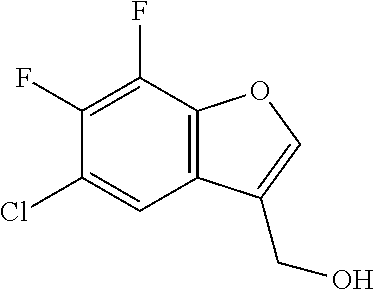
Sodium borohydride (0.035 g, 0.92 mmol) was added to a solution of intermediate 148 (0.1 g, 0.46 mmol) in MeOH (0.5 mL) at rt. The reaction mixture was stirred for 1 hour at this temperature. Aq. sat NaHCO3 solution was added and the reaction was stirred during 30 min. EtOAc and water were added. The aqueous was extracted with EtOAc and the combined organic layers were washed with water and brine, then dried over MgSO4, filtered and concentrated in vacuo. The crude product was purified by flash column chromatography to yield intermediate 149 (0.026 g).

Intermediate 150 was prepared following a synthetic procedure similar to the one reported for the synthesis of intermediate 45. Starting from intermediate 149 (0.026 g, 0.12 mmol) intermediate 150 was obtained and used as such in the next reaction step (0.045 g).

By following a synthetic sequence involving procedures similar to the ones used for the synthesis of (in the order) intermediate 123, intermediate 124 and intermediate 45, intermediate 151 was obtained starting from commercially available 3-bromo-2-hydroxybenzaldehyde.

By following a synthetic sequence involving procedures similar to the ones used for the synthesis of (in the order) intermediate 122, intermediate 123, intermediate 124 and intermediate 45, intermediate 152 was obtained starting from commercially available 3-fluoro-4-(trifluoromethyl)phenol as a mixture of the mesylate and the chloro derivative.

By following a synthetic sequence involving procedures similar to the ones used for the synthesis of (in the order) intermediate 122, intermediate 123, intermediate 124, intermediate 130, intermediate 131 and intermediate 132, intermediate 153 was obtained starting from commercially available 3-fluoro-4-(trifluoromethyl)phenol.

By following a synthetic sequence involving procedures similar to the ones used for the synthesis of (in the order) intermediate 122, intermediate 123, intermediate 124 and intermediate 45, intermediate 152 was obtained starting from commercially available 4-fluoro-3-(trifluoromethyl)phenol as a mixture of the mesylate and the chloro derivative.

By following a synthetic sequence involving procedures similar to the ones used for the synthesis of (in the order) intermediate 122, intermediate 123, intermediate 124, intermediate 130, intermediate 131 and intermediate 132, intermediate 153 was obtained starting from commercially available 4-fluoro-3-(trifluoromethyl)phenol as a mixture of the mesylate and the chloro derivative (ratio 1:2 according to NMR).

5-Chloro-2-fluorobenzotrifluoride (8.5 g, 42.81 mmol) in THF (57 mL) was treated with tetramethylethylenediamine (9.3 mL, 62.33 mmol) and cooled down to −78° C. n-Butyl lithium (1.6 M in hexane, 22.2 mL, 55.53 mmol) was added dropwise. After stirring at −78° C. for 90 min, the mixture was treated with DMF (4.4 mL) and stirred further 30 min. The reaction mixture was allowed to warm to rt and was quenched with aq. sat NH4Cl solution and diluted with Et2O. The organic layer was washed with brine, dried over MgSO4, filtered and evaporated. The residue was then treated with sodium methoxide (30% in MeOH, 80 g, 1480.82 mmol). The reaction was stirred overnight at rt. Water was added and the aqueous phase was extracted with Et2O. The combined organic layers were dried over MgSO4, filtered and concentrated in vacuo to afford an oil. This crude was purified by flash column chromatography (silica; heptanes/DCM 100/0 to 50/50). The desired fractions were collected and concentrated in vacuo to yield intermediate 156 as a yellow oil (8.23 g, 85%).

Boron tribromide (1 M in DCM, 19.3 mL, 16.33 mmol) was added dropwise to a solution of intermediate 156 (3.84 g, 16.11 mmol) in DCM (38 mL) at −78° C. The reaction was stirred at rt overnight. Water (20 mL) was added at −41° C. and the mixture was allowed to warm to rt. EtOAc was added and the organic phase was separated. The aqueous phase was extracted with EtOAc. The combined organic layers were dried over MgSO4, filtered and concentrated in vacuo. This crude was purified by flash column chromatography (silica; heptanes/DCM 100/0 to 50/50). The desired fractions were collected and concentrated in vacuo to yield intermediate 157 as an orange oil (2.33 g, 64%), which solidifies upon standing.

By following a synthetic sequence involving procedures similar to the ones used for the synthesis of (in the order) intermediate 123, intermediate 124 and intermediate 45, intermediate 158 was obtained starting from intermediate 157.

By following a synthetic sequence involving procedures similar to the ones used for the synthesis of (in the order) intermediate 122, intermediate 123, intermediate 124, intermediate 130, intermediate 131 and intermediate 132, intermediate 159 was obtained starting from commercially available 4-chloro-2-fluorophenol.

By following a synthetic sequence involving procedures similar to the ones used for the synthesis of (in the order) intermediate 122, intermediate 123, intermediate 124 and intermediate 45, intermediate 160 was obtained starting from commercially available 3,4-dichlorophenol.

3-Trifluoromethylpiperidine (0.36 mL, 2.73 mmol) was added to a solution of bromoacetyl bromide (0.24 mL, 2.73 mmol) and potassium carbonate (0.47 g, 3.41 mmol) in THF (9 mL) at 0° C. The reaction mixture was then warmed up to rt and stirred 24 h. Water was added and the aqueous layer was extracted with EtOAc. The combined organic layers were washed with aq. sat. NaHCO3 and brine, dried over MgSO4, filtered and concentrated in vacuo. This crude was purified by flash column chromatography (silica; heptanes/DCM 100/0 to 60/40). The desired fractions were collected and concentrated in vacuo to yield intermediate 161 (0.29 g, 39%).

3-Chloro-2-methylpropene (2.35 g, 26 mmol) was added dropwise to a solution of 2-bromochlorophenol (4.15 g, 20 mmol) and K2CO3 (5.53 g, 39.99 mmol) in DMF (100 mL) at rt. The reaction mixture was stirred overnight at 70° C. After cooling down to rt, the reaction mixture was diluted with EtOAc and washed twice with water and once with brine. The organic layer was dried over MgSO4, filtered and concentrated in vacuo to afford intermediate 162, which was used as such in the next reaction.

To a microwave vial equipped with a magnetic stir bar was added intermediate 162 (0.20 g, 0.76 mmol). The vial was purged with argon for 5 minutes, after which Pd(Q-Phos)2 (0.058 g, 0.038 mmol), potassium iodide (0.25 g, 1.53 mmol) and toluene (15 mL) were added. The vial was capped and added to an oil bath pre-heated to 100° C. After stirring for 6 hours, extra Pd(Q-Phos)2 (0.058 g, 0.038 mmol) (prepared as described in Org. Lett. 2010, 12, 3332) was added and the reaction mixture was stirred at 100° C. over the weekend. The vial was cooled and the contents filtered over a pad of silica gel, washing with ether. The crude material was loaded on to a silica gel column and purified by flash chromatography. This crude was purified by flash column chromatography (silica; heptanes/EtOAc 100/0 to 90/10). The desired fractions were collected and concentrated in vacuo to yield racemic intermediate 163 (0.11 g, 45%).

Zinc iodide (0.45 g, 1.42 mmol) was added to a solution of 6-chlorochroman-4-one (5 g, 27.38 mmol) in DCM (20 mL). Then trimethylsilyl cyanide (7.05 g, 71.1 mmol) was added dropwise and the reaction mixture was stirred at rt during 15 hours. The reaction mixture was washed three times with sat. aq. NaHCO3 sol. The organic layer was dried over MgSO4, filtered and concentrated in vacuo. The crude was purified by flash column chromatography (silica; heptanes/DCM 100/0 to 60/40). The desired fractions were collected and concentrated in vacuo to yield intermediate 164 (5.83 g, 76%).

Intermediate 164 (3.8 g, 13.48 mmol) was stirred in acetic acid (15 mL) and HCl (15 mL) and then tin (II) chloride dihydrate (9.13 g, 40.45 mmol) was added. The reaction mixture was stirred at 125° C. during 24 hours. Water was added to the reaction mixture and the aqueous layer was then extracted with DCM (3×). The combined organic layers were dried over MgSO4, filtered and concentrated in vacuo. The crude was purified by flash column chromatography (silica, DCM/MeOH 100/0 to 95/5). The desired fractions were collected and concentrated in vacuo to yield intermediate 165 (1.97 g, 69%).

LiAlH4 (1 M in THF, 26.5 mL, 26.52 mmol) was added to a solution of intermediate 165 (1.97 g, 8.84 mmol) in THF (45 mL) at −20° C. and then the reaction mixture was stirred at rt for 1 h. The r.m. was then cooled to −70° C. and water (4 mL) was carefully added dropwise followed by 1N NaOH (4 mL). THF (40 mL) was then added and the rm was stirred until it reached rt. The reaction mixture was filtered and the solid was washed with DCM. The filtrate was evaporated in vacuo to afford intermediate 166 (1.45 g, 83%).

Intermediate 167 was prepared following a synthetic procedure similar to the one reported for the synthesis of intermediate 45. Starting from intermediate 166 (3.2 g, 16.11 mmol) racemic intermediate 167 was obtained and used as such in the next step.

By following a synthetic sequence involving procedures similar to the ones used for the synthesis of (in the order) intermediate 123, intermediate 124 and intermediate 45, intermediate 168 was obtained starting from commercially available 5-(trifluoromethoxy)salicylaldehyde.

Trimethylsilyl cyanide (17.7 mL, 142 mmol) was added to a solution of 2-fluoro-5-(trifluoromethyl) benzaldehyde (25 g, 130 mmol) in DCM (100 mL) and DABCO (1 mL) at such rate that the mixture was maintained at a gentle reflux. After 1 h at rt, the reaction mixture was treated with water (3×50 mL) and brine (50 mL). The organic layer was dried over MgSO4, filtered and concentrated in vacuo to yield intermediate 169 as an oil (34.7 g, 92%).

A mixture of intermediate 169 (31.7 g, 109 mmol) in water (25 mL) was treated with HCl (37% in water, 75 mL, 989 mmol) and heated at reflux during 2 h. The r.m. was cooled down, diluted with ice water (300 mL), treated with NaOH (50% in water) until pH basic and washed with DCM (2×30 mL). The aqueous layer was acidified with conc HCl until pH=1 and extracted with DCM (3×250 mL). The combined organic layers were dried, filtered and evaporated to afford intermediate 170 as an oil (23.6 g, 91%), which solidifies upon standing.

Intermediate 170 was dissolved in EtOH (500 mL). Sulfuric acid (10 mL) was added and the r.m. stirred overnight at reflux. The solvent was evaporated in vacuo, DCM was added and the mixture cooled with an ice bath. Aq. sat. NaHCO3 sol. was added carefully until pH˜8. The organic layer was separated, dried over MgSO4, filtered and concentrated in vacuo to afford intermediate 171 as an oil (23.8 g, 88%).

A solution of intermediate 171 (23.8 g, 89.4 mmol) in 1,4-dioxane (250 mL) was treated with MnO2 (60 g, 690 mmol) and stirred at reflux for 3 h and then at rt over the weekend. The reaction mixture was filtered over a small plug of Dicalite and concentrated in vacuo to afford intermediate 172 as an oil (18.5 g, 78%).

A stirred solution of intermediate 172 (18.5 g, 70 mmol) in EtOH (150 mL) was treated with hydroxylamine hydrochloride (5.84 g, 84 mmol) and sodium acetate (8.62 g, 105 mmol). The reaction mixture was heated at 50° C. for 5 h and then at rt for 16 h. The reaction mixture was filtered and concentrated in vacuo. The residue was treated with EtOAc (300 mL) and water (1 L) and the layers were separated. The aqueous layer was extracted with EtOAc. The combined organic layers were washed with brine, dried over MgSO4, filtered and concentrated in vacuo. The residue was purified by flash column chromatography (silica; DCM/MeOH 100/0 to 95/5) to yield intermediate 173 as a white solid (17.6 g, 90%).

K2CO3 (10 g, 72.4 mmol) was added to a solution of intermediate 173 (14 g, 50.1 mmol) in DMSO (50 mL) and the reaction mixture was stirred at rt for 16 h. The reaction mixture was diluted with EtOAc (300 mL) and water (100 mL) and the layers were separated. The aqueous layer was extracted with EtOAc (3×200 mL). The combined organic layers were washed with water (2×100 mL), brine (100 mL), dried over MgSO4, filtered and concentrated in vacuo. The residue was purified by flash column chromatography (silica; DCM/MeOH 100/0 to 95/5) to yield intermediate 174 as a white solid (9.9 g, 76%).

By following a synthetic sequence involving procedures similar to the ones used for the synthesis of (in the order) intermediate 40 and intermediate 45, intermediate 175 was obtained starting from intermediate 174.

By following a synthetic sequence involving procedures similar to the ones used for the synthesis of (in the order) intermediate 40 and intermediate 45, intermediate 176 was obtained starting from 6-bromo-chroman-2-carboxylic acid methyl ester.

Ethyl cyanoacetate (0.6 mL, 5.23 mmol) and sulphur (0.32 g, 9.51 mmol) were added to 3-(trifluoromethyl) cyclohexanone (0.79 g, 4.76 mmol) in DMF (20 mL). Then L-proline (0.054 g, 0.47 mmol) was added and the reaction mixture was stirred at 60° C. for 24 h. After cooling to rt, the reaction mixture was diluted with EtOAc and washed with H2O and brine. The organic layer was dried over MgSO4, filtered and concentrated in vacuo. The residue was purified by flash column chromatography (silica; heptanes/EtOAc 100/0 to 75/25) to yield intermediate 177 (0.96 g, 69%).

tert-Butyl nitrite (7.35 mL, 6.32 mmol) and copper (II) chloride (1.60 g, 11.88 mmol) were dissolved in MeOH (47 mL). To this mixture intermediate 177 (0.962 g, 3.28 mmol) was added in one portion and the reaction was stirred for 1 h, then quenched with sat. aq. NH4Cl and the solvent evaporated. The resulting slurry was partitioned between DCM and water. The organic sol. was separated and dried over MgSO4, filtered and the solvent was evaporated in vacuo to give a crude, which was used without further purification for the subsequent reaction (0.9 g).

By following a synthetic sequence involving procedures similar to the ones used for the synthesis of (in the order) intermediate 166 and intermediate 45, intermediate 179 was obtained starting from intermediate 178.

DIAD (0.039 mL, 0.20 mmol) was added to a stirred solution of intermediate 25 (70 mg, crude material) and TPP (52 mg, 0.20 mmol) in dry THF (20 mL) under N2 at 0° C. The mixture was stirred at r.t. for 3 h, then the solvents were evaporated in vacuo. The product was purified by flash column chromatography (silica; DCM/MeOH 100/0 to 90/10). The desired fractions were collected and concentrated in vacuo. The compound was re-dissolved in DCM and 1.1 eq. of 4N HCl in dioxane was added. The solvent was evaporated and the solid triturated with DIPE to yield to give compound 1 as a beige solid (4 mg).

Intermediate 18 (429 mg, 1.661 mmol) was stirred in DMF (20 mL) under N2 atmosphere. NaH (146 mg, 3.66 mmol) was added and the r.m. was stirred for 10 min. Intermediate 30 (390 mg, crude material) was added and the mixture was stirred at r.t. for 3 h. Ice was added and the solvents were evaporated. Water was added and the product was extracted with EtOAc. The organic layer was washed with brine, dried over MgSO4, filtered and evaporated. The product was purified by flash column chromatography (silica; DCM/MeOH 97/3 to 90/10, then DCM/(7 N NH3 in MeOH) 90/10). The pure fractions were collected and the solvent evaporated in vacuo, to give compound 2 (500 mg), which was separated into diastereoisomers by Prep HPLC (Stationary phase: RP SunFire Prep C18 OBD-10 μm, 30×150 mm; Mobile phase: 0.25% NH4HCO3 solution in water/MeOH), yielding compound 3 (114 mg) and compound 4 (69 mg).

By following a procedure similar to the one reported for the synthesis of compound 2 (Example B2), starting from intermediate 18 and intermediate 34, compound 5 (240 mg) was obtained. Compound 5 was then separated into diastereoisomers by Prep SFC (Stationary phase: Chiralcel Diacel OD 20×250 mm; Mobile phase: CO2, iPrOH with 0.2% iPrNH2). The desired fractions were collected, the solvent evaporated in vacuo, the residue dissolved in MeOH and evaporated again. The two fractions were suspended in DIPE, filtered and dried in vacuo at 50° C., to afford compound 6 (57 mg) and compound 7 (49 mg).

By following a procedure similar to the one reported for the synthesis of compound 2 (Example B2), starting from intermediate 18 and 3-(bromomethyl)-5-chloro-1,2-benzisoxazole compound 14 was obtained.

Intermediate 18 (287 mg, 1.11 mmol), NaH (89 mg, 2.23 mmol) and 18-crown-6 (197 mg, 0.75 mmol) were stirred in dry THF (5 mL) at 70° C. for 1 h under N2 atmosphere. The r.m. was cooled to r.t. and then intermediate 41 (458 mg, 1.11 mmol) in DMF (3 mL) was added. The mixture was then heated to 90° C. and allowed to react at this temperature for 24 h. Water was then added and the product was extracted with EtOAc. The phases were separated, the organic layer was dried over MgSO4, filtered and evaporated. The crude material was purified by Prep HPLC (Stationary phase: RP Vydac Denali C18-10 μm, 200 g, 5 cm; Mobile phase: 0.25% NH4HCO3 solution in water/acetonitrile). The desired fractions were collected, the solvent was evaporated, the residue dissolved in MeOH and the solvent evaporated again, yielding compound 15 (12 mg, 2%).

By following a procedure similar to the one reported for the synthesis of compound 15 (Example B5), starting from intermediate 18 and intermediate 49 a mixture of compound 17 and compound 18 was obtained. The mixture was separated into pure diastereoisomers by Prep HPLC (Stationary phase: RP SunFire Prep C18 OBD-10 μm, 30×150 mm; Mobile phase: 0.25% NH4HCO3 solution in water, MeOH), yielding compound 17 (6% yield) and compound 18 (5% yield) as foams.

By following a procedure similar to the one reported for the synthesis of compound 2 (Example B2), starting from intermediate 18 and a mixture of intermediates 55 and 56, a mixture of compound 20 and compound 21 was obtained. The mixture was separated in the single regioisomers by Prep HPLC (Stationary phase: RP SunFire Prep C18 OBD-10 μm, 30×150 mm; Mobile phase: 0.25% NH4HCO3 solution in water/acetonitrile). The fractions containing the products were collected and the solvent evaporated in vacuo. The residue was suspended from DIPE, precipitated, filtered and dried in vacuo to afford compound 20 (48 mg, 10%) and compound 21 (20 mg, 4%).

MeOH (40 mL) was added to 10% Pd/C (50 mg) under N2 atmosphere. Thiophene solution (0.4% in MeOH) was added and the resulting mixture stirred under H2 atmosphere for 30 min. Compound 20 (60 mg, 0.12 mmol) and potassium acetate (24 mg, 0.25 mmol) were added and the r.m. stirred at 25° C. under H2 atmosphere until 1 eq. of H2 was absorbed. The reaction mixture was then filtered over dicalite. The solvent was evaporated in vacuo and the residue purified by flash column chromatography (silica; DCM/MeOH 100/0 to 95/5). The product fractions were collected and the solvent was evaporated. The product was suspended in DIPE and dried in vacuo at 50° C., to afford compound 22 (24 mg, 48%).

Intermediate 18 (150 mg, 0.58 mmol), NaH (26 mg, 0.64 mmol) and 15-crown-5 (0.12 ml, 0.58 mmol) were stirred in dry DMF (7 mL) at r.t. for 1 h under N2, then intermediate 58 (186 mg, 0.61 mmol) in DMF (2 ml) was added and the mixture stirred at r.t. After 90 min the reaction was quenched with water and extracted with EtOAc. The combined organic layers were dried over MgSO4, filtered and the solvent evaporated, to give a crude which was purified by flash column chromatography (silica; DCM/MeOH 100/0 to 95/5). The desired fractions were collected and the solvent was evaporated yielding compound 23 (28 mg, mixture of diastereomers in a 8:1 ratio (LCMS)).

By following a procedure similar to the one reported for the synthesis of compound 2 (Example B2), starting from intermediate 18 and 3-phenoxybenzyl chloride compound 32 was obtained. After purification by flash column chromatography (silica; DCM/MeOH 99/1 to 95/5) the oil obtained after evaporation of the solvent was dissolved in MeOH. Subsequently, the compound was converted into the HCl salt. The salt obtained was recrystallized from Et2O, to yield compound 32 (47%).

By following a procedure similar to the one reported for the synthesis of compound 2 (Example B2), starting from intermediate 18 and intermediate 86, compound 35 (626 mg, mixture of diastereoisomers) was obtained. The mixture was separated into the single diastereoisomers by Prep SFC (Stationary phase: Chiralpak Diacel AD 30×250 mm; Mobile phase: CO2, EtOH with 0.4% iPrNH2), yielding compound 36 (253 mg, 31%) and compound 37 (266 mg, 33%).

By following a procedure similar to the one reported for the synthesis of compound 2 (Example B2), starting from intermediate 18 and intermediate 104, 25 mg of compound 45 (mixture of diastereomers) was obtained. The mixture was separated into the single diastereoisomers by Prep SFC (Stationary phase: Chiralpak Diacel OJ 20×250 mm; Mobile phase: CO2, MeOH with 0.4% iPrNH2). The desired fractions were collected, evaporated, dissolved in MeOH and evaporated again, yielding compound 46 (5 mg, 7%) and compound 47 (6 mg, 8%).

Pd2(dba)3 (25 mg, 0.027 mmol) and tetramethyl di-tBuXPhos (23 mg, 0.047 mmol) were added to an oven-dried vial under N2 atm and the vial was sealed. Dry toluene (10 mL) and dry dioxane (2 mL) were added and the resulting dark purple mixture was stirred at 120° C. for 3 min. 4-Methylimizazole (110 mg, 1.342 mmol) and K3PO4 (285 mg, 1.342 mmol) were added to a second oven-dried vial under N2 atmosphere and the vial was sealed. Then, intermediate 111 (322 mg, 0.671 mmol) and the premixed catalyst solution were added to the second vial. The reaction mixture was stirred at 120° C. for 5 h, then it was cooled to room temperature, diluted with EtOAc, washed with brine, dried over MgSO4, filtered and concentrated. The crude was purified by flash column chromatography (silica; DCM/MeOH 100/0 to 96/4). The desired fractions were collected and concentrated in vacuo. The product (92 mg) was dissolved in EtOAc (2 mL), then HCl (4 M in dioxane, 0.053 mL, 0.21 mmol) was added to obtain the hydrochloride. The solvent was evaporated and the product was triturated with Et2O to yield 66 mg of compound 51 as a pale orange solid.

By following a procedure similar to the one reported for the synthesis of compound 2 (Example B2), starting from intermediate 18 and intermediate 132, 1.65 g of a mixture of diastereomers 57 and 57 was obtained. The mixture was separated into the single diastereoisomers by Prep HPLC (Stationary phase: XBridge C18_3.5 um, Mobile phase: 0.2% NH4HCO3 in water, MeOH). The desired fractions were collected, evaporated, dissolved in MeOH and evaporated again, yielding compound 57 (150 mg, 8%) and compound 58 (329 mg, 18%).

By following a procedure similar to the one reported for the synthesis of compound 2 (Example B2), starting from intermediate 18 and intermediate 133, 1 g of a mixture of diastereomers 65 and 66 was obtained. The crude was purified by flash column chromatography (silica; DCM/MeOH 100/0 to 95/5). The desired fractions were collected, evaporated, dissolved in MeOH and evaporated again, yielding compound 65 (0.45 g, 22%) and compound 66 (0.42 g, 20%).

By following a procedure similar to the one reported for the synthesis of compound 2 (Example B2), starting from intermediate 18 and intermediate 153, a mixture of diastereomers 89 and 90 was obtained (429 mg). The mixture was separated into the single diastereoisomers by Prep SFC (Stationary phase: Chiralpak Diacel AD 30×250 mm; Mobile phase: CO2, EtOH with 0.2% iPrNH2). The desired fractions were collected, evaporated, dissolved in MeOH and evaporated again, yielding compound 89 (25 mg, 4%) and compound 90 (54 mg, 8%).

Intermediate 18 (1.48 g, 5.72 mmol) and lithium bromide (0.50 g, 5.72 mmol) were stirred in dry DMF (180 mL) at r.t. under N2. NaH (1.37 g, 34.33 mmol) was added and the r.m. was stirred for 10 min. Intermediate 167 (1.9 g, 6.87 mmol) was added and the mixture was stirred at r.t. for 1 week. Two drops of water were added and the solvents were evaporated. Water was added and the aqueous layer was extracted with EtOAc. The combined organic layers were dried over MgSO4, filtered and the solvent evaporated, to give a crude which was purified by flash column chromatography (silica; DCM/MeOH, 98/2 to 96/4). The desired fractions were collected and the solvent was evaporated yielding compound 100 (50 mg, 2%).
By using analogous reaction protocols as described in the foregoing examples, the compounds listed in the Tables below have been prepared.
‘Co. No.’ means compound number. ‘cb’ means covalent bond.
‘Pr.’ refers to the Example number in analogy to which protocol the compound was synthesized.
In case no specific stereochemistry is indicated for a stereocenter of a compound, this means that the compound was obtained as a mixture of the R and the S enantiomers. “HCl salt” means hydrochloric acid salt; the exact number of equivalents of HCl was not determined.
In case no salt form is indicated, the compound was obtained as a free base.
| TABLE 1A |
 |
| Salt forms/ | ||||||||
| Stereo- | ||||||||
| chemistry/ | ||||||||
| Co. | Optical | |||||||
| No. | Pr. | R1 | L | R2 | R3 | R4 | R5 | Rotation (OR) |
| 8 | B2 |
 |
CH2 | CH3 | H | CH3 | H | R-enantiomer |
| 9 | B2 |
 |
CH2 | CH3 | H | CH3 | H | R-enantiomer |
| 38 | B2 |
 |
 |
CH3 | H | CH3 | H | R-enantiomer OR: −42.91° (589 nm; 20° C.; 0.55 w/v %; DMF) |
| 39 | B2 |
 |
CH2 | CH3 | H | CH3 | H | R-enantiomer |
| 10 | B2 |
 |
CH2 | CH3 | H | CH3 | H | R-enantiomer OR: −5.40° (589 nm; 20°C.; 0.5 w/v %; DMF) |
| 11 | B2 |
 |
CH2 | CH3 | H | CH3 | H | R-enantiomer |
| 12 | B2 |
 |
CH2 | CH3 | H | CH3 | H | R-enantiomer HCl salt |
| 13 | B2 |
 |
CH2 | CH3 | H | CH3 | H | R-enantiomer |
| 14 | B4 |
 |
CH2 | CH3 | H | CH3 | H | R-enantiomer |
| 16 | B2 |
 |
CH2 | CH3 | H | CH3 | H | R-enantiomer |
| 19 | B2 |
 |
CH2 | CH3 | H | CH3 | H | R-enantiomer OR: +8.48° (589 nm; 20° C.; 0.495 w/v %; DMF) |
| 20 | B7 |
 |
CH2 | CH3 | H | CH3 | H | R-enantiomer OR: −85.14° (589 nm; 20° C.; 0.249 w/v %; DMF) |
| 21 | B7 |
 |
CH2 | CH3 | H | CH3 | H | R-enantiomer OR: −65.52° (589 nm; 20° C.; 0.174 w/v %; DMF) |
| 22 | B8 |
 |
CH2 | CH3 | H | CH3 | H | R-enantiomer OR: −78.37° (589 nm; 20° C.; 0.245 w/v %; DMF) |
| 24 | B2 |
 |
CH2 | CH3 | H | CH3 | H | R-enantiomer OR: −34.93° (589 nm; 20° C.; 0.375 w/v %; DMF) |
| 25 | B2 |
 |
CH2 | CH3 | H | CH3 | H | R-enantiomer OR: +14.04° (589 nm; 20° C.; 0.4415 w/v %; DMF) |
| 26 | B2 |
 |
CH2 | CH3 | H | CH3 | H | R-enantiomer OR: −37.29° (589 nm; 20° C.; 0.48 w/v %; DMF) |
| 28 | B2 |
 |
CH2 | CH3 | H | CH3 | H | R-enantiomer OR: −11.63° (589 nm; 20° C.; 0.49 w/v %; DMF) |
| 29 | B2 |
 |
CH2 | CH3 | H | CH3 | H | R-enantiomer OR: −7.45° (589 nm; 20° C.; 0.725 w/v %; DMF) |
| 31 | B2 |
 |
CH2 | CH3 | H | CH3 | H | R-enantiomer |
| 32 | B10 |
 |
CH2 | CH3 | H | CH3 | H | R-enantiomer HCl salt |
| 33 | B2 |
 |
CH2 | CH3 | H | CH3 | H | R-enantiomer HCl salt |
| 41 | B2 |
 |
 |
CH3 | H | CH3 | H | R-enantiomer |
| 42 | B2 |
 |
CH2 | CH3 | H | CH3 | H | R-enantiomer |
| 44 | B13 |
 |
CH2 | H | H | CH3 | H | Mixture of R and S |
| 40 | B13 |
 |
 |
CH3 | H | CH3 | H | R-enantiomer HCl salt |
| 53 | B13 |
 |
 |
CH3 | H | CH3 | H | R-enantiomer HCl salt |
| 54 | B2 |
 |
CH2 | H | H | CH3 | H | |
| 55 | B2 |
 |
CH2 | CH3 | H | CH3 | H | R-enantiomer |
| 56 | B2 |
 |
CH2 | H | H | CH3 | H | |
| 59 | B2 |
 |
 |
H | H | CH3 | H | Mixture of R and S |
| 60 | B2 |
 |
 |
H | H | CH3 | H | R or S enantiomer |
| 61 | B2 |
 |
 |
H | H | CH3 | H | S or R enantiomer |
| 62 | B2 |
 |
CH2 | CH3 | H | CH3 | H | R-enantiomer |
| 63 | B2 |
 |
CH2 | CH3 | H | CH3 | H | R-enantiomer |
| 64 | B2 |
 |
CH2 | H | H | CH3 | H | |
| 67 | B5 |
 |
 |
H | H | CH3 | H | S or R enantiomer |
| 68 | B5 |
 |
 |
H | H | CH3 | H | R or S enantiomer |
| 69 | B2 |
 |
 |
H | H | CH3 | H | S or R enantiomer |
| 70 | B2 |
 |
 |
H | H | CH3 | H | R or S enantiomer |
| 71 | B2 |
 |
CH2 | CH3 | H | CH3 | H | R-enantiomer |
| 72 | B2 |
 |
CH2 | CH3 | H | CH3 | H | R-enantiomer |
| 73 | B2 |
 |
CH2 | CH3 | H | CH3 | H | R-enantiomer |
| 74 | B2 |
 |
CH2 | CH3 | H | CH3 | H | R-enantiomer |
| 75 | B2 |
 |
CH2 | H | H | CH3 | H | |
| 76 | B2 |
 |
CH2 | CH3 | H | CH3 | H | R-enantiomer |
| 77 | B2 |
 |
CH2 | CH3 | H | CH3 | H | R-enantiomer |
| 81 | B2 |
 |
 |
H | H | CH3 | H | S or R enantiomer |
| 82 | B2 |
 |
 |
H | H | CH3 | H | R or S enantiomer |
| 83 | B2 |
 |
CH2 | CH3 | H | CH3 | H | R-enantiomer |
| 84 | B2 |
 |
CH2 | CH3 | H | CH3 | H | R-enantiomer |
| 85 | B2 |
 |
CH2 | CH3 | H | CH3 | H | R-enantiomer |
| 88 | B2 |
 |
CH2 | CH3 | H | CH3 | H | R-enantiomer |
| 93 | B2 |
 |
CH2 | CH3 | H | CH3 | H | R-enantiomer |
| 94 | B2 |
 |
CH2 | H | H | CH3 | H | |
| 97 | B2 |
 |
CH2 | CH3 | H | CH3 | H | R-enantiomer |
| 98 | B2 |
 |
 |
CH3 | H | CH3 | H | R-enantiomer |
| 99 | B5 |
 |
CH2 | H | H | CH3 | H | |
| 101 | B2 |
 |
CH2 | CH3 | H | CH3 | H | R-enantiomer |
| 104 | B2 |
 |
CH2 | CH3 | H | CH3 | H | R-enantiomer |
| TABLE 1B | |||
| Co. | |||
| No. | Pr. | Structure | Salt forms |
| 1 | B1 |
 |
HCl salt |
| 2 | B2 |
 |
|
| 3 | B2 |
 |
|
| 4 | B2 |
 |
|
| 5 | B3 |
 |
|
| 6 | B3 |
 |
|
| 7 | B3 |
 |
|
| 15 | B5 |
 |
|
| 17 | B6 |
 |
|
| 18 | B6 |
 |
|
| 34 | B2 |
 |
|
| 35 | B11 |
 |
|
| 36 | B11 |
 |
|
| 37 | B11 |
 |
|
| 45 | B12 |
 |
|
| 46 | B12 |
 |
|
| 47 | B12 |
 |
|
| 48 | B13 |
 |
HCl salt |
| 49 | B13 |
 |
HCl salt |
| 50* | B13 |
 |
HCl salt |
| 51 | B13 |
 |
HCl salt |
| 52 | B13 |
 |
HCl salt |
| 23 | B9 |
 |
|
| 27 | B2 |
 |
|
| 30 | B2 |
 |
HCl salt |
| 43 | B13 |
 |
HCl salt |
| 57 | B14 |
 |
|
| 58 | B14 |
 |
|
| 65 | B15 |
 |
|
| 66 | B15 |
 |
|
| 78 | B2 |
 |
|
| 79 | B2 |
 |
|
| 80 | B2 |
 |
|
| 86 | B2 |
 |
|
| 87 | B2 |
 |
|
| 88 | B2 |
 |
|
| 89 | B16 |
 |
|
| 90 | B16 |
 |
|
| 91 | B2 |
 |
|
| 92 | B2 |
 |
|
| 95 | B2 |
 |
|
| 96 | B2 |
 |
|
| 100 | B17 |
 |
|
| 102 | B2 |
 |
|
| 103 | B2 |
 |
|
| *Compound 50 was obtained as a side-product during the reaction. | |||
Analytical Part
LCMS (Liquid Chromatography/Mass Spectrometry)
LCMS General Procedure
The High Performance Liquid Chromatography (HPLC) measurement was performed using a LC pump, a diode-array (DAD) or a UV detector and a column as specified in the respective methods. If necessary, additional detectors were included (see table of methods below).
Flow from the column was brought to the Mass Spectrometer (MS) which was configured with an atmospheric pressure ion source. It is within the knowledge of the skilled person to set the tune parameters (e.g. scanning range, dwell time . . . ) in order to obtain ions allowing the identification of the compound's nominal monoisotopic molecular weight (MW). Data acquisition was performed with appropriate software. Compounds are described by their experimental retention times (Rt) and ions. If not specified differently in the table of data, the reported molecular ion corresponds to the [M+H]+ (protonated molecule) and/or [M−H]− (deprotonated molecule). For molecules with multiple isotopic patterns (e.g. Br, Cl), the reported value is the one obtained for the lowest isotope mass. All results were obtained with experimental uncertainties that are commonly associated with the method used.
Hereinafter, “SQD” means Single Quadrupole Detector, “MSD” Mass Selective Detector, “RT” room temperature, “BEH” bridged ethylsiloxane/silica hybrid, “DAD” Diode Array Detector, “HSS” High Strength silica, “Q-Tof” Quadrupole Time-of-flight mass spectrometers, “CLND”, ChemiLuminescent Nitrogen Detector, “ELSD” Evaporative Light Scanning Detector.
| TABLE 2 |
| LCMS Method codes (Flow expressed in mL/min; column temperature (T) in |
| ° C.; Run time in minutes) |
| Method | Flow | Run | ||||
| code | Instrument | Column | Mobile phase | Gradient | Col T | time |
| 1 | Waters: | Waters: | A: 10 mM | From 95% A to | 0.8 | 3 |
| Acquity ® | HSS T3 | CH3COONH4 in | 0% A in 2.5 min, | |||
| UPLC ®- | (1.8 μm, | 95% H2O + 5% | to 5% A in | |||
| DAD | 2.1 * 100 mm) | CH3CN | 0.5 min | |||
| and SQD | B: CH3CN | 55 | ||||
| 2 | Waters: | Waters: | A: 10 mM | From 100% A to | 0.8 | 3.5 |
| Acquity ® | HSS T3 | CH3COONH4 in | 5% A in 2.10 min, | |||
| UPLC ®- | (1.8 μm, | 95% H2O + 5% | to 0% A in | |||
| DAD | 2.1 * 100 mm) | CH3CN | 0.90 min, to 5% A | |||
| and SQD | B: CH3CN | in 0.5 min | 55 | |||
| 3 | Waters: | Waters: | A: 25 mM | From 100% A to | 1.6 | 11 |
| Alliance ®- | Xterra | CH3COONH4 in | 1% A, 49% B and | |||
| DAD- | MS C18 | 95% H2O + 5% | 50% C in 6.5 min, | |||
| ZQ and | (3.5 μm, | CH3CN | to 1% A and 99% | |||
| ELSD | 4.6 * | B: CH3CN | B in 0.5 min, to | 40 | ||
| 2000 | 100 mm) | C: CH3OH | 100% D in 1 min | |||
| Alltech | D: (40% CH3CN | held for 1.0 min | ||||
| and 40% CH3OH | to 100% A in 0.5 min | |||||
| and 20% H2O with | and held for | |||||
| 0.25% CH3COOH | 1.5 min. | |||||
| 4 | Waters: | Waters: | A: 10 mM | From 95% A to | 0.8 | 2 |
| Acquity ® | BEH | CH3COONH4 in | 5% A in 1.3 min, | |||
| UPLC ®- | C18 | 95% H2O + 5% | held for 0.7 min. | |||
| DAD | (1.7 μm, | CH3CN | ||||
| and SQD | 2.1 * 50 mm) | B: CH3CN | 55 | |||
| 5 | Agilent | YMC- | A: 0.1% HCOOH | From 95% A to | 2.6 | 6.0 |
| 1100- | pack | in H2O | 5% A in 4.8 min, | |||
| DAD- | ODS-AQ | B: CH3CN | held for 1.0 min, | 35 | ||
| MSD | C18 (50 × | to 95% A in 0.2 min. | ||||
| G1956A | 4.6 mm, | |||||
| 3 μm) | ||||||
| 6 | Waters: | Waters: | A: 0.1% HCOOH + | From 95% A to | 0.8 | 3 |
| Acquity ® | BEH | 5% CH3OH in H2O | 0% A in 2.5 min, | |||
| UPLC ®- | C18 | B: CH3CN | to 5% A in | 55 | ||
| DAD | (1.7 μm, | 0.5 min. | ||||
| and SQD | 2.1 * 50 mm) | |||||
| 7 | Waters: | Waters: | A: 10 mM | From 100% A to | 0.7 | 3.5 |
| Acquity ® | HSS T3 | CH3COONH4 in | 5% A in 2.10 min, | |||
| UPLC ®- | (1.8 μm, | 95% H2O + 5% | to 0% A in | |||
| DAD | 2.1 * 100 mm) | CH3CN | 0.90 min, to 5% A | |||
| and SQD | B: CH3CN | in 0.5 min | 55 | |||
Melting Points
For compounds 9, 13, 14, 19, 26, 28 and 29 melting points (m.p.) were determined with a DSC823e (Mettler-Toledo). The m.p. of compounds 13, 19, 26, 28 and 29 were measured with a temperature gradient of 10° C./min. The m.p. of compound 14 was measured with a temperature gradient of 30° C./min.
For compounds 30, 33, 40, 43, 44, 48, 51, 52 and 53 m.p. were determined in open capillary tubes on a Mettler FP62 apparatus. M.p. were measured with a temperature ranging from 50° C. to 300° C., using a gradient of 10° C./minute. The m.p. value was read from a digital display.
The results of the analytical measurements are shown in table 3.
| TABLE 3 |
| Retention time (Rt) in min., [M + H]+ peak (protonated molecule), LCMS |
| method and m.p. (melting point in ° C.) (n.d. means not determined). |
| Co. | LCMS | m.p. | ||
| No. | Rt | [M + H]+ | Method | (° C.) |
| 1 | 2.79 | 513 | 5 | n.d. |
| 2 | 0.65 | 462 | 4 | n.d. |
| 3 | 0.64 | 462 | 4 | n.d. |
| 4 | 0.65 | 462 | 4 | n.d. |
| 5 | 0.77 | 461 | 4 | n.d. |
| 6 | 1.53 | 461 | 2 | n.d. |
| 7 | 1.53 | 461 | 2 | n.d. |
| 8 | 0.70 | 458 | 4 | n.d. |
| 9 | 1.62 | 457 | 2 | 170 |
| 38 | 0.80 | 432 | 4 | n.d. |
| 39 | 1.89 | 433 | 1 | n.d. |
| 10 | 0.87 | 433 | 4 | n.d. |
| 11 | 1.83 | 469 | 1 | n.d. |
| 12 | 0.96 | 418 | 4 | n.d. |
| 13 | 0.96 | 467 | 4 | 159 |
| 14 | 5.37 | 424 | 3 | 147 |
| 15 | 1.79 | 497 | 6 | n.d. |
| 16 | 0.87 | 463 | 4 | n.d. |
| 17 | 0.95 | 473 | 4 | n.d. |
| 18 | 0.96 | 473 | 4 | n.d. |
| 19 | 0.89 | 463 | 4 | 144 |
| 20 | 1.87 | 484 | 2 | n.d. |
| 21 | 1.85 | 484 | 2 | n.d. |
| 22 | 5.09 | 406 | 3 | n.d. |
| 23 | 1.61 | 486 | 2 | n.d. |
| 24 | 5.35 | 437 | 3 | n.d. |
| 25 | 0.76 | 435 | 4 | n.d. |
| 26 | 1.01 | 457 | 4 | 164 |
| 27 | 0.97 | 507 | 4 | n.d. |
| 28 | 0.91 | 423 | 4 | 162 |
| 29 | 0.89 | 437 | 4 | 110 |
| 30 | 2.36 | 444 | 5 | 122 |
| 31 | n.d. | n.d. | — | n.d. |
| 32 | 0.97 | 440 | 4 | n.d. |
| 33 | 2.52 | 473 | 5 | 149 |
| 34 | 1.90 | 477 | 2 | n.d. |
| 35 | 1.89 | 477 | 2 | n.d. |
| 36 | 1.89 | 477 | 2 | n.d. |
| 37 | 1.90 | 477 | 2 | n.d. |
| 41 | 0.92 | 451 | 4 | n.d. |
| 42 | 1.91 | 449 | 1 | n.d. |
| 43 | n.d. | n.d. | — | 138 |
| 44 | 2.21 | 445 | 5 | 128 |
| 45 | 1.04 | 477 | 4 | n.d. |
| 46 | 1.91 | 477 | 2 | n.d. |
| 47 | 1.90 | 477 | 2 | n.d. |
| 48 | 2.68 | 487 | 5 | 122 |
| 49 | 2.66 | 487 | 5 | n.d. |
| 50 | 2.09 | 447 | 5 | n.d. |
| 51 | n.d. | n.d. | — | 212 |
| 52 | n.d. | n.d. | — | 223 |
| 40 | 2.70 | 487 | 5 | 102 |
| 53 | 2.94 | 513 | 5 | 197 |
| 54 | 0.91 | 409 | 4 | n.d. |
| 55 | 0.94 | 423 | 4 | n.d. |
| 56 | 0.94 | 427 | 2 | 232 |
| 57 | 1.66 | 437 | 2 | n.d. |
| 58 | 1.64 | 437 | 2 | n.d. |
| 59 | 2.30 | 441 | 5 | n.d. |
| 60 | 1.63 | 441 | 2 | 234 |
| 61 | 1.63 | 441 | 2 | 231 |
| 62 | 1.67 | 441 | 2 | n.d. |
| 63 | 1.74 | 441 | 2 | n.d. |
| 64 | 1.60 | 443 | 2 | 211 |
| 65 | 2.43 | 455 | 5 | n.d. |
| 66 | 5.91 | 455 | 3 | n.d. |
| 67 | 1.68 | 457 | 2 | 200 |
| 68 | 1.68 | 457 | 2 | 204 |
| 69 | 1.74 | 457 | 2 | n.d. |
| 70 | 1.74 | 457 | 2 | n.d. |
| 71 | 1.72 | 457 | 2 | 225 |
| 72 | 1.72 | 457 | 2 | 215 |
| 73 | 1.75 | 457 | 2 | 187 |
| 74 | 1.87 | 457 | 2 | 202 |
| 75 | 1.73 | 459 | 2 | n.d. |
| 76 | 1.72 | 459 | 2 | n.d. |
| 77 | 1.68 | 467 | 2 | n.d. |
| 78 | 1.82 | 471 | 2 | n.d. |
| 79 | 1.79 | 471 | 2 | n.d. |
| 80 | 1.78 | 471 | 2 | n.d. |
| 81 | 1.68 | 473 | 2 | n.d. |
| 82 | 1.68 | 473 | 2 | n.d. |
| 83 | 1.79 | 473 | 2 | n.d. |
| 84 | 1.02 | 475 | 4 | 222 |
| 85 | 1.02 | 475 | 4 | 226 |
| 86 | 1.84 | 487 | 2 | n.d. |
| 87 | 1.82 | 487 | 2 | n.d. |
| 88 | 2.06 | 511 | 2 | n.d. |
| 89 | 1.73 | 489 | 2 | 230 |
| 90 | 1.71 | 489 | 2 | n.d. |
| 91 | 1.04 | 489 | 4 | n.d. |
| 92 | 1.03 | 489 | 4 | n.d. |
| 93 | 1.82 | 491 | 2 | n.d. |
| 94 | 1.88 | 443 | 7 | n.d. |
| 95 | 1.9 | 455 | 7 | n.d. |
| 96 | 1.92 | 455 | 7 | 201 |
| 97 | 1.05 | 457 | 4 | 227 |
| 98 | 0.8 | 452.8 | 4 | n.d. |
| 99 | 1.63 | 425 | 2 | n.d. |
| 100 | 1.72 | 439 | 2 | n.d. |
| 101 | 5.46 | 458 | 3 | 140 |
| 102 | 1.91 | 477 | 2 | n.d. |
| 103 | 1.91 | 477 | 2 | n.d. |
| 104 | 1.02 | 483 | 4 | n.d. |
NMR
For a number of compounds, 1H NMR spectra were recorded on a Bruker Avance III with a 300 MHz Ultrashield magnet, on a Bruker DPX-400 spectrometer operating at 400 MHz, on a Bruker DPX-360 operating at 360 MHz, or on a Bruker Avance 600 spectrometer operating at 600 MHz, using CHLOROFORM-d (deuterated chloroform, CDCl3) or DMSO-d6 (deuterated DMSO, dimethyl-d6 sulfoxide) as solvent. Chemical shifts (δ) are reported in parts per million (ppm) relative to tetramethylsilane (TMS), which was used as internal standard.
| TABLE 4 |
| 1H NMR results |
| Co. No. | 1H NMR result |
| 3 | (360 MHz, DMSO-d6) δ ppm 1.19 (d, J = 6.6 Hz, 3 H), 1.77-1.93 (m, 1 H), |
| 2.15 (s, 4 H), 2.87 (ddd, J = 17.2, 11.5, 6.0 Hz, 1 H), 2.96-3.24 (m, 2 H), | |
| 3.84-4.04 (m, 3 H), 4.40 (dd, J = 12.3, 5.3 Hz, 1 H), 4.53 (d, J = 15.7 Hz, 1 H), | |
| 4.60 (dd, J = 13.9, 2.9 Hz, 1 H), 5.22 (d, J = 15.7 Hz, 1 H), 7.13 (d, J = 7.7 Hz, 1 H), | |
| 7.39-7.46 (m, 1 H), 7.81 (d, J = 7.7 Hz, 1 H), 8.28 (d, J = 1.5 Hz, 1 H) | |
| 4 | (360 MHz, DMSO-d6) δ ppm 1.16 (d, J = 6.6 Hz, 3 H), 1.75-1.95 (m, 1 H), |
| 2.10-2.26 (m, 4 H), 2.87 (ddd, J = 16.8, 11.0, 5.9 Hz, 1 H), 3.03 (dt, J = 16.6, 4.8 Hz, | |
| 1 H), 3.12-3.25 (m, 1 H), 3.89 (dd, J = 13.9, 4.0 Hz, 1 H), 3.93-4.13 (m, 2 | |
| H), 4.39 (dd, J = 12.4, 5.9 Hz, 1 H), 4.53-4.68 (m, 2 H), 5.15 (d, J = 15.7 Hz, 1 | |
| H), 7.03-7.24 (m, 1 H), 7.43 (s, 1 H), 7.81 (d, J = 8.1 Hz, 1 H), 8.28 (d, J = 1.1 Hz, | |
| 1 H) | |
| 6 | (360 MHz, CHLOROFORM-d) δ ppm 1.26 (d, J = 6.8 Hz, 3 H), 2.08 (qd, |
| J = 12.4, 5.6 Hz, 1 H), 2.28 (s, 3 H), 2.38 (d, J = 13.9 Hz, 1 H), 2.55-2.67 (m, 1 | |
| H), 2.73 (dd, J = 16.1, 11.7 Hz, 1 H), 3.21 (dd, J = 16.1, 4.7 Hz, 1 H), 3.66 (dd, | |
| J = 14.1, 4.1 Hz, 1 H), 3.81-3.91 (m, 1 H), 4.01 (d, J = 15.0 Hz, 1 H), 4.11 (td, | |
| J = 12.5, 4.7 Hz, 1 H), 4.42 (dd, J = 13.4, 5.6 Hz, 1 H), 4.78 (d, J = 14.1 Hz, 1 H), | |
| 5.12 (d, J = 15.0 Hz, 1 H), 7.14 (s, 1 H), 7.21-7.31 (m, 1 H), 7.47 (d, J = 8.1 Hz, | |
| 1 H), 7.50 (s, 1 H), 8.23 (s, 1 H) | |
| 7 | (360 MHz, CHLOROFORM-d) δ ppm 1.26 (d, J = 6.6 Hz, 3 H), 2.10 (dtd, |
| J = 13.7, 11.7, 11.7, 5.6 Hz, 1 H), 2.29 (s, 3 H), 2.33-2.42 (m, 1 H), | |
| 2.56-2.69 (m, 1 H), 2.81 (dd, J = 16.5, 11.0 Hz, 1 H), 3.26 (ddd, J = 16.5, 5.3, 1.7 Hz, 1 H), | |
| 3.70 (dd, J = 14.2, 4.1 Hz, 1 H), 3.91 (qdd, J = 6.6, 6.6, 6.6, 4.2, 2.0 Hz, 1 H), | |
| 4.06 (d, J = 15.0 Hz, 1 H), 4.10 (td, J = 12.4, 4.8 Hz, 1 H), 4.42 (ddd, J = 13.1, 5.5, 2.7 Hz, | |
| 1 H), 4.80 (dd, J = 14.1, 2.3 Hz, 1 H), 5.04 (d, J = 15.1 Hz, 1 H), 7.14 (s, 1 H), | |
| 7.27 (d, J = 7.7 Hz, 1 H), 7.47 (d, J = 7.7 Hz, 1 H), 7.50 (s, 1 H), 8.24 (s, 1 H) | |
| 8 | (400 MHz, DMSO-d6) δ ppm 1.23 (d, J = 6.9 Hz, 3 H), 2.15 (s, 3 H), |
| 3.81-3.98 (m, 1 H), 4.17 (br. s., 1 H), 4.59 (dd, J = 14.1, 2.8 Hz, 1 H), 5.08 (d, J = 15.7 Hz, | |
| 1 H), 5.59 (d, J = 15.7 Hz, 1 H), 7.13 (d, J = 8.1 Hz, 1 H), 7.42 (s, 1 H), 7.64 (d, | |
| J = 10.1 Hz, 1 H), 7.80 (d, J = 7.7 Hz, 1 H), 8.00 (d, J = 9.7 Hz, 1 H), 8.27 (s, 1 H), | |
| 9.19 (s, 1 H) | |
| 9 | (360 MHz, DMSO-d6) δ ppm 1.12 (d, J = 6.6 Hz, 3 H), 2.11-2.18 (m, 3 H), |
| 3.76 (dd, J = 14.3, 4.0 Hz, 1 H), 4.07 (ddd, J = 6.5, 4.1, 2.2 Hz, 1 H), 4.59 (dd, | |
| J = 13.9, 2.2 Hz, 1 H), 4.67 (d, J = 15.0 Hz, 1 H), 5.17 (d, J = 15.0 Hz, 1 H), | |
| 7.11-7.18 (m, 2 H), 7.39-7.44 (m, 1 H), 7.81 (d, J = 7.7 Hz, 1 H), 8.26 (d, J = 1.5 Hz, | |
| 1 H), 8.31 (s, 1 H), 8.39-8.45 (m, 1 H), 8.90 (d, J = 7.3 Hz, 1 H) | |
| 38 | (400 MHz, CHLOROFORM-d) δ ppm 1.28 (t, J = 6.3 Hz, 3 H), 2.29 (d, J = 1.2 Hz, |
| 3 H), 2.90 (t, J = 5.9 Hz, 1 H), 2.99 (q, J = 6.1 Hz, 1 H), 3.67-3.78 (m, 1 H), | |
| 3.79-3.96 (m, 2 H), 3.98-4.14 (m, 1 H), 4.21 (dd, J = 14.1, 4.0 Hz, 1 H), | |
| 4.68 (m, J = 3.2 Hz, 1 H), 4.65-4.76 (m, 1 H), 5.10 (dd, J = 15.9, 10.3 Hz, 1 H), | |
| 7.08-7.25 (m, 6 H), 7.26 (s, 2 H), 7.44 (d, J = 7.7 Hz, 1 H), 8.24 (d, J = 1.2 Hz, 1 H) | |
| 39 | (360 MHz, CHLOROFORM-d) δ ppm 1.22 (d, J = 6.6 Hz, 3 H), 1.33 (s, 6 H), |
| 1.76-1.85 (m, 2 H), 2.29 (s, 3 H), 2.76 (t, J = 6.8 Hz, 2 H), 3.62-3.70 (m, 1 H), | |
| 3.77-3.89 (m, 1 H), 3.98 (d, J = 14.6 Hz, 1 H), 4.76 (dd, J = 13.9, 2.2 Hz, 1 H), | |
| 5.31 (d, J = 14.6 Hz, 1 H), 6.76 (d, J = 9.1 Hz, 1 H), 6.99-7.06 (m, 2 H), 7.14 (s, | |
| 1 H), 7.31 (d, J = 7.7 Hz, 1 H), 7.47 (d, J = 7.7 Hz, 1 H), 8.23 (d, J = 1.5 Hz, 1 H) | |
| 10 | (360 MHz, CHLOROFORM-d) δ ppm 1.27 (d, J = 6.6 Hz, 3 H), 2.29 (s, 3 H), |
| 3.80 (dd, J = 14.1, 4.2 Hz, 1 H), 3.88-4.00 (m, 1 H), 4.37 (d, J = 15.4 Hz, 1 H), | |
| 4.77 (dd, J = 13.9, 2.6 Hz, 1 H), 5.34 (d, J = 15.4 Hz, 1 H), 7.01 (s, 1 H), 7.14 (s, | |
| 1 H), 7.20 (d, J = 1.5 Hz, 1 H), 7.31 (d, J = 7.7 Hz, 1 H), 7.47 (d, J = 7.7 Hz, 1 H), | |
| 8.25 (d, J = 1.1 Hz, 1 H) | |
| 11 | (360 MHz, CHLOROFORM-d) δ ppm 1.25 (d, J = 6.6 Hz, 3 H), 2.24-2.33 (m, |
| 3 H), 3.25 (t, J = 8.6 Hz, 2 H), 3.71-3.84 (m, 1 H), 3.95-4.06 (m, 1 H), 4.16 (d, | |
| J = 14.6 Hz, 1 H), 4.62 (td, J = 8.8, 2.9 Hz, 2 H), 4.78 (dd, J = 13.9, 2.2 Hz, 1 H), | |
| 5.11 (d, J = 15.0 Hz, 1 H), 7.14 (s, 1 H), 7.25-7.31 (m, 3 H), 7.46 (d, J = 7.7 Hz, | |
| 1 H), 8.23 (d, J = 1.1 Hz, 1 H) | |
| 13 | (360 MHz, DMSO-d6) δ ppm 1.12 (d, J = 6.6 Hz, 3 H), 2.15 (s, 3 H), 3.95 (dd, |
| J = 14.1, 3.8 Hz, 1 H), 4.03-4.16 (m, 1 H), 4.63 (dd, J = 14.1, 2.4 Hz, 1 H), | |
| 4.75 (d, J = 16.1 Hz, 1 H), 5.07 (d, J = 16.1 Hz, 1 H), 6.96 (s, 1 H), 7.13 (d, J = 7.7 Hz, | |
| 1 H), 7.38-7.49 (m, 2 H), 7.56 (d, J = 8.4 Hz, 1 H), 7.77-7.90 (m, 2 H), | |
| 8.28 (d, J = 1.1 Hz, 1 H) | |
| 14 | (360 MHz, CHLOROFORM-d) δ ppm 1.31 (d, J = 6.6 Hz, 3 H), 2.28 (s, 3 H), |
| 3.69-3.81 (m, 1 H), 3.99-4.11 (m, 1 H), 4.62 (d, J = 15.0 Hz, 1 H), 4.75 (dd, | |
| J = 14.3, 2.9 Hz, 1 H), 5.57 (d, J = 15.4 Hz, 1 H), 7.14 (s, 1 H), 7.34 (d, J = 7.7 Hz, | |
| 1 H), 7.47 (d, J = 7.7 Hz, 1 H), 7.55 (s, 2 H), 7.87 (s, 1 H), 8.24 (s, 1 H) | |
| 15 | (600 MHz, CHLOROFORM-d) δ ppm 1.19 (d, J = 6.7 Hz, 2 H), 1.28-1.34 (m, |
| 6 H), 1.74-1.83 (m, 3 H), 1.84-1.95 (m, 4 H), 2.28 (d, J = 9.2 Hz, 4 H), | |
| 2.72 (dd, J = 5.7, 2.6 Hz, 1 H), 2.77-2.91 (m, 2 H), 3.16 (d, J = 14.2 Hz, 1 H), | |
| 3.24-3.32 (m, 1 H), 3.67 (dd, J = 14.2, 4.2 Hz, 1 H), 3.96 (dd, J = 14.1, 4.0 Hz, 1 H), | |
| 4.20-4.36 (m, 3 H), 4.25-4.29 (m, 1 H), 4.78 (dd, J = 14.2, 2.1 Hz, 1 H), | |
| 4.89 (dd, J = 14.1, 1.9 Hz, 1 H), 6.61-6.72 (m, 1 H), 7.11-7.29 (m, 7 H), | |
| 7.12-7.28 (m, 1 H), 7.12-7.19 (m, 1 H), 7.45 (dd, J = 17.2, 7.7 Hz, 1 H), 8.13-8.29 (m, 1 | |
| H) - mixture of diastereoisomers 45/55 | |
| 17 | (360 MHz, CHLOROFORM-d) δ ppm 1.19 (d, J = 6.6 Hz, 3 H), 1.53 (s, 3 H), |
| 2.25-2.32 (m, 3 H), 3.01 (d, J = 13.9 Hz, 1 H), 3.86 (dd, J = 14.3, 4.0 Hz, 1 H), | |
| 4.42 (dt, J = 4.4, 2.2 Hz, 1 H), 4.57 (d, J = 14.3 Hz, 1 H), 4.88 (dd, J = 14.3, 2.2 Hz, | |
| 1 H), 5.17 (d, J = 5.1 Hz, 2 H), 7.16 (t, J = 1.1 Hz, 1 H), 7.30 (d, J = 7.7 Hz, 1 | |
| H), 7.39 (d, J = 7.7 Hz, 1 H), 7.48 (d, J = 7.7 Hz, 1 H), 7.54 (s, 1 H), 7.62 (d, | |
| J = 8.1 Hz, 1 H), 8.26 (d, J = 1.5 Hz, 1 H) | |
| 18 | (360 MHz, CHLOROFORM-d) δ ppm 1.22 (d, J = 7.0 Hz, 3 H), 1.55 (s, 3 H), |
| 2.27 (d, J = 1.1 Hz, 3 H), 3.28 (dd, J = 13.9, 4.0 Hz, 1 H), 3.35 (d, J = 14.6 Hz, 1 | |
| H), 4.29 (qdd, J = 6.7, 6.7, 6.7, 4.4, 2.2 Hz, 1 H), 4.63 (d, J = 14.3 Hz, 1 H), | |
| 4.68 (dd, J = 13.9, 2.2 Hz, 1 H), 5.15 (d, J = 3.3 Hz, 2 H), 7.08 (t, J = 1.1 Hz, 1 H), | |
| 7.14 (d, J = 7.7 Hz, 1 H), 7.29 (d, J = 8.1 Hz, 1 H), 7.37 (d, J = 7.7 Hz, 1 H), 7.53 (d, | |
| J = 7.0 Hz, 1 H), 7.60 (s, 1 H), 8.18 (d, J = 1.1 Hz, 1 H) | |
| 19 | (360 MHz, CHLOROFORM-d) δ ppm 1.26 (d, J = 7.0 Hz, 9 H), 2.29 (s, 3 H), |
| 2.97 (quin, J = 7.0 Hz, 1 H), 3.71 (dd, J = 14.3, 4.0 Hz, 1 H), 3.92-4.02 (m, 1 H), | |
| 4.30 (d, J = 15.7 Hz, 1 H), 4.77-4.86 (m, 2 H), 4.90-5.02 (m, 1 H), 5.20 (d, | |
| J = 15.7 Hz, 1 H), 6.18 (s, 1 H), 7.14 (s, 1 H), 7.29 (s, 1 H), 7.46 (d, J = 7.7 Hz, 1 | |
| H), 8.25 (d, J = 1.1 Hz, 1 H) | |
| 20 | (400 MHz, DMSO-d6) δ ppm 1.14 (d, J = 6.9 Hz, 3 H), 2.13-2.19 (m, 3 H), |
| 3.93 (dd, J = 14.1, 4.0 Hz, 1 H), 4.09-4.17 (m, 1 H), 4.61 (dd, J = 14.1, 2.8 Hz, 1 | |
| H), 4.97 (d, J = 16.1 Hz, 1 H), 5.44 (d, J = 15.7 Hz, 1 H), 7.13 (d, J = 7.7 Hz, 1 H), | |
| 7.42 (s, 1 H), 7.77-7.83 (m, 2 H), 8.22 (d, J = 8.9 Hz, 1 H), 8.27 (d, J = 1.2 Hz, 1 | |
| H), 8.53 (d, J = 1.6 Hz, 1 H) | |
| 21 | (400 MHz, DMSO-d6) δ ppm 1.15 (d, J = 6.9 Hz, 3 H), 2.15 (d, J = 0.8 Hz, 3 H), |
| 3.93 (dd, J = 14.1, 4.0 Hz, 1 H), 4.10-4.17 (m, 1 H), 4.61 (dd, J = 13.9, 3.0 Hz, 1 | |
| H), 4.99 (d, J = 16.1 Hz, 1 H), 5.47 (d, J = 16.1 Hz, 1 H), 7.13 (d, J = 7.7 Hz, 1 H), | |
| 7.42 (s, 1 H), 7.55 (dd, J = 8.1, 7.7 Hz, 1 H), 7.81 (d, J = 8.1 Hz, 1 H), 7.93 (dd, | |
| J = 7.3, 0.8 Hz, 1 H), 8.27 (d, J = 0.8 Hz, 1 H), 8.33 (dd, J = 8.1, 0.8 Hz, 1 H) | |
| 22 | (360 MHz, DMSO-d6) δ ppm 1.12 (d, J = 7.0 Hz, 3 H), 2.15 (s, 3 H), 3.92 (dd, |
| J = 13.9, 4.0 Hz, 1 H), 4.07-4.18 (m, 1 H), 4.63 (dd, J = 13.9, 2.9 Hz, 1 H), | |
| 5.00 (d, J = 16.1 Hz, 1 H), 5.47 (d, J = 16.1 Hz, 1 H), 7.14 (d, J = 8.1 Hz, 1 H), 7.43 (s, | |
| 1 H), 7.56 (t, J = 7.5 Hz, 1 H), 7.62-7.69 (m, 1 H), 7.82 (d, J = 7.7 Hz, 1 H), | |
| 8.21-8.30 (m, 3 H) | |
| 24 | (360 MHz, DMSO-d6) δ ppm 1.09 (d, J = 7.0 Hz, 3 H), 2.15 (s, 3 H), 3.74 (dd, |
| J = 14.1, 4.2 Hz, 1 H), 3.95-4.09 (m, 4 H), 4.57 (dd, J = 13.9, 2.6 Hz, 1 H), | |
| 4.74 (d, J = 15.0 Hz, 1 H), 5.25 (d, J = 15.0 Hz, 1 H), 7.17 (d, J = 7.7 Hz, 1 H), | |
| 7.38-7.46 (m, 2 H), 7.70 (d, J = 9.1 Hz, 1 H), 7.81 (d, J = 7.7 Hz, 1 H), 7.86-7.91 (m, | |
| 1 H), 8.26 (s, 1 H) | |
| 25 | (360 MHz, CHLOROFORM-d) δ ppm 1.23 (d, J = 6.6 Hz, 3 H), 2.25-2.32 (m, |
| 6 H), 3.76 (dd, J = 14.1, 4.2 Hz, 1 H), 3.97-4.05 (m, 1 H), 4.25 (d, J = 15.0 Hz, 1 | |
| H), 4.53-4.65 (m, 2 H), 4.74 (dd, J = 13.9, 2.6 Hz, 1 H), 5.13 (d, J = 14.6 Hz, 1 | |
| H), 6.11 (s, 1 H), 7.14 (s, 1 H), 7.29 (s, 1 H), 7.46 (d, J = 7.7 Hz, 1 H), 8.23 (d, | |
| J = 1.5 Hz, 1 H) | |
| 26 | (360 MHz, CHLOROFORM-d) δ ppm 1.31 (d, J = 6.6 Hz, 3 H), 2.29 (s, 3 H), |
| 3.89 (dd, J = 14.1, 4.2 Hz, 1 H), 4.03-4.10 (m, 1 H), 4.52 (d, J = 15.7 Hz, 1 H), | |
| 4.78 (dd, J = 14.3, 2.9 Hz, 1 H), 5.27-5.35 (m, 1 H), 6.85 (s, 1 H), 7.14 (s, 1 H), | |
| 7.31 (d, J = 7.7 Hz, 1 H), 7.47 (d, J = 7.7 Hz, 1 H), 7.53-7.59 (m, 2 H), 7.86 (s, 1 | |
| H), 8.25 (d, J = 1.5 Hz, 1 H) | |
| 28 | (360 MHz, CHLOROFORM-d) δ ppm 1.26 (d, J = 6.6 Hz, 3 H), 2.29 (d, J = 0.7 Hz, |
| 3 H), 3.78 (dd, J = 14.1, 4.2 Hz, 1 H), 3.84-3.92 (m, 1 H), 4.27 (d, J = 15.4 Hz, | |
| 1 H), 4.78 (dd, J = 14.3, 2.6 Hz, 1 H), 5.17 (d, J = 15.0 Hz, 1 H), 7.14 (s, 1 | |
| H), 7.31 (d, J = 7.7 Hz, 1 H), 7.43 (s, 2 H), 7.48 (d, J = 7.7 Hz, 1 H), 8.25 (d, | |
| J = 1.5 Hz, 1 H) | |
| 29 | (360 MHz, CHLOROFORM-d) δ ppm 1.22 (d, J = 7.0 Hz, 3 H), 2.29 (s, 3 H), |
| 3.55 (q, J = 10.5 Hz, 2 H), 3.72 (dd, J = 14.1, 4.2 Hz, 1 H), 3.83-3.91 (m, 1 H), | |
| 4.23 (d, J = 15.0 Hz, 1 H), 4.78 (dd, J = 14.1, 2.4 Hz, 1 H), 5.16 (d, J = 15.0 Hz, 1 | |
| H), 6.99 (s, 1 H), 7.14 (s, 1 H), 7.18-7.21 (m, 1 H), 7.31 (d, J = 7.7 Hz, 1 H), | |
| 7.47 (d, J = 7.7 Hz, 1 H), 8.24 (d, J = 1.5 Hz, 1 H) | |
| 30 | (300 MHz, DMSO-d6) δ ppm 0.33 (td, J = 7.4, 4.3 Hz, 1 H), 0.52 (d, J = 3.3 Hz, 1 |
| H), 0.92 (d, J = 6.5 Hz, 3 H), 1.39 (br. s., 2 H), 2.01 (s, 3 H), 2.18 (s, 3 H), | |
| 2.87 (br. s., 2 H), 3.18 (dd, J = 8.9, 4.2 Hz, 2 H), 3.69-3.79 (m, 2 H), 4.15 (d, J = 15.0 Hz, | |
| 1 H), 4.34-4.53 (m, 1 H), 4.83 (d, J = 14.8 Hz, 1 H), 6.58-6.83 (m, 2 H), | |
| 6.90 (d, J = 7.7 Hz, 1 H), 7.07 (d, J = 7.7 Hz, 1 H), 7.72 (t, J = 1.4 Hz, 1 H), | |
| 7.95 (d, J = 7.7 Hz, 1 H), 9.33-9.49 (m, 1 H) | |
| 32 | (360 MHz, DMSO-d6) δ ppm 1.11 (d, J = 6.6 Hz, 3 H), 2.33 (s, 3 H), 3.91 (dd, |
| J = 14.1, 4.2 Hz, 1 H), 3.97 (d, J = 5.5 Hz, 1 H), 4.46 (d, J = 15.0 Hz, 1 H), | |
| 4.60 (dd, J = 13.7, 1.6 Hz, 1 H), 5.01 (d, J = 15.4 Hz, 1 H), 6.93 (dd, J = 8.2, 2.4 Hz, 1 | |
| H), 6.97-7.04 (m, 2 H), 7.06 (s, 1 H), 7.10-7.19 (m, 2 H), 7.21 (d, J = 7.7 Hz, | |
| 1 H), 7.34-7.44 (m, 3 H), 7.86 (s, 1 H), 8.09 (d, J = 7.7 Hz, 1 H), 9.50 (s, 1 H) | |
| 33 | (300 MHz, DMSO-d6) δ ppm 0.65-0.73 (m, 2 H), 0.78-0.88 (m, 2 H), |
| 1.14 (d, J = 6.5 Hz, 3 H), 2.35 (s, 3 H), 3.91-4.09 (m, 3 H), 4.53 (d, J = 15.4 Hz, 1 H), | |
| 4.57-4.67 (m, 1 H), 5.08 (d, J = 15.3 Hz, 1 H), 7.25 (d, J = 7.7 Hz, 1 H), | |
| 7.28-7.39 (m, 3 H), 7.87 (s, 1 H), 8.11 (d, J = 7.7 Hz, 1 H), 9.51 (s, 1 H) | |
| 34 | (600 MHz, CHLOROFORM-d) δ ppm 1.26 (d, J = 6.7 Hz, 3 H), 1.77 (qd, |
| J = 12.5, 5.6 Hz, 1 H), 2.21-2.27 (m, 1 H), 2.29 (d, J = 1.1 Hz, 3 H), | |
| 2.42-2.51 (m, 1 H), 2.62 (dd, J = 14.7, 12.6 Hz, 1 H), 2.73-2.81 (m, 1 H), 2.87 (dd, | |
| J = 16.1, 5.3 Hz, 1 H), 2.88-2.93 (m, 1 H), 3.78 (dd, J = 14.1, 4.1 Hz, 1 H), | |
| 3.92-3.98 (m, 1 H), 4.26 (d, J = 15.3 Hz, 1 H), 4.76 (dt, J = 14.1, 2.3 Hz, 1 H), | |
| 5.34 (d, J = 15.3 Hz, 1 H), 6.74 (s, 1 H), 7.14 (s, 1 H), 7.30 (d, J = 8.4 Hz, 1 H), | |
| 7.46 (d, J = 7.6 Hz, 1 H), 8.24 (d, J = 1.4 Hz, 1 H) | |
| 36 | (360 MHz, CHLOROFORM-d) δ ppm 1.22 (d, J = 6.6 Hz, 3 H), 1.73-1.84 (m, |
| 1 H), 2.22-2.31 (m, 4 H), 2.38-2.53 (m, 2 H), 2.78-2.91 (m, 2 H), | |
| 2.93-3.02 (m, 1 H), 3.70 (dd, J = 14.3, 4.0 Hz, 1 H), 3.78-3.86 (m, 1 H), 4.10 (d, | |
| J = 15.4 Hz, 1 H), 4.80 (dd, J = 14.3, 2.2 Hz, 1 H), 5.22 (d, J = 15.0 Hz, 1 H), | |
| 7.03 (s, 1 H), 7.15 (t, J = 1.1 Hz, 1 H), 7.32 (d, J = 7.7 Hz, 1 H), 7.48 (d, J = 7.7 Hz, 1 | |
| H), 8.24 (d, J = 1.5 Hz, 1 H) | |
| 37 | (360 MHz, CHLOROFORM-d) δ ppm 1.20 (d, J = 7.0 Hz, 3 H), 1.72-1.85 (m, |
| 1 H), 2.20-2.33 (m, 4 H), 2.39-2.60 (m, 2 H), 2.76-2.90 (m, 2 H), | |
| 2.90-3.02 (m, 1 H), 3.75 (dd, J = 14.1, 4.2 Hz, 1 H), 3.83-3.94 (m, 1 H), 4.21 (d, | |
| J = 15.4 Hz, 1 H), 4.77-4.87 (m, 1 H), 5.08 (d, J = 15.4 Hz, 1 H), 7.00 (s, 1 H), | |
| 7.14 (s, 1 H), 7.31 (d, J = 7.7 Hz, 1 H), 7.47 (d, J = 7.7 Hz, 1 H), 8.24 (d, J = 1.5 Hz, | |
| 1 H) | |
| 41 | (360 MHz, CHLOROFORM-d) δ ppm 1.19 (d, J = 6.6 Hz, 3 H), 2.29 (s, 3 H), |
| 2.91-3.10 (m, 2 H), 3.13-3.25 (m, 1 H), 3.50-3.62 (m, 4 H), 4.22-4.33 (m, | |
| 1 H), 4.64-4.71 (m, 1 H), 6.94 (s, 1 H), 7.00 (s, 1 H), 7.13 (s, 1 H), 7.24 (d, | |
| J = 7.7 Hz, 1 H), 7.45 (d, J = 7.7 Hz, 1 H), 8.23 (s, 1 H) | |
| 42 | (360 MHz, DMSO-d6) δ ppm 1.08 (d, J = 6.6 Hz, 3 H), 1.26 (d, J = 5.9 Hz, 6 H), |
| 2.15 (s, 3 H), 3.06 (t, J = 8.8 Hz, 2 H), 3.74-3.85 (m, 1 H), 3.85-4.00 (m, 1 H), | |
| 4.24 (d, J = 14.6 Hz, 1 H), 4.48-4.70 (m, 4 H), 4.84 (d, J = 15.0 Hz, 1 H), | |
| 6.48 (d, J = 8.4 Hz, 1 H), 7.04 (d, J = 8.4 Hz, 1 H), 7.10 (d, J = 7.7 Hz, 1 H), 7.42 (s, 1 | |
| H), 7.81 (d, J = 8.1 Hz, 1 H), 8.23-8.33 (m, 1 H) | |
| 44 | (300 MHz, DMSO-d6) δ ppm 2.16 (s, 3 H), 3.17 (dd, J = 16.6, 6.7 Hz, 1 H), |
| 3.51 (dd, J = 16.5, 9.2 Hz, 1 H), 3.71-3.93 (m, 4 H), 4.07 (ddd, J = 14.2, 7.7, 4.4 Hz, | |
| 1 H), 4.20-4.36 (m, 1 H), 5.13-5.28 (m, 1 H), 7.10 (d, J = 7.7 Hz, 2 H), | |
| 7.17 (d, J = 7.7 Hz, 1 H), 7.35 (t, J = 7.8 Hz, 1 H), 7.39-7.44 (m, 1 H), 7.79 (d, J = 7.8 Hz, | |
| 1 H), 8.26 (d, J = 1.0 Hz, 1 H) | |
| 46 | (360 MHz, CHLOROFORM-d) δ ppm 1.21 (d, J = 6.6 Hz, 3 H), 1.70-1.79 (m, |
| 1 H), 2.15-2.26 (m, 1 H), 2.29 (s, 3 H), 2.43 (d, J = 17.9 Hz, 2 H), | |
| 2.72-2.91 (m, 2 H), 3.07 (dd, J = 16.3, 5.3 Hz, 1 H), 3.64 (dd, J = 14.3, 4.4 Hz, 1 H), | |
| 3.82 (ddd, J = 6.9, 4.5, 2.2 Hz, 1 H), 4.06 (d, J = 15.0 Hz, 1 H), 4.76-4.86 (m, 1 H), | |
| 5.27 (d, J = 15.0 Hz, 1 H), 7.05 (s, 1 H), 7.15 (s, 1 H), 7.31 (d, J = 7.7 Hz, 1 H), | |
| 7.48 (d, J = 7.7 Hz, 1 H), 8.24 (s, 1 H) | |
| 47 | (360 MHz, CHLOROFORM-d) δ ppm 1.17 (d, J = 7.0 Hz, 3 H), 1.72-1.81 (m, |
| 1 H), 2.15-2.26 (m, 1 H), 2.29 (s, 3 H), 2.42-2.60 (m, 2 H), 2.69-2.91 (m, 2 | |
| H), 3.00-3.13 (m, 1 H), 3.68 (dd, J = 14.3, 4.4 Hz, 1 H), 3.79-3.92 (m, 1 H), | |
| 4.23 (d, J = 15.0 Hz, 1 H), 4.82 (dd, J = 14.3, 2.2 Hz, 1 H), 5.09 (d, J = 15.0 Hz, 1 | |
| H), 7.04 (s, 1 H), 7.14 (s, 1 H), 7.30 (d, J = 7.7 Hz, 1 H), 7.44-7.51 (m, 1 H), | |
| 8.24 (s, 1 H) | |
| 48 | (300 MHz, DMSO-d6) δ ppm 0.64-0.72 (m, 2 H), 0.76-0.87 (m, 2 H), |
| 1.18 (d, J = 6.6 Hz, 3 H), 1.66 (d, J = 7.1 Hz, 3 H), 2.31 (s, 3 H), 3.62 (dd, J = 13.9, 3.8 Hz, | |
| 1 H), 3.93-4.05 (m, 2 H), 4.60 (d, J = 14.0 Hz, 1 H), 5.69 (q, J = 7.1 Hz, 1 | |
| H), 7.19 (d, J = 7.7 Hz, 1 H), 7.29-7.36 (m, 3 H), 7.82 (s, 1 H), 8.07 (d, J = 7.8 Hz, | |
| 1 H), 9.41 (s, 1 H) | |
| 49 | (300 MHz, DMSO-d6) δ ppm 0.74 (d, J = 6.3 Hz, 5 H), 0.80-0.97 (m, 2 H), |
| 1.76 (d, J = 7.1 Hz, 3 H), 2.38 (s, 3 H), 3.96 (dd, J = 14.0, 3.6 Hz, 1 H), | |
| 4.02-4.14 (m, 1 H), 4.25-4.43 (m, 1 H), 4.68 (d, J = 13.7 Hz, 1 H), 5.67-5.86 (m, 1 | |
| H), 7.29 (d, J = 7.7 Hz, 1 H), 7.35-7.49 (m, 3 H), 7.88 (s, 1 H), 8.13 (d, J = 7.7 Hz, | |
| 1 H), 9.45 (s, 1 H) | |
| 51 | (300 MHz, DMSO-d6) δ ppm 1.12 (br. s., 2 H), 1.20 (br. s., 2 H), 1.61 (br. s., 2 |
| H), 2.35 (br. s., 2 H), 3.68 (d, J = 15.7 Hz, 2 H), 3.95 (br. s., 1 H), 4.64 (d, | |
| J = 15.3 Hz, 1 H), 5.67 (br. s., 1 H), 6.93 (br. s., 1 H), 7.10 (br. s., 1 H), 7.27 (br. | |
| s., 1 H), 7.88 (br. s., 1 H), 8.11 (br. s., 1 H), 9.52 (br. s., 1 H), 10.28 (br. s., 1 H) | |
| 52 | (400 MHz, DMSO-d6) δ ppm 0.64 (d, J = 6.5 Hz, 3 H), 1.61 (d, J = 6.9 Hz, 3 H), |
| 2.34 (s, 3 H), 3.89 (dd, J = 13.9, 3.8 Hz, 1 H), 4.10-4.22 (m, 1 H), 4.61 (d, | |
| J = 12.5 Hz, 1 H), 5.68 (q, J = 7.3 Hz, 1 H), 6.96 (dd, J = 8.5, 2.0 Hz, 1 H), 7.15 (d, | |
| J = 2.0 Hz, 1 H), 7.22 (d, J = 7.7 Hz, 1 H), 7.26 (dd, J = 8.3, 1.0 Hz, 1 H), 7.86 (s, 1 | |
| H), 8.11 (d, J = 7.7 Hz, 1 H), 9.52 (d, J = 1.6 Hz, 1 H), 10.32 (s, 1 H) | |
| 56 | (360 MHz, DMSO-d6) δ ppm 2.15 (d, J = 1.1 Hz, 3 H) 3.69 (t, J = 5.9 Hz, 2 H) |
| 4.21 (t, J = 5.5 Hz, 2 H) 4.81 (br. s, 2 H) 7.18 (d, J = 7.7 Hz, 1 H) 7.41 (t, J = 1.1 Hz, | |
| 1 H) 7.50 (dd, J = 10.7, 1.9 Hz, 1 H) 7.63 (d, J = 1.9 Hz, 1 H) 7.81 (d, J = 7.7 Hz, | |
| 1 H) 8.25 (d, J = 1.4 Hz, 1 H) 8.29 (s, 1 H) | |
| 57 | (360 MHz, CHLOROFORM-d) δ ppm 0.62 (d, J = 6.6 Hz, 3 H) 1.72 (d, J = 6.9 Hz, |
| 3 H) 2.29 (s, 3 H) 3.67 (dd, J = 14.1, 3.8 Hz, 1 H) 3.94-4.03 (m, 1 H) | |
| 4.87 (dd, J = 14.1, 1.7 Hz, 1 H) 6.22 (dd, J = 13.9, 6.6 Hz, 1 H) 7.13 (br. s, 1 H) | |
| 7.29 (dd, J = 8.8, 2.2 Hz, 1 H) 7.37-7.41 (m, 1 H) 7.42 (d, J = 8.8 Hz, 1 H) 7.50 (d, | |
| J = 7.7 Hz, 1 H) 7.58 (d, J = 2.2 Hz, 1 H) 7.71 (br. s, 1 H) 8.24 (d, J = 1.1 Hz, 1 H) | |
| 61 | (360 MHz, CHLOROFORM-d) δ ppm 1.66 (d, J = 7.0 Hz, 3 H) 2.28 (s, 3 H) |
| 3.26 (ddd, J = 13.4, 6.3, 4.0 Hz, 1 H) 3.47-3.60 (m, 1 H) 3.83-3.96 (m, 1 H) | |
| 4.41 (ddd, J = 14.3, 6.4, 3.8 Hz, 1 H) 6.23 (q, J = 6.9 Hz, 1 H) 7.13 (br. s, 1 H) | |
| 7.33 (d, J = 8.6 Hz, 1 H) 7.40 (d, J = 7.7 Hz, 1 H) 7.49 (d, J = 7.7 Hz, 1 H) 7.52 (d, | |
| J = 7.1 Hz, 1 H) 7.68 (d, J = 1.3 Hz, 1 H) 8.21 (br. s, 1 H) | |
| 62 | (360 MHz, DMSO-d6) δ ppm 1.12 (d, J = 6.6 Hz, 3 H) 2.15 (d, J = 0.7 Hz, 3 H) |
| 3.79 (dd, J = 14.1, 4.2 Hz, 1 H) 4.00-4.08 (m, 1 H) 4.53 (d, J = 15.4 Hz, 1 H) | |
| 4.60 (dd, J = 14.2, 2.2 Hz, 1 H) 5.09 (dd, J = 14.6, 0.73 Hz, 1 H) 7.18 (d, J = 7.7 Hz, | |
| 1 H) 7.43 (t, J = 1.1 Hz, 1 H) 7.50 (dd, J = 10.7, 1.9 Hz, 1 H) 7.67 (d, J = 1.8 Hz, | |
| 1 H) 7.83 (d, J = 7.7 Hz, 1 H) 8.27 (d, J = 1.4 Hz, 1 H) 8.31 (br. s, 1 H) | |
| 65 | (300 MHz, DMSO-d6) δ ppm 0.51 (d, J = 6.5 Hz, 3 H) 1.70 (d, J = 6.9 Hz, 3 H) |
| 2.16 (s, 3 H) 3.84 (dd, J = 13.8, 3.37 Hz, 1 H) 4.19 (br. s., 1 H) 4.65 (d, J = 13.5 Hz, | |
| 1 H) 5.97 (q, J = 6.6 Hz, 1 H) 7.24 (d, J = 7.7 Hz, 1 H) 7.42 (s, 1 H) 7.68 (d, | |
| J = 7.4 Hz, 1 H) 7.83 (d, J = 7.8 Hz, 1 H) 7.88 (d, J = 9.4 Hz, 1 H) 8.27 (br. s., 1 H) | |
| 8.29 (s, 1 H) | |
| 69 | (360 MHz, CHLOROFORM-d) δ ppm 1.71 (d, J = 7.0 Hz, 3 H) 2.28 (d, J = 0.9 Hz, |
| 3 H) 3.24 (ddd, J = 13.4, 6.9, 3.9 Hz, 1 H) 3.55 (ddd, J = 13.2, 8.7, 3.9 Hz, 1 | |
| H) 3.96 (ddd, J = 14.3, 8.5, 3.9 Hz, 1 H) 4.35 (ddd, J = 10.7, 7.0, 3.5 Hz, 1 H) | |
| 6.31 (qd, J = 7.0, 1.2 Hz, 1 H) 7.12 (br. s, 1 H) 7.41 (d, J = 7.7 Hz, 1 H) 7.49 (d, | |
| J = 7.7 Hz, 1 H) 7.61 (d, J = 1.3 Hz, 2 H) 7.76 (d, J = 1.5 Hz, 1 H) 7.81 (s, 1 H) | |
| 8.21 (d, J = 1.2 Hz, 1 H) | |
| 73 | (400 MHz, CHLOROFORM-d) δ ppm 1.25 (d, J = 6.7 Hz, 3 H) 2.28 (d, J = 0.9 Hz, |
| 3 H) 3.65 (dd, J = 14.15, 4.15 Hz, 1 H) 3.84-3.95 (m, 1 H) 4.40 (d, J = 15.16 Hz, | |
| 1 H) 4.76 (dd, J = 14.15, 2.45 Hz, 1 H) 5.38 (dd, J = 15.16, 1.11 Hz, 1 H) | |
| 7.13 (t, J = 1.10 Hz, 1 H) 7.36 (d, J = 7.69 Hz, 1 H) 7.48 (d, J = 7.69 Hz, 1 H) | |
| 7.61 (d, J = 1.28 Hz, 2 H) 7.81 (s, 1 H) 7.97 (s, 1 H) 8.23 (d, J = 1.36 Hz, 1 H) | |
| 78 | (360 MHz, CHLOROFORM-d) δ ppm 0.58 (d, J = 6.6 Hz, 3 H) 1.74 (d, J = 7.3 Hz, |
| 3 H) 2.27 (s, 3 H) 3.68 (dd, J = 13.9, 3.3 Hz, 1 H) 3.95-4.03 (m, 1 H) | |
| 4.86 (dd, J = 13.9, 1.5 Hz, 1 H) 6.30 (dd, J = 13.5, 6.2 Hz, 1 H) 7.13 (s, 1 H) 7.37 (d, | |
| J = 7.7 Hz, 1 H) 7.48 (d, J = 7.7 Hz, 1 H) 7.52 (d, J = 8.8 Hz, 1 H) 7.73 (d, J = 8.4 Hz, | |
| 1 H) 7.78 (s, 1 H) 7.82 (s, 1 H) 8.23 (s, 1 H) | |
| 89 | (360 MHz, CHLOROFORM-d) δ ppm 0.62 (d, J = 6.6 Hz, 3 H) 1.75 (d, J = 6.9 Hz, |
| 3 H) 2.28 (s, 3 H) 3.69 (dd, J = 13.9, 3.7 Hz, 1 H) 3.94-4.07 (m, 1 H) | |
| 4.87 (dd, J = 13.9, 1.5 Hz, 1 H) 6.26 (dd, J = 13.5, 7.3 Hz, 1 H) 7.13 (br. s, 1 H) | |
| 7.35 (d, J = 9.9 Hz, 1 H) 7.39 (d, J = 7.7 Hz, 1 H) 7.50 (d, J = 7.7 Hz, 1 H) 7.77 (d, | |
| J = 1.1 Hz, 1 H) 7.91 (d, J = 6.6 Hz, 1 H) 8.20-8.28 (m, 1 H) | |
| 94 | (360 MHz, CHLOROFORM-d) δ ppm 2.28 (br. s, 3 H) 3.61 (t, J = 5.8 Hz, 2 H) |
| 4.29 (t, J = 5.5 Hz, 2 H) 4.84 (br. s, 2 H) 7.12 (s, 1 H) 7.38 (d, J = 7.7 Hz, 1 H) | |
| 7.47 (d, J = 7.7 Hz, 1 H) 7.65 (s, 1 H) 7.72 (s, 1 H) 7.75 (s, 1 H) 8.22 (s, 1 H) | |
| 95 | (360 MHz, CHLOROFORM-d) δ ppm 1.30 (d, J = 6.7 Hz, 3 H) 1.74 (d, J = 7.1 Hz, |
| 3 H) 2.30 (d, J = 0.7 Hz, 3 H) 3.18 (dd, J = 14.1, 3.8 Hz, 1 H) 3.63-3.89 (m, | |
| 1 H) 4.67 (dd, J = 14.0, 1.9 Hz, 1 H) 6.20 (qd, J = 6.8, 1.2 Hz, 1 H) 7.12 (dd, | |
| J = 10.1, 1.9 Hz, 1 H) 7.15 (s, 1 H) 7.21 (d, J = 1.9 Hz, 1 H) 7.36 (d, J = 7.7 Hz, 1 | |
| H) 7.51 (d, J = 7.7 Hz, 1 H) 7.76 (d, J = 1.3 Hz, 1 H) 8.28 (s, 1 H) | |
| 96 | (360 MHz, CHLOROFORM-d) δ ppm 0.64 (d, J = 6.7 Hz, 3 H) 1.73 (d, J = 7.1 Hz, |
| 3 H) 2.30 (d, J = 1.0 Hz, 3 H) 3.68 (dd, J = 14.0, 3.8 Hz, 1 H) 3.95-4.04 (m, | |
| 1 H) 4.87 (dd, J = 14.0, 1.9 Hz, 1 H) 6.21 (q, J = 6.8 Hz, 1 H) 7.11 (dd, J = 10.1, | |
| 1.9 Hz, 1 H) 7.14 (s, 1 H) 7.39 (d, J = 7.7 Hz, 1 H) 7.39 (d, J = 1.8 Hz, 1 H) | |
| 7.51 (d, J = 7.7 Hz, 1 H) 7.75 (d, J = 1.2 Hz, 1 H) 8.30 (s, 1 H) | |
| 97 | (360 MHz, CHLOROFORM-d) δ ppm 1.12 (d, J = 6.6 Hz, 3 H) 2.15 (s, 3 H) |
| 3.80 (dd, J = 14.1, 4.2 Hz, 1 H) 3.93-4.08 (m, 1 H) 4.51 (d, J = 15.3 Hz, 1 H) | |
| 4.60 (dd, J = 14.1, 2.2 Hz, 1 H) 5.08 (d, J = 15.3 Hz, 1 H) 7.18 (d, J = 7.7 Hz, 1 H) | |
| 7.43 (br. s, 1 H) 7.83 (d, J = 7.7 Hz, 1 H) 7.99 (s, 1 H) 8.06 (s, 1 H) 8.25 (s, 1 H) | |
| 8.27 (d, J = 1.1 Hz, 1 H) | |
SFC-MS
For SFC-MS, an analytical SFC system from Berger Instruments (Newark, Del., USA) was used comprising a dual pump control module (FCM-1200) for delivery of CO2 and modifier, a thermal control module for column heating (TCM2100) with temperature control in the range 1-150° C. and column selection valves (Valco, VICI, Houston, Tex., USA) for 6 different columns. The photodiode array detector (Agilent 1100, Waldbronn, Germany) is equipped with a high-pressure flow cell (up to 400 bar) and configured with a CTC LC Mini PAL auto sampler (Leap Technologies, Carrboro, N.C., USA). A ZQ mass spectrometer (Waters, Milford, Mass., USA) with an orthogonal Z-electrospray interface is coupled with the SFC-system. Instrument control, data collection and processing were performed with an integrated platform consisting of the SFC ProNTo software and Masslynx software.
Co. No. 6-7: SFC-MS was carried out on a OD-H column (250×4.6 mm) (Daicel Chemical Industries Ltd) with a flow rate of 3 ml/min. Two mobile phases (mobile phase A: CO2; mobile phase B: 2-propanol containing 0.2% 2-propylamine) were employed. 45% B was hold for 15 min. Column temperature was set at 30° C. Under these conditions, Co. No. 6 had a shorter retention time (Rt) on the column than Co. No. 7. The measurement was compared against the mixture of compounds 6 and 7.
Co. No. 36-37: SFC-MS was carried out on a AD-H column (250×4.6 mm) (Daicel Chemical Industries Ltd) with a flow rate of 3 ml/min. Two mobile phases (mobile phase A: CO2; mobile phase B: ethanol containing 0.2% 2-propylamine) were employed. 35% B was hold for 15 min. Column temperature was set at 30° C. Under these conditions, Co. No. 36 had a shorter retention time (Rt) on the column than Co. No. 37. The measurement was compared against the mixture of compounds 36 and 37.
Co. No. 46-47: SFC-MS was carried out on a OJ-H column (250×4.6 mm) (Daicel Chemical Industries Ltd) with a flow rate of 3 ml/min. Two mobile phases (mobile phase A: CO2; mobile phase B: methanol containing 0.2% 2-propylamine) were employed. 10% B was hold for 15 min. Column temperature was set at 30° C. Under these conditions, Co. No. 46 had a shorter retention time (Rt) on the column than Co. No. 47. The measurement was compared against the mixture of compounds 46 and 47.
Pharmacology
A) Screening of the compounds of the invention for γ-secretase-modulating activity Screening was carried out using SKNBE2 human neuroblastoma cells carrying the hAPP 695-wild type, grown in Dulbecco's Modified Eagle's Medium/Nutrient mixture F-12 (DMEM/NUT-mix F-12) (HAM) provided by Invitrogen (cat no. 10371-029) containing 5% Serum/Fe supplemented with 1% non-essential amino acids, 1-glutamine 2 mM, Hepes 15 mM, penicillin 50 U/ml (units/ml) and streptomycin 50 μg/ml. Cells were grown to near confluency.
The screening was performed using a modification of the assay as described in Citron et al (1997) Nature Medicine 3: 67. Briefly, cells were plated in a 384-well plate at 104 cells/well in Ultraculture (Lonza, BE12-725F) supplemented with 1% glutamine (Invitrogen, 25030-024), 1% non-essential amino acid (NEAA), penicillin 50 U/ml en streptomycin 50 μg/ml in the presence of test compound at different test concentrations. The cell/compound mixture was incubated overnight at 37° C., 5% CO2. The next day the media were assayed by two sandwich immuno-assays, for Aβ42 and Aβtotal.
Aβtotal and Aβ42 concentrations were quantified in the cell supernatant using the Aphalisa technology (Perkin Elmer). Alphalisa is a sandwich assay using biotinylated antibody attached to streptavidin coated donorbeads and antibody conjugated to acceptor beads. In the presence of antigen, the beads come into close proximity. The excitation of the donor beads provokes the release of singlet oxygen molecules that trigger a cascade of energy transfer in the acceptor beads, resulting in light emission. To quantify the amount of Aβ42 in the cell supernatant, monoclonal antibody specific to the C-terminus of Aβ42 (JRF/cAβ42/26) was coupled to the receptor beads and biotinylated antibody specific to the N-terminus of AB (JRF/AβN/25) was used to react with the donor beads. To quantify the amount of Aβtotal in the cell supernatant, monoclonal antibody specific to the N-terminus of AB (JRF/AβN/25) was coupled to the receptor beads and biotinylated antibody specific to the mid region of Aβ (biotinylated 4G8) was used to react with the donor beads.
To obtain the values reported in Table 3, the data are calculated as percentage of the maximum amount of amyloid Beta 42 measured in the absence of the test compound. The sigmoidal dose response curves were analyzed using non-linear regression analysis with percentage of the control plotted against the log concentration of the compound. A 4-parameter equation was used to determine the IC50.
| TABLE 3 | ||
| IC50 | IC50 | |
| Co. | Aβ42 | Aβtotal |
| No. | (μM) | (μM) |
| 1 | 0.06 | >10 |
| 3 | >10 | >10 |
| 4 | >10 | >10 |
| 5 | 0.60 | >15 |
| 6 | 3.31 | >10 |
| 7 | 1.66 | >10 |
| 8 | 5.50 | >10 |
| 9 | 0.23 | >15 |
| 38 | 2.46 | >10 |
| 39 | 0.63 | >10 |
| 10 | 0.53 | >10 |
| 11 | 0.53 | >10 |
| 12 | 0.59 | >10 |
| 13 | 0.14 | >10 |
| 14 | 0.17 | >10 |
| 15 | 0.43 | >10 |
| 16 | 1.55 | >10 |
| 17 | 0.31 | >10 |
| 18 | 1.12 | >10 |
| 19 | 1.41 | >10 |
| 20 | 0.10 | >10 |
| 21 | n.d. | n.d. |
| 22 | 0.76 | >10 |
| 23 | 0.36 | >10 |
| 24 | 0.13 | >10 |
| 25 | 7.24 | >10 |
| 26 | 0.12 | >10 |
| 27 | 0.22 | >10 |
| 28 | 0.33 | >10 |
| 29 | 0.69 | >10 |
| 30 | 0.07 | >10 |
| 31 | 0.34 | >10 |
| 32 | 0.35 | >10 |
| 33 | 0.06 | >10 |
| 34 | 0.14 | >15 |
| 35 | 0.03 | >10 |
| 36 | 0.06 | >10 |
| 37 | 0.03 | >10 |
| 41 | 0.38 | >10 |
| 42 | 0.65 | >10 |
| 43 | 2.14 | >10 |
| 44 | 0.68 | >10 |
| 45 | n.d. | n.d. |
| 46 | 0.16 | >10 |
| 47 | 0.10 | >10 |
| 48 | 0.08 | >10 |
| 49 | 0.07 | >10 |
| 50 | 0.22 | >10 |
| 51 | 6.02 | >10 |
| 52 | 0.21 | >10 |
| 40 | 0.03 | >10 |
| 53 | 0.02 | >10 |
| 54 | 0.09 | >10 |
| 55 | 0.03 | >10 |
| 56 | 0.06 | >10 |
| 57 | 0.01 | 5.01 |
| 58 | 0.42 | >10 |
| 59 | 0.10 | >10 |
| 60 | 1.32 | >10 |
| 61 | 0.05 | 10 |
| 62 | 0.02 | >10 |
| 63 | 0.02 | 6.46 |
| 64 | 0.04 | >10 |
| 65 | 0.02 | 3.47 |
| 66 | 0.37 | >10 |
| 67 | 3.02 | >10 |
| 68 | 0.1 | >10 |
| 69 | 0.03 | >10 |
| 70 | 0.93 | >10 |
| 71 | 0.25 | >10 |
| 72 | 0.05 | >10 |
| 73 | 0.01 | 6.31 |
| 74 | 0.03 | >10 |
| 75 | 0.03 | >10 |
| 76 | 0.01 | >10 |
| 77 | 0.18 | >10 |
| 78 | 0.03 | >10 |
| 79 | 0.009 | 1.95 |
| 80 | 0.27 | 8.13 |
| 81 | 0.5 | >10 |
| 82 | 0.02 | 7.76 |
| 83 | 0.01 | 4.37 |
| 84 | 0.01 | 3.89 |
| 85 | 0.01 | 7.24 |
| 86 | 0.007 | 2.19 |
| 87 | 0.25 | 8.91 |
| 88 | 0.04 | >10 |
| 89 | 0.006 | 2.09 |
| 90 | 0.12 | >10 |
| 91 | 0.02 | 4.68 |
| 92 | 0.22 | >10 |
| 93 | 0.04 | >10 |
| 94 | n.d. | n.d. |
| 95 | 0.24 | >10 |
| 96 | 0.02 | >10 |
| 97 | 0.007 | 6.76 |
| 98 | >10 | >10 |
| 99 | 0.59 | >10 |
| 100 | 0.34 | >10 |
| 101 | 0.1 | >10 |
| 102 | 0.12 | >10 |
| 103 | 0.12 | >10 |
| 104 | 0.19 | >10 |
| (“n.d.” means not determined) | ||
B) Demonstration of In Vivo Efficacy
B-1) Aβ42
Aβ42 lowering agents of the invention can be used to treat AD in mammals such as humans or alternatively demonstrating efficacy in animal models such as, but not limited to, the mouse, rat, or guinea pig. The mammal may not be diagnosed with AD, or may not have a genetic predisposition for AD, but may be transgenic such that it overproduces and eventually deposits Aβ in a manner similar to that seen in humans afflicted with AD.
Aβ42 lowering agents can be administered in any standard form using any standard method. For example, but not limited to, Aβ42 lowering agents can be in the form of liquid, tablets or capsules that are taken orally or by injection. Aβ42 lowering agents can be administered at any dose that is sufficient to significantly reduce levels of Aβ42 in the blood, blood plasma, serum, cerebrospinal fluid (CSF), or brain.
To determine whether acute administration of an Aβ42 lowering agent would reduce Aβ42 levels in vivo, non-transgenic rodents, e.g. mice or rats were used. Animals treated with the Aβ42 lowering agent were examined and compared to those untreated or treated with vehicle and brain levels of soluble Aβ42, Aβ40, Aβ38, and Aβ37 were quantitated by Meso Scale Discovery's (MSD) electrochemiluminescence detection technology. Treatment periods varied from hours (h) to days and were adjusted based on the results of the Aβ42 lowering once a time course of onset of effect could be established.
A typical protocol for measuring Aβ42 lowering in vivo is shown but it is only one of many variations that could be used to optimize the levels of detectable AP. For example, Aβ42 lowering compounds were formulated in 20% of Captisol® (a sulfobutyl ether of β-cyclodextrin) in water or 20% hydroxypropyl 3 cyclodextrin. The Aβ42 lowering agents were administered as a single oral dose or by any acceptable route of administration to overnight fasted animals. After 4 h, the animals were sacrificed and Aβ42 levels were analysed.
Blood was collected by decapitation and exsanguinations in EDTA-treated collection tubes. Blood was centrifuged at 1900 g for 10 minutes (min) at 4° C. and the plasma recovered and flash frozen for later analysis. The brain was removed from the cranium and hindbrain. The cerebellum was removed and the left and right hemisphere were separated. The left hemisphere was stored at −18° C. for quantitative analysis of test compound levels. The right hemisphere was rinsed with phosphate-buffered saline (PBS) buffer and immediately frozen on dry ice and stored at −80° C. until homogenization for biochemical assays.
Mouse brains from non-transgenic animals were resuspended in 8 volumes of 0.4% DEA (diethylamine)/50 mM NaCl containing protease inhibitors (Roche-11873580001 or 04693159001) per gram of tissue, e.g. for 0.158 g brain, add 1.264 ml of 0.4% DEA. All samples were homogenized in the FastPrep-24 system (MP Biomedicals) using lysing matrix D (MPBio #6913-100) at 6 m/s for 20 seconds. Homogenates were centrifuged at 20800×g for 5 min and supernatants collected. Supernatants were centrifuged at 221.300×g for 50 min. The resulting high speed supernatants were then transferred to fresh eppendorf tubes. Nine parts of supernatant were neutralized with 1 part 0.5 M Tris-HCl pH 6.8 and used to quantify A3.
To quantify the amount of Aβ42, Aβ40, Aβ38, and Aβ37 in the soluble fraction of the brain homogenates, simultaneous specific detection of Aβ42, Aβ40, Aβ38, and Aβ37 was performed using MSD's electro-chemiluminescence multiplex detection technology. In this assay purified monoclonal antibodies specific for Abeta37 (JRD/Aβ37/3), Abeta38 (J&JPRD/Aβ38/5), Abeta40 (JRF/cAβ40/28), and Abeta42 (JRF/cAβ42/26) were coated on MSD 4-plex plates. Briefly, the standards (a dilution of synthetic Aβ42, Aβ40, Aβ38, and Aβ37) were prepared in 1.5 ml Eppendorf tube in Ultraculture, with final concentrations ranging from 10000 to 0.3 pg/m. The samples and standards were co-incubated with Sulfo-tag labelled JRF/rAβ/2 antibody to the N-terminus of Aβ as detector antibody. 50 μl of conjugate/sample or conjugate/standards mixtures were then added to the antibody-coated plate. The plate was allowed to incubate overnight at 4° C. in order to allow formation of the antibody-amyloid complex. Following this incubation and subsequent wash steps the assay was finished by adding read buffer according to the manufacturer's instructions (Meso Scale Discovery, Gaitherburg, Md.).
The SULFO-TAG emits light upon electrochemical stimulation initiated at the electrode. MSD Sector instrument SI6000 was used for signal read-out.
In this model a Aβ42 lowering compared to untreated animals would be advantageous, in particular a Aβ42 lowering with at least 10%, more in particular a Aβ42 lowering with at least 20%.
B-2) Aβ38
Aβ38 increasing agents of the invention can be used to treat AD in mammals such as humans or alternatively demonstrating efficacy in animal models such as, but not limited to, the mouse, rat, or guinea pig. The mammal may not be diagnosed with AD, or may not have a genetic predisposition for AD, but may be transgenic such that it overproduces and eventually deposits Aβ in a manner similar to that seen in humans afflicted with AD.
Aβ38 increasing agents can be administered in any standard form using any standard method. For example, but not limited to, Aβ38 increasing agents can be in the form of liquid, tablets or capsules that are taken orally or by injection. Aβ38 increasing agents can be administered at any dose that is sufficient to significantly increase levels of Aβ38 in the blood, plasma, serum, cerebrospinal fluid (CSF), or brain.
To determine whether acute administration of an Aβ38 increasing agents would increase Aβ38 levels in vivo, non-transgenic rodents, e.g. mice or rats were used. Animals treated with the Aβ38 increasing agents were examined and compared to those untreated or treated with vehicle and brain levels of soluble Aβ42, Aβ40, Aβ38, and Aβ37 were quantitated by MSD electrochemiluminescence detection technology. Treatment periods varied from hours (h) to days and were adjusted based on the results of the Aβ38 increase once a time course of onset of effect could be established.
A typical protocol for measuring Aβ38 increase in vivo is shown but it is only one of many variations that could be used to optimize the levels of detectable AP. For example, Aβ38 increasing agents were formulated in 20% of Captisol® (a sulfobutyl ether of β-cyclodextrin) in water or 20% hydroxypropyl 3 cyclodextrin. The Aβ38 increasing agents were administered as a single oral dose or by any acceptable route of administration to overnight fasted animals. After 4 h, the animals were sacrificed and Aβ38 levels were analysed.
Blood was collected by decapitation and exsanguinations in EDTA-treated collection tubes. Blood was centrifuged at 1900 g for 10 minutes (min) at 4° C. and the plasma recovered and flash frozen for later analysis. The brain was removed from the cranium and hindbrain. The cerebellum was removed and the left and right hemisphere were separated. The left hemisphere was stored at −18° C. for quantitative analysis of test compound levels. The right hemisphere was rinsed with phosphate-buffered saline (PBS) buffer and immediately frozen on dry ice and stored at −80° C. until homogenization for biochemical assays.
Mouse brains from non-transgenic animals were resuspended in 8 volumes of 0.4% DEA (diethylamine)/50 mM NaCl containing protease inhibitors (Roche-11873580001 or 04693159001) per gram of tissue, e.g. for 0.158 g brain, add 1.264 ml of 0.4% DEA. All samples were homogenized in the FastPrep-24 system (MP Biomedicals) using lysing matrix D (MPBio #6913-100) at 6 m/s for 20 seconds. Homogenates were centrifuged at 20800×g for 5 min and supernatants collected. Supernatants were centrifuged at 221.300×g for 50 min. The resulting high speed supernatants were then transferred to fresh eppendorf tubes. Nine parts of supernatant were neutralized with 1 part 0.5 M Tris-HCl pH 6.8 and used to quantify Aβ.
To quantify the amount of Aβ42, Aβ40, Aβ38, and Aβ37 in the soluble fraction of the brain homogenates, simultaneous specific detection of Aβ42, Aβ40, Aβ38, and Aβ37 was performed using MSD's electro-chemiluminescence multiplex detection technology. In this assay purified monoclonal antibodies specific for Abeta37 (JRD/Aβ37/3), Abeta38 (J&JPRD/Aβ38/5), Abeta40 (JRF/cAβ40/28), and Abeta42 (JRF/cAβ42/26) were coated on MSD 4-plex plates. Briefly, the standards (a dilution of synthetic Aβ42, Aβ40, Aβ38, and Aβ37) were prepared in 1.5 ml Eppendorf tube in Ultraculture, with final concentrations ranging from 10000 to 0.3 pg/m. The samples and standards were co-incubated with Sulfo-tag labelled JRF/rAβ/2 antibody to the N-terminus of Aβ as detector antibody. 50 μl of conjugate/sample or conjugate/standards mixtures were then added to the antibody-coated plate. The plate was allowed to incubate overnight at 4° C. in order to allow formation of the antibody-amyloid complex. Following this incubation and subsequent wash steps the assay was finished by adding read buffer according to the manufacturer's instructions (Meso Scale Discovery, Gaitherburg, Md.).
The SULFO-TAG emits light upon electrochemical stimulation initiated at the electrode. MSD Sector instrument SI6000 was used for signal read-out.
In this model a Aβ38 increase compared to untreated animals would be advantageous, in particular a Aβ38 increase with at least 10%, more in particular a Aβ38 increase with at least 20%.
B-3) Results
The results are shown in Table 6 (dose 30 mg/kg oral dosing) (value for untreated animals as control (Ctrl) was set at 100):
| Aβ40 | Aβ42 | Aβ38 | |
| Co. No. | (% vs Ctrl)_Mean | (% vs Ctrl)_Mean | (% vs Ctrl)_Mean |
| 13 | 101 | 77 | 117 |
| 30 | 126 | 118 | 121 |
| 33 | 79 | 57 | 132 |
| 34 | 128 | 104 | 102 |
| 35 | 108 | 112 | 116 |
| 48 | 91 | 60 | 161 |
| 49 | 101 | 85 | 123 |
| 53 | 121 | 120 | 124 |
| 55 | 113 | 93 | 142 |
| 57 | 105* | 100 | 134 |
| 61 | 90 | 86 | 192 |
| 62 | 87 | 82 | 113 |
| 63 | 62* | 58 | 135 |
| 64 | 132* | 108 | 155 |
| 65 | 52 | 58 | 165 |
| 72 | 88* | 64 | 130 |
| 73 | 114* | 97 | 110 |
| 74 | 100# | 83 | 144 |
| 79 | 62* | 54 | 175 |
| 83 | 41* | 40 | 166 |
| 84 | 21* | 25 | 237 |
| 85 | 69* | 51 | 194 |
| 89 | 67# | 58 | 132 |
| *30 mpk sc; | |||
| #10 mpk po | |||
“Active ingredient” (a.i.) as used throughout these examples relates to a compound of Formula (I), including any tautomer or stereoisomeric form thereof, or a pharmaceutically acceptable addition salt or a solvate thereof; in particular to any one of the exemplified compounds.
Typical examples of recipes for the formulation of the invention are as follows:
1. Tablets
| Active ingredient | 5 to 50 | mg | ||
| Di-calcium phosphate | 20 | mg | ||
| Lactose | 30 | mg | ||
| Talcum | 10 | mg | ||
| Magnesium stearate | 5 | mg | ||
| Potato starch | ad 200 | mg | ||
2. Suspension
An aqueous suspension is prepared for oral administration so that each milliliter contains 1 to 5 mg of active ingredient, 50 mg of sodium carboxymethyl cellulose, 1 mg of sodium benzoate, 500 mg of sorbitol and water ad 1 ml.
3. Injectable
A parenteral composition is prepared by stirring 1.5% (weight/volume) of active ingredient in 0.9% NaCl solution or in 10% by volume propylene glycol in water.
4. Ointment
| Active ingredient | 5 to 1000 | mg | ||
| Stearyl alcohol | 3 | g | ||
| Lanoline | 5 | g | ||
| White petroleum | 15 | g | ||
| Water | ad 100 | g | ||
In this Example, active ingredient can be replaced with the same amount of any of the compounds according to the present invention, in particular by the same amount of any of the exemplified compounds.
Claims (11)
1. A compound of Formula (I):

or a pharmaceutically acceptable addition salt, stereoisomer or tautomer thereof,
wherein:
X is CR6 or N;
L is a covalent bond, —C(═O)—C1-6alkanediyl-, —C1-6alkanediyl-, or C1-6alkanediyl, wherein two germinal hydrogen atoms are replaced by C2-6alkanediyl;
R0 is a ring system selected from the group consisting of piperidinyl optionally substituted with one or more substituents each independently selected from the group consisting of halo and C1-4alkyl optionally substituted with one or more halo substituents;
R1 is Ar1 or Ar2;
R2 is hydrogen or C1-4alkyl;
R3 is hydrogen;
R4 is hydrogen, halo or C1-4alkyl;
R5 is hydrogen or C1-4alkyl;
R6 is hydrogen or C1-4alkyl;
R9 is hydrogen, C3-7cycloalkyl or phenyl;
Ar1 is a ring system selected from the group consisting of thienyl, thiazolyl, pyrrolidinyl, piperidinyl, pyrazolyl, 4,5,6,7-tetrahydrobenzo[b]thienyl, 1,2-benzisoxazolyl, benzofuranyl, 2,3-dihydrobenzofuranyl, 1,3-dihydroisobenzofuranyl, 5,6,7,8-tetrahydro-1,2,4-triazolo[4,3-a]pyridinyl, 4,5,6,7-tetrahydropyrazolo[1,5-a]pyridinyl, 1,2,4-triazolo[4,3-a]pyridinyl, pyrazolo[1,5-a]pyridinyl, 3,4-dihydro-1-benzopyranyl, 1,2-benzisothiazolyl, indazolyl, and 1,2,3,4-tetrahydroisoquinolinyl, wherein said ring system is optionally substituted with one or more substituents each independently selected from the group consisting of halo, oxo, Ar3, R0, and C1-4alkyl optionally substituted with one or more substituents each independently selected from the group consisting of halo and C1-4alkyloxy;
Ar2 is phenyl substituted with one substituent selected from the group consisting of OR9 and 3-azabicyclo[3.1.0]hexanyl, and further optionally substituted with one, two or three C1-4alkyloxy optionally substituted with one or more halo substituents;
Ar3 is phenyl optionally substituted with one or more CF3 substituents; and
Z is methylene.
2. The compound according to claim 1 , wherein:
R1 is Ar1; and
Ar1 is a ring system selected from the group consisting of thienyl, thiazolyl, pyrrolidinyl, piperidinyl, pyrazolyl, 4,5,6,7-tetrahydrobenzo[b]thienyl, benzofuranyl, 2,3-dihydrobenzofuranyl, 1,3-dihydroisobenzofuranyl, 5,6,7,8-tetrahydro-1,2,4-triazolo[4,3-a]pyridinyl, 4,5,6,7-tetrahydropyrazolo[1,5-a]pyridinyl, 1,2,4-triazolo[4,3-a]pyridinyl, pyrazolo[1,5-a]pyridinyl, 3,4-dihydro-1-benzopyranyl, indazolyl, and 1,2,3,4-tetrahydroisoquinolinyl.
3. The compound according to claim 1 , wherein R1 is Ar2.
4. The compound according to claim 3 , wherein R2 is C1-4alkyl.
5. The compound according to claim 1 , wherein L is —C1-6alkanediyl-.
6. The compound according to claim 5 , wherein the carbon atom substituted with R2 has the R configuration.
7. The compound according to claim 6 , wherein the compound is represented by formula (I-x)

8. A pharmaceutical composition comprising a pharmaceutically acceptable carrier and, as active ingredient, a therapeutically effective amount of a compound according to claim 1 .
9. A method for modulating γ-secretase activity in a subject having a disease or condition selected from the group consisting of Alzheimer's disease, traumatic brain injury, mild cognitive impairment, senility, dementia, dementia with Lewy bodies, cerebral amyloid angiopathy, multi-infarct dementia, dementia pugilistica, Down's syndrome, dementia associated with Parkinson's disease and dementia associated with beta-amyloid, comprising administering to a subject in need thereof, a therapeutically effective amount of a compound according to claim 1 .
10. The method according to claim 9 , wherein the subject has Alzheimer's disease.
11. A method for modulating γ-secretase activity in a subject having a disease or condition selected from the group consisting of neurocognitive disorder due to Alzheimer's disease, neurocognitive disorder due to traumatic brain injury, neurocognitive disorder due to Lewy body disease, neurocognitive disorder due to Parkinson's disease and vascular neurocognitive disorder, comprising administering to a subject in need thereof, a therapeutically effective amount of a compound according to claim 1 or a pharmaceutical composition according to claim 8 .
Priority Applications (1)
| Application Number | Priority Date | Filing Date | Title |
|---|---|---|---|
| US16/038,761 US10562897B2 (en) | 2014-01-16 | 2018-07-18 | Substituted 3,4-dihydro-2H-pyrido[1,2-a]pyrazine-1,6-diones as gamma secretase modulators |
Applications Claiming Priority (4)
| Application Number | Priority Date | Filing Date | Title |
|---|---|---|---|
| EP13151654.4 | 2013-01-17 | ||
| EP13151654 | 2013-01-17 | ||
| EP13151654 | 2013-01-17 | ||
| PCT/EP2014/050787 WO2014111457A1 (en) | 2013-01-17 | 2014-01-16 | Novel substituted pyrido-piperazinone derivatives as gamma secretase modulators |
Related Parent Applications (1)
| Application Number | Title | Priority Date | Filing Date |
|---|---|---|---|
| PCT/EP2014/050787 A-371-Of-International WO2014111457A1 (en) | 2013-01-17 | 2014-01-16 | Novel substituted pyrido-piperazinone derivatives as gamma secretase modulators |
Related Child Applications (1)
| Application Number | Title | Priority Date | Filing Date |
|---|---|---|---|
| US16/038,761 Continuation US10562897B2 (en) | 2014-01-16 | 2018-07-18 | Substituted 3,4-dihydro-2H-pyrido[1,2-a]pyrazine-1,6-diones as gamma secretase modulators |
Publications (2)
| Publication Number | Publication Date |
|---|---|
| US20150353544A1 US20150353544A1 (en) | 2015-12-10 |
| US10246454B2 true US10246454B2 (en) | 2019-04-02 |
Family
ID=47559325
Family Applications (1)
| Application Number | Title | Priority Date | Filing Date |
|---|---|---|---|
| US14/761,801 Active US10246454B2 (en) | 2013-01-17 | 2014-01-16 | Substituted 3,4-dihydro-2H-pyrido[1,2-a]pyrazine-1,6-diones as gamma secretase modulators |
Country Status (10)
| Country | Link |
|---|---|
| US (1) | US10246454B2 (en) |
| EP (1) | EP2945944B1 (en) |
| JP (1) | JP6283691B2 (en) |
| KR (1) | KR102171710B1 (en) |
| CN (1) | CN104936958B (en) |
| AU (1) | AU2014206834B2 (en) |
| CA (1) | CA2891755C (en) |
| ES (1) | ES2612215T3 (en) |
| HK (1) | HK1212346A1 (en) |
| WO (1) | WO2014111457A1 (en) |
Families Citing this family (9)
| Publication number | Priority date | Publication date | Assignee | Title |
|---|---|---|---|---|
| UA110688C2 (en) | 2012-09-21 | 2016-01-25 | Пфайзер Інк. | Bicyclic pirydynony |
| JP6275161B2 (en) | 2012-12-20 | 2018-02-07 | ヤンセン ファーマシューティカ エヌ.ベー. | Novel tricyclic 3,4-dihydro-2H-pyrido [1,2-a] pyrazine-1,6-dione derivatives as gamma secretase modulators |
| CN104936958B (en) | 2013-01-17 | 2019-07-26 | 詹森药业有限公司 | Novel substituted pyrido-piperazinone derivatives as modulators of gamma secretase |
| ES2742078T3 (en) * | 2013-10-04 | 2020-02-13 | Pfizer | Novel bicyclic pyridones as gamma-secretase modulators |
| US10562897B2 (en) | 2014-01-16 | 2020-02-18 | Janssen Pharmaceutica Nv | Substituted 3,4-dihydro-2H-pyrido[1,2-a]pyrazine-1,6-diones as gamma secretase modulators |
| EA031419B1 (en) * | 2014-04-01 | 2018-12-28 | Пфайзер Инк. | CHROMENE AND 1,1a,2,7b-TETRAHYDROCYCLOPROPA[c]CHROMENE PYRIDOPYRAZINEDIONES AS GAMMA-SECRETASE MODULATORS |
| WO2016125048A1 (en) * | 2015-02-03 | 2016-08-11 | Pfizer Inc. | Novel cyclopropabenzofuranyl pyridopyrazinediones |
| US9802927B2 (en) | 2015-06-10 | 2017-10-31 | Denali Therapeutics, Inc. | Oxadiazine compounds and methods of use thereof |
| BR112021012639A2 (en) * | 2018-12-27 | 2021-09-28 | Holosmedic | NEW COMPOUND AND PHARMACEUTICAL COMPOSITION COMPRISING THE SAME TO INTENSIFY ANTI-CANCER ACTIVITY |
Citations (77)
| Publication number | Priority date | Publication date | Assignee | Title |
|---|---|---|---|---|
| CA2118936A1 (en) | 1991-09-25 | 1993-04-01 | Gene M. Bright | Neuroleptic 2-substituted perhydro-1-h-pyrido[1,2-a]pyrazines |
| US5767144A (en) | 1994-08-19 | 1998-06-16 | Abbott Laboratories | Endothelin antagonists |
| US6114334A (en) | 1995-07-13 | 2000-09-05 | Knoll Aktiengesellschaft | Piperazine derivatives as therapeutic agents |
| WO2001078721A1 (en) | 2000-04-13 | 2001-10-25 | Mayo Foundation For Medical Education And Research | Aβ42 LOWERING AGENTS |
| WO2001087845A2 (en) | 2000-05-15 | 2001-11-22 | Fujisawa Pharmaceutical Co., Ltd. | N-containing heterocyclic compounds and their use as 5-ht antagonists |
| WO2002022574A1 (en) | 2000-09-11 | 2002-03-21 | Takeda Chemical Industries, Ltd. | Tricyclic heterocyclic compound, process for producing the same, and use thereof |
| WO2002069946A2 (en) | 2001-03-01 | 2002-09-12 | Abbott Gmbh & Co. Kg | Use of triazole compounds for prophylaxis and in therapy for neurodegenerative illnesses, brain traumas and cerebral ischaemia |
| JP2003502313A (en) | 1999-06-10 | 2003-01-21 | ワーナー−ランバート・カンパニー | Method for inhibiting amyloid protein aggregation and imaging amyloid adhesion site using isoindoline derivative |
| WO2004017963A1 (en) | 2002-08-20 | 2004-03-04 | Merck Patent Gmbh | Benzimidazole derivatives |
| WO2004024078A2 (en) | 2002-09-11 | 2004-03-25 | Merck & Co., Inc. | Dihydroxypyridopyrazine-1,6-dione compounds useful as hiv integrase inhibitors |
| WO2004076448A1 (en) | 2003-02-27 | 2004-09-10 | F. Hoffmann-La Roche Ag | Ccr-3 receptor antagonists |
| WO2004110350A2 (en) | 2003-05-14 | 2004-12-23 | Torreypines Therapeutics, Inc. | Compouds and uses thereof in modulating amyloid beta |
| WO2005016892A1 (en) | 2003-08-14 | 2005-02-24 | F. Hoffmann-La Roche Ag | Gabanergic modulators |
| WO2005085245A1 (en) | 2004-03-08 | 2005-09-15 | Prosidion Limited | Pyrrolopyridine-2-carboxylic acid hydrazides |
| WO2005115990A1 (en) | 2004-05-26 | 2005-12-08 | Eisai R & D Management Co., Ltd. | Cinnamide compound |
| US6995155B2 (en) | 2000-10-13 | 2006-02-07 | Merck Sharp & Dohme Limited | Benzodiazepine derivatives as inhibitors of gamma secretase |
| WO2006099379A2 (en) | 2005-03-14 | 2006-09-21 | Transtech Pharma, Inc. | Benzazole derivatives, compositions, and methods of use as b-secretase inhibitors |
| WO2006135667A1 (en) | 2005-06-09 | 2006-12-21 | Bristol-Myers Squibb Company | Imidiazo -and triazolopyridines as inhibitors of 11-beta hydroxysteroid dehydrogenase type i |
| WO2007034252A1 (en) | 2005-09-22 | 2007-03-29 | Sanofi-Aventis | Amino-alkyl-amide derivatives as ccr3 receptor liquids |
| WO2007038314A2 (en) | 2005-09-22 | 2007-04-05 | Bristol-Myers Squibb Company | Fused heterocyclic compounds useful as kinase modulators |
| WO2007044895A2 (en) | 2005-10-11 | 2007-04-19 | Chemtura Corporation | Diaromatic amines |
| WO2007043786A1 (en) | 2005-10-10 | 2007-04-19 | Seiyang Yang | Dynamic-based verification apparatus for verification from electronic system level to gate level, and verification method using the same |
| WO2007058942A2 (en) | 2005-11-10 | 2007-05-24 | Schering Corporation | Imidazopyrazines as protein kinase inhibitors |
| WO2007102580A1 (en) | 2006-03-09 | 2007-09-13 | Eisai R & D Management Co., Ltd. | Polycyclic cinnamide derivative |
| WO2007105053A2 (en) | 2006-03-13 | 2007-09-20 | Pfizer Products Inc. | Tetralines antagonists of the h-3 receptor |
| WO2007113276A1 (en) | 2006-04-03 | 2007-10-11 | Novartis Ag | Novel bi-aryl amines |
| WO2007131991A1 (en) | 2006-05-15 | 2007-11-22 | Galapagos N.V. | Imidazolopyrazine compounds useful for the treatment of degenerative and inflammatory diseases |
| WO2008065199A1 (en) | 2006-12-01 | 2008-06-05 | Galapagos N.V. | Imidazolopyridine compounds useful for the treatment of degenerative and inflammatory diseases |
| WO2008073370A1 (en) | 2006-12-12 | 2008-06-19 | Schering Corporation | Aspartyl protease inhibitors containing a tricyclic ring system |
| WO2008082490A2 (en) | 2006-12-20 | 2008-07-10 | Schering Corporation | Novel jnk inhibitors |
| WO2008097538A1 (en) | 2007-02-08 | 2008-08-14 | Merck & Co., Inc. | Therapeutic agents |
| WO2008100412A1 (en) | 2007-02-12 | 2008-08-21 | Merck & Co., Inc. | Piperidine derivatives |
| WO2008099210A2 (en) | 2007-02-12 | 2008-08-21 | Merck & Co., Inc. | Piperazine derivatives for treatment of ad and related conditions |
| WO2008137139A1 (en) | 2007-05-07 | 2008-11-13 | Schering Corporation | Gamma secretase modulators |
| US20080280948A1 (en) | 2007-05-11 | 2008-11-13 | Karlheinz Baumann | Modulators of amyloid beta |
| WO2008156580A1 (en) | 2007-06-13 | 2008-12-24 | Merck & Co., Inc. | Triazole derivatives for treating alzheimer's disease and related conditions |
| WO2009005729A1 (en) | 2007-06-29 | 2009-01-08 | Schering Corporation | Gamma secretase modulators |
| US20090062529A1 (en) | 2007-08-31 | 2009-03-05 | Teiji Kimura | Multi-cyclic compounds |
| WO2009028588A1 (en) | 2007-08-31 | 2009-03-05 | Eisai R & D Management Co., Ltd. | Polycyclic compound |
| WO2009032277A1 (en) | 2007-09-06 | 2009-03-12 | Schering Corporation | Gamma secretase modulators |
| WO2009050227A1 (en) | 2007-10-18 | 2009-04-23 | Glaxo Group Limited | Pyridazine derivatives for inhibiting beta amyloid peptide production |
| WO2009073777A1 (en) | 2007-12-06 | 2009-06-11 | Schering Corporation | Gamma secretase modulators |
| WO2009076352A1 (en) | 2007-12-11 | 2009-06-18 | Schering Corporation | Gamma secretase modulators |
| WO2009103652A1 (en) | 2008-02-22 | 2009-08-27 | F. Hoffmann-La Roche Ag | Modulators for amyloid beta |
| WO2009155551A1 (en) | 2008-06-20 | 2009-12-23 | Genentech, Inc. | Triazolopyridine jak inhibitor compounds and methods |
| WO2010010188A1 (en) | 2008-07-25 | 2010-01-28 | Galapagos Nv | Novel compounds useful for the treatment of degenerative and inflammatory diseases. |
| WO2010054067A1 (en) | 2008-11-06 | 2010-05-14 | Schering Corporation | Gamma secretase modulators |
| WO2010052199A1 (en) | 2008-11-10 | 2010-05-14 | F. Hoffmann-La Roche Ag | Heterocyclic gamma secretase modulators |
| US20100137320A1 (en) | 2008-02-29 | 2010-06-03 | Schering Corporation | Gamma secretase modulators |
| WO2010065310A1 (en) | 2008-12-03 | 2010-06-10 | Via Pharmaceuticals, Inc | Inhibitors of diacylglycerol acyltransferase |
| WO2010070008A1 (en) | 2008-12-18 | 2010-06-24 | Ortho-Mcneil-Janssen Pharmaceuticals, Inc | Substituted bicyclic imidazole derivatives as gamma secretase modulators |
| WO2010083141A1 (en) | 2009-01-16 | 2010-07-22 | Bristol-Myers Squibb Company | Bicyclic compounds for the reduction of beta-amyloid production |
| WO2010089292A1 (en) | 2009-02-06 | 2010-08-12 | Ortho-Mcneil-Janssen Pharmaceuticals, Inc | Novel substituted bicyclic heterocyclic compounds as gamma secretase modulators |
| WO2010094647A1 (en) | 2009-02-19 | 2010-08-26 | Ortho-Mcneil-Janssen Pharmaceuticals, Inc | Novel substituted benzoxazole, benzimidazole, oxazolopyridine and imidazopyridine derivatives as gamma secretase modulators |
| WO2010098495A1 (en) | 2009-02-26 | 2010-09-02 | Eisai R&D Management Co., Ltd. | Imidazolylpyrazine derivatives |
| WO2010098488A1 (en) | 2009-02-26 | 2010-09-02 | Eisai R&D Management Co., Ltd. | Aryl imidazole compounds and their use as beta amyloid production inhibitors |
| WO2010098487A1 (en) | 2009-02-26 | 2010-09-02 | Eisai R&D Management Co., Ltd. | Nitrogen-containing fused heterocyclic compounds and their use as beta amyloid production inhibitors |
| WO2010100606A1 (en) | 2009-03-03 | 2010-09-10 | Pfizer Inc. | Novel phenyl imidazoles and phenyl triazoles as gamma-secretase modulators |
| WO2010106745A1 (en) | 2009-03-16 | 2010-09-23 | パナソニック株式会社 | Application running device |
| WO2010114971A1 (en) | 2009-04-03 | 2010-10-07 | Sepracor Inc. | Compounds for treating disorders mediated by metabotropic glutamate receptor 5, and methods of use thereof |
| WO2010126745A1 (en) | 2009-04-27 | 2010-11-04 | High Point Pharmaceuticals, Llc | SUBSTITUTED IMIDAZO[1,2-A]PYRIDINE DERIVATIVES, PHARMACEUTICAL COMPOSITIONS, AND METHODS OF USE AS β-SECRETASE INHIBITORS |
| WO2010137320A1 (en) | 2009-05-26 | 2010-12-02 | 株式会社Ihi | Alignment stage |
| WO2010145883A1 (en) | 2009-05-07 | 2010-12-23 | Ortho-Mcneil-Janssen Pharmaceuticals, Inc | Novel substituted indazole and aza-indazole derivatives as gamma secretase modulators |
| WO2011006903A1 (en) | 2009-07-15 | 2011-01-20 | Ortho-Mcneil-Janssen Pharmaceuticals, Inc | Substituted triazole and imidazole derivatives as gamma secretase modulators |
| US7923563B2 (en) | 2004-10-26 | 2011-04-12 | Eisai R&D Management Co., Ltd. | Amorphous object of cinnamide compound |
| WO2011048525A1 (en) | 2009-10-20 | 2011-04-28 | Pfizer Inc. | Novel heteroaryl imidazoles and heteroaryl triazoles as gamma-secretase modulators |
| WO2011086099A1 (en) | 2010-01-15 | 2011-07-21 | Ortho-Mcneil-Janssen Pharmaceuticals, Inc | Novel substituted triazole derivatives as gamma secretase modulators |
| WO2011094823A1 (en) | 2010-02-08 | 2011-08-11 | Biota Scientific Management Pty Ltd | Compounds for treating respiratory syncytial virus infections |
| WO2012126984A1 (en) | 2011-03-24 | 2012-09-27 | Janssen Pharmaceuticals, Inc. | Novel substituted triazolyl piperazine and triazolyl piperidine derivatives as gamma secretase modulators |
| WO2012133539A1 (en) | 2011-03-31 | 2012-10-04 | 株式会社クボタ | Radiant tube |
| WO2012131539A1 (en) | 2011-03-31 | 2012-10-04 | Pfizer Inc. | Novel bicyclic pyridinones |
| WO2013010904A1 (en) | 2011-07-15 | 2013-01-24 | Janssen Pharmaceuticals, Inc. | Novel substituted indole derivatives as gamma secretase modulators |
| WO2013171712A1 (en) | 2012-05-16 | 2013-11-21 | Janssen Pharmaceuticals, Inc. | Substituted 3, 4 - dihydro - 2h - pyrido [1, 2 -a] pyrazine - 1, 6 - dione derivatives useful for the treatment of (inter alia) alzheimer's disease |
| US8664411B2 (en) | 2007-07-05 | 2014-03-04 | Merck Sharp & Dohme Corp. | Tetrahydropyranochromene gamma secretase inhibitors |
| WO2014045156A1 (en) | 2012-09-21 | 2014-03-27 | Pfizer Inc. | Novel bicyclic pyridinones |
| WO2014096212A1 (en) | 2012-12-20 | 2014-06-26 | Janssen Pharmaceutica Nv | NOVEL TRICYCLIC 3,4-DIHYDRO-2H-PYRIDO[1,2-α]PYRAZINE-1,6-DIONE DERIVATIVES AS GAMMA SECRETASE MODULATORS |
| WO2014111457A1 (en) | 2013-01-17 | 2014-07-24 | Janssen Pharmaceutica Nv | Novel substituted pyrido-piperazinone derivatives as gamma secretase modulators |
Family Cites Families (2)
| Publication number | Priority date | Publication date | Assignee | Title |
|---|---|---|---|---|
| WO2000008047A1 (en) | 1998-08-04 | 2000-02-17 | Nisshin Flour Milling Co., Ltd. | Depsipeptide derivatives bearing piperazinone rings |
| FR2955109B1 (en) * | 2010-01-08 | 2012-09-07 | Sanofi Aventis | 5-OXO-5,8-DIHYDRO-PYRIDO [2,3-D] PYRIMIDINE DERIVATIVES, THEIR PREPARATION AND THEIR THERAPEUTIC USE |
-
2014
- 2014-01-16 CN CN201480005101.6A patent/CN104936958B/en active Active
- 2014-01-16 EP EP14701007.8A patent/EP2945944B1/en active Active
- 2014-01-16 WO PCT/EP2014/050787 patent/WO2014111457A1/en not_active Ceased
- 2014-01-16 HK HK16100319.6A patent/HK1212346A1/en unknown
- 2014-01-16 JP JP2015553071A patent/JP6283691B2/en active Active
- 2014-01-16 ES ES14701007.8T patent/ES2612215T3/en active Active
- 2014-01-16 KR KR1020157017828A patent/KR102171710B1/en not_active Expired - Fee Related
- 2014-01-16 CA CA2891755A patent/CA2891755C/en active Active
- 2014-01-16 US US14/761,801 patent/US10246454B2/en active Active
- 2014-01-16 AU AU2014206834A patent/AU2014206834B2/en not_active Ceased
Patent Citations (90)
| Publication number | Priority date | Publication date | Assignee | Title |
|---|---|---|---|---|
| US5565453A (en) | 1991-09-25 | 1996-10-15 | Pfizer Inc. | Neuroleptic 2-substituted perhydro-1-h-pyrido[1,2-a]pyrazines |
| CA2118936A1 (en) | 1991-09-25 | 1993-04-01 | Gene M. Bright | Neuroleptic 2-substituted perhydro-1-h-pyrido[1,2-a]pyrazines |
| US5767144A (en) | 1994-08-19 | 1998-06-16 | Abbott Laboratories | Endothelin antagonists |
| US6114334A (en) | 1995-07-13 | 2000-09-05 | Knoll Aktiengesellschaft | Piperazine derivatives as therapeutic agents |
| JP2003502313A (en) | 1999-06-10 | 2003-01-21 | ワーナー−ランバート・カンパニー | Method for inhibiting amyloid protein aggregation and imaging amyloid adhesion site using isoindoline derivative |
| WO2001078721A1 (en) | 2000-04-13 | 2001-10-25 | Mayo Foundation For Medical Education And Research | Aβ42 LOWERING AGENTS |
| US20020128319A1 (en) | 2000-04-13 | 2002-09-12 | Koo Edward Hao Mang | Abeta 42 lowering agents |
| WO2001087845A2 (en) | 2000-05-15 | 2001-11-22 | Fujisawa Pharmaceutical Co., Ltd. | N-containing heterocyclic compounds and their use as 5-ht antagonists |
| WO2002022574A1 (en) | 2000-09-11 | 2002-03-21 | Takeda Chemical Industries, Ltd. | Tricyclic heterocyclic compound, process for producing the same, and use thereof |
| US6995155B2 (en) | 2000-10-13 | 2006-02-07 | Merck Sharp & Dohme Limited | Benzodiazepine derivatives as inhibitors of gamma secretase |
| WO2002069946A2 (en) | 2001-03-01 | 2002-09-12 | Abbott Gmbh & Co. Kg | Use of triazole compounds for prophylaxis and in therapy for neurodegenerative illnesses, brain traumas and cerebral ischaemia |
| WO2004017963A1 (en) | 2002-08-20 | 2004-03-04 | Merck Patent Gmbh | Benzimidazole derivatives |
| WO2004024078A2 (en) | 2002-09-11 | 2004-03-25 | Merck & Co., Inc. | Dihydroxypyridopyrazine-1,6-dione compounds useful as hiv integrase inhibitors |
| US7517532B2 (en) | 2002-09-11 | 2009-04-14 | Merck & Co., Inc. | Dihydroxypyridopyrazine-1,6-dione compounds useful as HIV integrase inhibitors |
| WO2004076448A1 (en) | 2003-02-27 | 2004-09-10 | F. Hoffmann-La Roche Ag | Ccr-3 receptor antagonists |
| WO2004110350A2 (en) | 2003-05-14 | 2004-12-23 | Torreypines Therapeutics, Inc. | Compouds and uses thereof in modulating amyloid beta |
| WO2005016892A1 (en) | 2003-08-14 | 2005-02-24 | F. Hoffmann-La Roche Ag | Gabanergic modulators |
| WO2005085245A1 (en) | 2004-03-08 | 2005-09-15 | Prosidion Limited | Pyrrolopyridine-2-carboxylic acid hydrazides |
| EP1757591A1 (en) | 2004-05-26 | 2007-02-28 | Eisai R&D Management Co., Ltd. | Cinnamide compound |
| US20060004013A1 (en) | 2004-05-26 | 2006-01-05 | Eisai Co., Ltd. | Cinnamide compound |
| WO2005115990A1 (en) | 2004-05-26 | 2005-12-08 | Eisai R & D Management Co., Ltd. | Cinnamide compound |
| US7923563B2 (en) | 2004-10-26 | 2011-04-12 | Eisai R&D Management Co., Ltd. | Amorphous object of cinnamide compound |
| WO2006099379A2 (en) | 2005-03-14 | 2006-09-21 | Transtech Pharma, Inc. | Benzazole derivatives, compositions, and methods of use as b-secretase inhibitors |
| US20060223849A1 (en) | 2005-03-14 | 2006-10-05 | Mjalli Adnan M | Benzazole derivatives, compositions, and methods of use as beta-secretase inhibitors |
| CN101142194A (en) | 2005-03-14 | 2008-03-12 | 特兰斯泰克制药公司 | Indole derivatives, compositions and methods for use as beta-secretase inhibitors |
| US8598353B2 (en) | 2005-03-14 | 2013-12-03 | High Point Pharmaceuticals, Llc | Benzazole derivatives, compositions, and methods of use as β-secretase inhibitors |
| WO2006135667A1 (en) | 2005-06-09 | 2006-12-21 | Bristol-Myers Squibb Company | Imidiazo -and triazolopyridines as inhibitors of 11-beta hydroxysteroid dehydrogenase type i |
| WO2007038314A2 (en) | 2005-09-22 | 2007-04-05 | Bristol-Myers Squibb Company | Fused heterocyclic compounds useful as kinase modulators |
| WO2007034252A1 (en) | 2005-09-22 | 2007-03-29 | Sanofi-Aventis | Amino-alkyl-amide derivatives as ccr3 receptor liquids |
| WO2007043786A1 (en) | 2005-10-10 | 2007-04-19 | Seiyang Yang | Dynamic-based verification apparatus for verification from electronic system level to gate level, and verification method using the same |
| WO2007044895A2 (en) | 2005-10-11 | 2007-04-19 | Chemtura Corporation | Diaromatic amines |
| WO2007058942A2 (en) | 2005-11-10 | 2007-05-24 | Schering Corporation | Imidazopyrazines as protein kinase inhibitors |
| EP1992618A1 (en) | 2006-03-09 | 2008-11-19 | Eisai R&D Management Co., Ltd. | Polycyclic cinnamide derivative |
| WO2007102580A1 (en) | 2006-03-09 | 2007-09-13 | Eisai R & D Management Co., Ltd. | Polycyclic cinnamide derivative |
| WO2007105053A2 (en) | 2006-03-13 | 2007-09-20 | Pfizer Products Inc. | Tetralines antagonists of the h-3 receptor |
| WO2007113276A1 (en) | 2006-04-03 | 2007-10-11 | Novartis Ag | Novel bi-aryl amines |
| WO2007131991A1 (en) | 2006-05-15 | 2007-11-22 | Galapagos N.V. | Imidazolopyrazine compounds useful for the treatment of degenerative and inflammatory diseases |
| WO2008065199A1 (en) | 2006-12-01 | 2008-06-05 | Galapagos N.V. | Imidazolopyridine compounds useful for the treatment of degenerative and inflammatory diseases |
| WO2008073370A1 (en) | 2006-12-12 | 2008-06-19 | Schering Corporation | Aspartyl protease inhibitors containing a tricyclic ring system |
| WO2008082490A2 (en) | 2006-12-20 | 2008-07-10 | Schering Corporation | Novel jnk inhibitors |
| WO2008097538A1 (en) | 2007-02-08 | 2008-08-14 | Merck & Co., Inc. | Therapeutic agents |
| WO2008099210A2 (en) | 2007-02-12 | 2008-08-21 | Merck & Co., Inc. | Piperazine derivatives for treatment of ad and related conditions |
| WO2008100412A1 (en) | 2007-02-12 | 2008-08-21 | Merck & Co., Inc. | Piperidine derivatives |
| WO2008137139A1 (en) | 2007-05-07 | 2008-11-13 | Schering Corporation | Gamma secretase modulators |
| US20080280948A1 (en) | 2007-05-11 | 2008-11-13 | Karlheinz Baumann | Modulators of amyloid beta |
| WO2008156580A1 (en) | 2007-06-13 | 2008-12-24 | Merck & Co., Inc. | Triazole derivatives for treating alzheimer's disease and related conditions |
| WO2009005729A1 (en) | 2007-06-29 | 2009-01-08 | Schering Corporation | Gamma secretase modulators |
| US8664411B2 (en) | 2007-07-05 | 2014-03-04 | Merck Sharp & Dohme Corp. | Tetrahydropyranochromene gamma secretase inhibitors |
| US20090062529A1 (en) | 2007-08-31 | 2009-03-05 | Teiji Kimura | Multi-cyclic compounds |
| WO2009028588A1 (en) | 2007-08-31 | 2009-03-05 | Eisai R & D Management Co., Ltd. | Polycyclic compound |
| WO2009032277A1 (en) | 2007-09-06 | 2009-03-12 | Schering Corporation | Gamma secretase modulators |
| WO2009050227A1 (en) | 2007-10-18 | 2009-04-23 | Glaxo Group Limited | Pyridazine derivatives for inhibiting beta amyloid peptide production |
| WO2009073777A1 (en) | 2007-12-06 | 2009-06-11 | Schering Corporation | Gamma secretase modulators |
| WO2009076352A1 (en) | 2007-12-11 | 2009-06-18 | Schering Corporation | Gamma secretase modulators |
| WO2009103652A1 (en) | 2008-02-22 | 2009-08-27 | F. Hoffmann-La Roche Ag | Modulators for amyloid beta |
| US20100137320A1 (en) | 2008-02-29 | 2010-06-03 | Schering Corporation | Gamma secretase modulators |
| WO2009155551A1 (en) | 2008-06-20 | 2009-12-23 | Genentech, Inc. | Triazolopyridine jak inhibitor compounds and methods |
| WO2010010188A1 (en) | 2008-07-25 | 2010-01-28 | Galapagos Nv | Novel compounds useful for the treatment of degenerative and inflammatory diseases. |
| WO2010054067A1 (en) | 2008-11-06 | 2010-05-14 | Schering Corporation | Gamma secretase modulators |
| WO2010052199A1 (en) | 2008-11-10 | 2010-05-14 | F. Hoffmann-La Roche Ag | Heterocyclic gamma secretase modulators |
| WO2010065310A1 (en) | 2008-12-03 | 2010-06-10 | Via Pharmaceuticals, Inc | Inhibitors of diacylglycerol acyltransferase |
| WO2010070008A1 (en) | 2008-12-18 | 2010-06-24 | Ortho-Mcneil-Janssen Pharmaceuticals, Inc | Substituted bicyclic imidazole derivatives as gamma secretase modulators |
| WO2010083141A1 (en) | 2009-01-16 | 2010-07-22 | Bristol-Myers Squibb Company | Bicyclic compounds for the reduction of beta-amyloid production |
| US20110015175A1 (en) | 2009-01-16 | 2011-01-20 | Bristol-Myers Squibb Company | Bicyclic Compounds for the Reduction of Beta-Amyloid Production |
| WO2010089292A1 (en) | 2009-02-06 | 2010-08-12 | Ortho-Mcneil-Janssen Pharmaceuticals, Inc | Novel substituted bicyclic heterocyclic compounds as gamma secretase modulators |
| WO2010094647A1 (en) | 2009-02-19 | 2010-08-26 | Ortho-Mcneil-Janssen Pharmaceuticals, Inc | Novel substituted benzoxazole, benzimidazole, oxazolopyridine and imidazopyridine derivatives as gamma secretase modulators |
| WO2010098487A1 (en) | 2009-02-26 | 2010-09-02 | Eisai R&D Management Co., Ltd. | Nitrogen-containing fused heterocyclic compounds and their use as beta amyloid production inhibitors |
| WO2010098488A1 (en) | 2009-02-26 | 2010-09-02 | Eisai R&D Management Co., Ltd. | Aryl imidazole compounds and their use as beta amyloid production inhibitors |
| WO2010098495A1 (en) | 2009-02-26 | 2010-09-02 | Eisai R&D Management Co., Ltd. | Imidazolylpyrazine derivatives |
| WO2010100606A1 (en) | 2009-03-03 | 2010-09-10 | Pfizer Inc. | Novel phenyl imidazoles and phenyl triazoles as gamma-secretase modulators |
| US20120053165A1 (en) | 2009-03-03 | 2012-03-01 | Pfizer Inc. | Novel Phenyl Imidazoles and Phenyl Triazoles As Gamma-Secretase Modulators |
| WO2010106745A1 (en) | 2009-03-16 | 2010-09-23 | パナソニック株式会社 | Application running device |
| WO2010114971A1 (en) | 2009-04-03 | 2010-10-07 | Sepracor Inc. | Compounds for treating disorders mediated by metabotropic glutamate receptor 5, and methods of use thereof |
| WO2010126745A1 (en) | 2009-04-27 | 2010-11-04 | High Point Pharmaceuticals, Llc | SUBSTITUTED IMIDAZO[1,2-A]PYRIDINE DERIVATIVES, PHARMACEUTICAL COMPOSITIONS, AND METHODS OF USE AS β-SECRETASE INHIBITORS |
| WO2010145883A1 (en) | 2009-05-07 | 2010-12-23 | Ortho-Mcneil-Janssen Pharmaceuticals, Inc | Novel substituted indazole and aza-indazole derivatives as gamma secretase modulators |
| WO2010137320A1 (en) | 2009-05-26 | 2010-12-02 | 株式会社Ihi | Alignment stage |
| WO2011006903A1 (en) | 2009-07-15 | 2011-01-20 | Ortho-Mcneil-Janssen Pharmaceuticals, Inc | Substituted triazole and imidazole derivatives as gamma secretase modulators |
| WO2011048525A1 (en) | 2009-10-20 | 2011-04-28 | Pfizer Inc. | Novel heteroaryl imidazoles and heteroaryl triazoles as gamma-secretase modulators |
| WO2011086099A1 (en) | 2010-01-15 | 2011-07-21 | Ortho-Mcneil-Janssen Pharmaceuticals, Inc | Novel substituted triazole derivatives as gamma secretase modulators |
| WO2011086098A1 (en) | 2010-01-15 | 2011-07-21 | Ortho-Mcneil-Janssen Pharmaceuticals, Inc | Novel substituted bicyclic triazole derivatives as gamma secretase modulators |
| WO2011094823A1 (en) | 2010-02-08 | 2011-08-11 | Biota Scientific Management Pty Ltd | Compounds for treating respiratory syncytial virus infections |
| WO2012126984A1 (en) | 2011-03-24 | 2012-09-27 | Janssen Pharmaceuticals, Inc. | Novel substituted triazolyl piperazine and triazolyl piperidine derivatives as gamma secretase modulators |
| WO2012131539A1 (en) | 2011-03-31 | 2012-10-04 | Pfizer Inc. | Novel bicyclic pyridinones |
| WO2012133539A1 (en) | 2011-03-31 | 2012-10-04 | 株式会社クボタ | Radiant tube |
| WO2013010904A1 (en) | 2011-07-15 | 2013-01-24 | Janssen Pharmaceuticals, Inc. | Novel substituted indole derivatives as gamma secretase modulators |
| WO2013171712A1 (en) | 2012-05-16 | 2013-11-21 | Janssen Pharmaceuticals, Inc. | Substituted 3, 4 - dihydro - 2h - pyrido [1, 2 -a] pyrazine - 1, 6 - dione derivatives useful for the treatment of (inter alia) alzheimer's disease |
| WO2014045156A1 (en) | 2012-09-21 | 2014-03-27 | Pfizer Inc. | Novel bicyclic pyridinones |
| US8916564B2 (en) | 2012-09-21 | 2014-12-23 | Pfizer Inc. | Substituted pyrido[1,2-a]pyrazines for the treatment of neurodegenerative and neurological disorders |
| WO2014096212A1 (en) | 2012-12-20 | 2014-06-26 | Janssen Pharmaceutica Nv | NOVEL TRICYCLIC 3,4-DIHYDRO-2H-PYRIDO[1,2-α]PYRAZINE-1,6-DIONE DERIVATIVES AS GAMMA SECRETASE MODULATORS |
| WO2014111457A1 (en) | 2013-01-17 | 2014-07-24 | Janssen Pharmaceutica Nv | Novel substituted pyrido-piperazinone derivatives as gamma secretase modulators |
Non-Patent Citations (46)
| Title |
|---|
| "Crystallization", Kirk-Othmer Encyclopedia of Chemical Technology, 2002, 8, 95-147. |
| ACS Symposium Series, 870 (Chemical Process Research), Willemsens American Chemical Society, 125-139, 2004. |
| Arnold Reissert, Chemische Berichte, 30_1897_1030-1045 (English Translation). |
| Citron et al (1997) Nature Medicine 3: 67. |
| Dorwald, "Side Reactions in Organic Synthesis", Wiley: VCH Weinheim Preface, Chapter 8, 45 pages. |
| Dyatkin et al., "Determination of the Absolute Configuration of a Key Tricyclic Component of a Novel Vasopressin Receptor Antagonist by Use of Vibrational Circular Dichroism", Chirality, 2002, 14, 215-219. |
| Eimer et al., Neuron loss in the 5XFAD mouse model of Alzheimer's disease correlates with intraneuronal Aβ42 accumulation and Caspase-3 activation, Molecular Neurodegenaration , 2013, 8:2. |
| Eriksen (2003) J. Clin. Invest. 112, 440. |
| Garofalo, "Patents Targeting Gamma-Secretase Inhibition and Modulation for the Treatment of Alzheimer's Disease: 2004-2008", Expert Opinion Ther. Patents, 2008, 18(7), 693-703. |
| Greene and P. G. M. Wuts in "Protective Groups in Organic Chemistry", John Wiley and Sons, 1999. |
| Guillory (Brittain Ed.). "Polymorphism in Pharmaceutical Solids" Marcel Dekker. Inc., NY, 1999, 50 pages. |
| Hackam, et al. Jama, 296(14), 2006, 1731-1732. * |
| International Patent Application No. PCT/EP2011/050350: International Search Report dated Feb. 23, 2011, 3 pages. |
| International Search Report for PCT/EP2014/050787 dated Feb. 21, 2014. |
| International Search Report for PCT/IB2013/054014 dated Aug. 20, 2013. |
| Jadhav et al. "Ammonium Metavanadate: A Novel Catalyst for Synthesis of 2-Substituted Benzimidazole Derivatives", Chinese Chemical Letters, 2009, 20, 292-295. |
| Jain et al., "Polymorphism in Pharmacy", Indian Drugs, 1986, 23(6), 315-329. |
| Jordan, V. C. Nature Reviews: Drug Discovery, 2, 2003, 205. * |
| Larner, 2004. Secretases as therapeutics targets in AD: patents 2000-2004. Expert Opin. Ther. Patents 14, 1403-1420. |
| Li, Org. Lett. 2010, 12, 3332. |
| Marjaux et al., 2004. Drug Discovery Today: Therapeutic Strategies, vol. 1, 1-6. |
| Matthews et al., "A Convenient Procedure for the Preparation of 4(5)-Cyanoimidazoles", J. Org. Chem., 1986 51, 3228-3231. |
| Moechars et al., "Early Phenotypic Changes in Transgenic Mice That Overexpress Different Mutants of Amyloid Precursor Protein in Brain", J. Biol. Chem., 1999, 274(10), 6483-6492. |
| Morihara et al., "Selective Inhibition of Aβ42 Production by NSAID R-Enantiomers", Journal of Neurochemistry, 2002, 83, 1009-1012. |
| Notice of Allowance for U.S. Appl. No. 14/400,663 dated Jul. 17, 2015. |
| Notice of Allowance for U.S. Appl. No. 14/654,397 dated Apr. 26, 2016. |
| Notice of Allowance for U.S. Appl. No. 14/654,397 dated Oct. 12, 2016. |
| Office Action for (Application No. 201380066966.9) dated Apr. 5, 2016. |
| Office Action for (Application No. 2015-546580) dated Sep. 19, 2017. |
| Office Action for U.S. Appl. No. 14/400,663 dated Apr. 14, 2015. |
| Office Action for U.S. Appl. No. 14/654,397 dated Jan. 6, 2016. |
| Oumata et al., "Roscovitine-Derived, Dual-Specificity Inhibitors of Cyclin-Dependent Kinases and Casein Kinases 1", J. Med. Chem., 2008, 51, 5229-5242. |
| Peretto et al., 2005, J. Med. Chem. 48, 5705-5720. |
| Schweisguth F (2004) Curr. Biol. 14, R129. |
| Sechi et al., "Design and Synthesis of Novel Indole β-Diketo Acid Derivatives as HIV-1 Integrase Inhibitors", J. Med. Chem., 2004, 47, 5298-5310. |
| SIPO Search Report dated Mar. 16, 2016. |
| Steiner, 2004. Curr. Alzheimer Research 1(3): 175-181. |
| Tanzi and Bertram, 2005, Cell 120, 545. |
| Vippagunta et al., "Crystalline Solids", Advanced Drug Delivery Reviews, 2001, 48, 3-26. |
| Waldvogel, Helv. Chim. Acta, 1992, 907. |
| Wang et al., "Preparation of a-Chloroketones by the Chloracetate Claisen Reaction", Synlett, 2000, 6, 902-904. |
| Weggen et al., "A Subset of NSAIDs Lower Amyloidegenic Aβ42 Independently of Cyclooxygenase Activity", Nature, Nov. 2001, 414, 212-216. |
| Wermuth, "Chapter 13—Molecular Variations Based on Isosteric Replacements", The Practice of Medicinal Chemistry, 1996, 35 pages. |
| West, "Solid State Chemistry and its Applications", Wiley, New York, 1988, 16 pages (see pp. 358 & 365). |
| Yu et al. "Physical Characterization of Polymorphic Drugs: An Integrated Characterization Strategy", PSTT, 1998, 1(3), 118-127. |
| Zettl et al., "Exploring the Chemical Space of γ-Secretase Modulators" ,Trends in Pharmaceutical Sciences, 2010, 31(9), 402-410. |
Also Published As
| Publication number | Publication date |
|---|---|
| CN104936958B (en) | 2019-07-26 |
| EP2945944A1 (en) | 2015-11-25 |
| HK1212346A1 (en) | 2016-06-10 |
| EP2945944B1 (en) | 2016-11-09 |
| US20150353544A1 (en) | 2015-12-10 |
| CA2891755A1 (en) | 2014-07-24 |
| CN104936958A (en) | 2015-09-23 |
| CA2891755C (en) | 2021-10-26 |
| JP6283691B2 (en) | 2018-02-21 |
| WO2014111457A1 (en) | 2014-07-24 |
| AU2014206834A1 (en) | 2015-05-28 |
| AU2014206834B2 (en) | 2017-06-22 |
| KR102171710B1 (en) | 2020-10-30 |
| JP2016505027A (en) | 2016-02-18 |
| KR20150105319A (en) | 2015-09-16 |
| ES2612215T3 (en) | 2017-05-12 |
Similar Documents
| Publication | Publication Date | Title |
|---|---|---|
| US10246454B2 (en) | Substituted 3,4-dihydro-2H-pyrido[1,2-a]pyrazine-1,6-diones as gamma secretase modulators | |
| US9181245B2 (en) | Substituted pyrido[1,2-a]pyrazines and substituted pyrido[1,2-a][1,4]diazepines for the treatment of (inter alia) Alzheimer's disease | |
| US9115143B2 (en) | Substituted indole derivatives as gamma secretase modulators | |
| US8946205B2 (en) | 1,2,4-triazolo[4,3-a]pyridine derivatives and their use as positive allosteric modulators of mGluR2 receptors | |
| EP3562809B1 (en) | Pyrazolopyrimidine compounds and methods of use thereof | |
| US20130131050A1 (en) | Fused heterocyclic compound and application thereof | |
| US10112943B2 (en) | Substituted imidazoles as gamma secretase modulators | |
| US10562897B2 (en) | Substituted 3,4-dihydro-2H-pyrido[1,2-a]pyrazine-1,6-diones as gamma secretase modulators | |
| NZ752963A (en) | Pyrazolopyrimidine compounds and methods of use thereof |
Legal Events
| Date | Code | Title | Description |
|---|---|---|---|
| AS | Assignment |
Owner name: JANSSEN PHARMACEUTICA NV, BELGIUM Free format text: ASSIGNMENT OF ASSIGNORS INTEREST;ASSIGNORS:BISCHOFF, FRANCOIS PAUL;VELTER, ADRIANA INGRID;ROMBOUTS, FREDERIK JAN, RITA;AND OTHERS;REEL/FRAME:044248/0374 Effective date: 20130117 |
|
| STCF | Information on status: patent grant |
Free format text: PATENTED CASE |
|
| MAFP | Maintenance fee payment |
Free format text: PAYMENT OF MAINTENANCE FEE, 4TH YEAR, LARGE ENTITY (ORIGINAL EVENT CODE: M1551); ENTITY STATUS OF PATENT OWNER: LARGE ENTITY Year of fee payment: 4 |