US10246444B2 - 1,2-dithiolane and dithiol compounds useful in treating mutant EGFR-mediated diseases and conditions - Google Patents
1,2-dithiolane and dithiol compounds useful in treating mutant EGFR-mediated diseases and conditions Download PDFInfo
- Publication number
- US10246444B2 US10246444B2 US15/873,255 US201815873255A US10246444B2 US 10246444 B2 US10246444 B2 US 10246444B2 US 201815873255 A US201815873255 A US 201815873255A US 10246444 B2 US10246444 B2 US 10246444B2
- Authority
- US
- United States
- Prior art keywords
- chloro
- amino
- dithiolan
- cyano
- oxy
- Prior art date
- Legal status (The legal status is an assumption and is not a legal conclusion. Google has not performed a legal analysis and makes no representation as to the accuracy of the status listed.)
- Active
Links
- 102000052116 epidermal growth factor receptor activity proteins Human genes 0.000 title claims abstract 3
- 108700015053 epidermal growth factor receptor activity proteins Proteins 0.000 title claims abstract 3
- YOHYSYJDKVYCJI-UHFFFAOYSA-N n-[3-[[6-[3-(trifluoromethyl)anilino]pyrimidin-4-yl]amino]phenyl]cyclopropanecarboxamide Chemical compound FC(F)(F)C1=CC=CC(NC=2N=CN=C(NC=3C=C(NC(=O)C4CC4)C=CC=3)C=2)=C1 YOHYSYJDKVYCJI-UHFFFAOYSA-N 0.000 title claims abstract 3
- -1 dithiol compounds Chemical class 0.000 title claims description 186
- MUZIZEZCKKMZRT-UHFFFAOYSA-N 1,2-dithiolane Chemical compound C1CSSC1 MUZIZEZCKKMZRT-UHFFFAOYSA-N 0.000 title abstract description 4
- 208000037265 diseases, disorders, signs and symptoms Diseases 0.000 title description 37
- 201000010099 disease Diseases 0.000 title description 35
- 230000001404 mediated effect Effects 0.000 title description 9
- 150000001875 compounds Chemical class 0.000 claims abstract description 438
- 239000000203 mixture Substances 0.000 claims abstract description 118
- 150000003839 salts Chemical class 0.000 claims description 45
- 125000004169 (C1-C6) alkyl group Chemical group 0.000 claims description 37
- 239000001257 hydrogen Substances 0.000 claims description 37
- 229910052739 hydrogen Inorganic materials 0.000 claims description 37
- 229910052717 sulfur Inorganic materials 0.000 claims description 32
- 125000001072 heteroaryl group Chemical group 0.000 claims description 26
- 125000004435 hydrogen atom Chemical class [H]* 0.000 claims description 26
- 125000001424 substituent group Chemical group 0.000 claims description 26
- 125000003118 aryl group Chemical group 0.000 claims description 25
- 125000000623 heterocyclic group Chemical group 0.000 claims description 25
- PEDCQBHIVMGVHV-UHFFFAOYSA-N Glycerine Chemical compound OCC(O)CO PEDCQBHIVMGVHV-UHFFFAOYSA-N 0.000 claims description 18
- 229910052736 halogen Inorganic materials 0.000 claims description 18
- 150000002367 halogens Chemical class 0.000 claims description 18
- 125000004191 (C1-C6) alkoxy group Chemical group 0.000 claims description 17
- HBAQYPYDRFILMT-UHFFFAOYSA-N 8-[3-(1-cyclopropylpyrazol-4-yl)-1H-pyrazolo[4,3-d]pyrimidin-5-yl]-3-methyl-3,8-diazabicyclo[3.2.1]octan-2-one Chemical class C1(CC1)N1N=CC(=C1)C1=NNC2=C1N=C(N=C2)N1C2C(N(CC1CC2)C)=O HBAQYPYDRFILMT-UHFFFAOYSA-N 0.000 claims description 16
- 229910052757 nitrogen Inorganic materials 0.000 claims description 16
- 239000000546 pharmaceutical excipient Substances 0.000 claims description 16
- 125000004429 atom Chemical group 0.000 claims description 13
- LYCAIKOWRPUZTN-UHFFFAOYSA-N Ethylene glycol Chemical compound OCCO LYCAIKOWRPUZTN-UHFFFAOYSA-N 0.000 claims description 12
- 125000003342 alkenyl group Chemical group 0.000 claims description 12
- HEBKCHPVOIAQTA-UHFFFAOYSA-N meso ribitol Natural products OCC(O)C(O)C(O)CO HEBKCHPVOIAQTA-UHFFFAOYSA-N 0.000 claims description 12
- 125000000304 alkynyl group Chemical group 0.000 claims description 11
- UNXHWFMMPAWVPI-UHFFFAOYSA-N Erythritol Natural products OCC(O)C(O)CO UNXHWFMMPAWVPI-UHFFFAOYSA-N 0.000 claims description 8
- 229910006069 SO3H Inorganic materials 0.000 claims description 8
- 125000003710 aryl alkyl group Chemical group 0.000 claims description 8
- 125000000020 sulfo group Chemical group O=S(=O)([*])O[H] 0.000 claims description 8
- 125000000171 (C1-C6) haloalkyl group Chemical group 0.000 claims description 7
- 125000001316 cycloalkyl alkyl group Chemical group 0.000 claims description 7
- 125000004446 heteroarylalkyl group Chemical group 0.000 claims description 7
- 125000004415 heterocyclylalkyl group Chemical group 0.000 claims description 7
- FBPFZTCFMRRESA-FSIIMWSLSA-N D-Glucitol Natural products OC[C@H](O)[C@H](O)[C@@H](O)[C@H](O)CO FBPFZTCFMRRESA-FSIIMWSLSA-N 0.000 claims description 5
- FBPFZTCFMRRESA-KVTDHHQDSA-N D-Mannitol Chemical compound OC[C@@H](O)[C@@H](O)[C@H](O)[C@H](O)CO FBPFZTCFMRRESA-KVTDHHQDSA-N 0.000 claims description 5
- FBPFZTCFMRRESA-JGWLITMVSA-N D-glucitol Chemical compound OC[C@H](O)[C@@H](O)[C@H](O)[C@H](O)CO FBPFZTCFMRRESA-JGWLITMVSA-N 0.000 claims description 5
- 229930195725 Mannitol Natural products 0.000 claims description 5
- 239000000594 mannitol Substances 0.000 claims description 5
- 235000010355 mannitol Nutrition 0.000 claims description 5
- 239000000600 sorbitol Substances 0.000 claims description 5
- 150000005846 sugar alcohols Chemical class 0.000 claims description 5
- 125000006272 (C3-C7) cycloalkyl group Chemical group 0.000 claims description 4
- HEBKCHPVOIAQTA-QWWZWVQMSA-N D-arabinitol Chemical compound OC[C@@H](O)C(O)[C@H](O)CO HEBKCHPVOIAQTA-QWWZWVQMSA-N 0.000 claims description 4
- FBPFZTCFMRRESA-ZXXMMSQZSA-N D-iditol Chemical compound OC[C@@H](O)[C@H](O)[C@@H](O)[C@H](O)CO FBPFZTCFMRRESA-ZXXMMSQZSA-N 0.000 claims description 4
- UNXHWFMMPAWVPI-QWWZWVQMSA-N D-threitol Chemical compound OC[C@@H](O)[C@H](O)CO UNXHWFMMPAWVPI-QWWZWVQMSA-N 0.000 claims description 4
- 239000004386 Erythritol Substances 0.000 claims description 4
- SQUHHTBVTRBESD-UHFFFAOYSA-N Hexa-Ac-myo-Inositol Natural products CC(=O)OC1C(OC(C)=O)C(OC(C)=O)C(OC(C)=O)C(OC(C)=O)C1OC(C)=O SQUHHTBVTRBESD-UHFFFAOYSA-N 0.000 claims description 4
- ZPSWYIUCRQOXDP-UHFFFAOYSA-N N-[4-(3-chloro-4-fluoroanilino)-3-cyano-7-ethoxyquinolin-6-yl]-5-(dithiolan-3-yl)pentanamide Chemical compound ClC=1C=C(C=CC=1F)NC1=C(C=NC2=CC(=C(C=C12)NC(CCCCC1SSCC1)=O)OCC)C#N ZPSWYIUCRQOXDP-UHFFFAOYSA-N 0.000 claims description 4
- JVWLUVNSQYXYBE-UHFFFAOYSA-N Ribitol Natural products OCC(C)C(O)C(O)CO JVWLUVNSQYXYBE-UHFFFAOYSA-N 0.000 claims description 4
- TVXBFESIOXBWNM-UHFFFAOYSA-N Xylitol Natural products OCCC(O)C(O)C(O)CCO TVXBFESIOXBWNM-UHFFFAOYSA-N 0.000 claims description 4
- UNXHWFMMPAWVPI-ZXZARUISSA-N erythritol Chemical compound OC[C@H](O)[C@H](O)CO UNXHWFMMPAWVPI-ZXZARUISSA-N 0.000 claims description 4
- 235000019414 erythritol Nutrition 0.000 claims description 4
- 229940009714 erythritol Drugs 0.000 claims description 4
- CDAISMWEOUEBRE-GPIVLXJGSA-N inositol Chemical compound O[C@H]1[C@H](O)[C@@H](O)[C@H](O)[C@H](O)[C@@H]1O CDAISMWEOUEBRE-GPIVLXJGSA-N 0.000 claims description 4
- 229960000367 inositol Drugs 0.000 claims description 4
- HEBKCHPVOIAQTA-ZXFHETKHSA-N ribitol Chemical compound OC[C@H](O)[C@H](O)[C@H](O)CO HEBKCHPVOIAQTA-ZXFHETKHSA-N 0.000 claims description 4
- CDAISMWEOUEBRE-UHFFFAOYSA-N scyllo-inosotol Natural products OC1C(O)C(O)C(O)C(O)C1O CDAISMWEOUEBRE-UHFFFAOYSA-N 0.000 claims description 4
- 239000000811 xylitol Substances 0.000 claims description 4
- HEBKCHPVOIAQTA-SCDXWVJYSA-N xylitol Chemical compound OC[C@H](O)[C@@H](O)[C@H](O)CO HEBKCHPVOIAQTA-SCDXWVJYSA-N 0.000 claims description 4
- 235000010447 xylitol Nutrition 0.000 claims description 4
- 229960002675 xylitol Drugs 0.000 claims description 4
- XSAPTPKGUFCOBP-UHFFFAOYSA-N N-[4-(3-chloro-4-fluoroanilino)-3-cyano-7-ethoxyquinolin-6-yl]-3-sulfanyl-2-(sulfanylmethyl)propanamide Chemical compound ClC=1C=C(C=CC=1F)NC1=C(C=NC2=CC(=C(C=C12)NC(C(CS)CS)=O)OCC)C#N XSAPTPKGUFCOBP-UHFFFAOYSA-N 0.000 claims description 3
- BLRHUONNMVFXTL-UHFFFAOYSA-N N-[4-(3-chloro-4-fluoroanilino)-3-cyano-7-ethoxyquinolin-6-yl]dithiolane-3-carboxamide Chemical compound ClC=1C=C(C=CC=1F)NC1=C(C=NC2=CC(=C(C=C12)NC(=O)C1SSCC1)OCC)C#N BLRHUONNMVFXTL-UHFFFAOYSA-N 0.000 claims description 3
- CNTYSAQKPONNER-UHFFFAOYSA-N N-[4-(3-chloro-4-fluoroanilino)-3-cyano-7-ethoxyquinolin-6-yl]dithiolane-4-carboxamide Chemical compound ClC=1C=C(C=CC=1F)NC1=C(C=NC2=CC(=C(C=C12)NC(=O)C1CSSC1)OCC)C#N CNTYSAQKPONNER-UHFFFAOYSA-N 0.000 claims description 3
- KASUOHUKTZXQNR-UHFFFAOYSA-N N-[4-[3-chloro-4-[(3-fluorophenyl)methoxy]anilino]-3-cyano-7-ethoxyquinolin-6-yl]-3-sulfanyl-2-(sulfanylmethyl)propanamide Chemical compound ClC=1C=C(C=CC=1OCC1=CC(=CC=C1)F)NC1=C(C=NC2=CC(=C(C=C12)NC(C(CS)CS)=O)OCC)C#N KASUOHUKTZXQNR-UHFFFAOYSA-N 0.000 claims description 3
- UTVGMDHMDAFOBZ-UHFFFAOYSA-N N-[4-[3-chloro-4-[(3-fluorophenyl)methoxy]anilino]-3-cyano-7-ethoxyquinolin-6-yl]dithiolane-4-carboxamide Chemical compound ClC=1C=C(C=CC=1OCC1=CC(=CC=C1)F)NC1=C(C=NC2=CC(=C(C=C12)NC(=O)C1CSSC1)OCC)C#N UTVGMDHMDAFOBZ-UHFFFAOYSA-N 0.000 claims description 3
- 229910002091 carbon monoxide Inorganic materials 0.000 claims description 3
- 125000003258 trimethylene group Chemical group [H]C([H])([*:2])C([H])([H])C([H])([H])[*:1] 0.000 claims description 3
- WLTGBUHYKUESGM-UHFFFAOYSA-N N-[4-(3-chloro-4-fluoroanilino)-3-cyano-7-ethoxyquinolin-6-yl]-1,1,2,2-tetraoxodithiolane-4-carboxamide Chemical compound ClC=1C=C(C=CC=1F)NC1=C(C=NC2=CC(=C(C=C12)NC(=O)C1CS(S(C1)(=O)=O)(=O)=O)OCC)C#N WLTGBUHYKUESGM-UHFFFAOYSA-N 0.000 claims description 2
- STQJSQAVLCNXDT-UHFFFAOYSA-N N-[4-(3-chloro-4-fluoroanilino)-3-cyano-7-ethoxyquinolin-6-yl]-1,1,2-trioxodithiolane-4-carboxamide Chemical compound ClC=1C=C(C=CC=1F)NC1=C(C=NC2=CC(=C(C=C12)NC(=O)C1CS(S(C1)(=O)=O)=O)OCC)C#N STQJSQAVLCNXDT-UHFFFAOYSA-N 0.000 claims description 2
- LMRUVFNFPIZQDL-UHFFFAOYSA-N N-[4-(3-chloro-4-fluoroanilino)-3-cyano-7-ethoxyquinolin-6-yl]-1,1-dioxodithiolane-4-carboxamide Chemical compound ClC=1C=C(C=CC=1F)NC1=C(C=NC2=CC(=C(C=C12)NC(=O)C1CSS(C1)(=O)=O)OCC)C#N LMRUVFNFPIZQDL-UHFFFAOYSA-N 0.000 claims description 2
- LMQTVCHOUQEINE-UHFFFAOYSA-N N-[4-(3-chloro-4-fluoroanilino)-3-cyano-7-ethoxyquinolin-6-yl]-1,2-dioxodithiolane-4-carboxamide Chemical compound ClC=1C=C(C=CC=1F)NC1=C(C=NC2=CC(=C(C=C12)NC(=O)C1CS(S(C1)=O)=O)OCC)C#N LMQTVCHOUQEINE-UHFFFAOYSA-N 0.000 claims description 2
- FWLXUMYBRNKBRE-UHFFFAOYSA-N N-[4-(3-chloro-4-fluoroanilino)-3-cyano-7-ethoxyquinolin-6-yl]-1-oxodithiolane-4-carboxamide Chemical compound ClC=1C=C(C=CC=1F)NC1=C(C=NC2=CC(=C(C=C12)NC(=O)C1CSS(C1)=O)OCC)C#N FWLXUMYBRNKBRE-UHFFFAOYSA-N 0.000 claims description 2
- JQVCQRHMQDKKRO-UHFFFAOYSA-N N-[4-(3-chloro-4-fluoroanilino)-3-cyano-7-ethoxyquinolin-6-yl]-2-(dithiolan-3-yl)acetamide Chemical compound ClC=1C=C(C=CC=1F)NC1=C(C=NC2=CC(=C(C=C12)NC(CC1SSCC1)=O)OCC)C#N JQVCQRHMQDKKRO-UHFFFAOYSA-N 0.000 claims description 2
- PXVWDFJYNYJODF-UHFFFAOYSA-N N-[4-(3-chloro-4-fluoroanilino)-3-cyano-7-ethoxyquinolin-6-yl]-3-(dithiolan-3-yl)propanamide Chemical compound ClC=1C=C(C=CC=1F)NC1=C(C=NC2=CC(=C(C=C12)NC(CCC1SSCC1)=O)OCC)C#N PXVWDFJYNYJODF-UHFFFAOYSA-N 0.000 claims description 2
- HFGZQTDBMMLCNG-UHFFFAOYSA-N N-[4-(3-chloro-4-fluoroanilino)-3-cyano-7-ethoxyquinolin-6-yl]dithiolane-4-sulfonamide Chemical compound ClC=1C=C(C=CC=1F)NC1=C(C=NC2=CC(=C(C=C12)NS(=O)(=O)C1CSSC1)OCC)C#N HFGZQTDBMMLCNG-UHFFFAOYSA-N 0.000 claims description 2
- QCVAULIYZATFDX-UHFFFAOYSA-N N-[4-[3-chloro-4-[(3-fluorophenyl)methoxy]anilino]-3-cyano-7-ethoxyquinolin-6-yl]-2-(dithiolan-3-yl)acetamide Chemical compound ClC=1C=C(C=CC=1OCC1=CC(=CC=C1)F)NC1=C(C=NC2=CC(=C(C=C12)NC(CC1SSCC1)=O)OCC)C#N QCVAULIYZATFDX-UHFFFAOYSA-N 0.000 claims description 2
- HTGYZMSOAKKVLM-UHFFFAOYSA-N N-[4-(3-chloro-4-fluoroanilino)-3-cyano-7-(2,3-dihydroxypropoxy)quinolin-6-yl]-1,1-dioxodithiolane-3-carboxamide Chemical compound ClC=1C=C(C=CC=1F)NC1=C(C=NC2=CC(=C(C=C12)NC(=O)C1SS(CC1)(=O)=O)OCC(CO)O)C#N HTGYZMSOAKKVLM-UHFFFAOYSA-N 0.000 claims 1
- RMXZYBIQFANAMI-UHFFFAOYSA-N N-[4-(3-chloro-4-fluoroanilino)-3-cyano-7-(2,3-dihydroxypropoxy)quinolin-6-yl]-1-oxodithiolane-3-carboxamide Chemical compound ClC=1C=C(C=CC=1F)NC1=C(C=NC2=CC(=C(C=C12)NC(=O)C1SS(CC1)=O)OCC(CO)O)C#N RMXZYBIQFANAMI-UHFFFAOYSA-N 0.000 claims 1
- CRCITNYPSVAUNI-UHFFFAOYSA-N N-[4-(3-chloro-4-fluoroanilino)-3-cyano-7-(2,3-dihydroxypropoxy)quinolin-6-yl]-2,2-dioxodithiolane-3-carboxamide Chemical compound ClC=1C=C(C=CC=1F)NC1=C(C=NC2=CC(=C(C=C12)NC(=O)C1S(SCC1)(=O)=O)OCC(CO)O)C#N CRCITNYPSVAUNI-UHFFFAOYSA-N 0.000 claims 1
- QFWGICPNXBTXSD-UHFFFAOYSA-N N-[4-(3-chloro-4-fluoroanilino)-3-cyano-7-(2,3-dihydroxypropoxy)quinolin-6-yl]-2-(1,1-dioxodithiolan-3-yl)acetamide Chemical compound ClC=1C=C(C=CC=1F)NC1=C(C=NC2=CC(=C(C=C12)NC(CC1SS(CC1)(=O)=O)=O)OCC(CO)O)C#N QFWGICPNXBTXSD-UHFFFAOYSA-N 0.000 claims 1
- DZMVUDWWDZMGRT-UHFFFAOYSA-N N-[4-(3-chloro-4-fluoroanilino)-3-cyano-7-(2,3-dihydroxypropoxy)quinolin-6-yl]-2-(1-oxodithiolan-3-yl)acetamide Chemical compound ClC=1C=C(C=CC=1F)NC1=C(C=NC2=CC(=C(C=C12)NC(CC1SS(CC1)=O)=O)OCC(CO)O)C#N DZMVUDWWDZMGRT-UHFFFAOYSA-N 0.000 claims 1
- BZQNCQWITAXDDM-UHFFFAOYSA-N N-[4-(3-chloro-4-fluoroanilino)-3-cyano-7-(2,3-dihydroxypropoxy)quinolin-6-yl]-2-(2,2-dioxodithiolan-3-yl)acetamide Chemical compound ClC=1C=C(C=CC=1F)NC1=C(C=NC2=CC(=C(C=C12)NC(CC1S(SCC1)(=O)=O)=O)OCC(CO)O)C#N BZQNCQWITAXDDM-UHFFFAOYSA-N 0.000 claims 1
- MATSWKJBSAOYOM-UHFFFAOYSA-N N-[4-(3-chloro-4-fluoroanilino)-3-cyano-7-(2,3-dihydroxypropoxy)quinolin-6-yl]-2-(2-oxodithiolan-3-yl)acetamide Chemical compound ClC=1C=C(C=CC=1F)NC1=C(C=NC2=CC(=C(C=C12)NC(CC1S(SCC1)=O)=O)OCC(CO)O)C#N MATSWKJBSAOYOM-UHFFFAOYSA-N 0.000 claims 1
- UQIZNESGXDHRTR-UHFFFAOYSA-N N-[4-(3-chloro-4-fluoroanilino)-3-cyano-7-(2,3-dihydroxypropoxy)quinolin-6-yl]-2-(dithiolan-3-yl)acetamide Chemical compound ClC=1C=C(C=CC=1F)NC1=C(C=NC2=CC(=C(C=C12)NC(CC1SSCC1)=O)OCC(CO)O)C#N UQIZNESGXDHRTR-UHFFFAOYSA-N 0.000 claims 1
- CLISFXRMRBMSTA-UHFFFAOYSA-N N-[4-(3-chloro-4-fluoroanilino)-3-cyano-7-(2,3-dihydroxypropoxy)quinolin-6-yl]-2-oxodithiolane-3-carboxamide Chemical compound ClC=1C=C(C=CC=1F)NC1=C(C=NC2=CC(=C(C=C12)NC(=O)C1S(SCC1)=O)OCC(CO)O)C#N CLISFXRMRBMSTA-UHFFFAOYSA-N 0.000 claims 1
- XHIPWXZQKAWQAZ-UHFFFAOYSA-N N-[4-(3-chloro-4-fluoroanilino)-3-cyano-7-(2,3-dihydroxypropoxy)quinolin-6-yl]-3-(1,1-dioxodithiolan-3-yl)propanamide Chemical compound ClC=1C=C(C=CC=1F)NC1=C(C=NC2=CC(=C(C=C12)NC(CCC1SS(CC1)(=O)=O)=O)OCC(CO)O)C#N XHIPWXZQKAWQAZ-UHFFFAOYSA-N 0.000 claims 1
- BBMAKPJYEYPHNE-UHFFFAOYSA-N N-[4-(3-chloro-4-fluoroanilino)-3-cyano-7-(2,3-dihydroxypropoxy)quinolin-6-yl]-3-(1-oxodithiolan-3-yl)propanamide Chemical compound ClC=1C=C(C=CC=1F)NC1=C(C=NC2=CC(=C(C=C12)NC(CCC1SS(CC1)=O)=O)OCC(CO)O)C#N BBMAKPJYEYPHNE-UHFFFAOYSA-N 0.000 claims 1
- USHHQTYDXMJYME-UHFFFAOYSA-N N-[4-(3-chloro-4-fluoroanilino)-3-cyano-7-(2,3-dihydroxypropoxy)quinolin-6-yl]-3-(2,2-dioxodithiolan-3-yl)propanamide Chemical compound ClC=1C=C(C=CC=1F)NC1=C(C=NC2=CC(=C(C=C12)NC(CCC1S(SCC1)(=O)=O)=O)OCC(CO)O)C#N USHHQTYDXMJYME-UHFFFAOYSA-N 0.000 claims 1
- KWSFMWSWFKYPGX-UHFFFAOYSA-N N-[4-(3-chloro-4-fluoroanilino)-3-cyano-7-(2,3-dihydroxypropoxy)quinolin-6-yl]-3-(2-oxodithiolan-3-yl)propanamide Chemical compound ClC=1C=C(C=CC=1F)NC1=C(C=NC2=CC(=C(C=C12)NC(CCC1S(SCC1)=O)=O)OCC(CO)O)C#N KWSFMWSWFKYPGX-UHFFFAOYSA-N 0.000 claims 1
- ASMQDFQLDLUHQE-UHFFFAOYSA-N N-[4-(3-chloro-4-fluoroanilino)-3-cyano-7-(2,3-dihydroxypropoxy)quinolin-6-yl]-3-(dithiolan-3-yl)propanamide Chemical compound ClC=1C=C(C=CC=1F)NC1=C(C=NC2=CC(=C(C=C12)NC(CCC1SSCC1)=O)OCC(CO)O)C#N ASMQDFQLDLUHQE-UHFFFAOYSA-N 0.000 claims 1
- CFTZACNCZWTFJN-UHFFFAOYSA-N N-[4-(3-chloro-4-fluoroanilino)-3-cyano-7-(2,3-dihydroxypropoxy)quinolin-6-yl]dithiolane-3-carboxamide Chemical compound ClC=1C=C(C=CC=1F)NC1=C(C=NC2=CC(=C(C=C12)NC(=O)C1SSCC1)OCC(CO)O)C#N CFTZACNCZWTFJN-UHFFFAOYSA-N 0.000 claims 1
- LVFPOAZCQIWJQK-UHFFFAOYSA-N N-[4-(3-chloro-4-fluoroanilino)-3-cyano-7-ethoxyquinolin-6-yl]-1,1-dioxodithiolane-4-sulfonamide Chemical compound ClC=1C=C(C=CC=1F)NC1=C(C=NC2=CC(=C(C=C12)NS(=O)(=O)C1CSS(C1)(=O)=O)OCC)C#N LVFPOAZCQIWJQK-UHFFFAOYSA-N 0.000 claims 1
- GEXOHASWHHSXRU-UHFFFAOYSA-N N-[4-(3-chloro-4-fluoroanilino)-3-cyano-7-ethoxyquinolin-6-yl]-1-(1,1-dioxodithiolan-3-yl)methanesulfonamide Chemical compound ClC=1C=C(C=CC=1F)NC1=C(C=NC2=CC(=C(C=C12)NS(=O)(=O)CC1SS(CC1)(=O)=O)OCC)C#N GEXOHASWHHSXRU-UHFFFAOYSA-N 0.000 claims 1
- YOBBWGBQYAXITM-UHFFFAOYSA-N N-[4-(3-chloro-4-fluoroanilino)-3-cyano-7-ethoxyquinolin-6-yl]-1-(1-oxodithiolan-3-yl)methanesulfonamide Chemical compound ClC=1C=C(C=CC=1F)NC1=C(C=NC2=CC(=C(C=C12)NS(=O)(=O)CC1SS(CC1)=O)OCC)C#N YOBBWGBQYAXITM-UHFFFAOYSA-N 0.000 claims 1
- WMOSRNKHFVYTJL-UHFFFAOYSA-N N-[4-(3-chloro-4-fluoroanilino)-3-cyano-7-ethoxyquinolin-6-yl]-1-(2,2-dioxodithiolan-3-yl)methanesulfonamide Chemical compound ClC=1C=C(C=CC=1F)NC1=C(C=NC2=CC(=C(C=C12)NS(=O)(=O)CC1S(SCC1)(=O)=O)OCC)C#N WMOSRNKHFVYTJL-UHFFFAOYSA-N 0.000 claims 1
- UOMXDDAILWLCMX-UHFFFAOYSA-N N-[4-(3-chloro-4-fluoroanilino)-3-cyano-7-ethoxyquinolin-6-yl]-1-(dithiolan-3-yl)methanesulfonamide Chemical compound ClC=1C=C(C=CC=1F)NC1=C(C=NC2=CC(=C(C=C12)NS(=O)(=O)CC1SSCC1)OCC)C#N UOMXDDAILWLCMX-UHFFFAOYSA-N 0.000 claims 1
- AZDGDEJMTGYLPJ-UHFFFAOYSA-N N-[4-(3-chloro-4-fluoroanilino)-3-cyano-7-ethoxyquinolin-6-yl]-1-(dithiolan-4-yl)methanesulfonamide Chemical compound ClC=1C=C(C=CC=1F)NC1=C(C=NC2=CC(=C(C=C12)NS(=O)(=O)CC1CSSC1)OCC)C#N AZDGDEJMTGYLPJ-UHFFFAOYSA-N 0.000 claims 1
- LJFUNKRTNYGSQD-UHFFFAOYSA-N N-[4-(3-chloro-4-fluoroanilino)-3-cyano-7-ethoxyquinolin-6-yl]-1-oxodithiolane-4-sulfonamide Chemical compound ClC=1C=C(C=CC=1F)NC1=C(C=NC2=CC(=C(C=C12)NS(=O)(=O)C1CSS(C1)=O)OCC)C#N LJFUNKRTNYGSQD-UHFFFAOYSA-N 0.000 claims 1
- XMXNNHHOHUMAJQ-UHFFFAOYSA-N N-[4-(3-chloro-4-fluoroanilino)-3-cyano-7-ethoxyquinolin-6-yl]-2-(1,1,2,2-tetraoxodithiolan-3-yl)acetamide Chemical compound ClC=1C=C(C=CC=1F)NC1=C(C=NC2=CC(=C(C=C12)NC(CC1S(S(CC1)(=O)=O)(=O)=O)=O)OCC)C#N XMXNNHHOHUMAJQ-UHFFFAOYSA-N 0.000 claims 1
- KXGNZNCRSPPVAD-UHFFFAOYSA-N N-[4-(3-chloro-4-fluoroanilino)-3-cyano-7-ethoxyquinolin-6-yl]-2-(1,1,2-trioxodithiolan-3-yl)acetamide Chemical compound ClC=1C=C(C=CC=1F)NC1=C(C=NC2=CC(=C(C=C12)NC(CC1S(S(CC1)(=O)=O)=O)=O)OCC)C#N KXGNZNCRSPPVAD-UHFFFAOYSA-N 0.000 claims 1
- JKGYRJOEESBNLN-UHFFFAOYSA-N N-[4-(3-chloro-4-fluoroanilino)-3-cyano-7-ethoxyquinolin-6-yl]-2-(1,1-dioxodithiolan-3-yl)acetamide Chemical compound ClC=1C=C(C=CC=1F)NC1=C(C=NC2=CC(=C(C=C12)NC(CC1SS(CC1)(=O)=O)=O)OCC)C#N JKGYRJOEESBNLN-UHFFFAOYSA-N 0.000 claims 1
- DELQKVDEGZJOJY-UHFFFAOYSA-N N-[4-(3-chloro-4-fluoroanilino)-3-cyano-7-ethoxyquinolin-6-yl]-2-(1,2,2-trioxodithiolan-3-yl)acetamide Chemical compound ClC=1C=C(C=CC=1F)NC1=C(C=NC2=CC(=C(C=C12)NC(CC1S(S(CC1)=O)(=O)=O)=O)OCC)C#N DELQKVDEGZJOJY-UHFFFAOYSA-N 0.000 claims 1
- RMQBTSRWAPFRIB-UHFFFAOYSA-N N-[4-(3-chloro-4-fluoroanilino)-3-cyano-7-ethoxyquinolin-6-yl]-2-(1,2-dioxodithiolan-3-yl)acetamide Chemical compound ClC=1C=C(C=CC=1F)NC1=C(C=NC2=CC(=C(C=C12)NC(CC1S(S(CC1)=O)=O)=O)OCC)C#N RMQBTSRWAPFRIB-UHFFFAOYSA-N 0.000 claims 1
- UWKRVOMHOKUZLR-UHFFFAOYSA-N N-[4-(3-chloro-4-fluoroanilino)-3-cyano-7-ethoxyquinolin-6-yl]-2-(1-oxodithiolan-3-yl)acetamide Chemical compound ClC=1C=C(C=CC=1F)NC1=C(C=NC2=CC(=C(C=C12)NC(CC1SS(CC1)=O)=O)OCC)C#N UWKRVOMHOKUZLR-UHFFFAOYSA-N 0.000 claims 1
- ZSWNLOKCPFDUFR-UHFFFAOYSA-N N-[4-(3-chloro-4-fluoroanilino)-3-cyano-7-ethoxyquinolin-6-yl]-2-(2,2-dioxodithiolan-3-yl)acetamide Chemical compound ClC=1C=C(C=CC=1F)NC1=C(C=NC2=CC(=C(C=C12)NC(CC1S(SCC1)(=O)=O)=O)OCC)C#N ZSWNLOKCPFDUFR-UHFFFAOYSA-N 0.000 claims 1
- OOAZXFNWASDUIC-UHFFFAOYSA-N N-[4-(3-chloro-4-fluoroanilino)-3-cyano-7-ethoxyquinolin-6-yl]-2-(2-oxodithiolan-3-yl)acetamide Chemical compound ClC=1C=C(C=CC=1F)NC1=C(C=NC2=CC(=C(C=C12)NC(CC1S(SCC1)=O)=O)OCC)C#N OOAZXFNWASDUIC-UHFFFAOYSA-N 0.000 claims 1
- OKGSELWDOVSUMV-UHFFFAOYSA-N N-[4-(3-chloro-4-fluoroanilino)-3-cyano-7-ethoxyquinolin-6-yl]-2-(dithiolan-3-yl)ethanesulfonamide Chemical compound ClC=1C=C(C=CC=1F)NC1=C(C=NC2=CC(=C(C=C12)NS(=O)(=O)CCC1SSCC1)OCC)C#N OKGSELWDOVSUMV-UHFFFAOYSA-N 0.000 claims 1
- JTRZAWYFWCHDQT-UHFFFAOYSA-N N-[4-(3-chloro-4-fluoroanilino)-3-cyano-7-ethoxyquinolin-6-yl]-2-(dithiolan-4-yl)ethanesulfonamide Chemical compound ClC=1C=C(C=CC=1F)NC1=C(C=NC2=CC(=C(C=C12)NS(=O)(=O)CCC1CSSC1)OCC)C#N JTRZAWYFWCHDQT-UHFFFAOYSA-N 0.000 claims 1
- RQVFSVNWJHCETQ-UHFFFAOYSA-N N-[4-(3-chloro-4-fluoroanilino)-3-cyano-7-ethoxyquinolin-6-yl]-3-(dithiolan-3-yl)propane-1-sulfonamide Chemical compound ClC=1C=C(C=CC=1F)NC1=C(C=NC2=CC(=C(C=C12)NS(=O)(=O)CCCC1SSCC1)OCC)C#N RQVFSVNWJHCETQ-UHFFFAOYSA-N 0.000 claims 1
- SNHPVLNYVWGDTA-UHFFFAOYSA-N N-[4-(3-chloro-4-fluoroanilino)-3-cyano-7-ethoxyquinolin-6-yl]-3-(dithiolan-4-yl)propane-1-sulfonamide Chemical compound ClC=1C=C(C=CC=1F)NC1=C(C=NC2=CC(=C(C=C12)NS(=O)(=O)CCCC1CSSC1)OCC)C#N SNHPVLNYVWGDTA-UHFFFAOYSA-N 0.000 claims 1
- WMQNKKPARMDMLI-UHFFFAOYSA-N N-[4-(3-chloro-4-fluoroanilino)-3-cyano-7-ethoxyquinolin-6-yl]-4-(dithiolan-3-yl)butanamide Chemical compound ClC=1C=C(C=CC=1F)NC1=C(C=NC2=CC(=C(C=C12)NC(CCCC1SSCC1)=O)OCC)C#N WMQNKKPARMDMLI-UHFFFAOYSA-N 0.000 claims 1
- WELSWVRCHBCMFA-UHFFFAOYSA-N N-[4-(3-chloro-4-fluoroanilino)-3-cyano-7-ethoxyquinolin-6-yl]-4-(dithiolan-3-yl)butane-1-sulfonamide Chemical compound ClC=1C=C(C=CC=1F)NC1=C(C=NC2=CC(=C(C=C12)NS(=O)(=O)CCCCC1SSCC1)OCC)C#N WELSWVRCHBCMFA-UHFFFAOYSA-N 0.000 claims 1
- RBHOYZDKAYAGBE-UHFFFAOYSA-N N-[4-(3-chloro-4-fluoroanilino)-3-cyano-7-ethoxyquinolin-6-yl]-4-(dithiolan-4-yl)butane-1-sulfonamide Chemical compound ClC=1C=C(C=CC=1F)NC1=C(C=NC2=CC(=C(C=C12)NS(=O)(=O)CCCCC1CSSC1)OCC)C#N RBHOYZDKAYAGBE-UHFFFAOYSA-N 0.000 claims 1
- HYZNIZKBSWLGOT-UHFFFAOYSA-N N-[4-(3-chloro-4-fluoroanilino)-3-cyano-7-ethoxyquinolin-6-yl]dithiolane-3-sulfonamide Chemical compound ClC=1C=C(C=CC=1F)NC1=C(C=NC2=CC(=C(C=C12)NS(=O)(=O)C1SSCC1)OCC)C#N HYZNIZKBSWLGOT-UHFFFAOYSA-N 0.000 claims 1
- GUDZGOFMYVRNKC-UHFFFAOYSA-N N-[4-(3-chloro-4-fluoroanilino)-7-(2,3-dihydroxypropoxy)quinazolin-6-yl]-1,1-dioxodithiolane-3-carboxamide Chemical compound ClC=1C=C(C=CC=1F)NC1=NC=NC2=CC(=C(C=C12)NC(=O)C1SS(CC1)(=O)=O)OCC(CO)O GUDZGOFMYVRNKC-UHFFFAOYSA-N 0.000 claims 1
- RIEBTAMFNRGCJF-UHFFFAOYSA-N N-[4-(3-chloro-4-fluoroanilino)-7-(2,3-dihydroxypropoxy)quinazolin-6-yl]-1-oxodithiolane-3-carboxamide Chemical compound ClC=1C=C(C=CC=1F)NC1=NC=NC2=CC(=C(C=C12)NC(=O)C1SS(CC1)=O)OCC(CO)O RIEBTAMFNRGCJF-UHFFFAOYSA-N 0.000 claims 1
- QZHQORYQNPLDET-UHFFFAOYSA-N N-[4-(3-chloro-4-fluoroanilino)-7-(2,3-dihydroxypropoxy)quinazolin-6-yl]-2,2-dioxodithiolane-3-carboxamide Chemical compound ClC=1C=C(C=CC=1F)NC1=NC=NC2=CC(=C(C=C12)NC(=O)C1S(SCC1)(=O)=O)OCC(CO)O QZHQORYQNPLDET-UHFFFAOYSA-N 0.000 claims 1
- QVNCEICPGZQXQN-UHFFFAOYSA-N N-[4-(3-chloro-4-fluoroanilino)-7-(2,3-dihydroxypropoxy)quinazolin-6-yl]-2-(1,1-dioxodithiolan-3-yl)acetamide Chemical compound ClC=1C=C(C=CC=1F)NC1=NC=NC2=CC(=C(C=C12)NC(CC1SS(CC1)(=O)=O)=O)OCC(CO)O QVNCEICPGZQXQN-UHFFFAOYSA-N 0.000 claims 1
- SGLUQYWVJRYILT-UHFFFAOYSA-N N-[4-(3-chloro-4-fluoroanilino)-7-(2,3-dihydroxypropoxy)quinazolin-6-yl]-2-(1-oxodithiolan-3-yl)acetamide Chemical compound ClC=1C=C(C=CC=1F)NC1=NC=NC2=CC(=C(C=C12)NC(CC1SS(CC1)=O)=O)OCC(CO)O SGLUQYWVJRYILT-UHFFFAOYSA-N 0.000 claims 1
- XVIMBOOJNSHWLQ-UHFFFAOYSA-N N-[4-(3-chloro-4-fluoroanilino)-7-(2,3-dihydroxypropoxy)quinazolin-6-yl]-2-(2,2-dioxodithiolan-3-yl)acetamide Chemical compound ClC=1C=C(C=CC=1F)NC1=NC=NC2=CC(=C(C=C12)NC(CC1S(SCC1)(=O)=O)=O)OCC(CO)O XVIMBOOJNSHWLQ-UHFFFAOYSA-N 0.000 claims 1
- DJVWXFZDXDNLSM-UHFFFAOYSA-N N-[4-(3-chloro-4-fluoroanilino)-7-(2,3-dihydroxypropoxy)quinazolin-6-yl]-2-(2-oxodithiolan-3-yl)acetamide Chemical compound ClC=1C=C(C=CC=1F)NC1=NC=NC2=CC(=C(C=C12)NC(CC1S(SCC1)=O)=O)OCC(CO)O DJVWXFZDXDNLSM-UHFFFAOYSA-N 0.000 claims 1
- DECGBPQECFIUKK-UHFFFAOYSA-N N-[4-(3-chloro-4-fluoroanilino)-7-(2,3-dihydroxypropoxy)quinazolin-6-yl]-2-(dithiolan-3-yl)acetamide Chemical compound ClC=1C=C(C=CC=1F)NC1=NC=NC2=CC(=C(C=C12)NC(CC1SSCC1)=O)OCC(CO)O DECGBPQECFIUKK-UHFFFAOYSA-N 0.000 claims 1
- XCEMEHYPKCRCJW-UHFFFAOYSA-N N-[4-(3-chloro-4-fluoroanilino)-7-(2,3-dihydroxypropoxy)quinazolin-6-yl]-2-oxodithiolane-3-carboxamide Chemical compound ClC=1C=C(C=CC=1F)NC1=NC=NC2=CC(=C(C=C12)NC(=O)C1S(SCC1)=O)OCC(CO)O XCEMEHYPKCRCJW-UHFFFAOYSA-N 0.000 claims 1
- UHIZEOYOJPKLNL-UHFFFAOYSA-N N-[4-(3-chloro-4-fluoroanilino)-7-(2,3-dihydroxypropoxy)quinazolin-6-yl]-3-(1,1-dioxodithiolan-3-yl)propanamide Chemical compound ClC=1C=C(C=CC=1F)NC1=NC=NC2=CC(=C(C=C12)NC(CCC1SS(CC1)(=O)=O)=O)OCC(CO)O UHIZEOYOJPKLNL-UHFFFAOYSA-N 0.000 claims 1
- IJBIBULSYPSBLO-UHFFFAOYSA-N N-[4-(3-chloro-4-fluoroanilino)-7-(2,3-dihydroxypropoxy)quinazolin-6-yl]-3-(1-oxodithiolan-3-yl)propanamide Chemical compound ClC=1C=C(C=CC=1F)NC1=NC=NC2=CC(=C(C=C12)NC(CCC1SS(CC1)=O)=O)OCC(CO)O IJBIBULSYPSBLO-UHFFFAOYSA-N 0.000 claims 1
- PZOAEOQRVGQPHW-UHFFFAOYSA-N N-[4-(3-chloro-4-fluoroanilino)-7-(2,3-dihydroxypropoxy)quinazolin-6-yl]-3-(2,2-dioxodithiolan-3-yl)propanamide Chemical compound ClC=1C=C(C=CC=1F)NC1=NC=NC2=CC(=C(C=C12)NC(CCC1S(SCC1)(=O)=O)=O)OCC(CO)O PZOAEOQRVGQPHW-UHFFFAOYSA-N 0.000 claims 1
- DYFBXKOWXHSLCJ-UHFFFAOYSA-N N-[4-(3-chloro-4-fluoroanilino)-7-(2,3-dihydroxypropoxy)quinazolin-6-yl]-3-(2-oxodithiolan-3-yl)propanamide Chemical compound ClC=1C=C(C=CC=1F)NC1=NC=NC2=CC(=C(C=C12)NC(CCC1S(SCC1)=O)=O)OCC(CO)O DYFBXKOWXHSLCJ-UHFFFAOYSA-N 0.000 claims 1
- GJEZRBQSWUXEAZ-UHFFFAOYSA-N N-[4-(3-chloro-4-fluoroanilino)-7-(2,3-dihydroxypropoxy)quinazolin-6-yl]-3-(dithiolan-3-yl)propanamide Chemical compound ClC=1C=C(C=CC=1F)NC1=NC=NC2=CC(=C(C=C12)NC(CCC1SSCC1)=O)OCC(CO)O GJEZRBQSWUXEAZ-UHFFFAOYSA-N 0.000 claims 1
- WNWWZBYCVYNFHI-UHFFFAOYSA-N N-[4-(3-chloro-4-fluoroanilino)-7-(2,3-dihydroxypropoxy)quinazolin-6-yl]dithiolane-3-carboxamide Chemical compound ClC=1C=C(C=CC=1F)NC1=NC=NC2=CC(=C(C=C12)NC(=O)C1SSCC1)OCC(CO)O WNWWZBYCVYNFHI-UHFFFAOYSA-N 0.000 claims 1
- URILBOGHJVMEJT-UHFFFAOYSA-N N-[4-(3-chloro-4-fluoroanilino)-7-ethoxyquinazolin-6-yl]-1,1,2,2-tetraoxodithiolane-4-carboxamide Chemical compound ClC=1C=C(C=CC=1F)NC1=NC=NC2=CC(=C(C=C12)NC(=O)C1CS(S(C1)(=O)=O)(=O)=O)OCC URILBOGHJVMEJT-UHFFFAOYSA-N 0.000 claims 1
- KOKXLETXOLVKHU-UHFFFAOYSA-N N-[4-(3-chloro-4-fluoroanilino)-7-ethoxyquinazolin-6-yl]-1,1,2-trioxodithiolane-4-carboxamide Chemical compound ClC=1C=C(C=CC=1F)NC1=NC=NC2=CC(=C(C=C12)NC(=O)C1CS(S(C1)(=O)=O)=O)OCC KOKXLETXOLVKHU-UHFFFAOYSA-N 0.000 claims 1
- SEVJXMGGEZESKQ-UHFFFAOYSA-N N-[4-(3-chloro-4-fluoroanilino)-7-ethoxyquinazolin-6-yl]-1,1-dioxodithiolane-4-carboxamide Chemical compound ClC=1C=C(C=CC=1F)NC1=NC=NC2=CC(=C(C=C12)NC(=O)C1CSS(C1)(=O)=O)OCC SEVJXMGGEZESKQ-UHFFFAOYSA-N 0.000 claims 1
- XDBBKHHAJBYJFR-UHFFFAOYSA-N N-[4-(3-chloro-4-fluoroanilino)-7-ethoxyquinazolin-6-yl]-1,1-dioxodithiolane-4-sulfonamide Chemical compound ClC=1C=C(C=CC=1F)NC1=NC=NC2=CC(=C(C=C12)NS(=O)(=O)C1CSS(C1)(=O)=O)OCC XDBBKHHAJBYJFR-UHFFFAOYSA-N 0.000 claims 1
- KPUCJRQQFVEDEB-UHFFFAOYSA-N N-[4-(3-chloro-4-fluoroanilino)-7-ethoxyquinazolin-6-yl]-1,2-dioxodithiolane-4-carboxamide Chemical compound ClC=1C=C(C=CC=1F)NC1=NC=NC2=CC(=C(C=C12)NC(=O)C1CS(S(C1)=O)=O)OCC KPUCJRQQFVEDEB-UHFFFAOYSA-N 0.000 claims 1
- YWHLSBZMZHQFKA-UHFFFAOYSA-N N-[4-(3-chloro-4-fluoroanilino)-7-ethoxyquinazolin-6-yl]-1-(1,1-dioxodithiolan-3-yl)methanesulfonamide Chemical compound ClC=1C=C(C=CC=1F)NC1=NC=NC2=CC(=C(C=C12)NS(=O)(=O)CC1SS(CC1)(=O)=O)OCC YWHLSBZMZHQFKA-UHFFFAOYSA-N 0.000 claims 1
- CJDBKGZVQHMCGB-UHFFFAOYSA-N N-[4-(3-chloro-4-fluoroanilino)-7-ethoxyquinazolin-6-yl]-1-(1-oxodithiolan-3-yl)methanesulfonamide Chemical compound ClC=1C=C(C=CC=1F)NC1=NC=NC2=CC(=C(C=C12)NS(=O)(=O)CC1SS(CC1)=O)OCC CJDBKGZVQHMCGB-UHFFFAOYSA-N 0.000 claims 1
- DEOCCCOFOBHRRF-UHFFFAOYSA-N N-[4-(3-chloro-4-fluoroanilino)-7-ethoxyquinazolin-6-yl]-1-(2,2-dioxodithiolan-3-yl)methanesulfonamide Chemical compound ClC=1C=C(C=CC=1F)NC1=NC=NC2=CC(=C(C=C12)NS(=O)(=O)CC1S(SCC1)(=O)=O)OCC DEOCCCOFOBHRRF-UHFFFAOYSA-N 0.000 claims 1
- LEWGDXBJTCWDAN-UHFFFAOYSA-N N-[4-(3-chloro-4-fluoroanilino)-7-ethoxyquinazolin-6-yl]-1-(2-oxodithiolan-3-yl)methanesulfonamide Chemical compound ClC=1C=C(C=CC=1F)NC1=NC=NC2=CC(=C(C=C12)NS(=O)(=O)CC1S(SCC1)=O)OCC LEWGDXBJTCWDAN-UHFFFAOYSA-N 0.000 claims 1
- MOCAZBZHSAZFLC-UHFFFAOYSA-N N-[4-(3-chloro-4-fluoroanilino)-7-ethoxyquinazolin-6-yl]-1-(dithiolan-3-yl)methanesulfonamide Chemical compound ClC=1C=C(C=CC=1F)NC1=NC=NC2=CC(=C(C=C12)NS(=O)(=O)CC1SSCC1)OCC MOCAZBZHSAZFLC-UHFFFAOYSA-N 0.000 claims 1
- BQQJILDFEWVTGJ-UHFFFAOYSA-N N-[4-(3-chloro-4-fluoroanilino)-7-ethoxyquinazolin-6-yl]-1-(dithiolan-4-yl)methanesulfonamide Chemical compound ClC=1C=C(C=CC=1F)NC1=NC=NC2=CC(=C(C=C12)NS(=O)(=O)CC1CSSC1)OCC BQQJILDFEWVTGJ-UHFFFAOYSA-N 0.000 claims 1
- BDWDZUMIHUXLDI-UHFFFAOYSA-N N-[4-(3-chloro-4-fluoroanilino)-7-ethoxyquinazolin-6-yl]-1-oxodithiolane-4-carboxamide Chemical compound ClC=1C=C(C=CC=1F)NC1=NC=NC2=CC(=C(C=C12)NC(=O)C1CSS(C1)=O)OCC BDWDZUMIHUXLDI-UHFFFAOYSA-N 0.000 claims 1
- ZXPCVSOYBDKPNG-UHFFFAOYSA-N N-[4-(3-chloro-4-fluoroanilino)-7-ethoxyquinazolin-6-yl]-1-oxodithiolane-4-sulfonamide Chemical compound ClC=1C=C(C=CC=1F)NC1=NC=NC2=CC(=C(C=C12)NS(=O)(=O)C1CSS(C1)=O)OCC ZXPCVSOYBDKPNG-UHFFFAOYSA-N 0.000 claims 1
- YRGYCZZKFSCLQM-UHFFFAOYSA-N N-[4-(3-chloro-4-fluoroanilino)-7-ethoxyquinazolin-6-yl]-2-(1,1,2,2-tetraoxodithiolan-3-yl)acetamide Chemical compound ClC=1C=C(C=CC=1F)NC1=NC=NC2=CC(=C(C=C12)NC(CC1S(S(CC1)(=O)=O)(=O)=O)=O)OCC YRGYCZZKFSCLQM-UHFFFAOYSA-N 0.000 claims 1
- MCQDVXQTVZVEBO-UHFFFAOYSA-N N-[4-(3-chloro-4-fluoroanilino)-7-ethoxyquinazolin-6-yl]-2-(1,1,2-trioxodithiolan-3-yl)acetamide Chemical compound ClC=1C=C(C=CC=1F)NC1=NC=NC2=CC(=C(C=C12)NC(CC1S(S(CC1)(=O)=O)=O)=O)OCC MCQDVXQTVZVEBO-UHFFFAOYSA-N 0.000 claims 1
- BOTHKFCWLJNHMN-UHFFFAOYSA-N N-[4-(3-chloro-4-fluoroanilino)-7-ethoxyquinazolin-6-yl]-2-(1,1-dioxodithiolan-3-yl)acetamide Chemical compound ClC=1C=C(C=CC=1F)NC1=NC=NC2=CC(=C(C=C12)NC(CC1SS(CC1)(=O)=O)=O)OCC BOTHKFCWLJNHMN-UHFFFAOYSA-N 0.000 claims 1
- TUYIHFQFQTUDAI-UHFFFAOYSA-N N-[4-(3-chloro-4-fluoroanilino)-7-ethoxyquinazolin-6-yl]-2-(1,2,2-trioxodithiolan-3-yl)acetamide Chemical compound ClC=1C=C(C=CC=1F)NC1=NC=NC2=CC(=C(C=C12)NC(CC1S(S(CC1)=O)(=O)=O)=O)OCC TUYIHFQFQTUDAI-UHFFFAOYSA-N 0.000 claims 1
- SCCCEVXZQMPBEE-UHFFFAOYSA-N N-[4-(3-chloro-4-fluoroanilino)-7-ethoxyquinazolin-6-yl]-2-(1,2-dioxodithiolan-3-yl)acetamide Chemical compound ClC=1C=C(C=CC=1F)NC1=NC=NC2=CC(=C(C=C12)NC(CC1S(S(CC1)=O)=O)=O)OCC SCCCEVXZQMPBEE-UHFFFAOYSA-N 0.000 claims 1
- ZXGMRGQGZWTFHP-UHFFFAOYSA-N N-[4-(3-chloro-4-fluoroanilino)-7-ethoxyquinazolin-6-yl]-2-(1-oxodithiolan-3-yl)acetamide Chemical compound ClC=1C=C(C=CC=1F)NC1=NC=NC2=CC(=C(C=C12)NC(CC1SS(CC1)=O)=O)OCC ZXGMRGQGZWTFHP-UHFFFAOYSA-N 0.000 claims 1
- AWBCFMARNFJIMT-UHFFFAOYSA-N N-[4-(3-chloro-4-fluoroanilino)-7-ethoxyquinazolin-6-yl]-2-(2,2-dioxodithiolan-3-yl)acetamide Chemical compound ClC=1C=C(C=CC=1F)NC1=NC=NC2=CC(=C(C=C12)NC(CC1S(SCC1)(=O)=O)=O)OCC AWBCFMARNFJIMT-UHFFFAOYSA-N 0.000 claims 1
- AUUUQWKAYWVQMW-UHFFFAOYSA-N N-[4-(3-chloro-4-fluoroanilino)-7-ethoxyquinazolin-6-yl]-2-(2-oxodithiolan-3-yl)acetamide Chemical compound ClC=1C=C(C=CC=1F)NC1=NC=NC2=CC(=C(C=C12)NC(CC1S(SCC1)=O)=O)OCC AUUUQWKAYWVQMW-UHFFFAOYSA-N 0.000 claims 1
- HKRUNFIULZWSNM-UHFFFAOYSA-N N-[4-(3-chloro-4-fluoroanilino)-7-ethoxyquinazolin-6-yl]-2-(dithiolan-3-yl)acetamide Chemical compound ClC=1C=C(C=CC=1F)NC1=NC=NC2=CC(=C(C=C12)NC(CC1SSCC1)=O)OCC HKRUNFIULZWSNM-UHFFFAOYSA-N 0.000 claims 1
- BNFHPVLANSWKPZ-UHFFFAOYSA-N N-[4-(3-chloro-4-fluoroanilino)-7-ethoxyquinazolin-6-yl]-2-(dithiolan-3-yl)ethanesulfonamide Chemical compound ClC=1C=C(C=CC=1F)NC1=NC=NC2=CC(=C(C=C12)NS(=O)(=O)CCC1SSCC1)OCC BNFHPVLANSWKPZ-UHFFFAOYSA-N 0.000 claims 1
- CIIIJHRKTPSMFP-UHFFFAOYSA-N N-[4-(3-chloro-4-fluoroanilino)-7-ethoxyquinazolin-6-yl]-2-(dithiolan-4-yl)ethanesulfonamide Chemical compound ClC=1C=C(C=CC=1F)NC1=NC=NC2=CC(=C(C=C12)NS(=O)(=O)CCC1CSSC1)OCC CIIIJHRKTPSMFP-UHFFFAOYSA-N 0.000 claims 1
- ZUADEJLYDUDLFD-UHFFFAOYSA-N N-[4-(3-chloro-4-fluoroanilino)-7-ethoxyquinazolin-6-yl]-3-(dithiolan-3-yl)propanamide Chemical compound ClC=1C=C(C=CC=1F)NC1=NC=NC2=CC(=C(C=C12)NC(CCC1SSCC1)=O)OCC ZUADEJLYDUDLFD-UHFFFAOYSA-N 0.000 claims 1
- XKIROWDERSDHIW-UHFFFAOYSA-N N-[4-(3-chloro-4-fluoroanilino)-7-ethoxyquinazolin-6-yl]-3-(dithiolan-3-yl)propane-1-sulfonamide Chemical compound ClC=1C=C(C=CC=1F)NC1=NC=NC2=CC(=C(C=C12)NS(=O)(=O)CCCC1SSCC1)OCC XKIROWDERSDHIW-UHFFFAOYSA-N 0.000 claims 1
- MEDGULDJLRFOBK-UHFFFAOYSA-N N-[4-(3-chloro-4-fluoroanilino)-7-ethoxyquinazolin-6-yl]-3-(dithiolan-4-yl)propanamide Chemical compound ClC=1C=C(C=CC=1F)NC1=NC=NC2=CC(=C(C=C12)NC(CCC1CSSC1)=O)OCC MEDGULDJLRFOBK-UHFFFAOYSA-N 0.000 claims 1
- UKZUYZYYZXRPED-UHFFFAOYSA-N N-[4-(3-chloro-4-fluoroanilino)-7-ethoxyquinazolin-6-yl]-3-(dithiolan-4-yl)propane-1-sulfonamide Chemical compound ClC=1C=C(C=CC=1F)NC1=NC=NC2=CC(=C(C=C12)NS(=O)(=O)CCCC1CSSC1)OCC UKZUYZYYZXRPED-UHFFFAOYSA-N 0.000 claims 1
- SXHRTKLCISHAQK-UHFFFAOYSA-N N-[4-(3-chloro-4-fluoroanilino)-7-ethoxyquinazolin-6-yl]-4-(dithiolan-3-yl)butanamide Chemical compound ClC=1C=C(C=CC=1F)NC1=NC=NC2=CC(=C(C=C12)NC(CCCC1SSCC1)=O)OCC SXHRTKLCISHAQK-UHFFFAOYSA-N 0.000 claims 1
- ZOMQMYGMZOIIFY-UHFFFAOYSA-N N-[4-(3-chloro-4-fluoroanilino)-7-ethoxyquinazolin-6-yl]-4-(dithiolan-3-yl)butane-1-sulfonamide Chemical compound ClC=1C=C(C=CC=1F)NC1=NC=NC2=CC(=C(C=C12)NS(=O)(=O)CCCCC1SSCC1)OCC ZOMQMYGMZOIIFY-UHFFFAOYSA-N 0.000 claims 1
- WDYPNPYNIDQVJT-UHFFFAOYSA-N N-[4-(3-chloro-4-fluoroanilino)-7-ethoxyquinazolin-6-yl]-4-(dithiolan-4-yl)butanamide Chemical compound ClC=1C=C(C=CC=1F)NC1=NC=NC2=CC(=C(C=C12)NC(CCCC1CSSC1)=O)OCC WDYPNPYNIDQVJT-UHFFFAOYSA-N 0.000 claims 1
- VGHWKHBKJQOQFB-UHFFFAOYSA-N N-[4-(3-chloro-4-fluoroanilino)-7-ethoxyquinazolin-6-yl]-4-(dithiolan-4-yl)butane-1-sulfonamide Chemical compound ClC=1C=C(C=CC=1F)NC1=NC=NC2=CC(=C(C=C12)NS(=O)(=O)CCCCC1CSSC1)OCC VGHWKHBKJQOQFB-UHFFFAOYSA-N 0.000 claims 1
- VOTBBICENYLAQC-UHFFFAOYSA-N N-[4-(3-chloro-4-fluoroanilino)-7-ethoxyquinazolin-6-yl]-5-(dithiolan-3-yl)pentanamide Chemical compound ClC=1C=C(C=CC=1F)NC1=NC=NC2=CC(=C(C=C12)NC(CCCCC1SSCC1)=O)OCC VOTBBICENYLAQC-UHFFFAOYSA-N 0.000 claims 1
- NYUUDKHXACXKKW-UHFFFAOYSA-N N-[4-(3-chloro-4-fluoroanilino)-7-ethoxyquinazolin-6-yl]-5-(dithiolan-4-yl)pentanamide Chemical compound ClC=1C=C(C=CC=1F)NC1=NC=NC2=CC(=C(C=C12)NC(CCCCC1CSSC1)=O)OCC NYUUDKHXACXKKW-UHFFFAOYSA-N 0.000 claims 1
- OCVLOQVVYBCBLB-UHFFFAOYSA-N N-[4-(3-chloro-4-fluoroanilino)-7-ethoxyquinazolin-6-yl]dithiolane-3-sulfonamide Chemical compound ClC=1C=C(C=CC=1F)NC1=NC=NC2=CC(=C(C=C12)NS(=O)(=O)C1SSCC1)OCC OCVLOQVVYBCBLB-UHFFFAOYSA-N 0.000 claims 1
- LRZPSULMULBZGL-UHFFFAOYSA-N N-[4-(3-chloro-4-fluoroanilino)-7-ethoxyquinazolin-6-yl]dithiolane-4-carboxamide Chemical compound ClC=1C=C(C=CC=1F)NC1=NC=NC2=CC(=C(C=C12)NC(=O)C1CSSC1)OCC LRZPSULMULBZGL-UHFFFAOYSA-N 0.000 claims 1
- MMBZCANXGDBSDN-UHFFFAOYSA-N N-[4-(3-chloro-4-fluoroanilino)-7-ethoxyquinazolin-6-yl]dithiolane-4-sulfonamide Chemical compound ClC=1C=C(C=CC=1F)NC1=NC=NC2=CC(=C(C=C12)NS(=O)(=O)C1CSSC1)OCC MMBZCANXGDBSDN-UHFFFAOYSA-N 0.000 claims 1
- YMUSBQQBLLIEHV-UHFFFAOYSA-N N-[4-[3-chloro-4-[(3-fluorophenyl)methoxy]anilino]-3-cyano-7-(2,3-dihydroxypropoxy)quinolin-6-yl]-1,1-dioxodithiolane-3-carboxamide Chemical compound ClC=1C=C(C=CC=1OCC1=CC(=CC=C1)F)NC1=C(C=NC2=CC(=C(C=C12)NC(=O)C1SS(CC1)(=O)=O)OCC(CO)O)C#N YMUSBQQBLLIEHV-UHFFFAOYSA-N 0.000 claims 1
- XXGPDQRBQCRODS-UHFFFAOYSA-N N-[4-[3-chloro-4-[(3-fluorophenyl)methoxy]anilino]-3-cyano-7-(2,3-dihydroxypropoxy)quinolin-6-yl]-1-oxodithiolane-3-carboxamide Chemical compound ClC=1C=C(C=CC=1OCC1=CC(=CC=C1)F)NC1=C(C=NC2=CC(=C(C=C12)NC(=O)C1SS(CC1)=O)OCC(CO)O)C#N XXGPDQRBQCRODS-UHFFFAOYSA-N 0.000 claims 1
- HLRBSIQRCGGYBO-UHFFFAOYSA-N N-[4-[3-chloro-4-[(3-fluorophenyl)methoxy]anilino]-3-cyano-7-(2,3-dihydroxypropoxy)quinolin-6-yl]-2,2-dioxodithiolane-3-carboxamide Chemical compound ClC=1C=C(C=CC=1OCC1=CC(=CC=C1)F)NC1=C(C=NC2=CC(=C(C=C12)NC(=O)C1S(SCC1)(=O)=O)OCC(CO)O)C#N HLRBSIQRCGGYBO-UHFFFAOYSA-N 0.000 claims 1
- IGGRDWRTCWPINI-UHFFFAOYSA-N N-[4-[3-chloro-4-[(3-fluorophenyl)methoxy]anilino]-3-cyano-7-(2,3-dihydroxypropoxy)quinolin-6-yl]-2-(1,1-dioxodithiolan-3-yl)acetamide Chemical compound ClC=1C=C(C=CC=1OCC1=CC(=CC=C1)F)NC1=C(C=NC2=CC(=C(C=C12)NC(CC1SS(CC1)(=O)=O)=O)OCC(CO)O)C#N IGGRDWRTCWPINI-UHFFFAOYSA-N 0.000 claims 1
- KYTKHVAOPMYGEM-UHFFFAOYSA-N N-[4-[3-chloro-4-[(3-fluorophenyl)methoxy]anilino]-3-cyano-7-(2,3-dihydroxypropoxy)quinolin-6-yl]-2-(1-oxodithiolan-3-yl)acetamide Chemical compound ClC=1C=C(C=CC=1OCC1=CC(=CC=C1)F)NC1=C(C=NC2=CC(=C(C=C12)NC(CC1SS(CC1)=O)=O)OCC(CO)O)C#N KYTKHVAOPMYGEM-UHFFFAOYSA-N 0.000 claims 1
- MLDQTQOOCXCLSF-UHFFFAOYSA-N N-[4-[3-chloro-4-[(3-fluorophenyl)methoxy]anilino]-3-cyano-7-(2,3-dihydroxypropoxy)quinolin-6-yl]-2-(2,2-dioxodithiolan-3-yl)acetamide Chemical compound ClC=1C=C(C=CC=1OCC1=CC(=CC=C1)F)NC1=C(C=NC2=CC(=C(C=C12)NC(CC1S(SCC1)(=O)=O)=O)OCC(CO)O)C#N MLDQTQOOCXCLSF-UHFFFAOYSA-N 0.000 claims 1
- FFHIXROTSCOXQW-UHFFFAOYSA-N N-[4-[3-chloro-4-[(3-fluorophenyl)methoxy]anilino]-3-cyano-7-(2,3-dihydroxypropoxy)quinolin-6-yl]-2-(2-oxodithiolan-3-yl)acetamide Chemical compound ClC=1C=C(C=CC=1OCC1=CC(=CC=C1)F)NC1=C(C=NC2=CC(=C(C=C12)NC(CC1S(SCC1)=O)=O)OCC(CO)O)C#N FFHIXROTSCOXQW-UHFFFAOYSA-N 0.000 claims 1
- KVMBBUXCOHWOBJ-UHFFFAOYSA-N N-[4-[3-chloro-4-[(3-fluorophenyl)methoxy]anilino]-3-cyano-7-(2,3-dihydroxypropoxy)quinolin-6-yl]-2-(dithiolan-3-yl)acetamide Chemical compound ClC=1C=C(C=CC=1OCC1=CC(=CC=C1)F)NC1=C(C=NC2=CC(=C(C=C12)NC(CC1SSCC1)=O)OCC(CO)O)C#N KVMBBUXCOHWOBJ-UHFFFAOYSA-N 0.000 claims 1
- UGARCHHEZYKFIE-UHFFFAOYSA-N N-[4-[3-chloro-4-[(3-fluorophenyl)methoxy]anilino]-3-cyano-7-(2,3-dihydroxypropoxy)quinolin-6-yl]-2-oxodithiolane-3-carboxamide Chemical compound ClC=1C=C(C=CC=1OCC1=CC(=CC=C1)F)NC1=C(C=NC2=CC(=C(C=C12)NC(=O)C1S(SCC1)=O)OCC(CO)O)C#N UGARCHHEZYKFIE-UHFFFAOYSA-N 0.000 claims 1
- HAQCFMDNJMIDTK-UHFFFAOYSA-N N-[4-[3-chloro-4-[(3-fluorophenyl)methoxy]anilino]-3-cyano-7-(2,3-dihydroxypropoxy)quinolin-6-yl]-3-(1,1-dioxodithiolan-3-yl)propanamide Chemical compound ClC=1C=C(C=CC=1OCC1=CC(=CC=C1)F)NC1=C(C=NC2=CC(=C(C=C12)NC(CCC1SS(CC1)(=O)=O)=O)OCC(CO)O)C#N HAQCFMDNJMIDTK-UHFFFAOYSA-N 0.000 claims 1
- BNNYKTDIOBQEHU-UHFFFAOYSA-N N-[4-[3-chloro-4-[(3-fluorophenyl)methoxy]anilino]-3-cyano-7-(2,3-dihydroxypropoxy)quinolin-6-yl]-3-(1-oxodithiolan-3-yl)propanamide Chemical compound ClC=1C=C(C=CC=1OCC1=CC(=CC=C1)F)NC1=C(C=NC2=CC(=C(C=C12)NC(CCC1SS(CC1)=O)=O)OCC(CO)O)C#N BNNYKTDIOBQEHU-UHFFFAOYSA-N 0.000 claims 1
- TYWCOZDCVMXSQM-UHFFFAOYSA-N N-[4-[3-chloro-4-[(3-fluorophenyl)methoxy]anilino]-3-cyano-7-(2,3-dihydroxypropoxy)quinolin-6-yl]-3-(2,2-dioxodithiolan-3-yl)propanamide Chemical compound ClC=1C=C(C=CC=1OCC1=CC(=CC=C1)F)NC1=C(C=NC2=CC(=C(C=C12)NC(CCC1S(SCC1)(=O)=O)=O)OCC(CO)O)C#N TYWCOZDCVMXSQM-UHFFFAOYSA-N 0.000 claims 1
- WBCIEQCLKWXEMW-UHFFFAOYSA-N N-[4-[3-chloro-4-[(3-fluorophenyl)methoxy]anilino]-3-cyano-7-(2,3-dihydroxypropoxy)quinolin-6-yl]-3-(2-oxodithiolan-3-yl)propanamide Chemical compound ClC=1C=C(C=CC=1OCC1=CC(=CC=C1)F)NC1=C(C=NC2=CC(=C(C=C12)NC(CCC1S(SCC1)=O)=O)OCC(CO)O)C#N WBCIEQCLKWXEMW-UHFFFAOYSA-N 0.000 claims 1
- KOMYOJBECKBGJC-UHFFFAOYSA-N N-[4-[3-chloro-4-[(3-fluorophenyl)methoxy]anilino]-3-cyano-7-(2,3-dihydroxypropoxy)quinolin-6-yl]-3-(dithiolan-3-yl)propanamide Chemical compound ClC=1C=C(C=CC=1OCC1=CC(=CC=C1)F)NC1=C(C=NC2=CC(=C(C=C12)NC(CCC1SSCC1)=O)OCC(CO)O)C#N KOMYOJBECKBGJC-UHFFFAOYSA-N 0.000 claims 1
- NNZCIAFBGGSMID-UHFFFAOYSA-N N-[4-[3-chloro-4-[(3-fluorophenyl)methoxy]anilino]-3-cyano-7-(2,3-dihydroxypropoxy)quinolin-6-yl]dithiolane-3-carboxamide Chemical compound ClC=1C=C(C=CC=1OCC1=CC(=CC=C1)F)NC1=C(C=NC2=CC(=C(C=C12)NC(=O)C1SSCC1)OCC(CO)O)C#N NNZCIAFBGGSMID-UHFFFAOYSA-N 0.000 claims 1
- IELYXMNQYPOADK-UHFFFAOYSA-N N-[4-[3-chloro-4-[(3-fluorophenyl)methoxy]anilino]-3-cyano-7-ethoxyquinolin-6-yl]-1,1,2,2-tetraoxodithiolane-4-carboxamide Chemical compound ClC=1C=C(C=CC=1OCC1=CC(=CC=C1)F)NC1=C(C=NC2=CC(=C(C=C12)NC(=O)C1CS(S(C1)(=O)=O)(=O)=O)OCC)C#N IELYXMNQYPOADK-UHFFFAOYSA-N 0.000 claims 1
- QMSVRZNOGYGXQG-UHFFFAOYSA-N N-[4-[3-chloro-4-[(3-fluorophenyl)methoxy]anilino]-3-cyano-7-ethoxyquinolin-6-yl]-1,1,2-trioxodithiolane-4-carboxamide Chemical compound ClC=1C=C(C=CC=1OCC1=CC(=CC=C1)F)NC1=C(C=NC2=CC(=C(C=C12)NC(=O)C1CS(S(C1)(=O)=O)=O)OCC)C#N QMSVRZNOGYGXQG-UHFFFAOYSA-N 0.000 claims 1
- QWVNMOZNMLYNCJ-UHFFFAOYSA-N N-[4-[3-chloro-4-[(3-fluorophenyl)methoxy]anilino]-3-cyano-7-ethoxyquinolin-6-yl]-1,1-dioxodithiolane-4-carboxamide Chemical compound ClC=1C=C(C=CC=1OCC1=CC(=CC=C1)F)NC1=C(C=NC2=CC(=C(C=C12)NC(=O)C1CSS(C1)(=O)=O)OCC)C#N QWVNMOZNMLYNCJ-UHFFFAOYSA-N 0.000 claims 1
- DEQZGIPDIXWVIK-UHFFFAOYSA-N N-[4-[3-chloro-4-[(3-fluorophenyl)methoxy]anilino]-3-cyano-7-ethoxyquinolin-6-yl]-1,2-dioxodithiolane-4-carboxamide Chemical compound ClC=1C=C(C=CC=1OCC1=CC(=CC=C1)F)NC1=C(C=NC2=CC(=C(C=C12)NC(=O)C1CS(S(C1)=O)=O)OCC)C#N DEQZGIPDIXWVIK-UHFFFAOYSA-N 0.000 claims 1
- IQKRHGVXUUMLJE-UHFFFAOYSA-N N-[4-[3-chloro-4-[(3-fluorophenyl)methoxy]anilino]-3-cyano-7-ethoxyquinolin-6-yl]-1-(1,1-dioxodithiolan-3-yl)methanesulfonamide Chemical compound ClC=1C=C(C=CC=1OCC1=CC(=CC=C1)F)NC1=C(C=NC2=CC(=C(C=C12)NS(=O)(=O)CC1SS(CC1)(=O)=O)OCC)C#N IQKRHGVXUUMLJE-UHFFFAOYSA-N 0.000 claims 1
- MWWBOUCEZHCSDL-UHFFFAOYSA-N N-[4-[3-chloro-4-[(3-fluorophenyl)methoxy]anilino]-3-cyano-7-ethoxyquinolin-6-yl]-1-(1-oxodithiolan-3-yl)methanesulfonamide Chemical compound ClC=1C=C(C=CC=1OCC1=CC(=CC=C1)F)NC1=C(C=NC2=CC(=C(C=C12)NS(=O)(=O)CC1SS(CC1)=O)OCC)C#N MWWBOUCEZHCSDL-UHFFFAOYSA-N 0.000 claims 1
- KCKOKDNAYOBGRW-UHFFFAOYSA-N N-[4-[3-chloro-4-[(3-fluorophenyl)methoxy]anilino]-3-cyano-7-ethoxyquinolin-6-yl]-1-(2,2-dioxodithiolan-3-yl)methanesulfonamide Chemical compound ClC=1C=C(C=CC=1OCC1=CC(=CC=C1)F)NC1=C(C=NC2=CC(=C(C=C12)NS(=O)(=O)CC1S(SCC1)(=O)=O)OCC)C#N KCKOKDNAYOBGRW-UHFFFAOYSA-N 0.000 claims 1
- HJZMJBNHQVNIAP-UHFFFAOYSA-N N-[4-[3-chloro-4-[(3-fluorophenyl)methoxy]anilino]-3-cyano-7-ethoxyquinolin-6-yl]-1-(2-oxodithiolan-3-yl)methanesulfonamide Chemical compound ClC=1C=C(C=CC=1OCC1=CC(=CC=C1)F)NC1=C(C=NC2=CC(=C(C=C12)NS(=O)(=O)CC1S(SCC1)=O)OCC)C#N HJZMJBNHQVNIAP-UHFFFAOYSA-N 0.000 claims 1
- RKFBTAYMJAZZQH-UHFFFAOYSA-N N-[4-[3-chloro-4-[(3-fluorophenyl)methoxy]anilino]-3-cyano-7-ethoxyquinolin-6-yl]-1-(dithiolan-3-yl)methanesulfonamide Chemical compound ClC=1C=C(C=CC=1OCC1=CC(=CC=C1)F)NC1=C(C=NC2=CC(=C(C=C12)NS(=O)(=O)CC1SSCC1)OCC)C#N RKFBTAYMJAZZQH-UHFFFAOYSA-N 0.000 claims 1
- VUERJOWESAEIGL-UHFFFAOYSA-N N-[4-[3-chloro-4-[(3-fluorophenyl)methoxy]anilino]-3-cyano-7-ethoxyquinolin-6-yl]-1-oxodithiolane-4-carboxamide Chemical compound ClC=1C=C(C=CC=1OCC1=CC(=CC=C1)F)NC1=C(C=NC2=CC(=C(C=C12)NC(=O)C1CSS(C1)=O)OCC)C#N VUERJOWESAEIGL-UHFFFAOYSA-N 0.000 claims 1
- MTGACGMIYRZMPG-UHFFFAOYSA-N N-[4-[3-chloro-4-[(3-fluorophenyl)methoxy]anilino]-3-cyano-7-ethoxyquinolin-6-yl]-2-(1,1,2,2-tetraoxodithiolan-3-yl)acetamide Chemical compound ClC=1C=C(C=CC=1OCC1=CC(=CC=C1)F)NC1=C(C=NC2=CC(=C(C=C12)NC(CC1S(S(CC1)(=O)=O)(=O)=O)=O)OCC)C#N MTGACGMIYRZMPG-UHFFFAOYSA-N 0.000 claims 1
- NBUGMRDCDVUWQU-UHFFFAOYSA-N N-[4-[3-chloro-4-[(3-fluorophenyl)methoxy]anilino]-3-cyano-7-ethoxyquinolin-6-yl]-2-(1,1,2-trioxodithiolan-3-yl)acetamide Chemical compound ClC=1C=C(C=CC=1OCC1=CC(=CC=C1)F)NC1=C(C=NC2=CC(=C(C=C12)NC(CC1S(S(CC1)(=O)=O)=O)=O)OCC)C#N NBUGMRDCDVUWQU-UHFFFAOYSA-N 0.000 claims 1
- LXSHWQZLWOZJDB-UHFFFAOYSA-N N-[4-[3-chloro-4-[(3-fluorophenyl)methoxy]anilino]-3-cyano-7-ethoxyquinolin-6-yl]-2-(1,1-dioxodithiolan-3-yl)acetamide Chemical compound ClC=1C=C(C=CC=1OCC1=CC(=CC=C1)F)NC1=C(C=NC2=CC(=C(C=C12)NC(CC1SS(CC1)(=O)=O)=O)OCC)C#N LXSHWQZLWOZJDB-UHFFFAOYSA-N 0.000 claims 1
- IAGBKJHPUQJWME-UHFFFAOYSA-N N-[4-[3-chloro-4-[(3-fluorophenyl)methoxy]anilino]-3-cyano-7-ethoxyquinolin-6-yl]-2-(1,2,2-trioxodithiolan-3-yl)acetamide Chemical compound ClC=1C=C(C=CC=1OCC1=CC(=CC=C1)F)NC1=C(C=NC2=CC(=C(C=C12)NC(CC1S(S(CC1)=O)(=O)=O)=O)OCC)C#N IAGBKJHPUQJWME-UHFFFAOYSA-N 0.000 claims 1
- POPQNFKXLFNNOG-UHFFFAOYSA-N N-[4-[3-chloro-4-[(3-fluorophenyl)methoxy]anilino]-3-cyano-7-ethoxyquinolin-6-yl]-2-(1,2-dioxodithiolan-3-yl)acetamide Chemical compound ClC=1C=C(C=CC=1OCC1=CC(=CC=C1)F)NC1=C(C=NC2=CC(=C(C=C12)NC(CC1S(S(CC1)=O)=O)=O)OCC)C#N POPQNFKXLFNNOG-UHFFFAOYSA-N 0.000 claims 1
- GJCHYSYDSNKXQF-UHFFFAOYSA-N N-[4-[3-chloro-4-[(3-fluorophenyl)methoxy]anilino]-3-cyano-7-ethoxyquinolin-6-yl]-2-(1-oxodithiolan-3-yl)acetamide Chemical compound ClC=1C=C(C=CC=1OCC1=CC(=CC=C1)F)NC1=C(C=NC2=CC(=C(C=C12)NC(CC1SS(CC1)=O)=O)OCC)C#N GJCHYSYDSNKXQF-UHFFFAOYSA-N 0.000 claims 1
- LFJKNZQXCODBCD-UHFFFAOYSA-N N-[4-[3-chloro-4-[(3-fluorophenyl)methoxy]anilino]-3-cyano-7-ethoxyquinolin-6-yl]-2-(2,2-dioxodithiolan-3-yl)acetamide Chemical compound ClC=1C=C(C=CC=1OCC1=CC(=CC=C1)F)NC1=C(C=NC2=CC(=C(C=C12)NC(CC1S(SCC1)(=O)=O)=O)OCC)C#N LFJKNZQXCODBCD-UHFFFAOYSA-N 0.000 claims 1
- PTRDXTKIYDZKLI-UHFFFAOYSA-N N-[4-[3-chloro-4-[(3-fluorophenyl)methoxy]anilino]-3-cyano-7-ethoxyquinolin-6-yl]-2-(2-oxodithiolan-3-yl)acetamide Chemical compound ClC=1C=C(C=CC=1OCC1=CC(=CC=C1)F)NC1=C(C=NC2=CC(=C(C=C12)NC(CC1S(SCC1)=O)=O)OCC)C#N PTRDXTKIYDZKLI-UHFFFAOYSA-N 0.000 claims 1
- DYQNUDXREOPCPZ-UHFFFAOYSA-N N-[4-[3-chloro-4-[(3-fluorophenyl)methoxy]anilino]-3-cyano-7-ethoxyquinolin-6-yl]-2-(dithiolan-3-yl)ethanesulfonamide Chemical compound ClC=1C=C(C=CC=1OCC1=CC(=CC=C1)F)NC1=C(C=NC2=CC(=C(C=C12)NS(=O)(=O)CCC1SSCC1)OCC)C#N DYQNUDXREOPCPZ-UHFFFAOYSA-N 0.000 claims 1
- XLYRCSUQZRBHLB-UHFFFAOYSA-N N-[4-[3-chloro-4-[(3-fluorophenyl)methoxy]anilino]-3-cyano-7-ethoxyquinolin-6-yl]-2-(dithiolan-4-yl)ethanesulfonamide Chemical compound ClC=1C=C(C=CC=1OCC1=CC(=CC=C1)F)NC1=C(C=NC2=CC(=C(C=C12)NS(=O)(=O)CCC1CSSC1)OCC)C#N XLYRCSUQZRBHLB-UHFFFAOYSA-N 0.000 claims 1
- GXHWBJBEZZANSM-UHFFFAOYSA-N N-[4-[3-chloro-4-[(3-fluorophenyl)methoxy]anilino]-3-cyano-7-ethoxyquinolin-6-yl]-3-(dithiolan-3-yl)propanamide Chemical compound ClC=1C=C(C=CC=1OCC1=CC(=CC=C1)F)NC1=C(C=NC2=CC(=C(C=C12)NC(CCC1SSCC1)=O)OCC)C#N GXHWBJBEZZANSM-UHFFFAOYSA-N 0.000 claims 1
- AFLLPSAKHBJBFQ-UHFFFAOYSA-N N-[4-[3-chloro-4-[(3-fluorophenyl)methoxy]anilino]-3-cyano-7-ethoxyquinolin-6-yl]-3-(dithiolan-3-yl)propane-1-sulfonamide Chemical compound ClC=1C=C(C=CC=1OCC1=CC(=CC=C1)F)NC1=C(C=NC2=CC(=C(C=C12)NS(=O)(=O)CCCC1SSCC1)OCC)C#N AFLLPSAKHBJBFQ-UHFFFAOYSA-N 0.000 claims 1
- ADGAQBIVNATIPG-UHFFFAOYSA-N N-[4-[3-chloro-4-[(3-fluorophenyl)methoxy]anilino]-3-cyano-7-ethoxyquinolin-6-yl]-3-(dithiolan-4-yl)propanamide Chemical compound ClC=1C=C(C=CC=1OCC1=CC(=CC=C1)F)NC1=C(C=NC2=CC(=C(C=C12)NC(CCC1CSSC1)=O)OCC)C#N ADGAQBIVNATIPG-UHFFFAOYSA-N 0.000 claims 1
- IGNSHXLZDAGAPO-UHFFFAOYSA-N N-[4-[3-chloro-4-[(3-fluorophenyl)methoxy]anilino]-3-cyano-7-ethoxyquinolin-6-yl]-3-(dithiolan-4-yl)propane-1-sulfonamide Chemical compound ClC=1C=C(C=CC=1OCC1=CC(=CC=C1)F)NC1=C(C=NC2=CC(=C(C=C12)NS(=O)(=O)CCCC1CSSC1)OCC)C#N IGNSHXLZDAGAPO-UHFFFAOYSA-N 0.000 claims 1
- AFQYLSRNFISFGR-UHFFFAOYSA-N N-[4-[3-chloro-4-[(3-fluorophenyl)methoxy]anilino]-3-cyano-7-ethoxyquinolin-6-yl]-4-(dithiolan-3-yl)butanamide Chemical compound ClC=1C=C(C=CC=1OCC1=CC(=CC=C1)F)NC1=C(C=NC2=CC(=C(C=C12)NC(CCCC1SSCC1)=O)OCC)C#N AFQYLSRNFISFGR-UHFFFAOYSA-N 0.000 claims 1
- TZBPURWZEWRVSI-UHFFFAOYSA-N N-[4-[3-chloro-4-[(3-fluorophenyl)methoxy]anilino]-3-cyano-7-ethoxyquinolin-6-yl]-4-(dithiolan-3-yl)butane-1-sulfonamide Chemical compound ClC=1C=C(C=CC=1OCC1=CC(=CC=C1)F)NC1=C(C=NC2=CC(=C(C=C12)NS(=O)(=O)CCCCC1SSCC1)OCC)C#N TZBPURWZEWRVSI-UHFFFAOYSA-N 0.000 claims 1
- ZKIQOXWDDYJXMI-UHFFFAOYSA-N N-[4-[3-chloro-4-[(3-fluorophenyl)methoxy]anilino]-3-cyano-7-ethoxyquinolin-6-yl]-4-(dithiolan-4-yl)butanamide Chemical compound ClC=1C=C(C=CC=1OCC1=CC(=CC=C1)F)NC1=C(C=NC2=CC(=C(C=C12)NC(CCCC1CSSC1)=O)OCC)C#N ZKIQOXWDDYJXMI-UHFFFAOYSA-N 0.000 claims 1
- IKNVXNWWGVNYOO-UHFFFAOYSA-N N-[4-[3-chloro-4-[(3-fluorophenyl)methoxy]anilino]-3-cyano-7-ethoxyquinolin-6-yl]-4-(dithiolan-4-yl)butane-1-sulfonamide Chemical compound ClC=1C=C(C=CC=1OCC1=CC(=CC=C1)F)NC1=C(C=NC2=CC(=C(C=C12)NS(=O)(=O)CCCCC1CSSC1)OCC)C#N IKNVXNWWGVNYOO-UHFFFAOYSA-N 0.000 claims 1
- WAROYXHQTSHIMK-UHFFFAOYSA-N N-[4-[3-chloro-4-[(3-fluorophenyl)methoxy]anilino]-3-cyano-7-ethoxyquinolin-6-yl]-5-(1,1,2,2-tetraoxodithiolan-3-yl)pentanamide Chemical compound ClC=1C=C(C=CC=1OCC1=CC(=CC=C1)F)NC1=C(C=NC2=CC(=C(C=C12)NC(CCCCC1S(S(CC1)(=O)=O)(=O)=O)=O)OCC)C#N WAROYXHQTSHIMK-UHFFFAOYSA-N 0.000 claims 1
- NGGAXLIBMINFLN-UHFFFAOYSA-N N-[4-[3-chloro-4-[(3-fluorophenyl)methoxy]anilino]-3-cyano-7-ethoxyquinolin-6-yl]-5-(1,1,2-trioxodithiolan-3-yl)pentanamide Chemical compound ClC=1C=C(C=CC=1OCC1=CC(=CC=C1)F)NC1=C(C=NC2=CC(=C(C=C12)NC(CCCCC1S(S(CC1)(=O)=O)=O)=O)OCC)C#N NGGAXLIBMINFLN-UHFFFAOYSA-N 0.000 claims 1
- OOIYTWQBQAXRCL-UHFFFAOYSA-N N-[4-[3-chloro-4-[(3-fluorophenyl)methoxy]anilino]-3-cyano-7-ethoxyquinolin-6-yl]-5-(1,1-dioxodithiolan-3-yl)pentanamide Chemical compound ClC=1C=C(C=CC=1OCC1=CC(=CC=C1)F)NC1=C(C=NC2=CC(=C(C=C12)NC(CCCCC1SS(CC1)(=O)=O)=O)OCC)C#N OOIYTWQBQAXRCL-UHFFFAOYSA-N 0.000 claims 1
- TWSCUMGYRLBJON-UHFFFAOYSA-N N-[4-[3-chloro-4-[(3-fluorophenyl)methoxy]anilino]-3-cyano-7-ethoxyquinolin-6-yl]-5-(1,2,2-trioxodithiolan-3-yl)pentanamide Chemical compound ClC=1C=C(C=CC=1OCC1=CC(=CC=C1)F)NC1=C(C=NC2=CC(=C(C=C12)NC(CCCCC1S(S(CC1)=O)(=O)=O)=O)OCC)C#N TWSCUMGYRLBJON-UHFFFAOYSA-N 0.000 claims 1
- ORJNAGCZQQUIPV-UHFFFAOYSA-N N-[4-[3-chloro-4-[(3-fluorophenyl)methoxy]anilino]-3-cyano-7-ethoxyquinolin-6-yl]-5-(1,2-dioxodithiolan-3-yl)pentanamide Chemical compound ClC=1C=C(C=CC=1OCC1=CC(=CC=C1)F)NC1=C(C=NC2=CC(=C(C=C12)NC(CCCCC1S(S(CC1)=O)=O)=O)OCC)C#N ORJNAGCZQQUIPV-UHFFFAOYSA-N 0.000 claims 1
- VHYBVULPSKQTPW-UHFFFAOYSA-N N-[4-[3-chloro-4-[(3-fluorophenyl)methoxy]anilino]-3-cyano-7-ethoxyquinolin-6-yl]-5-(1-oxodithiolan-3-yl)pentanamide Chemical compound ClC=1C=C(C=CC=1OCC1=CC(=CC=C1)F)NC1=C(C=NC2=CC(=C(C=C12)NC(CCCCC1SS(CC1)=O)=O)OCC)C#N VHYBVULPSKQTPW-UHFFFAOYSA-N 0.000 claims 1
- IMLWKEIMCZJKNM-UHFFFAOYSA-N N-[4-[3-chloro-4-[(3-fluorophenyl)methoxy]anilino]-3-cyano-7-ethoxyquinolin-6-yl]-5-(2,2-dioxodithiolan-3-yl)pentanamide Chemical compound ClC=1C=C(C=CC=1OCC1=CC(=CC=C1)F)NC1=C(C=NC2=CC(=C(C=C12)NC(CCCCC1S(SCC1)(=O)=O)=O)OCC)C#N IMLWKEIMCZJKNM-UHFFFAOYSA-N 0.000 claims 1
- FVAXKCWDAVQAFS-UHFFFAOYSA-N N-[4-[3-chloro-4-[(3-fluorophenyl)methoxy]anilino]-3-cyano-7-ethoxyquinolin-6-yl]-5-(2-oxodithiolan-3-yl)pentanamide Chemical compound ClC=1C=C(C=CC=1OCC1=CC(=CC=C1)F)NC1=C(C=NC2=CC(=C(C=C12)NC(CCCCC1S(SCC1)=O)=O)OCC)C#N FVAXKCWDAVQAFS-UHFFFAOYSA-N 0.000 claims 1
- GKVUURUMTJFOOR-UHFFFAOYSA-N N-[4-[3-chloro-4-[(3-fluorophenyl)methoxy]anilino]-3-cyano-7-ethoxyquinolin-6-yl]dithiolane-3-sulfonamide Chemical compound ClC=1C=C(C=CC=1OCC1=CC(=CC=C1)F)NC1=C(C=NC2=CC(=C(C=C12)NS(=O)(=O)C1SSCC1)OCC)C#N GKVUURUMTJFOOR-UHFFFAOYSA-N 0.000 claims 1
- HLPAABGGCVCZAU-UHFFFAOYSA-N N-[4-[3-chloro-4-[(3-fluorophenyl)methoxy]anilino]-3-cyano-7-ethoxyquinolin-6-yl]dithiolane-4-sulfonamide Chemical compound ClC=1C=C(C=CC=1OCC1=CC(=CC=C1)F)NC1=C(C=NC2=CC(=C(C=C12)NS(=O)(=O)C1CSSC1)OCC)C#N HLPAABGGCVCZAU-UHFFFAOYSA-N 0.000 claims 1
- PVRLJPMXLRNGPB-UHFFFAOYSA-N N-[4-[3-chloro-4-[(3-fluorophenyl)methoxy]anilino]-7-(2,3-dihydroxypropoxy)quinazolin-6-yl]-1,1-dioxodithiolane-3-carboxamide Chemical compound ClC=1C=C(C=CC=1OCC1=CC(=CC=C1)F)NC1=NC=NC2=CC(=C(C=C12)NC(=O)C1SS(CC1)(=O)=O)OCC(CO)O PVRLJPMXLRNGPB-UHFFFAOYSA-N 0.000 claims 1
- UXBUTELLRRPTKS-UHFFFAOYSA-N N-[4-[3-chloro-4-[(3-fluorophenyl)methoxy]anilino]-7-(2,3-dihydroxypropoxy)quinazolin-6-yl]-1-oxodithiolane-3-carboxamide Chemical compound ClC=1C=C(C=CC=1OCC1=CC(=CC=C1)F)NC1=NC=NC2=CC(=C(C=C12)NC(=O)C1SS(CC1)=O)OCC(CO)O UXBUTELLRRPTKS-UHFFFAOYSA-N 0.000 claims 1
- WDTSSDHTYAQPMR-UHFFFAOYSA-N N-[4-[3-chloro-4-[(3-fluorophenyl)methoxy]anilino]-7-(2,3-dihydroxypropoxy)quinazolin-6-yl]-2,2-dioxodithiolane-3-carboxamide Chemical compound ClC=1C=C(C=CC=1OCC1=CC(=CC=C1)F)NC1=NC=NC2=CC(=C(C=C12)NC(=O)C1S(SCC1)(=O)=O)OCC(CO)O WDTSSDHTYAQPMR-UHFFFAOYSA-N 0.000 claims 1
- KQIMMOSTFUNZMV-UHFFFAOYSA-N N-[4-[3-chloro-4-[(3-fluorophenyl)methoxy]anilino]-7-(2,3-dihydroxypropoxy)quinazolin-6-yl]-2-(1,1-dioxodithiolan-3-yl)acetamide Chemical compound ClC=1C=C(C=CC=1OCC1=CC(=CC=C1)F)NC1=NC=NC2=CC(=C(C=C12)NC(CC1SS(CC1)(=O)=O)=O)OCC(CO)O KQIMMOSTFUNZMV-UHFFFAOYSA-N 0.000 claims 1
- VMLSOYUODZYOQK-UHFFFAOYSA-N N-[4-[3-chloro-4-[(3-fluorophenyl)methoxy]anilino]-7-(2,3-dihydroxypropoxy)quinazolin-6-yl]-2-(1-oxodithiolan-3-yl)acetamide Chemical compound ClC=1C=C(C=CC=1OCC1=CC(=CC=C1)F)NC1=NC=NC2=CC(=C(C=C12)NC(CC1SS(CC1)=O)=O)OCC(CO)O VMLSOYUODZYOQK-UHFFFAOYSA-N 0.000 claims 1
- XDKCTDSCMMYMNK-UHFFFAOYSA-N N-[4-[3-chloro-4-[(3-fluorophenyl)methoxy]anilino]-7-(2,3-dihydroxypropoxy)quinazolin-6-yl]-2-(2,2-dioxodithiolan-3-yl)acetamide Chemical compound ClC=1C=C(C=CC=1OCC1=CC(=CC=C1)F)NC1=NC=NC2=CC(=C(C=C12)NC(CC1S(SCC1)(=O)=O)=O)OCC(CO)O XDKCTDSCMMYMNK-UHFFFAOYSA-N 0.000 claims 1
- CIMIPHMULCZLFY-UHFFFAOYSA-N N-[4-[3-chloro-4-[(3-fluorophenyl)methoxy]anilino]-7-(2,3-dihydroxypropoxy)quinazolin-6-yl]-2-(2-oxodithiolan-3-yl)acetamide Chemical compound ClC=1C=C(C=CC=1OCC1=CC(=CC=C1)F)NC1=NC=NC2=CC(=C(C=C12)NC(CC1S(SCC1)=O)=O)OCC(CO)O CIMIPHMULCZLFY-UHFFFAOYSA-N 0.000 claims 1
- GVUYVCUNUYVIJO-UHFFFAOYSA-N N-[4-[3-chloro-4-[(3-fluorophenyl)methoxy]anilino]-7-(2,3-dihydroxypropoxy)quinazolin-6-yl]-2-(dithiolan-3-yl)acetamide Chemical compound ClC=1C=C(C=CC=1OCC1=CC(=CC=C1)F)NC1=NC=NC2=CC(=C(C=C12)NC(CC1SSCC1)=O)OCC(CO)O GVUYVCUNUYVIJO-UHFFFAOYSA-N 0.000 claims 1
- QPNLFJOIWXCBDQ-UHFFFAOYSA-N N-[4-[3-chloro-4-[(3-fluorophenyl)methoxy]anilino]-7-(2,3-dihydroxypropoxy)quinazolin-6-yl]-2-oxodithiolane-3-carboxamide Chemical compound ClC=1C=C(C=CC=1OCC1=CC(=CC=C1)F)NC1=NC=NC2=CC(=C(C=C12)NC(=O)C1S(SCC1)=O)OCC(CO)O QPNLFJOIWXCBDQ-UHFFFAOYSA-N 0.000 claims 1
- CKHVBGMZSZCPJC-UHFFFAOYSA-N N-[4-[3-chloro-4-[(3-fluorophenyl)methoxy]anilino]-7-(2,3-dihydroxypropoxy)quinazolin-6-yl]-3-(1,1-dioxodithiolan-3-yl)propanamide Chemical compound ClC=1C=C(C=CC=1OCC1=CC(=CC=C1)F)NC1=NC=NC2=CC(=C(C=C12)NC(CCC1SS(CC1)(=O)=O)=O)OCC(CO)O CKHVBGMZSZCPJC-UHFFFAOYSA-N 0.000 claims 1
- MSHRSNNGURFYBW-UHFFFAOYSA-N N-[4-[3-chloro-4-[(3-fluorophenyl)methoxy]anilino]-7-(2,3-dihydroxypropoxy)quinazolin-6-yl]-3-(1-oxodithiolan-3-yl)propanamide Chemical compound ClC=1C=C(C=CC=1OCC1=CC(=CC=C1)F)NC1=NC=NC2=CC(=C(C=C12)NC(CCC1SS(CC1)=O)=O)OCC(CO)O MSHRSNNGURFYBW-UHFFFAOYSA-N 0.000 claims 1
- OWRHSXDCVZCOCR-UHFFFAOYSA-N N-[4-[3-chloro-4-[(3-fluorophenyl)methoxy]anilino]-7-(2,3-dihydroxypropoxy)quinazolin-6-yl]-3-(2,2-dioxodithiolan-3-yl)propanamide Chemical compound ClC=1C=C(C=CC=1OCC1=CC(=CC=C1)F)NC1=NC=NC2=CC(=C(C=C12)NC(CCC1S(SCC1)(=O)=O)=O)OCC(CO)O OWRHSXDCVZCOCR-UHFFFAOYSA-N 0.000 claims 1
- PEDLHTVIECYRQV-UHFFFAOYSA-N N-[4-[3-chloro-4-[(3-fluorophenyl)methoxy]anilino]-7-(2,3-dihydroxypropoxy)quinazolin-6-yl]-3-(2-oxodithiolan-3-yl)propanamide Chemical compound ClC=1C=C(C=CC=1OCC1=CC(=CC=C1)F)NC1=NC=NC2=CC(=C(C=C12)NC(CCC1S(SCC1)=O)=O)OCC(CO)O PEDLHTVIECYRQV-UHFFFAOYSA-N 0.000 claims 1
- ABJYLHUFYWXOOO-UHFFFAOYSA-N N-[4-[3-chloro-4-[(3-fluorophenyl)methoxy]anilino]-7-(2,3-dihydroxypropoxy)quinazolin-6-yl]-3-(dithiolan-3-yl)propanamide Chemical compound ClC=1C=C(C=CC=1OCC1=CC(=CC=C1)F)NC1=NC=NC2=CC(=C(C=C12)NC(CCC1SSCC1)=O)OCC(CO)O ABJYLHUFYWXOOO-UHFFFAOYSA-N 0.000 claims 1
- JTNSNYWZAHIOGU-UHFFFAOYSA-N N-[4-[3-chloro-4-[(3-fluorophenyl)methoxy]anilino]-7-(2,3-dihydroxypropoxy)quinazolin-6-yl]dithiolane-3-carboxamide Chemical compound ClC=1C=C(C=CC=1OCC1=CC(=CC=C1)F)NC1=NC=NC2=CC(=C(C=C12)NC(=O)C1SSCC1)OCC(CO)O JTNSNYWZAHIOGU-UHFFFAOYSA-N 0.000 claims 1
- NFZNLMYSCPMHFQ-UHFFFAOYSA-N N-[4-[3-chloro-4-[(3-fluorophenyl)methoxy]anilino]-7-ethoxyquinazolin-6-yl]-1,1,2,2-tetraoxodithiolane-4-carboxamide Chemical compound ClC=1C=C(C=CC=1OCC1=CC(=CC=C1)F)NC1=NC=NC2=CC(=C(C=C12)NC(=O)C1CS(S(C1)(=O)=O)(=O)=O)OCC NFZNLMYSCPMHFQ-UHFFFAOYSA-N 0.000 claims 1
- YAEJKMVIGYQDRS-UHFFFAOYSA-N N-[4-[3-chloro-4-[(3-fluorophenyl)methoxy]anilino]-7-ethoxyquinazolin-6-yl]-1,1,2-trioxodithiolane-4-carboxamide Chemical compound ClC=1C=C(C=CC=1OCC1=CC(=CC=C1)F)NC1=NC=NC2=CC(=C(C=C12)NC(=O)C1CS(S(C1)(=O)=O)=O)OCC YAEJKMVIGYQDRS-UHFFFAOYSA-N 0.000 claims 1
- YZDAJAGNOLQABA-UHFFFAOYSA-N N-[4-[3-chloro-4-[(3-fluorophenyl)methoxy]anilino]-7-ethoxyquinazolin-6-yl]-1,1-dioxodithiolane-4-carboxamide Chemical compound ClC=1C=C(C=CC=1OCC1=CC(=CC=C1)F)NC1=NC=NC2=CC(=C(C=C12)NC(=O)C1CSS(C1)(=O)=O)OCC YZDAJAGNOLQABA-UHFFFAOYSA-N 0.000 claims 1
- PYIYSCCKBXVSGY-UHFFFAOYSA-N N-[4-[3-chloro-4-[(3-fluorophenyl)methoxy]anilino]-7-ethoxyquinazolin-6-yl]-1,1-dioxodithiolane-4-sulfonamide Chemical compound ClC=1C=C(C=CC=1OCC1=CC(=CC=C1)F)NC1=NC=NC2=CC(=C(C=C12)NS(=O)(=O)C1CSS(C1)(=O)=O)OCC PYIYSCCKBXVSGY-UHFFFAOYSA-N 0.000 claims 1
- CSSALLNVEJVIMF-UHFFFAOYSA-N N-[4-[3-chloro-4-[(3-fluorophenyl)methoxy]anilino]-7-ethoxyquinazolin-6-yl]-1,2-dioxodithiolane-4-carboxamide Chemical compound ClC=1C=C(C=CC=1OCC1=CC(=CC=C1)F)NC1=NC=NC2=CC(=C(C=C12)NC(=O)C1CS(S(C1)=O)=O)OCC CSSALLNVEJVIMF-UHFFFAOYSA-N 0.000 claims 1
- YJZPIOYKLCCSSZ-UHFFFAOYSA-N N-[4-[3-chloro-4-[(3-fluorophenyl)methoxy]anilino]-7-ethoxyquinazolin-6-yl]-1-(1,1-dioxodithiolan-3-yl)methanesulfonamide Chemical compound ClC=1C=C(C=CC=1OCC1=CC(=CC=C1)F)NC1=NC=NC2=CC(=C(C=C12)NS(=O)(=O)CC1SS(CC1)(=O)=O)OCC YJZPIOYKLCCSSZ-UHFFFAOYSA-N 0.000 claims 1
- RQQJVWKIIKDELT-UHFFFAOYSA-N N-[4-[3-chloro-4-[(3-fluorophenyl)methoxy]anilino]-7-ethoxyquinazolin-6-yl]-1-(1-oxodithiolan-3-yl)methanesulfonamide Chemical compound ClC=1C=C(C=CC=1OCC1=CC(=CC=C1)F)NC1=NC=NC2=CC(=C(C=C12)NS(=O)(=O)CC1SS(CC1)=O)OCC RQQJVWKIIKDELT-UHFFFAOYSA-N 0.000 claims 1
- SDNNBMQPRZWYBP-UHFFFAOYSA-N N-[4-[3-chloro-4-[(3-fluorophenyl)methoxy]anilino]-7-ethoxyquinazolin-6-yl]-1-(2,2-dioxodithiolan-3-yl)methanesulfonamide Chemical compound ClC=1C=C(C=CC=1OCC1=CC(=CC=C1)F)NC1=NC=NC2=CC(=C(C=C12)NS(=O)(=O)CC1S(SCC1)(=O)=O)OCC SDNNBMQPRZWYBP-UHFFFAOYSA-N 0.000 claims 1
- VSYXDEVSPLTAFD-UHFFFAOYSA-N N-[4-[3-chloro-4-[(3-fluorophenyl)methoxy]anilino]-7-ethoxyquinazolin-6-yl]-1-(2-oxodithiolan-3-yl)methanesulfonamide Chemical compound ClC=1C=C(C=CC=1OCC1=CC(=CC=C1)F)NC1=NC=NC2=CC(=C(C=C12)NS(=O)(=O)CC1S(SCC1)=O)OCC VSYXDEVSPLTAFD-UHFFFAOYSA-N 0.000 claims 1
- WAIWVEDLLSEBOP-UHFFFAOYSA-N N-[4-[3-chloro-4-[(3-fluorophenyl)methoxy]anilino]-7-ethoxyquinazolin-6-yl]-1-(dithiolan-3-yl)methanesulfonamide Chemical compound ClC=1C=C(C=CC=1OCC1=CC(=CC=C1)F)NC1=NC=NC2=CC(=C(C=C12)NS(=O)(=O)CC1SSCC1)OCC WAIWVEDLLSEBOP-UHFFFAOYSA-N 0.000 claims 1
- YAQVGQOVMIFATP-UHFFFAOYSA-N N-[4-[3-chloro-4-[(3-fluorophenyl)methoxy]anilino]-7-ethoxyquinazolin-6-yl]-1-(dithiolan-4-yl)methanesulfonamide Chemical compound ClC=1C=C(C=CC=1OCC1=CC(=CC=C1)F)NC1=NC=NC2=CC(=C(C=C12)NS(=O)(=O)CC1CSSC1)OCC YAQVGQOVMIFATP-UHFFFAOYSA-N 0.000 claims 1
- KSSWUVFGEKXFDP-UHFFFAOYSA-N N-[4-[3-chloro-4-[(3-fluorophenyl)methoxy]anilino]-7-ethoxyquinazolin-6-yl]-1-oxodithiolane-4-carboxamide Chemical compound ClC=1C=C(C=CC=1OCC1=CC(=CC=C1)F)NC1=NC=NC2=CC(=C(C=C12)NC(=O)C1CSS(C1)=O)OCC KSSWUVFGEKXFDP-UHFFFAOYSA-N 0.000 claims 1
- CSTCVBDSCVCMJW-UHFFFAOYSA-N N-[4-[3-chloro-4-[(3-fluorophenyl)methoxy]anilino]-7-ethoxyquinazolin-6-yl]-1-oxodithiolane-4-sulfonamide Chemical compound ClC=1C=C(C=CC=1OCC1=CC(=CC=C1)F)NC1=NC=NC2=CC(=C(C=C12)NS(=O)(=O)C1CSS(C1)=O)OCC CSTCVBDSCVCMJW-UHFFFAOYSA-N 0.000 claims 1
- CUGSWHGCDNXEDO-UHFFFAOYSA-N N-[4-[3-chloro-4-[(3-fluorophenyl)methoxy]anilino]-7-ethoxyquinazolin-6-yl]-2-(1,1,2,2-tetraoxodithiolan-3-yl)acetamide Chemical compound ClC=1C=C(C=CC=1OCC1=CC(=CC=C1)F)NC1=NC=NC2=CC(=C(C=C12)NC(CC1S(S(CC1)(=O)=O)(=O)=O)=O)OCC CUGSWHGCDNXEDO-UHFFFAOYSA-N 0.000 claims 1
- JLHHYBZYCDBGNC-UHFFFAOYSA-N N-[4-[3-chloro-4-[(3-fluorophenyl)methoxy]anilino]-7-ethoxyquinazolin-6-yl]-2-(1,1,2-trioxodithiolan-3-yl)acetamide Chemical compound ClC=1C=C(C=CC=1OCC1=CC(=CC=C1)F)NC1=NC=NC2=CC(=C(C=C12)NC(CC1S(S(CC1)(=O)=O)=O)=O)OCC JLHHYBZYCDBGNC-UHFFFAOYSA-N 0.000 claims 1
- BAYWKNHZJBUNSL-UHFFFAOYSA-N N-[4-[3-chloro-4-[(3-fluorophenyl)methoxy]anilino]-7-ethoxyquinazolin-6-yl]-2-(1,1-dioxodithiolan-3-yl)acetamide Chemical compound ClC=1C=C(C=CC=1OCC1=CC(=CC=C1)F)NC1=NC=NC2=CC(=C(C=C12)NC(CC1SS(CC1)(=O)=O)=O)OCC BAYWKNHZJBUNSL-UHFFFAOYSA-N 0.000 claims 1
- KEZVHJRKFDTZBE-UHFFFAOYSA-N N-[4-[3-chloro-4-[(3-fluorophenyl)methoxy]anilino]-7-ethoxyquinazolin-6-yl]-2-(1,2,2-trioxodithiolan-3-yl)acetamide Chemical compound ClC=1C=C(C=CC=1OCC1=CC(=CC=C1)F)NC1=NC=NC2=CC(=C(C=C12)NC(CC1S(S(CC1)=O)(=O)=O)=O)OCC KEZVHJRKFDTZBE-UHFFFAOYSA-N 0.000 claims 1
- KCCSNXIPDTVHEW-UHFFFAOYSA-N N-[4-[3-chloro-4-[(3-fluorophenyl)methoxy]anilino]-7-ethoxyquinazolin-6-yl]-2-(1,2-dioxodithiolan-3-yl)acetamide Chemical compound ClC=1C=C(C=CC=1OCC1=CC(=CC=C1)F)NC1=NC=NC2=CC(=C(C=C12)NC(CC1S(S(CC1)=O)=O)=O)OCC KCCSNXIPDTVHEW-UHFFFAOYSA-N 0.000 claims 1
- ZRHQLTRJEXUWFT-UHFFFAOYSA-N N-[4-[3-chloro-4-[(3-fluorophenyl)methoxy]anilino]-7-ethoxyquinazolin-6-yl]-2-(1-oxodithiolan-3-yl)acetamide Chemical compound ClC=1C=C(C=CC=1OCC1=CC(=CC=C1)F)NC1=NC=NC2=CC(=C(C=C12)NC(CC1SS(CC1)=O)=O)OCC ZRHQLTRJEXUWFT-UHFFFAOYSA-N 0.000 claims 1
- OZTMMLXISFDERD-UHFFFAOYSA-N N-[4-[3-chloro-4-[(3-fluorophenyl)methoxy]anilino]-7-ethoxyquinazolin-6-yl]-2-(2,2-dioxodithiolan-3-yl)acetamide Chemical compound ClC=1C=C(C=CC=1OCC1=CC(=CC=C1)F)NC1=NC=NC2=CC(=C(C=C12)NC(CC1S(SCC1)(=O)=O)=O)OCC OZTMMLXISFDERD-UHFFFAOYSA-N 0.000 claims 1
- KRGZIJCBOKVGES-UHFFFAOYSA-N N-[4-[3-chloro-4-[(3-fluorophenyl)methoxy]anilino]-7-ethoxyquinazolin-6-yl]-2-(2-oxodithiolan-3-yl)acetamide Chemical compound ClC=1C=C(C=CC=1OCC1=CC(=CC=C1)F)NC1=NC=NC2=CC(=C(C=C12)NC(CC1S(SCC1)=O)=O)OCC KRGZIJCBOKVGES-UHFFFAOYSA-N 0.000 claims 1
- UMIZIOMCPSMFQI-UHFFFAOYSA-N N-[4-[3-chloro-4-[(3-fluorophenyl)methoxy]anilino]-7-ethoxyquinazolin-6-yl]-2-(dithiolan-3-yl)acetamide Chemical compound ClC=1C=C(C=CC=1OCC1=CC(=CC=C1)F)NC1=NC=NC2=CC(=C(C=C12)NC(CC1SSCC1)=O)OCC UMIZIOMCPSMFQI-UHFFFAOYSA-N 0.000 claims 1
- JHEUFWDNUMPGMP-UHFFFAOYSA-N N-[4-[3-chloro-4-[(3-fluorophenyl)methoxy]anilino]-7-ethoxyquinazolin-6-yl]-2-(dithiolan-3-yl)ethanesulfonamide Chemical compound ClC=1C=C(C=CC=1OCC1=CC(=CC=C1)F)NC1=NC=NC2=CC(=C(C=C12)NS(=O)(=O)CCC1SSCC1)OCC JHEUFWDNUMPGMP-UHFFFAOYSA-N 0.000 claims 1
- UEPZLYSNXWRFOZ-UHFFFAOYSA-N N-[4-[3-chloro-4-[(3-fluorophenyl)methoxy]anilino]-7-ethoxyquinazolin-6-yl]-2-(dithiolan-4-yl)ethanesulfonamide Chemical compound ClC=1C=C(C=CC=1OCC1=CC(=CC=C1)F)NC1=NC=NC2=CC(=C(C=C12)NS(=O)(=O)CCC1CSSC1)OCC UEPZLYSNXWRFOZ-UHFFFAOYSA-N 0.000 claims 1
- NMDCHZUJYVEXDV-UHFFFAOYSA-N N-[4-[3-chloro-4-[(3-fluorophenyl)methoxy]anilino]-7-ethoxyquinazolin-6-yl]-2-(dithiolan-4-yl)pentanamide Chemical compound ClC=1C=C(C=CC=1OCC1=CC(=CC=C1)F)NC1=NC=NC2=CC(=C(C=C12)NC(C(CCC)C1CSSC1)=O)OCC NMDCHZUJYVEXDV-UHFFFAOYSA-N 0.000 claims 1
- WOJPZMCCTDULNX-UHFFFAOYSA-N N-[4-[3-chloro-4-[(3-fluorophenyl)methoxy]anilino]-7-ethoxyquinazolin-6-yl]-3-(dithiolan-3-yl)propanamide Chemical compound ClC=1C=C(C=CC=1OCC1=CC(=CC=C1)F)NC1=NC=NC2=CC(=C(C=C12)NC(CCC1SSCC1)=O)OCC WOJPZMCCTDULNX-UHFFFAOYSA-N 0.000 claims 1
- YJMMERKVVQZBPG-UHFFFAOYSA-N N-[4-[3-chloro-4-[(3-fluorophenyl)methoxy]anilino]-7-ethoxyquinazolin-6-yl]-3-(dithiolan-3-yl)propane-1-sulfonamide Chemical compound ClC=1C=C(C=CC=1OCC1=CC(=CC=C1)F)NC1=NC=NC2=CC(=C(C=C12)NS(=O)(=O)CCCC1SSCC1)OCC YJMMERKVVQZBPG-UHFFFAOYSA-N 0.000 claims 1
- POTAIEJHTRBLLQ-UHFFFAOYSA-N N-[4-[3-chloro-4-[(3-fluorophenyl)methoxy]anilino]-7-ethoxyquinazolin-6-yl]-3-(dithiolan-4-yl)propanamide Chemical compound ClC=1C=C(C=CC=1OCC1=CC(=CC=C1)F)NC1=NC=NC2=CC(=C(C=C12)NC(CCC1CSSC1)=O)OCC POTAIEJHTRBLLQ-UHFFFAOYSA-N 0.000 claims 1
- FCNOPYSAFBTLKA-UHFFFAOYSA-N N-[4-[3-chloro-4-[(3-fluorophenyl)methoxy]anilino]-7-ethoxyquinazolin-6-yl]-3-(dithiolan-4-yl)propane-1-sulfonamide Chemical compound ClC=1C=C(C=CC=1OCC1=CC(=CC=C1)F)NC1=NC=NC2=CC(=C(C=C12)NS(=O)(=O)CCCC1CSSC1)OCC FCNOPYSAFBTLKA-UHFFFAOYSA-N 0.000 claims 1
- QZADQMFGEBYEAR-UHFFFAOYSA-N N-[4-[3-chloro-4-[(3-fluorophenyl)methoxy]anilino]-7-ethoxyquinazolin-6-yl]-4-(dithiolan-3-yl)butanamide Chemical compound ClC=1C=C(C=CC=1OCC1=CC(=CC=C1)F)NC1=NC=NC2=CC(=C(C=C12)NC(CCCC1SSCC1)=O)OCC QZADQMFGEBYEAR-UHFFFAOYSA-N 0.000 claims 1
- LFXGMMNEGYRSMU-UHFFFAOYSA-N N-[4-[3-chloro-4-[(3-fluorophenyl)methoxy]anilino]-7-ethoxyquinazolin-6-yl]-4-(dithiolan-3-yl)butane-1-sulfonamide Chemical compound ClC=1C=C(C=CC=1OCC1=CC(=CC=C1)F)NC1=NC=NC2=CC(=C(C=C12)NS(=O)(=O)CCCCC1SSCC1)OCC LFXGMMNEGYRSMU-UHFFFAOYSA-N 0.000 claims 1
- CTHDCAHZYFOBLT-UHFFFAOYSA-N N-[4-[3-chloro-4-[(3-fluorophenyl)methoxy]anilino]-7-ethoxyquinazolin-6-yl]-4-(dithiolan-4-yl)butanamide Chemical compound ClC=1C=C(C=CC=1OCC1=CC(=CC=C1)F)NC1=NC=NC2=CC(=C(C=C12)NC(CCCC1CSSC1)=O)OCC CTHDCAHZYFOBLT-UHFFFAOYSA-N 0.000 claims 1
- GWYLCMJRYZIOLA-UHFFFAOYSA-N N-[4-[3-chloro-4-[(3-fluorophenyl)methoxy]anilino]-7-ethoxyquinazolin-6-yl]-4-(dithiolan-4-yl)butane-1-sulfonamide Chemical compound ClC=1C=C(C=CC=1OCC1=CC(=CC=C1)F)NC1=NC=NC2=CC(=C(C=C12)NS(=O)(=O)CCCCC1CSSC1)OCC GWYLCMJRYZIOLA-UHFFFAOYSA-N 0.000 claims 1
- AEKSCBFUTUFCLI-UHFFFAOYSA-N N-[4-[3-chloro-4-[(3-fluorophenyl)methoxy]anilino]-7-ethoxyquinazolin-6-yl]-5-(dithiolan-3-yl)pentanamide Chemical compound ClC=1C=C(C=CC=1OCC1=CC(=CC=C1)F)NC1=NC=NC2=CC(=C(C=C12)NC(CCCCC1SSCC1)=O)OCC AEKSCBFUTUFCLI-UHFFFAOYSA-N 0.000 claims 1
- JQABVBDMNCJPTI-UHFFFAOYSA-N N-[4-[3-chloro-4-[(3-fluorophenyl)methoxy]anilino]-7-ethoxyquinazolin-6-yl]dithiolane-3-sulfonamide Chemical compound ClC=1C=C(C=CC=1OCC1=CC(=CC=C1)F)NC1=NC=NC2=CC(=C(C=C12)NS(=O)(=O)C1SSCC1)OCC JQABVBDMNCJPTI-UHFFFAOYSA-N 0.000 claims 1
- ZUAZRRWFRQWOIJ-UHFFFAOYSA-N N-[4-[3-chloro-4-[(3-fluorophenyl)methoxy]anilino]-7-ethoxyquinazolin-6-yl]dithiolane-4-carboxamide Chemical compound ClC=1C=C(C=CC=1OCC1=CC(=CC=C1)F)NC1=NC=NC2=CC(=C(C=C12)NC(=O)C1CSSC1)OCC ZUAZRRWFRQWOIJ-UHFFFAOYSA-N 0.000 claims 1
- IYIULVVBHSFOEV-UHFFFAOYSA-N N-[4-[3-chloro-4-[(3-fluorophenyl)methoxy]anilino]-7-ethoxyquinazolin-6-yl]dithiolane-4-sulfonamide Chemical compound ClC=1C=C(C=CC=1OCC1=CC(=CC=C1)F)NC1=NC=NC2=CC(=C(C=C12)NS(=O)(=O)C1CSSC1)OCC IYIULVVBHSFOEV-UHFFFAOYSA-N 0.000 claims 1
- 238000011282 treatment Methods 0.000 abstract description 22
- 230000000694 effects Effects 0.000 abstract description 19
- 230000001594 aberrant effect Effects 0.000 abstract description 12
- 239000003814 drug Substances 0.000 abstract description 9
- 229940124597 therapeutic agent Drugs 0.000 abstract description 3
- 150000004662 dithiols Chemical class 0.000 abstract description 2
- 230000006806 disease prevention Effects 0.000 abstract 1
- 125000004093 cyano group Chemical group *C#N 0.000 description 316
- YMWUJEATGCHHMB-UHFFFAOYSA-N Dichloromethane Chemical compound ClCCl YMWUJEATGCHHMB-UHFFFAOYSA-N 0.000 description 257
- OKKJLVBELUTLKV-UHFFFAOYSA-N Methanol Chemical compound OC OKKJLVBELUTLKV-UHFFFAOYSA-N 0.000 description 237
- IAZDPXIOMUYVGZ-WFGJKAKNSA-N Dimethyl sulfoxide Chemical compound [2H]C([2H])([2H])S(=O)C([2H])([2H])[2H] IAZDPXIOMUYVGZ-WFGJKAKNSA-N 0.000 description 192
- WYURNTSHIVDZCO-UHFFFAOYSA-N Tetrahydrofuran Chemical compound C1CCOC1 WYURNTSHIVDZCO-UHFFFAOYSA-N 0.000 description 170
- LFQSCWFLJHTTHZ-UHFFFAOYSA-N Ethanol Chemical compound CCO LFQSCWFLJHTTHZ-UHFFFAOYSA-N 0.000 description 169
- ZMXDDKWLCZADIW-UHFFFAOYSA-N N,N-Dimethylformamide Chemical compound CN(C)C=O ZMXDDKWLCZADIW-UHFFFAOYSA-N 0.000 description 168
- XEKOWRVHYACXOJ-UHFFFAOYSA-N Ethyl acetate Chemical compound CCOC(C)=O XEKOWRVHYACXOJ-UHFFFAOYSA-N 0.000 description 162
- XLYOFNOQVPJJNP-UHFFFAOYSA-N water Substances O XLYOFNOQVPJJNP-UHFFFAOYSA-N 0.000 description 141
- 239000000243 solution Substances 0.000 description 132
- 239000002904 solvent Substances 0.000 description 112
- 238000005160 1H NMR spectroscopy Methods 0.000 description 102
- KFZMGEQAYNKOFK-UHFFFAOYSA-N Isopropanol Chemical compound CC(C)O KFZMGEQAYNKOFK-UHFFFAOYSA-N 0.000 description 89
- RTZKZFJDLAIYFH-UHFFFAOYSA-N Diethyl ether Chemical compound CCOCC RTZKZFJDLAIYFH-UHFFFAOYSA-N 0.000 description 87
- 239000011541 reaction mixture Substances 0.000 description 87
- YLQBMQCUIZJEEH-UHFFFAOYSA-N tetrahydrofuran Natural products C=1C=COC=1 YLQBMQCUIZJEEH-UHFFFAOYSA-N 0.000 description 85
- 238000000034 method Methods 0.000 description 81
- ZMANZCXQSJIPKH-UHFFFAOYSA-N Triethylamine Chemical group CCN(CC)CC ZMANZCXQSJIPKH-UHFFFAOYSA-N 0.000 description 80
- WEVYAHXRMPXWCK-UHFFFAOYSA-N Acetonitrile Chemical compound CC#N WEVYAHXRMPXWCK-UHFFFAOYSA-N 0.000 description 78
- 239000007787 solid Substances 0.000 description 72
- 102000009484 Vascular Endothelial Growth Factor Receptors Human genes 0.000 description 69
- 108010034265 Vascular Endothelial Growth Factor Receptors Proteins 0.000 description 69
- RYHBNJHYFVUHQT-UHFFFAOYSA-N 1,4-Dioxane Chemical compound C1COCCO1 RYHBNJHYFVUHQT-UHFFFAOYSA-N 0.000 description 67
- PMZURENOXWZQFD-UHFFFAOYSA-L Sodium Sulfate Chemical compound [Na+].[Na+].[O-]S([O-])(=O)=O PMZURENOXWZQFD-UHFFFAOYSA-L 0.000 description 63
- YXFVVABEGXRONW-UHFFFAOYSA-N Toluene Chemical compound CC1=CC=CC=C1 YXFVVABEGXRONW-UHFFFAOYSA-N 0.000 description 63
- 229910052938 sodium sulfate Inorganic materials 0.000 description 63
- 238000010438 heat treatment Methods 0.000 description 62
- 239000000047 product Substances 0.000 description 62
- JGFZNNIVVJXRND-UHFFFAOYSA-N N,N-Diisopropylethylamine (DIPEA) Chemical compound CCN(C(C)C)C(C)C JGFZNNIVVJXRND-UHFFFAOYSA-N 0.000 description 60
- 239000007832 Na2SO4 Substances 0.000 description 59
- OISVCGZHLKNMSJ-UHFFFAOYSA-N 2,6-dimethylpyridine Chemical compound CC1=CC=CC(C)=N1 OISVCGZHLKNMSJ-UHFFFAOYSA-N 0.000 description 54
- DLFVBJFMPXGRIB-UHFFFAOYSA-N Acetamide Chemical compound CC(N)=O DLFVBJFMPXGRIB-UHFFFAOYSA-N 0.000 description 54
- CSCPPACGZOOCGX-UHFFFAOYSA-N Acetone Chemical compound CC(C)=O CSCPPACGZOOCGX-UHFFFAOYSA-N 0.000 description 51
- 206010028980 Neoplasm Diseases 0.000 description 51
- KWYUFKZDYYNOTN-UHFFFAOYSA-M Potassium hydroxide Chemical compound [OH-].[K+] KWYUFKZDYYNOTN-UHFFFAOYSA-M 0.000 description 48
- HEDRZPFGACZZDS-UHFFFAOYSA-N Chloroform Chemical compound ClC(Cl)Cl HEDRZPFGACZZDS-UHFFFAOYSA-N 0.000 description 46
- FXHOOIRPVKKKFG-UHFFFAOYSA-N N,N-Dimethylacetamide Chemical compound CN(C)C(C)=O FXHOOIRPVKKKFG-UHFFFAOYSA-N 0.000 description 46
- VEXZGXHMUGYJMC-UHFFFAOYSA-N Hydrochloric acid Chemical compound Cl VEXZGXHMUGYJMC-UHFFFAOYSA-N 0.000 description 41
- 239000000284 extract Substances 0.000 description 40
- VLKZOEOYAKHREP-UHFFFAOYSA-N n-Hexane Chemical class CCCCCC VLKZOEOYAKHREP-UHFFFAOYSA-N 0.000 description 40
- 230000002829 reductive effect Effects 0.000 description 40
- SECXISVLQFMRJM-UHFFFAOYSA-N N-Methylpyrrolidone Chemical compound CN1CCCC1=O SECXISVLQFMRJM-UHFFFAOYSA-N 0.000 description 39
- JUJWROOIHBZHMG-UHFFFAOYSA-N Pyridine Chemical compound C1=CC=NC=C1 JUJWROOIHBZHMG-UHFFFAOYSA-N 0.000 description 38
- IAZDPXIOMUYVGZ-UHFFFAOYSA-N Dimethylsulphoxide Chemical compound CS(C)=O IAZDPXIOMUYVGZ-UHFFFAOYSA-N 0.000 description 37
- 201000011510 cancer Diseases 0.000 description 35
- 238000004895 liquid chromatography mass spectrometry Methods 0.000 description 35
- QOSSAOTZNIDXMA-UHFFFAOYSA-N Dicylcohexylcarbodiimide Chemical compound C1CCCCC1N=C=NC1CCCCC1 QOSSAOTZNIDXMA-UHFFFAOYSA-N 0.000 description 34
- HEMHJVSKTPXQMS-UHFFFAOYSA-M Sodium hydroxide Chemical compound [OH-].[Na+] HEMHJVSKTPXQMS-UHFFFAOYSA-M 0.000 description 33
- 238000004440 column chromatography Methods 0.000 description 33
- VYPSYNLAJGMNEJ-UHFFFAOYSA-N Silicium dioxide Chemical compound O=[Si]=O VYPSYNLAJGMNEJ-UHFFFAOYSA-N 0.000 description 32
- 239000002585 base Substances 0.000 description 30
- FPQQSJJWHUJYPU-UHFFFAOYSA-N 3-(dimethylamino)propyliminomethylidene-ethylazanium;chloride Chemical compound Cl.CCN=C=NCCCN(C)C FPQQSJJWHUJYPU-UHFFFAOYSA-N 0.000 description 29
- 125000000217 alkyl group Chemical group 0.000 description 27
- 239000000651 prodrug Substances 0.000 description 26
- 229940002612 prodrug Drugs 0.000 description 26
- 235000002639 sodium chloride Nutrition 0.000 description 25
- WSLDOOZREJYCGB-UHFFFAOYSA-N 1,2-Dichloroethane Chemical compound ClCCCl WSLDOOZREJYCGB-UHFFFAOYSA-N 0.000 description 24
- CTSLXHKWHWQRSH-UHFFFAOYSA-N oxalyl chloride Chemical compound ClC(=O)C(Cl)=O CTSLXHKWHWQRSH-UHFFFAOYSA-N 0.000 description 24
- 239000012453 solvate Substances 0.000 description 24
- WMFOQBRAJBCJND-UHFFFAOYSA-M Lithium hydroxide Chemical compound [Li+].[OH-] WMFOQBRAJBCJND-UHFFFAOYSA-M 0.000 description 23
- 208000002154 non-small cell lung carcinoma Diseases 0.000 description 23
- 239000000741 silica gel Substances 0.000 description 23
- 229910002027 silica gel Inorganic materials 0.000 description 23
- 208000029729 tumor suppressor gene on chromosome 11 Diseases 0.000 description 21
- 239000007788 liquid Substances 0.000 description 20
- 230000035772 mutation Effects 0.000 description 20
- 239000012071 phase Substances 0.000 description 20
- QGZKDVFQNNGYKY-UHFFFAOYSA-N Ammonia Chemical class N QGZKDVFQNNGYKY-UHFFFAOYSA-N 0.000 description 19
- 230000000670 limiting effect Effects 0.000 description 19
- UMJSCPRVCHMLSP-UHFFFAOYSA-N pyridine Natural products COC1=CC=CN=C1 UMJSCPRVCHMLSP-UHFFFAOYSA-N 0.000 description 19
- XWKFPIODWVPXLX-UHFFFAOYSA-N 2-methyl-5-methylpyridine Natural products CC1=CC=C(C)N=C1 XWKFPIODWVPXLX-UHFFFAOYSA-N 0.000 description 18
- QTBSBXVTEAMEQO-UHFFFAOYSA-N Acetic acid Chemical compound CC(O)=O QTBSBXVTEAMEQO-UHFFFAOYSA-N 0.000 description 18
- IJGRMHOSHXDMSA-UHFFFAOYSA-N nitrogen Substances N#N IJGRMHOSHXDMSA-UHFFFAOYSA-N 0.000 description 18
- 239000012044 organic layer Substances 0.000 description 18
- 229910019142 PO4 Inorganic materials 0.000 description 17
- CDBYLPFSWZWCQE-UHFFFAOYSA-L Sodium Carbonate Chemical compound [Na+].[Na+].[O-]C([O-])=O CDBYLPFSWZWCQE-UHFFFAOYSA-L 0.000 description 17
- UIIMBOGNXHQVGW-UHFFFAOYSA-M Sodium bicarbonate Chemical compound [Na+].OC([O-])=O UIIMBOGNXHQVGW-UHFFFAOYSA-M 0.000 description 17
- 150000002431 hydrogen Chemical class 0.000 description 17
- 239000010452 phosphate Substances 0.000 description 16
- DTQVDTLACAAQTR-UHFFFAOYSA-N Trifluoroacetic acid Chemical compound OC(=O)C(F)(F)F DTQVDTLACAAQTR-UHFFFAOYSA-N 0.000 description 15
- 125000004432 carbon atom Chemical group C* 0.000 description 15
- 239000007822 coupling agent Substances 0.000 description 15
- BWHMMNNQKKPAPP-UHFFFAOYSA-L potassium carbonate Chemical compound [K+].[K+].[O-]C([O-])=O BWHMMNNQKKPAPP-UHFFFAOYSA-L 0.000 description 15
- HEDRZPFGACZZDS-MICDWDOJSA-N Trichloro(2H)methane Chemical compound [2H]C(Cl)(Cl)Cl HEDRZPFGACZZDS-MICDWDOJSA-N 0.000 description 14
- 125000005842 heteroatom Chemical group 0.000 description 14
- 208000020816 lung neoplasm Diseases 0.000 description 14
- 239000003921 oil Substances 0.000 description 14
- 235000019198 oils Nutrition 0.000 description 14
- 238000006243 chemical reaction Methods 0.000 description 13
- 239000003112 inhibitor Substances 0.000 description 13
- UHOVQNZJYSORNB-UHFFFAOYSA-N Benzene Chemical compound C1=CC=CC=C1 UHOVQNZJYSORNB-UHFFFAOYSA-N 0.000 description 12
- DGAQECJNVWCQMB-PUAWFVPOSA-M Ilexoside XXIX Chemical compound C[C@@H]1CC[C@@]2(CC[C@@]3(C(=CC[C@H]4[C@]3(CC[C@@H]5[C@@]4(CC[C@@H](C5(C)C)OS(=O)(=O)[O-])C)C)[C@@H]2[C@]1(C)O)C)C(=O)O[C@H]6[C@@H]([C@H]([C@@H]([C@H](O6)CO)O)O)O.[Na+] DGAQECJNVWCQMB-PUAWFVPOSA-M 0.000 description 12
- NQRYJNQNLNOLGT-UHFFFAOYSA-N Piperidine Chemical compound C1CCNCC1 NQRYJNQNLNOLGT-UHFFFAOYSA-N 0.000 description 12
- 238000001816 cooling Methods 0.000 description 12
- 125000000753 cycloalkyl group Chemical group 0.000 description 12
- 239000010410 layer Substances 0.000 description 12
- 239000008194 pharmaceutical composition Substances 0.000 description 12
- XHXFXVLFKHQFAL-UHFFFAOYSA-N phosphoryl trichloride Chemical compound ClP(Cl)(Cl)=O XHXFXVLFKHQFAL-UHFFFAOYSA-N 0.000 description 12
- 238000002953 preparative HPLC Methods 0.000 description 12
- 229910052708 sodium Inorganic materials 0.000 description 12
- 239000011734 sodium Substances 0.000 description 12
- 239000000126 substance Substances 0.000 description 12
- FJDQFPXHSGXQBY-UHFFFAOYSA-L caesium carbonate Chemical compound [Cs+].[Cs+].[O-]C([O-])=O FJDQFPXHSGXQBY-UHFFFAOYSA-L 0.000 description 11
- 239000003153 chemical reaction reagent Substances 0.000 description 11
- 150000004677 hydrates Chemical class 0.000 description 11
- AIQFOGOHLOICRK-UHFFFAOYSA-N 6-amino-4-(3-chloro-4-fluoroanilino)-7-ethoxyquinoline-3-carbonitrile Chemical compound C=12C=C(N)C(OCC)=CC2=NC=C(C#N)C=1NC1=CC=C(F)C(Cl)=C1 AIQFOGOHLOICRK-UHFFFAOYSA-N 0.000 description 10
- VTYYLEPIZMXCLO-UHFFFAOYSA-L Calcium carbonate Chemical compound [Ca+2].[O-]C([O-])=O VTYYLEPIZMXCLO-UHFFFAOYSA-L 0.000 description 10
- AYGMEFRECNWRJC-UHFFFAOYSA-N asparagusic acid Chemical compound OC(=O)C1CSSC1 AYGMEFRECNWRJC-UHFFFAOYSA-N 0.000 description 10
- QVGXLLKOCUKJST-UHFFFAOYSA-N atomic oxygen Chemical compound [O] QVGXLLKOCUKJST-UHFFFAOYSA-N 0.000 description 10
- 239000012267 brine Substances 0.000 description 10
- 239000003054 catalyst Substances 0.000 description 10
- 210000004027 cell Anatomy 0.000 description 10
- 239000012043 crude product Substances 0.000 description 10
- 239000003085 diluting agent Substances 0.000 description 10
- 230000014759 maintenance of location Effects 0.000 description 10
- 239000001301 oxygen Substances 0.000 description 10
- 229910052760 oxygen Inorganic materials 0.000 description 10
- AOJFQRQNPXYVLM-UHFFFAOYSA-N pyridin-1-ium;chloride Chemical compound [Cl-].C1=CC=[NH+]C=C1 AOJFQRQNPXYVLM-UHFFFAOYSA-N 0.000 description 10
- HPALAKNZSZLMCH-UHFFFAOYSA-M sodium;chloride;hydrate Chemical compound O.[Na+].[Cl-] HPALAKNZSZLMCH-UHFFFAOYSA-M 0.000 description 10
- RIOQSEWOXXDEQQ-UHFFFAOYSA-N triphenylphosphine Chemical compound C1=CC=CC=C1P(C=1C=CC=CC=1)C1=CC=CC=C1 RIOQSEWOXXDEQQ-UHFFFAOYSA-N 0.000 description 10
- PZSFYPPTZQNPQZ-UHFFFAOYSA-N 2-(dithiolan-3-yl)acetic acid Chemical compound OC(=O)CC1CCSS1 PZSFYPPTZQNPQZ-UHFFFAOYSA-N 0.000 description 9
- JHFBRMLJWPWYEX-UHFFFAOYSA-N 3-acetylsulfanyl-2-(acetylsulfanylmethyl)propanoic acid Chemical compound CC(=O)SCC(C(O)=O)CSC(C)=O JHFBRMLJWPWYEX-UHFFFAOYSA-N 0.000 description 9
- NLXLAEXVIDQMFP-UHFFFAOYSA-N Ammonia chloride Chemical compound [NH4+].[Cl-] NLXLAEXVIDQMFP-UHFFFAOYSA-N 0.000 description 9
- OKTJSMMVPCPJKN-UHFFFAOYSA-N Carbon Chemical group [C] OKTJSMMVPCPJKN-UHFFFAOYSA-N 0.000 description 9
- 239000000460 chlorine Substances 0.000 description 9
- 208000005017 glioblastoma Diseases 0.000 description 9
- 238000002360 preparation method Methods 0.000 description 9
- 239000012279 sodium borohydride Substances 0.000 description 9
- 229910000033 sodium borohydride Inorganic materials 0.000 description 9
- 238000003756 stirring Methods 0.000 description 9
- WKBOTKDWSSQWDR-UHFFFAOYSA-N Bromine atom Chemical compound [Br] WKBOTKDWSSQWDR-UHFFFAOYSA-N 0.000 description 8
- ZAMOUSCENKQFHK-UHFFFAOYSA-N Chlorine atom Chemical compound [Cl] ZAMOUSCENKQFHK-UHFFFAOYSA-N 0.000 description 8
- 239000005411 L01XE02 - Gefitinib Substances 0.000 description 8
- 239000005551 L01XE03 - Erlotinib Substances 0.000 description 8
- GDTBXPJZTBHREO-UHFFFAOYSA-N bromine Substances BrBr GDTBXPJZTBHREO-UHFFFAOYSA-N 0.000 description 8
- 229910052794 bromium Inorganic materials 0.000 description 8
- 229910000024 caesium carbonate Inorganic materials 0.000 description 8
- 238000004296 chiral HPLC Methods 0.000 description 8
- 229910052801 chlorine Inorganic materials 0.000 description 8
- 229960001433 erlotinib Drugs 0.000 description 8
- AAKJLRGGTJKAMG-UHFFFAOYSA-N erlotinib Chemical compound C=12C=C(OCCOC)C(OCCOC)=CC2=NC=NC=1NC1=CC=CC(C#C)=C1 AAKJLRGGTJKAMG-UHFFFAOYSA-N 0.000 description 8
- 229960002584 gefitinib Drugs 0.000 description 8
- XGALLCVXEZPNRQ-UHFFFAOYSA-N gefitinib Chemical compound C=12C=C(OCCCN3CCOCC3)C(OC)=CC2=NC=NC=1NC1=CC=C(F)C(Cl)=C1 XGALLCVXEZPNRQ-UHFFFAOYSA-N 0.000 description 8
- 125000001997 phenyl group Chemical group [H]C1=C([H])C([H])=C(*)C([H])=C1[H] 0.000 description 8
- 239000000843 powder Substances 0.000 description 8
- 125000006413 ring segment Chemical group 0.000 description 8
- 229910000029 sodium carbonate Inorganic materials 0.000 description 8
- 206010058467 Lung neoplasm malignant Diseases 0.000 description 7
- KDLHZDBZIXYQEI-UHFFFAOYSA-N Palladium Chemical compound [Pd] KDLHZDBZIXYQEI-UHFFFAOYSA-N 0.000 description 7
- 206010041067 Small cell lung cancer Diseases 0.000 description 7
- 229910021529 ammonia Inorganic materials 0.000 description 7
- 239000002246 antineoplastic agent Substances 0.000 description 7
- VSRXQHXAPYXROS-UHFFFAOYSA-N azanide;cyclobutane-1,1-dicarboxylic acid;platinum(2+) Chemical compound [NH2-].[NH2-].[Pt+2].OC(=O)C1(C(O)=O)CCC1 VSRXQHXAPYXROS-UHFFFAOYSA-N 0.000 description 7
- 229960004562 carboplatin Drugs 0.000 description 7
- 239000003795 chemical substances by application Substances 0.000 description 7
- DQLATGHUWYMOKM-UHFFFAOYSA-L cisplatin Chemical compound N[Pt](N)(Cl)Cl DQLATGHUWYMOKM-UHFFFAOYSA-L 0.000 description 7
- 229960004316 cisplatin Drugs 0.000 description 7
- 238000001704 evaporation Methods 0.000 description 7
- 230000008020 evaporation Effects 0.000 description 7
- 238000009472 formulation Methods 0.000 description 7
- 238000011068 loading method Methods 0.000 description 7
- 201000005202 lung cancer Diseases 0.000 description 7
- 239000007800 oxidant agent Substances 0.000 description 7
- 229910000027 potassium carbonate Inorganic materials 0.000 description 7
- 230000008569 process Effects 0.000 description 7
- 210000002307 prostate Anatomy 0.000 description 7
- 239000000523 sample Substances 0.000 description 7
- 208000000587 small cell lung carcinoma Diseases 0.000 description 7
- 102000001301 EGF receptor Human genes 0.000 description 6
- 108060006698 EGF receptor Proteins 0.000 description 6
- UFHFLCQGNIYNRP-UHFFFAOYSA-N Hydrogen Chemical compound [H][H] UFHFLCQGNIYNRP-UHFFFAOYSA-N 0.000 description 6
- 206010025323 Lymphomas Diseases 0.000 description 6
- AFVFQIVMOAPDHO-UHFFFAOYSA-N Methanesulfonic acid Chemical compound CS(O)(=O)=O AFVFQIVMOAPDHO-UHFFFAOYSA-N 0.000 description 6
- WQDUMFSSJAZKTM-UHFFFAOYSA-N Sodium methoxide Chemical compound [Na+].[O-]C WQDUMFSSJAZKTM-UHFFFAOYSA-N 0.000 description 6
- NINIDFKCEFEMDL-UHFFFAOYSA-N Sulfur Chemical compound [S] NINIDFKCEFEMDL-UHFFFAOYSA-N 0.000 description 6
- 239000002253 acid Substances 0.000 description 6
- 125000003545 alkoxy group Chemical group 0.000 description 6
- UENWRTRMUIOCKN-UHFFFAOYSA-N benzyl thiol Chemical compound SCC1=CC=CC=C1 UENWRTRMUIOCKN-UHFFFAOYSA-N 0.000 description 6
- 230000015572 biosynthetic process Effects 0.000 description 6
- 210000004369 blood Anatomy 0.000 description 6
- 239000008280 blood Substances 0.000 description 6
- 210000000481 breast Anatomy 0.000 description 6
- KRKNYBCHXYNGOX-UHFFFAOYSA-N citric acid Chemical compound OC(=O)CC(O)(C(O)=O)CC(O)=O KRKNYBCHXYNGOX-UHFFFAOYSA-N 0.000 description 6
- 210000001072 colon Anatomy 0.000 description 6
- KTEIFNKAUNYNJU-GFCCVEGCSA-N crizotinib Chemical compound O([C@H](C)C=1C(=C(F)C=CC=1Cl)Cl)C(C(=NC=1)N)=CC=1C(=C1)C=NN1C1CCNCC1 KTEIFNKAUNYNJU-GFCCVEGCSA-N 0.000 description 6
- 229940079593 drug Drugs 0.000 description 6
- 229940121647 egfr inhibitor Drugs 0.000 description 6
- 239000003480 eluent Substances 0.000 description 6
- 239000000706 filtrate Substances 0.000 description 6
- PNDPGZBMCMUPRI-UHFFFAOYSA-N iodine Chemical compound II PNDPGZBMCMUPRI-UHFFFAOYSA-N 0.000 description 6
- 210000003734 kidney Anatomy 0.000 description 6
- 208000032839 leukemia Diseases 0.000 description 6
- ZCSHNCUQKCANBX-UHFFFAOYSA-N lithium diisopropylamide Chemical compound [Li+].CC(C)[N-]C(C)C ZCSHNCUQKCANBX-UHFFFAOYSA-N 0.000 description 6
- 210000004072 lung Anatomy 0.000 description 6
- 229920006395 saturated elastomer Polymers 0.000 description 6
- 229910000030 sodium bicarbonate Inorganic materials 0.000 description 6
- BEOOHQFXGBMRKU-UHFFFAOYSA-N sodium cyanoborohydride Chemical compound [Na+].[B-]C#N BEOOHQFXGBMRKU-UHFFFAOYSA-N 0.000 description 6
- 239000011593 sulfur Substances 0.000 description 6
- 239000000725 suspension Substances 0.000 description 6
- 238000004809 thin layer chromatography Methods 0.000 description 6
- JOXIMZWYDAKGHI-UHFFFAOYSA-N toluene-4-sulfonic acid Chemical compound CC1=CC=C(S(O)(=O)=O)C=C1 JOXIMZWYDAKGHI-UHFFFAOYSA-N 0.000 description 6
- 210000004881 tumor cell Anatomy 0.000 description 6
- 125000005913 (C3-C6) cycloalkyl group Chemical group 0.000 description 5
- AYPFEYDGZDPAPE-UHFFFAOYSA-N 3-chloro-4-[(3-fluorophenyl)methoxy]aniline Chemical compound ClC1=CC(N)=CC=C1OCC1=CC=CC(F)=C1 AYPFEYDGZDPAPE-UHFFFAOYSA-N 0.000 description 5
- UXFFFYLOMJFMDR-UHFFFAOYSA-N 6-amino-4-[3-chloro-4-[(3-fluorophenyl)methoxy]anilino]-7-ethoxyquinoline-3-carbonitrile Chemical compound C=12C=C(N)C(OCC)=CC2=NC=C(C#N)C=1NC(C=C1Cl)=CC=C1OCC1=CC=CC(F)=C1 UXFFFYLOMJFMDR-UHFFFAOYSA-N 0.000 description 5
- 102100033793 ALK tyrosine kinase receptor Human genes 0.000 description 5
- 101000779641 Homo sapiens ALK tyrosine kinase receptor Proteins 0.000 description 5
- 239000002146 L01XE16 - Crizotinib Substances 0.000 description 5
- 239000012448 Lithium borohydride Substances 0.000 description 5
- 206010027476 Metastases Diseases 0.000 description 5
- QAOWNCQODCNURD-UHFFFAOYSA-N Sulfuric acid Chemical compound OS(O)(=O)=O QAOWNCQODCNURD-UHFFFAOYSA-N 0.000 description 5
- 208000009956 adenocarcinoma Diseases 0.000 description 5
- 229960001686 afatinib Drugs 0.000 description 5
- ULXXDDBFHOBEHA-CWDCEQMOSA-N afatinib Chemical compound N1=CN=C2C=C(O[C@@H]3COCC3)C(NC(=O)/C=C/CN(C)C)=CC2=C1NC1=CC=C(F)C(Cl)=C1 ULXXDDBFHOBEHA-CWDCEQMOSA-N 0.000 description 5
- CBHOOMGKXCMKIR-UHFFFAOYSA-N azane;methanol Chemical compound N.OC CBHOOMGKXCMKIR-UHFFFAOYSA-N 0.000 description 5
- 239000002775 capsule Substances 0.000 description 5
- 229910052799 carbon Inorganic materials 0.000 description 5
- 239000000969 carrier Substances 0.000 description 5
- 229960005061 crizotinib Drugs 0.000 description 5
- 238000012217 deletion Methods 0.000 description 5
- 230000037430 deletion Effects 0.000 description 5
- 235000011187 glycerol Nutrition 0.000 description 5
- 125000001188 haloalkyl group Chemical group 0.000 description 5
- 150000004678 hydrides Chemical class 0.000 description 5
- XGZVUEUWXADBQD-UHFFFAOYSA-L lithium carbonate Chemical compound [Li+].[Li+].[O-]C([O-])=O XGZVUEUWXADBQD-UHFFFAOYSA-L 0.000 description 5
- 229910052808 lithium carbonate Inorganic materials 0.000 description 5
- 201000001441 melanoma Diseases 0.000 description 5
- 230000009401 metastasis Effects 0.000 description 5
- 208000029974 neurofibrosarcoma Diseases 0.000 description 5
- 210000001672 ovary Anatomy 0.000 description 5
- 230000001590 oxidative effect Effects 0.000 description 5
- BASFCYQUMIYNBI-UHFFFAOYSA-N platinum Chemical compound [Pt] BASFCYQUMIYNBI-UHFFFAOYSA-N 0.000 description 5
- 239000002244 precipitate Substances 0.000 description 5
- 238000010992 reflux Methods 0.000 description 5
- 229910000104 sodium hydride Inorganic materials 0.000 description 5
- 239000003826 tablet Substances 0.000 description 5
- 125000002023 trifluoromethyl group Chemical group FC(F)(F)* 0.000 description 5
- 229940121358 tyrosine kinase inhibitor Drugs 0.000 description 5
- 239000005483 tyrosine kinase inhibitor Substances 0.000 description 5
- LBUJPTNKIBCYBY-UHFFFAOYSA-N 1,2,3,4-tetrahydroquinoline Chemical compound C1=CC=C2CCCNC2=C1 LBUJPTNKIBCYBY-UHFFFAOYSA-N 0.000 description 4
- ANMBJHINJJMEJR-UHFFFAOYSA-N 2-(dithiolan-3-yl)acetyl chloride Chemical compound S1SC(CC1)CC(=O)Cl ANMBJHINJJMEJR-UHFFFAOYSA-N 0.000 description 4
- GBMQBBQKWXOOJZ-UHFFFAOYSA-N 3-methyl-4-(6-methylpyridin-3-yl)oxyaniline Chemical compound C1=NC(C)=CC=C1OC1=CC=C(N)C=C1C GBMQBBQKWXOOJZ-UHFFFAOYSA-N 0.000 description 4
- BUCUYSAQQAOBII-OAQYLSRUSA-N 6-amino-4-[3-chloro-4-[(3-fluorophenyl)methoxy]anilino]-7-[[(4R)-2,2-dimethyl-1,3-dioxolan-4-yl]methoxy]quinoline-3-carbonitrile Chemical compound NC=1C=C2C(=C(C=NC2=CC=1OC[C@H]1OC(OC1)(C)C)C#N)NC1=CC(=C(C=C1)OCC1=CC(=CC=C1)F)Cl BUCUYSAQQAOBII-OAQYLSRUSA-N 0.000 description 4
- BUCUYSAQQAOBII-NRFANRHFSA-N 6-amino-4-[3-chloro-4-[(3-fluorophenyl)methoxy]anilino]-7-[[(4S)-2,2-dimethyl-1,3-dioxolan-4-yl]methoxy]quinoline-3-carbonitrile Chemical compound NC=1C=C2C(=C(C=NC2=CC=1OC[C@@H]1OC(OC1)(C)C)C#N)NC1=CC(=C(C=C1)OCC1=CC(=CC=C1)F)Cl BUCUYSAQQAOBII-NRFANRHFSA-N 0.000 description 4
- 201000010915 Glioblastoma multiforme Diseases 0.000 description 4
- MHAJPDPJQMAIIY-UHFFFAOYSA-N Hydrogen peroxide Chemical compound OO MHAJPDPJQMAIIY-UHFFFAOYSA-N 0.000 description 4
- YNAVUWVOSKDBBP-UHFFFAOYSA-N Morpholine Chemical compound C1COCCN1 YNAVUWVOSKDBBP-UHFFFAOYSA-N 0.000 description 4
- WSKZAJMRUPLSID-UHFFFAOYSA-N N-(4-chloro-7-methoxyquinazolin-6-yl)acetamide Chemical compound ClC1=NC=NC2=CC(=C(C=C12)NC(C)=O)OC WSKZAJMRUPLSID-UHFFFAOYSA-N 0.000 description 4
- KFSLWBXXFJQRDL-UHFFFAOYSA-N Peracetic acid Chemical compound CC(=O)OO KFSLWBXXFJQRDL-UHFFFAOYSA-N 0.000 description 4
- ISWSIDIOOBJBQZ-UHFFFAOYSA-N Phenol Chemical compound OC1=CC=CC=C1 ISWSIDIOOBJBQZ-UHFFFAOYSA-N 0.000 description 4
- 206010035226 Plasma cell myeloma Diseases 0.000 description 4
- 235000019270 ammonium chloride Nutrition 0.000 description 4
- 239000007864 aqueous solution Substances 0.000 description 4
- 230000008901 benefit Effects 0.000 description 4
- ILAHWRKJUDSMFH-UHFFFAOYSA-N boron tribromide Chemical compound BrB(Br)Br ILAHWRKJUDSMFH-UHFFFAOYSA-N 0.000 description 4
- 230000004663 cell proliferation Effects 0.000 description 4
- 125000004122 cyclic group Chemical group 0.000 description 4
- 239000002552 dosage form Substances 0.000 description 4
- 230000012010 growth Effects 0.000 description 4
- 201000010536 head and neck cancer Diseases 0.000 description 4
- 208000014829 head and neck neoplasm Diseases 0.000 description 4
- 230000005764 inhibitory process Effects 0.000 description 4
- 229940043355 kinase inhibitor Drugs 0.000 description 4
- 239000003446 ligand Substances 0.000 description 4
- HNQIVZYLYMDVSB-NJFSPNSNSA-N methanesulfonamide Chemical compound [14CH3]S(N)(=O)=O HNQIVZYLYMDVSB-NJFSPNSNSA-N 0.000 description 4
- 201000000050 myeloid neoplasm Diseases 0.000 description 4
- 229950008835 neratinib Drugs 0.000 description 4
- ZNHPZUKZSNBOSQ-BQYQJAHWSA-N neratinib Chemical compound C=12C=C(NC\C=C\CN(C)C)C(OCC)=CC2=NC=C(C#N)C=1NC(C=C1Cl)=CC=C1OCC1=CC=CC=N1 ZNHPZUKZSNBOSQ-BQYQJAHWSA-N 0.000 description 4
- QJGQUHMNIGDVPM-UHFFFAOYSA-N nitrogen group Chemical group [N] QJGQUHMNIGDVPM-UHFFFAOYSA-N 0.000 description 4
- 229960003278 osimertinib Drugs 0.000 description 4
- DUYJMQONPNNFPI-UHFFFAOYSA-N osimertinib Chemical compound COC1=CC(N(C)CCN(C)C)=C(NC(=O)C=C)C=C1NC1=NC=CC(C=2C3=CC=CC=C3N(C)C=2)=N1 DUYJMQONPNNFPI-UHFFFAOYSA-N 0.000 description 4
- 239000003757 phosphotransferase inhibitor Substances 0.000 description 4
- 239000003380 propellant Substances 0.000 description 4
- 125000006239 protecting group Chemical group 0.000 description 4
- 229910052702 rhenium Inorganic materials 0.000 description 4
- WUAPFZMCVAUBPE-UHFFFAOYSA-N rhenium atom Chemical compound [Re] WUAPFZMCVAUBPE-UHFFFAOYSA-N 0.000 description 4
- JQWHASGSAFIOCM-UHFFFAOYSA-M sodium periodate Chemical compound [Na+].[O-]I(=O)(=O)=O JQWHASGSAFIOCM-UHFFFAOYSA-M 0.000 description 4
- 235000011152 sodium sulphate Nutrition 0.000 description 4
- 239000008247 solid mixture Substances 0.000 description 4
- 239000007858 starting material Substances 0.000 description 4
- 239000012258 stirred mixture Substances 0.000 description 4
- 238000003786 synthesis reaction Methods 0.000 description 4
- LWIHDJKSTIGBAC-UHFFFAOYSA-K tripotassium phosphate Chemical compound [K+].[K+].[K+].[O-]P([O-])([O-])=O LWIHDJKSTIGBAC-UHFFFAOYSA-K 0.000 description 4
- RFJPLJPQYMNNEC-HNQUOIGGSA-N (e)-3-morpholin-4-ylprop-2-enenitrile Chemical compound N#C\C=C\N1CCOCC1 RFJPLJPQYMNNEC-HNQUOIGGSA-N 0.000 description 3
- QFRCXJMXEUPUHT-UHFFFAOYSA-N 2-(dithiolan-4-yl)acetic acid Chemical compound OC(=O)CC1CSSC1 QFRCXJMXEUPUHT-UHFFFAOYSA-N 0.000 description 3
- BQTOTYUKEABFHF-UHFFFAOYSA-N 3,5-bis(benzylsulfanyl)pentanoic acid Chemical compound C(C1=CC=CC=C1)SC(CC(=O)O)CCSCC1=CC=CC=C1 BQTOTYUKEABFHF-UHFFFAOYSA-N 0.000 description 3
- RGQLDLUVIDCIBI-UHFFFAOYSA-N 3-(dithiolan-3-yl)propanoic acid Chemical compound OC(=O)CCC1CCSS1 RGQLDLUVIDCIBI-UHFFFAOYSA-N 0.000 description 3
- PTCUBEZCMHJCMK-UHFFFAOYSA-N 4-chloro-7-ethoxy-6-nitroquinoline-3-carbonitrile Chemical compound C1=C(C#N)C(Cl)=C2C=C([N+]([O-])=O)C(OCC)=CC2=N1 PTCUBEZCMHJCMK-UHFFFAOYSA-N 0.000 description 3
- CDEBDPYTCSYNGF-UHFFFAOYSA-N 6-amino-4-[3-methyl-4-(6-methylpyridin-3-yl)oxyanilino]quinoline-3-carbonitrile Chemical compound NC=1C=C2C(=C(C=NC2=CC=1)C#N)NC1=CC(=C(C=C1)OC=1C=NC(=CC=1)C)C CDEBDPYTCSYNGF-UHFFFAOYSA-N 0.000 description 3
- WJPAKTRTDVKOKR-UHFFFAOYSA-N 6-amino-4-chloro-7-ethoxyquinoline-3-carbonitrile Chemical compound C1=C(C#N)C(Cl)=C2C=C(N)C(OCC)=CC2=N1 WJPAKTRTDVKOKR-UHFFFAOYSA-N 0.000 description 3
- GUBGYTABKSRVRQ-XLOQQCSPSA-N Alpha-Lactose Chemical compound O[C@@H]1[C@@H](O)[C@@H](O)[C@@H](CO)O[C@H]1O[C@@H]1[C@@H](CO)O[C@H](O)[C@H](O)[C@H]1O GUBGYTABKSRVRQ-XLOQQCSPSA-N 0.000 description 3
- USFZMSVCRYTOJT-UHFFFAOYSA-N Ammonium acetate Chemical compound N.CC(O)=O USFZMSVCRYTOJT-UHFFFAOYSA-N 0.000 description 3
- 239000005695 Ammonium acetate Substances 0.000 description 3
- 125000004648 C2-C8 alkenyl group Chemical group 0.000 description 3
- 125000004649 C2-C8 alkynyl group Chemical group 0.000 description 3
- OQMOJSLLCNSQLZ-UHFFFAOYSA-N ClC=1C=C(C=CC=1OCC1=CC(=CC=C1)F)NC1=C(C=NC2=CC(=C(C=C12)NC(C)=O)O)C#N Chemical compound ClC=1C=C(C=CC=1OCC1=CC(=CC=C1)F)NC1=C(C=NC2=CC(=C(C=C12)NC(C)=O)O)C#N OQMOJSLLCNSQLZ-UHFFFAOYSA-N 0.000 description 3
- 102100030708 GTPase KRas Human genes 0.000 description 3
- 101000584612 Homo sapiens GTPase KRas Proteins 0.000 description 3
- XEEYBQQBJWHFJM-UHFFFAOYSA-N Iron Chemical compound [Fe] XEEYBQQBJWHFJM-UHFFFAOYSA-N 0.000 description 3
- GUBGYTABKSRVRQ-QKKXKWKRSA-N Lactose Natural products OC[C@H]1O[C@@H](O[C@H]2[C@H](O)[C@@H](O)C(O)O[C@@H]2CO)[C@H](O)[C@@H](O)[C@H]1O GUBGYTABKSRVRQ-QKKXKWKRSA-N 0.000 description 3
- CZFLJSHHAMLIOE-SKCDSABHSA-N N-[4-[3-chloro-4-[(3-fluorophenyl)methoxy]anilino]-3-cyano-7-[[(4S)-2,2-dimethyl-1,3-dioxolan-4-yl]methoxy]quinolin-6-yl]-2-(dithiolan-3-yl)acetamide Chemical compound ClC=1C=C(C=CC=1OCC1=CC(=CC=C1)F)NC1=C(C=NC2=CC(=C(C=C12)NC(CC1SSCC1)=O)OC[C@@H]1OC(OC1)(C)C)C#N CZFLJSHHAMLIOE-SKCDSABHSA-N 0.000 description 3
- ZDZOTLJHXYCWBA-VCVYQWHSSA-N N-debenzoyl-N-(tert-butoxycarbonyl)-10-deacetyltaxol Chemical compound O([C@H]1[C@H]2[C@@](C([C@H](O)C3=C(C)[C@@H](OC(=O)[C@H](O)[C@@H](NC(=O)OC(C)(C)C)C=4C=CC=CC=4)C[C@]1(O)C3(C)C)=O)(C)[C@@H](O)C[C@H]1OC[C@]12OC(=O)C)C(=O)C1=CC=CC=C1 ZDZOTLJHXYCWBA-VCVYQWHSSA-N 0.000 description 3
- 229930012538 Paclitaxel Natural products 0.000 description 3
- 108091000080 Phosphotransferase Proteins 0.000 description 3
- DNIAPMSPPWPWGF-UHFFFAOYSA-N Propylene glycol Chemical compound CC(O)CO DNIAPMSPPWPWGF-UHFFFAOYSA-N 0.000 description 3
- RWRDLPDLKQPQOW-UHFFFAOYSA-N Pyrrolidine Chemical compound C1CCNC1 RWRDLPDLKQPQOW-UHFFFAOYSA-N 0.000 description 3
- KEAYESYHFKHZAL-UHFFFAOYSA-N Sodium Chemical compound [Na] KEAYESYHFKHZAL-UHFFFAOYSA-N 0.000 description 3
- FAPWRFPIFSIZLT-UHFFFAOYSA-M Sodium chloride Chemical compound [Na+].[Cl-] FAPWRFPIFSIZLT-UHFFFAOYSA-M 0.000 description 3
- 229920002472 Starch Polymers 0.000 description 3
- 230000009471 action Effects 0.000 description 3
- 230000004913 activation Effects 0.000 description 3
- 239000004480 active ingredient Substances 0.000 description 3
- 239000000443 aerosol Substances 0.000 description 3
- 235000019257 ammonium acetate Nutrition 0.000 description 3
- 229940043376 ammonium acetate Drugs 0.000 description 3
- 239000006286 aqueous extract Substances 0.000 description 3
- WPYMKLBDIGXBTP-UHFFFAOYSA-N benzoic acid group Chemical group C(C1=CC=CC=C1)(=O)O WPYMKLBDIGXBTP-UHFFFAOYSA-N 0.000 description 3
- 238000007906 compression Methods 0.000 description 3
- 230000006835 compression Effects 0.000 description 3
- 239000006185 dispersion Substances 0.000 description 3
- 229960003668 docetaxel Drugs 0.000 description 3
- DUYAAUVXQSMXQP-UHFFFAOYSA-N ethanethioic S-acid Chemical compound CC(S)=O DUYAAUVXQSMXQP-UHFFFAOYSA-N 0.000 description 3
- 125000001495 ethyl group Chemical group [H]C([H])([H])C([H])([H])* 0.000 description 3
- 239000000945 filler Substances 0.000 description 3
- 238000003818 flash chromatography Methods 0.000 description 3
- SDUQYLNIPVEERB-QPPQHZFASA-N gemcitabine Chemical compound O=C1N=C(N)C=CN1[C@H]1C(F)(F)[C@H](O)[C@@H](CO)O1 SDUQYLNIPVEERB-QPPQHZFASA-N 0.000 description 3
- 229960005277 gemcitabine Drugs 0.000 description 3
- 239000005457 ice water Substances 0.000 description 3
- 239000004615 ingredient Substances 0.000 description 3
- 239000000543 intermediate Substances 0.000 description 3
- UWKQSNNFCGGAFS-XIFFEERXSA-N irinotecan Chemical compound C1=C2C(CC)=C3CN(C(C4=C([C@@](C(=O)OC4)(O)CC)C=4)=O)C=4C3=NC2=CC=C1OC(=O)N(CC1)CCC1N1CCCCC1 UWKQSNNFCGGAFS-XIFFEERXSA-N 0.000 description 3
- 229960004768 irinotecan Drugs 0.000 description 3
- 239000008101 lactose Substances 0.000 description 3
- AGBQKNBQESQNJD-UHFFFAOYSA-M lipoate Chemical compound [O-]C(=O)CCCCC1CCSS1 AGBQKNBQESQNJD-UHFFFAOYSA-M 0.000 description 3
- 235000019136 lipoic acid Nutrition 0.000 description 3
- YNESATAKKCNGOF-UHFFFAOYSA-N lithium bis(trimethylsilyl)amide Chemical compound [Li+].C[Si](C)(C)[N-][Si](C)(C)C YNESATAKKCNGOF-UHFFFAOYSA-N 0.000 description 3
- JILPJDVXYVTZDQ-UHFFFAOYSA-N lithium methoxide Chemical compound [Li+].[O-]C JILPJDVXYVTZDQ-UHFFFAOYSA-N 0.000 description 3
- 238000004519 manufacturing process Methods 0.000 description 3
- 239000000463 material Substances 0.000 description 3
- JIDIMGMBXAQOJX-UHFFFAOYSA-N n-(4-chloro-3-cyanoquinolin-6-yl)acetamide Chemical compound N1=CC(C#N)=C(Cl)C2=CC(NC(=O)C)=CC=C21 JIDIMGMBXAQOJX-UHFFFAOYSA-N 0.000 description 3
- HUFOZJXAKZVRNJ-UHFFFAOYSA-N n-[3-[[2-[4-(4-acetylpiperazin-1-yl)-2-methoxyanilino]-5-(trifluoromethyl)pyrimidin-4-yl]amino]phenyl]prop-2-enamide Chemical compound COC1=CC(N2CCN(CC2)C(C)=O)=CC=C1NC(N=1)=NC=C(C(F)(F)F)C=1NC1=CC=CC(NC(=O)C=C)=C1 HUFOZJXAKZVRNJ-UHFFFAOYSA-N 0.000 description 3
- 125000000449 nitro group Chemical group [O-][N+](*)=O 0.000 description 3
- 229960001592 paclitaxel Drugs 0.000 description 3
- 238000007911 parenteral administration Methods 0.000 description 3
- QOFFJEBXNKRSPX-ZDUSSCGKSA-N pemetrexed Chemical compound C1=N[C]2NC(N)=NC(=O)C2=C1CCC1=CC=C(C(=O)N[C@@H](CCC(O)=O)C(O)=O)C=C1 QOFFJEBXNKRSPX-ZDUSSCGKSA-N 0.000 description 3
- 229960005079 pemetrexed Drugs 0.000 description 3
- 239000003208 petroleum Substances 0.000 description 3
- JAXKIZVELNXQFN-UHFFFAOYSA-N phenyl 5-acetamido-2-amino-4-methoxybenzoate Chemical compound C(C)(=O)NC=1C(=CC(=C(C(=O)OC2=CC=CC=C2)C=1)N)OC JAXKIZVELNXQFN-UHFFFAOYSA-N 0.000 description 3
- 102000020233 phosphotransferase Human genes 0.000 description 3
- IUBQJLUDMLPAGT-UHFFFAOYSA-N potassium bis(trimethylsilyl)amide Chemical compound C[Si](C)(C)N([K])[Si](C)(C)C IUBQJLUDMLPAGT-UHFFFAOYSA-N 0.000 description 3
- ZMJJCODMIXQWCQ-UHFFFAOYSA-N potassium;di(propan-2-yl)azanide Chemical compound [K+].CC(C)[N-]C(C)C ZMJJCODMIXQWCQ-UHFFFAOYSA-N 0.000 description 3
- 125000002924 primary amino group Chemical group [H]N([H])* 0.000 description 3
- 108090000623 proteins and genes Proteins 0.000 description 3
- 238000000746 purification Methods 0.000 description 3
- RNWDENXDCQXZLH-UHFFFAOYSA-N quinazoline-4,6-diamine Chemical compound N1=CN=C(N)C2=CC(N)=CC=C21 RNWDENXDCQXZLH-UHFFFAOYSA-N 0.000 description 3
- 239000000376 reactant Substances 0.000 description 3
- 229950009855 rociletinib Drugs 0.000 description 3
- 238000000926 separation method Methods 0.000 description 3
- 230000011664 signaling Effects 0.000 description 3
- 239000002002 slurry Substances 0.000 description 3
- WRIKHQLVHPKCJU-UHFFFAOYSA-N sodium bis(trimethylsilyl)amide Chemical compound C[Si](C)(C)N([Na])[Si](C)(C)C WRIKHQLVHPKCJU-UHFFFAOYSA-N 0.000 description 3
- QDRKDTQENPPHOJ-UHFFFAOYSA-N sodium ethoxide Chemical compound [Na+].CC[O-] QDRKDTQENPPHOJ-UHFFFAOYSA-N 0.000 description 3
- 239000012312 sodium hydride Substances 0.000 description 3
- 229910000162 sodium phosphate Inorganic materials 0.000 description 3
- YHOBGCSGTGDMLF-UHFFFAOYSA-N sodium;di(propan-2-yl)azanide Chemical compound [Na+].CC(C)[N-]C(C)C YHOBGCSGTGDMLF-UHFFFAOYSA-N 0.000 description 3
- 235000019698 starch Nutrition 0.000 description 3
- 239000004094 surface-active agent Substances 0.000 description 3
- 230000004083 survival effect Effects 0.000 description 3
- 239000000375 suspending agent Substances 0.000 description 3
- RCINICONZNJXQF-MZXODVADSA-N taxol Chemical compound O([C@@H]1[C@@]2(C[C@@H](C(C)=C(C2(C)C)[C@H](C([C@]2(C)[C@@H](O)C[C@H]3OC[C@]3([C@H]21)OC(C)=O)=O)OC(=O)C)OC(=O)[C@H](O)[C@@H](NC(=O)C=1C=CC=CC=1)C=1C=CC=CC=1)O)C(=O)C1=CC=CC=C1 RCINICONZNJXQF-MZXODVADSA-N 0.000 description 3
- 229960002663 thioctic acid Drugs 0.000 description 3
- RYFMWSXOAZQYPI-UHFFFAOYSA-K trisodium phosphate Chemical compound [Na+].[Na+].[Na+].[O-]P([O-])([O-])=O RYFMWSXOAZQYPI-UHFFFAOYSA-K 0.000 description 3
- 230000005747 tumor angiogenesis Effects 0.000 description 3
- GBABOYUKABKIAF-GHYRFKGUSA-N vinorelbine Chemical compound C1N(CC=2C3=CC=CC=C3NC=22)CC(CC)=C[C@H]1C[C@]2(C(=O)OC)C1=CC([C@]23[C@H]([C@]([C@H](OC(C)=O)[C@]4(CC)C=CCN([C@H]34)CC2)(O)C(=O)OC)N2C)=C2C=C1OC GBABOYUKABKIAF-GHYRFKGUSA-N 0.000 description 3
- 229960002066 vinorelbine Drugs 0.000 description 3
- MLIWQXBKMZNZNF-KUHOPJCQSA-N (2e)-2,6-bis[(4-azidophenyl)methylidene]-4-methylcyclohexan-1-one Chemical compound O=C1\C(=C\C=2C=CC(=CC=2)N=[N+]=[N-])CC(C)CC1=CC1=CC=C(N=[N+]=[N-])C=C1 MLIWQXBKMZNZNF-KUHOPJCQSA-N 0.000 description 2
- NAWXUBYGYWOOIX-SFHVURJKSA-N (2s)-2-[[4-[2-(2,4-diaminoquinazolin-6-yl)ethyl]benzoyl]amino]-4-methylidenepentanedioic acid Chemical compound C1=CC2=NC(N)=NC(N)=C2C=C1CCC1=CC=C(C(=O)N[C@@H](CC(=C)C(O)=O)C(O)=O)C=C1 NAWXUBYGYWOOIX-SFHVURJKSA-N 0.000 description 2
- QDITZBLZQQZVEE-YBEGLDIGSA-N (5z)-5-[(4-pyridin-4-ylquinolin-6-yl)methylidene]-1,3-thiazolidine-2,4-dione Chemical compound S1C(=O)NC(=O)\C1=C\C1=CC=C(N=CC=C2C=3C=CN=CC=3)C2=C1 QDITZBLZQQZVEE-YBEGLDIGSA-N 0.000 description 2
- MHCVCKDNQYMGEX-UHFFFAOYSA-N 1,1'-biphenyl;phenoxybenzene Chemical compound C1=CC=CC=C1C1=CC=CC=C1.C=1C=CC=CC=1OC1=CC=CC=C1 MHCVCKDNQYMGEX-UHFFFAOYSA-N 0.000 description 2
- DZJUMBZKYYNLDX-UHFFFAOYSA-N 1,3-bis(benzylsulfanyl)propan-2-one Chemical compound C=1C=CC=CC=1CSCC(=O)CSCC1=CC=CC=C1 DZJUMBZKYYNLDX-UHFFFAOYSA-N 0.000 description 2
- XYPISWUKQGWYGX-UHFFFAOYSA-N 2,2,2-trifluoroethaneperoxoic acid Chemical compound OOC(=O)C(F)(F)F XYPISWUKQGWYGX-UHFFFAOYSA-N 0.000 description 2
- MCQWAOLRSGYVCL-UHFFFAOYSA-N 2-(acetylsulfanylmethyl)prop-2-enoic acid Chemical compound CC(=O)SCC(=C)C(O)=O MCQWAOLRSGYVCL-UHFFFAOYSA-N 0.000 description 2
- STVVMTBJNDTZBF-UHFFFAOYSA-N 2-amino-3-phenylpropan-1-ol Chemical compound OCC(N)CC1=CC=CC=C1 STVVMTBJNDTZBF-UHFFFAOYSA-N 0.000 description 2
- VPSSPAXIFBTOHY-UHFFFAOYSA-N 2-amino-4-methylpentan-1-ol Chemical compound CC(C)CC(N)CO VPSSPAXIFBTOHY-UHFFFAOYSA-N 0.000 description 2
- MIQJGZAEWQQAPN-UHFFFAOYSA-N 2-amino-4-methylsulfanylbutan-1-ol Chemical compound CSCCC(N)CO MIQJGZAEWQQAPN-UHFFFAOYSA-N 0.000 description 2
- BKMMTJMQCTUHRP-UHFFFAOYSA-N 2-aminopropan-1-ol Chemical compound CC(N)CO BKMMTJMQCTUHRP-UHFFFAOYSA-N 0.000 description 2
- GLVYLTSKTCWWJR-UHFFFAOYSA-N 2-carbonoperoxoylbenzoic acid Chemical compound OOC(=O)C1=CC=CC=C1C(O)=O GLVYLTSKTCWWJR-UHFFFAOYSA-N 0.000 description 2
- SFTHVDYRPHJAND-UHFFFAOYSA-N 2-chloro-1-[(3-fluorophenyl)methoxy]-4-nitrobenzene Chemical compound ClC1=CC([N+](=O)[O-])=CC=C1OCC1=CC=CC(F)=C1 SFTHVDYRPHJAND-UHFFFAOYSA-N 0.000 description 2
- BTMOLGOJGLILQV-UHFFFAOYSA-N 2-methyl-5-(2-methyl-4-nitrophenoxy)pyridine Chemical compound C1=NC(C)=CC=C1OC1=CC=C([N+]([O-])=O)C=C1C BTMOLGOJGLILQV-UHFFFAOYSA-N 0.000 description 2
- AATMJTHPDWWQRU-UHFFFAOYSA-N 3-acetamido-4-methoxybenzoic acid Chemical compound COC1=CC=C(C(O)=O)C=C1NC(C)=O AATMJTHPDWWQRU-UHFFFAOYSA-N 0.000 description 2
- IYPFPACFCITDNC-UHFFFAOYSA-N 3-benzylsulfanylpropanal Chemical compound O=CCCSCC1=CC=CC=C1 IYPFPACFCITDNC-UHFFFAOYSA-N 0.000 description 2
- QQZJWQCLWOQDQV-UHFFFAOYSA-N 3-bromo-2-(bromomethyl)propanoic acid Chemical compound OC(=O)C(CBr)CBr QQZJWQCLWOQDQV-UHFFFAOYSA-N 0.000 description 2
- YSEMCVGMNUUNRK-UHFFFAOYSA-N 3-chloro-4-fluoroaniline Chemical compound NC1=CC=C(F)C(Cl)=C1 YSEMCVGMNUUNRK-UHFFFAOYSA-N 0.000 description 2
- NHQDETIJWKXCTC-UHFFFAOYSA-N 3-chloroperbenzoic acid Chemical compound OOC(=O)C1=CC=CC(Cl)=C1 NHQDETIJWKXCTC-UHFFFAOYSA-N 0.000 description 2
- IGIPOHQCJMKOIV-UHFFFAOYSA-N 4,6-bis(benzylsulfanyl)hexanoic acid Chemical compound C=1C=CC=CC=1CSC(CCC(=O)O)CCSCC1=CC=CC=C1 IGIPOHQCJMKOIV-UHFFFAOYSA-N 0.000 description 2
- LEVQJDOMLLWGPV-UHFFFAOYSA-N 4-(3-chloro-4-fluoroanilino)-7-ethoxy-6-nitroquinoline-3-carbonitrile Chemical compound C=12C=C([N+]([O-])=O)C(OCC)=CC2=NC=C(C#N)C=1NC1=CC=C(F)C(Cl)=C1 LEVQJDOMLLWGPV-UHFFFAOYSA-N 0.000 description 2
- NLOZAQWQQUYODL-UHFFFAOYSA-N 4-benzylsulfanyl-3-(benzylsulfanylmethyl)butanoic acid Chemical compound C(C1=CC=CC=C1)SCC(CC(=O)O)CSCC1=CC=CC=C1 NLOZAQWQQUYODL-UHFFFAOYSA-N 0.000 description 2
- FHPSCEUJQCQQSP-UHFFFAOYSA-N 4-n-[3-chloro-4-[(3-fluorophenyl)methoxy]phenyl]-7-methoxyquinazoline-4,6-diamine Chemical compound C=12C=C(N)C(OC)=CC2=NC=NC=1NC(C=C1Cl)=CC=C1OCC1=CC=CC(F)=C1 FHPSCEUJQCQQSP-UHFFFAOYSA-N 0.000 description 2
- RGUKYNXWOWSRET-UHFFFAOYSA-N 4-pyrrolidin-1-ylpyridine Chemical compound C1CCCN1C1=CC=NC=C1 RGUKYNXWOWSRET-UHFFFAOYSA-N 0.000 description 2
- IGCQNCLUPFWFRR-UHFFFAOYSA-N 5-(2-benzylsulfanylethyl)oxolan-2-one Chemical compound O1C(=O)CCC1CCSCC1=CC=CC=C1 IGCQNCLUPFWFRR-UHFFFAOYSA-N 0.000 description 2
- ZSHFMOUMOUOGKI-UHFFFAOYSA-N 5-acetylamino-2-nitrobenzoic acid Chemical compound CC(=O)NC1=CC=C([N+]([O-])=O)C(C(O)=O)=C1 ZSHFMOUMOUOGKI-UHFFFAOYSA-N 0.000 description 2
- BJUPTJXRJDXLHF-UHFFFAOYSA-N 6,7-dihydro-5h-cyclopenta[d]pyrimidine Chemical compound N1=CN=C2CCCC2=C1 BJUPTJXRJDXLHF-UHFFFAOYSA-N 0.000 description 2
- LZSAVNLEIDZQJO-UHFFFAOYSA-N 6-amino-4-[3-chloro-4-[(3-fluorophenyl)methoxy]anilino]quinoline-3-carbonitrile Chemical compound C12=CC(N)=CC=C2N=CC(C#N)=C1NC(C=C1Cl)=CC=C1OCC1=CC=CC(F)=C1 LZSAVNLEIDZQJO-UHFFFAOYSA-N 0.000 description 2
- YWXULSPHZDNVAN-UHFFFAOYSA-N 7-ethoxy-6-nitro-4-oxo-1h-quinoline-3-carbonitrile Chemical compound C1=C(C#N)C(O)=C2C=C([N+]([O-])=O)C(OCC)=CC2=N1 YWXULSPHZDNVAN-UHFFFAOYSA-N 0.000 description 2
- ZCYVEMRRCGMTRW-UHFFFAOYSA-N 7553-56-2 Chemical compound [I] ZCYVEMRRCGMTRW-UHFFFAOYSA-N 0.000 description 2
- YEAHTLOYHVWAKW-UHFFFAOYSA-N 8-(1-hydroxyethyl)-2-methoxy-3-[(4-methoxyphenyl)methoxy]benzo[c]chromen-6-one Chemical compound C1=CC(OC)=CC=C1COC(C(=C1)OC)=CC2=C1C1=CC=C(C(C)O)C=C1C(=O)O2 YEAHTLOYHVWAKW-UHFFFAOYSA-N 0.000 description 2
- HGINCPLSRVDWNT-UHFFFAOYSA-N Acrolein Chemical compound C=CC=O HGINCPLSRVDWNT-UHFFFAOYSA-N 0.000 description 2
- 101710197852 Baeyer-Villiger monooxygenase Proteins 0.000 description 2
- 206010006187 Breast cancer Diseases 0.000 description 2
- 208000026310 Breast neoplasm Diseases 0.000 description 2
- VCYKNHQNALYGQB-UHFFFAOYSA-L C(C)C(C(C(=O)[O-])(O)CC)(O)C(=O)[O-].CC([O-])C.[Ti+4] Chemical compound C(C)C(C(C(=O)[O-])(O)CC)(O)C(=O)[O-].CC([O-])C.[Ti+4] VCYKNHQNALYGQB-UHFFFAOYSA-L 0.000 description 2
- IBUPUJZTABRVSK-SANMLTNESA-N CC([O-])=[S+]CC(C[S+]=C(C)[O-])C(NC(C=C(C(N=C1)=C2)C(NC(C=C3)=CC(Cl)=C3OCC3=CC(F)=CC=C3)=C1C#N)=C2OC[C@H](CO)O)=O Chemical compound CC([O-])=[S+]CC(C[S+]=C(C)[O-])C(NC(C=C(C(N=C1)=C2)C(NC(C=C3)=CC(Cl)=C3OCC3=CC(F)=CC=C3)=C1C#N)=C2OC[C@H](CO)O)=O IBUPUJZTABRVSK-SANMLTNESA-N 0.000 description 2
- MHPVEQLGXDREEK-MUUNZHRXSA-N CC1(C)O[C@H](COC(C=C(C2=C3)N=CC(C#N)=C2NC(C=C2)=CC(Cl)=C2OCC2=CC(F)=CC=C2)=C3NC(C(C[S+]=C(C)[O-])C[S+]=C(C)[O-])=O)CO1 Chemical compound CC1(C)O[C@H](COC(C=C(C2=C3)N=CC(C#N)=C2NC(C=C2)=CC(Cl)=C2OCC2=CC(F)=CC=C2)=C3NC(C(C[S+]=C(C)[O-])C[S+]=C(C)[O-])=O)CO1 MHPVEQLGXDREEK-MUUNZHRXSA-N 0.000 description 2
- 108010081668 Cytochrome P-450 CYP3A Proteins 0.000 description 2
- 102000002004 Cytochrome P-450 Enzyme System Human genes 0.000 description 2
- 102100029363 Cytochrome P450 2C19 Human genes 0.000 description 2
- 101710142428 Cytochrome P450 2C19 Proteins 0.000 description 2
- 101710101953 Cytochrome P450 2C9 Proteins 0.000 description 2
- 102100039205 Cytochrome P450 3A4 Human genes 0.000 description 2
- JJHHIJFTHRNPIK-UHFFFAOYSA-N Diphenyl sulfoxide Chemical compound C=1C=CC=CC=1S(=O)C1=CC=CC=C1 JJHHIJFTHRNPIK-UHFFFAOYSA-N 0.000 description 2
- 101710137307 FAD-containing monooxygenase EthA Proteins 0.000 description 2
- PXGOKWXKJXAPGV-UHFFFAOYSA-N Fluorine Chemical compound FF PXGOKWXKJXAPGV-UHFFFAOYSA-N 0.000 description 2
- 108010010803 Gelatin Proteins 0.000 description 2
- DHMQDGOQFOQNFH-UHFFFAOYSA-N Glycine Chemical compound NCC(O)=O DHMQDGOQFOQNFH-UHFFFAOYSA-N 0.000 description 2
- 206010069755 K-ras gene mutation Diseases 0.000 description 2
- CSNNHWWHGAXBCP-UHFFFAOYSA-L Magnesium sulfate Chemical compound [Mg+2].[O-][S+2]([O-])([O-])[O-] CSNNHWWHGAXBCP-UHFFFAOYSA-L 0.000 description 2
- 241000124008 Mammalia Species 0.000 description 2
- 239000012359 Methanesulfonyl chloride Substances 0.000 description 2
- BZLVMXJERCGZMT-UHFFFAOYSA-N Methyl tert-butyl ether Chemical compound COC(C)(C)C BZLVMXJERCGZMT-UHFFFAOYSA-N 0.000 description 2
- 229920000168 Microcrystalline cellulose Polymers 0.000 description 2
- YJVBGRBUZGEADN-UHFFFAOYSA-N N-(4-chloro-3-cyano-7-hydroxyquinolin-6-yl)acetamide Chemical compound N#CC1=CN=C2C=C(O)C(NC(=O)C)=CC2=C1Cl YJVBGRBUZGEADN-UHFFFAOYSA-N 0.000 description 2
- OPTGURRUJLMSDL-UHFFFAOYSA-N N-[3-cyano-4-[3-methyl-4-(6-methylpyridin-3-yl)oxyanilino]quinolin-6-yl]acetamide Chemical compound C(#N)C=1C=NC2=CC=C(C=C2C=1NC1=CC(=C(C=C1)OC=1C=NC(=CC=1)C)C)NC(C)=O OPTGURRUJLMSDL-UHFFFAOYSA-N 0.000 description 2
- KVMBBUXCOHWOBJ-WTQRLHSKSA-N N-[4-[3-chloro-4-[(3-fluorophenyl)methoxy]anilino]-3-cyano-7-[(2R)-2,3-dihydroxypropoxy]quinolin-6-yl]-2-(dithiolan-3-yl)acetamide Chemical compound ClC=1C=C(C=CC=1OCC1=CC(=CC=C1)F)NC1=C(C=NC2=CC(=C(C=C12)NC(CC1SSCC1)=O)OC[C@@H](CO)O)C#N KVMBBUXCOHWOBJ-WTQRLHSKSA-N 0.000 description 2
- FBXZVMOUHLJESL-HSZRJFAPSA-N N-[4-[3-chloro-4-[(3-fluorophenyl)methoxy]anilino]-3-cyano-7-[[(4R)-2,2-dimethyl-1,3-dioxolan-4-yl]methoxy]quinolin-6-yl]acetamide Chemical compound ClC=1C=C(C=CC=1OCC1=CC(=CC=C1)F)NC1=C(C=NC2=CC(=C(C=C12)NC(C)=O)OC[C@H]1OC(OC1)(C)C)C#N FBXZVMOUHLJESL-HSZRJFAPSA-N 0.000 description 2
- RFGIPRBJETYOOS-VWLOTQADSA-N N-[4-[3-chloro-4-[(3-fluorophenyl)methoxy]anilino]-3-cyano-7-[[(4S)-2,2-dimethyl-1,3-dioxolan-4-yl]methoxy]quinolin-6-yl]-2-(dithiolan-4-yl)acetamide Chemical compound ClC=1C=C(C=CC=1OCC1=CC(=CC=C1)F)NC1=C(C=NC2=CC(=C(C=C12)NC(CC1CSSC1)=O)OC[C@@H]1OC(OC1)(C)C)C#N RFGIPRBJETYOOS-VWLOTQADSA-N 0.000 description 2
- FBXZVMOUHLJESL-QHCPKHFHSA-N N-[4-[3-chloro-4-[(3-fluorophenyl)methoxy]anilino]-3-cyano-7-[[(4S)-2,2-dimethyl-1,3-dioxolan-4-yl]methoxy]quinolin-6-yl]acetamide Chemical compound ClC=1C=C(C=CC=1OCC1=CC(=CC=C1)F)NC1=C(C=NC2=CC(=C(C=C12)NC(C)=O)OC[C@@H]1OC(OC1)(C)C)C#N FBXZVMOUHLJESL-QHCPKHFHSA-N 0.000 description 2
- CIYCLEQSGMAJOI-UHFFFAOYSA-N N-[4-[3-chloro-4-[(3-fluorophenyl)methoxy]anilino]-7-methoxyquinazolin-6-yl]acetamide Chemical compound ClC=1C=C(C=CC=1OCC1=CC(=CC=C1)F)NC1=NC=NC2=CC(=C(C=C12)NC(C)=O)OC CIYCLEQSGMAJOI-UHFFFAOYSA-N 0.000 description 2
- RKRJEVRVIQCKBN-UHFFFAOYSA-N N-[7-methoxy-4-[3-methyl-4-(6-methylpyridin-3-yl)oxyanilino]quinazolin-6-yl]acetamide Chemical compound COC1=C(C=C2C(=NC=NC2=C1)NC1=CC(=C(C=C1)OC=1C=NC(=CC=1)C)C)NC(C)=O RKRJEVRVIQCKBN-UHFFFAOYSA-N 0.000 description 2
- CXQHYVUVSFXTMY-UHFFFAOYSA-N N1'-[3-fluoro-4-[[6-methoxy-7-[3-(4-morpholinyl)propoxy]-4-quinolinyl]oxy]phenyl]-N1-(4-fluorophenyl)cyclopropane-1,1-dicarboxamide Chemical compound C1=CN=C2C=C(OCCCN3CCOCC3)C(OC)=CC2=C1OC(C(=C1)F)=CC=C1NC(=O)C1(C(=O)NC=2C=CC(F)=CC=2)CC1 CXQHYVUVSFXTMY-UHFFFAOYSA-N 0.000 description 2
- 208000012902 Nervous system disease Diseases 0.000 description 2
- 208000025966 Neurological disease Diseases 0.000 description 2
- 239000012425 OXONE® Substances 0.000 description 2
- 102000004316 Oxidoreductases Human genes 0.000 description 2
- 108090000854 Oxidoreductases Proteins 0.000 description 2
- 102000038030 PI3Ks Human genes 0.000 description 2
- 108091007960 PI3Ks Proteins 0.000 description 2
- 229910019213 POCl3 Inorganic materials 0.000 description 2
- 108090000430 Phosphatidylinositol 3-kinases Proteins 0.000 description 2
- 102000004022 Protein-Tyrosine Kinases Human genes 0.000 description 2
- 108090000412 Protein-Tyrosine Kinases Proteins 0.000 description 2
- DBMJMQXJHONAFJ-UHFFFAOYSA-M Sodium laurylsulphate Chemical compound [Na+].CCCCCCCCCCCCOS([O-])(=O)=O DBMJMQXJHONAFJ-UHFFFAOYSA-M 0.000 description 2
- GSEJCLTVZPLZKY-UHFFFAOYSA-N Triethanolamine Chemical compound OCCN(CCO)CCO GSEJCLTVZPLZKY-UHFFFAOYSA-N 0.000 description 2
- 108010073929 Vascular Endothelial Growth Factor A Proteins 0.000 description 2
- 102000005789 Vascular Endothelial Growth Factors Human genes 0.000 description 2
- 108010019530 Vascular Endothelial Growth Factors Proteins 0.000 description 2
- ITTRLTNMFYIYPA-UHFFFAOYSA-N WZ4002 Chemical compound COC1=CC(N2CCN(C)CC2)=CC=C1NC(N=1)=NC=C(Cl)C=1OC1=CC=CC(NC(=O)C=C)=C1 ITTRLTNMFYIYPA-UHFFFAOYSA-N 0.000 description 2
- HCHKCACWOHOZIP-UHFFFAOYSA-N Zinc Chemical compound [Zn] HCHKCACWOHOZIP-UHFFFAOYSA-N 0.000 description 2
- YGNUPHMVMXPKGU-ZCFIWIBFSA-N [(4r)-2,2-dimethyl-1,3-dioxolan-4-yl]methyl methanesulfonate Chemical compound CC1(C)OC[C@H](COS(C)(=O)=O)O1 YGNUPHMVMXPKGU-ZCFIWIBFSA-N 0.000 description 2
- YGNUPHMVMXPKGU-LURJTMIESA-N [(4s)-2,2-dimethyl-1,3-dioxolan-4-yl]methyl methanesulfonate Chemical compound CC1(C)OC[C@@H](COS(C)(=O)=O)O1 YGNUPHMVMXPKGU-LURJTMIESA-N 0.000 description 2
- 238000010521 absorption reaction Methods 0.000 description 2
- DPXJVFZANSGRMM-UHFFFAOYSA-N acetic acid;2,3,4,5,6-pentahydroxyhexanal;sodium Chemical compound [Na].CC(O)=O.OCC(O)C(O)C(O)C(O)C=O DPXJVFZANSGRMM-UHFFFAOYSA-N 0.000 description 2
- XPOLVIIHTDKJRY-UHFFFAOYSA-N acetic acid;methanimidamide Chemical compound NC=N.CC(O)=O XPOLVIIHTDKJRY-UHFFFAOYSA-N 0.000 description 2
- WETWJCDKMRHUPV-UHFFFAOYSA-N acetyl chloride Chemical compound CC(Cl)=O WETWJCDKMRHUPV-UHFFFAOYSA-N 0.000 description 2
- 239000012346 acetyl chloride Substances 0.000 description 2
- 230000002378 acidificating effect Effects 0.000 description 2
- 150000007513 acids Chemical class 0.000 description 2
- 230000003213 activating effect Effects 0.000 description 2
- 230000002411 adverse Effects 0.000 description 2
- 239000004479 aerosol dispenser Substances 0.000 description 2
- 150000001298 alcohols Chemical class 0.000 description 2
- 125000001931 aliphatic group Chemical group 0.000 description 2
- 150000003973 alkyl amines Chemical class 0.000 description 2
- 150000001414 amino alcohols Chemical class 0.000 description 2
- 238000004458 analytical method Methods 0.000 description 2
- 230000006907 apoptotic process Effects 0.000 description 2
- 125000000499 benzofuranyl group Chemical group O1C(=CC2=C1C=CC=C2)* 0.000 description 2
- 125000004196 benzothienyl group Chemical group S1C(=CC2=C1C=CC=C2)* 0.000 description 2
- 125000002619 bicyclic group Chemical group 0.000 description 2
- 239000011230 binding agent Substances 0.000 description 2
- 230000004071 biological effect Effects 0.000 description 2
- 239000007853 buffer solution Substances 0.000 description 2
- OSGAYBCDTDRGGQ-UHFFFAOYSA-L calcium sulfate Chemical compound [Ca+2].[O-]S([O-])(=O)=O OSGAYBCDTDRGGQ-UHFFFAOYSA-L 0.000 description 2
- 239000001768 carboxy methyl cellulose Substances 0.000 description 2
- 230000003197 catalytic effect Effects 0.000 description 2
- 235000010980 cellulose Nutrition 0.000 description 2
- 229920002678 cellulose Polymers 0.000 description 2
- 239000001913 cellulose Substances 0.000 description 2
- 125000003016 chromanyl group Chemical group O1C(CCC2=CC=CC=C12)* 0.000 description 2
- 230000002860 competitive effect Effects 0.000 description 2
- 239000010779 crude oil Substances 0.000 description 2
- MLIREBYILWEBDM-UHFFFAOYSA-N cyanoacetic acid Chemical compound OC(=O)CC#N MLIREBYILWEBDM-UHFFFAOYSA-N 0.000 description 2
- 125000000113 cyclohexyl group Chemical group [H]C1([H])C([H])([H])C([H])([H])C([H])(*)C([H])([H])C1([H])[H] 0.000 description 2
- 230000034994 death Effects 0.000 description 2
- 231100000517 death Toxicity 0.000 description 2
- 230000001419 dependent effect Effects 0.000 description 2
- 238000010511 deprotection reaction Methods 0.000 description 2
- FFHWGQQFANVOHV-UHFFFAOYSA-N dimethyldioxirane Chemical compound CC1(C)OO1 FFHWGQQFANVOHV-UHFFFAOYSA-N 0.000 description 2
- ZUOUZKKEUPVFJK-UHFFFAOYSA-N diphenyl Chemical compound C1=CC=CC=C1C1=CC=CC=C1 ZUOUZKKEUPVFJK-UHFFFAOYSA-N 0.000 description 2
- 239000003937 drug carrier Substances 0.000 description 2
- 239000003995 emulsifying agent Substances 0.000 description 2
- 239000000839 emulsion Substances 0.000 description 2
- 210000000981 epithelium Anatomy 0.000 description 2
- 150000002148 esters Chemical class 0.000 description 2
- PESJKFKJPCAVIU-UHFFFAOYSA-N ethyl 3,5-bis(benzylsulfanyl)pentanoate Chemical compound C=1C=CC=CC=1CSC(CC(=O)OCC)CCSCC1=CC=CC=C1 PESJKFKJPCAVIU-UHFFFAOYSA-N 0.000 description 2
- NEUJVQBTENUUHV-UHFFFAOYSA-N ethyl 3-benzylsulfanyl-2-(benzylsulfanylmethyl)propanoate Chemical compound C=1C=CC=CC=1CSCC(C(=O)OCC)CSCC1=CC=CC=C1 NEUJVQBTENUUHV-UHFFFAOYSA-N 0.000 description 2
- GKSCTYSHDIGNGC-UHFFFAOYSA-N ethyl 3-bromo-2-(bromomethyl)propanoate Chemical compound CCOC(=O)C(CBr)CBr GKSCTYSHDIGNGC-UHFFFAOYSA-N 0.000 description 2
- QPHWUNQUEKAFOL-UHFFFAOYSA-N ethyl 4-benzylsulfanyl-3-(benzylsulfanylmethyl)but-2-enoate Chemical compound C(C1=CC=CC=C1)SCC(=CC(=O)OCC)CSCC1=CC=CC=C1 QPHWUNQUEKAFOL-UHFFFAOYSA-N 0.000 description 2
- PPICODRLYGLBGB-UHFFFAOYSA-N ethyl 4-benzylsulfanyl-3-(benzylsulfanylmethyl)butanoate Chemical compound C(C1=CC=CC=C1)SCC(CC(=O)OCC)CSCC1=CC=CC=C1 PPICODRLYGLBGB-UHFFFAOYSA-N 0.000 description 2
- FCLNAIHBQBAMOC-UHFFFAOYSA-N ethyl 5-benzylsulfanylpent-2-enoate Chemical compound CCOC(=O)C=CCCSCC1=CC=CC=C1 FCLNAIHBQBAMOC-UHFFFAOYSA-N 0.000 description 2
- 238000009093 first-line therapy Methods 0.000 description 2
- 239000000796 flavoring agent Substances 0.000 description 2
- 239000011737 fluorine Substances 0.000 description 2
- 229910052731 fluorine Inorganic materials 0.000 description 2
- 235000013355 food flavoring agent Nutrition 0.000 description 2
- 239000012458 free base Substances 0.000 description 2
- 238000004817 gas chromatography Methods 0.000 description 2
- 238000005227 gel permeation chromatography Methods 0.000 description 2
- 229920000159 gelatin Polymers 0.000 description 2
- 235000019322 gelatine Nutrition 0.000 description 2
- 235000011852 gelatine desserts Nutrition 0.000 description 2
- 150000003840 hydrochlorides Chemical class 0.000 description 2
- 150000005828 hydrofluoroalkanes Chemical class 0.000 description 2
- 208000026278 immune system disease Diseases 0.000 description 2
- 230000001976 improved effect Effects 0.000 description 2
- 125000003387 indolinyl group Chemical group N1(CCC2=CC=CC=C12)* 0.000 description 2
- 125000001041 indolyl group Chemical group 0.000 description 2
- 230000002401 inhibitory effect Effects 0.000 description 2
- 150000007529 inorganic bases Chemical class 0.000 description 2
- 238000007912 intraperitoneal administration Methods 0.000 description 2
- 239000007928 intraperitoneal injection Substances 0.000 description 2
- 239000011630 iodine Substances 0.000 description 2
- 229910052740 iodine Inorganic materials 0.000 description 2
- AZVCGYPLLBEUNV-UHFFFAOYSA-N lithium;ethanolate Chemical compound [Li+].CC[O-] AZVCGYPLLBEUNV-UHFFFAOYSA-N 0.000 description 2
- 239000000314 lubricant Substances 0.000 description 2
- HQKMJHAJHXVSDF-UHFFFAOYSA-L magnesium stearate Chemical compound [Mg+2].CCCCCCCCCCCCCCCCCC([O-])=O.CCCCCCCCCCCCCCCCCC([O-])=O HQKMJHAJHXVSDF-UHFFFAOYSA-L 0.000 description 2
- 208000030159 metabolic disease Diseases 0.000 description 2
- 229910052751 metal Inorganic materials 0.000 description 2
- 239000002184 metal Substances 0.000 description 2
- 230000001394 metastastic effect Effects 0.000 description 2
- 206010061289 metastatic neoplasm Diseases 0.000 description 2
- QARBMVPHQWIHKH-UHFFFAOYSA-N methanesulfonyl chloride Chemical compound CS(Cl)(=O)=O QARBMVPHQWIHKH-UHFFFAOYSA-N 0.000 description 2
- BDAGIHXWWSANSR-UHFFFAOYSA-N methanoic acid Natural products OC=O BDAGIHXWWSANSR-UHFFFAOYSA-N 0.000 description 2
- 244000005700 microbiome Species 0.000 description 2
- 235000019813 microcrystalline cellulose Nutrition 0.000 description 2
- VUSBGKOQTWOLHZ-UHFFFAOYSA-N n-(3-cyano-4-oxo-1h-quinolin-6-yl)acetamide Chemical compound N1C=C(C#N)C(=O)C2=CC(NC(=O)C)=CC=C21 VUSBGKOQTWOLHZ-UHFFFAOYSA-N 0.000 description 2
- JASNAQCMYLUOAY-UHFFFAOYSA-N n-(3-cyano-7-methoxy-4-oxo-1h-quinolin-6-yl)acetamide Chemical compound N1C=C(C#N)C(=O)C2=C1C=C(OC)C(NC(C)=O)=C2 JASNAQCMYLUOAY-UHFFFAOYSA-N 0.000 description 2
- TYJFVYISYHLVCW-UHFFFAOYSA-N n-(4-chloro-3-cyano-7-methoxyquinolin-6-yl)acetamide Chemical compound C1=C(C#N)C(Cl)=C2C=C(NC(C)=O)C(OC)=CC2=N1 TYJFVYISYHLVCW-UHFFFAOYSA-N 0.000 description 2
- 125000001624 naphthyl group Chemical group 0.000 description 2
- 125000004433 nitrogen atom Chemical group N* 0.000 description 2
- 230000003287 optical effect Effects 0.000 description 2
- 239000012074 organic phase Substances 0.000 description 2
- 125000004043 oxo group Chemical group O=* 0.000 description 2
- 230000037361 pathway Effects 0.000 description 2
- 229950006299 pelitinib Drugs 0.000 description 2
- WVUNYSQLFKLYNI-AATRIKPKSA-N pelitinib Chemical compound C=12C=C(NC(=O)\C=C\CN(C)C)C(OCC)=CC2=NC=C(C#N)C=1NC1=CC=C(F)C(Cl)=C1 WVUNYSQLFKLYNI-AATRIKPKSA-N 0.000 description 2
- 125000006340 pentafluoro ethyl group Chemical group FC(F)(F)C(F)(F)* 0.000 description 2
- VHKLHCIGQVQGDM-UHFFFAOYSA-N phenyl 3-acetamido-2-nitrobenzoate Chemical compound C(C)(=O)NC=1C(=C(C(=O)OC2=CC=CC=C2)C=CC=1)[N+](=O)[O-] VHKLHCIGQVQGDM-UHFFFAOYSA-N 0.000 description 2
- PKYNIDMGXQRMEY-UHFFFAOYSA-N phenyl 3-acetamido-4-methoxybenzoate Chemical compound C(C)(=O)NC=1C=C(C(=O)OC2=CC=CC=C2)C=CC=1OC PKYNIDMGXQRMEY-UHFFFAOYSA-N 0.000 description 2
- UUMOKQACBMNDAP-UXBLZVDNSA-N phenyl 5-acetamido-2-[[(E)-2-cyanoethenyl]amino]-4-methoxybenzoate Chemical compound C(C)(=O)NC=1C(=CC(=C(C(=O)OC2=CC=CC=C2)C=1)N\C=C\C#N)OC UUMOKQACBMNDAP-UXBLZVDNSA-N 0.000 description 2
- ANRARCUMTHNAGV-UHFFFAOYSA-N phenyl 5-acetamido-2-aminobenzoate Chemical compound C(C)(=O)NC=1C=CC(=C(C(=O)OC2=CC=CC=C2)C=1)N ANRARCUMTHNAGV-UHFFFAOYSA-N 0.000 description 2
- FJCRQSBLQOSAJM-UHFFFAOYSA-N phenyl 5-acetamido-4-methoxy-2-nitrobenzoate Chemical compound C(C)(=O)NC=1C(=CC(=C(C(=O)OC2=CC=CC=C2)C=1)[N+](=O)[O-])OC FJCRQSBLQOSAJM-UHFFFAOYSA-N 0.000 description 2
- 235000021317 phosphate Nutrition 0.000 description 2
- 229920001223 polyethylene glycol Polymers 0.000 description 2
- TYJJADVDDVDEDZ-UHFFFAOYSA-M potassium hydrogencarbonate Chemical compound [K+].OC([O-])=O TYJJADVDDVDEDZ-UHFFFAOYSA-M 0.000 description 2
- OKBMCNHOEMXPTM-UHFFFAOYSA-M potassium peroxymonosulfate Chemical compound [K+].OOS([O-])(=O)=O OKBMCNHOEMXPTM-UHFFFAOYSA-M 0.000 description 2
- USHAGKDGDHPEEY-UHFFFAOYSA-L potassium persulfate Chemical compound [K+].[K+].[O-]S(=O)(=O)OOS([O-])(=O)=O USHAGKDGDHPEEY-UHFFFAOYSA-L 0.000 description 2
- 235000019394 potassium persulphate Nutrition 0.000 description 2
- 229910000160 potassium phosphate Inorganic materials 0.000 description 2
- 235000011009 potassium phosphates Nutrition 0.000 description 2
- 239000003755 preservative agent Substances 0.000 description 2
- 230000002265 prevention Effects 0.000 description 2
- CZPZWMPYEINMCF-UHFFFAOYSA-N propaneperoxoic acid Chemical compound CCC(=O)OO CZPZWMPYEINMCF-UHFFFAOYSA-N 0.000 description 2
- ZAHRKKWIAAJSAO-UHFFFAOYSA-N rapamycin Natural products COCC(O)C(=C/C(C)C(=O)CC(OC(=O)C1CCCCN1C(=O)C(=O)C2(O)OC(CC(OC)C(=CC=CC=CC(C)CC(C)C(=O)C)C)CCC2C)C(C)CC3CCC(O)C(C3)OC)C ZAHRKKWIAAJSAO-UHFFFAOYSA-N 0.000 description 2
- 102000027426 receptor tyrosine kinases Human genes 0.000 description 2
- 108091008598 receptor tyrosine kinases Proteins 0.000 description 2
- 230000004044 response Effects 0.000 description 2
- 238000012216 screening Methods 0.000 description 2
- 230000019491 signal transduction Effects 0.000 description 2
- QFJCIRLUMZQUOT-HPLJOQBZSA-N sirolimus Chemical compound C1C[C@@H](O)[C@H](OC)C[C@@H]1C[C@@H](C)[C@H]1OC(=O)[C@@H]2CCCCN2C(=O)C(=O)[C@](O)(O2)[C@H](C)CC[C@H]2C[C@H](OC)/C(C)=C/C=C/C=C/[C@@H](C)C[C@@H](C)C(=O)[C@H](OC)[C@H](O)/C(C)=C/[C@@H](C)C(=O)C1 QFJCIRLUMZQUOT-HPLJOQBZSA-N 0.000 description 2
- 229960002930 sirolimus Drugs 0.000 description 2
- 235000017557 sodium bicarbonate Nutrition 0.000 description 2
- 235000019812 sodium carboxymethyl cellulose Nutrition 0.000 description 2
- 229920001027 sodium carboxymethylcellulose Polymers 0.000 description 2
- 235000019333 sodium laurylsulphate Nutrition 0.000 description 2
- 229960001922 sodium perborate Drugs 0.000 description 2
- 239000001488 sodium phosphate Substances 0.000 description 2
- MFRIHAYPQRLWNB-UHFFFAOYSA-N sodium tert-butoxide Chemical compound [Na+].CC(C)(C)[O-] MFRIHAYPQRLWNB-UHFFFAOYSA-N 0.000 description 2
- YKLJGMBLPUQQOI-UHFFFAOYSA-M sodium;oxidooxy(oxo)borane Chemical compound [Na+].[O-]OB=O YKLJGMBLPUQQOI-UHFFFAOYSA-M 0.000 description 2
- 239000007921 spray Substances 0.000 description 2
- 206010041823 squamous cell carcinoma Diseases 0.000 description 2
- 208000017572 squamous cell neoplasm Diseases 0.000 description 2
- 239000003381 stabilizer Substances 0.000 description 2
- 238000010561 standard procedure Methods 0.000 description 2
- 239000008107 starch Substances 0.000 description 2
- 239000008174 sterile solution Substances 0.000 description 2
- 238000003860 storage Methods 0.000 description 2
- 239000007929 subcutaneous injection Substances 0.000 description 2
- 238000010254 subcutaneous injection Methods 0.000 description 2
- 125000003107 substituted aryl group Chemical group 0.000 description 2
- 235000000346 sugar Nutrition 0.000 description 2
- 150000008163 sugars Chemical class 0.000 description 2
- 150000003462 sulfoxides Chemical class 0.000 description 2
- 125000004434 sulfur atom Chemical group 0.000 description 2
- 208000024891 symptom Diseases 0.000 description 2
- 238000010189 synthetic method Methods 0.000 description 2
- 238000002560 therapeutic procedure Methods 0.000 description 2
- FYSNRJHAOHDILO-UHFFFAOYSA-N thionyl chloride Chemical compound ClS(Cl)=O FYSNRJHAOHDILO-UHFFFAOYSA-N 0.000 description 2
- 125000004306 triazinyl group Chemical group 0.000 description 2
- AQLJVWUFPCUVLO-UHFFFAOYSA-N urea hydrogen peroxide Chemical compound OO.NC(N)=O AQLJVWUFPCUVLO-UHFFFAOYSA-N 0.000 description 2
- 229910052725 zinc Inorganic materials 0.000 description 2
- 239000011701 zinc Substances 0.000 description 2
- GRZXWCHAXNAUHY-NSISKUIASA-N (2S)-2-(4-chlorophenyl)-1-[4-[(5R,7R)-7-hydroxy-5-methyl-6,7-dihydro-5H-cyclopenta[d]pyrimidin-4-yl]-1-piperazinyl]-3-(propan-2-ylamino)-1-propanone Chemical compound C1([C@H](C(=O)N2CCN(CC2)C=2C=3[C@H](C)C[C@@H](O)C=3N=CN=2)CNC(C)C)=CC=C(Cl)C=C1 GRZXWCHAXNAUHY-NSISKUIASA-N 0.000 description 1
- JNYAEWCLZODPBN-JGWLITMVSA-N (2r,3r,4s)-2-[(1r)-1,2-dihydroxyethyl]oxolane-3,4-diol Chemical class OC[C@@H](O)[C@H]1OC[C@H](O)[C@H]1O JNYAEWCLZODPBN-JGWLITMVSA-N 0.000 description 1
- SVNJBEMPMKWDCO-KCHLEUMXSA-N (2s)-2-[[(2s)-3-carboxy-2-[[2-[[(2s)-5-(diaminomethylideneamino)-2-[[4-oxo-4-[[4-(4-oxo-8-phenylchromen-2-yl)morpholin-4-ium-4-yl]methoxy]butanoyl]amino]pentanoyl]amino]acetyl]amino]propanoyl]amino]-3-hydroxypropanoate Chemical compound C=1C(=O)C2=CC=CC(C=3C=CC=CC=3)=C2OC=1[N+]1(COC(=O)CCC(=O)N[C@@H](CCCNC(=N)N)C(=O)NCC(=O)N[C@@H](CC(O)=O)C(=O)N[C@@H](CO)C([O-])=O)CCOCC1 SVNJBEMPMKWDCO-KCHLEUMXSA-N 0.000 description 1
- 125000006645 (C3-C4) cycloalkyl group Chemical group 0.000 description 1
- ZCZVGQCBSJLDDS-UHFFFAOYSA-N 1,2,3,4-tetrahydro-1,8-naphthyridine Chemical compound C1=CC=C2CCCNC2=N1 ZCZVGQCBSJLDDS-UHFFFAOYSA-N 0.000 description 1
- 125000004607 1,2,3,4-tetrahydroquinolinyl group Chemical group N1(CCCC2=CC=CC=C12)* 0.000 description 1
- 150000004864 1,2-dithiolanes Chemical class 0.000 description 1
- SUNMBRGCANLOEG-UHFFFAOYSA-N 1,3-dichloroacetone Chemical compound ClCC(=O)CCl SUNMBRGCANLOEG-UHFFFAOYSA-N 0.000 description 1
- GLBZSOQDAOLMGC-UHFFFAOYSA-N 1-(2-hydroxy-2-methylpropyl)-n-[5-(7-methoxyquinolin-4-yl)oxypyridin-2-yl]-5-methyl-3-oxo-2-phenylpyrazole-4-carboxamide Chemical compound C=1C=NC2=CC(OC)=CC=C2C=1OC(C=N1)=CC=C1NC(=O)C(C1=O)=C(C)N(CC(C)(C)O)N1C1=CC=CC=C1 GLBZSOQDAOLMGC-UHFFFAOYSA-N 0.000 description 1
- SCBZBMXPJYMXRC-UHFFFAOYSA-N 1-(bromomethyl)-3-fluorobenzene Chemical compound FC1=CC=CC(CBr)=C1 SCBZBMXPJYMXRC-UHFFFAOYSA-N 0.000 description 1
- QLHHRYZMBGPBJG-UHFFFAOYSA-N 1-[4-[1-(1,4-dioxaspiro[4.5]decan-8-yl)-4-(8-oxa-3-azabicyclo[3.2.1]octan-3-yl)-6-pyrazolo[3,4-d]pyrimidinyl]phenyl]-3-methylurea Chemical compound C1=CC(NC(=O)NC)=CC=C1C1=NC(N2CC3CCC(O3)C2)=C(C=NN2C3CCC4(CC3)OCCO4)C2=N1 QLHHRYZMBGPBJG-UHFFFAOYSA-N 0.000 description 1
- DWZAEMINVBZMHQ-UHFFFAOYSA-N 1-[4-[4-(dimethylamino)piperidine-1-carbonyl]phenyl]-3-[4-(4,6-dimorpholin-4-yl-1,3,5-triazin-2-yl)phenyl]urea Chemical compound C1CC(N(C)C)CCN1C(=O)C(C=C1)=CC=C1NC(=O)NC1=CC=C(C=2N=C(N=C(N=2)N2CCOCC2)N2CCOCC2)C=C1 DWZAEMINVBZMHQ-UHFFFAOYSA-N 0.000 description 1
- 125000001478 1-chloroethyl group Chemical group [H]C([H])([H])C([H])(Cl)* 0.000 description 1
- RGJOJUGRHPQXGF-INIZCTEOSA-N 1-ethyl-3-[4-[4-[(3s)-3-methylmorpholin-4-yl]-7-(oxetan-3-yl)-6,8-dihydro-5h-pyrido[3,4-d]pyrimidin-2-yl]phenyl]urea Chemical compound C1=CC(NC(=O)NCC)=CC=C1C(N=C1N2[C@H](COCC2)C)=NC2=C1CCN(C1COC1)C2 RGJOJUGRHPQXGF-INIZCTEOSA-N 0.000 description 1
- XUCYJGMIICONES-UHFFFAOYSA-N 1-fluoro-2-methyl-4-nitrobenzene Chemical compound CC1=CC([N+]([O-])=O)=CC=C1F XUCYJGMIICONES-UHFFFAOYSA-N 0.000 description 1
- 125000004343 1-phenylethyl group Chemical group [H]C1=C([H])C([H])=C(C([H])=C1[H])C([H])(*)C([H])([H])[H] 0.000 description 1
- 125000006017 1-propenyl group Chemical group 0.000 description 1
- FPYJSJDOHRDAMT-KQWNVCNZSA-N 1h-indole-5-sulfonamide, n-(3-chlorophenyl)-3-[[3,5-dimethyl-4-[(4-methyl-1-piperazinyl)carbonyl]-1h-pyrrol-2-yl]methylene]-2,3-dihydro-n-methyl-2-oxo-, (3z)- Chemical compound C=1C=C2NC(=O)\C(=C/C3=C(C(C(=O)N4CCN(C)CC4)=C(C)N3)C)C2=CC=1S(=O)(=O)N(C)C1=CC=CC(Cl)=C1 FPYJSJDOHRDAMT-KQWNVCNZSA-N 0.000 description 1
- NOOYFQLPKUQDNE-UHFFFAOYSA-N 2-(bromomethyl)prop-2-enoic acid Chemical compound OC(=O)C(=C)CBr NOOYFQLPKUQDNE-UHFFFAOYSA-N 0.000 description 1
- FAGAHRRIHCAACY-UHFFFAOYSA-N 2-(dithiolan-3-yl)-N-[7-methoxy-4-[3-methyl-4-(6-methylpyridin-3-yl)oxyanilino]quinazolin-6-yl]acetamide Chemical compound S1SC(CC1)CC(=O)NC=1C=C2C(=NC=NC2=CC=1OC)NC1=CC(=C(C=C1)OC=1C=NC(=CC=1)C)C FAGAHRRIHCAACY-UHFFFAOYSA-N 0.000 description 1
- XNWFRZJHXBZDAG-UHFFFAOYSA-N 2-METHOXYETHANOL Chemical compound COCCO XNWFRZJHXBZDAG-UHFFFAOYSA-N 0.000 description 1
- IUVCFHHAEHNCFT-INIZCTEOSA-N 2-[(1s)-1-[4-amino-3-(3-fluoro-4-propan-2-yloxyphenyl)pyrazolo[3,4-d]pyrimidin-1-yl]ethyl]-6-fluoro-3-(3-fluorophenyl)chromen-4-one Chemical compound C1=C(F)C(OC(C)C)=CC=C1C(C1=C(N)N=CN=C11)=NN1[C@@H](C)C1=C(C=2C=C(F)C=CC=2)C(=O)C2=CC(F)=CC=C2O1 IUVCFHHAEHNCFT-INIZCTEOSA-N 0.000 description 1
- PDMUGYOXRHVNMO-UHFFFAOYSA-N 2-[4-[3-(6-quinolinylmethyl)-5-triazolo[4,5-b]pyrazinyl]-1-pyrazolyl]ethanol Chemical compound C1=NN(CCO)C=C1C1=CN=C(N=NN2CC=3C=C4C=CC=NC4=CC=3)C2=N1 PDMUGYOXRHVNMO-UHFFFAOYSA-N 0.000 description 1
- GOJUJUVQIVIZAV-UHFFFAOYSA-N 2-amino-4,6-dichloropyrimidine-5-carbaldehyde Chemical group NC1=NC(Cl)=C(C=O)C(Cl)=N1 GOJUJUVQIVIZAV-UHFFFAOYSA-N 0.000 description 1
- RGHYDLZMTYDBDT-UHFFFAOYSA-N 2-amino-8-ethyl-4-methyl-6-(1H-pyrazol-5-yl)-7-pyrido[2,3-d]pyrimidinone Chemical compound O=C1N(CC)C2=NC(N)=NC(C)=C2C=C1C=1C=CNN=1 RGHYDLZMTYDBDT-UHFFFAOYSA-N 0.000 description 1
- QINPEPAQOBZPOF-UHFFFAOYSA-N 2-amino-n-[3-[[3-(2-chloro-5-methoxyanilino)quinoxalin-2-yl]sulfamoyl]phenyl]-2-methylpropanamide Chemical compound COC1=CC=C(Cl)C(NC=2C(=NC3=CC=CC=C3N=2)NS(=O)(=O)C=2C=C(NC(=O)C(C)(C)N)C=CC=2)=C1 QINPEPAQOBZPOF-UHFFFAOYSA-N 0.000 description 1
- LIOLIMKSCNQPLV-UHFFFAOYSA-N 2-fluoro-n-methyl-4-[7-(quinolin-6-ylmethyl)imidazo[1,2-b][1,2,4]triazin-2-yl]benzamide Chemical compound C1=C(F)C(C(=O)NC)=CC=C1C1=NN2C(CC=3C=C4C=CC=NC4=CC=3)=CN=C2N=C1 LIOLIMKSCNQPLV-UHFFFAOYSA-N 0.000 description 1
- 125000002941 2-furyl group Chemical group O1C([*])=C([H])C([H])=C1[H] 0.000 description 1
- 125000000954 2-hydroxyethyl group Chemical group [H]C([*])([H])C([H])([H])O[H] 0.000 description 1
- 125000000094 2-phenylethyl group Chemical group [H]C1=C([H])C([H])=C(C([H])=C1[H])C([H])([H])C([H])([H])* 0.000 description 1
- 125000001494 2-propynyl group Chemical group [H]C#CC([H])([H])* 0.000 description 1
- 125000004105 2-pyridyl group Chemical group N1=C([*])C([H])=C([H])C([H])=C1[H] 0.000 description 1
- 125000000175 2-thienyl group Chemical group S1C([*])=C([H])C([H])=C1[H] 0.000 description 1
- INEWZJSVSGODPN-UHFFFAOYSA-N 3,5-bis(benzylsulfanyl)-N-[4-(3-chloro-4-fluoroanilino)-3-cyano-7-ethoxyquinolin-6-yl]pentanamide Chemical compound C(C1=CC=CC=C1)SC(CC(=O)NC=1C=C2C(=C(C=NC2=CC=1OCC)C#N)NC1=CC(=C(C=C1)F)Cl)CCSCC1=CC=CC=C1 INEWZJSVSGODPN-UHFFFAOYSA-N 0.000 description 1
- OVSKGTONMLKNPZ-UHFFFAOYSA-N 3-(1-methylindol-3-yl)-4-(1-methyl-6-nitroindol-3-yl)pyrrole-2,5-dione Chemical compound C12=CC=CC=C2N(C)C=C1C1=C(C=2C3=CC=C(C=C3N(C)C=2)[N+]([O-])=O)C(=O)NC1=O OVSKGTONMLKNPZ-UHFFFAOYSA-N 0.000 description 1
- HDXDQPRPFRKGKZ-INIZCTEOSA-N 3-(3-fluorophenyl)-2-[(1s)-1-(7h-purin-6-ylamino)propyl]chromen-4-one Chemical compound C=1([C@@H](NC=2C=3NC=NC=3N=CN=2)CC)OC2=CC=CC=C2C(=O)C=1C1=CC=CC(F)=C1 HDXDQPRPFRKGKZ-INIZCTEOSA-N 0.000 description 1
- JUSFANSTBFGBAF-IRXDYDNUSA-N 3-[2,4-bis[(3s)-3-methylmorpholin-4-yl]pyrido[2,3-d]pyrimidin-7-yl]-n-methylbenzamide Chemical compound CNC(=O)C1=CC=CC(C=2N=C3N=C(N=C(C3=CC=2)N2[C@H](COCC2)C)N2[C@H](COCC2)C)=C1 JUSFANSTBFGBAF-IRXDYDNUSA-N 0.000 description 1
- UJIAQDJKSXQLIT-UHFFFAOYSA-N 3-[2,4-diamino-7-(3-hydroxyphenyl)-6-pteridinyl]phenol Chemical compound C=1C=CC(O)=CC=1C1=NC2=NC(N)=NC(N)=C2N=C1C1=CC=CC(O)=C1 UJIAQDJKSXQLIT-UHFFFAOYSA-N 0.000 description 1
- FDGAEAYZQQCBRN-UHFFFAOYSA-N 3-amino-4-methoxybenzoic acid Chemical compound COC1=CC=C(C(O)=O)C=C1N FDGAEAYZQQCBRN-UHFFFAOYSA-N 0.000 description 1
- BFGYEVDUYPTKGQ-UHFFFAOYSA-N 3-benzylsulfanyl-2-(benzylsulfanylmethyl)propanoic acid Chemical compound C=1C=CC=CC=1CSCC(C(=O)O)CSCC1=CC=CC=C1 BFGYEVDUYPTKGQ-UHFFFAOYSA-N 0.000 description 1
- 125000003974 3-carbamimidamidopropyl group Chemical group C(N)(=N)NCCC* 0.000 description 1
- HGINADPHJQTSKN-UHFFFAOYSA-M 3-ethoxy-3-oxopropanoate Chemical compound CCOC(=O)CC([O-])=O HGINADPHJQTSKN-UHFFFAOYSA-M 0.000 description 1
- PQKLWSDPMIJHSY-UHFFFAOYSA-N 3-ethoxy-4-nitroaniline Chemical compound CCOC1=CC(N)=CC=C1[N+]([O-])=O PQKLWSDPMIJHSY-UHFFFAOYSA-N 0.000 description 1
- 125000003682 3-furyl group Chemical group O1C([H])=C([*])C([H])=C1[H] 0.000 description 1
- 125000004207 3-methoxyphenyl group Chemical group [H]C1=C([H])C(*)=C([H])C(OC([H])([H])[H])=C1[H] 0.000 description 1
- 125000006201 3-phenylpropyl group Chemical group [H]C1=C([H])C([H])=C(C([H])=C1[H])C([H])([H])C([H])([H])C([H])([H])* 0.000 description 1
- 125000003349 3-pyridyl group Chemical group N1=C([H])C([*])=C([H])C([H])=C1[H] 0.000 description 1
- OSWFIVFLDKOXQC-UHFFFAOYSA-N 4-(3-methoxyphenyl)aniline Chemical compound COC1=CC=CC(C=2C=CC(N)=CC=2)=C1 OSWFIVFLDKOXQC-UHFFFAOYSA-N 0.000 description 1
- JMJOEEOZQUKGBA-UHFFFAOYSA-N 4-[2-(3-chlorophenyl)-N-[(4-fluorophenyl)methoxy]anilino]-7-ethoxy-6-nitroquinoline-3-carbonitrile Chemical compound ClC=1C=C(C=CC=1)C1=C(C=CC=C1)N(C1=C(C=NC2=CC(=C(C=C12)[N+](=O)[O-])OCC)C#N)OCC1=CC=C(C=C1)F JMJOEEOZQUKGBA-UHFFFAOYSA-N 0.000 description 1
- ILRKMHAFKQWPFQ-UHFFFAOYSA-N 4-[3-chloro-4-[(3-fluorophenyl)methoxy]anilino]-7-ethoxy-6-nitroquinoline-3-carbonitrile Chemical compound C=12C=C([N+]([O-])=O)C(OCC)=CC2=NC=C(C#N)C=1NC(C=C1Cl)=CC=C1OCC1=CC=CC(F)=C1 ILRKMHAFKQWPFQ-UHFFFAOYSA-N 0.000 description 1
- FPEIJQLXFHKLJV-UHFFFAOYSA-N 4-[6-(1h-indol-5-yl)-1-[1-(pyridin-3-ylmethyl)piperidin-4-yl]pyrazolo[3,4-d]pyrimidin-4-yl]morpholine Chemical compound C=1C=CN=CC=1CN(CC1)CCC1N(C1=NC(=N2)C=3C=C4C=CNC4=CC=3)N=CC1=C2N1CCOCC1 FPEIJQLXFHKLJV-UHFFFAOYSA-N 0.000 description 1
- IMXHGCRIEAKIBU-UHFFFAOYSA-N 4-[6-[4-(methoxycarbonylamino)phenyl]-4-(4-morpholinyl)-1-pyrazolo[3,4-d]pyrimidinyl]-1-piperidinecarboxylic acid methyl ester Chemical compound C1=CC(NC(=O)OC)=CC=C1C1=NC(N2CCOCC2)=C(C=NN2C3CCN(CC3)C(=O)OC)C2=N1 IMXHGCRIEAKIBU-UHFFFAOYSA-N 0.000 description 1
- JDUBGYFRJFOXQC-KRWDZBQOSA-N 4-amino-n-[(1s)-1-(4-chlorophenyl)-3-hydroxypropyl]-1-(7h-pyrrolo[2,3-d]pyrimidin-4-yl)piperidine-4-carboxamide Chemical compound C1([C@H](CCO)NC(=O)C2(CCN(CC2)C=2C=3C=CNC=3N=CN=2)N)=CC=C(Cl)C=C1 JDUBGYFRJFOXQC-KRWDZBQOSA-N 0.000 description 1
- WMOVKQHTUAFGOH-UHFFFAOYSA-N 4-chloro-7-ethoxy-2,6-dinitroquinoline-3-carbonitrile Chemical compound ClC1=C(C(=NC2=CC(=C(C=C12)[N+](=O)[O-])OCC)[N+](=O)[O-])C#N WMOVKQHTUAFGOH-UHFFFAOYSA-N 0.000 description 1
- WNWVKZTYMQWFHE-UHFFFAOYSA-N 4-ethylmorpholine Chemical group [CH2]CN1CCOCC1 WNWVKZTYMQWFHE-UHFFFAOYSA-N 0.000 description 1
- 125000001255 4-fluorophenyl group Chemical group [H]C1=C([H])C(*)=C([H])C([H])=C1F 0.000 description 1
- HIQIXEFWDLTDED-UHFFFAOYSA-N 4-hydroxy-1-piperidin-4-ylpyrrolidin-2-one Chemical compound O=C1CC(O)CN1C1CCNCC1 HIQIXEFWDLTDED-UHFFFAOYSA-N 0.000 description 1
- 125000004203 4-hydroxyphenyl group Chemical group [H]OC1=C([H])C([H])=C(*)C([H])=C1[H] 0.000 description 1
- 125000000339 4-pyridyl group Chemical group N1=C([H])C([H])=C([*])C([H])=C1[H] 0.000 description 1
- RGJAHFLIJNMYMS-UHFFFAOYSA-N 5-(2-chloroethyl)oxolan-2-one Chemical compound ClCCC1CCC(=O)O1 RGJAHFLIJNMYMS-UHFFFAOYSA-N 0.000 description 1
- GYLDXIAOMVERTK-UHFFFAOYSA-N 5-(4-amino-1-propan-2-yl-3-pyrazolo[3,4-d]pyrimidinyl)-1,3-benzoxazol-2-amine Chemical compound C12=C(N)N=CN=C2N(C(C)C)N=C1C1=CC=C(OC(N)=N2)C2=C1 GYLDXIAOMVERTK-UHFFFAOYSA-N 0.000 description 1
- AKKCGLXULFRAET-UHFFFAOYSA-N 5-[7-methyl-6-[(4-methylsulfonylpiperazin-1-yl)methyl]-4-morpholin-4-ylthieno[3,2-d]pyrimidin-2-yl]pyrimidin-2-amine Chemical compound S1C2=C(N3CCOCC3)N=C(C=3C=NC(N)=NC=3)N=C2C(C)=C1CN1CCN(S(C)(=O)=O)CC1 AKKCGLXULFRAET-UHFFFAOYSA-N 0.000 description 1
- KZZWQCKYLNIOBT-UHFFFAOYSA-N 5-amino-2-nitrobenzoic acid Chemical compound NC1=CC=C([N+]([O-])=O)C(C(O)=O)=C1 KZZWQCKYLNIOBT-UHFFFAOYSA-N 0.000 description 1
- XAUDJQYHKZQPEU-KVQBGUIXSA-N 5-aza-2'-deoxycytidine Chemical compound O=C1N=C(N)N=CN1[C@@H]1O[C@H](CO)[C@@H](O)C1 XAUDJQYHKZQPEU-KVQBGUIXSA-N 0.000 description 1
- JRWCBEOAFGHNNU-UHFFFAOYSA-N 6-[difluoro-[6-(1-methyl-4-pyrazolyl)-[1,2,4]triazolo[4,3-b]pyridazin-3-yl]methyl]quinoline Chemical compound C1=NN(C)C=C1C1=NN2C(C(F)(F)C=3C=C4C=CC=NC4=CC=3)=NN=C2C=C1 JRWCBEOAFGHNNU-UHFFFAOYSA-N 0.000 description 1
- DHLUJPLHLZJUBW-UHFFFAOYSA-N 6-methylpyridin-3-ol Chemical compound CC1=CC=C(O)C=N1 DHLUJPLHLZJUBW-UHFFFAOYSA-N 0.000 description 1
- BOFRXDMCQRTGII-UHFFFAOYSA-N 619-08-9 Chemical compound OC1=CC=C([N+]([O-])=O)C=C1Cl BOFRXDMCQRTGII-UHFFFAOYSA-N 0.000 description 1
- CYJRNFFLTBEQSQ-UHFFFAOYSA-N 8-(3-methyl-1-benzothiophen-5-yl)-N-(4-methylsulfonylpyridin-3-yl)quinoxalin-6-amine Chemical compound CS(=O)(=O)C1=C(C=NC=C1)NC=1C=C2N=CC=NC2=C(C=1)C=1C=CC2=C(C(=CS2)C)C=1 CYJRNFFLTBEQSQ-UHFFFAOYSA-N 0.000 description 1
- SJVQHLPISAIATJ-ZDUSSCGKSA-N 8-chloro-2-phenyl-3-[(1S)-1-(7H-purin-6-ylamino)ethyl]-1-isoquinolinone Chemical compound C1([C@@H](NC=2C=3N=CNC=3N=CN=2)C)=CC2=CC=CC(Cl)=C2C(=O)N1C1=CC=CC=C1 SJVQHLPISAIATJ-ZDUSSCGKSA-N 0.000 description 1
- JGEBLDKNWBUGRZ-HXUWFJFHSA-N 9-[[[(2r)-1,4-dioxan-2-yl]methyl-methylsulfamoyl]amino]-2-(1-methylpyrazol-4-yl)-11-oxobenzo[1,2]cyclohepta[2,4-b]pyridine Chemical compound C=1C=C2C=CC3=NC=C(C4=CN(C)N=C4)C=C3C(=O)C2=CC=1NS(=O)(=O)N(C)C[C@@H]1COCCO1 JGEBLDKNWBUGRZ-HXUWFJFHSA-N 0.000 description 1
- BUROJSBIWGDYCN-GAUTUEMISA-N AP 23573 Chemical compound C1C[C@@H](OP(C)(C)=O)[C@H](OC)C[C@@H]1C[C@@H](C)[C@H]1OC(=O)[C@@H]2CCCCN2C(=O)C(=O)[C@](O)(O2)[C@H](C)CC[C@H]2C[C@H](OC)/C(C)=C/C=C/C=C/[C@@H](C)C[C@@H](C)C(=O)[C@H](OC)[C@H](O)/C(C)=C/[C@@H](C)C(=O)C1 BUROJSBIWGDYCN-GAUTUEMISA-N 0.000 description 1
- KVLFRAWTRWDEDF-IRXDYDNUSA-N AZD-8055 Chemical compound C1=C(CO)C(OC)=CC=C1C1=CC=C(C(=NC(=N2)N3[C@H](COCC3)C)N3[C@H](COCC3)C)C2=N1 KVLFRAWTRWDEDF-IRXDYDNUSA-N 0.000 description 1
- QTBSBXVTEAMEQO-UHFFFAOYSA-M Acetate Chemical compound CC([O-])=O QTBSBXVTEAMEQO-UHFFFAOYSA-M 0.000 description 1
- 206010069754 Acquired gene mutation Diseases 0.000 description 1
- 239000005995 Aluminium silicate Substances 0.000 description 1
- 235000003911 Arachis Nutrition 0.000 description 1
- 244000105624 Arachis hypogaea Species 0.000 description 1
- 229910015845 BBr3 Inorganic materials 0.000 description 1
- CWHUFRVAEUJCEF-UHFFFAOYSA-N BKM120 Chemical compound C1=NC(N)=CC(C(F)(F)F)=C1C1=CC(N2CCOCC2)=NC(N2CCOCC2)=N1 CWHUFRVAEUJCEF-UHFFFAOYSA-N 0.000 description 1
- 241000894006 Bacteria Species 0.000 description 1
- 229940118364 Bcr-Abl inhibitor Drugs 0.000 description 1
- 208000003174 Brain Neoplasms Diseases 0.000 description 1
- COVZYZSDYWQREU-UHFFFAOYSA-N Busulfan Chemical compound CS(=O)(=O)OCCCCOS(C)(=O)=O COVZYZSDYWQREU-UHFFFAOYSA-N 0.000 description 1
- MHPVEQLGXDREEK-NDEPHWFRSA-N CC1(C)O[C@@H](COC(C=C(C2=C3)N=CC(C#N)=C2NC(C=C2)=CC(Cl)=C2OCC2=CC(F)=CC=C2)=C3NC(C(C[S+]=C(C)[O-])C[S+]=C(C)[O-])=O)CO1 Chemical compound CC1(C)O[C@@H](COC(C=C(C2=C3)N=CC(C#N)=C2NC(C=C2)=CC(Cl)=C2OCC2=CC(F)=CC=C2)=C3NC(C(C[S+]=C(C)[O-])C[S+]=C(C)[O-])=O)CO1 MHPVEQLGXDREEK-NDEPHWFRSA-N 0.000 description 1
- PTHCMJGKKRQCBF-UHFFFAOYSA-N Cellulose, microcrystalline Chemical compound OC1C(O)C(OC)OC(CO)C1OC1C(O)C(O)C(OC)C(CO)O1 PTHCMJGKKRQCBF-UHFFFAOYSA-N 0.000 description 1
- 208000035473 Communicable disease Diseases 0.000 description 1
- 238000006942 Corey-Chaykovsky ring formation reaction Methods 0.000 description 1
- 229940093444 Cyclooxygenase 2 inhibitor Drugs 0.000 description 1
- 230000007067 DNA methylation Effects 0.000 description 1
- ZINBFGBAIFRYSH-UHFFFAOYSA-N Demethoxyviridin Natural products CC12C(O)C(O)C(=O)c3coc(C(=O)c4c5CCC(=O)c5ccc14)c23 ZINBFGBAIFRYSH-UHFFFAOYSA-N 0.000 description 1
- 239000004375 Dextrin Substances 0.000 description 1
- 229920001353 Dextrin Polymers 0.000 description 1
- 235000019739 Dicalciumphosphate Nutrition 0.000 description 1
- 206010061818 Disease progression Diseases 0.000 description 1
- 101150039808 Egfr gene Proteins 0.000 description 1
- LVGKNOAMLMIIKO-UHFFFAOYSA-N Elaidinsaeure-aethylester Natural products CCCCCCCCC=CCCCCCCCC(=O)OCC LVGKNOAMLMIIKO-UHFFFAOYSA-N 0.000 description 1
- 102000004190 Enzymes Human genes 0.000 description 1
- 108090000790 Enzymes Proteins 0.000 description 1
- 239000004593 Epoxy Substances 0.000 description 1
- CTKXFMQHOOWWEB-UHFFFAOYSA-N Ethylene oxide/propylene oxide copolymer Chemical compound CCCOC(C)COCCO CTKXFMQHOOWWEB-UHFFFAOYSA-N 0.000 description 1
- HKVAMNSJSFKALM-GKUWKFKPSA-N Everolimus Chemical compound C1C[C@@H](OCCO)[C@H](OC)C[C@@H]1C[C@@H](C)[C@H]1OC(=O)[C@@H]2CCCCN2C(=O)C(=O)[C@](O)(O2)[C@H](C)CC[C@H]2C[C@H](OC)/C(C)=C/C=C/C=C/[C@@H](C)C[C@@H](C)C(=O)[C@H](OC)[C@H](O)/C(C)=C/[C@@H](C)C(=O)C1 HKVAMNSJSFKALM-GKUWKFKPSA-N 0.000 description 1
- 108700024394 Exon Proteins 0.000 description 1
- 108091092566 Extrachromosomal DNA Proteins 0.000 description 1
- 241000233866 Fungi Species 0.000 description 1
- 230000005526 G1 to G0 transition Effects 0.000 description 1
- KGPGFQWBCSZGEL-ZDUSSCGKSA-N GSK690693 Chemical compound C=12N(CC)C(C=3C(=NON=3)N)=NC2=C(C#CC(C)(C)O)N=CC=1OC[C@H]1CCCNC1 KGPGFQWBCSZGEL-ZDUSSCGKSA-N 0.000 description 1
- 206010064571 Gene mutation Diseases 0.000 description 1
- 239000004471 Glycine Substances 0.000 description 1
- 229920000084 Gum arabic Polymers 0.000 description 1
- 229940125497 HER2 kinase inhibitor Drugs 0.000 description 1
- 101001012157 Homo sapiens Receptor tyrosine-protein kinase erbB-2 Proteins 0.000 description 1
- 238000006130 Horner-Wadsworth-Emmons olefination reaction Methods 0.000 description 1
- GNWHRHGTIBRNSM-UHFFFAOYSA-N IC-87114 Chemical compound CC1=CC=CC=C1N1C(=O)C2=C(C)C=CC=C2N=C1CN1C2=NC=NC(N)=C2N=C1 GNWHRHGTIBRNSM-UHFFFAOYSA-N 0.000 description 1
- 238000004566 IR spectroscopy Methods 0.000 description 1
- 229910021578 Iron(III) chloride Inorganic materials 0.000 description 1
- 238000005579 Julia olefination reaction Methods 0.000 description 1
- KOZFSFOOLUUIGY-SOLYNIJKSA-N K-252a Chemical compound C12=C3N4C5=CC=CC=C5C3=C3CNC(=O)C3=C2C2=CC=CC=C2N1[C@H]1C[C@@](C(=O)OC)(O)[C@]4(C)O1 KOZFSFOOLUUIGY-SOLYNIJKSA-N 0.000 description 1
- 101150105104 Kras gene Proteins 0.000 description 1
- RFSMUFRPPYDYRD-CALCHBBNSA-N Ku-0063794 Chemical compound C1=C(CO)C(OC)=CC=C1C1=CC=C(C(=NC(=N2)N3C[C@@H](C)O[C@@H](C)C3)N3CCOCC3)C2=N1 RFSMUFRPPYDYRD-CALCHBBNSA-N 0.000 description 1
- OUYCCCASQSFEME-QMMMGPOBSA-N L-tyrosine Chemical compound OC(=O)[C@@H](N)CC1=CC=C(O)C=C1 OUYCCCASQSFEME-QMMMGPOBSA-N 0.000 description 1
- 239000005517 L01XE01 - Imatinib Substances 0.000 description 1
- 239000002145 L01XE14 - Bosutinib Substances 0.000 description 1
- 239000002176 L01XE26 - Cabozantinib Substances 0.000 description 1
- UCEQXRCJXIVODC-PMACEKPBSA-N LSM-1131 Chemical compound C1CCC2=CC=CC3=C2N1C=C3[C@@H]1C(=O)NC(=O)[C@H]1C1=CNC2=CC=CC=C12 UCEQXRCJXIVODC-PMACEKPBSA-N 0.000 description 1
- CZQHHVNHHHRRDU-UHFFFAOYSA-N LY294002 Chemical compound C1=CC=C2C(=O)C=C(N3CCOCC3)OC2=C1C1=CC=CC=C1 CZQHHVNHHHRRDU-UHFFFAOYSA-N 0.000 description 1
- 229940124640 MK-2206 Drugs 0.000 description 1
- ULDXWLCXEDXJGE-UHFFFAOYSA-N MK-2206 Chemical compound C=1C=C(C=2C(=CC=3C=4N(C(NN=4)=O)C=CC=3N=2)C=2C=CC=CC=2)C=CC=1C1(N)CCC1 ULDXWLCXEDXJGE-UHFFFAOYSA-N 0.000 description 1
- 240000003183 Manihot esculenta Species 0.000 description 1
- 235000016735 Manihot esculenta subsp esculenta Nutrition 0.000 description 1
- 241001465754 Metazoa Species 0.000 description 1
- 241000699670 Mus sp. Species 0.000 description 1
- NQGNQEVEOAPZII-UHFFFAOYSA-N N-(7-methoxy-4-oxo-3H-quinazolin-6-yl)acetamide Chemical compound OC1=NC=NC2=CC(=C(C=C12)NC(C)=O)OC NQGNQEVEOAPZII-UHFFFAOYSA-N 0.000 description 1
- CQCLAZVGEAFCEC-UHFFFAOYSA-N N-[3-cyano-4-[3-methyl-4-(6-methylpyridin-3-yl)oxyanilino]quinolin-6-yl]-2-(dithiolan-3-yl)acetamide Chemical compound C(#N)C=1C=NC2=CC=C(C=C2C=1NC1=CC(=C(C=C1)OC=1C=NC(=CC=1)C)C)NC(CC1SSCC1)=O CQCLAZVGEAFCEC-UHFFFAOYSA-N 0.000 description 1
- YXFRZZSNPQBMER-UHFFFAOYSA-N N-[3-cyano-4-[3-methyl-4-(6-methylpyridin-3-yl)oxyanilino]quinolin-6-yl]dithiolane-4-carboxamide Chemical compound C(#N)C=1C=NC2=CC=C(C=C2C=1NC1=CC(=C(C=C1)OC=1C=NC(=CC=1)C)C)NC(=O)C1CSSC1 YXFRZZSNPQBMER-UHFFFAOYSA-N 0.000 description 1
- IDDOCPBKFFDRKI-UHFFFAOYSA-N N-[4-(3-chloro-4-fluoroanilino)-3-cyano-7-ethoxyquinolin-6-yl]-1,1,2-trioxodithiolane-4-sulfonamide Chemical compound ClC=1C=C(C=CC=1F)NC1=C(C=NC2=CC(=C(C=C12)NS(=O)(=O)C1CS(S(C1)(=O)=O)=O)OCC)C#N IDDOCPBKFFDRKI-UHFFFAOYSA-N 0.000 description 1
- VNBRGSXVFBYQNN-UHFFFAOYSA-N N-[4-[(2-amino-3-chloro-4-pyridinyl)oxy]-3-fluorophenyl]-4-ethoxy-1-(4-fluorophenyl)-2-oxo-3-pyridinecarboxamide Chemical compound O=C1C(C(=O)NC=2C=C(F)C(OC=3C(=C(N)N=CC=3)Cl)=CC=2)=C(OCC)C=CN1C1=CC=C(F)C=C1 VNBRGSXVFBYQNN-UHFFFAOYSA-N 0.000 description 1
- UVWRRZRGHPHHLL-HSZRJFAPSA-N N-[4-[3-chloro-4-[(3-fluorophenyl)methoxy]anilino]-3-cyano-7-[(2R)-2,3-dihydroxypropoxy]quinolin-6-yl]-2-(dithiolan-4-yl)acetamide Chemical compound ClC=1C=C(C=CC=1OCC1=CC(=CC=C1)F)NC1=C(C=NC2=CC(=C(C=C12)NC(CC1CSSC1)=O)OC[C@@H](CO)O)C#N UVWRRZRGHPHHLL-HSZRJFAPSA-N 0.000 description 1
- CRSYKTDYLTZPGM-JOCHJYFZSA-N N-[4-[3-chloro-4-[(3-fluorophenyl)methoxy]anilino]-3-cyano-7-[(2R)-2,3-dihydroxypropoxy]quinolin-6-yl]dithiolane-4-carboxamide Chemical compound ClC=1C=C(C=CC=1OCC1=CC(=CC=C1)F)NC1=C(C=NC2=CC(=C(C=C12)NC(=O)C1CSSC1)OC[C@@H](CO)O)C#N CRSYKTDYLTZPGM-JOCHJYFZSA-N 0.000 description 1
- UVWRRZRGHPHHLL-QHCPKHFHSA-N N-[4-[3-chloro-4-[(3-fluorophenyl)methoxy]anilino]-3-cyano-7-[(2S)-2,3-dihydroxypropoxy]quinolin-6-yl]-2-(dithiolan-4-yl)acetamide Chemical compound ClC=1C=C(C=CC=1OCC1=CC(=CC=C1)F)NC1=C(C=NC2=CC(=C(C=C12)NC(CC1CSSC1)=O)OC[C@H](CO)O)C#N UVWRRZRGHPHHLL-QHCPKHFHSA-N 0.000 description 1
- CRSYKTDYLTZPGM-QFIPXVFZSA-N N-[4-[3-chloro-4-[(3-fluorophenyl)methoxy]anilino]-3-cyano-7-[(2S)-2,3-dihydroxypropoxy]quinolin-6-yl]dithiolane-4-carboxamide Chemical compound ClC=1C=C(C=CC=1OCC1=CC(=CC=C1)F)NC1=C(C=NC2=CC(=C(C=C12)NC(=O)C1CSSC1)OC[C@H](CO)O)C#N CRSYKTDYLTZPGM-QFIPXVFZSA-N 0.000 description 1
- FEWONHDFULMFOO-IKOFQBKESA-N N-[4-[3-chloro-4-[(3-fluorophenyl)methoxy]anilino]-3-cyano-7-[[(4R)-2,2-dimethyl-1,3-dioxolan-4-yl]methoxy]quinolin-6-yl]-2-(1,1-dioxodithiolan-3-yl)acetamide Chemical compound ClC=1C=C(C=CC=1OCC1=CC(=CC=C1)F)NC1=C(C=NC2=CC(=C(C=C12)NC(CC1SS(CC1)(=O)=O)=O)OC[C@H]1OC(OC1)(C)C)C#N FEWONHDFULMFOO-IKOFQBKESA-N 0.000 description 1
- RFGIPRBJETYOOS-RUZDIDTESA-N N-[4-[3-chloro-4-[(3-fluorophenyl)methoxy]anilino]-3-cyano-7-[[(4R)-2,2-dimethyl-1,3-dioxolan-4-yl]methoxy]quinolin-6-yl]-2-(dithiolan-4-yl)acetamide Chemical compound ClC=1C=C(C=CC=1OCC1=CC(=CC=C1)F)NC1=C(C=NC2=CC(=C(C=C12)NC(CC1CSSC1)=O)OC[C@H]1OC(OC1)(C)C)C#N RFGIPRBJETYOOS-RUZDIDTESA-N 0.000 description 1
- FCVXPCQHDKWFDB-UHFFFAOYSA-N N-[4-[3-chloro-4-[(3-fluorophenyl)methoxy]anilino]-3-cyanoquinolin-6-yl]-2-(dithiolan-3-yl)acetamide Chemical compound ClC=1C=C(C=CC=1OCC1=CC(=CC=C1)F)NC1=C(C=NC2=CC=C(C=C12)NC(CC1SSCC1)=O)C#N FCVXPCQHDKWFDB-UHFFFAOYSA-N 0.000 description 1
- BMYJRVRLLFWCEY-UHFFFAOYSA-N N-[4-[3-chloro-4-[(3-fluorophenyl)methoxy]anilino]-3-cyanoquinolin-6-yl]acetamide Chemical compound ClC=1C=C(C=CC=1OCC1=CC(=CC=C1)F)NC1=C(C=NC2=CC=C(C=C12)NC(C)=O)C#N BMYJRVRLLFWCEY-UHFFFAOYSA-N 0.000 description 1
- XSGCQHSBQMZVQA-UHFFFAOYSA-N N-[4-[3-chloro-4-[(3-fluorophenyl)methoxy]anilino]-3-cyanoquinolin-6-yl]dithiolane-4-carboxamide Chemical compound ClC=1C=C(C=CC=1OCC1=CC(=CC=C1)F)NC1=C(C=NC2=CC=C(C=C12)NC(=O)C1CSSC1)C#N XSGCQHSBQMZVQA-UHFFFAOYSA-N 0.000 description 1
- MVZGYPSXNDCANY-UHFFFAOYSA-N N-[4-[3-chloro-4-[(3-fluorophenyl)methoxy]anilino]-6-quinazolinyl]-2-propenamide Chemical compound FC1=CC=CC(COC=2C(=CC(NC=3C4=CC(NC(=O)C=C)=CC=C4N=CN=3)=CC=2)Cl)=C1 MVZGYPSXNDCANY-UHFFFAOYSA-N 0.000 description 1
- ZMJYLUUUDNJQQW-UHFFFAOYSA-N N-[4-[3-chloro-4-[(3-fluorophenyl)methoxy]anilino]-7-methoxyquinazolin-6-yl]-2-(dithiolan-3-yl)acetamide Chemical compound ClC=1C=C(C=CC=1OCC1=CC(=CC=C1)F)NC1=NC=NC2=CC(=C(C=C12)NC(CC1SSCC1)=O)OC ZMJYLUUUDNJQQW-UHFFFAOYSA-N 0.000 description 1
- NUBXIXHTTSQOKU-UHFFFAOYSA-N N-[4-[3-chloro-4-[(3-fluorophenyl)methoxy]anilino]-7-methoxyquinazolin-6-yl]dithiolane-4-carboxamide Chemical compound ClC=1C=C(C=CC=1OCC1=CC(=CC=C1)F)NC1=NC=NC2=CC(=C(C=C12)NC(=O)C1CSSC1)OC NUBXIXHTTSQOKU-UHFFFAOYSA-N 0.000 description 1
- MWYCHGNJEPIBLU-UHFFFAOYSA-N N-[7-methoxy-4-[3-methyl-4-(6-methylpyridin-3-yl)oxyanilino]quinazolin-6-yl]dithiolane-4-carboxamide Chemical compound COC1=C(C=C2C(=NC=NC2=C1)NC1=CC(=C(C=C1)OC=1C=NC(=CC=1)C)C)NC(=O)C1CSSC1 MWYCHGNJEPIBLU-UHFFFAOYSA-N 0.000 description 1
- 238000005481 NMR spectroscopy Methods 0.000 description 1
- SEBFKMXJBCUCAI-UHFFFAOYSA-N NSC 227190 Natural products C1=C(O)C(OC)=CC(C2C(OC3=CC=C(C=C3O2)C2C(C(=O)C3=C(O)C=C(O)C=C3O2)O)CO)=C1 SEBFKMXJBCUCAI-UHFFFAOYSA-N 0.000 description 1
- 244000061176 Nicotiana tabacum Species 0.000 description 1
- 235000002637 Nicotiana tabacum Nutrition 0.000 description 1
- GRYLNZFGIOXLOG-UHFFFAOYSA-N Nitric acid Chemical compound O[N+]([O-])=O GRYLNZFGIOXLOG-UHFFFAOYSA-N 0.000 description 1
- 108700020796 Oncogene Proteins 0.000 description 1
- 241000283973 Oryctolagus cuniculus Species 0.000 description 1
- 206010061535 Ovarian neoplasm Diseases 0.000 description 1
- OYONTEXKYJZFHA-SSHUPFPWSA-N PHA-665752 Chemical compound CC=1C(C(=O)N2[C@H](CCC2)CN2CCCC2)=C(C)NC=1\C=C(C1=C2)/C(=O)NC1=CC=C2S(=O)(=O)CC1=C(Cl)C=CC=C1Cl OYONTEXKYJZFHA-SSHUPFPWSA-N 0.000 description 1
- TUVCWJQQGGETHL-UHFFFAOYSA-N PI-103 Chemical compound OC1=CC=CC(C=2N=C3C4=CC=CN=C4OC3=C(N3CCOCC3)N=2)=C1 TUVCWJQQGGETHL-UHFFFAOYSA-N 0.000 description 1
- QIUASFSNWYMDFS-NILGECQDSA-N PX-866 Chemical compound CC(=O)O[C@@H]1C[C@]2(C)C(=O)CC[C@H]2C2=C1[C@@]1(C)[C@@H](COC)OC(=O)\C(=C\N(CC=C)CC=C)C1=C(O)C2=O QIUASFSNWYMDFS-NILGECQDSA-N 0.000 description 1
- 239000002202 Polyethylene glycol Substances 0.000 description 1
- ZLMJMSJWJFRBEC-UHFFFAOYSA-N Potassium Chemical compound [K] ZLMJMSJWJFRBEC-UHFFFAOYSA-N 0.000 description 1
- 206010060862 Prostate cancer Diseases 0.000 description 1
- 208000000236 Prostatic Neoplasms Diseases 0.000 description 1
- 102000001253 Protein Kinase Human genes 0.000 description 1
- 241000700159 Rattus Species 0.000 description 1
- 102100030086 Receptor tyrosine-protein kinase erbB-2 Human genes 0.000 description 1
- 102100029986 Receptor tyrosine-protein kinase erbB-3 Human genes 0.000 description 1
- 101710100969 Receptor tyrosine-protein kinase erbB-3 Proteins 0.000 description 1
- 102100029981 Receptor tyrosine-protein kinase erbB-4 Human genes 0.000 description 1
- 101710100963 Receptor tyrosine-protein kinase erbB-4 Proteins 0.000 description 1
- 102000034527 Retinoid X Receptors Human genes 0.000 description 1
- 108010038912 Retinoid X Receptors Proteins 0.000 description 1
- 244000061456 Solanum tuberosum Species 0.000 description 1
- 235000002595 Solanum tuberosum Nutrition 0.000 description 1
- 235000021355 Stearic acid Nutrition 0.000 description 1
- CZMRCDWAGMRECN-UGDNZRGBSA-N Sucrose Chemical compound O[C@H]1[C@H](O)[C@@H](CO)O[C@@]1(CO)O[C@@H]1[C@H](O)[C@@H](O)[C@H](O)[C@@H](CO)O1 CZMRCDWAGMRECN-UGDNZRGBSA-N 0.000 description 1
- 229930006000 Sucrose Natural products 0.000 description 1
- 102000046283 TNF-Related Apoptosis-Inducing Ligand Human genes 0.000 description 1
- 108700012411 TNFSF10 Proteins 0.000 description 1
- CBPNZQVSJQDFBE-FUXHJELOSA-N Temsirolimus Chemical compound C1C[C@@H](OC(=O)C(C)(CO)CO)[C@H](OC)C[C@@H]1C[C@@H](C)[C@H]1OC(=O)[C@@H]2CCCCN2C(=O)C(=O)[C@](O)(O2)[C@H](C)CC[C@H]2C[C@H](OC)/C(C)=C/C=C/C=C/[C@@H](C)C[C@@H](C)C(=O)[C@H](OC)[C@H](O)/C(C)=C/[C@@H](C)C(=O)C1 CBPNZQVSJQDFBE-FUXHJELOSA-N 0.000 description 1
- DHXVGJBLRPWPCS-UHFFFAOYSA-N Tetrahydropyran Chemical compound C1CCOCC1 DHXVGJBLRPWPCS-UHFFFAOYSA-N 0.000 description 1
- KLGQSVMIPOVQAX-UHFFFAOYSA-N XAV939 Chemical compound N=1C=2CCSCC=2C(O)=NC=1C1=CC=C(C(F)(F)F)C=C1 KLGQSVMIPOVQAX-UHFFFAOYSA-N 0.000 description 1
- HGVNLRPZOWWDKD-UHFFFAOYSA-N ZSTK-474 Chemical compound FC(F)C1=NC2=CC=CC=C2N1C(N=1)=NC(N2CCOCC2)=NC=1N1CCOCC1 HGVNLRPZOWWDKD-UHFFFAOYSA-N 0.000 description 1
- 240000008042 Zea mays Species 0.000 description 1
- 235000005824 Zea mays ssp. parviglumis Nutrition 0.000 description 1
- 235000002017 Zea mays subsp mays Nutrition 0.000 description 1
- RNVYQYLELCKWAN-RXMQYKEDSA-N [(4r)-2,2-dimethyl-1,3-dioxolan-4-yl]methanol Chemical compound CC1(C)OC[C@@H](CO)O1 RNVYQYLELCKWAN-RXMQYKEDSA-N 0.000 description 1
- RNVYQYLELCKWAN-YFKPBYRVSA-N [(4s)-2,2-dimethyl-1,3-dioxolan-4-yl]methanol Chemical compound CC1(C)OC[C@H](CO)O1 RNVYQYLELCKWAN-YFKPBYRVSA-N 0.000 description 1
- LNFBAYSBVQBKFR-UHFFFAOYSA-N [7-(6-aminopyridin-3-yl)-3,5-dihydro-2h-1,4-benzoxazepin-4-yl]-(3-fluoro-2-methyl-4-methylsulfonylphenyl)methanone Chemical compound CC1=C(F)C(S(C)(=O)=O)=CC=C1C(=O)N1CC2=CC(C=3C=NC(N)=CC=3)=CC=C2OCC1 LNFBAYSBVQBKFR-UHFFFAOYSA-N 0.000 description 1
- 235000010489 acacia gum Nutrition 0.000 description 1
- 239000000205 acacia gum Substances 0.000 description 1
- 159000000021 acetate salts Chemical class 0.000 description 1
- RBYGDVHOECIAFC-UHFFFAOYSA-L acetonitrile;palladium(2+);dichloride Chemical compound [Cl-].[Cl-].[Pd+2].CC#N.CC#N RBYGDVHOECIAFC-UHFFFAOYSA-L 0.000 description 1
- 125000002015 acyclic group Chemical group 0.000 description 1
- 239000000654 additive Substances 0.000 description 1
- 235000010443 alginic acid Nutrition 0.000 description 1
- 239000000783 alginic acid Substances 0.000 description 1
- 229920000615 alginic acid Polymers 0.000 description 1
- 229960001126 alginic acid Drugs 0.000 description 1
- 150000004781 alginic acids Chemical class 0.000 description 1
- 229910052783 alkali metal Inorganic materials 0.000 description 1
- 150000001340 alkali metals Chemical class 0.000 description 1
- 229910052784 alkaline earth metal Inorganic materials 0.000 description 1
- 150000001336 alkenes Chemical class 0.000 description 1
- 125000003282 alkyl amino group Chemical group 0.000 description 1
- HSFWRNGVRCDJHI-UHFFFAOYSA-N alpha-acetylene Natural products C#C HSFWRNGVRCDJHI-UHFFFAOYSA-N 0.000 description 1
- 235000012211 aluminium silicate Nutrition 0.000 description 1
- SNAAJJQQZSMGQD-UHFFFAOYSA-N aluminum magnesium Chemical compound [Mg].[Al] SNAAJJQQZSMGQD-UHFFFAOYSA-N 0.000 description 1
- 235000001014 amino acid Nutrition 0.000 description 1
- 125000000539 amino acid group Chemical group 0.000 description 1
- 150000001413 amino acids Chemical class 0.000 description 1
- 125000004202 aminomethyl group Chemical group [H]N([H])C([H])([H])* 0.000 description 1
- 230000033115 angiogenesis Effects 0.000 description 1
- 238000010171 animal model Methods 0.000 description 1
- 125000000129 anionic group Chemical group 0.000 description 1
- 229940124650 anti-cancer therapies Drugs 0.000 description 1
- 238000011319 anticancer therapy Methods 0.000 description 1
- 239000008346 aqueous phase Substances 0.000 description 1
- 239000008122 artificial sweetener Substances 0.000 description 1
- 125000004104 aryloxy group Chemical group 0.000 description 1
- 238000011914 asymmetric synthesis Methods 0.000 description 1
- 230000004900 autophagic degradation Effects 0.000 description 1
- 125000002393 azetidinyl group Chemical group 0.000 description 1
- 125000004069 aziridinyl group Chemical group 0.000 description 1
- 230000003385 bacteriostatic effect Effects 0.000 description 1
- 230000006399 behavior Effects 0.000 description 1
- 229960000686 benzalkonium chloride Drugs 0.000 description 1
- 125000001164 benzothiazolyl group Chemical group S1C(=NC2=C1C=CC=C2)* 0.000 description 1
- 125000004541 benzoxazolyl group Chemical group O1C(=NC2=C1C=CC=C2)* 0.000 description 1
- 125000001797 benzyl group Chemical group [H]C1=C([H])C([H])=C(C([H])=C1[H])C([H])([H])* 0.000 description 1
- CADWTSSKOVRVJC-UHFFFAOYSA-N benzyl(dimethyl)azanium;chloride Chemical compound [Cl-].C[NH+](C)CC1=CC=CC=C1 CADWTSSKOVRVJC-UHFFFAOYSA-N 0.000 description 1
- 229960000397 bevacizumab Drugs 0.000 description 1
- BVCRERJDOOBZOH-UHFFFAOYSA-N bicyclo[2.2.1]heptanyl Chemical group C1C[C+]2CC[C-]1C2 BVCRERJDOOBZOH-UHFFFAOYSA-N 0.000 description 1
- 230000027455 binding Effects 0.000 description 1
- 238000009739 binding Methods 0.000 description 1
- 230000000975 bioactive effect Effects 0.000 description 1
- 235000010290 biphenyl Nutrition 0.000 description 1
- 239000004305 biphenyl Substances 0.000 description 1
- 238000009835 boiling Methods 0.000 description 1
- 210000000988 bone and bone Anatomy 0.000 description 1
- 229940083476 bosulif Drugs 0.000 description 1
- UBPYILGKFZZVDX-UHFFFAOYSA-N bosutinib Chemical compound C1=C(Cl)C(OC)=CC(NC=2C3=CC(OC)=C(OCCCN4CCN(C)CC4)C=C3N=CC=2C#N)=C1Cl UBPYILGKFZZVDX-UHFFFAOYSA-N 0.000 description 1
- 210000004556 brain Anatomy 0.000 description 1
- 210000000621 bronchi Anatomy 0.000 description 1
- 239000000872 buffer Substances 0.000 description 1
- 229950003628 buparlisib Drugs 0.000 description 1
- DNSISZSEWVHGLH-UHFFFAOYSA-N butanamide Chemical compound CCCC(N)=O DNSISZSEWVHGLH-UHFFFAOYSA-N 0.000 description 1
- OVIZSQRQYWEGON-UHFFFAOYSA-N butane-1-sulfonamide Chemical compound CCCCS(N)(=O)=O OVIZSQRQYWEGON-UHFFFAOYSA-N 0.000 description 1
- 229960001292 cabozantinib Drugs 0.000 description 1
- ONIQOQHATWINJY-UHFFFAOYSA-N cabozantinib Chemical compound C=12C=C(OC)C(OC)=CC2=NC=CC=1OC(C=C1)=CC=C1NC(=O)C1(C(=O)NC=2C=CC(F)=CC=2)CC1 ONIQOQHATWINJY-UHFFFAOYSA-N 0.000 description 1
- 229910000019 calcium carbonate Inorganic materials 0.000 description 1
- 239000001506 calcium phosphate Substances 0.000 description 1
- CJZGTCYPCWQAJB-UHFFFAOYSA-L calcium stearate Chemical compound [Ca+2].CCCCCCCCCCCCCCCCCC([O-])=O.CCCCCCCCCCCCCCCCCC([O-])=O CJZGTCYPCWQAJB-UHFFFAOYSA-L 0.000 description 1
- 235000013539 calcium stearate Nutrition 0.000 description 1
- 239000008116 calcium stearate Substances 0.000 description 1
- 229940078456 calcium stearate Drugs 0.000 description 1
- 208000035269 cancer or benign tumor Diseases 0.000 description 1
- 230000008777 canonical pathway Effects 0.000 description 1
- 125000002837 carbocyclic group Chemical group 0.000 description 1
- 125000002915 carbonyl group Chemical group [*:2]C([*:1])=O 0.000 description 1
- 229940084030 carboxymethylcellulose calcium Drugs 0.000 description 1
- 230000024245 cell differentiation Effects 0.000 description 1
- 230000012292 cell migration Effects 0.000 description 1
- 230000001413 cellular effect Effects 0.000 description 1
- 230000019522 cellular metabolic process Effects 0.000 description 1
- 201000007455 central nervous system cancer Diseases 0.000 description 1
- 208000025997 central nervous system neoplasm Diseases 0.000 description 1
- 229960005395 cetuximab Drugs 0.000 description 1
- 230000008859 change Effects 0.000 description 1
- JROFGZPOBKIAEW-HAQNSBGRSA-N chembl3120215 Chemical compound N1C=2C(OC)=CC=CC=2C=C1C(=C1C(N)=NC=NN11)N=C1[C@H]1CC[C@H](C(O)=O)CC1 JROFGZPOBKIAEW-HAQNSBGRSA-N 0.000 description 1
- 125000003636 chemical group Chemical group 0.000 description 1
- 238000002512 chemotherapy Methods 0.000 description 1
- KYKAJFCTULSVSH-UHFFFAOYSA-N chloro(fluoro)methane Chemical compound F[C]Cl KYKAJFCTULSVSH-UHFFFAOYSA-N 0.000 description 1
- 125000004218 chloromethyl group Chemical group [H]C([H])(Cl)* 0.000 description 1
- 238000013375 chromatographic separation Methods 0.000 description 1
- 238000004587 chromatography analysis Methods 0.000 description 1
- 125000000259 cinnolinyl group Chemical group N1=NC(=CC2=CC=CC=C12)* 0.000 description 1
- 239000011248 coating agent Substances 0.000 description 1
- 238000000576 coating method Methods 0.000 description 1
- 229910017052 cobalt Inorganic materials 0.000 description 1
- 239000010941 cobalt Substances 0.000 description 1
- 235000019864 coconut oil Nutrition 0.000 description 1
- 239000003240 coconut oil Substances 0.000 description 1
- 229940075614 colloidal silicon dioxide Drugs 0.000 description 1
- 239000003086 colorant Substances 0.000 description 1
- 239000012230 colorless oil Substances 0.000 description 1
- 238000002648 combination therapy Methods 0.000 description 1
- 108091036078 conserved sequence Proteins 0.000 description 1
- 239000000470 constituent Substances 0.000 description 1
- 239000012059 conventional drug carrier Substances 0.000 description 1
- PZBCKZWLPGJMAO-UHFFFAOYSA-N copanlisib Chemical compound C1=CC=2C3=NCCN3C(NC(=O)C=3C=NC(N)=NC=3)=NC=2C(OC)=C1OCCCN1CCOCC1 PZBCKZWLPGJMAO-UHFFFAOYSA-N 0.000 description 1
- 235000005822 corn Nutrition 0.000 description 1
- 238000009109 curative therapy Methods 0.000 description 1
- WZHCOOQXZCIUNC-UHFFFAOYSA-N cyclandelate Chemical compound C1C(C)(C)CC(C)CC1OC(=O)C(O)C1=CC=CC=C1 WZHCOOQXZCIUNC-UHFFFAOYSA-N 0.000 description 1
- 125000001047 cyclobutenyl group Chemical group C1(=CCC1)* 0.000 description 1
- 125000001995 cyclobutyl group Chemical group [H]C1([H])C([H])([H])C([H])(*)C1([H])[H] 0.000 description 1
- 125000000582 cycloheptyl group Chemical group [H]C1([H])C([H])([H])C([H])([H])C([H])([H])C([H])(*)C([H])([H])C1([H])[H] 0.000 description 1
- 125000000596 cyclohexenyl group Chemical group C1(=CCCCC1)* 0.000 description 1
- 239000003255 cyclooxygenase 2 inhibitor Substances 0.000 description 1
- 125000000058 cyclopentadienyl group Chemical group C1(=CC=CC1)* 0.000 description 1
- 125000002433 cyclopentenyl group Chemical group C1(=CCCC1)* 0.000 description 1
- 125000001511 cyclopentyl group Chemical group [H]C1([H])C([H])([H])C([H])([H])C([H])(*)C1([H])[H] 0.000 description 1
- 125000000298 cyclopropenyl group Chemical group [H]C1=C([H])C1([H])* 0.000 description 1
- 125000001559 cyclopropyl group Chemical group [H]C1([H])C([H])([H])C1([H])* 0.000 description 1
- 125000004186 cyclopropylmethyl group Chemical group [H]C([H])(*)C1([H])C([H])([H])C1([H])[H] 0.000 description 1
- XUJNEKJLAYXESH-UHFFFAOYSA-N cysteine Natural products SCC(N)C(O)=O XUJNEKJLAYXESH-UHFFFAOYSA-N 0.000 description 1
- 235000018417 cysteine Nutrition 0.000 description 1
- 229950002205 dacomitinib Drugs 0.000 description 1
- LVXJQMNHJWSHET-AATRIKPKSA-N dacomitinib Chemical compound C=12C=C(NC(=O)\C=C\CN3CCCCC3)C(OC)=CC2=NC=NC=1NC1=CC=C(F)C(Cl)=C1 LVXJQMNHJWSHET-AATRIKPKSA-N 0.000 description 1
- 229950006418 dactolisib Drugs 0.000 description 1
- JOGKUKXHTYWRGZ-UHFFFAOYSA-N dactolisib Chemical compound O=C1N(C)C2=CN=C3C=CC(C=4C=C5C=CC=CC5=NC=4)=CC3=C2N1C1=CC=C(C(C)(C)C#N)C=C1 JOGKUKXHTYWRGZ-UHFFFAOYSA-N 0.000 description 1
- 125000005508 decahydronaphthalenyl group Chemical group 0.000 description 1
- 125000004855 decalinyl group Chemical group C1(CCCC2CCCCC12)* 0.000 description 1
- SWJBYJJNDIXFSA-KUHUBIRLSA-N demethoxyviridin Chemical compound O=C1C2=C3CCC(=O)C3=CC=C2[C@]2(C)C3=C1OC=C3C(=O)C[C@H]2O SWJBYJJNDIXFSA-KUHUBIRLSA-N 0.000 description 1
- 230000005595 deprotonation Effects 0.000 description 1
- 238000010537 deprotonation reaction Methods 0.000 description 1
- 230000003831 deregulation Effects 0.000 description 1
- 235000019425 dextrin Nutrition 0.000 description 1
- 238000003745 diagnosis Methods 0.000 description 1
- NEFBYIFKOOEVPA-UHFFFAOYSA-K dicalcium phosphate Chemical compound [Ca+2].[Ca+2].[O-]P([O-])([O-])=O NEFBYIFKOOEVPA-UHFFFAOYSA-K 0.000 description 1
- 229940038472 dicalcium phosphate Drugs 0.000 description 1
- 229910000390 dicalcium phosphate Inorganic materials 0.000 description 1
- 125000006003 dichloroethyl group Chemical group 0.000 description 1
- YNHIGQDRGKUECZ-UHFFFAOYSA-N dichloropalladium;triphenylphosphanium Chemical compound Cl[Pd]Cl.C1=CC=CC=C1[PH+](C=1C=CC=CC=1)C1=CC=CC=C1.C1=CC=CC=C1[PH+](C=1C=CC=CC=1)C1=CC=CC=C1 YNHIGQDRGKUECZ-UHFFFAOYSA-N 0.000 description 1
- PQZTVWVYCLIIJY-UHFFFAOYSA-N diethyl(propyl)amine Chemical group CCCN(CC)CC PQZTVWVYCLIIJY-UHFFFAOYSA-N 0.000 description 1
- 125000001028 difluoromethyl group Chemical group [H]C(F)(F)* 0.000 description 1
- 210000002249 digestive system Anatomy 0.000 description 1
- 125000005043 dihydropyranyl group Chemical group O1C(CCC=C1)* 0.000 description 1
- UAOMVDZJSHZZME-UHFFFAOYSA-N diisopropylamine Chemical group CC(C)NC(C)C UAOMVDZJSHZZME-UHFFFAOYSA-N 0.000 description 1
- USIUVYZYUHIAEV-UHFFFAOYSA-N diphenyl ether Chemical compound C=1C=CC=CC=1OC1=CC=CC=C1 USIUVYZYUHIAEV-UHFFFAOYSA-N 0.000 description 1
- 230000005750 disease progression Effects 0.000 description 1
- 239000007884 disintegrant Substances 0.000 description 1
- BNIILDVGGAEEIG-UHFFFAOYSA-L disodium hydrogen phosphate Chemical compound [Na+].[Na+].OP([O-])([O-])=O BNIILDVGGAEEIG-UHFFFAOYSA-L 0.000 description 1
- 229910000397 disodium phosphate Inorganic materials 0.000 description 1
- 208000035475 disorder Diseases 0.000 description 1
- 239000002612 dispersion medium Substances 0.000 description 1
- SHMXLCRUTGTGGS-UHFFFAOYSA-N dithiolane-3-carboxylic acid Chemical compound OC(=O)C1CCSS1 SHMXLCRUTGTGGS-UHFFFAOYSA-N 0.000 description 1
- 239000003596 drug target Substances 0.000 description 1
- 238000007908 dry granulation Methods 0.000 description 1
- 230000009977 dual effect Effects 0.000 description 1
- 230000008030 elimination Effects 0.000 description 1
- 238000003379 elimination reaction Methods 0.000 description 1
- 239000008387 emulsifying waxe Substances 0.000 description 1
- ZSWFCLXCOIISFI-UHFFFAOYSA-N endo-cyclopentadiene Natural products C1C=CC=C1 ZSWFCLXCOIISFI-UHFFFAOYSA-N 0.000 description 1
- 230000002124 endocrine Effects 0.000 description 1
- 108010087914 epidermal growth factor receptor VIII Proteins 0.000 description 1
- 108700021358 erbB-1 Genes Proteins 0.000 description 1
- 239000012259 ether extract Substances 0.000 description 1
- KTMGNAIGXYODKQ-VOTSOKGWSA-N ethyl (e)-2-cyano-3-ethoxyprop-2-enoate Chemical compound CCO\C=C(/C#N)C(=O)OCC KTMGNAIGXYODKQ-VOTSOKGWSA-N 0.000 description 1
- OAYLNYINCPYISS-UHFFFAOYSA-N ethyl acetate;hexane Chemical class CCCCCC.CCOC(C)=O OAYLNYINCPYISS-UHFFFAOYSA-N 0.000 description 1
- LVGKNOAMLMIIKO-QXMHVHEDSA-N ethyl oleate Chemical compound CCCCCCCC\C=C/CCCCCCCC(=O)OCC LVGKNOAMLMIIKO-QXMHVHEDSA-N 0.000 description 1
- 229940093471 ethyl oleate Drugs 0.000 description 1
- 125000002534 ethynyl group Chemical group [H]C#C* 0.000 description 1
- 229960005167 everolimus Drugs 0.000 description 1
- 210000001508 eye Anatomy 0.000 description 1
- 239000003925 fat Substances 0.000 description 1
- 235000019197 fats Nutrition 0.000 description 1
- KTWOOEGAPBSYNW-UHFFFAOYSA-N ferrocene Chemical compound [Fe+2].C=1C=C[CH-]C=1.C=1C=C[CH-]C=1 KTWOOEGAPBSYNW-UHFFFAOYSA-N 0.000 description 1
- 235000013312 flour Nutrition 0.000 description 1
- 125000004216 fluoromethyl group Chemical group [H]C([H])(F)* 0.000 description 1
- 235000003599 food sweetener Nutrition 0.000 description 1
- 229950008692 foretinib Drugs 0.000 description 1
- 235000019253 formic acid Nutrition 0.000 description 1
- 238000007710 freezing Methods 0.000 description 1
- 230000008014 freezing Effects 0.000 description 1
- 235000015203 fruit juice Nutrition 0.000 description 1
- 230000006870 function Effects 0.000 description 1
- 125000000524 functional group Chemical group 0.000 description 1
- 125000002541 furyl group Chemical group 0.000 description 1
- 230000004927 fusion Effects 0.000 description 1
- 229950008209 gedatolisib Drugs 0.000 description 1
- 239000008273 gelatin Substances 0.000 description 1
- 230000000762 glandular Effects 0.000 description 1
- 150000002334 glycols Chemical class 0.000 description 1
- 239000008187 granular material Substances 0.000 description 1
- 150000008282 halocarbons Chemical class 0.000 description 1
- 210000003128 head Anatomy 0.000 description 1
- GNOIPBMMFNIUFM-UHFFFAOYSA-N hexamethylphosphoric triamide Chemical compound CN(C)P(=O)(N(C)C)N(C)C GNOIPBMMFNIUFM-UHFFFAOYSA-N 0.000 description 1
- 238000004128 high performance liquid chromatography Methods 0.000 description 1
- 150000002430 hydrocarbons Chemical group 0.000 description 1
- 125000002887 hydroxy group Chemical group [H]O* 0.000 description 1
- 125000004029 hydroxymethyl group Chemical group [H]OC([H])([H])* 0.000 description 1
- YKLIKGKUANLGSB-HNNXBMFYSA-N idelalisib Chemical compound C1([C@@H](NC=2[C]3N=CN=C3N=CN=2)CC)=NC2=CC=CC(F)=C2C(=O)N1C1=CC=CC=C1 YKLIKGKUANLGSB-HNNXBMFYSA-N 0.000 description 1
- 229960003445 idelalisib Drugs 0.000 description 1
- KTUFNOKKBVMGRW-UHFFFAOYSA-N imatinib Chemical compound C1CN(C)CCN1CC1=CC=C(C(=O)NC=2C=C(NC=3N=C(C=CN=3)C=3C=NC=CC=3)C(C)=CC=2)C=C1 KTUFNOKKBVMGRW-UHFFFAOYSA-N 0.000 description 1
- 229960002411 imatinib Drugs 0.000 description 1
- 125000002962 imidazol-1-yl group Chemical group [*]N1C([H])=NC([H])=C1[H] 0.000 description 1
- 125000003037 imidazol-2-yl group Chemical group [H]N1C([*])=NC([H])=C1[H] 0.000 description 1
- 125000002140 imidazol-4-yl group Chemical group [H]N1C([H])=NC([*])=C1[H] 0.000 description 1
- 125000002632 imidazolidinyl group Chemical group 0.000 description 1
- 125000002883 imidazolyl group Chemical group 0.000 description 1
- 150000002466 imines Chemical class 0.000 description 1
- 239000007943 implant Substances 0.000 description 1
- 125000003392 indanyl group Chemical group C1(CCC2=CC=CC=C12)* 0.000 description 1
- LPAGFVYQRIESJQ-UHFFFAOYSA-N indoline Chemical compound C1=CC=C2NCCC2=C1 LPAGFVYQRIESJQ-UHFFFAOYSA-N 0.000 description 1
- 230000001939 inductive effect Effects 0.000 description 1
- 208000015181 infectious disease Diseases 0.000 description 1
- 239000007924 injection Substances 0.000 description 1
- 238000002347 injection Methods 0.000 description 1
- 238000007918 intramuscular administration Methods 0.000 description 1
- 239000007927 intramuscular injection Substances 0.000 description 1
- 238000001990 intravenous administration Methods 0.000 description 1
- 238000011835 investigation Methods 0.000 description 1
- 239000003456 ion exchange resin Substances 0.000 description 1
- 229920003303 ion-exchange polymer Polymers 0.000 description 1
- 229910052742 iron Inorganic materials 0.000 description 1
- RBTARNINKXHZNM-UHFFFAOYSA-K iron trichloride Chemical compound Cl[Fe](Cl)Cl RBTARNINKXHZNM-UHFFFAOYSA-K 0.000 description 1
- 230000002427 irreversible effect Effects 0.000 description 1
- 125000000959 isobutyl group Chemical group [H]C([H])([H])C([H])(C([H])([H])[H])C([H])([H])* 0.000 description 1
- 125000003384 isochromanyl group Chemical group C1(OCCC2=CC=CC=C12)* 0.000 description 1
- 125000004594 isoindolinyl group Chemical group C1(NCC2=CC=CC=C12)* 0.000 description 1
- 125000000555 isopropenyl group Chemical group [H]\C([H])=C(\*)C([H])([H])[H] 0.000 description 1
- 125000001449 isopropyl group Chemical group [H]C([H])([H])C([H])(*)C([H])([H])[H] 0.000 description 1
- 125000002183 isoquinolinyl group Chemical group C1(=NC=CC2=CC=CC=C12)* 0.000 description 1
- 125000001786 isothiazolyl group Chemical group 0.000 description 1
- 125000003971 isoxazolinyl group Chemical group 0.000 description 1
- 125000000842 isoxazolyl group Chemical group 0.000 description 1
- 210000001503 joint Anatomy 0.000 description 1
- NLYAJNPCOHFWQQ-UHFFFAOYSA-N kaolin Chemical compound O.O.O=[Al]O[Si](=O)O[Si](=O)O[Al]=O NLYAJNPCOHFWQQ-UHFFFAOYSA-N 0.000 description 1
- 238000012332 laboratory investigation Methods 0.000 description 1
- 208000003849 large cell carcinoma Diseases 0.000 description 1
- LZWQNOHZMQIFBX-UHFFFAOYSA-N lithium;2-methylpropan-2-olate Chemical compound [Li+].CC(C)(C)[O-] LZWQNOHZMQIFBX-UHFFFAOYSA-N 0.000 description 1
- 239000007937 lozenge Substances 0.000 description 1
- 201000008443 lung non-squamous non-small cell carcinoma Diseases 0.000 description 1
- 125000000040 m-tolyl group Chemical group [H]C1=C([H])C(*)=C([H])C(=C1[H])C([H])([H])[H] 0.000 description 1
- 229940124302 mTOR inhibitor Drugs 0.000 description 1
- 159000000003 magnesium salts Chemical class 0.000 description 1
- 235000019359 magnesium stearate Nutrition 0.000 description 1
- 229910052943 magnesium sulfate Inorganic materials 0.000 description 1
- 238000012423 maintenance Methods 0.000 description 1
- 238000009115 maintenance therapy Methods 0.000 description 1
- 230000003211 malignant effect Effects 0.000 description 1
- 239000003628 mammalian target of rapamycin inhibitor Substances 0.000 description 1
- 229910052748 manganese Inorganic materials 0.000 description 1
- 239000011572 manganese Substances 0.000 description 1
- 238000004949 mass spectrometry Methods 0.000 description 1
- 238000010907 mechanical stirring Methods 0.000 description 1
- 230000007246 mechanism Effects 0.000 description 1
- 238000002844 melting Methods 0.000 description 1
- 230000008018 melting Effects 0.000 description 1
- 125000000956 methoxy group Chemical group [H]C([H])([H])O* 0.000 description 1
- 229920000609 methyl cellulose Polymers 0.000 description 1
- 125000002496 methyl group Chemical group [H]C([H])([H])* 0.000 description 1
- VDOCQQKGPJENHJ-UHFFFAOYSA-N methyl n-[4-[4-morpholin-4-yl-1-[1-(pyridin-3-ylmethyl)piperidin-4-yl]pyrazolo[3,4-d]pyrimidin-6-yl]phenyl]carbamate Chemical compound C1=CC(NC(=O)OC)=CC=C1C1=NC(N2CCOCC2)=C(C=NN2C3CCN(CC=4C=NC=CC=4)CC3)C2=N1 VDOCQQKGPJENHJ-UHFFFAOYSA-N 0.000 description 1
- 230000011987 methylation Effects 0.000 description 1
- 238000007069 methylation reaction Methods 0.000 description 1
- 239000001923 methylcellulose Substances 0.000 description 1
- 235000010981 methylcellulose Nutrition 0.000 description 1
- 239000008108 microcrystalline cellulose Substances 0.000 description 1
- 229940016286 microcrystalline cellulose Drugs 0.000 description 1
- 150000007522 mineralic acids Chemical class 0.000 description 1
- 125000002950 monocyclic group Chemical group 0.000 description 1
- 125000002757 morpholinyl group Chemical group 0.000 description 1
- 210000000214 mouth Anatomy 0.000 description 1
- ZUHZZVMEUAUWHY-UHFFFAOYSA-N n,n-dimethylpropan-1-amine Chemical compound CCCN(C)C ZUHZZVMEUAUWHY-UHFFFAOYSA-N 0.000 description 1
- PSHKMPUSSFXUIA-UHFFFAOYSA-N n,n-dimethylpyridin-2-amine Chemical compound CN(C)C1=CC=CC=N1 PSHKMPUSSFXUIA-UHFFFAOYSA-N 0.000 description 1
- FDMQDKQUTRLUBU-UHFFFAOYSA-N n-[3-[2-[4-(4-methylpiperazin-1-yl)anilino]thieno[3,2-d]pyrimidin-4-yl]oxyphenyl]prop-2-enamide Chemical compound C1CN(C)CCN1C(C=C1)=CC=C1NC1=NC(OC=2C=C(NC(=O)C=C)C=CC=2)=C(SC=C2)C2=N1 FDMQDKQUTRLUBU-UHFFFAOYSA-N 0.000 description 1
- GDCJHDUWWAKBIW-UHFFFAOYSA-N n-[4-[4-[2-(difluoromethyl)-4-methoxybenzimidazol-1-yl]-6-morpholin-4-yl-1,3,5-triazin-2-yl]phenyl]-2-(dimethylamino)ethanesulfonamide Chemical compound FC(F)C1=NC=2C(OC)=CC=CC=2N1C(N=1)=NC(N2CCOCC2)=NC=1C1=CC=C(NS(=O)(=O)CCN(C)C)C=C1 GDCJHDUWWAKBIW-UHFFFAOYSA-N 0.000 description 1
- 125000004108 n-butyl group Chemical group [H]C([H])([H])C([H])([H])C([H])([H])C([H])([H])* 0.000 description 1
- JOWXJLIFIIOYMS-UHFFFAOYSA-N n-hydroxy-2-[[2-(6-methoxypyridin-3-yl)-4-morpholin-4-ylthieno[3,2-d]pyrimidin-6-yl]methyl-methylamino]pyrimidine-5-carboxamide Chemical compound C1=NC(OC)=CC=C1C1=NC(N2CCOCC2)=C(SC(CN(C)C=2N=CC(=CN=2)C(=O)NO)=C2)C2=N1 JOWXJLIFIIOYMS-UHFFFAOYSA-N 0.000 description 1
- 125000004123 n-propyl group Chemical group [H]C([H])([H])C([H])([H])C([H])([H])* 0.000 description 1
- 125000004593 naphthyridinyl group Chemical group N1=C(C=CC2=CC=CN=C12)* 0.000 description 1
- 210000003739 neck Anatomy 0.000 description 1
- 230000009826 neoplastic cell growth Effects 0.000 description 1
- 229910052759 nickel Inorganic materials 0.000 description 1
- PXHVJJICTQNCMI-UHFFFAOYSA-N nickel Substances [Ni] PXHVJJICTQNCMI-UHFFFAOYSA-N 0.000 description 1
- QIQXTHQIDYTFRH-UHFFFAOYSA-N octadecanoic acid Chemical compound CCCCCCCCCCCCCCCCCC(O)=O QIQXTHQIDYTFRH-UHFFFAOYSA-N 0.000 description 1
- OQCDKBAXFALNLD-UHFFFAOYSA-N octadecanoic acid Natural products CCCCCCCC(C)CCCCCCCCC(O)=O OQCDKBAXFALNLD-UHFFFAOYSA-N 0.000 description 1
- 125000002347 octyl group Chemical group [H]C([*])([H])C([H])([H])C([H])([H])C([H])([H])C([H])([H])C([H])([H])C([H])([H])C([H])([H])[H] 0.000 description 1
- 238000006772 olefination reaction Methods 0.000 description 1
- 231100000590 oncogenic Toxicity 0.000 description 1
- 230000002246 oncogenic effect Effects 0.000 description 1
- 238000005457 optimization Methods 0.000 description 1
- 210000000056 organ Anatomy 0.000 description 1
- 150000007524 organic acids Chemical class 0.000 description 1
- 150000007530 organic bases Chemical class 0.000 description 1
- 239000003960 organic solvent Substances 0.000 description 1
- 230000002611 ovarian Effects 0.000 description 1
- 125000000160 oxazolidinyl group Chemical group 0.000 description 1
- 125000002971 oxazolyl group Chemical group 0.000 description 1
- 125000005646 oximino group Chemical group 0.000 description 1
- 125000004430 oxygen atom Chemical group O* 0.000 description 1
- 229910052763 palladium Inorganic materials 0.000 description 1
- PIBWKRNGBLPSSY-UHFFFAOYSA-L palladium(II) chloride Chemical compound Cl[Pd]Cl PIBWKRNGBLPSSY-UHFFFAOYSA-L 0.000 description 1
- YJVFFLUZDVXJQI-UHFFFAOYSA-L palladium(ii) acetate Chemical compound [Pd+2].CC([O-])=O.CC([O-])=O YJVFFLUZDVXJQI-UHFFFAOYSA-L 0.000 description 1
- NFHFRUOZVGFOOS-UHFFFAOYSA-N palladium;triphenylphosphane Chemical compound [Pd].C1=CC=CC=C1P(C=1C=CC=CC=1)C1=CC=CC=C1.C1=CC=CC=C1P(C=1C=CC=CC=1)C1=CC=CC=C1.C1=CC=CC=C1P(C=1C=CC=CC=1)C1=CC=CC=C1.C1=CC=CC=C1P(C=1C=CC=CC=1)C1=CC=CC=C1 NFHFRUOZVGFOOS-UHFFFAOYSA-N 0.000 description 1
- 210000000496 pancreas Anatomy 0.000 description 1
- 229960001972 panitumumab Drugs 0.000 description 1
- 230000001575 pathological effect Effects 0.000 description 1
- SZFPYBIJACMNJV-UHFFFAOYSA-N perifosine Chemical compound CCCCCCCCCCCCCCCCCCOP([O-])(=O)OC1CC[N+](C)(C)CC1 SZFPYBIJACMNJV-UHFFFAOYSA-N 0.000 description 1
- 229950010632 perifosine Drugs 0.000 description 1
- 210000003800 pharynx Anatomy 0.000 description 1
- 125000004934 phenanthridinyl group Chemical group C1(=CC=CC2=NC=C3C=CC=CC3=C12)* 0.000 description 1
- NHKJPPKXDNZFBJ-UHFFFAOYSA-N phenyllithium Chemical compound [Li]C1=CC=CC=C1 NHKJPPKXDNZFBJ-UHFFFAOYSA-N 0.000 description 1
- 125000002467 phosphate group Chemical group [H]OP(=O)(O[H])O[*] 0.000 description 1
- 150000003013 phosphoric acid derivatives Chemical class 0.000 description 1
- 230000008288 physiological mechanism Effects 0.000 description 1
- 230000006461 physiological response Effects 0.000 description 1
- LHNIIDJUOCFXAP-UHFFFAOYSA-N pictrelisib Chemical compound C1CN(S(=O)(=O)C)CCN1CC1=CC2=NC(C=3C=4C=NNC=4C=CC=3)=NC(N3CCOCC3)=C2S1 LHNIIDJUOCFXAP-UHFFFAOYSA-N 0.000 description 1
- 125000004193 piperazinyl group Chemical group 0.000 description 1
- XUWHAWMETYGRKB-UHFFFAOYSA-N piperidin-2-one Chemical compound O=C1CCCCN1 XUWHAWMETYGRKB-UHFFFAOYSA-N 0.000 description 1
- 125000003386 piperidinyl group Chemical group 0.000 description 1
- 229910052697 platinum Inorganic materials 0.000 description 1
- 229920001993 poloxamer 188 Polymers 0.000 description 1
- 229940044519 poloxamer 188 Drugs 0.000 description 1
- 125000003367 polycyclic group Chemical group 0.000 description 1
- 229920005862 polyol Polymers 0.000 description 1
- 150000003077 polyols Chemical class 0.000 description 1
- 229920006316 polyvinylpyrrolidine Polymers 0.000 description 1
- 229910052700 potassium Inorganic materials 0.000 description 1
- 239000011591 potassium Substances 0.000 description 1
- 239000011736 potassium bicarbonate Substances 0.000 description 1
- 229910000028 potassium bicarbonate Inorganic materials 0.000 description 1
- BDAWXSQJJCIFIK-UHFFFAOYSA-N potassium methoxide Chemical compound [K+].[O-]C BDAWXSQJJCIFIK-UHFFFAOYSA-N 0.000 description 1
- LPNYRYFBWFDTMA-UHFFFAOYSA-N potassium tert-butoxide Chemical compound [K+].CC(C)(C)[O-] LPNYRYFBWFDTMA-UHFFFAOYSA-N 0.000 description 1
- 235000019814 powdered cellulose Nutrition 0.000 description 1
- 229920003124 powdered cellulose Polymers 0.000 description 1
- 230000002335 preservative effect Effects 0.000 description 1
- 230000000861 pro-apoptotic effect Effects 0.000 description 1
- 238000012545 processing Methods 0.000 description 1
- 230000035755 proliferation Effects 0.000 description 1
- DROIHSMGGKKIJT-UHFFFAOYSA-N propane-1-sulfonamide Chemical compound CCCS(N)(=O)=O DROIHSMGGKKIJT-UHFFFAOYSA-N 0.000 description 1
- QLNJFJADRCOGBJ-UHFFFAOYSA-N propionamide Chemical compound CCC(N)=O QLNJFJADRCOGBJ-UHFFFAOYSA-N 0.000 description 1
- 108060006633 protein kinase Proteins 0.000 description 1
- 239000003197 protein kinase B inhibitor Substances 0.000 description 1
- 235000018102 proteins Nutrition 0.000 description 1
- 102000004169 proteins and genes Human genes 0.000 description 1
- KOUKXHPPRFNWPP-UHFFFAOYSA-N pyrazine-2,5-dicarboxylic acid;hydrate Chemical compound O.OC(=O)C1=CN=C(C(O)=O)C=N1 KOUKXHPPRFNWPP-UHFFFAOYSA-N 0.000 description 1
- 125000003072 pyrazolidinyl group Chemical group 0.000 description 1
- 125000004076 pyridyl group Chemical group 0.000 description 1
- 125000000246 pyrimidin-2-yl group Chemical group [H]C1=NC(*)=NC([H])=C1[H] 0.000 description 1
- 125000004527 pyrimidin-4-yl group Chemical group N1=CN=C(C=C1)* 0.000 description 1
- 125000004528 pyrimidin-5-yl group Chemical group N1=CN=CC(=C1)* 0.000 description 1
- 125000000714 pyrimidinyl group Chemical group 0.000 description 1
- 125000000719 pyrrolidinyl group Chemical group 0.000 description 1
- 125000000168 pyrrolyl group Chemical group 0.000 description 1
- 125000002294 quinazolinyl group Chemical group N1=C(N=CC2=CC=CC=C12)* 0.000 description 1
- 125000002943 quinolinyl group Chemical group N1=C(C=CC2=CC=CC=C12)* 0.000 description 1
- 125000001567 quinoxalinyl group Chemical group N1=C(C=NC2=CC=CC=C12)* 0.000 description 1
- 230000005855 radiation Effects 0.000 description 1
- 238000001959 radiotherapy Methods 0.000 description 1
- 229960003876 ranibizumab Drugs 0.000 description 1
- 102000016914 ras Proteins Human genes 0.000 description 1
- 102000005962 receptors Human genes 0.000 description 1
- 108020003175 receptors Proteins 0.000 description 1
- 210000004994 reproductive system Anatomy 0.000 description 1
- 210000002345 respiratory system Anatomy 0.000 description 1
- 230000002441 reversible effect Effects 0.000 description 1
- 229960001302 ridaforolimus Drugs 0.000 description 1
- RZJQGNCSTQAWON-UHFFFAOYSA-N rofecoxib Chemical compound C1=CC(S(=O)(=O)C)=CC=C1C1=C(C=2C=CC=CC=2)C(=O)OC1 RZJQGNCSTQAWON-UHFFFAOYSA-N 0.000 description 1
- 229960000371 rofecoxib Drugs 0.000 description 1
- 229950009216 sapanisertib Drugs 0.000 description 1
- 125000002914 sec-butyl group Chemical group [H]C([H])([H])C([H])([H])C([H])(*)C([H])([H])[H] 0.000 description 1
- 238000009094 second-line therapy Methods 0.000 description 1
- BLGWHBSBBJNKJO-UHFFFAOYSA-N serabelisib Chemical compound C=1C=C2OC(N)=NC2=CC=1C(=CN12)C=CC1=NC=C2C(=O)N1CCOCC1 BLGWHBSBBJNKJO-UHFFFAOYSA-N 0.000 description 1
- 125000003607 serino group Chemical group [H]N([H])[C@]([H])(C(=O)[*])C(O[H])([H])[H] 0.000 description 1
- 230000007781 signaling event Effects 0.000 description 1
- SEBFKMXJBCUCAI-HKTJVKLFSA-N silibinin Chemical compound C1=C(O)C(OC)=CC([C@@H]2[C@H](OC3=CC=C(C=C3O2)[C@@H]2[C@H](C(=O)C3=C(O)C=C(O)C=C3O2)O)CO)=C1 SEBFKMXJBCUCAI-HKTJVKLFSA-N 0.000 description 1
- 229950000628 silibinin Drugs 0.000 description 1
- 150000004760 silicates Chemical class 0.000 description 1
- 235000014899 silybin Nutrition 0.000 description 1
- XGVXKJKTISMIOW-ZDUSSCGKSA-N simurosertib Chemical compound N1N=CC(C=2SC=3C(=O)NC(=NC=3C=2)[C@H]2N3CCC(CC3)C2)=C1C XGVXKJKTISMIOW-ZDUSSCGKSA-N 0.000 description 1
- 150000003384 small molecules Chemical class 0.000 description 1
- 239000000779 smoke Substances 0.000 description 1
- 230000000391 smoking effect Effects 0.000 description 1
- 239000011780 sodium chloride Substances 0.000 description 1
- 239000001509 sodium citrate Substances 0.000 description 1
- NLJMYIDDQXHKNR-UHFFFAOYSA-K sodium citrate Chemical compound O.O.[Na+].[Na+].[Na+].[O-]C(=O)CC(O)(CC([O-])=O)C([O-])=O NLJMYIDDQXHKNR-UHFFFAOYSA-K 0.000 description 1
- 235000011083 sodium citrates Nutrition 0.000 description 1
- AJPJDKMHJJGVTQ-UHFFFAOYSA-M sodium dihydrogen phosphate Chemical compound [Na+].OP(O)([O-])=O AJPJDKMHJJGVTQ-UHFFFAOYSA-M 0.000 description 1
- 229940083575 sodium dodecyl sulfate Drugs 0.000 description 1
- 210000004872 soft tissue Anatomy 0.000 description 1
- 230000037439 somatic mutation Effects 0.000 description 1
- 238000002798 spectrophotometry method Methods 0.000 description 1
- 102000009076 src-Family Kinases Human genes 0.000 description 1
- 108010087686 src-Family Kinases Proteins 0.000 description 1
- 230000000087 stabilizing effect Effects 0.000 description 1
- 239000008117 stearic acid Substances 0.000 description 1
- 230000004936 stimulating effect Effects 0.000 description 1
- 210000002784 stomach Anatomy 0.000 description 1
- 125000005017 substituted alkenyl group Chemical group 0.000 description 1
- 125000000547 substituted alkyl group Chemical group 0.000 description 1
- 125000004426 substituted alkynyl group Chemical group 0.000 description 1
- 239000000758 substrate Substances 0.000 description 1
- 239000005720 sucrose Substances 0.000 description 1
- 229940124530 sulfonamide Drugs 0.000 description 1
- 239000000829 suppository Substances 0.000 description 1
- 238000001356 surgical procedure Methods 0.000 description 1
- 239000003765 sweetening agent Substances 0.000 description 1
- 239000006188 syrup Substances 0.000 description 1
- 235000020357 syrup Nutrition 0.000 description 1
- 239000007916 tablet composition Substances 0.000 description 1
- 239000000454 talc Substances 0.000 description 1
- 229910052623 talc Inorganic materials 0.000 description 1
- 235000012222 talc Nutrition 0.000 description 1
- 230000008685 targeting Effects 0.000 description 1
- 229960000235 temsirolimus Drugs 0.000 description 1
- QFJCIRLUMZQUOT-UHFFFAOYSA-N temsirolimus Natural products C1CC(O)C(OC)CC1CC(C)C1OC(=O)C2CCCCN2C(=O)C(=O)C(O)(O2)C(C)CCC2CC(OC)C(C)=CC=CC=CC(C)CC(C)C(=O)C(OC)C(O)C(C)=CC(C)C(=O)C1 QFJCIRLUMZQUOT-UHFFFAOYSA-N 0.000 description 1
- 125000000999 tert-butyl group Chemical group [H]C([H])([H])C(*)(C([H])([H])[H])C([H])([H])[H] 0.000 description 1
- 238000012360 testing method Methods 0.000 description 1
- 125000003718 tetrahydrofuranyl group Chemical group 0.000 description 1
- 125000001412 tetrahydropyranyl group Chemical group 0.000 description 1
- 125000000147 tetrahydroquinolinyl group Chemical group N1(CCCC2=CC=CC=C12)* 0.000 description 1
- 230000001225 therapeutic effect Effects 0.000 description 1
- 125000000437 thiazol-2-yl group Chemical group [H]C1=C([H])N=C(*)S1 0.000 description 1
- 125000004495 thiazol-4-yl group Chemical group S1C=NC(=C1)* 0.000 description 1
- 125000001984 thiazolidinyl group Chemical group 0.000 description 1
- 125000000335 thiazolyl group Chemical group 0.000 description 1
- 239000002562 thickening agent Substances 0.000 description 1
- BRNULMACUQOKMR-UHFFFAOYSA-N thiomorpholine Chemical compound C1CSCCN1 BRNULMACUQOKMR-UHFFFAOYSA-N 0.000 description 1
- 238000009095 third-line therapy Methods 0.000 description 1
- 210000001519 tissue Anatomy 0.000 description 1
- YJVLWFXZVBOFRZ-UHFFFAOYSA-N titanium zinc Chemical compound [Ti].[Zn] YJVLWFXZVBOFRZ-UHFFFAOYSA-N 0.000 description 1
- 229950005976 tivantinib Drugs 0.000 description 1
- AKCRNFFTGXBONI-UHFFFAOYSA-N torin 1 Chemical compound C1CN(C(=O)CC)CCN1C1=CC=C(N2C(C=CC3=C2C2=CC(=CC=C2N=C3)C=2C=C3C=CC=CC3=NC=2)=O)C=C1C(F)(F)F AKCRNFFTGXBONI-UHFFFAOYSA-N 0.000 description 1
- GUXXEUUYCAYESJ-UHFFFAOYSA-N torin 2 Chemical compound C1=NC(N)=CC=C1C1=CC=C(N=CC2=C3N(C=4C=C(C=CC=4)C(F)(F)F)C(=O)C=C2)C3=C1 GUXXEUUYCAYESJ-UHFFFAOYSA-N 0.000 description 1
- MFAQYJIYDMLAIM-UHFFFAOYSA-N torkinib Chemical compound C12=C(N)N=CN=C2N(C(C)C)N=C1C1=CC2=CC(O)=CC=C2N1 MFAQYJIYDMLAIM-UHFFFAOYSA-N 0.000 description 1
- 230000002110 toxicologic effect Effects 0.000 description 1
- 231100000027 toxicology Toxicity 0.000 description 1
- 230000009466 transformation Effects 0.000 description 1
- 238000000844 transformation Methods 0.000 description 1
- 230000005945 translocation Effects 0.000 description 1
- IMFACGCPASFAPR-UHFFFAOYSA-N tributylamine Chemical group CCCCN(CCCC)CCCC IMFACGCPASFAPR-UHFFFAOYSA-N 0.000 description 1
- 125000003866 trichloromethyl group Chemical group ClC(Cl)(Cl)* 0.000 description 1
- GKASDNZWUGIAMG-UHFFFAOYSA-N triethyl orthoformate Chemical compound CCOC(OCC)OCC GKASDNZWUGIAMG-UHFFFAOYSA-N 0.000 description 1
- 229910000406 trisodium phosphate Inorganic materials 0.000 description 1
- 230000004614 tumor growth Effects 0.000 description 1
- 229910052721 tungsten Inorganic materials 0.000 description 1
- OUYCCCASQSFEME-UHFFFAOYSA-N tyrosine Natural products OC(=O)C(N)CC1=CC=C(O)C=C1 OUYCCCASQSFEME-UHFFFAOYSA-N 0.000 description 1
- 230000002485 urinary effect Effects 0.000 description 1
- 235000015112 vegetable and seed oil Nutrition 0.000 description 1
- 239000008158 vegetable oil Substances 0.000 description 1
- 239000003981 vehicle Substances 0.000 description 1
- 125000000391 vinyl group Chemical group [H]C([*])=C([H])[H] 0.000 description 1
- 239000001993 wax Substances 0.000 description 1
- 238000005550 wet granulation Methods 0.000 description 1
- 229940121396 wnt pathway inhibitor Drugs 0.000 description 1
- QDLHCMPXEPAAMD-QAIWCSMKSA-N wortmannin Chemical compound C1([C@]2(C)C3=C(C4=O)OC=C3C(=O)O[C@@H]2COC)=C4[C@@H]2CCC(=O)[C@@]2(C)C[C@H]1OC(C)=O QDLHCMPXEPAAMD-QAIWCSMKSA-N 0.000 description 1
- QDLHCMPXEPAAMD-UHFFFAOYSA-N wortmannin Natural products COCC1OC(=O)C2=COC(C3=O)=C2C1(C)C1=C3C2CCC(=O)C2(C)CC1OC(C)=O QDLHCMPXEPAAMD-UHFFFAOYSA-N 0.000 description 1
- 239000000230 xanthan gum Substances 0.000 description 1
- 235000010493 xanthan gum Nutrition 0.000 description 1
- 229920001285 xanthan gum Polymers 0.000 description 1
- 229940082509 xanthan gum Drugs 0.000 description 1
Classifications
-
- C—CHEMISTRY; METALLURGY
- C07—ORGANIC CHEMISTRY
- C07D—HETEROCYCLIC COMPOUNDS
- C07D409/00—Heterocyclic compounds containing two or more hetero rings, at least one ring having sulfur atoms as the only ring hetero atoms
- C07D409/02—Heterocyclic compounds containing two or more hetero rings, at least one ring having sulfur atoms as the only ring hetero atoms containing two hetero rings
- C07D409/12—Heterocyclic compounds containing two or more hetero rings, at least one ring having sulfur atoms as the only ring hetero atoms containing two hetero rings linked by a chain containing hetero atoms as chain links
-
- A—HUMAN NECESSITIES
- A61—MEDICAL OR VETERINARY SCIENCE; HYGIENE
- A61P—SPECIFIC THERAPEUTIC ACTIVITY OF CHEMICAL COMPOUNDS OR MEDICINAL PREPARATIONS
- A61P35/00—Antineoplastic agents
-
- C—CHEMISTRY; METALLURGY
- C07—ORGANIC CHEMISTRY
- C07D—HETEROCYCLIC COMPOUNDS
- C07D215/00—Heterocyclic compounds containing quinoline or hydrogenated quinoline ring systems
- C07D215/02—Heterocyclic compounds containing quinoline or hydrogenated quinoline ring systems having no bond between the ring nitrogen atom and a non-ring member or having only hydrogen atoms or carbon atoms directly attached to the ring nitrogen atom
- C07D215/16—Heterocyclic compounds containing quinoline or hydrogenated quinoline ring systems having no bond between the ring nitrogen atom and a non-ring member or having only hydrogen atoms or carbon atoms directly attached to the ring nitrogen atom with hetero atoms or with carbon atoms having three bonds to hetero atoms with at the most one bond to halogen, e.g. ester or nitrile radicals, directly attached to ring carbon atoms
- C07D215/38—Nitrogen atoms
- C07D215/42—Nitrogen atoms attached in position 4
- C07D215/44—Nitrogen atoms attached in position 4 with aryl radicals attached to said nitrogen atoms
-
- C—CHEMISTRY; METALLURGY
- C07—ORGANIC CHEMISTRY
- C07D—HETEROCYCLIC COMPOUNDS
- C07D401/00—Heterocyclic compounds containing two or more hetero rings, having nitrogen atoms as the only ring hetero atoms, at least one ring being a six-membered ring with only one nitrogen atom
- C07D401/02—Heterocyclic compounds containing two or more hetero rings, having nitrogen atoms as the only ring hetero atoms, at least one ring being a six-membered ring with only one nitrogen atom containing two hetero rings
- C07D401/12—Heterocyclic compounds containing two or more hetero rings, having nitrogen atoms as the only ring hetero atoms, at least one ring being a six-membered ring with only one nitrogen atom containing two hetero rings linked by a chain containing hetero atoms as chain links
-
- C—CHEMISTRY; METALLURGY
- C07—ORGANIC CHEMISTRY
- C07D—HETEROCYCLIC COMPOUNDS
- C07D409/00—Heterocyclic compounds containing two or more hetero rings, at least one ring having sulfur atoms as the only ring hetero atoms
- C07D409/14—Heterocyclic compounds containing two or more hetero rings, at least one ring having sulfur atoms as the only ring hetero atoms containing three or more hetero rings
Definitions
- the present invention is directed towards novel 1,2-dithiolane, dithiol and related compounds and pharmaceutical compositions comprising the compounds, which are useful for the treatment of mutant EGFR-mediated diseases or conditions, such as cancer, as well as other diseases and conditions associated with the modulation of mutant EGFR activity.
- the present invention is further directed towards methods of treatment of diseases or conditions associated with aberrant EGFR activity.
- Cancer is a major global problem. There are about 1.7 million of new cancer cases and about 580,000 deaths from cancer in the United States every year amounting to one in 4 deaths is due to cancer. Cancer can impact all organs and systems in the body including, but not limited to the genital system, which includes the prostate, the digestive system which includes the colon and the pancreas, the respiratory system that includes the lung and bronchus, the breast, the urinary system that includes bladder and kidney, the skin, blood (such as lymphoma, leukemia, myeloma), endocrine, oral cavity and pharynx, brain, soft tissue, bones, joints and eye (Siegel, R. et al., CA Cancer J. Clin. 2013, 63, 11-30).
- the genital system which includes the prostate
- the digestive system which includes the colon and the pancreas
- the respiratory system that includes the lung and bronchus
- the breast the urinary system that includes bladder and kidney
- the skin such as lymphoma, leukemia, myel
- the human genome encodes for 518 protein kinases of which 30 distinct targets have been developed in the clinic primarily for the treatment of cancer.
- deregulation of kinase functions has also been implicated in immunological diseases and disorders, neurological diseases and disorders, metabolic diseases and disorders and infectious disease.
- the utility of kinases as drug targets is driven by several factors which include their involvement in signal transduction pathways that are dependent on a phosphotransfer cascade to elicit a real physiological response (Zhang, J. et al., Nature, 2009, 9, 28-39). Approximately 100 are tyrosine kinases.
- kinases regulate several physiological mechanisms including but not limited to cell proliferation, cell differentiation, cell migration, and cellular metabolism by transferring the ATP terminal phosphate to one or more tyrosine or serine residues of the protein substrates (Carmi, C. et. al., Biochem. Pharmcol. 2012, 84, 1388-1399).
- the ErbB family of receptor tyrosine kinases and their ligands are important regulators of tumor cell proliferation, tumor angiogenesis and metastasis.
- EGFR endothelial growth factor receptor
- HER2 HER3
- HER4 HER4
- EGFR plays a key role in signal transduction pathways controlling proliferation and apoptosis (Zhou, B-B S. et. al. Cancer Cell, 2006, 10, 39-50).
- Activation of the EGFR pathway results in downstream events stimulating five of the six hallmarks of cancer: 1) independence of growth signals 2) insensitivity to growth-inhibitory signals 3) resistance to apoptosis, 4) angiogenesis, and 5) metastasis.
- inhibition of EGFR signaling presents multiple opportunities for identifying novel therapeutic agents.
- EGFR mutations are most common in non-smoking East Asian females and those with adenocarcinoma histology. Although other point and deletion mutations have been discovered, only two mutations, deletion in exon 19 and L858R mutation in exon 21, account for over 90% of all mutations. The frequency of mutations in Asia is estimated to be approximately 35%, almost 4 times that of the U.S.A.
- Non-ATP competitive inhibitors are either lysine-trapping or cysteine-trapping covalent inhibitors and have attracted intensive investigations (Barf, T. et. al. J. Med. Chem., 2012, 55, 6243-6262).
- the latter non-ATP class includes two sub classes: pan ErbB inhibitors such as neratinib, afatinib and pelitinib, or inhibitors with high activities against mutant EGFR enzymes compared to wild type enzymes such as AZD9291 (Butterworth, S. et. Al. PCT Int. Appl. (2013), WO 2013014448 A1 20130131) and CO-1686 as well as a few as multicomponent inhibitors with proapoptotic effects (Antonello, A. et. al. J. Med. Chem., 2005, 48, 28-31 ibid J. Med. Chem., 2006, 49, 6642-6645).
- pan ErbB inhibitors such as neratinib, afatinib and pelitinib
- inhibitors with high activities against mutant EGFR enzymes compared to wild type enzymes
- wild type enzymes such as AZD9291 (Butterworth, S. et. Al. PCT Int
- Gefitinib and erlotinib are the leading targeted drugs inhibiting EGFR. Initially, gefitinib was approved as third-line therapy and in 2009 was granted European approval in EGFR-mutated NSCLC. Both drugs are now used as first-line therapy in mutant EGFR patients although gefitinib has superior tolerability and lower cost. Erlotinib is well positioned globally in maintenance therapy or refractory setting. Afatinib was approved in 2013 for late stage (metastatic) non-small cell lung cancer (NSCLC) patients whose tumors express specific types of (EGFR) gene mutations, as detected by an FDA-approved test.
- NSCLC non-small cell lung cancer
- Neratinib, AZD9291, and rocilitinib are also advancing in various clinical trials stages (Zhang, J. et. al. Nature, 2009, 9, 28-39; Bikker, J. et. al. J. Med. Chem. 2009, 52, 1493-1509).
- Afatinib, neratinib, rocilitinib, AZD9291, WZ4002 are irreversible inhibitors of EGFR targeting cysteine 797 in the ATP binding site.
- Lung cancer is a disease in which the cell lining of lung tissue grows beyond control and leads to the formation of tumors.
- lung cancer small cell lung cancer (SCLC) that accounts for about 15-20% of the total lung cancers and non-small cell lung cancer (NSCLC) that accounts for the rest.
- SCLC small cell lung cancer
- NSCLC non-small cell lung cancer
- the common cause of lung cancer is exposure to tobacco smoke.
- Small cell lung cancer has very high metastasis and hence is inoperable.
- the survival rate for such a cancer is very low after diagnosis and has the highest mortality rate of all cancers.
- NSCLC is further categorized depending on the cell structure.
- squamous cell carcinoma affecting the squamous epithelium
- adenocarcinoma affecting the glandular epithelium
- large cell carcinoma which is a heterogeneous group of neoplasm affecting the epithelial lining of the lung.
- Non-small cell lung cancer is the most common type of lung cancer accounting for about 80-85% of all the lung cancers. The growth of this cancer is slower as compared to SCLC. Each type of NSCLC has different cancer cells and hence they grow and spread in different ways.
- the squamous cell cancer is the cancer of the squamous cells (thin and flat cells), accounting for about 30% of all NSCLC; adenocarcinoma is most common subtype of NSCLC, which develops at the edge of the lungs and in the cells in the airway, the most common type in never-smokers, having slow growth and does not typically cause symptoms in the early stages.
- the non-squamous cell cancers (large cell+adenocarcinomas) account for 40% of all lung cancers or about 50% of NSCLC (Siegelin, M. D. Laboratory Investigation, 2014, 94, 129-137). Cancers of the lung are aggressive and treatment remains a significant challenge.
- the estimated number of new cases of lung cancer in the U.S.A. is about 228,190 cases in 2013 in both male and female (Siegel, R. et. al. CA Cancer J. Clin. 2013, 63, 11-30). This is about 13% of all new cancer cases combined and estimated to be 1,660,290 in the U.S.A. which include prostate 239,590 case of prostate cancer and 232,340 cases of breast cancer. Lung cancer, however, has the highest mortality rate of all cancers.
- NSCLCs The majority of NSCLCs are diagnosed in patients with either localized advanced stage III (30-40%) or metastatic stage IV (40%) disease and will require some form of chemotherapy. Only a minority of NSCLCs are diagnosed when the disease is still in its localized early stages thus limiting the use of curative therapy such as surgery or radiation. Although the one-year survival rates for advanced NSCLC are about 40-45%, the five-year survival rate is less than 15%. A significant proportion of patients with lung cancer have an EGFR mutation: about 15% in the West and 30-40% in Asia.
- EGFR is dysregulated in glioblastoma multiforme, an aggressive malignant primary brain tumor, in addition to various tumors such as NSCLC, ovarian and breast cancers.
- malignant neoplasms such as glioblastoma (GBM) which is the most common primary central nervous system tumor in adults
- GBM glioblastoma
- EGFR is overexpressed in about 40-50% of cases and almost 25% co-express the mutant EGFR subtype EGFRvIII (Loew, S. et. al. Anti - Cancer Agents Med. Chem., 2009, 9, 703-715).
- This mutant is highly oncogenic and is generated from a deletion of exons 2 to 7 of the EGFR gene resulting in an in-frame deletion of 267 amino acids (Hatanpaa, K. J. et. al. Neoplasia, 2010, 12, 675-684).
- Studies of the activation of signaling events in GBM tumor cells revealed notable differences between wild type and EGFR mutant expressing cells.
- the wild-type EGF receptor signals through its canonical pathways whereas tumors expressing the mutant EGFR do not use these pathways suggesting a different role of mutant EGFR in GBM tumor biology (Zhu, H. et. al. Proc. Natl. Acad. Sci. U.S.A. 2009, 1-5, 5).
- Mutant EGFR plays a role in resistance to EGFR tyrosine kinase inhibitors (TKIs).
- TKIs EGFR tyrosine kinase inhibitors
- MPNSTs Malignant peripheral nerve sheath tumors driven in part by hyperactive RAS and EGFR signaling are often incurable.
- erlotinib demonstrated antiangiogeneic effects suggesting the potential use of new TKIs in this model.
- the present invention provides methods to meet these critical needs.
- the present invention is directed to 1,2-dithiolane compounds and related dithiol compounds and their pharmaceutical compositions comprising the compounds and methods of using the compounds and pharmaceutical compositions for the treatment and/or prevention of mutant EGFR-mediated diseases or conditions such as cancer.
- the present invention is further directed towards methods of treatment of diseases or conditions associated with aberrant EGFR activity. Accordingly in one aspect this invention is directed to compounds of formula (I):
- A is selected from the group consisting of
- Z 1 is selected from the group consisting of S, SO, and SO 2 ;
- Z 2 is selected from the group consisting of S, SO, and SO 2 ;
- Z 3 is selected from the group consisting of SH, SCOR 1 , SO 2 R 2 , and SO 3 H;
- Z 4 is selected from the group consisting of SH, SCOR 1 , SO 2 R 2 , and SO 3 H;
- n 0, 1, 2, 3, or 4;
- W is selected from the group consisting of CO and SO 2 ;
- X 1 is selected from the group consisting of hydrogen, optionally substituted C 1-6 alkyl, and, optionally substituted C 1-6 alkoxy;
- X 2 is selected from the group consisting of hydrogen, optionally substituted C 1-6 alkyl, OR 3 ,
- C 2-6 sugar alcohols ethylene glycol, glycerol, erythritol, threitol, arabitol, xylitol, ribitol, mannitol, galacitol frucitol, iditol, inositol, and sorbitol;
- Y is selected from the group consisting of N and C—CN;
- R is at each occurrence independently selected from the group consisting of hydrogen, C 1-6 alkyl, C 1-6 alkenyl, C 1-6 alkynyl, halogen, C 1-6 haloalkyl, C 3-7 cycloalkyl, cycloalkylalkyl, aryl, arylalkyl, heterocyclyl, heterocyclylalkyl, heteroaryl, heteroarylalkyl, alkoxyheteroarylalkyl,
- R 1a is at each occurrence independently selected from the group consisting of hydrogen, halogen, C 1-6 alkyl, and C 1-6 alkoxy;
- R 1 is at each occurrence independently selected from the group consisting of hydrogen, optionally substituted C 1-6 alkyl, and optionally substituted C 1-6 alkoxy;
- R 2 is at each occurrence independently selected from the group consisting of hydrogen, optionally substituted C 1-6 alkyl, and optionally substituted C 1-6 alkoxy;
- R 3 is an optionally substituted C 1-6 alkyl
- R 4 is at each occurrence independently selected from the group consisting of hydrogen, OH, and OR 5 .
- R 5 is at each occurrence an optionally substituted C 1-6 alkyl
- R 5 substituents can be joined together with the atoms to which they are bound to form a 5 to 6 membered ring.
- the present invention further relates to compositions comprising an effective amount of one or more compounds according to the present invention and an excipient.
- the present invention also relates to a method for treating or preventing diseases that involve mutant EGFR, including, for example, cancer, non-small cell lung cancer, small cell lung cancer, glioblastoma multiforme, malignant peripheral nerve sheath tumors, said method comprising administering to a subject an effective amount of a compound or composition according to the present invention.
- diseases that involve mutant EGFR including, for example, cancer, non-small cell lung cancer, small cell lung cancer, glioblastoma multiforme, malignant peripheral nerve sheath tumors
- the present invention yet further relates to a method for treating or preventing diseases that involve mutant EGFR, including, for example, cancer, non-small cell lung cancer, small cell lung cancer, glioblastoma multiforme, malignant peripheral nerve sheath tumors, wherein said method comprises administering to a subject a composition comprising an effective amount of one or more compounds according to the present invention and an excipient.
- diseases that involve mutant EGFR including, for example, cancer, non-small cell lung cancer, small cell lung cancer, glioblastoma multiforme, malignant peripheral nerve sheath tumors
- the present invention also relates to a method for treating or preventing disease or conditions associated with mutant EGFR, and diseases that involve aberrant EGFR activity.
- Said methods comprise administering to a subject an effective amount of a compound or composition according to the present invention.
- the present invention yet further relates to a method for treating or preventing disease or conditions associated with mutant EGFR, and diseases that involve aberrant EGFR activity, wherein said method comprises administering to a subject a composition comprising an effective amount of one or more compounds according to the present invention and an excipient.
- the present invention also relates to a method for treating or preventing disease or conditions that involve aberrant EGFR activity. Said methods comprise administering to a subject an effective amount of a compound or composition according to the present invention.
- the present invention yet further relates to a method for treating or preventing disease or conditions that involve with aberrant EGFR activity, wherein said method comprises administering to a subject a composition comprising an effective amount of one or more compounds according to the present invention and an excipient.
- the present invention also relates to a method for treating or preventing disease or conditions associated with aberrant EGFR activity. Said methods comprise administering to a subject an effective amount of a compound or composition according to the present invention.
- the present invention yet further relates to a method for treating or preventing disease or conditions associated with aberrant EGFR activity, wherein said method comprises administering to a subject a composition comprising an effective amount of one or more compounds according to the present invention and an excipient.
- the present invention also relates to a method for treating or preventing cancer such as cancer of the lung, head and neck, colon, kidney, ovaries, prostate, and breast, cancers of the skin such as melanoma, and cancer of the blood such as leukemia, lymphoma and myeloma, said method comprises administering to a subject an effective amount of a compound or composition according to the present invention.
- cancer such as cancer of the lung, head and neck, colon, kidney, ovaries, prostate, and breast
- cancers of the skin such as melanoma
- cancer of the blood such as leukemia, lymphoma and myeloma
- the present invention yet further relates to a method for treating or preventing cancer such cancer of the as lung, head and neck, colon, kidney, ovaries, prostate, and breast, cancers of the skin such as melanoma, and cancer of the blood such as leukemia, lymphoma, and myeloma, wherein said method comprises administering to a subject a composition comprising an effective amount of one or more compounds according to the present invention and an excipient.
- the present invention also relates to a method for treating or preventing conditions associated with cancer of the lung, head and neck, colon, kidney, ovaries, prostate, and breast, cancers of the skin such as melanoma, and cancer of the blood such as leukemia, lymphoma.
- Said methods comprise administering to a subject an effective amount of a compound or composition according to the present invention.
- the present invention also relates to a method for treating or preventing conditions associated with cancer of the lung, head and neck, colon, kidney, ovaries, prostate, and breast, cancers of the skin such as melanoma, and cancer of the blood such as leukemia, lymphoma.
- Said methods comprise administering to a subject an effective amount of a compound or composition according to the present invention and an excipient.
- the present invention further relates to a process for preparing the EGFR inhibitors of the present invention.
- the EGFR inhibitors of the present invention are capable of treating and preventing diseases associated with mutant EGFR, for example cancer, non-small cell lung cancer, small cell lung cancer, glioblastoma multiforme, and malignant peripheral nerve sheath tumors.
- the EGFR inhibitors of the present invention are capable of treating and preventing diseases associated with aberrant EGFR activity. It has been discovered that inhibition of mutant EGFR activity will prevent tumor cell proliferation, tumor angiogenesis, and metastasis. It has further been discovered that inhibition of aberrant EGFR activity will prevent tumor cell proliferation, tumor angiogenesis, and metastasis.
- EGFR inhibitors of the present invention can ameliorate, abate, otherwise cause to be controlled, diseases associated with mutant EGFR.
- EGFR inhibitors of the present invention can ameliorate, abate, otherwise cause to be controlled, diseases associated aberrant EGFR activity.
- compositions are described as having, including, or comprising specific components, or where processes are described as having, including, or comprising specific process steps, it is contemplated that compositions of the present teachings also consist essentially of, or consist of, the recited components, and that the processes of the present teachings also consist essentially of, or consist of, the recited processing steps.
- an element or component is said to be included in and/or selected from a list of recited elements or components, it should be understood that the element or component can be any one of the recited elements or components and can be selected from a group consisting of two or more of the recited elements or components.
- halogen shall mean chlorine, bromine, fluorine and iodine.
- alkyl and/or “aliphatic” whether used alone or as part of a substituent group refers to straight and branched carbon chains having 1 to 20 carbon atoms or any number within this range, for example 1 to 6 carbon atoms or 1 to 4 carbon atoms.
- Designated numbers of carbon atoms e.g. C 1-6 ) shall refer independently to the number of carbon atoms in an alkyl moiety or to the alkyl portion of a larger alkyl-containing substituent.
- alkyl groups include methyl, ethyl, n-propyl, iso-propyl, n-butyl, sec-butyl, iso-butyl, tert-butyl, and the like.
- Alkyl groups can be optionally substituted.
- substituted alkyl groups include hydroxymethyl, chloromethyl, trifluoromethyl, aminomethyl, 1-chloroethyl, 2-hydroxyethyl, 1,2-difluoroethyl, 3-carboxypropyl, and the like.
- substituent groups with multiple alkyl groups such as (C 1-6 alkyl) 2 amino, the alkyl groups may be the same or different.
- alkenyl and alkynyl groups refer to straight and branched carbon chains having 2 or more carbon atoms, preferably 2 to 20, wherein an alkenyl chain has at least one double bond in the chain and an alkynyl chain has at least one triple bond in the chain.
- Alkenyl and alkynyl groups can be optionally substituted.
- Nonlimiting examples of alkenyl groups include ethenyl, 3-propenyl, 1-propenyl (also 2-methylethenyl), isopropenyl (also 2-methylethen-2-yl), buten-4-yl, and the like.
- Nonlimiting examples of substituted alkenyl groups include 2-chloroethenyl (also 2-chlorovinyl), 4-hydroxybuten-1-yl, 7-hydroxy-7-methyloct-4-en-2-yl, 7-hydroxy-7-methyloct-3,5-dien-2-yl, and the like.
- Nonlimiting examples of alkynyl groups include ethynyl, prop-2-ynyl (also propargyl), propyn-1-yl, and 2-methyl-hex-4-yn-1-yl.
- substituted alkynyl groups include, 5-hydroxy-5-methylhex-3-ynyl, 6-hydroxy-6-methylhept-3-yn-2-yl, 5-hydroxy-5-ethylhept-3-ynyl, and the like.
- cycloalkyl refers to a non-aromatic carbon-containing ring including cyclized alkyl, alkenyl, and alkynyl groups, e.g., having from 3 to 14 ring carbon atoms, preferably from 3 to 7 or 3 to 6 ring carbon atoms, or even 3 to 4 ring carbon atoms, and optionally containing one or more (e.g., 1, 2, or 3) double or triple bond.
- Cycloalkyl groups can be monocyclic (e.g., cyclohexyl) or polycyclic (e.g., containing fused, bridged, and/or spiro ring systems), wherein the carbon atoms are located inside or outside of the ring system. Any suitable ring position of the cycloalkyl group can be covalently linked to the defined chemical structure. Cycloalkyl rings can be optionally substituted.
- Nonlimiting examples of cycloalkyl groups include: cyclopropyl, 2-methyl-cyclopropyl, cyclopropenyl, cyclobutyl, 2,3-dihydroxycyclobutyl, cyclobutenyl, cyclopentyl, cyclopentenyl, cyclopentadienyl, cyclohexyl, cyclohexenyl, cycloheptyl, cyclooctanyl, decalinyl, 2,5-dimethylcyclopentyl, 3,5-dichlorocyclohexyl, 4-hydroxycyclohexyl, 3,3,5-trimethylcyclohex-1-yl, octahydropentalenyl, octahydro-1H-indenyl, 3a,4,5,6,7,7a-hexahydro-3H-inden-4-yl, decahydroazulenyl; bicyclo[6.2.0]decanyl,
- cycloalkyl also includes carbocyclic rings which are bicyclic hydrocarbon rings, non-limiting examples of which include, bicyclo-[2.1.1]hexanyl, bicyclo[2.2.1]heptanyl, bicyclo[3.1.1]heptanyl, 1,3-dimethyl[2.2.1]heptan-2-yl, bicyclo[2.2.2]octanyl, and bicyclo[3.3.3]undecanyl.
- Haloalkyl is intended to include both branched and straight-chain saturated aliphatic hydrocarbon groups having the specified number of carbon atoms, substituted with 1 or more halogen.
- Haloalkyl groups include perhaloalkyl groups, wherein all hydrogens of an alkyl group have been replaced with halogens (e.g., —CF 3 , —CF 2 CF 3 ).
- Haloalkyl groups can optionally be substituted with one or more substituents in addition to halogen.
- haloalkyl groups include, but are not limited to, fluoromethyl, dichloroethyl, trifluoromethyl, trichloromethyl, pentafluoroethyl, and pentachloroethyl groups.
- alkoxy refers to the group —O-alkyl, wherein the alkyl group is as defined above. Alkoxy groups optionally may be substituted.
- C 3 -C 6 cyclic alkoxy refers to a ring containing 3 to 6 carbon atoms and at least one oxygen atom (e.g., tetrahydrofuran, tetrahydro-2H-pyran). C 3 -C 6 cyclic alkoxy groups optionally may be substituted.
- aryl wherein used alone or as part of another group, is defined herein as a an unsaturated, aromatic monocyclic ring of 6 carbon members or to an unsaturated, aromatic polycyclic ring of from 10 to 14 carbon members.
- Aryl rings can be, for example, phenyl or naphthyl ring each optionally substituted with one or more moieties capable of replacing one or more hydrogen atoms.
- Non-limiting examples of aryl groups include: phenyl, naphthylen-1-yl, naphthylen-2-yl, 4-fluorophenyl, 2-hydroxyphenyl, 3-methylphenyl, 2-amino-4-fluorophenyl, 2-(N,N-diethylamino)phenyl, 2-cyanophenyl, 2,6-di-tert-butylphenyl, 3-methoxyphenyl, 8-hydroxynaphthylen-2-yl 4,5-dimethoxynaphthylen-1-yl, and 6-cyano-naphthylen-1-yl.
- Aryl groups also include, for example, phenyl or naphthyl rings fused with one or more saturated or partially saturated carbon rings (e.g., bicyclo[4.2.0]octa-1,3,5-trienyl, indanyl), which can be substituted at one or more carbon atoms of the aromatic and/or saturated or partially saturated rings.
- phenyl or naphthyl rings fused with one or more saturated or partially saturated carbon rings (e.g., bicyclo[4.2.0]octa-1,3,5-trienyl, indanyl), which can be substituted at one or more carbon atoms of the aromatic and/or saturated or partially saturated rings.
- arylalkyl refers to the group -alkyl-aryl, where the alkyl and aryl groups are as defined herein.
- Arylakyl groups of the present invention are optionally substituted.
- Examples of arylalkyl groups include, for example, benzyl, 1-phenylethyl, 2-phenylethyl, 3-phenylpropyl, 2-phenylpropyl, fluorenylmethyl and the like.
- heterocyclic and/or “heterocycle” and/or “heterocyclyl,” whether used alone or as part of another group, are defined herein as one or more ring having from 3 to 20 atoms wherein at least one atom in at least one ring is a heteroatom selected from nitrogen (N), oxygen (O), or sulfur (S), and wherein further the ring that includes the heteroatom is non-aromatic.
- the non-heteroatom bearing ring may be aryl (e.g., indolinyl, tetrahydroquinolinyl, chromanyl).
- heterocycle groups have from 3 to 14 ring atoms of which from 1 to 5 are heteroatoms independently selected from nitrogen (N), oxygen (O), or sulfur (S).
- N nitrogen
- O oxygen
- S sulfur
- One or more N or S atoms in a heterocycle group can be oxidized.
- Heterocycle groups can be optionally substituted.
- Non-limiting examples of heterocyclic units having a single ring include: diazirinyl, aziridinyl, urazolyl, azetidinyl, pyrazolidinyl, imidazolidinyl, oxazolidinyl, isoxazolinyl, isoxazolyl, thiazolidinyl, isothiazolyl, isothiazolinyl oxathiazolidinonyl, oxazolidinonyl, hydantoinyl, tetrahydrofuranyl, pyrrolidinyl, morpholinyl, piperazinyl, piperidinyl, dihydropyranyl, tetrahydropyranyl, piperidin-2-onyl (valerolactam), 2,3,4,5-tetrahydro-1H-azepinyl, 2,3-dihydro-1H-indole, and 1,2,3,4-tetrahydro-
- Non-limiting examples of heterocyclic units having 2 or more rings include: hexahydro-1H-pyrrolizinyl, 3a,4,5,6,7,7a-hexahydro-1H-benzo[d]imidazolyl, 3a,4,5,6,7,7a-hexahydro-1H-indolyl, 1,2,3,4-tetrahydroquinolinyl, chromanyl, isochromanyl, indolinyl, isoindolinyl, and decahydro-1H-cycloocta[b]pyrrolyl.
- heteroaryl is defined herein as one or more rings having from 5 to 20 atoms wherein at least one atom in at least one ring is a heteroatom chosen from nitrogen (N), oxygen (O), or sulfur (S), and wherein further at least one of the rings that includes a heteroatom is aromatic.
- the non-heteroatom bearing ring may be a carbocycle (e.g., 6,7-dihydro-5H-cyclopentapyrimidine) or aryl (e.g., benzofuranyl, benzothiophenyl, indolyl).
- heteroaryl groups have from 5 to 14 ring atoms and contain from 1 to 5 ring heteroatoms independently selected from nitrogen (N), oxygen (O), or sulfur (S). One or more N or S atoms in a heteroaryl group can be oxidized. Heteroaryl groups can be substituted.
- heteroaryl rings containing a single ring include: 1,2,3,4-tetrazolyl, [1,2,3]triazolyl, [1,2,4]triazolyl, triazinyl, thiazolyl, 1H-imidazolyl, oxazolyl, furanyl, thiopheneyl, pyrimidinyl, 2-phenylpyrimidinyl, pyridinyl, 3-methylpyridinyl, and 4-dimethylaminopyridinyl.
- heteroaryl rings containing 2 or more fused rings include: benzofuranyl, benzothiophenyl, benzoxazolyl, benzthiazolyl, benztriazolyl, cinnolinyl, naphthyridinyl, phenanthridinyl, 7H-purinyl, 9H-purinyl, 6-amino-9H-purinyl, 5H-pyrrolo[3,2-d]pyrimidinyl, 7H-pyrrolo[2,3-d]pyrimidinyl, pyrido[2,3-d]pyrimidinyl, 2-phenylbenzo[d]thiazolyl, 1H-indolyl, 4,5,6,7-tetrahydro-1-H-indolyl, quinoxalinyl, 5-methylquinoxalinyl, quinazolinyl, quinolinyl, 8-hydroxy-quinolinyl, and isoquinolinyl.
- heteroaryl group as described above is C 1 -C 5 heteroaryl, which has 1 to 5 carbon ring atoms and at least one additional ring atom that is a heteroatom (preferably 1 to 4 additional ring atoms that are heteroatoms) independently selected from nitrogen (N), oxygen (O), or sulfur (S).
- N nitrogen
- O oxygen
- S sulfur
- C 1 -C 5 heteroaryl examples include, but are not limited to, triazinyl, thiazol-2-yl, thiazol-4-yl, imidazol-1-yl, 1H-imidazol-2-yl, 1H-imidazol-4-yl, isoxazolin-5-yl, furan-2-yl, furan-3-yl, thiophen-2-yl, thiophen-4-yl, pyrimidin-2-yl, pyrimidin-4-yl, pyrimidin-5-yl, pyridin-2-yl, pyridin-3-yl, and pyridin-4-yl.
- cycloalkylalkyl refers to the group -alkyl-cycloalkyl, where the alkyl and cycloalkyl groups are as defined herein. Cycloalkylalkyl groups of the present invention are optionally substituted. Non-limiting examples of cycloalkylalkyl groups include, for example, 1-cylcohexylethyl, 2-cyclohexylethyl, 1-cyclohexylpropyl, cyclopropylmethyl, 2-cyclopentylpropyl, and the like.
- heterocyclylalkyl refers to the group -alkyl-heterocyclyl, where the alkyl and heterocyclyl groups are defined as herein. Heterocyclylalkyl groups of the present invention are optionally substituted.
- Non-limiting examples of heterocyclylalkyl group include, for example, 3-(4-piperidinyl)-propyl, 2-(4-morpholinyl)ethyl, 3-(1-pyrrolidinyl)propyl, 4-(oxiranyl)butyl, 4-(2-aziridinyl)butyl, and the like.
- heteroarylalkyl refers to the group -alkyl-heteroaryl, where the alkyl and heteroaryl groups are defined as herein. Heteroarylalkyl groups of the present invention are optionally substituted. Non-limiting examples of heteroarylalkyl groups include, for example, 3-(4-pyridyl)propyl, 3-(2-pyridyl)propyl, 2-(2-imidazolyl)ethyl, 4-(1-imidazolyl)butyl, 2-(2-pyrrolyl)ethyl, 5-(2-furanyl)pentyl, and the like.
- alkoxyheteroarylalkyl refers to the group -alkyl-heteroaryl-alkoxy, where the alkyl, heteroaryl, and alkoxy groups are defined herein. Alkoxyheteroarylalkyl groups of the present invention are optionally substituted.
- Non-limiting examples of alkoxyheteroarylalkyl include, for example, 3-(3-methoxy-4-pyridyl)propyl, 4-(2-methoxy-4-pyrimidinyl)butyl, 4-(4-ethoxythiopheneyl)butyl, 3-(6-propoxy-3-pyridinyl)propyl, and the like.
- the ring when two substituents are taken together to form a ring having a specified number of ring atoms (e.g., R 2 and R 3 taken together with the nitrogen (N) to which they are attached to form a ring having from 3 to 7 ring members), the ring can have carbon atoms and optionally one or more (e.g., 1 to 3) additional heteroatoms independently selected from nitrogen (N), oxygen (O), or sulfur (S).
- the ring can be saturated or partially saturated and can be optionally substituted.
- fused ring units as well as spirocyclic rings, bicyclic rings and the like, which comprise a single heteroatom will be considered to belong to the cyclic family corresponding to the heteroatom containing ring.
- 1,2,3,4-tetrahydroquinoline having the formula:
- aryl ring When a fused ring unit contains heteroatoms in both a saturated and an aryl ring, the aryl ring will predominate and determine the type of category to which the ring is assigned. For example, 1,2,3,4-tetrahydro-[1,8]naphthyridine having the formula:
- substituted is used throughout the specification.
- substituted is defined herein as a moiety, whether acyclic or cyclic, which has one or more hydrogen atoms replaced by a substituent or several (e.g., 1 to 10) substituents as defined herein below.
- the substituents are capable of replacing one or two hydrogen atoms of a single moiety at a time.
- these substituents can replace two hydrogen atoms on two adjacent carbons to form said substituent, new moiety or unit.
- a substituted unit that requires a single hydrogen atom replacement includes halogen, hydroxyl, and the like.
- a two hydrogen atom replacement includes carbonyl, oximino, and the like.
- a two hydrogen atom replacement from adjacent carbon atoms includes epoxy, and the like.
- substituted is used throughout the present specification to indicate that a moiety can have one or more of the hydrogen atoms replaced by a substituent. When a moiety is described as “substituted” any number of the hydrogen atoms may be replaced.
- difluoromethyl is a substituted C 1 alkyl
- trifluoromethyl is a substituted C 1 alkyl
- 4-hydroxyphenyl is a substituted aromatic ring
- (N,N-dimethyl-5-amino)octanyl is a substituted C 8 alkyl
- 3-guanidinopropyl is a substituted C 3 alkyl
- 2-carboxypyridinyl is a substituted heteroaryl.
- variable groups defined herein e.g., alkyl, alkenyl, alkynyl, cycloalkyl, alkoxy, aryloxy, aryl, heterocycle and heteroaryl groups defined herein, whether used alone or as part of another group, can be optionally substituted. Optionally substituted groups will be so indicated.
- substituents which can substitute for hydrogen atoms on a moiety: halogen (chlorine (Cl), bromine (Br), fluorine (F) and iodine (I)), —CN, —NO 2 , oxo ( ⁇ O), —OR 6 , —SR 6 , —N(R 6 ) 2 , —NR 6 C(O)R 6 , —SO 2 R 6 , —SO 2 OR 6 , —SO 2 N(R 6 ) 2 , —C(O)R 6 , —C(O)OR 6 , —C(O)N(R 6 ) 2 , C 1-6 alkyl, C 1-6 haloalkyl, C 1-6 alkoxy, C 2-8 alkenyl, C 2-8 alkynyl, C 3-14 cycloalkyl, aryl, heterocycle, or heteroaryl, wherein each of the alkyl, haloalkyl, al
- the substituents are selected from:
- —SO 2 R 8 for example, —SO 2 H; —SO 2 CH 3 ; —SO 2 C 6 H 5 ;
- each R 8 is independently hydrogen, optionally substituted C 1 -C 6 linear or branched alkyl (e.g., optionally substituted C 1 -C 4 linear or branched alkyl), or optionally substituted C 3 -C 6 cycloalkyl (e.g optionally substituted C 3 -C 4 cycloalkyl); or two R 8 units can be taken together to form a ring comprising 3-7 ring atoms.
- each R 8 is independently hydrogen, C 1 -C 6 linear or branched alkyl optionally substituted with halogen or C 3 -C 6 cycloalkyl or C 3 -C 6 cycloalkyl.
- C 1-6 alkyl is specifically intended to individually disclose C 1 , C 2 , C 3 , C 4 , C 5 , C 6 , C 1 -C 6 , C 1 -C 5 , C 1 -C 4 , C 1 -C 3 , C 1 -C 2 , C 2 -C 6 , C 2 -C 5 , C 2 -C 4 , C 2 -C 3 , C 3 -C 6 , C 3 -C 5 , C 3 -C 4 , C 4 -C 6 , C 4 -C 5 , and C 5 -C 6 , alkyl.
- composition of matter stand equally well for the kinase inhibitors described herein, including all enantiomeric forms, diastereomeric forms, salts, and the like, and the terms “compound,” “analog,” and “composition of matter” are used interchangeably throughout the present specification.
- asymmetric atom also referred as a chiral center
- some of the compounds can contain one or more asymmetric atoms or centers, which can thus give rise to optical isomers (enantiomers) and diastereomers.
- the present teachings and compounds disclosed herein include such enantiomers and diastereomers, as well as the racemic and resolved, enantiomerically pure R and S stereoisomers, as well as other mixtures of the R and S stereoisomers and pharmaceutically acceptable salts thereof.
- Optical isomers can be obtained in pure form by standard procedures known to those skilled in the art, which include, but are not limited to, diastereomeric salt formation, kinetic resolution, chiral separation by HPLC and asymmetric synthesis.
- the present teachings also encompass cis and trans isomers (Z and E) of compounds containing alkenyl moieties (e.g., alkenes and imines). It is also understood that the present teachings encompass all possible regioisomers, and mixtures thereof, which can be obtained in pure form by standard separation procedures known to those skilled in the art, and include, but are not limited to, column chromatography, thin-layer chromatography, and high-performance liquid chromatography.
- salts of compounds of the present teachings can be formed using organic and inorganic bases. Both mono and polyanionic salts are contemplated, depending on the number of acidic hydrogens available for deprotonation.
- Suitable salts formed with bases include metal salts, such as alkali metal or alkaline earth metal salts, for example sodium, potassium, or magnesium salts; ammonia salts and organic amine salts, such as those formed with morpholine, thiomorpholine, piperidine, pyrrolidine, a mono-, di- or tri-lower alkylamine (e.g., ethyl-tert-butyl-, diethyl-, diisopropyl-, triethyl-, tributyl- or dimethylpropylamine), or a mono-, di-, or trihydroxy lower alkylamine (e.g., mono-, di- or triethanolamine).
- metal salts such as alkali metal or alkaline earth metal salts, for example
- inorganic bases include NaHCO 3 , Na 2 CO 3 , KHCO 3 , K 2 CO 3 , Cs 2 CO 3 , LiOH, NaOH, KOH, NaH 2 PO 4 , Na 2 HPO 4 , and Na 3 PO 4 .
- Internal salts also can be formed.
- salts can be formed using organic and inorganic acids.
- salts can be formed from the following acids: acetic, propionic, lactic, benzenesulfonic, benzoic, camphorsulfonic, citric, tartaric, succinic, dichloroacetic, ethenesulfonic, formic, fumaric, gluconic, glutamic, hippuric, hydrobromic, hydrochloric, isethionic, lactic, maleic, malic, malonic, mandelic, methanesulfonic, mucic, napthalenesulfonic, nitric, oxalic, pamoic, pantothenic, phosphoric, phthalic, propionic, succinic, sulfuric, tartaric, toluenesulfonic, and camphorsulfonic as well as other known pharmaceutically acceptable acids.
- treat and “treating” and “treatment” as used herein, refer to partially or completely alleviating, inhibiting, ameliorating and/or relieving a condition from which a patient is suspected to suffer.
- terapéuticaally effective and “effective dose” refer to a substance or an amount that elicits a desirable biological activity or effect.
- the terms “subject” or “patient” are used interchangeably and refer to mammals such as human patients and non-human primates, as well as experimental animals such as rabbits, rats, and mice, and other animals. Accordingly, the term “subject” or “patient” as used herein means any mammalian patient or subject to which the compounds of the invention can be administered.
- accepted screening methods are employed to determine risk factors associated with a targeted or suspected disease or condition or to determine the status of an existing disease or condition in a subject. These screening methods include, for example, conventional work-ups to determine risk factors that may be associated with the targeted or suspected disease or condition. These and other routine methods allow the clinician to select patients in need of therapy using the methods and compounds of the present invention.
- the kinase inhibitors of the present invention include all enantiomeric and diastereomeric forms and pharmaceutically accepted salts thereof having the formula:
- A is selected from the group consisting of
- Z 1 is selected from the group consisting of S, SO, and SO 2 ;
- Z 2 is selected from the group consisting of S, SO, and SO 2 ;
- Z 3 is selected from the group consisting of SH, SCOR 1 , SO 2 R 2 , and SO 3 H;
- Z 4 is selected from the group consisting of SH, SCOR 1 , SO 2 R 2 , and SO 3 H;
- n 0, 1, 2, 3, 4;
- W is selected from the group consisting of CO and SO 2 ;
- X 1 is selected from the group consisting of hydrogen, optionally substituted C 1-6 alkyl, and, optionally substituted C 1-6 alkoxy;
- X 2 is selected from the group consisting of hydrogen, optionally substituted C 1-6 alkyl, OR 3 ,
- Y is selected from the group consisting of N and C—CN;
- R is at each occurrence independently selected from the group consisting of hydrogen, C 1-6 alkyl, C 1-6 alkenyl, C 1-6 alkynyl, halogen, C 1-6 haloalkyl, C 3-7 cycloalkyl, cycloalkylalkyl, aryl, arylalkyl, heterocyclyl, heterocyclylalkyl, heteroaryl, heteroarylalkyl, alkoxyheteroarylalkyl,
- R 1a is at each occurrence independently selected from the group consisting of hydrogen, halogen, C 1-6 alkyl, and C 1-6 alkoxy;
- R 1 is at each occurrence independently selected from the group consisting of hydrogen, optionally substituted C 1-6 alkyl, and optionally substituted C 1-6 alkoxy;
- R 2 is at each occurrence independently selected from the group consisting of hydrogen, optionally substituted C 1-6 alkyl, and optionally substituted C 1-6 alkoxy;
- R 3 is an optionally substituted C 1-6 alkyl;
- R 4 is at each occurrence independently selected from the group consisting of hydrogen, OH, and OR 5 .
- R 5 is at each occurrence an optionally substituted C 1-6 alkyl; Two R 5 substituents can be joined together with the atoms to which they are bound to form a 5 to 6 membered ring.
- the compounds of the present invention include compounds having formula (II):
- the compounds of the present invention include compounds having formula (III):
- the compounds of the present invention include compounds having formula (IV):
- the compounds of the present invention include compounds having formula V):
- the compounds of the present invention include compounds having formula (VI):
- the compounds of the present invention include compounds having formula (VII):
- the compounds of the present invention include compounds having formula (VIII):
- the compounds of the present invention include compounds having formula (IX):
- Z 1 is S.
- Z 1 is SO.
- Z 1 is SO 2 .
- Z 2 is S.
- Z 2 is SO.
- Z 2 is SO 2 .
- Z 3 is SH.
- Z 3 is SCOR 1 .
- Z 3 is SO 2 R 2 .
- Z 3 is SO 3 H.
- Z 4 is SH.
- Z 4 is SCOR 1 .
- Z 4 is SO 2 R 2 .
- Z 3 is SO 3 H.
- n 0.
- n 1
- n is 2.
- n 3.
- n 4.
- W is CO
- W is SO 2 .
- X 1 is hydrogen
- X 1 is optionally substituted C 1-6 alkyl.
- X 1 is optionally substituted C 1-6 alkoxy.
- X 2 is hydrogen
- X 2 is optionally substituted C 1-6 alkyl.
- X 2 is optionally substituted OR 3 .
- X 2 is
- X 2 is selected from the group consisting of the C 2-6 sugar alcohols such as ethylene glycol, glycerol, erythritol, threitol, arabitol, xylitol, ribitol, mannitol, galacitol frucitol, iditol, inositol, and sorbitol.
- C 2-6 sugar alcohols such as ethylene glycol, glycerol, erythritol, threitol, arabitol, xylitol, ribitol, mannitol, galacitol frucitol, iditol, inositol, and sorbitol.
- Y is N.
- Y is C—CN.
- R is hydrogen
- R is C 1-6 alkyl
- R is C 1-6 alkenyl
- R is C 1-6 alkynyl
- R is C 1-6 haloalkyl
- R is C 3-7 cycloalkyl
- R is aryl
- R is arylalkyl
- R is heterocyclyl
- R is heteroaryl
- R is heteroarylalkyl
- R is alkoxyheteroarylalkyl.
- R 1a is hydrogen
- R 1a is halogen
- R 1a is C 1-6 alkyl.
- R 1a is C 1-6 alkoxy.
- R 1 is hydrogen
- R 1 is optionally substituted C 1-6 alkyl.
- R 1 is optionally substituted C 1-6 alkoxy.
- R 2 is hydrogen
- R 2 is optionally substituted C 1-6 alkyl.
- R 2 is optionally substituted C 1-6 alkoxy.
- R 3 is optionally substituted C 1-6 alkyl.
- R 4 is hydrogen
- R 4 is OH.
- R 4 is OR 5 .
- R 5 is optionally substituted C 1-6 alkyl.
- two R 5 substituents can be joined together with the atoms to which they are bound to form a 5 membered ring.
- two R 5 substituents can be joined together with the atoms to which they are bound to form a 6 membered ring.
- q is 0.
- q is 1.
- q is 2.
- q is 3.
- q is 4.
- q is 5.
- Exemplary embodiments include compounds having the formula (X) or an enantiomer, diastereomer, hydrate, solvate, prodrug, complex, or pharmaceutically acceptable salt form thereof:
- Z 1 , Z 2 , n, X 1 and Y are defined herein below in Table 1.
- Exemplary embodiments include compounds having the formula (XI) or an enantiomer, diastereomer, hydrate, solvate, prodrug, complex, or pharmaceutically acceptable salt form thereof:
- Z 1 , Z 2 , n, X 1 and Y are defined herein below in Table 2.
- Exemplary embodiments include compounds having the formula (XII) or an enantiomer, diastereomer, hydrate, solvate, prodrug, complex, or pharmaceutically acceptable salt form thereof:
- Z 1 , Z 2 , n, X 1 and Y are defined herein below in Table 3.
- Exemplary embodiments include compounds having the formula (XIII) or an enantiomer, diastereomer, hydrate, solvate, prodrug, complex, or pharmaceutically acceptable salt form thereof:
- Z 1 , Z 2 , n, X 1 and Y are defined herein below in Table 4.
- Exemplary embodiments include compounds having the formula (XIV) or an enantiomer, diastereomer, hydrate, solvate, prodrug, complex, or pharmaceutically acceptable salt form thereof:
- Z 1 , Z 2 , n, X 1 and Y are defined herein below in Table 5.
- Exemplary embodiments include compounds having the formula (XV) or an enantiomer, diastereomer, hydrate, solvate, prodrug, complex, or pharmaceutically acceptable salt form thereof:
- Z 1 , Z 2 , n, X 1 and Y are defined herein below in Table 6.
- Exemplary embodiments include compounds having the formula (XVI) or an enantiomer, diastereomer, hydrate, solvate, prodrug, complex, or pharmaceutically acceptable salt form thereof:
- Exemplary embodiments include compounds having the formula (XVII) or an enantiomer, diastereomer, hydrate, solvate, prodrug, complex, or pharmaceutically acceptable salt form thereof:
- Exemplary embodiments include compounds having the formula (XVIII) or an enantiomer, diastereomer, hydrate, solvate, prodrug, complex, or pharmaceutically acceptable salt form thereof:
- Exemplary embodiments include compounds having the formula (XIX) or an enantiomer, diastereomer, hydrate, solvate, prodrug, complex, or pharmaceutically acceptable salt form thereof:
- Z 1 , Z 2 , n, and X 2 are defined herein below in Table 10.
- Exemplary embodiments include compounds having the formula (XX) or an enantiomer, diastereomer, hydrate, solvate, prodrug, complex, or pharmaceutically acceptable salt form thereof:
- Z 1 , Z 2 , n, and W are defined herein below in Table 11.
- Exemplary embodiments include compounds having the formula (XXI) or an enantiomer, diastereomer, hydrate, solvate, prodrug, complex, or pharmaceutically acceptable salt form thereof:
- Exemplary embodiments include compounds having the formula (XXII) or an enantiomer, diastereomer, hydrate, solvate, prodrug, complex, or pharmaceutically acceptable salt form thereof:
- Exemplary embodiments include compounds having the formula (XX) or an enantiomer, diastereomer, hydrate, solvate, prodrug, complex, or pharmaceutically acceptable salt form thereof:
- prodrugs may be administered to a mammal and thereafter metabolized in the body to form compounds of the invention which are pharmacologically active. Such derivatives may therefore be described as “prodrugs”. All prodrugs of compounds of formula (I) are included within the scope of this invention.
- starting materials may be obtained from sources such as Sigma Aldrich, TCI and the like, or synthesized according to sources known to those of skill in the art (see Smith, M. B. and J. March, Advanced Organic Chemistry: Reactions, Mechanisms and Structure, 5 th edition (Wiley, December 2000).
- a compound of the disclosure may be combined with one or more additional compounds of the disclosure for the treatment of EGFR-mediated disease and conditions.
- the compound of the disclosure may be administered simultaneously, sequentially or separately with the one or more additional compounds of the disclosure for the treatment of EGFR-mediated disease and conditions.
- a compound of the disclosure may be combined with one or more additional compounds of the disclosure and an excipient for the treatment of EGFR-mediated disease and conditions.
- a compound of the disclosure may be combined with an anti-cancer agent for the treatment of EGFR-mediated disease and conditions.
- the compound of the disclosure may be administered simultaneously, sequentially or separately with for the treatment of EGFR-mediated disease and conditions.
- Said anti-cancer agents include tyrosine kinase inhibitors such as erlotinib, neratinib, dacomitinib, afatinib, pelitinib, gefitinib, crizotinib, rociletinib, osimertinib, HM61713, AST-1306, WZ4002, and the like.
- Said anti-cancer agents also include Phosphatidylinositol 3-kinase (PI3K) inhibitors such as wortmannin, demethoxyviridin, LY294002, Perifosine, Idelalisib, PX-866, IPI-145, BAY 80-6946, BEZ235, RP6530, TGR 1202, SF1126, INK1117, GDC-0941, BKM120, XL147, XL765, Palomid 529, GSK1059615, ZSTK474, PWT33597, IC87114, TG100-115, CAL263, RP6503, PI-103, GNE-477, CUDC-907, AEZS-136, and the like, AKT inhibitors such as MK 2206, MKC-1, GSK 690693, FPA 124, AT7867, GDC-0068, ALM301, AZD5363, KP372-1 and the like, m
- Said anti-cancer agents also include paclitaxel, gemcitabine, docetaxel, vinorelbine, irinotecan, pemetrexed, and the like, dual anti-cancer therapies such as carboplatin/paclitaxel, carboplatin/gemcitabine, carboplatin/docetaxel, carboplatin/vinorelbine, carboplatin/irinotecan, carboplatin/pemetrexed, cisplatin/paclitaxel, cisplatin/gemcitabine, cisplatin/docetaxel, cisplatin/vinorelbine, cisplatin/irinotecan, cisplatin/pemetrexed, and the like.
- dual anti-cancer therapies such as carboplatin/paclitaxel, carboplatin/gemcitabine, carboplatin/docetaxel, carboplatin/vinorelbine, carboplatin/irinote
- Said anti-cancer agents also includes autophagy inducing agents such as imatinib and the like, Rexinoids or retinoid x receptor selective ligands such as baroxetene and the like, Cyclooxygenase-2 inhibitor such as rofecoxib and the like, Src family kinases and Bcr-Abl inhibitor such as bosulif and the like, and Recombinant adenoviral vector TRAIL protein.
- autophagy inducing agents such as imatinib and the like, Rexinoids or retinoid x receptor selective ligands such as baroxetene and the like, Cyclooxygenase-2 inhibitor such as rofecoxib and the like, Src family kinases and Bcr-Abl inhibitor such as bosulif and the like, and Recombinant adenoviral vector TRAIL protein.
- a compound of the disclosure may be combined with radiation therapy for the treatment of EGFR-mediated disease and conditions.
- kits that contain a pharmaceutical composition which includes one or more compounds of the invention.
- the kit also includes instructions for the use of the pharmaceutical composition for modulating the activity of EGFR, for the treatment of cancer, as well as other utilities as disclosed herein.
- a commercial package will contain one or more unit doses of the pharmaceutical composition.
- the present invention further relates to a process for preparing the compounds of the disclosure.
- product formation can be monitored by spectroscopic means, such as nuclear magnetic resonance spectroscopy (e.g., 1 H or 13 C), infrared spectroscopy, spectrophotometry (e.g., UV-visible), mass spectrometry, or by chromatography such as high pressure liquid chromatograpy (HPLC), gas chromatography (GC), gel-permeation chromatography (GPC), or thin layer chromatography (TLC).
- spectroscopic means such as nuclear magnetic resonance spectroscopy (e.g., 1 H or 13 C), infrared spectroscopy, spectrophotometry (e.g., UV-visible), mass spectrometry, or by chromatography such as high pressure liquid chromatograpy (HPLC), gas chromatography (GC), gel-permeation chromatography (GPC), or thin layer chromatography (TLC).
- HPLC high pressure liquid chromatograpy
- GC gas chromatography
- GPC gel-permeation chromatography
- Preparation of the compounds can involve protection and deprotection of various chemical groups.
- the need for protection and deprotection and the selection of appropriate protecting groups can be readily determined by one skilled in the art.
- the chemistry of protecting groups can be found, for example, in Greene et al., Protective Groups in Organic Synthesis, 2d. Ed. (Wiley & Sons, 1991), the entire disclosure of which is incorporated by reference herein for all purposes.
- Suitable solvents typically are substantially nonreactive with the reactants, intermediates, and/or products at the temperatures at which the reactions are carried out, i.e., temperatures that can range from the solvent's freezing temperature to the solvent's boiling temperature.
- a given reaction can be carried out in one solvent or a mixture of more than one solvent.
- suitable solvents for a particular reaction step can be selected.
- reagents used in the preparation of the compounds of this invention can be either commercially obtained or can be prepared by standard procedures described in the literature.
- compounds in the genus may be produced by one of the following reaction schemes.
- a compound of the formula (3a or 3b) is reacted with a compound of the formula (2), optionally in a solvent such as methanol, ethanol, isopropanol, water, N,N-dimethylformamide, N,N-dimethylacetamide, tetrahydrofuran, 1,4-dioxane, and the like, optionally with heating, optionally with microwave irradiation to provide a compound of the formula (4).
- a solvent such as methanol, ethanol, isopropanol, water, N,N-dimethylformamide, N,N-dimethylacetamide, tetrahydrofuran, 1,4-dioxane, and the like.
- a compound of the formula (5) a known compound or compound prepared by known methods, is reacted with a compound of the formula (6) in a solvent such as methylene chloride, chloroform, 1,2-dichloroethane, tetrahydrofuran, 1,4-dioxane, N,N-dimethylformamide, and the like, optionally with heating, optionally with microwave irradiation to provide a compound of the formula (7).
- a solvent such as methylene chloride, chloroform, 1,2-dichloroethane, tetrahydrofuran, 1,4-dioxane, N,N-dimethylformamide, and the like, optionally with heating, optionally with microwave irradiation to provide a compound of the formula (7).
- a compound of the formula (7) is reacted with a compound of the formula (8), a known compound or compound prepared by known methods, in the presence of a base such as pyridine, 2,6-lutidine, triethylamine, diisopropylethylamine, and the like, in the presence of piperidine, optionally in a solvent such as methanol, ethanol, isopropanol, water, N,N-dimethylformamide, N,N-dimethylacetamide, tetrahydrofuran, 1,4-dioxane, and the like, optionally with heating, optionally with microwave irradiation.
- a base such as pyridine, 2,6-lutidine, triethylamine, diisopropylethylamine, and the like
- piperidine optionally in a solvent such as methanol, ethanol, isopropanol, water, N,N-dimethylformamide, N,N-dimethylacetamide,
- the resulting product is then reacted with an acid such as hydrochloric acid, sulfuric acid, trifluoroacetic acid, and the like, optionally in a solvent such as methanol, ethanol, isopropanol, water, N,N-dimethylformamide, N,N-dimethylacetamide, tetrahydrofuran, 1,4-dioxane, and the like, to provide a compound of the formula (9).
- an acid such as hydrochloric acid, sulfuric acid, trifluoroacetic acid, and the like
- a solvent such as methanol, ethanol, isopropanol, water, N,N-dimethylformamide, N,N-dimethylacetamide, tetrahydrofuran, 1,4-dioxane, and the like
- a compound of the formula (9) is reacted with a compound of the formula (5), a known compound or compound prepared by known methods, in the presence of a base such as a base such as piperidine, pyridine, 2,6-lutidine, triethylamine, diisopropylethylamine, and the like, optionally in a solvent such as methanol, ethanol, isopropanol, water, N,N-dimethylformamide, N,N-dimethylacetamide, tetrahydrofuran, 1,4-dioxane, and the like, optionally with heating, optionally with microwave irradiation to provide a compound of the formula (10).
- a base such as a base such as piperidine, pyridine, 2,6-lutidine, triethylamine, diisopropylethylamine, and the like
- a solvent such as methanol, ethanol, isopropanol, water, N,N-dimethylform
- a compound of the formula (10) is reacted with a base such as sodium carbonate, cesium carbonate, lithium carbonate, potassium carbonate, potassium hydroxide, sodium hydroxide, lithium hydroxide, and the like, in the presence of a solvent such as methanol, ethanol, isopropanol, water, N,N-dimethylformamide, N,N-dimethylacetamide, tetrahydrofuran, 1,4-dioxane, and the like, optionally with heating, optionally with microwave irradiation to provide a compound of the formula (11).
- a base such as sodium carbonate, cesium carbonate, lithium carbonate, potassium carbonate, potassium hydroxide, sodium hydroxide, lithium hydroxide, and the like
- a solvent such as methanol, ethanol, isopropanol, water, N,N-dimethylformamide, N,N-dimethylacetamide, tetrahydrofuran, 1,4-dioxane, and the like
- a compound of the formula (12b) is reacted with a compound of the formula (12c), a known compound such as triphenyl phosphine ylide or compound prepared by known methods, referred to as a Wittig reagent or a Wittig Schlosser reagent in the presence of a base such as phenyl lithium, lithium diisopropylamide, sodium diisopropylamide, potassium diisopropylamide, lithium bis(trimethylsilyl)amide, sodium bis(trimethylsilyl)amide, potassium bis(trimethylsilyl)amide, sodium hydride, and the like, optionally in the presence of a solvent such as, tetrahydrofuran, 1,4-dioxane, toluene, benzene, HMPA and the like, optionally with heating, optionally with microwave irradiation to provide a compound of the formula (12d) or under olefination conditions employing reagents such as Corey-Chaykovsky,
- the alkene bond in a compound of formula (12d) is selectively reduced by sodium borohydride or sodium cyanoborohydride or hydrogen with a catalyst or the like, reagents optionally in the presence of a solvent such as methanol, ethanol, tetrahydrofuran, 1,4-dioxane and the like, optionally with heating, optionally in the presence of a metal solid such as nickel halide, cobalt halide, manganese halide and the like to provide a compound of formula (13).
- a solvent such as methanol, ethanol, tetrahydrofuran, 1,4-dioxane and the like
- a metal solid such as nickel halide, cobalt halide, manganese halide and the like
- a compound of formula (13) is hydrolyzed under basic conditions such as sodium hydroxide, potassium hydroxide, lithium hydroxide, lithium methoxide, sodium methoxide, sodium ethoxide, potassium methoxide, lithium t-butoxide, sodium t-butoxide, potassium t-butoxide or the like to provide a compound of formula (14).
- a compound of the formula (15a or 15b), a known compound or compound prepared by known methods, is reacted with sodium in the presence of ammonia, optionally in the presence of a solvent such as toluene, benzene, methylene chloride, 1,2-dichloroethane, tetrahydrofuran, 1,4-dioxane, and the like.
- the resulting product is then reacted with an oxidant such as oxygen, in the a solvent such as methanol, ethanol, isopropanol, water, tetrahydrofuran, 1,4-dioxane, DMSO and the like to provide a compound of the formula (16a or 16b).
- a compound of the formula (17), a known compound or compound prepared by known methods, is reacted with a compound of the formula (18), a known compound or a compound prepared by known methods wherein X 4 is selected from a group consisting of an optionally substituted aryl and an optionally substituted heteroaryl, in the presence of a base such as sodium carbonate, cesium carbonate, lithium carbonate, potassium carbonate, potassium hydroxide, sodium hydroxide, lithium hydroxide, and the like in a solvent such as methanol, ethanol, isopropanol, acetone, acetonitrile, tetrahydrofuran, 1,4-dioxane, methylene chloride, 1,2-dichloroethane, and the like, optionally with heating, optionally with microwave irradiation to provide a compound of the formula (19).
- a base such as sodium carbonate, cesium carbonate, lithium carbonate, potassium carbonate, potassium hydroxide, sodium hydroxide, lithium hydroxide, and the
- a compound of the formula (19) is reacted with zinc in the presence of ammonium chloride in the presence of a solvent such as methanol, ethanol, isopropanol, acetone, acetonitrile, tetrahydrofuran, 1,4-dioxane, methylene chloride, 1,2-dichloroethane, and the like, optionally with heating, optionally with microwave irradiation to provide a compound of the formula (20).
- a solvent such as methanol, ethanol, isopropanol, acetone, acetonitrile, tetrahydrofuran, 1,4-dioxane, methylene chloride, 1,2-dichloroethane, and the like, optionally with heating, optionally with microwave irradiation to provide a compound of the formula (20).
- a compound of the formula (21), a known compound or compound prepared by known methods, is reacted with a compound of the formula (22) in the presence of solvent such as ethanol, methanol, tetrahydrofuran, 1,4-dioxane, toluene, benzene, and the like, optionally with heating, optionally with microwave irradiation.
- solvent such as ethanol, methanol, tetrahydrofuran, 1,4-dioxane, toluene, benzene, and the like, optionally with heating, optionally with microwave irradiation.
- the resulting material is then heated in a solvent such as Dowtherm, biphenyl, diphenyl oxide, and the like, optionally with microwave irradiation to provide a compound of the formula (23).
- a compound of the formula (23) is reacted with phosphorous oxychloride optionally in the presence of a solvent such as tetrahydrofuran, 1,4-dioxane, toluene, benzene, 1,2-dichloroethane and the like, optionally with heating, optionally with microwave irradiation to provide a compound of the formula (24).
- a compound of the formula (24) is reacted with iron in the presence of an acid such as acetic acid, hydrochloric acid, sulfuric acid, and the like, optionally with heating, optionally with microwave irradiation to provide a compound of the formula (25).
- a compound of the formula (24) is reacted with a compound of the formula (26) in a solvent such as methanol, ethanol, isopropanol, N,N-dimethylformamide, N,N-dimethylacetamide, tetrahydrofuran, 1,4-dioxane, and the like optionally with heating, optionally with microwave irradiation to provide a compound of the formula (27).
- a compound of the formula (27) was reacted with platinum on carbon doped with nitrogen in a solvent such as methanol, ethanol, isopropanol, tetrahydrofuran, 1,4-dioxane, and the like to provide a compound of the formula (28).
- a compound of the formula (25) is reacted with a compound of the formula (26) in a solvent such as methanol, ethanol, isopropanol, N,N-dimethylformamide, N,N-dimethylacetamide, tetrahydrofuran, 1,4-dioxane, and the like in the presence of pyridine hydrochloride, optionally with heating, optionally with microwave irradiation to provide a compound of the formula (28).
- a solvent such as methanol, ethanol, isopropanol, N,N-dimethylformamide, N,N-dimethylacetamide, tetrahydrofuran, 1,4-dioxane, and the like in the presence of pyridine hydrochloride, optionally with heating, optionally with microwave irradiation to provide a compound of the formula (28).
- a compound of the formula (24) is reacted with a compound of the formula (20) in a solvent such as methanol, ethanol, isopropanol, N,N-dimethylformamide, N,N-dimethylacetamide, tetrahydrofuran, 1,4-dioxane, and the like optionally with heating, optionally with microwave irradiation to provide a compound of the formula (29).
- a compound of the formula (29) was reacted with platinum on carbon doped with nitrogen in a solvent such as methanol, ethanol, isopropanol, tetrahydrofuran, 1,4-dioxane, and the like to provide a compound of the formula (30).
- a compound of the formula (25) is reacted with a compound of the formula (20) in a solvent such as methanol, ethanol, isopropanol, N,N-dimethylformamide, N,N-dimethylacetamide, tetrahydrofuran, 1,4-dioxane, and the like in the presence of pyridine hydrochloride, optionally with heating, optionally with microwave irradiation to provide a compound of the formula (30).
- a solvent such as methanol, ethanol, isopropanol, N,N-dimethylformamide, N,N-dimethylacetamide, tetrahydrofuran, 1,4-dioxane, and the like in the presence of pyridine hydrochloride, optionally with heating, optionally with microwave irradiation to provide a compound of the formula (30).
- a compound of the formula (28) is reacted with a compound of the formula (4) in a solvent such as N-methylpyrrolidone, N,N-dimethylformamide, N,N-dimethylacetamide, tetrahydrofuran, 1,4-dioxane, and the like, the presence of a coupling agent such as 1-(3-dimethylaminopropyl)-3-ethylcarbodiimide hydrochloride, N,N′-dicyclohexylcarbodiimide, O-benzotriazole-N,N,N′,N′-tetramethyl-uronium-hexafluoro-phosphate, O-(7-azabenzotriazol-1-yl)-N,N,N′,N′-tetramethyluronium hexafluorophosphate, benzotriazole-1-yl-oxy-tris-(dimethylamino)-phosphonium hexafluorophosphate
- a compound of the formula (31) is reacted with a hydride reagent such as sodium borohydride, lithium borohydride, sodium cyanoborohydride and the like in the presence of a solvent such as N-methylpyrrolidone, N,N-dimethylformamide, N,N-dimethylacetamide, tetrahydrofuran, 1,4-dioxane, and the like, optionally with heating, optionally with microwave irradiation to provide a compound of the formula (32).
- a hydride reagent such as sodium borohydride, lithium borohydride, sodium cyanoborohydride and the like
- a solvent such as N-methylpyrrolidone, N,N-dimethylformamide, N,N-dimethylacetamide, tetrahydrofuran, 1,4-dioxane, and the like, optionally with heating, optionally with microwave irradiation to provide a compound of the formula (32).
- a compound of the formula (32) is heated in a solvent such as dimethylsulfoxide, N-methylpyrrolidone, N,N-dimethylformamide, N,N-dimethylacetamide, and the like to provide a compound of the formula (33).
- a solvent such as dimethylsulfoxide, N-methylpyrrolidone, N,N-dimethylformamide, N,N-dimethylacetamide, and the like to provide a compound of the formula (33).
- a compound of the formula (28) is reacted with a compound of the formula (16) in a solvent such as N-methylpyrrolidone, N,N-dimethylformamide, N,N-dimethylacetamide, tetrahydrofuran, 1,4-dioxane, and the like, the presence of a coupling agent such as 1-(3-dimethylaminopropyl)-3-ethylcarbodiimide hydrochloride, N,N′-dicyclohexylcarbodiimide, O-benzotriazole-N,N,N′,N′-tetramethyl-uronium-hexafluoro-phosphate, O-(7-azabenzotriazol-1-yl)-N,N,N′,N′-tetramethyluronium hexafluorophosphate, benzotriazole-1-yl-oxy-tris-(dimethylamino)-phosphonium hexafluorophosphate
- a compound of the formula (28) is reacted with a compound of the formula (35) in a solvent such as N-methylpyrrolidone, N,N-dimethylformamide, N,N-dimethylacetamide, tetrahydrofuran, 1,4-dioxane, and the like, the presence of a coupling agent such as 1-(3-dimethylaminopropyl)-3-ethylcarbodiimide hydrochloride, N,N′-dicyclohexylcarbodiimide, O-benzotriazole-N,N,N′,N′-tetramethyl-uronium-hexafluoro-phosphate, O-(7-azabenzotriazol-1-yl)-N,N,N′,N′-tetramethyluronium hexafluorophosphate, benzotriazole-1-yl-oxy-tris-(dimethylamino)-phosphonium hexafluorophosphate
- a compound of the formula (28) is reacted with a compound of the formula (37) in a solvent such as N-methylpyrrolidone, N,N-dimethylformamide, N,N-dimethylacetamide, tetrahydrofuran, 1,4-dioxane, and the like, the presence of a coupling agent such as 1-(3-dimethylaminopropyl)-3-ethylcarbodiimide hydrochloride, N,N′-dicyclohexylcarbodiimide, O-benzotriazole-N,N,N′,N′-tetramethyl-uronium-hexafluoro-phosphate, O-(7-azabenzotriazol-1-yl)-N,N,N′,N′-tetramethyluronium hexafluorophosphate, benzotriazole-1-yl-oxy-tris-(dimethylamino)-phosphonium hexafluorophosphate
- a compound of the formula (38) is reacted with a hydride reagent such as sodium borohydride, lithium borohydride, sodium cyanoborohydride and the like in the presence of a solvent such as N-methylpyrrolidone, N,N-dimethylformamide, N,N-dimethylacetamide, tetrahydrofuran, 1,4-dioxane, and the like, optionally with heating, optionally with microwave irradiation to provide a compound of the formula (39).
- a hydride reagent such as sodium borohydride, lithium borohydride, sodium cyanoborohydride and the like in the presence of a solvent such as N-methylpyrrolidone, N,N-dimethylformamide, N,N-dimethylacetamide, tetrahydrofuran, 1,4-dioxane, and the like.
- a compound of the formula (39) is heated in a solvent such as dimethylsulfoxide, N-methylpyrrolidone, N,N-dimethylformamide, N,N-dimethylacetamide, and the like to provide a compound of the formula (40).
- a solvent such as dimethylsulfoxide, N-methylpyrrolidone, N,N-dimethylformamide, N,N-dimethylacetamide, and the like to provide a compound of the formula (40).
- a compound of the formula (28) is reacted with a compound of the formula (41) in a solvent such as N-methylpyrrolidone, N,N-dimethylformamide, N,N-dimethylacetamide, tetrahydrofuran, 1,4-dioxane, and the like, the presence of a coupling agent such as 1-(3-dimethylaminopropyl)-3-ethylcarbodiimide hydrochloride, N,N′-dicyclohexylcarbodiimide, O-benzotriazole-N,N,N′,N′-tetramethyl-uronium-hexafluoro-phosphate, O-(7-azabenzotriazol-1-yl)-N,N,N′,N′-tetramethyluronium hexafluorophosphate, benzotriazole-1-yl-oxy-tris-(dimethylamino)-phosphonium hexafluorophosphate
- a compound of the formula (42) is reacted with a hydride reagent such as sodium borohydride, lithium borohydride, sodium cyanoborohydride and the like in the presence of a solvent such as N-methylpyrrolidone, N,N-dimethylformamide, N,N-dimethylacetamide, tetrahydrofuran, 1,4-dioxane, and the like, optionally with heating, optionally with microwave irradiation to provide a compound of the formula (43).
- a hydride reagent such as sodium borohydride, lithium borohydride, sodium cyanoborohydride and the like in the presence of a solvent such as N-methylpyrrolidone, N,N-dimethylformamide, N,N-dimethylacetamide, tetrahydrofuran, 1,4-dioxane, and the like.
- a compound of the formula (43) is heated in a solvent such as dimethylsulfoxide, N-methylpyrrolidone, N,N-dimethylformamide, N,N-dimethylacetamide, and the like to provide a compound of the formula (44).
- a solvent such as dimethylsulfoxide, N-methylpyrrolidone, N,N-dimethylformamide, N,N-dimethylacetamide, and the like to provide a compound of the formula (44).
- a solvent such as methanol, ethanol, isopropanol, N,N-dimethylformamide, N,N-dimethylacetamide, tetrahydrofuran, 1,4-dioxane, and the like in the presence of pyridine hydrochloride, optionally with heating, optionally with microwave ir
- a solvent such as methanol, ethanol, isopropanol, N,N-dimethylformamide, N,N-dimethylacetamide, tetrahydrofuran, 1,4-dioxane, and the like optionally with heating, optionally with microwave irradiation to provide a compound of the formula (48).
- a compound of the formula (48) was reacted with platinum on carbon doped with nitrogen in a solvent such as methanol, ethanol, isopropanol, tetrahydrofuran, 1,4-dioxane, and the like to provide a compound of the formula (46).
- a compound of the formula (46) is reacted with a compound of the formula (16) in a solvent such as N-methylpyrrolidone, N,N-dimethylformamide, N,N-dimethylacetamide, tetrahydrofuran, 1,4-dioxane, and the like, the presence of a coupling agent such as 1-(3-dimethylaminopropyl)-3-ethylcarbodiimide hydrochloride, N,N′-dicyclohexylcarbodiimide, O-benzotriazole-N,N,N′,N′-tetramethyl-uronium-hexafluoro-phosphate, O-(7-azabenzotriazol-1-yl)-N,N,N′,N′-tetramethyluronium hexafluorophosphate, benzotriazole-1-yl-oxy-tris-(dimethylamino)-phosphonium hexafluorophosphate
- a compound of the formula (46) is reacted with a compound of the formula (35) in a solvent such as N-methylpyrrolidone, N,N-dimethylformamide, N,N-dimethylacetamide, tetrahydrofuran, 1,4-dioxane, and the like, the presence of a coupling agent such as 1-(3-dimethylaminopropyl)-3-ethylcarbodiimide hydrochloride, N,N′-dicyclohexylcarbodiimide, O-benzotriazole-N,N,N′,N′-tetramethyl-uronium-hexafluoro-phosphate, O-(7-azabenzotriazol-1-yl)-N,N,N′,N′-tetramethyluronium hexafluorophosphate, benzotriazole-1-yl-oxy-tris-(dimethylamino)-phosphonium hexafluorophosphate
- a compound of the formula (46) is reacted with a compound of the formula (37) in a solvent such as N-methylpyrrolidone, N,N-dimethylformamide, N,N-dimethylacetamide, tetrahydrofuran, 1,4-dioxane, and the like, the presence of a coupling agent such as 1-(3-dimethylaminopropyl)-3-ethylcarbodiimide hydrochloride, N,N′-dicyclohexylcarbodiimide, O-benzotriazole-N,N,N′,N′-tetramethyl-uronium-hexafluoro-phosphate, O-(7-azabenzotriazol-1-yl)-N,N,N′,N′-tetramethyluronium hexafluorophosphate, benzotriazole-1-yl-oxy-tris-(dimethylamino)-phosphonium hexafluorophosphate
- a compound of the formula (51) is reacted with a hydride reagent such as sodium borohydride, lithium borohydride, sodium cyanoborohydride and the like in the presence of a solvent such as N-methylpyrrolidone, N,N-dimethylformamide, N,N-dimethylacetamide, tetrahydrofuran, 1,4-dioxane, and the like, optionally with heating, optionally with microwave irradiation to provide a compound of the formula (52).
- a hydride reagent such as sodium borohydride, lithium borohydride, sodium cyanoborohydride and the like
- a solvent such as N-methylpyrrolidone, N,N-dimethylformamide, N,N-dimethylacetamide, tetrahydrofuran, 1,4-dioxane, and the like, optionally with heating, optionally with microwave irradiation to provide a compound of the formula (52).
- a compound of the formula (52) is heated in a solvent such as dimethylsulfoxide, N-methylpyrrolidone, N,N-dimethylformamide, N,N-dimethylacetamide, and the like to provide a compound of the formula (53).
- a solvent such as dimethylsulfoxide, N-methylpyrrolidone, N,N-dimethylformamide, N,N-dimethylacetamide, and the like to provide a compound of the formula (53).
- a compound of the formula (46) is reacted with a compound of the formula (41) in a solvent such as N-methylpyrrolidone, N,N-dimethylformamide, N,N-dimethylacetamide, tetrahydrofuran, 1,4-dioxane, and the like, the presence of a coupling agent such as 1-(3-dimethylaminopropyl)-3-ethylcarbodiimide hydrochloride, N,N′-dicyclohexylcarbodiimide, O-benzotriazole-N,N,N′,N′-tetramethyl-uronium-hexafluoro-phosphate, O-(7-azabenzotriazol-1-yl)-N,N,N′,N′-tetramethyluronium hexafluorophosphate, benzotriazole-1-yl-oxy-tris-(dimethylamino)-phosphonium hexafluorophosphate
- a compound of the formula (54) is reacted with a hydride reagent such as sodium borohydride, lithium borohydride, sodium cyanoborohydride and the like in the presence of a solvent such as N-methylpyrrolidone, N,N-dimethylformamide, N,N-dimethylacetamide, tetrahydrofuran, 1,4-dioxane, and the like, optionally with heating, optionally with microwave irradiation to provide a compound of the formula (55).
- a hydride reagent such as sodium borohydride, lithium borohydride, sodium cyanoborohydride and the like in the presence of a solvent such as N-methylpyrrolidone, N,N-dimethylformamide, N,N-dimethylacetamide, tetrahydrofuran, 1,4-dioxane, and the like.
- a compound of the formula (55) is heated in a solvent such as dimethylsulfoxide, N-methylpyrrolidone, N,N-dimethylformamide, N,N-dimethylacetamide, and the like to provide a compound of the formula (56).
- a solvent such as dimethylsulfoxide, N-methylpyrrolidone, N,N-dimethylformamide, N,N-dimethylacetamide, and the like to provide a compound of the formula (56).
- a compound of the formula (57) is reacted with a compound of the formula (58), a known compound or compound prepared by known methods, in a solvent such as N-methylpyrrolidone, N,N-dimethylformamide, N,N-dimethylacetamide, tetrahydrofuran, 1,4-dioxane, and the like, the presence of a coupling agent such as 1-(3-dimethylaminopropyl)-3-ethylcarbodiimide hydrochloride, N,N′-dicyclohexylcarbodiimide, O-benzotriazole-N,N,N′,N′-tetramethyl-uronium-hexafluoro-phosphate, O-(7-azabenzotriazol-1-yl)-N,N,N′,N′-tetramethyluronium hexafluorophosphate, benzotriazole-1-yl-oxy-tris-(dimethylamino)
- a compound of the formula (57) is reacted with a compound of the formula (60), a known compound or compound prepared by known methods, in a solvent such as N-methylpyrrolidone, N,N-dimethylformamide, N,N-dimethylacetamide, tetrahydrofuran, 1,4-dioxane, and the like, the presence of a coupling agent such as 1-(3-dimethylaminopropyl)-3-ethylcarbodiimide hydrochloride, N,N′-dicyclohexylcarbodiimide, O-benzotriazole-N,N,N′,N′-tetramethyl-uronium-hexafluoro-phosphate, O-(7-azabenzotriazol-1-yl)-N,N,N′,N′-tetramethyluronium hexafluorophosphate, benzotriazole-1-yl-oxy-tris-(dimethylamino)
- a compound of the formula (57) is reacted with a compound of the formula (62), a known compound or compound prepared by known methods, in a solvent such as N-methylpyrrolidone, N,N-dimethylformamide, N,N-dimethylacetamide, tetrahydrofuran, 1,4-dioxane, and the like, the presence of a coupling agent such as 1-(3-dimethylaminopropyl)-3-ethylcarbodiimide hydrochloride, N,N′-dicyclohexylcarbodiimide, O-benzotriazole-N,N,N′,N′-tetramethyl-uronium-hexafluoro-phosphate, O-(7-azabenzotriazol-1-yl)-N,N,N′,N′-tetramethyluronium hexafluorophosphate, benzotriazole-1-yl-oxy-tris-(dimethylamino)
- a compound of the formula (57) is reacted with a compound of the formula (64), a known compound or compound prepared by known methods, in a solvent such as N-methylpyrrolidone, N,N-dimethylformamide, N,N-dimethylacetamide, tetrahydrofuran, 1,4-dioxane, and the like, the presence of a coupling agent such as 1-(3-dimethylaminopropyl)-3-ethylcarbodiimide hydrochloride, N,N′-dicyclohexylcarbodiimide, O-benzotriazole-N,N,N′,N′-tetramethyl-uronium-hexafluoro-phosphate, O-(7-azabenzotriazol-1-yl)-N,N,N′,N′-tetramethyluronium hexafluorophosphate, benzotriazole-1-yl-oxy-tris-(dimethylamino)
- a compound of the formula (66) is reacted with an oxidizing agent such as m-chloroperoxybenzoic acid, monoperphthalic acid, peracetic acid, perpropionic acid, pertrifluoroacetic acid, potassium periodate, sodium metaperiodate, sodium perborate, potassium peroxymonosulfate (Oxone®), potassium peroxydisulfate, dimethyldioxirane, and the like, in the presence of a solvent such as tetrahydrofuran, ether, 1,4-dioxane, acetone, acetonitrile, methanol, ethanol, isopropanol, water, and the like, optionally with heating, optionally with microwave irradiation to provide compounds of the formula (67), (68), (69), (70), (71), (72), and (73).
- an oxidizing agent such as m-chloroperoxybenzoic acid, monoperphthalic acid, peracetic acid, perpropionic acid, per
- a formula of the compound (66) is reacted with a sulfoxide such as diphenyl sulfoxide, dimethyl sulfoxide, and the like, in the presence of a rhenium catalyst such as ReOCl 3 (PPh 3 ) 2 , and the like, in a solvent such as methylene chloride, 1,2-dichloroethane, chloroform, tetrahydrofuran, ether, 1,4-dioxane, acetone, acetonitrile, and the like, optionally with heating, optionally with microwave irradiation to provide compounds of the formula (67), (68), (69), (70), (71), (72), and (73).
- a sulfoxide such as diphenyl sulfoxide, dimethyl sulfoxide, and the like
- a rhenium catalyst such as ReOCl 3 (PPh 3 ) 2
- a solvent such as methylene chloride, 1,2-dichloroe
- a formula of the compound (66) is reacted with a urea hydrogen peroxide complex in the presence of a rhenium catalyst such as ReOCl 3 (PPh 3 ) 2 , and the like, in a solvent such as methylene chloride, 1,2-dichloroethane, chloroform, tetrahydrofuran, ether, 1,4-dioxane, acetone, acetonitrile, N,N-dimethylformamide, and the like, optionally with heating, optionally with microwave irradiation to provide compounds of the formula (67), (68), (69), (70), (71), (72), and (73).
- a rhenium catalyst such as ReOCl 3 (PPh 3 ) 2 , and the like
- a formula of the compound (66) is reacted with an oxidoreductase such as Baeyer-Villiger monooxygenase, cytochrome P450 2C9, cytochrome P450 2C19, cytochrome P450 3A4 and, in a solvent such as water, methanol, ethanol, isopropanol, acetonitrile, acetone, and the like, optionally with heating, optionally with microwave irradiation to provide compounds of the formula (67), (68), (69), (70), (71), (72), and (73).
- an oxidoreductase such as Baeyer-Villiger monooxygenase, cytochrome P450 2C9, cytochrome P450 2C19, cytochrome P450 3A4
- a solvent such as water, methanol, ethanol, isopropanol, acetonitrile, acetone, and the like, optionally with heating, optionally with microwave i
- a compound of the formula (66) is reacted with hydrogen peroxide in the presence titanium (IV) isopropoxide-diethyltartarate, optionally in the presence of an amino alcohol such as 2-amino-3-phenylpropan-1-ol, 2-amino-4-methylpentan-1-ol, 2-amino-4-(methylthio)butan-1-ol, 2-aminopropan-1-ol, and the like, in a solvent such as methylene chloride, 1,2-dichloroethane, chloroform, tetrahydrofuran, ether, 1,4-dioxane, acetone, acetonitrile, N,N-dimethylformamide, and the like optionally with heating, optionally with microwave irradiation to provide compounds of the formula (67), (68), (69), (70), (71), (72), and (73).
- an amino alcohol such as 2-amino-3-phenylpropan-1-ol, 2-amin
- a compound of the formula of the compound (66) is electrochemically oxidized optionally in the presence of a buffer solution such as a sodium phosphate solution, a potassium phosphate solution, and the like to provide compounds of the formula (67), (68), (69), (70), (71), (72), and (73).
- a buffer solution such as a sodium phosphate solution, a potassium phosphate solution, and the like to provide compounds of the formula (67), (68), (69), (70), (71), (72), and (73).
- a compound of the formula of the compound (66) is photochemically oxidized in a solvent such as methylene chloride, 1,2-dichloroethane, chloroform, tetrahydrofuran, ether, 1,4-dioxane, acetone, acetonitrile, N,N-dimethylformamide, water, methanol, ethanol, isopropanol, and the like, optionally with heating, optionally with microwave irradiation to provide compounds of the formula (67), (68), (69), (70), (71), (72), and (73). It is understood that one skilled in the art would readily understand that the ratio of products (67) through (73) will be controlled by the amount of oxidant added and would adjust the amount of oxidant accordingly to produce the desired ration of products.
- a solvent such as methylene chloride, 1,2-dichloroethane, chloroform, tetrahydrofuran, ether, 1,4-dioxane, ace
- a compound of the formula (74) is reacted with an oxidizing agent such as m-chloroperoxybenzoic acid, monoperphthalic acid, peracetic acid, perpropionic acid, pertrifluoroacetic acid, potassium periodate, sodium metaperiodate, sodium perborate, potassium peroxymonosulfate (Oxone®), potassium peroxydisulfate, dimethyldioxirane, and the like, in the presence of a solvent such as tetrahydrofuran, ether, 1,4-dioxane, acetone, acetonitrile, methanol, ethanol, isopropanol, water, and the like, optionally with heating, optionally with microwave irradiation to provide compounds of the formula (75), (76), (77), (78), and (79).
- an oxidizing agent such as m-chloroperoxybenzoic acid, monoperphthalic acid, peracetic acid, perpropionic acid, pertrifluoroacetic acid
- a formula of the compound (74) is reacted with a sulfoxide such as diphenyl sulfoxide, dimethyl sulfoxide, and the like, in the presence of a rhenium catalyst such as ReOCl 3 (PPh 3 ) 2 , and the like, in a solvent such as methylene chloride, 1,2-dichloroethane, chloroform, tetrahydrofuran, ether, 1,4-dioxane, acetone, acetonitrile, and the like, optionally with heating, optionally with microwave irradiation to provide compounds of the formula (75), (76), (77), (78), and (79).
- a sulfoxide such as diphenyl sulfoxide, dimethyl sulfoxide, and the like
- a rhenium catalyst such as ReOCl 3 (PPh 3 ) 2
- a solvent such as methylene chloride, 1,2-dichloroethane, chloroform,
- a formula of the compound (74) is reacted with a urea hydrogen peroxide complex in the presence of a rhenium catalyst such as ReOCl 3 (PPh 3 ) 2 , and the like, in a solvent such as methylene chloride, 1,2-dichloroethane, chloroform, tetrahydrofuran, ether, 1,4-dioxane, acetone, acetonitrile, N,N-dimethylformamide, and the like, optionally with heating, optionally with microwave irradiation to provide compounds of the formula (75), (76), (77), (78), and (79).
- a rhenium catalyst such as ReOCl 3 (PPh 3 ) 2 , and the like
- a formula of the compound (74) is reacted with an oxidoreductase such as Baeyer-Villiger monooxygenase, cytochrome P450 2C9, cytochrome P450 2C19, cytochrome P450 3A4 and, in a solvent such as water, methanol, ethanol, isopropanol, acetonitrile, acetone, and the like, optionally with heating, optionally with microwave irradiation to provide compounds of the (75), (76), (77), (78), and (79).
- an oxidoreductase such as Baeyer-Villiger monooxygenase, cytochrome P450 2C9, cytochrome P450 2C19, cytochrome P450 3A4
- a solvent such as water, methanol, ethanol, isopropanol, acetonitrile, acetone, and the like, optionally with heating, optionally with microwave irradiation to provide compounds of
- a compound of the formula (74) is reacted with hydrogen peroxide in the presence titanium (IV) isopropoxide-diethyltartarate, optionally in the presence of an amino alcohol such as 2-amino-3-phenylpropan-1-ol, 2-amino-4-methylpentan-1-ol, 2-amino-4-(methylthio)butan-1-ol, 2-aminopropan-1-ol, and the like, in a solvent such as methylene chloride, 1,2-dichloroethane, chloroform, tetrahydrofuran, ether, 1,4-dioxane, acetone, acetonitrile, N,N-dimethylformamide, and the like optionally with heating, optionally with microwave irradiation to provide compounds of the formula (75), (76), (77), (78), and (79).
- an amino alcohol such as 2-amino-3-phenylpropan-1-ol, 2-amino-4-methylpentan
- a compound of the formula of the compound (74) is electrochemically oxidized optionally in the presence of a buffer solution such as a sodium phosphate solution, a potassium phosphate solution, and the like to provide compounds of the formula (75), (76), (77), (78), and (79).
- a buffer solution such as a sodium phosphate solution, a potassium phosphate solution, and the like to provide compounds of the formula (75), (76), (77), (78), and (79).
- a compound of the formula of the compound (74) is photochemically oxidized in a solvent such as methylene chloride, 1,2-dichloroethane, chloroform, tetrahydrofuran, ether, 1,4-dioxane, acetone, acetonitrile, N,N-dimethylformamide, water, methanol, ethanol, isopropanol, and the like, optionally with heating, optionally with microwave irradiation to provide compounds of the formula (75), (76), (77), (78), and (79).
- a solvent such as methylene chloride, 1,2-dichloroethane, chloroform, tetrahydrofuran, ether, 1,4-dioxane, acetone, acetonitrile, N,N-dimethylformamide, water, methanol, ethanol, isopropanol, and the like, optionally with heating, optionally with microwave irradiation to provide compounds of the formula (
- an acid such as acetic acid, formic acid, trifluoroacetic acid, hydrochloric acid, and the like
- a solvent such as methanol, ethanol, isopropanol, water, N,N-dimethylformamide, N,N-dimethylacetamide, te
- a compound of the formula (82) is reacted a base such as sodium methoxide, sodium ethoxide, lithium methoxide, lithium ethoxide, lithium diisopropylamide, sodium diisopropylamide, potassium diisopropylamide, lithium bis(trimethylsilyl)amide, sodium bis(trimethylsilyl)amide, potassium bis(trimethylsilyl)amide, sodium hydride, and the like in the presence of a solvent such as methanol, ethanol, methylene chloride, chloroform, 1,2-dichloroethane, tetrahydrofuran, 1,4-dioxane, N,N-dimethylformamide, dimethylsulfoxide, and the like, optionally with heating, optionally with microwave irradiation to provide a compound of the formula (83).
- a base such as sodium methoxide, sodium ethoxide, lithium methoxide, lithium ethoxide, lithium diisopropylamide, sodium
- a compound of the formula (83) is reacted with phosphorous oxychloride or thionyl chloride in the presence of a base such as pyridine, 2,6-lutidine, triethylamine, diisopropylethylamine, and the like, optionally in the presence of a solvent such as N,N-dimethylformamide, N,N-dimethylacetamide, tetrahydrofuran, 1,4-dioxane, toluene, methylene chloride, 1,2-dichloroethane, chloroform, and the like, optionally with heating, optionally with microwave irradiation to provide a compound of the formula (84).
- a base such as pyridine, 2,6-lutidine, triethylamine, diisopropylethylamine, and the like
- a solvent such as N,N-dimethylformamide, N,N-dimethylacetamide, tetrahydrofuran, 1,4
- a compound of the formula (84) is reacted with boron tribromide in the presence of a solvent such as N,N-dimethylformamide, N,N-dimethylacetamide, tetrahydrofuran, 1,4-dioxane, toluene, methylene chloride, 1,2-dichloroethane, chloroform, and the like, optionally with heating, optionally with microwave irradiation to provide a compound of the formula (85).
- a solvent such as N,N-dimethylformamide, N,N-dimethylacetamide, tetrahydrofuran, 1,4-dioxane, toluene, methylene chloride, 1,2-dichloroethane, chloroform, and the like, optionally with heating, optionally with microwave irradiation to provide a compound of the formula (85).
- a compound of the formula (85) is reacted with a compound of the formula (86) in a solvent such as methanol, ethanol, isopropanol, N,N-dimethylformamide, N,N-dimethylacetamide, tetrahydrofuran, 1,4-dioxane, and the like optionally with heating, optionally with microwave irradiation to provide a compound of the formula (87).
- a solvent such as methanol, ethanol, isopropanol, N,N-dimethylformamide, N,N-dimethylacetamide, tetrahydrofuran, 1,4-dioxane, and the like optionally with heating, optionally with microwave irradiation to provide a compound of the formula (87).
- a compound of the formula (87) is reacted with a compound of the formula (88), a known compound or a compound prepared by known methods wherein X 5 is a leaving group such as chlorine, bromine, iodine, mesylate, tosylate, and the like, in the presence of a base such as sodium carbonate, cesium carbonate, lithium carbonate, potassium carbonate, potassium hydroxide, sodium hydroxide, lithium hydroxide, and the like, in a solvent such as as N,N-dimethylformamide, N,N-dimethylacetamide, tetrahydrofuran, 1,4-dioxane, toluene, methylene chloride, 1,2-dichloroethane, chloroform, and the like, optionally with heating, optionally with microwave irradiation to provide a compound of the formula (89).
- a base such as sodium carbonate, cesium carbonate, lithium carbonate, potassium carbonate, potassium hydroxide, sodium hydroxide, lithium hydro
- a compound of the formula (89) is reacted with a base such as potassium hydroxide, sodium hydroxide, lithium hydroxide, and the like, in a solvent such as methanol, ethanol, isopropanol, N,N-dimethylformamide, N,N-dimethylacetamide, tetrahydrofuran, 1,4-dioxane, and the like optionally with heating, optionally with microwave irradiation to provide a compound of the formula (90).
- a base such as potassium hydroxide, sodium hydroxide, lithium hydroxide, and the like
- a solvent such as methanol, ethanol, isopropanol, N,N-dimethylformamide, N,N-dimethylacetamide, tetrahydrofuran, 1,4-dioxane, and the like optionally with heating, optionally with microwave irradiation to provide a compound of the formula (90).
- a compound of the formula (90) is reacted with a compound of the formula (91) in a solvent such as N-methylpyrrolidone, N,N-dimethylformamide, N,N-dimethylacetamide, tetrahydrofuran, 1,4-dioxane, and the like, the presence of a coupling agent such as 1-(3-dimethylaminopropyl)-3-ethylcarbodiimide hydrochloride, N,N′-dicyclohexylcarbodiimide, O-benzotriazole-N,N,N′,N′-tetramethyl-uronium-hexafluoro-phosphate, O-(7-azabenzotriazol-1-yl)-N,N,N′,N′-tetramethyluronium hexafluorophosphate, benzotriazole-1-yl-oxy-tris-(dimethylamino)-phosphonium hexafluorophosphat
- a compound of the formula (90) is reacted with a compound of the formula (93) in a solvent such as N-methylpyrrolidone, N,N-dimethylformamide, N,N-dimethylacetamide, tetrahydrofuran, 1,4-dioxane, and the like, the presence of a coupling agent such as 1-(3-dimethylaminopropyl)-3-ethylcarbodiimide hydrochloride, N,N′-dicyclohexylcarbodiimide, O-benzotriazole-N,N,N′,N′-tetramethyl-uronium-hexafluoro-phosphate, O-(7-azabenzotriazol-1-yl)-N,N,N′,N′-tetramethyluronium hexafluorophosphate, benzotriazole-1-yl-oxy-tris-(dimethylamino)-phosphonium hexafluoro
- a compound of the formula (95) is reacted with a compound of the formula (96), a known compound or a compound prepared by known methods wherein X 6 is a leaving group such as chlorine, bromine, iodine, mesylate, tosylate, and the like and PG is a protecting group, in the presence of a base such as sodium carbonate, cesium carbonate, lithium carbonate, potassium carbonate, potassium hydroxide, sodium hydroxide, lithium hydroxide, and the like, in a solvent such as as N,N-dimethylformamide, N,N-dimethylacetamide, tetrahydrofuran, 1,4-dioxane, toluene, methylene chloride, 1,2-dichloroethane, chloroform, and the like, optionally with heating, optionally with microwave irradiation to provide a compound of the formula (97).
- a base such as sodium carbonate, cesium carbonate, lithium carbonate, potassium carbonate, potassium hydroxide
- a compound of the formula (97) is reacted with an acid such as acetic acid, trifluoroacetic acid, hydrochloric acid, and the like, in the presence of a solvent such as methanol, ethanol, methylene chloride, chloroform, 1,2-dichloroethane, tetrahydrofuran, 1,4-dioxane, N,N-dimethylformamide, dimethylsulfoxide, and the like, optionally with heating, optionally with microwave irradiation to provide a compound of the formula (98).
- an acid such as acetic acid, trifluoroacetic acid, hydrochloric acid, and the like
- a solvent such as methanol, ethanol, methylene chloride, chloroform, 1,2-dichloroethane, tetrahydrofuran, 1,4-dioxane, N,N-dimethylformamide, dimethylsulfoxide, and the like, optionally with heating, optionally with microwave i
- a compound of the formula (97) is reacted with hydrogen in the presence of a palladium catalyst such as palladium on carbon, palladium acetate, palladium bis(triphenylphosphine) dichloride, palladium tetrakis(triphenylphosphine), bis(acetonitrile) dichloropalladium [1,1′-bis(diphenylphosphino), ferrocene]dichloropalladium, and the like, in the presence of a solvent such as methanol, ethanol, methylene chloride, chloroform, 1,2-dichloroethane, tetrahydrofuran, 1,4-dioxane, N,N-dimethylformamide, dimethylsulfoxide, and the like, to provide a compound of the formula (98).
- a palladium catalyst such as palladium on carbon, palladium acetate, palladium bis(triphenylphosphine) dichloride, pal
- a compound of the formula (97) is reacted with a base such as piperidine, triethylamine, N,N-diisopropyl ethylamine, and the like, in the presence of a solvent such as methanol, ethanol, methylene chloride, chloroform, 1,2-dichloroethane, tetrahydrofuran, 1,4-dioxane, N,N-dimethylformamide, dimethylsulfoxide, and the like, optionally with heating, optionally with microwave irradiation to provide a compound of the formula (98).
- a base such as piperidine, triethylamine, N,N-diisopropyl ethylamine, and the like
- a solvent such as methanol, ethanol, methylene chloride, chloroform, 1,2-dichloroethane, tetrahydrofuran, 1,4-dioxane, N,N-dimethylformamide,
- Method B A mixture of 3-bromo-2-(bromomethyl)propanoic acid (12.0 g, 48.9 mmol) in 46 mL water containing 3.2 g of KOH was cooled to 0° C. Thioacetic acid (7.5 mL, 102 mmol) was added dropwise and the resultant solution was stirred for 5 minutes before the slow addition of a solution containing 6.8 g of KOH in 61 mL water. The reaction mixture was heated for 12 hours at 110° C. then cooled to 0° C. and carefully acidified with 4N HCl to reach pH 2.
- reaction mixture was cooled, poured into water and a few drops of brine were added and stirred for 20 minutes.
- the resultant solid was filtered, dried under vacuum and purified by column chromatography on silica gel (100-200 mesh) eluting with 1-2% (v/v) methanol in dichloromethane to produce the desired product as pale brown solid (50 mg, yield 32%).
- reaction mixture was then cooled, poured into water and a few drops of brine were added and stirred for 20 minutes.
- the resultant solution was filtered and the solid was dried under vacuum and purified by column chromatography on silica gel (100-200 mesh) eluting with 1-2% (v/v) methanol in dichloromethane to produce the desired product as pale brown solid (45 mg, yield 26%).
- Example 60 S,S′-(2-((4-((3-Chloro-4-((3-fluorobenzyl)oxy)phenyl)amino)-3-cyanoquinolin-6-yl)carbamoyl)propane-1,3-diyl)diethanethioate
- Example 80 N-(4-((3-Chloro-4-((3-fluorobenzyl)oxy)phenyl)amino)-3-cyano-7-(((S)-2,2-dimethyl-1,3-dioxolan-4-yl)methoxy)quinolin-6-yl)-2-(1,2-dithiolan-3R-yl)acetamide and N-(4-((3-chloro-4-((3-fluorobenzyl)oxy)phenyl)amino)-3-cyano-7-(((S)-2,2-dimethyl-1,3-dioxolan-4-yl) methoxy)quinolin-6-yl)-2-(1,2-dithiolan-3S-yl)acetamide
- the diastereomeric mixture containing the two title compounds was separated chiral HPLC techniques to give two diastereomers peak 1, retention time 8.15 min (20 mg) and peak 2 retention time 9.42 min (21 mg)
- Example 82 N-(4-((3-Chloro-4-((3-fluorobenzyl)oxy)phenyl)amino)-3-cyano-7-((R)-2,3-dihydroxypropoxy)quinolin-6-yl)-2-(1,2-dithiolan-3-yl)acetamide
- Example 84 N-(4-((3-Chloro-4-((3-fluorobenzyl)oxy)phenyl)amino)-3-cyano-7-(((R)-2,2-dimethyl-1,3-dioxolan-4-yl)methoxy)quinolin-6-yl)-2-(1,2-dithiolan-3R-yl)acetamide and N-(4-((3-chloro-4-((3-fluorobenzyl)oxy)phenyl)amino)-3-cyano-7-(((R)-2,2-dimethyl-1,3-dioxolan-4-yl) methoxy)quinolin-6-yl)-2-(1,2-dithiolan-3S-yl)acetamide
- Chiral HPLC conditions Chiralpak-IA (250*20*5.0 ⁇ ), mobile phase-A: n-hexanes (0.1% DEA), mobile phase-B: ethanol, method: isocratic: 80:20 (A:B), flow rate: 15.0 mL/min, diluent: mobile phase: dichloromethane, sample loading: 10 mg/inj, run time: 30 min/inj. retention time 16.6 minutes.
- Chiral HPLC conditions Chiralpak-IA (250*20*5.0 ⁇ ), mobile phase-A: n-hexanes (0.1% DEA), mobile phase-B: ethanol, method: isocratic: 80:20 (A:B), flow rate: 15.0 mL/min, diluent: mobile phase: dichloromethane, sample loading: 10 mg/inj, run time: 30 min/inj. retention time 14.0 minutes.
- Example 87 N-(4-((3-Chloro-4-((3-fluorobenzyl)oxy)phenyl)amino)-3-cyano-7-(((R)-2,2-dimethyl-1,3-dioxolan-4-yl)methoxy)quinolin-6-yl)-2-(1,1-dioxido-1,2-dithiolan-3R-yl)acetamide and N-(4-((3-chloro-4-((3-fluorobenzyl)oxy)phenyl)amino)-3-cyano-7-(((R)-2,2-dimethyl-1,3-dioxolan-4-yl)methoxy)quinolin-6-yl)-2-(1,1-dioxido-1,2-dithiolan-3S-yl)acetamide
- Example 88 N-(4-((3-Chloro-4-((3-fluorobenzyl)oxy)phenyl)amino)-3-cyano-7-((S)-2,3-dihydroxypropoxy)quinolin-6-yl)-2-(1,1-dioxido-1,2-dithiolan-3R-yl)acetamide and N-(4-((3-chloro-4-((3-fluorobenzyl)oxy)phenyl)amino)-3-cyano-7-((S)-2,3-dihydroxypropoxy)quinolin-6-yl)-2-(1,1-dioxido-1,2-dithiolan-3S-yl)acetamide
- reaction mixture was then concentrated and poured into water and The aqueous mixture was extracted with 10% methanol in dichloromethane (2 ⁇ 100 mL) and the organic layer was washed with water, dried over anhydrous Na 2 SO 4 , filtered and concentrated at reduced pressure to provide a crude solid which was further washed with diethyl ether and dried to provide the title compound (37 mg, yield: 98%).
- Example 96 (R)—S,S′-(2-((4-((3-Chloro-4-((3-fluorobenzyl)oxy)phenyl)amino)-3-cyano-7-((2,2-dimethyl-1,3-dioxolan-4-yl)methoxy)quinolin-6-yl)carbamoyl)propane-1,3-diyl)diethanethioate
- reaction mixture was concentrated in vacuo, poured into water and extracted with 10% methanol in dichloromethane (2 ⁇ 100 mL). The organic extracts were washed with water, dried over anhydrous Na 2 SO 4 , filtered and concentrated at reduced pressure and the crude was purified by preparative HPLC: column YMC Triart (250*4.6*5.0 ⁇ ); mobile phase A: 0.01 M ammonium acetate, B: acetonitrile, flow rate 1 mL/min to give the title compound (20 mg, 10%).
- Example 103 S,S′-(2-((7-Methoxy-4-((3-methyl-4-((6-methylpyridin-3-yl)oxy)phenyl)amino) quinazolin-6-yl)carbamoyl)propane-1,3-diyl)diethanethioate
- Example 104 N-(7-Methoxy-4-((3-methyl-4-((6-methylpyridin-3-yl)oxy)phenyl)amino) quinazolin-6-yl)-1,2-dithiolane-4-carboxamide
- Example 105 2-(1,2-Dithiolan-3-yl)-N-(7-methoxy-4-((3-methyl-4-((6-methylpyridin-3-yl)oxy)phenyl)amino)quinazolin-6-yl)acetamide
- N-4-(3-chloro-4-((3-fluorobenzyl)oxy)phenyl)-7-methoxyquinazoline-4,6-diamine 300 mg, 0.707 mmol
- 2-(1,2-dithiolan-3-yl)acetyl chloride prepared from 2-(1,2-dithiolan-3-yl)acetic acid (0.8 g, 4.87 mmol) and oxalyl chloride (0.92 mL, 7.32 mmol) in N—N-dimethylformamide (5 mL) and tetrahydrofuran (5 mL) was added N,N-diisopropylethylamine (2.2 mL, 12.73 mmol) at 0° C.
- Example 109 S,S′-(2-((4-((3-Chloro-4-((3-fluorobenzyl)oxy)phenyl)amino)-7-methoxyquinazolin-6-yl)carbamoyl)propane-1,3-diyl)diethanethioate
- N-4-(3-chloro-4-((3-fluorobenzyl)oxyphenyl)-7-methoxyquinazoline-4,6-diamine 300 mg, 0.70 mmol
- S,S′-(2-(chlorocarbonyl)propane-1,3-diyl)diethanethioate prepared from 3-(acetylthio)-2-((acetylthio)methyl)propanoic acid (1.3 g, 5.02 mmol) and oxalyl chloride (0.96 mL, 7.62 mmol) in N—N-dimethylformamide (5 mL) and tetrahydrofuran (5 mL) was added N,N-diisopropylethylamine (2.4 mL, 14.0 mmol) at 0° C.
- the present invention also relates to compositions or formulations which comprise the kinase inhibitors according to the present invention.
- the compositions of the present invention comprise an effective amount of one or more 1,2-dithiolane and salts thereof according to the present invention which are effective for providing treatment or prevention of cancer such as cancer of the lung, head and neck, colon, kidney, ovaries, prostate, and breast, cancers of the skin such as melanoma, and cancer of the blood such as leukemia, lymphoma and myeloma; and one or more excipients.
- excipient and “carrier” are used interchangeably throughout the description of the present invention and said terms are defined herein as, “ingredients which are used in the practice of formulating a safe and effective pharmaceutical composition.”
- excipients are used primarily to serve in delivering a safe, stable, and functional pharmaceutical, serving not only as part of the overall vehicle for delivery but also as a means for achieving effective absorption by the recipient of the active ingredient.
- An excipient may fill a role as simple and direct as being an inert filler, or an excipient as used herein may be part of a pH stabilizing system or coating to insure delivery of the ingredients safely to the stomach.
- the formulator can also take advantage of the fact the compounds of the present invention have improved cellular potency, pharmacokinetic properties, as well as improved oral bioavailability.
- compositions that include at least one compound described herein and one or more pharmaceutically acceptable carriers, excipients, or diluents.
- pharmaceutically acceptable carriers are well known to those skilled in the art and can be prepared in accordance with acceptable pharmaceutical procedures, such as, for example, those described in Remington's Pharmaceutical Sciences, 17th edition, ed. Alfonoso R. Gennaro, Mack Publishing Company, Easton, Pa. (1985), the entire disclosure of which is incorporated by reference herein for all purposes.
- pharmaceutically acceptable refers to a substance that is acceptable for use in pharmaceutical applications from a toxicological perspective and does not adversely interact with the active ingredient.
- pharmaceutically acceptable carriers are those that are compatible with the other ingredients in the formulation and are biologically acceptable. Supplementary active ingredients can also be incorporated into the pharmaceutical compositions.
- Compounds of the present teachings can be administered orally or parenterally, neat or in combination with conventional pharmaceutical carriers.
- Applicable solid carriers can include one or more substances which can also act as flavoring agents, lubricants, solubilizers, suspending agents, fillers, glidants, compression aids, binders or tablet-disintegrating agents, or encapsulating materials.
- the compounds can be formulated in conventional manner, for example, in a manner similar to that used for known kinase inhibitors.
- Oral formulations containing a compound disclosed herein can comprise any conventionally used oral form, including tablets, capsules, buccal forms, troches, lozenges and oral liquids, suspensions or solutions.
- the carrier in powders, can be a finely divided solid, which is an admixture with a finely divided compound.
- a compound disclosed herein in tablets, can be mixed with a carrier having the necessary compression properties in suitable proportions and compacted in the shape and size desired.
- the powders and tablets can contain up to 99% of the compound.
- Capsules can contain mixtures of one or more compound(s) disclosed herein with inert filler(s) and/or diluent(s) such as pharmaceutically acceptable starches (e.g., corn, potato or tapioca starch), sugars, artificial sweetening agents, powdered celluloses (e.g., crystalline and microcrystalline celluloses), flours, gelatins, gums, and the like.
- inert filler(s) and/or diluent(s) such as pharmaceutically acceptable starches (e.g., corn, potato or tapioca starch), sugars, artificial sweetening agents, powdered celluloses (e.g., crystalline and microcrystalline celluloses), flours, gelatins, gums, and the like.
- Useful tablet formulations can be made by conventional compression, wet granulation or dry granulation methods and utilize pharmaceutically acceptable diluents, binding agents, lubricants, disintegrants, surface modifying agents (including surfactants), suspending or stabilizing agents, including, but not limited to, magnesium stearate, stearic acid, sodium lauryl sulfate, talc, sugars, lactose, dextrin, starch, gelatin, cellulose, methyl cellulose, microcrystalline cellulose, sodium carboxymethyl cellulose, carboxymethylcellulose calcium, polyvinylpyrrolidine, alginic acid, acacia gum, xanthan gum, sodium citrate, complex silicates, calcium carbonate, glycine, sucrose, sorbitol, dicalcium phosphate, calcium sulfate, lactose, kaolin, mannitol, sodium chloride, low melting waxes, and ion exchange resins.
- pharmaceutically acceptable diluents including
- Surface modifying agents include nonionic and anionic surface modifying agents.
- Representative examples of surface modifying agents include, but are not limited to, poloxamer 188, benzalkonium chloride, calcium stearate, cetostearl alcohol, cetomacrogol emulsifying wax, sorbitan esters, colloidal silicon dioxide, phosphates, sodium dodecylsulfate, magnesium aluminum silicate, and triethanolamine.
- Oral formulations herein can utilize standard delay or time-release formulations to alter the absorption of the compound(s).
- the oral formulation can also consist of administering a compound disclosed herein in water or fruit juice, containing appropriate solubilizers or emulsifiers as needed.
- Liquid carriers can be used in preparing solutions, suspensions, emulsions, syrups, elixirs, and for inhaled delivery.
- a compound of the present teachings can be dissolved or suspended in a pharmaceutically acceptable liquid carrier such as water, an organic solvent, or a mixture of both, or a pharmaceutically acceptable oils or fats.
- the liquid carrier can contain other suitable pharmaceutical additives such as solubilizers, emulsifiers, buffers, preservatives, sweeteners, flavoring agents, suspending agents, thickening agents, colors, viscosity regulators, stabilizers, and osmo-regulators.
- liquid carriers for oral and parenteral administration include, but are not limited to, water (particularly containing additives as described herein, e.g., cellulose derivatives such as a sodium carboxymethyl cellulose solution), alcohols (including monohydric alcohols and polyhydric alcohols, e.g., glycols) and their derivatives, and oils (e.g., fractionated coconut oil and arachis oil).
- the carrier can be an oily ester such as ethyl oleate and isopropyl myristate.
- Sterile liquid carriers are used in sterile liquid form compositions for parenteral administration.
- the liquid carrier for pressurized compositions can be halogenated hydrocarbon or other pharmaceutically acceptable propellants.
- Liquid pharmaceutical compositions which are sterile solutions or suspensions, can be utilized by, for example, intramuscular, intraperitoneal or subcutaneous injection. Sterile solutions can also be administered intravenously.
- Compositions for oral administration can be in either liquid or solid form.
- the pharmaceutical composition is in unit dosage form, for example, as tablets, capsules, powders, solutions, suspensions, emulsions, granules, or suppositories.
- the pharmaceutical composition can be sub-divided in unit dose(s) containing appropriate quantities of the compound.
- the unit dosage forms can be packaged compositions, for example, packeted powders, vials, ampoules, prefilled syringes or sachets containing liquids.
- the unit dosage form can be a capsule or tablet itself, or it can be the appropriate number of any such compositions in package form.
- Such unit dosage form can contain from about 1 mg/kg of compound to about 500 mg/kg of compound, and can be given in a single dose or in two or more doses.
- Such doses can be administered in any manner useful in directing the compound(s) to the recipient's bloodstream, including orally, via implants, parenterally (including intravenous, intraperitoneal and subcutaneous injections), rectally, vaginally, and transdermally.
- an effective dosage can vary depending upon the particular compound utilized, the mode of administration, and severity of the condition being treated, as well as the various physical factors related to the individual being treated.
- a compound of the present teachings can be provided to a patient already suffering from a disease in an amount sufficient to cure or at least partially ameliorate the symptoms of the disease and its complications.
- the dosage to be used in the treatment of a specific individual typically must be subjectively determined by the attending physician.
- the variables involved include the specific condition and its state as well as the size, age and response pattern of the patient.
- the compounds of the present teachings can be formulated into a liquid composition, a solid composition, or an aerosol composition.
- the liquid composition can include, by way of illustration, one or more compounds of the present teachings dissolved, partially dissolved, or suspended in one or more pharmaceutically acceptable solvents and can be administered by, for example, a pump or a squeeze-actuated nebulized spray dispenser.
- the solvents can be, for example, isotonic saline or bacteriostatic water.
- the solid composition can be, by way of illustration, a powder preparation including one or more compounds of the present teachings intermixed with lactose or other inert powders that are acceptable for intrabronchial use, and can be administered by, for example, an aerosol dispenser or a device that breaks or punctures a capsule encasing the solid composition and delivers the solid composition for inhalation.
- the aerosol composition can include, by way of illustration, one or more compounds of the present teachings, propellants, surfactants, and co-solvents, and can be administered by, for example, a metered device.
- the propellants can be a chlorofluorocarbon (CFC), a hydrofluoroalkane (HFA), or other propellants that are physiologically and environmentally acceptable.
- compositions described herein can be administered parenterally or intraperitoneally.
- Solutions or suspensions of these compounds or a pharmaceutically acceptable salts, hydrates, or esters thereof can be prepared in water suitably mixed with a surfactant such as hydroxyl-propylcellulose.
- Dispersions can also be prepared in glycerol, liquid polyethylene glycols, and mixtures thereof in oils. Under ordinary conditions of storage and use, these preparations typically contain a preservative to inhibit the growth of microorganisms.
- the pharmaceutical forms suitable for injection can include sterile aqueous solutions or dispersions and sterile powders for the extemporaneous preparation of sterile injectable solutions or dispersions.
- the form can sterile and its viscosity permits it to flow through a syringe.
- the form preferably is stable under the conditions of manufacture and storage and can be preserved against the contaminating action of microorganisms such as bacteria and fungi.
- the carrier can be a solvent or dispersion medium containing, for example, water, ethanol, polyol (e.g., glycerol, propylene glycol and liquid polyethylene glycol), suitable mixtures thereof, and vegetable oils.
- Compounds described herein can be administered transdermally, i.e., administered across the surface of the body and the inner linings of bodily passages including epithelial and mucosal tissues. Such administration can be carried out using the compounds of the present teachings including pharmaceutically acceptable salts, hydrates, or esters thereof, in lotions, creams, foams, patches, suspensions, solutions, and suppositories (rectal and vaginal).
- Transdermal administration can be accomplished through the use of a transdermal patch containing a compound, such as a compound disclosed herein, and a carrier that can be inert to the compound, can be non-toxic to the skin, and can allow delivery of the compound for systemic absorption into the blood stream via the skin.
- the carrier can take any number of forms such as creams and ointments, pastes, gels, and occlusive devices.
- the creams and ointments can be viscous liquid or semisolid emulsions of either the oil-in-water or water-in-oil type. Pastes comprised of absorptive powders dispersed in petroleum or hydrophilic petroleum containing the compound can also be suitable.
- occlusive devices can be used to release the compound into the blood stream, such as a semi-permeable membrane covering a reservoir containing the compound with or without a carrier, or a matrix containing the compound.
- Other occlusive devices are known in the literature.
- Suppository formulations can be made from traditional materials, including cocoa butter, with or without the addition of waxes to alter the suppository's melting point, and glycerin.
- Water-soluble suppository bases such as polyethylene glycols of various molecular weights, can also be used.
- Lipid formulations or nanocapsules can be used to introduce compounds of the present teachings into host cells either in vitro or in vivo.
- Lipid formulations and nanocapsules can be prepared by methods known in the art.
- a compound can be combined with other agents effective in the treatment of the target disease.
- other active compounds i.e., other active ingredients or agents
- the other agents can be administered at the same time or at different times than the compounds disclosed herein.
- Compounds of the present teachings can be useful for the treatment or inhibition of a pathological condition or disorder in a mammal, for example, a human subject.
- the present teachings accordingly provide methods of treating or inhibiting a pathological condition or disorder by providing to a mammal a compound of the present teachings including its pharmaceutically acceptable salt) or a pharmaceutical composition that includes one or more compounds of the present teachings in combination or association with pharmaceutically acceptable carriers.
- Compounds of the present teachings can be administered alone or in combination with other therapeutically effective compounds or therapies for the treatment or inhibition of the pathological condition or disorder.
- compositions according to the present invention include from about 0.001 mg to about 1000 mg of one or more compounds of the disclosure according to the present invention and one or more excipients; from about 0.01 mg to about 100 mg of one or more compounds of the disclosure according to the present invention and one or more excipients; and from about 0.1 mg to about 10 mg of one or more compounds of the disclosure according to the present invention; and one or more excipients.
- A refers to a Kd activity level of from 1 nM to 99 nM
- B refers to a Kd activity level of from 100 nM to 999 nM
- C refers to a Kd activity level of from 1000 nM to 10000 nM
- D refers to a Kd activity level of from >10000 nM.
- EGFR WT refers to wild type EGFR; mutant EGFR enzymes having a single point mutation are indicated as EGFR listing the point mutation for example EGFR (L858R) refers to EGFR having a point mutation at amino acid 858 and mutant enzymes with amino acid sequence deletion are represented by del. Amino acids letter designation are used for example L refers to lysine, R to arginine and the like
- Kd Kinase assays
- KINOMEscanTM is based on a competition binding assay that quantitatively measures the ability of a compound to compete with an immobilized, active-site directed ligand.
- the assay is performed by combining three components: DNA-tagged kinase; immobilized ligand; and a test compound.
- the ability of the test compound to compete with the immobilized ligand is measured via quantitative PCR of the DNA tag.
- kinase-tagged T7 phage strains were prepared in an E. coli host derived from the BL21 strain. E. coli were grown to log-phase and infected with T7 phage and incubated with shaking at 32° C. until lysis. The lysates were centrifuged and filtered to remove cell debris. The remaining kinases were produced in HEK-293 cells and subsequently tagged with DNA for qPCR detection. Streptavidin-coated magnetic beads were treated with biotinylated small molecule ligands for 30 minutes at room temperature to generate affinity resins for kinase assays.
- Binding reactions were assembled by combining kinases, liganded affinity beads, and test compounds in 1 ⁇ binding buffer (20% SeaBlock, 0.17 ⁇ PBS, 0.05% Tween 20, 6 mM DTT). All reactions were performed in polystyrene 96-well plates in a final volume of 0.135 ml. The assay plates were incubated at room temperature with shaking for 1 hour and the affinity beads were washed with wash buffer (1 ⁇ PBS, 0.05% Tween 20).
- blocking buffer SeaBlock (Pierce), 1% BSA, 0.05% Tween 20, 1 mM DTT
- the beads were then re-suspended in elution buffer (1 ⁇ PBS, 0.05% Tween 20, 0.5 M non-biotinylated affinity ligand) and incubated at room temperature with shaking for 30 minutes.
- elution buffer (1 ⁇ PBS, 0.05% Tween 20, 0.5 M non-biotinylated affinity ligand)
- Kd Kd Ac- Ac- tivity tivity Level Level Ex- (EGFR (EGFR ample Compound Name WT) L858R) 33 N-(4-((3-chloro-4-fluorophenyl)amino)-3- A A cyano-7-ethoxyquinolin-6-yl)-1,2-dithiolane- 3-carboxamide 34 S,S′-(2-((4-((3-chloro-4-((3- A A fluorobenzyl)oxy)phenyl)amino)-3-cyano-7- ethoxyquinolin-6-yl)carbamoyl)propane-1,3- diyl)diethanethioate 36 N-(4-((3-chloro-4-((3- A A fluorobenzyl)oxy)phenyl)amino)-3-cyano-7- ethoxyquinolin-6-yl)-1
- Kd Activity Kd Activity Kd Activity Level Level (EGFR Level (EGFR (EGFR E746- S752- Example L858R/T790M) A750del) I759del) 34 D B B 36 D A A 40 D A A 81 D A A 82 D A A 85 D A A 86 D A A 92 A A
- A refers to an IC 50 activity level of from 1 nM to 99 nM;
- B refers to an IC 50 activity level of from 100 nM to 999 nM
- C refers to an IC 50 activity level of from 1000 nM to 10000 nM
- D refers to an IC 50 activity level of from >10000 nM.
- kinaseSeeker is a homogeneous competition binding assay where the displacement of an active site dependent probe by an inhibitor is measured by a change in luminescence signal. Luminescence readout translates into a highly sensitive and robust assay with low background and minimal interference from test compounds.
- test compounds 10 mM stock solutions of test compounds were serially diluted in DMSO to make assay stocks. Prior to initiating IC 50 determinations, the test compounds were evaluated for false positive against split-luciferase.
- kinase assays Cfluc-kinase was translated along with Fos-Nfluc using a cell-free system (rabbit reticulocyte lysate) at 30° C. for 90 min. 24 uL aliquot of this lysate containing either 1 uL of DMSO (for no-inhibitor control) or compound solution in DMSO was incubated for 30 minutes at room temperature followed by 1 hour in presence of a kinase specific probe. 80 uL of luciferin assay reagent was added to each solution and luminescence was immediately measured on a luminometer.
- % Activity was plotted against compound concentration and the IC 50 was determined for each compound using a 7-point curve (Jester, B. W.; et. al. J. Am. Chem. Soc. 2010, 132, 11727-11735. Jester, B. W.; et. al. J. Med. Chem. 2012, 55, 1526-1537).
- Biological activity of representative compounds of the disclosure are described in Table 18.
- A refers to an IC 50 activity level of from 1 nM to 99 nM;
- B refers to an IC 50 activity level of from 100 nM to 999 nM
- C refers to an IC 50 activity level of from 1000 nM to 10000 nM
- D refers to an IC 50 activity level of from >10000 nM
- Radioisotope Filter Binding Assay In this assay format, it directly detects the true product without the use of modified substrates or coupling enzymes (Uitdehaag, J. C. et al. Br. J. Pharmacol. 2012, 166, 858-876; Hastie, C. J. et al. Nat. Protoc. 2006, 1, 968-971) according to equation 1.
- test compound of the invention calls for test compound of the invention to be incubated with kinase, substrate, cofactors, and radio-isotope-labeled ATP ( 33 P-gamma-ATP).
- the reaction mixtures are then spotted onto filter papers which bind the radioisotope labeled catalytic product. Unreacted phosphate is removed via washing.
- the reagents used include base reaction buffer; 20 mM Hepes (pH 7.5), 10 mM MgCl2, 1 mM EGTA, 0.02% Brij35, 0.02 mg/ml BSA, 0.1 mM Na 3 VO 4 , 2 mM DTT, 1% DMSO.
- the reaction procedure include the following steps: (1) prepare indicated substrate in freshly prepared base reaction buffer, (2) deliver any required cofactors to the substrate solution above, (3) deliver indicated kinase into the substrate solution and gently mix, (4) deliver compounds in DMSO into the kinase reaction mixture by Acoustic technology (Echo550; nanoliter range), incubate for 20 minutes at room temperature, (5) deliver 33 P-ATP (specific activity 10 ⁇ Ci/ ⁇ L) into the reaction mixture to initiate the reaction, (6) incubate kinase reaction for 2 hours at room temperature, (7) reactions are spotted onto P81 ion exchange paper, (8) detect kinase activity by filter-binding method.
Landscapes
- Chemical & Material Sciences (AREA)
- Organic Chemistry (AREA)
- Health & Medical Sciences (AREA)
- Chemical Kinetics & Catalysis (AREA)
- General Chemical & Material Sciences (AREA)
- Medicinal Chemistry (AREA)
- Nuclear Medicine, Radiotherapy & Molecular Imaging (AREA)
- Pharmacology & Pharmacy (AREA)
- Life Sciences & Earth Sciences (AREA)
- Animal Behavior & Ethology (AREA)
- General Health & Medical Sciences (AREA)
- Public Health (AREA)
- Veterinary Medicine (AREA)
- Pharmaceuticals Containing Other Organic And Inorganic Compounds (AREA)
- Plural Heterocyclic Compounds (AREA)
Abstract
Compositions of the invention comprise 1,2-dithiolane, dithiol and related compounds useful as therapeutic agents for the treatment and prevention of diseases and conditions associated with aberrant EGFR activity.
Description
This application claims the benefit of priority under 35 U.S.C. Section 119(e) of U.S. Application Ser. No. 62/448,981, filed on Jan. 21, 2017, which is hereby incorporated by reference in its entirety.
The present invention is directed towards novel 1,2-dithiolane, dithiol and related compounds and pharmaceutical compositions comprising the compounds, which are useful for the treatment of mutant EGFR-mediated diseases or conditions, such as cancer, as well as other diseases and conditions associated with the modulation of mutant EGFR activity. The present invention is further directed towards methods of treatment of diseases or conditions associated with aberrant EGFR activity.
Cancer is a major global problem. There are about 1.7 million of new cancer cases and about 580,000 deaths from cancer in the United States every year amounting to one in 4 deaths is due to cancer. Cancer can impact all organs and systems in the body including, but not limited to the genital system, which includes the prostate, the digestive system which includes the colon and the pancreas, the respiratory system that includes the lung and bronchus, the breast, the urinary system that includes bladder and kidney, the skin, blood (such as lymphoma, leukemia, myeloma), endocrine, oral cavity and pharynx, brain, soft tissue, bones, joints and eye (Siegel, R. et al., CA Cancer J. Clin. 2013, 63, 11-30).
The human genome encodes for 518 protein kinases of which 30 distinct targets have been developed in the clinic primarily for the treatment of cancer. However, deregulation of kinase functions has also been implicated in immunological diseases and disorders, neurological diseases and disorders, metabolic diseases and disorders and infectious disease. The utility of kinases as drug targets is driven by several factors which include their involvement in signal transduction pathways that are dependent on a phosphotransfer cascade to elicit a real physiological response (Zhang, J. et al., Nature, 2009, 9, 28-39). Approximately 100 are tyrosine kinases. These kinases regulate several physiological mechanisms including but not limited to cell proliferation, cell differentiation, cell migration, and cellular metabolism by transferring the ATP terminal phosphate to one or more tyrosine or serine residues of the protein substrates (Carmi, C. et. al., Biochem. Pharmcol. 2012, 84, 1388-1399).
The ErbB family of receptor tyrosine kinases and their ligands are important regulators of tumor cell proliferation, tumor angiogenesis and metastasis. (Gschwind, A. et. al., Nat. Rev. Cancer, 2004, 4, 361). There are four receptors in the ErbB family, EGFR (endothelial growth factor receptor), HER2, HER3 and HER4. EGFR plays a key role in signal transduction pathways controlling proliferation and apoptosis (Zhou, B-B S. et. al. Cancer Cell, 2006, 10, 39-50). Activation of the EGFR pathway results in downstream events stimulating five of the six hallmarks of cancer: 1) independence of growth signals 2) insensitivity to growth-inhibitory signals 3) resistance to apoptosis, 4) angiogenesis, and 5) metastasis. Thus, inhibition of EGFR signaling presents multiple opportunities for identifying novel therapeutic agents.
The identification of somatic mutations in the tyrosine kinase domain of EGFR resulted in ligand-independent gene activation that are associated with responses to small molecule inhibitors of EGFR. The vast majority of EGFR mutations (>90%) are either a deletion of a conserved sequence in exon 19 or a single point mutation in exon 21 at amino acid residue 858 (L858R) (Lynch, T. J. et. al. N. Engl. J. Med. 2004, 350, 2129-39; Paez, J. G. et. al. Science (Wash. D.C.), 2004, 304, 1497-50; Kosaka, T. et. al. Cancer Res. 2004, 64, 8919-23). These activating mutations result in ligand-independent tumor-cell dependence on EGFR signaling and simultaneously provide the means to inhibit the tumor growth and cancer progression. EGFR mutations are most common in non-smoking East Asian females and those with adenocarcinoma histology. Although other point and deletion mutations have been discovered, only two mutations, deletion in exon 19 and L858R mutation in exon 21, account for over 90% of all mutations. The frequency of mutations in Asia is estimated to be approximately 35%, almost 4 times that of the U.S.A.
There are two main types of inhibitors of receptor tyrosine kinases that have potential benefit for treatment of EGFR dependent tumors. The ATP competitive inhibitors which are reversible and have broad pan ErbB family activity particularly as EGFR and HER2 inhibitors. Non-ATP competitive inhibitors are either lysine-trapping or cysteine-trapping covalent inhibitors and have attracted intensive investigations (Barf, T. et. al. J. Med. Chem., 2012, 55, 6243-6262). The latter non-ATP class includes two sub classes: pan ErbB inhibitors such as neratinib, afatinib and pelitinib, or inhibitors with high activities against mutant EGFR enzymes compared to wild type enzymes such as AZD9291 (Butterworth, S. et. Al. PCT Int. Appl. (2013), WO 2013014448 A1 20130131) and CO-1686 as well as a few as multicomponent inhibitors with proapoptotic effects (Antonello, A. et. al. J. Med. Chem., 2005, 48, 28-31 ibid J. Med. Chem., 2006, 49, 6642-6645). Gefitinib and erlotinib are the leading targeted drugs inhibiting EGFR. Initially, gefitinib was approved as third-line therapy and in 2009 was granted European approval in EGFR-mutated NSCLC. Both drugs are now used as first-line therapy in mutant EGFR patients although gefitinib has superior tolerability and lower cost. Erlotinib is well positioned globally in maintenance therapy or refractory setting. Afatinib was approved in 2013 for late stage (metastatic) non-small cell lung cancer (NSCLC) patients whose tumors express specific types of (EGFR) gene mutations, as detected by an FDA-approved test. Neratinib, AZD9291, and rocilitinib (CO-1686) are also advancing in various clinical trials stages (Zhang, J. et. al. Nature, 2009, 9, 28-39; Bikker, J. et. al. J. Med. Chem. 2009, 52, 1493-1509). Afatinib, neratinib, rocilitinib, AZD9291, WZ4002 are irreversible inhibitors of EGFR targeting cysteine 797 in the ATP binding site.
Lung cancer is a disease in which the cell lining of lung tissue grows beyond control and leads to the formation of tumors. There are two main types of lung cancer; small cell lung cancer (SCLC) that accounts for about 15-20% of the total lung cancers and non-small cell lung cancer (NSCLC) that accounts for the rest. The common cause of lung cancer is exposure to tobacco smoke. Small cell lung cancer has very high metastasis and hence is inoperable. The survival rate for such a cancer is very low after diagnosis and has the highest mortality rate of all cancers. NSCLC is further categorized depending on the cell structure. It consists primarily of three types: 1) squamous cell carcinoma affecting the squamous epithelium, 2) adenocarcinoma affecting the glandular epithelium, and 3) the large cell carcinoma which is a heterogeneous group of neoplasm affecting the epithelial lining of the lung.
Non-small cell lung cancer is the most common type of lung cancer accounting for about 80-85% of all the lung cancers. The growth of this cancer is slower as compared to SCLC. Each type of NSCLC has different cancer cells and hence they grow and spread in different ways. The squamous cell cancer is the cancer of the squamous cells (thin and flat cells), accounting for about 30% of all NSCLC; adenocarcinoma is most common subtype of NSCLC, which develops at the edge of the lungs and in the cells in the airway, the most common type in never-smokers, having slow growth and does not typically cause symptoms in the early stages. The non-squamous cell cancers (large cell+adenocarcinomas) account for 40% of all lung cancers or about 50% of NSCLC (Siegelin, M. D. Laboratory Investigation, 2014, 94, 129-137). Cancers of the lung are aggressive and treatment remains a significant challenge. The estimated number of new cases of lung cancer in the U.S.A. is about 228,190 cases in 2013 in both male and female (Siegel, R. et. al. CA Cancer J. Clin. 2013, 63, 11-30). This is about 13% of all new cancer cases combined and estimated to be 1,660,290 in the U.S.A. which include prostate 239,590 case of prostate cancer and 232,340 cases of breast cancer. Lung cancer, however, has the highest mortality rate of all cancers.
There are mutations which have been identified in non-squamous NSCLC in three genes: EGFR, ALK and KRAS. The KRAS gene is downstream from EGFR and mutations in KRAS also conferred intrinsic resistance however, there are currently no drugs approved for KRAS mutations. The EML4-ALK fusion translocation oncogene carries a unique mutation resulting in maintenance of the malignant behavior of cancer cells. About 3-7% of all NSCLC patients carry this mutation (10-20% in adenocarcinomas). Crizotinib is an approved drug for the treatment of ALK+NSCLC. Analysis of Crizotinib treated ALK+ patients indicated that 50% of patients had ALK-dominant mutations while the rest were non-dominant mutations of which 31% were activating EGFR or KRAS mutations. These data suggests that one third of patients' resistance to Crizotinib would likely respond to EGFR or KRAS therapy (Kibble, A. et. al. Thompson Reuters report Spotlight on non-small-cell lung cancer: a new era in personalized care, 2013).
The majority of NSCLCs are diagnosed in patients with either localized advanced stage III (30-40%) or metastatic stage IV (40%) disease and will require some form of chemotherapy. Only a minority of NSCLCs are diagnosed when the disease is still in its localized early stages thus limiting the use of curative therapy such as surgery or radiation. Although the one-year survival rates for advanced NSCLC are about 40-45%, the five-year survival rate is less than 15%. A significant proportion of patients with lung cancer have an EGFR mutation: about 15% in the West and 30-40% in Asia.
Disease progression typically indicates that 50-70% of NSCLC patients will receive second-line therapy and about 25-30% will receive third-line regimen. For patients harboring EGFR or ALK mutations, the market is currently served by gefitinib, erlotinib, afatinib (EGFR) and crizotinib (ALK) agents. Gefitinib and erlotinib have moved into first-line therapy in patients with known EGFR mutations, although about 60% of these patients develop resistance to these drugs. The T790M mutation renders these drugs ineffective and occurs in about 50% of the mutant EGFR after treatment of gefitinib and erlotinib. There is, therefore, a need to develop novel therapeutic agents that are active against mutant EGFR especially the exon 19 and exon 21 mutations. There is also an unmet medical need to treat NSCLC disease and other EGFR associated pathological states effectively and without adverse side effects.
EGFR is dysregulated in glioblastoma multiforme, an aggressive malignant primary brain tumor, in addition to various tumors such as NSCLC, ovarian and breast cancers. In malignant neoplasms such as glioblastoma (GBM) which is the most common primary central nervous system tumor in adults, EGFR is overexpressed in about 40-50% of cases and almost 25% co-express the mutant EGFR subtype EGFRvIII (Loew, S. et. al. Anti-Cancer Agents Med. Chem., 2009, 9, 703-715). This mutant is highly oncogenic and is generated from a deletion of exons 2 to 7 of the EGFR gene resulting in an in-frame deletion of 267 amino acids (Hatanpaa, K. J. et. al. Neoplasia, 2010, 12, 675-684). Studies of the activation of signaling events in GBM tumor cells revealed notable differences between wild type and EGFR mutant expressing cells. The wild-type EGF receptor signals through its canonical pathways whereas tumors expressing the mutant EGFR do not use these pathways suggesting a different role of mutant EGFR in GBM tumor biology (Zhu, H. et. al. Proc. Natl. Acad. Sci. U.S.A. 2009, 1-5, 5).
Mutant EGFR plays a role in resistance to EGFR tyrosine kinase inhibitors (TKIs). Analyses of samples of patients with glioblastoma treated with EGFR TKIs demonstrate that tumor cells reversibly upregulate or suppress mutant EGFR expression and that resistance to TKIs occurs after elimination of mutant EGFR from extrachromosomal DNA (Nathanson, D. A. et. al. Science, 2014, 343, 72-76).
Malignant peripheral nerve sheath tumors (MPNSTs) driven in part by hyperactive RAS and EGFR signaling are often incurable. In a specially developed xenografts model erlotinib demonstrated antiangiogeneic effects suggesting the potential use of new TKIs in this model. The present invention provides methods to meet these critical needs.
The present invention is directed to 1,2-dithiolane compounds and related dithiol compounds and their pharmaceutical compositions comprising the compounds and methods of using the compounds and pharmaceutical compositions for the treatment and/or prevention of mutant EGFR-mediated diseases or conditions such as cancer. The present invention is further directed towards methods of treatment of diseases or conditions associated with aberrant EGFR activity. Accordingly in one aspect this invention is directed to compounds of formula (I):

including enantiomers, diastereomers. hydrates, solvates, pharmaceutically acceptable salts, prodrugs and complexes thereof, wherein:
A is selected from the group consisting of

Z1 is selected from the group consisting of S, SO, and SO2;
Z2 is selected from the group consisting of S, SO, and SO2;
Z3 is selected from the group consisting of SH, SCOR1, SO2R2, and SO3H;
Z4 is selected from the group consisting of SH, SCOR1, SO2R2, and SO3H;
n=0, 1, 2, 3, or 4;
W is selected from the group consisting of CO and SO2;
X1 is selected from the group consisting of hydrogen, optionally substituted C1-6 alkyl, and, optionally substituted C1-6 alkoxy;
X2 is selected from the group consisting of hydrogen, optionally substituted C1-6 alkyl, OR3,

and the C2-6 sugar alcohols ethylene glycol, glycerol, erythritol, threitol, arabitol, xylitol, ribitol, mannitol, galacitol frucitol, iditol, inositol, and sorbitol;
Y is selected from the group consisting of N and C—CN;
R is at each occurrence independently selected from the group consisting of hydrogen, C1-6 alkyl, C1-6 alkenyl, C1-6 alkynyl, halogen, C1-6 haloalkyl, C3-7 cycloalkyl, cycloalkylalkyl, aryl, arylalkyl, heterocyclyl, heterocyclylalkyl, heteroaryl, heteroarylalkyl, alkoxyheteroarylalkyl,

R1a is at each occurrence independently selected from the group consisting of hydrogen, halogen, C1-6 alkyl, and C1-6 alkoxy;
R1 is at each occurrence independently selected from the group consisting of hydrogen, optionally substituted C1-6 alkyl, and optionally substituted C1-6 alkoxy;
R2 is at each occurrence independently selected from the group consisting of hydrogen, optionally substituted C1-6 alkyl, and optionally substituted C1-6 alkoxy;
R3 is an optionally substituted C1-6 alkyl;
R4 is at each occurrence independently selected from the group consisting of hydrogen, OH, and OR5.
q=0, 1, 2, 3, 4, or 5;
R5 is at each occurrence an optionally substituted C1-6 alkyl;
Two R5 substituents can be joined together with the atoms to which they are bound to form a 5 to 6 membered ring.
The present invention further relates to compositions comprising an effective amount of one or more compounds according to the present invention and an excipient.
The present invention also relates to a method for treating or preventing diseases that involve mutant EGFR, including, for example, cancer, non-small cell lung cancer, small cell lung cancer, glioblastoma multiforme, malignant peripheral nerve sheath tumors, said method comprising administering to a subject an effective amount of a compound or composition according to the present invention.
The present invention yet further relates to a method for treating or preventing diseases that involve mutant EGFR, including, for example, cancer, non-small cell lung cancer, small cell lung cancer, glioblastoma multiforme, malignant peripheral nerve sheath tumors, wherein said method comprises administering to a subject a composition comprising an effective amount of one or more compounds according to the present invention and an excipient.
The present invention also relates to a method for treating or preventing disease or conditions associated with mutant EGFR, and diseases that involve aberrant EGFR activity. Said methods comprise administering to a subject an effective amount of a compound or composition according to the present invention.
The present invention yet further relates to a method for treating or preventing disease or conditions associated with mutant EGFR, and diseases that involve aberrant EGFR activity, wherein said method comprises administering to a subject a composition comprising an effective amount of one or more compounds according to the present invention and an excipient.
The present invention also relates to a method for treating or preventing disease or conditions that involve aberrant EGFR activity. Said methods comprise administering to a subject an effective amount of a compound or composition according to the present invention.
The present invention yet further relates to a method for treating or preventing disease or conditions that involve with aberrant EGFR activity, wherein said method comprises administering to a subject a composition comprising an effective amount of one or more compounds according to the present invention and an excipient.
The present invention also relates to a method for treating or preventing disease or conditions associated with aberrant EGFR activity. Said methods comprise administering to a subject an effective amount of a compound or composition according to the present invention.
The present invention yet further relates to a method for treating or preventing disease or conditions associated with aberrant EGFR activity, wherein said method comprises administering to a subject a composition comprising an effective amount of one or more compounds according to the present invention and an excipient.
The present invention also relates to a method for treating or preventing cancer such as cancer of the lung, head and neck, colon, kidney, ovaries, prostate, and breast, cancers of the skin such as melanoma, and cancer of the blood such as leukemia, lymphoma and myeloma, said method comprises administering to a subject an effective amount of a compound or composition according to the present invention.
The present invention yet further relates to a method for treating or preventing cancer such cancer of the as lung, head and neck, colon, kidney, ovaries, prostate, and breast, cancers of the skin such as melanoma, and cancer of the blood such as leukemia, lymphoma, and myeloma, wherein said method comprises administering to a subject a composition comprising an effective amount of one or more compounds according to the present invention and an excipient.
The present invention also relates to a method for treating or preventing conditions associated with cancer of the lung, head and neck, colon, kidney, ovaries, prostate, and breast, cancers of the skin such as melanoma, and cancer of the blood such as leukemia, lymphoma. Said methods comprise administering to a subject an effective amount of a compound or composition according to the present invention.
The present invention also relates to a method for treating or preventing conditions associated with cancer of the lung, head and neck, colon, kidney, ovaries, prostate, and breast, cancers of the skin such as melanoma, and cancer of the blood such as leukemia, lymphoma. Said methods comprise administering to a subject an effective amount of a compound or composition according to the present invention and an excipient.
The present invention further relates to a process for preparing the EGFR inhibitors of the present invention.
These and other objects, features, and advantages will become apparent to those of ordinary skill in the art from a reading of the following detailed description and the appended claims. All percentages, ratios and proportions herein are by weight, unless otherwise specified. All temperatures are in degrees Celsius (° C.) unless otherwise specified. All documents cited are in relevant part, incorporated herein by reference; the citation of any document is not to be construed as an admission that it is prior art with respect to the present invention.
The EGFR inhibitors of the present invention are capable of treating and preventing diseases associated with mutant EGFR, for example cancer, non-small cell lung cancer, small cell lung cancer, glioblastoma multiforme, and malignant peripheral nerve sheath tumors. The EGFR inhibitors of the present invention are capable of treating and preventing diseases associated with aberrant EGFR activity. It has been discovered that inhibition of mutant EGFR activity will prevent tumor cell proliferation, tumor angiogenesis, and metastasis. It has further been discovered that inhibition of aberrant EGFR activity will prevent tumor cell proliferation, tumor angiogenesis, and metastasis. Without wishing to be limited by theory, it is believed that EGFR inhibitors of the present invention can ameliorate, abate, otherwise cause to be controlled, diseases associated with mutant EGFR. In addition, without wishing to be limited by theory, it is believed that EGFR inhibitors of the present invention can ameliorate, abate, otherwise cause to be controlled, diseases associated aberrant EGFR activity.
Throughout the description, where compositions are described as having, including, or comprising specific components, or where processes are described as having, including, or comprising specific process steps, it is contemplated that compositions of the present teachings also consist essentially of, or consist of, the recited components, and that the processes of the present teachings also consist essentially of, or consist of, the recited processing steps.
In the application, where an element or component is said to be included in and/or selected from a list of recited elements or components, it should be understood that the element or component can be any one of the recited elements or components and can be selected from a group consisting of two or more of the recited elements or components.
The use of the singular herein includes the plural (and vice versa) unless specifically stated otherwise. In addition, where the use of the term “about” is before a quantitative value, the present teachings also include the specific quantitative value itself, unless specifically stated otherwise.
It should be understood that the order of steps or order for performing certain actions is immaterial so long as the present teachings remain operable. Moreover, two or more steps or actions can be conducted simultaneously
As used herein, the term “halogen” shall mean chlorine, bromine, fluorine and iodine.
As used herein, unless otherwise noted, “alkyl” and/or “aliphatic” whether used alone or as part of a substituent group refers to straight and branched carbon chains having 1 to 20 carbon atoms or any number within this range, for example 1 to 6 carbon atoms or 1 to 4 carbon atoms. Designated numbers of carbon atoms (e.g. C1-6) shall refer independently to the number of carbon atoms in an alkyl moiety or to the alkyl portion of a larger alkyl-containing substituent. Non-limiting examples of alkyl groups include methyl, ethyl, n-propyl, iso-propyl, n-butyl, sec-butyl, iso-butyl, tert-butyl, and the like. Alkyl groups can be optionally substituted. Non-limiting examples of substituted alkyl groups include hydroxymethyl, chloromethyl, trifluoromethyl, aminomethyl, 1-chloroethyl, 2-hydroxyethyl, 1,2-difluoroethyl, 3-carboxypropyl, and the like. In substituent groups with multiple alkyl groups such as (C1-6alkyl)2amino, the alkyl groups may be the same or different.
As used herein, the terms “alkenyl” and “alkynyl” groups, whether used alone or as part of a substituent group, refer to straight and branched carbon chains having 2 or more carbon atoms, preferably 2 to 20, wherein an alkenyl chain has at least one double bond in the chain and an alkynyl chain has at least one triple bond in the chain. Alkenyl and alkynyl groups can be optionally substituted. Nonlimiting examples of alkenyl groups include ethenyl, 3-propenyl, 1-propenyl (also 2-methylethenyl), isopropenyl (also 2-methylethen-2-yl), buten-4-yl, and the like. Nonlimiting examples of substituted alkenyl groups include 2-chloroethenyl (also 2-chlorovinyl), 4-hydroxybuten-1-yl, 7-hydroxy-7-methyloct-4-en-2-yl, 7-hydroxy-7-methyloct-3,5-dien-2-yl, and the like. Nonlimiting examples of alkynyl groups include ethynyl, prop-2-ynyl (also propargyl), propyn-1-yl, and 2-methyl-hex-4-yn-1-yl. Nonlimiting examples of substituted alkynyl groups include, 5-hydroxy-5-methylhex-3-ynyl, 6-hydroxy-6-methylhept-3-yn-2-yl, 5-hydroxy-5-ethylhept-3-ynyl, and the like.
As used herein, “cycloalkyl,” whether used alone or as part of another group, refers to a non-aromatic carbon-containing ring including cyclized alkyl, alkenyl, and alkynyl groups, e.g., having from 3 to 14 ring carbon atoms, preferably from 3 to 7 or 3 to 6 ring carbon atoms, or even 3 to 4 ring carbon atoms, and optionally containing one or more (e.g., 1, 2, or 3) double or triple bond. Cycloalkyl groups can be monocyclic (e.g., cyclohexyl) or polycyclic (e.g., containing fused, bridged, and/or spiro ring systems), wherein the carbon atoms are located inside or outside of the ring system. Any suitable ring position of the cycloalkyl group can be covalently linked to the defined chemical structure. Cycloalkyl rings can be optionally substituted. Nonlimiting examples of cycloalkyl groups include: cyclopropyl, 2-methyl-cyclopropyl, cyclopropenyl, cyclobutyl, 2,3-dihydroxycyclobutyl, cyclobutenyl, cyclopentyl, cyclopentenyl, cyclopentadienyl, cyclohexyl, cyclohexenyl, cycloheptyl, cyclooctanyl, decalinyl, 2,5-dimethylcyclopentyl, 3,5-dichlorocyclohexyl, 4-hydroxycyclohexyl, 3,3,5-trimethylcyclohex-1-yl, octahydropentalenyl, octahydro-1H-indenyl, 3a,4,5,6,7,7a-hexahydro-3H-inden-4-yl, decahydroazulenyl; bicyclo[6.2.0]decanyl, decahydronaphthalenyl, and dodecahydro-1H-fluorenyl. The term “cycloalkyl” also includes carbocyclic rings which are bicyclic hydrocarbon rings, non-limiting examples of which include, bicyclo-[2.1.1]hexanyl, bicyclo[2.2.1]heptanyl, bicyclo[3.1.1]heptanyl, 1,3-dimethyl[2.2.1]heptan-2-yl, bicyclo[2.2.2]octanyl, and bicyclo[3.3.3]undecanyl.
“Haloalkyl” is intended to include both branched and straight-chain saturated aliphatic hydrocarbon groups having the specified number of carbon atoms, substituted with 1 or more halogen. Haloalkyl groups include perhaloalkyl groups, wherein all hydrogens of an alkyl group have been replaced with halogens (e.g., —CF3, —CF2CF3). Haloalkyl groups can optionally be substituted with one or more substituents in addition to halogen. Examples of haloalkyl groups include, but are not limited to, fluoromethyl, dichloroethyl, trifluoromethyl, trichloromethyl, pentafluoroethyl, and pentachloroethyl groups.
The term “alkoxy” refers to the group —O-alkyl, wherein the alkyl group is as defined above. Alkoxy groups optionally may be substituted. The term C3-C6 cyclic alkoxy refers to a ring containing 3 to 6 carbon atoms and at least one oxygen atom (e.g., tetrahydrofuran, tetrahydro-2H-pyran). C3-C6 cyclic alkoxy groups optionally may be substituted.
The term “aryl,” wherein used alone or as part of another group, is defined herein as a an unsaturated, aromatic monocyclic ring of 6 carbon members or to an unsaturated, aromatic polycyclic ring of from 10 to 14 carbon members. Aryl rings can be, for example, phenyl or naphthyl ring each optionally substituted with one or more moieties capable of replacing one or more hydrogen atoms. Non-limiting examples of aryl groups include: phenyl, naphthylen-1-yl, naphthylen-2-yl, 4-fluorophenyl, 2-hydroxyphenyl, 3-methylphenyl, 2-amino-4-fluorophenyl, 2-(N,N-diethylamino)phenyl, 2-cyanophenyl, 2,6-di-tert-butylphenyl, 3-methoxyphenyl, 8-hydroxynaphthylen-2-yl 4,5-dimethoxynaphthylen-1-yl, and 6-cyano-naphthylen-1-yl. Aryl groups also include, for example, phenyl or naphthyl rings fused with one or more saturated or partially saturated carbon rings (e.g., bicyclo[4.2.0]octa-1,3,5-trienyl, indanyl), which can be substituted at one or more carbon atoms of the aromatic and/or saturated or partially saturated rings.
The term “arylalkyl” or “aralkyl” refers to the group -alkyl-aryl, where the alkyl and aryl groups are as defined herein. Arylakyl groups of the present invention are optionally substituted. Examples of arylalkyl groups include, for example, benzyl, 1-phenylethyl, 2-phenylethyl, 3-phenylpropyl, 2-phenylpropyl, fluorenylmethyl and the like.
The terms “heterocyclic” and/or “heterocycle” and/or “heterocyclyl,” whether used alone or as part of another group, are defined herein as one or more ring having from 3 to 20 atoms wherein at least one atom in at least one ring is a heteroatom selected from nitrogen (N), oxygen (O), or sulfur (S), and wherein further the ring that includes the heteroatom is non-aromatic. In heterocycle groups that include 2 or more fused rings, the non-heteroatom bearing ring may be aryl (e.g., indolinyl, tetrahydroquinolinyl, chromanyl). Exemplary heterocycle groups have from 3 to 14 ring atoms of which from 1 to 5 are heteroatoms independently selected from nitrogen (N), oxygen (O), or sulfur (S). One or more N or S atoms in a heterocycle group can be oxidized. Heterocycle groups can be optionally substituted.
Non-limiting examples of heterocyclic units having a single ring include: diazirinyl, aziridinyl, urazolyl, azetidinyl, pyrazolidinyl, imidazolidinyl, oxazolidinyl, isoxazolinyl, isoxazolyl, thiazolidinyl, isothiazolyl, isothiazolinyl oxathiazolidinonyl, oxazolidinonyl, hydantoinyl, tetrahydrofuranyl, pyrrolidinyl, morpholinyl, piperazinyl, piperidinyl, dihydropyranyl, tetrahydropyranyl, piperidin-2-onyl (valerolactam), 2,3,4,5-tetrahydro-1H-azepinyl, 2,3-dihydro-1H-indole, and 1,2,3,4-tetrahydro-quinoline. Non-limiting examples of heterocyclic units having 2 or more rings include: hexahydro-1H-pyrrolizinyl, 3a,4,5,6,7,7a-hexahydro-1H-benzo[d]imidazolyl, 3a,4,5,6,7,7a-hexahydro-1H-indolyl, 1,2,3,4-tetrahydroquinolinyl, chromanyl, isochromanyl, indolinyl, isoindolinyl, and decahydro-1H-cycloocta[b]pyrrolyl.
The term “heteroaryl,” whether used alone or as part of another group, is defined herein as one or more rings having from 5 to 20 atoms wherein at least one atom in at least one ring is a heteroatom chosen from nitrogen (N), oxygen (O), or sulfur (S), and wherein further at least one of the rings that includes a heteroatom is aromatic. In heteroaryl groups that include 2 or more fused rings, the non-heteroatom bearing ring may be a carbocycle (e.g., 6,7-dihydro-5H-cyclopentapyrimidine) or aryl (e.g., benzofuranyl, benzothiophenyl, indolyl). Exemplary heteroaryl groups have from 5 to 14 ring atoms and contain from 1 to 5 ring heteroatoms independently selected from nitrogen (N), oxygen (O), or sulfur (S). One or more N or S atoms in a heteroaryl group can be oxidized. Heteroaryl groups can be substituted. Non-limiting examples of heteroaryl rings containing a single ring include: 1,2,3,4-tetrazolyl, [1,2,3]triazolyl, [1,2,4]triazolyl, triazinyl, thiazolyl, 1H-imidazolyl, oxazolyl, furanyl, thiopheneyl, pyrimidinyl, 2-phenylpyrimidinyl, pyridinyl, 3-methylpyridinyl, and 4-dimethylaminopyridinyl. Non-limiting examples of heteroaryl rings containing 2 or more fused rings include: benzofuranyl, benzothiophenyl, benzoxazolyl, benzthiazolyl, benztriazolyl, cinnolinyl, naphthyridinyl, phenanthridinyl, 7H-purinyl, 9H-purinyl, 6-amino-9H-purinyl, 5H-pyrrolo[3,2-d]pyrimidinyl, 7H-pyrrolo[2,3-d]pyrimidinyl, pyrido[2,3-d]pyrimidinyl, 2-phenylbenzo[d]thiazolyl, 1H-indolyl, 4,5,6,7-tetrahydro-1-H-indolyl, quinoxalinyl, 5-methylquinoxalinyl, quinazolinyl, quinolinyl, 8-hydroxy-quinolinyl, and isoquinolinyl.
One non-limiting example of a heteroaryl group as described above is C1-C5 heteroaryl, which has 1 to 5 carbon ring atoms and at least one additional ring atom that is a heteroatom (preferably 1 to 4 additional ring atoms that are heteroatoms) independently selected from nitrogen (N), oxygen (O), or sulfur (S). Examples of C1-C5 heteroaryl include, but are not limited to, triazinyl, thiazol-2-yl, thiazol-4-yl, imidazol-1-yl, 1H-imidazol-2-yl, 1H-imidazol-4-yl, isoxazolin-5-yl, furan-2-yl, furan-3-yl, thiophen-2-yl, thiophen-4-yl, pyrimidin-2-yl, pyrimidin-4-yl, pyrimidin-5-yl, pyridin-2-yl, pyridin-3-yl, and pyridin-4-yl.
The term “cycloalkylalkyl” refers to the group -alkyl-cycloalkyl, where the alkyl and cycloalkyl groups are as defined herein. Cycloalkylalkyl groups of the present invention are optionally substituted. Non-limiting examples of cycloalkylalkyl groups include, for example, 1-cylcohexylethyl, 2-cyclohexylethyl, 1-cyclohexylpropyl, cyclopropylmethyl, 2-cyclopentylpropyl, and the like.
The term “heterocyclylalkyl” refers to the group -alkyl-heterocyclyl, where the alkyl and heterocyclyl groups are defined as herein. Heterocyclylalkyl groups of the present invention are optionally substituted. Non-limiting examples of heterocyclylalkyl group include, for example, 3-(4-piperidinyl)-propyl, 2-(4-morpholinyl)ethyl, 3-(1-pyrrolidinyl)propyl, 4-(oxiranyl)butyl, 4-(2-aziridinyl)butyl, and the like.
The term “heteroarylalkyl” refers to the group -alkyl-heteroaryl, where the alkyl and heteroaryl groups are defined as herein. Heteroarylalkyl groups of the present invention are optionally substituted. Non-limiting examples of heteroarylalkyl groups include, for example, 3-(4-pyridyl)propyl, 3-(2-pyridyl)propyl, 2-(2-imidazolyl)ethyl, 4-(1-imidazolyl)butyl, 2-(2-pyrrolyl)ethyl, 5-(2-furanyl)pentyl, and the like.
The term “alkoxyheteroarylalkyl” refers to the group -alkyl-heteroaryl-alkoxy, where the alkyl, heteroaryl, and alkoxy groups are defined herein. Alkoxyheteroarylalkyl groups of the present invention are optionally substituted. Non-limiting examples of alkoxyheteroarylalkyl include, for example, 3-(3-methoxy-4-pyridyl)propyl, 4-(2-methoxy-4-pyrimidinyl)butyl, 4-(4-ethoxythiopheneyl)butyl, 3-(6-propoxy-3-pyridinyl)propyl, and the like.
Unless otherwise noted, when two substituents are taken together to form a ring having a specified number of ring atoms (e.g., R2 and R3 taken together with the nitrogen (N) to which they are attached to form a ring having from 3 to 7 ring members), the ring can have carbon atoms and optionally one or more (e.g., 1 to 3) additional heteroatoms independently selected from nitrogen (N), oxygen (O), or sulfur (S). The ring can be saturated or partially saturated and can be optionally substituted.
For the purposed of the present invention fused ring units, as well as spirocyclic rings, bicyclic rings and the like, which comprise a single heteroatom will be considered to belong to the cyclic family corresponding to the heteroatom containing ring. For example, 1,2,3,4-tetrahydroquinoline having the formula:

is, for the purposes of the present invention, considered a heterocyclic unit. 6,7-Dihydro-5H-cyclopentapyrimidine having the formula:

is, for the purposes of the present invention, considered a heteroaryl unit. When a fused ring unit contains heteroatoms in both a saturated and an aryl ring, the aryl ring will predominate and determine the type of category to which the ring is assigned. For example, 1,2,3,4-tetrahydro-[1,8]naphthyridine having the formula:

is, for the purposes of the present invention, considered a heteroaryl unit.
Whenever a term or either of their prefix roots appear in a name of a substituent the name is to be interpreted as including those limitations provided herein. For example, whenever the term “alkyl” or “aryl” or either of their prefix roots appear in a name of a substituent (e.g., arylalkyl, alkylamino) the name is to be interpreted as including those limitations given above for “alkyl” and “aryl.”
The term “substituted” is used throughout the specification. The term “substituted” is defined herein as a moiety, whether acyclic or cyclic, which has one or more hydrogen atoms replaced by a substituent or several (e.g., 1 to 10) substituents as defined herein below. The substituents are capable of replacing one or two hydrogen atoms of a single moiety at a time. In addition, these substituents can replace two hydrogen atoms on two adjacent carbons to form said substituent, new moiety or unit. For example, a substituted unit that requires a single hydrogen atom replacement includes halogen, hydroxyl, and the like. A two hydrogen atom replacement includes carbonyl, oximino, and the like. A two hydrogen atom replacement from adjacent carbon atoms includes epoxy, and the like. The term “substituted” is used throughout the present specification to indicate that a moiety can have one or more of the hydrogen atoms replaced by a substituent. When a moiety is described as “substituted” any number of the hydrogen atoms may be replaced. For example, difluoromethyl is a substituted C1 alkyl; trifluoromethyl is a substituted C1 alkyl; 4-hydroxyphenyl is a substituted aromatic ring; (N,N-dimethyl-5-amino)octanyl is a substituted C8 alkyl; 3-guanidinopropyl is a substituted C3 alkyl; and 2-carboxypyridinyl is a substituted heteroaryl.
The variable groups defined herein, e.g., alkyl, alkenyl, alkynyl, cycloalkyl, alkoxy, aryloxy, aryl, heterocycle and heteroaryl groups defined herein, whether used alone or as part of another group, can be optionally substituted. Optionally substituted groups will be so indicated.
The following are non-limiting examples of substituents which can substitute for hydrogen atoms on a moiety: halogen (chlorine (Cl), bromine (Br), fluorine (F) and iodine (I)), —CN, —NO2, oxo (═O), —OR6, —SR6, —N(R6)2, —NR6C(O)R6, —SO2R6, —SO2OR6, —SO2N(R6)2, —C(O)R6, —C(O)OR6, —C(O)N(R6)2, C1-6 alkyl, C1-6 haloalkyl, C1-6 alkoxy, C2-8 alkenyl, C2-8 alkynyl, C3-14 cycloalkyl, aryl, heterocycle, or heteroaryl, wherein each of the alkyl, haloalkyl, alkenyl, alkynyl, alkoxy, cycloalkyl, aryl, heterocycle, and heteroaryl groups is optionally substituted with 1-10 (e.g., 1-6 or 1-4) groups selected independently from halogen, —CN, —NO2, oxo, and R6; wherein R6, at each occurrence, independently is hydrogen, —OR7, —SR7, —C(O)R7, —C(O)OR7, —C(O)N(R7)2, —SO2R7, —S(O)2OR7, —N(R7)2, —NR7C(O)R7, C1-6 alkyl, C1-6 haloalkyl, C2-8 alkenyl, C2-8 alkynyl, cycloalkyl (e.g., C3-6 cycloalkyl), aryl, heterocycle, or heteroaryl, or two R6 units taken together with the atom(s) to which they are bound form an optionally substituted carbocycle or heterocycle wherein said carbocycle or heterocycle has 3 to 7 ring atoms; wherein R7, at each occurrence, independently is hydrogen, C1-6 alkyl, C1-6 haloalkyl, C2-8 alkenyl, C2-8 alkynyl, cycloalkyl (e.g., C3-6 cycloalkyl), aryl, heterocycle, or heteroaryl, or two R4 units taken together with the atom(s) to which they are bound form an optionally substituted carbocycle or heterocycle wherein said carbocycle or heterocycle preferably has 3 to 7 ring atoms.
In some embodiments, the substituents are selected from
i) —OR8; for example, —OH, —OCH3, —OCH2CH3, —OCH2CH2CH3;
ii) —C(O)R8; for example, —COCH3, —COCH2CH3, —COCH2CH2CH3;
iii) —C(O)OR8; for example, —CO2CH3, —CO2CH2CH3, —CO2CH2CH2CH3;
iv) —C(O)N(R8)2; for example, —CONH2, —CONHCH3, —CON(CH3)2;
v) —N(R8)2; for example, —NH2, —NHCH3, —N(CH3)2, —NH(CH2CH3);
vi) halogen: —F, —Cl, —Br, and —I;
vii) —CHeXg; wherein X is halogen, m is from 0 to 2, e+g=3; for example, —CH2F, —CHF2, —CF3, —CCl3, or —CBr3;
viii) —SO2R8; for example, —SO2H; —SO2CH3; —SO2C6H5;
ix) C1-C6 linear, branched, or cyclic alkyl;
x) Cyano
xi) Nitro;
xii) N(R8)C(O)R8;
xiii) Oxo (═O);
xiv) Heterocycle; and
xv) Heteroaryl,
wherein each R8 is independently hydrogen, optionally substituted C1-C6 linear or branched alkyl (e.g., optionally substituted C1-C4 linear or branched alkyl), or optionally substituted C3-C6 cycloalkyl (e.g optionally substituted C3-C4 cycloalkyl); or two R8 units can be taken together to form a ring comprising 3-7 ring atoms. In certain aspects, each R8 is independently hydrogen, C1-C6 linear or branched alkyl optionally substituted with halogen or C3-C6 cycloalkyl or C3-C6 cycloalkyl.
At various places in the present specification, substituents of compounds are disclosed in groups or in ranges. It is specifically intended that the description include each and every individual subcombination of the members of such groups and ranges. For example, the term “C1-6 alkyl” is specifically intended to individually disclose C1, C2, C3, C4, C5, C6, C1-C6, C1-C5, C1-C4, C1-C3, C1-C2, C2-C6, C2-C5, C2-C4, C2-C3, C3-C6, C3-C5, C3-C4, C4-C6, C4-C5, and C5-C6, alkyl.
For the purposes of the present invention the terms “compound,” “analog,” and “composition of matter” stand equally well for the kinase inhibitors described herein, including all enantiomeric forms, diastereomeric forms, salts, and the like, and the terms “compound,” “analog,” and “composition of matter” are used interchangeably throughout the present specification.
Compounds described herein can contain an asymmetric atom (also referred as a chiral center), and some of the compounds can contain one or more asymmetric atoms or centers, which can thus give rise to optical isomers (enantiomers) and diastereomers. The present teachings and compounds disclosed herein include such enantiomers and diastereomers, as well as the racemic and resolved, enantiomerically pure R and S stereoisomers, as well as other mixtures of the R and S stereoisomers and pharmaceutically acceptable salts thereof. Optical isomers can be obtained in pure form by standard procedures known to those skilled in the art, which include, but are not limited to, diastereomeric salt formation, kinetic resolution, chiral separation by HPLC and asymmetric synthesis. The present teachings also encompass cis and trans isomers (Z and E) of compounds containing alkenyl moieties (e.g., alkenes and imines). It is also understood that the present teachings encompass all possible regioisomers, and mixtures thereof, which can be obtained in pure form by standard separation procedures known to those skilled in the art, and include, but are not limited to, column chromatography, thin-layer chromatography, and high-performance liquid chromatography.
Pharmaceutically acceptable salts of compounds of the present teachings, which can have an acidic moiety, can be formed using organic and inorganic bases. Both mono and polyanionic salts are contemplated, depending on the number of acidic hydrogens available for deprotonation. Suitable salts formed with bases include metal salts, such as alkali metal or alkaline earth metal salts, for example sodium, potassium, or magnesium salts; ammonia salts and organic amine salts, such as those formed with morpholine, thiomorpholine, piperidine, pyrrolidine, a mono-, di- or tri-lower alkylamine (e.g., ethyl-tert-butyl-, diethyl-, diisopropyl-, triethyl-, tributyl- or dimethylpropylamine), or a mono-, di-, or trihydroxy lower alkylamine (e.g., mono-, di- or triethanolamine). Specific non-limiting examples of inorganic bases include NaHCO3, Na2CO3, KHCO3, K2CO3, Cs2CO3, LiOH, NaOH, KOH, NaH2PO4, Na2HPO4, and Na3PO4. Internal salts also can be formed. Similarly, when a compound disclosed herein contains a basic moiety, salts can be formed using organic and inorganic acids. For example, salts can be formed from the following acids: acetic, propionic, lactic, benzenesulfonic, benzoic, camphorsulfonic, citric, tartaric, succinic, dichloroacetic, ethenesulfonic, formic, fumaric, gluconic, glutamic, hippuric, hydrobromic, hydrochloric, isethionic, lactic, maleic, malic, malonic, mandelic, methanesulfonic, mucic, napthalenesulfonic, nitric, oxalic, pamoic, pantothenic, phosphoric, phthalic, propionic, succinic, sulfuric, tartaric, toluenesulfonic, and camphorsulfonic as well as other known pharmaceutically acceptable acids.
When any variable occurs more than one time in any constituent or in any formula, its definition in each occurrence is independent of its definition at every other occurrence (e.g., in N(R4)2, each R4 may be the same or different than the other). Combinations of substituents and/or variables are permissible only if such combinations result in stable compounds.
The terms “treat” and “treating” and “treatment” as used herein, refer to partially or completely alleviating, inhibiting, ameliorating and/or relieving a condition from which a patient is suspected to suffer.
As used herein, “therapeutically effective” and “effective dose” refer to a substance or an amount that elicits a desirable biological activity or effect.
Except when noted, the terms “subject” or “patient” are used interchangeably and refer to mammals such as human patients and non-human primates, as well as experimental animals such as rabbits, rats, and mice, and other animals. Accordingly, the term “subject” or “patient” as used herein means any mammalian patient or subject to which the compounds of the invention can be administered. In an exemplary embodiment of the present invention, to identify subject patients for treatment according to the methods of the invention, accepted screening methods are employed to determine risk factors associated with a targeted or suspected disease or condition or to determine the status of an existing disease or condition in a subject. These screening methods include, for example, conventional work-ups to determine risk factors that may be associated with the targeted or suspected disease or condition. These and other routine methods allow the clinician to select patients in need of therapy using the methods and compounds of the present invention.
The kinase inhibitors of the present invention include all enantiomeric and diastereomeric forms and pharmaceutically accepted salts thereof having the formula:

including hydrates, solvates, prodrugs and complexes thereof, wherein:
A is selected from the group consisting of

Z1 is selected from the group consisting of S, SO, and SO2;
Z2 is selected from the group consisting of S, SO, and SO2;
Z3 is selected from the group consisting of SH, SCOR1, SO2R2, and SO3H;
Z4 is selected from the group consisting of SH, SCOR1, SO2R2, and SO3H;
n=0, 1, 2, 3, 4;
W is selected from the group consisting of CO and SO2;
X1 is selected from the group consisting of hydrogen, optionally substituted C1-6 alkyl, and, optionally substituted C1-6 alkoxy;
X2 is selected from the group consisting of hydrogen, optionally substituted C1-6 alkyl, OR3,

and the C2-6 sugar alcohols such as ethylene glycol, glycerol, erythritol, threitol, arabitol, xylitol, ribitol, mannitol, galacitol frucitol, iditol, inositol, and sorbitol;
Y is selected from the group consisting of N and C—CN;
R is at each occurrence independently selected from the group consisting of hydrogen, C1-6 alkyl, C1-6 alkenyl, C1-6 alkynyl, halogen, C1-6 haloalkyl, C3-7 cycloalkyl, cycloalkylalkyl, aryl, arylalkyl, heterocyclyl, heterocyclylalkyl, heteroaryl, heteroarylalkyl, alkoxyheteroarylalkyl,

R1a is at each occurrence independently selected from the group consisting of hydrogen, halogen, C1-6 alkyl, and C1-6 alkoxy;
R1 is at each occurrence independently selected from the group consisting of hydrogen, optionally substituted C1-6 alkyl, and optionally substituted C1-6 alkoxy;
R2 is at each occurrence independently selected from the group consisting of hydrogen, optionally substituted C1-6 alkyl, and optionally substituted C1-6 alkoxy;
R3 is an optionally substituted C1-6 alkyl;
R4 is at each occurrence independently selected from the group consisting of hydrogen, OH, and OR5.
q=0, 1, 2, 3, 4, or 5;
R5 is at each occurrence an optionally substituted C1-6 alkyl;
Two R5 substituents can be joined together with the atoms to which they are bound to form a 5 to 6 membered ring.
The compounds of the present invention include compounds having formula (II):

including enantiomers, diastereomers, hydrates, solvates, pharmaceutically acceptable salts, prodrugs and complexes thereof.
The compounds of the present invention include compounds having formula (III):

including enantiomers, diastereomers, hydrates, solvates, pharmaceutically acceptable salts, prodrugs and complexes thereof.
The compounds of the present invention include compounds having formula (IV):

including enantiomers, diastereomers, hydrates, solvates, pharmaceutically acceptable salts, prodrugs and complexes thereof.
The compounds of the present invention include compounds having formula V):

including enantiomers, diastereomers, hydrates, solvates, pharmaceutically acceptable salts, prodrugs and complexes thereof.
The compounds of the present invention include compounds having formula (VI):

including enantiomers, diastereomers, hydrates, solvates, pharmaceutically acceptable salts, prodrugs and complexes thereof.
The compounds of the present invention include compounds having formula (VII):

including enantiomers, diastereomers, hydrates, solvates, pharmaceutically acceptable salts, prodrugs and complexes thereof.
The compounds of the present invention include compounds having formula (VIII):

including enantiomers, diastereomers, hydrates, solvates, pharmaceutically acceptable salts, prodrugs and complexes thereof.
The compounds of the present invention include compounds having formula (IX):

including enantiomers, diastereomers, hydrates, solvates, pharmaceutically acceptable salts, prodrugs and complexes thereof.
In some embodiments A is

In some embodiments A is

In some embodiments A is

In some embodiments A is

In some embodiments Z1 is S.
In some embodiments Z1 is SO.
In some embodiments Z1 is SO2.
In some embodiments Z2 is S.
In some embodiments Z2 is SO.
In some embodiments Z2 is SO2.
In some embodiments Z3 is SH.
In some embodiments Z3 is SCOR1.
In some embodiments Z3 is SO2R2.
In some embodiments Z3 is SO3H.
In some embodiments Z4 is SH.
In some embodiments Z4 is SCOR1.
In some embodiments Z4 is SO2R2.
In some embodiments Z3 is SO3H.
In some embodiments n is 0.
In some embodiments n is 1.
In some embodiments n is 2.
In some embodiments n is 3.
In some embodiments n is 4.
In some embodiments W is CO.
In some embodiments W is SO2.
In some embodiments X1 is hydrogen.
In some embodiments X1 is optionally substituted C1-6 alkyl.
In some embodiments X1 is optionally substituted C1-6 alkoxy.
In some embodiments X2 is hydrogen.
In some embodiments X2 is optionally substituted C1-6 alkyl.
In some embodiments X2 is optionally substituted OR3.
In some embodiments X2 is

In some embodiments X2 is selected from the group consisting of the C2-6 sugar alcohols such as ethylene glycol, glycerol, erythritol, threitol, arabitol, xylitol, ribitol, mannitol, galacitol frucitol, iditol, inositol, and sorbitol.
In some embodiments Y is N.
In some embodiments Y is C—CN.
In some embodiments R is hydrogen.
In some embodiments R is C1-6 alkyl
In some embodiments R is C1-6 alkenyl
In some embodiments R is C1-6 alkynyl
In some embodiments R is halogen
In some embodiments R is C1-6 haloalkyl
In some embodiments R is C3-7 cycloalkyl
In some embodiments R is cycloalkylalkyl
In some embodiments R is aryl.
In some embodiments R is arylalkyl.
In some embodiments R is heterocyclyl.
In some embodiments R is heterocyclylalkyl
In some embodiments R is heteroaryl.
In some embodiments R is heteroarylalkyl.
In some embodiments R is alkoxyheteroarylalkyl.
In some embodiments R is

In some embodiments R is

In some embodiments R1a is hydrogen.
In some embodiments R1a is halogen.
In some embodiments R1a is C1-6 alkyl.
In some embodiments R1a is C1-6 alkoxy.
In some embodiments R1 is hydrogen.
In some embodiments R1 is optionally substituted C1-6 alkyl.
In some embodiments R1 is optionally substituted C1-6 alkoxy.
In some embodiments R2 is hydrogen.
In some embodiments R2 is optionally substituted C1-6 alkyl.
In some embodiments R2 is optionally substituted C1-6 alkoxy.
In some embodiments R3 is optionally substituted C1-6 alkyl.
In some embodiments R4 is hydrogen.
In some embodiments R4 is OH.
In some embodiments R4 is OR5.
In some embodiments R5 is optionally substituted C1-6 alkyl.
In some embodiments two R5 substituents can be joined together with the atoms to which they are bound to form a 5 membered ring.
In some embodiments two R5 substituents can be joined together with the atoms to which they are bound to form a 6 membered ring.
In some embodiments q is 0.
In some embodiments q is 1.
In some embodiments q is 2.
In some embodiments q is 3.
In some embodiments q is 4.
In some embodiments q is 5.
Exemplary embodiments include compounds having the formula (X) or an enantiomer, diastereomer, hydrate, solvate, prodrug, complex, or pharmaceutically acceptable salt form thereof:

wherein non-limiting examples of Z1, Z2, n, X1 and Y are defined herein below in Table 1.
| TABLE 1 |
| Exemplary compounds of the formula (X) |
| Entry | Z1 | Z2 | n | X1 | Y |
| 1 | S | S | 0 | H | C—CN |
| 2 | S | SO | 0 | H | C—CN |
| 3 | S | SO2 | 0 | H | C—CN |
| 4 | SO | S | 0 | H | C—CN |
| 5 | SO | SO | 0 | H | C—CN |
| 6 | SO | SO2 | 0 | H | C—CN |
| 7 | SO2 | S | 0 | H | C—CN |
| 8 | SO2 | SO | 0 | H | C—CN |
| 9 | SO2 | SO2 | 0 | H | C—CN |
| 10 | S | S | 1 | H | C—CN |
| 11 | S | SO | 1 | H | C—CN |
| 12 | S | SO2 | 1 | H | C—CN |
| 13 | SO | S | 1 | H | C—CN |
| 14 | SO | SO | 1 | H | C—CN |
| 15 | SO | SO2 | 1 | H | C—CN |
| 16 | SO2 | S | 1 | H | C—CN |
| 17 | SO2 | SO | 1 | H | C—CN |
| 18 | SO2 | SO2 | 1 | H | C—CN |
| 19 | S | S | 2 | H | C—CN |
| 20 | S | SO | 2 | H | C—CN |
| 21 | S | SO2 | 2 | H | C—CN |
| 22 | SO | S | 2 | H | C—CN |
| 23 | SO | SO | 2 | H | C—CN |
| 24 | SO | SO2 | 2 | H | C—CN |
| 25 | SO2 | S | 2 | H | C—CN |
| 26 | SO2 | SO | 2 | H | C—CN |
| 27 | SO2 | SO2 | 2 | H | C—CN |
| 28 | S | S | 3 | H | C—CN |
| 29 | S | SO | 3 | H | C—CN |
| 30 | S | SO2 | 3 | H | C—CN |
| 31 | SO | S | 3 | H | C—CN |
| 32 | SO | SO | 3 | H | C—CN |
| 33 | SO | SO2 | 3 | H | C—CN |
| 34 | SO2 | S | 3 | H | C—CN |
| 35 | SO2 | SO | 3 | H | C—CN |
| 36 | SO2 | SO2 | 3 | H | C—CN |
| 37 | S | S | 4 | H | C—CN |
| 38 | S | SO | 4 | H | C—CN |
| 39 | S | SO2 | 4 | H | C—CN |
| 40 | SO | S | 4 | H | C—CN |
| 41 | SO | SO | 4 | H | C—CN |
| 42 | SO | SO2 | 4 | H | C—CN |
| 43 | SO2 | S | 4 | H | C—CN |
| 44 | SO2 | SO | 4 | H | C—CN |
| 45 | SO2 | SO2 | 4 | H | C—CN |
| 46 | S | S | 0 | H | N |
| 47 | S | SO | 0 | H | N |
| 48 | S | SO2 | 0 | H | N |
| 49 | SO | S | 0 | H | N |
| 50 | SO | SO | 0 | H | N |
| 51 | SO | SO2 | 0 | H | N |
| 52 | SO2 | S | 0 | H | N |
| 53 | SO2 | SO | 0 | H | N |
| 54 | SO2 | SO2 | 0 | H | N |
| 55 | S | S | 1 | H | N |
| 56 | S | SO | 1 | H | N |
| 57 | S | SO2 | 1 | H | N |
| 58 | SO | S | 1 | H | N |
| 59 | SO | SO | 1 | H | N |
| 60 | SO | SO2 | 1 | H | N |
| 61 | SO2 | S | 1 | H | N |
| 62 | SO2 | SO | 1 | H | N |
| 63 | SO2 | SO2 | 1 | H | N |
| 64 | S | S | 2 | H | N |
| 65 | S | SO | 2 | H | N |
| 66 | S | SO2 | 2 | H | N |
| 67 | SO | S | 2 | H | N |
| 68 | SO | SO | 2 | H | N |
| 69 | SO | SO2 | 2 | H | N |
| 70 | SO2 | S | 2 | H | N |
| 71 | SO2 | SO | 2 | H | N |
| 72 | SO2 | SO2 | 2 | H | N |
| 73 | S | S | 3 | H | N |
| 74 | S | SO | 3 | H | N |
| 75 | S | SO2 | 3 | H | N |
| 76 | SO | S | 3 | H | N |
| 77 | SO | SO | 3 | H | N |
| 78 | SO | SO2 | 3 | H | N |
| 79 | SO2 | S | 3 | H | N |
| 80 | SO2 | SO | 3 | H | N |
| 81 | SO2 | SO2 | 3 | H | N |
| 82 | S | S | 4 | H | N |
| 83 | S | SO | 4 | H | N |
| 84 | S | SO2 | 4 | H | N |
| 85 | SO | S | 4 | H | N |
| 86 | SO | SO | 4 | H | N |
| 87 | SO | SO2 | 4 | H | N |
| 88 | SO2 | S | 4 | H | N |
| 89 | SO2 | SO | 4 | H | N |
| 90 | SO2 | SO2 | 4 | H | N |
Exemplary embodiments include compounds having the formula (XI) or an enantiomer, diastereomer, hydrate, solvate, prodrug, complex, or pharmaceutically acceptable salt form thereof:

wherein non-limiting examples of Z1, Z2, n, X1 and Y are defined herein below in Table 2.
| TABLE 2 |
| Exemplary compounds of the formula (XI) |
| Entry | Z1 | Z2 | N | X1 | Y | Entry | Z1 | Z2 | n | X1 | Y |
| 1 | S | S | 0 | H | C—CN | 25 | S | S | 0 | H | N |
| 2 | S | SO | 0 | H | C—CN | 26 | S | SO | 0 | H | N |
| 3 | S | SO2 | 0 | H | C—CN | 27 | S | SO2 | 0 | H | N |
| 4 | SO | S | 0 | H | C—CN | 28 | SO | S | 0 | H | N |
| 5 | SO2 | S | 0 | H | C—CN | 29 | SO2 | S | 0 | H | N |
| 6 | S | S | 1 | H | C—CN | 30 | S | S | 1 | H | N |
| 7 | S | SO | 1 | H | C—CN | 31 | S | SO | 1 | H | N |
| 8 | S | SO2 | 1 | H | C—CN | 532 | S | SO2 | 1 | H | N |
| 9 | SO | S | 1 | H | C—CN | 33 | SO | S | 1 | H | N |
| 10 | SO2 | S | 1 | H | C—CN | 34 | SO2 | S | 1 | H | N |
| 11 | S | S | 2 | H | C—CN | 35 | S | S | 2 | H | N |
| 12 | S | SO | 2 | H | C—CN | 36 | S | SO | 2 | H | N |
| 13 | S | SO2 | 2 | H | C—CN | 37 | S | SO2 | 2 | H | N |
| 14 | SO | S | 2 | H | C—CN | 38 | SO | S | 2 | H | N |
| 15 | SO2 | S | 2 | H | C—CN | 39 | SO2 | S | 2 | H | N |
| 16 | S | S | 3 | H | C—CN | 41 | S | S | 3 | H | N |
| 17 | S | SO | 3 | H | C—CN | 42 | S | SO | 3 | H | N |
| 18 | S | SO2 | 3 | H | C—CN | 43 | S | SO2 | 3 | H | N |
| 19 | SO | S | 3 | H | C—CN | 44 | SO | S | 3 | H | N |
| 20 | SO2 | S | 3 | H | C—CN | 45 | SO2 | S | 3 | H | N |
| 21 | S | S | 4 | H | C—CN | 46 | S | S | 4 | H | N |
| 22 | S | SO | 4 | H | C—CN | 47 | S | SO | 4 | H | N |
| 23 | S | SO2 | 4 | H | C—CN | 48 | S | SO2 | 4 | H | N |
| 24 | SO | S | 4 | H | C—CN | 49 | SO | S | 4 | H | N |
| 25 | SO2 | S | 4 | H | C—CN | 50 | SO2 | S | 4 | H | N |
Exemplary embodiments include compounds having the formula (XII) or an enantiomer, diastereomer, hydrate, solvate, prodrug, complex, or pharmaceutically acceptable salt form thereof:

wherein non-limiting examples of Z1, Z2, n, X1 and Y are defined herein below in Table 3.
| TABLE 3 |
| Exemplary compounds of the formula (XII) |
| Entry | Z1 | Z2 | N | X1 | Y | Entry | Z1 | Z2 | n | X1 | Y |
| 1 | S | S | 0 | H | C—CN | 46 | S | S | 0 | H | N |
| 2 | S | SO | 0 | H | C—CN | 47 | S | SO | 0 | H | N |
| 3 | S | SO2 | 0 | H | C—CN | 48 | S | SO2 | 0 | H | N |
| 4 | SO | S | 0 | H | C—CN | 49 | SO | S | 0 | H | N |
| 5 | SO | SO | 0 | H | C—CN | 50 | SO | SO | 0 | H | N |
| 6 | SO | SO2 | 0 | H | C—CN | 51 | SO | SO2 | 0 | H | N |
| 7 | SO2 | S | 0 | H | C—CN | 52 | SO2 | S | 0 | H | N |
| 8 | SO2 | SO | 0 | H | C—CN | 53 | SO2 | SO | 0 | H | N |
| 9 | SO2 | SO2 | 0 | H | C—CN | 54 | SO2 | SO2 | 0 | H | N |
| 10 | S | S | 1 | H | C—CN | 55 | S | S | 1 | H | N |
| 11 | S | SO | 1 | H | C—CN | 56 | S | SO | 1 | H | N |
| 12 | S | SO2 | 1 | H | C—CN | 57 | S | SO2 | 1 | H | N |
| 13 | SO | S | 1 | H | C—CN | 58 | SO | S | 1 | H | N |
| 14 | SO | SO | 1 | H | C—CN | 59 | SO | SO | 1 | H | N |
| 15 | SO | SO2 | 1 | H | C—CN | 60 | SO | SO2 | 1 | H | N |
| 16 | SO2 | S | 1 | H | C—CN | 61 | SO2 | S | 1 | H | N |
| 17 | SO2 | SO | 1 | H | C—CN | 62 | SO2 | SO | 1 | H | N |
| 18 | SO2 | SO2 | 1 | H | C—CN | 63 | SO2 | SO2 | 1 | H | N |
| 19 | S | S | 2 | H | C—CN | 64 | S | S | 2 | H | N |
| 20 | S | SO | 2 | H | C—CN | 65 | S | SO | 2 | H | N |
| 21 | S | SO2 | 2 | H | C—CN | 66 | S | SO2 | 2 | H | N |
| 22 | SO | S | 2 | H | C—CN | 67 | SO | S | 2 | H | N |
| 23 | SO | SO | 2 | H | C—CN | 68 | SO | SO | 2 | H | N |
| 24 | SO | SO2 | 2 | H | C—CN | 69 | SO | SO2 | 2 | H | N |
| 25 | SO2 | S | 2 | H | C—CN | 70 | SO2 | S | 2 | H | N |
| 26 | SO2 | SO | 2 | H | C—CN | 71 | SO2 | SO | 2 | H | N |
| 27 | SO2 | SO2 | 2 | H | C—CN | 72 | SO2 | SO2 | 2 | H | N |
| 28 | S | S | 3 | H | C—CN | 73 | S | S | 3 | H | N |
| 29 | S | SO | 3 | H | C—CN | 74 | S | SO | 3 | H | N |
| 30 | S | SO2 | 3 | H | C—CN | 75 | S | SO2 | 3 | H | N |
| 31 | SO | S | 3 | H | C—CN | 76 | SO | S | 3 | H | N |
| 32 | SO | SO | 3 | H | C—CN | 77 | SO | SO | 3 | H | N |
| 33 | SO | SO2 | 3 | H | C—CN | 78 | SO | SO2 | 3 | H | N |
| 34 | SO2 | S | 3 | H | C—CN | 79 | SO2 | S | 3 | H | N |
| 35 | SO2 | SO | 3 | H | C—CN | 80 | SO2 | SO | 3 | H | N |
| 36 | SO2 | SO2 | 3 | H | C—CN | 81 | SO2 | SO2 | 3 | H | N |
| 37 | S | S | 4 | H | C—CN | 82 | S | S | 4 | H | N |
| 38 | S | SO | 4 | H | C—CN | 83 | S | SO | 4 | H | N |
| 39 | S | SO2 | 4 | H | C—CN | 84 | S | SO2 | 4 | H | N |
| 40 | SO | S | 4 | H | C—CN | 85 | SO | S | 4 | H | N |
| 41 | SO | SO | 4 | H | C—CN | 86 | SO | SO | 4 | H | N |
| 42 | SO | SO2 | 4 | H | C—CN | 87 | SO | SO2 | 4 | H | N |
| 43 | SO2 | S | 4 | H | C—CN | 88 | SO2 | S | 4 | H | N |
| 44 | SO2 | SO | 4 | H | C—CN | 89 | SO2 | SO | 4 | H | N |
| 45 | SO2 | SO2 | 4 | H | C—CN | 90 | SO2 | SO2 | 4 | H | N |
Exemplary embodiments include compounds having the formula (XIII) or an enantiomer, diastereomer, hydrate, solvate, prodrug, complex, or pharmaceutically acceptable salt form thereof:

wherein non-limiting examples of Z1, Z2, n, X1 and Y are defined herein below in Table 4.
| TABLE 4 |
| Exemplary compounds of the formula (XIII) |
| Entry | Z1 | Z2 | n | X1 | Y |
| 1 | S | S | 0 | H | C—CN |
| 2 | S | SO | 0 | H | C—CN |
| 3 | S | SO2 | 0 | H | C—CN |
| 4 | SO | S | 0 | H | C—CN |
| 5 | SO2 | S | 0 | H | C—CN |
| 6 | S | S | 1 | H | C—CN |
| 7 | S | SO | 1 | H | C—CN |
| 8 | S | SO2 | 1 | H | C—CN |
| 9 | SO | S | 1 | H | C—CN |
| 10 | SO2 | S | 1 | H | C—CN |
| 11 | S | S | 2 | H | C—CN |
| 12 | S | SO | 2 | H | C—CN |
| 13 | S | SO2 | 2 | H | C—CN |
| 14 | SO | S | 2 | H | C—CN |
| 15 | SO2 | S | 2 | H | C—CN |
| 16 | S | S | 3 | H | C—CN |
| 17 | S | SO | 3 | H | C—CN |
| 18 | S | SO2 | 3 | H | C—CN |
| 19 | SO | S | 3 | H | C—CN |
| 20 | SO2 | S | 3 | H | C—CN |
| 21 | S | S | 4 | H | C—CN |
| 22 | S | SO | 4 | H | C—CN |
| 23 | S | SO2 | 4 | H | C—CN |
| 24 | SO | S | 4 | H | C—CN |
| 25 | SO2 | S | 4 | H | C—CN |
| 26 | S | S | 0 | H | N |
| 27 | S | SO | 0 | H | N |
| 28 | S | SO2 | 0 | H | N |
| 29 | SO | S | 0 | H | N |
| 30 | SO2 | S | 0 | H | N |
| 31 | S | S | 1 | H | N |
| 32 | S | SO | 1 | H | N |
| 33 | S | SO2 | 1 | H | N |
| 34 | SO | S | 1 | H | N |
| 35 | SO2 | S | 1 | H | N |
| 36 | S | S | 2 | H | N |
| 37 | S | SO | 2 | H | N |
| 38 | S | SO2 | 2 | H | N |
| 39 | SO | S | 2 | H | N |
| 40 | SO2 | S | 2 | H | N |
| 41 | S | S | 3 | H | N |
| 42 | S | SO | 3 | H | N |
| 43 | S | SO2 | 3 | H | N |
| 44 | SO | S | 3 | H | N |
| 45 | SO2 | S | 3 | H | N |
| 46 | S | S | 4 | H | N |
| 47 | S | SO | 4 | H | N |
| 48 | S | SO2 | 4 | H | N |
| 49 | SO | S | 4 | H | N |
| 50 | SO2 | S | 4 | H | N |
Exemplary embodiments include compounds having the formula (XIV) or an enantiomer, diastereomer, hydrate, solvate, prodrug, complex, or pharmaceutically acceptable salt form thereof:

wherein non-limiting examples of Z1, Z2, n, X1 and Y are defined herein below in Table 5.
| TABLE 5 |
| Exemplary compounds of the formula (XIV) |
| Entry | Z1 | Z2 | n | X1 | Y |
| 1 | S | S | 0 | H | C—CN |
| 2 | S | SO | 0 | H | C—CN |
| 3 | S | SO2 | 0 | H | C—CN |
| 4 | SO | S | 0 | H | C—CN |
| 5 | SO | SO | 0 | H | C—CN |
| 6 | SO | SO2 | 0 | H | C—CN |
| 7 | SO2 | S | 0 | H | C—CN |
| 8 | SO2 | SO | 0 | H | C—CN |
| 9 | SO2 | SO2 | 0 | H | C—CN |
| 10 | S | S | 1 | H | C—CN |
| 11 | S | SO | 1 | H | C—CN |
| 12 | S | SO2 | 1 | H | C—CN |
| 13 | SO | S | 1 | H | C—CN |
| 14 | SO | SO | 1 | H | C—CN |
| 15 | SO | SO2 | 1 | H | C—CN |
| 16 | SO2 | S | 1 | H | C—CN |
| 17 | SO2 | SO | 1 | H | C—CN |
| 18 | SO2 | SO2 | 1 | H | C—CN |
| 19 | S | S | 2 | H | C—CN |
| 20 | S | SO | 2 | H | C—CN |
| 21 | S | SO2 | 2 | H | C—CN |
| 22 | SO | S | 2 | H | C—CN |
| 23 | SO | SO | 2 | H | C—CN |
| 24 | SO | SO2 | 2 | H | C—CN |
| 25 | SO2 | S | 2 | H | C—CN |
| 26 | SO2 | SO | 2 | H | C—CN |
| 27 | SO2 | SO2 | 2 | H | C—CN |
| 28 | S | S | 3 | H | C—CN |
| 29 | S | SO | 3 | H | C—CN |
| 30 | S | SO2 | 3 | H | C—CN |
| 31 | SO | S | 3 | H | C—CN |
| 32 | SO | SO | 3 | H | C—CN |
| 33 | SO | SO2 | 3 | H | C—CN |
| 34 | SO2 | S | 3 | H | C—CN |
| 35 | SO2 | SO | 3 | H | C—CN |
| 36 | SO2 | SO2 | 3 | H | C—CN |
| 37 | S | S | 4 | H | C—CN |
| 38 | S | SO | 4 | H | C—CN |
| 39 | S | SO2 | 4 | H | C—CN |
| 40 | SO | S | 4 | H | C—CN |
| 41 | SO | SO | 4 | H | C—CN |
| 42 | SO | SO2 | 4 | H | C—CN |
| 43 | SO2 | S | 4 | H | C—CN |
| 44 | SO2 | SO | 4 | H | C—CN |
| 45 | SO2 | SO2 | 4 | H | C—CN |
| 46 | S | S | 0 | H | N |
| 47 | S | SO | 0 | H | N |
| 48 | S | SO2 | 0 | H | N |
| 49 | SO | S | 0 | H | N |
| 50 | SO | SO | 0 | H | N |
| 51 | SO | SO2 | 0 | H | N |
| 52 | SO2 | S | 0 | H | N |
| 53 | SO2 | SO | 0 | H | N |
| 54 | SO2 | SO2 | 0 | H | N |
| 55 | S | S | 1 | H | N |
| 56 | S | SO | 1 | H | N |
| 57 | S | SO2 | 1 | H | N |
| 58 | SO | S | 1 | H | N |
| 59 | SO | SO | 1 | H | N |
| 60 | SO | SO2 | 1 | H | N |
| 61 | SO2 | S | 1 | H | N |
| 62 | SO2 | SO | 1 | H | N |
| 63 | SO2 | SO2 | 1 | H | N |
| 64 | S | S | 2 | H | N |
| 65 | S | SO | 2 | H | N |
| 66 | S | SO2 | 2 | H | N |
| 67 | SO | S | 2 | H | N |
| 68 | SO | SO | 2 | H | N |
| 69 | SO | SO2 | 2 | H | N |
| 70 | SO2 | S | 2 | H | N |
| 71 | SO2 | SO | 2 | H | N |
| 72 | SO2 | SO2 | 2 | H | N |
| 73 | S | S | 3 | H | N |
| 74 | S | SO | 3 | H | N |
| 75 | S | SO2 | 3 | H | N |
| 76 | SO | S | 3 | H | N |
| 77 | SO | SO | 3 | H | N |
| 78 | SO | SO2 | 3 | H | N |
| 79 | SO2 | S | 3 | H | N |
| 80 | SO2 | SO | 3 | H | N |
| 81 | SO2 | SO2 | 3 | H | N |
| 82 | S | S | 4 | H | N |
| 83 | S | SO | 4 | H | N |
| 84 | S | SO2 | 4 | H | N |
| 85 | SO | S | 4 | H | N |
| 86 | SO | SO | 4 | H | N |
| 87 | SO | SO2 | 4 | H | N |
| 88 | SO2 | S | 4 | H | N |
| 89 | SO2 | SO | 4 | H | N |
| 90 | SO2 | SO2 | 4 | H | N |
Exemplary embodiments include compounds having the formula (XV) or an enantiomer, diastereomer, hydrate, solvate, prodrug, complex, or pharmaceutically acceptable salt form thereof:

wherein non-limiting examples of Z1, Z2, n, X1 and Y are defined herein below in Table 6.
| TABLE 6 |
| Exemplary compounds of the formula (XV) |
| Entry | Z1 | Z2 | n | X1 | Y |
| 1 | S | S | 0 | H | C—CN |
| 2 | S | SO | 0 | H | C—CN |
| 3 | S | SO2 | 0 | H | C—CN |
| 4 | SO | S | 0 | H | C—CN |
| 5 | SO2 | S | 0 | H | C—CN |
| 6 | S | S | 1 | H | C—CN |
| 7 | S | SO | 1 | H | C—CN |
| 8 | S | SO2 | 1 | H | C—CN |
| 9 | SO | S | 1 | H | C—CN |
| 10 | SO2 | S | 1 | H | C—CN |
| 11 | S | S | 2 | H | C—CN |
| 12 | S | SO | 2 | H | C—CN |
| 13 | S | SO2 | 2 | H | C—CN |
| 14 | SO | S | 2 | H | C—CN |
| 15 | SO2 | S | 2 | H | C—CN |
| 16 | S | S | 3 | H | C—CN |
| 17 | S | SO | 3 | H | C—CN |
| 18 | S | SO2 | 3 | H | C—CN |
| 19 | SO | S | 3 | H | C—CN |
| 20 | SO2 | S | 3 | H | C—CN |
| 21 | S | S | 4 | H | C—CN |
| 22 | S | SO | 4 | H | C—CN |
| 23 | S | SO2 | 4 | H | C—CN |
| 24 | SO | S | 4 | H | C—CN |
| 25 | SO2 | S | 4 | H | C—CN |
| 26 | S | S | 0 | H | N |
| 27 | S | SO | 0 | H | N |
| 28 | S | SO2 | 0 | H | N |
| 29 | SO | S | 0 | H | N |
| 30 | SO2 | S | 0 | H | N |
| 31 | S | S | 1 | H | N |
| 32 | S | SO | 1 | H | N |
| 33 | S | SO2 | 1 | H | N |
| 34 | SO | S | 1 | H | N |
| 35 | SO2 | S | 1 | H | N |
| 36 | S | S | 2 | H | N |
| 37 | S | SO | 2 | H | N |
| 38 | S | SO2 | 2 | H | N |
| 39 | SO | S | 2 | H | N |
| 40 | SO2 | S | 2 | H | N |
| 41 | S | S | 3 | H | N |
| 42 | S | SO | 3 | H | N |
| 43 | S | SO2 | 3 | H | N |
| 44 | SO | S | 3 | H | N |
| 45 | SO2 | S | 3 | H | N |
| 46 | S | S | 4 | H | N |
| 47 | S | SO | 4 | H | N |
| 48 | S | SO2 | 4 | H | N |
| 49 | SO | S | 4 | H | N |
| 50 | SO2 | S | 4 | H | N |
Exemplary embodiments include compounds having the formula (XVI) or an enantiomer, diastereomer, hydrate, solvate, prodrug, complex, or pharmaceutically acceptable salt form thereof:

wherein non-limiting examples of Z1, Z2, n, X1 and Y are defined herein below in Table 7.
| TABLE 7 |
| Exemplary compounds of the formula (XVI) |
| Entry | Z1 | Z2 | n | X1 | Y |
| 1 | S | S | 0 | H | C—CN |
| 2 | S | SO | 0 | H | C—CN |
| 3 | S | SO2 | 0 | H | C—CN |
| 4 | SO | S | 0 | H | C—CN |
| 5 | SO | SO | 0 | H | C—CN |
| 6 | SO | SO2 | 0 | H | C—CN |
| 7 | SO2 | S | 0 | H | C—CN |
| 8 | SO2 | SO | 0 | H | C—CN |
| 9 | SO2 | SO2 | 0 | H | C—CN |
| 10 | S | S | 1 | H | C—CN |
| 11 | S | SO | 1 | H | C—CN |
| 12 | S | SO2 | 1 | H | C—CN |
| 13 | SO | S | 1 | H | C—CN |
| 14 | SO | SO | 1 | H | C—CN |
| 15 | SO | SO2 | 1 | H | C—CN |
| 16 | SO2 | S | 1 | H | C—CN |
| 17 | SO2 | SO | 1 | H | C—CN |
| 18 | SO2 | SO2 | 1 | H | C—CN |
| 19 | S | S | 2 | H | C—CN |
| 20 | S | SO | 2 | H | C—CN |
| 21 | S | SO2 | 2 | H | C—CN |
| 22 | SO | S | 2 | H | C—CN |
| 23 | SO | SO | 2 | H | C—CN |
| 24 | SO | SO2 | 2 | H | C—CN |
| 25 | SO2 | S | 2 | H | C—CN |
| 26 | SO2 | SO | 2 | H | C—CN |
| 27 | SO2 | SO2 | 2 | H | C—CN |
| 28 | S | S | 3 | H | C—CN |
| 29 | S | SO | 3 | H | C—CN |
| 30 | S | SO2 | 3 | H | C—CN |
| 31 | SO | S | 3 | H | C—CN |
| 32 | SO | SO | 3 | H | C—CN |
| 33 | SO | SO2 | 3 | H | C—CN |
| 34 | SO2 | S | 3 | H | C—CN |
| 35 | SO2 | SO | 3 | H | C—CN |
| 36 | SO2 | SO2 | 3 | H | C—CN |
| 37 | S | S | 4 | H | C—CN |
| 38 | S | SO | 4 | H | C—CN |
| 39 | S | SO2 | 4 | H | C—CN |
| 40 | SO | S | 4 | H | C—CN |
| 41 | SO | SO | 4 | H | C—CN |
| 42 | SO | SO2 | 4 | H | C—CN |
| 43 | SO2 | S | 4 | H | C—CN |
| 44 | SO2 | SO | 4 | H | C—CN |
| 45 | SO2 | SO2 | 4 | H | C—CN |
| 46 | S | S | 0 | H | N |
| 47 | S | SO | 0 | H | N |
| 48 | S | SO2 | 0 | H | N |
| 49 | SO | S | 0 | H | N |
| 50 | SO | SO | 0 | H | N |
| 51 | SO | SO2 | 0 | H | N |
| 52 | SO2 | S | 0 | H | N |
| 53 | SO2 | SO | 0 | H | N |
| 54 | SO2 | SO2 | 0 | H | N |
| 55 | S | S | 1 | H | N |
| 56 | S | SO | 1 | H | N |
| 57 | S | SO2 | 1 | H | N |
| 58 | SO | S | 1 | H | N |
| 59 | SO | SO | 1 | H | N |
| 60 | SO | SO2 | 1 | H | N |
| 61 | SO2 | S | 1 | H | N |
| 62 | SO2 | SO | 1 | H | N |
| 63 | SO2 | SO2 | 1 | H | N |
| 64 | S | S | 2 | H | N |
| 65 | S | SO | 2 | H | N |
| 66 | S | SO2 | 2 | H | N |
| 67 | SO | S | 2 | H | N |
| 68 | SO | SO | 2 | H | N |
| 69 | SO | SO2 | 2 | H | N |
| 70 | SO2 | S | 2 | H | N |
| 71 | SO2 | SO | 2 | H | N |
| 72 | SO2 | SO2 | 2 | H | N |
| 73 | S | S | 3 | H | N |
| 74 | S | SO | 3 | H | N |
| 75 | S | SO2 | 3 | H | N |
| 76 | SO | S | 3 | H | N |
| 77 | SO | SO | 3 | H | N |
| 78 | SO | SO2 | 3 | H | N |
| 79 | SO2 | S | 3 | H | N |
| 80 | SO2 | SO | 3 | H | N |
| 81 | SO2 | SO2 | 3 | H | N |
| 82 | S | S | 4 | H | N |
| 83 | S | SO | 4 | H | N |
| 84 | S | SO2 | 4 | H | N |
| 85 | SO | S | 4 | H | N |
| 86 | SO | SO | 4 | H | N |
| 87 | SO | SO2 | 4 | H | N |
| 88 | SO2 | S | 4 | H | N |
| 89 | SO2 | SO | 4 | H | N |
| 90 | SO2 | SO2 | 4 | H | N |
Exemplary embodiments include compounds having the formula (XVII) or an enantiomer, diastereomer, hydrate, solvate, prodrug, complex, or pharmaceutically acceptable salt form thereof:

wherein non-limiting examples of Z1, Z2, n, X1 and Y are defined herein below in Table 8.
| TABLE 8 |
| Exemplary compounds of the formula (XVII) |
| Entry | Z1 | Z2 | n | X1 | Y |
| 1 | S | S | 0 | H | C—CN |
| 2 | S | SO | 0 | H | C—CN |
| 3 | S | SO2 | 0 | H | C—CN |
| 4 | SO | S | 0 | H | C—CN |
| 5 | SO2 | S | 0 | H | C—CN |
| 6 | S | S | 1 | H | C—CN |
| 7 | S | SO | 1 | H | C—CN |
| 8 | S | SO2 | 1 | H | C—CN |
| 9 | SO | S | 1 | H | C—CN |
| 10 | SO2 | S | 1 | H | C—CN |
| 11 | S | S | 2 | H | C—CN |
| 12 | S | SO | 2 | H | C—CN |
| 13 | S | SO2 | 2 | H | C—CN |
| 14 | SO | S | 2 | H | C—CN |
| 15 | SO2 | S | 2 | H | C—CN |
| 16 | S | S | 3 | H | C—CN |
| 17 | S | SO | 3 | H | C—CN |
| 18 | S | SO2 | 3 | H | C—CN |
| 19 | SO | S | 3 | H | C—CN |
| 20 | SO2 | S | 3 | H | C—CN |
| 21 | S | S | 4 | H | C—CN |
| 22 | S | SO | 4 | H | C—CN |
| 23 | S | SO2 | 4 | H | C—CN |
| 24 | SO | S | 4 | H | C—CN |
| 25 | SO2 | S | 4 | H | C—CN |
| 26 | S | S | 0 | H | N |
| 27 | S | SO | 0 | H | N |
| 28 | S | SO2 | 0 | H | N |
| 29 | SO | S | 0 | H | N |
| 30 | SO2 | S | 0 | H | N |
| 31 | S | S | 1 | H | N |
| 32 | S | SO | 1 | H | N |
| 33 | S | SO2 | 1 | H | N |
| 34 | SO | S | 1 | H | N |
| 35 | SO2 | S | 1 | H | N |
| 36 | S | S | 2 | H | N |
| 37 | S | SO | 2 | H | N |
| 38 | S | SO2 | 2 | H | N |
| 39 | SO | S | 2 | H | N |
| 40 | SO2 | S | 2 | H | N |
| 41 | S | S | 3 | H | N |
| 42 | S | SO | 3 | H | N |
| 43 | S | SO2 | 3 | H | N |
| 44 | SO | S | 3 | H | N |
| 45 | SO2 | S | 3 | H | N |
| 46 | S | S | 4 | H | N |
| 47 | S | SO | 4 | H | N |
| 48 | S | SO2 | 4 | H | N |
| 49 | SO | S | 4 | H | N |
| 50 | SO2 | S | 4 | H | N |
Exemplary embodiments include compounds having the formula (XVIII) or an enantiomer, diastereomer, hydrate, solvate, prodrug, complex, or pharmaceutically acceptable salt form thereof:

wherein non-limiting examples of Z1, Z2, n, X1 and Y are defined herein below in Table 9.
| TABLE 9 |
| Exemplary compounds of the formula (XVIII) |
| Entry | Z1 | Z2 | n | X2 | Y | ||
| 1 | S | S | 0 | OCHOHCH2OH | C—CN | ||
| 2 | S | SO | 0 | OCHOHCH2OH | C—CN | ||
| 3 | S | SO2 | 0 | OCHOHCH2OH | C—CN | ||
| 4 | SO | S | 0 | OCHOHCH2OH | C—CN | ||
| 5 | SO2 | S | 0 | OCHOHCH2OH | C—CN | ||
| 6 | S | S | 1 | OCHOHCH2OH | C—CN | ||
| 7 | S | SO | 1 | OCHOHCH2OH | C—CN | ||
| 8 | S | SO2 | 1 | OCHOHCH2OH | C—CN | ||
| 9 | SO | S | 1 | OCHOHCH2OH | C—CN | ||
| 10 | SO2 | S | 1 | OCHOHCH2OH | C—CN | ||
| 11 | S | S | 2 | OCHOHCH2OH | C—CN | ||
| 12 | S | SO | 2 | OCHOHCH2OH | C—CN | ||
| 13 | S | SO2 | 2 | OCHOHCH2OH | C—CN | ||
| 14 | SO | S | 2 | OCHOHCH2OH | C—CN | ||
| 15 | SO2 | S | 2 | OCHOHCH2OH | C—CN | ||
| 16 | S | S | 0 | OCHOHCH2OH | N | ||
| 17 | S | SO | 0 | OCHOHCH2OH | N | ||
| 18 | S | SO2 | 0 | OCHOHCH2OH | N | ||
| 19 | SO | S | 0 | OCHOHCH2OH | N | ||
| 20 | SO2 | S | 0 | OCHOHCH2OH | N | ||
| 21 | S | S | 1 | OCHOHCH2OH | N | ||
| 22 | S | SO | 1 | OCHOHCH2OH | N | ||
| 23 | S | SO2 | 1 | OCHOHCH2OH | N | ||
| 24 | SO | S | 1 | OCHOHCH2OH | N | ||
| 25 | SO2 | S | 1 | OCHOHCH2OH | N | ||
| 26 | S | S | 2 | OCHOHCH2OH | N | ||
| 27 | S | SO | 2 | OCHOHCH2OH | N | ||
| 28 | S | SO2 | 2 | OCHOHCH2OH | N | ||
| 29 | SO | S | 2 | OCHOHCH2OH | N | ||
| 30 | SO2 | S | 2 | OCHOHCH2OH | N | ||
Exemplary embodiments include compounds having the formula (XIX) or an enantiomer, diastereomer, hydrate, solvate, prodrug, complex, or pharmaceutically acceptable salt form thereof:

Wherein non-limiting examples of Z1, Z2, n, and X2 are defined herein below in Table 10.
| TABLE 10 |
| Exemplary compounds of the formula (XIX) |
| Entry | Z1 | Z2 | n | X2 | Y | ||
| 1 | S | S | 0 | OCHOHCH2OH | C—CN | ||
| 2 | S | SO | 0 | OCHOHCH2OH | C—CN | ||
| 3 | S | SO2 | 0 | OCHOHCH2OH | C—CN | ||
| 4 | SO | S | 0 | OCHOHCH2OH | C—CN | ||
| 5 | SO2 | S | 0 | OCHOHCH2OH | C—CN | ||
| 6 | S | S | 1 | OCHOHCH2OH | C—CN | ||
| 7 | S | SO | 1 | OCHOHCH2OH | C—CN | ||
| 8 | S | SO2 | 1 | OCHOHCH2OH | C—CN | ||
| 9 | SO | S | 1 | OCHOHCH2OH | C—CN | ||
| 10 | SO2 | S | 1 | OCHOHCH2OH | C—CN | ||
| 11 | S | S | 2 | OCHOHCH2OH | C—CN | ||
| 12 | S | SO | 2 | OCHOHCH2OH | C—CN | ||
| 13 | S | SO2 | 2 | OCHOHCH2OH | C—CN | ||
| 14 | SO | S | 2 | OCHOHCH2OH | C—CN | ||
| 15 | SO2 | S | 2 | OCHOHCH2OH | C—CN | ||
| 16 | S | S | 0 | OCHOHCH2OH | N | ||
| 17 | S | SO | 0 | OCHOHCH2OH | N | ||
| 18 | S | SO2 | 0 | OCHOHCH2OH | N | ||
| 19 | SO | S | 0 | OCHOHCH2OH | N | ||
| 20 | SO2 | S | 0 | OCHOHCH2OH | N | ||
| 21 | S | S | 1 | OCHOHCH2OH | N | ||
| 22 | S | SO | 1 | OCHOHCH2OH | N | ||
| 23 | S | SO2 | 1 | OCHOHCH2OH | N | ||
| 24 | SO | S | 1 | OCHOHCH2OH | N | ||
| 25 | SO2 | S | 1 | OCHOHCH2OH | N | ||
| 26 | S | S | 2 | OCHOHCH2OH | N | ||
| 27 | S | SO | 2 | OCHOHCH2OH | N | ||
| 28 | S | SO2 | 2 | OCHOHCH2OH | N | ||
| 29 | SO | S | 2 | OCHOHCH2OH | N | ||
| 30 | SO2 | S | 2 | OCHOHCH2OH | N | ||
Exemplary embodiments include compounds having the formula (XX) or an enantiomer, diastereomer, hydrate, solvate, prodrug, complex, or pharmaceutically acceptable salt form thereof:

wherein non-limiting examples of Z1, Z2, n, and W are defined herein below in Table 11.
| TABLE 11 |
| Exemplary compounds of the formula (XX) |
| Entry | Z1 | Z2 | n | W | Name |
| 1 | S | SO | 1 | CO | N-(4-((3-chloro-4-fluorophenyl)amino)-3-cyano-7-ethoxyquinolin- |
| 6-yl)-2-(1-oxido-1,2-dithiolan-3-yl)acetamide | |||||
| 2 | SO | S | 1 | CO | N-(4-((3-chloro-4-fluorophenyl)amino)-3-cyano-7-ethoxyquinolin- |
| 6-yl)-2-(2-oxido-1,2-dithiolan-3-yl)acetamide | |||||
| 3 | S | SO2 | 1 | CO | N-(4-((3-chloro-4-fluorophenyl)amino)-3-cyano-7-ethoxyquinolin- |
| 6-yl)-2-(1,1-dioxido-1,2-dithiolan-3-yl)acetamide | |||||
| 4 | SO | SO | 1 | CO | N-(4-((3-chloro-4-fluorophenyl)amino)-3-cyano-7-ethoxyquinolin- |
| 6-yl)-2-(1,2-dioxido-1,2-dithiolan-3-yl)acetamide | |||||
| 5 | SO2 | S | 1 | CO | N-(4-((3-chloro-4-fluorophenyl)amino)-3-cyano-7-ethoxyquinolin- |
| 6-yl)-2-(2,2-dioxido-1,2-dithiolan-3-yl)acetamide | |||||
| 6 | SO | SO2 | 1 | CO | N-(4-((3-chloro-4-fluorophenyl)amino)-3-cyano-7-ethoxyquinolin- |
| 6-yl)-2-(1,1,2-trioxido-1,2-dithiolan-3-yl)acetamide | |||||
| 7 | SO2 | SO | 1 | CO | N-(4-((3-chloro-4-fluorophenyl)amino)-3-cyano-7-ethoxyquinolin- |
| 6-yl)-2-(1,2,2-trioxido-1,2-dithiolan-3-yl)acetamide | |||||
| 8 | SO2 | SO2 | 1 | CO | N-(4-((3-chloro-4-fluorophenyl)amino)-3-cyano-7-ethoxyquinolin- |
| 6-yl)-2-(1,1,2,2-tetroxido-1,2-dithiolan-3-yl)acetamide | |||||
| 9 | S | S | 2 | CO | N-(4-((3-chloro-4-fluorophenyl)amino)-3-cyano-7-ethoxyquinolin- |
| 6-yl)-3-(1,2-dithiolan-3-yl)propanamide | |||||
| 10 | S | S | 3 | CO | N-(4-((3-chloro-4-fluorophenyl)amino)-3-cyano-7-ethoxyquinolin- |
| 6-yl)-4-(1,2-dithiolan-3-yl)butanamide | |||||
| 11 | S | S | 4 | CO | N-(4-((3-chloro-4-fluorophenyl)amino)-3-cyano-7-ethoxyquinolin- |
| 6-yl)-5-(1,2-dithiolan-3-yl)pentanamide | |||||
| 12 | S | S | 0 | SO2 | N-(4-((3-chloro-4-fluorophenyl)amino)-3-cyano-7-ethoxyquinolin- |
| 6-yl)-1,2-dithiolane-3-sulfonamide | |||||
| 13 | S | S | 1 | SO2 | N-(4-((3-chloro-4-fluorophenyl)amino)-3-cyano-7-ethoxyquinolin- |
| 6-yl)-1-(1,2-dithiolan-3-yl)methanesulfonamide | |||||
| 14 | S | SO | 1 | SO2 | N-(4-((3-chloro-4-fluorophenyl)amino)-3-cyano-7-ethoxyquinolin- |
| 6-yl)-1-(1-oxido-1,2-dithiolan-3-yl)methanesulfonamide | |||||
| 15 | S | SO2 | 1 | SO2 | N-(4-((3-chloro-4-fluorophenyl)amino)-3-cyano-7-ethoxyquinolin- |
| 6-yl)-1-(1,1-dioxido-1,2-dithiolan-3-yl)methanesulfonamide | |||||
| 16 | SO2 | S | 1 | SO2 | N-(4-((3-chloro-4-fluorophenyl)amino)-3-cyano-7-ethoxyquinolin- |
| 6-yl)-1-(2,2-dioxido-1,2-dithiolan-3-yl)methanesulfonamide | |||||
| 17 | S | S | 2 | SO2 | N-(4-((3-chloro-4-fluorophenyl)amino)-3-cyano-7-ethoxyquinolin- |
| 6-yl)-2-(1,2-dithiolan-3-yl)ethane-1-sulfonamide | |||||
| 18 | S | S | 3 | SO2 | N-(4-((3-chloro-4-fluorophenyl)amino)-3-cyano-7-ethoxyquinolin- |
| 6-yl)-3-(1,2-dithiolan-3-yl)propane-1-sulfonamide | |||||
| 19 | S | S | 4 | SO2 | N-(4-((3-chloro-4-fluorophenyl)amino)-3-cyano-7-ethoxyquinolin- |
| 6-yl)-4-(1,2-dithiolan-3-yl)butane-1-sulfonamide | |||||
Exemplary embodiments include compounds having the formula (XXI) or an enantiomer, diastereomer, hydrate, solvate, prodrug, complex, or pharmaceutically acceptable salt form thereof:

wherein non-limiting examples of A, Z1, Z2, Z3, Z4, X2, n, and R are defined herein below in Table 12.
| TABLE 12 |
| Exemplary compounds of the formula (XXI) |
| Entry | Example | A | Z1 | Z2 | Z3 | Z4 | n | X2 | R |
| 1 | 29 | A3 | SCOCH3 | SCOCH3 | 0 | OCH2CH3 | F | ||
| 2 | 30 | A3 | SH | SH | 0 | OCH2CH3 | F | ||
| 3 | 31 | A1 | S | S | 0 | OCH2CH3 | F | ||
| 4 | 32 | A1 | S | S | 0 | OCH2CH3 | F | ||
| 5 | 33 | A2 | S | S | 0 | OCH2CH3 | F | ||
| 6 | 34 | A3 | SCOCH3 | SCOCH3 | 0 | OCH2CH3 | 3-F-benzyloxy | ||
| 7 | 35 | A3 | SH | SH | 0 | OCH2CH3 | 3-F-benzyloxy | ||
| 8 | 36 | A1 | S | S | 0 | OCH2CH3 | 3-F-benzyloxy | ||
| 9 | 37 | A1 | S | S | 0 | OCH2CH3 | 3-F-benzyloxy | ||
| 10 | 38 | A4 | SBn | SBn | 0 | OCH2CH3 | F | ||
| 11 | 39 | A2 | S | S | 1 | OCH2CH3 | F | ||
| 12 | 40 | A2 | S | S | 1 | OCH2CH3 | 3-F-benzyloxy | ||
| 13 | 41 | A2 | S | S | 2 | OCH2CH3 | F | ||
| 14 | 42 | A2 | S | S | 4 | OCH2CH3 | F | ||
| 15 | 43 | A2 | S | S | 4 | OCH2CH3 | F | ||
| 16 | 44 | A2 | S | S | 4 | OCH2CH3 | 3-F-benzyloxy | ||
| 17 | 79 | A2 | S | S | 1 |
 |
3-F-benzyloxy | ||
| 18 | 80 | A2 | S | S | 1 |
 |
3-F-benzyloxy | ||
| 19 | 84 | A2 | S | S | 1 |
 |
3-F-benzyloxy | ||
| 20 | 81 | A2 | S | S | 1 |
 |
3-F-benzyloxy | ||
| 21 | 82 | A2 | S | S | 1 |
 |
3-F-benzyloxy | ||
| 22 | 83 | A2 | S | S | 1 |
 |
3-F-benzyloxy | ||
| 23 | 85 | A2 | S | S | 1 |
 |
3-F-benzyloxy | ||
| 24 | 86 | A2 | S | S | 1 |
 |
3-F-benzyloxy | ||
| 25 | 87 | A2 | SO | S | 1 |
 |
3-F-benzyloxy | ||
| 26 | 88 | A2 | SO | S | 1 |
 |
3-F-benzyloxy | ||
| 27 | 89 | A1 | S | S | 1 |
 |
3-F-benzyloxy | ||
| 28 | 91 | A1 | S | S | 1 |
 |
3-F-benzyloxy | ||
| 29 | 90 | A1 | S | S | 1 |
 |
3-F-benzyloxy | ||
| 30 | 92 | A1 | S | S | 1 |
 |
3-F-benzyloxy | ||
| 31 | 55 | A2 | S | S | 1 | H | 3-methyl- | ||
| methylpy- | |||||||||
| oxyaniline | |||||||||
| 32 | 56 | A3 | SCOCH3 | SCOCH3 | 0 | H | 3-methyl- | ||
| methylpy- | |||||||||
| oxyaniline | |||||||||
| 33 | 57 | A1 | S | S | 0 | H | 3-methyl- | ||
| methylpy- | |||||||||
| oxyaniline | |||||||||
| 34 | 60 | A3 | SCOCH3 | SCOCH3 | 1 | H | 3-F-benzyloxy | ||
| 35 | 61 | A1 | S | S | 0 | H | 3-F-benzyloxy | ||
| 36 | 62 | A2 | S | S | 0 | H | 3-F-benzyloxy | ||
| 37 | 93 | A1 | SCOCH3 | SCOCH3 | 0 |
 |
3-F-benzyloxy | ||
| 38 | 94 | A1 | SCOCH3 | SCOCH3 | 0 |
 |
3-F-benzyloxy | ||
| 39 | 95 | A1 | S | S | 0 |
 |
3-F-benzyloxy | ||
| 40 | 96 | A1 | SCOCH3 | SCOCH3 | 2 |
 |
3-F-benzyloxy | ||
| 41 | A1 | SCOCH3 | SCOCH3 |
 |
3-F-benzyloxy | ||||
| 42 | A1 | S | S |
 |
3-F-benzyloxy | ||||
Exemplary embodiments include compounds having the formula (XXII) or an enantiomer, diastereomer, hydrate, solvate, prodrug, complex, or pharmaceutically acceptable salt form thereof:

wherein non-limiting examples of A, Z1, Z2, Z3, Z4, X2, n, and R are defined herein below in Table 12.
| TABLE 13 |
| Exemplary compounds of the formula (XXII) |
| Entry | Example | A | Z1 | Z2 | Z3 | Z4 | n |
| 1 | 103 | A3 | SCOCH3 | SCOCH3 | 0 | ||
| 2 | 104 | A1 | S | S | 0 | ||
| 3 | 105 | A2 | S | S | 1 | ||
Exemplary embodiments include compounds having the formula (XX) or an enantiomer, diastereomer, hydrate, solvate, prodrug, complex, or pharmaceutically acceptable salt form thereof:

wherein non-limiting examples of A, Z1, Z2, Z3, Z4, X2, n, and R are defined herein below in Table 14.
| TABLE 14 |
| Exemplary compounds of the formula (XXIII) |
| Entry | Example | A | Z1 | Z2 | Z3 | Z4 | n |
| 1 | 108 | A2 | S | S | 1 | ||
| 2 | 109 | A3 | SCOCH3 | SCOCH3 | 0 | ||
| 3 | 110 | A1 | S | S | 0 | ||
For the purposes of demonstrating the manner in which the compounds of the present invention are named and referred to herein, the compound having the formula:

has the chemical name N-(4-((3-chloro-4-fluorophenyl)amino)-3-cyano-7-ethoxyquinolin-6-yl)-1,2-dithiolane-3-carboxamide.
For the purposes of demonstrating the manner in which the compounds of the present invention are named and referred to herein, the compound having the formula:

has the chemical name N-(4-((3-chloro-4-fluorophenyl)amino)-3-cyano-7-ethoxyquinolin-6-yl)-1,2-dithiolane-4-carboxamide-1-oxide.
For the purposes of demonstrating the manner in which the compounds of the present invention are named and referred to herein, the compound having the formula:

has the chemical name N-(4-((3-chloro-4-fluorophenyl)amino)-3-cyano-7-ethoxyquinolin-6-yl)-1,2-dithiolane-4-carboxamide 1,2-dioxide.
For the purposes of demonstrating the manner in which the compounds of the present invention are named and referred to herein, the compound having the formula:

has the chemical name N-(4-((3-chloro-4-fluorophenyl)amino)-3-cyano-7-ethoxyquinolin-6-yl)-1,2-dithiolane-4-carboxamide 1,1-dioxide.
For the purposes of demonstrating the manner in which the compounds of the present invention are named and referred to herein, the compound having the formula:

has the chemical name N-(4-((3-chloro-4-fluorophenyl)amino)-3-cyano-7-ethoxyquinolin-6-yl)-1,2-dithiolane-4-carboxamide 1,1,2-trioxide
For the purposes of demonstrating the manner in which the compounds of the present invention are named and referred to herein, the compound having the formula:

has the chemical name N-(4-((3-chloro-4-fluorophenyl)amino)-3-cyano-7-ethoxyquinolin-6-yl)-1,2-dithiolane-4-carboxamide 1,1,2,2-tetraoxide.
For the purposes of demonstrating the manner in which the compounds of the present invention are named and referred to herein, the compound having the formula:

has the chemical name N-(4-((3-chloro-4-fluorophenyl)amino)-3-cyano-7-ethoxyquinolin-6-yl)-1,2-dithiolane-4-sulfonamide.
For the purposes of demonstrating the manner in which the compounds of the present invention are named and referred to herein, the compound having the formula:

has the chemical name N-(4-((3-chloro-4-fluorophenyl)amino)-3-cyano-7-ethoxyquinolin-6-yl)-1,2-dithiolane-4-sulfonamide 1,1,2-trioxide.
For the purposes of the present invention, a compound depicted by the racemic formula, for example:

will stand equally well for either of the two enantiomers having the formula:
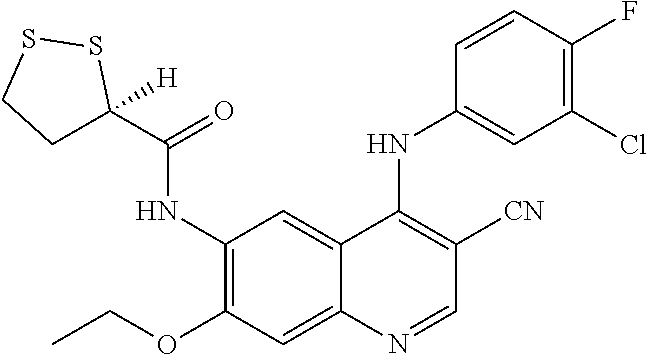
or the formula:

or mixtures thereof, or in the case where a second chiral center is present, all diastereomers.
In all of the embodiments provided herein, examples of suitable optional substituents are not intended to limit the scope of the claimed invention. The compounds of the invention may contain any of the substituents, or combinations of substituents, provided herein.
It will also be appreciated by those of skilled in the art, may be administered to a mammal and thereafter metabolized in the body to form compounds of the invention which are pharmacologically active. Such derivatives may therefore be described as “prodrugs”. All prodrugs of compounds of formula (I) are included within the scope of this invention.
It is understood that one skilled in the art would be able to make compounds of the invention by similar methods as shown below, or by methods known to one skilled in the art. It is also understood that one skilled in the art would be able to make in a similar manner as described below other compounds of formula (I) not specifically illustrated below by using appropriate starting components and modifying the parameters of the synthesis as needed. In general, starting materials may be obtained from sources such as Sigma Aldrich, TCI and the like, or synthesized according to sources known to those of skill in the art (see Smith, M. B. and J. March, Advanced Organic Chemistry: Reactions, Mechanisms and Structure, 5th edition (Wiley, December 2000).
In another embodiment of the invention, a compound of the disclosure may be combined with one or more additional compounds of the disclosure for the treatment of EGFR-mediated disease and conditions. The compound of the disclosure may be administered simultaneously, sequentially or separately with the one or more additional compounds of the disclosure for the treatment of EGFR-mediated disease and conditions. In a further embodiment of the invention, a compound of the disclosure may be combined with one or more additional compounds of the disclosure and an excipient for the treatment of EGFR-mediated disease and conditions.
In another embodiment of the invention, a compound of the disclosure may be combined with an anti-cancer agent for the treatment of EGFR-mediated disease and conditions. The compound of the disclosure may be administered simultaneously, sequentially or separately with for the treatment of EGFR-mediated disease and conditions. Said anti-cancer agents include tyrosine kinase inhibitors such as erlotinib, neratinib, dacomitinib, afatinib, pelitinib, gefitinib, crizotinib, rociletinib, osimertinib, HM61713, AST-1306, WZ4002, and the like. Said anti-cancer agents also include Phosphatidylinositol 3-kinase (PI3K) inhibitors such as wortmannin, demethoxyviridin, LY294002, Perifosine, Idelalisib, PX-866, IPI-145, BAY 80-6946, BEZ235, RP6530, TGR 1202, SF1126, INK1117, GDC-0941, BKM120, XL147, XL765, Palomid 529, GSK1059615, ZSTK474, PWT33597, IC87114, TG100-115, CAL263, RP6503, PI-103, GNE-477, CUDC-907, AEZS-136, and the like, AKT inhibitors such as MK 2206, MKC-1, GSK 690693, FPA 124, AT7867, GDC-0068, ALM301, AZD5363, KP372-1 and the like, mTor inhibitors such as rapamycin, everolimus, temsirolimus, ridaforolimus, sirolimus, AZD8055, XL388, KU-0063794, GDC-0349, WYE-354, GSK1059615, PP242, Palomid 529, OSI-027, PF-05212384, WAY-600, WYE-125132, WYE-687, AZD2014, INK 128, Torin 1, Torin 2 and the like, c-Met inhibitors such as SU11274, K252a, PHA-665752, PHA-66752, PF-2341066, BMS-777607, JNJ-38877605, PF-04217903, MK-2461, GSK 1363089, AMG-458, Tivantinib, INCB28060, Cabozantinib, Foretinib, and the like, vascular endothelial growth factor (VEGF) monoclonal antibodies such as bevacizumab, ranibizumab, and the like, epidermal growth factor receptor (EGFR) inhibitor such as gefitinib, erlotinib, and the like, epidermal growth factor receptor (EGFR) monoclonal antibodies such as cetuximab, panitumumab and the like, Wnt pathway inhibitors such as XAV939 and the like, bioactive flavolignans such as silibinin and the like, DNA methylation inhibitors such as 5-aza-2′-deoxycytidine and the like, platinum based anticancer agents such as carboplatin, cisplatin, and the like. Said anti-cancer agents also include paclitaxel, gemcitabine, docetaxel, vinorelbine, irinotecan, pemetrexed, and the like, dual anti-cancer therapies such as carboplatin/paclitaxel, carboplatin/gemcitabine, carboplatin/docetaxel, carboplatin/vinorelbine, carboplatin/irinotecan, carboplatin/pemetrexed, cisplatin/paclitaxel, cisplatin/gemcitabine, cisplatin/docetaxel, cisplatin/vinorelbine, cisplatin/irinotecan, cisplatin/pemetrexed, and the like. Said anti-cancer agents also includes autophagy inducing agents such as imatinib and the like, Rexinoids or retinoid x receptor selective ligands such as baroxetene and the like, Cyclooxygenase-2 inhibitor such as rofecoxib and the like, Src family kinases and Bcr-Abl inhibitor such as bosulif and the like, and Recombinant adenoviral vector TRAIL protein.
In another embodiment of the invention, a compound of the disclosure may be combined with radiation therapy for the treatment of EGFR-mediated disease and conditions.
The present invention also provides kits that contain a pharmaceutical composition which includes one or more compounds of the invention. The kit also includes instructions for the use of the pharmaceutical composition for modulating the activity of EGFR, for the treatment of cancer, as well as other utilities as disclosed herein. Preferably, a commercial package will contain one or more unit doses of the pharmaceutical composition.
The present invention further relates to a process for preparing the compounds of the disclosure.
Compounds of the present teachings can be prepared in accordance with the procedures outlined herein, from commercially available starting materials, compounds known in the literature, or readily prepared intermediates, by employing standard synthetic methods and procedures known to those skilled in the art. Standard synthetic methods and procedures for the preparation of organic molecules and functional group transformations and manipulations can be readily obtained from the relevant scientific literature or from standard textbooks in the field. It will be appreciated that where typical or preferred process conditions (i.e., reaction temperatures, times, mole ratios of reactants, solvents, pressures, etc.) are given, other process conditions can also be used unless otherwise stated. Optimum reaction conditions can vary with the particular reactants or solvent used, but such conditions can be determined by one skilled in the art by routine optimization procedures. Those skilled in the art of organic synthesis will recognize that the nature and order of the synthetic steps presented can be varied for the purpose of optimizing the formation of the compounds described herein.
The processes described herein can be monitored according to any suitable method known in the art. For example, product formation can be monitored by spectroscopic means, such as nuclear magnetic resonance spectroscopy (e.g., 1H or 13C), infrared spectroscopy, spectrophotometry (e.g., UV-visible), mass spectrometry, or by chromatography such as high pressure liquid chromatograpy (HPLC), gas chromatography (GC), gel-permeation chromatography (GPC), or thin layer chromatography (TLC).
Preparation of the compounds can involve protection and deprotection of various chemical groups. The need for protection and deprotection and the selection of appropriate protecting groups can be readily determined by one skilled in the art. The chemistry of protecting groups can be found, for example, in Greene et al., Protective Groups in Organic Synthesis, 2d. Ed. (Wiley & Sons, 1991), the entire disclosure of which is incorporated by reference herein for all purposes.
The reactions or the processes described herein can be carried out in suitable solvents which can be readily selected by one skilled in the art of organic synthesis. Suitable solvents typically are substantially nonreactive with the reactants, intermediates, and/or products at the temperatures at which the reactions are carried out, i.e., temperatures that can range from the solvent's freezing temperature to the solvent's boiling temperature. A given reaction can be carried out in one solvent or a mixture of more than one solvent. Depending on the particular reaction step, suitable solvents for a particular reaction step can be selected.
The reagents used in the preparation of the compounds of this invention can be either commercially obtained or can be prepared by standard procedures described in the literature. In accordance with this invention, compounds in the genus may be produced by one of the following reaction schemes.
Compounds of formula (I) may be prepared according to the process outlined in Schemes 1-32.

A compound of formula (1a) or (1b), a known compound or compound prepared by known methods wherein X3 is a leaving group as chlorine, bromine, iodine, mesylate, tosylate, and the like, is reacted with a compound of the formula (2) in a solvent such as methanol, ethanol, isopropanol, water, N,N-dimethylformamide, N,N-dimethylacetamide, tetrahydrofuran, 1,4-dioxane, and the like in the presence of a base such as sodium carbonate, cesium carbonate, lithium carbonate, potassium carbonate, potassium hydroxide, sodium hydroxide, lithium hydroxide, and the like to provide a compound of the formula (3a or 3b). A compound of the formula (3a or 3b) is reacted with a compound of the formula (2), optionally in a solvent such as methanol, ethanol, isopropanol, water, N,N-dimethylformamide, N,N-dimethylacetamide, tetrahydrofuran, 1,4-dioxane, and the like, optionally with heating, optionally with microwave irradiation to provide a compound of the formula (4).

A compound of the formula (5), a known compound or compound prepared by known methods, is reacted with a compound of the formula (6) in a solvent such as methylene chloride, chloroform, 1,2-dichloroethane, tetrahydrofuran, 1,4-dioxane, N,N-dimethylformamide, and the like, optionally with heating, optionally with microwave irradiation to provide a compound of the formula (7). A compound of the formula (7) is reacted with a compound of the formula (8), a known compound or compound prepared by known methods, in the presence of a base such as pyridine, 2,6-lutidine, triethylamine, diisopropylethylamine, and the like, in the presence of piperidine, optionally in a solvent such as methanol, ethanol, isopropanol, water, N,N-dimethylformamide, N,N-dimethylacetamide, tetrahydrofuran, 1,4-dioxane, and the like, optionally with heating, optionally with microwave irradiation. The resulting product is then reacted with an acid such as hydrochloric acid, sulfuric acid, trifluoroacetic acid, and the like, optionally in a solvent such as methanol, ethanol, isopropanol, water, N,N-dimethylformamide, N,N-dimethylacetamide, tetrahydrofuran, 1,4-dioxane, and the like, to provide a compound of the formula (9). A compound of the formula (9) is reacted with a compound of the formula (5), a known compound or compound prepared by known methods, in the presence of a base such as a base such as piperidine, pyridine, 2,6-lutidine, triethylamine, diisopropylethylamine, and the like, optionally in a solvent such as methanol, ethanol, isopropanol, water, N,N-dimethylformamide, N,N-dimethylacetamide, tetrahydrofuran, 1,4-dioxane, and the like, optionally with heating, optionally with microwave irradiation to provide a compound of the formula (10). A compound of the formula (10) is reacted with a base such as sodium carbonate, cesium carbonate, lithium carbonate, potassium carbonate, potassium hydroxide, sodium hydroxide, lithium hydroxide, and the like, in the presence of a solvent such as methanol, ethanol, isopropanol, water, N,N-dimethylformamide, N,N-dimethylacetamide, tetrahydrofuran, 1,4-dioxane, and the like, optionally with heating, optionally with microwave irradiation to provide a compound of the formula (11).

A compound of the formula (12a), a known compound or compound prepared by known methods wherein X3 is a leaving group such as chlorine, bromine, iodine, tosylate, mesylate, and the like, is reacted with a compound of the formula (5), a known compound or compound prepared by known methods, in the presence of a base such as sodium methoxide, sodium ethoxide, lithium methoxide, lithium ethoxide, lithium diisopropylamide, sodium diisopropylamide, potassium diisopropylamide, lithium bis(trimethylsilyl)amide, sodium bis(trimethylsilyl)amide, potassium bis(trimethylsilyl)amide, sodium hydride, and the like in the presence of a solvent such as methanol, ethanol, methylene chloride, chloroform, 1,2-dichloroethane, tetrahydrofuran, 1,4-dioxane, N,N-dimethylformamide, and the like, optionally with heating, optionally with microwave irradiation to provide a compound of the formula (12b). A compound of the formula (12b) is reacted with a compound of the formula (12c), a known compound such as triphenyl phosphine ylide or compound prepared by known methods, referred to as a Wittig reagent or a Wittig Schlosser reagent in the presence of a base such as phenyl lithium, lithium diisopropylamide, sodium diisopropylamide, potassium diisopropylamide, lithium bis(trimethylsilyl)amide, sodium bis(trimethylsilyl)amide, potassium bis(trimethylsilyl)amide, sodium hydride, and the like, optionally in the presence of a solvent such as, tetrahydrofuran, 1,4-dioxane, toluene, benzene, HMPA and the like, optionally with heating, optionally with microwave irradiation to provide a compound of the formula (12d) or under olefination conditions employing reagents such as Corey-Chaykovsky, Horner-Wadsworth-Emmons, Julia-Lythgoe, Petersen, Tebbe, Kauffmann, titanium-zinc methylation reagents. The alkene bond in a compound of formula (12d) is selectively reduced by sodium borohydride or sodium cyanoborohydride or hydrogen with a catalyst or the like, reagents optionally in the presence of a solvent such as methanol, ethanol, tetrahydrofuran, 1,4-dioxane and the like, optionally with heating, optionally in the presence of a metal solid such as nickel halide, cobalt halide, manganese halide and the like to provide a compound of formula (13). A compound of formula (13) is hydrolyzed under basic conditions such as sodium hydroxide, potassium hydroxide, lithium hydroxide, lithium methoxide, sodium methoxide, sodium ethoxide, potassium methoxide, lithium t-butoxide, sodium t-butoxide, potassium t-butoxide or the like to provide a compound of formula (14).

A compound of the formula (15a or 15b), a known compound or compound prepared by known methods, is reacted with sodium in the presence of ammonia, optionally in the presence of a solvent such as toluene, benzene, methylene chloride, 1,2-dichloroethane, tetrahydrofuran, 1,4-dioxane, and the like. The resulting product is then reacted with an oxidant such as oxygen, in the a solvent such as methanol, ethanol, isopropanol, water, tetrahydrofuran, 1,4-dioxane, DMSO and the like to provide a compound of the formula (16a or 16b).

A compound of the formula (17), a known compound or compound prepared by known methods, is reacted with a compound of the formula (18), a known compound or a compound prepared by known methods wherein X4 is selected from a group consisting of an optionally substituted aryl and an optionally substituted heteroaryl, in the presence of a base such as sodium carbonate, cesium carbonate, lithium carbonate, potassium carbonate, potassium hydroxide, sodium hydroxide, lithium hydroxide, and the like in a solvent such as methanol, ethanol, isopropanol, acetone, acetonitrile, tetrahydrofuran, 1,4-dioxane, methylene chloride, 1,2-dichloroethane, and the like, optionally with heating, optionally with microwave irradiation to provide a compound of the formula (19). A compound of the formula (19) is reacted with zinc in the presence of ammonium chloride in the presence of a solvent such as methanol, ethanol, isopropanol, acetone, acetonitrile, tetrahydrofuran, 1,4-dioxane, methylene chloride, 1,2-dichloroethane, and the like, optionally with heating, optionally with microwave irradiation to provide a compound of the formula (20).

A compound of the formula (21), a known compound or compound prepared by known methods, is reacted with a compound of the formula (22) in the presence of solvent such as ethanol, methanol, tetrahydrofuran, 1,4-dioxane, toluene, benzene, and the like, optionally with heating, optionally with microwave irradiation. The resulting material is then heated in a solvent such as Dowtherm, biphenyl, diphenyl oxide, and the like, optionally with microwave irradiation to provide a compound of the formula (23). A compound of the formula (23) is reacted with phosphorous oxychloride optionally in the presence of a solvent such as tetrahydrofuran, 1,4-dioxane, toluene, benzene, 1,2-dichloroethane and the like, optionally with heating, optionally with microwave irradiation to provide a compound of the formula (24). A compound of the formula (24) is reacted with iron in the presence of an acid such as acetic acid, hydrochloric acid, sulfuric acid, and the like, optionally with heating, optionally with microwave irradiation to provide a compound of the formula (25).

A compound of the formula (24) is reacted with a compound of the formula (26) in a solvent such as methanol, ethanol, isopropanol, N,N-dimethylformamide, N,N-dimethylacetamide, tetrahydrofuran, 1,4-dioxane, and the like optionally with heating, optionally with microwave irradiation to provide a compound of the formula (27). A compound of the formula (27) was reacted with platinum on carbon doped with nitrogen in a solvent such as methanol, ethanol, isopropanol, tetrahydrofuran, 1,4-dioxane, and the like to provide a compound of the formula (28).

A compound of the formula (25) is reacted with a compound of the formula (26) in a solvent such as methanol, ethanol, isopropanol, N,N-dimethylformamide, N,N-dimethylacetamide, tetrahydrofuran, 1,4-dioxane, and the like in the presence of pyridine hydrochloride, optionally with heating, optionally with microwave irradiation to provide a compound of the formula (28).

A compound of the formula (24) is reacted with a compound of the formula (20) in a solvent such as methanol, ethanol, isopropanol, N,N-dimethylformamide, N,N-dimethylacetamide, tetrahydrofuran, 1,4-dioxane, and the like optionally with heating, optionally with microwave irradiation to provide a compound of the formula (29). A compound of the formula (29) was reacted with platinum on carbon doped with nitrogen in a solvent such as methanol, ethanol, isopropanol, tetrahydrofuran, 1,4-dioxane, and the like to provide a compound of the formula (30).

A compound of the formula (25) is reacted with a compound of the formula (20) in a solvent such as methanol, ethanol, isopropanol, N,N-dimethylformamide, N,N-dimethylacetamide, tetrahydrofuran, 1,4-dioxane, and the like in the presence of pyridine hydrochloride, optionally with heating, optionally with microwave irradiation to provide a compound of the formula (30).

A compound of the formula (28) is reacted with a compound of the formula (4) in a solvent such as N-methylpyrrolidone, N,N-dimethylformamide, N,N-dimethylacetamide, tetrahydrofuran, 1,4-dioxane, and the like, the presence of a coupling agent such as 1-(3-dimethylaminopropyl)-3-ethylcarbodiimide hydrochloride, N,N′-dicyclohexylcarbodiimide, O-benzotriazole-N,N,N′,N′-tetramethyl-uronium-hexafluoro-phosphate, O-(7-azabenzotriazol-1-yl)-N,N,N′,N′-tetramethyluronium hexafluorophosphate, benzotriazole-1-yl-oxy-tris-(dimethylamino)-phosphonium hexafluorophosphate, benzotriazol-1-yl-oxytripyrrolidinophosphonium hexafluorophosphate, and the like, optionally in the presence of a base such as triethylamine, diisopropylethylamine, pyridine, 2,6-lutidine, and the like, optionally in the presence of 4-N,N-dimethylaminopyridine, optionally with heating, optionally with microwave irradiation to provide a compound of the formula (31). A compound of the formula (31) is reacted with a hydride reagent such as sodium borohydride, lithium borohydride, sodium cyanoborohydride and the like in the presence of a solvent such as N-methylpyrrolidone, N,N-dimethylformamide, N,N-dimethylacetamide, tetrahydrofuran, 1,4-dioxane, and the like, optionally with heating, optionally with microwave irradiation to provide a compound of the formula (32). A compound of the formula (32) is heated in a solvent such as dimethylsulfoxide, N-methylpyrrolidone, N,N-dimethylformamide, N,N-dimethylacetamide, and the like to provide a compound of the formula (33).

A compound of the formula (28) is reacted with a compound of the formula (16) in a solvent such as N-methylpyrrolidone, N,N-dimethylformamide, N,N-dimethylacetamide, tetrahydrofuran, 1,4-dioxane, and the like, the presence of a coupling agent such as 1-(3-dimethylaminopropyl)-3-ethylcarbodiimide hydrochloride, N,N′-dicyclohexylcarbodiimide, O-benzotriazole-N,N,N′,N′-tetramethyl-uronium-hexafluoro-phosphate, O-(7-azabenzotriazol-1-yl)-N,N,N′,N′-tetramethyluronium hexafluorophosphate, benzotriazole-1-yl-oxy-tris-(dimethylamino)-phosphonium hexafluorophosphate, benzotriazol-1-yl-oxytripyrrolidinophosphonium hexafluorophosphate, and the like, optionally in the presence of a base such as triethylamine, diisopropylethylamine, pyridine, 2,6-lutidine, and the like, optionally in the presence of 4-N,N-dimethylaminopyridine, optionally with heating, optionally with microwave irradiation to provide a compound of the formula (34).

A compound of the formula (28) is reacted with a compound of the formula (35) in a solvent such as N-methylpyrrolidone, N,N-dimethylformamide, N,N-dimethylacetamide, tetrahydrofuran, 1,4-dioxane, and the like, the presence of a coupling agent such as 1-(3-dimethylaminopropyl)-3-ethylcarbodiimide hydrochloride, N,N′-dicyclohexylcarbodiimide, O-benzotriazole-N,N,N′,N′-tetramethyl-uronium-hexafluoro-phosphate, O-(7-azabenzotriazol-1-yl)-N,N,N′,N′-tetramethyluronium hexafluorophosphate, benzotriazole-1-yl-oxy-tris-(dimethylamino)-phosphonium hexafluorophosphate, benzotriazol-1-yl-oxytripyrrolidinophosphonium hexafluorophosphate, and the like, optionally in the presence of a base such as triethylamine, diisopropylethylamine, pyridine, 2,6-lutidine, and the like, optionally in the presence of 4-N,N-dimethylaminopyridine, optionally with heating, optionally with microwave irradiation to provide a compound of the formula (36).

A compound of the formula (28) is reacted with a compound of the formula (37) in a solvent such as N-methylpyrrolidone, N,N-dimethylformamide, N,N-dimethylacetamide, tetrahydrofuran, 1,4-dioxane, and the like, the presence of a coupling agent such as 1-(3-dimethylaminopropyl)-3-ethylcarbodiimide hydrochloride, N,N′-dicyclohexylcarbodiimide, O-benzotriazole-N,N,N′,N′-tetramethyl-uronium-hexafluoro-phosphate, O-(7-azabenzotriazol-1-yl)-N,N,N′,N′-tetramethyluronium hexafluorophosphate, benzotriazole-1-yl-oxy-tris-(dimethylamino)-phosphonium hexafluorophosphate, benzotriazol-1-yl-oxytripyrrolidinophosphonium hexafluorophosphate, and the like, optionally in the presence of a base such as triethylamine, diisopropylethylamine, pyridine, 2,6-lutidine, and the like, optionally in the presence of 4-N,N-dimethylaminopyridine, optionally with heating, optionally with microwave irradiation to provide a compound of the formula (38). A compound of the formula (38) is reacted with a hydride reagent such as sodium borohydride, lithium borohydride, sodium cyanoborohydride and the like in the presence of a solvent such as N-methylpyrrolidone, N,N-dimethylformamide, N,N-dimethylacetamide, tetrahydrofuran, 1,4-dioxane, and the like, optionally with heating, optionally with microwave irradiation to provide a compound of the formula (39). A compound of the formula (39) is heated in a solvent such as dimethylsulfoxide, N-methylpyrrolidone, N,N-dimethylformamide, N,N-dimethylacetamide, and the like to provide a compound of the formula (40).

A compound of the formula (28) is reacted with a compound of the formula (41) in a solvent such as N-methylpyrrolidone, N,N-dimethylformamide, N,N-dimethylacetamide, tetrahydrofuran, 1,4-dioxane, and the like, the presence of a coupling agent such as 1-(3-dimethylaminopropyl)-3-ethylcarbodiimide hydrochloride, N,N′-dicyclohexylcarbodiimide, O-benzotriazole-N,N,N′,N′-tetramethyl-uronium-hexafluoro-phosphate, O-(7-azabenzotriazol-1-yl)-N,N,N′,N′-tetramethyluronium hexafluorophosphate, benzotriazole-1-yl-oxy-tris-(dimethylamino)-phosphonium hexafluorophosphate, benzotriazol-1-yl-oxytripyrrolidinophosphonium hexafluorophosphate, and the like, optionally in the presence of a base such as triethylamine, diisopropylethylamine, pyridine, 2,6-lutidine, and the like, optionally in the presence of 4-N,N-dimethylaminopyridine, optionally with heating, optionally with microwave irradiation to provide a compound of the formula (42). A compound of the formula (42) is reacted with a hydride reagent such as sodium borohydride, lithium borohydride, sodium cyanoborohydride and the like in the presence of a solvent such as N-methylpyrrolidone, N,N-dimethylformamide, N,N-dimethylacetamide, tetrahydrofuran, 1,4-dioxane, and the like, optionally with heating, optionally with microwave irradiation to provide a compound of the formula (43). A compound of the formula (43) is heated in a solvent such as dimethylsulfoxide, N-methylpyrrolidone, N,N-dimethylformamide, N,N-dimethylacetamide, and the like to provide a compound of the formula (44).

A compound of the formula (45), a known compound of a compound prepared by known methods wherein LG is a leaving group such as chlorine, bromine, iodine, mesylate, tosylate and the like, is reacted with a compound of the formula (26) in a solvent such as methanol, ethanol, isopropanol, N,N-dimethylformamide, N,N-dimethylacetamide, tetrahydrofuran, 1,4-dioxane, and the like in the presence of pyridine hydrochloride, optionally with heating, optionally with microwave irradiation to provide a compound of the formula (46).

A compound of the formula (47), a known compound of a compound prepared by known methods wherein LG is a leaving group such as chlorine, bromine, iodine, mesylate, tosylate and the like, is reacted with a compound of the formula (26) in a solvent such as methanol, ethanol, isopropanol, N,N-dimethylformamide, N,N-dimethylacetamide, tetrahydrofuran, 1,4-dioxane, and the like optionally with heating, optionally with microwave irradiation to provide a compound of the formula (48). A compound of the formula (48) was reacted with platinum on carbon doped with nitrogen in a solvent such as methanol, ethanol, isopropanol, tetrahydrofuran, 1,4-dioxane, and the like to provide a compound of the formula (46).

A compound of the formula (46) is reacted with a compound of the formula (16) in a solvent such as N-methylpyrrolidone, N,N-dimethylformamide, N,N-dimethylacetamide, tetrahydrofuran, 1,4-dioxane, and the like, the presence of a coupling agent such as 1-(3-dimethylaminopropyl)-3-ethylcarbodiimide hydrochloride, N,N′-dicyclohexylcarbodiimide, O-benzotriazole-N,N,N′,N′-tetramethyl-uronium-hexafluoro-phosphate, O-(7-azabenzotriazol-1-yl)-N,N,N′,N′-tetramethyluronium hexafluorophosphate, benzotriazole-1-yl-oxy-tris-(dimethylamino)-phosphonium hexafluorophosphate, benzotriazol-1-yl-oxytripyrrolidinophosphonium hexafluorophosphate, and the like, optionally in the presence of a base such as triethylamine, diisopropylethylamine, pyridine, 2,6-lutidine, and the like, optionally in the presence of 4-N,N-dimethylaminopyridine, optionally with heating, optionally with microwave irradiation to provide a compound of the formula (49).

A compound of the formula (46) is reacted with a compound of the formula (35) in a solvent such as N-methylpyrrolidone, N,N-dimethylformamide, N,N-dimethylacetamide, tetrahydrofuran, 1,4-dioxane, and the like, the presence of a coupling agent such as 1-(3-dimethylaminopropyl)-3-ethylcarbodiimide hydrochloride, N,N′-dicyclohexylcarbodiimide, O-benzotriazole-N,N,N′,N′-tetramethyl-uronium-hexafluoro-phosphate, O-(7-azabenzotriazol-1-yl)-N,N,N′,N′-tetramethyluronium hexafluorophosphate, benzotriazole-1-yl-oxy-tris-(dimethylamino)-phosphonium hexafluorophosphate, benzotriazol-1-yl-oxytripyrrolidinophosphonium hexafluorophosphate, and the like, optionally in the presence of a base such as triethylamine, diisopropylethylamine, pyridine, 2,6-lutidine, and the like, optionally in the presence of 4-N,N-dimethylaminopyridine, optionally with heating, optionally with microwave irradiation to provide a compound of the formula (50).

A compound of the formula (46) is reacted with a compound of the formula (37) in a solvent such as N-methylpyrrolidone, N,N-dimethylformamide, N,N-dimethylacetamide, tetrahydrofuran, 1,4-dioxane, and the like, the presence of a coupling agent such as 1-(3-dimethylaminopropyl)-3-ethylcarbodiimide hydrochloride, N,N′-dicyclohexylcarbodiimide, O-benzotriazole-N,N,N′,N′-tetramethyl-uronium-hexafluoro-phosphate, O-(7-azabenzotriazol-1-yl)-N,N,N′,N′-tetramethyluronium hexafluorophosphate, benzotriazole-1-yl-oxy-tris-(dimethylamino)-phosphonium hexafluorophosphate, benzotriazol-1-yl-oxytripyrrolidinophosphonium hexafluorophosphate, and the like, optionally in the presence of a base such as triethylamine, diisopropylethylamine, pyridine, 2,6-lutidine, and the like, optionally in the presence of 4-N,N-dimethylaminopyridine, optionally with heating, optionally with microwave irradiation to provide a compound of the formula (51). A compound of the formula (51) is reacted with a hydride reagent such as sodium borohydride, lithium borohydride, sodium cyanoborohydride and the like in the presence of a solvent such as N-methylpyrrolidone, N,N-dimethylformamide, N,N-dimethylacetamide, tetrahydrofuran, 1,4-dioxane, and the like, optionally with heating, optionally with microwave irradiation to provide a compound of the formula (52). A compound of the formula (52) is heated in a solvent such as dimethylsulfoxide, N-methylpyrrolidone, N,N-dimethylformamide, N,N-dimethylacetamide, and the like to provide a compound of the formula (53).

A compound of the formula (46) is reacted with a compound of the formula (41) in a solvent such as N-methylpyrrolidone, N,N-dimethylformamide, N,N-dimethylacetamide, tetrahydrofuran, 1,4-dioxane, and the like, the presence of a coupling agent such as 1-(3-dimethylaminopropyl)-3-ethylcarbodiimide hydrochloride, N,N′-dicyclohexylcarbodiimide, O-benzotriazole-N,N,N′,N′-tetramethyl-uronium-hexafluoro-phosphate, O-(7-azabenzotriazol-1-yl)-N,N,N′,N′-tetramethyluronium hexafluorophosphate, benzotriazole-1-yl-oxy-tris-(dimethylamino)-phosphonium hexafluorophosphate, benzotriazol-1-yl-oxytripyrrolidinophosphonium hexafluorophosphate, and the like, optionally in the presence of a base such as triethylamine, diisopropylethylamine, pyridine, 2,6-lutidine, and the like, optionally in the presence of 4-N,N-dimethylaminopyridine, optionally with heating, optionally with microwave irradiation to provide a compound of the formula (54). A compound of the formula (54) is reacted with a hydride reagent such as sodium borohydride, lithium borohydride, sodium cyanoborohydride and the like in the presence of a solvent such as N-methylpyrrolidone, N,N-dimethylformamide, N,N-dimethylacetamide, tetrahydrofuran, 1,4-dioxane, and the like, optionally with heating, optionally with microwave irradiation to provide a compound of the formula (55). A compound of the formula (55) is heated in a solvent such as dimethylsulfoxide, N-methylpyrrolidone, N,N-dimethylformamide, N,N-dimethylacetamide, and the like to provide a compound of the formula (56).

A compound of the formula (57) is reacted with a compound of the formula (58), a known compound or compound prepared by known methods, in a solvent such as N-methylpyrrolidone, N,N-dimethylformamide, N,N-dimethylacetamide, tetrahydrofuran, 1,4-dioxane, and the like, the presence of a coupling agent such as 1-(3-dimethylaminopropyl)-3-ethylcarbodiimide hydrochloride, N,N′-dicyclohexylcarbodiimide, O-benzotriazole-N,N,N′,N′-tetramethyl-uronium-hexafluoro-phosphate, O-(7-azabenzotriazol-1-yl)-N,N,N′,N′-tetramethyluronium hexafluorophosphate, benzotriazole-1-yl-oxy-tris-(dimethylamino)-phosphonium hexafluorophosphate, benzotriazol-1-yl-oxytripyrrolidinophosphonium hexafluorophosphate, and the like, optionally in the presence of a base such as triethylamine, diisopropylethylamine, pyridine, 2,6-lutidine, and the like, optionally in the presence of 4-N,N-dimethylaminopyridine, optionally with heating, optionally with microwave irradiation to provide a compound of the formula (59).

A compound of the formula (57) is reacted with a compound of the formula (60), a known compound or compound prepared by known methods, in a solvent such as N-methylpyrrolidone, N,N-dimethylformamide, N,N-dimethylacetamide, tetrahydrofuran, 1,4-dioxane, and the like, the presence of a coupling agent such as 1-(3-dimethylaminopropyl)-3-ethylcarbodiimide hydrochloride, N,N′-dicyclohexylcarbodiimide, O-benzotriazole-N,N,N′,N′-tetramethyl-uronium-hexafluoro-phosphate, O-(7-azabenzotriazol-1-yl)-N,N,N′,N′-tetramethyluronium hexafluorophosphate, benzotriazole-1-yl-oxy-tris-(dimethylamino)-phosphonium hexafluorophosphate, benzotriazol-1-yl-oxytripyrrolidinophosphonium hexafluorophosphate, and the like, optionally in the presence of a base such as triethylamine, diisopropylethylamine, pyridine, 2,6-lutidine, and the like, optionally in the presence of 4-N,N-dimethylaminopyridine, optionally with heating, optionally with microwave irradiation to provide a compound of the formula (61).

A compound of the formula (57) is reacted with a compound of the formula (62), a known compound or compound prepared by known methods, in a solvent such as N-methylpyrrolidone, N,N-dimethylformamide, N,N-dimethylacetamide, tetrahydrofuran, 1,4-dioxane, and the like, the presence of a coupling agent such as 1-(3-dimethylaminopropyl)-3-ethylcarbodiimide hydrochloride, N,N′-dicyclohexylcarbodiimide, O-benzotriazole-N,N,N′,N′-tetramethyl-uronium-hexafluoro-phosphate, O-(7-azabenzotriazol-1-yl)-N,N,N′,N′-tetramethyluronium hexafluorophosphate, benzotriazole-1-yl-oxy-tris-(dimethylamino)-phosphonium hexafluorophosphate, benzotriazol-1-yl-oxytripyrrolidinophosphonium hexafluorophosphate, and the like, optionally in the presence of a base such as triethylamine, diisopropylethylamine, pyridine, 2,6-lutidine, and the like, optionally in the presence of 4-N,N-dimethylaminopyridine, optionally with heating, optionally with microwave irradiation to provide a compound of the formula (63).

A compound of the formula (57) is reacted with a compound of the formula (64), a known compound or compound prepared by known methods, in a solvent such as N-methylpyrrolidone, N,N-dimethylformamide, N,N-dimethylacetamide, tetrahydrofuran, 1,4-dioxane, and the like, the presence of a coupling agent such as 1-(3-dimethylaminopropyl)-3-ethylcarbodiimide hydrochloride, N,N′-dicyclohexylcarbodiimide, O-benzotriazole-N,N,N′,N′-tetramethyl-uronium-hexafluoro-phosphate, O-(7-azabenzotriazol-1-yl)-N,N,N′,N′-tetramethyluronium hexafluorophosphate, benzotriazole-1-yl-oxy-tris-(dimethylamino)-phosphonium hexafluorophosphate, benzotriazol-1-yl-oxytripyrrolidinophosphonium hexafluorophosphate, and the like, optionally in the presence of a base such as triethylamine, diisopropylethylamine, pyridine, 2,6-lutidine, and the like, optionally in the presence of 4-N,N-dimethylaminopyridine, optionally with heating, optionally with microwave irradiation to provide a compound of the formula (65).

A compound of the formula (66) is reacted with an oxidizing agent such as m-chloroperoxybenzoic acid, monoperphthalic acid, peracetic acid, perpropionic acid, pertrifluoroacetic acid, potassium periodate, sodium metaperiodate, sodium perborate, potassium peroxymonosulfate (Oxone®), potassium peroxydisulfate, dimethyldioxirane, and the like, in the presence of a solvent such as tetrahydrofuran, ether, 1,4-dioxane, acetone, acetonitrile, methanol, ethanol, isopropanol, water, and the like, optionally with heating, optionally with microwave irradiation to provide compounds of the formula (67), (68), (69), (70), (71), (72), and (73). Alternatively, a formula of the compound (66) is reacted with a sulfoxide such as diphenyl sulfoxide, dimethyl sulfoxide, and the like, in the presence of a rhenium catalyst such as ReOCl3(PPh3)2, and the like, in a solvent such as methylene chloride, 1,2-dichloroethane, chloroform, tetrahydrofuran, ether, 1,4-dioxane, acetone, acetonitrile, and the like, optionally with heating, optionally with microwave irradiation to provide compounds of the formula (67), (68), (69), (70), (71), (72), and (73). Alternatively, a formula of the compound (66) is reacted with a urea hydrogen peroxide complex in the presence of a rhenium catalyst such as ReOCl3(PPh3)2, and the like, in a solvent such as methylene chloride, 1,2-dichloroethane, chloroform, tetrahydrofuran, ether, 1,4-dioxane, acetone, acetonitrile, N,N-dimethylformamide, and the like, optionally with heating, optionally with microwave irradiation to provide compounds of the formula (67), (68), (69), (70), (71), (72), and (73). Alternatively, a formula of the compound (66) is reacted with an oxidoreductase such as Baeyer-Villiger monooxygenase, cytochrome P450 2C9, cytochrome P450 2C19, cytochrome P450 3A4 and, in a solvent such as water, methanol, ethanol, isopropanol, acetonitrile, acetone, and the like, optionally with heating, optionally with microwave irradiation to provide compounds of the formula (67), (68), (69), (70), (71), (72), and (73). Alternatively, a compound of the formula (66) is reacted with hydrogen peroxide in the presence titanium (IV) isopropoxide-diethyltartarate, optionally in the presence of an amino alcohol such as 2-amino-3-phenylpropan-1-ol, 2-amino-4-methylpentan-1-ol, 2-amino-4-(methylthio)butan-1-ol, 2-aminopropan-1-ol, and the like, in a solvent such as methylene chloride, 1,2-dichloroethane, chloroform, tetrahydrofuran, ether, 1,4-dioxane, acetone, acetonitrile, N,N-dimethylformamide, and the like optionally with heating, optionally with microwave irradiation to provide compounds of the formula (67), (68), (69), (70), (71), (72), and (73). Alternatively, a compound of the formula of the compound (66) is electrochemically oxidized optionally in the presence of a buffer solution such as a sodium phosphate solution, a potassium phosphate solution, and the like to provide compounds of the formula (67), (68), (69), (70), (71), (72), and (73). Alternatively, a compound of the formula of the compound (66) is photochemically oxidized in a solvent such as methylene chloride, 1,2-dichloroethane, chloroform, tetrahydrofuran, ether, 1,4-dioxane, acetone, acetonitrile, N,N-dimethylformamide, water, methanol, ethanol, isopropanol, and the like, optionally with heating, optionally with microwave irradiation to provide compounds of the formula (67), (68), (69), (70), (71), (72), and (73). It is understood that one skilled in the art would readily understand that the ratio of products (67) through (73) will be controlled by the amount of oxidant added and would adjust the amount of oxidant accordingly to produce the desired ration of products.

A compound of the formula (74) is reacted with an oxidizing agent such as m-chloroperoxybenzoic acid, monoperphthalic acid, peracetic acid, perpropionic acid, pertrifluoroacetic acid, potassium periodate, sodium metaperiodate, sodium perborate, potassium peroxymonosulfate (Oxone®), potassium peroxydisulfate, dimethyldioxirane, and the like, in the presence of a solvent such as tetrahydrofuran, ether, 1,4-dioxane, acetone, acetonitrile, methanol, ethanol, isopropanol, water, and the like, optionally with heating, optionally with microwave irradiation to provide compounds of the formula (75), (76), (77), (78), and (79). Alternatively, a formula of the compound (74) is reacted with a sulfoxide such as diphenyl sulfoxide, dimethyl sulfoxide, and the like, in the presence of a rhenium catalyst such as ReOCl3(PPh3)2, and the like, in a solvent such as methylene chloride, 1,2-dichloroethane, chloroform, tetrahydrofuran, ether, 1,4-dioxane, acetone, acetonitrile, and the like, optionally with heating, optionally with microwave irradiation to provide compounds of the formula (75), (76), (77), (78), and (79). Alternatively, a formula of the compound (74) is reacted with a urea hydrogen peroxide complex in the presence of a rhenium catalyst such as ReOCl3(PPh3)2, and the like, in a solvent such as methylene chloride, 1,2-dichloroethane, chloroform, tetrahydrofuran, ether, 1,4-dioxane, acetone, acetonitrile, N,N-dimethylformamide, and the like, optionally with heating, optionally with microwave irradiation to provide compounds of the formula (75), (76), (77), (78), and (79). Alternatively, a formula of the compound (74) is reacted with an oxidoreductase such as Baeyer-Villiger monooxygenase, cytochrome P450 2C9, cytochrome P450 2C19, cytochrome P450 3A4 and, in a solvent such as water, methanol, ethanol, isopropanol, acetonitrile, acetone, and the like, optionally with heating, optionally with microwave irradiation to provide compounds of the (75), (76), (77), (78), and (79). Alternatively, a compound of the formula (74) is reacted with hydrogen peroxide in the presence titanium (IV) isopropoxide-diethyltartarate, optionally in the presence of an amino alcohol such as 2-amino-3-phenylpropan-1-ol, 2-amino-4-methylpentan-1-ol, 2-amino-4-(methylthio)butan-1-ol, 2-aminopropan-1-ol, and the like, in a solvent such as methylene chloride, 1,2-dichloroethane, chloroform, tetrahydrofuran, ether, 1,4-dioxane, acetone, acetonitrile, N,N-dimethylformamide, and the like optionally with heating, optionally with microwave irradiation to provide compounds of the formula (75), (76), (77), (78), and (79). Alternatively, a compound of the formula of the compound (74) is electrochemically oxidized optionally in the presence of a buffer solution such as a sodium phosphate solution, a potassium phosphate solution, and the like to provide compounds of the formula (75), (76), (77), (78), and (79). Alternatively, a compound of the formula of the compound (74) is photochemically oxidized in a solvent such as methylene chloride, 1,2-dichloroethane, chloroform, tetrahydrofuran, ether, 1,4-dioxane, acetone, acetonitrile, N,N-dimethylformamide, water, methanol, ethanol, isopropanol, and the like, optionally with heating, optionally with microwave irradiation to provide compounds of the formula (75), (76), (77), (78), and (79). It is understood that one skilled in the art would readily understand that the ratio of products (75) through (79) will be controlled by the amount of oxidant added and would adjust the amount of oxidant accordingly to produce the desired ration of products.

A compound of the formula (80), a known compound or a compound prepared by known means wherein Ar is an optionally substituted aryl ring, is reacted with a compound of the formula (81) in the presence of on an acid such as acetic acid, formic acid, trifluoroacetic acid, hydrochloric acid, and the like, optionally in a solvent such as methanol, ethanol, isopropanol, water, N,N-dimethylformamide, N,N-dimethylacetamide, tetrahydrofuran, 1,4-dioxane, and the like, optionally with heating, optionally with microwave irradiation to provide a compound of the formula (82). A compound of the formula (82) is reacted a base such as sodium methoxide, sodium ethoxide, lithium methoxide, lithium ethoxide, lithium diisopropylamide, sodium diisopropylamide, potassium diisopropylamide, lithium bis(trimethylsilyl)amide, sodium bis(trimethylsilyl)amide, potassium bis(trimethylsilyl)amide, sodium hydride, and the like in the presence of a solvent such as methanol, ethanol, methylene chloride, chloroform, 1,2-dichloroethane, tetrahydrofuran, 1,4-dioxane, N,N-dimethylformamide, dimethylsulfoxide, and the like, optionally with heating, optionally with microwave irradiation to provide a compound of the formula (83).

A compound of the formula (83) is reacted with phosphorous oxychloride or thionyl chloride in the presence of a base such as pyridine, 2,6-lutidine, triethylamine, diisopropylethylamine, and the like, optionally in the presence of a solvent such as N,N-dimethylformamide, N,N-dimethylacetamide, tetrahydrofuran, 1,4-dioxane, toluene, methylene chloride, 1,2-dichloroethane, chloroform, and the like, optionally with heating, optionally with microwave irradiation to provide a compound of the formula (84). A compound of the formula (84) is reacted with boron tribromide in the presence of a solvent such as N,N-dimethylformamide, N,N-dimethylacetamide, tetrahydrofuran, 1,4-dioxane, toluene, methylene chloride, 1,2-dichloroethane, chloroform, and the like, optionally with heating, optionally with microwave irradiation to provide a compound of the formula (85).

A compound of the formula (85) is reacted with a compound of the formula (86) in a solvent such as methanol, ethanol, isopropanol, N,N-dimethylformamide, N,N-dimethylacetamide, tetrahydrofuran, 1,4-dioxane, and the like optionally with heating, optionally with microwave irradiation to provide a compound of the formula (87). A compound of the formula (87) is reacted with a compound of the formula (88), a known compound or a compound prepared by known methods wherein X5 is a leaving group such as chlorine, bromine, iodine, mesylate, tosylate, and the like, in the presence of a base such as sodium carbonate, cesium carbonate, lithium carbonate, potassium carbonate, potassium hydroxide, sodium hydroxide, lithium hydroxide, and the like, in a solvent such as as N,N-dimethylformamide, N,N-dimethylacetamide, tetrahydrofuran, 1,4-dioxane, toluene, methylene chloride, 1,2-dichloroethane, chloroform, and the like, optionally with heating, optionally with microwave irradiation to provide a compound of the formula (89).


A compound of the formula (89) is reacted with a base such as potassium hydroxide, sodium hydroxide, lithium hydroxide, and the like, in a solvent such as methanol, ethanol, isopropanol, N,N-dimethylformamide, N,N-dimethylacetamide, tetrahydrofuran, 1,4-dioxane, and the like optionally with heating, optionally with microwave irradiation to provide a compound of the formula (90). A compound of the formula (90) is reacted with a compound of the formula (91) in a solvent such as N-methylpyrrolidone, N,N-dimethylformamide, N,N-dimethylacetamide, tetrahydrofuran, 1,4-dioxane, and the like, the presence of a coupling agent such as 1-(3-dimethylaminopropyl)-3-ethylcarbodiimide hydrochloride, N,N′-dicyclohexylcarbodiimide, O-benzotriazole-N,N,N′,N′-tetramethyl-uronium-hexafluoro-phosphate, O-(7-azabenzotriazol-1-yl)-N,N,N′,N′-tetramethyluronium hexafluorophosphate, benzotriazole-1-yl-oxy-tris-(dimethylamino)-phosphonium hexafluorophosphate, benzotriazol-1-yl-oxytripyrrolidinophosphonium hexafluorophosphate, and the like, optionally in the presence of a base such as triethylamine, diisopropylethylamine, pyridine, 2,6-lutidine, and the like, optionally in the presence of 4-N,N-dimethylaminopyridine, optionally with heating, optionally with microwave irradiation to provide a compound of the formula (92). Alternatively, a compound of the formula (90) is reacted with a compound of the formula (93) in a solvent such as N-methylpyrrolidone, N,N-dimethylformamide, N,N-dimethylacetamide, tetrahydrofuran, 1,4-dioxane, and the like, the presence of a coupling agent such as 1-(3-dimethylaminopropyl)-3-ethylcarbodiimide hydrochloride, N,N′-dicyclohexylcarbodiimide, O-benzotriazole-N,N,N′,N′-tetramethyl-uronium-hexafluoro-phosphate, O-(7-azabenzotriazol-1-yl)-N,N,N′,N′-tetramethyluronium hexafluorophosphate, benzotriazole-1-yl-oxy-tris-(dimethylamino)-phosphonium hexafluorophosphate, benzotriazol-1-yl-oxytripyrrolidinophosphonium hexafluorophosphate, and the like, optionally in the presence of a base such as triethylamine, diisopropylethylamine, pyridine, 2,6-lutidine, and the like, optionally in the presence of 4-N,N-dimethylaminopyridine, optionally with heating, optionally with microwave irradiation to provide a compound of the formula (94).

A compound of the formula (95) is reacted with a compound of the formula (96), a known compound or a compound prepared by known methods wherein X6 is a leaving group such as chlorine, bromine, iodine, mesylate, tosylate, and the like and PG is a protecting group, in the presence of a base such as sodium carbonate, cesium carbonate, lithium carbonate, potassium carbonate, potassium hydroxide, sodium hydroxide, lithium hydroxide, and the like, in a solvent such as as N,N-dimethylformamide, N,N-dimethylacetamide, tetrahydrofuran, 1,4-dioxane, toluene, methylene chloride, 1,2-dichloroethane, chloroform, and the like, optionally with heating, optionally with microwave irradiation to provide a compound of the formula (97). A compound of the formula (97) is reacted with an acid such as acetic acid, trifluoroacetic acid, hydrochloric acid, and the like, in the presence of a solvent such as methanol, ethanol, methylene chloride, chloroform, 1,2-dichloroethane, tetrahydrofuran, 1,4-dioxane, N,N-dimethylformamide, dimethylsulfoxide, and the like, optionally with heating, optionally with microwave irradiation to provide a compound of the formula (98). Alternatively, a compound of the formula (97) is reacted with hydrogen in the presence of a palladium catalyst such as palladium on carbon, palladium acetate, palladium bis(triphenylphosphine) dichloride, palladium tetrakis(triphenylphosphine), bis(acetonitrile) dichloropalladium [1,1′-bis(diphenylphosphino), ferrocene]dichloropalladium, and the like, in the presence of a solvent such as methanol, ethanol, methylene chloride, chloroform, 1,2-dichloroethane, tetrahydrofuran, 1,4-dioxane, N,N-dimethylformamide, dimethylsulfoxide, and the like, to provide a compound of the formula (98). Alternatively, A compound of the formula (97) is reacted with a base such as piperidine, triethylamine, N,N-diisopropyl ethylamine, and the like, in the presence of a solvent such as methanol, ethanol, methylene chloride, chloroform, 1,2-dichloroethane, tetrahydrofuran, 1,4-dioxane, N,N-dimethylformamide, dimethylsulfoxide, and the like, optionally with heating, optionally with microwave irradiation to provide a compound of the formula (98).
The following examples are directed to the preparations of intermediates used to prepare compounds of formula (I) and compounds (I) of this invention are provided as a guide to assist in the practice of this invention.

To a stirred suspension of 2-(bromomethyl)acrylic acid (8.0 g, 49 mmol) in water (160 mL) was added a solution of Na2CO3 (9 g in 32 mL of water) in small portions at 0° C. To the resulting solution was added thiolacetic acid (3.5 mL) and stirred at 0° C. for 30 minutes. The solution was acidified with concentrated hydrochloric acid to pH 1. The residue was extracted with ethyl acetate (3×500 ml). The combined extracts were dried over anhydrous Na2SO4 and evaporated to dryness to furnish the desired crude product. The pure product was obtained by column chromatography on silica gel (100-200 mesh) eluting with 5% (v/v) ethyl acetate in hexanes as a white solid (3.7 g, yield 47%). 1H-NMR (300 MHz, CDCl3): δ 8.35 (bs, 1H), 6.40 (s, 1H), 6.03 (s, 1H), 3.80 (s, 2H), 2.34 (s, 3H).

Method A. A mixture of 2-((acetylthio)methyl)acrylic acid (3.50 g, 21.9 mmol) in thiolacetic acid (3.1 mL) was stirred at room temperature for 16 hours. The reaction mixture was concentrated at reduced pressure to remove the thiolacetic acid and purified by column chromatography on silica gel (100-200 mesh) eluting with 10% (v/v) ethyl acetate in hexanes to produce the product as colorless liquid (2.3 g, yield 45%). 1H-NMR (300 MHz, CDCl3): δ 7.27 (bs, 1H), 3.24-3.14 (m, 4H), 2.93-2.89 (m, 1H), 2.35 (s, 6H).
Method B. A mixture of 3-bromo-2-(bromomethyl)propanoic acid (12.0 g, 48.9 mmol) in 46 mL water containing 3.2 g of KOH was cooled to 0° C. Thioacetic acid (7.5 mL, 102 mmol) was added dropwise and the resultant solution was stirred for 5 minutes before the slow addition of a solution containing 6.8 g of KOH in 61 mL water. The reaction mixture was heated for 12 hours at 110° C. then cooled to 0° C. and carefully acidified with 4N HCl to reach pH 2. It was then extracted with ethyl acetate (3×200 mL) and the combined extracts were dried over anhydrous Na2SO4, filtered and concentrated to give an oil which was purified by column chromatography on silica gel (100-200 mesh) eluting with 10% (v/v) ethyl acetate in hexane to produce the title compound as colorless liquid (5.0 g, yield 43.4%). 1H-NMR (CDCl3): δ 6.0-5.0 (s, br, 1H), 3.26-3.18 (m, 4H), 2.92-2.83 (m, 1H), 2.35 (s, 6H).

To a solution of benzylmercaptan (6.80 mL, 101 mmol) in dichloromethane (150 mL) was added acrolein (9.45 mL, 80.0 mmol) dropwise at 0° C. The resulting solution was allowed to warm up to room temperature and stirred for 2 hours. Dichloromethane was evaporated in vacuo and the residue was purified by flash column chromatography (silica gel, Ethyl acetate:hexanes, 2:98) to afford the desired compound as colorless liquid (13 g, yield 91%). 1H-NMR (300 MHz, DMSO-d6): δ 9.60 (s, 1H, CHO), 7.32-7.22 (m, 5H), 3.74 (s, 2H), 2.71-2.60 (m, 4H).

To a mixture of 3-benzylsulfanyl-propionaldehyde (13.0 g, 72.0 mmol) and monoethylmalonate (8.53 g, 72.0 mmol) in pyridine (26 mL) was added piperidine (0.32 mL) and heated to 135° C. for 2 hours. The reaction mixture was cooled to room temperature, poured into ice-cold water (200 mL) and acidified to pH 2 with 6N HCl. The aqueous layer was extracted with ethyl acetate (3×500 mL). The combined organic extracts were washed with water (200 mL) and brine (100 mL), then dried (Na2SO4), filtered and evaporated in vacuo. The residue was purified by flash column chromatography (silica gel, ethyl acetate:hexanes, 4:96) to afford the title compound as colorless liquid (13 g, yield 45%). 1H-NMR (300 MHz, DMSO-d6): δ 7.33-7.21 (m, 5H), 6.87-6.81 (dt, 1H, J=6.8 Hz and 13.6 Hz), 5.90-5.54 (dt, 1H, J=1.7 Hz and 3.4 Hz), 4.16-4.04 (m, 2H), 3.74-3.72 (s, 2H), 2.58-2.50 (m, 2H), 2.49-2.40 (m, 2H), 1.24-1.20 (m, 3H); MS (ES) m/e 251 [M+H]+.

To a solution of 5-benzylsulfanyl-pent-2-enoic acid ethyl ester (8.0 g, 32 mmol) in piperidine (16.0 mL, 160 mmol) was added benzylmercaptan (4.0 g, 32 mmol) dropwise at room temperature and stirred overnight. The reaction mixture was poured into ice cold-water (500 mL) and acidified to pH 2 with 6N HCl. The aqueous layer was extracted with Ethyl acetate (3×500 mL). The combined organic extracts were washed with water (100 mL) and brine (100 mL), then dried (Na2SO4), filtered and evaporated in vacuo. The residue was purified by flash column chromatography (silica gel, Ethyl acetate:hexanes, 4:96) to afford the title compound as colorless oil (8.0 g, yield 67%). 1H-NMR (300 MHz, DMSO-d6): δ 7.32-7.22 (m, 10H), 4.07-4.02 (m, 2H), 3.72 (s, 2H), 3.67 (s, 2H), 3.02 (m, 1H), 2.58-2.56 (dd, 2H, J=6.8, 8.4 Hz), 2.54-2.42 (m, 2H), 1.78-1.71 (m, 2H), 1.18-1.15 (t, 3H, J=7.2 Hz); MS (ES) m/e 375 [M+H]+.

To a mixture of 3,5-bis-benzylsulfanyl-pentanoic acid ethyl ester (1.00 g, 26.7 mmol) in ethanol (4 mL) was added 10 mL of 10% NaOH and heated at 50° C. for 1 hours. The reaction mixture was cooled to room temperature followed by evaporation of ethanol. The residue was diluted with water and extracted with diethyl ether (3×70 mL). The combined aqueous extracts were acidified with 6N HCl and extracted with Ethyl acetate (3×400 mL). The combined organic extracts were washed with water (100 mL) and brine (100 mL), then dried (Na2SO4) and evaporated in vacuo to afford the title compound (0.9 g, yield 92%). 1H-NMR (300, MHz, DMSO-d6): δ 12.26 (s, 1H), 7.32-7.20 (m, 10H), 3.73 (s, 2H), 3.67 (s, 2H), 3.03 (m, 1H), 2.49-2.40 (m, 2H), 1.79-1.69 (m, 2H); MS (ES) m/e 347 [M+H]+.

Sodium (2.60 g, 113 mmol) was added in small portions to liquid ammonia at −78° C. This solution was stirred while a solution of 3,5-bis(benzylthio)pentanoic acid (7.70 g, 22.3 mmol) in toluene (20 mL) was added dropwise during a 5 minute period. At the end of the addition, small pieces of sodium were added to maintain a permanent blue color for 30 min. The blue color was discharged with ammonium chloride and ammonia was allowed to evaporate overnight. After removal of ammonia, 200 mL of water and 150 mL of toluene were added. A rapid stream of oxygen was bubbled through the solution causing a color change from reddish to pale yellow for 2 hours. The solution was acidified and extracted with ethyl acetate (3×500 mL). The combined extracts were washed with water, dried over anhydrous Na2SO4, filtered and concentrated at reduced pressure to give the desired product as a semi solid compound (2.2 g, yield 61%). 1H-NMR (300 MHz, CDCl3): δ 12.00 (m, 1H), 2.76 (m, 1H), 2.60-2.35 (m, 4H), 2.02-1.98 (m, 2H); MS (ES) m/e 163 [M−H]+.

To a stirred solution of 3-bromo-2-(bromomethyl)propanoic acid (0.5 g, 2.04 mmol) in ethanol (10 mL) was added catalytic amount of concentrated H2SO4 and heated to reflux for 12 hours. The reaction mixture was then cooled and concentrated under reduced pressure and the residue was then poured into water and made basic by the addition of a solution of saturated NaHCO3. The solution was extracted with diethyl ether (2×50 mL) and the organic extracts were washed with water, dried over anhydrous Na2SO4, filtered and concentrated at reduced pressure to afford the title compound (0.4 g, 72%). 1H NMR (CDCl3): δ 4.19 (m, 2H), 3.73-3.62 (m, 4H), 3.11-3.08 (m, 1H), 1.26 (t, J=7.6 Hz, 3H),

To a stirred solution of Ethyl 3-bromo-2-(bromomethyl)propanoate (350 mg, 1.28 mmol) in ethanol (5 mL) at 0° C. was added phenylmethanethiol (318 mg, 2.56 mmol) and KOH (150 mg, 2.69 mmol). The solution was stirred at room temperature for 2 hours, then it was poured into cold water and extracted with ethyl acetate (2×100 mL). The combined organic layers were dried over anhydrous Na2SO4, filtered and concentrated to give an oil which was purified by column chromatography eluting with 4-5% ethyl acetate in hexanes to give the title compound 0.2 g (43%). 1H NMR 400 MHz (DMSO-d6) δ 7.34-7.22 (m, 10H), 4.11-4.05 (q, J=7.2 Hz, 2H), 3.71 (s, 4H), 2.77-2.73 (m, 1H), 2.62-2.49 (m, 4H), 1.20 (t, J=7.2 Hz, 3H); LCMS m/e: 361 [M+1]+.

To a mixture of ethyl 3-(benzylthio)-2-((benzylthio)methyl)propanoate (100 mg, 0.28 mmol) in ethanol (2 mL) was added 10% NaOH (2 mL) and heated at 50° C. for 1 hour. The reaction mixture was then cooled to room temperature and ethanol was evaporated. The resultant solution was diluted with water and extracted with diethyl ether (10 mL). The aqueous solution was acidified with 6N HCl and extracted with chloroform (3×50 mL). The combined organic extracts were washed with water (50 mL), brine (50 mL) and then dried over Na2SO4, filtered and concentrated in vacuum to afford the title compound (70 mg, yield 78%). 1H NMR (DMSO-d6): δ 12.5 (s, 1H), 7.32-7.20 (m, 10H), 4.11 (m, 1H), 3.73 (s, 4H), 2.52-2.50 (m, 2H); LCMS (ES) m/e 333 [M+1]+.

Sodium (0.87 g, 37.1 mmol) was added in small portions to liquid ammonia (30 mL) at −78° C. This solution was stirred while a solution of 3-benzylthio-2-((benzylthio)methylpropanoic acid (2.5 g, 7.53 mmol) in toluene (25 mL) was added dropwise during a period of 5 minutes. At the end of the reaction, small pieces of sodium were added to maintain a permanent blue color for 30 minutes. The blue color was discharged with ammonium chloride and ammonia was allowed to evaporate overnight. After removal of the ammonia, 200 ml of water and 150 ml of toluene were added and the aqueous layer was extracted with diethyl ether (100 mL). To the aqueous layer was added 1% ferric chloride (1 mL) and a rapid stream of oxygen was bubbled through the solution gradually causing changing from reddish color to pale yellow color in a period of 2 hours. The solution was acidified and extracted with chloroform (3×500 mL). The combined extract were washed with water, dried over anhydrous Na2SO4, filtered and concentrated at reduced pressure to give the desired product (1.0 g, yield 89%). 1H NMR (CDCl3): δ 3.74 (m, 1H), 3.52-3.33 (m, 4H); MS (ES) m/e 163 [M−1]+.

To a stirred solution of 1,3-dichloropropan-2-one (10.0 g, 78.8 mmol) in ethanol (150 mL) at 0° C. was slowly added phenylmethanethiol (19.6 g, 157.6 mmol) and KOH (9.27 g, 165.4 mmol) and stirring continued at room temperature for 2 hours. The reaction mixture was then poured into water and extracted with ethyl acetate (2×500 mL). The combined organic layer was dried over anhydrous Na2SO4, filtered and concentrated to afford a crude oil which was purified by column chromatography eluting with 3-4% ethyl acetate in hexanes to give 10.5 g (44%). LCMS m/e: 303 [M+1]+.

A mixture of 1,3-bis (benzylthio)propan-2-one (10.0 g, 33.1 mmol) and ethyl 2-(triphenyl-15-phosphanylidene)acetate (17.3 g, 49.7 mmol) in toluene (100 mL) was heated to 120° C. for 12 hours. After cooling, the reaction mixture was concentrated to give an oil which was purified by column chromatography eluting with 3-4% ethyl acetate in hexanes to give 10.0 g (81%) of the title compound. 1H NMR 400 MHz (DMSO-d6) δ 7.33-7.20 (m, 10H), 5.85 (s, 1H), 4.10-4.02 (m, 2H), 3.80 (s, 4H), 3.67 (d, J=8.4 Hz, 4H), 1.21 (t, J=7.6 Hz, 3H; LCMS m/e: 373 [M+1]+.

To a stirred solution of ethyl 4-(benzylthio)-3-((benzylthio)methyl)but-2-enoate (500 mg, 1.34 mmol) in tetrahydrofuran (1 mL) and methanol (4 mL) at 0° C. was added NiCl2.6H2O (318 mg, 1.34 mmol) followed by careful addition of NaBH4 (209 mg). The solution was further stirred for room temperature for 2 hours and then was filtered through celite. The filtrate was concentrated and the desired product 1.75 g (35%). was isolated by column chromatography eluting with 3-4% ethyl acetate in hexanes. 1H NMR 400 MHz (DMSO-d6) δ 7.32-7.21 (m, 10H), 4.05 (q, J=6.8 Hz, 2H), 3.67 (s, 4H), 2.53 (m, 2H), 2.45 (m, 4H), 2.18 (m, 1H), 1.71 (m, 3H); LCMS m/e: 375 [M+1]+.

To a mixture of ethyl 4-(benzylthio)-3-((benzylthio) methyl)butanoate (3.5 g, 9.35 mmol) in ethanol (35 mL) was added 10% NaOH (35 mL) and the solution heated to 50° C. for 1 hour. The reaction mixture was then to room temperature and ethanol was evaporated. The resultant solution was diluted with water and extracted with diethyl ether (200 mL). The combined aqueous extracts were acidified with 6N HCl and extracted with chloroform (3×400 mL). The combined organic extracts were washed with water (100 mL) and brine (100 mL), then dried over Na2SO4, filtered and concentrated in vacuum to afford the title compound (3.0 g, yield 93%). LCMS m/e: 347 [M+1]+.

Sodium (0.9 g, 39.13 mmol) was added in small portions to liquid ammonia (50 mL) at −78° C. This solution was stirred while a solution of 4-(benzylthio)-3-((benzylthio)methyl)butanoic acid (3.0 g, 8.67 mmol) in toluene (25 mL) was added dropwise during a period of 5 minutes. At the end of the addition, small pieces of sodium were added to maintain a permanent blue color for 30 minutes. The blue color was discharged upon the addition of ammonium chloride and ammonia was allowed to evaporate overnight. After removal of the ammonia, 200 ml of water and 150 ml of toluene were added and a rapid stream of oxygen was bubbled through the solution such that the reddish color changed to pale yellow in 2 hours. The solution was carefully acidified and extracted with chloroform (3×500 mL). The combined extracts were washed with water, dried over anhydrous Na2SO4, filtered and concentrated at reduced pressure to give the desired product as a solid compound (1.2 g, yield 85%). 1H NMR (DMSO-d6): δ 12.29 (s, 1H), 3.31 (m, 2H), 2.93 (m, 3H), 2.44 (m, 2H), 1H); LCMS m/e: 163 [M−1]+.

To a solution of 5-(2-chloroethyl)dihydrofuran-2(3H)-one (14.9 g, 100 mmol) in 20 mL of ethanol was slowly added a solution containing 2.4 g of sodium in 40 mL of ethanol followed by a slow addition of a solution of benzymercaptan (12.4 g, 100 mmol). After stirring for 1 hours at room temperature, the mixture was refluxed for 4 hours, cooled and poured into 120 mL of cold water and acidified with 10% HCl and then extracted with ether. The combined ether extracts were dried over sodium sulfate, filtered and concentrated to give 5-(2-(benzylthio)ethyl)dihydrofuran-2(3H)-one (15 g, 63%). 1H-NMR (300 MHz, DMSO-d6): δ 7.40 (d, 2H), 7.30-7.25 (m, 3H), 4.21 (tt, 1H), 3.65 (s, 2H), 2.60 (t, 2H), 2.35-2.25 (m 2H), 2.15 (m, 1H), 1.92 (m, 1H), 1.88 (m, 1H).
A solution of sodium benzylthioate prepared from 6.2 g of benzymercaptan (50 mmol) and 1.1 g of sodium (48 mmol) in 30 mL of ethanol was evaporated to remove ethanol. Toluene (60 mL) and 5-(2-(benzylthio)ethyl)dihydrofuran-2(3H)-one (11.8 g, 50.0 mmol) were slowly added and the mixture was refluxed for 1.5 hours. Toluene was then evaporated and the residue was heated at 170-90° for 2 hours cooled and dissolved in 50 mL of water, acidified with 10% HCl, and extracted with ether. The combined ether layers were dried over anhydrous Na2SO4, filtered and evaporated to give 4,6-bis(benzylthio)hexanoic acid (10 g, 55%) as a solid. 1H-NMR (DMSO-d6): δ 7.40 (d, 4H), 7.30-7.25 (m, 6H), 3.71 (s, 2H), 3.65 (s, 2H), 2.60 (t, 2H), 2.33 (m, 3H), 1.97 (dq, 2H), 1.86 (dq, 3H).
To a solution of 150 mL of liquid ammonia containing a few mg of sodium, was slowly added a solution of 10.8 g (30.0 mmol) of 4,6-bis(benzylthio)hexanoic acid in 40 mL of toluene. This solution was allowed to stand overnight and then extracted with 50 mL cold water. The aqueous extracts were combined and acidified with 10% HCl and extracted with chloroform. The organic extracts were washed with 10% iodine-KI solution, dried over sodium sulfate and filtered to give to give 3.0 g (56%) of 3-(1,2-dithiolan-3-yl)propanoic acid. 1H-NMR (300 MHz, DMSO-d6): δ 2.48-2.50 (m, 2H), 2.33 (m, 3H), 1.96 (m, 1H), 1.70-1.81 (m, 3H).

A mixture of 2-chloro-4-nitrophenol (2.00 g, 11.6 mmol), m-fluorobenzylbromide (2.60 g, 13.8 mmol), K2CO3 (3.19 g, 23.1 mmol) and acetone (50 mL) was stirred at 30° C. for 12 hours. The resulting mixture was filtered and washed with acetone. The filtrate was concentrated to give the crude product which was washed with petroleum ether and dried to produce the product as a yellow solid (2.80 g, yield 87.5%). 1H-NMR (300 MHz, DMSO-d6): δ 8.35 (d, J=2.8 Hz, 1H), 8.25 (dd, J1=9.6 Hz, J2=2.8 Hz, 1H), 7.49-7.45 (m, 2H), 7.31-7.34 (m, 2H), 7.20-7.21 (m, 1H), 3.32 (s, 2H); MS (ES) m/e 280 [M−H]+.

To a stirred mixture of 2-chloro-1-((3-fluorobenzyl)oxy)-4-nitrobenzene (2.80 g, 9.96 mmol) and zinc (6.51 g, 99.6 mmol) in methanol (30 mL) at 0° C., was added NH4Cl (6.88 g, 129 mmol) slowly portion-wise (exothermic reaction). To this solution, water (15 mL) was added dropwise at 0° C. The reaction mixture was heated to 60° C. and stirred for 2 hours. The reaction mixture was filtered through celite and concentrated under vacuum. The residue was extracted with ethyl acetate (3×200 ml) and the combined organic layers were dried over anhydrous Na2SO4 and evaporated to dryness to furnish the desired crude product. The pure product was obtained by column chromatography over silica gel (100-200 mesh size) as a stationary phase and 40% (v/v) Ethyl acetate in petroleum ether as eluent to give the product as a brown solid (1.6 g, yield 64%). 1H-NMR (300 MHz, DMSO-d6): δ 7.44-7.40 (m, 1H), 7.23-7.14 (m, 1H), 6.90 (d, J=8.8 Hz, 1H), 6.64 (d, J=2.4 Hz, 1H), 6.46 (dd, J1=8.8 Hz, J2=2.4 Hz, 1H), 5.03 (m, 2H), 4.94 (s, 2H); MS (ES) m/e 252 [M+H]+.

A mixture of 19.6 g (108 mmol) of 3-ethoxy-4-nitroaniline and 25.7 (152 mmol) of ethyl (ethoxymethylene)cyanoacetate in 70 mL of toluene was refluxed for 14 hours. After cooling the reaction mixture in an ice bath, the product was filtered and washed with three portions of ether and dried over sodium sulfate, filtered and evaporated in vacuo to give 31.4 g (102 mmol) of 3-ethoxy-4-nitro-1-aminomethylene ethyl cyanoacetate. This material was added as a solid to refluxing Dowtherm under nitrogen with mechanical stirring for 1.5 hours. The thick reaction mixture was diluted with 2 L of ether filtered and washed with cold ether to give 20 g of the title compound as an off white solid m.p. 244-247° C.; 1H-NMR (400 MHz, DMSO-d6): δ 8.75 (br, 1H), 8.52 (s, 1H), 7.25 (s, 1H), 4.29 (q, 2H, J=6.8 Hz), 1.41 (t, 3H, J=6.8 Hz); MS (ES) m/e 259.8 [M+H]+

A mixture of 20 g (77 mmol) of 4-hydroxy-7-ethoxy-6-nitroquinoline-3-carbonitrile was refluxed with 120 mL of POCl3 under N2 for 2 hours. The mixture was cooled to room temperature and excess POCl3 was removed in vacuo. The residue was then cooled in an ice bath and 500 mL of CH2Cl2 was slowly added to dissolve the residue. The resulting solution was added to a flask containing 250 mL of ice-cold saturated K2CO3 and stirred for 30 minutes. The organic layer was extracted, washed, dried over MgSO4 and evaporated to give 18 g (86%) of the title compound as an off-white solid mp 200-202° C.; 1H NMR (400 MHz, DMSO-d6): δ 9.28 (bs, 1H), 8.85 (s, 1H), 7.91 (s, 1H), 4.46 (q, J=6.8 Hz, 2H), 1.41 (t, J=8 Hz, 3H); MS (ES) m/e 277.7 [M+H]+.

A 4.60 g (16.6 mmol) of 4-chloro-7-ethoxy-6-nitroquinoline-3-carbonitrile in 130 mL of methanol was brought to reflux with stirring. To this was added 6.50 g of iron powder suspended in 70 mL of acetic acid and reflux was continued for 2 hours. The reaction mixture was filtered hot and left to crystallize to produce 4 g of the acetate salt. This was suspended into 700 mL of ethyl acetate and 300 mL of saturated KHCO3. The aqueous phase was extracted twice with 500 mL of Ethyl acetate and the organic phases were combined, dried over sodium sulfate and evaporated to a volume of about 100 mL. This solution was allowed to crystallize to yield 2.7 (60%) of the desired compound. 1H NMR (400 MHz, DMSO-d6): δ 9.28 (bs, 1H), 8.85 (s, 1H), 7.91 (s, 1H), 4.46 (q, J=6.8 Hz, 2H), 1.41 (t, J=6.8 Hz, 3H); MS (ES) m/e 237.7 [M+H]+

A solution of 13.4 g (48.3 mmol) of 4-chloro-6-nitro-7-ethoxyquinoline-3-carbonitrile and 7.03 g (48.3 mmol) of 3-chloro-4-fluoroaniline in 450 mL of 2-propanol was refluxed under N2 for 3.5 h. TLC (Ethyl acetate:hexanes, 1:1) indicated complete consumption of starting material. The solution was allowed to stand overnight at room temperature, filtered and the washed with 2-propanol to give 19 g (94%) of the title compound as a yellow HCl salt. 1H NMR (400 MHz, DMSO-d6): δ 10.6 (bs, 1H), 9.52 (s, 1H), 8.74 (s, 1H), 8.54 (dd, 1H, J=2.1, 9.0 Hz), 8.07 (m, 1H), 7.67 (m, 1H), 7.45 (m, 1H), 4.42 (q, J=7.05 Hz, 2H), 1.28 (t, J=7.05 Hz, 3H); MS (ES) m/e 387 [M+H]+.

A solution of 6.70 g (24.2 mmol) of 4-chloro-6-nitro-7-ethoxyquinoline-3-carbonitrile and 4.36 g (24.8 mmol) of 3-chloro-4-((3-fluorobenzyl)oxyphenylamino) in 45 mL of 2-propanol was refluxed under N2 for 3.5 hours. TLC (Ethyl acetate:hexanes, 1:1) indicated complete consumption of starting material. The solution was allowed to stand overnight at room temperature, filtered and the washed with 2-propanol to give 7.3 g (90%) of the title compound as a yellow HCl salt: 1H NMR (400 MHz, DMSO-d6): δ10.59 (bs, 1H), 8.8 (s, 1H), 7.7 (m, 1H), 7.59-7.51 (m, 3H), 7.35-7.31 (m, 5H), 7.29-7.19 (m, 1H), 6.01 (bs, 2H), 5.30 (s, 2H), 4.2 (q, J=7.6 Hz, 2H), 1.28 (t, J=7.6 Hz, 3H); MS (ES) m/e 463 [M+H]+.

To solution of 4-chloro-6-amino-7-ethoxyquinoline-3-carbonitrile (1.7 g, 7.2 mmol) in 2-propanol (75 mL) was added 3-chloro-4-fluoroaniline (1.29 g, 8.80 mmol) followed by pyridine HCl (1.19 g, 10.0 mmol) and refluxed for 6 hours. The reaction mixture was allowed to cool to room temperature overnight. A yellow solid precipitated out, filtered, washed with isopropanol (10 mL) and dried under vacuum to afford the title compound as a yellow solid (2.30 g, yield 90.2%). 1H NMR (400 MHz, DMSO-d6): δ 10.7 (bs, 1H), 7.8 (s, 1H), 7.7 (m, 1H), δ 7.6-7.4 (m, 4H), 6.0 (br, 2H), 4.2 (q, J=7.05 Hz, 2H), 1.28 (t, J=7.05 Hz, 3H); MS (ES) m/e 357 [M+H]+.

To solution of 4-(3-chloro-4-fluorophenylamino)-6-nitro-7-ethoxyquinoline-3-carbonitrile (0.90 g, 2.16 mmol) in methyl-t-butylether/tetrahydrofuran (15 mL) was treated with an aqueous solution of saturated sodium bicarbonate at room temperature for 20 minutes. The organic layer was separated and the aqueous layer was extracted with tetrahydrofuran. The combined organic layer was dried over Na2SO4 and concentrated to give the free base which was dissolved in 120 mL of tetrahydrofuran:ethanol (5:1) solution and a catalyst 700 mg (Pt-5% N-2.5% on carbon) was slowly added. The mixture was stirred at room temperature for 1 hour followed by addition of another batch of the catalyst (700 mg) three times. The mixture was then filtered and concentrated in vacuo to give 600 mg (78.0%) of the desired compound. 1H NMR (400 MHz, DMSO-d6): δ 10.7 (bs, 1H), 7.8 (s, 1H), 7.7 (m, 1H), 7.6-7.4 (m, 4H), 6.0 (bs, 2H), 4.2 (q, J=7.05 Hz, 2H), 1.28 (t, J=7.05 Hz, 3H); MS (ES) m/e 357 [M+H].

To solution of 4-chloro-6-amino-7-ethoxyquinoline-3-carbonitrile (0.5 g, 0.002 mmol) in 2-propanol (50 mL) was added 3-chloro-4-((3-fluorobenzyl)oxy)aniline (0.6 g 0.002 mmol) followed by pyridine HCl (0.3 g, 0.002 mmol) and refluxed the reaction mixture for 6 hours. The reaction mixture was allowed to cool to room temperature resulting in the formation of a yellow precipitate. The precipitated yellow solid was filtered, washed with isopropanol (10 mL) and dried under vacuum to afford the title compound as yellow solid (0.7 g, yield 75%). 1H-NMR (400 MHz, DMSO-d6): δ 10.59 (bs, 1H), 8.8 (s, 1H), 7.7 (m, 1H), 7.59-7.51 (m, 3H), 7.35-7.31 (m, 5H), 7.29-7.19 (m, 1H), 6.01 (bs, 2H), 5.30 (s, 2H), 4.2 (q, J=7.6 Hz, 2H), 1.28 (t, J=7.6 Hz, 3H); MS (ES) m/e 463 [M+H]+.

To solution of 4-(3-chlorophenyl-4-fluorobenzyloxyphenylamino)-6-nitro-7-ethoxyquinoline-3-carbonitrile (2.0 g, 3.8 mmol) in methyl-t-butylether/tetrahydrofuran (50 mL) was treated with an aqueous solution of saturated sodium bicarbonate at room temperature for 20 minutes. The organic layer was separated and the aqueous layer was extracted with tetrahydrofuran. The combined organic layer was dried over Na2SO4 filtered, and concentrated to give the free base which was dissolved in 120 mL of tetrahydrofuran:ethanol (5:1) solution and a catalyst 700 mg (Pt-5% N-2.5% on carbon) was then slowly added. The mixture was stirred at room temperature for 1 hour followed by addition of another batch of the catalyst (700 mg) three times. The mixture was then filtered and concentrated in vacuo to give 1.2 g (68%) of the desired compound. 1H NMR (400 MHz, DMSO-d6): δ 10.59 (bs, 1H), 8.80 (s, 1H), 7.70 (m, 1H), 7.59-7.51 (m, 3H), 7.35-7.31 (m, 5H), 7.29-7.19 (m, 1H), 6.01 (bs, 2H), 5.30 (s, 2H), 4.20 (q, J=7.6 Hz, 2H), 1.28 (t, 3H, J=7.6 Hz); MS (ES) m/e 463 [M+H]+.

To a mixture of 6-amino-4-((3-chloro-4-fluorophenyl)amino)-7-ethoxyquinoline-3-carbonitrile (0.10 g, 0.28 mmol) and 3-(acetylthio)-2-((acetylthio)methyl)propanoic acid (0.13 g, 0.56 mmol) in N-methylpyrrolidone (5 mL) was added 1-(3-dimethylaminopropyl)-3-ethylcarbodiimide hydrochloride (0.48 g, 2.5 mmol) and heated the reaction mixture at 70° C. for 24 hours. The reaction mixture was cooled, poured into water and a few drops of brine were added and stirred for 20 minutes. The resultant solid was filtered, dried under vacuum and purified by column chromatography on silica gel (100-200 mesh) eluting with 1-2% (v/v) methanol in dichloromethane to produce the desired product as pale brown solid (50 mg, yield 32%). 1H-NMR (400 MHz, DMSO-d6): δ 10.02 (s, 1H), 9.58 (s, 1H), 8.81 (s, 1H), 8.64 (s, 1H), 7.51-7.41 (m, 3H), 7.30 (m, 1H), 4.30 (q, J=6.8 Hz, 2H), 3.17-3.10 (m, 5H), 2.34 (s, 6H), 1.47 (t, J=6.8 Hz, 3H); MS (ES) m/e 575 [M+H]+.

To a solution of S,S′-(2-((4-((3-chloro-4-fluorophenyl)amino)-3-cyano-7-ethoxyquinolin-6-yl)carbamoyl)propane-1,3-diyl)diethanethioate (50 mg, 0.087 mmol) in N,N-dimethylacetamide (5 mL) was added NaBH4 (14 mg, 0.37 mmol) and stirred the reaction mixture at room temperature for 2 hours. The reaction mixture was poured into water, acidified with citric acid and a few drops of brine were added and stirred for 20 minutes. The resultant solid was filtered, dried under vacuum to give the desired crude product as pale brown solid (38 mg). The obtained product was used in the next step without further purification. LC-MS (ES) m/e 491 [M+H]+.

A mixture of N-(4-((3-chloro-4-fluorophenyl)amino)-3-cyano-7-ethoxyquinolin-6-yl)-3-mercapto-2-(mercaptomethyl)propanamide (36 mg, 0.073 mmol) in DMSO (5 mL) was heated at 120° C. with stirring for 5 hours. The mixture was cooled and poured into water. The aqueous mixture extracted with ethyl acetate (3×300 mL). The extracts were washed with water, dried over anhydrous Na2SO4, filtered and concentrated at reduced pressure. The pure product was obtained by column chromatography on silica gel (100-200 mesh) eluting with 1% (v/v) methanol in dichloromethane to produce as pale brown solid (6.0 mg, yield 17%). 1H-NMR 400 MHz, (DMSO-d6): δ 9.76 (s, 1H), 9.66 (s, 1H), 8.81 (s, 1H), 8.83 (s, 1H), 7.43-7.41 (m, 3H), 7.39 (m, 1H), 4.30 (q, J=6.8 Hz, 2H), 3.58-3.53 (m, 1H), 3.31-3.28 (m, 4H), 1.47 (t, J=6.8 Hz, 3H); MS (ES) m/e 489 [M+H]+.

To a mixture of 6-amino-4-((3-chloro-4-fluorophenyl)amino)-7-ethoxyquinoline-3-carbonitrile (0.36 g, 1.07 mmol) and asparagusic acid (1,2-dithiolan-4-carboxylic acid) (0.17 g, 1.1 mmol) in N-methylpyrrolidone (6 mL) was added 1-(3-dimethylaminopropyl)-3-ethylcarbodiimide hydrochloride (0.58 g, 3.1 mmol) stirred for 2 hours at room temperature under dark condition. The mixture was cooled, poured into water and extracted with ethyl acetate (3×300 mL). The combined extracts were washed with water, dried over anhydrous Na2SO4, filtered and concentrated at reduced pressure. The pure product was obtained by column chromatography on silica gel (100-200 mesh) eluting with 2-3% (v/v) methanol in dichloromethane to produce the title compound as a yellow solid (0.15 g, yield 30%). 1H-NMR400 MHz (DMSO-d6): δ 9.76 (s, 1H), 9.66 (s, 1H), 8.81 (s, 1H), 8.83 (s, 1H), 7.43-7.41 (m, 3H), 7.39 (m, 1H), 4.30 (q, J=6.8 Hz, 2H), 3.58-3.53 (m, 1H), 3.31-3.28 (m, 4H), 1.47 (t, J=6.8 Hz, 3H); MS (ES) m/e 489 [M+H]+.

To a mixture of 6-amino-4-((3-chloro-4-fluorophenyl)amino)-7-ethoxyquinoline-3-carbonitrile (0.36 g, 1.07 mmol) and commercially available 1,2-dithiolan-3-carboxylic acid (0.17 g, 1.1 mmol) in N-methylpyrrolidone (6 mL) was added 1-(3-dimethylaminopropyl)-3-ethylcarbodiimide hydrochloride (0.58 g, 3.1 mmol) stirred for 2 hours at room temperature under dark condition. The mixture was cooled, poured into water and extracted with ethyl acetate (3×300 mL). The combined extracts were washed with water, dried over anhydrous Na2SO4, filtered and concentrated at reduced pressure. The pure product was obtained by column chromatography on silica gel (100-200 mesh) eluting with 2-3% (v/v) methanol in dichloromethane to produce the title compound as a yellow solid (0.15 g, yield 30%). 1H-NMR 400 MHz (DMSO-d6): δ 9.96 (s, 1H), 9.76 (s, 1H), 8.58 (s, 1H), 7.91 (s, 1H), 7.43 (s, 1H), 7.38 (s, 1H), 7.39-7.25 (m, 2H), 4.20 (q, J=6.8 Hz, 2H), 3.58 (t, 1H), 2.59-2.36 (m, 3H), 2.11 (m, 1H), 1.37 (t, J=6.8 Hz, 3H).

To a mixture of 6-amino-4-((3-chloro-4-((3-fluorobenzyl)oxy)phenyl)amino)-7-ethoxyquinoline-3-carbonitrile (0.20 g, 0.43 mmol) and 3-(acetylthio)-2-((acetylthio)methyl)propanoic acid (0.30 g, 1.3 mmol) in N-methylpyrrolidone (5 mL) was added 1-(3-dimethylaminopropyl)-3-ethylcarbodiimide hydrochloride (0.74 g, 3.9 mmol). The reaction mixture was heated at 70° C. for 24 hours. The reaction mixture was then cooled, poured into water and a few drops of brine were added and stirred for 20 minutes. The resultant solution was filtered and the solid was dried under vacuum and purified by column chromatography on silica gel (100-200 mesh) eluting with 1-2% (v/v) methanol in dichloromethane to produce the desired product as pale brown solid (45 mg, yield 26%). 1H-NMR 400 MHz (DMSO-d6): δ 9.59 (s, 1H), 9.36 (s, 1H), 8.82 (s, 1H), 8.46 (s, 1H), 7.49-7.18 (m, 9H), 5.25 (s, 2H), 4.30 (q, J=6.8 Hz, 2H), 3.11-3.01 (m, 5H), 2.34 (s, 6H), 1.47 (t, J=6.8 Hz, 3H); MS (ES) m/e 681 [M+H]+.

To a solution of S,S′-(2-((4-((3-chloro-4-((3-fluorobenzyl)oxy)phenyl)amino)-3-cyano-7-ethoxyquinolin-6-yl)carbomoyl)propane-1,3-diyl)diethanethioate (45 mg, 0.066 mmol) in N,N-dimethylacetamide (5 ml) was added NaBH4 (5.0 mg, 0.13 mmol) and stirred at room temperature for 2 hours. The reaction mixture was poured into cold water, acidified with citric acid and a few drops of brine were added and stirred for 20 minutes. The solution was filtered and the resultant solid was dried under vacuum to give the desired crude product as pale brown solid (38 mg). The product obtained was used in the next step without further purification. LC-MS (ES) m/e 597 [M+H]+.

A mixture of N-(4-((3-chloro-4-((3-fluorobenzyl)oxy)phenyl)amino)-3-cyano-7-ethoxyquinolin-6-yl)-3-mercapto-2-(mercaptomethyl)propanamide (35 mg, 0.058 mmol) in DMSO (5 mL) was heated at 120° C. with stirring for 5 hours. The mixture was then cooled, poured into water and extracted with ethyl acetate (3×300 mL). The extracts were washed with water, dried over anhydrous Na2SO4 and concentrated at reduced pressure. The pure product was obtained by column chromatography on silica gel (100-200 mesh) eluting with 1% (v/v) methanol in dichloromethane to produce as pale brown solid (4.0 mg, yield 12%). 1H-NMR 400 MHz (DMSO-d6): δ 9.65 (s, 1H), 9.66 (s, 1H), 8.79 (s, 1H), 8.45 (s, 1H), 7.47-7.18 (m, 9H), 5.24 (s, 2H), 4.28 (q, J=6.8 Hz, 2H), 3.58-3.50 (m, 5H), 1.46 (t, J=6.8 Hz, 3H); MS (ES) m/e 595 [M+H]+.

To a mixture of 4-((3-chloro-4-((3-fluorobenzyl)oxy)phenyl)amino)-6-amino-7-ethoxyquinoline-3-carbonitrile (0.51 g, 1.0 mmol) and asparagusic acid (1,2-dithiolan-4-carboxylic acid) (0.17 g, 1.0 mmol) in N-methylpyrrolidone (6 mL) was added 1-(3-dimethylaminopropyl)-3-ethylcarbodiimide hydrochloride (0.58 g, 3.08 mmol) and stirred for 2 hours at room temperature under dark condition. The mixture was cooled, poured into water and extracted with ethyl acetate (3×300 mL). The combined extracts were washed with water, dried over anhydrous Na2SO4, filtered and concentrated at reduced pressure. The pure product was obtained by column chromatography on silica gel (100-200 mesh) eluting with 2-3% (v/v) methanol in dichloromethane to produce the title compound as a yellow solid (0.18 g, yield 30%). 1H-NMR 400 MHz (DMSO-d6): δ 9.65 (s, 1H), 9.66 (s, 1H), 8.79 (s, 1H), 8.45 (s, 1H), 7.47-7.18 (m, 9H), 5.24 (s, 2H), 4.28 (q, 2H, J=6.8 Hz, 2H), 3.58-3.50 (m, 5H), 1.46 (t, J=6.8 Hz, 3H); MS (ES) m/e 595 [M+H]+.

To a mixture of 4-((3-chloro-4-fluorophenyl)amino)-6-amino-7-ethoxyquinoline-3-carbonitrile (0.04 g, 0.12 mmol) and 3,5-bis(benzylthio)pentanoic acid (0.039 g, 0.12 mmol) in N-methylpyrrolidone (5 mL) was added 1-(3-dimethylaminopropyl)-3-ethylcarbodiimide hydrochloride
(0.065 g, 0.34 mmol) and heated at 70° C. for 24 hours. The reaction mixture was then cooled, poured into cold water, a few drops of brine were added and stirred for 20 minutes. The solution was filtered and the resultant solid was dried under vacuum and purified by column chromatography on silica gel (100-200 mesh) eluting with 1-2% (v/v) methanol in dichloromethane to produce the desired product as pale brown solid (5.0 mg, yield 6.6%). 1H-NMR 400 MHz (DMSO-d6): δ 9.23 (s, 1H), 8.81 (s, 1H), 8.22 (s, 1H), 7.31-7.20 (m, 13H), 7.02-7.00 (m, 1H), 4.23 (q, J=6.8 Hz, 2H), 3.77-3.76 (m, 2H), 3.66 (m, 2H), 3.16-3.12 (m, 2H), 2.78-2.72 (m, 2H), 1.86-1.84 (m, 1H), 1.74 (s, 3H), 1.47 (t, J=6.8 Hz, 3H); MS (ES) m/e 683 [M+H]+.

To a mixture of 6-amino-4-((3-chloro-4-fluorophenyl)amino)-7-ethoxyquinoline-3-carbonitrile (0.28 g, 0.79 mmol) and 2-(1,2-dithiolan-3-yl)acetic acid (0.13 g, 0.79 mmol) in N-methylpyrrolidone (5 mL) was added 1-(3-dimethylaminopropyl)-3-ethylcarbodiimide hydrochloride (0.46 g, 2.4 mmol) and stirred for 2 hours at room temperature under dark condition. The mixture was cooled, poured into water and extracted with ethyl acetate (3×300 mL). The combined extracts were washed with water, dried over anhydrous Na2SO4, filtered and concentrated at reduced pressure. The pure product was obtained by column chromatography on silica gel (100-200 mesh) eluting with 2-3% (v/v) methanol in dichloromethane to produce the title compound as a yellow solid (0.12 g, yield 31%). 1H NMR 400 MHz (DMSO-d6): δ 9.0 (s, 1H), 8.6 (s, 1H), 8.25 (s, 1H), 7.70-7.40 (m, 5H), 4.30 (q, 2H), 4.10 (m, 1H), 3.21 (m, 2H), 2.91 (m, 2H), 2.62 (m, 1H), 2.1 (m, 1H), 1.52 (t, 3H); MS (ES) m/e 503 [M+H]+.

To a mixture of 4-((3-chloro-4-((3-fluorobenzyl)oxy)phenyl)amino)-6-amino-7-ethoxyquinoline-3-carbonitrile (0.11 g, 0.22 mmol) and 2-(1,2-dithiolan-3-yl)acetic acid (0.35 g, 2.2 mmol) in N-methylpyrrolidone (8 mL) was added 1-(3-dimethylaminopropyl)-3-ethylcarbodiimide hydrochloride (0.42 g, 2.16 mmol) and the reaction mixture was heated at 70° C. for 2 hours. The mixture was cooled and poured into cold water and extracted with ethyl acetate (3×300 mL). The combined extracts were washed with water, dried over anhydrous Na2SO4, filtered and concentrated at reduced pressure. The pure product was obtained by column chromatography on silica gel (100-200 mesh) eluting with 2-3% (v/v) methanol in dichloromethane to produce as pale brown solid (53 mg, yield 37%). 1H-NMR 400 MHz (DMSO-d6): δ 9.66 (b s, 1H), 9.64 (s, 1H), 8.79 (s, 1H), 8.45 (s, 1H), 7.91 (s, 1H), 7.47-7.18 (m, 7H), 5.24 (s, 2H), 4.28 (q, J=6.8 Hz, 2H), 3.58-3.50 (m, 5H), 2.95 (m, 2H), 1.47 (t, J=6.8 Hz, 3H); MS (ES) m/e 595 [M+H]+.

To a mixture of 6-amino-4-((3-chloro-4-fluorophenyl)amino)-7-ethoxyquinoline-3-carbonitrile (0.36 g, 1.07 mmol) and 3-(1,2-dithiolan-3-yl)propanoic acid (0.21 g, 1.07 mmol) in N-methylpyrrolidone (6 mL) was added 1-(3-dimethylaminopropyl)-3-ethylcarbodiimide hydrochloride (0.58 g, 3.08 mmol) and the reaction mixture was stirred for 2 hours at room temperature under dark condition. The mixture was then cooled, poured into water and extracted with ethyl acetate (3×300 mL). The combined extracts were washed with water, dried over anhydrous Na2SO4, filtered and concentrated at reduced pressure. The pure product was obtained by column chromatography on silica gel (100-200 mesh) eluting with 2-3% (v/v) methanol in dichloromethane to produce the title compound as a yellow solid (0.17 g, yield 30%). 1H-NMR 400 MHz (DMSO-d6): δ 9.96 (s, 1H), 9.76 (s, 1H), 8.58 (s, 1H), 7.91 (s, 1H), 7.43 (s, 1H), 7.38 (s, 1H), 7.39-7.25 (m, 3H), 4.20 (q, J=6.8 Hz, 2H), 2.59-2.48 (m, 2H), 2.34 (m, 1H), 2.10 (t, 2H), 1.91-1.96 (m, 3H), 1.71 (m, 1H), 1.37 (t, J=6.8 Hz, 3H).

To a solution of lipoic acid (930 mg, 4.50 mmol) in dichloromethane (10 mL) was added N—N-dimethylformamide (2 drops) and oxalyl chloride (0.50 mL, 5.4 mmol) at room temperature and the solution was stirred for 30 min. To this was added a solution of 4-((3-chloro-4-fluorophenyl)amino)-6-amino-7-ethoxyquinoline-3-carbonitrile (530 mg, 1.5 mmol) in dichloromethane (10 mL) and Et3N (0.80 mL, 5.7 mmol) and the mixture was stirred at room temperature for 30 minutes. The dichloromethane layer was separated, washed with water and dried over Na2SO4 and filtered. Evaporation of solvents in vacuo gave a crude residue which was purified by column chromatography twice using 60-80% Ethyl acetate/hexanes as eluent to afford the desired product (110 mg, 13.0%) as an off white/yellowish solid. 1H NMR (400 MHz, DMSO-d6): δ 9.0 (s, 1H), 8.6 (s, 1H), 8.1 (s, 1H), 7.5 (s, 1H), 7.4 (s, 1H), 7.2-7.1 (m, 3H), 4.3 (q, 2H), 3.6 (m, 1H), 3.2 (m, 2H), 2.5 (m, 3H), 1.9 (m, 1H), 1.8-1.7 (m, 4H), 1.6 (m, 5H). HPLC 94.6%

To a solution of lipoic acid (0.29 g, 1.4 mmol) in N—N-dimethylformamide (10 ml) was added 4-((3-chloro-4-fluorophenyl)amino)-6-amino-7-ethoxyquinoline-3-carbonitrile (0.5 g, 1.4 mmol), EDC (3 eq) and stirred for 2-3 hours at room temperature under dark condition. Completion of reaction was monitored by TLC. The reaction mixture was poured in to ice cold-water (100 mL) and the precipitated solid was extracted with dichloromethane (200 mL) and the combined organic layer was washed with water (100 mL). The combined organic layer was dried over Na2SO4, filtered and concentrated. The crude product was purified over a column of silica gel (mobile phase: 50% Ethyl acetate-hexanes) to afford 0.17 g (31%) of the desired product as a yellow solid. 1H NMR 400 MHz (CDCl3): δ 9.0 (s, 1H), 8.6 (s, 1H), 8.1 (s, 1H), 7.5 (s, 1H), 7.4 (s, 1H), 7.2-7.1 (m, 3H), 4.3 (q, 2H), 3.6 (m, 1H), 3.2 (m, 2H), 2.5 (m, 3H), 1.9 (m, 1H), 1.8-1.7 (m, 4H), 1.6 (m, 5H). ESI-Mass: m/e 545 [M+H]+.

To a solution of lipoic acid (2.10 g, 10.2 mmol) in dichloromethane (20 mL) was added N—N-dimethylformamide (2 drops) and oxalyl chloride (0.90 mL, 10.2 mmol) at room temperature and the solution was stirred for 30 minutes. The reaction mixture was then concentrated in vacuo and was dissolved in dichloromethane (20 mL). From this solution 15 mL (7.6 mmol) was added to a solution of 6-amino-4-((3-chloro-4-(3-fluorobenzyloxy)phenylamino)-7-ethoxyquinoline-3-carbonitrile (785 mg, 1.70 mmol) in dichloromethane (20 mL) and Et3N (1.90 mL, 13.6 mmol) and stirred at room temperature for 2 hours. The dichloromethane layer was separated, washed with water, dried over Na2SO4 and filtered. Evaporation of solvents in vacuo gave a crude residue which was purified by column chromatography twice using 60-100% Ethyl acetate/hexanes as eluent to afford the desired product (88 mg, 13%) as a yellowish semi-solid: 1H-NMR 300 MHz (DMSO-d6): δ 10.02 (s, 1H), 9.77 (s, 1H), 8.82 (s, 1H), 8.47 (s, 1H), 7.42 (s, 1H), 7.39 (s, 1H), 7.35-6.95 (m, 6H), 5.20 (s, 2H), 4.31 (q, J=6.8 Hz, 2H), 3.20-3.11 (m, 3H), 2.95 (m, 2H), 2.50 (m, 1H), 1.90 (m, 2H), 1.80 (m, 2H), 1.47 (t, J=6.8 Hz, 3H), 1.34 (m, 2H); HPLC 93.3%.

To a stirred solution of 5-amino-2-nitrobenzoic acid (1.0 g, 5.49 mmol) in dichloromethane (15 mL) at 0° C. was added acetyl chloride (0.39 mL, 5.49 mmol) followed by addition of triethylamine (0.76 mL, 5.49 mmol) with stirring for 1 hour at room temperature. The reaction mixture was then quenched with water and extracted with ethyl acetate (3×200 mL) and the combined organic layer was dried over anhydrous Na2SO4, filtered and concentrated and dried under vacuum to give 0.92 g (76%) desired product as a white solid. 1H NMR 400 MHz (DMSO-d6): δ 13.78 (s, 1H), 10.59 (s, 1H), 7.97 (m, 2H), 7.84 (m, 1H), 2.11 (s, 3H); MS (ES) m/e 225 [M+1]+.

To a stirred mixture of 5-acetamido-2-nitrobenzoic acid (0.92 g, 4.13 mmol) in dichloromethane (10 mL) at 0° C. was added phenol (0.46 g, 4.95 mmol) followed by addition of N,N′-dicyclohexylcarbodiimide (1.27 g, 6.16 mmol) and 4-pyrrolidinopyridine (0.091 g, 0.62 mmol). The reaction mixture was stirred at room temperature for 12 hours then the reaction mixture was filtered through celite. The filtrate was concentrated and the desired product was isolated by column chromatography at 2% methanol in dichloromethane to give 1.2 g (97%) as a white solid. 1H NMR 400 MHz (DMSO-d6): δ 10.75 (s, 1H), 8.23 (m, 2H), 7.95 (d, J=2.8 Hz, 1H), 7.53 (m, 2H), 7.29 (m, 3H); MS (ES) m/e 299 [M+1].

To a solution of phenyl 3-acetamido-2-nitrobenzoate (1.2 g, 4.00 mmol) in methanol (20 mL) was carefully added 10% Pd/C (0.2 g) and was vigorously stirred at 30° C. under hydrogen pressure at 60 psi for 6 hours. The reaction mixture was filtered using celite and the filtrate was concentrated and dried under vacuum to furnish the desired product (1.0 g, yield 92%). 1H NMR 400 MHz (DMSO-d6): δ 9.71 (s, 1H), 8.11 (d, J=2.4 Hz, 1H), 7.54 (m, 3H), 7.31-7.20 (m, 3H), 6.79-6.77 (d, J=8.8 Hz, 1H), 6.5 (s, 2H), 5.5 (d, J=7.6 Hz, 2H) 1.98 (s, 3H); MS (ES) m/e 271 [M+1]+.

To a slurry solution of phenyl 5-acetamido-2-aminobenzoate (1 g, 3.70 mmol) in acetic acid (10 mL) was added (E)-3-morpholinoacrylonitrile (0.79 g, 5.55 mmol) and the reaction mixture was stirred at room temperature for 2 hours. The reaction mixture was quenched with water and filtered and the resultant solid was dried under vacuum to give 1.0 g (71%) of the desired product. 1H NMR 400 MHz (DMSO-d6): δ 10.38 (d, J=12.8 Hz, 1H), 10.12 (s, 1H), 10.10 (s, 1H), 8.40 (m, 1H), 7.6 (m, 1H), 7.44 (m, 5H), 5.58 (d, J=8.4 Hz, 1H), 5.15 (d, J=13.6 Hz, 1H) 2.04 (s, 3H); MS (ES) m/e 322 [M+1]+.

To a stirred solution of phenyl (E)-5-acetamido-2-((2-cyanovinyl) amino) benzoate (5.0 g, 15.57 mmol) in dry DMSO (30 mL) was added NaH (60%), (1.12 g, 23.36 mmol) at 0° C. and stirred at room temperature for 2 hours. The reaction mixture was quenched with water and acidified with 6N HCl to ˜pH 6. The precipitated solid was filtered, dried under vacuum to give 2.5 g (71%) of desired product. 1H NMR 400 MHz (DMSO-d6): δ 12.78 (s, 1H), 10.26 (s, 1H), 8.64 (s, 1H), 8.37 (d, J=2 Hz, 1H), 7.98 (m, 1H), 7.60 (d, J=8.8 Hz, 1H), 2.07 (s, 3H); MS (ES) m/e 228 [M+1]+.

To a solution of N-(3-cyano-4-hydroxyquinolin-6-yl) acetamide (1.5 g, 6.60 mmol) in dioxane (50 mL) were added phosphorus oxychloride (5.05 mL, 33.03 mmol) dropwise at 0° C. and dimethylaminopyridine (0.40 g, 3.33 mmol), The reaction mixture was heated 100° C. for 3 hours, then cooled and concentrated, poured into water. A solution of saturated sodium carbonate was added resulting in a precipitate which was filtered and dried to give 1.5 g (93%) as solid. MS (ES) m/e 252 [M+1]+.

A mixture of 1-fluoro-2-methyl-4-nitrobenzene (1 g, 6.4 mmol), 6-methylpyridin-3-ol (0.77 g, 7.09 mmol), CS2CO3 (2.5 g, 7.7 mmol) and N—N-dimethylformamide (10 mL) was heated to 110° C. for 4 hours. The reaction mixture was cooled to room temperature and then quenched with water, extracted with ethyl acetate (3×200 mL). The combined organic layers were dried over anhydrous Na2SO4, filtered, concentrated and dried under vacuum to give 1.2 g (80%). 1H NMR 400 MHz (DMSO-d6): δ 8.33 (d, J=3.2 Hz, 1H), 8.25 (d, J=2.4 Hz, 1H), 8.06 (m, 1H), 7.52 (m, 1H), 7.33 (m, 1H), 6.86 (d, J=9.2 Hz, 1H) 2.50 (s, 3H), 2.39 (s, 3H); MS (ES) m/e 245 [M+1]+.

A solution of 2-methyl-5-(2-methyl-4-nitrophenoxy) pyridine (1.2 g, 4.9 mmol), 10% Pd/C (0.2 g), in methanol (20 mL) was vigorously stirred at 30° C. under hydrogen pressure at 60 psi for 12 hours. The reaction mixture was filtered using celite and the filtrate was concentrated and dried under vacuum to provide the product (0.8 g, yield 91%). 1H-NMR 400 MHz (DMSO-d6): δ 7.16 (m, 1H), 7.02 (dd, J1=2.8 Hz, J2=8.8 Hz, 1H), 6.6 (m, 1H), 6.6 (m, 1H), 6.4 (m, 1H), 5.00 (bs, 2H), 2.49 (s, 3H), 1.97 (s, 3H); MS (ES) m/e 215 [M+1]+.

To a solution of N-(4-chloro-3-cyanoquinolin-6-yl) acetamide (0.4 g, 1.79 mmol) and 3-methyl-4-((6-methylpyridin-3-yl)oxy) aniline (0.46 g, 2.15 mmol), in isopropanol (20 mL) 3-methyl-4-((6-methylpyridin-3-yl)oxy) aniline (0.46 g, 2.15 mmol) was heated in a sealed tube at 150° C. for 12 hours. The reaction mixture was cooled and solvents were evaporated to give a reside which was washed with diethyl ether, filtered and dried to give 1.0 g of crude desired product as a white solid. MS (ES): m/e 424 [M+1]+.

To a stirred solution of N-(3-cyano-4-((3-methyl-4-((6-methylpyridin-3-yl)oxy)phenyl)amino) quinolin-6-yl) acetamide (0.9 g, 2.13 mmol) in methanol (20 mL) was added KOH (0.36 g, 6.38 mmol) and heated for 60 hours at 70° C. After cooling, the solvent was removed and the residue was poured into ice water to furnish a precipitate which was filtered and dried to give 0.6 g (75%) as a solid. MS (ES): m/e 382 [M+1]+.

To a solution of 2-(1,2-dithiolan-3-yl)acetyl chloride, prepared from 2-(1,2-dithiolan-3-yl)acetic acid (0.8 g, 4.8 mmol) and oxalyl chloride (1.84 mL, 14.6 mmol) in presence of catalytic amount N—N-dimethylformamide in dichloromethane (5 mL) and tetrahydrofuran (5 mL) at 0° C. was added a mixture of 6-amino-4-((3-methyl-4-((6-methylpyridin-3-yl)oxy)phenyl) amino)quinoline-3-carbonitrile (300 mg, 0.78 mmol)) and N, N-diisopropylethylamine (2.4 ml, 14.17 mmol) in N—N-dimethylformamide (5 mL) and tetrahydrofuran (10 mL) and the resultant solution was stirred for 1 hour. The solvents were then evaporated and poured into water, filtered and dried to afford a crude solid which was purified by preparative HPLC column: ODS-3V (250*4.6*5.0μ); mobile phase A 0.01 M ammonium acetate, B acetonitrile, flow rate 1 mL/min to give 8 mg of pure title compound. 1H NMR 400 MHz (DMSO-d6) δ 10.38 (s, 1H), 9.79 (s, 1H), 8.76 (s, 1H), 8.50 (s, 3H), 8.18 (s, 1H), 7.91-7.79 (m, 2H), 7.26-7.14 (m, 4H), 6.99 (m, 1H), 4.10 (s, 1H), 2.93-2.75 (m, 3H), 2.50 (m, 3H), 2.42 (s, 3H), 2.15 (s, 3H); LCMS m/e: 528 [M+1]+.
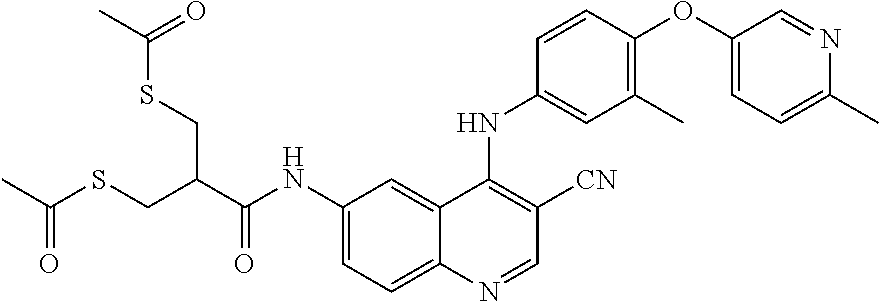
To a mixture of 6-amino-4-((3-methyl-4-((6-methylpyridin-3-yl)oxy)phenyl)amino)quinoline-3-carbonitrile (300 mg, 0.79 mmol) and S,S′-(2-(chlorocarbonyl)propane-1,3-diyl) diethanethioate (prepared from 3-(acetylthio)-2-((acetylthio)methyl)propanoic acid (1.3 g, 5.51 mmol) and oxalylchloride (0.96 mL, 7.62 mmol in dichloromethane (20 mL) and tetrahydrofuran (10 mL) was added N,N-diisopropylethylamine (2.4 mL, 14.2 mmol) at 0° C., and stirred at room temperature for 1 hour. The reaction mixture was concentrated and poured into water and extracted with ethyl acetate (3×100 mL). The organic extracts were washed with water, dried over anhydrous Na2SO4, filtered and concentrated at reduced pressure to furnish an oil which was purified by preparative HPLC column ACE C-8 (250*4.6*5.0μ); mobile phase A: 0.1% TFA, B: acetonitrile, flow rate 1 mL/min to give the title compound (9 mg, 2%). 1H NMR 400 MHz (DMSO-d6) δ 10.48 (s, 1H), 9.80 (s, 1H), 8.75 (s, 1H), 8.51 (s, 1H), 8.18 (s, 1H), 7.92-7.80 (m, 2H), 7.25-6.99 (m, 5H), 2.50-2.40 (m, 5H), 2.42 (s, 6H), 2.34 (s, 3H), 2.15 (s, 3H); LCMS m/e: 600 [M+1]+.

A mixture of S,S′-(2-((3-cyano-4-((3-methyl-4-((6-methylpyridin-3-yl)oxy)phenyl)amino) quinolin-6-yl)carbamoyl)propane-1,3-diyl)diethanethioate (17 mg 0.028 mmol) in methanolic ammonia (3 mL) at room temperature was stirred for 30 minutes. Evaporation of solvents gave an oil which was triturated with diethyl ether to afford a solid which was dried in vacuum (8 mg, 62%). 1H-NMR (DMSO-d6): δ 10.56 (s, 1H), 8.78 (s, 1H), 8.50 (s, 1H), 8.48 (s, 1H), 7.92-7.81 (m, 3H), 7.24-6.98 (m, 5H), 2.67-2.50 (m, 5H), 2.50 (s, 3H), 2.15 (s, 3H); LCMS m/e: 514 [M+1]+.
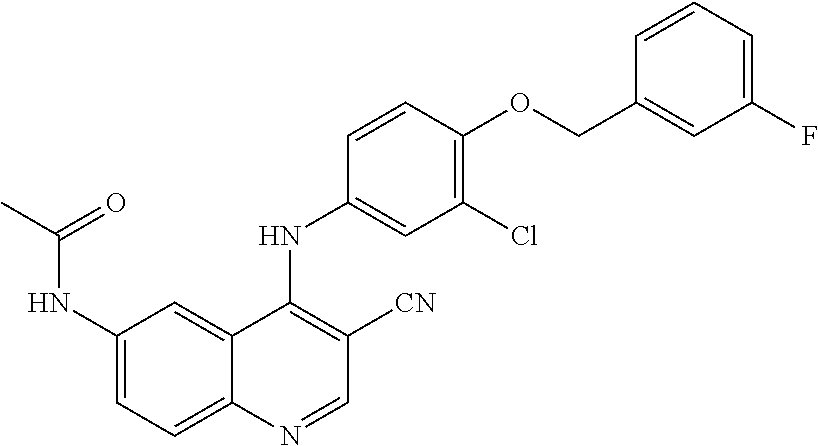
To a solution of N-(4-chloro-3-cyanoquinolin-6-yl)acetamide (1.0 g, 4.08 mmol) in isopropanol (20 mL) was added 3-chloro-4-(3-fluorobenzyl)oxyaniline (1.02 g, 4.08 mmol) and poured into a sealed tube for heating at 150° C. for 12 hours. The reaction mixture was cooled and solvents were evaporated to give a residue which was washed with diethyl ether, filtered and dried to give 2.0 g of crude desired product as solid. MS (ES) m/e 461 [M+1]+.

To a stirred solution of 6-amino-4-((-3-chloro-4-((3-flurobenzyl)oxy)phenyl)amino)quinolone-3-carbonitrile (1.9 g, 4.13 mmol) in methanol (35 mL) was added 2N HCl (25 mL) and heated at 70° C. for 12 hours. From the reaction mixture solvent was removed, poured into water and made basic to ˜pH 8 with aqueous NaHCO3 and precipitated solid was filtered and dried to give 0.8 g (47%) as a white solid. MS (ES): m/e 419 [M+1]+.

To a mixture of 6-amino-4-((-3chloro-4-((3-flurobenzyl)oxy)phenyl)amino)quinolone-3-carbonitrile (300 mg, 0.71 mmol) and S,S′-(2-(chlorocarbonyl)propane-1,3-diyl)diethanethioate (prepared from 3-(acetylthio)-2-((acetylthio)methyl)propanoic acid (1.3 g, 5.02 mmol) and oxalylchloride (0.96 mL, 7.6 mmol in dichloromethane (15 mL) and tetrahydrofuran (10 mL) was added N,N-diisopropylethylamine (N,N-diisopropylethylamine, 2.4 mL, 7.0 mmol) at 0° C., and the reaction mixture was stirred at room temperature for 1 hour. The reaction mixture was concentrated and poured into water and then extracted with ethyl acetate (3×100 mL). The combined organic extracts were washed with water concentrated and dried anhydrous Na2SO4, filtered, and concentrated at reduced pressure to give the crude product as pale brown solid (400 mg). The pure compound was obtained by preparative HPLC column C-18 (250*4.6*5.0μ); mobile phase A: 0.1% TFA, B: acetonitrile, flow rate 1 mL/min to give to give 12 mg of the title compound. 1H NMR 400 MHz (DMSO-d6) δ 10.48 (s, 1H), 9.73 (s, 1H), 8.72 (d, J=2 Hz, 1H), 8.50 (s, 1H), 7.92-7.89 (m, 1H), 7.83-7.82 (m, 1H), 7.46 (m, 2H), 7.34 (m, 3H), 7.24 (m, 2H), 5.25 (s, 2H), 2.35 (s, 6H), 3.20 (m, 4H), 3.04 (m, 1H); LCMS m/e: 637 [M+1]+.

To a solution containing 6-amino-4-((3-chloro-4-((3-fluorobenzyl)oxy)phenyl)amino) quinoline-3-carbonitrile (0.25 g, 0.60 mmol) and 1,2-dithiolane-4-carboxylic acid (0.62 g, 4.19 mmol) in N-methylpyrrolidone (10 mL) was added 1-(3-dimethylaminopropyl)-3-ethylcarbodiimide hydrochloride (0.8 g, 4.19 mmol) and heated for 12 hours at 90° C. The reaction mixture was cooled and poured into water to form a precipitate which was filtered, dried and purified by column chromatography eluting with 2-3% methanol in dichloromethane to give the desired compound (120 mg, 37%). 1H NMR 400 MHz (DMSO-d6): δ 10.54 (s, 1H), 9.73 (s, 1H), 8.75 (d, J=6.8 Hz, 1H), 8.50 (s, 1H), 7.92-7.90 (m, 1H) 7.82-7.80 (m, 1H), 7.49-7.41 (m, 2H), 7.34-7.30 (m, 2H), 7.26-7.15 (m, 3H), 5.25 (s, 1H), 3.57-3.44 (m, 3H), 3.37-3.32 (m, 2H); MS (ES) m/e 551 [M+1]+.

A solution of 6-amino-4-((3-chloro-4-((3-fluorobenzyl)oxy)phenyl)amino)quinoline-3-carbonitrile (300 mg, 0.72 mmol) and 2-(1,2-dithiolan-3-yl)acetyl chloride (prepared from 2-(1,2-dithiolan-3-yl)acetic acid (0.96 g, 5.02 mmol) and oxalyl chloride (0.92 mL, 10.53 mmol) in dichloromethane (10 mL) and tetrahydrofuran (10 mL) was added N,N-diisopropylethylamine (1.27 mL, 7.17 mmol) and at 0° C. and the reaction was stirred for 2 hours at room temperature. The solvents were then evaporated, poured into water and extracted with 5% methanol in dichloromethane (2×100 mL). The organic extracts were combined, washed with water, dried over anhydrous Na2SO4, filtered and concentrated at reduced pressure. The title compound was isolated by column chromatography eluting with 5% methanol in dichloromethane followed by preparative HPLC: column symmetry C-18 (250*4.6*5.0μ); mobile phase A: 0.1% TFA, B: acetonitrile, flow rate 1 mL/min to afford title compound as a white solid (30 mg, 8%). 1H NMR 400 MHz (DMSO-d6): δ 10.38 (s, 1H), 9.71 (s, 1H), 8.72 (d, J=1.2 Hz, 1H), 8.49 (s, 1H), 7.91-7.79 (m, 2H), 7.48-7.16 (m, 7H), 5.25 (s, 2H), 4.10-4.06 (m, 1H), 3.31-2.93 (m, 3H), 2.91-2.74 (m, 2H), 2.07 (m, 1H); LCMS m/e: 565[M+1]+.

A mixture of morpholine (15.0 g, 172 mmol), 2-cyanoacetic acid (14.7 g, 172 mmol) and triethylorthoformate (28.6 ml, 172 mmol) was heated at 140° C. for 2 hours. The reaction mixture was concentrated under reduced pressure, diluted with dichloromethane and washed with water and saturated sodium bicarbonate solutions. The organic phase was dried over anhydrous Na2SO4, filtered and concentrated at reduced pressure to give the desired product (15 g, yield: 63%). 1H-NMR (DMSO-d6): δ 7.15 (d, J=14.0 Hz, 1H), 4.14 (d, J=14.0 Hz, 1H), 3.56 (t, J=4.8 Hz, 4H), 3.15 (t, J=4.8 Hz, 4H); MS (ES) m/e 139 [M+H]+.

To a stirred solution of (S)-(2,2-dimethyl-1,3-dioxolan-4-yl)methanol (2.0 g, 15 mmol) in dichloromethane (60 mL) at 0° C. were added triethylamine (2.5 mL, 18 mmol) and methanesulfonyl chloride (1.3 mL, 17 mmol) and stirred at room temperature for 12 hours. The reaction mixture was concentrated, poured into water and made basic with sodium bicarbonate solution. This solution was then extracted with ethyl acetate (3×200 mL) and the organic layer was dried over anhydrous Na2SO4, filtered and concentrated in vacuo to give an oil. The desired product was obtained by column chromatography on silica gel using 20% ethyl acetate in hexanes as the eluent to give 3.0 g (100%). 1H-NMR (DMSO-d6): δ 4.33-4.23 (m, 2H), 4.16-4.12 (m, 1H), 4.03 (dd, J1=8.8 Hz, J2=6.8 Hz, 1H), 3.71 (dd, J1=8.4 Hz, J2=6.0 Hz, 1H), 3.21 (s, 3H), 1.35 (s, 3H), 1.28 (s, 3H); MS (ES) m/e 211 [M+H]+.

To a stirred solution of (R)-(2,2-dimethyl-1,3-dioxolan-4-yl)methanol (2.0 g, 15 mmol) in dichloromethane (60 mL) at 0° C. were added triethylamine (2.5 mL, 18 mmol) and methanesulfonyl chloride (1.3 mL, 17 mmol) and stirred at room temperature for 12 hours. The reaction mixture was concentrated, poured into water and made basic with sodium bicarbonate solution. This solution was then extracted with ethyl acetate (3×200 mL) and the organic layer was dried over anhydrous Na2SO4, filtered and concentrated in vacuo to give an oil. The desired product was obtained by column chromatography on silica gel using 20% ethyl acetate in hexanes as the eluent to give 3.0 g (100%). 1H-NMR (DMSO-d6): δ 4.33-4.23 (m, 2H), 4.16-4.12 (m, 1H), 4.03 (dd, J1=8.8 Hz, J2=6.8 Hz, 1H), 3.71 (dd, J1=8.4 Hz, J2=6.0 Hz, 1H), 3.21 (s, 3H), 1.35 (s, 3H), 1.28 (s, 3H); MS (ES) m/e 211 [M+H]+.

To a stirred solution of 3-amino-4-methoxybenzoic acid (4.17 g, 24.9 mmol) in dichloromethane (40 mL) at 0° C. were added acetyl chloride (1.77 mL, 24.9 mmol) and triethylamine (3.30 mL, 24.9 mmol). The solution was stirred at room temperature for 1 hours and then quenched with water, extracted with dichloromethane (3×200 mL) and the combined organic layer was dried over anhydrous Na2SO4, filtered, concentrated in vacuo and dried under vacuum to give 4.5 g (88%) desired product as solid. 1H-NMR (DMSO-d6): δ 12.60 (s, 1H), 9.23 (s, 1H), 8.55 (d, J=2 Hz, 1H), 7.68 (dd, J1=8.8 Hz, J2=2 Hz, 1H), 7.12 (d, J=8.8 Hz, 1H), 3.89 (s, 3H), 2.09 (s, 3H); MS (ES) m/e 210 [M+H]+.

To a stirred mixture of 3-acetamido-4-methoxybenzoic acid (2.40 g, 11.5 mmol) in dichloromethane (50 mL) at 0° C. were added phenol (1.29 g, 13.7 mmol), N,N′-dicyclohexylcarbodiimide (3.55 g, 17.2 mmol) and 4-pyrrolidinopyridine (0.254 g, 1.72 mmol). The reaction mixture was stirred at room temperature for 12 hours, then filtered through celite and concentrated in vacuo. The product was isolated by column chromatography on silica gel using 30% ethyl acetate in petroleum ether to give 2.5 g (78%) as a solid. 1H-NMR (DMSO-d6): δ 9.39 (s, 1H), 8.74 (d, J=2 Hz, 1H), 7.76 (dd, J1=8.8 Hz, J2=2 Hz, 1H), 7.49-7.45 (m, 2H), 7.30-7.22 (m, 4H), 3.95 (s, 3H), 2.12 (s, 3H); MS (ES) m/e 286 [M+H]+.

To a stirred mixture of phenyl 3-acetamido-4-methoxybenzoate (2.50 g, 8.77 mmol) in dichloromethane (30 mL) at 0° C. was added fuming nitric acid (3.1 mL). The reaction mixture was stirred at room temperature for 2 hours. The reaction mixture was quenched with water and extracted with dichloromethane (2×500 mL) and the organic layer was dried over anhydrous Na2SO4, filtered, concentrated and washed with aqueous NaHCO3 to give 2.5 g (86%) of the desired product as solid. 1H-NMR (DMSO-d6): δ 9.79 (s, 1H), 8.76 (s, 1H), 7.80 (s, 1H), 7.49-7.47 (m, 2H), 7.35-7.23 (s, 3H), 4.05 (s, 3H), 2.19 (s, 3H); MS (ES) m/e 329 [M−H]+.

The mixture of phenyl 5-acetamido-4-methoxy-2-nitrobenzoate (2.50 g, 7.57 mmol), 10% Pd/C (0.8 g), in methanol (100 mL) was vigorously stirred at 30° C. under hydrogen pressure at 60 psi for 2 hours. The reaction mixture was filtered using celite the filtrate was concentrated and dried under vacuum to provide the product (2.0 g, yield 88%). 1H-NMR (DMSO-d6): δ 8.99 (s, 1H), 8.22 (s, 1H), 7.46-7.42 (m, 2H), 7.29-7.17 (s, 3H), 6.73 (s, 1H), 6.42 (s, 1H), 3.81 (s, 3H), 2.00 (s, 3H); MS (ES) m/e 301 [M+H]+.

To a slurry solution of phenyl 5-acetamido-2-amino-4-methoxybenzoate (2.0 g, 6.6 mmol) in acetic acid (20 mL) was added (E)-3-morpholinoacrylonitrile (1.37 g, 9.90 mmol) and the reaction mixture was stirred at room temperature for 2 hours, quenched with water and filtered over celite. Solvents were removed in vacuo and the residual solid was dried under vacuum to give 1.42 g (60%) desired product. 1H-NMR (DMSO-d6): δ 10.64 (d, J=12.4 Hz, 1H), 9.28 (s, 1H), 8.71 (s, 1H), 8.12-8.07 (m, 1H), 7.50-7.46 (m, 2H), 7.35-7.26 (m, 3H), 7.12 (s, 1H), 4.67 (d, J=8.4 Hz, 1H), 4.00 (s, 3H), 2.07 (s, 3H); MS (ES) m/e 352 [M+H]+.

To a stirred solution of phenyl (E)-5-acetamido-2-((2-cyanovinyl)amino)-4-methoxybenzoate (1.50 g, 4.27 mmol) in DMSO (10 mL) was added a slurry of 60% NaH, (0.37 g, 6.4 mmol) at 0° C. and stirred at room temperature for 2 hours. The reaction mixture was then carefully quenched with water and acidified with 6N HCl to bring to ˜pH 6. The precipitated solid was filtered, dried under vacuum to give 0.75 g (75%) of desired product. 1H-NMR (DMSO-d6): δ 12.58 (bs, 1H), 9.37 (s, 1H), 8.71 (s, 1H), 8.60 (s, 1H), 7.07 (s, 1H), 3.95 (s, 3H), 2.13 (s, 3H); MS (ES) m/e 258 [M+H]+.

To a solution of N-(3-cyano-4-hydroxy-7-methoxyquinolin-6-yl)acetamide (0.20 g, 7.8 mmol) in toluene (8 mL) were added phosphorus oxychloride (0.30 mL, 1.9 mmol) dropwise at 0° C. and triethylamine (0.027 mL, 0.19 mmol), The reaction mixture was heated to 100° C. for 3 hours, then concentrated, poured carefully into water followed by the addition of sodium carbonate solution to make the solution basic. The solution was then extracted with ethyl acetate (3×100 mL) and the organic layer was dried over anhydrous Na2SO4, filtered, concentrated in vacuo to give an oil which was purified by column chromatography on silica gel using 2% methanol in dichloromethane as an eluent to give 0.20 g (93%) as an off white-solid. 1H-NMR (DMSO-d6): δ 9.73 (s, 1H), 9.12 (s, 1H), 9.01 (s, 1H), 7.62 (s, 1H), 4.10 (s, 3H), 2.23 (s, 3H); MS (ES) m/e 276 [M+H]+.

To a stirred solution of N-(3-cyano-4-chloro-7-methoxyquinolin-6-yl)acetamide (0.027 g, 0.10 mmol) in 1,2 dichloroethane (5 mL) was added BBr3 (0.29 mL, 3.1 mmol) at 0° C. and the reaction mixture was heated at 100° C. for 5 hours. The reaction mixture was cooled and solvents were evaporated under vacuum, quenched carefully with water and the obtained solid was filtered, dried under vacuum to give 0.02 g (80%) of desired product. 1H-NMR (DMSO-d6): δ 12.00 (bs, 1H), 9.65 (s, 1H), 9.11 (s, 1H), 8.93 (s, 1H), 7.44 (s, 1H), 2.23 (s, 3H); MS (ES) m/e 260 [M−H]+.

A solution of N-(3-cyano-4-chloro-7-hydroxyquinolin-6-yl)acetamide (0.010 g, 0.038 mmol) and 3-chloro-4-((3-fluorobenzyl)oxy)aniline (0.010 g, 0.042 mmol) and isopropyl alcohol (5 mL) in a sealed tube was heated at 150° C. for 12 hours. The reaction mixture was then cooled and solvents were evaporated in vacuo to give a crude solid which was washed with diethyl ether (5 mL) and dried under vacuum to afford a pale brown solid (10 mg, 56%). 1H-NMR (DMSO-d6): δ 12.50 (bs, 1H), 11.32 (s, 1H), 9.50 (s, 1H), 8.87 (s, 1H), 8.54 (s, 1H), 7.45 (s, 1H), 7.41-7.20 (m, 7H), 5.25 (s, 2H), 2.15 (s, 3H); MS (ES) m/e 477 [M+H]+.

To a solution of N-(4-((3-chloro-4-((3-fluorobenzyl)oxy)phenyl)amino)-3-cyano-7-hydroxyquinolin-6-yl)acetamide (0.16 g, 0.34 mmol) in N—N-dimethylformamide (5 mL) was added Cs2CO3 (0.33 g, 1.01 mmol). After stirring for 10 minutes at room temperature, (R)-(2,2-dimethyl-1,3-dioxolan-4-yl)methyl methanesulfonate (0.11 g, 0.50 mmol) was added and the reaction mixture was heated at 90° C. for 12 h. The mixture was the cooled, poured into water and extracted with ethyl acetate (3×50 mL). The combined extracts were washed with water, dried over anhydrous Na2SO4, filtered, concentrated at reduced pressure to produce the desired product (20 mg). 1H-NMR (DMSO-d6): δ 9.61 (s, 1H), 9.28 (s, 1H), 8.77 (s, 1H), 8.48 (s, 1H), 7.45 (s, 1H), 7.42-7.21 (m, 7H), 5.25 (s, 2H), 4.42-4.40 (m, 1H), 4.33 (d, J=5.2 Hz, 2H), 4.19-4.17 (m, 1H), 3.90-3.87 (m, 1H), 2.16 (s, 3H), 1.24 (s, 3H), 1.23 (s, 3H); MS (ES) m/e 591 [M+H]+.

To a solution of N-(4-((3-chloro-4-((3-fluorobenzyl)oxy)phenyl)amino)-3-cyano-7-hydroxyquinolin-6-yl)acetamide (0.16 g, 0.34 mmol) in N—N-dimethylformamide (5 mL) was added Cs2CO3 (0.327 g, 1.01 mmol). After stirring for 10 minutes at room temperature, (S)-(2,2-dimethyl-1,3-dioxolan-4-yl)methyl methanesulfonate (0.11 g, 0.50 mmol) was added and the reaction mixture was heated at 90° C. for 12 hours. The mixture was the cooled, poured into water and extracted with ethyl acetate (3×50 mL). The combined extracts were washed with water, dried over anhydrous Na2SO4, filtered, concentrated at reduced pressure to produce the desired product (20 mg). 1H-NMR (DMSO-d6): δ 9.61 (s, 1H), 9.28 (s, 1H), 8.77 (s, 1H), 8.48 (s, 1H), 7.45 (s, 1H), 7.42-7.21 (m, 7H), 5.25 (s, 2H), 4.42-4.40 (m, 1H), 4.33 (d, J=5.2 Hz, 2H), 4.19-4.17 (m, 1H), 3.90-3.87 (m, 1H), 2.16 (s, 3H), 1.24 (s, 3H), 1.23 (s, 3H); MS (ES) m/e 591 [M+H]+.

To a stirred solution of (S)—N-(4-((3-chloro-4-((3-fluorobenzyl)oxy)phenyl)amino)-3-cyano-7-((2,2-dimethyl-1,3-dioxolan-4-yl)methoxy)quinolin-6-yl)acetamide (2.73 g, 4.5 mmol) in methanol (30 mL) was added KOH (2.73 g, 4.5 mmol) and heated at 70° C. for 60 hours. After cooling, the solvent was evaporated in vacuo and the residue was poured into water, acidified with 2N HCl to bring the solution to ˜pH 6. The aqueous mixture was then extracted with ethyl acetate (2×100 mL), washed with water, dried over anhydrous Na2SO4, filtered and concentrated at reduced pressure to produce 500 mg of the desired crude product. 1H-NMR (DMSO-d6): δ 9.14 (s, 1H), 8.76 (s, 1H), 8.31 (s, 1H), 8.47 (s, 1H), 7.47-7.06 (m, 7H), 5.76 (s, 2H), 5.25 (s, 2H), 4.54-4.51 (t, J=5.2 Hz, 1H), 4.22-4.19 (m, 3H), 3.90-3.88 (m, 1H), 1.39 (s, 6H); LCMS m/e 549 [M+H]+.

To a stirred solution of (R)—N-(4-((3-chloro-4-((3-fluorobenzyl)oxy)phenyl)amino)-3-cyano-7-((2,2-dimethyl-1,3-dioxolan-4-yl)methoxy)quinolin-6-yl)acetamide (4.0 g, 6.7 mmol) in methanol (40 mL) was added KOH (1.13 g, 20.3 mmol) and heated at 70° C. for 60 hours. After cooling, the solvent was evaporated in vacuo and the residue was poured into water, acidified with 2N HCl to bring the solution to ˜pH 6. The aqueous mixture was then extracted with ethyl acetate (2×100 mL), washed with water, dried over anhydrous Na2SO4, filtered and concentrated at reduced pressure to produce 900 mg of the desired crude product (24%). 1H-NMR (DMSO-d6): δ 9.14 (s, 1H), 8.76 (s, 1H), 8.31 (s, 1H), 8.47 (s, 1H), 7.47-7.06 (m, 7H), 5.76 (s, 2H), 5.25 (s, 2H), 4.54-4.51 (t, J=5.2 Hz, 1H), 4.22-4.19 (m, 3H), 3.90-3.88 (m, 1H), 1.39 (s, 6H); LCMS m/e 549 [M+H]+.

To a mixture of (S)-6-amino-4-((3-chloro-4-((3-fluorobenzyl)oxy)phenyl)amino)-7-((2,2-dimethyl-1,3-dioxolan-4-yl)methoxy)quinoline-3-carbonitrile (0.35 g, 0.64 mmol) and 2-(1,2-dithiolan-3-yl)acetic acid (0.52 g, 3.2 mmol) in N-methylpyrrolidone (10 mL) was added 1-(3-dimethylaminopropyl)-3-ethylcarbodiimide hydrochloride (0.6 g, 3.19 mmol) and the reaction mixture was heated at 80° C. for 12 hours. The mixture was then cooled, poured into water and extracted with ethyl acetate (3×300 mL). The combined extracts were washed with water, dried over anhydrous Na2SO4, filtered and concentrated at reduced pressure to give the desired product (400 mg, crude), which was used in the next step without further purification. MS (ES) m/e 695 [M+H]+.

Alternatively, the diastereomeric mixture containing the two title compounds was separated chiral HPLC techniques to give two diastereomers peak 1, retention time 8.15 min (20 mg) and peak 2 retention time 9.42 min (21 mg) column: Chiralpak-IA (250*20*5.0μ), mobile phase-A: n-hexanes (0.1% DEA), mobile phase-B: ethanol, method: isocratic: 50:50 (A:B), flow rate: 15.0 mL/min, diluent: mobile phase: dichloromethane, sample loading: 12 mg/inj, run time: 25 min/inj.
1H-NMR 400 MHz (DMSO-d6): δ 9.64 (s, 1H), 9.39-9.34 (m, 1H), 8.77 (s, 1H), 8.48 (s, 1H), 7.49-7.18 (m, 12H), 5.25 (s, 1H), 4.55-4.52 (m, 1H), (m, 1H), 4.27 (d, J=5.2 Hz, 2H), 4.19-4.17 (m, 1H), 3.28-3.24 (m, 1H), 3.18-3.14 (m, 1H), 2.92-2.81 (m, 2H), 2.07 (s, 1H), 1.39 (s, 3H), 1.33 (s, 3H); LCMS m/e: 695 [M+1]+. Peak 2 1H-NMR 400 MHz (DMSO-d6): δ 9.64 (s, 1H), 9.39-9.34 (m, 1H), 8.77 (s, 1H), 8.48 (s, 1H), 7.49-7.18 (m, 12H), 5.25 (s, 1H), 4.55-4.52 (m, 1H), 4.27 (d, J=5.2 Hz, 2H), 4.19-4.17 (m, 1H), 3.28-3.24 (m, 1H), 3.18-3.14 (m, 1H), 2.92-2.81 (m, 2H), 2.07 (s, 1H), 1.39 (s, 3H), 1.33 (s, 3H); LCMS m/e: 695 [M+1]+.

To a mixture of N-(4-((3-chloro-4-((3-fluorobenzyl)oxy)phenyl)amino)-3-cyano-7-(((S)-2,2-dimethyl-1,3-dioxolan-4-yl)methoxy)quinolin-6-yl)-2-(1,2-dithiolan-3S-yl)acetamide (peak 1 example 79) (18 mg, 0.025 mmol) in methanolic hydrochloric acid (5 mL) was stirred at room temperature for 15 min. The reaction mixture was concentrated and poured into water and the aqueous layer was extracted with 10% methanol in dichloromethane (3×50 mL). The combined organic extracts were washed with water, dried over anhydrous Na2SO4, filtered and concentrated at reduced pressure to give the desired product (10 mg, yield: 62.5%): 1H-NMR 400 MHz (DMSO-d6): δ 9.63 (s, 1H), 9.40 (s, 1H), 8.91 (s, 1H), 8.47 (s, 1H), 7.41-7.22 (m, 8H), 5.25 (s, 2H), 5.20 (s, 1H), 4.26 (m, 1H), 4.17-4.04 (m, 3H), 3.54-3.32 (m, 3H), 3.16-2.89 (m, 4H), 2.05 (m, 2H); LCMS m/e: 655 [M]+. Chiral HPLC retention time 17.3 minutes, column: Chiralpak-IA (250*20*5.0μ), mobile phase-A: n-hexanes (0.1% DEA), mobile phase-B: ethanol, method: isocratic: 80:20 (A:B), flow rate: 1.0 mL/min, diluent: mobile phase: dichloromethane, sample loading: 12 mg/inj, run time: 25 min/inj.

To a mixture of N-(4-((3-chloro-4-((3-fluorobenzyl)oxy)phenyl)amino)-3-cyano-7-(((S)-2,2-dimethyl-1,3-dioxolan-4-yl)methoxy)quinolin-6-yl)-2-(1,2-dithiolan-3-yl)acetamide (peak 2, example 79) (18 mg, 0.025 mmol) in methanolic hydrochloric acid (5 mL) was stirred at room temperature for 15 min. The reaction mixture was then concentrated and poured into water. The aqueous layer was extracted with 10% methanol in dichloromethane (3×50 mL) and the combined organic extracts were washed with water, dried over anhydrous Na2SO4, filtered and concentrated at reduced pressure to give the desired product (10 mg, yield: 63%) 1H-NMR 400 MHz (DMSO-d6): δ 9.63 (s, 1H), 9.40 (s, 1H), 8.91 (s, 1H), 8.47 (s, 1H), 7.41-7.22 (m, 8H), 5.25 (s, 2H), 5.20 (s, 1H), 4.26 (m, 1H), 4.17-4.04 (m, 3H), 3.54-3.32 (m, 3H), 3.16-2.89 (m, 4H), 2.05 (m, 2H); LCMS m/e: 655 [M]+. Chiral HPLC retention time 15.4 minutes, column: Chiralpak-IA (250*20*5.0μ), mobile phase-A: n-hexanes (0.1% DEA), mobile phase-B: ethanol, method: isocratic: 50:50 (A:B), flow rate: 15.0
mL/min, diluent: mobile phase: dichloromethane, sample loading: 12 mg/inj, run time: 30 min/inj.

To a mixture of N-(4-((3-chloro-4-((3-fluorobenzyl)oxy)phenyl)amino)-3-cyano-7-(((S)-2,2-dimethyl-1,3-dioxolan-4-yl)methoxy)quinolin-6-yl)-2-(1,2-dithiolan-3-yl)acetamide (0.4 g, 0.57 mmol) in acetone (10 mL) was added 1M aqueous hydrochloric acid (4 mL) and stirred at 70° C. for 6 hours. The reaction mixture was concentrated in vacuo, poured into water and extracted with ethyl acetate (3×200 mL). The combined extracts were washed with water, dried over anhydrous Na2SO4, filtered and concentrated at reduced pressure to give 170 mg of diastereomeric mixture. The diastereomers were separated by preparative chiral HPLC conditions Chiralpak-IA (250*20*5.0μ), mobile phase-A: n-hexanes (0.1% DEA), mobile phase-B: ethanol, method: isocratic: 80:20 (A:B), flow rate: 15.0 mL/min, diluent: mobile phase: dichloromethane, sample loading: 10 mg/inj, run time: 30 min/inj. to give the title compound: N-(4-((3-chloro-4-((3-fluorobenzyl)oxy)phenyl)amino)-3-cyano-7-((R)-2,3-dihydroxypropoxy)quinolin-6-yl)-2-(1,2-dithiolan-3S-yl)acetamide (1.65 mg, retention time 17.3 min) and: N-(4-((3-chloro-4-((3-fluorobenzyl)oxy)phenyl)amino)-3-cyano-7-((R)-2,3-dihydroxypropoxy)quinolin-6-yl)-2-(1,2-dithiolan-3R-yl)acetamide (1 mg, retention time 15.4 minutes) together with a 1:1 mixture (35 mg, 9.3%) 1H-NMR 400 MHz (DMSO-d6): δ 8.92 (s, 1H), 8.47 (s, 1H), 7.47-7.44 (m, 1H), 7.38 (s, 1H), 7.34-7.22 (m, 6H), 5.25 (s, 2H), 4.28-4.26 (m, 1H), 4.13-4.04 (m, 3H), 3.54-3.53 (m, 2H), 3.27-3.14 (m, 3H), 2.98-2.89 (m, 3H), 2.09-2.02 (m, 2H); MS (ES) m/e 655 [M+H]+.

To a mixture of (R)-6-amino-4-((3-chloro-4-((3-fluorobenzyl)oxy)phenyl)amino)-7-((2,2-dimethyl-1,3-dioxolan-4-yl)methoxy)quinoline-3-carbonitrile (0.5 g, 0.9 mmol) and 2-(1,2-dithiolan-3-yl)acetic acid (1.34 g, 80 mmol) in N-methylpyrrolidone (25 mL) was added 1-(3-dimethylaminopropyl)-3-ethylcarbodiimide hydrochloride (1.56 g, 8.0 mmol) and the reaction mixture was heated at 80° C. for 12 hours. The mixture was then cooled, poured into water and extracted with ethyl acetate (3×500 mL). The combined organic extracts were washed with water, dried over anhydrous Na2SO4, filtered and concentrated at reduced pressure to give the desired product (400 mg, crude). This crude product was further separated by chiral preparative chiral HPLC methods: conditions Chiralpak-IA (250*20*5.0μ), mobile phase-A: n-hexanes (0.1% DEA), mobile phase-B: isopropanol, method: isocratic: 50:50 (A:B), flow rate: 15.0 mL/min, diluent: mobile phase: dichloromethane, sample loading: 10 mg/inj, run time: 30 min/inj. to give peak 1 (12 mg, retention time 11.6 minutes) 1H-NMR 400 MHz (DMSO-d6): δ 9.64 (s, 1H), 9.39 (s, 1H), 8.77 (s, 1H), 8.48 (s, 1H), 7.45 (s, 1H), 7.44-7.40 (m, 1H), 7.39-7.34 (m, 1H), 7.32-7.24 (m, 2H), 7.23-7.16 (m, 3H), 5.25 (s, 2H), 4.55-4.52 (m, 1H), 4.27 (d, J=5.2 Hz, 2H), 4.17-4.13 (m, 1H), 4.07-4.03 (m, 1H), 3.95-3.92 (m, 1H), 3.51 (s, 1H), 3.27-3.22 (m, 1H), 3.18-3.12 (m, 1H), 2.92-2.85 (m, 1H), 2.08-2.02 (m, 2H), 1.38 (s, 3H), 1.33 (s, 3H); LCMS m/e: 695 [M]+, and peak 2 (25 mg, retention time 14.4 minutes) 1H-NMR (DMSO-d6): δ 9.23 (s, 1H), 8.69 (s, 1H), 8.15 (s, 1H), 7.48-7.43 (m, 1H), 7.34-7.30 (m, 3H), 7.29-7.15 (m, 4H), 7.14-7.10 (m, 1H), 5.18 (s, 2H), 4.52-4.49 (m, 1H), 4.19-4.18 (m, 3H), 4.06-4.02 (m, 1H), 3.94-3.91 (m, 1H), 3.52 (s, 2H), 2.08-2.01 (m, 4H), 1.39 (s, 3H), 1.32 (s, 3H); LCMS m/e: 695 [M]+, corresponding to N-(4-((3-chloro-4-((3-fluorobenzyl)oxy)phenyl)amino)-3-cyano-7-(((R)-2,2-dimethyl-1,3-dioxolan-4-yl)methoxy)quinolin-6-yl)-2-(1,2-dithiolan-3R-yl)acetamide and N-(4-((3-chloro-4-((3-fluorobenzyl)oxy)phenyl)amino)-3-cyano-7-(((R)-2,2-dimethyl-1,3-dioxolan-4-yl)methoxy)quinolin-6-yl)-2-(1,2-dithiolan-3S-yl) acetamide.

To a mixture of N-(4-((3-chloro-4-((3-fluorobenzyl)oxy)phenyl)amino)-3-cyano-7-(((R)-2,2-dimethyl-1,3-dioxolan-4-yl)methoxy)quinolin-6-yl)-2-(1,2-dithiolan-3R-yl)acetamide (10 mg, 0.01 mmol) in methanolic hydrochloric acid (5 mL) and stirred at room temperature for 15 min. The reaction mixture was concentrated in vacuo, poured into water and extracted with 10% methanol in dichloromethane (3×50 mL). The combined extracts were washed with water, dried over anhydrous Na2SO4, filtered and concentrated at reduced pressure. The desired product was isolated as an off white (9 mg, 95%) 1H-NMR 400 MHz (DMSO-d6): δ 10.8 (s, br, 1H), 9.53 (s, 1H), 9.08 (s, 1H), 8.88 (s, 1H), 7.58-7.21 (m, 8H), 5.30 (s, 2H), 4.26 (m, 1H), 4.17-4.04 (m, 3H), 3.54-3.32 (m, 4H), 3.16-2.89 (m, 4H), 2.05 (m, 2H); LCMS m/e: 655 [M]+. 4. Chiral HPLC conditions Chiralpak-IA (250*20*5.0μ), mobile phase-A: n-hexanes (0.1% DEA), mobile phase-B: ethanol, method: isocratic: 80:20 (A:B), flow rate: 15.0 mL/min, diluent: mobile phase: dichloromethane, sample loading: 10 mg/inj, run time: 30 min/inj. retention time 16.6 minutes.

To a mixture of N-(4-((3-chloro-4-((3-fluorobenzyl)oxy)phenyl)amino)-3-cyano-7-(((R)-2,2-dimethyl-1,3-dioxolan-4-yl)methoxy)quinolin-6-yl)-2-(1,2-dithiolan-3S-yl)acetamide (peak 2 example 57, 21 mg, 0.02 mmol) in methanolic hydrochloric acid (8 mL) and stirred at room temperature for 15 min. The reaction mixture was concentrated in vacuo, poured into water and extracted with 10% methanol in dichloromethane (3×80 mL). The combined extracts were washed with water, dried over anhydrous Na2SO4, filtered and concentrated at reduced pressure. The desired product was isolated as an off white (16 mg, 84%) 1H-NMR 400 MHz (DMSO-d6) δ 9.52 (m, 2H), 9.08 (s, 1H), 8.84 (s, 1H), 7.44-7.07 (m, 8H), 5.16 (s, 2H), 4.15 (m, 1H), 4.04-3.98 (m, 3H), 2.96-2.87 (m, 4H), 2.66-2.50 (m, 4H), 1.86 (m, 2H); LCMS m/e: 655 [M]+. Chiral HPLC conditions Chiralpak-IA (250*20*5.0μ), mobile phase-A: n-hexanes (0.1% DEA), mobile phase-B: ethanol, method: isocratic: 80:20 (A:B), flow rate: 15.0 mL/min, diluent: mobile phase: dichloromethane, sample loading: 10 mg/inj, run time: 30 min/inj. retention time 14.0 minutes.
The chromatographic separation in example 83 produced the mixture of the title compounds

1H-NMR 400 MHz (DMSO-d6): (s, 2H), 9.96 (s, 1H), 9.40 (s, 1H), 8.80 (s, 1H), 8.42 (s, 1H), 7.62-7.20 (m, 7H), 5.3 (s, 2H), 4.62-4.51 (m, 2H), 4.20 (s, 2H), 3.40 (m, 7H), 1.22 (m, 7H); LCMS m/e: 727[M]+.

A mixture of N-(4-((3-chloro-4-((3-fluorobenzyl)oxy)phenyl)amino)-3-cyano-7-(((R)-2,2-dimethyl-1,3-dioxolan-4-yl)methoxy)quinolin-6-yl)-2-(1,1-dioxido-1,2-dithiolan-3-yl)acetamide diastereomeric mixture (20 mg), 0.02 mmol) and hydrochloric acid (5 mL) in methanol was stirred at room temperature for 15 minutes. The reaction mixture was concentrated and poured into water and the aqueous layer was extracted with 10% methanol in dichloromethane (3×50 mL). The combined organic extracts were washed with water, dried over anhydrous Na2SO4, concentrated at reduced pressure to give the desired product (10 mg, yield: 55%). 1H-NMR 400 MHz (DMSO-d6): δ 9.55 (m, 2H), 8.83 (s, 1H), 8.15 (s, 1H), 7.44-7.07 (m, 8H), 5.20 (s, 2H), 4.19-4.04 (m, 2H), 3.91 (m, 1H), 3.50 (m, 2H), 2.96-2.87 (m, 3H), 2.66-2.50 (m, 4H), 1.86 (m, 2H); LCMS m/e: 686 [M−1]+.

To a mixture of (S)-6-amino-4-((3-chloro-4-((3-fluorobenzyl)oxy)phenyl)amino)-7-((2,2-dimethyl-1,3-dioxolan-4-yl)methoxy)quinoline-3-carbonitrile (0.2 g, 0.36 mmol) and 2-(1,2-dithiolan-4-yl)acetic acid (0.59 g, 3.64 mmol) in N-methylpyrrolidone (5 mL) was added 1-(3-dimethylaminopropyl)-3-ethylcarbodiimide hydrochloride (0.70 g, 3.64 mmol) and the reaction mixture was heated at 90° C. for 12 hours. After cooling, the reaction mixture was poured into ice water and the precipitated solid was filtered and dried and was further purified by preparative HPLC column ACE C-8 (250*4.6*5.0μ); mobile phase A: 0.1% TFA, B: acetonitrile, flow rate 1 mL/min to give the title compound as a white solid (57 mg, yield 23%). 1H NMR (DMSO-d6): δ 9.61 (s, 1H), 9.43 (s, 1H), 8.70 (s, 1H), 8.48 (s, 1H), 7.44-7.23 (m, 8H), 5.25 (s, 2H), 4.50 (s, 1H), 4.27-4.26 (m, 2H), 4.14 (m, 1H), 3.90 (m, 1H), 3.36 (m, 2H), 3.023-2.98 (m, 2H), 2.69 (m, 1H), 2.19 (m, 1H), 1.90 (m, 1H), 1.39 (s, 6H); MS (ES) m/e 695 [M+1]+.

To a solution of (S)—N-(4-((3-chloro-4-((3-fluorobenzyl)oxy)phenyl)amino)-3-cyano-7-((2,2-dimethyl-1,3-dioxolan-4-yl)methoxy)quinolin-6-yl)-2-(1,2-dithiolan-4-yl)acetamide (40 mg, 0.06 mmol) in methanol (5 mL) was added methanolic. HCl (5 mL) and stirring was continued for 30 minutes at room temperature. Then reaction mixture was then concentrated and poured into water and The aqueous mixture was extracted with 10% methanol in dichloromethane (2×100 mL) and the organic layer was washed with water, dried over anhydrous Na2SO4, filtered and concentrated at reduced pressure to provide a crude solid which was further washed with diethyl ether and dried to provide the title compound (37 mg, yield: 98%). 1H NMR 400 MHz (DMSO-d6): δ 9.80 (s, 1H), 9.60 (s, 1H), 8.90 (s, 1H), 8.50 (s, 1H), 7.38 (m, 5H), 7.24 (m, 3H), 5.26 (s, 2H), 5.19 (s, 1H), 4.60 (s, 1H), 4.30 (m, 1H), 4.10 (m, 1H), 3.90 (m, 1H), 3.39 (m, 3H), 3.02 (m, 3H), 2.70 (m, 3H); MS (ES) m/e 656 [M+1]+.

To a solution of ((R)-6-amino-4-((3-chloro-4-((3-fluorobenzyl)oxy)phenyl)amino)-7-((2,2-dimethyl-1,3-dioxolan-4-yl)methoxy)quinoline-3-carbonitrile (0.2 g, 0.36 mmol) and 2-(1,2-dithiolan-4-yl)acetic acid (0.59 g, 3.64 mmol) in N-methylpyrrolidone (5 mL) was added 1-(3-dimethylaminopropyl)-3-ethylcarbodiimide hydrochloride (0.70 g, 3.64 mmol) and the reaction mixture was heated for 12 hours at 90° C. After cooling, the reaction mixture was poured into ice water and the formed solid was filtered and dried to that crude was purified by preparative HPLC column ACE C-8 (250*4.6*5.0μ); mobile phase A: 0.1% TFA, B: acetonitrile, flow rate 1 mL/min to give the title compound (90 mg, yield 36%). 1H NMR (DMSO-d6): δ 9.63 (s, 1H), 9.47 (s, 1H), 8.70 (s, 1H), 8.48 (s, 1H), 7.49 (m, 3H), 7.34 (m, 5H), 5.25 (s, 2H), 4.52 (m, 1H), 4.23 (m, 3H), 3.93 (m, 1H), 3.30 (m, 1H), 3.09 (m, 2H), 2.15 (m, 2H), 1.93 (m, 2H), 1.49 (s, 6H); MS (ES) m/e 696 [M+1]+.

To a solution of (R)—N-(4-((3-chloro-4-((3-fluorobenzyl)oxy)phenyl)amino)-3-cyano-7-((2,2-dimethyl-1,3-dioxolan-4-yl)methoxy)quinolin-6-yl)-2-(1,2-dithiolan-4-yl)acetamide (80 mg, 0.12 mmol) in methanol (5 mL) was added methanolic HCl (5 mL) and was stirred for 30 minutes at room temperature. The reaction mixture was concentrated and poured into water and extracted with 10% methanol in dichloromethane (2×100 mL). and the combined extracts were washed with water, dried over anhydrous Na2SO4, filtered, concentrated at reduced pressure, further washed with diethyl ether and dried to furnish the title compound (60 mg, yield: 80%). 1H NMR 400 MHz (DMSO-d6): δ 9.65 (s, 1H), 9.44 (s, 1H), 8.87 (s, 1H), 8.49 (s, 1H), 7.49-7.17 (m, 8H), 5.25 (s, 2H), 5.20 (d, J=4.8 Hz, 1H), 4.80 (s, 1H), 4.28-4.24 (m, 1H), 4.10-4.07 (m, 1H), 3.93 (s, 1H), 3.53 (m, 2H), 3.28 (m, 1H), 3.02 (m, 2H), 2.68 (m, 2H), 2.33 (m, 1H), 1.91 (m, 1H); LCMS m/e: 653 (M−1).

To a mixture of (S)-6-amino-4-((3-chloro-4-((3-fluorobenzyl)oxy)phenyl)amino)-7-((2,2-dimethyl-1,3-dioxolan-4-yl)methoxy)quinoline-3-carbonitrile (200 mg, 0.36 mmol) and S,S′-(2-(chlorocarbonyl)propane-1,3-diyl)diethanethioate (prepared from 3-(acetylthio)-2-((acetylthio)methyl)propanoic acid (0.6 g, 2.54 mmol) and oxalyl chloride (0.48 mL, 3.81 mmol)) in dichloromethane (15 mL) and tetrahydrofuran (10 mL) was added (N,N-diisopropylethylamine, 0.75 ml, 4.38 mmol) at 0° C., and the reaction mixture was warmed to room temperature and stirred for 1 hour. The reaction mixture was then concentrated, poured into water, extracted with ethyl acetate (3×100 mL) and the combined organic extracts were washed with water, dried over anhydrous Na2SO4, filtered and concentrated to give an oil which was further purified by column chromatography eluting with 1% methanol in dichloromethane to furnish the title compound (90 mg, 33.3%). LCMS m/e: 765 [M−1]+.

A solution of (S)—S,S′-(2-((4-((3-chloro-4-((3-fluorobenzyl)oxy)phenyl)amino)-3-cyano-7-((2,2-dimethyl-1,3-dioxolan-4-yl)methoxy)quinolin-6-yl)carbamoyl)propane-1,3-diyl)diethanethioate (90 mg, 0.12 mmol) in methanolic HCl (5 mL) was stirred for 30 minutes at room temperature. Then reaction mixture was concentrated, poured into water and extracted with 10% methanol in dichloromethane (2×100 mL). The combined extracts were washed with water, dried over anhydrous Na2SO4, filtered and concentrated at reduced pressure and further purified by preparative HPLC: column ACE C-8 (250*4.6*5.0 microns); mobile phase A: 0.1% TFA, B: acetonitrile, flow rate 1 mL/min to give SAB312 (23 mg, 28%). 1H NMR (DMSO-d6): δ 9.64 (s, 1H), 9.44 (s, 1H), 8.85 (s, 1H), 8.48 (s, 1H), 7.47 (d, J=6.4 Hz, 1H), 7.43-7.18 (m, 7H), 5.25 (s, 2H), 5.1 (d, J=5.2 Hz, 1H), 4.75 (t, J=6 HZ, 1H), 4.28 (m, 1H), 4.13 (t, J=6.4 Hz, 1H), 3.95 (d, J=3.6 HZ, 1H), 3.56 (t, J=5.6 Hz, 2H), 3.19-3.06 (m, 5H), 2.39-2.30 (m, 6H); MS (ES) m/e 728[M+1]+.

A solution of (R)—S,S′-(2-((4-((3-Chloro-4-((3-fluorobenzyl)oxy)phenyl)amino)-3-cyano-7-(2,3-dihydroxypropoxy)quinolin-6-yl)carbamoyl)propane-1,3-diyl)diethanethioate (14.8 mg, 0.20 mmol) in methanolic ammonia (5 mL) was stirred for 30 minutes at room temperature followed by evaporation of solvents under reduced pressure. The residue was washed with diethyl ether, filtered and dried in vacuum to furnish the title compound (9.5 mg, 73%). 1H NMR (DMSO-d6): δ 9.57 (s, 1H), 9.04 (s, 1H), 8.85 (s, 1H), 8.47 (m, 1H), 7.49-7.16 (m, 8H), 5.25 (s, 2H), 5.14 (d, J=5.2 Hz, 1H), 4.77 (m, 2H), 4.29 (m, 1H), 4.14-3.95 (m, 2H), 3.62-3.56 (m, 4H), 2.86 (m, 2H); MS (ES) m/e 643 [M+1]+.

To a mixture of (R)-6-amino-4-((3-chloro-4-((3-fluorobenzyl)oxy)phenyl)amino)-7-((2,2-dimethyl-1,3-dioxolan-4-yl)methoxy)quinoline-3-carbonitrile (230 mg, 0.42 mmol) and S,S′-(2-(chlorocarbonyl)propane-1,3-diyl)diethanethioate (prepared from 3-(acetylthio)-2-((acetylthio)methyl)propanoic acid (0.99 g, 4.19 mmol) and oxalyl chloride (0.56 mL, 6.29 mmol) in dichloromethane (10 mL) and tetrahydrofuran (5 mL) was added N,N-diisopropylethylamine (0.85 mL, 5.04 mmol) was stirred at 0° C. for 1 hour. The reaction mixture was concentrated, poured into water and extracted with ethyl acetate (3×100 mL). The combined extracts was washed with water, dried over anhydrous Na2SO4, filtered and concentrated at reduced pressure to provide a residue which was purified by column chromatography eluting with 1-2% methanol in dichloromethane to furnish the title compound (200 mg, 62.5%). 1H NMR 400 MHz (DMSO-d6) δ 9.69 (s, 1H), 9.49 (s, 1H), 8.74 (s, 1H), 8.49 (s, 1H), 7.73-7.16 (m, 8H), 5.25 (s, 2H), 4.51 (m, 1H), 4.31 (m, 4H), 4.16 (m, 2H), 3.88 (m, 1H), 3.14-3.06 (m, 2H), 1.96 (s, 6H), 1.33 (s, 6H); LCMS m/e: 768 [M+1]+.

To a solution of (R)—S,S′-(2-((4-((3-chloro-4-((3-fluorobenzyl)oxy)phenyl)amino)-3-cyano-7-((2,2-dimethyl-1,3-dioxolan-4-yl)methoxy)quinolin-6-yl)carbamoyl)propane-1,3-diyl)diethanethioate (200 mg, 0.26 mmol) in methanol (5 mL) was added a solution of methanolic HCl (5 mL) and stirred room temperature for 30 minutes. Then reaction mixture was concentrated in vacuo, poured into water and extracted with 10% methanol in dichloromethane (2×100 mL). The organic extracts were washed with water, dried over anhydrous Na2SO4, filtered and concentrated at reduced pressure and the crude was purified by preparative HPLC: column YMC Triart (250*4.6*5.0μ); mobile phase A: 0.01 M ammonium acetate, B: acetonitrile, flow rate 1 mL/min to give the title compound (20 mg, 10%). 1H NMR (DMSO-d6): δ 10.30 (s, 1H), 9.51 (s, 1H), 8.93 (s, 1H), 8.80 (s, 1H), 7.49-7.18 (m, 8H), 5.30 (m, 1H), 5.27 (s, 2H), 4.30-4.26 (m, 1H), 4.15-4.11 (m, 1H), 3.97-3.95 (m, 1H), 3.56-3.54 (m, 3H), 3.43-3.06 (m, 5H), 2.40 (s, 6H); MS (ES) m/e 726 [M−1]+.

A solution of (S)—S,S′-(2-((4-((3-chloro-4-((3-fluorobenzyl)oxy)phenyl)amino)-3-cyano-7(2,3-dihydroxypropoxy)quinolin-6-yl)carbamoyl)propane-1,3-diyl)diethanethioate (10 mg, 0.013 mmol) in methanolic ammonia (3 mL) was stirred for 30 minutes at room temperature followed by evaporation of solvents in vacuo. The residue was washed with diethyl ether, filtered and dried under vacuum to furnish the title compound (6 mg, 75%). 1H NMR 400 MHz (DMSO-d6): δ 9.80 (s, 1H), 9.58 (s, 1H), 8.87 (s, 1H), 8.51 (s, 1H), 7.47-6.94 (m, 8H), 5.25 (s, 2H), 5.20 (m, 1H), 4.80 (m, 1H), 4.26 (m, 1H), 4.12-3.90 (m, 2H), 3.59 (m, 3H), 2.32 (m, 1H), 2.08 (m, 1H), 1.50-1.20 (m, 2H); MS (ES) m/e 639 [M−1]+.

To a stirred solution of phenyl 5-acetamido-2-amino-4-methoxybenzoate (17 g, 56.7 mmol) in 2-methoxyethanol (170 mL) was added formimidamide acetate (29.5 g, 283.3 mmol) and was refluxed for 12 hours. After cooling, another portion of formimidamide acetate (14.75 g, 141.7 mmol) was added and reflux was continued for additional 12 hours. The reaction mixture was cooled, and filter the solid and washed with di ethyl ether dried under vacuum to give the title compound (10 g, 76%) 1H NMR (DMSO-d6): 12.04 (s, 1H), 9.36 (s, 1H), 8.74 (s, 1H), 7.99 (s, 1H), 7.17 (s, 1H), 3.98 (s, 3H), 2.14 (s, 3H); MS (ES) m/e 234 [M+1]+.

To a solution of N-(4-chloro-7-methoxyquinazolin-6-yl)acetamide (2.0 g, 8.58 mmol) in toluene (30 mL) were added phosphorus oxychloride (3.28 mL, 21.45 mmol) and triethylamine (0.3 mL, 2.15 mmol) dropwise at 0° C. The reaction mixture was heated 120° C. for 6 hours then cooled, concentrated in vacuo, poured into water and made basic with the addition of saturated sodium bicarbonate solution. The resultant solid was filtered, dried under vacuum and purified by column chromatography eluting with 2% methanol in dichloromethane to give 1.0 g (47%) as a white solid. LCMS m/e: 252 [M+1]+.

A solution containing N-(4-chloro-7-methoxyquinazolin-6-yl)acetamide (0.6 g, 2.39 mmol) and 3-methyl-4-((6-methylpyridin-3-yl)oxy)aniline (0.61 g, 2.87 mmol), in isopropanol (30 mL) was placed in a sealed tube and heated for 12 hours at 150° C. After cooling, solvents were evaporated and the residue was washed with diethyl ether, filtered and dried to give 1.02 g of the title compound as a solid. 1H NMR 400 MHz (DMSO-d6): δ 9.68 (s, 1H), 8.98 (s, 1H), 8.71 (s, 1H), 8.21 (m, 1H), 7.64 (m, 1H), 7.78 (m, 1H), 7.28-7.22 (m, 4H), 6.98 (d, J=8.4 Hz, 1H), 4.04 (s, 3H), 2.45 (s, 3H), 2.24 (s, 3H), 2.19 (s, 3H); MS (ES) m/e 430 [M+1]+.

To stirred solution of N-(7-methoxy-4-((3-methyl-4-((6-methylpyridin-3-yl)oxy)phenyl)amino) quinazolin-6-yl)acetamide (1.02 g, 2.33 mmol) in methanol (20 mL) was added KOH (0.39 g, 6.99 mmol) and heated for 60 hours at 70° C. After cooling, the solvent was removed in vacuo, and the residue was poured into water and extracted with ethyl acetate (2×100 mL). The combined extracts were washed with water, dried over anhydrous Na2SO4, filtered and concentrated at reduced pressure to give a crude oil which was purified by column chromatography eluting with 3-5% methanol in dichloromethane to give the desired product (550 mg, 61%). 1H NMR 400 MHz (DMSO-d6): δ 9.24 (s, 1H), 8.32 (s, 1H), 8.17 (d, J=2.8 Hz, 1H), 7.78 (d, J=2.4 Hz, 1H) 7.69 (m, 1H), 7.67 (d, J=2.8 Hz, 1H), 7.22-7.00 (m, 3H), 6.90 (d, J=8.8 Hz, 1H), 5.32 (bs, 1H), 3.96 (s, 3H), 2.45 (s, 3H), 2.15 (s, 3H); MS (ES) m/e 388 [M+1]+.

To a mixture of 7-methoxy-N-4-(3-methyl-4-((6-methylpyridin-3-yl)oxy)phenyl)quinazoline-4,6-diamine (200 mg, 0.516 mmol) and S,S′-(2-(chlorocarbonyl)propane-1,3-diyl)diethanethioate (prepared from 3-(acetylthio)-2-((acetylthio)methyl)propanoic acid (1.2 g, 5.16 mmol) and oxalyl chloride (0.96 mL, 7.62 mmol) in dichloromethane (20 mL) and tetrahydrofuran (10 mL) was added N,N-diisopropylethylamine (0.92 mL, 5.16 mmol) at 0° C., and stirred at room temperature for 1 hour. The reaction mixture was then concentrated, poured into water and extracted with dichloromethane (3×100 mL). The combined extracts were washed with water, dried over anhydrous Na2SO4, filtered and concentrated at reduced pressure to give an oil which was purified by preparative HPLC: column ACE C-8 (250*4.6*5.0μ); mobile phase A: 0.1% TFA, B: acetonitrile, flow rate 1 mL/min to give the title compound (13 mg, 4%). 1H NMR 400 MHz (DMSO-d6): δ 9.71 (m, 2H), 8.81 (s, 1H), 8.47 (s, 1H), 8.18 (m, 1H), 7.70-7.62 (m, 2H), 7.25-7.18 (m, 3H), 6.93 (m, 1H), 4.00 (s, 3H), 3.31-3.10 (m, 5H), 2.43 (s, 3H), 2.35 (s, 6H), 2.20 (s, 3H); LCMS m/e: 606 [M+1]+.

A solution of S,S′-(2-((7-methoxy-4-((3-methyl-4-((6-methylpyridin-3-yl)oxy)phenyl)amino)quinazolin-6-yl)carbamoyl)propane-1,3-diyl) diethanethioate (9 mg 0.018 mmol) in methanolic ammonia (4 mL) at room temperature was stirred for 30 minutes followed by evaporation of solvents and the residue was dried in vacuo to furnish the title compound (5 mg, 71%). 1H NMR (DMSO-d6): δ 9.81 (s, 1H), 9.67 (s, 1H), 8.82 (s, 1H), 8.48 (s, 1H), 8.17 (d, J=2.4 Hz, 1H), 7.72-7.64 (m, 2H), 7.26-7.18 (m, 3H), 6.95 (d, J=8.8 Hz, 1H), 4.00 (s, 3H), 3.64-3.54 (m, 3H), 3.35-3.31 (m, 2H), 2.52 (s, 3H), 2.32 (s, 3H); MS (ES) m/e 518 [M−1]+.

To a mixture of 7-methoxy-N-4-(3-methyl-4-((6-methylpyridin-3-yl)oxy)phenyl)quinazoline-4,6-diamine (300 mg, 0.77 mmol) and 2-(1,2-dithiolan-3-yl)acetyl chloride (prepared from 2-(1,2-dithiolan-3-yl)acetic acid (0.8 g, 4.87 mmol) and oxalyl chloride (0.92 mL, 7.32 mmol) in N—N-dimethylformamide (5 mL) and tetrahydrofuran (5 mL) was added N,N-diisopropylethylamine (1.25 mL, 6.98 mmol) at 0° C. and stirred the at room temperature for 1 hour. The reaction mixture was then concentrated, poured into water and the precipitated solid was filtered, dried and purified by preparative HPLC: column ACE C-8 (250*4.6*5.0), mobile phase A: 0.1% TFA, B: acetonitrile, flow rate 1 mL/min to give the title compound (25 mg, 7%). 1H NMR 400 MHz (DMSO-d6) δ 9.75 (s, 1H), 9.61 (s, 1H), 8.83 (s, 1H), 8.49 (s, 1H), 8.1 (d, J=2 Hz, 1H), 7.71 (s, 1H), 7.65 (d, J=8.8 Hz, 1H), 7.21 (m, 3H), 6.93 (d, J=8.8 Hz, 1H), 4.09 (m, 1H), 4.00 (s, 3H), 3.18 (m, 2H), 3.13 (m, 1H), 2.99 (m, 2H), 2.43 (s, 3H), 2.20 (s, 3H), 2.09 (s, 1H); LCMS m/e: 534 [M+1]+.

To a solution of N-(4-chloro-7-methoxyquinazolin-6-yl)acetamide (1.0 g, 3.98 mmol) and 3-chloro-4-((3-fluorobenzyl)oxy)aniline (1.5 g, 5.98 mmol), in isopropanol (20 mL) in a sealed tube was refluxed for 12 hours at 150° C. Following cooling, the solvents were evaporated and the residue was washed with diethyl ether, filtered, washed with aqueous NaHCO3, and dried in vacuo to furnish the desired compound (1.3 g, 72%). 1H NMR 400 MHz (DMSO-d6): δ 9.74 (s, 1H), 9.57 (s, 1H), 8.78 (s, 1H), 8.75 (s, 1H), 8.50 (s, 1H), 7.95 (d, J=2.4 Hz, 1H), 7.68 (m, 1H), 7.48 (m, 1H), 7.34 (m, 2H), 7.21 (m, 1H), 7.18 (m, 1H), 5.25 (s, 2H), 4.00 (s, 3H), 2.15 (s, 3H); MS (ES) m/e 467 {M+1]+.

To a stirred solution of N-(4-((3-chloro-4-((3-fluorobenzyl)oxy)phenyl)amino)-7-methoxyquinazolin-6-yl)acetamide (1.2 g, 2.78 mmol) in methanol (20 mL) was added a solution of 2N HCl (20 mL) and heated for 24 hours at 70° C. After cooling, the solvent was removed in vacuo and the residue was, poured into water, filtered and dried to furnish the title compound. (0.7 g, 70%). 1H NMR 400 MHz (DMSO-d6): δ 10.22 (s, 1H), 8.57 (s, 1H), 8.54 (s, 1H), 7.90 (d, J=2.4 Hz, 1H), 7.62-7.59 (m, 1H), 7.48-7.34 (m, 2H), 7.34-7.13 (m, 6H), 5.76 (bs, 2H), 4.00 (s, 3H), (m, 2H); MS (ES) m/e 425 [M+1]+.

To a solution of N-4-(3-chloro-4-((3-fluorobenzyl)oxy)phenyl)-7-methoxyquinazoline-4,6-diamine (300 mg, 0.707 mmol) and 2-(1,2-dithiolan-3-yl)acetyl chloride (prepared from 2-(1,2-dithiolan-3-yl)acetic acid (0.8 g, 4.87 mmol) and oxalyl chloride (0.92 mL, 7.32 mmol) in N—N-dimethylformamide (5 mL) and tetrahydrofuran (5 mL) was added N,N-diisopropylethylamine (2.2 mL, 12.73 mmol) at 0° C. was stirred at room temperature for 1 hour. The reaction mixture was then concentrated and poured into water, filtered, dried and purified by preparative HPLC: column YMC Triart (250*4.6*5.0μ); mobile phase A: 0.01 M ammonium acetate, B: acetonitrile, flow rate 1 mL/min to give the desired compound (30 mg, 8%). 1H NMR 400 MHz (DMSO-d6) δ 9.69 (s, 1H), 9.60 (s, 1H), 8.80 (s, 1H), 8.47 (s, 1H), 7.94 (d, J=2 Hz, 1H), 7.68-7.66 (m, 1H), 7.48-7.44 (m, 1H), 7.34-7.16 (m, 5H), 5.25 (s, 2H), 4.06 (m, 1H), 3.99 (s, 3H), 3.25-3.15 (m, 3H), 2.99-2.88 (m, 3H); LCMS m/e: 571 [M+1]+.

To a mixture of N-4-(3-chloro-4-((3-fluorobenzyl)oxyphenyl)-7-methoxyquinazoline-4,6-diamine (300 mg, 0.70 mmol) and S,S′-(2-(chlorocarbonyl)propane-1,3-diyl)diethanethioate (prepared from 3-(acetylthio)-2-((acetylthio)methyl)propanoic acid (1.3 g, 5.02 mmol) and oxalyl chloride (0.96 mL, 7.62 mmol) in N—N-dimethylformamide (5 mL) and tetrahydrofuran (5 mL) was added N,N-diisopropylethylamine (2.4 mL, 14.0 mmol) at 0° C. and stirred at room temperature for 1 hour. The reaction mixture was concentrated, poured into water and a precipitate was filtered, dried and purified by preparative HPLC; column ACE-C18 (250*4.6*5.0μ); mobile phase A: 0.1% TFA, B: acetonitrile, flow rate 1 mL/min to give 27 mg of the title compound. 1H NMR 400 MHz (DMSO-d6): δ 9.71 (d, J=13.2 Hz, 2H), 9.67 (s, 1H), 8.79 (s, 1H), 8.47 (s, 1H), 7.93 (m, 1H), 7.68-7.15 (m, 6H), 5.2 (s, 2H), 4.00 (s, 3H), 3.36-3.09 (m, 5H), 2.49-2.32 (m, 6H); LCMS m/e: 643 [M+1]+.

A solution of S,S′-(2-((4-((3-chloro-4-((3-fluorobenzyl)oxy)phenyl)amino)-7-methoxyquinazolin-6-yl)carbamoyl)propane-1,3-diyl)diethanethioate (20 mg, 0.031 mmol) in methanolic ammonia, was stirred at room temperature stirred for 30 minutes. The solvent was evaporated and the residual solid was dried, washed with diethyl ether and dried under vacuum to give the title compound (8 mg, 47%). 1H NMR 400 MHz (DMSO-d6) δ 9.81 (s, 1H), 9.68 (s, 1H), 8.80 (s, 1H), 8.48 (s, 3H), 7.95 (d, J=2.4 Hz, 1H), 7.69 (m, 1H), 7.49 (m, 1H), 7.3-7.1 (m, 5H), 5.24 (s, 2H), 4.01 (s, 3H), 3.59 (m, 4H), 3.4 (m 1H); LCMS m/e: 557 [M+1]+.
The present invention also relates to compositions or formulations which comprise the kinase inhibitors according to the present invention. In general, the compositions of the present invention comprise an effective amount of one or more 1,2-dithiolane and salts thereof according to the present invention which are effective for providing treatment or prevention of cancer such as cancer of the lung, head and neck, colon, kidney, ovaries, prostate, and breast, cancers of the skin such as melanoma, and cancer of the blood such as leukemia, lymphoma and myeloma; and one or more excipients.
For the purposes of the present invention the term “excipient” and “carrier” are used interchangeably throughout the description of the present invention and said terms are defined herein as, “ingredients which are used in the practice of formulating a safe and effective pharmaceutical composition.”
The formulator will understand that excipients are used primarily to serve in delivering a safe, stable, and functional pharmaceutical, serving not only as part of the overall vehicle for delivery but also as a means for achieving effective absorption by the recipient of the active ingredient. An excipient may fill a role as simple and direct as being an inert filler, or an excipient as used herein may be part of a pH stabilizing system or coating to insure delivery of the ingredients safely to the stomach. The formulator can also take advantage of the fact the compounds of the present invention have improved cellular potency, pharmacokinetic properties, as well as improved oral bioavailability.
The present teachings also provide pharmaceutical compositions that include at least one compound described herein and one or more pharmaceutically acceptable carriers, excipients, or diluents. Examples of such carriers are well known to those skilled in the art and can be prepared in accordance with acceptable pharmaceutical procedures, such as, for example, those described in Remington's Pharmaceutical Sciences, 17th edition, ed. Alfonoso R. Gennaro, Mack Publishing Company, Easton, Pa. (1985), the entire disclosure of which is incorporated by reference herein for all purposes. As used herein, “pharmaceutically acceptable” refers to a substance that is acceptable for use in pharmaceutical applications from a toxicological perspective and does not adversely interact with the active ingredient. Accordingly, pharmaceutically acceptable carriers are those that are compatible with the other ingredients in the formulation and are biologically acceptable. Supplementary active ingredients can also be incorporated into the pharmaceutical compositions.
Compounds of the present teachings can be administered orally or parenterally, neat or in combination with conventional pharmaceutical carriers. Applicable solid carriers can include one or more substances which can also act as flavoring agents, lubricants, solubilizers, suspending agents, fillers, glidants, compression aids, binders or tablet-disintegrating agents, or encapsulating materials. The compounds can be formulated in conventional manner, for example, in a manner similar to that used for known kinase inhibitors. Oral formulations containing a compound disclosed herein can comprise any conventionally used oral form, including tablets, capsules, buccal forms, troches, lozenges and oral liquids, suspensions or solutions. In powders, the carrier can be a finely divided solid, which is an admixture with a finely divided compound. In tablets, a compound disclosed herein can be mixed with a carrier having the necessary compression properties in suitable proportions and compacted in the shape and size desired. The powders and tablets can contain up to 99% of the compound.
Capsules can contain mixtures of one or more compound(s) disclosed herein with inert filler(s) and/or diluent(s) such as pharmaceutically acceptable starches (e.g., corn, potato or tapioca starch), sugars, artificial sweetening agents, powdered celluloses (e.g., crystalline and microcrystalline celluloses), flours, gelatins, gums, and the like.
Useful tablet formulations can be made by conventional compression, wet granulation or dry granulation methods and utilize pharmaceutically acceptable diluents, binding agents, lubricants, disintegrants, surface modifying agents (including surfactants), suspending or stabilizing agents, including, but not limited to, magnesium stearate, stearic acid, sodium lauryl sulfate, talc, sugars, lactose, dextrin, starch, gelatin, cellulose, methyl cellulose, microcrystalline cellulose, sodium carboxymethyl cellulose, carboxymethylcellulose calcium, polyvinylpyrrolidine, alginic acid, acacia gum, xanthan gum, sodium citrate, complex silicates, calcium carbonate, glycine, sucrose, sorbitol, dicalcium phosphate, calcium sulfate, lactose, kaolin, mannitol, sodium chloride, low melting waxes, and ion exchange resins. Surface modifying agents include nonionic and anionic surface modifying agents. Representative examples of surface modifying agents include, but are not limited to, poloxamer 188, benzalkonium chloride, calcium stearate, cetostearl alcohol, cetomacrogol emulsifying wax, sorbitan esters, colloidal silicon dioxide, phosphates, sodium dodecylsulfate, magnesium aluminum silicate, and triethanolamine. Oral formulations herein can utilize standard delay or time-release formulations to alter the absorption of the compound(s). The oral formulation can also consist of administering a compound disclosed herein in water or fruit juice, containing appropriate solubilizers or emulsifiers as needed.
Liquid carriers can be used in preparing solutions, suspensions, emulsions, syrups, elixirs, and for inhaled delivery. A compound of the present teachings can be dissolved or suspended in a pharmaceutically acceptable liquid carrier such as water, an organic solvent, or a mixture of both, or a pharmaceutically acceptable oils or fats. The liquid carrier can contain other suitable pharmaceutical additives such as solubilizers, emulsifiers, buffers, preservatives, sweeteners, flavoring agents, suspending agents, thickening agents, colors, viscosity regulators, stabilizers, and osmo-regulators. Examples of liquid carriers for oral and parenteral administration include, but are not limited to, water (particularly containing additives as described herein, e.g., cellulose derivatives such as a sodium carboxymethyl cellulose solution), alcohols (including monohydric alcohols and polyhydric alcohols, e.g., glycols) and their derivatives, and oils (e.g., fractionated coconut oil and arachis oil). For parenteral administration, the carrier can be an oily ester such as ethyl oleate and isopropyl myristate. Sterile liquid carriers are used in sterile liquid form compositions for parenteral administration. The liquid carrier for pressurized compositions can be halogenated hydrocarbon or other pharmaceutically acceptable propellants.
Liquid pharmaceutical compositions, which are sterile solutions or suspensions, can be utilized by, for example, intramuscular, intraperitoneal or subcutaneous injection. Sterile solutions can also be administered intravenously. Compositions for oral administration can be in either liquid or solid form.
Preferably the pharmaceutical composition is in unit dosage form, for example, as tablets, capsules, powders, solutions, suspensions, emulsions, granules, or suppositories. In such form, the pharmaceutical composition can be sub-divided in unit dose(s) containing appropriate quantities of the compound. The unit dosage forms can be packaged compositions, for example, packeted powders, vials, ampoules, prefilled syringes or sachets containing liquids. Alternatively, the unit dosage form can be a capsule or tablet itself, or it can be the appropriate number of any such compositions in package form. Such unit dosage form can contain from about 1 mg/kg of compound to about 500 mg/kg of compound, and can be given in a single dose or in two or more doses. Such doses can be administered in any manner useful in directing the compound(s) to the recipient's bloodstream, including orally, via implants, parenterally (including intravenous, intraperitoneal and subcutaneous injections), rectally, vaginally, and transdermally.
When administered for the treatment or inhibition of a particular disease state or disorder, it is understood that an effective dosage can vary depending upon the particular compound utilized, the mode of administration, and severity of the condition being treated, as well as the various physical factors related to the individual being treated. In therapeutic applications, a compound of the present teachings can be provided to a patient already suffering from a disease in an amount sufficient to cure or at least partially ameliorate the symptoms of the disease and its complications. The dosage to be used in the treatment of a specific individual typically must be subjectively determined by the attending physician. The variables involved include the specific condition and its state as well as the size, age and response pattern of the patient.
In some cases it may be desirable to administer a compound directly to the airways of the patient, using devices such as, but not limited to, metered dose inhalers, breath-operated inhalers, multidose dry-powder inhalers, pumps, squeeze-actuated nebulized spray dispensers, aerosol dispensers, and aerosol nebulizers. For administration by intranasal or intrabronchial inhalation, the compounds of the present teachings can be formulated into a liquid composition, a solid composition, or an aerosol composition. The liquid composition can include, by way of illustration, one or more compounds of the present teachings dissolved, partially dissolved, or suspended in one or more pharmaceutically acceptable solvents and can be administered by, for example, a pump or a squeeze-actuated nebulized spray dispenser. The solvents can be, for example, isotonic saline or bacteriostatic water. The solid composition can be, by way of illustration, a powder preparation including one or more compounds of the present teachings intermixed with lactose or other inert powders that are acceptable for intrabronchial use, and can be administered by, for example, an aerosol dispenser or a device that breaks or punctures a capsule encasing the solid composition and delivers the solid composition for inhalation. The aerosol composition can include, by way of illustration, one or more compounds of the present teachings, propellants, surfactants, and co-solvents, and can be administered by, for example, a metered device. The propellants can be a chlorofluorocarbon (CFC), a hydrofluoroalkane (HFA), or other propellants that are physiologically and environmentally acceptable.
Compounds described herein can be administered parenterally or intraperitoneally. Solutions or suspensions of these compounds or a pharmaceutically acceptable salts, hydrates, or esters thereof can be prepared in water suitably mixed with a surfactant such as hydroxyl-propylcellulose. Dispersions can also be prepared in glycerol, liquid polyethylene glycols, and mixtures thereof in oils. Under ordinary conditions of storage and use, these preparations typically contain a preservative to inhibit the growth of microorganisms.
The pharmaceutical forms suitable for injection can include sterile aqueous solutions or dispersions and sterile powders for the extemporaneous preparation of sterile injectable solutions or dispersions. In some embodiments, the form can sterile and its viscosity permits it to flow through a syringe. The form preferably is stable under the conditions of manufacture and storage and can be preserved against the contaminating action of microorganisms such as bacteria and fungi. The carrier can be a solvent or dispersion medium containing, for example, water, ethanol, polyol (e.g., glycerol, propylene glycol and liquid polyethylene glycol), suitable mixtures thereof, and vegetable oils.
Compounds described herein can be administered transdermally, i.e., administered across the surface of the body and the inner linings of bodily passages including epithelial and mucosal tissues. Such administration can be carried out using the compounds of the present teachings including pharmaceutically acceptable salts, hydrates, or esters thereof, in lotions, creams, foams, patches, suspensions, solutions, and suppositories (rectal and vaginal).
Transdermal administration can be accomplished through the use of a transdermal patch containing a compound, such as a compound disclosed herein, and a carrier that can be inert to the compound, can be non-toxic to the skin, and can allow delivery of the compound for systemic absorption into the blood stream via the skin. The carrier can take any number of forms such as creams and ointments, pastes, gels, and occlusive devices. The creams and ointments can be viscous liquid or semisolid emulsions of either the oil-in-water or water-in-oil type. Pastes comprised of absorptive powders dispersed in petroleum or hydrophilic petroleum containing the compound can also be suitable. A variety of occlusive devices can be used to release the compound into the blood stream, such as a semi-permeable membrane covering a reservoir containing the compound with or without a carrier, or a matrix containing the compound. Other occlusive devices are known in the literature.
Compounds described herein can be administered rectally or vaginally in the form of a conventional suppository. Suppository formulations can be made from traditional materials, including cocoa butter, with or without the addition of waxes to alter the suppository's melting point, and glycerin. Water-soluble suppository bases, such as polyethylene glycols of various molecular weights, can also be used.
Lipid formulations or nanocapsules can be used to introduce compounds of the present teachings into host cells either in vitro or in vivo. Lipid formulations and nanocapsules can be prepared by methods known in the art.
To increase the effectiveness of compounds of the present teachings, it can be desirable to combine a compound with other agents effective in the treatment of the target disease. For example, other active compounds (i.e., other active ingredients or agents) effective in treating the target disease can be administered with compounds of the present teachings. The other agents can be administered at the same time or at different times than the compounds disclosed herein.
Compounds of the present teachings can be useful for the treatment or inhibition of a pathological condition or disorder in a mammal, for example, a human subject. The present teachings accordingly provide methods of treating or inhibiting a pathological condition or disorder by providing to a mammal a compound of the present teachings including its pharmaceutically acceptable salt) or a pharmaceutical composition that includes one or more compounds of the present teachings in combination or association with pharmaceutically acceptable carriers. Compounds of the present teachings can be administered alone or in combination with other therapeutically effective compounds or therapies for the treatment or inhibition of the pathological condition or disorder.
Non-limiting examples of compositions according to the present invention include from about 0.001 mg to about 1000 mg of one or more compounds of the disclosure according to the present invention and one or more excipients; from about 0.01 mg to about 100 mg of one or more compounds of the disclosure according to the present invention and one or more excipients; and from about 0.1 mg to about 10 mg of one or more compounds of the disclosure according to the present invention; and one or more excipients.
Various techniques are known in the art for testing compounds of this invention. In order that this invention described herein, the following biological assays are set forth. It should be noted that these examples are for illustrative purposes only and are not met to be limiting.
Representative compounds of this invention, when tested in the assays described below demonstrated a binding constant Kd (nM) activity level as set forth in Tables 15-17 wherein:
“A” refers to a Kd activity level of from 1 nM to 99 nM;
“B” refers to a Kd activity level of from 100 nM to 999 nM;
“C” refers to a Kd activity level of from 1000 nM to 10000 nM;
“D” refers to a Kd activity level of from >10000 nM.
EGFR WT refers to wild type EGFR; mutant EGFR enzymes having a single point mutation are indicated as EGFR listing the point mutation for example EGFR (L858R) refers to EGFR having a point mutation at amino acid 858 and mutant enzymes with amino acid sequence deletion are represented by del. Amino acids letter designation are used for example L refers to lysine, R to arginine and the like
Kinase assays (Kd): KINOMEscan™ is based on a competition binding assay that quantitatively measures the ability of a compound to compete with an immobilized, active-site directed ligand. The assay is performed by combining three components: DNA-tagged kinase; immobilized ligand; and a test compound. The ability of the test compound to compete with the immobilized ligand is measured via quantitative PCR of the DNA tag.
For most assays, kinase-tagged T7 phage strains were prepared in an E. coli host derived from the BL21 strain. E. coli were grown to log-phase and infected with T7 phage and incubated with shaking at 32° C. until lysis. The lysates were centrifuged and filtered to remove cell debris. The remaining kinases were produced in HEK-293 cells and subsequently tagged with DNA for qPCR detection. Streptavidin-coated magnetic beads were treated with biotinylated small molecule ligands for 30 minutes at room temperature to generate affinity resins for kinase assays. The liganded beads were blocked with excess biotin and washed with blocking buffer (SeaBlock (Pierce), 1% BSA, 0.05% Tween 20, 1 mM DTT) to remove unbound ligand and to reduce nonspecific binding. Binding reactions were assembled by combining kinases, liganded affinity beads, and test compounds in 1× binding buffer (20% SeaBlock, 0.17×PBS, 0.05% Tween 20, 6 mM DTT). All reactions were performed in polystyrene 96-well plates in a final volume of 0.135 ml. The assay plates were incubated at room temperature with shaking for 1 hour and the affinity beads were washed with wash buffer (1×PBS, 0.05% Tween 20). The beads were then re-suspended in elution buffer (1×PBS, 0.05% Tween 20, 0.5 M non-biotinylated affinity ligand) and incubated at room temperature with shaking for 30 minutes. The kinase concentration in the eluates was measured by qPCR.
| TABLE 15 |
| Binding constant (Kd) of exemplary compounds of the disclosure |
| Kd | Kd | ||
| Ac- | Ac- | ||
| tivity | tivity | ||
| Level | Level | ||
| Ex- | (EGFR | (EGFR | |
| ample | Compound Name | WT) | L858R) |
| 33 | N-(4-((3-chloro-4-fluorophenyl)amino)-3- | A | A |
| cyano-7-ethoxyquinolin-6-yl)-1,2-dithiolane- | |||
| 3-carboxamide | |||
| 34 | S,S′-(2-((4-((3-chloro-4-((3- | A | A |
| fluorobenzyl)oxy)phenyl)amino)-3-cyano-7- | |||
| ethoxyquinolin-6-yl)carbamoyl)propane-1,3- | |||
| diyl)diethanethioate | |||
| 36 | N-(4-((3-chloro-4-((3- | A | A |
| fluorobenzyl)oxy)phenyl)amino)-3-cyano-7- | |||
| ethoxyquinolin-6-yl)-1,2-dithiolane-4- | |||
| carboxamide | |||
| 79 | N-(4-((3-chloro-4-((3- | A | A |
| fluorobenzyl)oxy)phenyl)amino)-3-cyano-7- | |||
| (((S)-2,2-dimethyl-1,3-dioxolan-4- | |||
| yl)methoxy)quinolin-6-yl)-2-(1,2-dithiolan-3- | |||
| yl)acetamide | |||
| 80 | N-(4-((3-chloro-4-((3- | A | A |
| isomer | fluorobenzyl)oxy)phenyl)amino)-3-cyano-7- | ||
| 1 | (((S)-2,2-dimethyl-1,3-dioxolan-4- | ||
| yl)methoxy)quinolin-6-yl)-2-(1,2-dithiolan- | |||
| 3R-yl)acetamide | |||
| 80 | N-(4-((3-chloro-4-((3- | A | A |
| isomer | fluorobenzyl)oxy)phenyl)amino)-3-cyano-7- | ||
| 2 | (((S)-2,2-dimethyl-1,3-dioxolan-4- | ||
| yl)methoxy)quinolin-6-yl)-2-(1,2-dithiolan- | |||
| 3S-yl)acetamide | |||
| 81 | N-(4-((3-chloro-4-((3- | A | A |
| fluorobenzyl)oxy)phenyl)amino)-3-cyano-7- | |||
| ((R)-2,3-dihydroxypropoxy)quinolin-6-yl)-2- | |||
| (1,2-dithiolan-3S-yl)acetamide | |||
| 82 | N-(4-((3-chloro-4-((3- | A | A |
| fluorobenzyl)oxy)phenyl)amino)-3-cyano-7- | |||
| ((R)-2,3-dihydroxypropoxy)quinolin-6-yl)-2- | |||
| (1,2-dithiolan-3R-yl)acetamide | |||
| 84 | N-(4-((3-chloro-4-((3- | A | A |
| isomer | fluorobenzyl)oxy)phenyl)amino)-3-cyano-7- | ||
| 1 | (((R)-2,2-dimethyl-1,3-dioxolan-4- | ||
| yl)methoxy)quinolin-6-yl)-2-(1,2-dithiolan- | |||
| 3S-yl)acetamide | |||
| 84 | N-(4-((3-chloro-4-((3- | A | A |
| isomer | fluorobenzyl)oxy)phenyl)amino)-3-cyano-7- | ||
| 2 | (((R)-2,2-dimethyl-1,3-dioxolan-4- | ||
| yl)methoxy)quinolin-6-yl)-2-(1,2-dithiolan- | |||
| 3R-yl)acetamide | |||
| 85 | N-(4-((3-chloro-4-((3- | A | A |
| fluorobenzyl)oxy)phenyl)amino)-3-cyano-7- | |||
| ((S)-2,3-dihydroxypropoxy)quinolin-6-yl)-2- | |||
| (1,2-dithiolan-3R-yl)acetamide | |||
| 86 | N-(4-((3-chloro-4-((3- | A | A |
| fluorobenzyl)oxy)phenyl)amino)-3-cyano-7- | |||
| ((S)-2,3-dihydroxypropoxy)quinolin-6-yl)-2- | |||
| (1,2-dithiolan-3S-yl)acetamide | |||
| 94 | (R)-S,S′-(2-((4-((3-chloro-4-((3- | A | A |
| fluorobenzyl)oxy)phenyl)amino)-3-cyano-7- | |||
| (2,3-dihydroxypropoxy)quinolin-6- | |||
| yl)carbamoyl)propane-1,3- | |||
| diyl)diethanethioate | |||
| TABLE 16 |
| Binding constant (Kd) of |
| exemplary compounds of the disclosure |
| Kd Activity | Kd Activity | Kd Activity | |||
| Level | Level (EGFR | Level (EGFR | |||
| (EGFR | E746- | S752- | |||
| Example | L858R/T790M) | A750del) | I759del) | ||
| 34 | D | B | B | ||
| 36 | D | A | A | ||
| 40 | D | A | A | ||
| 81 | D | A | A | ||
| 82 | D | A | A | ||
| 85 | D | A | A | ||
| 86 | D | A | A | ||
| 92 | A | A | |||
The Kd activity level of N-(4-((3-chloro-4-((3-fluorobenzyl)oxy)phenyl)amino)-3-cyano-7-ethoxyquinolin-6-yl)-2-(1,2-dithiolan-3-yl)acetamide (Example 40) in various mutant EGF receptors are reported in Table 17.
| TABLE 17 | |||||||
| EGFR | EGFR | EGFR | |||||
| L747- | L747- | L747- | |||||
| EGFR | EGFR | EGFR | E749del, | S752del, | T750del | ||
| G719C | G719S | L861Q | A750P | P753S | Sins | ||
| A | A | A | A | A | A | ||
Representative compounds of this invention, when tested in the assays described below demonstrated a 50% inhibition IC50 (nM) activity level as set forth in Table 18 wherein:
“A” refers to an IC50 activity level of from 1 nM to 99 nM;
“B” refers to an IC50 activity level of from 100 nM to 999 nM;
“C” refers to an IC50 activity level of from 1000 nM to 10000 nM;
“D” refers to an IC50 activity level of from >10000 nM.
Rabbit Reticulocyte Lysate Assay Design: KinaseSeeker is a homogeneous competition binding assay where the displacement of an active site dependent probe by an inhibitor is measured by a change in luminescence signal. Luminescence readout translates into a highly sensitive and robust assay with low background and minimal interference from test compounds.
10 mM stock solutions of test compounds were serially diluted in DMSO to make assay stocks. Prior to initiating IC50 determinations, the test compounds were evaluated for false positive against split-luciferase.
Each test compound was screened in duplicate against target kinase i.e. EGFR (L858R) at 7 different concentrations. For kinase assays, Cfluc-kinase was translated along with Fos-Nfluc using a cell-free system (rabbit reticulocyte lysate) at 30° C. for 90 min. 24 uL aliquot of this lysate containing either 1 uL of DMSO (for no-inhibitor control) or compound solution in DMSO was incubated for 30 minutes at room temperature followed by 1 hour in presence of a kinase specific probe. 80 uL of luciferin assay reagent was added to each solution and luminescence was immediately measured on a luminometer.
The % Inhibition and % Activity Remaining was calculated using the following equation:
% Inhibition=[(ALUControl−ALUSample)/ALUControl]×100
% Activity Remaining=100−% Inhibition
% Inhibition=[(ALUControl−ALUSample)/ALUControl]×100
% Activity Remaining=100−% Inhibition
The % Activity was plotted against compound concentration and the IC50 was determined for each compound using a 7-point curve (Jester, B. W.; et. al. J. Am. Chem. Soc. 2010, 132, 11727-11735. Jester, B. W.; et. al. J. Med. Chem. 2012, 55, 1526-1537). Biological activity of representative compounds of the disclosure are described in Table 18.
| TABLE 18 |
| IC50 Activity levels of exemplary compounds of the disclosure |
| Entry | Example | EGFR L858R | EGFR WT | HER2 |
| 1 | 29 | B | ||
| 2 | 31 | B | B | B |
| 3 | 33 | A | ||
| 4 | 34 | A | B | B |
| 5 | 36 | A | B | B |
| 6 | 38 | C | ||
| 7 | 39 | B | ||
| 8 | 40 | A | B | B |
| 9 | 43 | B | B | B |
| 10 | 44 | A | ||
| 11 | 55 | D | D | D |
| 12 | 58 | D | ||
| 13 | 60 | A | B | |
| 14 | 62 | A | B | |
| 15 | 81 | A | B | B |
| 16 | 82 | A | B | B |
| 17 | 85 | A | B | B |
| 18 | 86 | A | B | B |
| 19 | 90 | A | B | |
| 20 | 92 | A | B | B |
| 21 | 95 | A | B | |
| 22 | 98 | A | B | |
| 23 | 104 | B | B | B |
| 24 | 105 | A | B | A |
| 25 | 109 | A | A | |
| 26 | 110 | A | A | |
Representative compounds of this invention, when tested in the assays described below demonstrated a 50% inhibition IC50 (nM) activity level as set forth in Table 19 wherein:
“A” refers to an IC50 activity level of from 1 nM to 99 nM;
“B” refers to an IC50 activity level of from 100 nM to 999 nM;
“C” refers to an IC50 activity level of from 1000 nM to 10000 nM;
“D” refers to an IC50 activity level of from >10000 nM
Radioisotope Filter Binding Assay: In this assay format, it directly detects the true product without the use of modified substrates or coupling enzymes (Uitdehaag, J. C. et al. Br. J. Pharmacol. 2012, 166, 858-876; Hastie, C. J. et al. Nat. Protoc. 2006, 1, 968-971) according to equation 1.
The protocol calls for test compound of the invention to be incubated with kinase, substrate, cofactors, and radio-isotope-labeled ATP (33P-gamma-ATP). The reaction mixtures are then spotted onto filter papers which bind the radioisotope labeled catalytic product. Unreacted phosphate is removed via washing. The reagents used include base reaction buffer; 20 mM Hepes (pH 7.5), 10 mM MgCl2, 1 mM EGTA, 0.02% Brij35, 0.02 mg/ml BSA, 0.1 mM Na3VO4, 2 mM DTT, 1% DMSO. The reaction procedure include the following steps: (1) prepare indicated substrate in freshly prepared base reaction buffer, (2) deliver any required cofactors to the substrate solution above, (3) deliver indicated kinase into the substrate solution and gently mix, (4) deliver compounds in DMSO into the kinase reaction mixture by Acoustic technology (Echo550; nanoliter range), incubate for 20 minutes at room temperature, (5) deliver 33P-ATP (specific activity 10 μCi/μL) into the reaction mixture to initiate the reaction, (6) incubate kinase reaction for 2 hours at room temperature, (7) reactions are spotted onto P81 ion exchange paper, (8) detect kinase activity by filter-binding method.
| TABLE 19 |
| IC50 Activity levels of exemplary compounds of the disclosure |
| En- | Exam- | EGFR | EGFR E746- | EGFR | HER | HER |
| try | ple | L858R | A750del | WT | 2 | 4 |
| 1 | 61 | B | ||||
| 2 | 62 | A | ||||
| 3 | 90 | B | C | A | B | A |
| 4 | 92 | B | C | A | B | A |
| 5 | 95 | B | C | A | ||
| 6 | 98 | A | B | A | B | A |
Claims (12)
1. A compound having formula (I):

including enantiomers, diastereomers, and pharmaceutically acceptable salts thereof, wherein:
A is selected from the group consisting of

with the proviso that when A is

then Y cannot be N and X2 cannot be H when Y is N;
Z1 is selected from the group consisting of S, SO, and SO2;
Z2 is selected from the group consisting of S, SO, and SO2;
Z3 is selected from the group consisting of SH, SCOR1, SO2R2, and SO3H;
Z4 is selected from the group consisting of SH, SCOR1, SO2R2, and SO3H;
n=0, 1, 2, 3, 4;
W is selected from the group consisting of CO and SO2;
X1 is selected from the group consisting of hydrogen, optionally substituted C1-6 alkyl, and, optionally substituted C1-6 alkoxy;
X2 is selected from the group consisting of hydrogen, optionally substituted C1-6 alkyl, OR3,

and the C2-6 sugar alcohols such as ethylene glycol, glycerol, erythritol, threitol, arabitol, xylitol, ribitol, mannitol, galacitol frucitol, iditol, inositol, and sorbitol;
Y is selected from the group consisting of N and C—CN;
R is at each occurrence independently selected from the group consisting of hydrogen, C1-6 alkyl, C1-6 alkenyl, C1-6 alkynyl, halogen, C1-6 haloalkyl, C3-7 cycloalkyl, cycloalkylalkyl, aryl, arylalkyl, heterocyclyl, heterocyclylalkyl, heteroaryl, heteroarylalkyl, alkoxyheteroarylalkyl,

R1a is at each occurrence independently selected from the group consisting of hydrogen, halogen, C1-6 alkyl, and C1-6 alkoxy;
R1 is at each occurrence independently selected from the group consisting of hydrogen, optionally substituted C1-6 alkyl, and optionally substituted C1-6 alkoxy;
R2 is at each occurrence independently selected from the group consisting of hydrogen, optionally substituted C1-6 alkyl, and optionally substituted C1-6 alkoxy;
R3 is an optionally substituted C1-6 alkyl;
R4 is at each occurrence independently selected from the group consisting of hydrogen, OH, and OR5;
q=0, 1, 2, 3, 4, or 5;
R5 is at each occurrence an optionally substituted C1-6 alkyl;
two R5 substituents can be joined together with the atoms to which they are bound to form a 5 to 6 membered ring.
2. The compound according to claim 1 having formula (II):

including enantiomers, diastereomers, and pharmaceutically acceptable salts thereof.
3. The compound according to claim 1 having formula (III):

including pharmaceutically acceptable salts thereof.
4. The compound according to claim 1 having formula (IV):

including enantiomers, diastereomers, and pharmaceutically acceptable salts thereof.
5. The compound according to claim 1 having formula (V):

including pharmaceutically acceptable salts thereof.
6. The compound according to claim 1 having formula (VI):

including pharmaceutically acceptable salts thereof.
7. The compound according to claim 1 having formula (VII):

including pharmaceutically acceptable salts thereof.
8. The compound according to claim 1 having formula (VIII):

including enantiomers, diastereomers, and pharmaceutically acceptable salts thereof.
9. The compound according to claim 1 having formula (IX):

Including pharmaceutically acceptable salts thereof.
10. The compound according to claim 1 that is:
S,S′-(2-((4-((3-chloro-4-fluorophenyl)amino)-3-cyano-7-ethoxyquinolin-6-yl)carbamoyl)propane-1,3-diyl)diethanethioate;
N-(4-((3-chloro-4-fluorophenyl)amino)-3-cyano-7-ethoxyquinolin-6-yl)-3-mercapto-2-(mercaptomethyl)propanamide;
N-(4-((3-chloro-4-fluorophenyl)amino)-3-cyano-7-ethoxyquinolin-6-yl)-1,2-dithiolane-4-carboxamide;
N-(4-((3-chloro-4-fluorophenyl)amino)-3-cyano-7-ethoxyquinolin-6-yl)-1,2-dithiolane-3-carboxamide;
S,S′-(2-((4-(3-chloro-4-((3-fluorobenzyl)oxy)phenyl)amino)-3-cyano-7-ethoxyquinolin-6-yl)carbomoyl)propane-1,3-diyl)diethanethioate;
N-(4-((3-chloro-4-((3-fluorobenzyl)oxy)phenyl)amino)-3-cyano-7-ethoxyquinolin-6-yl)-3-mercapto-2-(mercaptomethyl)propanamide;
N-(4-((3-chloro-4-((3-fluorobenzyl)oxy)phenyl)amino)-3-cyano-7-ethoxyquinolin-6-yl)-1,2-dithiolane-4-carboxamide;
N-(4-((3-chloro-4-fluorophenyl)amino)-3-cyano-7-ethoxyquinolin-6-yl)-2-(1,2-dithiolan-3-yl)acetamide;
N-(4-((3-chloro-4-((3-fluorobenzyl)oxy)phenyl)amino)-3-cyano-7-ethoxyquinolin-6-yl)-2-(1,2-dithiolan-3-yl)acetamide;
N-(4-((3-chloro-4-fluorophenyl)amino)-3-cyano-7-ethoxyquinolin-6-yl)-3-(1,2-dithiolan-3-yl)propanamide;
N-(4-(3-chloro-4-fluorophenylamino)-3-cyano-7-ethoxyquinolin-6-yl)-5-(1,2-dithiolan-3-yl)pentanamide;
N-(4-(3-chloro-4-((3-fluorobenzyloxy)phenylamino)-3-cyano-7-ethoxyquinolin-6-yl)-5-(1,2-dithiolan-3-yl)pentanamide;
N-(4-((3-chloro-4-fluorophenyl)amino)-3-cyano-7-ethoxyquinolin-6-yl)-1,2-dithiolane-4-carboxamide 1-oxide;
N-(4-((3-chloro-4-fluorophenyl)amino)-3-cyano-7-ethoxyquinolin-6-yl)-1,2-dithiolane-4-carboxamide 1,2-dioxide;
N-(4-((3-chloro-4-fluorophenyl)amino)-3-cyano-7-ethoxyquinolin-6-yl)-1,2-dithiolane-4-carboxamide 1,1-dioxide;
N-(4-((3-chloro-4-fluorophenyl)amino)-3-cyano-7-ethoxyquinolin-6-yl)-1,2-dithiolane-4-carboxamide 1,1,2-trioxide;
N-(4-((3-chloro-4-fluorophenyl)amino)-3-cyano-7-ethoxyquinolin-6-yl)-1,2-dithiolane-4-carboxamide 1,1,2,2-tetroxide;
N-(4-((3-chloro-4-fluorophenyl)amino)-3-cyano-7-ethoxyquinolin-6-yl)-2-(1-oxido-1,2-dithiolan-3-yl)acetamide;
N-(4-((3-chloro-4-fluorophenyl)amino)-3-cyano-7-ethoxyquinolin-6-yl)-2-(2-oxido-1,2-dithiolan-3-yl)acetamide;
N-(4-((3-chloro-4-fluorophenyl)amino)-3-cyano-7-ethoxyquinolin-6-yl)-2-(1,1-dioxido-1,2-dithiolan-3-yl)acetamide;
N-(4-((3-chloro-4-fluorophenyl)amino)-3-cyano-7-ethoxyquinolin-6-yl)-2-(1,2-dioxido-1,2-dithiolan-3-yl)acetamide;
N-(4-((3-chloro-4-fluorophenyl)amino)-3-cyano-7-ethoxyquinolin-6-yl)-2-(2,2-dioxido-1,2-dithiolan-3-yl)acetamide;
N-(4-((3-chloro-4-fluorophenyl)amino)-3-cyano-7-ethoxyquinolin-6-yl)-2-(1,1,2-trioxido-1,2-dithiolan-3-yl)acetamide;
N-(4-((3-chloro-4-fluorophenyl)amino)-3-cyano-7-ethoxyquinolin-6-yl)-2-(1,2,2-trioxido-1,2-dithiolan-3-yl)acetamide;
N-(4-((3-chloro-4-fluorophenyl)amino)-3-cyano-7-ethoxyquinolin-6-yl)-2-(1,1,2,2-tetroxido-1,2-dithiolan-3-yl)acetamide;
N-(4-((3-chloro-4-fluorophenyl)amino)-3-cyano-7-ethoxyquinolin-6-yl)-4-(1,2-dithiolan-3-yl)butanamide;
N-(4-((3-chloro-4-fluorophenyl)amino)-3-cyano-7-ethoxyquinolin-6-yl)-5-(1,2-dithiolan-3-yl)pentanamide;
N-(4-((3-chloro-4-fluorophenyl)amino)-3-cyano-7-ethoxyquinolin-6-yl)-1,2-dithiolane-4-sulfonamide;
N-(4-((3-chloro-4-fluorophenyl)amino)-3-cyano-7-ethoxyquinolin-6-yl)-1,2-dithiolane-4-sulfonamide 1-oxide;
N-(4-((3-chloro-4-fluorophenyl)amino)-3-cyano-7-ethoxyquinolin-6-yl)-1,2-dithiolane-4-sulfonamide 1,1-dioxide;
N-(4-((3-chloro-4-fluorophenyl)amino)-3-cyano-7-ethoxyquinolin-6-yl)-1,2-dithiolane-3-sulfonamide;
N-(4-((3-chloro-4-fluorophenyl)amino)-3-cyano-7-ethoxyquinolin-6-yl)-1-(1,2-dithiolan-3-yl)methanesulfonamide;
N-(4-((3-chloro-4-fluorophenyl)amino)-3-cyano-7-ethoxyquinolin-6-yl)-1-(1-oxido-1,2-dithiolan-3-yl)methanesulfonamide;
N-(4-((3-chloro-4-fluorophenyl)amino)-3-cyano-7-ethoxyquinolin-6-yl)-1-(1,1-dioxido-1,2-dithiolan-3-yl)methanesulfonamide;
N-(4-((3-chloro-4-fluorophenyl)amino)-3-cyano-7-ethoxyquinolin-6-yl)-1-(2,2-dioxido-1,2-dithiolan-3-yl)methanesulfonamide;
N-(4-((3-chloro-4-fluorophenyl)amino)-3-cyano-7-ethoxyquinolin-6-yl)-1-(1,2-dithiolan-4-yl)methanesulfonamide;
N-(4-((3-chloro-4-fluorophenyl)amino)-3-cyano-7-ethoxyquinolin-6-yl)-2-(1,2-dithiolan-3-yl)ethane-1-sulfonamide;
N-(4-((3-chloro-4-fluorophenyl)amino)-3-cyano-7-ethoxyquinolin-6-yl)-2-(1,2-dithiolan-4-yl)ethane-1-sulfonamide;
N-(4-((3-chloro-4-fluorophenyl)amino)-3-cyano-7-ethoxyquinolin-6-yl)-3-(1,2-dithiolan-3-yl)propane-1-sulfonamide;
N-(4-((3-chloro-4-fluorophenyl)amino)-3-cyano-7-ethoxyquinolin-6-yl)-3-(1,2-dithiolan-4-yl)propane-1-sulfonamide;
N-(4-((3-chloro-4-fluorophenyl)amino)-3-cyano-7-ethoxyquinolin-6-yl)-4-(1,2-dithiolan-3-yl)butane-1-sulfonamide;
N-(4-((3-chloro-4-fluorophenyl)amino)-3-cyano-7-ethoxyquinolin-6-yl)-4-(1,2-dithiolan-4-yl)butane-1-sulfonamide;
N-(4-((3-chloro-4-fluorophenyl)amino)-7-ethoxyquinazolin-6-yl)-1,2-dithiolane-4-carboxamide;
N-(4-((3-chloro-4-fluorophenyl)amino)-7-ethoxyquinazolin-6-yl)-1,2-dithiolane-4-carboxamide 1-oxide;
N-(4-((3-chloro-4-fluorophenyl)amino)-7-ethoxyquinazolin-6-yl)-1,2-dithiolane-4-carboxamide 1,2-dioxide;
N-(4-((3-chloro-4-fluorophenyl)amino)-7-ethoxyquinazolin-6-yl)-1,2-dithiolane-4-carboxamide 1,1-dioxide;
N-(4-((3-chloro-4-fluorophenyl)amino)-7-ethoxyquinazolin-6-yl)-1,2-dithiolane-4-carboxamide 1,1,2-trioxide;
N-(4-((3-chloro-4-fluorophenyl)amino)-7-ethoxyquinazolin-6-yl)-1,2-dithiolane-4-carboxamide 1,1,2,2-tetroxide;
N-(4-((3-chloro-4-fluorophenyl)amino)-7-ethoxyquinazolin-6-yl)-2-(1,2-dithiolan-3-yl)acetamide;
N-(4-((3-chloro-4-fluorophenyl)amino)-7-ethoxyquinazolin-6-yl)-2-(1-oxido-1,2-dithiolan-3-yl)acetamide;
N-(4-((3-chloro-4-fluorophenyl)amino)-7-ethoxyquinazolin-6-yl)-2-(2-oxido-1,2-dithiolan-3-yl)acetamide;
N-(4-((3-chloro-4-fluorophenyl)amino)-7-ethoxyquinazolin-6-yl)-2-(1,1-dioxido-1,2-dithiolan-3-yl)acetamide;
N-(4-((3-chloro-4-fluorophenyl)amino)-7-ethoxyquinazolin-6-yl)-2-(2,2-dioxido-1,2-dithiolan-3-yl)acetamide;
N-(4-((3-chloro-4-fluorophenyl)amino)-7-ethoxyquinazolin-6-yl)-2-(1,2-dioxido-1,2-dithiolan-3-yl)acetamide;
N-(4-((3-chloro-4-fluorophenyl)amino)-7-ethoxyquinazolin-6-yl)-2-(1,1,2-trioxido-1,2-dithiolan-3-yl)acetamide;
N-(4-((3-chloro-4-fluorophenyl)amino)-7-ethoxyquinazolin-6-yl)-2-(1,2,2-trioxido-1,2-dithiolan-3-yl)acetamide;
N-(4-((3-chloro-4-fluorophenyl)amino)-7-ethoxyquinazolin-6-yl)-2-(1,1,2,2-tetroxido-1,2-dithiolan-3-yl)acetamide;
N-(4-((3-chloro-4-fluorophenyl)amino)-7-ethoxyquinazolin-6-yl)-3-(1,2-dithiolan-3-yl)propanamide;
N-(4-((3-chloro-4-fluorophenyl)amino)-7-ethoxyquinazolin-6-yl)-3-(1,2-dithiolan-4-yl)propanamide;
N-(4-((3-chloro-4-fluorophenyl)amino)-7-ethoxyquinazolin-6-yl)-4-(1,2-dithiolan-3-yl)butanamide;
N-(4-((3-chloro-4-fluorophenyl)amino)-7-ethoxyquinazolin-6-yl)-4-(1,2-dithiolan-4-yl)butanamide;
N-(4-((3-chloro-4-fluorophenyl)amino)-7-ethoxyquinazolin-6-yl)-5-(1,2-dithiolan-3-yl)pentanamide;
N-(4-((3-chloro-4-fluorophenyl)amino)-7-ethoxyquinazolin-6-yl)-5-(1,2-dithiolan-4-yl)pentanamide;
N-(4-((3-chloro-4-fluorophenyl)amino)-7-ethoxyquinazolin-6-yl)-1,2-dithiolane-4-sulfonamide;
N-(4-((3-chloro-4-fluorophenyl)amino)-7-ethoxyquinazolin-6-yl)-1,2-dithiolane-4-sulfonamide 1-oxide;
N-(4-((3-chloro-4-fluorophenyl)amino)-7-ethoxyquinazolin-6-yl)-1,2-dithiolane-4-sulfonamide 1,1-dioxide;
N-(4-((3-chloro-4-fluorophenyl)amino)-7-ethoxyquinazolin-6-yl)-1,2-dithiolane-3-sulfonamide;
N-(4-((3-chloro-4-fluorophenyl)amino)-7-ethoxyquinazolin-6-yl)-1-(1,2-dithiolan-3-yl)methanesulfonamide;
N-(4-((3-chloro-4-fluorophenyl)amino)-7-ethoxyquinazolin-6-yl)-1-(1-oxido-1,2-dithiolan-3-yl)methanesulfonamide;
N-(4-((3-chloro-4-fluorophenyl)amino)-7-ethoxyquinazolin-6-yl)-1-(2-oxido-1,2-dithiolan-3-yl)methanesulfonamide;
N-(4-((3-chloro-4-fluorophenyl)amino)-7-ethoxyquinazolin-6-yl)-1-(1,1-dioxido-1,2-dithiolan-3-yl)methanesulfonamide;
N-(4-((3-chloro-4-fluorophenyl)amino)-7-ethoxyquinazolin-6-yl)-1-(2,2-dioxido-1,2-dithiolan-3-yl)methanesulfonamide;
N-(4-((3-chloro-4-fluorophenyl)amino)-7-ethoxyquinazolin-6-yl)-1-(1,2-dithiolan-4-yl)methanesulfonamide;
N-(4-((3-chloro-4-fluorophenyl)amino)-7-ethoxyquinazolin-6-yl)-2-(1,2-dithiolan-3-yl)ethane-1-sulfonamide;
N-(4-((3-chloro-4-fluorophenyl)amino)-7-ethoxyquinazolin-6-yl)-2-(1,2-dithiolan-4-yl)ethane-1-sulfonamide;
N-(4-((3-chloro-4-fluorophenyl)amino)-7-ethoxyquinazolin-6-yl)-3-(1,2-dithiolan-3-yl)propane-1-sulfonamide;
N-(4-((3-chloro-4-fluorophenyl)amino)-7-ethoxyquinazolin-6-yl)-3-(1,2-dithiolan-4-yl)propane-1-sulfonamide;
N-(4-((3-chloro-4-fluorophenyl)amino)-7-ethoxyquinazolin-6-yl)-4-(1,2-dithiolan-3-yl)butane-1-sulfonamide;
N-(4-((3-chloro-4-fluorophenyl)amino)-7-ethoxyquinazolin-6-yl)-4-(1,2-dithiolan-4-yl)butane-1-sulfonamide;
N-(4-((3-chloro-4-((3-fluorobenzyl)oxy)phenyl)amino)-3-cyano-7-ethoxyquinolin-6-yl)-1,2-dithiolane-4-carboxamide 1-oxide;
N-(4-((3-chloro-4-((3-fluorobenzyl)oxy)phenyl)amino)-3-cyano-7-ethoxyquinolin-6-yl)-1,2-dithiolane-4-carboxamide 1,2-dioxide;
N-(4-((3-chloro-4-((3-fluorobenzyl)oxy)phenyl)amino)-3-cyano-7-ethoxyquinolin-6-yl)-1,2-dithiolane-4-carboxamide 1,1-dioxide;
N-(4-((3-chloro-4-((3-fluorobenzyl)oxy)phenyl)amino)-3-cyano-7-ethoxyquinolin-6-yl)-1,2-dithiolane-4-carboxamide 1,1,2-trioxide;
N-(4-((3-chloro-4-((3-fluorobenzyl)oxy)phenyl)amino)-3-cyano-7-ethoxyquinolin-6-yl)-1,2-dithiolane-4-carboxamide 1,1,2,2-tetraoxide;
N-(4-((3-chloro-4-((3-fluorobenzyl)oxy)phenyl)amino)-3-cyano-7-ethoxyquinolin-6-yl)-2-(1-oxido-1,2-dithiolan-3-yl)acetamide;
N-(4-((3-chloro-4-((3-fluorobenzyl)oxy)phenyl)amino)-3-cyano-7-ethoxyquinolin-6-yl)-2-(2-oxido-1,2-dithiolan-3-yl)acetamide;
N-(4-((3-chloro-4-((3-fluorobenzyl)oxy)phenyl)amino)-3-cyano-7-ethoxyquinolin-6-yl)-2-(1,1-dioxido-1,2-dithiolan-3-yl)acetamide;
N-(4-((3-chloro-4-((3-fluorobenzyl)oxy)phenyl)amino)-3-cyano-7-ethoxyquinolin-6-yl)-2-(1,2-dioxido-1,2-dithiolan-3-yl)acetamide;
N-(4-((3-chloro-4-((3-fluorobenzyl)oxy)phenyl)amino)-3-cyano-7-ethoxyquinolin-6-yl)-2-(2,2-dioxido-1,2-dithiolan-3-yl)acetamide;
N-(4-((3-chloro-4-((3-fluorobenzyl)oxy)phenyl)amino)-3-cyano-7-ethoxyquinolin-6-yl)-2-(1,1,2-trioxido-1,2-dithiolan-3-yl)acetamide;
N-(4-((3-chloro-4-((3-fluorobenzyl)oxy)phenyl)amino)-3-cyano-7-ethoxyquinolin-6-yl)-2-(1,2,2-trioxido-1,2-dithiolan-3-yl)acetamide;
N-(4-((3-chloro-4-((3-fluorobenzyl)oxy)phenyl)amino)-3-cyano-7-ethoxyquinolin-6-yl)-2-(1,1,2,2-tetraoxido-1,2-dithiolan-3-yl)acetamide;
N-(4-((3-chloro-4-((3-fluorobenzyl)oxy)phenyl)amino)-3-cyano-7-ethoxyquinolin-6-yl)-3-(1,2-dithiolan-3-yl)propanamide;
N-(4-((3-chloro-4-((3-fluorobenzyl)oxy)phenyl)amino)-3-cyano-7-ethoxyquinolin-6-yl)-3-(1,2-dithiolan-4-yl)propanamide;
N-(4-((3-chloro-4-((3-fluorobenzyl)oxy)phenyl)amino)-3-cyano-7-ethoxyquinolin-6-yl)-4-(1,2-dithiolan-3-yl)butanamide;
N-(4-((3-chloro-4-((3-fluorobenzyl)oxy)phenyl)amino)-3-cyano-7-ethoxyquinolin-6-yl)-4-(1,2-dithiolan-4-yl)butanamide;
N-(4-((3-chloro-4-((3-fluorobenzyl)oxy)phenyl)amino)-3-cyano-7-ethoxyquinolin-6-yl)-5-(1-oxido-1,2-dithiolan-3-yl)pentanamide;
N-(4-((3-chloro-4-((3-fluorobenzyl)oxy)phenyl)amino)-3-cyano-7-ethoxyquinolin-6-yl)-5-(2-oxido-1,2-dithiolan-3-yl)pentanamide;
N-(4-((3-chloro-4-((3-fluorobenzyl)oxy)phenyl)amino)-3-cyano-7-ethoxyquinolin-6-yl)-5-(1,2-dioxido-1,2-dithiolan-3-yl)pentanamide;
N-(4-((3-chloro-4-((3-fluorobenzyl)oxy)phenyl)amino)-3-cyano-7-ethoxyquinolin-6-yl)-5-(1,1-dioxido-1,2-dithiolan-3-yl)pentanamide;
N-(4-((3-chloro-4-((3-fluorobenzyl)oxy)phenyl)amino)-3-cyano-7-ethoxyquinolin-6-yl)-5-(2,2-dioxido-1,2-dithiolan-3-yl)pentanamide;
N-(4-((3-chloro-4-((3-fluorobenzyl)oxy)phenyl)amino)-3-cyano-7-ethoxyquinolin-6-yl)-5-(1,1,2-trioxido-1,2-dithiolan-3-yl)pentanamide;
N-(4-((3-chloro-4-((3-fluorobenzyl)oxy)phenyl)amino)-3-cyano-7-ethoxyquinolin-6-yl)-5-(1,2,2-trioxido-1,2-dithiolan-3-yl)pentanamide;
N-(4-((3-chloro-4-((3-fluorobenzyl)oxy)phenyl)amino)-3-cyano-7-ethoxyquinolin-6-yl)-5-(1,1,2,2-tetraoxido-1,2-dithiolan-3-yl)pentanamide;
N-(4-((3-chloro-4-((3-fluorobenzyl)oxy)phenyl)amino)-3-cyano-7-ethoxyquinolin-6-yl)-1,2-dithiolane-4-sulfonamide;
N-(4-((3-chloro-4-((3-fluorobenzyl)oxy)phenyl)amino)-3-cyano-7-ethoxyquinolin-6-yl)-1,2-dithiolane-3-sulfonamide;
N-(4-((3-chloro-4-((3-fluorobenzyl)oxy)phenyl)amino)-3-cyano-7-ethoxyquinolin-6-yl)-1-(1,2-dithiolan-3-yl)methanesulfonamide;
N-(4-((3-chloro-4-((3-fluorobenzyl)oxy)phenyl)amino)-3-cyano-7-ethoxyquinolin-6-yl)-1-(1-oxido-1,2-dithiolan-3-yl)methanesulfonamide;
N-(4-((3-chloro-4-((3-fluorobenzyl)oxy)phenyl)amino)-3-cyano-7-ethoxyquinolin-6-yl)-1-(2-oxido-1,2-dithiolan-3-yl)methanesulfonamide;
N-(4-((3-chloro-4-((3-fluorobenzyl)oxy)phenyl)amino)-3-cyano-7-ethoxyquinolin-6-yl)-1-(1,1-dioxido-1,2-dithiolan-3-yl)methanesulfonamide;
N-(4-((3-chloro-4-((3-fluorobenzyl)oxy)phenyl)amino)-3-cyano-7-ethoxyquinolin-6-yl)-1-(2,2-dioxido-1,2-dithiolan-3-yl)methanesulfonamide;
N-(4-((3-chloro-4-((3-fluorobenzyl)oxy)phenyl)amino)-3-cyano-7-ethoxyquinolin-6-yl)-2-(1,2-dithiolan-3-yl)ethanesulfonamide;
N-(4-((3-chloro-4-((3-fluorobenzyl)oxy)phenyl)amino)-3-cyano-7-ethoxyquinolin-6-yl)-2-(1,2-dithiolan-4-yl)ethanesulfonamide;
N-(4-((3-chloro-4-((3-fluorobenzyl)oxy)phenyl)amino)-3-cyano-7-ethoxyquinolin-6-yl)-3-(1,2-dithiolan-3-yl)propane-1-sulfonamide;
N-(4-((3-chloro-4-((3-fluorobenzyl)oxy)phenyl)amino)-3-cyano-7-ethoxyquinolin-6-yl)-3-(1,2-dithiolan-4-yl)propane-1-sulfonamide;
N-(4-((3-chloro-4-((3-fluorobenzyl)oxy)phenyl)amino)-3-cyano-7-ethoxyquinolin-6-yl)-4-(1,2-dithiolan-3-yl)butane-1-sulfonamide;
N-(4-((3-chloro-4-((3-fluorobenzyl)oxy)phenyl)amino)-3-cyano-7-ethoxyquinolin-6-yl)-4-(1,2-dithiolan-4-yl)butane-1-sulfonamide;
N-(4-((3-chloro-4-((3-fluorobenzyl)oxy)phenyl)amino)-7-ethoxyquinazolin-6-yl)-1,2-dithiolane-4-carboxamide;
N-(4-((3-chloro-4-((3-fluorobenzyl)oxy)phenyl)amino)-7-ethoxyquinazolin-6-yl)-1,2-dithiolane-4-carboxamide 1-oxide;
N-(4-((3-chloro-4-((3-fluorobenzyl)oxy)phenyl)amino)-7-ethoxyquinazolin-6-yl)-1,2-dithiolane-4-carboxamide 1,2-dioxide;
N-(4-((3-chloro-4-((3-fluorobenzyl)oxy)phenyl)amino)-7-ethoxyquinazolin-6-yl)-1,2-dithiolane-4-carboxamide 1,1-dioxide;
N-(4-((3-chloro-4-((3-fluorobenzyl)oxy)phenyl)amino)-7-ethoxyquinazolin-6-yl)-1,2-dithiolane-4-carboxamide 1,1,2-trioxide;
N-(4-((3-chloro-4-((3-fluorobenzyl)oxy)phenyl)amino)-7-ethoxyquinazolin-6-yl)-1,2-dithiolane-4-carboxamide 1,1,2,2-tetroxide;
N-(4-((3-chloro-4-((3-fluorobenzyl)oxy)phenyl)amino)-7-ethoxyquinazolin-6-yl)-2-(1,2-dithiolan-3-yl)acetamide;
N-(4-((3-chloro-4-((3-fluorobenzyl)oxy)phenyl)amino)-7-ethoxyquinazolin-6-yl)-2-(1-oxido-1,2-dithiolan-3-yl)acetamide;
N-(4-((3-chloro-4-((3-fluorobenzyl)oxy)phenyl)amino)-7-ethoxyquinazolin-6-yl)-2-(2-oxido-1,2-dithiolan-3-yl)acetamide;
N-(4-((3-chloro-4-((3-fluorobenzyl)oxy)phenyl)amino)-7-ethoxyquinazolin-6-yl)-2-(1,1-dioxido-1,2-dithiolan-3-yl)acetamide;
N-(4-((3-chloro-4-((3-fluorobenzyl)oxy)phenyl)amino)-7-ethoxyquinazolin-6-yl)-2-(1,2-dioxido-1,2-dithiolan-3-yl)acetamide;
N-(4-((3-chloro-4-((3-fluorobenzyl)oxy)phenyl)amino)-7-ethoxyquinazolin-6-yl)-2-(2,2-dioxido-1,2-dithiolan-3-yl)acetamide;
N-(4-((3-chloro-4-((3-fluorobenzyl)oxy)phenyl)amino)-7-ethoxyquinazolin-6-yl)-2-(1,1,2-trioxido-1,2-dithiolan-3-yl)acetamide;
N-(4-((3-chloro-4-((3-fluorobenzyl)oxy)phenyl)amino)-7-ethoxyquinazolin-6-yl)-2-(1,2,2-trioxido-1,2-dithiolan-3-yl)acetamide;
N-(4-((3-chloro-4-((3-fluorobenzyl)oxy)phenyl)amino)-7-ethoxyquinazolin-6-yl)-2-(1,1,2,2-tetroxido-1,2-dithiolan-3-yl)acetamide;
N-(4-((3-chloro-4-((3-fluorobenzyl)oxy)phenyl)amino)-7-ethoxyquinazolin-6-yl)-3-(1,2-dithiolan-3-yl)propanamide;
N-(4-((3-chloro-4-((3-fluorobenzyl)oxy)phenyl)amino)-7-ethoxyquinazolin-6-yl)-3-(1,2-dithiolan-4-yl)propanamide;
N-(4-((3-chloro-4-((3-fluorobenzyl)oxy)phenyl)amino)-7-ethoxyquinazolin-6-yl)-4-(1,2-dithiolan-3-yl)butanamide;
N-(4-((3-chloro-4-((3-fluorobenzyl)oxy)phenyl)amino)-7-ethoxyquinazolin-6-yl)-4-(1,2-dithiolan-4-yl)butanamide;
N-(4-((3-chloro-4-((3-fluorobenzyl)oxy)phenyl)amino)-7-ethoxyquinazolin-6-yl)-5-(1,2-dithiolan-3-yl)pentanamide;
N-(4-((3-chloro-4-((3-fluorobenzyl)oxy)phenyl)amino)-7-ethoxyquinazolin-6-yl)-2-(1,2-dithiolan-4-yl)pentanamide;
N-(4-((3-chloro-4-((3-fluorobenzyl)oxy)phenyl)amino)-7-ethoxyquinazolin-6-yl)-1,2-dithiolane-4-sulfonamide;
N-(4-((3-chloro-4-((3-fluorobenzyl)oxy)phenyl)amino)-7-ethoxyquinazolin-6-yl)-1,2-dithiolane-4-sulfonamide 1-oxide;
N-(4-((3-chloro-4-((3-fluorobenzyl)oxy)phenyl)amino)-7-ethoxyquinazolin-6-yl)-1,2-dithiolane-4-sulfonamide 1,1-dioxide;
N-(4-((3-chloro-4-((3-fluorobenzyl)oxy)phenyl)amino)-7-ethoxyquinazolin-6-yl)-1,2-dithiolane-3-sulfonamide;
N-(4-((3-chloro-4-((3-fluorobenzyl)oxy)phenyl)amino)-7-ethoxyquinazolin-6-yl)-1-(1,2-dithiolan-3-yl)methanesulfonamide;
N-(4-((3-chloro-4-((3-fluorobenzyl)oxy)phenyl)amino)-7-ethoxyquinazolin-6-yl)-1-(1-oxido-1,2-dithiolan-3-yl)methanesulfonamide;
N-(4-((3-chloro-4-((3-fluorobenzyl)oxy)phenyl)amino)-7-ethoxyquinazolin-6-yl)-1-(2-oxido-1,2-dithiolan-3-yl)methanesulfonamide;
N-(4-((3-chloro-4-((3-fluorobenzyl)oxy)phenyl)amino)-7-ethoxyquinazolin-6-yl)-1-(1,1-dioxo-1,2-dithiolan-3-yl)methanesulfonamide
N-(4-((3-chloro-4-((3-fluorobenzyl)oxy)phenyl)amino)-7-ethoxyquinazolin-6-yl)-1-(2,2-dioxo-1,2-dithiolan-3-yl)methanesulfonamide;
N-(4-((3-chloro-4-((3-fluorobenzyl)oxy)phenyl)amino)-7-ethoxyquinazolin-6-yl)-1-(1,2-dithiolan-4-yl)methanesulfonamide;
N-(4-((3-chloro-4-((3-fluorobenzyl)oxy)phenyl)amino)-7-ethoxyquinazolin-6-yl)-2-(1,2-dithiolan-3-yl)ethane-1-sulfonamide;
N-(4-((3-chloro-4-((3-fluorobenzyl)oxy)phenyl)amino)-7-ethoxyquinazolin-6-yl)-2-(1,2-dithiolan-4-yl)ethane-1-sulfonamide;
N-(4-((3-chloro-4-((3-fluorobenzyl)oxy)phenyl)amino)-7-ethoxyquinazolin-6-yl)-3-(1,2-dithiolan-3-yl)propane-1-sulfonamide;
N-(4-((3-chloro-4-((3-fluorobenzyl)oxy)phenyl)amino)-7-ethoxyquinazolin-6-yl)-3-(1,2-dithiolan-4-yl)propane-1-sulfonamide;
N-(4-((3-chloro-4-((3-fluorobenzyl)oxy)phenyl)amino)-7-ethoxyquinazolin-6-yl)-4-(1,2-dithiolan-3-yl)butane-1-sulfonamide;
N-(4-((3-chloro-4-((3-fluorobenzyl)oxy)phenyl)amino)-7-ethoxyquinazolin-6-yl)-4-(1,2-dithiolan-4-yl)butane-1-sulfonamide;
N-(4-((3-chloro-4-fluorophenyl)amino)-3-cyano-7-(2,3-dihydroxypropoxy)quinolin-6-yl)-1,2-dithiolane-3-carboxamide;
N-(4-((3-chloro-4-fluorophenyl)amino)-3-cyano-7-(2,3-dihydroxypropoxy)quinolin-6-yl)-1,2-dithiolane-3-carboxamide -1-oxide;
N-(4-((3-chloro-4-fluorophenyl)amino)-3-cyano-7-(2,3-dihydroxypropoxy)quinolin-6-yl)-1,2-dithiolane-3-carboxamide -1,1-dioxide;
N-(4-((3-chloro-4-fluorophenyl)amino)-3-cyano-7-(2,3-dihydroxypropoxy)quinolin-6-yl)-1,2-dithiolane-3-carboxamide -2-oxide;
N-(4-((3-chloro-4-fluorophenyl)amino)-3-cyano-7-(2,3-dihydroxypropoxy)quinolin-6-yl)-1,2-dithiolane-3-carboxamide -2,2-dioxide;
N-(4-((3-chloro-4-fluorophenyl)amino)-3-cyano-7-(2,3-dihydroxypropoxy)quinolin-6-yl)-2-(1,2-dithiolan-3-yl)acetamide;
N-(4-((3-chloro-4-fluorophenyl)amino)-3-cyano-7-(2,3-dihydroxypropoxy)quinolin-6-yl)-2-(1-oxido-1,2-dithiolan-3-yl)acetamide;
N-(4-((3-chloro-4-fluorophenyl)amino)-3-cyano-7-(2,3-dihydroxypropoxy)quinolin-6-yl)-2-(2-oxido-1,2-dithiolan-3-yl)acetamide;
N-(4-((3-chloro-4-fluorophenyl)amino)-3-cyano-7-(2,3-dihydroxypropoxy)quinolin-6-yl)-2-(1,1-dioxido-1,2-dithiolan-3-yl)acetamide;
N-(4-((3-chloro-4-fluorophenyl)amino)-3-cyano-7-(2,3-dihydroxypropoxy)quinolin-6-yl)-2-(2,2-dioxido-1,2-dithiolan-3-yl)acetamide;
N-(4-((3-chloro-4-fluorophenyl)amino)-3-cyano-7-(2,3-dihydroxypropoxy)quinolin-6-yl)-3-(1,2-dithiolan-3-yl)propanamide;
N-(4-((3-chloro-4-fluorophenyl)amino)-3-cyano-7-(2,3-dihydroxypropoxy)quinolin-6-yl)-3-(1-oxido-1,2-dithiolan-3-yl)propanamide;
N-(4-((3-chloro-4-fluorophenyl)amino)-3-cyano-7-(2,3-dihydroxypropoxy)quinolin-6-yl)-3-(2-oxido-1,2-dithiolan-3-yl)propanamide;
N-(4-((3-chloro-4-fluorophenyl)amino)-3-cyano-7-(2,3-dihydroxypropoxy)quinolin-6-yl)-3-(1,1-dioxido-1,2-dithiolan-3-yl)propanamide;
N-(4-((3-chloro-4-fluorophenyl)amino)-3-cyano-7-(2,3-dihydroxypropoxy)quinolin-6-yl)-3-(2,2-dioxido-1,2-dithiolan-3-yl)propanamide;
N-(4-((3-chloro-4-fluorophenyl)amino)-7-(2,3-dihydroxypropoxy)quinazolin-6-yl)-1,2-dithiolane-3-carboxamide;
N-(4-((3-chloro-4-fluorophenyl)amino)-7-(2,3-dihydroxypropoxy)quinazolin-6-yl)-1,2-dithiolane-3-carboxamide -1-oxide;
N-(4-((3-chloro-4-fluorophenyl)amino)-7-(2,3-dihydroxypropoxy)quinazolin-6-yl)-1,2-dithiolane-3-carboxamide -1,1-dioxide;
N-(4-((3-chloro-4-fluorophenyl)amino)-7-(2,3-dihydroxypropoxy)quinazolin-6-yl)-1,2-dithiolane-3-carboxamide -2-oxide;
N-(4-((3-chloro-4-fluorophenyl)amino)-7-(2,3-dihydroxypropoxy)quinazolin-6-yl)-1,2-dithiolane-3-carboxamide -2,2-dioxide;
N-(4-((3-chloro-4-fluorophenyl)amino)-7-(2,3-dihydroxypropoxy)quinazolin-6-yl)-2-(1,2-dithiolan-3-yl)acetamide;
N-(4-((3-chloro-4-fluorophenyl)amino)-7-(2,3-dihydroxypropoxy)quinazolin-6-yl)-2-(1-oxido-1,2-dithiolan-3-yl)acetamide;
N-(4-((3-chloro-4-fluorophenyl)amino)-7-(2,3-dihydroxypropoxy)quinazolin-6-yl)-2-(2-oxido-1,2-dithiolan-3-yl)acetamide;
N-(4-((3-chloro-4-fluorophenyl)amino)-7-(2,3-dihydroxypropoxy)quinazolin-6-yl)-2-(1,1-dioxido-1,2-dithiolan-3-yl)acetamide;
N-(4-((3-chloro-4-fluorophenyl)amino)-7-(2,3-dihydroxypropoxy)quinazolin-6-yl)-2-(2,2-dioxido-1,2-dithiolan-3-yl)acetamide;
N-(4-((3-chloro-4-fluorophenyl)amino)-7-(2,3-dihydroxypropoxy)quinazolin-6-yl)-3-(1,2-dithiolan-3-yl)propanamide;
N-(4-((3-chloro-4-fluorophenyl)amino)-7-(2,3-dihydroxypropoxy)quinazolin-6-yl)-3-(1-oxido-1,2-dithiolan-3-yl)propanamide;
N-(4-((3-chloro-4-fluorophenyl)amino)-7-(2,3-dihydroxypropoxy)quinazolin-6-yl)-3-(2-oxido-1,2-dithiolan-3-yl)propanamide;
N-(4-((3-chloro-4-fluorophenyl)amino)-7-(2,3-dihydroxypropoxy)quinazolin-6-yl)-3-(1,1-dioxido-1,2-dithiolan-3-yl)propanamide;
N-(4-((3-chloro-4-fluorophenyl)amino)-7-(2,3-dihydroxypropoxy)quinazolin-6-yl)-3-(2,2-dioxido-1,2-dithiolan-3-yl)propanamide;
N-(4-((3-chloro-4-((3-fluorobenzyl)oxy)phenyl)amino)-3-cyano-7-(2,3-dihydroxypropoxy)quinolin-6-yl)-1,2-dithiolane-3-carboxamide;
N-(4-((3-chloro-4-((3-fluorobenzyl)oxy)phenyl)amino)-3-cyano-7-(2,3-dihydroxypropoxy)quinolin-6-yl)-1,2-dithiolane-3-carboxamide -1-oxide;
N-(4-((3-chloro-4-((3-fluorobenzyl)oxy)phenyl)amino)-3-cyano-7-(2,3-dihydroxypropoxy)quinolin-6-yl)-1,2-dithiolane-3-carboxamide -1,1-dioxide;
N-(4-((3-chloro-4-((3-fluorobenzyl)oxy)phenyl)amino)-3-cyano-7-(2,3-dihydroxypropoxy)quinolin-6-yl)-1,2-dithiolane-3-carboxamide -2-oxide;
N-(4-((3-chloro-4-((3-fluorobenzyl)oxy)phenyl)amino)-3-cyano-7-(2,3-dihydroxypropoxy)quinolin-6-yl)-1,2-dithiolane-3-carboxamide -2,2-dioxide;
N-(4-((3-chloro-4-((3-fluorobenzyl)oxy)phenyl)amino)-3-cyano-7-(2,3-dihydroxypropoxy)quinolin-6-yl)-2-(1,2-dithiolan-3-yl)acetamide;
N-(4-((3-chloro-4-((3-fluorobenzyl)oxy)phenyl)amino)-3-cyano-7-(2,3-dihydroxypropoxy)quinolin-6-yl)-2-(1-oxido-1,2-dithiolan-3-yl)acetamide;
N-(4-((3-chloro-4-((3-fluorobenzyl)oxy)phenyl)amino)-3-cyano-7-(2,3-dihydroxypropoxy)quinolin-6-yl)-2-(2-oxido-1,2-dithiolan-3-yl)acetamide;
N-(4-((3-chloro-4-((3-fluorobenzyl)oxy)phenyl)amino)-3-cyano-7-(2,3-dihydroxypropoxy)quinolin-6-yl)-2-(1,1-dioxido-1,2-dithiolan-3-yl)acetamide;
N-(4-((3-chloro-4-((3-fluorobenzyl)oxy)phenyl)amino)-3-cyano-7-(2,3-dihydroxypropoxy)quinolin-6-yl)-2-(2,2-dioxido-1,2-dithiolan-3-yl)acetamide;
N-(4-((3-chloro-4-((3-fluorobenzyl)oxy)phenyl)amino)-3-cyano-7-(2,3-dihydroxypropoxy)quinolin-6-yl)-3-(1,2-dithiolan-3-yl)propanamide;
N-(4-((3-chloro-4-((3-fluorobenzyl)oxy)phenyl)amino)-3-cyano-7-(2,3-dihydroxypropoxy)quinolin-6-yl)-3-(1-oxido-1,2-dithiolan-3-yl)propanamide;
N-(4-((3-chloro-4-((3-fluorobenzyl)oxy)phenyl)amino)-3-cyano-7-(2,3-dihydroxypropoxy)quinolin-6-yl)-3-(2-oxido-1,2-dithiolan-3-yl)propanamide;
N-(4-((3-chloro-4-((3-fluorobenzyl)oxy)phenyl)amino)-3-cyano-7-(2,3-dihydroxypropoxy)quinolin-6-yl)-3-(1,1-dioxido-1,2-dithiolan-3-yl)propanamide;
N-(4-((3-chloro-4-((3-fluorobenzyl)oxy)phenyl)amino)-3-cyano-7-(2,3-dihydroxypropoxy)quinolin-6-yl)-3-(2,2-dioxido-1,2-dithiolan-3-yl)propanamide;
N-(4-((3-chloro-4-((3-fluorobenzyl)oxy)phenyl)amino)-7-(2,3-dihydroxypropoxy)quinazolin-6-yl)-1,2-dithiolane-3-carboxamide;
N-(4-((3-chloro-4-((3-fluorobenzyl)oxy)phenyl)amino)-7-(2,3-dihydroxypropoxy)quinazolin-6-yl)-1,2-dithiolane-3-carboxamide -1-oxide;
N-(4-((3-chloro-4-((3-fluorobenzyl)oxy)phenyl)amino)-7-(2,3-dihydroxypropoxy)quinazolin-6-yl)-1,2-dithiolane-3-carboxamide -1,1-dioxide;
N-(4-((3-chloro-4-((3-fluorobenzyl)oxy)phenyl)amino)-7-(2,3-dihydroxypropoxy)quinazolin-6-yl)-1,2-dithiolane-3-carboxamide -2-oxide;
N-(4-((3-chloro-4-((3-fluorobenzyl)oxy)phenyl)amino)-7-(2,3-dihydroxypropoxy)quinazolin-6-yl)-1,2-dithiolane-3-carboxamide -2,2-dioxide;
N-(4-((3-chloro-4-((3-fluorobenzyl)oxy)phenyl)amino)-7-(2,3-dihydroxypropoxy)quinazolin-6-yl)-2-(1,2-dithiolan-3-yl)acetamide;
N-(4-((3-chloro-4-((3-fluorobenzyl)oxy)phenyl)amino)-7-(2,3-dihydroxypropoxy)quinazolin-6-yl)-2-(1-oxido-1,2-dithiolan-3-yl)acetamide;
N-(4-((3-chloro-4-((3-fluorobenzyl)oxy)phenyl)amino)-7-(2,3-dihydroxypropoxy)quinazolin-6-yl)-2-(2-oxido-1,2-dithiolan-3-yl)acetamide;
N-(4-((3-chloro-4-((3-fluorobenzyl)oxy)phenyl)amino)-7-(2,3-dihydroxypropoxy)quinazolin-6-yl)-2-(1,1-dioxido-1,2-dithiolan-3-yl)acetamide;
N-(4-((3-chloro-4-((3-fluorobenzyl)oxy)phenyl)amino)-7-(2,3-dihydroxypropoxy)quinazolin-6-yl)-2-(2,2-dioxido-1,2-dithiolan-3-yl)acetamide;
N-(4-((3-chloro-4-((3-fluorobenzyl)oxy)phenyl)amino)-7-(2,3-dihydroxypropoxy)quinazolin-6-yl)-3-(1,2-dithiolan-3-yl)propanamide;
N-(4-((3-chloro-4-((3-fluorobenzyl)oxy)phenyl)amino)-7-(2,3-dihydroxypropoxy)quinazolin-6-yl)-3-(1-oxido-1,2-dithiolan-3-yl)propanamide;
N-(4-((3-chloro-4-((3-fluorobenzyl)oxy)phenyl)amino)-7-(2,3-dihydroxypropoxy)quinazolin-6-yl)-3-(2-oxido-1,2-dithiolan-3-yl)propanamide;
N-(4-((3-chloro-4-((3-fluorobenzyl)oxy)phenyl)amino)-7-(2,3-dihydroxypropoxy)quinazolin-6-yl)-3-(1,1-dioxido-1,2-dithiolan-3-yl)propanamide;
N-(4-((3-chloro-4-((3-fluorobenzyl)oxy)phenyl)amino)-7-(2,3-dihydroxypropoxy)quinazolin-6-yl)-3-(2,2-dioxido-1,2-dithiolan-3-yl)propanamide;
or a pharmaceutically acceptable form thereof.
11. A composition comprising an effective mutant EGFR modulating amount of at least one compound according to claim 1 .
12. The composition according to claim 11 , further comprising at least one excipient.
Priority Applications (1)
| Application Number | Priority Date | Filing Date | Title |
|---|---|---|---|
| US15/873,255 US10246444B2 (en) | 2017-01-21 | 2018-01-17 | 1,2-dithiolane and dithiol compounds useful in treating mutant EGFR-mediated diseases and conditions |
Applications Claiming Priority (2)
| Application Number | Priority Date | Filing Date | Title |
|---|---|---|---|
| US201762448981P | 2017-01-21 | 2017-01-21 | |
| US15/873,255 US10246444B2 (en) | 2017-01-21 | 2018-01-17 | 1,2-dithiolane and dithiol compounds useful in treating mutant EGFR-mediated diseases and conditions |
Publications (2)
| Publication Number | Publication Date |
|---|---|
| US20180208584A1 US20180208584A1 (en) | 2018-07-26 |
| US10246444B2 true US10246444B2 (en) | 2019-04-02 |
Family
ID=62905688
Family Applications (1)
| Application Number | Title | Priority Date | Filing Date |
|---|---|---|---|
| US15/873,255 Active US10246444B2 (en) | 2017-01-21 | 2018-01-17 | 1,2-dithiolane and dithiol compounds useful in treating mutant EGFR-mediated diseases and conditions |
Country Status (1)
| Country | Link |
|---|---|
| US (1) | US10246444B2 (en) |
Families Citing this family (2)
| Publication number | Priority date | Publication date | Assignee | Title |
|---|---|---|---|---|
| US11306076B2 (en) * | 2020-05-11 | 2022-04-19 | Xi'an Taikomed Pharmaceutical Technology Co., Ltd. | Silibinin lipoic acid ester with hepatoprotective activity and a method of preparing the same |
| CN118834200A (en) * | 2024-06-27 | 2024-10-25 | 辽宁大学 | 4-Anilino quinazoline compound containing amide structure and application thereof |
-
2018
- 2018-01-17 US US15/873,255 patent/US10246444B2/en active Active
Non-Patent Citations (1)
| Title |
|---|
| Antonello, Journal of Medicinal Chemistry (2006), 49(23), 6642-6645. * |
Also Published As
| Publication number | Publication date |
|---|---|
| US20180208584A1 (en) | 2018-07-26 |
Similar Documents
| Publication | Publication Date | Title |
|---|---|---|
| US12103902B2 (en) | Bicyclic compounds | |
| JP6754864B2 (en) | Compounds and Compositions for Modulating EGFR Mutant Kinase Activity | |
| US10844038B2 (en) | 1,2-dithiolane compounds useful in neuroprotection, autoimmune and cancer diseases and conditions | |
| ES2316546T3 (en) | 2-ARYLAMINE-PYRIMIDINS FOR THE TREATMENT OF ASSOCIATED DISORDERS TO GSK3. | |
| US9617257B2 (en) | Fused pyridine derivatives useful as c-Met tyrosine kinase inhibitors | |
| US20220347187A1 (en) | Heterocyclic compounds as kinase inhibitors | |
| AU2019271928A1 (en) | Prodrugs of pyridone amides useful as modulators of sodium channels | |
| US10898469B2 (en) | Imidazolylamide derivative | |
| MX2010011097A (en) | Acylthiourea compound or salt thereof, and use of the compound or the salt. | |
| KR20190141203A (en) | C5-anilinoquinazoline compound and its use in the treatment of cancer | |
| WO2020128475A1 (en) | Cancer treatments | |
| US12297186B2 (en) | Benzylamide derivatives as inhibitors of transforming growth factor-beta receptor I/ALK5 | |
| US12157742B2 (en) | Kinase inhibitors exhibiting anti-cancer activity and their method of use | |
| CN114763360A (en) | Chiral macrocyclic compounds as protein kinase inhibitors and uses thereof | |
| US20210040114A1 (en) | Oxazino-quinazoline and oxazino-quinoline type compound, preparation method and uses thereof | |
| US10351540B2 (en) | 1,2-dithiolane and dithiol compounds useful in treating mutant EGFR-mediated diseases and conditions | |
| US20180208584A1 (en) | 1,2-dithiolane and dithiol compounds useful in treating mutant egfr-mediated diseases and conditions | |
| US20160137640A1 (en) | Five-member-heterocycle fused pyridine compounds, method of producing the same, and use thereof | |
| US11566017B2 (en) | Dihydroquinazolinone compound or pharmacologically acceptable salt, and cell growth inhibitor | |
| US11407757B2 (en) | Heterocycle compounds as Tyro3, Axl and MerTK (TAM) family of receptor tyrosine kinase inhibitors | |
| US8916572B2 (en) | Bis-quinazoline derivatives as inhibitors for epidermal growth factor receptor (EGFR) tyrosine kinase | |
| US20220281859A1 (en) | Heterocyclic compounds as kinase inhibitors | |
| CA3036079C (en) | 1,2-dithiolane compounds useful in neuroprotection, autoimmune and cancer diseases and conditions | |
| EP3055289A1 (en) | Functionalized furan-2-sulfonamides exhibiting endothelial lipase inhibition | |
| WO2025240834A1 (en) | Nsd2-targeted chemical degraders and compositions and methods of use thereof |
Legal Events
| Date | Code | Title | Description |
|---|---|---|---|
| FEPP | Fee payment procedure |
Free format text: ENTITY STATUS SET TO UNDISCOUNTED (ORIGINAL EVENT CODE: BIG.); ENTITY STATUS OF PATENT OWNER: SMALL ENTITY |
|
| FEPP | Fee payment procedure |
Free format text: ENTITY STATUS SET TO SMALL (ORIGINAL EVENT CODE: SMAL); ENTITY STATUS OF PATENT OWNER: SMALL ENTITY |
|
| STCF | Information on status: patent grant |
Free format text: PATENTED CASE |
|
| MAFP | Maintenance fee payment |
Free format text: PAYMENT OF MAINTENANCE FEE, 4TH YR, SMALL ENTITY (ORIGINAL EVENT CODE: M2551); ENTITY STATUS OF PATENT OWNER: SMALL ENTITY Year of fee payment: 4 |