US10240866B2 - Vacuum rotary automatic dryer for fruits, vegetables, grains, herbs, medicines and granulate - Google Patents
Vacuum rotary automatic dryer for fruits, vegetables, grains, herbs, medicines and granulate Download PDFInfo
- Publication number
- US10240866B2 US10240866B2 US15/108,666 US201515108666A US10240866B2 US 10240866 B2 US10240866 B2 US 10240866B2 US 201515108666 A US201515108666 A US 201515108666A US 10240866 B2 US10240866 B2 US 10240866B2
- Authority
- US
- United States
- Prior art keywords
- cylinder
- dryer
- products
- washing
- drying
- Prior art date
- Legal status (The legal status is an assumption and is not a legal conclusion. Google has not performed a legal analysis and makes no representation as to the accuracy of the status listed.)
- Expired - Fee Related
Links
- 235000013339 cereals Nutrition 0.000 title claims abstract description 9
- 235000013399 edible fruits Nutrition 0.000 title claims abstract description 8
- 229940079593 drug Drugs 0.000 title claims abstract description 7
- 239000003814 drug Substances 0.000 title claims abstract description 7
- 239000008187 granular material Substances 0.000 title claims abstract description 7
- 235000008216 herbs Nutrition 0.000 title claims abstract description 7
- 235000013311 vegetables Nutrition 0.000 title claims abstract description 7
- 238000001035 drying Methods 0.000 claims abstract description 31
- 238000005406 washing Methods 0.000 claims abstract description 25
- XLYOFNOQVPJJNP-UHFFFAOYSA-N water Substances O XLYOFNOQVPJJNP-UHFFFAOYSA-N 0.000 claims abstract description 17
- 241000985694 Polypodiopsida Species 0.000 claims 1
- 239000008400 supply water Substances 0.000 claims 1
- 238000000034 method Methods 0.000 abstract description 7
- 238000001704 evaporation Methods 0.000 abstract description 6
- 230000008020 evaporation Effects 0.000 abstract description 6
- 238000010438 heat treatment Methods 0.000 abstract description 6
- 208000031888 Mycoses Diseases 0.000 abstract description 3
- 238000005265 energy consumption Methods 0.000 abstract description 3
- 239000000463 material Substances 0.000 abstract description 3
- 239000012528 membrane Substances 0.000 abstract description 3
- 239000000126 substance Substances 0.000 abstract description 3
- 238000010276 construction Methods 0.000 abstract description 2
- -1 etc.) Substances 0.000 abstract description 2
- 239000007788 liquid Substances 0.000 abstract description 2
- 229930195730 Aflatoxin Natural products 0.000 abstract 1
- XWIYFDMXXLINPU-UHFFFAOYSA-N Aflatoxin G Chemical compound O=C1OCCC2=C1C(=O)OC1=C2C(OC)=CC2=C1C1C=COC1O2 XWIYFDMXXLINPU-UHFFFAOYSA-N 0.000 abstract 1
- 239000005409 aflatoxin Substances 0.000 abstract 1
- 239000000047 product Substances 0.000 description 41
- 239000012530 fluid Substances 0.000 description 3
- 238000004140 cleaning Methods 0.000 description 2
- 238000005516 engineering process Methods 0.000 description 2
- 238000004519 manufacturing process Methods 0.000 description 2
- 210000000051 wattle Anatomy 0.000 description 2
- 239000002028 Biomass Substances 0.000 description 1
- 206010017533 Fungal infection Diseases 0.000 description 1
- 239000006227 byproduct Substances 0.000 description 1
- 230000006735 deficit Effects 0.000 description 1
- 238000007599 discharging Methods 0.000 description 1
- 239000012153 distilled water Substances 0.000 description 1
- 239000012212 insulator Substances 0.000 description 1
- 230000001737 promoting effect Effects 0.000 description 1
- 230000002787 reinforcement Effects 0.000 description 1
- 239000011800 void material Substances 0.000 description 1
Images


Classifications
-
- F—MECHANICAL ENGINEERING; LIGHTING; HEATING; WEAPONS; BLASTING
- F26—DRYING
- F26B—DRYING SOLID MATERIALS OR OBJECTS BY REMOVING LIQUID THEREFROM
- F26B5/00—Drying solid materials or objects by processes not involving the application of heat
- F26B5/04—Drying solid materials or objects by processes not involving the application of heat by evaporation or sublimation of moisture under reduced pressure, e.g. in a vacuum
-
- F—MECHANICAL ENGINEERING; LIGHTING; HEATING; WEAPONS; BLASTING
- F26—DRYING
- F26B—DRYING SOLID MATERIALS OR OBJECTS BY REMOVING LIQUID THEREFROM
- F26B5/00—Drying solid materials or objects by processes not involving the application of heat
- F26B5/04—Drying solid materials or objects by processes not involving the application of heat by evaporation or sublimation of moisture under reduced pressure, e.g. in a vacuum
- F26B5/042—Drying solid materials or objects by processes not involving the application of heat by evaporation or sublimation of moisture under reduced pressure, e.g. in a vacuum for drying articles or discrete batches of material in a continuous or semi-continuous operation, e.g. with locks or other air tight arrangements for charging/discharging
-
- F—MECHANICAL ENGINEERING; LIGHTING; HEATING; WEAPONS; BLASTING
- F26—DRYING
- F26B—DRYING SOLID MATERIALS OR OBJECTS BY REMOVING LIQUID THEREFROM
- F26B5/00—Drying solid materials or objects by processes not involving the application of heat
- F26B5/04—Drying solid materials or objects by processes not involving the application of heat by evaporation or sublimation of moisture under reduced pressure, e.g. in a vacuum
- F26B5/044—Drying solid materials or objects by processes not involving the application of heat by evaporation or sublimation of moisture under reduced pressure, e.g. in a vacuum for drying materials in a batch operation in an enclosure having a plurality of shelves which may be heated
Definitions
- the invention belongs to the field of drying fruits, vegetables, grains, herbs, medicines, granulate and the technology of moisture evaporation under reduced pressure, e.g. in vacuum.
- the patent code is: F 26B 5/04
- the drying process is carried out in a low-pressure chamber, but the product is placed on a fixed wattle, or in a mix chamber, whereby only a small part of the same surface of the drying products is exposed to the heating surface.
- the disadvantage of this process is the high energy consumption as well as the product sticks to the wattle during the drying process because of the movement deficit, or the product gets damaged by the mixer and therefore the membrane or outer part of the product is also damaged.
- the whole space of the drying chamber is exposed to vacuum, which limits the capacity, because the increasing dimensions require great reinforcements in structure to withstand the forces caused by vacuum.
- the existing solutions require pre-washing of the products in separate devices. Charging and discharging of such dryers is done by hand, as well as their cleaning and washing after drying. This causes great time consumption for preparing dryers for a new drying cycle.
- the essence of the invention is the evaporation of the fluid from the product, which is performed under low-pressure and is achieved through direct contact of the product with the heating surfaces, because the products are put into the vacuum area, which consists of multiple smaller cylinders in which augers are enclosed within the small cylinders and these small cylinders are fitted into one big cylinder which is rotating slowly around its axis. This produces a slight movement of the products achieving that all parts of the products are in contact with the internal volume of the smaller cylinders and augers, which are heated with warm water that circulates through the larger cylinder and the void in the augers. This contributes to saving energy while drying because the pressure can be dropped below 50 millibars and the drying temperature below 40° C.
- vacuum is essentially an insulator for heat transfer and therefore the existing vacuum dryers consume more energy, and for the same capacity and they are considerably larger than the dryer which is the subject of this invention.
- capillary phenomena in the products are promoted, which further accelerates the evaporation of fluid from the products, and the products do not stick to the heating surface, so the membrane of the product is not damaged and a superior quality of dried product is achieved.
- the invention also enables washing of products before drying, and also washing of the smaller cylinders and the augers after unloading of dried products in the same device, because the augers which are in the smaller cylinders facilitate cleaning of the smaller cylinders (the washing process with the existing dryers is done by hand and takes a long time, which reduces the productivity of the dryer).
- the invention also enables that the space for the products, i.e. smaller cylinders ( 1 ), is fed with chemical solutions, for example, to protect the cereal from fungal disease, or improving the appearance of the product after drying. Using Programmable Logic Controllers (PLC) controllers, these processes take place fully automatically.
- PLC Programmable Logic Controllers
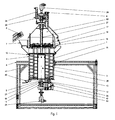
- FIG. 1 shows the device in a vertical position in the cross section view (in this position the dryer is loaded with products)
- FIG. 2 shows the device in a horizontal position (in this position washing of products prior to drying is carried out, also the drying of the products and washing of the small cylinders and augers after the finished process of drying is carried out)
- the present invention is a vacuum rotary automatic dryer, for fruits, vegetable, grains, herbs, medicines and granulate, consists of a box frame 5 in which in the top section an axle 18 is horizontally supported to which a frame 8 is mounted.
- a cylinder 4 is supported which rotates around its axis using an electric motor 11 , and using a pneumatic cylinder 19 which is attached to the box frame 5 and the frame 8 can be rotated in a vertical and horizontal position.
- the cylinder 4 there are inserted and mounted smaller cylinders 1 in which the augers 3 , 41 are mounted, which rotate because of the chain 15 and the sprocket 16 mounted in the casing 17 .
- the drive of the sprocket 16 is achieved using the rotating movement of cylinder 4 , on whose shaft 9 the central sprocket 23 is located, which is mounted with the bearing 44 on the shaft 9 , which can rotate freely, whereby the central sprocket 23 stays still when the electromagnetic clutch 14 engages it through which the shaft 9 passes which is forced to rotate together with the operating part of shaft 9 , which transfers rotation using the chain 24 and the sprocket 12 to the auger 3 and further to the auger 41 .
- Heating the dryer is done with warm water, which is fed from an external source (e.g. heat pump, solar collectors, biomass boiler, gas boiler or electric power) using the swivel joint 25 through the shaft 9 , which is hollow in the space of the central tube 26 .
- an external source e.g. heat pump, solar collectors, biomass boiler, gas boiler or electric power
- the vacuum pump 2 When it comes to evaporation, the vacuum pump 2 constantly draws vapor from the space of cylinder 1 through the condenser 31 where vapor is condensed. On this occasion transferred heat, achieved with condensed vapor using the heat pump 45 , returns to the source of the heat achieving additional savings and energy effectiveness from this process. Releasing condensate, or rather distilled water, is done with a tap 33 and this water is used as a by-product. Products are loaded with the loading conveyor 6 and hopper 7 in the space between the entrance of the small cylinders 1 and the casing 17 , and product loading is stopped when the space is full. The cylinder 4 , in that occasion is in a vertical position and rotates slowly during loading.
- the cover 32 is placed in an open position using a pneumatic cylinder 34 and a pneumatic valve 35 .
- the electromagnetic clutch 14 is turned on and the rotation of auger 3 and auger 41 starts, loading the space of the small cylinders 1 with products to dry.
- the cylinder 4 is placed in a horizontal position.
- the cover 39 is opened and the surplus of product which did not stay in the space of small cylinders 1 is removed.
- the pneumatic control valve 35 By turning on the pneumatic control valve 35 , using the pneumatic cylinder 34 the small cylinders 1 are closed with cover 32 .
- vacuum is realized only in the small cylinders 1 , in that part of the space which is not filled with products, which significantly reduces the dimensions and the quantity of materials used for construction of the dryer, as well as the amount of used energy because the volume of the vacuum is minimal, and considering the rotation of cylinder 4 the products simultaneously perform slight movements in the small cylinders 1 due to which all the surfaces of the products are in contact with the walls of the small cylinders 1 and the augers 3 , 41 , which stimulates the capillary phenomena in products, so that the evaporation of fluid from products is additionally accelerated which additionally reduces energy consumption.
- the invention also allows that in the same device, washing of products before drying, as well as washing of small cylinders 1 , operating auger 3 and auger 41 after unloading of dried products, can be performed, which shortens the cycle of washing between two processes of drying.
- the invention also allows that in the space for products i.e. smaller cylinders 1 , chemical solutions in liquid or gaseous state can be fed, i.e. in order to protect grain from fungal infection or improving the appearance of the product after drying, and using a PLC controller 22 , these processes are fully automatic.
- vacuum rotary automatic dryer for fruits, vegetables, grains, herbs, medicines and granulate is technologically feasible for manufacturing, because the equipment for its production does not need new technologies and special machines.
Landscapes
- Engineering & Computer Science (AREA)
- Health & Medical Sciences (AREA)
- Life Sciences & Earth Sciences (AREA)
- Molecular Biology (AREA)
- Mechanical Engineering (AREA)
- General Engineering & Computer Science (AREA)
- Drying Of Solid Materials (AREA)
Abstract
Vacuum rotary automatic dryers for fruits, vegetables, grains, herbs, medicines and granulate, is composed of the box frame (5), the loading conveyor (6) and the hopper (7), whereby on the box frame (5) in the upper horizontal sector is the shaft (18), mounted to which the frame (8) is attached, in which a cylinder (4) is mounted with the cover (32), which rotates around its axis using an electric motor (11). In the cylinder (4) are small cylinders (1) inserted in which the products for drying are loaded. In the process of loading the products, cylinder (4) with the cylinders (1) is placed in a vertical position, and then, in the drying process, it is rotated into a horizontal position by a pneumatic cylinder (19). Low-pressure in smaller cylinders (1) is achieved using a vacuum pump (2), and the warm water is fed through a swivel joint (25) through a hollow shaft (9) in the central tube (26) and the space of cylinder (4) and flows around the outer surface of small cylinders (1). The area under the cover (32) and in small cylinders (1) is connected with the circulating pump (21) which pushes water while washing the products through a vacuum distributer (20) filling about ⅓ of useful volume. Through the PLC controller (22) cycles of washing and drying of the product, as well as washing of small cylinders (1), take place automatically. In accordance with the idea of the invention, the vacuum is achieved only in small cylinders (1), which reduces the dimensions and quantity of materials for the construction of dryers, as well as the energy consumption, because the design allows the evaporation with low-pressure below 50 millibars and a heating temperature below 40° C. The product quality is also improved because of the slight movement of the products prevents them from sticking to the inner walls of the smaller cylinders (1) and the walls of the augers (3,41) and thus prevents damage to the membrane, which is especially important when drying fruits. The invention also allows, that in the same device, washing of products before drying and washing of small cylinders (1) and augers (3, 41) after unloading of dried products, which is very important, because hand washing with existing dryers significantly increases the time between two drying cycles. The invention also allows that the space for the products, i.e. in smaller cylinders (1), is fed with chemical solutions in liquid or gaseous state using a circulating pump (21), e.g. in order to protect grains from fungal diseases (aflatoxin, etc.), as well as solutions which enhance the appearance of the dried product.
Description
This application claims the benefit of PCT Application No.: PCT/RS2015/000023 with the international filing date of 2 Nov. 2015.
The invention belongs to the field of drying fruits, vegetables, grains, herbs, medicines, granulate and the technology of moisture evaporation under reduced pressure, e.g. in vacuum. According to the International Patent Classification the patent code is: F 26B 5/04
How to design a dryer for drying fruits, vegetable, grains, herbs, medicines and granulate, so that the drying process is performed under reduced pressure, which is below the atmospheric pressure, i.e. low-pressure, to improve the drying process in lower vacuum and lower temperatures, as well as to save energy, so the transfer of heat is uniform and through direct contact with the heating surfaces, whose position is changing constantly with gentle rotation of the dryer and with the same device washing of the products before drying as well as washing of the device after drying can be performed.
From available literature and promotional materials from national and international manufacturers, as well as patent based research, the drying process is carried out in a low-pressure chamber, but the product is placed on a fixed wattle, or in a mix chamber, whereby only a small part of the same surface of the drying products is exposed to the heating surface. The disadvantage of this process is the high energy consumption as well as the product sticks to the wattle during the drying process because of the movement deficit, or the product gets damaged by the mixer and therefore the membrane or outer part of the product is also damaged. The whole space of the drying chamber is exposed to vacuum, which limits the capacity, because the increasing dimensions require great reinforcements in structure to withstand the forces caused by vacuum. The existing solutions require pre-washing of the products in separate devices. Charging and discharging of such dryers is done by hand, as well as their cleaning and washing after drying. This causes great time consumption for preparing dryers for a new drying cycle.
The essence of the invention is the evaporation of the fluid from the product, which is performed under low-pressure and is achieved through direct contact of the product with the heating surfaces, because the products are put into the vacuum area, which consists of multiple smaller cylinders in which augers are enclosed within the small cylinders and these small cylinders are fitted into one big cylinder which is rotating slowly around its axis. This produces a slight movement of the products achieving that all parts of the products are in contact with the internal volume of the smaller cylinders and augers, which are heated with warm water that circulates through the larger cylinder and the void in the augers. This contributes to saving energy while drying because the pressure can be dropped below 50 millibars and the drying temperature below 40° C. but the heat transfer and the product does not decrease significantly (vacuum is essentially an insulator for heat transfer and therefore the existing vacuum dryers consume more energy, and for the same capacity and they are considerably larger than the dryer which is the subject of this invention). With the small and continuous movements of the products capillary phenomena in the products are promoted, which further accelerates the evaporation of fluid from the products, and the products do not stick to the heating surface, so the membrane of the product is not damaged and a superior quality of dried product is achieved. The invention also enables washing of products before drying, and also washing of the smaller cylinders and the augers after unloading of dried products in the same device, because the augers which are in the smaller cylinders facilitate cleaning of the smaller cylinders (the washing process with the existing dryers is done by hand and takes a long time, which reduces the productivity of the dryer). The invention also enables that the space for the products, i.e. smaller cylinders (1), is fed with chemical solutions, for example, to protect the cereal from fungal disease, or improving the appearance of the product after drying. Using Programmable Logic Controllers (PLC) controllers, these processes take place fully automatically.
The invention is shown in the following illustration draft:
The present invention is a vacuum rotary automatic dryer, for fruits, vegetable, grains, herbs, medicines and granulate, consists of a box frame 5 in which in the top section an axle 18 is horizontally supported to which a frame 8 is mounted. In the frame 8 a cylinder 4 is supported which rotates around its axis using an electric motor 11, and using a pneumatic cylinder 19 which is attached to the box frame 5 and the frame 8 can be rotated in a vertical and horizontal position. In the cylinder 4, there are inserted and mounted smaller cylinders 1 in which the augers 3, 41 are mounted, which rotate because of the chain 15 and the sprocket 16 mounted in the casing 17. The drive of the sprocket 16 is achieved using the rotating movement of cylinder 4, on whose shaft 9 the central sprocket 23 is located, which is mounted with the bearing 44 on the shaft 9, which can rotate freely, whereby the central sprocket 23 stays still when the electromagnetic clutch 14 engages it through which the shaft 9 passes which is forced to rotate together with the operating part of shaft 9, which transfers rotation using the chain 24 and the sprocket 12 to the auger 3 and further to the auger 41. Heating the dryer is done with warm water, which is fed from an external source (e.g. heat pump, solar collectors, biomass boiler, gas boiler or electric power) using the swivel joint 25 through the shaft 9, which is hollow in the space of the central tube 26. Warm water from the central tube 26 flows around the external surfaces of the small cylinders 1 and coming into the space of cylinder 4 in front of the entrance of axle 13, auger 3 and the entrance of the auger 41 through which the water passes up to the hollow shaft 27 and through the swivel joint 28 back to the external source of warm water. Vacuum is achieved using a vacuum pump 2 which is mounted to the frame 5 and connected with tubes 29, 30 through the condenser 31 and vacuum distributor 20 with the space under cover 32 which aligns with the top sheer 10 of cylinder 4 and closes the small cylinders 1. Therefore, vacuum acts only in the space under cover 32, i.e. in the small cylinders 1. When it comes to evaporation, the vacuum pump 2 constantly draws vapor from the space of cylinder 1 through the condenser 31 where vapor is condensed. On this occasion transferred heat, achieved with condensed vapor using the heat pump 45, returns to the source of the heat achieving additional savings and energy effectiveness from this process. Releasing condensate, or rather distilled water, is done with a tap 33 and this water is used as a by-product. Products are loaded with the loading conveyor 6 and hopper 7 in the space between the entrance of the small cylinders 1 and the casing 17, and product loading is stopped when the space is full. The cylinder 4, in that occasion is in a vertical position and rotates slowly during loading. The cover 32 is placed in an open position using a pneumatic cylinder 34 and a pneumatic valve 35. In that moment the electromagnetic clutch 14 is turned on and the rotation of auger 3 and auger 41 starts, loading the space of the small cylinders 1 with products to dry. After loading of the small cylinders 1 by turning on the pneumatic control valve 36 and the pneumatic cylinder 19, the cylinder 4 is placed in a horizontal position. By turning on the pneumatic control valve 37 and the pneumatic cylinder 38, the cover 39 is opened and the surplus of product which did not stay in the space of small cylinders 1 is removed. By turning on the pneumatic control valve 35, using the pneumatic cylinder 34 the small cylinders 1 are closed with cover 32. By turning on the circulation pump 21 water for washing the product is fed through the vacuum distributor 20 into the space of small cylinders 1 to ⅓ of their volume. Water is heated for more effective washing. The entire time cylinder 4 is rotating constantly with a possibility of change of direction of the rotation as desired. During washing and later during drying, the rotation of the operating auger 3 and also the auger 41 are stopped. After washing of products, with the micro-switch 42 the cylinder 4 is positioned so that the tap 40 has the lowest position and by using the pneumatic cylinder 43 it acts on the tap 40 and water is let out into a drain.
In accordance with the preferred embodiment of the invention, vacuum is realized only in the small cylinders 1, in that part of the space which is not filled with products, which significantly reduces the dimensions and the quantity of materials used for construction of the dryer, as well as the amount of used energy because the volume of the vacuum is minimal, and considering the rotation of cylinder 4 the products simultaneously perform slight movements in the small cylinders 1 due to which all the surfaces of the products are in contact with the walls of the small cylinders 1 and the augers 3, 41, which stimulates the capillary phenomena in products, so that the evaporation of fluid from products is additionally accelerated which additionally reduces energy consumption. The invention also allows that in the same device, washing of products before drying, as well as washing of small cylinders 1, operating auger 3 and auger 41 after unloading of dried products, can be performed, which shortens the cycle of washing between two processes of drying. The invention also allows that in the space for products i.e. smaller cylinders 1, chemical solutions in liquid or gaseous state can be fed, i.e. in order to protect grain from fungal infection or improving the appearance of the product after drying, and using a PLC controller 22, these processes are fully automatic.
The subject of the invention, vacuum rotary automatic dryer for fruits, vegetables, grains, herbs, medicines and granulate, is technologically feasible for manufacturing, because the equipment for its production does not need new technologies and special machines.
Claims (9)
1. Dryer for items such as fruits, vegetables, grains, herbs, medicines, and granulate comprising:
a box frame having a top section;
an axle horizontally supported on the top section of the box frame;
a cylinder is rotatably mounted on the axle, the cylinder disposed for being rotatably position in a vertical or horizontal position on the axle;
at least one smaller cylinder disposed in the cylinder, the at least one smaller cylinder designed to receive items to be dried;
an auger rotatably disposed in each of the at least one smaller cylinders, the auger being designed to move the items to be dried in the at least one smaller cylinder when the auger is rotated;
a drive mechanism to connected to the auger for causing the auger to rotate;
a vacuum pump operatively connected to the at least one smaller cylinder, the vacuum pump functioning to reduce the pressure in the at least one smaller cylinder; and
a central tube positioned in the cylinder adjacent to the at least one smaller cylinder, the central tube disposed for receiving warm water whereby the warm water flows around an external surface of the at least one smaller cylinder to dry the items.
2. The dryer of claim 1 wherein a pneumatic cylinder rotates the cylinder around the axle.
3. The dryer of claim 1 wherein a vacuum distributor connects the at least one smaller cylinder to the vacuum pump.
4. The dryer of claim 1 wherein a hollow shaft is operating connected to the central tube, the hollow shaft connected to a source of warm water, whereby warm water flows around an external surface of the at least one cylinder.
5. The dryer of claim 4 wherein a cover is positioned over the at least one small cylinder, the cover defining a space over the at least one small cylinder, the space being connected with a circulating pump to supply water for washing the items to be dried.
6. The dryer of claim 5 wherein the circulating pump is connected to the space through the vacuum distributor.
7. The dryer of claim 6 wherein the cycle of washing and drying of items is controlled by a PLC controller wherein the modes of washing and drying of products, temperature of water, as well as the of vacuum intensity in the at least one cylinder is adjusted.
8. The dryer of claim 7 wherein a hopper is positioned on the cover for receiving the ferns.
9. The dryer of claim 8 wherein a loading conveyor is positioned adjacent the hopper for supplying items to the dryer.
Applications Claiming Priority (3)
| Application Number | Priority Date | Filing Date | Title |
|---|---|---|---|
| RS20150111A RS60652B1 (en) | 2015-02-23 | 2015-02-23 | Vacuum rotary automatic dryer for fruit, vegetables, cereals, herbs, medicaments and granulates |
| RSP-2015/0111 | 2015-02-23 | ||
| PCT/RS2015/000023 WO2016137349A2 (en) | 2015-02-23 | 2015-11-02 | Vacuum rotary automatic dryer for fruits, vegetables, cereals, herbs, medicines and granulate |
Publications (2)
| Publication Number | Publication Date |
|---|---|
| US20180195797A1 US20180195797A1 (en) | 2018-07-12 |
| US10240866B2 true US10240866B2 (en) | 2019-03-26 |
Family
ID=54015766
Family Applications (1)
| Application Number | Title | Priority Date | Filing Date |
|---|---|---|---|
| US15/108,666 Expired - Fee Related US10240866B2 (en) | 2015-02-23 | 2015-11-02 | Vacuum rotary automatic dryer for fruits, vegetables, grains, herbs, medicines and granulate |
Country Status (6)
| Country | Link |
|---|---|
| US (1) | US10240866B2 (en) |
| EP (1) | EP3262361A2 (en) |
| CN (1) | CN107923705A (en) |
| EA (1) | EA034209B1 (en) |
| RS (1) | RS60652B1 (en) |
| WO (1) | WO2016137349A2 (en) |
Cited By (1)
| Publication number | Priority date | Publication date | Assignee | Title |
|---|---|---|---|---|
| US20220282915A1 (en) * | 2019-08-29 | 2022-09-08 | Arie Cornelis Bos | Supersonic dehydration and disinfection system and method |
Families Citing this family (5)
| Publication number | Priority date | Publication date | Assignee | Title |
|---|---|---|---|---|
| CO2018009196A1 (en) * | 2018-08-31 | 2018-10-31 | Tecniares S A S | Grain drying machine and multistage process for grain drying |
| CN111716525A (en) * | 2020-07-08 | 2020-09-29 | 黄初祥 | Concrete material processing equipment for reducing material adhesion |
| CN112486084B (en) * | 2020-11-03 | 2021-09-03 | 江门绿润环保科技有限公司 | Remote control method and system for low-temperature drying machine |
| CN113231371B (en) * | 2021-04-09 | 2022-03-11 | 贵州师范学院 | Continuous type perilla leaf washs drying device with multiple process |
| CN118957781B (en) * | 2024-09-18 | 2025-12-02 | 桐昆集团股份有限公司 | A method for producing environmentally friendly Grei fiber |
Citations (19)
| Publication number | Priority date | Publication date | Assignee | Title |
|---|---|---|---|---|
| US2316459A (en) * | 1939-07-03 | 1943-04-13 | Heil Co | Rotary drier |
| US3648382A (en) * | 1967-09-15 | 1972-03-14 | Fmc Corp | Freeze drying solids bearing liquids |
| US4127947A (en) * | 1975-01-29 | 1978-12-05 | Wells A. Webb | Method and apparatus for evaporation of moisture from fruit and vegetable particles |
| US5557858A (en) * | 1995-08-25 | 1996-09-24 | Catalytic Industrial Group Inc. | Infrared wood product dryer |
| US5651193A (en) * | 1994-02-09 | 1997-07-29 | The Gsi Group, Inc. | Grain dryer and control system therefor |
| US5659974A (en) * | 1995-05-04 | 1997-08-26 | Graeff; Roderich Wilhelm | Method for regeneration of an adsorbent material containing moisture and apparatus therefor |
| US5893218A (en) * | 1997-04-15 | 1999-04-13 | Pioneer Hi-Bred International, Inc. | Seed dryer with automatic control of temperature air flow direction and rate |
| US5909943A (en) * | 1997-11-07 | 1999-06-08 | Aeroglide Corporation | Apparatus for cooling or drying bulk material |
| US6105273A (en) * | 1997-10-28 | 2000-08-22 | Cat-Tec Industries, Inc. | Agitated bed cooling, drying, or heating apparatus |
| US6230421B1 (en) * | 1999-06-07 | 2001-05-15 | Steven C. Reed, Sr. | Method and apparatus for drying grain |
| WO2006066096A2 (en) * | 2004-12-17 | 2006-06-22 | Cemen Tech Inc | Continuous horizontal grain drying system |
| US7380348B2 (en) * | 2002-04-29 | 2008-06-03 | Solid Solutions Limited | Material dewatering apparatus |
| US20120043194A1 (en) * | 2009-05-07 | 2012-02-23 | Lepez Conseils Finance Innovations-Lcfi | Method and apparatus for the energy densification of a material in the form of divided solids, with a view to obtaining pyrolysis oils for energy purposes |
| CA2816574A1 (en) * | 2010-11-01 | 2012-05-10 | Flash Rockwell Technologies, Llc | Methods and systems for drying materials and inducing controlled phase changes in substances |
| US8365433B2 (en) * | 2007-03-23 | 2013-02-05 | Kunitomo Kankyo Plant Co., Ltd. | Apparatus and method for treating organic waste and organic material obtained by the treatment method |
| US20150068806A1 (en) * | 2013-09-06 | 2015-03-12 | Ingenieros Matemáticos Consultores Asociados S.A. | Method and system for in situ, continuous and real-time analysis of mineral content in drilling debris |
| US9221027B2 (en) * | 2013-03-14 | 2015-12-29 | Solidia Technologies, Inc. | Curing systems for materials that consume carbon dioxide and method of use thereof |
| US9309477B2 (en) * | 2011-05-24 | 2016-04-12 | Coomtech Ltd. | System for removing surface moisture from coal |
| US9897376B2 (en) * | 2014-03-31 | 2018-02-20 | Tsukishima Kikai Co., Ltd | Drying method for processing material and horizontal rotary dryer |
Family Cites Families (2)
| Publication number | Priority date | Publication date | Assignee | Title |
|---|---|---|---|---|
| FR2744043B1 (en) * | 1996-01-29 | 2000-04-14 | Chervalier Christian | DEVICE FOR VACUUM AND HOT DEHYDRATION OF WASTE OF ANIMAL OR PLANT ORIGIN |
| US7347007B2 (en) * | 2000-06-16 | 2008-03-25 | Maguire Stephen B | Low pressure high capacity dryer for resins and other granular and powdery materials |
-
2015
- 2015-02-23 RS RS20150111A patent/RS60652B1/en unknown
- 2015-11-02 CN CN201580078461.3A patent/CN107923705A/en active Pending
- 2015-11-02 WO PCT/RS2015/000023 patent/WO2016137349A2/en not_active Ceased
- 2015-11-02 US US15/108,666 patent/US10240866B2/en not_active Expired - Fee Related
- 2015-11-02 EA EA201700428A patent/EA034209B1/en not_active IP Right Cessation
- 2015-11-02 EP EP15819896.0A patent/EP3262361A2/en not_active Withdrawn
Patent Citations (24)
| Publication number | Priority date | Publication date | Assignee | Title |
|---|---|---|---|---|
| US2316459A (en) * | 1939-07-03 | 1943-04-13 | Heil Co | Rotary drier |
| US3648382A (en) * | 1967-09-15 | 1972-03-14 | Fmc Corp | Freeze drying solids bearing liquids |
| US4127947A (en) * | 1975-01-29 | 1978-12-05 | Wells A. Webb | Method and apparatus for evaporation of moisture from fruit and vegetable particles |
| US5651193A (en) * | 1994-02-09 | 1997-07-29 | The Gsi Group, Inc. | Grain dryer and control system therefor |
| US5659974A (en) * | 1995-05-04 | 1997-08-26 | Graeff; Roderich Wilhelm | Method for regeneration of an adsorbent material containing moisture and apparatus therefor |
| US5557858A (en) * | 1995-08-25 | 1996-09-24 | Catalytic Industrial Group Inc. | Infrared wood product dryer |
| US5893218A (en) * | 1997-04-15 | 1999-04-13 | Pioneer Hi-Bred International, Inc. | Seed dryer with automatic control of temperature air flow direction and rate |
| US6105273A (en) * | 1997-10-28 | 2000-08-22 | Cat-Tec Industries, Inc. | Agitated bed cooling, drying, or heating apparatus |
| US5909943A (en) * | 1997-11-07 | 1999-06-08 | Aeroglide Corporation | Apparatus for cooling or drying bulk material |
| US6230421B1 (en) * | 1999-06-07 | 2001-05-15 | Steven C. Reed, Sr. | Method and apparatus for drying grain |
| US7380348B2 (en) * | 2002-04-29 | 2008-06-03 | Solid Solutions Limited | Material dewatering apparatus |
| WO2006066096A2 (en) * | 2004-12-17 | 2006-06-22 | Cemen Tech Inc | Continuous horizontal grain drying system |
| WO2006066096A3 (en) * | 2004-12-17 | 2006-12-21 | Cemen Tech Inc | Continuous horizontal grain drying system |
| US8365433B2 (en) * | 2007-03-23 | 2013-02-05 | Kunitomo Kankyo Plant Co., Ltd. | Apparatus and method for treating organic waste and organic material obtained by the treatment method |
| US20120043194A1 (en) * | 2009-05-07 | 2012-02-23 | Lepez Conseils Finance Innovations-Lcfi | Method and apparatus for the energy densification of a material in the form of divided solids, with a view to obtaining pyrolysis oils for energy purposes |
| US8726532B2 (en) * | 2010-11-01 | 2014-05-20 | Flash Rockwell Technologies, Llc | Methods and systems for drying materials and inducing controlled phase changes in substances |
| WO2012061367A1 (en) * | 2010-11-01 | 2012-05-10 | Flash Rockwell Technologies, Llc | Methods and systems for drying materials and inducing controlled phase changes in substances |
| CA2816574A1 (en) * | 2010-11-01 | 2012-05-10 | Flash Rockwell Technologies, Llc | Methods and systems for drying materials and inducing controlled phase changes in substances |
| US9291391B2 (en) * | 2010-11-01 | 2016-03-22 | Flash Rockwell Technologies, Llc | Methods for drying materials and inducing controlled phase changes in substances |
| EP2635862B1 (en) * | 2010-11-01 | 2016-05-11 | Flash Rockwell Technologies, LLC | Methods and systems for drying materials and inducing controlled phase changes in substances |
| US9309477B2 (en) * | 2011-05-24 | 2016-04-12 | Coomtech Ltd. | System for removing surface moisture from coal |
| US9221027B2 (en) * | 2013-03-14 | 2015-12-29 | Solidia Technologies, Inc. | Curing systems for materials that consume carbon dioxide and method of use thereof |
| US20150068806A1 (en) * | 2013-09-06 | 2015-03-12 | Ingenieros Matemáticos Consultores Asociados S.A. | Method and system for in situ, continuous and real-time analysis of mineral content in drilling debris |
| US9897376B2 (en) * | 2014-03-31 | 2018-02-20 | Tsukishima Kikai Co., Ltd | Drying method for processing material and horizontal rotary dryer |
Cited By (2)
| Publication number | Priority date | Publication date | Assignee | Title |
|---|---|---|---|---|
| US20220282915A1 (en) * | 2019-08-29 | 2022-09-08 | Arie Cornelis Bos | Supersonic dehydration and disinfection system and method |
| US12379156B2 (en) * | 2019-08-29 | 2025-08-05 | Arie Bos | Supersonic dehydration and disinfection system and method |
Also Published As
| Publication number | Publication date |
|---|---|
| US20180195797A1 (en) | 2018-07-12 |
| RS20150111A1 (en) | 2015-08-31 |
| EP3262361A2 (en) | 2018-01-03 |
| EA034209B1 (en) | 2020-01-17 |
| RS60652B1 (en) | 2020-09-30 |
| WO2016137349A2 (en) | 2016-09-01 |
| CN107923705A (en) | 2018-04-17 |
| EA201700428A1 (en) | 2018-01-31 |
Similar Documents
| Publication | Publication Date | Title |
|---|---|---|
| US10240866B2 (en) | Vacuum rotary automatic dryer for fruits, vegetables, grains, herbs, medicines and granulate | |
| CN215809847U (en) | A kind of ecological agriculture seed drying equipment | |
| CN101832703A (en) | Rapid Chinese medicinal plant dryer | |
| CN102538423A (en) | Microwave vacuum drier | |
| CN208223072U (en) | Drying unit is used in a kind of processing of composite heat transfer | |
| CN105486068A (en) | Double-barrel feed drying machine | |
| CN204963483U (en) | Novel drying machine | |
| CN109539704A (en) | A kind of heat pump vacuum drier | |
| CN207471959U (en) | A kind of drying corps device of low-power consumption | |
| CN213657275U (en) | Bipyramid gyration silver powder vacuum drying machine | |
| CN104351929B (en) | For the convertible drying machine that vegetables and fruits are dried | |
| CN204404761U (en) | A kind of hermetically sealed many revolution internal and external screw induced air type dryers | |
| KR100943350B1 (en) | Baked Salt Manufacturing System | |
| CN207570243U (en) | High-efficient grain drying machine | |
| CN207562368U (en) | The dry machine of vacuum spraying band | |
| CN208238393U (en) | A kind of drying discharging device of bean cotyledon | |
| CN203964587U (en) | Novel drum type drying equipment | |
| CN202501728U (en) | Microwave vacuum drying machine | |
| CN108936306B (en) | Cereal steam sheeting apparatus for producing | |
| CN115289803A (en) | Drying system and drying process | |
| CN217083097U (en) | Roller quick freeze dryer | |
| CN214620315U (en) | Freeze dryer for small test | |
| KR101874987B1 (en) | Method for drying and fermenting waste resource | |
| CN2492815Y (en) | Continuous vacuum freeze drier | |
| CN105423733B (en) | A low energy consumption feed dryer |
Legal Events
| Date | Code | Title | Description |
|---|---|---|---|
| STCF | Information on status: patent grant |
Free format text: PATENTED CASE |
|
| FEPP | Fee payment procedure |
Free format text: MAINTENANCE FEE REMINDER MAILED (ORIGINAL EVENT CODE: REM.); ENTITY STATUS OF PATENT OWNER: SMALL ENTITY |
|
| LAPS | Lapse for failure to pay maintenance fees |
Free format text: PATENT EXPIRED FOR FAILURE TO PAY MAINTENANCE FEES (ORIGINAL EVENT CODE: EXP.); ENTITY STATUS OF PATENT OWNER: SMALL ENTITY |
|
| STCH | Information on status: patent discontinuation |
Free format text: PATENT EXPIRED DUE TO NONPAYMENT OF MAINTENANCE FEES UNDER 37 CFR 1.362 |
|
| FP | Lapsed due to failure to pay maintenance fee |
Effective date: 20230326 |