US10239851B2 - Carboxylic acid derivatives and use thereof in the preparation of prodrugs - Google Patents
Carboxylic acid derivatives and use thereof in the preparation of prodrugs Download PDFInfo
- Publication number
- US10239851B2 US10239851B2 US15/119,587 US201515119587A US10239851B2 US 10239851 B2 US10239851 B2 US 10239851B2 US 201515119587 A US201515119587 A US 201515119587A US 10239851 B2 US10239851 B2 US 10239851B2
- Authority
- US
- United States
- Prior art keywords
- acid
- hydrochloride
- compound
- amino
- carboxylic acid
- Prior art date
- Legal status (The legal status is an assumption and is not a legal conclusion. Google has not performed a legal analysis and makes no representation as to the accuracy of the status listed.)
- Active
Links
- 150000001732 carboxylic acid derivatives Chemical class 0.000 title claims abstract description 42
- 229940002612 prodrug Drugs 0.000 title abstract description 43
- 239000000651 prodrug Substances 0.000 title abstract description 43
- 238000002360 preparation method Methods 0.000 title abstract description 29
- NBIIXXVUZAFLBC-UHFFFAOYSA-N Phosphoric acid Chemical compound OP(O)(O)=O NBIIXXVUZAFLBC-UHFFFAOYSA-N 0.000 claims abstract description 20
- 239000002253 acid Substances 0.000 claims abstract description 20
- 125000003178 carboxy group Chemical group [H]OC(*)=O 0.000 claims abstract description 15
- 125000000217 alkyl group Chemical group 0.000 claims abstract description 11
- 229910000147 aluminium phosphate Inorganic materials 0.000 claims abstract description 10
- 229910052731 fluorine Inorganic materials 0.000 claims abstract description 9
- 229910052739 hydrogen Inorganic materials 0.000 claims abstract description 5
- 150000001875 compounds Chemical class 0.000 claims description 207
- VEXZGXHMUGYJMC-UHFFFAOYSA-N Hydrochloric acid Chemical compound Cl VEXZGXHMUGYJMC-UHFFFAOYSA-N 0.000 claims description 176
- IXCSERBJSXMMFS-UHFFFAOYSA-N hcl hcl Chemical compound Cl.Cl IXCSERBJSXMMFS-UHFFFAOYSA-N 0.000 claims description 56
- -1 benzenesulfonyloxy Chemical group 0.000 claims description 28
- 229910019142 PO4 Inorganic materials 0.000 claims description 27
- 239000010452 phosphate Substances 0.000 claims description 27
- 125000002496 methyl group Chemical group [H]C([H])([H])* 0.000 claims description 22
- 125000001449 isopropyl group Chemical group [H]C([H])([H])C([H])(*)C([H])([H])[H] 0.000 claims description 21
- QWUWMCYKGHVNAV-UHFFFAOYSA-N 1,2-dihydrostilbene Chemical group C=1C=CC=CC=1CCC1=CC=CC=C1 QWUWMCYKGHVNAV-UHFFFAOYSA-N 0.000 claims description 14
- 125000001495 ethyl group Chemical group [H]C([H])([H])C([H])([H])* 0.000 claims description 14
- JOXIMZWYDAKGHI-UHFFFAOYSA-N toluene-4-sulfonic acid Chemical compound CC1=CC=C(S(O)(=O)=O)C=C1 JOXIMZWYDAKGHI-UHFFFAOYSA-N 0.000 claims description 14
- 125000001797 benzyl group Chemical group [H]C1=C([H])C([H])=C(C([H])=C1[H])C([H])([H])* 0.000 claims description 13
- 125000004169 (C1-C6) alkyl group Chemical group 0.000 claims description 12
- QTBSBXVTEAMEQO-UHFFFAOYSA-N Acetic acid Chemical compound CC(O)=O QTBSBXVTEAMEQO-UHFFFAOYSA-N 0.000 claims description 12
- QAOWNCQODCNURD-UHFFFAOYSA-N Sulfuric acid Chemical compound OS(O)(=O)=O QAOWNCQODCNURD-UHFFFAOYSA-N 0.000 claims description 12
- 125000000484 butyl group Chemical group [H]C([*])([H])C([H])([H])C([H])([H])C([H])([H])[H] 0.000 claims description 11
- 125000001436 propyl group Chemical group [H]C([*])([H])C([H])([H])C([H])([H])[H] 0.000 claims description 11
- 239000011734 sodium Substances 0.000 claims description 10
- 125000000113 cyclohexyl group Chemical group [H]C1([H])C([H])([H])C([H])([H])C([H])(*)C([H])([H])C1([H])[H] 0.000 claims description 8
- 125000001511 cyclopentyl group Chemical group [H]C1([H])C([H])([H])C([H])([H])C([H])(*)C1([H])[H] 0.000 claims description 8
- 125000001147 pentyl group Chemical group C(CCCC)* 0.000 claims description 7
- DTQVDTLACAAQTR-UHFFFAOYSA-N Trifluoroacetic acid Chemical compound OC(=O)C(F)(F)F DTQVDTLACAAQTR-UHFFFAOYSA-N 0.000 claims description 6
- 229910052794 bromium Inorganic materials 0.000 claims description 6
- 239000011575 calcium Substances 0.000 claims description 6
- 239000000460 chlorine Substances 0.000 claims description 6
- 229910052801 chlorine Inorganic materials 0.000 claims description 6
- QEWYKACRFQMRMB-UHFFFAOYSA-N fluoroacetic acid Chemical compound OC(=O)CF QEWYKACRFQMRMB-UHFFFAOYSA-N 0.000 claims description 6
- 229910021645 metal ion Inorganic materials 0.000 claims description 6
- VEXZGXHMUGYJMC-UHFFFAOYSA-M Chloride anion Chemical compound [Cl-] VEXZGXHMUGYJMC-UHFFFAOYSA-M 0.000 claims description 5
- 229910052782 aluminium Inorganic materials 0.000 claims description 5
- 125000000959 isobutyl group Chemical group [H]C([H])([H])C([H])(C([H])([H])[H])C([H])([H])* 0.000 claims description 5
- 125000004123 n-propyl group Chemical group [H]C([H])([H])C([H])([H])C([H])([H])* 0.000 claims description 5
- GNDWULFJGWZUNX-UHFFFAOYSA-N 2-fluoro-4-oxo-4-phenylmethoxybutanoic acid Chemical compound C(C1=CC=CC=C1)OC(CC(C(=O)O)F)=O GNDWULFJGWZUNX-UHFFFAOYSA-N 0.000 claims description 4
- DGAQECJNVWCQMB-PUAWFVPOSA-M Ilexoside XXIX Chemical compound C[C@@H]1CC[C@@]2(CC[C@@]3(C(=CC[C@H]4[C@]3(CC[C@@H]5[C@@]4(CC[C@@H](C5(C)C)OS(=O)(=O)[O-])C)C)[C@@H]2[C@]1(C)O)C)C(=O)O[C@H]6[C@@H]([C@H]([C@@H]([C@H](O6)CO)O)O)O.[Na+] DGAQECJNVWCQMB-PUAWFVPOSA-M 0.000 claims description 4
- 150000001412 amines Chemical class 0.000 claims description 4
- SRSXLGNVWSONIS-UHFFFAOYSA-N benzenesulfonic acid Chemical compound OS(=O)(=O)C1=CC=CC=C1 SRSXLGNVWSONIS-UHFFFAOYSA-N 0.000 claims description 4
- 150000003839 salts Chemical class 0.000 claims description 4
- 229910052708 sodium Inorganic materials 0.000 claims description 4
- YEXURSSKTKDYRL-SNVBAGLBSA-N (2R)-2-fluoro-5-oxo-5-phenylmethoxypentanoic acid Chemical compound C(C1=CC=CC=C1)OC(CC[C@H](C(=O)O)F)=O YEXURSSKTKDYRL-SNVBAGLBSA-N 0.000 claims description 3
- VLUNBSGUTOZBBU-NSHDSACASA-N (2S)-2-fluoro-6-oxo-6-phenylmethoxyhexanoic acid Chemical compound C(C1=CC=CC=C1)OC(CCC[C@@H](C(=O)O)F)=O VLUNBSGUTOZBBU-NSHDSACASA-N 0.000 claims description 3
- BMYNFMYTOJXKLE-UHFFFAOYSA-N 3-azaniumyl-2-hydroxypropanoate Chemical compound NCC(O)C(O)=O BMYNFMYTOJXKLE-UHFFFAOYSA-N 0.000 claims description 3
- OYPRJOBELJOOCE-UHFFFAOYSA-N Calcium Chemical compound [Ca] OYPRJOBELJOOCE-UHFFFAOYSA-N 0.000 claims description 3
- ZLMJMSJWJFRBEC-UHFFFAOYSA-N Potassium Chemical compound [K] ZLMJMSJWJFRBEC-UHFFFAOYSA-N 0.000 claims description 3
- NPYPAHLBTDXSSS-UHFFFAOYSA-N Potassium ion Chemical compound [K+] NPYPAHLBTDXSSS-UHFFFAOYSA-N 0.000 claims description 3
- FKNQFGJONOIPTF-UHFFFAOYSA-N Sodium cation Chemical compound [Na+] FKNQFGJONOIPTF-UHFFFAOYSA-N 0.000 claims description 3
- 229910001413 alkali metal ion Inorganic materials 0.000 claims description 3
- 229910001420 alkaline earth metal ion Inorganic materials 0.000 claims description 3
- XAGFODPZIPBFFR-UHFFFAOYSA-N aluminium Chemical compound [Al] XAGFODPZIPBFFR-UHFFFAOYSA-N 0.000 claims description 3
- LBZZTPCUYLTWLU-UHFFFAOYSA-N benzyl 4-chloro-3-fluoro-4-oxobutanoate Chemical compound C(C1=CC=CC=C1)OC(CC(C(=O)Cl)F)=O LBZZTPCUYLTWLU-UHFFFAOYSA-N 0.000 claims description 3
- 229910052791 calcium Inorganic materials 0.000 claims description 3
- PBWZKZYHONABLN-UHFFFAOYSA-N difluoroacetic acid Chemical compound OC(=O)C(F)F PBWZKZYHONABLN-UHFFFAOYSA-N 0.000 claims description 3
- 239000011591 potassium Substances 0.000 claims description 3
- 229910052700 potassium Inorganic materials 0.000 claims description 3
- 229910001414 potassium ion Inorganic materials 0.000 claims description 3
- YYFIGOPUHPDIBO-UHFFFAOYSA-N propanoic acid;hydrochloride Chemical compound Cl.CCC(O)=O YYFIGOPUHPDIBO-UHFFFAOYSA-N 0.000 claims description 3
- PKLALGZJQNXFDU-HNCPQSOCSA-M sodium (2R)-2-fluoro-5-oxo-5-phenylmethoxypentanoate Chemical compound C(C1=CC=CC=C1)OC(CC[C@H](C(=O)[O-])F)=O.[Na+] PKLALGZJQNXFDU-HNCPQSOCSA-M 0.000 claims description 3
- 229910001415 sodium ion Inorganic materials 0.000 claims description 3
- BHPQYMZQTOCNFJ-UHFFFAOYSA-N Calcium cation Chemical compound [Ca+2] BHPQYMZQTOCNFJ-UHFFFAOYSA-N 0.000 claims description 2
- JLVVSXFLKOJNIY-UHFFFAOYSA-N Magnesium ion Chemical compound [Mg+2] JLVVSXFLKOJNIY-UHFFFAOYSA-N 0.000 claims description 2
- PTFCDOFLOPIGGS-UHFFFAOYSA-N Zinc dication Chemical compound [Zn+2] PTFCDOFLOPIGGS-UHFFFAOYSA-N 0.000 claims description 2
- 125000004429 atom Chemical group 0.000 claims description 2
- 229910001424 calcium ion Inorganic materials 0.000 claims description 2
- XEEYBQQBJWHFJM-UHFFFAOYSA-N iron Substances [Fe] XEEYBQQBJWHFJM-UHFFFAOYSA-N 0.000 claims description 2
- 229910052742 iron Inorganic materials 0.000 claims description 2
- 229910001425 magnesium ion Inorganic materials 0.000 claims description 2
- 125000006239 protecting group Chemical group 0.000 abstract description 14
- 125000002887 hydroxy group Chemical group [H]O* 0.000 abstract description 11
- 125000002924 primary amino group Chemical group [H]N([H])* 0.000 abstract description 9
- 125000000753 cycloalkyl group Chemical group 0.000 abstract description 3
- 125000003709 fluoroalkyl group Chemical group 0.000 abstract 1
- AFVFQIVMOAPDHO-UHFFFAOYSA-N Methanesulfonic acid Chemical compound CS(O)(=O)=O AFVFQIVMOAPDHO-UHFFFAOYSA-N 0.000 description 97
- OLBCVFGFOZPWHH-UHFFFAOYSA-N propofol Chemical compound CC(C)C1=CC=CC(C(C)C)=C1O OLBCVFGFOZPWHH-UHFFFAOYSA-N 0.000 description 93
- YMWUJEATGCHHMB-UHFFFAOYSA-N Dichloromethane Chemical compound ClCCl YMWUJEATGCHHMB-UHFFFAOYSA-N 0.000 description 84
- 229960004134 propofol Drugs 0.000 description 80
- XLYOFNOQVPJJNP-UHFFFAOYSA-N water Substances O XLYOFNOQVPJJNP-UHFFFAOYSA-N 0.000 description 73
- VHYFNPMBLIVWCW-UHFFFAOYSA-N 4-Dimethylaminopyridine Chemical compound CN(C)C1=CC=NC=C1 VHYFNPMBLIVWCW-UHFFFAOYSA-N 0.000 description 67
- ZDZOTLJHXYCWBA-VCVYQWHSSA-N N-debenzoyl-N-(tert-butoxycarbonyl)-10-deacetyltaxol Chemical compound O([C@H]1[C@H]2[C@@](C([C@H](O)C3=C(C)[C@@H](OC(=O)[C@H](O)[C@@H](NC(=O)OC(C)(C)C)C=4C=CC=CC=4)C[C@]1(O)C3(C)C)=O)(C)[C@@H](O)C[C@H]1OC[C@]12OC(=O)C)C(=O)C1=CC=CC=C1 ZDZOTLJHXYCWBA-VCVYQWHSSA-N 0.000 description 52
- 229960003668 docetaxel Drugs 0.000 description 52
- BMQGVNUXMIRLCK-OAGWZNDDSA-N cabazitaxel Chemical compound O([C@H]1[C@@H]2[C@]3(OC(C)=O)CO[C@@H]3C[C@@H]([C@]2(C(=O)[C@H](OC)C2=C(C)[C@@H](OC(=O)[C@H](O)[C@@H](NC(=O)OC(C)(C)C)C=3C=CC=CC=3)C[C@]1(O)C2(C)C)C)OC)C(=O)C1=CC=CC=C1 BMQGVNUXMIRLCK-OAGWZNDDSA-N 0.000 description 47
- 229930012538 Paclitaxel Natural products 0.000 description 46
- 229960001592 paclitaxel Drugs 0.000 description 46
- RCINICONZNJXQF-MZXODVADSA-N taxol Chemical compound O([C@@H]1[C@@]2(C[C@@H](C(C)=C(C2(C)C)[C@H](C([C@]2(C)[C@@H](O)C[C@H]3OC[C@]3([C@H]21)OC(C)=O)=O)OC(=O)C)OC(=O)[C@H](O)[C@@H](NC(=O)C=1C=CC=CC=1)C=1C=CC=CC=1)O)C(=O)C1=CC=CC=C1 RCINICONZNJXQF-MZXODVADSA-N 0.000 description 46
- 239000000243 solution Substances 0.000 description 44
- 241000700159 Rattus Species 0.000 description 41
- 229960001573 cabazitaxel Drugs 0.000 description 41
- OKKJLVBELUTLKV-UHFFFAOYSA-N Methanol Chemical group OC OKKJLVBELUTLKV-UHFFFAOYSA-N 0.000 description 39
- 238000002330 electrospray ionisation mass spectrometry Methods 0.000 description 38
- 238000006243 chemical reaction Methods 0.000 description 34
- 238000012360 testing method Methods 0.000 description 33
- 206010028980 Neoplasm Diseases 0.000 description 30
- 241000283973 Oryctolagus cuniculus Species 0.000 description 30
- RTZKZFJDLAIYFH-UHFFFAOYSA-N Diethyl ether Chemical compound CCOCC RTZKZFJDLAIYFH-UHFFFAOYSA-N 0.000 description 28
- 229940079593 drug Drugs 0.000 description 28
- 239000003814 drug Substances 0.000 description 28
- WEVYAHXRMPXWCK-UHFFFAOYSA-N Acetonitrile Chemical compound CC#N WEVYAHXRMPXWCK-UHFFFAOYSA-N 0.000 description 27
- 210000002381 plasma Anatomy 0.000 description 27
- 238000000034 method Methods 0.000 description 25
- 239000007787 solid Substances 0.000 description 20
- 241000699670 Mus sp. Species 0.000 description 19
- 239000007858 starting material Substances 0.000 description 16
- FYSNRJHAOHDILO-UHFFFAOYSA-N thionyl chloride Chemical compound ClS(Cl)=O FYSNRJHAOHDILO-UHFFFAOYSA-N 0.000 description 16
- DKPFODGZWDEEBT-QFIAKTPHSA-N taxane Chemical class C([C@]1(C)CCC[C@@H](C)[C@H]1C1)C[C@H]2[C@H](C)CC[C@@H]1C2(C)C DKPFODGZWDEEBT-QFIAKTPHSA-N 0.000 description 15
- 238000002474 experimental method Methods 0.000 description 14
- 0 [1*]C([W])CC(C)([Y])C(=O)O Chemical compound [1*]C([W])CC(C)([Y])C(=O)O 0.000 description 13
- 238000010494 dissociation reaction Methods 0.000 description 13
- 230000005593 dissociations Effects 0.000 description 13
- 238000001704 evaporation Methods 0.000 description 13
- 230000008020 evaporation Effects 0.000 description 13
- 239000002904 solvent Substances 0.000 description 13
- IAZDPXIOMUYVGZ-UHFFFAOYSA-N Dimethylsulphoxide Chemical compound CS(C)=O IAZDPXIOMUYVGZ-UHFFFAOYSA-N 0.000 description 12
- 241000699660 Mus musculus Species 0.000 description 12
- 230000002401 inhibitory effect Effects 0.000 description 12
- 239000003446 ligand Substances 0.000 description 12
- 238000011580 nude mouse model Methods 0.000 description 12
- VZCYOOQTPOCHFL-UHFFFAOYSA-N trans-butenedioic acid Natural products OC(=O)C=CC(O)=O VZCYOOQTPOCHFL-UHFFFAOYSA-N 0.000 description 12
- 125000002023 trifluoromethyl group Chemical group FC(F)(F)* 0.000 description 12
- 241001465754 Metazoa Species 0.000 description 11
- 238000002347 injection Methods 0.000 description 11
- 239000007924 injection Substances 0.000 description 11
- 239000011541 reaction mixture Substances 0.000 description 11
- 206010060862 Prostate cancer Diseases 0.000 description 10
- 208000000236 Prostatic Neoplasms Diseases 0.000 description 10
- 150000004625 docetaxel anhydrous derivatives Chemical class 0.000 description 10
- 239000010410 layer Substances 0.000 description 10
- 230000002085 persistent effect Effects 0.000 description 10
- 238000002390 rotary evaporation Methods 0.000 description 10
- PMZURENOXWZQFD-UHFFFAOYSA-L Sodium Sulfate Chemical compound [Na+].[Na+].[O-]S([O-])(=O)=O PMZURENOXWZQFD-UHFFFAOYSA-L 0.000 description 9
- 125000001309 chloro group Chemical group Cl* 0.000 description 9
- 238000001816 cooling Methods 0.000 description 9
- 238000001727 in vivo Methods 0.000 description 9
- VZCYOOQTPOCHFL-UPHRSURJSA-N maleic acid Chemical compound OC(=O)\C=C/C(O)=O VZCYOOQTPOCHFL-UPHRSURJSA-N 0.000 description 9
- 239000000203 mixture Substances 0.000 description 9
- JNCMHMUGTWEVOZ-UHFFFAOYSA-N F[CH]F Chemical compound F[CH]F JNCMHMUGTWEVOZ-UHFFFAOYSA-N 0.000 description 8
- UIIMBOGNXHQVGW-UHFFFAOYSA-M Sodium bicarbonate Chemical compound [Na+].OC([O-])=O UIIMBOGNXHQVGW-UHFFFAOYSA-M 0.000 description 8
- 230000000259 anti-tumor effect Effects 0.000 description 8
- 238000000338 in vitro Methods 0.000 description 8
- 206010002091 Anaesthesia Diseases 0.000 description 7
- 230000037005 anaesthesia Effects 0.000 description 7
- 125000004432 carbon atom Chemical group C* 0.000 description 7
- 238000004128 high performance liquid chromatography Methods 0.000 description 7
- NBIIXXVUZAFLBC-UHFFFAOYSA-K phosphate Chemical compound [O-]P([O-])([O-])=O NBIIXXVUZAFLBC-UHFFFAOYSA-K 0.000 description 7
- 239000002504 physiological saline solution Substances 0.000 description 7
- 238000003756 stirring Methods 0.000 description 7
- 150000004579 taxol derivatives Chemical class 0.000 description 7
- CSCPPACGZOOCGX-UHFFFAOYSA-N Acetone Chemical compound CC(C)=O CSCPPACGZOOCGX-UHFFFAOYSA-N 0.000 description 6
- FAPWRFPIFSIZLT-UHFFFAOYSA-M Sodium chloride Chemical compound [Na+].[Cl-] FAPWRFPIFSIZLT-UHFFFAOYSA-M 0.000 description 6
- HEMHJVSKTPXQMS-UHFFFAOYSA-M Sodium hydroxide Chemical compound [OH-].[Na+] HEMHJVSKTPXQMS-UHFFFAOYSA-M 0.000 description 6
- QAOWNCQODCNURD-UHFFFAOYSA-L Sulfate Chemical compound [O-]S([O-])(=O)=O QAOWNCQODCNURD-UHFFFAOYSA-L 0.000 description 6
- 229940123237 Taxane Drugs 0.000 description 6
- HUMNYLRZRPPJDN-UHFFFAOYSA-N benzaldehyde Chemical compound O=CC1=CC=CC=C1 HUMNYLRZRPPJDN-UHFFFAOYSA-N 0.000 description 6
- 230000000694 effects Effects 0.000 description 6
- 239000011737 fluorine Substances 0.000 description 6
- BDAGIHXWWSANSR-UHFFFAOYSA-N methanoic acid Natural products OC=O BDAGIHXWWSANSR-UHFFFAOYSA-N 0.000 description 6
- 239000003223 protective agent Substances 0.000 description 6
- 229920006395 saturated elastomer Polymers 0.000 description 6
- YCKRFDGAMUMZLT-UHFFFAOYSA-N Fluorine atom Chemical compound [F] YCKRFDGAMUMZLT-UHFFFAOYSA-N 0.000 description 5
- 206010033128 Ovarian cancer Diseases 0.000 description 5
- 206010061535 Ovarian neoplasm Diseases 0.000 description 5
- 229940028652 abraxane Drugs 0.000 description 5
- 238000001142 circular dichroism spectrum Methods 0.000 description 5
- 239000000706 filtrate Substances 0.000 description 5
- 229960000239 fospropofol Drugs 0.000 description 5
- QVNNONOFASOXQV-UHFFFAOYSA-N fospropofol Chemical compound CC(C)C1=CC=CC(C(C)C)=C1OCOP(O)(O)=O QVNNONOFASOXQV-UHFFFAOYSA-N 0.000 description 5
- 238000011534 incubation Methods 0.000 description 5
- 238000010253 intravenous injection Methods 0.000 description 5
- 125000001997 phenyl group Chemical group [H]C1=C([H])C([H])=C(*)C([H])=C1[H] 0.000 description 5
- 238000005070 sampling Methods 0.000 description 5
- 125000005931 tert-butyloxycarbonyl group Chemical group [H]C([H])([H])C(OC(*)=O)(C([H])([H])[H])C([H])([H])[H] 0.000 description 5
- IBYHHJPAARCAIE-UHFFFAOYSA-N 1-bromo-2-chloroethane Chemical compound ClCCBr IBYHHJPAARCAIE-UHFFFAOYSA-N 0.000 description 4
- 238000005160 1H NMR spectroscopy Methods 0.000 description 4
- ZWEHNKRNPOVVGH-UHFFFAOYSA-N 2-Butanone Chemical compound CCC(C)=O ZWEHNKRNPOVVGH-UHFFFAOYSA-N 0.000 description 4
- WSFSSNUMVMOOMR-UHFFFAOYSA-N Formaldehyde Chemical compound O=C WSFSSNUMVMOOMR-UHFFFAOYSA-N 0.000 description 4
- VZCYOOQTPOCHFL-OWOJBTEDSA-N Fumaric acid Chemical compound OC(=O)\C=C\C(O)=O VZCYOOQTPOCHFL-OWOJBTEDSA-N 0.000 description 4
- HTTJABKRGRZYRN-UHFFFAOYSA-N Heparin Chemical compound OC1C(NC(=O)C)C(O)OC(COS(O)(=O)=O)C1OC1C(OS(O)(=O)=O)C(O)C(OC2C(C(OS(O)(=O)=O)C(OC3C(C(O)C(O)C(O3)C(O)=O)OS(O)(=O)=O)C(CO)O2)NS(O)(=O)=O)C(C(O)=O)O1 HTTJABKRGRZYRN-UHFFFAOYSA-N 0.000 description 4
- JUJWROOIHBZHMG-UHFFFAOYSA-N Pyridine Chemical compound C1=CC=NC=C1 JUJWROOIHBZHMG-UHFFFAOYSA-N 0.000 description 4
- CDBYLPFSWZWCQE-UHFFFAOYSA-L Sodium Carbonate Chemical compound [Na+].[Na+].[O-]C([O-])=O CDBYLPFSWZWCQE-UHFFFAOYSA-L 0.000 description 4
- 125000001584 benzyloxycarbonyl group Chemical group C(=O)(OCC1=CC=CC=C1)* 0.000 description 4
- 210000004369 blood Anatomy 0.000 description 4
- 239000008280 blood Substances 0.000 description 4
- 229910052799 carbon Inorganic materials 0.000 description 4
- 230000008859 change Effects 0.000 description 4
- 238000012512 characterization method Methods 0.000 description 4
- 125000001995 cyclobutyl group Chemical group [H]C1([H])C([H])([H])C([H])(*)C1([H])[H] 0.000 description 4
- JHIVVAPYMSGYDF-UHFFFAOYSA-N cyclohexanone Chemical compound O=C1CCCCC1 JHIVVAPYMSGYDF-UHFFFAOYSA-N 0.000 description 4
- 125000001559 cyclopropyl group Chemical group [H]C1([H])C([H])([H])C1([H])* 0.000 description 4
- 238000001514 detection method Methods 0.000 description 4
- 229960002897 heparin Drugs 0.000 description 4
- 229920000669 heparin Polymers 0.000 description 4
- UYWQUFXKFGHYNT-UHFFFAOYSA-N phenylmethyl ester of formic acid Natural products O=COCC1=CC=CC=C1 UYWQUFXKFGHYNT-UHFFFAOYSA-N 0.000 description 4
- 238000010992 reflux Methods 0.000 description 4
- 229910000030 sodium bicarbonate Inorganic materials 0.000 description 4
- WBHQBSYUUJJSRZ-UHFFFAOYSA-M sodium bisulfate Chemical compound [Na+].OS([O-])(=O)=O WBHQBSYUUJJSRZ-UHFFFAOYSA-M 0.000 description 4
- 125000004454 (C1-C6) alkoxycarbonyl group Chemical group 0.000 description 3
- 125000005913 (C3-C6) cycloalkyl group Chemical group 0.000 description 3
- 238000001644 13C nuclear magnetic resonance spectroscopy Methods 0.000 description 3
- 125000006507 2,4-difluorobenzyl group Chemical group [H]C1=C(F)C([H])=C(F)C(=C1[H])C([H])([H])* 0.000 description 3
- 125000003852 3-chlorobenzyl group Chemical group [H]C1=C([H])C(=C([H])C(Cl)=C1[H])C([H])([H])* 0.000 description 3
- OSWFIVFLDKOXQC-UHFFFAOYSA-N 4-(3-methoxyphenyl)aniline Chemical compound COC1=CC=CC(C=2C=CC(N)=CC=2)=C1 OSWFIVFLDKOXQC-UHFFFAOYSA-N 0.000 description 3
- 125000004176 4-fluorobenzyl group Chemical group [H]C1=C([H])C(=C([H])C([H])=C1F)C([H])([H])* 0.000 description 3
- WVDDGKGOMKODPV-UHFFFAOYSA-N Benzyl alcohol Chemical compound OCC1=CC=CC=C1 WVDDGKGOMKODPV-UHFFFAOYSA-N 0.000 description 3
- KDLHZDBZIXYQEI-UHFFFAOYSA-N Palladium on carbon Substances [Pd] KDLHZDBZIXYQEI-UHFFFAOYSA-N 0.000 description 3
- OFOBLEOULBTSOW-UHFFFAOYSA-N Propanedioic acid Natural products OC(=O)CC(O)=O OFOBLEOULBTSOW-UHFFFAOYSA-N 0.000 description 3
- 238000000692 Student's t-test Methods 0.000 description 3
- 235000011054 acetic acid Nutrition 0.000 description 3
- 239000002168 alkylating agent Substances 0.000 description 3
- 229940100198 alkylating agent Drugs 0.000 description 3
- 150000008064 anhydrides Chemical class 0.000 description 3
- 239000007864 aqueous solution Substances 0.000 description 3
- 230000037396 body weight Effects 0.000 description 3
- 210000004027 cell Anatomy 0.000 description 3
- SMBQBQBNOXIFSF-UHFFFAOYSA-N dilithium Chemical class [Li][Li] SMBQBQBNOXIFSF-UHFFFAOYSA-N 0.000 description 3
- 125000005982 diphenylmethyl group Chemical group [H]C1=C([H])C([H])=C(C([H])=C1[H])C([H])(*)C1=C([H])C([H])=C([H])C([H])=C1[H] 0.000 description 3
- KCIDZIIHRGYJAE-YGFYJFDDSA-L dipotassium;[(2r,3r,4s,5r,6r)-3,4,5-trihydroxy-6-(hydroxymethyl)oxan-2-yl] phosphate Chemical class [K+].[K+].OC[C@H]1O[C@H](OP([O-])([O-])=O)[C@H](O)[C@@H](O)[C@H]1O KCIDZIIHRGYJAE-YGFYJFDDSA-L 0.000 description 3
- 238000004090 dissolution Methods 0.000 description 3
- 238000001914 filtration Methods 0.000 description 3
- 125000001153 fluoro group Chemical group F* 0.000 description 3
- VUWZPRWSIVNGKG-UHFFFAOYSA-N fluoromethane Chemical compound F[CH2] VUWZPRWSIVNGKG-UHFFFAOYSA-N 0.000 description 3
- 235000019253 formic acid Nutrition 0.000 description 3
- 239000011976 maleic acid Substances 0.000 description 3
- 230000004060 metabolic process Effects 0.000 description 3
- 238000011587 new zealand white rabbit Methods 0.000 description 3
- QNGNSVIICDLXHT-UHFFFAOYSA-N para-ethylbenzaldehyde Natural products CCC1=CC=C(C=O)C=C1 QNGNSVIICDLXHT-UHFFFAOYSA-N 0.000 description 3
- 229910052698 phosphorus Inorganic materials 0.000 description 3
- 239000011574 phosphorus Substances 0.000 description 3
- 229910000342 sodium bisulfate Inorganic materials 0.000 description 3
- 239000011780 sodium chloride Substances 0.000 description 3
- 125000001424 substituent group Chemical group 0.000 description 3
- 239000006228 supernatant Substances 0.000 description 3
- 125000000999 tert-butyl group Chemical group [H]C([H])([H])C(*)(C([H])([H])[H])C([H])([H])[H] 0.000 description 3
- 231100000419 toxicity Toxicity 0.000 description 3
- 230000001988 toxicity Effects 0.000 description 3
- 125000002221 trityl group Chemical group [H]C1=C([H])C([H])=C([H])C([H])=C1C([*])(C1=C(C(=C(C(=C1[H])[H])[H])[H])[H])C1=C([H])C([H])=C([H])C([H])=C1[H] 0.000 description 3
- 230000001875 tumorinhibitory effect Effects 0.000 description 3
- 210000003462 vein Anatomy 0.000 description 3
- HAAGXTTXFMBXDE-RXMQYKEDSA-N (2R)-4-(dimethylamino)-2-fluorobutanoic acid Chemical compound C(=O)(O)[C@@H](CCN(C)C)F HAAGXTTXFMBXDE-RXMQYKEDSA-N 0.000 description 2
- CPYGASXBKREUFW-NUBCRITNSA-N (2R)-4-(dimethylamino)-2-fluorobutanoic acid hydrochloride Chemical compound Cl.CN(C)CC[C@@H](F)C(O)=O CPYGASXBKREUFW-NUBCRITNSA-N 0.000 description 2
- NIDSRGCVYOEDFW-UHFFFAOYSA-N 1-bromo-4-chlorobutane Chemical compound ClCCCCBr NIDSRGCVYOEDFW-UHFFFAOYSA-N 0.000 description 2
- HFQJAQNWOLZBQU-UHFFFAOYSA-N 3-(diethylamino)-2-fluoropropanoic acid;hydrochloride Chemical compound Cl.CCN(CC)CC(F)C(O)=O HFQJAQNWOLZBQU-UHFFFAOYSA-N 0.000 description 2
- KHMCCJOIXVDCRI-UHFFFAOYSA-N 3-fluoro-4-methoxy-4-oxobutanoic acid Chemical compound COC(=O)C(F)CC(O)=O KHMCCJOIXVDCRI-UHFFFAOYSA-N 0.000 description 2
- SDFXIZDREUDRJV-UHFFFAOYSA-N 4-O-benzyl 1-O-methyl 2-fluorobutanedioate Chemical compound C(C1=CC=CC=C1)OC(CC(C(=O)OC)F)=O SDFXIZDREUDRJV-UHFFFAOYSA-N 0.000 description 2
- PWZSUHNBBNYTKZ-UHFFFAOYSA-N 4-amino-2-(difluoromethyl)butanoic acid hydrochloride Chemical compound Cl.NCCC(C(F)F)C(O)=O PWZSUHNBBNYTKZ-UHFFFAOYSA-N 0.000 description 2
- KUFFCHJYYWINCJ-UHFFFAOYSA-N 4-amino-2-fluorobutanoic acid;hydrochloride Chemical compound Cl.NCCC(F)C(O)=O KUFFCHJYYWINCJ-UHFFFAOYSA-N 0.000 description 2
- 229960000549 4-dimethylaminophenol Drugs 0.000 description 2
- WKBOTKDWSSQWDR-UHFFFAOYSA-N Bromine atom Chemical compound [Br] WKBOTKDWSSQWDR-UHFFFAOYSA-N 0.000 description 2
- FERIUCNNQQJTOY-UHFFFAOYSA-N Butyric acid Chemical compound CCCC(O)=O FERIUCNNQQJTOY-UHFFFAOYSA-N 0.000 description 2
- NLJZQACSFVCDCR-UHFFFAOYSA-N C.CC1=CC=C(S(C)(=O)=O)C=C1.O=S(=O)(O)C1=CC=CC=C1 Chemical compound C.CC1=CC=C(S(C)(=O)=O)C=C1.O=S(=O)(O)C1=CC=CC=C1 NLJZQACSFVCDCR-UHFFFAOYSA-N 0.000 description 2
- GDOPTJXRTPNYNR-UHFFFAOYSA-N CC1CCCC1 Chemical compound CC1CCCC1 GDOPTJXRTPNYNR-UHFFFAOYSA-N 0.000 description 2
- ZAMOUSCENKQFHK-UHFFFAOYSA-N Chlorine atom Chemical compound [Cl] ZAMOUSCENKQFHK-UHFFFAOYSA-N 0.000 description 2
- QXNVGIXVLWOKEQ-UHFFFAOYSA-N Disodium Chemical class [Na][Na] QXNVGIXVLWOKEQ-UHFFFAOYSA-N 0.000 description 2
- 238000012449 Kunming mouse Methods 0.000 description 2
- 241000699666 Mus <mouse, genus> Species 0.000 description 2
- WYURNTSHIVDZCO-UHFFFAOYSA-N Tetrahydrofuran Chemical compound C1CCOC1 WYURNTSHIVDZCO-UHFFFAOYSA-N 0.000 description 2
- HEDRZPFGACZZDS-MICDWDOJSA-N Trichloro(2H)methane Chemical compound [2H]C(Cl)(Cl)Cl HEDRZPFGACZZDS-MICDWDOJSA-N 0.000 description 2
- UEMCYASTTDBSGK-SCGRZTRASA-L [Zn+2].P(=O)#CCC[C@@H](C(=O)[O-])F.P(=O)#CCC[C@@H](C(=O)[O-])F Chemical compound [Zn+2].P(=O)#CCC[C@@H](C(=O)[O-])F.P(=O)#CCC[C@@H](C(=O)[O-])F UEMCYASTTDBSGK-SCGRZTRASA-L 0.000 description 2
- 150000001266 acyl halides Chemical class 0.000 description 2
- 150000001413 amino acids Chemical class 0.000 description 2
- 230000009286 beneficial effect Effects 0.000 description 2
- WPYMKLBDIGXBTP-UHFFFAOYSA-N benzoic acid Chemical compound OC(=O)C1=CC=CC=C1 WPYMKLBDIGXBTP-UHFFFAOYSA-N 0.000 description 2
- AGEZXYOZHKGVCM-UHFFFAOYSA-N benzyl bromide Chemical compound BrCC1=CC=CC=C1 AGEZXYOZHKGVCM-UHFFFAOYSA-N 0.000 description 2
- GDTBXPJZTBHREO-UHFFFAOYSA-N bromine Substances BrBr GDTBXPJZTBHREO-UHFFFAOYSA-N 0.000 description 2
- RDHPKYGYEGBMSE-UHFFFAOYSA-N bromoethane Chemical compound CCBr RDHPKYGYEGBMSE-UHFFFAOYSA-N 0.000 description 2
- VZNRGEAUGRTPDG-UHFFFAOYSA-L calcium 2-fluoro-4-(oxo-lambda5-phosphanylidyne)butanoate Chemical compound [Ca+2].P(=O)#CCC(C(=O)[O-])F.P(=O)#CCC(C(=O)[O-])F VZNRGEAUGRTPDG-UHFFFAOYSA-L 0.000 description 2
- 159000000007 calcium salts Chemical class 0.000 description 2
- 150000007942 carboxylates Chemical class 0.000 description 2
- 238000001311 chemical methods and process Methods 0.000 description 2
- 239000003795 chemical substances by application Substances 0.000 description 2
- 238000004440 column chromatography Methods 0.000 description 2
- 238000007796 conventional method Methods 0.000 description 2
- 239000006184 cosolvent Substances 0.000 description 2
- BGTOWKSIORTVQH-UHFFFAOYSA-N cyclopentanone Chemical compound O=C1CCCC1 BGTOWKSIORTVQH-UHFFFAOYSA-N 0.000 description 2
- 239000008355 dextrose injection Substances 0.000 description 2
- QSDQMOYYLXMEPS-UHFFFAOYSA-N dialuminium Chemical class [Al]#[Al] QSDQMOYYLXMEPS-UHFFFAOYSA-N 0.000 description 2
- XBDQKXXYIPTUBI-UHFFFAOYSA-N dimethylselenoniopropionate Natural products CCC(O)=O XBDQKXXYIPTUBI-UHFFFAOYSA-N 0.000 description 2
- 150000002148 esters Chemical class 0.000 description 2
- 125000003754 ethoxycarbonyl group Chemical group C(=O)(OCC)* 0.000 description 2
- 229910052736 halogen Inorganic materials 0.000 description 2
- 230000002140 halogenating effect Effects 0.000 description 2
- 150000002367 halogens Chemical group 0.000 description 2
- 125000001183 hydrocarbyl group Chemical group 0.000 description 2
- 239000001257 hydrogen Substances 0.000 description 2
- 230000007062 hydrolysis Effects 0.000 description 2
- 238000006460 hydrolysis reaction Methods 0.000 description 2
- 238000005259 measurement Methods 0.000 description 2
- 230000002503 metabolic effect Effects 0.000 description 2
- 125000001160 methoxycarbonyl group Chemical group [H]C([H])([H])OC(*)=O 0.000 description 2
- 150000007522 mineralic acids Chemical class 0.000 description 2
- 125000004108 n-butyl group Chemical group [H]C([H])([H])C([H])([H])C([H])([H])C([H])([H])* 0.000 description 2
- 238000006386 neutralization reaction Methods 0.000 description 2
- 231100000252 nontoxic Toxicity 0.000 description 2
- 230000003000 nontoxic effect Effects 0.000 description 2
- 230000003287 optical effect Effects 0.000 description 2
- 150000007524 organic acids Chemical class 0.000 description 2
- 239000012044 organic layer Substances 0.000 description 2
- 125000001181 organosilyl group Chemical group [SiH3]* 0.000 description 2
- 230000000144 pharmacologic effect Effects 0.000 description 2
- 230000001766 physiological effect Effects 0.000 description 2
- BOJBWJVPRLIWPR-LXNQBTANSA-M potassium (2S)-2-fluoro-5-hydroxy-4-methyl-5-oxopentanoate Chemical compound [K+].C(=O)(O)C(C[C@@H](C(=O)[O-])F)C BOJBWJVPRLIWPR-LXNQBTANSA-M 0.000 description 2
- BWHMMNNQKKPAPP-UHFFFAOYSA-L potassium carbonate Chemical compound [K+].[K+].[O-]C([O-])=O BWHMMNNQKKPAPP-UHFFFAOYSA-L 0.000 description 2
- 125000004742 propyloxycarbonyl group Chemical group 0.000 description 2
- 230000006920 protein precipitation Effects 0.000 description 2
- UMJSCPRVCHMLSP-UHFFFAOYSA-N pyridine Natural products COC1=CC=CN=C1 UMJSCPRVCHMLSP-UHFFFAOYSA-N 0.000 description 2
- 230000028527 righting reflex Effects 0.000 description 2
- LJRSYJFGYJHQMZ-BADYEDJFSA-M sodium (2R)-2-fluoro-4-hydroxy-3-methyl-4-oxobutanoate Chemical compound [Na+].CC([C@@H](F)C([O-])=O)C(O)=O LJRSYJFGYJHQMZ-BADYEDJFSA-M 0.000 description 2
- AIQYFPUXCQKMMQ-UHFFFAOYSA-M sodium (2S)-2-fluoro-3-hydroxy-2-methyl-3-oxopropanoate Chemical compound [Na+].C[C@@](F)(C(O)=O)C([O-])=O AIQYFPUXCQKMMQ-UHFFFAOYSA-M 0.000 description 2
- XDAZOEAGTYVSSB-UHFFFAOYSA-M sodium 2-fluoro-5-hydroxy-4-methyl-5-oxopentanoate Chemical compound [Na+].CC(CC(F)C([O-])=O)C(O)=O XDAZOEAGTYVSSB-UHFFFAOYSA-M 0.000 description 2
- 229910000029 sodium carbonate Inorganic materials 0.000 description 2
- 239000000126 substance Substances 0.000 description 2
- 229910052717 sulfur Inorganic materials 0.000 description 2
- YBBRCQOCSYXUOC-UHFFFAOYSA-N sulfuryl dichloride Chemical compound ClS(Cl)(=O)=O YBBRCQOCSYXUOC-UHFFFAOYSA-N 0.000 description 2
- 150000003751 zinc Chemical class 0.000 description 2
- 239000011701 zinc Substances 0.000 description 2
- GJBBJOXRFZSHLC-SCSAIBSYSA-N (2R)-2-fluoro-5-phosphonopentanoic acid Chemical compound OP(=O)(O)CCC[C@H](C(=O)O)F GJBBJOXRFZSHLC-SCSAIBSYSA-N 0.000 description 1
- WKPDLGUGYXCVKV-NUBCRITNSA-N (2R)-4-(dimethylamino)-2-(trifluoromethyl)butanoic acid hydrochloride Chemical compound Cl.CN(C)CC[C@H](C(O)=O)C(F)(F)F WKPDLGUGYXCVKV-NUBCRITNSA-N 0.000 description 1
- KUFFCHJYYWINCJ-AENDTGMFSA-N (2R)-4-amino-2-fluorobutanoic acid hydrochloride Chemical compound Cl.NCC[C@@H](F)C(O)=O KUFFCHJYYWINCJ-AENDTGMFSA-N 0.000 description 1
- GCSPSGQVZXMPKU-GSVOUGTGSA-N (2r)-2-fluorobutanoic acid Chemical compound CC[C@@H](F)C(O)=O GCSPSGQVZXMPKU-GSVOUGTGSA-N 0.000 description 1
- MIOPJNTWMNEORI-GMSGAONNSA-N (S)-camphorsulfonic acid Chemical compound C1C[C@@]2(CS(O)(=O)=O)C(=O)C[C@@H]1C2(C)C MIOPJNTWMNEORI-GMSGAONNSA-N 0.000 description 1
- QXZZFPPSRIGBKW-UHFFFAOYSA-N *.C.C1CNC1.C1CNC1 Chemical compound *.C.C1CNC1.C1CNC1 QXZZFPPSRIGBKW-UHFFFAOYSA-N 0.000 description 1
- HONIICLYMWZJFZ-UHFFFAOYSA-N *.C1CNC1 Chemical compound *.C1CNC1 HONIICLYMWZJFZ-UHFFFAOYSA-N 0.000 description 1
- DQHILPAWOOYSNZ-UHFFFAOYSA-N *.C1CNC1.C1CNC1 Chemical compound *.C1CNC1.C1CNC1 DQHILPAWOOYSNZ-UHFFFAOYSA-N 0.000 description 1
- PHHNNDKXQVKJEP-UHFFFAOYSA-N 1-bromo-5-chloropentane Chemical compound ClCCCCCBr PHHNNDKXQVKJEP-UHFFFAOYSA-N 0.000 description 1
- CYNYIHKIEHGYOZ-UHFFFAOYSA-N 1-bromopropane Chemical compound CCCBr CYNYIHKIEHGYOZ-UHFFFAOYSA-N 0.000 description 1
- VFWCMGCRMGJXDK-UHFFFAOYSA-N 1-chlorobutane Chemical compound CCCCCl VFWCMGCRMGJXDK-UHFFFAOYSA-N 0.000 description 1
- MLNCBAPSXVZMQP-UHFFFAOYSA-N 2-(aminomethyl)-3,3-difluoropropanoic acid;hydrochloride Chemical compound Cl.NCC(C(F)F)C(O)=O MLNCBAPSXVZMQP-UHFFFAOYSA-N 0.000 description 1
- SIBIMVAZXSKQRY-UHFFFAOYSA-N 2-fluoro-4-phosphonobutanoic acid Chemical compound OP(=O)(O)CCC(C(=O)O)F SIBIMVAZXSKQRY-UHFFFAOYSA-N 0.000 description 1
- ANGGPYSFTXVERY-UHFFFAOYSA-N 2-iodo-2-methylpropane Chemical group CC(C)(C)I ANGGPYSFTXVERY-UHFFFAOYSA-N 0.000 description 1
- VATTVYDQROLCGL-UHFFFAOYSA-N 3-(diethylamino)-2-fluoropropanoyl chloride hydrochloride Chemical compound CCN(CC)CC(C(=O)Cl)F.Cl VATTVYDQROLCGL-UHFFFAOYSA-N 0.000 description 1
- HAAGXTTXFMBXDE-UHFFFAOYSA-N 4-(dimethylamino)-2-fluorobutanoic acid Chemical compound CN(C)CCC(F)C(O)=O HAAGXTTXFMBXDE-UHFFFAOYSA-N 0.000 description 1
- CPYGASXBKREUFW-UHFFFAOYSA-N 4-(dimethylamino)-2-fluorobutanoic acid hydrochloride Chemical compound Cl.CN(C)CCC(F)C(O)=O CPYGASXBKREUFW-UHFFFAOYSA-N 0.000 description 1
- CUWOFBXWSGUINS-UHFFFAOYSA-N 4-amino-2,2-difluorobutanoic acid hydrochloride Chemical compound Cl.NCCC(F)(F)C(O)=O CUWOFBXWSGUINS-UHFFFAOYSA-N 0.000 description 1
- QVYWVDNBPFMILM-UHFFFAOYSA-N 4-amino-2-(trifluoromethyl)butanoic acid hydrochloride Chemical compound Cl.NCCC(C(=O)O)C(F)(F)F QVYWVDNBPFMILM-UHFFFAOYSA-N 0.000 description 1
- ASXBTBJGHQPOPY-UHFFFAOYSA-N 4-azaniumyl-2-fluorobutanoate Chemical compound NCCC(F)C(O)=O ASXBTBJGHQPOPY-UHFFFAOYSA-N 0.000 description 1
- CMACSNSIIHXXEZ-UHFFFAOYSA-N 6-amino-2-(trifluoromethyl)hexanoic acid hydrochloride Chemical compound C(CCN)CC(C(=O)O)C(F)(F)F.Cl CMACSNSIIHXXEZ-UHFFFAOYSA-N 0.000 description 1
- XXSCONYSQQLHTH-UHFFFAOYSA-N 9h-fluoren-9-ylmethanol Chemical group C1=CC=C2C(CO)C3=CC=CC=C3C2=C1 XXSCONYSQQLHTH-UHFFFAOYSA-N 0.000 description 1
- WDJHALXBUFZDSR-UHFFFAOYSA-N Acetoacetic acid Natural products CC(=O)CC(O)=O WDJHALXBUFZDSR-UHFFFAOYSA-N 0.000 description 1
- 239000005711 Benzoic acid Substances 0.000 description 1
- AKTXMHKHNXLRNM-UHFFFAOYSA-L C=O.CC(C)C1=CC=CC(C(C)C)=C1O.CC(C)C1=CC=CC(C(C)C)=C1OCOP(=O)(O[Na])[Na]O.O=P(O)(O[Na])[Na]O Chemical compound C=O.CC(C)C1=CC=CC(C(C)C)=C1O.CC(C)C1=CC=CC(C(C)C)=C1OCOP(=O)(O[Na])[Na]O.O=P(O)(O[Na])[Na]O AKTXMHKHNXLRNM-UHFFFAOYSA-L 0.000 description 1
- QGDZLEHIOPAUKU-UHFFFAOYSA-N CC(C)C1=CC=CC(C(C)C)=C1OC(=O)C(C)([Y])CCP(C)(C)=O Chemical compound CC(C)C1=CC=CC(C(C)C)=C1OC(=O)C(C)([Y])CCP(C)(C)=O QGDZLEHIOPAUKU-UHFFFAOYSA-N 0.000 description 1
- ISLLSNMJBNGEHV-UHFFFAOYSA-N CC(C)C1=CC=CC(C(C)C)=C1OC(=O)[C@H]([Y])CCN(C)C.Cl Chemical compound CC(C)C1=CC=CC(C(C)C)=C1OC(=O)[C@H]([Y])CCN(C)C.Cl ISLLSNMJBNGEHV-UHFFFAOYSA-N 0.000 description 1
- IPAQXWSCTJBSFI-UHFFFAOYSA-N CCC(C)([Y])C(=O)OC1=C(C(C)C)C=CC=C1C(C)C Chemical compound CCC(C)([Y])C(=O)OC1=C(C(C)C)C=CC=C1C(C)C IPAQXWSCTJBSFI-UHFFFAOYSA-N 0.000 description 1
- JCDWETOKTFWTHA-UHFFFAOYSA-N CS(=O)(=O)C1=CC=CC=C1 Chemical compound CS(=O)(=O)C1=CC=CC=C1 JCDWETOKTFWTHA-UHFFFAOYSA-N 0.000 description 1
- KRKNYBCHXYNGOX-UHFFFAOYSA-K Citrate Chemical compound [O-]C(=O)CC(O)(CC([O-])=O)C([O-])=O KRKNYBCHXYNGOX-UHFFFAOYSA-K 0.000 description 1
- CQPDUMJLMAHIBC-RGMNGODLSA-N Cl.N1(CCCC1)C[C@@H](C(=O)O)C(F)(F)F Chemical compound Cl.N1(CCCC1)C[C@@H](C(=O)O)C(F)(F)F CQPDUMJLMAHIBC-RGMNGODLSA-N 0.000 description 1
- OQJATIAXPXZYSW-YYUGKROVSA-N Cl.[H][C@]12[C@H](OC(=O)C3=CC=CC=C3)[C@]3(O)C[C@H](OC(=O)[C@H](OC(=O)[C@H]([Y])CCN(C)C)[C@@H](NC(=O)OC(C)(C)C)C4=CC=CC=C4)C(C)=C([C@@H](O)C(=O)[C@]1(C)[C@@H](O)C[C@H]1OC[C@]12OC(C)=O)C3(C)(C)C Chemical compound Cl.[H][C@]12[C@H](OC(=O)C3=CC=CC=C3)[C@]3(O)C[C@H](OC(=O)[C@H](OC(=O)[C@H]([Y])CCN(C)C)[C@@H](NC(=O)OC(C)(C)C)C4=CC=CC=C4)C(C)=C([C@@H](O)C(=O)[C@]1(C)[C@@H](O)C[C@H]1OC[C@]12OC(C)=O)C3(C)(C)C OQJATIAXPXZYSW-YYUGKROVSA-N 0.000 description 1
- 206010019468 Hemiplegia Diseases 0.000 description 1
- UFHFLCQGNIYNRP-UHFFFAOYSA-N Hydrogen Chemical compound [H][H] UFHFLCQGNIYNRP-UHFFFAOYSA-N 0.000 description 1
- 231100000911 LD50 test Toxicity 0.000 description 1
- 238000005684 Liebig rearrangement reaction Methods 0.000 description 1
- GRYLNZFGIOXLOG-UHFFFAOYSA-N Nitric acid Chemical compound O[N+]([O-])=O GRYLNZFGIOXLOG-UHFFFAOYSA-N 0.000 description 1
- OAICVXFJPJFONN-UHFFFAOYSA-N Phosphorus Chemical compound [P] OAICVXFJPJFONN-UHFFFAOYSA-N 0.000 description 1
- VYPSYNLAJGMNEJ-UHFFFAOYSA-N Silicium dioxide Chemical compound O=[Si]=O VYPSYNLAJGMNEJ-UHFFFAOYSA-N 0.000 description 1
- XUIMIQQOPSSXEZ-UHFFFAOYSA-N Silicon Chemical compound [Si] XUIMIQQOPSSXEZ-UHFFFAOYSA-N 0.000 description 1
- NINIDFKCEFEMDL-UHFFFAOYSA-N Sulfur Chemical compound [S] NINIDFKCEFEMDL-UHFFFAOYSA-N 0.000 description 1
- OKJPEAGHQZHRQV-UHFFFAOYSA-N Triiodomethane Natural products IC(I)I OKJPEAGHQZHRQV-UHFFFAOYSA-N 0.000 description 1
- BSSJEOZQDGMPIT-DPTSZDFASA-L [Na+].[Na+].P(=O)#CC[C@H](C(=O)[O-])F.P(=O)#CC[C@H](C(=O)[O-])F Chemical compound [Na+].[Na+].P(=O)#CC[C@H](C(=O)[O-])F.P(=O)#CC[C@H](C(=O)[O-])F BSSJEOZQDGMPIT-DPTSZDFASA-L 0.000 description 1
- WXZJETDRBDTYFB-UHFFFAOYSA-L [Zn+2].P(=O)#CC(C(=O)[O-])F.P(=O)#CC(C(=O)[O-])F Chemical compound [Zn+2].P(=O)#CC(C(=O)[O-])F.P(=O)#CC(C(=O)[O-])F WXZJETDRBDTYFB-UHFFFAOYSA-L 0.000 description 1
- DKFCLGCDEMSYAW-UHFFFAOYSA-N [iodo(diphenyl)methyl]benzene Chemical compound C=1C=CC=CC=1C(C=1C=CC=CC=1)(I)C1=CC=CC=C1 DKFCLGCDEMSYAW-UHFFFAOYSA-N 0.000 description 1
- 230000002378 acidificating effect Effects 0.000 description 1
- 230000009471 action Effects 0.000 description 1
- 239000013543 active substance Substances 0.000 description 1
- 125000003545 alkoxy group Chemical group 0.000 description 1
- 125000004453 alkoxycarbonyl group Chemical group 0.000 description 1
- AZDRQVAHHNSJOQ-UHFFFAOYSA-N alumane Chemical class [AlH3] AZDRQVAHHNSJOQ-UHFFFAOYSA-N 0.000 description 1
- 159000000013 aluminium salts Chemical class 0.000 description 1
- 229910000329 aluminium sulfate Inorganic materials 0.000 description 1
- 125000003277 amino group Chemical group 0.000 description 1
- LKAKTYFXDQDWGS-DFWYDOINSA-N azanium (2S)-5-hydroxy-5-oxo-2-(trifluoromethyl)pentanoate Chemical compound [NH4+].C(=O)(O)CC[C@@H](C(=O)[O-])C(F)(F)F LKAKTYFXDQDWGS-DFWYDOINSA-N 0.000 description 1
- 230000008901 benefit Effects 0.000 description 1
- QYCSNMDOZNUZIT-UHFFFAOYSA-N benzhydrylidenehydrazine Chemical compound C=1C=CC=CC=1C(=NN)C1=CC=CC=C1 QYCSNMDOZNUZIT-UHFFFAOYSA-N 0.000 description 1
- 235000010233 benzoic acid Nutrition 0.000 description 1
- 235000019445 benzyl alcohol Nutrition 0.000 description 1
- KCXMKQUNVWSEMD-UHFFFAOYSA-N benzyl chloride Chemical compound ClCC1=CC=CC=C1 KCXMKQUNVWSEMD-UHFFFAOYSA-N 0.000 description 1
- 229940073608 benzyl chloride Drugs 0.000 description 1
- HSDAJNMJOMSNEV-UHFFFAOYSA-N benzyl chloroformate Chemical compound ClC(=O)OCC1=CC=CC=C1 HSDAJNMJOMSNEV-UHFFFAOYSA-N 0.000 description 1
- 230000003115 biocidal effect Effects 0.000 description 1
- 125000002915 carbonyl group Chemical group [*:2]C([*:1])=O 0.000 description 1
- 238000012790 confirmation Methods 0.000 description 1
- 238000002425 crystallisation Methods 0.000 description 1
- 230000008025 crystallization Effects 0.000 description 1
- 238000013461 design Methods 0.000 description 1
- WOWBFOBYOAGEEA-UHFFFAOYSA-N diafenthiuron Chemical compound CC(C)C1=C(NC(=S)NC(C)(C)C)C(C(C)C)=CC(OC=2C=CC=CC=2)=C1 WOWBFOBYOAGEEA-UHFFFAOYSA-N 0.000 description 1
- CSJLBAMHHLJAAS-UHFFFAOYSA-N diethylaminosulfur trifluoride Substances CCN(CC)S(F)(F)F CSJLBAMHHLJAAS-UHFFFAOYSA-N 0.000 description 1
- VAYGXNSJCAHWJZ-UHFFFAOYSA-N dimethyl sulfate Chemical compound COS(=O)(=O)OC VAYGXNSJCAHWJZ-UHFFFAOYSA-N 0.000 description 1
- 230000008034 disappearance Effects 0.000 description 1
- LWYLQNWMSGFCOZ-UHFFFAOYSA-L disodium 2,6-bis(propan-2-yl)phenoxymethyl phosphate Chemical compound [Na+].[Na+].CC(C)C1=CC=CC(C(C)C)=C1OCOP([O-])([O-])=O LWYLQNWMSGFCOZ-UHFFFAOYSA-L 0.000 description 1
- VFNGKCDDZUSWLR-UHFFFAOYSA-N disulfuric acid Chemical compound OS(=O)(=O)OS(O)(=O)=O VFNGKCDDZUSWLR-UHFFFAOYSA-N 0.000 description 1
- CCIVGXIOQKPBKL-UHFFFAOYSA-M ethanesulfonate Chemical compound CCS([O-])(=O)=O CCIVGXIOQKPBKL-UHFFFAOYSA-M 0.000 description 1
- 239000012065 filter cake Substances 0.000 description 1
- 239000012025 fluorinating agent Substances 0.000 description 1
- 239000008098 formaldehyde solution Substances 0.000 description 1
- 229960001026 fospropofol disodium Drugs 0.000 description 1
- 239000001530 fumaric acid Substances 0.000 description 1
- 125000005843 halogen group Chemical group 0.000 description 1
- 231100000086 high toxicity Toxicity 0.000 description 1
- 125000004435 hydrogen atom Chemical group [H]* 0.000 description 1
- XMBWDFGMSWQBCA-UHFFFAOYSA-N hydrogen iodide Chemical compound I XMBWDFGMSWQBCA-UHFFFAOYSA-N 0.000 description 1
- QAOWNCQODCNURD-UHFFFAOYSA-M hydrogensulfate Chemical class OS([O-])(=O)=O QAOWNCQODCNURD-UHFFFAOYSA-M 0.000 description 1
- 229940071870 hydroiodic acid Drugs 0.000 description 1
- PNDPGZBMCMUPRI-UHFFFAOYSA-N iodine Chemical compound II PNDPGZBMCMUPRI-UHFFFAOYSA-N 0.000 description 1
- INQOMBQAUSQDDS-UHFFFAOYSA-N iodomethane Chemical compound IC INQOMBQAUSQDDS-UHFFFAOYSA-N 0.000 description 1
- 125000004491 isohexyl group Chemical group C(CCC(C)C)* 0.000 description 1
- 125000001972 isopentyl group Chemical group [H]C([H])([H])C([H])(C([H])([H])[H])C([H])([H])C([H])([H])* 0.000 description 1
- 239000002960 lipid emulsion Substances 0.000 description 1
- 239000007788 liquid Substances 0.000 description 1
- 238000004811 liquid chromatography Methods 0.000 description 1
- 238000004895 liquid chromatography mass spectrometry Methods 0.000 description 1
- 238000004519 manufacturing process Methods 0.000 description 1
- 238000004949 mass spectrometry Methods 0.000 description 1
- 229940098779 methanesulfonic acid Drugs 0.000 description 1
- WSFSSNUMVMOOMR-NJFSPNSNSA-N methanone Chemical compound O=[14CH2] WSFSSNUMVMOOMR-NJFSPNSNSA-N 0.000 description 1
- 239000011259 mixed solution Substances 0.000 description 1
- 238000012986 modification Methods 0.000 description 1
- 230000004048 modification Effects 0.000 description 1
- 125000002950 monocyclic group Chemical group 0.000 description 1
- 125000001280 n-hexyl group Chemical group C(CCCCC)* 0.000 description 1
- 125000000740 n-pentyl group Chemical group [H]C([H])([H])C([H])([H])C([H])([H])C([H])([H])C([H])([H])* 0.000 description 1
- PSZYNBSKGUBXEH-UHFFFAOYSA-N naphthalene-1-sulfonic acid Chemical compound C1=CC=C2C(S(=O)(=O)O)=CC=CC2=C1 PSZYNBSKGUBXEH-UHFFFAOYSA-N 0.000 description 1
- 125000001971 neopentyl group Chemical group [H]C([*])([H])C(C([H])([H])[H])(C([H])([H])[H])C([H])([H])[H] 0.000 description 1
- 231100000189 neurotoxic Toxicity 0.000 description 1
- 230000002887 neurotoxic effect Effects 0.000 description 1
- 230000007935 neutral effect Effects 0.000 description 1
- 229910017604 nitric acid Inorganic materials 0.000 description 1
- 229910052757 nitrogen Inorganic materials 0.000 description 1
- IJGRMHOSHXDMSA-UHFFFAOYSA-N nitrogen Substances N#N IJGRMHOSHXDMSA-UHFFFAOYSA-N 0.000 description 1
- QJGQUHMNIGDVPM-UHFFFAOYSA-N nitrogen group Chemical group [N] QJGQUHMNIGDVPM-UHFFFAOYSA-N 0.000 description 1
- 239000003921 oil Substances 0.000 description 1
- 125000004430 oxygen atom Chemical group O* 0.000 description 1
- 125000001148 pentyloxycarbonyl group Chemical group 0.000 description 1
- 230000004526 pharmaceutical effect Effects 0.000 description 1
- 230000003285 pharmacodynamic effect Effects 0.000 description 1
- IUGYQRQAERSCNH-UHFFFAOYSA-N pivalic acid Chemical compound CC(C)(C)C(O)=O IUGYQRQAERSCNH-UHFFFAOYSA-N 0.000 description 1
- VNOOXKJTCSUMTM-UHFFFAOYSA-M potassium 2-(difluoromethyl)-6-hydroxy-6-oxohexanoate Chemical compound [K+].C(=O)(O)CCCC(C(=O)[O-])C(F)F VNOOXKJTCSUMTM-UHFFFAOYSA-M 0.000 description 1
- 229910000027 potassium carbonate Inorganic materials 0.000 description 1
- 239000002243 precursor Substances 0.000 description 1
- 239000000047 product Substances 0.000 description 1
- 235000019260 propionic acid Nutrition 0.000 description 1
- IUVKMZGDUIUOCP-BTNSXGMBSA-N quinbolone Chemical compound O([C@H]1CC[C@H]2[C@H]3[C@@H]([C@]4(C=CC(=O)C=C4CC3)C)CC[C@@]21C)C1=CCCC1 IUVKMZGDUIUOCP-BTNSXGMBSA-N 0.000 description 1
- 230000004044 response Effects 0.000 description 1
- 238000012552 review Methods 0.000 description 1
- 125000002914 sec-butyl group Chemical group [H]C([H])([H])C([H])([H])C([H])(*)C([H])([H])[H] 0.000 description 1
- 239000000741 silica gel Substances 0.000 description 1
- 229910002027 silica gel Inorganic materials 0.000 description 1
- 229910052710 silicon Inorganic materials 0.000 description 1
- 239000010703 silicon Substances 0.000 description 1
- HOSITBRGIWHAPO-AENDTGMFSA-M sodium (2R)-2-fluoro-5-hydroxy-5-oxopentanoate Chemical compound [Na+].OC(=O)CC[C@@H](F)C([O-])=O HOSITBRGIWHAPO-AENDTGMFSA-M 0.000 description 1
- 235000017557 sodium bicarbonate Nutrition 0.000 description 1
- 159000000000 sodium salts Chemical class 0.000 description 1
- 238000004611 spectroscopical analysis Methods 0.000 description 1
- 238000006467 substitution reaction Methods 0.000 description 1
- 239000011593 sulfur Substances 0.000 description 1
- 125000004434 sulfur atom Chemical group 0.000 description 1
- 230000008685 targeting Effects 0.000 description 1
- YLQBMQCUIZJEEH-UHFFFAOYSA-N tetrahydrofuran Natural products C=1C=COC=1 YLQBMQCUIZJEEH-UHFFFAOYSA-N 0.000 description 1
- 125000000383 tetramethylene group Chemical group [H]C([H])([*:1])C([H])([H])C([H])([H])C([H])([H])[*:2] 0.000 description 1
- 231100000331 toxic Toxicity 0.000 description 1
- 230000002588 toxic effect Effects 0.000 description 1
- ITMCEJHCFYSIIV-UHFFFAOYSA-N triflic acid Chemical compound OS(=O)(=O)C(F)(F)F ITMCEJHCFYSIIV-UHFFFAOYSA-N 0.000 description 1
- 230000002618 waking effect Effects 0.000 description 1
Images


Classifications
-
- C—CHEMISTRY; METALLURGY
- C07—ORGANIC CHEMISTRY
- C07D—HETEROCYCLIC COMPOUNDS
- C07D305/00—Heterocyclic compounds containing four-membered rings having one oxygen atom as the only ring hetero atoms
- C07D305/14—Heterocyclic compounds containing four-membered rings having one oxygen atom as the only ring hetero atoms condensed with carbocyclic rings or ring systems
-
- A—HUMAN NECESSITIES
- A61—MEDICAL OR VETERINARY SCIENCE; HYGIENE
- A61P—SPECIFIC THERAPEUTIC ACTIVITY OF CHEMICAL COMPOUNDS OR MEDICINAL PREPARATIONS
- A61P23/00—Anaesthetics
-
- C—CHEMISTRY; METALLURGY
- C07—ORGANIC CHEMISTRY
- C07C—ACYCLIC OR CARBOCYCLIC COMPOUNDS
- C07C227/00—Preparation of compounds containing amino and carboxyl groups bound to the same carbon skeleton
- C07C227/04—Formation of amino groups in compounds containing carboxyl groups
-
- C—CHEMISTRY; METALLURGY
- C07—ORGANIC CHEMISTRY
- C07C—ACYCLIC OR CARBOCYCLIC COMPOUNDS
- C07C227/00—Preparation of compounds containing amino and carboxyl groups bound to the same carbon skeleton
- C07C227/14—Preparation of compounds containing amino and carboxyl groups bound to the same carbon skeleton from compounds containing already amino and carboxyl groups or derivatives thereof
- C07C227/18—Preparation of compounds containing amino and carboxyl groups bound to the same carbon skeleton from compounds containing already amino and carboxyl groups or derivatives thereof by reactions involving amino or carboxyl groups, e.g. hydrolysis of esters or amides, by formation of halides, salts or esters
-
- C—CHEMISTRY; METALLURGY
- C07—ORGANIC CHEMISTRY
- C07C—ACYCLIC OR CARBOCYCLIC COMPOUNDS
- C07C229/00—Compounds containing amino and carboxyl groups bound to the same carbon skeleton
- C07C229/02—Compounds containing amino and carboxyl groups bound to the same carbon skeleton having amino and carboxyl groups bound to acyclic carbon atoms of the same carbon skeleton
- C07C229/04—Compounds containing amino and carboxyl groups bound to the same carbon skeleton having amino and carboxyl groups bound to acyclic carbon atoms of the same carbon skeleton the carbon skeleton being acyclic and saturated
- C07C229/20—Compounds containing amino and carboxyl groups bound to the same carbon skeleton having amino and carboxyl groups bound to acyclic carbon atoms of the same carbon skeleton the carbon skeleton being acyclic and saturated the carbon skeleton being further substituted by halogen atoms or by nitro or nitroso groups
-
- C—CHEMISTRY; METALLURGY
- C07—ORGANIC CHEMISTRY
- C07C—ACYCLIC OR CARBOCYCLIC COMPOUNDS
- C07C229/00—Compounds containing amino and carboxyl groups bound to the same carbon skeleton
- C07C229/02—Compounds containing amino and carboxyl groups bound to the same carbon skeleton having amino and carboxyl groups bound to acyclic carbon atoms of the same carbon skeleton
- C07C229/04—Compounds containing amino and carboxyl groups bound to the same carbon skeleton having amino and carboxyl groups bound to acyclic carbon atoms of the same carbon skeleton the carbon skeleton being acyclic and saturated
- C07C229/22—Compounds containing amino and carboxyl groups bound to the same carbon skeleton having amino and carboxyl groups bound to acyclic carbon atoms of the same carbon skeleton the carbon skeleton being acyclic and saturated the carbon skeleton being further substituted by oxygen atoms
-
- C—CHEMISTRY; METALLURGY
- C07—ORGANIC CHEMISTRY
- C07D—HETEROCYCLIC COMPOUNDS
- C07D203/00—Heterocyclic compounds containing three-membered rings with one nitrogen atom as the only ring hetero atom
- C07D203/02—Preparation by ring-closure
-
- C—CHEMISTRY; METALLURGY
- C07—ORGANIC CHEMISTRY
- C07D—HETEROCYCLIC COMPOUNDS
- C07D203/00—Heterocyclic compounds containing three-membered rings with one nitrogen atom as the only ring hetero atom
- C07D203/04—Heterocyclic compounds containing three-membered rings with one nitrogen atom as the only ring hetero atom not condensed with other rings
- C07D203/06—Heterocyclic compounds containing three-membered rings with one nitrogen atom as the only ring hetero atom not condensed with other rings having no double bonds between ring members or between ring members and non-ring members
- C07D203/08—Heterocyclic compounds containing three-membered rings with one nitrogen atom as the only ring hetero atom not condensed with other rings having no double bonds between ring members or between ring members and non-ring members with only hydrogen atoms, hydrocarbon or substituted hydrocarbon radicals, directly attached to the ring nitrogen atom
-
- C—CHEMISTRY; METALLURGY
- C07—ORGANIC CHEMISTRY
- C07D—HETEROCYCLIC COMPOUNDS
- C07D207/00—Heterocyclic compounds containing five-membered rings not condensed with other rings, with one nitrogen atom as the only ring hetero atom
- C07D207/02—Heterocyclic compounds containing five-membered rings not condensed with other rings, with one nitrogen atom as the only ring hetero atom with only hydrogen or carbon atoms directly attached to the ring nitrogen atom
- C07D207/04—Heterocyclic compounds containing five-membered rings not condensed with other rings, with one nitrogen atom as the only ring hetero atom with only hydrogen or carbon atoms directly attached to the ring nitrogen atom having no double bonds between ring members or between ring members and non-ring members
- C07D207/06—Heterocyclic compounds containing five-membered rings not condensed with other rings, with one nitrogen atom as the only ring hetero atom with only hydrogen or carbon atoms directly attached to the ring nitrogen atom having no double bonds between ring members or between ring members and non-ring members with radicals, containing only hydrogen and carbon atoms, attached to ring carbon atoms
-
- C—CHEMISTRY; METALLURGY
- C07—ORGANIC CHEMISTRY
- C07D—HETEROCYCLIC COMPOUNDS
- C07D295/00—Heterocyclic compounds containing polymethylene-imine rings with at least five ring members, 3-azabicyclo [3.2.2] nonane, piperazine, morpholine or thiomorpholine rings, having only hydrogen atoms directly attached to the ring carbon atoms
- C07D295/04—Heterocyclic compounds containing polymethylene-imine rings with at least five ring members, 3-azabicyclo [3.2.2] nonane, piperazine, morpholine or thiomorpholine rings, having only hydrogen atoms directly attached to the ring carbon atoms with substituted hydrocarbon radicals attached to ring nitrogen atoms
- C07D295/14—Heterocyclic compounds containing polymethylene-imine rings with at least five ring members, 3-azabicyclo [3.2.2] nonane, piperazine, morpholine or thiomorpholine rings, having only hydrogen atoms directly attached to the ring carbon atoms with substituted hydrocarbon radicals attached to ring nitrogen atoms substituted by carbon atoms having three bonds to hetero atoms with at the most one bond to halogen, e.g. ester or nitrile radicals
- C07D295/145—Heterocyclic compounds containing polymethylene-imine rings with at least five ring members, 3-azabicyclo [3.2.2] nonane, piperazine, morpholine or thiomorpholine rings, having only hydrogen atoms directly attached to the ring carbon atoms with substituted hydrocarbon radicals attached to ring nitrogen atoms substituted by carbon atoms having three bonds to hetero atoms with at the most one bond to halogen, e.g. ester or nitrile radicals with the ring nitrogen atoms and the carbon atoms with three bonds to hetero atoms attached to the same carbon chain, which is not interrupted by carbocyclic rings
- C07D295/15—Heterocyclic compounds containing polymethylene-imine rings with at least five ring members, 3-azabicyclo [3.2.2] nonane, piperazine, morpholine or thiomorpholine rings, having only hydrogen atoms directly attached to the ring carbon atoms with substituted hydrocarbon radicals attached to ring nitrogen atoms substituted by carbon atoms having three bonds to hetero atoms with at the most one bond to halogen, e.g. ester or nitrile radicals with the ring nitrogen atoms and the carbon atoms with three bonds to hetero atoms attached to the same carbon chain, which is not interrupted by carbocyclic rings to an acyclic saturated chain
-
- C—CHEMISTRY; METALLURGY
- C07—ORGANIC CHEMISTRY
- C07D—HETEROCYCLIC COMPOUNDS
- C07D405/00—Heterocyclic compounds containing both one or more hetero rings having oxygen atoms as the only ring hetero atoms, and one or more rings having nitrogen as the only ring hetero atom
- C07D405/02—Heterocyclic compounds containing both one or more hetero rings having oxygen atoms as the only ring hetero atoms, and one or more rings having nitrogen as the only ring hetero atom containing two hetero rings
- C07D405/12—Heterocyclic compounds containing both one or more hetero rings having oxygen atoms as the only ring hetero atoms, and one or more rings having nitrogen as the only ring hetero atom containing two hetero rings linked by a chain containing hetero atoms as chain links
-
- C—CHEMISTRY; METALLURGY
- C07—ORGANIC CHEMISTRY
- C07F—ACYCLIC, CARBOCYCLIC OR HETEROCYCLIC COMPOUNDS CONTAINING ELEMENTS OTHER THAN CARBON, HYDROGEN, HALOGEN, OXYGEN, NITROGEN, SULFUR, SELENIUM OR TELLURIUM
- C07F9/00—Compounds containing elements of Groups 5 or 15 of the Periodic Table
- C07F9/02—Phosphorus compounds
- C07F9/06—Phosphorus compounds without P—C bonds
- C07F9/08—Esters of oxyacids of phosphorus
- C07F9/09—Esters of phosphoric acids
- C07F9/091—Esters of phosphoric acids with hydroxyalkyl compounds with further substituents on alkyl
-
- C—CHEMISTRY; METALLURGY
- C07—ORGANIC CHEMISTRY
- C07F—ACYCLIC, CARBOCYCLIC OR HETEROCYCLIC COMPOUNDS CONTAINING ELEMENTS OTHER THAN CARBON, HYDROGEN, HALOGEN, OXYGEN, NITROGEN, SULFUR, SELENIUM OR TELLURIUM
- C07F9/00—Compounds containing elements of Groups 5 or 15 of the Periodic Table
- C07F9/02—Phosphorus compounds
- C07F9/28—Phosphorus compounds with one or more P—C bonds
- C07F9/38—Phosphonic acids [RP(=O)(OH)2]; Thiophosphonic acids ; [RP(=X1)(X2H)2(X1, X2 are each independently O, S or Se)]
- C07F9/3804—Phosphonic acids [RP(=O)(OH)2]; Thiophosphonic acids ; [RP(=X1)(X2H)2(X1, X2 are each independently O, S or Se)] not used, see subgroups
- C07F9/3808—Acyclic saturated acids which can have further substituents on alkyl
-
- Y—GENERAL TAGGING OF NEW TECHNOLOGICAL DEVELOPMENTS; GENERAL TAGGING OF CROSS-SECTIONAL TECHNOLOGIES SPANNING OVER SEVERAL SECTIONS OF THE IPC; TECHNICAL SUBJECTS COVERED BY FORMER USPC CROSS-REFERENCE ART COLLECTIONS [XRACs] AND DIGESTS
- Y02—TECHNOLOGIES OR APPLICATIONS FOR MITIGATION OR ADAPTATION AGAINST CLIMATE CHANGE
- Y02P—CLIMATE CHANGE MITIGATION TECHNOLOGIES IN THE PRODUCTION OR PROCESSING OF GOODS
- Y02P20/00—Technologies relating to chemical industry
- Y02P20/50—Improvements relating to the production of bulk chemicals
- Y02P20/55—Design of synthesis routes, e.g. reducing the use of auxiliary or protecting groups
Definitions
- the present invention relates to the field of pharmacy, specifically to carboxylic acid derivatives and use thereof in the preparation of prodrugs.
- a prodrug also referred to as a precursor of a drug, refers to a compound which achieves pharmacological action after the conversion in an organism.
- a prodrug per se has no or little bioactivity, and releases an active agent after metabolism in vivo.
- the purpose of investigating and preparing a prodrug is to increase the bioavailability, modify the solubility, enhance the targeting properties, or reduce the toxicity or side effects of the parent drug. It is advantageous for many drugs, especially those having low bioavailability, poor water solubility or high toxic side effects, to be prepared into prodrugs.
- a prodrug can be quickly dissociated into a ligand and a parent drug after entering the body, and the ligand is non-toxic.
- the parent drug thus released can exert pharmaceutical effects, and the non-toxic ligand is of no harm to the body.
- fospropofol disodium marketed in the US in 2008 is a prodrug of propofol, which has the following metabolism in vivo:
- fospropofol addresses the problem of poor water solubility of propofol, it can be seen from the above scheme that the metabolism of fospropofol in vivo would result in production of formaldehyde having high toxicity, which would cause unnecessary harm to patients.
- fospropofol is significantly higher in dosage and is much longer in latent period and persistent period, in comparison to propofol.
- a suitable ligand is critical for an ideal prodrug. As such, it is one of the urgent tasks for a skilled artisan in the field of pharmacy to search for good ligands for prodrugs.
- a “good ligand” should satisfy the following criteria: the prodrug formed from the ligand and a parent drug has improved physicochemical properties or bioavailability, and can quickly release the parent drug after entering the body, and the ligand has no or little toxicity.
- the carboxylic acid derivative of the present invention has following general formula (I):
- R 1 is H or alkyl
- X is H or F
- Y is F or alkyl substituted with one or more fluorine atoms
- n 0, 1, 2, 3, 4, 5 or 6;
- W is W 1 or W 2 ;
- W 1 is NR 2 R 3 , NR 2 R 3 .A,
- R 2 , R 3 are each independently H, alkyl, cycloalkyl, or a protecting group for amino;
- n 0, 1, 2 or 3;
- A is an acid
- W 2 is COOR 4 , OPO(OR 4 ) 2 or PO(OR 4 ) 2 ;
- R 4 is H, or a protecting group for carboxyl or hydroxyl in phosphoric acid.
- R 1 is H or C 1-6 alkyl.
- R 1 is H, methyl, ethyl, n-propyl or isopropyl.
- Y is F or C 1-6 alkyl substituted with one or more fluorine atoms.
- Y is F, CF 3 or CHF 2 .
- W is W 1 .
- R 2 , R 3 are not H at the same time.
- R 2 and/or R 3 are each independently C 1-6 alkyl, such as methyl, ethyl, propyl, isopropyl, butyl or isobutyl.
- R 2 and/or R 3 are each independently C 3-6 cycloalkyl, such as cyclopropyl, cyclobutyl, cyclopentyl or cyclohexyl.
- R 2 and/or R 3 are each independently C 1-6 alkoxycarbonyl optionally substituted with phenyl, such as benzyloxycarbonyl or tert-butyloxycarbonyl.
- R 2 and/or R 3 are each independently benzyl optionally substituted with one or more halogens.
- R 2 and/or R 3 are each independently benzyl optionally substituted with one or more fluorine or chlorine atoms, such as benzyl, 3-chlorobenzyl, 4-fluorobenzyl or 2,4-difluorobenzyl.
- R 2 , R 3 are each independently H, methyl, ethyl, n-propyl, isopropyl, cyclopropyl, cyclobutyl, cyclopentyl, cyclohexyl, benzyloxycarbonyl, tert-butyloxycarbonyl, benzyl, 3-chlorobenzyl, 4-fluorobenzyl or 2,4-difluorobenzyl.
- the acid A is an acid which can form a salt with an amine, such as hydrochloric acid, hydrobromic acid, sulfuric acid, phosphoric acid, trifluoroacetic acid, difluoroacetic acid, fluoroacetic acid, acetic acid, benzensulfonic acid or p-toluene sulfonic acid.
- an amine such as hydrochloric acid, hydrobromic acid, sulfuric acid, phosphoric acid, trifluoroacetic acid, difluoroacetic acid, fluoroacetic acid, acetic acid, benzensulfonic acid or p-toluene sulfonic acid.
- W is W 2 .
- R 4 is C 1-6 alkyl optionally substituted with one or more phenyls, such as methyl, ethyl, diphenylmethyl, triphenylmethyl or benzyl.
- the carbon atom to which both X and Y are attached is in a single R configuration, in a single S configuration, or in both R and S configurations.
- a compound of general formula (I) can be converted into a compound of general formula (II) or (III) through conventional chemical means.
- a compound of general formula (I) can be converted into a corresponding carboxylate (II) through a neutralization reaction, or into a corresponding acyl halide or a mixed sulfonic anhydride (III) through reacting with a halogenating agent (such as thionyl chloride or phosphorus halide) or sulfonyl chloride.
- a halogenating agent such as thionyl chloride or phosphorus halide
- R 1 , X, Y, n and W are as defined above for the carboxylic acid derivative of general formula (I);
- M is a metal ion
- q is the charge number of M
- G is Cl, Br or benzenesulfonyloxy optionally substituted with alkyl.
- M in the above general formula (II) is an alkali metal ion, such as sodium ion or potassium ion, an alkaline earth metal ion, such as magnesium ion, zinc ion or calcium ion, or a trivalent metal ion, such as aluminum ion or iron ion. More preferably, M is a sodium ion or a potassium ion.
- G in the above general formula (III) is Cl, Br or benzenesulfonyloxy optionally substituted with C 1-6 alkyl.
- G is Cl, Br,
- the carboxylic acid derivative of the present invention is selected from the group consisting of:
- the prodrug is a prodrug of a propofol drug.
- the prodrug is a prodrug of a taxane drug.
- FIG. 1 is a circular dichroism spectra of a compound of formula (VIII).
- FIG. 2 is a circular dichroism spectra of a compound of formula (IX).
- FIG. 3 is a circular dichroism spectra of compound 4-N,N-dimethylamino-2(R)-2-fluorobutyric acid (I′) obtained by the hydrolysis of a compound of formula (III′).
- halogen refers to fluorine, chlorine, bromine or iodine, preferably fluorine, chlorine or bromine.
- C 1-6 alkyl refers to a saturated, linear or branched hydrocarbon group having 1-6 carbon atoms, such as methyl, ethyl, propyl, isopropyl, n-butyl, isobutyl, sec-butyl, tert-butyl, n-pentyl, isopentyl, neo-pentyl, n-hexyl, isohexyl and the like, preferably methyl, ethyl, propyl, isopropyl, butyl or isobutyl, preferably methyl, ethyl or propyl.
- C 3-6 cycloalkyl refers to a saturated monocyclic hydrocarbon group having 3-6 carbon atoms, such as cyclopropyl, cyclobutyl, cyclopentyl or cyclohexyl.
- an protecting group for amino refers to a protecting group for preventing an amino group from undergoing undesired chemical reactions, including but not limited to an alkoxycarbonyl protecting group, such as methoxycarbonyl, ethoxycarbonyl, propoxycarbonyl, tert-butyloxycarbonyl, benzyloxycarbonyl and the like, and an alkyl protecting group, such as benzyl with or without substitution on the phenyl ring and the like.
- an alkoxycarbonyl protecting group such as methoxycarbonyl, ethoxycarbonyl, propoxycarbonyl, tert-butyloxycarbonyl, benzyloxycarbonyl and the like
- an alkyl protecting group such as benzyl with or without substitution on the phenyl ring and the like.
- a protecting group for carboxyl or hydroxyl in phosphoric acid refers to a protecting group for preventing a carboxyl or the hydroxyl group in phosphoric acid from undergoing undesired chemical reactions, including but not limited to methyl, ethyl, propyl, diphenylmethyl, triphenylmethyl, benzyl and the like.
- an acid which can form a salt with an amine refers to an inorganic or organic acid commonly used in the field of organic chemistry which can form a salt with an amine.
- the inorganic acid includes, but is not limited to, hydrochloric acid, hydrobromic acid, hydroiodic acid, sulfuric acid, pyrosulfuric acid, phosphoric acid, nitric acid and the like.
- the organic acid includes, but is not limited to, formic acid, acetic acid, propionic acid, butyric acid, pivalic acid, trifluoroacetic acid, difluoroacetic acid, fluoroacetic acid, acetoacetic acid, benzoic acid, methanesulfonic acid, ethanesulfonic acid, trifluoromethanesulfonic acid, benzensulfonic acid, p-toluene sulfonic acid, naphthalenesulfonic acid, camphorsulfonic acid, and the like.
- benzenesulfonyloxy refers to a group having a structure of
- C 1-6 alkoxycarbonyl refers to an alkoxy group linked to the remainder of a molecule via a carbonyl having 1-6 carbon atoms in total, such as methoxycarbonyl, ethoxycarbonyl, propoxycarbonyl, tert-butyloxycarbonyl, pentyloxycarbonyl, etc.
- R 1 , R 2 , X, Y, n, m, and A are as defined above;
- C 1 is an alkylating agent for amino, such as formic acid/formaldehyde, dimethyl sulfate, bromoethane, bromopropane, chlorobutane, acetone, butanone, cyclopentanone, cyclohexanone, benzaldehyde and the like;
- C 2 is a protecting agent for amino, such as benzyl chloroformate, di-tert-butyloxycarbonylcarbonic anhydride, benzyl chloride, benzyl bromide and the like;
- C 3 is another alkylating agent for amino, such as 1-chloro-2-bromoethane, 1-chloro-4-bromobutane, 1-chloro-5-bromopentane and the like;
- R 3a is alkyl or cycloalkyl, especially C 1-6 alkyl, such as methyl, ethyl, propyl, isopropyl, butyl or isobutyl, or C 3-6 cycloalkyl, e.g., cyclopropyl, cyclobutyl, cyclopentyl or cyclohexyl.
- R 3b is a protecting group for amino, especially C 1-6 alkoxycarbonyl optionally substituted with phenyl (such as benzyloxycarbonyl or tert-butyloxycarbonyl) or benzyl optionally substituted with one or more halogen atoms (such as benzyl, 3-chlorobenzyl, 4-fluorobenzyl or 2,4-difluorobenzyl).
- the compounds of formulae (Id), (Ie) and (If), which all belong to the compound of general formula (I), are obtained by the following steps: preparing the compounds of formulae (VIa), (VIb) and (VIc) by reacting the compounds of formulae (Va), (Vb) and (Vc) with D 1 (a protecting agent for the carboxyl at position 1), respectively, then preparing the compounds of formulae (VIIa), (VIIb) and (VIIc) by protecting the terminal carboxyl or the hydroxyl in the phosphoric acid with the protecting agent D 2 , and finally preparing the compounds of formulae (Id), (Ie) and (If) by removing R 5 (the protecting group for the carboxyl at position 1),
- R 4 , X, Y and n are as defined above;
- the protecting agent for the carboxyl at position 1 is selected from the group consisting of methanol, methanol substituted with silyl, 9-fluorenylmethanol, 2-iodo-2-methylpropane, benzyl halide and the like;
- the protecting agent for the terminal carboxyl or the hydroxyl in the phosphoric acid is selected from the group consisting of iodomethane, benzophenone hydrazone, triphenylmethyl iodide, benzyl halide and the like;
- R 4 is a protecting group for carboxyl or the hydroxyl in phosphoric acid, especially C 1-6 alkyl optionally substituted with one or more phenyls, such as methyl, ethyl, diphenylmethyl, triphenylmethyl, benzyl and the like;
- R 5 is a protecting group for the carboxyl at position 1, such as methyl, alkyl substituted with silyl, 9-fluorenylmethyl, tert-butyl, benzyl and the like.
- a compound of general formula (I) can also be converted into a compound of general formula (II) or (III) through conventional chemical means.
- a compound of general formula (I) can be converted into a corresponding carboxylate (II) through a neutralization reaction, or into a corresponding acyl halide or mixed sulfonic anhydride (III) through reacting with a halogenating agent (such as thionyl chloride or phosphorus halide) or sulfonyl chloride.
- a halogenating agent such as thionyl chloride or phosphorus halide
- the reaction for preparing the compound of formula (IX) by fluorinating the compound of formula (VIII′) is an SN 2 reaction, wherein the configuration of the chiral carbon atom is inverted [see, e.g., (1). J.
- the compound of formula (III′) can be hydrolyzed to obtain the compound of formula (I′).
- the carboxylic acid derivative of the present invention can react with a hydroxyl group in a poorly soluble drug to give an ester, so as to obtain a water soluble prodrug.
- the carboxylic acid derivative of the present invention can form the following water soluble prodrug (wherein Y ⁇ F) with docetaxel:
- the inventors also prepared a control compound (J-1) of the above compound (J), which only differed from compound (J) in that Y ⁇ H.
- the inventors administered solutions of the docetaxel derivative of general formula (J) and the control compound (J-1) in physiological saline to mice via intravenous injection, respectively.
- carboxylic acid derivative of the present invention can form the following water soluble prodrug (wherein Y ⁇ F) with propofol:
- the inventors also prepared a control compound (J′-1) of above compound (J′), which only differed from compound (J′) in that Y ⁇ H.
- the inventors administered the propofol derivative of general formula (J′) and the control compound (J′-1) in equimolar amounts to propofol to mice via intravenous injection, respectively, and observed the following results:
- the inventors dissolved the compound of the present invention having the following formula in physiological saline, adjusted the pH of the solution to 7.4, and administered the solution to mice through the caudal vein.
- the LD 50 thus detected was higher than 1500 mg/kg.
- the carboxylic acid derivative of the present invention can react with a hydroxyl group in a poorly soluble drug through chemical processes to increase the water solubility of the poorly soluble drug, so as to obtain a water soluble prodrug suitable for injection.
- the prodrug thus obtained can be easily dissociated in vivo to release the parent drug, without affecting the physiological activity of the prodrug.
- the side effects caused by a high molecular co-solvent in an injection of the parent drug can be reduced.
- the carboxylic acid derivative of the present invention is a suitable ligand for a prodrug.
- the title compound was prepared according to the method of Example 2, using 4-amino-2,2-difluorobutyric acid hydrochloride (1.1 g, 5.6 mmol) and benzaldehyde as starting materials.
- the title compound was prepared according to the method of Example 2, using 4-amino-2(R,S)-difluoromethylbutyric acid hydrochloride (1.90 g, 10 mmol) and butanone (15 ml) as starting materials, and a white solid (1.1 g, yield: 45%) was obtained.
- the title compound was prepared according to the method of Example 6, using 4-amino-2(R,S)-fluorobutyric acid and 1-chloro-4-bromobutane as starting materials.
- the title compound was prepared according to the method of Example 2, using 3-amino-2(R,S)-(1,1-difluoromethyl)propionic acid hydrochloride and benzaldehyde as starting materials.
- the title compound was prepared according to the method of Example 2, using 6-amino-2(R,S)-trifluoromethylhexanoic acid hydrochloride and cyclohexanone as starting materials.
- the title compound was prepared according to the method of Example 10, using 2(R)-fluoroglutaric acid as a starting material.
- the title compound was prepared according to the method of Example 10, using 2(S)-fluoroadipic acid as a starting material.
- the title compound was prepared according to the method of Example 13, using [1-(5-(S)-fluoro-5-carboxy)pentyl] phosphate monoester as a starting material.
- the title compound was prepared according to the method of Example 13, using 4-(dihydroxy)phosphoryl-2(R,S)-fluorobutyric acid as a starting material.
- the title compound was prepared according to the method of Example 13, using 5-(dihydroxy)phosphoryl-2(R)-fluoropentanoic acid as a starting material.
- the inventors prepared water soluble prodrugs by reactions between specified compounds of the present invention and taxane drugs, specifically as follows.
- paclitaxel (2 g) and 4-N,N-dimethylaminopyridine (1.9 g) were added to dichloromethane (DCM, 150 ml), and the resulting mixture was stirred for dissolution.
- DCM dichloromethane
- the inventors also prepared water soluble prodrugs by reactions between specified compounds of the present invention and propofol drugs, specifically as follows.
- the title compound was prepared according to the method of Example 20, using 4-N,N-dimethylamino-2(R)-fluorobutyryl chloride hydrochloride (10 mmol), propofol (10 mmol) and DMAP (15 mmol) as starting materials (yield: 87%, purity: 99.4%).
- propofol 3-N-isopropylamino-2(R,S)-fluoropropionate hydrochloride propofol 3-N-Cbz-N-isopropylamino-2(R,S)-fluoropropionate (2g, 4.5 mmol) were dissolved in acetic acid (10 ml), 10% Pd—C(0.5 g) was added, and hydrogen was introduced at room temperature for 3 h. After completion of the reaction, water (5 ml) was added, and the mixture was filtered. Solid NaHCO 3 was added to the filtrate under cooling in an ice bath until no bubble was produced.
- the mixture was extracted with diethyl ether (15 ml ⁇ 3), and the diethyl ether layer was dried over anhydrous sodium sulfate, and filtered.
- the diethyl ether layer was concentrated to 6 ml. With stirring under cooling in an ice bath, a saturated diethyl ether solution of HCl was added dropwise until a white solid precipitated out. The resulting mixture was filtered, dried under reduced pressure at room temperature, and a white solid (0.81 g, yield: 52%) was obtained.
- the inventors provide the following experimental examples to show the surprising and unexpected beneficial effects of the carboxylic acid derivative of the present invention as a ligand for a water soluble prodrug, and of the water soluble prodrugs thus prepared.
- the carboxylic acid derivative can be used for the preparation of a water soluble paclitaxel derivative, a water soluble docetaxel derivative, and a water soluble cabazitaxel derivative.
- the serial numbers and characterization data of these water soluble taxane prodrugs are as shown in following Table 1:
- the obtained water soluble taxane derivatives were formulated as 0.2 mg/ml aqueous solutions.
- 0.1 ml samples were taken from each of the solutions, added respectively to 0.9 ml of fresh blood plasma (anticoagulated with heparin) from SD rats, homogeneously mixed, and placed in a thermostatic water bath at 37° C. for incubation with time being recorded. After 2 min, 5 min and 10 min of incubation, 0.2 ml of solutions were respectively taken from each of the samples, and added to acetonitrile (0.4 ml) cooled to ⁇ 20° C. for precipitation of protein. The samples were shaken and centrifuged for 10 min (10,000 rpm), and the supernatant was then taken for HPLC analysis.
- Table 3 The results are presented in following Table 3:
- the obtained water soluble taxane derivatives were formulated as 0.2 mg/ml aqueous solutions.
- 0.1 ml samples were taken from each of the solutions, added respectively to 0.9 ml of fresh blood plasma (anticoagulated with heparin) from New Zealand white rabbits, homogeneously mixed, and placed in a thermostatic water bath at 37° C. for incubation with time being recorded. After 5 min, 20 min and 60 min of incubation, 0.2 ml of solutions were respectively taken from each of the samples, and added to acetonitrile (0.4 ml) cooled to ⁇ 20° C. for precipitation of protein. The samples were shaken and centrifuged for 10 min (10,000 rpm), and the supernatant was then taken for HPLC analysis.
- Table 4 The results are presented in following Table 4:
- 12 SD rats male, body weight: 200-220 g
- 0.3 ml of venous blood was taken from the retrobulbar venous plexus of the rats, placed in heparinized tubes, and centrifuged at 11,000 rpm for 5 min. Blood plasma was separated, and the concentrations of the compounds in the blood plasma were determined by liquid chromatography-mass spectrometry.
- compounds 01, 02, and 03 After intravenous injection of compounds 01, 02, and 03, compounds 01, 02, and 03 cannot be detected in the blood plasma, and only paclitaxel can be detected.
- the mean concentrations (ng/ml) of paclitaxel in the blood plasma of animals from each group were 1789, 1637, 1825, and 1793, respectively.
- 12 SD rats male, body weight: 200-220 g were randomly divided into four groups, and intravenously administered with 5 mg/kg of compounds 04, 05, 06 and commercially available docetaxel in a volume of 5 ml/kg, respectively.
- 0.3 ml of venous blood was taken from the retrobulbar venous plexus of the rats, placed in heparinized tubes, and centrifuged at 11,000 rpm for 5 min. Plasma was separated, and the concentrations of the compounds in the plasma were determined by liquid chromatography ⁇ -mass spectrometry.
- compounds 04, 05, and 06 After intravenous injection of compounds 04, 05, and 06, compounds 04, 05, and 06 cannot be detected in the blood plasma, and only docetaxel can be detected.
- the mean concentrations (ng/ml) of docetaxel in the blood plasma of animals from each group were 1506, 1387, 1621, and 769, respectively.
- Human ovarian cancer SK-OV-3 cells were subcutaneously inoculated to nude mice. After the tumor volume reached 100-150 mm 3 , the animals were randomly divided into groups (D0), and administered with the water soluble paclitaxel derivatives of the present invention, paclitaxel, and Abraxane®, respectively once per day for 5 days. The dosage and dosage regimen are shown in following Table 5. The tumor volume was measured 2-3 times per week, the animals were weighed and the data were recorded until day 22 (D22) after grouping.
- T/C (%) (T ⁇ T 0 )/(C ⁇ C 0 ) ⁇ 100, wherein T and C represent the tumor volume at the end of the experiment; and T 0 and C 0 represent the tumor volume at the beginning of the experiment.
- the antitumor activity data are shown in following Table 5:
- the water soluble paclitaxel derivatives of the present invention have an inhibitory effect on human ovarian cancer SK-OV-3.
- Human prostate cancer PC-3 cells were subcutaneously inoculated into nude mice. After the tumor volume reached 100-150 mm 3 , the animals were randomly divided into several groups, and administered with the water soluble docetaxel derivatives of the present invention and docetaxel, respectively once on the same day (D0). The dosage and dosage regimen are shown in following Table 6. The tumor volume was measured 2-3 times per week, the animals were weighed and the data were recorded until day 20 (D20) after grouping.
- T/C (%) (T ⁇ T 0 )/(C ⁇ C 0 ) ⁇ 100, wherein T and C represent the tumor volume at the end of the experiment; and T 0 and C 0 represent the tumor volume at the beginning of the experiment.
- the antitumor activity data are shown in following Table 6:
- the water soluble docetaxel derivatives of the present invention have an inhibitory effect on human prostate cancer PC-3.
- Human prostate cancer PC-3 cells were subcutaneously inoculated into nude mice. After the tumor volume reached 100-150 mm 3 , the animals were randomly divided into several groups, and administered with the water soluble cabazitaxel derivatives of the present invention and cabazitaxel, respectively once on the same day (D0). The dosage and dosage regimen are shown in following table 7. The tumor volume was measured 2-3 times per week, the animals were weighed and the data were recorded until day 20 (D20) after grouping.
- T/C (%) (T ⁇ T 0 )/(C ⁇ C 0 ) ⁇ 100, wherein T and C represent the tumor volume at the end of the experiment; and T 0 and C 0 represent the tumor volume at the beginning of the experiment.
- the antitumor activity data are shown in following Table 7:
- the carboxylic acid derivatives of the present invention can be used for the preparation of water soluble propofol derivatives.
- the general formulae of such water soluble propofol derivatives are as follows.
- the serial numbers and characterization data thereof are as shown in following Table 8:
- the obtained water soluble propofol derivatives were formulated as 1 mg/ml solutions in physiological saline.
- 0.1 ml samples were taken from each of the solutions, added respectively to 1 ml of blood plasma of rabbit (taken from New Zealand white rabbits, treated according to conventional methods, anticoagulated with heparin) or 1 ml of blood plasma of rat (taken from live SD rats, treated according to conventional methods, anticoagulated with heparin), homogeneously mixed, and placed in a thermostatic water bath at 37° C. for incubation with time being recorded. Samples were taken at different time points after the experiment began, and 2 ml of acetonitrile was immediately added. The samples were shaken and centrifuged for 5 min (15,000 rpm), and the supernatant was then taken for HPLC analysis. The results are presented as follows:
- test compounds E2, F1, F7, and G2 were weighed out, and a certain amount of physiological saline was added thereto, so as to form 3 mg/ml or 6 mg/ml solutions, which were then sonicated to dissolve the compounds.
- Test samples for the experiment on rabbit were formulated to have corresponding concentrations based on the results from a preliminary test.
- a fat emulsion injection of propofol (commercially available, 10 mg/ml) was diluted to 3 mg/ml with physiological saline.
- Rats and mice were administered with samples having a fixed concentration of drugs, while the volume of administration altered according to actual situation. The volume of administration to rabbits was 1 mL/kg body weight.
- ED 50 and LD 50 values concerning anesthesia were determined using a sequential method. Healthy KM mice (male), SD rats (male) and New Zealand White rabbits were used for test. For rats and mice, the compounds were administered by injection at a constant rate via caudal vein for 10 seconds. For rabbits, the compounds were administered by injection at a constant rate via ear vein for 30 seconds. Before the test, a preliminary test was conducted to determine an approximate dosage (volume of administration) that leads to anesthetization (or death) of animals, which was set as the middle dosage in the formal test. 2-3 Dosage groups were set above and below the middle dosage group with an interval of 0.8. The disappearance of righting reflex or death was used as indicators of pharmacological efficacy or toxicity, respectively.
- Kunming mice male, 5 per group were administered with the test compounds via intravenous injection at a constant rate for 10 seconds. The periods during which the righting reflex of mice disappeared (latent period) and recovered (persistent period) were recorded.
- the carboxylic acid derivative of the present invention (including the compound of formula I, II or III as well as any specific compound described in the present invention) can form an ester by reacting with a hydroxyl group in a poorly soluble drug through chemical processes to increase the water solubility of the poorly soluble drug, so as to obtain a water soluble prodrug suitable for injection.
- the prodrug thus obtained can be easily dissociated in vivo to release the parent drug, without affecting the physiological activity of the prodrug.
- the LD 50 of the compound in mice is above 1,500 mg/kg. That is, the carboxylic acid derivative of the present invention is a suitable ligand for preparing a prodrug.
Landscapes
- Chemical & Material Sciences (AREA)
- Organic Chemistry (AREA)
- Health & Medical Sciences (AREA)
- General Health & Medical Sciences (AREA)
- Life Sciences & Earth Sciences (AREA)
- Molecular Biology (AREA)
- Biochemistry (AREA)
- Chemical Kinetics & Catalysis (AREA)
- Pharmacology & Pharmacy (AREA)
- Nuclear Medicine, Radiotherapy & Molecular Imaging (AREA)
- Animal Behavior & Ethology (AREA)
- Medicinal Chemistry (AREA)
- Public Health (AREA)
- Veterinary Medicine (AREA)
- General Chemical & Material Sciences (AREA)
- Anesthesiology (AREA)
- Organic Low-Molecular-Weight Compounds And Preparation Thereof (AREA)
- Pharmaceuticals Containing Other Organic And Inorganic Compounds (AREA)
Abstract
The present invention discloses a class of carboxylic acid derivatives and use thereof in preparation of prodrugs. The carboxylic acid derivatives have the general formula (I), wherein R1 is H or alkyl; X is H or F; Y is F or fluoroalkyl; n is 0, 1, 2, 3, 4, 5, or 6; W is W1 or W2; W1 is NR2R3, NR2R3.A,

R2 and R3 are each independently H, alkyl, cycloalkyl, or a protecting group for amino; m is 0, 1, 2, or 3; A is an acid; W2 is COOR4, OPO(OR4)2, or PO(OR)2; R4 is H, or a protecting group for carboxyl or hydroxyl in phosphoric acid.

Description
The present application is a U.S. National Stage Filing under 35 U.S.C. 371 from International Application No. PCT/CN2015/073165, filed on Feb. 16, 2015, and published as WO 2015/120820 on Aug. 20, 2015, which claims the benefit of priority from Chinese patent application No. 201410053129.9 filed on Feb. 17, 2014 and Chinese patent application No. 201410154956.7 filed on Apr. 17, 2014, the contents of which are incorporated herein by reference.
The present invention relates to the field of pharmacy, specifically to carboxylic acid derivatives and use thereof in the preparation of prodrugs.
A prodrug, also referred to as a precursor of a drug, refers to a compound which achieves pharmacological action after the conversion in an organism. A prodrug per se has no or little bioactivity, and releases an active agent after metabolism in vivo. The purpose of investigating and preparing a prodrug is to increase the bioavailability, modify the solubility, enhance the targeting properties, or reduce the toxicity or side effects of the parent drug. It is advantageous for many drugs, especially those having low bioavailability, poor water solubility or high toxic side effects, to be prepared into prodrugs.
In general, it is required in clinic that a prodrug can be quickly dissociated into a ligand and a parent drug after entering the body, and the ligand is non-toxic. The parent drug thus released can exert pharmaceutical effects, and the non-toxic ligand is of no harm to the body.
However, it is very difficult to achieve such a purpose. For example, fospropofol disodium marketed in the US in 2008 is a prodrug of propofol, which has the following metabolism in vivo:

Although fospropofol addresses the problem of poor water solubility of propofol, it can be seen from the above scheme that the metabolism of fospropofol in vivo would result in production of formaldehyde having high toxicity, which would cause unnecessary harm to patients. In addition, according to the published data (as shown below), fospropofol is significantly higher in dosage and is much longer in latent period and persistent period, in comparison to propofol.
| Name of | Dosage | Latent | Persistent | |
| Drug | (mg/kg) | Period (s) | period (s) | Data Sources |
| Propofol | 15 | 10.7 | No Report | Br. J. Anaesth. (1980), 52, 731 |
| (1.25 * ED50) | (mice) | |||
| 25 | 8.4 ± 1.1 | 324.8 ± 98.9 | mice, results from the present lab | |
| (2 * ED50) | ||||
| Fospropofol | 85 | 105 | No Report | FDA Application NO. (NDA) |
| (1.25 * ED50) | 022244 | |||
| 136 | 81 | 804 | Pharmacology Reviews of | |
| (2 * ED50) | Fosproporfol (Part I) page 30-31 | |||
| (mice) | ||||
This suggests that fospropofol is difficult to dissociate quickly in vivo, and thus is not an ideal prodrug of propofol. A suitable ligand is critical for an ideal prodrug. As such, it is one of the urgent tasks for a skilled artisan in the field of pharmacy to search for good ligands for prodrugs. A “good ligand” should satisfy the following criteria: the prodrug formed from the ligand and a parent drug has improved physicochemical properties or bioavailability, and can quickly release the parent drug after entering the body, and the ligand has no or little toxicity.
It is one object of the present invention to provide a carboxylic acid derivative as a ligand for a prodrug which has different physicochemical properties from the parent drug and can be quickly dissociated in vivo to release the parent drug, so as to exert effects.
The carboxylic acid derivative of the present invention has following general formula (I):

wherein,
R1 is H or alkyl;
X is H or F;
Y is F or alkyl substituted with one or more fluorine atoms;
n is 0, 1, 2, 3, 4, 5 or 6;
W is W1 or W2;
W1 is NR2R3, NR2R3.A,

R2, R3 are each independently H, alkyl, cycloalkyl, or a protecting group for amino;
m is 0, 1, 2 or 3;
A is an acid;
W2 is COOR4, OPO(OR4)2 or PO(OR4)2;
R4 is H, or a protecting group for carboxyl or hydroxyl in phosphoric acid.
According to an embodiment of the present invention, R1 is H or C1-6 alkyl. Preferably, R1 is H, methyl, ethyl, n-propyl or isopropyl.
According to an embodiment of the present invention, Y is F or C1-6 alkyl substituted with one or more fluorine atoms. Preferably, Y is F, CF3 or CHF2.
According to an embodiment of the present invention, W is W1.
According to an embodiment of the present invention, R2, R3 are not H at the same time.
According to an embodiment of the present invention, R2 and/or R3 are each independently C1-6 alkyl, such as methyl, ethyl, propyl, isopropyl, butyl or isobutyl.
According to an embodiment of the present invention, R2 and/or R3 are each independently C3-6 cycloalkyl, such as cyclopropyl, cyclobutyl, cyclopentyl or cyclohexyl.
According to an embodiment of the present invention, R2 and/or R3 are each independently C1-6 alkoxycarbonyl optionally substituted with phenyl, such as benzyloxycarbonyl or tert-butyloxycarbonyl.
According to an embodiment of the present invention, R2 and/or R3 are each independently benzyl optionally substituted with one or more halogens. Preferably, R2 and/or R3 are each independently benzyl optionally substituted with one or more fluorine or chlorine atoms, such as benzyl, 3-chlorobenzyl, 4-fluorobenzyl or 2,4-difluorobenzyl.
According to an embodiment of the present invention, R2, R3 are each independently H, methyl, ethyl, n-propyl, isopropyl, cyclopropyl, cyclobutyl, cyclopentyl, cyclohexyl, benzyloxycarbonyl, tert-butyloxycarbonyl, benzyl, 3-chlorobenzyl, 4-fluorobenzyl or 2,4-difluorobenzyl.
According to an embodiment of the present invention, the acid A is an acid which can form a salt with an amine, such as hydrochloric acid, hydrobromic acid, sulfuric acid, phosphoric acid, trifluoroacetic acid, difluoroacetic acid, fluoroacetic acid, acetic acid, benzensulfonic acid or p-toluene sulfonic acid.
According to an embodiment of the present invention, W is W2.
According to an embodiment of the present invention, R4 is C1-6 alkyl optionally substituted with one or more phenyls, such as methyl, ethyl, diphenylmethyl, triphenylmethyl or benzyl.
According to an embodiment of the present invention, when X and Y are different (i.e., the α-C of the carboxyl in the carboxylic acid derivative is a chiral atom), the carbon atom to which both X and Y are attached is in a single R configuration, in a single S configuration, or in both R and S configurations.
According to an embodiment of the present invention, a compound of general formula (I) can be converted into a compound of general formula (II) or (III) through conventional chemical means. For example, a compound of general formula (I) can be converted into a corresponding carboxylate (II) through a neutralization reaction, or into a corresponding acyl halide or a mixed sulfonic anhydride (III) through reacting with a halogenating agent (such as thionyl chloride or phosphorus halide) or sulfonyl chloride.

wherein,
R1, X, Y, n and W are as defined above for the carboxylic acid derivative of general formula (I);
M is a metal ion;
q is the charge number of M;
G is Cl, Br or benzenesulfonyloxy optionally substituted with alkyl.
According to an embodiment of the present invention, M in the above general formula (II) is an alkali metal ion, such as sodium ion or potassium ion, an alkaline earth metal ion, such as magnesium ion, zinc ion or calcium ion, or a trivalent metal ion, such as aluminum ion or iron ion. More preferably, M is a sodium ion or a potassium ion.
According to an embodiment of the present invention, G in the above general formula (III) is Cl, Br or benzenesulfonyloxy optionally substituted with C1-6 alkyl. Preferably, G is Cl, Br,

According to an embodiment of the present invention, the carboxylic acid derivative of the present invention is selected from the group consisting of:
- 4-N,N-dimethylamino-2(R)-fluorobutyric acid hydrochloride;
- 4-N-isopropylamino-2(R,S)-fluorobutyric acid hydrochloride;
- 4-N,N-diethylamino-2(R,S)-trifluoromethylbutyric acid hydrochloride;
- 4-N-benzylamino-2,2-difluorobutyric acid hydrochloride;
- 4-N-isobutylamino-2(R,S)-difluoromethylbutyric acid hydrochloride;
- 4-N-(aziridin-1-yl)-2(R,S)-difluoromethylbutyric acid hydrochloride;
- 4-N-(pyrrolidin-1-yl)-2(R,S)-fluorobutyric acid hydrochloride;
- 3-N-benzylamino-2(R,S)-(1,1-difluoromethyl)propionic acid hydrochloride;
- 6-N-cyclohexylamino-2(R,S)-trifluoromethylhexanoic acid hydrochloride;
- 4-benzyloxy-4-oxo-2(R,S)-fluorobutyric acid;
- 5-benzyloxy-5-oxo-2(R)-fluoropentanoic acid;
- 6-benzyloxy-6-oxo-2(S)-fluorohexanoic acid;
- dibenzyl [1-(3-(R,S)-fluoro-3-carboxy)propyl] phosphate triester;
- dibenzyl [1-(5-(S)-fluoro-5-carboxy)pentyl] phosphate triester;
- 4-(dibenzyloxy)phosphoryl-2(R,S)-fluorobutyric acid;
- 5-(dibenzyloxy)phosphoryl-2(R)-fluoropentanoic acid;
- 4-benzyloxy-4-oxo-2(R,S)-fluorobutyryl chloride;
- sodium 5-benzyloxy-5-oxo-2(R)-fluorovalerate;
- dibenzyl [1-(3-(R,S)-fluoro-4-oxo-4-chloro)butyl] phosphate triester;
- dibenzyl [potassium 1-(4-(S)-fluoro-5-carboxylate)pentyl] phosphate triester;
- 4-(dibenzyloxy)phosphoryl-2(R,S)-fluorobutyryl chloride;
- sodium 4-N,N-dimethylamino-2(R,S)-fluorobutyrate;
- calcium 4-N,N-diethylamino-2(R,S)-fluorobutyrate;
- aluminum 3-N-benzylamino-2(R,S)-benzyloxypropionate;
- 4-N,N-dimethylamino-2(R,S)-fluorobutyryl chloride hydrochloride;
- 4-N-benzylamino-2,2-difluorobutyryl chloride hydrochloride;
- 4-N,N-dimethylamino-2(R,S)-fluorobutyric acid; and
- 4-N,N-dimethylamino-2(S)-fluorobutyric acid hydrochloride.
It is another object of the present invention to provide use of a carboxylic acid derivative of the above general formula (I), (II) or (III) in the preparation of a prodrug.
According to an embodiment of the present invention, the prodrug is a prodrug of a propofol drug.
According to an embodiment of the present invention, the prodrug is a prodrug of a taxane drug.
The term “halogen” as used herein refers to fluorine, chlorine, bromine or iodine, preferably fluorine, chlorine or bromine.
The term “C1-6 alkyl” as used herein refers to a saturated, linear or branched hydrocarbon group having 1-6 carbon atoms, such as methyl, ethyl, propyl, isopropyl, n-butyl, isobutyl, sec-butyl, tert-butyl, n-pentyl, isopentyl, neo-pentyl, n-hexyl, isohexyl and the like, preferably methyl, ethyl, propyl, isopropyl, butyl or isobutyl, preferably methyl, ethyl or propyl.
The term “C3-6 cycloalkyl” as used herein refers to a saturated monocyclic hydrocarbon group having 3-6 carbon atoms, such as cyclopropyl, cyclobutyl, cyclopentyl or cyclohexyl.
The term “an protecting group for amino” as used herein refers to a protecting group for preventing an amino group from undergoing undesired chemical reactions, including but not limited to an alkoxycarbonyl protecting group, such as methoxycarbonyl, ethoxycarbonyl, propoxycarbonyl, tert-butyloxycarbonyl, benzyloxycarbonyl and the like, and an alkyl protecting group, such as benzyl with or without substitution on the phenyl ring and the like.
The term “a protecting group for carboxyl or hydroxyl in phosphoric acid” as used herein refers to a protecting group for preventing a carboxyl or the hydroxyl group in phosphoric acid from undergoing undesired chemical reactions, including but not limited to methyl, ethyl, propyl, diphenylmethyl, triphenylmethyl, benzyl and the like.
The term “an acid which can form a salt with an amine” as used herein refers to an inorganic or organic acid commonly used in the field of organic chemistry which can form a salt with an amine. The inorganic acid includes, but is not limited to, hydrochloric acid, hydrobromic acid, hydroiodic acid, sulfuric acid, pyrosulfuric acid, phosphoric acid, nitric acid and the like. The organic acid includes, but is not limited to, formic acid, acetic acid, propionic acid, butyric acid, pivalic acid, trifluoroacetic acid, difluoroacetic acid, fluoroacetic acid, acetoacetic acid, benzoic acid, methanesulfonic acid, ethanesulfonic acid, trifluoromethanesulfonic acid, benzensulfonic acid, p-toluene sulfonic acid, naphthalenesulfonic acid, camphorsulfonic acid, and the like.
The term “benzenesulfonyloxy” as used herein refers to a group having a structure of

which is linked to the remainder of a molecule via the oxygen atom attached to the sulfur atom through a single bond.
The term “C1-6 alkoxycarbonyl” as used herein refers to an alkoxy group linked to the remainder of a molecule via a carbonyl having 1-6 carbon atoms in total, such as methoxycarbonyl, ethoxycarbonyl, propoxycarbonyl, tert-butyloxycarbonyl, pentyloxycarbonyl, etc.
Reaction Scheme
When W is W1, the carboxylic acid derivative of general formula (I) of the present invention can be prepared according to following Reaction Scheme 1:

In the above Reaction Scheme 1, the compounds of formulae (Ia), (Ib) and (Ic), which all belong to the compound of general formula (I), are obtained by reacting the compound of general formula (IV) with an alkylating agent for amino (C1 or C3) or a protecting agent for amino (C2),
wherein,
R1, R2, X, Y, n, m, and A are as defined above;
C1 is an alkylating agent for amino, such as formic acid/formaldehyde, dimethyl sulfate, bromoethane, bromopropane, chlorobutane, acetone, butanone, cyclopentanone, cyclohexanone, benzaldehyde and the like;
C2 is a protecting agent for amino, such as benzyl chloroformate, di-tert-butyloxycarbonylcarbonic anhydride, benzyl chloride, benzyl bromide and the like;
C3 is another alkylating agent for amino, such as 1-chloro-2-bromoethane, 1-chloro-4-bromobutane, 1-chloro-5-bromopentane and the like;
R3a is alkyl or cycloalkyl, especially C1-6 alkyl, such as methyl, ethyl, propyl, isopropyl, butyl or isobutyl, or C3-6 cycloalkyl, e.g., cyclopropyl, cyclobutyl, cyclopentyl or cyclohexyl.
R3b is a protecting group for amino, especially C1-6 alkoxycarbonyl optionally substituted with phenyl (such as benzyloxycarbonyl or tert-butyloxycarbonyl) or benzyl optionally substituted with one or more halogen atoms (such as benzyl, 3-chlorobenzyl, 4-fluorobenzyl or 2,4-difluorobenzyl).
When W is W2, the carboxylic acid derivative of general formula (I) of the present invention can be prepared according to following Reaction Scheme 2:

In the above Reaction Scheme 2, the compounds of formulae (Id), (Ie) and (If), which all belong to the compound of general formula (I), are obtained by the following steps: preparing the compounds of formulae (VIa), (VIb) and (VIc) by reacting the compounds of formulae (Va), (Vb) and (Vc) with D1 (a protecting agent for the carboxyl at position 1), respectively, then preparing the compounds of formulae (VIIa), (VIIb) and (VIIc) by protecting the terminal carboxyl or the hydroxyl in the phosphoric acid with the protecting agent D2, and finally preparing the compounds of formulae (Id), (Ie) and (If) by removing R5 (the protecting group for the carboxyl at position 1),
wherein,
R4, X, Y and n are as defined above;
D, the protecting agent for the carboxyl at position 1, is selected from the group consisting of methanol, methanol substituted with silyl, 9-fluorenylmethanol, 2-iodo-2-methylpropane, benzyl halide and the like;
D2, the protecting agent for the terminal carboxyl or the hydroxyl in the phosphoric acid, is selected from the group consisting of iodomethane, benzophenone hydrazone, triphenylmethyl iodide, benzyl halide and the like;
R4 is a protecting group for carboxyl or the hydroxyl in phosphoric acid, especially C1-6 alkyl optionally substituted with one or more phenyls, such as methyl, ethyl, diphenylmethyl, triphenylmethyl, benzyl and the like;
R5 is a protecting group for the carboxyl at position 1, such as methyl, alkyl substituted with silyl, 9-fluorenylmethyl, tert-butyl, benzyl and the like.
The compounds of general formulae (IV) and (V) (including the compounds of general formulae (Va), (Vb) and (Vc)) in the above reaction schemes can be obtained by methods reported in relevant references, e.g. [1] Chem. Commun. 1999:1739-1740; [2] J. Med. Chem, 2001, 44:2849-2856; [3] JCS Perkin I 1980:2029-2032; [4] Journal of Fluorine Chemistry (23), 1983:241-259; [5] Journal of Fluorine Chemistry, 2004, 125 (4): 509-515; [6] Phosphorus, Sulfur and Silicon and the Related Elements, 1995, 105 (1-4): 205-212; [7] Tetrahedron Letters, 2007, 48 (4): 711-714; [8] Helvetica Chimica Acta, 1958: 1163-1167; and [9] Justus Liebigs Annalen der Chemie, 1962, 655:70-80.
In addition, as described above, a compound of general formula (I) can also be converted into a compound of general formula (II) or (III) through conventional chemical means. For example, a compound of general formula (I) can be converted into a corresponding carboxylate (II) through a neutralization reaction, or into a corresponding acyl halide or mixed sulfonic anhydride (III) through reacting with a halogenating agent (such as thionyl chloride or phosphorus halide) or sulfonyl chloride.
To investigate whether the configuration of compound changes in the subsequent reaction processes when the α-C of the carboxyl in starting material (IV) is a chiral carbon atom, the inventors design a method as shown in following Reaction Scheme 3.

The compound of formula (VIII) in S configuration ([a]D 24=+14.91° (c=0.209 g/100 ml, MeOH), as a starting material, is esterified before replacing the hydroxyl group with fluorine using a fluorinating agent, DAST, so as to obtain the compound of formula (IX) ([a]D 25.7=−5.04° (c=0.453 g/100 ml, MeOH)). In above Reaction Scheme 3, the reaction for preparing the compound of formula (IX) by fluorinating the compound of formula (VIII′) is an SN2 reaction, wherein the configuration of the chiral carbon atom is inverted [see, e.g., (1). J. ANTIBIOTIC, 1990, 43(7), 858-872; (2). J.O.C, 1979, 44, 3406]. The circular dichroism spectra and the measurement of optical activity of the resulting compound are consistent with those reported in references. The compound of formula (IV′) is obtained by the hydrolysis of the compound of formula (IX), and the compound of formula (I′) ([a]D 26=−9.36 (c=0.315 g/100 ml, H2O)) and the compound of formula (III′) can be prepared by the methods as describe above. The compound of formula (III′) can be hydrolyzed to obtain the compound of formula (I′). It is shown by the circular dichroism spectra and the measurement of optical activity that the configuration of the compound of formula (I′) is consistent with that of the compound of formula (IX). It can be concluded that when the α-C of carboxyl in the compound of general formula (IV) is a chiral carbon atom, the configuration of compound does not change in the subsequent reaction processes for preparing the compound of general formula (I).
Use for the Preparation of a Prodrug
The carboxylic acid derivative of the present invention can react with a hydroxyl group in a poorly soluble drug to give an ester, so as to obtain a water soluble prodrug.
For example, the carboxylic acid derivative of the present invention can form the following water soluble prodrug (wherein Y═F) with docetaxel:

The inventors also prepared a control compound (J-1) of the above compound (J), which only differed from compound (J) in that Y═H.
The inventors administered solutions of the docetaxel derivative of general formula (J) and the control compound (J-1) in physiological saline to mice via intravenous injection, respectively.
Blood was taken for detection 5-10 minutes after injection of the control compound (J-1) wherein Y═H. The detection result showed that the percentage of the control compound (J-1) was higher than that of docetaxel in blood plasma.
Blood was taken for detection immediately after injection of the docetaxel derivative (J) wherein Y═F. The detection result showed that the docetaxel derivative (J) was almost completely dissociated into docetaxel in blood plasma.
For another example, the carboxylic acid derivative of the present invention can form the following water soluble prodrug (wherein Y═F) with propofol:

The inventors also prepared a control compound (J′-1) of above compound (J′), which only differed from compound (J′) in that Y═H.
The inventors administered the propofol derivative of general formula (J′) and the control compound (J′-1) in equimolar amounts to propofol to mice via intravenous injection, respectively, and observed the following results:
For the control compound (J′-1) wherein Y═H, the latent period and persistent period for anesthesia were much longer than those of propofol, and the mice suffered from transient hemiplegia after waking up.
For the propofol derivative (J′) wherein Y═F, the latent period and persistent period for anesthesia were almost equal to those of propofol, and no neurotoxic response was observed.
In addition, the inventors dissolved the compound of the present invention having the following formula in physiological saline, adjusted the pH of the solution to 7.4, and administered the solution to mice through the caudal vein. The LD50 thus detected was higher than 1500 mg/kg.

As can be seen from the above, the carboxylic acid derivative of the present invention can react with a hydroxyl group in a poorly soluble drug through chemical processes to increase the water solubility of the poorly soluble drug, so as to obtain a water soluble prodrug suitable for injection. Surprisingly, the prodrug thus obtained can be easily dissociated in vivo to release the parent drug, without affecting the physiological activity of the prodrug. As a result, the side effects caused by a high molecular co-solvent in an injection of the parent drug can be reduced. Thus, the carboxylic acid derivative of the present invention is a suitable ligand for a prodrug.
To make the purpose and technical solutions of the present invention more clear, the preferable examples of the present invention are described in detail as follows. It should be noted that the following examples are provided merely for further illustration of the present invention, but should not be construed to limit the scope of the present invention. Any non-essential modifications and/or adjustments to the technical solutions of the present invention by a person skilled in the art based on the above disclosure of the present invention all fall within the protection scope of the present invention.
4-amino-2(R)-fluorobutyric acid hydrochloride (1.1 g, 7.0 mmol) was added to a round bottom flask, a saturated aqueous Na2CO3 solution was added to adjust the pH value to 8, and then 88% formic acid (6 ml) and 35% aqueous formaldehyde solution (5 ml) were added. The reaction mixture was warmed slowly to 80° C., and was allowed to react for 15 hours. The reaction mixture was cooled to room temperature, and 6 N hydrochloric acid (2 ml) was added followed by concentration under reduced pressure to obtain a light yellow solid. The solid was dissolved in methanol (10 ml), and the resulting solution was cooled in an ice bath with stirring for 30 min. Then the resulting mixture was filtered, and the filtrate was concentrated. The residue was refluxed in 6 N hydrochloric acid (100 ml) for 4 hours, and the liquid was removed by rotary evaporation. The solid thus obtained was treated with acetonitrile to obtain a white solid (1.1 g, yield: 85%).
m.p.: 136-138° C.;
1H-NMR (400 MHz, D2O): δ 4.72 (ddd, 1H), 2.90 (dtd, 2H), 2.43 (s, 6H), 1.93 (m, 2H);
13C-NMR (600 MHz, D2O): δ 173.13, 86.90, 53.49, 42.83, 26.91;
ESI-MS m/z [M−C]+ 150.13.
4-amino-2(R,S)-fluorobutyric acid hydrochloride (1.1 g, 7.0 mmol) was added to a round bottom flask (50 ml), a saturated aqueous Na2CO3 solution was added to adjust the pH to 8, and then acetone (15 ml) and 5% Pd—C(100 mg) were added. Air was replaced with nitrogen, which was then replaced with hydrogen. The reaction was carried out for 6 hours at room temperature. Pd—C was removed through filtration, and the pH of the solution was adjusted to be acidic with 6 N hydrochloric acid. The solution was concentrated under reduced pressure to obtain a light yellow solid. The solid was dissolved in methanol (10 ml), and the resulting solution was cooled in an ice bath with stirring for 30 min. Then the resulting mixture was filtered, and the filtrate was concentrated. The residue was refluxed in 6 N hydrochloric acid (100 ml) for 4 hours, and the solvent was removed by rotary evaporation. The solid thus obtained was treated with acetonitrile to obtain a white solid (1.05 g, yield: 75%).
ESI-MS m/z [M−C]+ 164.12.
4-amino-2(R,S)-trifluoromethylbutyric acid hydrochloride (2.07 g, 10 mmol) was added to a round bottom flask (50 ml), and 1 N aqueous NaHCO3 solution was added to adjust the pH value to 8. Acetonitrile (50 ml) was added, and a mixed solution (10 ml) of bromoethane (2.18 g, 20 mmol) and acetonitrile was added dropwise. The pH of the reaction solution was maintained at 7-8 with a solution of sodium bicarbonate. Hydrochloric acid was added to adjust the pH to below 5 after completion of the reaction, and the solution was concentrated under reduced pressure to obtain a light yellow solid. Methanol (10 ml) was added, the resulting solution was stirred for 30 min before filtration, and the filtrate was concentrated. The residue was refluxed in 6 N hydrochloric acid (100 ml) for 4 hours, the solvent was removed by rotary evaporation, and a white solid (yield: 13%) was obtained.
ESI-MS m/z [M−C]+ 228.16.
The title compound was prepared according to the method of Example 2, using 4-amino-2,2-difluorobutyric acid hydrochloride (1.1 g, 5.6 mmol) and benzaldehyde as starting materials.
ESI-MS m/z [M−C]+ 230.06.
The title compound was prepared according to the method of Example 2, using 4-amino-2(R,S)-difluoromethylbutyric acid hydrochloride (1.90 g, 10 mmol) and butanone (15 ml) as starting materials, and a white solid (1.1 g, yield: 45%) was obtained.
m.p.: 141-142° C.;
ESI-MS m/z [M−C]+ 210.1.
4-amino-2(R,S)-difluoromethylbutyric acid hydrochloride (1.90 g, 10 mmol) was added to a round bottom flask (50 ml), an aqueous NaHCO3 solution was added to adjust the pH to 7-8, and acetonitrile (15 ml) and 1-chloro-2-bromoethane (10 mmol) were added. The reaction was carried out at ambient temperature for 0.5 h, and then the reaction mixture was heated to reflux and was allowed to react under reflux for 2 h. The solvent was removed by evaporation under reduced pressure, and methanol (10 ml) was added to the residue. The resulting solution was then cooled in an ice bath with stirring for 30 min before filtration, and the filtrate was concentrated. The residue was refluxed in 6 N hydrochloric acid (100 ml) for 4 hours, the solvent was removed by rotary evaporation, and a white solid (0.7 g) was obtained.
ESI-MS m/z [M−C]+ 180.14.
The title compound was prepared according to the method of Example 6, using 4-amino-2(R,S)-fluorobutyric acid and 1-chloro-4-bromobutane as starting materials.
ESI-MS m/z [M−C]+ 176.1.
The title compound was prepared according to the method of Example 2, using 3-amino-2(R,S)-(1,1-difluoromethyl)propionic acid hydrochloride and benzaldehyde as starting materials.
ESI-MS m/z [M−C]+ 230.19.
The title compound was prepared according to the method of Example 2, using 6-amino-2(R,S)-trifluoromethylhexanoic acid hydrochloride and cyclohexanone as starting materials.
ESI-MS m/z [M−C]+ 282.08.
At room temperature, 2(R,S)-fluorosuccinic acid (10 mmol) was dissolved in methanol (30 ml), and the resulting solution was stirred for 2 h. The solvent was removed by evaporation under reduced pressure, and 1-methyl 2(R,S)-fluorosuccinate was obtained.
ESI-MS m/z [M−H]− 149.01.
At room temperature, 1-methyl 2(R,S)-fluorosuccinate (5 mmol) was dissolved in dry dichloromethane (20 ml), and thionyl chloride (0.3 ml) was added. The reaction mixture was heated slowly to reflux, and was allowed to react for 3 h. The remaining thionyl chloride and solvent were removed by evaporation under reduced pressure, and fluorobutyryl chloride was obtained.
Under cooling in an ice bath, a solution of fluorobutyryl chloride (4 mmol) in dichloromethane (5 ml) was added dropwise to a solution of benzyl alcohol (4 mmol) and pyridine (5 mmol) in dichloromethane (10 ml), and the reaction was carried out under ice cooling for 1 h. The organic layer was washed with an aqueous solution of hydrochloric acid (pH 3), and was dried over anhydrous sodium sulfate. The solvent was removed by evaporation under reduced pressure, and methyl 4-benzyloxy-4-oxo-2(R,S)-fluorobutyrate was obtained.
ESI-MS m/z [M+H]+ 241.18.
Under cooling in an ice bath, methyl 4-benzyloxy-4-oxo-2(R,S)-fluorobutyrate (7 mmol) was dissolved in methanol (10 ml), 1 N NaOH solution (1 ml) was added, and the reaction was carried out under ice cooling for 1 h. Methanol was removed by evaporation under reduced pressure, water (10 ml) was added, and the pH of the reaction was neutralized to below 1 with 1 N hydrochloric acid. The aqueous layer was extracted with diethyl ether, and the diethyl ether layers were combined, dried over anhydrous sodium sulfate, and filtered. The solvent was removed by evaporation under reduced pressure, and 4-benzyloxy-4-oxo-2(R,S)-fluorobutyric acid (yield: 40%) was obtained.
ESI-MS m/z [M−H]− 225.18.
The title compound was prepared according to the method of Example 10, using 2(R)-fluoroglutaric acid as a starting material.
ESI-MS m/z [M−H]− 239.19.
The title compound was prepared according to the method of Example 10, using 2(S)-fluoroadipic acid as a starting material.
ESI-MS m/z [M−]− 253.17
At room temperature, [1-(3-(R,S)-fluoro-3-carboxy)propyl] phosphate monoester (10 mmol) was dissolved in methanol (10 ml), and the resulting solution was stirred for 1 h. Methanol was removed by evaporation under reduced pressure, and [1-(3-(R,S)-fluoro-4-oxo-4-methoxy)butyl] phosphate monoester was obtained.
ESI-MS m/z [M−]− 215.07.
At room temperature, [1-(3-(R,S)-fluoro-4-oxo-4-methoxy)butyl] phosphate monoester (7 mmol) was dissolved in dry acetonitrile (20 ml), anhydrous potassium carbonate (17 mmol) and benzyl bromide (17 mmol) were added, and the reaction mixture was heated slowly to reflux. After completion of the reaction as monitored by TLC, the reaction mixture was cooled and filtered, and the solvent was removed by rotary evaporation. The residue was purified by column chromatography (EA:PE=1:3), and dibenzyl [1-(3-(R,S)-fluoro-4-oxo-4-methoxy)butyl] phosphate triester was obtained.
ESI-MS m/z [M+H]+ 397.08.
Under cooling in an ice bath, dibenzyl [1-(3-(R,S)-fluoro-4-oxo-4-methoxy)butyl]phosphate triester (10 mmol) was dissolved in tetrahydrofuran (10 ml), 1 N NaOH solution (1 ml) was added slowly, and the reaction mixture was stirred under ice cooling for 1 h until a white solid precipitated. The reaction mixture was filtered, the filter cake was dissolved in water (10 ml), and the pH was adjusted to below 1 with concentrated hydrochloric acid. The aqueous layer was extracted with diethyl ether, and the diethyl ether layers were combined and dried over anhydrous sodium sulfate. Diethyl ether was removed by rotary evaporation to obtain the product (yield: 63.5%).
ESI-MS m/z [M−]− 381.29.
The title compound was prepared according to the method of Example 13, using [1-(5-(S)-fluoro-5-carboxy)pentyl] phosphate monoester as a starting material.
ESI-MS m/z [M−]− 409.29
The title compound was prepared according to the method of Example 13, using 4-(dihydroxy)phosphoryl-2(R,S)-fluorobutyric acid as a starting material.
ESI-MS m/z [M−]− 365.28
The title compound was prepared according to the method of Example 13, using 5-(dihydroxy)phosphoryl-2(R)-fluoropentanoic acid as a starting material.
ESI-MS m/z [M−H]− 379.31.
According to the methods of the above examples, the inventors also prepared the following compounds:
- 4-benzyloxy-4-oxo-2(R,S)-fluorobutyryl chloride (ESI-MS m/z [M+H]+245.01);
- sodium 5-benzyloxy-5-oxo-2(R)-fluorovalerate (ESI-MS m/z [M−Na]−239.07);
- dibenzyl [1-(3-(R,S)-fluoro-4-oxo-4-chloro)butyl] phosphate triester (ESI-MS m/z [M+H]+401.02);
- dibenzyl [potassium 1-(4-(S)-fluoro-5-carboxylate)pentyl] phosphate triester (ESI-MS m/z [M−K]−395.11);
- 4-(dibenzyloxy)phosphoryl-2(R,S)-fluorobutyryl chloride (ESI-MS m/z [M+H]+385.04);
- sodium 4-N,N-dimethylamino-2(R,S)-fluorobutyrate (ESI-MS m/z [M−Na] 149.03);
- calcium 4-N,N-diethylamino-2(R,S)-fluorobutyrate (ESI-MS m/z [(M−Ca)/2]−177.08);
- aluminum 3-N-benzylamino-2(R,S)-benzyloxypropionate (ESI-MS m/z [(M−Al)/3]−284.13);
- 4-N,N-dimethylamino-2(R,S)-fluorobutyryl chloride hydrochloride (ESI-MS m/z [M−Cl]+168.01);
- 4-N-benzylamino-2,2-difluorobutyryl chloride hydrochloride (ESI-MS m/z [M−Cl]+248.03);
- 4-N,N-dimethylamino-2(R,S)-fluorobutyric acid (ESI-MS m/z [M+H]+150.08); and
- 4-N,N-dimethylamino-2(S)-fluorobutyric acid hydrochloride (ESI-MS m/z [M−Cl]+150.11).
The inventors prepared water soluble prodrugs by reactions between specified compounds of the present invention and taxane drugs, specifically as follows.
1) Preparation of 4-N,N-dimethylamino-2(R)-fluorobutyryl chloride hydrochloride: 4-(N,N-dimethyl)amino-2(R)-fluorobutyric acid hydrochloride (10 mmol) was placed in thionyl chloride (10 ml). The reaction mixture was slowly warmed to 40° C., and was allowed to react for 4 h. Thionyl chloride was removed by evaporation under reduced pressure, anhydrous dichloromethane (DCM) was added, and the solvent was removed by evaporation under reduced pressure after stirring. Anhydrous dichloromethane (60 ml) was added to the residue to obtain a solution for the next step.
2) At −50° C., paclitaxel (1.6 g) and 4-N,N-dimethylaminopyridine (1.4 g) were added to dichloromethane (DCM, 150 ml), and the resulting mixture was stirred for dissolution. The solution of 4-N,N-dimethylamino-2(R)-fluorobutyryl chloride hydrochloride in dichloromethane obtained in step 1) was slowly added dropwise. The reaction was monitored by HPLC. Upon completion of the reaction, the DCM layer was washed with a saturated aqueous sodium chloride solution (the pH of which was adjusted to about 3.0 with hydrochloric acid), dried over anhydrous sodium sulfate, and filtered. DCM was removed by rotary evaporation to obtain the title compound (yield: 50%).
ESI-MS m/z [M-Cl]+:985.4.
1H-NMR (400 MHz, DMSO):δ 7.86 (m, 2H), 7.79 (m, 2H), 7.68 (t, 1H), 7.59 (m, 3H), 7.48 (t, 2H,), 7.38(m, 2H), 7.25 (m, 3H), 6.18 (s, 1H), 6.15 (s, 1H), 5.79 (s, 1H), 4.98 (t, 2H), 4.85(d, J=6.24 Hz, 1H), 4.26 (d, 1H,), 3.72 (d=7.62 Hz, 1H), 3.64(t, 1H), 2.89 (t, 2H), 2.54 (s, 1H), 2.26 (t, 2H), 2.18 (m, 13H), 2.01 (s,3 H), 1.95 (m, 2H), 1.86 (m, 1H), 1.75 (m, 1H), 1.68 (m, 1H), 1.52 (s, 6H), 1.41 (s, 3H).
13C-NMR (600 MHz, DMSO):δ 203.64, 171.32, 169.63, 168.96, 165.98, 165.86, 140.36, 140.21, 137.12, 134.65, 134.12, 133.98, 133.89, 133.21, 130.65, 129.94, 128.98, 128.54, 128.43, 128.12, 85.12, 81.45, 80.65, 78.23, 76.58, 76.46, 76.45, 74.98, 72.56, 70.23, 59.64, 54.87, 53.03, 48.65, 43.45, 42.26, 42.15, 41.96, 38.96, 34.45, 28.20, 23.97, 21.65, 21.01, 11.23.
At −50° C., paclitaxel (2 g) and 4-N,N-dimethylaminopyridine (1.9 g) were added to dichloromethane (DCM, 150 ml), and the resulting mixture was stirred for dissolution. A solution of 4-N,N-dimethylamino-2(R,S)-fluorobutyryl chloride hydrochloride (prepared according to the method of Example 17, using 4-N,N-dimethylamino-2(R,S)-fluorobutyric acid hydrochloride as a starting material) in dichloromethane was slowly added dropwise Upon completion of the reaction as monitored by HPLC, the DCM layer was washed with a saturated aqueous sodium chloride solution (the pH of which was adjusted to about 3.0 with hydrochloric acid), dried over anhydrous sodium sulfate, and filtered. DCM was removed by rotary evaporation to give a solid (yield: 43%).
At −15° C., docetaxel (2.1 g) and 4-N,N-dimethylaminopyridine (1.8 g) were added to dichloromethane (DCM, 150 ml), and the resulting mixture was stirred for dissolution. A solution of 4-N,N-dimethylamino-2(R)-fluorobutyryl chloride hydrochloride (prepared according to the method of Example 17) in dichloromethane was slowly added dropwise. Upon completion of the reaction as monitored by HPLC, the DCM layer was washed with a saturated aqueous sodium chloride solution (the pH of which was adjusted to about 3.0 with hydrochloric acid), dried over anhydrous sodium sulfate, and filtered. DCM was removed by rotary evaporation to give a solid (yield: 51%).
ESI-MS m/z [M−Cl]+:939.54.
1H-NMR (600 MHz, DMSO): δ 8.00 (d, J=8.0 Hz, 2H, Bz), 7.91 (d, J=9.2 Hz, 1H, —NH), 7.72 (t, J=7.2 Hz, 1H, Bz), 7.65 (t, J=7.8 Hz, 2H, Bz), 7.46-7.39 (m, 4H, Ph), 7.21 (t, J=7.2 Hz, 1H, Ph), 5.84 (t, J=6.6 Hz, 1H), 5.51 (s, 1H), 5.41 (t, J=9.0 Hz, 1H), 5.26 (d, J=6.4 Hz, 1H), 5.17 (t, J=7.8 Hz, 1H), 5.11 (s, 1H, —OH), 5.03 (d,J=7.2 Hz, 1H, —OH), 4.92 (t, J=9.6 Hz, 2H), 4.47 (s, 1H, —OH), 4.05 (t, J=8.4 Hz, 3H), 3.65 (d, J=5.6 Hz, 1H, FCH), 3.13-3.08 (m, 2H), 2.74 (s, 6H, H3 C—N—CH3), 2.31 (s, 3H, —Ac), 1.90-1.88 (m, 1H), 1.75 (s, 3H, —CH3), 1.66 (t, J=10.2 Hz, 2H), 1.52 (s, 3H, —CH3), 1.36 (s, 9H, t-Bu), 1.22 (d, J=11.2 Hz, 2H), 1.11 (s, 1H), 1.00 (s, 6H, —CH3).
13C-NMR (600 MHz, DMSO): δ 209.458, 169.376, 168.425, 167.682, 167.513, 166.869, 165.229, 155.167, 137.026, 136.896, 135.884, 133.171, 131.278, 129.960, 129.539, 128.542, 128.044, 127.201, 86.406, 85.187, 83.701, 80.367, 79.033, 78.811, 78.596, 76.788, 75.416, 74.703, 73.715, 71.883, 70.710, 67.308, 57.007, 54.708, 51.949, 45.925, 42.867, 42.515, 42.086, 38.077, 36.391, 34.675, 29.777, 28.980, 28.337, 28.061, 26.566, 26.436, 26.298, 23.209, 22.405, 20.627, 13.806, 13.614, 10.717, 9.667.
The following compounds were prepared according to the method of Example 18 or Example 19:
- 2′-O-[4-(N,N-dimethyl)amino-2(S)-fluorobutyryl]paclitaxel hydrochloride (Compound No. 02);
- 2′-O-[4-(N,N-dimethyl)amino-2(S)-fluorobutyryl]docetaxel hydrochloride (Compound No. 05);
- 2′-O-[4-(N,N-dimethyl)amino-2(R,S)-fluorobutyryl]docetaxel hydrochloride (Compound No. 06);
- 2′-O-[4-(N,N-dimethyl)amino-2(R)-fluorobutyryl]cabazitaxel hydrochloride (Compound No. 07);
- 2′-O-[4-(N,N-dimethyl)amino-2(S)-fluorobutyryl]cabazitaxel hydrochloride (Compound No. 08);
- 2′-O-[4-(N,N-dimethyl)amino-2(R,S)-fluorobutyryl]cabazitaxel hydrochloride (Compound No. 09);
- 2′-O-[4-amino-2(R)-difluoromethylbutyryl]cabazitaxel sodium bisulfate salt (Compound No. 10);
- 2′-O-[4-(N,N-diethyl)amino-2-methyl-2(R)-2-trifluoromethylbutyryl]cabazitaxel methanesulfonate (Compound No. 11);
- 2′-O-[5-(N-methyl-N-ethyl)amino-2(R)-2-difluoroethylvaleryl]docetaxel hydrochloride (Compound No. 12);
- 2′-O-[5-(N,N-dimethyl)amino-2(R)-fluorovaleryl]docetaxel methanesulfonate (Compound No. 13);
- 2′-O-[7-N-(aziridin-1-yl)-2,2-difluoroheptanoyl]docetaxel methanesulfonate (Compound No. 14);
- 2′-O-[8-(N-methyl-N-cyclopentyl)amino-2(R,S)-2-trifluoromethyl-2-fluorooctanoyl]paclitaxel methanesulfonate (Compound No. 15);
- 2′-O-[4-(N,N-dimethyl)amino-2(R)-fluorobutyryl]paclitaxel methanesulfonate (Compound No. C1);
- 2′-O-[4-(N,N-dimethyl)amino-2(S)-fluorobutyryl]paclitaxel methanesulfonate (Compound No. C2);
- 2′-O-[4-(N,N-dimethyl)amino-2(R,S)-fluorobutyryl]paclitaxel methanesulfonate (Compound No. C3);
- 2′-O-[4-(N,N-dimethyl)amino-2(R)-fluorobutyryl]docetaxel methanesulfonate (Compound No. C4);
- 2′-O-[4-(N,N-dimethyl)amino-2(S)-fluorobutyryl]docetaxel methanesulfonate (Compound No. C5);
- 2′-O-[4-(N,N-dimethyl)amino-2(R,S)-fluorobutyryl]docetaxel methanesulfonate (Compound No. C6);
- 2′-O-[4-(N,N-dimethyl)amino-2(R)-fluorobutyryl]cabazitaxel methanesulfonate (Compound No. C7);
- 2′-O-[4-(N,N-dimethyl)amino-2(S)-fluorobutyryl]cabazitaxel methanesulfonate (Compound No. C8);
- 2′-O-[4-(N,N-dimethyl)amino-2(R,S)-fluorobutyryl] cabazitaxel methanesulfonate (Compound No. C9);
- 2′-O-[4-(N-methyl-N-ethyl)amino-2(R)-fluorobutyryl]paclitaxel methanesulfonate (Compound No. 16);
- 2′-O-[4-(N,N-diethyl)amino-2(S)-fluorobutyryl]paclitaxel fumarate (Compound No. 17);
- 2′-O-[4-(N-methyl-N-isopropyl)amino-2(R,S)-fluorobutyryl]paclitaxel hydrochloride (Compound No. 18);
- 2′-O-[4-(N,N-dimethyl)amino-2(R,S)-2-trifluoromethylbutyryl]paclitaxel p-toluene sulfonate (Compound No. 19);
- 2′-O-[4-(N,N-dimethyl)amino-2(R,S)-2-difluoromethylbutyryl]paclitaxel hydrochloride (Compound No. 20);
- 2′-O-[5-(N,N-dimethyl)amino-2(R)-fluorovaleryl]paclitaxel maleate (Compound No. 21);
- 2′-O-[6-(N,N-dimethyl)amino-2(S)-2-difluoromethylhexanoyl]paclitaxel sulfate (Compound No. 22);
- 2′-O-[4-(N-methyl-N-ethyl)amino-2(R)-fluorobutyryl]docetaxel methanesulfonate (Compound No. 23);
- 2′-O-[4-(N,N-diethyl)amino-2(S)-fluorobutyryl]docetaxel maleate (Compound No. 24);
- 2′-O-[4-(N-methyl-N-isopropyl)amino-2(R)-fluorobutyryl]docetaxel hydrochloride (Compound No. 25);
- 2′-O-[4-(N,N-dimethyl)amino-2(R)-2-trifluoromethylbutyryl] docetaxel methanesulfonate (Compound No. 26);
- 2′-O-[4-(N,N-dimethyl)amino-2(R,S)-2-difluoromethylbutyryl]docetaxel hydrochloride (Compound No. 27);
- 2′-O-[5-(N,N-dimethyl)amino-2(R,S)-fluorovaleryl]docetaxel methanesulfonate (Compound No. 28);
- 2′-O-[6-(N,N-dimethyl)amino-2(S)-fluorohexanoyl]docetaxel sulfate (Compound No. 29);
- 2′-O-[4-(N-methyl-N-ethyl)amino-2(R)-fluorobutyryl]cabazitaxel maleate (Compound No. 30);
- 2′-O-[4-(N,N-diethyl)amino-2(R)-fluorobutyryl]cabazitaxel methanesulfonate (Compound No. 31);
- 2′-O-[4-(N-methyl-N-isopropyl)amino-2(R)-fluorobutyryl]cabazitaxel hydrochloride (Compound No. 32);
- 2′-O-[4-(N,N-dimethyl)amino-2(R)-2-trifluoromethylbutyryl]cabazitaxel methanesulfonate (Compound No. 33);
- 2′-O-[4-(N,N-dimethyl)amino-2(R)-2-difluoromethylbutyryl] cabazitaxel p-toluene sulfonate (Compound No. 34);
- 2′-O-[5-(N,N-dimethyl)amino-2(R)-fluorovaleryl]cabazitaxel hydrochloride (Compound No. 35);
- 2′-O-[6-(N,N-dimethyl)amino-2(R)-fluorohexanoyl]cabazitaxel sulfate (Compound No. 36);
- 2′-O-[4-(N,N-diethyl)amino-2(R,S)-fluorobutyryl]cabazitaxel hydrochloride (Compound No. 37);
- 2′-O-[4-amino-2(R,S)-trifluoromethylbutyryl]docetaxel methanesulfonate (Compound No. 38);
- 2′-O-[4-(N,N-dimethyl)amino-2(R,S)-difluoromethylbutyryl]paclitaxel citrate (Compound No. 39);
- 2′-O-[4-(N,N-dimethyl)amino-2(R,S)-fluorobutyryl]docetaxel hydrochloride (Compound No. 40);
- 2′-O-[4-(N,N-diethyl)amino-2(R)-fluorobutyryl]paclitaxel hydrochloride (Compound No. 41);
- 2′-O-[4-(N-benzyl)amino-2(S)-fluorobutyryl]docetaxel hydrochloride (Compound No. 42);
- 2′-O-[4-(N-isopropyl)amino-2(R,S)-trifluoromethylbutyryl]paclitaxel hydrochloride (Compound No. 43);
- 2′-O-[4-cyclopropylamino-2(R,S)-trifluoromethylbutyryl]cabazitaxel methanesulfonate (Compound No. 44);
- 2′-O-[4-(N-methyl)amino-2(R)-trifluoromethylbutyryl]paclitaxel hydrochloride (Compound No. 45);
- 2′-O-[4-(N,N-dimethyl)amino-2(S)-trifluoromethylbutyryl]cabazitaxel hydrochloride (Compound No. 46);
- 2′-O-[4-(N,N-dimethyl)amino-2(R)-difluoromethylbutyryl]docetaxel hydrochloride (Compound No. 47);
- 2′-O-[3-(N,N-dimethyl)amino-2(R,S)-fluoropropionyl]paclitaxel hydrochloride (Compound No. 48);
- 2′-O-[3-(N,N-diethyl)amino-2(R,S)-trifluoromethylpropionyl]docetaxel hydrochloride (Compound No. 49);
- 2′-O-[3-(N-isopropyl)amino-2(R,S)-difluoromethylpropionyl]cabazitaxel hydrochloride (Compound No. 50);
- 2′-O-[δ-(N,N-dimethyl)amino-2(R)-fluorovaleryl]paclitaxel hydrochloride (Compound No. 51);
- 2′-O-[δ-(N,N-dimethyl)amino-2(S)-trifluoromethylvaleryl] docetaxel hydrochloride (Compound No. 52);
- 2′-O-[4-(N-benzyl)amino-2-methyl-2(R,S)-fluorobutyryl]paclitaxel hydrochloride (Compound No. 53);
- 2′-O-[3-cyclopentylamino-2-ethyl-2(R,S)-trifluoromethylpropionyl]docetaxel hydrochloride (Compound No. 54);
- 2′-O-[δ-(N-benzyl)amino-2-benzyl-2(R)-difluoromethylvaleryl]cabazitaxel hydrochloride (Compound No. 55); and
- 2′-O-[4-(4-piperidin-1-yl)-2(S)-trifluoromethylbutyryl]cabazitaxel hydrochloride (Compound No. 56).
The inventors tested the above taxane derivatives, and found that the taxane derivatives prepared in the present invention had good water solubility, and could be dissociated quickly in blood plasma to release parent drugs, so as to exert antitumor activity. Thus, these taxane derivatives are suitable as prodrugs for taxane drugs.
Moreover, the inventors also prepared water soluble prodrugs by reactions between specified compounds of the present invention and propofol drugs, specifically as follows.
4-N,N-dimethylamino-2(R. S)-fluorobutyric acid hydrochloride (prepared according to the method of Example 1, using 4-amino-2(R,S)-fluorobutyric acid hydrochloride as a starting material) (10 mmol) was dissolved in thionyl chloride (10 ml). The reaction mixture was warmed slowly to 40° C., and was allowed to react for 4 h. Thionyl chloride was removed by evaporation under reduced pressure, anhydrous dichloromethane (DCM, 15 ml) was added, and the solvent was removed by evaporation under reduced pressure after stirring. Anhydrous dichloromethane (60 ml) was added to the residue, and propofol (4.5 mmol) was added dropwise at −78° C. Then, a solution of 4-N,N-dimethylaminopyridine (8.2 mmol) in dichloromethane (20 ml) was slowly added. The reaction was monitored by HPLC. Upon the reaction was complete, the DCM layer was washed with aqueous hydrochloric acid solution (the pH of which is about 1.0), dried over anhydrous sodium sulfate, and filtered. Most DCM was removed by rotary evaporation, and diethyl ether was slowly added until a large amount of solid precipitated out. The resulting mixture was frozen for crystallization, filtered and dried to give a white solid (yield: 83%).
At −30° C., the title compound was prepared according to the method of Example 20, using 4-N,N-dimethylamino-2(R)-fluorobutyryl chloride hydrochloride (10 mmol), propofol (10 mmol) and DMAP (15 mmol) as starting materials (yield: 87%, purity: 99.4%).
1H-NMR (CDCl3): δ 1.22 (9H, d, Me), 2.10 (3H, m, Me), 2.88 (6H, m, NMe), 3.32 (2H, m, CH2), 5.43 (1H, m, F—CH), 7.21 (3H, m, Ph);
ESI-MS m/z [M−Cl]+ 310.1.
Propofol 3-(N,N-diethyl)amino-2(R,S)-fluoropropionate hydrochloride was prepared according to the method of Example 20 at −50° C., using 3-(N,N-diethyl)amino-2(R,S)-fluoropropionyl chloride hydrochloride (7 mmol), propofol (4.4 mmol) and DMAP (10 mmol) as starting materials (yield: 81%). ESI-MS m/z [M−Cl]+324.17
Preparation of propofol 3-N-Cbz-N-isopropylamino-2(R,S)-fluoropropionate: propofol (2.8 mmol) was dissolved in pyridine (1.5 ml), a solution (10 ml) of 3-N-Cbz-N-isopropylamino-2(R,S)-fluoropropionyl chloride (5 mmol) in dichloromethane was added dropwise under cooling in an ice bath. After addition, the reaction mixture was allowed to react at room temperature for more than 1 h with stirring. After completion of the reaction, a HCl solution was added until the pH reaches about 3. The reaction solution was washed with water to neutral. The organic layer was dried over anhydrous sodium sulfate, and filtered, and the solvent was removed by evaporation under reduced pressure. The residue was purified by column chromatography (silica gel: 200-300 mesh), and the solvent was removed by evaporation under reduced pressure to give an oil (0.86 g, yield: 69%).
Preparation of propofol 3-N-isopropylamino-2(R,S)-fluoropropionate hydrochloride: propofol 3-N-Cbz-N-isopropylamino-2(R,S)-fluoropropionate (2g, 4.5 mmol) were dissolved in acetic acid (10 ml), 10% Pd—C(0.5 g) was added, and hydrogen was introduced at room temperature for 3 h. After completion of the reaction, water (5 ml) was added, and the mixture was filtered. Solid NaHCO3 was added to the filtrate under cooling in an ice bath until no bubble was produced. The mixture was extracted with diethyl ether (15 ml×3), and the diethyl ether layer was dried over anhydrous sodium sulfate, and filtered. The diethyl ether layer was concentrated to 6 ml. With stirring under cooling in an ice bath, a saturated diethyl ether solution of HCl was added dropwise until a white solid precipitated out. The resulting mixture was filtered, dried under reduced pressure at room temperature, and a white solid (0.81 g, yield: 52%) was obtained.
ESI-MS m/z [M−Cl]+ 310.3.
The following compounds were prepared according to the methods of Examples 20-23:
- propofol 4-(N,N-dimethyl)amino-2(R)-2-trifluoromethylbutyrate hydrochloride (Compound No. E3);
- propofol 4-(N-methyl-N-ethyl)amino-2(R,S)-2-fluorobutyrate hydrochloride (Compound No. E4);
- propofol 5-(N-methyl-N-benzyl)amino-2(S)-2-fluorovalerate hydrochloride (Compound No. E5);
- propofol 3-(N-isopropyl)amino-2(R,S)-2-monofluoromethylpropionate methanesulfonate (Compound No. E6);
- propofol 4-N-(aziridin-1-yl)-2(S)-2-fluorobutyrate hydrochloride (Compound No. E7);
- propofol 4-(pyrrolidin-1-yl)-2(R)-2-fluorobutyrate hydrochloride (Compound No. E8);
- propofol 4-carboxyl-2(R,S)-fluorovalerate sodium salt (Compound No. F1);
- propofol 4-carboxyl-2(S)-fluorovalerate potassium salt (Compound No. F2);
- propofol 4-carboxyl-2(R)-2-trifluoromethyl valerate lithium salt (Compound No. F3);
- di[propofol 7-carboxyl-2(R,S)-fluorocaprylate] calcium salt (Compound No. F4);
- di[propofol 5-carboxyl-2(S)-fluorohexanoate] zinc salt (Compound No. F5);
- tri[propofol 8-carboxyl-2(R,S)-monofluoromethylpelargonate] aluminum salt (Compound No. F6);
- propofol 3-carboxyl-2(R)-fluorobutyrate sodium salt (Compound No. F7);
- propofol 2-carboxyl-2(S)-fluoropropionate sodium salt (Compound No. F8);
- {1-[4-(2,6-diisopropylphenoxy)-4-oxo-3-(R,S)-3-fluoro-1-butyl]} phosphate monoester dipotassium salt (Compound No. G1);
- {1-[4-(2,6-diisopropylphenoxy)-4-oxo-3-(S)-3-fluoro-1-butyl]} phosphate monoester disodium salt (Compound No. G2);
- {1-[4-(2,6-diisopropylphenoxy)-4-oxo-3-(R)-3-trifluoromethyl-1-butyl]} phosphate monoester dilithium salt (Compound No. G3);
- propofol 4-phosphoryl-2(R,S)-fluorobutyrate calcium salt (Compound No. G4);
- propofol 5-phosphoryl-2(S)-fluorovalerate zinc salt (Compound No. G5);
- tri[propofol 3-phosphoryl-2(R,S)-2-monofluoromethylpropionate] dialuminum salt (Compound No. G6);
- propofol 4-(N-methyl-N-isopropyl)amino-2(R,S)-fluorobutyrate methanesulfonate (Compound No. E9);
- propofol 4-(N-methyl-N-benzyl)amino-2(R,S)-trifluoromethylbutyrate hydrochloride (Compound No. E10);
- propofol 4-(N-cyclopropyl-N-methyl)amino-2(R)-difluoromethylbutyrate hydrochloride (Compound No. E11);
- propofol 3-(pyrrolidin-1-yl)-2(S)-trifluoromethylpropionate hydrochloride (Compound No. E12);
- propofol 5-N-cyclopentylamino-2,2-difluorovalerate hydrochloride (Compound No. E13);
- propofol 6-(N,N-dimethyl)amino-2(R)-fluorovalerate hydrochloride (Compound No. E14);
- propofol 3-N-methyl-N-cyclohexylamino-2(R,S)-fluoropropionate hydrochloride (Compound No. E15);
- propofol 4-(N,N-dimethyl)amino-2(R)-trifluoromethylbutyrate hydrochloride (Compound No. E16);
- propofol 4-N-methyl-N-benzylamino-2(R)-fluorobutyrate hydrochloride (Compound No. E17);
- propofol-2(R)-fluoropropionate monoester sodium salt (Compound No. F9);
- propofol 4-carboxyl-2(R)-fluorobutyrate sodium salt (Compound No. F10);
- propofol 4-carboxyl-2(S)-trifluoromethylbutyrate ammonium salt (Compound No. F11);
- propofol 5-carboxyl-2(R,S)-difluoromethylvalerate potassium salt (Compound No. F12);
- {1-[3-(2,6-diisopropylphenoxy)-3-oxo-2(R)-fluoro-1-propyl]} phosphate monoester dipotassium salt (Compound No. G7);
- {1-[4-(2,6-diisopropylphenoxy)-4-oxo-2(R)-trifluoromethyl-1-butyl]} phosphate monoester dilithium salt (Compound No. G8);
- {1-[6-(2,6-diisopropylphenoxy)-6-oxo-5-(S)-difluoromethyl-1-hexyl]} phosphate diarginine salt (Compound No. G9);
- propofol 4-phosphoryl-2(R)-fluorobutyrate disodium salt (Compound No. G10);
- propofol 3-phosphoryl-2(R,S)-fluoropropionate zinc salt (Compound No. G11).
The inventors tested the above propofol derivatives, and found that the propofol derivatives prepared in the present invention had good water solubility, and could be dissociated quickly in blood plasma to release parent drugs, so as to exert activity. Thus, these propofol derivatives are suitable as prodrugs for propofol drugs.
To further illustrate the use of the carboxylic acid derivative of the present invention for the preparation of a water soluble prodrug, the inventors provide the following experimental examples to show the surprising and unexpected beneficial effects of the carboxylic acid derivative of the present invention as a ligand for a water soluble prodrug, and of the water soluble prodrugs thus prepared.
Examples of the carboxylic acid derivative of the present invention for the preparation of a water soluble taxane prodrug:
When the carboxylic acid mentioned in the present invention is an amino acid, the carboxylic acid derivative can be used for the preparation of a water soluble paclitaxel derivative, a water soluble docetaxel derivative, and a water soluble cabazitaxel derivative. The serial numbers and characterization data of these water soluble taxane prodrugs are as shown in following Table 1:
| TABLE 1 |
| The serial numbers and characterization data of the water soluble taxane prodrugs |
| prepared from the carboxylic acid derivatives of the present invention |
| ESI-MS | ||
| Compd. | m/z | |
| No. | Compd. Name | [M + H]+ |
| 01 | 2′-O-[4-(N,N-dimethyl)amino-2(R)-fluorobutyryl]paclitaxel | 985.41 |
| hydrochloride | ||
| 02 | 2′-O-[4-(N,N-dimethyl)amino-2(S)-fluorobutyryl]paclitaxel | 985.39 |
| hydrochloride | ||
| 03 | 2′-O-[4-(N,N-dimethyl)amino-2(R,S)-fluorobutyryl]paclitaxel | 985.41 |
| hydrochloride | ||
| 04 | 2′-O-[4-(N,N-dimethyl)amino-2(R)-fluorobutyryl]docetaxel | 939.54 |
| hydrochloride | ||
| 05 | 2′-O-[4-(N,N-dimethyl)amino-2(S)-fluorobutyryl]docetaxel | 939.55 |
| hydrochloride | ||
| 06 | 2′-O-[4-(N,N-dimethyl)amino-2(R,S)-fluorobutyryl]docetaxel | 939.57 |
| hydrochloride | ||
| 07 | 2′-O-[4-(N,N-dimethyl)amino-2(R)-fluorobutyryl]cabazitaxel | 967.59 |
| hydrochloride | ||
| 08 | 2′-O-[4-(N,N-dimethyl)amino-2(S)-fluorobutyryl]cabazitaxel | 967.62 |
| hydrochloride | ||
| 09 | 2′-O-[4-(N,N-dimethyl)amino-2(R,S)-fluorobutyryl]cabazitaxel | 967.60 |
| hydrochloride | ||
| 10 | 2′-O-[4-amino-2(R)-difluoromethylbutyryl]cabazitaxel sodium | 971.41 |
| bisulfate salt | ||
| 11 | 2′-O-[4-(N,N-diethyl)amino-2-methyl-2(R)-2-trifluoromethylbutyryl]cabazitaxel | 1059.49 |
| methanesulfonate | ||
| 12 | 2′-O-[4-(N-methyl-N-ethyl)amino-2(R)-2-difluoroethylvaleryl]docetaxel | 1013.45 |
| hydrochloride | ||
| 13 | 2′-O-[5-(N,N-dimethyl)amino-2(R)-fluorovaleryl]docetaxel | 953.43 |
| methanesulfonate | ||
| 14 | 2′-O-[5-N-(aziridin-1-yl)-2,2-difluoroheptanoyl]docetaxel | 997.53 |
| methanesulfonate | ||
| 15 | 2′-O-[7-(N-methyl-N-cyclopentyl)amino-2(R,S)-2-trifluoromethyl- | 1163.46 |
| 2-fluorooctanoyl]paclitaxel methanesulfonate | ||
| C1 | 2′-O-[8-(N,N-dimethyl)amino-2(R)-fluorobutyryl]paclitaxel | 985.38 |
| methanesulfonate | ||
| C2 | 2′-O-[4-(N,N-dimethyl)amino-2(S)-fluorobutyryl]paclitaxel | 985.37 |
| methanesulfonate | ||
| C3 | 2′-O-[4-(N,N-dimethyl)amino-2(R,S)-fluorobutyryl]paclitaxel | 985.41 |
| methanesulfonate | ||
| C4 | 2′-O-[4-(N,N-dimethyl)amino-2(R)-fluorobutyryl]docetaxel | 939.52 |
| methanesulfonate | ||
| C5 | 2′-O-[4-(N,N-dimethyl)amino-2(S)-fluorobutyryl]docetaxel | 939.55 |
| methanesulfonate | ||
| C6 | 2′-O-[4-(N,N-dimethyl)amino-2(R,S)-fluorobutyryl]docetaxel | 939.56 |
| methanesulfonate | ||
| C7 | 2′-O-[4-(N,N-dimethyl)amino-2(R)-fluorobutyryl]cabazitaxel | 967.58 |
| methanesulfonate | ||
| C8 | 2′-O-[4-(N,N-dimethyl)amino-2(S)-fluorobutyryl]cabazitaxel | 967.54 |
| methanesulfonate | ||
| C9 | 2′-O-[4-(N,N-dimethyl)amino-2(R,S)-fluorobutyryl]cabazitaxel | 967.62 |
| methanesulfonate | ||
| 16 | 2′-O-[4-(N-methyl-N-ethyl)amino-2(R)-fluorobutyryl]paclitaxel | 999.4 |
| methanesulfonate | ||
| 17 | 2′-O-[4-(N,N-diethyl)amino-2(S)-fluorobutyryl]paclitaxel fumarate | 1013.4 |
| 18 | 2′-O-[4-(N-methyl-N-isopropyl)amino-2(R,S)-fluorobutyryl]paclitaxel | 1013.4 |
| hydrochloride | ||
| 19 | 2′-O-[4-(N,N-dimethyl)amino-2(R,S)-2-trifluoromethylbutyryl]paclitaxel | 1035.4 |
| p-toluene sulfonate | ||
| 20 | 2′-O-[4-(N,N-dimethyl)amino-2(R,S)-2-difluoromethylbutyryl]paclitaxel | 1017.4 |
| hydrochloride | ||
| 21 | 2′-O-[5-(N,N-dimethyl)amino-2(R)-fluorovaleryl]paclitaxel maleate | 999.3 |
| 22 | 2′-O-[6-(N,N-dimethyl)amino-2(S)-2-difluoromethylhexanoyl]paclitaxel | 1045.4 |
| sulfate | ||
| 23 | 2′-O-[4-(N-methyl-N-ethyl)amino-2(R)-fluorobutyryl]docetaxel | 953.44 |
| methanesulfonate | ||
| 24 | 2′-O-[4-(N,N-diethyl)amino-2(S)-fluorobutyryl]docetaxel maleate | 967.45 |
| 25 | 2′-O-[4-(N-methyl-N-isopropyl)amino-2(R)-fluorobutyryl]docetaxel | 967.42 |
| hydrochloride | ||
| 26 | 2′-O-[4-(N,N-dimethyl)amino-2(R)-2-trifluoromethylbutyryl]docetaxel | 989.38 |
| methanesulfonate | ||
| 27 | 2′-O-[4-(N,N-dimethyl)amino-2(R,S)-2-difluoromethylbutyryl]docetaxel | 971.35 |
| hydrochloride | ||
| 28 | 2′-O-[5-(N,N-dimethyl)amino-2(R,S)-fluorovaleryl]docetaxel | 953.47 |
| methanesulfonate | ||
| 29 | 2′-O-[6-(N,N-dimethyl)amino-2(S)-fluorohexanoyl]docetaxel sulfate | 967.41 |
| 30 | 2′-O-[4-(N-methyl-N-ethyl)amino-2(R)-fluorobutyryl]cabazitaxel | 981.35 |
| maleate | ||
| 31 | 2′-O-[4-(N,N-diethyl)amino-2(R)-fluorobutyryl]cabazitaxel | 995.51 |
| methanesulfonate | ||
| 32 | 2′-O-[4-(N-methyl-N-isopropyl)amino-2(R)-fluorobutyryl]cabazitaxel | 995.47 |
| hydrochloride | ||
| 33 | 2′-O-[4-(N,N-dimethyl)amino-2(R)-2-trifluoromethylbutyryl]cabazitaxel | 1017.52 |
| methanesulfonate | ||
| 34 | 2′-O-[4-(N,N-dimethyl)amino-2(R)-2-difluoromethylbutyryl]cabazitaxel | 999.46 |
| p-toluene sulfonate | ||
| 35 | 2′-O-[5-(N,N-dimethyl)amino-2(R)-fluorovaleryl]cabazitaxel | 981.33 |
| hydrochloride | ||
| 36 | 2′-O-[6-(N,N-dimethyl)amino-2(R)-fluorohexanoyl]cabazitaxel sulfate | 995.34 |

| TABLE 2 |
| Solubility of the water soluble taxane derivatives in physiological saline |
| Compd. | Solubility | ||||||||||
| No. | n | R6 | R7 | R8 | R9 | R10 | X | Y | C* | A | (mg/ml) |
| 01 | 2 | H | Ac | Ph | Me | Me | H | F | R | HCl | 1.1 |
| 02 | 2 | H | Ac | Ph | Me | Me | H | F | S | HCl | 1.7 |
| 03 | 2 | H | Ac | Ph | Me | Me | H | F | R,S | HCl | 1.1 |
| 04 | 2 | H | H | t-BuO | Me | Me | H | F | R | HCl | 2.8 |
| 05 | 2 | H | H | t-BuO | Me | Me | H | F | S | HCl | 2.5 |
| 06 | 2 | H | H | t-BuO | Me | Me | H | F | R,S | HCl | 2.6 |
| 07 | 2 | Me | Me | t-BuO | Me | Me | H | F | R | HCl | 1.5 |
| 08 | 2 | Me | Me | t-BuO | Me | Me | H | F | S | HCl | 1.3 |
| 09 | 2 | Me | Me | t-BuO | Me | Me | H | F | R,S | HCl | 1.3 |
| 10 | 2 | Me | Me | t-BuO | H | H | H | CHF2 | R | NaHSO4 | 1.6 |
| 11 | 2 | Me | Me | t-BuO | Et | Et | CH3 | CF3 | R | MeSO3H | 11.2 |
| 12 | 3 | H | H | t-BuO | Me | Et | H | CF2CH3 | R | HCl | 1.2 |
| 13 | 3 | H | H | t-BuO | Me | Me | H | F | R | MeSO3H | 15.6 |
| 14 | 5 | H | H | t-BuO | —(CH2)2— | F | F | MeSO3H | 14.3 | |
| 15 | 6 | H | Ac | Ph | Me |
 |
F | CF3 | R,S | MeSO3H | 15.0 |
| C1 | 2 | H | Ac | Ph | Me | Me | H | F | R | MeSO3H | 10.5 |
| C2 | 2 | H | Ac | Ph | Me | Me | H | F | S | MeSO3H | 10.4 |
| C3 | 2 | H | Ac | Ph | Me | Me | H | F | R,S | MeSO3H | 10.3 |
| C4 | 2 | H | H | t-BuO | Me | Me | H | F | R | MeSO3H | 12.4 |
| C5 | 2 | H | H | t-BuO | Me | Me | H | F | S | MeSO3H | 12.7 |
| C6 | 2 | H | H | t-BuO | Me | Me | H | F | R,S | MeSO3H | 12.5 |
| C7 | 2 | Me | Me | t-BuO | Me | Me | H | F | R | MeSO3H | 0.9 |
| C8 | 2 | Me | Me | t-BuO | Me | Me | H | F | S | MeSO3H | 0.6 |
| C9 | 2 | Me | Me | t-BuO | Me | Me | H | F | R,S | MeSO3H | 0.4 |
The obtained water soluble taxane derivatives were formulated as 0.2 mg/ml aqueous solutions. 0.1 ml samples were taken from each of the solutions, added respectively to 0.9 ml of fresh blood plasma (anticoagulated with heparin) from SD rats, homogeneously mixed, and placed in a thermostatic water bath at 37° C. for incubation with time being recorded. After 2 min, 5 min and 10 min of incubation, 0.2 ml of solutions were respectively taken from each of the samples, and added to acetonitrile (0.4 ml) cooled to −20° C. for precipitation of protein. The samples were shaken and centrifuged for 10 min (10,000 rpm), and the supernatant was then taken for HPLC analysis. The results are presented in following Table 3:
| TABLE 3 |
| Test of in vitro dissociation of the water soluble taxane derivatives in blood plasma of rat |
| Sampling | |||||||||||
| time/dissociation | |||||||||||
| Compd. | percent (%) |
| No. | n | R6 | R7 | R8 | R9 | R10 | X | Y | C* | A | 2 min | 5 min | 10 min |
| 01 | 2 | H | Ac | Ph | Me | Me | H | F | R | HCl | 63.5 | 96.8 | 100 |
| 02 | 2 | H | Ac | Ph | Me | Me | H | F | S | HCl | 59.8 | 95.6 | 100 |
| 03 | 2 | H | Ac | Ph | Me | Me | H | F | R, S | HCl | 61.8 | 93.1 | 100 |
| 04 | 2 | H | H | t-BuO | Me | Me | H | F | R | HCl | 58.6 | 92.6 | 100 |
| 05 | 2 | H | H | t-BuO | Me | Me | H | F | S | HCl | 56.4 | 91.1 | 100 |
| 06 | 2 | H | H | t-BuO | Me | Me | H | F | R, S | HCl | 56.4 | 91.1 | 100 |
| 07 | 2 | Me | Me | t-BuO | Me | Me | H | F | R | HCl | 49.5 | 89.6 | 100 |
| 08 | 2 | Me | Me | t-BuO | Me | Me | H | F | S | HCl | 47.6 | 87.6 | 100 |
| 09 | 2 | Me | Me | t-BuO | Me | Me | H | F | R, S | HCl | 47.8 | 89.1 | 100 |
| 10 | 2 | Me | Me | t-BuO | H | H | H | CHF2 | R | NaHSO4 | 45.2 | 86.5 | 96.8 |
| 11 | 2 | Me | Me | t-BuO | Et | Et | CH3 | CF3 | R | MeSO3H | 52.3 | 89.6 | 97.2 |
| 12 | 3 | H | H | t-BuO | Me | Et | H | CF2CH3 | R | HCl | 43.6 | 75.6 | 89.6 |
| 13 | 3 | H | H | t-BuO | Me | Me | H | F | R | MeSO3H | 45.7 | 85.2 | 92.3 |
| 14 | 5 | H | H | t-BuO | —(CH2)2— | F | F | — | MeSO3H | 42.1 | 55.7 | 72.5 |
| 15 | 6 | H | Ac | Ph | Me |
 |
F | CF3 | R, S | MeSO3H | 35.0 | 46.2 | 57.9 |
| C1 | 2 | H | Ac | Ph | Me | Me | H | F | R | MeSO3H | 64.3 | 97.0 | 100 |
| C2 | 2 | H | Ac | Ph | Me | Me | H | F | S | MeSO3H | 62.8 | 96.5 | 100 |
| C3 | 2 | H | Ac | Ph | Me | Me | H | F | R, S | MeSO3H | 63.7 | 96.8 | 100 |
| C4 | 2 | H | H | t-BuO | Me | Me | H | F | R | MeSO3H | 59.2 | 93.4 | 100 |
| C5 | 2 | H | H | t-BuO | Me | Me | H | F | S | MeSO3H | 58.9 | 93.3 | 100 |
| C6 | 2 | H | H | t-BuO | Me | Me | H | F | R, S | MeSO3H | 59.1 | 93.3 | 100 |
| C7 | 2 | Me | Me | t-BuO | Me | Me | H | F | R | MeSO3H | 49.7 | 88.9 | 100 |
| C8 | 2 | Me | Me | t-BuO | Me | Me | H | F | S | MeSO3H | 49.4 | 88.4 | 100 |
| C9 | 2 | Me | Me | t-BuO | Me | Me | H | F | R, S | MeSO3H | 49.3 | 88.6 | 100 |
The obtained water soluble taxane derivatives were formulated as 0.2 mg/ml aqueous solutions. 0.1 ml samples were taken from each of the solutions, added respectively to 0.9 ml of fresh blood plasma (anticoagulated with heparin) from New Zealand white rabbits, homogeneously mixed, and placed in a thermostatic water bath at 37° C. for incubation with time being recorded. After 5 min, 20 min and 60 min of incubation, 0.2 ml of solutions were respectively taken from each of the samples, and added to acetonitrile (0.4 ml) cooled to −20° C. for precipitation of protein. The samples were shaken and centrifuged for 10 min (10,000 rpm), and the supernatant was then taken for HPLC analysis. The results are presented in following Table 4:
| TABLE 4 |
| Test of in vitro dissociation of the water soluble taxane derivatives in blood plasma of rabbit |
| Sampling time/ | ||
| Compd. | dissociation percent (%) |
| No. | n | R6 | R7 | R8 | R9 | R10 | X | Y | C* | A | 5 min | 20 min | 60 min |
| 01 | 2 | H | Ac | Ph | Me | Me | H | F | R | HCl | 76.5 | 98.3 | 100 |
| 02 | 2 | H | Ac | Ph | Me | Me | H | F | S | HCl | 68.2 | 97.5 | 100 |
| 03 | 2 | H | Ac | Ph | Me | Me | H | F | R, S | HCl | 75.7 | 93.5 | 100 |
| 04 | 2 | H | H | t-BuO | Me | Me | H | F | R | HCl | 80.2 | 93.5 | 100 |
| 05 | 2 | H | H | t-BuO | Me | Me | H | F | S | HCl | 79.3 | 91.8 | 100 |
| 06 | 2 | H | H | t-BuO | Me | Me | H | F | R, S | HCl | 75.6 | 98.6 | 100 |
| 07 | 2 | Me | Me | t-BuO | Me | Me | H | F | R | HCl | 79.2 | 95.5 | 100 |
| 08 | 2 | Me | Me | t-BuO | Me | Me | H | F | S | HCl | 89.9 | 93.2 | 100 |
| 09 | 2 | Me | Me | t-BuO | Me | Me | H | F | R, S | HCl | 83.2 | 97.1 | 100 |
| 10 | 2 | Me | Me | t-BuO | H | H | H | CHF2 | R | NaHSO4 | 38.1 | 63.2 | 80.3 |
| 11 | 2 | Me | Me | t-BuO | Et | Et | CH3 | CF3 | R | MeSO3H | 56.2 | 80.5 | 92.1 |
| 12 | 3 | H | H | t-BuO | Me | Et | H | CF2CH3 | R | HCl | 35.2 | 61.3 | 73.2 |
| 13 | 3 | H | H | t-BuO | Me | Me | H | F | R | MeSO3H | 33.2 | 55.8 | 62.1 |
| C1 | 2 | H | Ac | Ph | Me | Me | H | F | R | MeSO3H | 77.2 | 98.4 | 100 |
| C2 | 2 | H | Ac | Ph | Me | Me | H | F | S | MeSO3H | 69.7 | 98.1 | 100 |
| C3 | 2 | H | Ac | Ph | Me | Me | H | F | R, S | MeSO3H | 76.5 | 94.6 | 100 |
| C4 | 2 | H | H | t-BuO | Me | Me | H | F | R | MeSO3H | 81.6 | 94.8 | 100 |
| C5 | 2 | H | H | t-BuO | Me | Me | H | F | S | MeSO3H | 81.2 | 93.1 | 100 |
| C6 | 2 | H | H | t-BuO | Me | Me | H | F | R, S | MeSO3H | 76.8 | 97.8 | 100 |
| C7 | 2 | Me | Me | t-BuO | Me | Me | H | F | R | MeSO3H | 78.4 | 94.8 | 100 |
| C8 | 2 | Me | Me | t-BuO | Me | Me | H | F | S | MeSO3H | 85.6 | 94.5 | 100 |
| C9 | 2 | Me | Me | t-BuO | Me | Me | H | F | R, S | MeSO3H | 81.2 | 96.7 | 100 |
Method of Study:
12 SD rats (male, body weight: 200-220 g) were randomly divided into four groups, and intravenously administered with 5 mg/kg of compounds 01, 02, 03 and commercially available paclitaxel in a volume of 5 ml/kg, respectively. Compounds 01, 02 and 03 were formulated with 5% dextrose injection (pH=5), and paclitaxel is in the form of a commercially available injection. After 5 min of administration, 0.3 ml of venous blood was taken from the retrobulbar venous plexus of the rats, placed in heparinized tubes, and centrifuged at 11,000 rpm for 5 min. Blood plasma was separated, and the concentrations of the compounds in the blood plasma were determined by liquid chromatography-mass spectrometry.
Result:
After intravenous injection of compounds 01, 02, and 03, compounds 01, 02, and 03 cannot be detected in the blood plasma, and only paclitaxel can be detected.
The mean concentrations (ng/ml) of paclitaxel in the blood plasma of animals from each group were 1789, 1637, 1825, and 1793, respectively.
Method of Study:
12 SD rats (male, body weight: 200-220 g) were randomly divided into four groups, and intravenously administered with 5 mg/kg of compounds 04, 05, 06 and commercially available docetaxel in a volume of 5 ml/kg, respectively. Compounds 04, 05 and 06 were formulated with 5% dextrose injection (pH=5), and docetaxel is in the form of a commercially available injection. After 5 min of administration, 0.3 ml of venous blood was taken from the retrobulbar venous plexus of the rats, placed in heparinized tubes, and centrifuged at 11,000 rpm for 5 min. Plasma was separated, and the concentrations of the compounds in the plasma were determined by liquid chromatography □-mass spectrometry.
Result:
After intravenous injection of compounds 04, 05, and 06, compounds 04, 05, and 06 cannot be detected in the blood plasma, and only docetaxel can be detected.
The mean concentrations (ng/ml) of docetaxel in the blood plasma of animals from each group were 1506, 1387, 1621, and 769, respectively.
1.6.1. Test of the inhibitory activity of the water soluble paclitaxel derivatives on subcutaneously xenografted tumor of human ovarian cancer SK-OV-3 in nude mice: evaluating and comparing the inhibitory activity of the water soluble paclitaxel derivatives of the present invention, paclitaxel and Abraxane® on subcutaneously xenografted tumor of human ovarian cancer SK-OV-3 in nude mice.
Dosage Regimen and Experimental Procedures:
Human ovarian cancer SK-OV-3 cells were subcutaneously inoculated to nude mice. After the tumor volume reached 100-150 mm3, the animals were randomly divided into groups (D0), and administered with the water soluble paclitaxel derivatives of the present invention, paclitaxel, and Abraxane®, respectively once per day for 5 days. The dosage and dosage regimen are shown in following Table 5. The tumor volume was measured 2-3 times per week, the animals were weighed and the data were recorded until day 22 (D22) after grouping.
The tumor volume (V) was calculated according to the equation: V=½×a×b2, wherein a and b represent the length and the width, respectively.
T/C (%)=(T−T0)/(C−C0)×100, wherein T and C represent the tumor volume at the end of the experiment; and T0 and C0 represent the tumor volume at the beginning of the experiment.
The antitumor activity data are shown in following Table 5:

| TABLE 5 |
| The inhibitory activity of the water soluble paclitaxel derivatives, paclitaxel and Abraxane ® on |
| subcutaneously xenografted tumor of human ovarian cancer SK-OV-3 in nude mice. |
| Time and | ||||||||||||
| Compd. | route of | |||||||||||
| No. | Dosage | administration | n | R6 | R7 | R8 | R9 | R10 | X | Y | C* | A |
| the control | — | D0-4 IV | — | — | — | — | — | — | — | — | — | |
| group | ||||||||||||
| paclitaxel | 16 mg/kg | D0-4 IV | — | — | — | — | — | — | — | — | — | — |
| Abraxane ® | 24 mg/kg | D0-4 IV | — | — | — | — | — | — | — | — | — | — |
| C1 | 24 mg/kg | D0-4 IV | 2 | H | Ac | Ph | Me | Me | H | F | R | MeSO3H |
| C2 | 24 mg/kg | D0-4 IV | 2 | H | Ac | Ph | Me | Me | H | F | S | MeSO3H |
| C3 | 24 mg/kg | D0-4 IV | 2 | H | Ac | Ph | Me | Me | H | F | R, S | MeSO3H |
| 16 | 24 mg/kg | D0-4 IV | 2 | H | Ac | Ph | Et | Me | H | F | R | MeSO3H |
| 17 | 24 mg/kg | D0-4 IV | 2 | H | Ac | Ph | Et | Et | H | F | S | fumaric acid |
| 18 | 24 mg/kg | D0-4 IV | 2 | H | Ac | Ph | Me | i-Pro | H | F | R, S | HCl |
| 19 | 24 mg/kg | D0-4 IV | 2 | H | Ac | Ph | Me | Me | H | CF3 | R, S | p-toluene |
| sulfonic acid | ||||||||||||
| 20 | 24 mg/kg | D0-4 IV | 2 | H | Ac | Ph | Me | Me | H | CHF2 | R, S | HCl |
| 21 | 24 mg/kg | D0-4 IV | 3 | H | Ac | Ph | Me | Me | H | F | R | maleic acid |
| 22 | 24 mg/kg | D0-4 IV | 4 | H | Ac | Ph | Me | Me | H | CHF2 | S | sulfuric acid |
| Anti-tumor activity data |
| Tumor | ||||||
| Tumor | Tumor | inhibitory | Weight | |||
| Compd. | volume | volume | T/C | percent | change | |
| No. | (mm3) (D0) | (mm3) (D22) | (%) D22 | (%)Δ D22 | (%) D4 | |
| the control | 134.6 ± 18.3 | 980.4 ± 271.9 | — | — | −11 | |
| group | ||||||
| paclitaxel | 134.6 ± 19.7 | 53.7 ± 11.2 | −60 | 160 | −4.8 | |
| Abraxane ® | 126.0 ± 10.7 | 53.8 ± 13.9 | −57 | 157 | −8.2 | |
| C1 | 133.6 ± 9.5 | 49.8 ± 10.4 | −63 | 163 | −5.9 | |
| C2 | 134.3 ± 10.4 | 51.2 ± 11.2 | −61 | 158 | −5.8 | |
| C3 | 133.4 ± 10.4 | 50.6 ± 9.7 | −64 | 165 | −6.0 | |
| 16 | 133.6 ± 9.4 | 55.7 ± 10.6 | −53 | 137 | −7.0 | |
| 17 | 133.6 ± 9.4 | 55.7 ± 10.1 | −44 | 114 | −8.1 | |
| 18 | 127.9 ± 11.4 | 60.4 ± 12.3 | −38 | 98 | −10.3 | |
| 19 | 134.9 ± 11.4 | 57.3 ± 11.4 | −48 | 124 | −8.9 | |
| 20 | 133.4 ± 12.6 | 61.2 ± 13.5 | −35 | 91 | −8.4 | |
| 21 | 135.8 ± 14.7 | 70.8 ± 16.8 | −23 | 60 | −9.4 | |
| 22 | 133.8 ± 12.2 | 79.8 ± 12.8 | −14 | 36 | −11.6 | |
The structures of the compounds administered are represented by the above formula and the substituents listed in above Table 5.
D0: the time of administration for the first time;
Δ: P(D22)=0.000, compared to the control, using Student's t-test.
The numbers of mice at the beginning of the experiment: n=10 in the control group, and n=6 in the administered group.
Conclusion: the water soluble paclitaxel derivatives of the present invention have an inhibitory effect on human ovarian cancer SK-OV-3.
1.6.2. Test of the inhibitory activity of the water soluble docetaxel derivatives on subcutaneously xenografted tumor of human prostate cancer PC-3 in nude mice: evaluating and comparing the inhibitory activity of the water soluble docetaxel derivatives and docetaxel on subcutaneously xenografted tumor of human prostate cancer PC-3 in nude mice.
Dosage regimen and experimental procedures:
Human prostate cancer PC-3 cells were subcutaneously inoculated into nude mice. After the tumor volume reached 100-150 mm3, the animals were randomly divided into several groups, and administered with the water soluble docetaxel derivatives of the present invention and docetaxel, respectively once on the same day (D0). The dosage and dosage regimen are shown in following Table 6. The tumor volume was measured 2-3 times per week, the animals were weighed and the data were recorded until day 20 (D20) after grouping.
The tumor volume (V) was calculated according to the equation: V=½×a×b2, wherein a and b represent the length and the width, respectively.
T/C (%)=(T−T0)/(C−C0)×100, wherein T and C represent the tumor volume at the end of the experiment; and T0 and C0 represent the tumor volume at the beginning of the experiment.
The antitumor activity data are shown in following Table 6:

| TABLE 6 |
| The inhibitory activity of the water soluble docetaxel derivatives and docetaxel |
| on subcutaneously xenografted tumor of human prostate cancer PC-3 in nude mice |
| Time and | ||||||||||||
| Compd. | route of | |||||||||||
| No. | Dosage | administration | n | R6 | R7 | R8 | R9 | R10 | X | Y | C* | A |
| the control | — | D0 IV | — | — | — | — | — | — | — | — | — | — |
| group | ||||||||||||
| docetaxel | 14 mg/kg | D0 IV | — | — | — | — | — | — | — | — | — | — |
| C4 | 33.6 mg/kg | D0 IV | 2 | H | H | t-BuO | Me | Me | H | F | R | MeSO3H |
| C5 | 33.6 mg/kg | D0 IV | 2 | H | H | t-BuO | Me | Me | H | F | S | MeSO3H |
| C6 | 33.6 mg/kg | D0 IV | 2 | H | H | t-BuO | Me | Me | H | F | R, S | MeSO3H |
| 23 | 33.6 mg/kg | D0 IV | 2 | H | H | t-BuO | Et | Me | H | F | R | MeSO3H |
| 24 | 33.6 mg/kg | D0 IV | 2 | H | H | t-BuO | Et | Et | H | F | S | maleic acid |
| 25 | 33.6 mg/kg | D0 IV | 2 | H | H | t-BuO | Me | i-Pro | H | F | R | HCl |
| 26 | 33.6 mg/kg | D0 IV | 2 | H | H | t-BuO | Me | Me | H | CF3 | R | MeSO3H |
| 27 | 33.6 mg/kg | D0 IV | 2 | H | H | t-BuO | Me | Me | H | CHF2 | R, S | HCl |
| 28 | 33.6 mg/kg | D0 IV | 3 | H | H | t-BuO | Me | Me | H | F | R, S | MeSO3H |
| 29 | 33.6 mg/kg | D0 IV | 4 | H | H | t-BuO | Me | Me | H | F | S | sulfuric acid |
| Anti-tumor activity data |
| Tumor | ||||||
| Tumor | Tumor | inhibitory | Weight | |||
| Compd. | volume | volume | T/C | percent | change | |
| No. | (mm3) (D0) | (mm3) (D20) | (%) D20 | (%)Δ D20 | (%) D6 | |
| the control | 110.5 ± 4.4 | 870.5 ± 60.5 | — | — | −16 | |
| group | ||||||
| docetaxel | 111.5 ± 1.3 | 81.4 ± 25.1 | −27 | 127 | −12.3 | |
| C4 | 113.7 ± 2.9 | 26.6 ± 12.4 | −77 | 177 | −12.5 | |
| C5 | 113.4 ± 3.1 | 26.8 ± 12.6 | −76 | 175 | −12.4 | |
| C6 | 113.8 ± 3.0 | 27.0 ± 12.3 | −76 | 175 | −12.6 | |
| 23 | 113.8 ± 3.0 | 30.4 ± 11.1 | −62 | 143 | −13.6 | |
| 24 | 114.4 ± 2.8 | 32.4 ± 13.5 | −52 | 120 | −14.1 | |
| 25 | 116.3 ± 3.7 | 35.3 ± 14.7 | −44 | 101 | −14.4 | |
| 26 | 113.5 ± 2.8 | 34.5 ± 12.6 | −46 | 105 | −13.9 | |
| 27 | 116.7 ± 3.1 | 36.8 ± 13.4 | −37 | 85 | −15.1 | |
| 28 | 118.2 ± 4.8 | 41.5 ± 14.7 | −28 | 64 | −15.4 | |
| 29 | 114.7 ± 3.5 | 52.4 ± 12.5 | −20 | 45 | −15.8 | |
The structures of the compounds administered are shown by the above formula and the substituents listed in above Table 6;
D0: the time of administration for the first time; Δ: P(D20)=0.000, compared to the control, using Student's t-test.
The numbers of mice at the beginning of the experiment: n=10 in the control group, and n=6 in the administered group.
Conclusion: the water soluble docetaxel derivatives of the present invention have an inhibitory effect on human prostate cancer PC-3.
1.6.3. Test of the inhibitory activity of the water soluble cabazitaxel derivatives on subcutaneously xenografted tumor of human prostate cancer PC-3 in nude mice: evaluating and comparing the inhibitory activity of the water soluble cabazitaxel derivatives and cabazitaxel on subcutaneously xenografted tumor of human prostate cancer PC-3 in nude mice.
Dosage Regimen and Experimental Procedures:
Human prostate cancer PC-3 cells were subcutaneously inoculated into nude mice. After the tumor volume reached 100-150 mm3, the animals were randomly divided into several groups, and administered with the water soluble cabazitaxel derivatives of the present invention and cabazitaxel, respectively once on the same day (D0). The dosage and dosage regimen are shown in following table 7. The tumor volume was measured 2-3 times per week, the animals were weighed and the data were recorded until day 20 (D20) after grouping.
The tumor volume (V) was calculated according to the equation: V=½×a×b2, wherein a and b represent the length and the width, respectively.
T/C (%)=(T−T0)/(C−C0)×100, wherein T and C represent the tumor volume at the end of the experiment; and T0 and C0 represent the tumor volume at the beginning of the experiment.
The antitumor activity data are shown in following Table 7:

| TABLE 7 |
| The inhibitory activity of the water soluble cabazitaxel derivatives and cabazitaxel |
| on subcutaneously xenografted tumor of human prostate cancer PC-3 in nude mice |
| Time and | ||||||||||||
| Compd. | route of | |||||||||||
| No. | Dosage | administration | n | R6 | R7 | R8 | R9 | R10 | X | Y | C* | A |
| the control | — | D0 IV | — | — | — | — | — | — | — | — | — | — |
| group | ||||||||||||
| cabazitaxel | 7 mg/kg | D0 IV | — | — | — | — | — | — | — | — | — | — |
| C7 | 13 mg/kg | D0 IV | 2 | Me | Me | t-BuO | Me | Me | H | F | R | MeSO3H |
| C8 | 13 mg/kg | D0 IV | 2 | Me | Me | t-BuO | Me | Me | H | F | S | MeSO3H |
| C9 | 13 mg/kg | D0 IV | 2 | Me | Me | t-BuO | Me | Me | H | F | R, S | MeSO3H |
| 30 | 13 mg/kg | D0 IV | 2 | Me | Me | t-BuO | Et | Me | H | F | R | maleic acid |
| 31 | 13 mg/kg | D0 IV | 2 | Me | Me | t-BuO | Et | Et | H | F | R | MeSO3H |
| 32 | 13 mg/kg | D0 IV | 2 | Me | Me | t-BuO | Me | i-Pro | H | F | R | HCl |
| 33 | 13 mg/kg | D0 IV | 2 | Me | Me | t-BuO | Me | Me | H | CF3 | R | MeSO3H |
| 34 | 13 mg/kg | D0 IV | 2 | Me | Me | t-BuO | Me | Me | H | CHF2 | R | p-toluene |
| sulfonic acid | ||||||||||||
| 35 | 13 mg/kg | D0 IV | 3 | Me | Me | t-BuO | Me | Me | H | F | R | HCl |
| 36 | 13 mg/kg | D0 IV | 4 | Me | Me | t-BuO | Me | Me | H | F | R | sulfuric acid |
| Anti-tumor activity data |
| Tumor | ||||||
| Tumor | Tumor | inhibitory | Weight | |||
| Compd. | volume | volume | T/C | percent | change | |
| No. | (mm3) (D0) | (mm3) (D20) | (%) D20 | (%)Δ D20 | (%) D6 | |
| the control | 111.3 ± 3.8 | 868.4 ± 58.7 | — | — | −17 | |
| group | ||||||
| cabazitaxel | 111.7 ± 1.8 | 79.9 ± 24.8 | −27 | 127 | −13.8 | |
| C7 | 111.5 ± 2.2 | 31.5 ± 11.8 | −67 | 154 | −14.2 | |
| C8 | 111.9 ± 2.0 | 32.1 ± 12.1 | −66 | 151 | −14.4 | |
| C9 | 111.4 ± 2.3 | 32.5 ± 11.6 | −66 | 151 | −14.4 | |
| 30 | 112.4 ± 3.0 | 35.8 ± 12.7 | −56 | 128 | −14.7 | |
| 31 | 112.0 ± 2.4 | 38.6 ± 13.4 | −50 | 114 | −15.1 | |
| 32 | 111.7 ± 3.2 | 42.8 ± 11.9 | −45 | 101 | −15.4 | |
| 33 | 110.2 ± 4.6 | 42.3 ± 12.6 | −46 | 105 | −15.8 | |
| 34 | 116.7 ± 3.9 | 48.4 ± 14.7 | −37 | 85 | −16.1 | |
| 35 | 112.9 ± 4.4 | 55.3 ± 13.8 | −28 | 64 | −16.6 | |
| 36 | 111.9 ± 3.7 | 66.8 ± 12.4 | −20 | 46 | −16.8 | |
The structures of the compounds administered are shown by the above formula and the substituents listed in above Table 7;
D0: the time of administration for the first time;
Δ: P(D20)=0.000, compared to the control, using Student's t-test.
The numbers of mice at the beginning of the experiment: n=10 in the control group, and n=6 in the administered group.
Conclusion: the water soluble cabazitaxel derivatives of the present invention have an inhibitory effect on human prostate cancer PC-3.
Examples of the carboxylic acid derivative of the present invention for the preparation of a water soluble propofol prodrug:
The carboxylic acid derivatives of the present invention can be used for the preparation of water soluble propofol derivatives. The general formulae of such water soluble propofol derivatives are as follows. The serial numbers and characterization data thereof are as shown in following Table 8:
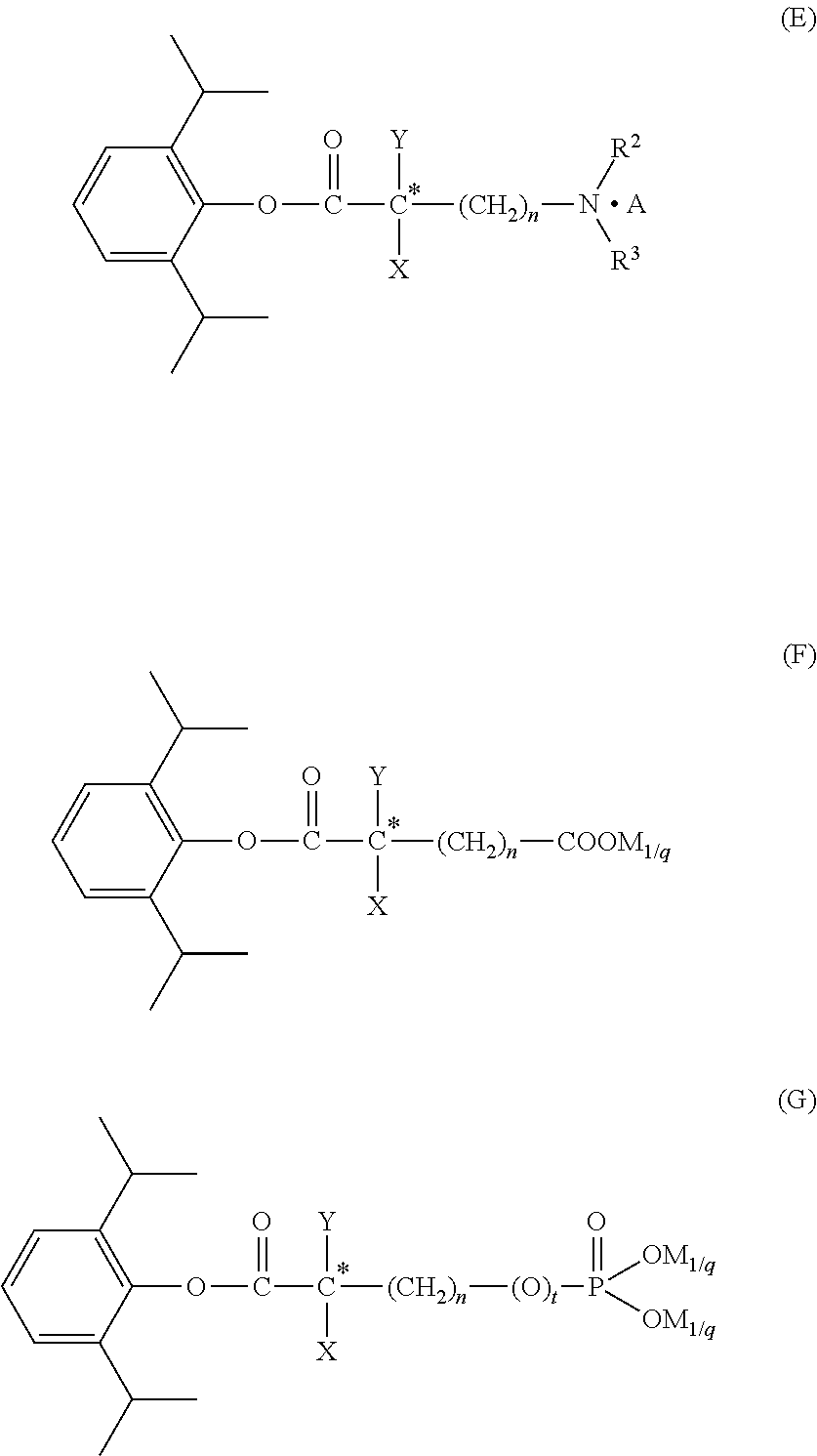
| TABLE 8 |
| The serial numbers and characterization data of the water soluble propofol prodrugs |
| prepared from the carboxylic acid derivatives of the present invention |
| Mass | ||
| Compd. | spectrometry | |
| No. | Compound Name | data |
| E1 | propofol 4-(N,N-dimethyl)amino-2(R,S)-fluorobutyrate | 310.1 |
| hydrochloride | ||
| E2 | propofol 4-(N,N-dimethyl)amino-2(R)-fluorobutyrate | 310.1 |
| hydrochloride | ||
| E3 | propofol 4-(N,N-dimethyl)amino-2(R)-2-trifluoromethylbutyrate | 360.18 |
| hydrochloride | ||
| E4 | propofol 4-(N-methyl-N-ethyl)amino-2(R,S)-2-fluorobutyrate | 324.21 |
| hydrochloride | ||
| E5 | propofol 5-(N-methyl-N-benzyl)amino-2(S)-2-fluorovalerate | 400.24 |
| hydrochloride | ||
| E6 | propofol 3-(N-isopropyl)amino-2(R,S)-2- | 324.22 |
| monofluoromethylpropionate methanesulfonate | ||
| E7 | propofol 4-N-(aziridin-1-yl)-2(S)-2-fluorobutyrate hydrochloride | 308.15 |
| E8 | propofol 4-(pyrrolidin-1-yl)-2(R)-2-fluorobutyrate hydrochloride | 336.19 |
| F1 | propofol 4-carboxyl-2(R,S)-fluorovalerate sodium salt | 309.14 |
| F2 | propofol 4-carboxyl-2(S)-fluorovalerate potassium salt | 309.11 |
| F3 | propofol 4-carboxyl-2(R)-2-trifluoromethyl valerate lithium salt | 359.11 |
| F4 | di[propofol 7-carboxyl-2(R,S)-fluorocaprylate] calcium salt | 351.14 |
| F5 | di[propofol 5-carboxyl-2(S)-fluorohexanoate] zinc salt | 323.12 |
| F6 | tri[propofol 8-carboxyl-2(R,S)-monofluoromethylpelargonate] | 379.18 |
| aluminium salt | ||
| F7 | propofol 3-carboxyl-2(R)-fluorobutyrate sodium salt | 295.11 |
| F8 | propofol 2-carboxyl-2(S)-fluoropropionate sodium salt | 281.09 |
| G1 | {1-[4-(2,6-diisopropylphenoxy)-4-oxo-3-(R,S)-3-fluoro-1-butyl]} | 361.13 |
| phosphate monoester dipotassium salt | ||
| G2 | {1-[4-(2,6-diisopropylphenoxy)-4-oxo-3-(S)-3-fluoro-1-butyl]} | 361.13 |
| phosphate monoester disodium salt | ||
| G3 | {1-[4-(2,6-diisopropylphenoxy)-4-oxo-3-(R)-3-trifluoromethyl- | 411.13 |
| 1-butyl]} phosphate monoester dilithium salt | ||
| G4 | propofol 4-phosphoryl-2(R,S)-fluorobutyrate calcium salt | 345.13 |
| G5 | propofol 5-phosphoryl-2(S)-fluorovalerate zinc salt | 359.15 |
| G6 | tri[propofol 3-phosphoryl-2(R,S)-2-monofluoromethylpropionate] | 345.16 |
| dialuminum salt | ||
The obtained water soluble propofol derivatives were formulated as 1 mg/ml solutions in physiological saline. 0.1 ml samples were taken from each of the solutions, added respectively to 1 ml of blood plasma of rabbit (taken from New Zealand white rabbits, treated according to conventional methods, anticoagulated with heparin) or 1 ml of blood plasma of rat (taken from live SD rats, treated according to conventional methods, anticoagulated with heparin), homogeneously mixed, and placed in a thermostatic water bath at 37° C. for incubation with time being recorded. Samples were taken at different time points after the experiment began, and 2 ml of acetonitrile was immediately added. The samples were shaken and centrifuged for 5 min (15,000 rpm), and the supernatant was then taken for HPLC analysis. The results are presented as follows:
| TABLE 9 |
| In vitro dissociation percent of amino acid-based propofol derivatives of |
| formula E in blood plasma |
 |
| Sampling time/ | |||||||||
| dissociation percent (%) |
| E | n | R2 | R3 | X | Y | C* | A | Plasma | 5 s | 15 s | 30 s |
| E1 | 2 | Me | Me | H | F | R, S | HCl | Rabbit | 67.5 | 85.5 | |
| Rat | 75.1 | 83.2 | 96.7 | ||||||||
| E2 | 2 | Me | Me | H | F | R | HCl | Rabbit | 97.7 | 100 | |
| Rat | 100 | ||||||||||
| E3 | 2 | Me | Me | H | CF3 | R | HCl | Rabbit | 51.7 | 67.2 | |
| Rat | 77.5 | ||||||||||
| E4 | 2 | Me | Et | H | F | R, S | HCl | Rabbit | 58.3 | 70.4 | |
| Rat | 70.2 | ||||||||||
| E5 | 3 | Me | Bn | H | F | S | HCl | Rabbit | 48.4 | 69.7 | |
| Rat | 72.3 | 97.3 | |||||||||
| E6 | 1 | H | i-Pro | H | CH2F | R, S | MeSO3H | Rabbit | 27.1 | 44.3 | |
| Rat | 24.2 | 40.1 | |||||||||
| E7 | 2 | CH2—CH2 | H | F | S | HCl | Rabbit | 89.4 | 94.4 |
| Rat | 92.3 |
| E8 | 2 | CH2CH2CH2CH2 | H | F | R | HCl | Rabbit | 91.1 | 98.2 |
| Rat | 95.6 | ||||||||||
| TABLE 10 |
| In vitro dissociation percent of diacid monoester-based propofol derivatives of |
| formula F in blood plasma |
 |
| Sampling time/ | |||||||
| dissociation percent (%) |
| F | n | M | t | X | Y | C* | Plasma | 5 s | 15 s | 30 s |
| F1 | 2 | Na | 1 | H | F | R, S | Rabbit | 47.5 | 75.5 | |
| Rat | 64.1 | 70.2 | 86.7 | |||||||
| F2 | 2 | K | 1 | H | F | S | Rabbit | 73.4 | 94.8 | |
| Rat | 92.3 | |||||||||
| F3 | 2 | Li | 1 | H | CF3 | R | Rabbit | 28.4 | 47.9 | |
| Rat | 47.4 | |||||||||
| F4 | 5 | Ca | 2 | H | F | R, S | Rabbit | 48.3 | 61.7 | |
| Rat | 63.8 | |||||||||
| F5 | 3 | Zn | 2 | H | F | S | Rabbit | 34.9 | 58.8 | |
| Rat | 63.2 | 80.3 | ||||||||
| F6 | 6 | Al | 3 | H | CH2F | R, S | Rabbit | 37.1 | 58.3 | |
| Rat | 34.2 | 55.7 | ||||||||
| F7 | 1 | Na | 1 | H | F | R | Rabbit | 46.3 | 72.8 | |
| Rat | 58.8 | 71.3 | 85.4 | |||||||
| |
0 | Na | 1 | H | F | S | Rabbit | 41.2 | 70.4 | |
| Rat | 55.5 | 69.3 | 83.3 | |||||||
| TABLE 11 |
| In vitro dissociation percent of organic phosphate-based propofol derivatives of |
| formula G in blood plasma |
 |
| Sampling time/ | |||||||||
| dissociation percent (%) |
| G | n | t | M | q | X | Y | C* | Plasma | 5 S | 15 S | 30 S |
| G1 | 2 | 1 | K | 1 | H | F | R, S | Rabbit | 43.7 | 68.7 | |
| Rat | 54.1 | 67.4 | 86.9 | ||||||||
| G2 | 2 | 1 | Na | 1 | H | F | S | Rabbit | 37.2 | 54.3 | |
| Rat | 48.5 | 69.7 | |||||||||
| G3 | 2 | 1 | Li | 1 | H | CF3 | R | Rabbit | 21.7 | 43.6 | |
| Rat | 38.7 | ||||||||||
| G4 | 2 | 0 | Ca | 2 | H | F | R, S | Rabbit | 43.3 | 54.8 | |
| Rat | 47.2 | ||||||||||
| G5 | 3 | 0 | Zn | 2 | H | F | S | Rabbit | 33.8 | 56.3 | |
| Rat | 32.9 | 57.6 | |||||||||
| G6 | 1 | 0 | Al | 3 | H | CH2F | R, S | Rabbit | 27.1 | 44.3 | |
| Rat | 22.1 | 39.7 | |||||||||
2.2.1. Test Samples and Administration:
An appropriate amount of test compounds (E2, F1, F7, and G2) were weighed out, and a certain amount of physiological saline was added thereto, so as to form 3 mg/ml or 6 mg/ml solutions, which were then sonicated to dissolve the compounds. Test samples for the experiment on rabbit were formulated to have corresponding concentrations based on the results from a preliminary test. As a control, a fat emulsion injection of propofol (commercially available, 10 mg/ml) was diluted to 3 mg/ml with physiological saline. Rats and mice were administered with samples having a fixed concentration of drugs, while the volume of administration altered according to actual situation. The volume of administration to rabbits was 1 mL/kg body weight.
2.2.2. ED50 and LD50 Test of the Compounds:
ED50 and LD50 values concerning anesthesia were determined using a sequential method. Healthy KM mice (male), SD rats (male) and New Zealand White rabbits were used for test. For rats and mice, the compounds were administered by injection at a constant rate via caudal vein for 10 seconds. For rabbits, the compounds were administered by injection at a constant rate via ear vein for 30 seconds. Before the test, a preliminary test was conducted to determine an approximate dosage (volume of administration) that leads to anesthetization (or death) of animals, which was set as the middle dosage in the formal test. 2-3 Dosage groups were set above and below the middle dosage group with an interval of 0.8. The disappearance of righting reflex or death was used as indicators of pharmacological efficacy or toxicity, respectively. The formal test began with the administration of the middle dosage. If animals were anesthetized, a lower dosage was administered; if animals were not anesthetized, a higher dosage was administered, until the cycle was repeated for 3-4 times. LD50 and ED50 were calculated by a sequential method aot425 software. TI was calculated according to the following equation: TI=LD50/ED50.
2.2.3. Determination of the Latent Period and Persistent Period of Anesthesia of the Compounds
Kunming mice (male, 5 per group) were administered with the test compounds via intravenous injection at a constant rate for 10 seconds. The periods during which the righting reflex of mice disappeared (latent period) and recovered (persistent period) were recorded.
2.2.4. Test Results
2.2.4.1. Test Results of LD50/ED50 and TI Index of the Compounds in Rats/Mice. The Test Results are Shown in Following Table 12:
| TABLE 12 |
| Test results of LD50/ED50 and TI index of the compounds in rats/mice |
| (n = 10-20) |
| Compd. | Mouse | Rat |
| No. and | LD50 | ED50 | LD50 | ED50 | TI |
| Concentration | (mg/kg) | (mg/kg) | (mg/kg) | (mg/kg) | Mouse | Rat |
| E2 (3 mg/ml) | 71.8 | (51.1-150)* | 17.9 | (13.7-21.9)* | 37.5 | (30.9-40.9) | 9.8 | (8.3-11.7) | 4* | 3.8 |
| 46.9 | (41.3-59.9) | 15.4 | (11.7-21.7) | 3 | ||||||
| E2 (6 mg/ml) | 55.1 | (42.4-67.8)* | 15.2 | (7.4-20.6)* | 30.7 | (28.3-36.2) | 10.1 | (9.3-12.3) | 3.6* | 3.1 |
| 48.0 | (43.6-51.2) | 13.0 | (11.8-15.7) | 3.7 | ||||||
| F1 (3 mg/ml) | 63.4 | (48.7-138.4)* | 20.8 | (15.6-22.7)* | 44.1 | (39.3-47.2) | 14.6 | (10.2-16.7) | 3* | 3.0 |
| 52.3 | (42.5-56.4) | 18.6 | (15.4-21.8) | 2.8 | ||||||
| F1 (6 mg/ml) | 49.7 | (33.7-64.2)* | 18.2 | (15.3-23.4)* | 42.3 | (39.6-44.2) | 11.3 | (9.5-13.4) | 2.7* | 3.7 |
| 55.4 | (51.8-58.3) | 16.7 | (14.4-18.8) | 3.3 | ||||||
| F7 (3 mg/ml) | 59.8 | (50.3-135.9)* | 21.4 | (17.1-23.8)* | 47.4 | (41.5-51.7) | 15.7 | (12.1-18.9) | 2.8* | 3.0 |
| 51.6 | (41.2-57.4) | 19.2 | (17.3-22.8) | 2.6 | ||||||
| F7 (6 mg/ml) | 51.2 | (35.3-65.8)* | 20.7 | (15.9-26.7)* | 44.4 | (40.7-47.2) | 12.5 | (10.3-14.8) | 2.4* | 3.5 |
| 56.6 | (53.4-60.4) | 18.1 | (14.9-21.3) | 3.1 | ||||||
| G2 (3 mg/ml) | 65.7 | (49.4-141.2)* | 23.7 | (15.6-32.3)* | 55.4 | (52.7-57.1) | 16.7 | (14.2-18.3) | 2.8* | 3.3 |
| 60.4 | (56.4-62.3) | 19.8 | (18.4-21.5) | 3.0 | ||||||
| G2 (6 mg/ml) | 48.7 | (38.7-67.2)* | 25.6 | (14.3-29.8)* | 60.1 | (58.2-62.4) | 21.1 | (19.2-23.4) | 1.9* | 2.8 |
| 53.6 | (60.2-66.3) | 22.8 | (17.8-22.3) | 2.3 | ||||||
| propofol | 38.4 | (29.2-54.3) | 7.9 | (6.5-9.6) | 21.5 | (19.2-24) | 3.91 | (0.6-5.5) | 4.9 | 5.5 |
| (3 mg/ml) | ||||||||||
| propofol | 42.9 | (38.4-48.0) | 11.3 | (10.1-12.6) | 17.4 | (16.1-18.4) | 3.5 | (0.4-4.3) | 3.8 | 4.9 |
| (6 mg/ml) | ||||||||||
| Values marked with * are data from the first test. The remaining data are from the confirmation test. | ||||||||||
2.2.4.2. Test Results of LD50/ED50 and TI Index of the Compounds in Rabbits. The Test Results are Shown in Following Table 13:
| TABLE 13 |
| Test results of LD50/ED50 and TI index of the compounds in rabbits |
| Compd. No. | LD50 (mg/kg) | ED50 (mg/kg) | TI index |
| E2 | 28 (23.0-34.2) | 8 (5.7-10.5) | 3.5 |
| F1 | 34.4 (32.1-36.5) | 12.2 (10.6-14.6) | 2.8 |
| F7 | 36.7 (33.8-39.4) | 13.9 (11.1-16.8) | 2.6 |
| G2 | 38.7 (35.1-41.3) | 14.7 (12.6-19.1) | 2.6 |
2.2.4.3. Test Results of the Latent Period and Persistent Period of Anesthesia of the Compounds in Mice. The Test Results are Shown in Following Table 14:
| TABLE 14 |
| Test results of the latent period and persistent period of anesthesia |
| of the compounds in mice (mice, mg/kg, n = 10) |
| Latent | |||
| Compd. No. | Dosage (mg/kg) | Period (s) | Persistent period (s) |
| E2 (3 mg/ml) | 36 (2 * ED50) | 14.6 ± 0.9 | 383.6 ± 242.1 |
| E2 (6 mg/ml) | 30 (2 * ED50) | 14.2 ± 1.9 | 543 ± 231 |
| F1 (3 mg/ml) | 42 (2 * ED50) | 18.6 ± 0.7 | 349.7 ± 229.4 |
| F1 (6 mg/ml) | 36 (2 * ED50) | 15.2 ± 1.4 | 523 ± 248 |
| F7 (3 mg/ml) | 43 (2 * ED50) | 20.2 ± 0.6 | 335.5 ± 218.1 |
| F7 (6 mg/ml) | 41 (2 * ED50) | 16.2 ± 2.2 | 517 ± 231 |
| G2 (3 mg/ml) | 47 (2 * ED50) | 16.3 ± 0.8 | 383.6 ± 242.1 |
| G2 (6 mg/ml) | 51 (2 * ED50) | 15.7 ± 2.3 | 571 ± 173 |
| Propofol (3 mg/ml) | 25 (2 * ED50) | 8.4 ± 1.1 | 324.8 ± 98.9 |
Conclusion: the water soluble propofol derivatives of the present invention achieve a rapid onset of anesthesia and a short persistent period.
The present invention achieves the following beneficial effects:
As demonstrated by the above test results, the carboxylic acid derivative of the present invention (including the compound of formula I, II or III as well as any specific compound described in the present invention) can form an ester by reacting with a hydroxyl group in a poorly soluble drug through chemical processes to increase the water solubility of the poorly soluble drug, so as to obtain a water soluble prodrug suitable for injection. Surprisingly, the prodrug thus obtained can be easily dissociated in vivo to release the parent drug, without affecting the physiological activity of the prodrug. As a result, the side effects caused by a high molecular co-solvent in an injection of the parent drug can be reduced. The LD50 of the compound in mice is above 1,500 mg/kg. That is, the carboxylic acid derivative of the present invention is a suitable ligand for preparing a prodrug.
Claims (13)
1. A carboxylic acid derivative of general formula (I), (II) or (III):

wherein,
R1 is H, methyl, ethyl, n-propyl, or isopropyl;
X is F;
Y is H or F;
n is 1, 2, 3, 4, 5 or 6;
W is W1;
W1 is .NR2R3.A or

R2 is H, C1-C6 alkyl, cyclopentyl, or cyclohexyl;
R3 is C1-C6 alkyl, cyclopentyl, cyclohexyl, or benzyl;
m is 0, 1, 2 or 3;
A is an acid;
M is a metal ion;
q is the charge number of M; and
G is Cl, Br or benzenesulfonyloxy optionally substituted with alkyl.
2. The carboxylic acid derivative according to claim 1 , characterized in that the metal ion is an alkali metal ion, an alkaline earth metal ion or a trivalent metal ion.
3. The carboxylic acid derivative according to claim 2 , characterized in that the alkali metal ion is a potassium ion or a sodium ion.
4. The carboxylic acid derivative according to claim 2 , characterized in that the alkaline earth metal ion is a magnesium ion, a zinc ion or a calcium ion.
5. The carboxylic acid derivative according to claim 2 , characterized in that the trivalent metal ion is an aluminum ion or an iron ion.
6. The carboxylic acid derivative according to claim 1 , characterized in that each instance of alkyl is C1-6 alkyl.
7. The carboxylic acid derivative according to claim 1 , characterized in that the C1-6 alkyl is methyl, ethyl, propyl, isopropyl, butyl or isobutyl.
8. The carboxylic acid derivative according to claim 1 , characterized in that G is

9. The carboxylic acid derivative according to claim 1 , characterized in that R2 is H, methyl, ethyl, n-propyl, isopropyl, cyclopentyl, or cyclohexyl, and
R3 is methyl, ethyl, n-propyl, isopropyl, cyclopentyl, cyclohexyl, or benzyl.
10. The carboxylic acid derivative according to claim 1 , characterized in that the acid A is an acid which can form a salt with an amine.
11. The carboxylic acid derivative according to claim 1 , characterized in that the acid A is hydrochloric acid, hydrobromic acid, sulfuric acid, phosphoric acid, trifluoroacetic acid, difluoroacetic acid, fluoroacetic acid, acetic acid, benzensulfonic acid or p-toluene sulfonic acid.
12. The carboxylic acid derivative according to claim 1 , characterized in that when the α-C of the carboxyl in the carboxylic acid derivative is a chiral atom, the carboxylic acid derivative is in a single R configuration, in a single S configuration, or in both R and S configurations.
13. A compound that is selected from the group consisting of:
4-N,N-dimethylamino-2(R)-fluorobutyric acid hydrochloride;
4-N-isopropylamino-2(R,S)-fluorobutyric acid hydrochloride;
4-N,N-diethyl amino-2(R,S)-trifluoromethylbutyric acid hydrochloride;
4-N-benzylamino-2,2-difluorobutyric acid hydrochloride;
4-N-isobutylamino-2(R,S)-difluoromethylbutyric acid hydrochloride;
4-N-(aziridin-1-yl)-2(R,S)-difluoromethylbutyric acid hydrochloride;
4-N-(pyrrolidin-1-yl)-2(R,S)-fluorobutyric acid hydrochloride;
3-N-benzylamino-2(R,S)-(1,1-difluoromethyl)propionic acid hydrochloride;
6-N-cyclohexylamino-2(R,S)-trifluoromethylhexanoic acid hydrochloride;
4-benzyloxy-4-oxo-2(R,S)-fluorobutyric acid;
5-benzyloxy-5-oxo-2(R)-fluoropentanoic acid;
6-benzyloxy-6-oxo-2(S)-fluorohexanoic acid;
dibenzyl [1-(3-(R,S)-fluoro-3-carboxy)propyl] phosphate triester;
dibenzyl [1-(5-(S)-fluoro-5-carboxy)pentyl] phosphate triester;
4-(dibenzyloxy)phosphoryl-2(R,S)-fluorobutyric acid;
5-(dibenzyloxy)phosphoryl-2(R)-fluoropentanoic acid;
4-benzyloxy-4-oxo-2(R,S)-fluorobutyryl chloride;
sodium 5-benzyloxy-5-oxo-2(R)-fluorovalerate;
dibenzyl [1-(3-(R,S)-fluoro-4-oxo-4-chloro)butyl] phosphate triester;
dibenzyl [potassium 1-(4-(S)-fluoro-5-carboxylate)pentyl] phosphate triester;
4-(dibenzyloxy)phosphoryl-2(R,S)-fluorobutyryl chloride;
sodium 4-N,N-dimethylamino-2(R,S)-fluorobutyrate;
calcium 4-N,N-diethyl amino-2(R,S)-fluorobutyrate;
aluminum 3-N-b enzylamino-2(R,S)-benzyloxypropionate;
4-N,N-dimethylamino-2(R,S)-fluorobutyryl chloride hydrochloride;
4-N-benzylamino-2,2-difluorobutyryl chloride hydrochloride;
4-N,N-dimethylamino-2(R,S)-fluorobutyric acid; and
4-N,N-dimethylamino-2(S)-fluorobutyric acid hydrochloride.
Applications Claiming Priority (7)
| Application Number | Priority Date | Filing Date | Title |
|---|---|---|---|
| CN201410053129 | 2014-02-17 | ||
| CN201410053129.9 | 2014-02-17 | ||
| CN201410053129 | 2014-02-17 | ||
| CN201410154956.7 | 2014-04-17 | ||
| CN201410154956 | 2014-04-17 | ||
| CN201410154956 | 2014-04-17 | ||
| PCT/CN2015/073165 WO2015120820A1 (en) | 2014-02-17 | 2015-02-16 | Class of carboxylic acid derivatives and use thereof in preparation of prodrugs |
Publications (2)
| Publication Number | Publication Date |
|---|---|
| US20170057939A1 US20170057939A1 (en) | 2017-03-02 |
| US10239851B2 true US10239851B2 (en) | 2019-03-26 |
Family
ID=53799609
Family Applications (1)
| Application Number | Title | Priority Date | Filing Date |
|---|---|---|---|
| US15/119,587 Active US10239851B2 (en) | 2014-02-17 | 2015-02-16 | Carboxylic acid derivatives and use thereof in the preparation of prodrugs |
Country Status (4)
| Country | Link |
|---|---|
| US (1) | US10239851B2 (en) |
| EP (1) | EP3109230B1 (en) |
| CN (1) | CN106029631B (en) |
| WO (1) | WO2015120820A1 (en) |
Cited By (4)
| Publication number | Priority date | Publication date | Assignee | Title |
|---|---|---|---|---|
| US11439653B1 (en) | 2021-03-30 | 2022-09-13 | Epalex Corporation | Fospropofol formulations |
| US11478490B1 (en) | 2021-03-30 | 2022-10-25 | Epalex Corporation | Fospropofol formulations |
| US11547714B2 (en) | 2020-02-05 | 2023-01-10 | Epalex Corporation | Fospropofol salts, methods and compositions |
| US11628178B2 (en) | 2019-03-26 | 2023-04-18 | Epalex Corporation | Fospropofol methods and compositions |
Families Citing this family (5)
| Publication number | Priority date | Publication date | Assignee | Title |
|---|---|---|---|---|
| EP3109242B8 (en) * | 2014-02-17 | 2019-02-27 | Jiangsu Nhwaluokang Pharmaceutical Research and Development Co., Ltd. | Water-soluble taxane derivatives and uses thereof |
| WO2015120821A1 (en) * | 2014-02-17 | 2015-08-20 | 江苏恩华络康药物研发有限公司 | Water-soluble propofol derivatives and uses thereof |
| CN106432141B (en) * | 2016-07-19 | 2019-12-31 | 浙江大学 | Preparation method and application of cabazitaxel prodrug |
| CN116023284B (en) * | 2021-10-26 | 2023-09-22 | 中山万汉制药有限公司 | Addition salts of propofol derivatives with pharmaceutically acceptable acids, compositions and uses thereof |
| WO2025262221A1 (en) * | 2024-06-19 | 2025-12-26 | Biohalo Aps | Biologically-produced fluorinated monomers and polymers |
Citations (8)
| Publication number | Priority date | Publication date | Assignee | Title |
|---|---|---|---|---|
| JPS6379854A (en) * | 1986-09-24 | 1988-04-09 | Daicel Chem Ind Ltd | Fluorine-containing organic compound |
| WO2004106349A1 (en) | 2003-05-27 | 2004-12-09 | E.I. Dupont De Nemours And Company | Fuel cell membrane containing zirconium phosphate |
| CN1907945A (en) | 2006-08-18 | 2007-02-07 | 上海化学试剂研究所 | Process for preparing trifluoroethyl methacrylate |
| CN101094840A (en) | 2004-12-29 | 2007-12-26 | 韩美药品株式会社 | Quinazoline derivatives for inhibiting growth of cancer cells and method for preparing them |
| CN101898978A (en) | 2009-05-31 | 2010-12-01 | 徐锋 | Eflornithine prodrug and conjugate and using method thereof |
| CN102015621A (en) | 2008-04-28 | 2011-04-13 | 中央硝子株式会社 | Process for producing a-fluoro-ss-amino acids |
| EP3109242A1 (en) | 2014-02-17 | 2016-12-28 | Jiangsu Nhwaluokang Pharmceutical Research and Development Co. Ltd. | Water-soluble taxane derivatives and uses thereof |
| EP3109229A1 (en) | 2014-02-17 | 2016-12-28 | Jiangsu Nhwaluokang Pharmceutical Research and Development Co. Ltd. | Water-soluble propofol derivatives and uses thereof |
Family Cites Families (3)
| Publication number | Priority date | Publication date | Assignee | Title |
|---|---|---|---|---|
| US4435425A (en) * | 1982-04-09 | 1984-03-06 | Merrell Toraude Et Compagnie | Fluorinated diaminobutane derivatives |
| CN1895676B (en) * | 2005-07-14 | 2010-11-10 | 上海艾力斯医药科技有限公司 | Prodrugs of paclitaxel or docetaxel supported by polyethylene glycol |
| CN1907954B (en) * | 2006-08-16 | 2011-11-23 | 重庆医科大学医药研究所 | Water-soluble derivative of anesthetic 2,6-diisopropyl phenol and preparation method thereof |
-
2015
- 2015-02-16 EP EP15748471.8A patent/EP3109230B1/en active Active
- 2015-02-16 US US15/119,587 patent/US10239851B2/en active Active
- 2015-02-16 WO PCT/CN2015/073165 patent/WO2015120820A1/en not_active Ceased
- 2015-02-16 CN CN201580008927.2A patent/CN106029631B/en active Active
Patent Citations (8)
| Publication number | Priority date | Publication date | Assignee | Title |
|---|---|---|---|---|
| JPS6379854A (en) * | 1986-09-24 | 1988-04-09 | Daicel Chem Ind Ltd | Fluorine-containing organic compound |
| WO2004106349A1 (en) | 2003-05-27 | 2004-12-09 | E.I. Dupont De Nemours And Company | Fuel cell membrane containing zirconium phosphate |
| CN101094840A (en) | 2004-12-29 | 2007-12-26 | 韩美药品株式会社 | Quinazoline derivatives for inhibiting growth of cancer cells and method for preparing them |
| CN1907945A (en) | 2006-08-18 | 2007-02-07 | 上海化学试剂研究所 | Process for preparing trifluoroethyl methacrylate |
| CN102015621A (en) | 2008-04-28 | 2011-04-13 | 中央硝子株式会社 | Process for producing a-fluoro-ss-amino acids |
| CN101898978A (en) | 2009-05-31 | 2010-12-01 | 徐锋 | Eflornithine prodrug and conjugate and using method thereof |
| EP3109242A1 (en) | 2014-02-17 | 2016-12-28 | Jiangsu Nhwaluokang Pharmceutical Research and Development Co. Ltd. | Water-soluble taxane derivatives and uses thereof |
| EP3109229A1 (en) | 2014-02-17 | 2016-12-28 | Jiangsu Nhwaluokang Pharmceutical Research and Development Co. Ltd. | Water-soluble propofol derivatives and uses thereof |
Non-Patent Citations (23)
| Title |
|---|
| "Accela Chembio Inc.: "1346597-49-6"", Chemical Catalog, (Nov. 30, 2011), pp. 1-1, XP055465699. |
| "Accela Chembio Inc.: "1346597-54-3"", Chemical Catalog, (Nov. 30, 2011), pp. 1-1, XP055465700. |
| "Chinese Application No. 201580008927.2, Office Action dated Mar. 28, 2017", w/ English Translation, (Mar. 28, 2017), 14 pgs. |
| "Chinese Application Serial No. 201580008927.2, Office Action dated Dec. 19, 2017", w/ English Translation, (Dec. 19, 2017), 7 pgs. |
| "Chinese Application Serial No. 201580008927.2, Office Action dated Mar. 28, 2018", (Mar. 28, 2018), 8 pgs. |
| "European Application Serial No. 15 748 471.8 Extended European Search Report dated Oct. 7, 2017", (Oct. 7, 2017), 13 pgs. |
| "European Application Serial No. 15 748 471.8 Office Action dated Apr. 18, 2018", (Apr. 18, 2018), 4 pgs. |
| "International Application No. PCT/CN2015/073165, International Search Report dated May 28, 2015", w/ English Translation, (May 28, 2015), 7 pgs. |
| "International Application No. PCT/CN2015/073165, Written Opinion dated May 28, 2015", (May 28, 2015), 4 pgs. |
| ACCELA CHEMBIO INC.: "1346597-49-6", CHEMICAL CATALOG, ACCELA CHEMBIO INC., 30 November 2011 (2011-11-30), pages 1 - 1, XP055465699 |
| ACCELA CHEMBIO INC.: "1346597-54-3", CHEMICAL CATALOG, 30 November 2011 (2011-11-30), pages 1 - 1, XP055465700 |
| Barney, A. L., et al., "a, a-Difluoroglutaric Acid", Journal of the American Chemical Society 72.7, (1950), 3193-3194. |
| CAS Reg No. 1346597-49-6, entered into STN on Nov. 30, 2011. * |
| CAS Reg No. 1346597-54-3, entered into STN on Nov. 30, 2011. * |
| CAS Reg No. 1384428-87-8, entered into STN on Jul. 26, 2013. * |
| CAS Reg No. 1556901-43-9, entered into STN on Feb. 26, 2014. * |
| CAS Reg. No. 113684-87-0, entered Apr. 2, 1988. * |
| Desmoulin, Franck, et al., "Metabolism of capecitabine, an oral fluorouracil prodrug: 19F NMR studies in animal models and human urine", Drug metabolism and disposition 30.11, (2002), 1221-1229. |
| Hook, David F., et al., "Probing the Proteolytic Stability of ß-Peptides Containing a-Fluoro-and a-Hydroxy-ß-Amino Acids", ChemBioChem 5.5, (2004), 691-706. |
| Jurcík, Václav, et al., "Single enantiomer synthesis of a-(trifluoromethyl)-ß-lactam", Beilstein journal of organic chemistry 7.1, (2011), 759-766. |
| Pattison, F. L.M., et al., "The synthesis of a-monofluoroalkanoic acids", Canadian Journal of Chemistry 43.6, (1965), 1700-1713. |
| Takeuchi et al, abstract of CAS Doc No. 109:230305, 1988, p. 1 (Year: 1988). * |
| Takeuchi, Yoshio, et al., "The first versatile and practical building blocks equivalent to the synthon of monofluoromethylene dicarbanion", The Journal of Organic Chemistry 52.22, (1987), 5061-5063. |
Cited By (7)
| Publication number | Priority date | Publication date | Assignee | Title |
|---|---|---|---|---|
| US11628178B2 (en) | 2019-03-26 | 2023-04-18 | Epalex Corporation | Fospropofol methods and compositions |
| US12377110B2 (en) | 2019-03-26 | 2025-08-05 | Epalex Corporation | Fospropofol methods and compositions |
| US11547714B2 (en) | 2020-02-05 | 2023-01-10 | Epalex Corporation | Fospropofol salts, methods and compositions |
| US12364704B2 (en) | 2020-02-05 | 2025-07-22 | Epalex Corporation | Fospropofol salts, methods and compositions |
| US11439653B1 (en) | 2021-03-30 | 2022-09-13 | Epalex Corporation | Fospropofol formulations |
| US11478490B1 (en) | 2021-03-30 | 2022-10-25 | Epalex Corporation | Fospropofol formulations |
| US12397006B2 (en) | 2021-03-30 | 2025-08-26 | Epalex Corporation | Fospropofol formulations |
Also Published As
| Publication number | Publication date |
|---|---|
| EP3109230A1 (en) | 2016-12-28 |
| CN106029631B (en) | 2018-12-28 |
| CN106029631A (en) | 2016-10-12 |
| EP3109230B1 (en) | 2019-11-20 |
| EP3109230A4 (en) | 2017-08-09 |
| WO2015120820A1 (en) | 2015-08-20 |
| US20170057939A1 (en) | 2017-03-02 |
Similar Documents
| Publication | Publication Date | Title |
|---|---|---|
| US10239851B2 (en) | Carboxylic acid derivatives and use thereof in the preparation of prodrugs | |
| US9643917B2 (en) | Water-soluble propofol derivatives and uses thereof | |
| EP0674631B1 (en) | Substituted pyrazoles as crf antagonists | |
| KR100345942B1 (en) | 1-phenylpyrazole compounds or optical isomers therof, and pharmaceutical compositions for treatment of hyperuricacidemia and gout comprising said compounds as effective ingredient | |
| US11198683B2 (en) | Method for preparing tyrosine kinase inhibitor and derivative thereof | |
| US20180265492A1 (en) | Antifungal compounds and processes for making | |
| US12473291B2 (en) | Benzodiazepine compound, preparation method therefor, and use thereof in medicine | |
| CA3001431C (en) | Etomidate derivative and intermediate, preparation method and use thereof | |
| US20190389865A1 (en) | SUBSTITUTED PYRROLO[1,2-a]TRIAZINES AND RELATED COMPOUNDS AND THEIR USE IN THE TREATMENT OF MEDICAL DISORDERS | |
| AU2021273632A1 (en) | N-acylethanolamide derivatives and uses thereof | |
| KR20090106633A (en) | 6-benzyl-2,3,4,7-tetrahydro-indolo [2,3-c] quinoline compounds useful as PDE5 inhibitors | |
| JPS60214778A (en) | N-substituted 3,4-dihydropyrimidine derivative, its preparation and use | |
| US20020082274A1 (en) | Preparation of sodium-hydrogen exchanger type-1 inhibitors | |
| FI70218C (en) | FRAME FOR THE PREPARATION OF THERAPEUTIC THERAPEUTIC 3-SUBSTITUTE TETRAHYDROPYRROLO / 1,2-A / PYRIMIDINER | |
| US12391707B2 (en) | Preparation method for oxazepine compound | |
| JP7406566B2 (en) | Prodrug of monomethyl fumarate | |
| US7759491B2 (en) | Method for producing indazol-3-ylmethyl phosphonium salt | |
| EP0882716B1 (en) | Pyridinecarboxamide derivatives | |
| AU2006215084B2 (en) | Cyclohepta(b)pyridine-3-carbonylguanidine derivative and pharmaceutical product containing same | |
| US20050143400A1 (en) | Process for preparing famciclovir | |
| CN117586232A (en) | An edaravone prodrug derivative and its application | |
| JPWO2000075115A1 (en) | Nasal | |
| DD242041A1 (en) | PROCESS FOR THE PREPARATION OF 1H-3- (1-CARBOXY-ISOALKYLOXY) PYRAZOLES, THEIR ESTERS AND AMIDES | |
| JPH06329673A (en) | 4-alkylamino-substituted-pyrrolo(2,3-d) pyrimidine derivative |
Legal Events
| Date | Code | Title | Description |
|---|---|---|---|
| AS | Assignment |
Owner name: LI, QINGENG, CHINA Free format text: ASSIGNMENT OF ASSIGNORS INTEREST;ASSIGNORS:WANG, TAO;CHEN, GANG;WANG, YUANZHONG;AND OTHERS;REEL/FRAME:039942/0240 Effective date: 20160929 |
|
| STCF | Information on status: patent grant |
Free format text: PATENTED CASE |
|
| MAFP | Maintenance fee payment |
Free format text: PAYMENT OF MAINTENANCE FEE, 4TH YR, SMALL ENTITY (ORIGINAL EVENT CODE: M2551); ENTITY STATUS OF PATENT OWNER: SMALL ENTITY Year of fee payment: 4 |