US10206684B2 - Device and method for treating nosebleeds - Google Patents
Device and method for treating nosebleeds Download PDFInfo
- Publication number
- US10206684B2 US10206684B2 US15/146,609 US201615146609A US10206684B2 US 10206684 B2 US10206684 B2 US 10206684B2 US 201615146609 A US201615146609 A US 201615146609A US 10206684 B2 US10206684 B2 US 10206684B2
- Authority
- US
- United States
- Prior art keywords
- user
- elongated portion
- shaped
- dimensioned
- center portion
- Prior art date
- Legal status (The legal status is an assumption and is not a legal conclusion. Google has not performed a legal analysis and makes no representation as to the accuracy of the status listed.)
- Active, expires
Links
Images


Classifications
-
- A—HUMAN NECESSITIES
- A61—MEDICAL OR VETERINARY SCIENCE; HYGIENE
- A61B—DIAGNOSIS; SURGERY; IDENTIFICATION
- A61B17/00—Surgical instruments, devices or methods
- A61B17/12—Surgical instruments, devices or methods for ligaturing or otherwise compressing tubular parts of the body, e.g. blood vessels or umbilical cord
-
- A—HUMAN NECESSITIES
- A61—MEDICAL OR VETERINARY SCIENCE; HYGIENE
- A61B—DIAGNOSIS; SURGERY; IDENTIFICATION
- A61B17/00—Surgical instruments, devices or methods
- A61B17/24—Surgical instruments, devices or methods for use in the oral cavity, larynx, bronchial passages or nose; Tongue scrapers
-
- A—HUMAN NECESSITIES
- A61—MEDICAL OR VETERINARY SCIENCE; HYGIENE
- A61F—FILTERS IMPLANTABLE INTO BLOOD VESSELS; PROSTHESES; DEVICES PROVIDING PATENCY TO, OR PREVENTING COLLAPSING OF, TUBULAR STRUCTURES OF THE BODY, e.g. STENTS; ORTHOPAEDIC, NURSING OR CONTRACEPTIVE DEVICES; FOMENTATION; TREATMENT OR PROTECTION OF EYES OR EARS; BANDAGES, DRESSINGS OR ABSORBENT PADS; FIRST-AID KITS
- A61F13/00—Bandages or dressings; Absorbent pads
- A61F13/15—Absorbent pads, e.g. sanitary towels, swabs or tampons for external or internal application to the body; Supporting or fastening means therefor; Tampon applicators
- A61F13/20—Tampons, e.g. catamenial tampons; Accessories therefor
- A61F13/2002—Tampons, e.g. catamenial tampons; Accessories therefor characterised by the use
- A61F13/2005—Tampons, e.g. catamenial tampons; Accessories therefor characterised by the use specially adapted for the nose cavity
-
- A—HUMAN NECESSITIES
- A61—MEDICAL OR VETERINARY SCIENCE; HYGIENE
- A61B—DIAGNOSIS; SURGERY; IDENTIFICATION
- A61B17/00—Surgical instruments, devices or methods
- A61B17/12—Surgical instruments, devices or methods for ligaturing or otherwise compressing tubular parts of the body, e.g. blood vessels or umbilical cord
- A61B2017/12004—Surgical instruments, devices or methods for ligaturing or otherwise compressing tubular parts of the body, e.g. blood vessels or umbilical cord for haemostasis, for prevention of bleeding
Definitions
- the present invention relates to a device and a method for treating nosebleeds, and more particularly to a device and a method for stopping or slowing nosebleeds in humans by applying pressure under the upper lip of a user.
- a typical method for treating nosebleeds or epistaxis in a patient includes positioning the patient upright, leaning forward slightly and firmly pinching the outside of the nose with the thumb and index fingers just below the bone against the face.
- Other methods include applying cold packs, cauterization, nasal packing or even surgery.
- pinching the nose, cauterization, nasal packing and surgery usually cause discomfort and pain to the patient. Therefore, there is a need for a non-invasive, painless and simple technique for stopping nosebleeds.
- the invention features device for treating nosebleeds including a mouth insert having a horizontally extending elongated portion, a center portion extending downward from a bottom surface of the elongated portion and a bite tab extending backward from the center portion.
- the elongated portion is shaped and dimensioned to be inserted into a buccal cavity of a user's mouth and to fit behind the user's upper lip and in front of the user's upper gums.
- the center portion is shaped and dimensioned to be positioned in front of the user's upper front teeth and the bite tab is shaped and dimensioned to provide a biting surface for the user's front teeth. Biting down onto the bite tab pushes the elongated portion upward and applies pressure upward to the user's buccal cavity and towards an anterior portion of the user's nose.
- the center portion and the bite tab form a structure that wraps around the user's front teeth and comprises a J-hook shape.
- the bite tab is formed above a bottom end of the center portion and has a semi-circled notch at a bottom surface of the bite tab that extends from left to right sides of the bite tab.
- the semi-circled notch is shaped and dimensioned to provide a biting surface for the user's bottom teeth.
- the elongated portion has a circular cross-section.
- the elongated portion includes a V-shaped gap dimensioned to fit around the user's frenulum.
- the elongated portion has left and right components arranged to left and right sides of the V-shaped gap.
- the left and right components of the elongated portion have cylindrical shapes, or conical shapes, or oval shapes.
- the left and right components of the elongated portion comprise soft, flexible or porous materials.
- the center portion may a width smaller than or equal to the elongated portion width.
- the elongated portion and the center portion are curved backwards and have a curvature radius that matches the user's upper gum line radius.
- the elongated portion has an adjustable width.
- the elongated portion has cut-away features on left and right sides of the elongated portion and the cut-away features are designed to tear off and thereby to reduce the width of the device.
- the elongated portion comprises foldable extensions on left and right sides of the elongated portion and the foldable extensions are designed to unfold and thereby to increase the width of the device.
- the mouth insert is made of semi-rigid materials comprising one of silicone, latex, rigid or flexible polypropylene, cotton gauze, other forms of cotton, or pressed paper mold, among others.
- a top surface of the elongated portion is covered with an inverted U-shaped component and the U-shaped component comprises one of soft, flexible or porous materials.
- the center portion comprises one or more openings configured to add flexibility to the device.
- the invention features a method for treating nosebleeds including the following: Providing a mouth insert comprising a horizontally extending elongated portion, a center portion extending downward from a bottom surface of the elongated portion and a bite tab extending backward from the center portion.
- the elongated portion is shaped and dimensioned to be inserted into a buccal cavity of a user's mouth and to fit behind the user's upper lip and in front of the user's upper gums
- the center portion is shaped and dimensioned to be positioned in front of the user's upper front teeth
- the bite tab is shaped and dimensioned to provide a biting surface for the user's front teeth.
- the invention provides a device and a method for stopping or slowing a nosebleed without medications, invasive operations, contact with the nasal passages or pain to the patient.
- FIG. 1A is a front view of a user with a device according to this invention inserted inside the user's mouth under the upper lip;
- FIG. 1B is a side view of the user of FIG. 1A with the device according to this invention inserted inside the user's mouth under the upper lip;
- FIG. 2A is a perspective view of a first embodiment of the device for treating nosebleeds according to this invention.
- FIG. 2B is a top view of the device of FIG. 2A ;
- FIG. 2C is a front view of the device of FIG. 2A ;
- FIG. 2D is a side view of the device of FIG. 2A ;
- FIG. 3A is a perspective view of a second embodiment of the device for treating nosebleeds according to this invention.
- FIG. 3B is a top view of the device of FIG. 3A ;
- FIG. 3C is a front view of the device of FIG. 3A ;
- FIG. 3D is a side view of the device of FIG. 3A ;
- FIG. 4A is a perspective view of a third embodiment of the device for treating nosebleeds according to this invention.
- FIG. 4B is a top view of the device of FIG. 4A ;
- FIG. 4C is a front view of the device of FIG. 4A ;
- FIG. 4D is a side view of the device of FIG. 4A ;
- FIG. 5 is a perspective view of a fourth embodiment of the device for treating nosebleeds according to this invention.
- FIG. 6 is a perspective view of a fifth embodiment of the device for treating nosebleeds according to this invention.
- FIG. 7 is a perspective view of a sixth embodiment of the device for treating nosebleeds according to this invention.
- FIG. 8 is a perspective view of a seventh embodiment of the device for treating nosebleeds according to this invention.
- FIG. 9 is a perspective view of an eighth embodiment of the device for treating nosebleeds according to this invention.
- FIG. 10 is a perspective view of a ninth embodiment of the device for treating nosebleeds according to this invention.
- FIG. 11 is a perspective view of a tenth embodiment of the device for treating nosebleeds according to this invention.
- FIG. 12 is a perspective view of an eleventh embodiment of the device for treating nosebleeds according to this invention.
- a device 100 for treating nosebleeds includes an elongated body 110 , shaped and dimensioned to be inserted into the buccal cavity of a user's 50 mouth and to fit behind the user's upper lip and in front of the user's upper gums, as shown in FIG. 1A .
- the top portion of device 110 includes a gap 115 extending along the midline 141 .
- Gap 115 has a V-shape and is dimensioned to fit around the user's frenulum, without interfering with the frenulum, which is located at the sagittal plane and top of the gum line.
- Elongated body 110 includes a central portion 114 having a top 114 a , a bottom 114 b and left and right portions 112 a , 112 b that extend sidewise from the central portion 114 .
- Top 114 a has a cylindrical cross section and together with the central portion 114 curves backwards and has a curvature radius that matches the radius of the user's upper gum line.
- Bottom 114 b extends backwards and forms a “bite” tab 116 .
- the central portion 114 is shaped and dimensioned to be positioned in front of the user's upper front teeth and the bite tab 116 is shaped and dimensioned to provide a biting surface for the user's upper front teeth.
- the central portion 114 and the bite tab 116 form a structure that has the shape of a J-hook and wraps around the user's front top teeth, as shown in FIG. 1B .
- Left and right portions 112 a , 112 b are shaped and dimensioned to fit the user's left and right sides of the upper gums, respectively.
- the user 50 inserts the device 100 in the mouth and places the elongated body 110 behind the upper lip and in front of the top gums, while the bite tab 116 wraps around the top teeth.
- the user bites down on the bite tab 116 and the biting action causes the top 114 a and the central portion 114 to apply pressure upward towards the anterior portion of the nose.
- the applied pressure blocks the blood flow to the nose and the anterior arteries and causes device 100 to act as a tourniquet that reduces and stops nosebleeds.
- the elongated body 110 is shaped and dimensioned to be inserted into the buccal cavity of a user's 50 mouth and to fit behind the user's upper lip and in front of the user's upper gums, as shown in FIG. 1A .
- device 100 is dimensioned to fit an adult user's mouth and has a width W in the range of 2-3 inches and a height H in the range of 3 ⁇ 4 to 11 ⁇ 4 inches.
- the thickness of the material T is in the range of 1 ⁇ 8 to 1 ⁇ 4 inches.
- Gap 115 has a width w 1 in the range of 1 ⁇ 4 to 1 ⁇ 2 inches and a height h 1 of about 1 ⁇ 2 inch.
- Bite tab 116 extends from front to back by a distance D that is in the range of 1 ⁇ 2 to 1 inch.
- Children sizes of the tourniquet device 100 typically range 50-70% of the above mentioned approximate sizes.
- a package of several tourniquet devices is provided that includes several comfortable size options for men, women, and children.
- a single large device 100 is provided that has adjustable width W to fit users with various mouth sizes.
- device 100 includes cut-away features or extensions 118 on the left and right portions 112 a , 112 b , as shown in FIG. 2C . Cut away features 118 are designed to tear off and thereby to shrink the width of the device so that it fits a user with a smaller mouth. Extensions 118 are unfolded to enlarge the width of the device to accommodate a user with a larger mouth.
- Device 100 is made of semi-rigid materials including silicone, latex, rigid and flexible polypropylene, cotton gauze, other forms of cotton, or pressed paper molds, among others.
- Elongated body 110 may be provided in a straightened form and may be bendable to conform to the user's mouth curvature. Alternatively, elongated body 110 may be provided in an already backwards-curved form.
- the entire device 100 may be flexible or rigid. In cases where device 100 is rigid it may still retain some flexibility to be able to conform to the user's mouth anatomy.
- the outer surfaces of the elongated body 110 are usually smooth and the edges and corners are rounded in order to provide a comfortable feel while being in contact with the user's gums and tissue and to prevent discomfort, pain or damage of the user's gums.
- device 100 for treating nosebleeds includes an elongated body 110 , shaped and dimensioned to be inserted into the buccal cavity of a user's 50 mouth and to fit behind the user's upper lip and in front of the user's upper gums, as shown in FIG. 1A .
- the top portion of device 110 includes a gap 115 in the midline. Gap 115 is shaped and dimensioned to fit around the user's frenulum, so that it does not interfere with the frenulum, which is located at the sagittal plane and top of the gum line.
- Elongated body 110 includes a central portion 114 having a top 114 a , a bottom 114 b and left and right portions 112 a , 112 b that extend sidewise.
- Top 114 a has a cylindrical cross section and together with the central portion 114 curves backwards and has a curvature radius that matches the radius of the user's upper gum line.
- Bottom 114 b extends downwards from the central portion 114 and has a backwards extending “bite” tab 116 .
- the central portion 114 is shaped and dimensioned to be positioned in front of the user's upper front teeth and the bite tab 116 is shaped and dimensioned to provide a biting surface for the user's front teeth.
- Bite tab 116 is formed at a distance 117 above the bottom end 114 b and includes a semi-circled notch 116 a at the bottom surface of tab 116 that extends from the left to the right sides of the central portion 114 .
- Notch 116 a provides a bite surface for the bottom teeth of the user to register on the device 100 .
- Bite tab 116 also includes a semi-circled notch 116 b at the top surface of tab 116 that is shaped to accommodate the user's top teeth.
- a device 100 for treating nosebleeds includes an elongated body 110 , shaped and dimensioned to be inserted into the buccal cavity of a user's 50 mouth and to fit behind the user's upper lip and in front of the user's upper gums, as shown in FIG. 1A .
- the top portion of device 110 includes a gap 115 in the midline. Gap 115 is shaped and dimensioned to fit around the user's frenulum, so that it does not interfere with the frenulum, which is located at the sagittal plane and top of the gum line.
- Elongated body 110 includes a central portion 114 having a top 114 a , a bottom 114 b and left and right sides 114 c , 114 d .
- Top 114 a has a cylindrical cross section and together with the central portion 114 curves backwards and has a curvature radius that matches the radius of the user's upper gum line.
- Bottom 114 b has a backwards extending “bite” tab 116 .
- the central portion 114 is shaped and dimensioned to be positioned in front of the user's upper front teeth and the bite tab 116 is shaped and dimensioned to provide a biting surface for the user's front teeth.
- Bite tab 116 is formed at a distance 117 above the bottom end 114 b and includes a semi-circled notch 116 a at the bottom surface of tab 116 that extends from the left to the right sides of the central portion 114 .
- Notch 116 a provides a bite surface for the bottom teeth of the user to register on the device 100 .
- Bite tab 116 also includes a semi-circled notch 116 b at the top surface of tab 116 that is shaped to accommodate the user's top teeth.
- central portion 114 extends the entire width W of the elongated body 110 .
- Bite tab 116 also extends the entire width of central portion 114 and the elongated body 110 from the left side 114 c to the right side 114 d and provides a wider bite surface than in the cases of FIG. 2A and FIG. 3A .
- device 100 has the same geometry and features as device 100 of FIG. 2A .
- the front surface 110 a is straight from left to right and the thickness of body 110 varies from the top 114 a to bottom 114 b and at various cross sections from left portion 112 a to right portion 112 b .
- Device 100 is made of semi-rigid material and can conform to the anatomy of the user's mouth when placed inside the upper-lip.
- device 100 has the same geometry and features as device 100 of FIG. 2A .
- a first “U” shaped component 120 a covers the left top surface 114 a of the main body 110 and a second “U” shaped component 120 b covers the right top surface 114 a of the main body 110 .
- the U-shaped components 120 a , 120 b are made of a soft, or flexible, or porous material. Examples of preferred materials for the U-shaped components 120 a , 120 b include silicone, latex, rigid and flexible polypropylene, cotton gauze, or some form of cotton or pressed paper molds.
- the U-shaped components 120 a , 120 b are designed to provide comfort during usage.
- openings 122 a and 122 b are also two openings 122 a and 122 b at the left and right portions 112 a , 112 b of the main body 110 , respectively. These openings 122 a , 122 b are designed to provide added flexibility, especially if the material is more rigid.
- device 100 A for treating nosebleeds includes a semi-rigid body 130 having a backwards extending bite tab 136 , left and right portions 132 a , 132 b extending upwards from the top surface 134 of the body 130 and forming a V-shaped structure with a central gap 115 .
- Device 100 A also includes left and right cylindrical structures 138 a , 138 b extending horizontally and being attached to the top ends of the left and right portions 132 a , 132 b , respectively.
- Device 100 A is shaped and dimensioned to be inserted into the buccal cavity of a user's 50 mouth and the cylindrical structures 138 a , 138 b are sized to conform and fit behind the user's upper lip and in front of the user's upper gums, as shown in FIG. 1A .
- the body 130 is shaped and dimensioned to be positioned in front of the user's upper front teeth and the bite tab 136 is shaped and dimensioned to provide a biting surface for the user's upper front teeth.
- Left and right cylindrical structures 138 a , 138 b extend horizontally from the inner sides of the top ends of the left and right portions 132 a , 132 b , respectively, and end beyond the left and right ends of the bite tab 136 .
- Left and right cylindrical structures 138 a , 138 b curve downward from the midline to the left and right sides of the device, respectively.
- Left and right cylindrical structures 138 a , 138 b are made of a soft, flexible, or porous material. Examples of preferred materials for the left and right cylindrical structures 138 a , 138 b include silicone, latex, rigid and flexible polypropylene, cotton gauze, or some form of cotton or pressed paper molds.
- Gap 115 is shaped and dimensioned to fit around the user's frenulum, so that it does not interfere with the frenulum, which is located at the sagittal plane and top of the gum line.
- device 100 B for treating nosebleeds includes a semi-rigid elongated body 140 that symmetrically curves inward from the midline 141 to the left and right sides 140 a , 140 b of the device.
- Elongated body 140 has a dome-shaped structure 142 formed at the middle bottom end 140 c of body 140 .
- Dome-shaped structure 142 is convex in FIG. 8 and concave in FIG. 9 .
- Dome-shaped structure 142 provides a push surface for placing a user's tongue or finger and pushing the device upward in order to provide pressure to the nose.
- the top end 140 d of body 140 includes a U-shaped cut 145 and left and right top ends 143 a , 143 b .
- U-shaped cut 145 is shaped and dimensioned to fit around the user's frenulum, so that it does not interfere with the frenulum.
- Left and right top ends 143 a , 143 b are covered with left and right conical structures 144 a , 144 b , respectively.
- Left and right conical structures 144 a , 144 b have oval shaped cross-sections 146 and extend from the inner sides of the top ends 143 a , 143 b respectively, and end beyond the left and right sides 140 a , 140 b of the elongated body 140 , respectively.
- Conical structures 144 a , 144 b are sized to conform and fit behind the user's upper lip and in front of the user's upper gums.
- Semi-rigid elongated body 140 is made of silicone, latex, rigid and flexible polypropylene, cotton gauze, or some form of cotton or pressed paper molds.
- Left and right structures 144 a , 144 b are made of soft, flexible or porous material including silicone, latex, porous gauze, porous cotton, or porous pressed paper molds, among others.
- device 100 C for treating nosebleeds includes a semi-rigid body 150 having a backwards extending bite tab 156 , left and right portions 152 a , 152 b extending upwards from the top surface of the body 150 and forming a V-shaped structure with a central gap 155 .
- Bite tab 156 extends backwards straight and terminates in a rounded end portion 156 a .
- Device 100 C also includes left and right conical structures 154 a , 154 b extending horizontally and being attached to the top ends of the left and right portions 153 a , 153 b , respectively.
- Device 100 A is shaped and dimensioned to be inserted into the buccal cavity of a user's 50 mouth and the conical structures 154 a , 154 b are sized to conform and fit behind the user's upper lip and in front of the user's upper gums, as shown in FIG. 1A .
- the body 150 is shaped and dimensioned to be positioned in front of the user's upper front teeth and the bite tab 156 is shaped and dimensioned to provide a biting surface for the user's front teeth.
- Left and right conical structures 154 a , 154 b extend horizontally from the inner sides of the top ends of the left and right portions 153 a , 153 b , respectively, and end beyond the left and right ends of the bite tab 156 .
- Left and right conical structures 154 a , 154 b have circular cross-sections 158 .
- Semi-rigid body 150 is made of silicone, latex, rigid and flexible polypropylene, cotton gauze, or some form of cotton or pressed paper molds.
- Left and right structures 154 a , 154 b are made of soft, flexible or porous material including silicone, latex, porous gauze, porous cotton, or porous pressed paper molds, among others.
- Gap 155 is shaped and dimensioned to fit around the user's frenulum, so that it does not interfere with the frenulum, which is located at the sagittal plane and top of the gum line.
- device 100 D for treating nosebleeds includes a semi-rigid body 160 having a backwards extending bite tab 166 , left and right portions 162 a , 162 b extending upwards from the top surface of the body 160 and forming a V-shaped structure with a central gap 165 .
- Bite tab 166 has a flat top surface 166 a and curved front 166 c and back 166 d edges. Edges 166 c , 166 d are curved to follow the alignment of the top teeth.
- Device 100 D also includes left and right oval structures 164 a , 164 b extending horizontally and being attached to the top ends of the left and right portions 162 a , 162 b , respectively.
- Device 100 D is shaped and dimensioned to be inserted into the buccal cavity of a user's 50 mouth and the oval structures 164 a , 164 b are sized to conform and fit behind the user's upper lip and in front of the user's upper gums, as shown in FIG. 1A .
- the body 160 is shaped and dimensioned to be positioned in front of the user's upper front teeth and the bite tab 166 is shaped and dimensioned to provide a biting surface for the user's front teeth.
- Left and right oval structures 164 a , 164 b extend horizontally from the inner sides of the top ends of the left and right portions 162 a , 162 b , respectively, and end beyond the left and right ends of the bite tab 166 .
- Left and right oval structures 164 a , 164 b have circular cross-sections.
- Semi-rigid body 160 is made of silicone, latex, rigid and flexible polypropylene, cotton gauze, or some form of cotton or pressed paper molds.
- Left and right oval structures 164 a , 164 b are made of soft, flexible or porous material including silicone, latex, porous gauze, porous cotton, or porous pressed paper molds, among others.
- Gap 165 is shaped and dimensioned to fit around the user's frenulum, so that it does not interfere with the frenulum, which is located at the sagittal plane and top of the gum line.
- device 100 E for treating nosebleeds includes a semi-rigid body 170 having a backwards extending bite tab 176 , left and right portions 172 a , 172 b extending upwards from the top surface of the body 170 and forming a U-shaped structure with a central gap 175 .
- Bite tab 176 has a flat top surface 176 a and the back edge 176 b is curved upwards by 90 degrees relative to the top surface 176 a , forming a J-hook that is configured to wrap around the user's top front teeth.
- Edge 176 b extends upwards above the top surface 176 a by a height in the range of 1 ⁇ 8 to 1 ⁇ 4 inch.
- Device 100 E also includes left and right oval structures 174 a , 174 b extending horizontally and being attached to the top ends of the left and right portions 172 a , 172 b , respectively.
- Device 100 E is shaped and dimensioned to be inserted into the buccal cavity of a user's 50 mouth and the oval structures 174 a , 174 b are sized to conform and fit behind the user's upper lip and in front of the user's upper gums, as shown in FIG. 1A .
- the body 170 is shaped and dimensioned to be positioned in front of the user's upper front teeth and the bite tab 176 is shaped and dimensioned to provide a biting surface for the user's upper front teeth.
- Left and right oval structures 174 a , 174 b extend horizontally from the inner sides of the top ends of the left and right portions 172 a , 172 b , respectively, and end beyond the left and right ends of the bite tab 176 .
- Left and right oval structures 174 a , 174 b have circular cross-sections.
- Semi-rigid elongated body 170 is made of silicone, latex, rigid and flexible polypropylene, cotton gauze, or some form of cotton or pressed paper molds.
- Left and right oval structures 174 a , 174 b are made of soft, flexible or porous material including silicone, latex, porous gauze, porous cotton, or porous pressed paper molds, among others.
- Gap 175 is shaped and dimensioned to fit around the user's frenulum, so that it does not interfere with the frenulum, which is located at the sagittal plane and top of the gum line.
Landscapes
- Health & Medical Sciences (AREA)
- Life Sciences & Earth Sciences (AREA)
- Surgery (AREA)
- Biomedical Technology (AREA)
- Public Health (AREA)
- Engineering & Computer Science (AREA)
- Heart & Thoracic Surgery (AREA)
- Veterinary Medicine (AREA)
- Animal Behavior & Ethology (AREA)
- General Health & Medical Sciences (AREA)
- Vascular Medicine (AREA)
- Medical Informatics (AREA)
- Nuclear Medicine, Radiotherapy & Molecular Imaging (AREA)
- Molecular Biology (AREA)
- Pulmonology (AREA)
- Otolaryngology (AREA)
- Reproductive Health (AREA)
- Epidemiology (AREA)
- Dentistry (AREA)
- Oral & Maxillofacial Surgery (AREA)
- Orthopedics, Nursing, And Contraception (AREA)
Abstract
A device for treating nosebleeds includes a mouth insert having a horizontally extending elongated portion, a center portion extending downward from a bottom surface of the elongated portion and a bite tab extending backward from the center portion. The elongated portion is shaped and dimensioned to be inserted into a buccal cavity of a user's mouth and to fit behind the user's upper lip and in front of the user's upper gums. The center portion is shaped and dimensioned to be positioned in front of the user's upper front teeth and the bite tab is shaped and dimensioned to provide a biting surface for the user's front teeth. Biting down onto the bite tab pushes the elongated portion upward and applies pressure upward to the user's buccal cavity and towards an anterior portion of the user's nose.
Description
This application claims the priority to and benefit of U.S. Provisional Patent Application Ser. No. 62/158,197 filed on May 7, 2016 and entitled NOSEBLEED TOURNIQUET DEVICE, which is commonly assigned and the contents of which are expressly incorporated herein by reference.
The present invention relates to a device and a method for treating nosebleeds, and more particularly to a device and a method for stopping or slowing nosebleeds in humans by applying pressure under the upper lip of a user.
A typical method for treating nosebleeds or epistaxis in a patient includes positioning the patient upright, leaning forward slightly and firmly pinching the outside of the nose with the thumb and index fingers just below the bone against the face. Other methods include applying cold packs, cauterization, nasal packing or even surgery. However, pinching the nose, cauterization, nasal packing and surgery usually cause discomfort and pain to the patient. Therefore, there is a need for a non-invasive, painless and simple technique for stopping nosebleeds.
In general, in one aspect, the invention features device for treating nosebleeds including a mouth insert having a horizontally extending elongated portion, a center portion extending downward from a bottom surface of the elongated portion and a bite tab extending backward from the center portion. The elongated portion is shaped and dimensioned to be inserted into a buccal cavity of a user's mouth and to fit behind the user's upper lip and in front of the user's upper gums. The center portion is shaped and dimensioned to be positioned in front of the user's upper front teeth and the bite tab is shaped and dimensioned to provide a biting surface for the user's front teeth. Biting down onto the bite tab pushes the elongated portion upward and applies pressure upward to the user's buccal cavity and towards an anterior portion of the user's nose.
Implementations of this aspect of the invention may include one or more of the following features. The center portion and the bite tab form a structure that wraps around the user's front teeth and comprises a J-hook shape. The bite tab is formed above a bottom end of the center portion and has a semi-circled notch at a bottom surface of the bite tab that extends from left to right sides of the bite tab. The semi-circled notch is shaped and dimensioned to provide a biting surface for the user's bottom teeth. The elongated portion has a circular cross-section. The elongated portion includes a V-shaped gap dimensioned to fit around the user's frenulum. The elongated portion has left and right components arranged to left and right sides of the V-shaped gap. The left and right components of the elongated portion have cylindrical shapes, or conical shapes, or oval shapes. The left and right components of the elongated portion comprise soft, flexible or porous materials. The center portion may a width smaller than or equal to the elongated portion width. The elongated portion and the center portion are curved backwards and have a curvature radius that matches the user's upper gum line radius. The elongated portion has an adjustable width. The elongated portion has cut-away features on left and right sides of the elongated portion and the cut-away features are designed to tear off and thereby to reduce the width of the device. The elongated portion comprises foldable extensions on left and right sides of the elongated portion and the foldable extensions are designed to unfold and thereby to increase the width of the device. The mouth insert is made of semi-rigid materials comprising one of silicone, latex, rigid or flexible polypropylene, cotton gauze, other forms of cotton, or pressed paper mold, among others. A top surface of the elongated portion is covered with an inverted U-shaped component and the U-shaped component comprises one of soft, flexible or porous materials. The center portion comprises one or more openings configured to add flexibility to the device.
In general, in another aspect, the invention features a method for treating nosebleeds including the following: Providing a mouth insert comprising a horizontally extending elongated portion, a center portion extending downward from a bottom surface of the elongated portion and a bite tab extending backward from the center portion. The elongated portion is shaped and dimensioned to be inserted into a buccal cavity of a user's mouth and to fit behind the user's upper lip and in front of the user's upper gums, the center portion is shaped and dimensioned to be positioned in front of the user's upper front teeth and the bite tab is shaped and dimensioned to provide a biting surface for the user's front teeth. Next, inserting the mouth insert into a buccal cavity of a user's mouth, and then biting down onto the bite tab thereby pushing the elongated portion upward and applying pressure upward to the user's buccal cavity and towards an anterior portion of the user's nose.
Among the advantages of this invention may be one or more of the following. The invention provides a device and a method for stopping or slowing a nosebleed without medications, invasive operations, contact with the nasal passages or pain to the patient.
The details of one or more embodiments of the invention are set forth in the accompanying drawings and description below. Other features, objects and advantages of the invention will be apparent from the following description of the preferred embodiments, the drawings and from the claims.
Referring to the figures, wherein like numerals represent like parts throughout the several views:
Referring to FIG. 2A -FIG. 2D , a device 100 for treating nosebleeds includes an elongated body 110, shaped and dimensioned to be inserted into the buccal cavity of a user's 50 mouth and to fit behind the user's upper lip and in front of the user's upper gums, as shown in FIG. 1A . The top portion of device 110 includes a gap 115 extending along the midline 141. Gap 115 has a V-shape and is dimensioned to fit around the user's frenulum, without interfering with the frenulum, which is located at the sagittal plane and top of the gum line. Elongated body 110 includes a central portion 114 having a top 114 a, a bottom 114 b and left and right portions 112 a, 112 b that extend sidewise from the central portion 114. Top 114 a, has a cylindrical cross section and together with the central portion 114 curves backwards and has a curvature radius that matches the radius of the user's upper gum line. Bottom 114 b extends backwards and forms a “bite” tab 116. The central portion 114 is shaped and dimensioned to be positioned in front of the user's upper front teeth and the bite tab 116 is shaped and dimensioned to provide a biting surface for the user's upper front teeth. In this case, the central portion 114 and the bite tab 116 form a structure that has the shape of a J-hook and wraps around the user's front top teeth, as shown in FIG. 1B . Left and right portions 112 a, 112 b are shaped and dimensioned to fit the user's left and right sides of the upper gums, respectively.
In operation, the user 50 inserts the device 100 in the mouth and places the elongated body 110 behind the upper lip and in front of the top gums, while the bite tab 116 wraps around the top teeth. Next, the user bites down on the bite tab 116 and the biting action causes the top 114 a and the central portion 114 to apply pressure upward towards the anterior portion of the nose. The applied pressure blocks the blood flow to the nose and the anterior arteries and causes device 100 to act as a tourniquet that reduces and stops nosebleeds.
As was mentioned above, the elongated body 110 is shaped and dimensioned to be inserted into the buccal cavity of a user's 50 mouth and to fit behind the user's upper lip and in front of the user's upper gums, as shown in FIG. 1A . In one example, device 100 is dimensioned to fit an adult user's mouth and has a width W in the range of 2-3 inches and a height H in the range of ¾ to 1¼ inches. The thickness of the material T is in the range of ⅛ to ¼ inches. Gap 115 has a width w1 in the range of ¼ to ½ inches and a height h1 of about ½ inch. Bite tab 116 extends from front to back by a distance D that is in the range of ½ to 1 inch. Children sizes of the tourniquet device 100 typically range 50-70% of the above mentioned approximate sizes.
A package of several tourniquet devices is provided that includes several comfortable size options for men, women, and children. Alternatively, a single large device 100 is provided that has adjustable width W to fit users with various mouth sizes. In this case, device 100 includes cut-away features or extensions 118 on the left and right portions 112 a, 112 b, as shown in FIG. 2C . Cut away features 118 are designed to tear off and thereby to shrink the width of the device so that it fits a user with a smaller mouth. Extensions 118 are unfolded to enlarge the width of the device to accommodate a user with a larger mouth.
Referring to FIG. 3A -FIG. 3D , in another embodiment, device 100 for treating nosebleeds includes an elongated body 110, shaped and dimensioned to be inserted into the buccal cavity of a user's 50 mouth and to fit behind the user's upper lip and in front of the user's upper gums, as shown in FIG. 1A . The top portion of device 110 includes a gap 115 in the midline. Gap 115 is shaped and dimensioned to fit around the user's frenulum, so that it does not interfere with the frenulum, which is located at the sagittal plane and top of the gum line. Elongated body 110 includes a central portion 114 having a top 114 a, a bottom 114 b and left and right portions 112 a, 112 b that extend sidewise. Top 114 a, has a cylindrical cross section and together with the central portion 114 curves backwards and has a curvature radius that matches the radius of the user's upper gum line. Bottom 114 b extends downwards from the central portion 114 and has a backwards extending “bite” tab 116. The central portion 114 is shaped and dimensioned to be positioned in front of the user's upper front teeth and the bite tab 116 is shaped and dimensioned to provide a biting surface for the user's front teeth. Bite tab 116 is formed at a distance 117 above the bottom end 114 b and includes a semi-circled notch 116 a at the bottom surface of tab 116 that extends from the left to the right sides of the central portion 114. Notch 116 a provides a bite surface for the bottom teeth of the user to register on the device 100. Bite tab 116 also includes a semi-circled notch 116 b at the top surface of tab 116 that is shaped to accommodate the user's top teeth.
Referring to FIG. 4A -FIG. 4D , in another embodiment, a device 100 for treating nosebleeds includes an elongated body 110, shaped and dimensioned to be inserted into the buccal cavity of a user's 50 mouth and to fit behind the user's upper lip and in front of the user's upper gums, as shown in FIG. 1A . The top portion of device 110 includes a gap 115 in the midline. Gap 115 is shaped and dimensioned to fit around the user's frenulum, so that it does not interfere with the frenulum, which is located at the sagittal plane and top of the gum line. Elongated body 110 includes a central portion 114 having a top 114 a, a bottom 114 b and left and right sides 114 c, 114 d. Top 114 a, has a cylindrical cross section and together with the central portion 114 curves backwards and has a curvature radius that matches the radius of the user's upper gum line. Bottom 114 b has a backwards extending “bite” tab 116. The central portion 114 is shaped and dimensioned to be positioned in front of the user's upper front teeth and the bite tab 116 is shaped and dimensioned to provide a biting surface for the user's front teeth. Bite tab 116 is formed at a distance 117 above the bottom end 114 b and includes a semi-circled notch 116 a at the bottom surface of tab 116 that extends from the left to the right sides of the central portion 114. Notch 116 a provides a bite surface for the bottom teeth of the user to register on the device 100. Bite tab 116 also includes a semi-circled notch 116 b at the top surface of tab 116 that is shaped to accommodate the user's top teeth. In this case, central portion 114 extends the entire width W of the elongated body 110. Bite tab 116 also extends the entire width of central portion 114 and the elongated body 110 from the left side 114 c to the right side 114 d and provides a wider bite surface than in the cases of FIG. 2A and FIG. 3A .
Referring to FIG. 5 , device 100 has the same geometry and features as device 100 of FIG. 2A . In this case, the front surface 110 a is straight from left to right and the thickness of body 110 varies from the top 114 a to bottom 114 b and at various cross sections from left portion 112 a to right portion 112 b. Device 100 is made of semi-rigid material and can conform to the anatomy of the user's mouth when placed inside the upper-lip.
Referring to FIG. 6 , device 100 has the same geometry and features as device 100 of FIG. 2A . In this case, a first “U” shaped component 120 a covers the left top surface 114 a of the main body 110 and a second “U” shaped component 120 b covers the right top surface 114 a of the main body 110. The U-shaped components 120 a, 120 b are made of a soft, or flexible, or porous material. Examples of preferred materials for the U-shaped components 120 a, 120 b include silicone, latex, rigid and flexible polypropylene, cotton gauze, or some form of cotton or pressed paper molds. The U-shaped components 120 a, 120 b are designed to provide comfort during usage. There are also two openings 122 a and 122 b at the left and right portions 112 a, 112 b of the main body 110, respectively. These openings 122 a, 122 b are designed to provide added flexibility, especially if the material is more rigid.
Referring to FIG. 7 , device 100A for treating nosebleeds includes a semi-rigid body 130 having a backwards extending bite tab 136, left and right portions 132 a, 132 b extending upwards from the top surface 134 of the body 130 and forming a V-shaped structure with a central gap 115. Device 100A also includes left and right cylindrical structures 138 a, 138 b extending horizontally and being attached to the top ends of the left and right portions 132 a, 132 b, respectively. Device 100A is shaped and dimensioned to be inserted into the buccal cavity of a user's 50 mouth and the cylindrical structures 138 a, 138 b are sized to conform and fit behind the user's upper lip and in front of the user's upper gums, as shown in FIG. 1A . The body 130 is shaped and dimensioned to be positioned in front of the user's upper front teeth and the bite tab 136 is shaped and dimensioned to provide a biting surface for the user's upper front teeth. Left and right cylindrical structures 138 a, 138 b extend horizontally from the inner sides of the top ends of the left and right portions 132 a, 132 b, respectively, and end beyond the left and right ends of the bite tab 136. Left and right cylindrical structures 138 a, 138 b curve downward from the midline to the left and right sides of the device, respectively. Left and right cylindrical structures 138 a, 138 b are made of a soft, flexible, or porous material. Examples of preferred materials for the left and right cylindrical structures 138 a, 138 b include silicone, latex, rigid and flexible polypropylene, cotton gauze, or some form of cotton or pressed paper molds. Gap 115 is shaped and dimensioned to fit around the user's frenulum, so that it does not interfere with the frenulum, which is located at the sagittal plane and top of the gum line.
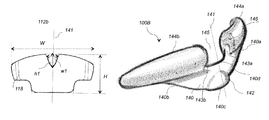
Referring to FIG. 8 and FIG. 9 , device 100B for treating nosebleeds includes a semi-rigid elongated body 140 that symmetrically curves inward from the midline 141 to the left and right sides 140 a, 140 b of the device. Elongated body 140 has a dome-shaped structure 142 formed at the middle bottom end 140 c of body 140. Dome-shaped structure 142 is convex in FIG. 8 and concave in FIG. 9 . Dome-shaped structure 142 provides a push surface for placing a user's tongue or finger and pushing the device upward in order to provide pressure to the nose. The top end 140 d of body 140 includes a U-shaped cut 145 and left and right top ends 143 a, 143 b. U-shaped cut 145 is shaped and dimensioned to fit around the user's frenulum, so that it does not interfere with the frenulum. Left and right top ends 143 a, 143 b are covered with left and right conical structures 144 a, 144 b, respectively. Left and right conical structures 144 a, 144 b have oval shaped cross-sections 146 and extend from the inner sides of the top ends 143 a, 143 b respectively, and end beyond the left and right sides 140 a, 140 b of the elongated body 140, respectively. Conical structures 144 a, 144 b are sized to conform and fit behind the user's upper lip and in front of the user's upper gums. Semi-rigid elongated body 140 is made of silicone, latex, rigid and flexible polypropylene, cotton gauze, or some form of cotton or pressed paper molds. Left and right structures 144 a, 144 b are made of soft, flexible or porous material including silicone, latex, porous gauze, porous cotton, or porous pressed paper molds, among others.
Referring to FIG. 10 , device 100C for treating nosebleeds includes a semi-rigid body 150 having a backwards extending bite tab 156, left and right portions 152 a, 152 b extending upwards from the top surface of the body 150 and forming a V-shaped structure with a central gap 155. Bite tab 156 extends backwards straight and terminates in a rounded end portion 156 a. Device 100C also includes left and right conical structures 154 a, 154 b extending horizontally and being attached to the top ends of the left and right portions 153 a, 153 b, respectively. Device 100A is shaped and dimensioned to be inserted into the buccal cavity of a user's 50 mouth and the conical structures 154 a, 154 b are sized to conform and fit behind the user's upper lip and in front of the user's upper gums, as shown in FIG. 1A . The body 150 is shaped and dimensioned to be positioned in front of the user's upper front teeth and the bite tab 156 is shaped and dimensioned to provide a biting surface for the user's front teeth. Left and right conical structures 154 a, 154 b extend horizontally from the inner sides of the top ends of the left and right portions 153 a, 153 b, respectively, and end beyond the left and right ends of the bite tab 156. Left and right conical structures 154 a, 154 b have circular cross-sections 158. Semi-rigid body 150 is made of silicone, latex, rigid and flexible polypropylene, cotton gauze, or some form of cotton or pressed paper molds. Left and right structures 154 a, 154 b are made of soft, flexible or porous material including silicone, latex, porous gauze, porous cotton, or porous pressed paper molds, among others. Gap 155 is shaped and dimensioned to fit around the user's frenulum, so that it does not interfere with the frenulum, which is located at the sagittal plane and top of the gum line.
Referring to FIG. 11 , device 100D for treating nosebleeds includes a semi-rigid body 160 having a backwards extending bite tab 166, left and right portions 162 a, 162 b extending upwards from the top surface of the body 160 and forming a V-shaped structure with a central gap 165. Bite tab 166 has a flat top surface 166 a and curved front 166 c and back 166 d edges. Edges 166 c, 166 d are curved to follow the alignment of the top teeth. Device 100D also includes left and right oval structures 164 a, 164 b extending horizontally and being attached to the top ends of the left and right portions 162 a, 162 b, respectively. Device 100D is shaped and dimensioned to be inserted into the buccal cavity of a user's 50 mouth and the oval structures 164 a, 164 b are sized to conform and fit behind the user's upper lip and in front of the user's upper gums, as shown in FIG. 1A . The body 160 is shaped and dimensioned to be positioned in front of the user's upper front teeth and the bite tab 166 is shaped and dimensioned to provide a biting surface for the user's front teeth. Left and right oval structures 164 a, 164 b extend horizontally from the inner sides of the top ends of the left and right portions 162 a, 162 b, respectively, and end beyond the left and right ends of the bite tab 166. Left and right oval structures 164 a, 164 b have circular cross-sections. Semi-rigid body 160 is made of silicone, latex, rigid and flexible polypropylene, cotton gauze, or some form of cotton or pressed paper molds. Left and right oval structures 164 a, 164 b are made of soft, flexible or porous material including silicone, latex, porous gauze, porous cotton, or porous pressed paper molds, among others. Gap 165 is shaped and dimensioned to fit around the user's frenulum, so that it does not interfere with the frenulum, which is located at the sagittal plane and top of the gum line.
Referring to FIG. 12 , device 100E for treating nosebleeds includes a semi-rigid body 170 having a backwards extending bite tab 176, left and right portions 172 a, 172 b extending upwards from the top surface of the body 170 and forming a U-shaped structure with a central gap 175. Bite tab 176 has a flat top surface 176 a and the back edge 176 b is curved upwards by 90 degrees relative to the top surface 176 a, forming a J-hook that is configured to wrap around the user's top front teeth. Edge 176 b extends upwards above the top surface 176 a by a height in the range of ⅛ to ¼ inch. Device 100E also includes left and right oval structures 174 a, 174 b extending horizontally and being attached to the top ends of the left and right portions 172 a, 172 b, respectively. Device 100E is shaped and dimensioned to be inserted into the buccal cavity of a user's 50 mouth and the oval structures 174 a, 174 b are sized to conform and fit behind the user's upper lip and in front of the user's upper gums, as shown in FIG. 1A . The body 170 is shaped and dimensioned to be positioned in front of the user's upper front teeth and the bite tab 176 is shaped and dimensioned to provide a biting surface for the user's upper front teeth. Left and right oval structures 174 a, 174 b extend horizontally from the inner sides of the top ends of the left and right portions 172 a, 172 b, respectively, and end beyond the left and right ends of the bite tab 176. Left and right oval structures 174 a, 174 b have circular cross-sections. Semi-rigid elongated body 170 is made of silicone, latex, rigid and flexible polypropylene, cotton gauze, or some form of cotton or pressed paper molds. Left and right oval structures 174 a, 174 b are made of soft, flexible or porous material including silicone, latex, porous gauze, porous cotton, or porous pressed paper molds, among others. Gap 175 is shaped and dimensioned to fit around the user's frenulum, so that it does not interfere with the frenulum, which is located at the sagittal plane and top of the gum line.
Several embodiments of the present invention have been described. Nevertheless, it will be understood that various modifications may be made without departing from the spirit and scope of the invention. Accordingly, other embodiments are within the scope of the following claims.
Claims (20)
1. A device for treating nosebleeds comprising:
a mouth insert comprising a horizontally extending elongated portion, a center portion extending downward from a bottom surface of the elongated portion and a bite tab extending backward from the center portion, wherein the center portion comprises a narrower width than the horizontally extending elongated portion;
wherein the elongated portion is shaped and dimensioned to be inserted into a buccal cavity of a user's mouth and to fit behind an upper lip of the user and in front of upper gums of the user;
wherein the center portion is shaped and dimensioned to be positioned only in front of upper front teeth of the user within the buccal cavity and the bite tab is shaped and dimensioned to provide a biting surface only for front teeth of the user; and
wherein biting down onto the bite tab pushes the elongated portion upward and applies pressure upward to the user's buccal cavity and towards an anterior portion of a nose of the user.
2. The device of claim 1 , wherein the center portion and the bite tab form a structure that wraps around the user's upper front teeth and comprises a J-hook shape.
3. The device of claim 1 , wherein the bite tab is formed above a bottom end of the center portion and comprises a semi-circled notch at a bottom surface of the bite tab that extends from left to right sides of the bite tab and wherein the semi-circled notch is shaped and dimensioned to provide a biting surface area for the user's bottom teeth.
4. The device of claim 1 , wherein the elongated portion comprises a circular cross-section.
5. The device of claim 1 , wherein the elongated portion comprises a V-shaped gap dimensioned to fit around a frenulum of the user.
6. The device of claim 5 , wherein the elongated portion comprises left and right components arranged to left and right sides of the V-shaped gap.
7. The device of claim 6 , wherein the left and right components of the elongated portion comprise cylindrical shapes.
8. The device of claim 6 , wherein the left and right components of the elongated portion comprise conical shapes.
9. The device of claim 6 , wherein the left and right components of the elongated portion comprise oval shapes.
10. The device of claim 6 , wherein the left and right components of the elongated portion comprise soft, flexible or porous materials.
11. The device of claim 1 , wherein the center portion comprises a width smaller than a width of the elongated portion.
12. The device of claim 1 , wherein the center portion comprises a width equal to a width of the elongated portion.
13. The device of claim 1 , wherein the elongated portion and the center portion are curved backwards and have a curvature radius that matches an upper gum line radius of the user.
14. The device of claim 1 , wherein the elongated portion comprises an adjustable width.
15. The device of claim 14 , wherein the elongated portion comprises cut-away features on left and right sides of the elongated portion and wherein the cut-away features are designed to tear off and thereby to reduce the width of the device.
16. The device of claim 14 , wherein the elongated portion comprises foldable extensions on left and right sides of the elongated portion and wherein the foldable extensions are designed to unfold and thereby to increase the width of the device.
17. The device of claim 1 , wherein the mouth insert is made of semi-rigid materials comprising one of silicone, latex, rigid or flexible polypropylene, cotton gauze, other forms of cotton, or pressed paper mold.
18. The device of claim 1 , wherein a top surface of the elongated portion is covered with an inverted U-shaped component and wherein the U-shaped component comprises one of soft, flexible or porous materials.
19. The device of claim 1 , wherein the center portion comprises one or more openings configured to add flexibility to the device.
20. A method for treating nosebleeds comprising:
providing a mouth insert comprising a horizontally extending elongated portion, a center portion extending downward from a bottom surface of the elongated portion and a bite tab extending backward from the center portion, wherein the center portion comprises a narrower width than the horizontally extending elongated portion, wherein the elongated portion is shaped and dimensioned to be inserted into a buccal cavity of a user's mouth and to fit behind an upper lip of the user and in front of upper gums of the user, and wherein the center portion is shaped and dimensioned to be positioned only in front of upper front teeth of the user within the buccal cavity and the bite tab is shaped and dimensioned to provide a biting surface on y for the user's front teeth;
inserting the mouth insert into a buccal cavity of a user's mouth;
biting down onto the bite tab thereby pushing the elongated portion upward and applying pressure upward to the user's buccal cavity and towards an anterior portion of a nose of the user.
Priority Applications (2)
| Application Number | Priority Date | Filing Date | Title |
|---|---|---|---|
| US15/146,609 US10206684B2 (en) | 2015-05-07 | 2016-05-04 | Device and method for treating nosebleeds |
| US16/242,213 US10925608B2 (en) | 2015-05-07 | 2019-01-08 | Device and method for treating nosebleeds |
Applications Claiming Priority (2)
| Application Number | Priority Date | Filing Date | Title |
|---|---|---|---|
| US201562158197P | 2015-05-07 | 2015-05-07 | |
| US15/146,609 US10206684B2 (en) | 2015-05-07 | 2016-05-04 | Device and method for treating nosebleeds |
Related Child Applications (1)
| Application Number | Title | Priority Date | Filing Date |
|---|---|---|---|
| US16/242,213 Continuation US10925608B2 (en) | 2015-05-07 | 2019-01-08 | Device and method for treating nosebleeds |
Publications (2)
| Publication Number | Publication Date |
|---|---|
| US20160324526A1 US20160324526A1 (en) | 2016-11-10 |
| US10206684B2 true US10206684B2 (en) | 2019-02-19 |
Family
ID=57221686
Family Applications (2)
| Application Number | Title | Priority Date | Filing Date |
|---|---|---|---|
| US15/146,609 Active 2036-12-09 US10206684B2 (en) | 2015-05-07 | 2016-05-04 | Device and method for treating nosebleeds |
| US16/242,213 Active 2036-08-12 US10925608B2 (en) | 2015-05-07 | 2019-01-08 | Device and method for treating nosebleeds |
Family Applications After (1)
| Application Number | Title | Priority Date | Filing Date |
|---|---|---|---|
| US16/242,213 Active 2036-08-12 US10925608B2 (en) | 2015-05-07 | 2019-01-08 | Device and method for treating nosebleeds |
Country Status (1)
| Country | Link |
|---|---|
| US (2) | US10206684B2 (en) |
Cited By (2)
| Publication number | Priority date | Publication date | Assignee | Title |
|---|---|---|---|---|
| US20190133589A1 (en) * | 2015-05-07 | 2019-05-09 | Matthew James Ibarra | Device and method for treating nosebleeds |
| US11707291B2 (en) | 2021-10-25 | 2023-07-25 | Jmk50, Llc | Devices and methods for treating epistaxis |
Families Citing this family (1)
| Publication number | Priority date | Publication date | Assignee | Title |
|---|---|---|---|---|
| US11969170B2 (en) * | 2021-04-05 | 2024-04-30 | Asher Anderson | Devices and methods for the treatment of epistaxis and for aesthetic medicine |
Citations (10)
| Publication number | Priority date | Publication date | Assignee | Title |
|---|---|---|---|---|
| US4337765A (en) | 1980-11-26 | 1982-07-06 | Zimmerman Edgar S | Mouthguard |
| US5601093A (en) * | 1996-04-01 | 1997-02-11 | Sheehan; David V. | Snore-inhibiting device |
| US20040194788A1 (en) | 2003-04-02 | 2004-10-07 | Sweet Carl Scott | Nose bleed treatment device and method |
| US20060237020A1 (en) * | 2005-04-25 | 2006-10-26 | D'magination Licensing And Servicing Company, Llc | Mouth guard |
| US20080193897A1 (en) | 2004-09-16 | 2008-08-14 | Showa Yakuhin Kako Co., Ltd. | Mouthpiece for Flattening Wrinkles |
| US20090165805A1 (en) * | 2007-12-30 | 2009-07-02 | Oral Technology, Llc | Mouth Guard |
| US20120085354A1 (en) * | 2010-05-17 | 2012-04-12 | Polk Iii Louis F | Mouthguard with linear storage configuration |
| US20130048532A1 (en) | 2002-08-30 | 2013-02-28 | Amy Diane Rix | Nosebleed lip pack |
| US20130298917A1 (en) | 2010-11-19 | 2013-11-14 | Universite Victor Segalen - Bordeaux 2 | Air-permeable adaptable mouthguard having clamped jaws |
| US20140261465A1 (en) | 2013-03-14 | 2014-09-18 | Shock Doctor Inc. | Mouthguard system for protecting soft tissue |
Family Cites Families (2)
| Publication number | Priority date | Publication date | Assignee | Title |
|---|---|---|---|---|
| US10206684B2 (en) * | 2015-05-07 | 2019-02-19 | Matthew James Ibarra | Device and method for treating nosebleeds |
| US10010313B2 (en) * | 2015-05-18 | 2018-07-03 | Richard L. Arden | Mandibular subluxation device and method |
-
2016
- 2016-05-04 US US15/146,609 patent/US10206684B2/en active Active
-
2019
- 2019-01-08 US US16/242,213 patent/US10925608B2/en active Active
Patent Citations (10)
| Publication number | Priority date | Publication date | Assignee | Title |
|---|---|---|---|---|
| US4337765A (en) | 1980-11-26 | 1982-07-06 | Zimmerman Edgar S | Mouthguard |
| US5601093A (en) * | 1996-04-01 | 1997-02-11 | Sheehan; David V. | Snore-inhibiting device |
| US20130048532A1 (en) | 2002-08-30 | 2013-02-28 | Amy Diane Rix | Nosebleed lip pack |
| US20040194788A1 (en) | 2003-04-02 | 2004-10-07 | Sweet Carl Scott | Nose bleed treatment device and method |
| US20080193897A1 (en) | 2004-09-16 | 2008-08-14 | Showa Yakuhin Kako Co., Ltd. | Mouthpiece for Flattening Wrinkles |
| US20060237020A1 (en) * | 2005-04-25 | 2006-10-26 | D'magination Licensing And Servicing Company, Llc | Mouth guard |
| US20090165805A1 (en) * | 2007-12-30 | 2009-07-02 | Oral Technology, Llc | Mouth Guard |
| US20120085354A1 (en) * | 2010-05-17 | 2012-04-12 | Polk Iii Louis F | Mouthguard with linear storage configuration |
| US20130298917A1 (en) | 2010-11-19 | 2013-11-14 | Universite Victor Segalen - Bordeaux 2 | Air-permeable adaptable mouthguard having clamped jaws |
| US20140261465A1 (en) | 2013-03-14 | 2014-09-18 | Shock Doctor Inc. | Mouthguard system for protecting soft tissue |
Cited By (5)
| Publication number | Priority date | Publication date | Assignee | Title |
|---|---|---|---|---|
| US20190133589A1 (en) * | 2015-05-07 | 2019-05-09 | Matthew James Ibarra | Device and method for treating nosebleeds |
| US10925608B2 (en) * | 2015-05-07 | 2021-02-23 | Matthew James Ibarra | Device and method for treating nosebleeds |
| US11707291B2 (en) | 2021-10-25 | 2023-07-25 | Jmk50, Llc | Devices and methods for treating epistaxis |
| US11963690B2 (en) | 2021-10-25 | 2024-04-23 | Jmk50, Llc | Devices and methods for treating epistaxis |
| US12324599B2 (en) | 2021-10-25 | 2025-06-10 | Jmk50, Llc | Devices and methods for treating epistaxis |
Also Published As
| Publication number | Publication date |
|---|---|
| US20160324526A1 (en) | 2016-11-10 |
| US20190133589A1 (en) | 2019-05-09 |
| US10925608B2 (en) | 2021-02-23 |
Similar Documents
| Publication | Publication Date | Title |
|---|---|---|
| US5730599A (en) | Protective dental shield | |
| US10149782B2 (en) | Oral interface and method using the same | |
| US10925608B2 (en) | Device and method for treating nosebleeds | |
| US20090078276A1 (en) | Tongue retention device | |
| TW202108088A (en) | Dental mouthpiece | |
| JP2016502918A (en) | Oral device for removing air space in the oral cavity, method of operating the same, and system for removing air space in the oral cavity | |
| US9265666B2 (en) | Nosebleed lip pack | |
| JPH1142311A (en) | Mouth guard and mouth piece for protecting wound of mouth-jaw bone-face occurring particularly in sporting activity | |
| US20250318902A1 (en) | Lip And Cheek Expander | |
| KR20180116089A (en) | Apparatus For Preventing Bruxism | |
| US20180200103A1 (en) | Full breath no snore | |
| US11974765B2 (en) | Device and method for treating nosebleeds | |
| CN106163447B (en) | Dental oral shield apparatus and system | |
| US20040194788A1 (en) | Nose bleed treatment device and method | |
| US12324599B2 (en) | Devices and methods for treating epistaxis | |
| JP5728784B2 (en) | Mouthpiece | |
| CA2954040C (en) | A dental appliance and method of protecting dentition during a transoral procedure with the appliance | |
| US20160331575A1 (en) | Device for facilitating nasal breathing for snorers | |
| JP3114350U (en) | Nasal fixture | |
| US20240374438A1 (en) | Subdividable dental absorbent block | |
| KR102704254B1 (en) | Sleeping mouthpiece | |
| KR102238417B1 (en) | Mouthpiece | |
| CN212089802U (en) | Shell-like dental instrument | |
| WO2009156802A1 (en) | Flexible snore prevention device | |
| WO2026050449A1 (en) | An oral device for active component delivery |
Legal Events
| Date | Code | Title | Description |
|---|---|---|---|
| STCF | Information on status: patent grant |
Free format text: PATENTED CASE |
|
| FEPP | Fee payment procedure |
Free format text: MAINTENANCE FEE REMINDER MAILED (ORIGINAL EVENT CODE: REM.); ENTITY STATUS OF PATENT OWNER: SMALL ENTITY |
|
| FEPP | Fee payment procedure |
Free format text: SURCHARGE FOR LATE PAYMENT, SMALL ENTITY (ORIGINAL EVENT CODE: M2554); ENTITY STATUS OF PATENT OWNER: SMALL ENTITY |
|
| MAFP | Maintenance fee payment |
Free format text: PAYMENT OF MAINTENANCE FEE, 4TH YR, SMALL ENTITY (ORIGINAL EVENT CODE: M2551); ENTITY STATUS OF PATENT OWNER: SMALL ENTITY Year of fee payment: 4 |