US10201485B2 - Washing composition - Google Patents

Washing composition Download PDF

Info

Publication number
US10201485B2
US10201485B2 US15/495,259 US201715495259A US10201485B2 US 10201485 B2 US10201485 B2 US 10201485B2 US 201715495259 A US201715495259 A US 201715495259A US 10201485 B2 US10201485 B2 US 10201485B2
Authority
US
United States
Prior art keywords
washing composition
powder
foam
ability
surfactant
Prior art date
Legal status (The legal status is an assumption and is not a legal conclusion. Google has not performed a legal analysis and makes no representation as to the accuracy of the status listed.)
Expired - Fee Related, expires
Application number
US15/495,259
Other versions
US20170224599A1 (en
Inventor
Hyun Na KIM
Byung Ha Kang
Dae-Kyeong Kim
Current Assignee (The listed assignees may be inaccurate. Google has not performed a legal analysis and makes no representation or warranty as to the accuracy of the list.)
Amorepacific Corp
Original Assignee
Amorepacific Corp
Priority date (The priority date is an assumption and is not a legal conclusion. Google has not performed a legal analysis and makes no representation as to the accuracy of the date listed.)
Filing date
Publication date
Application filed by Amorepacific Corp filed Critical Amorepacific Corp
Assigned to AMOREPACIFIC CORPORATION reassignment AMOREPACIFIC CORPORATION ASSIGNMENT OF ASSIGNORS INTEREST (SEE DOCUMENT FOR DETAILS). Assignors: KANG, BYUNG HA, KIM, DAE-KYEONG, KIM, HYUN NA
Publication of US20170224599A1 publication Critical patent/US20170224599A1/en
Application granted granted Critical
Publication of US10201485B2 publication Critical patent/US10201485B2/en
Expired - Fee Related legal-status Critical Current
Adjusted expiration legal-status Critical

Links

Images

Classifications

    • AHUMAN NECESSITIES
    • A61MEDICAL OR VETERINARY SCIENCE; HYGIENE
    • A61KPREPARATIONS FOR MEDICAL, DENTAL OR TOILETRY PURPOSES
    • A61K8/00Cosmetics or similar toiletry preparations
    • A61K8/18Cosmetics or similar toiletry preparations characterised by the composition
    • A61K8/30Cosmetics or similar toiletry preparations characterised by the composition containing organic compounds
    • A61K8/40Cosmetics or similar toiletry preparations characterised by the composition containing organic compounds containing nitrogen
    • A61K8/41Amines
    • A61K8/416Quaternary ammonium compounds
    • AHUMAN NECESSITIES
    • A61MEDICAL OR VETERINARY SCIENCE; HYGIENE
    • A61KPREPARATIONS FOR MEDICAL, DENTAL OR TOILETRY PURPOSES
    • A61K8/00Cosmetics or similar toiletry preparations
    • A61K8/02Cosmetics or similar toiletry preparations characterised by special physical form
    • A61K8/0216Solid or semisolid forms
    • A61K8/022Powders; Compacted Powders
    • AHUMAN NECESSITIES
    • A61MEDICAL OR VETERINARY SCIENCE; HYGIENE
    • A61KPREPARATIONS FOR MEDICAL, DENTAL OR TOILETRY PURPOSES
    • A61K8/00Cosmetics or similar toiletry preparations
    • A61K8/02Cosmetics or similar toiletry preparations characterised by special physical form
    • A61K8/0241Containing particulates characterized by their shape and/or structure
    • A61K8/0254Platelets; Flakes
    • AHUMAN NECESSITIES
    • A61MEDICAL OR VETERINARY SCIENCE; HYGIENE
    • A61KPREPARATIONS FOR MEDICAL, DENTAL OR TOILETRY PURPOSES
    • A61K8/00Cosmetics or similar toiletry preparations
    • A61K8/02Cosmetics or similar toiletry preparations characterised by special physical form
    • A61K8/04Dispersions; Emulsions
    • A61K8/046Aerosols; Foams
    • AHUMAN NECESSITIES
    • A61MEDICAL OR VETERINARY SCIENCE; HYGIENE
    • A61KPREPARATIONS FOR MEDICAL, DENTAL OR TOILETRY PURPOSES
    • A61K8/00Cosmetics or similar toiletry preparations
    • A61K8/18Cosmetics or similar toiletry preparations characterised by the composition
    • A61K8/19Cosmetics or similar toiletry preparations characterised by the composition containing inorganic ingredients
    • A61K8/24Phosphorous; Compounds thereof
    • AHUMAN NECESSITIES
    • A61MEDICAL OR VETERINARY SCIENCE; HYGIENE
    • A61KPREPARATIONS FOR MEDICAL, DENTAL OR TOILETRY PURPOSES
    • A61K8/00Cosmetics or similar toiletry preparations
    • A61K8/18Cosmetics or similar toiletry preparations characterised by the composition
    • A61K8/19Cosmetics or similar toiletry preparations characterised by the composition containing inorganic ingredients
    • A61K8/26Aluminium; Compounds thereof
    • AHUMAN NECESSITIES
    • A61MEDICAL OR VETERINARY SCIENCE; HYGIENE
    • A61QSPECIFIC USE OF COSMETICS OR SIMILAR TOILETRY PREPARATIONS
    • A61Q19/00Preparations for care of the skin
    • A61Q19/10Washing or bathing preparations
    • AHUMAN NECESSITIES
    • A61MEDICAL OR VETERINARY SCIENCE; HYGIENE
    • A61QSPECIFIC USE OF COSMETICS OR SIMILAR TOILETRY PREPARATIONS
    • A61Q5/00Preparations for care of the hair
    • A61Q5/02Preparations for cleaning the hair
    • CCHEMISTRY; METALLURGY
    • C11ANIMAL OR VEGETABLE OILS, FATS, FATTY SUBSTANCES OR WAXES; FATTY ACIDS THEREFROM; DETERGENTS; CANDLES
    • C11DDETERGENT COMPOSITIONS; USE OF SINGLE SUBSTANCES AS DETERGENTS; SOAP OR SOAP-MAKING; RESIN SOAPS; RECOVERY OF GLYCEROL
    • C11D3/00Other compounding ingredients of detergent compositions covered in group C11D1/00
    • C11D3/02Inorganic compounds ; Elemental compounds
    • C11D3/12Water-insoluble compounds
    • C11D3/124Silicon containing, e.g. silica, silex, quartz or glass beads
    • C11D3/1246Silicates, e.g. diatomaceous earth
    • C11D3/1253Layer silicates, e.g. talcum, kaolin, clay, bentonite, smectite, montmorillonite, hectorite or attapulgite
    • AHUMAN NECESSITIES
    • A61MEDICAL OR VETERINARY SCIENCE; HYGIENE
    • A61KPREPARATIONS FOR MEDICAL, DENTAL OR TOILETRY PURPOSES
    • A61K2800/00Properties of cosmetic compositions or active ingredients thereof or formulation aids used therein and process related aspects
    • A61K2800/20Chemical, physico-chemical or functional or structural properties of the composition as a whole
    • A61K2800/30Characterized by the absence of a particular group of ingredients
    • A61K2800/31Anhydrous
    • AHUMAN NECESSITIES
    • A61MEDICAL OR VETERINARY SCIENCE; HYGIENE
    • A61KPREPARATIONS FOR MEDICAL, DENTAL OR TOILETRY PURPOSES
    • A61K2800/00Properties of cosmetic compositions or active ingredients thereof or formulation aids used therein and process related aspects
    • A61K2800/40Chemical, physico-chemical or functional or structural properties of particular ingredients
    • A61K2800/41Particular ingredients further characterized by their size
    • A61K2800/412Microsized, i.e. having sizes between 0.1 and 100 microns
    • AHUMAN NECESSITIES
    • A61MEDICAL OR VETERINARY SCIENCE; HYGIENE
    • A61KPREPARATIONS FOR MEDICAL, DENTAL OR TOILETRY PURPOSES
    • A61K2800/00Properties of cosmetic compositions or active ingredients thereof or formulation aids used therein and process related aspects
    • A61K2800/40Chemical, physico-chemical or functional or structural properties of particular ingredients
    • A61K2800/60Particulates further characterized by their structure or composition
    • A61K2800/61Surface treated
    • A61K2800/612By organic compounds

Definitions

  • the present invention relates to a washing composition comprising a powder of which surface is hydrophobic. More specifically, the present invention relates to a washing composition improved in foaming ability, which comprises a powder in which an alkyl group of a surfactant attached to the surface thereof is oriented towards an outermost shell, thereby the surface of the powder being hydrophobically modified.
  • a hair cleanser The biggest purpose of a hair cleanser is to maintain the cleanliness of scalp and hair by removing a waste, for example, sebum and to control the condition of scalp.
  • the waste adsorbed on the scalp is acidified to proliferate bacteria, thereby causing unpleasant smell and itch.
  • a hair cleanser of which main ingredient is an anionic surfactant is generally used.
  • the anionic surfactant is penetrated between the waste and the hair on the scalp, whereby the adsorptive power of waste is weakened and may be easily washed.
  • the surfactant which is the main ingredient of hair cleanser is generally anionic.
  • the anionic surfactant plays a role as a primary surfactant and imparts a shampoo with such basic functions as detergency and foaming ability.
  • the secondary surfactant is a co-surfactant and used for the purpose of improving durability and stability of bubbles and maintaining viscosity.
  • the anionic surfactant may cause irritation to the scalp.
  • the continuous and repeated washing by the anionic surfactant may interfere the normal metabolism of the scalp to cause various scalp disorders.
  • Eco-friendly sugars and amino acid compounds have been developed to complement these problems. The amino acids occurring naturally in large quantities are studied in various fields according to the well-being trend in these days as a new alternative resource. Also, the raw material industry has continued effort to develop a surfactant that gives less irritation to the skin as possible or is skin-friendly.
  • Korean Patent Laid-open Publication No. 10-2011-0102415 discloses a hair detergent composition containing a sebum-absorbent, and describes the possibility of use of a powder as a sebum-absorbent.
  • this is used for the effects of sebum-adsorption from the hair, removal of dead skin cell, etc., which are resulted from the oil-absorption capacity of the powder itself.
  • the effect of improving the foaming ability depending on the particle size or surface characteristics of a certain powder has been neither realized in a product nor found in any prior literature.
  • Typical detergents contain the anionic surfactant in the amount of about 14-20% by weight for detergency and foaming ability.
  • the anionic surfactant is one of the skin irritants, and thus it tends to increase the skin irritation when it remains on, or is exposed to, the skin for a prolonged period of time. Accordingly, recently, there are attempts to reduce the amount of anionic surfactant, but the reduction of foaming ability becomes the greatest limitation in such attempts.
  • the present invention has been made in order to solve the above problems and provides a washing composition comprising an anionic surfactant in the low amount of 13% by weight or less, but also comprising a powder of which surface is hydrophobically modified for reinforcing the foaming ability declined due to the reduced amount of the anionic surfactant.
  • the powder of which surface is hydrophobically modified has the particle size of 0.1 to 10 ⁇ m and is contained in the amount of 0.1 to 5% by weight based on the total weight of the washing composition.
  • the powder contained in the washing composition of the present invention has the form that a surfactant for modifying the surface is attached to the hydrophilic moiety hydroxy group (—OH) of the powder.
  • the alkyl group (C5-C24) of the surfactant for modifying the surface is oriented towards an outermost shell.
  • the composition may also additionally contain a co-surfactant to compensate for the low content of anionic surfactant.
  • washing composition which comprises a powder of which surface is hydrophobically modified is applied, it is possible to prepare a detergent having excellent detergency and foaming ability while minimizing skin irritation by lowering the content of anionic surfactant.
  • FIG. 1 is a diagram illustrating the principle of surface modification of the powder used in the washing composition of the present invention.
  • FIG. 2 compares the washing compositions of Examples 1 to 4 of the present invention before shaking.
  • FIG. 3 compares the washing compositions of Examples 1 to 4 of the present invention right after the shaking.
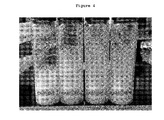
  • FIG. 4 compares the washing compositions of Examples 1 to 4 of the present invention after standing for 10 minutes from the shaking.
  • FIG. 5 is an image of the foam tester (SITA foam tester R-2000, Manufacturer: SITA Messtechnik GmbH) used for measuring the foam volumes of Example 3 of the present invention and Comparative Example 1.
  • FIG. 6 is a graph showing the data of foam volumes of Example 3 of the present invention and Comparative Example 1 depending on stirring count.
  • the present invention relates to a washing composition
  • a washing composition comprising a powder of which surface is hydrophobically modified.
  • the relatively hydrophobic air (gas phase) is emulsified in water (liquid phase) by the surfactant contained in the composition to produce a foam, wherein the foam, an emulsified particle, can be stabilized when the powder is stably arranged on the interfacial film.
  • the above effect comes from the effect of pickering stabilization of the powder.
  • the pickering technique means a technique which stabilizes two different phases using a powder, and is well known as a concept of pickering emulsion.
  • the powder arrangement on the interfacial (liquid/gas) film may be expected to be different depending on the surface charge properties and the particle size of the powder.
  • the washing composition of the present invention comprises a powder of which surface is hydrophobically modified for the purpose of reinforcing the foaming ability and the foam retaining ability declined due to the reduced amount of anionic surfactant.
  • the powder has the form that a surfactant for modifying the surface is attached to the hydrophilic moiety hydroxy group (—OH) on the surface of the powder as depicted in FIG. 1 . It is characterized by having a hydrophobic surface since an alkyl group of the surfactant attached as above is oriented towards an outermost shell. At this time, it is possible to enhance the efficiency of surface modification by replacing the hydrophilic moiety hydroxy group (—OH) of the powder with phosphate group (—PO 4 ), pyrophosphate group (—P 2 O 7 ), or phosphite group (—OPO 2 H 2 ) to widen the surface area. It may be also possible to impart hydrophobicity to the surface by orienting the alkyl group at the end of the surfactant for modifying the surface towards an outermost shell.
  • the powder capable of being used in the present invention may be selected from, for example, kaolin, silica, talc, mica, and alumina, and preferably is kaolin.
  • Kaolin is generally called China clay or porcelain clay, which is obtained from decomposition of feldspar by weathering and is widely distributed on earth's crust. Its composition may be largely different depending on the ore deposit.
  • kaolin comprises silica, mica, and other clay minerals, in particular unweathered feldspar, as the secondary mineral component besides the main minerals kaolinite and halloysite. All the kaolin minerals have the chemical formula Al 2 Si 2 O 5 (OH) 4 (kaolinite) or Al 2 O 3 .2SiO 2 .2H 2 O (halloysite), but their crystal structures are different from each other.
  • the inorganic materials, silica, alumina, magnesium, organic composite materials, germanium, far-infrared radiation, etc. extracted from kaolin are known to advantageously act to the human body thereby providing remarkable effect to the skin care. It also has the effects of odor adsorption, deodorization, etc. and thus widely utilized as a raw material for cosmetics such as powder, mask pack, etc. Furthermore, since it is a white soft powder, absorbs moisture and oil, and has good covering ability, it is suitably used as a cleanser for absorbing the sweat and oil secreted from the skin.
  • the powder of which surface is hydrophobically modified has the particle size of most preferably 0.1 to 10 ⁇ m.
  • the particle size of less than 0.1 ⁇ m has little effect in the foam stabilization and that of exceeding 10 ⁇ m may cause the powder to be remained in the scalp and hair to negatively affect the skin feeling.
  • the powder of which surface is hydrophobically modified is preferably contained in the amount of 0.1 to 5% by weight based on the total weight of the washing composition.
  • the content of less than 0.1% by weight results the insufficient foam stabilization effect of the powder, whereby enhancement of foaming ability and foam retaining ability may not be expected.
  • the content of exceeding 5% by weight may deteriorate the skin feeling due to the unique stiffness of powder when it is used.
  • the surfactant for modifying the surface of powder becomes hydrophobic by the alkyl group, which appropriately has the carbon number of C5 to C24, and preferably it reacts with the hydrophilic group of the powder. It may be one or more selected from the group consisting of cetrimonium chloride (CTAC), cetrimonium bromide, steartrimonium chloride and behentrimonium chloride. More preferably, cetrimonium chloride (CTAC) having the following formula 1 is used:
  • the washing composition of the present invention has the purpose of reducing the amount of anionic surfactant used to alleviate the irritation to the scalp or hair.
  • the anionic surfactant may be contained in the amount of 13% by weight or less, preferably 3 to 13% by weight based on the total weight of the washing composition. The content of less than 3% by weight may deteriorate detergency and that of exceeding 13% by weight may irritate the skin.
  • the anionic surfactant has excellent detergency, penetration force, dispersibility, and emulsifying capacity, and it is ionized in water so that its hydrophilic moiety becomes negative ( ⁇ ) ion.
  • it includes the three types of acids, i.e., carboxylic acid (—COOH), sulfuric acid ester (—OSO 3 H), and sulfonic acid (—SO 3 H), most of which are used as a soluble salt.
  • the washing composition of the present invention may additionally comprise a non-ionic surfactant for the purpose of reinforcing the detergency on the scalp or hair deteriorated due to the reduced amount of anionic surfactant and at the same time minimizing the total content of surfactant. It is possible to be contained in the amount of 8% by weight or less, preferably 1 to 8% by weight based on the total weight of the washing composition. If the non-ionic surfactant is contained in the amount of less than 1% by weight, the effect of reinforcing detergency may be trivial. On the contrary, if the content exceeds 8% by weight, it may irritate the scalp.
  • the non-ionic surfactant has the hydrophilic moiety formed through the hydrogen bond between hydroxy group (—OH) or ethylene oxide group (—OCH 2 CH 2 ) and water instead of the hydrophilic moiety formed by ionization. It is a surfactant used in the area of emulsifier, anti-static agent, or penetrating agent. It is usually in the liquid phase and dissolved in water to be neutral. Such a non-ionic surfactant has the strong power of emulsifying water and oil and thus generally used as an emulsifier for a cream such as a treatment. It is relatively stable to the skin and thus used in most cosmetics.
  • non-ionic surfactant those known in the art may be used.
  • one or more selected from the group consisting of alcohol ethoxylates, amide ethoxylates, amine oxides, alkyl glucosides, and mixtures thereof, preferably cocamide methyl MEA may be used.
  • the washing composition of the present invention applies the non-ionic surfactant for assisting the function of anionic surfactant.
  • non-ionic surfactant for assisting the function of anionic surfactant.
  • other combinations for example, with a cationic surfactant or with an amphoteric surfactant
  • the cationic surfactant a quarternary ammonium and a tertiary amidoamine may be used alone or as a mixture.
  • quarternary ammoniums such as behenyl trimethyl ammonium chloride, cetyl trimethyl ammonium chloride, stearyl trimethyl ammonium chloride, distearyl dimethyl ammonium chloride, etc.
  • tertiary aminoamines such as cocamido propyl dimethyl amine, stearamido propyl dimethyl amine, behenamido propyl dimethyl amine, oleamido propyl dimethyl amine, isostearamido propyl dimethyl amine, etc.
  • amphoteric surfactant it is possible to use alkyl betaines, amide betaines, sulfobetaines, hydroxysulfobetaines, amidosulfobetaines, phosphobetaines, imidazolinium betaines, aminopropionic acids, amino acids, and mixtures thereof.
  • cationic and/or amphoteric surfactant in the amount range of reinforcing the detergency at the level of no irritation to the skin, but which is not limited in the present invention.
  • Preparation Examples 1 to 4 are hair cleansers individually comprising four (4) types of commercially available powders which differ in particle size and surface property (hydrophobic/hydrophilic) from each other.
  • Examples 1 to 4 correspond to Preparation Examples 1 to 4, respectively, whose foaming ability, foam retaining ability, antifoaming ability and hair softness during rinsing were evaluated through predetermined tests.
  • Table 1 summarizes the physical properties of four types of powders (Powder 1 ⁇ 4) which were applied to the present invention.
  • Table 2 represents the ingredients and contents thereof (% by weight) in the hair cleansers of Preparation Examples 1 to 4 to which each powder was applied.
  • Preparation Example 1 shown in Table 2 used Aerosil R202 (Trade name, Manufacturer: Evonik Industries) as the powder. Referring to Table 1, this is silica which is hydrophobically modified by arranging dimethicone on its surface and has the average particle size of about 14 nm.
  • Preparation Example 2 used Aerosil 200 (Trade name, Manufacturer: Evonik Industries) as the powder. Referring to Table 1, this is silica of which surface is hydrophilic and has the average particle size of about 12 nm.
  • Preparation Example 3 used Hydro dry (K) (Trade name, Manufacturer: Sunjin Beauty Science Co., Ltd.) as the powder.
  • K Hydro dry
  • this is kaolin of which surface is hydrophobically modified by the surfactant cetrimonium chloride, and has the average particle size of about 1 ⁇ 7 ⁇ m.
  • tetrasodium pyrophosphate Na 4 P 2 O 7 was used for maximizing the effect of surface modification by widening the surface area of hydrophilic moiety of the kaolin powder particle.
  • Preparation Example 4 used Colloidal Kaolin-BC Grade 2457 (Trade name, Manufacturer: Brenntag Specialties) as the powder. Referring to Table 1, this is kaolin of which surface is hydrophilic and has the average particle size of about 10-20 ⁇ m.
  • the cationic polymer Guar Hydroxypropyltrimonium Chloride was Guarquat L80KC (Trade name, Manufacturer: KCI)
  • the anionic surfactant Sodium Laureth Sulfate Sodium Laureth (2E0) Sulfate; SLES
  • miceolin ES270 Traffic Laureth (Trade name, Manufacturer: Miwon Chemicals)
  • Cocamide Methyl MEA was Micopol CMM (Trade name, Manufacturer: Miwon Chemicals), but they are not limited thereto.
  • the chelating agent was disodium EDTA
  • the preservative was Phenoxyethanol, Methylchloroisothiazolinone and Methylisothiazolinone
  • the thickener was Sodium Chloride, and some fragrance was added. But, these are optional ingredients, and there is no limit in the additional use of any optional ingredient.
  • the amount of anionic surfactant was fixed to 8.5% by weight based on the total amount of washing composition to obtain a washing composition having a low content of anionic surfactant, thereby minimizing the irritation to the scalp and hair.
  • the non-ionic surfactant was subsidiarily used in the amount of 5.5% by weight to secure the detergency.
  • the foaming ability was tested herein as follows: Each of the washing compositions of Preparation Examples 1 to 4 was diluted to the concentration of 5% in 100 mL of aqueous solution at 25° C. 1 g of artificial sebum was added thereto and mixed for 1 minute under 300 rpm of magnetic stirrer during which the foam generation was minimized. 10 mL thereof was introduced to a 60 mL glass vial having a diameter of 30 mm and shaken 20 times in a shaking incubator rotating 180 degrees per second. The foaming ability was defined as the height (mm) of the foam which was formed right after the shaking.
  • the foam retaining ability was defined herein as the height (mm) of the foam after standing for 10 minutes from the shaking.
  • Antifoaming ability(mm) Foaming ability(mm) ⁇ foam retaining ability(mm) Equation 1)
  • FIGS. 2, 3 and 4 compare and depict the foam height of the Preparation Examples 1-4 before the shaking, right after the shaking, and after standing for 10 minutes from the shaking, respectively.
  • the foam height in FIGS. 2 to 4 was obtained by measuring the vertical height from the bottom of the glass vial to the highest level of the foam produced inside the vial.
  • the foaming ability i.e., the foam height right after the shaking
  • the foaming ability was the highest in the composition of Example 3 wherein the foam reached around the bottleneck of vial.
  • the next highest foaming ability was observed in the composition of Example 4 and the composition of Example 2 in the order, and it was confirmed that the composition of Example 1 showed the lowest foaming ability, wherein the foam reached only around the middle level of the vial.
  • the foam retaining ability i.e., the level of foam retaining, after standing for 10 minutes was considerably high in Examples 3 and 4 which showed similar level of foam height to the height right after the shaking.
  • Examples 1 and 2 were confirmed to show a poor foam retaining ability since they had considerably reduced foam in comparison to that of right after the shaking.
  • the hair softness during rinsing was arithmetically calculated by selecting ten (10) professional panels, letting them use the hair cleanser prepared in Examples 1 to 4, and then performing sensory evaluation on the hair softness during rinsing under the basis of from the minimum score 1 to the maximum score 9.
  • Table 3 summarizes the test results regarding the four (4) items of foaming ability, foam retaining ability, antifoaming ability and hair softness during rinsing of the hair cleansers of Examples 1 to 4, respectively.
  • Example 3 As shown in Table 3, the composition of Example 3 showed the foaming ability and the foam retaining ability of 95 mm and 91 mm, respectively, which were higher than any of Examples 1, 2 and 4. Accordingly, it was evaluated to have low antifoaming ability of 4 mm. Also, Example 3 showed the best hair softness during rinsing of 6. Thus, it was confirmed from the above four (4) tests that Example 3 containing Hydro dry (K) manufactured by Sunjin Beauty Science Co., Ltd. was the most appropriate as a hair cleanser in terms of foaming ability, foam retaining ability, antifoaming ability and hair softness during rinsing.
  • K Hydro dry
  • Example 3 which comprises kaolin having the average particle size of about 1-7 ⁇ m, of which surface is hydrophobically modified, as the powder was evaluated to be the most desirable.
  • the hydrophilic kaolin not modified (Example 4) and the hydrophobic kaolin wherein the alkyl group is oriented on the surface by the surface modification (Example 3) cause different foaming ability and foam retaining ability, as can be seen from the results of Examples 3 and 4 of Table 3, although they have a similar particle size. Based on this result, it is assumed that the hydrophobicity produced by the alkyl group helps stabilization of foam. On the contrary, in case that a silicone group such as dimethicone is arranged on the surface of the powder to impart hydrophobicity thereto (Example 1), the antifoaming effect is rather observed.
  • the best foam-stabilizing effect is found in the powder wherein the surface is hydrophobically modified, in particular, the alkyl group is oriented on the surface. It is most preferable to use the powder having the particle size of about 0.1 ⁇ 10 ⁇ m considering the skin feeling or stability.
  • Table 4 below compares the composition of Example 3 which shows the best results in the tests as described above and that of Comparative Example 1 which does not contain a powder.
  • each of the washing compositions prepared according to Example 3 and Comparative Example 1 of Table 4 was diluted in 250 mL of aqueous solution at 25° C. to obtain the concentration of 5%. Then, stirring for 20 seconds at 800 rpm in a foam tester as depicted in FIG. 5 (SITA Foam Tester R-2000, Manufacturer: SITA Messtechnik GmbH) was carried out as one set in the process of total five (5) sets, and the foam volume thus produced was measured for each set.
  • FIG. 6 is a graph depicting the data of foam volumes of Example 3 of the present invention and Comparative Example 1 depending on stirring count (set). The foaming speed and foam stability of the cleanser may be confirmed by the slope of FIG. 6 .
  • the foam volume initially produced was about 620 mL in Example 3 and about 280 mL in Comparative Example 1, which means that Example 3 showed about 2.2 times higher volume than Comparative Example 1.
  • the initial slope was also higher in Example 3 than in Comparative Example 1.
  • the foaming speed was more excellent in Example 3 than in Comparative Example 1, and it could be seen that the foam initially produced in Example 3 was retained stably even though the stirring count (set) was increased with the time lapse.
  • the kaolin powder of the present invention of which surface was hydrophobically modified affected not only the initial foaming ability but also the foam stability of the cleanser.
  • Example 3 showed the most excellent foaming ability of 95 mm. Also, in the test for measuring the foam retaining ability which is the foam height after standing for 10 minutes, Example 3 showed the highest value of 91 mm. Thus, the antifoaming ability which is a difference between the foaming ability and the foam retaining ability was 4 mm in Example 3. It may be determined that the richer foam is developed and maintained as the foaming ability and the foam retaining ability are higher and the antifoaming ability is lower. Furthermore, in the sensory evaluation on the hair softness during rinsing, Example 3 showed the most excellent result of 6.
  • a washing composition may be determined as desirable when it shows the foaming ability of 85 mm or more, the foam retaining ability of 80 mm or more, the antifoaming ability of 6 mm or less and the hair softness during rinsing of 5 or more.
  • Example 3 showed the foam volume of about 620 mL and Comparative Example 1 showed that of about 280 mL after the first set of stirring, which means that the initial foaming speed is more excellent in Example 3.
  • Example 3 also maintained the initially formed foam volume even after the fifth set of stirring, which means the excellent foam stability.
  • Such an effect comes from the hydrophobically modified kaolin powder.
  • the kaolin powder affects the foaming speed and the foam stability.
  • the washing composition of the present invention can be applied most preferably to the hair cleanser among the external skin cleansers, but not limited thereto. It may be suitably applied to the cleansers requiring low irritation and high stability, such as for example, body wash, cleanser for pets, face wash, etc.

Landscapes

  • Life Sciences & Earth Sciences (AREA)
  • Health & Medical Sciences (AREA)
  • Public Health (AREA)
  • Animal Behavior & Ethology (AREA)
  • General Health & Medical Sciences (AREA)
  • Veterinary Medicine (AREA)
  • Birds (AREA)
  • Epidemiology (AREA)
  • Chemical & Material Sciences (AREA)
  • Inorganic Chemistry (AREA)
  • Chemical Kinetics & Catalysis (AREA)
  • Engineering & Computer Science (AREA)
  • Oil, Petroleum & Natural Gas (AREA)
  • Wood Science & Technology (AREA)
  • Organic Chemistry (AREA)
  • Dermatology (AREA)
  • Dispersion Chemistry (AREA)
  • Detergent Compositions (AREA)
  • Cosmetics (AREA)

Abstract

The present invention relates to a washing composition comprising a powder of which surface is hydrophobic, and more specifically, relates to a washing composition comprising a powder in which an alkyl group of a surfactant attached to the surface thereof is oriented towards an outermost shell, thereby the surface of the powder being hydrophobically modified.

Description

CROSS-REFERENCE TO RELATED APPLICATIONS
This application is a continuation-in-part of PCT/KR2015/002881, filed Mar. 24, 2015, which claims the benefit of Korean Patent Application No. 10-2014-0149421, filed Oct. 30, 2014, the contents of each of which are incorporated herein by reference.
FIELD OF THE INVENTION
The present invention relates to a washing composition comprising a powder of which surface is hydrophobic. More specifically, the present invention relates to a washing composition improved in foaming ability, which comprises a powder in which an alkyl group of a surfactant attached to the surface thereof is oriented towards an outermost shell, thereby the surface of the powder being hydrophobically modified.
BACKGROUND ART
The biggest purpose of a hair cleanser is to maintain the cleanliness of scalp and hair by removing a waste, for example, sebum and to control the condition of scalp. The waste adsorbed on the scalp is acidified to proliferate bacteria, thereby causing unpleasant smell and itch. In order to remove the waste, a hair cleanser of which main ingredient is an anionic surfactant is generally used. The anionic surfactant is penetrated between the waste and the hair on the scalp, whereby the adsorptive power of waste is weakened and may be easily washed.
The surfactant which is the main ingredient of hair cleanser is generally anionic. The anionic surfactant plays a role as a primary surfactant and imparts a shampoo with such basic functions as detergency and foaming ability. The secondary surfactant is a co-surfactant and used for the purpose of improving durability and stability of bubbles and maintaining viscosity.
However, the anionic surfactant may cause irritation to the scalp. Also, the continuous and repeated washing by the anionic surfactant may interfere the normal metabolism of the scalp to cause various scalp disorders. Eco-friendly sugars and amino acid compounds have been developed to complement these problems. The amino acids occurring naturally in large quantities are studied in various fields according to the well-being trend in these days as a new alternative resource. Also, the raw material industry has continued effort to develop a surfactant that gives less irritation to the skin as possible or is skin-friendly.
On the other hand, as the ingredient of a hair cleanser, the case of using a powder is extremely rare. Only, the Korean Patent Laid-open Publication No. 10-2011-0102415 discloses a hair detergent composition containing a sebum-absorbent, and describes the possibility of use of a powder as a sebum-absorbent. However, this is used for the effects of sebum-adsorption from the hair, removal of dead skin cell, etc., which are resulted from the oil-absorption capacity of the powder itself. Also, the effect of improving the foaming ability depending on the particle size or surface characteristics of a certain powder has been neither realized in a product nor found in any prior literature.
Typical detergents contain the anionic surfactant in the amount of about 14-20% by weight for detergency and foaming ability. However, the anionic surfactant is one of the skin irritants, and thus it tends to increase the skin irritation when it remains on, or is exposed to, the skin for a prolonged period of time. Accordingly, recently, there are attempts to reduce the amount of anionic surfactant, but the reduction of foaming ability becomes the greatest limitation in such attempts.
SUMMARY OF THE INVENTION
The present invention has been made in order to solve the above problems and provides a washing composition comprising an anionic surfactant in the low amount of 13% by weight or less, but also comprising a powder of which surface is hydrophobically modified for reinforcing the foaming ability declined due to the reduced amount of the anionic surfactant. The powder of which surface is hydrophobically modified has the particle size of 0.1 to 10 μm and is contained in the amount of 0.1 to 5% by weight based on the total weight of the washing composition. The powder contained in the washing composition of the present invention has the form that a surfactant for modifying the surface is attached to the hydrophilic moiety hydroxy group (—OH) of the powder. It shows the feature of hydrophobicity since the alkyl group (C5-C24) of the surfactant for modifying the surface is oriented towards an outermost shell. At this time, it is additionally possible to enhance the efficiency of surface modification by replacing the hydrophilic moiety hydroxy group (—OH) of the powder with phosphate group (—PO4), pyrophosphate group (—P2O7), or phosphite group (—OPO2H2) to widen the surface area. The composition may also additionally contain a co-surfactant to compensate for the low content of anionic surfactant.
If the presently invented washing composition which comprises a powder of which surface is hydrophobically modified is applied, it is possible to prepare a detergent having excellent detergency and foaming ability while minimizing skin irritation by lowering the content of anionic surfactant.
BRIEF DESCRIPTION OF THE DRAWINGS
FIG. 1 is a diagram illustrating the principle of surface modification of the powder used in the washing composition of the present invention.
FIG. 2 compares the washing compositions of Examples 1 to 4 of the present invention before shaking.
FIG. 3 compares the washing compositions of Examples 1 to 4 of the present invention right after the shaking.
FIG. 4 compares the washing compositions of Examples 1 to 4 of the present invention after standing for 10 minutes from the shaking.
FIG. 5 is an image of the foam tester (SITA foam tester R-2000, Manufacturer: SITA Messtechnik GmbH) used for measuring the foam volumes of Example 3 of the present invention and Comparative Example 1.
FIG. 6 is a graph showing the data of foam volumes of Example 3 of the present invention and Comparative Example 1 depending on stirring count.
DETAILED DESCRIPTION OF THE INVENTION
The present invention relates to a washing composition comprising a powder of which surface is hydrophobically modified. In the washing composition, the relatively hydrophobic air (gas phase) is emulsified in water (liquid phase) by the surfactant contained in the composition to produce a foam, wherein the foam, an emulsified particle, can be stabilized when the powder is stably arranged on the interfacial film.
The above effect comes from the effect of pickering stabilization of the powder. The pickering technique means a technique which stabilizes two different phases using a powder, and is well known as a concept of pickering emulsion. In the same way as the concept of pickering emulsion, the powder arrangement on the interfacial (liquid/gas) film may be expected to be different depending on the surface charge properties and the particle size of the powder.
Hereinafter, the main compositions that can be included in the washing composition of the present invention and their characteristics are explained.
(1) Powder of which Surface is Hydrophobically Modified
The washing composition of the present invention comprises a powder of which surface is hydrophobically modified for the purpose of reinforcing the foaming ability and the foam retaining ability declined due to the reduced amount of anionic surfactant.
In the present invention, the powder has the form that a surfactant for modifying the surface is attached to the hydrophilic moiety hydroxy group (—OH) on the surface of the powder as depicted in FIG. 1. It is characterized by having a hydrophobic surface since an alkyl group of the surfactant attached as above is oriented towards an outermost shell. At this time, it is possible to enhance the efficiency of surface modification by replacing the hydrophilic moiety hydroxy group (—OH) of the powder with phosphate group (—PO4), pyrophosphate group (—P2O7), or phosphite group (—OPO2H2) to widen the surface area. It may be also possible to impart hydrophobicity to the surface by orienting the alkyl group at the end of the surfactant for modifying the surface towards an outermost shell.
The powder capable of being used in the present invention may be selected from, for example, kaolin, silica, talc, mica, and alumina, and preferably is kaolin.
Kaolin is generally called China clay or porcelain clay, which is obtained from decomposition of feldspar by weathering and is widely distributed on earth's crust. Its composition may be largely different depending on the ore deposit. However, according to the degree of weathering of feldspar and the geological history, kaolin comprises silica, mica, and other clay minerals, in particular unweathered feldspar, as the secondary mineral component besides the main minerals kaolinite and halloysite. All the kaolin minerals have the chemical formula Al2Si2O5 (OH)4 (kaolinite) or Al2O3.2SiO2.2H2O (halloysite), but their crystal structures are different from each other. The inorganic materials, silica, alumina, magnesium, organic composite materials, germanium, far-infrared radiation, etc. extracted from kaolin are known to advantageously act to the human body thereby providing remarkable effect to the skin care. It also has the effects of odor adsorption, deodorization, etc. and thus widely utilized as a raw material for cosmetics such as powder, mask pack, etc. Furthermore, since it is a white soft powder, absorbs moisture and oil, and has good covering ability, it is suitably used as a cleanser for absorbing the sweat and oil secreted from the skin.
The powder of which surface is hydrophobically modified has the particle size of most preferably 0.1 to 10 μm. The particle size of less than 0.1 μm has little effect in the foam stabilization and that of exceeding 10 μm may cause the powder to be remained in the scalp and hair to negatively affect the skin feeling.
The powder of which surface is hydrophobically modified is preferably contained in the amount of 0.1 to 5% by weight based on the total weight of the washing composition. The content of less than 0.1% by weight results the insufficient foam stabilization effect of the powder, whereby enhancement of foaming ability and foam retaining ability may not be expected. And the content of exceeding 5% by weight may deteriorate the skin feeling due to the unique stiffness of powder when it is used.
The surfactant for modifying the surface of powder becomes hydrophobic by the alkyl group, which appropriately has the carbon number of C5 to C24, and preferably it reacts with the hydrophilic group of the powder. It may be one or more selected from the group consisting of cetrimonium chloride (CTAC), cetrimonium bromide, steartrimonium chloride and behentrimonium chloride. More preferably, cetrimonium chloride (CTAC) having the following formula 1 is used:
Figure US10201485-20190212-C00001
(2) Anionic Surfactant
The washing composition of the present invention has the purpose of reducing the amount of anionic surfactant used to alleviate the irritation to the scalp or hair. Thus, the anionic surfactant may be contained in the amount of 13% by weight or less, preferably 3 to 13% by weight based on the total weight of the washing composition. The content of less than 3% by weight may deteriorate detergency and that of exceeding 13% by weight may irritate the skin.
The anionic surfactant has excellent detergency, penetration force, dispersibility, and emulsifying capacity, and it is ionized in water so that its hydrophilic moiety becomes negative (−) ion. Typically, it includes the three types of acids, i.e., carboxylic acid (—COOH), sulfuric acid ester (—OSO3H), and sulfonic acid (—SO3H), most of which are used as a soluble salt.
As the applicable anionic surfactant, those known in the art may be used. For example, alkyl sulfates, ethoxylated alkyl sulfates, alkyl ethoxy carboxylates, alkyl glyceryl ether sulfonates, ethoxy ether sulfonates, methyl acyl taurates, alkyl sulfosuccinates, alkyl ethoxy sulfosuccinates, alpha-sulfonated fatty acids, alkyl phosphate esters, ethoxylated alkyl phosphate esters, straight-chain alkyl benzene sulfonates, paraffin sulfonates, alpha-olefin sulfonates, alkyl alkoxy sulfates, and mixtures thereof, particularly preferably sodium laureth sulfate may be used, but not limited thereto.
(3) Non-Ionic Surfactant
The washing composition of the present invention may additionally comprise a non-ionic surfactant for the purpose of reinforcing the detergency on the scalp or hair deteriorated due to the reduced amount of anionic surfactant and at the same time minimizing the total content of surfactant. It is possible to be contained in the amount of 8% by weight or less, preferably 1 to 8% by weight based on the total weight of the washing composition. If the non-ionic surfactant is contained in the amount of less than 1% by weight, the effect of reinforcing detergency may be trivial. On the contrary, if the content exceeds 8% by weight, it may irritate the scalp. The non-ionic surfactant has the hydrophilic moiety formed through the hydrogen bond between hydroxy group (—OH) or ethylene oxide group (—OCH2CH2) and water instead of the hydrophilic moiety formed by ionization. It is a surfactant used in the area of emulsifier, anti-static agent, or penetrating agent. It is usually in the liquid phase and dissolved in water to be neutral. Such a non-ionic surfactant has the strong power of emulsifying water and oil and thus generally used as an emulsifier for a cream such as a treatment. It is relatively stable to the skin and thus used in most cosmetics.
As the applicable non-ionic surfactant, those known in the art may be used. For example, one or more selected from the group consisting of alcohol ethoxylates, amide ethoxylates, amine oxides, alkyl glucosides, and mixtures thereof, preferably cocamide methyl MEA, may be used.
(4) Cationic Surfactant/Amphoteric Surfactant
The washing composition of the present invention applies the non-ionic surfactant for assisting the function of anionic surfactant. However, other combinations (for example, with a cationic surfactant or with an amphoteric surfactant) are also possible. As the cationic surfactant, a quarternary ammonium and a tertiary amidoamine may be used alone or as a mixture. For example, it is possible to use the quarternary ammoniums such as behenyl trimethyl ammonium chloride, cetyl trimethyl ammonium chloride, stearyl trimethyl ammonium chloride, distearyl dimethyl ammonium chloride, etc.; and the tertiary aminoamines such as cocamido propyl dimethyl amine, stearamido propyl dimethyl amine, behenamido propyl dimethyl amine, oleamido propyl dimethyl amine, isostearamido propyl dimethyl amine, etc. Also, as the amphoteric surfactant, it is possible to use alkyl betaines, amide betaines, sulfobetaines, hydroxysulfobetaines, amidosulfobetaines, phosphobetaines, imidazolinium betaines, aminopropionic acids, amino acids, and mixtures thereof.
It is desirable to contain the cationic and/or amphoteric surfactant in the amount range of reinforcing the detergency at the level of no irritation to the skin, but which is not limited in the present invention.
BEST MODE FOR CARRYING OUT THE INVENTION
Below, the present invention will be explained more in detail by the examples. These examples are only for specifically illustrating the present invention, and it is apparent for a person of ordinary skill in the art to which the present invention pertains that the scope of the present invention is not restricted by these examples. Unless defined otherwise, the technical and scientific terms used herein have the meanings commonly understood by a person of ordinary skill in the art to which the present invention pertains. Also, repeated description for the same technical constitution and action as the prior art will be omitted.
Considering the skin feeling (feeling of residual powder on the hair, feel of powder particle, etc.) and the stability of formulation, the experiments in the following examples were carried out by making a difference on the surface charge property, provided that the average particle size was limited to the level of 10 nm to 50 μm.
Preparation Examples 1 to 4 are hair cleansers individually comprising four (4) types of commercially available powders which differ in particle size and surface property (hydrophobic/hydrophilic) from each other. Examples 1 to 4 correspond to Preparation Examples 1 to 4, respectively, whose foaming ability, foam retaining ability, antifoaming ability and hair softness during rinsing were evaluated through predetermined tests.
Preparation Examples
Table 1 summarizes the physical properties of four types of powders (Powder 1˜4) which were applied to the present invention. Table 2 represents the ingredients and contents thereof (% by weight) in the hair cleansers of Preparation Examples 1 to 4 to which each powder was applied.
TABLE 1
Powder 1 Powder 2 Powder 3 Powder 4
Name Aerosil R202 Aerosil 200 Hydro dry (K) Colloidal
Kaolin-BC
Grade 2457
Manufac- Evonik Evonik Sunjin Beauty Brenntag
turer industries industries Science Co., specialties
Ltd.
INCI Silica/ Colloidal Kaolin & Kaolin
Dimethicone Silicone Cetrimonium (SiO2, AlO2)
Dioxide Chloride &
Tetrasodium
pyrophosphate
Particle 14 nm 12 nm 1~7 μm 10~20 μm
Size
Surface Hydrophobic Hydrophilic Hydrophobic Hydrophilic
Property
TABLE 2
Pre. Pre. Pre. Pre.
Ingredient Ex. 1 Ex. 2 Ex. 3 Ex. 4
D.I. Water 83.92 83.92 83.92 83.92
Aerosil R202 0.40
Aerosil 200 0.40
Hydro dry (K) 0.40
Colloidal Kaolin-BC Grade 2457 0.40
Guar Hydroxypropyltrimonium 0.20 0.20 0.20 0.20
Chloride
Disodium EDTA 0.05 0.05 0.05 0.05
Sodium Laureth (2EO) sulfate 8.50 8.50 8.50 8.50
(SLES)
Cocamide Methyl MEA 5.50 5.50 5.50 5.50
Fragrance 1.00 1.00 1.00 1.00
Phenoxyethanol 0.20 0.20 0.20 0.20
Methylchloroisothiazolinone, 0.03 0.03 0.03 0.03
Methylisothiazolinone
Sodium Chloride 0.20 0.20 0.20 0.20
Total 100.00 100.00 100.00 100.00
Preparation Example 1 shown in Table 2 used Aerosil R202 (Trade name, Manufacturer: Evonik Industries) as the powder. Referring to Table 1, this is silica which is hydrophobically modified by arranging dimethicone on its surface and has the average particle size of about 14 nm.
Also, Preparation Example 2 used Aerosil 200 (Trade name, Manufacturer: Evonik Industries) as the powder. Referring to Table 1, this is silica of which surface is hydrophilic and has the average particle size of about 12 nm.
Preparation Example 3 used Hydro dry (K) (Trade name, Manufacturer: Sunjin Beauty Science Co., Ltd.) as the powder. Referring to Table 1, this is kaolin of which surface is hydrophobically modified by the surfactant cetrimonium chloride, and has the average particle size of about 1˜7 μm. During the surface modification process, tetrasodium pyrophosphate (Na4P2O7) was used for maximizing the effect of surface modification by widening the surface area of hydrophilic moiety of the kaolin powder particle.
Also, Preparation Example 4 used Colloidal Kaolin-BC Grade 2457 (Trade name, Manufacturer: Brenntag Specialties) as the powder. Referring to Table 1, this is kaolin of which surface is hydrophilic and has the average particle size of about 10-20 μm.
In Table 2 above, the cationic polymer Guar Hydroxypropyltrimonium Chloride was Guarquat L80KC (Trade name, Manufacturer: KCI), the anionic surfactant Sodium Laureth Sulfate (Sodium Laureth (2E0) Sulfate; SLES) was Micolin ES270 (Trade name, Manufacturer: Miwon Chemicals), and the non-ionic surfactant Cocamide Methyl MEA was Micopol CMM (Trade name, Manufacturer: Miwon Chemicals), but they are not limited thereto. In addition, the chelating agent was disodium EDTA, the preservative was Phenoxyethanol, Methylchloroisothiazolinone and Methylisothiazolinone, and the thickener was Sodium Chloride, and some fragrance was added. But, these are optional ingredients, and there is no limit in the additional use of any optional ingredient.
In Preparation Examples 1 to 4 of Table 2, the amount of anionic surfactant was fixed to 8.5% by weight based on the total amount of washing composition to obtain a washing composition having a low content of anionic surfactant, thereby minimizing the irritation to the scalp and hair. The non-ionic surfactant was subsidiarily used in the amount of 5.5% by weight to secure the detergency.
Experiment 1
The foaming ability and the foam retaining ability of the Preparation Examples 1-4 were tested, and the results were shown in Table 3 and FIGS. 2-4. In the table and figures, the Preparation Examples 1-4 were referred to Examples 1-4, respectively.
The foaming ability was tested herein as follows: Each of the washing compositions of Preparation Examples 1 to 4 was diluted to the concentration of 5% in 100 mL of aqueous solution at 25° C. 1 g of artificial sebum was added thereto and mixed for 1 minute under 300 rpm of magnetic stirrer during which the foam generation was minimized. 10 mL thereof was introduced to a 60 mL glass vial having a diameter of 30 mm and shaken 20 times in a shaking incubator rotating 180 degrees per second. The foaming ability was defined as the height (mm) of the foam which was formed right after the shaking.
The foam retaining ability was defined herein as the height (mm) of the foam after standing for 10 minutes from the shaking.
Also, the antifoaming ability was defined herein by Equation 1 below:
Antifoaming ability(mm)=Foaming ability(mm)−foam retaining ability(mm)  Equation 1)
FIGS. 2, 3 and 4 compare and depict the foam height of the Preparation Examples 1-4 before the shaking, right after the shaking, and after standing for 10 minutes from the shaking, respectively. The foam height in FIGS. 2 to 4 was obtained by measuring the vertical height from the bottom of the glass vial to the highest level of the foam produced inside the vial.
As can be seen from Table 3 and FIG. 3, the foaming ability, i.e., the foam height right after the shaking, was the highest in the composition of Example 3 wherein the foam reached around the bottleneck of vial. The next highest foaming ability was observed in the composition of Example 4 and the composition of Example 2 in the order, and it was confirmed that the composition of Example 1 showed the lowest foaming ability, wherein the foam reached only around the middle level of the vial. Also, as can be seen from Table 3 and FIG. 4, the foam retaining ability, i.e., the level of foam retaining, after standing for 10 minutes was considerably high in Examples 3 and 4 which showed similar level of foam height to the height right after the shaking. On the contrary, Examples 1 and 2 were confirmed to show a poor foam retaining ability since they had considerably reduced foam in comparison to that of right after the shaking.
The foaming ability and the foam retaining ability of Examples 1 to 4 as measured above, and the antifoaming ability calculated therefrom are represented in Table 3 below.
Experiment 2
Also, the hair softness during rinsing was arithmetically calculated by selecting ten (10) professional panels, letting them use the hair cleanser prepared in Examples 1 to 4, and then performing sensory evaluation on the hair softness during rinsing under the basis of from the minimum score 1 to the maximum score 9.
Results
Table 3 below summarizes the test results regarding the four (4) items of foaming ability, foam retaining ability, antifoaming ability and hair softness during rinsing of the hair cleansers of Examples 1 to 4, respectively.
TABLE 3
Evaluation Item Ex. 1 Ex. 2 Ex. 3 Ex. 4
Foaming Ability (mm) 48 72 95 78
Foam Retaining Ability (mm) 33 62 91 75
Antifoaming Ability (mm) 15 10 4 3
Hair Softness during Rinsing 4 4 6 3
As shown in Table 3, the composition of Example 3 showed the foaming ability and the foam retaining ability of 95 mm and 91 mm, respectively, which were higher than any of Examples 1, 2 and 4. Accordingly, it was evaluated to have low antifoaming ability of 4 mm. Also, Example 3 showed the best hair softness during rinsing of 6. Thus, it was confirmed from the above four (4) tests that Example 3 containing Hydro dry (K) manufactured by Sunjin Beauty Science Co., Ltd. was the most appropriate as a hair cleanser in terms of foaming ability, foam retaining ability, antifoaming ability and hair softness during rinsing.
In other words, the washing composition of Example 3 which comprises kaolin having the average particle size of about 1-7 μm, of which surface is hydrophobically modified, as the powder was evaluated to be the most desirable.
Among the powders of Table 1, the hydrophilic kaolin not modified (Example 4) and the hydrophobic kaolin wherein the alkyl group is oriented on the surface by the surface modification (Example 3) cause different foaming ability and foam retaining ability, as can be seen from the results of Examples 3 and 4 of Table 3, although they have a similar particle size. Based on this result, it is assumed that the hydrophobicity produced by the alkyl group helps stabilization of foam. On the contrary, in case that a silicone group such as dimethicone is arranged on the surface of the powder to impart hydrophobicity thereto (Example 1), the antifoaming effect is rather observed. Consequently, the best foam-stabilizing effect is found in the powder wherein the surface is hydrophobically modified, in particular, the alkyl group is oriented on the surface. It is most preferable to use the powder having the particle size of about 0.1˜10 μm considering the skin feeling or stability.
Experiment 3
Table 4 below compares the composition of Example 3 which shows the best results in the tests as described above and that of Comparative Example 1 which does not contain a powder.
TABLE 4
Ingredient Ex. 3 Com. Ex. 1
D.I. Water 83.92 84.32
Hydro dry (K) 0.40
Guar Hydroxypropyltrimonium Chloride 0.20 0.20
Disodium EDTA 0.05 0.05
Sodium Laureth (2EO) sulfate (SLES) 8.50 8.50
Cocamide Methyl MEA 5.50 5.50
Fragrance 1.00 1.00
Phenoxyethanol 0.20 0.20
Methylchloroisothiazolinone, 0.03 0.03
Methylisothiazolinone
Sodium Chloride 0.20 0.20
Total 100.00 100.00
First, each of the washing compositions prepared according to Example 3 and Comparative Example 1 of Table 4 was diluted in 250 mL of aqueous solution at 25° C. to obtain the concentration of 5%. Then, stirring for 20 seconds at 800 rpm in a foam tester as depicted in FIG. 5 (SITA Foam Tester R-2000, Manufacturer: SITA Messtechnik GmbH) was carried out as one set in the process of total five (5) sets, and the foam volume thus produced was measured for each set.
FIG. 6 is a graph depicting the data of foam volumes of Example 3 of the present invention and Comparative Example 1 depending on stirring count (set). The foaming speed and foam stability of the cleanser may be confirmed by the slope of FIG. 6.
According to the graph data of FIG. 6, the foam volume initially produced was about 620 mL in Example 3 and about 280 mL in Comparative Example 1, which means that Example 3 showed about 2.2 times higher volume than Comparative Example 1. The initial slope was also higher in Example 3 than in Comparative Example 1. Thus, the foaming speed was more excellent in Example 3 than in Comparative Example 1, and it could be seen that the foam initially produced in Example 3 was retained stably even though the stirring count (set) was increased with the time lapse. In other words, it was shown that the kaolin powder of the present invention of which surface was hydrophobically modified affected not only the initial foaming ability but also the foam stability of the cleanser.
In Experiment 1, Example 3 showed the most excellent foaming ability of 95 mm. Also, in the test for measuring the foam retaining ability which is the foam height after standing for 10 minutes, Example 3 showed the highest value of 91 mm. Thus, the antifoaming ability which is a difference between the foaming ability and the foam retaining ability was 4 mm in Example 3. It may be determined that the richer foam is developed and maintained as the foaming ability and the foam retaining ability are higher and the antifoaming ability is lower. Furthermore, in the sensory evaluation on the hair softness during rinsing, Example 3 showed the most excellent result of 6. On the other hand, in a separate experiment of sensory evaluation by professional panels, a washing composition may be determined as desirable when it shows the foaming ability of 85 mm or more, the foam retaining ability of 80 mm or more, the antifoaming ability of 6 mm or less and the hair softness during rinsing of 5 or more.
In the test for Example 3 and Comparative Example 1 which does not contain a powder, Example 3 showed the foam volume of about 620 mL and Comparative Example 1 showed that of about 280 mL after the first set of stirring, which means that the initial foaming speed is more excellent in Example 3. Example 3 also maintained the initially formed foam volume even after the fifth set of stirring, which means the excellent foam stability. Such an effect comes from the hydrophobically modified kaolin powder. Thus, it can be seen that the kaolin powder affects the foaming speed and the foam stability.
The washing composition of the present invention can be applied most preferably to the hair cleanser among the external skin cleansers, but not limited thereto. It may be suitably applied to the cleansers requiring low irritation and high stability, such as for example, body wash, cleanser for pets, face wash, etc.

Claims (11)

What is claimed is:
1. A washing composition comprising a powder with a hydrophobically modified surface,
wherein the powder has a form that a surfactant is attached to the surface thereof, and an alkyl group of the attached surfactant is oriented towards an outermost shell, thereby the surface of the powder being hydrophobically modified, and
wherein a hydroxy group of the powder is replaced with a phosphate group, a pyrophosphate group, or a phosphite group.
2. The washing composition of claim 1, wherein the powder has a particle size of 0.1 to 10 μm.
3. The washing composition of claim 1, wherein the powder is kaolin.
4. The washing composition of claim 1, wherein the surfactant attached to the surface of the powder is one or more selected from the group consisting of cetrimonium chloride (CTAC), cetrimonium bromide, steartrimonium chloride and behentrimonium chloride.
5. The washing composition of claim 1, wherein the powder is contained in the amount of 0.1 to 5% by weight based on the total weight of the washing composition.
6. The washing composition of claim 1, comprising an anionic surfactant in the amount of 13% by weight or less based on the total weight of the washing composition.
7. The washing composition of claim 6, further comprising a non-ionic surfactant in the amount of 8% by weight or less based on the total weight of the washing composition.
8. The washing composition of claim 1, having a foaming ability of 85 mm or more, provided that the foaming ability is defined as a foam height in mm, which is formed right after diluting a washing composition to the concentration of 5% in 100 mL of aqueous solution at 25° C., adding 1 g of artificial sebum thereto and mixing for 1 minute while minimizing the foam generation under 300 rpm of magnetic stirrer, introducing 10 mL thereof to a 60 mL glass vial having a diameter of 30 mm, and shaking 20 times in a shaking incubator rotating 180 degrees per second.
9. The washing composition of claim 8, wherein a foam retaining ability is 80 mm or more, provided that the foam retaining ability is a foam height after standing for 10 minutes from the shaking of 20 times.
10. The washing composition of claim 9, wherein an antifoaming ability is 6 mm or less, provided that Antifoaming ability (mm)=Foaming ability (mm)−Foam retaining ability (mm).
11. The washing composition of claim 1, wherein a foam volume is 500 mL or more right after diluting the washing composition in 250 mL of aqueous solution at 25° C. to obtain a concentration.
US15/495,259 2014-10-30 2017-04-24 Washing composition Expired - Fee Related US10201485B2 (en)

Applications Claiming Priority (3)

Application Number Priority Date Filing Date Title
KR1020140149421A KR102200185B1 (en) 2014-10-30 2014-10-30 Skin or Hair Washing Composition
KR10-2014-0149421 2014-10-30
PCT/KR2015/002881 WO2016068408A1 (en) 2014-10-30 2015-03-24 Cleaning-agent composition

Related Parent Applications (1)

Application Number Title Priority Date Filing Date
PCT/KR2015/002881 Continuation-In-Part WO2016068408A1 (en) 2014-10-30 2015-03-24 Cleaning-agent composition

Publications (2)

Publication Number Publication Date
US20170224599A1 US20170224599A1 (en) 2017-08-10
US10201485B2 true US10201485B2 (en) 2019-02-12

Family

ID=55857727

Family Applications (1)

Application Number Title Priority Date Filing Date
US15/495,259 Expired - Fee Related US10201485B2 (en) 2014-10-30 2017-04-24 Washing composition

Country Status (5)

Country Link
US (1) US10201485B2 (en)
EP (1) EP3214161B1 (en)
KR (1) KR102200185B1 (en)
CN (1) CN107155332B (en)
WO (1) WO2016068408A1 (en)

Families Citing this family (3)

* Cited by examiner, † Cited by third party
Publication number Priority date Publication date Assignee Title
CN109482586A (en) * 2018-09-11 2019-03-19 中国化学工程第六建设有限公司 Food-grade pipeline cleaning technique
KR102581350B1 (en) * 2018-09-12 2023-09-20 주식회사 엘지화학 Kaolin particles for foam stabilization and preparation method thereof
KR20220125614A (en) 2021-03-05 2022-09-14 (주)아모레퍼시픽 cleaning composition

Citations (16)

* Cited by examiner, † Cited by third party
Publication number Priority date Publication date Assignee Title
WO1997010321A1 (en) 1995-09-12 1997-03-20 The Procter & Gamble Company Compositions comprising hydrophilic silica particulates
EP0919611A1 (en) 1997-11-07 1999-06-02 Imaginative Research Associates, Inc. Cleansing bar with high levels of liquid and particulate silica
KR20000006050A (en) 1998-06-15 2000-01-25 조지안느 플로 Solid foaming pulverulent composition to be hydrated for caring for or cleaning the skin
JP2003113073A (en) 2001-07-20 2003-04-18 L'oreal Sa Foamable composition based on silica and cationic polymer
WO2004024119A1 (en) 2002-09-11 2004-03-25 Unilever Plc Oil-containing personal wash composition or emulsion comprising particles with a high refractive index
KR20050067234A (en) 2002-11-15 2005-06-30 라이온 가부시키가이샤 Shampoo composition
WO2009009796A1 (en) 2007-07-12 2009-01-15 Amcol International Corporation High-foaming cleanser composition with a skin care agent
EP2105469A1 (en) 2008-03-28 2009-09-30 Unilever N.V. A particle with bipolar topospecific characteristics and process for preparation thereof
US20090252691A1 (en) 2008-04-07 2009-10-08 The Procter & Gamble Company Foam manipulation compositions containing fine particles
KR20110059985A (en) 2009-11-30 2011-06-08 (주)아모레퍼시픽 Natural Cleanser Composition
KR20110102415A (en) 2008-12-09 2011-09-16 가부시키가이샤 알박 Method of forming tantalum nitride film and film forming apparatus thereof
US20120177712A1 (en) * 2009-09-24 2012-07-12 Arpita Bhattacharya antimicrobial particle and a process for preparing the same
JP2012167035A (en) 2011-02-10 2012-09-06 Kracie Home Products Ltd Creamy skin-cleansing agent
US20130029932A1 (en) 2010-03-12 2013-01-31 This Nisshin Oillio Group, Ltd.s Composition for external use on skin, cosmetic, and cleaning agent
KR20130037898A (en) 2011-10-07 2013-04-17 (주)아모레퍼시픽 Hair detergent composition containing sebum-absorbent
WO2014102032A1 (en) 2012-12-27 2014-07-03 Unilever N.V. Oral care composition having an adduct of clay and antibacterial agent

Patent Citations (21)

* Cited by examiner, † Cited by third party
Publication number Priority date Publication date Assignee Title
WO1997010321A1 (en) 1995-09-12 1997-03-20 The Procter & Gamble Company Compositions comprising hydrophilic silica particulates
JPH11512472A (en) 1995-09-12 1999-10-26 ザ、プロクター、エンド、ギャンブル、カンパニー Composition comprising hydrophilic silica particles
EP0919611A1 (en) 1997-11-07 1999-06-02 Imaginative Research Associates, Inc. Cleansing bar with high levels of liquid and particulate silica
KR19990045091A (en) 1997-11-07 1999-06-25 이매지너티브 리서치 어소시에이트스, 인코퍼레이티드 Cleaning bar with high levels of liquid and particulate silica
KR20000006050A (en) 1998-06-15 2000-01-25 조지안느 플로 Solid foaming pulverulent composition to be hydrated for caring for or cleaning the skin
US6245343B1 (en) 1998-06-15 2001-06-12 L'oreal Solid foaming pulverulent composition to be hydrated for caring for or cleaning the skin
JP2003113073A (en) 2001-07-20 2003-04-18 L'oreal Sa Foamable composition based on silica and cationic polymer
US20030134761A1 (en) 2001-07-20 2003-07-17 L'oreal Foaming composition based on silica and on cationic polymer
WO2004024119A1 (en) 2002-09-11 2004-03-25 Unilever Plc Oil-containing personal wash composition or emulsion comprising particles with a high refractive index
KR20050067234A (en) 2002-11-15 2005-06-30 라이온 가부시키가이샤 Shampoo composition
WO2009009796A1 (en) 2007-07-12 2009-01-15 Amcol International Corporation High-foaming cleanser composition with a skin care agent
EP2105469A1 (en) 2008-03-28 2009-09-30 Unilever N.V. A particle with bipolar topospecific characteristics and process for preparation thereof
US20090252691A1 (en) 2008-04-07 2009-10-08 The Procter & Gamble Company Foam manipulation compositions containing fine particles
KR20110102415A (en) 2008-12-09 2011-09-16 가부시키가이샤 알박 Method of forming tantalum nitride film and film forming apparatus thereof
US20120177712A1 (en) * 2009-09-24 2012-07-12 Arpita Bhattacharya antimicrobial particle and a process for preparing the same
KR20110059985A (en) 2009-11-30 2011-06-08 (주)아모레퍼시픽 Natural Cleanser Composition
US20130029932A1 (en) 2010-03-12 2013-01-31 This Nisshin Oillio Group, Ltd.s Composition for external use on skin, cosmetic, and cleaning agent
KR20130028062A (en) 2010-03-12 2013-03-18 닛신 오일리오그룹 가부시키가이샤 Composition for external use on skin, cosmetic, and cleaning agent
JP2012167035A (en) 2011-02-10 2012-09-06 Kracie Home Products Ltd Creamy skin-cleansing agent
KR20130037898A (en) 2011-10-07 2013-04-17 (주)아모레퍼시픽 Hair detergent composition containing sebum-absorbent
WO2014102032A1 (en) 2012-12-27 2014-07-03 Unilever N.V. Oral care composition having an adduct of clay and antibacterial agent

Non-Patent Citations (3)

* Cited by examiner, † Cited by third party
Title
European Search Report, 15855961.7-1468 / 3214161 PCT/KR2015/15002881, dated Oct. 10, 2017.
International Search Report dated Jun. 30, 2015 for PCT/KR2015/002881 and English translation.
Stablization of Foams with Inorganic Colloidal Particles, Langmuir, vol. 22, No. 26, Dec. 1, 2006, pp. 10983-10988, Urs T. Gonzenbach et al.

Also Published As

Publication number Publication date
WO2016068408A1 (en) 2016-05-06
KR102200185B1 (en) 2021-01-08
CN107155332B (en) 2019-08-16
KR20160050693A (en) 2016-05-11
US20170224599A1 (en) 2017-08-10
EP3214161A4 (en) 2017-11-08
CN107155332A (en) 2017-09-12
EP3214161A1 (en) 2017-09-06
EP3214161B1 (en) 2020-08-05

Similar Documents

Publication Publication Date Title
CN101517060B (en) Structured surfactant system
ES2831773T3 (en) Personal cleaners and surfactant blends for them
KR101155749B1 (en) Structured compositions comprising a clay
CA2837105A1 (en) Personal care compositions comprising sucrose polyesters
US10201485B2 (en) Washing composition
JP2015205876A (en) Surfactant composition, and high-oil-content preparation containing the same
Pedro et al. Surfactants in cosmetic products
KR101810716B1 (en) Cleansing agent
CN1853606B (en) Detergent composition
JP2004277365A5 (en)
EP1988985B1 (en) Structured surfactant compositions
KR101837922B1 (en) Silicone emulsion premix for hair cleansing agent
CN109152715A (en) aqueous surfactant compositions
Balzer Application
CN106473938B (en) Detergent composition
NIRAULA STUDIES ON THE BEHA SURFACTANT IN ABSENCE MONOVALENT SALTS IN MET SOLVENT MEDIA
KR20210030623A (en) Mild hair shampoo cosmetic composition and its manufacturing method based on high content of fatty acylmethylisethionate consisting of micelle polymer structures only
PL394200A1 (en) Two-phase bubble bath
KR20180049723A (en) Detergent composition
CN106265107A (en) A kind of clean skin product and preparation method thereof

Legal Events

Date Code Title Description
AS Assignment

Owner name: AMOREPACIFIC CORPORATION, KOREA, REPUBLIC OF

Free format text: ASSIGNMENT OF ASSIGNORS INTEREST;ASSIGNORS:KIM, HYUN NA;KANG, BYUNG HA;KIM, DAE-KYEONG;REEL/FRAME:042129/0348

Effective date: 20170404

STCF Information on status: patent grant

Free format text: PATENTED CASE

FEPP Fee payment procedure

Free format text: MAINTENANCE FEE REMINDER MAILED (ORIGINAL EVENT CODE: REM.); ENTITY STATUS OF PATENT OWNER: LARGE ENTITY

LAPS Lapse for failure to pay maintenance fees

Free format text: PATENT EXPIRED FOR FAILURE TO PAY MAINTENANCE FEES (ORIGINAL EVENT CODE: EXP.); ENTITY STATUS OF PATENT OWNER: LARGE ENTITY

STCH Information on status: patent discontinuation

Free format text: PATENT EXPIRED DUE TO NONPAYMENT OF MAINTENANCE FEES UNDER 37 CFR 1.362

FP Lapsed due to failure to pay maintenance fee

Effective date: 20230212