US10196338B2 - Chiral diamine compounds for the preparation of chiral alcohols and chiral amines - Google Patents

Chiral diamine compounds for the preparation of chiral alcohols and chiral amines Download PDF

Info

Publication number
US10196338B2
US10196338B2 US15/313,474 US201515313474A US10196338B2 US 10196338 B2 US10196338 B2 US 10196338B2 US 201515313474 A US201515313474 A US 201515313474A US 10196338 B2 US10196338 B2 US 10196338B2
Authority
US
United States
Prior art keywords
group
chiral
alkyl
cycloalkyl
formula
Prior art date
Legal status (The legal status is an assumption and is not a legal conclusion. Google has not performed a legal analysis and makes no representation as to the accuracy of the status listed.)
Expired - Fee Related
Application number
US15/313,474
Other versions
US20170204036A1 (en
Inventor
Declan Gilheany
Bartosz BIESZCZAD
Current Assignee (The listed assignees may be inaccurate. Google has not performed a legal analysis and makes no representation or warranty as to the accuracy of the list.)
University College Dublin
Original Assignee
University College Dublin
Priority date (The priority date is an assumption and is not a legal conclusion. Google has not performed a legal analysis and makes no representation as to the accuracy of the date listed.)
Filing date
Publication date
Application filed by University College Dublin filed Critical University College Dublin
Assigned to UNIVERSITY COLLEGE DUBLIN reassignment UNIVERSITY COLLEGE DUBLIN ASSIGNMENT OF ASSIGNORS INTEREST (SEE DOCUMENT FOR DETAILS). Assignors: BIESZCZAD, Bartosz, GILHEANY, DECLAN
Publication of US20170204036A1 publication Critical patent/US20170204036A1/en
Application granted granted Critical
Publication of US10196338B2 publication Critical patent/US10196338B2/en
Expired - Fee Related legal-status Critical Current
Anticipated expiration legal-status Critical

Links

Classifications

    • CCHEMISTRY; METALLURGY
    • C07ORGANIC CHEMISTRY
    • C07CACYCLIC OR CARBOCYCLIC COMPOUNDS
    • C07C45/00Preparation of compounds having >C = O groups bound only to carbon or hydrogen atoms; Preparation of chelates of such compounds
    • C07C45/61Preparation of compounds having >C = O groups bound only to carbon or hydrogen atoms; Preparation of chelates of such compounds by reactions not involving the formation of >C = O groups
    • C07C45/67Preparation of compounds having >C = O groups bound only to carbon or hydrogen atoms; Preparation of chelates of such compounds by reactions not involving the formation of >C = O groups by isomerisation; by change of size of the carbon skeleton
    • C07C45/68Preparation of compounds having >C = O groups bound only to carbon or hydrogen atoms; Preparation of chelates of such compounds by reactions not involving the formation of >C = O groups by isomerisation; by change of size of the carbon skeleton by increase in the number of carbon atoms
    • C07C45/69Preparation of compounds having >C = O groups bound only to carbon or hydrogen atoms; Preparation of chelates of such compounds by reactions not involving the formation of >C = O groups by isomerisation; by change of size of the carbon skeleton by increase in the number of carbon atoms by addition to carbon-to-carbon double or triple bonds
    • CCHEMISTRY; METALLURGY
    • C07ORGANIC CHEMISTRY
    • C07CACYCLIC OR CARBOCYCLIC COMPOUNDS
    • C07C211/00Compounds containing amino groups bound to a carbon skeleton
    • C07C211/33Compounds containing amino groups bound to a carbon skeleton having amino groups bound to carbon atoms of rings other than six-membered aromatic rings
    • C07C211/34Compounds containing amino groups bound to a carbon skeleton having amino groups bound to carbon atoms of rings other than six-membered aromatic rings of a saturated carbon skeleton
    • C07C211/36Compounds containing amino groups bound to a carbon skeleton having amino groups bound to carbon atoms of rings other than six-membered aromatic rings of a saturated carbon skeleton containing at least two amino groups bound to the carbon skeleton
    • CCHEMISTRY; METALLURGY
    • C07ORGANIC CHEMISTRY
    • C07CACYCLIC OR CARBOCYCLIC COMPOUNDS
    • C07C211/00Compounds containing amino groups bound to a carbon skeleton
    • C07C211/43Compounds containing amino groups bound to a carbon skeleton having amino groups bound to carbon atoms of six-membered aromatic rings of the carbon skeleton
    • C07C211/44Compounds containing amino groups bound to a carbon skeleton having amino groups bound to carbon atoms of six-membered aromatic rings of the carbon skeleton having amino groups bound to only one six-membered aromatic ring
    • C07C211/53Compounds containing amino groups bound to a carbon skeleton having amino groups bound to carbon atoms of six-membered aromatic rings of the carbon skeleton having amino groups bound to only one six-membered aromatic ring having the nitrogen atom of at least one of the amino groups further bound to a hydrocarbon radical substituted by amino groups
    • CCHEMISTRY; METALLURGY
    • C07ORGANIC CHEMISTRY
    • C07CACYCLIC OR CARBOCYCLIC COMPOUNDS
    • C07C215/00Compounds containing amino and hydroxy groups bound to the same carbon skeleton
    • C07C215/46Compounds containing amino and hydroxy groups bound to the same carbon skeleton having hydroxy groups bound to carbon atoms of at least one six-membered aromatic ring and amino groups bound to acyclic carbon atoms or to carbon atoms of rings other than six-membered aromatic rings of the same carbon skeleton
    • C07C215/48Compounds containing amino and hydroxy groups bound to the same carbon skeleton having hydroxy groups bound to carbon atoms of at least one six-membered aromatic ring and amino groups bound to acyclic carbon atoms or to carbon atoms of rings other than six-membered aromatic rings of the same carbon skeleton with amino groups linked to the six-membered aromatic ring, or to the condensed ring system containing that ring, by carbon chains not further substituted by hydroxy groups
    • C07C215/50Compounds containing amino and hydroxy groups bound to the same carbon skeleton having hydroxy groups bound to carbon atoms of at least one six-membered aromatic ring and amino groups bound to acyclic carbon atoms or to carbon atoms of rings other than six-membered aromatic rings of the same carbon skeleton with amino groups linked to the six-membered aromatic ring, or to the condensed ring system containing that ring, by carbon chains not further substituted by hydroxy groups with amino groups and the six-membered aromatic ring, or the condensed ring system containing that ring, bound to the same carbon atom of the carbon chain
    • CCHEMISTRY; METALLURGY
    • C07ORGANIC CHEMISTRY
    • C07CACYCLIC OR CARBOCYCLIC COMPOUNDS
    • C07C215/00Compounds containing amino and hydroxy groups bound to the same carbon skeleton
    • C07C215/46Compounds containing amino and hydroxy groups bound to the same carbon skeleton having hydroxy groups bound to carbon atoms of at least one six-membered aromatic ring and amino groups bound to acyclic carbon atoms or to carbon atoms of rings other than six-membered aromatic rings of the same carbon skeleton
    • C07C215/64Compounds containing amino and hydroxy groups bound to the same carbon skeleton having hydroxy groups bound to carbon atoms of at least one six-membered aromatic ring and amino groups bound to acyclic carbon atoms or to carbon atoms of rings other than six-membered aromatic rings of the same carbon skeleton with rings other than six-membered aromatic rings being part of the carbon skeleton
    • CCHEMISTRY; METALLURGY
    • C07ORGANIC CHEMISTRY
    • C07CACYCLIC OR CARBOCYCLIC COMPOUNDS
    • C07C29/00Preparation of compounds having hydroxy or O-metal groups bound to a carbon atom not belonging to a six-membered aromatic ring
    • C07C29/36Preparation of compounds having hydroxy or O-metal groups bound to a carbon atom not belonging to a six-membered aromatic ring increasing the number of carbon atoms by reactions with formation of hydroxy groups, which may occur via intermediates being derivatives of hydroxy, e.g. O-metal
    • C07C29/38Preparation of compounds having hydroxy or O-metal groups bound to a carbon atom not belonging to a six-membered aromatic ring increasing the number of carbon atoms by reactions with formation of hydroxy groups, which may occur via intermediates being derivatives of hydroxy, e.g. O-metal by reaction with aldehydes or ketones
    • C07C29/40Preparation of compounds having hydroxy or O-metal groups bound to a carbon atom not belonging to a six-membered aromatic ring increasing the number of carbon atoms by reactions with formation of hydroxy groups, which may occur via intermediates being derivatives of hydroxy, e.g. O-metal by reaction with aldehydes or ketones with compounds containing carbon-to-metal bonds
    • CCHEMISTRY; METALLURGY
    • C07ORGANIC CHEMISTRY
    • C07CACYCLIC OR CARBOCYCLIC COMPOUNDS
    • C07C31/00Saturated compounds having hydroxy or O-metal groups bound to acyclic carbon atoms
    • C07C31/02Monohydroxylic acyclic alcohols
    • C07C31/125Monohydroxylic acyclic alcohols containing five to twenty-two carbon atoms
    • CCHEMISTRY; METALLURGY
    • C07ORGANIC CHEMISTRY
    • C07CACYCLIC OR CARBOCYCLIC COMPOUNDS
    • C07C31/00Saturated compounds having hydroxy or O-metal groups bound to acyclic carbon atoms
    • C07C31/13Monohydroxylic alcohols containing saturated rings
    • C07C31/133Monohydroxylic alcohols containing saturated rings monocyclic
    • C07C31/135Monohydroxylic alcohols containing saturated rings monocyclic with a five or six-membered rings; Naphthenic alcohols
    • C07C31/1355Monohydroxylic alcohols containing saturated rings monocyclic with a five or six-membered rings; Naphthenic alcohols with a six-membered ring
    • CCHEMISTRY; METALLURGY
    • C07ORGANIC CHEMISTRY
    • C07CACYCLIC OR CARBOCYCLIC COMPOUNDS
    • C07C33/00Unsaturated compounds having hydroxy or O-metal groups bound to acyclic carbon atoms
    • C07C33/18Monohydroxylic alcohols containing only six-membered aromatic rings as cyclic part
    • CCHEMISTRY; METALLURGY
    • C07ORGANIC CHEMISTRY
    • C07CACYCLIC OR CARBOCYCLIC COMPOUNDS
    • C07C33/00Unsaturated compounds having hydroxy or O-metal groups bound to acyclic carbon atoms
    • C07C33/18Monohydroxylic alcohols containing only six-membered aromatic rings as cyclic part
    • C07C33/20Monohydroxylic alcohols containing only six-membered aromatic rings as cyclic part monocyclic
    • CCHEMISTRY; METALLURGY
    • C07ORGANIC CHEMISTRY
    • C07CACYCLIC OR CARBOCYCLIC COMPOUNDS
    • C07C33/00Unsaturated compounds having hydroxy or O-metal groups bound to acyclic carbon atoms
    • C07C33/18Monohydroxylic alcohols containing only six-membered aromatic rings as cyclic part
    • C07C33/24Monohydroxylic alcohols containing only six-membered aromatic rings as cyclic part polycyclic without condensed ring systems
    • CCHEMISTRY; METALLURGY
    • C07ORGANIC CHEMISTRY
    • C07CACYCLIC OR CARBOCYCLIC COMPOUNDS
    • C07C33/00Unsaturated compounds having hydroxy or O-metal groups bound to acyclic carbon atoms
    • C07C33/28Alcohols containing only six-membered aromatic rings as cyclic part with unsaturation outside the aromatic rings
    • C07C33/30Alcohols containing only six-membered aromatic rings as cyclic part with unsaturation outside the aromatic rings monocyclic
    • CCHEMISTRY; METALLURGY
    • C07ORGANIC CHEMISTRY
    • C07CACYCLIC OR CARBOCYCLIC COMPOUNDS
    • C07C33/00Unsaturated compounds having hydroxy or O-metal groups bound to acyclic carbon atoms
    • C07C33/40Halogenated unsaturated alcohols
    • C07C33/46Halogenated unsaturated alcohols containing only six-membered aromatic rings as cyclic parts
    • CCHEMISTRY; METALLURGY
    • C07ORGANIC CHEMISTRY
    • C07CACYCLIC OR CARBOCYCLIC COMPOUNDS
    • C07C35/00Compounds having at least one hydroxy or O-metal group bound to a carbon atom of a ring other than a six-membered aromatic ring
    • C07C35/22Compounds having at least one hydroxy or O-metal group bound to a carbon atom of a ring other than a six-membered aromatic ring polycyclic, at least one hydroxy group bound to a condensed ring system
    • C07C35/23Compounds having at least one hydroxy or O-metal group bound to a carbon atom of a ring other than a six-membered aromatic ring polycyclic, at least one hydroxy group bound to a condensed ring system with hydroxy on a condensed ring system having two rings
    • CCHEMISTRY; METALLURGY
    • C07ORGANIC CHEMISTRY
    • C07CACYCLIC OR CARBOCYCLIC COMPOUNDS
    • C07C35/00Compounds having at least one hydroxy or O-metal group bound to a carbon atom of a ring other than a six-membered aromatic ring
    • C07C35/22Compounds having at least one hydroxy or O-metal group bound to a carbon atom of a ring other than a six-membered aromatic ring polycyclic, at least one hydroxy group bound to a condensed ring system
    • C07C35/23Compounds having at least one hydroxy or O-metal group bound to a carbon atom of a ring other than a six-membered aromatic ring polycyclic, at least one hydroxy group bound to a condensed ring system with hydroxy on a condensed ring system having two rings
    • C07C35/32Compounds having at least one hydroxy or O-metal group bound to a carbon atom of a ring other than a six-membered aromatic ring polycyclic, at least one hydroxy group bound to a condensed ring system with hydroxy on a condensed ring system having two rings the condensed ring system being a (4.3.0) system, e.g. indenols
    • CCHEMISTRY; METALLURGY
    • C07ORGANIC CHEMISTRY
    • C07CACYCLIC OR CARBOCYCLIC COMPOUNDS
    • C07C35/00Compounds having at least one hydroxy or O-metal group bound to a carbon atom of a ring other than a six-membered aromatic ring
    • C07C35/22Compounds having at least one hydroxy or O-metal group bound to a carbon atom of a ring other than a six-membered aromatic ring polycyclic, at least one hydroxy group bound to a condensed ring system
    • C07C35/23Compounds having at least one hydroxy or O-metal group bound to a carbon atom of a ring other than a six-membered aromatic ring polycyclic, at least one hydroxy group bound to a condensed ring system with hydroxy on a condensed ring system having two rings
    • C07C35/36Compounds having at least one hydroxy or O-metal group bound to a carbon atom of a ring other than a six-membered aromatic ring polycyclic, at least one hydroxy group bound to a condensed ring system with hydroxy on a condensed ring system having two rings the condensed ring system being a (4.4.0) system, e.g. naphols
    • CCHEMISTRY; METALLURGY
    • C07ORGANIC CHEMISTRY
    • C07CACYCLIC OR CARBOCYCLIC COMPOUNDS
    • C07C41/00Preparation of ethers; Preparation of compounds having groups, groups or groups
    • C07C41/01Preparation of ethers
    • C07C41/18Preparation of ethers by reactions not forming ether-oxygen bonds
    • C07C41/30Preparation of ethers by reactions not forming ether-oxygen bonds by increasing the number of carbon atoms, e.g. by oligomerisation
    • CCHEMISTRY; METALLURGY
    • C07ORGANIC CHEMISTRY
    • C07CACYCLIC OR CARBOCYCLIC COMPOUNDS
    • C07C43/00Ethers; Compounds having groups, groups or groups
    • C07C43/02Ethers
    • C07C43/20Ethers having an ether-oxygen atom bound to a carbon atom of a six-membered aromatic ring
    • C07C43/23Ethers having an ether-oxygen atom bound to a carbon atom of a six-membered aromatic ring containing hydroxy or O-metal groups
    • CCHEMISTRY; METALLURGY
    • C07ORGANIC CHEMISTRY
    • C07DHETEROCYCLIC COMPOUNDS
    • C07D235/00Heterocyclic compounds containing 1,3-diazole or hydrogenated 1,3-diazole rings, condensed with other rings
    • C07D235/02Heterocyclic compounds containing 1,3-diazole or hydrogenated 1,3-diazole rings, condensed with other rings condensed with carbocyclic rings or ring systems
    • C07D235/04Benzimidazoles; Hydrogenated benzimidazoles
    • C07D235/06Benzimidazoles; Hydrogenated benzimidazoles with only hydrogen atoms, hydrocarbon or substituted hydrocarbon radicals, directly attached in position 2
    • C07D235/12Radicals substituted by oxygen atoms
    • CCHEMISTRY; METALLURGY
    • C07ORGANIC CHEMISTRY
    • C07DHETEROCYCLIC COMPOUNDS
    • C07D311/00Heterocyclic compounds containing six-membered rings having one oxygen atom as the only hetero atom, condensed with other rings
    • C07D311/02Heterocyclic compounds containing six-membered rings having one oxygen atom as the only hetero atom, condensed with other rings ortho- or peri-condensed with carbocyclic rings or ring systems
    • C07D311/76Benzo[c]pyrans
    • CCHEMISTRY; METALLURGY
    • C07ORGANIC CHEMISTRY
    • C07BGENERAL METHODS OF ORGANIC CHEMISTRY; APPARATUS THEREFOR
    • C07B2200/00Indexing scheme relating to specific properties of organic compounds
    • C07B2200/07Optical isomers
    • CCHEMISTRY; METALLURGY
    • C07ORGANIC CHEMISTRY
    • C07CACYCLIC OR CARBOCYCLIC COMPOUNDS
    • C07C2601/00Systems containing only non-condensed rings
    • C07C2601/06Systems containing only non-condensed rings with a five-membered ring
    • C07C2601/08Systems containing only non-condensed rings with a five-membered ring the ring being saturated
    • CCHEMISTRY; METALLURGY
    • C07ORGANIC CHEMISTRY
    • C07CACYCLIC OR CARBOCYCLIC COMPOUNDS
    • C07C2601/00Systems containing only non-condensed rings
    • C07C2601/12Systems containing only non-condensed rings with a six-membered ring
    • C07C2601/14The ring being saturated
    • CCHEMISTRY; METALLURGY
    • C07ORGANIC CHEMISTRY
    • C07CACYCLIC OR CARBOCYCLIC COMPOUNDS
    • C07C2601/00Systems containing only non-condensed rings
    • C07C2601/12Systems containing only non-condensed rings with a six-membered ring
    • C07C2601/16Systems containing only non-condensed rings with a six-membered ring the ring being unsaturated
    • CCHEMISTRY; METALLURGY
    • C07ORGANIC CHEMISTRY
    • C07CACYCLIC OR CARBOCYCLIC COMPOUNDS
    • C07C2602/00Systems containing two condensed rings
    • C07C2602/02Systems containing two condensed rings the rings having only two atoms in common
    • C07C2602/04One of the condensed rings being a six-membered aromatic ring
    • C07C2602/08One of the condensed rings being a six-membered aromatic ring the other ring being five-membered, e.g. indane
    • CCHEMISTRY; METALLURGY
    • C07ORGANIC CHEMISTRY
    • C07CACYCLIC OR CARBOCYCLIC COMPOUNDS
    • C07C2602/00Systems containing two condensed rings
    • C07C2602/02Systems containing two condensed rings the rings having only two atoms in common
    • C07C2602/04One of the condensed rings being a six-membered aromatic ring
    • C07C2602/10One of the condensed rings being a six-membered aromatic ring the other ring being six-membered, e.g. tetraline
    • CCHEMISTRY; METALLURGY
    • C07ORGANIC CHEMISTRY
    • C07CACYCLIC OR CARBOCYCLIC COMPOUNDS
    • C07C2602/00Systems containing two condensed rings
    • C07C2602/02Systems containing two condensed rings the rings having only two atoms in common
    • C07C2602/14All rings being cycloaliphatic
    • C07C2602/18All rings being cycloaliphatic the ring system containing six carbon atoms

Definitions

  • the present invention relates to a process for stereoselectively preparing chiral alcohols and chiral amines with a Grignard reagent.
  • the Grignard reaction is one of the most commonly used methods of carbon-carbon bond formation (Grignard (1900), Richey (1999)). It is an organometallic chemical reaction in which alkyl, vinyl, or aryl magnesium halides, termed “Grignard reagents”, add to an electrophilic carbon to form a carbon-carbon bond.
  • the Grignard reagent functions as a nucleophile, attacking an electrophilic carbon atom present in a reactant molecule such a carbonyl group of a ketone or an aldehyde or a C ⁇ N group of an imine.
  • the Grignard reaction is, however, typically non-stereoselective forming racemic products such as racemic alcohols and amines.
  • Chiral alcohols and chiral amines are, however, essential structural motifs for a number of pharmaceutical and natural products.
  • an asymmetric Grignard synthesis for these compounds is of fundamental interest.
  • the most direct route is to resolve the racemic alcohol or amine.
  • Resolution can be achieved using for example biological, usually enzymatic, methods. Resolution is, however, inefficient as it requires extra manufacturing steps to dispose or recycle the unwanted stereoisomer, and biological methods may also often be specific to one particular compound.
  • Asymmetric Grignard synthesis of alcohols and amines has previously involved transmetallation to copper, zinc, titanium or aluminium (Shibasaki et al. (2008); Fandrick et al. (2011); Tomita et al. (2005); Ashoka et al. (2012); Pu et al. (2001); DiMauro et al. (2002); Dosa et al. (1998); (Ramón (1998); Friel et al. (2008)). These methods were, however, found to have significant defects including a limited scope of reaction, an undesirable inorganic waste generation and a large excess of metal source.
  • WO 99/50205 discloses a process for preparing a single enantiomer of an ⁇ , ⁇ -disubstituted- ⁇ -hydroxy acetic acid, such as cyclohexylphenylglycolic acid, using cyclic 1,2-aminoalcohols and Grignard reagents.
  • the process involves reacting a prochiral ⁇ -ketocarboxylic acid with a single enantiomer of an N-substituted vicinal aminoalcohol of cyclopentane, cyclohexane, indane, tetralin or benzosuberane to form an ester of the ⁇ -ketocarboxylic acid, reacting this ester with an excess of a Grignard reagent to form a diasteromer of the ⁇ -hydroxycarboxylate ester, separating and optionally hydrolysing the single diastereomer to provide an ⁇ -hydroxycarboxylic acid or salt enriched in one enantiomer.
  • CN101844958 discloses a method for synthesising a chiral secondary alcohol using an aryl Grignard reagent, aluminium halide, a passivator, a TADDOL ligand or BINOL or BINOL derivatives thereof, and titanium tetraisopropoxide.
  • a process for the stereoselective preparation of a chiral alcohol or a chiral amine comprising reacting a first prochiral reactant selected from the group consisting of a ketone, an aldehyde, and an imine, with a second reactant comprising a Grignard reagent, in the presence of a chiral trans-diamine of formula (1):
  • Ra, Rb, Rc, Rd, and Re are each independently hydrogen, alkyl, aryl, alkenyl, cycloalkyl or cycloalkenyl; or Ra and Rb may together define a cycloalkyl or cycloalkenyl group; or Rd and Re may together with the two X atoms define a heteroaryl, heterocycloalkyl or heterocycloalkenyl group;
  • Rf is an alkyl, alkenyl, aryl, cycloalkyl, cycloalkenyl, heteroaryl, heterocycloalkenyl or heterocycloalkyl group;
  • n is an integer in the range of 0 to 3 (preferably n is 1);
  • alkyl, aryl, alkenyl, cycloalkyl, cycloalkenyl, heteroaryl, heterocycloalkenyl or heterocycloalkyl groups are optionally substituted as described herein.
  • the chiral trans-diamine of formula (1) is also referred to herein as a chiral additive or a chiral ligand.
  • the prochiral ketone, aldehyde or imine may be formed in-situ.
  • Ra and Rb together define a C 3 -C 7 cycloalkyl group.
  • the cycloalkyl group is cyclohexane or cyclopentane.
  • Ra and Rb are each independently an alkyl or an aryl group.
  • Ra and Rb are each independently phenyl, methyl or tert-butyl.
  • Rc is a C 1-6 alkyl group and/or Rd is a C 1-6 alkyl group and/or Re is a C 1-6 alkyl group.
  • Rd and Re together define an imidazolidine ring with the two N atoms and Re is a C 1-6 alkyl group.
  • Rf is an alkyl or aryl group.
  • Rf is a tert-butyl group.
  • Rf is an aryl group which is substituted by at least one substituent selected from hydroxy, alkoxy, amino, aminoalkyl, thiol, halo, haloalkyl, haloalkoxy, alkyl, cycloalkyl, alkenyl, cycloalkenyl, alkynyl, aryl, heterocyclyl, cyano, nitro, silyl, sulfanyl, phosphanyl and CF 3 .
  • Rf is phenol, aniline, N-methylaniline or dimethylaniline, each of which may be optionally substituted by one or more alkyl, alkoxy, aminoalkyl or trifluoromethyl groups.
  • Rf has the formula:
  • Rii and Riv are both hydrogen and/or Y is a hydroxy group. More preferably Ri and Riv are both hydrogen and Y is a hydroxy group.
  • Ri is selected from the group consisting of alkyl, alkoxy, cycloalkyl, halo or trifluoromethyl
  • Rii and Riv are both hydrogen and Riii is selected from the group consisting of hydrogen, alkyl, alkoxy, halo, nitro or aminoalkyl.
  • Ri is selected from the group consisting of methyl, tert-butyl, trifluoromethyl, adamantyl and methoxy
  • Rii and Riv are both hydrogen
  • Riii is selected from the group consisting of hydrogen, methyl, tert-butyl, halo, N,N-dimethylamine and methoxy.
  • Y is a hydroxy group
  • Ri is selected from the group consisting of tert-butyl, adamantyl and trifluoromethyl
  • Rii and Riii are both hydrogen
  • Riv is selected from the group consisting of tert-butyl, bromine, hydrogen and N,N-dimethyl amine.
  • Rf may have the formula:
  • Rf has the formula:
  • Rf has the formula:
  • Rf has the formula:
  • the chiral trans-diamine has the formula:
  • the chiral trans-diamine has one of the following formulae:
  • the process of the present invention may be carried out in a solvent.
  • the solvent includes a non-coordinating solvent and/or an ethereal solvent.
  • a non-coordinating solvent or an ethereal solvent examples include, but are not limited to cyclohexane, benzene, toluene, xylene, dichloromethane, pentane, cyclopentane, hexane, heptane or 1,2-difluorobenzene.
  • the solvent is toluene.
  • the ethereal solvent is not tetrahydrofuran or 2-methyl tetrahydrofuran.
  • the ketone may be of the formula:
  • R 1 and R 2 are each independently alkyl, aryl, alkenyl, cycloalkyl or cycloalkenyl; or R 1 and R 2 may together define a cycloalkyl, cycloalkenyl, heterocycloalkyl or heterocycloalkenyl group, wherein each alkyl, aryl, alkenyl, cycloalkyl, cycloalkenyl, heterocycloalkyl or heterocycloalkenyl group may be optionally substituted as described herein.
  • the ketone may optionally be formed in-situ in the process of the present invention.
  • R 1 and R 2 are different.
  • R 1 is an alkenyl group and R 2 is selected from the group consisting of alkyl, aryl, alkenyl, cycloalkyl and cycloalkenyl.
  • the ketone is an ⁇ , ß-unsaturated ketone.
  • the aldehyde may be of the formula:
  • R 1 and R 2 are each independently hydrogen, alkyl, aryl, alkenyl, cycloalkyl or cycloalkenyl, with the proviso that at least one of R 1 and R 2 is hydrogen; wherein each alkyl, aryl, alkenyl, cycloalkyl or cycloalkenyl group may be optionally substituted as described herein.
  • the aldehyde may be formed in-situ in the process of the present invention.
  • R 1 and R 2 are different and cannot both be hydrogen.
  • the imine may be of the formula:
  • R 1 and R 2 are each independently hydrogen, alkyl, aryl, alkenyl, cycloalkyl or cycloalkenyl; or R 1 and R 2 may together define a cycloalkyl, cycloalkenyl, heterocycloalkyl or heterocycloalkenyl group, wherein each alkyl, aryl, alkenyl, cycloalkyl, cycloalkenyl, heterocycloalkyl or heterocycloalkenyl group may be optionally substituted as described herein.
  • the imine may be formed in-situ in the process of the present invention.
  • R 1 and R 2 are different and cannot both be hydrogen.
  • the first prochiral reagent of the process of the invention comprises a ketone.
  • the Grignard reagent may be of the formula R 3 —MgX, wherein R 3 is an aryl, alkyl, cycloalkyl alkenyl or alkynyl group, each of which may be optionally substituted as described herein and wherein X is halogen.
  • the present invention provides the use of a chiral trans-diamine of formula (1) in a Grignard reaction.
  • the present invention provides a chiral trans-diamine of formula (1) as described herein above.
  • the compound of formula (1) is not:
  • the compound of formula (1) is selected from:
  • the present invention provides a chiral trans-diamine of formula (1) as described herein above having the formula:
  • the present invention is based on the finding that chiral trans-diamines of formula (1) can be used in a Grignard reaction to stereoselectively prepare chiral alcohols or chiral amines.
  • the process uses the chiral trans-diamine to preferentially form one enantiomer or diastereomer of an alcohol or amine from a prochiral ketone, aldehyde or imine. Preferably from a prochiral ketone or imine. More preferably from a prochiral ketone.
  • the provision of such a stereoselective process leads to fewer manufacturing steps, increased yields of the chiral alcohol or chiral amine, more efficient use of manufacturing capacity and less environmental impact by reducing the need to resolve these chiral compounds.
  • the process of the present invention thus enables the stereoselective formation of carbon-carbon bonds using Grignard reagents.
  • the products prepared by the present invention contain at least one chiral centre.
  • the chiral alcohol formed by the process of the present invention has a chiral centre on the carbon with the hydroxy group.
  • the chiral alcohol may be a primary, secondary or tertiary alcohol.
  • Preferably the chiral alcohol is a secondary or tertiary alcohol, more preferably a tertiary alcohol.
  • the chiral amine formed by the process of the present invention has a chiral centre on the carbon with the amino group.
  • the chiral amine may be a primary, secondary or tertiary amine.
  • the skilled person will appreciate that whether the alcohol or amine is primary, secondary or tertiary will depend on the nature of the first prochiral reactant.
  • Stereoselective reactions can be of two types: enantioselective, in which selection is between two enantiomeric products; and diastereoselective, in which selection is between diastereomeric products.
  • stereoselective preparation in the present invention refers to a preparation that yields predominantly one enantiomer or one diastereomer.
  • the process of the present invention is enantioselective forming one enantiomer in preference to the other.
  • the process of the present invention is diastereoselective forming one diastereomer in preference to another.
  • the enantioselectivity of the process may be expressed by the enantiomeric excess (ee).
  • a racemic mixture typically has an ee of 0%, while a completely pure enantiomer has an ee of 100%.
  • a sample with 70% of one enantiomer (e.g. R stereoisomer) and 30% of the other enantiomer (e.g. S stereoisomer) has an ee of 40%.
  • This may also be called a scalemic mixture or a non-racemic mixture, where the ratio of enantiomers in the mixture is other than 1:1.
  • the process is enantioselective, and the chiral alcohol or chiral imine may be prepared with an enantiomeric excess (ee) of greater than about 40%. In another embodiment the enantiomeric excess is greater than about 50%. In another embodiment the enantiomeric excess is greater than about 60%. In another embodiment the enantiomeric excess is greater than about 70%. In another embodiment the enantiomeric excess is greater than about 80% or greater than about 90%.
  • ee enantiomeric excess
  • said chiral alcohol or chiral amine is substantially homochiral, preferably having greater than 95% ee, more preferably having greater than 99% ee.
  • the diastereoselectivity of the process may be expressed by the diastereomeric excess (de).
  • the process is diastereoselective, and the chiral amine or chiral imine may be produced with a diastereomeric excess (de) of greater than about 40%.
  • the de is greater than about 50%, greater than about 60% or greater than about 70%.
  • the de is greater than about 80% or greater than about 90%.
  • the de is greater than about 95%.
  • the de is greater than about 99%.
  • the process of the present invention uses a Grignard reagent.
  • the nature of the Grignard reagent is not particularly limited, and may be produced in-situ according to methods known in the art.
  • the Grignard reagent may be made by adding an organic halide to a suspension of magnesium in an ethereal solvent.
  • the reaction should be dry (i.e. water and air should be substantially excluded).
  • the Grignard reagent may be a commercially available material.
  • the Grignard reagent is of the formula R 3 —MgX, wherein R 3 is an aryl, cycloalkyl, alkyl, alkenyl or alkynyl group, each of which may be optionally substituted as described herein and wherein X is a halogen.
  • R 3 is an aryl, cycloalkyl, alkyl, alkenyl or alkynyl group, each of which may be optionally substituted as described herein and wherein X is a halogen.
  • X is iodine, bromine or chlorine, more preferably X is bromine or iodine, e.g. bromine.
  • R 3 is alkyl.
  • R 3 may be an alkyl group and X may be bromine, chlorine or iodine.
  • Particularly preferred alkyl Grignard reagents include methylmagnesium bromide, methylmagnesium chloride, methylmagnesium iodide, iso-butylmagnesiumbromide, iso-propylmagnesium bromide, propylmagnesium bromide, butyl magnesium bromide, ethylmagnesium bromide and ethylmagnesium iodide.
  • R 3 is aryl.
  • R 3 may be an aryl group and X may be bromine or iodine.
  • Particularly preferred Grignard reagents include phenylmagnesium bromide, phenylmagnesium iodide, methylphenylmagnesium iodide, 1-naphthylmagnesium bromide and 2-naphthylmagnesium bromide.
  • R 3 is a cycloalkyl group where the cycloalkyl is preferably cyclopentane or cyclohexane.
  • the Grignard reagent may be cyclopentanemagnesium bromide or cyclohexanemagnesium bromide.
  • R 3 is an alkenyl group.
  • the Grignard reagent may be allylmagnesium bromide or vinylmagnesium bromide.
  • R 3 is an alkynyl group.
  • the Grignard reagent may be ethynylmagnesium bromide or phenylethynylmagnesium bromide.
  • alkyl, aryl, cycloalkyl, alkenyl and alkynyl groups may be substituted as described herein.
  • the Grignard reaction is based on a reaction system comprising a Grignard reagent and a reactant including an electrophilic carbon.
  • the reagent including an electrophilic carbon is prochiral and the electrophilic carbon may be present in a ketone, an aldehyde or an imine moiety.
  • the ketone, aldehyde or imine may optionally be formed in-situ.
  • R 3 and X are as defined above and R 1 and R 2 are each independently alkyl, alkenyl, aryl, cycloalkyl or cycloalkenyl. R 1 and R 2 may also together define a cycloalkyl, cycloalkenyl, heterocycloalkyl or heterocycloalkenyl group.
  • the alkyl, alkenyl, aryl, cycloalkyl, cycloalkenyl, heterocycloalkyl or heterocycloalkenyl group may be optionally substituted as described herein.
  • R 1 and R 2 are different.
  • the process of the present invention may be generally represented by Scheme 1 above, wherein R 3 and X are as defined above and R 1 and R 2 are each independently hydrogen, alkyl, alkenyl, aryl, cycloalkyl or cycloalkenyl, provided that at least one of R 1 and R 2 is hydrogen.
  • the alkyl, alkenyl, aryl, cycloalkyl or cycloalkenyl group may be optionally substituted as described herein.
  • R 1 and R 2 are different and cannot both be hydrogen.
  • R 3 and X are as defined above, wherein R 1 and R 2 are each independently hydrogen, alkyl, alkenyl, aryl, cycloalkyl or cycloalkenyl. R 1 and R 2 may also together define a cycloalkyl, cycloalkenyl, heterocycloalkyl or heterocycloalkenyl group.
  • R 4 may be hydrogen, alkyl, alkenyl, aryl, cycloalkyl, cycloalkenyl, heterocycloalkyl or heterocycloalkenyl group.
  • alkyl, alkenyl, aryl, cycloalkyl, cycloalkenyl, heterocycloalkyl or heterocycloalkenyl groups may be optionally substituted as described herein.
  • R 1 and R 2 are different and cannot both be hydrogen.
  • the ketone, aldehyde or imine being formed in-situ is meant that the ketone, aldehyde or imine is formed during the reaction to form a chiral alcohol or a chiral amine.
  • the ketone, aldehyde or imine may be formed from a starting material prior to the reaction of the first reactant with the Grignard reagent in the presence of the chiral trans-diamine of formula (1).
  • In-situ methods of forming a ketone, aldehyde or imine are known in the art.
  • the ketone may be formed in-situ from the addition of excess Grignard reagent to a starting material selected from the group consisting of an ester, an acid halide, an acid anhydride, a thioester, an amide, a N-methoxyamide, a carboxylic acid, an epoxide and a cyanide.
  • a starting material selected from the group consisting of an ester, an acid halide, an acid anhydride, a thioester, an amide, a N-methoxyamide, a carboxylic acid, an epoxide and a cyanide.
  • “excess” may refer to the use of two equivalents of the Grignard reagent with one equivalent of the starting material.
  • the chiral trans-diamine may be added with the excess Grignard reagent or after the ketone, aldehyde or imine has been formed in-situ.
  • the reaction conditions for the above-mentioned Grignard reactions may be as known in the art (see e.g. Smith, M. B. and J. March, Advanced Organic Chemistry: Reactions, Mechanisms, and Structure, 6th edition (Wiley, 2007); and Silverman, G, S. and Rakita, P. E., Handbook of Grignard Reagents (CRC Press, 25 Apr. 1996).
  • reaction conditions may also include those taught herein.
  • the Grignard reaction is carried out at a low temperature, for example at 0° C. or below. Preferably at between 0° C. and ⁇ 80° C., ⁇ 10° C. and ⁇ 50° C., ⁇ 20° C. and ⁇ 80° C. e.g. at ⁇ 20° C.
  • the solvent used for the Grignard reaction comprises an ethereal solvent, i.e. the solvent contains at least one C—O—C bond.
  • Typical ethereal solvents include diethyl ether, methyl tert-butyl ether, o-anisole, 2,5-dimethyl tetrahydrofuran, dioxane, and glyme (dimethoxyethane).
  • the solvent comprises a non-coordinating solvent.
  • the solvent includes a non-coordinating solvent selected from cyclohexane, toluene, benzene, xylene, hexane, 1,2-difluorobenzene, dichloromethane, pentane, cyclopentane and heptanes.
  • a particularly preferred non-coordinating solvent is toluene.
  • the non-coordinating solvent e.g. toluene
  • the non-coordinating solvent may be used in the presence of another solvent.
  • the non-coordinating solvent is used with an ethereal solvent, such as diethyl ether, dibutyl ether, tert-butyl methyl ether, o-anisole, 2,5-dimethyl tetrahydrofuran or glyme (dimethoxyethane).
  • the non-coordinating solvent is the main solvent in the solvent mixture and the ethereal solvent is present in a minor amount, e.g. as an additive.
  • the ethereal solvent is not tetrahydrofuran or 2-methyl tetrahydrofuran.
  • the solvent used for the Grignard reaction is an ethereal solvent or a non-coordinating solvent, with the proviso that the ethereal solvent is not tetrahydrofuran or 2-methyl tetrahydrofuran.
  • the solvent is preferably selected from the group consisting of toluene, diethyl ether, methyl tert-butyl ether, and 2,5-dimethyl tetrahydrofuran.
  • the Grignard reaction may be carried out in the presence of a stable radical species.
  • Suitable stable radical species are known in the art.
  • the stable radical species is (2,2,6,6-tetramethylpiperidin-1-yl)oxyl also known as TEMPO, having the following structure:
  • the process of the present invention is carried out in the presence of a chiral ligand.
  • a chiral ligand described herein coordinates to the magnesium of the Grignard reagent, and the coordinated ligand-Grignard product then approaches the electrophilic carbon of the first reactant (e.g. in the carbonyl group of a ketone) preferentially from one face resulting in stereoselective 1,2-addition to yield a chiral product (e.g. a chiral alcohol) in high enantiomeric or diastereomeric excess.
  • the first reactant e.g. in the carbonyl group of a ketone
  • a chiral product e.g. a chiral alcohol
  • the chiral ligand used in the present invention is a chiral trans-diamine of structural formula (1):
  • Ra, Rb, Rc, Rd, and Re are each independently hydrogen, alkyl, aryl, alkenyl, cycloalkyl or cycloalkenyl; or Ra and Rb may together define a cycloalkyl or cycloalkenyl group; or Rd and Re may together with the two X atoms define a heterocycloalkyl or heterocycloalkenyl group;
  • Rf is an alkyl, alkenyl, aryl, cycloalkyl, cycloalkenyl, heteroaryl, heterocycloalkenyl or heterocycloalkyl group;
  • n is an integer in the range of 0 to 3, preferably n is 1 or 2, more preferably n is 1;
  • alkyl, aryl, alkenyl, cycloalkyl, cycloalkenyl, heteroaryl, heterocycloalkenyl or heterocycloalkyl groups are optionally substituted as described herein.
  • the chiral trans-diamine may be an enantiomerically enriched or an enantiomerically pure trans compound.
  • Ra and Rb together define a C 3 -C 7 cycloalkyl group.
  • Ra and Rb together define a C 4 -C 6 cycloalkyl group, more preferably the cycloalkyl group is cyclohexane or cyclopentane.
  • Particularly preferred are compounds where Ra and Rb together define a cyclohexane group.
  • Ra and Rb are each independently an alkyl or an aryl group. In one embodiment, both Ra and Rb are alkyl groups. In another embodiment, both Ra and Rb are aryl groups. In one embodiment, Ra and Rb are each independently a phenyl or a C 1-6 alkyl group. Preferably Ra and Rb are each independently phenyl, methyl, ethyl, n-propyl, iso-propyl, n-butyl, iso-butyl, sec-butyl, or tert-butyl. Preferably Ra and Rb are each independently phenyl, methyl, or tert-butyl.
  • Rc, Rd and Re are each independently an alkyl group. In one embodiment, Rc, Rd and Re are each independently a C 1-6 alkyl group. Preferably an alkyl group selected from methyl, ethyl, n-propyl, iso-propyl, n-butyl, iso-butyl, sec-butyl, or tert-butyl. More preferably an alkyl group selected from methyl, ethyl, n-propyl and n-butyl. Particularly preferred is a methyl group.
  • Rd and Re together define a heterocyclyl ring with the two X atoms.
  • the heterocyclyl ring may be a heterocycloalkyl, heterocycloalkenyl or heteroaryl ring.
  • Rd and Re together define a heterocycloalkyl ring with the two X atoms.
  • Preferred heterocycloalkyl groups include imidazolidine and piperazine. Particularly preferred is the imidazolidine ring.
  • Rd and Re taken together define a heteroaryl ring with the two X atoms.
  • Rd and Re together define a five or six membered aromatic ring.
  • Preferred heteroaryl groups include pyrazines and imidazole.
  • Ra and Rb together define a C 3 -C 7 cycloalkyl group and Rc
  • Rd and Re are C 1-6 alkyl groups or Rc is a C 1-6 alkyl group and Rd and Re taken together form a heterocycloalkyl group with the two X atoms, e.g. imidazolidine.
  • Ra and Rb are both phenyl groups and Rc, Rd and Re are each methyl groups.
  • Ra is a tert-butyl group
  • Rb, Rc, Rd and Re are each methyl groups.
  • Rf is an alkyl, or an aryl group.
  • Rf is an alkyl group, preferably a C 1-6 alkyl group, e.g. a methyl, ethyl, propyl or butyl group. More preferably, Rf is a propyl or butyl group, e.g. a tert-butyl group.
  • Rf is an aryl group.
  • the aryl group is a phenyl.
  • Rf is an aryl group which is substituted by at least one substituent.
  • Rf is an aryl group which is substituted by at least two substituents, more preferably at least three substituents.
  • Rf is a phenyl group which is substituted by at least one substituent at the 2-position.
  • the substituent includes a heteroatom such as oxygen, nitrogen, phosphorus or sulphur.
  • Particularly preferred substituents include hydroxy, alkoxy, amino, aminoalkyl, thiol, acyl, halo, haloalkyl, haloalkoxy, nitro, cyano, phosphine and sulfhydryl.
  • a hydroxy, amino or aminoalkyl group Most preferred is a hydroxy group.
  • Rf is a phenyl group which is substituted by at least one substituent in the 2-position.
  • the substituents in the 2-position are as defined above, preferably the substituent is a hydroxy, amino or aminoalkyl group such that Rf is a phenol, aniline, N-methylaniline or dimethylaniline group, each of which may be optionally substituted.
  • Rf is a phenyl group which is substituted by at least two substituents.
  • One of the substituents is in the 2-position and the at least one other substituent is in the 3-, 4-, 5- or 6-position on the benzene ring.
  • This substitution pattern may also be described as the at least one other substituent being ortho-, meta- or para- to the substituent at the 2-position.
  • Rf is a phenyl group with at least two substituents in the 2- and 3-, 2- and 4-, 2- and 5-, or 2- and 6-positions.
  • Rf is a phenyl group which is substituted by at least two substituents, preferably one substituent in the 2-position and at least one substituent in the 3- or 5-positions.
  • Rf may be a phenyl group with at least two substituents in the 2- and 3-positions, or in the 2- and 5-positions.
  • Rf may also be a phenyl group with three substituents in the 2-, 3- and 5-, 2-, 3- and 4-, or 2-, 3- and 6-, positions on the benzene ring.
  • Particularly preferred is Rf being a phenyl group with substituents in the 2-, 3- and 5- or 2- and 3-positions.
  • the substituents on the Rf group may be selected from the group consisting of hydroxy, alkoxy, amino, aminoalkyl, thiol, acyl, halo, haloalkyl, haloalkoxy, alkyl, cycloalkyl, alkenyl, cycloalkenyl, alkynyl, aryl, heterocyclyl, cyano, nitro, silyl, sulfanyl, phosphanyl and CF 3 .
  • the substituents are selected from hydroxy, alkoxy, amino, aminoalkyl, alkyl, alkenyl, alkynyl, cycloalkyl, silyl, halo, nitro, cyano, heterocyclyl, sulfanyl, phosphanyl, trifluoromethyl and aryl.
  • the substituents are selected from hydroxy, amino, aminoalkyl, C 1-6 -alkyl, C 1-6 -alkenyl, C 1-6 -alkynyl, phenyl, mesityl, benzyl, adamantyl, trimethylsilyl, triphenylsilyl, iodine, bromine, chlorine, fluorine, cyano, pyridyl, sulfanyl, phosphanyl, nitro and trifluoromethyl.
  • the substituents are selected from hydro, amino, aminoalkyl, tert-butyl, adamantyl, bromine, chlorine, nitro and trifluoromethyl.
  • a hydroxy, amino or aminoalkyl substituent is the at least one substituent in the 2-position of Rf when Rf is a phenyl ring.
  • the other substituents on the phenyl ring may then be selected from the group consisting of amino, aminoalkyl, C 1-6 -alkyl, C 1-6 -alkenyl, C 1-6 -alkynyl, phenyl, mesityl, benzyl, adamantyl, trimethylsilyl, triphenylsilyl, iodine, bromine, chlorine, fluorine, cyano, pyridyl, sulfanyl, phosphanyl, nitro and trifluoromethyl.
  • Rf is phenol, aniline, N-methylaniline or dimethylaniline, each of which may be optionally substituted by one or more substituents selected from the group consisting of hydroxy, alkoxy, amino, aminoalkyl, thiol, halo, haloalkyl, haloalkoxy, alkyl, cycloalkyl, alkenyl, cycloalkenyl, aryl, cyano, nitro and CF 3 .
  • Rf is phenol, aniline, N-methylaniline or dimethylaniline, each optionally substituted by one or more alkyl, cycloalkyl, alkoxy, aminoalkyl, halo, nitro or trifluoromethyl (CF 3 ) groups.
  • Rf has the formula:
  • Y is a hydroxy, amino, NH(C 1-6 -alkyl) or N(C 1-6 -alkyl) 2 group. More preferably, Y is a hydroxy, amino, NH(methyl) or N(methyl) 2 group. Most preferably Y is a hydroxy group.
  • Ri is selected from the group consisting of hydrogen, C 1-6 -alkyl, C 1-6 -alkenyl, C 1-6 -alkynyl, phenyl, mesityl, benzyl, adamantyl, Si(C 1-6 -alkyl) 3 , triphenylsilyl, iodine, bromine, chlorine, fluorine, aminoalkyl, cyano, pyridyl, pyrimidyl, pyrrolyl, furanyl, thiophenyl, sulfanyl, phosphanyl, and trifluoromethyl.
  • Ri is selected from the group consisting of methyl, ethyl, n-propyl, isopropyl, n-butyl, sec-butyl, tert-butyl, n-pentyl, tert-pentyl, neo-pentyl, isopentyl, sec-pentyl, 4-pentyl, phenyl, mesityl, benzyl, adamantyl, trimethylsilyl, triphenylsilyl, iodine, bromine, chlorine, fluorine, N,N-dimethylamine, cyano, pyridyl, pyrimidyl, pyrrolyl, furanyl, thiophenyl, sulfanyl, phosphanyl, and trifluoromethyl.
  • Ri is tert-butyl, adamantyl, bromine, chlorine, trifluoromethyl or methoxy.
  • Ri may be tert-butyl, adamantyl, bromine, or trifluoromethyl.
  • Rii and Riv are each independently selected from the group consisting of hydrogen, C 1-6 -alkyl, C 1-6 -alkenyl, C 1-6 -alkynyl, phenyl, mesityl, benzyl, adamantyl, Si(C 1-6 -alkyl) 3 , triphenylsilyl, iodine, bromine, chlorine, fluorine, aminoalkyl, cyano, pyridyl, pyrimidyl, pyrrolyl, furanyl, thiophenyl, sulfanyl, phosphanyl, and trifluoromethyl.
  • Rii and Riv are each independently is selected from the group consisting of hydrogen, methyl, ethyl, n-propyl, isopropyl, n-butyl, sec-butyl, tert-butyl, n-pentyl, tert-pentyl, neo-pentyl, isopentyl, sec-pentyl, 4-pentyl, phenyl, mesityl, benzyl, adamantyl, trimethylsilyl, triphenylsilyl, iodine, bromine, chlorine, fluorine, N,N-dimethylamine, cyano, pyridyl, pyrimidyl, pyrrolyl, furanyl, thiophenyl, sulfanyl, phosphanyl, and trifluoromethyl. Particularly preferred is where Rii and Riv are both hydrogen.
  • Riii is selected from the group consisting of hydrogen, C 1-6 -alkyl, C 1-6 -alkenyl, C 1-6 -alkynyl, phenyl, mesityl, benzyl, adamantyl, Si(C 1-6 -alkyl) 3 , triphenylsilyl, iodine, bromine, chlorine, fluorine, aminoalkyl, nitro, cyano, pyridyl, pyrimidyl, pyrrolyl, furanyl, thiophenyl, sulfanyl, phosphanyl, and trifluoromethyl.
  • Riii is selected from the group consisting of hydrogen, methyl, ethyl, n-propyl, isopropyl, n-butyl, sec-butyl, tert-butyl, n-pentyl, tert-pentyl, neo-pentyl, isopentyl, sec-pentyl, 4-pentyl, phenyl, mesityl, benzyl, adamantyl, trimethylsilyl, triphenylsilyl, iodine, bromine, chlorine, fluorine, N,N-dimethylamine, nitro, cyano, pyridyl, pyrimidyl, pyrrolyl, furanyl, thiophenyl, sulfanyl, phosphanyl, and trifluoromethyl.
  • Riii is selected from the group consisting of hydrogen, tert-butyl, bromine, chlorine, nitro, N,N-dimethylamine and methoxy.
  • Riii may be selected from hydrogen, tert-butyl, bromine, and N,N-dimethylamine.
  • Ri is selected from the group consisting of alkyl, alkoxy, cycloalkyl, halo, and trifluoromethyl
  • Rii and Riv are both hydrogen and Riii is selected from the group consisting of hydrogen, alkyl, alkoxy, halo (e.g. bromine or chlorine), nitro and aminoalkyl.
  • Ri is selected from the group consisting of methyl, tert-butyl, trifluoromethyl, adamantyl and methoxy
  • Rii and Riv are both hydrogen and Riii is selected from the group consisting of hydrogen, methyl, tert-butyl, halo (e.g. bromine or chlorine), N,N-dimethylamine and methoxy.
  • Ri is selected from the group consisting of tert-butyl, trifluoromethyl, and adamantyl
  • Rii and Riv are both hydrogen
  • Riii is selected from the group consisting of hydrogen, tert-butyl, bromine, and N,N-dimethylamine.
  • Rf has the formula:
  • the chiral trans-diamine of formula (1) can easily be removed from the reaction mixture.
  • the process of the present invention further includes separating the chiral ligand from said reaction mixture. For example by acid-base extraction or recrystallisation. Preferably acetic acid is used in an acid-base extraction.
  • a crude reaction mixture from an enantioselective addition of Grignard reagent to a ketone may be washed with acetic acid (e.g. at 10%, for 3-5 times using 50 vol.). Aqueous layers may then be combined and basified with a base such as 5M NaOH, leading to a formation of white precipitation. Solids may then be extracted into diethyl ether (e.g. 2 ⁇ 50 vol.), washed with water (e.g. 50 vol.) and dried over MgSO 4 . Solvent may then be removed in vacuo to yield crude recovered ligand, which can be further purified by recrystallization from e.g. hot isopropyl alcohol (IPA)/water (2:1).
  • IPA isopropyl alcohol
  • alkyl includes both saturated straight chain and branched alkyl groups which may be substituted (mono- or poly-) or unsubstituted.
  • the alkyl group is a C 1-15 alkyl group, more preferably a C 1-10 alkyl group, more preferably still a C 1-8 alkyl group, more preferably still a C 1-6 alkyl group.
  • alkyl groups include, for example, methyl, ethyl, n-propyl, iso-propyl, n-butyl, sec-butyl, tert-butyl, n-pentyl, tert-pentyl, neo-pentyl, iso-pentyl, sec-pentyl and 4-pentyl.
  • aryl refers to a C 6-18 aromatic group which may be substituted (mono- or poly-) or unsubstituted.
  • the aryl group is a C 6-14 aryl group, more preferably a C 6-10 aryl group.
  • Typical examples include phenyl, naphthyl, mesityl, benzyl, and anthracenyl, and a particularly preferred aryl group is phenyl, napthyl, mesityl or benzyl, e.g. phenyl or napthyl, particularly phenyl.
  • alkenyl refers to a carbon chain containing one or more carbon-carbon double bonds, which may be branched or unbranched, and substituted (mono- or poly-) or unsubstituted.
  • the alkenyl group is a C 2-20 alkenyl group, more preferably a C 2-15 alkenyl group, more preferably still a C 2-10 alkenyl group, more preferably still a C 2-8 alkenyl group, or more preferably still a C 2-6 alkenyl group.
  • alkynyl refers to a carbon chain containing one or more carbon-carbon triple bonds, which may be branched or unbranched, and substituted (mono- or poly-) or unsubstituted.
  • the alkynyl group is a C 2-20 alkynyl group, more preferably a C 2-15 alkynyl group, more preferably still a C 2-10 alkynyl group, more preferably still a C 2-8 alkynyl group, or more preferably still a C 2-6 alkynyl group.
  • cycloalkyl refers to a mono- or multi-ringed cyclic alkyl group which may be substituted (mono- or poly-) or unsubstituted.
  • the cycloalkyl is a mono-ringed group.
  • a C 3 -C 7 cycloalkyl group particularly preferred are cyclopentane, cyclohexane and cycloheptane groups, e.g. cyclopentane or cyclohexane.
  • the cycloalkyl is a multi-ringed group, e.g. adamantyl.
  • cycloalkenyl refers to a cyclic alkenyl group which may be substituted (mono- or poly-) or unsubstituted.
  • the cycloalkenyl is a monocyclic group.
  • a C 3 -C 7 cycloalkenyl group particularly preferred are cyclopentene, cyclohexene and cycloheptene groups, e.g. cyclopentene or cyclohexene.
  • heterocyclyl refers to heteroaryl, heterocycloalkyl and heterocycloalkenyl groups.
  • heteroaryl refers to an aryl group as defined above wherein at least one ring atom is a heteroatom. Suitable heteroatoms will be apparent to those skilled in the art and include, for example, sulphur, nitrogen, oxygen, phosphorus and silicon. Particularly preferred is when the heteroatom is sulphur, nitrogen or oxygen.
  • Monocyclic heteroaryl groups include for example, furan, pyrrole, thiophene, imidazole, oxazole, thiazole, 1,3,4-thiadiazole, isothiazole, isoxazole, oxadiazole, oxazole, 1,2,3-oxadiazole, pyrazole, triazole, tetrazole, pyridine, pyrazine, pyrimidine, pyridazines, triazine and tetrazine.
  • Bicyclic or polycyclic heteroaryl groups may include a monocyclic heteroaryl group as defined herein, fused to one or more groups independently selected from an aryl group, a cycloalkyl group, a cycloalkenyl group and another monocyclic heteroaryl group.
  • the heteroaryl group may be indole, benzimidazole, benzothiazole, benzofuran, indoline, quinolone, isoquinoline, isoindole, indazole, phenylpiperidine or benzothiene.
  • heterocycloalkyl and “heterocycloalkenyl” respectively refer to a cycloalkyl group or a cycloalkenyl group as defined above, wherein at least one ring atom in the cycloalkyl or cycloalkenyl group is a heteroatom.
  • suitable heteroatoms will be apparent to those skilled in the art and include, for example, sulphur, nitrogen, oxygen, phosphorus and silicon. Particularly preferred is when the heteroatom is sulphur, nitrogen or oxygen, e.g.
  • alkoxy refers to an O-alkyl group, wherein alkyl is as defined above.
  • the alkoxy group is a C 1-20 alkoxy group, more preferably a C 1-15 alkoxy group, more preferably still a C 1-10 alkoxy group, more preferably still a C 1-8 alkoxy group, more preferably still a C 1-6 alkoxy group.
  • Particularly preferred alkoxy groups include, for example, methoxy, ethoxy, iso-propoxy, propoxy, butoxy, iso-butoxy, pentoxy and hexoxy.
  • Each of the alkyl, aryl, alkenyl, alkynyl, cycloalkyl, cycloalkenyl, heteroaryl, heterocycloalkyl and heterocycloalkenyl groups described herein may optionally be substituted by one or more substituents selected from alkyl, aryl, alkenyl, alkynyl, cycloalkyl, cycloalkenyl, heteroaryl, heterocycloalkyl, heterocycloalkenyl, halogen, nitro, cyano, silyl, sulfanyl, phosphanyl, hydroxy, alkoxy, amino, CF 3 , amide, aminoalkyl, thiol, haloalkyl and haloalkoxy.
  • the one or more substituents are selected from, alkyl, halogen, nitro, cyano, hydroxy, alkoxy and amino. More preferably the one or more substituents are selected from C 1-6 alkyl, chlorine, bromine, nitro, cyano, hydroxy, C 1-6 -alkoxy, NH 2 , NHC 1-4 -alkyl, and N(C 1-4 -alkyl) 2 .
  • R 1 is equivalent to Ri described hereinabove and R 2 is equivalent to Riii described hereinabove.
  • R 1 and R 2 are both tert-butyl.
  • R 1 is CF 3 and R 2 is hydrogen.
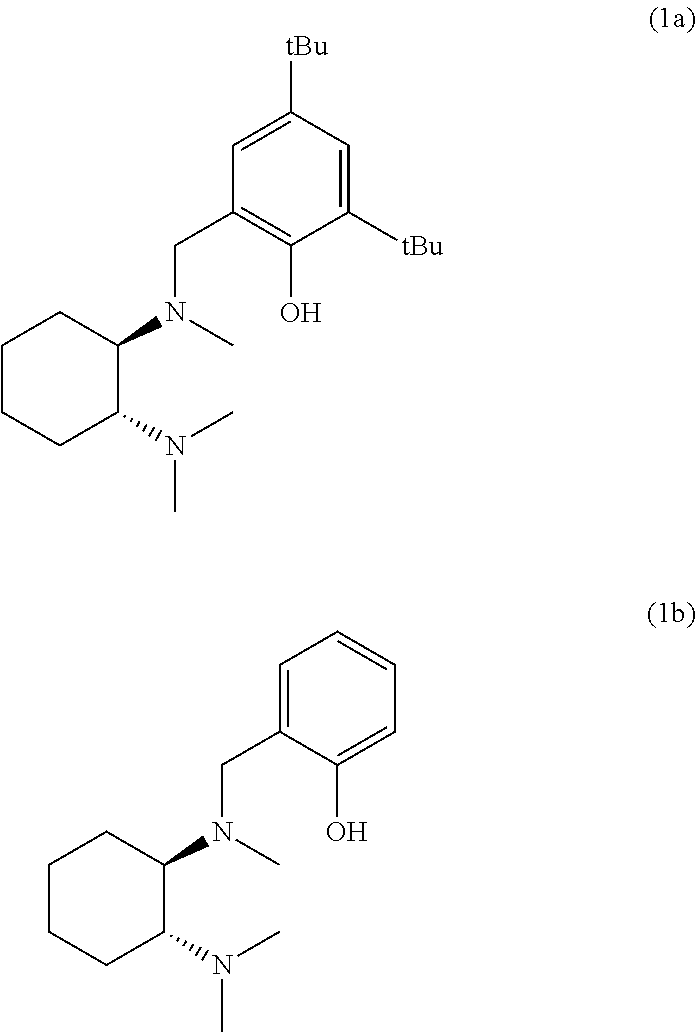
  • the ligands of formula (1a) and (1b) have the following chemical structures:
  • Both of the chiral trans-diamines of formula (1a) and (1b) were prepared from enantiomerically pure mono-BOC protected cyclohexane diamine in three steps (a) to (c).
  • Enantiomerically pure (>99% ee) (R,R) cyclohexane diamine was prepared according to the method disclosed in D. G. Gilheany (2003). The free amine was then protected with a mono-BOC protecting group as described in Viresh et al (2010). Salicylaldehyde was used directly, without purification.
  • the product was purified by flash chromatography using a cyclohexane:ethyl acetate ratio of 8:2) to yield a white crystalline solid.
  • Ligand (1b) 2-((((1R,2R)-2-(Dimethylamino)cyclohexyl)(methyl)amino)methyl)-6-(trifluoromethyl) phenol
  • the white crystalline solid obtained for the ligand of formula (1b) (790 mg, 65% purified yield) was characterised by 1 H and 13 C NMR. Elemental analysis was also carried out using combustion analysis followed by quantitation by gas chromatography. This technique is known in the art.
  • Ligand (1d) 4-tert-Butyl-2-((((1R,2R)-2-(dimethylamino)cyclohexyl)methyl)amino)methyl)phenol
  • Ligand (1e) 2-((((1R,2R)-2-(Dimethylamino)cyclohexyl)(methyl)amino)methyl)phenol
  • Ligand (1f) 2,4-Dichloro-6-((((1R,2R)-2-(dimethylamino)cyclohexyl)(methyl)amino)methyl)phenol
  • Ligand (1g) 2-((((1R,2R)-2-(Dimethylamino)cyclohexyl)(methyl)amino)methyl)-6-methoxyphenol
  • Ligand (1i) 4-Bromo-2-tert-butyl-6-((((1R,2R)-2-(dimethylamino)cyclohexyl)(methyl)amino) methyl)phenol
  • Ligand 1 38 mg, 0.1 mmol, 1.0 eq.
  • a ketone 0.1 mmol, 1.0 eq.
  • a Grignard reagent in toluene/ether 6:1, 0.43M 0.21 mmol, 2.1 eq.
  • the mixture was agitated at ⁇ 78° C. and monitored by HPLC (GC) until no more product formation was detected.
  • the reaction was quenched by addition of isopropyl alcohol (IPA)/water (2 mL), followed by saturated NH 4 Cl (2 mL) and heptane (2 mL) and mixture was allowed to heat to room temperature.
  • IPA isopropyl alcohol
  • the aqueous layer was separated and extracted with heptane (3 ⁇ 5 mL).
  • the organic phases were combined, washed with 20% aqueous solution of acetic acid (3 ⁇ 5 mL), water (3 ⁇ 5 mL), brine (5 mL) and dried over anhydrous Na 2 SO 4 .
  • the solvent was removed by rotary evaporator.
  • the crude product was purified by flash chromatography using EtOAc/cyclohexane mixture as eluent.
  • the aqueous phases from the above reaction work-up were combined, washed with toluene (3 ⁇ 5 mL) and basified to pH>9 with aqueous 5M NaOH.
  • the recovered ligand was extracted by toluene (3 ⁇ 5 mL).
  • the organic phase was washed with water (3 ⁇ 5 mL), brine (1 ⁇ 5 mL) and dried over anhydrous Na 2 SO 4 .
  • the solvent was removed by vacuum.
  • the ligand was then purified by recrystallization from hot IPA/water to provide an 80% yield.
  • Ligand 1a (38 mg, 0.1 mmol, 1.0 eq.) was dissolved in 0.5 ml of dry toluene and 0.25 ml of 0.4M acetophenone in dry toluene was added. The mixture was cooled to ⁇ 78° C. 0.07 ml of ethyl magnesium bromide (3M in ether) was diluted to 0.5 ml with dry toluene and added slowly dropwise over 30 minutes. The mixture was agitated at ⁇ 78° C. for 1 hour and quenched by addition of IPA/water (2 mL), followed by saturated NH 4 Cl (2 mL) and heptane (2 mL). The mixture was allowed to heat to room temperature.
  • the aqueous layer was separated and extracted with heptane (3 ⁇ 5 mL).
  • the organic phases were combined, washed with 20% aqueous solution of acetic acid (3 ⁇ 5 mL), water (3 ⁇ 5 mL), brine (5 mL) and dried over anhydrous Na 2 SO 4 .
  • the solvent was removed by rotary evaporator.
  • Ligand 1a (1.89 g, 5 mmol, 1.0 eq.) of was dissolved in 25 ml of dry toluene and 12.5 ml of 0.4M acetophenone in dry toluene was added. The mixture was cooled to ⁇ 78° C. 3.5 ml of ethyl magnesium bromide (3M in ether) was diluted to 20 ml with dry toluene and added slowly dropwise over 60 minutes and the mixture was agitated at ⁇ 78° C. for 3 h. The reaction was quenched by addition of IPA/water (100 mL), followed by saturated NH 4 Cl (100 mL) and heptane (100 mL) and allowed to heat to room temperature.
  • IPA/water 100 mL
  • saturated NH 4 Cl 100 mL
  • heptane 100 mL
  • aqueous layer was separated and extracted with heptane (3 ⁇ 100 mL). Organic phases were combined, washed with 20% aqueous solution of acetic acid (3 ⁇ 100 mL), water (3 ⁇ 100 mL), brine (100 mL) and dried over anhydrous Na 2 SO 4 . The solvent was removed by rotary evaporator.
  • the produced chiral alcohols were analysed by high performance liquid chromatography on chiral stationary phases (CSP-HPLC). Typically a 25 ⁇ L sample of the reaction mixture was injected onto the HPLC column at 1 ml/min flow rate and detected simultaneously at 210 nm, 230 nm and 254 nm.
  • the product After recrystallization, the product had an enantiomeric excess of greater than 99%. In other words, a substantially enantiopure product was obtained.
  • the enantioselectivity was increased to 66%.
  • the method was then optimised further by altering the order of addition, and the concentration of the reactants to obtain 73% ee in 53% yield.
  • the method was, for example, optimised by adding the Grignard reagent to a mixture of ketone and ligand.
  • the method can be represented generally by the following reaction scheme:
  • the produced chiral alcohols were analysed by high performance liquid chromatography on chiral stationary phases (CSP-HPLC). Typically a 25 ⁇ L sample of the reaction mixture was injected onto the HPLC column at 1 ml/min flow rate and detected simultaneously at 210 nm, 230 nm and 254 nm.
  • the produced chiral alcohols were analysed by high performance liquid chromatography on chiral stationary phases (CSP-HPLC). Typically a 25 ⁇ L sample of the reaction mixture was injected onto the HPLC column at 1 ml/min flow rate and detected simultaneously at 210 nm, 230 nm and 254 nm.
  • Methyl-2,3-dihydro-1H-inden-1-ol (4a) was analysed on a CHIRAL IB column with n-heptane/ethanol (96:04) as the mobile phase. This gave an enantiomeric excess of 77% and retention times of 6.38 min (major) and 6.11 min (minor) for the two enantiomers.
  • the produced chiral alcohols were analysed by high performance liquid chromatography on chiral stationary phases (CSP-HPLC). Typically a 25 ⁇ L sample of the reaction mixture was injected onto the HPLC column at 1 ml/min flow rate and detected simultaneously at 210 nm, 230 nm and 254 nm.
  • the system is generally applicable to alkyl, cycloalkyl, alkenyl, and aryl magnesium bromide Grignard reagents, although lower stereoselectivities are seen with alkenyl and aryl magnesium bromides.
  • the produced chiral alcohols were analysed by high performance liquid chromatography on chiral stationary phases (CSP-HPLC). Typically a 25 ⁇ L sample of the reaction mixture was injected onto the HPLC column at 1 ml/min flow rate and detected simultaneously at 210 nm, 230 nm and 254 nm.
  • the ligand of formula (1) is effective for a range of ketone substrates (including ⁇ ,ß-unsaturated ketones) and a range of Grignard reagents. This ligand also gives moderate to excellent yields of up to 99% and enantioselectivities of tertiary chiral alcohol products of up to 94% ee.
  • the ligand of formula (1a) was varied by changing the substituents at positions Y, Ri and Riii on Rf.
  • the effect of the first reactant on stereoselectivity and yield was investigated using ligand (1b).
  • the method can be represented generally by the following reaction scheme:
  • the ligand (1b) was found to transmit stereochemical information for alkyl-alkyl and alkyl-aryl ketones with enantiomeric excess values of 84% and above. Unexpectedly high enantiomeric excess values of 90% and above were obtained for the reaction of propiphenone and methyl magnesium bromide (92%) as well as indanone and ethyl magnesium bromide (90%). Ligand (1b) is therefore a particularly advantageous ligand for the process of the present invention.
  • the solvent was varied as shown below in Table 6.
  • THF is not suitable for the process of the invention. It can be seen from Table 6 that THF solvent resulted in an enantiomeric excess of 0%. The use of 2-methyl THF is also not suitable since many products are obtained and the enantiomeric excess is ⁇ 17% (i.e. 17% of the other enantiomer—here the R enantiomer).
  • reaction of acetophenone and ethylmagnesium bromide was carried out in the presence of the ligand (1a) at ⁇ 20° C. and resulted in an enantiomeric excess of 64% and a yield of 49% (both measured by chiral HPLC).
  • the reaction can represented by the following reaction scheme, except the reaction temperature was ⁇ 20° C.:
  • the present invention therefore provides unprecedented asymmetric 1,2-addition of a Grignard reagent to an electrophilic carbon (such as in a carbonyl group of a ketone). This is achieved by the presence of a chiral trans-diamine of formula (1).

Landscapes

  • Chemical & Material Sciences (AREA)
  • Organic Chemistry (AREA)
  • Chemical Kinetics & Catalysis (AREA)
  • Organic Low-Molecular-Weight Compounds And Preparation Thereof (AREA)

Abstract

Processes for stereoselective preparation of a chiral alcohol or a chiral amine are described. The processes include reacting a first prochiral reactant selected from the group consisting of a ketone, an aldehyde, and an imine, with a second reactant that includes a Grignard reagent, in the presence of a chiral trans-diamine of formula (1) as defined herein:
Figure US10196338-20190205-C00001

Description

CROSS REFERENCE TO RELATED APPLICATION(S)
This application is a National Phase filing under 35 C.F.R. § 371 of and claims priority to PCT Patent Application No.: PCT/EP2015/061610, filed on May 26, 2015, which claims the priority benefit under 35 U.S.C. § 119 of British Application No.: 1409317.3, filed on May 26, 2014, the contents of which are hereby incorporated in their entireties by reference.
FIELD OF THE INVENTION
The present invention relates to a process for stereoselectively preparing chiral alcohols and chiral amines with a Grignard reagent.
BACKGROUND OF THE INVENTION
The Grignard reaction is one of the most commonly used methods of carbon-carbon bond formation (Grignard (1900), Richey (1999)). It is an organometallic chemical reaction in which alkyl, vinyl, or aryl magnesium halides, termed “Grignard reagents”, add to an electrophilic carbon to form a carbon-carbon bond. The Grignard reagent functions as a nucleophile, attacking an electrophilic carbon atom present in a reactant molecule such a carbonyl group of a ketone or an aldehyde or a C═N group of an imine.
The addition of the Grignard reagent to an electrophilic carbon atom typically proceeds through a six-membered ring transition state, and this is shown for a ketone in the scheme below:
Figure US10196338-20190205-C00002
The Grignard reaction is, however, typically non-stereoselective forming racemic products such as racemic alcohols and amines.
Chiral alcohols and chiral amines are, however, essential structural motifs for a number of pharmaceutical and natural products. Thus the development of an asymmetric Grignard synthesis for these compounds is of fundamental interest.
Unfortunately, however, asymmetric C—C bond formation by the Grignard reaction is still amongst the most poorly developed fields of organic synthesis (Walsh et al. (2009); Noyori et al. (1991); Luderer et al. (2009); Corey et al. (1998)), and there are only a few examples of asymmetric 1,2-addition of a Grignard reagent to ketones (Manabu et al. (2008)).
The challenges in the development of an asymmetric Grignard reaction include:
(i) competition from background non-stereoselective reactions,
(ii) reduced enantioface discrimination when there are similar groups either side of the electrophilic carbon, and
(iii) reduced yields due to competing enolisation and reduction side reactions.
A number of strategies have been employed in the synthesis of chiral alcohols and chiral amines.
In principle, the most direct route is to resolve the racemic alcohol or amine. Resolution can be achieved using for example biological, usually enzymatic, methods. Resolution is, however, inefficient as it requires extra manufacturing steps to dispose or recycle the unwanted stereoisomer, and biological methods may also often be specific to one particular compound.
Asymmetric Grignard synthesis of alcohols and amines has previously involved transmetallation to copper, zinc, titanium or aluminium (Shibasaki et al. (2008); Fandrick et al. (2011); Tomita et al. (2005); Ashoka et al. (2012); Pu et al. (2001); DiMauro et al. (2002); Dosa et al. (1998); (Ramón (1998); Friel et al. (2008)). These methods were, however, found to have significant defects including a limited scope of reaction, an undesirable inorganic waste generation and a large excess of metal source.
Other approaches to asymmetric Grignard synthesis have used organolithium species (Noyori et al. (1988)), or organocopper species and a chiral phosphine ligand (Madduri et al. (2012)). Again, however, these approaches were found to have defects such as a limited scope of reaction and produce a low enantiomeric excess of chiral product.
Weber et al. (1992) reported a successful asymmetric 1,2-addition of Grignard reagents to ketones. However, the chiral ligand used in this process was TADDOL (α, α, α′, α′-tetraaryl-1,3-dioxolan-4,5-dimethanol), which remained difficult to separate from the products and gave rise to moderate yields.
US 2004/0249184 discloses chiral phosphane ligands which are useful for the production of catalysts for asymmetric hydrosilylation, amination, alkyl substitution and Grignard coupling.
WO 99/50205 discloses a process for preparing a single enantiomer of an α,α-disubstituted-α-hydroxy acetic acid, such as cyclohexylphenylglycolic acid, using cyclic 1,2-aminoalcohols and Grignard reagents. The process involves reacting a prochiral α-ketocarboxylic acid with a single enantiomer of an N-substituted vicinal aminoalcohol of cyclopentane, cyclohexane, indane, tetralin or benzosuberane to form an ester of the α-ketocarboxylic acid, reacting this ester with an excess of a Grignard reagent to form a diasteromer of the α-hydroxycarboxylate ester, separating and optionally hydrolysing the single diastereomer to provide an α-hydroxycarboxylic acid or salt enriched in one enantiomer.
CN101844958 discloses a method for synthesising a chiral secondary alcohol using an aryl Grignard reagent, aluminium halide, a passivator, a TADDOL ligand or BINOL or BINOL derivatives thereof, and titanium tetraisopropoxide.
There therefore remains a clear need for a process which stereoselectively prepares chiral compounds using the Grignard reaction. Such a process would be particularly useful for preparing chiral alcohols and chiral amines which have important uses in developing pharmaceutical and natural products.
SUMMARY OF THE INVENTION
According to a first aspect of the present invention there is provided a process for the stereoselective preparation of a chiral alcohol or a chiral amine, the process comprising reacting a first prochiral reactant selected from the group consisting of a ketone, an aldehyde, and an imine, with a second reactant comprising a Grignard reagent, in the presence of a chiral trans-diamine of formula (1):
Figure US10196338-20190205-C00003
wherein X is N;
wherein Ra, Rb, Rc, Rd, and Re are each independently hydrogen, alkyl, aryl, alkenyl, cycloalkyl or cycloalkenyl; or Ra and Rb may together define a cycloalkyl or cycloalkenyl group; or Rd and Re may together with the two X atoms define a heteroaryl, heterocycloalkyl or heterocycloalkenyl group;
wherein Rf is an alkyl, alkenyl, aryl, cycloalkyl, cycloalkenyl, heteroaryl, heterocycloalkenyl or heterocycloalkyl group; and
wherein n is an integer in the range of 0 to 3 (preferably n is 1);
wherein the alkyl, aryl, alkenyl, cycloalkyl, cycloalkenyl, heteroaryl, heterocycloalkenyl or heterocycloalkyl groups are optionally substituted as described herein.
The chiral trans-diamine of formula (1) is also referred to herein as a chiral additive or a chiral ligand.
In one embodiment, the prochiral ketone, aldehyde or imine may be formed in-situ.
In one embodiment, Ra and Rb together define a C3-C7 cycloalkyl group. Preferably the cycloalkyl group is cyclohexane or cyclopentane. In another embodiment, Ra and Rb are each independently an alkyl or an aryl group. Preferably Ra and Rb are each independently phenyl, methyl or tert-butyl.
In one embodiment Rc is a C1-6 alkyl group and/or Rd is a C1-6 alkyl group and/or Re is a C1-6 alkyl group. Alternatively, Rd and Re together define an imidazolidine ring with the two N atoms and Re is a C1-6 alkyl group.
In one embodiment, Rf is an alkyl or aryl group. Preferably Rf is a tert-butyl group.
In an alternative preferred embodiment, Rf is an aryl group which is substituted by at least one substituent selected from hydroxy, alkoxy, amino, aminoalkyl, thiol, halo, haloalkyl, haloalkoxy, alkyl, cycloalkyl, alkenyl, cycloalkenyl, alkynyl, aryl, heterocyclyl, cyano, nitro, silyl, sulfanyl, phosphanyl and CF3. Particularly preferred is where Rf is phenol, aniline, N-methylaniline or dimethylaniline, each of which may be optionally substituted by one or more alkyl, alkoxy, aminoalkyl or trifluoromethyl groups.
In another preferred embodiment, Rf has the formula:
Figure US10196338-20190205-C00004
    • wherein
      • Y is a hydroxy, amino or aminoalkyl group;
      • Ri is selected from the group consisting of hydrogen, alkyl, alkenyl, alkynyl, aryl, cycloalkyl, silyl, halo, alkylamino, amino, alkoxy, cyano, nitro, heterocyclyl, sulfanyl, phosphanyl and trifluoromethyl; and
    • Rii, Riii and Riv are each independently selected from the group consisting of hydrogen, alkyl, alkenyl, alkynyl, aryl, cycloalkyl, silyl, halo, aminoalkyl, amino, alkoxy, cyano, nitro, heterocyclyl, sulfanyl, phosphanyl and trifluoromethyl.
Preferably Rii and Riv are both hydrogen and/or Y is a hydroxy group. More preferably Ri and Riv are both hydrogen and Y is a hydroxy group.
Preferably, Ri is selected from the group consisting of alkyl, alkoxy, cycloalkyl, halo or trifluoromethyl, Rii and Riv are both hydrogen and Riii is selected from the group consisting of hydrogen, alkyl, alkoxy, halo, nitro or aminoalkyl.
More preferably, Ri is selected from the group consisting of methyl, tert-butyl, trifluoromethyl, adamantyl and methoxy, Rii and Riv are both hydrogen, and Riii is selected from the group consisting of hydrogen, methyl, tert-butyl, halo, N,N-dimethylamine and methoxy.
Particularly preferred is where Y is a hydroxy group, Ri is selected from the group consisting of tert-butyl, adamantyl and trifluoromethyl, Rii and Riii are both hydrogen, and Riv is selected from the group consisting of tert-butyl, bromine, hydrogen and N,N-dimethyl amine.
For example, Rf may have the formula:
Figure US10196338-20190205-C00005
Preferably, Rf has the formula:
Figure US10196338-20190205-C00006
More preferably, Rf has the formula:
Figure US10196338-20190205-C00007
Particularly preferred is where Rf has the formula:
Figure US10196338-20190205-C00008
In one embodiment, the chiral trans-diamine has the formula:
Figure US10196338-20190205-C00009
Figure US10196338-20190205-C00010
Figure US10196338-20190205-C00011
Preferably the chiral trans-diamine has one of the following formulae:
Figure US10196338-20190205-C00012
Figure US10196338-20190205-C00013
Particularly preferred is a chiral trans-diamine with a formula:
Figure US10196338-20190205-C00014
For example a chiral trans-diamine with a formula (1b):
Figure US10196338-20190205-C00015
In one embodiment, the process of the present invention may be carried out in a solvent. Preferably the solvent includes a non-coordinating solvent and/or an ethereal solvent. Preferably a non-coordinating solvent or an ethereal solvent. Examples of such non-coordinating solvents include, but are not limited to cyclohexane, benzene, toluene, xylene, dichloromethane, pentane, cyclopentane, hexane, heptane or 1,2-difluorobenzene. Preferably the solvent is toluene. The ethereal solvent is not tetrahydrofuran or 2-methyl tetrahydrofuran.
When the first prochiral reactant of the process of the present invention comprises a ketone, the ketone may be of the formula:
Figure US10196338-20190205-C00016
wherein R1 and R2 are each independently alkyl, aryl, alkenyl, cycloalkyl or cycloalkenyl; or R1 and R2 may together define a cycloalkyl, cycloalkenyl, heterocycloalkyl or heterocycloalkenyl group, wherein each alkyl, aryl, alkenyl, cycloalkyl, cycloalkenyl, heterocycloalkyl or heterocycloalkenyl group may be optionally substituted as described herein. The ketone may optionally be formed in-situ in the process of the present invention.
In one embodiment, R1 and R2 are different.
In one embodiment R1 is an alkenyl group and R2 is selected from the group consisting of alkyl, aryl, alkenyl, cycloalkyl and cycloalkenyl. In one embodiment the ketone is an α, ß-unsaturated ketone.
When the first prochiral reactant of the process of the present invention comprises an aldehyde, the aldehyde may be of the formula:
Figure US10196338-20190205-C00017
wherein R1 and R2 are each independently hydrogen, alkyl, aryl, alkenyl, cycloalkyl or cycloalkenyl, with the proviso that at least one of R1 and R2 is hydrogen; wherein each alkyl, aryl, alkenyl, cycloalkyl or cycloalkenyl group may be optionally substituted as described herein. The aldehyde may be formed in-situ in the process of the present invention.
In one embodiment, R1 and R2 are different and cannot both be hydrogen.
When the first prochiral reactant of the process of the present invention comprises an imine, the imine may be of the formula:
Figure US10196338-20190205-C00018
wherein R1 and R2 are each independently hydrogen, alkyl, aryl, alkenyl, cycloalkyl or cycloalkenyl; or R1 and R2 may together define a cycloalkyl, cycloalkenyl, heterocycloalkyl or heterocycloalkenyl group, wherein each alkyl, aryl, alkenyl, cycloalkyl, cycloalkenyl, heterocycloalkyl or heterocycloalkenyl group may be optionally substituted as described herein. The imine may be formed in-situ in the process of the present invention.
In one embodiment, R1 and R2 are different and cannot both be hydrogen.
Preferably the first prochiral reagent of the process of the invention comprises a ketone.
The Grignard reagent may be of the formula R3—MgX, wherein R3 is an aryl, alkyl, cycloalkyl alkenyl or alkynyl group, each of which may be optionally substituted as described herein and wherein X is halogen.
In a second aspect, the present invention provides the use of a chiral trans-diamine of formula (1) in a Grignard reaction.
In a third aspect, the present invention provides a chiral trans-diamine of formula (1) as described herein above. In one embodiment of this aspect of the invention the compound of formula (1) is not:
Figure US10196338-20190205-C00019
Preferably the compound of formula (1) is selected from:
Figure US10196338-20190205-C00020
Figure US10196338-20190205-C00021
Figure US10196338-20190205-C00022
In a fourth aspect, the present invention provides a chiral trans-diamine of formula (1) as described herein above having the formula:
Figure US10196338-20190205-C00023
DETAILED DESCRIPTION OF THE INVENTION
Stereoselectivity
The present invention is based on the finding that chiral trans-diamines of formula (1) can be used in a Grignard reaction to stereoselectively prepare chiral alcohols or chiral amines.
The process uses the chiral trans-diamine to preferentially form one enantiomer or diastereomer of an alcohol or amine from a prochiral ketone, aldehyde or imine. Preferably from a prochiral ketone or imine. More preferably from a prochiral ketone. The provision of such a stereoselective process leads to fewer manufacturing steps, increased yields of the chiral alcohol or chiral amine, more efficient use of manufacturing capacity and less environmental impact by reducing the need to resolve these chiral compounds. The process of the present invention thus enables the stereoselective formation of carbon-carbon bonds using Grignard reagents.
The products prepared by the present invention contain at least one chiral centre. The chiral alcohol formed by the process of the present invention has a chiral centre on the carbon with the hydroxy group. The chiral alcohol may be a primary, secondary or tertiary alcohol. Preferably the chiral alcohol is a secondary or tertiary alcohol, more preferably a tertiary alcohol.
The chiral amine formed by the process of the present invention has a chiral centre on the carbon with the amino group. The chiral amine may be a primary, secondary or tertiary amine. The skilled person will appreciate that whether the alcohol or amine is primary, secondary or tertiary will depend on the nature of the first prochiral reactant.
Stereoselective reactions can be of two types: enantioselective, in which selection is between two enantiomeric products; and diastereoselective, in which selection is between diastereomeric products. The term stereoselective preparation in the present invention refers to a preparation that yields predominantly one enantiomer or one diastereomer. In one embodiment, the process of the present invention is enantioselective forming one enantiomer in preference to the other. In another embodiment, the process of the present invention is diastereoselective forming one diastereomer in preference to another.
When the process produces enantiomeric chiral products, the enantioselectivity of the process may be expressed by the enantiomeric excess (ee). A racemic mixture typically has an ee of 0%, while a completely pure enantiomer has an ee of 100%. For example, a sample with 70% of one enantiomer (e.g. R stereoisomer) and 30% of the other enantiomer (e.g. S stereoisomer) has an ee of 40%. This may also be called a scalemic mixture or a non-racemic mixture, where the ratio of enantiomers in the mixture is other than 1:1.
In one embodiment the process is enantioselective, and the chiral alcohol or chiral imine may be prepared with an enantiomeric excess (ee) of greater than about 40%. In another embodiment the enantiomeric excess is greater than about 50%. In another embodiment the enantiomeric excess is greater than about 60%. In another embodiment the enantiomeric excess is greater than about 70%. In another embodiment the enantiomeric excess is greater than about 80% or greater than about 90%.
In one embodiment said chiral alcohol or chiral amine is substantially homochiral, preferably having greater than 95% ee, more preferably having greater than 99% ee.
When the process produces diastereomeric chiral products, the diastereoselectivity of the process may be expressed by the diastereomeric excess (de).
In one embodiment the process is diastereoselective, and the chiral amine or chiral imine may be produced with a diastereomeric excess (de) of greater than about 40%. In another embodiment the de is greater than about 50%, greater than about 60% or greater than about 70%. In another embodiment the de is greater than about 80% or greater than about 90%. In another embodiment the de is greater than about 95%. In another embodiment the de is greater than about 99%.
Grignard Reagent
The process of the present invention uses a Grignard reagent. The nature of the Grignard reagent is not particularly limited, and may be produced in-situ according to methods known in the art.
For example, the Grignard reagent may be made by adding an organic halide to a suspension of magnesium in an ethereal solvent. The reaction should be dry (i.e. water and air should be substantially excluded). Alternatively the Grignard reagent may be a commercially available material.
In one embodiment, the Grignard reagent is of the formula R3—MgX, wherein R3 is an aryl, cycloalkyl, alkyl, alkenyl or alkynyl group, each of which may be optionally substituted as described herein and wherein X is a halogen. Preferably X is iodine, bromine or chlorine, more preferably X is bromine or iodine, e.g. bromine.
In one embodiment R3 is alkyl. For example, R3 may be an alkyl group and X may be bromine, chlorine or iodine. Particularly preferred alkyl Grignard reagents include methylmagnesium bromide, methylmagnesium chloride, methylmagnesium iodide, iso-butylmagnesiumbromide, iso-propylmagnesium bromide, propylmagnesium bromide, butyl magnesium bromide, ethylmagnesium bromide and ethylmagnesium iodide.
In another embodiment, R3 is aryl. For example R3 may be an aryl group and X may be bromine or iodine. Particularly preferred Grignard reagents include phenylmagnesium bromide, phenylmagnesium iodide, methylphenylmagnesium iodide, 1-naphthylmagnesium bromide and 2-naphthylmagnesium bromide.
In a further embodiment, R3 is a cycloalkyl group where the cycloalkyl is preferably cyclopentane or cyclohexane. For example, the Grignard reagent may be cyclopentanemagnesium bromide or cyclohexanemagnesium bromide.
In a further embodiment, R3 is an alkenyl group. For example the Grignard reagent may be allylmagnesium bromide or vinylmagnesium bromide.
In a further embodiment, R3 is an alkynyl group. For example the Grignard reagent may be ethynylmagnesium bromide or phenylethynylmagnesium bromide.
The alkyl, aryl, cycloalkyl, alkenyl and alkynyl groups may be substituted as described herein.
The Grignard reaction is based on a reaction system comprising a Grignard reagent and a reactant including an electrophilic carbon. In the process of the present invention, the reagent including an electrophilic carbon—otherwise termed the first reactant—is prochiral and the electrophilic carbon may be present in a ketone, an aldehyde or an imine moiety. The ketone, aldehyde or imine may optionally be formed in-situ.
When the first prochiral reactant comprises a ketone, the process of the present invention may be generally represented by Scheme 1:
Figure US10196338-20190205-C00024
wherein R3 and X are as defined above and R1 and R2 are each independently alkyl, alkenyl, aryl, cycloalkyl or cycloalkenyl. R1 and R2 may also together define a cycloalkyl, cycloalkenyl, heterocycloalkyl or heterocycloalkenyl group. The alkyl, alkenyl, aryl, cycloalkyl, cycloalkenyl, heterocycloalkyl or heterocycloalkenyl group may be optionally substituted as described herein. Preferably R1 and R2 are different.
When the first prochiral reactant comprises an aldehyde, the process of the present invention may be generally represented by Scheme 1 above, wherein R3 and X are as defined above and R1 and R2 are each independently hydrogen, alkyl, alkenyl, aryl, cycloalkyl or cycloalkenyl, provided that at least one of R1 and R2 is hydrogen. The alkyl, alkenyl, aryl, cycloalkyl or cycloalkenyl group may be optionally substituted as described herein. Preferably R1 and R2 are different and cannot both be hydrogen.
When the first prochiral reactant comprises an imine, the process of the present invention may be generally represented by Scheme 2:
Figure US10196338-20190205-C00025
wherein R3 and X are as defined above, wherein R1 and R2 are each independently hydrogen, alkyl, alkenyl, aryl, cycloalkyl or cycloalkenyl. R1 and R2 may also together define a cycloalkyl, cycloalkenyl, heterocycloalkyl or heterocycloalkenyl group. R4 may be hydrogen, alkyl, alkenyl, aryl, cycloalkyl, cycloalkenyl, heterocycloalkyl or heterocycloalkenyl group. The alkyl, alkenyl, aryl, cycloalkyl, cycloalkenyl, heterocycloalkyl or heterocycloalkenyl groups may be optionally substituted as described herein. Preferably R1 and R2 are different and cannot both be hydrogen.
By the ketone, aldehyde or imine being formed in-situ is meant that the ketone, aldehyde or imine is formed during the reaction to form a chiral alcohol or a chiral amine. For instance, the ketone, aldehyde or imine may be formed from a starting material prior to the reaction of the first reactant with the Grignard reagent in the presence of the chiral trans-diamine of formula (1). In-situ methods of forming a ketone, aldehyde or imine are known in the art.
In one embodiment, the ketone may be formed in-situ from the addition of excess Grignard reagent to a starting material selected from the group consisting of an ester, an acid halide, an acid anhydride, a thioester, an amide, a N-methoxyamide, a carboxylic acid, an epoxide and a cyanide. For example, “excess” may refer to the use of two equivalents of the Grignard reagent with one equivalent of the starting material.
The chiral trans-diamine may be added with the excess Grignard reagent or after the ketone, aldehyde or imine has been formed in-situ.
The reaction conditions for the above-mentioned Grignard reactions may be as known in the art (see e.g. Smith, M. B. and J. March, Advanced Organic Chemistry: Reactions, Mechanisms, and Structure, 6th edition (Wiley, 2007); and Silverman, G, S. and Rakita, P. E., Handbook of Grignard Reagents (CRC Press, 25 Apr. 1996).
The reaction conditions may also include those taught herein.
In one embodiment the Grignard reaction is carried out at a low temperature, for example at 0° C. or below. Preferably at between 0° C. and −80° C., −10° C. and −50° C., −20° C. and −80° C. e.g. at −20° C.
In one embodiment the solvent used for the Grignard reaction comprises an ethereal solvent, i.e. the solvent contains at least one C—O—C bond. Typical ethereal solvents include diethyl ether, methyl tert-butyl ether, o-anisole, 2,5-dimethyl tetrahydrofuran, dioxane, and glyme (dimethoxyethane).
In a preferred embodiment, the solvent comprises a non-coordinating solvent. Preferably the solvent includes a non-coordinating solvent selected from cyclohexane, toluene, benzene, xylene, hexane, 1,2-difluorobenzene, dichloromethane, pentane, cyclopentane and heptanes. A particularly preferred non-coordinating solvent is toluene.
In a particularly preferred embodiment the non-coordinating solvent (e.g. toluene) may be used in the presence of another solvent. In one embodiment, the non-coordinating solvent is used with an ethereal solvent, such as diethyl ether, dibutyl ether, tert-butyl methyl ether, o-anisole, 2,5-dimethyl tetrahydrofuran or glyme (dimethoxyethane). In one embodiment, the non-coordinating solvent is the main solvent in the solvent mixture and the ethereal solvent is present in a minor amount, e.g. as an additive.
In an especially preferred embodiment, the ethereal solvent is not tetrahydrofuran or 2-methyl tetrahydrofuran.
In another embodiment, the solvent used for the Grignard reaction is an ethereal solvent or a non-coordinating solvent, with the proviso that the ethereal solvent is not tetrahydrofuran or 2-methyl tetrahydrofuran. The solvent is preferably selected from the group consisting of toluene, diethyl ether, methyl tert-butyl ether, and 2,5-dimethyl tetrahydrofuran.
In one embodiment, the Grignard reaction may be carried out in the presence of a stable radical species. Suitable stable radical species are known in the art.
Preferably the stable radical species is (2,2,6,6-tetramethylpiperidin-1-yl)oxyl also known as TEMPO, having the following structure:
Figure US10196338-20190205-C00026
Chiral Ligand
The process of the present invention is carried out in the presence of a chiral ligand. Without wishing to be bound by theory, the present inventors believe that the chiral ligand described herein coordinates to the magnesium of the Grignard reagent, and the coordinated ligand-Grignard product then approaches the electrophilic carbon of the first reactant (e.g. in the carbonyl group of a ketone) preferentially from one face resulting in stereoselective 1,2-addition to yield a chiral product (e.g. a chiral alcohol) in high enantiomeric or diastereomeric excess.
The chiral ligand used in the present invention is a chiral trans-diamine of structural formula (1):
Figure US10196338-20190205-C00027
wherein X is N;
wherein Ra, Rb, Rc, Rd, and Re are each independently hydrogen, alkyl, aryl, alkenyl, cycloalkyl or cycloalkenyl; or Ra and Rb may together define a cycloalkyl or cycloalkenyl group; or Rd and Re may together with the two X atoms define a heterocycloalkyl or heterocycloalkenyl group;
wherein Rf is an alkyl, alkenyl, aryl, cycloalkyl, cycloalkenyl, heteroaryl, heterocycloalkenyl or heterocycloalkyl group; and
n is an integer in the range of 0 to 3, preferably n is 1 or 2, more preferably n is 1;
wherein the alkyl, aryl, alkenyl, cycloalkyl, cycloalkenyl, heteroaryl, heterocycloalkenyl or heterocycloalkyl groups are optionally substituted as described herein.
The chiral trans-diamine may be an enantiomerically enriched or an enantiomerically pure trans compound.
In one embodiment, Ra and Rb together define a C3-C7 cycloalkyl group. Preferably Ra and Rb together define a C4-C6 cycloalkyl group, more preferably the cycloalkyl group is cyclohexane or cyclopentane. Particularly preferred are compounds where Ra and Rb together define a cyclohexane group.
Alternatively, Ra and Rb are each independently an alkyl or an aryl group. In one embodiment, both Ra and Rb are alkyl groups. In another embodiment, both Ra and Rb are aryl groups. In one embodiment, Ra and Rb are each independently a phenyl or a C1-6 alkyl group. Preferably Ra and Rb are each independently phenyl, methyl, ethyl, n-propyl, iso-propyl, n-butyl, iso-butyl, sec-butyl, or tert-butyl. Preferably Ra and Rb are each independently phenyl, methyl, or tert-butyl.
In one embodiment, Rc, Rd and Re are each independently an alkyl group. In one embodiment, Rc, Rd and Re are each independently a C1-6 alkyl group. Preferably an alkyl group selected from methyl, ethyl, n-propyl, iso-propyl, n-butyl, iso-butyl, sec-butyl, or tert-butyl. More preferably an alkyl group selected from methyl, ethyl, n-propyl and n-butyl. Particularly preferred is a methyl group.
In another embodiment, Rd and Re together define a heterocyclyl ring with the two X atoms. The heterocyclyl ring may be a heterocycloalkyl, heterocycloalkenyl or heteroaryl ring. In one embodiment, Rd and Re together define a heterocycloalkyl ring with the two X atoms. Preferably Rd and Re together define a five to seven membered ring containing the two X atoms. Preferred heterocycloalkyl groups include imidazolidine and piperazine. Particularly preferred is the imidazolidine ring.
In another embodiment, Rd and Re taken together define a heteroaryl ring with the two X atoms. In one embodiment Rd and Re together define a five or six membered aromatic ring. Preferred heteroaryl groups include pyrazines and imidazole.
In one embodiment, Ra and Rb together define a C3-C7 cycloalkyl group and Rc, Rd and Re are C1-6 alkyl groups or Rc is a C1-6 alkyl group and Rd and Re taken together form a heterocycloalkyl group with the two X atoms, e.g. imidazolidine.
In another embodiment, Ra and Rb together define a cyclohexane group and Rc, Rd and Re are each methyl groups. In a further embodiment, Ra and Rb together define a cyclohexane group, Rc is a methyl group and Rd and Re taken together form an imidazolidine ring with the two X atoms. In another embodiment, Ra and Rb together define a cyclohexane group, Rc is a methyl group substituted by tert-butyl and Rd and Re are both methyl groups.
In another embodiment, Ra and Rb are both phenyl groups and Rc, Rd and Re are each methyl groups.
In another embodiment, Ra is a tert-butyl group, and Rb, Rc, Rd and Re are each methyl groups.
In one embodiment, Rf is an alkyl, or an aryl group. In another embodiment Rf is an alkyl group, preferably a C1-6 alkyl group, e.g. a methyl, ethyl, propyl or butyl group. More preferably, Rf is a propyl or butyl group, e.g. a tert-butyl group.
In another embodiment, Rf is an aryl group. Preferably the aryl group is a phenyl. In one embodiment, Rf is an aryl group which is substituted by at least one substituent. Preferably Rf is an aryl group which is substituted by at least two substituents, more preferably at least three substituents.
In one embodiment, Rf is a phenyl group which is substituted by at least one substituent at the 2-position. Preferably the substituent includes a heteroatom such as oxygen, nitrogen, phosphorus or sulphur. Particularly preferred substituents include hydroxy, alkoxy, amino, aminoalkyl, thiol, acyl, halo, haloalkyl, haloalkoxy, nitro, cyano, phosphine and sulfhydryl. For example, a hydroxy, amino or aminoalkyl group. Most preferred is a hydroxy group.
In one embodiment, Rf is a phenyl group which is substituted by at least one substituent in the 2-position. The substituents in the 2-position are as defined above, preferably the substituent is a hydroxy, amino or aminoalkyl group such that Rf is a phenol, aniline, N-methylaniline or dimethylaniline group, each of which may be optionally substituted.
In another embodiment, Rf is a phenyl group which is substituted by at least two substituents. One of the substituents is in the 2-position and the at least one other substituent is in the 3-, 4-, 5- or 6-position on the benzene ring. This substitution pattern may also be described as the at least one other substituent being ortho-, meta- or para- to the substituent at the 2-position.
Preferably Rf is a phenyl group with at least two substituents in the 2- and 3-, 2- and 4-, 2- and 5-, or 2- and 6-positions. In one embodiment, Rf is a phenyl group which is substituted by at least two substituents, preferably one substituent in the 2-position and at least one substituent in the 3- or 5-positions. For example, Rf may be a phenyl group with at least two substituents in the 2- and 3-positions, or in the 2- and 5-positions. Rf may also be a phenyl group with three substituents in the 2-, 3- and 5-, 2-, 3- and 4-, or 2-, 3- and 6-, positions on the benzene ring. Particularly preferred is Rf being a phenyl group with substituents in the 2-, 3- and 5- or 2- and 3-positions.
The substituents on the Rf group may be selected from the group consisting of hydroxy, alkoxy, amino, aminoalkyl, thiol, acyl, halo, haloalkyl, haloalkoxy, alkyl, cycloalkyl, alkenyl, cycloalkenyl, alkynyl, aryl, heterocyclyl, cyano, nitro, silyl, sulfanyl, phosphanyl and CF3.
Preferably the substituents are selected from hydroxy, alkoxy, amino, aminoalkyl, alkyl, alkenyl, alkynyl, cycloalkyl, silyl, halo, nitro, cyano, heterocyclyl, sulfanyl, phosphanyl, trifluoromethyl and aryl.
More preferably the substituents are selected from hydroxy, amino, aminoalkyl, C1-6-alkyl, C1-6-alkenyl, C1-6-alkynyl, phenyl, mesityl, benzyl, adamantyl, trimethylsilyl, triphenylsilyl, iodine, bromine, chlorine, fluorine, cyano, pyridyl, sulfanyl, phosphanyl, nitro and trifluoromethyl. Most preferably the substituents are selected from hydro, amino, aminoalkyl, tert-butyl, adamantyl, bromine, chlorine, nitro and trifluoromethyl.
Particularly preferred is where a hydroxy, amino or aminoalkyl substituent is the at least one substituent in the 2-position of Rf when Rf is a phenyl ring. The other substituents on the phenyl ring may then be selected from the group consisting of amino, aminoalkyl, C1-6-alkyl, C1-6-alkenyl, C1-6-alkynyl, phenyl, mesityl, benzyl, adamantyl, trimethylsilyl, triphenylsilyl, iodine, bromine, chlorine, fluorine, cyano, pyridyl, sulfanyl, phosphanyl, nitro and trifluoromethyl.
Preferably methyl, ethyl, n-propyl, isopropyl, n-butyl, sec-butyl, tert-butyl, n-pentyl, tert-pentyl, neo-pentyl, isopentyl, sec-pentyl, 4-pentyl, phenyl, mesityl, benzyl, adamantyl, trimethylsilyl, triphenylsilyl, iodine, bromine, chlorine, fluorine, cyano, pyridyl, sulfanyl, phosphanyl, nitro and trifluoromethyl.
In one embodiment, Rf is phenol, aniline, N-methylaniline or dimethylaniline, each of which may be optionally substituted by one or more substituents selected from the group consisting of hydroxy, alkoxy, amino, aminoalkyl, thiol, halo, haloalkyl, haloalkoxy, alkyl, cycloalkyl, alkenyl, cycloalkenyl, aryl, cyano, nitro and CF3. Preferably Rf is phenol, aniline, N-methylaniline or dimethylaniline, each optionally substituted by one or more alkyl, cycloalkyl, alkoxy, aminoalkyl, halo, nitro or trifluoromethyl (CF3) groups.
In one embodiment, Rf has the formula:
Figure US10196338-20190205-C00028
    • wherein
      • Y is a hydroxy, amino or aminoalkyl group;
      • Ri is selected from the group consisting of hydrogen, alkyl, alkenyl, alkynyl, aryl, cycloalkyl, silyl, halo, alkylamino, amino, alkoxy, cyano, nitro, heterocyclyl, sulfanyl, phosphanyl and trifluoromethyl; and
      • Rii, Riii and Riv are each independently selected from the group consisting of hydrogen, alkyl, alkenyl, alkynyl, aryl, cycloalkyl, silyl, halo, aminoalkyl, amino, alkoxy, cyano, nitro, heterocyclyl, sulfanyl, phosphanyl and trifluoromethyl.
Preferably, Y is a hydroxy, amino, NH(C1-6-alkyl) or N(C1-6-alkyl)2 group. More preferably, Y is a hydroxy, amino, NH(methyl) or N(methyl)2 group. Most preferably Y is a hydroxy group.
Preferably Ri is selected from the group consisting of hydrogen, C1-6-alkyl, C1-6-alkenyl, C1-6-alkynyl, phenyl, mesityl, benzyl, adamantyl, Si(C1-6-alkyl)3, triphenylsilyl, iodine, bromine, chlorine, fluorine, aminoalkyl, cyano, pyridyl, pyrimidyl, pyrrolyl, furanyl, thiophenyl, sulfanyl, phosphanyl, and trifluoromethyl. More preferably, Ri is selected from the group consisting of methyl, ethyl, n-propyl, isopropyl, n-butyl, sec-butyl, tert-butyl, n-pentyl, tert-pentyl, neo-pentyl, isopentyl, sec-pentyl, 4-pentyl, phenyl, mesityl, benzyl, adamantyl, trimethylsilyl, triphenylsilyl, iodine, bromine, chlorine, fluorine, N,N-dimethylamine, cyano, pyridyl, pyrimidyl, pyrrolyl, furanyl, thiophenyl, sulfanyl, phosphanyl, and trifluoromethyl. Particularly preferred is where Ri is tert-butyl, adamantyl, bromine, chlorine, trifluoromethyl or methoxy. For example, Ri may be tert-butyl, adamantyl, bromine, or trifluoromethyl.
Preferably Rii and Riv are each independently selected from the group consisting of hydrogen, C1-6-alkyl, C1-6-alkenyl, C1-6-alkynyl, phenyl, mesityl, benzyl, adamantyl, Si(C1-6-alkyl)3, triphenylsilyl, iodine, bromine, chlorine, fluorine, aminoalkyl, cyano, pyridyl, pyrimidyl, pyrrolyl, furanyl, thiophenyl, sulfanyl, phosphanyl, and trifluoromethyl. More preferably, Rii and Riv are each independently is selected from the group consisting of hydrogen, methyl, ethyl, n-propyl, isopropyl, n-butyl, sec-butyl, tert-butyl, n-pentyl, tert-pentyl, neo-pentyl, isopentyl, sec-pentyl, 4-pentyl, phenyl, mesityl, benzyl, adamantyl, trimethylsilyl, triphenylsilyl, iodine, bromine, chlorine, fluorine, N,N-dimethylamine, cyano, pyridyl, pyrimidyl, pyrrolyl, furanyl, thiophenyl, sulfanyl, phosphanyl, and trifluoromethyl. Particularly preferred is where Rii and Riv are both hydrogen.
Preferably Riii is selected from the group consisting of hydrogen, C1-6-alkyl, C1-6-alkenyl, C1-6-alkynyl, phenyl, mesityl, benzyl, adamantyl, Si(C1-6-alkyl)3, triphenylsilyl, iodine, bromine, chlorine, fluorine, aminoalkyl, nitro, cyano, pyridyl, pyrimidyl, pyrrolyl, furanyl, thiophenyl, sulfanyl, phosphanyl, and trifluoromethyl. More preferably, Riii is selected from the group consisting of hydrogen, methyl, ethyl, n-propyl, isopropyl, n-butyl, sec-butyl, tert-butyl, n-pentyl, tert-pentyl, neo-pentyl, isopentyl, sec-pentyl, 4-pentyl, phenyl, mesityl, benzyl, adamantyl, trimethylsilyl, triphenylsilyl, iodine, bromine, chlorine, fluorine, N,N-dimethylamine, nitro, cyano, pyridyl, pyrimidyl, pyrrolyl, furanyl, thiophenyl, sulfanyl, phosphanyl, and trifluoromethyl. Particularly preferred is where Riii is selected from the group consisting of hydrogen, tert-butyl, bromine, chlorine, nitro, N,N-dimethylamine and methoxy. For example, Riii may be selected from hydrogen, tert-butyl, bromine, and N,N-dimethylamine.
In one embodiment, Ri is selected from the group consisting of alkyl, alkoxy, cycloalkyl, halo, and trifluoromethyl, Rii and Riv are both hydrogen and Riii is selected from the group consisting of hydrogen, alkyl, alkoxy, halo (e.g. bromine or chlorine), nitro and aminoalkyl.
Preferably Ri is selected from the group consisting of methyl, tert-butyl, trifluoromethyl, adamantyl and methoxy, Rii and Riv are both hydrogen and Riii is selected from the group consisting of hydrogen, methyl, tert-butyl, halo (e.g. bromine or chlorine), N,N-dimethylamine and methoxy.
More preferably Ri is selected from the group consisting of tert-butyl, trifluoromethyl, and adamantyl, Rii and Riv are both hydrogen and Riii is selected from the group consisting of hydrogen, tert-butyl, bromine, and N,N-dimethylamine.
In one embodiment, Rf has the formula:
Figure US10196338-20190205-C00029
The chiral trans-diamine of formula (1) can easily be removed from the reaction mixture. In one embodiment, the process of the present invention further includes separating the chiral ligand from said reaction mixture. For example by acid-base extraction or recrystallisation. Preferably acetic acid is used in an acid-base extraction.
By way of example, a crude reaction mixture from an enantioselective addition of Grignard reagent to a ketone may be washed with acetic acid (e.g. at 10%, for 3-5 times using 50 vol.). Aqueous layers may then be combined and basified with a base such as 5M NaOH, leading to a formation of white precipitation. Solids may then be extracted into diethyl ether (e.g. 2×50 vol.), washed with water (e.g. 50 vol.) and dried over MgSO4. Solvent may then be removed in vacuo to yield crude recovered ligand, which can be further purified by recrystallization from e.g. hot isopropyl alcohol (IPA)/water (2:1).
General Definitions
As used herein, the term “alkyl” includes both saturated straight chain and branched alkyl groups which may be substituted (mono- or poly-) or unsubstituted. Preferably, the alkyl group is a C1-15 alkyl group, more preferably a C1-10 alkyl group, more preferably still a C1-8 alkyl group, more preferably still a C1-6 alkyl group. Particularly preferred alkyl groups include, for example, methyl, ethyl, n-propyl, iso-propyl, n-butyl, sec-butyl, tert-butyl, n-pentyl, tert-pentyl, neo-pentyl, iso-pentyl, sec-pentyl and 4-pentyl.
As used herein, the term “aryl” refers to a C6-18 aromatic group which may be substituted (mono- or poly-) or unsubstituted. Preferably the aryl group is a C6-14 aryl group, more preferably a C6-10 aryl group. Typical examples include phenyl, naphthyl, mesityl, benzyl, and anthracenyl, and a particularly preferred aryl group is phenyl, napthyl, mesityl or benzyl, e.g. phenyl or napthyl, particularly phenyl.
As used herein, the term “alkenyl” refers to a carbon chain containing one or more carbon-carbon double bonds, which may be branched or unbranched, and substituted (mono- or poly-) or unsubstituted. Preferably the alkenyl group is a C2-20 alkenyl group, more preferably a C2-15 alkenyl group, more preferably still a C2-10 alkenyl group, more preferably still a C2-8 alkenyl group, or more preferably still a C2-6 alkenyl group.
As used herein, the term “alkynyl” refers to a carbon chain containing one or more carbon-carbon triple bonds, which may be branched or unbranched, and substituted (mono- or poly-) or unsubstituted. Preferably the alkynyl group is a C2-20 alkynyl group, more preferably a C2-15 alkynyl group, more preferably still a C2-10 alkynyl group, more preferably still a C2-8 alkynyl group, or more preferably still a C2-6 alkynyl group.
As used herein, the term “cycloalkyl” refers to a mono- or multi-ringed cyclic alkyl group which may be substituted (mono- or poly-) or unsubstituted. Preferably the cycloalkyl is a mono-ringed group. Preferably a C3-C7 cycloalkyl group, particularly preferred are cyclopentane, cyclohexane and cycloheptane groups, e.g. cyclopentane or cyclohexane. In another embodiment, the cycloalkyl is a multi-ringed group, e.g. adamantyl.
As used herein, the term “cycloalkenyl” refers to a cyclic alkenyl group which may be substituted (mono- or poly-) or unsubstituted. Preferably the cycloalkenyl is a monocyclic group. Preferably a C3-C7 cycloalkenyl group, particularly preferred are cyclopentene, cyclohexene and cycloheptene groups, e.g. cyclopentene or cyclohexene.
As used herein, the term “heterocyclyl” refers to heteroaryl, heterocycloalkyl and heterocycloalkenyl groups.
The term “heteroaryl” refers to an aryl group as defined above wherein at least one ring atom is a heteroatom. Suitable heteroatoms will be apparent to those skilled in the art and include, for example, sulphur, nitrogen, oxygen, phosphorus and silicon. Particularly preferred is when the heteroatom is sulphur, nitrogen or oxygen.
Monocyclic heteroaryl groups include for example, furan, pyrrole, thiophene, imidazole, oxazole, thiazole, 1,3,4-thiadiazole, isothiazole, isoxazole, oxadiazole, oxazole, 1,2,3-oxadiazole, pyrazole, triazole, tetrazole, pyridine, pyrazine, pyrimidine, pyridazines, triazine and tetrazine. Bicyclic or polycyclic heteroaryl groups may include a monocyclic heteroaryl group as defined herein, fused to one or more groups independently selected from an aryl group, a cycloalkyl group, a cycloalkenyl group and another monocyclic heteroaryl group. For example, the heteroaryl group may be indole, benzimidazole, benzothiazole, benzofuran, indoline, quinolone, isoquinoline, isoindole, indazole, phenylpiperidine or benzothiene.
The terms “heterocycloalkyl” and “heterocycloalkenyl” respectively refer to a cycloalkyl group or a cycloalkenyl group as defined above, wherein at least one ring atom in the cycloalkyl or cycloalkenyl group is a heteroatom. Again, suitable heteroatoms will be apparent to those skilled in the art and include, for example, sulphur, nitrogen, oxygen, phosphorus and silicon. Particularly preferred is when the heteroatom is sulphur, nitrogen or oxygen, e.g. aziridine, tetrahydrofuran, pyrrolidine, pyrroline, piperidine, piperazine, thiazolidine, oxazolidine, morpholine, thiane, thiazine, pyrazolidine, pyrazoline, imidazolidine or imidazoline.
The term “alkoxy” refers to an O-alkyl group, wherein alkyl is as defined above. Preferably, the alkoxy group is a C1-20 alkoxy group, more preferably a C1-15 alkoxy group, more preferably still a C1-10 alkoxy group, more preferably still a C1-8 alkoxy group, more preferably still a C1-6 alkoxy group. Particularly preferred alkoxy groups include, for example, methoxy, ethoxy, iso-propoxy, propoxy, butoxy, iso-butoxy, pentoxy and hexoxy.
Each of the alkyl, aryl, alkenyl, alkynyl, cycloalkyl, cycloalkenyl, heteroaryl, heterocycloalkyl and heterocycloalkenyl groups described herein may optionally be substituted by one or more substituents selected from alkyl, aryl, alkenyl, alkynyl, cycloalkyl, cycloalkenyl, heteroaryl, heterocycloalkyl, heterocycloalkenyl, halogen, nitro, cyano, silyl, sulfanyl, phosphanyl, hydroxy, alkoxy, amino, CF3, amide, aminoalkyl, thiol, haloalkyl and haloalkoxy.
Preferably the one or more substituents are selected from, alkyl, halogen, nitro, cyano, hydroxy, alkoxy and amino. More preferably the one or more substituents are selected from C1-6 alkyl, chlorine, bromine, nitro, cyano, hydroxy, C1-6-alkoxy, NH2, NHC1-4-alkyl, and N(C1-4-alkyl)2. For example, methyl (Me), ethyl (Et), isopropyl (iPr), chlorine, nitro, hydroxy, MeO, EtO, iPrO, NH2, NHMe, NHEt, NMe2 and NEt2.
Preferred substitution patterns of for example, when Rf is an aryl group are described hereinabove.
All publications mentioned in the above specification are herein incorporated by reference.
Various modifications and variations of the described methods and system of the present invention will be apparent to those skilled in the art without departing from the scope and spirit of the present invention. Although the present invention has been described in connection with specific preferred embodiments, it should be understood that the invention as claimed should not be unduly limited to such specific embodiments. Indeed, various modifications of the described modes for carrying out the invention which are obvious to those skilled in biochemistry and biotechnology or related fields are intended to be within the scope of the following claims.
The following examples are intended to illustrate particular embodiments of the invention, and are not intended to limit the specification, including the claims in any manner.
EXAMPLES Example 1a—Preparation of the Chiral Trans-Diamines
The preparation of the chiral trans-diamine of formula (1a) and (1b) may be represented by the reaction scheme A:
Figure US10196338-20190205-C00030
where R1 is equivalent to Ri described hereinabove and R2 is equivalent to Riii described hereinabove. For the ligand of formula (1a), R1 and R2 are both tert-butyl. For the ligand of formula (1b), R1 is CF3 and R2 is hydrogen. The ligands of formula (1a) and (1b) have the following chemical structures:
Figure US10196338-20190205-C00031
Both of the chiral trans-diamines of formula (1a) and (1b) were prepared from enantiomerically pure mono-BOC protected cyclohexane diamine in three steps (a) to (c).
Materials
Enantiomerically pure (>99% ee) (R,R) cyclohexane diamine was prepared according to the method disclosed in D. G. Gilheany (2003). The free amine was then protected with a mono-BOC protecting group as described in Viresh et al (2010). Salicylaldehyde was used directly, without purification.
Method steps (a) to (c) will now be described for the preparation of ligand (1a). These steps are, however, equally applicable to the preparation of ligand (1b) and ligands (1c) to (1k) (the chemical structures of which are shown below). The only difference is the substituents R1 and R2 on the phenyl ring.
Method Steps (a) to (c) for Ligand (1a) (a) Preparation of tert-butyl N-[(1R,2R)-2-{[(3,5-di-tert-butyl-2-hydroxyphenyl)methyl]amino}cyclohexyl] carbamate
Enantiomerically pure (>99% ee) (R,R) mono-BOC protected cyclohexane diamine (2.735 g, 12.8 mmol, 1.0 eq.) was dissolved in 25 ml of MeOH and 3,5-di-tertbutyl salicylaldehyde (2.99 g, 12.8 mmol, 1.0 eq.) was added in one portion. The mixture was agitated at room temperature for 5 hours (reaction followed by Thin Layer Chromatography) and NaBH4 (2.6 g, 64.0 mmol, 5.0 eq.) was added slowly. Reaction was left stirring overnight, quenched with 100 ml of saturated NaHCO3. Product was extracted ×3 with 100 ml of diethyl ether.
Organic phase was dried over sodium sulphate and the solvent was removed to yield 5.3 g of white solids (96% yield).
The white solid was then characterised by 1H NMR.
1H NMR (500 MHz, CDCl3):
δ 7.21 (d, J=2.4, 1H), 6.84 (d, J=2.3, 1H), 4.42 (d, J=7.5, 1H), 4.07 (d, J=13.4, 1H), 3.89 (t, J=13.9, 1H), 3.39 (d, J=7.9, 1H), 2.28 (ddd, J=24.0, 15.3, 6.8, 2H), 2.08-1.94 (m, 1H), 1.72 (t, J=14.4, 2H), 1.46 (s, 9H), 1.42 (s, 9H), 1.31-1.25 (m, 9H), 1.23-1.10 (m, 4H).
(b) Preparation of 2-({[(1R,2R)-2-aminocyclohexyl]amino}methyl)-4,6-di-tert-butylphenol
The tert-butyl N-[(1R,2R)-2-{[(3,5-di-tert-butyl-2-hydroxyphenyl) methyl] amino}cyclohexyl]carbamate from step (a) (5.3 g, 12.2 mmol, 1.0 eq.) was dissolved in 200 ml of ethyl acetate and 37% HCl (10 ml) was added. The mixture was agitated overnight, cooled to 0° C., quenched with saturated KOH solution (exothermic reaction) until the pH>12. Organic layer was extracted ×3 with 100 ml of diethyl ether, dried over sodium sulphate. Solvent was removed by vacuum to yield white foam (3.91 g, 92% yield).
The white foam was then characterised by 1H NMR.
1H NMR (500 MHz, CDCl3):
δ 7.21 (d, J=2.3, 1H), 6.87 (d, J=2.2, 1H), 4.11-3.76 (m, 2H), 2.51-2.37 (m, 1H), 2.22-2.08 (m, 2H), 1.89 (dd, J=22.9, 15.7, 1H), 1.71 (dd, J=30.0, 14.5, 2H), 1.40 (d, J=20.2, 9H), 1.32-1.23 (m, 9H), 1.23-1.05 (m, 4H).
(c) Preparation of 2,4-di-tert-butyl-6-({[(1R,2R)-2-(dimethylamino)cyclohexyl](methyl)amino}methyl) phenol—Ligand of Formula (1a)
The 2-({[(1R,2R)-2-aminocyclohexyl]amino}methyl)-4,6-di-tert-butylphenol from step (b) (408 mg, 1.23 mmol, 1.0 eq) was dissolved in 15 ml of DCM and 37% HCHO (0.8 ml, excess) was added, followed by acetic acid (0.2 ml). The mixture was agitated at room temperature for 15 min, and sodium triacetoxyborohydride (1.6 g, 7.5 mmol, 6.0 eq.) was added in one portion. Reaction was stirred overnight, quenched by 100 ml of saturated NaHCO3. The product was extracted ×3 with 50 ml of diethyl ether. Organic phase was washed ×3 with 100 ml of DIW, brine, dried over MgSO4. Solvent was removed to yield 390 mg (86% Yield) of white foam.
The product was purified by flash chromatography using a cyclohexane:ethyl acetate ratio of 8:2) to yield a white crystalline solid.
Example 1b—Characterisation of the Chiral Trans-Diamines Ligand (1a): 2,4-di-tert-butyl-6-({[(1R,2R)-2-(dimethylamino)cyclohexyl](methyl)amino}methyl) phenol
The white crystalline solid obtained for the ligand of formula (1a) prepared according to scheme A above was characterised by 1H and 13C NMR.
1H NMR (400 MHz, CDCl3):
δ 7.19 (d, J=2.3, 1H), 6.83 (d, J=2.2, 1H), 4.00-3.04 (m, 2H), 2.68-2.44 (m, 2H), 2.29 (d, J=27.8, 6H), 2.20 (s, 3H), 2.05-1.83 (m, 2H), 1.84-1.72 (m, 2H), 1.47-1.39 (m, 9H), 1.26 (d, J=13.5, 9H), 1.22-1.03 (m, 4H).
13C NMR (101 MHz, CDCl3):
δ 154.5, 139.0, 135.3, 124.4, 123.1, 122.5, 64.0, 54.5, 39.3, 37.8, 35.0, 34.0, 31.8, 29.6, 26.9, 25.7, 25.6, 23.9, 22.1.
Ligand (1b): 2-((((1R,2R)-2-(Dimethylamino)cyclohexyl)(methyl)amino)methyl)-6-(trifluoromethyl) phenol
The white crystalline solid obtained for the ligand of formula (1b) (790 mg, 65% purified yield) was characterised by 1H and 13C NMR. Elemental analysis was also carried out using combustion analysis followed by quantitation by gas chromatography. This technique is known in the art.
1H NMR (300 MHz, CDCl3):
δ 7.43 (d, J=7.3 Hz, 1H), 7.13 (d, J=6.9 Hz, 1H), 6.72 (apparent t, J=7.2 Hz, 1H), 3.95 (d, J=12.7 Hz, 1H), 3.09 (broad, 1H), 2.80-2.43 (m, 2H), 2.30 (s, 6H), 2.21 (s, 3H), 2.15-1.91 (m, 2H), 1.91-1.73 (m, 2H), 1.39-1.09 (m, 4H).
13C NMR (101 MHz, CDCl3):
δ 157.0, 133.5, 126.1, 125.9, 123.2, 117.8, 116.4, 64.3, 64.0, 51.6 (broad), 38.9 (broad), 26.9, 25.6, 23.4, 21.9; 19FMR (282 MHz, CDCl3): δ −62.27 (s).
Elemental Analysis:
Calculated for C17H25F3N2O: C=61.80%, H=7.63%, N=8.48%.
Found: C=61.89%, H=7.56%, N=8.31%;
Melting point (M.p.)=117-119° C.
Ligand (1c): 2-(tert-Butyl)-6-((((1R,2R)-2-(dimethylamino)cyclohexyl)(methyl)amino)methyl)phenol
Figure US10196338-20190205-C00032
Prepared from 196 mg of salicylaldehyde according to the preparation reaction scheme shown above as Scheme A. White, crystalline solid obtained (70 mg, 20% purified yield) with a melting point of 116-118° C.
1H NMR (300 MHz, CDCl3):
δ 7.18 (d, J=8.9 Hz, 1H), 6.87 (d, J=6.1 Hz, 1H), 6.66 (apparent t, J=8.9 Hz, 1H), 3.95 (d, J=12.4 Hz, 1H), 3.24 (broad, 1H), 2.71-2.48 (m, 2H), 2.29 (s, 6H), 2.22 (s, 3H), 2.03-1.84 (m, 2H), 1.83-1.72 (m, 2H), 1.44 (s, 9H), 1.40-1.18 (m, 4H).
13C NMR (101 MHz, CDCl3):
δ 156.7, 136.4, 127.7, 125.5, 124.1, 117.0, 64.0, 63.8, 53.3 (broad), 38.6 (broad), 34.8, 29.5, 25.6, 24.7, 23.8, 22.0.
Elemental Analysis:
Calculated for C20H34N2O: C=75.42%, H=10.76%, N=8.80%.
Found: C=74.95%, H=10.79%, N=8.43%.
Ligand (1d): 4-tert-Butyl-2-((((1R,2R)-2-(dimethylamino)cyclohexyl)methyl)amino)methyl)phenol
Figure US10196338-20190205-C00033
Prepared from 77 mg of salicylaldehyde according to the preparation reaction scheme shown above as Scheme A. White, crystalline solid obtained (85 mg, 62% purified yield).
1H NMR (300 MHz, CDCl3):
δ 7.08 (d, J=5.4 Hz, 1H), 6.90 (s, 1H), 6.70 (d, J=5.6 Hz, 1H), 3.80 (d, J=12.3 Hz, 1H), 3.03 (broad, 1H), 2.76-2.37 (m, 2H), 2.26 (s, 6H), 2.13 (s, 3H), 2.06-1.84 (m, 2H), 1.84-1.64 (m, 2H), 1.23 (s, 9H), 1.19-0.95 (m, 4H).
13C NMR (101 MHz, CDCl3):
δ 155.2, 140.6, 126.7, 125.2, 123.3, 115.9, 64.6, 63.9, 52.0 (broad), 39.6 (broad), 37.8, 33.8, 31.6, 25.7, 25.6, 23.0, 21.7 ppm.
Elemental Analysis:
Calculated for C20H34N2O: C=75.42%, H=10.76%, N=8.80%.
Found: C=75.12%, H=10.82%, N=8.56%.
Ligand (1e): 2-((((1R,2R)-2-(Dimethylamino)cyclohexyl)(methyl)amino)methyl)phenol
Figure US10196338-20190205-C00034
Prepared from 270 mg of salicylaldehyde according to the preparation reaction scheme shown above as Scheme A. White powder obtained (377 mg, 65% purified yield).
1H NMR (400 MHz, CDCl3):
δ 7.17-7.10 (m, 1H), 7.00-6.93 (m, 1H), 6.86-6.80 (m, 1H), 6.74-6.66 (m, 1H), 3.95 (d, J=12.8 Hz, 1H), 3.08 (broad, 1H), 2.71-2.46 (m, 2H), 2.23 (s, 6H), 2.11 (s, 3H), 2.05-1.87 (m, 2H), 1.87-1.70 (m, 2H), 1.27-1.02 (m, 4H).
13C NMR (101 MHz, CDCl3):
δ 156.7, 128.9, 127.6, 123.2, 117.0, 115.6, 63.5, 62.9, 50.7 (broad), 39.3 (broad), 37.5, 24.6, 24.5, 22.0, 20.7.
Ligand (1f): 2,4-Dichloro-6-((((1R,2R)-2-(dimethylamino)cyclohexyl)(methyl)amino)methyl)phenol
Figure US10196338-20190205-C00035
Prepared from 159 mg of salicylaldehyde according to the preparation reaction scheme shown above as Scheme A. White crystalline solid obtained (190 mg, 69% purified yield).
1H NMR (400 MHz, CDCl3):
δ 7.22 (d, J=2.6 Hz, 1H), 6.85 (d, J=2.6 Hz, 1H), 3.82 (d, J=12.9 Hz, 1H), 2.95 (broad, 1H), 2.71-2.59 (m, 1H), 2.57-2.46 (m, 1H), 2.29 (s, 6H), 2.17 (s, 3H), 2.09-1.89 (m, 2H), 1.88-1.77 (m, 2H), 1.25-1.05 (m, 4H).
13C NMR (101 MHz, CDCl3):
δ 153.2, 128.4, 128.2, 127.1, 122.1, 121.3, 64.5, 63.9, 51.7 (broad), 38.8 (broad), 25.5, 25.5, 23.1, 21.9.
High Resolution Mass Spectrometry (HRMS) [Electron Spray Ionisation (ESI)] (M+H):
Calculated for C16H25Cl2N2O: 331.1344. Found: 331.1351.
Ligand (1g): 2-((((1R,2R)-2-(Dimethylamino)cyclohexyl)(methyl)amino)methyl)-6-methoxyphenol
Figure US10196338-20190205-C00036
Prepared from 147 mg of salicylaldehyde according to the preparation reaction scheme shown above as Scheme A. White powder obtained (76 mg, 28% purified yield).
1H NMR (400 MHz, CDCl3):
δ 6.83-6.76 (m, 1H), 6.72 (t, J=7.7 Hz, 1H), 6.62-6.57 (m, 1H), 3.92 (d, J=12.8 Hz, 1H), 3.86 (s, 3H), 3.11 (d, J=12.8 Hz, 1H), 2.72-2.43 (m, 2H), 2.32 (s, 6H), 2.17 (s, 3H), 2.05-1.88 (m, 2H), 1.87-1.75 (m, 2H), 1.25-1.09 (m, 4H).
13C NMR (101 MHz, CDCl3):
δ 148.3, 147.0, 124.5, 122.1, 117.5, 110.6, 64.5, 56.1, 55.8, 52.3 (broad), 38.3 (broad), 25.6, 25.6, 25.3, 23.0, 21.7.
HRMS (ESI) (M+H):
Calculated for C17H29N2O2: 293.2150. Found: 293.2143.
Ligand (1h): 2-(Adamantan-1-yl)-4-tert-butyl-6-((((1R,2R)-2-(dimethylamino)cyclohexyl)(methyl) amino)methyl)phenol
Figure US10196338-20190205-C00037
Prepared from 192 mg of salicylaldehyde according to the preparation reaction scheme shown above as Scheme A. White solid obtained (53 mg, 19% purified yield).
1H NMR (300 MHz, CDCl3):
δ 7.16 (d, J=2.0 Hz, 1H), 6.86 (d, J=1.9 Hz, 1H), 3.96 (d, J=12.8 Hz, 1H), 3.12 (broad, 1H), 2.70-2.43 (m, 2H), 2.29 (s, 6H), 2.26 (s, 3H), 2.25 (s, 5H), 2.07 (broad, 4H), 2.05-1.89 (m, 2H), 1.82 (s, 8H), 1.25 (s, 9H), 1.29-1.12 (m, 4H).
HRMS (ESI (M+H): calculated for C30H49N2O: 453.3766. Found: 453.3752.
Ligand (1i): 4-Bromo-2-tert-butyl-6-((((1R,2R)-2-(dimethylamino)cyclohexyl)(methyl)amino) methyl)phenol
Figure US10196338-20190205-C00038
Prepared from 304 mg of salicylaldehyde according to the preparation reaction scheme shown above as Scheme A. White solid obtained (320 mg, 68% purified yield) with a melting point of 112-114° C.
1H NMR (300 MHz, CDCl3):
δ 7.26 (s, 1H), 6.98 (s, 1H), 3.89 (d, J=12.6 Hz, 1H), 3.10 (broad, 1H), 2.75-2.51 (m, 2H), 2.28 (s, 6H), 2.20 (s, 3H), 2.08-1.85 (m, 2H), 1.85-1.77 (m, 2H), 1.41 (s, 9H), 1.38-1.18 (m, 4H).
13C NMR (101 MHz, CDCl3):
δ 156.2, 138.9, 130.0, 128.5, 127.4, 109.1, 63.9, 63.7, 52.4 (broad), 38.7 (broad), 35.0, 29.3, 25.6, 23.7, 22.1, 22.0.
Elemental Analysis:
Calculated for C20H33BrN2O: C=60.45%, H=8.37%, N=7.05%.
Found: C=60.26%, H=8.3%, N=6.76%.
Ligand (1j): 2-tert-Butyl-6-((((1R,2R)-2-(dimethylamino)cyclohexyl)(methyl)amino) methyl)-4-nitrophenol
Figure US10196338-20190205-C00039
Prepared from 461 mg of salicylaldehyde according to the preparation reaction scheme shown above as Scheme A. Yellow powder obtained (210 mg, 28% purified yield).
1H NMR (400 MHz, CDCl3):
δ 8.12 (d, J=2.9 Hz, 1H), 7.84 (d, J=2.8 Hz, 1H), 3.93 (d, J=12.9 Hz, 1H), 2.99 (broad, 1H), 2.77 (broad, 1H), 2.65-2.41 (m, 2H), 2.34 (s, 6H), 2.21 (s, 3H), 2.10-1.92 (m, 2H), 1.92-1.81 (m, 2H), 1.43 (s, 9H), 1.29-1.15 (m, 4H).
13C NMR (101 MHz, CDCl3):
δ 166.1, 137.7, 136.9, 128.1, 124.6, 122.8, 64.0, 62.7, 51.3 (broad), 39.2 (broad), 39.0, 36.2, 31.9, 29.2, 25.4, 23.3, 22.3.
Elemental Analysis:
Calculated for C20H33N3O3: C=66.08%, H=9.15%, N=11.56%.
Found: C=65.60%, H=9.03%, N=11.20%.
Ligand (1k): 2-tert-Butyl-4-(dimethylamino)-6-((((1R,2R)-2-(dimethylamino)cyclohexyl)(methyl) amino)methyl)phenol
Figure US10196338-20190205-C00040
Prepared from 223 mg of salicylaldehyde according to the preparation reaction scheme shown above as Scheme A. Yellow crystalline solid obtained (60 mg, 16% purified yield).
1H NMR (400 MHz, CDCl3):
δ 6.74 (d, J=3.0 Hz, 1H), 6.38 (d, J=3.0 Hz, 1H), 3.91 (d, J=12.7 Hz, 1H), 3.22 (broad, 1H), 2.80 (s, 6H), 2.66-2.47 (m, 2H), 2.24 (s, 6H), 2.20 (s, 3H), 2.01-1.84 (m, 2H), 1.84-1.74 (m, 2H), 1.41 (s, 9H), 1.26-1.09 (m, 4H).
13C NMR (101 MHz, CDCl3):
δ 149.9, 149.8, 142.9, 136.7, 115.4, 113.4, 64.0, 56.3 (broad), 47.3 (broad), 43.2, 42.7, 35.1, 29.5, 25.7, 25.6, 24.1, 22.0.
HRMS (ESI) (M+H):
Calculated for C22H40N3O: 362.3171.
Found: 362.3158.
Comparative Ligand (1l): (1R,2R)—N1-(3,5-di-tert-Butyl-2-methoxybenzyl)-N1,N2,N2-trimethylcyclohexane-1,2-diamine
Figure US10196338-20190205-C00041
Prepared from 605 mg of 3,5-di-tert-butyl-2-methoxybenzaldehyde. White powder obtained (540 mg, 57% yield).
1H NMR (300 MHz, CDCl3):
δ 7.51 (d, J=2.5 Hz, 1H), 7.23 (d, J=2.5 Hz, 1H), 3.79 (d, J=13.2 Hz, 1H), 3.78 (s, 3H), 3.77 (d, J=13.2 Hz, 1H), 2.66-2.41 (m, 2H), 2.32 (s, 6H), 2.26 (s, 3H), 2.05-1.80 (m, 2H), 1.80-1.65 (m, 2H), 1.41 (s, 9H), 1.30 (s, 9H), 1.27-1.06 (m, 4H).
Example 2—General Procedure for Addition of Grignard Reagents to Ketones in Presence of Chiral Ligand of Formula (1)
The general procedure followed for the preparation of a chiral alcohol in the presence of chiral ligand of formula (1) was as follows:
Figure US10196338-20190205-C00042
Ligand 1 (38 mg, 0.1 mmol, 1.0 eq.) and a ketone (0.1 mmol, 1.0 eq.) were dissolved in 0.75 mL of dry toluene under nitrogen atmosphere and cooled to −78° C. A Grignard reagent in toluene/ether 6:1, 0.43M (0.21 mmol, 2.1 eq.) was added slowly dropwise. The mixture was agitated at −78° C. and monitored by HPLC (GC) until no more product formation was detected. The reaction was quenched by addition of isopropyl alcohol (IPA)/water (2 mL), followed by saturated NH4Cl (2 mL) and heptane (2 mL) and mixture was allowed to heat to room temperature. The aqueous layer was separated and extracted with heptane (3×5 mL). The organic phases were combined, washed with 20% aqueous solution of acetic acid (3×5 mL), water (3×5 mL), brine (5 mL) and dried over anhydrous Na2SO4. The solvent was removed by rotary evaporator. The crude product was purified by flash chromatography using EtOAc/cyclohexane mixture as eluent.
In order to recover the ligand, the aqueous phases from the above reaction work-up were combined, washed with toluene (3×5 mL) and basified to pH>9 with aqueous 5M NaOH. The recovered ligand was extracted by toluene (3×5 mL). The organic phase was washed with water (3×5 mL), brine (1×5 mL) and dried over anhydrous Na2SO4. The solvent was removed by vacuum. The ligand was then purified by recrystallization from hot IPA/water to provide an 80% yield.
Example 3—Preparation of Chiral Alcohols Using the Ligand of Formula (1a) a) 2-phenyl-2-butanol (Compound of Formula 3a)
Figure US10196338-20190205-C00043
Ligand 1a (38 mg, 0.1 mmol, 1.0 eq.) was dissolved in 0.5 ml of dry toluene and 0.25 ml of 0.4M acetophenone in dry toluene was added. The mixture was cooled to −78° C. 0.07 ml of ethyl magnesium bromide (3M in ether) was diluted to 0.5 ml with dry toluene and added slowly dropwise over 30 minutes. The mixture was agitated at −78° C. for 1 hour and quenched by addition of IPA/water (2 mL), followed by saturated NH4Cl (2 mL) and heptane (2 mL). The mixture was allowed to heat to room temperature. The aqueous layer was separated and extracted with heptane (3×5 mL). The organic phases were combined, washed with 20% aqueous solution of acetic acid (3×5 mL), water (3×5 mL), brine (5 mL) and dried over anhydrous Na2SO4. The solvent was removed by rotary evaporator.
The crude product was purified by flash chromatography using EtOAc/cyclohexane mixture as eluent to yield 11.5 mg (77% yield) of 2-phenyl-2-butanol (compound of formula 3a).
The product was then characterised by 1H NMR and the enantiomeric excess was calculated according to the method described below.
1H NMR (CDCl3):
δ 0.81 (3H, t), 1.55 (3H, s), 2.06 (2H, m), 7.24 (1H, t), 7.34 (2H, dd, J=7.7), 7.44 (2H, t)
b) 1-ethyl-2,3-dihydro-1H-Inden-1-ol (Compound of Formula 3g)
Figure US10196338-20190205-C00044
Ligand 1a (1.89 g, 5 mmol, 1.0 eq.) of was dissolved in 25 ml of dry toluene and 12.5 ml of 0.4M acetophenone in dry toluene was added. The mixture was cooled to −78° C. 3.5 ml of ethyl magnesium bromide (3M in ether) was diluted to 20 ml with dry toluene and added slowly dropwise over 60 minutes and the mixture was agitated at −78° C. for 3 h. The reaction was quenched by addition of IPA/water (100 mL), followed by saturated NH4Cl (100 mL) and heptane (100 mL) and allowed to heat to room temperature. The aqueous layer was separated and extracted with heptane (3×100 mL). Organic phases were combined, washed with 20% aqueous solution of acetic acid (3×100 mL), water (3×100 mL), brine (100 mL) and dried over anhydrous Na2SO4. The solvent was removed by rotary evaporator.
The crude product was purified by flash chromatography using EtOAc/cyclohexane mixture as eluent to yield 801 mg (99% yield) of 1-ethyl-2,3-dihydro-1H-inden-1-ol.
The product was then characterised by 1H NMR and the enantiomeric excess was calculated according to the method described below.
1H NMR (CDCl3):
δ 1.01 (3H, t), 1.81 (1H, m), 1.92 (1H, m), 2.05 (1H, m), 2.30 (1H, m), 2.82 (1H, m), 3.02 (1H, m), 7.21 (3H, m), 7.31 (1H, m)
Analysis of Enantiomeric Excess
The produced chiral alcohols were analysed by high performance liquid chromatography on chiral stationary phases (CSP-HPLC). Typically a 25 μL sample of the reaction mixture was injected onto the HPLC column at 1 ml/min flow rate and detected simultaneously at 210 nm, 230 nm and 254 nm.
2-phenyl-2-butanol (3a) was analysed on a CHIRAL OJ-H column with n-heptane/ethanol (95:05) as the mobile phase. This gave an enantiomeric excess of 80% and retention times of 13.7 min (major) and 11.8 min (minor) for the two enantiomers.
1-ethyl-2,3-dihydro-1H-inden-1-ol (3g) was analysed on a CHIRAL OJ-H column with n-heptane/ethanol (96:04) as the mobile phase. This gave an enantiomeric excess of 90% and retention times of 11.95 min (major) and 11.20 min (minor) for the two enantiomers.
After recrystallization, the product had an enantiomeric excess of greater than 99%. In other words, a substantially enantiopure product was obtained.
Example 4—Effect of First Reactant on Stereoselectivity and Yield
In the presence of the ligand 1a, the reaction of p-methoxy acetophenone with ethyl magnesium chloride in diethyl ether/toluene mixture at −78° C. according to the general procedure described in Example 2 produced the chiral alcohol product of formula 3b with a modest 36% ee.
Figure US10196338-20190205-C00045
By changing the halide in the Grignard reagent to bromide (ethyl magnesium bromide), the enantioselectivity was increased to 66%. The method was then optimised further by altering the order of addition, and the concentration of the reactants to obtain 73% ee in 53% yield. The method was, for example, optimised by adding the Grignard reagent to a mixture of ketone and ligand.
The method can be represented generally by the following reaction scheme:
Figure US10196338-20190205-C00046
A series of chiral alcohols (3a-j) were then prepared to determine the effect of the ketone substituents (2a-2j) on the enantioselectivity and yield. In all cases, reactions were performed according to the above reaction scheme.
The results are shown in Table 1a below.
TABLE 1a
Time Yield
3a-3j Product (hours) (%)a ee [%]b
3a
Figure US10196338-20190205-C00047
1 77 80
3b
Figure US10196338-20190205-C00048
1 53 73
3c
Figure US10196338-20190205-C00049
1 99 54
3d
Figure US10196338-20190205-C00050
2 57 93
3e
Figure US10196338-20190205-C00051
2 71 30
3f
Figure US10196338-20190205-C00052
2 73 91
3g
Figure US10196338-20190205-C00053
3 99 90
3h
Figure US10196338-20190205-C00054
2 45 93
3i
Figure US10196338-20190205-C00055
1
3j
Figure US10196338-20190205-C00056
1
a3a and 3g were isolated yields. 3b to 3d and 3h to 3j were NMR yields measured by applying an internal standard (ligand) 1a used as the internal standard, 400 MHz (CDCl3). Chiral phase HPLC was also used and the same/similar yields were obtained.
b measured by chiral phase HPLC
Further chiral alcohols 3k and 3l were also prepared following the same reaction scheme as for chiral alcohols 3a to 3j. The enantioselectivity and yield obtained are shown in Table 1b below.
TABLE 1b
Yield
3k-3l Product (%)a ee [%]b
3k 71 60
3l 51 50
aYields measured by chiral phase HPLC
bmeasured by chiral phase HPLC
Analysis of Enantiomeric Excess
The produced chiral alcohols were analysed by high performance liquid chromatography on chiral stationary phases (CSP-HPLC). Typically a 25 μL sample of the reaction mixture was injected onto the HPLC column at 1 ml/min flow rate and detected simultaneously at 210 nm, 230 nm and 254 nm.
For example:
2-(4-methoxyphenyl)butan-2-ol (3b) was analysed on a CHIRAL IB column with n-heptane/ethanol (99.5:0.5) as the mobile phase. This gave an enantiomeric excess of 73% and retention times of 20.27 min (major) and 19.24 min (minor) for the two enantiomers.
2-(4-(trifluoromethyl)phenyl)butan-2-ol (3c) was analysed on a CHIRAL OJ-H column with n-heptane/ethanol (99:01) as the mobile phase. This gave an enantiomeric excess of 54% and retention times of 14.21 min (major) and 13.09 min (minor) for the two enantiomers.
1-ethyl-1,2,3,4-tetrahydronaphthalen-1-ol (3d) was analysed on a CHIRAL IA column with n-heptane/ethanol (99:01) as the mobile phase. This gave an enantiomeric excess of 93% and retention times of 24.69 min (major) and 19.80 min (minor) for the two enantiomers.
2-ethyl-1,2,3,4-tetrahydronaphthalen-1-ol (3e) was analysed on a CHIRAL IA column with n-heptane/ethanol (97:03) as the mobile phase. This gave an enantiomeric excess of 30% and retention times of 15.21 min (major) and 10.54 min (minor) for the two enantiomers.
5-ethyl-6,7,8,9-tetrahydro-5H-benzo[7]annulen-5-ol (3f) was analysed on a CHIRAL OJ-H column with n-heptane/ethanol (96:04) as the mobile phase. This gave an enantiomeric excess of 91% and retention times of 11.12 min (major) and 10.22 min (minor) for the two enantiomers.
4-ethyl-chroman-4-ol (3h) was analysed on a CHIRAL OJ-H column with n-heptane/ethanol (97:03) as the mobile phase. This gave an enantiomeric excess of 93% and retention times of 23.26 min (major) and 14.62 min (minor) for the two enantiomers.
Comments
Although the best enantioselectivities were obtained for a range of cyclic alkyl-aryl ketones (>93% ee for compounds of formula 3d and 3h), the system was also found to transmit stereochemical information for alkyl-alkyl and alkyl-aryl ketones with moderate to high ee's. The relative decrease in enantioselectivity between 3a and 3c was possibly caused by an increased electropositivity of the carbonyl carbon atom influenced by the strongly electron withdrawing group, leading to a faster reaction.
Example 5—Effect of the Grignard Reagent on Stereoselectivity and Yield
The effect of the Grignard reagents was then investigated.
Taking the ketone of formula 2g, the nature of the Grignard reagent was varied according to the following reaction scheme:
Figure US10196338-20190205-C00057
A series of chiral alcohols (4a-h) were prepared to determine the effect of the Grignard reagent on the enantioselectivity, yield and competing reduction pathway. In all cases, reactions were performed according to the above reaction scheme. The competing reaction pathway is the formation of the reduction product and may be represented as follows:
Figure US10196338-20190205-C00058
The results are shown in Table 2a below.
TABLE 2a
Time Reduced Yield ee
4a-4j Grignard Product (hours) product [%] (%)a [%]b
4a MeMgBr
Figure US10196338-20190205-C00059
1 86 77
4b MeMgI
Figure US10196338-20190205-C00060
1 51 90
4c
Figure US10196338-20190205-C00061
1 97 20
4d
Figure US10196338-20190205-C00062
1 1% (94%c) 80 79
4e
Figure US10196338-20190205-C00063
1 1% (65%c) 49 85
4f
Figure US10196338-20190205-C00064
1 0 31 28
4g EtMgI
Figure US10196338-20190205-C00065
1 0 99 94
4h
Figure US10196338-20190205-C00066
1 0 36 33
a NMR yields measured by applying an internal standard (ligand 1a used as the internal standard), 400 MHz (CDCl3)
b measured by chiral phase HPLC
c formed without the presence of a ligand
Analysis of Enantiomeric Excess
The produced chiral alcohols were analysed by high performance liquid chromatography on chiral stationary phases (CSP-HPLC). Typically a 25 μL sample of the reaction mixture was injected onto the HPLC column at 1 ml/min flow rate and detected simultaneously at 210 nm, 230 nm and 254 nm.
For example:
Methyl-2,3-dihydro-1H-inden-1-ol (4a) was analysed on a CHIRAL IB column with n-heptane/ethanol (96:04) as the mobile phase. This gave an enantiomeric excess of 77% and retention times of 6.38 min (major) and 6.11 min (minor) for the two enantiomers.
1-cyclopentyl-2,3-dihydro-1H-inden-1-ol (4d) was analysed on a CHIRAL OJ-H column with n-heptane/ethanol (96:04) as the mobile phase. This gave an enantiomeric excess of 79% and retention times of 12.77 min (major) and 10.87 min (minor) for the two enantiomers.
1-isobutyl-2,3-dihydro-1H-inden-1-ol (4e) was analysed on a CHIRAL IA column with n-heptane/ethanol (96:04) as the mobile phase. This gave an enantiomeric excess of 85% and retention times of 11.08 min (major) and 9.19 min (minor) for the two enantiomers.
1-phenyl-2,3-dihydro-1H-inden-1-ol (4l) was analysed on a CHIRAL OJ-H column with n-heptane/ethanol (93:07) as the mobile phase. This gave an enantiomeric excess of 28% and retention times of 21.64 min (major) and 18.47 min (minor) for the two enantiomers.
1-phenyl-1-o-tolylethanol (4h) was analysed on a CHIRAL OJ-H column with n-heptane/ethanol (95:05) as the mobile phase. This gave an enantiomeric excess of 33% and retention times of 15.66 min (major) and 20.73 min (minor) for the two enantiomers.
Comments
It can be seen from Table 2a that the system was found to be generally applicable with respect to alkyl magnesium halides, and resulted in slightly lower stereoselectivities for aryl magnesium halides. Methylmagnesium bromide for example, produced an 86% yield and a 77% enantiomeric excess whereas phenylmagnesium bromide produced a 31% yield and 28% enantiomeric excess.
The results, however, demonstrate unprecedentedly high ee values for small alkyl unbranched Grignard reagents. Methyl 4b and ethyl 4g magnesium iodide give rise to enantiomeric excesses of 90% and 94% respectively.
It was also observed that in the absence of ligand 1a, branched Grignard reagents 4d and 4e yielded 94% and 65% of reduced secondary alcohol product when added to 1-indanone under the same conditions. Also in case of 4d and 4e, 1,2-addition products were not formed at all (0% for 4d) or in small quantity (4% for 4e). Interestingly therefore, it appears that the addition of 1.0 eq. of ligand 1a disturbed the balance between rates of enolisation, reduction and 1,2-addition in favour of addition products. Only a trace of 1-indanol was found in the reaction mixture after the quench of the reaction (1%) and a yield of the tertiary alcohol 4d increased to 80% and 4e to 49%.
It can be seen from comparing the yields and the enantiomeric excess obtained with Grignard reagents 4a and 4b (yields of 86% and 51%; enantiomeric excess of 77% and 90%) that the halide ion of the Grignard reagent appears to have an effect on the reaction. This effect was therefore investigated further by carrying out the following reaction with ligand (1a) and either ethylmagnesium bromide (R=ethyl; X=Br) or ethylmagnesium iodide (R=ethyl; X=I).
Figure US10196338-20190205-C00067
Ethylmagnesium bromide gave rise to an enantiomeric excess of 90%, whereas ethylmagnesium iodide increased the enantiomeric excess to 94%.
Further studies on Grignard reagents were also carried out according to the following reaction scheme:
Figure US10196338-20190205-C00068
Figure US10196338-20190205-C00069
A X ee [%]b
MeO Br 73
MeO Cl 36
H Br 78
H I 78
bmeasured by chiral HPLC
To further investigate the effect of the “R” group in the Grignard reagent, reactions were carried out according to the following scheme:
Figure US10196338-20190205-C00070
A series of chiral alcohols (4i-4p) were prepared to determine the effect of the “R” group on the enantioselectivity. The results are shown below in Table 2b.
TABLE 2b
4i-4p Product ee [%]b
4i
Figure US10196338-20190205-C00071
73
4j
Figure US10196338-20190205-C00072
78
4k
Figure US10196338-20190205-C00073
72
4l
Figure US10196338-20190205-C00074
76
4m
Figure US10196338-20190205-C00075
68
4n
Figure US10196338-20190205-C00076
44
4o
Figure US10196338-20190205-C00077
58
4p
Figure US10196338-20190205-C00078
52
b measured by chiral phase HPLC
Analysis of Enantiomeric Excess
The produced chiral alcohols were analysed by high performance liquid chromatography on chiral stationary phases (CSP-HPLC). Typically a 25 μL sample of the reaction mixture was injected onto the HPLC column at 1 ml/min flow rate and detected simultaneously at 210 nm, 230 nm and 254 nm.
For example:
2-(4-methoxyphenyl)-3-methylbutan-2-ol (4j) was analysed on a CHIRAL IB column with n-heptane/ethanol (97:03) as the mobile phase. This gave an enantiomeric excess of 78% and retention times of 7.13 min (major) and 6.70 min (minor) for the two enantiomers.
1-cyclopentyl-1-(4-methoxyphenyl)ethanol (4l) was analysed on a CHIRAL IA column with n-heptane/ethanol (97:03) as the mobile phase. This gave an enantiomeric excess of 76% and retention times of 17.45 min (major) and 24.39 min (minor) for the two enantiomers.
2-(4-methoxyphenyl)pentan-2-ol (4m) was analysed on a CHIRAL IA column with n-heptane/ethanol (90:10) as the mobile phase. This gave an enantiomeric excess of 68% and retention times of 8.10 min (major) and 8.50 min (minor) for the two enantiomers.
2-(4-methoxyphenyl)-4-phenylbut-3-yn-2-ol (4n) was analysed on a CHIRAL IC column with n-heptane/ethanol (97:03) as the mobile phase. This gave an enantiomeric excess of 44% and retention times of 10.23 min (major) and 11.04 min (minor) for the two enantiomers.
1-(4-methoxyphenyl)-1-(naphthalen-1-yl)ethanol (4o) was analysed on a CHIRAL IA column with n-heptane/ethanol (95:05) as the mobile phase. This gave an enantiomeric excess of 58% and retention times of 11.82 min (major) and 13.97 min (minor) for the two enantiomers.
1-(4-methoxyphenyl)-1-(naphthalen-2-yl)ethanol (4p) was analysed on a CHIRAL IA column with n-heptane/ethanol (95:05) as the mobile phase. This gave an enantiomeric excess of 52% and retention times of 18.46 min (major) and 23.60 min (minor) for the two enantiomers.
Comments
It can be seen that the system is generally applicable to alkyl, cycloalkyl, alkenyl, and aryl magnesium bromide Grignard reagents, although lower stereoselectivities are seen with alkenyl and aryl magnesium bromides.
Further studies were also carried out to determine the effect of substituents on the enantioselectivity obtained with aryl Grignard reagents. The studies were conducted according to the following reaction scheme:
Figure US10196338-20190205-C00079
A series of chiral alcohols were prepared and the results are shown below in Table 2c.
TABLE 2c
4q-4w Product ee [%]b
4q
Figure US10196338-20190205-C00080
33
4r
Figure US10196338-20190205-C00081
20
4s
Figure US10196338-20190205-C00082
51
4t
Figure US10196338-20190205-C00083
75
4u
Figure US10196338-20190205-C00084
51
4v
Figure US10196338-20190205-C00085
55
4w 55
4x 47
4y
Figure US10196338-20190205-C00086
44
bmeasured by chiral phase HPLC
Analysis of Enantiomeric Excess
The produced chiral alcohols were analysed by high performance liquid chromatography on chiral stationary phases (CSP-HPLC). Typically a 25 μL sample of the reaction mixture was injected onto the HPLC column at 1 ml/min flow rate and detected simultaneously at 210 nm, 230 nm and 254 nm.
For example:
1-(2,3-dichlorophenyl)-1-phenylethanol (4r) was analysed on a CHIRAL IB column with n-heptane/ethanol (95:05) as the mobile phase. This gave an enantiomeric excess of 20% and retention times of 6.581 min (major) and 7.389 min (minor) for the two enantiomers.
1-(3,4-dichlorophenyl)-1-phenylethanol (4s) was analysed on a CHIRAL OJ-H column with n-heptane/ethanol (95:05) as the mobile phase. This gave an enantiomeric excess of 51% and retention times of 13.333 min (major) and 15.837 min (minor) for the two enantiomers.
1-(naphthalen-1-yl)-1-phenylethanol (4t) was analysed on a CHIRAL IA column with n-heptane/ethanol (97:03) as the mobile phase. This gave an enantiomeric excess of 75% and retention times of 9.800 min (major) and 11.029 min (minor) for the two enantiomers.
1-(3,5-dimethylphenyl)-1-phenylethanol (4u) was analysed on a CHIRAL IB column with n-heptane/ethanol (99:01) as the mobile phase. This gave an enantiomeric excess of 51% and retention times of 9.237 min (major) and 10.191 min (minor) for the two enantiomers.
1-phenyl-1-(4-trifluoromethyl)phenyl)ethanol (4v) was analysed on a CHIRAL IA column with n-heptane/ethanol (95:05) as the mobile phase. This gave an enantiomeric excess of 55% and retention times of 9.274 min (major) and 7.808 min (minor) for the two enantiomers.
1-phenyl-1-(3-(trifluoromethyl)phenyl)ethanol (4w) was analysed on a CHIRAL OJ-H column with n-heptane/ethanol (95:05) as the mobile phase. This gave an enantiomeric excess of 55% and retention times of 10.098 min (major) and 12.433 min (minor) for the two enantiomers.
1-(3-bromophenyl)-1-phenylethanol (4x) was analysed on a CHIRAL IA column with n-heptane/ethanol (99:01) as the mobile phase. This gave an enantiomeric excess of 47% and retention times of 17.774 min (major) and 23.433 min (minor) for the two enantiomers.
1-(3-methoxyphenyl)-1-phenylethanol (4y) was analysed on a CHIRAL IB column with n-heptane/ethanol (97:03) as the mobile phase. This gave an enantiomeric excess of 44% and retention times of 10.580 min (major) and 11.264 min (minor) for the two enantiomers.
Comments
It can be seen from Table 2c that the system is generally applicable to a wide range of substituted aryl Grignard reagents.
An unexpectedly high enantiomeric excess of 75% was obtained with 1-naphthylmagnesium bromide (4t).
Example 6—Further Studies with Chiral Ligand (1a)
Further substrate studies were conducted with ligand (1a). The general reaction can be represented as follows:
Figure US10196338-20190205-C00087
The enantioselectivity and yield obtained for each product is shown below in Table 3.
TABLE 3
Yield ee
First reactant Product (%)a [%]b
Figure US10196338-20190205-C00088
Figure US10196338-20190205-C00089
57  8
Figure US10196338-20190205-C00090
43 70
a measured by chiral phase HPLC
b measured by chiral phase HPLC
From Examples 4, 5 and 6 it can be seen that the ligand of formula (1) is effective for a range of ketone substrates (including α,ß-unsaturated ketones) and a range of Grignard reagents. This ligand also gives moderate to excellent yields of up to 99% and enantioselectivities of tertiary chiral alcohol products of up to 94% ee.
Example 7—Effect of Substituents on a Phenyl Rf Group
The effect of the substituents on the Rf group when Rf is phenyl was then investigated.
Taking acetophenone as the first prochiral reagent, and ethyl magnesium bromide as the Grignard reagent, the ligand of formula (1a) was varied by changing the substituents at positions Y, Ri and Riii on Rf. The ligand having the general formula:
Figure US10196338-20190205-C00091
The substituents Y, Ri and Riii were varied as shown below in Table 4, and a series of chiral alcohols were prepared according to the following reaction scheme:
Figure US10196338-20190205-C00092
The enantioselectivities obtained are shown in Table 4 below.
TABLE 4
Y Ri Riii ee [%]a
OH tBu tBu 78
OH tBu H 6
OH H tBu 20
OH H H 9
OMe tBu tBu 0
OH OMe H 4
OH tBu Br 72
OH Cl Cl 23
OH H tBu 56
OH tBu NMe2 72
OH tBu NO2 22
OH CF3 H 87
ameasured by chiral phase HPLC
It can be seen from Table 4 that the substituent pattern on the phenyl group for Rf can have an effect on the enantioselectivity obtained. It can also be seen, however, that a wide range of substituents at the ortho and para positions (relative to the Y group) give rise to moderate to high enantioselectivities. In particular, an enantioselectivity of 72% was obtained when Ri=t-butyl and Riii=either bromine or N,N-dimethylamine, and an enantioselectivity of 87% was obtained when Ri=trifluoromethyl and Riii=hydrogen. This latter compound is also referred to herein as the chiral ligand of formula (1b).
Example 8—Effect of First Reactant on Stereoselectivity and Yield Using Ligand (1b)
The effect of the first reactant on stereoselectivity and yield was investigated using ligand (1b). The method can be represented generally by the following reaction scheme:
Figure US10196338-20190205-C00093
The results are shown in Table 5 below.
TABLE 5
Yield
Product (%)a ee [%]b
Figure US10196338-20190205-C00094
69 87
Figure US10196338-20190205-C00095
84 68
Figure US10196338-20190205-C00096
90
a measured by chiral phase HPLC
b measured by chiral phase HPLC
Further studies were also carried out with propiophenone as the first prochiral reagent, methyl magnesium bromide as the Grignard reagent and ligand (1b) under the conditions represented by the reaction scheme above. This resulted in an enantiomeric excess of 92% and a yield of 65% (both measured by chiral phase HPLC.
Like the ligand (1a), the ligand (1b) was found to transmit stereochemical information for alkyl-alkyl and alkyl-aryl ketones with enantiomeric excess values of 84% and above. Unexpectedly high enantiomeric excess values of 90% and above were obtained for the reaction of propiphenone and methyl magnesium bromide (92%) as well as indanone and ethyl magnesium bromide (90%). Ligand (1b) is therefore a particularly advantageous ligand for the process of the present invention.
Example 9—Solvent Studies
To determine the effect of the solvent on the enantioselectivity, studies were carried out in which the solvent was varied in the following reaction scheme:
Figure US10196338-20190205-C00097
The solvent was varied as shown below in Table 6.
TABLE 6
Entry Solvent Yield [%] ee[%]
1 toluene 76 78
2 THF 86  0
3 2-methyl THF Many products −17%
4 2,5-dimethyl THF 52 73
5 MTBE 84 78
6 diethyl ether 46 52
It can be seen from Table 6 that both non-coordinating solvents such as toluene and ethereal solvents such as MTBE provide reasonable yields and moderate to high enantiomeric excess values. For example, toluene resulted in a yield of 76% and an ee of 78%, and MTBE resulted in a yield of 84% and an ee of 78%.
Importantly, however, the use of THF is not suitable for the process of the invention. It can be seen from Table 6 that THF solvent resulted in an enantiomeric excess of 0%. The use of 2-methyl THF is also not suitable since many products are obtained and the enantiomeric excess is −17% (i.e. 17% of the other enantiomer—here the R enantiomer).
Example 10—Effect of the Addition of TEMPO
To determine the effect of adding TEMPO to the process, studies were carried out according to the following reaction schemes:
Figure US10196338-20190205-C00098
Figure US10196338-20190205-C00099
It can be seen that for both reaction schemes, the enantioselectivity increased with TEMPO but the yield decreased. The yields obtained were, however, still reasonable. These results thus show that the addition of TEMPO can be advantageous for the process of the present invention.
Studies were also carried out in which the amount of TEMPO added was varied. The studies were carried out according to the following reaction scheme:
Figure US10196338-20190205-C00100
The results obtained with varying amounts of TEMPO are set out below in Table 7.
TABLE 7
Entry Additives Yield [%] ee[%]
1 no additives 99 40
2 0.2 eq. of TEMPO 99 46
3 0.5 eq. of TEMPO 99 48
4 1.0 eq. of TEMPO 99 49
It can be seen from Table 7 that the increased addition of TEMPO increased the enantioselectivity from 40% to 49% for the above reaction scheme.
Example 11—Temperature
The reaction of acetophenone and ethylmagnesium bromide was carried out in the presence of the ligand (1a) at −20° C. and resulted in an enantiomeric excess of 64% and a yield of 49% (both measured by chiral HPLC). The reaction can represented by the following reaction scheme, except the reaction temperature was −20° C.:
Figure US10196338-20190205-C00101
The present invention therefore provides unprecedented asymmetric 1,2-addition of a Grignard reagent to an electrophilic carbon (such as in a carbonyl group of a ketone). This is achieved by the presence of a chiral trans-diamine of formula (1).

Claims (23)

The invention claimed is:
1. A process for the stereoselective preparation of a chiral alcohol or a chiral amine, the process comprising:
reacting a first prochiral reactant selected from the group consisting of a ketone, an aldehyde and an imine, with a second reactant comprising a Grignard reagent, in the presence of a chiral trans-diamine of formula (1):
Figure US10196338-20190205-C00102
wherein:
X is N;
Ra, Rb, Rc, Rd, and Re are each independently hydrogen, alkyl, aryl, alkenyl, cycloalkyl or cycloalkenyl; or
Ra and Rb may together define a cycloalkyl or cycloalkenyl group; or
Rd and Re may together with the two X atoms define a heterocycloalkyl, heterocycloalkenyl or heteroaryl group;
Rf has the formula:
Figure US10196338-20190205-C00103
wherein
Y is a hydroxy, amino or aminoalkyl group;
Ri is selected from the group consisting of hydrogen, alkyl, alkenyl, alkynyl, aryl, cycloalkyl, silyl, halo, aminoalkyl, amino, alkoxy, cyano, nitro, heterocyclyl, sulfanyl, phosphanyl and trifluoromethyl; and
Rii, Riii and Riv are each independently selected from the group consisting of hydrogen, alkyl, alkenyl, alkynyl, aryl, cycloalkyl, silyl, halo, aminoalkyl, amino, alkoxy, cyano, nitro, heterocyclyl, sulfanyl, phosphanyl and trifluoromethyl; and
n is an integer in the range of 0 to 3;
wherein the alkyl, aryl, alkenyl, cycloalkyl, cycloalkenyl, heteroaryl, heterocycloalkenyl or heterocycloalkyl groups are optionally substituted.
2. The process according to claim 1, wherein the ketone, aldehyde or imine is formed in-situ.
3. The process according to claim 1,
wherein Ra and Rb together define a C3-C7 cycloalkyl group; or
wherein Ra and Rb are each independently an alkyl or an aryl group.
4. The process according to claim 1, wherein independently one or more of Rc, Rd or Re are a C1-6 alkyl group; or wherein Rd and Re together define an imidazole ring with the two N atoms, and optionally Rc is a C1-6 alkyl group.
5. The process according to claim 1, wherein n is 1 and/or Rii and Riv are both hydrogen and/or Y is a hydroxy group.
6. The process according to claim 1, wherein Rf is phenol, aniline, N-methylaniline or dimethylaniline, each of which may be optionally substituted by one or more alkyl, alkoxy, cycloalkyl, halo, nitro, aminoalkyl or trifluoromethyl groups.
7. The process according to claim 1, wherein Ri is selected from the group consisting of alkyl, alkoxy, cycloalkyl, halo, or trifluoromethyl, Rii and Riv are both hydrogen and Riii is selected from the group consisting of hydrogen, alkyl, alkoxy, halo, nitro or aminoalkyl.
8. The process according to claim 7, wherein Ri is selected from the group consisting of methyl, tert-butyl, trifluoromethyl, adamantyl, and methoxy, and Riii is selected from the group consisting of hydrogen, methyl, tert-butyl, halo, N,N-dimethylamine and methoxy.
9. The process according to claim 1, wherein Rf has the formula:
Figure US10196338-20190205-C00104
10. The process according to claim 9, wherein Rf has the formula:
Figure US10196338-20190205-C00105
11. The process according to claim 9, wherein Rf has the formula:
Figure US10196338-20190205-C00106
12. The process according to claim 9, wherein Rf has the formula
Figure US10196338-20190205-C00107
13. The process according to claim 9, wherein Rf has the formula:
Figure US10196338-20190205-C00108
14. The process according to claim 1, wherein the chiral trans-diamine has the formula:
Figure US10196338-20190205-C00109
Figure US10196338-20190205-C00110
Figure US10196338-20190205-C00111
15. The process according to claim 14, wherein the chiral trans-diamine has the formula:
Figure US10196338-20190205-C00112
Figure US10196338-20190205-C00113
16. The process according to claim 14, wherein the chiral trans-diamine has the formula:
Figure US10196338-20190205-C00114
17. The process according to claim 16, wherein the chiral trans-diamine has the formula:
Figure US10196338-20190205-C00115
18. The process according to claim 1, wherein said process is performed in the presence of a non-coordinating solvent such as toluene, pentane, benzene, cyclopentane, heptane, xylene, hexane, 1,2-difluorobenzene, dichloromethane or an ethereal solvent which is not tetrahydrofuran or 2-methyl tetrahydrofuran and/or in the presence of TEMPO.
19. The process according to claim 1, wherein
(i) the ketone is of the formula:
Figure US10196338-20190205-C00116
wherein:
R1 and R2 are each independently alkyl, aryl, alkenyl, cycloalkyl or cycloalkenyl; or
R1 and R2 together define a cycloalkyl, cycloalkenyl, heterocycloalkyl or heterocycloalkenyl group;
(ii) the aldehyde is of the formula:
Figure US10196338-20190205-C00117
wherein:
R1 and R2 are each independently hydrogen, alkyl, aryl, alkenyl, cycloalkyl or cycloalkenyl, provided that at least one of R1 and R2 is hydrogen; or
(iii) the imine is of the formula:
Figure US10196338-20190205-C00118
wherein:
R1 and R2 are each independently hydrogen, alkyl, aryl, alkenyl, cycloalkyl or cycloalkenyl; or
R1 and R2 together define a cycloalkyl, cycloalkenyl, heterocycloalkyl or heterocycloalkenyl group.
20. The process according to claim 19, wherein R1 and R2 in the aldehyde are not both hydrogen and wherein R1 and R2 in the imine are not both hydrogen.
21. The process according to claim 1, wherein the Grignard reagent is of the formula R3—MgX, wherein R3 is an aryl, cycloalkyl, alkyl, alkenyl or alkynyl group, each of which may be optionally substituted and wherein X is a halogen.
22. The process of claim 1, wherein Ra and Rb together is cyclohexane or cyclopentane.
23. The process of claim 1, wherein Ra and Rb are each independently selected from the group consisting of phenyl, methyl and tert-butyl.
US15/313,474 2014-05-26 2015-05-26 Chiral diamine compounds for the preparation of chiral alcohols and chiral amines Expired - Fee Related US10196338B2 (en)

Applications Claiming Priority (3)

Application Number Priority Date Filing Date Title
GBGB1409317.3A GB201409317D0 (en) 2014-05-26 2014-05-26 Chiral compounds
GB1409317.3 2014-05-26
PCT/EP2015/061610 WO2015181182A1 (en) 2014-05-26 2015-05-26 Chiral diamine compounds for the preparation of chiral alcohol and chiral amine

Publications (2)

Publication Number Publication Date
US20170204036A1 US20170204036A1 (en) 2017-07-20
US10196338B2 true US10196338B2 (en) 2019-02-05

Family

ID=51177447

Family Applications (1)

Application Number Title Priority Date Filing Date
US15/313,474 Expired - Fee Related US10196338B2 (en) 2014-05-26 2015-05-26 Chiral diamine compounds for the preparation of chiral alcohols and chiral amines

Country Status (4)

Country Link
US (1) US10196338B2 (en)
EP (1) EP3148978A1 (en)
GB (1) GB201409317D0 (en)
WO (1) WO2015181182A1 (en)

Families Citing this family (2)

* Cited by examiner, † Cited by third party
Publication number Priority date Publication date Assignee Title
CN111154498B (en) * 2020-01-19 2021-10-22 西安瑞联新材料股份有限公司 Preparation method of liquid crystal compound containing 1, 5-indan and difluoromethoxy bridge
CN120383553A (en) * 2025-04-30 2025-07-29 西安交通大学 A method for synthesizing chiral 3-aryl-2-piperidone compounds

Citations (4)

* Cited by examiner, † Cited by third party
Publication number Priority date Publication date Assignee Title
US4165330A (en) 1972-07-31 1979-08-21 Exxon Research & Engineering Co. Asymmetric synthesis via optically active chelating agents
WO1999050205A2 (en) 1998-03-30 1999-10-07 Sepracor Inc. Asymmetric grignard synthesis with cyclic 1,2 aminoalcohols
DE10150335A1 (en) 2001-10-15 2003-04-24 Degussa Novel chiral phosphane ligands are useful for the production of catalysts for asymmetric reactions for hydrosilylation, amination, alkyl substitution and Grignard coupling
CN101844958A (en) 2010-05-27 2010-09-29 兰州大学 Method for synthesizing optical active secondary aryl alcohol by using asymmetric catalysis method

Family Cites Families (2)

* Cited by examiner, † Cited by third party
Publication number Priority date Publication date Assignee Title
CA2740821A1 (en) * 2011-05-18 2012-11-18 The University Of British Columbia Catalysts and methods for cyclic ester (co)polymerization, and polymer and copolymer products
HRP20210723T1 (en) * 2013-01-07 2021-06-11 The General Hospital Corporation MANGANESE-BASED MAGNETIC RESONANT CONTRASTS

Patent Citations (5)

* Cited by examiner, † Cited by third party
Publication number Priority date Publication date Assignee Title
US4165330A (en) 1972-07-31 1979-08-21 Exxon Research & Engineering Co. Asymmetric synthesis via optically active chelating agents
WO1999050205A2 (en) 1998-03-30 1999-10-07 Sepracor Inc. Asymmetric grignard synthesis with cyclic 1,2 aminoalcohols
DE10150335A1 (en) 2001-10-15 2003-04-24 Degussa Novel chiral phosphane ligands are useful for the production of catalysts for asymmetric reactions for hydrosilylation, amination, alkyl substitution and Grignard coupling
US20040249184A1 (en) 2001-10-15 2004-12-09 Matthias Beller Novel chiral ligands, transition metal complexes thereof, and the catalytic use of the same
CN101844958A (en) 2010-05-27 2010-09-29 兰州大学 Method for synthesizing optical active secondary aryl alcohol by using asymmetric catalysis method

Non-Patent Citations (30)

* Cited by examiner, † Cited by third party
Title
Cabello, N. et al., "Simple 1,2-Diamine Ligands for Asymmetric Addition of Aryllithium Reagents to Imines", Eur. J. Org. Chem., 2005, pp. 4835-4842.
Corey, E. J. et al., A., "The Catalytic Enantioselective Construction of Molecules with Quaternary Carbon Stereocenters", Angew. Chem., Int. Ed., 1998, 37, pp. 388-401.
DiMauro, E. F. et al., "Development of Bifunctional Salen Catalysts: Rapid, Chemoselective Alkylations of a-Ketoesters", . Am. Chem. Soc. , 2002, 124, pp. 12668-12669.
Dosa, P. I. et al., "Catalytic Asymmetric Addition of ZnPh2 to Ketones: Enantioselective Formation of Quaternary Stereocenters", J. Am. Chem. Soc., 1998, 120, pp. 445-446.
Fandrick, K. R. et al., "A general copper-BINAP-catalyzed asymmetric propargylation of ketones with propargyl boronates", J. Am. Chem. Soc., 2011, 133(27), pp. 10332-10335.
Friel, D. K. et al., "Aluminum-Catalyzed Asymmetric Alkylations of Pyridyl-Substituted Alkynyl Ketones with Dialkylzinc Reagents", J. Am. Chem. Soc., 2008, 130(30), pp. 9942-9951.
Guido Zadel et al: "(5aS, 10aS)-Octahydro-1 H,5H-dipyrrolo [1,2-a:1 ′,2Prime;-d]pyrazin DPPals Hilfsreagenz bei der enantioselektiven 1,2-Addition von Grignard-Reagenzien an prochirale Carbonylverbindungen", Chemische Berichte, vol. 127, No. 7, Jul. 1, 1994 (Jul. 1, 1994), pp. 1323-1326.
Hatano, M. et al., "Recent Progress in the Catalytic Synthesis of Tertiary Alcohols from Ketones with Organometallic Reagents", Synthesis, 2008, 11, pp. 1647-1675.
International Search Report and Written Opinion issued in PCT/EP2015/061610 dated Sep. 2, 2015.
Kizirian J C et al: "Enantioselective addition of methyllithium to aromatic imines catalyzed by C2 symmetric tertiary diamines" Tetrahedron, Elsevier Science Publishers Amsterdam, NL, vol. 61, No. 37, Sep. 12, 2005 (Sep. 12, 2005), pp. 8939-8946.
Labourdette G et al: "Unusually stable chiral ethyl zinc complexes: reactivity and polymerization of lactide" Organometallics, ACS, Washington, DC, US, vol. 28 No. 5, Mar. 9, 2009 (Mar. 9, 2009) pp. 1309-1319.
Li, H. et al., "Catalytic Asymmetric Vinylation of Ketones", Am. Chem. Soc., 2004, 126, pp. 6538-6539.
Luderer, M. R. et al., "Asymmetric addition of achiral organomagnesium reagents or organolithiums to achiral aldehydes or ketones: a review", Tetrahedron: Asymmetry, 2009, 20(9), pp. 981-998.
Madduri, A. V. R. et al., "Asymmetric Copper Catalysed Addition of Grignard Reagents to Aryl Alkyl Ketones", Angewandte. Chemie Int. Ed., 2012, 51, pp. 3164-3167.
Masui et al: "New methods and reagents in organic synthesis. 75. asymmetric synthesis of alpha-hydroxy ketones using chiral phase transfer catalysts",Tetrahedron Letters, Pergamon, GB,vol. 29 No. 23, Jan. 1, 1988 (Jan. 1, 1988) pp. 2835-2838.
Noyori, R. et al., "Enantioselective Addition of Organometallic Reagents to Carbonyl Compounds: Chirality Transfer, Multiplication, and Amplification", Angew. Chem. Int. Ed. Engl. 1991, 30, pp. 49-69.
Noyori, R.; Suga, S.; Kawai, K.; Okada, S.; Kitamura, M., "Enantioseletive alkylation of carbonyl compounds. From stoichimetric to catalytic asymmetric induction", Pure Appl. Chem. 1988, 60(11), pp. 1597-1606.
Peter J. Rayner et al: "Preparation and Reactions of Enantiomerically Pure [alpha]-Functionalized Grignard Reagents", Journal of the American Chemical Society, vol. 135, No. 21, May 29, 2013 (May 29, 2013), pp. 8071-8077.
Prisca K. Eckert et al: "Formation of Specific Configurations at Stereogenic Nitrogen Centers upon Their Coordination to Zinc and Mercury", Inorganic Chemistry, vol. 51, No. 15, Aug. 6, 2012 (Aug. 6, 2012), pp. 8516-8523.
Pu, L. et al., "Catalytic asymmetric organozinc additions to carbonyl compounds", Chem. Rev. 2001, 101(3), pp. 757-824.
Ramón D. J. et al., "First enantioselective addition of dialkylzinc to ketones promoted by titanium(IV) derivatives", Tetrahedron Lett., 1998, 39, pp. 1239-1242.
Schanz H-J et al., "Improved resolution methods for (R,R)- and (S,S)-cyclohexane-1,2-diamine and (R)- and (S)-BINOL", Tetrahedron: Asymmetry, 2003, vol. 14, No. 18, pp. 2763-2769.
Shibasaki M. et al., "Asymmetric Synthesis of Tertiary Alcohols and α-Tertiary Amines via Cu-Catalyzed C-C Bond Formation to Ketones and Ketimines", Chem. Rev., 2008, 108(8), pp. 2853-2873.
Shibasaki M. et al., "Asymmetric Synthesis of Tertiary Alcohols and α-Tertiary Amines via Cu-Catalyzed C—C Bond Formation to Ketones and Ketimines", Chem. Rev., 2008, 108(8), pp. 2853-2873.
Tomita, D. et al., "Enantioselective alkenylation and phenylation catalyzed by a chiral CuF complex", J. Am. Chem. Soc., 2005, 127, pp. 4138-4139.
Viktoria H. Gessner et al: "[alpha]-Lithiated (R,R)-TMCDA as an Efficient Building Block for the Preparation of Chiral N,N,O Ligands by Asymmetric 1 ,2-Addition" European Journal of Inorganic Chemistry, vol. 2010, No. 36, Dec. 17, 2010 (Dec. 17, 2010), pp. 5640-5649.
Weber, B. et al., "Enantiomerically Pure Tertiary Alcohols by TADDOL-Assisted Additions to Ketones-or How to Make a Grignard Reagent Enantioselective", Angew. Chem. Int. Ed. Engl. 1992, 31, pp. 84-86.
Weber, B. et al., "Highly enantioselective addition of primary alkyl Grignard reagents to carbocyclic and heterocyclic arylketones in the presence of magnesium TADDOLate preparative and mechanistic aspects", Tetrahedron, 50, 1994, pp. 6117-6128.
Weber, B. et al., "Enantiomerically Pure Tertiary Alcohols by TADDOL-Assisted Additions to Ketones—or How to Make a Grignard Reagent Enantioselective", Angew. Chem. Int. Ed. Engl. 1992, 31, pp. 84-86.
Zhu, Ye et al., "Squaramide-Catalyzed Enantioselective Michael Addition of Diphenyl Phosphite to Nitroalkenes", Angew. Chem. Int. Ed., 2010, 49: pp. 153-156.

Also Published As

Publication number Publication date
US20170204036A1 (en) 2017-07-20
WO2015181182A1 (en) 2015-12-03
EP3148978A1 (en) 2017-04-05
GB201409317D0 (en) 2014-07-09

Similar Documents

Publication Publication Date Title
US10196338B2 (en) Chiral diamine compounds for the preparation of chiral alcohols and chiral amines
US7169938B2 (en) Process for preparing arylaminopropanols
US10426770B2 (en) Process for the preparation of Lurasidone hydrochloride
JPH02289A (en) Optically active amine-boron-based compound, asymmetric reducing agent containing the same compound as active ingredient and production of optically active compound using the same agent
Gallagher et al. Chiral oximes in asymmetric synthesis. Part 2. 1 Addition of butyllithium to benzaldehyde O-(1-phenylalkyl) oximes
Otevrel et al. One-pot method for the synthesis of 1-aryl-2-aminoalkanol derivatives from the corresponding amides or nitriles
US20230137023A1 (en) Process for preparing s-beflubutamid by resolving 2-bromobutanoic acid
JP2013173677A (en) Method for producing (1r,2s)-1-amino-2-vinyl cyclopropane carboxylic acid ester
AU2003224108B2 (en) Optically active beta-aminoketones, optically active 1,3-aminoalcohols and method for the production thereof
US7323604B2 (en) Hydride reduction of α,β-unsaturated carbonyl compounds using chiral organic catalysts
US9981992B2 (en) Compositions and methods for reduction of ketones, aldehydes and iminiums, and products produced thereby
JPH07188170A (en) Process for producing aminomethylpyridine derivative and intermediate thereof
JP5750667B2 (en) Method for producing optically active alcohol
EP2060559A1 (en) Process for the preparation of enantiomerically pure 3-hydroxy-3-arylpropylamines and their optical stereoisomers
US11299455B2 (en) Process for diastereoselective synthesis of vicinal diamines
JP5289972B2 (en) Method for producing O-alkylated cyclic amino alcohol
US7982054B2 (en) Process for the synthesis of N-[3-[(2-methoxyphenyl] sulfanyl] -2-methylpropyl] -3,4-dihydro-2H-1,5-benzoxathiepin-3-amine
US7385080B2 (en) Method for producing optically active β-phenylalanine compounds
JP3010756B2 (en) Method for producing optically active alcohol
JP2005053781A (en) Method for producing optically active 3-(n-methylamino)-1-(2-thienyl)propan-1-ol
JP5289971B2 (en) Method for producing O-alkylated amino alcohol
Shtrumfs et al. Unnatural amino acids. 2. Simple method of obtaining esters of aziridine-2-carboxylic acids by a transesterification reaction
WO2009157066A1 (en) Process for producing asymmetric catalyst mannich reaction product
US8350047B2 (en) Methods of preparing secondary carbinamine compounds with boronic acids
JPH03176496A (en) Ferrocenyl derivative and its utilization

Legal Events

Date Code Title Description
AS Assignment

Owner name: UNIVERSITY COLLEGE DUBLIN, IRELAND

Free format text: ASSIGNMENT OF ASSIGNORS INTEREST;ASSIGNORS:GILHEANY, DECLAN;BIESZCZAD, BARTOSZ;REEL/FRAME:040869/0114

Effective date: 20161214

STCF Information on status: patent grant

Free format text: PATENTED CASE

FEPP Fee payment procedure

Free format text: MAINTENANCE FEE REMINDER MAILED (ORIGINAL EVENT CODE: REM.); ENTITY STATUS OF PATENT OWNER: SMALL ENTITY

LAPS Lapse for failure to pay maintenance fees

Free format text: PATENT EXPIRED FOR FAILURE TO PAY MAINTENANCE FEES (ORIGINAL EVENT CODE: EXP.); ENTITY STATUS OF PATENT OWNER: SMALL ENTITY

STCH Information on status: patent discontinuation

Free format text: PATENT EXPIRED DUE TO NONPAYMENT OF MAINTENANCE FEES UNDER 37 CFR 1.362

FP Lapsed due to failure to pay maintenance fee

Effective date: 20230205